








































Media Articles
Below are key excerpts of revealing news articles from reliable news media sources. If any link fails to function, a paywall blocks full access, or the article is no longer available, try these digital tools.
For further exploration, delve into our comprehensive Information Centers.

Last week, the nation’s largest prison and jail telecom corporation, Securus, effectively defaulted on more than a billion dollars of debt. After decades of preying on incarcerated people and their loved ones with exploitative call rates and other predatory practices that have driven millions of families into debt, Securus is being crushed under the weight of its own. Securus is one of two corporations that dominate roughly 80 percent of the U.S. prison telecom industry. Both companies are owned by private-equity firms: Securus, by Platinum Equity, and ViaPath (previously Global Tel Link), by American Securities. Together, Securus and ViaPath contract with 43 state prison systems and over 800 county jails. Their dominance of the market allows them to routinely charge incarcerated people and their families egregious rates for rudimentary communications services: A 15-minute phone call can run as high as $8.25; a 25-minute video call up to $15; and basic emails as much as $0.50, or more with attachments. The nature of agreements between these telecom providers and correctional agencies often further incentivizes the financial exploitation of the incarcerated, creating profit-sharing kickback schemes that provide prisons and jails with a portion of sales revenue. The ... tactics that brought Securus down—narrative change, policy campaigns, regulatory efforts, and investor activism—offer a roadmap for tackling exploitative corporate profiteers across the prison industry.
Note: For more along these lines, see concise summaries of deeply revealing news articles on prison system corruption from reliable major media sources.
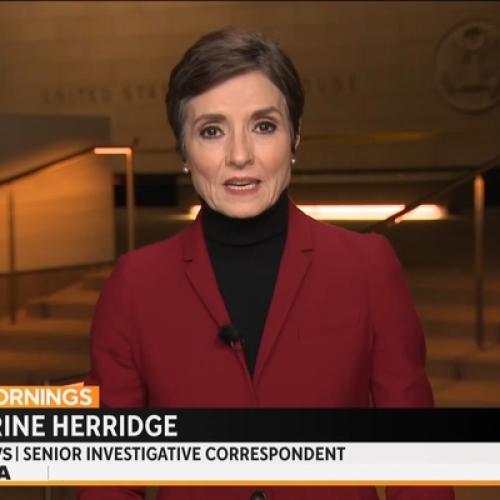
Catherine Herridge — the acclaimed CBS News investigative journalist known for her reporting on the Hunter Biden laptop scandal — accused the network of “journalistic rape” for seizing her files after she was fired during a House Judiciary Committee hearing. “CBS News’ decision to seize my reporting records crossed a red line that I believe should never be crossed by any media organization,” Herridge said. “Multiple sources said they were concerned that by working with me to expose government corruption and misconduct they would be identified and exposed.” Herridge, who had spent nearly five years at the network after being hired away from Fox News, was among 20 CBS News staffers let go as part of a larger purge of 800 employees by Paramount. Judiciary Committee Chair Jim Jordan (R-OH) asked Herridge if she wrote critical stories about Hunter Biden, the laptop, the Biden family, the business operation and the Biden brand. Herridge replied: ”I reported out the facts of the story.” “You sure did,” Jordan said. “You reported the facts and then CBS fired you!” The House Judiciary Committee also heard testimony from former CBS News reporter Sharyl Attkisson, who quit the network in 2014 over claims that CBS killed stories that put then-President Barack Obama in a bad light. Attkisson’s told the committee that her critical reporting of the government resulted in her phone being tapped.
Note: While Hunter Biden was indicted for three felony gun charges and nine counts of tax-related crimes, his laptop also revealed suspicious business dealings with corrupt overseas firms. For more, see concise summaries of deeply revealing news articles on corporate corruption and media manipulation from reliable sources.
A debate about media bias has broken out at National Public Radio after a longtime employee published a scathing letter accusing the broadcaster of a “distilled worldview of a very small segment of the US population”. In the letter published on Free Press, NPR’s senior business editor Uri Berliner claimed Americans no longer trust NPR – which is partly publicly funded – because of its lack of “viewpoint diversity." Berliner wrote that “an open-minded spirit no longer exists within NPR, and now, predictably, we don’t have an audience that reflects America”. Berliner noted that in 2011 the public broadcaster’s audience identified as 26% conservative, 23% as middle of the road and 37% liberal. Last year it identified as 11% very or somewhat conservative, 21% as middle of the road, and 67% very or somewhat liberal. “We weren’t just losing conservatives; we were also losing moderates and traditional liberals,” Berliner wrote. Berliner identified the station’s coverage of the Covid-19 lab leak theory, Hunter Biden’s laptop and allegations that Donald Trump colluded with Russia in the 2016 election as all examples of how “politics were blotting out the curiosity and independence that ought to have been driving our work”. When he brought up [a] survey of newsroom political voter registration at a 2021 all-staff meeting, showing there were no Republicans, he claimed he was met with “profound indifference”.
Note: Read Berliner's full article about how NPR misled the public on the most important issues making front page news. For more, see concise summaries of deeply revealing news articles on corporate corruption and media manipulation from reliable sources.
A veteran National Public Radio journalist slammed the left-leaning broadcaster for ignoring the Hunter Biden laptop scandal because it could have helped Donald Trump get re-elected. Uri Berliner, an award-winning business editor and reporter at NPR, penned a lengthy essay ... in which he called out his bosses for turning the public radio broadcaster into “an openly polemical news outlet serving a niche audience.” “The laptop was newsworthy,” Berliner wrote. “But the timeless journalistic instinct of following a hot story lead was being squelched.” The Post was the first to reveal the existence of the laptop that Hunter Biden left at a Delaware computer shop. The Post published the contents of emails taken from the laptop, which shed light on Hunter Biden’s business dealings in Ukraine and China while his father, Joe Biden, was vice president during the Obama administration. Initially, national security experts and former intelligence officials declared the laptop a hoax and was the product of a Russian disinformation campaign. Social media sites like Twitter even barred its users from sharing links to The Post's reporting. The authenticity of the emails were later confirmed. According to Berliner, NPR’s managing editor for news at the time said that the outlet had no interest in “[wasting] our time on stories that are not really stories, and we don’t want to waste the listeners’ and readers’ time on stories that are just pure distractions.”
Note: While Hunter Biden was indicted for three felony gun charges and nine counts of tax-related crimes, his laptop also revealed suspicious business dealings with corrupt overseas firms. For more, see concise summaries of deeply revealing news articles on corporate corruption and media manipulation from reliable sources.
Forever chemicals, also known as per- and polyfluoroalkyl substances (PFAS), are a pervasive group of compounds that have been linked to a number of cancers and other illnesses. The toxic substances have become widespread in the air, soil and water via industrial discharge and are found in a number of common household items, from cookware to dental floss to stain-resistant furniture. And many of the products in which they have been detected — including waterproof makeup, workout leggings and period products — are primarily marketed toward women. In May 2022, a team of researchers at the Massachusetts-based Silent Spring Institute published a study ... looking at the presence of PFAS in underwear and several other consumer items. Among those products was menstrual underwear. Research released in August ... also found indicators of PFAS in some period products, including wrappers for several pads and some tampons and outer layers of menstrual underwear. A 2021 study ... tested 231 makeup products and found that 63 percent of the foundations, 58 percent of the eye products, 55 percent of the lip products and 47 percent of the mascaras it looked at contained high levels of fluorine. The Environmental Working Group has identified 300 cosmetic products from 50 different popular brands that contain PFAS in its Skin Deep database. The advocacy organization found that 200 of these products contain PTFE, which is also used in Teflon pans.
Note: For more along these lines, see concise summaries of deeply revealing news articles on health and corporate corruption from reliable major media sources.
A devastating new Defense Department inspector general report finds that ... the Army, the primary Defense Department proponent for battlefield influence and deception, has failed to staff its own psyops units. Recent revelations about the Pentagon’s psyops call into question just how effective these programs really are. In 2022, an extensive report by the Washington Post revealed widespread concern inside DOD that psychological operations were being waged both recklessly and ineffectively by the armed services. The report was spurred by research from the Stanford Internet Observatory which detailed over 150 instances of Facebook and Twitter removing accounts linked to U.S. military influence campaigns. The 2019 National Defense Authorization Act gave the Defense Department a green light to engage in offensive psyops campaigns, including clandestine operations that align with the same definition as covert, meaning that the armed forces can carry out influence operations that deny an American connection. After the congressional authorization, an unnamed defense official said, “Combatant commanders got really excited” and were “eager to utilize these new authorities. The defense contractors were equally eager to land lucrative classified contracts to enable clandestine influence operations.” Researchers at Stanford ultimately found that despite the dozens of Defense Department obscured accounts spreading misinformation, the effect on foreign populations was far less than information conveyed overtly from self-identified U.S. sources.
Note: Read about the Pentagon's secret army of 60,000 undercover operatives that manipulate public perception. Learn more about the history of military-intelligence influence on the media in our comprehensive Military-Intelligence Corruption Information Center.
Jimo Borjigin, a professor of neurology at the University of Michigan ... took the first close look at the record of electrical activity in the brain of Patient One after she was taken off life support. After Patient One was taken off oxygen, there was a surge of activity in her dying brain. Areas that had been nearly silent while she was on life support suddenly thrummed with high-frequency electrical signals called gamma waves. In particular, the parts of the brain that scientists consider a “hot zone” for consciousness became dramatically alive. Since the 1960s, advances in resuscitation had helped to revive thousands of people who might otherwise have died. About 10% or 20% of those people brought with them stories of near-death experiences in which they felt their souls or selves departing from their bodies. According to several international surveys and studies, one in 10 people claims to have had a near-death experience involving cardiac arrest, or a similar experience in circumstances where they may have come close to death. That’s roughly 800 million souls worldwide who may have dipped a toe in the afterlife. If there is consciousness without brain activity, then consciousness must dwell somewhere beyond the brain. Parapsychologists point to a number of rare but astounding cases. One of the most famous is about a woman who apparently travelled so far outside her body that she was able to spot a shoe on a window ledge in another part of the hospital where she went into cardiac arrest; the shoe was later reportedly found by a nurse.
Note: Read more about the fascinating field of near-death experiences. Explore more positive stories like this in our comprehensive inspiring news articles archive focused on solutions and bridging divides.
Hardware that breaks into your phone; software that monitors you on the internet; systems that can recognize your face and track your car: The New York State Police are drowning in surveillance tech. Last year alone, the Troopers signed at least $15 million in contracts for powerful new surveillance tools. Surveillance technology has far outpaced traditional privacy laws. In New York, lawmakers launched a years-in-the-making legislative campaign last year to rein in police intrusion. None of their bills have made it out of committee. A report from the U.S. Office of the Director of National Intelligence, put it succinctly: “The government would never have been permitted to compel billions of people to carry location tracking devices on their persons at all times, to log and track most of their social interactions, or to keep flawless records of all their reading habits.” That report called specific attention to the “data broker loophole”: law enforcement’s practice of obtaining data for which they’d otherwise have to obtain a warrant by buying it from brokers. The New York State Police have taken greater and greater advantage of the loophole in recent years. They’ve also spent millions on mobile device forensic tools, or MDFTs, powerful hacking hardware and software that allow users to download full, searchable copies of a cellphone’s data, including social media messages, emails, web and search histories, and minute-by-minute location information.
Note: For more along these lines, see concise summaries of deeply revealing news articles on police corruption and the disappearance of privacy from reliable major media sources.
For 55 years, every presidential administration has granted early protection to major candidates who requested it. The Biden administration is the sole outlier. The Kennedy campaign made its fifth formal request for Secret Service protection in March, citing a 67-page report of repeated death threats, nutjob letters, two heavily armed intruders to a campaign event, an invader in Kennedy’s Cape Cod house, and another man who invaded Kennedy’s home twice in one day when Kennedy and his wife, Cheryl Hines, were at home. President Biden’s decision to deny Secret Service protection to Kennedy seems to be based on political considerations and weaponizes the Secret Service by making it necessary for Kennedy to raise and spend millions of dollars each month for security. Kennedy appears to fit neatly into the law governing Secret Service protection for presidential candidates. Security costs the campaign 30 cents out of each dollar raised. Secret Service records recently revealed the agency’s conclusions that Kennedy is at “elevated risk for adverse attention,” and after reviewing credible armed threats against Kennedy, the agency assembled a group of eight teams ready to step in quickly after they get the go-ahead. But they never got it. RFK Jr. has provoked and challenged some of the most powerful forces in our country, especially concerning the military-industrial complex, the CIA, and endless foreign wars that so enrich defense contractors. The perils to Kennedy arise not only because of his name but also because of the mainstream media’s relentless demonization of him.
Note: Nikki Haley asked for Secret Service protection earlier this month, and the Secret Service agreed even though she is no longer in the race. Read more about the JFK assassination. For more along these lines, see concise summaries of deeply revealing news articles on government corruption from reliable major media sources.
Unidentified flying objects (UFOs) have caused so much concern in recent years that even Nasa launched a lengthy probe to find out what they were. Now some experts believe the hunt should move from the skies to the sea. The former head of the US National Oceanic and Atmospheric Administration (NOAA) is launching a probe into unidentified submersible objects (USOs) and, in particular, a strange anomaly seen on the seabed off the coast of California. Timothy Gallaudet, a former rear admiral in the US Navy, has spent the past 18 months interviewing dozens of sailors, submariners, military personnel and members of the US Coastguard, all who say they have seen unidentified craft in the water. One incident was filmed by the USS Omaha off the coast of San Diego in southern California in 2019, when a dark-shaped object was seen moving quickly before splashing down into the water. In the renowned Tic Tac incident in 2004, US Navy pilots described an oblong craft shaped like the sweet hovering just above the water off the California coast. Sonar has revealed an unusual trench on the seafloor as if an object has crashed into a ridge and then skidded to a halt. Mr Gallaudet believes that evidence for USOs may be present in the US Navy’s acoustic data, but it is currently classified. This week Mr Gallaudet launched a report into the phenomenon alongside the Sol Foundation, a group of academics, military and government officials committed to researching UFOs.
Note: Watch this intriguing leaked video taken by a Navy ship and this video of more strange UFO sightings by US Navy warships. For more along these lines, see concise summaries of deeply revealing news articles on UFOs from reliable major media sources. Then explore the excellent, reliable resources provided in our UFO Information Center.
A federal appeals court in the US has killed a ban on plastic containers contaminated with highly toxic PFAS “forever chemicals” found to leach at alarming levels into food, cosmetics, household cleaners, pesticides and other products across the economy. Houston-based Inhance manufactures an estimated 200m containers annually with a process that creates, among other chemicals, PFOA, a toxic PFAS compound. The Environmental Protection Agency (EPA) in December prohibited Inhance from using the manufacturing process. But the conservative fifth circuit court of appeals court overturned the ban. The judges did not deny the containers’ health risks, but said the EPA could not regulate the buckets under the statute it used. The rule requires companies to alert the EPA if a new industrial process creates hazardous chemicals. Inhance has produced the containers for decades and argued that its process is not new, so it is not subject to the regulations. The EPA argued that it only became aware that Inhance’s process created PFOA in 2020, so it could be regulated as a new use, but the court disagreed. PFAS are a class of about 15,000 compounds [that] have been linked to cancer, high cholesterol, liver disease, kidney disease, fetal complications and other serious health problems. A peer-reviewed study in 2011 found Inhance’s containers leached the toxic compounds into their contents.
Note: For more along these lines, see concise summaries of deeply revealing news articles on health and corporate corruption from reliable major media sources.
The U.S. Navy is reportedly preparing to test a hypersonic weapon as part of a joint developmental program with the U.S. Army, which aims to unleash the military’s Long-Range Hypersonic Weapon (LRHW) capabilities. The forthcoming test will involve the C-HGB, which relies on the Navy’s booster rocket motor to propel the weapon to hypersonic speeds. Once the rocket is ejected, the C-HGB can glide at speeds of Mach 5 or greater.Production of the C-HGB for the Army and the Navy has been underway for several years in cooperation with Dynetics ... who was contracted to develop the prototypes. Dynetics’ development of the C-HGB prototypes marks the first time that a domestic private sector entity has been tasked with building hypersonic weapons. Known as Dark Eagle, the Army says its LRHW will be capable of reaching targets within a range of 1,725 miles and reportedly traveling at speeds exceeding 3,800 miles per hour. Presently, the U.S. is racing against similar hypersonic developments being undertaken by Russia and China, who have been actively testing similar weapons capabilities for years. Earlier this month, it was revealed that the U.S. Air Force conducted a test with a prototype hypersonic missile in the Marshall Islands. Formally known as the AGM-183, the missile is an air-launched rapid response weapon (ARRW), a type of hypersonic air-to-ground missile that was the result of a $480 million contract granted to Lockheed Martin in 2018.
Note: Learn more about emerging warfare technology in our comprehensive Military-Intelligence Corruption Information Center. For more, see concise summaries of deeply revealing news articles on military corruption from reliable major media sources.
Private donors including big-box stores, fossil fuel companies, and tech giants are secretly giving hundreds of millions of dollars annually to law enforcement agencies and related foundations, allowing police to buy specialized weapons and technology with little public oversight. Experts say this huge deluge of police “dark money” funding, detailed in a new University of Chicago working paper ... leaves law enforcement beholden to the companies and powerful donors bankrolling them, rather than the communities that officers are sworn to serve. The study, which analyzed a database of nonprofit tax returns, found that from 2014 to 2019, more than 600 private donors and organizations collectively funneled $461 million to police and to other nonprofits supporting police. The Baltimore Police Department for years used private money to fund a secret aerial surveillance program that could track the locations of people throughout the city in real time. The program ... was eventually ruled unconstitutional in court. In Los Angeles, the city’s police department used money from Target ... routed through a local police foundation — to purchase software from Palantir, venture capitalist Peter Thiel’s data analytics company, that provides police massive amounts of sensitive data and purports to identify crime “hot spots.” For the most part, the millions in dark-money funding that police agencies receive each year is perfectly legal. There are largely no laws or policies governing foundation donations to the police.
Note: For more along these lines, see concise summaries of deeply revealing news articles on police corruption and the disappearance of privacy from reliable major media sources.
The FBI spends "every day, all day long" interrogating people over their Facebook posts. At least, that's what agents told Stillwater, Oklahoma, resident Rolla Abdeljawad when they showed up at her house to ask her about her social media activity. Three FBI agents came to Abdeljawad's house and said that they had been given "screenshots" of her posts by Facebook. Her lawyer Hassan Shibly posted a video of the incident. "Facebook gave us a couple of screenshots of your account," one agent in a gray shirt said in the video. "So we no longer live in a free country and we can't say what we want?" replied Abdeljawad. "No, we totally do. That's why we're not here to arrest you or anything," a second agent in a red shirt added. "We do this every day, all day long. It's just an effort to keep everybody safe and make sure nobody has any ill will." Shibly says that he doesn't know which Facebook post caught the agents' attention, and that it was the first time he had heard of Facebook's parent company, Meta, preemptively reporting posts to law enforcement. [Abdeljawad] made multiple angry posts per day about the war in Gaza, referring to Israel as "Israhell." But none of the posts on her feed call for violence. Ironically, Abdeljawad had also posted a warning about exactly the kind of government monitoring she was later subjected to. "Don't fall for their games. Our community is being watched & they are just waiting for any reason to round us up," Abdeljawad wrote.
Note: For more along these lines, see concise summaries of deeply revealing news articles on government corruption and the erosion of civil liberties from reliable major media sources.
Patrick Burrichter did not think about saving lives or protecting the planet when he trained as a chef. But 25 years later he has focused his culinary skills on doing exactly that. On the outskirts of Berlin, Burrichter and his team cook for a dozen hospitals that offer patients a “planetary health” diet – one that is rich in plants and light in animals. Compared with the typical diet in Germany, known for its bratwurst sausage and doner kebab, the 13,000 meals they rustle up each day are better for the health of people and the planet. In Burrichter’s kitchen, the steaming vats of coconut milk dal and semolina dumpling stew need to be more than just cheap and healthy – they must taste so good that people ditch dietary habits built up over decades. The biggest challenge, says Burrichter, is replacing the meat in a traditional dish. Moderate amounts of meat can form part of a healthy diet, providing protein and key nutrients, but the average German eats twice as much as doctors advise. Patients on the wards of Waldfriede praise the choice of meals on offer. Martina Hermann, 75, says she has been inspired to cook more vegetables when she gets home. Followers of the planetary health diet need not abandon animal products altogether. The guidelines, which were proposed by 37 experts from the EAT-Lancet Commission in 2019, translate to eating meat once a week and fish twice a week, along with more wholegrains, nuts and legumes.
Note: Explore more positive stories like this in our comprehensive inspiring news articles archive focused on solutions and bridging divides.
According to Wikipedia, the United States has been involved in 107 wars since its founding and 41 of these were fought against the Indigenous peoples of North America. Most of these wars are ignored by schools, textbooks and the media, but the pressure to become involved in additional conflict is ever-present. At times the number of private contractors has been larger than that of enlisted troops. In April 2008, there were 163,900 contractors and 160,000 enlisted troops in Iraq. But when most media reported the number of Americans in the war zone, they reported the number of enlisted troops and not the contractors. This results in a predictable under-estimate of American involvement and additional earnings for contractor providers. Every year, the defense industry donates millions of dollars to the campaigns of members of Congress, creating pressure on the legislative branch to fund specific weapons systems, maintain an extremely high Pentagon budget, and add ever more military spending. In 2022 the weapons/defense industry donated $10.2 million to the 84 members of the House and Senate Armed Services Committees. And the wars continue. In his book “The United States of War,” David Vine reports that, “In the nearly two decades since U.S. forces invaded Afghanistan and Iraq, the U.S. military has fought in at least 22 countries.” If we are to escape a future of forever wars, all justifications for war should be questioned and debated before the killing starts.
Note: Learn more about war failures and lies in our comprehensive Military-Intelligence Corruption Information Center. For more, see concise summaries of deeply revealing news articles on war from reliable major media sources.
The Haitian Bald Headed Party (PHTK) has tyrannically ruled Haiti since 2011. The U.S. State Department, who unilaterally picked Ariel Henry to be Haiti’s prime minister in July of 2021, has now decided Henry no longer fits their interests and has forced him to step down. Henry was prevented from returning to Haiti on March 5 by paramilitary gangs who attempted to take the Toussaint Louverture International Airport, opening fire and hitting a plane bound for Cuba. The imperial forces responsible for over half a million illegal U.S. guns in Haiti that fuel this unparalleled violence are now preparing their next move to keep Haiti subdued. For the past 18 months, the Biden administration has sought to facilitate what will be the fourth U.S.-led foreign invasion and occupation of Haiti in the last 100 years by deputizing Kenya, Benin, the Bahamas, and other western neocolonies to carry out the occupation. The CIA remains active as well seeking a neocolony the U.S. can deputize to carry out this invasion. The only Haitian representatives that can be considered for the U.S.-led transitional government have to agree to the occupation. U.S. policy empowers and works with corrupt political leadership in Haiti because they can be relied upon to do the U.S.’s bidding. Meanwhile, those leaders who refuse to sell out to imperial interests are repressed and murdered. The ruling PHTK [has] bragged about being “legal bandits” above the law and employing ... government death squads armed with hundreds of thousands of U.S. weapons.
Note: The US government wants Ariel Henry out to purportedly prevent a full scale civil war. Is the US now trying to address Haitian stability and violence that US policies have helped create? Read about US involvement in the assassination of Haitian President Jovenel Moïse. Learn more about the role the arms industry plays in global conflicts in our comprehensive Military-Intelligence Corruption Information Center.
A Silicon Valley defense tech startup is working on products that could have as great an impact on warfare as the atomic bomb, its founder Palmer Luckey said. "We want to build the capabilities that give us the ability to swiftly win any war we are forced to enter," he [said]. The Anduril founder didn't elaborate on what impact AI weaponry would have. But asked if it would be as decisive as the atomic bomb to the outcome of World War II he replied: "We have ideas for what they are. We are working on them." In 2022, Anduril won a contract worth almost $1 billion with the Special Operations Command to support its counter-unmanned systems. Anduril's products include autonomous sentry towers along the Mexican border [and] Altius-600M attack drones supplied to Ukraine. All of Anduril's tech operates autonomously and runs on its AI platform called Lattice that can easily be updated. The success of Anduril has given hope to other smaller players aiming to break into the defense sector. As an escalating number of global conflicts has increased demand for AI-driven weaponry, venture capitalists have put more than $100 billion into defense tech since 2021, according to Pitchbook data. The rising demand has sparked a fresh wave of startups lining up to compete with industry "primes" such as Lockheed Martin and RTX (formerly known as Raytheon) for a slice of the $842 billion US defense budget.
Note: Learn more about emerging warfare technology in our comprehensive Military-Intelligence Corruption Information Center. For more, see concise summaries of deeply revealing news articles on corruption in the military and in the corporate world from reliable major media sources.
Diddy has been dubbed the Jeffrey Epstein of the music industry. The internet was shaken to its core when Homeland Security Investigators' raid of Diddy's Los Angeles and Miami homes hit the headlines. Even though the cause of the raid has remained undisclosed, sources suggested it has to do with the s-x trafficking allegations against the music mogul. In a lawsuit filed by Rodney "Lil Rod" Jones, Diddy was accused of hosting "freak parties" that were attended by "celebrities, athletes, politicians, international dignitaries, and music label executives." The music producer further stated that these parties were sponsored by major players in the recording industry, giving them access to "s-x, drugs, and underage girls." He also alleged that the ... rapper hired underage girls to work for him and drugged their drinks. The lawsuit further stated that Combs Global Enterprises chief of staff, Kristina Khorram, "ordered s-x workers and prostitutes for Mr. Combs." According to lawsuits against Diddy and Epstein, both men had their homes fitted with hidden cameras that captured the debauchery that went on during their parties. In Jones' civil lawsuit against Diddy, he stated: "Mr. Combs had hidden cameras in every room of his home... has recordings of several celebrities, artists, music label executives, and athletes engaging in illegal activity. Mr. Combs possesses compromising footage of every person who has attended his freak-off parties and his house parties."
Note: For more along these lines, see concise summaries of deeply revealing news articles on Jeffrey Epstein's child sex trafficking ring and other sexual abuse scandals from reliable major media sources.
No criminal charges have been filed against rap mogul Sean Combs, even though one of his two mansions on Star Island — and one in Los Angeles — were raided by Homeland Security agents on Monday. That’s a disturbing development. The question: Is Combs another South Florida-grown Jeffrey Epstein? A civil lawsuit filed one month before the raid alleges Combs, better known as Diddy, his staff and executives engaged in “serious illegal activity,” including using drugs, possessing illegal firearms and providing laced alcoholic beverages to drug sex workers and minors, all for Comb’s pleasure. The lawsuit, filed by producer Rodney “Lil Rod” Jones, says Combs was running a “widespread and dangerous criminal sex trafficking organization.” Combs settled another suit filed by singer Cassie in November that accused him of raping her. Jones said in the lawsuit that Combs, his staff and music executives knew about — and were involved in — illicit and unwanted sexual activities in Florida, New York, California and the U.S. Virgin Islands. In December ... four civil lawsuits filed by women [alleged that Combs] promised to launch their singing careers, then sexually abused them, trafficked them and forced them to have sex with other people. If the allegations are true, then Combs used his position of power over aspiring female artists, models and assistants in a manner comparable to Weinstein’s serial abuse of women hoping to advance their careers.
Note: For more along these lines, see concise summaries of deeply revealing news articles on Jeffrey Epstein's child sex trafficking ring and other sexual abuse scandals from reliable major media sources.
Last month, I revealed internal Twitter and Department of Homeland Security emails showing that the agency had successfully pressured the social media platform to censor the New York Times during the 2020 presidential election. It was impossible to get the Times to comment on my reporting that revealed that a government agency, enacted to protect national security, had muzzled one of its own. The paper remained silent. That was the case until last week when the Times finally mentioned the issue. In a lengthy article that falsely paints efforts to promote free speech as orchestrated entirely by Trump supporters, the Times buried an acknowledgment of our reporting some 52 paragraphs down. The backhanded way in which the Times finally noted that the government had suppressed the speech — in an article that essentially argues that free speech is a dangerous right-wing plot — reflects the institution's changing nature. Many in the public may view the paper as a beacon of the free press. After all, the most important Supreme Court case enshrining media rights was New York Times v. U.S., the 1971 case that made it clear that journalists have the right to publish even classified documents. There are sprawling constitutional issues at heart here that should go beyond left and right. This government or the next administration may use the DHS apparatus to control what is said about almost any political issue. DHS bureaucrats ... have planned to suppress “misinformation” about the Ukraine war, the origins of COVID-19, and topics as broad as “racial justice.” That power can easily be exploited. Last month, I testified before Congress on the importance of free speech. I also filed an amicus brief to the Supreme Court ... urging the justices to consider the lengthy evidence that the government has already overstepped its authority with respect to online censorship.
Note: This Substack was written by independent journalist Lee Fang. Read more about Department of Homeland Security's censorship efforts, including offensive operations to manipulate public opinion, discredit individuals, and infiltrate online groups. For more along these lines, see concise summaries of important news articles on censorship and media manipulation from reliable sources.
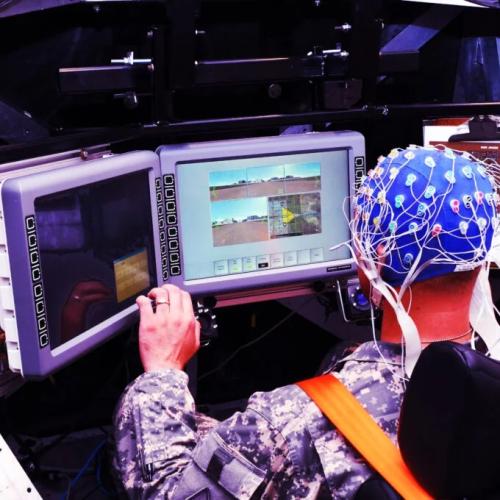
Billionaire Elon Musk’s brain-computer interface (BCI) company Neuralink made headlines earlier this year for inserting its first brain implant into a human being. Such implants ... are described as “fully implantable, cosmetically invisible, and designed to let you control a computer or mobile device anywhere you go." They can help people regain abilities lost due to aging, ailments, accidents or injuries, thus improving quality of life. Yet, great ethical concerns arise with such advancements, and the tech is already being used for questionable purposes. Some Chinese employers have started using “emotional surveillance technology” to monitor workers’ brainwaves. Governments and militaries are already ... describing the human body and brain as war’s next domain. On this new “battlefield,” an era of neuroweapons ... has begun. The Pentagon’s research arm DARPA directly or indirectly funds about half of invasive neural interface technology companies in the US. DARPA has initiated at least 40 neurotechnology-related programs over the past 24 years. As a 2024 RAND report speculates, if BCI technologies are hacked or compromised, “a malicious adversary could potentially inject fear, confusion, or anger into [a BCI] commander’s brain and cause them to make decisions that result in serious harm.” Academic Nicholas Evans speculates, further, that neuroimplants could “control an individual’s mental functions,” perhaps to manipulate memories, emotions, or even to torture the wearer. In a [military research paper] on neurowarfare: "Microbiologists have recently discovered mind-controlling parasites that can manipulate the behavior of their hosts according to their needs by switching genes on or off. Since human behavior is at least partially influenced by their genetics, nonlethal behavior modifying genetic bioweapons that spread through a highly contagious virus could thus be, in principle, possible.
Note: The CIA once used brain surgery to make six remote controlled dogs. For more, see important information on microchip implants and CIA mind control programs from reliable major media sources.
Although it happened more than 60 years ago, Antonio Salazar-Hobson remembers every detail of his kidnapping. After being snatched from his back yard, he is taken into a nightmarish landscape of sex trafficking, violence and exploitation. Rather than being broken by what he experienced, he instead rose from the ashes of his stolen childhood to accomplish extraordinary academic feats and become one of the US’s most successful labour rights attorneys, representing vulnerable and powerless communities, and dedicating his life to justice and compassion. “I chose not to be obliterated by the abuse and trauma I was forced to endure,” he says. “Instead of being swallowed by the darkness, I survived by walking towards the light.” He has taken on multibillion-dollar corporations, represented First Nation people and LGBTQ+ farm worker communities, and won every case. “I’m used to people underestimating me, this poor Chicano boy going up against rooms full of corporate lawyers in suits, but I always prevail,” he says. He now plans to dedicate the rest of his life to the anti-trafficking movement. “It is my hope that somehow my story can be of service to the community of survivors of sexual assault and trafficking; what happened to me can show other kids that they don’t have to be ashamed, that they can rise up to become whoever they want to be. I want to show them that I refused to be broken and, in the end, I ... made it home.”
Note: Explore more positive stories about ending human trafficking.
People experiencing mental or behavioral health crises and addiction have often been subject to police use of force, arrest and incarceration. [There are] efforts around the country to change that. One of the most common new approaches ... are civilian co-responder programs, in which behavioral health specialists, often social workers, show up to certain emergency calls alongside police. These can include situations like suicide threats, drug overdoses, and psychiatric episodes. Typically, the officers on the team have special training in crisis intervention. Generally, these teams aim to de-escalate any crisis or conflict, avoiding arrest and solving the reason for the emergency call, especially if it’s a simple one. This week, the New Jersey Monitor reported that one call “for a welfare check on a woman with anxiety ended with the [state] trooper picking up her new cell phone from the post office and fixing a broken toilet” and the emergency call screener setting up her new phone. The Monitor also found that the program avoided arrests or police use of force in 95% of responses. The B-HEARD program in New York City, which is just three years old in a diverse city of 8.5 million, responded to roughly a quarter of mental health calls in precincts where it operated in the first half of 2023. Mental health calls make up 10% of all 911 calls in the city. In Denver, a study of the city’s STAR program found the alternative response model reduced low-level crime.
Note: Explore more positive stories about repairing the criminal justice system.
Police in the U.S. recently combined two existing dystopian technologies in a brand new way to violate civil liberties. A police force in California recently employed the new practice of taking a DNA sample from a crime scene, running this through a service provided by US company Parabon NanoLabs that guesses what the perpetrators face looked like, and plugging this rendered image into face recognition software to build a suspect list. Parabon NanoLabs ... alleges it can create an image of the suspect’s face from their DNA. Parabon NanoLabs claim to have built this system by training machine learning models on the DNA data of thousands of volunteers with 3D scans of their faces. The process is yet to be independently audited, and scientists have affirmed that predicting face shapes—particularly from DNA samples—is not possible. But this has not stopped law enforcement officers from seeking to use it, or from running these fabricated images through face recognition software. Simply put: police are using DNA to create a hypothetical and not at all accurate face, then using that face as a clue on which to base investigations into crimes. This ... threatens the rights, freedom, or even the life of whoever is unlucky enough to look a little bit like that artificial face. These technologies, and their reckless use by police forces, are an inherent threat to our individual privacy, free expression, information security, and social justice.
Note: Law enforcement officers in many U.S. states are not required to reveal that they used face recognition technology to identify suspects. For more along these lines, see concise summaries of important news articles on police corruption and the erosion of civil liberties from reliable major media sources.
Federal investigators have ordered Google to provide information on all viewers of select YouTube videos. In a just-unsealed case from Kentucky ... undercover cops sought to identify the individual behind the online moniker “elonmuskwhm,” who they suspect of buying bitcoin for cash. In conversations with the user in early January, undercover agents sent links of YouTube tutorials for mapping via drones and augmented reality software, then asked Google for information on who had viewed the videos, which collectively have been watched over 30,000 times. The court orders show the government telling Google to provide the names, addresses, telephone numbers and user activity for all Google account users who accessed the YouTube videos between January 1 and January 8, 2023. The government also wanted the IP addresses of non-Google account owners who viewed the videos. The cops argued, “There is reason to believe that these records would be relevant and material to an ongoing criminal investigation, including by providing identification information about the perpetrators.” The court granted the order and Google was told to keep the request secret. Privacy experts said the orders were unconstitutional because they threatened to undo protections in the 1st and 4th Amendments covering free speech and freedom from unreasonable searches. Albert Fox-Cahn, executive director at the Surveillance Technology Oversight Project [says that] “no one should fear a knock at the door from police simply because of what the YouTube algorithm serves up. I’m horrified that the courts are allowing this.”
Note: The article refers to federal investigators and to undercover cops, but it doesn't specify who was actually doing the investigating. What agency or agencies were involved in these secret operations? For more along these lines, see concise summaries of deeply revealing news articles on police corruption and the disappearance of privacy from reliable major media sources.
It prides itself on offering an "assortment of family-friendly programming." For Alexa Nikolas, however, Nickelodeon's claims concealed a darker truth. She says young stars were exploited into taking part in sexually suggestive scenes. "Kids are groomed into thinking that the lines that they're doing are pretend, that it's not real life," the star, who played Nicole Bristow on the Nickelodeon TV series Zoey 101, [said]. Nikolas spoke out in the wake of docuseries Quiet on Set: The Dark Side of Kids TV, which aired on the Investigation Discovery channel ... and exposed the "toxic culture" and alleged abuse on the set of some of Nickelodeon's biggest shows. In addition to Nikolas, several former child stars have spoken out, claiming sexual assault and harassment while working for the channel. Drake & Josh star Drake Bell speaks publicly for the first time about being repeatedly molested by his dialogue coach, Peck, when he was 15. "I was sleeping on the couch where I usually sleep and I woke up to him... I opened my eyes and I woke up and he was...he was sexually assaulting me." Bell claimed the abuse occurred more than once and said he was scared to report it. He explained: "And it just got worse, and worse, and worse, and worse, and I was just trapped. I had no way out. The abuse was extensive and it got pretty brutal." The four-part docuseries documents the child sexual abuse committed by assistant Jason Handy, dialogue coach Brian Peck, and studio freelancer Ezel Channel, as well as the alleged abusive and misogynistic behavior of showrunner Dan Schneider.
Note: Read more about the disturbing history of child sex abuse in Hollywood from the courageous voices of actor Corey Feldman and Lord of the Rings star Elijah Wood. For more along these lines, see concise summaries of deeply revealing news articles on corporate corruption and sexual abuse scandals from reliable major media sources.
The FDA has agreed to delete and never republish several social-media posts suggesting that ivermectin, a drug that some doctors used to treat COVID-19, is for animals and not humans. While the FDA still does not approve of using ivermectin to treat COVID, it settled Thursday a lawsuit brought by three doctors who sued it, as well as the Department of Health and Human Services and its secretary, Xavier Becerra, and FDA secretary Robert Califf. All parties have settled. The lawsuit, filed on June 2, 2022, was brought by doctors Mary Talley Bowden, Paul Marik and Robert Apter, each of whom claimed the FDA was interfering with their ability to practice medicine. The case was initially dismissed on the grounds the FDA had "sovereign immunity," though a U.S. Court of Appeals for the Fifth Circuit reversed the lower court's decision saying that the "FDA is not a physician." The appeals court also said that, "Even tweet-sized doses of personalized medical advice are beyond the FDA's statutory authority." The FDA will retire a Consumer update titled, "Why You Should Not Use Ivermectin to Treat or Prevent COVID-19." The FDA also will delete and not republish posts to Twitter (now X), LinkedIn and Facebook that read: "You are not a horse. Your are not a cow. Seriously, y'all. Stop it." Independent presidential candidate Robert F. Kennedy Jr. wrote on X: "The FDA is biased against many low-cost, generic, and/or natural therapies with low profit potential. Could it be because half its funding comes from Big Pharma?"
Note: A US Senate Committee hearing on evidence of Ivermectin's benefits was once censored on Youtube. Explore a comprehensive look into the benefits and uses of ivermectin, despite establishment media's concerted effort to discredit its efficacy and safety.
The National Park Service is continuing to convert dozens of its sites across the country to cashless payments only, drawing complaints and, now, a lawsuit. Starting in June last year, visitors to Rocky Mountain National Park in Colorado were told that they could not use cash to enter the park or use its campgrounds. The negative reactions were swift, with visitors raising privacy concerns and expressing confusion about why the American dollar would not be welcome in the U.S. parks system. Now these complaints are the subject of a lawsuit filed on March 6 in U.S. District Court in the District of Columbia, asserting that the service’s policies violate federal law defining cash as “legal tender” and the visitors’ “lawful right to pay in cash” at national sites, including those without bank accounts or cards or those who simply prefer to pay cash. In addition to the park service, its director, Charles F. Sams, III, and the Department of the Interior were named as defendants. One of the three plaintiffs, Toby Stover, a New York woman, drove to Hyde Park, N.Y., in January. She ... was not allowed to enter after trying to pay $10 in cash, the filing said. The plaintiffs’ lawyer, Ray L. Flores, II, said in an emailed reply to questions that the legal action is being financially backed by the Children’s Health Defense. Mr. Flores said in the email that cashless policies were “a key component — if not the linchpin — of the surveillance state.”
Note: This article is also available here. A 2018 Guardian piece titled "The cashless society is a con and big finance is behind it" describes some of the basic problems with the push to go cashless.
Everywhere you go online, you’re being tracked. Almost every time you visit a website, trackers gather data about your browsing and funnel it back into targeted advertising systems, which build up detailed profiles about your interests and make big profits in the process. At the end of last year, thousands of websites started being more transparent about how many companies your data is being shared with. A WIRED analysis of the top 10,000 most popular websites shows that dozens of sites say they are sharing data with more than 1,000 companies, while thousands of other websites are sharing data with hundreds of firms. Quiz and puzzle website JetPunk tops the pile, listing 1,809 “partners” that may collect personal information, including “browsing behavior or unique IDs.” More than 20 websites from publisher Dotdash Meredith—including Investopedia.com, People.com, and Allrecipes.com—all say they can share data with 1,609 partners. The newspaper The Daily Mail lists 1,207 partners, while internet speed-monitoring firm Speedtest.net, online medical publisher WebMD, and media outlets Reuters, ESPN, and BuzzFeed all state they can share data with 809 companies. DuckDuckGo keeps a record of the companies that have the biggest tracking footprint across the web. Among the most common trackers, Google has its technology on 79 percent of websites, while those from five other companies are on more than 20 percent of websites.
Note: For more along these lines, see concise summaries of deeply revealing news articles on corporate corruption and the disappearance of privacy from reliable major media sources.
A man filed a federal lawsuit Monday alleging he was paralyzed and needed his legs amputated after police officers in St. Petersburg, Florida, put him in restraints, placed him in the back of a police van without a seatbelt and then drove in a reckless manner. Heriberto Alejandro Sanchez-Mayen filed the lawsuit in US District Court for the Middle District of Florida against the city of St. Petersburg and officers Sarah Gaddis and Michael Thacker. After being handcuffed, Sanchez-Mayen was placed in the back of [a police] van where there were no seatbelts. Thacker allegedly drove “in a reckless manner and at an unsafe rate of speed,” before he suddenly came to a hard stop at an alleged red light, the suit states. The hard stop caused Sanchez-Mayen to be thrown forward, and his head struck a metal partition. After driving to the Pinellas County jail, Thacker opened the rear doors of the van and found Sanchez-Mayen “lying face down, motionless, unconscious, and unresponsive,” the suit states. The officer unsuccessfully attempted to wake him up and then dragged his limp body out of the van, causing Sanchez-Mayen to hit his head on the bumper, the door and the concrete floor. Sanchez-Mayen suffered spinal cord injuries that left him a quadriplegic, or paralyzed in all of his limbs, and resulted in the amputation of both of his legs. The lawsuit states Sanchez-Mayen should not have been arrested in the first place, noting the criminal trespassing charge was later dismissed.
Note: New Haven, Connecticut has agreed to a $45 million settlement with Randy Cox, another man who was paralyzed while being transported handcuffed and without a seat belt in the back of a police van. For more along these lines, see concise summaries of important news articles on police corruption from reliable major media sources.
The United Nations has delivered more than $2.9 billion in cash to Afghanistan since the Taliban seized control, resulting in the flow of U.S. funds to the extremist group, according to a recent government report. The U.N. deposits the cash into a private Afghan bank and disburses funds to the agency’s aid organizations and nonprofit humanitarian groups. But the money does not stop there. Some winds up at the central bank of Afghanistan, which is under the control of the Taliban. The group took over the country after the withdrawal of U.S. forces in August 2021. The report, from the Special Inspector General for Afghanistan Reconstruction, provides the first detailed account of how U.S. cash falls under the control of the Taliban and adds to a growing body of evidence that contributions to the U.N. are not always reaching Afghans in need. After getting the money from the Federal Reserve Bank of New York, the U.N. flies shrink-wrapped $100 bills to the Kabul International Airport. The money arrives on a regular basis, as much as $40 million at a time. “Aid diversion does happen, and when it does, humanitarian work has to halt and solutions need to be found,” said one U.N. official who was not authorized to make public comment. “There are cases where the Taliban seek to take control of distribution according to their priorities, or other cases where aid work is stopped altogether.” The only way to stop [the diversion of foreign aid] would be to halt the flow of money.
Note: Read more about how the Taliban are now arms dealers after the US military left billions of dollars worth of weapons in Afghanistan. Learn more about war failures and lies in our comprehensive Military-Intelligence Corruption Information Center.
The US government (USG) funded and supported a program of dangerous laboratory research that may have resulted in the creation and accidental laboratory release of SARS-CoV-2, the virus that caused the Covid-19 pandemic. Following the outbreak, the USG lied in order to cover up its possible role. The evidence of a possible laboratory creation revolves around a multi-year US-led research program that involved US and Chinese scientists. The research was designed by US scientists, funded mainly by the National Institutes of Health (NIH) and the Department of Defense, and administered by a US organization, the EcoHealth Alliance (EHA), with much of the work taking place at the Wuhan Institute of Virology (WIV). The NIH became the home for biodefense research starting in 2001. Biodefense funding from the Defense Department budget went to Dr. Anthony Fauci’s division, the National Institute for Allergies and Infectious Diseases (NIAID). NIAID and DARPA (in the Defense Department) supported extensive research on potential pathogens for biowarfare and biodefense, and for the design of vaccines to protect against biowarfare. NIAID became a large-scale financial supporter of Gain of Function (GoF) research, meaning laboratory experiments designed to genetically alter pathogens to make them even more pathogenic. There is a high likelihood that the US Government continues to this day to fund dangerous GoF work.
Note: Watch our latest Mindful News Brief series on the strong evidence that bioweapons research created COVID-19. For more along these lines, see concise summaries of deeply revealing news articles on COVID from reliable major media sources.
From sightings by U.S. submarines to mysterious humanoids in the depths of Russian lakes, there is an even more mysterious cousin to the UFO - the USO, or Unidentified Submerged Object. There are multiple reports of USOs from around the world, often from respected military and academic professionals - with some claiming that underwater ‘fast movers’ are a common part of life on board submarines. Nigel Watson, author of Captured by Aliens? A History and Analysis of American Abduction Claims, said: ‘We live on an ocean planet, so it is not surprising that UFOs are seen over or in the vicinity of the great expanses of water that surround us. 'Concentrations of USO sightings indicate bases in the North Sea, and off the coasts of California and Puerto Rico.' A craft moving through the water faster than the speed of sound ‘whizzed by’ the submarine U.S.S. Hampton, a professor has claimed. Professor Bob McGwier of Virginia Tech and the Institute for Defence Analyses, said the craft’s onboard sonar detected a USO moving through the water faster than the speed of sound. Lake Baikal in Siberia has been the site of multiple sightings of USOs and UFOs. Russian former Navy officer turned UFO researcher Vladimir Azhazha said, "Fifty percent of UFO encounters are connected with oceans. Fifteen more - with lakes. UFOs tend to stick to the water.” Azhazha has claimed that humanoid beings in strange shiny suits were seen in the water by military divers in 1982.
Note: Watch this intriguing leaked video taken by a Navy ship and this video of more strange UFO sightings by US Navy warships. For more along these lines, see concise summaries of deeply revealing news articles on UFOs from reliable major media sources. Then explore the excellent, reliable resources provided in our UFO Information Center.
Haiti was born in 1804 out of a 13-year revolution in which the enslaved people of the then French colony of Saint-Domingue dismantled their chains, defeated, in succession, the armies of France, Britain and Spain, and established a new nation. Elites in Europe and America, meanwhile, fearful that the Haitian example might embolden others struggling for freedom, sought to isolate the new nation, refusing for decades even to recognise it. In 1825, France demanded, as the price of recognition, reparations of 150m francs. France was compelling enslaved people and their descendants to pay their former masters ... forcing [Haiti] to take out loans from French banks at exorbitant rates. By 1914, 80% of the government budget went to repaying the debt. Western nations have not only impoverished Haiti, they have also constantly intervened. Jean-Bertrand Aristide [was] a leftwing priest with mass support among Haiti’s working class and poor. Twice, in 1990 and 2001, waves of public support propelled Aristide to the presidency. And twice, in 1991 and 2004, he was ousted in bloody coups. After the first coup, Aristide returned to power with US support. Nevertheless, many of the coup leaders were on the CIA payroll and the agency did not hide its hostility. A decade later, opposition to Aristide’s economic and social policies led America to force him out of office. Today, the Haitian state barely exists.
Note: In 2021, Colombian mercenaries who had received training in the US assassinated Haitian President Jovenel Moïse. For more along these lines, see concise summaries of important news articles on intelligence agency corruption from reliable major media sources.
SpaceX is building a network of hundreds of spy satellites under a classified contract with a U.S. intelligence agency, five sources familiar with the program said. The network is being built by SpaceX's Starshield business unit under a $1.8 billion contract signed in 2021 with the National Reconnaissance Office (NRO), an intelligence agency that manages spy satellites. The plans show the extent of SpaceX's involvement in U.S. intelligence and military projects and illustrate a deeper Pentagon investment into vast, low-Earth orbiting satellite systems aimed at supporting ground forces. If successful, the sources said the program would significantly advance the ability of the U.S. government and military to quickly spot potential targets almost anywhere on the globe. Reuters reporting discloses for the first time that the SpaceX contract is for a powerful new spy system with hundreds of satellites bearing Earth-imaging capabilities that can operate as a swarm in low orbits. The planned Starshield network is separate from Starlink, SpaceX's growing commercial broadband constellation that has about 5,500 satellites in space. The classified constellation of spy satellites represents one of the U.S. government’s most sought-after capabilities in space because it is designed to offer the most persistent, pervasive and rapid coverage of activities on Earth. "No one can hide," one of the sources said of the system’s potential capability, when describing the network's reach.
Note: For more along these lines, see concise summaries of deeply revealing news articles on intelligence agency corruption and the disappearance of privacy from reliable major media sources.
On March 8, the Department of Defense published the most significant report on UFOs in at least two generations — a congressionally mandated historical review of U.S. government involvement with unidentified anomalous phenomena or UAP. Unfortunately, the report from the Pentagon’s All-domain Anomaly Resolution Office (AARO) contains an array of striking omissions and one particularly egregious misrepresentation. The result is a misleading report which, like so much government UFO-related propaganda over seven decades, tells the reader just to move on, nothing to see here. AARO has not provided a plausible explanation for naval aviators’ more recent encounters — including one harrowing near-collision — with spherical objects exhibiting extraordinary flight characteristics. Worst of all, AARO’s review misrepresents the most exhaustive, comprehensive historical analysis of UFO incidents, conducted on behalf of the Air Force by the Battelle Memorial Institute in the early 1950s. According to AARO, the resulting report found that “all cases that had enough data were resolved and explainable.” But this is not what Battelle’s analysis found at all, and AARO’s misrepresentation of its conclusions speaks volumes. According to the Battelle analysis ... of the UFO cases considered “Excellent” and with sufficient data to draw a conclusion, 33 percent were categorized as having “unknown” origin.
Note: For more along these lines, see concise summaries of deeply revealing news articles on UFOs from reliable major media sources. Then explore the excellent, reliable resources provided in our new UFO Information Center.
Over the past year, Neha Wadekar and I unearthed a whistleblower’s shocking claim of a cover-up of a child sex abuse scandal, a who’s who of international do-good financiers, and a for-profit education chain operating mostly in Africa called Bridge International Academies. An investigator working for the World Bank was stymied and retaliated against. We got notes from a critical phone call between World Bank officials and company executives showing a plan to “neutralize Adler” — the lead internal investigator who had uncovered the allegations — and to slow down the process. “Time matters,” as one person on the call put it. “Need to delay until Series F.” (That’s a name for a financing round.) Following our reporting, Sens. Elizabeth Warren, D-Mass., and Peter Welch, D-Vt., sent multiple letters to the World Bank, warning the new president that how he responded to the scandal would be used by Congress as a proxy for his broader seriousness about reforming the bank. “We view the Bridge case as a litmus test for the conversation currently taking place around IFC’s responsibility to remedy social and environmental harm caused by its projects, especially those where IFC is not following its own policies,” the senators wrote. Bridge International Academies was backed by the World Bank’s IFC, as well as prominent Silicon Valley and venture capital leaders, including private funds linked to Bill Ackman, Mark Zuckerberg, and Pierre Omidyar.
Note: For more along these lines, see concise summaries of deeply revealing news articles on corporate corruption and sexual abuse scandals from reliable major media sources.
There was a lot that Army veteran Alex Dillman lost when he became a paraplegic after an IED blew up under his legs in Afghanistan, but now an unlikely activity has allowed him to take some of what he lost back. Hurtling through the air at 120 mph, Dillman doesn’t need his wheelchair to skydive; he doesn’t really need his legs either. In that unique state of concentration and freedom, he says he’s “expected to perform,” a do-or-die state of mind that he says he hasn’t felt since his old life on deployment. Dillman originally saw adventure therapy as a way to combat depression and PTSD he suffered from in the wake of his lost abilities, but he never imagined it would help him get some of those abilities back. Now he’s part of an adventure therapy non-profit called Skydive First Project, where he utilizes outdoor adventures to assist individuals suffering from PTSD and depression. Based in Tampa, activities encompass hiking, kayaking, rock climbing, horseback riding, scuba diving, and tandem skydiving. “[The] great thing about skydiving is that it gets me out of the chair,” said Dillman. “I don’t bring my chair with me, so I’m in a free state. I don’t need to be in the chair to perform the act of skydiving.” “I can feel my legs and my feet to a certain extent. I can get a better sense of my overall being, feel what my legs are doing, feel what my hips are doing. Having that feeling again ... even if it’s for 30 seconds or 60 seconds ... is enough for me!”
Note: Read more inspiring news articles on incredible people with disabilities.
During the summer of 1952, the United States was on high alert as UFO sightings over the nation’s capital were making frequent headlines. One of the objects—a small, glowing disc—was pursued and shot at by a military aircraft, blasting off a fragment that fell into a field near Washington D.C., which a naval officer later retrieved. Last week, the All-domain Anomaly Resolution Office (AARO) released a long-awaited historical report on its findings involving the United States government’s involvement with UAP and related programs since the end of World War II. In the report, AARO investigators maintained the U.S. federal government’s longstanding position that it has never found any convincing evidence of extraterrestrial technologies operating near Earth, nor of any secret programs involving the acquisition or reverse engineering of crashed exotic technologies that have remained hidden from Congress. Although the recent AARO historical report only provides a cursory summary of the alleged 1952 incident ... there is still more to this bizarre story of alleged UAP debris. Much of this involves the Canadian engineer and UFO researcher Wilbert Smith, who eventually received the alleged flying saucer fragment. “Smith assessed that UFOs were of extraterrestrial origin and that they flew by magnetism,” the recent AARO historical report states. “Smith believed he was in personal contact with extraterrestrial beings through telepathy,” AARO’s investigators add.
Note: Wilbert Smith was the head of the Canadian government’s first study on UFOs. He concluded in a declassified 1950 memo that US authorities consider UFO phenomena to be “of tremendous significance,” and that UFOs are the “most highly classified subject in the US government.” In our UFO Information Center, we reveal significant evidence of top-secret UFO government programs that not even most presidents and Congressional members have access to.
In November 2020 ... a ballot initiative known as Measure J passed with 57 percent support, amending the LA County charter so that jailing people before trial would be treated as a last resort. In June, LA County signed over the handling of changes to pretrial detention under Measure J to the consulting firm Accenture, a behemoth in the world of biometric databases and predictive policing. Accenture has pushed counterterror and policing strategies around the globe: The company built the world’s biggest biometric identification system in India, which has used similar technologies to surveil protesters and conduct crowd control as part of efforts by Prime Minister Narendra Modi’s Bharatiya Janata Party to investigate the citizenship of Muslim residents. Accenture ballooned into a giant in federal consulting over the course of the “war on terror,” winning hundreds of millions of dollars in lucrative contracts from federal agencies like the Department of Homeland Security for projects from a “virtual border” to recruiting and hiring Customs and Border Protection and Border Patrol agents. In 2006, Accenture won a $10 million contract for a DHS biometric ID program, the world’s second biggest, to collect and share biometric data on foreign nationals entering or leaving the U.S. Several LA-based advocates told The Intercept that the contract is yet another development that calls into question the county’s commitment to real criminal justice reform.
Note: For more along these lines, see concise summaries of deeply revealing news articles on corporate corruption and the disappearance of privacy from reliable major media sources.
Last year, the Republican chairman of the US House Permanent Select Committee on Intelligence (HPSCI) presented an image of Americans protesting the war in Gaza while implying possible ties between the protesters and Hamas, an allegation that was used to illustrate why surveillance reforms may prove detrimental to national security. In December, as many as 200 Republican staffers gathered behind closed doors to hear a presentation ... aimed at shoring up support for a US surveillance program known as Section 702. Section 702 authorizes the government to surveil foreigners located physically overseas ... but not Americans or individuals on US soil. While eavesdropping on foreigners is permitted, doing so for the explicit purpose of gaining access to an American’s communications—a practice commonly referred to as “reverse targeting”—is strictly forbidden. “Yes, it’s true, you cannot ‘target’ protesters under 702,” one aide, a legislative director for a Republican lawmaker, says. “But that doesn’t mean the FBI doesn't still have the power to access those emails or listen to their calls if it wants.” Between 2020 and early 2021, the FBI conducted “tens of thousands” of queries related to “civil unrest” in the United States. “Political protest is literally how America was founded. It’s in our DNA,” says Jason Pye, senior policy analyst at the nonprofit FreedomWorks. “Whether you agree with these protesters or not is irrelevant.”
Note: The FBI has a long history of spying on political activists. For more along these lines, see concise summaries of deeply revealing news articles on government corruption and the disappearance of privacy from reliable major media sources.
High levels of a chemical known to cause cancer have been found at "unacceptably high levels" in popular acne products from brands like Proactive, Target's Up & Up, Clinique, and Clearasil, according to a recent report by independent laboratory Valisure. Benzene, a known human carcinogen, was found to develop in products with benzoyl peroxide, a chemical used to treat acne, at a level of over 800 times the concentration limit of 2 parts per million set by the U.S. Food and Drug Administration, the March 6 report said. The drug product was found to be "fundamentally unstable" especially when stored at high temperatures. The report found a Proactiv product left in 158 degrees Fahrenheit of a hot compact car resulted in the detection of benzene at around 1,270 times the Environmental Protection Agency’s calculated threshold for increased cancer risk. "There is not a safe level of benzene that can exist in any skin care product, over the counter or prescription," Christopher Bunick, MD, PhD, Associate Professor of Dermatology at Yale University, said in a statement for Valisure. The report also found that benzene can leak out of packaging and "pose a potential inhalation risk" to consumers, according to the report. The company sent a citizen petition to the FDA on Tuesday describing its report and requesting "recalls and a suspension of sales for products containing the active pharmaceutical ingredient benzoyl peroxide."
Note: For more along these lines, see concise summaries of deeply revealing news articles on health and corporate corruption from reliable major media sources.
The United States Defense Department announced Friday that it found no evidence that the government is covering up contact with extraterrestrials. The report was issued by the Pentagon’s All-domain Anomaly Resolution Office (AARO), the unit created and tasked in recent years with studying UAP sightings. The report in its own way raises as many new questions as it answers. AARO investigators, for instance, dug through the claims of witnesses and whistleblowers and successfully traced back the underlying research projects, Special Access Programs (SAPs), and classified compartments. As the report says, “AARO investigated numerous named, and described, but unnamed programs alleged to involve UAP exploitation conveyed to AARO through official interviews,” and ultimately, “conclude[d] many of these programs represent authentic, current and former sensitive, national security programs, but none of these programs have been involved with capturing, recovering, or reverse-engineering off-world technology or material.” What exactly are the secret compartmentalized programs that the whistleblowers and government witnesses misidentified as being related to UAP technology? What, exactly, are the Pentagon, intelligence community, or defense contractors working on that ... looks and sounds like reverse-engineering out-of-this-world technology or even studying so-called “non-human biologics”?
Note: For more along these lines, see concise summaries of deeply revealing news articles on UFOs from reliable major media sources. Then explore the excellent, reliable resources provided in our new UFO Information Center.
A study of 140 overweight or obese adults enrolled in a weight loss program found that higher levels of self-compassion, particularly self-kindness, were linked to reduced negative feelings following a dietary lapse. Individuals who practiced self-kindness tended to feel less guilty and more positive about themselves despite the setback. Afterward, they reported feeling more in command of their eating habits, suggesting that self-compassion can help people regain a sense of agency after a lapse. The research from the Center for Weight, Eating and Lifestyle Sciences (WELL Center) at Drexel University, published in Appetite, found that when study participants had more self-compassionate responses to their lapse, they reported better mood and self-control over their eating and exercise behavior in the hours following the lapse. “Many people worry that self-compassion will cause complacency and lead them to settle for inadequacy, but this study is a great example of how self-compassion can help people be more successful in meeting their goals,” said [lead author] Charlotte Hagerman, PhD. “The next time you feel the urge to criticize yourself for your eating behavior, instead try speaking to yourself with the kindness that you would speak to a friend or loved one.” For example, instead of a person saying to his or herself, “You have no willpower,” reframe it to a kinder – and truer – statement: “You’re trying your best in a world that makes it very difficult to lose weight.”
Note: Explore more positive stories like this in our comprehensive inspiring news articles archive focused on solutions and bridging divides.
In 2015, the journalist Steven Levy interviewed Elon Musk and Sam Altman, two founders of OpenAI. A galaxy of Silicon Valley heavyweights, fearful of the potential consequences of AI, created the company as a non-profit-making charitable trust with the aim of developing technology in an ethical fashion to benefit “humanity as a whole”. Musk, who stepped down from OpenAI’s board six years ago ... is now suing his former company for breach of contract for having put profits ahead of the public good and failing to develop AI “for the benefit of humanity”. In 2019, OpenAI created a for-profit subsidiary to raise money from investors, notably Microsoft. When it released ChatGPT in 2022, the model’s inner workings were kept hidden. It was necessary to be less open, Ilya Sutskever, another of OpenAI’s founders and at the time the company’s chief scientist, claimed in response to criticism, to prevent those with malevolent intent from using it “to cause a great deal of harm”. Fear of the technology has become the cover for creating a shield from scrutiny. The problems that AI poses are not existential, but social. From algorithmic bias to mass surveillance, from disinformation and censorship to copyright theft, our concern should not be that machines may one day exercise power over humans but that they already work in ways that reinforce inequalities and injustices, providing tools by which those in power can consolidate their authority.
Note: Read more about the dangers of AI in the hands of the powerful. For more along these lines, see concise summaries of deeply revealing news articles on media manipulation and the disappearance of privacy from reliable sources.
A historical report issued by the Pentagon’s office tasked with the investigation of unidentified anomalous phenomena (UAP), commonly referred to as UFOs, says it found no evidence that sightings of mysterious aerial objects represent extraterrestrial technology, or that secret programs related to the recovery of crashed exotic vehicles have been hidden from Congress. The report is the first installment in a two-volume series produced by the Defense Department’s All-domain Anomaly Resolution Office (AARO). “To date, AARO has not discovered any empirical evidence that any sighting of a UAP represented off-world technology or the existence a classified program that had not been properly reported to Congress,” the report said. Citing investigations that revealed most sightings to result from the “misidentification of ordinary objects and phenomena,” the report acknowledged that “many UAP reports remain unsolved.” Following the release of AARO’s report ... few mainstream outlets discussed the numerous intriguing allusions to legitimate advanced capabilities the U.S. possesses that are peppered throughout the report—many of which, in likelihood, actually have contributed to UAP sightings over the years. These seemingly went unnoticed, as well as several factual errors that appear throughout the new report that, for some, potentially undermine the level of rigor AARO appears to have applied in its investigations.
Note: In our UFO Information Center, we reveal significant evidence of top-secret UFO government programs that not even most presidents and Congressional members have access to.
The Pentagon has known of fundamental flaws with U.S. military operations in the Horn of Africa for nearly 20 years but has nonetheless forged ahead, failing to address glaring problems, according to a 2007 study. The 50-page analysis, conducted by the Institute for Defense Analyses, a private think tank that works solely for the U.S. government, is based on anonymized interviews with key U.S. government officials from across various departments and agencies. It found America’s nascent war in the Horn of Africa was plagued by a failure to define the parameters of the conflict or its aims; an overemphasis on military measures without a clear definition of the optimal military strategy; and barriers to coordination between the military and other government agencies. In 2007, the year the ... U.S. Africa Command, or AFRICOM, began operations, the U.S. conducted its first declared airstrike in Somalia. Since then, it has carried out more than 280 air attacks and commando raids, aimed primarily at the terrorist group al-Shabab, while the CIA and elite troops created local proxy forces to conduct low-profile operations on behalf of the United States. At the same time, the U.S. has provided Somalia with billions of dollars in counterterrorism assistance. The IDA study lamented the “presence of al-Qaeda” in the Horn of Africa and the “failed state of Somalia.” Both remain realities despite two decades of forever war.
Note: Learn more about war failures and lies in our comprehensive Military-Intelligence Corruption Information Center. For more, see concise summaries of deeply revealing news articles on military corruption from reliable major media sources.
Faith Snapp has never let her blindness get in the way of pursuing her dreams. A 22-year-old Texas native who is legally blind, Snapp was accepted into the Texas Tech University School of Veterinary Medicine. “My entire life, my family has raised horses and goats for as long as I can remember,” Snapp shared. “I always loved animals.” Snapp and her twin brother were both born prematurely — and with very limited vision. Snapp has had a guide dog since high school, but she has never let her disability come across as a limitation. She was in several clubs in high school and even worked at local animal clinics. While her blindness may have been a challenge at first, she “needed” people to come alongside her and support her dreams. “I just needed to find the people and the accommodations and the places that would be willing to help me,” the 22-year-old student [said]. “That was a little bit challenging because I think oftentimes people place limitations on somebody with a disability because they assume that they are limited.” Snapp will begin classes in August, and hopes to pursue a career as a mixed-animal veterinarian, working with both large and small animals. It doesn’t matter what challenges a person may be facing, Snapp said; people should not give up on their dreams. “No matter who you are or what your circumstances… anything is possible,” she said. “I just hope my story can help others realize that you can accomplish anything you set your mind to.”
Note: Read more inspiring news articles on incredible people with disabilities.
Long COVID as it’s commonly known is a serious and poorly understood problem. But there is also growing evidence that the COVID vaccine could cause a similar disease. We are critical care physicians with the FLCCC Alliance (the Front Line COVID-19 Critical Care Alliance) who have treated COVID patients throughout the pandemic. One of us recently opened a private practice focused on patients with long COVID. In two years, the practice has evaluated and treated over 1,000 individuals. Approximately 70 percent of these patients said their reported symptoms occurred in the minutes, hours, days and weeks after COVID vaccination, as opposed to after COVID infection. This could be tied to a new condition that’s flown under the radar until recently. This syndrome, dubbed “long vax,” is just starting to make its way into the medical literature. Dr. Harlan Krumholz at the Yale School of Medicine published a survey of 241 patients who described post-COVID vaccination symptoms of exercise intolerance, excessive fatigue, numbness, brain fog and neuropathy, a nervous system disorder that can cause pain, tingling sensations, numbness or weakness. Long COVID patients were excluded from the study. The concern is that our findings, Krumholz’s study, and any reports of adverse events from COVID-19 vaccination, will be subject to the same institutional censorship we saw throughout the pandemic.
Note: We've documented the growing public backlash against the COVID vaccine, including landmark lawsuits. Vaccine adverse event numbers are made publically available through the Vaccine Adverse Event Reporting System (VAERS), and currently show 1,630,913 COVID vaccine injury reports, 37,231 COVID Vaccine Reported Deaths, and 214,906 COVID Vaccine Reported Hospitalizations.
Emotion artificial intelligence uses biological signals such as vocal tone, facial expressions and data from wearable devices as well as text and how people use their computers, promising to detect and predict how someone is feeling. Over 50% of large employers in the U.S. use emotion AI aiming to infer employees’ internal states, a practice that grew during the COVID-19 pandemic. For example, call centers monitor what their operators say and their tone of voice. We wondered what workers think about these technologies. My collaborators Shanley Corvite, Kat Roemmich, Tillie Ilana Rosenberg and I conducted a survey. 51% of participants expressed concerns about privacy, 36% noted the potential for incorrect inferences employers would accept at face value, and 33% expressed concern that emotion AI-generated inferences could be used to make unjust employment decisions. Despite emotion AI’s claimed goals to infer and improve workers’ well-being in the workplace, its use can lead to the opposite effect: well-being diminished due to a loss of privacy. On concerns that emotional surveillance could jeopardize their job, a participant with a diagnosed mental health condition said: “They could decide that I am no longer a good fit at work and fire me. Decide I’m not capable enough and not give a raise, or think I’m not working enough.” Participants ... said they were afraid of the dynamic they would have with employers if emotion AI were integrated into their workplace.
Note: The above article was written by Nazanin Andalibi at the University of Michigan. For more along these lines, see concise summaries of deeply revealing news articles on corporate corruption and the disappearance of privacy from reliable major media sources.
The US is reported to have made more than 100 weapons sales to Israel, including thousands of bombs, since the start of the war in Gaza, but the deliveries escaped congressional oversight because each transaction was under the dollar amount requiring approval. The Biden administration ... has kept up a quiet but substantial flow of munitions to help replace the tens of thousands of bombs Israel has dropped on the tiny coastal strip, making it one of the most intense bombing campaigns in military history. Administration officials informed Congress of the 100 foreign military sales to Israel in a classified briefing. The sales ... are reported to have included precision-guided munitions, small diameter bombs, bunker busters, small arms and other lethal aid. The under-the-radar deliveries made by the Biden administration to Israel were additional to the three major military sales that were made public since the start of the war: $320m in precision bomb kits in November and 14,000 tank shells costing $106m and $147.5m of fuses and other components needed to make 155mm artillery shells in December. “Whether it is arms sales to Saudi Arabia and the UAE under the Trump administration, or sales to Israel under the Biden administration, Congress – and the American public – deserve full transparency about who is buying US weapons and how many weapons we are selling them,” said Democratic congressman Joaquin Castro.
Note: Learn more about arms industry corruption in our comprehensive Military-Intelligence Corruption Information Center. For more along these lines, see concise summaries of deeply revealing news articles on war from reliable major media sources.
A federal appeals court on Tuesday refused to hold five major technology companies liable over their alleged support for the use of child labor in cobalt mining operations in the Democratic Republic of the Congo. In a 3-0 decision, the U.S. Court of Appeals for the District of Columbia ruled in favor of Google parent Alphabet, Apple, Dell Technologies, Microsoft and Tesla, rejecting an appeal by former child miners and their representatives. The plaintiffs accused the five companies of joining suppliers in a "forced labor" venture by purchasing cobalt, which is used to make lithium-ion batteries. Nearly two-thirds of the world's cobalt comes from the DRC. According to the complaint, the companies "deliberately obscured" their dependence on child labor, including many children pressured into work by hunger and extreme poverty, to ensure their growing need for the metal would be met. The 16 plaintiffs included representatives of five children who were killed in cobalt mining operations. Circuit Judge Neomi Rao said the plaintiffs had legal standing to seek damages, but did not show the five companies had anything more than a buyer-seller relationship with suppliers. Terry Collingsworth, a lawyer for the plaintiffs ... said his clients may appeal further. The decision provides "a strong incentive to avoid any transparency with their suppliers, even as they promise the public they have 'zero tolerance' policies against child labor," he said. "We are far from finished seeking accountability."
Note: Unreported deaths of children, devastating diseases, toxic environments, and sexual assault are just some of the tragedies within the hidden world of cobalt mining in the DRC. Furthermore, entire communities have been forced to leave their homes to make way for new mining operations. For more along these lines, see concise summaries of deeply revealing news articles on corporate corruption from reliable major media sources.
Joe Biden's administration has admitted transporting migrants on secret flights into the U.S. and lawyers for its immigration agencies claim revealing the locations could create national security 'vulnerabilities'. Customs and Border Protection has refused to disclose crucial information about a program last year arranging flights for thousands of undocumented immigrants from foreign airports directly to U.S. cities. While record numbers of migrants were flowing over the southern border last year, the Biden White House was also directly transporting them into the country. Use of a cell phone app has allowed for the near undetected arrival by air of 320,000 [migrants] with no legal rights to enter the United States. Included in details of a Freedom of Information Act (FOIA) lawsuit first reported by Todd Bensman, the Center for Immigration Studies found Biden's CBP approved the latest secretive flights that transported hundreds of thousands of illegal immigrants from foreign countries into at least 43 different American airports from January through December 2023. The program was part of Biden's expansion of the CBP One app, which kicked off at the start of last year. [Migrants] who cannot legally enter the U.S. use CBP One to apply for travel authorization. Migrants are able to remain in the U.S. for two years without obtaining legal status and meanwhile are eligible for work authorization.
Note: Read the full in-depth report by the Center for Immigration studies here. For more along these lines, see concise summaries of deeply revealing news articles on government corruption from reliable major media sources.
The New York Times on February 25 published an explosive story of what purports to be the history of the CIA in Ukraine from the Maidan coup of 2014 to the present. The story, “The Spy War: How the CIA Secretly Helps Ukraine Fight Putin” ... relied on more than 200 interviews in Ukraine, the US, and “several European countries.” There is a CIA listening post in the forest along the Russian border, one of 12 “secret” bases the US maintains there. Beginning in 2016, the CIA trained an “elite Ukrainian commando force known as Unit 2245, which captured Russian drones and communications gear so that CIA technicians could reverse-engineer them.” One of the reasons that I believe the Times article was “authorized” by the intelligence community is because of what isn’t in it. There’s no mention, for example, that the United Nations has deemed Ukraine to be one of the most corrupt countries in the world, where money just seems to disappear into foreign accounts and the pockets of Ukrainian government officials. There’s no mention that Ukraine has become a “supermarket” for black market weapons and that western weapons meant for the war effort have popped up all over the world. And there is no mention at all that it was the CIA and the State Department that were responsible for the 2014 overthrow of the Ukrainian government in the first place, an action that resulted in Russia’s decision to invade eight years later.
Note: John Kiriakou is a whistleblower, former CIA counter-terrorism officer, and former senior investigator on the Senate Foreign Relations Committee. In our War Failures and Lies section in our comprehensive Military-Intelligence Corruption Information Center, we discuss how the CIA has supported Neo-Nazis in Ukraine since at least 2014, the year of the far-right coup that incorporated the Nazi group Azov Battalion into the country’s National Guard. Since then, declassified government documents show that Ukraine was systematically developed as a proxy for US war against Russia. In 2016, Congress removed a ban on funding Ukrainian neo-fascist groups, effectively paving the way for American arms and weapons to fall in the hands of Ukraine’s Nazi organizations.
A chemical found in water bottles has been linked to child obesity, according to a new study. The synthetic chemical Bisphenol A, or BPA, was found in a variety of widely used products, such as plastic water bottles and eyewear. But it is also a chemical known to disrupt the body's hormones. The chemical, which can make its way into other avenues, such as food and the soil, accumulates in the body's tissues and organs when ingested. It is known to affect weight and can affect certain cells. A new study published in mSystems found that this chemical could be playing a role in causing different bacteria groups in children of normal weight than those who were overweight. "We found that the gut microbial community responds differently to BPA exposure depending on the BMI (body-mass index) of the individual," [said] microbiologist Margarita Aguilera of the University of Granada. "[Those connections] underscore the intricate interplay between gut microbiota and potential human pathophysiology resulting from cumulative BPA exposure." Researchers ... found overall that there were more unique bacteria groups in the children of a normal weight. This strongly suggests that the bacteria in those children may be able to fight off harmful chemicals like BPA. This study, and future studies into the effects of BPA, "could point to future interventions and policy changes that may reduce the risk of childhood obesity worldwide," Aguilera said.
Note: For more along these lines, see concise summaries of deeply revealing news articles on health and corporate corruption from reliable major media sources.
COVID-19 may have been created in a Chinese lab, a British professor told the UN Wednesday. Richard H. Ebright, a molecular biologist at Rutgers University, was quoted saying in a new Wall Street Journal article that the virus that killed millions around the world may actually have been manmade in China’s Wuhan Institute of Virology. He cited evidence found in a 2018 document from the lab that talked of making such a virus. “[The document] elevates the evidence provided by the genome sequence from the level of noteworthy to the level of a smoking gun,” Ebright said. The papers from the lab cited by Ebright contained drafts and notes regarding a grant proposal called Project DEFUSE, which sought to test engineering bat coronaviruses in a way that would make them more easily transmissible to humans. The proposal was ultimately rejected and denied funding by the US Defense Advanced Research Projects Agency, but Wade suggested that their work could have been carried out by researchers in Wuhan who had secured Chinese government funding. “Viruses made according to the DEFUSE protocol could have been available by the time Covid-19 broke out,” wrote [Nicholas] Wade, a former science editor of the New York Times. Along with the research notes, Wade claimed the specific genetic structure of the coronavirus that allowed it to infect humans served as another strong indication of “the virus’s laboratory birth.”
Note: Explore a list of news article summaries on the significant likelihood that COVID was engineered in the context of bioweapons research with US funding and Chinese military involvement at the Wuhan Institute of Virology.
In 2018 ... the government was buying up reams of consumer data — information scraped from cellphones, social media profiles, internet ad exchanges and other open sources — and deploying it for often-clandestine purposes like law enforcement and national security in the U.S. and abroad. The places you go, the websites you visit, the opinions you post — all collected and legally sold to federal agencies. The data is used in a wide variety of law enforcement, public safety, military and intelligence missions, depending on which agency is doing the acquiring. We’ve seen it used for everything from rounding up undocumented immigrants or detecting border tunnels. We’ve also seen data used for man hunting or identifying specific people in the vicinity of crimes or known criminal activity. And generally speaking, it’s often used to identify patterns. It’s often used to look for outliers or things that don’t belong. So say you have a military facility, you could look for devices that appear suspicious that are lingering near that facility. Did you know that your car tires actually broadcast a wireless signal to the central computer of your car, telling it what the tire pressure is? It’s there for perfectly legitimate safety reasons. Governments have ... figured out that the car tire is a proxy for the car. And if you just put little sensors somewhere or you run the right code on devices that you scatter around the world, then you can kind of track people with car tires.
Note: For more along these lines, see concise summaries of deeply revealing news articles on government corruption and the disappearance of privacy from reliable major media sources.
Government officials covered up the origins of COVID-19 and “forced” the vaccination of millions of people worldwide to “protect the integrity of the bioweapons industry,” according to a senior research scientist [at] Yale University. Harvey Risch, M.D., Ph.D. ... provided compelling testimony on what he believes accounts for the “crushingly obsessive push to COVID-vaccinate every living person on the planet.” Risch was among the medical experts ... who participated in Monday’s Senate roundtable discussion on “Federal Health Agencies and the COVID Cartel: What Are They Hiding?” Risch highlighted circumstantial evidence that COVID-19 “leaked from the Wuhan Institute of Virology” (WIV) in China in fall 2019. There is evidence the virus contains a unique genetic sequence “that also exists in Moderna patents from 2017,” while intelligence has “overwhelmingly” indicated the WIV as the source of the virus. According to Risch, “This work and the WIV leak was what I consider to be the fruit of our bioweapons industry that has been performing secretive and nefarious biological weapons development for the last 70 years.” Risch said that much of this research was banned in 1975, with the enactment of the United Nations Biological Weapons Convention, which prohibited the development of offensive bioweapons. However, a carve-out in the treaty allows “small quantities of offensive bioweapons ... to be developed in order to do research on vaccine countermeasures.”
Note: For more along these lines, see concise summaries of deeply revealing news articles on COVID and government corruption from reliable major media sources.
Daniel Carcillo wanted two things in life: to play hockey and to be a father. By 30, he was a two-time Stanley Cup winner. By age 31, he was suicidal. After seven diagnosed concussions, Carcillo tells CNN that he was suffering from “dementia-like” symptoms, along with depression, anxiety and headaches. Carcillo says he also suffered from insomnia and disrupted sleep. He spent over $500,000 on prescription medications and treatments at stroke rehabilitation centers, brain centers, and concussion centers, as well as holistic therapies. Then in a “last-ditch effort” to try and alleviate his symptoms, he says he took a dose of psilocybin – the main psychoactive ingredient in magic mushrooms – in Denver, which became the first US city to decriminalize hallucinogenic mushrooms. “And I woke up the next day and I describe it as feeling the way I should,” said Carcillo. “I felt like, for the first time in a very, very long time, I had a zest for life. All I wanted to do was get on FaceTime and call my wife and call my kids and get back home.” Carcillo isn’t the only athlete – former or current – openly talking about using psychedelics to treat various conditions. In 2022, residents in Colorado joined Oregon in voting to legalize psilocybin. Small clinical trials have shown that one or two doses of psilocybin, given in a therapeutic setting, can make dramatic and long-lasting changes in people suffering from treatment-resistant major depressive disorder.
Note: Read more about the the healing potential of psychedelic medicine. Explore more positive stories like this in our comprehensive inspiring news articles archive focused on solutions and bridging divides.
Wikileaks founder Julian Assange, as of this writing, faces a final attempt to appeal his extradition from the U.K. to the U.S. If he fails, he faces Espionage Act charges that could lead to living out the remainder of his life in federal prison. If Assange is extradited and successfully prosecuted for espionage, it would create a dangerous precedent for the government to suppress future reporting. The New York Times has a long and storied record of publishing classified materials going back to the 1971 Pentagon Papers, which showed the true history of the Vietnam War. More recently, the Washington Post and other outlets reported on the Discord intelligence leaks, revealing that Pentagon officials had suspected that the Ukrainian counter-offensive against Russia would fail ... among many other revelations. In 2013, DOJ officials noted that the legal theory used to prosecute Assange would apply almost equally to most major newspapers with a history of reporting on government secrets, such as the many news outlets that covered Edward Snowden’s disclosures about warrantless NSA mass surveillance of Americans. It’s not hard to see how the U.S. views Assange as an enemy of the state. He has exposed secrets and hypocrisy of American policymakers on the highest level. Diplomatic cables show the extent to which the State Department often acts as an extension of narrow multinational corporate interests. Wikileaks has published many documents that go well beyond the diplomatic cables and Democratic emails. The Afghanistan war documents disclosed by Wikileaks show extensive civilian deaths and Taliban militancy, far beyond what the Pentagon had previously acknowledged.
Note: The US prosecution of Assange undermines press freedom. For more along these lines, see concise summaries of deeply revealing news articles on government corruption and media manipulation from reliable sources.
Unidentified anomalous phenomena (UAP) have not only fueled public curiosity but have underscored the urgency for enhanced transparency from our government and its agencies. There is [a] need for Congress to initiate thorough public hearings on UAP, following explosive testimony last summer from intelligence officer-turned-whistleblower David Grusch regarding above top-secret crash retrieval and reverse engineering programs of technologies of unknown origin and nonhuman intelligence. Drawing inspiration from the historic U.S. Senate Select Committee to Study Governmental Operations with Respect to Intelligence Activities, commonly known as the Church Committee, Congress could adopt a similar, no-nonsense approach, which would unearth government secrets about UAP, establish unprecedented transparency and instill unwavering accountability in the process. The Church Committee, led by then-Senator Frank Church (D-ID) in 1975, was pivotal in investigating and exposing US intelligence agency abuses. Taking a cue from this historic success, a Church-style Select Committee on UAP is not just advisable but imperative. Such a committee would compel government agencies and officials to testify openly about their knowledge of UAP encounters. The committee would unearth the extent to which the intelligence community engaged in a disinformation campaign against the American people to keep its UAP secrets buried.
Note: For more along these lines, see concise summaries of deeply revealing news articles on UFOs from reliable major media sources. Then explore the excellent, reliable resources provided in our new UFO Information Center.
As Army pain doctor Maj. Michael Stockin prepares to be arraigned Friday on charges that he sexually abused dozens of patients at Madigan Army Medical Center, near Tacoma, Washington, two of those former patients described to CBS News what they say was conduct that betrayed their trust. "Myself and Dr. Stockin were left alone in the room. He first checked my shoulders and then he asked me to stand up and to pull down my pants and lift up my gown," said one of the soldiers, who had consulted the Army physician for shoulder pain. "Dr. Stockin, he was face level with my groin, and he started touching my genitals." Both men, now retired after more than 20 years in the Army including three combat tours each, spoke exclusively to CBS News, describing alleged misconduct hidden under the guise of medical care. They described visits to a doctor who was supposed to treat their pain, but they say instead inflicted even worse. The Army has charged Stockin with 48 counts of abusive sexual contact and five counts of indecent viewing under the military code of justice. The Army has confirmed that all of the 42 alleged victims who were treated at the clinic at Joint Base Lewis-McChord are men. The case is being prosecuted by the Army's Office of Special Trial Counsel (OSTC). Ryan Guilds, a civilian attorney representing seven of Stockin's accusers ... says he believes there could be hundreds of victims, making the scope of this case "historic."
Note: For more along these lines, see concise summaries of deeply revealing news articles on sexual abuse by healthcare providers from reliable major media sources.
Dr. Phil called the migrant crisis at the southern border “out of control” during on appearance on Joe Rogan’s podcast — blasting the Biden administration for “paying money to take these children and sell them into sex slavery.” Phil McGraw, the former TV host, shared video footage of a conversation that he had with Brandon Judd, president of the National Border Patrol Council, during Tuesday’s episode of “The Joe Rogan Experience.” Judd told McGraw that US border authorities no longer had rapid DNA testing kits due to the massive influx of migrants that have poured into the country from Mexico. McGraw speculated that the lack of DNA testing could lead to minors being linked up with traffickers. “They come in with these addresses written on their bodies, written on their arm and we call up there and say, ‘Do you know so and so?’ ‘Yes, we’re waiting for them.’ ‘Okay, they’ll be on a plane or a bus’.” McGraw lashed out at President Biden and his administration for what he perceives as lax enforcement of immigration laws. “This is a weird thing they are doing. They’re just letting people come in, and the Red Cross and different groups are giving people maps, showing them how to do it, and encouraging it,” McGraw said. McGraw praised Texas for deploying agents to the border with Mexico. He said state law enforcement is a greater deterrent of illegal immigration than Customs and Border Protection.
Note: Watch a concerning interview with an investigative journalist exposing who's behind the large government-funded facilities housing thousands of undocumented children. A Department of Homeland Security whistleblower Aaron Stevenson is trying to stop the facilitation of child trafficking at the US border. Watch a 23-min video of his experience with this deeply concerning issue, including his investigation into a common pattern of criminals (many of them sex traffickers) across the world who become sponsors for unaccompanied children. Worst off, when he tried to track down who was monitoring and vetting the sponsors, he couldn't find any information about it. According to a report by The Center for Public Integrity, thousands have disappeared from sponsors' homes after the federal government placed them there. Why is this not being talked about on a mainstream level?
764 has been responsible for horrific abuse and blackmail across the globe. It’s a network of online communities using several social media platforms (primarily Telegram, where the recruitment and spread of content occur, and Discord, where the actual abuse and grooming take place). The engine behind this nightmare factory is sextortion, a form of blackmail that’s becoming increasingly prevalent. It refers to a predator convincing a victim to send sexually explicit images of themselves, and then using that to bend the victim to their will—this most commonly involves money but can, for instance, involve threatening to send pictures to the victim’s parents if they don’t cut themselves. In many cases, these demands involve the creation of child sexual abuse material, or CSAM, and “hurtcore” content, which focuses on the non-simulated infliction of pain and humiliation on children, typically toddlers. The members of 764 boast that they have left thousands of children traumatized. [Discord] removed 37,000 accounts for child safety in the last quarter of 2022; that number exploded to 116,000 in the final quarter of 2023. The FBI said that from October 2021 to March 2023 it received over 13,000 reports of sextortion of minors, which led to “at least 20 suicides.” There are also tools like Take It Down, which youths can anonymously use to aid them in removing content that is being used to abuse them. The tool works by issuing a unique digital fingerprint to content, which platforms can use to track the image and take it down. This can be done without informing a parent or law enforcement or giving any sort of personal information.
Note: For more along these lines, see concise summaries of deeply revealing news articles on sexual abuse scandals and mind control from reliable major media sources.
They say it takes a village to raise a child. Centered on that concept of communal flourishing, a dementia care village in England has incorporated a day nursery for small children—bringing together young and old for learning and sharing. Stimulation, learning, and fun—these are all activities that are known to delay the progression of dementia, and what better way to add these critical elements of life to a daily regimen than to let a flock of preschoolers do it? Belong is a nonprofit operator of senior homes, specializing in dementia care. This is the first to integrate children. The pioneering facility supports older people to live their lives independently, with access to several shops and services on site. The UK charity Ready Generations partnered with Belong to run the village’s day nursery. Children feature in the daily life of residents and tenants, enjoying experiences together including shared mealtimes, stories, arts and crafts, and exercise. Centered around a vibrant hub of amenities, including a bistro, hair salon, and specialist exercise studio, the site is open to the public, creating a bustling environment with customers from the local community. Similar projects have been pioneered in America as well. The Intergenerational Learning Center at Mount St. Vincent nursing home in Seattle opened its doors to the oldest—and the youngest—in 2015. The 400 adults in that assisted-living center join the kids in daily activities from music and dancing to storytelling and just plain visiting.
Note: Explore more positive stories like this in our comprehensive inspiring news articles archive focused on solutions and bridging divides.
The disastrous situation at the US-Mexico border is, and has been, intentionally produced. Illegal crossings have risen to unprecedented levels. There is a bipartisan consensus about what must be done. Tellingly, the same “solution” is also being quietly rolled out at all American ports of entry that are not currently being “overrun”, such as airports. That solution, of course, is biometric surveillance, enabled by AI, facial recognition/biometrics and autonomous devices. This “solution” is not just being implemented throughout the United States as an alleged means of thwarting migrants, it is also being rapidly implemented throughout the world in apparent lockstep. Global policy agendas, ratified by nearly every country in the world ... seek both to restrict the extent of people’s freedom of movement and to surveil people’s movements ... through the global implementation of digital identity. The defense tech firm Anduril ... is one of the main beneficiaries of government contracts to build autonomous surveillance towers along the US-Mexico border, which are now also being rolled out along the US-Canada border. Anduril will create “a digital wall that is not a barrier so much as a web of all-seeing eyes, with intelligence to know what it sees.” While Anduril is one of the main companies building the “virtual wall,” they are not alone. General Dynamics, a defense firm deeply connected to organized crime, espionage scandals and corruption, has developed several hundred remote video surveillance systems (RVSS) towers for CBP while Google, another Big Tech firm with CIA connections, has been tapped by CBP to have its AI used in conjunction with Anduril’s towers, which also utilize Anduril’s own AI operating system known as Lattice.
Note: For more along these lines, see concise summaries of deeply revealing news articles on government corruption and the disappearance of privacy from reliable major media sources.
Vaccines that protect against severe illness, death and lingering long Covid symptoms from a coronavirus infection were linked to small increases in neurological, blood, and heart-related conditions in the largest global vaccine safety study to date. The rare events — identified early in the pandemic — included a higher risk of heart-related inflammation from mRNA shots made by Pfizer Inc., BioNTech SE, and Moderna Inc., and an increased risk of a type of blood clot in the brain after immunization with viral-vector vaccines such as the one developed by the University of Oxford and made by AstraZeneca Plc. The viral-vector jabs were also tied to an increased risk of Guillain-Barre syndrome, a neurological disorder in which the immune system mistakenly attacks the peripheral nervous system. More than 13.5 billion doses of Covid vaccines have been administered globally over the past three years. Still, a small proportion of people immunized were injured by the shots, stoking debate about their benefits versus harms. The new research, by the Global Vaccine Data Network, was published in the journal Vaccine last week. Exercise intolerance, excessive fatigue, numbness and “brain fog” were among common symptoms identified in more than 240 adults experiencing chronic post-vaccination syndrome in a separate study conducted by the Yale School of Medicine. The cause of the syndrome isn’t yet known, and it has no diagnostic tests or proven remedies.
Note: Vaccine adverse event numbers are made publically available, and currently show 2,579,111 COVID vaccine injury reports and 37,100 COVID Vaccine Reported Deaths (out of 47,290 Total Reported Deaths from all vaccines). Read our in-depth report about this concerning trend that is often discussed by mainstream media as a rare occurrence. For more along these lines, see concise summaries of deeply revealing news articles on COVID vaccines from reliable major media sources.
When Garner entered the gates at Louisiana State Penitentiary in Angola, Louisiana, he didn't know what to expect. The maximum security facility has been dubbed "America's Bloodiest Prison" and its brutal conditions have made headlines for decades. It wasn't until five years later that Garner would get his chance to show everyone he wasn't the hardened criminal they thought he was. When the prison warden, Burl Cain, decided to start the nation's first prison hospice program, Garner volunteered. In helping dying inmates, Garner believed he could claw back some meaning to the life he had nearly squandered. For the next 25 years, he cared for his fellow inmates, prisoners in need of help and compassion at the end of their lives. The Angola program started by Cain, with the help of Garner and others, has since become a model. Today at least 75 of the more than 1,200 state and federal penal institutions nationwide have implemented formal hospice programs. The volunteers [in Angola] were issued hospice T-shirts that allowed them free movement through the prison. The primary rule of the hospice program was that no one would die alone. When death was imminent, the hospice volunteers conducted a vigil round-the-clock. The program used medications ... for the palliative care of patients, though the inmate volunteers were not allowed to administer them. The hospice volunteers ... functioned as confidants, giving dying inmates a last chance to get something off their chest.
Note: Explore more positive stories like this in our comprehensive inspiring news articles archive focused on solutions and bridging divides.
There are three basic problems with the CIA: its objectives, methods, and unaccountability. In effect, the CIA is a secret army of the U.S., capable of creating mayhem across the world with no accountability whatsoever. When President Dwight Eisenhower decided that Africa’s rising political star, democratically elected Patrice Lumumba of Zaire (now the Democratic Republic of Congo), was the “enemy,” the CIA conspired in his 1961 assassination, thus undermining the democratic hopes for Africa. The CIA has been held to serious public account just once, in 1975. In that year, Idaho Senator Frank Church led a Senate investigation that exposed the CIA’s shocking rampage of assassinations, coups, destabilization, surveillance, and Mengele-style torture and medical “experiments.” Since 1975, the CIA has run secretive operations backing Islamic jihadists in Afghanistan that utterly wrecked Afghanistan while giving rise to al-Qaeda. The CIA has likely run secretive operations in the Balkans against Serbia, in the Caucuses against Russia, and in Central Asia targeting China, all deploying CIA-backed jihadists. In the 2010s, the CIA ran deadly operations to topple Syria’s Bashir al-Assad, again with Islamic jihadists. For at least 20 years, the CIA has been deeply involved in fomenting the growing catastrophe in Ukraine, including the violent overthrow of Ukraine’s President Viktor Yanukovych in February 2014 that triggered the devastating war now engulfing Ukraine.
Note: Learn more about the rise of the CIA in our comprehensive Military-Intelligence Corruption Information Center. For more, see concise summaries of deeply revealing news articles on intelligence agency corruption from reliable major media sources.
A new EWG peer-reviewed study has found chlormequat, a little-known pesticide, in four out of five, or 80 percent, of people tested. The groundbreaking analysis of chlormequat in the bodies of people in the U.S. rings alarm bells, because the chemical is linked to reproductive and developmental problems in animal studies, suggesting the potential for similar harm to humans. EWG’s research, published February 15 in the Journal of Exposure Science and Environmental Epidemiology, tested for the presence of chlormequat in urine collected from 96 people between 2017 and 2023. The chemical was found in the urine of 77 of them. We detected the chemical in 92 percent of oat-based foods purchased in May 2023, including Quaker Oats and Cheerios. The fact that so many people are exposed raises concerns about its potential impact on public health, since animal studies link chlormequat to reduced fertility, harm to the reproductive system and altered fetal growth. Environmental Protection Agency regulations allow the chemical to be used on ornamental plants only – not food crops – grown in the U.S. But its use is permitted on imported oats and other foods sold here. Many oats and oat products consumed in the U.S. come from Canada. Chlormequat was not allowed on oats sold in the U.S. before 2018, when the Trump EPA gave first-time approval for some amount of the chemical on imported oats. The same administration in 2020 increased the allowable level.
Note: For more along these lines, see concise summaries of deeply revealing news articles on health and food system corruption from reliable major media sources.
Plastic producers have known for more than 30 years that recycling is not an economically or technically feasible plastic waste management solution. That has not stopped them from promoting it, according to a new report. “The companies lied,” said Richard Wiles, president of fossil-fuel accountability advocacy group the Center for Climate Integrity (CCI), which published the report. “It’s time to hold them accountable for the damage they’ve caused.” Plastic, which is made from oil and gas, is notoriously difficult to recycle. Doing so requires meticulous sorting, since most of the thousands of chemically distinct varieties of plastic cannot be recycled together. That renders an already pricey process even more expensive. Another challenge: the material degrades each time it is reused, meaning it can generally only be reused once or twice. The industry has known for decades about these existential challenges, but obscured that information in its marketing campaigns. The report does not allege that the companies broke specific laws. But Alyssa Johl, report co-author and attorney, said she suspects they violated public-nuisance, racketeering and consumer-fraud protections. The industry’s misconduct continues today. Over the past several years, industry lobbying groups have promoted so-called chemical recycling, which breaks plastic polymers down into tiny molecules. But the process creates pollution and is even more energy intensive than traditional plastic recycling.
Note: For more along these lines, see concise summaries of deeply revealing news articles on corporate corruption from reliable major media sources.
Victoria Hill never quite understood how she could be so different from her father – in looks and in temperament. Worried about a health issue, and puzzled because neither of her parents had suffered any of the symptoms, Hill purchased a DNA testing kit from 23andMe a few years ago and sent her DNA to the genomics company. What should have been a routine quest to learn more about herself turned into a shocking revelation that she had many more siblings than just the brother she grew up with – the count now stands at 22. Some of them reached out to her and dropped more bombshells: Hill’s biological father was not the man she grew up with but a fertility doctor who had been helping her mother conceive using donated sperm. That doctor, Burton Caldwell, a sibling told her, had used his own sperm to inseminate her mother, allegedly without her consent. Hill’s story appears to represent one of the most extreme cases to date of fertility fraud in which fertility doctors have misled their female patients and their families by secretly using their own sperm instead of that of a donor. A CNN investigation into fertility fraud nationwide found that most states, including Connecticut, have no laws against it. More than 30 doctors around the country have been caught or accused of covertly using their own sperm to impregnate their patients, CNN has confirmed; advocates say they know of at least 80. No doctors have yet been criminally charged for the behavior.
Note: For more along these lines, see concise summaries of deeply revealing news articles on sexual abuse by doctors from reliable major media sources.
An artist in the south of France says he's planning to destroy up to $45 million worth of art, including pieces by Rembrandt, Picasso, and Andy Warhol, if WikiLeaks founder Julian Assange dies in prison. Andrei Molodkin [said] that he put a collection of masterpieces that had been donated to him into a 29-ton safe hooked up to two barrels — one containing an acid powder and the other containing an accelerator — which, when pumped into the safe, will create a reaction strong enough to destroy all its contents. The project is called "Dead Man's Switch," and it is backed by Assange's wife, Stella. Assange is currently in jail in the U.K. awaiting his final appeal over extradition to the United States to face charges under the Espionage Act, which will take place later this month. WikiLeaks published thousands of leaked documents relating to the wars in Iraq and Afghanistan, and Assange is alleged to have conspired to obtain and disclose U.S. national defense information. Molodkin says that the safe will be hooked up to a 24-hour timer which must be reset every day or else it will trigger the release of the two barrel's corrosive substances inside. He says, each day, the timer will only be reset when someone "close to Assange" confirms he is alive. Assange's wife, Stella, says the project asks the question of "which is the greater taboo: destroying art or destroying human life? If democracy wins, the art will be preserved - as will Julian's life."
Note: The US prosecution of Assange undermines press freedom. For more along these lines, see concise summaries of deeply revealing news articles on government corruption and media manipulation from reliable sources.
The Environmental Protection Agency must ban the toxic weedkiller paraquat – a step more than 60 other countries have taken because of its threats to human health. Paraquat has been linked to Parkinson’s disease, non-Hodgkin lymphoma, childhood leukemia and more. While the EPA says paraquat is too toxic for use on U.S. golf courses, it still allows use of the herbicide on farms. This threatens the health of the people who apply it, other farmworkers and those who live or work near crop fields where it’s used. More than 10 million pounds of paraquat were sprayed in 2018 alone, twice as much as has been sprayed since 2014. While much of the paraquat applied winds up in the soil for years, the chemical can also drift through the air or linger in dust. Syngenta makes paraquat in China and the United Kingdom. The Swiss-based company, which was acquired by a Chinese state-owned chemical conglomerate, has long understood the chemical’s health risks. But it spent decades hiding this knowledge from the public and the EPA. Ironically, Chinese, U.K. and Swiss farmers are prohibited by their respective governments from using paraquat due to potential health risks from exposure. But the weedkiller isn’t prohibited in the U.S. Ingesting even tiny amounts of paraquat can be lethal. Recently, findings from researchers at UCLA show paraquat sprayed within 500 meters ... of where people lived and worked could more than double a person’s odds of developing Parkinson’s.
Note: Read more about the dangers of paraquat. For more along these lines, see concise summaries of deeply revealing news articles on health from reliable major media sources.
Laura Talmus felt helpless when her then-11-year-old daughter Lili kept calling her from school in tears. After her daughter passed away from medical complications in her sleep at age 15 in 2009, Talmus put together a video celebrating her life. When she showed the video, Lili’s classmates were shocked to realize how isolated Lili had felt. The next year, Talmus ... and her husband channeled their grief into forming Beyond Differences, a nonprofit that focuses on raising awareness about social isolation in youth and providing solutions. Talmus believes the social isolation her daughter experienced is affecting students all over the country and contributing to serious health issues, mental health problems, suicide and school violence. Beyond Differences ... has now grown to reach over one million students in all 50 states. On February 16, 2,500 schools [participated] in No One Eats Alone Day, a day of action ... that encourages fifth through eighth graders to mingle, make new friends and become more aware and proactive about social isolation, especially at lunch. “No One Eats Alone is completely rooted in the experience Lili had,” Talmus explains. “For many children, the lunch break or recess are the worst parts, so we started with that.” Beyond Differences sends backpacks or “Belonging Boxes” with a lesson plan, games, toys, art projects, stickers and conversation starters to participating educators, at no cost to the schools.
Note: Explore more positive stories like this in our comprehensive inspiring news articles archive focused on solutions and bridging divides.
The US military is in possession of a video of a UFO apparently disabling a nuclear warhead during a routine test, according to multiple former officials. They claim the video in question captured a saucer-shaped craft circling the unarmed, dummy warhead shortly after it detached from the Atlas missile booster, then shooting four beams of light at the warhead, disabling it. Retired US Air Force officers Lieutenant Bob Jacobs and Major Florenze Mansmann claim to have viewed the recording of the 1964 encounter before the tape went missing. The former officials were part of a team responsible for capturing video of missile test launches in California with telescopic photography and videography equipment. Two days later, after they screened the video, they claim that two plain-clothed CIA agents confiscated the footage and swore them to secrecy. The incredible account is part of a pattern that some UFO experts have identified, where UFOs seem to interfere with nuclear weapons. The craft inadvertently caught on film was domed and disc-shaped, according to Jacobs and Mansmann. It was a 'classic disc, the center seemed to be a raised bubble ... the entire lower saucer shape was glowing and seemed to be rotating slowly,' according to a letter Mansmann wrote about the incident in 1983. Radar data of the September 15, 1964 event apparently confirmed that an unidentified aerial object was observed near the dummy warhead during the missile test.
Note: Watch Lt. Bob Jacob's intriguing full testimony here, where he discusses how he was sworn to secrecy about what he saw for 18 years. An anonymous US Senate investigator allegedly confirmed that the existence of the footage was verified by Luis Elizondo, the former head of the Pentagon’s advanced aerospace threat identification program (AATIP). For more along these lines, see concise summaries of deeply revealing news articles on UFOs from reliable major media sources.
A penguin has become a ‘guide-bird’ for a fellow African Penguin with poor eyesight, escorting her around their enclosure to get food and build confidence. The animal helper named ‘Penguin’ has bonded with ‘Squid’ the three-year-old that suffers from cataracts, a debilitating condition that clouds the lens of the eye. Squid is often disoriented during busy feeding times and relies on Penguin’s “unwavering calmness”. Penguin has become Squid’s beacon, guiding her around the enclosure and acting as her ‘eyes’. The hand-reared birds are now inseparable—to the delight of their human keepers at Birdworld who are sharing their remarkable relationship. “The intuitive behavior observed between Penguin and Squid has revealed a remarkable level of empathy and understanding, showcasing the profound connections that can form within the animal kingdom,” said Polly Branham a spokesperson for the aviary in Surrey, England. Having been nurtured within the colony, Squid honed her skills alongside her peers—learning the essence of being a penguin—but she used to be quite anxious about approaching the fish bucket at feeding time. “The excitement of the other penguins created a more unpredictable environment, and she would shy away from this for fear of getting caught in the crossfire of beaks,” explained Branham. “That is how Penguin has been such an enormous help to her. “His stability was something she could rely on.”
Note: Explore more positive stories like this in our comprehensive inspiring news articles archive focused on solutions and bridging divides.
From a Tampa performing arts conservatory comes the story of a blind jazz saxophonist who uses his disability as a teaching tool. He encourages his students to act on instinct; to feel the music through their instruments, and not let the waking world deceive them. “Welcome to every day of my life,” says Matthew Weihmuller in his jazz improvisation class after turning the lights off. “Then we have a big laugh,” he adds. When Weihmuller started playing, he needed braille sheet music, and pieces would take months; even years to learn. As if that weren’t difficult enough, few people in the country were capable of providing braille music, so he started “brailling” his own, with the help of his mom. “They can’t look at their instrument. Now, they have to feel their instrument with their fingers and hands, right?” Weihmuller told Fox 13. “Now, we’ve got to listen to the music. We can’t read it. It forces the students to use their other senses.” During improvisational sessions, a musician has to be ready for sudden changes in time signature or key. This is nearly impossible to express through sheet music. At least in this regard, the children are learning in the best way for this unorthodox, yet traditional form of jazz music. As an educator with blindness, Weihmuller stresses turning any disadvantage into an advantage, a teaching philosophy that has led some students to tell the man that he has changed the way they look at life.
Note: Read more inspiring news articles on the power of art. For more, explore our uplifting Inspiration Center, which focuses on solutions and the best of humanity and life.
Despite its long history as part of conflicts, sexual violence is often not reported because of the trauma and shame it brings to survivors, their families and their wider communities. There has also been reticence among various authorities to speak out. Only in modern times, in the 1990s when wars broke out in Rwanda and Yugoslavia, did the United Nations begin to recognize sexual violence as ... a category of war crime. The specific term "conflict-related sexual violence," or CRSV, was first introduced in 2000 when the United Nations Security Council issued a resolution that launched the Women, Peace and Security Agenda. The U.N. defined the term as "rape, sexual slavery, forced prostitution, forced pregnancy, forced abortion, enforced sterilization, forced marriage and any other form of sexual violence of comparable gravity perpetrated against women, men, girls or boys that is directly or indirectly linked to a conflict." [CRSV] is widespread and is used as a tactic of war to assert dominance and power. "It can be just as traumatizing to see your daughter, your sister or your parents being raped in front of you," says [Dr. Ranit] Mishori. "Or you're forced to strip naked in front of soldiers or in the city square. People often carry this trauma without knowing it's an international crime and minimize what happened to them." For conflict resolution and peace building to be successful, survivors need to be included in the process. For some countries this method has already started to work. [In Colombia], they have built women into the peace process. It's not perfect — no peace is perfect — but it is progressive and it is intentional, and that is important. Intentional peace building must be inclusive of survivors of this form of violence.
Note: The public receives censored and sanitized versions of war from the government and the media. Yet in reality, unethical violations of domestic and international human rights law are common and often kept hidden during wartime. For more, see concise summaries of deeply revealing news articles on sexual abuse scandals from reliable major media sources.
A US court this week banned three weedkillers widely used in American agriculture, finding that the Environmental Protection Agency (EPA) broke the law in allowing them to be on the market. The ruling is specific to three dicamba-based weedkillers manufactured by Bayer, BASF and Syngenta, which have been blamed for millions of acres of crop damage and harm to endangered species and natural areas across the midwest and south. Discovery documents turned up in the litigation showed the companies knew that their dicamba weedkillers would probably lead to off-target crop damage. This is the second time a federal court has banned these weedkillers since they were introduced for the 2017 growing season. In 2020, the ninth circuit court of appeals issued its own ban, but months later the Trump administration reapproved the weedkilling products. But a federal judge in Arizona ruled on Monday that the EPA made a crucial error in reapproving dicamba, finding the agency did not post it for public notice and comment as required by law. US district judge David Bury wrote ... that it was a “very serious” violation and that if EPA had done a full analysis, it probably would not have made the same decision. Bury wrote that the EPA did not allow many people who are deeply affected by the weedkiller – including specialty farmers, conservation groups and more – to comment. “The evidence has shown that dicamba cannot be used without causing massive and unprecedented harm to farms as well as endangering plants and pollinators,” said George Kimbrell [with] the Center for Food Safety, which litigated the case.
Note: For more along these lines, see concise summaries of deeply revealing news articles on health and government corruption from reliable major media sources.
Look at the case of Lucas Bellamy. He had been arrested in Minnesota. Immediately before the arrest, he ate a bag of drugs in an effort to fool police into thinking that he didn’t have any. But he immediately began feeling sick. Jail officers took him to a local hospital, where he was treated. The doctors there told the jailers to return him to the hospital if he became ill again. He began vomiting as soon as he got back to his cell. By evening he was refusing food and crawling around his cell as a guard and nurse stood and watched him. By noon the next day, he was dead on the floor. The case of Brandon Clay Dodson is even worse. Dodson was arrested on a burglary charge and was being held in the local jail in Clayton, Alabama. He told a guard that several other prisoners had been beating him, and he asked to be moved into segregated housing for his own protection. He later told the guards in solitary that he wasn’t feeling well, but they ignored him. And a day after that, the 43-year-old was found dead in his bed. In a 104-page ruling, a federal judge in Louisiana ruled against the administrators of the Louisiana State Penitentiary at Angola, [highlighting] just a few of the untold number of medical horrors that prisoners suffer all the time there, including “a man denied medical attention four times during a stroke, leaving him blind and paralyzed; a man denied access to a specialist for four years while his throat cancer advanced; even a blind man denied a cane for 16 years.”
Note: John Kiriakou is a former CIA counter-terrorism officer and former senior investigator on the Senate Foreign Relations Committee. In 2015, investigations in Arizona, Florida, Maine, Minnesota, and New York uncovered escalating inmate deaths related to the use of for-profit medical services in prisons. A New York Times article about this was published but it quickly disappeared. For more along these lines, see concise summaries of deeply revealing news articles on prison system corruption from reliable major media sources.
At least 33 U.S. state prison systems and the majority of federal medium-, high- and maximum-security prisons have placed general population (“gen pop”) adults under nondisciplinary lockdown at least once (but more often repeatedly or for a prolonged period) from 2016-2023. While most lockdowns are intermittent (lasting from a few days to several weeks), an increasing number of state and federal prisons keep prisoners locked down for most or even all of the year. In addition, many prisons make people suffer through constant lockdown “cycles,” where prisoners get a very brief return to normal “gen pop” status before they are once again subject to several days or weeks of lockdown. Prisoners have no routines or any real rights whatsoever under lockdown. There is no guarantee of exercise, showers are irregular at best, and access to phone, email or visitation are nonexistent. Education, religious activities, rehabilitative programs, psychiatric intervention to crises, access to commissary ... are typically denied or are nearly impossible to get. Meetings with attorneys come to a halt or are hard to obtain. People under lockdown are often not even given basic hygiene materials such as soap or toothpaste. Modern prison lockdowns can ... be traced back to 2016, in a decidedly repressive, politicized reaction to nationwide prison strikes. Entire prisons were and are still punished for the relatively minor actions of a few, including ... something as simple as a shouting match.
Note: For more along these lines, see concise summaries of deeply revealing news articles on prison system corruption from reliable major media sources.
U.S. immigration authorities locked thousands of people in solitary confinement in 2023. A new report by Harvard University-affiliated researchers ... found the dangerous confinements have not only persisted over the past decade, but also increased in frequency and duration under the Biden administration. The adverse effects of solitary confinement — generally defined as isolation without meaningful human interaction for 22 hours a day or more — are well documented. One of ICE’s directives acknowledges that isolating detainees — who aren’t considered prisoners and aren’t held for punitive reasons under federal law — is “a serious step that requires careful consideration of alternatives.” And yet the new report found the agency recorded more than 14,000 solitary confinement cases from 2018 to 2023. Researchers said the number is likely an undercount due to ICE’s poor recordkeeping. The average length of the recorded confinements was 27 days, researchers found, stretching well beyond the 15-day period that meets the threshold for “inhuman and degrading treatment” defined by the U.N. special rapporteur on torture. The data revealed dozens of examples of facilities holding people in solitary confinement for over a year. Researchers also gathered accounts of the grueling conditions inside isolation cells. Interviewees described cells that were freezing cold; constantly lit, causing sleep deprivation; or had toilets only guards could flush.
Note: For more along these lines, see concise summaries of deeply revealing news articles on prison system corruption from reliable major media sources.
The $118bn bipartisan immigration bill that the US Senate introduced on Sunday is already facing steep opposition. The 370-page measure, which also would provide additional aid to Israel and Ukraine, has drawn the ire of both Democrats and Republicans over its proposed asylum and border laws. But privacy, immigration and digital liberties experts are also concerned over another aspect of the bill: more than $400m in funding for additional border surveillance and data-gathering tools. The lion’s share of that funding will go to two main tools: $170m for additional autonomous surveillance towers and $204m for “expenses related to the analysis of DNA samples”, which includes those collected from migrants detained by border patrol. The bill describes autonomous surveillance towers as ones that “utilize sensors, onboard computing, and artificial intelligence to identify items of interest that would otherwise be manually identified by personnel”. The rest of the funding for border surveillance ... includes $47.5m for mobile video surveillance systems and drones and $25m for “familial DNA testing”. The bill also includes $25m in funding for “subterranean detection capabilities” and $10m to acquire data from unmanned surface vehicles or autonomous boats. As of early January, CBP had deployed 396 surveillance towers along the US-Mexico border, according to the Electronic Frontier Foundation (EFF).
Note: Read more about the secret history of facial recognition technology and undeniable evidence indicating these tools do much more harm than good. For more along these lines, see concise summaries of deeply revealing news articles on government corruption and the disappearance of privacy from reliable major media sources.
Internal US Bureau of Prison (BOP) documents obtained by The Grayzone under Freedom of Information laws raise extremely serious questions about whether Jeffrey Epstein’s alleged first suicide attempt on July 23, 2019 in fact happened, and suggest the Bureau distorted evidence to attribute his death to suicide before his autopsy had even been completed. Officially, Epstein was found to have died in his cell at New York City’s Metropolitan Correctional Center on August 10, 2019, with a medical examiner ruling at the time that he had taken his own life by hanging. The ruling was aggressively contested by Epstein’s associates and widely disbelieved. Epstein’s legal team publicly declared available evidence on his death was “far more consistent” with murder. On August 9 ... regular checks on [Epstein] ceased. Three CCTV cameras nearby apparently malfunctioned. Two on-duty guards fabricated records to hide how they allegedly flouted their legal duties to surf the internet. And the next day, the prison’s most infamous inmate was dead. In the immediate wake of Epstein’s death ... BOP suicide prevention coordinator Robert Nagle visited the Metropolitan Correctional Center to initiate a “psychological reconstruction” of Epstein’s last moments. His resultant report recorded that a video of the “significant incident” was confiscated by the FBI before his review began. He was also prohibited from conducting formal interviews with prison staff.
Note: Read about the new evidence suggesting Epstein ran a sex blackmail operation for intelligence agencies. For more along these lines, see concise summaries of deeply revealing news articles on Jeffrey Epstein and prison system corruption from reliable major media sources.
Jimena Cordero is chopping up vegetables and fanning them out onto trays. Cordero is the farm manager at Ollin Farms, not far from Boulder, Colo. — she's put together bright pink and purple radishes, apple, fresh turnips. At the meeting with about a dozen local farmers, two state representatives, and the Colorado commissioner of agriculture, [Cordero's father Mark] Guttridge will explain how Boulder county has made creative investments in his farm that could be scaled up to the state or even national level. Before the meeting, Guttridge shows me one of those investments. A dozen sheep mill about in a field bordered by a simple white fence. Around the field is a special moveable type of fencing that Ollin Farms bought using grants from the Boulder County Sustainability Office. It allows them to move the sheep from one field to another, fertilizing as they go. The goal of these investments is "really building up our soil health," he explains. "That relates directly to the nutrient quality and nutrient density of the food — healthy soil grows healthy food." The county also makes an effort to get that healthy food out to different communities to be able to boost public health. That's where the Boulder County Public Health department comes in. It created a coupon program that low-income families — many of mixed immigration status — can use to get free fruits and vegetables from Ollin Farms' farm stand.
Note: Explore more positive stories like this in our comprehensive inspiring news articles archive focused on solutions and bridging divides.
Our new report for the Groundwork Collaborative finds that corporate profits accounted for more than half — 53 percent — of inflation from April to September 2023. That’s an astronomical percentage. Corporate profits drove just 11 percent of price growth in the four decades prior to the pandemic. Businesses have been quick to blame rising costs on supply chain shocks from the pandemic and the war in Ukraine. But two years later, our economy has mostly returned to normal. In some cases, companies’ costs to make things and stock shelves have actually decreased. A recent survey from the Richmond Fed and Duke University revealed that 60 percent of companies plan to hike prices this year by more than they did before the pandemic, even though their costs have moderated. Corporations across industries, from housing to groceries and used cars, are juicing their profit margins even as the cost of doing business goes down. Since the summer of 2021, Groundwork began listening in on hundreds of corporate earnings calls where we heard CEO after CEO boasting about their ability to raise prices on consumers. Now we hear something slightly different: CEOs crowing about keeping their prices high while their costs go down. PepsiCo raised its prices on snacks and beverages by roughly 15 percent twice in the last year while bragging to shareholders that their profit margins will grow as input costs come down.
Note: For more along these lines, see concise summaries of deeply revealing news articles on corporate corruption from reliable major media sources.
Because of Charles Littlejohn, we know that former President Donald Trump and a whole bunch of other rich people pay next to nothing in taxes. Littlejohn, a former consultant at the Internal Revenue Service, leaked these tax returns. For leaking this sensitive information, Littlejohn has been sentenced to five years in federal prison, the maximum jail term. Littlejohn’s lawyers (Bloomberg, 1/18/24) had argued that he had acted “out of a deep, moral belief that the American people had a right to know the information and sharing it was the only way to effect change.” Littlejohn now joins people like Reality Winner (New York Times, 8/23/18) and Chelsea Manning (NPR, 1/17/17), security and military-sector leakers who put their freedom on the line to disclose government secrets they felt should be a matter of the public record. The fact of the matter is that investigative journalism can only happen because of leakers who take great risks. Adrian Schoolcraft, an NYPD officer who provided the Village Voice (5/4/10) with evidence of statistics manipulation, felt the wrath of government power when he was eventually forced into a psychiatric ward (Chief, 10/5/15). Edward Snowden, who provided the Guardian (6/11/13) with details about widespread NSA surveillance, is still in exile in Russia as a result of his decision to be a whistleblower. By revealing what the rich can legally get away with, [Littlejohn] was demonstrating that we live in an increasingly divided society.
Note: For more along these lines, see concise summaries of deeply revealing news articles on government corruption and income inequality from reliable major media sources.
Axon, maker of Tasers and police body cameras, has acquired a surveillance company that allows police to tap into camera networks in schools, retail stores, and other locations in cities and towns across America and apply AI technology to the footage. Axon acquired Fusus for an undisclosed sum. Fusus operates what it calls “real time crime centers (RTCC)” which allow police and other public agencies to analyze a wide array of video sources at a single point and apply AI that detects objects and people. These centers are reminiscent of the Department of Homeland Security’s Fusion Centers—where intelligence from a diverse number of sources is collected and shared among agencies—and have already expanded to over 250 cities and counties. Last week, Axon announced a new line of cameras called Axon Body Workforce designed to be worn by workers in retail and in healthcare. Despite pushing the cameras as deterrents, data shows no evidence that they’ve been effective in reducing police violence or increasing transparency. The rise of Fusus is concerning to rights groups like the Electronic Frontier Foundation, which has raised alarm over the expansion of law enforcement’s ability to easily surveil Americans. Notably, the concept behind Fusus’ solution is similar to technology that has been deployed in South Africa for years, and which experts have said exacerbates inequality in the country.
Note: Axon has ties to paid experts who are used to exonerate police after deaths in custody. For more along these lines, see concise summaries of deeply revealing news articles on corporate corruption and the disappearance of privacy from reliable major media sources.
The rich tapestry of life on Earth is fraying, due in large part to human-caused habitat loss and climate change. As more species disappear, researchers are racing to track this global decline in biodiversity to understand its consequences and counteract it through conservation initiatives. Those efforts rely on accurate animal monitoring, which can be difficult, time-consuming and costly. Now, in new research published in the journal iScience, researchers present evidence for a new low-cost, noninvasive tool that can be used to monitor animals: spiderwebs. They're using environmental DNA, or eDNA, which is simply different creatures' DNA just lying around in the environment. Previous work showed that webs are good sources of insect DNA, including what spiders are gorging on. But [evolutionary biologist Morton] Allentoft and [student Josh] Newton wanted to see whether the webs were also trapping DNA from vertebrate animals. So Newton ... collected spiderwebs. Back in the lab, Newton amplified the small amounts of DNA from the webs. They were filled with genetic material from animals. "It was wonderful," says Allentoft. "We could see these kangaroos [and] wallabies." There were nine other mammals, 13 species of birds, the motorbike frog and the snake-eyed skink. In other words, the technique worked. It represents a new way of tracking animal biodiversity and alerting us when we should intervene to conserve native species.
Note: Explore more positive stories like this in our comprehensive inspiring news articles archive focused on solutions and bridging divides.
An advertising agency that helped market the blockbuster painkiller OxyContin will pay $350 million to states ravaged by the nation’s opioid crisis. Attorneys general from multiple states alleged that Publicis Health developed “unfair and deceptive” marketing campaigns aimed at persuading doctors to prescribe the addictive drug for longer periods of time and at higher doses. The company’s client was Purdue Pharma, the Connecticut drugmaker accused in lawsuits of helping ignite the epidemic through aggressive marketing and sales of OxyContin. Publicis, a subsidiary of French ad giant Publicis Groupe, settled with 50 states and D.C. Under the agreements, Publicis Health will stop accepting work related to prescription opioids and must release thousands of internal documents chronicling its dealings with companies such as Purdue. It is the first settlement with an advertising agency connected to the opioid crisis, according to the New York attorney general’s office. “Publicis was responsible for creating advertisements and materials, such as pamphlets and brochures that promoted OxyContin as safe and unable to be abused, even though this claim was not true,” according to a news release from the office of New York Attorney General Letitia James. Drug overdoses killed nearly 110,000 people in the United States in 2022, a record high, according to federal death statistics.
Note: For more along these lines, see concise summaries of deeply revealing news articles on Big Pharma corruption from reliable major media sources.
The Transportation Security Administration (TSA) sparked privacy concerns after unveiling plans to roll out controversial facial recognition tech in over 400 US airports soon. “TSA is in the early stages of deploying its facial recognition capability to airport security checkpoints,” a spokesperson [said] regarding the ambitious program. They explained that the cutting-edge tech serves to both enhance and expedite the screening process for passengers. Dubbed CAT-2 machines, these automated identification systems accomplish this by incorporating facial recognition tech to snap real-time pictures of travelers. They then compare this biometric data against the flyer’s photo ID to verify that it’s the real person. These CAT-scans enable “traveler use of mobile driver’s licenses,” thereby improving the security experience, per the spokesperson. The TSA currently has 600 CAT-2 units deployed at about 50 airports nationwide and plans to expand them to 400 federalized airports in the future. Following the implementation of these synthetic security accelerators at US airports last winter, lawmakers expressed concerns that the machines present a major privacy issue. “The TSA program is a precursor to a full-blown national surveillance state,” said Oregon Senator Jeff Merkley. “Nothing could be more damaging to our national values of privacy and freedom. No government should be trusted with this power.”
Note: For more along these lines, see concise summaries of deeply revealing news articles on government corruption and the disappearance of privacy from reliable major media sources.
The New Mexico attorney general, Raúl Torrez, who has launched legal action against Meta for child trafficking on its platforms, says he believes the social media company is the “largest marketplace for predators and paedophiles globally”. The lawsuit claims that Meta allows and fails to detect the trafficking of children and “enabled adults to find, message and groom minors, soliciting them to sell pictures or participate in pornographic videos”, concluding that “Meta’s conduct is not only unacceptable; it is unlawful”. Torrez says that he has been shocked by the findings of his team’s investigations into online child sexual exploitation on Meta’s platforms. Internal company documents obtained by the attorney general’s office as part of its investigation have also revealed that the company estimates about 100,000 children using Facebook and Instagram receive online sexual harassment each day. The idea of the lawsuit came to [Torrez] after reading media coverage of Meta’s role in child sexual exploitation, including a Guardian investigation that it was failing to report or detect the use of Facebook and Instagram for child trafficking. If it progresses, the New Mexico lawsuit is expected to take years to conclude. Torrez wants his lawsuit to provide a medium to usher in new regulations. “Fundamentally, we’re trying to get Meta to change how it does business and prioritise the safety of its users, particularly children.”
Note: For more along these lines, see concise summaries of deeply revealing news articles on corporate corruption and sexual abuse scandals from reliable major media sources.
Last week, the International Court of Justice issued a preliminary ruling that the charge brought by South Africa that Israel is guilty of genocide in Gaza is "plausible." The court called on Israel to take all measures to prevent the killing of civilians in the Palestinian enclave. The war began after Hamas struck southern Israel on October 7, killing some 1,200 people and taking more than 200 hostages. The day of the attack has been described as the deadliest day for Jews since the Holocaust. When [Holocaust survivor Estelle] Laughlin was a schoolgirl in Warsaw, children regularly pelted her and the other Jewish kids with pebbles. "We were so frightened," she recalls. "The antisemitism was right in front of me — it was so visceral." For Laughlin, besides luck, it was her mother and sister who helped her make it out of the camps alive. "Love maintained us," she says. She says she survived with an enduring sense of compassion and love for humanity, including for the Germans. "Without those values, survival would be hardly meaningful," she says. Laughlin says she's holding the Jewish pain of this war alongside the Palestinian pain. "When the dignity of any human being is diminished, the dignity of all humanity is diminished," she says. "Not only in relationship to my community but to any community of innocent people being attacked." When Laughlin considers the Palestinians living in Gaza, she says, "I identify with their plight ... with their isolation that the rest of the world keeps on going on as though nothing happened, and their world is crumbling." "I feel their pain," she adds. She longs for a better way forward.
Note: Check out the 12 organizations working for Israel-Palestine peace. Explore more positive stories like this in our comprehensive inspiring news articles archive focused on solutions and bridging divides.
Unmarked trucks packed with prison-raised cattle roll out of the Louisiana State Penitentiary, where men are sentenced to hard labor and forced to work, for pennies an hour or sometimes nothing at all. They are among America’s most vulnerable laborers. If they refuse to work, some can jeopardize their chances of parole or face punishment like being sent to solitary confinement. The goods ... prisoners produce wind up in the supply chains of a dizzying array of products found in most American kitchens, from Frosted Flakes cereal and Ball Park hot dogs to Gold Medal flour, Coca-Cola and Riceland rice. They are on the shelves of virtually every supermarket in the country, including Kroger, Target, Aldi and Whole Foods. It’s completely legal. Enshrined in the Constitution by the 13th Amendment, slavery and involuntary servitude are banned – except as punishment for a crime. With about 2 million people locked up, U.S. prison labor from all sectors has morphed into a multibillion-dollar empire. Almost all of the country’s state and federal adult prisons have some sort of work program, employing around 800,000 people. Altogether, labor tied specifically to goods and services produced through state prison industries brought in more than $2 billion in 2021. “Slavery has not been abolished,” said Curtis Davis, who spent more than 25 years at [Louisiana's Angola] penitentiary. “It is still operating in present tense,” he said. “Nothing has changed.”
Note: For more along these lines, see concise summaries of deeply revealing news articles on corruption in prisons and in the food system from reliable major media sources.
When you imagine a 3D-printed home, you probably picture a boxy concrete structure. As 3D printing’s popularity has grown in the construction industry — thanks to its efficiency when it comes to time, energy and cost — carbon-intensive concrete has become the go-to building material. But a project in Maine has set its sights on something different: a neighborhood of 600-square-foot, 3D-printed, bio-based houses crafted from materials like wood fibers and bioresins. The aim: a complex of 100-percent recyclable buildings that will provide homes to those experiencing houselessness. In late 2022, an initiative between the University of Maine and local nonprofit Penquis unveiled its prototype — BioHome3D, the first 100-percent recyclable house. Now, the pioneering project is working toward completing its first livable housing complex. It will be fully bio-based, meaning all materials will be derived from living organisms such as plants and other renewable agricultural, marine and forestry materials. As the materials are all 100-percent recyclable, so become the buildings. The materials are also all renewable. And thanks to its natural composition, the home acts as a carbon sink, sequestering 46 tons of carbon dioxide per 600-square-foot unit. The materials for this project will mainly come from wood left over by local mills. “The wood fiber material that’s used in the mix is essentially waste wood here in Maine,” says Jason Bird, director of housing development for Penquis.
Note: Don't miss pictures of beautiful homes built by this process at the link above. Explore more positive stories like this in our comprehensive inspiring news articles archive focused on solutions and bridging divides.
United States officials fought to conceal details of arrangements between US spy agencies and private companies tracking the whereabouts of Americans. Obtaining location data from US phones normally requires a warrant, but police and intelligence agencies routinely pay companies instead for the data, effectively circumventing the courts. Ron Wyden, the US senator from Oregon, informed the nation’s intelligence chief, Avril Haines, on Thursday that the Pentagon only agreed to release details about the data purchases, which had always been unclassified, after Wyden hindered the Senate's efforts to appoint a new director of the National Security Agency. “The secrecy around data purchases was amplified,” Wyden wrote, “because intelligence agencies have sought to keep the American people in the dark." Pentagon offices known to have purchased location data from these companies include the Defense Intelligence Agency and the NSA, among others. Wyden's letter ... indicates that the NSA is also “buying Americans' domestic internet metadata.” Wyden's disclosure comes amid a fight in the US House of Representatives over efforts to outlaw the purchases. Members of the House Judiciary Committee attached legislation doing so ... to a bill reauthorizing a contentious surveillance program known as Section 702. Biden administration officials and members of the intelligence committee staged a campaign against the privacy-enhancing measures.
Note: Learn more about mission creep in our comprehensive Military-Intelligence Corruption Information Center. For more, see concise summaries of deeply revealing news articles on military corruption and the disappearance of privacy from reliable major media sources.
Amid a raft of U.S. strikes targeting Houthi rebels in Yemen, the Pentagon has boots on the ground in the country — a fact the Defense Department has recently refused to acknowledge. “A small number of United States military personnel are deployed to Yemen to conduct operations against al-Qa’ida in the Arabian Peninsula and ISIS,” the White House told Congress ... on December 7. This month, the U.S. began its military campaign against the Houthis for attacking shipping vessels in the Red Sea. As the U.S. began to attack, defense officials suddenly became more reticent about the American military presence in Yemen. In a press briefing on January 17, Pentagon press secretary Brig. Gen. Pat Ryder was asked if he could give assurances that the U.S. had no troops on the ground in Yemen. “It’s possible that U.S. forces are spread so widely around the globe that not even the professional tasked with knowing that can keep track of it all,” said Erik Sperling, the executive director of Just Foreign Policy, who worked on Yemen as a Capitol Hill staffer. “But it’s also possible that, given the dramatic expansion in US presence in the region in recent months, he is trying to skirt the question to avoid greater scrutiny.” The U.S. has conducted eight rounds of strikes on Houthi targets in the past month alone. On December 18, Secretary of Defense Lloyd Austin announced the creation of a U.S.-led coalition to defend ships against Houthi attacks.
Note: Learn more about war failures and lies in our comprehensive Military-Intelligence Corruption Information Center. For more along these lines, see concise summaries of deeply revealing news articles on military corruption from reliable major media sources.
Military strategists believe that a "coronavirus bioweapon" may lurk on the horizon. This possibility is one of several outlined in a new report sponsored by the Office of the Secretary of Defense. The report “Plagues, Cyborgs, and Supersoldiers: The Human Domain of War Research” delves into how CRISPR gene-editing technology, mRNA vaccines, brain networking, and other technological advancements could unleash new forms of military conflict. “We see a complex, high-threat landscape emerging where future wars are fought with humans controlling hyper-sophisticated machines with their thoughts” and “synthetically generated, genomically targeted plagues” that cripple the American military-industrial base,” the report warns. At the same time, authoritarian states might ... brutally suppress "anti-vaccine populists" and enforce compliance. The report claims this could hinder the U.S. due to its more relaxed regulatory environment that values individual liberties, where such crackdowns and forced vaccinations are more difficult to deploy. The report takes aim at Congress, criticizing the recent repeal of the COVID-19 vaccine mandate for service members. It urges lawmakers to resist "anti-vaccine populism" to ensure military readiness. Simultaneously, the report urges the Pentagon to consider using genetic screening to find qualified military recruits and develop clear plans for integrating bioweapon warfare capabilities.
Note: Learn more about emerging warfare technology in our comprehensive Military-Intelligence Corruption Information Center. For more, see concise summaries of deeply revealing news articles on military corruption and microchip implants from reliable major media sources .
When Rafael Correa entered Ecuador’s presidency in 2007, the nation faced an opportunity and a challenge. Ecuador’s economy depended on oil, and global crude prices were near a record high. Much of the oil was extracted by foreign companies ... as prices surged more wealth began flowing overseas. Soon after taking office, Correa increased a recently enacted windfall tax on oil companies. The idea was to use the tax as leverage to extract better terms from the companies. Within months, two oil companies working as partners—the independent Anglo-French firm Perenco and Burlington Resources, a subsidiary of ConocoPhillips—ceased paying the tax and sued the government through a system of international tribunals known as investor state dispute settlements, or ISDS. The system allows foreign investors to sue governments before tribunals outside the jurisdiction of national courts. Perenco and Burlington [convinced] arbitrators in two separate tribunals to award the companies more than $800 million. Critics say the ISDS system gives corporations an exclusive, parallel justice system that elevates foreign interests above human rights and environmental concerns. The vast majority of cases have been brought by companies based in North America or Europe against governments in Latin America, Africa and Asia, prompting many critics to liken the ISDS system to a form of market-based colonialism that continues to extract wealth from the Global South.
Note: According to the analysis in the article, fossil fuel companies and investors filed one in five of 1,720 claims since the 1970s, and "have been awarded at least $82.8 billion in compensation from governments." For more along these lines, see concise summaries of deeply revealing news articles on corporate corruption and income inequality from reliable major media sources.
Last December, the US Government enacted legislation mandating that all government agencies and contracting agencies having any evidence of unidentified anomalous phenomena (UAP), technologies of unknown origin (TUO), and non-human Intelligence (NHI) must turn the information over to the National Archives and Records Administration. This legislation is an extraordinary milestone in human history. It marked the first time a government stated it possessed records regarding the reality of UFOs/UAP. The world will now ask three fundamental questions: what are the facts about UFO/UAP, who are these beings, and how might we communicate with them? To begin answering these fundamental questions, the New Paradigm Institute (NPI) is collaborating with Ubiquity University to offer an Academic Certificate program leading to graduate degrees in Extraterrestrial Studies. NPI will offer a Certificate on “The History Law, Politics and Technology of UFO/UAP,” starting with two courses taught by Daniel Sheehan, President and General Counsel to NPI, and two courses taught by Richard Dolan, the premier UFO/UAP historian. Ubiquity’s Certificate in “ET Awareness and Communication” will be offered through its School of Science and Consciousness beginning in the fall of 2024. All courses are open to the public and available for anyone seeking advanced degrees in Extraterrestrial Studies.
Note: For more along these lines, see concise summaries of deeply revealing news articles on UFOs from reliable major media sources. Then explore the excellent, reliable resources provided in our UFO Information Center.
Boogying the night away produces meaningful improvements in one's body mass and waist circumference in people who are overweight or obese, a new study found. Dancing was also seen to improve blood pressure, insulin sensitivity, physical fitness, cognitive disorders, hypertension, cardiovascular ailments, diabetes, and mental health—in other words, all the root causes of the non-communicable diseases that kill most people in the West. The researchers believed that dance would be a more ideal form of exercise because it is sustainable—it's a sociable, entertaining way of exercising that participants will enjoy, rather than a drudgery they have to push themselves through. “Dance is effective on fat loss in people overweight and obese and has a significant improvement on body composition and morphology,” said Zhang Yaya, a Ph.D. student at Hunan University, China. To get their results, published in the journal PLoS ONE, the team studied data from 646 participants who were overweight and obese across ten different studies. They found that dance is very effective for improving body composition and showed that more creative dance types had the most pronounced body composition improvement when compared with traditional dance. Improvements were also found in overweight children and patients with Parkinson’s disease.
Note: Explore more positive stories like this in our comprehensive inspiring news articles archive focused on solutions and bridging divides.
When the bell rings at Jerusalem's Hand in Hand school, you hear something that's not common in Israel: the sound of young people's voices rising together in laughter and conversation in both Hebrew and Arabic. Israeli society is largely segregated. The separation begins at kindergarten, when Jewish and Arab children are sent to different schools and experience completely separate education "tracks" or systems. "Arabs go to Arab schools in their neighborhoods and Jews go to Jewish schools in the areas where they live," says Nour Younis, events manager for Hand in Hand. Hand in Hand [was] founded in 1998 by a group of parents who wanted their children to grow up differently. What began as two kindergarten classes in Jerusalem and Galilee has now become six campuses nationwide, with some 2,000 students. The school's eventual goal is to create a fifth track of education within the Israeli school system. Today there are four options: Arab schools and three Jewish tracks — secular, religious and ultra-Orthodox. The students at Hand in Hand campuses are around 60% Arab and 40% Jewish. There is a waiting list of Arab children who would like to attend. Since Oct. 7 ... this school has become a rare oasis of freedom for Palestinians who say they can be harassed or worse for expressing their anguish over the war. "For our students, this is a safe place, a safe environment," says [school vice principal Engie] Wattad.
Note: Explore more positive stories like this in our comprehensive inspiring news articles archive focused on solutions and bridging divides.
American Amara Majeed was accused of terrorism by the Sri Lankan police in 2019. Robert Williams was arrested outside his house in Detroit and detained in jail for 18 hours for allegedly stealing watches in 2020. Randal Reid spent six days in jail in 2022 for supposedly using stolen credit cards in a state he’d never even visited. In all three cases, the authorities had the wrong people. In all three, it was face recognition technology that told them they were right. Law enforcement officers in many U.S. states are not required to reveal that they used face recognition technology to identify suspects. Surveillance is predicated on the idea that people need to be tracked and their movements limited and controlled in a trade-off between privacy and security. The assumption that less privacy leads to more security is built in. That may be the case for some, but not for the people disproportionately targeted by face recognition technology. As of 2019, face recognition technology misidentified Black and Asian people at up to 100 times the rate of white people. In 2018 ... 28 members of the U.S. Congress ... were falsely matched with mug shots on file using Amazon’s Rekognition tool. Much early research into face recognition software was funded by the CIA for the purposes of border surveillance. More recently, private companies have adopted data harvesting techniques, including face recognition, as part of a long practice of leveraging personal data for profit.
Note: For more along these lines, see concise summaries of deeply revealing news articles on police corruption and the disappearance of privacy from reliable major media sources.
Mental health apps have become increasingly common over the past few years, particularly due to the rise in telehealth during the coronavirus pandemic. However, there's a problem: Data privacy is being compromised in the process. In 2023 the Federal Trade Commission ordered the mental health platform BetterHelp, which is owned by Teladoc (TDOC), to pay a $7.8 million fine to consumers for sharing their mental health data for advertising purposes with Facebook (META) and Snapchat (SNAP) after previously promising to keep the information private. Cerebral, a telehealth startup, admitted last year to exposing sensitive patient information to companies like Google (GOOG, GOOGL), Meta, TikTok, and other third-party advertisers. This info included patient names, birth dates, insurance information, and the patient's responses to mental health self-evaluations through the app. Overall, according to the Mozilla Foundation’s Privacy Not Included online buyer’s guide, only two out of the 27 mental health apps available to users met Mozilla's privacy and security standards in 2023. A December 2022 study of 578 mental health apps published in the Journal of the American Medical Association found that 44% shared data they collected with third parties. A February 2023 report from Duke University found that out of 37 different data brokers that researchers contacted ... firms “were ultimately willing and able to sell the requested mental health data.”
Note: For more along these lines, see concise summaries of deeply revealing news articles on health and the disappearance of privacy from reliable major media sources.
After poking and prodding [Doyle] Hamm with needles for almost 3 hours, prison officials gave up as Mr. Hamm lay strapped to a gurney in a pool of blood. They called off the execution because they were unsuccessful in gaining IV access to administer the lethal injection. This was a risk Mr. Hamm’s attorney had predicted given Hamm’s advanced cancer and long history of IV drug use. At the time, ADOC Commissioner Jeff Dunn did not provide details to reporters about what happened. “I wouldn’t characterize what we had tonight as a problem,” Dunn said. Hamm’s attorney later released photos and examination notes showing that prison employees had punctured Hamm’s bladder and an artery causing him to urinate blood. The state ... privately agreed to never try to execute Doyle Hamm again. Counternarratives about death row can be found in the 2023 book titled Ghosts Over the Boiler: Voices from Alabama’s Death Row. The book is a collection of writings previously published by Project Hope to Abolish the Death Penalty, or PHADP, the nation’s only nonprofit formed on and operated from death row. The organization ... has a goal to educate the public about capital punishment and the features of inequality that define it, while advocating for an end to the death penalty. All of the featured writers have been convicted of murder, although based on the rate of death row exonerations, some are likely wrongly convicted.
Note: The current system often puts innocent people to death. Over half of all wrongful convictions are the result of government misconduct. For more along these lines, see concise summaries of deeply revealing news articles on prison system corruption from reliable major media sources.
A Chinese researcher who first submitted the genetic sequence for the SARS-CoV-2 virus in late December 2019, around two weeks before China disclosed the deadly virus to outside scientists, was on the payroll of Anthony Fauci’s institute at the time, according to a grant awarded to EcoHealth Alliance, a nonprofit operated by Peter Daszak. The disclosures call into further question what officials at the National Institutes of Health (NIH) knew about research they were funding in China where the pandemic began. “The grant doesn't work on SARS-CoV-2,” Daszak [said], when the NIH was forced to review the grant in the summer of 2020. “Our organization has not actually published any data on SARS-CoV-2. We work on bat coronaviruses that are out there in the wild and trying to predict what the next one is.” NIH officials refused to respond to multiple requests to explain how much salary they provided to Dr. Lili Ren, a scientist at the Beijing-based Institute of Pathogen Biology, who wrote a letter in support of Daszak’s grant application to Fauci’s NIH institute. Ren first uploaded the COVID virus sequence to the NIH’s GenBank on December 28, 2019—two weeks before scientists celebrated China’s release of the genetic sequence on January 11, 2020. Fauci’s NIH grant also paid for Ren’s expenses, including travel to the United States to meet with Daszak as well as her collaborator Ralph Baric at the University of North Carolina.
Note: The author of Disinformation Chronicle on Substack is Paul Thacker, an American investigative journalist who served as an investigator in the US Senate, focusing on financial ties between doctors and pharmaceutical companies. For more along these lines, see concise summaries of deeply revealing news articles on COVID-19 from reliable major media sources.
Anything you purchase can be used against you. After the Jan. 6 Capitol clash, the Biden administration vastly expanded federal surveillance of average Americans. The Treasury Department’s Financial Crimes Enforcement Network (FinCEN) stretched its “suspicious behavior” definition, warning banks to track “‘extremism’ indicators that include ‘transportation charges, such as bus tickets, rental cars, or plane tickets, for travel to areas with no apparent purpose,’ or ‘the purchase of books (including religious texts),’” the House committee reported. If you bought a gun or ammo since 2021, Team Biden bureaucrats may have automatically classified you as a “potential active shooter.” FinCEN encouraged banks to use terms including “TRUMP” and “MAGA” for “identifying transactions on behalf of federal law enforcement,” the House Judiciary Committee reports. Rep. Jordan is seeking sworn testimony about the FBI’s “mass accumulation and use of Americans’ private information without legal process.” Jordan complained that the FBI “prepared an official report that broadly characterized certain political beliefs as indicative of domestic violent extremism.” The Canadian government used emergency decrees to freeze the bank accounts of anyone suspected of being tied to COVID “Freedom Convoy” protests in 2022.
Note: For more along these lines, see concise summaries of deeply revealing news articles on government corruption and the disappearance of privacy from reliable major media sources.
Top US officials quietly reviewed more than a dozen incidents of alleged gross violations of human rights by Israeli security forces since 2020, but have gone to great lengths to preserve continued access to US weapons for the units responsible for the alleged violations, contributing ... to the sense of impunity with which Israel has approached its war in Gaza. An estimated 24,000 Palestinians, mostly women and children, have been killed by Israeli forces since Hamas’s 7 October attack on Israel. Special mechanisms have been used over the last few years to shield Israel from US human rights laws, even as other allies’ military units who receive US support – including, sources say, Ukraine – have privately been sanctioned and faced consequences for committing human rights violations. Under the Leahy law ... a foreign military unit is granted US military assistance or training after it is vetted by the state department for any reported human rights violations. The law prohibits the Department of State and the Department of Defense from providing funds, assistance or training to foreign security force units where there is “credible information” that the forces have committed a gross violation of human rights. In the case of at least three countries – Israel, Ukraine and Egypt – the scale of foreign assistance is so great that US military assistance can be difficult to track, and the US often has no knowledge of where specific weapons end up or how they are used.
Note: Learn more about the dysfunctional nature of the US war machine in our comprehensive Military-Intelligence Corruption Information Center. For more, see concise summaries of deeply revealing news articles on military corruption from reliable major media sources.
Researchers have long known that any single antidepressant drug is little more effective than a placebo in the majority of trials, shown to be less effective than a placebo in some studies, and generally found to be “clinically negligible” with respect to depression remission, while often resulting in severe adverse effects; for example, resulting in a higher percentage of sexual dysfunction than depression remission. However, for nearly twenty years, psychiatry and Big Pharma have told us that while one antidepressant may not work for the majority of patients, in the “real world,” doctors provide patients who have been failed by their initial antidepressant with another antidepressant, and if that fails, still another; and that this real-world treatment is successful for nearly 70% of patients. The problem with this “nearly 70%” story is that the research that has been used to justify it, a 2006 report on the results of the Sequenced Treatment Alternatives to Relieve Depression (STAR*D), has long been disputed by researchers. Moreover, a recent reanalysis of previously undisclosed data reveals that STAR*D, owing to scientific misconduct that dramatically inflated remission rates, may go down in US medical history as one of its most harmful scandals. Even [STAR*D's] fabricated 67% depression remission rate should never have been celebrated. 85% of depressed individuals who go without somatic treatments spontaneously recover within 1 year.
Note: Read more important news articles we've summarized on medical and scientific corruption regarding antidepressants. For more along these lines, see concise summaries of deeply revealing news articles on Big Pharma corruption from reliable major media sources.
2023 was a year marked by devastating conflicts from Russia’s ongoing invasion of Ukraine to Hamas’s horrific terror attacks on Israel, from that country’s indiscriminate mass slaughter in Gaza to a devastating civil war in Sudan. And there’s a distinct risk of even worse to come this year. Still, there was one clear winner in this avalanche of violence, suffering, and war: the U.S. military-industrial complex. In December, President Biden signed a record authorization of $886 billion in “national defense” spending for 2024, including funds for the Pentagon proper and work on nuclear weapons at the Department of Energy. Add to that tens of billions of dollars more in likely emergency military aid for Ukraine and Israel, and such spending could well top $900 billion for the first time. Annual spending on the costly, dysfunctional F-35 combat aircraft alone is greater than the entire budget of the Centers for Disease Control and Prevention. In 2020, Lockheed Martin’s contracts with the Pentagon were worth more than the budgets of the State Department and the Agency for International Development combined, and its arms-related revenues continue to rival the government’s entire investment in diplomacy. One $13 billion aircraft carrier costs more than the annual budget of the Environmental Protection Agency. Before investing ever more tax dollars ... the military strategy of the United States in the current global environment should be seriously debated.
Note: Learn more about unaccountable military spending in our comprehensive Military-Intelligence Corruption Information Center. For more, see concise summaries of deeply revealing news articles on military corruption from reliable major media sources.
New York has paid out the most of any state in the US to people wrongly incarcerated, according to a new study. High Rise Financial ... analyzed data from the National Registry of Exonerations, a database on exonerated people in each state. New York state has paid out a total of $322m to those wrongfully incarcerated. The state has awarded 237 claims for wrongful imprisonment out of 326 exonerated people. Such payouts cost New York taxpayers $15.97 per person, also the largest per-capita payment out of any state, the study found. Texas, Connecticut, Maryland and Michigan were the other states in the top five that paid out the most to exonerated people. Texas paid out the second highest amount, awarding a total of $155m to 128 people out of 450 people exonerated. The most recent study comes as the amount of exoneration has steadily increased in recent years, according to Maurice Chammah, a journalist with the Marshall Project. Chammah added that getting compensation for a wrong conviction can be tough in some states. In Texas, where lawmakers have paid out large sums to exonerees, legislators have also placed “really harsh limits on accessing that money”. “You sometimes need to be declared actually innocent by a court in a way that is like a very high and difficult barrier to meet,” Chammah said. Overall, Chammah noted that such figures could prompt legislators to pass bills that could limit wrongful incarceration in the first place.
Note: For more along these lines, see concise summaries of deeply revealing news articles on corruption in the courts and in the prison system from reliable major media sources.
Finances at the vaccine manufacturer Moderna began to fall almost as quickly as they had risen, as most Americans resisted getting yet another COVID booster shot. In a September call aimed at shoring up investors, Moderna’s then-chief commercial officer, Arpa Garay, attributed some of the hesitancy pummeling Moderna's numbers to uninformed vaccine skeptics. What Garay hinted at during the call, but didn’t disclose, was that Moderna already had a sprawling media operation in place aimed at identifying and responding to critics of vaccine policy and the drug industry. Internal company reports and communications ... show that Moderna has worked with former law enforcement and public health officials and a drug industry-funded non-governmental organization called The Public Good Projects (PGP) to confront the “root cause of vaccine hesitancy” by rapidly identifying and “shutting down misinformation.” Part of this effort includes providing talking points to some 45,000 healthcare professionals “on how to respond when vaccine misinformation goes mainstream.” PGP routinely sent Excel lists of accounts to amplify on Twitter and others to de-platform, including populist voices such as ZeroHedge. The messages also suggested emerging narratives to remove from the platform. The growing network these efforts rely on shows the growth of what has been called the censorship industrial complex.
Note: Learn more about Moderna's misinformation department. For more along these lines, see concise summaries of deeply revealing news articles on pharmaceutical industry corruption and media manipulation from reliable sources.
Scientists have developed a new type of fuel cell that can provide endless power through electricity harvested from dirt. A team from Northwestern University in the US say the book-sized unit could be used to power sensors used in farming, as well as remote devices in the Internet of Things (IoT). The technology works by generating electricity from naturally-occurring bacteria within the soil, offering a sustainable and renewable alternative to toxic and flammable batteries. “These microbes are ubiquitous; they already live in soil everywhere,” said George Wells ... at Northwestern University. “We can use very simple engineered systems to capture their electricity. We’re not going to power entire cities with this energy. But we can capture minute amounts of energy to fuel practical, low-power applications.” The soil-based microbial fuel cell (MFC) is based on a 113-year-old technology first developed by British botanist Michael Cressé Potter, who was the first person to successfully generate electricity from microorganisms. It took until the 21st century for the first commercial applications to be proposed, with Foster’s Brewing using a prototype to convert the yeast in brewery wastewater into electricity. The latest fuel cell was tested in wet and dry conditions to power sensors measuring soil moisture and detecting touch, outlasting the power of similar technologies by 120 per cent.
Note: Explore more positive stories like this in our comprehensive inspiring news articles archive focused on solutions and bridging divides.
All billionaires’ wealth has grown three times faster than the rate of inflation since before the Covid pandemic, according to a new report. That means they’re 34% richer than they were in 2020, the anti-poverty charity Oxfam International has claimed. Meanwhile, the cost of living crisis for the majority of the global population has risen due to inflation, food prices around the world increasing by 21% to 50% between 2022 and 2023. The five richest men in the world have seen their personal wealth double in three years – all while five billion people around the world found themselves getting poorer. The richest 1% own 43% of all global financial assets, according to Oxfam’s findings. In the UK, the richest 1% own 33% of all financial assets. Seven out of 10 of the world’s biggest corporations also have a billionaire as CEO or principle shareholder. The worth of these companies exceeds the combined GDPs of all countries in Africa and Latin America. In the last three years, the poorest 60% (close to five billion people) around the world have lost money – a figure calculated from the UBS Global Wealth Report and the Credit Suisse Global Wealth Data book 2019. Average real wages for nearly 800 million workers have fallen across 52 countries in the same time frame the billionaires have been building on their personal wealth. Governments worldwide are making deliberate political choices that enable and encourage this distorted concentration of wealth.
Note: The COVID pandemic was extremely profitable for billionaires. At least 75 federal lawmakers were financially invested in COVID vaccines, treatments, and tests. For more along these lines, see concise summaries of deeply revealing news articles on income inequality from reliable major media sources.
India’s famous potholes actually saved a life on Friday. The ‘late’ Darshan Singh Brar was being transported to the Indian version of a wake after his untimely death from a chest infection at the age of 80. Family, relatives, and friends had already gathered for a banquet and cremation, when the ambulance he was being caried in received a nasty jolt from a pothole on the roads in Nising, in far-Northern India’ Haryana state. It was then that Mr. Brar’s grandson who was onboard the ambulance at the time noticed his hand moving. Checking his pulse and finding—to his great shock—there was one, he notified the driver to immediately turn toward the nearest hospital. He was declared alive and savable, and was referred to the Rawal Hospital in the city of Karnal. “It is a miracle. Now we are hoping that my grandfather recovers soon,” said Balwan Singh, another of Mr. Brar’s grandsons. “Everyone who had gathered to mourn his death congratulated us, and we requested them to have the food we had arranged. It is God’s grace that he is now breathing and we are hoping he will get better.” Doctors at Rawal Hospital said that the grandfather is breathing without the aid of a ventilator and his heartbeat has normalized. They can’t say for certain why the other hospital declared him dead, but speculated it may have been a technical error. The next time you are planning to go to town hall or the council about the potholes on your street, consider the story of Darshan Singh Brar.
Note: Explore more positive stories like this in our comprehensive inspiring news articles archive focused on solutions and bridging divides.
At the end of last year, a US government bill that would have mandated the controlled release of all classified documents and artifacts relating to UFOs was significantly watered down at the last minute so that it would get through Congress. Interest in unidentified aerial phenomena (UAPs), the new term for UFOs, reignited in June 2023 when ex-US intelligence agency whistleblower David Grusch told the Debrief website that during his official duties he had discovered the US had indeed been retrieving spacecraft of non-human origin for decades. The prospect of alien spacecraft raises serious issues that go beyond whether we’re alone in the universe. Lots of scientific work is under way not only to look for signs of extraterrestrial life, but more recently to ask what it would mean psychologically for us if aliens really do exist, and – potentially worse – if the authorities have been lying to us about what they know. What happens if [someone] uncovers irrefutable proof that non-human intelligences have visited or are visiting Earth? Physicist John Priestland ... found himself wondering what this would mean to us as individuals. “There are a lot of people who will be affected. There isn’t an entity out there, as far as I can see, that is putting people first,” he says. So he set up Unhidden, a charity dedicated to decreasing the stigma associated with discussing UAPs, non-human intelligences, and the possibility that evidence is being covered up by governments.
Note: Read the riveting testimonies of 60 government and military witnesses of UFO phenomenon, which include astronauts, generals, admirals, and other top government and military officials. For more along these lines, see concise summaries of deeply revealing news articles on UFO disclosure from reliable major media sources. Then explore the excellent, reliable resources provided in our UFO Information Center.
Over the past week thousands of pages of court documents relating to late paedophile Jeffrey Epstein, have been made public after US judge Loretta Preska ordered the release of filings in a lawsuit brought by Virginia Giuffre against Ghislaine Maxwell. The documents named scores of prominent figures including, Prince Andrew, Bill Clinton, Donald Trump and Victoria’s Secret boss Les Wexner. Being identified through the court documents does not mean that the individual was involved in or aware of any wrongdoing by Epstein. The final batch of documents, released on Tuesday, included depositions from Ms Giuffre, Maxwell and Epstein. In Epstein’s deposition, he was questioned about his campaign of abuse of young and underage girls. He pleaded the Fifth over 1,000 times. In Maxwell’s deposition, she was confronted with disturbing messages left for Epstein – one of which referenced what appeared to be code for procuring an underage Russian girl for Epstein. “She is two times eight years old. Not blond. Lessons are free and you can have your first today if you call,” it read.
Note: Read about the new evidence suggesting Epstein ran a sex blackmail operation for intelligence agencies. For more along these lines, see concise summaries of deeply revealing news articles on Jeffrey Epstein from reliable major media sources.
One of the more colorful conservative members of the U.S. House ... stands by recent remarks in which he said some of his fellow members were likely victims of blackmail. But Rep. Tim Burchett (R-Tenn.), who made the comments on a Dec. 21 podcast ... declined to elaborate on who he was talking about or give any other details. “You as a member of the media understand confidentiality, and I appreciate that, and I am going to keep that confidential unless those people tell me otherwise,” Burchett [said]. Asked if he was standing by his comments, Burchett said, “Sure. I’m not going to back up.” And when asked if he believed there were House members who had decided how to vote based on compromising material about them held by foreign powers, Burchett said, “Absolutely. And other powers. It doesn’t have to be foreign powers.” He said members may be on a trip or at a bar, meet someone and buy them a drink. “Next thing you know, you’re in a hotel room with them, naked. Next thing you know, you’re about to make a key vote, and what happens? Some well-dressed person comes up and whispers into your ear, ‘Hey, man, there’s tapes out on you. Were you in a motel room on whatever with whoever?’ And then you’re, like, ‘Uh-oh.’ And they say, ‘You really ought not be voting for this thing.’” Burchett’s remarks were the most lurid accusations since former Rep. Madison Cawthorn [alleged that he] had been invited by colleagues to orgies in Washington.
Note: For more along these lines, see concise summaries of deeply revealing news articles on government corruption from reliable major media sources.
A time bank does with time what other banks do with money: It stores and trades it. “Time banking means that for every hour you give to your community, you receive an hour credit,” explains Krista Wyatt, executive director of the DC-based nonprofit TimeBanks.Org, which helps volunteers establish local time banks all over the world. Thousands of time banks with several hundred thousand members have been established in at least 37 countries, including China, Malaysia, Japan, Senegal, Argentina, Brazil and in Europe, with over 3.2 million exchanges. There are probably more than 40,000 members in over 500 time banks in the US. Many time banks are volunteer community projects, but the one in Sebastopol, [CA] is funded by the city. “Every volunteer hour is valued around $29,” Wyatt calculates. “Now think about the thousands of dollars a city saves when hundreds of citizens serve their community for free.” The Sebastopol time bank has banked more than 8,000 hours since its launch in 2016. Five core principles ... guide time banks to this day: First, everyone has something to contribute. Second, valuing volunteering as “work.” Third, reciprocity or a “pay-it-forward” ethos. Fourth, community building, and fifth, mutual accountability and respect. “What captured me is that people are doing things out of their own good heart,” Wyatt says. “Many years ago, a woman ... said to [civil rights lawyer] Edgar Cahn, ‘I have nothing to give.’ Edgar Cahn listened and finally responded, ‘You have love to give.’ And the whole room just went silent.” Every hour of service is valued the same, no matter how much skill and expertise a task takes, whether it’s an hour keeping someone company, helping them file their taxes or repair a roof. Through a simple online platform, every member can offer and request services and then register the hours they served or received. Especially during and since the Covid pandemic, the bank has also been an antidote to the epidemic of loneliness.
Note: Explore more positive stories like this in our comprehensive inspiring news articles archive focused on solutions and bridging divides.
OpenAI this week quietly deleted language expressly prohibiting the use of its technology for military purposes. Up until January 10, OpenAI’s “usage policies” page included a ban on “activity that has high risk of physical harm, including,” specifically, “weapons development” and “military and warfare.” That plainly worded prohibition against military applications would seemingly rule out any official, and extremely lucrative, use by the Department of Defense or any other state military. The new policy retains an injunction not to “use our service to harm yourself or others” and gives “develop or use weapons” as an example, but the blanket ban on “military and warfare” use has vanished. OpenAI spokesperson Niko ... Felix [said] that OpenAI wanted to pursue certain “national security use cases that align with our mission,” citing a plan to create “cybersecurity tools” with DARPA, and that “the goal with our policy update is to provide clarity and the ability to have these discussions.” The real-world consequences of the policy are unclear. Last year, The Intercept reported that OpenAI was unwilling to say whether it would enforce its own clear “military and warfare” ban in the face of increasing interest from the Pentagon and U.S. intelligence community. “Given the use of AI systems in the targeting of civilians in Gaza, it’s a notable moment to make the decision to remove the words ‘military and warfare’ from OpenAI’s permissible use policy,” said [former AI policy analyst] Sarah Myers West.
Note: Learn more about emerging warfare technology in our comprehensive Military-Intelligence Corruption Information Center. For more, see concise summaries of deeply revealing news articles on corporate corruption from reliable major media sources.
By contributing to the development of chronic disease and death, a group of hormone-disruptive plastic chemicals is costing the US health care system billions — over $249 billion in 2018 alone, a new study found. The new research analyzed the impact of four groups of chemicals used in the production of plastic products: Flame retardants called polybrominated diphenyl ethers, or PBDE; phthalates, which are used to make plastic more durable; bisphenols such as BPA and BPS used to create hard plastics and resins; and per- and polyfluoroalkyl substances, also known as PFAS. However, these are just a fraction of the chemicals used to make plastics. A United Nations report published in May found more than 13,000 chemicals are used in plastics production. The four chemicals measured in the new study ... are thought to interfere with the body’s mechanism for hormone production, known as the endocrine system, and cause damage to developmental, reproductive, immune and cognitive systems. “The biggest impact of endocrine-disrupting chemicals is on children’s brain development because they disrupt thyroid hormones in pregnancy,” [lead author Dr. Leonardo] Trasande said. The report recommended blood tests for people at high risk such as firefighters, workers in fluorochemical manufacturing plants, and those who live near commercial airports, military bases, landfills, incinerators, wastewater treatment plants and farms.
Note: For more along these lines, see concise summaries of deeply revealing news articles on health and corporate corruption from reliable major media sources.
The Pentagon did not properly track $1 billion worth of military equipment sent to Ukraine, according to a watchdog report. The report from the Pentagon Inspector General says that while the Defense Department has improved its ability to track military aid sent to Ukraine, it “did not fully comply” with requirements and much of the equipment sent is “delinquent,” meaning it’s not possible to complete an inventory of everything sent. Among the items that are designated for enhanced end-use monitoring (EEUM) are weapons like Javelin and Stinger missiles, night-vision devices, AIM-9X missiles, and Advanced Medium-Range Air-to-Air Missiles. According to the IG report, roughly $1.005 billion of the total $1.699 billion of equipment subject to end-use monitoring was not inventoried as of June 2023. The new report comes at a critical moment for Ukraine aid, as Congress debates whether to authorize a supplemental package of more than $60 billion in aid. While delinquency could suggest weapons had been stolen or diverted away from Ukrainian forces, the inspector general said it was outside the scope of its probe to determine what had happened to the weapons that were not properly tracked. “The DoD OIG now has personnel stationed in Ukraine,” the report says, “and the DoD OIG’s Defense Criminal Investigative Service continues to investigate allegations of criminal conduct with regard to U.S. security assistance to Ukraine.”
Note: Learn more about unaccountable military spending in our comprehensive Military-Intelligence Corruption Information Center. For more along these lines, see concise summaries of deeply revealing news articles on military corruption from reliable major media sources.
Sixty percent of US physicians serving as panel and task force members for the American Psychiatric Association’s official manual of psychiatric disorders received payments from industry totalling $14.24m, finds a study published by The BMJ. Because of the enormous influence of diagnostic and treatment guidelines, the researchers say their findings “raise questions about the editorial independence of this diagnostic manual.” Often referred to as the ‘bible’ of psychiatric disorders, the Diagnostic and Statistical Manual of Mental Disorders, fifth edition, text revision (DSM-5-TR) is the latest edition of the guide that doctors use to diagnose and treat patients. It is thus critical that authors of this psychiatric taxonomy should be free of industry ties. But until the development of Open Payments ... it wasn't possible to determine the amount of monies received by authors of diagnostic and clinical practice guidelines. Their analysis included 92 physicians based in the US who served as members of either a panel (86) or task force (6) on the DSM-5-TR from 2016-19. Of these 92 individuals, 55 (60%) received payments from industry. Collectively, these panel members received a total of $14.24m (£11.21m; €12.96m). The most common types of payment were for food and beverages (91%), followed by travel (69%) and consulting (69%). The greatest proportion of compensation by category of payment was for research funding (70%). To ensure unbiased, evidence based mental health practice, there should be a rebuttable presumption of prohibiting financial conflicts of interest among the panel and task force members.
Note: A recent study found that 80% of the global population will be treated for mental illness at some point in their lives, and that their lives are worse in many ways after receiving diagnosis and treatment. For more along these lines, see concise summaries of deeply revealing news articles on health and Big Pharma profiteering from reliable major media sources.
Dr. Anthony Fauci confessed to lawmakers Tuesday that guidelines to keep six feet of separation — ostensibly to limit the spread of COVID-19 — “sort of just appeared” without scientific input. Fauci, 83, revealed to the House Select Subcommittee on the Coronavirus Pandemic that the “six feet apart” recommendation championed by him and other US public health officials was “likely not based on scientific data.” Schools nationwide remained closed well into the second year of the pandemic as a result of the social distancing guidelines, which were disputed by both research studies and other health officials. Rep. Michael Cloud (R-Texas), who sits on the panel, said Tuesday night that Fauci had shown an “amazing ability to either forget what happened or then to find ways to shirk any sort of responsibility for the influence that was had,” during the two-day affair. “They wash their hands of any sort of responsibility, saying, ‘Oh, those decisions were made by school districts.’ But the school districts know, if you don’t follow the guidance that’s coming out of the federal government, you open yourselves up to lawsuits,” Cloud said of Fauci and other US pandemic response officials. “He says he’s still not convinced that there was learning loss — that in his view, that’s still really open for discussion,” Cloud [said]. “I think [if] you ask any parent, they’ll tell you it was a major hit on their child’s development.”
Note: For more along these lines, see concise summaries of deeply revealing news articles on COVID and government corruption from reliable major media sources.
Common consumer products may contain hundreds of chemicals that could increase our risk of developing breast cancer, scientists have warned. While some chemicals are known to directly cause cancer, many others indirectly promote the cancer by increasing our susceptibility to the establishment and growth of certain tumors. Breast cancer occurs when cells in the breast tissue grow out of control. Among the many risk factors associated with this disease is over-exposure to estrogen, progesterone and hormonal disruption. And it's not just hormonal contraception that can influence our body's hormone levels; numerous synthetic chemicals have been shown to disrupt our hormones, with potential impacts on our risk of developing various diseases. "Breast cancer is a hormonal disease, so the fact that so many chemicals can alter estrogen and progesterone is concerning," Jennifer Kay, a research scientist at Silent Spring Institute, said. In a new study, published in the journal Environmental Health Perspectives, Kay and colleagues searched through multiple international and U.S. government databases to identify chemicals that had been found to cause mammary tumors in animals. In total, the team identified 921 chemicals that could potentially promote the development of breast cancer, 90 percent—or 829—of which are commonly included in consumer products, food, drinks, pesticides, medications and workplaces.
Note: For more along these lines, see concise summaries of deeply revealing news articles on health and corporate corruption from reliable major media sources.
Our moms and dads used to tell us about their mile-long walk to school. But if we’re talking about peda-powered travel to school, this man has set a new standard. Leaving his home in Conakry, Guinea, on a bike, Mamadou Safayou Barry traveled across the whole of West Africa and the Sahara Desert’s road network—2,500 miles—and across 5 countries in the mere hopes he’d be accepted into an Egyptian university. Along the way, the husband and father of one crossed Benin, southern Mali, Togo, and Chad, as well as some of the most bandit-filled areas on Earth, including parts of Burkina Faso and Niger. He was detained without cause or charge on three separate occasions, twice in Burkina Faso and once in Togo. It was in Chad, nearly four months after he left home, that he caught an auspicious wind. A local journalist reported on his efforts which led to a local philanthropist getting the man a flight to Cairo. Once there, the prestigious Al-Azhar University offered him a full scholarship, first for Islamic studies, then for engineering. Will Smith heard about Barry’s successful voyage, and gave a surprise congratulations to the man. He video-called the Guinean in Cairo to gift him a new bicycle and a laptop for his studies. “When I saw him, I was confused in my head, because I had seen that man before,” Barry told the BBC from Cairo. “Then I remember—it’s Will Smith! Wow ... I used to watch his films. I was sat on a chair in front of Will Smith!”
Note: Don't miss the deeply inspiring video of Mamadou Safayou Barry's interview with Will Smith about his fascinating journey across Africa. Explore more positive stories like this in our comprehensive inspiring news articles archive focused on solutions and bridging divides.
Newly unsealed Jeffrey Epstein documents have described bombshell allegations about sex tapes involving Bill Clinton, Prince Andrew and Richard Branson. In emails sent by Epstein victim Sarah Ransome – sections of which were included as exhibits in one of the filings unsealed on Monday – she said that an unnamed friend “had sexual intercourse with Clinton, Prince Andrew and Richard Branson” and that these encounters had been filmed by Epstein and that she herself had later seen the sex tapes. In the messages, Ms Ransome said that her friend later came forward to report what happened “with Epstein, Clinton, Branson and Prince Andrew” to the police in 2008 but said that “nothing was done” and “she was made to feel like a dirty whore and a liar”. A couple of months later, her friend was allegedly “approached by Special Agents Forces Men sent directly by Hilary [sic] Clinton herself, in order to protect her presidential campaign in 2008”, Ms Ransome claimed. Ms Ransome went on to allege that the friend was given a “substantial” payout directly from the Clinton Foundation “to keep her quiet”. She alleged that if her friend was to break the agreement to stay quiet, “she is dead”. The woman also allegedly tried to sue Epstein for damages but was “severely bullied and threatened” by his attorney, Mr Dershowitz – a man who she claimed “she also had sexual relations with and who was also heavily involved in Epstein’s paedophile ring”.
Note: For more along these lines, see concise summaries of deeply revealing news articles on Jeffrey Epstein's child sex ring from reliable major media sources.
In the past few years, the number of rocket launches has spiked as commercial companies — especially SpaceX, founded by Elon Musk — and government agencies have lofted thousands of satellites into low-Earth orbit. And it is only the beginning. Satellites could eventually total one million, requiring an even greater number of space launches that could yield escalating levels of emissions. Scientists worry that more launches will scatter more pollutants in pristine layers of Earth’s atmosphere. And regulators across the globe, who assess some risks of space launches, do not set rules related to pollution. Experts say they do not want to limit the booming space economy. But they fear that ... we may understand the consequences of pollution from rockets and spacecraft only when it is too late. Already, studies show that the higher reaches of the atmosphere are laced with metals from spacecraft that disintegrate as they fall back to Earth. In a paper published in 2022, soot from rockets was shown to be nearly 500 times as efficient at heating the atmosphere as soot released from sources like airplanes closer to the surface. A separate study also published in 2022 found that if the rate of rocket launches increased by a factor of 10, their emissions could cause temperatures in parts of the stratosphere to rise as much as 2 degrees Celsius. This could begin to degrade the ozone over most of North America, all of Europe and a chunk of Asia.
Note: The risks posed by satellites expand beyond emissions. For more along these lines, see concise summaries of deeply revealing news articles on climate change from reliable major media sources.
On the outskirts of Austin, Texas, what began as a fringe experiment has quickly become central to the city’s efforts to reduce homelessness. To Justin Tyler Jr., it is home. Mr. Tyler, 41, lives in Community First! Village, which aims to be a model of permanent affordable housing for people who are chronically homeless. In the fall of 2022, he joined nearly 400 residents of the village, moving into one of its typical digs: a 200-square-foot, one-room tiny house furnished with a kitchenette, a bed and a recliner. Eclectic tiny homes are clustered around shared outdoor kitchens, and neat rows of recreational vehicles and manufactured homes line looping cul-de-sacs. There are chicken coops, two vegetable gardens, a convenience store ... art and jewelry studios, a medical clinic and a chapel. In the next few years, Community First is poised to grow to nearly 2,000 homes across three locations, which would make it by far the nation’s largest project of this kind, big enough to permanently house about half of Austin’s chronically homeless population. Many residents have jobs in the village, created to offer residents flexible opportunities to earn some income. Last year, they earned a combined $1.5 million working as gardeners, landscapers, custodians, artists, jewelry makers and more. Ute Dittemer, 66, faced a daily struggle for survival during a decade on the streets before moving into Community First five years ago with her husband. Now she supports herself by painting and molding figures out of clay at the village art house. A few years ago, a clay chess set she made sold for $10,000 at an auction. She used the money to buy her first car.
Note: Explore more positive stories like this in our comprehensive inspiring news articles archive focused on solutions and bridging divides.
When Ben was 11 years old, his parents noticed that his grades dropped. He stopped talking about school. “These are all typical signs there might be a bullying problem,” says Bettina Dénervaud, co-founder of the Swiss initiative Hilfe bei Mobbing, which translates as “Help with Bullying.” She and her two colleagues use a 30-point checklist to evaluate if there is an underlying issue of mental, emotional and physical bullying or something else — maybe a conflict, which might require conflict resolution. Instead of being punished, the bullies are invited to help the bullied student. In a 2008 study that looked at 220 bullying cases, the No-Blame Approach was successful in 192, or 87 percent, of the cases. In most schools that were evaluated, it only took two or three weeks for the bullying to stop. The second step is the core of the No-Blame Approach. It includes calling six to eight children that the teacher chooses into a meeting that is set up as a social get together: in Ben’s case, three of the bullies, three students Ben felt he could count on and two “neutral” tag-alongs. The children are not told the meeting is about Ben. “I have a problem,” the teacher might start the discussion. “I noticed some students don’t feel supported in class. What can we do to help them, for instance, Ben?” The third step includes follow-ups with all students, including Ben, within the next few weeks. If necessary, the intervention might be repeated or tweaked. "The goal is to change the social dynamic," Dénervaud says. Younger children often start crying in these meetings, Dénervaud has observed, “because they realize for the first time what has been happening and how unhappy the bullying victim has been."
Note: Explore more positive stories like this in our comprehensive inspiring news articles archive focused on solutions and bridging divides.
You can’t help but applaud Nick Romeo for showing the workable alternatives to capitalism and the moral driver behind them – everything from the way companies are incorporated to how employees are hired, paid and enabled to share in the value they create. There is no need for ordinary workers to be pawns in a system that makes humanity and ethics secondary to the unbending logic of the marketplace and blind, selfish capital. He takes us to the Marienthal job guarantee programme in Austria. Today the town is piloting the impact of a universal jobs guarantee for all of its out-of-work citizens. Essentially there is a job for anyone unemployed for more than 12 months – you can even have a hand in designing what it is you will do with your time when you work – and you get paid up to £2,000 a month. People opt to work rather than receive welfare benefit, and there is ample evidence it raises their self-worth while delivering a service – care to the elderly or tidier parks – that was not there before. Better still, it costs the state virtually nothing because unemployment benefit is simply transferred to the now employed worker’s pay packet. Romeo takes his reader from one inspiring example to another – from the Purpose economy programme in the US, in which firms are dedicated to delivering greater purpose in perpetuity, to examples of companies paying genuine living wages to their employees to encourage commitment. Around 7,000 B Corps, which commit in their founding constitution to put social goals before profit, now trade in more than 90 countries – there were effectively none 25 years ago.
Note: Explore more positive stories like this in our comprehensive inspiring news articles archive focused on solutions and bridging divides.
Researchers have discovered bottled water sold in stores can contain 10 to 100 times more bits of plastic than previously estimated — nanoparticles so infinitesimally tiny they cannot be seen under a microscope. At 1,000th the average width of a human hair, nanoplastics are so teeny they can migrate through the tissues of the digestive tract or lungs into the bloodstream, distributing potentially harmful synthetic chemicals throughout the body and into cells. One liter of water — the equivalent of two standard-size bottled waters — contained an average of 240,000 plastic particles from seven types of plastics, of which 90% were identified as nanoplastics and the rest were microplastics. Microplastics are polymer fragments that can range from less than 0.2 inch (5 millimeters) down to 1/25,000th of an inch (1 micrometer). Anything smaller is a nanoplastic that must be measured in billionths of a meter. The new finding reinforces long-held expert advice to drink tap water from glass or stainless steel containers to reduce exposure. In the new study, published ... in the journal Proceedings of the National Academy of Sciences, researchers from Columbia University presented a new technology that can see, count and analyze the chemical structure of nanoparticles in bottled water. Nanoplastics ... can invade individual cells and tissues in major organs, potentially interrupting cellular processes and depositing endocrine-disrupting chemicals.
Note: For more along these lines, see concise summaries of deeply revealing news articles on health from reliable major media sources.
On a late-November afternoon, at the head of a cramped classroom, David Carrillo stood at a small podium and quizzed 17 students on macroeconomic terminology. For the two-hour class, Carrillo, the adjunct professor teaching for Adams State University, mostly kept his hands in his pockets as he lectured students in green uniforms. Like his students at the Colorado Territorial Correctional Facility, Carrillo, 49, also wears green. He holds a position that is extremely rare in prison: He’s an incarcerated professor teaching in a prison bachelor’s degree program. A new initiative at Adams State — one of the first of its kind in the country — focuses on employing incarcerated people with graduate degrees as college professors, rather than bringing in instructors from the outside. Most people in Colorado prisons only make 80 cents a day, so it would take them around 17 years to earn the $3,600 that Carrillo gets for a single class. Higher wages help incarcerated individuals build savings to help cover their basic needs when they are released. Poverty can often be a driver of decisions that land people back in prison. Adams State hopes to eventually employ more graduates of their own programs in the future. Currently ... around 100 people in prisons across the country are working towards their MBA through Adams State like Carrillo did. The 36-credit print-based MBA correspondence program costs $350 per credit for a total of $12,600, plus textbooks.
Note: Explore more positive stories like this in our comprehensive inspiring news articles archive focused on solutions and bridging divides.
Victims who suffered life-changing injuries from the Oxford-AstraZeneca Covid vaccine say they have faced censorship on social media when trying to discuss their symptoms. The UK-based pharmaceutical giant is being sued in the High Court in a test case by a father-of-two who suffered a significant permanent brain injury as a result of a blood clot after receiving the jab in spring 2021. A second claim is also being brought by the widower and two young children of a woman who died after having the jab. Some who have experienced serious adverse reactions from the AstraZeneca vaccine ... have been given “warnings” on social media websites such as Facebook when trying to talk to one another about their experiences. They say they are being forced to “self censor” and speak in code to avoid having their support groups shut down. In one instance, YouTube attempted to censor a video of testimony given by lawyers to the Covid Inquiry about vaccines, flagging the clip as a violation of its “medical misinformation policy”. UK CV Family, a private Facebook group with 1.2k members for people left injured or bereaved from Covid vaccines, was started in November 2021 by Charlet Crichton after she suffered an adverse reaction from the AstraZeneca jab. Facebook blocked Ms Crichton from commenting at one stage “to prevent misuse” and there were occasions where her account was temporarily banned because her “activity didn’t follow our community standards”.
Note: For more along these lines, see concise summaries of deeply revealing news articles on government COVID vaccines and media manipulation from reliable sources.
Scientists at the center of the “lab leak” controversy visited Anthony Fauci’s institute at the National Institutes of Health in 2017 to discuss their research — just months before NIH lifted a pause on high-risk virology. Wuhan Institute of Virology Senior Scientist Shi Zhengli [visited] National Institute of Allergy and Infectious Diseases staffers in June 2017, where she gave a presentation about novel coronaviruses. Shi is known internationally as the “Bat Lady” for her work with bats and their coronaviruses. Though ostensibly a civilian lab, the Wuhan Institute of Virology has conducted research projects “for defensive and biosecurity needs of the military” since at least 2017, according to U.S. intelligence. EcoHealth Alliance, a U.S. research organization, partnered closely with the Wuhan Institute of Virology, subcontracting NIAID funding to Shi’s lab, and arranged the meeting. Fauci himself met with [EcoHealth Alliance President Peter] Daszak four months later, in October 2017. By December 2017, NIH had resumed funding for gain-of-function research that generates new viruses in the lab following a three year pause and debate about the possibility that such research could cause a pandemic. A 2021 State Department fact sheet stated that “despite the WIV presenting itself as a civilian institution,” it has conducted classified research on behalf of the Chinese military “since at least 2017.”
Note: For more along these lines, see concise summaries of deeply revealing news articles on COVID and government corruption from reliable major media sources.
Hundreds of pages of sealed records related to Jeffrey Epstein were made public on Wednesday, revealing previously unknown details about the late accused sex trafficker. Previously, the documents had been part of Epstein accuser Virginia Giuffre’s 2015 civil case against Ghislaine Maxwell. (Maxwell was convicted of sex trafficking in 2022 and is currently serving a 20-year sentence. Epstein was facing 45 years in prison for his alleged crimes, but he was found hanged in his Manhattan prison cell in August 2019.) Bill Clinton was friends with Epstein for years, and he was widely speculated to be one of the high-profile figures who would appear in the documents. In a transcript of a deposition given by Epstein accuser Johanna Sjoberg, she said Epstein once told her that Clinton “likes them young, referring to girls.” In February 2022, Prince Andrew reached a settlement with Giuffre over accusations that he’d sexually abused her numerous times when she was still a minor. He denied the allegations, but was officially stripped of his royal and military titles. Alan Dershowitz, Epstein’s former attorney who helped him clinch the 2008 “sweetheart deal” in which he avoided prosecution for sex crimes against minors, also plays a big role in the unsealed documents. According to testimony from Epstein’s former household staff, Dershowitz visited Epstein’s Florida home “very often,” allegedly going there by himself and spending time “in the presence of young girls.”
Note: For more along these lines, see concise summaries of news articles on Jeffrey Epstein's child sex ring from reliable major media sources.
While nobody has offered hard evidence that intelligence agencies, and in particular the CIA or Mossad, were directly involved in Epstein and [Ghislaine] Maxwell's blackmailing of public figures, many of the journalists who investigated the Epstein case have concluded that they were running what is known in the intelligence community as a “honeypot” or “honeytrap” aimed at using sex to blackmail people. The current director of the Central Intelligence Agency, William Burns, had scheduled three meetings with Epstein in 2014. Epstein's private calendar showed that he had dozens of meetings with Kathryn Ruemmler, a former White House counsel under President Barack Obama. Meetings with many other wealthy, well-connected individuals occurred years after Epstein became a convicted sex offender. Reporter Vicky Ward ... wrote a story about the Justice Department's 2007 “non-prosecution agreement” with Epstein. Alexander Acosta was the U.S. Attorney for South Florida who arranged the lenient sentence. “I was told Epstein 'belonged to intelligence' and to leave it alone," Acosta said. In addition to his possible ties to American intelligence, Epstein may have also been connected to the Israeli Mossad. A former Israeli spy, Ari Ben-Menashe, said he was Robert Maxwell's “handler” and claimed to have introduced Epstein to Mossad. “They were agents of the Israeli Intelligence Services,” said Ben-Menashe. The CIA has a long record of using sexual blackmail. In 1975, the Washington Post reported that for years, the CIA had “operated love traps in New York City and San Francisco, where foreign diplomats were lured by prostitutes in the pay of the CIA ...Through hidden one-way mirrors, CIA agents filmed the sexual adventures and later tried to blackmail the victims into becoming informants."
Note: Read more about former Israeli spy Ari Ben-Menashe's claims that Epstein was running a sexual blackmail operation on behalf of Israeli military intelligence. For more along these lines, see concise summaries of deeply revealing news articles on Jeffrey Epstein and intelligence agency corruption from reliable major media sources.
Court documents made public on Wednesday disclosed the names of dozens of powerful men with alleged connections to convicted sex-trafficker Jeffrey Epstein who died by suicide in 2019. Federal Judge Loretta Preska in Manhattan unsealed the documents, revealing the names of numerous individuals described in a 2015 civil lawsuit as associates, affiliates or victims of Epstein. The documents include references to former Presidents Bill Clinton and Donald Trump, the magician David Copperfield, Prince Andrew, former Israeli Prime Minister Ehud Barak, actor Kevin Spacey, lawyer Alan Dershowitz, the late New Mexico Gov. Bill Richardson and former Vice President Al Gore, among others. The fact that people were named in these documents doesn't mean any of them face allegations or evidence of wrongdoing. Federal prosecutors say Epstein — who worked for decades as a private financier for a secretive list of wealthy clients — also operated an underage sex-trafficking ring based in Manhattan and Palm Beach, Florida. Epstein allegedly developed a scheme to identify and exploit "dozens" of vulnerable girls and young women, some as young as 14 years old, beginning around 1994 and continuing at least until 2004. Some of his victims later claimed in civil lawsuits that Epstein instructed them to have sex with a who's-who of powerful men. Authorities in Florida first investigated Epstein for alleged sexual activity involving minors as early as 2005.
Note: For more along these lines, see concise summaries of news articles on Jeffrey Epstein's child sex ring from reliable major media sources.
Kesha Jackson was preparing for her husband, John, to be home in a few weeks. But then Jackson got a concerning call from other inmates. Her husband, in the special housing unit, was going in and out of consciousness. He died soon after. And as she waited for some explanation, Jackson was surprised to learn what prison officials pronounced as the manner of death: "natural." By deeming the death natural, prison authorities were not required to conduct an autopsy for Jackson's death. It's how they characterize at least three-quarters of all federal prison deaths since 2009. "When his medical records came home after he passed away, I saw that it was MRSA," Jackson said. "Saying that it's a natural death can sometimes be misleading because I believe that having the proper medical treatment could have possibly saved his life," Jackson said. The CDC says natural deaths happen either solely or almost entirely because of disease or old age. Yet 70% of the inmates who died in federal prison the last 13 years were under the age of 65. NPR found that potential issues such as medical neglect, poor prison conditions and a lack of health care resources were left unexplained once a "natural" death designation ended hopes of an investigation. Meanwhile, family members were left with little information about their loved one's death. Homer Venters, a federal court monitor of jail and prison health care, calls deaths like Jackson's "jail attributable."
Note: Private companies like Corizon are often responsible for inmate medical care. In 2015, investigations in Arizona, Florida, Maine, Minnesota, and New York uncovered escalating inmate deaths related to Corizon's for-profit medical services. A New York Times article about this was published but it quickly disappeared. For more along these lines, see concise summaries of deeply revealing news articles on prison system corruption from reliable major media sources.
Sidney M. Wolfe, an American physician turned activist who relentlessly lobbied against drug companies and the US Food and Drug Administration, died on Monday in his Washington home. He was 86. Wolfe ... co-founded the Public Citizen’s Health Research Group, which “promotes research-based, system-wide changes in health-care policy and drug safety,” according to the group’s website. He also served as the director and senior adviser of the non-profit, where he crusaded against FDA rulings on more than two dozen dangerous or ineffective drugs until they were yanked off the market. In an op-ed published in HuffPost in 2011, Wolfe ridiculed the FDA for being “cautious on food safety — reckless on prescription drug safety.” The banned medicines include the diabetes drug phenformin, which was linked to hundreds of deaths and sold under the trade names DBI and Meltrol in the US for 20 years. Wolfe was also responsible for the banning of the anti-inflammatory Vioxx ... which he warned caused serious heart damage years before it was taken off the market — as well as the anti-diarrheal alosetron. His group also successfully petitioned federal regulators to include a warning on aspirin bottles about Reye’s syndrome, a rare but potentially fatal condition that causes swelling in the liver and brain. In addition, Wolfe was a fierce foe of silicone gel-filled breast implants for breast augmentation and reconstruction surgeries, claiming in the 1980s that they cause cancer.
Note: Read the full remembrance of Dr. Sidney Wolfe’s legacy. His leadership helped remove 28 dangerous medications off the market, and paved the way for “vital and path-breaking research and advocacy on doctor discipline, mental health, tobacco, pharmaceutical marketing, drug company payments to doctors, medical devices, health insurance and the imperative of Medicare for All, unnecessary Cesarean sections, unregulated supplements, medical resident work hours, and more.” For more along these lines, see concise summaries of deeply revealing news articles on health and Big Pharma corruption from reliable major media sources.
Direct cash programs are growing across America, offering a path out of poverty through economic mobility. During a two-week period in 2022, nearly a quarter of a million people in the Chicago area applied for the Cook County Promise Guaranteed Income Pilot, the nation's largest direct cash pilot, and ultimately 3,250 families were randomly selected to get $500 a month for two years. Similar direct cash initiatives have changed the physical, emotional, and economic lives of families that participate. Children are better cared for, and they excel in school. Adults experience improved health and stronger familial relationships. And crucially, when recipients have economic stability, they can plan and invest in their futures—many, for the first time in their lives. The Stockton SEED project, which gave $500 a month for two years to 130 people, saw results that mirrored prior direct cash research. The study ... found that the expansion of finances and the predictable, stable source of income brought by the program created "self-determination and capacity for risk-taking not present prior," meaning that when participants could predictably afford child care, transportation, and training programs they had the financial freedom to invest in their own futures. People have big ambitions, no matter the size of their bank account. For most Americans facing economic struggles, their chief problem is a lack of cash, and not a lack of character.
Note: Explore more positive stories like this in our comprehensive inspiring news articles archive focused on solutions and bridging divides.
The former opinion editor of the New York Times, James Bennet, took his former employer to task recently in a lengthy essay. The headline of the piece boldly asserted that the New York Times has “lost its way.” Inasmuch as the newspaper represents professional expectations and standards for the entire journalism world, Bennet could be translated as saying the broader news industry has also lost its way. The Times is just the largest float at the front of a parade heading in the wrong direction. Public sentiment about the news industry as a whole is at dismal levels. Gallup polling shows Americans’ confidence in the news media to report in a “full, fair and accurate way” is at historically low levels. Given this lack of trust, it only stands to reason that Americans are less likely to follow the news at all. There is no need to consume news from sources one can’t trust. Journalists rank near the bottom of public ratings of professions in terms of ethics and honesty. Activism has replaced journalism’s former mission to provide fact-based information on which citizens can manage their lives and hold the powerful accountable. Of course, opinion and analysis have always been a part of journalism. But there has long been a sense in the journalism profession that such activist content was to be confined to designated sections, and that the news was to be fact-driven and balanced. Fairness is a skill that journalists once prided themselves on achieving.
Note: For more along these lines, see concise summaries of revealing news articles on media corruption from reliable sources.
In the past 20 years, every major US foreign policy objective has failed. The Taliban returned to power after 20 years of US occupation of Afghanistan. Post-Saddam Iraq became dependent on Iran. Syria’s President Bashar al-Assad stayed in power despite a CIA effort to overthrow him. Libya fell into a protracted civil war after a US-led NATO mission overthrew Muammar Gaddafi. Ukraine was bludgeoned on the battlefield by Russia in 2023 after the US secretly scuttled a peace agreement between Russia and Ukraine in 2022. Despite these remarkable and costly debacles ... the same cast of characters has remained at the helm of US foreign policy for decades. American foreign policy is not at all about the interests of the American people. It is about the interests of the Washington insiders, as they chase campaign contributions and lucrative jobs. In short, US foreign policy has been hacked by big money. To understand the foreign-policy scam, think of today’s federal government as a multi-division racket controlled by the highest bidders. The Wall Street division is run out of the Treasury. The Health Industry division is run out of the Department of Health and Human Services. The Big Oil and Coal division is run out of the Departments of Energy and Interior. And the Foreign Policy division is run out of the White House, Pentagon and CIA. Each division uses public power for private gain through insider dealing, greased by corporate campaign contributions and lobbying outlays.
Note: War profiteering is an old game. General Smedley Butler wrote War is a Racket in 1935. For more along these lines, see concise summaries of deeply revealing news articles on war and government corruption from reliable major media sources. Then explore the excellent, reliable resources provided in our Military-Intelligence Corruption Information Center.
The high-stakes world of Pentagon lobbying is being altered by the rise of defense technology startups. Retiring generals and departing top Pentagon officials once migrated regularly to the big established weapons makers like Lockheed Martin and Boeing. Now they are increasingly flocking to venture capital firms that have collectively pumped billions of dollars into Silicon Valley-style startups offering the Pentagon new war-fighting tools like autonomous killer drones, hypersonic jets and space surveillance equipment. The New York Times has identified at least 50 former Pentagon and national security officials, most of whom left the federal government in the last five years, who are now working in defense-related venture capital or private equity as executives or advisers. In many cases, The Times confirmed that they continued to interact regularly with Pentagon officials or members of Congress to push for policy changes or increases in military spending that could benefit firms they have invested in. Pentagon procurement officials confirmed that they had repeatedly met with former Defense Department officials who are now venture capitalists. They said recommendations pushed by the venture capitalists had played a role in changes they are making in the way they acquire technology. In the last four years, at least $125 billion of venture capital has flooded into startups that build defense technology ... compared with $43 billion in the prior four years.
Note: If you can't access the above article, here's an alternate link. Learn more about arms industry corruption in our comprehensive Military-Intelligence Corruption Information Center. For more along these lines, see concise summaries of deeply revealing news articles on military corruption from reliable major media sources.
The latest White House spending package includes $50 billion in additional military funding, which is more than Ukraine has received from the United States since the war began in early 2022. There’s a better way. The United States can take an active role in organizing a ceasefire, to be followed by negotiations toward a permanent settlement. Unfortunately, so far Biden has made little effort to end the slaughter. In fact, there is serious evidence that Great Britain and the US played a decisive role in blocking a 2022 peace deal between Ukraine and Russia. The State Department reports that the United States has given Ukraine $44.2 billion in military aid since Russia invaded at the end of February, 2022. At the current pace of spending, the additional military aid requested by the White House would keep the Ukraine war going until sometime in mid-2026 – that is, unless there is a plan to intensify the attacks, which would increase the risk of a nuclear conflict. The US has reportedly spent a total of $111 billion on Ukraine since Russia’s invasion. If the supplemental spending package is approved ... military-only spending for Ukraine will be greater than the annual budget of the National Institutes of Health, the Centers for Disease Control, and the Food and Drug Administration – combined. The US has already spent ten times as much on Ukraine as we spend on the Centers for Disease Control. That does not mean Ukraine doesn’t deserve to be defended, but it does raise serious questions about the direction of the war and our government’s priorities.
Note: For more along these lines, see concise summaries of deeply revealing news articles on war and government corruption from reliable major media sources. Then explore the excellent, reliable resources provided in our Military-Intelligence Corruption Information Center.
Bob McGwier, a professor at Virginia Tech and with the Institute for Defense Analyses, was carrying out classified work on the USS Hampton submarine when he heard the sound of 'something whizzing by.' The onboard sonar determined the unidentified submerged object (USO) was traveling through the water faster than the speed of sound, he has calimed. Such speeds underwater should have crushed the submarine, according to McGwire, but he said it was as if they were standing still. McGwier said he urged the naval team to report the encounter, but they determined it would hinder the mission. The strange incident happened in the late 1990s, but McGwire recently came forward with the story on the YouTube channel UAP Society, where he wanted to 'blow the whole thing wide open.' The USS Hampton is limited by how fast it can travel due to the incompressibility of water in front of it, but the USO 'blew by' the sub. 'A person with knowledge of onboard systems' who was likely monitoring the sonar tech is said to have announced that something just soared past the submarine faster than the speed of sound, McGwire said during the YouTube interview. Sound travels faster in water, about 3,330 miles per hour because the liquid is about 1,000 times denser than air. The only manmade object comparable would be Russia's Shkval torpedo, but this can only hit speeds of 230 miles per hour.
Note: Watch this intriguing leaked video taken by a Navy ship and this video of more strange UFO sightings by US Navy warships. For more along these lines, see concise summaries of deeply revealing news articles on UFOs from reliable major media sources. Then explore the excellent, reliable resources provided in our UFO Information Center.
With 2023 drawing to a close, the Federal Bureau of Prisons (BOP) completed its first full year under the leadership of Director Colette Peters. The BOP has huge responsibilities in the care and feeding of over 150,000 prisoners in its care and over 36,000 staff. It has an $8.7 billion annual budget and houses some of the most infamous criminals in the United States. It also houses nearly 50,000 inmates who are low and minimum security prisoners, many of whom are eligible for earlier release due to the First Step Act, a 2018 law that can decrease a sentence term by up to a year. The BOP’s facilities are, for lack of a better term, falling apart. As of May 2022, the BOP’s estimated cost for needed, major repairs was approaching $2 billion. However, an Office of Inspector General audit found that the BOP’s budget requests have been far below its own estimates of resource needs: for example, BOP sought less than $200 million for its infrastructure needs from Congress in FY 2022, and Congress appropriated $59 million. One of the reasons cited for the BOP not receiving more funding was its lack of a strategic plan on how to effectively spend funds it may be given. The BOP will see more push for congressional oversight. Senator Chuck Grassley recently pushed to make the director of the Bureau of Prisons a Senate-confirmed position, adding that he has "... inquired about reports of rife abuse in the past and continue to push for transparency in the federal prison system."
Note: For more along these lines, see concise summaries of deeply revealing news articles on prison system corruption from reliable major media sources.
An offshoot of the conservative Heritage Foundation is suing the Central Intelligence Agency, accusing it of withholding records detailing payoffs to analysts to bury findings that a lab leak was the most likely explanation for the COVID-19 pandemic. The think tank’s Oversight Project filed a federal lawsuit against the CIA Dec. 22, alleging the agency did not comply with its Freedom of Information Act (FOIA) request about analysts who allegedly “received monetary incentives to change their position on the origins of the virus,” according to a copy of the complaint. A senior-level CIA agent told House Republican committee chairmen in September that the agency offered payments to six analysts tasked with determining the origins of SARS-CoV-2 if they said that the virus jumped from animals to humans. The Sept. 12 letter from Select Subcommittee on the Coronavirus Pandemic Chairman Brad Wenstrup (R-Ohio) and Permanent Select Committee on Intelligence Chairman Mike Turner (R-Ohio) to CIA Director William Burns also demanded documentation ... about the payments. “According to the whistleblower, at the end of its review, six of the seven members of the Team believed the intelligence and science were sufficient to make a low confidence assessment that COVID-19 originated from a laboratory in Wuhan, China,” the House panel chairmen wrote. In February, the FBI became the first US intelligence agency to conclude the coronavirus pandemic most likely began with a lab leak.
Note: Former chief White House medical adviser Anthony Fauci will testify before Congress on COVID origins in early 2024. For more along these lines, see concise summaries of deeply revealing news articles on COVID and intelligence agency corruption from reliable major media sources. Then explore the excellent, reliable resources provided in our COVID Information Center.
Britni Ricard is the CEO of her own cosmetics company, COTA Skin Care, which she started in 2019. Last year, she also became a landlord when she bought her first investment property. The apartment building in New Orleans has 10 units and, according to Ricard, many of the tenants are single women with children. That made her think of her own childhood growing up in public housing, and how difficult Christmastime could be for her mom. "It was tough," Ricard told CBS News. "My mom was a single woman raising three children alone, and watching her continuously struggle as a child and wanting to figure out, 'How can I help?'" In November, Ricard gathered her tenants for a pre-holiday meeting and, while decked out in a chartreuse suit, she delivered a gift to her tenants that would make Santa Claus green with envy: one month of free rent. A video of her surprise announcement went viral on TikTok. In the video, Ricard also offered to organize a seminar to help her tenants become homeowners. Kedesha Dunn lives in one of the building's units with her two boys. The single mom said Ricard's gift would allow her family to celebrate more and worry less. "Now I, you know, I don't have to go try to take a loan out or something like ask my family for money," Dunn said. "Like, I can do it now. Like, I can do it." "I'm an emotional person," Dunn added. "I start to cry. 'Cause I'm just like, that is so sweet. She's uh, better than Santa Claus at this point. ... Like a guardian angel."
Note: Explore more positive stories like this in our comprehensive inspiring news articles archive focused on solutions and bridging divides.
It all started in 2019, when Bjartmar Leósson started to see a rise in bike theft in Reykjavík. The bus driver and self-confessed “bike nerd” decided to start tracking them down and returning them to their rightful owners. Four years and, he estimates, hundreds of salvaged bikes later, the 44-year-old has developed a reputation in the Icelandic capital among cyclists and potential bike thieves. Known as the Reykjavík “bike whisperer”, people across his home city turn to him for help to find their missing bicycles, tools and even cars. Often, he says, bike thieves hand over bikes without being asked and some former bike thieves have started to help him. Now when somebody loses their bike it can take as little as 48 hours to track it down on his Facebook page, Hjóladót ofl. tapað fundið eða stolið (Bicycle stuff etc lost, found or stolen), updated every few hours with missing and found items and which has more than 14,500 members. “It’s not only me,” he says. “Many times someone sees a bike hidden in a bush, takes a picture and then someone else comments ‘hey that’s my bike’. So everyone’s looking out.” Now when people’s bikes get stolen, he says, the police direct them to his Facebook page. When there is a finder’s fee he gives it to people living in [a homeless] shelter. He he says he now sees the bike theft problem is often driven by addiction, aided by long rehab waiting lists and closures during the summer.
Note: Explore more positive stories like this in our comprehensive inspiring news articles archive focused on solutions and bridging divides.
As of Wednesday, a U.S.-based Quaker group’s online database listed over two dozen companies profiting from the bloodshed in the Gaza Strip, where Israeli forces have spent the last 10 weeks waging what experts call a “genocidal” war that sent defense stocks soaring. Backed by $3.8 billion in annual military aid from the United States, Israel declared war on October 7 in retaliation for a Hamas-led attack that killed over 1,100 people. Since then, Israeli forces have killed over 20,000 Palestinians in Gaza. “The scale of destruction and war crimes in Gaza would not be possible without massive weapon transfers from the U.S.,” said Noam Perry of the American Friends Service Committee (AFSC). Boeing, the world’s fifth-largest weapon manufacturer, makes F-15 fighter jets and Apache AH-64 attack helicopters used by the Israeli forces, as well as “multiple types of unguided small diameter bombs (SDBs) and Joint Direct Attack Munition (JDAM) kits” that have been used “extensively” during the war. Caterpillar’s armored D9 bulldozers ... have been crucial in the Israeli military’s ground invasion. Other companies on the list include weapons giants such as General Dynamics, General Electric, L3Harris Technologies, Leonardo, Lockheed Martin, Northrop Grumman, and RTX—formerly Raytheon—as well as vehicle companies AM General, Ford, Oshkosh, Toyota, and drone manufacturers AeroVironment, Skydio, and XTEND.
Note: For more along these lines, see concise summaries of deeply revealing news articles on war and corporate corruption from reliable major media sources. Then explore the excellent, reliable resources provided in our Military-Intelligence Corruption Information Center.
The notorious and once portly defense contractor known as "Fat Leonard," who scammed the U.S. Navy out of millions of dollars for more than a decade, is being extradited to the U.S. as part of a prisoner swap deal with Venezuela, the White House announced. Leonard Glenn Francis, now 59, escaped from house arrest in San Diego in September 2022 after cutting off an ankle tracking bracelet shortly before a sentencing trial for his role behind one of the largest corruption scandals in the country's military history that ensnared more than two dozen U.S. Navy officials. But his life on the run was short lived. Francis was captured weeks later by authorities in Venezuela where he has remained in custody until now. In 2015 Francis pleaded guilty to plying more than 30 officials, including more than two dozen naval officers, with a slew of bribes to gain lucrative contracts for his Singapore-based company Glenn Defense Marine Asia Ltd. According to the Department of Justice, officers were lavished with a criminal potpourri of cash, prostitutes, parties and luxury travel and items such as "Cuban cigars, Kobe beef and Spanish suckling pig." Francis also admitted to overcharging the Pentagon for made up services. In all, the Department of Justice said he bilked the Navy out of $35 million, leading officials to call it "one of the most brazen bribery conspiracies in the U.S. Navy's history." In exchange, officers handed over classified and other sensitive material to Francis' company.
Note: This massive conspiracy at one point redirected an aircraft carrier. For more along these lines, see concise summaries of deeply revealing news articles on military corruption from reliable major media sources.
I was moved on to unit 1EE on the south compound inside New Jersey State Prison a year ago. On the floor just above me is 2EE, which is known as “the crazy unit”. This unit is where incarcerated men throughout the state are sent when they experience mental health difficulties. Men are stripped down and given “turtle suits”, thin vests that barely keep them covered. There are no pillows, blankets or sheets. In the United States, roughly 40% of people in state prisons and local jails have a history of mental illness, but less than half of those folks receive treatment. Individuals with signs of mental health issues can face additional risks and discipline while inside, including prison misconduct charges, longer solitary confinement periods and barriers to accessing medication. As a juvenile, a kid might try to get out of being locked up by saying they were going to kill themselves, so they could get sent to a psych unit where they might be treated better. They don’t realize that it will put them on the special needs list forever. As an adult, at least in New Jersey State Prison, a person can get labeled special needs for complaining that they can’t sleep. A special needs designation means that you’ll be at the mercy of the mental health department. It can land you in a bad spot. The side-effects of medication they might give you could be crippling. Some guys get hooked on the drugs and never wake up again.
Note: For more along these lines, see concise summaries of deeply revealing news articles on prison system corruption from reliable major media sources.
Submarine cables used to be seen as the internet’s dull plumbing. Now giants of the data economy, such as Amazon, Google, Meta and Microsoft, are asserting more control over the flow of data, even as tensions between China and America risk splintering the world’s digital infrastructure. The result is to turn undersea cables into prized economic and strategic assets. Subsea data pipes carry almost 99% of intercontinental internet traffic. By 2010 the rise in data traffic led internet and cloud-computing giants—Amazon, Google, Meta and Microsoft—to start leasing capacity on these lines. The data-cable business is ... being entangled in the tech contest between America and China. Take the Pacific Light Cable Network (PLCN). The 13,000km data pipeline was announced in 2016, with the backing of Google and Meta. It aimed to link the west coast of America with Hong Kong. By 2020 it had reached the Philippines and Taiwan. But last year America’s government denied approval for the final leg to Hong Kong, worried that this would give Chinese authorities easy access to Americans’ data. Hundreds of kilometres of cable that would link Hong Kong to the network are languishing unused on the ocean floor. China is responding by charting its own course. PEACE, a 21,500km undersea cable linking Kenya to France via Pakistan, was built entirely by Chinese firms as part of China’s “digital silk road”, a scheme to increase its global influence.
Note: For more along these lines, see concise summaries of deeply revealing news articles on government corruption from reliable major media sources.
American researchers concealed their intention to conduct high-risk coronavirus research in Wuhan under lax safety standards from the Pentagon the year before the COVID-19 pandemic, according to documents obtained by U.S. Right to Know. A 2018 grant proposal called Project DEFUSE, coauthored by the Wuhan Institute of Virology and American scientists, has stoked concern that the pandemic resulted from a lab accident. It proposed engineering high-risk coronaviruses of the same species as SARS and SARS-CoV-2. The proposal involved synthesizing spike proteins with furin cleavage sites — the same feature that supercharged SARS-CoV-2 into the most infectious pandemic pathogen in a century. These experiments were proposed to occur in part in Wuhan with fewer safety precautions than required in the U.S. — apparently to save on costs. American scientists at the center of the “lab leak theory” controversy appear to have concealed this from their desired funder — the Defense Advanced Research Projects Agency — in order to evade any national security concerns about doing high-level biosecurity work in China. The documents call into question the credibility of these scientists’ assurances that the pandemic could not have sprung out of their collaboration ... with the lab in Wuhan. Conducting coronavirus engineering and testing work in Wuhan entailed greater biosafety risks, the American researchers privately acknowledged.
Note: Anthony Fauci lied to Congress about funding this risky research. For more along these lines, see concise summaries of deeply revealing news articles on COVID from reliable major media sources. Then explore the excellent, reliable resources provided in our COVID Information Center.
During the entirety of the ongoing two-and-a-half-year public health emergency, while he was acting as the president’s top COVID-19 advisor, Dr. Fauci made no effort to genuinely investigate COVID-19’s origins. On May 11, 2021, Senator Rand Paul finally asked: “Dr. Fauci, do you still support NIH funding of the lab in Wuhan?” Dr. Fauci angrily denounced the question: “Senator Paul, with all due respect, you are entirely, entirely, and completely incorrect. That the NIH has not ever and does not now fund gain-of-function research in the Wuhan Institute of Virology.” Dr. Fauci was then under oath, so his blanket denial was a perjury of striking audacity: [The National Institute of Allergy and Infectious Diseases'] decade-long funding of gain-of-function experiments at the Wuhan lab had left a public record abundantly and unambiguously documented on PubMed, the official NIH archives of the world’s peer-reviewed published research. The authors of myriad gain-of-function studies openly thank NIAID and NIH for funding their research at the Wuhan lab. The ease of finding these incontrovertible proofs of his deception makes Dr. Fauci’s lie seem reckless. But the savvy NIAID chief evidently calculated that the issue was now so politicized and the media so committed to fortifying official government orthodoxies that truth was irrelevant. The nation’s leading journalistic outlets abetted Dr. Fauci’s public deception by shielding him from difficult questions.
Note: For more along these lines, see concise summaries of deeply revealing news articles on COVID from reliable major media sources. Then explore the excellent, reliable resources provided in our COVID Information Center.
Poison control centers across the US say they are seeing a steep increase in calls related to semaglutide, an injected medication used for diabetes and weight loss, with some people reporting symptoms related to accidental overdoses. Some have even needed to be hospitalized for severe nausea, vomiting and stomach pain, but their cases seem to have resolved after they were given intravenous fluids and medications to control nausea. From January through November, the America’s Poison Centers reports nearly 3,000 calls involving semaglutide, an increase of more than 15-fold since 2019. In 94% of calls, this medication was the only substance reported. In most of the calls, people reported dosing errors, said Dr. Kait Brown, clinical managing director of the association. “Oftentimes, it’s a person who maybe accidentally took a double dose or took the wrong dose,” Brown said. Semaglutide was approved by the US Food and Drug Administration in 2017. It is sold as Ozempic when used for diabetes and Wegovy when used for weight loss. Even when used as directed by a doctor, people can have stomach and bowel side effects, including nausea, vomiting and constipation, especially when they start the drugs. After celebrities began openly embracing Ozempic on social media in 2022 as a way to lose weight, demand overwhelmed supply. There’s no specific antidote for a semaglutide overdose.
Note: The money behind the makers of weight-loss drugs is staggering, with the economic value of Wegovy's Novo Nordisk soaring to over $420 billionexceeding the entire GDP of Denmark, its home country. Read more on the significant adverse effects associated with these drugs. For more along these lines, see concise summaries of deeply revealing news articles on Big Pharma corruption from reliable major media sources.
Two Dozen human rights organizations called on the Pentagon Monday to make amends to a Somali family following an investigation by The Intercept of a 2018 U.S. drone strike that killed a woman and her 4-year-old daughter. The 14 Somali groups and 10 international organizations devoted to the protection of civilians urged Defense Secretary Lloyd J. Austin III to take immediate action. The family is seeking an explanation, an apology, and compensation. Congress appropriates millions of dollars annually for the Defense Department to compensate families of civilians killed or injured in U.S. attacks, but the Pentagon has shown an aversion to confronting its mistakes and rarely makes compensation payments, even in cases as clear cut as this one. A drone pilot and analyst, who served in Somalia the year Luul [Dahir Mohamed] and [her daughter] Mariam were killed and spoke on the condition of anonymity, said the attack was no anomaly. “When I went to Africa, it seemed like no one was paying attention. It was like, ‘We can do whatever we want,’” he told The Intercept. When he counted the civilians he knew the U.S. had killed and compared that tally with publicly announced figures, he said, “the numbers just didn’t add up.” Luul’s family was traumatized by the airstrike and has suffered for more than half a decade. Her brothers say their elderly father — who died earlier this month — never recovered from his daughter’s sudden death.
Note: Since 2008, the US has supported at least nine coups in African countries, with a vast network of military bases scattered across the continent. For more along these lines, see concise summaries of deeply revealing news articles on military corruption from reliable major media sources. Then explore the excellent, reliable resources provided in our Military-Intelligence Corruption Information Center.
Karen McCormack, a retired Environmental Protection Agency (EPA) scientist who spent 40 years with the agency, told Al Jazeera’s investigative show Fault Lines that she believed the EPA was not fulfilling its mission to protect the public from harmful chemicals. “In the last three decades that I have worked at EPA it has been very rare for a toxic pesticide to be taken off the market,” she told Fault Lines. “Just about every, every new pesticide application that is submitted to the agency is approved, no matter how high the risk.” As the Al Jazeera report notes, paraquat is banned in 58 countries but its use is on the rise in the United States. The Guardian’s Paraquat Papers, published in 2022 in collaboration with the New Lede, exposed years of corporate efforts to cover up paraquat’s links to Parkinson’s disease, mislead the public, challenge published scientific literature and influence the EPA. Dr Deborah Cory-Slechta, a prominent researcher, told Al Jazeera: “There is a very strong and compelling body of evidence based on the epidemiology studies and what we know from animal models of Parkinson’s disease” that paraquat causes changes in the brain that lead to Parkinson’s. As revealed by the Guardian, in 2005 Syngenta worked behind the scenes to keep Cory-Slechta from sitting on an EPA advisory panel, deeming her a threat to paraquat. Company officials wanted to make sure the efforts could not be traced back to Syngenta, the documents showed.
Note: Internal corporate documents reveal how global chemical giant Syngenta secretly influenced scientific research regarding links between its top-selling weedkiller and Parkinson's disease. For more along these lines, see concise summaries of deeply revealing news articles on health and government corruption from reliable major media sources.
In 2012, according to FBI data, 2,774 violent crimes were reported to the Flint Police Department. In 2022, 985 were reported. Like other “legacy cities” that have experienced significant economic decline and population loss, Flint, [Michigan] is still struggling. But now, through the Genesee County Land Bank’s Clean & Green program, Ishmel and hundreds of other residents have been mowing vacant lots. Greening projects like these maintain abandoned spaces, either by mowing them or converting them into gardens and parks. But these projects don’t just make the neighborhood feel safer. Researchers who have been studying the effects of greening in Flint; Philadelphia; Youngstown, Ohio; and other legacy cities have shown repeatedly that it actually reduces violent crime. “It is one of the most consistent findings I’ve ever had in my 34-year career of doing research,” says Marc A. Zimmerman, professor at the University of Michigan School of Public Health. A review of 45 papers found that the presence of green spaces, including parks and trees, reduces crime in urban areas. In Flint, Zimmerman and his colleagues compared streets where community members maintained vacant lots through Clean & Green with streets where vacant lots were left alone, over five years. The maintained ones had almost 40 percent fewer assaults and violent crimes. One study found that while simply maintaining vacant lots reduced burglaries, turning them into gardens reduced assaults.
Note: Explore more positive stories like this in our comprehensive inspiring news articles archive focused on solutions and bridging divides.
When body-worn cameras were introduced a decade ago, they seemed to hold the promise of a revolution. Once police officers knew they were being filmed, surely they would think twice about engaging in misconduct. And if they crossed the line, they would be held accountable: The public, no longer having to rely on official accounts, would know about wrongdoing. Police and civilian oversight agencies would be able to use footage to punish officers and improve training. In an outlay that would ultimately cost hundreds of millions of dollars, the technology represented the largest new investment in policing in a generation. It was a fix bound to fall far short. As policymakers rushed to equip the police with cameras, they often failed to grapple with a fundamental question: Who would control the footage? They defaulted to leaving police departments ... with the power to decide what is recorded, who can see it and when. Departments across the country have routinely delayed releasing footage, released only partial or redacted video or refused to release it at all. They have frequently failed to discipline or fire officers when body cameras document abuse. We conducted a review of civilians killed by police officers in June 2022, roughly a decade after the first body cameras were rolled out. We counted 79 killings in which there was body-worn-camera footage. A year and a half later, the police have released footage in just 33 cases — or about 42%.
Note: For more along these lines, see concise summaries of deeply revealing news articles on police corruption from reliable major media sources.
A Ninth Circuit panel on Wednesday rolled back the Environmental Protection Agency’s approval of the use of the pesticide streptomycin sulfate on citrus groves to fight citrus disease. The underlying lawsuit was brought by farmworkers and other interest groups, which argued the EPA had greenlit streptomycin sulfate for use on citrus plants without adequately considering potential harms from the chemical. The panel, consisting of U.S. Circuit Judges Ronald Gould and Johnnie Rawlinson ... and Daniel Bress ... partially ruled in favor of the EPA — determining there was substantial evidence for the EPA’s assessment concerning risks which could lead to antibiotic resistance. However, they said, the EPA’s assessment concerning risks to bees and other pollinators was incomplete. In a statement after the ruling, the Center for Biological Diversity, one of the groups involved in the suit, applauded the Ninth Circuit's decision. The rollback of streptomycin approval "is a significant win for public health, farmworker safety and endangered species," [said attorney] Hannah Connor. Streptomycin sulfate is used as an antibiotic to treat serious illnesses but has also found use as a pesticide. The Center for Biological Diversity claims spraying streptomycin on citrus trees to combat citrus greening disease is “highly ineffective” and argues that its use as a pesticide violates the Endangered Species Act because it causes long-term health effects to endangered animals and plants.
Note: For more along these lines, see concise summaries of deeply revealing news articles on health and government corruption from reliable major media sources.
For the past two weeks, I’ve been using a new camera to secretly snap photos and record videos of strangers in parks, on trains, inside stores and at restaurants. I was testing the recently released $300 Ray-Ban Meta glasses that Mark Zuckerberg’s social networking empire made in collaboration with the iconic eyewear maker. The high-tech glasses include a camera for shooting photos and videos, and an array of speakers and microphones for listening to music and talking on the phone. The glasses, Meta says, can help you “live in the moment” while sharing what you see with the world. Meta, Apple and Magic Leap have all been hyping mixed-reality headsets that use cameras to allow their software to interact with objects in the real world. To inform people that they are being photographed, the Meta Ray-Bans include a tiny LED light embedded in the right frame to indicate when the device is recording. When a photo is snapped, it flashes momentarily. When a video is recording, it is continuously illuminated. As I shot 200 photos and videos with the glasses in public, including on BART trains, on hiking trails and in parks, no one looked at the LED light or confronted me about it. And why would anyone? It would be rude to comment on a stranger’s glasses, let alone stare at them. The ubiquity of smartphones, doorbell cameras and dashcams makes it likely that you are being recorded anywhere you go. But Chris Gilliard, an independent privacy scholar who has studied the effects of surveillance technologies, said cameras hidden inside smart glasses would most likely enable bad actors — like the people shooting sneaky photos of others at the gym — to do more harm.
Note: For more along these lines, see concise summaries of deeply revealing news articles on corporate corruption and the disappearance of privacy from reliable major media sources.
There's a quiet alley in Japan's capital where passersby often do a double-take. Sharing space with chic cafes and world-class bars, the tiny fruit and vegetable stand seems to have been teleported from a country road far away. Weather-beaten wood tables groan under stacks of carrots, potatoes, mandarin oranges and other fresh farm produce. But what makes the stall even more remarkable in the heart of Tokyo is that payment is on the honor system — customers just toss coins into an old mailbox — and most of the items on offer are priced at 100 yen, or about 70 cents, in a neighborhood where fresh food usually goes for much, much more. A handwritten mission statement on the stall is addressed: "Dear young people." "I came here from Hiroshima with nothing. Lived on watermelon for a month, but couldn't ask mom for help. Thirty years on, I grow plenty of vegetables," the note continues. "Tomo-chan is on your side, so don't worry about the future." Opened five years ago, the produce stand has struck a chord with some of the city's hard-pressed younger residents, revealing a well of hidden despair beneath the glitter and gloss of a world-famous metropolis. The greengrocer with a heart of gold is rarely glimpsed by her grateful customers. "I want young people to feel that they're not forgotten, that they are treasured," she said. "That not everyone is out for himself. I can make money anytime. Right now, I want to give young people a helping hand."
Note: Explore more positive stories like this in our comprehensive inspiring news articles archive focused on solutions and bridging divides.
If you’ve ever found yourself absentmindedly humming the “oh-oh-oh-Ozempic” jingle, you have David Paton to blame. The singer-songwriter ... co-wrote “Magic” — the 1975 hit for his band Pilot that he reworked and sang for the trendy weight-loss drug’s TV commercials, which play incessantly. “I have heard from doctors about patients not remembering the names of drugs but singing the songs,” a former product manager for drug companies that include Merck and Pfizer, [said]. It can cost billions of dollars to develop a pharmaceutical, so promoting it is essential. And that all starts with the name. “We try to craft a name that [has] five to nine letters and two to four syllables.” But it even comes down to the exact letters. “Let’s say there is an oral drug instead of an injectable, we’ll explore something that sounds liquidy or has an O in it,” Fernando Fernandez, managing director of BX: Brand Experience Design Group, [said]. “If we expect a product to have an extra level of efficacy, we might put an X in the name.” Consumers like taking drugs with the letter Z, which may have played a role in the naming of Ozempic and Zepbound. According to the Canadian Medical Journal, the letters X, Y and Z all impart a “high tech, sciency” [sic] feeling to drugs such as the sleeping medication Xanax. “People have hesitancy about taking drugs,” a medical advertising veteran told The Post. “If they don’t have diabetes, they wonder why they are taking a diabetes drug to lose weight. The weight-loss drug has to be called something different, even though it is very close to being the same thing. The name Wegovy is playful and memorable and obviously works.”
Note: The money behind the makers of weight-loss drugs is staggering, while concerns grow about the significant adverse effects of these drugs. For more along these lines, see concise summaries of deeply revealing news articles on Big Pharma profiteering from reliable major media sources.
The nation’s largest pharmacy chains have handed over Americans’ prescription records to police and government investigators without a warrant, a congressional investigation found, raising concerns about threats to medical privacy. Though some of the chains require their lawyers to review law enforcement requests, three of the largest — CVS Health, Kroger and Rite Aid, with a combined 60,000 locations nationwide — said they allow pharmacy staff members to hand over customers’ medical records in the store. Pharmacies’ records hold some of the most intimate details of their customers’ personal lives, including years-old medical conditions and the prescriptions they take for mental health and birth control. Because the chains often share records across all locations, a pharmacy in one state can access a person’s medical history from states with more-restrictive laws. The Health Insurance Portability and Accountability Act, or HIPAA, regulates how health information is used and exchanged among “covered entities” such as hospitals and doctor’s offices. But the law gives pharmacies leeway as to what legal standard they require before disclosing medical records to law enforcement. In briefings, officials with eight American pharmacy giants — Walgreens Boots Alliance, CVS, Walmart, Rite Aid, Kroger, Cigna, Optum Rx and Amazon Pharmacy — told congressional investigators that they required only a subpoena, not a warrant, to share the records.
Note: For more along these lines, see concise summaries of deeply revealing news articles on corporate corruption and the disappearance of privacy from reliable major media sources.
Apple has said it now requires a judge’s order to hand over information about its customers’ push notification to law enforcement, putting the iPhone maker’s policy in line with rival Google and raising the hurdle officials must clear to get app data about users. It follows the revelation from Oregon Senator Ron Wyden that officials were requesting such data from Apple as well as from Google. Apps of all kinds rely on push notifications to alert smartphone users to incoming messages, breaking news, and other updates. These are the audible “dings” or visual indicators users get when they receive an email or their sports team wins a game. What users often do not realize is that almost all such notifications travel over Google and Apple’s servers. In a letter first disclosed by Reuters last week, Wyden said the practice gave the two companies unique insight into traffic flowing from those apps to users, putting them “in a unique position to facilitate government surveillance of how users are using particular apps.” Apple and Google both acknowledged receiving such requests. Apple added a passage to its guidelines saying such data was available “with a subpoena or greater legal process.” The passage has now been updated to refer to more stringent warrant requirements. Wyden said in a statement that Apple was “doing the right thing by matching Google and requiring a court order to hand over push notification related data.”
Note: Read more about the controversial geofence warrants that use Big Tech data. As an older article about the Apple court order articulates, law enforcement can "intercept your messages, access your health records or financial data, track your location, or even access your phone’s microphone or camera without your knowledge." For more along these lines, see concise summaries of deeply revealing news articles on the disappearance of privacy from reliable major media sources.
The Palestinian population is intimately familiar with how new technological innovations are first weaponized against them–ranging from electric fences and unmanned drones to trap people in Gaza—to the facial recognition software monitoring Palestinians in the West Bank. Groups like Amnesty International have called Israel an Automated Apartheid and repeatedly highlight stories, testimonies, and reports about cyber-intelligence firms, including the infamous NSO Group (the Israeli surveillance company behind the Pegasus software) conducting field tests and experiments on Palestinians. Reports have highlighted: “Testing and deployment of AI surveillance and predictive policing systems in Palestinian territories. In the occupied West Bank, Israel increasingly utilizes facial recognition technology to monitor and regulate the movement of Palestinians. Israeli military leaders described AI as a significant force multiplier, allowing the IDF to use autonomous robotic drone swarms to gather surveillance data, identify targets, and streamline wartime logistics.” The Palestinian towns and villages near Israeli settlements have been described as laboratories for security solutions companies to experiment their technologies on Palestinians before marketing them to places like Colombia. The Israeli government hopes to crystalize its “automated apartheid” through the tokenization and privatization of various industries and establishing a technocratic government in Gaza.
Note: For more along these lines, see concise summaries of deeply revealing news articles on government corruption and the disappearance of privacy from reliable major media sources.
Under ... Section 702 [of the Foreign Intelligence Surveillance Act], the US government collects hundreds of millions of phone calls, emails, and text messages each year. An inestimable chunk belongs to American citizens, permanent residents, and others in the United States neither suspected nor accused of any crime. Police and intelligence agencies buy their way around the Fourth Amendment by paying US companies for information that they’d otherwise demand a warrant to disclose. The House Intelligence Committee’s bill—the FISA Reform and Reauthorization Act, or FRRA—does nothing to address this privacy threat. What the FRRA does appear to do, despite its name, is explode the number of companies the US government may compel to cooperate with wiretaps under Section 702. That was the assessment on Friday of Marc Zwillinger, amicus curiae to the Foreign Intelligence Surveillance Court of Review (FISCR). Section 702 currently allows the government to compel a class of companies called “electronic communications providers” to collect communications. If the FRRA becomes law, according to Zwillinger, that category would be greatly expanded to include a slew of new businesses, including “data centers, colocation providers, business landlords, and shared workspaces,” as well as, he says, “hotels where guests connect to the internet.” Communications may be seized under 702 and only years later dug up for an entirely different reason.
Note: For more along these lines, see concise summaries of deeply revealing news articles on government corruption and the disappearance of privacy from reliable major media sources.
An opaque network of government agencies and self-proclaimed anti-misinformation groups ... have repressed online speech. News publishers have been demonetized and shadow-banned for reporting dissenting views. NewsGuard, a for-profit company that scores news websites on trust and works closely with government agencies and major corporate advertisers, exemplifies the problem. NewsGuard’s core business is a misinformation meter, in which websites are rated on a scale of 0 to 100 on a variety of factors, including headline choice and whether a site publishes “false or egregiously misleading content.” Editors who have engaged with NewsGuard have found that the company has made bizarre demands that unfairly tarnish an entire site as untrustworthy for straying from the official narrative. In an email to one of its government clients, NewsGuard touted that its ratings system of websites is used by advertisers, “which will cut off revenues to fake news sites.” Internal documents ... show that the founders of NewsGuard privately pitched the firm to clients as a tool to engage in content moderation on an industrial scale, applying artificial intelligence to take down certain forms of speech. Earlier this year, Consortium News, a left-leaning site, charged in a lawsuit that NewsGuard’s serves as a proxy for the military to engage in censorship. The lawsuit brings attention to the Pentagon’s $749,387 contract with NewsGuard to identify “false narratives” regarding the war [in] Ukraine.
Note: A recent trove of whistleblower documents revealed how far the Pentagon and intelligence spy agencies are willing to go to censor alternative views, even if those views contain factual information and reasonable arguments. For more along these lines, see concise summaries of news articles on corporate corruption and media manipulation from reliable sources.
In early 2024, a new, grim chapter may be written in the annals of journalistic history. Julian Assange, the publisher of Wikileaks, could board a plane for extradition to the United States, where he faces up to 175 years in prison on espionage charges for the crime of publishing newsworthy information. The persecution of Assange is clear evidence that the Biden administration is overseeing the silent death of the First Amendment—with global consequences. Wikileaks exposed not only civilian casualties, torture, and other human rights abuses through projects such as the Iraq War Logs, but also published documents that offer invaluable insight into conflicts still raging today. For example, cables released by Wikileaks in the 2010 Cablegate leaks show Israel’s policy towards Gaza in the years following Hamas’s election victory in 2006. According to the cable, Israel determined that Hamas’s rise in Gaza would benefit them as it would allow the Israeli military to “deal with Gaza as a hostile state” and so turned down a Palestinian Authority request for assistance in defeating Hamas. Israeli policy to blockaded Gaza was to “keep the Gazan economy functioning at the lowest possible level consistent with avoiding humanitarian crisis.” The application of the Espionage Act in the US sets a chilling precedent that reverberates far beyond Assange’s individual fate. The struggle for press freedom is ongoing.
Note: The US prosecution of Assange undermines press freedom. For more along these lines, see concise summaries of deeply revealing news articles on government corruption and media manipulation from reliable sources.
A second whistleblower has come forward with Slack messages showing far greater government and military involvement in the Cyber Threat Intelligence League (CTIL) than we had previously discovered. The CTIL Slack “disinformation” channel and the “law enforcement escalation” channel included current and former FBI employees, as well as personnel from the Michigan Cyber Command Center, the US Defense Digital Service (DDS), and at least one European government. Some of the military’s involvement in censoring information and shaping opinion has been out in the open. In 2017, the DOD added “information” as the seventh joint function of the military. With the addition of “information” as a function of defense, DOD effectively declared that citizens’ perceptions, attitudes, decisions, and behaviors were subject to military scrutiny and manipulation. The Censorship Industrial Complex ... aims to undermine and denigrate populist actors and movements through allegations that anti-government sentiment is linked to hate, conspiracy theories, or Russia. Supposed attempts to stop “disinformation” are really attempts to prevent opposition and challenges to the international political and military order. The new files suggest that the US and UK military and intelligence officials and contractors created the Censorship Industrial Complex’s to defeat populist sentiment, not just individuals.
Note: The extensive collusion between Big Tech and government officials to censor COVID information is barely beginning to come to light. For more along these lines, see concise summaries of deeply revealing news articles on military corruption and media manipulation from reliable sources.
The annual “Trouble in Toyland” report, produced by the U.S. Public Interest Research Group (PIRG) and released before the holiday season, historically has focused on safety hazards found in traditional children’s toys. According to the 38th annual “Trouble in Toyland” report, released in mid-November, “Toys that spy on children are a growing threat.” The threats “stem from toys with microphones, cameras and trackers, as well as recalled toys, water beads, counterfeits and Meta Quest VR headsets.” “The riskiest features of smart toys are those that can collect information, especially without our knowledge or used in a way that parents didn’t agree to,” said Teresa Murray, Consumer Watchdog at the U.S. PIRG Education Fund and author of the report. “It’s chilling to learn what some of these toys can do,” Murray said. Smart toys include “stuffed animals that listen and talk, devices that learn their habits, games with online accounts, and smart speakers, watches, play kitchens and remote cars that connect to apps or other technology,” according to PIRG. Smart toys can pose the risk of data breaches, hacking, potential violations of children’s privacy laws such as the Children’s Online Privacy Protection Act of 1998 (COPPA), and exposure to “inappropriate or harmful material without proper filtering and parental controls.” According to PIRG, “We don’t know with certainty when our child plays with a connected toy that the company isn’t recording us or collecting our data.”
Note: A 2015 New York Times article called smart objects a "trainwreck in privacy and security." For more along these lines, see concise summaries of deeply revealing news articles on corporate corruption and the disappearance of privacy from reliable major media sources.
When the U.S. Government entered into its Covid vaccine agreement with Pfizer, which was acting on behalf of the BioNTech/Pfizer partnership, in July 2020, the agreement encompassed a minimum of 100 million doses of a “vaccine to prevent COVID-19” and a payment of at least $1.95 billion. The Government declared that we were “at war” with a catastrophically dangerous virus. In keeping with the declaration of war, it was a military framework that was used for acquiring the aspirational products that became known as Covid mRNA vaccines. The Government side to the agreement with Pfizer was the Department of Defence (DoD), represented by a convoluted chain of parties, each operating as a subcontractor, or co-contractor, for the next. In fact, agencies governing civilian and public health, like the NIH, NIAID and HHS, do not have the authority to grant certain types of special acquisition contracts, which is why the Covid vaccine contracts had to be overseen by the Department of Defence. Emergency Use Authorisation (EUA) ... is a very special way to authorise a medical countermeasure in very specific types of emergencies. EUA was meant for dire situations of warfare or terrorism, not to protect the entire population from naturally occurring pathogens. For this reason, EUA products do not require the type of legal safety oversight that is applied in civilian contexts by the FDA.
Note: Read how the Department of Defense and the Biomedical Advanced Research and Development Authority allowed vaccine makers to bypass standard safety testing of their products. For more along these lines, see concise summaries of deeply revealing news articles on COVID vaccines from reliable major media sources.
Since 2017 the U.S.-based charity GiveDirectly has been providing thousands of villagers in Kenya what's called a "universal basic income" – a cash grant of about $50, delivered every month, with the commitment to keep the payments coming for 12 years. This week a team of independent researchers who have been studying the impact released their first results. Their findings ... compare the outcomes for about 5,000 people who got the monthly payments to nearly 12,000 others in a control group who got no money. The researchers also compared the recipients to people in two other categories: nearly 9,000 who received the monthly income for just two years; and another roughly 9,000 people who got that same two years' worth of income but in a lump-sum payment. When it came to measures of well-being such as consumption of protein or spending money on schooling, all of the groups who were given cash were better off than people in the control group that got no money. Those who got the money in a lump sum vastly outperformed people who were promised the same amount for just two years but received it in monthly installments. Lump-sum recipients had 19% more enterprises – businesses such as small shops in local markets, motorbike taxis and small-scale construction concerns. And the lump sum recipients' net revenues from their businesses were a whopping 80% higher. The grants did not seem to fuel inflation.
Note: Explore more positive stories like this in our comprehensive inspiring news articles archive focused on solutions and bridging divides.
When [city councillor] Alexandre Garcin dreamed up Zero-Waste Roubaix, it wasn’t sustainability he wanted to tackle, but the litter problem that plagued his city. Garcin sent out leaflets looking for 100 volunteers to participate in a free, year-long pilot programme that would teach them how to live waste-free. These familles zéro déchet, or zero-waste families, would receive training and attend workshops on topics such as making your own yoghurt and cleaning with homemade products, with the goal of halving their waste by the year’s end. Volunteers weren’t offered any direct financial incentives to participate – only the promise of helping solve the litter problem and protecting the environment. The project focused on creating an identity around zero-waste and assigning families quantitative waste-reduction targets – strategies that are proven to be effective in other contexts, and everyone got pretty straightforward guidelines – for example, “don’t buy more food than you can eat”. According to Garcin, it’s actually “not that difficult” to halve a household’s waste production. Composting gets you most of the way there, since organic waste makes up about a third of the average French family’s municipal waste by weight. Another third is glass and metal, a significant chunk of which can probably be kept out of the landfill through recycling, and 10% is plastic, much of which can be avoided by finding reusable alternatives to plastic grocery bags, cutlery, packaging and other single-use items.
Note: Explore more positive stories like this in our comprehensive inspiring news articles archive focused on solutions and bridging divides.
The Department of Defense’s Office of Inspector General issued a report that details widespread failures in the Pentagon’s operations. In a semiannual report to Congress, the watchdog found a breakdown in the process to provide care for sexual assault survivors, damaged artillery earmarked for Ukraine, and continued failures to monitor the Defense Department’s single most expensive program, the scandal-ridden F-35 fighter jet. Taken together, the inspector general’s findings paint a picture of a sprawling military-industrial complex that, while providing billions in aid to foreign militaries, has failed to solve long-standing issues that result in extreme levels of taxpayer waste. In October, President Joe Biden asked Congress to approve $75 billion in combined security assistance for Israel and Ukraine. The request would add to the $44 billion in security assistance already pledged to Ukraine since Russia’s invasion, and the tens of billions of dollars in security assistance delivered to Israel over the past five years. Just last month, the Department of Defense failed its sixth straight audit, underscoring the lack of oversight of the funds that Congress forks over to the armed forces every year. The inspector general also reported that the Defense Department’s protocols for protecting its employees are not routinely followed. The Pentagon’s medical treatment facilities failed to consistently triage and record care administered to survivors of sexual assault.
Note: For more along these lines, see concise summaries of deeply revealing news articles on war and military corruption from reliable major media sources.
A New Zealand man was recently arrested after allegedly illegally accessing COVID-19 vaccine data from the country's health agency. Barry Young, 56, a former IT employee at Te Whatu Ora, the country's health agency, was arrested and accused of illegally obtaining COVID-19 vaccine data and sharing it on the internet. Young appeared on Infowars, where he was interviewed by ... Alex Jones. "I just looked at the data and what I was seeing, since the rollout, it just blew my mind. I was just seeing more and more people dying that shouldn't have been dying. It was just obvious," Young told Jones. The incident comes as COVID-19 vaccine skeptics have continued to question the efficacy of the inoculation. Texas Attorney General Ken Paxton recently announced that he was suing vaccine manufacturer Pfizer "for unlawfully misrepresenting the effectiveness of the company's COVID-19 vaccine and attempting to censor public discussion of the product." During the interview with Infowars, Young explained that he had suspicions about the COVID-19 vaccine in New Zealand since its rollout. "I want people to analyze this, I want people to look at it...we need to open it up and the government needs to have an inquiry about it. Just bring it to the public's attention," Young said.
Note: U.S.-based genomics scientist Kevin McKernan had uploaded Barry Young's data onto a file hosting service, MEGA, only to have his whole account deleted by MEGA overnight. For more along these lines, see concise summaries of deeply revealing news articles on COVID vaccine problems from reliable major media sources.
In 2021, bullets flew outside a 7-Eleven during a Bureau of Alcohol, Tobacco, Firearms and Explosives operation in Colorado Springs, Colorado. The same year, U.S. Marshals fired shots inside a barbecue restaurant in the Chicago area, and a firefight erupted during a Drug Enforcement Administration search aboard an Amtrak passenger train in Tucson, Arizona. Three suspects and a federal officer were killed. Miraculously, no bystanders were struck. Had they been local police shootings, they might have generated public demands to release body camera video and use-of-force investigation reports. But they were federal operations, conducted by agents and task forces with four federal law enforcement agencies — the FBI, the ATF, the DEA and the U.S. Marshals Service — in which the use of force remains largely a black box, free from public scrutiny. Those four agencies overseen by the Justice Department, among the most prestigious in the country, have been slow to adopt reforms long embraced by big-city police departments, such as the use of body cameras and the release of comprehensive use-of-force data. From 2018 to 2022, 223 people were shot by an on-duty federal officer, a member of a federal task force or a local officer participating in an operation with federal agents, according to an NBC News analysis. A total of 151 were killed. More than 100 of the shootings were investigated by local prosecutors, with only two resulting in criminal charges for officers.
Note: For more along these lines, see concise summaries of deeply revealing news articles on corruption in intelligence agencies and in police departments from reliable major media sources.
Kentucky Republican Sen. Rand Paul plans to force a vote this week on a joint resolution to remove all U.S. troops from Syria within 30 days, according to sources on Capitol Hill familiar with his plans. “The American people have had enough of endless wars in the Middle East,” Paul told The Intercept by email. “Yet, 900 U.S. troops remain in Syria with no vital U.S. interest at stake, no definition of victory, no exit strategy, and no congressional authorization to be there.” The U.S. conflict in Syria is just one of several forever wars — including conflicts in Niger and Somalia — that continue to smolder more than two decades after 9/11 and more than two years after President Joe Biden declared that, for the first time in 20 years, the United States was “not at war.” For almost 10 years, the U.S. has battled a rotating cast of enemies in Syria, including the Syrian Armed Forces and pro-Syrian government forces; terrorist organizations such as ISIS; Iran’s Islamic Revolutionary Guard Corps; Iranian-backed militias; the Russian-backed Wagner Group; and the armed forces of Turkey, according to Paul’s bill, which notes that Congress has not declared war against Syria or any group in that country. “The United States cannot fix Syria. Yet we still have 900 troops in eastern Syria for eight years, going on nine,” said Robert Ford, the former U.S. ambassador to Syria. “I’m puzzled that we haven’t had a national debate on what U.S. troops are doing in Syria.”
Note: Read how the Pentagon-trained Kurdish militia group once brutally fought with CIA-trained militia group Fursan al Haq (who fights alongside Al-Qaeda) in war-torn Syria. For more along these lines, see concise summaries of deeply revealing news articles on war from reliable major media sources.
Since 2020, no fewer than 10 former government officials, military officers and scientists, along with a former senate majority leader, have alleged (or suggested) publicly that the U.S. government has recovered advanced craft of unknown origin — that is, UFOs. Nearly all of these individuals also claim that the government transferred multiple craft to defense contractors for scientific and technical analysis. Key members of Congress, drawing on testimony from dozens of whistleblowers, appear to find these extraordinary allegations credible. Bipartisan legislation sponsored by Senate Majority Leader Chuck Schumer (D-N.Y.) aimed to establish a process with the ostensible goal of revealing the existence of “non-human intelligence” to the public. But the legislation ... is now in jeopardy. In comments yesterday on the Senate floor, Schumer stated that “House Republicans are also attempting to kill another commonsense, bipartisan measure passed by the Senate, which I was proud to cosponsor ... to increase transparency around what the government does and does not know about unidentified aerial phenomena.” Notably, the legislation calls for the U.S. government to reassert control over “recovered technologies of unknown origin” currently held by defense contractors. Some analysts suspect that corporations potentially holding such exotic technology are exerting undue pressure and influence to oppose the provision in Schumer’s legislation.
Note: Read the riveting testimonies of 60 government and military witnesses of UFO phenomenon, which include astronauts, generals, admirals, and other top government and military officials. For more along these lines, see concise summaries of revealing news articles on UFOs from reliable major media sources. Then explore the excellent resources provided in our UFO Information Center.
Medical experts and politicians have called for the amount of antidepressants being prescribed to people across the UK to be reduced in an open letter to the government. The letter coincides with the launch of the all-party parliamentary group Beyond Pills, which aims to reduce what it calls the UK healthcare system’s over-reliance on prescription medication. A total of 8.6 million patients in England were prescribed antidepressants in 2022-23, with the amount having almost doubled since 2011. Published in the British Medical Journal ... the letter says: “Rising antidepressant prescribing is not associated with an improvement in mental health outcomes at the population level, which, according to some measures, have worsened as antidepressant prescribing has risen.” The letter goes on to say that reducing the rate of antidepressant prescriptions could be achieved through measures that includes stopping the prescribing of antidepressants for mild conditions, and funding and delivering a national 24-hour prescribed drug withdrawal helpline ... to help those experiencing withdrawal symptoms from prescription medication. [Former chief executive of NHS England, Nigel] Crisp said: “The high rate of prescribing of antidepressants over recent years is a clear example of over-medicalisation, where patients are often prescribed unnecessary and potentially harmful drugs instead of tackling the root causes of their suffering, such as loneliness, poverty or poor housing.
Note: Antidepressants are some of the most commonly prescribed medications, yet their significant risks are often withheld from public debate. For more along these lines, see concise summaries of deeply revealing news articles on health and Big Pharma corruption from reliable major media sources.
For now, it’s only a gaping hole in the ground. But when construction is complete next April, the Lower Sioux—also known as part of the Mdewakanton Band of Dakota—will have a 20,000-square-foot manufacturing campus that will allow them to pioneer a green experiment, the first of its kind in the United States. They will have an integrated vertical operation to grow hemp, process it into insulation called hempcrete, and then build healthy homes with it. Right now, no one in the US does all three. Once the tribe makes this low-carbon material, they can begin to address a severe shortage of housing and jobs. Recapturing a slice of sovereignty would be a win for the Lower Sioux. They lost most of their lands in the 19th century, and the territory finally allotted to them two hours south of Minneapolis consists of just 1,743 acres of poor soil. That stands in contrast to the fertile black earth of the surrounding white-owned farmlands. Nearly half of the 1,124 enrolled members of the tribe need homes. “The idea of making homes that would last and be healthy was a no-brainer,” said Robert “Deuce” Larsen, the tribal council president. Leading the national charge on an integrated hempcrete operation is no mean feat, seeing that virtually no one in the community had experience with either farming or construction before the five-person team was assembled. Hemp can grow in a variety of climates. What’s more, hemp regenerates soil, sequesters carbon, and doesn’t require fertilizers.
Note: Explore more positive stories like this in our comprehensive inspiring news articles archive focused on solutions and bridging divides.
In 2010, Purdue Pharma replaced the original version of OxyContin, an extended-release oxycodone pill, with a reformulated product that was much harder to crush for snorting or injection. The reformulation of OxyContin was instead associated with an increase in deaths involving illicit opioids and, ultimately, an overall increase in fatal drug overdoses. Researchers ... found that death rates rose fastest in states where reformulation would have had the biggest impact. A new study by RAND Corporation senior economist David Powell extends those findings by showing that the reformulation of OxyContin also was associated with rising suicides among children and teenagers. The root cause of such perverse effects was the substitution that occurred after the old version of OxyContin was retired. Nonmedical users turned to black-market alternatives that were more dangerous because their potency was highly variable and unpredictable—a hazard that was compounded by the emergence of illicit fentanyl as a heroin booster and substitute. The fallout from the reformulation of OxyContin is one example of a broader tendency: Interventions aimed at reducing the harm caused by substance abuse frequently have the opposite effect. Based on interstate differences in nonmedical use of OxyContin prior to 2010, Powell estimates that "the reformulation of OxyContin can explain 49% of the rise in child suicides."
Note: More than 107,000 people in the United States died due to opioid overdoses in 2021. For more along these lines, see concise summaries of deeply revealing news articles on Big Pharma corruption from reliable major media sources.
In March 2020, Dr. Robert Kadlec addressed a House committee to confirm his role and responsibilities as the federal government’s top preparedness official coordinating the government’s COVID-19 response. As assistant secretary for preparedness and response at the Department of Health and Human Services, Kadlec offered a lengthy statement to lawmakers on the “four principal functions” of his role. None of those functions involved downplaying without scientific evidence a theory that the virus emerged from a laboratory in the Wuhan Institute of Virology. But that’s what Kadlec now says he did by assisting Dr. Anthony Fauci ... in his effort to suppress the lab leak theory. Kadlec says it’s a decision that keeps him up at night. “I wake up at usually about 2 or 3 a.m. and think about it honestly, because it’s something that we all played a role in,” Kadlec [said]. For much of 2020 and 2021, anyone who brought up the possibility that COVID-19 emerged from Wuhan risked being labeled a conspiracy theorist by legacy media and “fact-checkers.” In September, the chairman of the House Select Subcommittee on the Coronavirus Pandemic revealed that Fauci was secretly admitted to CIA headquarters while the agency conducted its analysis of the virus’s origins, allegedly to “‘influence’ the Agency’s review.” A ... CIA whistleblower claims the agency attempted to bribe six analysts tasked with assessing the origin of the virus.
Note: For more along these lines, see concise summaries of deeply revealing news articles on COVID and government corruption from reliable major media sources.
A paper published in Archives of Disease in Childhood found that real-world effectiveness of child mask mandates to prevent COVID-19 transmission and infection has “not been demonstrated with high-quality evidence” and that “the current body of scientific data does not support masking children for protection against COVID-19.” “There were no radomised controlled trials in children assessing the benefits of mask wearing to reduce SARS-CoV-2 infection or transmission,” [said the study]. “The six observational studies reporting an association between child masking and lower infection rate or antibody seropositivity had critical (n=5) or serious (n=1) risk of bias; all six were potentially confounded by important differences between masked and unmasked groups and two were shown to have non-significant results when reanalysed. Sixteen other observational studies found no association between mask wearing and infection or transmission. Real-world effectiveness of child mask mandates against SARS-CoV-2 transmission or infection has not been demonstrated with high-quality evidence.” The importance of this study is that it examined the risks of bias among studies across the board. The higher the risk of bias in a study, the less trustworthy its results can be. The authors of the study pointed out that the risk of bias in studies across the board was present ... but that in the best studies out there (least bias) no benefit was found for masking children.
Note: For more along these lines, see concise summaries of deeply revealing news articles on COVID from reliable major media sources.
Many studies have shown that people living in greener neighborhoods have several health benefits, including lower levels of stress and cardiovascular disease. But new research indicates that exposure to parks, trees and other green spaces can slow the rates at which our cells age. The study, published in Science of the Total Environment, found that people who lived in neighborhoods with more green space had longer telomeres, which are associated with longer lives and slower ageing. Telomeres are structures that sit on the ends of each cell’s 46 chromosomes, like the plastic caps on shoelaces, and keep DNA from unraveling. The longer a cell’s telomeres, the more times it can replicate. When telomeres become so short that cells can’t divide, the cells die. [Study co-author Aaron] Hipp and his colleagues looked at the medical records (that included measures of telomere lengths from biological samples) and survey responses from more than 7,800 people who participated in a national Centers for Disease Control and Prevention survey conducted between 1999 and 2002. The researchers connected that information with census data to estimate the amount of green space in each person’s neighborhood. They found that a 5% increase in a neighborhood’s green space was associated with a 1% reduction in the ageing of cells. “The more green the area, the slower the cell ageing,” said Hipp.
Note: Explore more positive stories like this in our comprehensive inspiring news articles archive focused on solutions and bridging divides.
Drugmaker Novo Nordisk paid U.S. medical professionals at least $25.8 million over a decade in fees and expenses related to its weight-loss drugs [Wegovy and Saxenda], a Reuters analysis found. It concentrated that money on an elite group of obesity specialists who advocate giving its powerful and expensive drugs to tens of millions of Americans. Those payments are part of a campaign to convince U.S. doctors to make Wegovy one of the most widely prescribed drugs in history – and to persuade skeptical insurers to pay for it. Overall, at least 57 U.S. physicians each accepted at least $100,000 from Novo in payments associated with Wegovy or Saxenda. They were an influential group: Forty-one were obesity specialists who run weight-management clinics, work at academic hospitals, write obesity-treatment guidelines or hold top positions at medical societies, according to a Reuters review. "As sales grow, Medicare and the insurance industry come under intense pressure to pay for these hugely expensive drugs,” [Former dean of the US military's medical school Dr. Arthur] Kellermann said. “The end result is that everybody's healthcare costs go up.” U.S. and European regulators are studying whether GLP-1 drugs can cause suicidal thoughts. Reuters reported in September that at least 265 reports have been filed with the FDA since 2010 describing suicidal ideation or behavior in patients taking these drugs. Thirty-six reports described a death by suicide or suspected suicide.
Note: The money behind these obesity drug makers is staggering. The economic value of Novo Nordisk soared to over $420 billion, which exceeds the entire GDP of Denmark, its home country. As Lee Fang reports in this investigative piece on the issue, “The company is growing so fast, bringing in so many American dollars, that the Danish central bank recently devalued its currency to keep it in line with the euro.” For more along these lines, read the growing reports of concerning adverse side effects from these weight-loss drugs.
Israel’s military has made no secret of the intensity of its bombardment of the Gaza Strip. There has, however, been relatively little attention paid to the methods used by the Israel Defense Forces (IDF) to select targets in Gaza, and to the role artificial intelligence has played in their bombing campaign. After the 11-day war in Gaza in May 2021, officials said Israel had fought its “first AI war” using machine learning and advanced computing. The latest Israel-Hamas war has provided an unprecedented opportunity for the IDF to use such tools in a much wider theatre of operations and, in particular, to deploy an AI target-creation platform called “the Gospel”, which has significantly accelerated a lethal production line of targets. In early November, the IDF said “more than 12,000” targets in Gaza had been identified by its target administration division. Aviv Kochavi, who served as the head of the IDF until January, has said the target division is “powered by AI capabilities” and includes hundreds of officers and soldiers. According to Kochavi, “once this machine was activated” in Israel’s 11-day war with Hamas in May 2021 it generated 100 targets a day. “To put that into perspective, in the past we would produce 50 targets in Gaza per year. Now, this machine produces 100 targets a single day, with 50% of them being attacked.” A separate source [said] the Gospel had allowed the IDF to run a “mass assassination factory” in which the “emphasis is on quantity and not on quality”.
Note: Read about Israel's use of AI warfare since at least 2021. For more along these lines, see concise summaries of deeply revealing news articles on war from reliable major media sources.
Israel's military was aware of Hamas ' plan to launch an attack on Israeli soil over a year before the devastating Oct. 7 operation that killed hundreds of people, The New York Times reported Friday. It was the latest in a series of signs that top Israeli commanders either ignored or played down warnings that Hamas was plotting the attack, which triggered a war against the Islamic militant group that has devastated the Gaza Strip. The Times said Israeli officials were in possession of a 40-page battle plan, code-named “Jericho Wall,” that detailed a hypothetical Hamas attack on southern Israeli communities. The document was seen by many Israeli military and intelligence officials, the report said, though it was unclear if Prime Minister Benjamin Netanyahu or other top leaders had seen it. The document predicted that Hamas would bombard Israel with rockets, use drones to disable Israel's security and surveillance abilities at the border wall, and take over southern communities and military bases. Another 2016 Israeli defense memo obtained by the Times said Hamas intended to take hostages back to Gaza. The Oct. 7 attack — in which 1,200 people were killed and 240 people were abducted and taken to Gaza — would uncannily mirror the one outlined in the battle plan. But Israeli officials had brushed off the plan, the report said, dismissing it as “aspirational” rather than something that could practically take place, the report said.
Note: For more along these lines, see concise summaries of deeply revealing news articles on war and intelligence agency corruption from reliable major media sources.
Nonprofit hospitals have been caught doing some surprising things, given how they are supposed to serve the public good in exchange for being exempt from federal, state and local taxes — exemptions that added up to $28 billion in 2020. Detailed media reports show them hounding poor patients for money, cutting nurse staffing too aggressively and giving preferential treatment to the rich over the poor. Nurses and other workers recently resorted to strikes to improve workplace safety at Kaiser Permanente and the Robert Wood Johnson University Hospital in New Brunswick, N.J. That’s not the end of it. Nonprofit executives have embarked on an acquisition spree, assembling huge systems of hospitals and physician practices to raise prices and increase profits. Ample evidence indicates that the growth of these giant systems makes health care less affordable for patients, families and businesses. Calling these hospitals nonprofits can be confusing. It doesn’t mean they can’t make money. What it means is that they are considered charities by the Internal Revenue Service (as opposed to being owned by investors, like for-profit hospitals). And in return for their tax exemptions, these institutions are supposed to invest the money that would have gone to taxes into their communities by lowering health care costs, providing community health services and free care to those unable to afford it and conducting research.
Note: For more along these lines, see concise summaries of deeply revealing news articles on health and corporate corruption from reliable major media sources.
A whistleblower has come forward with an explosive new trove of documents. They describe the activities of an “anti-disinformation” group called the Cyber Threat Intelligence League, or CTIL, that officially began as the volunteer project of data scientists and defense and intelligence veterans but whose tactics over time appear to have been absorbed into ... those of the Department of Homeland Security (DHS). In 2019, US and UK military and intelligence contractors ... developed the sweeping censorship framework. CTIL ... partnered with [Cybersecurity and Infrastructure Security Agency] (CISA) in the spring of 2020. CTIL’s approach to “disinformation” went far beyond censorship. The group engaged in offensive operations to influence public opinion, discussing ways to promote “counter-messaging,” co-opt hashtags, dilute disfavored messaging, create sock puppet accounts, and infiltrate private invite-only groups. The ambitions of the 2020 pioneers of the Censorship Industrial Complex went far beyond simply urging Twitter to slap a warning label on Tweets, or to put individuals on blacklists. The [Adversarial Misinformation and Influence Tactics and Techniques] framework calls for discrediting individuals as a necessary prerequisite of demanding censorship against them. It calls for training influencers to spread messages. And it calls for trying to get banks to cut off financial services to individuals who organize rallies or events. [CTIL] laments that governments and corporate media no longer have full control of information. “For a long time, the ability to reach mass audiences belonged to the nation-state (e.g. in the USA via broadcast licensing through ABC, CBS and NBC). Now, however, control of informational instruments has been allowed to devolve to large technology companies who have been blissfully complacent and complicit in facilitating access to the public for information operators at a fraction of what it would have cost them by other means.”
Note: The extensive collusion between Big Tech and government officials to censor COVID information is barely beginning to come to light. For more along these lines, see concise summaries of deeply revealing news articles on military corruption and media manipulation from reliable sources.
A secretive CIA office has been coordinating the retrieval of crashed UFOs around the world for decades, multiple sources told DailyMail.com. One source said that at least nine apparent 'non-human craft' have been recovered by the US government – some wrecked from a crash, and two completely intact. Three sources briefed on those alleged top secret operations [said] that the Office of Global Access (OGA), a wing of the Central Intelligence Agency's Science and Technology Directorate, has played a central role since 2003 in orchestrating the collection of what could be alien spacecraft. 'There's at least nine vehicles. There were different circumstances for different ones,' one source briefed by UFO program insiders [said]. 'It has to do with the physical condition they're in. If it crashes, there's a lot of damage done. Others, two of them, are completely intact.' The source said the CIA has a 'system in place that can discern UFOs while they're still cloaked,' and that if the 'non-human' craft land, crash or are brought down to earth, special military units are sent to try to salvage the wreckage. Sources said the CIA office then often hands the wreckage or material over to private aerospace contractors for analysis, where it is not subject to rigorous government audits and can be shielded with protections for trade secrets. Multiple sources said that many of the people involved in these programs may not even realize they are dealing with non-human craft.
Note: Read the riveting testimonies of 60 government and military witnesses of UFO phenomenon, which include astronauts, generals, admirals, and other top government and military officials. For more along these lines, see concise summaries of revealing news articles on UFOs from reliable major media sources. Then explore the excellent resources provided in our UFO Information Center.
The recent findings of DNA fragments in the Pfizer and Moderna Covid-19 vaccines has led many to question why the FDA, which is responsible for monitoring the quality and safety of the vaccines, has failed to sound the alarm. For years, the FDA has known about the risk posed by residual DNA in vaccines. Its own guidance to industry states: “Residual DNA might be a risk to your final product because of oncogenic and/or infectivity potential. There are several potential mechanisms by which residual DNA could be oncogenic, including the integration and expression of encoded oncogenes or insertional mutagenesis following DNA integration.” Put simply ... fragments of DNA left over by the manufacturing process can be incorporated into a patient’s own DNA, to potentially cause cancer. A recent preprint paper ... analysed batches of the monovalent and bivalent mRNA vaccines. The authors found “the presence of billions to hundreds of billions of DNA molecules per dose in these vaccines. Using fluorometry all vaccines exceed the guidelines for residual DNA set by FDA and WHO.” For the Pfizer product, the higher the level of DNA fragments found in the vaccine, the higher the rate of serious adverse events. Pfizer’s vaccine used in the clinical trials (PROCESS 1) was manufactured differently to the vaccine that was injected into the wider population (PROCESS 2). This switch from PROCESS 1 to PROCESS 2 is what introduced the plasmid DNA impurities.
Note: Watch a fascinating interview with Dr. Ryan Cole, who discusses DNA contamination in the COVID vaccines and its concerning links to the rise in cancers and autoimmune diseases. Although you need a subscription to watch the full video, the full transcript is accessible. For more along these lines, see concise summaries of deeply revealing news articles on government corruption and COVID vaccines from reliable major media sources.
It is against the law to use paraquat in China, Switzerland, the United Kingdom and dozens of other countries. Many countries have banned the herbicide due to its extreme toxicity, while others have expressed concerns over the possible risk for Parkinson's disease. Yet the herbicide, manufactured by a Swiss company that is owned by the Chinese state, is still widely used throughout the United States in part because it is a highly effective way to kill weeds. The company, Syngenta, says that paraquat, which it produces under the name Gramoxone, "is safe for its intended and labelled use." Clayton Tucholke, who used Gramoxone for years on his farm in LaBolt, South Dakota, and has since been diagnosed with Parkinson's disease, says otherwise. "It should have been pulled, I think, you know, so it didn't happen to somebody else," Tucholke told ABC News. The Tucholkes are among the more than 4,000 Americans who have filed lawsuits as part of a multi-district litigation against Syngenta, which currently manufactures Gramoxone, and Chevron, which distributed it in the U.S. from 1966 until 1986. Although Syngenta and Chevron told ABC News that there is no scientific evidence that supports a causal link between paraquat and Parkinson's disease, the Tucholkes and other plaintiffs allege that such a link exists, arguing that Syngenta and Chevron knew or should have known that the herbicide could "cause severe neurological injuries."
Note: Internal corporate documents reveal how global chemical giant Syngenta secretly influenced scientific research regarding links between its top-selling weedkiller and Parkinson's disease. For more along these lines, see concise summaries of deeply revealing news articles on health and food system corruption from reliable major media sources.
The Moderna misinformation reports, reported here for the first time, reveal what the pharmaceutical company is willing to do to shape public discourse around its marquee product. The mRNA COVID-19 vaccine catapulted the company to a $100 billion valuation. Behind the scenes, the marketing arm of the company has been working with former law enforcement officials and public health officials to monitor and influence vaccine policy. Key to this is a drug industry-funded NGO called Public Good Projects. PGP works closely with social media platforms, government agencies and news websites to confront the “root cause of vaccine hesitancy” by rapidly identifying and “shutting down misinformation.” A network of 45,000 healthcare professionals are given talking points “and advice on how to respond when vaccine misinformation goes mainstream”, according to an email from Moderna. An official training programme, developed by Moderna and PGP, alongside the American Board of Internal Medicine, [helps] healthcare workers identify medical misinformation. The online course, called the “Infodemic Training Program”, represents an official partnership between biopharma and the NGO world. Meanwhile, Moderna also retains Talkwalker which uses its “Blue Silk” artificial intelligence to monitor vaccine-related conversations across 150 million websites in nearly 200 countries. Claims are automatically deemed “misinformation” if they encourage vaccine hesitancy. As the pandemic abates, Moderna is, if anything, ratcheting up its surveillance operation.
Note: Strategies to silence and censor those who challenge mainstream narratives enable COVID vaccine pharmaceutical giants to downplay the significant, emerging health risks associated with the COVID shots. For more along these lines, see concise summaries of deeply revealing news articles on corporate corruption and the disappearance of privacy from reliable major media sources.
OpenAI was created as a non-profit-making charitable trust, the purpose of which was to develop artificial general intelligence, or AGI, which, roughly speaking, is a machine that can accomplish, or surpass, any intellectual task humans can perform. It would do so, however, in an ethical fashion to benefit “humanity as a whole”. Two years ago, a group of OpenAI researchers left to start a new organisation, Anthropic, fearful of the pace of AI development at their old company. One later told a reporter that “there was a 20% chance that a rogue AI would destroy humanity within the next decade”. One may wonder about the psychology of continuing to create machines that one believes may extinguish human life. The problem we face is not that machines may one day exercise power over humans. That is speculation unwarranted by current developments. It is rather that we already live in societies in which power is exercised by a few to the detriment of the majority, and that technology provides a means of consolidating that power. For those who hold social, political and economic power, it makes sense to project problems as technological rather than social and as lying in the future rather than in the present. There are few tools useful to humans that cannot also cause harm. But they rarely cause harm by themselves; they do so, rather, through the ways in which they are exploited by humans, especially those with power.
Note: Read how AI is already being used for war, mass surveillance, and questionable facial recognition technology.
When we think of how to rescue suffering children from the unbridled carnage of numerous wars that have forced people to go underground, the vast network of tunnels built by the Vietnamese comes to mind. Following the U.S. defeat in Vietnam, weapons makers in the United States focused on developing ordnance that could destroy underground tunnels and bases. In Afghanistan, on April 13, 2017, the United States used a Massive Ordinance Air Blast bomb nicknamed MOAB, the Mother of All Bombs, to destroy a network of tunnels in the Hindu Kush mountains. The United States had helped the Mujahideen construct these tunnels during their war against the Soviet Union in the late 1970s. Locals say this harsh terrain has been haunted by a deadly, hidden hazard: chemical contamination. Living as we do in a world where countries like the United States maintain a permanent warfare state, we must reckon with the horrific cost of war — and the obscene profits. The Merchants of Death War Crimes Tribunal notes that weapons makers’ stocks on Wall Street have risen 7 percent since the Israel-Hamas war started. As much as we might long to grasp the hand of the child trying to free herself from underneath a collapsed building’s rubble, we need to imagine and long for the chance to grasp the hand of someone outside our own community, someone we’ve been taught to regard as an enemy or an invisible “other.”
Note: For more along these lines, see concise summaries of deeply revealing news articles on war from reliable major media sources.
The White House has requested the removal of restrictions on all categories of weapons and ammunition Israel is allowed to access from U.S. weapons stockpiles stored in Israel itself. The move to lift restrictions was included in the White House’s supplemental budget request, sent to the Senate on October 20. “This request would,” the proposed budget says, “allow for the transfer of all categories of defense articles.” The request pertains to little-known weapons stockpiles in Israel that the Pentagon established for use in regional conflicts, but which Israel has been permitted to access in limited circumstances — the very limits President Joe Biden is seeking to remove. Created in the 1980s ... the War Reserve Stockpile Allies-Israel, or WRSA-I, is the largest node in a network of what are effectively foreign U.S. weapons caches. Highly regulated for security, the stockpiles are governed by a set of strict requirements. Under circumstances laid out in these requirements, Israel has been able to draw on the stockpile, purchasing the weapons at little cost. With the WRSA-I, Biden is looking to lift virtually all the meaningful restrictions on the stockpile and the transfer of its arms to Israel, with plans to remove limitations to obsolete or surplus weapons, waive an annual spending cap on replenishing the stockpile, remove weapon-specific restrictions, and curtail congressional oversight. All of the changes ... would be permanent, except for lifting the spending cap, which is limited to the 2024 fiscal year.
Note: Israel has received at least $158 billion in military aid from the US since 1948. For more along these lines, see concise summaries of deeply revealing news articles on war from reliable major media sources.
Israel has cast the deaths of civilians in the Gaza Strip as a regrettable but unavoidable part of modern conflict, pointing to the heavy human toll from military campaigns the United States itself once waged in Iraq and Syria. But ... experts say that even a conservative reading of the casualty figures reported from Gaza shows that the pace of death during Israel’s campaign has few precedents in this century. People are being killed in Gaza more quickly, they say, than in even the deadliest moments of U.S.-led attacks in Iraq, Syria and Afghanistan, which were themselves widely criticized by human rights groups. Civilian casualties are notoriously hard to calculate, and officials in the Hamas-run Gaza Strip do not separate the deaths of civilians and combatants. Researchers point instead to the roughly 10,000 women and children reported killed in Gaza as an approximate — though conservative — measure of civilian deaths in the territory. More women and children have been reported killed in Gaza in less than two months than the roughly 7,700 civilians documented as killed by U.S. forces and their international allies in the entire first year of the invasion of Iraq in 2003. And the number of women and children reported killed in Gaza since the Israeli campaign began last month has already started to approach the roughly 12,400 civilians documented to have been killed by the United States and its allies in Afghanistan during nearly 20 years of war.
Note: For more along these lines, see concise summaries of deeply revealing news articles on war from reliable major media sources.
An FDNY firefighter says he was forced to retire on half his salary after the city-mandated COVID-19 vaccine left him with permanent heart damage. O’Brian Pastrana now wants a judge to award him a more lucrative disability pension, which would pay three-quarters of his final salary tax-free, according to court papers. Pastrana, 37, got the jab in October 2021 because the city required it, and had an immediate allergic reaction, including swollen lips, chills and body aches. Despite three trips to the emergency room, he claims he was forced to get the second Pfizer shot a month later. “I thought I was going to die after that second dose,” Pastrana [said], adding he was again rushed to the ER after the second shot. By February 2022, the married father of two was diagnosed with myocarditis, which results in potentially fatal inflammation of the cardiac muscle, and was nearly in heart failure, court records show. The heart condition is a rare side effect of the vaccine, according to the Centers for Disease Control and Prevention. Pastrana was then told he could never be a firefighter again, and forced to retire in March after over a decade on the job. “I was completely blindsided,” he wrote in a statement to the court. The FDNY Uniformed Firefighter Association called his injury “totally avoidable.” The city “held his job over his head and forced him to choose between a vaccine that he did not want, and feeding his family,” Andrew Ansbro, the union’s president, said.
Note: For more along these lines, see concise summaries of deeply revealing news articles on government corruption and COVID vaccines from reliable major media sources.
Brandon, Jackie and Julie meet for dinner every Thursday, sitting at their regular table. As they leave, there’s no check to pay for this generous meal. The pop-up cafe at a church hall in Chelmsford, England is one of 80 held across the country throughout the week. They’re an initiative of FoodCycle, the UK’s largest community dining organization, which turns produce that supermarkets would otherwise throw out into a free meal for anyone who wants to attend. In 2022, FoodCycle’s pop-up cafes served nearly 500,000 meals to 62 communities across the UK, saving 209 tonnes of food from going to waste. Forty-three percent of people who attend FoodCycle meals, like Jackie and Julie, live on their own, with 68 percent of them feeling lonely, according to a survey of 910 FoodCycle guests in 2022. Loneliness is considered to be a significant mental and public health issue in the country, affecting over half the population, with the Mental Health Foundation linking it to depression and declining physical health. Sixty-eight percent of FoodCycle guests worry about affording food, and 92 percent are concerned about the increasing price of food, to the extent that 75 percent regularly skip meals. “These issues are intertwined and interlinked. We know there’s a correlation between people who are facing food poverty, and feeling isolated and disconnected from their communities,” says Sophie Tebbetts, FoodCycle’s head of programs and incoming CEO.
Note: Explore more positive stories like this in our comprehensive inspiring news articles archive focused on solutions and bridging divides.
Nearly 40% of conventional baby food products analyzed in a new US study were found to contain toxic pesticides, while none of the organic products sampled in the survey contained the chemicals. The research, conducted by the Environmental Working Group (EWG) non-profit, looked at 73 products and found at least one pesticide in 22 of them. Many products showed more than one pesticide, and the substances present a dangerous health threat. “Babies and young children are particularly vulnerable to the health risks posed by pesticides in food,” said Sydney Evans, a senior science analyst at EWG. The study looked at products from Beech-Nut, Gerber and Parent’s Choice, though it did not specifically identify which of the companies’ products contained pesticide residue. Among pesticides it detected were acetamiprid, a neonicotinoid insecticide that harms bees and humans, and captan, which is linked to cancer. Fludioxonil, a product commonly used on fruits, vegetables and cereals, was found in five products and is thought to harm fetal development, cause changes in immune system cells and disrupt hormones. Apple-based products were the most likely to contain high levels of pesticide residue, and blueberries, pears and strawberries are also among produce that commonly hold high levels of the chemicals. The best way to avoid pesticides is to buy organic baby food products, which are subjected to much stricter regulations.
Note: For more along these lines, see concise summaries of deeply revealing news articles on health and food system corruption from reliable major media sources.
In most of Europe, fitting a heat pump is one of the most powerful actions a person can take to reduce their carbon footprint. But in Norway, where clean-yet-inefficient electrical resistance heaters have long been common, upgrading to a heat pump is often a purely financial decision. Two-thirds of households in this Nordic country of 5 million people have a heat pump, more than anywhere else in the world. For many years, Norwegians and their neighbours heated their homes with fossil fuels. But during the 1973 oil crisis, when prices shot up, the country’s political leaders made a conscious choice to promote alternatives. “Norway ensured early on that fossil-fuel heating was the most expensive option, making heat pumps cost competitive,” said Dr Jan Rosenow from the Regulatory Assistance Project, a thinktank that works to decarbonise buildings. “They did this by taxing carbon emissions from fossil heating fuels. That’s been the key to incentivise heat pump adoption.” Norway also trained up a workforce to install them. Heat pumps’ efficiency has been increased over decades, partly because of the early adopters in Nordic countries who tinkered away to the point where a modern version can deliver three to five units of heat for every unit of electricity used to power it. An efficient gas boiler, on the other hand, can only produce as much heat as the energy contained in the fuel being burned. A heat pump will have a smaller carbon footprint than a gas boiler even when plugged into an electricity grid.
Note: Explore more positive stories like this in our comprehensive inspiring news articles archive focused on solutions and bridging divides.
Information confirming an extraterrestrial presence on Earth ... has the potential to be a genuine Pandora’s box. When I first became publicly involved in the UAP topic, the alleged recovery of ET technology was not an issue. My immediate goal was to alert policymakers to a dangerous intelligence failure, namely, the fact of serious and recurring intrusions into restricted DoD airspace by strange, unidentified aircraft. It was shocking to learn our vaunted multi-billion-dollar intelligence system was paralyzed by ineffable stigma, as effectively as any electromagnetic warfare (EW) weapon, placing US personnel and the nation at risk. This situation reminded me of both Pearl Harbor, where vital warning information was not forwarded up the chain of command, as well as 9/11, when intelligence agencies failed to share vital information that could have saved the lives of thousands of innocent civilians. Having survived the attack on the Pentagon myself, this was not a purely theoretical consideration. Our military is encountering intelligently controlled, solid objects invading restricted military airspace, sometimes even flying in formation, on an almost daily basis. Multiple credible reports indicate that UAP has rendered segments of our nuclear deterrent inoperable. I penned an article for Politico titled, "If the US Government has UFO Crash Materials It is Time to Reveal Them." In the article, I made several points, including the following: Democracy requires transparency. The American people own any materials recovered by our government. The public can handle disclosure. The government cannot forever stifle the truth, so it is better to get ahead of it. Secrecy stifles Science. There is no evidence of an imminent threat. If there is a threat, we need to know so we can prepare.
Note: The author of this article is Christopher Mellon, former deputy Assistant Secretary of Defense for Intelligence. For more along these lines, see concise summaries of deeply revealing news articles on UFOs from reliable major media sources. Then explore the excellent, reliable resources provided in our new UFO Information Center.
People injured by the COVID-19 vaccines are suing the federal government, claiming the federal program they're forced to pursue compensation through is an opaque and unconstitutional "kangaroo court" that unjustly rejects almost all claims it receives. React19, a patient group of the vaccine injured ... is one of several plaintiffs challenging the constitutionality of the Countermeasures Injury Compensation Program (CICP). The other plaintiffs are all individuals whose compensation claims were rejected by the CICP, despite many having diagnoses from their doctors that the severe injuries they experienced within a few hours or days of receiving a COVID-19 vaccine were a result of the vaccine. Their lawsuit was filed in October. The CICP is currently the only avenue through which those with a COVID-19 vaccine injury can seek compensation. A mix of federal law and pandemic-era emergency declarations bar the vaccine injured from suing vaccine manufacturers in civil court. Those with a COVID-19 vaccine injury are also prohibited from pursuing compensation through the standard Vaccine Injury Compensation Program (VICP). People must file a CICP claim within one year of vaccination. "Most of us don't know what's wrong with us for over a year if we can ever get a diagnosis," says [legal affairs director for React19 Christopher] Dreisbach, who himself suffered a COVID-19 vaccine injury. "So many ... don't even know the program even exists." The CICP was first authorized in 2005 by a piece of war-on-terror legislation intended to encourage companies to produce emergency countermeasures to a bioweapons attack or a similar disaster by shielding them from lawsuits.
Note: For more along these lines, see concise summaries of deeply revealing news articles on government corruption and COVID vaccines from reliable major media sources.
On the snowy shore of the northern Swedish city of Luleå, bathers are lowering themselves into a rectangular hole in the frozen seawater. “It’s like a happiness rush afterwards,” says Katariina Yliperttula, 44, who is taking a dip before work. While many have their own hobbies that keep them going through the cold dark winter months here – ice swimming, cross-country skiing, walking on the “ice road” out into the archipelago – one thing remains a problem: loneliness. In an attempt to counter that, authorities in Luleå have launched a campaign to ease that social isolation, ever so slightly, by encouraging people to say hello to one another. The Säg hej! (say hello!) campaign says it aims to create a friendlier city by nudging people towards small but significant social interactions. Adverts are running on buses, and workshops are being held in schools. Recent research found that among 16- to 29-year-olds, 45% of people in Luleå were experiencing problems as a result of loneliness. Åsa Koski, who works for Luleå municipality, came up with the idea for the campaign. She wants the city, which is undergoing a period of rapid growth as it tries to attract tens of thousands of new people to work in “green” industry ... to not grow more atomised as a result. “We don’t just want that Luleå is going to grow as a city; we want Luleå to be a pleasant and safe and friendly city,” says Koski. Being greeted by strangers makes people feel “more seen and a bit more like you belong”, she adds.
Note: Explore more positive stories like this in our comprehensive inspiring news articles archive focused on solutions and bridging divides.
A surveillance program now known as Data Analytical Services (DAS) has for more than a decade allowed federal, state, and local law enforcement agencies to mine the details of Americans’ calls, analyzing the phone records of countless people who are not suspected of any crime, including victims. Using a technique known as chain analysis, the program targets not only those in direct phone contact with a criminal suspect but anyone with whom those individuals have been in contact as well. The DAS program, formerly known as Hemisphere, is run in coordination with the telecom giant AT&T, which captures and conducts analysis of US call records for law enforcement agencies, from local police and sheriffs’ departments to US customs offices and postal inspectors across the country, according to a White House memo reviewed by WIRED. Records show that the White House has provided more than $6 million to the program, which allows the targeting of the records of any calls that use AT&T’s infrastructure—a maze of routers and switches that crisscross the United States. Documents released under public records laws show the DAS program has been used to produce location information on criminal suspects and their known associates, a practice deemed unconstitutional without a warrant in 2018. Orders targeting a nexus of individuals are sometimes called “community of interest” subpoenas, a phrase that among privacy advocates is synonymous with dragnet surveillance.
Note: For more along these lines, see concise summaries of deeply revealing news articles on government corruption and the disappearance of privacy from reliable major media sources.
The Board of Representatives in Stamford, Connecticut, earlier this month voted to reject a model agreement that would have allowed AT&T and Verizon to install 5G equipment on city-owned utility poles. In a bid to get 5G swiftly installed in his state, Gov. Ned Lamont’s office created a template contract between the nation’s top two telecommunication carriers and the state’s five major cities. Stamford, the state’s second-largest city, is the only city so far to have voted against using the contract. [City] representatives were largely persuaded by presentations by six independent experts on the scientific evidence of harm from radiofrequency (RF) radiation, including 5G. The experts, including toxicologist and epidemiologist Devra Davis, Ph.D., MPH, said there were many documented health and environmental impacts of wireless radiation, including brain damage, memory loss, decline in reproductive function, DNA damage and harm to insects. “Confronted with overwhelming, independent scientific information about the real and present dangers of bringing electromagnetic fields closer to humans than ever before, Stamford voted to protect people,” [said Davis]. Some representatives, like City Rep. Don Mays, worried that rejecting the pact would mean AT&T and Verizon would sue the city. A 2018 ruling by the Federal Communications Commission (FCC) blocks states and municipalities from taking actions that would impede or delay the rollout of 5G technology.
Note: For more along these lines, see concise summaries of deeply revealing news articles on the risks and dangers of wireless technologies from reliable major media sources.
A new nonfiction streaming series, “Four Died Trying” ... investigates not only the JFK liquidation, but also the people and players allegedly behind the assassinations of Malcolm X on Feb. 21, 1965; Rev. Martin Luther King Jr., on April 4, 1968; and Sen. Robert Francis Kennedy on June 6, 1968. Each of these killings is a false mystery. We know what happened to these guys. Each of these leaders in the 1960s were killed by the powers-that-be because of what they were doing at the time. Who planned it? It’s a combination of people within the Pentagon, the CIA, Johnson, elements of the mob. There’s continually more evidence to show that all of these groups were involved. They were each of them, in their own ways, working for a better world. President Kennedy ... was trying to end the Cold War. Malcolm was going to bring charges against the U.S. in the U.N., in the World Court. Martin Luther King came out against the Vietnam War and was planning the occupation of Washington, D.C. [with the Poor People’s Campaign]. Bobby was becoming the candidate of the poor and disenfranchised and was talking about investigating his brother’s death and pulling out of Vietnam. We haven’t had any president since then who hasn’t been a creature of this military-industrial-intelligence-complex. This is the profound warning Eisenhower gives us. He worries that a technocracy, a scientific elite, could control American democracy. It’s a profound warning from a general and a president to the American public that we unfortunately did not heed as we should have.
Note: Listen to an excellent podcast with the filmmakers about what these tragic assassinations had in common. For more along these lines, read our in-depth essay on the MLK assassination, along with concise summaries of revealing news articles on assassinations.
The U.S. was in a fit of Covid panic during Thanksgiving week two years ago. By month’s end, Pfizer’s stock-market value had surpassed $300 billion, up 50% from the start of the pandemic. Moderna’s shares had soared by more than 1,000% over the same period. In 2022 Pfizer became the first pharmaceutical company to book more than $100 billion in annual sales owing to government purchases of its vaccines and antiviral pill. Fast-forward to today. The pandemic is over. Demand for Covid vaccines and treatments has plunged. Pfizer’s total revenue has fallen more than 40% since last year. Earlier this month the company took a $5.5 billion write-off on its Covid products owing to “lower-than-expected demand.” Only 14% of American adults have received the latest updated booster shots. The jabs’ greatest benefit was in providing political leaders with the courage to lift destructive lockdowns and mask mandates. The vaccines were supposed to be a two-shot-and-done regimen, not blockbuster medicines that rung up tens of billions of dollars in sales every year with government support. Statins and diabetes medicines prevent heart attacks, but the government doesn’t run ads urging Americans to use Lipitor or Ozempic. The government’s vaccine boosterism ... has increased public cynicism toward pharmaceutical companies. Drug makers can dine out on any given medicine only for so long before needing to cook up another pharmaceutical bonanza.
Note: For more along these lines, see concise summaries of deeply revealing news articles on Big Pharma profiteering and coronavirus vaccines from reliable major media sources.
The Department of Defense relies on hundreds, if not thousands, of weapons and products such as uniforms, batteries, and microelectronics that contain PFAS, a family of chemicals linked to serious health conditions. Now, as regulators propose restrictions on their use or manufacturing, Pentagon officials have told Congress that eliminating the chemicals would undermine military readiness. PFAS, known as “forever chemicals” because they don’t break down in the environment and can build up in the human body, have been associated with such health problems as cancer. In July, a new federal study showed a direct link between testicular cancer and PFOS, a PFAS chemical that has been found in the blood of thousands of military personnel. In a report delivered to Congress in August, Defense Department officials pushed back against health concerns raised by environmental groups and regulators. According to the report, most major weapons systems, their components, microelectronic chips, lithium-ion batteries, and other products contain PFAS chemicals. These include helicopters, airplanes, submarines, missiles, torpedoes, tanks, and assault vehicles; munitions; semiconductors and microelectronics; and metalworking, cooling, and fire suppression systems. Beyond cancer, some types of PFAS have been linked to low birth weight, developmental delays in children, thyroid dysfunction, and reduced response to immunizations.
Note: If the above link fails, you can read the article here. PFAS are linked to serious health conditions: cancer, liver damage, hormonal disruption, reproductive issues, reduced sperm count, reduced immune response, and more. PFAS have also been found in 45% of US tap water. Read more on how war is hazardous to our health and environment in our Military-Intelligence Corruption Information Center.
The European Commission says it has decided to renew the license for the weedkiller compound glyphosate, approving its use in European Union countries for ten more years. Following the decision yesterday, the Commission released a statement saying that, on the basis of comprehensive safety assessments carried out by the European Food Safety Authority (EFSA) and the European Chemicals Agency (ECHA), it would renew the licence, “subject to certain new conditions and restrictions”. These include a ban on the use of the chemical to dry crops before harvest, and “the need for certain measures to protect non-target organisms”. Governments can still restrict the use of glyphosate in their own countries if they consider the risks too high. Glyphosate is the active ingredient in Roundup, the world’s most widely used herbicide. Some studies point to a link between glyphosate and certain cancers. Robin Mesnage, a toxicologist at King’s College London, welcomes the Commission’s decision to continue to allow the use of glyphosate. Others have expressed disappointment. “It is unacceptable that the Commission still plans to go ahead with its proposal, considering the amount of scientific evidence of the substance’s health impacts,” says Natacha Cingotti, a campaigner at the Health and Environment Alliance. “While we can’t undo the decades of exposure, the Commission can still seize the opportunity to turn the tide towards more sustainable agricultural practices.”
Note: For more along these lines, see concise summaries of deeply revealing news articles on corruption in government and in the food system from reliable major media sources.
A New York City woman who died of ovarian cancer has raised enough money to pay off millions of dollars in other people's medical debts. In a social media post she arranged to be posted after her death, Casey McIntyre, 38, asked followers to consider donating to her cause. She said she planned to pay off other people's medical debt as a way of celebrating her life. She wrote on social media: "if you're reading this I have passed away." "I loved each and every one of you with my whole heart and I promise you, I knew how deeply I was loved... to celebrate my life, I've arranged to buy up others' medical debt and then destroy the debt." She added that she was lucky to have access to high-quality medical care while battling stage four ovarian cancer and wanted others to have the same. McIntyre and her family ... raised over $170,000 (£136,000) for her campaign with non-profit RIP Medical Debt. The organisation pays off a dollar of medical debt for every penny that is donated, meaning McIntyre's campaign has helped erase up to $17m in unpaid medical bills. The organisation says it buys medical debt "in bundled portfolios, millions of dollars at a time at a fraction of the original cost". "On average, whatever you donate has 100x the impact," it says on its website. In the social media post announcing her own death, McIntyre's family included a note that they would have a memorial service ... where they would celebrate her life by anonymously purchasing and forgiving other's medical debt.
Note: Explore more positive stories like this in our comprehensive inspiring news articles archive focused on solutions and bridging divides.
Northwestern University's Prison Education Program welcomed its inaugural graduating class of incarcerated students on Wednesday, marking the first time a top-ranked U.S. university has awarded degrees to students in prison. Evanston, Illinois-based Northwestern ... runs the program in partnership with Oakton College and the Illinois Department of Corrections. It was a moving commencement ceremony for the 16 graduating men and their loved ones at the Stateville correctional facility in Crest Hill. "I have no words for this, (it's) otherworldly. Coming from where I came from, the things that I've been through and to be here is indescribable," said graduate Michael Broadway after the ceremony. Broadway attained his degree despite several setbacks, including battling stage 4 prostate cancer. "I'm just so proud of him," said his mother Elizabeth. "I really am. He looks so good in that gown." Due to ill health, she had not seen Broadway since ... 2005. Professor Jennifer Lackey is the program's founding director. "Twenty years ago, some of these guys were in rival gangs, and here they are swapping poetry with each other and giving critical engagements on sociology assignments," said Lackey. "The love and growth that we see in the community is really unlike anything I've experienced at the on-campus commencements." Around 100 students are enrolled in the Northwestern program across Stateville and the Logan Correctional Center, a women's prison.
Note: Explore more positive stories like this in our comprehensive inspiring news articles archive focused on solutions and bridging divides.
Microplastics — solid plastic particles up to five millimeters in size that are not biodegradable — are pretty much everywhere. They have been detected in over 1,500 different marine animal species. They also find their way into our bodies via the water cycle and the food chain. In fact, the average person consumes up to five grams of microplastics per week. The European Union has now banned intentionally added microplastics. This applies to plastic glitter or polyethylene particles used as abrasives in scrubs, shower gel and toothpaste (these have been banned in the US since the 2015 Microbead-Free Waters Act). Under the terms of the ban, some products, such as plastic glitter found in creams or eye shadow, have been granted a transitional period to give manufacturers a chance to develop new designs. LUSH and The Body Shop are among the companies that have long been offering natural alternatives, using ground nuts, bamboo, sea salt and sugar. Beiersdorf AG ... has not used microbeads for exfoliation purposes since 2015. Instead, it has used, for example, cellulose particles or shredded apricot kernels. Since the end of 2019, all Beiersdorf wash-off products have been free of microplastics. Before the EU ban, Germany stopped providing public funding for artificial turf pitches with granules containing a high proportion of microplastic. As a result, the country already has hundreds of pitches that are filled with cork and sand instead of microplastics.
Note: Explore more positive stories like this in our comprehensive inspiring news articles archive focused on solutions and bridging divides.
High-income Americans are almost as likely to defer healthcare because of cost as people with low or average incomes in eight other developed countries, a new survey brief by the Commonwealth Fund finds. The survey findings also show that nearly half of American adults (46%) faced a problem with a medical bill in the last year, and almost half with low or average incomes (46%) skipped or delayed needed care because of price – the highest rate in any of nine countries analyzed. “In some cases, lower-income people in other countries are better off than higher-income Americans,” said Munira Gunja, lead author of the study. Decades of research shows the US health system is both wildly expensive and inefficient. Internationally, it has been seen as a kind of "bogeyman" and as a way not to structure a health system, according to the late Princeton University health economist Uwe Reinhardt. A staggering 18% of US GDP goes to healthcare spending, the highest in the world, and the logical result of the highest healthcare prices of any nation. Despite runaway spending, Americans also have among the worst outcomes. Recent work by population researchers at Virginia Commonwealth University, found US life expectancy has slipped for decades and now ranks 46th among 200 nations. The US is also the only nation surveyed without guaranteed universal health coverage for every citizen.
Note: For more along these lines, see concise summaries of deeply revealing news articles on health from reliable major media sources. Then explore the excellent, reliable resources provided in our Health Information Center.
Pesticides used in our homes, gardens and lawns and sprayed on foods we eat are contributing to a dramatic decline in sperm count among men worldwide, according to a new analysis of studies over the last 50 years. “Over the course of 50 years, sperm concentration has fallen about 50% around the world,” said senior study author Melissa Perry. “While there are likely many more contributing causes, our study demonstrates a strong association between two common insecticides —organophosphates and N-methyl carbamates — and the decline of sperm concentration.” Organophosphates are the main components of nerve gas, herbicides, pesticides and insecticides and are also used to create plastics and solvents. They are widely used in agriculture on the crops we eat. We use them in structural applications within homes and buildings. N-methyl carbamates are structurally and operationally similar to organophosphates, killing insects by damaging their brains and nervous systems. The study, published ... in the journal Environmental Health Perspectives, examined 25 studies around the world on the two chemicals. Those studies looked at 42 different levels of impact among 1,774 men in 21 different study populations. Men who were more highly exposed to the pesticides, such as those who work in agriculture, had significantly less sperm concentration than men who had the least exposure to organophosphates and N-methyl carbamates, the study found.
Note: For more along these lines, see concise summaries of deeply revealing news articles on health and food system corruption from reliable major media sources.
Federal regulators announced warnings against two major food and beverage industry groups and a dozen nutrition influencers on Wednesday, as part of a broad action to enforce stricter standards for how companies and social media creators disclose paid advertising. The Federal Trade Commission sent warning letters on Monday to American Beverage, a lobbying group whose members include Coca-Cola and PepsiCo, as well as the Canadian Sugar Institute and a dozen health influencers who collectively have over 6 million followers on TikTok and Instagram. The agency flagged nearly three dozen social media posts that it said failed to clearly disclose who was paying the influencers to promote artificial sweeteners or sugary foods. The action follows a months-long investigation by The Examination and The Washington Post that revealed how the food and beverage industry had enlisted popular dietitians to promote industry-friendly messages on social media posts that often failed to disclose the names of sponsors. Social media marketing ... has been described as the Wild West of advertising. Over $6 billion is expected to be spent on influencer marketing in the United States in 2023. The enforcement action is the first the FTC has taken against major food and beverage industry groups for social media marketing. The agency urged the trade groups and nutrition influencers to remove posts or add proper disclosures and noted that future failures could trigger fines of more than $50,000 for each violation.
Note: Read how cereal giant Kellogg used fake experts to sell its sugary cereals. For more along these lines, see concise summaries of deeply revealing news articles on food system corruption from reliable major media sources.
This year marks the 60th anniversary of John F. Kennedy’s assassination. JFK: What the Doctors Saw [is] a documentary featuring previously unreleased footage — and the testimony of seven doctors who were there in the emergency room of Parkland Hospital trying to save the then-president’s life after he was shot as his motorcade passed through Dealey Plaza on Nov. 22, 1963. The film raises serious doubts about whether Lee Harvey Oswald acted alone in killing JFK (Oswald was shot to death two days later by local nightclub owner Jack Ruby as he was escorted through the Dallas Police building). “I became involved with the story because one of my personal physicians told me he was in the emergency room at Parkland Hospital when JFK was brought in,” Jacque Lueth, the film’s executive producer who interviewed the seven Parkland doctors, [said]. “He introduced me to six of the other doctors who were there that day and when I interviewed them, I began to realize their observations from Trauma Room 1 didn’t match the government story.” She adds, “Based upon my interviews with the doctors, Jim Jenkins and Robert Tanenbaum, and my own research, there’s no question in my mind there was a government cover-up.” The doctors in the film contend one of the bullets that hit JFK entered through his throat, meaning it was an entrance wound from the front — and that there were potentially two gunmen, with Oswald firing from the rear.
Note: Explore concise summaries of revealing news articles on the JFK assassination from reliable major media sources. For more along these lines, check out our JFK Assassination Information Center.
Over the last century, the U.S. military has shown a consistent disregard for civilian lives. It has repeatedly cast or misidentified ordinary people as enemies; failed to investigate civilian harm allegations; excused casualties as regrettable but unavoidable; and failed to prevent their recurrence or to hold troops accountable. These long-standing practices stand in stark contrast to the U.S. government’s public campaigns to sell its wars as benign, its air campaigns as precise, its concern for civilians as overriding, and the deaths of innocent people as “tragic” anomalies. Such campaigns have mainly served to obscure the true toll of the American way of war, from the “banana wars” of the 1920s to the “forever wars” a century later. During the first 20 years of the war on terror, the U.S. conducted more than 91,000 airstrikes across seven major conflict zones — Afghanistan, Iraq, Libya, Pakistan, Somalia, Syria, and Yemen — and killed up to 48,308 civilians, according to a 2021 analysis by Airwars, a U.K.-based airstrike monitoring group. A 2020 study of post-9/11 civilian casualty incidents found most have gone uninvestigated. When they do come under official scrutiny, American military witnesses are interviewed while civilians — victims, survivors, family members — are almost totally ignored, “severely compromising the effectiveness of investigations,” according to the Center for Civilians in Conflict and Columbia Law School’s Human Rights Institute.
Note: The profit motive behind these wars was clearly described in 1935 by General Smedley Butler in War is a Racket. For more along these lines, see concise summaries of deeply revealing news articles on war from reliable major media sources.
The Justice Department has just posted a new jobs ad — it’s looking for eight new attorneys to defend the federal government in vaccine injury cases. Presumably, the hiring spree is in anticipation of a surge of COVID vaccine lawsuits, as people who were forced by government mandates to take the jab, and suffered serious side effects as a result, try to extract compensation from a system that is stacked against them. “The office is currently expanding to address workload created by an increase in cases filed under the Vaccine Act,” reads the ad posted by the Torts Branch of the DOJ on the USAJobs website. The recruitment drive comes on the heels of a little-noticed lawsuit filed in Louisiana last month by six vaccine-injured plaintiffs against the federal government. The suit aims to overturn the legal immunity that pharmaceutical giants like Pfizer and Moderna enjoy on their COVID shots. Meanwhile, almost 13,000 Americans who claim the COVID vaccine caused them or their dead loved ones adverse reactions ... remain in limbo after doing what they were told was “the right thing”: heeding government mandates to submit to the jab. The unaccountable, understaffed government tribunal that presides over the so-called Countermeasures Injury Compensation Program (CICP), for vaccines administered under emergency measures, is a “kangaroo court,” says the lawsuit filed by attorney Aaron Siri, partner at New York firm Siri & Glimstad.
Note: Learn about the legal landmark case in the UK alleging significant injuries and damages from the AstraZeneca COVID vaccine. For more along these lines, see concise summaries of revealing news articles on government corruption and coronavirus vaccines from reliable major media sources.
The Vaccine Adverse Event Reporting System (VAERS) ... collects reports of symptoms, diagnoses, hospital admissions, and deaths after vaccination. VAERS is supposed to be user friendly, responsive, and transparent. However, investigations by The BMJ have uncovered that it’s not meeting its own standards. Not only have staffing levels failed to keep pace with the unprecedented number of reports since the rollout of covid vaccines but there are signs that the system is overwhelmed. In the face of an unprecedented 1.7 million reports since the rollout of covid vaccines, VAERS’s staffing was likely not commensurate with the demands of reviewing the serious reports submitted, including reports of death. While other countries have acknowledged deaths that were “likely” or “probably” related to mRNA vaccination, the CDC—which says that it has reviewed nearly 20,000 preliminary reports of death using VAERS (far more than other countries)—has not acknowledged a single death linked to mRNA vaccines. In November 2022, React19, an advocacy group of some 30,000 people who have experienced prolonged illness after covid vaccination, reviewed 126 VAERS reports among its ranks. 22% had never been given a permanent VAERS ID number and 12% had disappeared from the system entirely. The BMJ has found that the FDA and CDC essentially maintain two separate VAERS databases: a public facing database, containing only initial reports; and a private, back end system containing all updates and corrections—such as a formal diagnosis, recovery, or death.
Note: Vaccine adverse event numbers on VAERS are made publically available here, and only capture a portion of the actual vaccine injuries. Albert Benavides is a VAERS researcher who recently wrote a comprehensive Substack piece investigating the corruption and dysfunction of the VAERS system, including how the VAERS system even deleted dead Pfizer Trial patients. Another excellent article explores these concerning implications from the perspective of cardiologists, physicians, and science researchers.
For a half century, the military has been developing technologies to turn climate and extreme environmental phenomena into weapons. This study is a literature review. Results of the literature review reveal that HAARP (High-frequency Active Auroral Research Program), the most powerful ionospheric heater in operation, is able to influence climate. High-power electromagnetic pulses in the earth's crust, produced by a mobile magneto-hydrodynamic generator, is a technique developed since the 1970s to trigger earthquakes. Directed energy weapons, a real technology, can ignite destructive fires at range. For several years, official documents report effects on health and the environment similar in all aspects to those that would be detected if solar geoengineering by stratospheric aerosol injection, a climate-altering technique, was used. Due to numerous biases and a lack of objectivity, the IPCC's arguments on the causes of the growth in extreme environmental phenomena (heat and cold waves, storms, hurricanes, tornadoes, droughts, floods, wildfires, air pollution, etc.) are flawed. The solar hypothesis isn't appropriate either, given its low activity for several years. In conclusion, the use of military climatic and environmental modification technologies appears to be the most relevant explanation to understand the increase in natural disasters over the last 20 years.
Note: In 2015, a senior climate scientist spoke out about being approached by an intelligence agency seeking to use weather as a weapon with geoengineering technologies. Read about the High Frequency Active Auroral Research Program (HAARP), which some beleve was a weather control weapon. For more along these lines, see concise summaries of deeply revealing news articles on military corruption from reliable major media sources.
Nine of the 12 members of a high-level congressional commission charged with advising on the US’s nuclear weapons strategy have direct financial ties to contractors that would benefit from the report’s recommendations or are employed at thinktanks that receive considerable funding from weapons manufacturers. While the Congressional Commission on the Strategic Posture of the United States (CCSPUS) purports to recommend steps to avoid nuclear conflict, it does nothing to disclose its own potential conflicts of interest with the weapons industry in its final report or at rollout events. “What we’ve consistently seen is the nuclear weapons industry buying influence and that means we cannot make serious decisions about our security when the industry is buying influence through thinktanks and commissioners that are skewing the debate,” said Susi Snyder, program coordinator at the International Campaign to Abolish Nuclear Weapons. “Instead of having a debate about the tools and materials we need to make ourselves safe,” she added, “we’re having a debate about which company should get the contracts.” The most recognizable member of the CCSPUS is its vice-chair, Jon Kyl, who served as a senator. In 2017 Kyl, personally, was registered to lobby for Northrop Grumman, which manufactures the B-21 nuclear bomber that the commission recommends the US should purchase in greater numbers, at a cost to taxpayers of nearly $700m each.
Note: For more along these lines, see concise summaries of deeply revealing news articles on military corruption from reliable major media sources.
If you count all the contracts for private industry from U.S. Customs and Border Protection (CBP) and U.S. Immigration and Customs Enforcement (ICE) since Joe Biden took office — for, that is, 2021, 2022, and 2023 — the number comes to $23.5 billion. And though you’d never guess it, given what we normally hear, that already beats Donald Trump’s total for his full four years in office, $20.9 billion. Or, to put the matter in a more historical perspective, private contracts for the Biden years already top the cumulative $22.5 billion spent in border and immigration enforcement budgets from 1975 to 1997. Budgets and private-sector contracts tell an all-too-familiar story in which the border-enforcement apparatus only continues to grow ever larger, regardless of who’s president. As 2023 nears its end, there have simply never been as many opportunities to make a killing (figuratively as well as literally) by surveilling, arresting, caging, and expelling people from this country. In 2023, there were 8,033 such opportunities — and I’m speaking here about contracts in play — or about 22 contracts a day. 1,421 remains of dead people were recovered along the border during Biden’s first two years in office, higher in other words than the 1,133 during Trump’s full four years. Imagine the national news stories, if the remains of nearly 1,500 hikers had been found in the Southwest during a two-year period. But for migrants in those ever more profitable, ever deadlier borderlands, mum’s the word.
Note: Carlos Arellano is a whistleblower and former immigration contractor, who alleges that the US government is the largest trafficker of children in the world. Watch an interview of Arellano share his shocking experiences at some of the immigration facilities. For further exploration of this troubling topic, read about MVM Inc, the ex-CIA defense contractor making millions of dollars hauling children away from the Mexico border on commercial airline flights. Where is the transparency about what is happening to these children?
The US must acknowledge the right to food in order to transform its broken food system in the post-pandemic era and make it more resilient in the face of the climate crisis and biodiversity loss, according to a United Nations hunger expert. “Whether we’re talking about right to food, food justice or food sovereignty, there has been growing momentum over the last 10 years to understand that food is not just something we just leave to be determined by what is available or by corporations or the status quo,” said Michael Fakhri, the UN special rapporteur on the right to food. Last month, Fakhri presented a report on the right to food – which would entail that adequate food be available and accessible to all people – as a means of food system recovery and transformation to the UN general assembly. The right to food, which can also be characterized as a right to culturally appropriate nutrition that a person needs to live a healthy and active life, is recognized in the UN’s 1948 Universal Declaration of Human Rights and is enshrined in the 1966 International Covenant on Economic, Social and Cultural Rights. In 2021, the US and Israel were the only countries to vote against a United Nations committee’s draft that asserted food as a human right. The draft also expressed alarm that the number of people lacking access to adequate food rose by 320 million to 2.4 billion in 2020 – nearly one-third of the world’s population. In 2022, 44.2 million people in the US lived in food-insecure households.
Note: For more along these lines, see concise summaries of deeply revealing news articles on corruption in government and in the food system from reliable major media sources.
The Oxford-AstraZeneca Covid-19 vaccine has been branded “defective” in a multi-million pound landmark legal action that will suggest claims over its efficacy were “vastly overstated”. The pharmaceutical giant is being sued in the High Court in a test case by Jamie Scott, a father-of-two who suffered a significant permanent brain injury that has left him unable to work as a result of a blood clot after receiving the jab in April 2021. A second claim is being brought by the widower and two young children of 35-year-old Alpa Tailor, who died after having the jab made by AstraZeneca. The test cases could pave the way for as many as 80 damages claims worth an estimated £80 million over a new condition known as Vaccine-induced Immune Thrombocytopenia and Thrombosis (VITT) that was identified by specialists in the wake of the AstraZeneca Covid-19 vaccine rollout. In the months following the rollout, the potential serious side effect of the AstraZeneca jab was identified by scientists. Following this, it was recommended it no longer be given to the under-40s in the UK because the risk of receiving the jab outweighed the harm posed by Covid. Official figures ... show at least 81 deaths in the UK are suspected to have been linked to the adverse reaction that caused clotting in people who also had low blood platelets. Victims and their lawyers question the Government’s monitoring of the rollout and point out that ... Germany suspended the vaccine’s use for the under 60s at the end of March 2021.
Note: In the US, when current and former FDA advisers and academics asked the FDA to improve COVID vaccine labeling given the risk of severe vaccine injuries, the agency denied almost every single request. For more along these lines, see concise summaries of deeply revealing news articles on coronavirus vaccines from reliable major media sources.
Seventeen major food manufacturers earned an average grade of F for their lack of progress in reducing pesticides in the products they sell, according to a new analysis by As You Sow, a nonprofit specializing in shareholder advocacy. “It’s disheartening to see so many bad grades across the board for these major food production companies,” said Jane Houlihan, research director for Healthy Babies, Bright Futures. “Studies find the highest amounts of pesticides in some of the most popular foods children eat — berries and apples, for example,” said Houlihan. “Pesticides are also found in breast milk and umbilical cord blood, meaning that exposures start before birth and continue through infancy and beyond.” Long-term exposure to pesticides has been linked to cancer, asthma, anxiety, Parkinson’s disease, depression, and attention deficit and hyperactivity disorder, according to the report. Kale, collard and mustard greens contained the largest number of pesticides — 103 types — while nearly 90% of blueberry and green bean samples had concerning findings, according to the analysis. Green bean samples contained extremely high levels of acephate, an insecticide banned for use in the vegetable in 2011. Blueberry samples contained acephate, phosmet and malathion — organophosphates which interfere with the normal function of the nervous system. What can consumers do? Choosing organic foods is a surefire way to reduce pesticide exposure.
Note: Read the complete study, titled, "Pesticides in the Pantry: Transparency & Risk in Food Supply Chains." A groundbreaking study found that eating a completely organic diet (even just for a week) can dramatically reduce the presence of pesticide levels in our bodies. For more along these lines, see concise summaries of deeply revealing news articles on food system corruption from reliable major media sources.
Three people have been arrested in connection with operating high-end brothels in Virginia and the Boston area that served an exclusive clientele of elected officials, military officers, government contractors with security clearances and myriad other professionals, according to federal investigators. Since at least July 2020, prosecutors allege that Han Lee, 41, James Lee, 68, and Junmyung Lee, 30, ran brothels that advertised primarily Asian women under the guise that they were nude models selling their services to professional photographers. The brothels’ clients, which prosecutors allege could number in the hundreds, also included tech and pharmaceutical executives, doctors, professors, lawyers, scientists and accountants. The allegations mirror a sex service that for 13 years catered to Washington’s political elite, including a sitting senator. Known as the D.C. Madam, Deborah Jeane Palfrey was convicted of running that operation in 2008. Records of her ring included the names of 815 clients, and in 2016, Palfrey’s former lawyer said her phone records “could be relevant” to the presidential election. A judge later blocked the release of those records. To make an appointment with a brothel, a prospective client had to go through a verification process that included filling out a form with their name, emails, phone numbers, employers and a reference, court filings alleged. They also had to submit a photo of themselves and credit card information.
Note: The D.C. Madam Deborah Jeane Palfrey mentioned above reportedly hung herself in 2008. More recently, Jeffrey Epstein reportedly hung himself in a jail cell while awaiting trial for running a child sex ring involving powerful people. In both cases, the identities of elite sex buyers were shielded from public scrutiny by authorities. Learn about other major sexual abuse scandal cover-ups that took place in the highest levels of government.
Three people have been arrested and charged in connection with running “high-end brothels” in the Boston area and Northern Virginia. Prosecutors said the Massachusetts brothels were in Cambridge and Watertown, and the Virginia locations were in Fairfax and Tysons, primarily with Asian women in both states. The defendants are Han Lee, 41, of Cambridge, Massachusetts; Junmyung Lee, 30, of Dedham, Massachusetts; and James Lee, 68, of Torrance, California. All three were charged with conspiracy to coerce and entice to travel to engage in illegal sexual activity. "These customers spanned a wide array of different professional disciplines," the case agent said in court documents. “Some of these professional disciplines included, but are not limited to, politicians, pharmaceutical executives, doctors, military officers, government contractors that possess security clearances, professors, lawyers, business executives, technology company executives, scientists, accountants, retail employees, and students.” Investigators also said that James Lee made deposits in his personal and business bank accounts since January 2020 that totaled $4.5 million. More than $550,000 of Covid relief funds, the agent wrote, were among those deposits. Investigators acquired records from the Small Business Administration that ... show James Lee applied for these loans for various businesses, including one listed as E.P.A. Green Services, and potentially under different identities.
Note: This case echoes the case of D.C. Madam Deborah Jeane Palfrey, who ran a prostitution ring catering to elite clients. Jeane reportedly hung herself before all of the details of her operation could come out. Learn about other major sexual abuse scandal cover-ups that took place in the highest levels of government.
Dutch sewage waste is being seen as a reliable heat source for millions of homes that the government wants to be unhooked from the country’s gas system by 2050. Lieven de Key, a housing corporation in Amsterdam, is planning what is believed to be the first sewer warmth project that will tap into a main district sewage pipe to warm 1,600 existing social and student homes. “We have a photo of the street covered with snow, and the manhole covers all without snow,” says Jeroen Rademaker, the project leader. “Even when there’s snow in the winter, the sewer is warm. Warm sewage water flows 24 hours a day and we should capture it. This can happen wherever there is a big sewage pipe.” “The warmth comes from showers, the toilet, wastewater from washing, from the dishwasher, from the washing machine,” says Postuma. “Together it all gives, throughout the year, a temperature between 15 and 18 degrees. And we are going to make a bypass around the main sewer, put a heat exchanger around it and bring it to the houses in insulated pipes. We place it in an electric heat pump, and the water is heated up to 60 or 70C – medium temperature.” The heat exchanger transfers that source heat from the drain to a working fluid that can be transported to the buildings without needing to circulate the actual sewage waste. Then the blocks’ heat pumps, fired by solar energy, can amplify that heat in the opposite way to the workings of a refrigerator.
Note: Explore more positive stories like this in our comprehensive inspiring news articles archive focused on solutions and bridging divides.
Chief Master Sgt. Ron Lerch of the U.S. Space Force sat down in his office in Los Angeles one morning in September to deliver a briefing known as a threat assessment. The current “threats” in space are less sci-fi than you might expect, but there are a surprising number of them: At least 44,500 space objects now circle Earth, including 9,000 active satellites and 19,000 significant pieces of debris. What’s most concerning isn’t the swarm of satellites but the types. “We know that there are kinetic kill vehicles,” Lerch said — for example, a Russian “nesting doll” satellite, in which a big satellite releases a tiny one and the tiny one releases a mechanism that can strike and damage another satellite. China, whose presence in space now far outpaces Russia’s, is launching unmanned “space planes” into orbit, testing potentially unbreakable quantum communication links and adding A.I. capabilities to satellites. An intelligence report, Lerch said, predicted the advent, within the next decade, of satellites with radio-frequency jammers, chemical sprayers and lasers that blind and disable the competition. All this would be in addition to the cyberwarfare tools, electromagnetic instruments and “ASAT” antisatellite missiles that already exist. Space Force leaders readily describe their guardians as working toward a state of combat readiness, even as they hope an era of actual conflict never arrives. As space becomes commercialized, it increasingly becomes a geopolitical arena for competition too.
Note: For more along these lines, see concise summaries of deeply revealing news articles on military corruption from reliable major media sources.
The power's out. But on a street in India, there's a cash machine still happily dispensing banknotes. Thanks, in part, to burnt cotton. For this cash machine has a backup battery inside it – a battery that contains carbon from carefully combusted cotton. "The exact process is secret," says Inketsu Okina, chief intelligence officer at PJP Eye, the Japanese firm that made the battery. "The temperature is secret and atmosphere is secret. Pressure is secret," he continues. Okina does say that a high temperature is required, above 3,000C (5,432F). And that 1kg (2.2lbs) of cotton yields 200g (7oz) of carbon – with just 2g (0.07oz) needed for each battery cell. PJP Eye also touts the possibility of improving battery performance as well as making batteries greener. "Our carbon has a bigger surface area than graphite," says Okina, describing how the chemistry of the anode in their Cambrian single carbon battery allows for a battery that charges very quickly, up to 10 times faster than existing lithium ion batteries, he claims. The battery's cathode is made from a "base metal" oxide. Although Okina won't disclose exactly which one, these metals include copper, lead, nickel and zinc. The company claims to be working on a dual carbon electrode battery, where both electrodes are made from plant-based carbon. Other researchers are looking at using materials as diverse as corn waste and melon seed shells to generate new types of electrodes for use in batteries.
Note: Explore more positive stories like this in our comprehensive inspiring news articles archive focused on solutions and bridging divides.
In the 1970s, congressional investigators revealed that the FBI, NSA, and CIA had spent decades illegally surveilling and harassing the civil rights and anti-war movements. These abuses shocked the American public and led Congress to implement a series of intelligence reforms, including the Foreign Intelligence Surveillance Act (FISA), which set strict limitations on when and how intelligence agencies could perform domestic spying. In the decades since the 9/11 attacks, changing laws and aggressive executive branch lawyering have significantly relaxed the rules that govern surveillance of Americans. We are once again seeing abuses of these powers, including instances of intelligence agents seeking access to the communications of politicians, protesters, and journalists. Today, a bipartisan group of lawmakers ... introduced the Government Surveillance Reform Act of 2023 (GSRA) to reverse this erosion of privacy rights. The GSRA begins by tackling Section 702, a controversial surveillance law that expires at the end of this year. Section 702 allows the government to collect the communications of non-Americans located abroad without a warrant. But Americans’ private phone calls, emails, and text messages are inevitably captured, too — and intelligence officials frequently perform warrantless searches for them. Intelligence officials conducted more than 200,000 of these “backdoor searches” for Americans’ communications last year alone.
Note: For more along these lines, see concise summaries of deeply revealing news articles on intelligence agency corruption and the disappearance of privacy from reliable major media sources.
One month since Hamas’s surprise attack, little is known about the weapons the U.S. has provided to Israel. Whereas the Biden administration released a three-page itemized list of weapons provided to Ukraine, down to the exact number of rounds, the information released about weapons sent to Israel could fit in a single sentence. A retired Marine general who worked in the region, who asked for anonymity because he was not authorized by his former employer to speak publicly, attributed the secrecy to the political sensitivity of the conflict. In particular, the retired officer said, weapons used in door-to-door urban warfare, which are likely to result in civilian casualties, are not going to be something the administration wants to publicize. The goal of removing Hamas completely from power is widely expected to take a significant commitment to a long-term ground presence and heavy urban fighting. According to the New Yorker, Israeli officials told their American counterparts that the war could last 10 years. Hamas’s attack on Israel ... resulted in a cascade of arms assistance from the U.S. Though the Biden administration at first declined to identify any specific weapons systems, as details trickled out in the press, it has gradually acknowledged some. These include “precision guided munitions, small diameter bombs, artillery, ammunition, Iron Dome interceptors and other critical equipment,” [said] Pentagon spokesperson Brig. Gen. Pat Ryder. What “other critical equipment” entails remains a mystery.
Note: From 2018-2022, the US was responsible for 40 percent of global weapons exports. For more along these lines, see concise summaries of deeply revealing news articles on military corruption from reliable major media sources.
Meta’s top executives, including CEO Mark Zuckerberg, ignored warnings for years about harms to teens on its platforms such as Instagram, a company whistleblower told a Senate subcommittee. Meta instead fosters a culture of “see no evil, hear no evil” that overlooks evidence of harm internally while publicly presenting carefully crafted metrics to downplay the issue, said Arturo Bejar, an ex-Facebook engineering director and consultant. Bejar is the latest former insider to level public allegations that the tech giant knowingly turns a blind eye to problems that its policies and technology cannot cheaply or easily address. [Bejar] first became motivated to study the issue because of unwanted sexual advances his own 14-year-old daughter received from strangers on Instagram. “It is unacceptable that a 13-year-old girl gets propositioned on social media,” Bejar testified, citing a statistic from his research finding that more than 25% of 13-to-15-year-olds have reported receiving unwanted sexual advances on Instagram. Lawmakers on Tuesday ripped into the social media giant. “They hid from this committee and all of Congress evidence of the harms that they knew was credible,” said ... Sen. Richard Blumenthal. Missouri Republican Josh Hawley blasted Big Tech companies for spending “gobs” of money ... to thwart bills that would restrict the industry’s power. He also accused Meta of “cooking the books” on data related to mental health harms.
Note: Read how Instagram connects a vast pedophile network. For more along these lines, see concise summaries of deeply revealing news articles on corporate corruption from reliable major media sources.
Executives at the largest insurance companies in the United States are alarmed that teenagers, young and white-collar Americans in the prime of life are inexplicably dying at a record pace, causing a “monumental outflow” of death claims. According to an Oct. 26 report in InsuranceNewsNet, U.S. insurance companies expected higher-than-normal payouts from excess deaths during the COVID-19 pandemic. Insurers saw death benefits rise 15.4% in 2020, the biggest one-year increase since the 1918 Spanish flu epidemic, followed by a record $100.28 billion — nearly double the historic norm — in total death benefits paid out by the industry in 2021. CDC numbers ... show the death rate for Americans ages 15-45 rose 20-24% above normal in 2020, and soared in 2021, to a nearly 30% death increase for 15-year-olds and a more than 45% increase for 45-year-olds. CDC data reported in August showed that Americans in the period January-May 2023 were still dying at abnormally high rates with the pandemic long over. Dr. Pierre Kory ... who treats long COVID and vaccine-injured patients in his practice, called on insurance companies to work with media and governments and investigate the powerful evidence that countless deaths and disabilities are temporally linked to the COVID-19 mRNA vaccines. Kory cited the more than 1 million COVID-19 vaccine-linked injuries, disabilities and more than 30,000 deaths reported ... to the Vaccine Adverse Event Reporting System (VAERS).
Note: Mentioned in this article is critical care physician Dr. Pierre Kory, who recently published an in-depth explanation on the link between COVID-19 mRNA vaccines and excess death among American youth. For more along these lines, see concise summaries of deeply revealing news articles on coronavirus vaccines from reliable major media sources.
During a Senate briefing last week, a federal counterterrorism official cited the October 7 Hamas attack while urging Congress to reauthorize a sprawling and controversial surveillance program repeatedly used to spy on U.S. citizens on U.S. soil. “As evidenced by the events of the past month, the terrorist threat landscape is highly dynamic and our country must preserve [counterterrorism] fundamentals to ensure constant vigilance,” said Director of the National Counterterrorism Center Christine Abizaid. She pointed to Section 702 of the Foreign Intelligence Surveillance Act, which enables the U.S. government to gather vast amounts of intelligence — including about U.S. citizens ... without first seeking a warrant. Section 702 “provides key indications and warning on terrorist plans and ... gives us strategic insight into foreign terrorists and their networks overseas,” Abizaid said. “I respectfully urge Congress to reauthorize this vital authority.” The controversial program is set to expire at the end of the year, and lawmakers sympathetic to the intelligence community are scrambling to protect it. Sean Vitka ... at the civil liberties group Demand Progress [said] that now is the time to enact lasting and dramatic oversight of the 702 authority. “The government has completely failed to demonstrate that any of the privacy protections reformers have called for would impair national security ... so now we’re seeing people grasping at straws trying to turn everything into an excuse for reauthorization,” Vitka said.
Note: For more along these lines, see concise summaries of deeply revealing news articles on government corruption and the disappearance of privacy from reliable major media sources.
New Yorkers may have noticed an unwelcome guest hovering round their parties. In the lead-up to Labour Day weekend the New York Police Department (NYPD) said that it would use drones to look into complaints about festivities, including back-yard gatherings. Snooping police drones are an increasingly common sight in America. According to a recent survey by researchers at the Northwestern Pritzker School of Law, about a quarter of police forces now use them. Among the NYPD’s suppliers is Skydio, a Silicon Valley firm that uses artificial intelligence (AI) to make drones easy to fly. The NYPD is also buying from BRINC, another startup, which makes flying machines equipped with night-vision cameras that can smash through windows. Facial-recognition software is now used more widely across America, too, with around a tenth of police forces having access to the technology. A report released in September by America’s Government Accountability Office found that six federal law-enforcement agencies, including the FBI and the Secret Service, were together executing an average of 69 facial-recognition searches every day. Among the top vendors listed was Clearview AI. Surveillance capabilities may soon be further fortified by generative AI, of the type that powers ChatGPT, thanks to its ability to work with “unstructured” data such as images and video footage. The technology will let users “search the Earth for objects”, much as Google lets users search the internet.
Note: For more along these lines, see concise summaries of deeply revealing news articles on police corruption and the disappearance of privacy from reliable major media sources.
The morning of the Hamas attack, [Maoz] Inon's parents were at home in their community of Netiv HaAsara, a mere quarter-mile from Gaza. A Hamas fighter launched a rocket-propelled grenade that directly hit his parents' wooden house. Amid this sea of grief that he's cratered into, Inon says he feels no urge for revenge. "I was crying, and I'm still crying, for all the innocent victims from both sides that will die," he says. "And I'm crying for this 100 years of bloodshed, of cycle of death." Inon says that this cycle can seem endless, but he has hope. "It seems like there is no solution," he says, "but there is." Inon says he had something of a vision after this war began. "I saw an image of everyone crying," he recalls. He says we shouldn't have more weapons, build higher walls and create better security systems. "That's the old world, OK? You want to start a new world? We need to cry ... And then," he says, "we'll see the path for peace." In one of [political psychologist Oded Adomi] Leshem's research studies, he shows that Jewish Israelis and Palestinians consistently underestimate the other group's hope for peace. "This underestimation actually reduces one's own hope." Unlike conflict, which Leshem says is bloody but familiar to Israelis and Palestinians, hope is different. It's unfamiliar and unpredictable. "If we kind of accept this unpredictability," he says, "take the chance [on] this uncertain thing — which is called peace between the [Jordan] River and the [Mediterranean] Sea — then this is closely related to hope."
Note: For more along these lines, see concise summaries of deeply revealing news articles on war from reliable major media sources.
Tim Phillips, a veteran conflict-resolution expert, helped negotiate some of the most fraught conflicts in modern history — ceasefires of religious clashes in Northern Ireland and the establishment of what became South Africa's Truth and Reconciliation Commission after apartheid. Defusing an escalating situation ... first requires releasing a brain hijacked by defensive emotion. Phillips says it means saying to your opponent, for example: "I understand how important this is to you; I understand this is core to your identity and your community, and I respect your sacred values." It means reflecting your opponent's humanity back to them. A similar approach, he says, can help reduce toxic polarization. It's effective because in the heat of argument, people tend to demonize one another; counteracting that can neutralize assumptions of negative intent. Phillips says he's seen people emotionally disarm the opposition in a disagreement simply by recognizing their humanity. It can bring together fierce adversaries, and change history. Shirley Chisholm, the first Black congresswoman in the U.S., was battling for the Democratic presidential nomination with political rival ... George Wallace, a fierce segregationist. After he was shot in an attempted assassination, Chisholm visited him in the hospital and prayed at his bedside. "Wallace's daughter later said that that gesture of compassion completely changed her father," Phillips says. Wallace reportedly wept openly, and shifted his stance on racial segregation.
Note: Explore more positive stories like this in our comprehensive inspiring news articles archive focused on solutions and bridging divides.
A federal appeals court on Thursday is tossing the Environmental Protection Agency’s (EPA) ban on a pesticide that has been linked to brain damage in children. The decision from the 8th Circuit Court of Appeals to send the rule back to the agency does not preclude the agency from reinstating the ban in the future. But it said the EPA needs to give greater consideration to whether there are cases where the pesticide, called chlorpyrifos, could be used safely. Chlorpyrifos has been used as an insecticide, protecting crops like soybeans, broccoli, cauliflower and fruit trees. The EPA banned chlorpyrifos for use in growing food in 2021. That came after a prior court ruling gave the agency just 60 days to either find a safe use for chlorpyrifos or ban it outright. The appeals court determined that this deadline contributed to a rushed decision from EPA that was ultimately “arbitrary and capricious.” The ruling comes from Judges Lavenski Smith, Raymond Gruender and David Stras, two of whom were appointed by former President George W. Bush and one of whom was appointed by former President Trump. The chlorpyrifos issue has ping-ponged between administrations. The Obama administration had proposed to ban its use on food, but the Trump administration reversed course and had proposed to allow some uses of the chemical.
Note: Did you know that chlorpyrifos was originally developed by Nazis during World War II for use as a nerve gas? Read more about the history and politics of chlorpyrifos, and how U.S. regulators relied on falsified data to allow its use for years. See other concise news articles we've summarized about the harms of chlorpyrifos.
Nearly a quarter of Americans believe someone they know died from COVID-19 vaccine side effects, and even more say they might be willing to become plaintiffs in a class-action lawsuit against vaccine makers. The latest Rasmussen Reports national telephone and online survey finds that 24% of American Adults say they know someone personally who died from side effects of the COVID-19 vaccine. Sixty-nine percent (69%) don’t know anyone who died from being vaccinated against the virus. (To see survey question wording, click here.) Forty-two percent (42%) say that, if there was a major class-action lawsuit against pharmaceutical companies for vaccine side effects, they would be likely to join the lawsuit, including 24% who say it’s Very Likely they’d join such a lawsuit. Forty-seven percent (47%) aren’t likely to join a class-action lawsuit against vaccine makers, including 25% who say it’s Not At All Likely. Another 11% are not sure. The survey of 1,110 American Adults was conducted on October 26 and 29-30, 2023 by Rasmussen Reports. The margin of sampling error is +/- 3 percentage points with a 95% level of confidence. Nearly half (47%) say they know someone personally who died from the COVID-19 virus, while 49% don’t know anyone who died from the virus, which became a pandemic in the United States in 2020. Among those who say someone they know died from the COVID-19 virus, 41% also say they know someone who died from side effects of the COVID-19 vaccine.
Note: For more along these lines, see concise summaries of deeply revealing news articles on coronavirus vaccines from reliable major media sources.
The influential idea that in the past men were hunters and women were not isn’t supported by the available evidence. Women are physiologically better suited than men to endurance efforts such as running marathons. This advantage bears on questions about hunting because a prominent hypothesis contends that early humans are thought to have pursued prey on foot over long distances until the animals were exhausted. Furthermore, the fossil and archaeological records, as well as ethnographic studies of modern-day hunter-gatherers, indicate that women have a long history of hunting game. Females are ... dominating ultraendurance events such as the more than 260-mile Montane Spine foot race through England and Scotland, the 21-mile swim across the English Channel and the 4,300-mile Trans Am cycling race. In 2018 English runner Sophie Power ran the 105-mile Ultra-Trail du Mont-Blanc race in the Alps while still breastfeeding her three-month-old at rest stations. Observations of recent and contemporary foraging societies provide direct evidence of women participating in hunting. The most cited examples come from the Agta people of the Philippines. Agta women hunt while menstruating, pregnant and breastfeeding, and they have the same hunting success as Agta men. They are hardly alone. A recent study of ethnographic data spanning the past 100 years ... found that women from a wide range of cultures hunt animals for food.
Note: Explore more positive stories like this in our comprehensive inspiring news articles archive focused on solutions and bridging divides.
Male sperm count has fallen by more than 50% globally in the last 50 years, leaving researchers scrambling to understand why. Could it be pollution, PFAS and other potential toxins in our food and water, an increase in obesity and chronic disease, or even the ever-present mobile phone? A new study explored the role of cell phones and found men between the ages of 18 and 22 who said they used their phones more than 20 times a day had a 21% higher risk for a low overall sperm count. The men also had a 30% higher risk for a low sperm concentration. The study did not specify whether the men called or texted or used their phones to do both. Radiofrequency electromagnetic fields are greatly reduced when texting and highest when downloading large files, streaming audio or video, when only one or two bars are displayed, and when in a fast-moving bus, car or train, according to the California Department of Public Health. The agency recommends keeping the phone away from the body and head — use the speakerphone or headphones instead — and carry the phone in a backpack in a backpack, briefcase or purse. Studies in mice have found RF-EMF fields at levels similar to cell phones do lower male fertility and contribute to sperm death and changes in the tissue of the testes. Observational studies in humans have also found that frequent use of mobile phones was connected to a decline in sperm viability as well as an impact on how the sperm swam.
Note: For more along these lines, see concise summaries of deeply revealing news articles on health and the dangers of wireless technologies from reliable major media sources.
Anti-vaccine advocates have recently made allegations against the Pfizer COVID-19 vaccine in hopes that the charges may hurt the drug manufacturer. In a series of posts on X (formerly Twitter), Steve Kirsch expressed concern over reports that Pfizer's vaccine was contaminated, saying that the Food and Drug Administration (FDA) "is now at a crossroads." "Either they admit that they knew about the plasma contamination, and failed to disclose that to the public and to the outside committees, or they can claim that they didn't know about it in which case Pfizer is liable. But we have the Pfizer documents that were given to the FDA so we know what the FDA got," Kirsch wrote. "I seriously doubt there's any disclosure of SV40 contamination. That means we have an adulterated vaccine and the FDA has to remove it from the market until the adulteration is fixed. If the FDA doesn't do that, they should face criminal prosecution for endangering the public, and not following the law." (SV40 refers to simian virus 40.) In his posts, Kirsch also references an incident in Michigan where a judge ruled that the manufacturer of the COVID-19 medication Remdesivir was no longer protected by the federal Public Readiness and Emergency Preparedness (PREP) Act after a man filed a lawsuit against the manufacturer. The man filed the suit after suffering strokes and an amputation following treatment with the drug, Remdesivir, which was contaminated with glass particles.
Note: While the data is still being uncovered, read an in-depth, scientific investigation into vaccine contamination, including concerns that Pfizer hid this contamination from regulators. For more along these lines, see concise summaries of deeply revealing news articles on coronavirus vaccines from reliable major media sources.
Ever since Israel responded to Hamas’s atrocities with a vicious onslaught that has killed more than 8,000 Palestinians there has been an attempt to silence, intimidate and harass Palestinian sympathisers. Inevitably, it is Palestinians who suffer the brunt of a campaign to stigmatise even the most basic opposition to the mass slaughter of their people. Viet Thanh Nguyen, the son of refugees and a sympathiser with other displaced people, had a talk at the 92nd Street Y centre in New York postponed after he signed an open letter demanding an “end to the violence and destruction in Palestine”. What of the US Campaign for Palestinian Rights, whose longstanding conference in Houston was cancelled following the Orthodox Jewish Chamber of Commerce describing the event as “a conference for Hamas supporters”? The Hilton cited security concerns as the reason for the cancellation. The keynote speaker, Rashida Tlaib, the first ever elected Palestinian-American congresswoman, has been targeted by a Republican smear campaign, with an attempt to censure her for “antisemitic activity” and “sympathising with terrorist organisations” – all baseless attacks. Meanwhile, MSNBC reportedly stopped three of its Muslim broadcasters from presenting their shows, with no explanation. The broadcaster claimed any change in programming as “coincidental”. This intimidation has deadly consequences: it undermines public pressure on Israel’s western allies to stop the slaughter and end the occupation.
Note: For more along these lines, see concise summaries of deeply revealing news articles on war and media manipulation from reliable sources.
In the U.S. and the U.K. especially, lockdowns went from being regarded as something that only an authoritarian government would attempt to an example of “following the science.” But there was never any science behind lockdowns — not a single study had ever been undertaken to measure their efficacy in stopping a pandemic. One New York emergency-room doctor recalls that after the steady stream of COVID patients during March and April of 2020, “our ER was basically empty.” During the first two years of the pandemic — 2020 and 2021 — the U.S. had 19 percent more deaths than it normally saw in two years’ time. For Sweden — one of the few countries that had refused to lock down its society — it was just 4 percent. An analysis by Bloomberg found broadly similar results. In other words, for all the criticism Sweden shouldered from the world’s public health officials for refusing to institute lockdowns, it wound up seeing a lower overall death rate during the pandemic than most peer nations that shut down schools and public gatherings. The downsides of lockdowns and school closings were not being openly discussed in the mainstream media. Emily Oster, a Brown University economist … set up what she called the National COVID-19 School Response Dashboard, which eventually tracked 12 million kids in both public and private schools and continued to collect infection-rate data over the next nine months. Not once did the student rate hit one percent during any two-week span. Three CDC scientists acknowledged in the Journal of the American Medical Association: “As many schools have reopened for in-person instruction in some parts of the U.S. … there has been little evidence that schools have contributed meaningfully to increased community transmission.”
Note: For more along these lines, see concise summaries of deeply revealing news articles on COVID and government corruption from reliable major media sources.
The United Nations has warned that there was “clear evidence” that war crimes may have been committed in “the explosion of violence in Israel and Gaza”. Meanwhile, Wall Street is hoping for an explosion in profits. During third-quarter earnings calls this month, analysts from Morgan Stanley and TD Bank took note of this potential profit-making escalation in conflict and asked unusually blunt questions about the financial benefit of the war between Israel and Hamas. TD Cowen’s Cai von Rumohr, managing director and senior research analyst specializing in the aerospace industry, [asked] about the upside for General Dynamics, an aerospace and weapons company in which TD Asset Management holds over $16m in stock. The aerospace and weapons sector ... enjoyed a 7-percentage point jump in value in the immediate aftermath of Hamas’s 7 October attack on Israel and the beginning of Israel’s bombardment of Gaza. “Hamas has created additional demand, we have this $106bn request from the president,” said Von Rumohr, during General Dynamics’ earnings call on 25 October. “Can you give us some general color in terms of areas where you think you could see incremental acceleration in demand?” Aside from the callousness of casually discussing the financial benefits of far-off armed conflict, the comments raise questions about whether these major institutional shareholders of weapons stocks are abiding by their own human rights policies.
Note: For more along these lines, see concise summaries of deeply revealing news articles on war and corporate corruption from reliable major media sources.
The number of corporate prosecutions under President Joe Biden’s Department of Justice in 2022 hovered near the lowest level in decades, according to a new analysis published by the good government group Public Citizen. Federal prosecutors concluded just 99 criminal cases against corporations in 2022, the same number as Donald Trump’s DOJ during his second year, and only a modest increase from the 90 cases the agency brought in 2021. As a consequence, the pace of new prosecutions is at its lowest point since the start of the Clinton administration. “The light-touch approach to enforcement creates opportunities for corporate scofflaws to push the limits of what is legally allowed — risking our health and safety, our environment, our finances, and our communities — in their efforts to maximize profits,” the report warned. The slow pace of enforcement continues a two-decade decline that started after 2000, when there were three times as many corporate prosecutions as today. The Biden administration has also presided over a decline in deferred prosecution agreements and non-prosecution agreements, which the DOJ can use as an alternative to filing charges for corporate malfeasance. These more lenient agreements typically involve large multinational companies. In 2022, there were just 11. Biden’s DOJ has also expanded a policy that allows corporations to self-report misconduct in exchange for the government’s guarantee not to prosecute.
Note: For more along these lines, see concise summaries of deeply revealing news articles on government corruption from reliable major media sources.
At a time when the US has narrowly skirted a recession, and people around the country are still struggling with the cost of living, a curious number of states have found billions of dollars for one thing: building prisons and jails. In September, Alabama announced that a new prison, currently under construction, would have a final cost of $1.082bn. The same month Indiana broke ground on a $1.2bn prison. Nebraska is spending $350m on a new prison, while some in Georgia are lobbying for $1.69bn for construction of a jail in Fulton county. The willingness to spend vast amounts of money on locking people up, particularly in states like Alabama, which has one of the highest poverty rates in the country, is staggering. It’s also wrong-headed, experts say. “Any money spent on caging human beings is not money well spent, period,” said Carmen Gutierrez ... at the University of North Carolina at Chapel Hill. “We have decades of research showing that incarceration does not improve public safety, and that it in fact harms individuals who themselves are incarcerated. It also harms their families and it harms the communities that they come from. So the damage outweighs any potential benefit.” The US has an incarceration rate of 664 people in every 100,000 ... far higher than other founding Nato countries. In Alabama, Georgia and other southern states about one in every 100 people is incarcerated in prisons, jails, immigration detention and juvenile justice facilities.
Note: For more along these lines, see concise summaries of deeply revealing news articles on prison system corruption from reliable major media sources.
Pfizer-BioNTech delayed reporting vaccine-associated deaths among BNT162b2 clinical trial participants until after the U.S. Food and Drug Administration (FDA) issued an Emergency Use Authorization (EUA) for the product. The vaccine makers also failed to account for a large number of subjects who dropped out of the trial. Together, these strategies kept regulators and the public ignorant of a 3.7-fold increase in cardiac deaths among subjects who received the vaccine, according to analysis in the International Journal of Vaccine Theory, Practice, and Research. Investigators looked at each of the 38 deaths occurring between July 27, 2020, the start of phase 2/3 of the Pfizer-BioNTech vaccine trial, and March 13, 2021, the end date culminating in Pfizer-BioNTech’s 6-month interim report. This trial phase involved 44,060 subjects. Half received a dose of BNT162b2, half got a placebo. The trial was unusual because at week 20 after the FDA issued the EUA for the vaccine, trial subjects in the placebo group were allowed to switch to the vaccinated group and receive their first BNT162b2 shot. Of 20,794 unblinded placebo subjects in the Pfizer trial, 19,685 received at least one dose of BNT162b2. After 33 weeks the data revealed no significant difference between deaths in the vaccinated and placebo groups for the initial 20-week placebo-controlled portion of the trial. 79% of relevant deaths were not recorded in time to be included in Pfizer’s regulatory paperwork.
Note: Read our recent essay on Big Pharma corruption to further explore the significant harms associated with the COVID vaccine. For more along these lines, see concise summaries of deeply revealing news articles on Big Pharma corruption and coronavirus vaccines from reliable major media sources.
ManifestWorks [is] a unique program that guides people from homelessness, incarceration and foster care directly into entry-level jobs in film and TV. “When I started the ManifestWorks program, it was more than just learning the steps. It was really therapeutic for me,” says Leslie. “It was uplifting during a time when I was really not in a good place.” By the third week of classes, Leslie had secured her first gig as a production assistant. The same person who hired her brought her back for the next two years and seeded additional relationships that led to more work. Today, Leslie works in a sound department as a union member, has consistent work at a living wage and has been able to upgrade both her housing and her car. The nonprofit ManifestWorks has more than 270 alumni currently working in the film industry, and purposely recruits its students from populations that face barriers to success. According to ManifestWorks, 25 percent of foster care youth end up incarcerated within two years of turning 18, and unemployment impacts the formerly incarcerated at a rate 12 times higher than the national average. Some 71 percent of ManifestWorks’ trainees are on welfare when they start the program — after a year, that number drops to seven percent on average. And 92 percent of ManifestWorks alumni are employed full time with an average annual income of $62,000, up from the average of $12,500 when trainees first start.
Note: Explore more positive stories like this in our comprehensive inspiring news articles archive focused on solutions and bridging divides.
While the sad reality of violence and division dominates the media, countless grassroots organizations are working tirelessly to bring peace and reconciliation to the Israel-Palestine conflict. As the region continues to be ravaged by violence, Standing Together, Israel’s largest Arab-Jewish grassroots organization, brings together Jewish and Palestinian volunteers. They labor relentlessly to assist victims of continuous violence while also campaigning for peace, equality, social justice, and climate justice. Their message is clear: the future they envision is one of peace, Israeli and Palestinian independence, full equality, and environmental justice. The Parents Circle – Families Forum, which includes over 600 families who have lost loved ones in the conflict, is a symbol of reconciliation. This joint Israeli-Palestinian organization encourages conversation and reconciliation through education, public gatherings, and media participation, presenting a ray of hope for a future of coexistence. Integrated schools in Israel, where Jewish and Palestinian children attend classes together, serve as an example of a more inclusive future. Hand in Hand promotes understanding by bringing parents together for debate and shared study of Hebrew and Arabic. They are sowing seeds of oneness. Jerusalem Peacebuilders brings together Israelis, Palestinians, and Americans with the goal of developing tomorrow’s leaders. Their work highlights the futility of violent war and the critical need for nonviolence.
Note: Explore more positive stories like this in our comprehensive inspiring news articles archive focused on solutions and bridging divides.
While I was out of town on business, I got a call from my dad who told me my husband Woody had been found hanging—dead at age 37. Woody wasn’t depressed and he hadn’t had a history of depression nor any other mental illness. His doctor had prescribed the antidepressant Zoloft to take the edge off. In the following weeks, I started to investigate, to try and understand why my perfectly normal husband had decided to end his life. The only thing that made sense ... Zoloft. Figuring out Zoloft’s dangers completely altered my life’s trajectory, absorbing years of my time. Today, I sit on one of the Food and Drug Administration (FDA) advisory committees that reviews new drugs coming to market. I initially thought that what I was learning about Zoloft was just an isolated issue with antidepressants. But I soon realized it was part of a much bigger, systemic problem with our nation’s drug safety system. The pharmaceutical industry is driven by commercial interests, not public health, and this problem is compounded by a lack of transparency, conflicts of interests, manipulation of clinical trials, and undue corporate influence across the government. Marketing companies ghostwrite pharmaceutical studies for academics who sometimes barely read the papers that get submitted to medical journals, and drug makers then cite these ghostwritten studies as peer-reviewed proof of their products’ safety and efficacy. The revolving door between Big Pharma and the FDA spins faster than the one between the Pentagon and the defense industry.
Note: This guest essay is written by Kim Witczak, a globally renowned advocate for pharmaceutical drug safety and FDA reform. Antidepressants have been found to increase the risk of suicide in some patients. For more along these lines, see concise summaries of deeply revealing news articles on health and Big Pharma corruption from reliable major media sources.
Never in its 63 years of independence has Congo experienced a peaceful and democratic transfer of power. On June 30, 1960, after 75 years of Belgian rule, Congo became an independent country. At the helm as prime minister was Patrice Lumumba. On Aug. 18, 1960, Dwight D. Eisenhower became the first U.S. president known to order the assassination of a sitting foreign leader. During a National Security Council meeting, an official note taker ... recalled, President Eisenhower said “something — I can no longer remember his words— that came across to me as an order for the assassination of Lumumba.” The CIA’s top chemist procured a poison to kill Lumumba, flew it to Congo, and instructed the CIA station chief there, Larry Devlin, to put it in the prime minister’s food or toothpaste. But by that time, Lumumba had been removed from office and put under house arrest, so the plot fizzled. Lumumba was flown to the breakaway province of Katanga and shot dead ... by Congolese soldiers commanded by Belgian officers and answering to the separatist government. The CIA ... had blood on its hands for the death of Lumumba. It played a role in every event leading to his downfall. As part of what came to be known as “Project Wizard,” the CIA subsidized at least two opposition senators, and the agency received White House authorization to pay the president as well. CIA cash also paid for anti-Lumumba radio propaganda and street protests.
Note: Learn more about the rise of the CIA in our comprehensive Military-Intelligence Corruption Information Center. For more, see concise summaries of deeply revealing news articles on intelligence agency corruption from reliable major media sources.
A recent court ruling in Colorado highlighted how Google’s tracking of our locations and web searches helps police find suspects when they have few leads — but it’s also sweeping innocent people into investigations. Google says it has procedures to “protect the privacy of our users while supporting the important work of law enforcement.” But defense attorneys and civil liberties advocates say that Google is a gold mine for novel police methods that they call unconstitutional fishing expeditions. Even if you believe you have nothing to hide from law enforcement, relentless digital tracking of Americans risks our information falling into criminals’ hands, too. Law enforcement officials say that Google’s data on people’s locations and search histories helps solve crimes, including in the 2021 Capitol riot. In initial court-ordered warrants to Google, the company typically gives police information that isn’t connected to people’s identity. Only after they single out potentially suspicious data do the police go back for individually identifiable information. But defense lawyers and privacy advocates say the two types of broad warrants to Google turn normal police work upside down and threaten Americans’ rights. In a typical search warrant, police have a suspect in mind and ask for a judge’s approval to search their home, phone data and other potential evidence. In the large-scale search term and location warrants, police know a crime occurred but don’t know who might have committed it.
Note: Explore news articles we've summarized on the troubling nature of the use of location tracking by governments and corporations. For more along these lines, see concise summaries of deeply revealing news articles on police corruption and the disappearance of privacy from reliable major media sources.
The Department of Homeland Security (DHS) is likely the single largest collector and consumer in the U.S. government of detailed, often intimate, information about Americans and foreigners alike. The department stores and analyzes this information using vast data systems to determine who can enter the country and who is subjected to intrusive inspections, including by parsing through travel records, social media data, non-immigrant visa applications, and other information to detect patterns of behavior that the department has determined are worthy of scrutiny. As we explain in a new Brennan Center report, these systems ... are too often deployed in discriminatory ways that violate Americans’ constitutional rights and civil liberties. It is past time for DHS to stop improvising how it designs and implements its automated systems, with inadequate mechanisms for evaluation and oversight, weak standards, and disproportionate impacts on marginalized communities and individuals. DHS must disclose additional information about its systems, including the policies that govern their operations and reports explaining how they are used. An independent body should undertake a rigorous investigation of DHS’s automated systems, evaluating whether they are useful and accurate, assessing how they function, and determining whether they contain sufficient safeguards to protect privacy, civil rights, and civil liberties.
Note: For more along these lines, see concise summaries of deeply revealing news articles on government corruption and the disappearance of privacy from reliable major media sources.
A new study published in JAMA Psychiatry finds that almost everyone will be treated for mental illness at some point in their lives and that their lives are worse in many ways after receiving diagnosis and treatment. About 80% of the population will be hospitalized or receive psychiatric drugs. After treatment, they are more likely to end up poor, unemployed, and receiving disability benefits, and they have worsening social connections. According to the researchers, the likelihood of getting prescribed psychiatric drugs during your lifetime was 82.6% (87.5% for women and 76.7% for men). The likelihood of being hospitalized for mental illness was 29.0% (31.8% for women and 26.1% for men). On average, the 80% who were treated for mental illness were already struggling before treatment. But after treatment, things only got worse. After treatment, “individuals with any mental health disorder were more likely to experience new socioeconomic difficulties, compared with control individuals from the general population,” the researchers write. “During follow-up, they were more likely to become unemployed or receive a disability benefit, to earn lower income, to be living alone, and to be unmarried.” There is copious evidence that antidepressant use leads to worse outcomes in the long term, even after controlling for the severity of depression and other factors. The adverse effects of the drugs lead to worse health outcomes for those taking them, and withdrawal symptoms prevent people from being able to discontinue.
Note: For more along these lines, see concise summaries of deeply revealing news articles on health from reliable major media sources. Then explore the excellent, reliable resources provided in our Health Information Center.
The Washington Post has published at least four long articles dismissing the censorship revealed by the Twitter Files and Missouri v. Biden lawsuit, which is headed to the Supreme Court. By contrast, in its story on the censorship of pro-Palestinian voices, the Washington Post expresses great skepticism of Big Tech and sympathy for the people censored — the exact opposite of how it treated the issue when it was non-Leftists who were being censored. To be sure, there has been a concerning increase in demands for censorship and blacklisting since the October 7 Hamas attacks. New York University appears to be investigating a student who said, “Israel bears full responsibility for this tremendous loss of life.” But the alarm that the news media are raising is in striking contrast to the indifference ... to the evidence of governmental and nongovernmental censorship of a variety of disfavored views and voices relating to climate change, Covid, Ukraine, and the Biden family’s influence-peddling. Media outrage about censorship of pro-Palestinian voices sent social media platforms scrambling in order to end the censorship. The Washington Post’s queries forced at least one social media company to stop censoring. “After The Washington Post sent questions to TikTok about the video, the sound was restored.” A Meta spokesperson said a “bug” had caused some of the trouble. “We fixed a problem that briefly caused inappropriate Arabic translations in some of our products,” the statement said.
Note: For more along these lines, see concise summaries of deeply revealing news articles on media corruption from reliable sources.
The screams of children are difficult to hear over the noise and fury of the Gaza maelstrom. In a joint statement on Sunday, the US, Britain, France, Germany, Italy and Canada called for “adherence to international humanitarian law, including the protection of civilians”. But they know full well that, in Gaza, the exact opposite is happening. And it’s not only them. The likes of China and Russia are doing nothing to stop it, either. Last week, the Save the Children charity reported that one child in Gaza was being killed every 15 minutes. On Saturday, the Euro-Med Human Rights Monitor was estimating a daily death toll of 200 children and infants. Of the more than 4,600 Palestinians killed since Israeli forces began their bombardment, about 40% are children, the Hamas-run Palestinian health ministry says. Behind these stark figures lies a world of pain. At least 3,250 children have been injured, with 1,240 needing specialised medical care, as of last week. Many have extensive burns and shrapnel wounds or have lost limbs. Yet hospitals and clinics that have been damaged or destroyed or are short of medical supplies – due to Israel’s siege – are unable to treat them adequately. “Israel’s bombardment and unlawful total blockade of Gaza mean that countless wounded and sick children, among many other civilians, will die for want of medical care,” said Human Rights Watch. Killing and targeting civilians, especially children, is illegal under international humanitarian law.
Note: For more along these lines, see concise summaries of deeply revealing news articles on war from reliable major media sources.
Last month, a multi-party delegation of Australian Members of Parliament visited the United States to actively lobby U.S. officials to cease their efforts to extradite Julian Assange. The founder of Wikileaks is an Australian citizen facing charges filed by the Trump administration under the infamous Espionage Act of 1917 for revealing US war crimes and violations of international law. The revelations were called “Cable gate,” a set of 251,000 confidential cables from the US State Department that disclosed corruption, diplomatic scandals and spy affairs on an international scale. On January 4, 2021, British criminal court judge Vanessa Baraister denied the US government’s request to extradite Assange. Given the fact that he had been confined in the Ecuadorian embassy for seven years and then held in the Balmarsh high-security prison since April 12, 2019, the judge found that Assange’s mental condition “is such that it would be oppressive to extradite him to the United States of America.” The Biden DOJ appealed that ruling and convinced the British higher courts to reverse Judge Baraister. As a result, Assange is now subject to extradition unless his further legal appeals can prevail. For Australians, securing the release of Assange is broadly supported by a coalition that transcends partisan politics. The Australian delegation last month included members of Parliament from the majority Labor Party, the conservative opposition, the Greens, the National party, and an independent party.
Note: For more along these lines, see concise summaries of deeply revealing news articles on government corruption from reliable major media sources.
Companies that make popular weight loss shots like Ozempic and Mounjaro are starting to test a version for kids as young as six years old who suffer from obesity. Pharmaceutical company Eli Lilly signaled its plans to start clinical trials with Mounjaro for kids ages 6-11, over the weekend. Novo Nordisk, the company that makes Ozempic, reported it is in phase three of testing Saxenda, a version of its drug for children ages 6-12. The rates of obesity for children in the U.S. have tripled since the 1980s, affecting close to 15 million children nationwide, according to the CDC. This is nearly one in five kids. “It’s unlikely it’s going to do much if you just give them the medication. You need to instill all these behavior changes, lifestyle changes, talk about the diet, nutrition consults, the exercise,” said pediatrician Dr. Alison Mitzner. The concern for possible long-term impacts and side effects is one nutritionist Carrie Lupoli echoes. Both drug companies were sued earlier this year after a plaintiff said she suffered stomach paralysis. “It’s scary to me that we are going down that path instead of actually working on the root cause because we know weight gain is a symptom of health and hormones,” Lupoli said. CDC data shows kids may have gained weight twice as fast during the pandemic. Earlier this year, the American Academy of Pediatrics came out with new guidance that includes medication and surgery as suggestions for patients 12 and up suffering from obesity.
Note: The pharmaceutical companies behind these weight loss drugs are raking it in despite significant efficacy and safety concerns. Sales of Ozempic generated revenue of $3.2 billion in the second quarter (up from $2.1 billion during the same period in 2022) and Mounjaro generated $980 million in sales for the company during the second quarter (a 72% increase compared to the first quarter). For more along these lines, see concise summaries of deeply revealing news articles on Big Pharma corruption from reliable major media sources.
On Wednesday, the United States was the only country to vote “no” on a proposed U.N. Security Council resolution authored by Brazil that called for “humanitarian pauses” in Israel’s bombing of Gaza. Twelve countries voted for the resolution, including several surprising ones, such as France and the United Arab Emirates. Two more, Russia and the U.K., abstained. But according to the Security Council’s rules, America’s sole “no” vote meant that the resolution failed. The Security Council has 15 countries. Ten are rotating members, elected by the U.N. General Assembly and serving on the council for a period of two years. Five are permanent members: the U.S., Russia, China, France, and the U.K. If any of the permanent members vetoes a resolution, it will not pass, no matter how many votes are in favor. The first U.S. veto to protect Israel occurred in 1972. Since then, the U.S. has vetoed about four dozen more resolutions criticizing Israel. Since the collapse of the Soviet Union, Russia has similarly vetoed numerous resolutions to protect its own client state, Syria, as well as itself concerning Ukraine. Since the U.N.’s founding, it has largely always been a debating society because the world’s most powerful countries, led by the U.S., want it that way. There has recently been renewed energy at the U.N. to change things. However, given the fact that the five permanent members can block any changes, the best idea that anyone could come up with was to ask them nicely to change.
Note: Israel has been the largest recipient of U.S. military assistance, receiving $158 billion since the country’s establishment in 1948. For more along these lines, see concise summaries of deeply revealing news articles on war and government corruption from reliable major media sources.
The Enmyoin Temple in the Fukushima prefecture of Japan is now known colloquially by a different name, said its Chief Monk, Tomonori Izumi: “The Miracle Temple.” On March 11 2011, the Fukushima Daiichi nuclear plant was the site of one of the worst nuclear disasters ever after an earthquake and subsequent tsunami caused its electrical grid to fail. Miraculously, the temple was untouched. “ The UFO's came after the explosion. There were so many of them. I was shocked,” said the monk. “Radioactive energy was leaking everywhere. I believe the UFOs came to readjust the flood of radioactive energy in order to save us. That's my theory, anyway,” said Izumi. UFO’s have been documented repeatedly around places where humans have spawned nuclear activity. Andresen cited declassified U.S. government reports from agencies like the FBI and CIA about UFO sightings near nuclear sites, saying she had looked at 39 different accounts between the 1940s and 1990s. “It goes back to the 1930s when the science and research was being done to understand fission. But then it really heats up in the 1940s, in particular, right after the detonation of the two atomic bombs in Japan in 1945. Then ... you see one after another event occurring in proximity specifically to sites associated with nuclear weapons,” said Andresen. “There was a lot of UFO activity reported [around Chernobyl] also. At the height of the fire in Chernobyl, the reading was 3000 milliroentgens, which is a unit of ionizing radiation. And right at the height of the fire, many people observed a UFO come, stayed for 3 minutes, shown a light right at Unit 4 and departed,” she said. “They took another reading and it had apparently dropped to 800. That seems like a very conscious attempt to remediate the danger caused by the malfunction there.”
Note: For more along these lines, see concise summaries of deeply revealing news articles on UFOs from reliable major media sources.
A growing women-led restorative justice system ... operates within the territory of the Autonomous Administration of North and East Syria (AANES), also known as Rojava, a revolutionary social experiment involving more than 4.5 million people. The system features a network, autonomous from the AANES, of more than 60 Mala Jin, or “women’s houses,” which allow people to solve disputes at the community level, instead of through courts or police, by offering reconciliation and mediation processes for domestic and family situations. Activist and independent researcher Clara Moore ... recently returned from spending two years in the region, working at both the Rojava Information Center and at Mala Jin. "Essentially, they’re trying to build a system around the political philosophy of Democratic Confederalism, which was initially inspired by the ideas of [the American intellectual] Murray Bookchin and theorized by [Kurdish leader] Abdullah Öcalan from prison in Turkey," [said Moore]. "It’s based on ideas of pluralism, direct democracy, decentralization, gender equality and self-defense. In practice, this means that all communities have the ability and right to defend themselves and provide for their own needs. The idea of the justice system in Rojava, in North and East Syria in general, is that it’s possible to solve a dispute without going to court. There are laws in Rojava and courts. Ideally, those only become relevant when people can’t come to a resolution together outside of court."
Note: Explore more positive stories like this in our comprehensive inspiring news articles archive focused on solutions and bridging divides.
Policing expenses mount quickly: $18,000 for technology to unlock cellphones in Southington, Conn.; $2,900 for surveillance cameras and to train officers and canines in New Lexington, Ohio. And in other communities around the country, hundreds of thousands for vehicles, body scanners, and other equipment. State and local governments are turning to a new means to pay those bills: opioid settlement cash. This money — totaling more than $50 billion across 18 years — comes from national settlements with more than a dozen companies that made, sold, or distributed opioid painkillers, including Johnson & Johnson, AmerisourceBergen, and Walmart, which were accused of fueling the epidemic that addicted and killed millions. In August, more than 200 researchers and clinicians delivered a call to action to government officials in charge of opioid settlement funds. "More policing is not the answer to the overdose crisis," they wrote. Years of research suggests law enforcement and criminal justice initiatives have exacerbated the problem. "Police activity is actually causing the very harms that police activity is supposed to be stemming," says Jennifer Carroll, an author of that study and an addiction policy researcher. In Louisiana ... 80% of settlement dollars are flowing to parish governments and 20% to sheriffs' departments. Over the lifetime of the settlements, sheriffs' offices in the state will receive more than $65 million — the largest direct allocation to law enforcement nationwide. And they do not have to account for how they spend it.
Note: Explore past news articles we've summarized on opioids, a crisis fueled by US drug companies and captured government agencies. For more along these lines, see concise summaries of deeply revealing news articles on police corruption from reliable major media sources.
President Joe Biden departed for Israel on Tuesday evening on a high-stakes diplomatic visit amid ongoing Israeli-Palestinian bloodshed. As Biden grapples with the crisis, several U.S. officials told HuffPost it has become difficult to have a full debate within his administration about what’s happening in Israel-Palestine and in particular that people who want to talk about Israeli restraint or humanitarian protections for Palestinians feel stifled. Several staffers across multiple agencies, most of whom work on national security issues, told HuffPost they and their colleagues worry about retaliation at work for questioning Israel’s conduct amid the U.S.-backed Israeli campaign to avenge an Oct. 7 attack by Hamas, the Palestinian militant group, that killed more than 1,400 Israelis. The fear is especially intense among staffers with Muslim backgrounds. On Sunday, presidential personnel office chief Gautam Raghavan organized a call with close to a dozen current and former high-level Muslim appointees to discuss their concerns. Some staffers said they felt unsafe voicing their opinions around colleagues because it could endanger their careers, according to a person on the call. The period since the Hamas attack represents “the first time in the administration that there was a real culture of silence,” one official said. “It feels like post-9/11 where you feel like your thoughts are being policed, and you’re really afraid of being seen as anti-American or an anti-Semite.”
Note: For more along these lines, see concise summaries of deeply revealing news articles on war and government corruption from reliable major media sources.
Economists love things they can measure objectively, like the number of deaths in a village or the number of dollars in an account. So over the past century, they’ve focused on measuring health and wealth. The best policy programs for society are deemed to be the ones that save the most lives, say, or increase gross domestic product (GDP) by the widest margin. And there’s a good rationale for using a metric like GDP as a shorthand for well-being: There is a very high correlation between a nation’s GDP per capita and its self-reported life satisfaction. But a strong predictor is not a perfect predictor. As we’ve gathered more data on the happiness of different populations, it’s become clear that increasing wealth and health do not always go hand in hand with increasing happiness. By the economists’ objective measures, people in rich countries like the US should be doing great — and yet Americans are only becoming more miserable. A growing chorus of experts argues that helping people is ultimately about making them happier — not just wealthier or healthier — and the best way to find out how happy people are is to just ask them directly. It’s a revolution in thinking that’s gathering force in policy and charity circles alike, and it’s starting to upend conventional wisdom about the best ways to do good. Part of the virtue of the subjective approach is that people can bring whatever matters to them into their assessments. So, how much meaning you have in your life could be an input into that.
Note: Explore more positive stories like this in our comprehensive inspiring news articles archive focused on solutions and bridging divides.
For almost 4,000 years, some governments have insisted that if wars must be fought, there should be rules. During its assault, on Black Saturday, Hamas broke numerous laws of war, starting with its rocket fire into Israel, which made no attempt to discriminate between military and civilian targets, breaking article 13 of protocol II of the Geneva conventions. Its fighters murdered, tortured and raped, breaking common article 3 of the Geneva conventions and articles 27 and 32 of the fourth convention. They also engaged in pillage and terrorism (33, fourth convention) and the taking of hostages (34, fourth, and article 8 of the Rome statute). In responding to this attack, Israel has also broken several laws of war. These crimes begin with the use of collective penalties against the people of Gaza (article 33 of the fourth convention and article 4 of protocol II). One aspect of this punishment appears to be the pattern of Israel’s bombing and shelling of Gaza. The war crime in this case is the damage to property: article 50 of the first Geneva convention, article 51 of the second Geneva convention and article 147 of the fourth Geneva convention. Many of the buildings hit, including numerous schools and health facilities, do not appear to qualify as military targets, despite Israeli claims that Hamas uses people as human shields. Such indiscriminate attacks contravene article 13, protocol II and article 53, fourth convention. The bombing of mosques breaks article 16 of protocol II.
Note: For more along these lines, see concise summaries of deeply revealing news articles on war from reliable major media sources.
The conflict between Israel and Hamas is just the latest impetus behind a boom in international arms sales that is bolstering profits and weapons-making capacity among American suppliers. The surge in sales is providing the Biden administration with new opportunities to tie the militaries of other countries more closely to the United States, the world’s biggest arms exporter, while also raising concerns that a more heavily armed world will be prone to careen into further wars. Even before Israel responded to the deadly Hamas attack, the combination of Russia’s invasion of Ukraine and the perception of a rising threat from China was spurring a global rush to purchase fighter planes, missiles, tanks, artillery, munitions and other lethal equipment. Worldwide military spending last year — on weapons, personnel and other costs — hit $2.2 trillion, the highest level in inflation-adjusted dollars since at least the end of the Cold War, according to the Stockholm International Peace Research Institute, which prepares an annual tally. Excluding sales within the United States, China and Russia, worldwide spending on military procurement is expected to hit $241 billion next year, a 23 percent increase since last year. That is by far the largest two-year increase in the database maintained by Janes, a company that has been tracking military spending for nearly two decades. As of last year, the United States controlled an estimated 45 percent of the world’s weapons exports, nearly five times more than any other nation.
Note: For more along these lines, see concise summaries of deeply revealing news articles on military corruption from reliable major media sources.
Silicon Valley techies are pretty sanguine about commercial surveillance. But they are much less cool about government spying. Government employees and contractors are pretty cool with state surveillance. But they are far less cool with commercial surveillance. What are they both missing? That American surveillance is a public-private partnership: a symbiosis between a concentrated tech sector that has the means, motive, and opportunity to spy on every person in the world and a state that loves surveillance as much as it hates checks and balances. The tech sector has powerful allies in government: cops and spies. No government agency could ever hope to match the efficiency and scale of commercial surveillance. Meanwhile, the private sector relies on cops and spies to go to bat for them, lobbying against new privacy laws and for lax enforcement of existing ones. Think of Amazon’s Ring cameras, which have blanketed entire neighborhoods in CCTV surveillance, which Ring shares with law enforcement agencies, sometimes without the consent or knowledge of the cameras’ owners. Ring marketing recruits cops as street teams, showering them with freebies to distribute to local homeowners. Google ... has managed to play both sides of the culture war with its location surveillance, thanks to the “reverse warrants” that cops have used to identify all the participants at both Black Lives Matter protests and the January 6 coup. Distinguishing between state and private surveillance is a fool’s errand.
Note: For more along these lines, see concise summaries of deeply revealing news articles on the disappearance of privacy from reliable major media sources.
As war in Ukraine continues, controversial defense contractors and adjacent companies like Palantir, Anduril, and Clearview AI are taking advantage to develop and level-up controversial AI-driven weapons systems and surveillance technologies. These organizations’ common link? The support of the controversial, yet ever-more powerful Silicon Valley billionaire Peter Thiel. Thiel-backed groups’ involvement in war serves to develop not only problematic and unpredictable weapons technologies and systems, but also apparently to advance and further interconnect a larger surveillance apparatus formed by Thiel and his elite allies’ collective efforts across the public and private sectors, which arguably amount to the entrenchment of a growing technocratic panopticon aimed at capturing public and private life. What’s more, Thiel’s funding efforts signal interest in developing expansive surveillance technologies, especially in the name of combatting “pre-crime” through “predictive policing” style surveillance. As an example, Thiel’s provided significant funds to Israeli intelligence-linked startup Carbyne911 (as did Jeffrey Epstein), which develops call-handling and call-identification capacities for emergency services, and has ... a predictive-policing component. Thiel also assisted in the development and subsequent privatized spinoffs of the US Government’s Defense Advanced Research Projects Agency’s (DARPA) Total Information Awareness project.
Note: Peter Thiel was also recently reported to be an FBI informant. For more along these lines, see concise summaries of deeply revealing news articles on corporate corruption and the disappearance of privacy from reliable major media sources.
As Israel escalates its attacks on Gaza, the State Department is discouraging diplomats working on Middle East issues from making public statements suggesting the U.S. wants to see less violence. In messages circulated on Friday, State Department staff wrote that high-level officials do not want press materials to include three specific phrases: “de-escalation/ceasefire,” “end to violence/bloodshed” and “restoring calm.” The revelation provides a stunning signal about the Biden administration’s reluctance to push for Israeli restraint as the close U.S. partner expands the offensive it launched after Hamas ... attacked Israeli communities. U.S. officials have said they expect Israel to abide by the laws of war in its operation against Hamas. But they have avoided discussion of a ceasefire, even as aid groups and some analysts have suggested that may be essential to allow civilians to flee Gaza and allow vital supplies to enter the area after Israel cut off electricity and water. U.S. President Joe Biden has repeatedly pledged to support Israel as it seeks to avenge the unprecedented Hamas assault. Yet as Israel’s biggest source of diplomatic and military support, the U.S. has significant leverage in the matter of how the country chooses to seek retribution and whether Israeli Prime Minister Benjamin Netanyahu tries to limit the civilian toll of his response. Biden allies may nudge the president and his team to issue stronger calls for Netanyahu to prioritize humanitarian concerns.
Note: Why wasn’t this headline in other major media? Both Washington Post and NBC News included this in only one paragraph in longer articles as if it were unimportant. For more along these lines, see concise summaries of deeply revealing news articles on war from reliable major media sources.
The CIA has for the first time acknowledged that the 1953 coup it backed in Iran that overthrew its prime minister and cemented the rule of Shah Mohammad Reza Pahlavi was undemocratic. The CIA in 2013 admitted its role in the coup that brought down Iran’s then prime minister, Mohammad Mosaddeq, but until now has not publicly acknowledged that the move was undemocratic. Much of the agency’s official history of the coup remains classified, complicating the public’s understanding of an event that still resonates, as tensions remain high between Tehran and Washington. Iran’s mission to the United Nations described the 1953 coup as marking “the inception of relentless American meddling in Iran’s internal affairs” and dismissed the US acknowledgments. “The US admission never translated into compensatory action or a genuine commitment to refrain from future interference, nor did it change its subversive policy towards the Islamic Republic of Iran,” the mission said in a statement. Seven decades later, the 1953 coup remains as hotly debated as ever in Iran, where many see a straight line leading from the coup to the 1979 Islamic Revolution that ultimately toppled the shah. The coup also prompted the CIA into a series of further actions in other countries, including Guatemala, where US clandestine operations in 1954 installed a military dictator and sparked a 40-year civil war that likely killed approximately 245,000 people.
Note: This admission came in the CIA's official podcast. For more along these lines, see concise summaries of deeply revealing news articles on intelligence agency corruption from reliable major media sources.
In the shadow of war, Arab-Jewish solidarity initiatives emerge. “On Sunday, the second day of the war, we saw that there was enormous chaos and realized we must do something,” said Sleman Shlebe, a Bedouin resident of the northern Negev, who in a short time recruited some 600 volunteers, mostly from the Azazmeh tribe, who arrived with their ATVs and created emergency teams to search for missing Israelis. On Saturday evening, a message was sent to members of a host of activist WhatsApp groups about the establishment of a joint Arab-Jewish civil guard in Tel Aviv-Jaffa. Its goal: to protect local residents, regardless of religion or ethnic background, should clashes erupt among them. Within hours, some 1,000 people joined the guard’s new WhatsApp group. Nearly 500 listened in during a video conference that evening – Jews and Arabs, all ready to make sure the events of May 2021, when inter-communal riots broke out in Jaffa and other “mixed” cities during a round of fighting between Israel and Palestinians in Gaza, wouldn’t be repeated. Members of the new patrol group, which is unarmed, are tasked with trying to keep the streets calm as the war evolves. One way they are helping ease tensions under such circumstances is by documenting incidents by video; they also express their solidarity with local residents. The new guards are planning to deploy if there is a potentially explosive situation, such as during prayers at a mosque, church or synagogue.
Note: The full text of the article is available here. For more along these lines, see concise summaries of deeply revealing news articles on war from reliable major media sources.
If you were to imagine the first car-free neighborhood built from scratch in the modern US, it would be difficult to conceive such a thing sprouting from the environs of Phoenix, Arizona. But it is here that such a neighborhood, called Culdesac, has taken root. On a 17-acre site ... an unusual experiment has emerged that invites Americans to live in a way that is rare outside of fleeting experiences of college, Disneyland or trips to Europe: a walkable, human-scale community devoid of cars. Culdesac ushered in its first 36 residents earlier this year and will eventually house around 1,000 people. Residents are provided no parking for cars and are encouraged to get rid of them. The apartments are also mixed in with amenities, such as a grocery store, restaurant, yoga studio and bicycle shop, that are usually separated from housing by strict city zoning laws. The $170m Culdesac project shows “we can build walkable neighborhoods successfully in the US,” according to Ryan Johnson, the 40-year-old who co-founded the company. “We look back nostalgically at college, because it’s the only time most people have lived in a walkable neighborhood. People are happier and healthier, and even wealthier when they’re living in a walkable neighborhood.” Vanessa Fox, a 32-year-old who moved into Culdesac with her husky dog in May, had always wanted to live in a walkable place only to find such options unaffordable. For her, Culdesac provided a sense of community without having to rely on a car.
Note: Explore more positive stories like this in our comprehensive inspiring news articles archive focused on solutions and bridging divides.
California has become the first U.S. state to outlaw the use of four potentially harmful food and drink additives that have been linked to an array of diseases, including cancer, and are already banned in dozens of countries. The California Food Safety Act prohibits the manufacturing, distribution and sale of food and beverages that contain brominated vegetable oil, potassium bromate, propylparaben and red dye 3 — which can be found in candy, fruit juices, cookies and more. The Food and Drug Administration banned the use of red dye 3 in cosmetics in 1990 after evidence showed it caused cancer in lab animals. But the government hasn't prohibited its use in food, and it's an ingredient in candies. Brominated vegetable oil and potassium bromate have also been associated with harmful effects on the respiratory and nervous systems, while propylparaben may negatively impact reproductive health. The proposal has been the target of a false claim that California is attempting to ban Skittles. In fact, Assemblymember Jesse Gabriel, a Democrat who sponsored the bill, has said that Skittles are sold with alternative ingredients in the European Union, where the four additives are already banned. "It's unacceptable that the U.S. is so far behind the rest of the world when it comes to food safety," Gabriel said in a statement. In addition to the EU, countries that have banned the four additives in food include the United Kingdom, Canada, Australia, New Zealand, China and Japan.
Note: Explore more positive stories like this in our comprehensive inspiring news articles archive focused on solutions and bridging divides.
Over hundreds of thousands of years, women have developed more sensitive noses (particularly around ovulation and pregnancy), finer hearing at high frequencies, extended colour vision, and longer life expectancy than men by an impressive half decade. Forget plasma exchange and supplementation – entrepreneurs trying to extend human life should be studying women, who comprise around 80% of today’s centenarians. American academic and author Cat Bohannon asks how this came to be, tracing defining female features back to our “presumed true ancestors”, our Eves as she calls them. Bohannon calls on her astounding disciplinary range to tell this epic tale. Her writing ripples with references from literature, film studies, biochemistry, cognitive science and anthropology. Evolution, as Bohannon emphasises, doesn’t care about our contemporary preferences or sensitivities. This emboldens her to confront uncomfortable stereotypes, like whether women’s brains have evolved to be inferior to men’s (in fact, the sexes have strikingly similar cerebral equipment). The author’s parting plea is that we learn more about women and girls. In the UK, unlike the US, there is still no regulation that insists women are included in medical research. Not everyone agrees with the ethical good of extending participation. Might they acknowledge that being specific about people’s sex and gender leads to more rigorous and reproducible scientific results?
Note: Read more about author Cat Bohannon's fascinating take on a wide range of discoveries and differences between the male and female body.
Since 1973, at least 194 people have been freed from death row after evidence of innocence revealed that they had been wrongfully convicted. That’s almost one person exonerated for every ten who’ve been executed. Wrongful convictions rob innocent people of decades of their lives, waste tax dollars, and re-traumatize the victim’s family, while the people responsible remain unaccountable. Contrary to popular belief, the appeals process is not designed to catch cases of innocence. It is simply to determine whether the original trial was conducted properly. Most exonerations came only because of the extraordinary efforts of people working outside the system – pro bono lawyers, family members, even students. Wrongfully convicted people have spent up to 33 years on death row ... before the truth came to light. Any effort to streamline the death penalty process or cut appeals will only increase the risk that an innocent person is executed. Frank Lee Smith was sentenced to death in Florida on the testimony of a single witness. Four years later, the same witness saw a photo of a different man and realized she had made a mistake. DNA tests later confirmed that Smith was innocent, but it was too late. He had died in prison. Cameron Todd Willingham was executed in Texas in 2004 for setting fire to his home, killing his three children. Experts now say that the arson theories used in the investigation are scientifically invalid. Willingham may very well have been executed for an accidental fire.
Note: Read more about the innocent people sentenced to death in the US. For more along these lines, see concise summaries of deeply revealing news articles on judicial system corruption from reliable major media sources.
Social media platforms have become an integral part of our lives, but they also pose significant challenges for our society. From spreading misinformation and hate speech to undermining democracy and privacy, social media can have negative impacts on the public good. How can we harness the power of social media for positive purposes, such as civic engagement, social justice, and education? One possible solution is to create a new kind of social media platform that is designed to serve the public interest, not the profit motive. This platform would be owned and governed by its users, who would have a say in how it operates and what content it promotes. Such a platform may sound utopian, but it is not impossible. In fact, there are already some examples of social media platforms that are trying to achieve these goals, such as Mastodon, Diaspora, and Aether. These platforms are based on the principles of decentralization, federation, and peer-to-peer communication, which allow users to have more control and autonomy over their online interactions. Civic Works ... is an emerging social networking platform that provides a more democratic, inclusive, and responsible online space for everyone. It is built on the idea that social media can be a force for good when the objective is not subverted by advertisers, marketers, or shadowy political operatives. It is a platform that inspires people to become active citizens, through civic, political, economic, and/or educational actions.
Note: The social media platform PeakD is censorship-proof and is governed by network operators who are elected by the community. Explore more positive stories like this in our comprehensive inspiring news articles archive focused on solutions and bridging divides.
Kangaroo court. That’s how plaintiffs lawyers in a federal lawsuit ... describe the obscure U.S. government tribunal charged with adjudicating claims for compensation by thousands of people who say they suffered serious injuries from COVID-19 vaccines. The lawsuit ... alleges that the Countermeasures Injury Compensation Program (CICP) violates the 5th and 7th amendments of the U.S. Constitution by failing to provide “basic due process protections, transparency, and judicial oversight.” The plaintiffs — eight people who say they experienced debilitating side-effects from the COVID-19 vaccine, as well as React 19, a nonprofit organization for people who claim vaccine-related injuries, want to stop the government from forcing their claims into the CICP until due process safeguards are added. Those include the right to review evidence, obtain discovery, present expert witnesses and appeal adverse decisions. Vaccine makers Pfizer, Moderna and Johnson & Johnson, which have been indemnified by the government and are not named in the suit, also did not immediately respond to requests for comment. The plaintiffs blame the COVID vaccine for causing a wide range of ailments including Bell’s palsy, blood clots in the brain, vertigo, vascular inflammation, chronic fatigue syndrome, small fiber neuropathy, heart palpitations and more. Four plaintiffs have filed claims for compensation with the CICP but have been told there is “no timeline” for adjudicating their cases.
Note: For more along these lines, see concise summaries of deeply revealing news articles on government corruption and COVID vaccines from reliable major media sources.
In December 2010 under the Obama administration, Congress enacted the Healthy, Hunger-Free Kids Act. This legislation provided for more fruits and vegetables in school meal programs, a focus on whole grains and a lot fewer starchy vegetables and trans-fat laden foods. In response, some food companies rejiggered ingredients just enough to add “whole grain” to their packaging. Things went downhill from there. Congress caved to lobbying in 2014, allowing schools to serve high-salt french fries and pizza sold by these companies. Again, big food lobbied hard and legislators pulled back on restrictions for sodium levels, flavored milks and amounts of refined grains. We in the United States seem to believe that ... education is unconnected to food and how we eat. Instead, our kids are at the mercy of the companies and brands inundating them: Tyson, General Mills, Kraft, Heinz and many others. Before the pandemic began, the overwhelming majority of US schools offered branded foods during or around mealtimes, and that this is worth $20bn in ... profits for the food industry. Pantries and food banks get in bed with corporate food companies because they don’t want to lose access to large quantities of foods and beverages that fill people up. That these products are unhealthy is a secondary or tertiary concern. Food banks and pantries are not always meeting the nutritional profiles of the people they serve, particularly people who are struggling with diabetes, obesity and decades of poor eating.
Note: For more along these lines, see concise summaries of deeply revealing news articles on food system corruption from reliable major media sources.
After a decline in nutrition education in U.S. schools in recent decades, there's new momentum to weave food and cooking into the curriculum again. Remember the hands-on cooking in home economics class, which was a staple in U.S. schools for decades? "I'd love to see it brought back and have the science around healthy eating integrated," says Stacy Dean, deputy under secretary for food, nutrition and consumer services at the U.S. Department of Agriculture. Dean told me she was inspired by a visit to Watkins Elementary, in Washington, D.C., where this idea is germinating. Students grow vegetables in their school garden. They also roll up their sleeves in the school's kitchen to participate in a FRESHFARM FoodPrints class, which integrates cooking and nutrition education. Evaluations show participation in FRESHFARM programs is associated with increased preference for fruits and vegetables. And, the CDC points to evidence that nutrition education may help students maintain a healthy weight and can also help students recognize the connection between food and emotional wellbeing. Given the key role diet plays in preventing chronic disease, the agency says it would be ideal to offer more nutrition education. Programs like FRESHFARM can help kids expand their palettes by introducing them to new tastes. At first, many kids are turned off by the bitter taste of greens. But through the alchemy of cooking, caramelizing the onions, and blending in fresh ginger, kids can be inspired.
Note: Explore more positive stories like this in our comprehensive inspiring news articles archive focused on solutions and bridging divides.
For Palestinians in Gaza, Israel’s eyes are never very far away. Surveillance drones buzz constantly from the skies. The highly-secured border is awash with security cameras and soldiers on guard. But Israel’s eyes appeared to have been closed in the lead-up to an unprecedented onslaught by the militant Hamas group, which broke down Israeli border barriers and sent hundreds of militants into Israel to carry out a brazen attack that has killed hundreds. Israel withdrew troops and settlers from the Gaza Strip in 2005. But even after Hamas overran Gaza in 2007, Israel appeared to maintain its edge, using technological and human intelligence. It claimed to know the precise locations of Hamas leadership and appeared to prove it through the assassinations of militant leaders in surgical strikes, sometimes while they slept in their bedrooms. Israel has known where to strike underground tunnels used by Hamas to ferry around fighters and arms. Despite those abilities, Hamas was able to keep its plan under wraps. The ferocious attack, which likely took months of planning and meticulous training and involved coordination among multiple militant groups, appeared to have gone under Israel’s intelligence radar. An Egyptian intelligence official said Egypt, which often serves as a mediator between Israel and Hamas, had spoken repeatedly with the Israelis about “something big,” without elaborating. He said Israeli officials were focused on the West Bank and played down the threat from Gaza.
Note: According to Efrat Fenigson, a former Israeli soldier who served on the Gaza border, "A cat moving alongside the fence is triggering all forces." How could Israeli intelligence not have known that this attack was coming? For more along these lines, see concise summaries of deeply revealing news articles on intelligence agency corruption and war from reliable major media sources.
In 1968, at the age of 42, psychiatrist Robert Jay Lifton sat down to write Death in Life, a book about his experiences interviewing survivors of the atomic bombings of Hiroshima and Nagasaki. Over the course of his career, Lifton studied not only survivors of the atomic bombings but Auschwitz survivors, Vietnam war veterans and people who'd been subjected to repression by the Chinese government. The COVID pandemic prompted him to reflect on what he'd learned about mass trauma and resilience – that telling stories about trauma, and even trying to influence policy, can often help people recover. Now 97, Lifton has just published his 13th book, Surviving Our Catastrophes: Resilience and Renewal from Hiroshima to the Covid-19 Pandemic. "I interviewed people who had undergone the most extreme kind of trauma and victimization," [said Lifton]. "And yet some of the very same people who had so suffered from trauma have shown what I call "survivor wisdom" — they transformed themselves from helpless victims to agents of survival. If ... storytelling can include the transformation from the helpless victim to the life-enhancing survivor, then the storytelling is crucial. The storytelling we most encourage is that kind that enables the formerly helpless victim to be transformed in the story, to transform himself or herself, collectively transform themselves into life-affirming survivors. That's the key transformation, and that's the story we [listeners] seek to help them achieve."
Note: Explore more positive stories like this in our comprehensive inspiring news articles archive focused on solutions and bridging divides.
This past summer more than 300 high school graduates signed up for a unique student exchange program. Unlike the well-known foreign exchange model ... this program gives students the opportunity to soak in a brand-new culture without ever leaving the country. It's called the American Exchange Project, or AEP for short, co-founded by 29-year-old David McCullough III. "We fund kids to spend a week in the summer after senior year in an American town that is politically and socio-economically and culturally very different from the one that they're growing up in," McCullough said. One student, Alex, said, "My groups of friends are not really close to each other, so I feel like I've actually bonded with you guys more than I have with my own friends." One girl from South Dakota said, "I've never been a part of a community where ... I'm not the minority, I'm not the odd one out. So, this is very much an experience that I really appreciate so much." McCullough hopes to offer the program to a million students a year by decade's end, and all free of charge, thanks to big name donors, including the likes of Steven Spielberg. "I think this all ought to be as typical to the American high school experience as the prom," McCullough said. There's that old adage about walking a mile in someone else's shoes; the problem is, you can't see the person face-to-face if you're walking away. What David McCullough is hoping is the next generation will turn around, look those they differ with in the eye, and just talk.
Note: Explore more positive stories like this in our comprehensive inspiring news articles archive focused on solutions and bridging divides.
Public schools ... are the focus of a new report on surveillance and kids by the American Civil Liberties Union (ACLU). "Over the last two decades, a segment of the educational technology (EdTech) sector that markets student surveillance products to schools — the EdTech Surveillance industry — has grown into a $3.1 billion a year economic juggernaut," begins Digital Dystopia The Danger in Buying What the EdTech Surveillance Industry is Selling. "The EdTech Surveillance industry accomplished that feat by playing on school districts' fears of school shootings, student self-harm and suicides, and bullying — marketing them as common, ever-present threats." As the authors detail, among the technologies are surveillance cameras. These are often linked to software for facial recognition, access control, behavior analysis, and weapon detection. That is, cameras scan student faces and then algorithms identify them, allow or deny them entry based on that ID, decide if their activities are threatening, and determine if objects they carry may be dangerous or forbidden. "False hits, such as mistaking a broomstick, three-ring binder, or a Google Chromebook laptop for a gun or other type of weapon, could result in an armed police response to a school," cautions the report. Students are aware that they're being observed. Of students aged 14–18 surveyed by the ACLU ... thirty-two percent say, "I always feel like I'm being watched."
Note: For more along these lines, see concise summaries of deeply revealing news articles on government corruption and the disappearance of privacy from reliable major media sources.
For millennia, humans have used dried natural sponges to clean up, to paint and as vessels to consume fluids like water or honey. Whether synthetic or natural, sponges are great at ensnaring tiny particles in their many pores. And, as scientists around the world are beginning to show, sponges’ cavity-filled forms mean they could provide a solution to one of our era’s biggest scourges: microplastic pollution. In August, researchers in China published a study describing their development of a synthetic sponge that makes short work of microscopic plastic debris. In tests, the researchers show that when a specially prepared plastic-filled solution is pushed through one of their sponges, the sponge can remove both microplastics and even smaller nanoplastics from the liquid. Optimal conditions allowed the researchers to remove as much as 90 percent of the microplastics. The plastic-gobbling sponges are made mostly from starch and gelatin. Looking a bit like large white marshmallows, the biodegradable sponges are so light that balancing one atop a flower leaves the plant’s petals upright and unyielding, which the researchers suggest ought to make them cheap and easy to transport. The sponges, if ever produced at an industrial scale ... could be used in wastewater treatment plants to filter microplastics out of the water or in food production facilities to decontaminate water. It would also be possible to use microplastic-trapping sponges like this in washing machines.
Note: Explore more positive stories like this in our comprehensive inspiring news articles archive focused on solutions and bridging divides.
Some of the experts responsible for helping to craft the U.S. dietary guidelines also take money from big food and drug companies. A report ... by the nonprofit U.S. Right to Know makes those concerns plain. Nine of the 20 experts on the 2025 Dietary Guidelines Advisory Committee have had conflicts of interest in the food, beverage, pharmaceutical or weight loss industries in the last five years, the report found. Gary Ruskin, the executive director of the nonprofit, said the finding “erodes confidence in the dietary guidelines,” which provide recommendations on how people can eat a healthier diet. The guidelines are widely used by policymakers to set priorities in federal food programs, health care and education. Questions about industry influence could damage the public’s trust that the recommendations are based in science. When committee members receive funding from certain industry groups or organizations, it raises the concern that they may be biased, Dr. [Marion] Nestle said. “Part of the problem is the influence is unconscious,” she said. “People don’t recognize it,” she added, and will often deny it. Even if such relationships do not influence the experts, Mr. Ruskin said, they can create the appearance that they do — which can seed doubt about how independent the committee’s recommendations actually are. Industry influence can [also] creep in later in the process ... when the U.S.D.A. and the H.H.S. produce the final guidelines based on the committee’s advice.
Note: U.S. Right to Know is an excellent resource for investigating how the food industry shapes science, policy and public opinion. For more along these lines, see concise summaries of deeply revealing news articles on food system corruption from reliable major media sources.
More than 80 percent of four-star officers retiring from the U.S. armed forces go on to work in the defense industry, a new study has found, underscoring the close relationship between top U.S. brass and government-contracted companies. Twenty-six of 32 four-star admirals and generals who retired from June 2018 to July 2023 were later employed in roles including executive, adviser, board member or lobbyist for companies with significant defense business, according to the analysis from the Quincy Institute for Responsible Statecraft, a think tank that advocates restraining the military’s role in U.S. foreign policy. “The revolving door between the U.S. government and the arms industry, which involves hundreds of senior Pentagon officials and military officers every year, generates the appearance — and in some cases the reality — of conflicts of interest in the making of defense policy and in the shaping of the size and composition of the Pentagon budget,” authors William Hartung and Dillon Fisher wrote. The findings shed new light on a phenomenon examined in a 2021 report from the Government Accountability Office, which found that 14 major defense contractors ... employed 1,700 former senior officials or acquisition officials in 2019. The GAO concluded that while defense contractors benefit from the practice, it could “affect public confidence in the government” by creating a perception that military officials may favor a company they see as a future employer.
Note: For more along these lines, see concise summaries of deeply revealing news articles on corruption in the military and in the corporate world from reliable major media sources.
On April 27, 2021, then-director of the CDC, Rochelle Walensky stated, “we have not seen any reports” of post-vaccination myocarditis, but this was a false statement. When Walensky claimed to have “not seen any reports,” there were dozens of reports in the US Vaccine Adverse Event Reporting System (VAERS). “The CDC,” notes [journalist Zachary] Stieber, “was warned by Israel on Feb. 28, 2021, about a ‘large number’ of myocarditis cases after Pfizer COVID-19 vaccination. Internally, the warning was designated as ‘high’ importance and set off a review of US data.” The Israeli Ministry of Health requested a joint meeting with the Food and Drug Administration (FDA) and the CDC to respond to this trend. “The Israeli National Focal Point is noticing a large number of reports of myocarditis, particularly in young people, following the administration of the Pfizer vaccines,” the email stated. Even when more information about myocarditis became public, [Walensky's] agency continued to downplay the risks. Stieber also found that the CDC’s V-Safe self-reporting system did not include a category for myocarditis reports. To this day, the CDC has not released complete, updated data on myocarditis. The agency’s cover-up of adverse cardiac events has had profound consequences and represents a major breach of trust and abuse of authority. Due to the higher risks of myocarditis after Moderna, Sweden, Norway, Finland, Germany, and France suspended the use of the Moderna vaccine for people under 30 two years ago.
Note: When current and former FDA advisers and academics asked the FDA to improve COVID vaccine labeling given the significant risk of severe vaccine injuries, the agency denied almost every single request. For more along these lines, see concise summaries of deeply revealing news articles on government corruption and coronavirus vaccines from reliable major media sources.
From Virginia to Florida, law enforcement all over the US are increasingly using tools called reverse search warrants – including geofence location warrants and keyword search warrants – to come up with a list of suspects who may have committed particular crimes. While the former is used by law enforcement to get tech companies to identify all the devices that were near a certain place at a certain time, the latter is used to get information on everyone who’s searched for a particular keyword or phrase. It’s a practice public defenders, privacy advocates and many lawmakers have criticised, arguing it violates fourth amendment protections against unreasonable searches. Unlike reverse search warrants, other warrants and subpoenas target a specific person that law enforcement has established there is probable cause to believe has committed a specific crime. But geofence warrants are sweeping in nature and are often used to compile a suspect list to further investigate. Google broke out how many geofence warrants it received for the first time in 2021. The company revealed it received nearly 21,000 geofence warrants between 2018 and 2020. The tech giant did not specify how many of those requests it complied with but did share that in the second half of 2020, it responded to 82% of all government requests for data in the US with some level of information. Apple has taken steps to publish its own numbers. In the first half of 2022 the company fielded a total of 13 geofence warrants and complied with none.
Note: The legal world is struggling to keep up with the rise of tech firms building ever more sophisticated means of surveilling people and their devices. For more along these lines, see concise summaries of deeply revealing news articles on police corruption and the disappearance of privacy from reliable major media sources.
In Liberia, two brutal civil wars have produced a generation of traumatised young men. Anthony Kamara likes to use the analogy of a butterfly emerging from its chrysalis. It’s an old story, he admits, but useful in reaching through the years of compounded shame that form the exterior skin of Liberia’s lost and marginalised young men. “I tell the men that their true colours are there, hidden within them,” says Kamara, 32, a former street drug user and a facilitator for a radical Liberian mental health nonprofit Network for Empowerment and Programme Initiatives (Nepi). Nepi targets Liberia’s most marginalised men – street dwellers, petty criminals, chronic drug users: traumatised ex-combatants and their sons with anger issues and little to live for – in an effort to ripple benefits across Liberia’s population, 68% of whom are living on less than $1.90 (£1.60) a day. Nepi offers a tailored combination of cognitive behavioural therapy (CBT) and cash transfers to young people who are at the highest risk for violent behaviour, in a programme called Sustainable Transformation of Youth in Liberia (Styl). Styl has since helped tens of thousands of young men in Liberia, with studies on the project finding that men receiving therapy with cash were half as likely as a control group to engage in antisocial behaviours, with beneficial impacts concentrated in the highest-risk men.
Note: Explore more positive stories like this in our comprehensive inspiring news articles archive focused on solutions and bridging divides.
In 2009, Laura Esserman, a breast cancer surgeon and oncology specialist in San Francisco, co-published an article in the Journal of the American Medical Association (JAMA) suggesting that it was time to rethink routine screening for breast and prostate cancer. The current approach, she wrote, wasn’t reducing aggressive or late-stage disease as much as had been hoped. Instead, it was leading to overdiagnosis. Ductal carcinoma in situ, a condition sometimes called non-invasive or stage-zero breast cancer, is a very early finding of disease in the cells that line the milk ducts of the breast. For decades, the diagnosis of DCIS has routinely led to surgery–a mastectomy or a lumpectomy (a partial breast resection) that’s often combined with radiation treatment. The issue? In a study of 100,000 women who were followed for two decades, patients who’d been diagnosed with and treated for DCIS ultimately had about the same chance of dying from breast cancer as those in the general population. In August, a meta-analysis of 18 randomized clinical trials involving 2.1 million people, published in JAMA Internal Medicine, concluded that “current evidence does not substantiate the claim” that common cancer screens (mammography, colonoscopy, prostate-specific antigen (PSA) testing, etc) save lives. “In our exuberance to find these cancers, we have basically turned a lot of healthy people who are not destined to die from the cancers into patients,” says Ade Adamson, a cancer screening expert.
Note: For more along these lines, see concise summaries of deeply revealing news articles on health from reliable major media sources. Then explore the excellent, reliable resources provided in our Health Information Center.
Lynn and Paul were sitting in their Seattle home one night earlier this year when their son, Michael, a 17-year-old high school football player, burst into the room and made a beeline for his mom’s purse. “I’m being blackmailed,” he said. Michael had fallen prey to what online safety and law enforcement experts call financial sextortion, in which predators befriend victims online under false pretenses, entice them to send incriminating photos and then demand payment under threat that they’ll expose the photos to family and friends. The number of sextortion cases targeting young people “has exploded in the past couple of years,” with teen boys being specific targets, said Lauren Coffren, executive director of the Exploited Children Division at the National Center for Missing and Exploited Children (NCMEC). NCMEC, which serves as a clearinghouse for records of abuse, received more than 10,000 tips of financial sextortion of minors, primarily boys, in 2022 from the public as well as from electronic service providers, such as Facebook, Instagram and Snapchat, which are required by law to report cases. By the end of July 2023, NCMEC had already received more than 12,500 reports. The repercussions of the abuse are devastating: At least a dozen boys died by suicide in 2022, after they were blackmailed, according to the FBI. Meanwhile, social media companies are playing catch up to stem the tidal wave of sextortion scams targeting children.
Note: For more along these lines, see concise summaries of deeply revealing news articles on sexual abuse scandals from reliable major media sources.
In March of 2021 a nonprofit group called the Center for Countering Digital Hate (CCDH) released a report about online misinformation. Founded [by] Imran Ahmed, the CCDH ... provides the White House with a powerful weapon to use against critics including RFK Jr. and [Elon] Musk, while also pressuring platforms like Facebook and Twitter to enforce the administration’s policies. One rumor that came up ... is that [Ahmed] works for British intelligence. “There’s nothing surprising about this,” said Mike Benz, a former State Department official who now runs the Foundation for Freedom Online, a free-speech watchdog. “This is not the first rodeo of British and U.S. intelligence services creating a cutout for the purpose of influencing the online news economy, to rig public debate in favor of political speech that supports agency agendas.” CCDH’s ... chairman is Simon Clark, a former senior fellow at the Center for American Progress (CAP), a D.C. think tank aligned with the corporate arm of the Democratic Party. One might conclude that CCDH functions as an arm of the corporate wing of the Democratic Party, to be deployed against the perceived enemies of corporate Democrats, whether they come from the left or the right. Clark was also a senior fellow at the Atlantic Council’s Digital Forensics Lab. “The Atlantic Council, in the past several years, has had seven CIA directors on its board of directors or board of advisers,” said Benz. “And it’s one of the premier architects of online censorship.”
Note: Read an excellent piece on what gave rise to the modern censorship regime. For more along these lines, see concise summaries of deeply revealing news articles on intelligence agency corruption and media manipulation from reliable sources.
In 2023, Seabed 2030 announced that its latest map of the entire seafloor is nearly 25% complete. The data to make the world's first publicly available map is stored at the International Hydrography Organization (IHO)'s Data Centre for Digital Bathymetry. 17 research vessels owned by American universities ... constantly circle the globe studying the deep ocean. The ocean mappers came up with a new plan: crowdsourcing. By attaching a data logger to a boat's echosounder, any vessel can build a simple map of the seafloor. Tion Uriam, the head of the Hydrographic Unit at the Republic of Kiribati's Ministry of Communications, Transport and Tourism Development, recently received two data loggers that he's planning to install on local ferries. "It's a win to be part of that initiative," he says. "Just to put us on the map and raise our hands [to say] we want to be part of a global effort." The military or commercial value of nautical charts will always be a barrier. "Sea charts were destined to be removed from the academic realm and from general circulation," wrote the map historian Lloyd Brown. "They were much more than an aid to navigation; they were the key to empire, the way to wealth." [Marine geologist Kevin] Mackay experienced this on a scientific-mapping expedition. He received a call from a military he chooses not to name and "they said 'you need to destroy that data because there was military value ... it's a place where submarines like to hide'," he recalls. "Obviously, we ignore them because we're [mapping] for science, we don't care."
Note: Explore more positive stories like this in our comprehensive inspiring news articles archive focused on solutions and bridging divides.
Braven Environmental [is] a company that says it can recycle nearly 90 percent of plastic waste through a form of chemical recycling called pyrolysis. Traditional recycling is able to process only about 8.7 percent of America’s plastic waste; pyrolysis uses high temperatures and low-oxygen conditions to break down the remaining plastics, like films and Styrofoam, ideally turning them into feedstock oil for new plastic production. The American Chemistry Council, the country’s leading petrochemical industry trade group, claims that chemical recycling will create a “circular economy” for the bulk of the world’s plastic, diverting it from oceans and landfills. Plastic giants have gone so far as to dub the process “advanced recycling,” but environmentalists say this is a misnomer because the majority of the plastic processed at such facilities is not recycled at all. In fact, researchers have found that the process uses more energy and has a worse overall environmental impact than virgin plastic production. Despite these challenges, lawmakers nationwide are now embracing the technology, thanks to a massive lobbying push from ... petrochemical groups. One list of warnings in a Braven air permit application reads like a toxicologist’s worst nightmare: The pyrolysis oil may cause cancer and genetic defects, as well as damage to organs, fertility, and unborn children. Other hazards included being “extremely flammable” and “very toxic to aquatic life” with “long lasting effects.”
Note: For more along these lines, see concise summaries of deeply revealing news articles on corporate corruption from reliable major media sources.
Friluftsliv [is] a way of being that is part of the Norwegian national identity. The term was coined by the playwright Henrik Ibsen in his 1859 poem On the Heights, although the concept is much older. Its literal translation is “free-air life”, but Ibsen used it to convey a spiritual connection with nature. To modern Norwegians, it means participating in outdoor activities, but also has a deeper sense of de-stressing in nature and sharing in a common culture. An astonishingly high percentage of Norwegians report spending time outdoors. A survey in June by the market research company Kantar TNS found that 83% are interested in friluftsliv, 77% spend time in nature on a weekly basis and 25% do so most days. At many nurseries, toddlers spend 80% of their time outside; at school, there are special days throughout the year when children go out in nature and build campfires. Studies show that being in green spaces helps reduce anxiety and improve cognition. In a 2020 survey, 90% of Norwegians said they felt less stressed and in a better mood when they spent time in nature. Helga Synnevåg Løvoll, a professor of friluftsliv at Volda University College, says the five documented ways to wellbeing can be achieved through friluftsliv (they are “connect”, “be active”, “take notice”, “keep learning” and “give”). This nature-induced wellbeing could be one reason why Norway ranks among the happiest countries in the world. It came seventh in the UN’s World Happiness report in 2023.
Note: Read about the rise of "green prescription" programs in different healthcare systems around the world. Explore more positive stories like this in our comprehensive inspiring news articles archive focused on solutions and bridging divides.
Google maintains one of the world’s most comprehensive repositories of location information. Drawing from phones’ GPS coordinates, plus connections to Wi-Fi networks and cellular towers, it can often estimate a person’s whereabouts to within several feet. It gathers this information in part to sell advertising, but police routinely dip into the data to further their investigations. The use of search data is less common, but that, too, has made its way into police stations throughout the country. Traditionally, American law enforcement obtains a warrant to search the home or belongings of a specific person, in keeping with a constitutional ban on unreasonable searches and seizures. Warrants for Google’s location and search data are, in some ways, the inverse of that process, says Michael Price, the litigation director for the National Association of Criminal Defense Lawyers’ Fourth Amendment Center. Rather than naming a suspect, law enforcement identifies basic parameters—a set of geographic coordinates or search terms—and asks Google to provide hits, essentially generating a list of leads. By their very nature, these Google warrants often return information on people who haven’t been suspected of a crime. In 2018 a man in Arizona was wrongly arrested for murder based on Google location data. Google says it received a record 60,472 search warrants in the US last year, more than double the number from 2019. The company provides at least some information in about 80% of cases.
Note: For more along these lines, see concise summaries of deeply revealing news articles on police corruption and the disappearance of privacy from reliable major media sources.
Fort Ord was one of 800 U.S. military bases, large and small, that were shuttered between 1988 and 2005. The cities of Seaside and Marina, Calif., where Fort Ord had been critical to the local economy, were left with a ghost town of clapboard barracks and decrepit, World War II-era concrete structures that neither of the cities could afford to tear down. Also left behind were poisonous stockpiles of unexploded ordnance, lead fragments, industrial solvents and explosives residue, a toxic legacy that in some areas of the base remains largely where the Army left it. Across the country, communities were promised that closed bases would be restored, cleaned up and turned over for civilian use. But the cleanup has proceeded at a snail’s pace at many of the facilities, where future remediation work could extend until 2084 and local governments are struggling with the cost of making the land suitable for development. At more than 1,000 sites within the closed bases, the land is so badly contaminated that no one will ever be allowed to live on it. Sites that were supposed to be clean were later found full of asbestos, radioactivity and other health threats. Military base cleanups are often full of surprises, but Hunters Point is in a league of its own. Two former supervisors at an environmental firm, Tetra Tech EC, which the Navy hired to help clean up the base, were convicted in 2018 of fraudulently submitting clean dirt to a laboratory in place of the contaminated dirt at the shipyard.
Note: For more along these lines, see concise summaries of deeply revealing news articles on military corruption from reliable major media sources.
When I joined the CIA in January 1990, I did it to serve my country. My whole world, like the worlds of all Americans, changed dramatically and permanently on September 11, 2001. Within months of the attacks, I found myself heading to Pakistan as the chief of CIA counterterrorism operations in Pakistan. Almost immediately, my team began capturing al-Qaeda fighters at safehouses all around Pakistan. Just a month after the September 11 attacks, the CIA leadership gathered its army of lawyers and black ops people and came up with a plan to legalize torture. This was despite the fact that torture has long been patently illegal in the United States. But it didn’t matter. In the end, I was the only person associated with the CIA’s torture program who was prosecuted and imprisoned. I never tortured anybody. But I was charged with five felonies, including three counts of espionage, for telling ABC News and the New York Times that the CIA was torturing its prisoners, that torture was official U.S. government policy, and that the policy had been approved by the president himself. I served 23 months in a federal prison. Former CIA Director George Tenet, former CIA Deputy Director John McLaughlin, former CIA Deputy Director for Operations Jose Rodriguez, former CIA Executive Director John Brennan, and CIA [contractors] James Mitchell and Bruce Jessen ... weakened our democracy by pretending that the Constitution and the rule of law didn’t exist.
Note: This article was written by CIA whistleblower John Kiriakou. For more along these lines, see the "10 Craziest Things in the Senate Report on Torture". For more, see concise summaries of deeply revealing news articles on intelligence agency corruption from reliable major media sources.
What would a progressive Pentagon look like? I’m not talking about a “woke” Pentagon that touts and celebrates its “diversity,” including its belated acceptance of LGBTQ+ members. Painting “Black Lives Matter” and rainbow flags on B-52 bombers doesn’t make the bombs dropped any less destructive. All too many Americans didn't know how badly they'd been lied to about the Vietnam War until the Pentagon Papers emerged near the end of that disastrous conflict. All too many Americans didn't know how badly they'd been lied to about the Afghan War until the Afghan War Papers emerged near the end of that disastrous conflict. All too many Americans didn't know how badly they'd been lied to about the Iraq War until the myth of Saddam Hussein's weapons of mass destruction (which had been part of the bogus rationale for invading that country) crumbled. A progressive Pentagon would ... celebrate the insights of Generals Smedley Butler and Dwight D. Eisenhower that war is fundamentally a racket (Butler) and that the military-industrial-congressional complex poses the severest of threats to freedom and democracy in America (President Eisenhower). A progressive Pentagon would ... recognize that one cannot serve both a republic and an empire, that a choice must be made, and that a Pentagon of the present kind in a genuine republic would voluntarily downsize itself, while largely dismantling its imperial infrastructure of perhaps 800 overseas bases.
Note: Read decorated general Smedley Butler's 1935 book War is a Racket. For more along these lines, see concise summaries of deeply revealing news articles on military corruption from reliable major media sources.
Nearly three months into taking Ozempic for diabetes, Jenny Kent had already lost 12 pounds, and her blood sugar numbers were looking better than they had in a while. Ozempic, the injectable drug approved for Type 2 diabetes, has taken the world by storm. Despite not being approved by the Food and Drug Administration for weight loss, Ozempic has prompted people on TikTok and Instagram to speculate about which stars have used it to shed pounds seemingly overnight. But for Kent something else changed after she started taking Ozempic. "I was just constantly in a state of being overwhelmed," says Kent. "So my response to that was just I was just crying all the time. Sobbing, crying ... I still didn't put it together, so I kept ... taking my injections." She's one of many people taking Ozempic and related drugs who describe mental health problems. But that side effect isn't mentioned in Ozempic's instructions for use, or drug label. In July, the European Medicines Agency said that it was looking into the risk of thoughts of self-harm and suicidal thoughts with the use of Ozempic and similar drugs. The FDA hasn't taken that step. NPR analyzed the FDA's adverse event reporting system, or FAERS, and learned that the agency has received 489 reports of patients experiencing anxiety, depression or suicidal thoughts while taking semaglutide drugs, including Ozempic, Wegovy and Rybelsus. In 96 of those reports, the patient had suicidal thoughts. Five of them died.
Note: A deeper investigation explores the concerning scope of health issues related to weight-loss drug side effects. For more along these lines, see concise summaries of deeply revealing news articles on Big Pharma corruption from reliable major media sources.
Louis Milione retired from the DEA a second time this summer amid reporting by The Associated Press on potential conflicts caused by his prior consulting for the pharmaceutical industry. Less than three months later, Milione again landed a plum job at Guidepost Solutions, a New York-based firm hired by some of the same companies he had been tasked with regulating when he returned to the DEA in 2021. Milione had spent four years at Guidepost prior to his return, leveraging his extensive experience and contacts from a 21-year DEA career. Milione is the most senior of a slew of DEA officials to have traded their badge and gun for a globe-trotting consulting job. His career stands out for two cycles through the revolving door between government and industry, raising questions about the potential impact on the DEA’s mission to police drug companies blamed for tens of thousands of American overdose deaths. Milione’s private-sector clientele also included Morris & Dickson Co., the nation’s fourth-largest wholesale drug distributor, as it tried to stave off DEA sanctions for disregarding thousands of suspicious, high-volume orders. The DEA allowed the company to continue shipping drugs for nearly four years after a judge recommended its license be revoked for “cavalier disregard” of rules aimed at preventing opioid abuse. It was not until AP began asking questions this spring that the DEA moved to finally strip the Shreveport, Louisiana-based company of its license to distribute highly addictive painkillers.
Note: For more along these lines, see concise summaries of deeply revealing news articles on corruption in government and in the pharmaceutical industry from reliable major media sources.
A federal court of appeals ruled earlier this month that the White House, surgeon general, CDC and FBI “likely violated the First Amendment” by exerting a pressure campaign on social media companies to censor COVID-19 skeptics — including Stanford epidemiologist Dr. Jay Bhattacharya. Bhattacharya, a professor of medicine, economics and health research policy at Stanford University, co-authored the Great Barrington Declaration in the fall of 2020 with professors from Harvard and Oxford. The epidemiologists advocated for “focused protection” — safeguarding the most vulnerable Americans while cautiously allowing others to function as normally as possible — rather than broad pandemic lockdowns. “We were just acting as scientists, but almost immediately we were censored,” said Bhattacharya. “Google de-boosted us. Our Facebook page was removed. It was just a crazy time. “The kinds of things that the federal government was telling social media companies to censor included us — along with millions of other posts from countless other people who were criticizing government COVID policy,” he added. A New Orleans-based three-judge panel found that the federal government “likely coerced or significantly encouraged social-media platforms to moderate content” by vaguely threatening adverse regulatory consequences if social media companies did not suppress certain viewpoints on the pandemic.
Note: For more along these lines, see concise summaries of deeply revealing news articles on the coronavirus and media manipulation from reliable sources.
Defence and Security Equipment International (DSEI) [is] Europe’s biggest arms fair, which takes place every two years in the Excel convention centre in east London. It is a sprawling supermarket of modern warfare, where the world’s armies come to buy the latest AI-guided missiles and tanks, inspect giant warships moored in the Royal Docks, and queue to take a turn sitting in the cockpits of fighter jets. Joystick manufacturers jostle with makers of invisibility cloaks, while purveyors of VR simulators compete with those of radar jammers, next to endless ranks of machine guns. Sleek submarines sparkle on spotlit plinths while flocks of missile-carrying drones dangle from the ceiling like menacing mobiles. “This year feels much busier than usual,” one bomb salesman tells me, standing by a gleaming rack of cone-shaped warheads, polished like trophies in a glass cabinet. “It seems war is back in a big way. People are looking to stock up.” Whereas attendees of this great murderous bazaar may once have felt sheepish, they now proudly march through the entrance gates with their heads held high. Recent events in Ukraine have sharpened minds and opened wallets in relation to government spending on defence. Total global military expenditure reached an all-time high of $2.2tn (£1.8tn) in 2022. Outside the exhibition halls, reality hits. “Please be aware,” a polite protester tells visitors, “that many of the countries you are doing business with are on the UK government’s human rights priority list.”
Note: As one defense executive flat-out told Reuters during the event, "war is good for business." For more along these lines, see concise summaries of deeply revealing news articles on war and military corruption from reliable major media sources.
Leading up to the August Republican presidential primary debate ... An RNC official told Google via email that the debate would be streaming exclusively on the upstart video platform Rumble. The August 23 debate was broadcast on Fox News and streamed on Fox Nation, which requires a subscription, while Rumble was the only one to stream it for free. On the day of and during the debate, however, potential viewers who searched Google for “GOP debate stream” were returned links to YouTube, Fox News, and news articles about the debate, according to screen recordings. Rumble was nowhere on the first page. For Rumble, which is currently in discovery in an antitrust lawsuit against Google in California, this is a case of Google suppressing its competitors in favor of its own product, YouTube. YouTube is owned by Google, and it has regularly been the subject of anticompetitive allegations from rivals, who charge that Google unfairly and illegally favors YouTube in its search algorithm. Google, in fact, is in the middle of a landmark antitrust trial, charged with anticompetitive practices by the Department of Justice. The company would not have been required by antitrust law to promote [Rumble's] link. It would, however, be barred from suppressing the competitor’s link from organic results. The fact that Rumble’s link did not appear on the first page even though it was the most relevant link the search could return means either the search engine failed at its task or the link was suppressed.
Note: For more along these lines, see concise summaries of deeply revealing news articles on corporate corruption and media manipulation from reliable sources.
Should the government have to get a warrant before using a drone to spy on your home and backyard? We think so, and in an amicus brief filed last Friday in Long Lake Township v. Maxon, we urged the Michigan Supreme Court to find that warrantless drone surveillance of a home violates the Fourth Amendment. In this case, Long Lake Township hired private operators to repeatedly fly drones over Todd and Heather Maxon’s home to take aerial photos and videos of their property in a zoning investigation. The Township did this without a warrant and then sought to use this documentation in a court case against them. In our brief, we argue that the township’s conduct was governed by and violated the Fourth Amendment and the equivalent section of the Michigan Constitution. Drone prevalence has soared in recent years, fueled by both private and governmental use. We have documented more than 1,471 law enforcement agencies across the United States that operate drones. In some cities, police have begun implementing “drone as first responder” programs, in which drones are constantly flying over communities in response to routine calls for service. Authorities have routinely used aerial surveillance technologies against individuals participating in racial justice movements. Under this backdrop, states like Florida, Maine, Minnesota, Nevada, North Dakota, and Virginia have enacted statutes requiring warrants for police use of drones.
Note: For more along these lines, see concise summaries of deeply revealing news articles on government corruption and the disappearance of privacy from reliable major media sources.
When Anthony Myint and his wife Karen Leibowitz opened their San Francisco restaurant The Perennial in 2016, they had big ambitions: They wanted it to be the first carbon-neutral restaurant in the world, and they succeeded. From the recycled floor tiles and reclaimed lumber to the aquaponic herb garden and compostable paper menus, the culinary duo designed every part of the diner with the climate in mind. “We shifted the menus, reduced food waste, switched to renewable energy, started composting and bought carbon offsets,” Myint says. They were motivated by the knowledge that agriculture and food systems contribute nearly a third of greenhouse gas emissions worldwide. The Perennial’s menu championed sourdough loaves baked with perennial Kernza grains, and the chefs bought their steaks from regenerative ranches associated with the Marin Carbon Project, the country’s foremost center for regenerative farming. The more Myint learned about regenerative agriculture, the more he became convinced that this was the global solution he needed to champion. “It became clear to me that this is the future of food, similar to the way renewable energy is the future of energy,” he says. “The whole food system needs to gradually transition.” Zero Foodprint is asking restaurant customers and other participating businesses to give one percent of their sales to a pool that funds regenerative agriculture. More than 80 businesses have signed up.
Note: We've summarized a handful of stories about the power of regenerative agriculture practices to reverse and heal global ecological destruction. Explore more positive stories like this in our comprehensive inspiring news articles archive focused on solutions and bridging divides.
At the highest point of Los Tres Miradores, a terrifyingly steep urban settlement with soaring views across Peru’s capital, Lima, there is a curious set of large structures that resemble a fleet of ships in the sky. They are so-called “fog catchers.” About 40 of these netted devices, made of high density Raschel polyethylene and spanning several meters wide, are lined up atop a misty mound and linked by a network of tubes that lead to storage containers. Home to a population of more than 10 million, Lima is one of the driest cities in the world. [The nonprofit] El Movimiento Peruanos sin Agua has helped install 600 fog catchers across Lima and a total of 2,000 across Peru, including in the regions of Arequipa, Iquitos and Cuzco. According to [founder Abel] Cruz, one man he supported is even able to raise 1,000 chickens thanks to fog catchers. In June, the project received a significant boost when it signed an agreement with the Mayor of Lima to install 10,000 more fog catchers in the hills surrounding the city in the next four years. The municipality ... said the project has the potential to “reforest, create ecological lungs, ecotourism and at the same time provide water for human consumption, for bio-orchards, botanical gardens, washing clothes, utensils and more.” In Los Tres Miradores, the 40 fog catchers — which were installed in 2021 — provide enough water for 180 families, whether to bathe, clean, drink (after being filtered at home) or to irrigate crops on small garden patches.
Note: Explore more positive stories like this in our comprehensive inspiring news articles archive focused on solutions and bridging divides.
“How in the hell do you lose an F-35?” wondered Rep. Nancy Mace, the South Carolina Republican, in a post on social media Sunday that speaks for everyone who read the headline about the state-of-the-art military plane that went missing earlier in the day. A more general ... question could be asked of the F-35 program: How in the heck can you spend so much money on a plane that doesn’t work the way it’s supposed to? The exact amount of money for a single aircraft like the one that went missing is somewhere around $100 million. The entire F-35 program is on track to cost $1.7 trillion. The Project on Government Oversight, a nonpartisan watchdog group, has written extensively on the F-35 and its cost overruns. I asked Dan Grazier, an F-35 expert for POGO, what has gone wrong. It all boils down to “failure at the conceptual level,” he told me in an email. “The architects of the program attempted to build a single aircraft to meet multiple mission requirements for not just three separate services but also those of multiple countries,” Grazier said. The jet has never reached its full operational capability and already needs updates and tweaks, including a new engine. “Every F-35 built until now is nothing more than a very expensive prototype,” Grazier told me. The Government Accountability Office ... earlier this year described the F-35 program as “more than a decade behind schedule and $183 billion over original cost estimates.”
Note: Watch a brief, 2-min video about the F-35 fighter jet. For more along these lines, see concise summaries of deeply revealing news articles on military corruption from reliable major media sources.
There is growing evidence that simple, everyday changes to our lives can alter our brains and change how they work. Our brain has an incredible ability to adapt, learn and grow because by its nature, it is plastic – that is, it changes. This is called neuroplasticity, which simply means the brain's ability to adapt and evolve over time in structure and function. Every time we learn a new skill, our brain adapts. Neuroscientists and psychologists are now finding that we have the power to control that to some extent. And there's good reason to want to boost our brain – an increasing number of studies suggest it can play a role in delaying or preventing degenerative brain diseases. Research has found that after only a few months of mindfulness training, certain depression and anxiety symptoms can ease – though as with any complex mental health problem, this may of course vary depending on individual circumstances. There's more to it. Mindfulness can change the brain. That's because when the stress hormone cortisol increases and remains high, "it can become toxic for your brain", says [psychologist Thorsten] Barnhofer. Stress can also directly inhibit neuroplasticity, so managing it allows the brain to remain more plastic. What's fascinating about this area of research is that mindfulness, which appears to be such a simple process, can have a measurable effect. "What mindfulness does is it can buffer stress, you become aware of challenges," explains Barnhofer.
Note: Explore more positive stories like this in our comprehensive inspiring news articles archive focused on solutions and bridging divides.
The New York Times tried to block a web crawler that was affiliated with the famous Internet Archive. The Internet Archive’s Wayback Machine has long been used to compare webpages as they are updated over time, clearly delineating the differences between two iterations of any given page. Several years ago, the archive added a feature called “Changes” that lets users compare two archived versions of a website from different dates or times on a single display. The tool can be used to uncover changes in news stories that have been made without any accompanying editorial notes, so-called stealth edits. The Times has, in the past, faced public criticisms over some of its stealth edits. In a notorious 2016 incident, the paper revised an article about then-Democratic presidential candidate Sen. Bernie Sanders, I-Vt. ... drastically after publication — changing the tone from one of praise to skepticism. More recently, the Times stealth-edited an article that originally listed “death” as one of six ways “you can still cancel your federal student loan debt.” Following the edit, the “death” section title was changed to a more opaque heading of “debt won’t carry on.” A service called NewsDiffs — which provides a similar comparative service but focuses on news outlets such as the New York Times, CNN, the Washington Post, and others — has also chronicled a long list of significant examples of articles that have undergone stealth edits, though the service appears to not have been updated in several years.
Note: The manipulation of media coverage for Bernie Sanders' campaign was widespread, as discussed in an WantToKnow.info interview with media activist Tony Brasunas. For more along these lines, see concise summaries of deeply revealing news articles on corporate corruption and media manipulation from reliable sources.
The solution to stopping climate change might be buried on 10 acres in the Pauma Valley of California. “The idea is not just to produce food but to improve the soil,” says Alvarez, Solidarity Farm’s Climate Resilience Specialist. “We stopped using the plow to turn the soil, and we do a lot of composting and mulching to improve our soil health.” Solidarity Farm had used organic principles in the 10 years since its inception, but it pivoted to carbon farming after the extreme heat in the summer of 2017. Carbon farmers cultivate plants and trees in a way that maximizes carbon sequestration in the soil. Among the most important practices for carbon farmers are minimizing soil erosion by planting perennials and ground cover, which also lowers soil temperatures, and only working the land by hand or with low-tech solutions. “The soil has the capacity to store more carbon than all plants on the planet together,” Alvarez says. Solidarity Farms produces a diverse range of about 60 different fruits and vegetables, at least 70 percent of them perennial crops such as plums and pomegranates. Stacks of organic chicken manure in front of the vegetable beds wait to be distributed. The farmers enrich the soil with compost and mulch, while deterring pests with diverse crop rotation. According to soil tests, the Solidarity farmers have tripled the amount of carbon in the ground since 2018. “This equates to a drawdown of nearly 600 metric tons of CO2 per year, offsetting the emissions of 80 American households,” Alvarez says.
Note: Have you seen the groundbreaking and inspiring movie Kiss the Ground? In a time where we're told hopeless and divisive narratives about our current environmental challenges, people all over the world are reversing the damage from destroyed ecosystems, regenerating the world's soils, and creating abundant food supplies. Don't miss this powerful film on the growing regenerative agriculture movement and its power to revive global community and our connection to the natural world.
Procter & Gamble (PG.N), Walgreens (WBA.O) and Johnson & Johnson's (JNJ.N) former consumer business are among several companies accused in lawsuits of deceiving consumers about cold medicines containing an ingredient that a unanimous U.S. Food and Drug Administration advisory panel declared ineffective. Proposed class actions were filed on Wednesday and Thursday, after the panel reviewed several studies and concluded this week that the ingredient phenylephrine marketed as a decongestant was essentially no better than a placebo. According to an agency presentation, about 242 million products with phenylephrine were sold in the United States last year, generating $1.76 billion of sales and accounting for about four-fifths of the market for oral decongestants. The first lawsuit appeared to have been filed in Pensacola, Florida, federal court. It said Johnson & Johnson Consumer and Procter & Gamble should have known by 2018 that their marketing claims about products with phenylephrine were "false and deceptive." That year was when new FDA guidance for evaluating symptoms related to nasal congestion demonstrated that earlier data about phenylephrine's effectiveness could no longer be relied upon, the complaint said. The plaintiff Steve Audelo, a Florida resident, said he bought Johnson & Johnson's Sudafed PE and Benadryl Allergy Plus, and Procter & Gamble's Vicks NyQuil, based on the companies' claims that the products worked.
Note: For more along these lines, see concise summaries of deeply revealing news articles on health and corporate corruption from reliable major media sources.
At a press conference at NASA’s Washington, D.C., headquarters, the space agency [appointed] the country’s, and indeed the world’s, first-ever UFO Czar. Only NASA didn’t use either one of those terms. Fewer and fewer people ... talk about UFOs. The preferred term now is UAP, for unidentified anomalous (or, variously, aerial) phenomenon. And NASA didn’t use the label czar either. Instead, the full name for the new job is director of UAP research, and the man tapped to do the work is Mark McInernay, a former Pentagon liaison for NASA. It will be McInernay’s job to study the sightings, advancing science if the vehicles are confirmed to be extraterrestrial, and protecting national security if they’re of international military origin. He’ll have a lot to work with. Over the past 20 years, there have been more than 120 sightings of objects that often appear to be flying with no identified means of propulsion, and maneuvering in quick, head-snapping, often stop-and-start ways that no conventional machines can manage. It helps that the sightings have been called in by witnesses most people think of as unimpeachably reliable: U.S. military pilots. NASA Administrator Bill Nelson yesterday stepped up to offer his view of the possibility of life in space. “There’s a global fascination with UAP,” he said. “Now, NASA has a statutory authority to look for life in the universe. Do I believe there's life in a universe that is so vast that it's hard for me to comprehend how big it is? My personal answer is yes.”
Note: For more along these lines, see concise summaries of deeply revealing news articles on UFOs from reliable major media sources. Then explore the excellent, reliable resources provided in our UFO Information Center.
France's radiation watchdog has banned sales of Apple's iPhone 12 after tests that it said showed the smartphone breached European radiation exposure limits. The Agence Nationale des Frequences (ANFR) said on Tuesday the model's Specific Absorption Rate (SAR) - a measure of the rate of radiofrequency energy absorbed by the body from a piece of equipment - was higher than legally allowed. Jean-Noel Barrot, France's junior minister for the digital economy, told newspaper Le Parisien a software update could fix the problem. If Apple does not resolve the issue, the ANFR said it would order a recall of the device across France. "Specific Absorption Rate" refers to the dose of energy that the body absorbs from any source of radiation. It is expressed as watts per kilogram of body weight. The radiation from mobile phones is a result of the way they work, by transmitting radiofrequency waves, creating electromagnetic fields. The ANFR said it recently carried out random tests on 141 phones, including iPhone 12, bought from shops. In independent laboratory tests, two iPhone 12s did not comply with EU standards, the office of the Digital Minister told Reuters. Smartphone radiation tests have so far led to 42 imposed sale stops in the country, it said. The ANFR said accredited labs had found an SAR of 5.74 watts per kilogram during tests of the iPhone 12 being held in the hand or kept in a trouser pocket. The EU standard is 4.0 watts per kilogram.
Note: Explore an excellent investigation into how the FCC shields cell phone companies from valid safety concerns. This Wired article quotes the result of a mega-study that reveals there is “significant evidence linking cellular phone use to increased tumor risk.” Unlike the U.S., many countries have regulations in place to protect people from cell phone radiation exposure. Check out this comprehensive list of countries with official recommendations and policies on cell phone radiation exposure. For more along these lines, see concise summaries of news articles on wireless technology risks from reliable major media sources.
What if I told you one in 50 people who took a new medication had a “medically attended adverse event” and the manufacturer refused to disclose what exactly the complication was — would you take it? And what if the theoretical benefit was only transient, lasting about three months, after which your susceptibility goes back to baseline? And what if we told you the Food and Drug Administration cleared it without any human-outcomes data. That’s what we know about the new COVID vaccine the Biden administration is firmly recommending. COVID vaccines are very different from flu vaccines. COVID vaccines have higher complication rates, including severe and life-threatening cardiac reactions. Flu shots have a 50-plus-year safety record whereas COVID vaccines have been associated with a serious adverse event rate of one in 5,000 doses, according to a German study by the Paul-Ehrlich-Institut. Another study, published last year in the medical journal Vaccine, estimated the rate of serious adverse events to be as high as one in 556 COVID vaccine recipients. And for young people, the incidence of myocarditis is six to 28 times higher after the vaccine than after infection, even for females, according to a 2022 JAMA Cardiology study. That’s one of the reasons a study that we and several national colleagues published last year found that college booster mandates appear to have resulted in a net public health harm.
Note: The above was written by Marty Makary, MD, a professor at the Johns Hopkins School of Medicine. Anecdotals is a powerful documentary that follows the lives of many people who stepped up to get vaccinated for themselves or the greater good, yet whose lives changed drastically as a result. Instead of having their stories of vaccine injuries heard and seen, they were discredited and abandoned by the medical system and our media systems.
The psychedelic drug MDMA, also known as ecstasy or molly, has passed another key hurdle on its way to regulatory approval as a treatment for mental illness. A second large clinical trial has found that the drug — in combination with psychotherapy — is effective at treating post-traumatic stress disorder (PTSD). In June, Australia became the first country to allow physicians to prescribe MDMA for treating psychiatric conditions. MDMA is illegal in the United States and other countries because of the potential for its misuse. But the Multidisciplinary Association for Psychedelic Studies (MAPS) ... has long been developing a proprietary protocol for using MDMA as a treatment for PTSD and other disorders. MAPS has been campaigning for its legalization. In 2021, researchers sponsored by MAPS reported the results of a study in which 90 people received a form of psychotherapy developed by the organization alongside either MDMA or a placebo. After three treatment sessions, 67% of those who received MDMA with therapy no longer qualified for a PTSD diagnosis, compared with 32% of those who received therapy and a placebo. The results of a second trial ... were similar: 71% of people who received MDMA alongside therapy lost their PTSD diagnosis. A MAPS spokesperson says that the organization plans to seek formal FDA approval before the end of this year, and that because the agency has already designated MDMA as a ‘breakthrough therapy’ ... it will be evaluated quickly.
Note: Read more about the healing potentials of mind-altering drugs. Explore more positive stories like this in our comprehensive inspiring news articles archive focused on solutions and bridging divides.
Google fought hard to be the default search engine on smartphones and browsers so it “can manipulate your choices,” an expert on human behavior testified for the government at the closely watched antitrust trial. Antonio Rangel, a behavioral economist ... took the stand for the second day and said Google has leaned heavily on default settings to keep users hooked on its search engine and other lucrative services. The Justice Department is arguing ... that the Alphabet unit sought agreements with mobile carriers to win powerful default positions on smartphones to dominate search. The antitrust case – the largest of its kind in more than two decades – will ultimately hinge on whether Google is determined to have taken anticompetitive steps to cut off rivals while building its search behemoth. In testimony on Wednesday, Rangel questioned Google’s argument that users could easily switch their default search engine, telling the court that he acquired an Android smartphone and found that it took 10 steps for the owner to switch Google for Microsoft’s Bing. “That is considerable choice friction,” Rangel said. Justice Department attorneys said Google paid “more than $10 billion per year” to major companies, including smartphone makers Apple and Samsung, browser operators like Mozilla and wireless providers such as AT&T, to secure a 91% share of the search market. The case’s outcome won’t be determined by a jury. Instead, US District Judge Amit Mehta will reach a determination on the outcome.
Note: For more along these lines, see concise summaries of deeply revealing news articles on corporate corruption and media manipulation from reliable sources.
For decades, it was the secret behind the magic show of homemaking across the US. Applied to a pan, it could keep a fried egg from sticking to the surface. Perfluorooctanoic acid, or PFOA, was ... seeping into the blood and organs of hundreds of millions of people who used products containing the chemical. PFOA is just one of dozens of modern-day chemicals that are found in the bodies of the majority of Americans. Research has also shown that more Americans are facing a growing number of ailments and disorders, from autoimmune disease to developmental disorders such as autism and some cancers. Scientists are increasingly concerned these two truths are linked. Scientists have accumulated enough data to conclude with confidence that humans face significant health risks from exposure to common commercial chemicals, and that regulations designed to protect them are failing. Due to flaws in federal regulation, the US Environmental Protection Agency (EPA) is perennially playing catch up. The majority of the 86,000 consumer chemicals registered with the agency have never received vigorous toxicity testing. Kyla Bennett, a former EPA employee [said] that at recent rates of review, it would take thousands of years to assess all 86,000 chemicals currently approved for use. EPA staff ... say the agency’s chemical programs remain understaffed, overwhelmed and burdened by still-ineffective regulations and a persistent culture that enables the chemical industry instead of counterbalancing it.
Note: For more along these lines, see concise summaries of deeply revealing news articles on government corruption and health issues from reliable major media sources.
‘Contact theory’ has been shown to lead to harmony and an enlarged sense of a common good, even when there are limited resources and competing interests. It's a theory that suggests that the more contact that people have, the more willing they are to rehumanize and understand each other, even across their personal differences. It originated in the 50s with the work of Gordon Allport. After World War II, he asked himself, how can we reduce conflict in society? He put forward that, under the right conditions, having positive experiences with people of another social, ethnic, cultural, religious backgrounds could improve our tolerance and reduce our prejudice against them. 50 years later, the vast majority of studies show that it does work. If you talk about moving beyond past violence and having a harmonious society, one of the biggest things that could hamper having these contact experiences [is] the homophilia principle, where you go with your own group. It's easy to avoid having experiences with other groups. But once we do, they're very beneficial. We spoke with someone named Ali Abu Awad [who] is a Palestinian activist. He said he never had contact with an Israeli ... until he was in his 30s. And they were brought together into a group. This Israeli woman was crying, and he was crying. They were both grieving the loss of family members of the conflict. That moment of contact actually changed the whole direction of his life because he realized that this Israeli woman was human like he was. He ended up becoming an activist working toward a solution that humanizes Israelis and humanizes Palestinians at the same time.
Note: This summary is a transcript of an interview with Jasper Van Assche, professor at the University of Ghent in Belgium. Explore more positive stories like this in our comprehensive inspiring news articles archive focused on solutions and bridging divides.
The Central Intelligence Agency offered to pay off analysts in order to bury their findings that COVID-19 most likely leaked from a lab in Wuhan, China, new whistleblower testimony to Congress alleges. A senior-level CIA officer told House committee leaders that his agency tried to pay off six analysts who found SARS-CoV-2 likely originated in a Wuhan lab if they changed their position and said the virus jumped from animals to humans, according to a letter sent Tuesday to CIA Director William Burns. Select Subcommittee on the Coronavirus Pandemic Chairman Brad Wenstrup (R-Ohio) and Permanent Select Committee on Intelligence Chairman Mike Turner (R-Ohio) requested all documents, communications and pay info from the CIA’s COVID Discovery Team by Sept. 26. “According to the whistleblower, at the end of its review, six of the seven members of the Team believed the intelligence and science were sufficient to make a low confidence assessment that COVID-19 originated from a laboratory in Wuhan, China,” the House panel chairmen wrote. “The seventh member of the Team, who also happened to be the most senior, was the lone officer to believe COVID-19 originated through zoonosis.” “The whistleblower further contends that to come to the eventual public determination of uncertainty, the other six members were given a significant monetary incentive to change their position,” they said, noting that the analysts were “experienced officers with significant scientific expertise.”
Note: Explore more revealing articles we've summarized about the COVID origin story. For more along these lines, see concise summaries of news articles on intelligence agency corruption and the coronavirus from reliable major media sources.
Millions of American families fell into poverty last year as the well of government-funded pandemic aid dried up and incomes shrank, according to new data from the U.S. Census. Children were particularly hard-hit, with the poverty rate for kids doubling compared with 2021. The rise in poverty amounts to an increase of 15.3 million people around the U.S. living in poverty. Rising inflation [has] hobbled many households. Last year also marked the end of all pandemic-era benefits that helped families stay afloat during the health crisis, such as stimulus checks and the Child Tax Credit, which distributed as much as $300 per child in cash payments. The Supplemental Poverty Measure (SPM), which measures whether people have enough resources to cover their needs, was 12.4% for U.S. households in 2022, an increase of 4.6 percentage points from a year earlier, the Census said on Tuesday. The child poverty rate, as measured by the SPM, jumped from a historic low of 5.2% in 2021 to 12.4% in 2022, the Census said. That's the largest change in child poverty since the Census began tracking the SPM in 2009, Census officials said. If the expanded Child Tax Credit had been renewed, about 3 million additional children would have been kept out of poverty last year. U.S. households also earned less last year, the Census said. The median household income in 2022 was $74,580, a decline of 2.3% from 2021 and the third year in a row that incomes have dipped.
Note: For more along these lines, see concise summaries of deeply revealing news articles on income inequality from reliable major media sources.
He still remembers the first gunshot. Now, 60 years later, Paul Landis, one of the Secret Service agents just feet away from President John F. Kennedy on that fateful day in Dallas, is telling his story in full for the first time. His account differs from the official version. At age 88, he said, all he wants is to tell what he saw and what he did. He will leave it to everyone else to draw conclusions. What it comes down to is a copper-jacketed 6.5-millimeter projectile. The Warren Commission decided that one of the bullets fired that day struck the president from behind, exited from the front of his throat and continued on to hit Mr. Connally, somehow managing to injure his back, chest, wrist and thigh. It seemed incredible that a single bullet could do all that, so skeptics called it the magic bullet theory. Investigators came to that conclusion partly because the bullet was found on a stretcher believed to have held Mr. Connally at Parkland Memorial Hospital. In fact, [Mr. Landis] said, he was the one who found the bullet — and he found it not in the hospital near Mr. Connally but in the presidential limousine lodged in the back of the seat behind where Kennedy was sitting. “If what he says is true, which I tend to believe, it is likely to reopen the question of a second shooter, if not even more,” [Historian James] Robenalt said. “If the bullet we know as the magic or pristine bullet stopped in President Kennedy’s back, it means that the central thesis of the Warren Report, the single-bullet theory, is wrong.”
Note: For more along these lines, see concise summaries of revealing news articles on the Kennedy assassination from reliable major media sources. For deeper exploration, check out our comprehensive Information Center on John F. Kennedy's assassination, which challenge mainstream narratives about his assassination and the events leading up to it.
After spending 13 years and $2.7bn, the Human Genome Project announced in 2003 that it had successfully mapped our DNA, paving the way for a new era of medicine that would deliver “the right treatment, for the right patient, at the right time”. Twenty years later, some say the “era of precision medicine” has arrived. But others disagree. They argue that the gains have been small, and pursuing them may have diverted attention from the preventable causes of common diseases. Some doctors and academics say that too much emphasis is placed on our genes, and not enough on environment and lifestyle. “There’s this paradox where the more we learn about the human genome, the less we should expect it to actually have significant impacts for most patients,” [Prof. James] Tabery says. “There’s plenty of information to suggest that if we really wanted to combat common diseases, we should be focusing on environmental causes.” In countries with insurance-based healthcare systems such as the US, expensive drugs can take an enormous toll on individuals, leading some clinicians to identify a new side-effect: “financial toxicity”. “A new drug offers some health benefits to those patients that receive it,” explains Mark Sculpher ... at the University of York. “But depending on the cost of that drug, you may end up with other patients losing more health, because that’s resources taken from them. So you can have this negative overall population health effect if you pay too much for a drug.”
Note: For more along these lines, see concise summaries of deeply revealing news articles on health from reliable major media sources.
Paul Landis was one of two Secret Service agents tasked with guarding first lady Jacqueline Kennedy on November 22, 1963—the day President John F. Kennedy was assassinated. In a new book, The Final Witness, to be published in October, Landis claims to have seen something that afternoon that he had never publicly admitted before. Landis was approximately 15 feet away when Kennedy was mortally wounded. Landis saw and did something that he has kept secret for six decades, he says now. He claims he spotted a bullet resting on the top of the back of the seat. He says he picked it up, put it in his pocket, and brought it into the hospital. Then, upon entering Trauma Room No. 1 (at that stage, he was the only nonmedical person in the room besides Mrs. Kennedy, and both stayed for only a short period), he insists, he placed the bullet on a white cotton blanket on the president’s stretcher. This secret, as it turns out, may upend key conclusions of the Warren Commission, the body created by President Lyndon Johnson to investigate the assassination. Landis ... never sat for an interview before the FBI and never testified before the commission. There have been endless theories surrounding the assassination, but not one of them considered that a Secret Service agent might have brought a fully intact bullet, found on top of the rear seat of the limousine, into Parkland Memorial Hospital and placed it on the president’s stretcher. Not one.
Note: For more along these lines, see concise summaries of revealing news articles on the Kennedy assassination from reliable major media sources. For deeper exploration, check out our comprehensive Information Center on John F. Kennedy's assassination, which challenge mainstream narratives about his assassination and the events leading up to it.
A half-dozen or so men gathered last month [at] one of Kyiv’s swankiest hotels to discuss the lucrative business of arming Ukrainian troops. The group included Ukrainian military and government officials, who are always in the market for explosive shells. The center of attention was their gregarious host, a Florida-based arms contractor named Marc Morales. And joining the group was a stout, bearded man who served both the buyers and sellers: Vladimir Koyfman, a chief sergeant in the Ukrainian military whom Mr. Morales pays to arrange meetings with his government contacts. The [Biden] administration has sent Ukraine more than $40 billion in security aid, including advanced weapons like HIMARS rockets and Patriot missiles. But the Pentagon also relies heavily on little-known arms dealers like Mr. Morales. The Pentagon has awarded his company about $1 billion in contracts, mostly for ammunition. And records show he has built a roughly $200 million side business selling to the Ukrainians directly. Mr. Morales’s competitors say that he has an unfair advantage. His ties to the Pentagon. Arms brokers from around the world are competing for a limited supply of Soviet-style arms, mostly from Eastern Europe, to then sell to Ukraine. With cash pouring in from Washington, Mr. Morales can afford to pay more than his competitors do, several Eastern European arms dealers complained. He then makes good on his American contracts and buys more ammunition on his own to sell to Ukraine directly.
Note: For more along these lines, see concise summaries of deeply revealing news articles on government corruption and war from reliable major media sources.
The Biden administration likely infringed upon the First Amendment when it leaned on social media companies to remove false or misleading COVID-19 content, a federal court of appeals ruled Friday — narrowing a bombshell district court order that barred several officials and agencies from communicating with the platforms. The White House, surgeon general, Centers for Disease Control and Prevention and the FBI “likely coerced or significantly encouraged social-media platforms to moderate content” and in doing so, “likely violated the First Amendment,” the New Orleans-based Fifth US Circuit Court of Appeals determined. The three-judge panel, however, adjusted the scope of US District Judge Terry Doughty’s July 4 order ... removing officials from the National Institute of Allergy and Infectious Disease, the Cybersecurity and Infrastructure Security Agency and the State Department from the injunction. The Fifth Circuit vacated nine of the 10 provisions in Doughty’s order that prevented Biden administration officials from “urging, encouraging, pressuring” or “inducing” social media companies from removing content. Similarly, the appeals court determined that “following up with social-media companies” about content moderation, “requesting content reports from social-media companies” or asking platforms to “Be on The Lookout” for certain types of material does not violate individuals’ First Amendment rights.
Note: Many posts that were censored contained factual information on COVID-related issues. For more along these lines, see concise summaries of deeply revealing news articles on the coronavirus and media manipulation from reliable sources.
The United States will continue in a decades long, post-9/11 state of emergency for at least another year. In a Thursday night declaration, President Joe Biden ensured the emergency will extend at least 23 years after coordinated attacks killed nearly 3,000 people in New York, Virginia and Pennsylvania. Biden penned his signature to a one-year extension of President George W. Bush’s Proclamation 7463, retaining broad powers over the organization of the military. The proclamation is officially titled “The National Emergency with Respect to Certain Terrorist Attacks.” Most emergencies are used to impose economic sanctions. But Proclamation 7463, along with the broad 2001 Authorization for Use of Military Force, gives the president the power to call up the National Guard, alter the size and shape of the military's top officers and hire or fire commissioned officers — even ordering them out of retirement if necessary. Biden has most recently cited the 2001 authorization to justify drone strikes against al-Shabab militants in Somalia in 2021. The National Emergencies Act, adopted in 1976, requires presidents to renew emergencies each year. Presidents Barack Obama and Donald Trump also extended the 9/11 state of emergency each year of their respective tenures. Trump used it in 2017 to fill a chronic shortage in Air Force pilots. So far, Biden has declared eight new emergencies, continued 34 from his predecessors and ended three.
Note: An article by The Atlantic explores the alarming scope of president’s emergency powers, stating that “the moment the president declares a “national emergency”—a decision that is entirely within his discretion—he is able to set aside many of the legal limits on his authority.” For more along these lines, see concise summaries of deeply revealing news articles on government corruption from reliable major media sources.
At the heart of America’s political and cultural turmoil is a crisis of trust. In the space of a generation, the people’s confidence in their leaders and their most important institutions to do the right thing has collapsed. The federal government, big business, the media, education, science and medicine, technology, religious institutions, law enforcement and others have seen a precipitous decline. Since 1979 Gallup has measured trust among the public in the most important American institutions. Its latest survey ... found that across the nine key institutions Gallup has tracked consistently, the proportion of Americans who said they had “a great deal or quite a lot of confidence” averaged out at 26%. That is the lowest figure ever recorded. Some institutions have forfeited more trust than others. In 1979 Gallup found that 51% of Americans had a great deal or quite a lot of confidence in newspapers. This year the number was 18%. The biggest factor driving mistrust ... is surely the widening cultural gap between the people who have led and thrived in our major institutions and the rest of the population. The past 20 years have seen the rapid emergence of a new elite—expensively educated, versed in progressive nostrums, increasingly distant from and disdainful of the rest of America and its values. This crowd comprises much of the nation’s permanent government classes, almost its entire academic establishment, most of the people who control its news and cultural output, and a good deal of its corporate elite.
Note: About half of Americans lost faith in the scientific community after this "new elite" repeatedly misled the public on issues related to the pandemic. For more along these lines, see concise summaries of deeply revealing news articles on the coronavirus and media manipulation from reliable sources.
In 2023, this country’s drone warfare program has entered its third decade with no end in sight. Despite the fact that the 22nd anniversary of 9/11 is approaching, policymakers have demonstrated no evidence of reflecting on the failures of drone warfare and how to stop it. Instead, the focus continues to be on simply shifting drone policy in minor ways within an ongoing violent system. Washington’s war on terror has inflicted disproportionate violence on communities across the globe, while using this form of asymmetrical warfare to further expand the space between the value placed on American lives and those of Muslims. Since the war on terror was launched, the London-based watchdog group Airwars has estimated that American air strikes have killed at least 22,679 civilians and possibly up to 48,308 of them. Such killings have been carried out for the most part by desensitized killers, who have been primed towards the dehumanization of the targets of those murderous machines. In the words of critic Saleh Sharief, “The detached nature of drone warfare has anonymized and dehumanized the enemy, greatly diminishing the necessary psychological barriers of killing.” While the use of drones in the war on terror began under President George W. Bush, it escalated dramatically under Obama. Then, in the Trump years, it rose yet again. Though the use of drones in Joe Biden’s first year in office was lower than Trump’s, what has remained consistent is the lack of ... accountability for the slaughter of civilians.
Note: A 2014 analysis found that attempts to kill 41 people with drones resulted in 1,147 deaths. For more along these lines, see concise summaries of deeply revealing news articles on military corruption from reliable major media sources.
The day after the U.S. government began routinely bombing faraway places, the lead editorial in the New York Times expressed some gratification. Nearly four weeks had passed since 9/11 ... and America had finally stepped up its “counterattack against terrorism” by launching airstrikes on al-Qaeda training camps and Taliban military targets in Afghanistan. The Project on Defense Alternatives concluded that American air strikes had killed more than 1,000 [Afghan] civilians during the last three months of 2001. By mid-spring 2002, the Guardian reported, “as many as 20,000 Afghans may have lost their lives as an indirect consequence of the U.S. intervention.” Under the “war on terror” rubric, open-ended warfare was well underway — “as if terror were a state and not a technique,” as Joan Didion wrote in 2003. “We had seen, most importantly, the insistent use of September 11 to justify the reconception of America’s correct role in the world as one of initiating and waging virtually perpetual war.” Unlike those killed on 9/11, the Iraqi dead were routinely off the American media radar screen, as were the psychological traumas suffered by Iraqis and the decimation of their country’s infrastructure. For the White House, the Pentagon, and Congress, the war on terror offered a political license to kill and displace people on a large scale in at least eight countries. The resulting carnage often included civilians. The dead and maimed had no names or faces that reached those who signed the orders and appropriated the funds.
Note: A 2021 report estimated that the War on Terror had "killed up to 929,000 people and cost over $8 trillion." For more along these lines, see concise summaries of deeply revealing news articles on military corruption from reliable major media sources.
Car makers Nissan and Kia can collect data on their drivers’ “sexual activity” and “sex lives” — and may sell the info to third-party advertisers, according to a shocking study by an internet privacy watchdog. The creepy collection of personal information by the two auto companies earned them failing grades from The Mozilla Foundation, maker of the Firefox web browser, which ran privacy checks on 25 car brands. The foundation said most car companies can comb through a variety of sources to glean personal information about drivers after they pair their smartphones with a vehicle’s connected services. “This invasive harvesting of information is collected via a web of sensors, microphones, cameras and the phones, apps, and connected services you use in your vehicle,” according to Mozilla Foundation. The car firms can then take that data and sell it to or share it with vendors, insurance companies and others. Of the 25 car brands that were reviewed, Nissan’s privacy policy “is probably the most ... messed up privacy policy we have ever read,” according to Mozilla Foundation. “They come right out and say they can collect and share your sexual activity, health diagnosis data, and genetic information and other sensitive personal information for targeted marketing purposes,” the foundation wrote. Mozilla Foundation also flagged other car companies such as Chrysler, Chevrolet, Toyota, Audi, Jeep, and Honda for “brazenly collecting deeply personal information from the moment they get into a car.”
Note: For more along these lines, see concise summaries of deeply revealing news articles on corporate corruption and the disappearance of privacy from reliable major media sources.
Gardening and community gardens can be ways for immigrant and refugee communities to supplement their pantries by growing their own food, especially culturally appropriate food that is not readily found in grocery stores. It also helps people send literal roots down into a new place while maintaining a connection with their homeland. The Arab American National Museum (AANM) has created a new heritage garden on its roof with donated seeds, cuttings, and plants from local Arab American community members around Dearborn, Michigan. These include plants with a connection to the Arab world, but also plants from Michigan that have become meaningful to the Arab American community here. Accompanying the plants in the garden are oral histories of those community members about what gardening means to them, collected by the museum’s community historian. In Ann Arbor, Michigan, Phimmasone Kym Owens ... said, ‘Why don’t I create a garden for refugees?’” In 2021, Owens reached out to Jewish Family Services of Washtenaw County. They formed a partnership to create an innovative refugee-to-refugee community garden program ... and to work with refugees and grow culturally appropriate vegetables. “What sold this as being different is giving autonomy to the clients,” Owens said. “So we had a vote. They voted [for] Freedom Garden. And that’s a name that says it all. The fact that they chose Freedom Garden says exactly what you know, being a refugee, what you want.”
Note: Explore more positive stories like this in our comprehensive inspiring news articles archive focused on solutions and bridging divides.
Every year, up to 9,000 people die in the US as a result of a prescription medication error. That figure doesn’t include the hundreds of thousands of patients who suffer adverse effects from taking the wrong medication or taking meds in the wrong way. Now, an investigative report from the Los Angeles Times reveals that pharmacies make an estimated 5 million errors every year in California alone, according to the state’s Board of Pharmacy. But even as pharmacy errors mount across the US, pharmaceutical lobbyists are pushing to keep reports of errors hidden from officials and the public. The problem, according to pharmacists and others, is most acute at big retail pharmacy chains such as CVS and Walgreens, where overworked staff are pushed to the limit to meet sales quotas, despite desperate staffing shortages. To combat the rising tide of pharmacy errors, the California State Board of Pharmacy is sponsoring a bill that would require pharmacies to report every error to a third party outside the government. The bill would also allow the pharmacist responsible for the store to increase staffing if the workload has become too overwhelming to keep patients safe. But the bill is opposed by the California Community Pharmacy Coalition, a lobbying group representing retail pharmacies, including the big chains. The coalition believes pharmacy staffing requirements are too strict and it does not want the pharmacy board to have access to the error reports.
Note: For more along these lines, see concise summaries of deeply revealing news articles on corporate corruption and Big Pharma profiteering from reliable major media sources.
The number of under-50s worldwide being diagnosed with cancer has risen by nearly 80% in three decades, according to the largest study of its kind. Global cases of early onset cancer increased from 1.82 million in 1990 to 3.26 million in 2019, while cancer deaths of adults in their 40s, 30s or younger grew by 27%. More than a million under-50s a year are now dying of cancer, the research reveals. The authors of the study, published in BMJ Oncology, say poor diets, alcohol and tobacco use, physical inactivity and obesity are likely to be among the factors. “Since 1990, the incidence and deaths of early onset cancers have substantially increased globally,” the report says. “Encouraging a healthy lifestyle, including a healthy diet, the restriction of tobacco and alcohol consumption and appropriate outdoor activity, could reduce the burden of early onset cancer.” Previous studies have suggested that the incidence of cancer in adults under the age of 50 has been rising in various parts of the world over the last few decades. The latest study, led by the University of Edinburgh in Scotland and Zhejiang University School of Medicine in Hangzhou, China, was the first of its kind to examine the issue on a global scale and the risk factors for younger adults. Based on the observed trends for the past three decades, the researchers estimate that the global number of new early onset cancer cases and associated deaths will rise by a further 31% and 21% respectively by 2030.
Note: This article strangely fails to mention the contamination of the food system and environment with cancer-causing chemicals as possible contributors to this trend. For more along these lines, see concise summaries of deeply revealing news articles on health from reliable major media sources.
The future of wearable technology, beyond now-standard accessories like smartwatches and fitness tracking rings, is ePANTS, according to the intelligence community. The federal government has shelled out at least $22 million in an effort to develop “smart” clothing that spies on the wearer and its surroundings. Similar to previous moonshot projects funded by military and intelligence agencies, the inspiration may have come from science fiction and superpowers, but the basic applications are on brand for the government: surveillance and data collection. Billed as the “largest single investment to develop Active Smart Textiles,” the SMART ePANTS — Smart Electrically Powered and Networked Textile Systems — program aims to develop clothing capable of recording audio, video, and geolocation data, the Office of the Director of National Intelligence announced in an August 22 press release. Garments slated for production include shirts, pants, socks, and underwear, all of which are intended to be washable. There is already evidence that private industry outside of the national security community are interested in smart clothing. Meta, Facebook’s parent company, is looking to hire a researcher “with broad knowledge in smart textiles and garment construction, integration of electronics into soft and flexible systems, and who can work with a team of researchers working in haptics, sensing, tracking, and materials science.”
Note: Smart objects have been called a "train wreck in privacy and security." For more along these lines, see concise summaries of deeply revealing news articles on intelligence agency corruption and the disappearance of privacy from reliable major media sources.
Ray, a man in his 50s, used to live in an emergency homeless shelter in Vancouver, Canada. Then he participated in a study that changed his life. The newly published, peer reviewed PNAS study, conducted by the charity Foundations for Social Change in partnership with the University of British Columbia, was fairly simple. It identified 50 people in the Vancouver area who had become homeless in the past two years. In spring 2018, it gave them each one lump sum of $7,500 (in Canadian dollars). And it told them to do whatever they wanted with the cash. Over the next year, the study followed up with the recipients periodically, asking how they were spending the money and what was happening in their lives. The recipients of the cash transfers did not increase spending on drugs, tobacco, and alcohol, but did increase spending on food, clothes, and rent. What’s more, they moved into stable housing faster and saved enough money to maintain financial security over the year of follow-up. “Counter to really harmful stereotypes, we saw that people made wise financial choices,” Claire Williams, the CEO of Foundations for Social Change, [said]. What’s more ... giving out the cash transfers in the Vancouver area actually saved the broader society money. Enabling 50 people to move into housing faster saved the shelter system $8,277 per person over the year, for a total savings of $413,850. That’s more than the value of the cash transfers, which means the transfers pay for themselves.
Note: Explore more positive stories like this in our comprehensive inspiring news articles archive focused on solutions and bridging divides.
A federal appeals court Friday revived a lawsuit by three doctors who say the Food and Drug Administration overstepped its authority in a campaign against treating COVID-19 with the anti-parasite drug ivermectin. Ivermectin ... has been championed by some conservatives as a treatment for COVID-19. The FDA has not approved ivermectin as a COVID-19 treatment. Friday’s ruling from a panel of three judges on the 5th U.S. Circuit Court of Appeal ... focused on various aspects of an FDA campaign against ivermectin as a COVID-19 treatment. The ruling acknowledged FDA’s receiving reports of some people requiring hospitalization after self-medicating with ivermectin intended for livestock. But the ruling said the campaign — which at times featured the slogan “You are not a horse!” — too often left out that the drug is sometimes prescribed for humans. The doctors can proceed with their lawsuit contending that the FDA’s campaign exceeded the agency’s authority under federal law, the ruling said. “FDA is not a physician. It has authority to inform, announce, and apprise—but not to endorse, denounce, or advise,” Judge Don Willett wrote. “The Doctors have plausibly alleged that FDA’s Posts fell on the wrong side of the line between telling about and telling to.” Drs. Robert L. Apter, Mary Talley Bowden and Paul E. Marik filed the lawsuit last year. All three said their reputations were harmed by the FDA campaign.
Note: Explore a comprehensive look into the benefits and uses of ivermectin, despite establishment media's concerted effort to discredit its efficacy and safety. For more along these lines, see concise summaries of deeply revealing news articles on government corruption and the coronavirus from reliable major media sources.
The United States is gunning for war with China. By cozying up to Taiwan and arming it to the teeth, President Joe Biden is undermining the “One China” policy which has been the cornerstone of U.S.-China relations since 1979. In March, U.S. Director of National Intelligence Avril Haines called China the “leading and most consequential threat to U.S. national security.” More than 90 percent of the most advanced microchips in the world are manufactured in Taiwan. The chips are used to power our smartphones, train artificial intelligence systems and guide missiles. The Trump administration imposed heavy tariffs on Chinese imports to cut off China’s access to the software technology and equipment required to build the advanced chips. Biden has maintained and dramatically expanded Trump’s coercive economic measures and imposed a blockade on advanced semiconductors. Biden has repeatedly stated that the United States would use military force to defend Taiwan if it is attacked by China. The Biden administration has provided Taiwan with $619 million worth of high-tech arms. China has not been at war with any country since 1979. By contrast, the United States has had only 16 years of peace in its 247 years. K.J. Noh, an activist scholar who writes about the geopolitics of the Asian continent ... described South Korea as key to the U.S.’s escalating war on China. “The United States has operational control over South Korean troops,” Noh said. The U.S. is also “weaponizing Taiwan into an imperial outpost for war.”
Note: For more along these lines, see concise summaries of deeply revealing news articles on government corruption from reliable major media sources.
JPMorgan Chase told US authorities it processed more than $1bn for Jeffrey Epstein over 16 years. JPMorgan reported the transactions as suspicious to the US treasury department following Epstein’s suicide in 2019, Mimi Liu, a lawyer for the territory, said at a hearing concerning its lawsuit against the largest US bank. Epstein had been a JPMorgan client from 1998 to 2013, when the bank dropped him. The disgraced financier had been awaiting trial on sex trafficking charges at the time of his death. The US Virgin Islands, where Epstein owned two private islands, is suing JPMorgan for at least $190m and likely much more, saying it ignored red flags that Epstein was running a sex-trafficking operation because he was a lucrative client. Liu mentioned the $1bn amount, which had not been previously disclosed, in arguing that the US district judge Jed Rakoff in Manhattan should find before the case goes to trial that the bank participated in Epstein’s sex trafficking. She said no reasonable juror could find that JPMorgan was in the dark about its jet-setting client. “JPMorgan was a full service bank for Jeffrey Epstein’s sex trafficking,” Liu said. Felicia Ellsworth, a lawyer for JPMorgan, said it was not appropriate for the judge to determine the question of the bank’s knowledge before trial because current and former employees have testified that they were unaware of Epstein’s sex trafficking. In June, Rakoff preliminarily approved JPMorgan’s $290m settlement with women who say Epstein abused them.
Note: For more along these lines, see concise summaries of deeply revealing news articles on financial system corruption and Jeffrey Epstein from reliable major media sources.
Candid public discourse about the “war on terror” is long overdue. Hindsight offers an opportunity to take a fresh look at the official pronouncements and unheeded dissent that came soon after September 11, 2001. When the first U.S. missiles struck Afghanistan, a Gallup poll found that “90 percent of Americans approve of the United States taking such military action, while just 5 percent are opposed, and another 5 percent are unsure.” A frenzy for war had taken hold, despite the fact that none of the 9/11 hijackers were Afghans. In effect, the United States proceeded, with displaced rage, to inflict collective punishment on vast numbers of Afghan people. More than 20 years later, are we ready to face up to the human toll of the war on terror? Counting only the people killed directly in U.S. wars since 2001, researchers at the Costs of War project at Brown University have estimated those deaths at between 906,000 and 937,000. The study found that at least 364,000 of them were civilians who lost their lives “in the violence of the U.S. post-9/11 wars in Afghanistan, Pakistan, Iraq, Syria, Yemen and elsewhere.” Meanwhile, “several times as many more have been killed as a reverberating effect of the wars.” The estimated number of people directly and indirectly killed is 4.5 million. Labeled as a war on terror, open-ended U.S. warfare remains so routine that no one asks anymore when it might end.
Note: For more along these lines, see concise summaries of deeply revealing news articles on government corruption and war from reliable major media sources.
In response to a spate of coups by U.S.-trained military personnel in West Africa and the greater Sahel, Rep. Matt Gaetz, R-Fla., has authored an amendment to the 2024 defense spending bill to collect information on trainees who overthrow their governments. It would require the Pentagon for the first time to inform Congress about U.S.-mentored mutineers. “The Department of Defense, up until this point, has not kept data regarding the people they train who participate in coups to overthrow democratically elected — or any — governments,” said Gaetz. The Intercept has found that at least 15 officers who benefited from U.S. security assistance have been involved in 12 coups in West Africa and the greater Sahel during the war on terror. At least five leaders of the Niger coup in late July received American training. They, in turn, appointed five U.S.-trained members of the Nigerien security forces to serve as governors. The Intercept identified more than 70 other African military personnel involved in coups since 2001 who might have received U.S. training or assistance, but when provided with names, State Department spokespeople either failed to respond or replied, “We do not have the ability to provide records for these historical cases.” Gaetz’s proposed legislation ... would require the defense secretary to submit a report listing “the number of partner countries whose military forces have participated in security cooperation training or equipping programs or received security assistance training.”
Note: For more along these lines, see concise summaries of deeply revealing news articles on corruption in government and in the military from reliable major media sources.
A new peer-reviewed study released by a group of scientists in Taiwan has revealed an astonishingly strong link between severe depression, cognitive decline and exposure to the world’s most used herbicide, glyphosate. The study was fully published on Aug. 22 in the highly respected Elsevier Journal, Environmental Research. It was met with silence by the manufacturers of glyphosate-based herbicides such as Bayer/Monsanto, who produce the infamous weedkiller Roundup. The study authors stated that they: “Conducted analyses on existing data collected from 1532 adults of the 2013–2014 U.S. National Health and Nutrition Examination Survey (NHANES) to explore the possible relationship between glyphosate exposure and cognitive function, depressive symptoms, disability, and neurological medical conditions.” The proportion of individuals with detectable levels of glyphosate was 80.4%. The scientists concluded: “Our study provides important evidence of an association between urinary glyphosate levels and adverse neurological outcomes in a representative cohort of U.S. adult population. “Specifically, we observed lower cognitive function scores, greater odds of severe depressive symptoms, and increased risk of serious hearing difficulty in individuals with higher glyphosate exposure.” Some other recent independent studies ... suggest that both glyphosate alone and glyphosate-based herbicides such as Roundup are neurotoxins.
Note: A 2019 study found that glyphosate increases cancer risk by 41%. For more along these lines, see concise summaries of deeply revealing news articles on food system corruption and health from reliable major media sources.
The free, moneyless economy is flourishing in America. Roughly 250 million people were still visiting Craigslist worldwide each month in 2022, 27 years after the site was launched in 1995—and many of those Craigslist users are posting and sharing goods under the site’s popular “free stuff” section. About eight years after Craigslist was launched, Freecycle Network came online in 2003. More than 9 million Americans were still using Freecycle as of 2020, which I detailed in an article that year. And then there’s the relatively young Buy Nothing Project, which turned 10 years old in July of 2023. In addition to providing a digital space where people can request things they need, post things they’re giving away, and share gratitude, one of the B corp’s social benefit model goals is to encourage people to organize community and local events around buying nothing. Over the years, Buy Nothing has been gaining popularity—not through any marketing on the part of the organization but through word-of-mouth and organic growth. The Buy Nothing app, which has only been around for about two years, is ... zeroing in on 1 million users. Buy Nothing’s model varies from that of Craigslist’s “free stuff” and Freecycle in that it is focused on community groups, gatherings, and events organized by and for local communities. The idea is that a global reuse economy will emerge community by community. Buy Nothing exists ... “to build resilient communities where our true wealth is the connections forged between neighbors.”
Note: Explore more positive stories like this in our comprehensive inspiring news articles archive focused on solutions and bridging divides.
The FBI has amassed 21.7 million DNA profiles — equivalent to about 7 percent of the U.S. population — according to Bureau data reviewed by The Intercept. The FBI aims to nearly double its current $56.7 million budget for dealing with its DNA catalog with an additional $53.1 million, according to its budget request for fiscal year 2024. “The requested resources will allow the FBI to process the rapidly increasing number of DNA samples collected by the U.S. Department of Homeland Security,” the appeal for an increase says. “When we’re talking about rapid expansion like this, it’s getting us ever closer to a universal DNA database,” Vera Eidelman, a staff attorney at the American Civil Liberties Union, [said]. “I think the civil liberties implications here are significant.” The rapid growth of the FBI’s sample load is in large part thanks to a Trump-era rule change that mandated the collection of DNA from migrants who were arrested or detained by immigration authorities. Until recently, the U.S. DNA database surpassed even that of authoritarian China, which launched an ambitious DNA collection program in 2017. That year, the BBC reported, the U.S. had about 4 percent of its population’s DNA, while China had about 3 percent. While DNA has played an important role in prosecuting crimes, less than 3 percent of the profiles have assisted in cases, the Bureau’s data reveals. By comparison, fingerprints collected by the FBI from current and former federal employees linked them to crimes at a rate of 12 percent each year.
Note: For more along these lines, see concise summaries of deeply revealing news articles on intelligence agency corruption and the disappearance of privacy from reliable major media sources.
Less than 2% of the deaths reported by the Centers for Disease Control and Prevention last week were caused by the coronavirus, new data shows. According to the CDC’s COVID-19 dashboard, just 324 deaths logged in the week ending Aug. 19 — 1.7% of all fatalities nationwide — were attributed to the virus. This is a staggering difference from the peak of the pandemic in 2021, when one in three deaths had COVID-19 cited as the main cause. In New York, 2.1% of the deaths last week were tied to the virus. Florida and Maryland have the highest COVID-19 death rates at 3.4%, followed by Washington with 2.4%, while Tennessee and North Carolina each reported 2% — behind New York, but above the national average. The primary cause of death is defined as the condition, injury, disease, situation or event that initiated the chain of events resulting in a person’s death. Weekly COVID-19 deaths are at their lowest numbers since March 2020, according to CDC data. But coronavirus cases recently jumped nationwide — with New York reporting a 55% increase at the beginning of August. The spike came as a new variant — dubbed EG.5, or Eris — emerged as the dominant strain, causing about 17% of COVID cases nationwide.
Note: For more along these lines, see concise summaries of deeply revealing news articles on the coronavirus from reliable major media sources.
Col. Elias Melgar Urbina, a top-ranking Honduran military official and U.S. partner in joint drug war operations, has been tied to a Honduran drug trafficker, according to a U.S. Justice Department filing, and a private security company accused of assassinating land rights activists, according to eyewitness testimony and documents obtained by The Intercept. During the trial of Geovanny Fuentes Ramírez in federal district court in Manhattan, U.S. prosecutors suggested the possibility that Melgar himself had links to the drug trade. Fuentes was convicted in March 2021 of conspiring with high-ranking Honduran politicians and military officials to traffic tons of cocaine into the United States. One of Fuentes’s “military contacts,” according to prosecutors, was Melgar. For decades, the U.S. has supported Honduran governments whose security forces have violently repressed protest, protected select figures in the drug trade, and executed perceived criminals with so-called extermination squads. Since 2009, when a military coup greenlit by the State Department ousted former President Manuel Zelaya, the husband of current president Castro, the U.S. has supported sweeping security initiatives to militarize Honduran forces in the name of the war on drugs — even as they engaged in widespread human rights abuses. “The armed forces have been the key for turning Honduras into a narco-state,” [Pro-Honduras Network head Cristián] Sánchez told The Intercept.
Note: The US government has a long history of involvement in drug trafficking. For more along these lines, see concise summaries of deeply revealing news articles on military corruption from reliable major media sources.
The Food and Drug Administration is now regularly approving new drugs after just one or two clinical trials — a significant departure from the more rigorous vetting process the agency was previously known for, newly published research reveals. Furthermore, the authors say, there’s now less information available to the public about the results of all trials. Of the 37 drugs approved by the FDA last year, 24 (about 65%) were approved based on just one study, according to a paper published in JAMA Network Open. Only four of those 37 drugs, or about 11%, reported three or more studies before approval. Another piece of new research, published in Health Affairs Scholar, found that of the 46 new drugs approved in 2017, 19 of them (41%) were approved based on a single study — though the drugmakers conducted an average of 2.2 studies per drug, including 165 studies for the popular weight-loss drug Ozempic. The ease with which novel drugs are approved is in part the result of the 21st Century Cures Act, passed in 2016 to speed the approval of new medicines so patients could gain access to life-saving treatments. As part of that law, the FDA relaxed some standards to allow treatments for priority health conditions such as cancer to be approved with fewer supporting studies, and with less emphasis on randomized clinical trials. But in the years following the passage of the 21st Century Cures Act, the FDA has faced a firestorm of criticism over the approval process for some new drugs.
Note: For more along these lines, see concise summaries of deeply revealing news articles on government corruption and Big Pharma profiteering from reliable major media sources.
The Centers for Disease Control and Prevention (CDC) V-safe website quietly stopped collecting adverse event reports with no reason or explanation. The V-safe website simply states: “Thank you for your participation. Data collection for COVID-19 vaccines concluded on June 30, 2023.” If you go there today, V-safe directs users to the FDA’s VAERS website for adverse event reporting, even though officials continually derided VAERS as “passive” and “unverified.” VAERS and V-safe are mutually exclusive safety collection databases operated by the FDA and CDC, respectively. According to the FDA Vaccine Adverse Event Reporting System (VAERS) database, mRNA “vaccines” have been named the primary suspect in over 1.5 million adverse event reports, of which there are >20,000 heart attacks and >27,000 cases of myocarditis and pericarditis just in the USA alone. VAERS reports represent fewer than 1 percent of vaccine adverse events. Based on VAERS and previous V-safe findings, adverse events from mRNA shots in the USA alone could be considered a humanitarian crisis. Despite those alarming clinical findings, the CDC has concluded that collecting new safety reports is somehow no longer in the interest of America’s public health. Existing data from the V-safe site showed around 6.5 million adverse events/health impacts out of 10.1 million users, with around 2 million of those people unable to conduct normal activities of daily living.
Note: For more along these lines, see concise summaries of deeply revealing news articles on government corruption and coronavirus vaccines from reliable major media sources.
Aloe vera unveiled a new weapon in its arsenal: its discarded peels. Previously discarded as agricultural trash, these peels are now set to become nature’s response to crop-munching pests. Scientists at the University of Texas Rio Grande Valley developed a mechanism for converting this underutilized resource into a powerful natural insecticide, presenting a novel approach to pest management. Humans have already used aloe vera for a plethora of reasons. However, none of these applications takes advantage of the peel. “Millions of tons of aloe peels are likely discarded globally each year,” the driving force behind this botanical discovery, Dr. Debasish Bandyopadhyay, stated. The idea came to Bandyopadhyay after he noticed bugs biting plants at an aloe manufacturing center but leaving the aloe vera leaves alone. Based on this discovery, the team embarked on an adventure to unearth the hidden potential of aloe peels. Bandyopadhyay emphasizes the dual benefit of inventing a pesticide that avoids dangerous synthetic chemicals, which not only maintains agricultural output but also saves public health. The researchers ... extracted a number of compounds, each with its own set of properties. Octacosane stood out among these for its ability to repel mosquitos. In terms of insecticidal activity, DCM, a separate molecule, outperformed hexane extract. During this procedure, more than 20 compounds were isolated from aloe vera peels, six showing considerable insecticidal activity.
Note: Explore more positive stories like this in our comprehensive inspiring news articles archive focused on solutions and bridging divides.
Carbon credit speculators could lose billions as scientific evidence shows many offsets they have bought have no environmental worth and have become stranded assets. Amid growing evidence that huge numbers of carbon credits do nothing to mitigate global heating and can sometimes be linked to alleged human rights concerns, there is a growing pile of carbon credits ... that are unused in the unregulated voluntary market, according to market analysis. Many of the largest companies in the world have used carbon credits for their sustainability efforts from the unregulated voluntary market, which grew to $2bn (£1.6bn) in size in 2021 and saw prices for many carbon credits rise above $20 per offset. The credits are often generated on the basis they are contributing to climate change mitigation such as stopping tropical deforestation, tree planting and creating renewable energy projects. A new study in the journal Science has found that millions of forest carbon credits approved by Verra, the world’s leading certifier, are largely worthless and could make global heating worse if used for offsetting. The analysis ... found that 18 big forest offsetting projects had produced millions of carbon credits based on calculations that greatly inflated their conservation impact. The schemes, which generate credits by avoiding hypothetical deforestation, were found not to reduce forest loss or to reduce it by only small amounts, far less than the huge areas they were claiming to protect, rendering the credits largely hot air.
Note: For more along these lines, see concise summaries of deeply revealing news articles on financial industry corruption and climate change from reliable major media sources.
As flames tore through a West Maui neighborhood, car after car of fleeing residents headed for the only paved road out of town in a desperate race for safety. And car after car was turned back toward the rapidly spreading wildfire by a barricade blocking access to Highway 30. One family swerved around the barricade and was safe in a nearby town 48 minutes later, another drove their four-wheel-drive car down a dirt road to escape. One man took a dirt road uphill, climbing above the fire and watching as Lahaina burned. He later picked his way through the flames, smoke and rubble to pull survivors to safety. But dozens of others found themselves caught in a hellscape, their cars jammed together on a narrow road, surrounded by flames on three sides and the rocky ocean waves on the fourth. Some died in their cars, while others tried to run for safety. The road closures — some because of the fire, some because of downed power lines — contributed to making historic Lahaina the site of the deadliest U.S. wildfire in more than a century. Many of the survivors are angry, and haunted by the thought that a just few minutes of notice could have saved many lives. [Nate] Baird’s neighborhood near Lahainaluna Road was filled with kids who were home alone when the flames hit, he said. “We needed like 10 more minutes, and we could have saved a lot of kids,” he said, choking back tears. “If we’d just had like a 10- or 15-minute warning.”
Note: Despite years of Maui wildfire warnings, Hawaii government officials and Hawaiian Electric did little to address the wildfire threat, spending more on lobbying and peddling influence with regulators and politicians than preventing the fires from happening. For further exploration, watch Robert Kennedy Jr. and former leading BlackRock portfolio manager Edward Dowd discuss this tragic issue.
Those who disobeyed the barricaded road closures during the Maui fires survived the disaster, while many of those who heeded orders to turn around perished in their cars and homes with no way out. At least 114 people were killed in the fires earlier this month, and the FBI is estimating that up to 1,100 more are unaccounted for. Officials are facing increased scrutiny for the emergency response, including why the emergency sirens were not set off and whether closing the roads prevented people from getting to safety. In the early hours of the Maui fires, there were more than 30 power poles downed alongside the Honoapiilani Highway at the south end of Lahaina — a historic town that was decimated in the fires earlier this month. Officials closed Lahaina Bypass Road due to the fires, blocking the only way out of Lahaina to the southern part of the island. Maui Police Chief John Pelletier said during a news conference that officers never stopped people from leaving the area, but the AP report suggests that residents were discouraged from disobeying the barricade. Kim Cuevas-Reyes said that she survived with her two sons by ignoring orders to turn right onto Front Street, which has now been devastated by the fires. Instead, she turned left and drove in the wrong lane to escape the town. “The gridlock would have left us there when the firestorm came,” Cuevas-Reyes [said].
Note: Despite years of Maui wildfire warnings, Hawaii government officials and Hawaiian Electric did little to address the wildfire threat, spending more on lobbying and peddling influence with regulators and politicians than preventing the fires from happening. For further exploration, watch Robert Kennedy Jr. and former leading BlackRock portfolio manager Edward Dowd discuss this tragic issue.
In 2013, the National Vaccine Program Office of the U.S. Department of Health and Human Services (HHS) commissioned an update of earlier findings on the lack of evidence to support claims that the Centers for Disease Control and Prevention (CDC) infant/child vaccination schedule was safe. The Institute of Medicine (IOM) committee [was] charged with producing the update. The lack of information on the overall safety of the vaccination schedule was so compelling that the committee then recommended HHS incorporate the study of the safety of the overall childhood immunization schedule into its processes for setting priorities for research, “recognizing stakeholder concerns, and establishing the priorities on the basis of epidemiological evidence, biological plausibility, and feasibility.” The IOM also recommended the CDC use its private database, the Vaccine Safety Datalink (VSD), to study the overall health effects of the vaccination schedule using retrospective analyses. Ten years later, the CDC has yet to do such a comparison study, even though it is sitting on a vast repository of data in the VSD, which include comprehensive medical records for more than 10 million individuals and 2 million children. The VSD also contains records for a significant number of unvaccinated children, yet the CDC refuses to compare the health outcomes of vaccinated children to completely unvaccinated children. The CDC also prohibits VSD outside researchers from accessing the VSD data.
Note: Read more about how HHS was in violation of the “Mandate for Safer Childhood Vaccines” as stipulated in the Vaccine Injury Compensation Act. For more along these lines, see concise summaries of deeply revealing news articles on vaccines from reliable major media sources.
A 2022 investigation by the journal The BMJ declared that FDA oversight of clinical trials, including those for Pfizer and Moderna's mRNA Covid-19 vaccines, was "grossly inadequate," from not conducting enough inspections to failing to alert scientific journals or the public when violations were flagged. But the issues here are not confined to behind the pharmacy counter. Dr. John Abramson, author of the recent book "Sickening: How Big Pharma Broke American Health Care and How We Can Repair It," traces the roots of issue back decades. "In 1992, when what turned out to be effective HIV drugs were stuck in the bottleneck of the FDA, they didn't have enough staff to get them through quickly enough. Many people were dying, and it was a real crisis," he explains. "The solution was that the Prescription Drug User Fee Agreement was passed. The drug companies started to pay a user fee with that was due upon application for new drug approval. And now roughly 65% of the FDA budget for overseeing human products comes from the drug and device companies. This comes with rigid timelines, and as I see from the outside, some degree of influence and obligation to the drug companies that derives from this agreement." The numbers here vary — Forbes puts that budget figure as high as 75%. Another similar conflict of interest that concerns Abramson is what he calls "the revolving door that goes between FDA and the drug industry."
Note: Read about Brook Jackson, a researcher for the Pfizer COVID-19 vaccine trials, who discovered patient safety concerns, data integrity issues, and other significant issues at her site. When she reported it to the FDA, she was fired the same day. For more along these lines, see concise summaries of deeply revealing news articles on government corruption and health from reliable major media sources.
The pressure to repay debts is forcing poor nations to continue investing in fossil fuel projects to make their repayments on what are usually loans from richer nations and financial institutions, according to new analysis from the anti-debt campaigners Debt Justice and partners in affected countries. The group is calling for creditors to cancel all debts for countries facing crisis – and especially those linked to fossil fuel projects. “High debt levels are a major barrier to phasing out fossil fuels for many global south countries,” said Tess Woolfenden, a senior policy officer at Debt Justice. “Many countries are trapped exploiting fossil fuels to generate revenue to repay debt while, at the same time, fossil fuel projects often do not generate the revenues expected and can leave countries further indebted than when they started. This toxic trap must end.” According to the report, the debt owed by global south countries has increased by 150% since 2011 and 54 countries are in a debt crisis, having to spend five times more on repayments than on addressing the climate crisis. Sharda Ganga, the director of the Surinamese civil society group Projekta, said ... “The reality is that this is the new form of colonialism – we have exchanged one ruler for the rule of our creditors who basically already own what is ours. The difference is this time we signed the deal ourselves.”
Note: For more along these lines, see concise summaries of deeply revealing news articles on government corruption and income inequality from reliable major media sources.
Natalie Small looks at the ocean. “How high are the waves today – the ones out there on the water and the emotional ones within me? These are questions she likes to ask at the start of every group therapy session on Ocean Beach in San Diego, California. Small ... is part of a burgeoning niche of psychotherapy that blends traditional therapy with a sport proven to build resilience, confidence and well-being. More than a hippie wellness novelty or New Age fad, surf therapy is being embraced by psychologists and government agencies alike as a way to increase access to mental health care while delivering evidence-based, lasting results. Kristen Walter ... received a $1 million grant from the Navy to research surf therapy for military personnel. “We see immediate benefits,” Walter confirms. “Post-traumatic stress, depression and anxiety decrease significantly.” Walter’s research has shown that the effects of surf therapy are lasting: When she randomly assigned 96 military participants with mental health diagnoses to either hiking or surf therapy, both groups spent three to four hours per week in nature. After six weeks, both groups showed improvements — 55 percent of the surfers and 46 percent of the hikers were no longer considered clinically ill. “But when we checked again three months later, the improvements in the surfer group lasted significantly longer,” Walter says. “74 percent of the surfers were considered healed versus only 47 percent of the hikers.”
Note: Explore more positive stories like this in our comprehensive inspiring news articles archive focused on solutions and bridging divides.
The cashless society is effectively already a reality for most of us, but there remains a minority for whom it represents a continuing headache. The government last week told high street banks that they must offer access to cash machines within three miles of customers after the closure of thousands of branches had reduced the number of ATMs. There are also an estimated to be 1.3 million adults in this country who are “unbanked” – ie do not have a bank account. For them, something as mundane as parking a car is increasingly fraught – a quarter of London councils have removed pay and display parking machines in favour of smartphone-centred apps. The shiny, bright future of full computerisation looks very much like a dystopia to someone who either doesn’t understand it or have the means to access it. And almost by definition, the people who can’t access the digitalised world are seldom visible, because absence is not easy to see. What is apparent is that improved efficiency doesn’t necessarily lead to greater wellbeing. Technology doesn’t have to be dehumanising, but if it’s to avoid that outcome it has to be human-focused, not just consumer-focused, and in particular not just digital-consumer-focused. Cash, like printed air tickets or indeed train tickets, will no doubt one day soon seem as anachronistic as the barter system. In the meantime the transition should focus on ensuring that no one is discounted because they are too old, too poor or too disabled to matter to the gods of efficiency.
Note: For more along these lines, see concise summaries of deeply revealing news articles on corporate corruption and income inequality from reliable major media sources.
President Joe Biden’s administration has taken a cruel weapon—the cluster bomb—off the shelf and sent it to Ukraine to be used in the war against Russia. Prior to being transferred to Ukraine, cluster bombs made in the United States were used by Saudi Arabia as recently as last year to devastating effect in its war in Yemen. Cluster bombs are large bombs that contain dozens or even hundreds of smaller bombs, or “bomblets.” Cluster bombs are designed to scatter the bomblets over a wide area upon detonation. Inevitably, not all of the smaller, scattered bombs explode on impact. The bomblets lie on or below the surface of the ground, potentially for years or even decades, waiting to be detonated when touched. They are, in effect, land mines. The U.S. has used cluster bombs in large-scale military operations since World War II, including its invasions of Afghanistan and Iraq. The bomblets that the U.S. used in those invasions were the same size and color as the packaged meals—humanitarian daily rations, or HDRs—that the U.S. also air-dropped for civilians. Human rights groups warned at the time against using cluster bombs, pointing to a similar problem that occurred when the U.S. used them in the Balkan Wars in the 1990s and children mistook the bomblets for toys—but the Pentagon used them anyway. More than 120 countries have signed the 2008 Convention on Cluster Munitions. The U.S. remains in the minority of countries that refuses to sign the Convention on Cluster Munitions, along with Ukraine and Russia.
Note: The cluster bomb trade is funded by the world's biggest banks. It's been estimated that 98% of cluster bomb victims are civilians. Learn more about arms industry corruption in our comprehensive Military-Intelligence Corruption Information Center.
The US Environmental Protection Agency (EPA) office responsible for protecting the public from toxic substances has changed how it defines PFAS for a second time since 2021, a move critics say they fear will exclude thousands of “forever chemicals” from regulation and largely benefit industry. Instead of using a clear definition of what constitutes a PFAS, the agency’s Office of Pollution Prevention and Toxics plans to take a “case-by-case” approach that allows it to be more flexible in determining which chemicals should be subjected to regulations. Among other uses for the compounds, the EPA appears to be excluding some chemicals in pharmaceuticals and pesticides that are generally defined as PFAS, current and former EPA officials say, and the shift comes amid fierce industry opposition to proposed limits on the chemicals. PFAS, or per- and polyfluoroalkyl substances, are a class of about 15,000 compounds most frequently used to make products water-, stain- and grease-resistant. They have been linked to cancer, birth defects, decreased immunity, high cholesterol, kidney disease and a range of other serious health problems. They are dubbed “forever chemicals” because they do not naturally break down in the environment. Speaking on condition of anonymity for fear of reprisal, a current EPA employee in the toxics office said the chemical’s definition has been evolving for several years. “EPA can’t get its act together on what PFAS are,” they added.
Note: These chemicals have contaminated 41 percent of US tap water. For more along these lines, see concise summaries of deeply revealing news articles on government corruption and health from reliable major media sources.
In May, the World Health Organization issued an alarming report that declared widely used non-sugar sweeteners like aspartame are likely ineffective for weight loss, and long term consumption may increase the risk of diabetes, cardiovascular diseases and mortality in adults. A few months later, WHO declared aspartame, a key ingredient in Diet Coke, to be a “possible carcinogen”, then quickly issued a third report that seemed to contradict its previous findings – people could continue consuming the product at levels determined to be safe decades ago. That contradiction stems from beverage industry corruption of the review process by consultants tied to an alleged Coca-Cola front group, the public health advocacy group US Right to Know said in a recent report. It uncovered eight WHO panelists involved with assessing safe levels of aspartame consumption who are beverage industry consultants who currently or previously worked with the alleged Coke front group, International Life Sciences Institute (Ilsi). Aspartame was first approved for use in the US in the early 1980s over the objection of some researchers who warned of potential health risks. In recent years, as evidence of health threats has mounted, industry has ramped up a PR campaign to downplay the issues. Ilsi representatives have sought to shape food policy worldwide. [Gary Ruskin, US Right to Know’s executive director], characterized the aspartame controversy as a “masterpiece in how Ilsi worms its way into these regulatory processes”.
Note: Explore a comprehensive overview of key scientific studies on aspartame harms, and how they were covered up by the sugar industry. For more along these lines, see concise summaries of deeply revealing news articles on corruption in the food system and in the corporate world from reliable major media sources.
Could plants be the answer to the looming threat of microplastic pollution? Scientists at UBC’s BioProducts Institute found that if you add tannins—natural plant compounds that make your mouth pucker if you bite into an unripe fruit—to a layer of wood dust, you can create a filter that traps virtually all microplastic particles present in water. While the experiment remains a lab set-up at this stage, the team is convinced that the solution can be scaled up easily and inexpensively. For their study, the team analyzed microparticles released from popular tea bags made of polypropylene. They found that their method (they’re calling it “bioCap”) trapped from 95.2 per cent to as much as 99.9 per cent of plastic particles in a column of water, depending on plastic type. When tested in mouse models, the process was proved to prevent the accumulation of microplastics in the organs. Dr. Rojas, a professor in the departments of wood science, chemical and biological engineering, and chemistry at UBC, adds that it’s difficult to capture all the different kinds of microplastics in a solution, as they come in different sizes, shapes and electrical charges. “There are microfibres from clothing, microbeads from cleansers and soaps, and foams and pellets from utensils, containers and packaging. By taking advantage of the different molecular interactions around tannic acids, our bioCap solution was able to remove virtually all of these different microplastic types.”
Note: Explore more positive stories like this in our comprehensive inspiring news articles archive focused on solutions and bridging divides.
By the time the sun casts its first beams on war-ravaged Yemen, hundreds of men will have taken their positions across the park, and the workout begins. Enthusiastic chants of “Ahsan Fareek”, or “Best Team”, boom across the park as members of this daily, free, open-to-all sports club begin a set of 33 exercises designed to work the whole body. For the next hour, they temporarily put aside the stressors they’ve accumulated from the devastating eight-year civil war that has claimed 377,000 lives, touching their toes, standing on one leg and reaching for the sky. By 6.30am the crowd disperses, and everyone goes about their day, rejuvenated and energized, ready to meet again the following morning. “It is a sports club for everyone, but it’s particularly vital for the elderly, who suffer from illnesses and anxiety and for whom treatment is unaffordable,” says Najy Abu Hatem, co-founder of the initiative. “Being part of Best Team lifts their morale and gives them free exercise classes in a healthy and social setting.” In a country of 33 million people, there are only 59 psychiatrists – one psychiatrist per 500,000 people – and the total number of mental health workers is just 304. Although Best Team can hardly tackle this huge, ongoing mental health crisis, the twin benefits it provides of camaraderie and physical exercise – under the guise of a more socially acceptable men’s sports club – is nonetheless quietly improving people’s mental wellbeing across the capital and beyond.
Note: Explore more positive stories like this in our comprehensive inspiring news articles archive focused on solutions and bridging divides.
New research has found an increase in early-onset cancer rates among younger people between 2010 and 2019. In a study published in the journal JAMA Network Open, researchers found that “the incidence rates of early-onset cancers increased substantially” between 2010 and 2019. The researchers said that gastrointestinal cancers had the fastest-growing rates among all the ones they looked at. The study, using data from the National Cancer Institute Surveillance, Epidemiology and End Results program, found that there was a .74 percent increase among all age groups in the incidence of early-onset cancers. The study found that the rates increased in those aged 30 to 39 years and remained stable in all other age groups below the age of 50. “There is a need to inform health care professionals about the increasing incidence of early-onset cancer, and investigations for possible tumors need to be considered when clinically appropriate, even in patients younger than 50 years,” the study’s discussion states. “These data ... serve as a call to action for further research into the various environmental factors that may be associated with this concerning pattern,” the discussion said. Rates also “disproportionately” increased among women, American Indian or Alaska Native individuals and Asian or Pacific Islander individuals. The study found that while gastrointestinal cancers had the fastest growing rates, breast cancer had the highest number of incident cases.
Note: For more along these lines, see concise summaries of deeply revealing news articles on health from reliable major media sources. Then explore the excellent, reliable resources provided in our Health Information Center.
If you want a glimpse of the future, go to Japan. What lies ahead for many other countries, including the United States, is in rural areas and regional cities outside greater Tokyo: lots of people aging and dying, and relatively few giving birth and raising kids. In today’s Japan, the young and middle-aged are consumed by caring for the old, and small-town resources are overstretched. Japanese innovators are already demonstrating what’s possible — and, in many cases, not with high-tech fixes but by showcasing design thinking, dignity and respect. Instead, they would be invited to share their wisdom and skills to help them stay active, sharp and socially engaged. Old people at the center cook for one another and teach young people how to grow vegetables and make art. The city [of Toyama] repurposed old train and tram lines into a sleek light-rail system, with platforms placed at the level of the train cars so that people would not need to climb or descend stairs. Public transit ridership among people in their 60s and 70s has since more than tripled, and this has helped seniors maintain active and social lifestyles. Other social entrepreneurs in Japan have focused on food — for instance, bringing children and the elderly together in cafeterias that serve traditional dishes. One Tokyo pop-up eatery, dubbed the Restaurant of Mistaken Orders, has employed people with dementia as its waitstaff. [Japanese innovators have] yielded ideas that prioritize helping old people flourish, not just managing their illnesses, disabilities and deaths.
Note: Explore more positive stories like this in our comprehensive inspiring news articles archive focused on solutions and bridging divides.
Hollie Fallick looks over Brading on the Isle of Wight, at a patchwork of fields bordered by ancient oaks. She farms with her best friend, Francesca Cooper. The friends ... are part of a growing global movement practising regenerative agriculture – or regen ag for short. “Regenerative agriculture is nature-friendly farming,” says Fallick. “It’s thinking about the health of soil, animals, humans and how they all link together.” On Nunwell home farm, which sits alongside land the pair manage for the Wildlife Trust and produces meat and eggs for their direct-to-consumer business, chickens peck away alongside belted Galloway cows, nomadic pigs graze on grass as well as kale and bean “cover crops” sown to boost nutrients in the soil. The idea is that by following the basic principles of regen ag – not disturbing the soil, keeping it covered, maintaining living roots, growing a diverse range of crops and the use of grazing animals – they can regenerate tired and depleted soil and produce nutritious food. The work, they argue, is urgent. Up to 40% of the world's land is now degraded by industrial and harmful farming methods, according to the UN. Barnes Edwards, co-director of the Garlic Farm ... argues that regen ag farmers recognise the “hideously negative impact” of badly managed livestock farming. But they also argue “it’s the how, not the cow”, and say that cows pooing and trampling in diversely planted fields boosts soil health, micronutrients and attracts insects, birds and butterflies.
Note: Don't miss Kiss the Ground, a powerful documentary on the growing regenerative agriculture movement and its power to build global community, reverse the many environmental crises we face, and revive our connection to the natural world. Explore more positive stories like this in our comprehensive inspiring news articles archive focused on solutions and bridging divides.
Dead flies could be turned into biodegradable plastic, researchers have said. The finding, presented at the autumn meeting of the American Chemical Society (ACS), could be useful as it is difficult to find sources for biodegradable polymers that do not have other competing uses. “For 20 years, my group has been developing methods to transform natural products – such as glucose obtained from sugar cane or trees – into degradable, digestible polymers that don’t persist in the environment,” said the principal investigator, Karen Wooley. A colleague suggested she could use waste products left over from farming black soldier flies. The larvae of the flies contain proteins and other nutritious compounds so are being raised for animal feed. However, adult flies are less useful and are discarded. Wooley’s team has been trying to use these carcasses to make useful materials from a waste product. The researchers found that chitin, a sugar-based polymer, is a major component of the flies and it strengthens the shell, or exoskeleton, of insects and crustaceans. From the fly products, the team created a hydrogel that can absorb 47 times its weight in water in just one minute. This product could be used in cropland soil to capture flood water and then slowly release moisture during droughts. The scientists hope they will soon be able to create bioplastics such as polycarbonates or polyurethanes, which are traditionally made from petrochemicals, from the flies. These plastics will not contribute to the plastic pollution problem.
Note: Explore more positive stories like this in our comprehensive inspiring news articles archive focused on solutions and bridging divides.
Progressives are confused and distressed over the choice by many of our allies to devalue decentralization in the technology space, and even to portray it as worse than Big Tech alternatives. In recent months, a number of progressive commentators have attacked the very idea of decentralization, arguing that it’s a distraction from other political goals. This has also led to progressives making crypto a favorite target and, bizarrely, taking the positions of big banks, which are notoriously monopolistic. To us, the more pressing concern is legacy tech platforms—and their ongoing capture of user data. Decentralizing technology will prove crucial in ensuring that the world isn’t run by a handful of unelected technologists. Crypto is an exception to so much technology because it runs on blockchain and no single person or corporation can control it. We value a world where power is dispersed to the people, where no one is so powerful that they can dictate terms to the rest of us. A blockchain allows everyone to own their own data, to control their own information, and to port that information and data to another system at their discretion. It also allows for people to exchange both data and money in a peer-to-peer manner, without permission from expensive, bureaucratic, and—in many cases—unnecessary intermediaries. Migrants also use crypto to send money to their home countries, and this activity alone will become increasingly important as political and climate migration continues to accelerate.
Note: The US government financially attacked Wikileaks in 2010 after the organization published documentation of US military war crimes. This attack would have ended Wikileaks, but the organization instead embraced bitcoin and survived for several more years. For more along these lines, see concise summaries of deeply revealing news articles on financial system corruption from reliable major media sources.
Life insurance actuaries are reporting that many more people are dying – still – than in the years before the pandemic. Among working people 35 to 44 years old, a stunning 34% more died than expected in the last quarter of 2022, with above-average rates in other working-age groups, too. “COVID-19 claims do not fully explain the increase,” a Society of Actuaries report says. There was an extreme and sudden increase in worker mortality in the fall of 2021 even as the nation saw a precipitous drop in COVID-19 deaths. In the third quarter of 2021, deaths among workers ages 35-44 reached a pandemic peak of 101% above ... the three-year pre-COVID baseline. In two other prime working-age groups, mortality was 79% above expected. In the year ending April 30, 2023 ... at least 104,000 more Americans died than expected. In the U.K., 52,427 excess deaths were reported in that period; in Germany, 81,028; France, 17,731; Netherlands, 10,418; and Ireland, 2,640. The actuarial reports can only speculate on the factors causing these deaths, including oft-cited delayed health care, drug overdoses and even weather patterns. But the question remains: What explains this ongoing wave of excess deaths? Life insurance data suggests something happened in the fall of 2021 in workplaces, especially among white-collar workers. These are people whose education, income level and access to health care would predict better outcomes.
Note: Critical care physician Dr. Pierre Kory, one of the co-authors of this article, recently published an in-depth explanation on what he believes is behind the excess death among American youth, and why it wasn’t mentioned in the USA Today article. For more along these lines, see concise summaries of deeply revealing news articles on health from reliable major media sources.
In a recent discussion on the implications of blockchain technology and its democratization of finance, Roundtable anchor, Rob Nelson and Jordan Fried, CEO of Immutable Holdings explored the depth and magnitude of the possible changes ahead. Jordan Fried ... discussed the roots of Bitcoin, stating it was a direct protest against institutions like BlackRock and the financial systems that seemed to work only for the wealthy. Recalling the 2008 financial crisis, Fried expressed the sentiments of many who wondered why banks were bailed out while average individuals suffered. Bitcoin arose from this frustration, offering a transparent financial system unlike anything before. Expanding on this, Fried emphasized the transparency of Bitcoin in comparison to traditional currencies. In Bitcoin's blockchain, every transaction is traceable, unlike the ambiguous dealings within the current banking system. Contrary to common misconceptions ... only a fraction of crime occurs in crypto, as compared to the US dollar. Most financial crimes, including money laundering, are committed in US dollars. Rob Nelson humorously highlighted the recurring financial scandals of banks like Wells Fargo, suggesting that these financial giants often factor in their fines as just another "cost of doing business." In this evolving era of blockchain and cryptocurrency, one thing is clear: the potential impact on the financial world is vast. The very essence of how we view and interact with money is on the cusp of profound change.
Note: Explore more positive stories like this in our comprehensive inspiring news articles archive focused on solutions and bridging divides.
Scientific misconduct does not happen only at Stanford and Harvard. Of the nearly 5,500 retractions we catalogue in 2022, and the thousands of cases we have reported on since launching our watchdog website Retraction Watch in 2010, the vast majority involve researchers at institutions without anywhere near Stanford and Harvard’s pedigrees. The number of retractions each year reflects about a tenth of a percent of the papers published in a given year – in other words, one in 1,000. Yet the figure has grown significantly from about 40 retractions in 2000, far outpacing growth in the annual volume of papers published. Retractions have risen sharply in recent years for two main reasons: first, sleuthing, largely by volunteers who comb academic literature for anomalies, and, second, major publishers’ (belated) recognition that their business models have made them susceptible to paper mills – scientific chop shops that sell everything from authorships to entire manuscripts to researchers who need to publish lest they perish. These are not merely academic matters. Particularly when it comes to medical research, faker hurts real people. The truth, however, is that the number of retractions in 2022 – 5,500 – is almost definitely a vast undercount of how much misconduct and fraud exists. We estimate that at least 100,000 retractions should occur every year. Journals and publishers ... fail to do their part, finding ways to ignore criticism of what they have published, leaving fatally flawed work flagged.
Note: Back in 2015, the editor-in-chef of The Lancet, one of the most prestigious medical journals in the world, wrote that much of scientific literature, perhaps half, may simply be untrue. According to a revealing article by Nature, a leading science journal, medicine is plagued by untrustworthy clinical trials. Who can we trust? For more along these lines, see concise summaries of deeply revealing news articles on science corruption from reliable major media sources.
National Institutes of Health scientists raked in more than $325 million in royalties from Chinese and Russian entities — as well as pharmaceutical companies — over more than a decade, according to a new report. Former NIH director Dr. Francis Collins and former National Institutes of Allergy and Infectious Diseases (NIAID) director Dr. Anthony Fauci were among the thousands of government whitecoats who took the cash between September 2009 and October 2020, the taxpayer watchdog OpenTheBooks.com revealed. Several of those royalties came from companies that in turn received federal contracts and grants, prompting concerns about conflicts of interest. Unredacted documents obtained by the group through the Freedom of Information Act (FOIA) show at least 34 Chinese companies are licensing NIH technologies initially funded by US taxpayers. Some of those licensing fees came from the Wuhan Institute of Biological Products Co. Ltd., a subsidiary of the Chinese government-owned pharmaceutical company Sinopharm, which produced a COVID-19 vaccine. In 2016, the biological products company moved its headquarters next to the Wuhan Institute of Virology, where risky “gain-of-function” research funded by the US government may have led to the outbreak of the pandemic. The late Dr. Robert Chanock, the former head of the NIAID’s laboratory of infectious diseases, and Dr. Jeffrey Cohen, his successor, were just a few of the virologists on the take from the Wuhan-based company.
Note: For more along these lines, see concise summaries of deeply revealing news articles on corruption in government and in the scientific community from reliable major media sources.
In 2016, the American honey industry faced a crisis: The U.S. Food and Drug Administration had found high levels of glyphosate, an herbicide linked to cancer, in honey samples from Iowa. The National Honey Board (NHB), a honey industry-funded agency of the U.S. Department of Agriculture, did what many businesses under fire have done: They hired a crisis management public relations firm, in this case to downplay the risks of glyphosate in honey. The PR firm, Porter Novelli, later worked with the NHB to deflect concerns about honey containing neonicotinoids. The insect-killing chemicals are tied to the collapse of bee colonies. At the same time, Porter Novelli was working for Bayer, a leading manufacturer of glyphosate and neonicotinoids. The PR firm’s work for Bayer included promoting the use of neonicotinoids and opposing regulations that would safeguard honey bees. CropLife America, the pesticide industry lobby group, has also hired Porter Novelli’s subsidiary, Paradigm Communications, to “lead the effort to shift how pesticide products were portrayed in search engine results,” according to the Intercept. Search terms compiled by CropLife America staff included “neonicotinoid,” “pollinators,” and “neonics.” As other countries responded to the science by banning neonics, in the U.S., “industry dug in, seeking not only to discredit the research but to cast pesticide companies as a solution to the problem." Studies show the insecticides are toxic to the brain and nervous system [of humans].
Note: According to the CDC, about half the U.S. population is exposed to at least one neonic on a regular basis, with children ages 3-5 years old having the highest levels. Merchants of Poison: How Monsanto Sold the World on a Toxic Pesticide is a recent and comprehensive analysis of documents released in litigation against Monsanto that expose years of pesticide industry disinformation. For more along these lines, see concise summaries of deeply revealing news articles on food system corruption.
Newly declassified documents reveal that Gen. Leslie Groves—director of the Manhattan Project, the top-secret operation that built the atomic bomb during World War II—misled Congress and the public about the effects of radiation. He did so initially out of ignorance, then denial, and finally, willful deception. The documents also show that some scientists in the project, including J. Robert Oppenheimer, director of the Los Alamos lab where the bomb was first tested, kept mum about Groves’ lie rather than dispute him or confront the general directly. The cache of documents ... was released on Monday, within days of the 78th anniversary of the bombings of Hiroshima and Nagasaki and in the wake of the release of Oppenheimer, the wildly (and deservedly) successful film. One of the new documents the archive obtained is a memo by four scientists, titled “Calculated Biological Effects of Atomic Explosion in Hiroshima and Nagasaki,” dated Sept. 1, 1945. Until this memo was written, it had been assumed the A-bomb’s victims would be killed by its blast and its heat. But this memo concluded that at least some of the deaths had been caused by radioactive fallout, days or weeks after the explosions. And yet, the day before the memo’s date, at a press conference in Oak Ridge, Tennessee, Groves said radiation had caused no deaths and that claims to the contrary—some published in Asian newspapers—were “propaganda.”
Note: For more along these lines, see concise summaries of deeply revealing news articles on military corruption from reliable major media sources.
So-called “forever chemicals” have been found in 45% of the nation’s tap water, according to a recent government study, but is your tap water affected? If you’re wondering whether or not your tap water might contain synthetic chemicals known as PFAS, nonprofit Environmental Working Group created an interactive map using official records and data from public drinking water systems to show where forever chemicals were found to be above and below the advised maximum concentration level, 4 parts per trillion (PPT). EWG notes that while researchers used the highest quality data available, contamination levels are based on a single point in time and may not reflect changes to the water system or treatment efforts. PFAS is an umbrella term for thousands of chemicals that are used to make nonstick pans, food packaging, fire-fighting foams, to-go boxes, furniture, rugs, clothing and more. The chemicals are so ubiquitous it would be nearly impossible for most Americans to rid their home of them. The chemicals are both extremely common and potentially dangerous. Described as “forever chemicals” because they don’t degrade naturally in the environment, PFAS have been linked to a variety of health problems, including liver and immune-system damage. Studies of lab animals have found potential links between PFAS chemicals and some cancers, including kidney and testicular, plus issues such as high blood pressure and low birth weight.
Note: For more along these lines, see concise summaries of deeply revealing news articles on corporate corruption and health from reliable major media sources.
A recent study in The Lancet found that by the age of 75 about half of all people will develop a mental disorder. “These disorders typically first emerge in childhood, adolescence, or young adulthood,” reads the study, co-led by researchers from Harvard Medical School and the University of Queensland. “Services should have the capacity to detect and treat common mental disorders promptly and to optimize care that suits people at these crucial parts of the life course.” The study included over 150,000 respondents aged 18 and older from 29 countries between 2001 and 2022. The study also noted a finding of different disorders more commonly affecting different genders than others. “The two most prevalent disorders were alcohol use disorder and major depressive disorder for male respondents and major depressive disorder and specific phobia for female respondents,” the study said. The study noted the importance of studying the frequency and timing of mental disorder development, calling it “fundamental importance for public health planning.
Note: For more along these lines, see concise summaries of deeply revealing news articles on health from reliable major media sources. Then explore the excellent, reliable resources provided in our Health Information Center.
The Environmental Protection Agency approved a component of boat fuel made from discarded plastic that the agency’s own risk formula determined was so hazardous, everyone exposed to the substance continually over a lifetime would be expected to develop cancer. Current and former EPA scientists said that threat level is unheard of. It is a million times higher than what the agency usually considers acceptable for new chemicals and six times worse than the risk of lung cancer from a lifetime of smoking. Federal law requires the EPA to conduct safety reviews before allowing new chemical products on to the market. If the agency finds that a substance causes unreasonable risk to health or the environment, the EPA is not allowed to approve it without first finding ways to reduce that risk. But the agency did not do that in this case. Instead, the EPA decided its scientists were overstating the risks and gave Chevron the go-ahead to make the new boat fuel ingredient at its refinery in Pascagoula, Mississippi. Though the substance can poison air and contaminate water, EPA officials mandated no remedies other than requiring workers to wear gloves, records show. The EPA division that approves new chemicals usually limits lifetime cancer risk from an air pollutant to one additional case of cancer in a million people. That means that if a million people are continuously exposed over a presumed lifetime of 70 years, there would likely be at least one case of cancer on top of those from other risks people already face.
Note: For more along these lines, see concise summaries of deeply revealing news articles on government corruption and health from reliable major media sources.
The Taliban government in Afghanistan – the nation that until recently produced 90% of the world’s heroin – has drastically reduced opium cultivation across the country. Western sources estimate an up to 99% reduction in some provinces. This raises serious questions about the seriousness of U.S. drug eradication efforts in the country over the past 20 years. And, as global heroin supplies dry up, experts tell MintPress News that they fear this could spark the growing use of fentanyl – a drug dozens of times stronger than heroin that already kills more than 100,000 Americans yearly. A similar attempt by the Taliban to eliminate the drug occurred in 2000, the last full year that they were in power. It was extraordinarily successful, with opium reduction dropping from 4,600 tons to just 185 tons. However, as soon as the United States invaded in 2001, poppy cultivation shot back up to previous levels and the supply chain recommenced. Afghanistan’s transformation into a preeminent narco-state owes a significant debt to Washington’s actions. Poppy cultivation in the 1970s was relatively limited. However, the tide changed in 1979 with the inception of Operation Cyclone, a massive infusion of funds to Afghan Mujahideen factions aimed at exhausting the Soviet military. The U.S. directed billions toward the insurgents, yet their financial needs persisted. Consequently, the Mujahideen delved into the illicit drug trade. By the culmination of Operation Cyclone, Afghanistan’s opium production had soared twentyfold.
Note: Read powerful evidence that the CIA and US military are directly involved in the drug trade. For more along these lines, see concise summaries of deeply revealing news articles on military corruption from reliable major media sources.
When the chemical giant 3M agreed in early June to pay up to $12.5bn to settle a lawsuit over PFAS contamination in water systems across the nation, it was hailed by attorneys as “the largest drinking water settlement in American history”, and viewed as a significant win for the public in the battle against toxic “forever chemicals”. A second June settlement with the PFAS manufacturers DuPont, Chemours and Corteva tallied a hefty $1.1bn. But while the sums are impressive on their face, they represent just a fraction of the estimated $400bn some estimate will be needed to clean and protect the nation’s drinking water. Orange county, California, alone put the cost of cleaning its system at $1bn. Because PFAS are so widely used and the scale of their harm is so great ... the industry’s final bill could exceed the $200bn paid by big tobacco in the 1990s. PFAS are a class of about 15,000 compounds used to make products across dozens of industries resistant to water, stains and heat. They are called “forever chemicals” because they do not naturally break down, and are linked to cancer, kidney disease, liver conditions, immune disorders, birth defects and other health problems. The chemicals are thought to be contaminating drinking water for over 200 million Americans. Tens of thousands of contaminated private wells are not included in the settlement. The chemicals are also widely used in thousands of consumer products from dental floss to cookware to clothing, and have been found to contaminate food, soil and air.
Note: For more along these lines, see concise summaries of deeply revealing news articles on corporate corruption and health from reliable major media sources.
When I began my journalism career in Chicago in the 1980s, there were still some old crusty working-class guys around the newsroom. Now we’re not only a college-dominated profession; we’re an elite-college-dominated profession. Only 0.8 percent of college students graduate from the super-elite 12 schools (the Ivy League colleges, plus Stanford, M.I.T., Duke and the University of Chicago). A 2018 study found that more than 50 percent of the staff writers at the beloved New York Times and The Wall Street Journal attended one of the 29 most elite universities in the nation. Members of our class also segregate ourselves into a few booming metro areas. In 2020, Biden won only 500 or so counties, but together they are responsible for 71 percent of the American economy. Trump won over 2,500 counties, responsible for only 29 percent. Like all elites, we use language and mores as tools to recognize one another and exclude others. Using words like “problematic,” “cisgender,” “Latinx” and “intersectional” is a sure sign that you’ve got cultural capital. Meanwhile, members of the less-educated classes have to walk on eggshells because they never know when we’ve changed the usage rules so that something that was sayable five years ago now gets you fired. Does this mean that I think the people in my class are vicious and evil? No. Most of us are earnest, kind and public-spirited. But we take for granted and benefit from systems that have become oppressive.
Note: Watch an excellent interview of journalist Batya Ungar-Sargon discussing how journalism has shifted from being a working class trade that held the powerful accountable to an elite industry that serves the upper class. She articulates that mainstream news has abandoned and divided the working class by creating a culture war around identity and race. Elites shaping the news industry benefit from this political polarization, which hides the tragic reality of income inequality that affect all races across political lines.
Hours after Senate Democrats blocked an effort to install greater oversight over the billions of dollars the United States is sending to Ukraine, the watchdog who oversaw U.S. spending in Afghanistan issued a warning. Spending too much too fast, with little oversight, would lead to “unanticipated consequences,” John Sopko, the Special Inspector General for Afghanistan Reconstruction, or SIGAR, said at an event. Sopko especially warned about the risk of fueling corruption, perhaps the most damaging legacy of the billions the U.S. spent in Afghanistan and a major factor in the collapse of its effort in the country. “If that much money is coming in, you know some of it is going to be stolen,” he said. “In Afghanistan, corruption was the existential threat. It wasn’t the Taliban. It was corruption that did us in.” Debate over installing a special inspector for Ukraine modeled after SIGAR began swirling on Capitol Hill as it became clear that U.S. support for Ukraine in the face of Russia’s full-scale invasion would reach unprecedented levels. Congress approved some $113 billion in aid to Ukraine last year, and some analysts put the full figure to date at closer to $137 billion. By comparison, the U.S. spent some $146 billion in reconstruction efforts in Afghanistan between 2002 and 2022 (although it spent far more going to war there in the first place). “By the end of this year, we will have spent more money in Ukraine than we did to do the entire Marshall Plan after World War II,” Sopko said.
Note: For more along these lines, see concise summaries of deeply revealing news articles on war from reliable major media sources.
A leading US scientist expects academics who played down the idea Covid-19 leaked from a Chinese laboratory, despite their private doubts, will face criminal prosecution for fraud. Richard Ebright, a molecular biologist [said] the "preponderance of evidence" available supported the notion the new virus emerged from research-related activities at the Wuhan Institute of Virology, before rapidly spreading throughout the world in early 2020. Professor Ebright, a long term advocate for reducing the risk of biological weapons programs, said the arguments over the origin of Covid-19 was "moving out of the scientific community arena, into the congressional arena, and ultimately it will move into the judicial arena". "There will be referrals for prosecution of violations of law, including, based on what we know already, very clear evidence for criminal fraud, for criminal conspiracy to defraud or criminal misuse of federal funds," he said. Professor Ebright's comments came days after Republican Senator Rand Paul ... referred Dr Anthony Fauci, a former top US health bureaucrat, to the Department of Justice for prosecution over allegations he lied to Congress over the extent of US funding that had been directed to the Wuhan lab. "There's no question in my mind that [Tony] Fauci committed a felony on each of those three occasions, and ... he has not been held accountable," Professor Ebright said. "Lying to Congress is a felony and the penalty is five years in prison; there have been at least three instances".
Note: For more along these lines, see concise summaries of deeply revealing news articles on science corruption and the coronavirus from reliable major media sources.
In its newly released 2023 Trafficking in Persons Report, the Biden administration provided a glaring, but largely unnoticed, admission that it has failed to implement a key provision of U.S. law aimed at preventing the recruitment and use of child soldiers. The report acknowledged that the administration has yet to finalize a congressionally mandated list of governments complicit in child soldier recruitment or use. With this list responsible for spurring urgently needed U.S. child soldier prevention efforts, its delay could have potentially severe consequences. Despite decades of concerted action to end the use of children as tools of war, the recruitment and use of child soldiers remains one of the most widespread abuses inflicted upon children in conflict, with the UN having verified the recruitment and use of 7,622 child soldiers last year — a 21 percent increase compared to 2021. Among those implicated in the use of child soldiers are security forces and armed groups led or supported by governments that rely heavily on U.S. defense cooperation to sustain their security operations. Somalia, for example, which recruited and used dozens of child soldiers in 2022, is among the most significant recipients of U.S. military aid in sub-Saharan Africa, with U.S. security assistance to and peacekeeping operations in the country amounting to roughly $3 billion over the past decade. The Biden administration can incentive governments implicated in the recruitment or use of child soldiers to put an end to these horrendous practices.
Note: For more along these lines, see concise summaries of deeply revealing news articles on war from reliable major media sources.
An advisory board to President Biden has recommended limiting the F.B.I.'s ability to use a controversial warrantless surveillance program to hunt for information about Americans, even as it urged lawmakers to renew the law that authorizes it. The panel, known as the President's Intelligence Advisory Board, suggested barring the bureau from searching a database of intercepted information when looking for evidence about Americans in criminal investigations that do not involve foreign intelligence. The board ... delivered the recommendation in a declassified 39-page report. It came as Congress was debating whether to extend the law authorizing the program, known as Section 702. Under Section 702, the government can collect – from American companies like Google and AT&T and without a warrant – the communications of targeted foreigners abroad, even when they are talking to or about Americans. The notion that Section 702 creates a backdoor to the Fourth Amendment by allowing the F.B.I. to read private communications to or from an American without a warrant in ordinary criminal contexts has raised particular alarm. But the board rejected as unjustified the more sweeping reform proposal: to require the government to obtain a court warrant before using Americans' identifiers to search the repository. Requiring a court order before doing so, the board said, would prevent intelligence agencies from discovering threats to the country in a timely manner.
Note: For more along these lines, see concise summaries of deeply revealing news articles on intelligence agency corruption and the disappearance of privacy from reliable major media sources.
Alan Davidson currently leads the National Telecommunications and Information Administration, or NTIA, the agency now crafting recommendations on how federal regulators can hold AI companies accountable. But for years, he worked as Google's chief lobbyist in Washington. NTIA's recommendations will help form the basis of the Biden administration's response to AI and machine learning. "People are warning that there are really serious downsides possible to AI, and I would want a hard-headed regulator to run down those concerns," said Jeff Hauser, the executive director of the Revolving Door Project, a watchdog focused on conflicts of interest in government. "Davidson is not likely, based on his CV, to be detached." Rapid advances in AI present a potential turning point for Silicon Valley's dominant tech firms. Notably, the first company to capture national attention with the launch of a new AI product was not a household name, like Google or Microsoft, but the independent research lab OpenAI, with its splashy launch of ChatGPT. Google reportedly sees the AI products it has in the pipeline as so pivotal to the company's future that Sergey Brin, the Google co-founder lately absorbed with outside projects, has returned to company headquarters to work directly with the team building its flagship AI system. "Google is the biggest player who cares about this issue," [said former Hill aide involved in antitrust policy]. "I cannot imagine Google doesn't view Alan Davidson as an asset to them."
Note: For more along these lines, see concise summaries of deeply revealing news articles on corruption in government and in the corporate world from reliable major media sources.
A months long investigation into a rural California warehouse uncovered an illegal laboratory filled with infectious agents, medical waste and hundreds of mice bioengineered "to catch and carry the COVID-19 virus," according to Fresno County authorities. Health and licensing said Monday that Prestige Biotech, a Chinese medical company registered in Nevada, was operating the unlicensed facility in Reedley, California, a small city about 24 miles southeast of Fresno. The company, according to Reedley City Manager Nicole Zieba, had a goal of being a diagnostics lab. "They never had a business license," Zieba [said]. "The city was completely unaware that they were in this building." The Fresno County Public Health Department launched its investigation into the facility in December 2022 after a code enforcement officer saw a garden hose attached to a building that was presumed to be vacant and had no active business license, Zieba said. Hundreds of mice also were found at the warehouse, where they were "kept in inadequate conditions in overcrowded cages" with no food or water, according to court documents. An associate with Prestige Biotech told investigators the mice were "genetically engineered to catch and carry the COVID virus." The city seized the mice in April and euthanized 773 of them. Zieba said officials called in the Centers for Disease Control and Prevention after about 30 freezers and refrigerators were found, with some set to minus 80 degrees. The CDC detected at least 20 potentially infectious agents.
Note: For more along these lines, see concise summaries of deeply revealing news articles on science corruption and the coronavirus from reliable major media sources.
If you call 911 to report an emergency, the odds are increasing that a drone will be the first unit sent to respond. More than 1,500 departments across the country now use them, “mostly for search and rescue as well as to document crime scenes and chase suspects,” according to ... MIT Technology Review. Generally, police drones don’t carry weapons and are used primarily for video surveillance. It is possible for small drones to deliver chemical irritants like tear gas, however, a technology that police in Israel have used against Palestinians. In a report published on Thursday, American Civil Liberties Union Senior Policy Analyst Jay Stanley worries that these kinds of drone programs may normalize usage and “usher in an era of pervasive, suspicionless, mass aerial surveillance.” He notes far more invasive turns that police drone usage could take, including warrantless surveillance of specific people, crime “hotspots” or even whole neighborhoods or cities. Stanley wonders if drone usage won’t just ... “amplify the problems with the deeply broken U.S. criminal legal system.” Many of the cities using drones in policing are doing so from so-called “real-time crime centers.” These units function as centralized hubs to connect the various bits of surveillance and data that police collect from things like stationary cameras, drones, license plate readers and technology that listens for possible gunshots. Some centers can even integrate police body cameras and video from Ring doorbells.
Note: Police have been using military predator drones for domestic law enforcement since 2011. For more along these lines, see concise summaries of deeply revealing news articles on police corruption and the disappearance of privacy from reliable major media sources.
America's top infectious diseases adviser, Anthony Fauci, deliberately decided to downplay suspicions from scientists that Covid-19 came from a laboratory to protect his reputation and deflect from the risky coronavirus research his agency had funded, according to his boss, one of the most senior US health officials during the pandemic. In an exclusive interview, Robert Kadlec – former assistant secretary for preparedness and response at the US Department of Health – [said] that he, Dr Fauci and National Institutes of Health director Francis Collins privately discussed how to "turn down the temperature" on accusations against China in the early days of the pandemic. The National Institutes of Health and other US agencies funded 65 scientific projects at the Wuhan Institute of Virology over the past decade, many involving risky research on bat coronaviruses. "I think Tony Fauci was trying to protect his institution and his own reputation from the possibility that his agency was funding the Wuhan Institute of Virology researchers who, beyond the scope of the grants received from the National Institutes of Health, may have been working with People's Liberation Army researchers on defensive coronavirus vaccines," Dr Kadlec said. "We think vaccine research resulted in the pandemic – that vaccine research was the proximate cause." Dr Fauci has denied his agency funded gain-of-function research, but Dr Kadlec said this wasn't true.
Note: For more along these lines, see concise summaries of deeply revealing news articles on science corruption and the coronavirus from reliable major media sources.
There’s a lot of money in AI. Economists are predicting a massive boom in productivity as AI use takes off, buoyed by empirical research showing tools like ChatGPT boost worker output. Demis Hassabis, the founder of DeepMind, sold his company to Google in 2014 only after the latter agreed to an independent ethics board that would govern how Google uses DeepMind’s research. ChatGPT maker OpenAI is structured as a nonprofit that owns a for-profit arm. Anthropic, which makes the chatbot Claude, is divesting control over a majority of its board to a trust composed not of shareholders, but independent trustees meant to enforce a focus on safety ahead of profits. Those three companies, plus Microsoft, got together ... to start a new organization meant to self-regulate the AI industry. There are three broad ways the profits reaped by AI companies could make their way to a more general public. The first ... is taxes. The second, considerably less important, is charity. The third is if the companies themselves decide to donate a large share of their profits. This was the key proposal of a landmark 2020 paper called “The Windfall Clause.” The idea is simple: The clause is a voluntary but binding commitment that AI firms could make to donate a set percentage of their profits in excess of a certain threshold to a charitable entity. They suggest the thresholds be based on profits as a share of the gross world product (the entire world’s economic output).
Note: For more along these lines, see concise summaries of deeply revealing news articles on corporate corruption from reliable major media sources.
An effort by United States lawmakers to prevent government agencies from domestically tracking citizens without a search warrant is facing opposition internally from one of its largest intelligence services. Officials at the National Security Agency (NSA) have approached lawmakers charged with its oversight about opposing an amendment that would prevent it from paying companies for location data instead of obtaining a warrant in court. Introduced by US representatives Warren Davidson and Sara Jacobs, the amendment ... would prohibit US military agencies from "purchasing data that would otherwise require a warrant, court order, or subpoena" to obtain. The ban would cover more than half of the US intelligence community, including the NSA, the Defense Intelligence Agency, and the newly formed National Space Intelligence Center, among others. A government report declassified by the Office of the Director of National Intelligence last month revealed that US intelligence agencies were avoiding judicial review by purchasing a "large amount" of "sensitive and intimate information" about Americans, including data that can be used to trace people's whereabouts over extended periods of time. The sensitivity of the data is such that "in the wrong hands," the report says, it could be used to "facilitate blackmail," among other undesirable outcomes. The report also acknowledges that some of the data being procured is protected under the US Constitution's Fourth Amendment.
Note: For more along these lines, see concise summaries of deeply revealing news articles on intelligence agency corruption and the disappearance of privacy from reliable major media sources.
Anthropologist Orisanmi Burton has blown the lid off a dark chapter in CIA history. Classified Agency files, recently obtained through Freedom of Information laws, expose shocking ties between the infamous MKULTRA program and nightmarish experiments on prisoners of color within the United States. Burton's findings expose MKULTRA's sinister mission to develop psychological warfare and behavioral manipulation tactics specifically aimed at people of color under the guise of "counterinsurgency." [In] 1968, the American Psychiatric Association's Diagnostic and Statistical Manual of Mental Disorders underwent an alarming update, adding "hostility" and "aggression" as prominent symptoms of schizophrenia. The implications were profound: civil rights activists daring to resist were at risk of being diagnosed and institutionalized. Prisoners refusing to bend to oppressive jail regimes could be conveniently labeled as "criminally insane." In August 2022, MintPress News revealed how Black Americans were disproportionately targeted by the CIA's monstrous mind control machinations. Many MKULTRA trials appeared to have been expressly conducted to gauge potentially varying reactions to psychedelic drugs in Black and White participants. The CIA had a specific – or greater – interest in the effect of certain substances on people of color, rather than the general civilian population. The CIA did indeed seek to determine optimal drugs for targeting Black Americans, if not other ethnic groups.
Note: The MKULTRA program was also used to create mind-controlled assassins. Government and business interests have a long history of experimenting on human beings. For more along these lines, see concise summaries of deeply revealing news articles on intelligence agency corruption and mind control from reliable major media sources.
It was once Latin America's largest landfill. Now, a decade after Rio de Janeiro shut it down and redoubled efforts to recover the surrounding expanse of highly polluted swamp, crabs, snails, fish and birds are once again populating the mangrove forest. "If we didn't say this used to be a landfill, people would think it's a farm. The only thing missing is cattle," jokes Elias Gouveia, an engineer with Comlurb, the city's garbage collection agency that is shepherding the plantation project. "This is an environmental lesson that we must learn from: nature is remarkable. If we don't pollute nature, it heals itself." The former landfill is located right by the 148 square miles (383 square kilometers) Guanabara Bay. Between the landfill's inauguration in 1968 and 1996, some 80 million tons of garbage were dumped in the area, polluting the bay and surrounding rivers with trash and runoff. In 1996, the city began implementing measures to limit the levels of pollution in the landfill, starting with treating some of the leachate, the toxic byproduct of mountains of rotting trash. But garbage continued to pile up until 2012, when the city finally shut it down. Mangroves are of particular interest for environmental restoration for their capacity to capture and store large amounts of planet-warming carbon dioxide, Gouveia explained. Experts say mangroves can bury even more carbon in the sediment than a tropical rainforest, making it a great tool to fight climate change. Comlurb and its private partner, Statled Brasil, have successfully recovered some 60 hectares.
Note: Explore more positive stories like this in our comprehensive inspiring news articles archive focused on solutions and bridging divides.
A legacy of poverty, genocide and dictatorship left Zimbabwe struggling with an epidemic of depression, colloquially known as kufungisisa, or ‘thinking too much’. Known as ‘gogos’ (elder women) or ‘ambuya utano’ (community grannies), these Zimbabwean community health workers (CHWs) have a record in treating mild to moderate anxiety and depression that beats many traditional talking therapies and pharmacological interventions. Meet the Friendship Bench grandmothers of Zimbabwe. Founded in 2007, the Friendship Bench project has treated 280,000 people in its 16 years of existence, in 70 communities across Zimbabwe and at spin-off projects in Malawi, Kenya and most recently Zanzibar and Vietnam. In 2024 it will arrive in London, with a series of Friendship Benches set to be installed in the city’s most marginalised communities. “Whether it’s London, New York or Zimbabwe, everywhere the issues are similar,” Friendship Bench founder, Harare-based psychiatrist Dr Dixon Chibanda tells Positive News. “There are issues related to loneliness, access to care, and to just being able to know that what you’re experiencing – whether you call it stress or depression or anxiety – is treatable.” Most of the therapists are older women, who are traditionally turned to for counsel in Zimbabwean culture. The women are trained in the basics of cognitive behavioural therapy [CBT] and allocated a park bench in their communities.
Note: Explore more positive stories like this in our comprehensive inspiring news articles archive focused on solutions and bridging divides.
Each year for the last 26 years – nearly his entire tenure in the US Congress – Earl Blumenauer has advocated for a law that would utterly transform US agriculture. Nearly every time, though, his proposals have been shut down. Even so, he persists. Blumenauer, a Democrat from Oregon, wants to see a version of US agriculture that centers people, animals and the environment, rather than the large-scale, energy-intensive commodity crop farms that currently receive billions of dollars in subsidies. Blumenauer’s newest plan, the Food and Farm Act, was introduced earlier this year, as an alternative to the farm bill – the package of food and agricultural policies passed every five years that is up for renewal this fall. His proposal would redirect billions of dollars away from subsidies for commodity farms towards programs that support small farmers, climate-friendly agriculture and increasing healthy food access. “Most of us don’t even know that the public dollars initially designed to protect farmers and keep supply managed to feed a hungry nation in the Great Depression are now reinforcing wealthy agribusiness corporations to grow commodities that are not even meant for human consumption,” said Joshua Newell, a policy analyst. Most of the farms excluded from subsidy payments are those using sustainable growing methods that preserve soil and benefit the climate. Blumenauer’s bill would ... ensure more funding goes toward sustainable farming practices.
Note: For more along these lines, see concise summaries of deeply revealing news articles on corruption in government and in the food system from reliable major media sources.
People around the world are getting their eyeballs scanned in exchange for a digital ID and the promise of free cryptocurrency. The Worldcoin project says it aims to create a new "identity and financial network" and that its digital ID will allow users to, among other things, prove online that they are human, not a bot. The project launched on Monday, with eyeball scans taking place in countries including Britain, Japan and India. At a crypto conference in Tokyo, people on Tuesday queued in front of a gleaming silver globe flanked by placards stating: "Orbs are here." Applicants lined up to have their irises scanned by the device, before waiting for the 25 free Worldcoin tokens the company says verified users can claim. Worldcoin's data-collection is a "potential privacy nightmare," said the Electronic Privacy Information Center. Worldcoin's privacy policy ... says that data may be passed to subcontractors and could be accessed by governments and authorities. UK privacy campaign group Big Brother Watch said there was a risk biometric data could be hacked or exploited. "Digital ID systems increase state and corporate control over individuals' lives and rarely live up to the extraordinary benefits technocrats tend to attribute to them," senior advocacy officer Madeleine Stone said. In a mall in Bengaluru, India, orb-operators approached passers-by on Tuesday and showed them how to sign up. Most interviewed by Reuters said they were not worried about privacy.
Note: For more along these lines, see concise summaries of deeply revealing news articles on corporate corruption and the disappearance of privacy from reliable major media sources.
An unknown source has been sending radio blasts towards Earth since at least 1988, scientists say. For 35 years, the source has been sending out regular 20-minute blasts of energy that vary considerably in their brightness, researchers say. The emissions appear something like the blasts that come out of pulsars or fast radio bursts, which last for milliseconds to several seconds. But the newly discovered source sends radio signals that pulsate on a period of 21 minutes – something previously thought impossible by expected explanations. Pulsars are neutron stars that spin around quickly, throwing out radio blasts as they do. When one crosses Earth, the emissions can be picked up very briefly and brightly, like being in the path of the light from a rotating lighthouse. Scientists believe that process can only work if the magnetic field of the pulsar is strong, and it is rotating quickly enough – if not, there would not be enough energy to see the pulsar from Earth. That has led to the development of the “pulsar death line”, which suggests that sources must be spinning fast and strong enough to be detected. The newly discovered object named GPMJ1839-10, however, is way beyond that death line. If it is a pulsar, then it seems to be operating in ways that scientists thought impossible. It could also be a highly magnetised white dwarf or magnetar, an extra kind of neutron star with incredibly strong magnetic fields. But they do not tend to send out emissions of this kind, researchers believe.
Note: For more along these lines, see concise summaries of deeply revealing news articles on the mysterious nature of reality from reliable major media sources.
Swiss journalist Maurine Mercier found several United States citizens fighting in Ukraine under the guise of humanitarian work. These rudderless warriors are a symbol of a society addicted to warfare. They reflect the tensions that author and antiwar activist Norman Solomon unwinds in his brilliant new book, War Made Invisible, which examines the profound causes and costs of U.S. interventionism. Solomon’s book unveils the disturbing proximity between the ruling class and corporate media since the Vietnam War, revealing how the fourth estate sustains the assumptions that make intervention possible in Ukraine and elsewhere. “The essence of propaganda is repetition,” he argues. “The frequencies of certain assumptions blend into a kind of white noise,” conditioning U.S. people to support military operations they never see or truly understand. This was never clearer than during the 2003 invasion of Iraq. Indeed, across the media landscape, embedded intellectuals mobilized their pens to solidify public support for war. ABC, NBC, CBS and PBS all skewed their coverage. In many ways, militarism is a form of class warfare. “The fat profit margins from supplying the Pentagon and kindred agencies,” Solomon explains, exacerbate economic inequality while redirecting resources away from social programs. In effect, war is perpetual because it is profitable, enriching an elite firmly entrenched in the military-industrial complex.
Note: For more along these lines, see concise summaries of deeply revealing news articles on war from reliable major media sources.
When 23-year-old Mari walked out of the United States Immigration and Customs Enforcement (ICE) detention in 2022, she felt invisible. Her time inside ICE’s Stewart Detention Center in Lumpkin, Georgia, between December 2021 and January 2022, left a deep mark on her self-worth. A year and a half later, it continues to wake her up in the middle of the night, shivering and in tears. Mari is not her real name. We’re using it to protect her identity. She is one of five women who complained of being sexually assaulted by a male nurse who worked at Stewart. There is a pattern of sexual abuse complaints in ICE detention. Official records and testimonies obtained by Futuro Investigates ... show disturbing details of 308 sexual assault and sexual abuse complaints filed by immigrants detained in ICE facilities nationwide between 2015 and 2021. The data obtained by Futuro Investigates reveals a systemic pattern of abuse by detention officers, contractual guards, and ICE employees, accused of sexually assaulting the individuals they are meant to protect. According to the obtained data, more than half of all abuse allegations made in the past six years were directed against staff. At least five complaints in the records allege that ICE employees threatened them with deportation. Over the past two years, Futuro Investigates interviewed at least a dozen immigrants about their time in detention across the country. Read the original investigation here.
Note: For more along these lines, see concise summaries of deeply revealing news articles on government corruption and sexual abuse scandals from reliable major media sources.
Many of 4000 social media posts secretly censored by government during the height of the Covid-19 pandemic contained factual information and reasonable arguments rather than misinformation, new documents reveal. Digital posts released after Freedom of Information applications show the censored information shared facts such as the ineffectiveness of vaccines in preventing Covid-19 infection and transmission or argued against measures such as mask mandates and lockdowns. For instance, the then Coalition government sought the removal of an Instagram post in April 2021 that claimed "Covid-19 vaccine does not prevent Covid-19 infection or Covid-19 transmission". That statement clearly was accurate yet the official intervention via the Home Affairs Department claimed it breached Instagram's community guidelines because it was "potentially harmful information" that was "explicitly prohibited" by the platform. An April 2021 tweet was challenged because it claimed "Covid-19 was released or escaped from Wuhan laboratory in China and that it was funded by the US government". The Home Affairs Department claimed this was "explicitly prohibited" under Twitter's rules because it might "invoke a deliberate conspiracy by malicious and/or powerful forces", yet American intelligence agencies have found the most likely source of the virus was the Wuhan Institute of Virology, and it has been revealed that some work at the laboratory was funded by the US.
Note: The Journal of the American Medical Association (JAMA) recently published a study that tracked the spread of COVID-19 'misinformation' during the course of the pandemic. Despite significant evidence pointing to the likelihood that COVID leaked from a lab and the unprecedented collusion between the Biden administration and tech giants to remove politically unfavorable views on social media, this JAMA study stated that these claims were inaccurate. How do we stay open to debate, instead of silencing voices with legitimate concerns and labeling it as misinformation? For more along these lines, see concise summaries of deeply revealing news articles on government corruption and media manipulation from reliable sources.
The 2023 Farm Bill is projected to spend $700 billion over the next five years, with powerful industry lobbyists directing funds to enrich themselves at the expense of agricultural communities, human health, animal welfare, and environmental sustainability. It's far from its original intention: to help struggling farmers and hungry citizens during The Great Depression and Dustbowl. Most Americans have never heard of this massive omnibus bill, which Congress reauthorizes every five or so years. It shapes our food system–from subsidizing factory farms to funding food and nutrition programs, and it is why burgers are artificially cheap and salads cost more than they should. How did this happen? After World War II, to meet the needs of a booming U.S. population and a growing export market, the Farm Bill invested heavily in monocrops, including millions of acres of corn and soy, used to feed animals on industrialized farms. We subsidize the overproduction of fat-laden animal products and highly processed foods, making unhealthy food cheap and accessible. This contributes to heart disease and other chronic diet-related illnesses that cost our nation billions of dollars annually in preventable health care costs. Nine out of 10 U.S. adults do not consume nutritionists' recommended fruits and vegetables. The Farm Bill should invest in enterprises that act with integrity, not unethical profiteers who lobby for unconstitutional "ag-gag" laws that prevent free speech, transparency, and accountability.
Note: For more along these lines, see concise summaries of deeply revealing news articles on corruption in government and in the food system from reliable major media sources.
Key researchers who testified before the House subcommittee investigating the origin of Covid-19 virus last week misled Congress about the nature of a multimillion-dollar grant that was pending at the time they joined a critical conference [call] with Drs. Francis Collins and Anthony Fauci in February 2020. On the call, the scientists suggested they leaned toward a lab escape as the most likely scenario, but they made a U-turn later that day when they began drafting it. The paper eventually ran in Nature Medicine under the headline "The Proximal Origin of SARS-CoV-2." Fauci and Collins were kept in the loop on the preparation of the paper, and Fauci highlighted it to the public in order to dismiss the notion of a lab escape. House Republicans convened a hearing last week on the conference call and the resulting paper, and one of the major sources of contention was the extent to which Fauci and Collins held financial sway over the scientists, who also had a grant application pending before the NIH. Democrats repeatedly characterized the argument in terms of a "bribe" being paid in exchange for a paper that exonerated a lab in Wuhan, China, that the NIH had been funding to do the kind of risky research that could spark a pandemic. Rather than a bribe, though, the question is one of leverage. "I hate when politics is injected into science – but it's impossible not to, especially given the circumstance," [said scientist Kristian Anderson]. "We should be sensitive to that."
Note: For more along these lines, see concise summaries of deeply revealing news articles on science corruption and the coronavirus from reliable major media sources.
A fire broke out in the early hours of Friday morning causing extensive damage to a building housing the Kentucky Senator Rand Paul's Bowling Green law office. According to Bowling Green Fire Department spokeswoman Katie McKee, fire crews were alerted to the blaze on State Street at approximately 1:45 a.m., and upon arrival, they found a vicious blaze that required additional units. “We have just been working on this structure fire ever since,” McKee said of their efforts. Six fire teams were deployed to fight the flames, with firefighters utilizing aerials to combat the fire from above. The intensity of the blaze caused the roof of the building to collapse, and come sunrise, a plume of dense gray smoke billowed from the top of the building and clouded the sky. Authorities are still investigating the cause and origin of the fire.
Note: This fire happened immediately after Sen. Rand Paul announced that he was referring Anthony Fauci to the Department of Justice for prosecution for lying to Congress.
When a Manhattan parking garage collapsed in April this year, rescuers were reluctant to stay in the damaged building, fearing further danger. So they used a combination of flying drones and a doglike walking robot to inspect the damage, look for survivors and make sure the site was safe for human rescuers to return. Soon, rescuers may be able to call on a much more sophisticated robotic search-and-rescue response. Researchers are developing teams of flying, walking and rolling robots that can cooperate to explore areas that no one robot could navigate on its own. And they are giving robots the ability to communicate with one another and make many of their own decisions independent of their human controller. Such teams of robots could be useful in other challenging environments like caves or mines where it can be difficult for rescuers to find and reach survivors. In cities, collapsed buildings and underground sites such as subways or utility tunnels often have hazardous areas where human rescuers can’t be sure of the dangers. As robots become better, teams of them may one day be able to go into a hazardous disaster site, locate survivors and report back to their human operators with a minimum of supervision. “More work ... needs to be done,” [roboticist Viktor] Orekhov says. “But at the same time, we’ve seen the ability of the teams advanced so rapidly that even now, with their current capabilities, they’re able to make a significant difference in real-life environments.”
Note: Explore more positive stories like this in our comprehensive inspiring news articles archive focused on solutions and bridging divides.
The pesticide companies Bayer and Syngenta have been excoriated in a European parliament hearing after failing to disclose studies on the brain toxicity of their products. European regulators said the companies had breached legal obligations and behaved unethically. The withholding of nine brain toxicity studies from European regulators over the last 20 years was revealed by the Guardian in June, reporting findings from Swedish academics. They discovered that these toxicity studies had been submitted to the US pesticide regulator but not to the EU authorities. Dr Axel Mie, of Stockholm University, who led the research ... told a special hearing in the European parliament on Tuesday: "If a company decides by themselves which studies to disclose and which ones to withhold, it is obvious that the decisions by the [regulatory] authorities become unreliable." He said risk management decisions had been delayed by 18 years in one case. MEPs were scathing about the companies. The Swedish MEP Emma Wiesner, a member of the European parliament's committee on the environment, public health and food safety, said: "The behaviour found in this study is really unacceptable. More than a quarter of the studies [sent to US authorities] were not sent into the European agencies – that is outrageous." Martin H¤usling, a German MEP and member of the agriculture committee, said: "This is a right old scandal. These [are] clear breaches of existing law and previous law. And yet there are no consequences."
Note: For more along these lines, see concise summaries of deeply revealing news articles on corruption in the corporate world and in the food system from reliable major media sources.
A new investigation reveals the extent of the CIA’s involvement in the war in Ukraine, where the agency operates clandestinely in what, under a formal declaration of war, would be the domain of the military. The author of the investigation [is] William Arkin, a national security reporter and senior editor at Newsweek, who says that the CIA has “got its hand in a little bit of everything” in Ukraine. "This might come as a surprise to some people, but, as my sources explained it to me, the reality is that Ukraine is not an ally of the United States," [said Arkin]. "We have no treaty obligations towards Ukraine. And the United States is not at war with Russia. So this is a particularly unique battlefield in which the CIA is playing an outsize role, but it is playing an outsize role because the Biden administration has been firm in saying that the U.S. military will not be involved in any direct way in the fighting or on the battlefield or, indeed, inside Ukraine." The CIA is no stranger to Ukraine. Clearly, in the post-World War II period, it was involved in developing right-wing groups within Ukraine that were opposing the Soviet Union, a lot of them former neo-Nazis. "I don’t see much movement or much interest even on the part of the U.S. government in Washington ... to find a peaceful resolution" [said Arkin]. "So, really, no one is playing that role. The United Nations is not playing that role. There is no neutral party that really is playing the role of trying to end the conflict between the two parties."
Note: For more along these lines, see concise summaries of deeply revealing news articles on intelligence agency corruption from reliable major media sources.
How many clinical-trial studies in medical journals are fake or fatally flawed? In October 2020, John Carlisle reported a startling estimate. Carlisle, an anaesthetist who works for England's National Health Service, is renowned for his ability to spot dodgy data in medical trials. He is also an editor at the journal Anaesthesia, and in 2017, he decided to scour all the manuscripts he handled that reported a randomized controlled trial (RCT) – the gold standard of medical research. Over three years, he scrutinized more than 500 studies. For more than 150 trials, Carlisle got access to anonymized individual participant data (IPD). By studying the IPD spreadsheets, he judged that 44% of these trials contained at least some flawed data: impossible statistics, incorrect calculations or duplicated numbers or figures, for instance. And 26% of the papers had problems that were so widespread that the trial was impossible to trust, he judged – either because the authors were incompetent, or because they had faked the data. Carlisle called these 'zombie' trials. Even he was surprised by their prevalence. "I anticipated maybe one in ten," he says. The issue is, in part, a subset of the notorious paper-mill problem: over the past decade, journals in many fields have published tens of thousands of suspected fake papers, some of which are thought to have been produced by third-party firms, termed paper mills. "It ... has the potential to amplify a wrong result, suggesting that treatments work when they don't," he says.
Note: Back in 2015, the editor-in-chef of The Lancet, one of the most prestigious medical journals in the world, wrote that much of scientific literature, perhaps half, may simply be untrue. Who can we trust? For more along these lines, see concise summaries of deeply revealing news articles on science corruption from reliable major media sources.
Though once confined to the realm of science fiction, the concept of supercomputers killing humans has now become a distinct possibility. In addition to developing a wide variety of "autonomous," or robotic combat devices, the major military powers are also rushing to create automated battlefield decision-making systems, or what might be called "robot generals." In wars in the not-too-distant future, such AI-powered systems could be deployed to deliver combat orders to American soldiers, dictating where, when, and how they kill enemy troops or take fire from their opponents. In its budget submission for 2023, for example, the Air Force requested $231 million to develop the Advanced Battlefield Management System (ABMS), a complex network of sensors and AI-enabled computers designed to ... provide pilots and ground forces with a menu of optimal attack options. As the technology advances, the system will be capable of sending "fire" instructions directly to "shooters," largely bypassing human control. The Air Force's ABMS is intended to ... connect all US combat forces, the Joint All-Domain Command-and-Control System (JADC2, pronounced "Jad-C-two"). "JADC2 intends to enable commanders to make better decisions by collecting data from numerous sensors, processing the data using artificial intelligence algorithms to identify targets, then recommending the optimal weapon ... to engage the target," the Congressional Research Service reported in 2022.
Note: Read about the emerging threat of killer robots on the battlefield. For more along these lines, see concise summaries of deeply revealing news articles on military corruption from reliable major media sources.
The IMF and other neoliberal institutions in Ukraine are saying that there are quite a few jobs being created there. But the people I speak to can’t find jobs. On top of that, there are those 12 million people who are abroad. Where will there be jobs for them? There is a lot of talk about the Marshall Plan. But the main lessons from the Marshall Plan I did not see reflected in these recovery plans. First of all, there was the write-off of debts. Second of all, there were grants given to countries, and states were allowed to act as investors and were allowed to directly buy food for families or buy supplies for industries. This is not the case in Ukraine. In reality, a big part of the financial assistance given to Ukraine is in the form of debt. The help supposedly given by the IMF of $15 billion ... is actually $15 billion of debt. And because it’s debt, the interest rate on this debt will be something like 7 or 8 percent. What the European Union is doing with Ukraine is what they did with Greece after 2010. The European Union made an agreement in 2010 with the IMF to gather money to give to the Greek government with very strong and brutal conditionalities. And that’s exactly what [is happening] with the type of assistance given to Ukraine. The debt trap for Ukraine is very dangerous. With the new financial assistance given to Ukraine, in the next ten years, the debt will increase by something like $40 billion. Essentially, from $132 to $170 billion. And the creditors know perfectly that it will be impossible for Ukraine to pay back all this debt.
Note: For more along these lines, see concise summaries of deeply revealing news articles on war and banking corruption from reliable major media sources.
The number of American children that have been diagnosed with developmental disabilities has increased, the Centers for Disease Control and Prevention reported. The agency unveiled new findings Thursday showing that nearly one in 10 children in the US were diagnosed with a developmental disability in 2021, an increase from previous years. Specifically, the prevalence in children aged 3 to 17 grew from 7.4% in 2019 to 8.6% in 2021, according to data from the National Health Interview Survey, which monitors the nation's health through household questionnaires. Survey findings were broken down into four categories: any developmental disability, intellectual disability, autism spectrum disorder and other developmental delay. While the percentage of children diagnosed with an intellectual disability or autism spectrum disorder remained relatively stagnant, the agency saw an uptick in "other developmental delays" from 5.1% in 2018 to 6.1% in 2021. Boys were more likely than girls to be diagnosed with any developmental disability – 10.8% compared to 5.3% – and specifically were an estimated three times more likely to develop autism spectrum disorder. The CDC report follows the news of soaring autism spectrum disorder rates in the NYC metro area, according to findings released earlier this year. Researchers from Rutgers claimed that rates tripled over the course of 16 years, from 1% in 2000 to 3% in 2016.
Note: More than half of American youth now deal with at least one chronic health issue. Why is this not being thoroughly investigated? Explore a collection of revealing news articles we've summarized that investigates the sharp rise of autism in children. For more along these lines, see concise summaries of deeply revealing news articles on health from reliable major media sources.
Tennessee Republican Representative Tim Burchett said this week that Americans "deserve to know" about aliens and UFOs or unidentified aerial phenomena (UAPs). "That's what it is about: aliens ... I think people deserve to know," Burchett told Politico, while speaking about a potential House Oversight Committee hearing on UFOs and UAPs. The comments by Burchett come amid ongoing discussion about UFOs, UAPs and aliens throughout the U.S. after Air Force veteran David Grusch, told NewsNation that the U.S. Military has a secret program that previously recovered wreckage of a UFO. "These are retrieving non-human origin technical vehicles, call it spacecraft if you will, non-human exotic origin vehicles that have either landed or crashed," Grusch, who also previously served as the National Reconnaissance Office's representative to the UAP Task Force [said]. "Well, naturally, when you recover something that's either landed or crashed, sometimes you encounter dead pilots and, believe it or not, as fantastical as that sounds, it's true." The remarks by Grusch prompted many Republicans, including Burchett, to call for a further investigation into the alleged discovery of crashed UFOs and UAPs. In June, House Oversight Committee chair James Comer said that the committee was planning to have a hearing on UFOs and UAPs in the coming weeks, and a spokesperson for Comer's office told Politico on Thursday that the hearing is "looking like it will happen towards the end of this month."
Note: For more along these lines, see concise summaries of deeply revealing news articles on UFOs from reliable major media sources. Then explore the excellent, reliable resources provided in our UFO Information Center.
In 2021, Latoya Tart found herself deep in debt. She had taken out several loans, and struggled to pay them off while still paying for other necessities, including rent and groceries. Then Tart ... learned about a program offering financial counseling free of charge to any resident of Tulsa, Oklahoma. She started seeing a financial counselor at The Financial Empowerment Center in September 2021. The Center is a partnership between the City of Tulsa and Goodwill Industries. "We are really building capacity at the city level, to support and grow and build collaboration among the providers in town who are working to move the needle on financial stability, financial resiliency for Tulsans," says Janae Bradford, director of the City of Tulsa's Office for Financial Empowerment and Community Wealth. During the first session with each new client, a counselor conducts a financial health assessment. "That's where the counselor and the client just go through the financial situation," she says. "How much are you making from your job? What money is coming in? What money's going out? And it's a completely non-judgmental, just comfortable, conversation about what are the facts." Then the counselor and client decide on their main focus area and set a goal. Since the Center opened in December 2020, the FEC has worked with more than 1,300 clients, and counselors have completed more than 2,000 sessions. There are currently 639 active clients working with counselors on their financial goals.
Note: Explore more positive stories like this in our inspiring news articles archive, which aims to inspire each of us to make a difference.
House Republicans on the subcommittee probing the origin of the Covid-19 virus appear to have inadvertently released a trove of new documents related to their investigation that shed light on deliberations among the scientists who drafted a key paper in February and March of 2020. The paper, published in Nature Medicine on March 17, 2020, was titled “The Proximal Origin of SARS-CoV-2” and played a leading role in creating a public impression of a scientific consensus that the virus had emerged naturally in a Chinese “wet market.” The paper was the subject of a hearing on Capitol Hill on Tuesday, which coincided with the release of a report by the subcommittee devoted to the “Proximal Origin” paper. The scientists believed one thing in private — that lab escape was likely — while working to produce a paper saying the opposite in public. Much of Tuesday’s hearing focused on a critical few days in early February 2020, beginning with a conference call February 1 that included the eventual authors of the paper and Drs. Anthony Fauci, then head of the National Institute of Allergy and Infectious Diseases, and Francis Collins, then head of its parent agency, the National Institutes of Health. Later minutes showed that the consensus among the experts leaned toward a lab escape. Yet within days, they were circulating a draft — including to Fauci and Collins — that came to the opposite conclusion, the first draft of which had been finished the same day of the conference call.
Note: Read more about the leaked documents that reveal high level covid science manipulation. For more along these lines, see concise summaries of deeply revealing news articles on government corruption and the coronavirus from reliable major media sources.
Palantir’s founding team, led by investor Peter Thiel and Alex Karp, wanted to create a company capable of using new data integration and data analytics technology — some of it developed to fight online payments fraud — to solve problems of law enforcement, national security, military tactics, and warfare. Palantir, founded in 2003, developed its tools fighting terrorism after September 11, and has done extensive work for government agencies and corporations though much of its work is secret. Palantir’s MetaConstellation platform allows the user to task ... satellites to answer a specific query. Imagine you want to know what is happening in a certain location and time in the Arctic. Click on a button and MetaConstelation will schedule the right combination of satellites to survey the designated area. The platform is able to integrate data from multiple and disparate sources — think satellites, drones, and open-source intelligence — while allowing a new level of decentralised decision-making. Just as a deep learning algorithm knows how to recognise a picture of a dog after some hours of supervised learning, the Palantir algorithms can become extraordinarily apt at identifying an enemy command and control centre. Alex Karp, Palantir’s CEO, has argued that “the power of advanced algorithmic warfare systems is now so great that it equates to having tactical nuclear weapons against an adversary with only conventional ones.”
Note: For more along these lines, see concise summaries of deeply revealing news articles on corporate corruption and the disappearance of privacy from reliable major media sources.
Weapons-grade robots and drones being utilized in combat isn't new. But AI software is, and it's enhancing – in some cases, to the extreme – the existing hardware, which has been modernizing warfare for the better part of a decade. Now, experts say, developments in AI have pushed us to a point where global forces now have no choice but to rethink military strategy – from the ground up. "It's realistic to expect that AI will be piloting an F-16 and will not be that far out," Nathan Michael, Chief Technology Officer of Shield AI, a company whose mission is "building the world's best AI pilot," says. We don't truly comprehend what we're creating. There are also fears that a comfortable reliance in the technology's precision and accuracy – referred to as automation bias – may come back to haunt, should the tech fail in a life or death situation. One major worry revolves around AI facial recognition software being used to enhance an autonomous robot or drone during a firefight. Right now, a human being behind the controls has to pull the proverbial trigger. Should that be taken away, militants could be misconstrued for civilians or allies at the hands of a machine. And remember when the fear of our most powerful weapons being turned against us was just something you saw in futuristic action movies? With AI, that's very possible. "There is a concern over cybersecurity in AI and the ability of either foreign governments or an independent actors to take over crucial elements of the military," [filmmaker Jesse Sweet] said.
Note: For more along these lines, see concise summaries of deeply revealing news articles on military corruption from reliable major media sources.
The FBI colluded with a Ukrainian intelligence agency to pressure social media companies into taking down accounts accused of spreading Russian disinformation — some of which belonged to Americans, a House committee said. The report issued by the House Judiciary Committee and the Select Subcommittee on the Weaponization of the Federal Government ... is based on documents subpoenaed from Meta – the parent company of Facebook and Instagram – and Alphabet – the parent company of Google and YouTube. It alleges that the “FBI violated the First Amendment rights of Americans and potentially undermined our national security.” The committees found that following Russia’s invasion of Ukraine, the Security Service of Ukraine (SBU) enlisted the FBI in support of an effort to combat the spread of “Russian disinformation” on social media. As part of the effort, the SBU transmitted lists of social media accounts to the FBI that it wanted to be banned and the bureau, in turn, “routinely relayed these lists to the relevant social media platforms.” The committee claims that “the authentic accounts of Americans, including a verified US State Department account and those belonging to American journalists” were ensnared in the censorship effort and flagged for social media companies to take down. The State Department’s Russian-language Instagram account ... was one of the authentic American accounts flagged for removal in a list composed by the SBU and transmitted to Big Tech companies by the FBI.
Note: For more along these lines, see concise summaries of deeply revealing news articles on government corruption and media manipulation from reliable sources.
Edgard Gouveia Jr., 58, says the key to solving the world's problems is games. "I use games and narrative to mobilize crowds," says the Brazilian game inventor and co-founder of Livelab. He's worked with schools, companies, government offices and slums. "Games that can make a whole town, a whole city or even a whole country play together." And now he's developing a global game called "Jornada X" whose goal is to get kids and teenagers to save nothing less than all life on the planet. Through games and playful activities, we create a field of trust. When you create abundance of connection, abundance of possibility, people sense it right away. It doesn't matter if for 30 or 40 years they were living in scarcity. By belonging to a group that we love and that's doing good in the world – these are ways of energizing our collective power, our collective meaning. When you do some good, you feel like you have an identity. [Jornada X] starts with young people. They receive a call that's like a Matrix video that says, "Humanity isn't doing well. Society is violent and nature is dying. But you are one of a group of special kids with superpowers – things like love, helping others, strength, and friendship. As soon as they sign up, the team starts to receive missions. We might say, "Look at your neighborhood. What's wrong?" By the end of seven weeks, they have to find a solution ... Kids play war games all the time. They collaborate to kill people. It's not that they like death, but they want to have this kind of adrenaline. What could be more exciting? My answer is saving the planet in a way that adults haven't been able to."
Note: The latest US Air Force recruitment tool is a video game that allows players to receive in-game medals and achievements for drone bombing Iraqis and Afghans. What world do we want our youth to live in? Explore more positive stories like this in our inspiring news articles archive, which aims to inspire each of us to make a difference.
On July 4, U.S. District Judge Terry Doughty temporarily blocked numerous federal agencies and the White House from collaborating with social-media companies and third-party groups to censor speech. Discovery in Missouri v. Biden exposed relationships among government agencies and social-media firms and revealed an additional layer of university centers and self-styled disinformation watchdogs and fact-checking outfits. Elon Musk's release of some of Twitter's internal files revealed that up to 80 Federal Bureau of Investigation agents were embedded with social-media companies. The agents mostly weren't fighting terrorism but flagging wrongthink by American citizens, including eminent scientists who suggested different paths on Covid policy. The U.S. government spent $6 trillion to buoy its shuttered economy, and most people got Covid anyway. Excess mortality in most high-income nations was worse in 2021 and 2022 than in 2020, the initial pandemic year. Sweden, which didn't have a lockdown, performed better than nearly every other advanced nation. Hiding these realities has become more difficult in the internet age. The information explosion has allowed more people to spot quickly the mistakes of officials. Those in charge feel threatened. Digital censorship is their response to this crisis of authority. True, misinformation is rampant online. But it was far worse before the internet, when myths could persist for centuries.
Note: For more along these lines, see concise summaries of deeply revealing news articles on the government corruption and media manipulation from reliable sources.
Research by Brown University is shedding light on the impact of the wars in Iraq, Afghanistan and other conflict zones, finding that the U.S. military, among others, contributes significantly to climate change, becoming one of the world's top greenhouse gas emitters through the fighting of battles. Air pollution from military vehicles and weaponry has adversely affected public health among civilians in the war zone and U.S. service members. The report examines everything from the destruction of military base garbage in burn pits to the deforestation in Afghanistan to cancer, birth defects and other conditions associated with war-related toxins. "The water supply in the war zones has been contaminated by oil from military vehicles and depleted uranium from ammunition. Along with the degradation of the natural resources in these countries ... the animal and bird populations have also been adversely affected." Now think about Russia and Ukraine. Russia's targeting of Ukraine's energy grid has been particularly damaging, as oil depots and gas power plants explode, releasing carbon and methane into the air. Reports suggest that ordinary Ukrainians are feeling the impact, forced to rely on dirtier fuels to keep warm. A recent report by GHG, a Dutch firm examining the war's greenhouse gas impact, found that each explosion of a missile or projectile causes pollution of air, water and land with toxic substances, and that Russian bombing of industrial infrastructure in Ukraine has led to uncontrolled chemical releases.
Note: For more along these lines, see concise summaries of deeply revealing news articles on war from reliable major media sources.
President Joe Biden announced that his administration planned to scrutinize a Trump-era decision to allow the continued use of chlorpyrifos, a pesticide that can damage children's brains. The Environmental Protection Agency went on to ban the use of the chemical on food. Yet when officials from around the world gathered in Rome last fall to consider whether to move forward with a proposed global ban on the pesticide, chlorpyrifos had a surprising defender: a senior official from the EPA. Karissa Kovner, a senior EPA policy adviser, is a key leader of the U.S. delegation at a United Nations body known as the Stockholm Convention, which governs some of the worst chemicals on the planet. Kovner made it clear that the U.S. was not ready to support taking the next step through the convention to provide similar protections for the rest of the world. The U.S. is known for throwing a wrench into the international convention's efforts to restrict pollutants. "They're usually seen as a country that raises objections to the regulation of chemicals," said [attorney] David Azoulay. Chlorpyrifos is so harmful that the American government not only banned its use on food but also barred the import of fruits and vegetables grown with it. Persistent organic pollutants ... lodge in fat cells, allowing them to spread from contaminated animals to anything that eats them. Humans sit at the top of this polluted food pyramid, and we can pass the chemicals to our babies through the umbilical cord before birth and through breast milk afterward.
Note: Did you know that chlorpyrifos was originally developed by Nazis during World War II for use as a nerve gas? Read more about the history and politics of chlorpyrifos, and how U.S. regulators relied on falsified data to allow its use for years. For more along these lines, see concise summaries of deeply revealing news articles on corruption in government and in the food system from reliable major media sources.
Missouri and Louisiana, joined by scientists and conservatives whose posts were censored, sued to protect their First Amendment rights. The issue in Missouri v. Biden [is] whether government officials can be held responsible for their censorship. Judge Terry Doughty ruled they can and his 155-page opinion describes disturbing coordination between the government and tech firms to suppress unpopular views, especially on Covid-19. White House officials and public-health agency leaders held biweekly meetings with tech companies over how to curb the spread of misinformation. Former White House director of digital strategy Rob Flaherty and Covid-19 adviser Andy Slavitt were in constant contact with social-media executives. Officials weren't merely flagging false statements. They were bullying companies to censor anything contradicting government guidance. On July 16, 2021, the President accused social-media companies of "killing people." Judge Doughty concludes from all this that "the public and private pressure from the White House apparently had its intended effect." All 12 people dubbed the "Disinformation Dozen" by the Center for Countering Digital Hate were censored, and pages, groups and accounts linked to them were removed. Some Covid claims flagged by the White House were ... scientifically debatable–for instance, that vaccines can cause Bell's palsy and multisystem inflammatory syndrome in children, and that Covid had a 99.96% survival rate.
Note: For more along these lines, see concise summaries of deeply revealing news articles on government corruption and media manipulation from reliable sources.
Fort Benning, the infamous Georgia U.S. military base, is once again in the news, changing its name to Fort Moore, thereby ditching its Confederate name. Across Latin America, the very name of Fort Benning is enough to strike terror into the hearts of millions, bringing back visions of massacres and genocides. This is because the fort is home to the School of the Americas (now known as Western Hemisphere Institute for Security Cooperation or WHINSEC), a shadowy academy where around 84,000 Latin American soldiers and police officers have been taught on the U.S. dime on how to kill, torture and how to stamp out political activists. “The school is controversial partly because of its role in promoting US hegemony in Latin America,” James Jordan, national co-coordinator at Alliance for Global Justice, told MintPress, adding, “But even worse, it is how the school has promoted this: teaching methods of torture – even publishing torture manuals, counterintelligence, psyops, repression of political voices that don’t meet the approval of Washington DC. If one looks at cases of human rights abuses by the military throughout Latin America, the number of those responsible who were trained at the School of the Americas is simply staggering.” In 1996, the Pentagon was pressured into releasing the school’s official training manuals. Even a casual glance through the nearly 1200 pages of instructions makes for sobering reading and dispels the myth forever that the U.S. is a benevolent global force.
Note: The School of the Americas graduated more than 500 human rights abusers. The identities of many other US-trained troops operating in other countries remain hidden by US courts. For more along these lines, see concise summaries of deeply revealing news articles on military corruption from reliable major media sources.
The world's 722 biggest companies collectively are making more than $1tn a year in windfall profits on the back of soaring energy prices and rising interest rates. The companies made $1.08tn this way in 2021 and $1.09tn last year, according to analysis of Forbes magazine data by the charities Oxfam and ActionAid. The collective profits were 89% higher than the previous four-year average covering 2017-2020. Windfall profits are defined as those exceeding average profits in the previous four years by more than 10%. Energy companies recorded the highest windfall profits. Of the 45 energy firms on Forbes list of the 2,000 biggest companies, they made on average $237bn a year in windfall profits in 2021 and 2022. Many food and beverage corporations, banks, pharmaceutical companies and retailers also reported a surge in profits during a cost-of-living crisis in which more than a quarter of a billion people in 58 countries experienced acute food insecurity in 2022. Those profits have stoked accusations of "greedflation" – pushing through excessive price increases and driving up inflation. Katy Chakrabortty, Oxfam's head of advocacy, said "A corporate bonanza is supercharging inflation, leaving millions of people in the UK and around the world struggling to pay their bills and feed their families. The windfall profits of 18 food and beverage corporations are more than twice the amount needed to cover the shortfall in life-saving assistance to tens of millions of people."
Note: For more along these lines, see concise summaries of deeply revealing news articles on corporate corruption from reliable major media sources.
As the Ukraine war drags on, the Biden administration is now reportedly in the final stages of deciding whether to send more [cluster munitions] to the Ukrainian military. The decision to supply cluster munitions to Ukraine would likely be seen as a setback to nonproliferation efforts aimed at stopping use of the weapon. The report by Human Rights Watch analyzing the impact of previous cluster munition attacks carried out last summer by the Ukrainian military found numerous dead and wounded civilians in Izium who were hit by exploding cluster bomblets. Cluster munitions are controversial due to the manner in which "bomblets" are scattered around a targeted area, creating secondary explosions that can cause death and injury even long after a conflict has ceased. The bombs are currently at the center of an international campaign to ban their use in armed conflict. More than 100 states have signed an international convention on cluster munitions vowing not to employ them in war, produce them domestically, or encourage their use in foreign conflicts. Despite public pressure to join, the U.S. has not become a signatory to the convention. The Ukrainian military was reported to have requested significant transfers of the munitions late last year. "Cluster munitions used by Russia and Ukraine are killing civilians now and will continue to do so for many years," said Mary Wareham, advocacy director of the Arms Division at Human Rights Watch, in the report.
Note: The global cluster bombs trade is funded by the world's biggest banks. For more along these lines, see concise summaries of deeply revealing news articles on government corruption and war from reliable major media sources.
The group was brought together with the help of Braver Angels, one of hundreds of grassroots organizations that have sprung up in recent years to try to bridge the partisan divide. "I think the media has such a big part in dividing us, whether it is racially or politically or gender or sex," [said Nancy Miranda]. "The media tends to foster the extremes by fueling a lot of the rhetoric that is at the extremes of both red and blue," [said Dr. Bill Shaul]. "And the rhetoric and the disrespect and the lack of civility that we sometimes see portrayed in the media, I think, has made this a lot worse." "Now we have a 24-hour news cycle," [said Leah Nichols]. "And the news I see is probably different than the news Nancy sees, which is probably different than the news that you see, because we're all – have our own tailored algorithms when it comes down to social media. I think that the news is just so different than it used to be. It is hard for us to even be on the same page sometimes. I think it's really easy to look at the other side and be able to say, oh, maybe they just don't have the knowledge that I have or they don't know the things that I know. But, in reality, we all have our own lived experiences that have brought us to where we are. And if we could listen to each other, maybe we'd actually be able to understand a little better." "I really think the answer to our polarization politically in this country is in our communities, and it is in the relationships that we have with one another, especially across lines of difference," [said John Shi].
Note: Read more about the inspiring mission of Braver Angels. For more along these lines, see concise summaries of deeply revealing news articles on media manipulation from reliable sources.
The U.S. military retreated from Afghanistan two years ago, leaving behind weapons that are now turning up in far-flung trouble spots. In markets that have sprung up across the southern and eastern badlands ... merchants with Taliban permits are offering U.S.-made automatic assault rifles and handguns for sale. Ad hoc weapons bazaars are offering rockets and bombs, shoulder-fired grenade launchers, night vision goggles, sniper rifles and scopes, and ammunition. The Taliban, allies of if not quite affiliates of al Qaeda ... appear to be funneling small arms to like-minded extremists. U.S. assault weapons have reportedly been used in recent attacks by non-state groups in Kashmir, bitterly divided between India and Pakistan, and in Israel’s Gaza Strip. The U.S. Department of Defense estimated that left-behind stockpiles of arms and vehicles were worth $7.12 billion of the $18.6 billion spent from 2002 on arming the Afghan security forces. “This included roughly 600,000 weapons of all calibers, nearly 300 fixed-wing and rotary-wing aircraft, over 80,000 vehicles of several models, communications equipment, and other advanced materiel such as night vision goggles and biometric systems,” according to the U.S. Special Inspector General for Afghanistan Reconstruction (SIGAR). SIGAR quoted a Taliban official as saying, “The group took possession of more than 300,000 light arms, 26,000 heavy weapons, and about 61,000 military vehicles.”
Note: Why didn’t the US military prioritize removing this huge amount of equipment that they knew would be taken over by the Taliban? Read more about the shocking lack of oversight of money and equipment sent to Afghanistan. For more along these lines, see concise summaries of deeply revealing news articles on military corruption from reliable major media sources.
Government borrowing and spending are necessary to stimulate the economy during recessions. The United States, however, now borrows heavily during periods of economic growth to meet basic and ongoing obligations. It’s increasingly unsustainable. Over the next decade, the Congressional Budget Office projects that annual federal budget deficits will average around $2 trillion per year, adding to the $25.4 trillion in debt the government already owes to investors. Borrowing is expensive. A mounting share of federal revenue, money that could be used for the benefit of the American people, goes right back out the door in the form of interest payments to investors who purchase government bonds. Rather than collecting taxes from the wealthy, the government is paying the wealthy to borrow their money. By 2029, the government is on pace to spend more each year on interest than on national defense, according to the Congressional Budget Office. By 2033, interest payments will consume an amount equal to 3.6 percent of the nation’s economic output. The debt ceiling is part of the problem. It was never intended to limit the federal debt. It was actually created to facilitate borrowing. During World War I, Congress got tired of authorizing each new round of bonds, so it gave the Treasury permission to borrow up to a specific limit. Its current use ... is even less productive. Larger changes are going to happen only if both political parties are willing participants.
Note: Explore an excellent analysis of the substantial role that the defense budget has in federal government’s spending, which was not mentioned in this New York Times article. For more along these lines, see concise summaries of deeply revealing news articles on government corruption from reliable major media sources.
A federal judge on Tuesday blocked key Biden administration agencies and officials from meeting and communicating with social media companies about "protected speech," in an extraordinary preliminary injunction in an ongoing case. The injunction came in response to a lawsuit brought by Republican attorneys general in Louisiana and Missouri, who allege that government officials went too far in their efforts to encourage social media companies to address posts that they worried could contribute to vaccine hesitancy during the pandemic. Over the last five years, coordination and communication between government officials and [social media] companies increased. Public health officials also frequently communicated with the companies during the coronavirus pandemic. The injunction was a victory for the state attorneys general, who have accused the Biden administration of enabling a "sprawling federal 'Censorship Enterprise'" to encourage tech giants to remove politically unfavorable viewpoints and speakers. The judge, Terry A. Doughty, has yet to make a final ruling in the case, but in issuing the injunction, he signaled he is likely to ... find that the Biden administration ran afoul of the First Amendment. The state attorneys general have argued that starting in 2017 ... officials within the government began laying the groundwork for a "systemic and systematic campaign" to control speech on social media. These efforts accelerated in 2020 ... amid the response to the outbreak of the coronavirus pandemic.
Note: For more along these lines, see concise summaries of deeply revealing news articles on government corruption and media manipulation from reliable sources.
Collective neuroscience, as some practitioners call it, is a rapidly growing field of research. An early, consistent finding is that when people converse or share an experience, their brain waves synchronize. Neurons in corresponding locations of the different brains fire at the same time, creating matching patterns, like dancers moving together. Auditory and visual areas respond to shape, sound and movement in similar ways, whereas higher-order brain areas seem to behave similarly during more challenging tasks such as making meaning out of something seen or heard. The experience of "being on the same wavelength" as another person is real, and it is visible in the activity of the brain. Interbrain synchrony prepares people for interaction and beginning to understand it as a marker of relationships. Given that synchronized experiences are often enjoyable, researchers suspect this phenomenon is beneficial: it helps us interact and may have facilitated the evolution of sociality. This new kind of brain research might also illuminate why we don't always "click" with someone or why social isolation is so harmful to physical and mental health. Preliminary evidence ... shows synchrony between interacting brains and, more intriguingly, that correlations in some brain regions are greater between people while they are telling a joint story than during the independent stories, particularly in the parietal cortex. "That area is active for memory and narrative construction," [neuroscientist Thalia] Wheatley says. "It seems to fit."
Note: Explore a treasure trove of concise summaries of incredibly inspiring news articles which will inspire you to make a difference.
A little-known federal agency called BARDA dedicated to countering "health security threats" was responsible for conducting the quality review of every COVID-19 vaccine dose administered in the U.S., Sasha Latypova reported on her Substack. But BARDA, the Biomedical Advanced Research and Development Authority, which has a "militarized" purpose according to Latypova, is not subject to the same regulations as typical pharmaceutical manufacturers, distributors or regulatory agencies. "The public was told these vaccines are made by Pfizer and Moderna and rigorously approved by the FDA," [said Latypova]. That ... would mean that the "consumer protections we expect from pharmaceutical products, medical devices and even food ... we expect them to be in place." But in fact, countermeasures contracts made available through Freedom of Information Act (FOIA) requests ... and U.S. Securities and Exchange Commission disclosures show the U.S. Department of Defense (DOD) and BARDA contracts with the pharmaceutical companies were structured such that these protections weren't required. The contracts also specified that manufacturers and federal agencies were protected by the Public Readiness and Emergency Preparedness (PREP) Act, which shields "covered persons" – such as pharmaceutical companies, or the DOD/BARDA – from liability for injuries sustained from "countermeasures," such as vaccines ... administered during a public health emergency.
Note: Sasha Latypova is a former pharmaceutical industry executive who now specializes in uncovering fraud in pharmaceutical research, development, and manufacturing. For more along these lines, see concise summaries of deeply revealing news articles on government corruption and coronavirus vaccines from reliable major media sources.
Over 30 million Americans a year use benzodiazepines, or “benzos,” including Xanax, Valium, Ativan and Klonopin. Benzodiazepines are prescribed to treat anxiety disorders, insomnia, muscle spasms, schizophrenia, bipolar disorder, seizures and epilepsy. But this widely used class of drugs is linked to severe side effects and life impacts that can last for years — even after people have stopped taking the drugs — a new study finds. “Patients have been reporting long-term effects from benzodiazepines for over 60 years. I am one of those patients,” Dr. Christy Huff, a cardiologist and co-author of the study, said in a news release. The new research, published in PLOS One, includes a lengthy list of side effects that a majority of benzo users experienced more than a year after they stopped taking the drugs. Those long-lasting symptoms include low energy, difficulty focusing, memory loss, anxiety, insomnia, sensitivity to light and sounds, digestive problems, symptoms triggered by food and drink, muscle weakness and body pain. Alarmingly, users also struggled with severe life impacts: 54.7% reported suicide attempts or suicidal thoughts, for example. Health experts noted numerous other problems with benzos, including an increased risk of suicide and dependence on the drug, among other adverse side effects. Withdrawal from benzos can produce troubling symptoms as soon as within 24 hours, and these adverse effects can last for months.
Note: For more along these lines, see concise summaries of deeply revealing news articles on Big Pharma corruption from reliable major media sources.
On Monday, the House Judiciary Committee released a report on how the Cybersecurity and Infrastructure Security Agency (CISA) "colluded with Big Tech and 'disinformation' partners to censor Americans." The 36-page report raises three familiar issues: first, government actors worked with third parties to overturn the First Amendment; second, censors prioritized political narratives over truthfulness; and third, an unaccountable bureaucracy hijacked American society. The House Report reveals that CISA, a branch of the U.S. Department of Homeland Security, worked with social media platforms to censor posts it considered dis-, mis- or malinformation. Brian Scully, the head of CISA's censorship team, conceded that this process, known as "switchboarding," would "trigger content moderation." Additionally, CISA funded the nonprofit EI-ISAC in 2020 to bolster its censorship operations. In launching the nonprofit, the government boasted that it "leverage[d] DHS CISA's relationship with social media organizations to ensure priority treatment of misinformation reports." The switchboard programs directly contradict sworn testimony from CISA Director Jen Easterly. The report outlines how CISA censored "malinformation – truthful information that, according to the government, may carry the potential to mislead." Dr. Kate Starbird, a member of CISA's "Misinformation & Disinformation" subcommittee, lamented that many Americans seem to "accept malinformation as 'speech' and within democratic norms."
Note: For more along these lines, see concise summaries of deeply revealing news articles on intelligence agency corruption and media manipulation from reliable sources.
Joerg Arnu has been obsessed with Area 51 ever since his first visit to the perimeter of the secretive military base in 1998. The rumours of alien life forms, CIA spy plane testing programmes, and sense of forbidden mystery surrounding the massive military base in the southern Nevada desert instantly intrigued the 61-year-old retired software developer. In 1999, he launched the DreamlandResort blog as a comprehensive one-stop-shop for photos, videos and discussion about the base and the top secret military aircraft that are built and tested there. He eventually bought a second home near the gates of the military base. Last year, he was in bed when around 20 armed counter-terrorism agents in tactical gear raided his Rachel home, handcuffed him and led him out of his home in the freezing cold for questioning. The agents seized four of Mr Arnu's computers, containing his life's work on Area 51, along with treasured photos of his deceased parents, and medical and tax records. The agents handed Mr Arnu a search warrant signed by a federal magistrate judge. The first 39 pages were missing, and it only provided vague hints of what the agents had been looking for. A joint team from the FBI and the Air Force Office of Special Investigations (USAF OSI) had conducted the raids. Eight months on, he still has no idea whether he will face charges, or if he'll ever get back the more than $30,000 he says he's out of pocket for as a result of seized equipment, property damage and legal fees.
Note: For more along these lines, see concise summaries of deeply revealing news articles on government corruption and UFOs from reliable major media sources.
A top adviser to Anthony Fauci at the National Institutes of Health admitted that he used a personal email account in an apparent effort to evade the strictures of the Freedom of Information Act. "As you know, I try to always communicate on gmail because my NIH email is FOIA'd constantly," wrote David M. Morens, a high-ranking NIH official. The email that contains Morens's statements was part of a broader exchange in which Morens and his scientist correspondents denounced media coverage by The Intercept and other publications concerning the origins of Covid and harshly criticized those who take seriously the possibility that the virus emerged from a research accident in Wuhan, China. "I have not been approved to talk about 'origins' on the record. But today, to my total surprise, my boss [Anthony Fauci] actually ASKED me to speak to the National Geographic on the record about origins," Morens wrote at the time. "I interpret this to mean that our government is lightening up but that Tony doesn't want his fingerprints on origin stories." On Thursday, Rep. Brad Wenstrup, R-Ohio, the chair of the Select Subcommittee on the Coronavirus Pandemic, sent a letter to Morens. Documents ... "suggest that you may have used your personal e-mail to avoid transparency and the Freedom of Information Act (FOIA), potentially intentionally deleted federal records, and acted in your official capacity to disparage your fellow scientists, including by encouraging litigation against them."
Note: Originally deemed a conspiracy theory, there is now significant evidence revealing how COVID-19 was engineered in the context of bioweapons research with US funding and Chinese military involvement at the Wuhan Institute of Virology. For more along these lines, see concise summaries of deeply revealing news articles on government corruption and the coronavirus from reliable major media sources.
Stuck indoors during the peak of COVID lockdown, science journalist Rachel Nuwer found herself at a professional crossroads. She had already published a nonfiction book on the dark world of wildlife trafficking and was looking for her next subject. A moment of clarity came at a surprising time. She and her partner, at home with nothing much to do, ingested MDMA. MDMA, also known as ecstasy or molly, is illegal. It is listed as a Schedule 1 drug by the U.S. federal government (the same group as marijuana and psilocybin, or magic mushrooms). A growing body of academic research has suggested potential benefits of MDMA beyond the recreational ecstasy some partygoers are familiar with. One study found that MDMA-enhanced therapy dramatically reduced PTSD symptoms. Another showed that psychedelics like MDMA could reopen so-called critical periods of time when brains are especially impressionable and open to learning. A scientific case study profiled a former white supremacist who reformed his extremist views after taking MDMA. Nuwer experienced similar clarity while on the drug. Her new book, "I Feel Love: MDMA and the Quest for Connection in a Fractured World," is the result of her epiphany. She explores the history and potential of the so-called love drug.
Note: Read more about the healing potentials of mind-altering drugs. Explore more positive stories like this in our comprehensive inspiring news articles archive focused on solutions and bridging divides.
High-ranking US government officials have "first-hand knowledge" of a secret Pentagon crash retrieval program for UFOs, Sen. Marco Rubio has claimed. Rubio (R-Fla.), who serves as vice chairman of the Senate Intelligence Committee, told NewsNation Monday that "serious" whistleblowers – who "have held very high clearances and high positions within our government" – have come forward to the panel about several incidents in recent years. "Some of these people still work in the government," the 52-year-old Rubio told the outlet. "And frankly, a lot of them are very fearful, fearful of their jobs, fearful [of] their clearances, fearful of their career, and some, frankly, are fearful of harm coming to them." Rubio's comments bolster the testimony of an Air Force veteran and former intelligence official who recently told Congress he had "proof" that the US government had been covertly storing extraterrestrial aircraft for decades. "These are retrieving non-human origin technical vehicles, call it spacecraft if you will, non-human exotic origin vehicles that have either landed or crashed," 36-year-old David Grusch [said]. "Well, naturally, when you recover something that's either landed or crashed, sometimes you encounter dead pilots and, believe it or not, as fantastical as that sounds, it's true." Grusch said the US government even received a tip from the Vatican about a UFO – and later recovered the alien craft from Italian Fascist dictator Benito Mussolini.
Note: Watch the revealing interview of Grusch concisely alleging what was once deemed as a speculative theory: the U.S. government has recovered non-human craft for decades and kept this secret to the public. For more along these lines, see concise summaries of revealing news articles on UFOs from reliable major media sources. Then explore the excellent, reliable resources provided in our UFO Information Center.
In the roughly 16 months since Russia's February 2022 escalation of the Ukraine conflict, the US government has approved several multi-billion dollar spending packages to sustain the Kiev military's fight against Moscow. Though many Americans likely believe that US dollars allocated for Ukraine are spent directly on supplies for the war effort, the lead author of this report, Heather Kaiser, conducted a thorough review of Washington's budget for the 2022 and 2023 fiscal year and discovered that is far from the case. US taxpayers may be shocked to learn that as their families grappled with fears of Social Security's looming insolvency, the Social Security Administration in Washington sent $4.48 million to the Kiev government in 2022 and 2023 alone. In another example of bizarre spending, USAID paid off $4.5 billion worth of Ukraine's sovereign debt through payments made to the World Bank – all while Congress went to loggerheads over America's ballooning national debt. (Western financial interests including BlackRock Inc. are among the largest holders of Ukrainian government bonds.) Calculating the total dollar amount that the US has given to Ukraine is incredibly challenging for multitude of reasons: there is a lag in reporting expenditures; covert money given by the CIA (Title 50 Covert Action) won't be publicly disclosed; and direct military assistance in the form of military equipment is not calculated in the same manner as raw cash.
Note: The above article doesn't provide a total figure. Congress approved $113 billion in aid to Ukraine in 2022. For more along these lines, see concise summaries of deeply revealing news articles on government corruption from reliable major media sources.
An early magazine advertisement for Merck's breakthrough asthma and allergy medicine, Singulair, featured a happy child, hanging upside-down from a tree. Asthmatic kids could now breathe easier, the text assured, and side effects were "usually mild" and "similar to a sugar pill." When the drug launched in 1998, its label said the drug's distribution in the brain was "minimal," with no mention of psychiatric side effects. Merck's early safety claims later faced intense scrutiny amid reports over two decades that patients, including many children, had died by suicide or experienced neuropsychiatric problems after taking the drug. The FDA in 2020 ordered its most serious warning, known as a "black box," on Singulair's label. And Merck now faces a raft of lawsuits alleging it knew from its early research that the drug could impact the brain and that it minimized the potential for psychiatric problems in statements to regulators. The lawsuits cite the research of Julia Marschallinger, a cell biologist who has studied the drug along with colleagues at the Institute of Molecular Regenerative Medicine in Austria. That team found in 2015 that the drug's distribution into the brain was more significant than its label described. In its original patent for Singulair, Merck cited other applications for the drug, beyond asthma and allergies, including as a treatment for "cerebral spasm," a neurological condition. Lawsuits filed against Merck cite this 1996 patent as evidence of Merck's knowledge of the drug's potential brain impacts.
Note: Read more about Singulair and its dangers to human health, along with the tremendous financial conflicts of interests resulting in the FDA protecting the pharmaceutical industry first, and the health of the people second. For more along these lines, see concise summaries of deeply revealing news articles on pharmaceutical industry corruption from reliable major media sources.
Public health leaders like Rochelle Walensky and Anthony Fauci make false claims, or contradict themselves repeatedly, on subjects related to the pandemic response, while leading scientists, like Peter Hotez in the US and Christian Drosten in Germany, are equally susceptible to such flip-flops and lies. All of these figures publicly and aggressively promoted anti-public health policies, including universal masking, social distancing, mass testing and quarantining of healthy people, lockdowns and vaccine mandates. All the top pro-lockdown scientists and public health experts – in perfect lockstep – suddenly started (and continue to this day) to misread studies and advocate policies that they had claimed in the past were unnecessary. The public health experts were not responsible for pandemic response policy. The military-intelligence-biodefense leadership was in charge. The most startling switch was the replacement of the public health agencies by the National Security Council and Department of Homeland Security at the helm of pandemic policy and planning. As part of the secret switch, all communications – defined in every previous pandemic planning document as the responsibility of the CDC – were taken over by the National Security Council under the auspices of the White House Task Force. The CDC was not even allowed to hold its own press conferences!
Note: Read more about how the national security state was involved in COVID public health policies. For more along these lines, see concise summaries of deeply revealing news articles on government corruption and the coronavirus from reliable major media sources.
When Joan Carulla Figueres turned the roof terrace of his Barcelona apartment into a garden, it was out of nostalgia for his rural origins. Sixty-five years later, the ecological concepts he has long followed have become commonplace, and he is acclaimed as a pioneer of organic farming. Carulla, who celebrated his 100th birthday this year, is credited with creating the city's first roof garden. However, his "allotment in the sky" boasts far more than the usual tomato plants and pots of geraniums. It is home to more than 40 fruit trees, vines that produce 100kg (220lbs) of grapes a year, olives, peaches, figs, garlic, aubergines and even potatoes. He is passionate about potatoes. His approach to agriculture is what today we call organic, but Carulla insists he is not doing anything new and that poor farmers have always practised organic farming out of necessity. "My grandparents had little land and no money for fertiliser," he says. "They used animal and vegetable waste and straw. We lived a frugal life. We didn't go hungry, we just lived." Like his forebears, Carulla makes compost from everything, including old magazines and thin wooden fruit boxes. "There's almost nothing we don't use, everything decomposes eventually." If the war made him a vegetarian, it also made him a pacifist. He was 15 when Juneda was bombed and strafed by fascist warplanes. Carulla speaks with sorrow of the 117 people killed in the village and how the reprisals carried out by both sides at the end of the war broke his father’s spirit and drove his mother to an early grave. “She was one of the war’s silent victims,” he says. “I think she died from pain and suffering.” He also talks about how at the age of 10 he had an epiphany when he vowed to become un generador de amor (someone who generates love). "I don't know where this phrase came from, but I decided that what I had to do was to create love in everyone, universal love."
Note: Don't miss a great video on Figueres and his garden. Explore a treasure trove of concise summaries of incredibly inspiring news articles which will inspire you to make a difference.
Alex Fields had not spoken to his nephew in four years. Not since the killing. But when his nephew Donald Fields Jr finally appeared over Zoom from the county jail, Alex Fields was consumed by the moment. Don Jr was charged with the murder of his father, Donald Fields Sr, in 2016. Today was the first step in a long journey that would see a tragedy transformed into a pioneering case of compassion in America's punitive criminal justice system. It marked the first time that restorative justice – the act of resolving crimes through community reconciliation and accountability over traditional punishment – had been used in a homicide case in the state of North Carolina. And probably the first case of its kind in the US. The DA's office forged a new plea deal, which offered Don Jr the opportunity to plead guilty to voluntary manslaughter, which could see him sentenced to "time served". The family worked on a new repair agreement, which was 13 points long and had conditions facilitating Don Jr's release. There is increasing evidence that use of restorative justice lowers rates of recidivism. Those who are victims of violence are far more likely to become perpetrators of violent acts later on. "Just as we cannot incarcerate our way out of violence, we cannot reform our way out of mass incarceration without taking on the question of violence," [Danielle Sered] writes. "The context in which violence happens matters, as do the identities and experiences of those involved.”
Note: Danielle Sered is the founder of a Brooklyn-based restorative justice organization Common Justice, which is the first alternative-to-incarceration and victim-service program in the United States that focuses on violent felonies in the adult courts. For further reading, explore her book, Until We Reckon: Violence, Mass Incarceration, and a Road to Repair.
Nicholas England, a healthy 22-year-old from Virginia, shot himself in the head in 2017, less than two weeks after he started taking an allergy medicine that had been linked for years to episodes of depression and suicidal thinking. His parents soon started exploring a lawsuit against Merck, the developer of the blockbuster asthma and allergy drug, Singulair. Nicholas had no history of mental-health problems, they said. The Englands were shocked to learn from legal advisers that they had no case. Like countless other potential plaintiffs, they had run into one of Corporate America's most effective liability shields: the legal doctrine of preemption, the principle that federal law supersedes state law. Armed with U.S. Supreme Court rulings on preemption starting in the 1990s, companies increasingly argue that federally regulated products or services should be immune from lawsuits alleging state-law violations. State laws historically have provided the legal basis for some of the most common lawsuits against U.S. companies alleging injuries, deaths or illnesses caused by negligence or defective products. Pending lawsuits against Merck allege that the company's own early research indicated the drug could impact the brain but that Merck downplayed any risks in statements to regulators. It wasn't until 2020 that the FDA slapped its most serious warning, called a "black box," on the drug's label. By that time, the FDA had received more than 80 reports of suicides in people taking the medicine.
Note: Read more about Singulair and its dangers to human health, along with the tremendous financial conflicts of interests resulting in the FDA protecting the pharmaceutical industry first, and the health of the people second. For more along these lines, see concise summaries of deeply revealing news articles on pharmaceutical industry corruption from reliable major media sources.
Family Village is not what many people may think of when they envision a homeless shelter: crowded, dingy, maybe dangerous. There are natural bamboo wood floors and walls painted in hues inspired by the ocean – seafoam green, gray and turquoise. Clients can use spacious, multipurpose rooms as they wish, and glass doors allow people to make an informed choice about whether they want to enter that space. The walls are curved, and there's a garden with vegetables and flowers. Severe stress can literally change the brain, affecting memory, coping skills and abilities to regulate emotions. Aware of just how much the physical environment can shape people's lives, more architects are starting to rethink how they design homeless shelters. The goal of trauma-informed design is to help people quiet the part of the brain that stays in survival mode when in a traditional shelter setting. Instead of feeling fearful and on high alert, they can focus on actions like applying for jobs and getting their children to school. The shelter can be what it's suited for: a short-term stopover where people can get back on their feet. A room constructed for family visits can reinforce a sense of community; a personal reading light can promote a sense of autonomy. Some of these discoveries come from ... people who have been residents of shelters. Facilitating effective design requires bringing people who have experienced homelessness and housing instability into the design conversation.
Note: Explore a treasure trove of concise summaries of incredibly inspiring news articles which will inspire you to make a difference.
Anthony Fauci, who was previously the top public health official leading the US response to the Covid-19 pandemic, will be joining the faculty at Georgetown University, in Washington DC. University officials announced in a statement on Monday that Fauci will join as a "distinguished university professor" in the university's School of Medicine and McCourt School of Public Policy. Fauci and his family have deep connections to Georgetown. Fauci's wife, Christine Grady, is a Georgetown alumnus. The couple were also married at Dahlgren Chapel of the Sacred Heart, a chapel on Georgetown's campus. All three of Fauci's children were born at Georgetown University hospital. In December, Fauci, 82, stepped down as director of the National Institute of Allergy and Infectious Diseases after serving for 38 years, to "pursue the next chapter" of his career, though not naming what that would entail. Fauci is, arguably, the country's leading expert on infectious diseases. He has served under seven presidents, providing guidance on infectious disease outbreaks in the US, including Ebola and the HIV/Aids epidemic. In 2008, Fauci was awarded the Presidential Medal of Freedom for his "determined and aggressive efforts to help others live longer and healthier lives" in efforts to address the HIV/Aids epidemic.
Note: Significant concerns surround Fauci and his part in the rising "biosecurity state," given his controversial past in shaping public health policy that put corporate profits and the special interests of US intelligence over the health of the people. Read a compelling investigation that explores the extensive financial and political relationship between the CIA and Georgetown University, often considered the number one school for CIA recruits. Not only does the investigation reveal how Georgetown teaching staff is filled with former CIA agents and spies, the article makes a solid case for the CIA's continued role in covertly shaping public opinion through propaganda and disinformation.
In early 1973 ... the head of the Central Intelligence Agency (CIA) ordered the destruction of all documents related to MK Ultra. MK Ultra involved a range of grotesque experiments on unwitting test subjects within and beyond U.S. borders. In October of 2021, new evidence surfaced linking disappeared Indigenous children to MK Ultra experiments conducted by CIA-sponsored researchers. A white Winnipeg resident named Lana Ponting testified in Quebec’s Superior Court that in 1958, when she was 16 years old, doctors from the Allan Memorial Institute, a former psychiatric hospital ... held her against her will, drugged her with LSD and other substances, subjected her to electroshock treatments, and exposed her to auditory indoctrination: playing a recording telling Ponting over and over again, that she was either “a bad girl” or “a good girl.” Ponting recalls sneaking out at night and happening upon “people standing over by the cement wall” with shovels and flashlights. She and other children had heard rumors that bodies were buried on the property. The CIA, along with the U.S. and Canadian military and powerful U.S. charitable foundations, are directly implicated in this ordeal. The Memorial Institute was home to MK Ultra “Subproject 68.” Under the leadership of psychiatrist Ewen Cameron, whom Ponting accused of raping her, experiments in this subproject sought to “depattern” people’s minds using violent methods Cameron termed “psychic driving.”
Note: Read the complete article for a glimpse into how CIA mind control programs were used in US prisons. Government and business interests have a long history of experimenting on human beings. For more along these lines, see concise summaries of deeply revealing news articles on intelligence agency corruption and mind control from reliable major media sources.
Since Russia launched its full-scale invasion last year, Ukrainian authorities have threatened, revoked, or denied press credentials of journalists working for half a dozen Ukrainian and foreign news outlets because of their coverage. Veteran war correspondents, for their part, are accusing Ukrainian officials of making reporting on the reality of the war ... nearly impossible. "I've covered four wars, and I've never seen such a chasm between the drama and intensity and historic import of the reality of the conflict on the one hand, and the superficiality and meagerness of its documentation by the press on the other," Luke Mogelson, a contributing writer for the New Yorker, told The Intercept. "It's wild how little of what's happening is being chronicled. And the main reason, though not the only one, is that the Ukrainian government has made it virtually impossible for journalists to do real front line reportage." Mogelson added that the restrictions come from military and political brass and run counter to rank-and-file soldiers' desire to share their experiences. "The guys who are actually out doing the killing and dying and enduring the misery of the front are almost always thrilled to have journalists witness what they're going through," he added. Ukrainian journalists have also warned that military handlers' tight oversight of journalists is skewing coverage of the war. The Ukrainian military doesn't have a formal embed system. Most press access consists of short, chaperoned visits to military positions.
Note: The proxy war in Ukraine was designed to serve U.S. military-intelligence interests. Read an excellent analysis by Pulitzer Prize–winning journalist Chris Hedges, who covers what's going on in Ukraine and Russia beyond the official media establishment narrative. For further exploration, read an in-depth report by veteran journalist Seymour Hersh, who received revealing information from U.S. intelligence sources about how US taxpayer money is being used in this war.
A bipartisan group of Senators introduced legislation Wednesday to ensure the Defense Department passes a clean audit next year, with the bill following repeated concerns from Congress about fraud, waste and abuse in the Pentagon. The Audit the Pentagon Act of 2023 would require the Defense Department to pass a full, independent audit in fiscal 2024. Agencies within the Pentagon that fail to pass a clean audit would be forced to return 1 percent of its budget for deficit reduction, according to the legislation. The legislation comes after ... a CBS News report found defense contractors overcharged the Defense Department by nearly 40 percent to 50 percent. According to the Office of the Inspector General for the Defense Department, sometimes overcharging reached more than 4,000 percent. Sen. Bernie Sanders (I-Vt.) said the Pentagon “and the military industrial complex have been plagued by a massive amount of waste, fraud, and financial mismanagement for decades.” “That is absolutely unacceptable,” Sanders said in a statement announcing the legislation. “If we are serious about spending taxpayer dollars wisely and effectively, we have got to end the absurdity of the Pentagon being the only agency in the federal government that has never passed an independent audit.” The Defense Department failed its fifth audit last year and was unable to account for more than half of its assets, or more than $3 trillion.
Note: For more along these lines, see concise summaries of deeply revealing news articles on military corruption from reliable major media sources.
A decorated former combat officer and an intelligence officer named David Grusch, who had worked on the government's Unidentified Aerial Phenomena Task Force, said he had turned whistle-blower, and he had testified under oath that he has been told reliably, and given evidence of, secret government programs that have, over a long period of time, recovered and definitively analyzed crash materials – that we have this stuff, and it is being kept from Congress, it is being hidden. And if it were just him, maybe you would dismiss it. But there were others in the intelligence community, who had served around him, who were themselves very highly credentialed, who backed him up on this. The House and Senate Intelligence committees were very interested in this. More and more of them were briefed. Eventually, they actually authorized – or set up this U.A.P. Task Force, which was sort of an offshoot of this original AATIP program. This entity was instructed by Congress to study these cases and come up with reports, including reports for the public, and to just investigate this. The numbers of incidents that they had were just extraordinary, and they could not explain the behavior of these objects, the fact that some of them would hang around for 22 hours or something like that with, which is longer than they believed any drones could remain aloft. And one was described as a sphere with a cube inside it. So these were different kinds of things than we had been hearing about.
Note: Leslie Kean is an American investigative journalist and author who is most notable for books about UFOs and the afterlife. For more along these lines, see concise summaries of deeply revealing news articles on UFOs from reliable major media sources. Then explore the excellent, reliable resources provided in our UFO Information Center.
A MintPress investigation has found that a host of Western government officials, intelligence agents and assets have been directly involved in intimate collaboration with Nazi groups and individuals since at least 2014. This has included involvement in creating and operating the Nazi-run kill list in Ukraine. While Western media have belatedly been forced to concede that there are Nazi influences in Ukraine, many journalists have insisted that the visible fascist patches on uniforms are only there to troll Russians and that they are insignificant and a gift to Russian propaganda. Still, other journalists admit to asking Ukrainian service members to cover up their Nazi symbols. Last May, The Irish Independent claimed that [former adviser to Ukraine's foreign minister Cormac] Smith is "an unlikely key player in the information war," who "estimates he has given about 100 TV, radio and print interviews with the international media in the past few months to tell Kyiv's side of the story." Smith has a nice line in outrageous propaganda gambits, claiming that Russians are the actual Nazis and that they murder, rape and pillage, including the rape of children. As it turns out, the source of many of the allegations ... was the Ukraine parliamentary commissioner for human rights, Lyudmila Denisova. Last year, it was comprehensively demonstrated that her stories had little evidential basis. She ... admitted to "promoting fake news to persuade Western countries to send more arms and aid." Smith nonetheless carried on making vague allegations of rape for months afterward.
Note: US agencies used at least 1,000 ex-Nazis as spies and informants during the Cold War. Nazi doctors were also used used to teach the CIA mind control methods. For more along these lines, see concise summaries of deeply revealing news articles on intelligence agency corruption and the war machine from reliable major media sources.
Healthy soil makes healthy food which makes healthy people. That’s one of the key premises behind the documentary, Common Ground, which premiered at the Tribeca Festival. The documentary explores the connection between farming, public policy and disease, and aims to spark a cultural and political movement rooted in the practice of regenerative agriculture. The film hopes to rally for the transition of 100 million more acres of U.S. land to regenerative by tripling the reach and impact of the filmmakers’ 2020 film, Kiss the Ground. Common Ground’s core message about soil, climate and human health is endorsed by star-studded narration from actor-activists Laura Dern, Jason Momoa, Donald Glover, Woody Harrelson, Rosario Dawson and Ian Somerhalder as well as New Jersey Senator Cory Booker. Regenerative agriculture [is] a philosophy and approach to land management that nourishes people and the earth. The holistic principles of regenerative farming aim to restore soil and ecosystem health, address inequity and leave our land, waters and climate in better shape for future generations. According to North Dakota farmer ... Gabe Brown, “Regenerative agriculture is a renewal of a food and farming system that focuses on the whole chain, from soil to plant health to animal and human health. The nutrient density of the foods we produce is directly related to the health of the soil.” The current model doesn’t pay farmers who make nutrient-dense products. Regenerative agriculture is changing that.
Note: Explore more positive stories like this in our comprehensive inspiring news articles archive focused on solutions and bridging divides.
A number of hospitals have been sued for refusing to allow patients dying of COVID to receive treatment with ivermectin. If the hospital lost, it appealed the decision, even if the patient did receive ivermectin and recover, according to attorney Andrew Schlafly in the summer issue of the Journal of American Physicians and Surgeons. “Hospitals wanted to establish precedents for their side, so that next time they could deny treatment by pointing to appellate decisions in their favor,” Schlafly writes. They adopted a “strategy of seeking to establish precedents that increased their authority, and to remove any precedents against unlimited power for them.” Ivermectin is a long-established safe drug that is widely used to treat parasitic infections. It has also been shown to have antiviral activity. Many physicians have reported successful use in COVID patients, and many though not all studies have shown safety and benefit. Many state appellate courts cite the Food and Drug Administration’s (FDA’s) disparagement of ivermectin as a legal basis for hospitals to deny access by dying patients to this drug, long approved by the FDA as safe. Schlafly writes that the FDA has “been able to evade judicial review for too long. The more the FDA avoids submitting to discovery procedures that are commonplace for every other defendant, the bigger the mushrooms can grow in the dark at this federal agency.”
Note: Explore a comprehensive look into the benefits and uses of ivermectin, despite establishment media's concerted effort to discredit its efficacy and safety. For more along these lines, see concise summaries of deeply revealing news articles on corporate corruption and the coronavirus from reliable major media sources.
Representative Tim Burchett, a Tennessee Republican, is convinced that the United States government covered up an alleged UFO crash in Roswell, New Mexico, in 1947. Burchett has ... accused the U.S. government of covering-up incidents related to UFOs, also known as Unidentified Aerial Phenomena (UAP). The congressman commented on the way the military handled the alleged UFO crash in Roswell. An inquiry by a General Accounting Office (GAO) ... looked into whether or not the U.S. Air Force or any federal agency kept information on the alleged crash and the recovery of the extraterrestrial vehicle and its alien occupants in July 1947. The 1994 report concluded that the debris recovered was from an U.S. Army Air Force balloon-bore research project called MOGUL. "The military said we've recovered a saucer and then the next day they dropped this poor officer out and claim he holds up a piece of a hot air balloon and says, 'No in fact it was a hot air balloon,' which apparently was a top secret program at the time and they've never would have disclosed it," he said. Burchett made similar remarks earlier this week in reference to a January unclassified report published by the Office for the Director of National Intelligence (DNI). The term UFO was mentioned in the government report in favor of the label "unidentified aerial phenomena." There were a total of 510 UAP sightings, according to the 2022 report, with the overall reported sightings increasing by 366 compared to the year prior.
Note: For more along these lines, see concise summaries of revealing news articles on UFOs from reliable major media sources. Then explore the excellent, reliable resources provided in our UFO Information Center.
On the morning of 10 June 2013 ... the journalist Glenn Greenwald and film-maker Laura Poitras published on the Guardian site a video revealing the identity of the NSA whistleblower behind one of the most damning leaks in modern history. It began: "My name is Ed Snowden." William Fitzgerald, then a 27-year-old policy employee at Google, knew he wanted to help. Fitzgerald found himself waiting in the lobby of the Hong Kong W Hotel to meet Greenwald and introduce him to Robert Tibbo and Jonathan Man – the men who became Snowden's legal representatives and hid him in the homes of Tibbo's refugee clients. The Snowden files told a ... sinister story, revealing mass surveillance by the US National Security Agency (NSA). The NSA files suggested that some tech firms, including Google, Facebook and Apple, were aware. Google and other tech firms worked to distance themselves from the NSA's efforts. But over time [Google's] culture appeared to shift, reflecting the changing needs of various governments. Google stopped promoting its transparency report to the media, free expression advocates were replaced by more traditional business-focused executives, and then there was Project Maven – the controversial Department of Defense drone project that Google signed on to build artificial intelligence for. Google isn't alone in vying for government contracts – Microsoft, Amazon, IBM have all since made a play for or struck multimillion-dollar deals to build tools of surveillance for various entities including the Pentagon.
Note: For more along these lines, see concise summaries of deeply revealing news articles on intelligence agency corruption and the disappearance of privacy from reliable major media sources.
One of the first Wuhan researchers reportedly sickened with Covid in fall 2019, Ben Hu, was getting U.S. financial support for risky gain-of-function research on coronaviruses, according to documents obtained through a Freedom of Information Act request. The funding came in three grants totaling $41 million, doled out by USAID and the National Institute of Allergy and Infectious Diseases, or NIAID, the agency then headed by Dr. Anthony Fauci. The news that U.S. intelligence had learned that three Wuhan Institute of Virology lab workers had been hospitalized with Covid symptoms in November 2019, significantly before the outbreak at the city's seafood market, was first reported by the Wall Street Journal in May 2021. But the revelation had curiously little impact on the broader debate over the origin of the pandemic, even as it would invalidate, if confirmed, the claim that the pandemic originated at the Huanan Seafood Wholesale Market. New reporting by Michael Shellenberger and Matt Taibbi, sourced to three government sources familiar with a State Department investigation, has identified the three lab workers as Ben Hu, Yu Ping, and Yan Zhu. The Times of London, meanwhile, also recently reported new details about activity in the Wuhan Institute of Virology. That report includes allegations about the Wuhan labs' collaboration with Chinese military scientists, buttressing what had once been dismissed as a fringe conspiracy theory: that the virus was connected to bioweapons research.
Note: Although it's clear that the US funded the research for the creation of the virus, the origin site from which the virus was created is still in question. To explore alternative views, Dr. David Martin has worked for various government agencies, where he uncovered significant biological and chemical weapons treaty violations. He makes an intriguing case for the virus being created in the US, exploring the history of bioweapons attacks tested on US soil and the possibility that SARS-CoV-2 was invented as a weapon.
More than 50 years had passed since Ellsberg – risking prison for the rest of his life – had provided the New York Times and other newspapers with 7,000 pages of top-secret documents that quickly became known as the Pentagon Papers. From then on, he continued to speak, write, and protest as a tireless antiwar activist. I asked what the impacts would likely be if pictures of people killed by the U.S. military's bombing campaigns were on the front pages of American newspapers. "I am in favor, unreservedly, of making people aware what the human consequences are of what we're doing – where we are killing people, what the real interests appear to be involved, who is benefiting from this, what are the circumstances of the killing," Ellsberg replied. "I want that to come out. It is not impossible, especially [with] social media, where people can be their own investigative journalists." Ellsberg died today from pancreatic cancer. While he is best known as the whistleblower who gave the Pentagon Papers about the Vietnam War to the world, he went on for 52 years to expose other types of secrets – including hidden truths about the psychology and culture of U.S. militarism. Ellsberg added, “How much of a role does the media actually play in ... deceiving the public? I would say, as a former insider, one becomes aware: It’s not difficult to deceive them. First of all, you’re often telling them what they would like to believe – that we’re better than other people, we are superior in our morality and our perceptions of the world.”
Note: This article was written by Norman Soloman, longtime political activist and media critic on war coverage. Explore a powerfully written adaptation from Soloman's new book, War Made Invisible: How America Hides the Human Toll of Its Military Machine. For more along these lines, see concise summaries of news articles on government corruption and the war machine from reliable major media sources.
Harriet de Wit, a professor of psychiatry and behavioural science at the University of Chicago, was running an experiment on whether the drug MDMA increased the pleasantness of social touch in healthy volunteers. Mike Bremmer, de Wit's research assistant, appeared at her office door with a concerned look on his face. A man named Brendan had filled out a standard questionnaire at the end. Strangely, at the very bottom of the form, Brendan had written in bold letters: "This experience has helped me sort out a debilitating personal issue. Google my name. I now know what I need to do." Brendan had been the leader of ... a notorious white nationalist group. "Go ask him what he means by 'I now know what I need to do,'" [de Wit] instructed Bremmer. As he clarified to Bremmer, love is what he had just realised he had to do. "Love is the most important thing," he told the baffled research assistant. "I conceived of my relationships with other people not as distinct boundaries with distinct entities, but more as we-are-all-one. I realised I'd been fixated on stuff that doesn't really matter. There are moments when I have racist or antisemitic thoughts ... But now I can recognise that those kinds of thought patterns are harming me more than anyone else." While MDMA cannot fix societal-level drivers of prejudice and disconnection, on an individual basis it can make a difference. In certain cases, the drug may even be able to help people see through the fog of discrimination and fear that divides so many of us.
Note: A case study about Brendan was published in the journal Biological Psychiatry. Read more on the healing potentials of psychedelic medicine, including science journalist Rachel Nuwer's new book, I Feel Love: MDMA and the Quest for Connection in a Fractured World. Explore a treasure trove of concise summaries of incredibly inspiring news articles which will inspire you to make a difference.
2024 Democratic presidential contender Robert F. Kennedy Jr.–an environmental lawyer with anti-vaccine views and a strong family dynasty at his back–has higher favorability numbers than either President Joe Biden or former President Donald Trump, according to a new poll by The Economist and YouGov. Kennedy Jr. was viewed favorably by 49% of respondents and unfavorably by just 30%, leaving him with a net rating of 19 points–higher than any other candidate in the poll, which surveyed 1,500 adult respondents from June 10 to 13. Biden had a negative 9-point net favorability rating, with 52% of respondents viewing him somewhat or very unfavorably while 45% have very or somewhat favorable impressions, and Trump had a negative 10-point net rating, with 53% viewing him unfavorably and 43% favorably. Kennedy Jr. announced he would challenge Biden for the 2024 Democratic nomination in April, joining a largely empty field. He is the son of assassinated former attorney general and 1968 presidential candidate Robert F. Kennedy, and the nephew of former President John F. Kennedy. Previously known as an environmental lawyer, he has become known in recent years for promoting dubious claims. A collection of tech moguls have gotten behind Kennedy Jr. in recent weeks, including former Twitter CEO Jack Dorsey, Social Capital founder Chamath Palihapitiya and venture capitalist David Sacks. Billionaire Twitter owner Elon Musk hosted him for a Twitter Spaces discussion earlier this month.
Note: Robert F. Kennedy Jr. has an up-hill battle to climb, given the massive propaganda campaign against him. This is especially relevant regarding his stance on vaccines, due to the "Illusion of Consensus" in biomedical science about vaccine issues. In reality, the vaccine issue is complex, very political and easy to distort. Furthermore, Kennedy Jr. is challenging entrenched power in a big way. Read a compelling summary of his bestselling book, The Real Anthony Fauci: Bill Gates, Big Pharma, and the Global War on Democracy and Public Health.
Michael Tubbs had just been elected the youngest and first Black mayor of Stockton, California, when he announced his intention to launch what would be the country’s first universal basic income program in decades. The year was 2017, and the plan was to pay some residents $500 a month, no strings attached. In the years since his announcement ... the 125 participants of the Stockton program showed that they used that extra $500 a month not for luxuries or frivolities, but to pay off debt, obtain full-time jobs and get medical treatment like dental work that they had put off for years because they could not afford it. Now, more than 100 cities and jurisdictions around the country have launched their own guaranteed income programs. The basis of guaranteed income is simple: poverty, a problem at the crux of so many societal woes, can be solved with money and it is the government’s job to solve it. It’s a guaranteed monthly income without the requirements that come with a welfare program – requirements that often keep recipients in poverty when the program benefits outweigh any job or income advancement they could make. “We’re talking about like life-changing impacts for a very small amount of dollars, in the grand scheme of things,” Tubbs said. The Stockton program was originally funded by a grant from the Economic Security Project, but some programs today are drawing directly from their governmental budgets.
Note: A documentary about the Stockton program titled "It's Basic" was recently featured at the Tribeca Film Festival. Explore more positive stories like this in our comprehensive inspiring news articles archive focused on solutions and bridging divides.
The United States government has been secretly amassing a "large amount" of "sensitive and intimate information" on its own citizens, a group of senior advisers informed Avril Haines, the director of national intelligence. The government effort to accumulate data revealing the minute details of Americans' lives [is] described soberly and at length by the director's own panel of experts in a newly declassified report. The report states that the government believes it can "persistently" track the phones of "millions of Americans" without a warrant, so long as it pays for the information. It is often trivial "to deanonymize and identify individuals" from data that was packaged ... for commercial use. Such data may be useful, it says, to "identify every person who attended a protest or rally based on their smartphone location or ad-tracking records." Such civil liberties concerns are prime examples of how "large quantities of nominally 'public' information can result in sensitive aggregations." What's more, information collected for one purpose "may be reused for other purposes," which may "raise risks beyond those originally calculated," an effect called "mission creep." "In the wrong hands," [Office of the Director of National Intelligence] advisers warn, the same mountain of data the government is quietly accumulating could be turned against Americans to "facilitate blackmail, stalking, harassment, and public shaming." These are all offenses that have been committed by intelligence agencies and White House administrations in the past.
Note: For more along these lines, see concise summaries of deeply revealing news articles on government corruption and the disappearance of privacy from reliable major media sources.
In 2002, Chris Morgan lost his wife to cancer. A British army veteran who had put in 24 years of service as a gunner in the Royal Artillery, he was already struggling with PTSD when she passed away, and the grief from the loss triggered a breakdown. In despair, Morgan contemplated taking his own life. Instead, Morgan retreated to his shed. "It was my woodworking shed that was my safe place. And although I may not have done too much woodworking, it was just being in there that I knew helped," Morgan shared. "In fact, it saved my life." In 2008, he held an impromptu spoon carving class for a group of visiting wounded soldiers. The spontaneous seminar became a weekly workshop, and ultimately evolved into a dedicated permanent woodworking seminar that has been known as Veterans Woodcraft since 2016. Veterans Woodcraft is one of 3,000 so-called Men's Sheds scattered across the UK, Ireland, New Zealand, Canada, the US, Kenya and South Africa. The concept began in Australia in the 1990s to help tackle isolation and loneliness in predominantly older men. Men's Sheds UK chief officer Charlie Bethel ... says that of all the impacts he's seen from Men's Sheds in his five-year tenure, suicide prevention is the one that stands out the most. In a recent survey of 178 of the UK's 600 Men's Sheds, 25 percent of respondents said they had definitely saved a member's life, and 14 percent felt confident they had. Bethel hopes to set up a further 1,900 Men's Sheds across the UK over the next 10 years.
Note: Explore a treasure trove of concise summaries of incredibly inspiring news articles which will inspire you to make a difference.
In 1998, Jeffrey Epstein purchased Little Saint James in the US Virgin Islands and began trafficking girls as young as 14 into "sexual servitude" at the secluded island. The same year, he opened his first account with JPMorgan Chase, the start of a lucrative partnership for the Wall Street giant that would continue for years after the late financier had been "red flagged" by the bank as a child sex offender. To keep his illicit sex-trafficking scheme running, Epstein needed access to large amounts of cash to pay off recruiters and attempt to silence victims. JPMorgan is alleged to have "pulled the levers" through which Epstein paid his network of enablers, according to a lawsuit filed by the US Virgin Islands (USVI) Attorney General in a US court. The lawsuit claims that JPMorgan concealed wire and cash transactions that were part of a "criminal enterprise" whose currency was vulnerable and desperate women and girls, groomed and recruited over decades by Epstein and his chief lieutenant Ghislaine Maxwell. In separate lawsuits, several survivors of Epstein's abuse sued JPMorgan and Deutsche Bank accusing them of actively enabling his abuse. The sprawling US Virgin Islands legal action is still pending. It has already drawn in some of the world's wealthiest individuals including billionaire JPMorgan CEO Jamie Dimon, Tesla CEO and Twitter owner Elon Musk, Google's co-founders Larry Page and Sergey Brin, and Microsoft co-founder Bill Gates. All have denied any involvement in Epstein's offending.
Note: One Nation Under Blackmail is a new book by Whitney Webb, an investigative journalist who explores the deep ties between Jeffrey Epstein and US and Israeli Intelligence criminal networks. For more along these lines, see concise summaries of news articles on Jeffrey Epstein's child sex ring from reliable major media sources.
JPMorgan Chase reached a tentative settlement with sexual abuse victims of Jeffrey Epstein, the deceased financier, after weeks of embarrassing disclosures about the bank's longstanding relationship with him. David Boies, one of the lead lawyers for the victims, said the bank was prepared to pay $290 million to resolve the lawsuit. The proposed deal would settle a lawsuit filed ... on behalf of victims who were sexually abused by Mr. Epstein over a roughly 15-year period when they were teenage girls and young women. The number of victims could potentially rise to more than 100. JPMorgan still faces a related lawsuit by the government of the U.S. Virgin Islands. That suit remains the biggest outstanding Epstein-related case after years of lawsuits against Mr. Epstein's estate and Ghislaine Maxwell's conviction in 2021 in Manhattan federal court for helping Mr. Epstein engage in sex trafficking. The lawsuit filed by the victims claimed that JPMorgan ignored repeated warnings that Mr. Epstein had been trafficking teenage girls and young women for sex, even after he registered as a sex offender and pleaded guilty in a 2008 Florida case to soliciting prostitution from a teenage girl. The complaint said the bank had overlooked red flags in Mr. Epstein's activity because it valued him as a wealthy client who had access to dozens of even wealthier people. Legal documents revealed that after designating Mr. Epstein a "high risk client" in 2006, the bank kept him on as a customer.
Note: One Nation Under Blackmail is a new book by Whitney Webb, an investigative journalist who explores the deep ties between Jeffrey Epstein and US and Israeli Intelligence criminal networks. For more along these lines, see concise summaries of news articles on Jeffrey Epstein's child sex ring from reliable major media sources.
A lawsuit brought against the Bohemian Club has revealed the inner workings of one of America’s most secretive clubs, headquartered in San Francisco. Three valets who worked for years at the private club's infamous summer camp at Monte Rio in Sonoma County brought the complaint. The complaint alleges a litany of unlawful labor practices at Bohemian Grove, including “nonstop” 16-hour work days, during which employees were not provided bathroom and lunch breaks, and a failure to pay minimum wage and overtime. Every summer for 150 years, a 2,700-acre clearing in the ancient redwoods near the Russian River becomes a gathering place for the world's elite. The Bohemian Club's summer camp is shrouded in mystery but is rumored to end with a ritual that involves a human effigy and the burning of a giant sacrificial owl. The all-male club has successfully kept much of its activity, and its member list, secret over the years, but the new complaint, filed with the U.S. District Court in Northern California on June 6, shines a light on how the camp allegedly operates. The lawsuit claims that the camp hosts three events every year: the Spring Jinx, the Spring Picnic and the Summer Encampment. Bohemian Grove itself is split into over 100 separate camps. The camp's operations are so secretive the plaintiffs in the case don't yet know exactly whom they are accusing, instead referring to some of the defendants as John Doe.
Note: Read more about Bohemian Grove. For more along these lines, see concise summaries of deeply revealing news articles on secret societies from reliable major media sources.
A young African American man, Randal Quran Reid, was pulled over by the state police in Georgia. He was arrested under warrants issued by Louisiana police for two cases of theft in New Orleans. The arrest warrants had been based solely on a facial recognition match, though that was never mentioned in any police document; the warrants claimed "a credible source" had identified Reid as the culprit. The facial recognition match was incorrect and Reid was released. Reid ... is not the only victim of a false facial recognition match. So far all those arrested in the US after a false match have been black. From surveillance to disinformation, we live in a world shaped by AI. The reason that Reid was wrongly incarcerated had less to do with artificial intelligence than with ... the humans that created the software and trained it. Too often when we talk of the "problem" of AI, we remove the human from the picture. We worry AI will "eliminate jobs" and make millions redundant, rather than recognise that the real decisions are made by governments and corporations and the humans that run them. We have come to view the machine as the agent and humans as victims of machine agency. Rather than seeing regulation as a means by which we can collectively shape our relationship to AI, it becomes something that is imposed from the top as a means of protecting humans from machines. It is not AI but our blindness to the way human societies are already deploying machine intelligence for political ends that should most worry us.
Note: For more along these lines, see concise summaries of deeply revealing news articles on police corruption and the disappearance of privacy from reliable major media sources.
Destruction in the Amazon is, once again, approaching an all-time high. Some 335 square miles of rainforest were felled in the first three months of 2023 alone, the second worst quarter in the last 16 years. In 2015, the Munduruku [Indigenous people] had long been fighting the extractive industries encroaching on their land. But this was the first time Korap Munduruku, a 38-year-old teacher and mother of two whose face and body are often painted with traditional geometric designs of her people, decided to take a stand and join them. "So our rights are being violated. Everything going on here is wrong," she recalls saying at the meeting. "We need to do something about it. We can't just sit here and do nothing." The next meeting was with her chief and other leaders from the wider community – there are more than 13,000 Munduruku in Brazil. She eventually left the classroom to take up the fight for land rights full-time. Before long she learned that Anglo American, one of the world's largest mining companies, had applied to extract copper on Sawr© Muybu, a Munduruku territory next to her own. That information and the fight that she would lead against the developers led Korap Munduruku to become one of six recipients of the prestigious 2023 Goldman Environmental Prize, which honors grassroots environmental activists. She built a coalition of other Munduruku and, along with 45 chiefs and 200 other participants, published a declaration in December 2020 opposing mining and deforestation in the Amazon.
Note: Explore a treasure trove of concise summaries of incredibly inspiring news articles which will inspire you to make a difference.
Finland's high levels of social trust could be one reason the country has been ranked as the world's happiest for six years in a row. As the World Happiness Report, which does the ranking, notes, most Finns expect their wallet to be returned to them if they lose it. Finns have liberated children, trust their neighbors, commune with nature, and leave work on time. But ask them what they think of the happiness report, and you'll get a surprising answer. "We're always surprised that we are still the first," Meri Larivaara, a mental-health advocate, told me in [a] Helsinki coffee shop. "Every year there is a debate like, 'How is this possible?'" In fact, locals I talked to were exasperated by the survey and even annoyed by the global perception of them as happy. Finnish people are often stereotyped as introverted and keeping to themselves. But it's also true that Finns are very content with what they have. "They call us up and just ask if we like our lives. We just say there's nothing wrong right now, maybe call back tomorrow," one local said of the survey. Maybe it's not so much that Finns are happy but that they don't have some of the intense fears you might find in other places. Finland's government sponsors one of the most robust welfare systems in the world. In 2021, the Nordic country spent 24% of its gross domestic product on social protection — the highest of any other OECD country that year. Healthcare and education are free for all residents — all the way through to the Ph.D. level.
Note: Explore more positive stories like this in our comprehensive inspiring news articles archive focused on solutions and bridging divides.
Scientists in Wuhan working alongside the Chinese military were combining the world's most deadly coronaviruses to create a new mutant virus just as the pandemic began. Investigators who scrutinized top-secret intercepted communications and scientific research believe Chinese scientists were running a covert project of dangerous experiments, which caused a leak from the Wuhan Institute of Virology and started the Covid-19 outbreak. The US investigators say one of the reasons there is no published information on the work is because it was done in collaboration with researchers from the Chinese military, which was funding it and which, they say, was pursuing bioweapons. The investigators' report was published in early 2021. It made two assertions: that Wuhan scientists were conducting experiments on RaTG13 from the Mongolian mine, and that covert military research, including laboratory animal experiments, was being done at the institute before the pandemic. Dr Steven Quay, a US scientist who advised the State Department on its investigation ... believes Covid-19 was created by inserting a furn cleavage site into one of the mine viruses and then serial passaging it through humanized mice. He submitted a statement to the US Senate explaining the process. "You infect the mice, wait a week or so, and then recover the virus from the sickest mice. Then you repeat. In a matter of weeks this directed evolution will produce a virus that can kill every humanized mouse."
Note: Don't miss this article by Michael Heisenberg titled "First People Sickened By COVID-19 Were Chinese Scientists At Wuhan Institute Of Virology, Say US Government Sources." And this article sheds more light on the pandemic's origins. For more along these lines, see concise summaries of deeply revealing news articles on the coronavirus from reliable major media sources.
New York state on Friday became the first state in the nation to pass legislation restricting neonicotinoid pesticides (neonics) that are toxic to bees and other pollinators and wildlife. The Birds and Bees Protection Act would eliminate 80 to 90% of the neonics used in New York each year by banning applications that are either easily replaceable or do not give an economic boost to farmers. "Every year for the past decade, New York beekeepers have lost more than 40% of their bee colonies–largely due to neonic pesticides," bill sponsor State Senator Brad Hoylman-Sigal said in a statement. "Today, in this landmark victory for our pollinators, economy, and farming industry, New York is working to reverse that trend." The bill ... bans the use of neonics to coat corn, soybean, and wheat seeds as well as for lawns and gardens. Neonics are a class of pesticides that work by attacking the nervous systems of insect pests. A lethal dose will cause paralysis and death, while non-lethal effects include memory, immune, navigation, and fertility problems. They are one of the deadliest pesticides out there, yet they are also the leading insecticide used in the U.S. This is a problem because about 95% of neonics used to coat seeds don't enter the plant at all, but instead spread into the environment via the soil, where they do not break down easily. They also harm the development of birds and mammals; and studies have linked ingredients of neoicotinoid insecticides with adverse human health outcomes as well.
Note: For more along these lines, see concise summaries of deeply revealing news articles on food system corruption and health from reliable major media sources.
In South Los Angeles, Crop Swap LA volunteers and staffers harvested bags of freshly picked produce from the front yard of a residence. "Everything we're growing is nutrient-dense and the food remains in the neighborhood," says Jamiah Hargins, who founded Crop Swap LA in 2018 as a small monthly swap of surplus produce. After spending years in finance and consulting, Hargins decided to create a local food distribution system to address the fact that his neighborhood was a food desert, meaning most residents have little access to healthy food. It's now one of many Bipoc-led groups across the US that are reclaiming their agricultural heritage and redefining the local food movement by growing on traditional farms and unconventional spaces such as yards, medians and vacant lots as a way to increase food security and health in their own communities. There are similar groups run by communities of color across the US. After the Chicora-Cherokee community in North Charleston, South Carolina, was left without a grocery store for more than 10 years, Fresh Future Farm stepped in. Founded in 2014, the non-profit transformed a vacant lot into a flourishing urban farm that grows bananas, sugarcane, meyer lemons, satsuma oranges, collard greens, okra and tomatoes, among other crops. Two years later, it opened a sliding scale grocery store on the same property – the first one in the area in 11 years. The non-profit also teaches home gardening classes, which is inspiring a new crop of home growers.
Note: Explore a treasure trove of concise summaries of incredibly inspiring news articles which will inspire you to make a difference.
Current Food and Drug Administration (FDA)-approved labels for the Pfizer and Moderna COVID-19 vaccines are obsolete, misleading and out of touch with regulators elsewhere. Take the ongoing uncertainty over whether vaccines reduce viral transmission. We asked the FDA to clarify in labeling that there isn't substantial evidence that mRNA vaccines reduce viral transmission. The FDA also failed to warn about the documented risk of sudden death, even though myocarditis is now a well-recognized side effect, particularly among young men. To support adding "sudden death" to product labeling, we pointed to multiple autopsy studies on lethal vaccination-associated myocarditis. We asked the FDA to add seven adverse event types to product labeling: multi system inflammatory syndrome in children (MIS-C), pulmonary embolism, sudden cardiac death, neuropathology and autonomic disorders, decreased sperm concentration, heavy menstrual bleeding and detection of vaccine mRNA in breast milk. Current and former FDA advisers and academics from around the country ... tried to fix this problem by asking the FDA to make critical changes to official product labels. But four months later, in a 33-page response letter, the agency denied almost every single request. In doing so, the FDA failed to follow the lead of regulators elsewhere. We cited the European regulator's addition of heavy menstrual bleeding to product information as a potential vaccine adverse reaction. The FDA's response was a sophisticated version of "who cares!"
Note: Explore a deeper look into why medical experts are calling for more accurate COVID-19 vaccine labeling. For more along these lines, see concise summaries of deeply revealing news articles on government corruption and coronavirus vaccines from reliable major media sources.
In 2010, the Washington Post reported that "every day, collection systems at the [NSA] intercept and store 1.7 billion emails, phone calls and other type of communications." In 2011, NSA expanded a program to provide real-time location information of every American with a cell phone, acquiring more than a billion cell phone records each day from AT&T. Later, newspapers around the world began publishing confidential documents leaked by [Edward] Snowden. Americans learned that the NSA can tap almost any cell phone in the world, exploit computer games like Angry Birds to poach personal data, access anyone's email and web browsing history [and] remotely penetrate almost all computers. The NSA used Facebook and Google apps to send malware to targeted individuals. NSA filched almost 200,000,000 records a month from private computer cloud accounts. Obama perpetuated perverse Bush-era legal doctrines to totally shield federal surveillance from judicial scrutiny. Obama's Justice Department secretly decreed that all phone records of all Americans were "relevant" to terrorism investigations and that the NSA could therefore justifiably seize everyone's personal data. Snowden revealed how the NSA had covertly carried out "the most significant change in the history of American espionage from the targeted surveillance of individuals to the mass surveillance of entire populations."
Note: For more along these lines, see concise summaries of deeply revealing news articles on intelligence agency corruption and the disappearance of privacy from reliable major media sources.
"Non-human spacecrafts" and the bodies of "pilots" have been recovered by the US government for decades, a former intelligence officer has claimed. Whistleblower David Charles Grusch, 36, has said the intelligence community has engaged in a "sophisticated disinformation campaign" to hide the discovery of fragments of and whole vehicles. Mr Grusch previously worked for the National Geospatial-Intelligence Agency (NGA) and the National Reconnaissance Office (NRO). At the latter he was the representative to the Unidentified Aerial Phenomena Task Force, before becoming the NGA's co-lead for UAP analysis. Asked whether intelligence agencies ever came across the bodies of these extra-terrestrial species, he told NewsNation: "When you recover something that's either landed or crashed, sometimes you encounter dead pilots. And believe it or not, as fantastical as that sounds, it's true." Mr Grusch, who stepped down from Government on 7 April 2023, has reportedly filed a complaint saying he suffered illegal retaliation for disclosing information about the discoveries to Congress and the Intelligence Community Inspector General. Mr Grusch has not seen the alleged material himself. "We are not talking about prosaic origins or identities," Mr Grusch said, referencing information he provided Congress and the current ICIG. "The material includes intact and partially intact vehicles." Karl Nell, a retired Army colonel who was also on the UFO task force, described [Mr Grusch] as "beyond reproach".
Note: Watch the revealing interview of Grusch concisely alleging what was once deemed as a speculative theory: the U.S. government has recovered non-human craft for decades and kept this secret to the public. For more along these lines, see concise summaries of deeply revealing news articles on UFOs from reliable major media sources. Then explore the excellent, reliable resources provided in our UFO Information Center.
Instagram, the popular social-media site owned by Platforms, helps connect and promote a vast network of accounts openly devoted to the commission and purchase of underage-sex content, according to investigations by The Wall Street Journal and researchers at Stanford University and the University of Massachusetts Amherst. Instagram doesn't merely host these activities. Its algorithms promote them. Instagram connects pedophiles and guides them to content sellers via recommendation systems that excel at linking those who share niche interests. Certain accounts invite buyers to commission specific acts. Some menus include prices for videos of children harming themselves and "imagery of the minor performing sexual acts with animals." At the right price, children are available for in-person "meet ups." Current and former Meta employees who have worked on Instagram child-safety initiatives estimate the number of accounts that exist primarily to follow such content is in the high hundreds of thousands, if not millions. In 2022, the [National Center for Missing & Exploited Children] received 31.9 million reports of child pornography ... up 47% from two years earlier. Meta accounted for 85% of the child pornography reports filed to the center, including some 5 million from Instagram. Instagram has permitted users to search for terms that its own algorithms know may be associated with illegal material. In such cases, a pop-up screen for users warned that "These results may contain images of child sexual abuse."
Note: For more along these lines, see concise summaries of deeply revealing news articles on corporate corruption and sexual abuse scandals from reliable major media sources.
In 1953, a paper developed for cigarette maker RJ Reynolds detailed possible cancer-causing agents in tobacco, but the document would remain hidden from public view for decades. In the interim, the industry told the public: “We don’t accept the idea that there are harmful agents in tobacco.” The chemical industry, it seemed, took note. Just a few years later, DuPont scientists found PFAS enlarged lab rats’ livers and likely caused birth defects in workers. Still, the company told its employees the cancer-linked compounds are “about as toxic as table salt”. Like the tobacco industry before it, the chemical industry managed to keep PFAS’s health risks hidden from the public for decades. A new peer-reviewed study dissecting PFAS producers’ public relations strategies provides a smoking gun timeline composed of industry studies and comments from DuPont and 3M officials showing they knew the dangers, but publicly insisted the chemicals were safe. Between 1961 and 2006, the authors identified dozens of instances where DuPont or 3M scientists discovered or acknowledged PFAS toxicity internally, but did not publish the findings or report them to the EPA, as required under federal law. DuPont’s chief toxicologist in 1961 found rats’ livers enlarged at very low doses of exposure, a health impact recognized as “the most sensitive sign of toxicity.” The report recommended PFAS be handled “with extreme care” and that “contact with the skin should be strictly avoided.”
Note: These chemicals have contaminated 41 percent of US tap water. For more along these lines, see concise summaries of deeply revealing news articles on corruption in science and in the corporate world from reliable major media sources.
When Edward Snowden blew the whistle on mass surveillance by the US government, he traded a comfortable existence in Hawaii, the paradise of the Pacific, for indefinite exile in Russia, now a pariah in much of the world. But 10 years after Snowden was identified as the source of the biggest National Security Agency (NSA) leak in history, it is less clear whether America underwent a similarly profound transformation in its attitude to safeguarding individual privacy. Was his act of self-sacrifice worth it – did he make a difference? On 6 June 2013, the Guardian published the first story based on Snowden's disclosures, revealing that a secret court order was allowing the US government to get Verizon to share the phone records of millions of Americans. The impact was dramatic. James Clapper, the director of national intelligence, who earlier that year had testified to Congress that the NSA did not collect data on millions of Americans, was forced to apologise and admit that his statement had been "clearly erroneous". The American Civil Liberties Union (ACLU) filed a constitutional lawsuit in federal court. It eventually led to a ruling that held the NSA telephone collection program was and always had been illegal, a significant breakthrough given that national security surveillance programs had typically been insulated from judicial review. You will not find any coherent statement by any US security official that says clearly what harm was done by these disclosures.
Note: For more along these lines, see concise summaries of deeply revealing news articles on intelligence agency corruption and the disappearance of privacy from reliable major media sources.
Between 1955 and 1963, federal agents ran a hidden brothel in one of San Francisco's poshest neighborhoods and tested LSD on unsuspecting Bay Area residents. The apartment building is still there, although it has been converted from a CIA brothel into a four-story mansion. At the center of this wildly unethical program was George Hunter White ... who became one of the biggest crusaders of America's early war on drugs. In public, he railed against drug use and ruthlessly investigated jazz legends like Billie Holiday. Privately, however, he drank martinis by the pitcher and even used drugs like LSD and marijuana. White was the federal agent responsible for a top-secret CIA program called "Operation Midnight Climax." The CIA thought it could use hallucinogenic drugs like LSD as weapons of war against its enemies. To find out, the agency got Bay Area residents high without their consent. White outfitted rooms inside a Telegraph Hill apartment building, at 225 Chestnut St., into a safe house for testing LSD. He gave sex workers get-out-of-jail-free cards in exchange for luring unsuspecting johns to the apartment, where the men were dosed with acid while White watched from the other side of a one-way mirror. According to a letter unearthed by John Marks in his 1979 book "The Search for the 'Manchurian Candidate,'" it was nothing but "fun, fun, fun." "Where else could a red-blooded American boy lie, kill, cheat, steal, rape, and pillage with the sanction and blessing of the All-Highest?" White asked.
Note: Read more about Operation Midnight Climax and the larger MK-ULTRA project it was a part of. For more along these lines, see concise summaries of deeply revealing news articles on intelligence agency corruption and mind control from reliable major media sources.
Walking for 30 minutes a day and practising yoga can help reduce fatigue in cancer patients and cut the risk of the disease spreading, coming back or resulting in death, research suggests. Globally, more than 18 million people develop cancer every year. It is well known that being inactive raises your risk of various forms of the disease. For decades, many oncologists and health professionals have remained reluctant to push patients to exercise in the wake of sometimes gruelling treatment regimes. But the tide appears to be turning. Three studies presented at the annual meeting of the American Society of Clinical Oncology (ASCO), the world's largest cancer conference, add weight to growing evidence that physical activity can help, not hinder, patients. The first study [examined] the impact of yoga's effect on inflammation. The research ... found those who took up yoga had "significantly lower levels of pro-inflammatory markers" compared with patients in the other group. In the second study, [participants] attended 75-minute yoga or health education classes twice a week for four weeks. Yoga was found to be better at helping relieve fatigue and maintain quality of life, the research found. A third study found cancer patients who are active can reduce their risk of dying by almost a fifth. Patients were ranked by their activity levels, with "active" classed as going for at least one 30-minute walk five days a week. After 180 days, 90% of people in the active group were still alive, compared with 74% in the sedentary group.
Note: Explore a treasure trove of concise summaries of incredibly inspiring news articles which will inspire you to make a difference.
Since 2017, my life has been dominated by efforts to help Congress and the public discover the truth about unidentified aerial phenomena (UAP), what many still refer to as UFOs. Working closely with former Pentagon official Lue Elizondo and later a group of U.S. Navy aviators, we quickly captured the attention of Congress. We managed to convince them the phenomena were real. Congress [established] the All-domain Anomaly Resolution Office (AARO). AARO is charged with reviewing all non-disclosure agreements (NDAs) pertaining to UAP; evaluating all historical UAP intelligence documents; and extending protections to anyone who has signed an official U.S. government secrecy agreement related to UAP, thereby allowing them to come forward without fear of prosecution. Since AARO was established, I have referred four witnesses to them who claim to have knowledge of a secret U.S. government program involving the analysis and exploitation of materials recovered from off-world craft. Other sources who, rightly or wrongly do not trust AARO’s leadership, have also contacted me with additional details and information about an alleged secret U.S. government reverse engineering program. Some have supplied information to the intelligence community’s inspector general, others directly to staff of the congressional oversight committees. Disclosure is only a matter of time.
Note: The author of this article is Christopher Mellon, former deputy Assistant Secretary of Defense for Intelligence. Read more about his involvement in studying UFO phenomena in our UFO Disclosure Timeline. For more along these lines, see concise summaries of deeply revealing news articles on UFOs from reliable major media sources. Then explore the excellent, reliable resources provided in our UFO Information Center.
An industrial estate in Yorkshire is an unlikely location for ... an artificial intelligence (AI) company used by the Government to monitor people’s posts on social media. Logically has been paid more than £1.2 million of taxpayers’ money to analyse what the Government terms “disinformation” – false information deliberately seeded online – and “misinformation”, which is false information that has been spread inadvertently. It does this by “ingesting” material from more than hundreds of thousands of media sources and “all public posts on major social media platforms”, using AI to identify those that are potentially problematic. It has a £1.2 million deal with the Department for Culture, Media and Sport (DCMS), as well as another worth up to £1.4 million with the Department of Health and Social Care to monitor threats to high-profile individuals within the vaccine service. It also has a “partnership” with Facebook, which appears to grant Logically’s fact-checkers huge influence over the content other people see. A joint press release issued in July 2021 suggests that Facebook will limit the reach of certain posts if Logically says they are untrue. “When Logically rates a piece of content as false, Facebook will significantly reduce its distribution so that fewer people see it, apply a warning label to let people know that the content has been rated false, and notify people who try to share it,” states the press release.
Note: Read more about how NewsGuard, a for-profit company, works closely with government agencies and major corporate advertisers to suppress dissenting views online. For more along these lines, see concise summaries of deeply revealing news articles on government corruption and media manipulation from reliable sources.
These blank-looking warehouses are home to an artificial intelligence (AI) company used by the Government to monitor people’s posts on social media. Logically has been paid more than £1.2 million of taxpayers’ money to analyse what the Government terms “disinformation” – false information deliberately seeded online – and “misinformation”, which is false information that has been spread inadvertently. It does this by “ingesting” material from more than hundreds of thousands of media sources and “all public posts on major social media platforms”, using AI to identify those that are potentially problematic. It has a £1.2 million deal with the Department for Culture, Media and Sport (DCMS), as well as another worth up to £1.4 million with the Department of Health and Social Care to monitor threats to high-profile individuals within the vaccine service. Other blue-chip clients include US federal agencies, the Indian electoral commission, and TikTok. It also has a “partnership” with Facebook, which appears to grant Logically’s fact-checkers huge influence over the content other people see. A joint press release issued in July 2021 suggests that Facebook will limit the reach of certain posts if Logically says they are untrue. “When Logically rates a piece of content as false, Facebook will significantly reduce its distribution so that fewer people see it, apply a warning label to let people know that the content has been rated false, and notify people who try to share it,” states the press release.
Note: For more along these lines, see concise summaries of deeply revealing news articles on government corruption and the disappearance of privacy from reliable major media sources.
In 1983, I was out playing at the Silver Dollar Lounge. I had just finished playing the first song when someone put an arm around my shoulder. It was a white guy. He said it was his first time sitting with a Black guy, and I asked why. The man looked at me and said, "I'm a member of the Ku Klux Klan." I thought he was joking. But he pulled out his wallet and handed me his KKK membership card. It only dawned on me a couple years later that I blew my chance to ask them the question that had been plaguing me since I was 10 years old: How can you hate me when you don't know me? Who better to ask that of than someone who went out of their way to join an organization that has, for over 100 years, practiced hating people who don't look like them? I spent the next several years traveling across the country, interviewing the man from that night, Klan leaders, and Klan members, and eventually writing a book about it. I did not convert anybody. Over 200 Klan members have converted themselves. The more we conversed, the more people would change. One time, someone said we should put Black people down. But I sat there calmly, and they'd be curious about why I didn't fight back. Now their ears are open. Now we can nourish those seeds, water them, and, in most cases, they bloom. Of course, some people go to their graves with hatred in their hearts. But what gives me hope, despite the current state of this country, is the fact that I've seen it work. I've seen people change.
Note: Daryl Davis has successfully persuaded more than 200 KKK members and other white supremacists to disavow their allegiances. Read more about the power of calling people in with love, rather than criticism and judgment. Explore more positive stories like this in our comprehensive inspiring news articles archive focused on solutions and bridging divides.
A secretive government unit worked with social media companies in an attempt to curtail discussion of controversial lockdown policies during the pandemic. The Counter-Disinformation Unit (CDU) was set up by ministers to tackle supposed domestic "threats", and was used to target those critical of lockdown and questioning the mass vaccination of children. Critics of lockdown had posts removed from social media. There is growing suspicion that social media firms used technology to stop the posts being promoted, circulated or widely shared after being flagged by the CDU or its counterpart in the Cabinet Office. Documents revealed under Freedom of Information (FoI) and data protection requests showed that the activities of prominent critics of the Government's Covid policies were secretly monitored. An artificial intelligence firm (AI) was used by the Government to scour social media sites. The company flagged discussions opposing vaccine passports. Many of the issues being raised were valid at the time and have since been proven to be well-founded. The BBC also took part in secretive meetings of a government policy forum to address the so-called disinformation. It can now be revealed that the activities of Prof Carl Heneghan, the Oxford epidemiologist who has advised Boris Johnson, and Dr Alexandre de Figueiredo, a research fellow at the London School of Hygiene and Tropical Medicine (LSHTM), were monitored by government disinformation units.
Note: For more along these lines, see concise summaries of deeply revealing news articles on the coronavirus and media manipulation from reliable sources.
The Taliban clashed with Iranian border guards over the weekend, and it used American equipment to do it. Videos of the skirmish are all over social media, and they show Afghanistan fighters using a mix of old Soviet gear and U.S. weapons from the War on Terror. On Telegram, videos from the advocacy group HalVash showed U.S. armored Humvees rolling down a road. One dramatic video ... showed a Humvee with an M240 machine gun in the back. Taken from the point of view of the man behind the gun, the shot lingers on the spent ammunition littering the top of the Humvee. According to the Special Inspector General for Afghanistan Reconstruction (SIGAR), a U.S. agency that tracked waste, fraud, and abuse in Afghanistan, America spent around $18.6 billion equipping the Afghan National. Much of that equipment is now in the hands of the Taliban. The Pentagon has said it left behind about $7.12 billion worth of military equipment, and it's had a hard time keeping track of it all in the wake of its withdrawal. The U.S. would frequently ship guns and equipment into the country only to have it go missing later. Shipping containers filled with small arms would sit unattended for years. The Taliban has much of it now. After the collapse, a Taliban official told AL Jazeera that it had taken more than 300,000 light arms, 26,000 heavy weapons, and around 61,000 military vehicles when it took over the country. He said the plan was to use these weapons and the Soviet-era armor to create a "grand army."
Note: Read how the U.S. documented 12 years of failed reconstruction efforts in Afghanistan involving billions of dollars wasted and thousands of lives lost. For more along these lines, see concise summaries of deeply revealing news articles on military corruption from reliable major media sources.
Amid a crisis in recruitment, the U.S. military has found a new way of convincing a war-weary Generation Z to enlist: thirst traps. Chief among these attractive young women in uniform posting sexually suggestive content alongside subtle ... calls to join up is Hailey Lujan. In between the thirst traps and memes, the 21-year-old makes content extolling the fun of Army life to her 731,000 TikTok followers. Lujan is a psychological operations specialist with the Army. Her [job] is to convince, persuade and propagandize in creative new ways. The Army recruitment website description of the role sounds eerily similar to her own content. "As a Psychological Operations Specialist, you'll be an expert at persuasion," it reads, adding: "You'll assess and develop the information needed to influence and engage specific audiences. You'll broadcast important information through various mediums and assist U.S. and foreign governments, militaries, and civilian populations." Lujan is far from the only serviceperson on military TikTok (#MilTok) promoting military life, however. Juliana Keding – a military policewoman with over 900,000 followers – regularly combines thirst traps with videos about Army life. TikTok is not the only battleground for young people's minds, however. In the last year, a significant portion of the Biden administration's record-breaking $857 billion defense budget went on advertising. The Army in particular has spent large sums of money collaborating with some of YouTube's biggest stars.
Note: For more along these lines, see concise summaries of deeply revealing news articles on corruption in the military and media manipulation from reliable sources.
In 2021 in the picturesque mountain city of Asheville, North Carolina, The Asheville Blade journalist Veronica Coit sat in a police station waiting to be booked. Both Coit and their colleague Matilda Bliss were processed for trespassing while covering the eviction of unhoused people at Aston Park in Asheville. As of this writing, both journalists are awaiting a jury trial after appealing the guilty verdict handed down by Judge James Calvin Hill on April 19. With that decision, Judge Hill stepped brazenly on the throat of a free press, potentially introducing a precedent that makes journalism illegal – if it's the kind of journalism the ruling class doesn't like. Since 2018, as reported by the Freedom of the Press Foundation's U.S. Press Freedom Tracker, there have been four trials – including this one – against journalists for "offenses allegedly committed while gathering and reporting the news." But this is the first case of its kind to find the defendants guilty. Nearly 50 civil society and media freedom organizations, along with the ACLU of North Carolina, Freedom of the Press Foundation, Reporters Without Borders, National Press Club, the Committee to Protect Journalists and Project Censored, have called on the city of Asheville to drop the charges. But there has been no national outcry over the case in corporate media. "It's a very dangerous precedent to allow the police or anyone in government to define what it means to be a journalist," said Ben Scales, Bliss and Coit's attorney. "We simply don't allow it in this country."
Note: For more along these lines, see concise summaries of deeply revealing news articles on judicial system corruption and media manipulation from reliable sources.
Thousands of Covid-19 vaccine injury allegations have been submitted to the federal government and are unlikely to be reviewed any time soon without intervention by the Biden administration and Congress, according to attorneys whose potential clients feel they have nowhere to turn. Appendicitis, cognitive difficulty, abdominal pain, and abnormal heart rhythm are just some of the Covid vaccine-related injuries cited by the 8,208 individuals who have filed requests for benefits with the Health and Human Services Department's Countermeasures Injury Compensation Program. The CICP has reached only 749 decisions on claims related to Covid treatments, with four cases resulting in compensation. Now, with the public health emergency officially over, attorneys say it's time for the administration and Congress to move Covid vaccine injury claims to a program they say is better suited for addressing them. But doing so would require lawmakers to tackle some much-needed reforms. "It doesn't have the infrastructure yet," Renee Gentry, director of the Vaccine Injury Litigation Clinic at the George Washington University, said of the ... Vaccine Injury Compensation Program. Even half of the Covid caseload "would double the size of the vaccine program. It would come to a crashing halt." "A lot of these people have devastating injuries, and they need at least a fair shot at compensation," Gentry said.
Note: Although significant evidence reveals how COVID vaccines harmed more people than what was announced by US government agencies, the FDA recently refused to improve COVID vaccine safety labeling despite calls from current and former FDA officials. For more along these lines, watch a powerful documentary that follows the lives of people significantly harmed by the vaccine, yet were discredited and abandoned by the medical and media establishment.
Safety breaches happen every year at labs experimenting with dangerous pathogens. Scientists and other lab workers are bitten by infected animals, stuck by contaminated needles and splashed with infectious fluids. Yet the public rarely learns about these incidents, which tend to be shrouded in secrecy. For example, when a safety breach occurred in 2019 at a University of Wisconsin-Madison lab experimenting with a dangerous and highly controversial lab-created H5N1 avian influenza virus, the university never told the public – or local and state public health officials. In another incident, a pipe burst on a lab waste-holding tank in 2018 at a US army research facility at Fort Detrick, near Washington DC. Workers initially dismissed that any safety breach had occurred. Then army officials belatedly issued public statements that left out key details and created the misleading impression that no dangerous pathogens could have left the base. Yet my reporting has uncovered government documents and even a photo showing the giant tank spewing an estimated 2,000 to 3,000 gallons of unsterilized lab wastewater near an open storm drain that feeds into a popular public waterway. Regulation of lab safety in the US and around the world is fragmented and often relies heavily on scientific institutions policing themselves. There is no comprehensive tracking of which labs hold collections of the most dangerous viruses, bacteria and toxins.
Note: Watch our latest Mindful News Brief series on the strong evidence that bioweapons research created COVID-19. For more along these lines, see concise summaries of deeply revealing news articles on corruption in government and in the scientific community from reliable major media sources.
Scientific research has long established the healing powers of the outdoors, but now programs promoting regular visits to nature – known as green or nature prescriptions – are nourishing the health of people and parks across the globe. Green prescriptions were pioneered decades ago. In 1982, doctors in Japan began encouraging therapeutic so-called "forest bathing," or Shinrin-yoku, which is now available in 62 certified forest-therapy bases. In New Zealand, green prescriptions ... have become a formal part of the health care system. Canada last year launched its first nationwide green prescription program. Today, 4,000 green prescriptions have been written by over 10,000 physicians ... in all 10 provinces. The benefits of spending time in nature are as established as a centuries-old oak trunk, and include reduced stress and improved sleep, happiness, attention, memory and creativity. In one 2015 study, researchers in Canada found that adding 10 more trees to a city block improved perceived health and well-being as much as increasing people's income by $10,000 or making them seven years younger. Time in nature even impacts the very functioning of our bodies: a study by a professor at University College London found that contact with microbes in the environment strengthens our immune systems, improving the resilience of our skin, airways and guts.
Note: Read more about the fascinating "hope molecules" that get released when we exercise, which can act as a powerful antidepressant for improved mental health.
Recycled and reused food contact plastics are "vectors for spreading chemicals of concern" because they accumulate and release hundreds of dangerous toxins like styrene, benzene, bisphenol, heavy metals, formaldehyde and phthalates, new research finds. The study assessed hundreds of scientific publications on plastic and recycled plastic to provide a first-of-its-kind systematic review of food contact chemicals in food packaging, utensils, plates and other items and what is known about how the substances contaminate food. "Hazardous chemicals can accumulate in recycled material and then migrate into foodstuffs, leading to chronic human exposure," the study's authors wrote, noting bottles made from polyethylene terephthalate (PET) plastic as a common example. The study ... identified 853 chemicals used in PET recycled plastic and many of those have been discovered during the last two years. The most commonly detected were antimony and acetaldehyde, while potent toxins like 2,4-DTBP, ethylene glycol, lead, terephthalic acid, bisphenol and cyclic PET oligomers were also most frequently found. The review also highlighted widespread "illicit" recycling in which industry uses non-food grade plastic made with flame retardants and other toxic compounds in recycled food packaging. Despite strict regulations on which types of plastic can be used for food contact, studies identified [contaminated materials from] recycled electronics in the US, South Korea and European markets.
Note: For more along these lines, see concise summaries of deeply revealing news articles on food system corruption and health from reliable major media sources.
Why do we care about rhythm? It connects us to the world. It plays a role in listening, in language, in understanding speech in noisy places, in walking, and even in our feelings toward one another. Rhythm is much more than a component of music. We experience the rhythmic changes of the seasons. Some of us have menstrual cycles. We have circadian rhythms – daily cycles of mental and physical peaks and troughs. Tides, 17-year cicadas, lunar phases, perigees, and apogees are other naturally occurring rhythms. Human-made rhythms include the built world – street grids, traffic lights, crop fields, mowed designs in baseball diamond outfields, the backsplash behind the kitchen counter, spatial patterns in geometric visual artforms. Rhythms in the brain have been called out as a basis for consciousness itself. Even in very young children, being (literally) "in sync" with another person engenders positive feelings toward them. Music in general, and rhythm in particular, does an uncommonly good job fostering a sense of community. Indeed, music being played at negotiation sessions helps to smooth the conversations and leads to breakthroughs and compromises. Musicians Without Borders is used to form relationships in troubled regions around the world, to bring hope, comfort, and healing to diverse populations. The Resonance Project and the Jerusalem Youth Chorus, which are forming bonds between Israeli and Palestinian children, are other examples of using musical rhythm to overcome differences.
Note: Explore more positive stories like this in our comprehensive inspiring news articles archive focused on solutions and bridging divides.
High in the Swiss Alps and the Arctic, scientists have discovered microbes that can digest plastics–importantly, without the need to apply excess heat. Their findings, published this month in the journal Frontiers in Microbiology, could one day improve plastic recycling. It's no secret that plastic pollution is a big, global issue. Since its production exploded during and after World War II, humans have created more than 9.1 billion tons of plastic–and researchers estimate that less than one tenth of the resulting waste has been recycled. To make matters worse, the most common recycling option–when plastic is washed, processed and turned into new products–doesn't actually reduce waste: The recycled materials are often lower quality and might later end up in a landfill all the same. Researchers are looking for solutions to the plastics problem. One process they've experimented with is breaking down plastics using microorganisms. Enzymes from the microorganisms found in the Arctic and Swiss Alps ... were able to break down biodegradable plastics at 59 degrees Fahrenheit. "These organisms could help to reduce the costs and environmental burden of an enzymatic recycling process for plastic," co-author Joel RÄthi [said]. Of the total 34 types of microbes examined, 19 were successfully able to break down a form of plastic called polyester-polyurethane, and 17 could break down two types of biodegradable plastic mixtures.
Note: Explore a treasure trove of concise summaries of incredibly inspiring news articles which will inspire you to make a difference.
Scientists have discovered more than 5,000 new species living on the seabed in an untouched area of the Pacific Ocean that has been identified as a future hotspot for deep-sea mining, according to a review of the environmental surveys done in the area. It is the first time the previously unknown biodiversity of the Clarion-Clipperton Zone (CCZ), a mineral-rich area of the ocean floor that spans 1.7m sq miles between Hawaii and Mexico in the Pacific, has been comprehensively documented. The research will be critical to assessing the risk of extinction of the species, given contracts for deep-sea mining in the near-pristine area appear imminent. Most of the animals identified by researchers exploring the zone are new to science, and almost all are unique to the region: only six, including a carnivorous sponge and a sea cucumber, have been seen elsewhere. One of the deep-sea animals discovered was nicknamed the "gummy squirrel", because of its huge tail and jelly-like appearance, he said. There are also glass sponges, some of which look like vases. The most common categories of creatures in the CCZ are arthropods, worms, members of the spider family and echinoderms, which include spiny invertebrates such as sea urchins, and sponges. "Our role as scientists ... is to provide the data," [biologist Dr. Adrian Glover] said. "Everyone who lives on this planet should be concerned about using it in a sustainable way. I see it as very positive that we can come up with a regulatory structure before mining takes place."
Note: Don't miss the incredible photos of these newly discovered deep-sea species, from the 'gummy squirrel' to deep-sea cucumbers. Explore a treasure trove of concise summaries of incredibly inspiring news articles which will inspire you to make a difference.
A study of military veterans has shown the strongest evidence yet that the widespread chemical trichloroethylene (TCE)–used in spot removers, office products and dry-cleaning–is linked to Parkinson's disease. The research focused on service members who were stationed at Camp Lejeune in North Carolina between 1975 and 1985, when levels of TCE in the base's water reached 70 times higher than the Environmental Protection Agency's limit. After accounting for demographic factors, Camp Lejeune veterans were 70 percent more likely to develop the movement disorder than service members stationed at Camp Pendleton in California, where the water was uncontaminated. The large study, published last week in the journal JAMA Neurology, adds to a handful of smaller, earlier papers that found a link between TCE and Parkinson's. TCE, which can be in liquid or vapor form, has been commonly used since the 1920s, including as an inhaled surgical anesthetic and in several cleaning products. Today, it's primarily used in making refrigerants and degreasing metal equipment. The chemical breaks down slowly and can be detected in the air, water and soil. It's also found in one-third of U.S. drinking water. The Camp Lejeune drinking water was contaminated with TCE and other chemicals from 1953 to 1987, per the study, due to leakage from underground storage tanks, industrial spills, waste disposal sites and a dry-cleaning business.
Note: Internal corporate documents reveal how global chemical giant Syngenta secretly influenced scientific research regarding links between its top-selling weedkiller and Parkinson's disease. For more along these lines, see concise summaries of deeply revealing news articles on health from reliable major media sources.
A Stanford University professor and prominent ufologist says he "100 percent" believes extraterrestrials have not only visited Earth – but have "been here a long time" and may even still be on the planet today. Dr. Garry Nolan, a professor of pathology at Stanford's medical school, made the stunning claim during last week's Salt iConnections conference in Manhattan at a session titled, "The Pentagon, Extraterrestrial Intelligence and Crashed UFOS." Moderator Alex Klokus asked Nolan if he believes extraterrestrial life has visited Earth, and the prof replied, "I think you can go a step further – it hasn't just visited, it's been here a long time, and it's still here." "You know, people talk about the 'Wow! signal' looking for extraterrestrial intelligence. The 'Wow! signal' is that people see it on an almost regular basis, that's the communication that's already here," Nolan said. The "Wow! signal' refers to a burst of radio waves captured from outer space in 1977. The signal was 30 times stronger than typical background radiation and prompted some astronomers to believe it may have come from aliens. Klokus noted that for many, Nolan's statement about alien life would be "tough to believe" and asked him to assign a probability to his claims. "One hundred percent," Nolan said. "And that's not just my opinion. Thirty pages of [the National Defense Authorization Act] is the establishment of an unidentified aerial phenomena office."
Note: Read an in-depth Vice article that describes details of testing materials recovered from UFOs. Watch the engaging trailer of Accidental Truth, a new film on UFO revelations featuring exclusive interviews with some of the most respected researchers in the field of UFOs. For more along these lines, see concise summaries of deeply revealing news articles on UFOs from reliable major media sources. Then explore the excellent, reliable resources provided in our UFO Information Center.
The U.S. carpet bombing of Cambodia between 1969 and 1973 has been well documented, but its architect, former national security adviser and Secretary of State Henry Kissinger ... bears responsibility for more violence than has been previously reported. An investigation by The Intercept provides evidence of previously unreported attacks that killed or wounded hundreds of Cambodian civilians during Kissinger's tenure in the White House. "You can trace a line from the bombing of Cambodia to the present," said Greg Grandin, author of "Kissinger's Shadow." "The covert justifications for illegally bombing Cambodia became the framework for the justifications of drone strikes and forever war." Kissinger bears significant responsibility for attacks in Cambodia that killed as many as 150,000 civilians, according to Ben Kiernan, former director of the Genocide Studies Program at Yale University and one of the foremost authorities on the U.S. air campaign in Cambodia. That's up to six times the number of noncombatants thought to have died in U.S. airstrikes in Afghanistan, Iraq, Libya, Pakistan, Somalia, Syria, and Yemen during the first 20 years of the war on terror. Grandin estimated that, overall, Kissinger – who also helped to prolong the Vietnam War and facilitate genocides in Cambodia, East Timor, and Bangladesh; accelerated civil wars in southern Africa; and supported coups and death squads throughout Latin America – has the blood of at least 3 million people on his hands.
Note: For more along these lines, see concise summaries of deeply revealing news articles on military corruption and war from reliable major media sources.
UFOs have been reported by almost one-fifth of academics a new survey reveals. Out of the 1,460 academics asked, 19 percent said they or someone they knew had witnessed an unidentified aerial phenomenon (UAP) – an observation in the sky that cannot be explained. The findings reveal that some of the brightest minds are interested in uncovering the mysteries of our skies, with 37 percent saying they have a degree of interest in conducting research into UAP. The survey was taken by 1,460 academics from 133 US universities across 14 academic disciplines in 2022. The participants, who were 62 percent male and 80 percent white, were asked about their perceptions and opinions of UAPs, formerly known as UFOs, as well as their experiences with them. Of the 14 different disciplines represented, 10 percent of people worked in political science physics and psychology, while six percent worked in engineering. These phenomena can leave even the cleverest of people baffled. Out of the academics, 39 percent said they did not know what could explain these sightings.
Note: Watch the engaging trailer of Accidental Truth, a new film on UFO revelations featuring exclusive interviews with some of the most respected researchers in the field of UFOs. For more along these lines, see concise summaries of deeply revealing news articles on UFOs from reliable major media sources. Then explore the excellent, reliable resources provided in our UFO Information Center.
In less than three years the federal government intervened at least 4213 times to restrict or censor posts about the Covid-19 pandemic on digital platforms. A freedom of information request by Liberal senator Alex Antic has revealed the number of interventions, but details about the reasons or the guidelines under which they were made remain secret. "It is entirely unclear to me why the Department of Home Affairs, a department which is primarily charged with the duty of overseeing matters like border control, has been using a backdoor arrangement with social media companies to influence the media in relation into matters such as public health," Senator Antic said. Senator Antic ... is now in possession of the Department of Home Affairs Online Content Incident Arrangement Procedural Guideline, which details how the government works with digital platforms such as Facebook, Meta, Twitter, Instagram and Google to monitor and intervene on content. The document is subheaded "Australia's domestic crisis response protocol for online terrorist and extreme violent content". It runs to 28 pages but aside from the title, every page has been fully redacted. A separate document ... revealed that between January 2017 and December 2022 it "had made 13,636 referrals to digital platforms to review content". More than 9000 of these were related to terrorism and violent extremism. But 4213 were "Covid-19-related referrals".
Note: Read this article without a subscription on this webpage. For a deeper analysis, see Matt Taibbi's report. For more along these lines, see concise summaries of deeply revealing news articles on the coronavirus and media manipulation from reliable sources.
The Pentagon’s intelligence branch is developing new tech to help it track the mass movement of people around the globe and flag “anomalies.” The project is called the Hidden Activity Signal and Trajectory Anomaly Characterization (HAYSTAC) program and it “aims to establish ‘normal’ movement models across times, locations, and populations and determine what makes an activity atypical,” according to a press release from the Office of the Director of National Intelligence (DNI). HAYSTAC will be run by the DNI’s Intelligence Advanced Research Projects Activity (IARPA). It’s kind of like DARPA, the Pentagon’s blue-sky research department, but with a focus on intelligence projects. According to the agency, the project will analyze data from internet-connected devices and “smart city” sensors using AI. “An ever-increasing amount of geospatial data is created every day,” Jack Cooper, HAYSTAC’s program manager, said. Cooper also mentioned privacy, or rather a lack of it. “Today you might think that privacy means going to live off the grid in the middle of nowhere,” he said. “That’s just not realistic in today’s environment. Sensors are cheap. Everybodys got one. There’s no such thing as living off the grid.” In one project, [contractor] AIS simulated a cyber attack. “Devices included traditional desktop systems, laptops, tablets, and mobile platforms,” the firm said. “The technology tracks users through biometric features, including keystroke biometrics, mouse movement behavior, and gait detection.”
Note: For more along these lines, see concise summaries of deeply revealing news articles on intelligence agency corruption and the disappearance of privacy from reliable major media sources.
By March 2017, the fight over the construction of the Dakota Access pipeline had been underway for months. Law enforcement was ... discussing plans with Energy Transfer, the parent company of the Dakota Access pipeline. Throughout much of the uprising against the pipeline, the National Sheriffs’ Association talked routinely with TigerSwan, Energy Transfer’s lead security firm on the project, working hand in hand to craft pro-pipeline messaging. Documents, released by the North Dakota Private Investigation and Security Board, reveal how TigerSwan and the sheriffs’ group worked together to twist the story in the media so that it aligned with the oil company’s interests, seeking to pollute the public’s perception of the water protectors. The private security firm pushed for the purchase, by Energy Transfer, of hundreds of thousands of dollars worth of radios for the cops. TigerSwan also placed an order for a catalog of so-called less-lethal weapons for police use, including tear gas. Off the Record Strategies, the public relations firm working for the National Sheriffs' Association, coordinated with the opposition research firm Delve to track activists' social media pages, arrest records, and funding sources. The companies sought to paint the protesters as violent, professional, billionaire-funded, out-of-state agitators whose camps represented the true ecological disaster, as well as to identify movement infighting that might be exploited.
Note: Read how TigerSwan treated water protectors as terrorists. For more along these lines, see concise summaries of deeply revealing news articles on corporate corruption and the erosion of civil liberties from reliable major media sources.
How Death Outlives War: The Reverberating Impact of the Post-9/11 Wars on Human Health, published by the Costs of War project at Brown University’s Watson Institute, focuses on what [author Stephanie Savell] terms “indirect deaths” – caused not by outright violence but by consequent, ensuing economic collapse, loss of livelihoods, food insecurity, destruction of public health services, environmental contamination and continuing trauma, including mental health problems, domestic and sexual abuse and displacement. Calculated this way, the total number of deaths that occurred as a result of post-9/11 warfare in Afghanistan, Pakistan, Iraq, Syria, Yemen, Libya and Somalia rises dramatically from an upper estimate of 937,000 to at least 4.5 million, of which up to 3.6 million were “indirect deaths”. Such deaths grow in scale over time. In Afghanistan, where the war ignited by the 2001 US-led invasion ended in 2021, the indirect death toll and related health problems are still rising. Experts suggest “a reasonable, conservative average estimate for any contemporary conflict is a ratio of four indirect deaths for every one direct death”, Savell says. The poorer the population, the higher the resulting indirect mortality when conflict erupts. Savell does not attempt to apportion blame between various actors, although the US, which launched the “global war on terror” in 2001, bears heavy responsibility. An estimated 38 million people have been displaced since 2001.
Note: For more along these lines, see concise summaries of deeply revealing news articles on war from reliable major media sources.
With the U.S. supplying billions-of-dollars of munitions to Ukraine and growing tensions in the Taiwan Strait, some Pentagon generals are sounding alarms about the dwindling supply of U.S. weapons ... at a time when the cost of replacing them is skyrocketing. A six-month investigation by 60 Minutes found it has less to do with foreign entanglements than domestic ones - what can only be described as price gouging by U.S. defense contractors. It wasn't always like this. The roots of the problem can be traced to 1993, when the Pentagon, looking to cut costs, urged defense companies to merge. Fifty one major contractors consolidated to five giants. The landscape has totally changed. In the '80s, there was intense competition amongst a number of companies. And so the government had choices. They had leverage. We have limited leverage now. The problem was compounded when the Pentagon, in another cost saving move, cut 130,000 employees whose jobs were to negotiate and oversee defense contracts. The Pentagon granted companies unprecedented leeway to monitor themselves. Instead of saving money ... the price of almost everything began to rise. In the competitive environment before the companies consolidated, a shoulder fired stinger missile cost $25,000 in 1991. With Raytheon now the sole supplier, it costs more than $400,000 to replace each missile sent to Ukraine ... even accounting for inflation and some improvements that's a seven-fold increase.
Note: Leading military contractors are hiking up prices of everyday products as well, costing US taxpayers more than $1.3 million in unnecessary markups. Explore how the Pentagon paid arms manufacturer Boeing over $200,000 for four trash cans used in surveillance planes (roughly $51,606 per unit). War profiteering happens on many levels, as articulated in a summary of War is a Racket by General Smedley D. Butler.
In 1979 the Sandinista revolution overthrew the Somoza dictatorship in Nicaragua. As a Spanish speaking Latino, [Enrique] Prado ... was recruited as a CIA officer responsible for overseeing the development of the Contra army based in Honduras and conducting cross border attacks on communities in Nicaragua. Prado believes they [were] the "good guys". The International Court of Justice thought otherwise. In 1986 the court ruled the US attacks on Nicaragua were violations of international law. The Reagan administration and media largely ignored the ruling. Later, journalist Gary Webb documented the catastrophic social damage inside the US caused by the cheap cocaine flooding some US cities. Webb was attacked by establishment media. In 1998 the CIA Inspector General acknowledged, "There are instances where C.I.A. did not, in an expeditious or consistent fashion, cut off relationships with individuals supporting the contra program who were alleged to have engaged in drug-trafficking activity, or take action to resolve the allegations." The US deployed Nicaraguans, Afghans and extremist Arab recruits in proxy wars across the globe. "The attacks of September 11 descend in a direct line from events in 1979, the year in which the CIA, with full presidential authority, began carrying out its largest ever clandestine operation - the secret arming of Afghan freedom fighters (mujaheddin) to wage a proxy war against the Soviet Union," [said author Chalmers Johnston].
Note: For more along these lines, see concise summaries of deeply revealing news articles on intelligence agency corruption from reliable major media sources.
Beyond human hearing, a cacophony of natural clicks, whistles and hums pass all around us, linking billions of living beings in networks of sound. Mother whales whisper to their young so predators can't hear them. Bees emit unique buzzing signals to distinguish threats from specific predators. Turtle embryos synchronise their collective moment of birth by making sounds through their shells. And unknown fish species buzz to one another in the depths – their very identities one of nature's countless sonic mysteries. What if tapping into these sounds could allow us to not only to learn more about the natural world, but actually help to begin healing it? An emerging appreciation for the biological importance of sound has led to new strategies for environmental conservation. From microscopic larvae lost at sea to birds that travel hundreds of miles from home, conservationists are now starting to use the sounds of nature to guide them back to where they belong. "Sound is so important," says Cheryl Tipp, curator of wildlife and environmental sound at the British Library. "In the natural world, it's used in mating displays, in territorial disputes, as alarm signals." For humans trying to support nature, meanwhile, sound can be used to identify new species, monitor populations and assess the health of ecosystems, she says. There is now a growing interest in the use of sound to accelerate habitat restoration itself, by coaxing certain species to certain locations using their very own sounds.
Note: Listen to a fascinating interview with biologist and innovation consultant Janine Benyus, who explores the power of biomimicry, a practice that learns from and mimics the strategies used by natural systems and species alive today. Benyus proposes that biomimicry can solve some of the gravest of societal and environmental problems by discovering how nature has already solved some of these challenges.
FBI officials repeatedly violated their own standards when they searched a vast repository of foreign intelligence for information related to the January 6 insurrection and racial justice protests in 2020, according court order released Friday. The violations were detailed in a secret court order issued last year by the foreign intelligence surveillance (Fisa) court, which has legal oversight of the US government’s spy powers. At issue are improper queries of foreign intelligence information collected under section 702 of the Foreign Intelligence Surveillance Act, which enables the government to gather the communications of targeted foreigners outside the US. That program, which is set to expire at the end of the year, creates a database of intelligence that US agencies can search. FBI searches must have a foreign intelligence purpose or be aimed at finding evidence of a crime. But congressional critics of the program have long raised alarm about what they say are unjustified searches of the database for information about Americans, along with more general concerns about surveillance abuses. In repeated episodes disclosed on Friday, the FBI’s own standards were not followed. The April 2022 order, for instances, details how the FBI queried the section 702 repository using the name of someone who was believed to have been at the Capitol during the January 6 riot. Officials obtained the information despite it not having any “analytical, investigative or evidentiary purpose”, the order said.
Note: For more along these lines, see concise summaries of deeply revealing news articles on intelligence agency corruption and the disappearance of privacy from reliable major media sources.
Our personal data and the ways private companies harvest and monetize it plays an increasingly powerful role in modern life. One unifying thread to this pervasive system is the collection of personal information from marginalized communities, and the subsequent discriminatory use by corporations and government agencies–exacerbating existing structural inequalities across society. Data surveillance is a civil rights problem, and legislation to protect data privacy can help protect civil rights. Where mobile apps are used disparately by specific groups, the collection and sharing of personal data can aggravate civil rights problems. For example, a Muslim prayer app (Muslim Pro) sold geolocation data about its users to a company called X-Mode, which in turn provided access to this data to the U.S. military through defense contractors. In 2016, Twitter, Facebook, Instagram, and nine other social media platforms were found to have provided software company Geofeedia with social media information and location data from their users. This data was subsequently used by police departments across the U.S. to track down and identify individuals attending Black Lives Matter protests. Moreover, lower-income people are often less able to avoid corporate harvesting of their data. For example, some lower-priced technologies collect more data than other technologies, such as inexpensive smartphones that come with preinstalled apps that leak data and can't be deleted.
Note: Read how Clearview AI gave law enforcement access to 30 billion images from social media sites. For more along these lines, see concise summaries of deeply revealing news articles on government corruption and the erosion of civil liberties from reliable major media sources.
On a sunny March morning in Bengaluru, Ayesha Banu and Noorunnisa walk up to the stage of Nitte Meenakshi Institute of Technology. Their white canes folded and held aside, they speak to a packed hall of students and teachers about their work as Medical Tactile Examiners (MTEs). "We assist doctors in detecting the early signs of breast cancer in women," Banu speaks into the mic. "Using the first two fingers of both hands, we examine women's breasts for abnormalities." She explains that blind women like herself and Noorunnisa are especially well-suited to this profession because of the "high tactile sense in our fingertips, which helps us find tiny lumps in the breast." Tactile breast examinations, or TBEs, are clinical breast examinations specially designed for blind women trained as MTEs. Employing MTEs for routine breast cancer screening – and reaching women in their communities and workplaces – could help in the early detection of cancer and save lives, says Dr. Poovamma CU, the breast specialist under whom Banu and Noorunnisa work. Studies prove that in the absence of sight, blind people's brains can develop a heightened sense of touch, as well as hearing. Through the MTE training, a woman with vision impairment is able to empower another woman, by offering her preventive health care. In a recent Indian study where two MTEs conducted TBEs on 1,338 women, their success rate of detecting malignant cancers was over 78 percent, and the miss rate, only one percent.
Note: Explore a treasure trove of concise summaries of incredibly inspiring disabled persons news articles.
APAC, a Brazilian non-profit that advocates for better treatment of prisoners, has a unique model in the dozens of facilities it manages across the country. Inmates oversee security and discipline, make their own food and wear their own clothes. Referred to as "recovering persons", prisoners are called by their name rather than by a number. The more than 400 inmates in the Sao Joao del-Rei APAC facility have the keys to their own cells - and unlike in a typical prison, there are no armed guards monitoring their movements. This is a far cry from the norm in Brazil, where the total prison population exceeds 800,000. The country's human rights ministry has cited inhumane conditions, including rotten food and torture, inside prisons in the state of Rio Grande do Norte. In 2021, a report from the Inter-American Commission on Human Rights said that across Brazil, inmates were "often held in overcrowded and structurally deficient prisons, maltreated, and frequently subjected to torture". In APAC prisons, cells appear clean, food is fresh and education is part of the rehabilitation programme. In terms of recidivism, while the Brazilian state reports its national average at 39 percent after five years - a number much lower than the 80 percent cited by international observers - APAC says its facilities have a rate of around 14 percent. New inmates entering the Sao Joao del-Rei facility are greeted by a sign bearing the words: "Here the man enters, the crime stays outside."
Note: Explore more positive stories like this in our comprehensive inspiring news articles archive focused on solutions and bridging divides.
After spending 29 years in prison for the rape of his stepdaughter, a New Orleans man is free thanks to the help of the local district attorney’s office and testimony from the victim herself, who has insisted for 20 years that he is not the man who raped her. Patrick Brown was convicted of raping his 6-year-old stepdaughter in 1994 after pleading not guilty in a trial in which the victim did not testify. Since 2002, the stepdaughter had repeatedly asked the DA’s office under former administrations to review the case and prosecute the actual perpetrator, the release said. The office’s civil rights division opened an investigation into the victim’s case, found that the evidence corroborated her account and asked the court to rectify the case. “The attorneys in the Civil Rights Division in Orleans Parish are the only prosecutors I have ever worked with in Louisiana who truly take the admonition to ‘do Justice’ seriously – as evidenced by the fact that they listened to the victim in this case the first time she reached out, instead of ignoring her like their predecessors did for more than 20 years,” Kelly Orians told CNN. “The State is actively reviewing the viability (of) charges against the actual perpetrator,” Orleans Parish District Attorney Jason Williams told CNN. Williams launched the civil rights division in part to “review cases of wrongful convictions and excessive sentences." The division has intervened in 284 cases since 2021, boasting an estimated $266 million in taxpayer savings on lifetime incarceration.
Note: Explore a treasure trove of concise summaries of incredibly inspiring news articles which will inspire you to make a difference.
The special counsel-led investigation looking into the FBI's probe of Russian interference in the 2016 Trump campaign has ended, the Department of Justice announced Monday, and in a 306-page final report, concludes the FBI did not have enough intelligence to merit a full Trump-Russia investigation. The report says that investigation — which was originally called the "Crossfire Hurricane" — was treated different from how cases related to Donald Trump's then-opponent, Democratic candidate Hillary Clinton, had been handled. "The speed and manner in which the FBI opened and investigated Crossfire Hurricane during the presidential election season based on raw, unanalyzed and uncorroborated intelligence also reflected a noticeable departure from how it approached prior matters involving possible attempted foreign election interference plans aimed at the Clinton campaign," the report says. The report concludes that the DOJ and FBI "failed to uphold their important mission of strict fidelity to the law." "Our investigation also revealed that senior FBI personnel displayed a serious lack of analytical rigor towards the information they they received, especially information received from politically affiliated persons and entities," the report says. In particular, there was a significant reliance on investigative leads provided by, or funded by, political opponents of Trump. "The Department did not adequately examine or question thee materials and the motivations of those providing them," the report says.
Note: Explore a much more in-depth analysis of this important news by crack reporter Matt Taibbi. For more along these lines, see concise summaries of deeply revealing news articles on intelligence agency corruption from reliable major media sources.
The Osa Peninsula on Costa Rica’s west coast occupies just 0.001 percent of the planet’s surface area, yet is home to an estimated 2.5 percent of all the biodiversity in the world. Inhabited by jaguar, tapir and close to 400 species of birds, the forests here — and others like them around the world — combat biodiversity loss and play a key role in capturing carbon and fighting climate change. “For us it has been important because before, we protected [the forests], we looked after them, but we didn’t receive anything for it,” says Lineth Picado Mena, a rural farmer living on the peninsula and participant in the government’s Payments for Environmental Services (PES) program. “Now we can support ourselves with what we have.” By paying landowners for ecosystem services, the government incentivizes them to conserve the environment. That counteracts the market forces that put pressure on landowners to convert tropical forests to farmland or other land uses. In Costa Rica, the PES program’s annual budget is between $20 million and $25 million, of which 92 percent is funded from a sales tax on fossil fuels, while nearly six percent comes from water usage fees. This allocation is fixed and provides assurance that funds will be available each year. The remaining amount is collected through various government initiatives, such as carbon credits and public-private partnerships. The program ... is credited with turning Costa Rica’s deforestation rate from one of the highest in the world to a net reforestation.
Note: Explore a treasure trove of concise summaries of incredibly inspiring news articles which will inspire you to make a difference.
Footprints left on a beach. Air breathed in a busy room. Ocean water. Scientists have been able to collect and analyze detailed genetic data from human DNA from all these places, raising thorny ethical questions about consent, privacy and security when it comes to our biological information. The researchers from the University of Florida, who were using environmental DNA found in sand to study endangered sea turtles, said the DNA was of such high quality that the scientists could ... determine the genetic ancestry of populations living nearby. They could also match genetic information to individual participants who had volunteered to have their DNA recovered. Human DNA that has seeped into the environment through our spit, skin, sweat and blood could be used to help find missing persons, aid in forensic investigations to solve crimes, locate sites of archaeological importance, and for health monitoring. However, the ability to capture human DNA from the environment could have a range of unintended consequences — both inadvertent and malicious. These included privacy breaches, location tracking, data harvesting, and genetic surveillance of individuals or groups. [Researchers] retrieved DNA from footprints made in sand by four volunteers. They were able to sequence part of the participants’ genomes. Next, the researchers took samples of air from a ... room in an animal clinic. The team recovered DNA that matched the staff volunteers [and] animal patients.
Note: This research was published in the journal Nature Ecology & Evolution. For more along these lines, see concise summaries of deeply revealing news articles on the disappearance of privacy from reliable major media sources.
President Joe Biden claims that the United States is leading “democracies” in a fight against “autocracies” to establish a peaceful international order, but his administration approved weapons sales to nearly three-fifths of the world’s authoritarian countries in 2022. That’s according to a new analysis conducted by Security Policy Reform Institute co-founder Stephen Semler. The U.S. has been the world’s largest arms dealer since the end of the Cold War. Data released in March showed that the U.S. accounted for 40% of global weapons exports from 2018 to 2022. Semler relied on data from the Varieties of Democracy project at the University of Gothenburg in Sweden, which uses a classification system called Regimes of the World. “Of the 84 countries codified as autocracies under the Regimes of the World system in 2022, the United States sold weapons to at least 48, or 57%, of them,” Semler wrote. “These findings fly in the face of Biden’s preferred framing of international politics as a “battle between democracies and autocracies.” The president’s narrative “lends itself more to a self-righteous foreign policy than an honest or productive one,” Semler argued. “Dividing the world between democratic and autocratic countries — in the spirit of ‘with us or against us’ — makes conflict more likely and has had a chilling effect on calls for diplomacy and détente. It’s also harder to cooperate with the international community while insisting you’re locked in an existential fight with roughly half of them.”
Note: Beyond arms sales, the US loses track of huge quantities of weapons in combat zones. Read an in-depth article on how the Ukraine war is shaking up the arms industry in unprecedented ways. For more along these lines, see concise summaries of deeply revealing news articles on military corruption from reliable major media sources.
This week, Rep. Byron Donald (R-Fla.) tried to do the impossible. After he and his colleagues presented a labyrinth of LLC shell companies and accounts used to funnel as much as $10 million to Biden family members, Donald tried to induce the press to show some interest in the massive corruption scandal. “For those in the press, this easy pickings & Pulitzer-level stuff right here,” he pleaded. Despite showing nine Biden family members allegedly receiving funds from corrupt figures in Romania, China and other countries, The New Republic quickly ran a story headlined “Republicans Finally Admit They Have No Incriminating Evidence on Joe Biden.” For many of us, it was otherworldly. A decade ago, when then-Vice President Joe Biden was denouncing corruption in Romania and Ukraine and promising action by the United States, massive payments were flowing to his son Hunter Biden and a variety of family members, including Biden grandchildren. The brilliance of the Biden team was that it invested the media in this scandal at the outset by burying the laptop story as “Russian disinformation” before the election. That was, of course, false, but it took two years for most major media outlets to admit that the laptop was authentic. But the media then ignored what was on that “authentic laptop.” Hundreds of emails detailed potentially criminal conduct and raw influence peddling in foreign countries. The media simply fails to see the story.
Note: For more along these lines, see concise summaries of deeply revealing news articles on government corruption and media manipulation from reliable sources.
Last year, my name was added to a blacklist published online by the Ukraine Center for Countering Disinformation. I joined over ninety others deemed to be “speakers who promote narratives consonant with Russian propaganda.“ These included Manuel Pineda and Clare Daly, both leftist Members of the European Parliament (MEP); Also counted are ... a slew of rightist MEPs; Ex CIA officer, Ray McGovern; former military and intelligence figures such as Scott Ritter and Douglas McGregor. Journalists on the list included Glenn Greenwald, Tucker Carlson and Eva Bartlett. The Center for Countering Disinformation ... is an official governmental body created in late March 2021, along with a similar organization, the Center for Strategic Communication, by President Zelensky himself. They [are] related to other blacklisting websites like Myrotvorets (“Peacemaker”), widely seen as a “kill list.” The covert “kill list” website is a product of the Ukraine regime, effectively funded by the CIA (amongst others) and is hosted by NATO. One extraordinary thing is that many American citizens, including ex-military and intelligence operatives, are included, as well as a significant number of citizens of NATO member countries. Perhaps the most remarkable element is that NATO has hosted the site ... on its servers in Brussels. Myrotvorets lists thousands of “saboteurs”, “separatists”, “terrorists” and “traitors”. Sometimes, it has crossed out their photographs once they had been killed, with the label “liquidated”.
Note: This article was written by sociology professor and investigative researcher David Miller, who is widely known for his writings on propaganda, lobbying, and media issues. Tune into an entertaining yet revealing video from The Jimmy Dore Show to further explore interesting perspectives about the Ukrainian "Kill List."
A detainee held in the US prison camp at Guantánamo Bay who was used as a human guinea pig in the CIA’s post-9/11 torture program has produced the most comprehensive and detailed account yet seen of the brutal techniques to which he was subjected. Abu Zubaydah has created a series of 40 drawings that chronicle the torture he endured in a number of CIA dark sites between 2002 and 2006 and at Guantánamo Bay. In the absence of a full official accounting of the torture program, which the CIA and the FBI have labored for years to keep secret, the images give a unique and searing insight into a grisly period in US history. The drawings, which Zubaydah has annotated with his own words, depict gruesome acts of violence, sexual and religious humiliation, and prolonged psychological terror committed against him and other detainees. Zubaydah’s sketches provide a unique visual record of the US government’s use of torture in the wake of 9/11. Videotapes of Zubaydah being tortured were filmed by the CIA but then destroyed in violation of a court order, while a 6,700-page torture report by the Senate intelligence committee remains secret almost a decade after it was completed. Though the full Senate report has never been made public, its conclusion is known: that the abuse of Zubaydah and other detainees failed to elicit any new intelligence. In other words, torture does not work. The US initially claimed [Zubaydah] was a top al-Qaida operative but was forced to concede he was not even a member of the terror group.
Note: Read the "10 Craziest Things in the Senate Report on Torture." For more along these lines, see concise summaries of deeply revealing news articles on intelligence agency corruption from reliable major media sources.
A recent Cochrane Evidence Synthesis and Methods article examines internal pharma industry documents, primarily obtained through litigation. The study finds that the pharmaceutical industry employs numerous ghost management strategies to corrupt research, circumvent and undermine regulations, manipulate consumers, and protect its interests. The authors write: “The scientific literature using internal documents confirmed widespread corporate influence in the pharmaceutical sector. While the academic literature used internal documents related to only a handful of products, our research results, based on ghostmanagement categories, demonstrate the extent of corporate influence in every interstice of pharmaceutical markets, particularly in clinical research and clinical practice.” Analysis of the articles revealed several common ghost management strategies the pharmaceutical industry utilizes. Ghost management is a system of behind-the-scenes processes by which the industry corrupts researchers, clinicians, and regulatory agencies with gifts and bribes and determines what research will be funded, what scientific journals can publish, and how physicians, etc., will present their product. The present research reveals eight broad categories of ghost management: scientific capture, professional capture, regulatory capture, media capture, market capture, technological capture, civil society capture, and others. Scientific capture was the most commonly analyzed ghost management strategy.
Note: For more along these lines, see concise summaries of deeply revealing news articles on Big Pharma corruption from reliable major media sources.
[CIA station chief Richard] Welch's assassination was huge news and struck a painful political nerve in Washington, coming at the end of a year of stunning disclosures about the CIA and the rest of the U.S. intelligence community by the Senate's Church Committee ... throughout 1975. The Church Committee's unprecedented investigation marked the first effort by Congress to unearth decades of abusive and illegal acts secretly committed by the CIA. [The Church Committee] is responsible for bringing the CIA, the FBI, the National Security Agency, and the rest of the government's intelligence apparatus under the rule of law. The White House and CIA quickly realized that the Welch killing, which occurred just as the Church Committee was finishing its investigations and preparing its final report ... could be used as a political weapon. President Gerald Ford's White House and the agency falsely sought to blame the Church Committee for Welch's murder, claiming, without any evidence, that its investigations had somehow exposed Welch's identity and left him vulnerable to assassination. There was absolutely no truth to the claims. Welch had been murdered by Greek terrorists. The false narrative that Welch had been murdered because of reckless disclosures in Washington remained powerful for years afterward, ultimately leading to legislation that made it illegal to publish the names of covert CIA officers, a law that has since often been abused by the government to crack down on whistleblowers and dissent.
Note: Read more on how US intelligence agencies are intentionally designed to not have oversight over the blatant human rights violations they take a part of. For more along these lines, see concise summaries of deeply revealing news articles on intelligence agency corruption from reliable major media sources.
On April 20, former acting CIA Director Michael Morell admitted he orchestrated the joint letter that torpedoed the New York Post’s bombshell reporting on Hunter Biden’s laptop in the weeks leading up to the November 2020 US Presidential election, at the direct request of Joe Biden’s campaign team. That letter ... asserted the leaked material bore unambiguous hallmarks of a Kremlin “information operation.” In all, 51 former senior intelligence officials endorsed the declaration. This intervention was sufficient for Twitter to block all sharing of the NY Post’s exposés and ban the outlet’s official account. Twitter’s public suppression of the NY Post’s disclosures was complemented by a covert operation to identify and neutralize anyone discussing the contents of Hunter Biden’s laptop, courtesy of Dataminr, a social media spying tool heavily connected to British and American intelligence services. In-Q-Tel [is] the CIA’s venture capital arm. In 2016, The Intercept revealed In-Q-Tel was financing at least 38 separate social media spying tools, to surveil “erupting political movements, crises, epidemics, and disasters.” Among them was Dataminr, which enjoys privileged access to Twitter’s “firehose” – all tweets published in real time – in order to track and visualize trends as they happen. [In 2020], the U.S. was ... engulfed by incendiary large-scale protests. Dataminr kept a close eye on this upheaval every step of the way, tipping off police to the identities of demonstrators.
Note: While Hunter Biden was indicted for three felony gun charges and nine counts of tax-related crimes, his laptop also revealed suspicious business dealings with corrupt overseas firms. Learn more about the history of military-intelligence influence on the media in our comprehensive Military-Intelligence Corruption Information Center. For more, see concise summaries of deeply revealing news articles on corporate corruption and media manipulation from reliable sources.
A Paraguayan father of two with no arms or legs found the strength and determination to raise both his girls, despite his limitations, when their mother abandoned them. Pablo Acuña was born with a limb deformity, causing his arms and legs to not grow properly. Yet he's a happy, grateful man who lives in the city of Son Pedro del Parana, Paraguay. At 63 years old, he's a proud father of two daughters in their twenties, whom he has raised since they were babies with the help of his mother, Ignacia del Valle. Although Pablo has suffered from his condition since his birth, he said it has never affected him. Apart from not being able to attend high school and having his parents take care of him, he had a pretty normal childhood. His youngest daughter, Elida, 26, sings his praises for providing a "very nice" childhood despite him not having arms and legs. "I was raised by my dad and grandmother," Elida said. "My dad is incredible. He is a very wonderful person, he is always seen with a smile; never have I seen him depressed." Since Pablo cannot walk, he has used a wooden wheelbarrow as a sitting and sleeping platform for decades. He is known locally as "El Hombre Carretilla," or "The Wheelbarrow Man." According to Elida, Pablo's greatest wish is to own his home. Elida [said] that her family, who "lives for rent," is desperately saving to this end. Since her grandmother turned 93, Elida has returned to the family home ... to help take care of her father.
Note: After reading this article, one man spearheaded a campaign which enabled this amazing dad to buy his own home. Explore more stories like this in our inspiring disabled persons articles archive.
As school shootings proliferate across the country — there were 46 school shootings in 2022, more than in any year since at least 1999 — educators are increasingly turning to dodgy vendors who market misleading and ineffective technology. Utica City is one of dozens of school districts nationwide that have spent millions on gun detection technology with little to no track record of preventing or stopping violence. Evolv’s scanners keep popping up in schools across the country. Over 65 school districts have bought or tested artificial intelligence gun detection from a variety of companies since 2018, spending a total of over $45 million, much of it coming from public coffers. “Private companies are preying on school districts’ worst fears and proposing the use of technology that’s not going to work,” said Stefanie Coyle ... at the New York Civil Liberties Union. In December, it came out that Evolv, a publicly traded company since 2021, had doctored the results of their software testing. In 2022, the National Center for Spectator Sports Safety and Security, a government body, completed a confidential report showing that previous field tests on the scanners failed to detect knives and a handgun. Five law firms recently announced investigations of Evolv Technology — a partner of Motorola Solutions whose investors include Bill Gates — looking into possible violations of securities law, including claims that Evolv misrepresented its technology and its capabilities to it.
Note: For more along these lines, see concise summaries of deeply revealing news articles on government corruption from reliable major media sources.
We celebrate World Press Freedom Day in May as a reminder that the role of news organizations is to speak truth to power. It’s an occasion to remember three people who exemplify the need to speak the truth: Daniel Ellsberg of Pentagon Papers fame and Julian Assange of WikiLeaks; and also of Chelsea Manning, without whom we would not have the proof of what the United States was doing, not only in Iraq and Afghanistan but all across the globe. Ellsberg’s Pentagon Papers were a mere 7,000 pages, and he photocopied them by hand. Chelsea Manning’s “papers”, which Assange outed, earning the U.S. government’s enmity, consisted of about 750,000 documents. Assange and WikiLeaks that made possible for Manning’s information to reach people across the globe. And even when he and Manning have been arrested, jailed and isolated, the information on Wikileaks still continues to be accessible to all of us. Even today the Baghdad video of Collateral Murder, posted on WikiLeaks, was seen across the world and brought home that the United States was lying and involved in a massive cover-up of its war crimes. The Diplomatic Cables on Wikileaks informed the Tunisian people about the kleptocratic rule of the Ben Ali family and started what was later named as Arab Spring. Just as the surveillance state has invaded every nook and corner of our lives, the pathological need of the surveillance state to access and store all this information also makes the state porous and vulnerable.
Note: For more along these lines, see concise summaries of deeply revealing news articles on government corruption and media manipulation from reliable sources.
Frank Forrester Church sat in the US Senate for 24 years. He battled for civil rights and came to oppose the Vietnam war. He believed Americans were citizens, not subjects. Chairing the intelligence select committee was his most enduring accomplishment. James Risen, a Pulitzer-winning reporter now with the Intercept, sees him as a hero. The Last Honest Man is both paean and lament. “For decades ... the CIA’s operations faced only glancing scrutiny from the White House, and virtually none from Congress,” Risen writes. “True oversight would have to wait until 1975, and the arrival on the national stage of a senator from Idaho, Frank Church.” For 16 months, Church and his committee scrutinized the CIA, FBI and National Security Agency and their many abuses. Political assassinations, covert operations and domestic surveillance finally received scrutiny and oversight. A plot to kill Fidel Castro, with an assist from organized crime, made headlines. So did the personal ties that bound John F Kennedy, mob boss Sam Giancana and their shared mistress, Judith Campbell Exner. Giancana was murdered before he testified. Before John Rosselli, another mobster, could make a third appearance, his decomposed body turned up in a steel fuel drum near Miami. Against this grizzly but intriguing backdrop, Risen’s book is aptly subtitled: The CIA, the FBI, the Mafia, and the Kennedys – And One Senator’s Fight to Save Democracy.
Note: Read more about James Risen's courageous reporting on the intelligence community. For more along these lines, see concise summaries of deeply revealing news articles on intelligence agency corruption from reliable major media sources.
One of the most interesting health research projects of the past decade or so has looked at how exactly exercise makes us feel good. Research shows that there appears to be a clear scientific reason, that we can see at a cellular level. When muscles contract, they secrete chemicals into the bloodstream. Among these chemicals are myokines, which have been referred to as "hope molecules". These small proteins travel to the brain, cross the blood-brain barrier, and act as an antidepressant. They do this by improving our mood, our ability to learn, our capacity for locomotor activity, and protect the brain from the negative effects of ageing. This has been referred to as "muscle-brain cross-talk". They're also responsible for improved metabolism, reduced inflammation, and increased muscle strength. Myokines are not solely responsible for feeling good: exercise also releases neurotransmitters such as dopamine, noradrenaline and serotonin that have a positive impact on our brains. So when you're feeling low, it's tempting to do a Netflix binge, or spend hours scrolling on social media comparing others' lives to yours, and feeling increasingly sad. This is especially true for teenagers. The antidote we know clearly from epidemiology and biology is to just get moving: whether it's joining a team, going for a long walk, or finding a community gym or yoga class. You'll certainly feel more hopeful afterwards.
Note: Explore a treasure trove of concise summaries of incredibly inspiring news articles which will inspire you to make a difference.
On 7 October 2022, the United States government implemented export controls in an effort to hinder the development of China’s semiconductor industry. The next day, China’s Foreign Ministry spokesperson Mao Ning said: "... By politicising tech and trade issues and using them as a tool and weapon, the US cannot hold back China’s development but will only hurt and isolate itself when its action backfires." Under the Trump and Biden administrations, the US has placed hundreds of Chinese companies on trade and investment blacklists. These restrictions have banned any company in the world that uses US products – effectively every chip designer and manufacturer – from doing business with Chinese tech firms. The US has also pressured governments and firms around the world to impose similar restrictions. Washington fears that China’s technological development will lead, through trade and investment, to the dispersal of advanced technologies more broadly throughout the world, namely, to states in the Global South that the US sees as a threat. This would be a significant blow to the US’s power over these countries. The scale of the developments in digital technology is staggering. Earlier conflicts took place over energy and food, but now this conflict has heated up ... the resources of our digital world. This technology can be used to solve so many of our dilemmas, and yet, here we are, at the precipice of greater conflict to benefit the few over the needs of the many.
Note: For more along these lines, see concise summaries of deeply revealing news articles on government corruption from reliable major media sources.
Ever since Bobbie Wert was 8 years old, her stomach has ached. Wert is part of a vast and mysterious panorama of pain that is increasing, sometimes with no obvious physical cause. And while chronic pain is a global problem, it is particularly puzzling in America. In other wealthy countries, it’s the elderly who report the most chronic pain, which makes some sense. But in the United States it’s the middle-aged — especially the jobless and people like Wert, who did not graduate from high school — who suffer the most. It is a plague on the less educated. All this raises the question: Is this physical suffering a canary in the coal mine warning us of larger dysfunction in our society? Chronic pain is not just a result of car accidents and workplace injuries but is also linked to troubled childhoods, loneliness, job insecurity and a hundred other pressures on working families. “People’s lives are coming apart, and this leads to huge increases in physical pain,” said Angus Deaton, a Nobel Prize winner in economics who with Anne Case popularized the term “deaths of despair.” Americans die from deaths of despair — drugs, alcohol and suicide — at a rate of more than a quarter-million a year, and the number of walking wounded is far greater. Acute pain typically has a specific anatomical source — such as the shock you feel when you touch a hot stove — while chronic pain sometimes, not always, originates in the brain rather than the body.
Note: For more along these lines, see concise summaries of deeply revealing news articles on health from reliable major media sources. Then explore the excellent, reliable resources provided in our Health Information Center.
Widespread loneliness in the U.S. poses health risks as deadly as smoking up to 15 cigarettes daily, costing the health industry billions of dollars annually, the U.S. surgeon general said. About half of U.S. adults say they’ve experienced loneliness, Dr. Vivek Murthy said in an 81-page report. “Loneliness is ... a feeling the body sends us when something we need for survival is missing,” Murthy [said]. “Millions of people in America are struggling. That’s why I issued this advisory.” Research shows that Americans, who have become less engaged with worship houses, community organizations and even their own family members in recent decades, have steadily reported an increase in feelings of loneliness. People culled their friend groups during the coronavirus pandemic. Americans spent about 20 minutes a day in person with friends in 2020, down from 60 minutes daily nearly two decades earlier. The loneliness epidemic is hitting young people, ages 15 to 24, especially hard. The age group reported a 70% drop in time spent with friends during the same period. Loneliness increases the risk of premature death by nearly 30%, with the report revealing that those with poor social relationships also had a greater risk of stroke and heart disease. Isolation also elevates a person’s likelihood for experiencing depression, anxiety and dementia. People who used social media for two hours or more daily were more than twice as likely to report feeling socially isolated than those who were on such apps for less than 30 minutes a day.
Note: Listen to an inspiring interview with U.S. Surgeon General Dr. Vivek Murthy, where he envisions a new 'social' infrastructure for humanity that consists of programs, policies, and structures that foster healthy relationships and bring healing to the mental health crisis. For more along these lines, see concise summaries of deeply revealing news articles on health from reliable major media sources.
U.S. Surgeon General Vivek Murthy declared loneliness as an epidemic in the country on Tuesday, outlining a series of actions Americans can take to address the growing issue. “Our epidemic of loneliness and isolation has been an underappreciated public health crisis that has harmed individual and societal health. Our relationships are a source of healing and well-being hiding in plain sight — one that can help us live healthier, more fulfilled, and more productive lives,” Murthy said in a statement. Murthy issued an advisory laying out the consequence of loneliness, which can include a 29 percent increased risk of heart disease, a 32 percent increased risk of stroke, a 50 percent increased risk of developing dementia for older adults, and an increased risk of premature death by more than 60 percent. Strengthening social infrastructure, like building more parks and libraries, and enacting pro-connection policies, like having accessible public transportation or paid family leave, are two of Murthy’s pillars he says will help overcome loneliness. He also said reforming digital environments is a pillar of his plan, saying people must be aware of how online environments may negatively affect their social connections. The other pillars of his plan include mobilizing the health care sector, deepening knowledge of loneliness and social connections, and cultivating a culture of connections. The advisory said everyday practices, like acting kind and respectful toward one another, can help strengthen social connections.
Note: For more along these lines, see concise summaries of deeply revealing news articles on health from reliable major media sources.
Few people think of the FCC as an environmental cop. It’s known for regulating television and radio and overseeing the deployment of communications technology. But the agency also has a broad mandate to ensure that technology doesn’t damage the environment. This role is particularly critical now, as the FCC presides over a nationwide buildout for 5G service, which will require 800,000 new “small cell” transmitters, those perched on street poles and rooftops, often near schools, apartments and homes. But even with this massive effort underway, as ProPublica previously reported, the FCC has refused to revise its radiation-exposure limits, which date back to the era of flip phones. In addition, the agency has cut back on the environmental reviews that it requires while also restricting local governments’ control over wireless sites. The agency operates on the honor system, delegating much of its responsibility to the industries that it regulates. It allows companies to decide for themselves whether their projects require environmental study. And if the companies break the rules, they’re expected to report their own transgression. Few do. In the rare instances in which the FCC investigates, even brazen illegality is often met with a minor fine, a scolding “admonishment” or no action at all. Just 10% of FCC enforcement cases between 2014 and 2016 resulted in a monetary penalty, while 40% ended with a warning and the rest resulted in no action.
Note: For more along these lines, see concise summaries of deeply revealing news articles on government corruption from reliable major media sources.
Scientists have observed a surge of energetic activity in the brains of dying patients, a discovery that reveals that our brains can be active even as our hearts stop beating, reports a new study. The results challenge a longstanding assumption that brains become nonfunctional as they lose oxygen during cardiac arrest, and could eventually open a new window into the weird phenomena associated with near-death experiences (NDE). Jimo Borjigin, an associate professor of neurology at the University of Michigan, has been interested in these questions since she first observed surges of activity in the brains of dying rats. The surges consisted of gamma waves, the fastest oscillations in the brain, which are associated with conscious perceptions, lucid dreams, and hallucinations. Now, Borjigin and her colleagues have discovered similar gamma activity in the brains of patients who died in the hospital while they were monitored by electroencephalogram (EEG) sensors, which record neural activity. The findings could ... help explain near-death experiences, which the study described as "a biological paradox that challenges our fundamental understanding of the dying brain, which is widely believed to be nonfunctioning" during death. "The dying brain was thought to be inactive; our study showed otherwise," said Borjigin, the senior author of the study. "As far as I am concerned, our study may be as good as it will ever get for finding neural signatures of near-death consciousness."
Note: Explore a treasure trove of concise summaries of incredibly inspiring news articles on near-death experiences.
An AI-based decoder that can translate brain activity into a continuous stream of text has been developed, in a breakthrough that allows a person’s thoughts to be read non-invasively for the first time. The decoder could reconstruct speech with uncanny accuracy while people listened to a story – or even silently imagined one – using only fMRI scan data. Previous language decoding systems have required surgical implants. Large language models – the kind of AI underpinning OpenAI’s ChatGPT ... are able to represent, in numbers, the semantic meaning of speech, allowing the scientists to look at which patterns of neuronal activity corresponded to strings of words with a particular meaning rather than attempting to read out activity word by word. The decoder was personalised and when the model was tested on another person the readout was unintelligible. It was also possible for participants on whom the decoder had been trained to thwart the system, for example by thinking of animals or quietly imagining another story. Jerry Tang, a doctoral student at the University of Texas at Austin and a co-author, said: “We take very seriously the concerns that it could be used for bad purposes and have worked to avoid that. We want to make sure people only use these types of technologies when they want to and that it helps them.” Prof Tim Behrens, a computational neuroscientist ... said it opened up a host of experimental possibilities, including reading thoughts from someone dreaming.
Note: This technology has advanced considerably since Jose Delgado first stopped a charging bull using radio waves in 1965. For more along these lines, see concise summaries of deeply revealing news articles on mind control and the disappearance of privacy from reliable major media sources.
A patient who was left almost completely paralyzed from a rare disease is now walking and talking again, after a music therapist prescribed mindful listening to his favorite song every night–in this case, a tune by The Carpenters. 71 year-old Ian Palmer was struck down with Guillain-Barr© syndrome last June, forcing him to spend seven months in a hospital where he was unable to walk or speak properly. The rare condition happens when a person's own immune system attacks their body's motor nerves, causing muscle weakness and sometimes paralysis. But when Ian was transferred to Sue Ryder Neurological Care Centre, a state-of-the-art care unit in Lancashire, England, clinicians used music therapy techniques to overcome 'near total paralysis of his body'. His specialist, Clare, taught him mindfulness techniques using his favorite records–and he began listening to The Carpenters each night. Ian was admittedly skeptical, but he can now walk 2 miles a day (3k) and have conversations with his family after the exercises "opened up" his brain. He's never been very musical, so when Sue Ryder first suggested music therapy he said, 'What good is that going to do?' "I'm a typical Northern man, and I thought, 'What's a girl with a guitar going to do for me–get me to the gym.'" "But it really worked. Clare sat me down and explained the process. I learned that music is very unlike other therapies, as it opens up all of the brain."
Note: Watch a profoundly touching documentary about a man who takes on the broken healthcare system to demonstrate music's ability to heal, combat memory loss, and awaken the soul and the deepest parts of humanity. Explore a treasure trove of concise summaries of incredibly inspiring news articles which will inspire you to make a difference.
One of the world’s most isolated aquatic mammals, Arctocephalus philippii, can tolerate high levels of cadmium, as well as other metallic pollutants, without suffering ill effects. A. philippii is the second smallest species of fur seal and lives only on the Juan Fernández archipelago and one or two nearby islands in the Pacific Ocean, hundreds of miles off the coast of Chile. By the 19th century, the species had disappeared and was believed to be extinct until, in the 1960s, a small colony was found in a cave on the island. Since then, the Juan Fernández seal, which has become a protected species, has slowly recovered and has a population of around 80,000. “We collected samples of their faeces and found they contained extremely high levels of cadmium and other elements such as mercury,” said Constanza Toro-Valdivieso of Cambridge University’s conservation research institute. “The discovery was very surprising,” she said. “Cadmium is poisonous to mammals but somehow these seals were processing it and passing it through their digestive systems and seem to be suffering little harm in the process.” High levels were found not only in its faeces but in the bones of seals that had died of natural causes. The researchers also found high levels of silicon in their bones, which may be offsetting the impact of cadmium, they suggest. “The discovery that these animals appear to tolerate high levels of cadmium in their bodies has important medical implications,” said Toro-Valdivieso. “These animals have a lot to tell us.”
Note: Explore a treasure trove of concise summaries of incredibly inspiring news articles which will inspire you to make a difference.
Memorial Day used to be Israel’s most sacred secular holiday because it honored those who died in wars or terrorist attacks. I attended one memorial service in Tel Aviv that rose above these tensions and penetrated to the heart of the issues troubling the country: a meeting of Israeli and Palestinian families who had lost relatives to the conflict and gathered together to share their grief. What was most astonishing about the event was to see the Palestinians fall into the arms of their Israeli hosts and hold on tightly. Why astonishing? Because these days, Palestinians and Israelis almost never come into contact, except at Israeli military checkpoints on the West Bank, or when violent Israeli settlers attack their fields — or when Palestinian workers come to Israel to work in construction or in agriculture. It was moving in the extreme to see Palestinians and Israelis who had experienced heartbreak at the hands of the other side embrace each other tightly and talk about family. It was also moving to watch thousands of Israelis file into the fenced-off area of the ceremony and fill endless rows of plastic chairs (the organizers say that 300,000 watched online). They listened in total silence as Israeli Jews and Palestinian Muslims told their personal stories on the stage. Yuval Sapir, whose sister Tamar was murdered in Tel Aviv in 1994 by a Palestinian suicide bomber ... choked out these words: “It is easy and natural to hate ... I chose to try to break the chain of revenge and hatred.”
Note: Explore more positive stories like this in our comprehensive inspiring news articles archive focused on solutions and bridging divides.
For almost five decades, [Dr. Vandana] Shiva has been deeply engaged in the fight for environmental justice in India. Regarded as one of the world's most formidable environmentalists, she has worked to save forests, shut down polluting mines, exposed the dangers of pesticides, spurred on the global campaign for organic farming, championed ecofeminism and gone up against powerful giant chemical corporations. Her battle to protect the world's seeds in their natural form – rather than genetically altered and commercially controlled versions – continues to be her life's work. "I couldn't understand why were we told that new technology brings progress, but everywhere I looked, local people were getting poorer and landscapes were being devastated as soon as this development or new technology came in," she says. "No one was stopping to ask: what will be the impact on the environment? What will this cost the farmers? They only wanted to win the race and control all the world's seeds." Currently more than 60% of the world's' commercial seeds are sold by just four companies, which have led the push to patent seeds, orchestrated a global monopoly of certain [genetically modified] crops such as cotton and soya and sued hundreds of small-scale farmers for saving seeds from commercial crops. Shiva considers her most important work to be her travels through India's villages, collecting and saving seeds ... setting up more than 100 seed banks, and helping farmers return to organic methods.
Note: The Seeds of Vandana Shiva is an excellent documentary that reveals the remarkable life story of Dr. Shiva, her significant influence in creating an international food justice movement, and how she stood up to the big players of industrial agriculture. For more along these lines, see concise summaries of deeply revealing news articles on GMOs and food system corruption from reliable major media sources.
The Biological Weapons Convention (BWC) prohibits the production, use, development, stockpiling, or transfer of biological toxins or disease-causing organisms against humans, animals, or plants. More than 180 countries are party to the pact, which came into force in 1975 as the first multilateral treaty to ban an entire class of weapon. And in the years since, the taboo against state use of biological weapons has largely held. Yet a volatile geopolitical environment, combined with the rapid advance and increased access in the ability to edit and engineer pathogens, is straining and testing the nearly 50-year-old BWC as never before. From the BWC’s beginnings, critics have said it lacked vital elements, like a verification mechanism to make sure everyone is following it. Global tensions, scientific advances, and the ever-expanding repertoire of what is possible with both biology and chemistry are making those flaws and cracks ever more visible. Some high-profile mishaps linked to the US chemical and biological weapons programs ... along with public anger over the use of herbicides like Agent Orange during the Vietnam War, prompted Congress to pressure the Nixon administration to review the biological and chemical weapons programs. Contagions are hard to control and contain, and the same pathogens that can infect your target can also sicken you and your population. This is also why they tend to be used as a stealth agent of war. “The holy grail that we’ve struggled with with the Biological Weapons Convention is how do you verify that the countries that have signed up to the treaty are not making biological weapons?” said Kenneth Ward, US special representative to the Biological Weapons Convention.
Note: Watch our latest Mindful News Brief series on the strong evidence that bioweapons research created COVID-19. Learn more about emerging warfare technology in our comprehensive Military-Intelligence Corruption Information Center. For more, see concise summaries of deeply revealing news articles on science corruption from reliable major media sources.
Maya Jones* was only 13 when she first walked through the door of Courtney’s House, a drop-in centre for victims of child sex trafficking. When she was 12, she had started receiving direct messages on Instagram from a man she didn’t know. She decided to meet him in person. Then came his next request: “Can you help me make some money?” According to Frundt, Maya explained that the man asked her to pose naked for photos, and to give him her Instagram password so that he could upload the photos to her profile. Frundt says Maya told her that the man, who was now calling himself a pimp, was using her Instagram profile to advertise her for sex. The internet is used by human traffickers as “digital hunting fields”, allowing them access to both customers and potential victims, with children being targeted by traffickers on social media platforms. The biggest of these, Facebook, is owned by Meta, the tech giant whose platforms, which also include Instagram, are used by more than 3 billion people. In 2020, according to a report by US-based not-for-profit the Human Trafficking Institute, Facebook was the platform most used to groom and recruit children by sex traffickers (65%), based on an analysis of 105 federal child sex trafficking cases that year. The HTI analysis ranked Instagram second most prevalent, with Snapchat third. While Meta says it is doing all it can, we have seen evidence that suggests it is failing to report or even detect the full extent of what is happening.
Note: For more along these lines, see concise summaries of deeply revealing news articles on corporate corruption and sexual abuse scandals from reliable major media sources.
All Square in Minneapolis, Minnesota ... with its bright pink neon sign buzzing in the window on Minnehaha Avenue, is serving up much more than gooey sandwiches. Launched in September 2018 by a civil rights lawyer, All Square is a social enterprise that uses its restaurant (and a food truck) to right the wrongs of the American criminal justice system. The staff of All Square “fellows” is a rotating cohort of formerly incarcerated people. During the nine-month fellowship, employees receive not only a living wage, but also wraparound services like therapy sessions, professional development support and access to funding opportunities. To date, All Square has provided 48 fellowships, $2.8 million in wages ($1.6 million of which has gone directly to formerly incarcerated Minnesotans), 400 therapy sessions, and more than $60,000 in micro-grants for seed capital and debt alleviation. The overarching goal of All Square is to offer a true second chance at life post-incarceration that is otherwise systematically denied through near insurmountable restrictions to necessities like housing and jobs. Leveraging entrepreneurship to sidestep the inability to access traditional employment is just what Onika Goodluck, one of the original 14 fellows, did. Turned onto the program by her probation officer, Goodluck applied and after two interviews, landed the gig. After 10 years of on-and-off incarceration ... she says that therapy has made the biggest difference.
Note: Explore a treasure trove of concise summaries of incredibly inspiring news articles which will inspire you to make a difference.
At least 6,182 people died in state and federal prisons in 2020, a 46% jump from the previous year, according to data recently released by researchers from the UCLA Law Behind Bars Data Project. "During the pandemic, a lot of prison sentences became death sentences," says Wanda Bertram, a spokesperson for the Prison Policy Initiative. A Senate report last year found the U.S. Department of Justice failed to identify more than 900 deaths in prisons and local jails in fiscal year 2021. The report said the DOJ's poor data collection and reporting undermined transparency and congressional oversight of deaths in custody. A major reason the U.S. trails other developed countries in life expectancy is because it has more people behind bars and keeps them there far longer, says Chris Wildeman, a Duke University sociology professor who has researched the link between criminal justice and life expectancy. "It's a health strain on the population," Wildeman says. "The worse the prison conditions, the more likely it is incarceration can be tied to excess mortality." Over a 40-year span starting in the 1980s, the number of people in the nation's prisons and jails more than quadrupled, fueled by tough-on-crime policies and the war on drugs. The federal government can't definitively say how many people have died in prisons and jails since the covid-19 pandemic began, researchers say. "Without data, we are operating in the dark," says Andrea Armstrong, a professor ... who has testified before Congress on the issue.
Note: For more along these lines, see concise summaries of deeply revealing news articles on prison system corruption from reliable major media sources.
A whistleblower who viewed first-hand what she testified is a "sophisticated network" of child migrant smuggling into forced labor and other forms of slavery is calling on Congress to act to crack down on the U.S. role in that network. The hearing, "The Biden Border Crisis: Exploitation of Unaccompanied Alien Children," was held by the House Judiciary Subcommittee on Immigration Integrity, Security and Enforcement and included Health and Human Services (HHS) whistleblower Tara Lee Rodas as a witness. Rodas, who was detailed with HHS at an Emergency Intake Site in Pomona, California, ... told lawmakers about what she experienced on the ground. "I thought I was going to help place children in loving homes. Instead, I discovered that children are being trafficked through a sophisticated network that begins with recruiting in their home country, smuggled to the U.S. border, and ends when [Office of Refugee Resettlement] delivers a child to a sponsor — some sponsors are ... members of Transnational Criminal Organizations. Some sponsors view children as commodities," Rodas said. The number of unaccompanied alien children (UACs) who arrive at the border has swelled from 33,239 in fiscal year 2020 to more than ... 152,000 in fiscal year 2022. "The U.S. government has become the middleman in a large scale, multibillion-dollar child trafficking operation that is run by bad actors seeking to profit off of the lives of children," Rodas said.
Note: Why is this horrific issue not being discussed on a significant mainstream level? According to a report by The Center for Public Integrity, thousands have disappeared from sponsors' homes after the federal government placed them there. For more along these lines, see concise summaries of deeply revealing news articles on government corruption and sexual abuse scandals from reliable major media sources.
There are over 4,100 private companies in the U.S. profiting off of mass incarceration, which is a multi-billion-dollar business. With an incarcerated population of 2.2 million, the U.S. does not have a system premised on reform or creating model citizens. Most return to public life worse than when they began their prison sentences, only to be overshadowed by a national recidivism rate that’s staggering — as high as 70 percent within the first five years out and 80 percent for prisoners with juvenile records. In the restorative justice theory of change, prisoners self-identify with new, positive identities, replacing old negative self-identities. As a result, they develop healthy social support that reinforces these new identities. The concept: If you think you are scum, you will act like scum. However, if you think you are gifted, with talents, abilities and a positive identity, that’s how you will more likely act on a regular basis. Restorative justice views crime not simply as the breaking of a law, but as damage to individuals, property, relationships and the community. It represents a holistic approach to addressing criminal behavior. And it becomes a great tool toward healing the communities harmed. When we build relationships, we humanize each other and rather than simply being faceless people, we become friends, family members, students and mentors. It then becomes easier for participants to understand the harm they caused and to take responsibility. It’s a chance for the offenders to examine themselves, and understand why they made the choices they did, how they harmed the victim, family and community, and what they can do differently in the future.
Note: We've summarized many articles about the power of restorative justice. Explore more positive stories like this in our comprehensive inspiring news articles archive focused on solutions and bridging divides.
A landmark Covid-19 vaccine injury class action lawsuit has been filed against the Australian government and the medicines regulator. The nation-wide suit, which reportedly has 500 members including three named applicants, seeks redress for those allegedly left injured or bereaved by the Covid-19 vaccines. One of the applicants who suffered a severe heart condition after getting the Pfizer jab is even claiming there was 'cover-up' during the vaccine rollout which hid the potential risks. The federal government, the Therapeutic Goods Administration (TGA) and the Department of Health - in addition to a number of senior public servants - are all named as parties to the class action, which was filed in the New South Wales Federal Court. The named parties are accused of negligence in their approval and monitoring of Covid-19 vaccines, breach of statutory duty and misfeasance in public office. Instructing solicitor Natalie Strijland, of Brisbane law firm NR Barbi, said the action would argue the TGA caused considerable harm and damage by failing to regulate the COVID-19 vaccinations properly. The class action names three applicants, one of whom is 41-year old father-of-two Gareth O'Gradie. Mr O'Gradie, a teacher from Melbourne, was left with a 20-centimetre scar down his chest after developing severe pericarditis — inflammation of the lining around the heart — following his first Pfizer vaccination in July 2021. In February 2022 doctors performed open heart surgery to remove his the pericardial sac lining his heart.
Note: For more along these lines, see concise summaries of deeply revealing news articles on coronavirus vaccines from reliable major media sources.
Senior members of Congress have spoken to as many as six whistleblowers who claim they worked on Roswell-style UFO crash retrieval and reverse engineering programs. Congress passed a law last year creating whistleblower protections for anyone who has worked in such mind-boggling secret programs. Daniel Sheehan said he is in contact with at least six former government officials or military contractors who say they worked on just such a program. Sheehan says witnesses who allegedly know about Roswell-style programs, including a former Defense Intelligence Agency director, have been referred for interviews with the Pentagon's UFO office, the All-domain Anomaly Resolution Office (AARO). Immunologist and Nobel Prize nominee Dr. Garry Nolan was commissioned by the CIA to investigate cases of the mysterious Havana Syndrome inflicting embassy officials worldwide, and has conducted experiments analyzing material allegedly jettisoned in UFO flyovers. He claims to be in contact with several former staffers of extraordinary UFO 'reverse engineering' programs. Another Nobel Prize nominee and CIA scientist Dr. Hal Puthoff, who worked in the government's 2008-2012 UFO program called AAWSAP, told DailyMail.com that he had briefed congress on classified information about reverse engineering programs, and knew of whistleblowers who had worked in the alleged programs. AARO has 72 hours to report to Congress any program discovered that has not been properly reported.
Note: Watch the engaging trailer of Accidental Truth, a new film on UFO revelations featuring exclusive interviews with some of the most respected researchers in the field of UFOs. For more along these lines, see concise summaries of deeply revealing news articles on UFOs from reliable major media sources. Then explore the excellent, reliable resources provided in our UFO Information Center.
Pope Francis has decided to give women the right to vote at an upcoming meeting of bishops, an unprecedented change that reflects his hopes to give women greater decision-making responsibilities. Francis approved changes to the norms governing the Synod of Bishops, a Vatican body that gathers the world’s bishops together for periodic meetings, following decades of demands by women to have the right to vote. The Vatican on Wednesday published the modifications he approved, which emphasise his vision for the lay faithful taking on a greater role in church affairs that have long been left to clerics, bishops and cardinals. Ever since the Second Vatican Council, the 1960s meetings that modernized the church, popes have summoned the world’s bishops to Rome for a few weeks at a time to debate particular topics. At the end of the meetings, the bishops vote on specific proposals and put them to the pope, who then produces a document taking their views into account. Until now, the only people who could vote were men. But under the new changes, five religious sisters will join five priests as voting representatives for religious orders. In addition, Francis has decided to appoint 70 non-bishop members of the synod and has asked that half of them be women. They too will have a vote. The aim is also to include young people among these 70 non-bishop members, who will be proposed to the pope by regional blocs, with Francis making a final decision.
Note: Explore a treasure trove of concise summaries of incredibly inspiring news articles which will inspire you to make a difference.
U.S. citizens are being subjected to a relentless onslaught from intrusive technologies that have become embedded in the everyday fabric of our lives, creating unprecedented levels of social and political upheaval. These widely used technologies ... include social media and what Harvard professor Shoshanna Zuboff calls "surveillance capitalism"—the buying and selling of our personal info and even our DNA in the corporate marketplace. But powerful new ones are poised to create another wave of radical change. Under the mantle of the "Fourth Industrial Revolution," these include artificial intelligence or AI, the metaverse, the Internet of Things, the Internet of Bodies (in which our physical and health data is added into the mix to be processed by AI), and my personal favorite, police robots. This is a two-pronged effort involving both powerful corporations and government initiatives. These tech-based systems are operating "below the radar" and rarely discussed in the mainstream media. The world's biggest tech companies are now richer and more powerful than most countries. According to an article in PC Week in 2021 discussing Apple's dominance: "By taking the current valuation of Apple, Microsoft, Amazon, and others, then comparing them to the GDP of countries on a map, we can see just how crazy things have become… Valued at $2.2 trillion, the Cupertino company is richer than 96% of the world. In fact, only seven countries currently outrank the maker of the iPhone financially."
Note: For more along these lines, see concise summaries of deeply revealing news articles on corporate corruption and the disappearance of privacy from reliable major media sources.
China is taking an increasingly assertive role in world affairs, helping to broker a restoration of relations between Iran and Saudi Arabia, offering a 12-point peace plan for Ukraine, and strengthening its relationships with European and Latin American powers. Last week, China continued its diplomatic outreach by offering to hold talks between Israel and Palestine. "What China is after, if we view it from China’s perspective, is what was also said: true multilateralism. And what that means, or true multipolarity, another term that they use, and that means they don’t want a U.S.-led world, they want a multipolar world," [said Jeffrey Sachs at Columbia University]. "And while the United States sometimes talks about a rule-based order, the fact of the matter is that ... the grand strategists of the U.S. state see our grand strategy in the United States as being dominance. Well, China doesn’t want the United States to be the preeminent power. It wants to live alongside the United States. But what’s very important and interesting to understand, and we’ve seen it clearly in the dynamics involving the Ukraine war, most of the world also does not want the U.S. as the global preeminent power. Most of the world wants a multipolar world, and is, therefore, not lined up behind the United States’ sanctions on Russia and so forth. In fact, the United States is withdrawing ... our politicians are withdrawing from the world financial and monetary scene and opening up the space for a completely different kind of international finance."
Note: For more along these lines, see concise summaries of deeply revealing news articles on government corruption from reliable major media sources.
The US Environmental Protection Agency has in effect ignored a 2020 federal court order prohibiting the use of Monsanto and other producers' toxic dicamba-based herbicides that are destroying millions of acres of cropland, harming endangered species and increasing cancer risks for farmers, new fillings in the lawsuit charge. Instead of permanently yanking the products from the market after the 2020 order, the EPA only required industry to add further application instructions to the herbicides' labels before reapproving the products. A late 2021 EPA investigation found the same problems persist even with new directions added to the label, but the agency still allows Monsanto, BASF and other producers to continue using dicamba. The EPA's pesticide office is included in allegations that career managers are influenced by or have colluded with industry, and in some cases falsified science to make dangerous substances appear less toxic. About one-third of the pesticide office's funding comes from industry fees. The agency in 2016 approved the dicamba-based herbicide developed by Monsanto, which was to be used on genetically modified soybean and cotton crops. The herbicide can damage or kill neighboring crops and plants that are not engineered to be dicamba-resistant. The results are "devastating" and destroying millions of acres as "as never before seen in the history of US agriculture", the plaintiffs said. In some cases, direct dicamba exposure can kill insects, mammals and other animals.
Note: For more along these lines, see concise summaries of deeply revealing news articles on corruption in government and in the food system from reliable major media sources.
Thousands of people say they've developed tinnitus after they were vaccinated against Covid. Shaowen Bao, an associate professor in the physiology department of the College of Medicine at the University of Arizona, Tucson, believes that ongoing inflammation, especially in the brain or spinal cord, may be to blame. Bao, a longtime tinnitus sufferer and a representative of the American Tinnitus Association's scientific advisory board, has studied tinnitus for more than a decade. A Facebook group of people who developed tinnitus after getting a Covid vaccine convinced Bao to look into the possible link. One man told Bao that he couldn’t hear the car radio over the noise in his head while driving. Along with ringing in their ears, participants reported a range of other symptoms, including headaches, dizziness, vertigo, ear pain, anxiety and depression. Significantly more people first developed tinnitus after the first dose of the vaccine, compared with the second. This suggests "that the vaccine is interacting with pre-existing risk factors for tinnitus. If you have the risk factor, you will probably get it from the first dose," Bao said. As of Sunday, at least 16,183 people had filed complaints with the Centers for Disease Control and Prevention that they'd developed tinnitus, or ringing in their ears, after receiving a Covid vaccine. [Vaccine expert Dr. Gregory] Poland, who was stricken with tinnitus after he received his Covid vaccines two years ago, suggested that the CDC remains "unconcerned" about these reports of tinnitus.
Note: For more along these lines, see concise summaries of deeply revealing news articles on coronavirus vaccines from reliable major media sources.
For the past decade, the White House and Congress have relied on the National Academies of Sciences, Engineering and Medicine, a renowned advisory group, to help shape the federal response to the opioid crisis, whether by convening expert panels or delivering policy recommendations and reports. Yet officials with the National Academies have kept quiet about one thing: their decision to accept roughly $19 million in donations from members of the Sackler family, the owners of Purdue Pharma, the maker of the drug OxyContin that is notorious for fueling the opioid epidemic. The opioid crisis has led to hundreds of thousands of overdose deaths, spawned lawsuits and forced other institutions to publicly distance themselves from Sackler money or to acknowledge potential conflicts of interest from ties to Purdue Pharma. The National Academies has largely avoided such scrutiny as it continues to advise the government on painkillers. Institutions that more publicly examined their use of Sackler donations include Tufts University, which released a review of possible conflicts of interest related to pain research education funded by Purdue Pharma. Concerns noted in the report included a senior Purdue executive’s delivering lectures to students each semester. The World Health Organization in 2019 retracted two guidance documents on opioid policy after lawmakers aired concerns about ties to opioid makers, including a Purdue subsidiary, among report authors and funders.
Note: For more along these lines, see concise summaries of deeply revealing news articles on Big Pharma corruption from reliable major media sources.
The government of Saudi Arabia is an investor in the private company that owns a virtual monopoly on software that powers Democratic candidates — including management of the Democratic National Committee’s all-important voter list. Sanabil Investments, the company that manages Saudi Arabia’s sovereign wealth fund, recently published its first list of investments. The list includes two private equity firms involved two years ago in the sale and acquisition of EveryAction and NGP VAN, the companies that make up the Democratic Party’s campaign tech apparatus. Federal regulations are designed to stop sovereign wealth funds from interfering in domestic politics. If a particular investment includes a national security risk, federal regulators can force the transaction to be undone through the Committee on Foreign Investment in the United States under the Department of the Treasury. Most of that risk is typically mitigated because sovereign wealth funds tend to be invested in companies through intermediaries. Investment in a company that deals with data related to voting and politics could be of potential concern to the Committee on Foreign Investment, even if the investor has no real influence over relevant data. The Sanabil investment doesn’t mean the Saudi government has an interest in the functions of the companies. Instead, said progressive strategist Gabe Tobias, the disclosure is a further indication that the fate of EveryAction and NGP VAN is not a priority for their owners.
Note: For more along these lines, see concise summaries of deeply revealing news articles on elections corruption from reliable major media sources.
JPMorgan Chase & Co. had ties to Jeffrey Epstein that ran deeper than the bank has acknowledged and extended years beyond when it decided to close the convicted sex offender’s accounts. Mary Erdoes, a top lieutenant to Chief Executive Jamie Dimon, made two trips to Epstein’s townhouse on Manhattan’s Upper East Side, in 2011 and 2013, when Epstein still was a client of the bank, said the people familiar with the matter. She exchanged dozens of emails with him and discussed sharing with him fees related to a charitable fund the bank was considering launching. John Duffy, who ran JPMorgan’s U.S. private bank for the ultrarich, went to Epstein’s townhouse for a meeting in April 2013, the people said. One month later, the private bank renewed an authorization allowing Epstein to borrow money against his accounts despite repeated warnings from compliance staffers about his unusual banking practices. Justin Nelson, one of Epstein’s bankers at JPMorgan, had about a half-dozen meetings at Epstein’s townhouse between 2014 and 2017. He also traveled to Epstein’s ranch in New Mexico in 2016. Epstein was convicted of soliciting a minor for prostitution in 2008 and forced to register as a sex offender. The new details show that JPMorgan was treating Epstein like a star client after his first conviction and despite repeated warnings from its own employees. And after JPMorgan closed Epstein’s accounts, bankers kept meeting with him for years.
Note: One Nation Under Blackmail is a new book by Whitney Webb, an investigative journalist who explores the deep ties between Jeffrey Epstein and US and Israeli Intelligence criminal networks. Epstein had many concerning associations, including with Noam Chomsky as reported in Webb's most recent article. For more along these lines, see concise summaries of deeply revealing news articles on banking corruption and Jeffrey Epstein's crime ring from reliable major media sources.
Food costs, especially in times of inflation, can be exorbitant. Likewise, getting to a brick-and-mortar grocery store may well be logistically impossible due to health and/or mobility concerns. It’s also true having limited access to food may be detrimental not merely because a person lacks basic sustenance, but also because certain medications work only when taken with food. Without it, those drugs may cease to work as effectively, if at all. Founded in 2016 in Copenhagen by five entrepreneurs, the team at Too Good To Go is trying to curb food insecurity around the globe by fighting food waste. On its website, Too Good To Go (TGTG) reports 2.8 billion tons of food is wasted every year. The app, available on iOS and Android, features a number of partner businesses—bakeries, supermarkets, and restaurants—nearest a user’s location that are giving away so-called “Surprise Bags” of unsold food. Rather than perfectly good food wasting away in a waste basket somewhere, TGTG users can stop by said businesses and pick up the food for themselves. The app’s UI is similar to those of on-demand food delivery services like ... DoorDash, UberEats, and Postmates. Users are able to see which places are available, what they may get, and then sign up to pick up the items at a designated time. To date, TGTG boasts 4.2 million users and 9,790 businesses on its platform. Earlier this month, the company ... announced they are carbon neutral and have saved 100 million bags in the last seven years.
Note: Explore a treasure trove of concise summaries of incredibly inspiring news articles which will inspire you to make a difference.
Entrepreneurs in Jordan have created a sophisticated machine that pulls water from the desert air at a rate that could cure the country’s water woes. 1,000 units of their flagship device have already been pre-ordered by the Jordanian government, and the success of the invention has allowed the innovators to attract dozens of promising scientists who can hopefully expand on their success and bring water resources up to speed in the relatively-stable Near Eastern nation. Aquaporo [is] a relatively straightforward, air conditioning-sized machine that can harvest 35 liters of water every day in a desert climate of 20% humidity. Aquaporo CEO Kyle Cordova and engineering director Husam Almassad got their start at Jordan’s Royal Scientific Society. Their invention looked a bit like a chest freezer. Inside, rows of nanomaterials formed into tubes and other shapes act like a sieve that filters water out of the air. The physics behind it are much the same as those found in this Classical Indian architectural feature and takes advantage of air’s tendency to speed up as it moves through a narrow passageway; called the Venturi Effect. It leaves behind the heavier water vapor, which condenses, drops into a collection apparatus, and is fed then into a reservoir. Research on the efficacy of Aquaporo’s invention shows it can achieve levels of water purity greater than Nestle brand bottled water, and collects it from the air at double the rate of existing moisture capture technology.
Note: Explore more positive stories like this in our comprehensive inspiring news articles archive focused on solutions and bridging divides.
The death of a psychologist after his Oxford-AstraZeneca Covid-19 jab was due to "unintended complications of the vaccine", an inquest has ruled. Stephen Wright, an NHS employee in south-east London, died 10 days after his first dose in January 2021, senior coroner Andrew Harris found. Dr Wright, 32, suffered a blood clot to the brain after receiving the vaccine. His wife Charlotte has been trying to get the "natural causes" wording on her husband's death certificate changed. She is pursuing legal action against the pharmaceutical company. At London Inner South Coroner's Court, Mr Harris described it as a "very unusual and deeply tragic case". Dr Wright suffered from a combination of a brainstem infarction, bleed on the brain and "vaccine-induced thrombosis", the inquest heard. His condition rapidly worsened, but the nature of the bleed meant he was unfit for surgery. After the inquest, Mrs Wright ... said: "It was made clear that Stephen was [previously] fit and healthy and that his death was by vaccination of AstraZeneca. For us, it allows us to be able to continue our litigation against AstraZeneca. This is the written proof." Speaking about the coroner's ruling, mother-of-two Charlotte Wright said: "It provides relief but it doesn't provide closure. I think we're only going to get that when we have an answer from AstraZeneca and the government." From May 2021, the AZ jab was no longer offered to adults under 40 after it became clear the vaccine carried [a] risk of blood clots which could be fatal.
Note: Dr. Wright's death is one of many tragedies related to the COVID-19 vaccine, as revealed in a powerful documentary that follows the lives of people significantly harmed by the vaccine, yet were discredited and abandoned by the medical system and our media systems. A recent analysis report estimates that in 2022 alone, out of 148 million people, the mass COVID-19 inoculations injured 26.6 million, disabled 1.36 million, and caused 300,000 excess deaths, with an estimated economic cost of nearly $150 billion. For more along these lines, explore revealing news articles on coronavirus vaccines from reliable major media sources.
A doctor died from a rare reaction to the AstraZeneca Covid jab in one of the first rounds of vaccinations, a coroner has ruled. Dr Stephen Wright, 32, an NHS clinical psychologist and frontline health worker, suffered from a combination of a brainstem infarction, bleed on the brain and vaccine-induced thrombosis, an inquest at London’s Southwark coroner’s court heard. He was in one of the earliest groups of people to be given the jab, and died 10 days after it was administered. After the inquest, Wright’s widow, Charlotte, said she is considering legal action against AstraZeneca and the government. She remembered Wright as “the most amazing husband” and a good father to their sons, and said it was a relief to have a “black and white” conclusion. Medical experts told the court nothing could be done to save Wright. Dr Mark Howard, a consultant pathologist and medical examiner at King’s College hospital, said scientists and medical experts were not aware of the vaccine’s possible deadly side effects when Wright received the jab as it was so early in its rollout, but even at later stages there would have been no way of predicting this “rare and unintended consequence”. He said: “Stephen was a very fit, young and healthy man in January 2021. It is a truly tragic and very rare complication of a well-meant vaccination. It’s not fully understood why this happens. It’s an idiosyncratic reaction. The circumstances arise in a very small number of people.”
Note: An excellent documentary reveals how mild to severe reactions to vaccines were more common than was being told. Anecdotals follows the lives of many people who stepped up to get vaccinated for themselves or the greater good, yet were greatly harmed by the vaccine. Instead of having their stories heard and seen, they were discredited and abandoned by the medical system and our media systems. For more along these lines, see concise summaries of deeply revealing news articles on coronavirus vaccines from reliable major media sources.
The U.S. corporate media’s first response to the leaking of secret documents about the war in Ukraine was to throw some mud in the water, declare “nothing to see here,” and cover it as a depoliticized crime story about a 21-year-old Air National Guardsman who published secret documents to impress his friends. What these documents reveal, however, is that the war is going worse for Ukraine than our political leaders have admitted to us, while going badly for Russia too, so that neither side is likely to break the stalemate this year, and this will lead to “a protracted war beyond 2023,” as one of the documents says. We can’t help wondering what President Biden’s plan could be, or if he even has one. In what amounts to a second leak that the corporate media have studiously ignored, U.S. intelligence sources have told veteran investigative reporter Seymour Hersh that they are asking the same questions, and they describe a “total breakdown” between the White House and the U.S. intelligence community. According to Hersh’s report, the CIA assesses that Ukrainian officials, including President Zelenskyy, have embezzled $400 million from money the United States sent Ukraine to buy diesel fuel for its war effort, in a scheme that involves buying cheap, discounted fuel from Russia. Meanwhile, Hersh says, Ukrainian government ministries literally compete with each other to sell weapons paid for by U.S. taxpayers to private arms dealers in Poland, the Czech Republic and around the world.
Note: For more along these lines, see concise summaries of deeply revealing news articles on media manipulation and war from reliable sources.
The neoliberal globalizing paradigm is now the old. Economic nationalism is the new. Neoliberal globalization ... celebrated the profits and growth brought to both private and state-owned/operated enterprises around the world. It downplayed or ignored the other sides of globalization: (1) growing income and wealth inequalities; (2) the shift of production from old to new centers of capitalism; and (3) faster growth of output and markets in new centers than old centers. Instead of a mostly private capitalist system (like that of the U.S. or UK) or a mostly state capitalist system (like that of the USSR), places like China and India produced hybrids. Strong national governments presided over coexisting large private and state sectors to maximize economic growth. The days of the U.S. dollar as the supreme global currency are numbered. U.S. supremacy in high-tech industries must already be shared with China’s high-tech industries. The U.S. empire’s decline raises the question of what comes next. The most interesting possibility and perhaps the likeliest is that China and the entire BRICS (Brazil, Russia, India, China, and South Africa) grouping of nations will undertake the construction and maintenance of a new world economy. The war in Ukraine has already enhanced the prospects of such an outcome by strengthening the BRICS alliance. They have the population, resources, productive capacity, connections, and accumulated solidarity to be a new pole for world economic development.
Note: For more along these lines, see concise summaries of deeply revealing news articles on income inequality from reliable major media sources.
Of more than 8,000 people who filed claims with the federal government alleging injuries from COVID-19 vaccines, three have now received cash payouts, new government data shows. Their combined compensation? Less than $5,000. One person who had an anaphylactic reaction to the shot received $2,020 from the government’s Countermeasures Injury Compensation Program, or CICP. Another who got myocarditis – an inflammation of the heart muscle – from the jab received $1,583, while a second myocarditis sufferer got $1,033, according to the data, which was released last week. A third myocarditis patient’s claim was approved but the person was denied compensation due to lack of eligible expenses. The CICP has doled out just three small awards confirms [that] the government program is ill-suited to adjudicate these cases. The no-fault tribunal run by the Health Resources and Services Administration is stymied by statute in the relief it can offer, with compensation limited to unreimbursed medical expenses and up to $50,000 a year in lost wages. A death benefit of up to $422,035 may also be available. There’s no allowance for pain and suffering, no punitive damages, no attorneys’ fees, no public hearings or opinions, no right to judicial appeal. But it’s the only legal recourse available for the unlucky few who have experienced serious adverse effects from the vaccines. The COVID-19 vaccine makers are indemnified by the government and are not party to CICP proceedings.
Note: This article attributes vaccine injuries to the "unlucky few." However, an increasing amount of evidence makes it clear that vaccine injuries are more common than what we're told, as revealed in countless anecdotal stories of those significantly harmed from the vaccine and Pfizer's very own disclosed documents. For more along these lines, see concise summaries of deeply revealing news articles on coronavirus vaccines from reliable major media sources.
Antidepressants raise the risk of suicide while also giving people the means to kill themselves, scientists have warned, after discovering thousands of inquests linked to the drugs. Psychologists at the University of East London (UEL) analysed media reports of nearly 8,000 coroners' inquests in England and Wales between 2003 and 2020, in which antidepressants were mentioned. They found the drugs were linked to 2,718 cases of hanging and 2,329 overdoses, of which 933 people had overdosed on antidepressants themselves. A further 2,083 had been struck by a train, tube, lorry or other vehicle, had jumped or fallen to their death, drowned, shot themselves, or been involved in a fire or electrocution. Study author Dr John Read ... said: "Not only do antidepressants not reduce suicidality, but they also actually increase it for many, and for some they provide the mechanism for killing oneself." The research, ... concluded: "If the goal is to prevent suicide then clearly they are not working for thousands of people." Around one in six of the adult population takes antidepressants each year. In 2018, Prof Read surveyed nearly 1,500 people taking antidepressants and found that 50 per cent reported suicidal thoughts after starting the drugs. Recent studies have also called into question the benefits of antidepressants. Last year, University College London (UCL) concluded that depression is not caused by a chemical imbalance of serotonin and argued that life events were a larger factor.
Note: Antidepressants are some of the most commonly prescribed medications, yet their significant risks are often withheld from public debate. Furthermore, an in-depth investigation reveals the glaring conflicts of interest and financial ties to corporate drugmakers that are behind many studies marketing clinical antidepressants as safe.
The average U.S. taxpayer in 2022 spent over four times as much on Pentagon contractors than on primary and secondary education, according to the annual Tax Day analysis published in recent days by the Institute for Policy Studies’ National Priorities Project. NPP found that, on average, American taxpayers contributed $1,087 to Pentagon contractors, compared with $270 for K-12 education. The top military contractor — Lockheed Martin — received $106 from the average taxpayer, while just $6 went to funding renewable energy. According to the analysis, the average 2022 U.S. taxpayer: Paid $74 for nuclear weapons, and just $43 for the Centers for Disease Control and Prevention; Spent $70 on deportations and border control, versus just $19 for refugee assistance; Contributed $20 for federal prisons, and just $11 for anti-homelessness programs; and Gave $298 to the top five military contractors, and just $19 for mental health and substance abuse. “The main message? Our government is continuing to invest too much in the military, and in militarized law enforcement, and not nearly enough on prevention, people, and our communities,” NPP said. NPP’s analysis comes just over a month after the White House released President Joe Biden’s $1.6 trillion budget request for fiscal year 2024. More than half of that amount—$886 billion — would go to the military.
Note: For more along these lines, see concise summaries of deeply revealing news articles on government corruption from reliable major media sources.
The U.S. has not engaged in a defensive war for nearly 80 years, instead destabilizing governments worldwide in Vietnam, the Korean Peninsula, Iraq, Afghanistan, throughout Africa and across Latin America. Although all weapons of mass destruction in space are technically prohibited by the 1967 Outer Space Treaty, it isn’t without precedent for major military powers to withdraw from such treaties. In 2019, President Donald Trump diverged from President Barack Obama’s promise he would “not weaponize space,” and created an official Space Force. Countersurveillance and counter-communications have been central goals of U.S. military space operations since the 1990s, alongside attaining U.S. “full spectrum dominance” of all potential conflict sites — including space. Space infrastructure ... increases the risk of global nuclear war by presenting new opportunities for armament and hostility. The government’s ability to militarize this technology is strongly related to investment and development in the private sector through companies such as Boeing, SpaceX and Blue Origin. The commercial arm of the military-industrial complex is extending into space. Along with Blue Origin, SpaceX has collaborated with DOD in developing rapid global military cargo delivery systems, which the DOD hopes will make for global military logistics — delivery of supplies, weapons and even human soldiers anywhere on earth — in under 60 minutes.
Note: For more along these lines, see concise summaries of deeply revealing news articles on military corruption from reliable major media sources.
The Stockholm International Peace Research Institute (SIPRI) estimates that six countries—the U.S., Russia, France, China, Germany, and Italy—were responsible for 80 percent of global weapons exports from 2018 to 2022. The U.S. alone counted for 40 percent, while Russia was a distant second at 16 percent. Maintaining and growing their market share is a prerogative for countries that export weapons. Turkey has sold many drones to Ukraine, while Iran has sold its own arsenal to Russia. Both Turkey and Iran are aiming to pitch their products as low-cost alternatives to Western manufacturers. Turkey, however, is still in talks to buy Russia's S-400 missile defense system. Its provision of weapons to Ukraine, while it continues to negotiate weapons deals with Russia, demonstrates the complicated nature of the global arms industry. The war in Ukraine continues to underline how integral the arms industry is to geopolitics. China, for example, has not provided weapons to either Ukraine or Russia, but its largest civilian drone maker, DJI, is one of the most important suppliers for their militaries. The U.S. has been criticized in recent years for its weapons exports to Saudi Arabia, which is under fire for human rights abuses and for its conflict in Yemen. And though claims of Western weapons being smuggled out of Ukraine have often been dismissed, there is concern that many of the weapons sent to the Ukrainian military have or will end up on the black market.
Note: For more along these lines, see concise summaries of deeply revealing news articles on military corruption from reliable major media sources.
When someone is pregnant and they're incarcerated, separation after they give birth is almost immediate. At a women's prison outside Columbia, S.C., a project is underway to help reconnect a few mothers with their children through the creation of lullabies. Ashley [is] incarcerated at the Graham Camille Griffin Correctional Institution, and she's taking part in the prison's pilot songwriting program, working with graduate students from the University of South Carolina School of Music. Together, the grad students and the mothers chart out lyrics, workshop the melodies and collaborate on the layers of musicality needed to get the lullabies just right for a vocalist with the university. Ashley has five children, including her most recent. She says the hardest part of this is being away from them as she counts down the days till her parole or release. And she says the good graces of the students is not lost on those serving out their sentences. "It's - yeah, they could be volunteering anywhere else, like an elementary or something," [said Ashley]. "But they took their time to come to a prison. And even though we are here for crimes and we are sitting here being punished and everything, we're still human, and we still have families that care about us. And everybody makes mistakes, and we're here paying for our mistakes. So any mother out there that has kids, and they're your world, let them know it."
Note: Explore a treasure trove of concise summaries of incredibly inspiring news articles which will inspire you to make a difference.
The Georgia Army National Guard plans to combine two deeply controversial practices — military recruiting at schools and location-based phone surveillance — to persuade teens to enlist, according to contract documents reviewed by The Intercept. The federal contract materials outline plans by the Georgia Army National Guard to geofence 67 different public high schools throughout the state, targeting phones found within a one-mile boundary of their campuses with recruiting advertisements “with the intent of generating qualified leads of potential applicants for enlistment while also raising awareness of the Georgia Army National Guard.” Geofencing refers generally to the practice of drawing a virtual border around a real-world area. The ad campaign will make use of a variety of surveillance advertising techniques, including capturing the unique device IDs of student phones, tracking pixels, and IP address tracking. It will also plaster recruiting solicitations across Instagram, Snapchat, streaming television, and music apps. The campaign plans not only call for broadcasting recruitment ads to kids at school, but also for pro-Guard ads to follow these students around as they continue using the internet and other apps, a practice known as retargeting. While the state’s plan specifies targeting only high school juniors and seniors ages 17 and above, demographic ad targeting is known to be error prone, and experts told The Intercept it’s possible the recruiting messages could reach the phones of younger children.
Note: For more along these lines, see concise summaries of deeply revealing news articles on military corruption and the disappearance of privacy from reliable major media sources.
A 2020 reform law was supposed to remake the way the California juvenile justice system looks. “De-escalation rooms” stocked with essential oils and weighted blankets are among the changes some county youth facilities have been pushed to install. It was all part of an effort to make the system less punitive and more therapeutic. But this air of change might be news to young people held in Los Angeles County, where this week, California Attorney General Rob Bonta asked a state judge to sanction local officials for what he called “illegal and unsafe conditions.” County officials across the state pushed back against the 2020 law — which phased out state-run juvenile facilities in favor of county-run ones. Tasked with rolling out the changes, local officials formed a multi-county non-profit organization — not subject to public information laws — to share resources and data. Some local advocates worry that this approach is creating a “shadow jury and justice system that operates outside of the public,” reports the Sacramento Bee. The way this has played out in California may be instructive to Texas, where some lawmakers are seeking a similar overhaul for a juvenile system long-plagued by abusive conditions and mismanagement. As in California, county juvenile justice officials in Texas oppose the changes. A recent report from the federal Bureau of Justice Statistics found 1,762 confirmed incidents of young people being sexually harassed, abused, or assaulted in juvenile facilities between 2013 and 2018.
Note: For more along these lines, see concise summaries of deeply revealing news articles on prison system corruption from reliable major media sources.
Stefano Mancuso is a pioneer in the plant neurobiology movement, which seeks to understand “how plants perceive their circumstances and respond to environmental input in an integrated fashion”. Mancuso teaches at the University of Florence, his alma mater, where he runs the International Laboratory of Plant Neurobiology. He has written five bestselling books on plants. "Communication means you are able to emit a message and there is something able to receive it, and in this sense plants are great communicators. If you are unable to move, if you are rooted, it’s of paramount importance for you to communicate a lot," [said Mancuso]. "Plants are obliged to communicate a lot, and they use different systems. The most important is through volatiles, or chemicals that are emitted in the atmosphere and received by other plants. It’s an extremely sophisticated form of communication, a kind of vocabulary. Every single molecule means something, and they mix very different molecules to send a specific message. My approach to studying consciousness in plants ... started by seeing if they were sensitive to anaesthetics and found that you can anaesthetise all plants by using the same anaesthetics that work in humans. This is extremely fascinating. We were thinking that consciousness was something related to the brain, but I think that both consciousness and intelligence are more embodied, relating to the entire body."
Note: Explore a treasure trove of concise summaries of incredibly inspiring news articles which will inspire you to make a difference.
Rep. Thomas Massie, R-Ky., shared a document on social media Thursday, outlining Anthem Blue Cross and Blue Shield's "Vaccine Provider Incentive program" for Kentucky-based providers. The document showed doctors could make thousands of dollars in bonus compensation for inoculating their patients during the pandemic. Two separate categories were outlined in the document. The first included bonus parameters for providers based on their practice's total vaccination numbers by Sept. 1, 2021. Providers in the state of Kentucky could have made anywhere from $20 to $125 per vaccinated patient. For example, to receive the $125 bonus per vaccinated patient, the provider must have vaccinated at least 75% of their practice's total Anthem members by Sept. 1, 2021. The second category bumped up the bonuses but was specifically for inoculations between Sept. 1, 2021, and Dec. 31, 2021. The parameters for that shorter time frame gave Anthem providers as much as $250 per newly vaccinated individual if the provider has inoculated at least 75% of its Anthem members. As with the previous category ... the bonus amount per newly inoculated patient varies. For context, a health provider with roughly 265 patients could have received as much as a $25,000 bonus for vaccinating 200 of their patients before Sept. 1, 2021. "Your primary care provider was bribed to suggest you should take the COVID vaccine," Massie tweeted alongside an image of a FAQ sheet laying out the parameters for the program.
Note: Read more on the concerns regarding massive financial incentives for doctors and hospitals to implement public health strategies that many say caused more harm than good. For more along these lines, see concise summaries of deeply revealing news articles on coronavirus vaccines from reliable major media sources.
A MintPress News investigation has found dozens of ex-U.S. State Department officials working in key positions at TikTok. Many more individuals with backgrounds in the FBI, CIA and other departments of the national security state also hold influential posts at the social media giant, affecting the content that over one billion users see. The influx of State Department officials into TikTok’s upper ranks is a consequence of “Project Texas,” an initiative the company began in 2020 in the hopes of avoiding being banned altogether in the United States. During his time in office, Secretary of State Mike Pompeo led the charge to shut the platform down, frequently labeling it a “spying app” and a “propaganda tool for the Chinese Communist Party.” It was widely reported that the U.S. government had forced the sale of TikTok to Walmart and then Microsoft. But in late 2020, as Project Texas began, those deals mysteriously fell through, and the rhetoric about the dangers of TikTok from officials evaporated. Project Texas is a $1.5 billion security operation to move the company’s data to Austin. In doing so, it announced that it was partnering with tech giant Oracle, a corporation that, as MintPress has reported on, is the CIA in all but name. Evidently, Project Texas also secretly included hiring all manner of U.S. national security state personnel to oversee the company’s operations – and not just from the State Department. Virtually every branch of the national security state is present at TikTok.
Note: For more along these lines, see concise summaries of deeply revealing news articles on corruption in intelligence agencies and in the corporate world from reliable major media sources.
The last time a trove of leaked documents exposed U.S. spying operations around the world, the reaction from allied governments was swift and severe. In Berlin, thousands of people protested in the streets, the C.I.A. station chief was expelled, and the German chancellor told the American president that "spying on friends is not acceptable." In Paris, the American ambassador was summoned for a dressing-down. That was a decade ago, after an enormous leak of classified documents detailing American surveillance programs by ... Edward Snowden. The latest leak of classified documents that appeared online this year, the motive behind which remains unknown, has again illustrated the broad reach of U.S. spy agencies, including into the capitals of friendly countries such as Egypt, South Korea, Ukraine and the United Arab Emirates. Though the documents mainly focus on the war in Ukraine, they include C.I.A. intelligence briefs describing conversations and plans at senior levels of government in those countries, in several cases attributed to "signals intelligence," or electronic eavesdropping. Unlike in 2013, however, U.S. allies appear to be mostly shrugging off the latest examples of apparent spying. So far, the only evident political fallout from the latest leaks has occurred in South Korea, where one classified U.S. document described a debate among senior national security officials about whether to send artillery shells abroad that might wind up in Ukraine, potentially angering Russia.
Note: For more along these lines, see concise summaries of deeply revealing news articles on intelligence agency corruption and the disappearance of privacy from reliable major media sources.
A set of secret national security documents burst into public view last week. The intelligence documents appear to have entered the public domain in an unusual way — someone began sharing them, starting late last year, on an obscure Discord server called Thug Shaker Central. The alleged leaker, Jack Teixeira, a member of the Massachusetts Air National Guard, was arrested. It is traditional for the government to exaggerate the alleged harms of classified information becoming public, and this appears to be happening again. The real problem isn’t what’s leaked, but what’s classified. Almost every news story about the latest disclosures has noted that the Pentagon and other government agencies will now put tighter lids on secret documents, even though, as historian Matthew Connelly points out in his new book, “The Declassification Engine,” the government already puts way too much material behind its moat. In fact, the human harm caused by unauthorized leaks is almost always inflicted by the government itself in the form of egregious prosecutions of leakers. Although Snowden, [Chelsea] Manning, and, more recently, Reality Winner, revealed secrets that the public had a right to know, the government charged all of them under the draconian Espionage Act. While Snowden sought safety in Russia, Manning served seven years in prison (she was originally sentenced to 35 years), and Winner was sentenced to more than five years for leaking just a single document.
Note: For more along these lines, see concise summaries of deeply revealing news articles on intelligence agency corruption from reliable major media sources.
South Korea is to offer reclusive youths a monthly living allowance of 650,000 won ($490) in order to encourage them out of their homes, as part of a new measure passed by the Ministry of Gender Equality and Family. The measure also offers education, job and health support. The condition is known as “hikikomori”, a Japanese term that roughly translated means, “to pull back”. The government wants to try to make it easier for those experiencing it to leave the house to go to school, university or work. Included in the programme ... is a monthly allowance for living expenses for people aged between nine and 24 who are experiencing extreme social withdrawal. It also includes an allowance for cultural experiences for teenagers. About 350,000 people between the ages of 19 and 39 in South Korea are considered lonely or isolated – about 3% of that age group – according to the Korea Institute for Health and Social Affairs. Secluded youth are often from disadvantaged backgrounds and 40% began living reclusively while adolescents, according to a government document outlining the measures. The document includes case studies that describe young people using reclusiveness as a way to cope. One young person describes their depression as a result of domestic violence. “When I was 15 years old, domestic violence made me depressed so much that I began to live in seclusion.” Another said that they had become a recluse when their family “went bankrupt”.
Note: A deeper perspective on this social crisis is how lockdown policies significantly deteriorated youth mental health during the lockdown, as seen in a new University of Cambridge paper. This paper is the first longitudinal study to trace the mental health effects of lockdowns and social isolation on younger children. For more along these lines, see concise summaries of deeply revealing news articles on health from reliable major media sources.
[Gabor] Maté was born in January 1944; in May of that year, the deportation of Hungary’s Jews to Auschwitz began. By the end of the Holocaust, 565,000 Hungarian Jews had been murdered, Maté’s maternal grandparents among them. When he was 11 months old, his mother sent him with a stranger to be cared for by his aunt. Maté says trauma, from the Greek for “wound”, “is not what happens to you; it is what happens inside you as a result of what happens to you. It is not the blow on the head, but the concussion I get.” That, he says, is the good news. “If my trauma was that my mother gave me to a stranger ... that will never not have happened. But if the wound was that I decided as a result that I wasn’t worthwhile as a human being, I wasn’t lovable, that’s a wound that can heal at any time.” There can be two types of wound, he says. “There’s the capital-T traumatic events,” which include things like being abused as a child and the loss of a parent. Then there are “small-T traumas”. “You can wound a kid not only by doing bad things to them, but by also not meeting their needs,” he says. Maté has a heightened level of compassion. For him, the real villain is our culture. Many of the plights of modern society are, he says, natural responses to an unhealthy culture. Take addiction. His view is that there is no such thing as an “addictive personality”. Nor is addiction a disease. His mantra is: “Don’t ask why the addiction, ask why the pain. Addiction is a normal response to trauma.”
Note: The Wisdom of Trauma is a powerful film that travels alongside Dr. Gabor Maté in his quest to discover the connection between illness, addiction, trauma, and society. Deeply touching and captivating in its diverse portrayal of real human stories, the film also provides a new vision of a trauma-informed society that seeks to “understand the sources from which troubling behaviors and diseases spring in the wounded human soul.” Anyone can watch this donation-optional film at the above link.
Inside the high-security Influenza Research Institute at the University of Wisconsin-Madison, two experienced scientists were pulling ferrets out of their HEPA-filtered cages on a Monday in December 2019. Another researcher, still in training, was also in the room to watch and learn. This particular experiment involved exposing the animals to a highly controversial lab-engineered strain of H5N1 avian influenza virus. Scientists had taken an avian influenza virus that was mostly dangerous to birds and manipulated it in ways that potentially increased its threat to humans. The research was supported [by] Dr. Francis S. Collins, director of the National Institutes of Health, and Dr. Anthony Fauci, director of the NIH’s National Institute of Allergy and Infectious Diseases. On that December day, two experienced researchers from Kawaoka’s team were helping train a colleague as they collected samples from ferrets. One of their most important pieces of personal protective equipment was the air-purifying respirator that each wore. As one of the senior researchers prepared to start collecting samples from the next round of ferrets, the trainee realized there was a problem with their respirator. The powered air-purifying respirator (PAPR) hose had somehow disconnected from the unit. The detached hose dangled loose in the lab’s potentially contaminated air. In the end, the trainee apparently didn’t become infected. But how the university and the lab oversight system handled the incident should be cause for concern.
Note: For more along these lines, see concise summaries of deeply revealing news articles on science corruption from reliable major media sources.
We have long known about the F.B.I. director J. Edgar Hoover’s animus toward the Rev. Dr. Martin Luther King Jr. Hoover built an extensive apparatus of surveillance and disruption designed to destroy King. It’s time to ... recognize the power structure that supported the F.B.I.’s campaign. Many Americans — starting with the president — thought movement activists like King posed threats to the established order and needed to be watched and controlled. Members of the press could have exposed the bureau’s campaign. And many government officials who could have stopped, curtailed or exposed the F.B.I.’s attack on King instead enabled or encouraged it. F.B.I. records declassified in the past several years and documents from the Johnson archives released in 2022 force us to reconsider the nature of Johnson’s involvement in the F.B.I.’s campaign against King. White House documents ... suggest that Johnson, from the beginning of his presidency in 1963 to King’s assassination in 1968, was apprised almost weekly by Hoover himself on the F.B.I.’s surveillance of King. Johnson did nothing to stop or rein in the F.B.I., even after at least one top administration official expressed concern. In addition to the president and the media, other officials at the F.B.I. ... worked to ruin King. Scores of ranking officials and agents at the F.B.I., dozens of elected officials and several informants embedded in King’s inner circles knew what was going on, and none, as far as the public records indicate, blew a whistle on the campaign.
Note: Few people know about the 1999 King Family civil trial in Memphis, where it took a jury only one hour to find the U.S. government guilty for the assassination of Martin Luther King Jr. For more along these lines, see concise summaries of deeply revealing news articles on government corruption and the erosion of civil liberties from reliable major media sources.
Across Ukraine's vast expanse, there are thought to be 174,000 square kilometres which are contaminated by landmines. It is an area of land larger than England, Wales and Northern Ireland combined. In the war-scarred Kharkiv region, warning signs occasionally appear next to brown, barren fields which were once front lines. Even more infrequent is the sight of demining teams sweeping their metal detectors across small, taped-off areas. A literal scratching of the surface. More landmines have been found in the Kharkiv region than anywhere else in Ukraine. The Russians deployed landmines to both defend their positions and slow the Ukrainians. After leaving in a rush, a lethal footprint was left behind. In the small town of Balakliya, on a patch of land next to an apartment block, Oleksandr Remenets' team have already found six anti-personnel mines. They'd earlier uncovered around 200 nearby. "My family calls me every morning to tell me to watch where I tread," he says. "One of our guys lost his foot last year." The day after we spoke, another member of his team was wounded by a mine. Since September, 121 civilians have been injured in the Kharkiv region alone, according to the State Emergency Service. 29 were killed. More than 55,000 explosives have been found in the area. So-called butterfly mines [are] the most common in the area. They're only three to four inches wide, propeller shaped, and are scattered from a rocket. They're banned by international law. That hasn't stopped them from being used in this war.
Note: For more along these lines, see concise summaries of deeply revealing news articles on war from reliable major media sources.
In 2010, Chelsea Manning shocked the world with leaked documents that exposed abuses and crimes committed by the United States military in Iraq. These revelations also made the publisher of those documents, Julian Assange, and his organization, WikiLeaks, household names. The U.S. government [is] charging Assange — a publisher — with violating the Espionage Act. Under the Espionage Act, one does not have the ability to make a public interest defense. All prosecutors have to do is show that a whistleblower possessed documents or transferred “national defense information” to a member of the press. Damage has already been done, but the future of journalism is in further jeopardy if the U.S. government holds a trial against Assange, convicts him, and shows the world that it has the final say over who is and is not a journalist. CIA Director Mike Pompeo and other officials sketched plans to target Assange that included poisoning or kidnapping him. This, along with the disruption campaign against WikiLeaks, represented the CIA’s all-out war against a dissident media organization. The agency went so far as to redefine the organization as a “non-state hostile intelligence service” to carry out operations that it could never get away with against a group of journalists. It should be the subject of an intense investigation in Congress, and the Justice Department should be dropping the charges after publicly conceding that the CIA’s actions mean Assange could never have a fair trial.
Note: For more along these lines, see concise summaries of deeply revealing news articles on intelligence agency corruption and media manipulation from reliable sources.
The story of Bruno Bréguet, one the most enigmatic figures of the shadowy battle between western security services and international violent extremists during the so-called “golden age of terrorism” in the 1970s and 1980s, has been given a new twist. A new book has revealed that in his later years Bréguet served not only the infamous Illich Ramírez Sánchez, better known as Carlos the Jackal, but the US government too. Bréguet’s spying for the CIA earned him tens of thousands of dollars, and contributed to the capture of his erstwhile boss by French secret services in 1994. The news that the CIA was prepared to hire as an agent a man like Bréguet, who had been twice convicted by Israel and France for his terrorist activities and is believed to have bombed a pro-democracy radio station in Munich funded by the US government, underlines the moral and ethical questions facing intelligence services when it comes to recruiting such individuals. If anyone in the CIA balked at employing Bréguet as an agent, there is no record of their concerns. For the next four years, Bréguet appears to have supplied information to the CIA, possibly indirectly contributing key elements to the French intelligence operation that successfully grabbed Carlos from a clinic in Khartoum in 1994. Breguet’s final mystery remains unresolved however. In 1995, the veteran extremist turned CIA agent disappeared definitively after boarding a ferry from a Greece to Italy. Was he murdered? Or did he commence a new life under a false identity?
Note: For more along these lines, see concise summaries of deeply revealing news articles on intelligence agency corruption and terrorism from reliable major media sources.
The U.S. Army Cyber Command told defense contractors it planned to surveil global social media use to defend the "NATO brand," according to a 2022 webinar recording reviewed by The Intercept. "NATO is one of our key brands that we are pushing, as far as our national security alliance," [Lt. Col. David Beskow] explained. The mass social media surveillance appears to be just one component of a broader initiative to use private-sector data mining to advance the Army's information warfare efforts. Beskow expressed an interest in purchasing access to nonpublic commercial web data, corporate ownership records, supply chain data, and more. While the U.S. national security establishment frequently warns against other countries' "weaponization" of social media and the broader internet, recent reporting has shown the Pentagon engages in some of the very same conduct. Researchers from Graphika and the Stanford Internet Observatory uncovered a network of pro-U.S. Twitter and Facebook accounts covertly operated by U.S. Central Command, an embarrassing revelation that led to a “sweeping audit of how it conducts clandestine information warfare." Despite years of alarm in Washington over the threat posed by deepfake video fabrications to democratic societies, The Intercept reported last month that U.S. Special Operations Command is seeking vendors to help them make their own deepfakes to deceive foreign internet users.
Note: For more along these lines, see concise summaries of deeply revealing news articles on military corruption and media manipulation from reliable sources.
Washington State prisoners were recently forced to gather in a janitor’s closet to organize and facilitate college education for people incarcerated in several prisons across the state. New official restrictions are jeopardizing a liberating, prisoner-led program known as Taking Education And Creating History, or TEACH. TEACH’s goal is to democratize education for people with long sentences. Between community support and financial backing outside the correctional system, TEACH successfully circumvented the Department of Corrections, or DOC, policy of excluding long-term prisoners from education. Since 2013, over 300 incarcerated individuals across three state prisons have become college students. Progressively, TEACH began breaking down barriers between various racial and cultural groups — contradicting administrative beliefs that the Black Prisoners Caucus would further racial tension. Prisoners who would’ve never interacted with one another were now sitting at tables thumbing through books, while preparing for exams. When asked how TEACH has impacted the prison environment, Darrell Jackson, co-chair of the TEACH program at Washington Correction Center, said, “It has reduced the violence in prison, while creating a positive educational community for everyone — regardless of one’s crime, race or affiliation.” He added, “Those with lengthy sentences were given a sense of purpose, something that many are stripped of when they enter into prison.”
Note: Explore a treasure trove of concise summaries of incredibly inspiring news articles which will inspire you to make a difference.
School for Justice empowers girls who have been victims of child trafficking by helping them attain degrees and jobs through which they can defend other trafficking victims. The school collaborates with local NGOs to identify trafficking survivors and helps them gain admission to universities to pursue law, social work and journalism degrees. Along the way, School for Justice provides the girls with an array of supports, and after completion of their studies, assists them in obtaining internships and jobs at law firms. “All the girls are very eager to pursue their education, especially law, and we give them all kinds of support for pursuing their studies and further internships and jobs,” says Rishi Kant, one of the founders of Shaktivahini, the Delhi-based NGO that runs the program. Some become attorneys or paralegals, while others train to become police officers or journalists focused on human trafficking. Along the way, School for Justice helps them cover expenses for hostels, food, medical needs, traveling, internet charges and English communication classes. The program also runs trainings and workshops. Even as it works with trafficking victims specifically, the School for Justice is striving to ignite a broader conversation about the realities of child prostitution. “We should create awareness [among] not only girls, but also adolescent boys, about sex being a part of their life and to not treat it as a commodity available in the market,” says Tapoti Bhowmick, senior program coordinator at the anti-trafficking NGO Sanlaap.
Note: Explore a treasure trove of concise summaries of incredibly inspiring news articles which will inspire you to make a difference.
The centibillionaire club–those with over $100 billion in wealth–likely will be welcoming a new member soon. Forbes now estimates Michael Bloomberg’s wealth at $94.5 billion, making him the sixth richest American. If his wealth continues to grow at the rate it’s grown since 2013, Michael Bloomberg will join the centibillionaire club by the end of the year. At that point, he will be the 10th American to have reached that wealth level. Forty years ago, the mere billionaire club had just 13 members, and Daniel Ludwig, the richest American at the time, had a total wealth (adjusted for inflation) of $6.15 billion. Today, $1 billion of wealth in one person’s hands often means far too much political power, but that astounding amount of money is now considered a rounding error in the context of America’s largest fortunes. America’s 20 richest billionaires spent more than the entire Biden campaign on the 2020 elections. According to political scientists Jeffrey Winters and Benjamin Page, the political influence of each of the 400 richest Americans is 22,000 times that of the average member of the bottom 90%. What all Americans whose wealth has passed the $100 billion threshold have in common ... is tax avoidance. Between 2013 and 2018, none made federal income tax payments greater than 11% of their wealth growth–and all but two paid less than 5%. Even Ronald Reagan recognized that it’s “crazy” for a society to tax a bus driver at a higher rate than a millionaire.
Note: The pandemic response sharply increased the wealth of billionaires. For more along these lines, see concise summaries of deeply revealing news articles on income inequality from reliable major media sources.
Dr. Peter Gøtzsche is a well known Danish physician with four decades of research experience, publishing 97 papers in the “big five” (BMJ, Lancet, JAMA, Annals of Internal Medicine, and New England Journal of Medicine) and 19 Cochrane reviews. He is a co-founder of the Cochrane Collaboration. Gøtzsche, along with ... Maryanne Demasi, PhD, have published a new paper titled “Serious harms of the COVID-19 Vaccines: A Systematic Review.” It’s been a task for academics to look into this phenomenon given the fact that vaccine manufacturers and drug regulators never allowed independent researchers to examine the raw trial data, forcing transparency advocates to sue the FDA for access to the documents. The adenovirus vector vaccines increased the risk of venous thrombosis and thrombocytopenia. (Authorities have responded by suspending the use of AstraZeneca’s vaccine across many European countries, and in the US, regulators have advised restricted use of Janssen’s vaccine). The mRNA-based vaccines increased the risk of myocarditis, with a mortality of about 1-2 per 200 cases. It was more common in younger males. We found evidence of serious neurological harms, including Bell’s Palsy, Guillain-Barré syndrome, myasthenic disorder and stroke, which are likely due to an autoimmune reaction from mRNA and adenoviral vector vaccines. Severe harms, i.e. those that prevent daily activities, were underreported in the randomized trials.
Note: For more along these lines, see concise summaries of deeply revealing news articles on coronavirus vaccines from reliable major media sources.
Every weekday at 5280 High School in Denver starts the same way. Students in recovery from drug and alcohol addiction gather on the steps of the school's indoor auditorium to discuss a topic chosen by staff members. One recent morning, they talked about mental health and sobriety. The students attend Colorado's only recovery high school — one of 43 nationwide. These schools are designed for students who are recovering from substance use disorder and might also be dealing with related mental health disorders. Compared with their peers at regular schools who have gone through treatment, recovery high school students have better attendance and are more likely to stay sober, and their graduation rate is at least 21% higher, according to one study. Recovery high schools often weave components of treatment into the school day — activities like 5280's daily recovery program meeting. In the afternoon, the school offers wellness electives such as spiritual principles and journaling. The school also employs a director of recovery and recovery coach to work with and counsel the students individually. "The No. 1 step is just letting them know out of the gate, no matter what's going on, that we love them," said Brittany Kitchens, the school's recovery coach. "We are here for them." Kitchens teaches students how to navigate recovery and regulate their emotions. She likens herself to a hall monitor, constantly checking in with students and looking for changes in behavior.
Note: Explore a treasure trove of concise summaries of incredibly inspiring news articles which will inspire you to make a difference.
Lockheed Martin Corp (LMT.N) said on Monday the U.S. Army has awarded a multi-year production contract for Joint-Air-to-Ground Missiles (JAGM) and HELLFIRE missiles, in a deal that could go up to $4.5 billion including follow-on awards. The contract, which will have a total value of $439 million in its first year, is among the first multi-year awards for precision munitions, as the Pentagon looks to build stocks in the hopes of deterring China. In March, President Joe Biden requested $842 billion for the Pentagon and $44 billion for defense-related programs at the Federal Bureau of Investigation, Department of Energy and other agencies. The 2024 budget proposal is $28 billion more than last year's $858 billion. Lockheed added the contract also offers three additional follow-on awards which will start in late 2023, allowing for a total contract value of up to $4.5 billion over the next four years. The JAGM program anticipates a "significant increase" in international demand for the weapon system, Lockheed said.
Note: Many benefit financially from warfare when it comes to provoking proxy wars and furthering U.S. agendas of full-spectrum dominance, as thoroughly explored in the book War is a Racket by the highly decorated general Smedley D. Butler. According to a revealing report, at least 47 members of Congress and their spouses hold between $2 million and $6.7 million worth of stock in Lockheed Martin and other companies that are among the top 100 defense contractors.
In recent months, the Pentagon has moved to provide loans, guarantees, and other financial instruments to technology companies it considers crucial to national security — a step beyond the grants and contracts it normally employs. So when Silicon Valley Bank threatened to fail in March following a bank run, the defense agency advocated for government intervention to insure the investments. The Pentagon had even scrambled to prepare multiple plans to get cash to affected companies if necessary, reporting by Defense One revealed. Their interest in Silicon Valley Bank stems from the Pentagon’s brand-new office, the Office of Strategic Capital. The secretary of defense established the OSC in December specifically to counteract the investment power of adversaries like China in U.S. technologies, and to secure separate funding for companies whose products are considered vital to national security. The national security argument for bailout, notably, found an influential friend in the Senate. As the Biden administration intervened to protect Silicon Valley Bank depositors on March 12, Sen. Mark Warner, D-Va., who chairs the powerful Senate Intelligence Committee and also sits on the Banking Committee, issued a press release warning that the bank run posed a national security risk. Warner — the only member of Congress to have publicly tied SVB to national security — has received significant contributions from the financial sector. Since 2012, Warner has received over $21,000 from Silicon Valley Bank’s super PAC.
Note: Many tech startups with funds in Silicon Valley Bank were working on projects with defense and national security applications. Explore revealing news articles on the rising concerns of the emerging technologies that the Defense Department is investing in, given their recent request for $17.8 billion to research and develop artificial intelligence, autonomy, directed energy weapons, cybersecurity, 5G technology, and more.
The U.S. military is facing its worst recruitment crisis since the end of the Vietnam War. We Are Not Your Soldiers is a project of New York City-based nonprofit World Can’t Wait. The organization sends military veterans into schools to share honest stories of the harm they have caused and suffered. In doing so, they hope to prevent young people from signing up.Susan Cushman is a professor at Nassau Community College ... where military recruiters have a heavy presence. She hosts veterans from We Are Not Your Soldiers to help her students “think about alternative ways to achieve an education and get a pension and get a job and travel, without feeling the only option is to join the military.” In order to counter both the narrative and incentives that military recruiters offer young people, veterans try to share the truth about traumatic personal experiences as well as practical information. In addition to the military’s preparedness for counter-recruitment, there’s also the issue of simple math. The Pentagon has a multibillion-dollar budget for recruiting alone. By contrast, We Are Not Your Soldiers has an annual budget of $25,000. With these challenges in mind, [the nonprofit] NNOMY produced a video called “Before You Enlist!” The 16-minute video seeks to lay out a case against military service that preempts the military’s psychological recruitment tactics. With veteran stories and statistics, the video debunks perks, such as “free education” and job training, that the military uses to appeal to potential recruits.
Note: For more along these lines, see concise summaries of deeply revealing news articles on military corruption from reliable major media sources.
Almost 1.5 million people of working age in Japan are living as social recluses, according to a government survey, with about a fifth of cases attributed to the pressures unleashed by the Covid-19 pandemic. Large numbers of hikikomori said they had begun retreating from mainstream society due to relationship issues and after losing or leaving their jobs. A significant proportion – 20.6% – said their predicament had been triggered by changes in lifestyle imposed during the pandemic. Hikikomori – classed as people who withdraw from society, spending all or almost all of their time isolated at home – account for 2% of people aged 15-62. The cabinet office surveyed 30,000 people between the ages of 10 and 69. The poll found that just over a fifth of respondents aged 15-39 had been socially isolated. More than 20% said they had experienced problems with interpersonal relationships, while just over 18% cited the pandemic. Among people in the 40-64 age range, 44.5% said their behaviour had been triggered by leaving their jobs, followed by 20.6% who cited the pandemic. Japan did not enforce UK-style lockdowns to help contain the spread of the virus, but people were asked to avoid unnecessary outings ... and some employers and universities encouraged teleworking and remote learning. On streets that would normally have been teeming with people there was a dramatic drop in footfall after restaurants, bars and other sectors of the nighttime economy were asked to stop serving alcohol and close early, or face fines.
Note: For more along these lines, see concise summaries of deeply revealing news articles on the coronavirus and health from reliable major media sources.
A controversial facial recognition database, used by police departments across the nation, was built in part with 30 billion photos the company scraped from Facebook and other social media users without their permission. The company, Clearview AI, boasts of its potential for identifying rioters at the January 6 attack on the Capitol, saving children being abused or exploited, and helping exonerate people wrongfully accused of crimes. But critics point to privacy violations and wrongful arrests fueled by faulty identifications made by facial recognition, including cases in Detroit and New Orleans, as cause for concern over the technology. Once a photo has been scraped by Clearview AI, biometric face prints are made and cross-referenced in the database, tying the individuals to their social media profiles and other identifying information forever — and people in the photos have little recourse to try to remove themselves. CNN reported Clearview AI last year claimed the company's clients include "more than 3,100 US agencies, including the FBI and Department of Homeland Security." BBC reported Miami Police acknowledged they use the technology for all kinds of crimes, from shoplifting to murder. The risk of being included in what is functionally a "perpetual police line-up" applies to everyone, including people who think they have nothing to hide, [said] Matthew Guariglia, a senior policy analyst for the international non-profit digital rights group Electronic Frontier Fund.
Note: Read about the rising concerns of the use of Clearview AI technology in Ukraine, with claims to help reunite families, identify Russian operatives, and fight misinformation. For more along these lines, see concise summaries of deeply revealing news articles on corporate corruption and the disappearance of privacy from reliable major media sources.
The secret contract was finalized on Nov. 8, 2021, a deal between a company that has acted as a front for the United States government and the American affiliate of a notorious Israeli hacking firm. Under the arrangement, the Israeli firm, NSO Group, gave the U.S. government access to one of its most powerful weapons — a geolocation tool that can covertly track mobile phones around the world without the phone user’s knowledge or consent. Only five days earlier, the Biden administration had announced it was taking action against NSO, whose hacking tools for years had been abused by governments around the world to spy on political dissidents, human rights activists and journalists. The White House placed NSO on a Commerce Department blacklist, declaring the company a national security threat. The secret contract ... violates the Biden administration’s public policy, and still appears to be active. The contract, reviewed by The Times, stated that the “United States government” would be the ultimate user of the tool, although it is unclear which government agency authorized the deal and might be using the spyware. Elements of America’s expansive national security apparatus in recent years have bought the weapons, deployed them against drug traffickers, and have quietly pushed to consolidate control of them into the hands of the United States and its closest allies. The F.B.I. purchased access in 2019 to NSO’s most powerful hacking tool, known as Pegasus, which invades mobile phones and mines their contents.
Note: Read how journalists and activists have been targeted with NSO Group spyware. For more along these lines, see concise summaries of deeply revealing news articles on government corruption and the disappearance of privacy from reliable major media sources.
When Stephen Buchmann finds a wayward bee on a window inside his Tucson, Arizona, home, he goes to great lengths to capture and release it unharmed. This March, Buchmann released a book that unpacks just how varied and powerful a bee’s mind really is. The book, What a Bee Knows: Exploring the Thoughts, Memories and Personalities of Bees, draws from his own research and dozens of other studies to paint a remarkable picture of bee behavior and psychology. It argues that bees can demonstrate sophisticated emotions resembling optimism, frustration, playfulness and fear, traits more commonly associated with mammals. Experiments have shown bees can experience PTSD-like symptoms, recognize different human faces, process long-term memories while sleeping, and maybe even dream. Approximately one-third of the American diet, including many fruits, vegetables and nuts, relies on bees for pollination. In the past, bee research has focused on their role in crop pollination, but the work being pioneered by Buchmann and his contemporaries could force an ethical reckoning with how the animals are treated. Can large-scale agriculture and scientific research continue without causing bees to suffer, and is the dominant western culture even capable of accepting that the tiniest of creatures have feelings, too? Buchmann hopes an ethical shift will happen as details about the emotional lives of invertebrates – especially bees – are shared with the public.
Note: Explore a treasure trove of concise summaries of incredibly inspiring news articles which will inspire you to make a difference.
A US Virgin Islands investigations into the sex trafficker Jeffrey Epstein’s ties to an American bank issued subpoenas to four wealthy business leaders on Friday, extending its reach into the highest echelons of tech, hospitality and finance. The subpoenas issued to the Google co-founder Sergey Brin, Hyatt Hotels chairperson Thomas Pritzker, American-Canadian businessman Mortimer Zuckerman and former CAA talent agency chairperson Michael Ovitz are crafted to gather more information about Epstein’s relationship with JPMorgan Chase. The Virgin Islands’ lawsuit against JP Morgan, the world’s largest bank in terms of assets, alleges that the institution “facilitated and concealed wire and cash transactions that raised suspicion of – and were in fact part of – a criminal enterprise whose currency was the sexual servitude of dozens of women and girls in and beyond the Virgin Islands”. “Human trafficking was the principal business of the accounts Epstein maintained at JP Morgan,” it said. The disgraced financier ... owned two private islands – Little Saint James, or “Epstein Island”, and Great Saint James – in the American territory, and authorities there have secured a $105m settlement from his estate. The demand for any communications and documents related to the bank and Epstein from four of the wealthiest people in the US comes days after it was reported that Jamie Dimon, JP Morgan’s chairperson and chief executive, is expected to be deposed in the case.
Note: For more along these lines, see concise summaries of deeply revealing news articles on Jeffrey Epstein's child sex trafficking ring from reliable major media sources.
Florida’s statewide prosecutor Thursday explicitly accused federal immigration authorities of “human trafficking” in their oversight of unaccompanied migrant children in the state. The Statewide Prosecutors’ Office released an acerbic, 46-page grand jury report that denounces the federal Department of Homeland Security’s Office of Refugee Resettlement (ORR), for leaving vulnerable migrant children with unvetted caregivers, or “sponsors” — and then abdicating all oversight of their welfare. The report suggests the policy amounts to criminal child neglect. The Statewide Grand Jury, which is an arm of Attorney General Ashley Moody’s office, also accuses the federal government of covering up its alleged misdeeds. [Gov. Ron] DeSantis asked the state Supreme Court to empanel a statewide grand jury to investigate undocumented migrants last June. “The purpose of the grand jury will be to investigate individuals and organizations that are actively working with foreign nationals, drug cartels and coyotes to illegally smuggle minors, some as young as 2 years old, across the border,” DeSantis said. By “incentivizing” illegal migration, the grand jury wrote, the Biden administration has encouraged children “to undertake and/or be subjected to a harrowing trek to our border. “This process exposes children to horrifying health conditions, constant criminal threat, labor and sex trafficking, robbery, rape, and other experiences not done justice by mere words,” grand jurors added.
Note: A Department of Homeland Security whistleblower Aaron Stevenson is trying to stop the facilitation of child trafficking at the US border. Watch a 23-min video of his experience with this deeply concerning issue, including his investigation into a common pattern of criminals (many of them sex traffickers) across the world who become sponsors for unaccompanied children. Worst off, when he tried to track down who was monitoring and vetting the sponsors, he couldn't find any information about it. According to a report by The Center for Public Integrity, thousands have disappeared from sponsors' homes after the federal government placed them there. Why is this not being talked about on a mainstream level? For more along these lines, see concise summaries of deeply revealing news articles on government corruption and sexual abuse scandals from reliable major media sources.
Rep. Rashida Tlaib, D-Mich., is circulating a letter among her House colleagues that calls on the Department of Justice to drop charges against Julian Assange and end its effort to extradite him from his detention in Belmarsh prison in the United Kingdom. The Justice Department has charged Assange, the publisher of WikiLeaks, for publishing classified information. The Obama administration had previously decided not to prosecute Assange, concerned with what was dubbed internally as the “New York Times problem.” The Times had partnered with Assange when it came to publishing classified information and itself routinely publishes classified information. Publishing classified information is a violation of the Espionage Act, though it has never been challenged in the Supreme Court, and constitutional experts broadly consider that element of the law to be unconstitutional. The Obama administration could not find a way to charge Assange without also implicating standard journalistic practices. The Trump administration, unburdened by such concerns around press freedom, pushed ahead with the indictment and extradition request. The Biden administration, driven by the zealous prosecutor Gordon Kromberg, has aggressively pursued Trump’s prosecution. Tlaib noted that the Times, The Guardian, El País, Le Monde, and Der Spiegel had put out a joint statement condemning the charges, and alluded to the same problem that gave the Obama administration pause.
Note: For more along these lines, see concise summaries of deeply revealing news articles on government corruption and media manipulation from reliable sources.
Plants make popping sounds that are undetectable to the human ear, according to recordings made in a new study — and they make more sounds when thirsty or under other kinds of stress. The research shakes up what most botanists thought they knew about the plant kingdom, which had been considered largely silent, and suggests the world around us is a cacophony of plant sounds, said study coauthor Lilach Hadany. To figure out whether plants actually were emitting sounds, Hadany and her team commissioned soundproofed acoustic boxes. The researchers placed tobacco and tomato plants in the boxes, rigged with ultrasonic microphones that record at frequencies between 20 and 250 kiloherz. (The maximum frequency that a human adult’s ear can detect is about 16 kilohertz.) Some of the plants had cut stems or had not been watered for five days, and others were untouched. The team found that the plants emitted sounds at a frequency of 40 to 80 kilohertz, and when condensed and translated into a frequency humans can hear, the noises were a bit similar to the pop of popcorn being made or bubble wrap bursting. A stressed plant emitted around 30 to 50 of these popping or clicking sounds per hour at seemingly random intervals, but unstressed plants emitted far fewer sounds — around one per hour. “When tomatoes are not stressed at all, they are very quiet,” Hadany said. The researchers don’t know exactly how the sounds are made.
Note: For more along these lines, see concise summaries of deeply revealing news articles on the mysterious nature of reality from reliable major media sources.
Researchers from Johns Hopkins University recently published an article in JAMA that highlights rising concern around the effects of direct-to-consumer advertising (DTC) on health care. Their work shows that DTC advertising might have direct harm on patients. They studied drug characteristics and total advertising expenditures for the 150 top-selling branded prescription drugs in the United States, finding that total promotional spending by the manufacturer was associated with a significantly lower added clinical benefit for the drug. In fact, companies spent nearly 15% more on DTC advertising for drugs that had demonstrated lower added benefit. Even more troubling, each 1.5% increase in spending was associated with a 10% increase in sales. Simply put, pharmaceutical companies spent more money on DTC advertising when medical research found that the drug was less effective, and this spending directly led to more sales for those inferior drugs. The U.S. is one of only two countries in the world that still allows direct-to-consumer advertising. Aside from increased pressure on providers to prescribe particular drugs which may not be the best option, there are other downsides to DTC. The data show that DTC advertising leads to increased drug costs overall, adding to the already skyrocketing costs of medical care in America. Additionally, DTC advertising tends to reduce use of generic medications, which are often equally effective but significantly cheaper for patients.
Note: This profoundly eye-opening interview of a top cardiologist reveals without doubt how big Pharma has corrupted science and greatly damaged public health. For more along these lines, see concise summaries of deeply revealing news articles on big Pharma corruption from reliable major media sources.
Two international legal agreements [are] currently working their way through the World Health Organisation: a new pandemic treaty, and amendments to the 2005 International Health Regulations, both due to be put before the governing body of the WHO, the World Health Assembly, in May next year. As concerned scholars and jurists have detailed, these agreements threaten to fundamentally reshape the relationship between the WHO, national governments, and individuals. They would hardwire into international law a top-down supranational approach to public health in which the WHO, acting in some cases via the sole discretion of one individual, its Director General (DG), would be empowered to impose sweeping, legally binding directions on member states and their citizens. A global system for digital ‘health certificates’ for verification of vaccine status or test results would be routinised, and a bio-surveillance network ... would be embedded and expanded. The WHO has fallen largely under the control of private capital and other vested interests. Over 80 percent of the WHO’s budget is now ‘specified’ funding by way of voluntary contributions typically earmarked for specific projects or diseases in a way that the funder specifies. The WHO [is] ordaining itself as the exclusive global controller not just of the identification of pandemics and potential pandemics but of the design and execution of pandemic responses, while also granting itself a vast health surveillance network and a global workforce.
Note: For more along these lines, see concise summaries of deeply revealing news articles on government corruption and health from reliable major media sources.
The world we live in is slowly poisoning every single one of us. And the chemicals doing the most damage are byproducts of the fossil fuel industry, agribusiness and manufacturing. There doesn’t seem to be the appetite at a regulatory or governmental level to stop it. In Australia, 50,000 agricultural, industrial and veterinary chemicals are being used; 1,500 are suspected to interfere with endocrine function, which is essential to the healthy working of our reproductive and hormonal systems. Only a very small number have been tested. Microplastics, which can cause inflammation in the body, is being found in our blood streams and also in the placentas of unborn fetuses. Walking down a major intersection during rush hour can expose you to as much particulate matter as a major bushfire event. Even if chemicals are tested, the testing regimen means that chemicals are only being tested in isolation and not in conjunction with others to see how compounds react. Also, they might be tested for carcinogenic effects ... but the test subjects aren't monitored for other ill-effects, such as endocrine disruption. Some effects take place long after the research has concluded. Some of these chemicals can stay in the body forever. Or affect the way our DNA functions. There’s even an Australian website (not widely enough publicised) called yourfertility.org.au. It has an entire section on chemicals in our environment and what to avoid, stating that “avoiding these chemicals may increase the chance of having a baby”.
Note: The above was written by Isabelle Oderberg, author of Hard to Bear: Investigating the science and silence of miscarriage. For more along these lines, see concise summaries of deeply revealing news articles on corporate corruption and health from reliable major media sources.
Practising mindfulness is much better than taking part in talking therapies at helping people recover from depression, a British study has found. People who used a mindfulness self-help book for eight weeks and had six sessions with a counsellor experienced a 17.5% greater improvement in recovery from depressive symptoms than those who underwent cognitive behavioural therapy (CBT) while being supported by a mental health practitioner. Their results have been published in JAMA Psychiatry. The NHS says mindfulness involves people paying attention to “what is going on inside and outside ourselves, moment by moment” and “the sights, sounds, smells and tastes of the present moment” as well as being aware of their thoughts and feelings as they happen. People using mindfulness in the LIGHTMind 2 trial spent eight weeks following the advice in The Mindful Way Workbook, which helps them build up their mindfulness skills by guiding them on what they should do every day in order to be aware of their thoughts, feelings and physical sensations in a non-judgmental way. Doing that helps people address some of the behaviours that can maintain feelings of depression. They also had six one-to-one half-hour “support sessions” on the telephone with a therapist discussing their progress, experience of practising mindfulness and asking questions. Mindfulness-based treatment is also a cheaper way of tackling depression because people using it needed on average £526 less of subsequent treatment.
Note: Explore a treasure trove of concise summaries of incredibly inspiring news articles which will inspire you to make a difference.
In February, the Special Inspector General for Afghanistan Reconstruction (SIGAR) published an extensive investigation into the spectacular collapse of the Afghan National Defense and Security Forces’ (ANDSF), which the U.S. spent two decades and $90 billion building. In common with previous SIGAR reports, it offers a remarkably uncompromising, no-punches-pulled assessment, exposing corruption, incompetence, lies, and delusion every step of the way. The Pentagon and State Department rejected SIGAR’s jurisdiction over them, declined to review interim drafts of the report, denied access to their staff, and “mostly” refused to answer requests for information. The Afghan government and military, their trainers and the Pentagon alike were all heavily incentivized to lie to one another, and political leaders in Washington, who were in turn motivated to mislead the public. As prior SIGAR reports also found, so much money and equipment were flowing into Afghanistan without any supervision whatsoever, and weaponry and other aid were misused, stolen or illegally sold off with ease by Afghans, U.S. personnel and Pentagon contractors. SIGAR ominously warns that a similar absence of accountability is evident in the “unprecedented” U.S. arms shipments to Ukraine since Russia’s invasion on February 24, 2022. Despite U.S. leaders promising a keen eye is being kept on the weapons shipments, SIGAR’s report makes clear these same officials did not even know what was being sent to Afghanistan. Is the same true for Kiev?
Note: For more along these lines, see concise summaries of deeply revealing news articles on military corruption and war from reliable major media sources.
Even as elite American universes such as Harvard have bowed to pressure to divest their multibillion-dollar endowments from fossil fuels, and student activists take recalcitrant holdouts to court, oil and gas companies continue to exert a grip upon campus life, through funded research and the physical presence of oil and gas industry employees in lectures and meetings with faculty. Fossil-fuel firms have purposely sought to “colonize” academia with industry-friendly science, rather than seed overt climate denial, according to Ben Franta, a senior research fellow at the University of Oxford who has studied industry’s influence over universities. Their research dollars, he said, had effectively discouraged academic endeavors that challenge the core business model of burning oil and gas, instead shifting the focus to favored topics such as capturing carbon emissions from polluting facilities, a still niche technology that would allow industry to continue business as usual. The reach of fossil fuels into academia “never ceases to amaze me”, said Robert Brulle, an environmental sociologist at Brown University. “You can barely study climate change at elite universities and not be funded by fossil-fuel companies,” he added. “They drive all this study into carbon capture, so that influences policy and becomes a part of the Biden administration’s agenda. The influence is profound, and the students are right to be wondering what kind of education they are getting here.”
Note: Read more on how fossil companies donated $700 million to US universities over 10 years. For more along these lines, see concise summaries of deeply revealing news articles on corporate corruption from reliable major media sources.
Private thoughts may not be private for much longer, heralding a nightmarish world where political views, thoughts, stray obsessions and feelings could be interrogated and punished all thanks to advances in neurotechnology. In a new book, The Battle for Your Brain, Duke University bioscience professor Nita Farahany argues that such intrusions into the human mind by technology are so close that a public discussion is long overdue and lawmakers should immediately establish brain protections as it would for any other area of personal liberty. Farahany, who served on Barack Obama’s commission for the study of bioethical issues, believes that advances in neurotechnology mean that intrusions through the door of brain privacy, whether by way of military programs or by way of well-funded research labs at big tech companies, are at hand via brain-to-computer innovations like wearable tech. “All of the major tech companies have massive investments in multifunctional devices that have brain sensors in them,” Farahany said. “Neural sensors will become part of our everyday technology and a part of how we interact with that technology.” François du Cluzel, a project manager at Nato Act Innovation Hub, issued a report in November 2020 entitled Cognitive Warfare that, it said, “is not limited to the military or institutional world. Since the early 1990s, this capability has tended to be applied to the political, economic, cultural and societal fields.”
Note: Read more about these troubling developments. For more along these lines, see concise summaries of deeply revealing news articles on the disappearance of privacy from reliable major media sources.
Recent reports about the Secret Service and Immigration and Customs Enforcement playing fast and loose with rules regarding cellphone tracking and the FBI purchasing phone location data from commercial sources constitute an important wake-up call. They remind us that those handy mobile devices many people tote around are the most cost-effective surveillance system ever invented. "The United States Secret Service and U.S. Immigration and Customs Enforcement, Homeland Security Investigations (ICE HSI) did not always adhere to Federal statute and cellsite simulator (CSS) policies when using CSS during criminal investigations," the Department of Homeland Security's Office of the Inspector General reported last month. "Separately, ICE HSI did not adhere to Department privacy policies and the applicable Federal privacy statute when using CSS." The OIG report referred to the use of what is commonly called "stingray" technology—devices that simulate cellphone towers and trick phones within range into connecting and revealing their location. "They also gather information about the phones of countless bystanders who happen to be nearby," the ACLU warns. Even the most precise phone company location data remains available with court approval. The courts are currently mulling multiple cases involving "geofence warrants" whereby law enforcement seeks data not on individuals, but on whoever was carrying a device in a designated area at a specified time.
Note: For more along these lines, see concise summaries of deeply revealing news articles on government corruption and the disappearance of privacy from reliable major media sources.
Over the last decade alone, at least 540 doctors and healthcare practitioners collectively paid the government hundreds of millions of dollars to negotiate their way out of trouble via civil settlements, then continued to practice medicine without restrictions on their licenses despite allegations that included fraud and patient harm, a Reuters investigation found. That figure is the result of the first-ever comprehensive analysis of federal civil settlements and state disciplinary actions. Separately, more than 2,200 hospitals and healthcare companies likewise negotiated civil deals to sidestep prosecution for alleged offenses that included paying bribes, falsifying patients records and billing the government for unnecessary patient care, the Reuters analysis shows. In many of those cases, the physicians, staffers and top brass who purportedly committed those misdeeds were not named publicly by prosecutors or forced to pay settlements themselves. Federal enforcers said they sometimes withhold names of individuals in these situations because of ongoing or planned investigations. The U.S. government collected more than $26.8 billion in healthcare-related civil settlements and judgments from 2013 to 2022, the Reuters analysis found. Victims, meanwhile, received no share of these settlements, which are funneled to a Treasury Department general fund. Consequently, they must pursue their own civil cases in search of restitution for suffering and harm, Reuters found.
Note: For more along these lines, see concise summaries of deeply revealing news articles on corporate corruption and health from reliable major media sources.
A state-of-the-art assessment on the scientific evidence of wireless radiation impacts on children’s health published in the journal Current Problems in Pediatric and Adolescent Health Care concludes that the medical community has a critical role to play to prevent harm from wireless radiation. Written by distinguished experts in medicine, epidemiology, toxicology, physics, biochemical engineering and public health ... the paper references numerous studies that associate wireless exposure to effects including oxidative stress, DNA damage, cardiomyopathy, carcinogenicity, sperm damage, memory damage and neurological effects. Pregnancy, infancy and childhood are periods of critical susceptibility, especially for the brain, which is rapidly developing. “Current government safety limits are outdated and do not reflect the latest science nor the way children use wireless technology today,” stated Linda Birnbaum Ph.D, former Director of the National Toxicology Program. Theodora Scarato, Executive Director of Environmental Health Trust, highlighted the international policies to reduce children’s exposure, such as France and Belgium’s bans on the sale of cell phones designed for young children and the numerous countries that have restrictions on Wi-Fi exposure in classrooms. She stated that, “US government limits allow radiation emissions 10 to 100 times higher than numerous countries such as Switzerland, Italy, China, Russia and India.”
Note: For more along these lines, see concise summaries of deeply revealing news articles on wireless technology dangers from reliable major media sources.
Bridge International Academies ... grew into a chain of schools providing a homogeneous curriculum developed by researchers in Cambridge, Massachusetts, to hundreds of thousands of students in Kenya, Uganda, Nigeria, Liberia, and India. Today, it is the largest for-profit primary education chain in the world. The company is financed today by some of the highest-profile do-good donors in the game — or rather, the for-profit arms of their networks. In March 2022, the World Bank’s financing arm — the International Finance Corporation — quietly divested from NewGlobe, the parent company of Bridge International. A series of abuse and neglect allegations in Kenya ... had caught the eye of a Nairobi-based human rights group, the East African Centre for Human Rights, or EACHRights, as well as the internal watchdog at the World Bank, known as the Compliance Advisor Ombudsman, or CAO. “I find it deeply suspect that CAO uncovers explosive child sexual abuse allegations in the course of a compliance investigation and shortly thereafter, the World Bank president unexpectedly terminates the head of the CAO,” said one well-placed civil society representative whose clients have complaints before the CAO. “Meanwhile, three years after the child sexual abuse allegations came to light, the CAO has still not produced an investigation report.” It’s very sad, because the CAO has always been the kind of beacon of accountability of any kind of institution, public or private. No more.
Note: For more along these lines, see concise summaries of deeply revealing news articles on corporate corruption and sexual abuse scandals from reliable major media sources.
During one of his many visits to the Democratic Republic of the Congo, Siddharth Kara ... met a young woman sifting dirt for traces of cobalt. Priscille told him she had suffered two miscarriages and that her husband, a fellow “artisanal” miner, died of a respiratory disease. It is just one of many devastating personal accounts in Cobalt Red, a detailed exposé into the hidden world of small-scale cobalt mining in the Democratic Republic of the Congo (DRC). The “quaint” moniker of artisanal mining, Mr. Kara points out, belies a brutal industry where hundreds of thousands of men, women and children dig with bare hands and basic tools in toxic, perilous pits, eking out an existence on the bottom rung of the global supply chain. If you own a smartphone, tablet, laptop, e-scooter, [or] electric vehicle ... then it is a system in which you are unwittingly complicit. Around 75 per cent of the world’s cobalt is mined in the DRC. The rare, silvery metal is an essential component to every lithium-ion rechargeable battery. Congolese miners ... have experienced life-changing injuries, sexual assault, physical violence, corruption, displacement and abject poverty. Cobalt Red also documents many unreported deaths, including those of children buried alive in makeshift mining tunnels, and their bodies never recovered. Cobalt is toxic to touch and breathe in, and can be found alongside traces of radioactive uranium. Cancers, respiratory illnesses, miscarriages, headaches and painful skin conditions occur among adults who work without protective equipment. Children in mining communities suffer birth defects, developmental damage, vomiting and seizures from direct and indirect exposure to the heavy metals. Female miners, who earn less than the average two dollars per day paid to men, typically work in groups as sexual assault is common in mining areas. Major tech and EV companies extol commitments to human rights, zero-tolerance for child labor, and clean supply chains. Mr. Kara described these statements as “utterly inconsistent” with what’s happening on the ground.
Note: For more along these lines, see concise summaries of deeply revealing news articles on corporate corruption from reliable major media sources.
More than 119,000 people have been injured by tear gas and other chemical irritants around the world since 2015 and some 2,000 suffered injuries from “less lethal” impact projectiles, according to a report released Wednesday. Physicians for Human Rights and the International Network of Civil Liberties Organizations, which produced the report, called it “the most comprehensive study on crowd-control weapons to date.” The report on casualties from a largely unregulated industry cites an alarming evolution of crowd-control devices into more powerful and indiscriminate designs and deployment, including dropping tear gas from drones. Some of the injuries were fatal but it was impossible from the data to estimate the total number of deaths, said the report’s lead author, Rohini Haar. The vast majority of the data comes from cases in which a person came to an emergency room with injuries from crowd-control weapons and the attending doctor or hospital staff made the effort to document it, Haar said. Protesters have been blinded and suffered brain damage from beanbag rounds. In November, the city of Portland reached a $250,000 settlement with five demonstrators in a federal lawsuit over police use of tear gas and other crowd-control devices during racial justice protests. But last month, a federal judge threw out an excessive force claim against an unnamed federal agent who fired an impact munition at the forehead of protester Donavan La Bella, fracturing his skull.
Note: For an idea of how common the deployment of nonlethal weapons against protesters has become, see a list of incidents of police violence that took place in the US in 2020. For more along these lines, see concise summaries of deeply revealing news articles on police corruption and non-lethal weapons from reliable major media sources.
In most people, speech and language live in the brain's left hemisphere. Mora Leeb is not most people. When she was 9 months old, surgeons removed the left side of her brain. Yet at 15, Mora plays soccer, tells jokes, gets her nails done, and, in many ways, lives the life of a typical teenager. "I can be described as a glass-half-full girl," she says, pronouncing each word carefully and without inflection. Her slow, cadence-free speech is one sign of a brain that has had to reorganize its language circuits. Yet to a remarkable degree, Mora's right hemisphere has taken on jobs usually done on the left side. It's an extreme version of brain plasticity, the process that allows a brain to modify its connections to adapt to new circumstances. People like Mora represent the upper bounds of human brain plasticity because their brains were radically altered very early in life — a period when the wiring is still a work in progress. During an interview with Mora, both her abilities and deficits were apparent. So was her outgoing personality and curiosity about the world. Mora began by telling me a joke: "How do you make a hot dog stand?" she asks. "You take away its chair." What scientists still want to know is precisely what allowed Mora's brain to rewire so extensively. One thing is clear: Understanding the basis of this sort of extreme plasticity, they say, could help millions of people whose brains are still trying to recover from a stroke, tumor, or traumatic injury. And Mora is helping scientists deepen their understanding, simply by being herself.
Note: Explore a treasure trove of concise summaries of incredibly inspiring disabled persons news articles.
As food prices rise around the world and access to healthy nutrition falls, trials in France and Belgium are experimenting with a unique "social security" for food. The affordability of food is a growing concern for increasing numbers of households worldwide as people struggle to cope with the greatest cost of living crisis in a generation. With some forced to cut back on food to meet other essential expenses, food insecurity is on the rise around the world. The idea of social security for food might sound far-fetched. But through recently launched projects in Montpellier in France and Brussels in Belgium, burgeoning collectives of NGOs, farmers, researchers and citizens are experimenting with the idea that quality, nutritious and organic food should be accessible to everyone – regardless of income. "Eating healthy and having access to quality food is expensive and only a minority of the population can afford to do so," says Margherita Via, project manager at BEES Coop. Inspired by universal healthcare systems such as those in France and Belgium, civil society groups have proposed establishing a new branch of social security, under which each citizen would receive a monthly allowance enabling them to buy food meeting certain environmental and ethical criteria. At its heart, the idea is about moving away from food as a commodity. "A total overhaul of [the agro-industrial food] system based on the right to food is necessary," says agronomist Mathieu Dalmais, who has led the movement since its inception.
Note: Explore a treasure trove of concise summaries of incredibly inspiring news articles which will inspire you to make a difference.
Public banks are typically operated by government or tribal authorities and, in theory, would be chartered to achieve social good and invest in communities. Only two public banks currently operate in the United States: the Bank of North Dakota, founded in 1919, and the Territorial Bank of American Samoa, founded in 2018. Organizations pushing for a public banking option exist in 37 states, according to the Public Banking Institute. In contrast to private banks, which are responsible to their shareholders, public banks are responsible to their boards and are chartered to invest in public needs. The Bank of North Dakota, for instance, is chartered to offer a “revolving loan fund” to farmers, and profits from loans are directed back into the fund to keep interest rates low. The modern movement to invest in public banks grew out of the 2008 financial crisis and was galvanized during the pandemic, fueled by a populist distrust of the banking and finance sectors. In October 2020, Representatives Alexandria Ocasio-Cortez and Rashida Tlaib introduced the federal Public Banking Act, which would allow state and local governments across the country to create public banks. In the first two months of 2021 there were sixteen bills across the country designed to pave the way for public banks. Supporters of public banks are hoping that any deposits from state and local governments can be used to fund community-based projects that have trouble getting funded by private banks.
Note: Explore more positive stories like this in our comprehensive inspiring news articles archive focused on solutions and bridging divides.
The precise locations of the U.S. government’s high-tech surveillance towers along the U.S-Mexico border are being made public for the first time as part of a mapping project by the Electronic Frontier Foundation. While the Department of Homeland Security’s investment of more than a billion dollars into a so-called virtual wall between the U.S. and Mexico is a matter of public record, the government does not disclose where these towers are located, despite privacy concerns of residents of both countries — and the fact that individual towers are plainly visible to observers. The surveillance tower map is the result of a year’s work steered by EFF Director of Investigations Dave Maass. As border surveillance towers have multiplied across the southern border, so too have they become increasingly sophisticated, packing a panoply of powerful cameras, microphones, lasers, radar antennae, and other sensors. Companies like Anduril and Google have reaped major government paydays by promising to automate the border-watching process with migrant-detecting artificial intelligence. Opponents of these modern towers, bristling with always-watching sensors, argue the increasing computerization of border security will lead inevitably to the dehumanization of an already thoroughly dehumanizing undertaking. Nobody can say for certain how many people have died attempting to cross the U.S.-Mexico border in the recent age of militarization and surveillance. Researchers estimate that the minimum is at least 10,000 dead.
Note: As the article states, the Department of Homeland Security was "the largest reorganization of the federal government since the creation of the CIA and the Defense Department," and has resulted in U.S. taxpayers funding corrupt agendas that have led to massive human rights abuses. For more along these lines, see concise summaries of deeply revealing news articles on government corruption and the disappearance of privacy from reliable major media sources.
The brew is so potent that practitioners report not only powerful hallucinations, but near-death experiences, contact with higher-dimensional beings, and life-transforming voyages through alternative realities. Often before throwing up, or having trouble at the other end. Now, scientists have gleaned deep insights of their own by monitoring the brain on DMT, or dimethyltryptamine, the psychedelic compound found in Psychotria viridis, the flowering shrub that is mashed up and boiled in the Amazonian drink, ayahuasca. The recordings reveal a profound impact across the brain, particularly in areas that are highly evolved in humans and instrumental in planning, language, memory, complex decision-making and imagination. The regions from which we conjure reality become hyperconnected, with communication more chaotic, fluid and flexible. “It is incredibly potent,” said Robin Carhart-Harris, a professor of neurology and psychiatry. “People describe leaving this world and breaking through into another that is incredibly immersive and richly complex, sometimes being populated by other beings that they feel might hold special power over them, like gods.” He added: “DMT breaks down the basic networks of the brain, causing them to become less distinct from each other. The major rhythms of the brain – that serve a largely inhibitory, constraining function – break down, and in concert, brain activity becomes more entropic or information-rich.”
Note: Read more about the healing potentials of mind-altering drugs. Explore a treasure trove of concise summaries of incredibly inspiring news articles which will inspire you to make a difference.
It had been 15 years since the U.S. invaded Iraq when, on March 19, 2018, the celebrated Iraqi novelist and poet Sinan Antoon published a blistering op-ed in The New York Times. He took readers through his observations of the steady deterioration of Iraqi society since the war began, but the most scathing words came toward the end. “No one knows for certain how many Iraqis have died as a result of the invasion 15 years ago,” Antoon wrote. “Some credible estimates put the number at more than one million. You can read that sentence again. The invasion of Iraq is often spoken of in the United States as a ‘blunder,’ or even a ‘colossal mistake.’ It was a crime. Those who perpetrated it are still at large.” That the invasion was not just a moral catastrophe but an egregious war crime has been echoed by everyone from United Nations heads to human rights leaders. With the 20th anniversary of the invasion now approaching, the sanitizing of the war’s major culprits — or, at the very least, the soft forgetting of their crimes — continues. As the very top decision-makers faded into retirement, the next layer of war pushers, enablers and overseers — the top defense and national security officials and the celebrity generals — went on to profit immensely following their leadership of an illegal war, darting through the revolving door to snag coveted corporate board seats and prestigious university appointments. Many of them remain in these positions with defense industry giants, tech firms and Wall Street investors today.
Note: For more along these lines, see concise summaries of deeply revealing news articles on military corruption and war from reliable major media sources.
As mainstream U.S. media outlets pause to remember the U.S. invasion of Iraq, it’s clear that there’s a lot they hope we’ll forget – first and foremost, the media’s own active complicity in whipping up public support for the war. But the more you dig into mainstream news coverage from that period ... the harder it is to forget how flagrantly news networks across the broadcast and cable landscape uncritically spread the Bush administration’s propaganda and actively excluded dissenting voices. A 2003 report by the media watchdog Fairness & Accuracy In Reporting (FAIR) found that in the two weeks leading up to the invasion, ABC World News, NBC Nightly News, CBS Evening News, and the PBS Newshour featured a total of 267 American experts, analysts, and commentators on camera to supposedly help make sense of the march to war. Of these 267 guests, an astounding 75% were current or former government or military officials, and a grand total of one expressed any skepticism. The bedrock democratic principle of an independent, adversarial press was simply tossed out the window. “Often journalists blame the government for the failure of the journalists themselves to do independent reporting,” [author Norman] Solomon says. “But nobody forced the major networks like CNN to do so much commentary from retired generals and admirals and all the rest of it. That really runs directly counter to the idea of an independent press.”
Note: For more along these lines, see concise summaries of deeply revealing news articles on corporate corruption and media manipulation from reliable sources.
It has been more than four decades, but Ben Barnes said he remembers it vividly. His longtime political mentor invited him on a mission to the Middle East. What Mr. Barnes said he did not realize until later was the real purpose of the mission: to sabotage the re-election campaign of the president of the United States. It was 1980 and Jimmy Carter was in the White House, bedeviled by a hostage crisis in Iran that had paralyzed his presidency and hampered his effort to win a second term. Mr. Carter’s best chance for victory was to free the 52 Americans held captive before Election Day. That was something that Mr. Barnes said his mentor was determined to prevent. His mentor was John B. Connally Jr., a titan of American politics. Now Mr. Connally resolved to help Mr. Reagan beat Mr. Carter. What happened next Mr. Barnes has largely kept secret for nearly 43 years. Mr. Connally, he said, took him to one Middle Eastern capital after another that summer, meeting with a host of regional leaders to deliver a blunt message to be passed to Iran: Don’t release the hostages before the election. Mr. Reagan will win and give you a better deal. Mr. Connally’s files indicated that he did, in fact, leave Houston on July 18, 1980, for a trip that would take him to Jordan, Syria, Lebanon, Saudi Arabia, Egypt and Israel before returning to Houston on Aug. 11. Iran did hold the hostages until after the election, which Mr. Reagan won, and did not release them until minutes after noon on Jan. 20, 1981, when Mr. Carter left office.
Note: For more along these lines, see concise summaries of deeply revealing news articles on elections corruption from reliable major media sources.
A young TikTok user has long, wavy hair. She's slim and wants you to know exactly why: she's using Wegovy, a prescription drug originally developed to treat diabetes that's become a popular drug for weight loss. In one clip, she picks up the medication from a pharmacy ... then demonstrates in a following clip how she injects it into her leg. She's what's called a patient influencer. They have no medical training and claim that they're simply sharing their personal experiences with their TikTok and Instagram followers. But in this ... unregulated arena, it's gotten harder to tell when influencing crosses legal and ethical lines. Many patient influencers offer prescription drug advice to their followers without always revealing their relationships with drug companies, according to Erin Willis ... who authored a study about patient influencers. A patient influencer can expect to earn anywhere from "the low hundreds to a few thousand dollars" per social media post. Part of what makes patient influencers effective is that they often push messaging further than what would be allowed on media like TV, where ads are far more closely scrutinized by regulators like the FDA and Federal Trade Commission. Willis calls patient influencing "an interactive form of advertising" that's "difficult to regulate, if it's been regulated at all". Studies find [direct-to-consumer] ads lead to doctors prescribing them more – driving the market for these ads to nearly $7bn last year, industry statistics show.
Note: This controversial marketing tactic is only legal in the United States and New Zealand. Read more about how these tactics are quickly becoming the "wild west of pharma advertising," especially when the FDA’s social media guidance hasn’t been updated since 2014. For more along these lines, see concise summaries of deeply revealing news articles on Big Pharma corruption from reliable major media sources.
There’s no better way to reach an audience today than through social media — and Big Pharma is well aware of that. The video-sharing platform TikTok, for example, is being flooded with videos of users testifying to wellness through prescription drugs, with hashtags like #adhd (22.3B views), #ozempic (675.1M views) and #wegovy (259.3M views) consistently trending. Now, experts are warning about this misleading tactic by drugmakers, in paying popular social media users to espouse their products under the guise of honest reviews, in a new study published this week in the Journal of Medical Internet Research. These so-called patient influencers, or patient “advocates,” are social media influencers who use their platform to promote pharmaceutical medications and/or medical devices. Researchers at the University of Colorado Boulder analyzed 26 recent interviews with patient influencers, who had been diagnosed with conditions such as lupus, fibromyalgia, Parkinson’s disease, asthma, HIV, celiac disease, chronic migraines and perimenopause. The majority (69%) had previously collaborated with a pharmaceutical company in some way. The Federal Trade Commission mandates that influencers must disclose if they have been paid by using hashtags, such as by adding #ad or #sponsored to related posts, while the Food and Drug Administration has rules and regulations regarding what can be said on social posts. Nevertheless, many consumers fail to decipher a sponsored ad from genuine peer-to-peer advice.
Note: For more along these lines, see concise summaries of deeply revealing news articles on pharmaceutical corruption and media manipulation from reliable sources.
Trust in public health has been shattered—half of America has lost faith in the scientific community altogether. Our current government is doubling down on World Health Organization (WHO) decrees that directly circumvent public oversight. The WHO has drafted a new global Pandemic Accord. The U.S. ambassador to the WHO, Pamela Hamamoto, on February 27 imprudently promised "The United States is committed to the Pandemic Accord." This comes immediately after the exposure of yet another disgrace undermining trust in public health institutions. It turned out the February 2020 Lancet article calling the lab origin of the SARS-CoV-2 virus a "conspiracy theory" was itself the true conspiracy, contrived behind closed doors contemporaneously with a March 2020 publication in Nature. If that coordinated media campaign was designed to conceal malfeasance by Drs. Francis Collins and Anthony Fauci—who, as leaders of America's National Institutes of Health, reportedly sent American tax dollars to fund China's dangerous gain-of-function research and circumvent Obama administration-introduced restrictions—we may be witnessing the deadliest cover-up scandal in history. News media are also beginning to acknowledge facts that refute the original reasons behind lockdowns. Despite protestations to the contrary, all signers of the Pandemic Accord clearly relinquish critical autonomy to the WHO. Most ominous is that WHO defines "public health emergency" on its own terms.
Note: For more along these lines, see concise summaries of deeply revealing news articles on government corruption and the coronavirus from reliable major media sources.
This month marks the 20th anniversary of the US invasion of Iraq. We must not forget how the George W Bush administration manipulated the facts, the media and the public after the horrific attacks of 9/11, hellbent as the administration was to go to war in Iraq. On 11 September 2001, mere hours after the attacks, Donald Rumsfeld, the then secretary of defense, was already sending a memo to the joint chiefs of staff to find evidence that would justify attacking the Iraqi leader Saddam Hussein (as well as Osama bin Laden). In the two years following 9/11, Bush and his top officials publicly uttered at least 935 lies about the threat that Saddam posed to the United States, according to the Center for Public Integrity. In the run-up to war, Bush & associates flooded the airwaves with the talking point “we don’t want the smoking gun to be a mushroom cloud” so often that it began to sound like a jingle from a cheap law firm commercial. No weapons of mass destruction were ever found. Bush succeeded at the time because the public, primed to be afraid, was susceptible to his lies. The New York Times, as the nation’s leading newspaper, played a key role in disseminating the administration’s lies. The Iraq war ushered in a style of politics where truth is, at best, an inconvenience. Long before Trump spokesperson Kellyanne Conway ... told NBC’s Chuck Todd about “alternative facts” ... we were already living in a post-truth world, one created in part by an established media willing and able to amplify government lies.
Note: For more along these lines, see concise summaries of deeply revealing news articles on government corruption and media manipulation from reliable sources.
Visitors to the National Academy of Sciences (NAS) in Washington, D.C. ... must show a guard proof that they have been vaccinated against COVID-19. Such demands were common around the world a year ago. But by now, almost everyone has had natural infections with SARS-CoV-2 or been vaccinated against the coronavirus—sometimes both—and it’s become clear that vaccine-induced immunity quickly loses its ability to prevent infection and spread of the latest variants. Some now say the mandates are outdated. The persistent requirements are “baffling to say the least,” says Heidi Larson, an anthropologist at the London School of Hygiene & Tropical Medicine and director of the Vaccine Confidence Project. She spoke at a major infectious disease meeting this year that required all attendees to show they had had two doses of a vaccine—with no need for a recent booster. “It’s not like it’s going to mitigate the spread.” Larson and other vaccine acceptance researchers who spoke to Science all emphasize that COVID-19 vaccines clearly prevent severe disease, but they worry maintaining the mandates could undermine future public health efforts. “Having to show these old vaccination proofs or certificates really doesn’t make sense, and it could cause harm, because people might lose trust in the competence of the organization,” says University of Konstanz psychologist Katrin Schmelz. Compared with Europe and Asia, the United States appears to be holding on to vaccine mandates more tightly.
Note: Many people are questioning the legitimacy of vaccine mandates, regardless of their stance on the efficacy and safety of the COVID vaccines. For more along these lines, see concise summaries of deeply revealing news articles on coronavirus vaccines from reliable major media sources.
Last month, a small warehouse in the English city of Nottingham received the crucial final components for a project that leverages the power of used EV batteries to create a new kind of circular economy. Inside, city authorities have installed 40 two-way electric vehicle chargers that are connected to solar panels and a pioneering battery energy storage system, which will together power a number of on-site facilities and a fleet of 200 municipal vehicles. Each day Nottingham will send a combination of solar-generated energy — and whatever is left in the vehicles after the day’s use — from its storage devices into the national grid. What makes the project truly circular is the battery technology itself. Funded by the European Union’s Interreg North-West Europe Programme, the energy storage system, E-STOR, is made out of used EV batteries by the British company Connected Energy. After around a decade, an EV battery no longer provides sufficient performance for car journeys. However, they still can retain up to 80 percent of their original capacity, and with this great remaining power comes great reusability. “As the batteries degrade, they lose their usefulness for vehicles,” says Matthew Lumsden, chairman of Connected Energy. “But batteries can be used for so many other things, and to not do so results in waste and more mining of natural resources.” One study ... calculated that a second life battery system saved 450 tons of CO2 per MWh over its lifetime.
Note: Explore a treasure trove of concise summaries of incredibly inspiring news articles which will inspire you to make a difference.
In March 2003, the newly christened Department of Homeland Security, or DHS, opened its doors. The department took everything from immigration enforcement and counterterrorism to airport security and disaster response under one gargantuan bureaucracy. Despite these wide-ranging missions, the department's unifying logic in the post 9/11 era has been to wage the so-called war on terror at home. The result has been systemic abuse of minority communities, a dangerous militarization of American life, and a massive waste of money that sapped resources from addressing the real threats to our homeland. DHS agencies have militarized U.S. streets, sending officers in tactical gear to respond to civilian protests and conducting surveillance of U.S. citizens engaged in constitutionally protected activities. There are stories of DHS drones surveilling Indigenous water and land protectors and DHS forces spying on Black Lives Matter protesters. DHS even monitored journalists who reported on the department's tactics. None of these abuses have come cheap. Since its founding in 2003, the U.S. has spent $1.4 trillion on the agency. That's more than seven times what the government spent over the same period on the Centers for Disease Control and Prevention (CDC), including the CDC's COVID-19 pandemic response—and more than five times more than on the Environmental Protection Agency. The [DHS] was supposed to be about making the U.S. safer. But it has failed.
Note: A thorough investigation reveals details on the DHS "Disinformation Governance Board," an unsuccessful effort in 2022 to police online speech it considers inaccurate and dangerous. Now, the DHS board and its key subcommittees are undergoing sweeping changes as public concern grows over social media censorship and government overreach.
People for the Ethical Treatment of Animals on Monday implored the U.S. military to reinstate a ban on the intentional wounding of animals in experiments and to stop radiation testing in an attempt to determine the cause of the mystery ailment popularly known as "Havana syndrome" that has afflicted U.S. government officials posted at diplomatic facilities in Washington, D.C. and several foreign countries. PETA argues that the military's decision to use live animals in testing related to Havana syndrome is "counterproductive" due to biological differences between humans and species subjected to the experiments, as well as the widespread availability of non-wounding research methods and the likelihood that radio frequency waves did not cause the mysterious ailment. The U.S. government has a long history of radiation experiments not only on animals but also on human beings. Scores of institutions, including some of North America's most prominent universities, laboratories, and hospitals hosted government and military experimentation on both volunteers and unwitting test subjects in the MK-ULTRA mind control experiments and other highly unethical and sometimes deadly programs. People suffering from Havana syndrome—so named because it was first identified by U.S. and Canadian diplomats and embassy staff in the Cuban capital—experienced what The Lancet described as "an abrupt onset of unusual clinical symptoms."
Note: For more along these lines, see concise summaries of deeply revealing news articles on military corruption and non-lethal weapons from reliable major media sources.
In the month since veteran journalist Seymour Hersh published his bombshell report alleging that President Joe Biden personally authorized a covert action to bomb the Nord Stream pipelines, we’ve seen a frenzy of speculation, detailed dissection of Hersh’s specific assertions, and the emergence of competing narratives both supporting and denouncing the report. On March 7, the New York Times and the German newspaper Die Zeit both published stories that thicken the plot. The Times story was based on a narrative clearly being pushed by U.S. intelligence sources that “a pro-Ukrainian group carried out the attack.” If the bombing of the Nord Stream pipelines was, as Hersh alleges, directed by the U.S., then the leaked suggestion that the culprits were a “pro-Ukrainian group” could indicate a nascent effort at floating a cover story. No one has claimed responsibility for this attack, but there are recent precedents for foreign actors taking credit for U.S. operations to conceal Washington’s involvement. Military officials have lied or misled the public ... throughout U.S. history. There is no U.S. law or rule prohibiting the government from promoting a false alternative explanation to conceal an operation. “This is an established practice in military operations and intelligence activities where it is often known as ‘cover and deception,’” [said former Government Secrecy Project director Steven Aftergood]. “Sometimes, in order to maintain the operational security of X, you have to declare that it is actually Y.”
Note: For more along these lines, see concise summaries of deeply revealing news articles on military corruption and media manipulation from reliable sources.
No one chooses medical debt. Many Americans who fall ill have no choice but to rack up debt in order to stay healthy or, in some cases, stay alive. For the underinsured and uninsured, incurring debt is inevitable. In a June 2022 survey, 40% percent of adults said they were burdened with medical debt. But progress on this issue is already underway. A recent report found that medical debt has fallen by almost 18% since 2020. This change is no coincidence, rather it points to the real impact that relief programs ... have had on everyday Americans. One such program comes out of my city of Toledo, Ohio. In November, Toledo City Council passed a community-scale medical debt relief initiative in partnership with Lucas County. We partnered with the national charity RIP Medical Debt and devoted $800,000 of Toledo’s ARPA funds (and $800,000 of the matched commitment from Lucas county) to medical debt relief. The way it works is simple: RIP Medical Debt purchases debt for pennies on the dollar and then relieves the debt. Our groundbreaking program will wipe out as much as $240 million in medical debt for as many as 41,000 people at a cost of only $1.6 million. There are no administrative hurdles for community members to overcome. Instead, relief recipients are simply sent a letter informing them their debt has been canceled. Two-thirds of Americans (67%) would support the Toledo model for medical debt relief being adopted in their community, including strong majorities of Democrats, Republicans, and Independents.
Note: Explore a treasure trove of concise summaries of incredibly inspiring news articles which will inspire you to make a difference.
We are stuck in a never ending cycle of disaster that has led to one giant sense-making crises. False flag terrorism ... refers to governments creating, supporting, or staging events, like acts of terrorism in their own country and on their own citizenry, and then blaming it on someone else. Sometimes events can be created and even staged, and other times events are completely real yet the narrative we receive is where the deception lies. Either way, in many cases these events are used for control and/or political and financial gain. Take, for example, Operation Northwoods. This was a plan hatched by the US government in the early 1960s to fool the American public and the international community into supporting a war against Cuba in order to oust Fidel Castro. The plan included blowing up a US ship, attacking a US military base, sinking and blowing up boats of Cuban refugees, hijacking planes, and orchestrating violent terrorism in multiple US cities against American citizens. And of course, blaming Cuba for these actions. 9/11 could perhaps be one of the best examples of false flag terrorism, but the evidence that has lead the majority of people to feel this sentiment has not seen the light of day within the mainstream. There are many similarities between 9/11 and COVID, and in my mind COVID has been a clear act of bioterrorism by the same entities who proposed the ‘solution.’ These included vaccine mandates, mask mandates and more, which we are likely to see resurface again in the future.
Note: Read more about false flag terrorism. For more along these lines, see concise summaries of deeply revealing news articles on government corruption from reliable major media sources.
The United States Federal Bureau of Investigation has acknowledged for the first time that it purchased US location data rather than obtaining a warrant. The disclosure came today during a US Senate hearing. Senator Ron Wyden ... put the question of the bureau’s use of commercial data to its director, Christopher Wray: “Does the FBI purchase US phone-geolocation information?” Wray said his agency was not currently doing so. “To my knowledge, we do not currently purchase commercial database information that includes location data derived from internet advertising,” Wray said. “I understand that we previously—as in the past—purchased some such information for a specific national security pilot project. But that’s not been active for some time.” In its landmark Carpenter v. United States decision, the Supreme Court held that government agencies accessing historical location data without a warrant were violating the Fourth Amendment’s guarantee against unreasonable searches. The decision left open a glaring loophole that allows the government to simply purchase whatever it cannot otherwise legally obtain. US Customs and Border Protection (CBP) and the Defense Intelligence Agency are among the list of federal agencies known to have taken advantage of this loophole. The Department of Homeland Security ... purchased the geolocations of millions of Americans from private marketing firms. The data were derived from ... benign sources, such as mobile games and weather apps.
Note: For more along these lines, see concise summaries of deeply revealing news articles on government corruption and the disappearance of privacy from reliable major media sources.
The FBI and the Defense Department were actively involved in research and development of facial recognition software that they hoped could be used to identify people from video footage captured by street cameras and flying drones, according to thousands of pages of internal documents that provide new details about the government's ambitions to build out a powerful tool for advanced surveillance. The documents, revealed in response to an ongoing Freedom of Information Act lawsuit the American Civil Liberties Union filed against the FBI, show how closely FBI and Defense officials worked with academic researchers to refine artificial-intelligence techniques that could help in the identification or tracking of Americans without their awareness or consent. Many of the records relate to the Janus program, a project funded by the Intelligence Advanced Research Projects Agency, or IARPA. The improved facial recognition system was ultimately folded into a search tool, called Horus, and made available to the Pentagon's Combating Terrorism Technical Support Office, which helps provide military technologies to civilian police forces. No federal laws regulate how facial recognition systems can be used. The tool's use in domestic mass surveillance would be a "nightmare scenario," said Nathan Wessler, a deputy director at the ACLU. "It could give the government the ability to pervasively track as many people as they want for as long as they want. There's no good outcome for that in a democratic society."
Note: For more along these lines, see concise summaries of deeply revealing news articles on intelligence agency corruption and the disappearance of privacy from reliable major media sources.
The Federal Bureau of Investigation regularly seizes cash, cars and other valuables that belong to people who aren’t accused of any crimes. Months later, many of those people receive a dense, boilerplate notice stating that the FBI plans to keep their property forever, without any explanation of why—a blatantly unconstitutional practice. That’s what happened to Linda Martin. When the FBI took her life savings from a safe-deposit box during a 2021 raid of US Private Vaults in Beverly Hills, Calif., she assumed her money would be returned. The company’s alleged wrongdoing had nothing to do with her. But several months later, she—and hundreds of other innocent people who had their safe-deposit boxes taken—received a notice stating that the government wanted to forfeit her money. The [notice] didn’t accuse Ms. Martin of any crime or even lay out why the FBI was trying to take her property. The FBI sends out similarly inscrutable notices whenever it wants to forfeit property, in a clear violation of the Fifth Amendment. Federal agencies keep the proceeds from forfeited property. In the US Private Vaults case, the FBI admitted under oath that even before the raid occurred it had decided to pursue property forfeiture against everything worth over $5,000 in the renters’ boxes. Using federal forfeiture records, the Institute for Justice calculated that from 2017 to 2021 Justice Department agencies gained more than $8 billion through forfeiture, with the FBI taking in more than $1.19 billion of that bounty.
Note: Read more about the government's theft of private property under civil asset forfeiture rules. For more along these lines, see concise summaries of deeply revealing news articles on police corruption from reliable major media sources.
U.S. Special Operations Command, responsible for some of the country’s most secretive military endeavors, is gearing up to conduct internet propaganda and deception campaigns online using deepfake videos, according to federal contracting documents. SOCOM’s next generation propaganda aspirations are outlined in a procurement document that lists capabilities it’s seeking for the near future and soliciting pitches from outside parties that believe they’re able to build them. Last October, SOCOM quietly released an updated version of its wish list with a new section: “Advanced technologies for use in Military Information Support Operations (MISO),” a Pentagon euphemism for its global propaganda and deception efforts. Perhaps as provocative as the mention of deepfakes is the section that follows, which notes SOCOM wishes to finely tune its offensive propaganda seemingly by spying on the intended audience through their internet-connected devices. Described as a “next generation capability to ‘takeover’ Internet of Things (loT) devices for collect [sic] data and information from local populaces to enable breakdown of what messaging might be popular and accepted through sifting of data once received,” the document says that the ability to eavesdrop on propaganda targets “would enable MISO to craft and promote messages that may be more readily received by local populace.” In 2017, WikiLeaks published pilfered CIA files that revealed a roughly similar capability to hijack into household devices.
Note: Read more about the potential pitfalls of deepfake technologies. For more along these lines, see concise summaries of deeply revealing news articles on military corruption and the disappearance of privacy from reliable major media sources.
Almost all of America's leaders have gradually pulled back their COVID mandates, requirements, and closures—even in states like California, which had imposed the most stringent and longest-lasting restrictions on the public. At the same time, the media has been gradually acknowledging the ongoing release of studies that totally refute the purported reasons behind those restrictions. This overt reversal is falsely portrayed as "learned" or "new evidence." Little acknowledgment of error is to be found. We have seen no public apology for promulgating false information, or for the vilification and delegitimization of policy experts and medical scientists like myself who spoke out correctly about data, standard knowledge about viral infections and pandemics, and fundamental biology. History's biggest public health policy failure came at the hands of those who recommended the lockdowns and those who implemented them, not those who advised otherwise. Lies were told. Those lies harmed the public. Those lies were directly contrary to the evidence, to decades of knowledge on viral pandemics, and to long-established fundamental biology. To ensure that this never happens again, government leaders, power-driven officials, and influential academics and advisors often harboring conflicts of interest must be held accountable. Investigations must proceed. Remember G.K. Chesterton's critical lesson that "Right is right, even if nobody does it. Wrong is wrong, even if everybody is wrong about it."
Note: The above was written by Scott W. Atlas, MD, the Robert Wesson Senior Fellow in health policy at Stanford University's Hoover Institution. For more along these lines, see concise summaries of deeply revealing news articles on government corruption and the coronavirus from reliable major media sources.
At least 1,003 people have been arrested and charged so far for participation in events on Jan. 6, with 476 pleading guilty, in what has been the largest single criminal investigation in U.S. history. Of the 394 federal defendants who have had their cases adjudicated and sentenced ... approximately 220 "have been sentenced to periods of incarceration" with a further 100 defendants "sentenced to a period of home detention." There are six convictions and four guilty pleas on charges of "seditious conspiracy." This offense is so widely defined that it includes conspiring to levy war against the government and delaying the execution of any law. Those charged and convicted of "seditious conspiracy" were accused of collaborating to oppose "the lawful transfer of presidential power by force" by preventing or delaying the Certification of the Electoral College vote. Those who walked to the Capitol were not aware that the Department of Justice had created arbitrary markers. Anyone who crossed that invisible line was charged with violating Capitol grounds. The vast majority of those caught up in the incursion of the Capitol did not commit serious crimes, engage in violence or know what they would do in Washington other than protest the election results. Environmental activists ... anti-war activists and even congressional staffers have engaged in numerous occupations of congressional offices and interrupted congressional hearings. Will they be given lengthy prison terms based on dubious interpretations of the law?
Note: Read this article in full to understand the scope of this criminal investigation undertaken by the federal government, and why there are massive concerns of government overreach and erosion of civil liberties. Watch a brief video of Attorney Joseph D. McBride discussing his work with the Jan. 6 defendants, describing the horrendous conditions many of them faced.
Leaked messages seen by The Telegraph showed that in December 2020, Matt Hancock, the health secretary at the time, suggested that the Government “frighten the pants off everyone” to ensure strict Covid rules were adhered to. Sir Charles Walker, who was a leading member of the Covid Recovery Group of Conservative backbenchers, said that he was distressed by the leaked conversations. “What makes me so angry is the evils and the psychological warfare we deployed against young people and the population, all those behavioural psychologists,” he [said]. “And there needs to be a reckoning. We need to understand and fully appreciate the damage that those sorts of campaigns did.” Sir Charles lamented Parliament going “missing in action” as most MPs waved through dozens of Covid restrictions with little debate. He said: “Those voices that raised concerns were just othered. We were positioned as being anti-lockdown, Right-wing headbangers. And actually wanting to do the right thing isn’t Right-wing. “We did terrible things to youngsters. We did terrible things to a large number of people. We need to make sure we never do those things again.” Paul Dolan, a professor of behavioural science at the London School of Economics, blamed a mix of “mission creep” and “expertise creep” for a response dominated by groupthink. “It was wrong in every sense to make younger people scared of a virus that we knew very early on was of very limited risk to them,” he [said].
Note: The unethical use of "nudge" tactics to inflate fear among the public prompted 40 psychologists in the UK to write a letter to the Parliament’s Public Administration and Constitutional Affairs Committee, saying it was “highly questionable whether a civilised society should knowingly increase the emotional discomfort of its citizens as a means of gaining their compliance." For more along these lines, see concise summaries of deeply revealing news articles on the coronavirus and media manipulation from reliable sources.
[Former UK Health Secretary] Matt Hancock wanted to "deploy" a new Covid variant to "frighten the pants off" the public and ensure they complied with lockdown, leaked messages seen by The Telegraph have revealed. The Lockdown Files – more than 100,000 WhatsApp messages sent between ministers, officials and others – show how the Government used scare tactics to force compliance and push through lockdowns. Hancock ... appeared to suggest in one message that a new strain of Covid that had recently emerged would be helpful in preparing the ground for the looming lockdown, by scaring people into compliance. In a WhatsApp conversation on Dec 13 ... Damon Poole - one of Mr Hancock's media advisers - informed his boss that Tory MPs were "furious already about the prospect" of stricter Covid measures and suggested "we can roll pitch with the new strain". The comment suggested that they believed the strain could be helpful in preparing the ground for a future lockdown and tougher restrictions in the run-up to Christmas 2020. Mr Hancock then replied: "We frighten the pants off everyone with the new strain." Mr Poole agreed, saying: "Yep that's what will get proper behaviour [sic] change." Mr Hancock expressed his worry that talks over Brexit would dominate headlines and reduce the impact, and probed Mr Poole for his media advice. "When do we deploy the new variant," asked Mr Hancock. During the pandemic, the Government was accused of scaremongering but it was denied.
Note: This article is available for free viewing on this webpage. For more along these lines, see concise summaries of deeply revealing news articles on the coronavirus and media manipulation from reliable sources.
Our capacity to care about others may have very, very ancient origins, a new study suggests. It might have been deep-rooted in prehistoric animals that lived millions of years ago, before fish and mammals like us diverged on the tree of life, according to researchers who published their study Thursday in the journal Science. Scientists are usually reluctant to attribute humanlike feelings to animals. But it’s generally accepted that many animals have moods, including fish. The new study shows that fish can detect fear in other fish, and then become afraid too – and that this ability is regulated by oxytocin, the same brain chemical that underlies the capacity for empathy in humans. The researchers demonstrated this by deleting genes linked to producing and absorbing oxytocin in the brains of zebrafish. Those fish were then essentially antisocial – they failed to detect or change their behavior when other fish were anxious. But when some of the altered fish received oxytocin injections, their ability to sense and mirror the feelings of other fish was restored — what scientists call “emotional contagion.” “They respond to other individuals being frightened. In that regard, they behave just like us,” said ... neuroscientist Ibukun Akinrinade, a co-author of the study. The study also showed that zebrafish will pay more attention to fish that have previously been stressed out – a behavior the researchers likened to consoling them. Previous research has shown that oxytocin plays a similar role in transmitting fear in mice.
Note: Explore a treasure trove of concise summaries of incredibly inspiring news articles which will inspire you to make a difference.
After flying under the radar for years, the case of Genaro García Luna is finally raising alarms in Congress, with one of the Senate’s top Republicans demanding answers about how Mexico’s highest-ranking cop was able to partner with DEA and FBI, “at the time that he funneled roughly 103,000 pounds of cocaine into the United States” for the Sinaloa Cartel. García Luna became the most senior Mexican law enforcement official ever convicted of narco-corruption when a Brooklyn federal jury delivered a unanimous guilty verdict on a five-count indictment that charged him with taking massive bribes to enable cartel drug smuggling, kidnappings, and murders while he was in office from 2001 to 2012. García Luna’s position involved close collaboration with U.S. anti-narcotics agencies that operate in Mexico, and it gave him discretion over the spending of hundreds of millions in American tax dollars delivered as security aid. That money was supposed to go toward fighting the cartels, but his trial showed he was leaking sensitive intelligence, protecting drug shipments, and disrupting efforts to capture ... cartel leaders. On Feb. 22, a day after the guilty verdict, Iowa Sen. Chuck Grassley sent a letter to the heads of the DEA and FBI asking what the agencies knew about García Luna and when, and demanding evidence ... that could shed new light on the relationship. In short, Grassley wants to know if American tax dollars were being sent to Mexico while the DEA and FBI were tolerating García Luna’s corruption.
Note: This case adds to the evidence that the War on Drugs is a trillion dollar failure. For more along these lines, see concise summaries of deeply revealing news articles on government corruption from reliable major media sources.
More than half of the world’s population will be overweight or obese by 2035 unless governments take decisive action to curb the growing epidemic of excess weight, a report has warned. About 2.6 billion people globally – 38% of the world population – are already overweight or obese. But on current trends that is expected to rise to more than 4 billion people (51%) in 12 years’ time, according to research by the World Obesity Federation. Obesity among children and young people is on course to increase faster than among adults. By 2035 it is expected to be at least double the rate seen in 2020, according to the federation’s latest annual World Obesity Atlas report. It is expected to rise by 100% among boys under 18, leaving 208 million affected, but go up even more sharply – by 125% – among girls the same age, which would see 175 million of them affected. The federation is an alliance of health, scientific, research and campaign groups, and works closely on obesity with various global agencies. It wants governments to use tax systems; restrictions on the marketing of foods that are high in fat, salt or sugar; front-of-pack labels; and provision of healthy food in schools to address rising obesity. The federation’s report also highlights that many of the world’s poorest countries are facing the sharpest increases in obesity yet are the least well prepared to confront the disease. Nine of the 10 countries set to experience the biggest rises in coming years are low- or middle-income nations in Africa and Asia.
Note: Nutritional policy in the US is heavily influenced by processed foods manufacturers. For more along these lines, see concise summaries of deeply revealing news articles on health from reliable major media sources. Then explore the excellent, reliable resources provided in our Health Information Center.
On at least four occasions since 2019, Elon Musk has predicted that his medical device company, Neuralink, would soon start human trials of a revolutionary brain implant to treat intractable conditions such as paralysis and blindness. Yet the company, founded in 2016, didn’t seek permission from the U.S. Food and Drug Administration (FDA) until early 2022 – and the agency rejected the application. Musk has detailed a bold vision for Neuralink: Both disabled and healthy people will pop into neighborhood facilities for speedy surgical insertions of devices with functions ranging from curing obesity, autism, depression or schizophrenia to web-surfing and telepathy. Musk also has said Neuralink would restore full mobility to paralyzed patients. Reuters exclusively reported late last year that the federal government was investigating the company’s treatment of its research animals. The probe was launched amid growing employee concern that the company is rushing experiments, causing additional suffering and deaths of pigs, sheep and monkeys. Musk’s company ... trails at least one direct rival in the race for FDA approval. Synchron, a competitor making a BCI implant, has won the agency’s blessing for human trials. The company first tested its device on four patients in Australia who successfully sent text messages with their minds. Synchron recently raised $75 million, including from funds backed by tech billionaires Bill Gates and Jeff Bezos.
Note: For more along these lines, see concise summaries of deeply revealing news articles on microchip implants from reliable major media sources.
When the Afghan military and government collapsed in the summer of 2021, it was the worst failure of the U.S. defense establishment since the fall of Saigon. A new report by the Special Inspector General for Afghanistan Reconstruction, or SIGAR, issued this week sheds critical light on what went so terribly wrong in America’s longest war — and how tens of thousands of ordinary Afghans were set up by their leaders and foreign partners to fight and die for a doomed cause. The American mission in Afghanistan had been to build an army that could stand on its own feet to resist the Taliban. In the end, however, the Afghan military was not only riddled with corruption, but also designed to function properly only so long as the foreign contractors and soldiers remained around to manage it. In effect, similar to its disastrous experience in South Vietnam, the United States had attempted to build an army suitable for a modern, industrialized country like itself, rather than one that would fit the realities of a poor and agrarian state. “The types of security forces that we were trying to build, which were relatively sophisticated and relied on advanced technology and electronics logistics systems, were just not within the general capacity of what Afghanistan would be able to use in sustainable ways,” said Jonathan Schroden, an Afghanistan expert at the Center for Naval Analyses. “The real damning thing about what is in the report is that people had been telling the U.S. military this for years.”
Note: For more along these lines, see concise summaries of deeply revealing news articles on military corruption from reliable major media sources.
Last week, U.S. Ambassador to Israel Thomas Nides appeared to endorse a plan for Israel to attack Iranian nuclear facilities with U.S. support. Nides’s words come after recent high-level military drills between Israel and the United States intended to showcase the ability to strike Iranian targets, as well as recent acts of sabotage and assassination inside Iran believed to have been carried out by both countries. The Israeli escalations mean that the U.S. now faces the unsavory prospect of a major crisis flaring up in the Middle East at the exact moment when its bandwidth is already stretched thin because of a major war in Europe and its deteriorating relationship with China. “The decision to leave the JCPOA ... allowed Iran to restart its nuclear program and raise once again the question of what the U.S., Israel, or anyone else might do about it,” said Stephen Walt ... at the Harvard Kennedy School, referring to the nuclear deal by the initials of its former name, Joint Comprehensive Plan of Action. The nuclear deal was intended to avoid the Middle East confrontation now visible on the horizon. Signed by President Barack Obama in 2015, the deal traded strict limits on Iran’s nuclear program in exchange for its reintegration into the global economy. When President Donald Trump violated the deal ... this pragmatic arrangement went out the window — not only removing limits on Iran’s nuclear program, but also politically empowering hard-liners inside Iran who had balked at negotiating in the first place.
Note: For more along these lines, see concise summaries of deeply revealing news articles on military corruption from reliable major media sources.
More countries shut down the internet in 2022 than ever before, according to a new report by digital rights researchers. Authorities in 35 countries instituted internet shutdowns at least 187 times, according to the New York-based digital rights watchdog Access Now. Nearly half of these shutdowns occurred in India, and if that nation is excluded, 2022 saw the most number of shutdowns globally since the group began monitoring disruptions in 2016. [The] report ... spans complete blackouts, suspensions of specific phone networks or social media apps, and the slowing down of internet speeds. Triggers for shutdowns have included large protests, conflict situations, elections and even examinations. Whatever the situation, they make it substantially more difficult for people to communicate and receive or send news, and they incur significant economic costs, which prompted the United Nations last year to call for governments to avoid using such a blunt tactic. “This can be a big warning sign of how the human rights situation is deteriorating, and shutdowns are often associated with increased levels of insecurity and other restrictions,” said Liz Throssell, a spokeswoman at the U.N. Human Rights Office. A majority of [India's] 84 disruptions were logged in Indian-administered Kashmir, part of a disputed region in the Himalayas. India has at times cited a desire to control social unrest in the territory, where there is a separatist movement. The Russian invasion of Ukraine in 2022 and mass civilian protests in Iran also led to internet shutdowns
Note: For more along these lines, see concise summaries of deeply revealing news articles on government corruption from reliable major media sources.
The rivalry between the U.S. and China has hit fever pitch. Despite their deep economic integration and record trade in goods of $690 billion in 2022, the two powers are at loggerheads over everything from military supremacy in the Indo-Pacific to Russia’s imperialist invasion of Ukraine, to trade and investment in the Global South. The U.S., of course, remains the world’s dominant imperialist power, but now China poses a threat to its hegemony. At the center of this conflict are microchips, which are as important to global capitalism today as oil. Washington put its high-tech weaponry on full display in the 1991 Gulf War. Triumphant, Washington adopted a new imperial strategy of superintending the world economy by incorporating states into a neoliberal world order of free trade globalization. The U.S. used the International Monetary Fund, World Bank, World Trade Organization and UN to enforce this order. The U.S. retained its lead in the design of chips, but increasingly fabrication was done by [Taiwan Semiconductor Manufacturing Company] in Taiwan. The Trump administration ... targeted Beijing’s tech industry. Using national security as justification, the Commerce Department prohibited U.S. companies from selling chips, hardware and software to the company. The Biden administration doubled down on Trump’s strategy of great power rivalry. [Author Chris] Miller argues, “Taiwan isn’t simply the source of the advanced chips that both countries’ militaries are betting on. It’s also the most likely battleground."
Note: For more along these lines, see concise summaries of deeply revealing news articles on government corruption from reliable major media sources.
Next time you’re irritated that ants have gotten into your kitchen, you might take a moment to consider their extraordinary powers of perception. These tiny animals can detect markers of illness, such as cancer. In fact, ants are just one of many creatures whose senses can register signs of human disease: dogs, rats, bees, and even tiny worms can as well. The silky ant, Formica fusca, a common species found throughout Europe, can be taught to identify the scent of breast cancer in urine. Research from the University Sorbonne Paris Nord in France published this year in Proceedings of the Royal Society B shows ants can learn to distinguish between the scent of urine derived from mice carrying human breast cancer tumors from that of healthy mice. Ants and other animals pick up signs of disease by perceiving various volatile organic compounds, or VOCs. These chemicals are produced in a variety of ways and can be found in exhaled breath, and in sweat, urine, and blood. Diseases can change the VOCs we emit, resulting in giving off a different odor. By placing a sugar reward near the cancer sample the ants learned to seek out that scent, a process called operant conditioning. Dogs can be trained to smell several types of cancers, including melanoma, breast and gastrointestinal cancers and some infectious diseases in humans, including malaria and Parkinson’s disease. They can also smell infectious disease in other animals, including chronic wasting disease, which affects the brains of deer and can be fatal.
Note: Explore more positive stories like this in our comprehensive inspiring news articles archive focused on solutions and bridging divides.
Mental states can have a profound impact on how ill we get — and how well we recover. Understanding this could help to boost the placebo effect, destroy cancers, enhance responses to vaccination and even re-evaluate illnesses that, for centuries, have been dismissed as being psychologically driven. Neuroscientist Catherine Dulac and her team at Harvard University in Cambridge, Massachusetts, have pinpointed neurons in an area called the hypothalamus that control symptoms including fever, warmth-seeking and loss of appetite in response to infection. “Most people probably assume that when you feel sick, it’s because the bacteria or viruses are messing up your body,” she says. But her team demonstrated that activating these neurons could generate symptoms of sickness even in the absence of a pathogen. An open question, Dulac adds, is whether these hypothalamic neurons can be activated by triggers other than pathogens, such as chronic inflammation. The insula ... is involved in processing emotion and bodily sensations. A 2021 study ... found that neurons in the insula store memories of past bouts of gut inflammation — and that stimulating those brain cells reactivated the immune response. Such a reaction might prime the body to fight potential threats. But these reactions could also backfire. This could be the case for certain conditions, such as irritable bowel syndrome, that can be exacerbated by negative psychological states.
Note: Explore a treasure trove of concise summaries of incredibly inspiring news articles which will inspire you to make a difference.
The Lancet medical journal this month published a review of 65 studies that concluded prior infection with Covid—i.e., natural immunity—is at least as protective as two doses of mRNA vaccines. “Immunity acquired from a Covid infection is as protective as vaccination against severe illness and death, study finds,” NBC reported on Feb. 16. The study found that prior infection offered 78.6% protection against reinfection from the original Wuhan, Alpha or Delta variants at 40 weeks, which slipped to 36.1% against Omicron. Protection against severe illness remained around 90% across all variants after 40 weeks. These results exceed what other studies have found for two and even three mRNA doses. This comes after nearly three years of public-health officials’ dismissing the same hypothesis. But now that experts at the University of Washington have confirmed it in a leading—and left-leaning—journal, it’s fit to print. The Lancet study’s vindication of natural immunity fits a pandemic pattern: The public-health clerisy rejects an argument that ostensibly threatens its authority; eventually it’s forced to soften its position in the face of incontrovertible evidence; and yet not once does it acknowledge its opponents were right. The concept of natural immunity isn’t scientifically controversial, yet it was disparaged by public-health officials who associated it with opposition to lockdowns and the Great Barrington Declaration in autumn 2020.
Note: For more along these lines, see concise summaries of deeply revealing news articles on science corruption and coronavirus vaccines from reliable major media sources.
Psychosis is often thought to be genetic, or a symptom of brain chemistry gone awry, which is what I was led to believe for much of my journey through the traditional mental health system. [My son] Zach’s first diagnosis was psychosis NOS (Not Otherwise Specified). Later ... he was classified with either schizophrenia, paranoid schizophrenia, depression with psychotic symptoms or, more recently, schizoaffective disorder. I craved solutions, and the more I searched the more confused I became. First, I discovered that no disease markers show up in brain scans or blood tests for any of these so-called disorders. Nobody seems to know for sure what is really going on, which feels more like a spin-the-bottle game than science. The effects of the antipsychotic drugs were intolerable for Zach, far worse than the symptoms that they were meant to alleviate. In Finland, a more radical understanding of extreme distress led to a programme called Open Dialogue which aims to avoid hospitalisation and medication with therapy that revolves around families and other networks, and involves contact, preferably in the person’s home. It has contributed to lowering the suicide rate in Finland; one of the highest in the world in the 1990s, it has dropped by 50% since Open Dialogue began. Despite a quarter of a trillion pounds spent on mental health in Britain since the 1980s, it is the only area of medicine where outcomes have stalled, and by some measures are even going backwards.
Note: Explore more positive stories like this in our comprehensive inspiring news articles archive focused on solutions and bridging divides.
Caleb Kenyon, a defense attorney in Florida, saw a geofence warrant was when a new client received an alarming email from Google in January 2020. Police were requesting personal data from the client, Zachary McCoy, and Kenyon had just seven days to stop Google from turning it over, the email said. The geofence warrant included a map and GPS coordinates, and instructed Google to provide identifying information for every user whose device was found within the radius of that location at a certain date and time. “It was so bizarre that I just didn’t even have a concept for what I was dealing with,” he said. Kenyon is not alone. As tech firms build ever more sophisticated means of surveilling people and their devices – technology that law enforcement is eager to take advantage of – the legal community is scrambling to keep up. The National Association of Criminal Defense Lawyers (NACDL) ... recently created the Fourth Amendment Center, named for the constitutional right against unreasonable searches. The center is one of the few resources available for helping attorneys better understand how new technology is being used against their clients. It can be years before the defense community catches wind of the newest surveillance tools. Unlike other search warrants, geofence warrants don’t require probable cause or a specific suspect in mind; they gather information on anyone within the vicinity of an alleged crime. Advocates argue this violates the fourth amendment.
Note: For more along these lines, see concise summaries of deeply revealing news articles on court system corruption and the disappearance of privacy from reliable major media sources.
Antiterrorist moral fervor and ideological blinders propelled the U.S. into its biggest foreign policy blunder since World War Two. The U.S. government constantly embellished the storyline to demonize the communist opposition. A CIA operative provided materials for a massive bomb that ripped through a main square in Saigon in 1952. A Life magazine photographer was waiting on the scene, and his resulting snap appeared with a caption blaming the carnage on Viet Minh Communists. The Kennedy administration sought credibility by profoundly deceiving the American people and Congress regarding its Vietnam policy. In August 1963, South Vietnamese Special Forces “carried out midnight raids against Buddhist pagodas throughout the country. More than 1400 people, mostly monks were arrested and many of them were beaten,” according to the Pentagon Papers. The CIA was bankrolling these Special Forces, which were supposed to be used for covert operations against the Viet Cong or North Vietnam, not for religious repression. The Johnson administration exploited the terrorist label to sway Americans to support greater U.S. Involvement in Vietnam. In a special message to Congress on May 18, 1964 seeking additional fund for Vietnam, LBJ declared, “the Viet Cong guerrillas, under orders from their Communist masters in the North, have intensified terrorist actions against the peaceful people of South Vietnam. This increased terrorism requires increased response.”
Note: For more along these lines, see concise summaries of deeply revealing news articles on intelligence agency corruption and terrorism from reliable major media sources.
With the recent news that the Biden administration will end the COVID-19 public health emergencies this spring, it is time to take stock of the different policies and adaptations that came out of the lockdowns. Initially ... the lockdowns meant that courts were shut down in most states, creating long waits and lack of access to vital judicial proceedings. But the courts quickly pivoted. Despite initial technological challenges, the switch to remote family court hearings saved time and money, increased participation in court proceedings, improved legal representation for families living in rural areas, and created a more welcoming environment for children. This week, the American Enterprise Institute is releasing a report, authored by Maura Corrigan, former director of Michigan Health and Human Services, explaining what we can learn from how these courts operated and what practices we should use in the post-pandemic era. Major studies done on remote hearings found benefits to the practice, particularly in terms of participation. Parties to these hearings appreciated the end of “cattle call” docketing, which forced participants to wait (in person) until their case was called — a significant waste of time and resources for parties, attorneys, witnesses, the public and the judges. Under the new remote system, the times for these hearings were precise, wasting neither the time nor the resources of any parties to the case. There were also many anecdotal reports that children felt more comfortable in remote hearings.
Note: For more along these lines, see concise summaries of deeply revealing news articles on court system corruption and the coronavirus from reliable major media sources.
Since U.S. Food and Drug Administration (FDA) Commissioner Dr. Robert Califf began his second tenure as the agency’s head in February 2022, he has made combating “misinformation” one of his top priorities, arguing it is “a leading cause of preventable death in America now” — though “this cannot be proved,” he said. In an interview ... Califf, who also headed the FDA between 2016 and 2017, reiterated his pledge to “save lives” by policing online content. The FDA may be facing an uphill battle, as multiple factors are combining to foster public mistrust toward the agency. For instance, in January, Frank Yiannas, the FDA’s deputy commissioner for food policy and response, resigned over concerns about the FDA’s oversight structure. A 2022 study by The BMJ found that the FDA gets 65% of its funding for drug evaluation from industry user fees, while another 2022 study found that 95% of the members of an HHS committee that establishes dietary guidelines for Americans have one or more conflicts of interest with industry actors. Members of the FDA’s Vaccines and Related Biological Products Advisory Committee have also been found to have conflicts of interest with the very pharmaceutical companies and vaccine manufacturers they are meant to be regulating. And while public health authorities in other countries have begun to come forward with admissions that the COVID-19 vaccines resulted in cases of myocarditis and death, no such admissions appear to be forthcoming from the FDA at this time.
Note: For more along these lines, see concise summaries of deeply revealing news articles on government corruption and media manipulation from reliable sources.
The most rigorous and comprehensive analysis of scientific studies conducted on the efficacy of masks for reducing the spread of respiratory illnesses — including Covid-19 — was published late last month. Its conclusions, said Tom Jefferson, the Oxford epidemiologist who is its lead author, were unambiguous. “There is just no evidence that they” — masks — “make any difference,” he told the journalist Maryanne Demasi. “Full stop.” But, wait, hold on. What about N-95 masks, as opposed to lower-quality surgical or cloth masks? “Makes no difference — none of it,” said Jefferson. These observations don’t come from just anywhere. Jefferson and 11 colleagues conducted the study for Cochrane, a British nonprofit that is widely considered the gold standard for its reviews of health care data. The conclusions were based on 78 randomized controlled trials, six of them during the Covid pandemic, with a total of 610,872 participants in multiple countries. And they track what has been widely observed in the United States: States with mask mandates fared no better against Covid than those without. People may have good personal reasons to wear masks, and they may have the discipline to wear them consistently. Their choices are their own. But when it comes to the population-level benefits of masking, the verdict is in: Mask mandates were a bust. The mainstream experts and pundits who supported mandates were wrong.
Note: For more along these lines, see concise summaries of deeply revealing news articles on government corruption and the coronavirus from reliable major media sources.
Genaro García Luna, Mexico’s former top law enforcement official known as the “architect” of the Mexican side of the drug war, was found guilty in New York federal court of collaborating with the Sinaloa cartel, the biggest organized crime group in North America. For years, García Luna was the U.S. government’s most trusted ally in the war on drugs. As public security secretary, he wielded incredible power, overseeing Mexico’s Federal Police, the prison network, and a vast intelligence-gathering infrastructure, while working with the Drug Enforcement Administration, FBI, CIA, and Department of Homeland Security in the fight against Mexican cartels. The case portrayed García Luna and his network of corrupt officials as a handful of bad apples, and what U.S. officials knew about García Luna’s illicit activities went mostly unexplored, despite the government’s role in providing funding, equipment, and training that has fueled drug-related violence. García Luna was found guilty of all five charges, including drug trafficking and continuing a criminal enterprise. Prosecutors alleged that he received around $274 million in bribes from the cartel from 2001 to 2012, first as head of the Federal Investigative Agency, the Mexican equivalent of the FBI, and then as secretary of public security. García Luna left public office in 2012 following a change in presidency and moved to Miami where he started a security consulting company and lived a lavish lifestyle.
Note: The War on Drugs has been described as a trillion dollar failure. For more along these lines, see concise summaries of deeply revealing news articles on corruption in government and in intelligence agencies from reliable major media sources.
On 6 June, satellite images captured hundreds of craters made by artillery shells and a 40m-wide (131 ft) hole left by a bomb in fields around the village of Dovhenke, in eastern Ukraine. It is just one site left scarred by Russia's invasion of its neighbour. And as the war continues to wreak a devastating humanitarian toll on the people caught up in the fighting, the conflict is leaving a far less obvious, toxic legacy on the land itself. Amongst the pockmarked landscape and burned-out buildings of Dovhenke, heavy metals, fuel and chemical residues from ammunition and missiles have seeped into the soil. Although the full extent of soil contamination in Ukraine is not yet known, there are concerns that the conflict will cause long-lasting damage to the country's agricultural productivity. Ukraine is one of the world's most important producers and exporters of cereals and oilseeds, including corn, wheat, barley and sunflower oil. The widespread pollution caused by the conflict also threatens local wildlife and the health of communities, who are at risk of eating contaminated crops. The latest figures collated in January by the UNEP estimate that 618 industrial or critical infrastructure sites have been damaged or destroyed in the year since the war began. A special taskforce coordinated by the Ecological Inspectorate of Ukraine, is investigating environmental crimes such as attacks on water facilities, chemical factories and nuclear power plants. UNEP warns that this impact assessment could be "a colossal task."
Note: For more along these lines, see concise summaries of deeply revealing news articles on war from reliable major media sources.
The World Health Organization estimates that ... depression and anxiety rose by more than 25 percent in the first year of the COVID pandemic, adding to the nearly one billion people who were already living with a mental disorder. One of the principal ways mental health disorders are thought to manifest is through severed connections between neurons — the winding, spindly cells in our brain and throughout our body essential for interpreting info from the external environment. Certain antidepressant drugs seem to work by increasing serotonin levels, an important neurotransmitter that the brain uses to send signals between neurons. They can help regrow neuronal connections ... only the effect seems to be slower, less dramatic [and] can come with significant drawbacks. In contrast, psychedelics can promote this kind of regrowth in as little as 24 hours, often less. Many experts believe psychedelic drugs ... act like Miracle Grow for neurons, helping them flourish like a dense forest. Pretty much the only reason drugs have a psychoactive effect on us at all is because they closely resemble chemicals our body already produces. Most psychedelic drugs like LSD, DMT and psilocybin are structurally similar to serotonin, so they can act on serotonin receptors, but in a slightly different way. You can think of it like clumsily-made lockpicks that still work in a lock designed for a specific key. But even the slight differences can have profound effects, specifically, altered perception of time and space and intensified colors and sounds.
Note: Read more on the healing potentials of psychedelic medicine. Explore a treasure trove of concise summaries of incredibly inspiring news articles which will inspire you to make a difference.
Vinyl chloride entered the spotlight after the Feb. 3 Ohio train derailment. But the hazardous substance has been around for decades and is everywhere — from buildings and vehicle upholstery to children's toys and kitchen supplies — and factories have been emitting the EPA-designated toxic chemical into the air for years. The train that derailed had the manmade and volatile compound on board, prompting temporary evacuations. But the derailment isn't the first time vinyl chloride has alarmed experts. Experts say that the volatile compound, "used almost exclusively by the plastics industry," has "leached into groundwater from spills, landfills, and industrial sources," and that people who live around plastic manufacturing facilities "may be exposed to vinyl chloride by inhalation of contaminated air." According to the EPA's Toxics Release Inventory (TRI), which "tracks the management of certain toxic chemicals that may pose a threat to human health and the environment," there are 38 TRI facilities in 15 states — mostly around the Gulf of Mexico and the eastern U.S. — that use vinyl chloride, emitting about half a million pounds of the substance every year. The problem begins at vinyl chloride's origins. It's generated from ethane, which is obtained through fracking natural gas. The U.S. Energy Information Administration said ethane production hit a monthly record last year of more than 2.4 million barrels per day. The global PVC market is expected to become a $56.1 billion industry within the next 3 years.
Note: For more along these lines, see concise summaries of deeply revealing news articles on corporate corruption and health from reliable major media sources.
Consider a recent study from the Centers for Disease Control and Prevention that claims to find that nearly 36% of Covid cases among students, faculty and staff at George Washington University resulted in “long Covid.” The study suggests ... that the unvaccinated were at more than twice as high a risk of developing long Covid as those fully vaccinated who had gotten boosters. This sounds plausible. But drill down, and it becomes clear that the evidence is too thin to draw any conclusions. The study ... doesn’t include a control group. The finding that nearly 36% reported long Covid symptoms is meaningless without such a sample to determine how common such symptoms were among people who never had Covid. Long Covid in general isn’t well-defined, but the study defines it expansively to include problems common among college students—difficulty making decisions, fatigue, anxiety, sadness, trouble sleeping and the catch-all “other symptoms.” If a student reported at least one physical or psychological problem, he was classified as having long Covid. A CDC survey in January 2021 reported that 57% of respondents between 18 and 29 had experienced anxiety or depression within the previous seven days. A November 2021 study ... found that many people with persistent physical symptoms that are commonly ascribed to long Covid didn’t test positive for antibodies. A belief that one had Covid was more strongly associated with physical symptoms than a lab-confirmed infection.
Note: For more along these lines, see concise summaries of deeply revealing news articles on government corruption and the coronavirus from reliable major media sources.
With more than $100 billion in U.S. weaponry and financial aid flowing to Ukraine in less than a year — and more on the way to counter Russia's invasion — concerns about arms falling into terrorists' hands and dollars into corrupt officials' pockets are mounting. The special inspector general who has overseen aid to Afghanistan since 2012, and some House Republicans, warn of the need for closer oversight of the military and humanitarian aid to Ukraine. The scale of the effort is massive. The $113 billion appropriated by Congress in 2022 approaches the $146 billion spent in 20 years for military and humanitarian assistance to Afghanistan. The Pentagon spent $62.3 billion in 2022 on Ukraine for weapons, ammunition, training, logistics, supplies, salaries and stipends, according to the Joint Strategic Oversight Plan for Ukraine Response report. Inspectors general for several agencies released the report in January. The State Department and U.S. Agency for International Development spent $46 billion for activities ranging from border security to funds for basic government services. Other government agencies, including the Department of Agriculture, spent another $5 billion. The report noted the difficulty U.S. agencies had accounting for the billions spent. The Pentagon, for example, was "unable to provide end-use monitoring in accordance with DoD policy" in Ukraine. "End-use monitoring" includes tracking serial numbers of weapons and ammunition to ensure they're used as intended.
Note: Watch a concise, 15-min overview that reveals the background of the US-Ukraine-Russia war beyond the official narrative portrayed by Western media. This includes the decades-long US campaign to overthrow governments across Europe via US-funded radical militia groups, as part of efforts to maintain control over other nations and the world's resources. For more along these lines, see concise summaries of deeply revealing news articles on war from reliable major media sources.
Immunity acquired from a Covid infection provides strong, lasting protection against the most severe outcomes of the illness, according to research published Thursday in The Lancet — protection, experts say, that’s on par with what’s provided through two doses of an mRNA vaccine. Infection-acquired immunity cut the risk of hospitalization and death from a Covid reinfection by 88% for at least 10 months, the study found. “This is really good news, in the sense that protection against severe disease and death after infection is really quite sustained at 10 months,” said the senior study author, Dr. Christopher Murray ... at the University of Washington. The study was the largest meta-analysis to date to look at immunity following infection. It included 65 studies from 19 countries and compared the risk of developing Covid again in people who had recovered from infections to people who hadn’t been infected through September. The immunity generated from an infection was found to be “at least as high, if not higher” than that provided by two doses of an mRNA vaccine, the authors wrote. While Murray and Wachter agreed that vaccination remains the safest route, having a past Covid infection should at least be considered in policymaking decisions going forward, such as vaccination requirements, they said. “What Europe did with this evidence made a lot of sense, which is where evidence of past infection was seen as essentially equal to vaccination in terms of requirements to go into events or for employment,” Murray said.
Note: It's worthy of mentioning that much of the media previously dismissed the effectiveness of natural immunity to protect against COVID, with mainstream media platforms blatantly claiming that natural immunity is "not panning out" and "comes at a cost." For more along these lines, see concise summaries of deeply revealing news articles on coronavirus vaccines from reliable major media sources.
It has now been one week since Seymour Hersh published an in-depth report claiming that the Biden administration deliberately blew up the Nord Stream II gas pipeline without Germany’s consent or even knowledge – an operation that began planning long before the Russian invasion of Ukraine. Hersh – the journalist who broke the stories of the My Lai Massacre, the CIA spying program and the Abu Ghraib torture scandal – claims that in June, U.S. Navy divers traveled to the Baltic Sea and attached C4 explosive charges to the pipeline. President Biden himself ordered its destruction. All understood ... that, if caught, it would be seen as a flagrant “act of war” against their allies. Despite this, corporate media have overwhelmingly ignored the Pulitzer Prize-winning reporter’s bombshell. A MintPress News study analyzed the 20 most influential publications in the United States, according to analytics company Similar Web, and found only four mentions of the report between them. This lack of interest cannot be explained due to the report’s irrelevance. If the Biden administration really did work closely with the Norwegian government to blow up Nord Stream II, causing billions of dollars worth of immediate damage and plunging an entire region of the world into a freezing winter without sufficient energy, it ranks as one of the worst terrorist attacks in history. The Nord Stream attack was also one of the world’s worst ecological disasters, constituting the largest single leak of methane in history.
Note: For more along these lines, see concise summaries of deeply revealing news articles on government corruption and media manipulation from reliable sources.
Regenerative agriculture is an approach to farming that prioritises soil and environmental health by minimising synthetic inputs. [Farm manager Tim Parton] switched to using biologically active inputs after experiencing headaches and skin rashes from using pesticides. After sheep dipping, which involves immersing sheep in insecticide and pesticide mixtures to eliminate parasites, lumps would often show up on his arms. "I would be a mess, but if I went to the doctors, they would say 'you've just had a reaction' and would not take it seriously," he says. Since adopting a biological farming method, Parton has not experienced any negative health impacts. He has not had to use any phosphorus and potassium fertilisers on his crops for over 10 years. He says he has observed a big increase in insect and bird species since he stopped using pesticides. Pesticides may be responsible for the loss of smell in honeybees and salmon. Despite global regulations on pesticide use, one study estimates that about 385 million cases of unintentional, acute pesticide poisoning occur among farm workers each year. A 2020 study found that of the estimated 860 million agricultural workers worldwide, 44% are affected by pesticide poisoning annually. Acute health impacts can range from seizures to respiratory depression. Pesticide exposure has been associated with conditions such as attention deficit hyperactivity disorder (ADHD) and Parkinson's disease. Pesticide exposure has also been linked to sensory deterioration.
Note: For more along these lines, see concise summaries of deeply revealing news articles on food system corruption and health from reliable major media sources.
Environmental groups on Tuesday accused the Biden administration of putting the profits of big agribusiness over public health and critical pollinators by attempting to obstruct the Mexican government's ongoing push to ban genetically engineered corn. The U.S. government claims that Mexico's plans, which have also drawn fierce opposition from industry lobbying groups, would run afoul of provisions in the United States-Mexico-Canada Agreement (USMCA) and harm American farmers. The Biden administration has threatened to take legal action under the USMCA if Mexico doesn't reverse course. The USMCA entered into force in 2020 and replaced the North American Free Trade Agreement (NAFTA), under which U.S. corn flooded the Mexican market. An estimated 90% of U.S. corn production is genetically modified. But Mexico—the largest destination for U.S. corn exports—reiterated its intention to prohibit GE corn for human consumption by 2024 in its latest decree. Mexico is also aiming to ban imports and use of glyphosate, a cancer-linked chemical that is often sprayed on genetically engineered corn. In February 2021, The Guardian reported that "internal government emails reveal Monsanto owner Bayer AG and industry lobbyist CropLife America have been working closely with U.S. officials to pressure Mexico into abandoning its intended ban on glyphosate, a pesticide linked to cancer that is the key ingredient in Monsanto's Roundup weedkillers."
Note: For more along these lines, see concise summaries of deeply revealing news articles on food system corruption and GMOs from reliable major media sources.
On Feb. 3, a train of about 150 freight cars — many carrying several loads of hazardous materials — crashed and exploded in the town of East Palestine, Ohio. The tangled knot of boxcars operated by Norfolk Southern Railway shot out flames reaching 100 feet and sent a massive plume of coal-black smog. Five days later, crews ignited a controlled burn of the toxic chemicals in order to prevent a much bigger explosion, but the situation appears to be worsening. Residents and local news agencies have posted viral videos of streams and creeks cluttered with dead fish and frogs. Reports have also surfaced that fumes sickened and even killed pets. Many are drawing comparisons to the 1986 Chernobyl nuclear disaster, which turned Pripyat, a city of roughly 50,000 people, into a ghost town. "We basically nuked a town with chemicals so we could get a railroad open," Sil Caggiano, a hazardous materials specialist, told WKBN. On Feb. 8, state officials told residents that they could "safely" return home. "If it's safe and habitable, then why does it hurt?" Nathen Velez, a resident of East Palestine, said to CNN. "Why does it hurt me to breathe?" As more details emerge, the gravity of the situation only seems to worsen. In a letter sent to Norfolk Southern Railway on Feb. 11, the Environmental Protection Agency (EPA) said that in addition to vinyl chloride, four additional toxic chemicals were on board the train: ethylene glycol monobutyl ether, ethylhexyl acrylate, butyl acrylate and isobutylene.
Note: An on-the-ground report discusses this tragic issue beyond the official narrative: how corporate greed is the underlying cause of the crash, local media outlets owned by private equity firms who have significant stakes in Norfolk Southern, and potential long-term impacts. For more along these lines, see concise summaries of deeply revealing news articles on corporate corruption from reliable major media sources.
The recent launch of a new mobile phone service introduced significant new privacy protections into the mobile phone system. This exciting new approach highlights the failure of the existing mobile phone infrastructure to protect privacy, and points the way forward for a wide variety of technologies. Today’s cellphones are generally a privacy disaster. Partly that’s the result of the two companies that control the operating system software on the vast majority of the world’s pocket computers. In order for your carrier to route calls and data to your phone, the network needs to constantly know which cell tower your phone is near. And when you make a call or use data, the provider can see where that traffic is going. Cell carriers track and store this accidental byproduct of the technology in order to record people’s location history and network activity for marketing purposes and, in certain circumstances, for sharing with law enforcement. The new phone service, called Pretty Good Phone Privacy (PGPP), uses encryption techniques to deliberately blind itself so that it can’t know that the user of a mobile device is you, or what data you are sending from that phone. You connect to the PGPP service for payment, and that’s all. With PGPP’s approach, the carrier simply does not have the data to turn over to anyone. It cannot be sold, leaked, or hacked, let alone offered to overreaching law enforcement agencies. Verizon, T-Mobile, AT&T, and their smaller competitors could be offering such a privacy-protecting service, but don’t want to.
Note: Explore a treasure trove of concise summaries of incredibly inspiring news articles which will inspire you to make a difference.
According to the World Health Organization definition, 1.9 billion adults are considered overweight. Of these, more than 650 million people are classified as obese. In Australia, health authorities suggest being overweight is more dangerous to us than alcohol, and only second in “preventable health risk” to smoking. ABS health data claims 67% of Australian adults are overweight, an increase on 63.4% a decade ago. Last year, Australia’s former conservative government released a “National Obesity Strategy”, concerned Australia was facing health risks of cardiovascular disease, type 2 diabetes, and cancers. That government did recognise weight is influenced by complex “social, environmental, and economic factors”, but their framework of encouraging “healthy choices” as a remedy unhelpfully individualises a collective problem. First, shaming individuals into weight loss doesn’t work. 95% of weight loss attempts fail. Two-thirds of dieters regain the weight they lose. Second, the structural giveaway here is an admission that the poorest “experience the greatest burden of disease linked to excess weight”. Our societies have never produced so much food, yet we live in a capitalist perversion where fresh, healthy food – and the time to prepare it – are priced as a luxury, while highly processed items are inexpensive, easy and aggressively mass-marketed. It’s not a failure of collective willpower that’s jeopardising our health, but a diet of bad food that’s culturally familiar, low in nutrition and super available.
Note: For more along these lines, see concise summaries of deeply revealing news articles on food system corruption from reliable major media sources.
At Radical Family Farms, Leslie Wiser recently planted bitter melons, what she refers to as “one of our most beloved crops”, a staple in many types of Asian cuisine that grows on a vine and is related to zucchini, squash and cucumber. Women like Wiser are increasingly the face of farming in California, and nationally as well. Experts say the growing presence of women in agriculture is having an impact on how the industry operates, especially in the face of generational challenges like pandemics and climate change, with research showing that women-led businesses are more likely to take a community-minded approach to how they operate and fill in gaps during crises. During the pandemic, for example ... women farmers filled the gaps in local communities for food access. Radical Family Farm stepped in to feed food-insecure seniors throughout the Bay Area when it was not safe for them to go to the grocery store or farmers’ market. “A lot of this was driven by the attacks on our Asian elders during the pandemic,” Wiser said. “It’s still happening, with seniors afraid to walk on the streets.” Her long-term goal is to dedicate one-third of the produce from her farm to seniors in the Bay Area. “It is part of my cultural heritage to honor our elders,” she said, adding that her grandparents on both sides took care of her growing up, so delivering “culturally relevant produce” to seniors is meaningful. “Instead of getting bags of potatoes, they can get vegetables, produce and herbs that are familiar to them.”
Note: Explore a treasure trove of concise summaries of incredibly inspiring news articles which will inspire you to make a difference.
The fingerprints of unvaccinated New York City teachers were reportedly sent to the FBI with "problem code" flags, prompting outrage from former educators who lost their jobs over the mandate. Earlier this month, John Bursch, who is representing teachers who are suing the city over the mandate, said teachers who refused the shot now have a "flag in their file," which will impact their ability to get another job. "When the city puts these problem codes on employees who have been terminated because of their unconstitutional policies, not only do they have this flag in their files, but their fingerprints are sent with that flag to the FBI and the New York Criminal Justice Services, so it impacts their ongoing ability to get employment at other places," Bursch said Feb. 8. Investigative journalist Betsy Combier wrote an affidavit uncovering how the Education Department was allegedly able to "flag" certain teachers without sufficient evidence of wrongdoing. "I found out that the DOE has right now an agency called the Office of Personnel Investigation, and what they do is they have employees of the DOE who, forgive me, call themselves investigators, but they're not," Combier said. "So they work for OPI, and when they get an accusation from anybody, it doesn't matter who, well, the principals send it to them, but the original complaint against somebody could be made by anybody that this employee, that employee did something wrong."
Note: For more along these lines, see concise summaries of deeply revealing news articles on coronavirus vaccines from reliable major media sources.
Advanced Impact Media Solutions, or Aims, which controls more than 30,000 fake social media profiles, can be used to spread disinformation at scale and at speed. It is sold by “Team Jorge”, a unit of disinformation operatives based in Israel. Tal Hanan, who runs the covert group using the pseudonym “Jorge”, told undercover reporters that they sold access to their software to unnamed intelligence agencies, political parties and corporate clients. Team Jorge’s Aims software ... is much more than a bot-controlling programme. Each avatar ... is given a multifaceted digital backstory. Aims enables the creation of accounts on Twitter, LinkedIn, Facebook, Telegram, Gmail, Instagram and YouTube. Some even have Amazon accounts with credit cards, bitcoin wallets and Airbnb accounts. Hanan told the undercover reporters his avatars mimicked human behaviour and their posts were powered by artificial intelligence. [Our reporters] were able to identify a much wider network of 2,000 Aims-linked bots on Facebook and Twitter. We then traced their activity across the internet, identifying their involvement ... in about 20 countries including the UK, US, Canada, Germany, Switzerland, Greece, Panama, Senegal, Mexico, Morocco, India, the United Arab Emirates, Zimbabwe, Belarus and Ecuador. The analysis revealed a vast array of bot activity, with Aims’ fake social media profiles getting involved in a dispute in California over nuclear power; a #MeToo controversy in Canada ... and an election in Senegal.
Note: The FBI has provided police departments with fake social media profiles to use in law enforcement investigations. For more along these lines, see concise summaries of deeply revealing news articles on corporate corruption and media manipulation from reliable sources.
American policing is plagued with many problems, but when it comes to the inappropriate use of violence, one culprit is weaknesses in the selection of police officers and in academy training. Better selection and better training can reduce the problem of police brutality, and one strategy for improving both is expanding the use of police apprenticeships as an alternative to the traditional police academy. Unlike the shorter police academies, future officers serve as apprentices or cadets for a two-to-three-year program involving comprehensive learning through years of field experience and classroom instruction. Most officers spend far less time receiving field training than they do in a classroom, where they are insulated from the realities of police work. While average training in the U.S. is about 20 weeks in the academy and 13 weeks of field training, Japan's officers undergo 15 and 21 months of training, and many European countries require two to three years of training, much of which is in the field. Moreover, other countries emphasize communications and interpersonal skills far more than the U.S. does. In Switzerland, psychological training and "softer" qualities are considered essential for a professional police officer, and the recruit curriculum focuses largely on appreciation of emotion, sensibility, and understanding of a variety of situations. In Scotland, communication skills are emphasized throughout the recruit curriculum, particularly when teaching de-escalation skills and dealing with people in crisis.
Note: For more along these lines, see concise summaries of deeply revealing news articles on police corruption from reliable major media sources.
A study published Monday ... outlines how expansive the market for people’s health data has become. After contacting data brokers to ask what kinds of mental health information she could buy, researcher Joanne Kim reported that she ultimately found 11 companies willing to sell bundles of data that included information on what antidepressants people were taking, whether they struggled with insomnia or attention issues, and details on other medical ailments, including Alzheimer’s disease or bladder-control difficulties. Some of the data was offered in an aggregate form that would have allowed a buyer to know, for instance, a rough estimate of how many people in an individual Zip code might be depressed. But other brokers offered personally identifiable data featuring names, addresses and incomes, with one data-broker sales representative pointing to lists named “Anxiety Sufferers” and “Consumers With Clinical Depression in the United States.” Some even offered a sample spreadsheet. The Health Insurance Portability and Accountability Act, known as HIPAA, restricts how hospitals, doctors’ offices and other “covered health entities” share Americans’ health data. But the law doesn’t protect the same information when it’s sent anywhere else, allowing app makers and other companies to legally share or sell the data. Some of the data brokers offered ... opt-out forms. But ... many people probably didn’t realize the brokers had collected their information in the first place. Privacy advocates have for years warned about the unregulated data trade, saying the information could be exploited by advertisers or misused for predatory means. The health-data issue has in some ways gotten worse, in large part because of the increasing sophistication with which companies can collect and share people’s personal information — including not just in defined lists, but through regularly updated search tools and machine-learning analyses.
Note: For more along these lines, see concise summaries of deeply revealing news articles on corporate corruption and the disappearance of privacy from reliable major media sources.
Since 2020, three pastors who lead a combined seven churches on the Deal Island Peninsula have been worshiping together at a small beach on Maryland’s lower Eastern Shore. The pastors, two White and one Black, are part of the United Methodist Church. A spur-of-the-moment idea to bring the faithful together during the pandemic has become a once-a-month gathering where hundreds of worshipers honk along to a boisterous service that offers a mix of polemics, politics and preaching. “There isn’t a better church than this one right here,” said Cathy Sikos, a retired Walmart worker who lives in nearby Dames Quarter. “It’s a true depiction of what a church should be. No fancy building. Just pure worship. It’s God’s place. I wouldn’t want to go anywhere else.” Martin Luther King Jr. famously called 11 o’clock on Sunday morning “America’s most segregated hour.” In many places, it still is. The three Church by the Bay pastors say they never set out to be an example of integration. They simply wanted to offer Communion to parishioners starved of that opportunity. After three months of virtual worships, the trio decided to offer a joint Communion at the beach for 30 minutes. The joint worship has introduced the parishioners to different styles and messages. The three pastors have no plans to stop the once-a-month service, showing unity even as the United Methodist Church is splitting over the national organization’s decision to allow same-sex marriages and ordain gay and lesbian clergy.
Note: Explore a treasure trove of concise summaries of incredibly inspiring news articles which will inspire you to make a difference.
Since the night Tyre Nichols was kicked, pepper-sprayed, punched and struck with a baton by Memphis police officers, six cops have been fired and five of them charged with murder. Seven others face internal disciplinary charges. Nichols died three days after the January 7 traffic stop and subsequent fatal encounter captured on video and principally involving five officers with two to six years on the job. The death of the 29-year-old Black man comes at a critical juncture in American law enforcement, as departments across the country – including the Memphis PD – struggle to recruit qualified officers and fill shifts, lure candidates with signing bonuses worth thousands of dollars, and at times curtail standards and training. “That is a recipe for disaster,” said Kenneth Corey, a retired NYPD chief who once ran the training division. “We’ve seen it happen before. You couldn’t fill seats. You lowered standards. And now you’ve got scandal and use of force. And when you look at the individuals involved you say, we never would have hired this guy once upon a time.” [Corey] added, "What we ask of our cops is that they think like lawyers, speak like psychologists, and perform like athletes but we pay them as common laborers. A starting officer in New York City makes $42,000 a year, which means about $20 dollars an hour. It also means that at McDonald's they could be making $15 dollars an hour with none of the stress, trauma or risk."
Note: For more along these lines, see concise summaries of deeply revealing news articles on police corruption from reliable major media sources.
An animal sanctuary in rebel-held Syria rescued a cat trapped inside its human’s shop for three days, a chicken stuck in the middle of a flooding river and a dog bleeding profusely from its leg. But it couldn’t save them all. “Just like humans, we had to do triage,” said Mohamad Youssef, one of two veterinarians with Ernesto’s Sanctuary for Cats in Syria. “But we saved a lot, and we are still searching.” As hopes for rescuing earthquake survivors in northwest Syria dwindled, roughly a dozen of Ernesto’s workers continued pulling out dogs, cats, goats and chickens from underneath the rubble. In a region devastated by tragedy upon tragedy, returning lost pets to owners can bring emotional comfort, and gathering up displaced farm animals ensures a steady source of food for a people largely cut off from international trade. “Humans cannot exist without dogs, without cats, without goats, without chickens,” Youssef said in Arabic. “They are part of our families, like a mom or a dad. They give us food, they give us happiness, they give us comfort. We would not be without them.” After a traumatic event such as an earthquake, Youssef added, pets provide a love that few humans can match, a psychological support that can be a lifeline following so much loss. They ... now have roughly 2,000 cats, 30 dogs, five monkeys, three donkeys, a horse, a fox, a chicken and a goat. Ernesto’s hopes to change the culture of violence toward animals that roam the region in part by going out to villages to sterilize ownerless dogs.
Note: Explore a treasure trove of concise summaries of incredibly inspiring news articles which will inspire you to make a difference.
New details about the FBI’s failures to comply with restrictions on the use of foreign intelligence for domestic crimes have emerged. Section 702 of the Foreign Intelligence Surveillance Act (FISA) ... grants the government the ability to intercept the electronic communications of overseas targets who are unprotected by the Fourth Amendment. That authority is set to expire at the end of the year. But errors in the FBI’s secondary use of the data—the investigation of crimes on US soil—are likely to inflame an already fierce debate over whether law enforcement agents can be trusted with such an invasive tool. Central to this tension has been a routine audit by the Department of Justice’s (DOJ) national security division and the office of the director of national intelligence (ODNI) ... which unearthed new examples of the FBI failing to comply with rules limiting access to intelligence ostensibly gathered to protect US national security. Such “errors,” they said, have occurred on a “large number” of occasions. A report on the audit, only recently declassified, found that in the first half of 2020, FBI personnel unlawfully searched raw FISA data on numerous occasions. In one incident, agents reportedly sought evidence of foreign influence linked to a US lawmaker. In another, an inappropriate search pertained to a local political party. In what privacy and civil liberties lawyers have termed a “backdoor search,” the FBI regularly searches through unminimized data during investigations, and routinely prior to launching them.
Note: For more along these lines, see concise summaries of deeply revealing news articles on intelligence agency corruption and the disappearance of privacy from reliable major media sources.
The reptilian annual World Economic Forum at Davos, where the masters of the universe meet to congratulate themselves on their benevolent dictatorship, is home to many sinister ideas. This year, one of the creepiest discussions of all was delivered under the guise of progress and productivity. Nita Farahany, a Duke University professor and futurist, gave a presentation at Davos about neurotechnology that is creating “brain transparency.” The new technologies, which Farahany says are being deployed in workplaces around the world ... include a variety of wearable sensors that read the brain’s electrical impulses and can show how fatigued you are, whether you’re focused on the task at hand or if your attention is wandering. According to Farahany, thousands of companies have hooked workers ranging from train drivers to miners up to these devices already, in the name of workplace safety. But what we are really discussing is workplace surveillance. Farahany paints a picture of a near future in which every office worker could be fitted with a small wearable that would constantly record brain activity, creating an omnipotent record of your thoughts, attention and energy that the boss could study at leisure. Farahany acknowledges that there could be drawbacks here: “Done poorly, it could become the most oppressive technology we’ve ever introduced on a wide scale.” All of this raises the question: what exactly is your employer buying when they give you a paycheck? For bosses, the answer is simple: “Everything.”
Note: Tune into a fascinating, 17 min. conversation about this issue that raises important questions about the overreliance on technology as a tool of control, under the guise of workplace safety. For more along these lines, see concise summaries of deeply revealing news articles on corporate corruption from reliable major media sources.
Some of the women are wearing papier-mache headdresses shaped like long-necked birds. As they sing, one of them gets to her feet and starts dancing. They are part of the “hargila army”, a group of rural women in the Indian state of Assam who work to protect one of the world’s rarest storks: the greater adjutant (Leptoptilos dubius) – or hargila (meaning “bone swallower” in Assamese) as the scavenger bird is known locally. They are celebrating the recent UN Environment Programme’s Champions of the Earth award, conferred on the group’s biologist founder, Dr Purnima Devi Barman. Barman won the award for her achievement in mobilising more than 10,000 women to help save the stork. “They are the protectors of the birds and of their nesting trees,” says Barman. The birds were not just reviled, they were seen as a bad omen and carriers of disease. Villagers attacked them with stones, cut down trees where they roosted communally and burned their nests. Today the greater adjutant is endangered, with fewer than 1,200 adult birds in its last strongholds. Most of the global population is found in Assam, making Barman and the hargila army’s work critical to its survival. Today, the once-maligned bird is now a cultural symbol, appearing on everything from towels to road-safety campaigns. In the villages of Dadara, Pacharia and Singimari (all in Kamrup district), greater adjutants’ nests have increased from 28 in 2010 to more than 250 according to Barman’s last count, making the area the world’s largest breeding colony.
Note: Explore a treasure trove of concise summaries of incredibly inspiring news articles which will inspire you to make a difference.
The US government’s new mobile app for migrants to apply for asylum at the US-Mexico border is blocking many Black people from being able to file their claims because of facial recognition bias in the tech, immigration advocates say. The app, CBP One, is failing to register many people with darker skin tones, effectively barring them from their right to request entry into the US. People who have made their way to the south-west border from Haiti and African countries, in particular, are falling victim to apparent algorithm bias in the technology that the app relies on. The government announced in early January that the new CBP One mobile app would be the only way migrants arriving at the border can apply for asylum and exemption from Title 42 restrictions. Racial bias in face recognition technology has long been a problem. Increasingly used by law enforcement and government agencies to fill databases with biometric information including fingerprints and iris scans, a 2020 report by Harvard University called it the “least accurate” identifier, especially among darker-skinned women with whom the error rate is higher than 30%. Emmanuella Camille, a staff attorney with the Haitian Bridge Alliance ... said the CBP One app has helped “lighter-skin toned people from other nations” obtain their asylum appointments “but not Haitians” and other Black applicants. Besides the face recognition technology not registering them ... many asylum seekers have outdated cellphones – if they have cellphones at all – that don’t support the CBP One app.
Note: For more along these lines, see concise summaries of deeply revealing news articles on government corruption and the erosion of civil liberties from reliable major media sources.
Some believe the novel coronavirus probably escaped from a laboratory in Wuhan. Others maintain the virus first jumped to people from caged animals at a Wuhan seafood market. Testing either hypothesis would require access to Wuhan lab records, biological samples, and personnel as well as frozen blood samples collected in 2019 by various Wuhan blood banks. The malfeasance of China’s rulers is the primary reason the international community doesn’t have access to these resources and data. But China hasn’t been the only problem. In the early days of the pandemic, a small group of Western virologists came together to consider the pandemic’s origin. Emails that eventually came to light revealed their plan to push the public conversation away from the lab-accident hypothesis and toward the natural-origins explanation. In a now infamous February 2020 letter in the Lancet, and in an equally problematic letter in Nature Medicine the next month, some of these scientists labeled any questions about a possible lab origin as “conspiracy theories.” Some of the same scientists had worked together, along with the Wuhan Institute of Virology, on a 2018 proposal to the Defense Advanced Research Projects Agency. Their project? Genetically engineering rare gain-of-function features ... into SARS-like viruses. Scientists who had called the lab-leak hypothesis a conspiracy had failed to disclose that the lethal virus sweeping the world was eerily similar to the one they had wanted to create.
Note: A probing investigation of unredacted NIH emails further reveals how Anthony Fauci and other top scientists played an early role in shaping the debate about the origin of the virus, downplaying or dismissing any type of lab theory despite substantial evidence that favors the plausibility of a lab leak. For more along these lines, see concise summaries of deeply revealing news articles on the coronavirus from reliable major media sources.
Kailani Taylor-Cribb hasn't taken a single class in what used to be her high school since the height of the coronavirus pandemic. She vanished from Cambridge, Massachusetts' public school roll in 2021 and has been, from an administrative standpoint, unaccounted for since then. She is among hundreds of thousands of students around the country who disappeared from public schools during the pandemic and didn't resume their studies elsewhere. An analysis by The Associated Press, Stanford University's Big Local News project and Stanford education professor Thomas Dee found an estimated 230,000 students in 21 states whose absences could not be accounted for. These students didn't move out of state, and they didn't sign up for private school or home-school. In short, they're missing. The analysis highlights thousands of students who may have dropped out of school or missed out on the basics of reading and school routines in kindergarten and first grade. Over months of reporting, the AP learned of students and families avoiding school for a range of reasons. Some are still afraid of COVID-19, are homeless or have left the country. Some students couldn't study online and found jobs instead. Some slid into depression. During the prolonged online learning, some students fell so far behind developmentally and academically that they no longer knew how to behave or learn at school. Many of these students, while largely absent from class, are still officially on school rosters.
Note: Along with the previously mentioned essay on the lockdown's tragic effects on youth and society, read a thought-provoking article on the educational crisis fueled by COVID policies, raising questions about whether school closures had an effect on COVID morbidity and mortality rates.
Big pharma spends more money on advertising for drugs that have lower health benefits for patients, according to a study published in JAMA on Tuesday, shedding new light on the almost uniquely American practice amid fierce debate over whether direct-to-consumer prescription drug ads should be banned. The proportion of advertising spending allocated to direct-to-consumer ads was an average of 14.3 percentage points higher for drugs with a low added benefit compared to those with a high added benefit, according to the peer-reviewed analysis of the 150 best-selling branded prescription drugs. Manufacturers of the top six best-selling drugs spent the bulk of their promotional budgets—more than 90%—targeting consumers directly rather than clinicians for a range of treatment options for conditions including HIV, multiple sclerosis and numerous cancers. The findings could suggest pharma firms are aiming promotional dollars directly towards consumers ... as part of a “strategy to drive patient demand for drugs that clinicians would be less likely to prescribe,” said the study’s lead author Michael DiStefano. Just two countries in the world allow drug makers to market prescription medications directly to consumers: the U.S. and New Zealand. Most countries prohibit directly advertising prescription medications to the public, something the WHO says influences both people and, indirectly, the medical professionals treating them, making it “harder to make decisions on evidence based medicine.”
Note: For more along these lines, see concise summaries of deeply revealing news articles on pharmaceutical corruption and media manipulation from reliable sources.
The “Twitter files” revealed an FBI operation to monitor and censor social media content. Dozens of FBI employees worked on the identification and removal of material on a wide range of subjects and that Twitter largely carried out their requests. Nor was it just the FBI, apparently. Emails reveal FBI figures like a San Francisco assistant special agent in charge asking Twitter executives to “invite an OGA” (or “Other Government Organization”) to an upcoming meeting. A week later, Stacia Cardille, a senior Twitter legal executive, indicated the OGA was the CIA, an agency under strict limits regarding domestic activities. Twitter’s own ranks included dozens of ex-FBI agents and executives. The dozens of disclosed emails ... do not include still-undisclosed but apparent government coordination with Facebook and other social media companies. Much of that work apparently was done through the multi-agency Foreign Influence Task Force (FITF), which operated secretly it seems to censor citizens. This is a First Amendment violation. The Twitter files have substantiated long-standing concerns over “censorship by surrogate” or proxy. As with other amendments like the Fourth Amendment, which protects against unreasonable searches or seizures, the government cannot use private agents to do indirectly what it cannot do directly. Just as a police officer cannot direct a security guard to break into an apartment and conduct a search, the FBI cannot use Twitter to censor Americans.
Note: For more along these lines, see concise summaries of deeply revealing news articles on government corruption and media manipulation from reliable sources.
Passed in 1996, Section 230 of the Communications Decency Act sought to foster the growth of the early internet. Congress created a special form of legal immunity for websites so they could develop uninhibited by lawsuits that might suffocate the ecosystem. In the time since, companies ... have invoked Section 230 to nip user-content lawsuits in the bud, arguing, usually successfully, that they are not responsible for the content their users create. Democrats say the law has given websites a free pass to overlook hate speech and misinformation; Republicans say it lets them suppress right-wing viewpoints. The Supreme Court [is] reviewing Section 230; Congress and the White House have also proposed changes to the law. Understanding how the internet may work differently without Section 230 ... starts with one, simple concept: Shrinking the liability shield means exposing websites and internet users to more lawsuits. A Supreme Court ruling restricting immunity for recommendations could mean any decision to like, upvote, retweet or share content could be identified as a “recommendation” and trigger a viable lawsuit. One option would be to preemptively remove any and all content that anyone, anywhere could even remotely allege is objectionable ... reducing the range of allowed speech on social media. Another option would be to stop moderating content altogether, to avoid claims that a site knew or should have known that a piece of objectionable material was on its platform.
Note: For more along these lines, see concise summaries of deeply revealing news articles on government corruption and media manipulation from reliable sources.
Community wealth building initiatives are taking hold in cities across the world, strengthening worker pay, local economies and democracy. A recent help-wanted ad for a laundry worker in Cleveland contained some unusual language, asking prospective candidates: “Have you ever wanted to work for a company that is 90 percent employee-owned?” The ad went on to identify Evergreen Cooperative Laundry as the only employee-owned commercial laundry firm in the country, citing a commitment to building the wealth and careers of its employees. The cooperative movement in the Rust Belt city of Cleveland has deep roots in community struggle for shared wealth. Its earliest origins are in the Mondragon co-op movement of the Basque Country in northern Spain, where tens of thousands of workers are organized into a vast co-op network that has flourished since the 1950s. Here in the U.S., when steel companies were closing down throughout the Ohio Valley in the 1970s ... a small band of activists promoted the idea of worker ownership. The model is a simple one: First, identify anchor institutions — hospitals, universities, seats of government — that are not going to relocate in search of higher profits and incentivize them to do their procurement of supplies and services locally, so that those dollars stay at home. Then, make regulatory, financing and policy changes that support the growth of cooperatives to supply their needs, so that the business profits stay with the workers.
Note: Explore more positive stories like this in our comprehensive inspiring news articles archive focused on solutions and bridging divides.
The Bill & Melinda Gates Foundation ... said last month it was “not right” for the charity to take on such a big role in funding the World Health Organization (WHO). Over the years, the billionaire philanthropists have become the WHO’s second biggest donor, making the health agency heavily dependent on their support to keep functioning. Global health experts say that while this money is welcome, it gives the Gates an outsized influence and underscores the chronic funding problem WHO faces even as it contends with more and more health crises. The Bill & Melinda Gates Foundation alone is responsible for over 88 per cent of the total amount donated by philanthropic foundations to the WHO. Other contributors include the Bloomberg Family Foundation (3.5 per cent), the Wellcome Trust (1.1 per cent) and the Rockefeller Foundation (0.8 per cent). In 2018-2019, the United States was the largest donor at $893 million, accounting for around 15 per cent of WHO’s budget. The Gates Foundation came only second, with $531 million. Most of these voluntary contributions are “specified” - meaning they are tied to a specific programme or health campaign in a specific part of the world and are given a detailed time frame during which to be spent. Polio eradication, for instance, has long been WHO’s best-funded program, mainly because much of the Gates Foundation’s contributions have been directed to that cause.
Note: For more along these lines, see concise summaries of deeply revealing news articles on health from reliable major media sources.
Australia has become the first country to recognise psychedelics as medicines, after the Therapeutic Goods Administration took researchers by surprise and approved the psychedelic substances in magic mushrooms and MDMA for use by people with certain mental health conditions. MDMA and psilocybin, the active ingredient in magic mushrooms, will be considered schedule 8 drugs - meaning they’re approved for controlled use when prescribed by a psychiatrist - from July this year after the TGA acknowledged there were few other options for patients with specific treatment-resistant mental illnesses. The changes will allow MDMA to be used to treat post-traumatic stress disorder, and psilocybin for treatment-resistant depression. They will still be considered prohibited substances ... for all other usages. “Prescribing will be limited to psychiatrists, given their specialised qualifications and expertise to diagnose and treat patients with serious mental health conditions,” a TGA statement published on Friday said. Associate Professor David Caldicott, an emergency department doctor who appeared at the Royal Commission into Defence and Veteran Suicide ... was pleasantly surprised by Friday’s decision. “The conditions for which these drugs might be used [post-traumatic stress disorder and treatment-resistant depression] are currently conditions for which you’re basically destined to a lifetime of drug use. Whereas the MDMA particularly is used to facilitate psychotherapy, only for a few doses,” [said Caldicott].
Note: For more along these lines, see concise summaries of deeply revealing news articles on mind-altering drugs from reliable major media sources.
A war between China and Taiwan will be extremely good for business at America’s Frontier Fund ... according to audio from a February 1 event. The remarks occurred at a tech finance symposium hosted at the Manhattan offices of Silicon Valley Bank. “If the China-Taiwan situation happens, some of our investments will 10x, like overnight,” [a] person who identified as “Tom” said. “So I don’t want to share the name, but the one example I gave was a critical component that ... the total market value is $200 million, but it is a critical component to a $50 billion market cap. That’s like a choke point, right. And so if it’s only produced in China, for example, and there’s a kinetic event in the Pacific, that would 10x overnight, like no question about it. There’s a couple of different things like that.” AFF is surely not the only venture fund that would see stratospheric returns throughout their portfolio in the case of a destabilizing global crisis, like a “kinetic event in the Pacific” — that is to say, war. Gilman Louie, AFF’s co-founder and current CEO, serves as chair of the National Intelligence University, advises Biden through his Intelligence Advisory Board, and was tapped for the State Department’s Foreign Affairs Policy Board. Louie previously ran In-Q-Tel, the CIA’s venture capital arm. In other words, AFF stands to massively profit from a geopolitical crisis while its CEO advises the Biden administration on geopolitical crises. AFF was founded last year with support from former Google CEO Eric Schmidt.
Note: While the detection of a Chinese spy balloon drums up significant fear and outrage over hostile foreign “threats,” an incisive article reveals how US surveillance of foreign countries is quite common, including their recent expansion of military bases in Southeast Asia to monitor and surveil China. Furthermore, many independent journalists are questioning the war-fueling narrative that China is a threat to national security. Watch an insightful analysis uncovering the deeper story of what’s behind the growing tensions between the US and China.
Last year, when Tyler Jenk was looking for a roommate to share his house in Oakland, California, he met man named Askari Johnson who was looking for a fresh start. Johnson had recently been released from San Quentin State Prison after more than 20 years. The pair ended up forming a symbiotic relationship as roommates, despite coming from different walks of life. While in prison, Johnson had several goals for his new life. One of them was to live independently. His lawyer told him about The Homecoming Project. "The Homecoming Project is a program to place formerly incarcerated people into homes that are potentially a better situation than halfway houses," Jenk explained. "The program pays their rent and gives them a laptop and a cellphone and guidance to help get started back in society." The program is run by Impact Justice and funded by Wells Fargo. Impact Justice says formerly incarcerated people are almost 10 times more likely to become homeless than the general population. And without the right support and resources, more than two-thirds of prisoners are rearrested within three years of their release. Johnson landed a job as a contractor within two months of joining the homecoming project. After six months, he moved out of Jenk's place and was looking for a home of his own. Since it started in August 2022, 100% of The Homecoming Project's more than 80 participants have successfully returned to their community and began rebuilding their lives, the organization said.
Note: Explore a treasure trove of concise summaries of incredibly inspiring news articles which will inspire you to make a difference.
In June 2017, The Intercept published a leaked N.S.A. document, which it claimed revealed “a months-long Russian hacking effort against the U.S. election infrastructure.” Ever since, it has been an article of faith in the mainstream media and among Democratic politicians that Russian G.R.U. cyberwarriors “hacked” the 2016 election. Moreover, Reality Winner, the N.S.A. analyst who leaked the document and ended up in jail as a result, has been elevated to the status of a heroic whistleblower. There are strong grounds to believe Winner unwittingly walked into a trap laid by the C.I.A. Winner has always claimed she acted alone, and there is no reason to doubt that she felt it was her patriotic duty to release the document. But her clumsiness, naivety and incompetence suggest she may well be easily manipulable, and a great many individuals and organizations had an interest in the dud intelligence report’s release. Foremost among them, elements of the C.I.A. loyal to John Brennan, Agency director between 2013 and January 2017. Brennan fudged ... findings to keep the F.B.I. Trump-Russia “collusion” investigation alive. Launched by the Bureau in 2016, it found no evidence Trump or members of his campaign were conspiring with Moscow. It is an obvious question whether Winner’s leak – in addition to furthering the RussiaGate fiction and damaging Trump – also served to discredit the N.S.A. by creating the illusion it had been asleep at the wheel over Kremlin meddling.
Note: Listen to audio of renowned journalist Seymour Hersch debunking the intelligence agency lie that Russia was responsible for the 2016 DNC email leaks, which exposed corruption in the party. Reality Winner's leak gave credence to this lie. For more along these lines, see concise summaries of deeply revealing news articles on intelligence agency corruption and media manipulation from reliable sources.
I staunchly supported the efforts of the public health authorities when it came to COVID-19. I was with them when they called for lockdowns, vaccines, and boosters. I was wrong. We in the scientific community were wrong. And it cost lives. The scientific community from the CDC to the WHO to the FDA and their representatives, repeatedly overstated the evidence and misled the public about its own views and policies, including on natural vs. artificial immunity, school closures and disease transmission, aerosol spread, mask mandates, and vaccine effectiveness and safety, especially among the young. All of these were scientific mistakes at the time, not in hindsight. Some of these obfuscations continue to the present day. We excluded important parts of the population from policy development and castigated critics, which ... exacerbated longstanding heath and economic disparities. We systematically minimized the downsides of the interventions we imposed–imposed without the input, consent, and recognition of those forced to live with them. In so doing, we violated the autonomy of those who would be most negatively impacted by our policies: the poor, the working class, small business owners, Blacks and Latinos, and children. We severely judged lockdown critics as lazy, backwards, even evil. We believed "misinformation" energized the ignorant. If our public health officials had led with less hubris, the course of the pandemic in the United States might have had a very different outcome, with far fewer lost lives.
Note: The above was written by MD/PhD student Kevin Bass. For more along these lines, see concise summaries of deeply revealing news articles on the coronavirus from reliable major media sources.
A federal appeals court in Philadelphia rejected Johnson & Johnson ‘s use of chapter 11 bankruptcy to freeze roughly 40,000 lawsuits linking its talc products to cancer, blunting a strategy the consumer health giant and a handful of other profitable companies have used to sidestep jury trials. The Third U.S. Circuit Court of Appeals on Monday dismissed the chapter 11 case of J&J subsidiary LTL Management LLC, which the company created in 2021 to move the talc injury lawsuits to bankruptcy court and freeze them in place. J&J is now exposed once again to talc-related cancer claims that have cost the company’s consumer business $4.5 billion in recent years and are expected to continue for decades. J&J tried to stanch those costs through an emerging corporate restructuring strategy that offered J&J and other companies the protections of bankruptcy, despite their solvent balance sheets and solid credit ratings, and put a total of more than 250,000 injury lawsuits against the businesses on hold. Monday’s decision marks the first time a federal appeals court has disapproved of the bankruptcy strategy, known in legal circles as the Texas Two-Step. The court’s decision could mark tougher scrutiny of the legal tactic, which would make it harder for big companies to move past potentially costly and time-consuming personal-injury litigation. Bankruptcy allows companies swamped by lawsuits to drive settlements of legal liabilities through a chapter 11 plan and stop litigation from advancing in the civil justice system.
Note: Johnson & Johnson knew that its products caused cancer and lied to the public about it for decades. For more along these lines, see concise summaries of deeply revealing news articles on corporate corruption from reliable major media sources.
Since the rollout of mRNA COVID-19 vaccines, experts and academics from around the world have been raising numerous short-term and long-term safety concerns. One of these deals with the spike protein that the human cell is instructed to generate as a result of the shot, and how it differs from the spike protein that’s generated from a natural infection. A “pseudouridine” molecule has been added to the mRNA to give it a longer half-life than normal mRNA. Therefore, the production of spike protein within the cell, of those who have been vaccinated, is not being turned off. This is concerning because multiple studies have shown that the vaccine induced spike protein can leak outside of the cell and enter into the blood- stream. This is one possible mechanism of action in which vaccine injuries are occurring. During an autopsy of a vaccinated person who had died after mRNA vaccination, it was found that the vaccine disperses rapidly from the injection site and can be found in nearly all parts of the body. Looking into these concerns is important to figure out why so many COVID vaccine injuries around the world have been reported compared to previous vaccines. Approximately 50 percent of vaccine injuries reported to the Vaccine Adverse Events Reporting System (VAERS) in the last 30 years have all been from COVID products. Concerning autopsy results have also been published. It’s quite clear something very serious about these shots is and has been ignored.
Note: VAERS only captures a portion of vaccine injuries and deaths. Vaccine adverse event numbers are made publically available, and currently show 2,579,111 COVID vaccine injury reports and 37,100 COVID Vaccine Reported Deaths (out of 47,290 Total Reported Deaths from all vaccines). Read our in-depth report about this concerning trend, and how the VAERS system presents an incomplete picture of vaccine injuries. For more along these lines, see concise summaries of deeply revealing news articles on COVID vaccines from reliable major media sources.
A recent Gallup poll found that a whopping 18 million Americans—including 20 percent of Americans who make less than $24,000 annually—cannot afford at least one of their prescriptions. The status quo is sad and tragic and needs to end. Congress can help by addressing seemingly monopolistic forces in the industry that may be keeping costs high. Congress should start by investigating the potential anti-competitive activities posed by the nation's leading drug wholesalers. The nation's three largest pharmaceutical distributors own an estimated 75 percent of the nation's pharmacy services administrative organizations (PSAOs)—the organizations that are supposed to negotiate good drug contract deals on pharmacies' behalf. If the major companies that sell drugs owning the entities that are supposed to restrain drug prices sounds like a clear conflict of interest, that's because it probably is one. And the fact that these three pharma distributors have already been the subject of nationwide Department of Justice and Federal Trade Commission lawsuits for seemingly predatory business activities only compounds this alarming antitrust issue. A growing number of states—including Louisiana, Maryland, and Wisconsin—have begun investigating the role that PSAOs may play in America's drug price-gouging problem and have passed legislation to increase PSAO transparency and oversight. That said, this is a federal issue and requires a federal solution.
Note: For more along these lines, see concise summaries of deeply revealing news articles on Big Pharma profiteering from reliable major media sources.
The U.S. government may have awarded roughly $5.4 billion in coronavirus aid to small businesses with potentially ineligible Social Security numbers, offering the latest indication that Washington’s haste earlier in the pandemic opened the door for widespread waste, fraud and abuse. The top watchdog overseeing stimulus spending — called the Pandemic Response Accountability Committee, or PRAC — offered the estimate in an alert issued Monday and shared early with The Washington Post. It came as House Republicans prepared to hold their first hearing this week to study the roughly $5 trillion in federal stimulus aid approved since spring 2020. The suspected wave of grift targeted two of the government’s most generous emergency initiatives: the Paycheck Protection Program, known as PPP, and the Economic Injury Disaster Loan, dubbed EIDL. Studying more than 33 million applicants, the PRAC uncovered more than 221,000 ineligible Social Security numbers on requests for small-business aid. That included thousands of cases where the number was “not issued” by the government, for example, or it did not match the correct name and birth information. More than a quarter of those applications, using nearly 70,000 suspect Social Security numbers, were still approved between April 2020 and October 2022 despite the questionable data — and the government loaned those applicants about $5.4 billion, the watchdog found. The full extent of taxpayers’ losses remains unknown, even to Washington.
Note: For more along these lines, see concise summaries of deeply revealing news articles on corporate corruption and the coronavirus from reliable major media sources.
Gov. Gavin Newsom boasts that California is the land of the free, yet courts keep rebuking state lawmakers for violating individual liberties. A federal judge did so again last week in enjoining a new state law that threatened to punish doctors accused of promulgating Covid “misinformation.” Democrats last year passed legislation empowering the state medical board to discipline doctors licensed in the state who “disseminate misinformation or disinformation” that contradicts the “contemporary scientific consensus” or is “contrary to the standard of care.” The law’s goal is to enforce a public-health orthodoxy among doctors and silence dissenters. But as federal Judge William Shubb explains, the law’s definitions of “misinformation” and “contemporary scientific consensus” are unconstitutionally vague under the Due Process Clause of the Fourteenth Amendment. Doctors have no way of knowing how the law will be applied by the board or interpreted by courts, which chills their practice of medicine. “Who determines whether a consensus exists to begin with? If a consensus does exist, among whom must the consensus exist (for example practicing physicians, or professional organizations, or medical researchers, or public health officials, or perhaps a combination)?” Judge Shubb wrote. Under the law, doctors could be punished for contradicting the public-health orthodoxy on Covid vaccines for children or for booster shots.
Note: For more along these lines, see concise summaries of deeply revealing news articles on government corruption and the coronavirus from reliable major media sources.
Roughly 110,000 Americans died from a drug overdose between February 2021 and February 2022. That figure is part of a larger troubling trend. Life expectancy in the U.S. fell in 2020 and again in 2021, after decades of progress. Deaths linked to alcohol, drugs, and suicide are a major part of that change. Overdoses, suicides and other “deaths of despair” ... have been climbing since the 1990s and may have accelerated in recent years. Losing a job, recovering from an accident or illness, and experiencing divorce or financial difficulties may trigger desperation. People may use drugs and alcohol to ease these uncomfortable mental states. Scientific evidence shows that one common denominator in this cycle of stress, anxiety, depression and substance abuse is physical pain. The relationship between despair and pain is multifaceted. As most people know from personal experience, physical pain increases psychological distress and anxiety. The reverse relationship is also possible: psychological distress can cause physical pain. When someone is in a negative mood, researchers have found, the brain areas that play a role in physical pain also engage. The opioid epidemic may be the most prominent example of how physical pain and despair interact. The misuse of painkillers, especially opioids, generates changes in the brain that trigger higher pain sensitivity, as well as greater tolerance of and addiction to these drugs. As a result, people are more likely to overdose on these medications.
Note: For more along these lines, see concise summaries of deeply revealing news articles on health from reliable major media sources. Then explore the excellent, reliable resources provided in our Health Information Center.
The origin of SARS-CoV-2, the agent that causes the disease COVID-19, remains a mystery. But there are purportedly a few high up in government and scientific communities well aware of its genesis. In “The Truth About Wuhan: How I Uncovered the Biggest Lie in History,” Andrew G. Huff, former EcoHealth Alliance vice president and senior scientist, details his coming forward “as a material witness and whistleblower related to SARS-CoV-2.” “The Truth About Wuhan” [contains] an insider’s view of working for EcoHealth Alliance; a damning critique of models and techniques used to hunt coronaviruses; a reasoned aversion to “gain of function” research; the real COVID-19 timeline; China and U.S. culpability in the virus mayhem; and the multifarious, direct attacks used by the federal government to harass and discredit Mr. Huff. According to the author, “SARS-CoV-2 leaked from the [Wuhan Institute of Virology] laboratory as early as August 2019. The probable cases detected in Italy in 2019 make sense as Italy is one of the most popular tourist destinations of the Chinese. By mid-October 2019 the disease was likely already on every continent except Antarctica. The DoD, along with militaries globally, detected the disease in their countries’ service members that attended the Military World Games in Wuhan. Trying to avoid global panic, governments began to implement response plans, which included the U.S. government’s mobilization of the mRNA SARS-CoV-2 gene therapy.”
Note: Before buying this book, you might read this review and the reviews on Amazon. For more along these lines, see concise summaries of deeply revealing news articles on the coronavirus from reliable major media sources.
It’s not enough for George Soros to fund the media and encourage stories that back up his point of view — he has to make sure no one disagrees with it. Last year, Soros partnered with ... billionaire Reid Hoffman (the co-founder of LinkedIn) to financially back a project to fight so-called disinformation. The name they chose: Good Information Inc. Major fact-checking organizations such as PolitiFact, Snopes, and others have long faced allegations of left-wing political bias — allegations a series of studies over the years have confirmed. One of the more recent studies of bias on PolitiFact found sources six times more likely to defend Biden in their “fact-checks” than check his facts. Major funding for PolitiFact’s parent company, The Poynter Institute, includes the John S. and James L. Knight Foundation, Ford Foundation, Soros-backed Tides Foundation ... among many others. One project of the Poynter Institute specifically, the International Fact-Checking Network (IFCN), was launched in 2015 with its initial funding coming from the National Endowment for Democracy (backed by the US State Department), the Omidyar Network, Google, Facebook, the Bill & Melinda Gates Foundation, and George Soros’ Open Society Foundations. The problem, of course, is that these “fact checks” are anything but impartial. Facebook and other social-media companies censored any articles that suggested the COVID-19 virus leaked from a Wuhan lab, based on denials of scientists who had a conflict of interest.
Note: For more along these lines, see concise summaries of deeply revealing news articles on mass media manipulation from reliable sources.
The US’s transition to electric vehicles could require three times as much lithium as is currently produced for the entire global market, causing needless water shortages, Indigenous land grabs, and ecosystem destruction inside and outside its borders, new research finds. It warns that unless the US’s dependence on cars in towns and cities falls drastically, the transition to lithium battery-powered electric vehicles by 2050 will deepen global environmental and social inequalities linked to mining – and may even jeopardize the 1.5C global heating target. But ambitious policies investing in mass transit, walkable towns and cities, and robust battery recycling in the US would slash the amount of extra lithium required in 2050 by more than 90%. In fact, this first-of-its-kind modeling shows it is possible to have more transport options for Americans that are safer, healthier and less segregated, and less harmful mining while making rapid progress to zero emissions. If Americans continue to depend on cars at the current rate, by 2050 the US alone would need triple the amount of lithium currently produced for the entire global market, which would have dire consequences for water and food supplies, biodiversity, and Indigenous rights. Lithium mining is, like all mining, environmentally and socially harmful. More than half the current lithium production, which is very water intensive, takes place in regions blighted by water shortages that are likely to get worse due to global heating.
Note: For more along these lines, see concise summaries of deeply revealing news articles on government corruption from reliable major media sources.
The food served at the suburban San Francisco school system, Mount Diablo Unified, reflects a trend away from mass-produced, reheated meals. Its lunch menus are filled with California-grown fruits and vegetables, grass-fed meats and recipes that defy the stereotype of inedible school food. Among American schoolchildren, these students are in the lucky minority. Making fresh meals requires significant investment and, in many areas, an overhaul of how school kitchens have operated for decades. What’s more, federal money to boost lunch budgets has declined. The government last year ended a pandemic-era program offering free school meals to everyone. A few states, such as California, have been paying to keep meals free for all students, but most states went back to charging all but the neediest kids for meals. Increases in money from California’s state government have made it possible for Mount Diablo to buy fresher local ingredients and hire the chef, Josh Gjersand, a veteran of Michelin-starred restaurants. Local farms, bakers, creameries and fishermen now supply most ingredients to the district, which serves 30,000 students from wealthy and low-income communities east of San Francisco. Making food from scratch isn’t just healthier, it’s cheaper, many school nutrition directors say. In 2021, California committed to spending $650 million annually to supplement federal meal reimbursements — money for food, staff, new equipment and other upgrades.
Note: Explore a treasure trove of concise summaries of incredibly inspiring news articles which will inspire you to make a difference.
Violence among children has soared across the country since 2020, a stark reversal of a decades long decline in juvenile crime. In the U.S., homicides committed by juveniles acting alone rose 30% in 2020 from a year earlier, while those committed by multiple juveniles increased 66%. The number of killings committed by children under 14 was the highest in two decades, according to the most recent federal data. One consequence is a mounting toll of young victims. The number of juveniles killing other juveniles was the highest it has been in more than two decades, the 2020 federal data show. In New York City, police said 124 juveniles committed shootings during 2022, up from 62 in 2020 and 48 in 2019. “The tragedy here is that we’re talking about a gunman who is too young to be called a gunman because he’s 15 years old,” said Bronx District Attorney Darcel D. Clark after Kyhara’s death. “These ages make you weep.” The jump comes amid an overall wave of violent crime in the first two years of the pandemic—particularly homicides and shootings—that swept through urban and rural areas alike. Police, prosecutors and community groups attribute much of the youth violence to broad disruptions that started with the pandemic and lockdowns. Schools shut down, depriving students of structure in daily life, as did services for troubled children. Increased stress compounded a swelling mental-health crisis. Social-media conflicts increasingly turned deadly.
Note: For more along these lines, read an incisive essay written by a caring school teacher on the lockdown's tragic effects, including poor and homeless children.
According to Oxfam’s annual inequality report, released to coincide with the World Economic Forum meetings in Davos, the richest 1% of people have captured nearly twice as much new wealth as the rest of the world combined since the pandemic. Their fortune soared by $26tn, increasing their share of new wealth from 50% to two-thirds. The breakdown of these figures exposes how on a global basis, extreme wealth is accumulated not by innovating or increasing production, but by taking advantage of rising prices and exploiting labour. This has been happening for a while, but the pandemic accelerated the trend. Rich people benefited from everything – every positive intervention from the state and negative impact of the crisis somehow still ended up increasing their wealth. They benefited from rising costs by using them as an alibi to charge higher-than-inflation prices, then distributing the rewards as dividends instead of higher wages. Food and energy corporations made a killing, making $306bn in windfall profits in 2022, then distributing 84% to shareholders. Wealthy people have used their wealth to purchase democracy, to warp democracy in their own interests. They’ve done that through a global template that involves lowering taxes, privatising formerly public attempts to deal with common problems, liquidating the spending that went into things like social services, and then putting that money into their own pockets. The system ... is rigged.
Note: For more along these lines, see concise summaries of deeply revealing news articles on the coronavirus and income inequality from reliable major media sources.
Elon Musk said he had 'major side effects' from his second Covid-19 booster shot that left him feeling like he 'was dying'. Musk, 51, took to Twitter to share his experience of the Covid-19 vaccine in response to a retweet of a poll that said 7 percent of adults claimed they experienced major side effects from the Covid vaccine. The Twitter and Tesla CEO said the second booster 'crushed me'. Musk also shared that his younger cousin, who he said was in 'peak health', had to be hospitalized after his jab suffering from myocarditis. 'I had major side effects from my second booster shot. Felt like I was dying for several days. Hopefully, no permanent damage, but I dunno,' Musk tweeted over the weekend. He added: 'And my cousin, who is young & in peak health, had a serious case of myocarditis. Had to go to the hospital.' Myocarditis is an inflammation of the heart and is named as a possible, but very rare, side effect of Covid-19 vaccinations. A large study published in JAMA Network of more than 192 million people who received Covid vaccines found there were 1,626 cases of myocarditis - a rate of 8.5 cases per million people (0.000845 per cent). Many people have reported side effects from Covid shots, including headaches, a temperature, fatigue and injection site soreness, but in most cases the symptoms only last a few days. When asked why he had gotten the second booster, Musk said that it was not his choice but because it was a requirement fly to Germany.
Note: Explore a list of recent news articles we've summarized that reveal how vaccine-induced myocarditis is not as rare as we're told to believe. For more along these lines, see concise summaries of deeply revealing news articles on coronavirus vaccine problems from reliable major media sources.
Twitter CEO Elon Musk on Saturday joined the growing debate on the serious side-effects of Covid-19 vaccines, saying he had "major side effects from my second booster shot". In a tweet, he said that he "felt like I was dying for several days". "Hopefully, no permanent damage, but I dunno," the billionaire said, adding that "first mRNA booster was ok, but the second one crushed me". Musk's admission about the side-effects of Covid vaccines came as Pfizer CEO Albert Bourla evaded difficult questions about the effectiveness of the company's vaccine during the World Economic Forum (WEF) meeting in Davis. Bourla refused to answer any questions and instead repeatedly responded with phrases such as "Thank you very much" and "Have a wonderful day". Musk also revealed that his cousin, who is young and in peak health, "had a serious case of myocarditis" and "had to go to the hospital" after the Covid vaccine jab.
Note: For more along these lines, see concise summaries of deeply revealing news articles on coronavirus vaccines from reliable major media sources.
“Nelson Mandela – I’d never heard the name before in my life,” a former prison guard to the South African icon recalls. Christo Brand casts his mind back to 1978, and his first night guarding one of the most influential people of the past century. He was just 19 years old. A sergeant informed him the ageing man sleeping uncomfortably on the floor of the Robben Island jail cell was “a terrorist trying to overthrow your country”. Mr Brand ... soon became close with Mandela. He began to spend days and nights with Mandela, who he says remained charming even after some 16 years as prisoner 466/64. In time he saw virtue in the older man’s crimes. Reflecting after years at Mandela’s side, years in which he saw his friend slowly but surely topple the old order, Mr Brand says: “Mandela was fighting for the freedom of the country, he was prepared to go to the gallows for freedom for his people”. “When Mandela was in prison,” Mr Brand says, “he studied Martin Luther King and Gandhi, he tried to follow their footsteps and try to bring a change.” In his memoir Long Walk to Freedom, Mandela hints at why he kept his prison officer at his side even after being freed. Mr Brand, he writes, “reinforced my belief in the essential humanity even of those who had kept me behind bars”. Mandela emerged from prison in 1990 already negotiating with South Africa’s leadership for the changes that would see the country’s first democratic election a few years later.
Note: Read more on Nelson Mandela's powerful capacity for empathy, and how he served as a striking role model for addressing the hearts, not minds, of people we deem as opponents or oppressors.
A number of Indigenous communities in the Amazon say that “carbon pirates” have become a threat to their way of life as western companies seek to secure deals in their territories for offsetting projects. Across the world’s largest rainforest, Indigenous leaders say they are being approached by carbon offsetting firms promising significant financial benefits from the sale of carbon credits if they establish new projects on their lands, as the $2bn (£1.6bn) market booms with net zero commitments from companies in Europe and North America. Proponents of carbon markets, especially those that aim to protect rainforests, say that carbon credits are a good way to fund the new areas and pay Indigenous communities for the stewardship of their lands. The resulting credits could then be used for climate commitments by western companies. Indigenous communities are being taken advantage of in the unregulated sector, with opaque deals for carbon rights that can last up to a century, lengthy contracts written in English, and communities being pushed out of their lands for projects. Examples include Peru’s largest ever carbon deal involving an unnamed extractive firm, where the Kichwa community claim they have been forced from their land in Cordillera Azul national park and received nothing from the $87m agreement. Several Indigenous communities spoke of training themselves in carbon market regulation and organising global exchanges to help others avoid falling victim to “carbon pirates”.
Note: An excellent investigation reveals that over 90% of rainforest offsets are likely to be “phantom credits” and do not represent real carbon reductions, yet are being used by Disney, Shell, Gucci, Salesforce, the band Pearl Jam, and other large corporations. For more along these lines, see concise summaries of deeply revealing news articles on climate change from reliable major media sources.
Television ads for drugs are filled with glowing images of people living their best lives, all thanks to that new med they've been prescribed. But drugs being touted on TV often have little to no benefit compared to other treatments, a new study published online Jan. 13 in JAMA Network Open finds. Fewer than one-third of drugs commonly advertised in the United States are highly rated first-line therapies, based on regulatory reviews from three different health agencies, the researchers said. Further, medications categorized as "low benefit" accounted for nearly $16 billion of the $22 billion in TV ad spending during the six-year study period, the results showed. "Proponents of direct-to-consumer pharmaceutical advertising often argue that these ads have high public health value by encouraging uptake of the most therapeutically beneficial therapies. Our study pushes back against this argument," said lead researcher Neeraj Patel. "The U.S. is one of only two high-income countries in the world that widely permits direct-to-consumer advertising of prescription drugs," Patel said. "And there's been a ton of empirical research over the past two decades that has suggested that this type of advertising can be misleading, lead to inappropriate prescribing, and inflate health care costs." In the meantime, people should have frank discussions with their doctor about any drug that's caught their eye on TV, focusing on the real risks and benefits, Patel said.
Note: This profoundly eye-opening interview of a top cardiologist reveals without doubt how big Pharma has corrupted science and greatly damaged public health. For more along these lines, see concise summaries of deeply revealing news articles on big Pharma corruption from reliable major media sources.
Vaccine-makers sought to shape content moderation actions at Twitter. Stronger, a campaign run by Public Good Projects, a public health nonprofit specializing in large-scale media monitoring programs, regularly communicated with Twitter on regulating content related to the pandemic. The firm worked closely with the San Francisco social media giant to help develop bots to censor vaccine misinformation and, at times, sent direct requests to Twitter with lists of accounts to censor and verify. Internal Twitter emails show regular correspondence between an account manager at Public Good Projects, and various Twitter officials, including Todd O’Boyle, lobbyist with the company who served as a point of contact with the Biden administration. The content moderation requests were sent throughout 2021 and early 2022. The entire campaign ... was entirely funded by the Biotechnology Innovation Organization, a vaccine industry lobbying group. BIO, which is financed by companies such as Moderna and Pfizer, provided Stronger with $1,275,000 in funding for the effort, which included tools for the public to flag content on Twitter, Instagram, and Facebook for moderation. Many of the tweets flagged by Stronger contained absolute falsehoods. But others hinged on a gray area of vaccine policy through which there is reasonable debate, such as requests to label or take down content critical of vaccine passports and government mandates to require vaccination.
Note: For more along these lines, see concise summaries of deeply revealing news articles on coronavirus vaccines and media manipulation from reliable sources.
Oxfam has called for immediate action to tackle a post-Covid widening in global inequality after revealing that almost two-thirds of the new wealth amassed since the start of the pandemic has gone to the richest 1%. In [a] report to coincide with the annual gathering of the global elite at the World Economic Forum in Davos, the charity said the best-off had pocketed $26tn (£21tn) in new wealth up to the end of 2021. That represented 63% of the total new wealth, with the rest going to the remaining 99% of people. Oxfam said extreme concentrations of wealth led to weaker growth, corrupted politics and the media, corroded democracy and led to political polarisation. The report called on governments to introduce immediate one-off wealth levies on the richest 1%, together with windfall taxes to clamp down on profiteering during the global cost of living crisis. Subsequently, there should be a permanent increase in taxes on rich. In support of its call for redistribution of wealth, Oxfam said: Food and energy companies had more than doubled their profits in 2022, paying out $257bn to wealthy shareholders at a time when more than 800 million people were going hungry. Only 4 cents in every dollar of tax revenue came from wealth taxes, and half the world’s billionaires lived in countries with no inheritance tax. A tax of up to 5% on the world’s multimillionaires and billionaires could raise $1.7tn a year, enough to lift 2 billion people out of poverty, and fund a global plan to end hunger.
Note: For more along these lines, see concise summaries of deeply revealing news articles on income inequality from reliable major media sources.
At the World Economic Forum in Davos, Switzerland this week, the public relations juggernaut Edelman will publish the latest edition of its “trust barometer”, an annual survey that purports to measure whether people around the world trust businesses, governments, NGOs and the media. There’s just one problem: even as Edelman promotes its brand and pursues clients with stern warnings about the importance of trust, critics charge the company appears reluctant to follow its own advice. The firm’s clients have ranged from ExxonMobil to the Saudi government and members of the Sackler family, the former owners of the opioid manufacturer Purdue Pharma. Successful PR firms do more than simply promote and spin – they actually infuse the public discourse with their clients’ perspectives. “These companies are trying not just to manage trust, but to make trust,” [media studies professor Melissa] Aronczyk said. “And if they themselves are the owners of that survey, or barometer, or whatever it is, then, of course, they become the proprietors of that kind of value.” Edelman’s most effective case study might be the firm itself. It has managed to cultivate a reputation for trust even as its business model appears regularly to contradict its advice and its CEO’s admonitions. Over the past four years Edelman has signed about $9.6m worth of deals with the government of Saudi Arabia and companies controlled by the regime, while simultaneously urging businesses to stand up for human rights.
Note: For more along these lines, see concise summaries of deeply revealing news articles on corporate corruption from reliable major media sources.
According to the Centers for Disease Control and Prevention, the United States is experiencing around 400 covid deaths every day. At that rate, there would be nearly 150,000 deaths a year. But are these Americans dying from covid or with covid? Robin Dretler ... the former president of Georgia's chapter of Infectious Diseases Society of America, estimates that at his hospital, 90 percent of patients diagnosed with covid are actually in the hospital for some other illness. "Since every hospitalized patient gets tested for covid, many are incidentally positive," he said. A gunshot victim or someone who had a heart attack, for example, could test positive for the virus, but the infection has no bearing on why they sought medical care. If these patients die, covid might get added to their death certificate. But the coronavirus was not the primary contributor to their death and often played no role at all. Earlier in the pandemic, a large proportion of covid-positive hospitalizations were due to covid. But as more people developed some immunity through vaccination or infection, fewer patients were hospitalized because of it. During some days, [infectious-disease physician Shira Doron] said, the proportion of those hospitalized because of covid were as low as 10 percent of the total number reported. Both Dretler and Doron ... want the public to see what they're seeing, because, as Doron says, "overcounting covid deaths undermines people's sense of security and the efficacy of vaccines."
Note: Further explore the troubling inflation of COVID death numbers in this thought-provoking article, which shows how factual information and good science are being labeled as a "conspiracy" within mainstream culture. For more along these lines, see concise summaries of deeply revealing news articles on the coronavirus from reliable major media sources.
A new de-classified US government report on UFO sightings by US troops has revealed hundreds of new cases. The US National Intelligence office is now aware of 510 reported sightings, an increase over the 144 compiled in the spy agency's first 2021 assessment. Nearly half of the new sightings were deemed "unremarkable" and attributed to human origins, according to the report. However, more than 100 of the encounters remain unexplained. The report says that encounters with UFOs - which the government calls Unidentified Aerial Phenomena (UAPs) - continue "to occur in restricted or sensitive airspace, highlighting possible concerns for safety" and national security. The report was issued in part to help "destigmatise" experiences with UFOs and improve air safety. And it says increased reports of encounters are indeed the result of "a concentrated effort to destigmatise the topic of UAP and instead recognise the potential risks that it poses as both a safety of flight hazard and potential adversarial activity", the report states. It goes on to say that 171 sightings still remain "uncharacterised and unattributed" - meaning, not enough information was collected to effectively identify them. "Some of these uncharacterised UAP appear to have demonstrated unusual flight characteristics or performance capabilities, and require further analysis," the report says. The reports are being examined by the All-domain Anomaly Resolution Office (AARO), an office in the Pentagon created last year to review UAP incidents.
Note: For more along these lines, see concise summaries of deeply revealing news articles on UFOs from reliable major media sources. Then explore the excellent, reliable resources provided in our UFO Information Center.
Some vaccine advisers to the federal government say they're "disappointed" and "angry" that government scientists and the pharmaceutical company Moderna didn't present a set of infection data on the company's new Covid-19 booster during meetings last year when the advisers discussed whether the shot should be authorized and made available to the public. That data suggested the possibility that the updated booster might not be any more effective at preventing Covid-19 infections than the original shots. US taxpayers spent nearly $5 billion on the new booster, which has been given to more than 48.2 million people. "I was angry to find out that there was data that was relevant to our decision that we didn't get to see," said Dr. Paul Offit, a member of the Vaccines and Related Biological Products Advisory Committee, a group of external advisers that helps the FDA make vaccine decisions. The data that was not presented to the experts looked at actual infections: who caught Covid-19 and who did not. It found that 1.9% of the study participants who received the original booster became infected. Among those who got the updated bivalent vaccine ... a higher percentage, 3.2%, became infected. A 22-page FDA briefing document given to the advisers did not mention this infection data. Dr. Jerry Weir, director of the Division of Viral Products at the FDA's Office of Vaccines Research and Review, also did not mention the infection data in his presentation to the advisers.
Note: For more along these lines, see concise summaries of deeply revealing news articles on government corruption and coronavirus vaccines from reliable major media sources.
Covid-19 is deadly, but so were the draconian steps taken to mitigate it. During the first two years of the pandemic, “excess deaths”—the death toll above the historical trend—markedly exceeded the number of deaths attributed to Covid. In a paper we just published in Inquiry, based on data from the Centers for Disease Control and Prevention, we found that “non-Covid excess deaths” totaled nearly 100,000 a year in 2020 and 2021. Even these numbers likely overestimate deaths from Covid and underestimate those from other causes. The official count of “Covid deaths” includes people who tested positive but died of other causes. What are non-Covid excess deaths? During the pandemic, deaths from accidents, overdoses, alcoholism and homicide all soared, as did deaths from hypertension, heart disease and diabetes. From April 2020 through December 2021, deaths from Covid averaged 350,000 a year for Americans 65 and older, 100,000 a year for those 45 to 64, and 20,000 a year for those 18 to 44. That produced excess deaths for these age groups of 16%, 19% and 11% respectively. The CDC data show the rate of non-Covid excess deaths in the first half of 2022 was even higher than 2020 or 2021. These deaths therefore likely already exceed 250,000, disproportionately among young adults. We now have more overdose deaths each year than all military deaths of the last 60 years combined. Homicides, accidents and alcohol deaths are collectively running tens of thousands per year above pre-pandemic norms.
Note: The above was written by Rob Arnott and Casey B. Mulligan. Mr. Arnott founded asset management firm Research Affiliates. Mr. Mulligan was chief economist for the White House Council of Economic Advisers. For more along these lines, watch an articulate interview discussing excess deaths since 2021 that aren't linked to COVID-19, yet are most likely associated with the rollout of the COVID vaccines.
Here in the Kibera slum, life sometimes seems a free-for-all. Yet this is an uplifting slum. Kennedy [Odede] taught himself to read ... then formed a Kibera self-help association called Shining Hope for Communities, better known as SHOFCO. Let’s just acknowledge that development is hard, particularly in urban slums that are growing fast around the world. Billions of dollars are poured into the poorest countries, and in Haiti and South Sudan one sees fleets of expensive white S.U.V.s driven by aid organizations; what’s missing is long-term economic development. International aid keeps children alive, which is no small feat. But it has had less success in transforming troubled places. That’s where SHOFCO is intriguing as an alternative model. “Development has been part of imperialism — you know better than anybody else because you’re from America or Europe,” Kennedy [said]. He thinks international aid sometimes is ineffective partly because it feels imposed by the outside. SHOFCO has spread through low-income communities across Kenya and now boasts 2.4 million members, making it one of the largest grass-roots organizations in Africa. It provides clean water, fights sexual assault, runs a credit union, coaches people on starting small businesses, runs libraries and internet hot spots, mobilizes voters to press politicians to bring services to slums, runs public health campaigns and does 1,000 other things. It exemplifies a partnership: local leadership paired with a reliance on the best international practices.
Note: Explore a treasure trove of concise summaries of incredibly inspiring news articles which will inspire you to make a difference.
Nearly half of Americans believe Covid vaccines have probably caused a significant number of unexplained deaths, according to a Rasmussen Reports survey. Rasmussen reported that a near equal proportion worry that Covid vaccines may have major side effects (57%) as believe they are effective (56%). The mRNA vaccines ... were authorized by the Food and Drug Administration on an emergency basis after only 10 months of testing. Vaccine trials usually take about 10 years. The FDA in December 2020 decided it couldn’t wait for an exhaustive study and authorized the Pfizer and Moderna vaccines after two large randomized controlled trials showed they were nearly 95% effective against symptomatic infection. But patients had been tracked for only a few months. The trials included too few participants to identify relatively rare adverse effects, especially among those of different age groups or with particular medical conditions. Public-health officials couldn’t conclude with any certainty whether the vaccines cause, for example, neurological symptoms in 1 of every 100,000 recipients or cardiac problems in 1 of every 10,000 young men. While the FDA later granted both vaccines full approval, boosters were never tested in large clinical trials. Nor has the government’s recommended vaccine regimen, which for seniors has been five doses in less than two years. The internet is full of stories of unexplained deaths that follow vaccines, many of which may be coincidence but some of which may not.
Note: Media coverage is increasing about the questionable efficacy and safety of the COVID vaccines. If almost half of Americans believe COVID vaccines likely caused a significant number of unexplained deaths, why is the FDA now proposing annual COVID vaccinations? For more along these lines, see concise summaries of deeply revealing news articles on coronavirus vaccines from reliable major media sources.
A pair of attorneys defending FTX founder Sam Bankman-Fried against one of the biggest white-collar prosecutions in decades are veterans of high-profile cases, including ones involving drug lord “El Chapo” and disgraced socialite Ghislaine Maxwell. Mark Cohen and Christian Everdell, former federal prosecutors who are now partners in the New York-based boutique firm Cohen & Gresser ... are up against hard-charging Justice Department lawyers who moved quickly to indict Mr. Bankman-Fried after FTX’s collapse and secured two of his former top lieutenants as cooperating witnesses. The Manhattan U.S. attorney’s office this past month charged Mr. Bankman-Fried with stealing billions of dollars from FTX customers while misleading investors and lenders connected to his crypto-trading firm Alameda Research. He faces charges of fraud, conspiracy, money laundering and campaign-finance violations and pleaded not guilty last week. Messrs. Cohen, 59 years old, and Everdell, 48, have already navigated their client through a thorny extradition from the Bahamas, where Mr. Bankman-Fried had been jailed after the Justice Department requested that local police arrest him. The two lawyers worked with local counsel to secure his transfer to U.S. custody while negotiating with federal prosecutors his pretrial release under a $250 million bond. They are now tasked with combing through voluminous and technical discovery, including documents relating to FTX investors, debtors and political campaigns.
Note: For more along these lines, see concise summaries of deeply revealing news articles on financial industry corruption from reliable major media sources.
Job growth and wages are slowing. This is music to the ears of Federal Reserve chair Jerome Powell, because the Fed blames inflation on rising wages. The Fed has been increasing interest rates to slow the economy and thereby reduce the bargaining power of workers to get wage gains. But aren’t higher wages a good thing? The typical American worker’s wage has been stuck in the mud for four decades. Most of the gains from a more productive economy have been going to the top – to executives and investors. The richest 10% of Americans now own more than 90% of the value of shares of stock owned by Americans. Powell’s solution to inflation is to clobber workers even further. But if the demand for workers exceeds the supply, isn’t the answer to pay workers more? Not according to Powell and the Fed. Their answer is to continue to raise interest rates to slow the economy and put more people out of work, so workers can’t get higher wages. The Fed projects that as it continues to increase interest rates, unemployment will rise to 4.6% by the end of 2023 – resulting in more than 1m job losses. The problem isn’t that wages are rising. The real problem is that corporations have the power to pass those wage increases – along with record profit margins – on to consumers in the form of higher prices. If corporations had to compete vigorously for consumers, they wouldn’t be able to do this. Competitors would charge lower prices and grab those consumers away.
Note: The above was written by former US Secretary of Labor Robert Reich. For more along these lines, see concise summaries of deeply revealing news articles on government corruption and income inequality from reliable major media sources.
The former attorney general for the Virgin Islands, who recently secured a $105 million settlement from the estate of Jeffrey Epstein, was recently fired following months of friction between her and the U.S. territory’s governor over the handling of the investigation into the disgraced financier, according to people briefed on the matter. Denise N. George, the former official, was dismissed by Albert Bryan Jr., the governor of the Virgin Islands, on New Year’s Eve, four days after her office sued JPMorgan Chase in federal court in Manhattan for its dealings with Mr. Epstein, who died of an apparent suicide in 2019 while in federal custody. The timing of Ms. George’s firing fueled media speculation in the Virgin Islands and beyond that the suit against JPMorgan was the immediate cause. In late December, Ms. George’s office sued JPMorgan in federal court in Manhattan, claiming that bank was derelict in providing banking services to Mr. Epstein during the time he was charged with sexually abusing teenage girls and young women at Little St. James and elsewhere in the U.S. The lawsuit accused JPMorgan of facilitating and concealing wire and cash transactions that should have raised suspicions that Mr. Epstein was engaging in the sexual trafficking of teen girls and young women. The lawsuit contends the bank essentially turned a “blind eye” to Mr. Epstein’s conduct because it was profitable. JPMorgan, the largest U.S. bank by assets, was Mr. Epstein’s primary banker from the late 1990s to 2013.
Note: For more along these lines, see concise summaries of deeply revealing news articles on banking corruption and Jeffrey Epstein's sex trafficking ring from reliable major media sources.
A Journal article in 2021 cited internal [Facebook] research showing that steps to promote engagement had favored inflammatory material, with publishers and political parties reorienting their posts toward outrage and sensationalism. After the Jan. 6 Capitol riot, Facebook parent Meta Platforms Inc. said it wanted to scale back how much political content it showed users. [Chief Executive Mark] Zuckerberg and [Meta's] board chose the most drastic, instructing the company to demote posts on “sensitive” topics as much as possible ... an initiative that hasn’t previously been reported. Depending on the mix of suppression features deployed, projected Facebook traffic to Fox News, MSNBC, the New York Times, Newsmax, the Atlantic and The Wall Street Journal would initially fall by as much as 40% to 60% beyond the already enacted reductions. Suppressing civic content didn’t appear likely to convince users that Facebook wasn’t politically toxic. According to internal research, the percentage of users who said they thought Facebook had a negative effect on politics didn’t budge with the changes, staying consistently around 60% in the U.S. Ravi Iyer, a former Meta data-science manager ... said there should be more focus on the way platforms allow certain content to go viral, rather than subjective decisions about what to leave up or take down. “Having employees judge good vs. bad speech often creates more problems than it solves,” he said. “Our goal should be fewer judgment calls.”
Note: For more along these lines, see concise summaries of deeply revealing news articles on corporate corruption and media manipulation from reliable sources.
Federal regulators have maintained that cellphones pose no danger. But a growing body of scientific research is raising questions, with the stakes heightened by the ongoing deployment of hundreds of thousands of new transmitters in neighborhoods across America. ProPublica recently examined the issue in detail, finding that the chief government regulator, the Federal Communications Commission, relies on an exposure standard from 1996 ... and that the agency brushed aside a lengthy study by a different arm of the federal government that found that cellphone radiation caused rare cancers. The newest generation of cellphone technology, known as 5G, remains largely untested. A growing body of research has found evidence of health risks even when people are exposed to radiation below the FCC limits. The array of possible harms ranges from effects on fertility and fetal development to associations with cancer. Some studies of people living near cell towers have also confirmed an array of health complaints, including dizziness, nausea, headaches, tinnitus and insomnia. In 2011, the International Agency for Research on Cancer, an arm of the World Health Organization, cited troubling but uncertain evidence in classifying wireless radiation as “possibly carcinogenic to humans.” In 2018, a study by the federal government that was nearly two decades in the making found “clear evidence” that cellphone radiation caused cancer in lab animals.
Note: Unlike the U.S., many countries have regulations in place to protect people from cell phone radiation exposure. Check out this comprehensive list of countries with official recommendations and policies on cell phone radiation exposure. For more along these lines, see concise summaries of deeply revealing news articles on wireless technology risks from reliable major media sources.
Microplastics have infiltrated every part of the planet. One study estimated that there are around 24.4 trillion fragments of microplastics in the upper regions of the world's oceans. But they aren't just ubiquitous in water – they are spread widely in soils on land too and can even end up in the food we eat. Unwittingly, we may be consuming tiny fragments of plastic with almost every bite we take. In 2022, analysis by the Environmental Working Group, an environmental non-profit, found that sewage sludge has contaminated almost 20 million acres (80,937sq km) of US cropland with per- and polyfluoroalkyl substances (PFAS), often called "forever chemicals", which are commonly found in plastic products and do not break down under normal environmental conditions. Sludge is commonly used as organic fertiliser in the US and Europe. Due to this practice ... between 31,000 and 42,000 tonnes of microplastics, or 86 trillion to 710 trillion microplastic particles, contaminate European farmland each year. Plastic particles can also contaminate food crops directly. A 2020 study found microplastics and nanoplastics in fruit and vegetables sold by supermarkets and in produce sold by local sellers. Crops absorb nanoplastic particles from surrounding water and soil through tiny cracks in their roots. Chemicals found in plastic have been linked to cancer, heart disease and poor fetal development. High levels of ingested microplastics may also cause cell damage which could lead to inflammation and allergic reactions.
Note: There seems to be no part of the planet that is unaffected by the pervasiveness of microplastics, from being found in human veins, human lungs, flying insects, and in 90% of table salt, to heavily polluting our skies and now spiraling around the globe through Earth’s atmosphere. Read more on simple ways that you can reduce microplastic pollution and consumption in your life, and support the many organizations making a meaningful difference to address this issue.
When police arrived on the scene, they found Ishmail Thompson standing naked outside a hotel. After they arrested him, a mental health specialist at the county jail said Thompson should be sent to the hospital for psychiatric care. However ... a doctor cleared Thompson to return to jail. With that decision, he went from being a mental health patient to a Dauphin County Prison inmate. Thompson soon would be locked in a physical struggle with corrections officers – one of 5,144 such "use of force" incidents that occurred in 2021 inside Pennsylvania county jails. An investigation by WITF and NPR looked at 456 of those incidents from 25 county jails in Pennsylvania. Nearly 1 in 3 "use of force" incidents involved a person who was having a mental health crisis or who had a known mental illness. Guards used aggressive – and distressing – weapons like stun guns and pepper spray to control and subdue such prisoners, despite the fact that their severe psychiatric conditions meant they may have been unable to follow orders – or even understand what was going on. For Ishmail Thompson, this played out within hours of returning to jail from the hospital. An officer covered Thompson's head with a hood and put him in a restraint chair. Thompson died. The district attorney declined to bring charges. "The vast majority of people who are engaged in self-harm are not going to die," [Attorney Alan] Mills says. "What they really need is intervention to de-escalate the situation, whereas use of force escalates the situation."
Note: For more along these lines, see concise summaries of deeply revealing news articles on prison system corruption from reliable major media sources.
The government of the U.S. Virgin Islands alleges in a lawsuit filed this week that JPMorgan Chase "turned a blind eye" to evidence that disgraced financier Jeffrey Epstein used the bank to facilitate sex-trafficking activities on Little St. James, the private island he owned in the territory until his 2019 suicide. In a more than 100-page complaint filed by U.S.V.I. Attorney General Denise George in the Southern District of New York in Manhattan on Tuesday, the territory alleges that JPMorgan failed to report Epstein's suspicious activities and provided the financier with services reserved for high-wealth clients after his 2008 conviction for soliciting a minor for prostitution in Palm Beach, Fla. The complaint says the territory's Department of Justice investigation "revealed that JP Morgan knowingly, negligently, and unlawfully provided and pulled the levers through which recruiters and victims were paid and was indispensable to the operation and concealment of the Epstein trafficking enterprise." It accused the bank of ignoring evidence for "more than a decade because of Epstein's own financial footprint, and because of the deals and clients that Epstein brought and promised to bring to the bank." "These decisions were advocated and approved at the senior levels of JP Morgan," it said. The bank allegedly "facilitated and concealed wire and cash transactions that raised suspicion of — and were in fact part of — a criminal enterprise whose currency was the sexual servitude of dozens of women and girls," according to the complaint.
Note: Just days after filing the lawsuit against JP Morgan Chase, the district attorney of US Virgin Islands was fired. For more along these lines, see concise summaries of deeply revealing news articles on Jeffrey Epstein's sex trafficking ring from reliable major media sources.
Fifty years ago, Congress voted to override President Richard Nixon’s veto of the Clean Water Act. It has proved to be one of the most transformative environmental laws ever enacted. At the time of the law’s passage, hundreds of millions of gallons of raw sewage was dumped by New York City into the Hudson River every day. This filth was compounded by industrial contaminants emptied into the river along much of its length. The catch basin for all of this was New York Harbor, which resembled an open sewer. At its worst, 10 feet of raw human waste blanketed portions of the harbor bottom. Health advisories against eating fish from the Hudson remain, but its ecology has largely recovered, thanks to the law, which imposed strict regulations on what could be discharged into the water by sewage treatment plants, factories and other sources of pollution. Today people swim in organized events in New York Harbor, which would have been unthinkable in 1972 when the law was passed. Across the country, billions of dollars were also spent to construct and improve sewage treatment plants, leading to recoveries of other urban waterways. Cleaner water has made the harbor far more hospitable, and other steps have helped to rebuild life there, like fishing restrictions and the removal of some dams on tributaries in the Hudson River watershed. The bald eagle has made a strong comeback, taking advantage of the harbor’s resurgent fish life. In December 2020 a humpback whale was seen in the Hudson just one mile from Times Square.
Note: Explore a treasure trove of concise summaries of incredibly inspiring news articles which will inspire you to make a difference.
In the next few weeks, tens of thousands of people in Cook County, Ill., will open their mailboxes to find a letter from the county government explaining that their medical debt has been paid off. Officials in New Orleans and Toledo, Ohio, are finalizing contracts so that tens of thousands of residents can receive a similar letter. In Pittsburgh on Dec. 19, the City Council approved a budget that would include $1 million for medical debt relief. More local governments are likely to follow as county executives and city councils embrace a new strategy to address the high cost of health care. They are partnering with RIP Medical Debt, a nonprofit that aims to abolish medical debt by buying it from hospitals, health systems and collections agencies at a steep discount. About 18 percent of Americans have medical debt that has been turned over to a third party for collection. Cook County plans to spend $12 million on medical debt relief and expects to erase debt for the first batch of beneficiaries by early January. In Lucas County, Ohio, and its largest city, Toledo, up to $240 million in medical debt could be paid off at a cost of $1.6 million. New Orleans is looking to spend $1.3 million to clear $130 million in medical debt. The $1 million in Pittsburgh's budget could wipe out $115 million in debt, officials said. These initiatives are all being funded by President Biden's trillion-dollar American Rescue Plan, which infused local governments with cash to spend on infrastructure, public services and economic relief programs.
Note: Explore a treasure trove of concise summaries of incredibly inspiring news articles which will inspire you to make a difference.
Microplastics have been found to cross the placenta into unborn babies, a shocking study reveals. Scientists warn it is impossible to stop children ingesting the tiny plastic particles as well as even smaller nanoplastics, which can be found almost everywhere. Microplastics have also been found in newborn children, the researchers add. Infants ingest microplastics from baby bottles, toys, textiles and food packaging. When microplastics end up in household dust, children can ingest them by playing and crawling on the floor. Microplastics contain other harmful chemicals as well as plastic, such as phthalates and metals added for colour, stabilisation or as a biocide. When microplastics end up outdoors, for example as particles from car tires, this plastic core is often coated with air pollution and car exhaust. Study author Kam Sripada from the Norwegian University of Science and Technology said: “It’s quite possible that children are more exposed to microplastics than adults, similar to children’s greater exposure to many other environmental toxic chemicals. “No one knows exactly how much microplastic a child ingests, but several studies now suggest that today’s children absorb microplastics in their bodies as early as at fetal age. “Children do not have a fully developed immune system and are in a very important phase of their brain development. “This makes them particularly vulnerable. Nano and microplastics are so miniscule that they can travel deep into the lungs and can also cross into the placenta.”
Note: For more along these lines, see concise summaries of deeply revealing news articles on health from reliable major media sources. Then explore the excellent, reliable resources provided in our Health Information Center.
The US government must drop its prosecution of the WikiLeaks co-founder Julian Assange because it is undermining press freedom, according to the media organisations that first helped him publish leaked diplomatic cables. Twelve years ago today, the Guardian, the New York Times, Le Monde, Der Spiegel, and El Pas collaborated to release excerpts from 250,000 documents obtained by Assange in the "Cablegate" leak. The material, leaked to WikiLeaks by the then American soldier Chelsea Manning, exposed the inner workings of US diplomacy around the world. The editors and publishers of the media organisations that first published those revelations have come together to publicly oppose plans to charge Assange under a law designed to prosecute first world war spies. "Publishing is not a crime," they said, saying the prosecution is a direct attack on media freedom. Assange has been held in Belmarsh prison in south London since his arrest at the Ecuadorian embassy in London in 2019. He had spent the previous seven years living inside the diplomatic premises to avoid arrest after failing to surrender to a UK court on matters relating to a separate case. The then UK home secretary, Priti Patel, approved Assange's extradition to the US. Under Barack Obama's leadership, the US government indicated it would not prosecute Assange for the leak in 2010 because of the precedent it would set. The media outlets are now appealing to the administration of President Joe Biden ... to drop the charges.
Note: WikiLeaks exposed US war crimes and CIA hacking tools. The New York Times and others mentioned above published Assange's findings, so why aren't they being prosecuted for being accessories to Assange? For more along these lines, see concise summaries of deeply revealing news articles on government corruption and media manipulation from reliable sources.
For generations of most American families, getting children vaccinated was just something to check off on the list of back-to-school chores. But after the ferocious battles over Covid shots of the past two years, simmering resistance to general school vaccine mandates has grown significantly. Now, 35 percent of parents oppose requirements that children receive routine immunizations in order to attend school, according to a new survey released Friday by the Kaiser Family Foundation. Forty-four percent of adults who either identify as Republicans or lean that way said in the latest survey that parents should have the right to opt out of school vaccine mandates, up from 20 percent in a prepandemic poll conducted in 2019 by the Pew Research Center. In contrast, 88 percent of adults who identify as or lean Democratic endorsed childhood vaccine requirements, a slight increase from 86 percent in 2019. The survey found that 28 percent of adults overall believed parents should have the authority to make school vaccine decisions for their children, a stance that in the 2019 Pew poll was held by just 16 percent of adults. The shift in positions appears to be less about rejecting the shots than a growing endorsement of the so-called parents' rights movement. Indeed, 80 percent of parents said that the benefits of vaccines for measles, mumps and rubella outweighed the risks, down only slightly from 83 percent in 2019. The latest survey was based on interviews with a nationally representative sample of 1,259 adults.
Note: For more along these lines, see concise summaries of deeply revealing news articles on coronavirus vaccines from reliable major media sources.
The White House has set into motion a five-year outline for research into “climate interventions”. Those include methods such as sending a phalanx of planes to spray reflective particles into the upper reaches of the atmosphere, in order to block incoming sunlight from adding to rising temperatures. Previous attempts at running experiments for what is known as solar radiation management (SRM) have faced staunch opposition. Last year, an exploratory flight in Sweden of a high-altitude SRM balloon, led by Harvard University researchers, was halted after objections by environmentalists and Indigenous leaders. This prospect horrifies opponents of solar geoengineering. An open letter signed by more than 380 scientists demands a global non-use agreement for SRM; it also says that growing calls for research in this area are a “cause for alarm”, due to an unknown set of ramifications that will have varying consequences in different parts of the world and could scramble “weather patterns, agriculture and the provision of basic needs of food and water”. Frank Biermann, an expert in global governance ... said he’s also disturbed that solar geoengineering will create a sort of moral hazard where governments ease off efforts to cut emissions and fossil fuel companies use it as cover to continue business as usual. There isn’t any international governance around solar geoengineering. Unilateral action to alter the climate could spark conflict if one part of the world benefits, while another suffers.
Note: There is much controversy around geoengineering, yet there is considerable evidence that reveals the possibility of its many applications. For more along these lines, explore revealing media articles on geoengineering and HAARP (High Frequency Active Auroral Research Program), a little-known U.S. military defense project that conducted investigations into weather control technologies, among many other concerning explorations.
Last week, the report Merchants of Poison: How Monsanto Sold the World on a Toxic Pesticide was published by authors Stacy Malkan, Kendra Klein and Anna Lappé. [In 2012], pesticide and processed food companies spent $45 million to defeat a ballot initiative to label GMOs (genetically modified foods) in California. This campaign was led by Monsanto, one of the planet’s largest producers of GMOs. Monsanto created a PR storm through the mouths of so-called third-party “experts” from across the fields of academia and science. It was later revealed that these allegedly neutral voices were closely tied to Monsanto. The World Health Organization (WHO) in 2015 concluded that glyphosate—the chemical contained within herbicides that most GMO crops have been engineered to resist—is likely a human carcinogen. Thousands sued Monsanto claiming that their exposure of Monsanto’s glyphosate-based product, Roundup, caused their cancers. Monsanto employees ghostwrote scientific papers on the safety of glyphosate and strategized how to discredit journalists and scientists raising concerns about the pesticide. Major universities, including University of California Davis and University of Florida, played a significant role in legitimizing and amplifying pesticide industry product-defense efforts. The Bill & Melinda Gates Foundation, Cornell University, and the American Academy for the Advancement of Science (AAAS) ... also provided essential aid and cover for pesticide industry propaganda.
Note: A 2019 study found that glyphosate increases cancer risk by 41%. For more along these lines, see concise summaries of deeply revealing news articles on GMOs and science corruption from reliable major media sources.
A large number of ex-officers from the FBI, CIA, NSC, and State Department have taken positions at Facebook, Twitter, and Google. The revelation comes amid fears the FBI operated control over Twitter censorship and the Hunter Biden laptop story. The Twitter files have revealed the close relationship with the FBI, how the Bureau regularly demanded accounts and tweets be banned and suspicious contact before the Hunter laptop story was censored. The documents detailed how so many former FBI agents joined Twitter's ranks over the past few years that they created their own private Slack channel. A report by Mint Press' Alan MacLeod identified dozens of Twitter employees, who had previously held positions at the Bureau. He also found that former CIA agents made up some of the top ranks in almost every politically-sensitive department at Meta, the parent company of Facebook, Instagram, and WhatsApp. And in another report, MacLeod detailed the extent to which former CIA agents started working at Google. DailyMail.com has now been able to track down nine former CIA agents who are working, or have worked, at Meta, including Aaron Berman, the senior policy manager for misinformation at the company who had previously written the president's daily briefings. Six others have worked for other intelligence agencies before joining the social media giant, many of whom have posted recently about Facebook's efforts to tamp down on so-called 'covert influence operations.'
Note: Explore a deeper analysis on the ex-CIA agents at Facebook and at Google. Additionally, read how Big Tech censors social media on behalf of corporate and government interests. For more along these lines, see concise summaries of deeply revealing news articles on intelligence agency corruption and media manipulation from reliable sources.
Richard Edelman, the CEO of the $1bn public relations firm Edelman, published a blogpost in June reflecting on his trip to the elite gathering of the World Economic Forum in Davos, Switzerland. “I left Davos inspired by the bravery of the Ukrainians and Poles,” Edelman wrote, “[and] more convinced than ever about the global rift between democracy and autocracy.” Freedom House named Saudi Arabia as one of the “worst of the worst” nations in the world for human rights and civil and political liberties. The Saudi government “really restricts almost all political rights and civil liberties and engages in arbitrary imprisonment, torture, [and] execution of perceived opponents”, said Michael Abramowitz, the president of Freedom House. “It’s a pretty grim picture.” For those on the receiving end of Saudi repression, that picture has improved little since the October 2018 assassination and dismemberment of the Washington Post journalist Jamal Khashoggi, an operation that US intelligence concluded was “approved” by the Saudi crown prince. Over that same period, however, the picture presented by the Saudi government to influential American audiences has been brightened with the help of key contractors, including Edelman. Since Khashoggi’s murder, the powerful PR firm has received or is contracted to receive $9.6m (£7.9m) in fees from Saudi government agencies and companies controlled by the regime. Most of Edelman’s work for the regime has focused on rehabilitating its reputation in the United States.
Note: For more along these lines, see concise summaries of deeply revealing news articles on government corruption from reliable major media sources.
In response to a 2017 request from the Pentagon, Twitter kept online a network of accounts that the U.S. military used to advance its interests in the Middle East, according to internal company emails that were made public on Tuesday by The Intercept, a nonprofit publication. A counterterrorism division at Twitter knew about the arrangement, but others did not, five people with knowledge of the matter said. The situation was unusual because Twitter normally removes and publicly discloses influence campaigns conducted by governments. The internal documents published by The Intercept were provided by Twitter under its new owner, Elon Musk. Mr. Musk has made an archive of documents available to select journalists to scrutinize the decisions of the company’s previous leaders. The situation began in 2017 when an official working with U.S. Central Command requested that Twitter verify some of the military’s accounts. The accounts had been flagged by a Twitter system used to automatically detect terrorist content and were not easy to find in searches. The Pentagon asked Twitter to “whitelist” the accounts, which would prevent the automatic tools from flagging them and make them more broadly visible on the platform. Twitter’s counterterrorism team complied. While the company regularly disclosed other state-backed influence campaigns in transparency reports, executives ... feared they could violate national security laws by speaking publicly about the takedown of the campaign.
Note: For more along these lines, see concise summaries of deeply revealing news articles on military corruption and media manipulation from reliable sources.
Polarization is widely recognized as one of the most pressing issues now facing the United States. Even as polarization has increased in recent years, survey research has consistently shown that many Americans think the nation is more divided than it truly is. Meanwhile, Democrats and Republicans think they dislike each other more than they actually do. Social media companies are often blamed for driving greater polarization by virtue of the way they segment political audiences and personalize recommendations in line with their users' existing beliefs and preferences. Given their scale and reach, however, they are also uniquely positioned to help reduce polarization. Jamie Settle's work demonstrates, through a combination of surveys and experiments, that affective polarization is likely to rise when social media users encounter content with partisan cues, even if the content is not explicitly political. A 2020 study by Hunt Allcott and colleagues echoes these concerns. The authors asked some participants to refrain from using Facebook for four weeks. Afterward, these participants reported holding less polarized political views than those who had not been asked to refrain from using Facebook. Deactivating Facebook also made people less hostile toward "the other party." When people interact with someone from their social "outgroup," they often come to view that outgroup in a more favorable light. Spreading more examples of positive intergroup contact ... could go a long way.
Note: Read the full article to explore what social media platforms can do to reduce polarization. For more, read how the people of Taiwan created an online space for debate where politicians can interact with citizens in ways that foreground consensus, and not division.
Artificial intelligence (AI) has graduated from the hype stage of the last decade and its use cases are now well documented. Whichever nation best adapts this technology to its military – especially in space – will open new frontiers in innovation and determine the winners and losers. The US Army has anticipated this impending AI disruption and has moved quickly to stand up efforts like Project Linchpin to construct the infrastructure and environment necessary to proliferate AI technology across its intelligence, cyber, and electronic warfare communities. However, it should come as no surprise that China anticipated this advantage sooner than the US and is at the forefront of adoption. Chinese dominance in AI is imminent. The Chinese government has made enormous investments in this area (much more than Western countries) and is the current leader in AI publications and research patents globally. Meanwhile, China's ambitions in space are no longer a secret – the country is now on a trajectory to surpass the US in the next decade. The speed, range, and flexibility afforded by AI and machine learning gives those on orbit who wield it an unprecedented competitive edge. The advantage of AI in space warfare, for both on-orbit and in-ground systems, is that AI algorithms continuously learn and adapt as they operate, and the algorithms themselves can be upgraded as often as needed, to address or escalate a conflict. Like electronic warfare countermeasures during the Cold War, AI is truly the next frontier.
Note: For more along these lines, see concise summaries of deeply revealing news articles on military corruption and war from reliable major media sources.
Former federal MP Dr Kerryn Phelps says she and her partner experienced vaccine injury, calling for tests for long COVID and vaccine injuries as well as more research on the long-term harms of the coronavirus and immunisation side effects. In a submission to an ongoing parliamentary inquiry on long COVID Phelps said she and her wife had both been injured after receiving COVID vaccinations. She said her wife, Jackie Stricker-Phelps, suffered long-term symptoms including ongoing nerve pain and fatigue following her first injection, while Phelps herself experienced symptoms including breathlessness and irregular blood pressure following her second shot. In an interview, the former Australian Medical Association president and medical practitioner said more research was vital to understanding both the disease and vaccine injury as the pandemic continues. “People who have vaccine injuries are not anti-vaxxers, because they have turned up to have vaccines ...” she said. She noted in her submission that for many vaccine-injured people, the symptoms were similar to long COVID, including brain fog and fatigue. More than 64 million vaccine doses have been administered across the country, as of November 16, and since December 2021 people injured by one have been able to make a claim for compensation through the vaccine claims scheme. A Services Australia spokesperson said as of November 23, the department has received 3100 applications, and 79 have been approved for claims totaling $3.9 million.
Note: For more along these lines, see concise summaries of deeply revealing news articles on coronavirus vaccines from reliable major media sources.
In the pandemic’s bewildering early days, millions worldwide believed government officials who said they needed confidential data for new tech tools that could help stop coronavirus’ spread. In return, governments got a firehose of individuals’ private health details, photographs that captured their facial measurements and their home addresses. Now, from Beijing to Jerusalem to Hyderabad, India, and Perth, Australia, The Associated Press has found that authorities used these technologies and data to halt travel for activists and ordinary people, harass marginalized communities and link people’s health information to other surveillance and law enforcement tools. In some cases, data was shared with spy agencies. China’s ultra-strict zero-COVID policies recently ignited the sharpest public rebuke of the country’s authoritarian leadership since ... 1989. Just as the balance between privacy and national security shifted after the Sept. 11 terrorist attacks, COVID-19 has given officials justification to embed tracking tools in society that have lasted long after lockdowns. What use will ultimately be made of the data collected and tools developed during the height of the pandemic remains an open question. Australia’s intelligence agencies were caught “incidentally” collecting data from the national COVIDSafe app. In the U.S. ... the federal government took the opportunity to build out its surveillance toolkit, including two contracts in 2020 worth $24.9 million to the data mining and surveillance company Palantir Technologies Inc.
Note: Read an essay by constitutional attorney John W. Whitehead on COVID and the surveillance state. Detroit police recently sought COVID relief funds to install ShotSpotter microphones throughout the city. For more along these lines, see concise summaries of deeply revealing news articles on the coronavirus and the disappearance of privacy from reliable major media sources.
Federal regulators fined Wells Fargo a record $1.7 billion on Tuesday for “widespread mismanagement” over multiple years that harmed over 16 million consumer accounts. Wells Fargo’s “illegal activity” included repeatedly misapplying loan payments, wrongfully foreclosing on homes, illegally repossessing vehicles, incorrectly assessing fees and interest and charging surprise overdraft fees. The CFPB ordered Wells Fargo to pay the $1.7 billion civil penalty in addition to more than $2 billion to compensate consumers for a range of “illegal activity.” CFPB officials say this is the largest penalty imposed by the agency. The misconduct described by the CFPB echoes previously reported revelations that have emerged about Wells Fargo since 2016 when the bank’s fake-accounts scandal created a national firestorm. “Wells Fargo’s rinse-repeat cycle of violating the law has harmed millions of American families,” Rohit Chopra, the CFPB’s director, said in a statement. Chopra noted that the settlement does not provide immunity for individuals at Wells Fargo, and the agency recognizes the $3.7 billion in fines and restitution will not fix the bank’s problems. Although Chopra credited Wells Fargo with making some progress, he said it’s not clear “they are making rapid enough progress” and said the agency is concerned that the bank’s product launches, growth initiatives and profit-boosting efforts have “delayed needed reform.”
Note: In 2016, Wells Fargo was caught opening millions of fake accounts in its customers' names. For more along these lines, see concise summaries of deeply revealing news articles on financial system corruption from reliable major media sources.
To encourage Congress to authorize the largest defense budget ever, the Pentagon just released its annual report on China, which dangerously misrepresents the country's defense strategy. Such deliberate lies about China to drum up justification for more US war spending need to be urgently addressed. The Pentagon reports that China may challenge the US in the international arena. It is true that China is taking the lead internationally in economic development, in technological innovation, and in fighting climate change. Other countries around the world are happy for its support in growing their capacities to be independent of United States hegemony in their regions. China builds relationships through economic cooperation and good diplomacy. In contrast, the United States asserts its global dominance through direct or proxy war, occupation, crippling sanctions, and regime-changing coups. The international order that the United States seeks to maintain is rooted in violence and destruction. While the United States is desperately pursuing its outdated policy of enforcing global hegemony, the rest of the world is already moving towards a multilateral sphere, which ensures the greatest chance for peace. Escalating tension with China was a mistake, and building a colossal military budget is doubling down on this mistake. We must be vigilant about the warmongering lies about China. "China is not our enemy" is not a hollow slogan but firm ground that peacemakers stand on.
Note: The US attempts to position itself as a global leader of democracy and peaceful diplomacy, while its policies continue to demonstrate just the opposite. Why aren’t many media outlets questioning the aggressive efforts to escalate tension with China, including proposals for billions of dollars in military assistance to Taiwan? For more along these lines, see concise summaries of deeply revealing news articles on government corruption from reliable major media sources.
Among the intersections between [Lee Harvey] Oswald and the CIA, his time as a young Marine at the Atsugi naval air facility in Japan in 1957 is high among them. Atsugi was a launching pad for U-2 spy flights over the Soviet Union and was also a hub of the CIA's research into psychedelic drugs. "A CIA memo titled 'Truth Drugs in Interrogation' revealed the agency practice of dosing agents who were marked for dangerous overseas missions," wrote author David Talbot in "The Devil's Chessboard." A new document released in full last week relates directly to Oswald's time at Atsugi, revealing details about the CIA's response to testimony from a former agency accountant that the spy service had employed Oswald – who went on to be a gunman in the assassination of President John F. Kennedy in 1963. The CIA's claim to have had no contact with Oswald is undercut by the fact that George de Mohrenschildt, a CIA asset, became close friends with Oswald in the months before the assassination. According to documents found in the newly declassified files, at the same time as his trip, the CIA's Domestic Operations Division ran a search on de Mohrenschildt, "exact reason unknown," according to two documents created by a CIA analyst included in last week's declassification. The covert arm of the division was run at the time by E. Howard Hunt, a black ops specialist who confessed later in life to learning ahead of time of a conspiracy to assassinate Kennedy that involved high-level figures in the CIA.
Note: The CIA's MK-ULTRA program routinely administered drugs to unsuspecting victims. For more along these lines, see concise summaries of deeply revealing news articles on intelligence agency corruption and the Kennedy assassination from reliable major media sources.
After ProPublica and the New Yorker published an exposé of hospice fraud, members of Congress have called on the Department of Health and Human Services to “immediately investigate this situation.” The ... investigation described how the lucrative design of the Medicare benefit incentivizes many profit-seeking hospices to cut corners on care and target patients who are not actually dying. It chronicled the lack of regulation and the frustrated efforts of whistleblowers to hold end-of-life care conglomerates accountable. And it drew on state and federal data to reveal how, in the absence of oversight, the number of for-profit hospice providers in California, Texas, Arizona and Nevada has lately exploded. Hospice began more than 60 years ago as a countercultural charity movement to help patients die with comfort, support and as little pain as possible. After the 1980s, when President Ronald Reagan authorized Medicare to cover the service, dying became a big business. In 2000, less than a third of all hospices were for-profit. Today, more than 70% are. Between 2011 and 2019, the number of hospices owned by private equity firms tripled. For profit-seeking providers, hospice is lucrative: Medicare pays a fixed rate per patient a day, regardless of how much help is offered. The aggregate Medicare margins of for-profit providers hover around 20% compared with just 5% for nonprofits. For-profit hospices are more likely than their nonprofit counterparts to have less skilled staff ... and fewer home visits.
Note: For more along these lines, see concise summaries of deeply revealing news articles on corporate corruption and health from reliable major media sources.
Six news outlets across Alabama and Florida [have] financial connections to the consulting firm Matrix LLC. The firm, based in Montgomery, Alabama, has boasted clients including Alabama Power and another major U.S. utility, Florida Power & Light. Last year, Florida Power & Light wrote a bill that was passed by the Florida Legislature and that would have gutted the ability of homeowners to make money off solar panels. One state away, Alabama Power runs and owns a coal-fired power plant that is the largest single source of carbon dioxide emissions in the United States. In Alabama and Florida, Matrix sought to ensure much coverage was secretly driven by the priorities of its clients. Payments flowed as the utilities in Florida and Alabama fought efforts to incorporate more clean energy in electric grids — a fight they are still waging. [Floodlight and NPR investigations reveal] a complex web of financial links, in which the six outlets collectively received, at minimum, $900,000 from Matrix, its clients, and associated entities between 2013 and 2020. Matrix shrewdly took advantage of the near collapse of the local newspaper industry and a concurrent plunge in trust in media in propelling its clients' interests. Matrix founder Joe Perkins has long held an interest in the power of the media. As a doctoral student at the University of Alabama, he wrote his thesis about a specific quandary: How can journalists' choice of sources and anecdotes affect public sentiment?
Note: For more along these lines, see concise summaries of deeply revealing news articles on corporate corruption and media manipulation from reliable sources.
The Centers for Disease Control and Prevention (CDC) has been accused of bowing to drug industry pressure after releasing new guidelines that doctors say put lives at risk by rowing back on warnings about the dangers of opioid prescribing. The latest CDC guidelines have caused controversy after dropping specific limits on dosages and lengths of prescribing from a key summary of recommendations used by physicians. Dr Andrew Kolodny, president of Physicians for Responsible Opioid Prescribing, sees the drug industry’s hand behind the change. Kolodny has testified against opioid makers in legal actions over their part in driving the opioid epidemic by pushing sales with false claims about their safety and effectiveness. They include Purdue Pharma, manufacturer of OxyContin, a powerful narcotic pill that kickstarted the US’s opioid epidemic alongside the company’s marketing strategy to see the drugs widely prescribed. Kolody said ... that the drug industry calculated how much the 2016 CDC guidelines would cost it if doctors followed the recommendations to limit prescribing of high dosage pills. “The highest dosage products have had the highest profit margin. It only costs a few extra pennies to make the higher dosage pill, but retail it’s almost double what they get per pill or prescription. So the industry fought very hard to block the release of the 2016 guideline and when that failed they did everything they could to make the guidelines appear controversial. And that worked,” he said.
Note: For more along these lines, see concise summaries of deeply revealing news articles on corruption in government and in Big Pharma from reliable major media sources.
Weeks before he was murdered, Victor Hugo Orcasita presented his wife with a letter describing his last wishes. Orcasita, a union leader, had been pushing for better conditions at his workplace, a mine in northern Colombia owned by a subsidiary of the Alabama-based coal company Drummond. Then the death threats started coming in. The miners’ union was convinced that Drummond was involved in the murders. To make the case that the company was complicit in the killings, the union turned to Terry Collingsworth, a lifelong human rights attorney. In March 2015, the case took a surprising turn. Drummond had returned fire in the legal fight with an unusual accusation. The company charged that Collingsworth — an advocate who recently brought a case before the U.S. Supreme Court — had led a “multifaceted criminal campaign” to extort Drummond into paying a costly settlement. This campaign, Drummond alleged, was in fact a racketeering conspiracy as defined by the Racketeer Influenced and Corrupt Organizations Act, better known as RICO. Drummond’s charges represent a scorched-earth legal strategy in which corporations are turning the tables on attorneys and advocates who accuse them of wrongdoing. By shifting the spotlight to these attorneys’ conduct, corporations effectively sidestepped the original allegations against them. The true purpose ... is to send attorneys and activists a message: Going toe-to-toe with heavyweight corporations can lead to personal ruin.
Note: For more along these lines, see concise summaries of deeply revealing news articles on corporate corruption from reliable major media sources.
A new Pentagon office set up to track reports of unidentified flying objects has received “several hundred” new reports, but no evidence so far of alien life. The All-domain Anomaly Resolution Office (AARO) was set up in July and is responsible for not only tracking unidentified objects in the sky, but also underwater or in space – or potentially an object that has the ability to move from one domain to the next. The office was established following more than a year of attention on unidentified flying objects that military pilots have observed but have sometimes been reluctant to report due to fear of stigma. In June 2021 the Office of the Director of National Intelligence reported that between 2004 and 2021, there were 144 such encounters, 80 of which were captured on multiple sensors. Since then, “we’ve had lots more reporting”, said anomaly office director Sean Kirkpatrick. When asked to quantify the amount, Kirkpatrick said “several hundreds”. This May, Congress held its first hearing in more than half a century on the topic, with members expressing concern that – whether or not the objects are alien or potentially new technology being flown by China, Russia or another potential adversary – the unknown creates a security risk. So far, “we have not seen anything, and we’re still very early on, that would lead us to believe that any of the objects that we have seen are of alien origin”, said Ronald Moultrie, under secretary of defense for intelligence and security. “Any unauthorized system in our airspace we deem as a threat.”
Note: Read an in-depth essay by former Deputy Assistant Secretary of Defense for Intelligence Christopher Mellon questioning why this important topic is being dismissed by the major media when reported at all. For more along these lines, see concise summaries of deeply revealing news articles on UFOs from reliable major media sources. Then explore the excellent, reliable resources provided in our UFO Information Center.
The internet has come a long way since Tim Berners-Lee invented the world wide web in 1989. Now, in an era of growing concern over privacy, he believes it’s time for us to reclaim our personal data. Through their startup Inrupt, Berners-Lee and CEO John Bruce have created the “Solid Pod” — or Personal Online Data Store. It allows people to keep their data in one central place and control which people and applications can access it, rather than having it stored by apps or sites all over the web. Users can get a Pod from a handful of providers. Not only is user data safe from corporations, and governments, it’s also less likely to be stolen by hackers, Bruce says. Launched in 2017, Inrupt reportedly raised $30 million in December 2021 and Berners-Lee says it will help deliver the next iteration of the web — “Web 3.” Paul Brody, a blockchain expert for analysts Ernst and Young, believes Web 3 could change the way we use the internet. “You’ll hear people talk about Web 3 and decentralization as being very similar in ideas and goals,” he says. “Owning your own data and really controlling your own commerce infrastructure is something that Web 3 will enable. It will be ultimately really transformational for users.” Berners-Lee hopes his platform will give control back to internet users. “I think the public has been concerned about privacy — the fact that these platforms have a huge amount of data, and they abuse it,” he says. “You need to get back to a situation where you have autonomy, you have control of all your data.”
Note: For more along these lines, see concise summaries of deeply revealing news articles on the erosion of privacy from reliable major media sources.
The permissible exposure limit for ortho-toluidine is 5 parts per million in air, a threshold based on research conducted in the 1940s and '50s without any consideration of the chemical's ability to cause cancer. Despite ample evidence that far lower levels can dramatically increase a person's cancer risk, the legal limit has remained the same. Paralyzed by industry lawsuits from decades ago, the Occupational Safety and Health Administration has all but given up on trying to set a truly protective threshold for ortho-toluidine and thousands of other chemicals. The agency has only updated standards for three chemicals in the past 25 years; each took more than a decade to complete. David Michaels, OSHA's director throughout the Obama administration, [said] that legal challenges had so tied his hands that he decided to put a disclaimer on the agency's website saying the government's limits were essentially useless: "OSHA recognizes that many of its permissible exposure limits (PELs) are outdated and inadequate for ensuring protection of worker health." The agency has also allowed chemical manufacturers to create their own safety data sheets, which are supposed to provide workers with the exposure limits and other critical information. OSHA does not require the sheets to be accurate or routinely fact-check them. As a result, many fail to mention the risk of cancer and other serious health hazards. Almost one-third of more than 650 sheets for dangerous chemicals contain inaccurate warnings.
Note: For more along these lines, see concise summaries of deeply revealing news articles on corruption in government and in the corporate world from reliable major media sources.
President Joe Biden’s administration released more than 13,000 records of President John F. Kennedy's assassination Thursday, but it fell short of fully complying with the spirit of a 30-year-old law demanding transparency by now. With Thursday's action, about 98% of all documents related to the 1963 killing have now been released and just 3% of the records remain redacted in whole or in part, according to the National Archives, which controls the John F. Kennedy Assassination Records Collection. The records include more information on accused gunman Lee Harvey Oswald and his time spent in Mexico City. But about 4,300 records remain redacted in part. [CIA agent George] Joannides ... guided and monitored an anti-Fidel Castro group called Directorio Revolucionario Estudiantil (Revolutionary Student Directorate) in 1963 that came into contact with Oswald in New Orleans in the months before the assassination, leading some to speculate about CIA-related complicity in the killing. As Oswald interacted with DRE and became known as an activist who supported President Castro, the Pentagon was formulating a plan called Operation Northwoods to stage a false flag attack in the United States to blame on Cuba and justify a military confrontation to make up for the aborted Bay of Pigs fiasco two years before. The records and the CIA's deceit over Joannides' ties to Oswald spans decades and came to light only after the records act began to unearth information about him.
Note: While the mainstream narrative points to the CIA being complicit in the killing of Kennedy by a Communist lone gunman, there is overwhelming evidence not often talked about, that reveals how Kennedy was murdered by rogue elements within US government agencies as a result of his efforts towards peacemaking strategies over nuclear weapon warfare, among other reasons. For more along these lines, see concise summaries of deeply revealing news articles on intelligence agency corruption and the Kennedy assassination from reliable major media sources.
Certain mushroom species have the ability to consume polyurethane, one of the main ingredients in plastic products. Some scientists believe that these natural composters could be the key to cleaning up our planet. Mycoremediation is the natural process that fungi use to degrade or isolate contaminants in the environment. A 2020 study published in Biotechnology Reports found that mycoremediation applied to agricultural wastes like pesticides, herbicides, and cyanotoxins is more cost-effective, eco-friendly, and effective. A project using the mycelium (the vegetative part of the mushroom similar to a plant’s root system) of two common mushrooms made headlines in 2014. Using Pleurotus ostreatus, also known as the oyster mushroom, and Schizophyllum commune, aka the split gill mushroom, the team was able to turn plastic into human-grade food. The mushrooms were cultivated on circular pods made of seaweed-derived gelatin filled with UV-treated plastics. As the fungus digests the plastic, it grows around the edible base pods to create a mycelium-rich snack after just a few months. According to a study by the University of Rajasthan in India, plastic-eating mushrooms can sometimes absorb too much of the pollutant in their mycelium, and therefore cannot be consumed. If more research is performed regarding the safety aspects, however, mycoremediation through mushroom cultivation could perhaps address two of the world’s greatest problems: waste and food scarcity.
Note: Explore a treasure trove of concise summaries of incredibly inspiring news articles which will inspire you to make a difference.
Two years into Biden’s presidency, it is crystal clear that the Saudis have nothing significant to fear from the U.S. government. For decades, Democratic and Republican administrations have propped up the Saudi monarchy, lathering it with weapons sales and intelligence sharing, all while normalizing the draconian, antidemocratic grip on power held by the monarchy. When Donald Trump was president, a lot of Democrats were given political cover to finally come around to opposing the Saudi-led campaign of annihilation in Yemen. It was the Obama-Biden administration that gave the initial green light to the Saudi-led war in the first place. Barack Obama began bombing Yemen in December 2009 and continued to hit the country with drone strikes and cruise missile attacks throughout most of his presidency. In fact, by the time Obama left office, his administration had offered the Saudis more military support, $115 billion, than any in the history of the seven-decade U.S.-Saudi alliance. On the campaign trail, Biden pledged to continue the momentum and end U.S. bodyguarding of Saudi Arabia’s crimes, particularly after the execution of Khashoggi, a permanent U.S. resident, inside the Saudi consulate in Istanbul. As president, Biden has greenlighted a series of U.S. weapons purchases by the Saudis, including $3 billion worth of Patriot missiles in August. Last week, Biden stated that there are currently 2,755 U.S. military personnel deployed in Saudi Arabia.
Note: When it comes to matters involving the ever-profitable war machine, both parties follow similar agendas. For more along these lines, see concise summaries of deeply revealing news articles on government corruption and war from reliable major media sources.
In one recent study of health care in 11 high-income countries, the nonprofit Commonwealth Fund found that 44% of Americans had out-of-pocket medical expenses that topped $1,000 in the previous year. Just 16% of Germans reported paying that much. The rates were even lower in France, at 10%, and Great Britain, where only 7% reported similar medical expenses. "Many Americans may not understand how affordable health care is for patients in other countries," said Reginald D. Williams II, who oversees international research at the Commonwealth Fund. "Medical debt is a largely U.S. phenomenon. It just doesn't happen in other countries." Germany, like the U.S., has a largely private health care system that relies on private doctors and private insurers. Like Americans, many Germans enroll in a health plan through work, splitting the cost with their employer. But Germany has long done something the U.S. does not: It strictly limits how much patients have to pay out of their own pockets for a trip to the doctor, the hospital or the pharmacy. This regulation occurs through a highly structured system in which insurers negotiate collectively with physician and hospital groups to set prices. American hospitals and other medical providers for decades have fiercely resisted limits on their prices, spending millions to fight government regulation. [Dr. Eckart] Rolshoven's patients pay nothing when they see him. That not only bolsters their health, he said. It helps maintain what Rolshoven called social peace.
Note: For more along these lines, see concise summaries of deeply revealing news articles on government corruption, pharmaceutical corruption, and health from reliable major media sources.
Funding for the Department of Defense and related work on nuclear weapons at the Department of Energy will reach more than $850 billion in Fiscal Year 2023, far higher than spending at the height of the Cold War or the peak years of the Korean and Vietnam conflicts. While advocates of spending these enormous sums often argue that the money is needed to "support the troops," more than half of the Pentagon's yearly budget goes to private contractors, many of whom are making hefty profits at taxpayer expense while producing flawed products at exorbitant prices. One telling example of how these companies waste taxpayer dollars is how much they pay their top executives. In 2021 ... the CEOs of the top five contractors received compensation ranging from $18 million to $23 million each, including James Taiclet of Lockheed Martin, $18.1 million; David Calhoun of Boeing, $21.1 million; Gregory Hayes of Raytheon, $21.8 million; Phebe Novakovic of General Dynamics, $23.5 million; and Kathy Warden of Northrop Grumman, $19.9 million. Since these firms receive a large share of their revenue from U.S. government contracts, much of this excessive executive compensation is essentially subsidized by the taxpayers. Defense executives wouldn't be able to earn multi-million dollar salaries if their companies weren't grabbing billions in Pentagon contract awards. In addition to campaign contributions, the industry spent over $100 million on lobbying in just the first three quarters of 2022.
Note: For more along these lines, see concise summaries of deeply revealing news articles on corruption in the military and in the corporate world from reliable major media sources.
Timothy York knows what works to treat his decades-long opioid addiction: Suboxone, a medication that effectively quiets cravings. In 2019, he was relieved to learn that the federal Bureau of Prisons was starting a program to expand access to Suboxone. He’s still waiting. In the meantime, he’s been punished for using Suboxone without a prescription. Last year, after York, 46, was caught with the medication, he spent a month in solitary confinement and had his visitor privileges revoked for a year. York is not alone. The Marshall Project spoke to more than 20 people struggling with addictions in federal prison, and they described the dire consequences of being unable to safely access a treatment that Congress has instructed prisons to provide. Some have overdosed. The lack of Suboxone treatment comes amid a rise in drug-related deaths behind bars. A variety of substances are routinely smuggled into prisons and jails through mail, drone drops, visitors or corrections officers and other staff. In the last two decades, federal data shows that fatal overdoses increased by more than 600% inside prisons and more than 200% inside jails. Forty-seven incarcerated people died of overdoses in federal prison from 2019 through 2021. The data does not specify how many of these overdose deaths were caused by opioids and could have been prevented by medications like Suboxone. During the same period, correctional staff administered Narcan — a drug that reverses opioid overdoses — almost 600 times.
Note: For more along these lines, see concise summaries of deeply revealing news articles on prison system corruption from reliable major media sources.
The Keller Independent School District, just outside of Dallas, passed a new rule in November: It banned books from its libraries that include the concept of gender fluidity. The change was pushed by three new school board members, elected in May with support from Patriot Mobile, a self-described Christian cellphone carrier. Through its political action committee, Patriot Mobile poured hundreds of thousands of dollars into Texas school board races to promote candidates with conservative views on race, gender and sexuality — including on which books children can access at school. The issue has been supercharged by a rapidly growing and increasingly influential constellation of conservative groups. The groups have pursued their goals by becoming heavily involved in local and state politics, where Republican efforts have largely outmatched liberal organizations in many states for years. They have created political action committees, funded campaigns, endorsed candidates and packed school boards, helping to fuel a surge in challenges to individual books and to drive changes in the rules governing what books are available to children. The materials the groups object to are often described in policies and legislation as sensitive, inappropriate or pornographic. In practice, the books most frequently targeted for removal have been by or about Black or L.G.B.T.Q. people, according to the American Library Association.
Note: For more along these lines, see concise summaries of deeply revealing news articles on media manipulation from reliable sources.
Big Tech giants and their oligarchic owners now engage in a new type of censorship, which we have called “censorship by proxy.” Censorship by proxy describes restrictions on freedom of information undertaken by private corporations that exceed limits on governmental censorship and serve both corporate and government or third-party interests. Censorship by proxy is not subject to venerable First Amendment proscriptions on government interference with freedom of speech or freedom of the press. Censorship by proxy alerts us to the power of economic entities that are not normally recognized as “gatekeepers.” For example, in 2022, the digital financial service PayPal (whose founders include Peter Thiel and Elon Musk) froze the accounts of Consortium News and MintPress News for “unspecified offenses” and “risks” associated with their accounts, a ruling that prevented both independent news outlets from using funds maintained by PayPal. Consortium News and MintPress News have each filed critical news stories and commentary on the foreign policy objectives of the United States and NATO. PayPal issued notices to each news outlet, stating that, in addition to suspending their accounts, it might also seize their assets for “damages.” Joe Lauria, editor in chief of Consortium News, said he believed this was a case of “ideological policing.” Mnar Adley, head of MintPress News, warned, “The sanctions-regime war is coming home to hit the bank accounts of watchdog journalists.”
Note: For more along these lines, see concise summaries of deeply revealing news articles on corporate corruption and media manipulation from reliable sources.
Trust Lab was founded by a team of well-credentialed Big Tech alumni who came together in 2021 with a mission: Make online content moderation more transparent, accountable, and trustworthy. A year later, the company announced a “strategic partnership” with the CIA’s venture capital firm. The quiet October 29 announcement of the partnership is light on details, stating that Trust Lab and In-Q-Tel — which invests in and collaborates with firms it believes will advance the mission of the CIA — will work on “a long-term project that will help identify harmful content and actors in order to safeguard the internet.” Key terms like “harmful” and “safeguard” are unexplained, but the press release goes on to say that the company will work toward “pinpointing many types of online harmful content, including toxicity and misinformation.” It’s difficult to imagine how aligning the startup with the CIA is compatible with [Trust Lab co-founder Tom] Siegel’s goal of bringing greater transparency and integrity to internet governance. What would it mean, for instance, to incubate counter-misinformation technology for an agency with a vast history of perpetuating misinformation? Placing the company within the CIA’s tech pipeline also raises questions about Trust Lab’s view of who or what might be a “harmful” online, a nebulous concept that will no doubt mean something very different to the U.S. intelligence community than it means elsewhere. Trust Lab’s murky partnership with In-Q-Tel suggests a step toward greater governmental oversight of online speech.
Note: For more along these lines, see concise summaries of deeply revealing news articles on intelligence agency corruption and media manipulation from reliable sources.
Beyond developing their camping skills, participating in a food drive to aid the hungry and donating pajamas for seniors, Girl Scouts across America this year were offered a new way to earn a special uniform patch: learning about the wonders of 5G cellphone technology and, in some cases, promoting it. The opportunity came courtesy of Ericsson, the Swedish telecommunications giant, which sponsored the “Ericsson Limited Edition 5G & IoT” (Internet of Things) patch program. The program, still available on at least one Girl Scout website, targets all age levels, from Daisies (kindergarten-age Scouts) to Ambassadors (those in high school), with an array of activities intended to “introduce Girl Scouts to 5G and the Internet of Things.” Scouts of all ages are invited to “discuss with your troop or an adult how mmWave spectrum is safe and does not cause harm to our health.” Health experts, who are concerned that wireless radiation poses a health risk to children, criticize the Ericsson program as an improper and inaccurate form of industry marketing. “Anytime corporations advertise directly to children, I’m very suspicious,” Dr. Jerome Paulson, a pediatrician ... told ProPublica. “It would be like Exxon Mobil sponsoring a patch on climate change.” The Environmental Health Trust, an activist nonprofit ... recently sent a letter of protest to the Girl Scouts’ national office, saying the patch materials “misleadingly state that 5G networks and cellphones are safe,” and urging their removal from all Girl Scout websites.
Note: Read an in-depth article that investigates how the FCC shields cell phone companies from significant safety and health concerns raised by the public about technologies emitting wireless radiation. For more along these lines, see concise summaries of deeply revealing news articles on the dangers of wireless technologies from reliable major media sources.
The Biden administration took a public stand last year against the abuse of spyware to target human rights activists, dissidents and journalists: It blacklisted the most notorious maker of the hacking tools, the Israeli firm NSO Group. But the global industry for commercial spyware — which allows governments to invade mobile phones and vacuum up data — continues to boom. Even the U.S. government is using it. The Drug Enforcement Administration is secretly deploying spyware from a different Israeli firm, according to five people familiar with the agency’s operations, in the first confirmed use of commercial spyware by the federal government. The most sophisticated spyware tools — like NSO’s Pegasus — have “zero-click” technology, meaning they can stealthily and remotely extract everything from a target’s mobile phone, without the user having to click on a malicious link to give Pegasus remote access. They can also turn the mobile phone into a tracking and secret recording device, allowing the phone to spy on its owner. But hacking tools without zero-click capability, which are considerably cheaper, also have a significant market. Commercial spyware has been used by intelligence services and police forces to hack phones used by drug networks and terrorist groups. But it has also been abused by numerous authoritarian regimes and democracies to spy on political opponents and journalists. This has led governments to a sometimes tortured rationale for their use.
Note: Read about how NSO Group spyware was used against journalists and activists by the Mexican government. For more along these lines, see concise summaries of deeply revealing news articles on the disappearance of privacy from reliable major media sources.
Though it's sometimes uncomfortable to say it, the risk of mortality from Covid has been dramatically skewed by age throughout the pandemic. The earliest reports of Covid deaths from China sketched a pattern quickly confirmed everywhere in the world: In an immunologically nave population, the oldest were several thousand times more at risk of dying from infection than the youngest. Today Americans 65 and over account for 90 percent of new Covid deaths, an especially large share given that 94 percent of American seniors are vaccinated. Yet these facts seem to contradict stories we've told about what drives vulnerability to Covid-19. In January, Joe Biden warned that the illness and death threatened by the Omicron variant represented "a pandemic of the unvaccinated." Over the months that followed, the unvaccinated share of mortality fell even further, to 38 percent in May 2022. The share of deaths among people vaccinated and boosted grew significantly as well, from 12 percent in January 2022 to 36 percent in April. Throughout the duration of the summer ... about as many boosted Americans were dying as the unvaccinated. The share of deaths among older adults kept growing: In April, 79 percent of American deaths were among those 65 and older. In November, 90 percent. If it was ever comfortable to say that the unconscionable levels of American deaths were a pandemic of the unvaccinated, it is surely now accurate to describe the ongoing toll as a pandemic of the old.
Note: For more along these lines, see concise summaries of deeply revealing news articles on coronavirus vaccines from reliable major media sources.
Newly released documents show an influential group that helps shape US food policy and steers consumers toward nutritional products has financial ties to the world's largest processed food companies and has been controlled by former industry employees who have worked for companies like Monsanto. The documents reveal the Academy of Nutrition and Dietetics has a record of quid pro quos with a range of food giants, owns stock in ultra-processed food companies and has received millions in contributions from producers of pop, candy, and processed foods linked to diabetes, heart disease, obesity and other health problems. The findings are a part of a recently published peer-reviewed study that examined a trove of financial documents and internal communications obtained through a Freedom of Information Act (Foia) request. "It's incredibly influential so if the Academy is corrupt then nutritional policy in the US is going to be corrupt," said Gary Ruskin ... a co-author of the study. The Academy accepted at least $15m from corporate and organizational contributors from 2011-2017, and over $4.5m in additional funding went to the Academy's foundation. Among the highest contributions came from companies such as Nestl©, PepsiCo, Hershey, Kellogg's, General Mills, Conagra, the National Dairy Council and the baby formula producer Abbott Nutrition. The Academy and its foundation also received food industry fundings via sponsorships, which are in effect quid pro quos.
Note: For more along these lines, see concise summaries of deeply revealing news articles on food system corruption from reliable major media sources.
The House committee investigating the events of January 6, 2021, is nearly finished. Nearly 900 ... criminal prosecutions of alleged rioters remain underway, and one case has shed troubling new light on how the FBI investigated these defendants. The suspect's name is David Rhine. His lawyer is the first to present a potentially successful challenge to the geofencing warrant the FBI used to place some defendants inside the Capitol building during the attack. A previous Wired report last year found 45 federal criminal cases citing the warrant, which required Google to provide the FBI with data on devices using its location services inside a set geographic area. Rhine's case has revealed just how expansive the FBI's request to Google really was. Google initially listed 5,723 devices in response to the warrant, then whittled the tally to exclude likely Capitol staff and police as well as anyone who wasn't "entirely within the geofence, to about a 70 percent probability." The final list of identifying details handed over to the FBI had 1,535 names. It included people whose phones had been turned off or put in airplane mode, and "people who attempted to delete their location data following the attacks were singled out by the FBI for greater scrutiny." It's ... easy to envision geofencing warrants undergoing the usual surveillance mission creep. Left unchecked, law enforcement could decide geofence data would come in handy while looking for a journalist's whistleblowing source, or perhaps at political protests.
Note: For more along these lines, see concise summaries of deeply revealing news articles on government corruption and the disappearance of privacy from reliable major media sources.
Twitter owner Elon Musk spoke out on Saturday evening about the so-called “Twitter Files,” a long tweet thread posted by journalist Matt Taibbi, who had been provided with details about behind-the-scenes discussions on Twitter’s content moderation decision-making, including the call to suppress a 2020 New York Post story about Hunter Biden and his laptop. During a two-hour long Twitter Spaces session, Musk said a second “Twitter Files” drop will again involve Taibbi, along with journalist Bari Weiss, but did not give an exact date for when that would be released. Musk – who claims to have not read the released files himself – said the impetus for the original tweet thread was about what happened in the run-up to the 2020 presidential election and “how much government influence was there.” Taibbi’s first thread reaffirmed how, in the initial hours after the Post story about Hunter Biden went live, Twitter employees grappled with fears that it could have been the result of a Russian hacking operation. It showed employees on several Twitter teams debating over whether to restrict the article under the company’s hacked materials policy, weeks before the 2020 election. The emails Taibbi obtained are consistent with what former Twitter site integrity head Yoel Roth told journalist Kara Swisher in an onstage interview last week. Taibbi said the contact from political parties happened more frequently from Democrats, but provided no internal documents to back up his assertion.
Note: For more along these lines, see concise summaries of deeply revealing news articles on media corruption from reliable sources.
The so-called Twitter Files, released ... by the independent journalist Matt Taibbi, set off a firestorm among pundits, media ethicists and lawmakers in both parties. It also offered a window into the fractured modern landscape of news, where a story’s reception is often shaped by readers’ assumptions about the motivations of both reporters and subjects. Mr. Musk teased the release of internal documents that he said would reveal the story behind Twitter’s 2020 decision to restrict posts linking to a report in the New York Post about Joseph R. Biden Jr.’s son, Hunter. Mr. Musk, who has accused tech companies of censorship ... pointed readers to the account of Mr. Taibbi, an iconoclast journalist. Published in the form of a lengthy Twitter thread, Mr. Taibbi’s report included images of email exchanges among Twitter officials deliberating how to handle dissemination of the Post story on their platform. Skeptics of Mr. Taibbi seized on what appeared to be an orchestrated disclosure. “Imagine volunteering to do online PR work for the world’s richest man on a Friday night, in service of nakedly and cynically right-wing narratives, and then pretending you’re speaking truth to power,” the MSNBC host Mehdi Hasan wrote in a Twitter post. Mr. Taibbi clapped back on Saturday, writing: “Looking forward to going through all the tweets complaining about ‘PR for the richest man on earth,’ and seeing how many of them have run stories for anonymous sources at the FBI, CIA, the Pentagon, White House, etc.”
Note: Matt Taibbi is one of the few journalists who reports it as he sees it and is willing to look far beneath the surface. We subscribe to his excellent reports as one very useful source of unraveling the jumble of news that comes our way. For more along these lines, see concise summaries of deeply revealing news articles on media manipulation from reliable sources.
Beijing has set up more than 100 so-called overseas police stations across the globe to monitor, harass and in some cases repatriate Chinese citizens living in exile, using bilateral security arrangements struck with countries in Europe and Africa to gain a widespread presence internationally, a new report shared exclusively with CNN alleges. Madrid-based human rights campaigner Safeguard Defenders says it found evidence China was operating 48 additional police stations abroad since the group first revealed the existence of 54 such stations in September. Beijing has denied it is running undeclared police forces outside its territory. Instead, China has claimed the facilities are administrative hubs. Undeclared consular activities outside of a nation’s official diplomatic missions are highly unusual and illegal. “What we see coming from China is increasing attempts to crack down on dissent everywhere in the world, to threaten people, harass people, make sure that they are fearful enough so that they remain silent or else face being returned to China against their will,” said Safeguard Defenders Campaign director Laura Harth. “It will start with phone calls. They might start to intimidate your relatives back in China, to threaten you, do everything really to coax the targets abroad to come back. If that doesn’t work, they will use covert agents abroad. They will send them from Beijing and use methods such as luring and entrapment,” Harth said.
Note: For more along these lines, see concise summaries of deeply revealing news articles on government corruption from reliable major media sources.
Social movements are stronger when they sing. That's a lesson that has been amply demonstrated throughout history, and it's one that I have learned personally in working to develop trainings for activists over the past decade and a half. In Momentum, a training program that I co-founded and that many other trainers and organizers have built over the last seven years, song culture is not something we included at the start. And yet, it has since become so indispensable that the trainers I know would never imagine doing without it again. We developed a session within Momentum devoted to reviving song culture. We named it "Why did we stop singing?" This module teaches how to bring more music to our movements by breaking down common barriers like self-consciousness, discomfort with vulnerability, and lack of a shared repertoire. Once Momentum began incorporating it into its curriculum, "Why did we stop singing?" quickly became one of the most popular parts of the training. Over several years, many of the organization's trainers and leaders worked to develop the module and, as they did, some important lessons emerged. Chief among them: Music is a powerful tool that we have too often neglected in our organizing–and members of our movements are hungry to bring it back. The training was designed to promote a more sustainable culture of direct action, as well as to put traditions of mass protest in dialogue with longer-term models of structure-based organizing.
Note: The above was written by Paul Engler, a co-founder of Momentum Training, which instructs hundreds of activists each year in the principles of effective protest. Explore a treasure trove of concise summaries of incredibly inspiring news articles which will inspire you to make a difference.
Near the southern border of the Pine Ridge Reservation in South Dakota, a curved translucent roof peeks out a few feet above the dusty plains. Below ground, at the bottom of a short flight of stairs, the inside of this 80ft-long sleek structure is bursting with life – pallets of vivid microgreens, potato plants growing from hay bales and planters full of thick heads of Swiss chard and pak choi. This is an underground greenhouse, or walipini, and the harvesters are members of the Oglala Sioux Tribe. It is one of at least eight underground greenhouses that, over the past decade, have been built or are being constructed on the reservation – which has one of the highest poverty rates in the US. Some hope they can help solve the interconnected problems of the lack of affordable, nutritious food and the difficulties of farming in the climate crisis. Today, more than half of the residents of Oglala Lakota county, one of three counties within the boundaries of the reservation, live below the poverty line. Food access is a huge problem. The 2.1m-acre reservation is classified as a “food desert” with only a handful of grocery stores. And health outcomes, including diet related diseases, are poor – about 50% of adults over 40 have diabetes. Neil Mattson, professor and greenhouse extension specialist at Cornell University’s School of Integrative Plant Science, says underground greenhouses could help to usher in more year-round food production across the northern US but they are still fairly new in the country.
Note: Explore a treasure trove of concise summaries of incredibly inspiring news articles which will inspire you to make a difference.
In the year since Donna Bruce started working at the Baltimore public library’s Penn North branch, she has connected more than 400 visitors to housing programs, food assistance and substance abuse recovery options — and saved a man from dying of a drug overdose by administering the emergency treatment Narcan. Poverty is pervasive in the neighborhoods around the Penn North library, and many people come in simply looking for heat or shelter. Bruce is leading a team of “peer navigators” in the library system trained to provide trauma-informed engagement and support to the public. All navigators have personal experience with mental health challenges or substance abuse disorders and act as role models in the community. Peer Navigators is the first city agency program that owes part of its origin story to Baltimore’s 2020 Elijah Cummings Healing City Act. The goal of the groundbreaking legislation is to help departments reckon with and change policies that have caused — and continue to cause — trauma, while charting a new path rooted in healing. The act mandates that city employees receive training, to gain awareness and learn how to help those who have been harmed. At the same time, agency leaders must evaluate their practices and procedures to determine if they are causing trauma and how to change those that are to better serve Baltimore’s communities. Evidence shows the approach can improve social environments, decrease violence, and reduce other negative encounters.
Note: Explore a treasure trove of concise summaries of incredibly inspiring news articles which will inspire you to make a difference.
Throughout the Trump and Biden administrations, the U.S. has been on an escalating trajectory toward a new Cold War featuring the prime adversaries from the original, Russia and China. The ratcheted-up rhetoric from U.S. politicians — combined with Russia’s invasion of Ukraine, the tensions between China and Taiwan, and Beijing’s major advancements and investments in weapons systems and war technology — has heralded a bonanza for the defense industry. Congress will soon vote on a record-shattering $857 billion defense spending bill that authorizes $45 billion more than Biden requested. Included in the National Defense Authorization Act of 2023, finalized on December 6, is the establishment of a multiyear no-bid contract system through which Lockheed Martin, Raytheon, Boeing, and other weapons manufacturers are being empowered to expand their “industrial base” and business. The unprecedented flow of weapons to Ukraine has included a substantial transfer of weapons from the U.S. stockpile, amounting to approximately $10 billion worth of weapons. U.S. lawmakers have used this fact to push for expanding the scope of not only weapons procurements to “replenish” the arsenal, but also to maintain the pipeline of weapons to Ukraine and European-allied nations through at least the end of 2024. While Russia’s invasion of Ukraine remains a central focus, the appetite for countering China’s own expansive weapons and technology development is on track to grow for years to come.
Note: Another eye-opening article on this issue reports that the U.S. has spent more than $21 trillion on militarization since September 11, 2001.” For more along these lines, see concise summaries of deeply revealing news articles on military corruption from reliable major media sources.
Researchers at Meta, the parent company of Facebook, have unveiled an artificial intelligence model, named Cicero after the Roman statesman, that demonstrates skills of negotiation, trickery and forethought. More often than not, it wins at Diplomacy, a complex, ruthless strategy game where players forge alliances, craft battle plans and negotiate to conquer a stylized version of Europe. It is the latest evolution in artificial intelligence, which has experienced rapid advancements in recent years that have led to dystopian inventions, from chatbots becoming humanlike, to generated art becoming hyper-realistic, to killer drones. Cicero, released in November, was able to trick humans into thinking it was real, according to Meta, and can invite players to join alliances, craft invasion plans and negotiate peace deals when needed. Its mastery of language surprised some scientists and its creators, who thought this level of sophistication was years away. But experts said its ability to withhold information, think multiple steps ahead of opponents and outsmart human competitors sparks broader concerns. This type of technology could be used to concoct smarter scams that extort people or create more convincing deep fakes. “It is a great example of just how much we can fool other human beings,” said Kentaro Toyama, a professor and artificial intelligence expert ... who read the Meta paper. “These things are super scary” and “could be used for evil.”
Note: For more along these lines, see concise summaries of deeply revealing news articles on corporate corruption from reliable major media sources.
When Andy Johansen first visited Helsinki’s Oodi Library in early 2020 he was struck with amazement by the elegant three-story mass of wood, steel and glass, and the labyrinth of wonders within it. “I think it’s so creative and innovative,” says Johansen. Two steel arches span over 100 meters to create a fully enclosed, column-free public entrance space; the timber facade is clad with 33-millimeter-thick Finnish spruce planks. There are all manner of curious, Alice in Wonderland-esque places to sit — or indeed, lie down — while leafing through a book. Among the vast number of amenities, what caught Johansen’s attention were the library’s 3D printers, laser cutters and equipment to digitally sculpt wood. But over time, he realized that there was a more radical and increasingly rare service that the library provides: a free and egalitarian public space. “Students can sit and study and just hang out,” he explains. “Or you can have your kid walking around, playing around. I always spend time there with my daughter. It’s more of a cultural space. You don’t need to consume anything.” Since opening in December 2018, Oodi has begun to write a new chapter in the history of public space. Instead of being merely a repository for books, it is an alternative working and learning space, a cultural and community center, and a platform for democracy and citizen initiatives. Anyone can enter and use the facilities, many of which are free, without needing to provide ID.
Note: Explore a treasure trove of concise summaries of incredibly inspiring news articles which will inspire you to make a difference.
Foreign investment firms, private equity, pension funds and businesses lodged in tax havens own more than 70% of the water industry in England, according to research by the Guardian. The complex web of ownership is revealed as the public and some politicians increasingly call for the industry to be held to account for sewage dumping, leaks and water shortages. Six water companies are under investigation for potentially illegal activities as pressure grows on the industry to put more money into replacing and restoring crumbling infrastructure to protect both the environment and public health. More than three decades after the sector was sold off with a promise to the public they would become individual small shareholders or “H2Owners”, control of the water industry has become dominated by overseas investment vehicles, the super-rich, companies in tax havens and pension fund investors. The ownership structure is such that transparency and accountability are limited, according to Dr Kate Bayliss ... at Soas University of London. The Qatar Investment Authority is the third largest shareholder in Severn Trent, with a 4.6% holding, while almost 10% is held by the US investment company BlackRock and its subsidiaries. A subsidiary of the Abu Dhabi Investment Authority has a 9.9% stake in Thames Water, while 8.7% is owned by China, the analysis shows. At least 72% of the industry is controlled by firms in 17 countries, while UK firms own 10%. Ownership of 82% of the water industry was traced overall.
Note: For more along these lines, see concise summaries of deeply revealing news articles on corruption in government and in the corporate world from reliable major media sources.
Underwater noise due to human activities at sea can harm marine biodiversity, leading for example to hearing impairment and behavioural disturbances. EU experts have adopted recommendations on maximum acceptable levels for impulsive (for example from oil and gas exploration and extraction) and continuous (such as from shipping) underwater noise. The new limits mean, that to be in tolerable status, no more than 20% of a given marine area, can be exposed to continuous underwater noise over a year Similarly, no more than 20% of a marine habitat can be exposed to impulsive noise over a given day, and no more than 10% over a year. These underwater noise pollution limits deliver on the Zero Pollution Action Plan and are the first of this kind at global level. The threshold values will contribute to set limits on where and for how long marine habitats can be exposed to underwater noise. Impulsive underwater noise, such as from oil and gas exploration, occurs in about 8 % of the EU’s seas: it is particularly present in large areas of the Baltic, North and Celtic Seas, and the Mediterranean area. Maritime traffic is the main source of continuous underwater noise. With 27% of its area subject to shipping, the Mediterranean Sea sees the highest shipping traffic in the EU. This is followed by the Baltic Sea (19 % of the area). Overall, only 9% of the EU’s sea area has no shipping traffic. EU Member States will now need to take these threshold values into account when they update their marine strategies.
Note: Explore a treasure trove of concise summaries of incredibly inspiring news articles which will inspire you to make a difference.
On New Year’s Eve 2005, Justin Rose headed to Camp Lemonnier’s cantina for celebratory $2.50 beers with his fellow Marines before heading back to his “hooch” around 1:30 a.m. Sometime after daybreak, Rose woke up to find someone stroking his penis. Disoriented for a moment, he lept down from his raised bunk and gave chase as a man dressed in red dashed out of his quarters and into another tent. He found [Jase Derek] Stanton, dressed in red, feigning sleep in his bed; Rose was certain Stanton was the attacker. So Rose did what he had been trained to do. He went to his team leader, a young corporal, and reported the assault. The first question he heard was: “Are you sure you’re not making this up?” Nearly 1 in 4 U.S. servicewomen reports being sexually assaulted — a rate far higher than that of men. But sexual assault of men in the military is also widespread and vastly underreported. Each day, on average, more than 45 men in the armed forces are sexually assaulted, according to the latest Pentagon estimates. For women, it is 53 per day, according to a September 2022 Pentagon report that uses a new euphemism “unwanted sexual contact” as a “proxy measure for sexual assault.” Nearly 40 percent of veterans who report to the Department of Veterans Affairs, or VA, that they have experienced military sexual trauma, or MST — sexual assault or sexual harassment — are men. 90 percent of men in the military did not report a sexual assault they experienced in 2021.
Note: For more along these lines, see concise summaries of deeply revealing news articles on military corruption and sexual abuse scandals from reliable major media sources.
It would no longer be “life as we know it” if a space war destroyed the satellites that the world now relies on, space commanders have warned, and China and Russia have demonstrated that they’re capable of doing just that. Lt Gen Nina Armagno, staff director of the US Space Force, said Russia’s destruction of one of their own satellites last year was a “stunning display”. “We’re interpreting that ... as a message and demonstration of capability,” she said. She said China was openly documenting and describing its demonstrations of power in space. Asked what the end game could be, she said, “Life as we know it would no longer be as we know it.” Attacks on satellites can take out GPS systems, banking systems, power grids, first responders’ communications, and impact on military operations. “I don’t want to be dramatic,” Armagno said. “What does war in space look like? We probably won’t see it with our naked eye but we will definitely feel the consequences from the moment it begins.” She also described China’s 2007 destruction of one of its own satellites as shocking, irresponsible and intentional. There are two ways attacks on satellites could take out communication networks. A direct attack – through anti-satellite missiles, grappling arms, or hacking or jamming a satellite – is one. The other is the debris created by a destroyed satellite. Armagno said the US was still tracking 600 pieces of debris from China’s 2007 “demonstration”.
Note: For more along these lines, see concise summaries of deeply revealing news articles on military corruption from reliable major media sources.
Jaron Lanier, the eminent American computer scientist, composer and artist, is no stranger to skepticism around social media. The web is not a free market of information as originally envisioned. It is a gamed system being rampantly abused. [Lanier] helped create modern ideologies – Web 2.0 futurism, digital utopianism, among them. But Lanier is no longer a fan of how the digital utopia is coming along. He’s called it “digital Maoism” and accused tech giants like Facebook and Google of being “spy agencies”. In his latest thinking Lanier draws attention to Harvard psychologist BF Skinner’s theories of “operant conditioning”, or behavior controlled by its consequences, otherwise known as behavior modification. In Skinner’s studies, lab rats were subjected alternately to electric shocks and treats to achieve a change in response. On social media, he says, we experience something similar. Approval, disapproval or being ignored, such techniques can be manipulated online as part of what is euphemistically called “engagement” and the creation of addictive patterns for individuals and then – by proxy – eventually whole societies. “As we enter an era where nothing means anything because it’s all just about power, intermediation and influence, it’s very hard to put ideas out and very easy for them to come across not as intended,” he said. “I do believe that our survival depends on modifying the internet – to create a structure that is friendlier to human cognition and to the ways people really are.”
Note: This was written by Jaron Lanier, who is widely considered to be the “Father of Virtual Reality.” For more along these lines, see concise summaries of deeply revealing news articles on media manipulation from reliable sources.
It's no longer a pandemic of the unvaccinated. As vaccination rates have increased and new variants appeared, the share of deaths of people who were vaccinated has been steadily rising. Fifty-eight percent of coronavirus deaths in August were people who were vaccinated or boosted, according to an analysis conducted ... by Cynthia Cox, vice president at the the Kaiser Family Foundation. It's a continuation of a troubling trend that has emerged over the past year. "We can no longer say this is a pandemic of the unvaccinated," Cox told [the Post]. At this point in the pandemic, a large majority of Americans have received at least their primary series of coronavirus vaccines. [Yet] vaccines lose potency against the virus over time and variants arise that are better able to resist the vaccines.
Note: The public was sold on vaccines with claims of 90 to 95% efficacy. Yet we were not told that they would not stop transmission or that they would lose much of their efficacy after several months. Meanwhile big Pharma rakes in billions in profits. Notice also that this article plays down this important news and focuses on dubious facts to support getting more boosters, thus ever bigger profits to big Pharma. This article continues to promote COVID-19 vaccines and boosters, despite blatant suppression of the many injuries, and deaths caused by them.
Among the many surprising assets uncovered in the bankruptcy of the cryptocurrency exchange FTX is a relatively tiny one that could raise big concerns: a stake in one of the country’s smallest banks. The bank, Farmington State Bank in Washington State, has a single branch and, until this year, just three employees. It did not offer online banking or even a credit card. The tiny bank’s connection to the collapse of FTX is raising new questions about the exchange and its operations. The ties between FTX and Farmington State Bank began in March when Alameda Research, a small trading firm and sister to FTX, invested $11.5 million in the bank’s parent company, FBH. At the time, Farmington was the nation’s 26th-smallest bank out of 4,800. Its net worth was $5.7 million. FTX is a now bankrupt company that was one of the world’s largest cryptocurrency exchanges. A judge allowed the law firm Sullivan & Cromwell to continue advising FTX on bankruptcy. It’s unclear how FTX was allowed to buy a stake in a U.S.-licensed bank, which would need to be approved by federal regulators. Banking veterans say it’s hard to believe that regulators would have knowingly allowed FTX to gain control of a U.S. bank. “The fact that an offshore hedge fund that was basically a crypto firm was buying a stake in a tiny bank for multiples of its stated book value should have raised massive red flags for the F.D.I.C., state regulators and the Federal Reserve,” said Camden Fine, a bank industry consultant.
Note: An in-depth investigation by Whitney Webb and Ed Berger further unearths the mysterious connections between FTX and Farmington State Bank. Extending far beyond Sam Bankman-Fried and FTX, they make a case for a deeper criminal network at play, with troubling connections to this bank. Incidentally, the firm Sullivan & Cromwell has old connections with the CIA. For more along these lines, see concise summaries of deeply revealing news articles on financial industry corruption from reliable major media sources.
Many of the world’s largest asset managers and state pension funds are passively investing in companies that have allegedly engaged in the repression of Uyghur Muslims in China, according to a new report. The report, by UK-based group Hong Kong Watch and the Helena Kennedy Centre for International Justice at Sheffield Hallam University, found that three major stock indexes provided by MSCI include at least 13 companies that have allegedly used forced labour or been involved in the construction of the surveillance state in China’s Xinjiang region. In recent years, China has come under increased scrutiny over what the UN has called “serious human rights violations” against Uyghur Muslims in the region, including systemic discrimination, mass arbitrary detention, torture, and sexual and gender-based violence. The report includes a list of major asset managers, including BlackRock, HSBC and Deutsche Bank among others, exposed to index funds that include companies accused of engaging in labour transfers and the construction of repressive infrastructure in the region. It found public pension funds across the UK, Canada and the US and funds in New Zealand and Japan exposed by the investments. “So many people’s pensions, retirement funds and savings are invested passively because, as average consumers, we don’t have time to investigate each and every investment,” said Laura Murphy, one of the report’s authors and professor of human rights and contemporary slavery at Sheffield Hallam University.
Note: Read an eye-opening article about the shocking human rights violations happening to the Uyghur people under the auspices of the Chinese government. For more along these lines, see concise summaries of deeply revealing news articles on financial system corruption from reliable major media sources.
Even for the US, one of few countries that still uses the death penalty, last week was exceptionally violent, with four executions planned in the span of 48 hours. The killings were marred with errors, accusations of racism and discrimination, and claims of innocence. One was called off after officials took more than an hour and were unable to place an IV line. Officials can't seem to carry off an execution in which the right drugs are used, an IV is placed quickly and the inmate doesn't suffer ... but state officials disclose little about who conducts executions or how they are trained. "The recent spate of botched lethal injection executions have shown that, whatever the drug, whatever the protocol, condemned prisoners often spend their final moments in agonising pain and distress,” Maya Foa, director of advocacy group Reprieve US, said. “With each gruesome scene in the death chamber, we are witnessing the consequences of persisting with a broken method of execution in real time.” Numerous people on death row suffer from severe mental illness, so [Kat Jutras of Death Penalty Alternatives for Arizona is] hoping mental health reform can limit the pipeline of people heading towards the execution chamber. “Mental health is not a political issue. There are people on both sides of the aisle who can identify with loved ones suffering from mental health issues,” she said. “We can address why our death row has 110 people on it, starting with mental health.”
Note: For more along these lines, see concise summaries of deeply revealing news articles on corruption in government and in the prison system from reliable major media sources.
The Biden administration told a US judge last week that Mohammed bin Salman, the Saudi crown prince, should be granted immunity in a civil lawsuit over his role in the murder of Saudi journalist Jamal Khashoggi. That decision effectively ends one of the last efforts to hold the prince accountable for Khashoggi’s assassination by a Saudi hit team inside the kingdom’s consulate in Istanbul in October 2018. In July, Biden swallowed his pride and traveled to Saudi Arabia, trying to reset his relationship with a regime he called a “pariah” as a presidential candidate. Biden greeted Prince Mohammed with an embarrassing fist bump, hoping that the photo op would convince the Saudis to increase oil production and lower gasoline prices. By October, the Saudi-led Opec+ cartel did the opposite of what the Biden administration asked – it decided to cut oil production by 2 million barrels a day, which will mean higher global fuel prices this winter. Thanks to the Biden administration’s immunity decision, Prince Mohammed now has a level of protection from US legal actions that even Trump did not offer him. The prince’s lawyers started seeking immunity in US federal courts in August 2020, when Saad Aljabri, a former top Saudi intelligence official, sued the crown prince in Washington. Aljabri alleged that the royal had dispatched a hit squad to kill him in Canada in 2018, just weeks after Khashoggi’s murder. The Trump administration declined to grant Prince Mohammed immunity in that case, and the suit was ultimately dismissed.
Note: U.S. Presidents from both parties continue to coddle up to the Saudi regime -- one of the most repressive regimes in the world. For more along these lines, see concise summaries of deeply revealing news articles on government corruption from reliable major media sources.
Beginning in the late 1990s, as landfills in the crowded capital area approached their limits, South Korea implemented a slate of policies to ease what was becoming seen as a trash crisis. The government banned burying organic waste in landfills in 2005, followed by another ban against dumping leachate – the putrid liquid squeezed from solid food waste – into the ocean in 2013. Universal curbside composting was implemented that same year, requiring everyone to separate their food from general waste. In 1996, South Korea recycled just 2.6% of its food waste. Today, South Korea recycles close to 100% annually. Ease-of-use and accessibility have been crucial to the success of the South Korean model. “South Korea’s waste system, especially in terms of frequency of collection, is incredibly convenient compared to other countries,” says Hong Su-yeol, a waste expert and director of Resource Recycling Consulting. “Some of my peers working at non-profits overseas say that disposal should be a little bit inconvenient if you want to discourage waste but I disagree: I think that it should be made as easy as possible as long as it goes hand-in-hand with other policies that attack the problem of reducing waste itself.” National and municipal governments in South Korea have been actively investing in urban farming programs, which include composting courses. These sort of community-based efforts might be where the US can shine, increasing initial access to composting options in cities that presently have few other options.
Note: Explore a treasure trove of concise summaries of incredibly inspiring news articles which will inspire you to make a difference.
Google and YouTube are pouring millions into over 100 fact-checking organizations as part of a new Global Fact Check Fund aimed at stomping out misinformation online. On Tuesday, Google and YouTube announced a $13.2 million grant to the International Fact-Checking Network (IFCN) at the left-leaning nonprofit Poynter Institute. The IFCN previously labeled YouTube as one of the "major conduits" of disinformation and misinformation across the world. In an open letter, the IFCN proposed a partnership with YouTube to curb the issue. The new Global Fact Check Fund is expected to support its network of 135 fact-checking organizations across 65 countries, covering 80 languages. It is the largest grant Google and YouTube have ever shelled out regarding fact-checks. "Helping people to identify misinformation is a global challenge. The Global Fact Check Fund will help fact-checkers to scale existing operations or launch new ones that elevate information, uplift credible sources and reduce the harm of mis- and disinformation around the globe," Google said in Tuesday’s press release. Google also noted that fact-checking organizations can use their new funding in a variety of ways, including new technologies, the creation or expansion of their digital footprints, new verification tools, and deeper audience engagement through audio, video or podcast formats. Since 2018, the Google News Initiative has invested nearly $75 million to "strengthen media literacy" and "combat misinformation."
Note: Freedom of expression is being greatly limited with the excuse of battling misinformation, which is often valuable, easily verifiable information the elite don’t want us to know. Read this informative article to see how what is labeled as fact is many times just opinion or questionable government policy. For more along these lines, see concise summaries of deeply revealing news articles on corporate corruption and media manipulation from reliable sources.
Over the past 50 years, human sperm counts appear to have fallen by more than 50% around the globe, according to an updated review of medical literature. The review, and its conclusions, have sparked a debate among experts in male fertility. “I think one of the fundamental functions of any species is reproduction. So I think if there is a signal that reproduction is in decline, I think that’s a very important finding,” said Dr. Michael Eisenberg, a urologist with Stanford Medicine who was not involved in the review. “There is a strong link between a man’s reproductive health and his overall health. So it could also speak to that too, that maybe we’re not as healthy as we once were,” he said. The new analysis updates a review published in 2017 and for the first time includes new data from Central and South America, Asia and Africa. It was published in the journal Human Reproduction Update. An international team of researchers combed through nearly 3,000 studies that recorded men’s sperm counts and were published between 2014 and 2020. Overall, the researchers determined that sperm counts fell by sightly more than 1% per year between 1973 and 2018. The study concluded that globally, the average sperm count had fallen 52% by 2018. When the study researchers restricted their analysis to certain years, they found that the decline in sperm counts seemed to be accelerating, from an average of 1.16% per year after 1973 to 2.64% per year after 2020.
Note: There are strong links between sperm quality and motility, and environmental toxins like pesticides and endocrine-disruptors. Consider also reading an excellent collection of resources and studies that associate cell phone radiation with men’s reproductive health issues. For more along these lines, see concise summaries of deeply revealing news articles on health from reliable major media sources.
Within ten days [of its release], the first-person military shooter video game [Call of Duty: Modern Warfare II] earned more than $1 billion in revenue. The Call of Duty franchise is an entertainment juggernaut, having sold close to half a billion games since it was launched in 2003. Its publisher, Activision Blizzard, is a giant in the industry. Details gleaned from documents obtained under the Freedom of Information Act reveal that Call of Duty is not a neutral first-person shooter, but a carefully constructed piece of military propaganda, designed to advance the interests of the U.S. national security state. Not only does Activision Blizzard work with the U.S. military to shape its products, but its leadership board is also full of former high state officials. Chief amongst these is Frances Townsend, Activision Blizzard's senior counsel. As the White House's most senior advisor on terrorism and homeland security, Townsend ... became one of the faces of the administration's War on Terror. Activision Blizzard's chief administration officer, Brian Bulatao ... was chief operating officer for the CIA, placing him third in command of the agency. Bulatao went straight from the State Department into the highest echelons of Activision Blizzard, despite no experience in the entertainment industry. [This] raises serious questions around privacy and state control over media. "Call of Duty ... has been flagged up for recreating real events as game missions and manipulating them for geopolitical purposes," [journalist Tom] Secker told MintPress.
Note: The latest US Air Force recruitment tool is a video game that allows players to receive in-game medals and achievements for drone bombing Iraqis and Afghans. For more on this disturbing "military-entertainment complex" trend, explore the work of investigative journalist Tom Secker, who recently produced a documentary, Theaters of War: How the Pentagon and CIA Took Hollywood, and published a new book, Superheroes, Movies and the State: How the U.S. Government Shapes Cinematic Universes.
The Department of Defense underwent its fifth annual financial audit this year, and for the fifth time in a row, it failed. This year’s audit involved a team of 1,600 analysts who visited 220 sites in person and 750 sites virtually as they reviewed the Pentagon’s $3.5 trillion in assets and $3.7 trillion in liabilities. The overall audit was broken down into 27 units, of which nine received “clean” or passing grades, one received a modified grade, which can pass once an identified issue is resolved, and the rest received disclaimers due to a lack of complete data. The cost of the audit was estimated to be $218 million. Defense Department Comptroller Mike McCord said the results were similar to last year’s. “We failed to get an ‘A’,” he told reporters earlier this week. “The process is important for us to do, and it is making us get better. It is not making us get better as fast as we want.” McCord said he expects to see steady improvement in the use of financial controls at the Pentagon, but there are still challenges ahead. “Valuing properties is probably the hardest thing for us to do,” he said. Dive into the fiscal year 2022 Defense Department audit here.
Note: Every company is expected to account for every dollar spent, yet the largest branch of government cannot account for literally trillions of dollars. Read other major media news articles showing incredible corruption in the Department of Defense to the tune of trillions of dollars. For more along these lines, see concise summaries of deeply revealing news articles on military corruption from reliable major media sources.
Last week, an Israeli defense company painted a frightening picture. In a roughly two-minute video on YouTube that resembles an action movie, soldiers out on a mission are suddenly pinned down by enemy gunfire and calling for help. In response, a tiny drone zips off its mother ship to the rescue, zooming behind the enemy soldiers and killing them with ease. While the situation is fake, the drone — unveiled last week by Israel-based Elbit Systems — is not. The Lanius, which in Latin can refer to butcherbirds, represents a new generation of drone: nimble, wired with artificial intelligence, and able to scout and kill. The machine is based on racing drone design, allowing it to maneuver into tight spaces, such as alleyways and small buildings. After being sent into battle, Lanius’s algorithm can make a map of the scene and scan people, differentiating enemies from allies — feeding all that data back to soldiers who can then simply push a button to attack or kill whom they want. For weapons critics, that represents a nightmare scenario, which could alter the dynamics of war. “It’s extremely concerning,” said Catherine Connolly, an arms expert at Stop Killer Robots, an anti-weapons advocacy group. “It’s basically just allowing the machine to decide if you live or die if we remove the human control element for that.” According to the drone’s data sheet, the drone is palm-size, roughly 11 inches by 6 inches. It has a top speed of 45 miles per hour. It can fly for about seven minutes, and has the ability to carry lethal and nonlethal materials.
Note: US General Paul Selva has warned against employing killer robots in warfare for ethical reasons. For more along these lines, see concise summaries of deeply revealing news articles on military corruption from reliable major media sources.
New research has shown that mushroom skins could provide a biodegradable alternative to some plastics used in batteries and computer chips, making them easier to recycle. Researchers from the Johannes Kepler University in Austria were working on flexible and stretchable electronics, with a focus on sustainable materials to replace non-degradable materials, when they made their discovery, published in the journal Science Advances. “There was a fair share of serendipity involved,” Martin Kaltenbrunner ... co-author of the paper, told CNN. At the time, a member of the team had been looking at using fungus-derived materials for use in other areas. This work led to the latest study, which shows how Ganoderma lucidum mushroom skin could work as a substitute for the substrate used in electrical circuits. A substrate is the base of a circuit that insulates and cools the conductive metals sitting on top of it. Typically, they are made of non-degradable plastics, which are discarded after use. The mushroom ... forms a compact protective skin made of mycelium, a root-like network, to protect its growth medium (the wood). The skin has many properties that set it apart from other biodegradable materials, Kaltenbrunner said, “but most importantly, it can simply be grown from waste wood and does not need energy or cost intensive processing.” “Our mycelium ... can last a long time if kept dry, but in just a standard household compost, it would degrade entirely within two weeks or less,” he added.
Note: Explore a treasure trove of concise summaries of incredibly inspiring news articles which will inspire you to make a difference.
In May, India’s Supreme Court ruled that sex work is a legitimate profession. Now, its older practitioners are finding ways to start their life anew. 47-year-old [Jyoti] is a former sex worker from the brothels of Delhi’s biggest red light district ... who has left her previous life behind. “I was sold to a brothel by an aunt when I was only 12 years old, so there never was any time to learn anything else,” she says. Now, Jyoti not only has a job, she is earning enough to give her children a promising future: $250 a month through Savhera, a women-led organization that connects and provides retired sex workers with jobs. As a result of the capacity building training by Savhera, the workers have successfully launched their own collective, WePower, with technical support from Shakti Vahini, an anti-trafficking NGO. The collective aims to manufacture handmade goods that provide ongoing employment and empowerment to the women. Savhera and similar organizations are helping aging and retired Indian sex workers transition into their new lives with jobs, bank accounts and ID cards. Now, as one of the core members of WePower, Jyoti makes handmade goods like candles, bags, and jewelry. She intends to use the money she earns to build a fund for her daughter’s future education. Like Savhera, the Durbar Mahila Samanwaya Committee (DMSC), a group of 67,000 sex workers in West Bengal, helps aging sex workers ... and even runs its own bank, USHA co-operative, for sex workers without ID cards.
Note: Explore a treasure trove of concise summaries of incredibly inspiring news articles which will inspire you to make a difference.
Public outrage over how police use force has fueled protests in the streets, spurred calls to cut their funding and ignited broad debates over how to reform law enforcement. Despite this intense focus on the present and future of policing, one key component has remained woefully inadequate, according to a report from a prominent policing think tank: how new officers are trained. Training for recruits “presents an immediate crisis for policing,” according to the report from the Police Executive Research Forum (PERF). The report describes a system that, even after years of push and pull over change, is “built to train officers quickly and cheaply.” That system then hurries the new officers onto streets across the United States without helping them develop vital skills, including crisis intervention and communication, that they will need on the job. Police in the United States typically spend about 20 weeks in the academy, the report said, while recruits in Japan might spend up to 21 months training. Their peers in many European countries spend two to three years training. The report also touches on why, despite all the pleas to rethink policing, training remains behind the times in many places. “At many academies,” the report said, instruction “is based largely on what has been taught in the past.” In many cases, the report continued, academies “seem to rely almost exclusively on current or retired law enforcement officers to develop their training curricula,” even though these people lack backgrounds in designing course instruction.
Note: For more along these lines, see concise summaries of deeply revealing news articles on police corruption from reliable major media sources.
There has been a steady increase in the number of children who are seen in emergency rooms for suicidal thoughts, according to a new study. The study, published ... in the journal Pediatrics, used data from hospitals in Illinois. The researchers looked at the number of children ages 5 to 19 who sought help for suicide in emergency departments between January 2016 and June 2021. In that period, there were 81,051 emergency department visits by young people that were coded for suicidal ideation. About a quarter of those visits turned into hospital stays. The study found that visits to the ER with suicidal thoughts increased 59% from 2016-17 to 2019-21. There was a corresponding increase in cases in which suicidal ideation was the principal diagnosis, which rose from 34.6% to 44.3%. Hospitalizations for suicidal thoughts increased 57% between fall 2019 and fall 2020. “It just really highlights how mental health concerns were really a problem before the pandemic. I mean, we saw this huge increase in [emergency department] visits for kids of all ages, honestly, in 2019, and it’s very concerning,” said study co-author Dr. Audrey Brewer. Dr. Nicholas Holmes ... at Rady Children’s Hospital in San Diego, said the increase in the number of kids seeking help in his health care system has been “profound.” “Over the last nine years, where we would see about anywhere from one to two patients a day that were having a behavioral health crisis, now we’re seeing 20-plus a day,” said Holmes.
Note: For more along these lines, see concise summaries of deeply revealing news articles on health from reliable major media sources.
The first research in the U.S. is underway, tracking adverse health effects — if any — that may appear in the years following a diagnosis of vaccine-associated heart problems. Early findings from the research could be published as early as next year, sources told NBC News. In October 2021, Da’Vion Miller was found unconscious in the bathroom of his home in Detroit a week after receiving his first dose of Pfizer's Covid vaccine. Miller was rushed to Henry Ford West Bloomfield Hospital, where he was diagnosed with myocarditis, an inflammation of the heart muscle, and pericarditis, an inflammation of the outer lining of the heart. His doctor advised him not to receive a second dose of either the Pfizer or the Moderna vaccines. In some cases, people who’ve developed myocarditis after a viral infection can suffer scarring along the heart’s tissue, reducing its ability to pump blood and circulate oxygen around the body, said Dr. Leslie Cooper, the chair of the department of cardiology at the Mayo Clinic. “It could be 2%. It could be 0%. It could be 20%,” he said, referring to the percentage of people with vaccine-associated myocarditis who could experience long-term heart consequences. “We don’t know the answer.” Scientists still don’t have a clear explanation yet for why the vaccines cause the condition, according to Dr. Paul Burton, Moderna's chief medical officer. He expects the virus’s spike protein, once produced in the cell after vaccination, may generate a reaction in the body that can cause inflammation in the heart.
Note: Leading medical journal JAMA published a study earlier this year showing that the risk of myocarditis “increased across multiple age and sex strata and was highest after the second vaccination dose in adolescent males and young men.” Consider also watching an excellent video by Dr. Vinay Prasad at the University of California, San Francisco who discusses a revealing Switzerland study showing that myocardial injury is more common than previously thought, with concerning implications on the cumulative burden of myocardial injury from yearly boosters.
A U.S. government panel quietly released a newly declassified summary of an Oval Office joint interview conducted with President George W. Bush and Vice President Dick Cheney about the September 11 attacks. The interview, carried out by members of the 9/11 Commission, was not recorded and the summary document constitutes the only known official record of the meeting. The meeting took place on April 29, 2004. One of the most striking aspects of the declassified document is the apparent absence of even a glimmer of self-awareness by Bush about the significance of the death and destruction he was unleashing with his global war. Bush comes off as almost childishly simplistic in his insights and analysis. The lack of any sensitive information contained within the document should spur questions as to why it took more than 18 years to be made public. One of the 9/11 commissioners “asked if the President or the Vice President had been involved in permitting planes carrying Saudi nationals to leave after 9/11. No, the President said. He had no idea about this until he read about it in the papers.” Several 9/11 commissioners raised the issue of the infamous Presidential Daily Briefing from August 6, 2001, titled “Bin Laden Determined to Strike in US.” That document cites foreign intelligence indicating that Osama bin Laden “wanted to hijack US aircraft.” It also stated that the FBI had information “that indicates patterns of suspicious activity in this country consistent with preparations for hijackings."
Note: For more along these lines, see concise summaries of deeply revealing news articles on 9/11 from reliable major media sources. Then explore the excellent, reliable resources provided in our 9/11 Information Center.
A former Vatican financial auditor has filed suit against the Vatican Secretariat of State, demanding the Catholic Church pay for damage to his reputation that he alleges followed his unceremonious firing in 2017. Libero Milone was hired in 2015 by Pope Francis to look into the notoriously convoluted and troubled finances of Vatican departments, as part of continuing financial reforms begun by Pope Benedict XVI. Only two years later, the Vatican announced that Milone had resigned in the face of accusations of embezzlement and of spying. Cardinal Angelo Becciu told reporters that the auditor “went against all rules and was spying on the private lives of his superiors and staff, myself included.” Milone called the cardinal “a liar.” Now, Milone says, he is ready to share proof of the financial mismanagement he said he witnessed at Vatican-owned hospitals and in the church bureaucracy. Milone framed his firing as a battle between “the Middle Ages and modernity” and called out “the small mafia at the Vatican” that was offended by his findings of lapses in the Catholic institution’s finances, including “many cases of rule violations, improper predisposition of accounting records, incorrect registrations.” He said he has proof that several other Vatican offices concealed transactions or obstructed auditors’ attempts to see real estate and investment portfolios. He also pointed to significant anomalies in the management of funds at the troubled Catholic pediatric hospital Bambino Gesù.
Note: In 2012, leaked documents revealed that the Vatican Bank was used for money laundering. For more along these lines, see concise summaries of deeply revealing news articles on financial corruption from reliable major media sources.
[Chow Hang-tung] is one of the few activists who still openly challenge the legitimacy of China’s Communist Party leaders, after Beijing launched a wide-ranging crackdown here in response to mass pro-democracy protests in 2019. She is facing two national security charges, including inciting subversion, a new offense in Hong Kong that carries a maximum penalty of life in prison. Chow’s arrest ... was further confirmation of Beijing’s plan to fundamentally alter China’s freest city by rolling back civil liberties and dismantling its once vibrant pro-democracy movement, say activists, rights lawyers and foreign diplomats. Authorities there have employed threats, disbarment, arbitrary detention, torture and imprisonment to crush legal and political challenges from hundreds of human rights lawyers and legal scholars since Chinese leader Xi Jinping took power a decade ago. Many activists, fearing long jail terms, have gone silent. Others have fled abroad. And dozens of civil rights groups have shut down, fearing retribution.When it comes to “the ability to cower and coerce, we are no match to the communist state,” Chow said. But, she added: “Force can only achieve so much. The state can lock up people but not their thinking, just as it can lock up facts but not alter truth.” Chow herself downplays her incarceration. “In a sense,” she told Reuters, “isn’t the authoritarian state itself a bigger prison?”
Note: In a separate case to Chow's, 47 pro-democracy campaigners are facing charges under the national security law. For more along these lines, see concise summaries of deeply revealing news articles on government corruption from reliable major media sources.
Voters in four states approved ballot measures that will change their state constitutions to prohibit slavery and forcing someone to work against their will as punishment for crime. The initiatives won’t force immediate changes in the states’ prisons, but they may invite legal challenges over the practice of pressuring prisoners to work under threat of punishment or loss of privileges if they refuse the work. The results were celebrated among anti-slavery advocates, including those pushing to further amend the U.S. Constitution, which prohibits enslavement and forced work except as a form of criminal punishment. Nearly 160 years after enslaved Africans and their descendants were released from bondage through ratification of the 13th Amendment, the slavery exception continues to allow jails and prisons to use inmates for low-cost labor. U.S. Senator Jeff Merkley of Oregon and Representative Nikema Williams of Georgia, both Democrats, reintroduced legislation to revise the 13th Amendment to end the slavery exception. If it wins approval in Congress, the constitutional amendment must be ratified (approved) by three-fourths of the states. After Tuesday’s vote, more than a dozen states still have constitutions that include language permitting slavery and forced labor for prisoners. Prison labor is a multibillion-dollar practice. Workers usually make less than $1 per hour, sometimes only pennies. Prisoners who refuse to work can be denied privileges such as phone calls and visits with family.
Note: Explore a treasure trove of concise summaries of incredibly inspiring news articles which will inspire you to make a difference.
Joost Bakker believes a house can be more than a place to live: it can be a self-sustaining weapon against the climate crisis. A new Australian documentary explores his bold blueprint. Bakker – a multi-disciplinary designer, no-waste advocate and the film’s eponymous protagonist – has long been something of a provocateur. In 2020, the Dutch-born, Australian-raised designer’s two decades of high-concept sustainability projects came to a head when he hit go on the construction of Future Food System. Erected in one of the busiest areas of Melbourne, the off-grid, three-storey house and urban farm produced all of its own power and food. Even the cooking gas was generated from human and food waste. “We can have it all,” Bakker [says]. “We can have houses covered with biology, plants, ecosystems and waterfalls. It’s not necessary for us to be destroying the planet or killing each other with materials that are making us sick. The infrastructure is already there. It’s just about reimagining our suburbs and reimagining our buildings.” Shadowing Bakker throughout the project from set-up to pack-down, was film-maker Nick Batzias ... who squeezes plenty of action into the pacy 90-minute documentary. The bulk of the film focuses on the building’s green-thinking initiatives. Steam from the showers is used to grow mushrooms; the foundation-less building is anchored by self-watering garden beds filled with 35 tonnes of soil.
Note: Explore a treasure trove of concise summaries of incredibly inspiring news articles which will inspire you to make a difference.
Against all odds, Jim Harris was walking. There he was, at a music festival, getting around with the assistance of a walker, eight months out from a spinal-cord injury that left him paralyzed from the chest down. In November 2014, a snowkiting accident in Chile changed how the mountaineering instructor turned adventure photographer moved through the world. His days ... were now filled with rehabilitation exercises. A friend and former physical therapist invited him to the High Sierra Music Festival. "The disability made me feel like an outsider," he says. Then someone offered him magic mushrooms, which are packed with the psychoactive compound psilocybin. He commandeered an acquaintance's padded knee scooter so he could rest one leg at a time and still sway to the music. In the middle of a switch, he discovered that he could pick up his right foot and pull it back toward his butt. He tapped his right hamstring with a finger and the muscle contracted - a muscle that had been completely unresponsive since his injury, even in the low-gravity environment of a pool, despite eight months of physical therapy. With wonder and some degree of hesitation, he showed his physical-therapist friend. They marveled together at what had been impossible for Harris earlier that day. The next morning, Harris woke up afraid he'd imagined the whole thing, or that he'd lost his newfound ability while he slept, but his hamstring was still firing. The neuromuscular connection that had formed the night before wasn't going anywhere.
Note: Read more about the healing potentials of psychedelic medicine. Explore a treasure trove of concise summaries of incredibly inspiring news articles which will inspire you to make a difference.
Colorado is poised to become the second U.S. state to legalize medicinal psychedelics. Proposition 122, Access to Natural Psychedelic Substances, was supported by about 52% of the vote ... according to the Secretary of State’s Office. The measure legalizes psilocybin and psilocin, two compounds found in “magic mushrooms,” for use in therapeutic settings and paves the way for the establishment of “healing centers” where adults 21 years old and up can use the substances under the supervision of licensed professionals. Additionally, Proposition 122 decriminalizes the personal growing, use and sharing of psilocybin and psilocin, as well as ibogaine, mescaline and dimethyltryptamine, or DMT, for adults. Colorado follows Oregon, which legalized psilocybin in 2020. Natural Medicine Colorado lauded the results as a history-making win. “Colorado voters saw the benefit of regulated access to natural medicines, including psilocybin, so people with PTSD, terminal illness, depression, anxiety and other mental health issues can heal,” said the measure’s co-proponents, Kevin Matthews and Veronica Lightening Horse Perez, in a statement. Proposition 122 gives the Department of Regulatory Agencies (DORA) until January 2024 to develop licensing criteria for psychedelic treatment centers, facilitators, and ancillary businesses.
Note: For more along these lines, see concise summaries of deeply revealing news articles on mind-altering drugs from reliable major media sources.
Key Articles From Years Past
An offshore company that is trusted by the major web browsers and other tech companies to vouch for the legitimacy of websites has connections to contractors for U.S. intelligence agencies and law enforcement, according to security researchers, documents and interviews. Google’s Chrome, Apple’s Safari, nonprofit Firefox and others allow the company, TrustCor Systems, to act as what’s known as a root certificate authority, a powerful spot in the internet’s infrastructure that guarantees websites are not fake, guiding users to them seamlessly. The company’s Panamanian registration records show that it has the identical slate of officers, agents and partners as a spyware maker identified this year as an affiliate of Arizona-based Packet Forensics, which ... has sold communication interception services to U.S. government agencies for more than a decade. TrustCor’s products include an email service that claims to be end-to-end encrypted, though experts consulted by The Washington Post said they found evidence to undermine that claim. A test version of the email service also included spyware developed by a Panamanian company related to Packet Forensics. A person familiar with Packet Forensics’ work confirmed that it had used TrustCor’s certificate process and its email service, MsgSafe, to intercept communications and help the U.S. government catch suspected terrorists. The physical address in Toronto given in [TrustCor's] auditor’s report, 371 Front St. West, houses a UPS Store mail drop.
Note: For more along these lines, see concise summaries of deeply revealing news articles on corporate corruption and the disappearance of privacy from reliable major media sources.
A dad has left medics baffled after waking from a coma with extraordinary artistic talents he never had before - and he's now a professional carpenter and model maker. Moe Hunter, 38, spent more than a month in a coma where his heart even stopped after being diagnosed with a rare form of bacterial meningitis and tuberculosis in his brain. He awoke from brain surgery with no memory but soon left his friends and family gobsmacked when he started to display a special gift he didn't possess before. Moe suddenly discovered he had a newfound creative flair and an inexplicable talent for drawing, painting and model building - despite being 'rubbish' at art at school. He used his new skills to embark on a career as a self-employed carpenter and began building intricate life-size model replicas from the world of TV and film. Married dad-of-one Moe has since sold pieces of his artwork and has displayed his amazing creations at Comic-Con events. Moe said: "I really wasn't creative before in the slightest, in fact people used to laugh at my drawings. “Even to this day some of my family can’t believe it. When I spoke to the neurologist he just said 'enjoy it' and said there's so much about the brain they still can't decipher and this is just a phenomenon. I look at all of my stuff now and I'm like 'never in a trillion years could I do this stuff'. I have no idea how it happened. “My doctor said that I was a walking miracle to be able to recover as quickly as I did - but when I started displaying these new artistic talents they were just stumped."
Note: Explore a treasure trove of concise summaries of incredibly inspiring news articles which will inspire you to make a difference.
With breakfast finished and backpacks prepped for the day, children across Spain’s Barcelona province strap on their helmets and, at around 8 a.m., head to school not by bus or car, but in a critical mass of bikes dubbed “bicibús.” As with traditional bus lines, each bicibús route has stops where other cycling students can join along the way. Parents, teachers and other volunteer adults ride, too, to ensure the kids’ safety. Bicibús is just a couple years old, but already more than 1,200 kids pedal 90-plus routes to more than 70 schools across 25 cities in Catalonia. (Barcelona is one of four provinces in the region, in addition to being a major city.) Biking in groups increases awareness of riders on the road, especially where dedicated infrastructure is lacking. And families around the world, from Portland, Oregon to Edinburgh, Scotland, have embraced this commuting alternative. “The idea for bicibús came from the mix of my two passions: the bike and education,” says Helena Vilardell, the elementary school teacher who started bicibús in February 2020. She subsequently launched the nonprofit Canvis en Cadena (“change in chain”) to widely promote bicycles as a healthier, more sustainable commute for all. Fewer gas-powered vehicles on the road decreases pollutants that contribute to unhealthy air. “I have been working as a teacher for many years. The children in my class who arrive by bike are more active during the first hours, more attentive and participatory,” [Vilardell] says.
Note: Explore a treasure trove of concise summaries of incredibly inspiring news articles which will inspire you to make a difference.
Scandals brought down Harvey Weinstein’s movie studio and major opioid supplier Mallinckrodt. But their wealthy owners, directors and executives were granted lifetime immunity from related lawsuits in bankruptcy court — an overwhelmingly common tactic in major U.S. Chapter 11 cases, a Reuters review found. Such immunity grants have become a pervasive but little-understood feature of the U.S. bankruptcy system. The releases are now granted by judges in 9 of 10 major Chapter 11 cases. The lawsuit shields, requested by the company or organization in bankruptcy, are called “nondebtor” releases because they are bestowed on people and entities that never have to declare Chapter 11 themselves. The recipients effectively get the benefits of bankruptcy protection without the associated financial or reputational damage. Reuters ... examined 29 U.S. bankruptcies that were preceded by mass tort litigation against companies or other entities, many of which included allegations involving dangerous products or sexual abuse. The review found that about 1.2 million claimants in these cases have signed away their rights to sue related parties or face pressure to approve such releases in ongoing bankruptcy-court negotiations. The 29 bankruptcies included those of 14 Catholic dioceses or religious orders and the Boy Scouts of America amid lawsuits alleging child molestation; [and] the collapse of opioid suppliers Purdue Pharma LP and Mallinckrodt plc over their alleged roles in a deadly addiction epidemic.
Note: For more along these lines, see concise summaries of deeply revealing news articles on corporate corruption and sexual abuse scandals from reliable major media sources.
The Department of Homeland Security launched a failed operation that ensnared hundreds, if not thousands, of U.S. protesters in what new documents show was as a sweeping, power-hungry effort before the 2020 election to bolster President Donald Trump’s spurious claims about a “terrorist organization” he accused his Democratic rivals of supporting. An internal investigative report, made public this month by Sen. Ron Wyden ... details the findings of DHS lawyers concerning a previously undisclosed effort by Trump’s acting secretary of homeland security, Chad Wolf, to amass secret dossiers on Americans in Portland attending anti-racism protests in summer 2020 sparked by the police murder of ... George Floyd. The report describes attempts by top officials to link protesters to an imaginary terrorist plot in an apparent effort to boost Trump’s reelection odds, raising concerns now about the ability of a sitting president to co-opt billions of dollars’ worth of domestic intelligence assets for their own political gain. DHS analysts recounted orders to generate evidence of financial ties between protesters in custody; an effort that, had they not failed, would have seemingly served to legitimize President Trump’s false claims about “Antifa.” The report describes the dossiers generated by DHS as having detailed the past whereabouts and the “friends and followers of the subjects, as well as their ... First Amendment speech activity.”
Note: Read about the FBI's use of entrapment to manufacture terrorist plots. For more along these lines, see concise summaries of deeply revealing news articles on government corruption and the erosion of civil liberties from reliable major media sources.
BBC reporter Marianna Spring ... created five fake Americans and opened social media accounts for them, part of an attempt to illustrate how disinformation spreads on sites like Facebook, Twitter and TikTok despite efforts to stop it, and how that impacts American politics. Spring worked with the Pew Research Center in the U.S. to set up five archetypes. Besides the very conservative Larry and very liberal Emma, there’s Britney, a more populist conservative from Texas; Gabriela, a largely apolitical independent from Miami; and Michael, a Black teacher from Milwaukee who’s a moderate Democrat. Emma is a lesbian who follows LGBTQ groups, is an atheist, takes an active interest in women’s issues and abortion rights, supports the legalization of marijuana and follows The New York Times and NPR. These “traits” are the bait, essentially, to see how the social media companies’ algorithms kick in and what material is sent their way. That’s ... left Spring and the BBC vulnerable to charges that the project is ethically suspect in using false information to uncover false information. “By creating these false identities, she violates what I believe is a fairly clear ethical standard in journalism,” said Bob Steele, retired ethics expert. “We should not pretend that we are someone other than ourselves, with very few exceptions.” For a story last year, the Wall Street Journal created more than 100 automated accounts to see how TikTok steered users in different directions.
Note: For more along these lines, see concise summaries of deeply revealing news articles on media manipulation from reliable sources.
The United States has fought more than a dozen "secret wars" over the last two decades, according to a new report from the Brennan Center for Justice. Through a combination of ground combat, airstrikes, and operations by U.S. proxy forces, these conflicts have raged from Africa to the Middle East to Asia, often completely unknown to the American people and with minimal congressional oversight. These clandestine conflicts have been enabled by the 2001 Authorization for Use of Military Force, enacted in the wake of the September 11 attacks, as well as the covert action statute, which allows secret, unattributed operations, primarily conducted by the CIA. [The new] analysis is particularly illuminating in the case of Somalia, where the United States developed two key proxy forces, the Danab Brigade and the Puntland Security Force. The CIA began building the Puntland Security Force in 2002 to battle the Al Qaeda-affiliated al-Shabab and later the Islamic State in Somalia, or ISS. The force was transferred to U.S. military control around 2012 and went on to fight alongside U.S. Special Operations forces for a decade. [The Brennan Center's Katherine Yon] Ebright notes that the proxy fighters were "largely independent of the Somali government, despite being an elite armed brigade and one of Somalia's most capable special operations units. And their relationship with U.S. forces was long kept secret, with U.S. officials disavowing the presence of military advisers in Somalia until 2014."
Note: Since 2008, the US has supported at least nine coups in five African countries. For more along these lines, see concise summaries of deeply revealing news articles on military corruption from reliable major media sources.
Earlier this year, Kik Messenger user “heyyyydude1” was selling a stash of videos he’d amassed of child sexual abuse. One customer, who said he was a 35-year-old father of two, offered to buy 200 videos for $45. “How do I pay?” he asked. “Cash App,” heyyyydude1 responded, sending over his payment details and a code for a Cash App referral fee. With each transaction, and many more disturbing videos sent, the seller was unknowingly providing a pile of evidence to an undercover agent with the Immigration and Customs Enforcement’s child exploitation unit. Current and former police, as well as nonprofits working directly with cops to fight child exploitation, say that such crimes are often happening via Cash App, which brings in billions in gross profit every year for Block, Inc., the Jack Dorsey-run payments giant formerly known as Square. They say that whether it’s to pay for sex with a minor, to send children funds in return for nude images or to traffic a young adult victim, Cash App is often the payment tool of choice. Though it recently launched a Cash App for Teens feature, the company is conspicuously absent from collaborative efforts to fight abuse, failing to provide any tips to the National Center for Missing and Exploited Children (NCMEC), America’s national clearing house for sexual abuse material found on tech platforms. Hundreds of pages of court filings describe cases where law enforcement said Cash App was used to either pay for sexualized images or sex with minors and adults.
Note: For more along these lines, see concise summaries of deeply revealing news articles on corporate corruption and sexual abuse scandals from reliable major media sources.
A new rooftop wind harvesting device is capable of generating 50 percent more electricity than solar panels for the same cost, according to its inventors, a Texas-based startup called Aeromine Technologies. The new technology replaced the blades found in traditional wind turbines with an aerodynamic system that harvests energy from the airflow that’s created above a building, which makes it silent and safe for birds and other wildlife. These units produce the same amount of power as up to 16 solar panels. As their company website states: "Aeromine’s patented aerodynamic design captures and amplifies building airflow in wind speeds as low as 5 m.p.h., similar to the airfoils on a race car. Unlike turbines that require rotating rotor blades and many moving parts, making them prone to maintenance issues, the motionless and durable Aeromine solution generates more energy in less space." This is a game-changer ... helping corporations meet their resilience and sustainability goals with an untapped distributed renewable energy source. The Aeromine system can utilize a small footprint on a building’s roof, leaving ample space for existing solar and utility infrastructure. It provides commercial property owners, who are facing increased energy costs and rising demand for features such as electric vehicle charging stations, with an effective new tool. Aeromine’s patented technology was validated through joint research with Sandia National Laboratories and Texas Tech University.
Note: Explore a treasure trove of concise summaries of incredibly inspiring news articles which will inspire you to make a difference.
Correctional systems throughout much of Scandinavia are guided by a general set of philosophical principles. In Norway, core values of safety, transparency and innovation are considered fundamental to the idea of creating normality in prison, the feeling that life as part of a community continues. Incarcerated people can wear their own clothes, work in jobs that prepare them for employment and cook their own meals. Cells in Norway are also for a single person – not multiple people, as in most cases in the U.S. Importantly, correctional officers have at least a two-year, university-level education and are directly involved in rehabilitation and planning for the incarcerated person’s re-entry into the world outside of prison. In the U.S., most officers receive just a few weeks of training. Recidivism rates in Scandinavia are low. In Norway ... less than half of people released from prison are rearrested after three years. In Pennsylvania, that figure is closer to 70%. In State Correctional Institution Chester, known as SCI Chester, a medium-security prison located just outside of Philadelphia, a correctional officer-guided team has worked since 2018 to incorporate Scandinavian penal principles into its own institution. Six men in SCI Chester – each sentenced to life in prison – were selected to participate. They then moved on to the new housing unit, which had come to be known as “Little Scandinavia.” SCI Chester shows that it is, in fact, possible to adapt Scandinavian-style penal philosophies.
Note: Explore a treasure trove of concise summaries of incredibly inspiring news articles which will inspire you to make a difference.
The Department of Homeland Security is quietly broadening its efforts to curb speech it considers dangerous, an investigation by The Intercept has found. The work, much of which remains unknown to the American public, came into clearer view earlier this year when DHS announced a new “Disinformation Governance Board”: a panel designed to police misinformation (false information spread unintentionally), disinformation (false information spread intentionally), and malinformation (factual information shared, typically out of context, with harmful intent) that allegedly threatens U.S. interests. While the board was widely ridiculed, immediately scaled back, and then shut down within a few months, other initiatives are underway as DHS pivots to monitoring social media now that its original mandate — the war on terror — has been wound down. Behind closed doors, and through pressure on private platforms, the U.S. government has used its power to try to shape online discourse. Discussions have ranged from the scale and scope of government intervention in online discourse to the mechanics of streamlining takedown requests for false or intentionally misleading information. There is also a formalized process for government officials to directly flag content on Facebook or Instagram and request that it be throttled or suppressed through a special Facebook portal that requires a government or law enforcement email to use. How disinformation is defined by the government has not been clearly articulated.
Note: The Department of Homeland Security's Disinformation Governance Board has been paused, not stopped. For more along these lines, see concise summaries of deeply revealing news articles on government corruption and media manipulation from reliable sources.
Electoral denialism did not start with Trump. In the U.S., this chicanery dates back to the early days of the republic. In [2016], Clinton and the DNC machine borrowed from the Republican playbook, and rationalized with speculations and outright falsehoods to cover for her loss in order to delegitimize the Trump presidency. Unlike the Democrats who rightly rejected the results in 2000, Clinton and her DNC supporters spent four years spreading false and baseless reasons for their defeat. If past is prologue, each party may well continue to escalate their electoral denial to a level where election results will simply not matter at all. In 2016, Clinton officially conceded, but publicly denied the election results. In 2020, Trump exploited the electoral cynicism that was decades in the making and refused to officially concede. This inspired his supporters to storm the U.S. Capitol and reject the election results. Granted, Democrats didn’t do the same in 2016, but who knows the degree to which continued hyper-partisanship will escalate electoral denialism in the future? Nonetheless, the point remains that denial and lack of acceptance of election outcomes was very much part of the Democrats’ narrative from 2016, parroted by MSNBC and CNN in particular. It’s not just Fox News and Trump that are the problem here. It’s civic decay. Bottom line: it is simply unsustainable for a country to have half of the voters, not to mention the candidates or party leaders, refuse to accept election results.
Note: For more along these lines, see concise summaries of deeply revealing news articles on elections corruption from reliable major media sources.
Since Buzzfeed reported in June that employees of TikTok’s Chinese parent company ByteDance had access to US consumer data, TikTok has been the focus of rare bipartisan calls for regulation and inquiry. Those inquiries became more pressing when in July, the FBI director, Christopher Wray, called Chinese espionage the “greatest long-term threat to our nation’s ... economic vitality”. TikTok is a relatively new player in the arena of massive global social media platforms but it’s already caught the eye of regulators in Europe. New laws around child safety and general internet safety in the UK and the EU have forced the company to become more transparent about the way it operates and the way content spreads on its platform. In the US, moves to rein in the video platform have gained momentum only relatively recently, although there’s little debate that the round of regulatory pressure is warranted. With 1 billion users, the platform, which uses an algorithmic feed to push users short-form videos, has had its fair share of run-ins with misinformation, data privacy and concerns about child safety. Experts the Guardian spoke with did not question the cybersecurity threat China posed. However, some said they worried regulators’ hyper-focus on TikTok’s China connection could distract from other pressing concerns, including TikTok’s algorithm and how much user data the company collects, stores and shares. There are currently no federal regulations that protect such information.
Note: For more along these lines, see concise summaries of deeply revealing news articles on corporate corruption and the disappearance of privacy from reliable major media sources.
Shanghai Disney has become the latest high-profile venue to shut its gates thanks to China's strict zero-Covid policy, trapping visitors inside. People have been told they will not be allowed out of the theme park until they can show a negative test. China's controversial zero-Covid policy has already seen millions of people repeatedly locked down, sometimes in unusual locations. The sudden nature lockdowns have seen people fleeing shops - including a Shanghai branch of Swedish furniture giant Ikea - and workplaces as they try to avoid being trapped inside. However, those awaiting their freedom at Shanghai Disney can console themselves with one positive: rides are continuing to operate for those trapped inside The Happiest Place on Earth. As well as the theme park, surrounding areas such as the shopping street were also abruptly closed. Videos posted on Chinese social media site Weibo showed people rushing to the park's gates following the announcement but finding them already locked. Posting on Chinese social media site WeChat, the Shanghai government said the park was barring people from entering and those inside could only leave once they had returned a negative test result. It added that anyone who has visited the park since Thursday must provide three negative test results over three consecutive days. Millions of people are under 200 different lockdowns in China, as of October 24, as the country of 1.45 billion consistently records more than 1,000 new Covid cases a day.
Note: By comparison, the U.S. had about 40,000 cases per day in late October. For more along these lines, see concise summaries of deeply revealing news articles on the coronavirus from reliable major media sources.
New scientific breakthroughs make it increasingly easy to identify dangerous viruses in nature, manipulate them in the lab and synthetically create them from genetic sequences. But some scientists have taken it further, adding “gain of function” mutations that make potential pandemic viruses more transmissible. The National Institutes of Health funded two research groups to increase the transmissibility of an earlier strain of avian influenza that had killed hundreds of people but could not efficiently spread from person to person. Both groups created viral mutants that could transmit in ferrets. The Obama administration was so alarmed that it halted gain-of-function work on potential pandemic influenza viruses in 2014, but the N.I.H. allowed it to restart by 2019. In my view, there is no justification for intentionally making potential pandemic viruses more transmissible. The consequences of an accident could be too horrific, and such engineered viruses are not needed for vaccines anyway. Natural viruses that haven’t yet infected humans can also pose a risk if researchers try to find the most dangerous ones and bring them back to the lab for experiments. Suspicions about a lab-accident origin of SARS-CoV-2 have been fueled by the fact that the Wuhan Institute of Virology was involved in Chinese and international efforts to find and experiment with new high-risk coronaviruses. A final category of pandemic risk involves viruses that used to transmit in humans but became extinct long ago — like the 1918 influenza virus.
Note: For more along these lines, see concise summaries of deeply revealing news articles on science corruption and the coronavirus from reliable major media sources.
Ashwaq Abdel Kareem heard the roar of a jet plane that foretold an airstrike. It was near midnight on June 1, 2015. Ashwaq, her husband, and five children were in the backyard. Far above Ashwaq and her family, a Dutch F-16 fighter jet released a bomb that whistled down to hit a car-bomb factory in the center of Hawija’s industrial district. The F-16’s mission was coordinated by the U.S.-led coalition fighting ISIS and was planned by the U.S. military. From 2014 to the present day, between 8,000 and 13,000 civilians have died as a result of bombing by the U.S.-led coalition in Iraq, according to the monitoring organization Airwars; the coalition only acknowledges the deaths of 1,417 civilians. At the height of the bombing in 2017, as the coalition bombed tightly packed urban areas like Mosul, at least 9,000 civilians died. Yet only one civilian received compensation, although the U.S. military did distribute a limited number of condolence or “ex gratia” payments — which are voluntary payments and not an admission of legal liability — reportedly to the families of around 14 victims. Despite its involvement [with the Hawija bombing], the United States has not offered an apology or individual compensation. This is consistent with U.S. policy that has made compensation for civilians extremely rare. The only legal way for civilians to pursue compensation in the U.S. has been through the Foreign Claims Act, but that excludes compensation for death or injury during combat, making victims of the Hawija bombing ineligible.
Note: For more along these lines, see concise summaries of deeply revealing news articles on war from reliable major media sources.
George Garvey, along with several other individuals (collectively, Petitioners) are former NYC Department of Sanitation workers who got fired for their failure to get vaccinated or obtain an approved exemption. They filed a lawsuit pursuant to Article 78 of the New York Civil Practice Law and Rules. They sued NYC, the NYC Department of Health and Mental Hygiene, the NYC Department of Sanitation, the NYC Commissioner of the NY Department of Health and Mental Hygiene and the Mayor of NYC (collectively, Respondents). Judge Ralph J. Porzio issued an order essentially dismissing the Respondent’s arguments and accepting most of the Petitioners’ arguments. The order commanded that all terminated Petitioners be reinstated on October 25, 2022 and collect back pay from their date of termination. The court held that the vaccination mandate was unlawful. First, it was arbitrary and capricious. The court ... argued that it treated similarly situated people differently without providing evidence to support the unequal treatment. Athletes, performers and artists could be exempted from the vaccination requirement, but the Petitioner could not. The court noted that the Petitioners could continue working while their exemption requests were being processed. Therefore, the court felt that the vaccination mandate was never about public safety. Because if it was, any unvaccinated workers would have immediately been placed on leave until a decision concerning their requests for a coronavirus vaccine exemption.
Note: For more along these lines, see concise summaries of deeply revealing news articles on government corruption and coronavirus vaccines from reliable major media sources.
Federal prison officials accused of misconduct, including sexual abuse, are more likely to escape sufficient punishment because of the agency’s reluctance to rely on inmate testimony, a watchdog investigation found. This hesitancy ... “emboldens miscreant staff members” who believe they can “act without fear of disciplinary consequences,” said a Justice Department Office of Inspector General (OIG) report. The memo to Bureau of Prisons Director Colette S. Peters from Inspector General Michael E. Horowitz said “the circumstances that gave rise to this memorandum and the BOP’s conflicting response to it continue to raise significant concerns about the BOP’s handling of disciplinary matters in cases where inmate testimony is necessary to sustain misconduct charges.” “Staff throughout the Bureau know that they can abuse men and women in federal custody with impunity, as long as they don’t admit it or do it on camera,” said Deborah Golden, a D.C. lawyer who focuses on prisoner rights. Not handling internal investigations properly, she added, “is how the widespread abuse at FCI Dublin flourished.” Five former employees of the Federal Correctional Institution in Dublin, Calif., including a warden and a chaplain, have been charged with sexually abusing prisoners. Dublin is not an isolated case. During the six-month reporting period that ended March 31, the inspector general’s office received 4,252 complaints involving the BOP, with force, abuse and rights violations among the most common allegations.
Note: In 2022, U.S. Department of Justice investigators had to open 14,361 cases of misconduct against 17,907 employees of the Bureau of Prisons, which is a bureau with 37,000 employees. For more along these lines, see concise summaries of deeply revealing news articles on prison system corruption from reliable major media sources.
When floods devastated Bangkok more than a decade ago, Thai landscape architect Kotchakorn Voraakhom became determined to help her sinking hometown fight this deadly climate threat. The floods "changed my life," said Voraakhom. "I started using the tools of landscape architecture (to tackle) climate change." The 2011 floods killed hundreds and displaced millions. "For us, climate change is primarily a water crisis," she said. "Our people can feel its impacts in their daily lives, each year through worsening floods, rising sea levels, and severe drought." In many sinking cities, including Bangkok, the current urban infrastructure is not fit for purpose and is "reducing our ability to adapt," said Voraakhom, noting that many of Bangkok's waterways and canals have been destroyed or have fallen into disrepair. "For us, as a city of water, the only way is to go back to our amphibious culture and reclaim the relationship with water." The architect said she integrates nature and water into her designs to create landscapes that help alleviate flooding and add greenery to densely populated cities. Voraakhom also created Asia's largest rooftop farm, Siam Green Sky, transforming 22,400 square meters (241,000 square feet) into a lush haven. The farm, which recycles food waste from restaurants in the building below and uses it as plant fertilizer, also slows down, soaks up and stores large amounts of rainwater. It is then used to grow vegetables, herbs and fruit, as well as rice.
Note: Explore a treasure trove of concise summaries of incredibly inspiring news articles which will inspire you to make a difference.
Gargantuan profits continue to roll in at Europe’s energy giants. London-based Shell reported adjusted earnings of $9.45 billion for the third quarter, its second-highest profit on record. On the same day, Paris-based TotalEnergies reported a profit of $9.9 billion. For both companies, the profits were more than double what they earned in the same period a year ago. Shell and Total, like other energy companies this year, are benefiting from high oil and natural gas prices partly stoked by the war in Ukraine, as Russia squeezes gas flows to Europe. For Shell, the profit was a step down from the record-breaking $11.5 billion it reported for the second quarter, when it received an average of just over $100 a barrel for oil, compared with $93 in the third quarter. Natural gas prices, however, increased in the third quarter. Shell is returning a large chunk of this bounty to shareholders. The company said that it planned to increase its dividend to shareholders for the fourth quarter by 15 percent, to about 29 cents a share. In what may provoke a political storm in Britain, Shell said it had not yet been obliged to pay the “windfall” tax on oil and gas profits enacted earlier this year by the British government. The tax allows companies to deduct capital expenditures.
Note: Once again mega-corporations rake in the cash and stick it to the consumers. For more along these lines, see concise summaries of deeply revealing news articles on corporate corruption from reliable major media sources.
Swarms of honeybees can generate as much electrical charge as a thunderstorm, new research shows. In a study published in the journal iScience on Monday, researchers from the University of Bristol ... discovered this phenomenon by chance. Biologist Ellard Hunting [said] that the Bristol team was studying how different organisms use the static electric fields that are everywhere in the environment. Atmospheric electricity has a variety of functions, mainly in shaping weather events and helping organisms, for example in finding food. “Flowers have an electric field and bees can sense these fields. And these electric fields of flowers can change when it has been visited by a bee, and other bees can use that information to see whether a flower has been visited,” Hunting explained. Having set up equipment to measure atmospheric electric fields at the university’s field station, which features several honeybee hives, Hunting and his team noticed that whenever the bees swarmed, there was “a profound effect on atmospheric electric fields,” even though the weather hadn’t changed. All insects create a charge during flight as a result of friction in the air, with the size of the charge varying between species. Individual bees carry a charge that is small enough to be overlooked by researchers, so “this effect (in swarming bees) came as a surprise,” Hunting said. They found that, depending on the swarm density, the atmospheric charge could be similar to that of a storm cloud, thunderstorm or electrified dust storm.
Note: Explore a treasure trove of concise summaries of incredibly inspiring news articles which will inspire you to make a difference.
Douglas Rushkoff’s new book, “Survival of the Richest: Escape Fantasies of the Tech Billionaires,” opens with a surreal scene: For a fee equal to one-third of his annual salary as a professor, Rushkoff flies to a luxurious resort to advise five ultrawealthy men on how to survive the collapse of civilization. More terrifying than the men’s Hollywood-derived nightmares is their naive and profoundly antisocial response: They’d rather optimize their bunkers than work to avert the apocalypse. While few have the means to indulge dystopian fantasies so lavishly, the men are an extreme instance of a broader trend. Bunker sales in America are soaring, and the market now caters to a range of income levels, from $40,000 starter bunkers to a nearly $10 million Luxury Series “Aristocrat” that offers a pool and a bowling lane. Many people now seem fixated on stockpiling enough money to protect themselves from the rest of the world, rather than considering the sort of world they are creating by making money in these ways. Rushkoff ... calls this dynamic the “Insulation Equation.” Anyone who asks some version of the question — can I earn enough money doing X to insulate myself from the effects of doing X — is considering the Insulation Equation. The Insulation Equation is a provocative and illuminating concept, and Rushkoff devotes much of the book to tracing the manifestations and origins of a mind-set that seduces people into believing they can insulate themselves from harms they help create.
Note: For more along these lines, see concise summaries of deeply revealing news articles on income inequality from reliable major media sources.
The Federal Reserve, far from the independent institution it often touts itself as, is under intense pressure at all times from massive commercial banks and other financial institutions advocating for favorable regulations, according to federal lobbying disclosures reviewed by The Intercept, as well as interviews with former Fed and other finance employees. The Federal Reserve has come under scrutiny in recent months for its aggressive interest rate hikes. The Fed’s own research has warned that its aggressive policy mirrors a similar one that caused a “severe recession” under Paul Volcker in the 1980s. Even the United Nations ... recently warned that the Fed’s rate hikes risk “inflicting worse damage than the financial crisis in 2008 and the COVID-19 shock in 2020.” Besides setting monetary policy, the Fed is also tasked with regulating commercial banks. The intense lobbying the Fed is subjected to is targeted at these banking regulations. Paid lobbyists make their case on behalf of massive financial corporations in the same fashion as K Street lobbyists hawking their wares to members of Congress. In 2022 alone, over 120 groups reported lobbying the Fed on issues ranging from credit card fees to cryptocurrency to sprawling monetary policy initiatives such as mortgage finance. Postings on the Federal Reserve website in the past year record meetings with Discover Financial, Student Loan Servicing Alliance, National Bankers Association, Capital One, JPMorgan Chase, Morgan Stanley, and Goldman Sachs.
Note: For more along these lines, see concise summaries of deeply revealing news articles on financial system corruption from reliable major media sources.
Our brains are made up of billions of cells that work together to create our every ability. Wipe out those cells, through a stroke or other brain trauma, and you may no longer be able to read, but you might still be able to speak, sing or write. It’s all about where the brain is damaged — which systems of cells are traumatized and which are not. The three-pound mass of neurological tissue that we call the brain has the power not only to create every ability we have but also to manifest our perception of reality. Our brains have a two-pronged defense mechanism that kicks in when brain trauma occurs. Not only are we able to grow some new neurons — a process called neurogenesis — especially in the sites where physical trauma has occurred, our brain cells are capable of neuroplasticity, which means they can rearrange which other neurons they are in communication with. That’s why, whenever I meet someone who has experienced a brain trauma of any sort, I don’t focus on what abilities that person has lost, but rather I marvel at what insights that person might have gained because of the experience. Few things have greater impact on how people choose to live their lives than neurological trauma or near-death experiences. And when we find ourselves to be neurologically impaired, we become vulnerable and need others to support us rather than criticize or judge us. I became a much more compassionate and empathetic person following my stroke and recovery. Perhaps I am not the only one.
Note: The above was written by Jill Bolte Taylor, a neuroscientist and the author of "My Stroke of Insight: A Brain Scientist’s Personal Journey." Explore a treasure trove of concise summaries of incredibly inspiring news articles which will inspire you to make a difference.
In July 2021 the US Food and Drug Administration (FDA) quietly disclosed findings of a potential increase in four types of serious adverse events in elderly people who had had Pfizer’s covid-19 vaccine: acute myocardial infarction, disseminated intravascular coagulation, immune thrombocytopenia, and pulmonary embolism. Little detail was provided, such as the magnitude of the increased potential risk, and no press release or other alert was sent to doctors or the public. Eighteen days later, the FDA published a study planning document (or protocol) outlining a follow-up epidemiological study intended to investigate the matter more thoroughly. This recondite technical document disclosed the unadjusted relative risk ratio estimates originally found for the four serious adverse events, which ranged from 42% to 91% increased risk. More than a year later, however, the status and results of the follow-up study are unknown. The agency has not published a press release, or notified doctors, or published the findings ... or updated the vaccine’s product label. Cody Meissner, a paediatrician and member of the FDA’s Vaccines and Related Biological Products Advisory Committee, said ... "One of the great problems was the suppression of opposing voices to various recommendations and that’s going to cause extraordinary harm ... everyone is aware that there are going to be side effects from any vaccine and as time goes by, we’re going to find out more and more about those side effects."
Note: For more along these lines, see concise summaries of deeply revealing news articles on coronavirus vaccines from reliable major media sources.
Authorities swiftly called the death a homicide. The victim was 44-year-old Michael Williams. Days later, law enforcement agencies announced they had arrested and charged a 31-year-old army veteran, Steven Vogel, with murder. Williams had been strangled, according to the medical examiner’s office. Authorities arrested and charged three others with helping Vogel move the body. The case attracted national attention. Michael Williams was Black, and his body was burned and dumped in an almost-exclusively white part of Iowa. The four people arrested were white. These events occurred 15 weeks after Minneapolis police publicly murdered George Floyd. And yet, law enforcement immediately declared that no evidence suggested the murder had been motivated by racism. Williams’s family and other members of central Iowa’s Black community weren’t convinced. The simple fact a white man hanged a Black man with a rope and then set him on fire in an easily visible spot – with three other white people helping cover up the murder – was telling. Data analyzed by the Guardian reveals this to be common: victims’ loved ones clearly see racist motives, while law agencies often don’t. From the outset, authorities rejected a racial motive. “They never pursued it,” says Paula Terrell, Williams’s aunt. “They just kept saying ‘it’s a love triangle.’” In fact, Williams’s murder was one of several incidents in central Iowa that targeted Black people in short sequence.
Note: For more along these lines, see concise summaries of deeply revealing news articles on police corruption from reliable major media sources.
What does it take to have a challenging conversation in the era of cancel culture? For MacArthur Fellow Loretta J. Ross, the answer lies in calling in: a communicative strategy rooted in compassion, accountability, and restorative justice. Cancel culture [is] a phenomenon whereby people deemed to be moral transgressors are publicly discredited on social media platforms, and in some instances, punished through cultural, social, and professional ostracism. Professor Ross thinks this readiness to cancel a person on the basis of their beliefs is toxic. Instead, she espouses empathy and stresses the importance of context in challenging conversations. Calling in is not what you do for other people–it's what you do for yourself. It gives you a chance to offer love, grace, and respect, and to showcase one's own integrity and one's own ability to hold nuance and depth. People mistakenly think that you're doing it because you're trying to change somebody else. That's not possible. And since we don't have the power to control and change others, the only power we're left with is self-empowerment. In this sense, calling in is a conscious decision to not make the world crueler than it needs to be. We're all capable of using a technique I call "the mental parking lot" where you temporarily put aside any visceral reactions you have to what others are saying. It's a technique that requires you not to pay attention to your reaction but rather to devote your focus and respect to the person you're talking to.
Note: Smith College Professor and civil rights activist Loretta Ross worked with Ku Klux Klan members and practiced restorative justice with incarcerated men convicted or raping and murdering women. Watch Loretta Ross's powerful Ted Talk on simple tools to help shift our culture from fighting each other to working together in the face of polarizing social issues.
Natural disasters like earthquakes and hurricanes can level entire towns, and for the search and rescue teams trying to find survivors, it’s a painstaking task. But an unlikely savior is being trained up to help out: rats. The project, conceived of by Belgian non-profit APOPO, is kitting out rodents with tiny, high-tech backpacks to help first responders search for survivors among rubble in disaster zones. “Rats are typically quite curious and like to explore – and that is key for search and rescue,” says Donna Kean, a behavioral research scientist and leader of the project. In addition to their adventurous spirit, their small size and excellent sense of smell make rats perfect for locating things in tight spaces, says Kean. The rats are currently being trained to find survivors in a simulated disaster zone. They must first locate the target person in an empty room, pull a switch on their vest that triggers a beeper, and then return to base, where they are rewarded with a treat. While the rodents are still in the early stages of training, APOPO is collaborating with the Eindhoven University of Technology to develop a backpack, which is equipped with a video camera, two-way microphone, and location transmitter to help first responders communicate with survivors. APOPO has been training dogs and rats at its base in Tanzania in the scent detection of landmines and tuberculosis for over a decade. Its programs use African Giant Pouched Rats, which have a longer lifespan in captivity of around eight years.
Note: Don't miss the images of these adorable and heroic rats at the link above. Explore a treasure trove of concise summaries of incredibly inspiring news articles which will inspire you to make a difference.
[Pamela] McGhee and her neighbors are participating in a pilot program to build zero-waste systems for Detroit. It’s something they say the city sorely needs. For decades, Detroit was home to one of the country’s largest waste incinerators. East Side residents formed Breathe Free Detroit, one of several groups behind a successful campaign to shut down the incinerator; the plant closed in 2019. Now, that same group is working with the city to develop a composting system. Many ... see a direct line between composting and recycling and improving their community health. According to the Environmental Protection Agency, food waste is the most common material found in landfills and sent to incinerators in the U.S., comprising 24% of landfill materials and 22% of combusted municipal solid waste. But Detroit organizers didn’t have much experience with communitywide composting, so when they began developing a program, they turned to an unlikely mentor more than 8,000 miles away: the Mother Earth Foundation in the Philippines. Over the past 20 years, the organization has earned a reputation for training low-income communities, government agencies, civic organizations, and businesses in zero-waste practices. The two groups organized monthly calls, in which Mother Earth Foundation organizers offered advice based on their experiences setting up community composting systems. Members of Mother Earth Foundation and community organizers in Detroit plan to visit each other’s cities early next year.
Note: Explore a treasure trove of concise summaries of incredibly inspiring news articles which will inspire you to make a difference.
On Monday morning, 30 members of the Congressional Progressive Caucus sent a letter to the White House that attempted to gingerly open a conversation about a potential diplomatic end to Russia’s war on Ukraine. The door was slammed shut by the evening, met with enough fury to elicit a “clarification” in the form of a statement from caucus Chair Pramila Jayapal. “Let me be clear,” Jayapal said in a statement issued just before 7 p.m., “We are united as Democrats in our unequivocal commitment to supporting Ukraine in their fight for their democracy and freedom in the face of the illegal and outrageous Russian invasion, and nothing in the letter advocates for a change in that support.” On Tuesday afternoon, Jayapal followed the clarification by fully withdrawing the letter, saying it was “released by staff without vetting.” That the letter was met with fierce opposition is a measure of the space available for debate among congressional Democrats when it comes to support for the war and how it might be stopped before it turns nuclear: roughly zero. “I have voted for every defense package to Ukraine and stand firmly for Ukraine’s sovereignty,” Rep. Ro Khanna, D-Calif., a letter signer, told The Intercept. “It should not be controversial to say we need to explore every diplomatic avenue to seek a just peace.” “The alternative to diplomacy is protracted war, with both its attendant certainties and catastrophic and unknowable risks,” the letter read.
Note: The powerful war machine can compromise even those with good intentions. Read an excellent article calling for urgent diplomacy on both sides of the political aisle to promote peaceful and democratic outcomes. For more along these lines, see concise summaries of deeply revealing news articles on war from reliable major media sources.
Pfizer's plan to as much as quadruple U.S. prices for its COVID-19 vaccine next year is beyond Wall Street's expectations and will spur its revenue for years despite weaker than anticipated demand for the new booster shot so far, analysts said. The drugmaker, which developed and sells the vaccine with Germany's BioNTech, said on Thursday evening that it is targeting a range of $110 to $130 a dose for the vaccine once the United States moves to a commercial market next year. Analysts said the move could lead to price hikes by rivals. The companies have varied the pricing during the pandemic, with wealthy countries paying the most for the shots and the poorest countries the least. Wells Fargo analyst Mohit Bansal said the new pricing range for the vaccine could add around $2.5 billion to $3 billion in annual revenue for Pfizer. "This is much higher than our assumption of $50 per shot," Bansal wrote in a research note. Global vaccine access group the People’s Vaccine Alliance, which has pushed for Pfizer to allow cheaper copies of the vaccine to be made, called the proposed price hike "daylight robbery." The price range announced by Pfizer represented a more than 10,000% markup over what experts have estimated it costs the vaccine makers to produce the shots.
Note: For more along these lines, see concise summaries of deeply revealing news articles on coronavirus vaccines from reliable major media sources.
A study published in Nature in February 2020 entitled “Power generation from ambient humidity using protein nanowires” discovered an interesting way to harvest energy from the environment, creating the potential for another clean power generating system that is self-sustaining. According to the authors, “Thin-film devices made from nanometre-scale protein wires harvested from the microbe Geobacter sulfurreducens can generate continuous electric power in the ambient environment. The devices produce a sustained voltage of around 0.5 volts across a 7-micrometre-thick film, with a current density of around 17 microamperes per square centimetre. We find the driving force behind this energy generation to be a self-maintained moisture gradient that forms within the film when the film is exposed to the humidity that is naturally present in air.” The study also mentions that “connecting several devices linearly scales up the voltage and current to power electronics” and that their results “demonstrate the feasibility of a continuous energy-harvesting strategy that is less restricted by location or environmental conditions than other sustainable approaches.” One of the electrical engineers, Jun Yao, from the University of Massachusetts Amherst, stated that they are “literally making electricity out of thin air.” They are calling it the “Air-gen” and it generates clean energy 24/7, thanks to the electrically conductive protein nanowires produced by Geobacter.
Note: As the article states, why do none of the truly "free" energy sources we keep hearing about never come to market? Explore a treasure trove of concise summaries of incredibly inspiring news articles which will inspire you to make a difference.
Suicides across the active duty U.S. military decreased over the past 18 months, driven by sharp drops in the Air Force and Marine Corps last year and a similar decline among Army soldiers during the first six months of this year, according to a new Pentagon report. The numbers show a dramatic reversal of what has been a fairly steady increase in recent years. The shift follows increased attention by senior military leaders and an array of new programs aimed at addressing what has been a persistent problem in all the services. The numbers provide a glimmer of hope that some of the recent changes — which range from required counseling visits to stress relief education and recreational outings — may be working. According to the data, the number of suicides in the Air Force and Marine Corp dropped by more than 30 percent in 2021 compared with 2020, and the Navy saw a 10 percent decline. The Army saw a similar 30 percent decrease during the first six months of this year, compared with the same time period last year. The National Guard and the Reserves both saw a small dip in suicides, from 121 in 2020 to 119 in 2021. And there were also fewer Guard deaths in the first half of 2022, compared with last year. The Guard has worked over the last year to reduce suicides through outreach and other changes, including policies to destigmatize getting mental health help and a program that provides firearms locks for service members who keep weapons at home.
Note: Explore a treasure trove of concise summaries of incredibly inspiring news articles which will inspire you to make a difference.
Gov. Ron DeSantis ... held a news conference two months ago, announcing that the Florida Office of Election Crimes and Security had found roughly 20 people who voted illegally in 2020. DeSantis, surrounded by uniformed officers, assured the public that the suspects were in custody and would be prosecuted. The Tampa Bay Times published a report yesterday, highlighting the nature of those arrests, alongside a video of police bodycam footage that's painful to watch. Politico reported a week after the arrests that several of those taken away in handcuffs had been "notified by official government entities they were eligible to vote." Floridians ... seemed utterly baffled as to why they were being taken away in handcuffs, insisting they had cast perfectly legal votes – not only because Floridians approved a state constitutional amendment in 2018, restoring voting rights to many felons, but also because they'd been explicitly told by officials that they could legally cast ballots.
Note: For more along these lines, see concise summaries of deeply revealing news articles on corruption in government and in elections from reliable major media sources.
Australia’s Covid-19 response failed the nation’s most vulnerable people and in many cases amounted to overreach, according to a new report. The report, Fault lines: an independent review into Australia’s response to Covid-19, led by former public servant Peter Shergold and released on Thursday, found some lockdowns and border closures were not necessary and schools should have remained open. “For many of us, the story of Covid-19 will be one of inconvenience,” the private- sector funded report says. “It will be a story of cutting our own hair, struggling to exercise, missed holidays ... and endless Zoom meetings. “For others, Covid-19 will be a story of trauma, isolation and terrifying uncertainty. “It will be a story of being locked in overcrowded housing, job loss and missing out on government supports. “It will be a story of more domestic violence, increased alcohol abuse, deteriorating mental and physical health. “It will be a story of loss and the brutal realisation of not being able to say final goodbyes to loved ones.” The report says politically driven health orders and excessive lockdowns failed to protect the old, ignored the young and abandoned disadvantaged communities. While school closures were probably the right decision when the virus was little understood, “it was wrong to close entire school systems, particularly once new information indicated that schools were not high-transmission environments”, the report says.
Note: For more along these lines, see concise summaries of deeply revealing news articles on the coronavirus from reliable major media sources.
More than 500 retired U.S. military personnel — including scores of generals and admirals — have taken lucrative jobs since 2015 working for foreign governments, mostly in countries known for human rights abuses and political repression, according to a Washington Post investigation. In Saudi Arabia, for example, 15 retired U.S. generals and admirals have worked as paid consultants for the Defense Ministry since 2016. The ministry is led by Crown Prince Mohammed bin Salman, the kingdom’s de facto ruler, who U.S. intelligence agencies say approved the 2018 killing of journalist Jamal Khashoggi, a Post contributing columnist, as part of a brutal crackdown on dissent. Saudi Arabia’s paid advisers have included retired Marine Gen. James L. Jones, a national security adviser to President Barack Obama, and retired Army Gen. Keith Alexander, who led the National Security Agency under Obama and President George W. Bush. Others who have worked as consultants for the Saudis since Khashoggi’s murder include a retired four-star Air Force general and a former commanding general of U.S. troops in Afghanistan. All the while, the gulf countries’ security forces have continued to commit human rights abuses at home and beyond their borders. With shared intelligence, aerial refueling and other support from the U.S. government and contractors, Saudi Arabia and the UAE have intervened in Yemen’s civil war to disastrous effect, triggering a global humanitarian crisis and killing thousands of civilians.
Note: For more along these lines, see concise summaries of deeply revealing news articles on government corruption from reliable major media sources.
No, you’re not crazy. Yes, they claimed the vaccines would prevent transmission. One of the most bizarre lies being told this week in response to Pfizer executive Janine Small’s testimony to EU Parliament is that, actually, the Covid vaccines were never supposed to stop the spread of the virus. Asked by Dutch MEP Rob Roos whether the company had tested its vaccine on “stopping the transmission of the virus” before it rolled out globally, Ms Small said “no” because “we had to really move at the speed of science to really understand what is taking place in the market”. In a viral Twitter video which has now been viewed more than 12 million times, Mr Roos described the response as “scandalous”, arguing “millions of people worldwide felt compelled to get vaccinated because of the myth that ‘you do it for others’”. Mr Roos said the admission removed the entire basis for vaccine mandates and passports which “led to massive institutional discrimination as people lost access to essential parts of society”. The public was told repeatedly, for months, both explicitly and implicitly, that the vaccines would prevent transmission. They’re all on tape saying it. US President Joe Biden, for example, said in July 2021 that “you’re not going to get Covid if you have these vaccinations”. CDC director Rochelle Walensky said in March 2021 that “vaccinated people do not carry the virus”. In Australia, politicians ... held millions of people hostage for months, lecturing and threatening them to get vaccinated to regain their “freedoms”.
Note: For more along these lines, see concise summaries of deeply revealing news articles on government corruption and coronavirus vaccines from reliable major media sources.
The Saudi government has sentenced a 72-year-old U.S. citizen to 16 years in prison for tweets he posted while inside the United States, some of which were critical of the Saudi regime. His son, speaking publicly for the first time, alleges that the Saudi government has tortured his father in prison and says that the State Department mishandled the case. While the Biden administration has gone to considerable effort to secure the release of high-profile Americans from Russia, Venezuela and Iran, it has been less public and less successful in securing the release of U.S. citizens held in Saudi Arabia. In fact, despite that Saudi Arabia is supposedly a U.S. ally, the Saudi government under Crown Prince Mohammed bin Salman (MBS) is dealing with its U.S.-citizen critics more harshly than ever. Saudi American Saad Ibrahim Almadi ... is not a dissident or an activist; he is simply a project manager from Florida. But last November, when he traveled to Riyadh to visit family, he was detained regarding 14 tweets posted on his account. Almadi was charged with harboring a terrorist ideology, trying to destabilize the kingdom, as well as supporting and funding terrorism. The State Department told [his son] Ibrahim not to speak publicly about the case, but he no longer believes that staying quiet will secure his father’s freedom. And he says that State has handled his father’s case with neglect and incompetence. Ibrahim said that Saudi jailers threaten to torture prisoners who involve foreign governments in their cases.
Note: For more along these lines, see concise summaries of deeply revealing news articles on government corruption from reliable major media sources.
For the first time, adults with mild to moderate hearing loss in the US will be able to buy over-the-counter hearing aids. Those who are under 18 or who have severe hearing loss will still need a prescription. In July, President Joe Biden signed an executive order meant to promote competition; it encouraged the US Food and Drug Administration allow over-the-counter, prescription-free hearing aids, and the FDA announced the long-awaited rule change in August. The move ushers in options that should be cheaper and possibly even better. Now, instead of getting a prescription and having a custom fitting with a hearing health professional, adults can buy hearing aids directly from a store or online. Some doctors estimate that 90% of the population with hearing loss could benefit from these over-the-counter devices. Experts say the move is a “game-changer.” The number of people with hearing loss is substantial. About 1 in 8 people in the US ages 12 and older has hearing loss in both ears. About a quarter of people 65 to 74 have hearing loss. On average, people spend at least $4,000 out of pocket for devices for both ears, according to a 2020 study published in the medical journal JAMA. Prices can vary: Large retailers may offer a pair for about $1,400, but some can cost as much as $6,000 per ear. Until now, five companies have controlled 90% of the global marketplace for hearing aids. That kind of consolidation meant there was little price competition.
Note: Why were these not available over the counter before? Explore a treasure trove of concise summaries of incredibly inspiring news articles which will inspire you to make a difference.
Michigan is a battleground state, in every sense of the word. Here, purple doesn't mean moderate; it means the 50-50, Red/Blue split is a chasm. On a recent Saturday in Traverse City, Mich., people gathered – half of them Red, the other half Blue – brought together by Braver Angels, a not-for-profit attempting to narrow the divide. "I'm here out of concern for our country, and our democracy," said one attendee, Jane. Started in 2016, Braver Angels now holds sessions nationwide. It was shaped by Bill Doherty, who teaches relationships at the University of Minnesota. He's also a marriage counselor. Correspondent Martha Teichner asked Doherty, "Is it a proper analogy: Reds and Blues in America, and couples on the brink of divorce?" "There is an analogy to couples on the brink," Doherty replied. "A big difference is that divorce is not possible in America." In Traverse City, participants arrived uneasy at first, defensive. Task #1 at a Red/Blue workshop: stereotypes. Reds and Blues, seated in separate rooms, are asked to list what "they" call "you." Facilitators then ask each side if there's is a kernel of truth in those stereotypes. Tim said, "The passion for the pro-life cause sometimes seems not to hear women." And so it goes, for three hours, peeling back the onion of opinion, looking for common ground. No trying to change anybody's mind. Divided they were, but they showed up, because they wanted to know each other not by label, but by name. Braver Angels has held more than 2,000 workshops and is growing.
Note: Explore a treasure trove of concise summaries of incredibly inspiring news articles which will inspire you to make a difference.
Five years nearly to the day since the New York Times and the New Yorker published their explosive exposés on Harvey Weinstein and his myriad misdeeds – all of them leveraging his vaunted position in Hollywood to extract sex and force humiliation on hopeful actresses – Weinstein and several other men accused as part of the broader #MeToo movement are seeing the inside of a courtroom. Weinstein, who was already sentenced to 23 years in prison for rape and sexual assault in New York, now faces trial for similar crimes in California. Paul Haggis, who won an Oscar for directing the film Crash ... goes to trial next month in a civil suit filed by a film publicist who says he raped her. And Kevin Spacey is also facing a civil suit filed by actor Anthony Rapp, who says Spacey got on top of him and made a sexual advance when he was just 14 and Spacey was 26. All three men have a few things in common. They are (or were) among Hollywood’s most powerful men. They are a tiny minority among men accused of assault as part of the #MeToo movement to actually see the inside of a courtroom. And they all demonstrate both the benefits and the limitations of the legal system adjudicating sexual assault claims. Is this justice? No, not for everyone; not even for most. It also probably doesn’t give many feminists much pleasure to hear that men like Weinstein are now suffering the same cruelties and dehumanizing humiliations our criminal justice system has long leveled on more invisible men.
Note: For more along these lines, see concise summaries of deeply revealing news articles on sexual abuse scandals from reliable major media sources.
Tessa Jolls, president of the Center for Media Literacy, published a report last month entitled "Building Resiliency: Media Literacy as a Strategic Defense Strategy for the Transatlantic." It reads like a blueprint for indoctrinating students in corporatism and militarism under the auspices of media literacy education. The standard definition of media literacy used in American education is "the ability to access, analyze, evaluate, create and act using all forms of communication." In response to the post-2016 panic over fake news, there was a demand for more media literacy education in schools. This provided a window of opportunity for major media companies — which had long sought to enter the classroom to advertise their products and collect student data — to move rapidly toward indoctrinate students with corporate propaganda under the "media literacy" umbrella. The same military and intelligence communities now calling for "media literacy" have been producing and spreading fake news, at home and abroad, for at least 70 years. Jolla' report ignores that members of the same military and intelligence communities that she lauds have produced and spread fake news to U.S. citizens, from the time of Operation Mockingbird in the mid-20th century up through the present on various social media platforms. She also never discusses public efforts to disempower the military-industrial complex's ability to dictate truth. Real media literacy education empowers students to ... ask their own questions.
Note: For more along these lines, see concise summaries of deeply revealing news articles on government corruption and media manipulation from reliable sources.
The U.S. Centers for Disease Control and Prevention, facing a Freedom of Information Act lawsuit seeking a vast trove of data about the safety and side-effects of the COVID-19 vaccines, made a pledge in August. The agency in court papers said that on or before Sept. 30, it would post on its website a "public use" set of data from about 10 million people who signed up for its "v-safe" program -- a smartphone-based system that periodically sends people text messages and web surveys to monitor potential side effects from the Pfizer, Moderna and Johnson & Johnson COVID-19 vaccines. But the CDC missed its deadline. In the meantime, the CDC handed over the v-safe data (minus personal identifying information) to the plaintiff in the FOIA case, the Informed Consent Action Network, or ICAN, a Texas-based nonprofit. ICAN crunched the numbers on its own and came up with some statistics that its lawyer says appear to be "alarming." According to ICAN, 7.7% of the v-safe users - 782,913 people - reported seeking medical attention via a telehealth appointment, urgent care clinic, emergency room intervention or hospitalization following a COVID-19 vaccine. About 25% of v-safe users said they experienced symptoms that required them to miss school or work or prevented them from doing other normal activities, according to ICAN's "dashboard" that summarizes the results. In addition to the dashboard summary, ICAN on its website has made the underlying dataset available for public download.
Note: These are very significant numbers, yet other than this Reuters report, the media is largely silent about this very important data. For lots more on this important development with access to the data, see this webpage. For more along these lines, see concise summaries of deeply revealing news articles on coronavirus vaccines from reliable major media sources.
Earth's wildlife populations have plunged by an average of 69% in just under 50 years, according to a leading scientific assessment, as humans continue to clear forests, consume beyond the limits of the planet and pollute on an industrial scale. From the open ocean to tropical rainforests, the abundance of birds, fish, amphibians and reptiles is in freefall, declining on average by more than two-thirds between 1970 and 2018, according to the WWF and Zoological Society of London's (ZSL) biennial Living Planet Report. Two years ago, the figure stood at 68%, four years ago, it was at 60%. Many scientists believe we are living through the sixth mass extinction – the largest loss of life on Earth since the time of the dinosaurs – and that it is being driven by humans. The Living Planet Index combines global analysis of 32,000 populations of 5,230 animal species to measure changes in the abundance of wildlife across continents and taxa, producing a graph akin to a stock index of life on Earth. Latin America and the Caribbean region – including the Amazon – has seen the steepest decline in average wildlife population size, with a 94% drop in 48 years. Land use change is still the most important driver of biodiversity loss across the planet, according to the report. Mike Barrett, executive director of science and conservation at WWF-UK, said: "At a global level, primarily the declines we are seeing are driven by the loss and fragmentation of habitat driven by the global agricultural system and its expansion into intact habitat."
Note: For more along these lines, see concise summaries of deeply revealing news articles on mass animal deaths from reliable major media sources.
Some 477 pilot whales have died after stranding themselves on two remote New Zealand beaches over recent days, officials say. None of the stranded whales could be refloated and all either died naturally or were euthanized in a “heartbreaking” loss, said Daren Grover, the general manager of Project Jonah, a nonprofit group which helps rescue whales. The whales beached themselves on the Chatham Islands, which are home to about 600 people and located about 800 kilometers (500 miles) east of New Zealand's main islands. The Department of Conservation said 232 whales stranded themselves Friday at Tupuangi Beach and another 245 at Waihere Bay on Monday. The deaths come two weeks after about 200 pilot whales died in Australia after stranding themselves on a remote Tasmanian beach. Mass strandings of pilot whales are reasonably common in New Zealand, especially during the summer months. Scientists don't know exactly what causes the whales to strand, although it appears their location systems can get confused by gently sloping sandy beaches. Grover said there is a lot of food for the whales around the Chatham Islands, and as they swim closer to land, they would quickly find themselves going from very deep to shallow water. “They rely on their echolocation and yet it doesn't tell them that they are running out of water,” Grover said. “They come closer and closer to shore and become disoriented. The tide can then drop from below them and before they know it, they're stranded on the beach.”
Note: What so many articles on the mass whale strandings fail to mention is military devices which are known to damage echolocation abilities. As this article states, “The low frequency active sonar (LFA sonar) used by the military to detect submarines is the loudest sound ever put into the seas. Yet the U.S. Navy is planning to deploy LFA sonar across 80 percent of the world ocean. At an amplitude of 240 decibels, it is loud enough to kill whales and dolphins and has already caused mass strandings and deaths in areas where U.S. and/or NATO forces have conducted exercises.”
Chemical companies are dodging a federal law designed to track how many PFAS “forever chemicals” their plants are discharging into the environment by exploiting a loophole created in the Trump administration’s final months, a new analysis of federal records has found. The Fiscal Year 2020 National Defense Authorization Act put in place requirements that companies discharging over 100lb annually of the dangerous chemicals report the releases to the Environmental Protection Agency (EPA). But during the implementation process, Trump’s EPA created an unusual loophole that at least five chemical companies have exploited. PFAS ... accumulate in humans and the environment. A growing body of evidence links them to serious health problems like cancer, birth defects, liver disease and autoimmune disorders. The Trump EPA gave PFAS an unusual exemption under the law that allows companies not to report discharges if the amounts are ... less than 1% of a total mixture. Companies discharging thousands of pounds of PFAS could have gotten their releases under the 1% threshold via several routes. Companies may have added water to PFAS to dilute it to the point that it is below 1%. However, the total amount of PFAS released is still high, and may present a threat once in the environment. Companies may also be using complex mixtures with multiple PFAS. If the companies keep any one PFAS compound below the 1% threshold, then they won’t have to report it.
Note: Read more about the risks and dangers of these 'forever chemicals.' For more along these lines, see concise summaries of deeply revealing news articles on government corruption from reliable major media sources.
Thousands of officials across the government’s executive branch reported owning or trading stocks that stood to rise or fall with decisions their agencies made, a Wall Street Journal investigation has found. More than 2,600 officials at agencies from the Commerce Department to the Treasury Department, during both Republican and Democratic administrations, disclosed stock investments in companies while those same companies were lobbying their agencies for favorable policies. That amounts to more than one in five senior federal employees across 50 federal agencies reviewed by the Journal. A top official at the Environmental Protection Agency reported purchases of oil and gas stocks. The Food and Drug Administration improperly let an official own dozens of food and drug stocks on its no-buy list. A Defense Department official bought stock in a defense company five times before it won new business from the Pentagon. The Journal obtained and analyzed more than 31,000 financial-disclosure forms for about 12,000 senior career employees, political staff and presidential appointees. The review spans 2016 through 2021 and includes data on about 850,000 financial assets and more than 315,000 trades. More than five dozen officials at five agencies, including the Federal Trade Commission and the Justice Department, reported trading stock in companies shortly before their departments announced enforcement actions, such as charges and settlements, against those companies.
Note: You can read the entire article free of charge on this webpage. For more along these lines, see concise summaries of deeply revealing news articles on government corruption from reliable major media sources.
"Don't get dirty!" was once a constant family refrain, as parents despairingly watched their children spoil their best clothes. Today, many parents may secretly wish their children had the chance to pick up a bit of grime. According to recent research, the dirt outside is teaming with friendly microorganisms that can train the immune system and build resilience to a range of illnesses, including allergies, asthma and even depression and anxiety. Certain natural materials, such as soil and mud ... contain surprisingly powerful microorganisms whose positive impact on children's health we are only beginning to fully understand. Our brains evolved in natural landscapes, and our perceptual systems are particularly well suited to wild outdoor spaces. Supporting this theory, one study from 2009 found that children with attention-deficit hyperactivity disorder (ADHD) were better able to concentrate following a 20-minute walk in the park, compared to a 20-minute walk on the streets of a well-kept urban area. People who grow up on farms are generally less likely to develop asthma, allergies, or auto-immune disorders like Crohn's disease [due to] their childhood exposure to a more diverse range of organisms in the rural environment. Michele Antonelli, a doctor from Italy ... has researched the ways that mud therapies can influence health. People with [skin] disorders ... seem to have an impoverished community of organisms. "These microorganisms can play a major role in many major chronic diseases," he says.
Note: Explore a treasure trove of concise summaries of incredibly inspiring news articles which will inspire you to make a difference.
Every day, farms across the country use a potentially cancer-causing chemical that is in the world’s most common weedkillers. And data shows that it’s most used in the Midwest and parts of the South. Glyphosate, the active ingredient in many herbicides, has been in use for nearly 50 years. The World Health Organization’s International Agency for Research on Cancer concluded in a 2015 report that the chemical “is probably carcinogenic to humans.” Glyphosate’s main use is in agriculture. Weedkillers containing it are used on nearly half of all planted acres of corn and soybeans in the U.S. They’re also used on acres of farmland where wheat, oats, fruits and cotton are grown. Pesticide residue testing from the FDA found glyphosate residues on a wide variety of crops, including oats, soybeans, cranberries, grapes, raisins, oranges, apples, cherries and beans. A 2020 Department of Health and Human Services report notes that the greatest potential exposure is among farm workers and gardeners that use glyphosate-based herbicides and those who live near farms, manufacturing plants ... and hazardous waste disposal sites. For the general public, the report notes that exposure to glyphosate typically comes by touching or eating food or water containing residues. Some studies have found a link between increased cancer rates and higher levels of exposure. Several peer-reviewed studies have also suggested that herbicides containing glyphosate may disrupt hormones and alter the gut microbiome.
Note: Don't miss the interactive map of glyphosate usage available at the link above. For more along these lines, see concise summaries of deeply revealing news articles on food system corruption and health from reliable major media sources.
For only the second time, a U.S. president has officially recognized Indigenous Peoples' Day. President Biden issued a proclamation on Friday to observe this Oct. 10 as a day to honor Native Americans, their resilience and their contributions to American society throughout history, even as they faced assimilation, discrimination and genocide spanning generations. The move shifts focus from Columbus Day, the federal holiday celebrating Christopher Columbus, which shares the same date as Indigenous Peoples' Day this year. The idea was first proposed by Indigenous peoples at a United Nations conference in 1977 held to address discrimination against Natives. But South Dakota became the first state to replace Columbus Day with Indigenous Peoples day in 1989. Ten states and Washington, D.C., now recognize Indigenous Peoples' Day via proclamation. More than 100 cities celebrate the day, with many of them having altogether dropped the holiday honoring Columbus to replace it with Indigenous Peoples' Day. Oregon marked its first statewide recognition of Indigenous Peoples' Day, in place of Columbus Day, in 2021 after its legislature passed a bill brought by its Indigenous lawmakers. Rep. Tawna Sanchez, one of those lawmakers, said the movement to recognize the day is an ideal time to capitalize on the momentum of political recognition. "History is always written by the conqueror," said Sanchez. "How do we actually tell the truth about what happened?"
Note: Explore a treasure trove of concise summaries of incredibly inspiring news articles which will inspire you to make a difference.
By next year, half of Medicare beneficiaries will have a private Medicare Advantage plan. Most large insurers in the program have been accused in court of fraud. The health system Kaiser Permanente called doctors in during lunch and after work and urged them to add additional illnesses to the medical records of patients they hadn’t seen in weeks. Doctors who found enough new diagnoses could earn bottles of Champagne, or a bonus in their paycheck. Anthem, a large insurer now called Elevance Health, paid more to doctors who said their patients were sicker. And executives at UnitedHealth Group, the country’s largest insurer, told their workers to mine old medical records for more illnesses. Each of the strategies — which were described by the Justice Department in lawsuits against the companies — led to diagnoses of serious diseases that might have never existed. But the diagnoses had a lucrative side effect: They let the insurers collect more money from the federal government’s Medicare Advantage program. A New York Times review of dozens of fraud lawsuits, inspector general audits and investigations by watchdogs shows how major health insurers exploited the program to inflate their profits by billions of dollars. Eight of the 10 biggest Medicare Advantage insurers — representing more than two-thirds of the market — have submitted inflated bills, according to the federal audits. And four of the five largest players — UnitedHealth, Humana, Elevance and Kaiser — have faced federal lawsuits alleging ... fraud.
Note: For more along these lines, see concise summaries of deeply revealing news articles on corporate corruption and health from reliable major media sources.
Chris Nikic became the first athlete with Down syndrome to complete the Ironman World Championship when he crossed the finish line during Thursday’s event in Kailua-Kona, Hawaii. The Ironman involves three events: a 2.4-mile swim, a 112-mile bike ride, and a 26.2-mile run. Nikic finished in 16 hours, 31 minutes and 27 seconds. He completed the swim in one hour, 42 minutes, the bike ride in eight hours, five minutes and the run in six hours and 29 minutes, placing 2,265th out of 2,314 athletes that competed that day. Nikic, who celebrated his 23rd birthday after crossing the finish line with his volunteer guide, accomplished the feat during Down syndrome awareness month. Nikic's perseverance has won him many admirers and his dedication won him the 2021 Jimmy V Award for Perseverance at the ESPYs after he became the first person with Down syndrome to finish an Ironman triathlon after completing the Florida Ironman in November 2020. In a video, Nikic explained his motivation in competing in the grueling events. “I rarely saw anyone who looks like me in mainstream sports. And now, we’re changing that,” Nikic said. “Running changed my life, but now I want everyone like me to see it’s possible for them, too.”
Note: Explore a treasure trove of concise summaries of incredibly inspiring disabled persons news articles.
The city of Philadelphia issued an apology Thursday for the unethical medical experiments performed on mostly Black inmates at its Holmesburg Prison from the 1950s through the 1970s. The move comes after community activists and families of some of those inmates raised the need for a formal apology. It also follows a string of apologies from various U.S. cities over historically racist policies or wrongdoing in the wake of the nationwide racial reckoning after the killing of George Floyd by a Minneapolis police officer. The city allowed University of Pennsylvania researcher Dr. Albert Kligman to conduct the dermatological, biochemical and pharmaceutical experiments that intentionally exposed about 300 inmates to viruses, fungus, asbestos and chemical agents including dioxin — a component of Agent Orange. The vast majority of Kligman's experiments were performed on Black men, many of whom were awaiting trial and trying to save money for bail, and many of whom were illiterate, the city said. Many of the former inmates would have lifelong scars and health issues from the experiments. A group of the inmates filed a lawsuit against the university and Kligman in 2000 that was ultimately thrown out because of a statute of limitations. Philadelphia Mayor Jim Kenney said in the apology that the experiments exploited a vulnerable population and the impact of that medical racism has extended for generations. Last year, the University of Pennsylvania issued a formal apology.
Note: Read about the long and disturbing history of people being treated like guinea pigs in science experiments. For more along these lines, see concise summaries of deeply revealing news articles on corruption in science and in the prison system from reliable major media sources.
The Biden administration bought $290 million of anti-radiation drugs this week as the president warned of “the prospect of Armageddon” being sparked by warmongering Russian leader Vladimir Putin. The Department of Health and Human Services (HHS) confirmed that the major supply of Nplate was part of “ongoing efforts to be better prepared to save lives following radiological and nuclear emergencies.” The drug — which can be used on kids as well as adults — is “approved to treat blood cell injuries that accompany acute radiation syndrome [ARS] in adult and pediatric patients,” the department said. Such radiation sickness “occurs when a person’s entire body is exposed to a high dose of penetrating radiation, reaching internal organs in a matter of seconds,” the alarming HHS release noted. Nplate, made by California-based Amgen, stimulates the body’s production of platelets “to reduce radiation-induced bleeding.” The $290 million funding came from Project BioShield, the 2004 law that provides investment that encourages companies to “develop the medical countermeasures that are critical to national security.” The initial announcement did not detail how ... the drug would be distributed. An HHS spokesperson insisted that the investment was part of “ongoing” nuclear prep, and had “not been accelerated by the situation in Ukraine.” However, it was approved just days before President Biden publicly admitted that Putin was “not joking when he talks about the use of tactical nuclear weapons.”
Note: Is it any surprise that the US government is giving a gift of $290 million (US taxpayer money) to big Pharma? Remember that like previous huge purchases of drugs that were never used, these drugs have expiration dates after which they must be tossed. For more along these lines, see concise summaries of deeply revealing news articles on government corruption from reliable major media sources.
One of the more unsettling discoveries in the past half a century is that the universe is not locally real. In this context, “real” means that objects have definite properties independent of observation—an apple can be red even when no one is looking. “Local” means that objects can be influenced only by their surroundings and that any influence cannot travel faster than light. Investigations at the frontiers of quantum physics have found that these things cannot both be true. Instead the evidence shows that objects are not influenced solely by their surroundings, and they may also lack definite properties prior to measurement. Blame for this achievement has now been laid squarely on the shoulders of three physicists: John Clauser, Alain Aspect and Anton Zeilinger. They equally split the 2022 Nobel Prize in Physics “for experiments with entangled photons, establishing the violation of Bell inequalities and pioneering quantum information science.” From about 1940 until as late as 1990, studies of so-called quantum foundations were often treated as philosophy at best and crackpottery at worst. Today quantum information science is among the most vibrant subfields in all of physics. It links Einstein’s general theory of relativity with quantum mechanics. It dictates the design and function of quantum sensors. And it clarifies the often confusing nature of quantum entanglement, a phenomenon that is pivotal to modern materials science and that lies at the heart of quantum computing.
Note: For more along these lines, see concise summaries of deeply revealing news articles on the mysterious nature of reality from reliable major media sources.
A U.S. senator is pressing the FBI for more information after a whistleblower alleged that an internal review found 665 FBI personnel have resigned or retired to avoid accountability in misconduct probes over the past two decades. The whistleblower told the office of Iowa Sen. Chuck Grassley ... that the Justice Department launched the review of the FBI’s disciplinary database in 2020 following an Associated Press investigation into sexual misconduct allegations involving at least six senior FBI officials. The follow-up review found 665 FBI employees, including 45 senior-level officials, resigned or retired between 2004 and 2020 following a misconduct probe but before a final disciplinary letter could be issued, according to a letter this week from Grassley to FBI Director Christopher Wray and Attorney General Merrick Garland. It was not clear how many of those cases involved sexual misconduct. Grassley’s office, which declined to make the whistleblower or underlying documents available to protect the person’s identify, said that was the kind of information it was still seeking but estimated the number could be in the “hundreds.” The AP investigation in December 2020 identified at least six sexual misconduct allegations involving senior FBI officials over the prior five years ranging from unwanted touching and advances to coercion. It found that several senior FBI officials have avoided discipline — quietly transferring or retiring with full benefits — even after claims of sexual misconduct against them were substantiated.
Note: For more along these lines, see concise summaries of deeply revealing news articles on government corruption and sexual abuse scandals from reliable major media sources.
President Biden announced major steps toward decriminalizing marijuana possession Thursday, offering mass pardons for anyone convicted of a federal crime for simply possessing the drug, and urging governors to do the same. He also directed his administration to expedite a review of whether marijuana should continue to be listed as a Schedule I substance, a classification reserved for the most dangerous drugs, including heroin, LSD and ecstasy. “Too many lives have been upended because of our failed approach to marijuana,” Biden said in a video statement. “It’s time that we right these wrongs.” He added: “There are thousands of people who were convicted for marijuana possession who may be denied ... opportunities as a result.” While no one is currently serving time in federal prison solely for the crime of simple marijuana possession, officials said, about 6,500 people have such convictions on their records. Those convictions would be pardoned, and the offenders’ records cleared, under an administrative process. Thousands of additional people who are residents of the District, which is subject to federal law, could also be pardoned, officials said. Others affected could be those arrested in places such as airports and federal parks, which are under federal law enforcement jurisdiction. Biden’s actions, however, do not directly affect the vast majority of marijuana-related convictions, which are pursued under state law.
Note: The War on Drugs has been called a trillion dollar failure. In the US, police arrest more people for marijuana use than for all violent crimes combined.
More than eight in 10 kids under the age of 17 have antibodies from a past COVID-19 infection, according to new data from the Centers for Disease Control and Prevention. The analysis shows that as of August, 86% of children between 6 months and 17-years-old have had at least one COVID infection since the pandemic began. That number is an increase from data in April, when the public health agency found 75% of people under the age of 17 had been infected with the virus. "What we have to recognize is this is more of an indication that there's been broad spread of this virus in the pediatric community," said Dr. John Brownstein, an ABC News contributor. "And that, you know, the kids are not sheltered from this virus. And we know that in a small number of cases, there's severe impacts." What the findings don't mean is that 86% of children and adolescents are now protected against COVID reinfection because they've had COVID before. Experts have noted that they don't know exactly how long protection from infection lasts after contracting the virus. "What we should not take away from this data is that that the kids are now immune from infection," Brownstein said. "As we know, immunity wanes, variants evolved to evade prior immunity."
Note: For more along these lines, see concise summaries of deeply revealing news articles on the coronavirus from reliable major media sources.
A new peer-reviewed Danish study finds that a mother’s exposure to toxic PFAS “forever chemicals” during early pregnancy can lead to lower sperm count and quality later in her child’s life. PFAS – per- and polyfluoroalkyl substances – are known to disrupt hormones and fetal development, and future “reproductive capacity” is largely defined as testicles develop in utero during the first trimester of a pregnancy, said study co-author Sandra Søgaard Tøttenborg. PFAS are a class of about 12,000 chemicals typically used to make thousands of products resistant to water, stains and heat. They are called “forever chemicals” because they accumulate in humans and the environment and do not naturally break down. A growing body of evidence links them to serious health problems such as cancer, birth defects, liver disease, kidney disease and decreased immunity. The study ... examined semen characteristics and reproductive hormones in 864 young Danish men born to women who provided blood samples during their pregnancies’ first trimesters between 1996 and 2002. Mothers with higher levels of exposure more frequently raised adult men with lower sperm counts, as well as elevated immotile sperm levels, meaning their sperm did not swim. This exposure also increased the amount of non-progressive sperm – sperm that do not swim straight or swim in circles. Both issues can lead to infertility. The ubiquitous chemicals are estimated to be in 98% of Americans’ blood.
Note: For more along these lines, see concise summaries of deeply revealing news articles on health from reliable major media sources.
Australia will set aside at least 30% of its land mass for conservation in a bid to protect plants and animals in the island continent famed for species found nowhere else in the world, Environment Minister Tanya Plibersek said. Australia has lost more mammal species than any other continent and has one of the worst rates of species decline among the world's richest countries, a five-yearly environmental report card released in July by the government showed. That report showed the number of species added to the list of threatened species or in a higher category of risk grew on average by 8% from the previous report in 2016. "The need for action to protect our plants, animals and ecosystems from extinction has never been greater," Plibersek said in a statement. By prioritising 110 species and 20 places, Plibersek said the areas managed for conservation will be increased by 50 million hectares. Australia ... is home to unique animals like koalas and platypus although their numbers have been dwindling due to extreme weather events and human encroachment into their habitats. Koalas along much of the east coast were listed as endangered in February. Australia has been battered recently by frequent extreme weather events including the devastating bushfires in 2019 and 2020 in the east that killed ... billions of animals and burned an area nearly half the size of Germany.
Note: Explore a treasure trove of concise summaries of incredibly inspiring news articles which will inspire you to make a difference.
Enzymes that rapidly break down plastic bags have been discovered in the saliva of wax worms, which are moth larvae that infest beehives. The enzymes are the first reported to break down polyethylene within hours at room temperature. The discovery came after one scientist, an amateur beekeeper, cleaned out an infested hive and found the larvae started eating holes in a plastic refuse bag. The researchers said the study showed insect saliva may be “a depository of degrading enzymes which could revolutionise [the cleanup of polluting waste]”. Polyethylene makes up 30% of all plastic production and is used in bags and other packaging that make up a significant part of worldwide plastic pollution. The only recycling at scale today uses mechanical processes and creates lower-value products. Chemical breakdown could create valuable chemicals or, with some further processing, new plastic, thereby avoiding the need for new virgin plastic made from oil. The enzymes can be easily synthesised and overcome a bottleneck in plastic degradation, the researchers said, which is the initial breaking of the polymer chains. That usually requires a lot of heating, but the enzymes work at normal temperatures, in water and at neutral pH. Previous discoveries of useful enzymes have been in microbes, with a 2021 study indicating that bacteria in oceans and soils across the globe are evolving to eat plastic. It found 30,000 different enzymes that might degrade 10 different types of plastic.
Note: This research was published in the journal Nature Communications. Explore a treasure trove of concise summaries of incredibly inspiring news articles which will inspire you to make a difference.
The main U.S.-based scientific organization at the center of the controversy over the origin of the Covid-19 pandemic has won a new grant from the National Institutes of Health for risky bat coronavirus surveillance research, despite losing a previous award for failing to provide records essential to an investigation into that origin. The grant was awarded September 21 to EcoHealth Alliance, helmed by Peter Daszak, and is titled “Analyzing the potential for future bat coronavirus emergence in Myanmar, Laos, and Vietnam.” The new grant comes despite an open congressional investigation into the organization, which has two other ongoing NIH grants and a third in negotiation. The aim of the new research is to identify areas of potential concern for future pandemic emergence in order to help public health authorities suppress an outbreak before it breaks containment. But the process of performing the research introduces the risk of sparking an outbreak that would not otherwise have occurred, a concern highlighted by The Intercept last year: “Virtually every part of the work of outbreak prediction can result in an accidental infection. Even with the best of intentions, scientists can serve as vectors for the viruses they hunt — and as a result, their work may put everyone else’s lives on the line along with their own.” “It is disturbing that additional funding continues to be awarded for the same high-risk research that may have caused the current pandemic,” said [molecular biologist] Richard Ebright.
Note: Watch an excellent interview in which a former EcoHealth Alliance VP turned whistleblower reveals blatant law-breaking and lies committed by Peter Daszak and EcoHealth Alliance. For more along these lines, see concise summaries of deeply revealing news articles on government corruption and the coronavirus from reliable major media sources.
In response to a lawsuit filed by Siri & Glimstad LLP on behalf of the Informed Consent Action Network (ICAN), the CDC has released the first set of data from its v-safe program. V-safe is a smartphone-based program created by CDC specifically for Covid-9 vaccines. It allows users to register and provide health check-ins after receiving a Covid-19 vaccine. Out of the approximate 10 million v-safe users, 782,913 individuals, or over 7.7% of v-safe users, had a health event requiring medical attention, emergency room intervention, and/or hospitalization. Another 25% of v-safe users had an event that required them to miss school or work and/or prevented normal activities. There were also 71 million symptoms reported in the pre-populated fields. This is an average of more than 7 symptoms reported per v-safe user. Reported symptoms include, for example, over 4 million reports of joint pain. While around 2 million of these joint pain reports were mild, over 1.8 million were for moderate joint pain and over 400,000 were for severe joint pain. There were also around 13,000 infants under 2 years of age registered in v-safe. Among these infants, over 33,000 symptoms were reported, with the most common symptoms being irritability, sleeplessness, pain, and loss of appetite. The data also reflects a disproportionate amount of negative health impacts, including medical events, following the Moderna vaccine versus the Pfizer vaccine and shows a disproportionate number of negative events reported by women versus men.
Note: For lots more on this important development with access to the data, see this webpage. For more along these lines, see concise summaries of deeply revealing news articles on coronavirus vaccines from reliable major media sources.
Harry Truman became President in April, 1945. Two years later, he signed the National Security Act, which established the C.I.A.. It was supposed to do what its name suggested: centralize the intelligence that various agencies gathered. “It was not intended as a ‘Cloak and Dagger’ Outfit!,” Truman later wrote. In its charter, the C.I.A. was banned from domestic spying. There was no mention of covert action in the law that chartered the C.I.A., but Presidents—starting with Truman—began using it that way. One of the agency’s first operations involved meddling in the 1948 Italian election. During the Vietnam War, the C.I.A. had discouraging intelligence to offer, and, when successive Administrations didn’t want to hear it, focused on being helpful by providing ... supposedly quick fixes. That meant abetting a coup in 1963, spying on antiwar protesters, and launching the Phoenix Program, an anti-Vietcong campaign marked by torture and by arbitrary executions. More than twenty thousand people were killed under Phoenix’s auspices. The C.I.A. has had a “defining failure” for every decade of its existence—sometimes more than one. In the nineteen-nineties, it was the lack of foresight about the Soviet Union; in the two-thousands, it was the phantom weapons of mass destruction, followed by torture and, in still evolving ways, by the drone-based program of targeted killings, with its high toll of civilian deaths. It’s difficult to know, at this point, what the C.I.A.’s next defining failure ... will be.
Note: Read more about the CIA's Phoenix Program, which included the kidnapping, torture, and murder of civilians during the Vietnam War. For more along these lines, see concise summaries of deeply revealing news articles on intelligence agency corruption from reliable major media sources.
In a cheerfully animated promotional video, a woman narrates Cubic Transportation Systems’ vision for the future. Travelers will pay fares using a ticket-free mobile account. Real-time data will be aggregated, linked, and shared. “The more information that is gathered, the more powerful the system becomes,” the narrator tells us. “The piece of the puzzle missing ... is you.” Over the past decade, Cubic has taken the first steps toward actualizing its vision by snapping up contracts for the development of mobile-based, contactless fare collection systems in eight of America’s 10 largest public transit networks. Transit authorities have embraced tap-to-pay technology for its convenience and speed, but privacy advocates are worried that the new fare collection systems pose serious surveillance and security risks. In addition to its transit operation, Cubic is a vast military contractor doing hundreds of millions of dollars in business with the U.S. military and sales to foreign militaries. The company supplies surveillance technologies, training simulators, satellite communications equipment, computing and networking platforms, and other military hardware and software. As Cubic’s quiet grip on fare collection takes hold in more cities, the company’s ability to process rider data grows with it, creating a sprawling corporate apparatus that has the extraordinary potential to gather up reams of information on the very people it is supposed to serve.
Note: For more along these lines, see concise summaries of deeply revealing news articles on corporate corruption and the disappearance of privacy from reliable major media sources.
Democratic strategists have spent millions of dollars to aid extremists. In the current election cycle ... Democrats across the country spent millions of dollars to boost the candidacies of right-wing Maga candidates in the Republican primaries, on the theory that those extremists would be easier to defeat in the general election. The Washington Post found that Democrats had spent close to $20m in eight states on ads meant to elevate the profile of far-right candidates and election deniers running for governorships and for Congress. A number of those candidates, like the maniacal Christian zealots Doug Mastriano in Pennsylvania and Darren Bailey in Illinois, did in fact win their primaries, setting up, in theory, easier races for the Democrats in those states to win, because, in theory, swing voters prefer not to vote for lunatics. It is not hard to see why it is dumb to dedicate resources to making Maga Republicans more visible and viable within their own party. You are promoting an awful ideology in hopes of winning votes – but in the long run, politics is a battle of ideology. The votes follow the ideology. The consultants are fighting on the wrong battleground, and no matter how many polls they have, they are not clever enough to predict the chaotic long-run effects of fueling a movement that is the opposite of the movement we should be trying to build. Spending money to try to dupe hapless Republican voters into backing the goofiest fascist is not just stupid; it goes against justice.
Note: For more along these lines, see concise summaries of deeply revealing news articles on elections corruption from reliable major media sources.
Recent research suggests that plants are far from the stationary automatons that most of us think of them as. And though they don't have brains in the same way most animals do, plants seem to possess a different set of evolutionary tools that suggest they may experience consciousness, albeit in a radically different way from us. Dr. Paco Calvo has an upcoming book, co-authored with Natalie Lawrence, called "Planta Sapiens: Unmasking Plant Intelligence." Calvo works at the MINT Lab (Minimal Intelligence Lab) at the University of Murcia in Spain. "Sentience, we may say, makes sense for life, as an essential underpinning to the business of living," Calvo explained. "And it is very unlikely that plants are not far more aware than we intuitively assume." To the "skeptics" who insist that consciousness must be tied to a central nervous system, and that plants would not need to evolve consciousness in the first place, "even if 'consciousness', as understood in vertebrates, is generated by complex neuronal systems, there is no objective way of knowing that subjective experience has not evolved with entirely different kinds of hardware in other organisms," Calvo argued. "We have no evidence to conclude that no brain means no awareness. It is certainly true that we cannot yet know if plants are conscious. But we also cannot assume that they are not." Calvo added, "Plants ... might well have significant conscious experience, although there is no way for us to intuit it nor for them to communicate it to us."
Note: Explore a treasure trove of concise summaries of incredibly inspiring news articles which will inspire you to make a difference.
Dr. Anthony Fauci and his wife’s net worth grew by $5 million during the COVID-19 pandemic as thousands of US residents struggled financially, according to a government spending watchdog group. The combined wealth of the 81-year-old retiring director of the National Institute of Allergy and Infectious Diseases and his bioethicist wife, Christine Grady, soared from $7.5 million in 2019 to $12.6 million at the end of 2021, according to a report from the non-profit OpenTheBooks. “Despite becoming a figure of controversy, the system has rewarded Dr. Fauci handsomely,” the group’s CEO, Adam Andrzejewski, [said]. “Fauci’s soaring net worth was based on career-end salary spiking, lucrative cash prizes awarded by non-profit organizations around the world and an ever-larger investment portfolio. He is the top-paid federal employee, his first-year golden parachute retirement pension is the largest in federal history, and he’s accepting $1 million prizes from foreign non-profits.” Last year, Fauci raked in lucrative awards from nonprofits, including $1 million from the Dan David Foundation for “speaking truth to power” and “defending science” during the Trump Administration. He kept $910,400 of that award, while roughly 10% went to scholarship winners. His total compensation was $456,028 last year, up from the $434,312 he earned in 2020. Overall, the couple’s investments also increased by more than $900,000 in 2021 while their portfolios — which included trust, retirement and college education accounts — jumped $800,000 in 2020.
Note: Why is Anthony Fauci paid more than the U.S. president? Could it be a reward for gifting big Pharma with many billions in profits? For more along these lines, see concise summaries of deeply revealing news articles on government corruption and the coronavirus from reliable major media sources.
We are keeping many people in prison even though they are no danger to the public, a jaw-dropping new statistic shows. That serves as proof that it’s time to rethink our incarceration policies for those with a low risk of reoffending. To protect those most vulnerable to covid-19 during the pandemic, the Cares Act allowed the Justice Department to order the release of people in federal prisons and place them on home confinement. More than 11,000 people were eventually released. Of those, the Bureau of Prisons (BOP) reported that only 17 of them committed new crimes. That’s not a typo. Seventeen. That’s a 0.15 percent recidivism rate in a country where it’s normal for 30 to 65 percent of people coming home from prison to reoffend within three years of release. Of those 17 people, most new offenses were for possessing or selling drugs or other minor offenses. Of the 17 new crimes, only one was violent (an aggravated assault), and none were sex offenses. This extremely low recidivism rate shows there are many, many people in prison we can safely release to the community. These 11,000 releases were not random. People in low- and minimum-security prisons or at high risk of complications from covid were prioritized for consideration for release. The federal Cares Act home confinement program should inspire similar programs across the country. Virtually all states have programs available to release elderly or very sick people from prison, but they are hardly used and should be expanded.
Note: For more along these lines, see concise summaries of deeply revealing news articles on the coronavirus and prison system corruption from reliable major media sources.
The Dallas-based biotechnology company Colossal Biosciences has a vision: “To see the Woolly Mammoth thunder upon the tundra once again.” Founders George Church and Ben Lamm have already racked up an impressive list of high-profile funders and investors, including Peter Thiel, Tony Robbins, Paris Hilton, Winklevoss Capital — and, according to the public portfolio its venture capital arm released this month, the CIA. Colossal says it hopes to use advanced genetic sequencing to resurrect two extinct mammals — not just the giant, ice age mammoth, but also a mid-sized marsupial known as the thylacine, or Tasmanian tiger, that died out less than a century ago. In-Q-Tel, its new investor, is registered as a nonprofit venture capital firm funded by the CIA. On its surface, the group funds technology startups with the potential to safeguard national security. In addition to its long-standing pursuit of intelligence and weapons technologies, the CIA outfit has lately displayed an increased interest in biotechnology and particularly DNA sequencing. “Biotechnology and the broader bioeconomy are critical for humanity to further develop. It is important for all facets of our government to develop them and have an understanding of what is possible,” Colossal co-founder Ben Lamm wrote. The embrace of this technology, according to In-Q-Tel’s blog post, will help allow U.S. government agencies to read, write, and edit genetic material, and, importantly, to steer global biological phenomena that impact “nation-to-nation competition.”
Note: For more along these lines, see concise summaries of deeply revealing news articles on intelligence agency corruption from reliable major media sources.
An experimental drug has slowed the rate of decline in memory and thinking in people with early Alzheimer’s disease. The cognition of Alzheimer’s patients given the drug, developed by Eisai and Biogen, declined by 27% less than those on a placebo treatment after 18 months. This is a modest change in clinical outcome but it is the first time any drug has been clearly shown to alter the disease’s trajectory. “This is a historic moment for dementia research, as this is the first phase 3 trial of an Alzheimer’s drug in a generation to successfully slow cognitive decline,” said Dr Susan Kohlhaas, the director of research at Alzheimer’s Research UK. “Many people feel Alzheimer’s is an inevitable part of ageing. This spells it out: if you intervene early you can make an impact on how people progress.” In the study, which enrolled roughly 1,800 patients with early stage Alzheimer’s, patients were given twice-weekly infusions of the drug, called lecanemab. It was also shown to reduce toxic plaques in the brain and slow patients’ memory decline and ability to perform day-to-day tasks. The results offer a boost to the “amyloid hypothesis”, which assumes that sticky plaques seen in the brains of dementia patients play a role in damaging brain cells and causing cognitive decline. A series of previous drug candidates had been shown to successfully reduce levels of amyloid in the brain, but without any improvement in clinical outcomes, leading some to question whether the research field had been on the wrong track.
Note: Explore a treasure trove of concise summaries of incredibly inspiring news articles which will inspire you to make a difference.
“We have a system that forces people to work and not only forces them to work but does not give them an adequate living wage,” said [prison reformer Johnny] Perez. “Slavery by any name is wrong. Slavery in any shape or form is wrong.” Perez is now part of a nationwide movement that hopes to reform what some have called the “slavery loophole” that allows incarcerated people to be paid tiny sums for jobs that – if they refuse to do them – can have dire consequences. The 13th amendment of the US constitution, ratified in 1865, abolished slavery and involuntary servitude. But it contained an exception for “a punishment for crime whereof the party shall have been duly convicted”. This exception clause has been used to exploit prisoners in the US as workers, paying them nothing to a few dollars a day to perform jobs ranging from prison services to manufacturing or working for private employers where the majority of their pay is deducted for room and board and other expenses. A report published by the American Civil Liberties Union in June 2022 found about 800,000 prisoners out of the 1.2 million in state and federal prisons are forced to work, generating a conservative estimate of $11bn annually in goods and services while average wages range from 13 cents to 52 cents per hour. Five states – Alabama, Arkansas, Georgia, Mississippi and Texas – force prisoners to work without pay. The report concluded that the labor conditions of US prisoners violate fundamental human rights to life and dignity.
Note: The #EndTheException coalition is working to end slavery. For more along these lines, see concise summaries of deeply revealing news articles on prison system corruption from reliable major media sources.
Not long after the rollout of coronavirus vaccines last year, women around the country began posting on social media about what they believed was a strange side effect: changes to their periods. Now, new research shows that many of the complaints were valid. A study of nearly 20,000 people around the world shows that getting vaccinated against covid can change the timing of the menstrual cycle. Vaccinated people experienced, on average, about a one-day delay in getting their periods, compared with those who hadn’t been vaccinated. The data for the study, published Tuesday in the British Medical Journal, was taken from a popular period-tracking app called Natural Cycles and included people from around the world, but most were from North America, Britain and Europe. The researchers used “de-identified” data from the app to compare menstrual cycles among 14,936 participants who were vaccinated and 4,686 who were not. The data showed that vaccinated people got their periods 0.71 days late, on average, after the first dose of vaccine. However, people who received two vaccinations within one menstrual cycle experienced greater disruptions. In this group, the average increase in cycle length was four days, and 13 percent experienced a delay of eight days or more. Many people on social media have complained of longer, heavier and more-painful periods after getting vaccinated. Preliminary findings from a different study suggest that getting a coronavirus vaccine sometimes may cause heavier periods.
Note: This news article states, "men who contract COVID-19 may experience a temporary reduction in fertility." Yet this Guardian article, titled "No data linking Covid vaccines to menstrual changes, US experts say" quotes an expert claiming, "I suspect the awful people who invented this lie saw the reports of menstrual irregularities post Covid-19 vaccine online and decided to warp it for their campaign of chaos. No, the Covid-19 vaccine is not capable of exerting reproductive control via proxy. Nothing is. This is because it is a vaccine, not a spell."
Under a post-9/11 surveillance program known as “Upstream”, the NSA is systematically searching Americans’ internet communications as they enter and leave the United States. The agency sifts through these streams of data looking for “identifiers” associated with its many thousands of foreign targets – identifiers like email addresses and phone numbers. The NSA does all of this without warrants, without any individual judicial approval, and without showing that any of the people it is surveilling – including countless Americans – have done anything wrong. This surveillance raises serious constitutional concerns, but no court has ever considered a legal challenge to it because the government has claimed that allowing a suit against Upstream surveillance to go forward would implicate “state secrets”. In 2007, for example, an appeals court dismissed a lawsuit filed by Khaled El-Masri claiming that, in a case of mistaken identity, he had been kidnapped and tortured by the CIA. The court acknowledged the public evidence of El-Masri’s mistreatment but held that state secrets were too central to the case to allow it to go forward. And in 2010, a different appeals court dismissed a lawsuit filed by five individuals who claimed that one of Boeing’s subsidiary companies had flown the planes carrying them to the black sites where they were tortured by the CIA. This use of the state secrets privilege – to dismiss cases – departs from the supreme court’s narrow framing of the privilege.
Note: For more along these lines, see concise summaries of deeply revealing news articles on court system corruption and the disappearance of privacy from reliable major media sources.
In early 2018, former National Security Agency chief Keith Alexander worked out a deal with Saudi Crown Prince Mohammed bin Salman and the cyber institute led by one of his closest aides, Saud al-Qahtani, to help the Saudi ruler train the next generation of Saudi hackers. The agreement between IronNet, founded by Alexander, and the cyber school ... faced no scrutiny for its association with Qahtani, after the brutal killing of Jamal Khashoggi he reportedly orchestrated just a few months later. Alexander officially inked the deal with the Prince Mohammed bin Salman College of Cyber Security, Artificial Intelligence, and Advanced Technologies — a school set up to train Saudi cyber intelligence agents — at a signing ceremony in Washington, D.C.. Saudi Arabia’s agreement with IronNet was part of a host of moves to step up its cyber capabilities, coinciding with a campaign against the kingdom’s critics abroad. Khashoggi, then a Washington Post columnist and prominent Salman critic, received a series of threatening messages, including one from Qahtani, warning him to remain silent. Khashoggi, whose family and close associates discovered listening malware electronically implanted on their smartphones, was then lured to the Saudi Embassy in Istanbul. It was there that a team dispatched by Qahtani detained and tortured the Saudi government critic. Qahtani, according to reports, beamed in through Skype to insult Khashoggi during the ordeal. Khashoggi was then dismembered with a bone saw.
Note: For more along these lines, see concise summaries of deeply revealing news articles on intelligence agency corruption from reliable major media sources.
In 2018, senior executives at one of the country’s largest nonprofit hospital chains, Providence, were frustrated. They were spending hundreds of millions of dollars providing free health care to patients. It was eating into their bottom line. The executives, led by Providence’s chief financial officer at the time, devised a solution: a program called Rev-Up. Rev-Up provided Providence’s employees with a detailed playbook for wringing money out of patients — even those who were supposed to receive free care because of their low incomes, a New York Times investigation found. If patients did not pay, Providence sent debt collectors to pursue them. More than half the nation’s roughly 5,000 hospitals are nonprofits like Providence. They enjoy lucrative tax exemptions; Providence avoids more than $1 billion a year in taxes. In exchange, the Internal Revenue Service requires them to provide services, such as free care for the poor, that benefit the communities in which they operate. But in recent decades, many of the hospitals have become virtually indistinguishable from for-profit companies, adopting an unrelenting focus on the bottom line and straying from their traditional charitable missions. And, as Providence illustrates, some hospital systems have not only reduced their emphasis on providing free care to the poor but also developed elaborate systems to convert needy patients into sources of revenue. The result ... is that thousands of poor patients were saddled with debts that they never should have owed.
Note: For more along these lines, see concise summaries of deeply revealing news articles on corporate corruption and health from reliable major media sources.
Last year, Michel Goldman, a Belgian immunologist and one of Europe’s best-known champions of medical research, walked into a clinic near his house, rolled up his sleeve, and had a booster shot delivered to his arm. Michel was having night sweats, and he could feel swollen lymph nodes in his neck. It was cancer of the immune system—lymphoma. Michel understood this meant he’d soon be immunocompromised by chemotherapy. He had just a narrow window of opportunity in which his body would respond in full to COVID vaccination. Having received two doses of Pfizer the prior spring, Michel quickly went to get his third. Within a few days, though, Michel was somehow feeling even worse. His night sweats got much more intense, and he found himself—quite out of character—taking afternoon naps. Most worryingly, his lymph nodes were even more swollen than before. Scans ... showed a brand-new barrage of cancer lesions. It looked like someone had set off fireworks inside Michel’s body. More than that, the lesions were now prominent on both sides of the body, with new clusters blooming in Michel’s right armpit in particular, and along the right side of his neck. When Michel’s hematologist saw the scan, she told him to report directly to the nearest hospital pharmacy. He’d have to start on steroid pills right away. Such a swift progression for lymphoma in just three weeks was highly unusual. As he followed these instructions, Michel felt a gnawing worry that his COVID booster shot had somehow made him sicker.
Note: A study of this case was published in Frontiers in Medicine. For more along these lines, see concise summaries of deeply revealing news articles on coronavirus vaccines from reliable major media sources.
Most of the companies participating in a four-day workweek pilot program in Britain said they had seen no loss of productivity during the experiment, and in some cases had seen a significant improvement, according to a survey of participants. Nearly halfway into the six-month trial, in which employees at 73 companies get a paid day off weekly, 35 of the 41 companies that responded to a survey said they were “likely” or “extremely likely” to consider continuing the four-day workweek beyond the end of the trial in late November. All but two of the 41 companies said productivity was either the same or had improved. Remarkably, six companies said productivity had significantly improved. Talk of a four-day workweek has been around for decades. In 1956, then-Vice President Richard M. Nixon said he foresaw it in the “not too distant future,” though it has not materialized on any large scale. But changes in the workplace over the coronavirus pandemic around remote and hybrid work have given momentum to questions about other aspects of work. Are we working five days a week just because we have done it that way for more than a century, or is it really the best way? More than 3,300 workers in banks, marketing, health care, financial services, retail, hospitality and other industries in Britain are taking part in the pilot, which is one of the largest studies to date. Experiments similar to the one conducted in Britain are being conducted ... in the United States, Canada, Ireland, New Zealand and Australia.
Note: Explore a treasure trove of concise summaries of incredibly inspiring news articles which will inspire you to make a difference.
Allegations by FBI Special Agent Steve Friend contained in a whistleblower complaint filed late Wednesday with the Department of Justice inspector general reveal a politicized Washington, DC, FBI field office cooking the books to exaggerate the threat of domestic terrorism, and using an “overzealous” January 6 investigation to harass conservative Americans and violate their constitutional rights. Friend, 37, a respected 12-year veteran of the FBI and a SWAT team member, was suspended Monday, stripped of his gun and badge, and escorted out of the FBI field office in Daytona Beach, Fla., after complaining to his supervisors about the violations. He was declared absent without leave last month for refusing to participate in SWAT raids that he believed violated FBI policy and were a use of excessive force against Jan. 6 subjects accused of misdemeanor offenses. “I have an oath to uphold the Constitution,” he told supervisors when he asserted his conscientious objection to joining an Aug. 24 raid on a J6 subject. “I have a moral objection and want to be considered a conscientious objector.” In his whistleblower complaint to DOJ Inspector General Michael Horowitz ... Friend lays out multiple violations of FBI policy involving J6 investigations in which he was involved. He says he was removed from active investigations into child sexual exploitation and human trafficking to work on J6 cases sent from DC. As a result, he believes his child exploitation investigations were harmed.
Note: Read how Facebook is silencing activity related to this whistleblower. Read also Matt Taibbi’s reporting on this important case. For more along these lines, see concise summaries of deeply revealing news articles on government corruption from reliable major media sources.
The Justice Department is failing to adequately and efficiently collect data about deaths in state prisons and local jails, with at least 990 incidents going uncounted by the federal government in fiscal year 2021 alone, according to a newly released bipartisan Senate report. The report's findings were the focus of a hearing ... which took the federal Bureau of Prisons and then-Director Michael Carvajal to task this summer over accusations of unsanitary and unsafe conditions at a penitentiary in Atlanta and other allegations of misconduct across the federal prison system. Now, the conclusion of a 10-month investigation into how the Justice Department oversees the federal Death in Custody Reporting Act accuses the agency of missing death counts that are readily available on public websites and in arrest-related databases. The law requires that states and federal agencies report in-custody death information to the attorney general. The information was due at the end of 2016, but the Senate report says it won't be completed until 2024. "DOJ's failure to implement DCRA has deprived Congress and the American public of information about who is dying in custody and why," the report says. "This information is critical to improve transparency in prisons and jails, identifying trends in custodial deaths that may warrant corrective action — such as failure to provide adequate medical care, mental health services, or safeguard prisoners from violence — and identifying specific facilities with outlying death rates."
Note: For more along these lines, see concise summaries of deeply revealing news articles on corruption in government and in the prison system from reliable major media sources.
The Pentagon has ordered a sweeping audit of how it conducts clandestine information warfare after major social media companies identified and took offline fake accounts suspected of being run by the U.S. military in violation of the platforms’ rules. The takedowns in recent years by Twitter and Facebook of more than 150 bogus personas and media sites created in the United States was disclosed last month by internet researchers Graphika and the Stanford Internet Observatory. U.S. Central Command is among those whose activities are facing scrutiny. Some [takedowns] involved posts from the summer that advanced anti-Russia narratives. One fake account posted an inflammatory tweet claiming that relatives of deceased Afghan refugees had reported bodies being returned from Iran with missing organs. The tweet linked to a video that was part of an article posted on a U.S.-military affiliated website. In 2020 Facebook disabled fictitious personas created by Centcom to counter disinformation spread by China suggesting the coronavirus responsible for covid-19 was created at a U.S. Army lab in Fort Detrick, Md.. The pseudo profiles ... were used to amplify truthful information from the U.S. Centers for Disease Control and Prevention. Congress in late 2019 passed a law affirming that the military could conduct operations in the “information environment” to defend the United States. The measure, known as Section 1631, allows the military to carry out clandestine psychological operations.
Note: For more along these lines, see concise summaries of deeply revealing news articles on intelligence agency corruption and media manipulation from reliable sources.
Detroit’s city council will soon vote on whether to spend millions in federal cash meant to ease the economic pains of the coronavirus pandemic on ShotSpotter, a controversial surveillance technology critics say is invasive, discriminatory, and fundamentally broken. ShotSpotter purports to do one thing very well: telling cops a gun has been fired as soon as the trigger is pulled. Using a network of microphones hitched to telephone poles, rooftops, and other urban vantage points, ShotSpotter is essentially an Alexa that listens for a bang rather than voice commands. Despite ShotSpotter’s corporate claims of 97 percent accuracy, the technology’s efficacy has been derided as dangerously ineffective — a techno-solutionist approach to public safety. ShotSpotter’s opponents in Detroit agreed that gun violence is a serious problem but said Covid-19 relief money would be far better spent on addressing the social ills that form the basis of crime. “If people had jobs, money, after-school programs, housing, the things that they need, that’s going to reduce gun violence,” said Alyx Goodwin, a campaign organizer with Action Center on Race and the Economy. Snyder pointed to the fundamental irony of diverting public money billed as form of relief for the pandemic’s downtrodden to surveil those very same people. ShotSpotter explicitly urges cities to tap funds from the American Rescue Plan Act, intended to salve financial hardship caused by the pandemic, to buy new surveillance microphones.
Note: For more along these lines, see concise summaries of deeply revealing news articles on police corruption and the coronavirus from reliable major media sources.
Denmark is currently not offering booster vaccine doses against COVID-19 to people under 50, said the guidelines published on the Danish Health Authority's website. The guidelines added that people below 50 years of age were not at a particularly higher risk of developing serious COVID-19 symptoms. "In addition, younger people aged under 50 are well protected against becoming severely ill from covid-19, as a very large number of them have already been vaccinated and have previously been infected with covid-19, and there is consequently good immunity among this part of the population," the country's health authority said. The Danish health authority said it was likely that many people will contract COVID-19 in autumn and winter months. "With the autumn vaccination programme, we aim to prevent serious illness, hospitalisation and death," it said, advising people to take appropriate precautions. Denmark had become the first country in the world to pause its broad vaccination programme starting May 15 this year. “Spring has arrived, vaccine coverage in the Danish population is high, and the epidemic has reversed,” the Danish Health Authority was quoted as saying by CNBC. “Therefore, the National Board of Health is now ending the broad vaccination efforts against Covid-19 for this season." Pausing broad inoculation only meant people were no longer invited for vaccination but everyone was allowed to complete their vaccination course.
Note: Read the policy on the website of the Danish health authority. For more along these lines, see concise summaries of deeply revealing news articles on coronavirus vaccines from reliable major media sources.
Every five years, top officials of the Food and Drug Administration go behind closed doors to negotiate the terms of its core budget – about $3 billion this year. But the F.D.A. is not at the table with members of Congress or with White House officials. Instead, it's in dozens of meetings with representatives of the giant pharmaceutical companies whose products the agency regulates. The negotiations are a piece of the "user fee" program in which drug, device and biotech companies make payments to the agency partly to seek product approvals. The fees ... make up nearly half of the F.D.A.'s budget, financing 6,500 jobs at the agency. The pharmaceutical industry funding alone has become so dominant that last year it accounted for three-quarters – or $1.1 billion – of the agency's drug division budget. Advocates for patients and doctors say the agreements have enabled the industry to weaken the approval process meant to ensure that drugs are safe and effective. "It's kind of like a devil's bargain," said Dr. Joseph Ross, a professor at the Yale School of Medicine who has studied F.D.A. policies, "that I think is not in the best interest of the agency, because it turns this every-five-year cycle into the F.D.A. essentially asking industry, 'What can we do to secure this money?'" Senator Bernie Sanders ... suggested that the pharmaceutical companies' tendency to charge "outrageous" prices was related to their significant role in funding and advancing policy goals of the F.D.A.'s drug division.
Note: A revealing interview of a top cardiologist illuminates the history of how Big Pharma has corrupted science and greatly damaged public health. For more along these lines, see concise summaries of news articles on big Pharma corruption from reliable major media sources.
When Covid-19 struck ... four organizations took on roles often played by governments — but without the accountability of governments. While nations were still debating the seriousness of the pandemic, the groups identified potential vaccine makers and targeted investments in the development of tests, treatments and shots. And they used their clout with the World Health Organization to help create an ambitious worldwide distribution plan. The largest and most powerful was the Bill & Melinda Gates Foundation, one of the largest philanthropies in the world. Then there was Gavi, the global vaccine organization that Gates helped to found to inoculate people in low-income nations, and the Wellcome Trust, a British research foundation with a multibillion dollar endowment that had worked with the Gates Foundation in previous years. Finally, there was the Coalition for Epidemic Preparedness Innovations, or CEPI, the international vaccine research and development group that Gates and Wellcome both helped to create in 2017. The organizations spent at least $8.3 million lobbying the U.S. and E.U., according to an analysis of lobbying disclosures. Now, critics are raising significant questions about the equity and effectiveness of the group’s response to the pandemic — and the serious limitations of outsourcing the pandemic response to unelected, privately-funded groups.
Note: For more along these lines, see concise summaries of deeply revealing news articles on COVID from reliable major media sources.
In April, authorities acting on a tip said they found charred piles of wood and bone on a five-acre patch of Logan County, opening one of the grisliest and most sensitive criminal investigations in Oklahoma’s recent history. Behind the 10-foot metal walls of a compound with links to the Universal Aryan Brotherhood, a white-supremacist prison gang, officers found what they believe to be a body dumping ground where multiple people ended up dismembered and burned. “We’re just trying to keep some people alive at this point,” [an] official said, describing the struggle to protect potential witnesses. That level of danger is a jarring reminder of the unseen threat of white-supremacist prison gangs, whose leaders run crime syndicates from behind bars through a network of “enforcers” on the outside. The gangs have carried out hate-fueled attacks both in and out of prison, with the bulk of their free-world violence targeting rivals and informants. Because the gangs typically keep their business within the criminal underground, the attacks go largely undiscussed in the broader national conversation. The UAB is known to be a major player in Oklahoma meth trafficking, according to authorities and a 2018 federal indictment of 18 members on racketeering charges. The indictment, one of the most detailed public accounts of UAB operations, accused the gang of distributing an estimated 2,500 kilos of meth annually in Oklahoma, and laid out related crimes such as “murder, kidnapping, witness intimidation, home invasions.”
Note: For more along these lines, see concise summaries of deeply revealing news articles on prison system corruption from reliable major media sources.
During its summer meeting over the weekend, the Democratic National Committee quietly amended its bylaws, giving the narrower body power to override decisions made by its members at its quadrennial convention. The national committee approved language requiring that it must ratify any bylaw amendments that the convention, a broader body, wants to adopt. “No such Bylaw or amendment shall be effective unless and until it is subsequently ratified by a vote of the majority of the entire membership of the Democratic National Committee,” the amended measure from the Rules and Bylaws Committee states. “These decisions are made to move ultimate power from the members of the convention into the hands of the committee, and that can become a dangerous precedent,” Nevada Democratic Party Chair Judith Whitmer [said]. “These seem to us as increasingly anti-democratic decisions.” The amendment removes the authority over DNC decisions from the national convention, which includes thousands of members, and places it instead with the smaller national committee of just under 500. Democratic National Committee Member Jessica Chambers ... called the DNC “the least democratic organization that I’m involved with,” in part because paid staff whip votes against members. The recent attempt to suppress dissent is an example of how committee staff undermine elected members “for someone else’s agenda,” she added. “And I don’t know whose agenda it really is.”
Note: For more along these lines, see concise summaries of deeply revealing news articles on elections corruption from reliable major media sources.
Where community activists, use-of-force victims and city officials have failed to persuade police departments to change dangerous and sometimes deadly policing practices, insurers are successfully dictating changes to tactics and policies. The movement is driven by the increasingly large jury awards and settlements that cities and their insurers are paying in police use-of-force cases, especially since the 2020 deaths of Breonna Taylor and George Floyd. Those cases led to settlements of $12 million and $27 million, respectively. Insurance companies are passing the costs — and potential future costs — on to their law enforcement clients. Larger law enforcement agencies — like the Los Angeles Sheriff’s Department or the New York Police Department — handle it in different ways, often by creating a special fund to finance settlements or by paying those costs from the county’s or city’s general fund. This insulates them from external demands by insurers. Departments with a long history of large civil rights settlements have seen their insurance rates shoot up by 200 to 400 percent over the past three years, according to insurance industry and police experts. Even departments with few problems are experiencing rate increases of 30 to 100 percent. Now, insurers also are telling departments that they must change the way they police. A Post investigation in March documented more than $3.2 billion spent over the past decade to resolve nearly 40,000 claims at 25 of the nation’s largest police and sheriff’s departments.
Note: For more along these lines, see concise summaries of deeply revealing news articles on police corruption from reliable major media sources.
Patagonia founder Yvon Chouinard, his spouse and two adult children are giving away their ownership in the apparel maker he started some 50 years ago, dedicating all profits from the company to projects and organizations that will protect wild land and biodiversity and fight the climate crisis. The company is worth about $3 billion. In a letter about the decision, published on the Patagonia website on Wednesday, Choiunard wrote of “reimagining capitalism,” and said: “While we’re doing our best to address the environmental crisis, it’s not enough. We needed to find a way to put more money into fighting the crisis while keeping the company’s values intact. One option was to sell Patagonia and donate all the money. But we couldn’t be sure a new owner would maintain our values or keep our team of people around the world employed. Another path was to take the company public. What a disaster that would have been. Even public companies with good intentions are under too much pressure to create short-term gain at the expense of long-term vitality and responsibility. Truth be told, there were no good options available. So, we created our own.” The privately held company’s stock will now be owned by a climate-focused trust and group of nonprofit organizations, called the Patagonia Purpose Trust and the Holdfast Collective respectively, the company said in a statement, noting “every dollar that is not reinvested back into Patagonia will be distributed as dividends to protect the planet.”
Note: Explore a treasure trove of concise summaries of incredibly inspiring news articles which will inspire you to make a difference.
The British government targeted the American civil rights leader Stokely Carmichael and sought to weaken the Black Power movement with covert disinformation campaigns, recently declassified documents have revealed. The effort was the work of a secret unit known as the Information Research Department, based in London and part of the Foreign Office, which created and distributed literature from fake sources as part of a broader effort to destabilise cold war enemies. The effort against Carmichael, a firebrand orator who travelled to west Africa in part to escape harassment by US law enforcement agencies, aimed to portray the prominent Black Power leader as a foreign interloper in Africa who was contemptuous of the inhabitants of the continent. Based mainly in Guinea from July 1969, the 28-year-old activist had became a vocal advocate of socialist, pan-Africanist ideologies, which worried British officials. The IRD was particularly worried by the movement’s potential influence in the Caribbean. In 1969, the IRD also created a new fake group: The Organisation of African Students for African Power. This was supposedly based in East Germany and adopted contemporary radical New Left ideas, “proclaiming a plague on both” the capitalist west and the Soviet bloc. The IRD felt this provided a better platform to “damage opponents” than the dated nationalist approach, while being difficult to trace back to Britain because many similar groups had genuinely sprung up in the late 1960s.
Note: For more along these lines, see concise summaries of deeply revealing news articles on intelligence agency corruption and the erosion of civil liberties from reliable major media sources.
The environmental benefits of using electricity rather than fossil fuels to power our world goes without saying— however, the process of electrifying everything has its obstacles. Many in the tech world are excited about the new A1-S battery ... declaring that “MIT has produced yet another breakthrough technology that is set to change the world for the better.” Researchers at the Massachusetts Institute of Technology (MIT) recently innovated batteries that are made of cost-effective and abundant materials. Instead of using lithium, [MIT Professor Donald] Sadoway and the team ... selected aluminum for one electrode, which he asserted is “the most abundant metal on Earth… no different from the foil at the supermarket.” He combined the aluminum with ... sulfur, which he said is “often a waste product from processes such as petroleum refining.” Both the charging and discharging cycles generate enough heat that the battery can heat itself and doesn’t require an external source. On top of being a fraction of the price of conventional batteries, they can also be charged very quickly with no risk of forming dendrites. It’s important to note that this new battery isn’t without problems. For instance, the process of extracting alumina out of bauxite is not the easiest or cleanest, and ... researchers are concerned that we may one day run out of [sulfur]. That said, Sadoway made it clear that these issues don’t compare to the problems that come with sourcing ingredients for lithium-ion batteries.
Note: Explore a treasure trove of concise summaries of incredibly inspiring news articles.
The FBI spent years surveilling the "Queen of Soul" Aretha Franklin, trying to gauge how involved she was with the civil rights movement, communism and the Black Power movement, a 270-page document shows. Franklin, who died in 2018, was monitored ahead of several performances and attendances she made for civil rights groups, such as the National Association for the Advancement of Colored People and the Southern Christian Leadership Conference, whose first president was Dr. Martin Luther King, Jr. Informants mentioned Franklin, a Detroit native, in separate memos for possibly appearing at the SCLC's 1967 and 1968 national conventions, in Atlanta and Memphis, respectively. The FBI mailed several copies of "The Atlanta Voice" newspaper, which reported on her visit to town, to FBI offices around the country, as well as the U.S. attorney general and the Secret Service. During this time, Franklin was, in fact, actively involved in the civil rights movement through her music and personal connections. She was identified in a 1969 memo titled "Possible Racial Violence, Urban Areas, Racial Matters" when, in the year before, Denver concertgoers rioted after she refused to perform at the Red Rocks amphitheater due to not being properly paid. In 1971, memos named the Black Panther Party of Los Angeles and the Boston Young Workers Liberation League as organizations who intended to book her for rallies.
Note: For more along these lines, see concise summaries of deeply revealing news articles on intelligence agency corruption and the erosion of civil liberties from reliable major media sources.
In 2018, the military, struggling to meet enlistment goals, began invading gaming communities as part of a larger, digital-first strategy. Recruiters who had once stalked school assemblies and shopping malls began streaming games on social media and competing in tournaments to court new enlistees online. Since then, the military’s online recruiting strategy has expanded to the Amazon-owned streaming platform Twitch, which attracts 140 million active users per month. The Army, Navy, and Air Force churn out hours of Twitch content per week, including streams of popular first-person-shooter games. The Armed Forces claim their gamers ... aren’t technically recruiters. But anti-war advocates say they might as well be. To counter this, [Marine veteran Chris] Velazquez became a community developer for Gamers for Peace (GFP), the first peace organization formed to mirror the military’s online recruiting practices: While streaming popular games like Halo and Rocket League, its members—many of them veterans—offer career advice and mentorship to teens, talk politics, and discuss the realities of war. They also share information about online military recruitment tactics at in-person gaming conventions such as PAX Unplugged. These initiatives, members say, give prospective recruits the tools and knowledge to see other options and reconsider enlisting. The group has already accrued nearly 600 Twitch followers as well as 400 members on the popular messaging service Discord.
Note: The latest US Air Force recruitment tool is a video game that allows players to receive in-game medals and achievements for drone bombing Iraqis and Afghans. For more on this topic, read an article we've summarized about how one of the best-selling video games, Call of Duty, is a carefully constructed piece of military propaganda.
Russia's war on Ukraine has wreaked havoc on global commodity markets, driving up energy and food prices and exacerbating hunger emergencies around the world. But while disastrous for the global poor ... the chaos has been a major boon for Wall Street giants. "The 100 biggest banks by revenue are set to make $18 billion from commodities trading in 2022," Bloomberg reported Friday. "The prediction is the latest evidence that the wild swings in energy prices triggered by the war in Ukraine are delivering a boon to commodity traders, even as they push European nations into crisis," Bloomberg added. "Vali, an analytics firm that tracks trading business, compiled data that includes the leading five banks in commodity trading: Macquarie Group Ltd., Goldman Sachs Group Inc., JPMorgan Chase & Co., Citigroup Inc., and Morgan Stanley." "People's misery makes capitalists' superprofit," Salvatore De Rosa, a researcher at the Lund University Center for Sustainability Studies. The World Food Program estimates that "as many as 828 million people go to bed hungry every night" and ... "those facing acute food insecurity has soared—from 135 million to 345 million—since 2019." "It's too easy to say the war in Ukraine has unbalanced all these markets, [or that] supply chains and the ports are shot, and that there's a supply and demand reason for these prices going up," [Michael] Greenberger added. "My own best guess is anywhere from 10% to 25% of the price, at least, is dictated by deregulated speculative activity."
Note: For more along these lines, see concise news summaries revealing banking corruption from reliable major media sources. You can also visit our Banking Information Center to further explore corruption in the financial industry.
The push for a “green revolution” in Africa ... has spent $1 billion to date, much of it from the Bill & Melinda Gates Foundation. As an annual African farming summit takes place this week in Rwanda, activists, farmers and faith leaders from Seattle to Nairobi are calling on the Gates Foundation and other funders to stop supporting an effort they say has failed to deliver on promises to radically reduce hunger and increase farmer productivity. Critics say the Alliance for a Green Revolution in Africa, founded in 2006 with money from the Gates and Rockefeller foundations, has promoted an industrial model of agriculture that poisons soils with chemicals and encourages farmers to go into debt by buying expensive seeds, fertilizers and pesticides. As a result of that debt, some farmers have had to sell their land or household goods like stoves and TVs, said Celestine Otieno and Anne Maina, both active with organizations in Kenya advocating for ecologically friendly practices. “I think it’s the second phase of colonization,” Otieno said. A donor-funded evaluation last December ... found “AGRA did not meet its headline goal of increased incomes and food security.” Peter Little, director of the global development program at Emory University, puts it another way: “I don’t think it’s come close to what it promised to do.” The criticism ... has clearly stung. This week, AGRA is launching a rebranding that drops the term “green revolution” from the organization’s name, to be known from now on by its acronym only.
Note: Read a sobering open letter to Bill Gates written by 50 food sovereignty organizations that reveals how the “Green Revolution” and genetic engineering technologies have done the opposite of reducing hunger and increasing food access. For more along these lines, see concise summaries of deeply revealing news articles on food system corruption from reliable major media sources.
A Malaysian businessman at the heart of the worst scandal to hit the US Navy in modern times has escaped house arrest, the US Marshals Service has said. Leonard Glenn Francis, known as "Fat Leonard", cut his ankle bracelet off before disappearing from his home in San Diego, California. His escape comes three weeks before he was due for sentencing after pleading guilty in 2015 to bribing senior US Navy officers. Francis had been the key figure behind a sprawling multi-million dollar bribery scheme that he operated by way of his Singapore-based company which serviced the US Navy's Pacific fleet. The US justice department describes it as a colossal fraud that cost the navy tens of millions of dollars. Francis ... used his influence with senior commanders to secure lucrative military contracts often involving the Indo-Pacific based 7th Fleet - the largest of the Navy's forward deployed fleets. Prosecutors say he overcharged the navy to the tune of $35m (£30m) and plied navy officers with cash, gourmet meals, expensive cigars, rare liquor and wild sex parties in upscale hotels to procure the contracts. Arrested in 2013 he pled guilty in 2015 to offering $500,000 in bribes to US Navy officers in an attempt to funnel official work towards his shipyards. Dozens of navy officials have been ensnared in the case, with four officers having been found guilty, and 28 others, including contractors and naval officials, having pleaded guilty so far. Francis [was] placed under house arrest while acting as a co-operating witness.
Note: At one point, Francis bribed officials to redirect an aircraft carrier. For more along these lines, see concise summaries of deeply revealing news articles on military corruption from reliable major media sources.
Imagine you’re eating dinner on a ceramic plate and drinking water from a plastic cup while sitting in a brick house – a seemingly ordinary scenario except that your plate, cup, and your home are all fashioned in part from recycled feces. In my upcoming book, “Flush: The Remarkable Science of an Unlikely Treasure,” I describe how the misunderstood byproduct of our daily living is a vastly undervalued natural resource. Try to reimagine wastewater treatment plants ... doubling as multipurpose resource recovery facilities. As an alternative to plastics made from fossil fuels, for example, researchers are making headway in producing safe and biodegradable bioplastics from existing waste streams. Creating planet-friendly bottles, containers, and other bioplastic products from what we leave behind is still a work in progress, said Zeynep Cetecioglu Gurol ... at the KTH Royal Institute of Technology. Developing an efficient and affordable method for recovering new products from wastewater could help offset the money, time, and effort spent by treatment plants to meet pollution limits in discharged water. “It’s a win-win,” she said. Engineers ... have focused on relieving the environmental problem of excavating clay soil for brick production, in part by exploring how to incorporate treated sewage solids, or biosolids, into fired bricks. Bricks with varying amounts of treated biosolids from Melbourne residents weren’t quite as strong as traditional counterparts. But they were lighter and better insulators.
Note: Explore a treasure trove of concise summaries of incredibly inspiring news articles which will inspire you to make a difference.
A few weeks ago, I mentioned to a friend that I was interested in learning more about psychedelics, especially how they might help me with depression and anxiety. That’s a broad category of plant medicines including psilocybin (“magic”) mushrooms, MDMA (ecstasy), DMT (Dimitri or the Businessman’s Trip), ketamine (“special K”) and some others. My friend told me he’d recently taken his first “trip,” which he described as life-changing. I asked him — a real estate developer living in Northern California, married with kids — why he decided to try a psychedelic substance. “My work felt increasingly stale and meaningless,” he explained to me over a beer. “Despite a massive amount of reflection and coaching around how to break the rut, I felt as though I was still off track.” When I confided my interest in psychedelics to a few other friends, several said they had tried the drugs and experienced several benefits: from easing anxiety to finding spiritual insights to combating depression and, among some with cancer, helping to reduce the fear of dying. They are hardly outliers. According to a new YouGovAmerica study, “one in four Americans say they’ve tried at least one psychedelic drug,” amounting to some 72 million U.S. adults. When I queried my psychiatrist about participating to help improve my mental health, he was supportive, with two caveats: Do it with a trained therapist or guide, and do your best to ensure that the substance is what it’s said to be.
Note: For more along these lines, see concise summaries of deeply revealing news articles on the healing potentials of mind-altering drugs from reliable major media sources.
Tech billionaires are buying up luxurious bunkers and hiring military security to survive a societal collapse they helped create, but like everything they do, it has unintended consequences. Their extreme wealth and privilege ... make them obsessed with insulating themselves from the very real and present danger of climate change, rising sea levels, mass migrations, global pandemics, nativist panic and resource depletion. For them, the future of technology is about only one thing: escape from the rest of us. What, if anything, could we do to resist it? A former president of the American chamber of commerce in Latvia ... JC Cole had witnessed the fall of the Soviet empire, as well as what it took to rebuild a working society almost from scratch. He believed the best way to cope with the impending disaster was to change the way we treat one another, the economy, and the planet right now. JC’s real passion wasn’t just to build a few isolated, militarised retreat facilities for millionaires, but to prototype locally owned sustainable farms that can be modelled by others and ultimately help restore regional food security in America. Investors not only get a maximum security compound in which to ride out the coming plague, solar storm, or electric grid collapse. They also get a stake in a potentially profitable network of local farm franchises that could reduce the probability of a catastrophic event. His business would do its best to ensure there are as few hungry children at the gate as possible when the time comes to lock down.
Note: Read about a Cold War U.S. government missile silo that was transformed into a luxury bunker to prepare for the apocalypse in this previously reported news article. You might also consider exploring revealing news articles on food system corruption impacting our economy and environment.
The most important economic and political issues facing this country are the extraordinary levels of income and wealth inequality, the rapidly growing concentration of ownership, the long-term decline of the American middle class and the evolution of this country into oligarchy. We know how important these issues are because our ruling class works overtime to prevent them from being seriously discussed. We now have more income and wealth inequality than at any time in the last hundred years. Wages ... are lower today than they were almost 50 years ago. When I was a kid growing up, most families were able to be supported by one breadwinner. Now an overwhelming majority of households need two paychecks to survive. Since 1975, there has been a massive redistribution of wealth in America that has gone in exactly the wrong direction. Over the past 47 years, according to the Rand Corporation, $50tn in wealth has been redistributed from the bottom 90% of American society to the top 1%, primarily because a growing percentage of corporate profits has been flowing into the stock portfolios of the wealthy and the powerful. During this terrible pandemic ... some 700 billionaires in America became nearly $2tn richer. Just three Wall Street firms (Blackrock, Vanguard and State Street) control assets of over $20tn and are the major stockholders in 96% of S&P 500 companies. In terms of media, some eight multinational media conglomerates control what we see, hear and read.
Note: The above was written by Sen. Bernie Sanders. For more along these lines, see concise summaries of deeply revealing news articles on income inequality from reliable major media sources.
Psychedelic therapy is the use of psychedelic substances, often alongside traditional talk therapy (psychotherapy), as a treatment for mental health issues such as anxiety, depression, suicidality and PTSD. Michael Mithoefer, M.D. ... at the Multidisciplinary Association for Psychedelic Studies (MAPS), likens psychedelic therapy to applying a cast to a broken bone. “[Psychedelic]-assisted therapy engages the mind’s innate power to heal itself—the participants’ ‘inner healing intelligence,’” claims Dr. Mithoefer, going on to explain that “the source of the healing process is the person themselves—the psychedelic and therapists are catalysts.” In the U.S., psychedelics continue to undergo medical trials, with some being granted a “breakthrough therapy” designation by the FDA, indicating that preliminary clinical evidence has shown the drug can demonstrate substantial improvement over currently available therapy. COMPASS Pathways, a mental health treatment company, received the designation for its psilocybin therapy for treatment-resistant depression in 2018. In 2019, Usona Institute ... received the designation to continue its testing of psilocybin as a treatment for major depressive disorder. Psilocybin-assisted therapy is also being tested as a treatment for various addictions ... as well as certain conditions such as anxiety, depression, post traumatic stress disorder (PTSD), obsessive compulsive disorder (OCD), cluster headaches, migraines and chronic pain.
Note: Read more about the healing potentials of psychedelic medicine. Explore a treasure trove of concise summaries of incredibly inspiring news articles which will inspire you to make a difference.
In late August, Erin Alexander, 57, sat in the parking lot of a Target store in Fairfield, Calif., and wept. Her sister-in-law had recently died, and Ms. Alexander was having a hard day. A barista working at the Starbucks inside the Target was too. The espresso machine had broken down and she was clearly stressed. Ms. Alexander — who’d stopped crying and gone inside for some caffeine — smiled, ordered an iced green tea, and told her to hang in there. After picking up her order, she noticed a message on the cup: “Erin,” the barista had scrawled next to a heart, “your soul is golden.” The warmth of that small and unexpected gesture, from a stranger ... moved her deeply. New findings, published in the Journal of Experimental Psychology in August, corroborate just how powerful experiences like Ms. Alexander’s can be. Researchers found that people who perform a random act of kindness tend to underestimate how much the recipient will appreciate it. And they believe that miscalculation could hold many of us back from doing nice things for others more often. “People tend to think that what they are giving is kind of little, maybe it’s relatively inconsequential,” [study co-author Amit] Kumar said. “But recipients are less likely to think along those lines. They consider the gesture to be significantly more meaningful because they are also thinking about the fact that someone did something nice for them.” What skills and talents do you already have? And how can you turn that into an offering for other people?”
Note: Explore a treasure trove of concise summaries of incredibly inspiring news articles which will inspire you to make a difference.
National test results showed ... the pandemic’s devastating effects on American schoolchildren, with the performance of 9-year-olds in math and reading dropping to the levels from two decades ago. Since the National Assessment of Educational Progress tests began tracking student achievement in the 1970s ... scores in reading fell by the largest margin in more than 30 years. The declines spanned almost all races and income levels and were markedly worse for the lowest-performing students. While top performers in the 90th percentile showed a modest drop — three points in math — students in the bottom 10th percentile dropped by 12 points in math, four times the impact. The setbacks could have powerful consequences for a generation of children who must move beyond basics in elementary school to thrive later on. “The biggest reason to be concerned is the lower achievement of the lower-achieving kids,” [said Susanna Loeb at Brown University]. Being so far behind, she said, could lead to disengagement in school, making it less likely that they graduate from high school or attend college. The federal government has budgeted $122 billion to help students recover, the largest single investment in American schools, and at least 20 percent of that money must be spent on academic catch-up. Yet some schools have had difficulty hiring teachers, let alone tutors, and others may need to spend far more than 20 percent of their money to close big gaps.
Note: This article fails to mention that it was not the pandemic, but rather the lockdown policies that caused this debacle. Sweden, which never closed it’s elementary schools, did not have this problem. Read more about the challenging impacts of lockdown policies in an essay written by a caring school teacher who presents solid evidence that the lockdowns in the U.S. and worldwide had tragic effects not only on low-income and homeless children, but on huge numbers of people around the world.
The US National Security Agency (NSA) tried to persuade its British counterpart to stop the Guardian publishing revelations about secret mass data collection from the NSA contractor, Edward Snowden. Sir Iain Lobban, the head of Government Communications Headquarters (GCHQ) ... rebuffed the suggestion that his agency should act as a censor on behalf of its US partner in electronic spying. British refusal to shut down publication of the leaks ... caused rifts within the Five Eyes signals intelligence coalition [according to] a new book ... by Richard Kerbaj. Kerbaj reports that the US-UK intelligence relationship was further strained when the head of the NSA, Gen Keith Alexander, failed to inform Lobban that the Americans had identified Snowden ... leaving the British agency investigating its own ranks in the search for the leaker. The Five Eyes allies were outraged that a contractor like Snowden, working as a computer systems administrator, could get access to their secrets, and that because of US government outsourcing, there were 1.5 million Americans with top security clearance like Snowden. Allies were not prepared to challenge the Americans out of anxiety that they could be cut off from the flow of intelligence. British officials also decided to bite their tongues ... because of the value of the intelligence and funding provided by the NSA. Sir Kim Darroch, the former UK national security adviser, is quoted ... saying: “The US give us more than we give them so we just have to basically get on with it.”
Note: Read more on how US and UK spy agencies undermine privacy and security in this news article reported by The Guardian. For a guide from The Guardian on how to remain secure against NSA surveillance, click here.
Diet-related deaths outrank deaths from smoking, and about half of U.S. deaths from heart disease – nearly 900 deaths a day – are linked to poor diet. The pandemic highlighted the problem, with much worse outcomes for people with obesity and other diet-related diseases. Providing prescriptions for fruit and vegetables can spur people to eat better and manage weight and blood sugar. The idea is for health care systems or insurers to provide or pay for healthy groceries, combined with nutrition education, to help patients change their eating habits. [Nancy] Brown says federal food assistance programs have helped to address hunger. "However, many U.S. food policies and programs focus on improving access to sufficient quantities of food," she says. Instead, it's time to modernize these policies and focus on the quality of food. The Affordable Care Act mandates that diet counseling be covered by insurers as a preventive care benefit for those at higher risk of chronic disease. Too often ... doctors prescribe drugs for conditions before recommending or trying lifestyle changes. The task force recommends that Congress create a Farmer Corps to support new farmers, building on the Beginning Farmers and Ranchers Development Program. "What we need to sustain agriculture is to incentivize restoring healthy soils and train more farmers to be successful doing that," [David Montgomery at University of Washington] says.
Note: For more information on general health and well-being, check out our Health Information Center. To further explore diet-related concerns, consider reading news articles on food corruption to understand how unhealthy diets may also be impacted by the politics of industrial agriculture, leading to contaminants and loss of nutrients in our food.
The updated Covid vaccine boosters, a reformulated version targeting the BA.5 omicron subvariant [will] be the first Covid shots distributed without results from human trials. Because the Biden administration has pushed for a fall booster campaign to begin in September, the mRNA vaccine-makers Pfizer-BioNTech and Moderna have only had time to test the reformulated shots in mice, not people. That means the Food and Drug Administration is relying on the mice trial data — plus human trial results from a similar vaccine that targets the original omicron strain, called BA.1 — to evaluate the new shots. Federal health officials hope that the new vaccines will provide stronger protection over the existing booster shots, which still target the original coronavirus strain. But the lack of data in humans means officials likely won’t know how much better the new shots are — if at all — until the fall booster campaign is well underway. The FDA’s decision to move forward without data from human trials is a gamble, experts say, threatening to further lower public trust in the vaccines should the new boosters not work as intended. The U.S. is still on its first iteration of the Covid vaccines, and the mRNA technology has only been in widespread use since late 2020. The agency is making “huge assumptions” in its consideration of the new Covid boosters, [Dr. Paul] Offit said, adding that it’s possible the new shots may not be any more effective than the existing vaccines.
Note: Read a revealing article with critical information about the new mRNA boosters. To further inquire into this complex topic, explore concise summaries of news articles on coronavirus vaccines and Big Pharma corruption from reliable major media sources.
In an effort to combat the devastating drought conditions hitting California, the Golden State will become the first in the nation to install solar panel canopies over canals. It will consist of an estimated 8,500 feet of solar panels installed over three sections of Turlock Irrigation District (TID) canals in Central California. According to TID, the project aims to use water and energy management hand-in-hand. The project is designed to increase renewable power generation, while reducing water evaporation and vegetative growth in canals. A 2021 University of California, Merced study [revealed] that covering all of the approximately 4,000 miles of public water delivery system infrastructure in the state with solar panels could save an estimated 63 billion gallons of water annually, as well as result in significant energy and cost savings. "According to the study, the 13 gigawatts of solar power the panels would generate each year would equal about one-sixth of the state's current installed capacity," TID wrote on its website. TID also says the project will also support California Gov. Gavin Newsom's call for 60% of the state's electricity to come from renewable sources by 2030. California has taken multiple steps to combat drought conditions and climate change impacting the state [including moving] forward with a plan to ban the sale of new gas-powered vehicles by 2035. Officials [also] announced that California would receive $310 million in federal funding to address the drought.
Note: To further explore stories that help create the world we want to live in, check out our inspiring news articles collection and our Inspiration Center.
Internal memos show Meta [the parent company of Facebook and Instagram] deemed attacks on Ukrainian civilians “newsworthy." No such carveouts were ever made for Palestinian victims of Israeli state violence. During the recent Israeli attacks on Gaza, between August 5 and August 15, [civil society group] 7amleh tallied nearly 90 deletions of content or account suspensions relating to bombings. In an expanded, internal version of the Community Standards guide obtained by The Intercept, the section dealing with graphic content includes a series of policy memos directing moderators to deviate from the standard rules or bring added scrutiny to bear on specific breaking news events. Meta directed moderators to make sure that graphic imagery of Ukrainian civilians killed in Russian attacks was not deleted on seven different occasions. At the outset of the invasion, the company took the rare step of lifting speech restrictions around the Azov Battalion, a neo-Nazi unit of the Ukrainian military previously banned under the company’s Dangerous Individuals and Organizations policy. Reuters reported that Meta temporarily permitted users to explicitly call for the death of Russian soldiers. Critics charge that the company’s censorship policies ... tidily align with U.S. foreign policy interests. [Omar] Shakir of Human Rights Watch [states that] "by silencing many people arbitrarily and without explanation, Meta is replicating online some of the same power imbalances and rights abuses we see in the real world."
Note: Read about the increasing issue of censorship that undermines democracy in our Mass Media Information Center. Furthermore, watch a 14-minute interview with a Facebook whistleblower that exposes Facebook censorship techniques.
Crosswalks don’t work. According to various studies, only between five and fifteen percent of drivers slow down at pedestrian crossings. The vast majority of drivers simply don’t pay attention to them. America’s deadly streetscape is the subject of The Street Project, a new PBS documentary about citizen-led efforts to make streets safer. When filmmaker Jennifer Boyd started making it, she assumed distracted driving must be behind the alarming rise in pedestrian deaths. But as she soon learned, digital screens are less of a culprit than most people realize. “Less than one percent of pedestrian deaths involved portable electronic devices,” she found. Instead, she discovered that two of the biggest factors are speeding and bigger cars. If speeding and visibility are the problem and crosswalks can’t stop it, color might. The Asphalt Art Initiative, a program funded by Bloomberg Philanthropies, provides grants to create art to modify dangerous streets. One of these projects is in Chattanooga, Tennessee, where artists and residents transformed a high-traffic commercial thoroughfare with a block-long asphalt mural, while students marked safe walking paths in the area with stencils and wheat paste. Overall, according to the Initiative, “the data showed a 50 percent drop in crashes involving pedestrians or cyclists and a 37 percent drop in crashes leading to injuries. Intersections with asphalt art saw a 17 percent reduction in total accidents.”
Note: Don't miss the great pictures and video of public art available at the link above. Explore a treasure trove of concise summaries of incredibly inspiring news articles which will inspire you to make a difference.
The biggest thing the federal government now does with businesses is subsidize them. The Clean Air Act of 1970 authorized the government to regulate air pollution. The Inflation Reduction Act, which Joe Biden signed into law ... allocates more than $300bn to energy and climate reform, including $30bn in subsidies for manufacturers of solar panels and wind turbines. Notice the difference? This shift from regulation to subsidy has characterized every recent administration. Today it’s politically difficult, if not impossible, for government to demand that corporations (and their shareholders) bear the costs of public goods. Spending by corporations on lobbying increased from $1.44bn in 1999 to $3.77bn in 2021 and is on track to exceed $4bn this year. This tidal wave of corporate money has occurred at the same time large American corporations have globalized ... demanding government subsidies in return for creating jobs and doing their cutting-edge research in America. The question [is] whether the government should subsidize certain industries that generate large social benefits in the form of new technologies. I argued that the government was already engaged in a hidden industrial policy, disguised, for example, as grants to the aerospace and telecom industries by the Department of Defense and to the pharmaceutical industry by the National Institutes of Health. It would be far better to do industrial policy in the open, so that the public could assess what it was paying for and what it was getting in return.
Note: This article was written by former U.S. Secretary of Labor Robert Reich. For more revealing information on the government sponsoring corporate, financial interests without public input, see concise summaries of news articles on corporate corruption, and corruption in government and the financial industry.
The web browser used within the TikTok app can track every keystroke made by its users, according to new research that is surfacing as the Chinese-owned video app grapples with U.S. lawmakers’ concerns over its data practices. The research from Felix Krause, a privacy researcher and former Google engineer, did not show how TikTok used the capability, which is embedded within the in-app browser that pops up when someone clicks an outside link. But Mr. Krause said the development was concerning because it showed TikTok had built in functionality to track users’ online habits if it chose to do so. Collecting information on what people type on their phones while visiting outside websites, which can reveal credit card numbers and passwords, is often a feature of malware and other hacking tools. Apps sometimes use in-app browsers to prevent people from visiting malicious sites or to make online browsing easier with the auto-filling of text. But while Facebook and Instagram can use in-app browsers to track data like what sites a person visited ... TikTok goes further by using code that can track each character entered by users. As with many apps, TikTok offers few chances for people to click away from its service. Instead of redirecting to mobile web browsers like Safari or Chrome, an in-app browser appears when users click on ads or links embedded within the profiles of other users. These are often the moments people enter key information like credit card details or passwords.
Note: For more along these lines, see concise summaries of deeply revealing news articles on corporate corruption and the disappearance of privacy from reliable major media sources.
A Saudi court has sentenced a doctoral student to 34 years in prison for spreading "rumors" and retweeting dissidents. Activists and lawyers consider the sentence against Salma al-Shehab, a mother of two and a researcher at Leeds University in Britain, shocking even by Saudi standards of justice. So far unacknowledged by the kingdom, the ruling comes amid Crown Prince Mohammed bin Salman's crackdown on dissent. Al-Shehab was detained during a family vacation on Jan. 15, 2021, just days before she planned to return to the United Kingdom, according to the Freedom Initiative, a Washington-based human rights group. Al-Shehab told judges she had been held for over 285 days in solitary confinement before her case was even referred to court. The Freedom Initiative describes al-Shehab as a member of Saudi Arabia's Shiite Muslim minority, which has long complained of systematic discrimination in the Sunni-ruled kingdom. "Saudi Arabia has boasted to the world that they are improving women's rights and creating legal reform, but there is no question with this abhorrent sentence that the situation is only getting worse," said Bethany al-Haidari, the group's Saudi case manager. Judges accused al-Shehab of "disturbing public order" and "destabilizing the social fabric" – claims stemming solely from her social media activity, according to an official charge sheet. They alleged al-Shehab followed and retweeted dissident accounts on Twitter and "transmitted false rumors."
Note: Why does the US government seem to hate Iran so much yet love Saudi Arabia, one of the most repressive regimes in the world? For more along these lines, see concise summaries of deeply revealing news articles on government corruption from reliable major media sources.
Performing random acts of kindness increases happiness in both givers and receivers, but we find that givers systematically undervalue their positive impact on recipients. In both field and laboratory settings (Experiments 1a through 2b), those performing an act of kindness reported how positive they expected recipients would feel and recipients reported how they actually felt. From giving away a cup of hot chocolate in a park to giving away a gift in the lab, those performing a random act of kindness consistently underestimated how positive their recipients would feel, thinking their act was of less value than recipients perceived it to be. Givers' miscalibrated expectations are driven partly by an egocentric bias in evaluations of the act itself (Experiment 3). Whereas recipients' positive reactions are enhanced by the warmth conveyed in a kind act, givers' expectations are relatively insensitive to the warmth conveyed in their action. Underestimating the positive impact of a random act of kindness also leads givers to underestimate the behavioral consequences their prosociality will produce in recipients through indirect reciprocity (Experiment 4). We suggest that givers' miscalibrated expectations matter because they can create a barrier to engaging in prosocial actions more often in everyday life (Experiments 5a and 5b), which may result in people missing out on opportunities to enhance both their own and others' well-being.
Note: Explore a treasure trove of concise summaries of incredibly inspiring news articles which will inspire you to make a difference.
The head of the Centers for Disease Control and Prevention on Wednesday said the agency must make drastic changes to respond better and faster to public health emergencies, following missteps during the Covid pandemic. The agency has faced widespread criticism throughout the pandemic for its slow responses and often confusing messaging on masking and other mitigation measures. "In our big moment, our performance did not reliably meet expectations," [Dr. Rochelle] Walensky said. Dr. Richard Besser, former acting CDC director and current president of the Robert Wood Johnson Foundation, said overhauling the agency's public messaging is "absolutely essential." "A lot of the scientists at CDC are really good at doing science, and a lot of the responders are really good at doing response," he said. "But that doesn't mean they're good at explaining it in ways that will be useful to the general public." That's potentially a lasting problem for an agency that's often been lagging in its public outreach, said Dr. Mario Ramirez, an emergency physician and former pandemic and emerging threats coordinator under President Barack Obama. "The real challenge that faces CDC," Ramirez said on NBC News Now, "is that it is extremely difficult to communicate complex scientific issues at a speed that is so fast, faster than the Twittersphere." "The margin for error is so small. If you make a mistake in public health, it takes a very long time to regain public trust," he said.
Note: For more along these lines, see concise summaries of deeply revealing news articles on government corruption and the coronavirus from reliable major media sources.
Ants can be more effective than pesticides at helping farmers produce food, according to new research. They are better at killing pests, reducing plant damage and increasing crop yields, according to the first systematic review of ants’ contributions to crop production. Ants are generalist predators and hunt pests that damage fruits, seeds and leaves, leading to a drop in crop yields. A greater diversity of ants generally provides more protection against a wider range of pests, the study found. The analysis looked at 17 crops, including citrus, mango, apple and soya bean in countries including the US, Australia, the UK and Brazil. “In general, with proper management, ants can be useful pest controls and increase crop yield over time. Some ant species have similar or higher efficacy than pesticides, at lower costs,” researchers wrote in the paper published in Proceedings of Royal Society B. There are more ants than any other insect, making up half of the planet’s insect biomass. There are at least 14,000 known species of ant, with many more likely to remain unknown. Citrus growers in China have used ants in farming for centuries, and the insects have also been used to help control forest pests in Canada, cocoa pests in Ghana and crop pests in Nigeria. Dr Patrick Milligan, from the University of Nevada Pringle Lab ... said the findings were “both heartening and not at all surprising”. He added: “They offer a neat and tidy description of ant-derived benefits that are ubiquitous across ecological and agricultural systems.
Note: Explore a treasure trove of concise summaries of incredibly inspiring news articles which will inspire you to make a difference.
School librarians [will] have less freedom to choose books and schoolchildren [will have] less ability to read books they find intriguing, experts say. In the past two years, six states have passed laws that mandate parental involvement in reviewing books, making it easier for parents to remove books or restrict the texts available at school, according to a tally kept by nonprofit EveryLibrary. Policies are proliferating at the district level, too. A Texas system will divide its library into "juvenile," "young adult" and "adult" sections, with parents choosing the "level" their child can access. "This is a state-sponsored purging of ideas and identities that has no precedent in the United States of America," said John Chrastka, EveryLibrary's executive director. "We're witnessing the silencing of stories and the suppressing of information [that will make] the next generation less able to function in society." A flurry of parent-staffed websites reviewing books for inappropriate content have appeared – including "Between the Book Covers," whose website says "professional review sites cannot be entrusted," and BookLook.info, "a place for taking a closer look at the books in our children's hands." There are also Facebook groups like Utah's "LaVerna in the Library," which "collects naughty children's books." As states and districts adjust their reading rules, parents and students are working to change things, too. Teens in Texas, for example, have formed "banned book clubs" – while in Missouri, students are suing their district to restore eight pulled books.
Note: For more along these lines, see concise summaries of the disappearance of privacy in our society. Whether in our schools, on social media, or in our news, read about the increasing issue of censorship that undermines democracy in our Mass Media Information Center.
For decades, mallgoers, slightly confused teenage girls and horny teenage boys have wondered what secret this mysterious Victoria is hiding. The new three-part Hulu docuseries “Victoria’s Secret: Angels and Demons” explores these secrets and, well, they are less “she only wears thongs (wink)” and more “wait, was this brand just a lot of pink thongs covering up the very real exploitation of underage girls?” The business was sold to Les Wexner [in 1982]. With Victoria’s Secret in about 100 stores across America, Les Wexner hired Jeffrey Epstein as an investment advisor. Then Wexner quite suddenly gave him power of attorney in 1991, the most expensive home in New York City in the mid-’90s and sold Epstein his private jet well below market value. That private jet became known in the press as the Lolita Express, aka the jet where Epstein is accused of taking underage girls to be abused and exploited. Epstein allegedly began describing himself to women he’d meet as a recruiter for Victoria’s Secret models in 1993. Wexner claims he cut all ties with Epstein after his first arrest, and he would go on to publicly condemn Epstein after his death in 2019, but the documentary alleges that L Brands directly paid for Epstein’s legal defense, which was never publicly reported. There [was] a reported instance where Epstein, while staying in the guest house on Wexner’s property, held a woman hostage for 12 hours after he and Ghislaine Maxwell allegedly assaulted her, leading her to call the police for help.
Note: Watch an eye-opening video on the top 10 shocking reveals of this documentary. For more along these lines, see concise summaries of deeply revealing news articles on Jeffrey Epstein's child sex ring from reliable major media sources.
It’s actually a very large universe of people with access to Top Secret data. The Director of National Intelligence publishes what is described as an annual report, “Security Clearance Determinations,” although the most recent one I could find was from 2017. In it, more than 2.8 million people are described as having security clearance as of October 2017 – more than 1.6 million have access to either Confidential or Secret information and nearly 1.2 million are described as having access to Top Secret information. There are additional people who have security clearance but don’t currently have access to information. This includes civilian employees, contractors and members of the military. Each agency that deals in classification has its own system. Top Secret ... is the highest level of classification. Information is classified as Top Secret if it “reasonably could be expected to cause exceptionally grave damage to the national security,” according to a 2009 executive order. A subset of Top Secret documents known as SCI, or sensitive compartmented information, is reserved for certain information derived from intelligence sources. Access to an SCI document can be even further restricted to a smaller group of people with specific security clearances. Information is classified as Secret if the information is deemed to be able to cause “serious damage” to national security if revealed. Confidential is the least sensitive level of classification.
Note: For more along these lines, see concise summaries of deeply revealing news articles on government corruption from reliable major media sources.
White House COVID-19 Response Team Coordinator Dr. Ashish Jha said during a virtual discussion Tuesday that the way we used to think about social distancing is "not actually the right way" to think about COVID-19 mitigation. The response came when U.S. Chamber of Commerce President Suzanne Clarke asked Jha what prompted the Centers for Disease Control and Prevention to update their COVID-19 guidance, and to clarify exactly what that guidance is now. "The CDC guidance sort of relaxes a lot of the restrictions we've had," Jha responded. "Tells us that there's a really new way of thinking about who is going to get infected. We used to spend a lot of time talking about six feet of distance, 15 minutes of being together. You know, we realize that's actually not the right way to think about this, that's not the kind of – most accurate way to think about this." Jha said that, instead ... it's really about the quality of air you're breathing around you. "A crowded indoor space with poor ventilation, you can get infected within minutes," Jha continued "If you're outdoors, with obviously by definition good ventilation, you can be outside for long periods of time and not get infected. So, context matters, crowds matter, ventilation matters." The latest CDC guidance says social distancing is "just one component of how to protect yourself and others" from COVID-19. The deemphasis on social distance marks a shift in the CDC's messaging, which had long prioritized social distancing as a critical mitigation strategy.
Note: If anyone made these comments in 2021, they would likely have been censored. For more along these lines, see concise summaries of deeply revealing news articles on government corruption and the coronavirus from reliable major media sources.
Soon after giving birth to a daughter two months premature, Terri Logan received a bill from the hospital. She recoiled from the string of numbers separated by commas. Then a few months ago Logan received some bright yellow envelopes in the mail. They were from a nonprofit group [RIP Medical Debt] telling her it had bought and then forgiven all those past medical bills. The nonprofit has boomed during the pandemic, freeing patients of medical debt, thousands of people at a time. Its novel approach involves buying bundles of delinquent hospital bills – debts incurred by low-income patients like Logan – and then simply erasing the obligation to repay them. It's a model developed by two former debt collectors, Craig Antico and Jerry Ashton, who built their careers chasing down patients who couldn't afford their bills. RIP buys the debts just like any other collection company would – except instead of trying to profit, they send out notices to consumers saying that their debt has been cleared. A surge in recent donations – from college students to philanthropist MacKenzie Scott, who gave $50 million in late 2020 – is fueling RIP's expansion. To date, RIP has purchased $6.7 billion in unpaid debt and relieved 3.6 million people of debt. RIP is one of the only ways patients can get immediate relief from such debt, says Jim Branscome, a major donor. "As a bill collector collecting millions of dollars in medical-associated bills in my career, now all of a sudden I'm reformed: I'm a predatory giver," Ashton said.
Note: To understand the corruption in healthcare that results in expensive medical bills, read this revealing 10-page summary of medical doctor Marcia Angell's book The Truth About Drug Companies. To further explore stories that help create the world we want to live in, check out our inspiring news articles collection and our Inspiration Center.
Big Pharma spent more than any other industry to lobby Congress and federal agencies this year, a Reuters analysis shows, but is still on course for a major defeat by failing to stop a bill that allows the government to negotiate prices on select drugs. The $430 billion Inflation Reduction Act to change climate, health, and tax policies cleared its largest hurdle last week when Democratic lawmakers passed it in the Senate. The U.S. House of Representatives is also expected to pass it on Friday, allowing President Joe Biden to sign it into law. A Kaiser Family Foundation poll in October found that 83% of Americans, including 95% of Democrats and 71% of Republicans, want the federal Medicare health plan for seniors to negotiate prices. The industry's powerful trade association, Pharmaceutical Research and Manufacturers of America (PhRMA), urged senators in a public letter to reject the bill. A Reuters analysis ... shows that the pharmaceutical industry has spent at least $142.6 million on lobbying Congress and federal agencies in the first half of 2022, more than any industry, and at least $16.1 million on campaign contributions during the current mid-term election cycle. Almost two thirds of the money spent on lobbying ... came from PhRMA and its member companies. The bill's provision for drug price negotiations was scaled back in November, allowing Medicare to focus on an annual maximum of 20 of the costliest medicines by 2029, instead of an initial proposal to help reduce prices for 250 treatments.
Note: For more along these lines, see concise summaries of deeply revealing news articles on corruption in government and in the pharmaceutical industry from reliable major media sources.
Aaron Rodgers and Kenny Stills are among the few who have spoken publicly about their use of psychedelics for mental health purposes. But a future where the treatment is more widespread across sports may not be so far away. “Some people still ... don’t recognize these as legitimate, life-saving medical medicines,” [NBA agent Daniel] Poneman says. “There are athletes that I know who have had life-changing experiences with these medicines, but only a few of them are brave enough to speak out for fear of being stigmatized.” There’s still stigma around taking medication of any kind for mental illness, but it’s slowly lessening. Aaron Rodgers said on a recent podcast that he has taken psychedelics to improve his mental health. The Packers’ quarterback said he does not identify as having a mental illness like depression or anxiety, but that his most recent psychedelic experience—with ayahuasca, in March 2020, in Peru—has helped increase his “self-love.” Before Rodgers spoke out, NFL free-agent wide receiver Kenny Stills was thought to be the only active professional athlete vocal about his psychedelic use. Stills, who last season played for the Saints, says his case of depression in 2016 felt like a “permanent cloud.” Last year he went to a clinic run by Field Trip Health, a for-profit that provides people with ketamine-assisted psychotherapy—meaning they have to take the medication under supervision of a licensed therapist and debrief with them afterward.
Note: Read more about the healing potentials of psychedelic medicine. Explore a treasure trove of concise summaries of incredibly inspiring news articles which will inspire you to make a difference.
After an exhaustive historical investigation into the barrels of DDT waste reportedly dumped decades ago near Catalina Island, federal regulators concluded that the toxic pollution in the deep ocean could be far worse ... than what scientists anticipated. In internal memos made public recently, officials from the U.S. Environmental Protection Agency determined that acid waste from the nation’s largest manufacturer of DDT — a pesticide so powerful it poisoned birds and fish — had not been contained in hundreds of thousands of sealed barrels. Most of the waste, according to newly unearthed information, had been poured directly into the ocean from massive tank barges. Other chemicals — as well as millions of tons of oil drilling waste — had also been dumped decades ago in more than a dozen areas off the Southern California coast. “That’s pretty jaw-dropping in terms of the volumes and quantities of various contaminants that were dispersed in the ocean,” said John Chesnutt ... who has been leading the EPA’s technical team on the investigation. “This also begs the question: So what’s in the barrels? There’s still so much we don’t know.” These revelations build on much-needed research into DDT’s toxic — and insidious — legacy in California. As many as half a million barrels of DDT waste have not been accounted for in the deep ocean. Women face greater risk of obesity, earlier menstruation and possibly breast cancer if their grandmothers were exposed to DDT during pregnancy, researchers say.
Note: Back in 2020, LA Times wrote an excellent investigative piece on the history and background of this unsettling issue. Consider watching a brief and shocking video of how the US government made the public believe DDT was so safe you could eat it and spray it on children. For more along these lines, see concise summaries of deeply revealing news articles on health from reliable major media sources.
At the heart of the Korean spirit is a concept called “Han.” I define Han as “irreparable sorrow.” A more accurate definition might be achieved by describing how Han expresses itself—through storytelling, song, poetry, prayer. It is the language of humanity. Suh Nam-Dong, one of the founders of Korean minjung liberation theology, described Han as “a feeling of unresolved resentment against injustices suffered, a sense of helplessness because of the overwhelming odds against one, a feeling of acute pain in one’s guts and bowels, making the whole body writhe and squirm, and an obstinate urge to take revenge and to right the wrong—all these combined.” What is omitted from such definitions, though, is the very quality that makes Han transcendent; that is, the poeticization of these profound feelings of grief and loss. It gives us a common song. That is why the African American tradition of blues serves as a great model for resilience—joy, even—in the face of unimaginable adversity. It is all the sorrows of the world experienced in communion with others. Communion and fellowship are what will get us through, no matter what the bastards do. I also think of my Quaker grandmother, Elinor Ashkenazy, who helped organize the peace boat, the Golden Rule, in the 1950s. The tiny ketch first set sail across the Pacific in 1958 with the intention of stopping the U.S. from dropping atomic bombs on the Marshall Islands. Its story was another kind of prayer, another kind of poetry—and the inspiration for the founding of Greenpeace and many other peace projects.
Note: This article was written by respected journalist and environmental activist Koohan Paik-Mander. Explore more positive stories like this in our comprehensive inspiring news articles archive focused on solutions and bridging divides.
MJ was just 5 years old, when her father admitted to his bishop that he was sexually abusing her. The father, a member of The Church of Jesus Christ of Latter-day Saints [of the Bisbee, Arizona ward], was in counseling with his bishop when he revealed the abuse. The bishop ... followed church policy and called what church officials have dubbed the “help line” for guidance. Lawyers for the church, who staff the help line ... told Bishop John Herrod not to call police or child welfare officials. Instead he kept the abuse secret. The Associated Press has obtained nearly 12,000 pages of sealed records from an unrelated child sex abuse lawsuit against the Mormon church in West Virginia. Families of survivors who filed the lawsuit said ... church leaders divert abuse accusations away from law enforcement and instead to church attorneys who may bury the problem, leaving victims in harm’s way. “Child abuse festers and grows in secrecy,” said [lawyer] Lynne Cadigan. Laws in more than 20 states [assert] that clergy who receive information about child neglect or sexual abuse during spiritual confessions “may withhold” that information from authorities ... under church doctrine. [Survivors and their families are trying to] change church policy so that any instance of child sexual abuse is immediately reported to civil authorities. Inaction by the church have raised ethical issues. “What aspect of your religious practice are you advancing if you don’t report something like this?” [investigator Gerard Moretz] asked.
Note: To understand the scope of child sex abuse worldwide, learn about other major cover-ups in revealing news articles on sexual abuse scandals from reliable major media sources. Furthermore, watch powerful evidence in a suppressed Discovery Channel documentary showing that child sexual abuse rings reach to the highest levels of government. Then watch an excellent segment by Australia's "60-Minutes" team "Spies, Lords and Predators" on a pedophile ring in the UK which also leads directly to the highest levels of government.
The amount of coral in some areas of the Great Barrier Reef is at its highest in 36 years, according to a new report from the Australian Institute of Marine Science. From August 2021 to May 2022, the central and northern regions of the Great Barrier Reef had hard coral cover levels of 33% and 36%, respectively. Coral cover decreased by 4% in the southern region, due to an outbreak of crown-of-thorns starfish. The Australian agency found that 87 coral reefs generally had low levels of acute stress from things such as cyclones and increases in the crown-of-thorns starfish population. The area surveyed represents two-thirds of the Great Barrier Reef. Almost half of the reefs studied had between 10% and 30% hard coral cover, while about a third of the reefs had hard coral cover levels between 30% and 50%, the report said. While higher water temperatures led to a coral bleaching event in some areas in March, the temperatures did not climb high enough to kill the coral, the agency said. Coral in the Great Barrier Reef is resilient, and has been able to recover from past disturbances, the Institute said. But the stressors impacting it have not gone away for long. The agency's outlook shows more frequent and long-lasting heatwaves, cyclones and crown-of-thorns starfish. "Therefore, while the observed recovery offers good news for the overall state of the [Great Barrier Reef], there is increasing concern for its ability to maintain this state," the report said.
Note: Explore a treasure trove of concise summaries of incredibly inspiring news articles which will inspire you to make a difference.
The European Medicines Agency (EMA) is recommending Novavax's COVID-19 vaccine carry a warning of the possibility of two types of heart inflammation. The heart conditions - myocarditis and pericarditis - should be listed as new side effects in the product information for the vaccine, Nuvaxovid, based on a small number of reported cases, the EMA said. Novavax said no concerns about heart inflammations were raised during the clinical trials of Nuvaxovid and that more data would be gathered. "We will work with the relevant regulators to assure our product information is consistent with our common interpretation of the incoming data," U.S. vaccine developer Novavax added. In June, the U.S. Food and Drug Administration flagged a risk of heart inflammation from the Novavax vaccine. Myocarditis and pericarditis were previously identified as rare side effects, mostly seen in young men, from groundbreaking messenger RNA (mRNA) vaccines made by Moderna and the Pfizer and BioNTech alliance. The EMA said on Wednesday it had asked Novavax to provide additional data on the risk of these side effects. Last month, the EU agency identified severe allergic reactions as potential side effects of the vaccine. Novavax was hoping that people who have opted not to take Pfizer and Moderna's vaccines would favour its shot because it relies on technology that has been used for decades. However, only around 250,000 doses of Nuvaxovid have been administered in Europe.
Note: For more, see this informative article. For more along these lines, see concise summaries of deeply revealing news articles on coronavirus vaccines from reliable major media sources.
It's estimated that more than 107,000 people in the United States died due to opioid overdoses in 2021. Washington Post journalist Scott Higham notes it's "the equivalent of a 737 Boeing crashing and burning and killing everybody on board every single day." In the new book, American Cartel, Higham and co-author Sari Horwitz make the case that the pharmaceutical industry operated like a drug cartel, with manufacturers at the top; wholesalers in the middle; and pharmacies at the level of "street dealers." The companies collaborated with each other — and with lawyers and lobbyists — to create legislation that protected their industry, even as they competed for market share. "It really is the companies that run the show," Higham says. "People were dying by the thousands while these companies were lobbying members of Congress ... to pass legislation and to lobby members of the Department of Justice and try to slow down the DEA enforcement efforts." Big pharma fought to create legislation that would limit the DEA's ability to go after drug wholesalers. The efforts were effective; more than 100 billion pills were manufactured, distributed and dispensed between 2006 and 2014. Meanwhile, both federal and state DEA agents are frustrated by the ways in which their enforcement efforts have been curtailed. Right now there are 40,000 Americans who are in jail on marijuana charges. And not one executive of a Fortune 500 company involved in the opioid trade has been charged with a crime.
Note: For more along these lines, see concise summaries of deeply revealing news articles on corruption in government and in the pharmaceutical industry from reliable major media sources.
Global capitalism is an incredible machine for extracting fossil fuels from our planet, refining them, shipping them to every corner of the Earth and making staggering amounts of money doing so. Unfortunately the machine is also poisoning us all. But one of its exquisitely evolved functions is to make it almost impossible to turn it off. Oil and gas profits in the most recent quarter were astounding. Exxon Mobil made $18bn in profits in the past three months. Shell and Chevron each made nearly $12bn. Those are all record numbers. A recent study showed that for the past 50 years, the oil industry has made profits of more than $1tn a year, close to $3bn a day. These profits are driven [by] cartels, mega-corporations and the regulatory capture of governments, conspiring to create a market free of both competition and of a price that reflects the actual cost to the world of the product that is being sold. These profits are illusory. They are plagued by an externality large enough to outweigh a trillion dollars a year – the costs that the climate crisis will impose on billions of people who are alive now and many generations to come. The fossil fuel industry as a whole is not just another business, providing a service to meet a demand; it is a predatory drug dealer that works every day to keep the world addicted to its poisonous product, knowing full well that it will eventually prove fatal. It fights to keep the population fooled. It is a problem to be solved.
Note: For more along these lines, see concise summaries of deeply revealing news articles on corporate corruption and climate change from reliable major media sources.
Eating ultraprocessed foods for more than 20% of your daily calorie intake every day could set you on the road to cognitive decline, a new study revealed. "Fifty-eight percent of the calories consumed by United States citizens ... come from ultraprocessed foods," [Dr. Claudia] Suemoto said. Studies have found they can raise our risk of obesity, heart and circulation problems, diabetes and cancer. In fact, men and women who ate the most ultraprocessed foods had a 28% faster rate of global cognitive decline and a 25% faster rate of executive function decline compared with people who ate the least amount of overly processed food, the study found. "The new results are quite compelling and emphasize the critical role for proper nutrition in preserving and promoting brain health and reducing risk for brain diseases as we get older," said Rudy Tanzi, professor of neurology at Harvard Medical School and director of the genetics and aging research unit at Massachusetts General Hospital in Boston. Tanzi said the key problem with ultraprocessed foods is that they are usually very high in sugar, salt and fat, all of which promote systemic inflammation, perhaps the most major threat to healthy aging in the body and brain. "They also replace eating food that is high in plant fiber that is important for maintaining the health and balance of the trillions of bacteria in your gut microbiome," he added, "which is particularly important for brain health and reducing risk of age-related brain diseases like Alzheimer's disease."
Note: For more information on health and well-being, including major cover-ups that affect your health, visit our Health Information Center and explore key news articles from the major media related to health.
A group of whistleblowers has provided evidence that the Environmental Protection Agency has not adequately assessed the health risks posed by several new chemicals on the grounds that they are corrosive. Those harms include cancer, miscarriage, and neurotoxicity, according to the whistleblowers, who work as health assessors in the division. In some cases … the risks were calculated, found to be significant, and later deleted from official documents. In March 2020, Gallagher, the human health assessor, found that another chemical presented risks to workers. Information [about the hazards] was included in a version of the assessment. But a month later, a manager in the New Chemicals Division created a new assessment [that] explained: "Risks were not evaluated for workers via repeated dermal exposures because dermal exposures are not considered likely due to the corrosivity of the new chemical substance." According to the whistleblowers, this statement is false. "It is intentionally misleading for EPA to put into a report that we did not calculate risk when we did," said Martin Phillips, a chemist and human health assessor who works in the EPA's Office of Pollution Prevention and Toxics. "It's lying about what we did. It's not just that we did the calculations. We did the calculations and found risks, and then they got rid of them and said that we didn't calculate them. It's fundamentally inaccurate."
Note: For more along these lines, see concise summaries of news articles on pharmaceutical corruption and science corruption from reliable major media sources.
They waved signs that read “Defeat the mandates” and “No vaccines.” They chanted “Protect our kids” and “Our kids, our choice.” “I wish I’d woken up to this cause sooner,” said one protester, Lisa Longnecker, 54. “But I can’t think of a single more important issue. It’s going to decide how I vote.” Longnecker and her fellow objectors are part of a potentially destabilizing new movement: parents who joined the anti-vaccine and anti-mask cause during the pandemic, narrowing their political beliefs to a single-minded obsession over those issues. Their thinking hardened even as Covid-19 restrictions and mandates were eased and lifted, cementing in some cases into a skepticism of all vaccines. Nearly half of Americans oppose masking and a similar share is against vaccine mandates for schoolchildren, polls show. But what is obscured in those numbers is the intensity with which some parents have embraced these views. While they once described themselves as Republicans or Democrats, they now identify as independents who plan to vote based solely on vaccine policies. The extent of activity is evident on Facebook. Since 2020, more than 200 Facebook groups aimed at reopening schools or opposing closings have been created in states including Texas, Florida and Ohio, with more than 300,000 members. Another 100 anti-mask Facebook groups dedicated to ending masking in schools have also sprung up in states including New Jersey, New York and Connecticut, some with tens of thousands of members.
Note: For more along these lines, see concise summaries of deeply revealing news articles on coronavirus vaccines from reliable major media sources.
Social scientists have made it a priority in recent years to understand upward mobility. Money itself is ... important. Other factors — like avoiding eviction, having access to good medical care and growing up in a household with two parents — may also make upward mobility more likely. Now there is another intriguing factor to add to the list, thanks to a study ... in the academic journal Nature: friendships with people who are not poor. “Growing up in a community connected across class lines improves kids’ outcome,” [said] Raj Chetty ... one of the study’s four principal authors. The study ... compares two otherwise similar children in lower-income households — one who grows up in a community where social contacts mostly come from the lower half of the socioeconomic distribution, and another who grows up in a community where social contacts mostly come from the upper half. The average difference between the two, in terms of their expected adult outcomes, is significant. It’s the same as the gap between a child who grows up in a family that makes $27,000 a year and one who grows up in a family that makes $47,000. There seem to be three main mechanisms by which cross-class friendships can increase a person’s chances of escaping poverty. The first is raised ambition: Social familiarity can give people a clearer sense of what’s possible. The second is basic information, such as how to apply to college and for financial aid. The third is networking, such as getting a recommendation for an internship.
Note: Explore a treasure trove of concise summaries of incredibly inspiring news articles which will inspire you to make a difference.
We are learning just how smart insects can be. As I show in my new book, “The Mind of a Bee,” the latest research indicates that even tiny-brained bees are profoundly intelligent creatures that can memorize not only flowers but also human faces, solve problems by thinking rather than by trial and error, and learn to use tools by observing skilled bees. They even appear to experience basic emotions, or at least something like optimism and pessimism. Bees have a “dance language” by which they can inform others in the hive of the precise location of a rewarding flower patch. The symbolic language involves repeating the motor patterns (“dances”) of a knowledgeable bee on the vertical honeycomb. The movements make reference to gravity and the direction of the sun; since it’s dark in the hive, bees that want to learn from the dancer need to touch its abdomen with their antennae. Sometimes, such dances are displayed at night, when no foraging takes place: The dancer appears to think about locations visited on the previous day, without an obvious need to do so at the time. The observation that bees are most likely sentient beings has important ethical implications. Many species of bees are threatened by pesticides and wide-scale habitat loss, and that this spells trouble because we need these insects to pollinate our crops. But is the utility of bees the only reason they should be protected? I don’t think so. Bees have a rich inner world and unique perception, and, like humans, are able to think, enjoy and suffer.
Note: Watch an amazing, highly educational PBS documentary on the life of bees. Explore a treasure trove of concise summaries of incredibly inspiring news articles which will inspire you to make a difference.
The US’s biggest oil companies pumped out record profits over the last few months as Americans struggled to pay for gasoline, food and other basic necessities. On Friday, ExxonMobil reported an unprecedented $17.85bn (£14.77bn) profit for the second quarter, nearly four times as much as the same period a year ago, and Chevron made a record $11.62bn (£9.61bn). The sky-high profits were announced one day after the UK’s Shell shattered its own profit record. The record profits came after similarly outsized gains in the first quarter when the largest oil companies made close to $100bn in profits. High energy prices are one of the leading factors driving inflation to a four-decade high in the US. Gas prices have fallen slightly in recent weeks but are now averaging $4.25 a gallon across the US, more than $1 a gallon higher than a year ago. Soaring energy prices are being baked into delivery costs, which is driving up the cost of everything from apples to toilet paper. In addition to oil company executives, shareholders also reaped the benefits of high energy prices during the quarter. Since the start of 2022, Exxon and Chevron shares have risen close to 46% and 26%, respectively.
Note: A telling analysis shows a 235% profit jump for big oil funded by us at the gas pumps. For more along these lines, see concise summaries of deeply revealing news articles on corporate corruption and the energy industry from reliable major media sources.
Nepal has nearly tripled its wild tiger population, officials announced Friday, in a victory for the Himalayan country's efforts to help the big cats claw their way back from extinction. Deforestation, human encroachment on habitats and poaching have devastated tiger populations across Asia, but Nepal and 12 other countries signed a pledge in 2010 to double their numbers by this year. The Himalayan republic is the only country to meet or beat the target and a survey in 2022 counted 355 of the creatures, up from around 121 in 2009. "We have succeeded in meeting an ambitious goal... I thank everyone involved in conservation of tigers," Prime Minister Sher Bahadur Deuba said at an event unveiling the figures in Kathmandu. Conservationists surveyed the population with thousands of motion-sensitive cameras set up across a vast stretch of Nepal's southern plains, where the majestic predators roam. Wildlife experts combed through thousands of images to identify individual animals by their unique stripes. More than 100,000 tigers roamed the world at the turn of the 20th century, but that number fell to an all-time low of 3,200 in 2010. The 2010 Tiger Conservation Plan signed by Nepal is backed by several celebrities, including actor Leonardo DiCaprio. The plan quickly began bearing fruit, and in 2016 the World Wildlife Fund and the Global Tiger Forum announced that the wild tiger population had increased for the first time in more than a century.
Note: Explore a treasure trove of concise summaries of incredibly inspiring news articles which will inspire you to make a difference.
Obesity, depression, high blood pressure, asthma: These are just a few of the chronic health conditions that are now affecting almost 40 million Americans between the ages 18 and 34, new federal data shows. Overall, the 2019 data found that more than half of young adults (nearly 54%) now deal with at least one chronic health issue. Almost one in every four (22%) have two or more of these conditions, according to a team of researchers from the U.S. Centers for Disease Control and Prevention. “The most prevalent conditions were obesity (25.5%), depression (21.3%), and high blood pressure (10.7%),” said a team led by Kathleen Watson. High cholesterol levels affected about 10% of adults under 35, asthma affected over 9%, and about 6% had arthritis, the study found. Unhealthy lifestyles were often a part of the mix for people with chronic conditions. Young adults “with a chronic condition were more likely than those without one to report binge drinking, smoking or physical inactivity,” Watson’s team found. Certain factors seemed to raise a person’s odds for the leading chronic health condition, obesity. About one-third of young adults living in rural areas were obese, compared to about one-quarter of city dwellers. Black Americans were somewhat more likely to be dealing with obesity than whites — 33.7% versus 23.9%, respectively. Depression tended to affect young adult women (27%) more than men (about 16%) ... and depression rates were especially high among the unemployed (about 31%).
Note: For more along these lines, see concise summaries of deeply revealing news articles on health from reliable major media sources. Then explore the excellent, reliable resources provided in our Health Information Center.
Nearly one third of people killed by US police since 2015 were running away, driving off or attempting to flee when the officer fatally shot or used lethal force against them, data reveals. In the past seven years, police in America have killed more than 2,500 people who were fleeing, and those numbers have slightly increased in recent years, amounting to an average of roughly one killing a day of someone running or trying to escape, according to Mapping Police Violence, a research group that tracks lethal force cases. In many cases, the encounters started as traffic stops, or there were no allegations of violence or serious crimes prompting police contact. Some people were shot in the back while running and others were passengers in fleeing cars. Despite a decades-long push to hold officers accountable for killing civilians, prosecution remains exceedingly rare, the data shows. Of the 2,500 people killed while fleeing since 2015, only 50 or 2% have resulted in criminal charges. The majority of those charges were either dismissed or resulted in acquittals. Only nine officers were convicted, representing 0.35% of cases. The data, advocates and experts say, highlights how the US legal system allows officers to kill with impunity and how reform efforts have not addressed fundamental flaws in police departments. US police kill more people in days than many countries do in years, with roughly 1,100 fatalities a year since 2013. The numbers haven’t changed since the start of the Black Lives Matter movement.
Note: Explore the database of the Washington Post on police killings. For more along these lines, see concise summaries of deeply revealing news articles on police corruption from reliable major media sources.
The CEO of the biggest power company in the US had a problem. A Democratic state senator was proposing a law that could cut into Florida Power & Light’s (FPL) profits. Landlords would be able to sell cheap rooftop solar power directly to their tenants – bypassing FPL and its monopoly on electricity. “I want you to make his life a living hell ... seriously,” FPL’s CEO Eric Silagy wrote in a 2019 email to two of his vice-presidents about state Senator José Javier Rodríguez, who proposed the legislation. Within minutes, one of them forwarded the directive to the CEO of Matrix, LLC, a powerful but little-known political consulting firm that has operated behind the scenes in at least eight states. Rodríguez was ousted from office in the next election. Matrix employees spent heavily on political advertisements for a candidate with the same last name as Rodríguez, who split the vote. That candidate later admitted he was bribed to run. Hundreds of pages of internal documents – which are only coming to light now because Matrix’s founders are locked in an epic feud – detail the firm’s secret work to help power companies like FPL protect their profits and fight the transition to cleaner forms of energy. The Matrix saga illustrates the political obstacles policymakers and experts face as they attempt to cut climate pollution from the power sector. Matrix affiliated groups have also worked to advance power companies’ interests in Arizona, Louisiana, Mississippi, Georgia, and in front of the Environmental Protection Agency, public records show.
Note: A telling analysis shows a 235% profit jump for big oil funded by us at the gas pumps. For more along these lines, see concise summaries of deeply revealing news articles on corporate corruption and the energy industry from reliable major media sources.
Last month, the Smithsonian approved the return of 29 exquisite bronze sculptures from the Kingdom of Benin that were looted by the British military in 1897. The attack remains one of the most painful in the long history of colonialism and the return of the priceless objects has become a symbol of the global effort to push museums to face their ugly pasts. [Smithsonian Secretary Lonnie] Bunch was referring to a new collections policy that requires Smithsonian museums to collaborate with the communities represented by their holdings and to return or share ownership of items that might have been previously stolen or acquired under duress. It directs them to make their collections publicly accessible and to fully vet future acquisitions to prevent items with questionable provenance from entering the collection. The updated policy does not require its museums to systemically review their collections, said Undersecretary for Museums and Culture Kevin Gover. A complete review would be a powerful gesture, [university professor Tracy] Ireland said, even as she acknowledged the burden on staff and budget that it would cause. “It means they are still in charge of the narrative,” Ireland said. “[A review] is important for source communities who simply do not know what’s in these collections, what’s missing, what has been buried away. Real ethical action puts the power back in the hands of the communities.” While not the first, the Smithsonian’s actions still resonate.
Note: To further explore stories that help create the world we want to live in, check out our inspiring news articles collection.
Sen. Rand Paul (R-KY) has been heavily criticized by those on the Left for fighting back against mask and vaccine mandates. He was censored by Big Tech and vilified by Democratic politicians. Consider the recent admission by Dr. Deborah Birx regarding the efficacy of the COVID-19 vaccines. Birx, the former White House COVID response coordinator, stated in an interview with Neil Cavuto on Fox News that she knew the vaccines wouldn't stop infections. Birx's comments align with what Paul was saying last year regarding the vaccines and the sycophantic nature in which Democrats were pushing them on the public. "I knew these vaccines were not going to protect against infection," Birx said. "I think we overplayed the vaccines, and it made people then worry that it's not going to protect against severe disease and hospitalization. It will. But let's be very clear: 50% of the people who died from the omicron surge were older, vaccinated." Consider Paul's comments in an exchange with Department of Health and Human Services Secretary Xavier Becerra last September. Paul challenged Becerra on the efficacy of vaccines compared to natural immunity. At the time, Paul was one of only a few people who challenged those in charge. Some even claimed Paul's words were causing people to die. As it turns out, Paul was right, and they were wrong. "The science is against you on this. The science is clear. Naturally acquired immunity is as good as a vaccine," Paul said.
Note: Watch the revealing interview where Dr. Birx makes these comments. Note that Birx is promoting Paxlovid for which the gov’t pays $530 per person and is offering free of charge. So who do you think pays for this ultimately? And who profits? The official narrative on COVID is falling apart as shown in the evidence in this great article. For more along these lines, see concise summaries of deeply revealing news articles on coronavirus vaccines from reliable major media sources.
As twin mental health and drug misuse crises kill thousands of people per week, the potential of psychedelic-assisted therapies “must be explored,” urges a federal letter on behalf of the U.S. health secretary. President Joe Biden’s administration “anticipates” that regulators will approve MDMA and psilocybin within the next two years for designated breakthrough therapies for PTSD and depression, respectively. The administration is “exploring the prospect of establishing a federal task force to monitor” the emerging psychedelic treatment ecosystem, according to the letter sent by Assistant Secretary for Mental Health and Substance Use. The move followed [the] introduction of a bipartisan bill, co-sponsored by Sens. Cory Booker, D-N.J., and Rand Paul, R-Ky., to force the DEA to stop barring terminally ill patients from trying controlled drugs which have passed early trials. The right to try experimental therapies has been enshrined in federal law since 2018, but the DEA currently blocks its use among people with late-stage cancer who wish to be treated with psilocybin, a Schedule I controlled substance. “Studies have shown that psilocybin produces substantial and sustained decreases in depression and anxiety among patients with life-threatening cancer,” Booker wrote. “While typically terminally ill patients are allowed to access drugs that are in FDA clinical trials, they are barred from accessing Schedule I drugs, despite their therapeutic potential.”
Note: Read more about the healing potentials of psychedelic medicine. Explore a treasure trove of concise summaries of incredibly inspiring news articles which will inspire you to make a difference.
A former intelligence contractor who was imprisoned for leaking a report about Russian interference in the US presidential election that Donald Trump won in 2016 has insisted she acted out of love for a nation that was "being lied to". The 30-year-old ... decided to leave her National Security Agency contractor's office at the Fort Gordon army base in Georgia with an intelligence report about Russian attempts to meddle in the election that saw Trump beat Hillary Clinton for the White House. Working for NSA contractor Pluribus International Corporation, Winner printed the document – labeled "TOP SECRET" – that explained how Russian military intelligence officials hacked at least one supplier of voting software and tried to break into more than 100 local election systems before the polls closed in 2016. The Trump administration had her charged under the Espionage Act, which was initially created during the first world war as a means to punish people spying on the US during times of foreign conflict. Winner pleaded guilty ... to be sentenced to five years in prison. Authorities said the sentence was the longest ever handed down by a US federal court to someone convicted of providing government information to the media without permission. Winner said she broke her oath to protect classified material because Americans were being intentionally deceived about Russia's efforts to sow chaos in the presidential election that vaulted Trump into the Oval Office.
Note: Elections fraud and manipulation is by no means a partisan issue. We are very clear that all major political parties in all countries have at times committed elections abuses for many years, if not centuries. Explore top news articles on election fraud, and visit our Elections Information Center for more information from reliable news sources.
When a detainee at a federal prison facility in Atlanta, Georgia, was found hanging from a ligature in his cell in November 2018, prison staff had to borrow a razor blade from another detainee in order to cut them down. The scene was one of several alarming accounts of conditions at U.S. Penitentiary Atlanta detailed Tuesday during a Senate subcommittee hearing. Public reporting has described several years’ worth of security and health issues at the facility, including deaths, escapes, corruption, and a smuggling ring. According to congressional investigators who spoke at the hearing, senior officials at the federal prison complex and at the federal Bureau of Prisons were aware of the issues for years and failed to adequately address them, amounting to gross misconduct. The findings are part of an ongoing 10-month bipartisan congressional investigation into allegations of corruption and abuse at the Atlanta facility. Started last September by a subcommittee of the Senate Committee on Homeland Security and Governmental Affairs, the investigation has focused on the Atlanta complex to highlight broader issues in the federal prison system. The facility has the highest number of suicides by detainees at any federal prison over the last five years. Previous reporting has documented at least 13 suicides at the facility between 2012 and 2021, including five between October 2019 and June 2021. The hearing ... painted a damning picture of a bloated federal prison system run by well-informed and willfully inactive leaders.
Note: In 2022, U.S. Department of Justice investigators had to open 14,361 cases of misconduct against 17,907 employees of the Bureau of Prisons, which is a bureau with 37,000 employees. For more along these lines, see concise summaries of deeply revealing news articles on prison system corruption from reliable major media sources.
Whether dodging taxes or legal peril, wealthy Americans often succeed in concealing assets from the government by hiding their money in offshore bank accounts. Research from the IRS and a group of economists last year found that the top 1% of earners in the U.S. neglect to report 20% of their income — and that random audits almost never detect offshore accounts. Tax havens like Switzerland or the Cayman Islands have traditionally offered Americans a place to hide their assets because they fiercely guard financial privacy and have minimal to no taxes. Often, they also have laws that inhibit scrutiny from foreign tax officials. Prior to his latest book, [author Patrick Radden] Keefe published "Empire of Pain," which chronicled the billionaire Sackler family's connection to the nation's opioid epidemic. The Sacklers, the notorious family that owned the now bankrupt Purdue Pharma, reportedly have much of their wealth hidden in offshore accounts. An audit commissioned by Purdue showed the family withdrew more than $10 billion from their company during the opioid crisis, CNN reported in October 2020. They began drawing especially large amounts of money from the firm after paying $600 million in a 2007 plea deal with the Justice Department for misleading physicians and consumers about the opioid OxyContin, CNN reported. “The kind of sophistication of the whole industry of financial dissimulation ... such that nobody can put their hands on the money, is really interesting.” Keefe told Yahoo Finance.
Note: A 2015 Guardian newspaper article further describes how the US helps the super-rich hide assets. For more along these lines, see concise summaries of financial industry corruption news articles from reliable major media sources.
The oil and gas industry has delivered $2.8bn (£2.3bn) a day in pure profit for the last 50 years, a new analysis has revealed. The vast total captured by petrostates and fossil fuel companies since 1970 is $52tn, providing the power to “buy every politician, every system” and delay action on the climate crisis, says Prof Aviel Verbruggen, the author of the analysis. The huge profits were inflated by cartels of countries artificially restricting supply. The analysis, based on World Bank data, assesses the “rent” secured by global oil and gas sales, which is the economic term for the unearned profit produced after the total cost of production has been deducted. The study has yet to be published in an academic journal but three experts at University College London, the London School of Economics and the thinktank Carbon Tracker confirmed the analysis as accurate, with one calling the total a “staggering number”. It appears to be the first long-term assessment of the sector’s total profits, with oil rents providing 86% of the total. Emissions from the burning of fossil fuels have driven the climate crisis and contributed to worsening extreme weather. Oil companies have known for decades that carbon emissions were dangerously heating the planet. The average annual profit from 1970-2020 was $1tn but [Verbruggen] said he expected this to be twice as high in 2022. The fossil fuel industry also benefits from subsidies of $16bn a day, according to the International Monetary Fund.
Note: For more along these lines, see concise summaries of deeply revealing news articles on the energy industry and climate change from reliable major media sources.
This week, Dr. Anthony Fauci, director of the National Institute of Allergy and Infectious Diseases (NIAID), announced his retirement effective January 2025. By then, he will have turned 85 years old and served in the federal government for 59 years. Our auditors at OpenTheBooks.com crunched Fauci’s cash pension payout as of his anticipated retirement date. Today, Fauci earns a federal salary of $480,654 per year. However, by 2024, Fauci will likely be making $530,000 in salary – an increase of nearly $200,000 since 2014. Therefore, we estimate that Fauci’s first year pension payout will exceed $414,000 – more than the salary for the President of the United States ($400,000). In 2021, in my then-column at Forbes, we first reported that Fauci was the most highly compensated federal employee making $417,608 (2019, last available salary) and then earned $434,312 in 2020. For both years, Fauci was the top-paid federal employee, out earning “the president, four star generals, and roughly 4.3 million of his colleagues." Fauci’s salary then increased to $456,028 (2021) and he makes $480,654 today. We estimate he’ll make $504,686 (2023) and then $529,921 (2024). Bureaucrats who have worked in government as long as Fauci are able to retire on the vast majority of their annual earnings.
Note: For more along these lines, see concise summaries of deeply revealing news articles on government corruption from reliable major media sources.
Dr. Anthony Fauci, White House Press Secretary Karine Jean-Pierre, other Biden administration officials and five social media companies have 30 days to respond to subpoenas in a lawsuit alleging collusion to suppress freedom of speech. Discovery requests were served to ask for information and documents from ... NIAID, CDC, ... Surgeon General Vivek Murthy, and Nina Jankowicz, who led the DHS Disinformation Governance Board until it was disbanded. Also requested were any communications to any social media platform relating to the “Great Barrington Declaration,” [which] was published in response to COVID-19 policies that recommended “focused protection,” an approach to reaching herd immunity by allowing those at minimal risk of death to live normal lives by building up immunity through natural infection while protecting those at highest risk. A media release from [Missouri Attorney General Eric] Schmitt ... stated information requested was identifying all communications with any social media platform relating to content modulation and/or misinformation. It requests all communications with Mark Zuckerberg from Jan. 1, 2020, to the present. “In May, Missouri and Louisiana filed a landmark lawsuit against top-ranking Biden Administration officials for allegedly colluding with social media giants to suppress free speech on topics like COVID-19 and election security,” Schmitt said. “Earlier this month, a federal court granted our motion for expedited discovery. We will fight to get to the bottom of this alleged collusion and expose the suppression of freedom of speech by social media giants at the behest of top-ranking government officials.”
Note: For more details, see this informative article. For more along these lines, see concise summaries of deeply revealing news articles on government corruption and media manipulation from reliable sources.
The U.S. Postal Service pledged Wednesday to electrify at least 40 percent of its new delivery fleet, an increase that climate activists hailed as a major step toward reducing the government’s environmental footprint. The Postal Service had been set to purchase as many as 165,000 vehicles from Oshkosh Defense, of which 10 percent would have been electric under the original procurement plan. Now it will acquire 50,000 trucks from Oshkosh, half of which will be EVs. It will also buy another 34,500 commercially available vehicles, with sufficient electric models to make 4 in 10 trucks in its delivery fleet zero-emission vehicles. The announcement comes after 16 states, the District of Columbia, and four of the nation’s top environmental groups sued the mail agency in the spring to prevent the original purchase plan, or compel it to buy more electric trucks. The mail agency’s combined purchase of 84,500 trucks — which begin hitting the streets in late 2023 — will go a long way toward meeting President Biden’s goal for the entire government fleet to be EV-powered by 2035. The Postal Service’s more than 217,000 vehicles make up the largest share of federal civilian vehicles. Congress in March also passed a $107 billion agency overhaul, freeing up money that postal leaders had long sought for capital improvements. Lawmakers ... pointed to the agency’s need for new trucks — its fleet now is 30 years old, and has neither air bags nor air conditioning — to keep up with private-sector EV investments in approving the legislation.
Note: Explore a treasure trove of concise summaries of incredibly inspiring news articles which will inspire you to make a difference.
While Epstein’s ties to former presidents Bill Clinton and Donald Trump, as well as Prince Andrew and Bill Gates, have been well publicized, his connection with [Les] Wexner flew under the radar until Epstein’s 2019 arrest on sex trafficking and conspiracy charges. For nearly two decades, Epstein was Wexner’s personal money manager, but few people understood just how close the two were. The Ohio-born Leslie “Les” Wexner is the billionaire founder of L Brands Inc., the one-time parent company of The Limited, Bath & Body Works, Abercrombie & Fitch, and Victoria’s Secret, the crown jewel of his retail holdings. Epstein was named the billionaire’s power of attorney in 1991, which gave Epstein “unmitigated control over all of [Wexner’s] assets,” according to Washington Post reporter Sarah Ellison. He could sign checks, buy and sell property, and borrow money on Wexner’s behalf. “There wasn’t a part of Wexner’s empire that Epstein didn’t have access to and didn’t have some ability to control,” Ellison says in the docuseries. Anti-trafficking advocate Conchita Sarnoff makes the case that Epstein was able to “legally bring girls from all over the world into the United States under the guise of modeling thanks to his position as Wexner’s financial advisor. The documentary details a culture of complicity at Victoria’s Secret, which allowed Epstein to hide in plain sight with Wexner's help. For years, Wexner managed to keep his relationship with Epstein hidden from public view, but now people are looking for answers.
Note: Watch an eye-opening video on the top 10 shocking reveals of this Hulu documentary. For more along these lines, see the timeline of Epstein's case. You can also explore major cover-ups in high places in deeply revealing news articles on sexual abuse scandals from reliable major media sources.
“Shady Pines, Ma!” If that quip sounds familiar, it’s probably because you spent some happy half hours laughing at the hit Golden Girls sitcom. The character played by Bea Arthur was related to one other roommate — her mother Sophia. The other two characters, Rose and Blanche, were, like Dorothy in their late 40s to mid-50s. Why were these women sharing a single family house? What are the housing alternatives for older and middle-aged singles? For many, it’s co-living, which provides advantages well beyond the financial. “The number one benefit ... is the social aspect of shared housing,” explains Maria Claver [of] California State University. “More than any other lifestyle factor (including smoking, diet and exercise), we know that having social support is the most important predictor of morbidity (or illness) and mortality. Having housemates is not the ideal living arrangement for everyone. For those wanting their own space, but seeking the benefits of community and camaraderie, cohousing is a viable alternative. Cohousing offers all of the benefits of living in community – connection, common meals, frequent activities, knowing your neighbors – but with the added benefit of privacy that isn’t always available in shared homes. When we have access to a social safety net, neighbors who care about us, people who can drive us to doctor’s appointments or bring us meals during a difficult time in life, we are more likely to experience stability and wellbeing.
Note: Explore a treasure trove of concise summaries of incredibly inspiring news articles which will inspire you to make a difference.
In general, we rely on organizations like the CDC to conduct surveillance and monitoring of diseases in the United States. Unfortunately, case reporting, which we are relying on now to understand COVID-19 in the United States is the weakest type of surveillance for an ongoing pandemic. Case counts meant something very early on in the epidemic when each case reliably was associated with a certain risk of severe disease, hospitalization or death. Once there was a substantial number of people with immunity to severe outcomes due to recovery or vaccination those case counts became disconnected from expected outcomes. Test positivity also used to be a reliable measure of the community burden of infection with increased positivity correlating with increased spread of infection and hospitalization. But because now many only seek medical testing to confirm a home-based positive test for employment sick-leave or other purposes, the frequency of those testing positive through medical testing is artificially high. Remember the days of “flatten the curve,” the idea that we had to preserve hospital capacity through efforts to reduce the spread of infection? That curve was the number of hospital admissions due to COVID-19 and reasonably reflected the number of people admitted to hospitals severely ill with COVID-19. Now, however, due to the continued universal screening of all hospital admissions, a majority of reported COVID-19 hospitalizations are not hospitalized “for” COVID-19 but “with” COVID-19.
Note: The author of this article, Jeffrey D. Klausner, MD, MPH, is a clinical professor of Medicine and Infectious Diseases at the the University of Southern California. He is a also a former U.S. Centers for Disease Prevention and Control medical officer. For more along these lines, visit our coronavirus news articles collection from reliable major media sources. Then explore the resources provided in our Coronavirus Information Center.
When Paul McCartney wrote “Get Back,” he never would have predicted how useful or relevant the song would become for music therapists. In new research, Psyche Loui, an associate professor of music ... found that for older adults who listened to some of their favorite music, including The Beatles, connectivity in the brain increased. Specifically, Loui—and her multi-disciplinary team ... discovered that music bridged the gap between the brain’s auditory system and reward system, the area that governs motivation. “There’s something about music that is this functional connectivity between the auditory and reward system, and that’s why music is so special and able to tap into these seemingly very general cognitive functions that are suddenly very engaged in folks with dementia who are hearing music,” said Loui. The original idea for this research came out of Loui’s own experiences playing music in nursing homes. She recalled how people who couldn’t finish a sentence or thought would suddenly harmonize and sing along to a song she was playing. “[Music] seems to engage the brain in this way that’s different than everything else,” Loui said. What the researchers found was striking: Music was essentially creating an auditory channel directly to the medial prefrontal cortex, the brain’s reward center. Music that was both familiar and well-liked tended to activate the auditory and reward areas more. The music that participants selected themselves provided an even stronger connection.
Note: Explore a treasure trove of concise summaries of incredibly inspiring news articles which will inspire you to make a difference.
We urgently need a national debate about guns. But we also urgently need a national debate about the epidemic of mood-altering drugs being prescribed to young Americans. Mass shooters in the United States tend to be young, obsessive, male loners and many have been prescribed psychoactive drugs. For example, Eric Harris, one of the two shooters at Columbine High School in Columbine, Colorado, in 1999—which ushered in the current spate of mass shootings—was on the psychotropic drug Luvox. Prescribing information for the antidepressant says, “Close supervision of patients and in particular those at high risk should accompany drug therapy.” Jeff Weise, who fatally shot his grandfather, his grandfather’s girlfriend, and then seven others at the Red Lake Senior High School in Minnesota in 2005, was on the well-known antidepressant Prozac. Two years later, Cho Seung-Hui, who perpetrated the Virginia Tech mass shooting, also was found to be on psychoactive antidepressants. Jeanne Stolzer, associate professor of child and adolescent development at the University of Nebraska-Kearney, observes that “despite the multitude of international drug regulatory warnings on all classifications of psychiatric medications citing adverse reactions such as suicidal ideation, homicidal ideation, violence, and psychosis, not one local, state, or federal commission has investigated the correlation between the mass shootings in America and the use of psychiatric medications.”
Note: Although Epoch Times is often deemed as a controversial media platform, this article raises legitimate questions on an important topic seldom discussed. Read a revealing article that investigates the alarming adverse events associated with common mood-altering medications prescribed for those struggling with mental illness. For more on this concerning trend, consider exploring an in-depth article written by an anonymous doctor who reveals the decades of evidence showing how adverse reactions from psychiatric drugs can manifest as both suicides and homicides.
The new documentary-exposé Victoria’s Secret: Angels and Demons [reveals] that the multibillion-dollar lingerie chain that marketed its models as the last word in hotness and glamour was a ruthless capitalist enterprise dogged by accusations of harassment, corruption and abuse. We meet old friends from the modern sexual abuse and violence documentary circuit. Jeffrey Epstein and Ghislaine Maxwell, of course, but also Jean-Luc Brunel, whose predations against the girls and women he met as the head of Karin Models Agency and MC2 Model Management (financed, would you believe, by Epstein) were recently outlined in Sky documentary Scouting for Girls – alongside those of fellow agents John Casablancas, Claude Haddad and Gérald Marie, the last of whom vehemently denies all sexual abuse allegations against him from several women. The new guy in the mix is Leslie Wexner, owner of the eponymous lingerie firm. He became acquainted with Epstein in the 1980s when Wexner needed an entré into New York society. It was Wexner who sold him the townhouse that would become infamous as the spycam site of his abusive operations, and who sold him the private jet that would become known as the “Lolita Express” as it ferried underage girls wherever Epstein and his fellow predators needed them to go. Wexner gave Epstein power of attorney over his entire estate – worth hundreds of millions of dollars – and didn’t revoke it until 2007, well after Epstein’s first arrest in 2006.
Note: Watch an eye-opening video on the top 10 shocking reveals of this documentary. For more along these lines, see concise summaries of deeply revealing news articles on Jeffrey Epstein's child sex ring from reliable major media sources.
"It's like a horror movie I'm being forced to watch and I can't close my eyes," one senior FDA official lamented. That particular FDA doctor was referring to two recent developments inside the agency. First, how, with no solid clinical data, the agency authorized COVID vaccines for infants and toddlers, including those who already had COVID. And second, [how] the FDA bypassed its external experts to authorize booster shots for young children. That doctor is hardly alone. At the NIH, doctors and scientists complain to us about low morale and lower staffing: The NIH's Vaccine Research Center has had many of its senior scientists leave over the last year, including the director, deputy director and chief medical officer. The CDC has experienced a similar exodus. "There's been a large amount of turnover. Morale is low," one high level official at the CDC told us. "Things have become so political, so what are we there for?" Another CDC scientist told us: "I used to be proud to tell people I work at the CDC. Now I'm embarrassed." Why are they embarrassed? First, they demanded that young children be masked in schools. On this score, the agencies were wrong. Compelling studies later found schools that masked children had no different rates of transmission. Next came school closures. The agencies were wrong – and catastrophically so. Poor and minority children suffered learning loss with an 11-point drop in math scores alone and a 20% drop in math pass rates. Then they ignored natural immunity. Wrong again.
Note: Why are so few media reporting on this most important news? For more along these lines, see concise summaries of deeply revealing news articles on government corruption and the coronavirus from reliable major media sources.
A 215-metre-long banquet table, lined with 648 chairs and laden with a home cooked produce, was set up along the Rue de l'Aude and those in attendance were urged to openly utter the most subversive of words: bonjour. For some, that greeting led to the first meaningful exchange between neighbours. "I'd never seen anything like it before," says Benjamin Zhong who runs a cafe in the area. "It felt like the street belonged to me, to all of us." The revolutionaries pledged their allegiance that September day in 2017 to the self-styled R©publique des Hyper Voisins, or Republic of Super Neighbours, a stretch of the 14th arrondissement on the Left Bank, encompassing roughly 50 streets and 15,000 residents. In the five years since, the republic – a "laboratory for social experimentation" – has attempted to address the shortcomings of modern city living, which can be transactional, fast-paced, and lonely. The experiment encourages people ... to interact daily through mutual aid schemes, voluntary skills-sharing and organised meet ups. A recent event at the Place des Droits de l'Enfant allowed neighbours to celebrate reclaiming the public space. A lifeless road junction ... no longer performed its role as an "urban square" – a place for life, interaction and meetings. But after residents were consulted about what they thought the square should become, it was cleaned, pedestrianised, planted and had street clutter removed with a grant of nearly 200,000 euros from the City of Paris.
Note: Explore more positive stories like this in our comprehensive inspiring news articles archive focused on solutions and bridging divides.
On June 28, Ghislaine Maxwell was sentenced to 20 years in prison for conspiring with Jeffrey Epstein to recruit, groom and abuse underage girls. In Maxwell’s defense, lawyer Bobbi C. Sternheim said that Ms. Maxwell’s life had been clouded by two men: “her narcissistic, brutish father” Robert Maxwell, wealthy British media tycoon and former member of parliament, and “the controlling, demanding, manipulative” Jeffrey Epstein. What [Maxwell] could not say was that she was the one to take the fall for a sexual blackmail operation sponsored by Western intelligence agencies. That operation appears to have originated with her father Robert back in the 1980s. Ari Ben-Menashe, a former Israeli intelligence official, claimed to have seen Jeffrey Epstein in Robert’s office in the early 1980s. Robert was a long-time operative for Israeli intelligence. Ben-Menashe [said] that Epstein “was the simple idiot who was going around providing girls to all kinds of politicians in the United States. He was taking photos of politicians fucking fourteen year old girls. They would just blackmail people like this.” Maxwell ... claims she has copies of everything that Epstein had and a secret stash of pedophile sex tapes that could implicate the world’s most powerful and will try to use them to save herself. The flight logs from [Epstein's] Lolita Express reveal a “who’s who” of early 1990s high society, including ... lawyer Alan Dershowitz, conservative billionaire David Koch; and politicians such as Tony Blair.
Note: For more along these lines, see concise summaries of deeply revealing news articles on intelligence agency corruption and Jeffrey Epstein from reliable major media sources.
"Victoria's Secret: Angels and Demons" [is a] fairly standard look at Wexner's business acumen in acquiring the lingerie outfit and transforming it into a multi-billion-dollar enterprise, inspiring cultish devotion among employees while facing ever-escalating pressure to make the marketing more provocative. Yet Wexner's success also brought Epstein into his orbit, eventually leading to allegations that the latter leveraged his affiliation with the company as part of his predatory behavior. As for what Wexner might have known, the executive (who declined to be interviewed for the docuseries) and his representatives staunchly denied any awareness. The hardest-to-explain aspect of the story involve Wexner granting Epstein power of attorney over his assets. With so many projects devoted to the Epstein scandal, including docuseries from Investigation Discovery and Netflix, the emphasis on his role, while understandable, feels like well-trodden territory. Indeed, it tends to obscure insights having to do with Wexner's retail strategy and its broader implications -- turning something as mundane as underwear into a premium item, manufacturing in China to slash costs and from a cultural perspective, feeding unrealistic expectations about women's bodies with heavily photoshopped catalogue spreads. In the final chapter, however, director Matt Tyrnauer deftly weaves the pieces together, conveying how the key men behind Victoria's Secret were blind to the changes sweeping over society while allegedly engaging in their own questionable behavior.
Note: Watch an eye-opening video on the top 10 shocking reveals of this Hulu documentary. For more along these lines, see the timeline of Epstein's case. You can also explore major cover-ups in high places in deeply revealing news articles on sexual abuse scandals from reliable major media sources.
Spain has announced it will make some short- and middle-distance train journeys completely free as the government seeks to combat the impact of the cost-of-living crisis. Spanish prime minister Pedro Sánchez said on Tuesday that all Cercanías (commuter trains), Rodalies (commuter routes in Catalonia) and Media Distancia routes (mid-distance regional lines which cover distances less than 300km) run by the national rail system will be free from 1 September 1 to 31 December this year. The 100% discount will only apply to multi-trip tickets. The new scheme comes in addition to the government funding a discount of between 30-50% on all public transport - including metros, buses and trams. Spanish inflation has accelerated in the past few months and surpassed 10% for the first time in 37 years during the 12 months to June. Sanchez said soaring inflation was the biggest challenge for Spain, likening it to "a serious illness of our economy that impoverishes everyone, especially the most vulnerable groups". He also announced 100 euros a month in complementary scholarships for students older than 16 years who already receive scholarships. "I am fully aware of the daily difficulties that most people face. I know that your salary is getting less and less, that it is difficult to make ends meet, and that your shopping basket is becoming more and more expensive”, Sánchez said. On Thursday, the European Commission warned inflation could hit historic highs of 7.6%, up from last month's prediction of 6.1%.
Note: Explore a treasure trove of concise summaries of incredibly inspiring news articles which will inspire you to make a difference.
A new wave of anger swept through Uvalde on Tuesday over surveillance footage of police officers in body armor milling in the hallway of Robb Elementary School while a gunman carried out a massacre inside a fourth-grade classroom where 19 children and two teachers were killed. The video published Tuesday by the Austin American-Statesman is a disturbing 80-minute recording of what has been known for weeks now about one of the deadliest school shootings in U.S. history: that heavily armed police officers, some armed with rifles and bulletproof shields, massed in the hallway and waited more than an hour before going inside and stopping the May 24 slayings. But the footage, which until now had not surfaced publicly, anguished Uvalde residents anew and redoubled calls in the small South Texas city for accountability and explanations. The footage from a hallway camera inside the school shows the gunman entering the building with an AR-15 style rifle and includes 911 tape of a teacher screaming, “Get down! Get in your rooms! Get in your rooms!” Two officers approach the classrooms minutes after the gunman enters, then run back amid the sounds of gunfire. As the gunman first approaches the classrooms a child whose image is blurred can be seen poking their head around a corner down the hallway and then running back while shots ring out.
Note: For more along these lines, see concise summaries of deeply revealing news articles on police corruption from reliable major media sources.
A former Boston police officer who was beaten more than 25 years ago by colleagues who mistook him for a shooting suspect will be the new leader of the city's police department, Mayor Michelle Wu announced. Michael Cox, 57, will return to his hometown of Boston after working as the police chief in Ann Arbor, Michigan, to lead the same force he once brought a civil rights case against over his beating by fellow cops. Cox, who is Black, will take over as commissioner next month. Before becoming chief in Ann Arbor in 2019, Cox was part of the Boston police force for 30 years, where he rose through the ranks after fighting for years to get justice over his beating that left him seriously injured. Cox was working undercover in plainclothes as part of the gang unit in January 1995 when officers got a call about a shooting. Cox, dressed in jeans and a sweatshirt, spotted the suspect. The suspect started to scale a fence and Cox was struck from behind just as he was about to grab the man. He was kicked and punched by fellow officers, suffering head injuries and kidney damage. Cox has described facing harassment in an effort to silence him after the beating became public despite efforts by his colleagues to cover it up. A department injury report said Cox lost his footing on a frozen puddle, causing him to fall and crack his head. Cox chose to stay in the police force after what happened to him and try to improve things instead of walking away from a job he loved.
Note: Explore a treasure trove of concise summaries of incredibly inspiring news articles which will inspire you to make a difference.
John Bolton, a former U.S. ambassador to the United Nations and former White House national security adviser, said on Tuesday that he had helped plan attempted coups in foreign countries. Bolton made the remarks to CNN after the day's congressional hearing into the Jan 6, 2021, attack on the U.S. Capitol. The panel's lawmakers ... accused former President Donald Trump of inciting the violence in a last-ditch bid to remain in power after losing the 2020 election. Speaking to CNN anchor Jake Tapper, however, Bolton suggested Trump was not competent enough to pull off a "carefully planned coup d'etat," later adding: "As somebody who has helped plan coups d'etat - not here but you know (in) other places - it takes a lot of work. And that's not what he (Trump) did." Tapper asked Bolton which attempts he was referring to. "I'm not going to get into the specifics," Bolton said, before mentioning Venezuela. "It turned out not to be successful. Not that we had all that much to do with it but I saw what it took for an opposition to try and overturn an illegally elected president and they failed," he said. "I feel like there's other stuff you're not telling me (beyond Venezuela)," the CNN anchor said, prompting a reply from Bolton: "I'm sure there is." Many foreign policy experts have over the years criticized Washington's history of interventions in other countries, from its role in the 1953 overthrowing of then Iranian nationalist prime minister Mohammad Mosaddegh and the Vietnam war, to its invasions of Iraq and Afghanistan this century.
Note: For more along these lines, see concise summaries of deeply revealing news articles on corruption in government and in intelligence services from reliable major media sources.
Among the more than 1.2 million Americans imprisoned in federal and state prisons, two out of three are forced to work while imprisoned. The 13th amendment of the US constitution abolished slavery or involuntary servitude, but included an exception for prisoners; critics have called prison work modern-day slavery. [Susan] Dokken’s pay started at 12 cents an hour and prisoners have the ability after positive reviews to increase their pay to 24 cents an hour, while they’re charged full price when they buy basic necessities through the commissary. Dokken explained that if prisoners refused to work, they would have privileges revoked and possibly get written up, which would follow them on their record to parole and probation. According to a June 2022 report published by the American Civil Liberties Union, prison labor generates more than $11bn annually, with more than $2bn generated from the production of goods, and more than $9bn generated through prison maintenance services. Wages range on average from 13 cents to 52 cents per hour, but many prisoners are paid nothing at all, and their low wages are subject to various deductions. The ACLU report said 76% of workers surveyed reported they were forced to work or faced additional punishment, 70% said they could not afford basic necessities on their prison labor wages, 70% reported receiving no formal job training and 64% reported concerns for their safety on the job. Prison workers are also excluded from basic worker protections.
Note: For more along these lines, see concise summaries of deeply revealing news articles on prison system corruption from reliable major media sources.
Bashing Saudi Arabia during a presidential election season is almost a tradition in the United States, and President Biden made no exception. Emboldened by domestic outrage over the murder of the journalist Jamal Khashoggi and the Saudi-led intervention in Yemen, Mr. Biden went further than his predecessors by calling Saudi Arabia a “pariah” state. Mr. Biden sought to justify his visit to Saudi Arabia this week in a Washington Post opinion essay, saying his aim was to “reorient,” not “rupture,” relations. Yet no justification for his visit to the kingdom this week can erase the truth: It is a defeat for Mr. Biden and a personal and political triumph for Crown Prince Mohammed bin Salman, or M.B.S., as he is popularly known. The United States needs Saudi Arabia: The kingdom remains the oil market’s major swing producer and is the main buyer of U.S. arms globally. By virtue of geopolitics and economics, Saudi Arabia’s cooperation with the United States is consequential when it comes to Washington’s efforts to counter Iran, end the war in Yemen and normalize Israel’s relations with the Arab world, as well as limit Russia’s and China’s influence in the region. All of this was true before Russia’s invasion of Ukraine upended global oil markets and sent gasoline prices skyrocketing in the United States and Europe. So the Biden administration had to come up with a solution to its Saudi problem, especially in a critical election year, as Mr. Biden’s job approval ratings have dropped and gas prices have soared.
Note: With their big oil, big money, and involvement in mind control and sex trafficking worldwide, the Saudis are a powerful force that politicians fear going up against despite the horrific treatment of women and major human rights violations there. Why does the US government seem to hate Iran so much yet love Saudi Arabia, one of the most repressive regimes in the world? For more along these lines, see concise summaries of deeply revealing news articles on government corruption from reliable major media sources.
Today it’s my great pleasure to introduce two Pulitzer Prize-winning Washington Post journalists, Sari Horwitz and Scott Higham, who are going to discuss their new book, "American Cartel." We're talking about companies that create and fuel the opioid crisis. We've heard this story about the Sacklers and indeed the Sacklers have been identified, and if criminal charges haven't been brought at least they've been vilified in the press. But ... this goes way beyond the Sacklers. This is not just the story of one bad apple. "It's so much bigger than that," [said Horwitz]. "We found, in our two-year investigation ... a constellation of companies that fuel the deadliest epidemic, drug epidemic, in American history. Some of these companies are some of the largest in this country. Some we've heard of. They are household names - Walgreens, Walmart, Johnson & Johnson. We found internal emails from these companies where the people in the companies were laughing at the addicts. They were mocking them. Meanwhile, the drug companies, they are smart. They decide to lure away the best and the brightest if they can from the DEA and the Justice Department to help them as they are selling opioids, and they are very successful. They hired dozens of people from DEA and the Justice Department to work for these companies. So again, these are the people who are trying to protect us, working for the DEA and the Justice Department. They are lured away to the companies who are selling addictive painkillers that are killing people."
Note: For more along these lines, see concise summaries of deeply revealing news articles on government corruption and Big Pharma profiteering from reliable major media sources.
If a summer COVID surge, a monkeypox outbreak, inflation and a continuing war in Europe weren't enough to worry about — how about preparing for a nuclear attack? Mayor Eric Adams defended New York City's newest PSA on Tuesday, saying a nuclear attack preparedness spot from the Office of Emergency Management was a "great idea" born out of the ongoing Russian war in Ukraine. The campaign launched Monday and features a short PSA outlining three steps that New Yorkers can take "as the threat landscape continues to evolve." There are no imminent nuclear threats to New York City, Adams emphasized, but there will be a series of emergency management ads highlighting preparedness efforts. Emergency management officials say it's important to know the steps to stay safe even if the likelihood of a nuclear attack in NYC in the immediate future is quite low. Still, many New Yorkers were left asking, “Why now?” Some of a certain age saw the PSA as a sort-of blast from the past, something not seen in this country since the 1970s when messages showing cartoon turtles softening the then-very real looming threat of nuclear annihilation. In the event of a nuclear incident, the PSA advises the following actions: Get inside: Move indoors and away from any windows. Stay inside: Close all doors and window, and move into the basement if you have one. Stay tuned and stay put: Follow media for latest details and watch for officials alerts when its safe to go outside.
Note: Fear mongering, anyone? For more along these lines, see concise summaries of deeply revealing news articles on war from reliable major media sources.
https://www.theguardian.com/us-news/2022/jul/09/weedkiller-glyphosate-cdc-study...
More than 80% of urine samples drawn from children and adults in a US health study contained a weedkilling chemical linked to cancer, a finding scientists have called “disturbing” and “concerning”. The report by a unit of the Centers for Disease Control and Prevention (CDC) found that out of 2,310 urine samples, taken from a group of Americans intended to be representative of the US population, 1,885 were laced with detectable traces of glyphosate. This is the active ingredient in herbicides sold around the world, including the widely used Roundup brand. Almost a third of the participants were children. [Lianne] Sheppard co-authored a 2019 analysis of people highly exposed to glyphosate, which concluded there was a “compelling link” between glyphosate and an increased risk of non-Hodgkin lymphoma. Both the amount and prevalence of glyphosate found in human urine has been rising steadily since the 1990s when Monsanto Co. introduced genetically engineered crops designed to be sprayed directly with Roundup, according to research published in 2017. The weedkiller is sprayed directly over genetically engineered crops such as corn and soybeans, and also over non-genetically engineered crops such as wheat and oats as a desiccant to dry crops out prior to harvest. It is considered the most widely used herbicide in history. The International Agency for Research on Cancer, a unit of the World Health Organization ... classified glyphosate as a probable human carcinogen in 2015.
Note: Instead of relying on independent science, the EPA used industry studies to determine that glyphosate was safe. For more along these lines, see concise summaries of deeply revealing news articles on GMOs and health from reliable major media sources.
California will begin making its own low-cost insulin in an effort to make the essential diabetes treatment more affordable, Gov. Gavin Newsom announced on Thursday. “Nothing epitomizes market failures more than the cost of insulin,” the governor said in a video posted on Twitter, “Many Americans experience out-of-pocket costs anywhere from three hundred to five hundred dollars per month for this life-saving drug.” With a budget of $100 million, California plans to “contract and make our own insulin at a cheaper price, close to at cost, and to make it available to all,” Newsom said. It’s unclear exactly how inexpensive California’s insulin will be or when the low-cost drugs will be available. Insulin in the U.S. costs almost $100 per unit, on average. That’s nearly four times the price in Chile, which has the second-highest prices among the 34 countries analyzed by the nonprofit Rand Corporation, at less than $25 per unit. Currently, four in five Americans in need of insulin have incurred thousands of dollars in credit card debt to pay for the medication, according to a recent survey commissioned by health care organization CharityRx. The average debt among all survey participants was $9,000. California’s program will allot $50 million toward the development of cheaper insulin products and $50 million on an in-state insulin manufacturing facility, Newsom said, adding that the facility “will provide new, high-paying jobs and a stronger supply chain for the drugs.”
Note: The unethical corruption of big Pharma is so clearly seen in the ridiculously inflated prices of drugs in the US compared to other countries. For more along these lines, see concise summaries of deeply revealing news articles on Big Pharma profiteering from reliable major media sources.
The spate of shooting attacks in communities such as Highland Park, Ill.; Uvalde, Tex.; and Buffalo has riveted attention on America’s staggering number of public mass killings. But the rising number of gun deaths in the United States extends beyond such high-profile episodes, emerging nearly every day inside homes, outside bars and on the streets of many cities. The surge in gun violence comes as firearm purchases rose to record levels in 2020 and 2021, with more than 43 million guns estimated to have been purchased during that period. At the same time, the rate of gun deaths in those years hit the highest level since 1995, with more than 45,000 fatalities each year. Guns are used in most suicides and are almost entirely responsible for an overall rise in homicides across the country from 2018 to 2021. Data shows that gun sales increase in the wake of violence, political events and uncertainty. Large spikes occurred after the 2012 Sandy Hook school shooting; amid coronavirus shutdowns, racial justice protests and the presidential election in 2020; and after the Jan. 6, 2021, siege of the U.S. Capitol. Mass killings, particularly those in which a gunman opens fire in a crowded public space, tend to draw much more attention than daily violence. Defining a mass shooting as four or more people killed ... such cases account for fewer than 1 percent of all people killed by firearms. They are very rare. About 60 percent of the gun deaths in the United States each year are suicides.
Note: For more along these lines, see concise summaries of deeply revealing news articles from reliable major media sources.
Maybe you hear it. A low frequency hum, almost a vibration, just on the threshold of human hearing. Maybe it keeps you awake. Maybe it causes you headaches, dizziness, even nosebleeds. If you do hear it, you're among the roughly 4% of the world's population affected by "the Hum", a frequently reported but little understood global phenomenon. The earliest reliable reports of the Hum date from the UK in the mid-1970s. Numerous reports of the Hum have been made across the UK, usually clustered around specific towns or cities: Hythe, Plymouth and, as recently as last month, Swansea. The fact that the Hum seems to have only really emerged as a documented concern in the past half-century suggests it could be a byproduct of technological advances. As much as our innovations have the capacity to nurture and sustain us, they also have the capacity to assail us. It always comes as a small surprise to remember we are constantly beset by high- and low-pitched frequencies, which our brain actively tunes out. Could the Hum be the background thrum of electricity, gas lines or cell towers? One theory even posits ultra-low frequency radio signals used to communicate with submarines in the depths of oceans might be interacting with soft tissue in our skulls that stimulate the auditory nerve – a phenomenon known as the "microwave auditory effect", which, incidentally, has been studied by the Pentagon for use as a sonic weapon.
Note: Could this be some secret experiment with non-lethal weapons? Similar highly strange sounds have affected large numbers of people in other areas.
A peculiar granite monument that some have dubbed “America’s Stonehenge” but a conservative politician condemned as “satanic” has been torn down by authorities in rural Georgia hours after it was heavily damaged in a bombing by vandals. The Georgia Bureau of Investigation (GBI) later tweeted a video clip of the blast caught on surveillance camera and separate footage of a car speeding away from the scene. It said the remainder of the structure was deliberately demolished later in the day “for safety reasons”, with a photo showing the entire monument reduced to rubble. The initial damage was attributed to “unknown individuals” who detonated an explosive device at the site. Before it was vandalised, the 6-metre-high (19ft) monument consisted of one upright slab at the centre of four larger tablets arranged around it, with a large rectangular capstone placed atop the others. The collection of gray monoliths was erected in 1980. The slabs were engraved with an enigmatic message in 12 languages calling for the preservation of humankind by limiting the world’s population to fewer than half a billion people to live “in perpetual balance with nature”, according to official translations of the text. But the monument drew occasional controversy from some who tied its message to far-right conspiracies or religious blasphemy.
Note: The above article doesn't mention the possibility that this monument was connected to a secret society.
A police officer armed with a rifle watched the gunman in the Uvalde elementary school massacre walk toward the campus but did not fire while waiting for permission from a supervisor to shoot, according to a sweeping critique ... on the tactical response to the May tragedy. Some of the 21 victims at Robb Elementary School, including 19 children, possibly "could have been saved" on May 24 had they received medical attention sooner while police waited more than an hour before breaching the fourth-grade classroom, a review by a training center at Texas State University for active shooter situations found. The report is yet another damning assessment of how police failed to act on opportunities that might have saved lives in what became the deadliest school shooting in the U.S. since the slaughter at Sandy Hook Elementary School in 2012. The report ... follows testimony last month in which Col. Steven McCraw, director of the Texas Department of Public Safety, told the state Senate that the police response was an "abject failure." McCraw said police had enough officers and firepower on the scene of the Uvalde school massacre to have stopped the gunman three minutes after he entered the building, and they would have found the door to the classroom where he was holed up unlocked if they had bothered to check it. In the days and weeks after the shooting, authorities gave conflicting and incorrect accounts of what happened.
Note: It is just by chance that the police made this many deadly errors and lied in their reports? For more along these lines, see concise summaries of deeply revealing news articles on police corruption from reliable major media sources.
The number of kids in America living with autism is apparently growing at a considerable rate, according to a new study. Published in JAMA Pediatrics ... the new study reveals a nearly 52% increase in autism spectrum disorder diagnoses among children in the United States between 2017 and 2020. The National Institute of Mental Health says that "autism spectrum disorder (ASD) is a neurological and developmental disorder that affects how people interact with others, communicate, learn, and behave." One out of every 30 kids in America has that developmental disorder. ASD rates in American kids have been rising since 2014, only dipping slightly in 2016 and 2017 before resuming the increasing pattern all the way to 2020. The Centers for Disease Control and Prevention (CDC) conducts the National Health Interview Survey every year. The survey data shows that about 2.24% of kids were diagnosed with ASD in 2014, which climbed all the way to 2.76% before dipping to 2.29% in 2017. As of 2020, the percentage of American youth who have been diagnosed with ASD has reached 3.49%. Around 4.64% of boys were diagnosed with ASD, while only 1.56% of girls received the same diagnosis.
Note: Such a huge problem, yet almost no studies comparing non-vaccinated children with those vaccinated. One of the few studies conducted show unvaccinated children were healthier. An investigation of Amish children found practically no cases of autism. For more along these lines, see concise summaries of deeply revealing news articles on health from reliable major media sources.
Hundreds more people than usual are dying each week in England and Wales with Covid not to blame for the majority of deaths. Latest data from the Office for National Statistics (ONS) show there were 1,540 excess deaths in the week ending June 24 but only around 10 per cent were due to coronavirus. Health experts have called for an urgent investigation into what is behind the excess mortality, with fears that the pandemic response, lack of access to healthcare and even the cost of living crisis, may be to blame. Prof Paul Hunter ... at the University of East Anglia, said some of the excess could be people whose health was weakened by Covid. But he warned that there may be other more complex factors at play. “Some might also be down to other impacts of the pandemic, such as problems in accessing health care, delayed referrals for treatment and then things related to the restrictions we lived under, such as reduced activity and sedentary lives,” he said. “I think the reality is going to be quite complex but it’s something we do need to be aware of and actually try and understand." The ONS reported 752 excess deaths in the home in the latest week, 30 per cent more than usual, and more than hospitals and care homes put together.
Note: Not one word in this article about an obvious suspect in this excess mortality - the COVID injections. For more along these lines, see concise summaries of deeply revealing news articles on coronavirus vaccines and health from reliable major media sources.
On June 18, the U.S. Centers for Disease Control and Prevention (CDC) officially recommended Pfizer and Moderna COVID-19 vaccines for all children between the ages of 6 months and 5 years. While the Food and Drug Administration (FDA) is the agency responsible for authorizing emergency use of vaccines, it’s the CDC that crafts subsequent messaging, makes specific recommendations, and prioritizes who can, should, or should not get vaccinated. In her briefing, CDC Director Rochelle Walensky strongly urged all parents of the nearly 20 million American children in this age group to vaccinate them as soon as possible. There remains ... no solid consensus among physicians about the importance of vaccinating healthy children against COVID-19. In a Food and Drug Administration (FDA) meeting on June 28, Pfizer Vice President for Viral Vaccines Kena Swanson even acknowledged that “there is no established correlate” between antibody levels and protection from disease. Approval for the COVID vaccines in infants and toddlers is based on two trials that used changes in antibody levels as an estimate of efficacy, but did not assess protection from severe disease, hospitalization, or multisystem inflammatory syndrome in children (MIS-C), important outcomes that parents worry about. Additionally, neither trial met the 50% efficacy requirement established by the FDA for approval of adult COVID vaccines. More puzzling is the fact that ... the pediatric vaccines now being administered target an outdated variant.
Note: For more along these lines, see concise summaries of deeply revealing news articles on government corruption and coronavirus vaccines from reliable major media sources.
India on Friday imposed a ban on single-use plastics on items ranging from straws to cigarette packets to combat worsening pollution in a country whose streets are strewn with waste. Announcing the ban, the government dismissed the demands of food, beverage and consumer goods companies to hold off the restriction to avoid disruptions. Plastic waste has become a significant source of pollution in India, the world's second most populous country. Rapid economic growth has fueled demand for goods that come with single-use plastic products, such as straws and disposable cutlery. But India, which uses about 14 million tons of plastic annually, lacks an organized system for managing plastic waste, leading to widespread littering. India's ban on single-use plastic items includes straws, cutlery, ear buds, packaging films, plastic sticks for balloons, candy and ice-cream, and cigarette packets, among other products, Prime Minister Narendra Modi's government said. PepsiCo, Coca-Cola, India's Parle Agro, Dabur and Amul had lobbied for straws to be exempted from the ban. In a relief to consumers, the government has for now exempted plastic bags but it has asked manufacturers and importers to raise the thickness to promote reuse. Some experts believe that enforcing the ban might be difficult. The government has decided to set up control rooms to check any illegal use, sale and distribution of single-use plastic products.
Note: Explore a treasure trove of concise summaries of incredibly inspiring news articles which will inspire you to make a difference.
Dr. Anthony Fauci, director of the National Institute of Allergy and Infectious Diseases and President Biden's chief medical adviser, recently revealed he is experiencing a rebound of his Covid-19 infection after taking the antiviral medication Paxlovid. Fauci described the "interesting course" his own infection had taken on Tuesday during an appearance at Foreign Policy's Global Health Forum. "I turned positive about two weeks ago, with very minimal symptoms. When they increased, given my age, I went on Paxlovid for five days," Fauci said. Fauci, 81, credited the drug with keeping him out of the hospital. After five days on the drug, he tested negative. He had three consecutive days of negative tests. On the fourth day he tested positive again. "It was sort of what people are referring to as a Paxlovid rebound," he said. The CDC issued a health alert to doctors on May 24, advising that Covid-19 symptoms sometimes come back, and that may just be how the infection plays out in some people, regardless of whether they're vaccinated or treated with medications like Paxlovid. In Fauci's case, he said his symptoms got worse when they returned after treatment. "Over the next day or so I started to feel really poorly, much worse than in the first go around," he said. His doctors prescribed another course of Paxlovid. "I went back on Paxlovid, and right now I am on my fourth day of a five-day course of my second course of Paxlovid. Fortunately, I feel reasonably good. I mean, I'm not completely without symptoms, but I certainly don't feel acutely ill."
Note: So two Pfizer shots and two boosters couldn’t keep Fauci from getting COVID not once, but twice. And he says the reason he managed to avoid the hospital is not because of the four shots, but because of the new antiviral he is promoting. This certainly is an “interesting course” as he himself describes it. So how effective are these many injections so strongly promoted by Fauci, the CDC and others. For more along these lines, see concise summaries of deeply revealing news articles on the coronavirus from reliable major media sources.
The Multidisciplinary Association for Psychedelic Studies (MAPS) has announced that Cartography of the Mind: A Curated NFT Sale raised $1,569,960. Proceeds of the auction, presented by Christies in collaboration with Ryan Zurrer, founder of Dialectic and Vine Ventures, will benefit MAPS. Throughout the week, the physical exhibition at Christie's new gallery on 6th Avenue drew impressive crowds of enthusiastic visitors. With competitive bidding, the sale realized over $1.5 million. It was 100% sold, and 130% sold hammer over low estimate. Beeple, David Choe, Sarah Meyohas, Refik Anadol, Mad Dog Jones, IX Shells, and more donated art to support MAPS. The research, education, and advocacy organization ... remains the leading body at the vanguard of research into potentially life-saving psychedelic-assisted therapies. Psychedelic Healing is an artistic interpretation of the MAPS logo by renowned artist Alex Grey to celebrate MAPS' 35th anniversary in 2021. It was purchased by Ryan Zurrer and donated back to MAPS for additional fundraising. Founded in 1986, MAPS is a 501(c)(3) non-profit research and educational organization developing medical, legal, and cultural contexts for people to benefit from the careful uses of psychedelics and marijuana. MAPS is sponsoring the most advanced psychedelic therapy research in the world funded primarily by philanthropic donors and grantors who have given more than $130 million for research and education.
Note: Read more about the healing potentials of psychedelic medicine. Explore a treasure trove of concise summaries of incredibly inspiring news articles which will inspire you to make a difference.
Robin Williams brought a lot of great characters to life on screen. But it’s his role as the titular character in the award nominated 1998 biographical film Patch Adams that helped bring attention to a (then) relatively young therapeutic field: medical clowning. In early 19th century France, a famous clown trio by the name of “the Fratellini Brothers” began visiting hospitalised children to improve their moods. It wasn’t until 1986 when the presence of professional clowns as members of hospital health care teams started. This happened when professional clown Michael Christensen of ‘Big Apple Circus’ founded ‘Big Apple Circus Clown Care’ in New York; a program with the aim of preparing professional clowns to use humour and clowning skills in visits to hospitals to assist in patient healing. By parodying the work of medical doctors, “clown doctors” made young patients less afraid of what the doctors were doing. These clowns were able to bring smiles and laughter to patients using their circus skills, tricks, and improvisation. Since [then], other clown care units have been formed across the United States ... and beyond. In 2020 there were at least 40 Healthcare Clowning Organisations operating in 21 countries in Europe. The aim of the medical clown goes beyond humour. Clown doctors have therapeutic relationships with patients and on top of reducing the negative effects associated with illness, medical clowns contribute to patients' well-being and help create a lighter atmosphere in the hospital.
Note: Explore a treasure trove of concise summaries of incredibly inspiring news articles which will inspire you to make a difference.
Over the past decades, regulatory agencies have seen large proportions of their budgets funded by the industry they are sworn to regulate. In 1992, the US Congress passed the Prescription Drug User Fee Act (PDUFA), allowing industry to fund the US Food and Drug Administration (FDA) directly through “user fees.” The FDA moved from a fully taxpayer funded entity to one supplemented by industry money. Net PDUFA fees collected have increased 30 fold—from around $29m in 1993 to $884m in 2016. In Europe, industry fees funded 20% of ... the European Medicines Agency (EMA), in 1995. By 2010 that had risen to 75%; today it is 89%. Australia had the highest proportion of budget from industry fees (96%) and in 2020-2021 approved more than nine of every 10 drug company applications. But for decades academics have raised questions about the influence funding has on regulatory decisions, especially in the wake of a string of drug and device scandals—including opioids, Alzheimer’s drugs, influenza antivirals, pelvic mesh, joint prostheses, breast and contraceptive implants, cardiac stents, and pacemakers. An analysis of three decades of PDUFA in the US has shown how a reliance on industry fees is contributing to a decline in evidentiary standards, ultimately harming patients. A BMJ investigation last year found several expert advisers for covid-19 vaccine advisory committees in the UK and US had financial ties with vaccine manufacturers—ties the regulators judged as acceptable.
Note: For more on this massive legal corruption, see this article. For more along these lines, see concise summaries of deeply revealing news articles on corruption in government and in Big Pharma from reliable major media sources.
When the U.S. government released a much-anticipated report on UFOs a year ago, many were perplexed that it couldn’t explain 143 of the 144 sightings it examined. The Office of the Director of National Intelligence, which released the study, provided no details about who had investigated the cases. Last week, however, a former Department of Defense (DOD) astrophysicist and reality TV personality named Travis Taylor asserted that he was the ‘chief scientist’ for the congressionally mandated study. The revelation shocked UFO skeptics in the science community. They note that Taylor has made extraordinary claims during TV appearances, including to have "seen more UFOs than I can count," and that he’s been tracked by supernatural entities that caused his car and appliances to malfunction. In fact, Taylor did serve in a lead role with the government's Unidentified Aerial Phenomena (UAP) Task Force, which produced 2021's fuzzy UFO report, Pentagon spokesperson Susan Gough confirmed. In recent statements to George Knapp, a TV journalist in Las Vegas, Taylor said he was asked to be the government’s lead scientist on UFOs in 2019 by Jay Stratton, whom he counts as a long-time DOD colleague and friend. At the time, Taylor was with the U.S. Army Space and Missile Defense Command, where he was employed from 2007 until retiring 2 months ago. Stratton was based at the Office of Naval Intelligence before retiring recently. Both men now work for Radiance Technologies.
Note: If you’ve ever had the feeling your soul might not be from this planet, you might enjoy this interview. For more along these lines, see concise summaries of deeply revealing news articles on UFOs from reliable major media sources. Then explore the excellent, reliable resources provided in our UFO Information Center.
Claes Nordmark, mayor of Boden, steps out into a vast clear-cut area. He ... motions toward an electrical substation nearby. “Listen to that,” he says. “The atmosphere in Boden is crackling, just like that switchgear.” If all goes to plan, in July start-up H2 Green Steel (H2GS) will start building the world’s first “fossil-free” steelworks in this Swedish town of 17,000, just below the Arctic Circle. It’s a multibillion-dollar project that would make a multimillion-ton impact on the climate, cutting over 90 percent of a regular steel factory’s carbon dioxide emissions. A boom of renewable-powered industries has given rise to what has been dubbed a “green revolution.” A massive revamp is underway to decarbonize the state-run mines. Besides steel mills, the region hosts Europe’s first battery mega factory, called Northvolt Ett, along with fossil-free fertilizer and aviation biofuel factories. In the coming two decades, an estimated $100 billion to $150 billion will be invested and up to 100,000 jobs created in this sparsely populated and often overlooked region. Put together, this is the centerpiece of Sweden’s 2045 net-zero carbon pledge and the country’s ambitions to become a front-runner in the quest for a fossil-free economy. “We need a shift from an administrative mind-set to a courageous one,” says CEO Henrikkson, a gust of wind rearranging his hair while he walks near the H2GS office in Stockholm. Nowadays, Henriksson says, major projects often grind to a halt because politicians and bureaucrats fear making mistakes.
Note: Explore a treasure trove of concise summaries of incredibly inspiring news articles which will inspire you to make a difference.
The US Supreme Court let stand an $87 million award against Bayer AG, rejecting the company for the second time in a week as it tries to fend off tens of thousands of claims that its top-selling Roundup weedkiller causes cancer. The justices, making no comment, on Monday left in place a jury’s finding in favor of Alva and Alberta Pilliod in a California case. Bayer argued that a federal law precluded the suit and that the $70 million punitive damages award was so large it violated the Constitution. The court last week rejected Bayer’s appeal in a case the company was trying to use to scuttle billions of dollars in potential claims. The company’s liability could be the full $16 billion it has set aside to resolve the litigation, according to Bloomberg Intelligence analyst Holly Froum. Earlier this month, a federal appeals court ordered the US Environmental Protection Agency to take another look at whether glyphosate - Roundup’s active ingredient - is a carcinogen. Studies have linked it to some cancers. The German chemicals giant said it “is fully prepared to manage the litigation risk associated with potential future claims in the US as previously communicated in July 2021, including a voluntary claims program, transition of active ingredients for glyphosate-based products in the US.” Bayer inherited the legal mess in 2018 when it acquired Monsanto Co., the herbicide’s maker. Bayer has won four of seven Roundup trials so far, with all its losses occurring in California courts. The case is Monsanto v. Pilliod, 21-1272.
Note: Instead of relying on independent science, the EPA used industry studies to determine that glyphosate was safe. For more along these lines, see concise summaries of deeply revealing news articles on corporate corruption and health from reliable major media sources.
There’s a hidden ingredient used as a whitener in an array of foods. It’s called titanium dioxide, and while commonly used in the US, it’s being banned in the EU as a possible carcinogen. The additive, also known as E171, joins a host of other chemicals that are banned in foods in the European Union but allowed in the US. These include Azodicarbonamide, a whitening agent found in food such as breads, bagels, pizza, and pastries in the US, which has been banned in the EU for more than a decade. The additive has been linked to asthma and respiratory issues in exposed workers and, when baked, to cancer in mice studies. The Food and Drug Administration classifies these food chemicals, and many others prohibited by the EU, as “generally recognized as safe”. Chemical safety processes in the EU and US work in starkly different ways. Where European policy tends to take a precautionary approach – trying to prevent harm before it happens – the US is usually more reactive. And while the EU has consistently updated its methods and processes for evaluating new chemicals, some experts say the US system, set up more than half a century ago, needs updating. In the case of additives like titanium dioxide, manufacturers petition the FDA for its approval by submitting evidence that the substance is safe for its intended use. The FDA evaluates the application, and will authorize the additive if it concludes the data provided demonstrates that the substance is safe to use.
Note: Unlike other countries, the U.S. is known to raise objections to the regulation of toxic chemicals in our food, with its regulatory agencies having deep financial ties to powerful food and agrichemical industries. For more along these lines, see concise summaries of deeply revealing news articles on food system corruption from reliable major media sources.
There’s a hidden ingredient used as a whitener in an array of foods, from candies and pastries to cheeses and gum. It’s called titanium dioxide, and while commonly used in the US, it’s being banned in the EU as a possible carcinogen. The additive, also known as E171, joins a host of other chemicals that are banned in foods in the European Union but allowed in the US. These include Azodicarbonamide, a whitening agent found in food such as breads, bagels, pizza, and pastries in the US, which has been banned in the EU for more than a decade. Known as the “yoga mat’’ chemical because it is often found in foamed plastic, the additive has been linked to asthma and respiratory issues in exposed workers and, when baked, to cancer in mice studies. Potassium bromate, an oxidizing agent often found in bread and dough and linked in animal studies to kidney and thyroid cancers, has been banned in the EU since 1990 but is still commonly used in the US. Brominated vegetable oil is also banned in the EU but is used as an emulsifier in citrus sodas and drinks in the US. Long-term exposure has been linked to headaches, memory loss and impaired coordination. The Food and Drug Administration classifies these food chemicals, and many others prohibited by the EU, as “generally recognized as safe”. Chemical safety processes in the EU and US work in starkly different ways. Where European policy tends to take a precautionary approach – trying to prevent harm before it happens – the US is usually more reactive.
Note: For more along these lines, see concise summaries of deeply revealing news articles on food system corruption from reliable major media sources.
For the first time in 30 years, legislation has been put forward to address catastrophic wildlife loss in the EU. Legally binding targets for all member states to restore wildlife on land, rivers and the sea were announced today, alongside a crackdown on chemical pesticides. In a boost for UN negotiations on halting and reversing biodiversity loss, targets released by the European Commission include reversing the decline of pollinator populations and restoring 20% of land and sea by 2030, with all ecosystems to be under restoration by 2050. The commission also proposed a target to cut the use of chemical pesticides in half by 2030 and eradicate their use near schools, hospitals and playgrounds. Frans Timmermans, executive vice-president of the commission, said the laws were a step forward in tackling the “looming ecocide” threatening the planet. Around €100bn (£85bn) will be available for spending on biodiversity, including the restoration of ecosystems. The target of 2030 to cut the use of pesticides will give farmers time to find alternatives. The proposals, which campaigners have hailed as a potential milestone for nature, could become law in around a year. Member states would have to create restoration plans to show the commission how they would reach the targets set, and if they fail to follow through they would face legal action. Priority ecosystems include those with the greatest power to remove and store carbon, as well as buffer the impacts of natural disasters.
Note: Explore a treasure trove of concise summaries of incredibly inspiring news articles which will inspire you to make a difference.
China’s ambition to collect a staggering amount of personal data from everyday citizens is more expansive than previously known. Phone-tracking devices are now everywhere. The police are creating some of the largest DNA databases in the world. And the authorities are building upon facial recognition technology to collect voice prints from the general public. The Times’ Visual Investigations team and reporters in Asia spent over a year analyzing more than a hundred thousand government bidding documents. The Chinese government’s goal is clear: designing a system to maximize what the state can find out about a person’s identity, activities and social connections. In a number of the bidding documents, the police said that they wanted to place cameras where people go to fulfill their common needs — like eating, traveling, shopping and entertainment. The police also wanted to install facial recognition cameras inside private spaces, like residential buildings, karaoke lounges and hotels. Authorities are using phone trackers to link people’s digital lives to their physical movements. Devices known as WiFi sniffers and IMSI catchers can glean information from phones in their vicinity. DNA, iris scan samples and voice prints are being collected indiscriminately from people with no connection to crime. The government wants to connect all of these data points to build comprehensive profiles for citizens — which are accessible throughout the government.
Note: For more on this disturbing topic, see the New York Times article “How China is Policing the Future.” For more along these lines, see concise summaries of deeply revealing news articles on government corruption and the disappearance of privacy from reliable major media sources.
Medicare’s drug program could have saved up to $3.6 billion in 2020 by mirroring the pricing strategy of entrepreneur and Shark Tank judge Mark Cuban’s online pharmacy, according to a new study. Cuban’s Cost Plus Drug Co. offers a selection of generic drugs at the cost of manufacturing them plus a flat 15% markup. The direct-to-consumer pharmacy does not accept insurance. The study’s authors suggest that Medicare is overpaying for many generic drugs and could save billions a year if it purchased them directly from Cuban’s online pharmacy. “The lower prices from a direct-to-consumer model highlight inefficiencies in the existing generic pharmaceutical distribution and reimbursement system, which includes wholesalers, pharmacy benefit managers, pharmacies, and insurers,” wrote researchers at Brigham and Women’s Hospital and Harvard Medical School in a brief published ... in the journal Annals of Internal Medicine. Cuban and his pharmacy did not fund or have any involvement in the study. Cost Plus Drug Co. says it engages in price negotiations with drugmakers. Medicare’s drug program, Part D, however, prohibits the government from directly negotiating pharmaceutical prices. Researchers compared 2020 Medicare spending for a total of 89 drugs ... to their prices at Cost Plus Drug Co. in February. They estimate that Medicare overpaid for 77 generic drugs, spending $8.1 billion compared with $4.5 billion if the federal agency had purchased at the same prices as Cost Plus Drug Co. charges.
Note: For more along these lines, see concise summaries of deeply revealing news articles on government corruption and Big Pharma profiteering from reliable major media sources.
The Supreme Court has rejected Bayer’s appeal to shut down thousands of lawsuits claiming that its Roundup weed killer causes cancer. The justices on Tuesday left in place a $25-million judgment in favor of Edwin Hardeman, a California man who says he developed cancer from using Roundup for decades to treat poison oak, overgrowth and weeds on his San Francisco Bay Area property. Hardeman’s lawsuit had served as a test case for thousands of similar lawsuits. The high court’s action comes amid a series of court fights over Roundup that have pointed in different directions. On Friday, a panel of the U.S. 9th Circuit Court of Appeals rejected an Environmental Protection Agency finding from 2020 that glyphosate does not pose a serious health risk and is “not likely” to cause cancer in humans. The appellate court ordered the EPA to reexamine its finding. At the same time, Bayer has won four consecutive trials in state court against people who claimed they got cancer from Roundup. The latest verdict in favor of the pharmaceutical company came last week in Oregon. The EPA says on its website that there is “no evidence that glyphosate causes cancer in humans.” But in 2015, the International Agency for Research on Cancer, part of the World Health Organization, classified glyphosate as ”probably carcinogenic to humans.” The agency said it relied on “limited” evidence of cancer in people and “sufficient” evidence of cancer in study animals.
Note: Instead of relying on independent science, the EPA used industry studies to determine that glyphosate was safe. For more along these lines, see concise summaries of deeply revealing news articles on corporate corruption and health from reliable major media sources.
Nearly a month after a gunman killed 19 students and two teachers inside Robb Elementary School, shattering a West Texas community, a litany of key questions about the police response remain unanswered. The shifting narrative from state and local leaders in the massacre's aftermath could threaten to exacerbate the trauma for those affected. "These types of tragedies can tear communities apart," said John Cohen, a former senior Homeland Security official who is now an ABC News contributor. "One of the ways the healing process can begin is for the community to have a clear understanding of what happened, and of what will be done to prevent something similar from happening again." As families of the victims lay their loved ones to rest, residents of Uvalde continue to hope for answers. They may start to get some on Tuesday, when a Texas House panel convenes to hear testimony regarding the shooting. Since the very first days after the attack, law enforcement officials have said their response was stymied by ... a locked door. But now surveillance video shows that police never tried to open the door. Two months before the mass shooting, the Uvalde school district hosted an all-day training session for local police and other school-based law enforcement officers that was focused on "active shooter response." But basic training protocols - including those involving communication channels and chain of command - went unheeded.
Note: For more along these lines, see concise summaries of deeply revealing news articles on police corruption from reliable major media sources.
Uvalde city officials are using a legal loophole and several other broad exemptions in Texas to prevent the release of police records related to last month's mass shooting that left 19 children and two teachers dead, according to a letter obtained by NPR. Since the May 24 shooting at Robb Elementary School, law enforcement officials have provided little and conflicting information, amid mounting public pressure for transparency. The Texas Department of Public Safety, which is leading the state investigation, previously said that some accounts of the events were preliminary and may change as more witnesses are interviewed. The City of Uvalde has hired a private law firm to make its case, which cited the "dead suspect loophole," to deny the release of information because the gunman died in police custody. The legal exception bars the public disclosure of information pertaining to crimes in which no one has been convicted. The Texas Attorney General's Office has ruled that the exception applies when a suspect is dead. The maneuver has been used repeatedly by Texas law enforcement agencies to claim they're not required to turn over the requested information because a criminal case is still pending, even though the suspect is dead. The loophole was established in the 1990s to protect people who were wrongfully accused or whose cases were dismissed, said Kelley Shannon, executive director of the Freedom of Information Foundation of Texas. "It is meant to protect the innocent," Shannon said.
Note: For more along these lines, see concise summaries of deeply revealing news articles on corruption in policing and in the court system from reliable major media sources.
Security footage shows cops at the Uvalde, Texas school massacre waited 77 minutes before even trying to open the doors to two classrooms where the shooter killed 19 children and two teachers last month, a new report said. The latest revelation, published Saturday by The San Antonio Express News, is the latest detail that shows a botched police response to the massacre, which is now under investigation by the Texas Department of Public Safety. Video shows that gunman Salvador Ramos, 18, was able to open the door to classroom 111 on May 24, even though it was supposed to lock automatically when shut. Once inside the classroom, Ramos was able to access classroom 112 through another interior door. It was unclear if the door was locked while Ramos conducted the shooting spree, but police did not even check or try to open it, despite having access to a Halligan tool which could have broken the lock. Uvalde school district police Chief Pete Arredondo was in charge of the operation. He previously told The Texas Tribune that he waited for 40 minutes for keys from the custodian to try to open the classroom door. Finally, at 12:50 p.m., police breached the door and shot and killed the suspect who had first broken into the school at 11:33 a.m. through an exterior door that had also failed to automatically lock. Texas investigators say Arredondo mistakenly treated the shooting as a barricaded suspect incident instead of an active shooter situation.
Note: For more along these lines, see concise summaries of deeply revealing news articles on police corruption from reliable major media sources.
Two Uvalde city police officers passed up a fleeting chance to shoot a gunman outside Robb Elementary School before he went on to kill 21 people inside the school, a senior sheriff's deputy told The New York Times. That would mean a second missed opportunity for officers to stop Salvador Ramos before the May 24 rampage inside the school that killed 19 children and two teachers. Officials said that a school district police drove past Ramos without seeing him in the school parking lot. The unidentified officers, one of whom was armed with an AR-15-style rifle, said they feared hitting children playing in the line of fire outside the school, Chief Deputy Ricardo Rios of nearby Zavalla County told the newspaper. Rios said he had shared the information with a special Test House committee investigating the school massacre. Uvalde police officials agreed Friday to speak to the committee investigating, according to a Republican lawmaker leading the probe who had begun to publicly question why the officers were not cooperating sooner. “Took a little bit longer than we initially had expected," state Rep. Dustin Burrows said. On Thursday, Burrows signaled impatience with Uvalde police, tweeting that most people had fully cooperated with their investigation “to help determine the facts” and that he didn't understand why the city's police force “would not want the same.” He did not say which members of the department will meet with the committee, which is set to continue questioning witnesses in Uvalde on Monday.
Note: For more along these lines, see concise summaries of deeply revealing news articles on police corruption from reliable major media sources.
The artist, writer and technologist James Bridle begins "Ways of Being" with an uncanny discovery: a line of stakes tagged with unfathomable letters and numbers in thick marker pen. The region of [Greece] is rich in oil, we learn, and the company that won the contract to extract it from the foothills of the Pindus mountains is using "cognitive technologies" to "augment ... strategic decision making." The grid of wooden stakes left by "unmarked vans, helicopters and work crews in hi-vis jackets" are the "tooth- and claw-marks of Artificial Intelligence, at the exact point where it meets the earth." "Ways of Being" sets off on a tour of the natural world, arguing that intelligence is something that "arises ... from thinking and working together," and that "everything is intelligent." We hear of elephants, chimpanzees and dolphins who resist and subvert experiments testing their sense of self. We find redwoods communicating through underground networks. In the most extraordinary result of all, in 2014 the Australian biologist Monica Gagliano showed that mimosa plants can remember a sudden fall for a month. Ever since the Industrial Revolution, science and technology have been used to analyze, conquer and control. But "Ways of Being" argues that they can equally be used to explore and augment connection and empathy. The author cites researchers studying migration patterns with military radar and astronomers turning telescopes designed for surveillance on Earth into instruments for investigating the dark energy of the cosmos.
Note: Read a thought-provoking article featuring a video interview with artist and technologist James Bridle as he explores how technology can be used to reflect the innovative and life-enhancing capacities of non-human natural systems. For more along these lines, see concise summaries of deeply revealing news articles on mysterious nature of reality from reliable major media sources.
A plump larva the length of a paper clip can survive on the material that makes Styrofoam. The organism, commonly called a “superworm,” could transform the way waste managers dispose of one of the most common components in landfills, researchers said, potentially slowing a mounting garbage crisis that is exacerbating climate change. In a paper released last week in the journal of Microbial Genomics, scientists from the University of Queensland in Brisbane, Australia, showed that the larvae of a darkling beetle, called zophobas morio, can survive solely on polystyrene, commonly called Styrofoam. The findings come amid a flurry of research on ways bacteria and other organisms can consume plastic materials, like Styrofoam and drinking bottles. Now, the researchers will study the enzymes that allow the superworm to digest Styrofoam, as they look to find a way to transform the finding into a commercial product. Industrial adoption offers a tantalizing scenario for waste managers: A natural way to dispose and recycle the Styrofoam trash that accounts for as much as 30 percent of landfill space worldwide. Among plastics, Styrofoam is particularly troublesome. The material is dense and takes up a lot of space, making it expensive to store at waste management facilities, industry experts said. The cups, plates and other materials made from it are also often contaminated with food and drink, making it hard to recycle. Polystyrene fills landfills, where it can often take 500 years to break down.
Note: Explore a treasure trove of concise summaries of incredibly inspiring news articles which will inspire you to make a difference.
The Environmental Protection Agency is warning that two nonstick and stain-resistant compounds found in drinking water are more dangerous than previously thought and pose health risks even at levels so low they cannot currently be detected. The two compounds, known as PFOA and PFOS, have been voluntarily phased out by U.S. manufacturers, but there are a limited number of ongoing uses and the chemicals remain in the environment because they do not degrade over time. The compounds are part of a larger cluster of "forever chemicals" known as PFAS that have been used in consumer products and industry since the 1940s. The EPA on Wednesday issued nonbinding health advisories that set health risk thresholds for PFOA and PFOS to near zero, replacing 2016 guidelines that had set them at 70 parts per trillion. The chemicals are found in products including cardboard packaging, carpets and firefighting foam. The toxic industrial compounds are associated with serious health conditions, including cancer and reduced birth weight. The revised health guidelines are based on new science and consider lifetime exposure to the chemicals, the EPA said. Officials are no longer confident that PFAS levels allowed under the 2016 guidelines "do not have adverse health impacts," an EPA spokesman said. PFAS chemicals have been confirmed at nearly 400 military installations and at least 200 million people in the United States are drinking water contaminated with PFAS.
Note: For more along these lines, see concise summaries of deeply revealing news articles on government corruption and health from reliable major media sources.
New York City teachers want a third federal judge off their pandemic vaccine case over potential stock ownership conflicts, this time for what they say are stakes in Pfizer and Johnson & Johnson. The teachers asked Judge Naomi Reice Buchwald in the Southern District of New York to recuse herself from their challenge to the city’s Covid-19 vaccine mandate for education workers after she was assigned to the case. Two other judges at the Manhattan court were off the case after the teachers requested they recuse themselves for similar holdings. The moves come as judicial stock holdings are under increased scrutiny. A Wall Street Journal report that found at least 131 judges heard cases in which they or a family member had a stock conflict prompted a new federal law requiring judicial financial disclosures be publicly accessible online. Judge Valerie E. Caproni, the initial judge on the case, recused after the teachers asked her to disqualify herself because of investments in Pfizer. According to her financial disclosure, the teachers said Caproni held between $50,000 and $100,000 in Pfizer stock at the end of 2020. The case was reassigned to Judge Edgardo Ramos, who the teachers also asked to recuse for his holdings in Pfizer, AstraZeneca, and other companies. The case was then reassigned to Buchwald after one day. Buchwald held Pfizer stock and Johnson & Johnson stock at the end of 2020, the teachers said, citing her financial disclosure.
Note: For more along these lines, see concise summaries of deeply revealing news articles on coronavirus vaccines from reliable major media sources.
A handful of people were living in tents and cardboard lean-tos. As a vice president of Houston’s Coalition for the Homeless, Ms. Rausch was there to move them out. For more than a month, Ms. Rausch and her colleagues had been coordinating with Harris County officials, as well as with the mayor’s office and local landlords. They had visited the encampment and talked to people living there, so that now, as tents were being dismantled, the occupants could move directly into one-bedroom apartments, some for a year, others for longer. In other words, the people living in the encampment would not be consigned to homeless shelters, cited for trespassing or scattered to the winds, but, rather, given a home. During the last decade, Houston, the nation’s fourth most populous city, has moved more than 25,000 homeless people directly into apartments and houses. The overwhelming majority of them have remained housed after two years. The number of people deemed homeless in the Houston region has been cut by 63 percent since 2011. Even judging by the more modest metrics registered in a 2020 federal report, Houston did more than twice as well as the rest of the country at reducing homelessness. “Before I leave office, I want Houston to be the first big city to end chronic homelessness,” Sylvester Turner [commented]. Mr. Turner, who is serving his final term as mayor, joined Harris County leaders in unveiling a $100 million plan that would ... cut the local homeless count in half again by 2025.
Note: Explore a treasure trove of concise summaries of incredibly inspiring news articles which will inspire you to make a difference.
Planned Parenthood, NARAL Pro-Choice America, and other reproductive health organizations [have] been locked in knock-down, drag-out fights between competing factions of their organizations ... which has, more or less, effectively ceased to function. The Sierra Club, Demos, the American Civil Liberties Union, Color of Change, the Movement for Black Lives, Human Rights Campaign, Time's Up, the Sunrise Movement, and many other organizations have seen wrenching and debilitating turmoil in the past couple years. In fact, it's hard to find a Washington-based progressive organization that hasn't been in tumult, or isn't currently in tumult. This is a caricature of the left: spend more time in meetings ... fighting with each other than changing the world. It has become nearly all-consuming for some organizations, spreading beyond subcultures of the left and into major liberal institutions. "My last nine months, I was spending 90 to 95 percent of my time on internal strife," [a] former executive director said. [Activist Loretta] Ross, in an essay for the New York Times, ends with a call for grace. "I say to people today, as a survivor of COINTELPRO," she told me, referring to the FBI scheme to infiltrate and disrupt leftist movements by sowing internal dissension, "if you're more wedded to destabilizing an organization than unifying it, part of me is gonna think you're nave, and the other part of me is gonna think you're a plant. And neither one of those is going to look good on you."
Note: Watch Loretta Ross's powerful Ted Talk on simple tools to help shift our culture from fighting each other to working together in the face of polarizing social issues. For more along these lines, see concise summaries of deeply revealing news articles on corporate corruption from reliable major media sources.
China has reduced air pollution nearly as much in seven years as the US did in three decades, helping to bring down average global smog levels in the process. The amount of harmful particulates in the air in China fell 40% from 2013 to 2020, according to the University of Chicago’s Energy Policy Institute, which would add about two years to average life expectancy if sustained. While smog in large swathes of the country still significantly exceeds safe levels, its experience shows how quickly progress can be made, researchers including Professor Michael Greenstone said in a report. About 97% of the world’s population live in areas where air quality is usually worse than World Health Organization guidelines, according to the researchers. Smog reduces global life expectancy more than cigarette smoking, alcohol or poor sanitation. “China’s success in reducing pollution is a strong indication of the opportunities that could lie ahead for other nations if they were to impose strong pollution policies,” they said. Even in the US and Europe ... more than 90% of people live in areas that don’t meet WHO guidelines, which were tightened last year. China’s success, led by restrictions on car use and coal burning in major cities, has been rapid, with its 40% decline in seven years nearly equaling a 44% drop in US pollution over 30 years from 1970, after the landmark Clean Air Act was passed. Without China’s declines, the world would have seen average pollution levels increase since 2013 instead of drop.
Note: Explore a treasure trove of concise summaries of incredibly inspiring news articles which will inspire you to make a difference.
Matt Litrell, a 22-year-old Amazon employee, was distributing union fliers outside the warehouse where he works this month when the cops showed up. An Amazon manager had called the sheriff’s office in Campbellsville, Ky., that afternoon to report that protesters trying to start a union were trespassing on company property. While the officers eventually determined that Litrell wasn’t on Amazon’s property and left, Litrell plans to add the incident to the illegal-intimidation charge he filed with the National Labor Relations Board in May. Employees at Amazon facilities around the country whose union hopes were buoyed by the labor victory at a warehouse in Staten Island in April say in labor board filings and interviews that the company has been calling police, firing workers and generally cracking down on labor organizing since that historic win. Amazon has been accused of illegally firing workers in Chicago, New York and Ohio, calling the police on workers in Kentucky and New York, and retaliating against workers in New York and Pennsylvania, in what workers say is an escalation of long-running union-busting activities by the company. It’s a sign that, even as lawmakers demand Amazon drop its objections to the union win in Staten Island ... the nation’s second-largest private employer will continue to put up fierce opposition to any wave of union momentum. Eric Milner, a lawyer representing the Amazon Labor Union, called the company’s objections to the election “a frivolous sideshow.”
Note: For more along these lines, see concise summaries of deeply revealing news articles on corporate corruption from reliable major media sources.
People are fundamentally social beings and enjoy connecting with others, sometimes reaching out to others—whether simply to say hello and to check in on how others are doing with a brief message, or to send a small gift to show that one is thinking of the other person. Yet despite the importance and enjoyment of social connection, do people accurately understand how much other people value being reached out to by someone in their social circle? Across a series of pre-registered experiments, we document a robust underestimation of how much other people appreciate being reached out to. We find evidence compatible with an account wherein one reason this underestimation of appreciation occurs is because responders (vs. initiators) are more focused on their feelings of surprise at being reached out to; such a focus on feelings of surprise in turn predicts greater appreciation. We further identify process-consistent moderators of the underestimation of reach-out appreciation, finding that it is magnified when the reach-out context is more surprising: when it occurs within a surprising (vs. unsurprising) context for the recipient and when it occurs between more socially distant (vs. socially close) others. Altogether, this research thus identifies when and why we underestimate how much other people appreciate us reaching out to them, implicating a heightened focus on feelings of surprise as one underlying explanation.
Note: You can read the full study at this link. Explore a treasure trove of concise summaries of incredibly inspiring news articles which will inspire you to make a difference.
Survivors of sexual assault in church settings and their advocates have been calling on churches for years to admit the extent of abuse in their midst and to implement reforms. In 2017 that movement acquired the hashtag #ChurchToo, derived from the wider #MeToo movement, which called out sexual predators in many sectors of society. In recent weeks #ChurchToo has seen an especially intense set of revelations across denominations and ministries, reaching vast audiences in headlines and on screen with a message that activists have long struggled to get across. “For us it’s just confirmation of what we’ve been saying all these years,” said Jimmy Hinton, an advocate for abuse survivors. “There is an absolute epidemic of abuse in the church, in religious spaces.” Calls for reform will be prominent this week in Anaheim, California, when the Southern Baptist Convention holds its annual meeting following an outside report that concluded its leaders mishandled abuse cases and stonewalled victims. The May 22 report came out the same day an independent church in Indiana was facing its own reckoning. Moments after its pastor, John B. Lowe II, confessed to years of “adultery,” longtime member Bobi Gephart took the microphone to tell the rest of the story: She was just 16 when it started, she said. Emily Joy Allison, whose abuse story launched the #ChurchToo movement, said the sexual ethic preached in many conservative churches — and the shame and silence it breeds — are part of the problem.
Note: For more along these lines, see concise summaries of deeply revealing news articles on sexual abuse scandals from reliable major media sources.
It was the evening of June 9, 2006. Three [Guantánamo Bay] detainees were declared dead. The Navy says the men killed themselves by hanging, in separate nonadjoining cells, in the same way, at the same time, under video surveillance, with no guards noticing and no prisoners calling for the guards to intervene. They tell us that each of the men had bound their wrists and ankles with fabric and shoved fabric down their own throats — and then ask us to believe that they hung themselves. Despite explosive reporting by Scott Horton for Harper’s Magazine in which multiple sources ... refuted the official narrative and gave evidence that a cover-up had taken place, no independent official investigation of the incident was ordered. This disturbing episode quickly turned unspeakably dark: Independent autopsies ordered by the families of the dead were useless since the bodies, which showed signs of torture, had been sent home with missing parts. The men’s throats — the larynx, the hyoid bone, and the thyroid cartilage — had been removed. Even after this shocking finding ... there would be no investigations. The narrative that these men did something terrible and deserved to be imprisoned for it defines the very nature of the post-9/11 response. It doesn’t matter that the original accusations against many of them were flimsy and easily disproved. Due process and the presumption of innocence, the defining values of the American ideal of justice, would be forever denied them.
Note: Read a troubling letter by Sharqawi Al Hajj, a Yemeni citizen detained at Guantanamo Bay. For more along these lines, see concise summaries of deeply revealing news articles on military corruption from reliable major media sources.
Two weeks ago, with no outcomes data on COVID-19 booster shots for 5-to-11-year-olds, the Centers for Disease Control (CDC) vigorously recommended the booster for all 24 million American children in that age group. The CDC cited a small Pfizer study of 140 children that showed boosters elevated their antibody levels–an outcome known to be transitory. When that study concluded, a Pfizer spokesperson said it did not determine the efficacy of the booster in the 5-to-11-year-olds. But that didn't matter to the CDC. Seemingly hoping for a different answer, the agency put the matter before its own kangaroo court of curated experts, the Advisory Committee on Immunization Practices (ACIP). Committee members ... emphasized the importance of a universal booster message that applies to all age groups. Most remarkably, it didn't seem to matter to the CDC that 75.2 percent of children under age 11 already have natural immunity, according to a CDC study. Natural immunity is certainly much more prevalent today, given the ubiquity of the Omicron variant since February. CDC data from New York and California demonstrated that natural immunity was 2.8 times more effective in preventing hospitalization and 3.3 to 4.7 times more effective in preventing COVID infection compared to vaccination during the Delta wave. These findings are consistent with dozens of other clinical studies. Yet natural immunity has consistently and inexplicably been dismissed by the medical establishment.
Note: For more along these lines, see concise summaries of deeply revealing news articles on coronavirus vaccines from reliable major media sources.
Public health initiatives in the United States are suffering from a crisis of trust. Recent polls show that only a third of the public trusts insurance and pharmaceutical companies, while just 56 percent trust the government health agencies that are meant to regulate these industries. Another survey during the COVID-19 pandemic showed that only around half of Americans have a "great deal" of trust in the CDC, while a mere third have such trust in the Department of Health and Human Services. When the mRNA vaccines for COVID-19 were made available to the public free of charge, a national conversation began about "vaccine hesitancy"–the phenomenon of Americans choosing not to be vaccinated even when incentivized and, in some cases, coerced. Americans had watched public health experts lie, misdirect, ignore evidence and yield to professional pressure. Few wanted to be their guinea pigs. Not all the COVID-19 gaslighting was the fault of the media or politicians - much was implemented by experts abusing their apolitical position of trust. The experts ... including Drs. Deborah Birx and Anthony Fauci, insisted on the most asinine and evidence-free preventative measures, including facial coverings, lockdowns and social distancing. Their insulated role as health advisers enabled them to manipulate health policy in ways that benefited only themselves. The most stark example was the corruption of data collection at the Center for Disease Control–a scandal that crashed public trust to a new low.
Note: For more along these lines, see concise summaries of deeply revealing news articles on government corruption and the coronavirus from reliable major media sources.
For years, scientists have warned that monarch butterflies are dying off in droves because of diminishing winter colonies. But new research from the University of Georgia shows that the summer population of monarchs has remained relatively stable over the past 25 years. Published in Global Change Biology, the study suggests that population growth during the summer compensates for butterfly losses due to migration, winter weather and changing environmental factors. “There’s this perception out there that monarch populations are in dire trouble, but we found that’s not at all the case,” said Andy Davis, corresponding author of the study. “It goes against what everyone thinks, but we found that they’re doing quite well. In fact, monarchs are actually one of the most widespread butterflies in North America.” The study authors caution against becoming complacent, though, because rising global temperatures may bring new and growing threats not just to monarchs but to all insects. This study represents the largest and most comprehensive assessment of breeding monarch butterfly population to date. The researchers compiled more than 135,000 monarch observations from the North American Butterfly Association between 1993 and 2018 to examine population patterns and possible drivers of population changes, such as precipitation and widespread use of agricultural herbicides. The team found an overall annual increase in monarch relative abundance of 1.36% per year.
Note: Explore a treasure trove of concise summaries of incredibly inspiring news articles which will inspire you to make a difference.
US presidential candidate Robert F Kennedy was murdered in June 1968. It was less than five years after his older brother, President John F Kennedy, was also assassinated. Sirhan Sirhan was convicted of the crime, but many - including Kennedy's friend Paul Schrade - suspect another gunman was involved. Schrade was also shot that night. He’s campaigning for the case to be reopened. [After speaking at The Ambassador Hotel in Los Angeles], Kennedy left the platform quickly. He went through a side door into a pantry next to the hotel kitchen. He came in alone. He didn't have his three bodyguards with him. A number of shots rang out and Kennedy fell to the ground, wounded in the head. "And then I started shaking and I didn't know what was happening, I thought I'd been electrocuted or something, and I fell," [said Schrade]. "I'd been shot. I was in and out of consciousness. Most people in the pantry saw Sirhan firing at Kennedy. He was shot by somebody else, because at the same time, the second gunman fired behind Kennedy, four bullets at a very close range, at point blank range. The bullets taken from Kennedy were from a different gun. There were two different guns, two different bullets, two different shooters. The cover-up has lasted for years. Nobody knows who shot Robert Kennedy. They still say Sirhan is the lone gunman when he was not the lone gunman, based upon their own evidence. But we could never convince any district attorney or any police chief to reopen the case."
Note: In 2006, BBC described new evidence that placed "three senior CIA operatives at the scene of Robert Kennedy's assassination" and reported that Sirhan may have been a Manchurian Candidate programmed to act as a decoy for the real assassin. For more along these lines, see concise summaries of deeply revealing news articles on assassinations from reliable major media sources.
The Justice Department opened a civil rights investigation Thursday of the Louisiana State Police, launching the review after a series of videos showed officers brutally beating Black motorists. One particularly violent video showed state troopers punching, stunning, and dragging an unarmed man, Ronald Greene, as he apologized for failing to stop during a high-speed chase in 2019. He died shortly after, but state police initially told his family that he was killed when his car hit a tree. “We find significant justification to investigate whether Louisiana State Police engages in excessive force and in racially discriminatory policing,” said Kristen Clarke, the assistant attorney general in charge of the civil rights division. State Police Superintendent Lamar Davis has said he would welcome the Justice Department investigation. Two-thirds of his agency’s uses of force have been directed at Black people, he [said]. Greene’s arrest was one of least a dozen over the past 10 years in which state police troopers or their superiors ignored or concealed evidence of beatings. Under Attorney General Merrick Garland, the Justice Department has opened similar investigations of police departments in Minneapolis after the death of George Floyd and in Louisville, Kentucky, following the death of Breonna Taylor.
Note: For more along these lines, see concise summaries of deeply revealing news articles on police corruption from reliable major media sources.
Facebook prohibits gun sales on its service. But buyers and sellers can violate the rule 10 times before they are kicked off the social network, according to internal guidance obtained by The Washington Post. The policy, which has not previously been reported, is much more lenient than for users who post child pornography, which is illegal, or a terrorist image, which prompts immediate removal from the platform. A separate, five-strikes policy extends even to gun sellers and purchasers who actively call for violence. Facebook’s gun policies have long been a source of contention among the company’s senior leadership and policymaking teams, who have been torn between the platform’s support of free speech and public pressure to curtail weapons sales. Gun sellers have seized on loopholes within Facebook’s policy. Journalists have repeatedly uncovered strategies sellers use to evade bans while reaching potential customers in dedicated Facebook groups or on Facebook Marketplace, the company’s classified services. One tactic is advertising gun accessories, like holsters or cases, which are permitted for sale on the platform; once a customer contacts the seller, a gun can be sold in Facebook’s private messages. After responding to several listings for gun cases, a Post reporter received three private messages with offers to purchase a gun. Joel Kaplan, vice president of global public policy ... said that banning transactions of a product that was both legal and highly popular would alienate the political right.
Note: For more along these lines, see concise summaries of deeply revealing news articles on corporate corruption from reliable major media sources.
Nasa is launching a study of UFOs as part of a new push toward high-risk, high-impact science. The space agency announced on Thursday that it was setting up an independent team to see how much information is publicly available on the matter and how much more is needed to understand the unexplained sightings. The experts will also consider how best to use all this information in the future. Nasa’s science mission chief, Thomas Zurbuchen, acknowledged the traditional scientific community may see Nasa as “kind of selling out” by venturing into the controversial topic, but he strongly disagrees. “We are not shying away from reputational risk,” Zurbuchen said. “Our strong belief is that the biggest challenge of these phenomena is that it’s a data-poor field.” Nasa considers this a first step in trying to explain mysterious sightings in the sky known as UAPs, or unidentified aerial phenomena. The study will begin this fall and last nine months, costing no more than $100,000. It will be entirely open, with no classified military data used. Nasa said the team will be led by astrophysicist David Spergel, president of the Simons Foundation for advancing scientific research. Spergel said the only preconceived notion going into the study is that the UAPs will probably have multiple explanations. “We have to approach all these questions with a sense of humility,” Spergel said. “I spent most of my career as a cosmologist. I can tell you we don’t know what makes up 95% of the universe. So there are things we don’t understand.”
Note: Once again we see evidence of a planned roll-out to get people used to the idea of UFOs when undeniable evidence of significant ET involvement has been available for decades. For more along these lines, see concise summaries of deeply revealing news articles on UFOs from reliable major media sources.
More than 90 women who say they were sexually assaulted by Lawrence G. Nassar, the former doctor for U.S.A. Gymnastics who was convicted on state sexual abuse charges, filed lawsuits on Wednesday against the F.B.I. for its failure to investigate him when it received credible information about his crimes. The lawsuits come two weeks after the Justice Department decided not to prosecute two former F.B.I. agents accused of bungling the bureau’s 2015 investigation into Mr. Nassar, allowing him to assault more than 70 girls and women for over a year before Michigan authorities arrested him. The agents were accused by the Justice Department’s own watchdog of making false statements about the matter. In the fall, Christopher A. Wray, the F.B.I. director, testified to Congress that “there were people at the F.B.I. who had their chance to stop this monster back in 2015 and failed.” The plaintiffs include the Olympic gymnastics gold medalists Simone Biles, Aly Raisman and McKayla Maroney. “My fellow survivors and I were betrayed by every institution that was supposed to protect us — the U.S. Olympic Committee, U.S.A. Gymnastics, the F.B.I. and now the Department of Justice,” Ms. Maroney said. “It is clear that the only path to justice and healing is through the legal process,” she added. Mr. Nassar, who was sentenced to up to 175 years in prison, was accused of molesting hundreds of girls and women, including many members of the 2012 and 2016 U.S. Olympic gymnastics teams.
Note: For more along these lines, see concise summaries of deeply revealing news articles on government corruption and sexual abuse scandals from reliable major media sources.
Celebrity investor Mark Cuban is receiving praise on social media after he launched a new company that provides patients access to affordable medications. Cuban launched the Mark Cuban Cost Plus Drug Company (MCCPDC), a direct-to-consumer online company that offers more than 100 generic medications at discounted prices. The investor said he aims to "be the low-cost provider of medications to patients." He continued: "If you don't have insurance or have a high deductible plan, you know that even the most basic medications can cost a fortune. Many people are spending crazy amounts of money each month just to stay healthy. No American should have to suffer or worse—because they can't afford basic prescription medications." The company's low costs are achieved by working directly with partners, which "allows us to only markup our costs by 15 percent," Cuban explained. Explaining the business model, Cuban cited the drug prescribed for hookworm, Albendazole, which can cost as much as $500 per course. "Our cost for Albendazole is $26.08 per course. We mark that price up by 15 percent so we can continue to run the company and invest in disrupting the pricing of as many drugs as we possibly can," he explained. "That makes the base price of the drug $30. Then we add on the actual cost, $3.00, that our pharmacy partners charge us to prepare and provide your prescription to you. "That makes the sales price on this website $33. Far, far lower than the pricing available in the marketplace."
Note: As big Pharma rakes in the huge profits, Marc Cuban has created a new company called CostPlus which brings many expensive drugs to you at a fraction of the price. Sadly, very few of the major media are reporting on this. Cuban says, “Everyone should have safe, affordable medicines with transparent prices.”
The prices of new drugs in the U.S. have climbed for more than a decade, a study published Tuesday finds. According to a research letter in the Journal of the American Medical Association, the launch prices of new brand-name drugs increased by nearly 11 percent every year from 2008 through 2021. “These prices are increasing far out of proportion to other health care services,” said the lead author, Dr. Benjamin Rome. Rome, and his colleagues observed price increases for all types of drugs, including cancer drugs, non-cancer drugs, pills and injections, he said. “Ultimately,” he said, “all health care costs are borne by consumers — either direct out-of-pocket costs, higher premiums or taxes in the case of public health insurance.” He added, “Insurance companies can also require prior authorization for expensive new drugs or not cover the drugs at all.” The researchers calculated the negotiable sticker prices for new drugs on the market, or the net price. Such prices, which were adjusted for inflation, were calculated in light of rebates many drugmakers offer for the drugs. The researchers limited their scope to drugs sold by public companies; the net price averages included nearly 400 new drugs in total. Median drug prices for a year’s supply increased from $2,115 in 2008 to more than $180,000 in 2021. The greatest increases were for cancer drugs and therapies used to treat rare diseases. In 2008, 9 percent of drugs cost $150,000 or more a year, compared to 47 percent in 2021.
Note: For a more detailed and eye-opening analysis, see this article. For more along these lines, see concise summaries of deeply revealing news articles on Big Pharma profiteering from reliable major media sources.
The wage gap between chief executives and workers at some of the US companies with the lowest-paid staff grew even wider last year, with CEOs making an average of $10.6m, while the median worker received $23,968. A study of 300 top US companies released by the Institute for Policy Studies (IPS) on Tuesday found the average gap between CEO and median worker pay jumped to 670-to-1. The ratio was up from 604-to-1 in 2020. Forty-nine firms had ratios above 1,000-to-1. At more than a third of the companies surveyed, IPS found that median worker pay did not keep pace with inflation. The report ... comes amid a wave of unionization efforts among low wage workers and growing scrutiny of the huge share buyback programs many corporations have been using to inflate their share prices. US companies announced plans to buy back more than $300bn of their own shares in the first quarter of the year and Goldman Sachs has estimated that buybacks could top $1tn in 2022. Share-related remuneration makes up the largest portion of senior executive compensation and as buybacks generally boost a company’s share price, they also boost executive pay. The biggest buyback firm was home improvement chain Lowe’s, which spent $13bn on share repurchases. That money could have given each of its 325,000 employees a $40,000 raise. Instead, median pay at the company fell 7.6% to $22,697. IPS noted that many of the companies in its sample were also the recipients of large federal government contracts.
Note: For more along these lines, see concise summaries of deeply revealing news articles on the corporate corruption and income inequality from reliable major media sources.
Guardian analysis of water samples from around the United States shows that the type of water testing relied on by the US Environmental Protection Agency (EPA) is so limited in scope that it is probably missing significant levels of PFAS pollutants. The undercount leaves regulators with an incomplete picture of the extent of PFAS contamination and reveals how millions of people may be facing an unknown health risk in their drinking water. The analysis checked water samples from PFAS hot spots around the country with two types of tests: an EPA-developed method that detects 30 types of the approximately 9,000 PFAS compounds, and another that checks for a marker of all PFAS. Seven of the nine samples collected showed higher levels of PFAS in water using the test that identifies markers for PFAS, than levels found when the water was tested using the EPA method – and at concentrations as much as 24 times greater. PFAS ... are often called “forever chemicals” because they don’t fully break down, accumulating in the environment. Some are toxic at very low levels and have been linked to cancer, birth defects, kidney disease, liver problems, decreased immunity and other serious health issues. The limitations of the test used by state and federal regulators, which is called the EPA 537 method, virtually guarantees regulators will never have a full picture of contamination levels as industry churns out new compounds much faster than researchers can develop the science to measure them.
Note: For more along these lines, see concise summaries of deeply revealing news articles on government corruption and health from reliable major media sources.
About 70 companies are taking part in what is thought to be the world's biggest pilot scheme into the working pattern over the next six months. The experiment has been organised by a group campaigning for a shorter working week, but for no loss in wages. During the trial, employees will get 100% pay for 80% of the hours they would usually work, with the aim of being more productive. Academics from Oxford and Cambridge universities, as well experts at Boston College in the US, will manage the experiment in partnership with the think tank Autonomy. Companies ranging from office-based software developers and recruitment firms to charities and a local fish and chip shop are taking part. "The UK trial is historic", said Juliet Schor, the lead researcher on the Global 4-day week project. "The basis of this movement is that there's activity going on in many workplaces, particularly white collar workplaces, that's low-productivity and that you can cut without harming the business." She said the trouble with the five-day week is that work can simply expand to fit the time available. "Sticking to a rigid, centuries-old, time-based system doesn't make sense," Ms Schor added. "You can be 100% productive in 80% of the time in many workplaces, and companies adopting this around the world have shown that." Even if workers are just 10% more productive the economics can still stack up, she argued, if it leads to lower sickness rates, fewer staff leaving and making it easier to attract new recruits.
Note: Explore a treasure trove of concise summaries of incredibly inspiring news articles which will inspire you to make a difference.
It was a small trial, just 18 rectal cancer patients, every one of whom took the same drug. But the results were astonishing. The cancer vanished in every single patient, undetectable by physical exam, endoscopy, PET scans or M.R.I. scans. Dr. Luis A. Diaz Jr. of Memorial Sloan Kettering Cancer Center, an author of a paper published Sunday in the New England Journal of Medicine describing the results ... said he knew of no other study in which a treatment completely obliterated a cancer in every patient. “I believe this is the first time this has happened in the history of cancer,” Dr. Diaz said. Dr. Alan P. Venook, a colorectal cancer specialist at the University of California, San Francisco, who was not involved with the study, said he also thought this was a first. A complete remission in every single patient is “unheard-of,” he said. These rectal cancer patients had faced grueling treatments — chemotherapy, radiation and, most likely, life-altering surgery that could result in bowel, urinary and sexual dysfunction. Some would need colostomy bags. They entered the study thinking that, when it was over, they would have to undergo those procedures because no one really expected their tumors to disappear. But they got a surprise: No further treatment was necessary. “There were a lot of happy tears,” said Dr. Andrea Cercek, an oncologist at Memorial Sloan Kettering Cancer Center and a co-author of the paper. Another surprise, Dr. Venook added, was that none of the patients had clinically significant complications.
Note: Will this amazing treatment be suppressed, like so many others before it? Explore a treasure trove of concise summaries of incredibly inspiring news articles which will inspire you to make a difference.
Bilderberg is back with a vengeance. After a pandemic gap of two years, the elite global summit is being rebooted in ... Washington DC, with a high-powered guest list that includes the heads of Nato, the CIA, GCHQ, the US national security council, two European prime ministers, a healthy sprinkle of tech billionaires, and Henry Kissinger. Back in 2019, the last time Bilderberg met in the flesh, the conference kicked off with the optimistic topics “A Stable Strategic Order” and “What Next For Europe?” This year however, the agenda reeks of chaos and crisis. Top of the schedule is the blandly terrifying item “Global Realignments”, followed by “Nato Challenges”, the biggest of which is obviously Ukraine. To be sure, the Washington conference is a high-level council of war, headlined by the secretary general of Nato, Bilderberg veteran Jens Stoltenberg. He’s joined at the luxurious Mandarin Oriental hotel by the Ukrainian ambassador to the US, Oksana Markarova, and the CEO of Naftogaz, the state-owned Ukrainian oil and gas company. Many consider it an older, less flashy Davos, staged annually by the World Economic Fund. The two events have a good bit in common. Klaus Schwab, the grisly head of Davos, is a former member of Bilderberg’s steering committee. Formed in the mid-1950s as a joint project of British and US intelligence, the conference has kept its cards so close to its chest that the world’s press has given up trying to get a glimpse of them.
Note: For more on this secretive, powerful group, explore this article. For more along these lines, see concise summaries of deeply revealing news articles on government corruption from reliable major media sources.
The evidence suggests that broad mask mandates have not done much to reduce Covid caseloads over the past two years. Today, mask rules may do even less than in the past, given the contagiousness of current versions of the virus. From the beginning of the pandemic, there has been a paradox involving masks. As Dr. Shira Doron, an epidemiologist at Tufts Medical Center, puts it, “It is simultaneously true that masks work and mask mandates do not work.” To start with the first half of the paradox: Masks reduce the spread of the Covid virus by preventing virus particles from traveling from one person’s nose or mouth into the air and infecting another person. You would think that communities where mask-wearing has been more common would have had many fewer Covid infections. But that hasn’t been the case. In U.S. cities where mask use has been more common, Covid has spread at a similar rate as in mask-resistant cities. Mask mandates in schools also seem to have done little to reduce the spread. Hong Kong, despite almost universal mask-wearing, recently endured one of the world’s worst Covid outbreaks. Because masks work and mandates often don’t, people can make their own decisions. Anybody who wants to wear a snug, high-quality mask can do so and will be less likely to contract Covid. That approach — one-way masking — is consistent with what hospitals have long done. Patients, including those sick with infectious diseases, typically have not worn masks, but doctors and nurses have.
Note: For more along these lines, see concise summaries of deeply revealing news articles on the coronavirus from reliable major media sources.
What if someone told you that you could dramatically reduce the crime rate without resorting to coercive policing or incarceration? it sounds too good to be true. But it’s been borne out by the research of Chris Blattman, Margaret Sheridan, Julian Jamison, and Sebastian Chaskel. Their new study provides experimental evidence that offering at-risk men a few weeks of behavioral therapy plus a bit of cash reduces the future risk of crime and violence, even 10 years after the intervention. Sustainable Transformation of Youth in Liberia ... offered men who were at high risk for violent crime eight weeks of cognitive behavioral therapy. [Economist Chris] Blattman wanted to formally study just how effective this kind of program could be. He decided to run a big randomized controlled trial with 999 of the most dangerous men in Monrovia, recruited on the street. The 999 Liberian men were split into four groups. Some received CBT, while others got $200 in cash. Another group got the CBT plus the cash, and finally, there was a control group that got neither. A year after the intervention, the positive effects on those who got therapy alone had faded a bit, but those who got therapy plus cash were still showing huge impacts: crime and violence were down about 50 percent. 10 years later ... crime and violence were still down by about 50 percent in the therapy-plus-cash group. Blattman estimates that there were 338 fewer crimes per participant over 10 years. [The program] cost just $530 per participant. That works out to $1.50 per crime avoided.
Note: Explore a treasure trove of concise summaries of incredibly inspiring news articles which will inspire you to make a difference.
Mr. McCourry, a former U.S. Marine, had been crippled by post-traumatic stress disorder ever since returning from Iraq in 2004. He could not sleep, pushed away friends and family and developed a drinking problem. The numbness he felt was broken only by bouts of rage and paranoia. He was contemplating suicide when his sister heard about a novel clinical trial using the psychedelic drug MDMA, paired with therapy, to treat PTSD. Desperate, he enrolled in 2012. PTSD is a major public health problem worldwide and is particularly associated with war. In the United States, an estimated 13 percent of combat veterans and up to 20 to 25 percent of those deployed to Iraq and Afghanistan are diagnosed with PTSD at some point in their lives, compared with seven percent of the general population. There is growing evidence that MDMA — the illegal drug known as Ecstasy or Molly — can significantly lessen or even eliminate symptoms of PTSD when the treatment is paired with talk therapy. Last year, scientists reported in Nature Medicine the most encouraging results to date. The 90 participants in the study had all suffered from severe PTSD for more than 14 years on average. Each received three therapy sessions with either MDMA or a placebo, spaced one month apart and overseen by a two-person therapist team. Two months after treatment, 67 percent of those who received MDMA no longer qualified for a PTSD diagnosis, compared with 32 percent who received the placebo. As in previous trials, MDMA caused no serious side effects.
Note: For more along these lines, see concise summaries of deeply revealing news articles on the healing potentials of mind-altering drugs from reliable major media sources.
Music, it turns out, is medicine for the mind. [A 2021 study] set out to see what happens in the brain when a person with mild cognitive impairment or early Alzheimer’s disease listens to their favorite playlist for an hour every day. The 14 participants had brain scans and took neuropsychological tests that involved memory exercises. At the end of the trial the participants showed a small but statistically significant improvement in memory — something that is extremely unusual. New connections had formed between different regions of the brain ... that actually changed brain plasticity and also improved function in relaying information. Thaut says the research shows that while music is in no way a cure for Alzheimers, it can provide a "cognitive boost." That’s why a person with memory impairment may not recall their daughter’s name but may remember all the lyrics to her favorite lullaby. “It’s pulling from emotions, it’s pulling from feelings, it’s pulling from interpersonal associations, it’s pulling from a date or time or period of one’s life — historical things,” [Concetta] Tomaino says. Music serves as a clue, coaxing the brain to fill in the blanks. “It is painful to watch your beloved slip away inch by inch,” [Carol Rosenstein] says. “And if it weren’t for the music, I wouldn’t be sitting here today. As a caregiver and first responder, I can tell you, I would have never survived the journey.”
Note: Watch a deeply moving video of Henry, a 94-year old man with dementia, experience music for the first time in years.
The more details that emerge about how police responded to the massacre in an elementary school in Uvalde, Texas, on Tuesday, the clearer it is that the already well-funded, heavily armed and amply trained law enforcement officers on the scene failed to save the lives of 19 children and two of their teachers. Salvador Ramos murdered 21 people. Despite earlier, misleading claims from law enforcement officials, it appears that no police officers engaged with the shooter before he entered the school. Instead of rushing in to protect the children and staff when reports of a gunman approaching the school were made at 11:30 a.m., police instead waited outside and aggressively confronted parents who were begging them to enter. The parents were threatened with arrest — one cop brandished a Taser — as they attempted to access the school to save their kids themselves. The police failed at protecting the schoolchildren, yes, but we should not be under the illusion that this is an example of the cops failing at their jobs. As far we can tell from reports, police at the scene acted as they usually do, in accordance with standard policing practice: Rather than risk a hail of gunfire to stop the killer, they kept themselves safe. It is disgusting, not shocking, that police officers would sooner harass and handcuff parents — parents begging them to save their children from a massacre — than they would run in and put themselves in the line of fire.
Note: For more along these lines, see concise summaries of deeply revealing news articles on police corruption from reliable major media sources.
Some of the nation's largest retailers have been using soaring inflation rates as an excuse to raise prices and rake in billions of dollars in additional profit, a corporate watchdog group charged. The new figures comes as companies enjoy their most profitable year since the 1950s. Pre-tax profits last year soared 25% from 2020, far outpacing the increase in consumer prices. The report highlights an ongoing debate about the causes of inflation, with some consumer advocates arguing that corporations are using inflation as a justification for passing on even higher price hikes to consumers. Accountable.US said it examined the financial statements of the nation's top 10 retailers over the past two years — including Lowe's and Target — and found that they collectively increased their profits by $24.6 million for a grand total of $99 billion. The report notes, among other examples, that Lowe's recorded $8.4 billion in profit in its most recent quarter as it touted its "new pricing strategies." TJX, parent company of TJ Maxx, Marshalls and Home Goods, saw last year's profits soar to $3.3 billion as the CEO spoke about the company's "aggressive" price increases. "It's time corporations finally help shoulder the burden average Americans have taken on throughout the health crisis," [Accountable.US President Kyle] Herrig said. "Corporations can start by stabilizing prices for consumers instead of pursuing even higher profits — on top of finally paying their fair share in taxes."
Note: Just like big Pharma with COVID, the major corporations are profiting hugely from our misery. Here's another revealing report shows major food producing corporations marking up prices while raking in huge profits. You might also explore key excerpts of news articles on corporate corruption from reliable media sources.
Looking Glass Factory, a company based in the Greenpoint neighborhood of Brooklyn, New York, revealed its latest consumer device: a slim, holographic picture frame that turns photos taken on iPhones into 3D displays. Looking Glass received $2.54 million of “technology development” funding from In-Q-Tel, the venture capital arm of the CIA, from April 2020 to March 2021 and a $50,000 Small Business Innovation Research award from the U.S. Air Force in November 2021 to “revolutionize 3D/virtual reality visualization.” Across the various branches of the military and intelligence community, contract records show a rush to jump on holographic display technology, augmented reality, and virtual reality display systems as the latest trend. Critics argue that the technology isn’t quite ready for prime time, and that the urgency to adopt it reflects the Pentagon’s penchant for high-priced, high-tech contracts based on the latest fad in warfighting. Military interest in holographic imaging, in particular, has grown rapidly in recent years. Military planners in China and the U.S. have touted holographic technology to project images “to incite fear in soldiers on a battlefield.” Other uses involve the creation of three-dimensional maps of villages of specific buildings and to analyze blast forensics. Palmer Luckey, who founded the technology startup Anduril Industries ... has received secretive Air Force contracts to develop next-generation artificial intelligence capabilities under the so-called Project Maven initiative.
Note: For more along these lines, see concise summaries of deeply revealing news articles on intelligence agency corruption from reliable major media sources.
Those debating the future of Twitter and other social-media platforms have largely fallen into two opposing camps. One supports individuals’ absolute freedom of speech; the other holds that speech must be modulated through content moderation, and by tweaking the ways in which information spreads. Both sides are peddling an equally dismal vision. My purpose here is to point out a logical third option. In this approach, a platform would require users to form groups through free association, and then to post only through those groups. This simple, powerful notion could help us escape the dilemma of supporting online speech. Platforms like Facebook and Reddit have similar structures—groups and subreddits—but those are for people who share notifications and invitations to view and post in certain places. The groups I’m talking about, sometimes called “mediators of individual data” or “data trusts,” are different: Members would share both good and bad consequences with one another, just like a group shares the benefits and responsibilities of a loan in microlending. This mechanism has emerged naturally ... on the software-development platform GitHub. Whatever its size, each group will be self-governing. Some will have a process in place for reviewing items before they are posted. Others will let members post as they see fit. It will be a repeat of the old story of people building societal institutions and dealing with unavoidable trade-offs, but people will be doing this on their own terms.
Note: This was written by Jaron Lanier, who is widely considered to be the “Father of Virtual Reality.” Explore a treasure trove of concise summaries of incredibly inspiring news articles which will inspire you to make a difference.
Barrister Lincoln Crowley QC will become the first Indigenous judge to preside over an Australian superior court, after he was appointed to the supreme court of Queensland. Colleagues said Crowley, a well-regarded barrister and former crown prosecutor who was made Queen’s Counsel in 2018, had broken a significant barrier for First Nations people. “It has taken a long time for Indigenous people in Australia to be appointed to any superior court and it’s very significant that Lincoln Crowley is the first such appointment,” said Tony McAvoy, who in 2015 became the first Indigenous Australian appointed senior counsel. “It is a matter of some significant shame and embarrassment for the legal professional in Australia that there are not more First Nations judicial officers through all levels of the court. “I have watched Lincoln rise through his career and he’s always struck me as a very compassionate person and a fantastic lawyer and it comes as no surprise to me that the attorney-general of Queensland has appointed him to this position.” Crowley, a Warramunga man ... was expelled from a private school in year 11 after a run-in with a teacher. “The deputy principal called me into the office one day and said to me: ‘Your family is Aboriginal aren’t they? They’re the type that end up in jail’,” he said. “He was picking on me and trying to put me down, basically saying I had no prospects in the future and that’s where I was going to end up. “I remember thinking, ‘you wait and see, mate’.”
Note: Explore a treasure trove of concise summaries of incredibly inspiring news articles which will inspire you to make a difference.
Up to 99,000 hectares of land in England, from city fringes to wetlands, will be focused on supporting wildlife in five major "nature recovery" projects, the government has said. The five landscape-scale projects in the West Midlands, Cambridgeshire, the Peak District, Norfolk and Somerset aim to help tackle wildlife loss and the climate crisis, and improve public access to nature. They will share an initial 2.4m pot from the Department for the Environment, Food and Rural Affairs and Natural England, for work to create new habitats, manage land for nature and carbon storage and increase footpaths and connect with communities, with further funding expected from other sources and partners. Work in the projects will range from converting farmland into chalk grassland to restoring "dewponds" and managing wetlands and other land sustainably. Projects will also develop plans to work with communities in cities and deprived areas to improve their access to nature, including creating new green areas and improved footpaths and bridleways. The environment minister Rebecca Pow said: "These five projects across England are superb examples of exciting, large-scale restoration that is critically needed to bring about a step-change in the recovery of nature in this country. "They will significantly contribute to achieving our target to halt the decline in species abundance by 2030 and our commitment to protect 30% of our land by 2030, enabling us to leave the environment in a better state than we found it."
Note: To further explore stories that help create the world we want to live in, check out our inspiring news articles collection and our Inspiration Center.
An Israeli orchestra has performed in Egypt for the first time in 40 years, surprising locals by playing Egyptian classics from the 50s and 60s. The event took place as part of Israel’s 74th Independence Day celebrations at the Israeli embassy in Cairo, according to a Tuesday report by public broadcaster Kan. Ariel Cohen, the conductor and co-founder of the Firqat Alnoor orchestra, described the excitement of being able to perform in the Arab country, which signed a peace deal with Israel in 1979, but has seen relations remain frosty. “I couldn’t believe it,” Cohen said during an interview with the Kan public broadcaster. “I couldn’t hold in my tears,” he added, noting the warm welcome the group received wherever they went. “Egyptian music has always been a big part of my artistic life. Personally, performing there for me was a dream come true,” Cohen said. “The Egyptian audience that attended the event were astonished to see an [Israeli] orchestra performing Egyptian music, and not pop or fusion, but the DNA of Egyptian music… and to play it as it was played in Egypt in the 50s or the 60s — they really appreciated it and complimented us. It was a great pleasure to perform in front of such an audience,” he said. And while Cohen said he wasn’t sure if music alone could create a warm relationship between Egyptians and Israelis, he said that “music, when it’s done properly, can bring people together, and that’s what we saw when we performed there.”
Note: Explore a treasure trove of concise summaries of incredibly inspiring news articles which will inspire you to make a difference.
It’s no secret that exercise, even in small doses, can improve your mood. Researchers even have a name for it: the feel-better effect. And while any physical activity — a walk, a swim, a bit of yoga — can give you an emotional boost, we wanted to create a short workout video specifically designed to make people happy. What would a “joy workout” look like? I’m a psychologist fascinated by the science of emotion. I’ve also taught group exercise classes for more than 20 years. To design a happiness workout, I turned to the research I leverage in those classes, to maximize the joy people get from moving their bodies. Imagine fans erupting when their team clinches a playoff spot. Researchers have identified several movements like this that are recognizable in many cultures as inspired by joy: reaching your arms up; swaying from side to side, like concertgoers losing themselves in the music; other rhythmic movements, such as bouncing to a beat; or taking up more space, like dancers spinning, arms outstretched. These physical actions don’t just express a feeling of joy — research shows they can also elicit it. The resulting eight and a half–minute Joy Workout lets you test these effects yourself. It leads you through six joy moves: reach, sway, bounce, shake, jump for joy and one I named “celebrate” that looks like tossing confetti in the air. I based these moves on research and on the movements that produce the most joy in my classes, among people of all ages and abilities.
Note: Watch a video of the the Joy Workout at the link above. Explore a treasure trove of concise summaries of incredibly inspiring news articles which will inspire you to make a difference.
Top administrative leaders for the Southern Baptist Convention, the largest Protestant denomination in America, said Tuesday that they would release a secret list of hundreds of pastors and other church-affiliated personnel accused of sexual abuse. An attorney for the church’s executive committee announced the decision during a virtual meeting called in response to the release of a scathing investigative report detailing how the committee mishandled allegations of sexual abuse and stonewalled numerous survivors. The 288-page report by Guidepost Solutions ... contains several explosive revelations. Among those were details of how D. August Boto, the executive committee’s former vice president and general counsel, and former church spokesman Roger Oldham kept their own private list of abusive pastors. Gene Besen, the committee’s interim counsel, said during Tuesday’s virtual meeting that releasing the list is an important step toward transparency. The names of survivors, confidential witnesses and any uncorroborated allegations of sexual abuse will be redacted from the list that will be made public. After the report’s release, more sexual abuse survivors have been contacting the executive committee to tell their stories, Besen said. Survivors and advocates have long called for a public database of abusers. The creation of an “offender information system” was one of the key recommendations in the report.
Note: For more along these lines, see concise summaries of deeply revealing news articles on sexual abuse scandals from reliable major media sources.
The Justice Department is updating its use of force policy for the first time in 18 years, saying explicitly that federal officers and agents must step in if they see other officers using excessive force. The policy takes effect on July 19. The new policy is outlined in a memo Attorney General Merrick Garland sent to senior Justice leaders. The rules apply to all agencies under the Justice Department, including the FBI, DEA, ATF and U.S. Marshals Service. "It is the policy of the Department of Justice to value and preserve human life," the policy begins. It later adds, "Officers may use force only when no reasonably effective, safe, and feasible alternative appears to exist and may use only the level of force that a reasonable officer on the scene would use under the same or similar circumstances." The policy's first portion deals with deadly force, barring tactics such as firing guns to disable cars. But the next section calls for de-escalation training, and the next two spell out situations in which officers have an "affirmative duty" — to prevent or stop other officers from using excessive force, and to render or call for medical aid when it's needed. Law enforcement officers should be able to recognize and act on "the affirmative duty to intervene to prevent or stop, as appropriate, any officer from engaging in excessive force or any other use of force that violates the Constitution, other federal laws, or Department policies on the reasonable use of force," the policy states.
Note: For more along these lines, see concise summaries of deeply revealing news articles on police corruption from reliable major media sources.
In nearly 300 pages, a third-party investigator has produced the Warren Commission report, the 9/11 Commission report, of Southern Baptist Christianity. At issue is sexual predation by Southern Baptist pastors and the further abuse of victims by indifferent and hostile church officials. According to the “Report of the Independent Investigation,” credible accusations of sexual abuse that came to Southern Baptist leaders were routinely ignored to avoid legal liability or were referred back to unprepared local congregations. Survivors’ calls and emails, the report asserts, were “met, time and time again, with resistance, stonewalling, and even outright hostility.” When victims organized to draw attention to their suffering, some church officials treated them as instruments of Satan. The main responses of the SBC, described in the report, have been to minimize allegations and undermine victims. The Southern Baptist Convention must have realized it was dealing with highly explosive information. For years, it denied keeping a list of abusers. That turned out to be a lie. Staff at the Executive Committee had a file of 585 possible abusers. But the purpose of that internal list was institutional self-protection from lawsuits. “Their main concern,” the report says of the SBC’s leaders, “was avoiding any potential liability for the SBC.” Consider that for a moment. Their main concern was not women and children who were violated by sexual predators. It was the limitation of their legal exposure.
Note: For more along these lines, see concise summaries of deeply revealing news articles on sexual abuse scandals from reliable major media sources.
The Covid-19 pandemic has been good for the wallets of the wealthy. Some 573 people have joined the billionaire ranks since 2020, bringing the worldwide total to 2,668, according to an analysis released by Oxfam on Sunday. That means a new billionaire was minted about every 30 hours, on average, so far during the pandemic. The report, which draws on data compiled by Forbes, looks at the rise of inequality over the past two years. It is timed to coincide with the kickoff of the annual World Economic Forum meeting in Davos, Switzerland, a gathering of some of the wealthiest people and world leaders. Billionaires have seen their total net worth soar by $3.8 trillion, or 42%, to $12.7 trillion during the pandemic. A large part of the increase has been fueled by strong gains in the stock markets, which was aided by governments injecting money into the global economy. Much of the jump in wealth came in the first year of the pandemic. It then plateaued and has since dropped a bit. At the same time, Covid-19, growing inequality and rising food prices could push as many as 263 million people into extreme poverty this year. Billionaires in the food and agribusiness sector have seen their total wealth increase by $382 billion, or 45%, over the past two years, after adjusting for inflation. Some 62 food billionaires were created since 2020. Forty new pandemic billionaires were created in the pharmaceutical industry, which has been at the forefront of the battle against Covid-19 and the beneficiary of billions in public funding.
Note: For more along these lines, see concise summaries of deeply revealing news articles on the coronavirus and income inequality from reliable major media sources.
American hospitals have been living with serious drug shortages for more than a decade. Most days, nearly 300 essential drugs can be in short supply. It's not a matter of supply and demand. The drugs are needed and the ingredients are easy to make. Pharmaceutical companies have stopped producing many life-saving generic drugs because they make too little profit. Yet, year after year, the government stays on the sidelines as companies take drug production offline - and doctors worry the shortages are compromising patient care. Neonatologist Dr. Mitch Goldstein treats the most vulnerable patients. Many ... premature and sick babies have undeveloped digestive systems, so Dr. Goldstein keeps them alive with intravenous nutrients, many of which are in short supply. Antony Gobin heads the pharmacy at Loma Linda Hospital. He told us shortages of basic drugs are a constant worry. "We were dealing with shortages long before COVID," [he said]. "They're all very old, fundamental drugs that every hospital in the country needs and uses." Drug shortages can kill. In 2011, when norepinephrine, an old, low profit drug used to treat septic shock, was in short supply, hundreds of people around the country died. Middlemen, the group purchasing organizations and drug distributors take their cut. The drug manufacturers end up with just a small fraction of what the patient pays. Many have simply stopped making the least profitable drugs.
Note: For more, see this article. For more along these lines, see concise summaries of deeply revealing news articles on Big Pharma corruption and health from reliable major media sources.
National leaders of the Southern Baptist Convention suppressed reports of sexual abuse and resisted proposals for reform over two decades, according to a third-party investigation. The report also said that a former president of the denomination was accused of sexually assaulting a woman in 2010, a claim the report described as “credible.” Sexual abuse allegations, and the church’s handling of them, have roiled the convention for years. After mounting pressure from survivors of sexual abuse in Southern Baptist settings, delegates at the denomination’s annual meeting last summer voted overwhelmingly to commission the report, and demanded that its 86-member executive committee hand over confidential documents in cooperation. The report covers abuse reports from women and children against male pastors, church employees and officials from the year 2000 to the present. It also found a pattern of intimidating survivors of sexual assault and their advocates, and said they were “denigrated as ‘opportunists.’” In an internal email, August Boto, an influential executive committee leader, described advocates’ efforts as a “satanic scheme to completely distract us from evangelism.” The report also revealed that an executive committee staff member working for Mr. Boto had, for more than 10 years, maintained a detailed list of ministers accused of abuse. The most recent list, it added, contained the names of hundreds of alleged abusers.
Note: For more along these lines, see concise summaries of deeply revealing news articles on sexual abuse scandals from reliable major media sources.
The Social Media Exploitation, or SOMEX, team ... had been set up to help the FBI find informants and intelligence using information gleaned from social sites. The Intercept and Chicago-based transparency groups obtained more than 800 pages of emails and other documents about the team through public records requests. These show that the team’s officers were given broad leeway to investigate people across platforms including Facebook, Twitter, Instagram, and Snapchat, using fake social media accounts furnished by the FBI, in violation of some platforms’ policies. The week that followed George Floyd’s murder by a white police officer was an intense moment in Chicago’s — and U.S. — history. Thousands of people took to the city’s streets to peacefully demonstrate against police violence. Despite ample warning, the Office of Inspector General report found, Chicago’s police were unprepared. When they did react, their response was chaotic and excessively violent, with officers variously hiding their badge numbers, turning off their body cameras, blasting people with pepper spray at close range ... and telling an arrestee that they would be raped in jail. The SOMEX team’s reaction was also troubling. The team’s mission was to provide both the FBI and the CPD with useful intelligence. What the SOMEX officers did instead: flag potential damage of police cars, investigate the social media connections of people who had made threats online, and cull videos for the department’s YouTube channel.
Note: For more along these lines, see concise summaries of deeply revealing news articles on police corruption from reliable major media sources.
After her longtime partner died of kidney cancer, federal agents knocked on Gail Deckman’s door outside Chicago and told her she was in trouble: She had kept thousands of dollars in Social Security disability benefits that should have stopped when he died. The inspector general’s office, which investigates disability fraud and tries to recoup money for the government, ultimately charged her $119,392 — nearly three times what she received in error. The inflated fees were set in motion during the Trump administration, when attorneys in charge of a little-known anti-fraud program run by the inspector general’s office levied unprecedented fines against Deckman and more than 100 other beneficiaries without due process. The escalating penalties created a giant jump — at least on paper — in the amount of money the inspector general could show lawmakers it was bringing in. A Chicago woman was fined $132,000 after wrongly receiving as much as $10,618 in benefits. A Denver woman was sanctioned $168,000 after cashing as much as $14,960 in wrongly received checks. The remarkable penalties led to tumult inside the Office of Inspector General Gail Ennis, where a whistleblower was targeted for retaliation, according to a ruling this month. [Deborah] Shaw testified that she was shocked when she was directed in early 2019 to issue a penalty of $176,000 to a woman who had already written a check for $26,000 to repay the government the entire amount she had wrongly received in disability benefits.
Note: For more along these lines, see concise summaries of deeply revealing news articles on government corruption from reliable major media sources.
Marcia Herman-Giddens first realized something was changing in young girls in the late 1980s, while she was serving as the director for the child abuse team at Duke University Medical Center. During evaluations of girls who had been abused, Dr. Herman-Giddens noticed that many of them had started developing breasts at ages as young as 6 or 7. “That did not seem right,” said Dr. Herman-Giddens. A decade later, she published a study of more than 17,000 girls who underwent physical examinations at pediatricians’ offices across the country. The numbers revealed that, on average, girls in the mid-1990s had started to develop breasts — typically the first sign of puberty — around age 10, more than a year earlier than previously recorded. The decline was even more striking in Black girls, who had begun developing breasts, on average, at age 9. Studies in the decades since have confirmed, in dozens of countries, that the age of puberty in girls has dropped by about three months per decade since the 1970s. A similar pattern, though less extreme, has been observed in boys. No one knows what risk factor — or more likely, what combination of factors — is driving the age decline or why there are stark race- and sex-based differences. Obesity seems to be playing a role. Researchers are also investigating ... chemicals found in certain plastics and stress. The girls with the earliest breast development in [a] 2009 study ... had the highest urine levels of phthalates, substances used to make plastics more durable.
Note: For more along these lines, see concise summaries of deeply revealing news articles on health from reliable major media sources.
President Joe Biden and Saudi Arabia’s de facto ruler, crown prince Mohammed bin Salman, could meet for the first time as soon as next month, multiple sources told CNN. A meeting would ... represent a turnabout for a US president who once declared Saudi Arabia a “pariah” with “no redeeming social value.” Saudi Arabia currently holds the presidency of the Gulf Cooperation Council, so any engagement between Biden and bin Salman, known as MBS, would likely coincide with a meeting of the GCC in Riyadh, the sources noted. A meeting between American and Saudi leaders would have once been considered routine, but now marks a significant shift due to the recent strain in the relationship. It would also likely spark some controversy at home for Biden, who has been highly critical of the Saudis’ record on human rights, its war in Yemen, and the role its government played in the murder of the journalist Jamal Khashoggi. Biden repeatedly criticized his predecessor, Donald Trump, for his cozy relationships with the world’s strongmen and dictators – including MBS of Saudi.
Note: For more along these lines, see concise summaries of deeply revealing news articles on government corruption from reliable major media sources.
San Francisco and Sioux Falls might seem to share little beyond an abbreviation, but the cities wrestle with a common problem: homelessness. Now the two regions are set to test a new approach to controlling homelessness by targeting the link between housing instability and incarceration. The Just Home Project, devised and funded by the MacArthur Foundation, and coordinated by the Urban Institute, will provide resources and technical assistance to four jurisdictions across the U.S. that struggle with different variations on the jail-to-homelessness cycle: South Carolina’s Charleston County, Oklahoma’s Tulsa County, South Dakota’s Minnehaha County, and the city and county of San Francisco. The broader goal is to get counties to address the specific barriers that recently incarcerated individuals face when trying to access existing housing. “Homelessness, housing insecurity and participation in the criminal justice system are just simply deeply intertwined, in part because of the criminalization of homelessness itself,” said Kelly Walsh, a principal policy associate at the Urban Institute’s Justice Policy Center. Laurie Garduque, the director of criminal justice at the MacArthur Foundation, stresses that the initiative is designed specifically to support the jail population. Garduque hopes that learning from these local projects could help secure national-level solutions. “We think that if the barriers to housing can be addressed, the footprint of the criminal justice system will shrink,” she said.
Note: Explore a treasure trove of concise summaries of incredibly inspiring news articles which will inspire you to make a difference.
A group within the Department of Homeland Security that was set up to focus on combating disinformation has been put on pause, DHS said Wednesday, and its director Nina Jankowicz is stepping down. The decision ... comes in the midst of a coordinated ... campaign against Jankowicz. The group, called the Disinformation Governance Board, launched three weeks ago and has not met. The working group was created with the purpose of helping to develop strategies to combat disinformation while, DHS said, remaining committed to protecting Americans' freedom of speech and other rights. Republicans were quick to claim [that] the board would result in censorship, criticizing what they considered an unclear mission as well as Jankowicz as its leader. DHS says it is conducting a review and assessment on how to continue their work on combating disinformation which will last 75 days. During this time, they said the board will not operate. DHS initially decided they would shut down the board on Monday, but by Tuesday they decided the board's work would be paused. "It is deeply disappointing that mischaracterizations of the Board became a distraction from the Department's vital work, and indeed, along with recent events globally and nationally, embodies why it is necessary," Jankowicz said in a statement announcing her resignation.
Note: For more along these lines, see concise summaries of deeply revealing news articles on government corruption and media manipulation from reliable sources.
The audit rate for Americans earning more than $5 million a year plunged to just over 2% in 2019 from over 16% in 2010, according to a recent report from the Government Accountability Office, a federal watchdog. The report estimated that taxpayers underreported their income tax by a combined $245 billion a year between 2011 and 2013, and said that "taxpayers are more likely to voluntarily comply with the tax laws if they believe their return may be audited." The main reason for the decline, according to the report, is a lack of IRS funding. In fiscal year 2021, the agency's budget was $11.9 billion – $200 million less than its 2010 budget. The IRS also has seen its staffing levels fall to the same levels as 1973. The decline in funding and auditors means that taxpayers, and especially the top earners, are far less likely to get caught underpaying their taxes than a decade ago. Overall audit rates for American taxpayers fell to 0.2% in 2019 from 0.9% in 2010. The wealthy are still audited at a higher rate than the general taxpayer population. Yet their audit rates have declined at a much higher rate. The audit rate for taxpayers earning between $5 million and $10 million fell to 1.4% from 13.5%. Those earning more than $10 million saw their audit rate fall to 3.9% in 2019 from 21.2% in 2010, while audit rates for $10 million-plus earners ticked up slightly for the 2017 and 2018 tax years due to a Treasury Department mandate to impose audit rates of at least 8% on those making $10 million or more.
Note: For more along these lines, see key news articles on the financial industry from reliable major media sources.
Researchers have discovered how to use cyanobacteria—commonly called blue-green algae—to continuously power a microprocessor for a span of more than six months. The system, which uses inexpensive and largely recyclable materials, contains a type of non-toxic photosynthetic algae called Synechocystis, per a statement. The research was published in the journal Energy & Environmental Science. “We were impressed by how consistently the system worked over a long period of time—we thought it might stop after a few weeks but it just kept going,” says Paolo Bombelli, a researcher from the University of Cambridge’s Department of Biochemistry and lead author of the paper. The scientists created an enclosure out of aluminum and clear plastic and put the bacteria inside it. The device, which is about the size of a AA battery, was placed on a windowsill in Bombelli’s home during Covid-19 lockdown in 2021 and remained there from February to August. The bacteria powered an Arm Cortex M0+ processor—a microprocessor widely used in the network of appliances connected to the internet, also called the Internet of Things (IoT). The cyanobacteria produced energy even without light, perhaps because they process some of their food in the dark, which generates an electrical current. Several billion IoT devices already exist, and that number is expected to rise to one trillion by 2035. Powering all those devices would require 109,000 tons of lithium, which is three times more than what the world produced in 2017.
Note: Explore a treasure trove of concise summaries of incredibly inspiring news articles which will inspire you to make a difference.
Mexico has officially registered more than 100,000 people as missing or disappeared, according to data from the Interior Ministry's National Registry of Missing People. From 1964 to the present day, the country has registered more than 100,023 people missing, of which more than 24,700 are women, and more than 74,700 are men. The gender of 516 people is unknown. The figure has risen by more than 20,000 people in the past two years alone, according to the data, which was met with outrage and urgent calls for better systems for search and rescue. Only 35 of the disappearances recorded have led to the conviction of the perpetrators, UN High Commissioner for Human Rights Michelle Bachelet said. "No effort should be spared to put an end to these human rights violations and abuses of extraordinary breadth, and to vindicate victims' rights to truth, justice, reparation and guarantees of non-repetition," said Bachelet. Marlene Harbig of the International Committee of the Red Cross (ICRC) discussed the trauma suffered by families with missing persons. "When someone disappears, their relatives have the right to know what has happened," said Harbig. Despite the numbers, Bachelet highlighted progress made by the Mexican government, recognizing Mexico as the first country to allow a visit by the UN Committee on Enforced Disappearances to work with authorities in 13 Mexican states.
Note: For more along these lines, see concise summaries of deeply revealing news articles from reliable major media sources.
The first public congressional hearing into UFO sightings in the US in over 50 years ended with few answers. Two top military officials tasked with probing the sightings said that most can ultimately be identified. But they said a number of events have defied all attempts at explanation. The sightings recorded by the military include 11 "near-misses" with US aircraft. Some Unexplained Aerial Phenomena (UAPs) - as the military terms UFOs - seem to have been moving without any discernible means of propulsion. During the hearing at the House Intelligence Counterterrorism, Counterintelligence, and Counterproliferation Subcommittee, top Pentagon intelligence official Ronald Moultrie said that through "rigorous" analysis, most - but not all - UAPs can be identified. In 2004, fighter pilots operating from an aircraft carrier in the Pacific encountered an object that seemed to have descended tens of thousands of feet before stopping and hovering. In another incident ... an object can be seen on camera flying past a US Navy fighter jet. The object remains unexplained. "There are a small handful [of events] in which there are flight characteristics or signature management that we can't explain," said Scott Bray, the deputy director of naval intelligence. "Those are obviously the ones that are of most interest to us." [In 2017], pilots described seeing them on an almost "daily basis" outside military bases, and one whistleblower described how UAPs had interfered with US nuclear weapons facilities, even forcing some offline.
Note: It’s no surprise that Congress was not willing to discuss the huge amount of undeniable evidence on a major UFO cover-up, which you can find on this webpage. For more along these lines, see concise summaries of deeply revealing news articles on UFOs from reliable major media sources.
The new owner took over the Oyster Creek Nuclear Generating Station in 2019, promising to dismantle one of the nation’s oldest nuclear plants at minimal cost and in record time. Then came a series of worrisome accidents. One worker was struck by a 100-ton metal reactor dome. Another was splashed with radioactive water. Another worker drove an excavator into an electrical wire on his first day on the job, knocking out power to 31,000 homes and businesses. All three incidents occurred on the watch of Holtec International. In the nearly three years Holtec has owned Oyster Creek, regulators have documented at least nine violations of federal rules. During the lifetime of America’s 133 nuclear reactors, ratepayers paid small fees on their monthly energy bills to fill decommissioning trust funds. Trust funds for the country’s 94 operating and 14 nonoperating nuclear reactors now total about $86 billion. After a reactor is dismantled ... some of these trust funds must return any money left over to ratepayers. But others permit cleanup companies to keep any surplus as profit — creating incentives to cut costs at sites that house some of the most dangerous materials on the planet. Even after reactors are shut down, long metal rods containing radioactive pellets — known as spent fuel — are stored steps away, in cooling pools and steel-and-concrete casks. Nuclear safety experts say that an industrial accident or a terrorist attack at any of these sites could result in a radiological release with severe impacts.
Note: For more along these lines, see concise summaries of deeply revealing news articles on nuclear power from reliable major media sources.
Though the people held at Sanganer open prison are technically incarcerated, they can leave the facility during the day and travel within the city limits. Almost immediately upon his arrival, Arjiram’s sense of self-worth grew. “It didn’t feel like I was in a prison,” he says. “I could go out and work and come back, and the best thing was they trusted me.” After being faceless and nameless for over a decade, he felt like a person again. According to the country’s National Crime Records Bureau, there are about 88 open prisons in India, the largest share of which are in the state of Rajasthan, where the model is being pioneered. India’s open prisons are defined by minimal security. They are run and maintained by the state, and those incarcerated within them are free to come and go as they please. At Sanganer, the prison is open for up to 12 hours each day. Every evening, prisoners must return to be counted at an end-of-day roll call. Designed to foster reform as opposed to punishment, the system is based on the premise that trust is contagious. It assumes — and encourages — self-discipline on the part of the prisoners. Letting incarcerated folks go to work also allows them to earn money for themselves and their families, build skills, and maintain contacts in the outside world that can help them once they’re released. In addition to allowing inmates to support themselves, open prisons require far less staff, and their operating costs are a fraction of those in closed prisons.
Note: Explore a treasure trove of concise summaries of incredibly inspiring news articles which will inspire you to make a difference.
She didn't say a word — and that only made her message resonate more powerfully. Valedictorian Elizabeth Bonker recently delivered the commencement speech at Rollins College in Florida, urging her classmates to serve others and embrace the power of sharing. Bonker, who is affected by nonspeaking autism, hasn't spoken since she was 15 months old. But thanks to an accepting attitude from her peers and teachers and help from technology, she has overcome many challenges and graduated at the top of her class at the Orlando-area school. Bonker used text-to-speech software to deliver the commencement address — an honor for which she was chosen by her fellow valedictorians. "I have typed this speech with one finger with a communication partner holding a keyboard," she said. "I am one of the lucky few nonspeaking autistics who have been taught to type. That one critical intervention unlocked my mind from its silent cage, enabling me to communicate and to be educated like my hero Helen Keller." In her speech, Bonker also evoked another hero: Fred Rogers, the Florida college's most famous alumnus. Last year, the school unveiled a statue of the man widely known as Mister Rogers. And it has long embraced his lessons. "When he died, a handwritten note was found in his wallet," Bonker said. "It said, 'Life is for service.'" She urged her classmates to rip off a piece of paper from their program, write those words down, and tuck the message away in a safe place.
Note: Explore a treasure trove of concise summaries of incredibly inspiring disabled persons news articles.
At least 500 Native American, Alaska Native and Native Hawaiian children died while attending Indian boarding schools run or supported by the U.S. government, a highly anticipated Interior Department report said Wednesday. The report identified over 400 schools and more than 50 gravesites and said more gravesites would likely be found. The report is the first time in U.S. history that the government has attempted to comprehensively research and acknowledge the magnitude of the horrors it inflicted on Native American children for decades. But it falls well short of some independent estimates of deaths and does not address how the children died or who was responsible. The report also sheds little new light on the physical and sexual abuse generations of Indigenous children endured at the schools, which were open for more than 150 years, starting in the early 1800s. The report identified more than 500 child deaths after examining records for 19 of the facilities, a small share of the total number of schools identified. The number is significantly less than some estimates, which are in the tens of thousands. Preston S. McBride, an Indian boarding school historian and a Comanche descendent ... has found more than 1,000 student deaths at the four former boarding schools he has studied, and estimates the overall number of deaths could be as high as 40,000. “Basically every school had a cemetery,” he said. “There are deaths at or deaths because of virtually every single boarding school.”
Note: Canada has been investigating its own residential schools. What happened at these schools was akin to "cultural genocide," according to a 2015 report from Canada's Truth and Reconciliation Commission. For more along these lines, see concise summaries of deeply revealing news articles on government corruption from reliable major media sources.
Since Covid-19 vaccines became widely available, there has been a wide gap in deaths between the vaccinated and unvaccinated. But recent Covid deaths are much more evenly split as highly transmissible variants take hold, vaccine protection wanes and booster uptake stagnates. In the second half of September - the height of the Delta wave - less than a quarter of all Covid-19 deaths were among vaccinated people, federal data shows. But in January and February, amid the Omicron surge, more than 40% of Covid-19 deaths were among vaccinated people. The unvaccinated are still far more likely to be hospitalized or die than people who are vaccinated with at least two doses of the Moderna or Pfizer/BioNTech mRNA vaccines or a single dose of the Johnson & Johnson vaccine. Of those vaccinated people who died from a breakthrough case of Covid-19 in January and February, less than a third had gotten a booster shot, according to a CNN analysis of data from the US Centers for Disease Control and Prevention. The remaining two-thirds had only received their primary series. Overall, the risk of dying from Covid-19 is still about five times higher for unvaccinated people than it is for those vaccinated with at least their primary series, CDC data shows.
Note: For more along these lines, see concise summaries of deeply revealing news articles on coronavirus vaccines from reliable major media sources.
A House subcommittee is scheduled to hold next week the first open congressional hearing on unidentified aerial vehicles in more than half a century. The hearing comes after the release last June of a report requested by Congress on “unidentified aerial phenomena.” The nine-page “Preliminary Assessment” from the Office of the Director of National Intelligence focused on 144 incidents dating back to 2004 and was able to explain only one. The report delivered to Congress last June was done by the intelligence community along with the Pentagon’s Unidentified Aerial Phenomenon Task Force, which the Pentagon replaced in November with a new office, the Airborne Object Identification and Management Synchronization Group. Last December, Senator Kirsten Gillibrand ... and Representative Ruben Gallego ... succeeded with bipartisan support in inserting an amendment into the annual National Defense Authorization Act that directs that the Pentagon work with the intelligence community on the issue and make public reports about its findings. The amendment expanded the scope of the research beyond what the Pentagon group was already conducting. Congress has not held any open hearings on U.F.O.s since the Air Force closed a public investigation known as Project Blue Book in early 1970. In 1966, Gerald R. Ford ... organized a hearing in response to reports of U.F.O.s by over 40 people, including 12 policemen. The Air Force explained them away as “swamp gas,” which Mr. Ford said was “flippant.”
Note: For undeniable evidence of a major cover-up around UFOs for many decades, see concise summaries of deeply revealing news articles on UFOs from reliable major media sources. Then explore the excellent, reliable resources provided in our UFO Information Center.
About 20m acres of cropland in the United States may be contaminated from PFAS-tainted sewage sludge that has been used as fertilizer, a new report estimates. PFAS, or per- and polyfluoroalkyl substances, are a class of about 9,000 compounds used to make products heat-, water- or stain-resistant. Known as “forever chemicals” because they don’t naturally break down, they have been linked to cancer, thyroid disruption, liver problems, birth defects, immunosuppression and more. Dozens of industries use PFAS in thousands of consumer products, and often discharge the chemicals into the nation’s sewer system. The analysis ... is an attempt to understand the scope of cropland contamination stemming from sewage sludge, or biosolids. Regulators don’t require sludge to be tested for PFAS or closely track where its spread, and public health advocates warn the practice is poisoning the nation’s food supply. Sludge is a byproduct of the wastewater treatment process that’s a mix of human excrement and industrial waste, like PFAS, that’s discharged from industry’s pipes. EPA records show over 19bn pounds of sludge has been used as fertilizer since 2016 in ... 41 states. It’s estimated that 60% of the nation’s sludge is spread on cropland or other fields annually. The consequences are evident in the only two states to consistently check sludge and farms for PFAS contamination. In Maine, PFAS-tainted fields have already forced several farms to shut down.
Note: Read more about the toxic "forever chemicals" accumulating in our environment. For more along these lines, see concise summaries of deeply revealing news articles on food system corruption and health from reliable major media sources.
Beneath our feet is an ecosystem so astonishing that it tests the limits of our imagination. It’s as diverse as a rainforest or a coral reef. We depend on it for 99% of our food, yet we scarcely know it. Soil. Under one square metre of undisturbed ground in the Earth’s mid-latitudes ... there might live several hundred thousand small animals. One gram of this soil – less than a teaspoonful – contains around a kilometre of fungal filaments. But even more arresting than soil’s diversity and abundance is the question of what it actually is. Most people see it as a dull mass of ground-up rock and dead plants. But it turns out to be a biological structure, built by living creatures to secure their survival, like a wasps’ nest or a beaver dam. Microbes make cements out of carbon, with which they stick mineral particles together, creating pores and passages through which water, oxygen and nutrients pass. The tiny clumps they build become the blocks the animals in the soil use to construct bigger labyrinths. Plants release into the soil between 11% and 40% of all the sugars they make through photosynthesis. They don’t leak them accidentally. They deliberately pump them into the ground. These complex chemicals are pumped into the zone immediately surrounding the plant’s roots, which is called the rhizosphere. They are released to create and manage its relationships. The rhizosphere lies outside the plant, but it functions as if it were part of the whole. It could be seen as the plant’s external gut.
Note: Explore a treasure trove of concise summaries of incredibly inspiring news articles which will inspire you to make a difference.
The Department of Homeland Security's announcement of a "Disinformation Governance Board" to standardize the treatment of disinformation by the agencies it oversees has been met with an overwhelmingly negative response since it was first unveiled in April. "It's an awful idea, and you ought to disband it," Sen. Mitt Romney, Republican of Utah, told Homeland Security Secretary Alejandro Mayorkas at a Senate hearing. The new board is intended to standardize the department's efforts to respond to disinformation that could be connected with violent threats to the U.S. So, if an agency under DHS — like Federal Emergency Management Agency (FEMA), U.S. Customs and Border Protection (CBP) or Cybersecurity and Information Security Agency (CISA) — identifies disinformation under its purview, it's the new disinformation board that would come up with the best practices for any DHS agency handling the disinformation. "There has been a lot of misinformation about your department's work to combat misinformation," said Senator Chris Murphy, chairman of the Senate Appropriations Committee's Homeland Security panel, told Mayorkas. "This is not the truth police," Mayorkas declared to the Senate panel ... responding to accusations of censorship. DHS selected author and disinformation expert Nina Jankowicz to lead the board. The former Fulbright-Clinton Public Policy Fellow previously oversaw programs for Russia and Belarus for the National Democratic Institute.
Note: 20 US Attorney Generals demanded DHS immediately disband this Disinformation Governance Board and “cease all efforts to police Americans’ protected speech.” For more along these lines, see concise summaries of deeply revealing news articles on government corruption from reliable major media sources.
An Associated Press investigation had revealed a culture of abuse and cover-ups that had persisted for years at the Federal Correctional Institution in Dublin, California, a women-only facility called the “rape club” by many who know it. Because of AP reporting, the head of the federal Bureau of Prisons had submitted his resignation in January. Yet no one had been named to replace him, so he was still on the job. “It’s absolutely horrible. I’ve never experienced anything like this. In my career, I’ve never been part of a situation like this.” Those words, spoken about the troubled Dublin facility, come not from an activist or inmate advocate, not from any elected official, not from anywhere outside the prison walls. They come from Thahesha Jusino, its newly installed warden. Her predecessor, Ray J. Garcia, is one of five Dublin employees who have been charged since last June with sexually abusing inmates. Garcia is accused of molesting an inmate on multiple occasions from December 2019 to March 2020 and forcing her and another inmate to strip naked so he could take pictures while he made rounds. Investigators said they found the images on his government-issued cellphone. Garcia is also accused of using his authority to intimidate one of his victims, telling her that he was “close friends” with the person investigating staff misconduct and boasting that he could not be fired. In February, more than 100 inmate advocacy organizations sent a letter to the Justice Department calling for “swift, sweeping action” to address abuse at Dublin.
Note: For more along these lines, see concise summaries of deeply revealing news articles on prison system corruption from reliable major media sources.
Suffering from U.S. and EU sanctions, Russia made a surprise move—its central bank fixed the price of 5,000 rubles to a gram of gold. Few Western investors or executives noticed. Then, Russia ... announced that it would require payment for oil, natural gas and other of its significant exports in rubles. “What the Russians did was a genius,” explains Jack Bouroudjian, former president of Commerce Bank in Chicago. “It forces people to go to the Russian central bank and pay gold to get rubles to make the transactions.” The ruble had been trading in the range of 70 to 80 for a U.S. dollar. After the sanctions, it plummeted to 120. “Now the ruble basically recovered, trading 80 rubles to the dollar. And it’s because of the way they pegged the ruble to gold.” U.S. companies that have either international suppliers or customers could be jolted by Russia’s golden move. Overseas business partners may need to barter gold for rubles to pay for inputs, like energy, minerals or fertilizers, and therefore demand that their U.S. counterparts pay in rubles or bullion. Additionally, American firms may need to acquire a stack of rubles to pay for their own inputs for foreign-based factories, warehouses or raw materials. Russia isn’t alone in its desire. “China has been explicit” in its desire to displace the dollar and make the yuan more central. China is taking preliminary measures to defend their state-owned assets against financial sanctions similar to those the U.S. launched against Russia.
Note: For more along these lines, see concise summaries of deeply revealing news articles on government corruption from reliable major media sources.
Clean energy powered 100 per cent of California’s electricity demand on Saturday – a first for the state, according to an environmental group. Much of the renewable power came from vast solar farms, south of Los Angeles. The milestone, set on 30 April, was celebrated by environmental groups. “California busts past 100% on this historic day for clean energy!” tweeted Dan Jacobson, co-founder of the activist thinktank EcoEquity. Daniel M Kammen, a professor of energy at UC Berkeley, also wrote: “California achieved 100% renewable energy today. Very clear we can achieve clean energy everyday before 2030 if we cut the fossil fuel subsidies and political inertia.” According to the tracker app from the California Independent System Operator (CAISO), which oversees the state’s power grid, energy demand reached 18,672 megawatts(MW) mid-afternoon on Saturday, with 37,172 MW available. The record was held for nearly 15 minutes, then dropped to 97 per cent of clean energy output. Solar power makes up the majority of California’s renewables followed by wind energy then to a lesser extent, geothermal, biomass, biogas and small hydro. The state of California, the world’s fifth largest economy, produces more renewable energy than any other US state, helped along by its near year-round sunshine. Governor Gavin Newsom’s budget proposal for next year includes around $2bn to boost the transition to 100 per cent electricity. California has set a goal of achieving 100 per cent clean electricity by 2045.
Note: Explore a treasure trove of concise summaries of incredibly inspiring news articles which will inspire you to make a difference.
Why have so many smart, well-trained doctors stood by as American healthcare descended into a state of profound dysfunction? The answer lies in the gradual, nearly invisible commercial takeover of the medical “knowledge” that doctors are trained to trust. In 1981, President Ronald Reagan slashed government support of university-based medical research. Following the 1980 passage of the University and Small Business Patent Procedures Act, nonprofit institutions and their researchers were allowed to benefit financially from the discoveries made while conducting federally funded research. Over the past few decades, the drug companies have taken over most of our clinical research. In 1991, academic medical centers (AMCs)—hospitals that train doctors and conduct medical research—received 80 percent of the money that industry was spending to fund clinical trials. But by 2004, the percentage of commercially funded clinical trials conducted by AMCs had fallen from 80 to just 26 percent. That ... allowed the commercial funder to own, and thus control, the data from jointly conducted research. Unbeknownst to almost all doctors, peer reviewers are not granted access to the underlying data that serves as the basis for the reported findings. The drug companies own that data and keep it confidential. Reviewers must rely on brief data summaries. Peer reviewers at even the most prestigious medical journals cannot possibly attest to the accuracy and completeness of the articles they review.
Note: For more along these lines, see concise summaries of deeply revealing news articles on corruption in science and Big Pharma profiteering from reliable major media sources.
MIT researchers have developed a portable desalination unit, weighing less than 10 kilograms, that can remove particles and salts to generate drinking water. The suitcase-sized device, which requires less power to operate than a cell phone charger, can also be driven by a small, portable solar panel, which can be purchased online for around $50. It automatically generates drinking water that exceeds World Health Organization quality standards. The technology is packaged into a user-friendly device that runs with the push of one button. Unlike other portable desalination units that require water to pass through filters, this device utilizes electrical power to remove particles from drinking water. Eliminating the need for replacement filters greatly reduces the long-term maintenance requirements. This could enable the unit to be deployed in remote and severely resource-limited areas, such as communities on small islands or aboard seafaring cargo ships. It could also be used to aid refugees fleeing natural disasters or by soldiers carrying out long-term military operations. “This is really the culmination of a 10-year journey that I and my group have been on. We worked for years on the physics behind individual desalination processes, but pushing all those advances into a box, building a system, and demonstrating it in the ocean, that was a really meaningful and rewarding experience for me,” says senior author Jongyoon Han, a professor of electrical engineering and computer science and of biological engineering.
Note: Explore a treasure trove of concise summaries of incredibly inspiring news articles which will inspire you to make a difference.
Tucked away in the mountains of Japan’s Shikoku island, a town of about 1,500 residents is on an ambitious path toward a zero-waste life. In 2003, Kamikatsu became the first municipality in Japan to make a zero-waste declaration. Since then, the town has transformed its open-air burning practices for waste disposal into a system of buying, consuming and discarding with the goal of reaching carbon neutrality. Now, the town estimates it is more than 80 percent of its way toward meeting that goal by 2030. The Zero Waste Center is the town’s recycling facility, where residents can sort their garbage into 45 categories — there are nine ways to sort paper products alone — before they toss the rest into a pile for the incinerators. Residents clean and dry dirty items so they are suitable for recycling. The town offers an incentive system in which people can collect recycling points in exchange for eco-friendly products. There are signs depicting what new items will be made out of those recycled items, and how much money the town is saving by working with recycling companies rather than burning the trash. It’s a way to remind them of their social responsibility. Attached to the Zero Waste Center is a thrift shop where residents can drop off items they don’t want anymore, and others can take them free. All they need to do is weigh the item they take from the shop and log the weight in a ledger so the shop can keep track of the volume of reused items. In January alone, about 985 pounds’ worth of items were rehomed.
Note: Explore a treasure trove of concise summaries of incredibly inspiring news articles which will inspire you to make a difference.
While President Biden signed an executive order last fall to declassify 9/11 evidence, the families of some 9/11 victims say they had to go through the British courts to get records and videos seized two decades ago from an alleged Saudi government operative that have never been public until now. Buried inside the trove is a home video from 2000. The event was described in 9/11 Commission records as a party at the San Diego apartment of Nawaf al-Hazmi and Khalid al-Mihdhar, the first two hijackers to arrive in the U.S. in January 2000. A handful of frames captured Mihdhar in the kitchen. Along with Hazmi, their team would later commandeer Flight 77 that slammed into the Pentagon. The party's host, Saudi national Omar al-Bayoumi, was arrested by British police less than two weeks after the attack. British police seized the videos and documents from Bayoumi. A newly declassified and heavily redacted FBI memo from 2017 stated, "In the late 1990s and up to September 11, 2001, Omar al-Bayoumi was paid a monthly stipend as a cooptee of the Saudi General Intelligence Presidency (GIP) via then Ambassador Prince Bandar bin Sultan." The memo continued, "Allegations of al-Bayoumi's involvement with Saudi Intelligence were not confirmed at the time of the 9/11 Commission Report. The above information confirms these allegations." Another recently declassified FBI memo ... said, "There is a 50/50 chance Omar al-Bayoumi had advanced knowledge the 9/11 terrorist attacks were to occur."
Note: For more along these lines, see concise summaries of deeply revealing news articles on 9/11 from reliable major media sources. Then explore the excellent, reliable resources provided in our 9/11 Information Center.
As inflation shot to a new peak in March, cost increases exacted a deep toll on the economy. But for many of the US’s largest companies and their shareholders it has been a very different story. A Guardian analysis of top corporations’ financials and earnings calls reveals most are enjoying profit increases even as they pass on costs to customers, many of whom are struggling to afford gas, food, clothing, housing and other basics. The analysis of Securities and Exchange Commission filings for 100 US corporations found net profits up by a median of 49%, and in one case by as much as 111,000%. Those increases came as companies saddled customers with higher prices and all but ten executed massive stock buyback programs or bumped dividends to enrich investors. In earnings calls, executives detailed how even as demand and profits rose post-vaccine, they passed on most or all inflationary costs to customers via price increases, and some took the opportunity to add more on top. Margins – the share of sales converted into profits – also improved for the majority of the companies. The Guardian’s findings are in line with recent US commerce department data that shows corporate profits rose 35% during the last year and are at their highest level since 1950. Inflation, meanwhile, rose to 8.5% year over year in March. The Guardian’s data ... objectively shows a massive “transfer of wealth” from consumers, who pay higher prices, to shareholders and investment firms.
Note: Meanwhile global poverty has skyrocketed. Do the billionaires really care? For more along these lines, see concise summaries of deeply revealing news articles on corporate corruption from reliable major media sources.
Exactly how regular matter first transmuted into the organised self-replicating assemblies of molecules that we call life on Earth is the focus of ongoing scientific research. But a new paper published in the journal Nature Communications strengthens theories that hold the basis of life came from outer space. Using new techniques of chemical analysis, Japanese researchers have now shown all the amino acids necessary to form DNA and RNA, the genetic basis of life can be found in small meteorites that fall to Earth. These “nucleobases” are not examples of extraterrestrial life, but instead the result of chemistry taking place on asteroids while in space, which may then have seeded Earth with the necessary prebiotic material to help the development of life. That material, the study authors write, may have “contributed to the emergence of genetic properties for the earliest life on Earth.” “The absolute abundance of nucleobases of extraterrestrial origin could be enough for further chemical reactions on the early Earth,” said Yasuhiro Oba ... the lead author of the new study. Scientists running simulations of the chemistry taking place on interstellar asteroids seemed to find more evidence supporting the idea that genetic material could form in space, according to Dr Oba. He believes it’s likely the prebiotic chemistry from multiple sources was important to the origins of life — it’s possible terrestrial and extraterrestrial chemistry made their own contributions.
Note: Explore a highly intriguing essay by WTK founder Fred Burks on alien involvement in our world. For more along these lines, see concise summaries of deeply revealing news articles on the mysterious nature of reality from reliable major media sources.
Thousands of potentially harmful chemicals could soon be prohibited in Europe under new restrictions, which campaigners have hailed as the strongest yet. The EU’s “restrictions roadmap” published on Monday was conceived as a first step to transforming this picture by using existing laws to outlaw toxic substances linked to cancers, hormonal disruption, reprotoxic disorders, obesity, diabetes and other illnesses. Industry groups say that up to 12,000 substances could ultimately fall within the scope of the new proposal, which would constitute the world’s “largest ever ban of toxic chemicals”, according to the European Environmental Bureau (EEB). Tatiana Santos, the bureau’s chemicals policy manager, said: “EU chemical controls are usually achingly slow but the EU is planning the boldest detox we have ever seen. Petrochemical industry lobbyists are shocked at what is now on the table. It promises to improve the safety of almost all manufactured products and rapidly lower the chemical intensity of our schools, homes and workplaces.” The plan focuses on entire classes of chemical substances for the first time as a rule, including all flame retardants, bisphenols, PVC plastics, toxic chemicals in single-use nappies and PFAS, which are also known as “forever chemicals” because of the time they take to naturally degrade. All of these will be put on a “rolling list” of substances to be considered for restriction by the European Chemicals Agency. The list will be regularly reviewed and updated.
Note: Explore a treasure trove of concise summaries of incredibly inspiring news articles which will inspire you to make a difference.
To heal you must love - so believes a woman who not only forgave the man who killed her husband 28 years ago during Rwanda's genocide, but allowed his daughter to marry her son. Bernadette Mukakabera has been telling her story as part of continuing efforts by the Catholic Church to bring reconciliation to a society torn apart in 1994 when some 800,000 people were slaughtered in 100 days. "Our children had nothing to do with what happened. They just fell in love and nothing should stop people from loving each other," Bernadette told the BBC. [In 1994] thousands of Hutus ... began well organised killings - turning on their Tutsi neighbours. One of these was Gratien Nyaminani, whose family lived next to Bernadette's. After the massacres ended, with a Tutsi rebel group taking power, hundreds of thousands of people accused of involvement in the killings were detained. Gratien was taken into custody and eventually tried by one of the community courts, known as gacaca, set up to deal with genocide suspects. At these weekly hearings, communities were given a chance to face the accused and both hear and give evidence about what really happened - and how it happened. The final reconciliation happens in public where the accused and the victim stand together. The victim stretches their hands towards the accused as a sign of forgiveness. In 2004, Gratien told Bernadette how he had killed her husband and apologised - and at the same hearing she chose to forgive him. This meant that he did not have to serve a 19-year jail term, but a two-year community service sentence instead.
Note: Explore more positive stories like this in our comprehensive inspiring news articles archive focused on solutions and bridging divides.
Guns overtook car crashes to become the leading cause of death for US children and teenagers in 2020. Data from the Centers for Disease Control and Prevention (CDC) shows that over 4,300 young Americans died of firearm-related injuries in 2020. While suicides contributed to the toll, the data shows that homicides form the majority of gun-related deaths. More than 390 million guns are owned by US civilians. According to the research - which was published this week in the New England Journal Medicine - the rise in gun-related deaths among Americans between the ages of one and 19 was part of an overall 33.4% increase in firearm homicides nationwide. The overall rate of gun deaths of all reasons - suicide, homicide, unintentional and undetermined - among children and teenagers rose by 29.5%, more than twice that of the wider population. "We continue to fail to protect our youth from a preventable cause of death," said a research letter. The rate of gun-related deaths per 100,000 residents rose among both men and women and across ethnic demographics between 2019 and 2020, with the largest increase among black Americans. In past years, gun-related deaths were second only to car crashes as the leading cause of death among young Americans. Incidents of drug overdoses and poisonings rose 83.6% between 2019 and 2020, and now are the third leading cause of death in that age group.
Note: Could frustration caused by the lockdowns have anything to do with this? For more along these lines, see concise summaries of deeply revealing news articles on the coronavirus from reliable major media sources.
The US has few ways to track the substantial supply of anti-tank, anti-aircraft and other weaponry it has sent across the border into Ukraine, sources tell CNN, a blind spot that’s due in large part to ... the easy portability of many of the smaller systems now pouring across the border. In the short term, the US sees the transfer of hundreds of millions of dollars’ worth of equipment to be vital to the Ukrainians’ ability to hold off Moscow’s invasion. But the risk, both current US officials and defense analysts say, is that in the long term, some of those weapons may wind up in the hands of other militaries and militias that the US did not intend to arm. “We have fidelity for a short time, but when it enters the fog of war, we have almost zero,” said one source briefed on US intelligence. “It drops into a big black hole.” In making the decision to send billions of dollars of weapons and equipment into Ukraine, the Biden administration factored in the risk that some of the shipments may ultimately end up in unexpected places, a defense official said. The Biden administration and NATO countries say they are providing weapons to Ukraine based on what the Ukrainian forces say they need, whether it’s portable systems like Javelin and Stinger missiles or the Slovakian S-300 air defense system that was sent over the last week. For decades, the US sent arms into Afghanistan. Inevitably, some weapons ended up on the black market including anti-aircraft Stinger missiles, the same kind the US is now providing to Ukraine.
Note: CBS released a documentary revealing that most weapons sent to the Ukraine never made it to their intended destination. For more along these lines, see concise summaries of deeply revealing news articles on military corruption from reliable major media sources.
Between vast almond orchards and dairy pastures in the heart of California’s farm country sits a property being redesigned to look like it did 150 years ago, before levees restricted the flow of rivers that weave across the landscape. The 2,100 acres (1,100 hectares) at the confluence of the Tuolumne and San Joaquin rivers in the state’s Central Valley are being reverted to a floodplain. That means when heavy rains cause the rivers to go over their banks, water will run onto the land, allowing traditional ecosystems to flourish and lowering flood risk downstream. The Dos Rios Ranch Preserve is California’s largest single floodplain restoration project, part of the nation’s broadest effort to rethink how rivers flow as climate change alters the environment. The land it covers used to be a farm, but the owners sold it to the nonprofit River Partners to use for restoring wildlife habitat. The state wants to fund and prioritize similar projects that lower risks to homes and property while providing other benefits, like boosting habitats, improving water quality and potentially recharging depleted groundwater supplies. By notching or removing levees, swelling rivers can flow onto land that no longer needs to be kept dry. For projects like Dos Rios, land that farmers no longer want to manage is being turned into space where rivers can breathe. Farther north, barriers on the Feather River have been altered to allow more water to flow into an existing wildlife area.
Note: Explore a treasure trove of concise summaries of incredibly inspiring news articles which will inspire you to make a difference.
For the past couple of years, I’ve been working with researchers in northern Greece who are farming metal. They are experimenting with a trio of shrubs known to scientists as “hyperaccumulators”: plants which have evolved the capacity to thrive in naturally metal-rich soils that are toxic to most other kinds of life. They do this by drawing the metal out of the ground and storing it in their leaves and stems, where it can be harvested like any other crop. As well as providing a source for rare metals – in this case nickel, although hyperaccumulators have been found for zinc, aluminium, cadmium and many other metals, including gold – these plants actively benefit the earth by remediating the soil, making it suitable for growing other crops, and by sequestering carbon in their roots. Hyperaccumulators are far from being the only non-humans that we might learn from. Physarum polycephalum, a particularly lively slime mould, can solve the “travelling salesman” problem – a test for finding the shortest route between multiple cities – faster and more efficiently than any supercomputer humans have devised. Spiders store information in their webs, using them as a kind of extended cognition: a mind outside the body entirely. A new conception of intelligence is emerging from scientific research: rather than human intelligence being unique or the peak of some graduated curve, there appear to be many different kinds of intelligence with their own strengths, competencies and suitabilities.
Note: This was written by James Bridle, an artist and technologist who was able to paralyze a self-driving car using salt and road markers. For more on his work, check out his fascinating perspective on how artificial intelligence technologies could be designed based on cooperation and relationships naturally reflected in living systems, as opposed to competition and domination.
Levels of vaccine hesitancy among physicians may be higher than expected, with 1 in 10 primary care doctors not believing that vaccines are safe, according to a new survey. Among 625 physicians, 10.1% did not agree that vaccines were safe; 9.3% did not agree that vaccines were effective; and 8.3% did not agree that they were important, Timothy Callaghan, PhD, of Texas A&M School of Public Health [said]. The high proportion of hesitancy among primary care doctors "was certainly a surprise for us," Callaghan told MedPage Today. "We found that concerns about vaccines in general were far more widespread in the physician population than we might have expected." Confidence in vaccines among physicians was still higher than in the general public, as were rates of COVID-19 vaccination, with only 5.2% still unvaccinated at the end of the survey in May 2021. But high levels of vaccine uptake among doctors could have more to do with employer regulations or perceived risks of their workplace environment, Callaghan said. Callaghan and colleagues conducted their survey from May 14 to May 25, 2021 among 625 physicians in family medicine, internal medicine, or general practice. They were asked how strongly they agreed with questions about safety, effectiveness, and importance of vaccines, among other factors. Only 67.4% strongly agreed that vaccines are safe, just 75% strongly agreed they are effective, and only 76% strongly agreed they're important, the researchers found.
Note: For more on this, explore this article. For more along these lines, see concise summaries of deeply revealing news articles on coronavirus vaccines from reliable major media sources.
An unprecedented spree of policy changes and carveouts aimed at protecting Ukrainian civilians from Facebook’s censorship systems has earned praise from human rights groups. But a new open letter addressed to Facebook and its social media rivals questions why these companies seem to care far more about some attempts to resist foreign invasion than others. In response to the Russian invasion of Ukraine, Meta Platforms, which owns Facebook and Instagram, rapidly changed its typically strict speech rules in order to exempt a variety of posts that would have otherwise been deleted for violating the company’s prohibition against hate speech and violent incitement. The rule change ... included a rare dispensation to call for the death of Russian President Vladimir Putin, use dehumanizing language against Russian soldiers, and praise the notorious Azov Battalion of the Ukrainian National Guard, previously banned from the platform due to its neo-Nazi ideology. In a statement signed by 31 civil society and human rights groups ... criticism is directed squarely at American internet titans like Facebook. “We call for ... equal and consistent application of policies to uphold the rights of users worldwide,” reads the letter. “Once platforms began to take action in Ukraine, they took extraordinary steps that they have been unwilling to take elsewhere. From the Syrian conflict to the genocide of the Rohingya in Myanmar, other crisis situations have not received the same amount of support.”
Note: For more along these lines, see concise summaries of deeply revealing news articles on media manipulation from reliable sources.
Jeff Smith, a partner with the influential consulting firm McKinsey & Company, accepted a highly sensitive assignment in December 2017. The opioid manufacturer Purdue Pharma ... sought out Dr. Smith. His team reviewed business plans and evaluated new drugs that Purdue hoped would help move the company beyond the turmoil associated with OxyContin, its addictive painkiller that medical experts say helped to spark the opioid epidemic. But the corporate reorganization was not Dr. Smith’s only assignment. He was also helping the Food and Drug Administration overhaul its office that approves new drugs — the same office that would determine the regulatory fate of Purdue’s new line of proposed products. A review ... of internal McKinsey documents found that the firm repeatedly allowed employees who served pharmaceutical companies, including opioid makers, to also consult for the F.D.A., the drug industry’s primary government regulator. And, the documents show, McKinsey touted that inside access in pitches to private clients. In an email in 2014 to Purdue’s chief executive, a McKinsey consultant highlighted the firm’s work for the F.D.A. and stressed “who we know and what we know.” McKinsey also allowed employees advising Purdue to help shape materials that were intended for government officials and agencies, including a memo in 2018 prepared for Alex M. Azar II. References to the severity of the opioid crisis in a draft version of the memo ... were cut before it was sent to Mr. Azar.
Note: For more along these lines, see concise summaries of deeply revealing news articles on corruption in government and in the pharmaceutical industry from reliable major media sources.
Scientists have discovered a way to capture solar energy and store it for nearly two decades, before releasing it when it is needed. Using a system called molecular solar thermal energy storage (MOST), researchers at Chalmers University of Technology in Sweden and Shanghai Jiao Tong University in China developed an ultra-thin chip to act as a thermoelectric generator. “This is a radically new way of generating electricity from solar energy,” said Kasper Moth-Poulsen, a professor at the Department of Chemistry and Chemical Engineering at Chalmers who led the research. “It means that we can use solar energy to produce electricity regardless of weather, time of day, season, or geographical location.” The MOST system uses a specially designed molecule that reacts to sunlight in order to capture the Sun’s energy. After loading it with solar energy in Sweden, Chalmers University sent it to their colleagues in Shanghai where they were able to convert it into electricity. “Essentially, Swedish sunshine was sent to the other side of the world and converted into electricity in China,” said a statement released by Chalmers University. The researchers hope the technology can lead to self-charging electronics that use stored solar energy on demand, as well as holding the potential to transform renewable and emissions-free energy production. More research and development is required before the system can be implemented at scale, thought Chalmers University said it has already attracted “great interest worldwide.”
Note: Explore a treasure trove of concise summaries of incredibly inspiring news articles which will inspire you to make a difference.
I participated in an online forum called US CBDC—A Disaster in the making? We had a very productive discussion about the policy aspect of central bank digital currencies (CBDCs). I believe that the Fed should not launch a CBDC. Ever. And I think that Congress should amend the Federal Reserve Act, just to be on the safe side. I want to distinguish between a wholesale CBDC and retail CBDC. With a wholesale CBDC, banks can electronically transact with each other using a liability of the central bank. That is essentially what banks do now. But retail CBDCs are another animal altogether. Retail CBDCs allow members of the general public to make electronic payments of all kinds with a liability of the central bank. This feature–making electronic transactions using a liability of the Federal Reserve–is central to why Congress should make sure that the Fed never issues a retail CBDC. The problem is that the federal government, not privately owned commercial banks, would be responsible for issuing deposits. And while this fact might seem like a feature instead of bug, it’s a major problem for anything that resembles a free society. The problem is that there is no limit to the level of control that the government could exert over people if money is purely electronic and provided directly by the government. A CBDC would give federal officials full control over the money going into–and coming out of–every person’s account. This level of government control is not compatible with economic or political freedom.
Note: The above was written by Norbert Michel, Vice President and Director of the Cato Institute's Center for Monetary and Financial Alternatives. For more along these lines, see concise summaries of deeply revealing news articles on financial system corruption from reliable major media sources.
Avery Smith ... and LaToya, a podiatrist, tied the knot in 2008. A year and a half into their marriage ... she was diagnosed with Stage 2A Melanoma. A minor surgical procedure is usually enough to cure it. But the following 18 months were revealing for Smith; on December 9th, 2011, LaToya died. He was left scarred by the experience: “I learned about going through illness while being Black,” he says. Today, over a decade later, Smith is putting his skills as a software developer to work in an effort to end the racial bias and inequity in skin care that contributed to his wife’s death. In 2021, he launched Melalogic, a Baltimore-based startup that provides skin health resources to people with dark skin. A 2016 study shows that the five-year survival rate of Black people with skin cancer is 65 percent, compared to 92 percent for white people. The problem is rooted in racial inequities and biases in medical research and technology. In skin cancers, for instance, AI systems have been used to drastically improve diagnosis. However, these are mostly helpful to white people because diagnostic AI datasets are trained with images of white skin. Smith teamed up with dermatologist Dr. Adewole Adamson to conduct a research project, endorsed by the American Medical Association, on machine learning and health care disparities in dermatology. It was from the research’s findings that Smith conceived Melalogic, an app ... dedicated to providing Black people with skin health resources.
Note: Explore a treasure trove of concise summaries of incredibly inspiring news articles which will inspire you to make a difference.
In 2013, [Southern California Edison] announced that San Onofre [Nuclear Generating Station] would be decommissioned. Activists realized that all of the high-level radioactive waste that had accumulated at the plant over the course of its lifetime — 1,600 tons of spent fuel rods — would remain at the site for the foreseeable future. Although the federal government is legally responsible for disposing of commercial spent nuclear fuel in a permanent underground repository, there has been no plan for fulfilling that obligation since the Obama administration halted the project at Nevada’s Yucca Mountain in 2010. There are currently about 80 locations in 35 states — mostly at operational and decommissioned nuclear plants — where spent fuel is being stored indefinitely. Among scientific experts and government officials, there is broad consensus that the optimal solution is to eventually bury nuclear waste in a deep geological repository. But that is a long-term goal, and in the near future, [U.S. Rep. Mike] Levin and many others are pushing for “consolidated interim storage.” This would mean that the spent fuel scattered at sites across the country would be moved to one or more facilities, in appropriate settings, that would be devoted entirely to safely storing the fuel until a geological disposal facility is ready. “Frankly we have a real problem in the U.S., not just at San Onofre,” Levin told me. “San Onofre is just the symptom. The actual problem is that we’ve got nowhere to move it to.”
Note: For more along these lines, see concise summaries of deeply revealing news articles on nuclear power from reliable major media sources.
In a political career rife with flip-flops, few rank as high as Donald Trump’s 180 on Saudi Arabia. For more than a decade, Trump had held up the kingdom as a prime example of U.S. foreign policy cozying up to nefarious allies of convenience. Almost immediately upon being sworn in, though, Trump shifted in a more Saudi-friendly direction. He held fast to that posture even after Crown Prince Mohammed bin Salman was implicated in the gruesome murder of Washington Post contributing columnist Jamal Khashoggi. He proceeded to override Congress’s objections to U.S. involvement in the Saudi-led war in Yemen and pressed forward with arms deals it had rejected. Trump’s solicitousness of the Saudis appeared to help them more than it helped us, and it ran decidedly counter to his “America First” foreign policy. The New York Times reported Sunday that Trump’s son-in-law and White House adviser Jared Kushner secured a $2 billion investment for his Affinity Partners private equity firm from a fund led by the Saudi crown prince. This despite the fund’s advisers heavily criticizing the proposed deal. The Times noted that ethics experts said the investment could appear as payback for Kushner’s help in the White House. The serious reservations raised by the fund’s advisers heighten questions about why the deal would go through. It’s also a remarkable development amid Trump’s long-running, concerted and highly contentious (even among Republicans) attempts to curry favor with, and apologize for, the Saudis.
Note: For more along these lines, see concise summaries of deeply revealing news articles on government corruption from reliable major media sources.
The future is decidedly not female for California mosquitoes, or at least that’s what researchers hope to achieve when they unleash up to 2.4 billion genetically altered males into the West Coast state starting this summer in an attempt to control the booming populations. The Environmental Protection Agency announced last month that biotech firm Oxitec had received approval to expand its existing pilot program in Florida into California’s Central Valley, a campaign that would run through 2024 and release a maximum of 2.4 billion over that time span. By expanding the share of male offspring born each season, it would decrease the chances of female biting mosquitoes from spreading deadly diseases like Zika, dengue and yellow fever. Researchers at Oxitec paired a special protein to the male so that when it mates with a biting female, the only viable offspring that results are more non-biting males. The targeted group is the Aedes aegypti mosquito. California has not yet noted an uptick in the diseases the pests are capable of spreading.
Note: Why does California want to gamble with this risky intervention in nature when these diseases are not even a significant problem there? The release of these GMO mosquitoes in Florida provoked fierce local opposition. Oxitec received millions from the Bill & Melinda Gates Foundation when initially testing these bugs in the wild. For more along these lines, see concise summaries of deeply revealing news articles on GMOs from reliable major media sources.
In Rambouillet, a small French town around 30 miles (50km) south-west of Paris, a soft blue light emanated from a row of cylindrical tubes. Members of the public ... were invited to bathe in the glow for a few minutes. Soon, the same azure glow will illuminate the nearby, tree-lined Place André Thomé et Jacqueline Thomé-Patenôtre, located just across from the aptly named La Lanterne performance hall, at night. These ethereal experiments are also underway across France. But unlike standard streetlamps, which often emit a harsh glare and need to be hooked up to the electricity grid, these otherworldly lights are powered by living organisms through a process known as bioluminescence. This phenomenon – where chemical reactions inside an organism's body produce light – can be observed in many places in nature. Organisms as diverse as fireflies, fungi and fish have the ability to glow through bioluminescence. The turquoise blue glow bathing the waiting room in Rambouillet ... comes from a marine bacterium gathered off the coast of France called Aliivibrio fischeri. The bacteria are stored inside saltwater-filled tubes, allowing them to circulate in a kind of luminous aquarium. Since the light is generated through internal biochemical processes that are part of the organism's normal metabolism, running it requires almost no energy. "Our goal is to change the way in which cities use light," says Sandra Rey, founder of the French start-up Glowee, which is behind the project in Rambouillet.
Note: Explore a treasure trove of concise summaries of incredibly inspiring news articles which will inspire you to make a difference.
Seventy-two people have tested positive for Covid-19 after having attended the Gridiron Dinner in Washington last weekend, including members of the Biden administration and reporters. Gridiron Club President Tom DeFrank said Sunday that the group had reported 72 cases out of the hundreds of people who attended. New York Mayor Eric Adams, who was also at the dinner, tested positive Sunday. It was the first Gridiron Dinner since 2019, before the pandemic, and guests were required to show proof of vaccination, DeFrank said. Agriculture Secretary Tom Vilsack, who has been fully vaccinated and boosted, tested positive Friday ... adding to a new wave of cases that has swept through the nation's capital. Two other members of President Joe Biden's Cabinet, Attorney General Merrick Garland and Commerce Secretary Gina Raimondo, tested positive last week after they attended the annual social gathering of high-profile political media and business figures. Garland attended a news conference with FBI Director Christopher Wray before he tested positive later Wednesday. The Justice Department said it was conducting contact tracing in accordance with protocols set by the Centers for Disease Control and Prevention. Some lawmakers also tested positive after they attended the white-tie event, including Reps. Joaquin Castro, D-Texas, and Adam Schiff, D-Calif., the chairman of the Intelligence Committee.
Note: So are the vaccines really effective at preventing the spread of the virus? If not, then why are there vaccine mandates? Another DC gathering, this one for top media correspondents, spread COVID to dozens, including the US Sect. of State, yet again all were vaccinated. For more along these lines, see concise summaries of deeply revealing news articles on coronavirus vaccines from reliable major media sources.
A lucky Frenchman has decided to dedicate most of his record-breaking $217 million lottery jackpot to a nature foundation he created. The winner, nicknamed “Guy” by French lottery group Françaises des Jeux (FDJ), won the sum in December 2020. “From my point of view, the priority today is saving the planet,” Guy [said]. “We must act. It is an absolute emergency. If nothing is done in this regard, all other actions will be in vain. We will no longer exist.” Revisiting the moment of his win, Guy [said] he could still remember his doubts and disbelief. After it became clear he was indeed the winner, he said, he made up his mind to put the money to good use. “The minute I found out I was the lucky winner of the EuroMillions, I had the will to share my luck,” he said. He was already determined to create his own foundation at the time of his win. The result of Guy’s determination is Anyama, a foundation named after a town in Côte d’Ivoire where he spent several years during his childhood. “I have passed on most of my prize money and will gradually give away almost all of it,” he said. The Anyama foundation website explained it was Guy’s memory of watching trucks loaded with trees in Côte d’Ivoire which motivated him to create an environmental foundation. “This procession of trucks left a deep impression on me and filled me with outrage,” he said. The lottery group FDJ welcomed Guy’s decision to donate most of his prize to saving the environment ... calling it an exceptional and generous gesture.
Note: Explore a treasure trove of concise summaries of incredibly inspiring news articles which will inspire you to make a difference.
Even though the Biden administration’s plan to make community college tuition-free for two years was stripped from the federal Build Back Better bill, the push for free college is alive and well in many parts of the country. While the White House has turned its focus to extending the student loan payment pause, states have been quietly moving forward with plans to pass legislation of their own to make some college tuition-free. Most recently, New Mexico Gov. Michelle Lujan Grisham, a Democrat, signed the New Mexico Opportunity Scholarship Act, establishing the most extensive tuition-free scholarship program in the country. Like New York’s Excelsior Scholarship, it covers four years of tuition, including career training certificates, associate and bachelor’s degrees. But New Mexico’s Opportunity Scholarship goes a step further by opening up access to returning adult learners, part-time students and immigrants, regardless of their immigration status, in addition to recent high school graduates. Maine’s Gov. Janet Mills ... has proposed a plan to make two years of community college free for recent high school graduates. If passed, that would bring the total number of statewide free-college programs to 30, which means 60% of states would have free tuition opportunities. “If we get to 50, it’s mission accomplished,” said Morley Winograd ... of the Campaign for Free College Tuition. Most are “last-dollar” scholarships, meaning students receive a scholarship for the amount of tuition that is not covered by existing state or federal aid.
Note: Explore a treasure trove of concise summaries of incredibly inspiring news articles which will inspire you to make a difference.
Los Angeles jail guards have frequently punched incarcerated people in the head and subjected them to a “humiliating” group strip-search where they were forced to wait undressed for hours, according to a new report from court-appointed monitors documenting a range of abuses. The Los Angeles sheriff’s department (LASD), which oversees the largest local jail system in the country, appears to be routinely violating use-of-force policies, with supervisors failing to hold guards accountable and declining to provide information to the monitors tasked with reviewing the treatment of incarcerated people. The report, filed in federal court on Thursday, adds to a long string of scandals for the department. The monitors [were] first put in place in 2014 to settle a case involving beatings. The monitors, Robert Houston, a former corrections official, and Jeffrey Schwartz, a consultant, alleged that the use of “head shots”, meaning punches to the head, had been “relatively unchanged in the last two years or more, and may be increasing”. They also wrote that deputies who used force in violation of policy were at times sent to “remedial training” but that “actual discipline is seldom imposed.” And supervisors who failed to document violations were also “not held accountable.” The authors cited one incident in which a deputy approached a resident. “With no hesitation ... Deputy Y punched [him] 5-9 times in the head, and Deputy Z punched [him] 6-8 times in the head as they took [him] to the floor.
Note: For more along these lines, see concise summaries of deeply revealing news articles on corruption in policing and in the prison system from reliable major media sources.
In 1981, Malcolm Forbes, the eccentric and fabulously wealthy magazine publisher, came to his editors with a request: Could they pull together a special issue about the 400 richest Americans? The resulting reporting project took a year, dozens of flights and thousands of interviews. At the top of the very first Forbes 400 list was Daniel K. Ludwig, a shipping magnate, estimated by the magazine to be worth more than $2 billion. Adjusted for inflation, that’s now at least $5.8 billion, a fortune that would land Ludwig in a seven-way tie for the 182nd spot on the last Forbes 400 list, alongside Fred Smith, the founder of FedEx; Gary Rollins, chief executive of Rollins, Inc., which owns several pest-control companies; and who could forget Peter Gassner, the head of a cloud-software company called Veeva. Since 1987, Forbes has published another list, which started smaller but has grown to be much larger: the World’s Billionaires List. The magazine just published this year’s edition, with a staggering 2,668 names. The task of gathering information for both lists is overseen by Kerry Dolan, an editor at Forbes, in a highly collaborative effort that involves at least 92 different reporters from all over the organization, including from the company’s many internationally licensed editions — Russia, Poland, Mexico and more. The 2022 World’s Billionaires list ... grew by 573 names compared with the last prepandemic list, in 2020. That year, the world was minting new billionaires at a rate, Forbes noted, of about one every 17 hours.
Note: For more along these lines, see concise summaries of deeply revealing news articles on income inequality from reliable major media sources.
Cities in California spent large portions of their federal Covid relief money on police departments, a review of public records has revealed, with several cities prioritizing police funding by a wide margin. As part of the American Rescue Plan Act (Arpa), the Biden administration’s signature stimulus package, the US government sent funds to cities to help them fight coronavirus and support local recovery efforts. The money, officials said, could be used to fund a range of services. But most large California cities spent millions of Arpa dollars on law enforcement. Some also gave police money from the Coronavirus Aid, Relief and Economic Security (Cares) Act, adopted in 2020 under Donald Trump. San Francisco received $312m in Arpa funds for fiscal year 2020 and allocated 49% ($153m) to police, 13% ($41m) to the sheriff’s department, and the remainder to the fire department. San Francisco also gave roughly 22% ($38.5m) of its Cares funds to law enforcement. Los Angeles spent roughly 50% of its first round of Arpa relief funds on the LAPD. In Fresno, the city allocated more than double of its Cares money to police than it did to Covid testing, contact tracing, small business grants, childcare vouchers and transitional housing combined. Cities using relief funds for police have typically funneled the money to salaries, although The Appeal recently reported that some jurisdictions were using stimulus dollars to buy new surveillance technology and build new prisons.
Note: For more along these lines, see concise summaries of deeply revealing news articles on the coronavirus and police corruption from reliable major media sources.
Arthur Evans, CEO of the American Psychological Association (APA), says viewing the world as unsafe can be a symptom of trauma. "I think for a lot of people, the idea of having a mental health challenge is there's something inside of me that's wrong," he said. "And I think the idea of trauma helps people to understand that, no, this is something that is happening to me and how I'm responding is a natural response." For Lanny Langstrom, the early months of the pandemic were filled with stress. "I was desperately trying to stay away from, like, this thing that I thought was going to kill me at any second," he said. He recalls worrying that if he died from COVID, his 6-year-old daughter might not remember him. He was so stressed that he eventually called a mental health hotline, and they suggested he seek therapy — something he'd never done before. To his surprise, his therapist told him his symptoms were consistent with trauma. These feelings of anxiety and stress are becoming increasingly common in the pandemic, Evans said. "We absolutely are experiencing a mental health tsunami," he said. "And we expect that it will grow even more ... so we haven't even crested this tsunami yet." A survey by the APA found a significant increase in the demand for mental health treatment in 2021. Trauma usually presents months, sometimes years after an event, says Tamar Rodney ... at Johns Hopkins University School of Nursing. She said that even as the pandemic eased, there was still a risk for trauma-related effects.
Note: This article fails to mention that much of this mental health problem was caused by the effects of the lockdowns. For more along these lines, see concise summaries of deeply revealing news articles on the coronavirus and health from reliable major media sources.
It was an attention-grabbing assertion that made headlines around the world: U.S. officials said they had indications suggesting Russia might be preparing to use chemical agents in Ukraine. President Joe Biden later said it publicly. But three U.S. officials told NBC News this week there is no evidence Russia has brought any chemical weapons near Ukraine. They said the U.S. released the information to deter Russia from using the banned munitions. It’s one of a string of examples of the Biden administration’s ... deploying declassified intelligence as part of an information war against Russia. Coordinated by the White House National Security Council, the unprecedented intelligence releases have been so frequent and voluminous, officials said, that intelligence agencies had to devote more staff members to work on the declassification process, scrubbing the information so it wouldn’t betray sources and methods. The idea is to pre-empt and disrupt the Kremlin’s tactics, complicate its military campaign, “undermine Moscow’s propaganda and prevent Russia from defining how the war is perceived in the world,” said a Western government official familiar with the strategy. Multiple U.S. officials acknowledged that the U.S. has used information as a weapon even when confidence in the accuracy of the information wasn’t high. Sometimes it has used low-confidence intelligence for deterrent effect, as with chemical agents, and other times, as an official put it, the U.S. is just “trying to get inside Putin’s head.”
Note: For more along these lines, see concise summaries of deeply revealing news articles on intelligence agency corruption and war from reliable major media sources.
Microplastic pollution has been discovered lodged deep in the lungs of living people for the first time. The particles were found in almost all the samples analysed. The scientists said microplastic pollution was now ubiquitous across the planet, making human exposure unavoidable and meaning “there is an increasing concern regarding the hazards” to health. Samples were taken from tissue removed from 13 patients undergoing surgery and microplastics were found in 11 cases. The most common particles were polypropylene, used in plastic packaging and pipes, and PET, used in bottles. Two previous studies had found microplastics at similarly high rates in lung tissue taken during autopsies. People were already known to breathe in the tiny particles, as well as consuming them via food and water. Workers exposed to high levels of microplastics are also known to have developed disease. Microplastics were detected in human blood for the first time in March, showing the particles can travel around the body and may lodge in organs. The impact on health is as yet unknown. But researchers are concerned as microplastics cause damage to human cells in the laboratory and air pollution particles are already known to enter the body and cause millions of early deaths a year. The research, which has been accepted for publication by the journal Science of the Total Environment, used samples of healthy lung tissue.
Note: For more along these lines, see concise summaries of deeply revealing news articles on health from reliable major media sources.
Mathematical analysis of the electrical signals fungi seemingly send to one another has identified patterns that bear a striking structural similarity to human speech. Previous research has suggested that fungi conduct electrical impulses through long, underground filamentous structures called hyphae – similar to how nerve cells transmit information in humans. It has even shown that the firing rate of these impulses increases when the hyphae of wood-digesting fungi come into contact with wooden blocks, raising the possibility that fungi use this electrical “language” to share information about food or injury with distant parts of themselves, or with hyphae-connected partners such as trees. Prof Andrew Adamatzky at the University of the West of England’s unconventional computing laboratory in Bristol analysed the patterns of electrical spikes generated by four species of fungi – enoki, split gill, ghost and caterpillar fungi. The research, published in Royal Society Open Science, found that these spikes often clustered into trains of activity, resembling vocabularies of up to 50 words, and that the distribution of these “fungal word lengths” closely matched those of human languages. The most likely reasons for these waves of electrical activity are to maintain the fungi’s integrity – analogous to wolves howling to maintain the integrity of the pack – or to report newly discovered sources of attractants and repellants to other parts of their mycelia, Adamtzky suggested.
Note: Explore a treasure trove of concise summaries of incredibly inspiring news articles which will inspire you to make a difference.
We’ve all heard stories about extraordinary climbers. These are people who defy the stakes in an attempt to beat the odds every time they summit a mountain that others have only seen in photos. Whereas the average hiker has seen upwards of only 10,000 feet, extreme athletes and professional alpinists have explored the summits of mountains towering well over 18,000 feet. For some, the ultimate summit sits at a harrowing height of 29,032 feet. It’s unimaginable: A temperature so cold that few living organisms can survive its inhospitable conditions. A lack of oxygen at its highest peak, where not even a helicopter can reach those who might be stranded. Despite all of those dangers, one woman holds the world record for surviving this not once, but nine times. That remarkable woman is Lhakpa Sherpa, a Nepali native born in the small Himalayan village of Balakharka who is about to reset her own record this year. Lhakpa Sherpa currently holds the Guinness World Record for the female climber with the most successful ascents of Everest to date. This is a record that she has held consistently for more than two decades now. Lhakpa is one of 11 children, five of whom have summited Everest. It was here that her love began, and it would become a lifelong affair with the mountains that she grew up admiring every single day. As an adult, Lhakpa is a single parent of three children, with whom she also shares her love for mountain climbing and hiking.
Note: Explore a treasure trove of concise summaries of incredibly inspiring news articles which will inspire you to make a difference.
Encounters with UFOs have reportedly left Americans suffering from radiation burns, brain and nervous system damage, and even "unaccounted for pregnancy," according to a massive database of U.S. government reports recently made public through a Freedom of Information Act (FOIA) request. The database of documents includes more than 1,500 pages of UFO-related material from the Advanced Aerospace Threat Identification Program (AATIP) — a secretive U.S Department of Defense program that ran from 2007 to 2012. Despite never being classified as secret or top secret, the AATIP only became known to the public in 2017, when former program director Luis Elizondo resigned from the Pentagon and released several now-infamous videos of an unidentified aircraft. The U.S. outpost of the British Tabloid The Sun filed a FOIA request for any and all documents related to the program. The U.S. Defense Intelligence Agency (DIA) honored the request by releasing more 1,574 pages of material. One standout document from the collection is a report titled Anomalous Acute and Subacute Field Effects on Human and Biological Tissues, dated March 2010. The report describes alleged injuries to "human observers by anomalous advanced aerospace systems," some of which may be a "threat to United States interests." The report describes 42 cases from medical files and 300 "unpublished" cases where humans sustained injuries after alleged encounters with "anomalous vehicles," which include UFOs.
Note: For more along these lines, see concise summaries of deeply revealing news articles on UFOs from reliable major media sources. Then explore the excellent, reliable resources provided in our UFO Information Center.
The nation's biggest oil and gas companies have significantly increased stock buybacks and dividends since Russia invaded Ukraine in late February, raising questions about whether the firms are using wartime profits to enrich investors instead of curbing Americans' pain at the pump. The report released today by Friends of the Earth, Public Citizen and BailoutWatch turns up the heat on the fossil fuel industry ahead of two high-profile congressional hearings this week, when Democrats plan to scrutinize the industry's windfall profits amid rising crude prices sparked by the war in Ukraine. The three groups looked at Securities and Exchange Commission filings and public statements from the 20 largest U.S.-headquartered oil and gas companies. In January and February, seven companies' boards authorized their corporate treasuries to buy back and retire $24.35 billion in stock – a 15 percent increase over all of the buybacks authorized in 2021. Six of those decisions came in February, after fears of Russian aggression against Ukraine lifted stock prices. In total, the 20 companies announced $45.6 billion in stock buybacks since the start of 2021. More than half of the companies boosted their dividends in January and February. Of the 11 companies raising their dividends, nine were increases of more than 15 percent and four were increases of more than 40 percent.
Note: For more along these lines, see concise summaries of deeply revealing news articles on corporate corruption from reliable major media sources.
Amazon will block and flag employee posts on a planned internal messaging app that contain keywords pertaining to labor unions, according to internal company documents reviewed by The Intercept. An automatic word monitor would also block a variety of terms that could represent potential critiques of Amazon’s working conditions, like “slave labor,” “prison,” and “plantation,” as well as “restrooms” — presumably related to reports of Amazon employees relieving themselves in bottles to meet punishing quotas. In November 2021, Amazon convened a high-level meeting in which top executives discussed plans to create an internal social media program that would let employees recognize co-workers’ performance with posts called “Shout-Outs.” But company officials also warned of what they called “the dark side of social media” and decided to actively monitor posts in order to ensure a “positive community.” At the meeting, [head of worldwide consumer business, Dave] Clark suggested that the program should resemble an online dating app like Bumble, which allows individuals to engage one on one. Following the meeting, an “auto bad word monitor” was devised, constituting a blacklist that would flag and automatically block employees from sending a message that contains any profane or inappropriate keywords. Even some phrases like “This is concerning” will be banned. Managers will have the authority to flag or suppress any Shout-Outs that they find inappropriate.
Note: For more along these lines, see concise summaries of deeply revealing news articles on corporate corruption from reliable major media sources.
The Food and Drug Administration last week authorized Americans 50 and over to get a fourth Covid vaccine dose. Some of the FDA's own experts disagree with the decision, but the agency simply ignored them. Eric Rubin, editor in chief of the New England Journal of Medicine, sits on the advisory committee. He told CNN last month that he hadn't seen enough data to determine whether anyone needs a fourth dose whose immune system isn't seriously deficient. At the crux of the broad opposition to second boosters is the recognition of B- and T-cells, which public-health officials have long ignored. They talk only about antibody levels, which tend to decline in the months after vaccination. B- and T-cells, activated by the primary vaccine series or an infection ... are highly and durably effective at preventing serious illness from Covid. An additional vaccine dose induces a fleeting high in antibody levels, offering only mild and short-lived protection. Two top FDA officials quit the agency in September complaining of undue pressure to authorize boosters. Marion Gruber, former director of the Office of Vaccine Research and Review, and her deputy, Philip Krause, later wrote about the lack of data to support a broad booster authorization. Hours after the FDA authorized the fourth dose, the Centers for Disease Control and Prevention gave its formal approval to the move–also without convening its external vaccine experts.
Note: To read the full article without a subscription, see this webpage. Read Prof. Mark Skidmore's eye-opening study titled "How Many People Died from the Covid-19 Inoculations?" For more along these lines, see concise summaries of deeply revealing news articles on coronavirus vaccines from reliable major media sources.
Growing evidence for the safety and efficacy of psychedelics could lead to better treatments for anxiety, depression, pain, and other often intractable conditions. Jerry Rosenbaum was intrigued when he first heard about the effect that psilocybin—the hallucinogenic compound found in certain species of mushrooms—was purported to have on the brain’s “resting state,” what neuroscientists call the default mode network. The default mode network encompasses any neural function that has some bearing on our autobiographical tendencies. When people take psilocybin at low doses, the default mode network becomes less active. That is, the drug appears to tame self-reflection and all but ruin rumination, that obsessive mental state characterized by excessive, repetitive thoughts. Rumination is a hallmark cognitive symptom of depression. Neuroscientists are observing that, when taken in a controlled setting, these substances are beneficial to the brain, especially for people who have certain psychiatric disorders. Landmark studies in 2014 and 2016 showed that LSD and psilocybin alleviated existential anxiety in patients with life-threatening illnesses for up to a year after beginning the treatment. Other studies have shown that ketamine may strengthen neurons against the damage from chronic stress by preventing synapses from being flooded with glutamate, an amino acid that, in excess, withers dendrites. And researchers continue to investigate whether psychedelics are useful as anti-inflammatory agents.
Note: Read more about the healing potentials of psychedelic medicine. Explore a treasure trove of concise summaries of incredibly inspiring news articles which will inspire you to make a difference.
As universities across the United States face steep enrollment declines, New Mexico’s government is embarking on a pioneering experiment to fight that trend: tuition-free higher education for all state residents. After President Biden’s plan for universal free community college failed to gain traction in Congress, New Mexico, one of the nation’s poorest states, has emerged with perhaps the most ambitious plans. A new state law approved in a rare show of bipartisanship allocates almost 1 percent of the state’s budget toward covering tuition and fees at public colleges and universities, community colleges and tribal colleges. All state residents from new high school graduates to adults enrolling part-time will be eligible regardless of family income. The program is also open to immigrants regardless of their immigration status. Some legislators and other critics question whether there should have been income caps, and whether the state, newly flush with oil and gas revenue, can secure long-term funding to support the program beyond its first year. The legislation, which seeks to treat college as a public resource similar to primary and secondary education, takes effect in July. Although nearly half the states have embraced similar initiatives that seek to cover at least some tuition expenses for some students, New Mexico’s law goes further by covering tuition and fees before other scholarships and sources of financial aid are applied, enabling students to use those other funds for expenses such as lodging, food or child care.
Note: Explore a treasure trove of concise summaries of incredibly inspiring news articles which will inspire you to make a difference.
The Centers for Disease Control and Prevention is warning of an accelerating mental health crisis among adolescents, with more than 4 in 10 teens reporting that they feel “persistently sad or hopeless,” and 1 in 5 saying they have contemplated suicide. The findings draw on a survey of a nationally representative sample of 7,700 teens conducted in the first six months of 2021. They were questioned on a range of topics, including their mental health, alcohol and drug use, and whether they had encountered violence at home or at school. Although young people were spared the brunt of the virus ... they might still pay a steep price for the pandemic, having come of age while weathering isolation, uncertainty, economic turmoil and, for many, grief. In October, the American Academy of Pediatrics declared a national emergency in child and adolescent mental health, saying that its members were “caring for young people with soaring rates of depression, anxiety, trauma, loneliness, and suicidality that will have lasting impacts.” In December, Surgeon General Vivek H. Murthy issued an advisory on protecting youth mental health. “The pandemic era’s unfathomable number of deaths, pervasive sense of fear, economic instability, and forced physical distancing from loved ones, friends, and communities have exacerbated the unprecedented stresses young people already faced,” Murthy wrote. “It would be a tragedy if we beat back one public health crisis only to allow another to grow in its place.”
Note: This article fails to mention that the steep decline was not caused by COVID, but was largely due to the effects of the lockdowns. For more along these lines, see concise summaries of deeply revealing news articles on the coronavirus and health from reliable major media sources.
The Washington Post on Wednesday became the second major news outlet to reverse course and admit that emails from the infamous Hunter Biden laptop are authentic — nine months after it obtained them and a year and a half after the New York Post first reported on them. The paper said two security experts used cryptographic signatures from Google and other technology companies to validate nearly 22,000 emails from 2009 to 2019. Some verified emails involved a deal President Biden’s son pursued with the CEFC China Energy conglomerate for which he was paid nearly $5 million. Other verified emails related to his work for the Ukrainian energy company Burisma Holdings, for which Hunter Biden was paid as much as $83,333 or a month, or $1 million a year. In October 2020, the New York Post exclusively revealed the existence of Hunter Biden’s emails after being given a copy of the hard drive from a damaged MacBook Pro laptop that the owner of a repair shop in the Biden family’s hometown of Wilmington, Del., said was dropped off in April 2019. Following the expose, the Washington Post’s “Fact Checker” feature said the paper “has not been able to verify or authenticate these emails” and said there were “fears that the emails could be part of a broader disinformation campaign” by Russia. The paper said it [made] two copies of the hard drive so they could be analyzed by Matt Green, a Johns Hopkins University security researcher, and Jake Williams, a forensics expert and former National Security Agency operative.
Note: For a detailed timeline on Biden’s laptop, see this Washington Post article. For more along these lines, see concise summaries of deeply revealing news articles on media manipulation from reliable sources.
Kyrie Irving has always described his decision to remain unvaccinated, and as a result miss nearly two-thirds of the season, as a personal choice. But on Sunday night, after his first game at Barclays Center this season, his comments about that decision expanded beyond the personal. “The point of this season for me was never to just take a stance,” he said. “It was really to make sure that I’m standing in what I believe in, in freedom. Freedom — I don’t think that’s a word that gets defined enough in our society, about the freedom to make choices with your life without someone telling you what the [expletive] to do ... There’s nobody that’s enslaving me.” He added: “Tonight my presence out there was bigger than a basketball game — just representing a lot of individuals that are out there in a similar situation as me, and now that I can play, I think we should be opened up for everybody.” That, of course, currently is the focus of controversy. Originally, Irving could not play because of a since-repealed mandate that dictated that people entering indoor entertainment venues had to be vaccinated. After that ended on March 7, a different mandate came into focus: a private-sector mandate that had gone into effect on Dec. 27 and stated that all those who do in-person work or interact with the public in their employment also need to be vaccinated. As a result, nearly 1,500 city workers were fired in February. It’s not clear how many private workers also were fired.
Note: If you are unable to read the entire article, you can also find it on this webpage. Irving is a seven-time All-Star and three-time member of the All-NBA Team. He won an NBA championship with the Cavaliers in 2016. Read also Prof. Mark Skidmore’s eye-opening study titled “How Many People Died from the Covid-19 Inoculations?” For more along these lines, see concise summaries of deeply revealing news articles on coronavirus vaccines from reliable major media sources.
Evan, a middle-class Black man, doesn’t come across as a psychedelic enthusiast. He’s a 23-year-old quantitative economics graduate student who takes pride in steaming his sweater vests to maintain a studious appearance. In 2015, Evan’s father was arrested for misdemeanor drug possession. A teenager at the time, he swore off drugs forever. But six years later, magic mushrooms have become Evan’s remedy to cope with racial trauma. Like most Americans, Evan followed the widespread media coverage of George Floyd and Breonna Taylor’s deaths in 2020. And like many Black Americans, he experienced traumatic-stress symptoms triggered by the constant exposure to cases of police brutality and racial discrimination. Debilitating panic attacks incapacitated him multiple times a day; insomnia drained his ... energy. After unsuccessfully trying three different anti-anxiety medications, he finally stumbled upon a study on psychedelics for racial trauma. He wondered: could psychedelic therapy be the solution? Psilocybin, the active compound in magic mushrooms, has been found to mitigate acute anxiety among patients with life-threatening cancer. A state-sponsored study in Texas is investigating psychedelics as a treatment for post-traumatic stress disorder in veterans. But one lesser-known benefit has been documented by researchers at the University of Ottawa: psychedelics may alleviate symptoms of race-based traumatic stress.
Note: Read more about the healing potentials of mind-altering drugs. Explore a treasure trove of concise summaries of incredibly inspiring news articles which will inspire you to make a difference.
The low rate of coronavirus infections, hospitalizations and deaths in West and Central Africa is the focus of a debate that has divided scientists on the continent and beyond. If Covid has in fact done less damage here, why is that? The answers “are relevant not just to us, but have implications for the greater public good,” said Austin Demby, Sierra Leone’s health minister. The assertion that Covid isn’t as big a threat in Africa has sparked debate about whether the African Union’s push to vaccinate 70 percent of Africans against the virus this year is the best use of health care resources. In the first months of the pandemic, there was fear that Covid might eviscerate Africa, tearing through countries with health systems as weak as Sierra Leone’s, where there are just three doctors for every 100,000 people. New research shows there is no longer any question of whether Covid has spread widely in Africa. It has. Studies that tested blood samples for antibodies to SARS-CoV-2 ... show that about two-thirds of the population in most sub-Saharan countries do indeed have those antibodies. Since only 14 percent of the population has received any kind of Covid vaccination, the antibodies are overwhelmingly from infection. A new W.H.O.-led analysis ... found that 65 percent of Africans had been infected. A research project at Njala University in Sierra Leone has found that 78 percent of people have antibodies for this coronavirus. Yet Sierra Leone has reported only 125 Covid deaths since the start of the pandemic.
Note: Could it be that widespread use of the antimalarial drug chlorequine kept many Africans from getting sick? For more along these lines, see concise summaries of deeply revealing news articles on the coronavirus from reliable major media sources.
The U.S. Centers for Disease Control and Prevention reported 966,575 deaths from COVID-19 on Friday after it corrected the data earlier this week, which reduced the death tallies in all age-groups, including children. The health agency, in a statement to Reuters, said it made adjustments to its COVID Data Tracker's mortality data on March 14 because its algorithm was accidentally counting deaths that were not COVID-19-related. The adjustment resulted in removal of 72,277 deaths previously reported across 26 states, including 416 pediatric deaths, CDC said. The reduction cut the CDC's estimate of deaths in children by 24% to 1,341 as of March 18. Children accounted for about 19% of all COVID-19 cases, but less than 0.26% of cases resulted in death, according to the American Academy of Pediatrics, which summarizes state-based data. Americans have been polarized over the mitigation measures the CDC recommended for schools during the pandemic from urging schools to be remote, require masks and set up social distancing measures. It now advises that for most of the country, children should be in school and can be without masks.
Note: For lots more on this highly strange news, see this webpage. For more along these lines, see concise summaries of deeply revealing news articles on the coronavirus from reliable major media sources.
Americans are losing hold of a fundamental right as citizens of a free country: the right to speak their minds and voice their opinions in public without fear of being shamed or shunned. How has this happened? In large part, it’s because the political left and the right are caught in a destructive loop of condemnation and recrimination around cancel culture. Many on the left refuse to acknowledge that cancel culture exists at all. Many on the right ... have embraced an even more extreme version of censoriousness as a bulwark against a rapidly changing society, with laws that would ban books, stifle teachers and discourage open discussion in classrooms. In a new national poll commissioned by Times Opinion and Siena College, only 34 percent of Americans said they believed that all Americans enjoyed freedom of speech completely. The poll found that 84 percent of adults said it is a “very serious” or “somewhat serious” problem that some Americans do not speak freely in everyday situations because of fear of retaliation or harsh criticism. 46 percent of respondents said they felt less free to talk about politics compared to a decade ago. Only 21 percent of people reported feeling freer, even though in the past decade there was a vast expansion of voices in the public square through social media. At the same time, 22 percent of adults reported that they had retaliated against or were harshly critical of someone over something he or she said.
Note: While the above article focuses on individual actions and perceptions, social media companies like Facebook prioritize angry, divisive content and sometimes censor mainstream news stories. For more along these lines, see concise summaries of deeply revealing news articles on media corruption from reliable sources.
In this troubled time of war and pandemic, the World Happiness Report 2022 shows a bright light in dark times. According to the team of international researchers, including McGill University Professor Christopher Barrington-Leigh, the pandemic brought not only pain and suffering but also an increase in social support and benevolence. “COVID-19 is the biggest health crisis we’ve seen in more than a century,” says Professor John Helliwell of the University of British Columbia. “Now that we have two years of evidence, we are able to assess not just the importance of benevolence and trust, but to see how they have contributed to well-being during the pandemic.” Helliwell adds “We found during 2021 remarkable worldwide growth in all three acts of kindness monitored in the Gallup World Poll. Helping strangers, volunteering, and donations in 2021 were strongly up in every part of the world, reaching levels almost 25% above their pre-pandemic prevalence. This surge of benevolence, which was especially great for the helping of strangers, provides powerful evidence that people respond to help others in need, creating in the process more happiness for the beneficiaries, good examples for others to follow, and better lives for themselves.” For the fifth year in a row Finland takes the top spot as the happiest in the world. This year its score was significantly ahead of other countries in the top ten. Denmark continues to occupy second place, with Iceland up from 4th place last year to 3rd this year.
Note: Explore a treasure trove of concise summaries of incredibly inspiring news articles which will inspire you to make a difference.
The Kindness Test involved over 60,000 people from 144 different countries around the world, making it the largest public study of kindness ever carried out. You can listen to the full rundown of the results in the three-part BBC Radio 4 documentary, The Anatomy of Kindness, airing this month. The research will also soon be submitted for publication so their findings can be used to forward research in the future. Here are a few interesting findings from the test. Kinder people, or simply people who are more aware of kindness experience higher levels of life satisfaction and wellbeing. Two-thirds of participants believe the pandemic has made people kinder, perhaps by giving us a collective struggle that increased our empathy for each other. The study also found that nearly 60 percent of the people who partook in the research claimed to have received an act of kindness within the previous day. “It is a big part of human nature, to be kind – because it’s such a big part of how we connect with people and how we have relationships,” says Claudia Hammond, study collaborator. “It’s a win-win situation, because we like receiving kindness, but we also like being kind.” The overarching trend from the data is that your personality determines how kind you are to others and also how kind they are to you. People who are open to new experiences, agreeable, like talking to strangers, or are extraverted all reported higher levels of kindness in their lives.
Note: Explore a treasure trove of concise summaries of incredibly inspiring news articles which will inspire you to make a difference.
A remote and unique indigenous population in the Bolivian Amazon called the Tsimane (pronounced chee-MAH-nay) sparked the interest of scientists when they were found to show almost no cases of age-related heart disease. Since then, scientists have carried out various studies into the Tsimane community due to their exceptional health even in old age. In 2017, researchers from The Tsimane Health and Life History Project were astonished to find that the elderly Tsimane experienced unusually low levels of vascular aging, and a study in The Lancet reported that the average 80-year-old Tsimane adult demonstrated the same vascular age as a 55-year-old American. Researchers are now looking into the brain health of the Tsimane community, in particular the prevalence of dementia. Only five cases of dementia were detected, which equates to about one percent of the population studied—significantly below the 11 percent of the equivalent American population known to be living with dementia. Researchers also studied 169 individuals hailing from the Moseten community, a community genetically and linguistically similar to the Tsimane. The Moseten also showed very low levels of dementia, even though they lived in closer proximity to modern Bolivian society. “Something about the pre-industrial subsistence lifestyle appears to protect older Tsimane and Moseten from dementia,” says Margaret Gatz, lead author of the study.
Note: The profoundly inspiring documentary “Alive Inside” presents the astonishing experiences of elderly individuals with severe dementia who are revitalized through the simple experience of listening to music that meant something to them in their earlier years. Featuring experts including renowned neurologist/best-selling author Oliver Sacks and musician Bobby McFerrin, this beautiful portrait of senile patients coming back to life was the winner of Sundance Film Festival Audience Award.
The situation for India’s more than 260 million agricultural workers is dire. Nearly 30 people in the farming sector die by suicide daily, according to the most recent figures available, typically due to overwhelming debt. Indeed in 2020, more than 10,000 people in the agricultural sector ended their own lives, according to government data. India’s economic backbone – its farmers and their families – is in collapse. They face crushing pressures: insurmountable debt, environmental degradation, and extreme rates of cancer linked to exposure to pesticides. This strain is compounded by climate change and extreme weather – from ground water depletion to water shortages and crop damage due to rising temperatures – effects which have been tied to increasing suicides in India. Many are subsistence farmers who are drowning in the volatility caused by the Green Revolution which began in the 1960s as a way of industrializing the agriculture sector with high yielding seeds, mechanized tools and pesticides. In some cases, farmers cannot work their land due to illness linked to the revolution’s pesticides and fertilizers. They are dealing with deep-rooted battles against multinational corporations. And all the while having to take out loans each year to make the agricultural cycle possible. And then, when farmers are unable to get loans from legitimate banks, illegal moneylenders ... step in, charging exorbitant interest rates and creating an inescapable debt-trap for farmers, in some instances pushing them to suicide.
Note: Watch a compelling talk by food sovereignty advocate Vandana Shiva, who explains how the "Green Revolution" doesn't bring any gain in food security, and has done more harm than good in India. For more along these lines, see concise summaries of deeply revealing news articles on food system corruption from reliable major media sources.
A group of US pilots has filed a lawsuit over the country's federal mask mandate, which stipulates that all passengers must wear a face covering on public transport, including on flights and at airports. The 10 pilots span several airlines – JetBlue, Southwest Airlines and American Airlines – and claim that the Federal Transportation Mask Mandate is "an illegal and unconstitutional exercise of executive authority." Filed in the US District Court for the District of Columbia, the suit alleges that the mask mandate, first introduced in February 2021, has caused "chaos", and claims the CDC "ignored countless scientific and medical studies" disproving the effectiveness of masks in preventing the spread of Covid-19. Federal Aviation Administration (FAA) data shows that masks have been linked to a surge in disruptive passenger behaviour on board American flights - of 5,981 onboard disputes recorded on the country's airlines last year, 72 per cent were related to masks. The plaintiffs have also requested that authorities "remove all signs informing passengers" to wear a mask, and that they be awarded any costs and fees they incurred within the course of the suit. Following an extension last week, the mask mandate is currently due to stay in place until at least 18 April. The news comes after an announcement from London's Heathrow airport that passengers are no longer required to wear a face covering. The change applies across all of Heathrow's terminals, bus and railway stations and office spaces.
Note: For more along these lines, see concise summaries of deeply revealing news articles on the coronavirus from reliable major media sources.
Congress passed a bill last week explicitly prohibiting federal law enforcement officers from having sex with people in their custody, closing a loophole that previously allowed them to avoid a rape conviction by claiming such an encounter was consensual. The legal loophole gained widespread attention in 2018, after an 18-year-old woman in New York, Anna Chambers, said that two detectives raped her inside their police van. The detectives, who have since resigned, said she consented. Prosecutors ultimately dropped the sexual assault charges, and the men were sentenced to five years of probation after pleading guilty to bribery and official misconduct. In February 2018, BuzzFeed News reported that laws in 35 states allowed police officers to claim that a person in their custody consented to sex, and that of at least 158 law enforcement officers charged with sexual assault, sexual battery, or unlawful sexual contact with somebody under their control from 2006 to 2018, at least 26 were acquitted or had charges dropped based on the consent defense. Last week ... the Closing the Law Enforcement Consent Loophole Act passed the House and Senate as part of a broader appropriations bill. The act also requires states that receive certain federal grants to annually report to the Department of Justice the number of complaints alleging a sexual encounter between a local law enforcement officer and a person in their custody. The ... Act applies to the 100,000 or so law enforcement officers across all federal agencies.
Note: Explore a treasure trove of concise summaries of incredibly inspiring news articles which will inspire you to make a difference.
Pools and streams and springs course and seep and drip. The waters sparkle with clarity and are achingly cold. Moisture glazes the rocks with an ineffable shine. The air is scented with wet, the tread underfoot softened with it. The tiered branches and filtered light create a realm of soft sounds and the feeling of a living dream of green, blue and brown, one ridge and hill of forest easing to the next. There are trees from sprouts to the ancients that have gained a look attained only at great age. Their bark flakes and shreds, and trunks soar to an apse raised over centuries. The soil is darker than coffee grounds, inky, sweet and redolent of fructifying forest funk. “This is the gold,” [forest ecology professor Suzanne] Simard said, as she crumbled the soil in her hands, and teased apart filaments within it, finer than a human hair. These are fungal threads. Simard discovered in pioneering research they wind through these soils in a web of connections from tree to tree, sharing nutrients and water. Simard and others have revealed that trees also can recognize their own kin in seedlings they preferentially shuttle nutrients to, through the fungal network. In research published in the New Phytologist in 2016, Simard and her collaborators demonstrated carbon transfer — crucial food — was three to four times greater in kin than in nonkin pairings of Douglas fir seedlings. Kinship increased both the likelihood of establishment of a symbiotic relationship between kin linked by a fungal network, and its robustness.
Note: Watch a great TED Talk by this intrepid scientist showing how forests are much more interconnected than we might imagine. Explore a treasure trove of concise summaries of incredibly inspiring news articles which will inspire you to make a difference.
As Russia perpetrates war crimes against the people of Ukraine, the fossil fuel industries in Colorado and across the country are licking their collective chops and preparing to cash in on the crisis, likely generating yet another round of record profits in adherence to one of the most famous maxims, often attributed to Winston Churchill, “Never let a good crisis go to waste.” The price of gasoline is high right now. Big Oil is exploiting the Russian invasion of Ukraine and its effects on the price of gas to run up record profits. At the end of 2021, BP, Exxon Mobil, Shell, and Chevron all reported the highest profits they’ve seen since 2014, and every single company attributed those record profits to surging oil prices as post-pandemic demand increased and supply had not yet met that demand. Last week, White House Press Secretary Jen Psaki pointed out that U.S. oil companies are sitting on over 9,000 federal drilling permits, claiming that these should be tapped before additional leases are granted. The industry balked, arguing that “developing a lease takes years and substantial effort to determine whether the underlying geology holds commercial quantities of oil and/or gas,” undermining their own point while they’re making it: if it takes so long to produce oil from a new lease, how on earth would issuing new leases have any discernible effect on gas prices today? When record-high prices coincide with record profits, as they almost always do, it is lunacy to ignore the obvious connection between the two.
Note: Explore an alternative viewpoint on the Ukrainian situation from a respected source. For more along these lines, see concise summaries of deeply revealing news articles on corporate corruption from reliable major media sources.
What is it, exactly, that makes us kind? Why are some of us kinder than others – and what stops us from being kinder? The Kindness Test, a major new study involving more than 60,000 people from 144 different countries, has been looking into these and other questions. It is believed to be the largest public study of kindness ever carried out in the world. The results, which are currently the subject of a three-part Radio 4 documentary The Anatomy of Kindness, suggest that people who receive, give or even just notice more acts of kindness tend to experience higher levels of wellbeing and life satisfaction. Other encouraging findings are that as many as two-thirds of people think the pandemic has made people kinder and nearly 60% of participants in the study claimed to have received an act of kindness in the previous 24 hours. Luke Cameron, dubbed the “nicest man in Britain”, once spent a year doing a good deed every day. It taught him that sometimes offering some help, reassurance or a kind word can make a huge difference. “It’s made me more aware of things that happen in front of me. If someone falls over in the street, there’s always going to be people who go and help and others who stand back. It’s made me one of those people who go and help. Consciously, I now just do it.” He became that person, he says, after a “mindset shift” where he realised: “Actually, if it was me, I’d want somebody to help me. That makes you think differently about how you are with people.”
Note: Listen to “The Anatomy of Kindness” on BBC4. Explore a treasure trove of concise summaries of incredibly inspiring news articles which will inspire you to make a difference.
The lobbying industry had a record year in 2021, taking in $3.7 billion in revenue as companies, associations and other organizations pressed Congress and the Biden administration over trillions of dollars in new pandemic spending and rules affecting health care, travel, tourism and other industries. The revenue figures, compiled in recent weeks from government records by OpenSecrets, show that lobbying spending began steadily growing in 2017. The jump in 2021, when lobbying spending was about 6 percent higher than 2020, came as the government’s pandemic interventions and record expenditure took center stage. The surge came as companies and associations aimed to roll back regulations on their industries — many of them pandemic-related — while others vied for a slice of the trillions in new spending. Manufacturers, unions, financial companies and technology firms all spent significantly more in 2021 than in previous years. Thousands of companies and organizations appeared to hire lobbyists for the first time during the pandemic, as more than 3,700 companies and other groups that spent no money lobbying the government in 2019 paid lobbyists last year. The pharmaceutical industry, regularly one of the biggest spenders in Washington, also increased its spending. Its top trade group, the Pharmaceutical Research & Manufacturers of America (PhRMA), topped $30 million in spending last year, up 17 percent from the year prior.
Note: For more along these lines, see concise summaries of deeply revealing news articles on government corruption from reliable major media sources.
A new study from Lund University in Sweden on how the Pfizer-BioNTech COVID-19 vaccine affects human liver cells under experimental conditions, has been viewed more than 800,000 times in just over a week. A previous study from MIT has indicated that the SARS-CoV-2 virus mRNA can be converted to DNA and integrated into the human genome. Indeed, about 8 percent of human DNA comes from viruses inserted into our genomes during evolution. Does the Pfizer-BioNTech mRNA vaccine get converted to DNA or not? We show that the vaccine enters liver cells as early as 6 hours after the vaccine has been administered. We saw that there was DNA converted from the vaccine's mRNA in the host cells we studied. These findings were observed in petri dishes under experimental conditions, but we do not yet know if the converted DNA is integrated into the cells' DNA in the genome - and if so, if it has any consequences. About 18 percent of the vaccine accumulates in the liver just 30 minutes after the vaccine is injected in mice as reported by Pfizer in EMA assessment report, and therefore we chose to study liver cells. This also explains the choice of vaccine concentrations in our study ... which are 0.5-2% of the injection site concentration. We think it is self-evident that this type of research should be pursued. We have a new vaccine, and ... it is also a bit surprising that such studies do not seem to have been carried out before.
Note: The major media immediately published articles seriously downplaying the significance of this important study, which states that after COVID vaccines were administered, “there was DNA converted from the vaccine's mRNA in the host cells we studied.” The study calls for further investigation, yet the mainstream media downplays this point. For more along these lines, see concise summaries of deeply revealing news articles on COVID vaccines from reliable major media sources.
Meta Platforms will allow Facebook and Instagram users in some countries to call for violence against Russians and Russian soldiers in the context of the Ukraine invasion, according to internal emails seen by Reuters on Thursday, in a temporary change to its hate speech policy. The social media company is also temporarily allowing some posts that call for death to Russian President Vladimir Putin or Belarusian President Alexander Lukashenko, according to internal emails to its content moderators. "As a result of the Russian invasion of Ukraine we have temporarily made allowances for forms of political expression that would normally violate our rules like violent speech such as 'death to the Russian invaders.' We still won't allow credible calls for violence against Russian civilians," a Meta spokesperson said in a statement. The calls for the leaders' deaths will be allowed unless they contain other targets or have two indicators of credibility, such as the location or method, one email said, in a recent change to the company's rules on violence and incitement. Last week, Russia said it was banning Facebook in the country in response to what it said were restrictions of access to Russian media on the platform. Moscow has cracked down on tech companies, including Twitter, which said it is restricted in the country, during its invasion of Ukraine, which it calls a "special operation." Emails also showed that Meta would allow praise of the right-wing Azov battalion, which is normally prohibited.
Note: Read more about Facebook permitting praise for the neo-Nazi Azov battalion. Intrepid reporter Ben Swann gives a great, balanced view on the biolabs in the Ukraine, including efforts to scrub one particularly incriminating video from the Internet. And explore an alternative viewpoint on the Ukrainian situation from a respected source. For more along these lines, see concise summaries of deeply revealing news articles on media corruption from reliable sources.
Oil and gas companies and lobby groups in Canada are heavily investing in campaigns to present themselves as defenders of Indigenous interests in the face of high-profile protests against a controversial natural gas pipeline on First Nation land. “I’m being a steward to my land and I’m being a defender,” read one of 21 ads targeting British Columbia in November 2021, quoting a Coastal GasLink worker from Nak’azdli Whut’en’ First Nation. As the ad conveying Indigenous support for the pipeline appeared on the Facebook and Instagram feeds of people in the Canadian province, 30 Wet’suwet’en Nation members and supporters were being violently evicted from their territory along the pipeline. The fossil fuel groups spent some C$122,000 (US$95,249) on more than 400 targeted Facebook and Instagram ads. The vast majority of the ads, which were shown some 21m times in total, were linked to the Coastal GasLink pipeline, the site of intense protest and violent police crackdown in recent years. The construction of the 670km pipeline through unceded Wet’suwet’en territory – land never signed away to the Canadian government – has sparked nationwide protests in recent years. Analysis of Facebook advertisements ... by Eco-Bot.Net, a research project exposing climate crisis misinformation and corporate greenwashing online, has found a steady flow of “Indigenous-washing” ad campaigns from TC Energy, the company behind the pipeline, and associated oil and gas lobby groups.
Note: For more along these lines, see concise summaries of deeply revealing news articles on corporate corruption and media manipulation from reliable sources.
From 2012 to 2017, I worked as a US air force nuclear missile operator. Each time I descended into the missile silo, I had to be ready to launch, at a moment’s notice, a nuclear weapon that could wipe a city the size of New York off the face of the earth. I’m glad that people are finally discussing the existential dangers of nuclear weapons. There have been more near-misses than the world knows. After the end of the cold war, the general public allowed the threat of nuclear warfare to recede into the background. The threat simply didn’t feel real to new generations like it did to those who grew up huddling under their desks during nuclear attack drills. And the young crews who steward this nuclear arsenal today aren’t immune from the post-cold war malaise. In 2013, during my first year on crew, 11 ICBM officers were implicated in a drug scandal. The following year, 34 ICBM launch officers were implicated in a cheating scandal on their monthly proficiency exams. Deborah Lee James, the secretary of the air force at the time, said, “This was a failure of integrity on the part of some of our airmen. It was not a failure of our nuclear mission.” In this attempt to save face, Secretary James revealed a state of dissonance that every nuclear missile operator lives with. We are told, day in and day out, that our integrity is crucial to the deterrent value of nuclear weapons and helps make the world a safer place. But what man or woman of integrity could possibly launch a nuclear weapon? Life with nuclear weapons is not safer or more peaceful.
Note: For more along these lines, see concise summaries of deeply revealing news articles on military corruption from reliable major media sources.
Did Omicron spread less in the parts of the U.S. where social distancing and masking were more common? The answer is surprisingly unclear. Nationwide, the number of official Covid cases has recently been somewhat higher in heavily Democratic areas than Republican areas, according to The Times’s data. That comparison doesn’t fully answer the question, though, because Democratic areas were also conducting more tests, and the percentage of positive tests tended to be somewhat higher in Republican areas. No single statistic offers a definitive answer. Over the past three months, the death rate in counties that Donald Trump won in a landslide has been more than twice as high as the rate in counties that Joe Biden won in a landslide. Interventions other than vaccination — like masking and distancing — are less powerful than we might wish. Although masks reduce the chances of transmission in any individual encounter, Omicron is so contagious that it can overwhelm the individual effect. There is a strong argument for continuing to remove other restrictions, and returning to normal life, now that Omicron caseloads have fallen 95 percent from their peak. If those restrictions were costless, then their small benefits might still be worth it. But of course they do have costs. Masks hamper people’s ability to communicate, verbally and otherwise. Social distancing leads to the isolation and disruption that have fed so many problems over the past two years — mental health troubles ... and more.
Note: For more along these lines, see concise summaries of deeply revealing news articles on the coronavirus from reliable major media sources.
In Detroit, Tony Murray was getting ready for bed. He glanced out of his window and saw a half-dozen uniformed police officers with guns drawn. Officers searched Murray’s home. One [officer] handed him a copy of the search warrant, which stated they were looking for illegal drugs. Murray noticed something else: The address listed wasn’t his. It was his neighbor’s. Months after the 2014 raid, Murray, who was not charged with any crimes, sued Detroit police for gross negligence and civil rights violations, naming Officer Lynn Christopher Moore, who filled out the search warrant, and the other five officers who raided his home. The city eventually paid Murray $87,500 to settle his claim, but admitted no error. Between 2010 and 2020, the city settled 10 claims involving Moore’s police work, paying more than $665,000 to individuals who alleged the officer used excessive force, made an illegal arrest or wrongfully searched a home. Moore is among the more than 7,600 officers — from Portland, Ore., to Milwaukee to Baltimore — whose alleged misconduct has more than once led to payouts to resolve lawsuits and claims of wrongdoing, according to a Washington Post investigation. The Post collected data on nearly 40,000 payments at 25 of the nation’s largest police and sheriff’s departments within the past decade, documenting more than $3.2 billion spent to settle claims. More than 1,200 officers in the departments surveyed had been the subject of at least five payments. More than 200 had 10 or more.
Note: For more along these lines, see concise summaries of deeply revealing news articles on police corruption from reliable major media sources.
On Dutch ‘care farms,' aging folks tend to livestock, harvest vegetables and make their own decisions. Boerderij Op Aarde is one of hundreds of Dutch “care farms” operated by people facing an array of illnesses or challenges, either physical or mental. Today, there are roughly 1,350 care farms in the Netherlands. They provide meaningful work in agricultural settings with a simple philosophy: rather than design care around what people are no longer able to do, design it to leverage and emphasize what they can accomplish. Studies in Norway and the Netherlands found that people with dementia at care farms tended to move more and participate in higher-intensity activities than those in traditional care, which can help with mobility in daily life and have a positive impact on cognition. Dementia is often linked to social isolation, and care farms were found to boost social involvement. In traditional dementia care settings ... the focus tends to be on preventing risk. There’s often a fixed schedule of simple activities, like games or movies, and the only choice attendees are given is whether to participate or not. In the course of his research, [Jan] Hassink has spoken to countless people with dementia. Common to many of them is a desire to not only participate in society, but contribute to it. “We don’t focus on what’s missing, but what is still left,” says Arjan Monteny, cofounder of Boerderij Op Aarde, “what is still possible to develop in everybody."
Note: Explore more positive stories like this in our comprehensive inspiring news articles archive focused on solutions and bridging divides.
For most New Mexico residents, college will now be officially tuition-free. New Mexico Gov. Michelle Lujan Grisham signed on Friday Senate Bill 140, otherwise known as the New Mexico Opportunity Scholarship Act. First introduced in 2019, the plan will waive tuition for any students attending any in-state public school or tribal college, including community colleges. “For over a quarter of a century, New Mexico has been a national leader in providing free college to its residents. A fully funded Opportunity Scholarship opens the door for every New Mexican to reach higher, strengthening our economy, our families and our communities,” Lujan Grisham said. “Signing this legislation sends a clear message to New Mexicans that we believe in them and the contributions they will make for their families and the future of our great state.” Eligible students must enroll in a minimum of six credit hours and maintain a grade point average of at least 2.5 during their time in college. The scholarship has already been awarded to more than 10,000 students over the last two years, but now $75 million has been allocated to the fund. That could support up to 35,000 students this fall alone ... and allows part-time students and adult learners to take advantage, as well. Across the country, many states have moved to provide some sort of tuition-free college education, typically at the community college level. In 2019, California waived tuition for first-time, full-time students attending two years of community college.
Note: Explore a treasure trove of concise summaries of incredibly inspiring news articles which will inspire you to make a difference.
Amid a crush of heavy news from around the world, who couldn't use some sage advice right now? Call a new hotline, and you'll get just that — encouraging words from a resilient group of kindergartners. Kids' voices will prompt you with a menu of options: If you're feeling mad, frustrated or nervous, press 1. If you need words of encouragement and life advice, press 2. If you need a pep talk from kindergartners, press 3. If you need to hear kids laughing with delight, press 4. For encouragement in Spanish, press 5. Pressing 3 leads to a chorus of kids sounding off a series of uplifting mantras: "Be grateful for yourself," offers one student. "If you're feeling up high and unbalanced, think of groundhogs," another chimes in. Peptoc, as the free hotline is called, is a project from the students of West Side Elementary, a small school in the town of Healdsburg, Calif. It was put together with the help of teachers Jessica Martin and Asherah Weiss. Martin, who teaches the arts program at the school, says she was inspired by her students' positive attitudes, despite all they've been through — the pandemic, wildfires in the region and just the everyday challenges of being a kid. "I thought, you know, with this world being as it is, we all really needed to hear from them — their extraordinary advice and their continual joy," she said. Martin says she hopes the hotline will give callers a little respite from whatever it is they're going through, which — judging from the thousands of calls the hotline gets each day — is quite a lot. So the next time you need a little boost, dial Peptoc at 707-998-8410.
Note: Explore a treasure trove of concise summaries of incredibly inspiring news articles which will inspire you to make a difference.
In September 2019, Ryanair circulated a series of adverts on TV, radio and online which urged customers to fly with "Europe's Lowest Fares, Lowest Emissions Airline. Everybody knows that when you fly Ryanair you enjoy the lowest fares. But do you know you are travelling on the airline with Europe’s lowest emissions as well?" The Advertising Standards Agency (ASA), the UK's advertising watchdog, banned the campaign several months later after concluding that these claims were misleading. Ryanair is far from the only company to come under fire for making misleading climate claims. Since the Paris Agreement was signed in 2015, there has been a wave of corporate commitments to reduce emissions. But the increase in enthusiasm for climate responsibility has been matched by a rise in concerns that some companies are using advertising and public messaging, with buzzwords such as "carbon neutrality" and "net zero", to try to appear more sustainable than they actually are. This is referred to by some as "greenwashing". Consumers are increasingly seeing through misleading claims and making more complaints about them as a result. Almost 50 complaints are currently pending globally before a court or an advertising standards body, according to a recent report. The ASA plans to release new guidance to ensure adverts don't mislead the public about the environment in 2022. To date, most complaints regarding misleading climate claims are dealt with by watchdogs, rather than taken to court.
Note: For more along these lines, see concise summaries of deeply revealing news articles on corporate corruption and climate change from reliable major media sources.
In the late summer of 2020, Bruce Bartman went to Pennsylvania’s voter registration website and signed up his mother and mother-in-law to vote. Both women were dead. A few months later, Bartman, who is white, requested a mail-in ballot for his late mother and cast her vote for Donald Trump. Bartman was arrested that December and charged with perjury and unlawful voting. He pleaded guilty, admitted he made a “stupid mistake”, was sentenced to five years of probation and barred from serving on a jury or voting for four years. When Bartman pleaded guilty, nearly 1,000 miles away, in Memphis, a Black Lives Matter activist named Pamela Moses was facing her own election-related criminal charges. A few years previously, Moses, who is Black, permanently lost the right to vote after committing a felony. But no one had actually removed Moses from the voter rolls or told her she couldn’t vote. And in 2019, when state officials began looking into her eligibility, a probation officer signed a certificate saying Moses had completed her sentence and was eligible to vote. So she applied to do so. Even though corrections officials conceded they made an error, Moses was indicted anyway. She was sentenced to six years and one day in prison. The case ... underscored what many experts see as a double standard in the US criminal justice system: white people face relatively light punishment for intentional cases of fraud, while Black people face tougher punishments for unintentional voting errors.
Note: For more along these lines, see concise summaries of deeply revealing news articles on court system corruption from reliable major media sources.
The Supreme Court ruled Thursday that the federal government can shield former government contractors from testifying about the torture of a post-9/11 detainee. The decision likely will make it harder for victims to expose secret government misconduct in the future. Abu Zubaydah was the first prisoner held by the CIA to undergo what, at the time, was euphemistically called "enhanced interrogation." During one 20-day period, he was waterboarded 83 times, 24 hours a day. During that period, the suspected terrorist was also slammed against walls, put in a coffin-like box for hours at a time to simulate live burial, and subjected to something the government called "rectal rehydration." In the end, the two CIA contractors who supervised Zubaydah's interrogation concluded that they had the wrong man. But when lawyers for Zubaydah subpoenaed them, the U.S. government blocked the move by invoking the so-called "state secrets" privilege. In this case, both the Trump and Biden administrations argued that even though the information about the torture program is widely known, confirming the existence of CIA black sites in Poland would jeopardize the U.S. government's relationship with foreign intelligence services. Josh Colangelo-Bryan, a lawyer who represents other Guantanamo Bay detainees, was ... critical. "There has been no accountability for the U.S. program that subjected people to torture," he said in a statement.
Note: Read more about the CIA's torture program. For more along these lines, see concise summaries of deeply revealing news articles on intelligence agency corruption from reliable major media sources.
2022 is set to be a record year in terms of the scale at which the switchover from fossil fuels to renewable sources will take place. It’s also a year in which we will see new and exotic sources of energy emerge from laboratory and pilot projects. Artificial intelligence (AI) is having transformative effects across energy and utilities. It is used to forecast demand and manage the distribution of resources, to ensure that power is available at the time and place it's needed with a minimum of waste. Hydrogen is the most abundant material in the universe and produces close to zero greenhouse gas emissions when burnt. Green [hydrogen] is created by a process involving electrolysis and water, and generating the required electricity from renewable sources like wind or solar power effectively makes the process carbon-free. This year, a number of major European energy companies, including Shell and RWE, committed to creating the first major green hydrogen pipeline from offshore wind plants in the North Sea throughout Europe. In solar, companies including Dutch startup Lusoco are finding new ways to engineer photovoltaic panels using different reflecting and refracting materials – including fluorescent ink - to concentrate light onto the solar cells, leading to more efficient harvesting of energy. This results in panels that are lighter as well as cheaper, and less energy-intensive to produce and install. New materials are also being developed that convert energy more effectively.
Note: Explore a treasure trove of concise summaries of incredibly inspiring news articles which will inspire you to make a difference.
“Would you like to sign in with your palm?” That was the question a cheerful Amazon employee posed when greeting me last week at the opening of a Whole Foods Market in Washington’s Glover Park neighborhood. For the next 30 minutes, I shopped. Then I simply walked out, no cashier necessary. Whole Foods — or rather Amazon — would bill my account later. More than four years ago, Amazon bought Whole Foods for $13 billion. Now the Amazon-ification of the grocery chain is physically complete. Amazon designed my local grocer to be almost completely run by tracking and robotic tools for the first time. The technology, known as Just Walk Out, consists of hundreds of cameras with a god’s-eye view of customers. Sensors are placed under each apple, carton of oatmeal and boule of multigrain bread. Deep-learning software analyzes the shopping activity to detect patterns and increase the accuracy of its charges. The Whole Foods in Glover Park ... has sparked a spirited local debate, with residents sparring on the Nextdoor community app and a neighborhood email list over the store’s “dystopian” feeling versus its “impressive technology.” Some ... said they had found errors in their bills and complained about the end of produce by the pound. Everything is now offered per item, bundle or box. Some mourned the disappearance of the checkout line, where they perused magazines. Many were suspicious of the tracking tech. “It’s like George Orwell’s ‘1984,’” said Allen Hengst, 72, a retired librarian.
Note: For more along these lines, see concise summaries of deeply revealing news articles on food system corruption and the disappearance of privacy from reliable major media sources.
Be aware: That COVID-19 test kit in your home could contain a toxic substance that may be harmful to your children and you. The substance is sodium azide, and Cincinnati Children's Hospital Medical Center's Drug and Poison Information Center has seen a surge in calls about exposures to the chemical since more people started self-testing for COVID-19 at home. Fifty million U.S. households have received some version of the test kits, although it's not clear how many contain sodium azide. The government has sent 200 million of the kits, with about 85% of initial orders filled. The chemical is colorless, tasteless and odorless, and it is mainly used in car airbags and as a pest control agent. Ingesting it can cause low blood pressure, which can result in dizziness, headaches or palpitations. Exposure to it can also cause skin, eye or nostril irritation. Large amounts of exposure to sodium azide can cause severe health threats, leading to convulsions, loss of consciousness, lung injury, respiratory failure leading to death, the Centers of Disease Control and Prevention notes. "Sodium azide is a very potent poison, and ingestion of relatively low doses can cause significant toxicity," Poison Control said. "The extraction vials do look like small squeeze bottles. Some people may accidentally confuse them with medications." Several poison centers throughout the United States have reported sodium azide exposures from the COVID-19 test kits.
Note: For more along these lines, see concise summaries of deeply revealing news articles on the coronavirus and health from reliable major media sources.
Russia invaded Ukraine. For years now the Central Intelligence Agency has been preparing for such a moment, not only with prescient intelligence gathering and analysis but also by preparing Ukrainians to mount an insurgency against a Russian occupation. The agency has been training Ukrainian special forces and intelligence officers at a secret facility in the U.S. since 2015. Because the CIA training program is now publicly known, Russia can persuasively claim that Ukrainian insurgents are CIA proxies — a useful statement as propaganda to pro-Russian separatists in eastern Ukraine and as a justification for any harsh measures it takes against Ukrainian civilians. The CIA needs to be honest with the Ukrainians — and itself — about the real intent. In the first U.S.-backed insurgency, according to top secret documents later declassified, American officials intended to use the Ukrainians as a proxy force to bleed the Soviet Union. This time, is the primary goal of the paramilitary program to help Ukrainians liberate their country or to weaken Russia over the course of a long insurgency that will undoubtedly cost as many Ukrainian lives as Russian lives, if not more? Even if a Ukrainian insurgency bleeds Russia over years, the conflict could cause instability to spread across Central and Eastern Europe. This is a pattern in the history of U.S. paramilitary operations — from the Cold War to Afghanistan and Iraq today.
Note: For an alternative view of Ukraine’s Zelensky, don’t miss this excellent presentation by intrepid reporter Ben Swann (skip to 1:45 to avoid advertisement). For more along these lines, see concise summaries of deeply revealing news articles on intelligence agency corruption and war from reliable major media sources.
New data from a scientific "accident" has suggested that life may actually flash before our eyes as we die. A team of scientists set out to measure the brainwaves of an 87-year-old patient who had developed epilepsy. But during the neurological recording, he suffered a fatal heart attack - offering an unexpected recording of a dying brain. It revealed that in the 30 seconds before and after, the man's brainwaves followed the same patterns as dreaming or recalling memories. Brain activity of this sort could suggest that a final "recall of life" may occur in a person's last moments, the team wrote in their study, published in Frontiers in Aging Neuroscience. Dr Ajmal Zemmar, a co-author of the study, said that what the team, then based in Vancouver, Canada, accidentally got, was the first-ever recording of a dying brain. "I never felt comfortable to report one case," Dr Zemmar said. And for years after the initial recording in 2016, he looked for similar cases to help strengthen the analysis but was unsuccessful. But a 2013 study - carried out on healthy rats - may offer a clue. In that analysis, US researchers reported high levels of brainwaves at the point of the death until 30 seconds after the rats' hearts stopped beating - just like the findings found in Dr Zemmar's epileptic patient. The similarities between studies are "astonishing", Dr Zemmar said. They now hope the publication of this one human case may open the door to other studies on the final moments of life.
Note: Read one of the most moving, miraculous accounts ever of a near-death experience. Explore a treasure trove of concise summaries of incredibly inspiring news articles which will inspire you to make a difference.
On September 19, 2019, House Speaker Nancy Pelosi introduced the Elijah Cummings Lower Drug Costs Now Act. The bill ... would allow the federal government to negotiate drug prices on behalf of Medicare, a right assumed by the governments of every other major economy. Polls showed support ranging from 80 to an eye-popping 90-plus percent. H.R. 3 was delivered stillborn into Mitch McConnell’s Senate in November of 2019. Two years later, when Joe Biden released the massive social-spending and climate-change bill dubbed Build Back Better, H.R. 3’s reforms were nowhere to be found. And at every level of government, Pharma’s endless river of money continues to flow, the widest, steadiest current of lobbying largesse the capitol has ever known. In 2021, the industry reported spending $124 million on a fleet of 846 lobbyists, roughly two for every member of Congress. Sixty-five percent were former government employees. Pharmaceutical manufacturers are part of a larger coalition that includes the insurance, medical-device, and hospital industries. Its combined resources flow downstream through dozens of lobbying firms, communications shops, and front groups. “If a freshman Democrat so much as signs a letter related to drug prices, the lobby hammers them with phone calls and meeting requests, completely locking up the calendar,” says Alex Lawson, executive director of Social Security Works. “The calls come in from ex-Democratic officials and staffers, so they have to take the meetings.”
Note: For more along these lines, see concise summaries of deeply revealing news articles on government corruption and Big Pharma profiteering from reliable major media sources.
The fallout from a huge leak of Credit Suisse banking data threatened to damage Switzerland’s entire financial sector on Monday after the European parliament’s main political grouping raised the prospect of adding the country to a money-laundering blacklist. The European People’s party (EPP), the largest political grouping of the European parliament, called for the EU to review its relationship with Switzerland and consider whether it should be added to its list of countries associated with a high risk of financial crime. Experts said that such a move would be a disaster for Switzerland’s financial sector, which would face the kind of enhanced due diligence applied to transactions linked to rogue nations including Iran, Myanmar, Syria and North Korea. The EPP released the proposal after media outlets including the Guardian, Süddeutsche Zeitung, the Organized Crime and Corruption Reporting Project (OCCRP), and Le Monde revealed how a massive leak of Credit Suisse data had uncovered apparently widespread failures of due diligence by the bank. The investigation, called Suisse secrets, identified clients of the Swiss bank who had been involved in torture, drug trafficking, money laundering, corruption and other serious crimes. The country’s addition to the EU high-risk third countries list would mean regulated professions, such as bankers, lawyers and accountants, would be required to conduct enhanced due diligence on any transaction or commercial relationship with a person or company in the country.
Note: For more along these lines, see concise summaries of deeply revealing news articles on financial system corruption from reliable major media sources.
For more than a year, the Centers for Disease Control and Prevention has collected data on hospitalizations for Covid-19 in the United States and broken it down by age, race and vaccination status. But it has not made most of the information public. When the C.D.C. published the first significant data on the effectiveness of boosters in adults younger than 65 two weeks ago, it left out the numbers for a huge portion of that population: 18- to 49-year-olds, the group least likely to benefit from extra shots, because the first two doses already left them well-protected. The agency recently debuted a dashboard of wastewater data on its website that will be updated daily and might provide early signals of an oncoming surge of Covid cases. Some states and localities had been sharing wastewater information with the agency since the start of the pandemic, but it had never before released those findings. Two full years into the pandemic, the agency leading the country’s response to the public health emergency has published only a tiny fraction of the data it has collected, several people familiar with the data said. But the C.D.C. has been routinely collecting information since the Covid vaccines were first rolled out last year. The agency has been reluctant to make those figures public, [an] official said, because they might be misinterpreted as the vaccines being ineffective. Experts dismissed the potential misuse or misinterpretation of data as an acceptable reason for not releasing it.
Note: Learn also about why Pfizer wanted to hide their COVID clinical data for 75 years. For more along these lines, see concise summaries of deeply revealing news articles on government corruption and coronavirus vaccines from reliable major media sources.
Since June 2020, the mental health clinicians and paramedics working for Denver’s Support Team Assisted Response program have covered hundreds of miles in their white vans responding to 911 calls instead of police officers. They’ve responded to reports of people experiencing psychotic breaks. They’ve helped a woman experiencing homelessness who couldn’t find a place to change, so she undressed in an alley. They’ve helped suicidal people, schizophrenic people, people using drugs. They’ve handed out water and socks. They’ve helped connect people to shelter, food and resources. The program, known as STAR, began 20 months ago with a single van and a two-person team. More than 2,700 calls later, STAR is getting ready to expand to six vans and more than a dozen workers — growth the program’s leaders hope will allow the teams to respond to more than 10,000 calls a year. The Denver City Council last week voted unanimously to approve a $1.4 million contract with the Mental Health Center of Denver for the program’s continuation and expansion. The contract means the program that aims to send unarmed health experts instead of police officers to certain emergency calls will soon have broader reach and more operational hours. “STAR is an example of a program that has worked for those it has had contact with,” Councilwoman Robin Kniech said. “It is minimizing unnecessary arrests and unnecessary costs — whether that be jail costs or emergency room costs.”
Note: Explore a treasure trove of concise summaries of incredibly inspiring news articles which will inspire you to make a difference.
Project Veritas released a video on Tuesday which allegedly shows an executive-level Food and Drug Administration (FDA) official admitting the Biden administration has plans to require yearly COVID shots "just like the flu shot." Christopher Cole, an executive officer for the FDA's Medical Countermeasures Initiative (MCMi), was apparently recorded on hidden camera by Project Veritas admitting "Biden wants to inoculate as many people as possible." "You'll have to get an annual shot," Cole said on camera. "I mean, it hasn't been formally announced yet 'cause they don't want to, like, rile everyone up," he added. Cole said in the video his managerial role at the FDA's MCMi involves overseeing vaccines, vaccine approvals, and devices for vaccines, and noted his "office clears all the emergency approvals" for such counter measures. "There's almost a billion dollars a year going into FDA's budget from the people we regulate," Cole says in the Project Veritas video. "The drug companies, the food companies, the vaccine companies, they pay us hundreds of millions of dollars a year to hire and keep the reviewers to approve their products. If they can get every person required at an annual vaccine, that is a recurring return of money going into their company," Cole added, in reference to pharmaceutical manufacturers. Cole also expresses concern over the FDA's process to approve COVID-19 vaccines for young children between six months of age and four years old in the video.
Note: Explore hundreds of personal stories of severe vaccine injury and death that are being strongly suppressed by government and the major media. An MD's excellent research reveals that the government knew about and actively suppressed safe, effective, low-price treatments for COVID and targeted physicians who prescribed them. For more along these lines, see concise summaries of deeply revealing news articles on government corruption and coronavirus vaccines from reliable major media sources.
The world is spending at least $1.8tn (£1.3tn) every year on subsidies driving the annihilation of wildlife and a rise in global heating, according to a new study, prompting warnings that humanity is financing its own extinction. From tax breaks for beef production in the Amazon to financial support for unsustainable groundwater pumping in the Middle East, billions of pounds of government spending and other subsidies are harming the environment, says the first cross-sector assessment for more than a decade. This government support, equivalent to 2% of global GDP, is directly working against the goals of the Paris agreement and draft targets on reversing biodiversity loss, the research on explicit subsidies found, effectively financing water pollution, land subsidence and deforestation with state money. The fossil fuel industry ($620bn), the agricultural sector ($520bn), water ($320bn) and forestry ($155bn) account for the majority of the $1.8tn, according to the report. No estimate for mining, believed to cause billions of dollars of damage to ecosystems every year, could be derived. Lack of transparency between governments and recipients means the true figure is likely to be much higher, as is the implicit cost of harmful subsidies. Last year, an International Monetary Fund report found the fossil fuel industry benefited from subsidies worth $5.9tn in 2020.
Note: For more along these lines, see concise summaries of deeply revealing news articles on government corruption and climate change from reliable major media sources.
The EARN IT Act [is] a bill designed to confront the explosion of child sexual abuse material (CSAM) online. EARN IT would help address what is, disturbingly, a common experience for young users: routine exposure to predatory targeting, grooming, sexual violence, prostitution/sex trafficking, hardcore pornography and more. A New York Times investigation revealed that 70 million CSAM images were reported to the National Center for Missing and Exploited Children (NCMEC) in 2019–up from 600,000 in 2008–an "almost unfathomable" increase in criminality. The EARN IT Act restores privacy to victims of child sexual abuse material and allows them to sueâ€those who cause them harm online, under federal civil law and state criminal and civil law. It also creates a new commission to issue guidelines to limit sex trafficking, grooming and sexual exploitationâ€online. CSAM still exists because tech platforms have no incentive to prevent or eliminate it, because Section 230 of the Communications Decency Act (passed in 1996, before social media existed) gives them near-blanket immunity from liability. While some in the technology sector [are] claiming EARN IT is a threat to encryption and user privacy, the reality is that encryption can coexist with better business practices for online child safety. We can increase security and privacy while refraining from a privacy-absolutism that unintentionally allows sexual predators to run rampant online.
Note: To understand the scope of child sex abuse worldwide, learn about other major cover-ups in revealing news articles on sexual abuse scandals from reliable major media sources.
Belgium is the latest country to announce plans to offer employees the option to request a four-day workweek, as the government seeks to boost flexibility in the workplace amid the coronavirus crisis after what Prime Minister Alexander De Croo said had been two “difficult years.” The overhaul of the country’s labor laws will give workers more freedom — and the right to ignore their bosses and work emails after working hours, another growing trend in the coronavirus era. The agreement, which was struck by the seven-party coalition federal government, aims “to be able to make people and businesses stronger,” De Croo said during a news conference Tuesday, adding that the country was seeking to become “more innovative, sustainable and digital.” De Croo said his administration aims to incentivize more people to work. The employment rate in Belgium stood at roughly 71 percent at the end of last year, and the government hopes to increase that proportion to 80 percent by 2030. If trade unions agree, employees can opt to work for a maximum of 10 hours a day to accrue hours that will help them earn a three-day weekend. Previously, workdays were capped at eight hours. They can also choose to work more during one week and less the next. Employees will not be paid any less, and the decision will be theirs to make. “This has to be done at the request of the employee, with the employer giving solid reasons for any refusal,” Labor Minister Pierre-Yves Dermagne said.
Note: Explore a treasure trove of concise summaries of incredibly inspiring news articles which will inspire you to make a difference.
Catholic groups and abuse survivors on Tuesday called on the Roman Catholic Church in Italy, which has yet to reckon with the scourge of sexual abuse by priests, to create an independent commission to investigate how the crisis has been handled. In a number of countries — including Australia, France, Ireland and the United States — the church has allowed some scrutiny of its actions. But so far, the church in Italy has resisted calls for an independent inquiry, even after Pope Francis in 2019 held a landmark meeting on clerical sexual abuse and called “for an all-out battle against the abuse of minors.” “Italy is an anomaly,” said Francesco Zanardi, a clerical abuse survivor and president of Rete l’Abuso, the country’s most outspoken victims’ rights group, which has independently tracked more than 350 cases of pedophile priests in the Italian justice system. The consortium wanted the church in Italy to “assume responsibility for the abuses, the cover-ups and the abandonment of the victims” who were not heard or given compensation. It also called on the Italian Parliament to improve existing legislation and draft new laws to make it easier for cases of abuse by priests to be reported and tried. Several abuse survivors ... said that at least in the past, church officials had not listened to their complaints. Antonio Messina ... said he was abused for four years when he was a minor. He said that when he tried to bring his abuser to justice, in 2014, the prelates he turned to for help either didn’t believe him or tried to bribe him to keep quiet.
Note: For more along these lines, see concise summaries of deeply revealing news articles on sexual abuse scandals from reliable major media sources.
The military, technological, security and political classes in this country appear united in their desire to make robot dogs part of our future, and we should all be worried. On 1 February ... the Department of Homeland Security (DHS) issued a press release titled “Robot Dogs Take Another Step Towards Deployment at the Border”. DHS dressed up their statement with the kind of adorable language made to warm the hearts of dog lovers everywhere. A picture of the “four-legged ground drone” accompanied the release. These particular robot dogs are made by Ghost Robotics, which claims that its 100lb machine was “bred” to scale “all types of natural terrain including sand, rocks and hills, as well as human-built environments, like stairs”. Each robot dog is outfitted with a bevy of sensors and able to transmit real-time video and information feeds. A testing and evaluation program is under way in El Paso, Texas. As the Electronic Frontier Foundation notes, “people who live along the border are some of the most heavily surveilled people in the United States. A massive amalgamation of federal, state and local law enforcement and national security agencies are flying drones, putting up cameras and just generally attempting to negate civil liberties – capturing the general goings-on of people who live and work in proximity to the border.” Then there’s the question of lethal force. These specific ground drones may not be armed, but Ghost Robotics is already infamous for the combination of robot dog and robot rifle.
Note: Singapore used robot dogs to enforce pandemic distancing measures. For more along these lines, see concise summaries of deeply revealing news articles on government corruption and the disappearance from reliable major media sources.
Congress on Thursday gave final approval to legislation guaranteeing that people who experience sexual harassment at work can seek recourse in the courts, a milestone for the #MeToo movement that prompted a national reckoning on the way sexual misconduct claims are handled. The measure, which is expected to be signed by President Joe Biden, bars employment contracts from forcing people to settle sexual assault or harassment cases through arbitration rather than in court, a process that often benefits employers and keeps misconduct allegations from becoming public. Significantly, the bill is retroactive, nullifying that language in contracts nationwide and opening the door for people who had been bound by it to take legal action. Sen. Kirsten Gillibrand, who has spearheaded the effort, called it "one of the most significant workplace reforms in American history." "No longer will survivors of sexual assault or harassment in the workplace come forward and be told that they are legally forbidden to sue their employer because somewhere in buried their employment contracts was this forced arbitration clause," she said. Gillibrand, who has focused on combating sexual harassment and sexual misconduct in the military, originally introduced the legislation in 2017. The legislation had uncommonly broad, bipartisan support. That allowed the bill to be passed in the Senate by unanimous consent – a procedure almost never used for significant legislation, especially one affecting tens of millions of Americans.
Note: Explore a treasure trove of concise summaries of incredibly inspiring news articles which will inspire you to make a difference.
Did you ever feel your own shoulders relax when you saw a friend receive a shoulder massage? For those of you who said “yes,” congratulations, your brain is using its power to create a “placebo effect.” For those who said “no,” you’re not alone, but thankfully, the brain is trainable. Since the 1800s, the word placebo has been used to refer to a fake treatment, meaning one that does not contain any active, physical substance. Today, placebos play a crucial role in medical studies in which some participants are given the treatment containing the active ingredients of the medicine, and others are given a placebo. These types of studies help tell researchers which medicines are effective, and how effective they are. Surprisingly, however, in some areas of medicine, placebos themselves provide patients with clinical improvement. Research suggests that the placebo effect is caused by positive expectations, the provider-patient relationship and the rituals around receiving medical care. Depression, pain, fatigue, allergies, irritable bowel syndrome, Parkinson’s disease and even osteoarthritis of the knee are just a few of the conditions that respond positively to placebos. In addition to the ever-increasing body of evidence surrounding their effectiveness, placebos offer multiple benefits. They have no side effects. They are cheap. They are not addictive. They provide hope when there might not be a specific chemically active treatment available. They mobilize a person’s own ability to heal through multiple pathways.
Note: Explore a treasure trove of concise summaries of incredibly inspiring news articles which will inspire you to make a difference.
MacKenzie Scott, the ex-wife of Amazon founder Jeff Bezos, is giving away her $46 billion fortune faster than anyone in history. In February alone, nine organizations announced gifts from Scott totaling $264.5 million. The largest donation, $133.5 million, went to Communities in Schools, a non-profit that helps keep at-risk children in schools. Another education nonprofit, Leading Educators, got $10 million to provide professional development for teachers. Scott donated to two organizations combatting addiction: $5 million to Shatterproof and $3 million to Young People in Recovery. Two groups focusing on reproductive rights, the Guttmacher Institute and the Collaborative for Gender + Reproductive Equity, received $15 million and $25 million respectively. The National Council on Aging got $8 million, while mental health nonprofit the Jed Foundation got $15 million. Additionally, the National 4-H Council, an agriculturally focused youth organization, received $50 million. Since divorcing Bezos in 2019, the 51-year-old Scott has emerged as one of the most secretive and prolific philanthropists in the world. Including February's gifts, she has given away a total of $8.8 billion in less than two years to more than 780 organizations–more than four times what her ex-husband has donated so far in his lifetime. Scott’s gifts come in the form of unrestricted grants, meaning that nonprofits can spend the money however they want rather than on particular programs.
Note: Explore a treasure trove of concise summaries of incredibly inspiring news articles which will inspire you to make a difference.
The Central Intelligence Agency has for years been collecting in bulk, without a warrant, some kind of data that can affect Americans’ privacy. At the same time, [the C.I.A.] declared that a report about the same topic, which had prompted the letter, must remain fully classified. That report, called “Deep Dive II,” was part of a set of studies by a watchdog board scrutinizing intelligence community operations under Executive Order 12333. In March 2021, the Senate Intelligence Committee received a copy of the report. Two Democrats on the panel, Senators Ron Wyden of Oregon and Martin Heinrich of New Mexico, urged Avril D. Haines, the director of national intelligence, and William J. Burns, the C.I.A. director, to declassify the activity. The senators suggested that its hidden existence cut against Americans’ understanding that various pieces of legislation enacted in recent years “limit and, in some cases, prohibit the warrantless collection of Americans’ records.” In 2015, Congress banned bulk collection of telecommunications metadata under the Patriot Act and limited other types of bulk collection by the F.B.I. under laws governing domestic activities like the Foreign Intelligence Surveillance Act, or FISA. Yet “the C.I.A. has secretly conducted its own bulk program” under Executive Order 12333, the senators wrote. “It has done so entirely outside the statutory framework that Congress and the public believe govern this collection, and without any of the judicial, congressional or even executive branch oversight.”
Note: For more along these lines, see concise summaries of deeply revealing news articles on intelligence agency corruption and the disappearance of privacy from reliable major media sources.
Canadian pharmaceutical company SaNOtize Research & Development Corp., (SaNOtize), and Glenmark Pharmaceuticals Limited (Glenmark), a global, innovation-driven pharmaceutical company, today announced successful results of Phase 3 clinical trials and approval from India’s drug regulator for the treatment of adult patients with COVID-19 who have a risk of progression of the disease. The study confirmed that SaNOtize’s Nitric Oxide Nasal Spray (NONS) represents a safe and effective antiviral treatment that shortens the course of COVID-19, and could prevent the transmission of COVID-19. In a randomized, double-blind, placebo-controlled, parallel-arm study ... NONS reduced the SARS-CoV-2 log viral load in COVID-19 patients by more than 94% within 24 hours of treatment, and by more than 99% in 48 hours as compared to saline control. Treatment also demonstrated ... a statistically significant greater proportion of patients who achieved a combination of clinical and virological cure, based on the World Health Organization (WHO) Progression Scale. Moreover, the median time to negative PCR, in this group, was 4 days in the treatment group compared with 8 days in the control. Test subjects included patients infected with different variants, likely including Delta and Omicron. There were no significant adverse health events recorded. The reduction in log viral load corroborates the reduction of viral load in the UK Phase 2 trials (a reduction of 95% in 24 hours and 99% in 72 hours), conducted in March 2021.
Note: Why isn’t this getting major attention in the media? Could it be because big Pharma will lose billions of dollars if this goes global? For more along these lines, see concise summaries of deeply revealing news articles on the coronavirus from reliable major media sources.
One in three people across America have detectable levels of a toxic herbicide linked to cancers, birth defects and hormonal imbalances, a major nationwide survey has found. Human exposure to the herbicide 2,4-D has substantially risen amid expanding use among farmers despite a multitude of health and environmental concerns, according to the first nationally representative study evaluating the footprint of the chemical. Researchers from George Washington university examined the urine samples of 14,395 people (aged six and older) from all walks of life who take part in the annual National Health and Nutrition Examination Survey. They looked for biomarkers to the pesticide, and compared the exposure levels detected with the use of 2,4-D from 2001 until 2014. As the pesticide grew in popularity among farmers and gardeners, so did evidence of human exposure, rising from a low of 17% in 2001-02 to a high of almost 40% a decade later. Exposure to high levels of 2,4-D, an ingredient of Agent Orange used against civilians during the Vietnam war, has been linked to cancers including leukemia in children, birth defects and reproductive problems among other health issues. The study, published online in Environmental Health, found exposure was not uniform, with several subgroups including children aged six to 11 and women of childbearing age showing substantially higher levels of 2,4-D in their urine. Overall, the amount of 2,4-D applied in agriculture increased 67% between 2012 and 2020.
Note: For more along these lines, see concise summaries of deeply revealing news articles on corporate corruption and health from reliable major media sources.
A foundation representing the vaccine maker BioNTech has been accused of seeking to undermine the World Health Organization’s initiative to bring covid vaccine manufacturing to the African continent. The kENUP Foundation, a consultancy hired by BioNTech, has claimed that WHO’s hub, which is creating a covid-19 mRNA vaccine that African companies can make, is unlikely to be successful and will infringe on patents, documents obtained by The BMJ have shown. Instead, they show kENUP promoting BioNTech’s proposal to ship mRNA factories housed in sea containers from Europe to Africa, initially staffed with BioNTech workers, and a proposed new regulatory pathway to approve the vaccines made in these factories. The novel pathway has been described as paternalistic and unworkable. The move threatens the pan-African venture backed by WHO that seeks to scale up African production of lifesaving vaccines from 1% to 60% by 2040. WHO’s technology transfer hub, launched in June 2021 and based in South Africa, uses publicly available information to recreate Moderna’s vaccine, to teach companies and scientists across the continent how to use mRNA technology. It will then develop a comparable vaccine, which, if successful in clinical trials and approved by regulators, it will manufacture industrially. In a document sent to South African government officials after a visit to the country on 11-14 August last year, the kENUP Foundation said that the hub’s activity should be stopped.
Note: For more along these lines, see concise summaries of deeply revealing news articles on coronavirus vaccines and Big Pharma profiteering from reliable major media sources
Police shot and killed at least 1,055 people nationwide last year, the highest total since The Washington Post began tracking fatal shootings by officers in 2015 — underscoring the difficulty of reducing such incidents despite sustained public attention to the issue. The new count is up from 1,021 shootings the previous year and 999 in 2019. The total comes amid a nationwide spike in violent crime. Despite setting a record, experts said the 2021 total was within expected bounds. Police have fatally shot roughly 1,000 people in each of the past seven years, ranging from 958 in 2016 to last year’s high. The number of fatal police shootings ... suggests officers’ behavior has not shifted significantly since The Post began collecting data. Advocacy for policing overhauls has intensified since the murder of George Floyd by a Minneapolis police officer in 2020. More than 400 bills were introduced in state legislatures last year to address officers’ use of force. Police departments increasingly partnered with mental health experts to respond to people in crisis. Cities established civilian review boards for use-of-force incidents. None of it decreased the number of people shot and killed by officers last year. Last year, all but 15 percent of people shot and killed by officers were armed. Ninety-four percent were men. Roughly 14 percent had known mental health struggles, down from about one-fifth in the two previous years and about one-fourth in 2016 and 2015.
Note: For more along these lines, see concise summaries of deeply revealing news articles on police corruption from reliable major media sources.
What if I told you that a multinational oil company allegedly polluted the Amazon for almost three decades? And that the oil company has spent even more years refusing to accept liability? Or that a US attorney who agreed to represent thousands of Ecuadorian villagers in a lawsuit against that oil company has lost his law license, income, spent hundreds of days under house arrest in New York, and in 2021 was sentenced to six months in prison? From 1964 to 1990, Texaco, which merged with Chevron in 2001, allegedly spilled more than 16m gallons of crude oil – “80 times more oil than was spilled in BP’s 2010 Deepwater Horizon disaster”, according to Gizmodo – and 18bn gallons of polluted wastewater in the Amazon rainforest. The pollution allegedly contaminated the ground and waterways with toxic chemicals that the plaintiffs – mostly Indigenous people and poor farmers – say has caused cancer, miscarriages, skin conditions and birth defects. In 1993, [attorney] Steven Donziger ... began working on an environmental case on behalf of Ecuadorians. In 2011 ... an Ecuadorian court ruled that Texaco, which had been bought by Chevron at this point, was “responsible for vast contamination.” PR advisers for Chevron promised to “demonize” Donziger in the public eye. The oil company “hired private investigators to track Donziger, created a publication” which smeared him, and “put together a legal team of hundreds of lawyers from 60 firms, who have successfully pursued an extraordinary campaign against him.”
Note: For more along these lines, see concise summaries of deeply revealing news articles on corruption in government and in the corporate world from reliable major media sources.
Pfizer made nearly $37bn (£27bn) in sales from its Covid-19 vaccine last year – making it one of the most lucrative products in history – and has forecast another bumper year in 2022, with a big boost coming from its Covid-19 pill Paxlovid. The US drugmaker’s overall revenues in 2021 doubled to $81.3bn. The bumper sales prompted accusations from campaigners of “pandemic profiteering”. The group Global Justice Now said the annual revenue of $81bn was more than the GDP of most countries. Pharmaceutical companies have been accused of not sharing the recipe for their vaccines, which would enable drugmakers in poorer countries to produce cheaper versions of them. Global Justice Now pointed out that Pfizer’s Covid-19 jab was invented by BioNTech, supported by €100m (£84m) in debt financing from the publicly owned European Investment Bank and a €375m grant from the German government. Tim Bierley, a pharma campaigner at the group, said: “The development of mRNA vaccines should have revolutionised the global Covid response. “But we’ve let Pfizer withhold this essential medical innovation from much of the world, all while ripping off public health systems.” According to Reuters, Pfizer has sold the vaccine to African countries at $3 to $10 a shot. It has indicated that a non-profit dose costs just $6.75, or £4.98, to produce, but it has reportedly charged the NHS £18 a dose for the first 100m jabs bought and £22 a dose for the next 89m, totalling £3.76bn ... amounting to an eye-watering 299% mark-up.
Note: If big Pharma really cared about public healthy, don’t you think they’d be willing to sacrifice some of their huge profits and charge much less for their injections? Unfortunately, it’s the old story of the rich get richer and the rest are left behind. For more along these lines, see concise summaries of deeply revealing news articles on Big Pharma profiteering from reliable major media sources.
After 10 years of marriage, Ree, 42, and her husband were ready to call it quits. Then a friend suggested that they try the illegal drug MDMA, popularly known as Ecstasy or Molly. For Ree ... the answer was an “immediate no.” Six months later, after reading “How to Change Your Mind,” the best-selling book by Michael Pollan that details his transformative experience with psychedelics, Ree reconsidered. And that’s how they found themselves in a secluded area of Utah at a large, rented house with a beautiful view of the mountains to trip on MDMA with five other couples. During their first trip on MDMA, Ree said she and her husband tearfully discussed things they had trouble speaking about for the last decade: How his emotional withdrawal had affected her self-esteem, and how sorry she was that she had continually pushed him to open up without understanding the pain he held inside. “My husband started sharing with me for the first time all these thoughts and emotions,” Ree said. “It was him without the walls,” she added. They also cuddled in bed for hours, skin to skin, describing all the things they loved about one another. “For a person who has always had body image issues, to allow him to touch me — touch my stomach, the part of me I don’t love, was incredibly healing,” she said. They continued using MDMA about twice a year to help them have difficult conversations. They both started seeing therapists. Now, about three years after they first tried MDMA ... they no longer need the drug to speak openly with one another.
Note: Read more about the healing potentials of mind-altering drugs. Explore a treasure trove of concise summaries of incredibly inspiring news articles which will inspire you to make a difference.
The University of California has agreed to pay $243.6 million to settle allegations that hundreds of women were sexually abused by a former UCLA gynecologist. The settlement covers about 50 cases involving 203 women who said they were groped or otherwise abused by Dr. James Heaps over a 35-year career. Each will receive $1.2 million. The lawsuits said that UCLA ignored decades of complaints and deliberately concealed abuse. Two women who said Heaps abused them spoke at an afternoon news conference. “I’ve been waiting 20 years for this day,” said Julie Wallach, who said she was abused by Heaps in the late 1990s — but when she reported it to UCLA and the state medical board, “no one listened.” Kara Cagle said she was assaulted by Heaps eight years ago at a time when she’d been undergoing grueling treatment for a rare form of breast cancer. “I could never have imagined that someone would have taken such despicable advantage of me during that time. It was so traumatic that I left in tears,” she said. The University of California, Los Angeles, began investigating Heaps in 2017 and he retired the next year after the school declined to renew his contract. Heaps also was criminally charged last year with 21 counts of sexual offenses involving seven women. He has pleaded not guilty and denied wrongdoing. John C. Manly, one of the plaintiffs’ attorneys ... said there are thousands of practicing doctors nationwide who have administrative and criminal convictions for molesting their patients.
Note: For more along these lines, see concise summaries of deeply revealing news articles on sexual abuse by doctors from reliable major media sources.
Two weeks ago, state Sen. Richard Pan introduced a new bill which would require all children K-12 to be vaccinated against COVID-19 in order to attend school in person after Jan. 1, 2023. Unvaccinated children would be forced into remote learning. Pan said, “We need to make sure schools are safe so that all parents are comfortable sending their children to school.” Every parent wants safe schools. But our children deserve medical care driven by facts, not politics. As physician epidemiologists, we have analyzed the data and found that this mandate is not supported by the scientific evidence — which is why no European countries or other U.S. states have implemented their own. California already has a mandate for children over 12, which will be triggered once the vaccines receive full approval. Pan’s bill would go much further, requiring every child in K-12 to be vaccinated while the shots are still under emergency use authorization. Excluding unvaccinated children from in-person learning would come at an enormous cost, at a time when they should be catching up on critical academic and social experiences. In December, when the Los Angeles Unified School District tried to implement a K-12 COVID-19 vaccine mandate, they found that 30,000 students ages 12 and older hadn’t met the mandate requirements. If we extrapolate those numbers to the entire state, and take into account lower vaccination rates among children ages 5-11, over a million California children could be forced into remote learning.
Note: For more along these lines, see concise summaries of deeply revealing news articles on coronavirus vaccines from reliable major media sources.
The United States remains in a heightened threat environment fueled by several factors, including an online environment filled with false or misleading narratives and conspiracy theories, and other forms of mis- dis- and mal-information (MDM) introduced and/or amplified by foreign and domestic threat actors. These threat actors seek to exacerbate societal friction to sow discord and undermine public trust in government institutions to encourage unrest, which could potentially inspire acts of violence. The convergence of the following factors has increased the volatility, unpredictability, and complexity of the threat environment: (1) the proliferation of false or misleading narratives, which sow discord or undermine public trust in U.S. government institutions; (2) continued calls for violence directed at U.S. critical infrastructure; and (3) calls by foreign terrorist organizations for attacks on the United States. COVID-19 mitigation measures—particularly COVID-19 vaccine and mask mandates—have been used by domestic violent extremists to justify violence since 2020 and could continue to inspire these extremists to target government, healthcare, and academic institutions that they associate with those measures. Domestic violent extremists have ... have recently aspired to disrupt U.S. electric and communications critical infrastructure, including by spreading false or misleading narratives about 5G cellular technology.
Note: Since when does questioning how much we trust our government make a person an extremist or terrorist? What ever happened to the first amendment of the U.S. Constitution? Our founding fathers would likely have been declared terrorists by the DHS. So sad... For more along these lines, see concise summaries of deeply revealing news articles on government corruption and the erosion of civil liberties from reliable major media sources.
The drama surrounding Peng Shuai is following a familiar script, in which someone who has run afoul of China's Communist government disappears from view. What happens next depends on the case, but it is not uncommon for the person in question to disavow the statements or actions that first upset officials. Other times, the person simply keeps a lower profile. Sometimes, their arrest is eventually announced. Peng's saga began in November, when she wrote in a social media post that a former member of the party’s all-powerful Politburo Standing Committee had forced her to have sex three years ago despite repeated refusals. The post was quickly taken down and the former top-ranked doubles player dropped out of public view late last year. After she reappeared weeks later, she denied to a Singapore newspaper that she ever made any accusation of sexual assault. In an interview published Monday by a French sports paper, the tennis player called the whole situation an “enormous misunderstanding.” Other people ... have disappeared over the years — a phenomenon that has expanded since President Xi Jinping came to power in 2013. Liu [Xiaobo], a dissident writer who joined calls for increased freedoms in China in 2008, was detained a day before the appeal for reforms was released. After his arrest, his whereabouts were unknown for a time. He was eventually accused of subversion and sentenced to 11 years in prison. He was awarded the Nobel Peace Prize and died of cancer before he was ever released.
Note: What most likely happens is that these people are subjected to well established mind control procedures, such that afterward they dare not challenge those in power. For more along these lines, see concise summaries of deeply revealing news articles on government corruption and mind control from reliable major media sources.
From the western province of Alberta, moving east to Quebec City, and in cities and towns in between, thousands of Canadians have hit the streets in trucks, tractors, cars and on foot to protest the nation's Covid-19 restrictions. With persistent and noisy horn honking, protesters are demanding governments at all levels lift their health restrictions, including vaccine and mask mandates, lockdowns and restrictions on businesses and gatherings. "The whole event has gone beyond just vaccines and it is now about the entire ordeal," protester James MacDonald told CNN, adding he's been in Ottawa since last weekend and has no intention of leaving until health measures are dropped. The "Freedom Convoy" was initially started by truckers protesting a recent mandate requiring drivers entering Canada to be fully vaccinated or face testing and quarantine requirements. But others have joined the cause. Demonstrators reached Ottawa, Canada's capital, last weekend, and its organizers said the protests will linger there and elsewhere if necessary. While mostly nonviolent, the protests have been noisy and chaotic. In Toronto, Canada's largest city, thousands took to the streets Saturday. Quebec City similarly reported thousands of protesters and hundreds of trucks clogging streets. While the protests were started by truckers, those who have joined them and donated money include many who said they are vaccinated and have so far complied with public health measures.
Note: Notice how little coverage this is getting in the U.S. For more along these lines, see concise summaries of deeply revealing news articles on coronavirus vaccines from reliable major media sources.
Over the past two years, as the Federal Reserve fought to rescue the economy from the clutches of the coronavirus, the central bank’s emergency remedies increased the nation’s money supply by an astonishing 40 percent That was almost four times as much new money as had been created during the two years that preceded the pandemic. To some Fed critics, [that] explains why the United States is experiencing its highest inflation since 1982. All that money chasing after limited supplies of goods such as cars, computers and furniture is inevitably bidding up prices, they say. The Fed agreed with that view the last time the United States had a serious inflation problem. In 1979, then-Fed Chair Paul Volcker clapped a lid on the money supply and drove inflation from a peak of 14.8 percent to 2.5 percent three years later, at the cost of two punishing recessions. But the current Fed chair, Jerome H. Powell, has dismissed claims that the Fed’s money-printing is fueling today’s price spiral. Like his most recent predecessors, dating to Alan Greenspan, Powell says that financial innovations mean there no longer is a link between the amount of money circulating in the economy and rising prices. The Fed’s broadest measure of the money supply, called M2, is more than $21.6 trillion today, up from $15.5 trillion in February 2020.
Note: For more along these lines, see concise summaries of deeply revealing news articles on banking corruption from reliable major media sources.
Last year was a breakthrough time for UFOs, as a landmark government report prompted the possibility of extraterrestrial visitors to finally be taken seriously by everyone from senators, to a former president, to the Pentagon. But 2022 could be even more profound, experts say. In June, the Pentagon released a highly anticipated report on unexplained aerial phenomena (UAP), the now preferred nomenclature by some in the extraterrestrial community, which found more than 140 instances of UAPs that could not be explained. The report came after leaked military footage documented seemingly otherworldly happenings in the sky, and after testimony from navy pilots helped to somewhat destigmatize a subject that has long been defined by conspiracy theories and dubious sightings. “I’m confident that 2022 is going to be a seismic year for UFOs,” said Nick Pope, who spent the early 1990s investigating UFOs for the British ministry of defence. In Congress ... a bipartisan group of senators has been pushing for years for the government to release more information on UFOs, and from the US defense department and intelligence community. For years, pilots had refused to share tales of their UFO experiences, worried of being labeled kooks. The account of the navy pilots was given credibility, however, by leaked military footage which showed an oval flying object near a US navy ship off San Diego, and separate videos which showed triangular-shaped objects buzzing around in the sky.
Note: Watch the CBS 60 Minutes segment on this webpage. Read the public testimony of very high level officials revealing a major cover-up around UFOs for over 75 years. Most serious UFO researchers believe that this is a planned rollout to avoid showing how the US military has been hiding and even deceitfully ridiculing this information for decades. For more supporting this idea, see concise summaries of deeply revealing news articles on UFOs from reliable major media sources.
The deep-ocean floor is teeming with undiscovered life-forms that help to regulate Earth's climate, a new study finds. Researchers sequenced DNA from deep-sea sediments around the world and found that there is at least three times more life on the seafloor than there is higher up in the ocean. What's more, nearly two-thirds of that life has not been formally identified yet. "It's been known since the 1960s that species diversity is very high in the deep sea, so very high numbers of species," co-author Andrew Gooday [said]. "What was new about this study was that there was a lot of novel diversity at the higher taxonomic level." In other words, there are a lot of unknown evolutionary lineages — like whole families of species — waiting to be discovered. The deep-ocean floor covers more than half of Earth's surface but is home to some of the least-studied ecosystems, according to the study. Previous research analyzed DNA collected through the water column, from above the ocean floor up to the surface, so this latest study sought to complete the picture and give a global view of biodiversity in the ocean by looking at seafloor DNA within deep-sea sediments. The researchers also learned more about the role the deep ocean plays in the so-called biological pump, the process by which ocean organisms such as phytoplankton absorb carbon from the atmosphere near the surface and sink to the deep sea, where the carbon is sequestered in the sediments.
Note: Explore a treasure trove of concise summaries of incredibly inspiring news articles which will inspire you to make a difference.
In a national address delivered this morning, President Joe Biden performed what has now become a familiar ritual for U.S. politicians: announcing the death of a terrorist leader. The latest enemy figure whose death has been presented to Americans as a victory was the head of the Islamic State in Iraq and Syria, Abu Ibrahim al-Hashimi al-Quraishi, who was reportedly killed alongside his family during a U.S. special forces raid in northern Syria. Biden characterized the raid as a victory that had made the world more secure, and without cost to Americans. The raid on a home where al-Quraishi was staying killed a total of 13 people, including a number of women and children. Images on social media of mangled corpses immediately began circulating in the aftermath. Since the outset of the Global War on Terrorism over two decades ago, the periodic killings of commanders from groups like the Taliban, Al Qaeda, al-Shabab, and, most recently, the Islamic State in Iraq and Syria have been touted as significant victories. Despite these repeated tactical victories ... the underlying wars themselves have continued. The killing of al-Quraishi [is] unlikely to mean an end to the U.S. “forever wars” in the region, which have switched to a permanent mode of militarized policing in which the U.S. reserves the right to carry out bombings and assassinations at will but does not refer to these actions as “war,” even when civilians are killed.
Note: For more along these lines, see concise summaries of deeply revealing news articles on military corruption from reliable major media sources.
When the COVID outbreak began in early 2020, a number of studies predicted that government-imposed lockdowns would prove highly effective in preventing deaths. A widely cited epidemiological paper by researchers at Imperial College London predicted that such measures as bans on travel and shelter-in-place mandates would reduce mortality from the virus by 98%. But now, a new analysis by three prominent economists that surveys all empirical data from the academic literature measuring the relationship between death and lockdowns finds that forced restrictions didn’t work. Their conclusion: Lockdowns reduced mortalities by a minuscule 0.2%. The study defines lockdowns as “compulsory non-pharmaceutical interventions,” or what’s commonly known as NPIs. They include restrictions on travel, school closures, bans on international travel, restrictions on movement within a country’s borders, and mask mandates. The authors note that lockdowns were virtually universal. Of the 186 nations followed by the Oxford COVID-19 Government Response Tracker, all but one - the Indian Ocean island nation of Comoros - imposed at least one NPI by the end of March 2020. The U.S. paid a huge price in lost jobs, businesses that never reopened, and kids deprived of going to school - not to mention the deep malaise that caused a pandemic of suicides. The world’s citizens left to their own devices would have handled the pandemic better, and ... fewer lives would perhaps have been lost with no lockdowns at all.
Note: For more along these lines, see concise summaries of deeply revealing news articles on government corruption and the coronavirus from reliable major media sources.
Lockdowns had “little to no effect” on saving lives during the pandemic — and “should be rejected out of hand as a pandemic policy,” according to a controversial meta-analysis of dozens of studies. A group led by the head of Johns Hopkins Institute for Applied Economics analyzed studies from the first surge of the pandemic to investigate widely pushed claims that stringent restrictions would limit deaths. Instead, the meta-analysis concluded that lockdowns across the US and Europe had only “reduced COVID-19 mortality by 0.2% on average.” Worse, some of the studies even suggested that limiting gatherings in safe outdoor spots may have been “counterproductive and increased” the death rate, the authors noted in the non-peer-reviewed preprint. “While this meta-analysis concludes that lockdowns have had little to no public health effects, they have imposed enormous economic and social costs where they have been adopted,” the professors wrote in the journal Studies in Applied Economics. In fact, the early lockdowns “have had devastating effects,” the authors insisted. “They have contributed to reducing economic activity, raising unemployment, reducing schooling, causing political unrest, contributing to domestic violence, and undermining liberal democracy,” the damning report insisted. “Such a standard benefit-cost calculation leads to a strong conclusion: lockdowns should be rejected out of hand as a pandemic policy instrument,” the authors said of the “ill-founded” measures.
Note: For more along these lines, see concise summaries of deeply revealing news articles on government corruption and the coronavirus from reliable major media sources.
The original coronavirus lockdowns had 'little to no' effect on pandemic death tolls in the US, UK and Europe, a controversial report suggests. Economists who carried out a meta-analysis found draconian restrictions imposed in spring 2020 — including stay-at-home orders, compulsory masks and social distancing — only reduced Covid mortality by 0.2 per cent. They warned that lockdowns caused 'enormous economic and social costs' and concluded they were 'ill-founded and should be rejected as a pandemic policy instrument' going forward. The review, led by a Johns Hopkins University professor, argued that border closures had virtually zero effect on Covid mortality, reducing deaths by just 0.1 per cent. There has been a growing consensus that draconian restrictions have led to a rise in non-Covid deaths, thought to be people whose conditions worsened during the pandemic when they could not access healthcare. In the latest report, the researchers admit their review does not answer 'why' lockdowns didn't achieve their ultimate goal in saving lives but they float a number of explanations. They claimed the best explanation for differing Covid death rates in countries was 'differences in population age and health' and the 'quality of the health sector. But they could not rule out 'less obvious factors, such as culture, communication, and coincidences'. Covid deaths are also skewed by the volume of testing each country carries out, which many scientists have highlighted as the driving factor behind Britain's large toll.
Note: Why did other major media completely ignore this vitally important news? You can find this critical study on the Johns Hopkins University website at this link. For more along these lines, see concise summaries of deeply revealing news articles on the coronavirus from reliable major media sources.
Lockdowns during the first COVID-19 wave in the spring of 2020 only reduced COVID-19 mortality by .2% in the U.S. and Europe, according to a Johns Hopkins University meta-analysis of several studies. "While this meta-analysis concludes that lockdowns have had little to no public health effects, they have imposed enormous economic and social costs where they have been adopted," the researchers wrote. "In consequence, lockdown policies are ill-founded and should be rejected as a pandemic policy instrument." The researchers – Johns Hopkins University economics professor Steve Hanke, Lund University economics professor Lars Jonung, and special advisor at Copenhagen's Center for Political Studies Jonas Herby – analyzed the effects of lockdown measures such as school shutdowns, business closures, and mask mandates on COVID-19 deaths. "We find little to no evidence that mandated lockdowns in Europe and the United States had a noticeable effect on COVID-19 mortality rates," the researchers wrote. The researchers also examined shelter-in-place orders, finding that they reduced COVID-19 mortality by 2.9%. Studies that looked at only shelter-in-place orders found they reduced COVID-19 mortality by 5.1%, but studies that looked at shelter-in-place orders along with other lockdown measures found that shelter-in-place orders actually increased COVID-19 mortality by 2.8%. The researchers concluded that limiting gatherings may have actually increased COVID-19 mortality.
Note: Why did other major media platforms overlook this vitally important news? You can find this critical study on the Johns Hopkins University website at this link. For more along these lines, see concise summaries of deeply revealing news articles on government corruption and the coronavirus from reliable major media sources.
At this point, one thing about the pandemic is clear: The COVID-19 vaccines, even when followed by a booster, aren't going to stop the coronavirus — or provide long-term protection from infections. Right after the third shot — the booster — antibodies rise up quickly. But then about a month later, they begin to decline. As a result, protection against infection drops down to about 50% three months later. So the question is: Should you get a fourth dose to beef up protection again? A preliminary study from Israel ... suggests that for the general population, the answer is likely no. A fourth shot of the same vaccine — in this case Pfizer-BioNTech or Moderna — offered very little extra protection against infection compared with only three shots. "Not a third dose, not a fourth dose, not a fifth dose will do anything to stop infections [long term]," says Dr. Gili Regev-Yochay, an infectious disease specialist at Sheba Medical Center in Tel HaShomer, Israel, and lead author of the new study. Regev-Yochay and her team gave about 300 health care workers a fourth shot, either Pfizer or Moderna. And then they looked to see if those people were less likely to become infected while working at Sheba Medical Center, compared with about 400 health care workers who had received only three shots. The extra dose reduced the risk of an infection by only about 10% to 30%, Regev-Yochay and her team report. The extra dose also didn't appear to activate T cells, which are critical for clearing out a future infection.
Note: For more along these lines, see concise summaries of deeply revealing news articles on coronavirus vaccines from reliable major media sources.
Why is physical activity so good for us as we age? According to a novel new theory about exercise, evolution and aging, the answer lies, in part, in our ancestral need for grandparents. The theory, called the “Active Grandparent Hypothesis” and detailed in a recent editorial in Proceedings of the National Academy of Sciences, suggests that in the early days of our species, hunter-gatherers who lived past their childbearing years could pitch in and provide extra sustenance and succor to their grandchildren, helping those descendants survive. The theory also makes the case that it was physical activity that helped hunter-gatherers survive long enough to become grandparents — an idea that has potential relevance for us today, because it may explain why exercise is good for us in the first place. Early humans had to move around often to hunt for food, the thinking goes, and those who moved the most and found the most food were likeliest to survive. Over eons, this process led to the selection of genes that were optimized by plentiful physical activity. Evolution favored the most active tribespeople, who tended to live the longest and could then step in to help with the grandchildren, furthering active families’ survival. In other words, exercise is good for us ... because long ago, the youngest and most vulnerable humans needed grandparents, and those grandparents needed to be vigorous and mobile to help keep the grandkids nourished.
Note: Learn more about the importance of grandparents in this Smithsonian article. Explore a treasure trove of concise summaries of incredibly inspiring news articles which will inspire you to make a difference.
Massachusetts health officials on Tuesday reported ... 290 more deaths in people with breakthrough cases. In the last week, 27,530 new breakthrough cases - infections in people who have been vaccinated - were reported, with 555 more vaccinated people hospitalized over the period. It's a 40% drop in the rate of new breakthrough cases in Massachusetts - the previous week saw 46,092 new COVID infections in vaccinated people. On Tuesday ... there were 127 new deaths reported -- a statistic that includes three days because of the weekend -- bringing the death toll to 21,546. The seven-day average test positivity stands at 7.13%. In December, Massachusetts Department of Public Health officials released a study that found that 97% of breakthrough cases in the state did not become severely ill and rarely led to deaths, especially among young people. Massachusetts' COVID metrics, tracked on the Department of Public Health's interactive coronavirus dashboard, have been trending downward after spiking to heights not seen since previous surges, a peak thought to be driven at least in part by the omicron variant.
Note: As of Jan. 31, 2022, Massachusetts had a total of 21,546 COVID deaths as reported above. Their first COVID death was on Mar. 20, 2020. So over the 97 weeks since the start of the pandemic, they averaged 222 deaths a week. Yet in the last week of January 2022, this NBC article reports 290 breakthrough deaths. So the number of deaths among the vaccinated in that one week was greater than the average weekly number of deaths for the whole pandemic. Weren't these vaccines supposed to be 90% effective or more?
Berra Yazar-Klosinski [is the] chief scientific officer at the Multidisciplinary Association for Psychedelic Studies (MAPS). I ... committed to working with her on the phase 3 program that would assess the efficacy and safety of MDMA—known recreationally as Molly or Ecstasy—for severe PTSD, or post-traumatic stress disorder. Although more than half a dozen phase 2 studies have demonstrated the effectiveness and safety of MDMA for PTSD, early trials often fail to accurately predict the outcome of the larger, multisite phase 3 trials that follow. In the case of MDMA, we have been lucky. At 15 study sites across three countries, working with more than 70 different therapists and with study participants with childhood trauma, depression and a treatment-resistant subtype of PTSD, we have obtained incredibly promising results. Phase 3 study participants receiving MDMA-assisted therapy showed a greater reduction in PTSD symptoms and functional impairment than participants receiving placebo plus therapy. In addition, their symptoms of depression plummeted. By the end of the study more than 67 percent of the participants in the MDMA group no longer met criteria for PTSD. An additional 21 percent had a clinically meaningful response—in other words, a lessening of anxiety, depression, vigilant mental states, and emotional flatness. MDMA-assisted therapy did not increase measures of suicidal thinking or behavior. MDMA also did not demonstrate any measurable misuse potential.
Note: Read more about the healing potentials of mind-altering drugs. Explore a treasure trove of concise summaries of incredibly inspiring news articles which will inspire you to make a difference.
In the early days of the COVID pandemic, Cuba decided it was going to make its own vaccine. It didn't want to rely on the whims of foreign governments or international pharmaceutical companies to immunize its people. Cuba didn't even sign up for the COVAX program, backed by the World Health Organization, that was promising to purchase vaccines in bulk and distribute them equitably around the globe. Cuba's vaccine development effort wasn't just risky from health perspective. Politically if the rest of the world got vaccine far earlier than Cuba, it would be a huge blow to the government. Cuba now has five vaccines in various stages. Three of the vaccines, Soberana 1, Soberana 2 and Soberna Plus, were developed at the Finlay Institute in Havana. The other two, Abdala and Mambisa, came out of Cuba's Center for Genetic Engineering and Biotechnology. Soberana 2, Soberana Plus and Abdala are authorized by the Cuban authorities for use and export while the other two (one of which is a nasal spray) are still in clinical trials. None of them have yet been authorized by the World Health Organization or any other major international regulator. But they've allowed Cuba to boast one of the highest COVID vaccination rates in the world. More than 85% of the island nation is fully immunized against the virus — a far higher vaccination rate than the U.S.. At a time when many other low- and middle-income nations continue to struggle to get enough doses, Cuba is exporting vaccine to Iran, Venezuela, Mexico, Nicaragua and Vietnam.
Note: These vaccines do not rely on the mRNA technology about whose long-term side effects we know little to nothing. In deaths per million from COVID, Cuba is ranked #71 out of 155 countries as of early February 2022. For more along these lines, see concise summaries of deeply revealing news articles on coronavirus vaccines from reliable major media sources.
Here in California, our children continue to navigate the most restrictive policies in the country, in many cases not even allowing them to remove their masks while outdoors at school. There are now calls ... to exchange their cloth masks for thicker, larger and tighter N95/KN95 masks. The World Health Organization does not recommend the routine masking of young children at all, let alone the proposition that tight-fitting respirators should be donned by children for multiple hours a day. Yet we have come to view this as appropriate and necessary in California, despite our high levels of protection from serious COVID-19 illness given widespread vaccine uptake. Our government leaders made an implicit promise that the vaccination of adults and children would be the conduit by which our society would return to pre-pandemic freedoms. Despite a highly successful vaccination campaign in the Bay Area, most COVID-19 restrictions have remained in place for two years and counting. And despite widespread access to vaccines, we continue to prioritize the prevention of COVID-19 transmission, even in the absence of severe illness, above most other health considerations. Last week, we began an online petition asking California officials to immediately shift our public dialogue toward defining a path for removing all remaining COVID-19 restrictions in public schools. Despite the pushback we have received, normalizing our school environment is not a radical concept.
Note: For more along these lines, see concise summaries of deeply revealing news articles on the coronavirus from reliable major media sources.
Lockdowns in the U.S. and Europe had little or no impact in reducing deaths from COVID-19, according to a new analysis by researchers at Johns Hopkins University. The lockdowns during the early phase of the pandemic in 2020 reduced COVID-19 mortality by about 0.2%, said the broad review of multiple scientific studies. "We find no evidence that lockdowns, school closures, border closures, and limiting gatherings have had a noticeable effect on COVID-19 mortality," the researchers wrote. But the research paper said lockdowns did have "devastating effects" on the economy and contributed to numerous social ills. "They have contributed to reducing economic activity, raising unemployment, reducing schooling, causing political unrest, contributing to domestic violence, and undermining liberal democracy," the report said. "Such a standard benefit-cost calculation leads to a strong conclusion: lockdowns should be rejected out of hand as a pandemic policy instrument," the paper concluded. Early on, many states and 186 countries imposed bans on work, socialization, in-person schooling, travel and other restrictions to limit the spread of the disease, citing recommendations by top health care experts. Researchers at the Imperial College London, for example, predicted that such steps could reduce death rates by up to 98%. That never happened, according to the new study by researchers Steve Hanke, Jonas Herby, and Lars Jonung at Johns Hopkins.
Note: Why did other major media platforms overlook this vitally important news? You can find this critical study on the Johns Hopkins University website at this link. For more along these lines, see concise summaries of deeply revealing news articles on government corruption and the coronavirus from reliable major media sources.
Organizers of a demonstration protesting vaccine mandates outside Canada's Parliament have reportedly said they have enough money to keep trucks there for up to four years. Thousands of protesters converged on Parliament Hill in Ottawa over the weekend, joined by truckers who had traveled across Canada as part of a "Freedom Convoy." Although initially organized to oppose vaccine mandates for truck drivers crossing the Canada-U.S. border, it has grown in recent days into a movement against COVID-19 restrictions in general, and Justin Trudeau's government. The demonstration in Ottawa on Saturday saw truckers block the streets around Canada's parliament building. It comes as a GoFundMe campaign called "Freedom Convoy 2022" surpassed more than $7.1 million ($9.1 million CAD) in donations. Ottawa Police said on Sunday that officers have been "actively and patiently managing a well-funded, major demonstration in the downtown core" and that there had been "multiple cases of disruptive, inappropriate and threatening behavior from demonstrators." Police "are aware that many demonstrators have announced their intention to stay in place," the statement added. "This will continue to cause major traffic, noise and safety issues in the downtown core. We urge all residents to avoid travel to the core." Trudeau and his family left their home in Ottawa over security concerns. The Canadian leader has called the protesters a "small fringe minority."
Note: GoFundMe stopped donations to the group and Facebook removed the Freedom Convoy page. What gives them the right to do this? And if you look at MSM reporting, the vast majority of report put a negative spin on this. And you can bet that agent provocateurs have been sent to cause trouble then blamed on the protest. For more along these lines, see concise summaries of deeply revealing news articles on coronavirus vaccines from reliable major media sources.
In criminal trials, judges routinely rule that certain evidence or testimony does not get presented to the jury. By and large, these rulings to exclude evidence benefit the defendant. In ... cases against animal rights activists, who face hefty charges for removing ailing animals from farms, the typical logic behind keeping evidence from a jury is flipped on its head. The prosecutors, rather than defendants, have sought ... to suppress all mention during trial of animal cruelty. Next month, a Utah judge will hear pretrial motions on the exclusion of evidence in a case against two members of the animal liberation group Direct Action Everywhere. The activists face charges of burglary and theft for removing two suffering piglets from a hog farm in 2017, for which they could be sentenced to more than a decade in prison. The Utah attorney general is seeking to exclude all evidence and testimony relating to the torturous treatment of animals. The activists filmed themselves entering the pork facility; they turned the camera onto the pigs — mother pigs with bloody nipples, pigs with huge open sores, dead and dying piglets on the floor — and filmed themselves removing the piglets. The prosecution argues that ... the activists’ commentary on the grim factory conditions and any mention of the company’s mistreatment of its animals would be unfairly prejudicial. That a prosecutor would move to preclude real-time footage of the alleged crime speaks to a frantic desire to foreclose any reckoning with the case’s crucial context.
Note: Read more about how video evidence of animal cruelty is suppressed to protect factory farms. For more along these lines, see concise summaries of deeply revealing news articles on food system corruption from reliable major media sources.
A convoy of big rigs has arrived in the national capital to protest vaccine mandates and Covid-19 measures. It's been dubbed the Freedom Convoy. The movement was sparked by a vaccine mandate for truckers crossing the US-Canada border, implemented by Prime Minister Justin Trudeau's Liberal government earlier this month. Upset with the new measure that would require unvaccinated Canadian truckers crossing the two nations' boundary to quarantine once they've returned home, a loose coalition of truckers and conservative groups began to organise the cross-country drive that began in western Canada. It picked up steam and gathered support as it drove east. Many supporters, already opposed to Mr Trudeau and his politics, have grown frustrated with pandemic measures they see as political overreach. Social media and news footage showed trucks and companion vehicles snaking along highways, cheered on by people gathered on roadsides and overpasses, often waving Canadian flags and signs disparaging Mr Trudeau. A GoFundMe campaign has raised, to date, over a whopping C$7m ($5.4m; £4m) from over 99,000 donors. "We want to be free, we want to have our choice again, and we want hope - and the government has taken that away," Harold Jonker, a truck driver and trucking company owner, told the BBC. Mr Trudeau this week denounced the convoy and its supporters as a "small fringe minority". But the convoy has received some support from Conservative politicians.
Note: If you look at MSM reporting, the vast majority of report put a negative spin on this. And you can bet that agent provocateurs have been sent to cause trouble then blamed on the protest. Facebook removed the Freedom Convoy page while GoFundMe stopped donations to the group. What gives them the right to do this? For more along these lines, see concise summaries of deeply revealing news articles on coronavirus vaccines from reliable major media sources.
NSO Group [is] the world’s most notorious maker of spyware. The F.B.I. had bought a version of Pegasus, NSO’s premier spying tool. It could ... crack the encrypted communications of any iPhone or Android smartphone. Since NSO had introduced Pegasus to the global market in 2011, it had helped Mexican authorities capture Joaquín Guzmán Loera, the drug lord known as El Chapo. European investigators have quietly used Pegasus to thwart terrorist plots, fight organized crime and, in one case, take down a global child-abuse ring. Mexico deployed the software not just against gangsters but also against journalists and political dissidents. The United Arab Emirates used the software to hack the phone of a civil rights activist. Saudi Arabia used it against women’s rights activists. During a presentation to officials in Washington, the company demonstrated a new system, called Phantom, that could hack any number in the United States that the F.B.I. decided to target. A slick brochure ... says that Phantom allows American law enforcement and spy agencies to get intelligence “by extracting and monitoring crucial data from mobile devices.” It is an “independent solution” that requires no cooperation from AT&T, Verizon, Apple or Google. The system, it says, will “turn your target’s smartphone into an intelligence gold mine.” The Phantom presentation triggered a discussion among government lawyers. Last summer ... the F.B.I. finally decided not to deploy the NSO weapons.
Note: Read more about how NSO Group spyware was used against journalists and activists by the Mexican government. For more along these lines, see concise summaries of deeply revealing news articles on intelligence agency corruption and the disappearance of privacy from reliable major media sources.
Since the start of the pandemic, childcare costs have gone through the roof. Across the U.S., parents are seeing an average annual cost increase of 41% for center-based childcare providers, and spending an average of $14,117 annually, up from $9,977 pre-pandemic, according to data from a recent LendingTree report. Households with children younger than 5 were hit hardest by these increases, the report found. Since the pandemic began, center-based care providers for 3- and 4-year-olds have seen their annual costs increase by 57%. Costs for center-based care providers for kids under 2 grew by 37%. Care providers for 3- and 4-year-olds in Georgia, Florida, and Louisiana saw the biggest jump in expenses, with an annual average increase of at least 144%. As for the direct impact on households, Indiana families with kids under 5 put the biggest chunk of their income—20%—toward childcare, with the average family spending $11,212 a year. Vermont families are close behind, with 19% of their paycheck—an average of $13,538 annually—going toward childcare. Families in New Jersey, Mississippi, Kentucky, Texas, and North Dakota pay the lowest portion, at 11%. But they may also be seeing a jump in their costs in the near future; in each of those states, the average care center saw its expenses increase by over 50% during the pandemic. The bulk of the increased costs stems from staffing, which the Center for American Progress says makes up 70% of a childcare provider’s total budget.
Note: Note that this major increase in childcare cost was caused not directly by the pandemic, but more by the isolation of the lockdown measures instituted. For more along these lines, see concise summaries of deeply revealing news articles on the coronavirus from reliable major media sources.
Almost 500 U.S. service members have been discharged so far for refusing the COVID-19 vaccine. But that number is likely to climb as the various military branches continue the process of dealing with those who are refusing to get vaccinated against COVID-19, or have requested exemptions. The Navy said on Tuesday that it has discharged 23 active-duty sailors for refusing the coronavirus vaccine. The Air Force, as of January 21, has discharged 111 active-duty airmen. As of January 20, the Marine Corps had discharged 334 Marines. The Army is the only service that has not yet initiated separations for active-duty personnel for refusing the COVID-19 vaccine. But in a news release earlier this month, the Army said it had relieved six active-duty leaders, including two battalion commanders, from their positions for refusing the vaccine. The Army also said it had issued almost 3,000 general officer written reprimands to soldiers for vaccine refusal. The 2022 National Defense Authorization Act, which President Joe Biden signed into law in December, prohibits service members from being dishonorably discharged for refusing to get the COVID-19 vaccine. Last summer, the Department of Defense announced that it would make COVID-19 vaccination mandatory for all service members—active-duty, National Guard and Reserves. Around 98 percent of active-duty service members are fully vaccinated, according to the Department of Defense.
Note: This 3-minute video features a hearing where data was given by Dept. of Defense whistleblowers reporting on the health of US soldiers. The data clearly shows that neurological problems among troops increased by 10 times (1,000%) over previous years. Other disease also had major increases. For more along these lines, see concise summaries of deeply revealing news articles on coronavirus vaccines from reliable major media sources.
Earlier this week, the military seized power in Burkina Faso, ousting the country’s democratically elected president, Roch Marc Christian Kaboré. The coup was announced on state television Monday by a young officer who said the military had suspended the constitution and dissolved the government. Beside him sat a camouflage-clad man whom he introduced as Burkina Faso’s new leader: Lt. Col. Paul-Henri Sandaogo Damiba, the commander of one of the country’s three military regions. Damiba is a highly trained soldier, thanks in no small part to the U.S. military, which has a long record of training soldiers in Africa who go on to stage coups. Damiba, it turns out, participated in at least a half-dozen U.S. training exercises, according to U.S. Africa Command, or AFRICOM. Damiba is just the latest in a carousel of coup leaders in West Africa trained by the U.S. military as the U.S. has pumped in more than $1 billion in security assistance to promote “stability” in the region. Since 2008, U.S.-trained officers have attempted at least nine coups (and succeeded in at least eight) across five West African countries, including Burkina Faso (three times), Guinea, Mali (three times), Mauritania, and the Gambia. U.S.-trained coup-plotters aren’t strictly confined to West Africa. Before Abdel-Fattah el-Sissi deposed Egypt’s first democratically elected president, Mohammed Morsi, he underwent basic training at Fort Benning, Georgia, (in 1981) and advanced instruction at the U.S. Army War College (in 2006).
Note: For more along these lines, see concise summaries of deeply revealing news articles on military corruption from reliable major media sources.
Pfizer Inc wants to intervene in a Texas federal lawsuit seeking information from the U.S. Food and Drug Administration used in licensing the company's COVID-19 vaccine, a litigation move that plaintiffs who are suing for the data say is premature. Pfizer's lawyers at DLA Piper told U.S. District Judge Mark Pittman on Jan. 21 it wanted a role in the proceedings to help the FDA avoid "inappropriately" disclosing trade secret and confidential commercial information. On Tuesday night, the group of doctors and scientists who sued last year over public access to the FDA's Pfizer licensing records said in a court filing that the company's bid to jump into the lawsuit was untimely because the plaintiffs have not challenged any redactions to requested records. Earlier this month, the judge ordered a fast-track release of hundreds of thousands of documents, calling the case "of paramount public importance." U.S. government agencies control the release of information under federal public-records laws, but companies can challenge and even sue to block the disclosure of certain details. The FDA earlier drew criticism over its plan to release 500 pages a month in response to the lawsuit from Public Health and Medical Professionals for Transparency, a production schedule that would take more than 50 years to complete. In its filing, Pfizer said the company supports public disclosure of FDA records "to promote transparency and the public's confidence in the vaccine."
Note: For more along these lines, see concise summaries of deeply revealing news articles on Big Pharma corruption and coronavirus vaccines from reliable major media sources.
Mark Cuban has opened up a new online pharmacy to help make generic drugs more affordable. The Mark Cuban Cost Plus Drug Company (MCCPDC) officially launched last week, claiming to offer the "lowest prices on 100 lifesaving prescriptions, according to a press release. The company is able to offer lower prices because it's a registered pharmaceutical wholesaler, meaning MCCPDC can "bypass middlemen and outrageous markups," per the press release. "The pharmacy's prices reflect actual manufacturer prices plus a flat 15% margin and pharmacist fee," the press release states. The company also "refuses to pay spread prices" to pharmacy benefits managers, which manage prescription drug benefits on behalf of health insurers. One of the medications available is Imatinib, a leukemia treatment that has a retail price of $9,657 a month and costs around $120 a month with a common voucher, per the press release. However, the MCCPDC offers a steep discount, making the drug available for $47 per month. Two other notable prescriptions available at a significantly reduced price are Mesalamine, used for ulcerative colitis treatment, as well as gout treatment drug Colchicine. "Not everyone sets the goal of being the lowest cost producer and provider," the billionaire [said]. "My goal is to make a profit while maximizing impact." "We will do whatever it takes to get affordable pharmaceuticals to patients," CEO Alex Oshmyansky said.
Note: Explore a treasure trove of concise summaries of incredibly inspiring news articles which will inspire you to make a difference.
President Biden became the first sitting president to give extensive comments supporting the right to repair and acknowledging the anticompetitive practices of electronics manufacturers that have spent the last decade creating repair monopolies and making it difficult for consumers to fix the things they own. At a cabinet meeting Monday, Biden gave an update on the executive order he issued last year that directed the Federal Trade Commission to create right to repair rules that would enforce against anticompetitive practices. “Too many areas, if you own a product, from a smartphone to a tractor, you don’t have the freedom to choose how or where to repair that item you purchased,” Biden added. “It’s broke. Well, what do I do about it if it’s broke, you had to go to the dealer and you had to pay the dealer’s cost, the dealer’s price. If you tried to fix it yourself, some manufacturers actually would void the warranty.” Biden was referring here to practices by John Deere and Apple, as well as by video game console manufacturers, who as Motherboard reported violate the Magnusson-Moss Warranty Act with “Warranty Void if Removed” stickers. Biden ... also took credit for recent moves from Amazon and Microsoft that will, in theory, make it easier for people to gain access to repair parts and manuals for their devices. “It’s going to make it easy for millions of Americans to repair their electronics instead of paying an arm and a leg to repair or just throwing a device out.”
Note: Explore a treasure trove of concise summaries of incredibly inspiring news articles which will inspire you to make a difference.
Three British women, one of whom has incurable cancer, have shattered the world record for rowing across the Atlantic. Kat Cordiner, who has secondary ovarian cancer, and teammates Abby Johnston and Charlotte Irving, arrived in Antigua on Sunday evening. The women completed the 3,000-mile crossing from La Gomera in the Canary Islands to English Harbour in 42 days ... knocking an astonishing seven days off the female trio record in the Talisker Whisky Atlantic Challenge. Rowing the world’s second largest ocean is acknowledged as the ultimate endurance race. More people have summitted Mount Everest than have successfully rowed the Atlantic and fewer than 20% of ocean rowers are women. It is thought Ms Cordiner is the first person to tackle this challenge as a cancer patient. The women are raising money for Cancer Research UK, Macmillan Cancer Support and The Royal Marsden Cancer Charity. Race organisers said they had shown the impossible was possible. Ms Cordiner, 42, Ms Irving, 31, and Ms Johnston, 32, were on a 25ft boat – called Dolly Parton – rowing two hours on and two hours off. During their epic trip they experienced scorching heat, enormous night-time waves, sleep deprivation, blisters and callouses on their hands, and sharks trailing their small boat. Ms Cordiner said: "The doctors have told me I don’t have decades, I have years, so I really want to make the most of them. I don’t want to muck around doing stuff that doesn’t matter – I want to do things that are challenging and fun."
Note: Explore a treasure trove of concise summaries of incredibly inspiring news articles which will inspire you to make a difference.
Austrian lawmakers on Thursday voted 137-33 in favor of a COVID-19 mandate that requires all residents 18 and older to be vaccinated. The mandate, which will go into effect on February 1, will allow fines of up to $4,000 for noncompliance. Officials said the mandate is necessary since Austria's vaccination rate is one of the lowest in Western Europe. Our World Data reported that 74 percent of the country is vaccinated. Austria ... has had four lockdowns. AP reported that police will routinely check vaccination status, and those who cannot show proof of vaccination will first receive a warning and then be fined $685 if they don't comply. Chancellor Karl Nehammer said the government also plans to send unvaccinated individuals vaccine appointments and will be fined if they don't show up. Vaccination exemptions will be made for pregnant women, people who cannot get vaccinated for medical reasons and people who have recovered from coronavirus somewhere in the past six months. There will also be $1.59 billion invested into incentives to encourage unvaccinated people to get the shot. Since the mandate was first announced, there have been large protests in Vienna, drawing more than 40,000 people. The mandate is the first of its kind in Europe. Italy and Greece made the COVID-19 vaccine mandatory for ages 50-plus and 60-plus, respectively. The Austrian mandate is expected to stay in place until January of 2024.
Note: Greece is also issuing monthly fines to older people who don’t get a vaccine. The government can now mandate what is put in your body when we don't even know the long-term effects. Is this is moral and ethical? For more along these lines, see concise summaries of deeply revealing news articles on coronavirus vaccines from reliable major media sources.
In the pages of The BMJ a decade ago, in the middle of a different pandemic, it came to light that governments around the world had spent billions stockpiling antivirals for influenza that had not been shown to reduce the risk of complications, hospital admissions, or death. The errors of the last pandemic are being repeated. Memories are short. Today, despite the global rollout of covid-19 vaccines and treatments, [the] data underlying the trials for these new products remain inaccessible to doctors, researchers, and the public—and are likely to remain that way for years to come. This is morally indefensible for all trials, but especially for those involving major public health interventions. Pfizer’s pivotal covid vaccine trial was funded by the company and designed, run, analysed, and authored by Pfizer employees. The company and the contract research organisations that carried out the trial hold all the data. And Pfizer has indicated that it will not begin entertaining requests for trial data until May 2025, 24 months after the primary study completion date. The lack of access to data is consistent across vaccine manufacturers. Regulators and public health bodies could release details such as why vaccine trials were not designed to test efficacy against infection and spread of SARS-CoV-2. Had regulators insisted on this outcome, countries would have learnt sooner about the effect of vaccines on transmission and been able to plan accordingly.
Note: For more along these lines, see concise summaries of deeply revealing news articles on coronavirus vaccines from reliable major media sources.
Previous infection with the coronavirus appeared to provide stronger protection against the Delta variant than did vaccination in a large sample of patients, the Centers for Disease Control and Prevention reported. Scientists analyzed testing, surveillance and immunization data from the [New York and California] to gauge the level of protection offered by vaccines and previous infection. During the week beginning May 30, 2021, vaccinated people who had not experienced Covid had the lowest risk of coronavirus infection and hospitalization, followed by unvaccinated people who had been previously diagnosed with Covid. By the week beginning Oct. 3, however, vaccinated people with a prior diagnosis fared best against the Delta variant. Unvaccinated people with a history of Covid also had lower rates of infection and hospitalization than those protected by vaccines alone. Waning of vaccine-derived immunity may explain why vaccinated people were less protected from infection with the Delta variant than those who had a prior diagnosis. A recent study of employees at the Cleveland Clinic suggested that ... vaccination does not add much benefit to a prior bout for the first many months.
Note: The full article is strongly biased towards vaccination, yet the data shows that prior exposure to COVID often provides better protection than the vaccines, whose protection clearly wanes over time. For more along these lines, see concise summaries of deeply revealing news articles on coronavirus vaccines from reliable major media sources.
Previous infection with the coronavirus appeared to provide stronger protection against the Delta variant than did vaccination in a large sample of patients, the Centers for Disease Control and Prevention reported. Scientists analyzed testing, surveillance and immunization data from the [New York and California] to gauge the level of protection offered by vaccines and previous infection. During the week beginning May 30, 2021, vaccinated people who had not experienced Covid had the lowest risk of coronavirus infection and hospitalization, followed by unvaccinated people who had been previously diagnosed with Covid. By the week beginning Oct. 3, however, vaccinated people with a prior diagnosis fared best against the Delta variant. Unvaccinated people with a history of Covid also had lower rates of infection and hospitalization than those protected by vaccines alone. Waning of vaccine-derived immunity may explain why vaccinated people were less protected from infection with the Delta variant than those who had a prior diagnosis. A recent study of employees at the Cleveland Clinic suggested that ... vaccination does not add much benefit to a prior bout for the first many months.
Note: The full article is strongly biased towards vaccination, yet the data shows that prior exposure to COVID often provides better protection than the vaccines, whose protection clearly wanes over time. For more along these lines, see concise summaries of deeply revealing news articles on coronavirus vaccines from reliable major media sources.
The Supreme Court’s ruling last week shutting down the Biden administration’s effort to enlist large employers in its vaccination campaign, experts said, would trigger a new wave of uncertainty about how companies keep workers safe from Covid-19. Now Starbucks, with 9,000 U.S. coffee shops and 200,000 workers, has become one of the first major retailers to backtrack on vaccine plans since the ruling. Starbucks told its employees in a memo on Tuesday that they would no longer be required to be fully vaccinated or submit to weekly coronavirus testing. Just two weeks earlier, the company had detailed the requirement and set a deadline of Feb. 9. The Supreme Court’s decision did not prohibit companies from keeping their vaccine rules in place, and many will continue rolling out stringent Covid-19 safety protocols, especially as Covid case counts remain high. Starbucks’s move to drop its vaccine-or-test deadline highlights how the court’s ruling has put the responsibility for determining vaccination rules squarely on employers. And companies face a patchwork of federal, state and local laws, which range from vaccine mandates that are stricter than the federal government’s to laws blocking companies from requiring workers to wear masks. Retailers and their advocates had been among the most vocal critics of the federal government’s vaccine rule, saying it would have exacerbated their struggles to hire or hold on to workers when millions of unemployed Americans remain on the sidelines of the job market.
Note: For more along these lines, see concise summaries of deeply revealing news articles on coronavirus vaccines from reliable major media sources.
The chief executives of America's largest airlines warned of a "catastrophic disruption" to travel and shipping operations if telecommunication companies roll out their 5G technology as planned Wednesday without limiting the technology near U.S. airports. On Tuesday, AT&T and Verizon both confirmed to CBS News that they have voluntarily agreed to postpone turning on a limited amount of towers around certain airports. "We are frustrated by the FAA's inability to do what nearly 40 countries have done, which is to safely deploy 5G technology without disrupting aviation services, and we urge it to do so in a timely manner," an AT&T spokesperson said in a statement, reiterating that the rest of their 5G launch will continue as planned. The executives, writing to Transportation Secretary Pete Buttigieg and other U.S. government officials, highlighted the risk of "economic calamity" should Verizon and AT&T proceed with deploying the new technology before the necessary upgrades and changes have been made to aviation equipment. "We are writing with urgency to request that 5G be implemented everywhere in the country except within the approximate two miles of airport runways as defined by the FAA on January 19, 2022," the CEOs said in a Monday letter. "To be blunt, the nation's commerce will grind to a halt," they said. The letter was signed by CEOs of major airlines including American, United, Delta and Southwest, as well as the leaders of shipping giants FedEx and UPS.
Note: For powerful evidence there are serious risks to human health with 5g technology, see these major media articles. The former chief of Microsoft Canada has issued an urgent warning on this.
The pandemic has made the rich richer while the income of the rest of the world – about 99% of humanity – dropped, according to a new Oxfam report titled "Inequality Kills." The wealth of the world's 10 richest men doubled from $700 billion to $1.5 trillion during the pandemic, the global charity said on Monday. "It has never been so important to start righting the violent wrongs of this obscene inequality by clawing back elites' power and extreme wealth including through taxation – getting that money back into the real economy and to save lives," said Oxfam International's Executive Director Gabriela Bucher. A 99% windfall tax on the pandemic gains of the world's 10 richest men would raise enough money to pay for vaccines for the world – as well as finance various social measures for more than 80 countries, the report said. The wealth of billionaires rose more since Covid started compared to the last 14 years, and a new billionaire was minted every 26 hours since the pandemic began. The CEOs of Covid vaccine-developers Moderna and BioNTech made billions in 2020 as a result of the pandemic. At the same time, the vast majority of the population are worse off after losing income during Covid-19, and 160 million more people fell into poverty. One way to "claw back" the huge gains made by billionaires during the crisis is to tax the money that billionaires have made since the start of the pandemic. Even after the tax, the world's 10 richest men would still be billionaires.
Note: For more along these lines, see concise summaries of deeply revealing news articles on the coronavirus and income inequality from reliable major media sources.
The pandemic has made the world's wealthiest far richer but has led to more people living in poverty, according to the charity Oxfam. Lower incomes for the world's poorest contributed to the death of 21,000 people each day. But the world's 10 richest men have more than doubled their collective fortunes since March 2020, Oxfam said. Oxfam typically releases a report on global inequality at the start of the World Economic Forum meeting in Davos. That event usually sees thousands of corporate and political leaders, celebrities, campaigners, economists and journalists gather in the Swiss ski resort for panel discussions, drinks parties and schmoozing. However for the second year running, the meeting (scheduled for this week) will be online-only after the emergence of the Omicron variant derailed plans to return to an in-person event. Danny Sriskandarajah, Oxfam GB's chief executive, said the charity timed the report each year to coincide with Davos to attract the attention of economic, business and political elites. "This year, what's happening is off the scale," he said. "There's been a new billionaire created almost every day during this pandemic, meanwhile 99% of the world's population are worse off because of lockdowns, lower international trade, less international tourism, and as a result of that, 160 million more people have been pushed into poverty." "Something is deeply flawed with our economic system," he added.
Note: BBC sadly fails to mention it is not the pandemic that has caused all of this, but the lockdowns. 21,000 a day, which is one million every 50 days, died as a result of the lockdowns. 160 million humans fell into poverty a result of these lockdowns, not to mention the huge increase in suicides, murders, domestic abuse, shuttered small businesses, and more. Even if a million lives were saved by the lockdowns, was it worth these tremendous costs? For more, see summaries of deeply revealing news articles on the coronavirus from reliable media sources.
Good news doesn’t get any more in-your-face than this. One thousand fin whales, one of the world’s biggest animals, were seen last week swimming in the same seas in which they were driven to near-extinction last century due to whaling. It’s like humans never happened. This vast assembly was spread over a five-mile-wide area between the South Orkney islands and the Antarctic Peninsula. A single whale is stupendous; imagine 1,000 of them, their misty forest of spouts, as tall as pine trees, the plosive sound of their blows, their hot breath condensing in the icy air. Their sharp dorsal fins and steel-grey bodies slide through the waves like a whale ballet, choreographed at the extreme south of our planet. The sight has left whale scientists slack-jawed and frankly green-eyed in envy of Conor Ryan, who observed it from the polar cruiser, National Geographic Endurance. Ryan, an experienced zoologist and photographer, says this may be “one of the largest aggregations of fin whales ever documented”. His estimate of 1,000 animals is a conservative one, he says. Fin whales are surprisingly slender, serpentine creatures when you see them underwater, and so long that they seem to take for ever to swim past. Like blue, humpback and minke whales, they’re baleen whales, distinguished by food-filtering keratinous plates in lieu of teeth. Unlike toothed whales, such as sperm whales and killer whales, they are not usually seen as social animals.
Note: Explore a treasure trove of concise summaries of incredibly inspiring news articles on marine mammals.
Last night, U.S. Senator Roger Marshall received Dr. Anthony Fauci’s unredacted FY2020 financial disclosures. The financial disclosures contain a wealth of previously unknown information. For example, the Fauci household’s net worth exceeds $10.4 million. During the pandemic year of 2020, their household income, perks and benefits, and unrealized gains totaled $1,776,479 — including federal income and benefits of $868,812; outside royalties and travel perks totaling $113,298; and investment accounts increasing by $794,369. Fauci earned $434,312 in cash compensation (FY2020) outearning all 4.3 million federal employees including the president and four-star generals in the U.S. military. Between 2010 and 2020, Dr. Fauci earned cash compensation of $3.7 million from his federal employer. NIH does still not disclose Fauci’s current salary (FY2022) or last year’s salary (FY2021), despite comment requests for the information. Therefore, Fauci earned an estimated total of roughly $900,000 during the period. Federal employees have a lucrative amount of paid time off, subsidized healthcare, pension benefits and a myriad of other perquisites. For example, after just three-years, a rank-and-file federal employee receives 44 days of paid time off. Dr. Fauci has held a federal job for 55 years. When Fauci retires he’ll reap a retirement pension estimated at $350,000 per year, the highest in federal history. With cost-of-living increases, Fauci would receive over $1 million during his first three years of retirement.
Note: After Forbes was pressured by the NIH, the column of the author of this article, Adam Andrzejewski, was terminated not long after it was published. For more along these lines, see concise summaries of deeply revealing news articles on government corruption and the coronavirus from reliable major media sources.
Britain's Prince Andrew has been stripped of his military titles and charities, Buckingham Palace announced on Thursday, a day after a judge ruled a sexual abuse civil lawsuit against the Queen's son could proceed. Andrew will also no longer use the style "His Royal Highness" in any official capacity, a royal source told CNN on Thursday. The source said the decision was "widely discussed" among the royal family. "With The Queen's approval and agreement, the Duke of York's military affiliations and Royal patronages have been returned to The Queen. The Duke of York will continue not to undertake any public duties and is defending this case as a private citizen," the palace said in a statement. On Wednesday, a New York judged ruled against a motion by Andrew's legal team to dismiss a civil lawsuit brought against him by Virginia Giuffre, who alleges she was trafficked by disgraced financier Jeffrey Epstein and forced to perform sex acts with the prince at the age of 17. Andrew has vigorously denied those claims. Giuffre brought her case against Andrew under New York's Child Victims Act, a state law enacted in 2019 which expanded the statute of limitations in child sex abuse cases to give survivors more opportunities to seek justice. Giuffre says she was trafficked by Epstein and forced to have sex with his friends - including the prince - at a time when she was underage (17) in the US. She said the assaults happened in London, New York and the US Virgin Islands.
Note: For more along these lines, see concise summaries of deeply revealing news articles on Jeffrey Epstein's child sex ring from reliable major media sources.
After raking in enormous profits from its coronavirus vaccine in 2021, the U.S.-based pharmaceutical giant Pfizer has kicked off the new year by hiking the prices of more than 120 of its drugs, resulting in significantly higher costs for patients amid a deadly pandemic. That's according to a new report released Thursday by Patients for Affordable Drugs (P4AD), which found that pharmaceutical companies have raised the prices of 554 medicines this month alone. Pfizer led the way with 125 price hikes to start 2022, leading P4AD to label the company the industry's "poster child for greed." "Due to sales of its Covid-19 vaccine, which is set to be the best-selling drug of all time, Pfizer shattered profit records in 2021. Projected sales for 2022 are $54.5 billion—more than double the previous record for one-year sales for a prescription drug," the report notes. "To put this into perspective, AbbVie's Humira previously held the spot with $19.8 billion in sales, and Pfizer’s best-selling product just prior to the pandemic achieved worldwide revenues of $5.8 billion." "Despite this record revenue in 2021," the report continues, "Pfizer began 2022 with price hikes on seven of its 10 best-selling drugs," including its pneumonia vaccine (up 6.9%), a breast cancer medication (up 6.9%), and a treatment for people with cardiovascular disease (up 6%). "These hikes of 5% or 6% can translate into thousands of dollars in higher costs for patients," P4AD notes.
Note: See also a Forbes article asking why physicians aren’t challenging outrageous pricing for medical costs. For more along these lines, see concise summaries of deeply revealing news articles on Big Pharma profiteering from reliable major media sources.
Like many paediatricians, Dani Dumitriu braced herself for the impact of the SARS-CoV-2 coronavirus when it first surged in her wards. She was relieved when most newborn babies at her hospital who had been exposed to COVID-19 seemed to do just fine. But hints of a more subtle and insidious trend followed close behind. Dumitriu and her team ... had more than two years of data on infant development — since late 2017, they had been analysing the communication and motor skills of babies up to six months old. Dumitriu thought it would be interesting to compare the results from babies born before and during the pandemic. The infants born during the pandemic scored lower, on average, on tests of gross motor, fine motor and communication skills compared with those born before it. It didn’t matter whether their birth parent had been infected with the virus or not; there seemed to be something about the environment of the pandemic itself. Lockdowns ... have isolated many young families, robbing them of playtime and social interactions. Stressed out and stretched thin, many carers also haven’t been able to provide the one-to-one time that babies and toddlers need. Worryingly, [biophysicist Sean] Deoni has found that the longer the pandemic has continued, the more deficits children have accumulated. “The magnitude is massive — it’s just astonishing,” Deoni says of the findings, which are now under revision in JAMA Pediatrics.
Note: For more along these lines, see concise summaries of deeply revealing news articles on the coronavirus and health from reliable major media sources.
On Tuesday, Republicans on [a] House Committee ... released a letter that paints a damning picture of U.S. government officials wrestling with whether the novel coronavirus may have leaked out of a lab they were funding ... and then keeping the discussion from spilling out into public view. The newly released notes ... first obtained through the Freedom of Information Act by BuzzFeed News and the The Washington Post ... suggest that the scientists Fauci consulted initially considered that possibility to be much more serious than the paper let on. As they discussed what to present to the public, the scientists determined that questions of potential lab origin might prove more trouble than they’re worth. Virologists Michael Farzan and Robert Garry told Fauci ... the virus might have leaked from the Wuhan lab. The major feedback [from a] Feb 1 teleconference was: 1. Don’t try to write a paper at all. 2. If you do write it, don’t mention a lab origin as that will just add fuel to the conspiracists. Jeremy Farrar, an infectious disease expert ... sent around notes, including to Fauci and Collins, summarizing what some of the scientists had said. Farzan ... “is bothered by the furin site and has a hard time explaining that as an event outside the lab." [One virologist commented that] "further debate about such accusations would unnecessarily distract top researchers from their active duties and do unnecessary harm to science in general and science in China in particular.”
Note: For more along these lines, see concise summaries of deeply revealing news articles on government corruption and the coronavirus from reliable major media sources.
It’s not public what Dr. Fauci’s salary was last year or this year. (The latest published salary is from FY2020.) It’s not public what stocks and bonds Dr. Fauci bought and sold in 2020 or 2021, as he influenced Covid policies. It’s not public what Fauci received – or didn’t receive – in royalties. (There are up to 1,000 current and former NIH scientists receiving royalties.) Each payment could be a potential conflict of interest. Yes, all this information resides with the National Institutes of Health (NIH), but isn’t “public knowledge,” despite Dr. Fauci’s claims otherwise in his sworn U.S. Senate testimony yesterday. These facts are known because an organization I lead, OpenTheBooks.com, is suing NIH for production of those records. In fact, NIH admits it holds approximately 1,200 pages relating to Fauci’s financial information and conflict of interest disclosures. Transparency advocates say that NIH should post these documents online immediately. At Forbes, last January, I published an OpenTheBooks’ investigation that Fauci was the most highly compensated federal employee and out-earned the President and four-star generals in the U.S. military. NIH is holding 1,200 pages of Fauci disclosure information, the agency will only produce 300 pages per month and not even begin to produce documents until February 1st. What else will the public discover about Dr. Fauci with an additional 1,200 pages of disclosure? For example, did Fauci’s early knowledge of the Covid-19 outbreak influence any of his financial trading?
Note: After Forbes was pressured by the NIH, the column of the author of this article, Adam Andrzejewski, was terminated not long after it was published. For more along these lines, see concise summaries of deeply revealing news articles on government corruption and the coronavirus from reliable major media sources.
Giraffe numbers have increased across Africa, new research shows, a rare spot of good news in the conservation world. According to a recent analysis of survey data from across the African continent, the total giraffe population is now around 117,000, approximately 20 percent higher than it was thought to be in 2015, when the last major survey was published. This rise is a result of genuine growth in some areas, but also stems from more accurate census data, says Julian Fennessy, executive director of the Giraffe Conservation Foundation, based in Namibia. “It’s great to see these numbers increasing,” says Fennessy, a co-author of the new research. Giraffes were once considered a single species. But recent genetic evidence shows there are likely four species of giraffe, three of which have increased considerably in number: northern, reticulated, and Masai giraffes. The fourth, southern giraffes, have remained relatively stable. Data were collected during the last few years across 21 countries, by governments, researchers, nonprofits, and even citizen scientists. Fennessy and six co-authors then analyzed this vast trove of information and published the results ... in the peer-reviewed research volume Imperiled: The Encyclopedia of Conservation. Northern giraffes, the most threatened species, live in isolated populations across Central and West Africa, as well as Uganda and parts of Kenya. The new paper estimates there are more than 5,900 of this species, a significant increase from 2015, when there were 4,780.
Note: Explore a treasure trove of concise summaries of incredibly inspiring news articles which will inspire you to make a difference.
Findings, published January 12 in the journal Nature, radically change our understanding of evolution and could one day help researchers breed better crops or even help humans fight cancer. Mutations occur when DNA is damaged and left unrepaired, creating a new variation. The scientists wanted to know if mutation was purely random or something deeper. What they found was unexpected. "We always thought of mutation as basically random across the genome," said [paper lead author] Grey Monroe. "It turns out that mutation is very non-random and it's non-random in a way that benefits the plant. It's a totally new way of thinking about mutation." Researchers spent three years sequencing the DNA of hundreds of Arabidopsis thaliana, or thale cress. Sequencing of those ... plants revealed more than 1 million mutations. Within those mutations a nonrandom pattern was revealed, counter to what was expected. Instead of randomness they found patches of the genome with low mutation rates. In those patches, they were surprised to discover an over-representation of essential genes, such as those involved in cell growth and gene expression. "These are the really important regions of the genome," Monroe said. "The areas that are the most biologically important are the ones being protected from mutation." The areas are also sensitive to the harmful effects of new mutations. The findings [reveal] that the plant has evolved to protect its genes from mutation to ensure survival.
Note: For more along these lines, see concise summaries of deeply revealing news articles on the mysterious nature of reality from reliable major media sources.
Ubiquitous Energy claims that its technology, UE Power, is the only patented and transparent photovoltaic glass coating that uses solar power to generate energy while remaining visibly indistinguishable from traditional windows. The transparent solar panels can produce up to about 50% of the power of rooftop solar per given surface area, so it’s designed to complement solar panels, not replace them. Ubiquitous Energy ... was started by a group of Massachusetts Institute of Technology and Michigan State University scientists and engineers looking for new ways to integrate solar power technology into everyday products and surfaces. The company has begun a US site selection process for its first high-volume manufacturing line. Ubiquitous Energy says that “broad adoption of UE Power within architectural glass has the opportunity to offset up to an estimated 10% of global emissions, greatly reducing the 40% of global carbon emissions that come from buildings and improving their energy efficiency at the same time.” Jay Lund, chairman and chief executive officer of Andersen Corporation, said: "Ubiquitous Energy’s transparent photovoltaic technology is revolutionary and represents a new horizon for the fenestration industry."
Note: Explore a treasure trove of concise summaries of incredibly inspiring news articles which will inspire you to make a difference.
[Very few know about] the 1933 "Wall Street putsch" against newly elected Franklin Delano Roosevelt. Roosevelt's bold New Deal experiments inflamed the upper class, provoking a backlash from the nation's most powerful bankers, industrialists and Wall Street brokers. Against the backdrop of charismatic dictators in the world such as Hitler and Mussolini, the sparks of anti-Rooseveltism ignited into full-fledged hatred. Many American intellectuals and business leaders saw nazism and fascism as viable models for the US. There is much evidence that the nation's wealthiest men – Republicans and Democrats alike – were so threatened by FDR's policies that they conspired with antigovernment paramilitarism to stage a coup. The final report by the congressional committee tasked with investigating the allegations ... concluded: "There is no question that [fascism] attempts were discussed, were planned, and might have been placed in execution when and if the financial backers deemed it expedient." [US Marine Corps Maj Gen Smedley Darlington] Butler demanded to know why the names of the country's richest men were removed from the final version of the committee's report. "Like most committees, it has slaughtered the little and allowed the big to escape," Butler said.
Note: Read a revealing two-page summary of General Butler's landmark book "War is a Racket." For more along these lines, explore reliable resources provided in our War Information Center.
European Union regulators warned that frequent Covid-19 booster shots could adversely affect the immune response and may not be feasible. Repeat booster doses every four months could eventually weaken the immune response and tire out people, according to the European Medicines Agency. Instead, countries should leave more time between booster programs and tie them to the onset of the cold season in each hemisphere, following the blueprint set out by influenza vaccination strategies, the agency said. The advice comes as some countries consider the possibility of offering people second booster shots in a bid to provide further protection against surging omicron infections. Earlier this month Israel became the first nation to start administering a second booster, or fourth shot, to those over 60. The U.K. has said that boosters are providing good levels of protection and there is no need for a second booster shot at the moment, but will review data as it evolves. Boosters “can be done once, or maybe twice, but it’s not something that we can think should be repeated constantly,” Marco Cavaleri, the EMA head of biological health threats and vaccines strategy, said at a press briefing on Tuesday. “We need to think about how we can transition from the current pandemic setting to a more endemic setting.”
Note: For more along these lines, see concise summaries of deeply revealing news articles on coronavirus vaccines from reliable major media sources.
Israeli researchers have taught goldfish to drive, according to a study that offers new insights into animals’ ability to navigate — even when they’re literally fish out of water. For the study, published in the peer-reviewed journal Behavioural Brain Research, the goldfish were trained to use a wheeled platform, dubbed a Fish Operated Vehicle. The FOV could be driven and have its course changed in reaction to the fish’s movements inside a water tank mounted on the platform. Their task was to “drive” the robotic vehicle toward a target that could be observed through the walls of the fish tank. The vehicle was fitted with lidar, short for light detection and ranging, a remote sensing technology that uses lasers to collect data on its ground location and the fish’s location within the tank. The researchers, from Ben-Gurion University, found the fish were able to move the FOV around unfamiliar environments while reaching the target “regardless of their starting point, all while avoiding dead-ends and correcting location inaccuracies.” The goldfish in the tank were placed in a test arena and tasked with driving toward a target. Upon successfully hitting the target, they received a food pellet reward. After a few days of training, the fish were able to navigate past obstacles such as walls, while eluding efforts to trick them with false targets. “The study hints that navigational ability is universal rather than specific to the environment,” said Shachar Givon, one of the study’s authors.
Note: Explore a treasure trove of concise summaries of incredibly inspiring news articles which will inspire you to make a difference.
The director for the CDC publicly acknowledged in a CNN interview that the COVID-19 vaccine is not effective at preventing transmission of the virus. In a segment on CNN with Wolf Blitzer, Walensky said that while the vaccines are doing very well to protect against serious illness and death, what they cannot do anymore is stop transmission. “Our vaccines are working exceptionally well. They continue to work well for Delta with regard to severe illness and death. They prevent it," Walensky said. The following statement is more notable, however, as it is one of the only times the CDC has acknowledged that the vaccines are not capable of stopping the spread of the virus. "...what they can’t do anymore is prevent transmission" ... Walensky stated.
Note: Why did many officials state emphatically early on that vaccines were the only thing that would stop the pandemic when they do not stop transmission of the virus? Doesn't this show the vaccine mandates were a sham? A BMJ (British Medical Journal) article states “Vaccines aren’t preventing onward transmission by reducing the viral load—or amount of SARS-CoV-2—in your body.” For more along these lines, see concise summaries of deeply revealing news articles on coronavirus vaccines from reliable major media sources.
Pfizer CEO Albert Bourla on Monday said two doses of the company’s vaccine may not provide strong protection against infection from the Covid omicron variant, and the original shots have also lost some of their efficacy at preventing hospitalization. Bourla, in an interview at JPMorgan’s health-care conference, emphasized the importance of a third shot to boost people’s protection against omicron. “The two doses, they’re not enough for omicron,” Bourla said. “The third dose of the current vaccine is providing quite good protection against deaths, and decent protection against hospitalizations.” Bourla said omicron is a more difficult target than previous variants. Omicron, which has dozens of mutations, can evade some of the protection provided by Pfizer’s original two shots. Two-doses of Pfizer’s or Moderna’s vaccines are only about 10% effective at preventing infection from omicron 20 weeks after the second dose. A booster dose ... is up to 75% effective at preventing symptomatic infection and 88% effective at preventing hospitalization. However ... the U.K. Health Security Agency also found that boosters are only 40% to 50% effective against infection 10 weeks after receiving the shot.
Note: What happened to the 95% effectiveness touted highly in the beginning? Why weren't we told that the vaccines could lose most of their efficacy over time? Does this mean we'll need a new vaccine with every new variant? And of course, this means more billions flowing into the pockets of big Pharma. For more along these lines, see concise summaries of deeply revealing news articles on coronavirus vaccines from reliable major media sources.
Dave Isay has created a program called "One Small Step" to get Americans from across the political spectrum to stop demonizing one another and start communicating - face to face, one conversation at a time. It has taped more than half a million Americans telling their stories – to become the largest single collection of human voices ever recorded. StoryCorps is an important part of adding history and context and the individuals who make history. Not just the ones that we see on the news, but the people who are part of the fabric of our American life. Around the time of the 2016 presidential election, Dave Isay says he got the idea for a new kind of StoryCorps that could perhaps help unite a country becoming increasingly divided. He decided to call it "One Small Step." "So we match strangers who disagree politically to put them face-to-face for 50 minutes," [said Isay]. "It's not to talk about politics, it's just to talk about your lives." Facilitators begin by asking the participants to read one another's biography out loud. The project tries to match people who may be from different political parties but have something else in common. The format is derived from a psychological concept developed in the 1950s called contact theory. When you have two people who are enemies and you put them face-to-face under very, very specific conditions , and they have a conversation and a kind of visceral, emotional experience with each other, that hate can melt away. And people can see each other in a new way.
Note: Explore a treasure trove of concise summaries of incredibly inspiring news articles which will inspire you to make a difference.
A federal judge in Texas on Thursday ordered the Food and Drug Administration to make public the data it relied on to license Pfizer’s COVID-19 vaccine, imposing a dramatically accelerated schedule that should result in the release of all information within about eight months. That’s roughly 75 years and four months faster than the FDA said it could take to complete a Freedom of Information Act request by a group of doctors and scientists seeking an estimated 450,000 pages of material about the vaccine. The court “concludes that this FOIA request is of paramount public importance,” wrote U.S. District Judge Mark Pittman. The FDA didn’t dispute it had an obligation to make the information public but argued that its short-staffed FOIA office only had the bandwidth to review and release 500 pages a month. While Pittman recognized “the ‘unduly burdensome’ challenges that this FOIA request may present to the FDA,” in his four-page order, he resoundingly rejected the agency’s suggested schedule. Rather than producing 500 pages a month — the FDA's proposed timeline — he ordered the agency to turn over 55,000 a month. That means all the Pfizer vaccine data should be public by the end of the summer rather than, say, the year 2097. Aaron Siri of Siri & Glimstad, who represents the plaintiffs, in an email said the decision "came down on the side of transparency and accountability." His clients ... have pledged to publish all the information they receive from the FDA on their website.
Note: Why did almost no major media pick up this important article? And read this revealing article on 800 individuals who Pfizer reported withdrew from their vaccine studies, some because of health problems which could have been caused by the vaccine. For more along these lines, see concise summaries of deeply revealing news articles on coronavirus vaccines from reliable major media sources.
Millions of doses of a new, cheap coronavirus vaccine will soon be available in India, and they will arrive with one distinction neither Moderna nor Pfizer can claim: They’re patent-free. The new CORBEVAX inoculation, which was developed in Texas with decades-old technology and little support from the U.S. government, received emergency use authorization last week from India’s drug regulation agency. The researchers behind the vaccine stand with little to gain financially. “We don’t own any intellectual property,” said Dr. Peter Hotez, a researcher who helped lead the vaccine’s development. Human rights campaigners are pressuring pharmaceutical companies to transfer new vaccine technology to speed global access to shots. And while doubts linger about CORBEVAX ... its development, outside the path of typical pharmaceutical development and stripped of the same financial incentives for inventors, represents a model for others. About 59 percent of the world’s population has received at least one dose of a vaccine. But fewer than 9 percent of residents in low-income countries have received a dose. To this day, countries like India remain without access to the mRNA vaccines produced by Pfizer-BioNTech and Moderna, which have largely been purchased and distributed by wealthy countries. Boosters, and even fourth doses, are being administered in rich countries before access to first and second doses are available worldwide.
Note: In this time of crisis, why is big Pharma raking in huge profits while wonderful researchers like this are offering their findings free of charge? Why in every recent pandemic do the rich get richer while the financially disadvantaged suffer. For more along these lines, see concise summaries of deeply revealing news articles on coronavirus vaccines from reliable major media sources.
In 2011, [Ropert Kapen] suffered a brain stem stroke that left him paralyzed. Doctors told his family that he had a 1% chance of survival, and that if he lived, he'd likely be in a vegetative state. Kapen beat those odds. His mental faculties were unscathed, and he slowly regained some movement and speech through therapy. Eventually, he was able to communicate, eat, operate a motorized wheelchair and write a book. He had another big dream, too. "Growing up, I fell in love with hiking, being outdoors and the beauty of nature," he says. That was taken away from him for 10 years, Kapen says, but very recently, a new set of wheels has allowed for his return. It's called the AdvenChair [which] recently enabled Kapen to visit Machu Picchu. The orange, "all-terrain" wheelchair is human-powered and designed to help people with mobility challenges to venture into the wild. Its wheels, tires, brakes and handlebars are all premium mountain bike parts, and the large tires and suspension system offer a comfortable ride. Thanks to a versatile system of pulleys, bars and straps, teams of one to five people can assist in navigating the AdvenChair over just about any landscape. "It's rejuvenating to be outside, especially as a person with a disability, because these resources are not exactly the most accessible," [Isaac] Shannon says. "So when there is a tool that allows a person to be able to experience life in the most average way possible, I think it's healing, and it's nice to be out in nature where you're not around people."
Note: Explore a treasure trove of concise summaries of inspiring news articles, including ones specifically on disabled people who have made their mark in our world.
A year ago, just two doses of a Covid-19 vaccine — or even one, in the case of Johnson & Johnson’s formulation — were thought to offer sufficient protection against the coronavirus. On Wednesday, the Centers for Disease Control and Prevention expanded eligibility for boosters to adolescents and backed away from describing anyone as “fully vaccinated” because two shots no longer seem adequate. Instead, one’s vaccination status will now be “up to date” — or not. It’s no surprise that many Americans are wondering: Where does this end? Are we to roll up our sleeves for booster shots every few months? Scientists are reluctant to predict the future. But in interviews this week, nearly a dozen said that whatever happens, trying to boost the entire population every few months is not realistic. Nor does it make much scientific sense. For starters, persuading people to line up for shots every few months is probably a losing proposition. Just as important, there are no data to support the effectiveness of a fourth dose of the current vaccines. If the coronavirus settles into a flulike seasonal pattern, as it seems possible, “you can imagine a scenario where we simply give boosters before the winter each year,” Dr. Hensley said. Lessons from flu season also suggest that frequent vaccination is unlikely to be helpful. Giving the flu vaccine twice a year “has a diminishing return, and so it may not make sense to do vaccination so frequently,” said [epidemiologist] Ben Cowling.
Note: Could it be that this is what big Pharma has been hoping for all along - forever boosting? And if it’s all free, you won’t even see how billions of your tax dollars are flowing into the pockets of the elite. Could this be why the Australian government on their website stated they are securing 195 million doses of COVID vaccine boosters for their population of 25 million? For more, see this revealing article. For more along these lines, see concise summaries of deeply revealing news articles on coronavirus vaccines from reliable major media sources.
Say goodbye to GMOs. The new term for foods created with a boost from science is "bioengineered." As of Jan. 1, food manufacturers, importers and retailers in the U.S. must comply with a new national labeling standard for food that's been genetically modified in a way that isn't possible through natural growth. Consumers will begin to see labels on some foods that say "bioengineered" or "derived from bioengineering," as the new federal standard takes hold. The change has been several years in the making. In 2016, Congress passed a law to establish a national benchmark for the labeling of genetically modified food in an attempt to ... standardize labels across the country. Sonny Perdue, who served as agriculture secretary during the Trump administration, announced the regulations in 2018. But critics say the rules devised by the U.S. Department of Agriculture will actually confuse consumers further and make it harder to know what's in any given product. One advocacy group has even sued the USDA to try to block the new regulations from taking effect. Companies with products that qualify as bioengineered can comply with the new standard in several ways. They can include text on food packages that says "bioengineered food" or "contains a bioengineered food ingredient." They can also use two logos approved by the USDA. Finally, they can include a QR code for consumers to scan or a phone number for them to text that will provide more information about that food item.
Note: Replacing clear package labeling with QR codes is inherently discriminatory. For more along these lines, see concise summaries of deeply revealing news articles on food system corruption from reliable major media sources.
Five of the world's largest nuclear powers pledged on Monday to work together toward "a world without nuclear weapons" in a rare statement of unity amid rising East-West tensions. "A nuclear war cannot be won and must never be fought," said the joint statement, which was issued simultaneously by the United States, Russia, China, the United Kingdom and France. "As nuclear use would have far-reaching consequences, we also affirm that nuclear weapons - for as long as they continue to exist - should serve defensive purposes, deter aggression, and prevent war." The statement also stressed the importance of preventing conflict between nuclear-weapon states from escalating, describing it as a "foremost responsibility." The statement released by the five powers ... as permanent members of the United Nations Security Council, called on all states to create a security environment "more conducive to progress on disarmament with the ultimate goal of a world without nuclear weapons with undiminished security for all. The five pledged to adhere to the 1970 Nuclear Nonproliferation Treaty (NPT) which obligates them "to pursue negotiations in good faith on effective measures relating to cessation of the nuclear arms race at an early date and to nuclear disarmament." Some of the text of the statement ... echoes a statement issued by the five nations after a December conference in Paris that laid the groundwork for the since delayed review of the treaty.
Note: Explore a treasure trove of concise summaries of incredibly inspiring news articles which will inspire you to make a difference.
Canadian officials said Tuesday they have reached $31.5 billion in agreements in principle with Indigenous groups to compensate First Nations children who were unnecessarily taken from their homes and put into the child welfare system, a major development in a dispute that has long been a sticking point in Ottawa’s efforts to advance reconciliation with Indigenous people. Under the agreements, half of the money would go to children and families harmed by an underfunded and discriminatory child welfare system on First Nations reserves and in the Yukon, while the rest would be earmarked over five years for long-term reforms, the Indigenous services ministry said. “This is the largest settlement in Canadian history, but no amount of money can reverse the harms experienced by First Nations children,” Marc Miller, Canada’s Crown-Indigenous relations minister, told reporters. “Historic injustices require historic reparations.” The dispute dates to 2007, when several Indigenous advocacy groups claimed in a human rights complaint that the federal government’s “inequitable and insufficient” funding of child welfare services on First Nations reserves was discriminatory. In 2016, the Canadian Human Rights Tribunal agreed with the advocates. The panel said the federal government’s funding formula was based on “flawed assumptions about children in care,” resulting in a system that incentivized the removal of First Nations children from their homes and their cultures.
Note: Explore a treasure trove of concise summaries of incredibly inspiring news articles which will inspire you to make a difference.
A woman who says she was sexually trafficked to Britain’s Prince Andrew by Jeffrey Epstein accepted $500,000 in 2009 to settle her lawsuit against the American millionaire and anyone else “who could have been included as a potential defendant,” according to a court record unsealed Monday. The prince’s lawyers say that language should bar Virginia Giuffre from suing Andrew now, even though he wasn’t a party to the original settlement. The private 2009 legal deal resolved Giuffre's allegations that Epstein had hired her as a teenager to be a sexual servant at his estate in Palm Beach, Florida. Andrew was not named in that lawsuit, but Giuffre had alleged in it that Epstein had flown her around the world for sexual encounters with numerous men “including royalty, politicians, academicians, businessmen and/or professional and personal acquaintances.” Attorney David Boies, who represents Giuffre, said in a statement Monday that the language about protecting potential defendants in the settlement between his client and Epstein was “irrelevant” to the prince's lawsuit in part because the paragraph did not mention the prince and he didn't know about it. “He could not have been a ‘potential defendant’ in the settled case against Jeffrey Epstein both because he was not subject to jurisdiction in Florida and because the Florida case involved federal claims to which he was not a part,” Boies said. Giuffre sued the prince in August, saying he had sexually assaulted her multiple times in 2001 when she was 17.
Note: Read an excellent article on the shocking origins of Jeffrey Epstein. For more along these lines, see concise summaries of deeply revealing news articles on Jeffrey Epstein's child sex ring from reliable major media sources.
The digital Covid vaccination certification, or “passport,” is a mobile app that instantaneously affirms the vaccinated status, Covid test results, birth date, gender, and/or other identifiers of its holder. The information is usually mosaicked in a QR code, read by a proprietary scanner, and linked to a government registry. Led by New York, California, and Louisiana, as many as 30 states are rolling them out. The Biden administration announced last spring that it would wrangle them under national standards but so far it hasn’t. Internationally, the EU and a growing number of countries are adopting them, from repressive regimes like Bahrain to democracies like Denmark. Twenty U.S. states have banned the passes, and hashtags like #NoVaccinePassports are proliferating. “Spoiler alert,” tweeted British DJ ... Lange. “They are not planning on removing vax passports once introduced. This is just the first step to get you conditioned to accepting government restrictions in your daily life via your mobile phone. This digital ID is going to expand to all aspects of your life.” New York, for one, is not expecting to mothball the technology when Covid wanes. State bureaucrats are “exploring how the platform could be retrofitted to verify other types of records and credentials.” The surveillance technologies of the War on Contagion are inherited from the War on Terror, and the software is encoded with the same forever-war mentality: Both fight risk rather than actual threat.
Note: For more along these lines, see concise summaries of deeply revealing news articles on coronavirus vaccines and the disappearance of privacy from reliable major media sources.
The digital Covid vaccination certification, or “passport,” is a mobile app that instantaneously affirms the vaccinated status, Covid test results, birth date, gender, and/or other identifiers of its holder. The information is usually mosaicked in a QR code, read by a proprietary scanner, and linked to a government registry. Led by New York, California, and Louisiana, as many as 30 states are rolling them out. The Biden administration announced last spring that it would wrangle them under national standards but so far it hasn’t. Internationally, the EU and a growing number of countries are adopting them, from repressive regimes like Bahrain to democracies like Denmark. Twenty U.S. states have banned the passes, and hashtags like #NoVaccinePassports are proliferating on both sides of the Atlantic. “Spoiler alert,” tweeted British DJ ... Lange. “They are not planning on removing vax passports once introduced. This is just the first step to get you conditioned to accepting government restrictions in your daily life via your mobile phone. This digital ID is going to expand to all aspects of your life.” Evidence supports the detractors’ suspicions. Every government introducing a vaccine certification vows that their use is voluntary and no personal information will be held beyond its necessity. But governments are far from unanimous even on such basics as ... how long and by whom our intimate information will be held, owned, or overseen. New York, for one, is not expecting to mothball the technology when Covid wanes.
Note: For more along these lines, see concise summaries of deeply revealing news articles on coronavirus vaccines and the disappearance of privacy from reliable major media sources.
For 33 years and four months [the highly decorated General Smedley] Butler had been a United States Marine. Butler knew what most Americans did not: that in all those years, he and his Marines had destroyed democracies and helped put into power the Hitlers and Mussolinis of Latin America, dictators like the Dominican Republic’s Rafael Trujillo and Nicaragua’s soon-to-be leader Anastasio Somoza — men who would employ violent repression and their U.S.-created militaries to protect American investments and their own power. He had done so on behalf of moneyed interests like City Bank, J. P. Morgan, and the Wall Street financier Grayson M.P. Murphy. And now a bond salesman, who worked for Murphy, was pitching Butler on a domestic operation that set off the old veteran’s alarm bells. The bond salesman was Gerald C. MacGuire. He made his proposal: The Marine would lead half a million veterans in a march on Washington, blending the Croix de Feu’s assault on the French legislature with the March on Rome that had put Mussolini’s Fascisti in power. They would be financed and armed by some of the most powerful corporations in America — including DuPont, the nation’s biggest manufacturer of explosives and synthetic materials. The purpose of the action was to stop Roosevelt’s New Deal, the president’s program to end the Great Depression, which one of the millionaire du Pont brothers deemed “nothing more or less than the Socialistic doctrine called by another name.” Butler recognized this immediately as a coup.
Note: Read a concise summary of the highly decorated US General Butler's important book "War is a Racket." He makes clear that the reason we have so much war has little to do with national security and everything to do with padding the pockets of those in the military-industrial complex. Read more about the fascist plot to take over the US that he uncovered. For more along these lines, see concise summaries of deeply revealing news articles on military corruption from reliable major media sources.
From Hawaii to Bali and the ski-slopes of Perisher, 26-year-old Jimmy Antram has seen plenty of the world. But it has all been from the vantage point of his mother's back. Fulfilling a promise she made to herself as a 17-year-old first-time mum to give her disabled son the best life she possibly could, Niki Antram has spent years travelling the globe with Jimmy clinging to her shoulders. Jimmy was born with physical and mental disabilities, including blindness, and requires round the clock care from Ms Antram and his support workers. He has a wheelchair, but Ms Antram has never enjoyed using it. She's content to carry him while she's physically able and helps him walk short distances on his own. Incredible photographs taken around the globe show him clinging on as they hike through mountains and rainforests. 'Planning big holidays, I always make sure I have plenty of nappies, clothes, and even bed pads, sheets and pillowcases,' she [said]. Ms Antram plans a meticulous itinerary and calls ahead for every venue she wants to visit - whether it be a restaurant, hotel or daredevil adventure. 'Even if I know we will be okay I like to inform the companies to give them a heads up about us to make sure they understand and are okay with having us there,' she says. Sometimes, they can't accommodate. This is usually because of risks associated with Jimmy's condition or logistical difficulties. Ms Antram said the exception to this was in Hawaii, where 'everyone wanted [Jimmy] to join'.
Note: Explore a treasure trove of concise summaries of incredibly inspiring disabled persons news articles.
Small teams of U.S. Special Operations forces are involved in a low-profile proxy war program on a far greater scale than previously known. While The Intercept and other outlets have previously reported on the Pentagon’s use of the secretive 127e authority in multiple African countries, a new document obtained through the Freedom of Information Act offers the first official confirmation that at least 14 127e programs were also active in the greater Middle East and the Asia-Pacific region as recently as 2020. In total, between 2017 and 2020, U.S. commandos conducted at least 23 separate 127e programs across the world. Separately, Joseph Votel, a retired four-star Army general who headed both Special Operations Command and Central Command, which oversees U.S. military efforts in the Middle East, confirmed the existence of previously unrevealed 127e “counterterrorism” efforts in Egypt, Lebanon, Syria, and Yemen. Basic information about these missions — where they are conducted, their frequency and targets, and the foreign forces the U.S. relies on to carry them out — are unknown even to most members of relevant congressional committees and key State Department personnel. Through 127e, the U.S. arms, trains, and provides intelligence to foreign forces. 127e partners are then dispatched on U.S.-directed missions, targeting U.S. enemies to achieve U.S. aims. “If someone were to call a 127-echo program a proxy operation, it would be hard to argue with them,” [said a former senior defense official].
Note: For more along these lines, see concise summaries of deeply revealing news articles on military corruption from reliable major media sources.
Arpad Pusztai spoke for only two and a half minutes during his interview for ITN's World in Action in 1998, but it was enough to end his career. The Hungarian-born expert in lectins, a type of protein, had spent decades working at the Rowett Institute in Aberdeen and had almost 300 scientific papers and three books to his name. In the mid-1990s, with big food manufacturers increasingly developing and promoting genetically modified crops, he had been asked to investigate the effect that their products, specifically GM potatoes, could have on rats. His data showed that those being fed GM potatoes experienced stunted organ and brain growth and disturbance to their immune systems. Pusztai ... agreed to discuss his research on television in the hope of attracting new funding. His comments, which were promoted by the programme in a press release headed "new health fears over 'Frankenstein' food", started a media frenzy. Pusztai was suspended and his raw data was seized. According to [author Andrew] Rowell: "All GM work was stopped immediately and Pusztai's team was dispersed. His three PhD students were moved to other areas. He was threatened with legal action if he spoke to anyone. His phone calls and emails were diverted. No one was allowed to speak to him either." In Pusztai's telling ... the Rowett Institute came under pressure from senior figures in the government and the food industry. Two employees told him that the institute had taken calls from the office of Tony Blair, the prime minister.
Note: Read more about this important scientist. And for more on the dangers of GM food, see this important book summary. For more along these lines, see concise summaries of deeply revealing news articles on food system corruption and GMOs from reliable major media sources.
President Joe Biden signed a record-shattering military budget earlier this week, and a new analysis ... predicted that if recent contracting trends continue, the Pentagon will funnel $407 billion worth of public funds to private weapons makers this fiscal year - more than the federal government spent when sending $1,400 relief checks to most Americans in 2021. Stephen Semler, co-founder of the Security Policy Reform Institute, found that "from fiscal year (FY) 2002 to FY2021, 55% of all Pentagon spending went to private sector military contractors." "Military spending involves a massive redistribution of wealth from the public to private sector," wrote Semler. "There are over 700 lobbyists representing for-profit military contractors in D.C., and this redistribution of wealth is why they're there." In a Jacobin essay ... Semler argued that Biden is doubling down on the "New Cold War" framework embraced by former President Donald Trump, whose administration claimed that the best way for the U.S. to prevent an armed confrontation with China and Russia "is to be prepared to win one." "Biden's budget allocates nearly $40 billion more than the Trump administration, $170 billion more than Obama's last budget, and 5% more than he campaigned on. Less than 8% of the funding Biden sought for his domestic agenda has come through," [Semler said]. "Adjusted on a per-year average," Semler added, "Biden has only delivered $55 billion of the $700 billion he promised for human and physical infrastructure."
Note: For more along these lines, see concise summaries of deeply revealing news articles on corruption in government and in the military from reliable major media sources.
There is no question that 2021 was another unpredictable year and we are still living in uncertain times. And so, as we say adieu to this turbulent year, we are highlighting eight positive trends that we see sticking around! The pandemic allowed us to slow down and reevaluate our work-life balance with new work patterns that are here to stay. Some people are now permanently working from home, and some returned to the office, even if for just a few days a week, under a hybrid model. We also saw an even greater, and much-deserved appreciation for our frontline workers. We have developed an increased respect for service industry workers and those people employed to keep our health care, infrastructure, and education systems running. Even on the world’s biggest stage, mental health became a number one priority this year, and helped recenter the conversation around the globe around what makes a person thrive. With the loss and altering of life over the past almost two years, many of us have looked at ways to improve our overall health and extend our days. Maybe more of us can even achieve new heights such as this 105-year-old setting the world-record for the 100 meter dash earlier this year! Speaking of health, many people over the course of the pandemic wisely decided to bring more houseplants into their lives. This bit of green lifted moods and gave us plant parents new purpose as we spent more time in our homes working or learning remotely and social distancing.
Note: Explore a treasure trove of concise summaries of incredibly inspiring news articles which will inspire you to make a difference.
In May, a long-awaited randomized, double-blind, placebo-controlled, Phase 3 clinical trial testing MDMA-assisted therapy for the treatment of PTSD was published in Nature Medicine. The trial was conducted by MAPS Public Benefit Corporation, a for-profit subsidiary launched by the registered non-profit in 2014, with the goal of conducting the necessary research to make MDMA a legally available medicine. “We are a for-profit, but we’re wholly owned. We only have one shareholder, and it’s a non-profit,” says CEO Amy Emerson. While a non-profit is tax exempt and operates for charity, the PBC, like a traditional corporation, pays taxes, operates for profit, and has shareholders and stocks. The results of the Phase 3 clinical trial conducted by MAPS PBC revealed that after receiving a combination of talk therapy and MDMA, 67 percent of participants who received the drug no longer met the diagnostic criteria for PTSD, compared to 32 percent of participants who received the placebo. The trial was recently acknowledged as a “big win for the field” in Science Magazine’s annual Breakthrough of the Year awards. “In our three-session model, there’s no follow-up medication needed,” [MAPS CMO Dr. Corine de Boer] says. After pooling the data of six Phase 2 trials together, de Boer’s team found that 57 percent of participants no longer met the criteria for PTSD. At a one-year follow-up during which no MDMA was administered, that number increased to 67 percent.
Note: For more along these lines, see concise summaries of deeply revealing news articles on the healing potentials of mind-altering drugs from reliable major media sources.
The coronavirus pandemic has led to a new era of inflation inequality, economists warn, in which poor households bear the brunt of rising prices. That’s because a bigger portion of their budget goes toward categories that have spiked in cost. Food is up 6.4% over the past year, for example, while gasoline jumped a whopping 58%. And now many people are facing those higher prices as federal stimulus programs fade away. “They’re essentially looking to stretch a dollar most days,” said Chris Wimer ... at Columbia University. “It’s going to lead to difficult choices between putting gas in the car or paying for your kids’ child care or putting food on the table.” A recent analysis by the Penn Wharton Budget Model found that low- and middle-income households spent about 7% more in 2021 for the same products they bought in 2020 or in 2019. That translates into about $3,500 for the average household. Meanwhile, pandemic-related production disruptions have driven up the costs of commodities that poor households rely on. The findings dovetail with an analysis [by] economist Alberto Cavallo. He showed that low-income consumers experienced price increases that were roughly double those of wealthier ones. In 2019, a joint paper from researchers at Columbia and the London School of Economics estimated that about 3 million more people would qualify as living in poverty if their incomes were adjusted for the inflation rates they experience.
Note: For more along these lines, see concise summaries of deeply revealing news articles on income inequality from reliable major media sources.
The British socialite Ghislaine Maxwell was convicted Wednesday of luring teenage girls to be sexually abused by the American millionaire Jeffrey Epstein. The verdict capped a monthlong trial featuring sordid accounts of the sexual exploitation of girls as young as 14, told by four women who described being abused as teens in the 1990s and early 2000s at Epstein’s palatial homes in Florida, New York and New Mexico. Jurors deliberated for five full days before finding Maxwell guilty of five of six counts. With the maximum prison terms for each charge ranging from five to 40 years in prison, Maxwell faces the likelihood of years behind bars — an outcome long sought by women who spent years fighting in civil courts to hold her accountable for her role in recruiting and grooming Epstein’s teenage victims and sometimes joining in the sexual abuse. During the trial, prosecutors called 24 witnesses to give jurors a picture of life inside Epstein’s homes. Pilots took the witness stand and dropped the names of luminaries — Britain’s Prince Andrew, Bill Clinton, Donald Trump — who flew on Epstein’s private jets. But the core of the prosecution was the testimony of four women who said they were victimized by Maxwell and Epstein at tender ages. They echoed one another in their descriptions of Maxwell’s behavior: She used charm and gifts to gain their trust, taking an interest in their adolescent challenges and giving them assurances that Epstein could use his wealth and connections to fulfill their dreams.
Note: For more along these lines, see concise summaries of deeply revealing news articles on Jeffrey Epstein's child sex ring from reliable major media sources.
On Christmas Eve, Dr. Anthony Fauci turned 81. However, he is not retiring just yet. If he did, Fauci would reap the largest federal retirement package in U.S. history. Our auditors at OpenTheBooks.com estimate Dr. Fauci’s annual retirement would exceed $350,000. Thereafter, his pension and benefits would continue to increase through annual cost-of-living adjustments. Fauci has 55 years of service as a federal employee. For the second year in a row, Fauci was the most highly compensated federal employee and out earned the president, four star generals, and roughly 4.3 million of his colleagues. As director of the National Institute of Allergy and Infectious Diseases (NIAID), Fauci earned $434,312 in 2020, the latest year available, up from $417,608 in 2019. Fauci is currently the Chief Medical Advisor to the President. However, his big salary boost came in 2004 under the George W. Bush Administration ... when Fauci received a “permanent pay adjustment” for his biodefense work. In January 2000, Fauci was also appointed to the Ready Reserve Corps, a corps of “officers on full-time extended active duty.” Federal employees with Fauci’s length of service can retire to earn “80 percent of [their] high-3 average salary, plus credit for [their] sick leave,” according to the U.S. Office of Personnel Management. Dr. Fauci earned a total of $1.252 million from 2018-2020 in salary as a federal employee.
Note: After Forbes was pressured by the NIH, the column of the author of this article, Adam Andrzejewski, was terminated. For more along these lines, see concise summaries of deeply revealing news articles on government corruption and the coronavirus from reliable major media sources.
When lawyers were preparing to defend against a lawsuit over a death in police custody in Fresno, Calif., they knew whom to call. Dr. Gary Vilke has established himself as a leading expert witness by repeatedly asserting that police techniques such as facedown restraints, stun gun shocks and some neck holds did not kill people. Officers in Fresno had handcuffed 41-year-old Joseph Perez and, holding him facedown on the ground, put a spinal board from an ambulance on his back as he cried out for help. The county medical examiner ruled his death, in May 2017, a homicide by asphyxiation. Dr. Vilke, who was hired by the ambulance provider, charged $500 an hour and provided a different determination. He wrote in a report ... that Mr. Perez had died from methamphetamine use, heart disease and the exertion of his struggle against the restraints. Dr. Vilke ... is an integral part of a small but influential cadre of scientists, lawyers, physicians and other police experts whose research and testimony is almost always used to absolve officers of blame for deaths, according to a review of hundreds of research papers and more than 25,000 pages of court documents, as well as interviews with nearly three dozen people. Their views infuriate many prosecutors, plaintiff lawyers, medical experts and relatives of the dead, who accuse them of slanting science, ignoring inconvenient facts and dangerously emboldening police officers to act aggressively. Many of the experts also have ties to Axon, maker of the Taser.
Note: For more along these lines, see concise summaries of deeply revealing news articles on police corruption from reliable major media sources.
According to the nonprofit organization Airwars, the U.S. has conducted more than 91,000 airstrikes in seven major conflict zones since 2001, with at least 22,000 civilians killed and potentially as many as 48,000. How does America react when it kills civilians? Just last week, we learned that the U.S. military decided that nobody will be held responsible for the August 29 drone attack in Kabul, Afghanistan, that killed 10 members of an Afghan family, including seven children. After an internal review, Secretary of Defense Lloyd Austin chose to take no action, not even a wrist slap for a single intelligence analyst, drone operator, mission commander, or general. U.S. bombings since 2014 have consistently killed civilians but ... the Pentagon has done almost nothing to discern how many were harmed or what went wrong and might be corrected. Savagery consists of more than the act of killing. It also involves a system of impunity that makes clear to the perpetrators that what they are doing is acceptable, necessary — maybe even heroic — and must not cease. To this end, the United States has developed a machinery of impunity that is arguably the most advanced in the world, implicating not only a broad swathe of military personnel but also the entirety of American society. The machinery of impunity actually has two missions: The most obvious is to excuse people who should not be excused. The other is to punish those who try to expose the machine, because it does not function well in daylight.
Note: For more along these lines, see concise summaries of deeply revealing news articles on military corruption from reliable major media sources.
Closures from COVID-19 have affected 1.6 billion children worldwide. Nearly two years into the pandemic, experts say the economic costs are in the trillions and the social costs are incalculable. $17 trillion. That's how much the pandemic could cost children around the world in terms of lost lifetime earnings. The number comes from a new report by the United Nations and the World Bank. Closed schools combined with the economic crashes all around the world not only means lost learning, it means students driven into the workforce. And some of them are going to stay there. So that all translates to children learning fewer basic skills, which makes them less qualified for higher-waged jobs. And that is how they get that estimate of $17 trillion of lost wages potentially over the lifetimes of these children. UNESCO actually has a really simple benchmark, which is can a child, by the age of 10, read a sentence in their native language? And if they can't, they call that learning poverty. And they found that even before the pandemic, more than half of the children in low- and middle-income countries couldn't do that. And now learning poverty is projected to potentially reach up to 7 in 10 of those children. UNICEF says that 10 million more girls around the world could be forced into child marriage in the next decade as one of the most unusual cascading impacts of the pandemic. Essentially, they've run out of options for survival. So this is really a human toll that they're talking about here.
Note: The media continually blame the many harmful effects of the lockdown on COVID. The virus did not cause these problems, the lockdowns did. For more along these lines, see concise summaries of deeply revealing news articles on the coronavirus from reliable major media sources.
For nearly 10 years, Joseph Moore lived a secret double life. At times the U.S. Army veteran donned a white robe and hood as a hit man for the Ku Klux Klan in North Florida. He attended clandestine meetings and participated in cross burnings. He even helped plan the murder of a Black man. However, Moore wore something else during his years in the klan – a wire for the FBI. He recorded his conversations with his fellow klansmen, sometimes even captured video, and shared what he learned with federal agents trying to crack down on white supremacists. [Moore] would help the federal government foil at least two murder plots. He was also an active informant when the FBI exposed klan members working as law enforcement officers in Florida at the city, county and state levels. "The FBI wanted me to gather as much information about these individuals and confirm their identities," Moore said of law enforcement officers who were active members of or working with the klan. "It is more prevalent and consequential than any of them are willing to admit." At klan gatherings, Moore noted license plate numbers and other identifying information of suspected law enforcement officers who were members. Moore said he noted connections between the hate group and law enforcement in Florida and Georgia. He came across dozens of police officers, prison guards, sheriff deputies and other law enforcement officers who were involved with the klan and outlaw motorcycle clubs.
Note: Read more about how white supremacist groups and militias have infiltrated law enforcement agencies. For more along these lines, see concise summaries of deeply revealing news articles on police corruption from reliable major media sources.
After President Biden’s inauguration this year, protesters marched once again through the streets of Portland, Ore., sending a message that putting a Democrat in the White House would not resolve their problems with a system of policing and corporate wealth that they saw as fundamentally unfair. The event ... included a variety of anarchists, antifascists, communists and racial justice activists. But there were others mingling in the crowd that day: plainclothes agents from the Federal Bureau of Investigation. The F.B.I. set up extensive surveillance operations inside Portland’s protest movement ... with agents standing shoulder to shoulder with activists, tailing vandalism suspects to guide the local police toward arrests and furtively videotaping inside one of the country’s most active domestic protest movements. The breadth of F.B.I. involvement in Portland and other cities where federal teams were deployed at street protests became a point of concern for some within the bureau and the Justice Department who worried that it could undermine the First Amendment right to protest against the government. Some within the departments worried that the teams could be compared to F.B.I. surveillance transgressions of decades past, such as the COINTELPRO projects that sought to spy on and disrupt various activist groups in the 1950s and 1960s. There has been no evidence so far that the bureau used similar surveillance teams on right-wing demonstrators during the Jan. 6 riot at the U.S. Capitol.
Note: Read more about the FBI's COINTELPRO program. For more along these lines, see concise summaries of deeply revealing news articles on government corruption and the erosion of civil liberties from reliable major media sources.
It started last November with a single string of Christmas lights on a Baltimore County street. Kim Morton was home watching a movie with her daughter when she received a text from her neighbor who lives directly across the road. He told her to peek outside. Matt Riggs had hung a string of white Christmas lights, stretching from his home to hers in the Rodgers Forge neighborhood, just north of the Baltimore city line. He also left a tin of homemade cookies on her doorstep. The lights, he told her, were meant to reinforce that they were always connected despite their pandemic isolation. “I was reaching out to Kim to literally brighten her world,” said Riggs. He knew his neighbor was facing a dark time. Morton had shared that she was dealing with depression and anxiety. Riggs could relate. A bit of brightness was in order, he decided, but he certainly did not expect that his one strand of Christmas lights would somehow spark a neighborhood-wide movement. Neighbor after neighbor followed suit, stretching lines of Christmas lights from one side of the street to the other. Leabe Commisso ... wanted in. “I said to my neighbor: ‘Let’s do it, too,’ ” she recalled. “Before we knew it, we were cleaning out Home Depot of all the lights.” Quickly, other neighbors caught on. “Little by little, the whole neighborhood started doing it,” said Morton, 49, who has lived in Rodgers Forge for 17 years. “The lights were a physical sign of connection and love.” For the first time in a long time, a feeling of togetherness — and light — had returned.
Note: Enjoy a wonderful compilation of inspiring stories from the pandemic times on this webpage. Explore a treasure trove of concise summaries of incredibly inspiring news articles which will inspire you to make a difference.
Hospitals are buckling under the strain of nursing shortfalls and the spiraling cost of hiring replacements. For Watsonville Community Hospital ... those costs became too much to bear, and contributed to the facility’s bankruptcy this month. The shortages are most acute at hospitals like Watsonville that rely on government funding to treat poorer patients. “This is like survival stakes,” said Steven Shill, head of the health-care practice at advisory firm BDO USA. Winners are “whoever’s highest on the food chain and who has the biggest checkbook.” The staffing companies ... are “really, really, really gouging hospitals.” St. John’s, in a remote corner of Queens, treats some of the city’s poorest and sickest patients. “This is the worst nursing shortage that I have witnessed in my career,” Maureen May, a 30-year veteran of the pediatric ICU. The pain spreads beyond nurses. A report by human-resources firm Mercer this year estimated a shortfall of 3.2 million lower-wage workers, such as nursing assistants and home health aides, by 2026. Employers will also need to hire more than 1.1 million registered nurses in that period, Mercer said. Hospital labor costs rose 12.6% in October over the year-ago period. Two-thirds of nurses surveyed by the American Association of Critical-Care Nurses said their experiences during the pandemic have prompted them to consider leaving the field. And 21% of those polled in a study for the American Nurses Foundation said they planned to resign within the next six months.
Note: For more along these lines, see concise summaries of deeply revealing news articles on the coronavirus and health from reliable major media sources.
Microchip technology invented by Swedish startup company "Epicenter" is now being presented as a possible way to carry around a COVID-19 vaccine passport under a person's skin, according to a viral video. "Beep boop beep: Your vaccination record has been verified," says the caption of the video. "Imagine showing your COVID-19 passport with just a flash of your arm," the video says at its beginning, showing a person holding out their arm and scanning it with a mobile phone. The video explains the microchip uses pre-existing technology the startup company was already developing to employ "near-field communication" (NFC) and send data to any compatible device. Smartphones are listed as an example of a possible data receiver. "Implants are a very versatile technology that can be used for many different things," says Epicenter's Chief Disruption Officer Hannes Sjoblad in the video. "Right now it is very convenient to have a COVID passport always accessible on your implant." A microchip, about the size of a grain of rice, can be embedded under a person's skin, either under the arm or between the pointer finger and thumb, according to Sjoblad. After the chip is implanted, data such as a vaccine passport can be stored on it using NFC-compatible devices. There is pushback on implants from lawmakers, advocacy groups, and the public. Hannes Sjoblad reportedly organized "transplant parties" for his employees starting in 2014, where they would gather in a fun, social setting to get chips embedded into themselves.
Note: According to this article, "At the beginning of December, Sweden enacted new rules requiring individuals to have a passport at all events with more than 100 people. Following that announcement, the number of people who got microchips inserted under their skin rose: around 6,000 people in Sweden have so far had a chip inserted in their hands." For more along these lines, see concise summaries of deeply revealing news articles on microchip implants from reliable major media sources.
The BBC says it is investigating how Alan Dershowitz was allowed on its airwaves to talk about the conviction of Ghislaine Maxwell without mentioning that the constitutional lawyer is implicated in the case and accused of having sex with an alleged victim of financier Jeffrey Epstein. Shortly after Maxwell was convicted Wednesday of sex-trafficking charges for assisting Epstein in abusing young girls, BBC News brought on Dershowitz to analyze the guilty verdict of Epstein’s longtime paramour. But the network failed to mention that Dershowitz not only previously served as Epstein’s attorney but that he is accused of having sex with Virginia Roberts Giuffre when she was as young as 16. Dershowitz has denied the allegations. Dershowitz used his time on the “BBC World News” to slam Giuffre for supposedly not being a credible witness in the Maxwell case — claims that went unchallenged by the show’s anchor. He also claimed the case from Giuffre against him and Britain’s Prince Andrew, who has also been accused of sexual assault and has denied the allegations, was somehow weakened after Maxwell’s guilty verdict. Giuffre has said that Epstein and Maxwell forced her to have sex with public figures, such as Dershowitz. She asserted to the Miami Herald and the New Yorker that she had sex with Dershowitz at least six times in Epstein’s various residences. In denying her claims, Dershowitz ... called Giuffre a “prostitute” and a “bad mother” to her children.
Note: Read an excellent article on the shocking origins of Jeffrey Epstein. For more along these lines, see concise summaries of deeply revealing news articles on Jeffrey Epstein's child sex ring from reliable major media sources.
High COVID-19 vaccination rates were expected to reduce transmission of SARS-CoV-2 in populations by reducing the number of possible sources for transmission and thereby to reduce the burden of COVID-19 disease. Recent data, however, indicate that the epidemiological relevance of COVID-19 vaccinated individuals is increasing. In the UK it was described that secondary attack rates among household contacts exposed to fully vaccinated index cases was similar to household contacts exposed to unvaccinated index cases (25% for vaccinated vs 23% for unvaccinated). 12 of 31 infections in fully vaccinated household contacts (39%) arose from fully vaccinated epidemiologically linked index cases. Between week 39 and 42, a total of 100.160 COVID-19 cases were reported among citizens of 60 years or older. 89.821 occurred among the fully vaccinated (89.7%), 3.395 among the unvaccinated (3.4%). One week before, the COVID-19 case rate per 100.000 was higher among the subgroup of the vaccinated compared to the subgroup of the unvaccinated. The [CDC] identifies four of the top five counties with the highest percentage of fully vaccinated population (99.9–84.3%) as “high” transmission counties. It appears to be grossly negligent to ignore the vaccinated population as a possible and relevant source of transmission.
Note: This paper in the UK's highly esteemed Lancet shows that the vaccines are not stopping the spread of infection of COVID. They clearly are greatly decreasing the number of hospitalizations and deaths among the vaccinated, but they are not helping to stop the spread of this virus. For more along these lines, see concise summaries of deeply revealing news articles on coronavirus vaccines from reliable major media sources.
On July 19, 2016, American Special Operations forces bombed what they believed were three ISIS “staging areas” on the outskirts of Tokhar. They reported 85 fighters killed. In fact, they hit houses far from the front line. More than 120 villagers were killed. In early 2017 in Iraq, an American war plane struck a dark-colored vehicle ... bearing not a bomb but a man named Majid Mahmoud Ahmed, his wife and their two children. They and three other civilians were killed. None of these deadly failures resulted in a finding of wrongdoing. These cases are drawn from a hidden Pentagon archive of the American air war in the Middle East since 2014. The trove of documents — the military’s own confidential assessments of more than 1,300 reports of civilian casualties, obtained by The New York Times — lays bare how the air war has been marked by deeply flawed intelligence, rushed and often imprecise targeting, and the deaths of thousands of civilians, many of them children. In only a handful of cases were the assessments made public. Not a single record provided includes a finding of wrongdoing or disciplinary action. According to the military’s count, 1,417 civilians have died in airstrikes in the campaign against ISIS in Iraq and Syria; since 2018 in Afghanistan, U.S. air operations have killed at least 188 civilians. But The Times’s analysis of the documents found that many allegations of civilian casualties had been summarily discounted, with scant evaluation. And the on-the-ground reporting ... found hundreds of deaths uncounted.
Note: If American civilians were killed anywhere by a foreign drone, there would be a media uproar. Where's the justice for these inexcusable deaths? For more along these lines, see concise summaries of deeply revealing news articles on military corruption from reliable major media sources.
The laboratories and other buildings that once housed a chemical manufacturer here in New Jersey’s most populous city have been demolished. More than 10,000 leaky drums and other containers once illegally stored here have long been removed. Its owner was convicted three decades ago. Yet the groundwater beneath the 4.4-acre expanse once occupied by White Chemical Corp. in Newark remains contaminated, given a lack of federal funding. But three decades after federal officials declared it one of America’s most toxic spots, it’s about to get a jolt. This plot in Newark is among more than four dozen toxic waste sites to get cleanup funding from the newly-enacted infrastructure law, the Environmental Protection Agency announced Friday, totaling $1 billion. “This work is just the beginning,” EPA Administrator Michael Regan said. President Biden signed legislation reviving a polluter’s tax that will inject a new stream of cash into the nation’s troubled Superfund program. The renewed excise fees, which disappeared more than 25 years ago, are expected to raise $14.5 billion in revenue over the next decade and could accelerate cleanups of many sites that are increasingly threatened by climate change. The Superfund list includes more than 1,300 abandoned mines, radioactive landfills, shuttered military labs, closed factories and other contaminated areas across nearly all 50 states.
Note: Explore a treasure trove of concise summaries of incredibly inspiring news articles which will inspire you to make a difference.
Four years ago, rapper Logic released his hit song "1-800-273-8255" — a reference to the National Suicide Prevention Lifeline — in hopes of helping others. A new study released this week found it did just that: researchers say the song potentially helped saved hundreds of lives. The study, published Monday in the BMJ, found almost 10,000 calls went to the Lifeline — a 6.9% increase over the expected number — during 34 days in 2017 and 2018 when the song was receiving heightened public attention. And an estimated 245 fewer suicides took place in that same time period — 5.5% below the expected number. The study authors' looked at the days immediately following the song's release, Logic's performance at the 2017 MTV Awards with singers Alessia Cara and Khalid, and their act at the 2018 Grammys. According to the research, those events were also linked to a surge of activity connected to the song on Twitter. "To know that my music was actually affecting people's lives, truly, that's what inspired me to make the song," Logic said in a statement to CNN. "We did it from a really warm place in our hearts to try to help people. And the fact that it actually did, that blows my mind." The song centers around a high school student struggling with his sexuality and contemplating suicide. However, after a call to a hotline, he realizes he wants to live. The song went quintuple platinum and remained Logic's best performing song on Spotify.
Note: Watch this inspiring song which has been viewed over 400 million times at this link. Explore a treasure trove of concise summaries of incredibly inspiring news articles which will inspire you to make a difference.
The faulty coronavirus testing kits developed by the Centers for Disease Control and Prevention in the early weeks of the pandemic were not only contaminated but had a basic design flaw, according to an internal review by the agency. Health officials had already acknowledged that the test kits were contaminated, but the internal report ... also documented a design error that caused false positives. In January 2020, the C.D.C. developed a polymerase chain reaction, or P.C.R., test for the virus. P.C.R. tests, which are performed in laboratories, can detect the virus at very low levels. Problems emerged soon after the C.D.C. had begun shipping its test kits out to public health laboratories in early February. Within days, many labs were reporting that the tests were generating inconclusive results. In mid-February, the agency acknowledged that the kits were flawed, and in April, officials at the U.S. Food and Drug Administration said that poor manufacturing practices had resulted in contamination of the test kits. Test kits had been contaminated with synthetic fragments of the virus’s genetic material. These synthetic sequences ... were manufactured at the same C.D.C. lab where the test kits were undergoing a quality analysis. It is “likely” that the test kits were contaminated there, the agency concluded. The contamination suggests that the agency violated standard manufacturing protocols. Rather than relying on the C.D.C. to be the sole test developer, officials could also enlist clinical and commercial labs to create and deploy tests.
Note: For more along these lines, see concise summaries of news articles on the coronavirus from reliable major media sources and visit our Coronavirus Information Center.
https://nypost.com/2021/12/14/facebook-admits-the-truth-fact-checks-are-really-just...
Facebook finally admitted the truth: The “fact checks” that social media use to police what Americans read and watch are just “opinion.” That’s thanks to a lawsuit brought by celebrated journalist John Stossel, which has exposed the left’s supposed battle against “misinformation” as a farce. Stossel posted a pair of videos that touched the third rail of liberal politics — climate change. Neither questioned whether climate change is real, but each talked about other issues, namely forest management and using technology to adapt. Yet the third party that Facebook contracts to review these pieces, Science Feedback, flagged them as “false,” or our favorite, “lacking context.” Why? Science Feedback didn’t like Stossel’s “tone.” That is, you can’t write anything about climate change unless you say it’s the worst disaster in the history of humanity and we must spend trillions to fight it. The Post has faced this same gauntlet too many times. In February 2020, we published a column by Steven W. Mosher asking if COVID-19 leaked from the Wuhan Lab. This was labeled “false” by Facebook’s fact-checkers. Of course, those supposed “independent” scientific reviewers relied on a group of experts who had a vested interest in dismissing that theory — including EcoHealth, which had funded the Wuhan lab. When Twitter “fact checked” and blocked The Post’s stories about Hunter Biden’s laptop as “hacked materials,” what was the basis? Nothing. It wasn’t hacked. Guess they didn’t like our tone.
Note: For more along these lines, see concise summaries of deeply revealing news articles on corporate corruption and media manipulation from reliable sources.
With the Biden administration’s mandate to slash carbon emissions “at least in half by the end of the decade,” the Pentagon has committed to using all-electric vehicles and transitioning to biofuels for all its trucks, ships and aircraft. The plan ignores the Pentagon’s continuing role in the annihilation of whales, in spite of the miraculous role that large cetaceans have played in delaying climate catastrophe and “maintaining healthy marine ecosystems,” according to a report by Whale and Dolphin Conservation. This fact has mostly gone unnoticed. The decimation of populations of whales and dolphins over the last decade - resulting from the year-round, full-spectrum military practices carried out in the oceans ... has fast-tracked us toward a cataclysmic environmental tipping point. The other imminent danger that whales and dolphins face is from the installation of space-war infrastructure, which is taking place currently. This new infrastructure comprises the development of the so-called “smart ocean,” rocket launchpads, missile tracking stations and other components of satellite-based battle. Throughout their lives, whales enable the oceans to sequester a whopping 2 billion metric tons of carbon dioxide per year. That astonishing amount in a single year is nearly double the 1.2 billion metric tons of carbon that was emitted by the U.S. military in the entire 16-year span between 2001 and 2017. Clearly, key path forward toward a livable planet is to make whale and ocean conservation a top priority.
Note: For more along these lines, see concise summaries of deeply revealing news articles on military corruption and marine mammals from reliable major media sources.
Remember the “carried interest” loophole that lets hedge fund executives and private equity managers – among the wealthiest people in America – pay a tax rate no higher than most Americans? It’s a pure scam. They get the tax break even though they invest other peoples’ money rather than risk their own. Barack Obama promised to get rid of the loophole. He failed. So, remarkably, did Donald Trump. Now that Democrats are trying to find ways to finance President Biden’s Build Back Better package, you might think that the carried interest loophole would be high on their list. After all, closing it could raise $180bn over 10 years. Think again. The loophole – which treats the earnings of private equity managers and venture capitalists as capital gains, taxed at a top rate of just 20%, instead of income, whose top tax rate is 37% – remains as big as ever. Bigger. Influential Democrats, such as House ways and means committee chair Richard Neal, argue that closing the loophole would hobble the private equity industry, and, by extension, the US economy. The truth is there’s zero economic justification for retaining this loophole. The sole reason the loophole survives even during Democratic Congresses, is fierce lobbying by the private equity industry – and the dependence of too many Democrats on campaign funding from the partners of private equity and hedge funds. The private equity industry ... has contributed hundreds of millions of dollars to congressional campaigns.
Note: For more along these lines, see concise summaries of deeply revealing news articles on government corruption from reliable major media sources.
The Associated Press sought answers Monday from the Department of Homeland Security on its use of sensitive government databases for tracking international terrorists to investigate as many as 20 American journalists, including an acclaimed AP reporter. In a letter to DHS Secretary Alejandro Mayorkas, AP Executive Editor Julie Pace urged the agency to explain why the name of Pulitzer Prize-winning investigative reporter Martha Mendoza was run through the databases and identified as a potential confidential informant during the Trump administration, as detailed in a report by Homeland Security's inspector general. The DHS investigation of U.S. journalists, as well as congressional staff and perhaps members of Congress ... represents the latest apparent example of an agency created in the wake of the 9/11 attacks using its vast capabilities to target American citizens. The AP's letter ... called for “assurances that these improper practices and apparent abuse of power will not continue going forward.” That would be in line with recent order from Attorney General Merrick Garland prohibiting the seizing of records of journalists in leak investigations. That followed an outcry over revelations that the Justice Department under former President Donald Trump had obtained records belonging to journalists, as well as Democratic members of Congress. During the Obama administration, federal investigators secretly seized phone records for some reporters and editors at the AP.
Note: For more along these lines, see concise summaries of deeply revealing news articles on government corruption and media manipulation from reliable major media sources.
If there's one thing we know about the virus, it's that the elderly are more susceptible to severe disease and death. But in the nation with the world's oldest population, Covid fatalities have plummeted. There were just six confirmed Covid deaths in Japan over the past week, the lowest since July 2020. Compared with other developed nations such as Germany or the U.S., it's even more remarkable - no Group of Seven member has seen its daily death toll fall so low since the pandemic started in earnest. Of course, that slump parallels a collapse in reported cases in Japan, to fewer than 200 a day the past three weeks, down from more than 25,000 daily infections in August, when an outbreak of the more transmissible and harder-to-control delta variant peaked and quickly receded. It's unclear exactly why the wave of cases seen in late summer and early fall reversed so dramatically. A slow-to-start but now comprehensive vaccination campaign is at least partly responsible, along with almost universal but voluntary use of masks. Japan has never locked down, but many people have cut back on going out in public to crowded places. Across the whole pandemic, Japan has seen more deaths than places such as China, New Zealand, Taiwan or Australia that tried to completely eliminate the virus, or South Korea, which has also kept deaths very low. But at this point, the daily number of deaths in Japan is below even Australia or South Korea.
Note: This article barely mentions that Japan never instituted a lockdown and mask wearing is voluntary. How is it that both Sweden and Japan, which never instituted lockdowns, have done better than so many countries that did? For more along these lines, see concise summaries of deeply revealing news articles on the coronavirus from reliable major media sources.
There’s often outcry when a public figure eschews covid-19 related rules — but even more so when those breaking the rules are the same ones who set them. In 2020, guideline-flouting officials faced backlash across the world — from New Zealand to Ireland to Canada to the United States. There was California Gov. Gavin Newsom’s attendance at a lavish $350 per person dinner party. Or the British prime minister’s then-top aide Dominic Cummings, who defied a lockdown for a 260-mile road trip while he and his wife were infected with covid-19. And the senator in the Philippines who broke quarantine to visit the hospital where his wife was in labor — all waiting for his coronavirus test result, which ended up positive. As the pandemic persists, the cycle of rule-flouting, public outcry, followed by an official apology and sometimes, a resignation, continues. British Prime Minister Boris Johnson is embroiled in another scandal — this one with a Christmas theme. In early December, controversy arose over a 2020 Christmas party (or series of parties) at 10 Downing Street, the British prime minister’s office, in the midst of a strict coronavirus lockdown. Johnson issued an apology at the House of Commons. After the prime minister’s apology, the leader of the opposition Labour Party, Keir Starmer, said that the “millions” who followed public health protocols last Christmas “now think the prime minister was taking them for fools, that they were lied to.”
Note: For more along these lines, see concise summaries of deeply revealing news articles on government corruption and the coronavirus from reliable major media sources.
In his new bestselling book The Real Anthony Fauci: Bill Gates, Big Pharma and the Global War on Democracy and Public Health, Children’s Health Defense board chair and lead counsel Robert F. Kennedy, Jr. provides readers with previously little-known information on Dr. Fauci’s handling of pandemics prior to COVID including the AIDS epidemic. “...Dr. Fauci copied the choreographed script for winning remdesivir’s EUA from the worn rabbit-eared playbook that he developed during his early AIDS years, and then used repeatedly across his career to win approvals for deadly and ineffective drugs,” writes Kennedy. “Time and again, he has terminated clinical trials of his sweetheart drugs the moment they begin to reveal cataclysmic toxicity. He makes the absurd claim that his drug-du-jour had proven so miraculously effective that it would be unethical to deny it to the public, and then he strong-arms FDA to grant his approvals.” One of the AIDS treatments promoted by Dr. Fauci and his agency [NIAID] was azidothymidine (AZT), a powerful and toxic chemotherapy drug used widely for AIDS patients despite the availability of less toxic options. AZT, according to SPIN magazine, is a drug that “was worse than the disease.” Kennedy also exposes Dr. Fauci’s experiments using various toxic AIDS drugs on Black and Hispanic foster children in New York and six other states.
Note: Read more about the foster children used as guinea pigs to test HIV drugs. If you don't have time for the whole book (rated 4.9 stars on amazon.com), you can find an engaging summary of key points on this webpage. For more along these lines, see concise summaries of deeply revealing news articles on government corruption and health from reliable major media sources.
We all talk to our dogs, whether it's calling their name, playing fetch or teaching them new tricks. But do they actually understand the words we're saying? Well according to a new study, they do! The research has found that dogs can recognise an average of 89 words or phrases. The study asked 165 owners of different dog breeds to note down words that they thought their dogs responded to. The results showed the most common words the pooches understood were commands like sit, stay and wait. The research was carried out by Catherine Reeve and Sophie Jacques, from the Department of Psychology & Neuroscience, Dalhousie University, in Canada. During the study, dog owners were asked to say if they thought their pup responded to the words or commands they were giving. The owners then had to record if their pet got excited, looked for something, looked up or did an action in response to a command. The research found that 89 words was the average number that the dogs could understand - one clever canine is believed to have understood 215 words in total - but the worst performing pooch knew only 15. Nearly all of the dogs that took part in the study reacted to their own name and many gave a response when being praised. The researchers said: "Those of us who have owned dogs would not be surprised to see most dogs respond with an enthusiastic tail wagging or a treat-seeking response on hearing, good girl/good boy."
Note: Explore a treasure trove of concise summaries of incredibly inspiring news articles which will inspire you to make a difference.
A journalist writing for The BMJ has won a British Journalism Award for his series on the financial interests of medical experts advising US and UK governments during the covid-19 pandemic. As a result of the articles written by Paul Thacker, an investigative journalist, the financial disclosures of members of the Scientific Advisory Group for Emergencies (SAGE) were published for the first time. Thacker’s first story looked at two groups critical to the UK government’s pandemic response—SAGE and the Vaccine Taskforce. He examined both and found that they did not disclose their members’ financial conflicts. Some members were tied to companies with a monetary interest in the government’s purchases. Thacker ... filed freedom of information (FoI) requests with multiple government departments and Oxford University. In a second story he wrote about the government’s repeated refusal to turn over these data. However, the FoI ... revealed that Thacker’s original request was apparently sent to a special government department to handle any reporter considered a “campaigner” or to have “extreme views.” Eventually, the government relented and published the financial conflicts for the members of SAGE. In the final story of the series Thacker looked at the panels that the US and UK governments used to authorize vaccines and revealed that ... disclosure policies were inadequate. Some experts evaluating the vaccines had significant industry ties that were not disclosed.
Note: Read the full text of Thacker’s article titled, “Covid-19: How independent were the US and British vaccine advisory committees?” and another titled “How the case of the Oxford professor exposes a transparency crisis in government.” For more along these lines, see concise summaries of deeply revealing news articles on government corruption and the coronavirus from reliable major media sources.
Tropical forests can bounce back with surprising rapidity, a new study published today suggests. An international group of researchers looking at a number of aspects of tropical forests has found that the potential for regrowth is substantial if they are left untouched by humans for about 20 years. For example, soil takes an average of 10 years to recover its previous status, plant community and animal biodiversity take 60 years, and overall biomass takes a total of 120, according to their calculations.” This is due in part to a multidimensional mechanism whereby old forest flora and fauna help a new generation of forest grow – a natural process known as “secondary succession”. These new findings ... suggest that it is not too late to undo the damage that humanity has done through catastrophic climate change over the last few decades. “That’s good news, because the implication is that, 20 years ... that’s a realistic time that I can think of, and that my daughter can think of, and that the policymakers can think of,” said Lourens Poorter ... lead author of the paper. This idea of natural regeneration is frequently disregarded in favour of tree plantations, but according to Poorter, the former yields better results than restoration plantings. “Compared to planting new trees, it performs way better in terms of biodiversity, climate change mitigation and recovering nutrients.” The takeaway message is that we don’t necessarily need to plant more trees when nature is doing it by itself, Poorter said.
Note: Explore a treasure trove of concise summaries of incredibly inspiring news articles which will inspire you to make a difference.
At least 12 major U.S. cities have broken annual homicide records in 2021 - and there's still three weeks to go in the year. Of the dozen cities that have already surpassed the grim milestones for killings, five topped records that were set or tied just last year. Philadelphia, a city of roughly 1.5 million people, has had more homicides this year (521 as of Dec. 6) than the nation's two largest cities, New York (443 as of Dec. 5) and Los Angeles (352 as of Nov. 27). That's an increase of 13% from 2020, a year that nearly broke the 1990 record. Chicago, the nation's third-largest city, leads the nation with 739 homicides as of the end of November, up 3% from 2020. Experts say there are a number of reasons possibly connected to the jump in homicides, including strained law enforcement staffing, a pronounced decline in arrests and continuing hardships from the pandemic. According to the FBI's annual Uniform Crime Report released in September, the nation saw a 30% increase in murder in 2020, the largest single-year jump since the bureau began recording crime statistics 60 years ago. The retirement rate in police departments nationwide jumped 45% over 2020 and 2021. And another 18% of officers resigned
Note: What is glaringly missing from this article is the impact of the COVID lockdowns on mental health and violent crime, including homicide. Violent crime in the U.S. had been declining dramatically for decades, but then spiked dramatically once the lockdowns were instituted. How much have the lockdowns damaged mental health and made us less safe? For more along these lines, see concise summaries of deeply revealing news articles on the coronavirus from reliable major media sources.
Classrooms in the Los Angeles Unified School District could look much different next month, after tens of thousands of students have reportedly missed the district's COVID vaccine deadline. When the new semester begins, about 34,000 LAUSD pupils will either be forced to enroll in independent study or will have to leave the district. According to district officials, there is no longer enough time for students who have not yet received a first dose of vaccine to be fully vaccinated by Jan. 10. The LAUSD, the second-largest school district in the U.S., has the strictest vaccine mandates in the country. About 85% of the district's approximately 600,000 students are in compliance with the mandate requiring those 12 and older to get their COVID-19 shots. That percentage includes students who have received at least one vaccine dose, individuals with a medical exemption or qualify for conditional admission to the district. This last group include homeless or foster youths, students whose families are in the military or certain special education students. Nearly 500 Los Angeles Unified School District employees were fired this week for refusing to comply with a mandate that they get vaccinated against COVID-19. The school board voted 7-0 in separate motions on Tuesday to terminate 496 employees. Most of those fired had likely been on leave since mid-October when LAUSD staffers were to have received at least their first vaccine dose. Employees were required to receive their second dose by Nov. 15.
Note: For more along these lines, see concise summaries of deeply revealing news articles on coronavirus vaccines from reliable major media sources.
The caption read “hanging with the homies.” The picture above it showed several Black men who had been lynched. Another photo asked what someone should do if their girlfriend was having an affair with a Black man. The answer, according to the caption, was to break “a tail light on his car so the police will stop him and shoot him.” The comments represent a sliver of a trove of racist text messages exchanged by more than a dozen current and former Torrance police officers and recruits. The Times examined some of the contents of the until-now secret texts and identified a dozen Torrance police officers under investigation for exchanging them. The broad scope of the racist text conversations, which prosecutors said went on for years, has created a crisis for the Torrance Police Department and could jeopardize hundreds of criminal cases in which the officers either testified or made arrests. California Atty. Gen. Rob Bonta said Wednesday his office will investigate the department in the wake of the scandal. The officers’ comments spared no color or creed. While no officers currently face criminal charges in direct relation to the text messages, the racist exchanges have led to the dismissal of at least 85 criminal cases involving the officers implicated in the scandal. County prosecutors had tossed 35 felony cases as of mid-November, and the Torrance city attorney’s office has dismissed an additional 50, officials said. In total, the officers were listed as potential witnesses in nearly 1,400 cases in the last decade.
Note: For more along these lines, see concise summaries of deeply revealing news articles on police corruption from reliable major media sources.
As the year draws to a close, there are reasons to feel cautiously optimistic about areas in which the environment scored victories in 2021. Delayed by a year as a result of COVID-19, November’s COP26 - the United Nations Climate Change Conference, held in Glasgow - welcomed the world’s second-largest fossil-fuel emitter, the United States, back to the negotiating table after four years of inaction on climate change. By the summit’s end, the U.S. and China had made a surprise joint declaration to work together on meeting the goals of the Paris Agreement. The biggest news in forest conservation was the pledge at the UN Climate Conference in Glasgow to end deforestation by 2030; the commitment includes a pledge to provide $12 billion in funding to “help unleash the potential of forests and sustainable land use.” The Biden administration spent part of its first year restoring habitat protections that had been rolled back by its predecessor. Perhaps the most prominent was the re-establishment of full protection for the Bears Ears and Grand Staircase-Escalante monuments in southern Utah, as well as the Northeast Canyons and Seamounts National Monument off New England. Populations of some of the world’s most iconic species are showing some improvement as a result of protective measures. Humpback whales, whose haunting songs helped build support for the “Save the Whales” campaign that ushered in the modern environmental movement, are increasing in number in many parts of their range.
Note: Explore a treasure trove of concise summaries of incredibly inspiring news articles which will inspire you to make a difference.
Although 74 percent of its population is fully vaccinated, the state of Vermont is experiencing its largest surge of COVID-19 cases since the pandemic began. Throughout the past week, coronavirus infections have jumped 54 percent along with an 18 percent increase in hospitalizations. According to the Vermont Department of Health, six new deaths have been attributed to COVID-19 complications across the state. Ninety percent of those hospitalized in intensive care units in the state are unvaccinated. Vermont is far from the only state recording surges of COVID-19 infections. The number of Americans fully vaccinated reached 200 million Wednesday amid a dispiriting holiday-season spike in cases and hospitalizations that has hit even New England, one of the most highly inoculated corners of the country. New cases in the U.S. climbed from an average of nearly 95,000 a day on November 22 to almost 119,000 a day this week, and hospitalizations are up 25 percent from a month ago. Deaths are running close to 1,600 a day on average, back up to where they were in October. The overall U.S. death toll less than two years into the crisis could hit another heartbreaking milestone, 800,000, in a matter of days. Some states, notably in highly vaccinated New England, but also in the Midwest, are grappling with some of the worst surges since the start of the pandemic. Hospitals are filling up and reacting by canceling non-urgent surgeries or taking other crisis measures, while states are strongly promoting boosters.
Note: For more along these lines, see concise summaries of deeply revealing news articles on coronavirus vaccines from reliable major media sources.
Laurie Valeriano first heard about DINP decades ago. “I started to worry about the chemicals that come out of all these plastics,” she said. DINP, one of a group of chemicals called phthalates that makes plastic more pliable, was one of them. It was already clear that DINP could cause cancer and interfere with hormonal functioning. In February 2000, Valeriano and her employer, the Washington Toxics Coalition, asked the Environmental Protection Agency to add DINP to the list of chemicals it monitors through a nationwide program called the Toxics Release Inventory. Seven months later ... the EPA announced that it planned to grant the group’s request and issued a proposed rule that would add DINP to the toxics inventory. Yet more than 20 years later, the EPA has yet to make good on its promise to add DINP to the list of chemicals. It never finalized the rule. Companies have continued to churn out DINP ... in astounding amounts without disclosing how much individual plants make and emit. In addition to the cancer and hormone disruption that sparked Valeriano’s claim 21 years ago, we now know more about how DINP affects the sexual development of children. It decreases sperm motility, increases malformations of the testes and other organs, and makes boys ... more likely to be infertile later in life. In fact, the entire group of phthalates — an estimated half-billion pounds of which are made and used in the U.S. each year — seem to cause a similar constellation of health problems.
Note: For more along these lines, see concise summaries of deeply revealing news articles on government corruption and health from reliable major media sources.
Ebony Johnson's enthusiastic service at a Dunkin' location in Ohio is so memorable that regular customer Suzanne Burke noticed when she had not been working the drive-thru for a few weeks in March. When Johnson, 33, returned to work at the Mount Healthy location, where she's been employed for three years, she shared with Burke that she had been struggling financially while also trying to find housing for her and her three children following an eviction. Burke left Johnson a note saying that if Johnson wanted help, Burke would gladly do her best. Johnson accepted, and Burke, who has done work with social services in her career, got to work on reaching out to different businesses and organizations. It all led to a moment nine months in the making on Dec. 3 when Johnson broke down in tears and her young children broke out in smiles when they moved into a fully furnished apartment in Cincinnati. "Oh my God, it was so amazing, I just busted out crying," Johnson said. "I never had a full furnished house. I never had help like this. I had been asking God to put us in a home before Christmas, and He really did. I'm just so thankful." "It was so exciting, we all cried," Burke told TODAY. "I've got three kids, and I can’t imagine not having a home to go to and then to have to get up, get the kids to school, and show up at work with a positive, happy attitude? I’ve been in awe of her." Johnson was able to secure the apartment through the help of the Cincinnati-based organization Strategies to End Homelessness.
Note: Explore a treasure trove of concise summaries of incredibly inspiring news articles which will inspire you to make a difference.
More than 500 residents in Oregon have now died of COVID-19 despite being fully vaccinated against the virus as health officials continue to report over 2,000 new infections daily. Since the beginning of the pandemic, health authorities in Oregon have recorded a total of 552 breakthrough COVID-19 deaths throughout the state. Of the total number of deaths, 273 people had been fully vaccinated with the Pfizer COVID-19 vaccine. At least 144 received the Moderna vaccine and 78 were given the Johnson & Johnson shots. The recent report also showed that there were 4,134 new COVID-19 cases recorded between Nov. 21 and Nov. 27. At least 1,186 were breakthrough infections. As of Dec. 2, Oregon reported a total of 45,545 coronavirus infections among the fully vaccinated. The Oregon Health Authority’s report comes as the state continues to report high rates of COVID-19 cases. Over the past weekend, health officials recorded 2,041 new infections and 25 additional deaths.
Note: For more along these lines, see concise summaries of deeply revealing news articles on coronavirus vaccines from reliable major media sources.
Luc, along with just about every able-bodied Rwandan aged 18 to 65, participates in the monthly activity known as “Umuganda,” a Kinyarwanda word that means “coming together in common purpose.” On the last Saturday of every month, from 8 to 11 a.m., Rwandans across the country gather together to partake in community improvement projects. In Luc’s neighborhood, this has meant trimming back bushes that attract malaria-spreading mosquitoes, and making sure roads are clear. According to Luc, these monthly gatherings have helped his community recover from a long, devastating period of genocide, making it clean, innovative, loving and self-reliant. Across the country ... the tradition of Umuganda has unfolded in similar fashion, helping Rwanda to piece itself back together and recover from ruin. Though Umuganda is a national phenomenon, the mobilization of it takes place at the community level — specifically, in “cells” of at least 50 households called Umudugudu. Spearheaded by a community leader, members of a cell often use the mobile messaging service WhatsApp to work out the logistics. This small-scale organizational structure is key to making Umuganda work. Luc thinks Umuganda has value beyond the projects themselves, promoting self-reliance among Rwandans. “When you see something wrong within your surroundings, you do not wait for someone else to come and do it for you, you just go for it and do it,” he says. “Do Umuganda. Solve the problem yourselves.”
Note: Read about the community courts in Rwanda after the deadly genocide, which served as a powerful model for forgiveness and reconciliation. Explore a treasure trove of concise summaries of incredibly inspiring news articles which will inspire you to make a difference.
The largest oil and gas companies made a combined $174bn in profits in the first nine months of the year as gasoline prices climbed in the US, according to a new report. The bumper profit totals ... show that in the third quarter of 2021 alone, 24 top oil and gas companies made more than $74bn in net income. From January to September, the net income of the group, which includes Exxon, Chevron, Shell and BP, was $174bn. Gasoline prices have hit a seven-year high in the US due to the rising cost of oil, with Americans now paying about $3.40 for a gallon of fuel compared with around $2.10 a year ago. The Biden administration has warned the price hikes are hurting low-income people, even as it attempts to implement a climate agenda that would see America move away from fossil fuels, and has released 50m barrels of oil from the national strategic reserve to help dampen costs. But oil and gas companies have shown little willingness so far to ramp up production to help reduce costs and the new report, by the government watchdog group Accountable.US, accuses them of “taking advantage of bloated prices, fleecing American families along the way” amid ongoing fallout from the Covid-19 pandemic. The analysis of major oil companies’ financials shows that 11 of the group gave payouts to shareholders worth more than $36.5bn collectively this year, while a dozen bought back $8bn-worth of stock.
Note: For more along these lines, see concise summaries of deeply revealing news articles on corporate corruption from reliable major media sources.
Psychedelics startups don’t just want to just reinvent mental health. They also want to reinvent capitalism. And judging by the news coming out of last week’s “Horizons: Perspectives on Psychedelics” conference in Manhattan, they’re having some early success. Stephen Jurvetson, co-founder of Future Ventures and a board member at SpaceX, told me ... that he’s a true believer in the industry’s mission to fix the state of mental-health care. He decided last week to carve up his own estate by giving around half of his net worth to fund psychedelic science. Organizations like the public-benefit corporation of Multidisciplinary Association for Psychedelics Studies, or MAPS, and the Psychedelic Science Funders Collaborative, a nonprofit organization, have both accepted charitable donations but fund research that could lead to blockbuster drugs. Psychedelics startups do need funding, and badly. Like biotech, it’s a high-risk industry with expensive clinical trials and regulatory uncertainty. And patents, a traditional financial engine for biotech, are harder to win for plants that have been around for centuries, or molecules that have already made the rounds as street drugs. MAPS also made a major announcement: The New York-based venture capital fund Vine Ventures has created a $70 million special purpose vehicle to fund its Phase 3 clinical trials on post-traumatic stress disorder and MDMA. The novel funding method ... will help keep MAPS a nonprofit while letting it retain control of its intellectual property.
Note: For more along these lines, see concise summaries of deeply revealing news articles on the healing potentials of mind-altering drugs from reliable major media sources.
Ministers have agreed [to] a secrecy clause in any dispute with the drugs manufacturer Pfizer over Britain’s Covid vaccine supply. Large portions of the government’s contracts with the company over the supply of 189m vaccine doses have been redacted and any arbitration proceedings will be kept secret. The revelation comes as Pfizer is accused by a former senior US health official of “war profiteering’’ during the pandemic. Tom Frieden, who was director of the US Centers for Disease Control and Prevention under Barack Obama, said: “If you’re just focusing on maximising your profits and you’re a vaccine manufacturer ... you are war profiteering.” Zain Rizvi, research director at Public Citizen, a US consumer advocacy organisation which has examined Pfizer’s global vaccine contracts, said: “There is a wall of secrecy surrounding these contracts and it’s unacceptable, particularly in a public health crisis.” Rizvi said the UK needed to explain why it had agreed to secret arbitration proceedings. He said: “It’s the only high-income country we have seen that has agreed to this provision. It allows pharmaceutical companies to bypass domestic legal processes.” While AstraZeneca agreed to sell its vaccine at cost during the pandemic, Pfizer wanted to secure its profits. The Pfizer/BioNTech vaccine ... will be one of the most lucrative drugs in pharmaceutical history. One biological engineering expert [claims] the Pfizer vaccine costs just 76p to manufacture for each shot. It is reportedly being sold for £22 a dose to the UK government.
Note: For more along these lines, see concise summaries of deeply revealing news articles on coronavirus vaccines from reliable major media sources.
Since May 2021, people living in counties that voted heavily for Donald Trump during the last presidential election have been nearly three times as likely to die from COVID-19 as those who live in areas that went for now-President Biden. That's according to a new analysis by NPR that examines how political polarization and misinformation are driving a significant share of the deaths in the pandemic. NPR looked at deaths per 100,000 people in roughly 3,000 counties across the U.S. from May 2021, the point at which vaccinations widely became available. People living in counties that went 60% or higher for Trump in November 2020 had 2.73 times the death rates of those that went for Biden. Counties with an even higher share of the vote for Trump saw higher COVID-19 mortality rates. In October, the reddest tenth of the country saw death rates that were six times higher than the bluest tenth, according to Charles Gaba, an independent health care analyst who's been tracking partisanship trends during the pandemic and helped to review NPR's methodology. Those numbers have dropped slightly in recent weeks, Gaba says: "It's back down to around 5.5 times higher." The trend was robust, even when controlling for age, which is the primary demographic risk of COVID-19 mortality. The data also reveal a major contributing factor to the death rate difference: The higher the vote share for Trump, the lower the vaccination rate.
Note: Though COVID vaccines do not prevent viral spread, the evidence is strong that they are effective at reducing disease severity and death. Yet the media is clearly hiding the many thousands of deaths and side effects resulting from the vaccines, as can be seen at https://nomoresilence.world. For more along these lines, see concise summaries of deeply revealing news articles on coronavirus vaccines from reliable major media sources.
A new generation of Covid-19 treatments will soon be available, and they matter more than many people realize. They have the potential to substantially reduce hospitalization and death. In the simplest terms, they can help turn Covid into a more ordinary respiratory disease, similar to the common cold or flu, rather than one that’s killing about 1,000 Americans a day and dominating daily life for millions. Two treatments are on the way — one from Pfizer and one from Merck — and they will have both medical and psychological benefits. Not only can they reduce serious Covid illness, but they can also reduce Covid fears and help society move back to normalcy. Both Pfizer’s and Merck’s treatments are pill regimens that people take for five days after a positive Covid test. The pills prevent the virus from replicating inside the body and are broadly similar to treatments that revolutionized H.I.V. care in the 1990s. In truth, the virus has already been largely defanged. The death rate for vaccinated adults under 50 is virtually zero. Pfizer has projected that it will produce enough doses to treat 20 million people in the first half of next year. The Biden administration has agreed to buy 10 million of the treatments, known as Paxlovid, at a cost of about $530 each. Merck projects that it will produce more than 10 million courses of its drug, called molnupiravir, by the end of this year. The federal government has agreed to buy 3.1 million of those courses for around $700 each.
Note: And thus big Pharma is set to receive another huge windfall. Why are they setting prices so how and raking in huge profits when so many are suffering financially? For more along these lines, see concise summaries of deeply revealing news articles on the coronavirus from reliable major media sources.
Longtime vaccine critic Robert F. Kennedy Jr. has a runaway bestseller on his hands with his blockbuster book skewering Dr. Anthony Fauci, no thanks to what his publisher calls a "total media blackout." "The Real Anthony Fauci: Bill Gates, Big Pharma, and the Global War on Democracy and Public Health" continued its reign Wednesday atop the Amazon and USA Today nonfiction bestseller lists and ranked fifth on The New York Times' list of top-selling books. The book is flying off the shelves even though technology platforms refuse to carry its advertising. Mainstream media outlets won't touch it, much to the frustration of Tony Lyons, president and publisher of Skyhorse Publishing. "I defy you to find a single case where the No. 1 bestselling book in America over a 16-day period has not been mentioned in one mainstream newspaper in the country," Mr. Lyons [said]. Not even the aura of the Kennedy name has tempted the mainstream media. The snub hasn't occurred in a vacuum. Mr. Kennedy became persona non grata after he launched his vaccine criticism in 2005. Dr. Fauci is a media favorite, and social media companies have cracked down on content that contests the coronavirus authorities in the name of squelching "misinformation." Among the book's claims are that the White House chief medical adviser oversaw the "disastrous mismanagement" of the 2020 pandemic and has prioritized the pharmaceutical industry over public health.
Note: If you don't have time for the whole book (rated 4.9 stars on amazon.com), you can find an engaging summary of key points on this webpage. Learn how the CIA is involved in suppressing Kennedy's book and so much more. For more along these lines, see concise summaries of deeply revealing news articles on media manipulation and the coronavirus from reliable sources.
Autism may be more prevalent among American children than believed, a new U.S. government study shows. One in 44 children at age 8 in the United States have been diagnosed with the developmental disorder, a jump from the previous estimate of 1 in 54 children, the U.S. Centers for Disease Control and Prevention report found. But a second study offered more heartening news: After looking at 4-year-old children in the same 11 communities analyzed in the first report, researchers found there was progress in the early identification of children with autism. These children were 50% more likely to receive an autism diagnosis or special education classification by age 4 when compared to the 8-year-olds. The new rate was based on 2018 data from 11 communities in the Autism and Developmental Disabilities Monitoring (ADDM) network. Autism rates in those communities ranged from 1 in 60 (1.7%) in Missouri to 1 in 26 (3.9%) in California. These differences could be due to how communities identify children with autism, according to the CDC, which noted that some communities also have more services for children with autism and their families. The reports were published Dec. 2 in the CDC’s Morbidity and Mortality Weekly Report. Researchers also found persistent racial and ethnic differences in the diagnosis of autism. In several of the 11 communities, fewer Hispanic children were diagnosed with autism than Black or white children.
Note: Why isn't the government pouring in billions of dollars to get to the bottom of what is causing this huge and continuing rise in autism? For more along these lines, see concise summaries of deeply revealing news articles on health from reliable major media sources.
American officials and analysts globally are raising alarm about a new Defense Department office that will handle the U.S. government’s examination of unidentified flying objects, warning that the move indicates the military wants to end a brief spell of transparency and shove UFO reports back into a closet. The Pentagon quietly announced ... that it had formed the esoteric-sounding Airborne Object Identification and Management Synchronization Group. It serves as the follow-on to a government-wide effort earlier this year to document and analyze reports of encounters with unidentified objects – “Unidentified Aerial Phenomena” or UAPs in Pentagon jargon – predominantly from military pilots. The new office, which reports to the undersecretary of defense for Intelligence and Security, will now oversee the entire government’s study of UFOs, focusing on sightings within restricted military airspace. Some researchers characterize the Pentagon’s latest move as an “insulting” attempt to run around specific efforts by civilian organizations and leaders in Congress to exercise greater oversight over the government’s study of UFOs. “It represents a brazen step towards completely stifling the burgeoning demand from both the public and Congress for increased UFO transparency,” says Peter Whitley, a ... member of the Mutual UFO Network, or MUFON, which considers itself one of the largest and oldest of its kind. “Clearly, the DOD is attempting to ... shut the door on further disclosure of any kind.”
Note: For undeniable evidence of a major cover-up around UFOs for many decades, see concise summaries of deeply revealing news articles on UFOs from reliable major media sources. Then explore the excellent, reliable resources provided in our UFO Information Center.
Saudi Arabia used “incentives and threats” as part of a lobbying campaign to shut down a UN investigation of human right violations committed by all sides in the Yemen conflict, according to sources with close knowledge of the matter. The Saudi effort ultimately succeeded when the UN human rights council (HRC) voted in October against extending the independent war crimes investigation. The vote marked the first defeat of a resolution in the Geneva body’s 15-year history. Speaking to the Guardian, political officials and diplomatic and activist sources with inside knowledge of the lobbying effort described a stealth campaign in which the Saudis appear to have influenced officials in order to guarantee defeat of the measure. In one case, Riyadh is alleged to have warned Indonesia – the most populous Muslim country in the world – that it would create obstacles for Indonesians to travel to Mecca if officials did not vote against the 7 October resolution. In another case, the African nation of Togo announced at the time of the vote that it would open a new embassy in Riyadh, and receive financial support from the kingdom to support anti-terrorism activities. The resolution was defeated by a simple majority of 21-18, with seven countries abstaining. In 2020, the resolution passed by a vote of 22-12. “That kind of swing – from 12 no’s to 21 – does not just happen,” said one official. Nations that supported the measure ... were apparently caught off guard by the Saudis’ aggressive tactics.
Note: For more along these lines, see concise summaries of deeply revealing news articles on government corruption and war from reliable major media sources.
Greece is to make Covid vaccinations mandatory for people aged 60 and over. Fines of â‚100 (85) will be imposed at monthly intervals from mid-January on those who refuse, Prime Minister Kyriakos Mitsotakis said. The money will go towards the Greek health system, which is struggling with a surge in hospital admissions. About 63% of Greece's 11-million population is fully vaccinated, but data show more than 520,000 people over 60 are yet to get the jab. "Greeks over the age of 60... must book their appointment for a first jab by January 16," the premier said in a statement to the cabinet. "Their vaccination is henceforth compulsory." The measure is still to be put to a parliamentary vote, he said, but lawmakers are widely expected to approve it. While countries have made vaccines mandatory for health workers and other high-risk workers, Greece will become the first in the EU to target a specific age group. Austria has announced that compulsory Covid vaccinations will start in February. Syriza, Greece's main opposition party, called the new measures punitive and financially excessive. Mr Mitsotakis said the decision had "tortured" him but he felt a "heavy responsibility in standing next to those most vulnerable, even if it might fleetingly displease them". The virus has claimed more than 18,000 lives in Greece.
Note: The fines are now in effect in Greece. And Austria will fine all residents over 18 up to $4,000 for not being vaccinated starting Feb. 1st. For more along these lines, see concise summaries of deeply revealing news articles on coronavirus vaccines from reliable major media sources.
Dr. Mehmet Oz, a celebrity physician known as the host of the “Dr. Oz Show,” announced on Tuesday that he would run for Senate in Pennsylvania, jumping into a crowded Republican primary. Dr. Oz said he had been motivated to run because of the pandemic. In an online statement announcing his candidacy ... he criticized official responses to Covid-19 in terms embraced by conservatives. The pandemic, he wrote, has been mishandled by “elites” who stifled dissenting opinions, “mandated” policies and “closed our parks, shuttered our schools, shut down our businesses and took away our freedom.” Dr. Oz, 61, is a heart surgeon who first came to the public’s attention as a regular guest on “The Oprah Winfrey Show” before starting his own long-running daytime show, where he dispenses medical advice. He has also appeared regularly on Fox News discussing Covid-19, sometimes making controversial statements. In April 2020, citing a medical journal, he said that opening schools “may only cost us 2 to 3 percent in terms of total mortality” of the population. The previous month, Dr. Oz promoted hydroxychloroquine to fight the coronavirus, even though researchers at the time warned that the drug was unproven. In his statement announcing his run on Tuesday, Dr. Oz positioned himself more aggressively as a foe of elites and as someone who has “fought the establishment” throughout his career. “Elites with yards told those without yards to stay inside, where the virus was more likely to spread,” he wrote.
Note: This article fails to mention Oz is specifically targeting Fauci, as made clear in this Forbes article. Dr. Oz is not the only one who feels the collateral damage of the lockdowns is considerably worse than the damage caused by the virus. Depression, suicides, violent crime, and starvation have spiked worldwide and many millions have lost their jobs while the income of the elite has soared to unprecedented new highs. For more along these lines, see concise summaries of revealing news articles on the coronavirus from reliable major media sources.
A federal judge issued a preliminary injunction on Tuesday to halt the start of President Biden’s national vaccine mandate for health care workers, which had been set to begin next week. The injunction, written by Judge Terry A. Doughty, effectively expanded a separate order issued on Monday by a federal court in Missouri. The earlier one had applied only to 10 states that joined in a lawsuit against the president’s decision to require all health workers in hospitals and nursing homes to receive at least their first shot by Dec. 6 and to be fully vaccinated by Jan. 4. “There is no question that mandating a vaccine to 10.3 million health care workers is something that should be done by Congress, not a government agency,” Judge Doughty ... wrote. He added: “It is not clear that even an act of Congress mandating a vaccine would be constitutional.” The judge ... also wrote that the plaintiffs had an “interest in protecting its citizens from being required to submit to vaccinations” and to prevent the loss of jobs and tax revenue that may result from the mandate. In leading a 14-state lawsuit against the mandate, Attorney General Jeff Landry of Louisiana said the federal mandate would blow holes in state budgets and exacerbate shortages in health care facilities. The Biden administration tied compliance with the vaccine mandate to federal funding, requiring immunizations of millions of workers at hospitals, nursing homes or other health facilities that heavily rely on the Medicare or Medicaid programs.
Note: For more along these lines, see concise summaries of deeply revealing news articles on coronavirus vaccines from reliable major media sources.
“Don’t judge a book by its cover” is the kind of advice most people forget when they meet Joel Hartgrove. Maori tattoos cover his neck, ears and his shaved skull. Hartgrove is an open book. You can borrow him for 20 minutes, talk to him about his time in the Australian army, his Indigenous roots, his tattoos, anything you’d like. You’ll find you’re speaking with a deep thinker who answers nosy questions with humor and heart — a common trait among the “books” available for loan in Ronni Abergel’s library. “They are stigmatized,” Abergel says of his collection, “maybe because of their weight, their looks, their profession, their religious, sexual or political orientation, or because they survived abuse and traumas. We can’t just judge someone on face value.” Abergel, 48, is the director of the biggest and most beautiful library in the world: the Human Library, where you borrow people instead of books and speak with them about their lives. His library rules are simple: Treat the books respectfully; bring them back on time and in the same shape you borrowed them; don’t take them home. “They will answer any question you have the courage to ask,” Abergel promises. The Human Library is now active in 80 countries, with branches in Texas and Tokyo, Bangladesh and Berlin. Every reader who visits, virtually or in-person, chooses two or three topics that interest them: rugby, depression, refugees, sex work, cancer, grief. “There is a great book hidden in all of us, and most of us would be bestsellers,” Abergel believes.
Note: Don't miss a deeply moving series called HUMAN by filmmaker Yann Arthus-Bertrand, who spent three years collecting real-life stories from thousands of people in 60 countries. Their stories, although unique to them, speak to the human condition and the parts of life that unite us all: love, happiness, poverty, war, and the future of our planet.
COVID-19 is a global pandemic. Treatment with hydroxychloroquine (HCQ), zinc, and azithromycin (AZM), also known as the Zelenko protocol, and treatment with intravenous (IV) vitamin C (IVC) have shown encouraging results in a large number of trials worldwide. In addition, vitamin D levels are an important indicator of the severity of symptoms in patients with COVID-19. Hospitalized patients with COVID-19 ... were screened for eligibility and randomly allocated to receive either HCQ, AZM, and zinc (group 1) or HCQ, AZM, zinc plus IV vitamin C treatment (group 2) for 14 days. The patients also received nontherapeutic levels of vitamin D3. A total of 237 hospitalized patients with COVID-19 ... were enrolled in the study. Almost all patients were vitamin D deficient (97%). All but one patient (99.6%; n = 236/237) treated with HCQ, AZM, and zinc with or without high-dose IV vitamin C (IVC) fully recovered. Additional IVC therapy contributed significantly to a quicker recovery (15 days versus 45 days until discharge; p = 0.0069). Low vitamin D levels were significantly correlated with a higher probability of admission to the intensive care unit (ICU) and longer hospital stay. Our study suggests that the treatment protocol of HCQ, AZM, and zinc with or without vitamin C is safe and effective in the treatment of COVID-19, with high dose IV vitamin C leading to a significantly quicker recovery.
Note: For more along these lines, see concise summaries of deeply revealing news articles on the coronavirus from reliable major media sources.
The five most vaccinated states in the United States—Vermont, Rhode Island, Maine, Connecticut and Massachusetts—are all experiencing surges in new COVID-19 cases, as the Biden administration urges people over 50 to get their booster jabs. Vermont, which is the most vaccinated state, with 73 percent of its population fully jabbed, saw an 18 percent rise in new daily COVID cases over the last 14 days before November 24, according to New York Times data. The northeastern state recorded an average of 370 new COVID-19 cases a day over the past week before Wednesday. Rhode Island, which is 72 percent vaccinated, saw a 69 percent rise in new cases during that same 14-day time period. The state recorded an average of 480 new cases a day between November 17-24. Maine, also 72 percent vaccinated, saw a 35 percent rise (now 694 daily average of new cases), while Connecticut, which is 72 percent vaccinated, saw a 120 percent spike in daily COVID cases (now 751 daily average of new cases). Massachusetts, which is 71 percent vaccinated, saw a rise of 81 percent during the last 14 days before November 24. On average, it has recorded 2,881 cases a day between November 17-24. On Tuesday, the U.S. recorded 100,636 new cases of COVID-19. National daily cases have been rising since October 24, the data shows, where only 23,596 cases were reported. Sixty-nine percent of all Americans aged 12 and older have had two shots of the vaccine.
Note: For more along these lines, see concise summaries of deeply revealing news articles on coronavirus vaccines from reliable major media sources.
This year, Pfizer expects to bring in $36 billion from worldwide sales of its COVID-19 vaccine. That would shatter the previous record in annual sales for a single pharmaceutical product - about $20 billion for the anti-inflammatory drug Humira - and make the Pfizer vaccine the bestselling pharmaceutical product ever. Moderna will deliver fewer doses but is still expecting up to $18 billion in sales for the year for its COVID-19 vaccine. Humira, has been ... churning out tens of billions of dollars a year for multiple years on end. And it's not entirely clear that the mRNA vaccines will do that. Just because Pfizer and Moderna are selling billions of doses now doesn't mean that will last forever. The vaccines could work so well they eliminate the need for further boosters, though it's also possible COVID shots could become routine, like flu shots. The uncertainty puts a premium on maximizing sales now. Any vaccine manufacturer is going to realize that there's a risk that they're going to have a very short lifecycle. Moderna got a lot of government funding, offsetting costs and minimizing risks. But the COVID-19 vaccine is its only product on the market. Pfizer, on the other hand, didn't accept early government investment and took on a lot of those upfront costs itself. But it has dozens of other products in its portfolio that it makes and will continue to make once the pandemic ends.
Note: For more along these lines, see concise summaries of deeply revealing news articles on coronavirus vaccines and Big Pharma profiteering from reliable major media sources.
Swastikas on the wall become giant cupcakes with purple icing, and the words "my Hitler" are transformed into "my muffins". All in a day's work for the Italian street artist who fights racism by turning nasty graffiti into food. "I take care of my city by replacing symbols of hate with delicious things to eat," says the 39-year-old artist, whose real name is Pier Paolo Spinazze and whose professional name, Cibo, is the Italian word for food. On a recent sunny morning he had been alerted by one of his 363,000 Instagram followers that there were swastikas and racial slurs in a small tunnel on the outskirts of Verona. Up he turned, wearing his signature straw hat and necklace of stuffed sausages. He took out his bag of spray paints and set to work, while cars drove by beeping. He covered up the slurs with a bright slice of margherita pizza and a caprese salad - mozzarella, tomatoes and basil. A swastika was transformed into a huge red tomato. As he has become a local celebrity in Verona, he has also made enemies: "Cibo sleep with the lights on!" someone spray painted on a wall. He turned the threat into the ingredients of a gnocchi recipe. "Dealing with extremists is never good, because they are violent people, they are used to violence, but they are also cowards and very stupid," Spinazze said. "The important thing is to rediscover values that we may have forgotten, especially anti-fascism and the fight against totalitarian regimes that stem from the Second World War," he said.
Note: Explore a treasure trove of concise summaries of incredibly inspiring news articles which will inspire you to make a difference.
Popcorn could soon be used to create sustainable insulation for buildings, replacing the current non-biodegradable materials. Scientists have invented a method to create sustainable building insulation boards using “granulated” popcorn with “excellent” thermal insulation properties and good protection against fire. The plant-based, environmentally friendly material is a sustainable alternative to current building insulation products that are derived from petroleum, said scientists from the University of Göttingen in Germany. About 90 per cent of the materials currently used to make insulation for buildings are made of plastics or mineral fibre, which are non-biodegradable, according to the scientists. These materials generate carbon dioxide during their manufacturing stages and are also rarely recycled when a building is torn down, contributing to pollution and making them unsustainable. Conventional insulating materials made of polystyrene also tend to damage the environment, the scientists pointed out. On the contrary, the researchers said, granulated popcorn is similar to polystyrene and just as lightweight, without having the synthetic material’s downsides. “This new process, based on that of the plastics industry, enables the cost-effective production of insulation boards at an industrial scale,” Alireza Kharazipour, head of the research group from the University of Göttingen, said in a statement.
Note: Explore more positive stories like this in our comprehensive inspiring news articles archive focused on solutions and bridging divides.
Legal psychedelic medicine is poised to soon disrupt the multibillion-dollar mental health field. Treatments being trialed today in clinical settings using substances like psilocybin-containing mushrooms will soon offer legal alternatives to the more than 50 percent of patients receiving therapy for major depressive disorder (MDD) who do not respond to approved depression medications. The creation of new effective therapies will likely put pressure on healthcare providers to examine the upside of psychedelic therapies and how such treatments will inevitably affect their bottom line. While these therapies will not be a cure-all for everyone, over the next three to five years an expanding number of psychedelic treatments will produce alternatives for the many patients who find no relief from FDA-approved, first-line therapeutics like selective serotonin reuptake inhibitors (SSRIs). Since legalizing the use of psilocybin-containing magic mushrooms in 2020 through a ballot measure, Oregon is now in the process of creating an intricate statewide system for qualified caregivers to deliver psilocybin treatments in therapeutic settings. Sessions using psilocybin can last over six hours, which does not include vital therapy before and after treatments. MDMA-assisted therapy for severe post-traumatic stress disorder (PTSD), which is very close to being an FDA-approved therapy, will likewise require significant clinician involvement before, during and after a session.
Note: For more along these lines, see concise summaries of deeply revealing news articles on the healing potentials of mind-altering drugs from reliable major media sources.
A motorist in the Netherlands sacrificed his own vehicle to save another motorist who was having a seizure on the highway. Henry Temmermans from Nunspeet was driving on the A28 highway near Harderwijk on Friday afternoon when he saw another car driving in the grass on the highway. He peered into her window and realized she was unconscious. "I didn't hesitate for a moment. I had to do something," he [said]. He sped up to get in front of the woman's car and then slowed down so she would crash into him. His plan worked. The woman crashed into the back of his car and came to a complete stop. Behind them was another motorist who managed to record the entire incident on his dashcam. "We both got out immediately. He called 112 and then we looked in the car together," Temmermans said. An ambulance arrived 10 minutes later and took the woman to the hospital. She suffered a few broken ribs but will be okay. Temmermans had to call a [tow] truck as his vehicle was no longer drivable. "The other driver took me home. That turned out to be an old acquaintance from 25 years ago, when we were both young and wild," he said. The next day, the daughter and husband of the woman contacted Temmermans. "They were very grateful to me," he said.
Note: Explore a treasure trove of concise summaries of incredibly inspiring news articles which will inspire you to make a difference.
In the USA and Germany, high-level officials have used the term pandemic of the unvaccinated, suggesting that people who have been vaccinated are not relevant in the epidemiology of COVID-19. Officials’ use of this phrase might have encouraged one scientist to claim that “the unvaccinated threaten the vaccinated for COVID-19”. But this view is far too simple. There is increasing evidence that vaccinated individuals continue to have a relevant role in transmission. In Massachusetts, USA, a total of 469 new COVID-19 cases were detected during various events in July, 2021, and 346 (74%) of these cases were in people who were fully or partly vaccinated, 274 (79%) of whom were symptomatic. Cycle threshold values were similarly low between people who were fully vaccinated (median 22·8) and people who were unvaccinated, not fully vaccinated, or whose vaccination status was unknown (median 21·5), indicating a high viral load even among people who were fully vaccinated. In Münster, Germany, new cases of COVID-19 occurred in at least 85 (22%) of 380 people who were fully vaccinated or who had recovered from COVID-19 and who attended a nightclub. People who are vaccinated have a lower risk of severe disease but are still a relevant part of the pandemic. It is therefore wrong and dangerous to speak of a pandemic of the unvaccinated. Historically, both the USA and Germany have engendered negative experiences by stigmatising parts of the population.
Note: For more along these lines, see concise summaries of deeply revealing news articles on coronavirus vaccines from reliable major media sources.
The U.S. Senate unanimously confirmed Charles "Chuck" Sams III as the next director of the National Park Service on Thursday. He will be the first Native American to lead the agency in its 105-year history. Sams, who is Cayuse and Walla Walla, is a member of the Confederated Tribes of the Umatilla Indian Reservation. The Oregon-based Confederated Tribes is comprised of individuals from the Cayuse, Umatilla and Walla Walla tribes. Sams told the Confederated Tribes' newspaper, the Confederated Umatilla Journal, on Friday that he's "deeply honored" to serve as the 19th director of NPS. "I am also very deeply appreciative of the support, guidance and counsel of my Tribal elders and friends throughout my professional career," Sams told the newspaper. "I look forward to carrying on the responsibility of being a good steward of our natural resources and in joining the dedicated and dynamic staff of the National Park Service." Sams' confirmation marks the first time in nearly five years that the department will have an official director. The position has been filled with various people serving as acting heads since January 2017. Sams has worked in state and tribal governments, as well as in natural resource and conservation management, for more than 25 years. In a press release on Friday, tribal leaders commended the confirmation, with Confederated Tribes trustee member Kat Brigham saying that Sams "knows the outdoors." "He understands the importance of helping families develop a relationship with the land," Brigham said.
Note: Explore a treasure trove of concise summaries of incredibly inspiring news articles which will inspire you to make a difference.
Sweden now has the lowest Covid infection rate in western Europe. The Scandinavian nation — which was subject to international scrutiny last year when it refused to lockdown — is currently recording 85.4 cases per million people. By comparison, the rate is nearly 1,400 per million in Europe's current Covid capital Austria, which today announced it is going back into a full lockdown from Monday. Sweden's infection rate is far lower than other Western European countries like the Netherlands (1,048.7), Britain (581), Germany (536), and France (201). And for the first time in the pandemic, Sweden is recording fewer cases per population size than its Scandinavian neighbours Denmark (655), Norway (351) and Finland (150). The Scandinavian nation became an international outlier last year when it defied scientific advice and refused to follow the rest of the world in shutting down society to curb the virus' spread. The country ... also has next to no Covid restrictions in place. And advice for people to wear face masks on public transport was abandoned on July. Unlike other European countries it has never made face masks compulsory or enforced compulsory lockdowns. Sweden is middle of the road when it comes to vaccine uptake in western Europe. Some 68.7 per cent of the entire population have had both doses of the virus. Sweden has cut a different path to other European countries through out the pandemic, choosing to rely on citizens to make the right choices during the first wave instead of locking down.
Note: In the list of countries with the highest deaths rates per million since the start of the pandemic, Sweden is currently #42, while the U.S. is #17 and the UK is #24. Shouldn't a country that never locked down and never required masks be at or near the top of the list? Could it be that both the lockdowns and the masks are not as effective as claimed? For more along these lines, see concise summaries of deeply revealing news articles on COVID from reliable major media sources. Then explore the excellent, reliable resources provided in our Coronavirus Information Center.
When the coronavirus first emerged last year, health officials feared the pandemic would sweep across Africa, killing millions. Although it’s still unclear what COVID-19’s ultimate toll will be, that catastrophic scenario has yet to materialize in Zimbabwe or much of the continent. Scientists emphasize that obtaining accurate COVID-19 data, particularly in African countries with patchy surveillance, is extremely difficult. But there is something “mysterious” going on in Africa that is puzzling scientists, said Wafaa El-Sadr, chair of global health at Columbia University. “Africa doesn’t have the vaccines and the resources to fight COVID-19 that they have in Europe and the U.S., but somehow they seem to be doing better,” she said. Fewer than 6% of people in Africa are vaccinated. For months, the WHO has described Africa as “one of the least affected regions in the world” in its weekly pandemic reports. Some researchers say the continent’s younger population - the average age is 20 versus about 43 in Western Europe - in addition to their lower rates of urbanization and tendency to spend time outdoors, may have spared it the more lethal effects of the virus so far. Several studies are probing whether there might be other explanations. WHO data show that deaths in Africa make up just 3% of the global total.
Note: For more along these lines, see concise summaries of deeply revealing news articles on the coronavirus from reliable major media sources.
In the torturous history of the U.S. government’s black sites, the F.B.I. has long been portrayed as acting with a strong moral compass. Its agents, disgusted with the violence they saw at a secret C.I.A. prison in Thailand, walked out, enabling the bureau to later deploy “clean teams” untainted by torture to interrogate the five men accused of conspiring in the attacks of Sept. 11, 2001. But new information that emerged this week in the Sept. 11 case undermines that F.B.I. narrative. The two intelligence agencies secretly arranged for nine F.B.I. agents to temporarily become C.I.A. operatives in the overseas prison network where the spy agency used torture to interrogate its prisoners. The once-secret program came to light in pretrial proceedings in the death penalty case. The proceedings are currently examining whether the accused mastermind of the Sept. 11 plot, Khalid Shaikh Mohammed, and his four co-defendants voluntarily confessed after years in the black site network, where detainees were waterboarded, beaten, deprived of sleep and isolated to train them to comply with their captors’ wishes. At issue is whether the military judge will exclude from the eventual trial the testimony of F.B.I. agents who questioned the defendants. Earlier testimony showed the F.B.I. participating remotely in the C.I.A. interrogations through requests sent by cables to the black sites seeking certain information from specific detainees, including Mr. Mohammed after he was waterboarded 183 times to force him to talk.
Note: Read more about the CIA torture program. For more along these lines, see concise summaries of deeply revealing news articles on intelligence agency corruption from reliable major media sources.
Austria will become the first country in western Europe to reimpose a full Covid-19 lockdown this autumn to tackle a new wave of infections, and order its whole population to get vaccinated as of February. Roughly two-thirds of Austria’s population is fully vaccinated against Covid-19, one of the lowest rates in western Europe. Its infections are among the highest on the continent, with a seven-day incidence of 991 per 100,000 people. Austria introduced a lockdown for all those who were unvaccinated on Monday but since then infections have continued to set new records. The two worst-hit provinces, Salzburg and Upper Austria, said on Thursday they would introduce their own lockdowns. “We have not succeeded in convincing enough people to get vaccinated,” Chancellor Alexander Schallenberg told a news conference, saying the lockdown would start on Monday and the requirement to be vaccinated on Feb. 1. “It hurts that such measures still have to be taken.” With cold weather setting in across Europe as winter approaches, governments have been forced to consider reimposing unpopular lockdowns. The Netherlands has reimposed a partial lockdown, with bars and restaurants closing at 8 p.m. The issue has also deepened a rift between Schallenberg’s conservatives and their coalition partner, the left-wing Greens. Schallenberg said only days ago that he did not want to impose extra restrictions on the unvaccinated, even as Health Minister Wolfgang Mueckstein called for a nighttime curfew.
Note: Shouldn’t the numbers in Europe be going down with the huge numbers of people now vaccinated? Why is it going up? For more along these lines, see concise summaries of deeply revealing news articles on the coronavirus from reliable major media sources.
Freedom of Information Act requests are rarely speedy, but when a group of scientists asked the federal government to share the data it relied upon in licensing Pfizer's COVID-19 vaccine, the response went beyond typical bureaucratic foot-dragging. As in 55 years beyond. That's how long the Food & Drug Administration in court papers this week proposes it should be given to review and release the trove of vaccine-related documents responsive to the request. If a federal judge in Texas agrees, plaintiffs Public Health and Medical Professionals for Transparency can expect to see the full record in 2076. The 1967 FOIA law requires federal agencies to respond to information requests within 20 business days. Justice Department lawyers representing the FDA note in court papers that the plaintiffs are seeking a huge amount of vaccine-related material – about 329,000 pages. The plaintiffs, a group of more than 30 professors and scientists ... filed suit in September in U.S. District Court for the Northern District of Texas, seeking expedited access to the records. But the FDA can't simply turn the documents over. The records must be reviewed to redact "confidential business and trade secret information of Pfizer or BioNTech and personal privacy information of patients who participated in clinical trials," wrote DOJ lawyers. To meet the plaintiffs' proposed FOIA deadline, the FDA would have to process a daunting 80,000 pages a month. But the plaintiffs note that the FDA has 18,000 employees and a budget of $6 billion.
Note: If big Pharma cares more about stopping the virus than money, why are they hiding "proprietary" information. Why not a worldwide effort to work together to avoid millions of deaths? Apparently profits are more important than saving lives. And why did no significant media pick up this highly revealing news? For more along these lines, see concise summaries of deeply revealing news articles on coronavirus vaccines from reliable major media sources.
Growing up poor in Jamaica, Keishia Thorpe never thought she would graduate college, let alone become a visionary high school English teacher and win a $1 million prize. The Maryland educator and track coach, who works with immigrant and refugee students, just won the Global Teacher Prize, beating out 8,000 others from 121 countries. "Because I am an immigrant and because I understand their story, I do not ever lower my expectations for my students," she said. "I let them rise to my expectation. And they do." And through her foundation, the former Howard University track star has helped hundreds of students get college scholarships, including senior Isatu Bah. "I know she's always going to be here for me, and I will make her proud," Bah said. Thorpe said, "Teaching just is not something that happens in the classroom — be their coaches, be their mentor, be that safe space for them." She says she'll use her winnings to help even more students. She says the award is "just the beginning."
Note: Explore a treasure trove of concise summaries of incredibly inspiring news articles which will inspire you to make a difference.
Drug overdose deaths in the United States surpassed 100,000 in a 12-month period for the first time, the Centers for Disease Control and Prevention said Wednesday, a troubling milestone amid an already devastating period for the country. The number of overdose deaths rose 29 percent, from 78,056 from April 2019 to April 2020, to 100,306 in the following 12 months. The data, from the CDC’s National Center for Health Statistics, is considered provisional but is a good indication of what the final numbers will show. “It’s a staggering increase for one year,” said Bob Anderson, chief of the mortality statistics branch at the NCHS. Vermont saw the biggest rise, with a nearly 70 percent increase. Large increases were also observed in West Virginia (62 percent), Kentucky (55 percent), Louisiana (52 percent) and Tennessee (50 percent). Drug overdose deaths went down in just four states: Delaware, New Hampshire, New Jersey and South Dakota. South Dakota had a nearly 20 percent decrease in overdose deaths, the greatest by far. Just how much of a role the stress and isolation of the pandemic played in the rising overdose deaths remains to be seen. “Opioid addiction is a chronic, relapsing condition such that the stress or the social isolation and the inability to access support groups could have resulted in relapses in people with opioid addiction, and Covid could have made it harder for people with opioid addiction to access treatment, as well,” [Dr. Andrew] Kolodny said.
Note: Yet another tragic consequence of the lockdowns and fear-mongering. For more along these lines, see concise summaries of deeply revealing news articles on the coronavirus and health from reliable major media sources.
A feminist advocacy organization sued the California Department of Corrections and Rehabilitation on Wednesday, accusing the agency of putting female prisoners at risk by housing biological males in women’s prisons. The Women’s Liberation Front lawsuit ... argues that the state department of corrections of is violating the First, Eighth and 14th amendments with a new law known as the Transgender Respect, Agency, and Dignity Act, or SB 132. Plaintiff Krystal Gonzalez says she was sexually assaulted by a biological male who was transferred to Central California Women’s Facility under the law. According to the suit, when Gonzalez filed a complaint and requested to be housed away from men the prison’s response called her alleged attacker a “transgender woman with a penis.” “Krystal does not believe that women have penises and the psychological distress caused by her assault is exacerbated by the prison’s refusal to acknowledge the sex of her perpetrator,” the lawsuit says. [The law] requires the Department of Corrections and Rehabilitation to “house transgender, gender-nonconforming and intersex (TGI) individuals in a manner that matches their gender identity while supporting health and safety.” Under the law, the prison system must house the individual in a “correctional facility designated for men or women based on the individual’s preference.” A total of 295 inmates who were housed in an institution for males had requested to be moved to a women’s facility.
Note: Read lots more on the irony and unfairness of this case in this Matt Taibbi article. For more along these lines, see concise summaries of deeply revealing news articles on prison system corruption from reliable major media sources.
Children’s Health Defense’s board chair and lead counsel Robert F. Kennedy, Jr.’s highly anticipated book, The Real Anthony Fauci, is available today in bookstores throughout the U.S. and Canada. The New York Times bestselling author’s latest work “details how Fauci, Gates and their cohorts used their control of media outlets, scientific journals, key government and quasi-governmental agencies, and influential scientists and physicians to flood the public with fearful propaganda about COVID-19 virulence and pathogenesis, and to muzzle debate and ruthlessly censor dissent,” said Kennedy. The Real Anthony Fauci exposes a side of Dr. Fauci that has thus far been shielded from the public by the ongoing media blackout of any information that counters the Pharma/government narrative. “Fauci’s gargantuan yearly disbursements allow him to dictate the subject, content and outcome of scientific health research across the globe,” said Kennedy. “These annual disbursements also allow Fauci to exercise dictatorial control over the army of ‘knowledge-and-innovation’ leaders who populate the ‘independent’ federal panels that approve and mandate drugs and vaccines — including the committees that allowed the Emergency Use Authorization of COVID-19 vaccines.” “Fauci’s COVID policies also spawned new insidious authoritarianism — and propelled America down a slippery slope toward a grim future as a dark totalitarian security and surveillance state,” said Kennedy.
Note: If you don't have time for the whole book (rated 4.9 stars on amazon.com), you can find an engaging summary of key points on this webpage. For more along these lines, see concise summaries of deeply revealing news articles on government corruption and the coronavirus from reliable major media sources.
I am not vaccinated. In a sane society, a personal decision like this would not warrant a column. But we do not live in a sane society. As a healthy 36-year-old woman, COVID-19 does not pose a statistically meaningful threat to my life. I have a 99.97 percent chance of survival. Why would I get a vaccine for a virus that I do not fear and that isn't a threat to my life—particularly when there is an element of risk from the vaccines? Despite this completely rational and data-driven viewpoint, the Biden White House recently broke its previous promise and issued federal mandates that will be applied to about 100 million Americans - two-thirds of all workers. In September, when the mandates were first announced, Biden said the guiding principle was to "protect vaccinated workers from unvaccinated co-workers" and "reduce the spread of COVID-19." But the vaccines clearly haven't accomplished that goal to-date, so what exactly is the point of mandating vaccines that have thus far failed to stop the spread? What is the point of only testing the unvaccinated, when it is now clear that the vaccinated are also still spreading COVID? And why is natural immunity being completely ignored and denied any relevance whatsoever when over 100 research studies have affirmed its effectiveness? The vaccine helps protect the vaccinated from dying, but it does not protect the vaccinated from either getting or spreading COVID. The vaccine is a personal health benefit, not a public health benefit.
Note:If you have any concern about children getting the COVID vaccine, this excellent article with links to key studies is a must read. Pfizer is clearly deceiving the public about deaths in its vaccine trials. The FDA estimates it will need 55 years to fully release all documents connected to the approval of the vaccine. For more along these lines, see concise summaries of deeply revealing news articles on coronavirus vaccines from reliable major media sources.
The sweetest Thanksgiving tradition this side of candied yams is back! Jamal Hinton and Wanda Dench will once again get together for the holiday, six years after she accidentally sent him a text inviting him to Thanksgiving dinner, believing she had texted her own grandson. “We are all set for year 6!” Hinton posted Sunday on Twitter, acknowledging that it will be the sixth straight year they have spent Thanksgiving together. He also posted a text message Dench shared inviting him, his girlfriend and his family to dinner. “It would bring my great joy if you, Mikaela and your family would come to my house on Thanksgiving day to share good food and great conversation. Your friend always, Wanda.” Hinton, who accepted the invitation, also posted a selfie featuring him and Dench. Hinton and Dench went viral in 2016 after she texted him, saying she’s hosting Thanksgiving dinner and would love it if he could attend, thinking she was texting her grandson. They then swapped photos. “You not my grandma,” he wrote. “Can I still get a plate tho” Dench didn’t miss a beat. “Of course you can,” she replied. “That’s what grandma’s do ...feed every one.” Last year, Dench and Hinton (along with Mikaela) met up prior to Thanksgiving, along with a small group of her family, including “the grandson that originally started all of this by changing his phone number and not telling me he changed it,” [she said]. “He’s changed my life a lot, I know that.”
Note: Explore a treasure trove of concise summaries of incredibly inspiring news articles which will inspire you to make a difference.
When Jonathan Tiong was an infant, a neurologist told his parents that he wouldn’t live past the age of two. He was diagnosed with type two spinal muscular atrophy, a rare genetic condition that causes muscles to become weak and break down. It is also a progressive disease, meaning he has become ... weaker with time. But in October, the same day he turned 24 years old, he was crowned valedictorian for the National University of Singapore’s (NUS) Class of 2021, with the equivalent of a first class honours. He has also landed a prestigious job at sovereign wealth fund GIC, where he currently works full-time as an editorial writer. Speaking to CNA in his home, Mr Tiong candidly described himself as “a very plain and average student” throughout university. In his spare time, he immerses himself in the online game Runescape and watches Twitch streams. He regularly pens columns and blogposts, owing to a love of writing sparked in recent years. “I didn't think I’d be valedictorian for the simple reason that I was not a typical valedictorian. I didn't lead a (co-curricular activity), I wasn't the captain of some sports team, that kind of thing. “I studied a lot, got good grades, but so did a lot of other people. So I didn't really feel outstanding.” This is despite the extra challenges he had to grapple with throughout school – namely, fatigue and accessibility in a world mostly built for able-bodied people. Poking fun at NUS’ infamously hilly terrain, Mr Tiong joked that the university is also known as the “National University of Stairs”.
Note: Explore a treasure trove of concise summaries of incredibly inspiring disabled persons news articles.
With close to two billion dollars devoted to renewable power in the newly passed infrastructure bill, the solar industry is poised for a win. But there have long been some tensions between renewable developers and some farmers. According to NREL, upwards of two million acres of American farmland could be converted to solar in the next decade. But what if it didn't have to be an either or proposition? What if solar panels and farming could literally co-exist, if not even help one another. That was what piqued [Byron] Kominek's interest, especially with so many family farms barely hanging on. Kominek installed the solar panels on one of his pastures. They're spaced far enough apart from one another so he could drive his tractor between them. Still, when it came time to plant earlier this year, Kominek was initially skeptical. But he soon discovered that the shade from the towering panels above the soil actually helped the plants thrive. That intermittent shade also meant a lot less evaporation of coveted irrigation water. And in turn the evaporation actually helped keep the sun-baked solar panels cooler, making them more efficient. By summer, Kominek was a believer. Walking the intricately lined rows of veggies beneath the panels, he beams pointing out where the peppers, tomatoes, squash, pumpkins, lettuces, beets, turnips, carrots were all recently harvested. The farm is still bursting with chard and kale even in November. "Oh yeah, kale never dies," Kominek says, chuckling.
Note: Explore a treasure trove of concise summaries of incredibly inspiring news articles which will inspire you to make a difference.
Nebraska’s attorney general recently identified 57 priests and other Catholic officials responsible for allegedly sexually abusing more than 250 victims, mainly boys, over decades while the church’s hierarchy shrugged or covered up the crimes. The number of clerics who will be criminally prosecuted is zero. Yes, it’s an old story. As in other states, and many countries, prosecuting clerical abusers in Nebraska for crimes committed years ago is impossible because the criminal statute of limitations has closed or the abusers themselves are dead. Most of the instances of reported abuse documented by the state attorney general’s office took place in the 1970s, ’80s, and ’90s and tapered off over the past 20 years. Nebraska has changed its laws to eliminate any time limit on prosecutions for future child sex assaults, but past cases remain off limits both for criminal charges and for lawsuits. It’s an old story; it’s also a current one. Typically, the victims, whose abusers are often authority figures, say nothing for years. In Nebraska, the hair-raising details of Attorney General Doug Peterson’s report reflect the depth of the church’s arrogance and impunity. One of the state’s three dioceses, based in Lincoln, for years refused to participate in the church’s own annual reviews of sexual misconduct. Incredibly, the church tolerated it. It was in Lincoln that church higher-ups knew about multiple allegations of sexual abuse for at least 15 years against James Benton, a priest who continued on in ministry until his retirement in 2017.
Note: For more along these lines, see concise summaries of deeply revealing news articles on sexual abuse scandals from reliable major media sources.
The Oklahoma National Guard has rejected the Defense Department’s requirement for all service members to receive the coronavirus vaccine and will allow personnel to sidestep the policy with no repercussions. Brig. Gen. Thomas Mancino, appointed this week ... as adjutant of the state’s roughly 8,200 National Guard soldiers and airmen, on Thursday notified those under his command that they are not required to receive the vaccine and won’t be punished if they decline it. It’s an extraordinary refusal of Pentagon policy by the general and follows Stitt’s written request to Defense Secretary Lloyd Austin seeking suspension of the requirement for Guard personnel in the state. Resistance to vaccine mandates has intensified in recent weeks, with multiple GOP governors filing suit to stop the requirement for federal contractors and a Friday court ruling temporarily halting the administration’s directive that private businesses employing more than 100 workers require inoculation or impose onerous testing guidelines. Oklahoma’s objection to the Pentagon’s directive would appear to open another pathway for states to challenge the president’s orders. Mancino’s new policy walks a line between a state’s military orders ... and federal military orders. For now, it appears that Oklahoma Guard members can refuse the vaccine, but that they would be subject to the requirement if they are put on active duty for a federally mandated assignment such as an overseas deployment.
Note: If you have any concern about children getting the COVID vaccine, this excellent article with links to key studies is a must read. Pfizer is clearly deceiving the public about deaths in its vaccine trials. The FDA estimates it will need 55 years to fully release all documents connected to the approval of the vaccine. For more along these lines, see concise summaries of deeply revealing news articles on coronavirus vaccines from reliable major media sources.
We got a touching email Wednesday from a 30-year veteran of a Massachusetts police force. He wrote that his distinguished career "was all tarnished ... after I reported (an) officer lying on the stand and going to the FBI." He was responding to an investigative story we published this week, Behind the Blue Wall, that documented how often police whistleblowers face retaliation for reporting misconduct. They have been threatened, fired, jailed, one was even forcibly admitted to a psychiatric ward. "I want to personally thank you for bringing this to light," the officer wrote. "You were able to write what I have experienced for the last 6 years. After reading this I took a deep breath and for the first time since this began I feel liberated from the stigma of being a rat, untruthful, discredited." Police covering for colleagues, and punishing those who don't, isn't new. But with this investigation, we wanted to quantify, for the first time, the extent of the problem and how it impacts the whistleblowers. Reporters sent out 400 public records requests and secured tens of thousands of pages of records. They found 300 cases in the past decade where an officer helped expose misconduct – a small window into how the system works. The vast majority of those cases ended with those whistleblowers saying they faced retaliation. “Whistleblowing is a life sentence,” former Chicago undercover narcotics officer Shannon Spalding told our team. She faced death threats ... after she exposed corruption that led to dozens of overturned convictions.
Note: For more along these lines, see concise summaries of deeply revealing news articles on police corruption from reliable major media sources.
Kindness is great to give, and especially nice to receive. But isn't something you can see, or touch. So how can science research it? There is a way, and it's concerned with how our brains are behaving when we're doing a good deed for someone else - behaviour that can be recorded and analysed. Have you ever done a selfless act for someone and felt great about it afterwards? That's because part of ... something called the reward pathway. Dr Dan Campbell-Meiklejohn, a senior psychology lecturer ... described that reaction as: “At the moment when you help someone, you donate to charity, etc, the processes that happen in your brain are quite similar to other positive experiences. It activates the reward processing areas of the brain.” The brain rewards us for being kind - in the nucleus accumbens - but there is another part where we can learn to be good to others. In 2016, [Dr Patricia Lockwood] led a study at University of Oxford that uncovered a part of the brain which lights up when we help others, compared to when we help ourselves. In the experiment, volunteers made use of a series of symbols. One symbol rewarded them, while another only benefited others. The part of the brain that activated when people deliberately chose to help others is called the subgenual anterior cingulate cortex. When the study was published, it became known as the 'generosity centre'. Dr Lockwood said: “Put another way, the subgenual anterior cingulate seems to be especially tuned to benefiting other people."
Note: Explore a treasure trove of concise summaries of incredibly inspiring news articles which will inspire you to make a difference.
Scientists have developed a novel therapy that promotes recovery from spinal cord injury and reverses paralysis in mice. In the research published in the journal Science ... scientists administered a single injection to tissues surrounding the spinal cords of paralysed mice. Just four weeks later, the rodents could walk again. The therapy, administered in the form of a gel, works by organising molecules at the injury site into a complex network of nanofibers mimicking the natural matrix found in all tissues that play a major role in wound healing and cell to cell communication, the study noted. This gel tunes the motion of molecules at the injury sites, enabling them to find and properly engage with constantly moving receptors on cells, said the researchers. “The key innovation in our research, which has never been done before, is to control the collective motion of more than 100,000 molecules within our nanofibers,” study co-author Samuel I Stupp from Northwestern University said. One of the challenges in administering wound healing drugs, the scientists said, is that the receptors sticking out of nerve cells and other types of cells constantly moves around. The novel gel fine-tunes the motion of molecules which “move, ‘dance’ or even leap temporarily out of these structures”, enabling them to connect more effectively with receptors, Dr Stupp explained. With further studies and clinical trials, the scientists believe that the new therapy could be used to prevent paralysis after major trauma.
Note: Explore a treasure trove of concise summaries of incredibly inspiring news articles which will inspire you to make a difference.
Like all elite athletes, Julia “Hurricane” Hawkins has a ruthless streak. So, despite setting a 100m world record on Sunday at the Louisiana Senior Games, she still wants to go faster. “It was wonderful to see so many family members and friends. But I wanted to do it in less than a minute,” the 105 year-old said after the race, where she recorded a time of 1:02.95, a record for women in the 105+ age category. When someone pointed out that 102 is less than her age and asked if that made her feel better, Hawkins answered: “No”. The retired teacher is no stranger to athletic excellence. She started competing at the National Senior Games when she was 80, specialising in cycling time trials. She eventually ended her cycling career saying that “there wasn’t anyone left my age to compete with”. When she turned 100 she took up sprinting. In 2017 she set the 100m world record for women over the age of 100 with a time of 39.62. When her record was broken in September by Diane Friedman, Hawkins decided to compete in a new age category. “I love to run, and I love being an inspiration to others,” Hawkins said. “I want to keep running as long as I can. My message to others is that you have to stay active if you want to be healthy and happy as you age.” Several age records for the 100m have tumbled this year. In August, Hiroo Tanaka of Japan blazed home in 16.69 to set the male record in the 90 and over category. In women’s competition Australia’s Julie Brims broke the 55+ record in a time of 12.24.
Note: Explore a treasure trove of concise summaries of incredibly inspiring news articles which will inspire you to make a difference.
Jose Martinez, a former Army gunner whose right arm and both legs were blown off by a roadside bomb in Afghanistan, has a new calling: He’s become one of the most effective lobbyists in a campaign to legalize the therapeutic use of psychedelic drugs across the country. On a Zoom call ... with Connie Leyva, a Democratic legislator in California who has long opposed relaxing drug laws, Mr. Martinez told her how psilocybin, the psychoactive ingredient in “magic” mushrooms, had helped to finally quell the physical pain and suicidal thoughts that had tormented him. Ms. Leyva says she changed her mind even before the call ended, and she later voted yes on the bill, which is expected to become law early next year. In the two years since Oregon, Washington, D.C., and a half-dozen municipalities decriminalized psilocybin, vets have become leading advocates in the drive to legalize psychedelic medicine, which they credit with helping ease the post-traumatic stress, anxiety and depression that are often tied to their experiences in the military. The campaign has been propelled by the epidemic of suicides among veterans ... but also by the national reckoning over the mass incarceration of people on drug charges. More than 30,000 service members have taken their own lives in the years since Sept. 11 — four times the number of those who died on the battlefield. “I will not be told no on something that prevents human beings from killing themselves,” Mr. Martinez said.
Note: For more along these lines, see concise summaries of deeply revealing news articles on the healing potentials of mind-altering drugs from reliable major media sources.
Brenda Thomas’s heart became a shell when her 21-year-old son died in a motorcycle accident. But she has found something that helps her grief: She keeps folded pieces of paper, tucked in her purse at all times. They are “acts of kindness” cards. Whenever she does a good deed for a stranger — which is about once a week — she passes along a card with a message: “If you receive this card, then you must be a recipient of a random act of kindness.” At the top of each note is her son’s name, Trevor Paul Thomas. He died in September 2019. His most standout quality was his compassion for others, no matter who they were or how well he knew them. “He was always kind to everyone,” said Thomas. “That’s just who he was.” Trevor regularly shoveled snow off the driveways of older neighbors, delivered hot meals to those in need and befriended classmates who struggled to fit in, she said. The Thomas family decided to create cards and distribute them around their community, in the hope that it would encourage people to do a good deed as part of Trevor’s legacy. The goal, they said, was to launch an ongoing chain of kindness. “We not only want people to understand that they’re a recipient of an act of kindness, but we also want them to pay it forward,” said Whitney Thomas. On each card they wrote the hashtag #liveliketrev23, and urged recipients to consider sharing their experience on social media so that the family could read about the heartwarming gestures.
Note: Explore a treasure trove of concise summaries of incredibly inspiring news articles which will inspire you to make a difference.
Paul Marik, MD, one of the most highly published critical care physicians in the world and the Director of the ICU at Sentara Norfolk General Hospital, was recently told by Sentara Healthcare that he could no longer administer a range of highly effective COVID-19 treatments to critically ill patients - the same treatments he has successfully used to reduce COVID deaths in the ICU by as much as 50%. The result of the prohibition has been a sharp increase in patient mortality. Because Dr. Marik can no longer stand by while patients needlessly die without proper treatment, he has filed a lawsuit to allow him and his colleagues to administer the combination of FDA-approved drugs and other therapies that has saved thousands of critically ill COVID-19 patients in the last 18 months. The Complaint filed today in the Circuit Court for the City of Norfolk, Virginia states that Sentara Healthcare is “preventing terminally ill COVID patients from exercising their right to choose and to receive safe, potentially life-saving treatment determined to be appropriate for them by their attending physician.” Under Virginia law, every patient has the right to receive treatment deemed appropriate for them by their attending physician, and terminally ill patients have the right to try investigational medicines that their treating physician recommends. Through its arbitrary prohibition of the COVID-19 treatment protocol ... Sentara is violating the law and unjustly depriving critically ill patients of lifesaving treatment.
Note: Watch a video detailing successes with these treatments and obstruction by authorities of these life-saving treatments. For more along these lines, see concise summaries of deeply revealing news articles on the coronavirus from reliable major media sources.
Last year, 13-year-old Abraham Olagbegi found out he was born with a rare blood disorder and needed a bone marrow transplant. About a year later, he found out better news: His transplant was successful, and he qualified for Make-A-Wish, an organization that grants wishes to children will serious illnesses. Abraham wanted a long-lasting wish, and he had an idea that he shared with his mom. "I remember we were coming home from one of his doctor appointments and he said, 'Mom, I thought about it, and I really want to feed the homeless,'" Abraham's mom, Miriam Olagbegi, told CBS News. "I said, 'Are you sure Abraham? You could do a lot ... You sure you don't want a PlayStation?'" Unlike many teenage boys, the PlayStation did not entice Abraham. He was sure of his wish to feed the homeless. Abraham's dad thought it was an awesome idea, too, Miriam said. "So, of course, we weren't going to miss an opportunity like that because we always tried to instill giving into our children." In September, Make-A-Wish helped Abraham organize a day to hand out free food in Jackson, Mississippi, with food and supplies donated from local businesses. Abraham said they ended up feeding about 80 people that day. "When the homeless people get the plate, some of them would come back and sing to us and thank us," he said. "And it just really feels good, it warms our hearts. And my parents always taught us that it's a blessing to be a blessing." Make-A-Wish will help Abraham feed the homeless every month for a year.
Note: Explore a treasure trove of concise summaries of incredibly inspiring news articles which will inspire you to make a difference.
When it came to UFOs, there was a time when the US government’s official line was that it didn’t study them.
Luis Elizondo was instrumental in changing that.
In late 2017, he met with the freelance journalist Leslie Kean and revealed the existence of a $22 million (£16m) Pentagon programme investigating military reports of UFOs – a programme he had been in charge of since 2010. He had left the job the day before and decided to turn whistle-blower in the name of national security. As he put it in his resignation letter to secretary of defense Jim Mattis: “Bureaucratic challenges and inflexible mindsets continue to plague the department at all levels... The department must take serious the many accounts by the Navy and other services of unusual aerial systems interfering with military weapon platforms and displaying beyond next-generation capabilities... There remains a vital need to ascertain the capability and intent of these phenomena for the benefit of the armed forces and the nation.”Kean joined forces with two other reporters, one from the New York Times, and on 16 December 2017 the story appeared on the paper’s front page. It detailed the “Advanced Aerospace Threat Identification Program” set up in 2007 to investigate unidentified aerial phenomena or “UAP”, the term that has replaced the now stigmatised “UFO”.
Kean joined forces with two other reporters, one from the New York Times, and on 16 December 2017 the story appeared on the paper’s front page. It detailed the “Advanced Aerospace Threat Identification Program” set up in 2007 to investigate unidentified aerial phenomena or “UAP”, the term that has replaced the now stigmatised “UFO”. Many UAPs, the Times reported, appeared impossible to explain, lacking any visible means of lift but able to travel at unfathomable speed. What’s more, the story stated, Elizondo and his colleagues had “determined that the phenomena they had studied did not seem to originate from any country”.
But the reader didn’t have to take the Times’ word for all this. There were videos. An ally of Elizondo’s, former deputy assistant secretary of defense for intelligence Chris Mellon, had helped the reporters obtain footage shot from the cockpits of US Navy fighter jets. One of the videos corroborates arguably the most compelling UAP episode ever to come to light.
According to reports, it took place in November 2004, when pilots were flying training missions from the USS Nimitz aircraft carrier. While squadron leader commander David Fravor was in the air, he was asked to intercept a mysterious aircraft. Upon arrival at its coordinates, what he saw was extraordinary: a 40-foot object, resembling a huge white Tic Tac, that had no visible propulsion system, rotors, wings or exhaust plume. Yet Fravor says it was able to jam radar, react to his movements and run rings around his F/A-18 Super Hornet fighter jet – turning so sharply it was as if the UAP had no inertia – before flying away faster than anything he had ever seen. Simply put, it defied the known laws of physics. Not only were there multiple eyewitnesses – including another pilot who filmed the Tic Tac using his plane’s targeting camera (this was the footage passed to the Times) – but the UAP was also detected by the radar of the nearby USS Princeton, an Aegis-class missile cruiser with state-of-the-art sensor systems.
Now, Elizondo’s hopes for government action have started to be realised. On 27 April 2020, the US Department Of Defense confirmed the veracity of the Times’ UAP videos and released them officially into the public domain. In a statement, the Pentagon said, “The aerial phenomena observed in the videos remain characterized as ‘unidentified’.” In August that same year, the Pentagon announced a new UAP Task Force “to detect, analyse and catalogue UAPs that could potentially pose a threat to US national security”. And in June 2021, the Office Of The Director Of National Intelligence released a report to congress about the government’s work on the UAP issue. Of the 144 encounters studied, it stated, 143 could not be explained. It didn’t blame extraterrestrials, but nor did it rule that explanation out.
One of the consequences of his efforts, he says, is a significant piece of legislation that is going through congress. The 2022 National Defense Authorization Act contains important developments for the study of UAPs. It requires that the secretary of defense sets up a permanent office to carry out the duties currently performed by the UAP Task Force but on a department-wide basis. This new office would have to submit an annual report to congressional committees on a range of its findings, including updates on efforts to track, understand, capture and exploit UAPs – as well as an assessment of health-related effects on those who encounter these strange flying objects. Elizondo calls it “historic”. GQ spoke to Elizondo as he prepared to head to Washington, DC, to brief members of congress on how to work with foreign allies on the issue.
Elizondo: I have in my possession official US government documentation that describes the exact same vehicle that we now call the Tic Tac [seen by the Nimitz pilots in 2004] being described in the early 1950s and early 1960s and performing in ways that, frankly, can outperform anything we have in our inventory. For some country to have developed hypersonic technology, instantaneous acceleration and basically transmedial travel in the early 1950s is absolutely preposterous.
Elizondo: I’ve got to be careful, I can’t speak too specifically, but one might imagine that you get a report from a pilot who says, “Lue, it’s really weird. I was flying and I got close to this thing and I came back home and it was like I got a sunburn. I was red for four days.” Well, that’s a sign of radiation. That’s not a sunburn; it’s a radiation burn. Then [a pilot] might say, if [they] had got a little closer, “Lue, I’m at the hospital. I’ve got symptoms that are indicative of microwave damage, meaning internal injuries, and even in my brain there’s some morphology there.” And then you might get somebody who gets really close and says, “You know, Lue, it’s really bizarre. It felt like I was there for only five minutes, but when I looked at my watch 30 minutes went by, but I only used five minutes’ worth of fuel. How is that possible?” Well, there’s a reason for that, we believe, and it probably has to do with warping of space time. And the closer you get to one of these vehicles, the more you may begin to experience space time relative to the vehicle and the environment.
Elizondo: The government has already admitted not only that they’re real, but that they truly are unidentified objects and they’re behaving in a very peculiar way. For example, you have an object that is at altitude, going at 120 knots against the wind, that is rotating at 90 degrees without losing altitude. Anybody who understands aerodynamics, when you’re flying an aircraft and you turn 90 degrees you lose lift, unless you’re in a hard bank. What makes those videos more compelling is not so much what you see, but what you don’t see. It’s the radar signatures, it’s the call signs from pilot to pilot, and pilot to ship, saying, “Hey, we’ve got a bogey up here.” And in one case you hear one of them say, “Look, we have a whole fleet of these things on the ASA [radar display].” Some of the pilots have come out and said there was actually a whole fleet of these things manoeuvring right off camera. The pilots are trained observers. They are trained to identify an aircraft silhouette at 20 miles away – an SU-22, a European Tornado, a Harrier or even an F-16 – and literally within a split moment’s notice be able to identify friend or foe and shoot it down. What they’re reporting doesn’t fit any type of parameters of any type of conventional aircraft that we know of.
Elizondo: I have been told I have to be very careful how I answer this question. I am not allowed to expound upon anything I’ve already said. What I have said is that it is my opinion, my belief – a strong belief, hint, hint – that the US government is in possession of exotic material associated with UAPs. That is all I’m allowed to say.
Note: For more along these lines, see concise summaries of deeply revealing news articles on UFOs from reliable major media sources.
A violent week of fistfights at a Louisiana high school led to the arrests of at least 22 students last month. So a group of concerned fathers decided enough was enough. They formed a volunteer group, Dads on Duty, and began roaming the halls of Southwood High School in Shreveport to calm students, spread positivity and keep the peace. So far it's working. The group of about 40 fathers, wearing Dads on Duty T-shirts, patrol the campus every weekday on different shifts, working as community leaders and liaisons. Since they started the initiative, there's been no fighting at the school. "I immediately knew that [this violence] ... isn't the community that we're raising our babies in," said Michael LaFitte, [one] of the dads. The dads showed up at the school at 7:40 a.m., balancing their work schedules to patrol the campus in the morning, during lunch and after school. Shreveport has seen an uptick in violence and crime in recent months [as a consequence of] socioeconomic issues made worse by the lingering pandemic. The city's mayor, Adrian Perkins, credits the fathers with helping to combat violence involving local youth. He turned up at the school for a Dads on Duty shift when the fathers first started, and said he was impressed by their commitment. Dads on Duty has been working closely with the Caddo Parish School Board and local law enforcement, LaFitte said. The dads say their focus is not criminal justice - they let sheriff's deputies handle that - but an additional layer of parenting. "We are armed with love," LaFitte said.
Note: To further explore stories that help create the world we want to live in, check out our inspiring news articles collection and our Inspiration Center.
The Supreme Court had an opportunity this week to protect your right to record the misbehavior of rogue police officers. Instead, the court looked the other way while cops who sought to seize such a recording are shielded from accountability. So much for First Amendment protections. By declining to hear a case from a federal appellate court, the Supreme Court let stand a dangerous ruling granting qualified immunity to Denver police officers accused of snatching a computer tablet from a man who had used it to record them punching a suspect in the face and grabbing his pregnant girlfriend, causing her to fall to the ground. In recent years, such recordings have been vital to a national movement against racial injustice and excessive police force. In a few cases, the recordings have been a key to holding police accountable for a person’s brutal death. By refusing to take Frasier v. Evans, the Supreme Court managed to set back both the public’s right to record police and efforts to hold police accountable for violating citizens' constitutional rights. The decision in this case makes the 10th Circuit Court of Appeals an outlier and leaves people living in the six states it covers – Colorado, Kansas, New Mexico, Oklahoma, Utah and Wyoming – with weakened constitutional rights. Six other federal appeals courts, covering nearly half of the states, have ruled that citizens have a clear constitutional right to record police in public.
Note: For more along these lines, see concise summaries of deeply revealing news articles on corruption in policing and in the judicial system from reliable major media sources.
The terrorist attack on the airport in Kabul, Afghanistan’s capital ... killed more than 170 Afghan civilians and 13 U.S. soldiers. Three days later, Biden authorized a drone strike that the U.S. claimed took out a dangerous cell of ISIS fighters. Biden held up this strike, and another one a day earlier, as evidence of his commitment to take the fight to the terrorists in Afghanistan. But the Kabul strike, which targeted a white Toyota Corolla, did not kill any members of ISIS. The victims were 10 civilians, seven of them children. The driver of the car, Zemari Ahmadi, was a respected employee of a U.S. aid organization. Following a New York Times investigation that fully exposed the lie of the U.S. version of events, the Pentagon and the White House admitted that they had killed innocent civilians, calling it “a horrible tragedy of war.” This week, the Pentagon released a summary of its classified review into the attack, which it originally hailed as a “righteous strike” that had thwarted an imminent terror plot. The results were predictable. The report recommended that no personnel be held responsible for the murder of 10 civilians; there was no “criminal negligence,” as the report put it. Daniel Hale, a military veteran who pleaded guilty to disclosing classified documents that exposed lethal weaknesses in the drone program, is serving four years in prison. Hale’s documents exposed how as many as nine out of 10 victims of U.S. drone strikes in Afghanistan were not the intended targets. In Biden’s recent drone strike, 10 of 10 were innocent civilians.
Note: For more along these lines, see concise summaries of deeply revealing news articles on government corruption and war from reliable major media sources.
Lowering prescription drug prices is among the Biden administration's most urgent priorities. But the drug industry is spending big to keep that from happening. A new compromise on Capitol Hill would offer some relief from high prices by gradually allowing Medicare to negotiate drug prices similar to private insurers for the first time, while capping out of pocket costs at $2,000 and setting limits on the cost of insulin. The pharmaceutical industry has spent nearly $263 million on lobbying so far this year, employing three lobbyists for every member of Congress, according to OpenSecrets, which tracks money in politics. Millions of those dollars are in the form of campaign donations. "They have really endless resources to throw at shaping the outcomes of legislation," said Sheila Krumholz, the executive director of OpenSecrets. Congressman Scott Peters, a Democrat, sparked protests outside his San Diego district office when he came out against a plan to cut drug costs for seniors earlier this year. He's received nearly $130,000 from the industry this year. About $100,000 has been donated to Democratic Senator Kyrsten Sinema this year. Senator Robert Menendez, also a Democrat, has taken nearly $80,000 in 2021. "Bottom line is I'm supporting a price negotiation bill that has been worked out," ... Menendez said when asked what message he's sending by taking money from the pharmaceutical industry.
Note: This article fails to mention that big Pharma spends more than any other sector on lobbying and also is the largest sponsor of advertising in the major media. Do you think the media and Congress are biased by this? For more along these lines, see concise summaries of deeply revealing news articles on corruption in government and in the pharmaceutical industry from reliable major media sources.
The sooner most cancers are discovered, the better the odds they can be successfully treated. Mayo Clinic participated in research on a test that can detect more than 50 cancers. "My dad, he was a healthy guy. He didn't have any known risk factors for cancer," Dr. Julia Feygin said. Feygin lost her 40-year-old father to pancreatic cancer when she was 13. Diagnosed at stage three, he lived for nine more months. "I strongly believe that purpose can be found in everything that happens," Feygin said. She's now part of a team at a Menlo Park, California-based company called GRAIL that's introducing the blood test, called Galleri. She says can it catch hard-to-detect, aggressive and often deadly cancers like pancreatic, ovarian and esophageal. "If cancers can be detected early, we can dramatically improve patient outcomes," Feygin said. Feygin explains that our blood contains a DNA signature. The blood test tracks the DNA a cancer cell sheds. Two tubes of blood are drawn and sent to GRAIL's lab for analysis. "We can find and sequence these tiny bits of tumor-derived DNA in the blood and, based on the patterns we see, we can reveal if there is a signal for cancer present. We can predict with very high accuracy where in the body this cancer signal is coming from," Feygin said. An interventional study that included Mayo Clinic with 6,600 participants returned 29 signals that were followed by a cancer diagnosis. Another study found a less than 1% false positive rate.
Note: Explore a treasure trove of concise summaries of incredibly inspiring news articles which will inspire you to make a difference.
Maine voters approved an amendment Tuesday that enshrines the “right to food” — the first of its kind in the United States. The amendment to the state’s constitution declares that all people have a “natural, inherent and unalienable right” to grow, raise, produce and consume food of their own choosing as long as they do so within legal parameters. Maine, a state with a bustling agricultural industry, has been at the forefront of the food sovereignty movement, which envisions a food system where producers also have control over how their goods are sold and distributed. The referendum was meant to ensure local communities have more agency over their food supply. “Power over our food supply is concentrated in a few individuals and corporations,” [livestock farmer and advocate Heather] Retberg said. “Global companies dominate our food system and policy at the expense of our food self-sufficiency. This concentration of power threatens Mainers’ individual rights to grow, raise, harvest, produce, and consume the food of our choosing now and in the future.” Maine state Rep. Billy Bob Faulkingham, a Republican legislator who sponsored the legislation, has called it the “Second Amendment of food,” empowering people to fight hunger and regain command over the food supply in an era of corporate domination. The nonprofit WhyHunger called the vote “a transformative step in ensuring the protection of food as an unequivocal basic human right.”
Note: Explore a treasure trove of concise summaries of incredibly inspiring news articles which will inspire you to make a difference.
In autumn 2020 Pfizer's chairman and chief executive, Albert Bourla, released an open letter to the billions of people around the world who were investing their hopes in a safe and effective covid-19 vaccine to end the pandemic. "As I've said before, we are operating at the speed of science," Bourla wrote, explaining to the public when they could expect a Pfizer vaccine to be authorised in the United States. But, for researchers who were testing Pfizer's vaccine at several sites in Texas during that autumn, speed may have come at the cost of data integrity and patient safety. A regional director who was employed at the research organisation Ventavia Research Group has told The BMJ that the company falsified data, unblinded patients, employed inadequately trained vaccinators, and was slow to follow up on adverse events reported in Pfizer's pivotal phase III trial. Staff who conducted quality control checks were overwhelmed by the volume of problems they were finding. After repeatedly notifying Ventavia of these problems, the regional director, Brook Jackson, emailed a complaint to the US Food and Drug Administration (FDA). Ventavia fired her later the same day. Jackson has provided The BMJ with dozens of internal company documents, photos, audio recordings, and emails. Jackson has told The BMJ that, during the two weeks she was employed at Ventavia in September 2020, she repeatedly informed her superiors of poor laboratory management, patient safety concerns, and data integrity issues.
Note: Yet every major media proudly announces "brought to you by Pfizer." Learn about Brianne Dressen, Ph.D., a volunteer for early COVID vaccines clinical trials who ended up with serious adverse effects the evening of the shot and was later hospitalized, yet then the study sponsors did not follow up with her. For more along these lines, see concise summaries of deeply revealing news articles on coronavirus vaccines and Big Pharma corruption from reliable major media sources.
In Wichita, Kansas, nearly half of the roughly 10,000 employees at aircraft companies Textron Inc and Spirit AeroSystems remain unvaccinated against COVID-19, risking their jobs in defiance of a federal mandate. "We're going to lose a lot of employees over this," said Cornell Beard, head of the local Machinists union district. Many workers did not object to the vaccines as such, he said, but were staunchly opposed to what they see as government meddling in personal health decisions. The clock is ticking for companies that want to continue gaining federal contracts under an executive order by Democratic President Joe Biden, which requires all contractor employees be fully vaccinated against COVID-19 by Dec. 8. That means federal contract workers need to have received their last COVID-19 shot at least two weeks before the deadline to gain maximum protection, according to U.S. government guidance. Opposition to the mandate could potentially lead to thousands of U.S. workers losing their jobs and imperil an already sluggish economic recovery, union leaders, workers and company executives said. At a rally last week outside Boeing property in Auburn, south of Seattle, many of the three dozen workers gathered in driving rain said they would rather be escorted off Boeing property on Dec. 8 than take a vaccine. Others said they would pursue early retirement. "The mandate is illegal, immoral and impractical," said one veteran Boeing program analyst who attended the rally.
Note: This CBS article highlights 2,000 New York City firefighters opposed to the vaccine mandate. For more along these lines, see concise summaries of deeply revealing news articles on coronavirus vaccines from reliable major media sources.
Pfizer reported that earnings and sales more than doubled in the past quarter, and it raised its outlook for results the full year, thanks greatly to its Covid-19 vaccine. The company reported adjusted earnings of $7.7 billion, up 133% from a year earlier. Revenue soared to $24.1 billion, up 134%. Both easily cleared results forecast by analysts. The vaccine business alone was responsible for more than 60% of the company's sales, as vaccine revenue rose to $14.6 billion from only $1.7 billion a year earlier. The company said its Covid vaccine sales accounted for $13 billion of that revenue. Revenue outside of its Covid vaccine business was up a far more modest 7%. This year, the Covid vaccine has brought in revenue of $24.3 billion. And Pfizer said it expects a total of $36 billion from the vaccine for all of 2021 – nearly $12 billion more in revenue the final quarter of the year. And it said based on contracts it now has signed it expects revenue $29 billion from the Covid vaccine in 2022. The company said it now expects full-year 2021 revenue of between $81 billion to $82 billion, up $2 billion from its earlier guidance. It also raised its earnings per share outlook by about 3% to 5% above what it had been expected to earn. About 67% of the total US population has had a least one dose of a Covid vaccine, and 58% are fully vaccinated, according to data tracked by the Mayo Clinic.
Note: Explore hundreds of personal stories of severe vaccine injury and death that are being strongly suppressed by government and the major media. An MD's excellent research reveals that the government knew about and actively suppressed safe, effective, low-price treatments for COVID and targeted physicians who prescribed them. For more along these lines, see concise summaries of deeply revealing news articles on coronavirus vaccines and Big Pharma profiteering from reliable major media sources.
"Little Amal," a 9-year-old Syrian refugee girl, has big, expressive eyes and loves jumping in puddles as she travels on foot to the UK in search of a new home. But Amal isn't just any girl — she's a giant puppet more than 11 ft. tall. She's the centerpiece of The Walk, a traveling arts festival. It's the latest project by London-based theater company Good Chance, in collaboration with Handspring Puppet Company. For the past three months, Amal and the crew have travelled from the Syrian-Turkish border to the UK in an effort to bring hope to the plight of refugees. Today, they reached Manchester, England, completing a 5,000-mile journey through more than 65 cities, towns and villages. Through accompanying events along the route, like installations and performances, it was important that the walk recognize the range of Amal's experiences — not just one of hardship, but resilience too, Zuabi says. "I don't want anybody to feel sad for refugees. I want people to see themselves when they see a refugee. And that's why puppets are gorgeous. Because a puppet doesn't exist until you give it life. You need to go 'she is a refugee' and the minute you treat a refugee like this, you go 'he is me. They are us.'" Even Amal's size at 11 ft. — or 3.5 meters — is deliberate. To Zuabi, visibility is the first step towards empathy. He says "to see that people are moved by a small gesture she does in the middle of a street, and suddenly you look around and people are wiping their tears — that's very, very beautiful to see," Zuabi says.
When the pandemic hit, America needed someone to turn to for advice. The media and public naturally looked to Dr. Anthony Fauci - the director of the National Institute of Allergy and Infectious Diseases. Unfortunately, Dr. Fauci got major epidemiology and public health questions wrong. Reality and scientific studies have now caught up with him. By pushing vaccine mandates, Dr. Fauci ignores naturally acquired immunity among the COVID-recovered, of which there are more than 45 million in the United States. Mounting evidence indicates that natural immunity is stronger and longer lasting than vaccine-induced immunity. Under Fauci's mandates, hospitals are firing heroic nurses who recovered from COVID they contracted while caring for patients. While anyone can get infected, there is more than a thousand-fold difference in mortality risk between the old and the young. When confronted with the idea of focused protection of the vulnerable, Dr. Fauci admitted he had no idea how to accomplish it, arguing that it would be impossible. Instead, Dr. Fauci has pushed vaccine mandates for children, students and working-age adults who are already immune - all low-risk populations - causing tremendous disruption to labor markets and hampering the operation of many hospitals. Schools are major transmission points for influenza, but not for COVID. Considering the devastating effects of school closures on children, Dr. Fauci's advocacy for school closures may be the single biggest mistake of his career.
Note: For more along these lines, see concise summaries of deeply revealing news articles on the coronavirus from reliable major media sources.
The Environmental Protection Agency has withheld information from the public since January 2019 about the dangers posed by more than 1,200 chemicals. By law, companies must give the EPA any evidence they possess that a chemical presents “a substantial risk of injury to health or the environment.” Until recently, the agency had been making these reports — known as 8(e) reports, for the section of the Toxic Substances Control Act that requires them — available to the public. But since 2019, the EPA has only posted one of the reports to its public website. During this time, chemical companies have continued to submit the critical studies to the agency, according to two EPA staff members with knowledge of the matter. Since January 2019, the EPA has received at least 1,240 reports documenting the risk of chemicals’ serious harms, including eye corrosion, damage to the brain and nervous system, chronic toxicity to honeybees, and cancer in both people and animals. PFAS compounds are among the chemical subjects of these notifications. Not only has the agency kept all but one of these reports from the public, but it has also made them difficult for EPA staff to access, according to the two agency scientists, who are choosing to remain anonymous. The substantial risk reports have not been uploaded to the databases used most often by risk assessors searching for information about chemicals. They have been entered only into an internal database that is difficult to access and search.
Note: For more along these lines, see concise summaries of deeply revealing news articles on government corruption from reliable major media sources.
At least $1.7bn of funding will be given directly to indigenous peoples and local communities (IPLCs) in recognition of their key role in protecting the planet’s lands and forests, it will be announced at Cop26 today. The governments of the UK, US, Germany, Norway and the Netherlands are leading the $1.7bn (£1.25bn) funding pledge, which is being announced as part of ambitious global efforts to reverse forest loss and land degradation by 2030, with campaigners cautiously hopeful that this conference of the parties (Cop) could be the first to properly champion indigenous peoples’ rights. Tuntiak Katan, a leader of Ecuador’s indigenous Shuar people who serves as general coordinator of the Global Alliance of Territorial Communities, said: “We are happy with the financing announcement, but we will be watching for concrete measures that will reveal whether the intent is to transform a system that has directed less than 1% of climate funding to indigenous and local communities. What matters is what happens next.” Darren Walker, president of the Ford Foundation, said the aim was to give IPLCs more of a voice in policymaking and discourse. It is hoped more funding will follow. Walker said: “It’s a first step, it’s a down payment.” The money will support IPLCs’ capacity to govern themselves collectively, assist with mapping and registration work, back national land reform and help resolve conflict over territories. It will continue until 2025.
Note: Explore a treasure trove of concise summaries of incredibly inspiring news articles which will inspire you to make a difference.
After more than a year of lockdowns, with limited access to nature, Magdalena Begh was delighted when her six-year-old daughter came home from forest school and informed her she had found three rat skeletons. Since Alia and her sister Hana, nine, started going to the Urban Outdoors Adventures in Nature after-school club in north London in June, they have used clay, learned about insects and made campfires, marmalade and bows and arrows. They are part of a wave of children across the UK who have joined forest schools since the start of the pandemic. Of more than 200 forest schools surveyed by the Forest School Association (FSA), about two-thirds said demand for their services had increased since March 2020. Among the reasons cited were increased awareness of the benefits of the outdoors, especially in relation to stress and anxiety, Covid safety, and dissatisfaction with the school syllabus after months of pandemic homeschooling. Forest schools, which centre around unstructured play, exploration and intrinsic motivation, arrived in the UK in 1993. Inspired by the outdoors culture – or friluftsliv – of Scandinavia, sessions are usually held either entirely or mostly outdoors and are intended to supplement, rather than replace, traditional education. State schools are increasingly putting on forest school sessions for pupils within the school day because they are considered to be beneficial to mental and physical health, behaviour and academic attainment – as well as being relatively “Covid-proof”.
Note: Explore a treasure trove of concise summaries of incredibly inspiring news articles which will inspire you to make a difference.
When Daunte Wright was killed last spring by a police officer in Minnesota after being pulled over for expired registration tags, the case drew national attention. So have several other seemingly avoidable deaths of motorists. Now, a New York Times investigation reveals the scope of such cases across the country — and why traffic stops for minor offenses can escalate into fatal encounters. Over the last five years, The Times found, the police killed more than 400 drivers or passengers who were not wielding a gun or a knife or under pursuit for a violent crime. Traffic stops — which are often motivated by hidden budgetary considerations because of the ticket revenue they generate — are the most common interactions between police officers and the public. Yet the police consider them among the most dangerous things they do. Presumption of peril has been significantly overstated, but it has become ingrained in police culture and court precedents — contributing to impunity for most officers who use lethal force at vehicle stops. In case after case, officers avoided criminal liability when they claimed to have acted in self-defense. In the roughly 400 deaths, five officers were convicted. Nearly two dozen cases are still pending. While prosecutors deemed most of the killings justifiable, local governments paid at least $125 million to resolve legal claims in about 40 cases.
Note: Another NY Times article on this is available here. For more along these lines, see concise summaries of deeply revealing news articles on police corruption from reliable major media sources.
New Jersey rocker Jon Bon Jovi and Canadian singer Bryan Adams canceled separate appearances on Saturday night after testing positive for COVID-19. They join a number of artists who have contracted the virus despite vaccination. "Jon is fully vaccinated and feeling fine," wrote Bon Jovi's publicist. The musician was scheduled to perform at a three-night "Halloween weekend getaway." Concertgoers, who were asked to provide proof of vaccination or a negative test result, had already filed into the venue when the announcement was made. Adams was slated to perform a Tina Turner tribute at Saturday night's Rock and Roll Hall of Fame induction but canceled his appearance after contracting COVID-19. COVID-19 vaccines, including those manufactured by Pfizer-BioNTech, Moderna and Johnson & Johnson, have waned in efficacy over time, and as more breakthrough cases occur, the music industry is experimenting with solutions to keep up the momentum and maintain the safety of artists and workers on tour. System of a Down were scheduled to perform Oct. 22 and 23 with Korn, Helmet and Russian Circles at Banc of California Stadium until frontman Serj Tankian announced he had contracted a breakthrough case. The shows were postponed to Feb. 4 and 5. English hitmaker Ed Sheeran was scheduled to perform Nov. 6 on "Saturday Night Live" — but the singer announced on Instagram last week that he will do only virtual performances and interviews after testing positive for COVID-19.
Note: For more along these lines, see concise summaries of deeply revealing news articles on coronavirus vaccines from reliable major media sources.
President Biden and the other national leaders gathered for the Group of 20 summit formally endorsed a new global minimum tax on Saturday, capping months of negotiations over the groundbreaking tax accord. The new global minimum tax of 15 percent aims to reverse the decades-long decline in tax rates on corporations across the world, a trend experts say has deprived governments of revenue to fund social spending programs. The deal is a key achievement for Treasury Secretary Janet Yellen, who made an international floor on corporate taxes among the top priorities of her tenure and pushed forcefully for swift action on a deal. Nearly 140 countries representing more than 90 percent of total global economic output have endorsed the deal. The minimum tax will be coupled with a broader change to global taxation intended to prevent countries and companies from undercutting the new floor. Under the pact, corporations trying to evade taxation by shifting profits to low-tax countries will face a “top-up” tax, which would require them to pay the difference between the tax haven’s tax rate and the 15 percent minimum tax rate of the companies where they are headquartered. Supporters of the deal are also optimistic companies will not move to relocate their headquarters abroad, in part because so much of the world has committed to the new minimum. Treasury officials have said new “enforcement provisions” will impose tax penalties based in countries refusing to join the deal.
Note: Explore a treasure trove of concise summaries of incredibly inspiring news articles which will inspire you to make a difference.
Almost 40 years after his death following a bar brawl in Key Biscayne, Ricardo Morales, known as “Monkey” — contract CIA worker, anti-Castro militant, counter-intelligence chief for Venezuela, FBI informant and drug dealer — returned to the spotlight Thursday morning when one of his sons made a startling claim on Spanish-language radio: Morales, a sniper instructor in the early 1960s in secret camps where Cuban exiles and others trained to invade Cuba, realized in the hours after President John F. Kennedy was assassinated in Dallas in 1963 that the accused killer, Lee Harvey Oswald, had been one of his sniper trainees. Morales also told his two sons that two days before the assassination, his CIA handler told him and his “clean-up” team to go to Dallas for a mission. But after the tragic events, they were ordered to go back to Miami without learning what the mission was about. The claims ... add to one of the long-held theories about the JFK assassination — that Cuban exiles working for the CIA had been involved. But the claims also point the finger at the CIA, which some observers believe could help explain why President Joe Biden backed off last week on declassifying the remaining documents in the case. Morales Jr. said his father told them he did not know of the plans to assassinate Kennedy. “He knew Kennedy was coming to Dallas, so he imagines something is going to happen, but he doesn’t know the plan,” he said. “In these kinds of conspiracies ... nobody knows what the other is doing.”
Note: For more along these lines, see concise summaries of deeply revealing news articles on the JFK assassination from reliable major media sources.
For eight-year-old Toby, who is deaf, watching films or TV on streaming platforms can sometimes be a bit pointless - because so many of them don't have sign language versions. "We have captions but they don't really do anything for him because it goes quite fast. He would just watch and not get much from it," his dad Jarod Mills [said]. But now, Toby has some help thanks to an app developed by a 17-year-old A-level student. Mariella Satow, who has dual UK-US citizenship, lives in the UK but has been stuck in New York since summer 2020 because of Covid travel restrictions. In that do-something-new phase of lockdown, Mariella created a signing app called SignUp. She got the idea when she was teaching herself American Sign Language (ASL) - one of hundreds of sign languages used across the world. Mariella wanted to watch TV shows to help her learn, so was disappointed to discover how few had signed versions. It's taken a year for Mariella to develop the technology, with lots of help from ASL teachers and the deaf community. The app is available in the US as a Google Chrome extension - with an interpreter appearing in a box once the film starts playing. It only works on Disney Plus films at the moment, because that's where Mariella thought she could help the most children. Jarod, who works in Kentucky at a school for deaf children, says it was "exciting" watching Toby use Mariella's invention. "The app creates a level playing field," he says. "Kids are getting that understanding and information like any hearing child does."
Note: Explore a treasure trove of concise summaries of incredibly inspiring disabled persons news articles which will inspire you to make a difference.
Singapore is looking into an "unusual surge" of 5,324 new infections of COVID-19, the city-state's health ministry said, its highest such figure since the beginning of the pandemic, as beds in intensive care units fill up. Ten new deaths on Wednesday carried the toll to 349, after 3,277 infections the previous day, while the ICU utilisation rate is nearing 80%, despite a population that is 84% fully vaccinated, with 14% receiving booster doses. While nearly 98.7% of the past month's 90,203 cases had no symptoms, or only mild ones, about 0.2% of those had died, and 0.1% each were being monitored closely in intensive care units (ICU) or were critically ill and intubated there.
Note: If the vaccines are effective and Singapore is 84% vaccinated, why are they experiencing the highest surge ever of cases and why are their ICU’s 80% full? For more along these lines, see concise summaries of deeply revealing news articles on the coronavirus from reliable major media sources.
In the introduction to “The Spoils of War,” an extraordinary new book by Andrew Cockburn, he makes a straightforward assertion about the U.S. military. “War-fighting efficiency has a low priority,” he writes, “by comparison with considerations of personal and internal bureaucracies. ... The military are generally not interested in war, save as a means to budget enhancement.” Cockburn suggests that the Pentagon and the corporations that feed off it have generated the largest and most byzantine bureaucracy in human history, filled with innumerable fiefdoms far more focused on besting their internal rivals than outside enemies. Today’s generals ... while their days away plotting how to join the board of General Dynamics six hours after their retirement party. They spend 98 percent of their time jockeying for wealth and power within the organization, and at most a residual 2 percent attempting to do what the organization purportedly exists to accomplish. “People say the Pentagon does not have a strategy,” he quotes a former Air Force colonel as saying. “They are wrong. The Pentagon does have a strategy. It is: ‘Don’t interrupt the money flow.’” If you’re still not convinced, the proof of this unpalatable pudding is in the eating. Consider America’s just-concluded 20-year war in Afghanistan. As the Taliban took over the country in days, it might have seemed that the whole thing was a colossal failure. But if you check your portfolio of defense contractor stocks ... you’ll see that, in fact, it was an incredible success.
Note: War profiteering is an old game. Read decorated general Smedley Butler's 1935 book War is a Racket to see how little has changed. For more along these lines, see concise summaries of deeply revealing news articles on military corruption from reliable major media sources.
Last year, on the roof of a parking lot at Google’s headquarters, engineers from X—Alphabet’s “moonshot factory”—set up a panel to begin its first tests. The design, called an atmospheric water harvester, pulls in outside air, then uses fans and heat from sunlight to create condensation, producing clean drinking water drip by drip. In a new paper published today in Nature, the team calculates how much this type of device could potentially help give more people access to water that’s safe to drink. Globally, as many as one in three people still drink unsafe water that can spread diseases. The study found that 1 billion people who currently don’t have safe drinking water live in places where the device would function well. Because larger water infrastructure projects, like desalination plants, take many years to plan and build, the small devices could help fill the gap in the meantime. “This can leapfrog a lot of that and go directly to the source with a small device that’s solar powered,” says Jackson Lord, lead author of the paper. Alphabet ... wanted to be able to produce water at a cost of just one cent per liter. The team saw a path to reach 10 cents per liter, but not as low as one cent—so X decided to stop working on the project. But because the design could have a meaningful impact even at 10 cents, it’s now opening up its data, prototypes, software, and hardware documentation ... so anyone can use the intellectual property and keep moving the work forward.
Note: Explore a treasure trove of concise summaries of incredibly inspiring news articles which will inspire you to make a difference.
Merck has granted a royalty-free license for its promising Covid-19 pill to a United Nations-backed nonprofit in a deal that would allow the drug to be manufactured and sold cheaply in the poorest nations, where vaccines for the coronavirus are in devastatingly short supply. The agreement with the Medicines Patent Pool, an organization that works to make medical treatment and technologies globally accessible, will allow companies in 105 countries, mostly in Africa and Asia, to sublicense the formulation for the antiviral pill, called molnupiravir, and begin making it. Merck reported this month that the drug halved the rate of hospitalizations and deaths in high-risk Covid patients who took it soon after infection in a large clinical trial. Affluent nations, including the United States, have rushed to negotiate deals to buy the drug, tying up large portions of the supply even before it has been approved by regulators and raising concerns that poor countries could be shut out of access to the medicine, much as they have been for vaccines. Generic drug makers in developing countries are expected to market the drug for as little as $20 per treatment (a 5-day course), compared to the $712 per course that the U.S. government has agreed to pay for its initial purchase. “The Merck license is a very good and meaningful protection for people living in countries where more than half of the world’s population lives,” said James Love, who leads Knowledge Ecology International, a nonprofit research organization.
Note: Explore a treasure trove of concise summaries of incredibly inspiring news articles which will inspire you to make a difference.
Except for initial hot spots like New York City, many ERs across the U.S. were often eerily empty in the spring of 2020. Terrified of contracting COVID-19, people who were sick with other things did their best to stay away from hospitals. Visits to emergency departments dropped to half their normal levels, according to the Epic Health Research Network, and didn't fully rebound until the summer of 2021. But now, they're too full. Even in parts of the country where COVID-19 isn't overwhelming the health system, patients are showing up to the ER sicker than they were before the pandemic, their diseases more advanced and in need of more complicated care. Months of treatment delays have exacerbated chronic conditions and worsened symptoms. Doctors and nurses say the severity of illness ranges widely and includes abdominal pain, respiratory problems, blood clots, heart conditions and suicide attempts, among others. But there's nowhere to put them all. Although the number of ER visits returned to pre-coronavirus levels this past summer, admission rates, from the ER to the hospital's inpatient floors, are still almost 20% higher. Less acute cases, such as people suffering from health issues like rashes or conjunctivitis, still aren't going to the ER as much as they used to. Instead, they may be opting for an urgent care center or their primary care doctor. Meanwhile, there has been an increase in people coming to the ER with more serious conditions, like strokes and heart attacks.
Note: Could it be that part of the reason for this flood of ER patients is side effects of the COVID injections? For more along these lines, see concise summaries of deeply revealing news articles on health from reliable major media sources.
The White House said Friday it would delay the release of long-classified documents related to the assassination of former President John F. Kennedy. President Joe Biden wrote in a statement that the remaining files "shall be withheld from full public disclosure" until December 15 next year - nearly 60 years after Kennedy's assassination in Dallas, Texas in 1963. In 2017, former president Donald Trump released several thousand secret files on the assassination, but withheld others on national security grounds. The White House said the national archivist needs more time for a review into that redaction, which was slowed by the pandemic. Mr. Biden also said the delay was "necessary to protect against identifiable harm to the military defense, intelligence operations, law enforcement, or the conduct of foreign relations" and that this "outweighs the public interest in immediate disclosure." A 10-month investigation led by then-Supreme Court chief justice Earl Warren concluded that Lee Harvey Oswald, a former Marine who had lived in the Soviet Union, acted alone when he fired on Kennedy's motorcade. But the Commission's investigation was criticized for being incomplete, with a Congressional committee later concluding that Kennedy was "probably assassinated as a result of a conspiracy." U.S. law requires that all government records on the assassination be disclosed "to enable the public to become fully informed." The National Archives has released thousands of documents to the public as part of the ... JFK Act.
Note: For more along these lines, see concise summaries of deeply revealing news articles on the JFK assassination from reliable major media sources.
The National Institutes of Health has stunningly admitted to funding gain-of-function research on bat coronaviruses at China’s Wuhan lab — despite Dr. Anthony Fauci repeatedly insisting to Congress that no such thing happened. In a letter to Rep. James Comer (R-Ky.) on Wednesday, a top NIH official blamed EcoHealth Alliance — the New York City-based nonprofit that has funneled US funds to the Wuhan lab — for not being transparent about the work it was doing. NIH’s principal deputy director, Lawrence A. Tabak, wrote in the letter that EcoHealth’s “limited experiment” tested whether “spike proteins from naturally occurring bat coronaviruses circulating in China were capable of binding to the human ACE2 receptor in a mouse model.” Gain-of-function research refers to viruses being taken from animals before they are genetically altered in a lab to make them more transmissible to humans. The admission from the NIH official directly contradicts Fauci’s testimony to Congress in May and July, when he denied the US had funded gain-of-function projects in Wuhan. As recently as last month, Fauci was accused of lying about gain-of-function research after documents, obtained by the Intercept, detailed grants given to EcoHealth Alliance for bat coronavirus studies. [A] grant proposal detailed in the trove of documents was for a project titled “Understanding the Risk of Bat Coronavirus Emergence,” which involved screening thousands of bat samples, as well as people who worked with live animals, for novel coronaviruses.
Note: CNN in this video put tough questions to a top NIH director about lies made by Fauci regarding gain-of-function research. And why did the NIH change this original webpage so that in the changed webpage the entire section on gain-of-function research is deleted and the title changed? For more along these lines, see concise summaries of deeply revealing news articles on the coronavirus from reliable major media sources.
About 18 months ago, in the lockdown summer of 2020, I started to argue that the Government’s response to Covid is driven not so much by medical science or epidemiology, but instead by the psychological insights of behavioural scientists. Controversial “nudge theory” lies at the heart of Westminster’s response. It refers to sneaky attempts to prime, prepare and prod us into their desired mindset and course of action, without us ever realising we are being coerced. Once nudge is seen, it can’t be unseen. This week, the Government may have overplayed its hand. On Tuesday, Professor Neil Ferguson, the Imperial College epidemiologist whose modelling was used as the basis for the UK’s lockdown policy, made an illuminating comment on BBC Radio 4’s Today programme. “Nobody likes having their freedoms curtailed by measures but it’s prudent to be cautious,” he told presenter Sarah Smith, “and wearing masks certainly helps that: it reminds people we’re not completely out of the woods yet.” It was a startling admission, if we needed one, that masks are as much about psychology as they are about preventing infection. They act as a social cue, to use the language of behavioural scientists, nudging us into vigilance. These psychological cues are carefully calibrated, more so than many realise. In a document drawn up by the “Nudge Unit” ... scientists examine the success of Slovakia’s mass testing programme, looking at how we could replicate that success in the UK.
Note: For more along these lines, see concise summaries of deeply revealing news articles on government corruption and the coronavirus from reliable major media sources.
In a January article published at Forbes, our auditors at OpenTheBooks.com found that Dr. Anthony Fauci was the highest paid federal employee, earning $417,608 (2019). Dr. Fauci is still the top-paid federal employee earning $434,312 in 2020. Fauci is the Director of the National Institutes of Health’s (NIH) National Institute of Allergy and Infectious Diseases (NIAID) and current Chief Medical Advisor to the President. Fauci out-earned the U.S. president ($400,000); four-star generals in the military ($282,000); and roughly 4.3 million other federal employees. Now, new documents released via our Freedom of Information Act (FOIA) requests from the NIH tell us a lot more. Dr. Fauci received a big pay hike for his biodefense research activities. In other words, Fauci was paid to prevent future pandemics. Dr. Fauci was approved for a “permanent pay adjustment” in excess of his regular salary in December 2004. From 2004 through 2007, Fauci received a 68-percent pay increase from $200,000- to $335,000-a year. This award was permanent and carried forward through 2020. Fauci’s permanent pay raise was to “appropriately compensate him for the level of responsibility ... especially as it relates to his work on biodefense research activities.” Over the years, NIH funding has gone towards ... grants for research on bat coronaviruses. Critics said that Fauci was funding research ... that was actually creating pandemic pathogens that, if leaked or if fell into the wrong hands, might create the very human pandemic they were trying to prevent.
Note: Forbes later watered down the title of this article to “Dr. Anthony Fauci Received Big Pay Increase To Prevent Pandemics.” After Forbes was pressured by the NIH, the column of the author of this article, Adam Andrzejewski, was terminated. For more along these lines, see concise summaries of deeply revealing news articles on government corruption and the coronavirus from reliable major media sources.
Even if you have never set foot in China, Hikvision’s cameras have likely seen you. By 2017, Hikvision had captured 12 percent of the North American market. Its cameras watched over apartment buildings in New York City, public recreation centers in Philadelphia, and hotels in Los Angeles. Police departments used them to monitor streets in Memphis, Tennessee, and in Lawrence, Massachusetts. London and more than half of Britain’s 20 next-largest cities have deployed them. A recent search for the company’s cameras, using Shodan, a tool that locates internet-connected devices, yielded nearly 5 million results, including more than 750,000 devices in the United States. Among the policies that Hikvision’s products have supported is China’s wide-ranging crackdown against the predominantly Muslim Uyghurs and other minority groups in the western province of Xinjiang. Far from being appalled by Hikvision’s role in China’s atrocities, however, plenty of foreign leaders are intrigued. They see an opportunity to acquire tools that could reduce crime and spur growth. Of course, the authoritarian-leaning among them also see a chance to monitor their domestic challengers and cement their control. The use of military language ... heightens the sense that these tools can easily become weapons. Cameras can be set to “patrol.” “Intrusion detection” sounds like a method for defending a bank or a military base. Hikvision’s cameras do not check identities. They “capture” faces.
Note: For more, see this Bloomberg article titled “Blacklisted Chinese Tech Found Inside Top Secret UK Lab.” For more along these lines, see concise summaries of deeply revealing news articles on government corruption and the disappearance of privacy from reliable major media sources.
Jeffrey Epstein believed he could make a deal with prosecutors by revealing secrets about former presidents Bill Clinton and Donald Trump, according to a new book by Michael Wolff. The disgraced financier and convicted sex offender was arrested in July 2019 on sex trafficking charges, and died a month later in his jail cell. In his new book, "Too Famous: The Rich, the Powerful, the Wishful, the Damned, the Notorious," Michael Wolff reveals Epstein's thinking in his final few months. According to the book, Epstein believed that The Justice Department had arrested him, under the instruction of then-President Donald Trump, because they wanted information on Bill Clinton, who had flown on his private jet multiple times. "The White House, through the Justice Department, was looking to press a longtime Republican obsession ... and get Epstein to flip and reveal the sex secrets of Bill Clinton," Wolff wrote. Epstein also believed New York prosecutors who were investigating Trump's business affairs might have ordered his arrest to "pressure him to flip on Trump," Wolff reportedly suggests in the book. Wolff revealed that months before Epstein's death, he visited the billionaire. During Wolff's visit, Steve Bannon reportedly called Epstein on the phone and told him that he had feared him during Donald Trump's presidential campaign because he thought the financier knew secrets about Trump. "You were the only person I was afraid of during the campaign," Bannon told Epstein.
Note: For more along these lines, see concise summaries of deeply revealing news articles on Jeffrey Epstein from reliable major media sources.
Could our universe have been created in a petri dish? Avi Loeb seems to think so. The Harvard astronomer posits that a higher "class" of civilization may have conjured up our universe in a laboratory far, far away. "Since our universe has a flat geometry with a zero net energy, an advanced civilization could have developed a technology that created a baby universe out of nothing through quantum tunneling," Loeb writes in an op-ed published by Scientific American last year. This theory, he suggests, would unite two seemingly opposite notions: the idea that a higher power might be driving our fate, and the secular concept of quantum gravity (a field of physics that seeks to work gravity into the theory of quantum mechanics–something that, to the bane of physicists everywhere, we haven't been able to do yet on Earth). Primarily, this theory hinges on a far-off advanced civilization's ability to meld both quantum mechanics and gravity and subsequently identify and recreate all of the universe's ingredients. Loeb ... has devised a framework that breaks advanced civilizations down into classes based on their ability to "reproduce the astrophysical conditions that led to its existence." Earthlings would fall into class C because ... we would not be able to recreate our current conditions should the sun suddenly die. A class A civilization, like our proposed creators, would be able to, say, generate large amounts of dark energy and, as Loeb suggests, create "baby universes" ... that could potentially spawn life.
Note: Explore a highly intriguing essay by WTK founder Fred Burks on alien involvement in our world. For more along these lines, see concise summaries of deeply revealing news articles on the mysterious nature of reality from reliable major media sources.
If anyone has earned a coffee break, it's 63-year-old Mike Mason of Midlothian, Virginia. He has served his country for decades — first as a captain in the Marines and later as the No. 4 man at the FBI. Mason left the bureau in 2007 and went to work as an executive at a Fortune 500 company, and then retired. But Mason said retirement did not sit well with him. [Yet] if he was going to start a new chapter, he knew it would have to be something really important. The choice was clear: He became a school bus driver. "When I gave them my resume, I actually got called by a very senior person in the county and he said, 'Just checking, why do you want to be a bus driver?' And I told him," Mason said. Mason had heard the Chesterfield County Public School District was short 125 drivers. It's part of a national crisis, with more than half of school districts in the U.S. reporting "severe" driver shortages. So Mason stepped up. "This is important work," he said, adding that he believes the work is just as important as what he was doing at the FBI. "I think in our society we need to get next to the idea that there are no unimportant jobs. I mean, what could be more important than the attention we pay to our education system?" As for the salary, Mason said he has already donated all of what he expects to make this year. But, of course, the much bigger gift is far less tangible. Mason had climbed to the highest level, but by ... beginning a completely new career in a time of need, he is demonstrating the greatest leadership of all.
Note: Enjoy a wonderful compilation of inspiring stories from the pandemic times on this webpage. Explore a treasure trove of concise summaries of incredibly inspiring news articles which will inspire you to make a difference.
City council member Éléonore Laloux barely fills out her desk chair but her persona and vision outsize any of the Arras giants. “I’m a very committed and dynamic person, and I like to be out working with people,” says Ms. Laloux. She’s become a household name in Arras and regularly receives congratulations from locals for her dedication to her work. Ms. Laloux is the first and so far only person with Down syndrome to be elected to public office in France. Last year, she was put in charge of inclusion and happiness in Arras, bringing an effervescent energy to city decisions. Alongside Mayor Frédéric Leturque, Ms. Laloux has utilized her lived experience and innovative ideas to make sure inclusion and accessibility are a part of every city initiative – from education to transportation to tourism. Ms. Laloux is not just helping the city rethink what inclusion means, but also changing minds about what it’s like to live with a disability as well as what those with cognitive disabilities are capable of. “Inclusion isn’t something that we just think about; it’s not a generous act. It’s our duty,” says Mr. Leturque, who put forward Ms. Laloux as a candidate last year. “Eléonore has helped the entire town progress in terms of how we see disability.” France doesn’t take census-type statistics on people with disabilities, but Ms. Laloux is one of the few French people with a visible disability to hold a political position here. Her mere presence has transformed Arras into a model of accessibility and inclusion, and can have an impact on towns across France.
Note: Explore a treasure trove of concise summaries of incredibly inspiring disabled persons news articles.
Merck is planning to charge Americans 40 times its cost for a Covid drug whose development was subsidized by the American government. Americans are facing not merely expensive drugs but prices that are examples of outright profiteering. In many cases, the medicines we are being gouged on are those that we the public already paid for. These facts show us that pharma-bankrolled Democrats trying to kill drug pricing measures aren’t just bought and paid for in this particular skirmish – they are foot soldiers in the pharmaceutical industry’s larger multi-decade campaign to seal off and rig America’s alleged “free market”. A new Public Citizen analysis shows that the 20 top-selling medicines generated almost twice as much pharmaceutical industry revenue in the United States as in every other country combined. For all the pharmaceutical industry’s self-congratulatory rhetoric about its own innovations, the federal government uses your tax dollars to fund a lot of that innovation, research and development. A study from the National Academy of Sciences tells that story: the federal government spent $100bn to subsidize the research on every single one of the 200-plus drugs approved for sale in the United States between 2010 and 2016. We now routinely face immoral situations like last week’s news that pharmaceutical giant Merck is planning to charge Americans $712 for a Covid drug that cost only $17.74 to produce and whose development was subsidized by the American government.
Note: For more along these lines, see concise summaries of deeply revealing news articles on the coronavirus and Big Pharma profiteering from reliable major media sources.
Even as the Covid-19 pandemic forced companies around the world to reimagine the workplace, researchers in Iceland were already conducting two trials of a shorter work week that involved about 2,500 workers — more than 1% of the country’s working population. They found that the experiment was an “overwhelming success” — workers were able to work less, get paid the same, while maintaining productivity and improving personal well-being. The trials also worked because both employees and employers were flexible, willing to experiment and make changes when something didn’t work. In some cases, employers had to add a few hours back after cutting them too much. Participants in the Iceland study reduced their hours by three to five hours per week without losing pay. The shorter work hours have so far largely been adopted in Iceland’s public sector. Those who worked in an office had shorter meetings. Fewer sick days were reported. Workers reported having more time to spend with their families and on hobbies. Many appreciated gaining an extra hour of daylight, especially during the winter. Arna Hrönn Aradóttir, a public-health project manager in Reykjavik’s suburbs, was one of the first to trial shorter hours. “I feel like I’m more focused now,” said Aradóttir. “Before the pandemic, I spent a lot of time going to a meeting by car, but now I can sit in my office and have meetings through my computer. So I have gained four hours in my work day.”
Note: Explore a treasure trove of concise summaries of incredibly inspiring news articles which will inspire you to make a difference.
On Oct. 4, 2020 ... a group of doctors and medical experts, most of them specialists in epidemiology, immunology, and related public health disciplines, published a statement challenging the wisdom of the widespread COVID-19 lockdowns. The primary authors of the “Great Barrington Declaration” ... were three scientists: Martin Kulldorff, a professor of medicine at Harvard; Sunetra Gupta, an infectious disease epidemiologist at Oxford; and Jay Bhattacharya, a physician and professor at Stanford Medical School. The declaration ... was soon signed by thousands of additional public health scientists and doctors. “Current lockdown policies are producing devastating effects on short and long-term public health,” [it said]. The scientists warned that “keeping these measures in place until a vaccine is available will cause irreparable damage, with the underprivileged disproportionately harmed.” The relatively brief declaration was accompanied by a much more detailed analysis of lockdowns and their collateral damage, and of the best ways to shield the elderly and people in other high-risk groups. For a year, the three scientists have been “vilified.” Bhattacharya [said] he is worried for his safety “amid a campaign to censor him on the [Stanford] campus where he has worked for 35 years.” The Great Barrington authors were on target in doubting the advisability of sweeping lockdowns. Numerous studies have found that shutting down the economy was largely futile in preventing COVID’s spread.
Note: Explore the website of the Great Barrington Declaration. For more along these lines, see concise summaries of deeply revealing news articles on the coronavirus from reliable major media sources.
This week, San Francisco is expected to once again ease certain indoor mask mandates for portions of the adult population. Noticeably lacking in the new guidance is any update for school and child care mask mandates or even any acknowledgment that kids might also need more normal routines and interactions. Considering they are in peak development years, children need these things even more than adults. There also hasn’t been a single COVID-19-related death under the age of 20 in San Francisco. The Centers for Disease Control and Prevention’s COVID-19 risk assessments by age estimate that simply being a child aged five to 17 is 99.9994% protective against the risk of death and 98% protective against hospitalization. Even with this established good news, San Francisco remains an outlier on child mask mandates compared to the vast majority of Europe. The CDC’s European counterpart the European Centre for Disease Prevention and Control only recommends masking for children ages 12 and up. England ... has never masked children in school. Similarly, Sweden has continued to run school as normal, even during their peak COVID-19 wave. Norway has also never recommended face masks for any age of schooling, while Finland, Denmark, Iceland, Ireland, the Netherlands and Switzerland have either never recommended masks on elementary age students or have shifted to no masks for the current school year.
Note: For more along these lines, see concise summaries of deeply revealing news articles on the coronavirus from reliable major media sources.
The popular, once bipartisan idea to hold down Medicare costs is now at the center of President Joe Biden’s domestic agenda. Legislation backed by the administration calls for Medicare to mirror other government agencies, such as the Department of Veterans Affairs, in being able to negotiate for cheaper medicine through the Part D program. The idea could potentially save the government nearly $500 billion over a decade. The drug pricing proposal could also translate to lower prescription costs across the board. The drug industry, according to its top lobbyist, Stephen Ubl, has made defeating the provision its top priority. Inside the Beltway, the opposition is coming from familiar faces. Many leading Democratic lawmakers and staff have been hired by the drug industry to convince their former colleagues to abandon the drug pricing proposal. Pfizer alone has assembled a lobbying team that includes Dean Aguillen, a former adviser to House Speaker Nancy Pelosi, D-Calif.; Remy Brim, a former health policy adviser to Sen. Elizabeth Warren, D-Mass.; and over half a dozen aides to senior Senate Democrats. Ann Jablon, former chief of staff to Rep. Richard Neal, D-Mass. ... currently represents several drug companies as a lobbyist, including Amgen Inc., Astellas Pharma, and Bayer. Pharmaceutical Research and Manufacturers of America, the trade group that represents the largest drug companies in the world, has also gone on a hiring spree of Democratic lobbyists.
Note: For more along these lines, see concise summaries of deeply revealing news articles on government corruption and Big Pharma profiteering from reliable major media sources.
Synthetic chemicals called phthalates, found in hundreds of consumer products such as food storage containers, shampoo, makeup, perfume and children's toys, may contribute to some 91,000 to 107,000 premature deaths a year among people ages 55 to 64 in the United States, a new study found. People with the highest levels of phthalates had a greater risk of death from any cause, especially cardiovascular mortality, according to the study published Tuesday in the peer-reviewed journal Environmental Pollution. Phthalates are known to interfere with the body's mechanism for hormone production, known as the endocrine system, and they are "linked with developmental, reproductive, brain, immune, and other problems," according to the National Institute of Environmental Health Sciences. Even small hormonal disruptions can cause "significant developmental and biological effects," the NIEHS states. Prior research has connected phthalates with reproductive problems, such as genital malformations and undescended testes in baby boys and lower sperm counts and testosterone levels in adult males. Often called "everywhere chemicals" because they are so common, phthalates are added to consumer products such as PVC plumbing, vinyl flooring, rain- and stain-resistant products, medical tubing, garden hoses, and some children's toys. Other common exposures come from the use of phthalates in food packaging, detergents, clothing, furniture and automotive plastics.
Note: For more along these lines, see concise summaries of deeply revealing news articles on corporate corruption and health from reliable major media sources.
To ward off accusations that it helps terrorists spread propaganda, Facebook has for many years barred users from speaking freely about people and groups it says promote violence. The restrictions appear to trace back to 2012, when ... Facebook added to its Community Standards a ban on “organizations with a record of terrorist or violent criminal activity.” This modest rule has since ballooned into what’s known as the Dangerous Individuals and Organizations policy, a sweeping set of restrictions on what Facebook’s nearly 3 billion users can say about an enormous and ever-growing roster of entities deemed beyond the pale. But as with other attempts to limit personal freedoms in the name of counterterrorism, Facebook’s DIO policy has become an unaccountable system that disproportionately punishes certain communities, critics say. It is built atop a blacklist of over 4,000 people and groups, including politicians, writers, charities, hospitals, hundreds of music acts, and long-dead historical figures. A range of legal scholars and civil libertarians have called on the company to publish the list so that users know when they are in danger of having a post deleted or their account suspended for praising someone on it. The company has repeatedly refused to do so, claiming it would endanger employees and permit banned entities to circumvent the policy. The Intercept has reviewed a snapshot of the full DIO list and is today publishing a reproduction of the material in its entirety.
Note: Facebook was found to be the number one platform for political disinformation campaigns in 2019. For more along these lines, see concise summaries of deeply revealing news articles on media corruption from reliable sources.
When the pandemic began, Gavin, now working as a software engineer, realised, to his inexhaustible joy, that he could get away with doing less work than he had ever dreamed of, from the comfort of his home. He would start at 8.30am and clock off about 11am. To stop his laptop from going into sleep mode – lest his employers check it for activity – Gavin played a 10-hour YouTube video. “I work to pay my bills and keep a roof over my head,” he says. “I don’t see any value or purpose in work. Zero. None whatsoever.” Gavin’s job is an unfortunate expediency that facilitates his enjoyment of the one thing that does matter to him in life: his time. “Life is short,” Gavin tells me. “I want to enjoy the time I have. We are not here for a long time. We are here for a good time.” And for now, Gavin is living the good life. He’s a time millionaire. First named by the writer Nilanjana Roy in a 2016 column in the Financial Times, time millionaires measure their worth not in terms of financial capital, but according to the seconds, minutes and hours they claw back from employment for leisure and recreation. “Wealth can bring comfort and security in its wake,” says Roy. “But I wish we were taught to place as high a value on our time as we do on our bank accounts – because how you spend your hours and your days is how you spend your life.” Perhaps time isn’t a bank account, but a field. We can grow productive crops, or things of beauty. Or we can simply do nothing, and let the wildflowers grow. Everything is of beauty, everything is of equal value.
Note: Explore a treasure trove of concise summaries of incredibly inspiring news articles which will inspire you to make a difference.
The Metropolitan Police will not take any further action against the Duke of York following a review prompted by Jeffrey Epstein accuser Virginia Giuffre. Ms Giuffre is suing Prince Andrew in the US for allegedly sexually assaulting her when she was a teenager. Prince Andrew has consistently denied Ms Giuffre's allegations. A source close to the duke told PA Media it had "come as no surprise" the Met had decided to drop its probe. They added: "Despite pressure from the media and claims of new evidence, the Met have concluded that the claims are not sufficient to warrant any further investigation. In August, the Met said it would review its decision not to investigate allegations connected to Epstein. Ms Giuffre, 38, claims she was sexually assaulted by the prince at three locations - London, New York and on Epstein's private island in the Caribbean. Her case claims Prince Andrew engaged in sexual acts without Ms Giuffre's consent, including when she was 17. The Met also confirmed it had completed its review into allegations reported in June by broadcaster Channel 4 News that British socialite Ghislaine Maxwell, Epstein's former girlfriend, trafficked, groomed and abused women and girls in the UK. The force said it had "reviewed information passed to us by a media organisation in June" and decided that "no further action will be taken". In August 2019, US financier Epstein was found dead in his cell in New York's Metropolitan Correctional Center.
Note: Once again a major child sex abuse case, in this case that of Jeffrey Epstein, fades from public view with no action taken. This New York magazine report has a wealth of information on Jeffrey Epstein's very strange death. Explore a complex yet very informative timeline of Epstein and his relationship to the Mossad and much more. Many links are made here with verifiable information that the major media has failed to report. For more, see concise summaries of deeply revealing news articles on Jeffrey Epstein from reliable major media sources.
After years of declines, America’s middle class now holds a smaller share of U.S. wealth than the top 1%. The middle 60% of U.S. households by income ... saw their combined assets drop to 26.6% of national wealth as of June, the lowest in Federal Reserve data going back three decades. For the first time, the super rich had a bigger share, at 27%. The data offer a window into the slow-motion erosion in the financial security of mid-tier earners. That continued through the Covid-19 pandemic, despite trillions of dollars in government relief. While “middle class” has different meanings to different people, many economists use income to define the group. The 77.5 million families in the middle 60% make about $27,000 to $141,000 annually, based on Census Bureau data. Their share in three main categories of assets - real estate, equities and private businesses - slumped in one generation. That made their lives more precarious, with fewer financial reserves to fall back on when they lose their jobs. The top 1% represents about 1.3 million households who roughly make more than $500,000 a year - out of a total of almost 130 million. Over the past 30 years, 10 percentage points of American wealth has shifted to the top 20% of earners, who now hold 70% of the total, Fed data show. A generation ago, the middle class held more than 44% of real estate assets in the country. Now it’s down to 38%. The pandemic ... led to soaring rents this year, which hurt those who can’t afford a house.
Note: For more along these lines, see concise summaries of deeply revealing news articles on income inequality from reliable major media sources.
The New York Times (NYT) issued a correction to one of its stories this week, which significantly overstated the number of U.S. children who have been hospitalized for COVID-19. The article discussed how countries were moving to "revisit the one-dose strategy" due to concerns over health data suggesting myocarditis was more common in children who receive the COVID-19 vaccine than previously thought. The U.S. has not changed its guidance on the issue since June. The Centers for Disease Control and Prevention voted that month to recommend the vaccine for children older than 12 because "the benefits far outweighed the risk." The NYT used the misstated statistic as background information meant to describe the extent of COVID-19's effect on U.S. children. The Oct. 7 correction read: "The article also misstated the number of Covid hospitalizations in U.S. children. It is more than 63,000 from August 2020 to October 2021, not 900,000 since the beginning of the pandemic." Other errors from the article were also discussed in the correction placed at the end of the article. Those errors include incorrectly describing "actions taken by regulators in Sweden and Denmark," who halted the use of pharmaceutical manufacturer Moderna's vaccine for children. The NYT reported the two countries had only halted booster shots, not the vaccine entirely. The article also misstated the timing of a Food and Drug Administration meeting on the authorization of the Pfizer-BioNTech vaccine for children.
Note: These corrections are generally issued as a footnote, which practically no one reads. Note that the original article overstated the number of children hospitalized by nearly 1,500%. How could the respected "newspaper of record" get such important information so wrong? For more along these lines, see concise summaries of deeply revealing news articles on the coronavirus and mass media from reliable sources.
After collecting hundreds of wishes the past year and a half on the trees outside her home, a La Jolla resident is sending her “wishing trees” into hibernation. Molly Bowman-Styles began her wishing trees in May 2020 as a response to the first weeks of isolation brought on by the COVID-19 pandemic. “One morning I woke up and I thought, ‘This is awful,” she said of the pandemic and the concurrent, unrelated illnesses of her father and dog. “I just felt so disconnected and out of sorts.” Bowman-Styles said she looked for a way to “feel connected to other people but at the same time help them to express how they’re feeling through all this, because I know I’m not alone.” She looked through her windows at her trees and had the idea to hang colorful index cards in leftover envelopes from the branches, with markers and paper clips to enable passersby to write on the cards and rehang them. “I wrote on the envelopes, ‘Make a wish for our world’ and ‘Share a message of hope,’” Bowman-Styles said. And many people did. “I was excited, because in the morning I’d wake up and I had more cards and I read each and every one of them,” Bowman-Styles said. In the first few weeks the cards were hung, Bowman-Styles lost both her father and dog. “I cannot tell you how [the trees] helped me so much with my grief,” she said. Bowman-Styles said one of her favorite cards, written by a child during the divisive 2020 presidential election, read, “I love everybody.”
Note: Explore a treasure trove of concise summaries of incredibly inspiring news articles which will inspire you to make a difference.
Brittany Walters made a promise to her mother the day she passed away from cancer: Brittany and her father would go to homecoming, where the high school senior was nominated for queen. Walters, who aspires to become a nurse, didn't win homecoming queen that night, but thanks to an act of kindness that has shined a healing light on a grieving family and community, she ended the night in a crown. Senior Nyla Covington was voted homecoming queen by fellow students at a school football game in late September. But moments after being crowned, [she] felt called to crown someone else. After asking permission from school officials to do so, Covington walked over to Walters, standing beside her cowboy hat-clad father, and put the crown on her. "I just felt like it was something that was put on my heart," Covington told CNN. "It was really just for her, to bring up her day a little bit, and she'd rather have her mom than a crown... but the point was, I was telling her that she was her mom's queen and I was just letting her know that she was loved by many and especially me." "I just felt so like so much love from her, and I just felt so much love for her and the whole school," Walters said of Covington. "As soon as I got off the field, I just got hundreds of hugs from every single person in the stands." There were tears on and off the field. Forrest County AHS School's principal Will Wheat tells CNN he is proud of the young women. "That wasn't preplanned, this was all on the kids, that's the beautiful thing about it," Wheat said.
Note: Watch a short video on this beautiful act of compassion that also crossed races as Covington is black and Walters is white. Explore a treasure trove of concise summaries of incredibly inspiring news articles which will inspire you to make a difference.
Depression among adults in the United States tripled in the early 2020 months of the global coronavirus pandemic—jumping from 8.5 percent before the pandemic to a staggering 27.8 percent. New research from Boston University School of Public Health reveals that the elevated rate of depression has persisted into 2021, and even worsened, climbing to 32.8 percent and affecting 1 in every 3 American adults. The study is the first nationally representative study in the US that examines the change in depression prevalence before and then during the pandemic. Published in the journal The Lancet Regional Health—Americas, the study found that the most significant predictors for if a person experienced depressive symptoms during the pandemic were low household income, not being married, and experiencing multiple pandemic-related stressors. “The sustained high prevalence of depression does not follow [the same] patterns [we observed] after previous traumatic events, such as Hurricane Ike,” says study senior author Sandro Galea. “Typically, we would expect depression to peak following the traumatic event and then lower over time. Instead, we found that 12 months into the pandemic, levels of depression remained high.” The burden of depression intensified over the course of the pandemic and disproportionately impacted adults with lower incomes. By spring 2021, low-income adults were 7 times more likely to experience [elevated depressive] symptoms.
Note: Note that this huge increase in depression was caused not directly by the pandemic, but more by the isolation of the lockdown measures instituted. For more along these lines, see concise summaries of deeply revealing news articles on the coronavirus and health from reliable major media sources.
Clergy members in the Roman Catholic Church in France sexually abused more than 200,000 minors over the past seven decades, according to an estimate published on Tuesday by an independent commission that concluded the problem was far more pervasive than previously known. The long-awaited 2,500-page report by the Independent Commission on Sexual Abuse in the Church laid out in detail how the church hierarchy had repeatedly silenced the victims and failed to report or discipline the clergy members involved. “The church failed to see or hear, failed to pick up on the weak signals, failed to take the rigorous measures that were necessary,” Jean-Marc Sauvé, the commission president, said. For years, the church showed a “deep, total and even cruel indifference toward victims,” he added. There has been a growing reckoning with sexual abuse in the church in France after a series of high-profile scandals. The investigative commission was set up in 2018 at the request of the Catholic Church in France in response to criticism of its handling of abuse cases. The findings were the most extensive account to date of the scope of sexual abuse by clergy in the country. About 216,000 minors, mostly boys ages 10 to 13, have been abused by clergy members in France since 1950, according to an estimate by the commission. The figure reached 330,000 after including perpetrators who were laypeople and worked for the church or were affiliated with it, such as Boy Scout organizers or Catholic school staff.
Note: And this CNN article is titled “Up to 3,200 pedophiles worked in French Catholic Church since 1950, independent commission says.” For more along these lines, see concise summaries of deeply revealing news articles on sexual abuse scandals from reliable major media sources.
A five-day course of molnupiravir, the new medicine being hailed as a “huge advance” in the treatment of Covid-19, costs $17.74 to produce, according to a report issued last week by drug pricing experts at the Harvard School of Public Health and King’s College Hospital in London. Merck is charging the U.S. government $712 for the same amount of medicine, or 40 times the price. Like the vast majority of medicines on the market, molnupiravir — which was originally investigated as a possible treatment for Venezuelan equine encephalitis — was developed using government funds. The Defense Threat Reduction Agency, a division of the Department of Defense, provided more than $10 million of funding in 2013 and 2015 to Emory University, as research done by the nonprofit Knowledge Ecology International has revealed. The National Institute of Allergy and Infectious Diseases, part of the National Institutes of Health, also provided Emory with more than $19 million in additional grants. Yet only Merck and Ridgeback will reap the profits from the new antiviral, which ... could bring in as much as $7 billion by the end of this year. After the announcement of the encouraging clinical trial results on Friday, Merck’s stock price climbed. Good government advocates are pointing out that because federal agencies spent at least $29 million on the drug’s development, the government has the obligation to ensure that the medicine is affordable.
Note: For more along these lines, see concise summaries of deeply revealing news articles on the coronavirus and Big Pharma profiteering from reliable major media sources.
Twitter has been slammed for fact-checking the obituary of a Seattle mother that attributed her death to blood clots brought on by the COVID-19 vaccine after she was forced to get the shot due to “heavy-handed” state mandates. The online obituary for 37-year-old Jessica Berg Wilson, who died Sept. 7, was marked as “misleading” by the social media giant over the weekend. The fact-check warning was removed by Twitter on Monday morning following the backlash. The tribute ... said the mother of two died from “COVID-19 Vaccine-Induced Thrombotic Thrombocytopenia” — a rare blood disorder that can occur in some cases after the vaccine. Wilson had been “vehemently opposed” to getting the vaccine because she was in good health, but she eventually relented after Washington state made it mandatory for teachers and those wanting to volunteer in schools, her obituary said. “During the last weeks of her life, however, the world turned dark with heavy-handed vaccine mandates. Local and state governments were determined to strip away her right to consult her wisdom and enjoy her freedom.” The social media giant fact-checked the obituary after it was shared by Twitter user Kelly Bee alongside a tweet that read: “Jessica Berg Wilson, an ‘exceptionally healthy and vibrant 37-year-old young mother with no underlying health conditions,’ passed away from COVID Vaccine-Induced Thrombotic Thrombocytopenia. She did not want to get vaccinated.”
Note: Learn lots more about this tragedy in this article. For more along these lines, see concise summaries of deeply revealing news articles coronavirus vaccines and media manipulation from reliable major media sources.
Frances Haugen spent 15 years working for some of the largest social media companies in the world including Google, Pinterest, and until May, Facebook. Haugen quit Facebook on her own accord and left with thousands of pages of internal research and communications that she shared with the Securities and Exchange Commission. 60 Minutes obtained the documents from a Congressional source. On Sunday, in her first interview, Haugen told 60 Minutes correspondent Scott Pelley about what she called "systemic" problems with the platform's ranking algorithm that led to the amplification of "angry content" and divisiveness. Evidence of that, she said, is in the company's own internal research. Haugen said Facebook changed its algorithm in 2018 to promote "what it calls meaningful social interactions" through "engagement-based rankings." She explained that content that gets engaged with – such as reactions, comments, and shares – gets wider distribution. "Political parties have been quoted, in Facebook's own research, saying, we know you changed how you pick out the content that goes in the home feed," said Haugen. "And now if we don't publish angry, hateful, polarizing, divisive content, crickets." "We have no independent transparency mechanisms," Haugen [said]. "Facebook ... picks metrics that are in its own benefit. And the consequence is they can say we get 94% of hate speech and then their internal documents say we get 3% to 5% of hate speech. We can't govern that."
Note: For more along these lines, see concise summaries of deeply revealing news articles on media manipulation from reliable sources.
COVID-19 is once again in retreat. The reasons remain somewhat unclear. “This is as good as the world has looked in many months,” Dr. Eric Topol of Scripps Research wrote. The most encouraging news is that the most serious forms of COVID are also declining. The number of Americans hospitalized with COVID has fallen about 25% since Sept. 1. Daily deaths ... have fallen 10% since Sept. 20. It is the first sustained decline in deaths since early summer. These declines are consistent with a pattern that readers will recognize: COVID’s mysterious two-month cycle. Since the COVID virus began spreading in late 2019, cases have often surged for about two months — sometimes because of a variant, such as delta — and then declined for about two months. Public health researchers do not understand why. Many popular explanations — such as seasonality or the ebbs and flows of mask wearing and social distancing — are clearly insufficient, if not wrong. The two-month cycle has occurred during different seasons of the year and occurred even when human behavior was not changing in obvious ways. The most-plausible explanations involve some combination of virus biology and social networks. Human behavior does play a role, with people often becoming more careful once caseloads begin to rise. But social distancing is not as important as public discussion of the virus often imagines. “We’ve ascribed far too much human authority over the virus,” as Michael Osterholm, an infectious-disease expert ... has said.
Note: Isn’t it interesting that both masks and vaccines have had no clear impact on these cycles? For more along these lines, see concise summaries of deeply revealing news articles on the coronavirus from reliable major media sources.
A massive trove of private financial records shared with The Washington Post exposes vast reaches of the secretive offshore system used to hide billions of dollars from tax authorities, creditors, criminal investigators and — in 14 cases involving current country leaders — citizens around the world. The revelations include more than $100 million spent by King Abdullah II of Jordan on luxury homes in Malibu, Calif., and other locations; millions of dollars in property and cash secretly owned by the leaders of the Czech Republic, Kenya, Ecuador and other countries; and a waterfront home in Monaco acquired by a Russian woman who gained considerable wealth after she reportedly had a child with Russian President Vladimir Putin. Other disclosures hit closer to home for U.S. officials. The files provide substantial new evidence, for example, that South Dakota now rivals notoriously opaque jurisdictions in Europe and the Caribbean in financial secrecy. Tens of millions of dollars from outside the United States are now sheltered by trust companies in Sioux Falls, some of it tied to people and companies accused of human rights abuses and other wrongdoing. The trove, dubbed the Pandora Papers, exceeds the dimensions of the leak that was at the center of the Panama Papers investigation five years ago. That data was drawn from a single law firm, but the new material encompasses records from 14 separate financial-services entities.
Note: Some have suggested that the CIA was responsible for the earlier Panama Papers leak. For more along these lines, see concise summaries of deeply revealing news articles on financial industry corruption from reliable major media sources.
The secret wealth and dealings of world leaders, politicians and billionaires has been exposed in one of the biggest leaks of financial documents. Some 35 current and former leaders and more than 300 public officials are featured in the files from offshore companies, dubbed the Pandora Papers. They reveal the King of Jordan secretly amassed £70m of UK and US property. They also show how ex-UK PM Tony Blair and his wife saved £312,000 in stamp duty when they bought a London office. The couple bought an offshore firm that owned the building. The leak also links Russian President Vladimir Putin to secret assets in Monaco, and shows the Czech Prime Minister Andrej Babis - facing an election later this week - failed to declare an offshore investment company used to purchase two villas for £12m in the south of France. It is the latest in a string of leaks over the past seven years, following the FinCen Files, the Paradise Papers, the Panama Papers and LuxLeaks. The examination of the files is the largest organised by the International Consortium of Investigative Journalists (ICIJ), with more than 650 reporters taking part. Some figures are facing allegations of corruption, money laundering and global tax avoidance. But one of the biggest revelations is how prominent and wealthy people have been legally setting up companies to secretly buy property in the UK. The documents reveal the owners of some of the 95,000 offshore firms behind the purchases.
Note: Read about the Panama Papers leak that previously shed light on the tax havens of the elite. For more along these lines, see concise summaries of deeply revealing news articles on financial corruption and income inequality from reliable major media sources.
Existing surveillance studies are not designed to reliably estimate life-threatening event or vaccine-induced fatality rates (VFR). Here, regional variation in vaccination rates was used to predict all-cause mortality and non-COVID deaths in subsequent time periods using two independent, publicly available datasets from the US and Europe. Results [suggest] 146K to 187K vaccine-associated US deaths between February and August, 2021. Comparing our estimate with the CDC-reported VFR (0.002%) suggests VAERS deaths are underreported by a factor of 20, consistent with known VAERS under-ascertainment bias. Comparing our age-stratified VFRs with published age-stratified coronavirus infection fatality rates (IFR) suggests the risks of COVID vaccines and boosters outweigh the benefits in children, young adults, and older adults with low occupational risk or previous coronavirus exposure. There is little to no evidence that vaccines reduce community spread and transmission. Vaccine mandates in workplaces, colleges, schools and elsewhere are ill-advised. The mandates are not based on sound science given the relatively low COVID risk in healthy middle-aged and young adults and growing evidence base for alternative prevention and early treatment options for COVID.
Note: See this webpage for information on the author of this study. Why has the media been all but silent on deaths and injuries from the vaccines? Read hundreds of personal stories of severe vaccine injury and death that are not being reported. And explore an excellent website which presents official VAERS information and in easily understandable format. For more along these lines, see concise summaries of deeply revealing news articles on coronavirus vaccines from reliable major media sources.
In 2017, the CIA had plotted to kidnap or assassinate Julian Assange, the founder of WikiLeaks, who had taken refuge five years earlier in the Ecuador embassy in London. A senior US counter-intelligence official said that plans for the forcible rendition of Assange to the US were discussed “at the highest levels” of the Trump administration. The informant was one of more than 30 US officials – eight of whom confirmed details of the abduction proposal – quoted in a 7,500-word investigation by Yahoo News into the CIA campaign against Assange. The plan was to “break into the embassy, drag [Assange] out and bring him to where we want”, recalled a former intelligence official. Another informant said that he was briefed about a meeting in the spring of 2017 at which President Trump had asked if the CIA could assassinate Assange and provide “options” about how this could be done. The Trump-appointed head of the CIA, Mike Pompeo, said publicly that he would target Assange and WikiLeaks as the equivalent of “a hostile intelligence service”. Top intelligence officials intended to decide themselves who is and who is not a journalist, and lobbied the White House to redefine other high-profile journalists as “information brokers”, who were to be targeted as if they were agents of a foreign power. In 2013 ... a team of 120 counter-intelligence officers ... failed to find a single person in Iraq and Afghanistan who had died because of the disclosures by WikiLeaks.
Note: CIA interest in assassinating Assange coincided with Wikileaks' publication of leaked CIA hacking tools. For more along these lines, see concise summaries of deeply revealing news articles on intelligence agency corruption from reliable major media sources.
The work of a task force commissioned by the Lancet into the origins of covid-19 has folded after concerns about the conflicts of interest of one its members and his ties through a non-profit organisation to the Wuhan Institute of Virology. Task force chair Jeffrey Sachs ... told the Wall Street Journal that he had shut down the scientist led investigation into how the covid-19 pandemic started because of concerns about its links to the EcoHealth Alliance, a non-profit organisation run by task force member Peter Daszak. The decision came as evidence continued to accumulate that Daszak had not always been forthright about his research and his financial ties to the Wuhan Institute of Virology. EcoHealth Alliance has been given millions of dollars in grants by the US federal government to research viruses for pandemic preparedness. The alliance has subcontracted out its research ... to the Wuhan Institute of Virology. Shortly after the pandemic began Daszak led a February 2020 statement in the Lancet alleging that it was a “conspiracy theory” to argue that the pandemic could have started from a laboratory leak in Wuhan. “I have no conflicts of interest,” Daszak later told the Washington Post. But Daszak’s story began falling apart last November when the non-profit group US Right to Know published emails ... that showed he had orchestrated the Lancet statement without disclosing that he was funding Shi Zhengli through grants from the National Institutes of Health (NIH).
Note: For more along these lines, see concise summaries of deeply revealing news articles on science corruption and the coronavirus from reliable major media sources.
We used COVID-19 data provided by the Our World in Data for cross-country analysis, available as of September 3, 2021. We included 68 countries that met the following criteria: had second dose vaccine data available; had COVID-19 case data available; had population data available; and the last update of data was within 3 days prior to or on September 3, 2021. For the 7 days preceding September 3, 2021 we computed the COVID-19 cases per 1 million people for each country as well as the percentage of population that is fully vaccinated. At the country-level, there appears to be no discernable relationship between percentage of population fully vaccinated and new COVID-19 cases in the last 7 days. In fact, the trend line suggests a marginally positive association such that countries with higher percentage of population fully vaccinated have higher COVID-19 cases per 1 million people. Notably, Israel with over 60% of their population fully vaccinated had the highest COVID-19 cases per 1 million people in the last 7 days. The lack of a meaningful association between percentage population fully vaccinated and new COVID-19 cases is further exemplified, for instance, by comparison of Iceland and Portugal. Both countries have over 75% of their population fully vaccinated and have more COVID-19 cases per 1 million people than countries such as Vietnam and South Africa that have around 10% of their population fully vaccinated.
Note: Learn more about these eye-opening findings on this webpage. For more along these lines, see concise summaries of deeply revealing news articles on coronavirus vaccines from reliable major media sources.
Some 85 percent of Portugal’s population is fully vaccinated. Portugal’s feat has turned the country into a cutting-edge pandemic laboratory — a place where otherwise-hypothetical questions about the coronavirus endgame can begin to play out. Chief among them is how fully a nation can bring the virus under control when vaccination rates are about as high as they can go. Portugal’s experience is ... providing a note of caution: a reminder that 1½ years into this pandemic, the current tools of science still might not be enough. Herd immunity remains elusive. “We have achieved a good result, but it’s not the solution or miracle one would think,” Portugal’s health minister, Marta Temido, said in an interview. In Portugal, seniors are vaccinated at a level verging on the statistically impossible: Official data puts the rate at 100 percent. But many were also vaccinated more than half a year ago — and studies from around the world, from the United States to Israel, have warned of a drop in protection by that point. One of the biggest warnings of all has come from a science institute in Lisbon, where researchers have been measuring antibody levels in several thousand people — including about 500 in Portuguese nursing homes. Shortly after those nursing home residents were vaccinated, all with the vaccine from Pfizer-BioNTech, 95 percent developed antibodies, the researchers found. But this summer ... more than one-third of the residents had lost antibodies entirely.
Note: For more along these lines, see concise summaries of deeply revealing news articles on coronavirus vaccines from reliable major media sources.
ABB has launched the world's fastest electric car charger, the Swiss engineering company said on Thursday, to plug into the booming demand for electric cars made by Tesla, Hyundai and other automakers. The company is launching the new Terra 360 modular charger as it presses ahead with plans to float its electric vehicle (EV) charging business, which could be valued around $3 billion. The device can charge up to four vehicles at once, and can fully charge any electric car within 15 minutes, ABB said, making it attractive to customers worried about charging times which can run to several hours. "With governments around the world writing public policy that favours electric vehicles and charging networks to combat climate change, the demand for EV charging infrastructure, especially charging stations that are fast, convenient and easy to operate, is higher than ever," said Frank Muehlon, president of ABB's E-mobility Division. Globally the number of electric vehicles registered increased by 41% during 2020 to 3 million cars, despite the pandemic-related downturn in the total number of new cars sold last year. The growth trend has accelerated in 2021, with electric car sales rising by 140% in the first three months of the year. ABB's Terra 360, which can deliver a charge giving 100 kms (62 miles) of range in less than three minutes, will be available in Europe by the end of the year. The United States, Latin America and the Asia Pacific regions are due to follow in 2022.
Note: Explore a treasure trove of concise summaries of incredibly inspiring news articles which will inspire you to make a difference.
Within minutes of receiving a complaint from four Environmental Protection Agency whistleblowers in late June, an agency official shared the document with six EPA staffers, including at least one who was named in it, according to records obtained through the Freedom of Information Act. The records — more than 1,000 pages of internal emails — also show that within 24 hours EPA officials sent the whistleblowers’ complaint to other staff members who had been named in it. Two days later, the named employees met to discuss it. The scientists’ disclosure laid out allegations of corruption within the EPA’s New Chemicals Division and provided detailed evidence that managers and high-level agency officials had deliberately tampered with numerous chemical assessments, sometimes deleting hazards from them and altering their conclusions. The four scientists who worked in the division decided to speak up about the behavior they had witnessed because they feared it could have public health consequences. And they hoped that by carefully documenting and making public their allegations they would spark a thorough investigation and bring an end to the problems. While the sharing of the disclosure widely within the agency was not a violation of law, several experts in the handling of whistleblower complaints said it was troubling. “Sending it around to everybody who’s mentioned in it, that’s insane,” said Adam Arnold ... at the Government Accountability Project.
Note: For more along these lines, see concise summaries of deeply revealing news articles on government corruption from reliable major media sources.
Massachusetts on Tuesday reported 4,378 more COVID-19 cases among fully vaccinated people since last week, bringing the total since the beginning of the vaccination campaign to 36,723 cases, or 0.8 percent of all fully vaccinated people. The Department of Public Health also reported 37 more COVID-19 deaths among fully vaccinated people, bringing the total to 254 deaths among those fully vaccinated. The department also reported 154 more hospitalizations among fully vaccinated people, for a total of 1,155 hospitalizations. State officials and public health experts have repeatedly stressed that vaccination greatly reduces hospitalization, severe illness, and death as a result of COVID-19. As of Tuesday, 4,619,950 people in Massachusetts have been fully vaccinated, according to the department.
Note: Massachusetts has a population of nearly 7 million, or 1/50th of the U.S. So if it is representative of the entire country, 254 X 50 = 12,200 deaths among fully vaccinated people in the U.S. Indiana, also with a population of about 7 million, reports 229 fully vaccinated citizens have died, again suggesting well over 10,000 fully vaccinated COVID deaths in the U.S. Why isn’t this being reported? For more along these lines, see concise summaries of deeply revealing news articles on coronavirus vaccines from reliable major media sources.
More than 30,000 residents in Indiana have contracted COVID-19 and over 200 have died of the novel coronavirus despite being fully vaccinated against the disease. Indiana health officials have recorded 33,851 breakthrough COVID-19 cases among the state’s fully vaccinated individuals since the beginning of the pandemic. The health department’s data also showed that 229 fully vaccinated residents have died of COVID-19. Of the 229 deaths, 92% or 210 occurred in patients aged 65 or older. As of Thursday, health officials have also reported 735 breakthrough COVID-19 hospitalizations. Overall, the state has recorded 959,409 COVID-19 cases since the start of the pandemic. Indiana also reported 65 new deaths that occurred between Aug. 25 and Sept. 28, bringing Indiana’s total number of COVID-19 deaths to 15,132. Indiana health officials have fully vaccinated 56% of eligible residents, including more than 70% of people aged 60 and older. However, only 3.7% of children between the ages of 12 to 15 have been fully vaccinated against COVID-19, and only 4.3% of people from the same age group have received their first doses.
Note: Is it just a coincidence that shortly after this became news, the Indiana Department of Health suspended daily COVID-19 case reports? Massachusetts has a population of 6.7 million, or about 1/50th of the U.S. So if it is representative of the entire country, 229 X 50 = 11,450 deaths among fully vaccinated people in the U.S. Massachusetts, also with about 7 million, reports 254 fully vaccinated citizens have died, again suggesting over 10,000 vaccinated COVID deaths. Why isn’t this being reported? For more, see summaries of revealing news articles on coronavirus vaccines.
YouTube is taking down several video channels associated with high-profile anti-vaccine activists including Joseph Mercola and Robert F. Kennedy Jr., who experts say are partially responsible for helping seed the skepticism that’s contributed to slowing vaccination rates across the country. As part of a new set of policies aimed at cutting down on anti-vaccine content on the Google-owned site, YouTube will ban any videos that claim that commonly used vaccines approved by health authorities are ineffective or dangerous. Mercola, an alternative medicine entrepreneur, and Kennedy, a lawyer and the son of Sen. Robert F. Kennedy who has been a face of the anti-vaccine movement for years, have both said in the past that they are not automatically against all vaccines, but believe information about the risks of vaccines is being suppressed. Facebook banned misinformation on all vaccines seven months ago, though the pages of both Mercola and Kennedy remain up on the social media site. Their Twitter accounts are active, too. In an email, Mercola said he was being censored. Kennedy also said he was being censored. “There is no instance in history when censorship and secrecy has advanced either democracy or public health,” he said in an email. Social media companies have hired thousands of moderators and used high-tech image- and text-recognition algorithms to try to police misinformation. YouTube has removed over 133,000 videos for broadcasting coronavirus misinformation.
Note: Listen to first hand tragic stories of those who died or were seriously injured by COVID injections. Read one woman’s harrowing story of suffering severe side effects from the Pfizer injection only to have her story suppressed even though she supports vaccines in general. For more along these lines, see concise summaries of deeply revealing news articles on coronavirus vaccines and media corruption from reliable sources.
The Ontario government is now recommending males aged 18 to 24 take Pfizer over Moderna as their COVID-19 vaccination due to the number of young men who have experienced myocarditis after getting the vaccine. This comes after public health officials determined there is a 1 in 5,000 risk of myocarditis — a form of heart inflammation — following a second dose of the Moderna vaccine. For any young men in that age bracket who received Moderna as their first dose and have not yet received a second dose, the government recommends they go with Pfizer. The risk of myocarditis for this demographic in Pfizer is 1 in 28,000, according to government officials. “The majority of reported cases have been mild with individuals recovering quickly, normally with anti-inflammatory medication,” explains a guidance document released by the government. “Symptoms have typically been reported to start within one week after vaccination, more commonly after the second dose.” While there are reports of myocarditis in Ontario among both males and females in all age brackets, the incidence rate among young males receiving their second Moderna shot was substantially higher than other categories. This development comes after a Public Health Ontario report released last month showed over half of the province’s approximately 200 cases of hospitalizations for myocarditis following mRNA vaccination were in people under the age of 25.
Note: Sweden, Norway, and Finland are also restricting use of the Moderna vaccine for safety reasons. For more along these lines, see concise summaries of deeply revealing news articles on coronavirus vaccines from reliable major media sources.
Dr. Seema Doshi was shocked and terrified when she found a lump in her breast that was eventually confirmed to be cancerous. “That rocked my world,” said Dr. Doshi, a dermatologist in private practice. “I thought, ‘That’s it. I will have to do chemotherapy.’” She was wrong. Dr. Doshi was the beneficiary of a quiet revolution in breast cancer treatment, a slow chipping away at the number of people for whom chemotherapy is recommended. Chemotherapy for decades was considered “the rule, the dogma,” for treating breast cancer and other cancers, said Dr. Gabriel Hortobagyi, a breast cancer specialist. But data from a variety of sources offers some confirmation of what many oncologists say anecdotally — the method is on the wane for many cancer patients. Genetic tests can now reveal whether chemotherapy would be beneficial. For many there are better options with an ever-expanding array of drugs, including estrogen blockers and drugs that destroy cancers by attacking specific proteins on the surface of tumors. And there is a growing willingness among oncologists to scale back unhelpful treatments. The result spares thousands each year from the dreaded chemotherapy treatment, with its accompanying hair loss, nausea, fatigue, and potential to cause permanent damage to the heart and to nerves in the hands and feet. The diminution of chemotherapy treatment is happening for some other cancers, too, including lung cancer.
Note: Explore a treasure trove of concise summaries of incredibly inspiring news articles which will inspire you to make a difference.
Senior CIA officials during the Trump administration discussed abducting and even assassinating WikiLeaks founder, Julian Assange. The discussions on kidnapping or killing Assange took place in 2017, Yahoo News reported, when the fugitive Australian activist was entering his fifth year sheltering in the Ecuadorian embassy. The then CIA director, Mike Pompeo, and his top officials were furious about WikiLeaks’ publication of “Vault 7”, a set of CIA hacking tools, a breach which the agency deemed to be the biggest data loss in its history. Some senior officials inside the CIA and the Trump administration went as far as to request “sketches” or “options” for killing Assange. “There seemed to be no boundaries,” a former senior counterterrorist official was quoted as saying. The kidnapping or murder of a civilian accused of publishing leaked documents, with no connection to terrorism, would have triggered global outrage. Pompeo raised eyebrows in 2017 by referring to WikiLeaks as a “non-state hostile intelligence service”. It was a significant designation, as it implied a green light for a more aggressive approach to the pro-transparency group by CIA operatives, who could treat it as an enemy espionage organization. Barry Pollack, Assange’s US lawyer ... told Yahoo News: “As an American citizen, I find it absolutely outrageous that our government would be contemplating kidnapping or assassinating somebody without any judicial process simply because he had published truthful information.”
Note: For more along these lines, see concise summaries of deeply revealing news articles on intelligence agency corruption from reliable major media sources.
Billions more in profits are at stake for some vaccine makers as the U.S. moves toward dispensing COVID-19 booster shots to shore up Americans' protection against the virus. The Biden administration last month announced plans to give boosters to nearly everybody. But U.S. regulators have rejected the across-the-board approach and instead said third shots of Pfizer's vaccine should go to people who are 65 and older and certain others at high risk from COVID-19. Still ... some top U.S. health officials expect boosters will be more broadly authorized in the coming weeks or months. And that, plus continued growth in initial vaccinations, could mean a huge gain in sales and profits for Pfizer and Moderna in particular. Wall Street is taking notice. The average forecast among analysts for Moderna’s 2022 revenue has jumped 35% since President Joe Biden laid out his booster plan in mid-August. Most of the vaccinations so far in the U.S. have come from Pfizer, which developed its shot with Germany’s BioNTech, and Moderna. No one knows yet how many people will get the extra shots. But Morningstar analyst Karen Andersen expects boosters alone to bring in about $26 billion in global sales next year for Pfizer and BioNTech and around $14 billion for Moderna if they are endorsed for nearly all Americans. Drugmakers ... say people might need annual shots like the ones they receive for the flu. All of that could make the vaccines a major recurring source of revenue.
Note: Learn lots more about the huge profits of big Pharma from COVID in this revealing article. Listen to first hand tragic stories of those who died or were seriously injured by COVID injections. For more along these lines, see concise summaries of deeply revealing news articles on coronavirus vaccines from reliable major media sources.
When hundreds of protesters took over Melbourne’s West Gate Bridge on Tuesday, the Real Rukshan was there to capture it. With 60,000 people concurrently viewing his livestream, Real Rukshan — the online nom de plume of Rukshan Fernando — was recognised by a man dressed in hi-vis: “Rukshan,” he yelled over the chaos, “you’re the reason we came down.” Fernando is one of a number of Australian content creators such as Avi Yemini and Morgan C Jonas who position themselves as independent journalists documenting the “freedom” movements opposing lockdowns and vaccines. Fernando’s live streams have functioned as the connective tissue for Melbourne protests and the broader movement, with millions of people watching from his perspective. His content and commentary take an anti-media and anti-government slant. Fernando says: “When you have the government interfere with your life, that really makes you arc up and be more politically attuned to what’s happening around you.” During a general “freedom” protest last week, Fernando narrated his live stream by repeatedly claiming that all the protesters were being peaceful and that police were instigating violence. At many protests, mainstream media organisations haven’t had reporters present. Unlike other creators, Fernando doesn’t appear to make money from his content. He’s posted about refusing donations and hasn’t made any efforts to monetise his online presence.
Note: Australia’s huge protests against vaccine mandates and the lockdown have gotten very little coverage outside of Australia and highly biased coverage against the protests in the country. This video shows the thousands participating in Melbourne, while this disturbing video shows the intense police response with many hundreds of police deployed. For more along these lines, see concise summaries of deeply revealing news articles on the coronavirus from reliable major media sources
The director of the Centers for Disease Control and Prevention on Friday overruled a recommendation by an agency advisory panel that had refused to endorse booster shots of the Pfizer-BioNTech Covid vaccine for frontline workers. It was a highly unusual move for the director, Dr. Rochelle Walensky, but aligned C.D.C. policy with the Food and Drug Administration’s endorsements over her own agency’s advisers. The C.D.C.’s Advisory Committee on Immunization Practices on Thursday recommended the boosters for a wide range of Americans, including tens of millions of older adults and younger people at high risk for the disease. But they excluded health care workers, teachers and others whose jobs put them at risk. That put their recommendations at odds with the F.D.A.’s authorization of booster shots for all adults with a high occupational risk. Dr. Walensky’s decision was a boost for President Biden’s campaign to give a broad segment of Americans access to boosters. The White House had come under criticism for getting ahead of the regulatory process. Dr. Walensky’s decision to go against her own agency’s advisers came as a surprise to at least some of her staff members: The C.D.C. director’s endorsement of the advisory committee’s recommendations is typically just a formality. Hours before her statement, agency insiders predicted she would stick with the usual protocol because doing otherwise would undermine the process and upset the advisers as well as her own staff.
Note: Whatever happened to listening to the scientists? Could it be that government officials are biased towards channeling more money into the pockets of big Pharma? Listen to a US Senator who is a doctor grilling an official who won't acknowledge scientific studies on immunity. For more along these lines, see concise summaries of deeply revealing news articles on coronavirus vaccines from reliable major media sources.
A grant proposal written by the U.S.-based nonprofit the EcoHealth Alliance and submitted in 2018 to the Defense Advanced Research Projects Agency, or DARPA, provides evidence that the group was working — or at least planning to work — on several risky areas of research. Among the scientific tasks the group described in its proposal, which was rejected by DARPA, was the creation of full-length infectious clones of bat SARS-related coronaviruses and the insertion of a tiny part of the virus known as a “proteolytic cleavage site” into bat coronaviruses. Of particular interest was a type of cleavage site able to interact with furin, an enzyme expressed in human cells. Since the genetic code of the coronavirus that caused the pandemic was first sequenced, scientists have puzzled over the “furin cleavage site.” This strange feature on the spike protein of the virus had never been seen in SARS-related betacoronaviruses, the class to which SARS-CoV-2, the coronavirus that causes the respiratory illness Covid-19, belongs. The furin cleavage site enables the virus to more efficiently bind to and release its genetic material into a human cell and is one of the reasons that the virus is so easily transmissible and harmful. Many who believe that the virus that caused the pandemic emerged from a laboratory have pointed out that it is unlikely that the particular sequence of amino acids that make up the furin cleavage site would have occurred naturally.
Note: Read about the risky research on coronaviruses that took place at the Wuhan Institute of Virology. For more along these lines, see concise summaries of deeply revealing news articles on the coronavirus from reliable major media sources.
The wealthiest 400 American families paid an 8.2% average rate on their federal individual income taxes from 2010 to 2018, according to a White House analysis published Thursday. Those richest 400 families represent the top 0.0002% of all taxpayers. Their estimated tax rate, paid on $1.8 trillion of income over the nine-year period, is “low” relative to other taxpayers, according to the report. By comparison, Americans paid an average 13.3% tax rate on their income in 2018, according to a Tax Foundation analysis. The analysis comes as Democrats have proposed raising taxes on the rich and corporations to help fund up to $3.5 trillion of investments education, paid leave, healthcare, childcare and measures to curb climate change. The report’s findings are similar to those of a recent ProPublica investigation, which found that some of the world’s richest men (Jeff Bezos, Michael Bloomberg, Warren Buffett, Carl Icahn, Elon Musk and George Soros) pay a tiny fraction of their wealth in tax. The 25 richest Americans paid a true federal tax rate of 3.4% from 2014 to 2018, while seeing their net worth grow by $401 billion, according to the investigation, which cited confidential IRS data. Low- and middle-earners pay most of their income tax from wages on jobs. In contrast, the wealthiest Americans generate the bulk of their income from investments, which, if held longer than a year, are taxed at a lower rate than wages.
Note: For more along these lines, see concise summaries of deeply revealing news articles on income inequality from reliable major media sources.
For most of his adult life, Aaron Presley, age 34, felt like a husk of a person, a piece of "garbage." Then, all at once, the soul-crushing, depressive fog started to lift, and the most meaningful experience of his life began. The turning point for Presley came as he lay on a psychiatrist's couch at Johns Hopkins University. He had consumed a large dose of psilocybin, the active ingredient in what's more commonly known as magic mushrooms, and entered a state that could best be described as lucid dreaming. Visions of family and childhood triggered overwhelming and long-lost feelings of love, he says. Presley was one of 24 volunteers taking part in a small study aimed at evaluating the effectiveness of a combination of psychotherapy and this powerful mind-altering drug to treat depression—an approach that, should it win approval, could be the biggest advance in mental health since Prozac in the 1990s. Depression ... affects 320 million people around the world. Roughly one-third of those who seek treatment won't respond to verbal or conventional drug therapies. Magic-mushroom therapy is offering some hope for these hopeless cases. In the Hopkins study, published last year in JAMA Psychiatry, the therapy was four times more effective than traditional antidepressants. Two-thirds of participants showed a more-than 50-percent reduction in depression symptoms after one week; a month later, more than half were considered in remission, meaning they no longer qualified as being depressed.
Note: Read more about the healing potentials of mind-altering drugs. Explore a treasure trove of concise summaries of incredibly inspiring news articles which will inspire you to make a difference.
Wuhan and US scientists were planning to release enhanced airborne coronavirus particles into Chinese bat populations to inoculate them against diseases that could jump to humans, leaked grant proposals dating from 2018 show. Just 18 months before the first Covid-19 cases appeared, researchers had submitted plans to release skin-penetrating nanoparticles and aerosols containing “novel chimeric spike proteins” of bat coronaviruses into cave bats in Yunnan, China. They also planned to create chimeric viruses, genetically enhanced to infect humans more easily, and requested $14million from the Defense Advanced Research Projects Agency (Darpa) to fund the work. Papers, confirmed as genuine by a former member of the Trump administration, show they were hoping to introduce “human-specific cleavage sites” to bat coronaviruses which would make it easier for the virus to enter human cells. When Covid-19 was first genetically sequenced, scientists were puzzled about how the virus had evolved such a human-specific adaptation at the cleavage site on the spike protein, which is the reason it is so infectious. The documents were released by Drastic, the web-based investigations team set up by scientists from across the world to look into the origins of Covid-19. In a statement, Drastic said: “Given that we find in this proposal a discussion of the planned introduction of human-specific cleavage sites, a review by the wider scientific community of the plausibility of artificial insertion is warranted.”
Note: Read more about the risky research on coronaviruses that took place at the Wuhan Institute of Virology. For more along these lines, see concise summaries of deeply revealing news articles on the coronavirus from reliable major media sources.
Kindness might once have been considered something of a soft topic, but it has begun to be taken seriously within academic research. When developmental psychologist Robin Banerjee ... surveyed past research, he found just 35 papers on kindness in psychology journals in the whole of the 1980s. In the past decade, there were more than 1,000. But there is still plenty to discover. One morning, people walking down a street in the Canadian city of Vancouver were asked to take part in an experiment. They were given an envelope containing either a $5 or $20 note. Half the people were instructed to spend the money on themselves. The other half were instructed to use the money to buy a present for someone else or to donate the money to charity. Whether they had $5 or $20 made no difference. The people who had spent it on someone else felt significantly happier than those who treated themselves. This is just one of many studies which has found that acting kindly can improve your wellbeing. In a meta-analysis, Oliver Scott Curry ... found that behaving kindly can have a small to medium effect on our wellbeing. On the BBC radio programme The Kindness Test ... neuroscientist Dan Campbell-Meiklejohn told me that this can seem counterintuitive. "Kindness can cost us, yet we experience a sense of reward in parts of our brain when we are kind to others, just as we do when eat yummy food or have a pleasant surprise. These parts of the brain become active and motivate us to do them again and again."
Note: Explore a treasure trove of concise summaries of incredibly inspiring news articles which will inspire you to make a difference.
A bomb hit the house. [Rua Moataz] Khadr and her two daughters were able to free themselves from the rubble that had fallen on them, but her 4-year-old son, Ibrahim Ahmed Yahya, was crushed to death. He was among the 9,000 to 11,000 civilians killed during the yearlong battle for Mosul. Khadr, like most bombing victims in Iraq, has no idea which nation was responsible for the airstrike that killed her son. Was it an American aircraft, British, Dutch? “Even if I found out, what would I do?” she told The Intercept. In its final days in Afghanistan, the U.S. conducted a drone strike that killed 10 civilians in Kabul — seven of them children. Their deaths bring up a thorny question surrounding the frequent U.S. killing of civilians in the 9/11 wars: What would justice look like for the families of civilians who have been wrongfully killed? The media attention generated by the Kabul strike has prompted a rare admission of guilt from the Pentagon and may ultimately lead to monetary compensation for the survivors. But byzantine laws in the U.S. make it all but impossible for foreigners to file for compensation if a relative was killed in combat. The only hope for most survivors is a “sympathy” payment from the U.S. military that does not acknowledge responsibility for causing the deaths. But unsurprisingly, those payments are rare: None were issued in 2020. Meanwhile, U.S. allies involved in bombing campaigns usually hide behind the shield of joint operations to avoid taking responsibility for civilian deaths.
Note: For more along these lines, see concise summaries of deeply revealing news articles on military corruption from reliable major media sources.
After the FBI seized Joseph Ruiz’s life savings during a raid on a safe deposit box business in Beverly Hills, the unemployed chef went to court to retrieve his $57,000. A judge ordered the government to tell Ruiz why it was trying to confiscate the money. It came from drug trafficking, an FBI agent responded in court papers. Ruiz’s income was too low for him to have that much money, and his side business selling bongs made from liquor bottles suggested he was an unlicensed pot dealer, the agent wrote. The FBI also said a dog had smelled unspecified drugs on Ruiz’s cash. The FBI was wrong. When Ruiz produced records showing the source of his money was legitimate, the government dropped its false accusation and returned his money. Ruiz is one of roughly 800 people whose money and valuables the FBI seized from safe deposit boxes they rented at the U.S. Private Vaults store in a strip mall. Federal agents had suspected for years that criminals were stashing loot there, and they assert that’s exactly what they found. The government is trying to confiscate $86 million in cash and a stockpile of jewelry, rare coins and precious metals taken from about half of the boxes. But six months after the raid, the FBI and U.S. attorney’s office in Los Angeles have produced no evidence of criminal wrongdoing by the vast majority of box holders whose belongings the government is trying to keep. About 300 of the box holders are contesting the attempted confiscation.
Note: In the recent past, police have been caught using asset forfeiture to pad departmental budgets. For more along these lines, see concise summaries of deeply revealing news articles on government corruption from reliable major media sources.
This week, House Democrats released their proposed tax increases to fund Joe Biden’s $3.5tn social policy plan. The biggest surprise: they didn’t go after the huge accumulations of wealth at the top – representing the largest share of the economy in more than a century. You might have thought Democrats would be eager to tax America’s 660 billionaires whose fortunes have increased by $1.8tn since the start of the pandemic, an amount that could fund half of Biden’s plan and still leave the billionaires as rich as they were before the pandemic began. Elon Musk’s $138bn in pandemic gains, for example, could cover the cost of tuition for 5.5 million community college students and feed 29 million low-income public-school kids, while still leaving Musk $4bn richer than he was before Covid. But senior House Democrats decided to raise revenue the traditional way, taxing annual income rather than giant wealth. They aim to raise the highest income tax rate and apply a 3% surtax to incomes over $5m. The dirty little secret is the ultra-rich don’t live off their paychecks. You might also have assumed Democrats would target America’s biggest corporations, awash in cash but paying a pittance in taxes. Thirty-nine of the S&P 500 or Fortune 500 paid no federal income tax at all from 2018 to 2020 while reporting a combined $122bn in profits to their shareholders. But remarkably, House Democrats have decided to set corporate tax rates below the level they were at when Barack Obama was in the White House.
Note: Learn more about this in this New York magazine article. For more along these lines, see concise summaries of deeply revealing news articles on government corruption and income inequality from reliable major media sources.
On July 5, 2021, a Correspondence was published in The Lancet called “Science, not speculation, is essential to determine how SARS-CoV-2 reached humans”. The letter recapitulates the arguments of an earlier letter (published in February, 2020) by the same authors which claimed overwhelming support for the hypothesis that the novel coronavirus causing the COVID-19 pandemic originated in wildlife. The authors associated any alternative view with conspiracy theories. There is so far no scientifically validated evidence that directly supports a natural origin. The fact that the causative agent of COVID-19 descends from a natural virus is widely accepted, but this does not explain how it came to infect humans. Neither the host pathway from bats to humans, nor the geographical route from Yunnan to Wuhan have been identified. More than 80,000 samples collected from Chinese wildlife sites and animal farms all proved negative. A research-related origin is plausible. Two questions need to be addressed: virus evolution and introduction into the human population. Since July, 2020, several peer-reviewed scientific papers have discussed the likelihood of a research-related origin of the virus. Some unusual features of the SARS-CoV-2 genome sequence suggest that they may have resulted from genetic engineering, an approach widely used in some virology labs. Laboratory research also includes more targeted approaches such as gain-of-function experiments relying on chimeric viruses to test their potential to cross species barriers.
Note: Why early in the pandemic did many scientists brand anyone who had evidence the virus was artificially created as a conspiracy theorist? Read about the risky research on coronaviruses that took place at the Wuhan Institute of Virology. For more along these lines, see concise summaries of deeply revealing news articles on the coronavirus from reliable major media sources.
Indiana’s largest hospital system says more than 100 workers are no longer employed with the health network after they did not comply with its mandate for all employees to get vaccinated against COVID-19. Indiana University Health said Thursday that 125 employees had departed from the hospital system after a two-week unpaid suspension period that ended Sept. 14. Officials did not say whether those workers quit or were fired, saying in a statement that they “chose not to receive the COVID-19 vaccine and have left the organization.” IU Health did not provide details on what kinds of positions were affected, or whether any of the employees worked in bedside care. The 125 former employees were a small percentage of IU Health’s work force of about 36,000. IU Health announced in June that it would require all its doctors, nurses and other employees to be fully vaccinated against COVID-19 by Sept. 1. The health system operates 15 hospitals and dozens of outpatient clinics around the state. Two weeks ago, IU Health said suspended employees would be allowed to return to work if they attested to partial or full vaccination. At the time, it said that fewer than 300 workers had been suspended. Around the U.S., more than 150 hospital systems have issued vaccination mandates to employees. Hospitals have borne the brunt of the recent surge in COVID-19 cases.
Note: These 125 health workers and many thousands of others were heroes one year ago for risking their lives in service of those suffering from COVID. Now they are being fired for refusing having a foreign substance injected into their bodies. And notice the almost Orwellian language in the title of this article. For more along these lines, see concise summaries of deeply revealing news articles on coronavirus vaccines from reliable major media sources.
Australia's two most populous states are trialling facial recognition software that lets police check people are home during COVID-19 quarantine, expanding trials that have sparked controversy to the vast majority of the country's population. Little-known tech firm Genvis Pty Ltd said on a website for its software that New South Wales (NSW) and Victoria, home to Sydney, Melbourne and more than half of Australia's 25 million population, were trialling its facial recognition products. The Perth, Western Australia-based startup developed the software in 2020 with WA state police to help enforce pandemic movement restrictions. South Australia state began trialling a similar, non-Genvis technology last month, sparking warnings from privacy advocates around the world about potential surveillance overreach. The involvement of New South Wales and Victoria, which have not disclosed that they are trialling facial recognition technology, may amplify those concerns. Under the system being trialled, people respond to random check-in requests by taking a 'selfie' at their designated home quarantine address. If the software, which also collects location data, does not verify the image against a "facial signature", police may follow up with a visit to the location to confirm the person's whereabouts. While the recognition technology has been used in countries like China, no other democracy has been reported as considering its use in connection with coronavirus containment procedures.
Note: On Sept. 21st, thousands of citizens took to the streets to protest policies like this in Melbourne alone, as shown in this revealing video. The police are responding almost like they are at war, as show in this video. Yet the major media outside of Australia are largely ignoring all of this, while the Australian press is highly biased against the protesters. Are we moving towards a police state? For more along these lines, see concise summaries of deeply revealing news articles on the coronavirus and the disappearance of privacy from reliable major media sources.
It was six years ago when CEO Dan Price raised the salary of everyone at his Seattle-based credit card processing company Gravity Payments to at least $70,000 a year. Price slashed his own salary by $1 million to be able to give his employees a pay raise. He was hailed a hero by some and met with predictions of bankruptcy from his critics. But that has not happened; instead, the company is thriving. "So you've almost doubled the number of employees?" CBS News' Carter Evans asked. "Yeah," Price replied. He said his company has tripled and he is still paying his employees $70,000 a year. "How much do you make?" asked Evans. "I make $70,000 a year," Price replied. To pay his own bills, Price downsized his life, sold a second home he owned, and tapped into his savings. According to the Economic Policy Institute, average CEO compensation is 320 times more than the salaries of their typical workers. "This shows that isn't the only way for a company to be successful and profitable," Hafenbrack said. "Do you pay what you can get away with? Or do you pay what you think is ideal, or reasonable, or fair?" Price said despite the success his company has had with the policy, he wishes other companies would follow suit. Bigger paychecks have lead to fiercely loyal employees. "Our turnover rate was cut in half, so when you have employees staying twice as long, their knowledge of how to help our customers skyrocketed over time and that's really what paid for the raise more so than my pay cut," said Price.
Note: Explore a treasure trove of concise summaries of incredibly inspiring news articles which will inspire you to make a difference.
Facebook knew that teen girls on Instagram reported in large numbers that the app was hurting their body image and mental health. It knew that its content moderation systems suffered from an indefensible double standard in which celebrities were treated far differently than the average user. It knew that a 2018 change to its news feed software, intended to promote “meaningful interactions,” ended up promoting outrageous and divisive political content. Facebook knew all of those things because they were findings from its own internal research teams. But it didn’t tell anyone. In some cases, its executives even made public statements at odds with the findings. The world’s largest social network employs teams of people to study its own ugly underbelly, only to ignore, downplay and suppress the results of their research when it proves awkward or troubling. A pattern has emerged in which findings that implicate core Facebook features or systems, or which would require costly or politically dicey interventions, are reportedly brushed aside by top executives, and come out only when leaked to the media by frustrated employees or former employees. For instance, the New York Times reported in 2018 that Facebook’s security team had uncovered evidence of Russian interference ahead of the 2016 U.S. election, but that Chief Operating Officer Sheryl Sandberg and Vice President of Global Public Policy Joel Kaplan had opted to keep it secret for fear of the political fallout.
Note: For more along these lines, see concise summaries of deeply revealing news articles on corporate corruption from reliable major media sources.
Arizona's attorney general filed a lawsuit Tuesday that seeks to invalidate President Biden's latest COVID-19 vaccine requirements for federal workers and large companies, becoming the first state to mount a legal challenge to the administration's newest rules. In a 14-page complaint filed with a federal district court in Arizona, Attorney General Mark Brnovich argued Mr. Biden's new vaccine requirements unconstitutionally discriminate against U.S. citizens because undocumented immigrants apprehended by federal law enforcement are not subject to a federal vaccination requirement. The attorney general said [the policies] are an "egregious" violation of the Constitution's Equal Protection Clause. "Unauthorized aliens will not be subject to any vaccination requirements ... while roughly a hundred million U.S. citizens will be subject to unprecedented vaccination requirements," the state told the court. Brnovich ... is asking the court to declare the new vaccination policies unconstitutional and block the Biden administration from imposing COVD-19 vaccine mandates on U.S. citizens or legal residents that differ from those applied to undocumented migrants. Mr. Biden announced last week his new vaccination requirements. In addition to signing executive orders requiring all executive branch federal workers and contractors to be vaccinated, the president also said the Department of Labor would be developing an emergency rule to require all employers with at least 100 employees to mandate their workforce be fully vaccinated.
Note: For more along these lines, see concise summaries of deeply revealing news articles on coronavirus vaccines from reliable major media sources.
An Upstate New York hospital announced that it will stop delivering babies this month after several staffers in the maternity department resigned over the hospital system’s coronavirus vaccine mandate. At least six unvaccinated maternity staffers at Lewis County General Hospital have resigned in recent days, and seven others remain undecided on whether to get vaccinated, Gerald Cayer, chief executive officer of the Lewis County Health System, said. The staff shortage will result in the hospital being “unable to safely staff” the maternity department beginning Sept. 25, he said. Cayer said 165 hospital staffers, about 27 percent of the workforce, remain unvaccinated. Seventy-three percent of those unvaccinated staffers provide clinical services at the hospital. As hospitals have implemented vaccination mandates, some staffers have chosen to resign or be fired instead of getting the shots. More than 150 health-care workers who did not comply with the vaccine mandate at Houston Methodist — one of the first health systems to require the coronavirus shots — resigned or were fired in June. A lawsuit brought by one of those employees — which alleged that the policy was forcing staffers to be “guinea pigs” for vaccines that had not gone through the full Food and Drug Administration approval process — was dismissed by a federal judge. Other instances of pushback have popped up in recent months. In Winchester, Va., some unvaccinated nurses are choosing to be fired in protest of their hospital system’s mandate.
Note: One year ago these health workers were heroes for risking their lives on the front line with COVID patients. Now they are being ridiculed for not wanting to be vaccinated. Listen to their own moving words in this important video. For more along these lines, see concise summaries of deeply revealing news articles on coronavirus vaccines from reliable major media sources.
Louis Armstrong, his wife and a diplomat from the US embassy were out for dinner in a restaurant in what was still Léopoldville, capital of the newly independent Congo. The [musician] was in the middle of a tour of Africa ... organised and sponsored by the State Department. What Armstrong did not know was that his host that night in November 1960 was not the political attaché as described, but the head of the CIA in Congo. “Armstrong was basically a Trojan horse for the CIA,” said Susan Williams ... author of White Malice, a new book which exposes the astonishing extent of the CIA’s activities across central and west Africa. Armstrong's host, CIA station chief Larry Devlin, and other US intelligence officers posted to Congo used the cover of the musicians’s visit to get access to the strategically important and very wealthy province of Katanga, which had recently seceded. There was much of interest to the CIA in Katanga, ranging from senior officials with whom they could not otherwise meet to crucial mining infrastructure, with 1,500 tons of uranium and vast potential to procure more. The CIA in the Congo, led by Devlin, was trying to kill the Congo’s first democratically elected prime minister, 35-year-old Patrice Lumumba, fearful that he would lead the country into the Soviet camp. A mile or so from where Armstrong and Devlin had dined, the charismatic Lumumba was being held prisoner ... by soldiers loyal to Joseph-Désiré Mobutu, the young military chief with a close working relationship with the CIA, who had effectively seized power some weeks earlier. Within two months of Armstrong’s tour, Lumumba was murdered in Katanga. Devlin later claimed that the CIA was responsible, telling a US Congressional investigation “that the coup of Mobutu … was arranged and supported, and indeed, managed, by the CIA”.
Note: Read how the CIA used modern art and other cultural figures as weapons during the Cold War in our Military-Intelligence Corruption Information Center. For more along these lines, see concise summaries of deeply revealing news articles on intelligence agency corruption from reliable major media sources.
The FBI released a newly declassified document about the 9/11 attacks Saturday, revealing details about the logistical support given to two of the Saudi hijackers in the lead-up to the terrorist operation, as the world marked the 20th anniversary of one of America's darkest days. The 16-page document is the first investigative record to be shared since President Joe Biden ordered a declassification review of files about 9/11 last week. The document, which is heavily redacted, provides a summary of an FBI interview in 2015 with a man who had regular contact with Saudi nationals in the U.S. The man aided Nawaf al-Hazmi and Khalid al-Mihdhar, the first hijackers to arrive in the U.S., once they arrived in the country. Jim Kreindler, an attorney for victims' relatives, said in a statement that he believed "the findings and conclusions in this FBI investigation validate the arguments we have made in the litigation regarding the Saudi government's responsibility for the 9/11 attacks." He said that included Saudi officials' exchanging phone calls among themselves and with Al Qaeda operatives and then having "accidental meetings" with the hijackers while providing them with assistance to get settled and find flight schools. "This document, together with the public evidence gathered to date, provides a blueprint for how Al Qaeda operated inside the US with the active, knowing support of the Saudi government," he said.
Note: Why has the information been kept secret for decades? And why is much of the document still heavily redacted? For more along these lines, see concise summaries of deeply revealing news articles on 9/11 from reliable major media sources. Then explore the excellent, reliable resources provided in our 9/11 Information Center.
None of the issues still lingering 20 years after the 9/11 attacks have been as persistent — or as emotionally wrenching for the families of the victims — as the question of whether Saudi Arabia provided funding and other assistance for the worst terrorist attack in American history. Of the 19 Al Qaeda terrorists who hijacked four U.S. commercial airliners ... 15 were citizens of Saudi Arabia — and of course, Osama bin Laden was a member of one of Saudi Arabia’s wealthiest families. Immediately after the attacks, the Bush administration downplayed the Saudi connection and suppressed evidence that might link powerful Saudis to the funding of Islamic extremism and terrorism. Much of what the FBI discovered about possible Saudi links to the attacks remains secret even today. Glimpses of material that have become public provide mounting evidence that senior Saudi officials, including one diplomat in the Saudi Embassy in Washington, may in fact have indirectly provided assistance for two of the Al Qaeda hijackers, Khalid al-Mihdhar and Nawaf al-Hazmi, who were the first of the hijackers to arrive in the United States in 2000 and lived for about a year and a half in San Diego beforehand. Other possible connections also led back to Prince Bandar, according to a 28-page section of a joint congressional inquiry in 2002, which was kept secret until its partial release in 2016. The 28 pages ... laid out a panoply of other connections between the hijackers and people inside or connected to the Saudi government.
Note: Read more about the 28 pages documenting Saudi support for 9/11. For more along these lines, see concise summaries of deeply revealing news articles on 9/11 from reliable major media sources. Then explore the excellent, reliable resources provided in our 9/11 Information Center.
The story of two enemies cuts through the darkness. It begins on a battlefield in the Iran-Iraq war, and ends 20 years later in a waiting room in Vancouver. The Iran-Iraq war began in 1980, and ended eight years later. It was the longest conventional war of the 20th century, claiming at least a million casualties. Najah Aboud was nearly one of them. Najah was severely wounded. He crawled off to a bunker, where he saw corpses from both sides and prepared himself to die. Zahed Haftlang ... was assigned as a medic. After the Iranians recaptured Khorramshahr in May 1982, Zahed was ordered to go into the bunkers and treat wounded countrymen. It was then that he ... spotted Najah near the back. Both men were suspicious of each other. Zahed thought Najah's body might be booby-trapped. Najah thought Zahed might kill him. Then Zahed reached into Najah's breast pocket and pulled out a photograph. It showed Najah, with a beautiful woman, and infant son. It was at that very moment that Zahed decided to save Najah's life, even though it meant risking his own. Najah was taken to a prisoner of war camp, where he'd remain in unspeakable conditions for the next 17 years. While reading magazines in [a Vancouver] waiting room, Zahed noticed the door open as another man entered the room. The two men erupted into shouts, hugs, kisses and tears. Their spectacular reunion happened two decades years after the battle of Khorramshahr and on the other side of the world. "Najah is like my family … he really is my angel, because he gave me life. After he got a new chance at life, he gave me a new chance at life. He is the dearest and most precious thing in the entire world to me."
Note: Don’t miss the powerful 16-min documentary about Zahed and Najah. Explore more positive stories like this in our comprehensive inspiring news articles archive focused on solutions and bridging divides.
All but one scientist who penned a letter in The Lancet dismissing the possibility that coronavirus could have come from a lab in Wuhan were linked to its Chinese researchers, their colleagues or funders, a Telegraph investigation can reveal. The influential journal published a letter on March 7 last year from 27 scientists in which they stated that they “strongly condemned conspiracy theories” surrounding Covid-19. It effectively shut down scientific debate into whether coronavirus was manipulated or leaked from a lab in Wuhan. Researchers who tried to investigate a link but were stonewalled and branded conspiracy theorists called it an “extreme cover-up”. Despite declaring no conflicts of interest at the time, it has since emerged that the letter was orchestrated by British zoologist Peter Daszak, president of the US-based EcoHealth Alliance, which funded research at the Wuhan Institute of Virology, where the leak was suspected. However, The Telegraph can disclose that 26 of the 27 scientists listed in the letter had connections to the Chinese lab, through researchers and funders closely linked to Wuhan. While Mr Daszak eventually declared his involvement in the EcoHealth Alliance, he failed to mention that five other signatories also worked for the organisation. A further three of the signatories were from Britain’s Wellcome Trust, which has funded work at the Wuhan Institute of Virology in the past. Out of 27 signatories, only Prof Ronald Corley, of Boston University, appears to have no links to funders or researchers.
Note: Watch an excellent interview in which a former EcoHealth Alliance VP turned whistleblower reveals blatant law-breaking and lies committed by Peter Daszak and EcoHealth Alliance. For more along these lines, see concise summaries of deeply revealing news articles on the coronavirus from reliable major media sources.
President Joe Biden's new vaccine mandates for federal employees don't apply to members of Congress or those who work for Congress or the federal court system. Biden issued two executive orders on Thursday requiring vaccination against COVID for federal workers and contractors who work for the federal government. He also asked the Department of Labor to issue an emergency order requiring businesses with more than 100 employees to ensure their workers are vaccinated or tested on a weekly basis. However, Biden's order on federal workers applies to employees of the executive branch. The House of Representatives and the Senate belong to the separate legislative branch, and the courts to the judicial branch. Speaker of the House Nancy Pelosi said ... that the House couldn't require members to be vaccinated. "I can't go to the Capitol Physician and say, 'Give me the names of people who aren't vaccinated' ... We can't do that," she said. Pelosi's office reiterated that position ... on Friday, saying the speaker's April 29 remarks were "referring to the institution in which she serves." "She's saying she cannot force Members to be vaccinated, which is true," the statement said. In August, a group of 19 Democrats in the House wrote a letter to the Capitol's attending physician, Dr. Brian P. Monahan, asking him to consider a vaccine requirement or a minimum of two COVID tests per week for members and staff who can't show proof of vaccination. No requirement has yet been put in place.
Note: For more along these lines, see concise summaries of deeply revealing news articles on coronavirus vaccines from reliable major media sources.
The National Institute of Health (NIH) has denied funding studies that would make a coronavirus more dangerous to humans after it was accused of doing so following the release of research proposals. The documents were obtained and released by The Intercept. Richard Ebright, board of governors professor of chemistry and chemical biology at Rutgers University ... told Newsweek these documents show "unequivocally" that NIH grants were used to fund controversial gain-of-function (GOF) research at the Wuhan Institute of Virology in China—something U.S. infectious disease expert Dr. Anthony Fauci has denied. GOF research ... potentially makes the virus more dangerous to humans.. Fauci, the director of the National Institute of Allergy and Infectious Diseases (NIAID), which is part of the NIH, told Congress in May that the NIH "has not ever and does not now fund gain-of-function research in the Wuhan Institute of Virology." Ebright said: "The documents make it clear that assertions by the NIH director, Francis Collins, and the NIAID director, Anthony Fauci ... are untruthful." What the NIH has denied is funding GOF research that would make a coronavirus more dangerous, such as by improving its lethality or transmissibility. Ebright said this appeared to be false by his interpretation of the documents released by The Intercept. NIH grants supported the construction of mutant SARS-related coronaviruses. At least three of the lab-generated viruses "exhibited >10x to >100x higher viral loads in humanized mice."
Note: Read what happened when the publisher of The Real Anthony Fauci tried to place a full page ad in the New York Times for this #1 best seller. And why have all major media refused to review this book which is rated 4.8 stars on amazon and has over 2,000 footnotes to back up the claims made? For more along these lines, see concise summaries of deeply revealing news articles on the coronavirus from reliable major media sources.
Documents obtained by The Intercept contain new evidence that the Wuhan Institute of Virology and the nearby Wuhan University Center for Animal Experiment, along with their collaborator, the U.S.-based nonprofit EcoHealth Alliance, have engaged in what the U.S. government defines as “gain-of-function research of concern,” intentionally making viruses more pathogenic or transmissible in order to study them, despite stipulations from a U.S. funding agency that the money not be used for that purpose. Grant money for the controversial experiment came from the National Institutes of Health’s National Institute of Allergy and Infectious Diseases, which is headed by Anthony Fauci. The award to EcoHealth Alliance ... included subawards to Wuhan Institute of Virology and East China Normal University. Scientists unanimously told The Intercept that the experiment, which involved infecting genetically engineered mice with “chimeric” hybrid viruses, could not have directly sparked the pandemic. Still, several scientists said the new information, which the NIH released after it was sued by The Intercept, points to biosafety concerns, highlighting a general lack of oversight for research on pathogens and raising questions about what other information has not been publicly disclosed. While the new information ... does not provide the “smoking gun” for proponents of what has become known as the “lab leak theory,” it lends the hypothesis credence.
Note: For more along these lines, see concise summaries of deeply revealing news articles on the coronavirus from reliable major media sources.
Pandit Tulsidas, 52, was resting under a tree by a road junction in Jaipur, Rajasthan, where he had begged for years. When an official approached him about a government scheme that would teach him job skills, he rejected the offer. “But when he told me I was guaranteed a job, I accepted,” he says, fearing that otherwise: “After the training, I’d end up back on the streets, because how can I eat without an income?” Six months on and Tulsidas works at a snack stand outside a Jaipur hospital. Getting people off the streets is usually done by bundling them into a police van and hauling them away to a crowded, dirty shelter. Keeping them off the streets is a problem India has so far failed to crack. The Rajasthan Skill and Livelihood Development Corporation (RSLDC) has developed a four-month scheme for 100 men interested in developing their skills and who have families to support. After an assessment, it’s established that some can cook, some know a little bookkeeping, others can bake and so on. For four months, trainers then work to build on these skills. Employers are enlisted to provide jobs and can visit the training centre. The men are given shelter and food and receive 230 rupees (£2.30) a day, slightly more than India’s minimum wage. Without counselling, many of the men would drop out. Rakesh Jain, RSLDC’s deputy general manager, believes it is a crucial aspect of rehabilitation. “The counselling is as important as the training,” says Jain. It is this holistic aspect that accounts for its initial success.
Note: Explore a treasure trove of concise summaries of incredibly inspiring news articles which will inspire you to make a difference.
Every day since 9/11, the U.S. military has disciplined soldiers who failed to do their jobs properly. Since 2001, there have been more than 1.3 million cases of discipline in the armed forces, according to the Pentagon’s annual reports. But the generals who misled Congress and the American public about the wars in Afghanistan and Iraq have not needed to worry about negative consequences for their careers. After 20 years of conducting a disinformation campaign about what was really happening on the ground, not a single U.S. general has faced any punishment. Journalist Craig Whitlock’s new book, “The Afghanistan Papers,” [is] based on secret interviews the government conducted. Whitlock’s book offers overwhelming evidence that military leaders knew the war was failing and lied about it. Whitlock described the military’s upbeat assessments as “unwarranted and baseless,” adding that they “amounted to a disinformation campaign.” While a handful of top military officers have been punished for bribe-taking and other offenses in recent years, there has not been a whisper of the possibility of holding combat generals to account for the carnage they perpetuated. “An officer who misrepresented, misled, and lied to Congress, under the standards of the Uniform Code of Military Justice, has committed a crime,” noted Paul Yingling, a retired Army officer. “As matters stand now, a private who loses a rifle suffers far greater consequences than a general who loses a war.”
Note: For more along these lines, see concise summaries of deeply revealing news articles on military corruption and war from reliable major media sources.
British people are [asking]: What is the deal with all of these medicine ads in the U.S.? England doesn't allow commercials for prescription drugs. While there are ads for over-the-counter drugs in most of the world, the U.S. and New Zealand are the only two countries that allow drug companies to advertise prescription drugs directly to consumers. Commercials for prescription drugs do not exist in Europe or South America or Asia or Africa or Mexico or Australia, just in the U.S. and New Zealand, which is a much smaller market. It wasn't too long ago that TV in the U.S. was like the rest of the world, completely free of prescription drug ads. The '60s, the '70s, most of the '80s, there are no ads like this. By the '80s, though, ... drug companies started saying, we don't want to advertise our drugs just to doctors and pharmacists anymore. We want to market our drugs directly to consumers. The FDA was worried about how commercials would impact demand for drugs - misuse, overuse, all kinds of things. But there were compelling reasons to go directly to consumers. So in 1981, the first direct-to-consumer ad runs in print in Reader's Digest. The FDA [decided television] commercials need to say, out loud, the major risks of a drug. You just had to include the major risks of a drug, along with places where consumers could get more information about the drug, like a phone number or a website or a recommendation just to talk to your doctor. And this is what really opens the TV ad floodgates.
Note: The pharmaceutical industry provides 75% of television advertising revenue in the US. So how likely are TV stations to carry stories that reveal problems with drugs or corruption in the industry? For more along these lines, see concise summaries of deeply revealing news articles on Big Pharma profiteering from reliable major media sources.
The top 1% of Americans are avoiding paying an estimated $163 billion in taxes a year, according to the Treasury Department. That is pushing the estimated tax gap, the amount of money owed by taxpayers that isn't collected, to nearly around $600 billion annually, and to approximately $7 trillion in lost revenue over the next decade, the Treasury Department finds. Tax evasion is concentrated among the wealthy in part because high-income taxpayers are able to employ experts who can better shield them from reporting their true incomes. More complicated incomes such as partnerships and proprietorships – more frequent among high earners — have a far greater noncompliance rate that can hit as high as 55%. "The tax gap can be a major source of inequity. Today's tax code contains two sets of rules: one for regular wage and salary workers who report virtually all the income they earn; and another for wealthy taxpayers, who are often able to avoid a large share of the taxes they owe," wrote Treasury Deputy Assistant Secretary for Economic Policy Natasha Sarin. The IRS is unable to collect about 15% of taxes owed and the lack of resources has led to a fall in audit rates. For the IRS to appropriately enforce tax laws against high earners and large corporations, it would need money to hire and train agents who can examine thousands of pages of sophisticated tax filings. The Biden administration is pushing to raise the IRS budget by $80 billion over 10 years to help increase enforcement, IT and taxpayer services.
Note: For more along these lines, see concise summaries of deeply revealing news articles on income inequality from reliable major media sources.
On May 28, Gloria Howard, an elder with Shiloh Temple, opened a lawn chair and sat down on one of the most dangerous street corners in North Minneapolis. Every day since, as part of the 21 Days of Peace community organizing project, she and others like her in our city have sat on street corners that are threatened by violence. Through the simple act of publicly taking a seat — staking their claim to a peaceful neighborhood by interrupting violence — they have undoubtedly saved lives. The campaign began after three children were shot in Minneapolis over a period of a few weeks: 6-year-old Aniya Allen, 9-year-old Trinity Ottoson-Smith and 10-year-old Ladavionne Garrett Jr. Aniya and Trinity died; Ladavionne was critically injured. Tragic stories such as theirs are occurring in cities across the country, as alarm bells ring in city halls and state capitols about rising violent crime. The problem is due in large part to a loss of trust between communities and law enforcement; disinvestment in neighborhoods and schools where more help, not less, is needed; and decades of failure to keep guns off the streets. What makes this simple act of sitting apparently so powerful? The people sitting on these corners in their chairs are members of the community. We know our young people, and they know us. But more important, we represent one of the strongest bastions of moral authority left in these areas: the Black church. We draw on the power of congregation — of family, of friends and of community — to try to interrupt the violence.
Note: Explore a treasure trove of concise summaries of incredibly inspiring news articles which will inspire you to make a difference.
It was an unusual forearm tattoo that the police said led them to Luis Reyes, a 35-year-old man who was accused of stealing packages from a Manhattan building’s mailroom in 2019. But the truth was more complicated: Mr. Reyes had first been identified by the New York Police Department’s powerful facial recognition software as it analyzed surveillance video of the crime. His guilty plea this year ... was part of the sprawling legacy of one of the city’s darkest days. Since the fall of the World Trade Center, the security apparatus born from the Sept. 11 attack on the city has fundamentally changed the way the country’s largest police department operates, altering its approach to finding and foiling terrorist threats, but also to cracking minor cases like Mr. Reyes’s. New Yorkers simply going about their daily lives routinely encounter post-9/11 digital surveillance tools like facial recognition software, license plate readers or mobile X-ray vans that can see through car doors. Surveillance drones hover above mass demonstrations and protesters say they have been questioned by antiterrorism officers after marches. The department’s Intelligence Division, redesigned in 2002 to confront Al Qaeda operatives, now uses antiterror tactics to fight gang violence and street crime. The department’s budget for intelligence and counterterrorism has more than quadrupled, spending more than $3 billion since 2006, and more through funding streams that are difficult to quantify, including federal grants and the secretive Police Foundation.
Note: For more along these lines, see concise summaries of deeply revealing news articles on police corruption and the disappearance of privacy from reliable major media sources.
The San Francisco Unified School District has introduced mindfulness meditation as part of its curriculum this year. Susi Brennan instructed first graders on Wednesday at Daniel Webster Elementary School in Potrero Hill. Mindfulness focuses on slow and deliberate breathing, and Brennan's students sat on the floor as they listened to her calming voice. "When we’re focusing on our breath, we can use it as an anchor," Brennan told the students. "So if our mind starts to wander away, we just gently bring it right back and notice our breathing." Over 57,000 students attend school in the district, and each of them will learn about mindfulness this year. The district said it introduced the technique into every grades’ curriculum for the 2021-22 school year. Dr. Vincent Matthews, the district’s superintendent, joined in on Wednesday’s lesson. He took deep breaths alongside a class of 6-year-olds, participating in a social and emotional learning technique Matthews said is focused on the whole student. Brennan said teachers and staff also benefit from this calming technique. “It’s an opportunity for them to also sit with their thoughts, and also for them to notice sounds and their breath,” she told KCBS Radio. “It’s a moment of pause for the teachers as well.” You can learn more about the mindfulness meditations practiced in the San Francisco Unified School district by clicking here.
Note: Explore a treasure trove of concise summaries of incredibly inspiring news articles which will inspire you to make a difference.
Ask questions or post content about COVID-19 that runs counter to the Biden administration's narrative and find yourself censored on social media. That's precisely what data analyst and digital strategist Justin Hart says happened to him. And so last week the Liberty Justice Center, a public-interest law firm, filed a suit on his behalf in California against Facebook, Twitter, President Joe Biden and United States Surgeon General Vivek Murthy for violating his First Amendment right to free speech. Hart had his social media most recently locked for merely posting an infographic that illustrated the lack of scientific research behind forcing children to wear masks to prevent the spread of COVID. In fact ... study after study repeatedly shows that children are safer than vaccinated adults and that the masks people actually wear don't do much good. The lawsuit contends that the federal government is "colluding with social media companies to monitor, flag, suspend and delete social media posts it deems 'misinformation.'" It can point to White House Press Secretary Jen Psaki's July remarks that senior White House staff are "in regular touch" with Big Tech platforms regarding posts about COVID. She also said the surgeon general's office is "flagging problematic posts for Facebook that spread." "Why do we think it's acceptable for the government to direct social media companies to censor people on critical issues such as COVID?" Hart asks. The Post has been targeted repeatedly by social media for solid, factual reporting.
Note: Read about another lawsuit alleging collusion between government and big tech companies to censor dissenting views on pandemic policies. For more along these lines, see concise summaries of deeply revealing news articles on government corruption and media manipulation from reliable sources.
In the last 10 years, psychedelic drugs like LSD, magic mushrooms, DMT, a host of "plant medicines" – including ayahuasca, iboga, salvia, peyote – and related compounds like MDMA and ketamine have begun to lose much of their 1960s-driven stigma. Promising clinical trials suggest that psychedelics may prove game-changing treatments for depression, PTSD and addiction. The response from the psychiatric community ... has been largely open-armed. The drugs may well mark the field’s first paradigm shift since SSRIs in the 1980s. In 2017, for example, the US Food and Drug Administration designated MDMA a "breakthrough therapy", which meant it would be fast-tracked through to the second stage of Phase-3 trials. Psychedelics remain Schedule-1 drugs federally in the US and Class-A in the UK, but rules are relaxing. This wave of psychedelic enthusiasm in psychiatry isn’t the first. They were originally heralded as wonder drugs in the 1950s. Across some 6,000 studies on over 40,000 patients, psychedelics were tried as experimental treatments for an extraordinary range of conditions: alcoholism, depression, schizophrenia, criminal recidivism, childhood autism. And the results were promising. From as little as a single LSD session, studies suggested that the drug relieved problem drinking for 59% of alcoholic participants. Experimenting with lower, so-called "psycholytic" doses, many therapists were amazed by LSD’s power as an adjunct to talking therapy.
Note: Read more about the healing potentials of mind-altering drugs. Explore a treasure trove of concise summaries of incredibly inspiring news articles which will inspire you to make a difference.
The nature of work has undergone a lot of changes during the coronavirus pandemic. In Congress, Rep. Mark Takano (D-Calif.) has introduced legislation to make a 32-hour workweek standard. This “great reassessment” of labor feels revolutionary. But we have been here before. In 1933, the Senate passed, and President Franklin D. Roosevelt supported, a bill to reduce the standard workweek to only 30 hours. In the 1830s, workers in manufacturing were on the job roughly 70 hours a week, often in horrendous and even deadly conditions. By the 1890s that had dropped to about 60 hours. This period also saw the rise of labor unions [and] the creation of Labor Day as a national holiday. The eight-hour day picked up in popularity in the decades preceding the Great Depression. Federal workers, railroad workers and Ford Motor employees all moved to eight-hour shifts. As soon as Roosevelt took office on March 4, 1933, he called Congress into a special session. On April 6, the Senate passed [Sen. Hugo] Black’s 30-hour week bill. Meanwhile at the White House, as Roosevelt worked on a comprehensive recovery plan, he began to turn against the 30-hour week. What if, rather than sharing available work, there was just more work? As the plan for a massive public works program took shape, support for the 30-hour week collapsed. Instead, Roosevelt used the threat of it as leverage to get industry leaders to agree to ban child labor, set a modest minimum wage and limit the standard workweek at 40 hours.
Note: Explore a treasure trove of concise summaries of incredibly inspiring news articles which will inspire you to make a difference.
Julia Davies had one only goal in mind when she sold her share of the outdoor equipment company Osprey Europe a few years ago. The entrepreneur decided she was going to spend her millions ... by returning swathes of the British farmland to wilderness. Nature is in crisis in the UK, she argues, and its threatened wildlife needs all the protection it can get. A few months ago, the first steps towards her rewilding dreams were taken with the purchase of 170 hectares of fields and meadows that surround Court Farm, near Bere Regis, Dorset. The land cost almost £4m but thanks to the prospect of a bridging loan from Davies, Dorset Wildlife Trust has been able to acquire ownership. Pastures where Friesian cattle once grazed and fields of wheat, maize and barley – which fed the Court Farm herd – will now be returned to nature. New woodland will spread over the pastures, wildlife and plants from hedgerows will colonise fields while a network of deep ditches which have drained the farm for decades will be filled in and blocked. Wetlands will return to the landscape – along with populations of frogs and newts. Crucially, the plan adopted by Davies – a commercial lawyer turned green activist – could serve as a template for future rewilding projects as the UK struggles to counter its mounting biodiversity crisis. “Rather than buy my own piece of land to rewild it, I decided to lend money so that conservation groups such as wildlife trusts could get control of a piece of land. Then they could pay me back.”
Note: Watch a 15-minute video spotlighting this movement to rewild farms. Explore a treasure trove of concise summaries of incredibly inspiring news articles which will inspire you to make a difference.
After the World Trade Center bombing in 1993, the U.S. Justice Department brought the co-conspirators before the federal court in the Southern District of New York for a criminal trial. After the 1998 bombings of U.S. embassies in Kenya and Tanzania ... the U.S. Justice Department similarly brought the perpetrators to public criminal trials in downtown Manhattan. Of course, the number killed in the 9/11 attacks far eclipses the count of those injured and killed in the World Trade Center 1993 bombing, the embassy bombings, and the USS Cole bombing combined. Historically speaking, the 9/11 families are the largest group of terrorism victims for terrorist attacks carried out inside the country. And yet the U.S. Justice Department has never indicted and fully prosecuted one co-conspirator for the crime. Quite inexplicably, the 3,000 homicides by hijacking and bombing on September 11 will go unanswered for. Rather pointedly, the 9/11 hijackers did not act alone. They had a substantial support network that was deeply embedded inside the United States and abroad. Taken as a whole, it would seem implausible that not one individual, entity, bank, or business has been fully prosecuted and found criminally responsible as a co-conspirator for the crime that took place. I’d argue that’s by systemic prosecutorial choice to look the other way for matters of political expediency, cover-up, or in the best case scenario, sheer embarrassment.
Note: For more along these lines, see concise summaries of deeply revealing news articles on 9/11 from reliable major media sources. Then explore the excellent, reliable resources provided in our 9/11 Information Center.
President Joe Biden is ordering the widespread declassification of information collected during the U.S. investigation of the Sept. 11 terrorist attacks following growing pressure to do so from family members of the victims. The order lays out specific timelines over the next six months for the release of the documents, with some set to be released as early as next week’s 20th anniversary of the terror attacks. Information should only remain classified if its release would pose a clear national security risk, and shouldn’t remain classified “in order to conceal violations of law, inefficiency, or administrative error or to prevent embarrassment to a person, organization, or agency.” “Information collected and generated in the United States Government’s investigation of the 9/11 terrorist attacks should now be disclosed, except when the strongest possible reasons counsel otherwise,” Biden said in an executive order directing the declassification. The White House has been under intense pressure ahead of the 20th anniversary from families of victims and first responders who believe the classified documents may show a link between Saudi Arabian leaders and the attacks. Nearly 1,800 people affected by the attacks issued a statement last month opposing Biden’s participation in any memorial events this year unless he released more documents. Three previous presidents had declined to declassify the documents with the Trump administration invoking the state secrets privilege in 2019 to justify keeping documents classified.
Note: Some of these declassified documents have already been released, yet are heavily redacted. What are they hiding? And why are they still refusing to release classified documents from JFK's assassination over 50 years ago? For more along these lines, see concise summaries of deeply revealing news articles on 9/11 from reliable major media sources. Then explore the excellent, reliable resources provided in our 9/11 Information Center.
Just two days after the U.S. ended its 20-year war in Afghanistan, more than a dozen Democrats with strong ties to the military establishment defied President Joe Biden and voted to add nearly $24 billion to the defense budget for fiscal year 2022. On Wednesday, 14 Democrats joined 28 Republicans on the House Armed Services Committee to adopt an amendment from Rep. Mike Rogers, R-Ala., to the fiscal year 2022 defense authorization bill that would boost Biden’s $715 billion spending proposal to $738.9 billion. The move follows the Senate Armed Services Committee’s vote to similarly raise the top line to more than $740 billion in its July markup of the bill. Many of the Democrats who voted for the $24 billion increase have close ties to the defense establishment. Their districts are home to job-promoting manufacturing sites and military bases. Many of the Democrats have also received generous campaign donations from contractors. In fact, Federal Election Commission data shows that in the first six months of this year, the 14 Democrats collectively received at least $135,000 from PACs representing the country’s top 10 defense vendors: Lockheed Martin, Raytheon, Boeing, Northrop Grumman, General Dynamics, L3Harris, Huntington Ingalls Industries, Leidos, Honeywell, and Booz Allen Hamilton.
Note: For more along these lines, see concise summaries of deeply revealing news articles on corruption in government and in the military from reliable major media sources.
Joe Rogan, one of the world's highest paid and most influential podcast hosts, announced Wednesday he has tested positive for Covid-19 and said he'd embarked on a fringe treatment regime. In a video posted to his official Instagram account, Rogan said he felt "very weary" on Saturday and got tested for Covid-19 the following day. He said ahead of the test he quarantined from his family and "throughout the night, I got fevers and sweats and I knew what was going on." Rogan's revealing his positive diagnosis comes after he dismissed to some extent the usefulness of the vaccine on his podcast, "The Joe Rogan Experience." In April, Rogan told listeners that if a 21-year-old asked him if they should get vaccinated, he would suggest they do not. "If you're a healthy person, and you're exercising all the time, and you're young, and you're eating well, like, I don't think you need to worry about this," Rogan said. Rogan did not say in the video posted Wednesday whether he'd been vaccinated. He said in an April podcast that he was scheduled to get the Johnson & Johnson vaccine prior to it being paused. In Wednesday's video, Rogan said he took several medications after his diagnosis, including the anti-parasitic drug ivermectin, the use of which has become popular among fringe and anti-vaccine communities, and which US health officials have strongly advised against. Spotify CEO Daniel Ek stood by and promoted the podcast host amid the controversy over Rogan's April remarks.
Note: For more along these lines, see concise summaries of deeply revealing news articles on the coronavirus from reliable major media sources.
The US Food and Drug Administration announced the resignations of two top vaccine officials on Tuesday, and reports said the two were leaving in anger over the Biden administration's plan to roll out COVID-19 booster shots before officials had a chance to approve it. Dr. Marion Gruber, the director of the FDA's Office of Vaccines Research and Review, and her deputy, Dr. Philip Krause, plan to leave the FDA. Dr. Peter Marks, the director of the FDA's Center for Biologics Evaluation and Research, praised the pair for their work during the COVID-19 pandemic. He didn't give a reason for their departures. But sources told ... Politico that Gruber and Krause were upset with Biden administration's booster-shot plan. One former senior FDA leader [said] that Gruber and Krause were leaving because they felt that the Centers for Disease Control and Prevention was making vaccine decisions that should have been left to the FDA and were upset with Marks, the leader of their division, for not insisting on the agency's oversight. The source said the final straw was the Biden administration's announcing the booster-shot plan before the FDA had officially signed off on it. A former FDA official told Politico that the resignations were tied to anger over the FDA's lack of autonomy in booster planning.
Note: We don’t use Business Insider as a normal reliable source, but in this case, the major media (like this CNN article) avoids linking this decision to the boosters. For more along these lines, see concise summaries of deeply revealing news articles on government corruption and coronavirus vaccines from reliable major media sources.
The pricetag of America's global war on terror is estimated to stand at roughly $8 trillion, according to a new report from Brown University's Costs of War project. The estimate factors in "future costs for veteran's care, the total budgetary costs and future obligations of the post-9/11 wars." The report attributes $2.3 trillion to the Afghanistan and Pakistan war zone, $2.1 trillion to the Iraq and Syria war zone, and $355 billion to other war zones. Dr. Neta C. Crawford, co-director of the Costs of War Project, in a statement said the project's accounting "goes beyond the Pentagon's numbers because the costs of the reaction to 9/11 have rippled through the entire budget." Costs of War also estimates that the war on terror, which will mark its 20th anniversary in a few weeks on September 11, has directly killed 897,000 to 929,000 people - including at least 387,072 civilians. In a report released last year, Costs of War estimated that the war on terror has displaced at least 37 million people on top of the hundreds of thousands of people killed in direct war violence. Though the US no longer has a troop presence in Afghanistan, the war on terror is seemingly poised to continue there as the Biden administration signals that it will continue to target ISIS-K in the country via drones and other means. The US also continues to have a military presence in Iraq and Syria, among other countries, and in recent weeks has conducted multiple airstrikes against Al Shabaab, an Al Qaeda affiliate, in Somalia.
Note: For more along these lines, see concise summaries of deeply revealing news articles on terrorism and war from reliable major media sources.
On April 17, 2018, Terry Albury appeared in a federal court in Minneapolis, where he pleaded guilty to charges of leaking classified information to the press. The allegations — that Albury downloaded, printed and photographed internal F.B.I. documents on his office computer, sending some of them electronically to a journalist and saving others on external devices found in his home — resulted from a 17-month-long internal investigation by the F.B.I., prompted by two Freedom of Information Act requests by a news organization ... in March 2016. Nine months after these FOIA requests were made, a trove of internal F.B.I. documents shedding new light on the vast and largely unrestricted power of the post-9/11 F.B.I. was posted on the investigative-journalism site The Intercept. The cache included hundreds of pages of unredacted policy manuals, including the F.B.I.’s byzantine rule book, the Domestic Investigations and Operations Guide, exposing the hidden loopholes that allowed agents to violate the bureau’s own rules against racial and religious profiling and domestic spying as they pursued the domestic war on terror. In October 2018, he was sentenced to four years in prison. Albury says he felt a moral imperative to make his disclosures, motivated by his belief that the bureau had been so fundamentally transformed by Sept. 11 that its own agents were compelled to commit civil and human rights violations.
Note: Listen to Albury talk about his experiences in this podcast. For more along these lines, see concise summaries of deeply revealing news articles on government corruption and the erosion of civil liberties from reliable major media sources.
Members of the Sackler family who are at the center of the nation's deadly opioid crisis have won sweeping immunity from opioid lawsuits linked to their privately owned company Purdue Pharma and its OxyContin medication. Federal Judge Robert Drain approved a bankruptcy settlement on Wednesday that grants the Sacklers "global peace" from any liability for the opioid epidemic. "This is a bitter result," Drain said. "I believe that at least some of the Sackler parties have liability for those [opioid OxyContin] claims. ... I would have expected a higher settlement." The complex bankruptcy plan ... grants "releases" from liability for harm caused by OxyContin and other opioids to the Sacklers, hundreds of their associates, as well as their remaining empire of companies and trusts. In return, they have agreed to pay roughly $4.3 billion, while also forfeiting ownership of Purdue Pharma. The Sacklers, who admit no wrongdoing and who by their own reckoning earned more than $10 billion from opioid sales, will remain one of the wealthiest families in the world. Critics of this bankruptcy settlement, meanwhile, said they would challenge Drain's confirmation because of the liability releases for the Sacklers. "This order is insulting to victims of the opioid epidemic who had no voice in these proceedings," said Washington state Attorney General Bob Ferguson. The Department of Justice urged Drain to reject the settlement. Attorneys general for nine states and the District of Columbia also opposed the plan.
Note: Purdue Pharma spent $1.2 million on lobbying just before making this deal. For more along these lines, see concise summaries of deeply revealing news articles on Big Pharma corruption from reliable major media sources.
Jacque Fresco is an inspiration to many, with his innovative ideas and blue prints for a sustainable society and planet that reject the current models of mass consumerism and self-destruction. His latest venture, called The Venus Project, advocates what Fresco has coined as a “resource-based economy”, a society which runs on socio-cooperation and which utilizes the methodology of science and the advancements in technology in one of the cleanest and most energy efficient systems ever conceptualized. Located in Venus, Florida, The Venus Project is a research center which develops innovations in the fields of freelance inventing, industrial engineering, and conventional architectural modeling. The Venus Project aims to answer the question, how can we utilize technology wisely so that there is more than enough for everyone on our planet? To make this happen, Fresco proposes that a planning process must first occur, where the entire infrastructure of the planet is re-worked. This means the planet working together as one, eliminating the false borders that separate continents and countries and looking at our planet as an open trading highway system. The Venus Project works to showcase the amazing and inspiring potential of computers and technology, and to help people understand that it is not technology that is responsible for the deterioration of the planet and society, but rather it is the abuse and misuse of machines and automated technology for selfish benefits that we should be weary of.
Note: Explore a treasure trove of concise summaries of incredibly inspiring news articles which will inspire you to make a difference.
Having learned from other cities’ attempts to address homelessness, Albuquerque, New Mexico, has opened a village of tiny homes (THV). It hopes fostering a sense of community will prepare residents for permanent housing. But villagers aren’t supposed to spend too much time in their new homes. The center of the community is the “Village House,” where residents can cook, do laundry, hold meetings, go to the library, and watch television. They also do chores and help run the village. When people experiencing homelessness move off the street, “they lose [their] community,” says Ilse Biel, resource manager for the THV. “It takes forever to forge a new community.” “With this model we’re almost trying to force the issue,” she adds. The THV provides access to an occupational therapist and psychiatric nurse, as well as volunteers who help residents with computer skills, résumé building, and mock interviews. What Henry Esquivel likes most about his new house is the blast of cold air it delivers when he walks in. It’s a big change from the Ford F-150 he used to sleep in. It’s more spacious too, despite his new house being just one room. And it comes with neighbors – all of whom, like him, recently experienced homelessness. A few doors down is Mark Larusch. The father of three has potted plants and an Adirondack chair on his patio. A few doors further away is the woman whose large, black Labrador, Dottie, greets Mr. Esquivel excitedly every day.
Note: Explore a treasure trove of concise summaries of incredibly inspiring news articles which will inspire you to make a difference.
On Tuesday, the supreme court issued an order requiring the Biden administration to reinstate the Trump-era policy that required asylum seekers from Central America to stay across the border in Mexico while their claims are adjudicated. On Thursday, the court blocked an extension of the federal emergency ban on evictions, gutting a 1944 law that gave the CDC the authority to implement such measures to curb disease, and endangering the 8m American households that are behind on rent – who now, without federal eviction protection, may face homelessness. Both of these orders last week were issued in the dead of night. Their opinions were truncated, light on the details of their legal reasoning, and unsigned. Vote counts were not issued showing how each justice decided. And despite the enormous legal and human impact that the decisions inflicted, they were the product of rushed, abbreviated proceedings. The court did not receive full briefs on these matters, heard no oral arguments and overrode the normal sequence of appellate proceedings to issue their orders. Welcome to the “shadow docket”, the so-called emergency proceedings that now constitute the majority of the supreme court’s business. Minimally argued, rarely justified and decided without transparency, shadow docket orders were once a tool the court used to dispense with unremarkable and legally unambiguous matters. The shadow docket’s expanded use raises troubling questions – both for transparency, and for the separation of powers.
Note: For more along these lines, see concise summaries of deeply revealing news articles on court system corruption from reliable major media sources.
Laura Beloff's plant seemed to be clicking. She had rigged its roots up to a contact microphone in order to detect faint, high-pitched clicks in the soil. With the help of software she had written for her computer, the frequency of the clicks had been lowered, making them audible to humans. Beloff first had the idea of listening to her plants' roots after reading about experiments by Monica Gagliano. Over the last decade or so, Gagliano, at the University of Western Australia, has published a series of papers that suggest plants have an ability to communicate, learn and remember. She has long argued that scientists should pay greater attention to the fact that plants can transmit and retrieve information acoustically. In a 2017 study, Gagliano and colleagues showed that plants appear to be able to sense the sound of water vibrating via their roots, which may help them to locate it underground. And Gagliano has also raised eyebrows with claims that, in non-experimental settings, she has heard plants speak to her using words. She says that this experience is "outside the strictly scientific realm" and that a third-party observer would not be able to measure the sounds she heard with laboratory instruments. But she is quite certain that she has perceived plants speaking to her on multiple occasions. "I have been in situations where not just me but several others in the same space heard the same thing," she says. But the precise mechanisms through which plants might perceive or sense sound remain mysterious.
Note: Explore a treasure trove of concise summaries of incredibly inspiring news articles which will inspire you to make a difference.
Fifteen years ago, when darkness used to fall in Yobe Nkosi, a remote village in northern Malawi, children did their school homework by candlelight: there was no electricity. But that started to change in 2006, when villager Colrerd Nkosi finished secondary school in Mzimba, some 40 kilometres (25 miles) away, and returned home -- and found he could no longer live without power. Aged 23 at the time, Nkosi soon figured out that a stream gushing past the house where he grew up had just enough force to push the pedals on his bicycle. He created a makeshift dynamo that brought power into his home. Word spread quickly among the cluster of brick houses and neighbours began paying regular visits to charge their mobile phones. "I started getting requests for electricity (and) decided to upgrade," said Nkosi, now 38, sawing through machinery on his veranda in blue overalls. With no prior training, he turned an old fridge compressor into a water-powered turbine and put it in a nearby river, generating electricity for six households. Today, the village is supplied by a bigger turbine, built from the motor of a disused maize sheller - a machine that skims kernels of corn off the cob. The gadget has been set up on the village outskirts. The power is carried along metal cables strung from a two-kilometre (one-mile) line of tree trunks topped with wooden planks. The users pay no fee for the power but give Nkosi some money for maintenance - slightly more than $1.00 (0.85 euros) per household per month.
Note: Explore a treasure trove of concise summaries of incredibly inspiring news articles which will inspire you to make a difference.
Earlier this summer, the director of national intelligence and secretary of defense released a highly-anticipated, unclassified report about something the Pentagon calls unidentified aerial phenomena—or UAP—more commonly known as UFOs. The government's grudging acknowledgment of 144 mysterious sightings documented by our military comes after decades of public denial. Luis Elizondo spent 20 years running military intelligence operations worldwide. He hadn't given UFOs a second thought until 2008. That's when he was asked to join something at the Pentagon called the Advanced Aerospace Threat Identification Program, or "AATIP." Buried away in the Pentagon, AATIP was part of a $22 million program sponsored by then-Senate Majority Leader Harry Reid to investigate UFOs. When Elizondo took over in 2010 he focused on the national security implications of unidentified aerial phenomena documented by U.S. service members. "Imagine a technology that can do 6-to-700 g-forces, that can fly at 13,000 miles an hour, that can evade radar and that can fly through air and water and possibly space," [said Elizondo]. "And oh, by the way, has no obvious signs of propulsion, no wings, no control surfaces and yet still can defy the natural effects of Earth's gravity. That's precisely what we're seeing." AATIP's funding was eliminated in 2012, but ... last year, the Pentagon resurrected AATIP, it's now called the UAP task force; service members now are encouraged to report strange encounters.
Note: Read the public testimony of very high level officials revealing a major cover-up around UFOs for over 75 years. Most serious UFO researchers believe that this is a planned rollout to avoid showing how the US military has been hiding and even deceitfully ridiculing this information for decades. For more supporting this idea, see concise summaries of deeply revealing news articles on UFOs from reliable major media sources.
Right up until his death in 2018, Ferik Duka dreamed of seeing his three eldest sons, Shain, Dritan, and Eljvir, freed from prison. In 2009, the three brothers were sentenced to life for their role in an alleged plot to attack the Fort Dix military base in New Jersey. The convictions followed a terrorism sting ... that ran for over a year and involved multiple government informants. The investigation into the “Fort Dix Five,” as the case became known, was marred by outrageous law enforcement and legal abuses, documented in a 2015 investigation and documentary by The Intercept. Their case was just one of many in which zealous FBI officials and prosecutors, operating in the heated atmosphere of post-9/11 America, branded individuals who posed no appreciable threat to the country as enemies of the state. Many of them, like the Duka brothers, were given long prison sentences or otherwise had their lives ruined after being convicted on material support for terrorism charges. “There hasn’t been any reckoning with the legacy of this era,” said Ramzi Kassem, a ... Law professor. Kassem said, “It is alarming when you look across these cases and see an overrepresentation of suspects who were mentally deficient, marginalized, or otherwise vulnerable. Informants proposed so-called terrorism plots, funded them, provided means of execution, coaching, and even coaxed the targets of stings over prolonged periods of time in order to enable prosecutors to paint their conduct as criminally punishable.”
Note: Read more about terrorism plots hatched by the FBI. For more along these lines, see concise summaries of deeply revealing news articles on government corruption and terrorism from reliable major media sources.
After the remains of more than 1,300 First Nations students were discovered at the former sites of Canada's residential schools earlier this year, the U.S. is now facing its own moment of reckoning with its history of Native American boarding schools. In response to these findings, Secretary of the Interior Deb Haaland (a member of the Pueblo of Laguna) announced a Federal Indian Boarding School Initiative to review "the troubled legacy of federal boarding school policies." In Carlisle, Pennsylvania, efforts have been underway since 2016 to return the remains of Native children to their proper resting places. Carlisle was home to the first off-reservation Indian boarding school in the U.S. — Carlisle Indian Industrial School. Today, it's an army barracks, home to the US Army War college for senior officers. But from 1879 to 1918, it housed Native students from tribes across America, with the express purpose of assimilating them into American culture. upon entering the barracks, the first thing one will notice is the cemetery: rows of white headstones where students are buried. Over four decades, roughly 8,000 students attended the school, and nearly 200 were buried here. The cause was often attributed to disease, although abuse was often rampant at these schools. The entire system of Indian boarding schools has long been condemned by Native Americans as a form of cultural genocide. One researcher, Preston McBride, believes the number of graves discovered could be as many as 40,000 here in the US.
Note: Read about Canada's unmarked graves at residential schools for indigenous kids. For more along these lines, see concise summaries of deeply revealing news articles on government corruption from reliable major media sources.
Isaac Oduro will never forget the day he was doing deliveries and received a $100 tip. It was so different than what Isaac experienced back in Africa. Isaac moved to Canada alone and worked for years to support his wife and sons in Ghana before they could join him. Two years ago, he returned to his hometown. “I feel so sad when I went back,” Isaac says of the old elementary school he last attended 30 years ago. “(It) was in a deplorable state.” Issac says the problems ranged from a roof filled with holes to classrooms empty of books. “I wasn’t happy about what I saw, so I decided I’m going to do something.” Isaac immediately bought seven whiteboards for the school, before making a commitment to do even more later. “I’m going to go back to Canada,” Isaac says, after posing for pictures in the school with the new boards. “And in two years I’m going to come back and build a library.” When Issac isn’t working two jobs (10 hours a day, seven days a week) to earn funds for the renovations, he’s requesting book donations from local companies. “Right now, I have 3,000 books,” Isaac says. Isaac has packed up most of the books and arranged for them to be shipped to Ghana, along with bags of new school supplies. The library is slowly but surely being transformed, with a new roof, floor, paint and fans. It’s on schedule for Isaac’s return this fall to help finish the project and fill the school with with hope again. “(I hope) to keep them reading, to keep them learning,” Isaac says.
Note: Explore a treasure trove of concise summaries of incredibly inspiring news articles which will inspire you to make a difference.
Rep. Ilhan Omar (D-Minn.) is asking President Biden to pardon a former Air Force intelligence analyst who exposed secrets about drone warfare in Afghanistan. In July, Daniel Hale pleaded guilty in federal court in Alexandria to violating the Espionage Act and was sentenced in July to 45 months in prison for leaking classified documents to the Intercept. In court, Hale said he felt compelled to speak out about the immorality of the drone program after realizing he had helped kill Afghan civilians, including a small child. "Not a day goes by that I don't question the justification for my actions," he wrote to the judge. "I am grief-stricken and ashamed of myself." One document he leaked showed that during a five-month operation in Afghanistan, nearly 90 percent of the people killed were not the intended targets. "I take extremely seriously the prohibition on leaking classified information, but I believe there are several aspects of Mr. Hale's case that merit a full pardon," Omar wrote in the letter sent to Biden. "The information, while politically embarrassing to some, has shone a vital light on the legal and moral problems of the drone program and informed the public debate on an issue that has for too many years remained in the shadows." This week, Hale was awarded the Sam Adams Award for Integrity in Intelligence, given by a group of whistleblowers from the national security community. Edward Snowden received the same award in 2013.
Note: Hale's leak was the basis for an article series called The Drone Papers. A 2014 analysis found that attempts to kill 41 people with drones resulted in 1,147 deaths. For more along these lines, see concise summaries of deeply revealing news articles on military corruption from reliable major media sources.
The Taliban now has access to $85 billion worth of American military equipment and the biometric data of the Afghans who have assisted soldiers over the past 20 years, a Republican congressman has warned. Jim Banks, a former US Navy reservist, said that the vast amount of hardware left behind includes 75,000 vehicles, 200 airplanes and helicopters and 600,000 small arms and light weapons. “The Taliban now has more Black Hawk helicopters than 85 per cent of the countries in the world,” he said. Other equipment seized by the Taliban includes night-vision goggles, body armour and medical supplies, he said. Mr Banks says he is sure of the numbers because he worked as a foreign military sales officer, acquiring the equipment that America provided, then turning it over to Afghan forces. “Unfathomable to me and so many others, the Taliban now has biometric devices which have the fingerprints, eye scans and biographical information of all the Afghans who helped us and were on our side in the last 20 years," Mr Banks said. "There is no plan by this administration to get those weapons back. Already, the Taliban say they have deployed an elite unit boasting high-tech equipment to guard sites in the Afghan capital. The militants' propaganda channels released a slick film of a unit called the "Badri 313 Brigade", saying they would be on the streets of Kabul. Slow motion footage showed them wearing modern helmets, sun glasses, body armour and carrying similar rifles to the Afghan forces.
Note: Why didn’t the military prioritize removing this huge amount of equipment that they knew would be taken over by the Taliban? Do you think this equipment might have been left behind on purpose by those who profit from war? For more along these lines, see concise summaries of deeply revealing news articles on war from reliable major media sources.
For two decades, Americans have told each other one lie after another about the war in Afghanistan. The lies have come from the White House, Congress, the State Department, the Pentagon, and the CIA, as well as from Hollywood, cable news pundits, journalists, and the broader culture. But at the very edge of the American empire, the war was nasty and brutish. This month, as the Taliban swiftly took control of Kabul and the American-backed government collapsed, the U.S. Special Inspector General for Afghanistan Reconstruction, the government’s watchdog over the Afghan experience, issued his final report. The assessment includes remarkably candid interviews with former American officials involved in shaping U.S. policy in Afghanistan that, collectively, offer perhaps the most biting critique of the 20-year American enterprise ever published in an official U.S. government report. One of the first things the U.S. did after gaining effective control over Afghanistan following the Taliban’s ouster in 2001 was to set up secret torture chambers. Beginning in 2002, the CIA tortured both Afghans and foreign prisoners flown to these torture rooms from all over Central Asia, Africa, and the Middle East. American drone strikes also started early in Afghanistan. Afghanistan soon became the beta test site for high-tech drone warfare ... yet the U.S. refused to keep track of civilian casualties from drone strikes.
Note: For more along these lines, see concise summaries of deeply revealing news articles on military corruption and war from reliable major media sources.
Huge amounts of plastic ends up rivers and oceans every year, harming the environment and potentially also human health. But what if we could pull it out of water with the power of magnets? [Chemistry student] Ferreira became determined to find a solution to remove microplastics from water. He started by designing his own spectrometer, a scientific instrument that uses ultraviolet light to measure the density of microplastics in solutions. "I could see there were a lot of microplastics in the water and they weren't just coming from big plastic breaking down in the sea," he says. It was on his local beach that Ferreira came up with a solution that could extract microplastics from water. "I found some oil spill residue with loads of plastic attached to it," he says. "I realised that oil could be used to attract plastic." Ferreira mixed vegetable oil with iron oxide powder to create a magnetic liquid, also known as ferrofluid. He then blended in microplastics from a wide range of everyday items, including plastic bottles, paint and car tyres, and water from the washing machine. After the microplastics attached themselves to the ferrofluid, Ferreira used a magnet to remove the solution and leave behind only water. Following 5,000 tests, Ferreira's method was 87% effective at extracting microplastics from water. Ferreira is currently in the process of designing a device which uses the magnetic extraction method to capture microplastics as water flows past it. The device will be small enough to fit inside waterpipes to continuously extract plastic fragments.
Note: Researchers from Australia are also finding innovative ways to rapidly remove hazardous microplastics from water using magnets. Explore a treasure trove of concise summaries of incredibly inspiring news articles which will inspire you to make a difference.
Wildfires have plagued California to an unusual extent in recent years. Imagine a device that could suppress these fires before they blossomed out of control, actively fighting them and preventing them from spreading. Such a device could act as an important stopgap measure for homes and businesses and proactively address fires at their source. Enter high school student Arul Mathur, a New Jersey transplant who moved to California and witnessed firsthand the devastation of the fires, with his family nearly having to evacuate their own home in 2019. As Mathur says, that made it “personal.” Inspired to come up with some sort of solution, Mather designed “F.A.C.E.,” or the Fire Activated Canister Extinguisher. A new type of firefighting equipment, F.A.C.E. is a completely self-contained device; i.e. no human is necessary to operate it. It’s also heat-activated, akin to a fire alarm, albeit activated with a rise in temperature instead of the presence of smoke. Think of it as a fire alarm version 2.0: easily portable, easily installable, and containing its own fire suppression materials like a super-charged sprinkler. However, it’s not water that comes from F.A.C.E. when it’s activated, its an eco-friendly fire retardant called Cold Fire that sprays the surrounding area (in a 5-6 foot radius) with the help of a built-in a sprinkler. The only human element involved in F.A.C.E. is its simple installation along a home or business’ outdoor wall or fence, and the easy refilling of the fire retardant (if necessary).
Note: Explore a treasure trove of concise summaries of incredibly inspiring news articles which will inspire you to make a difference.
When Myanmar’s military seized power in a Feb. 1 coup, millions across the country took to the streets in protest. The Myanmar military responded with weapons of war and brutal, premeditated counterinsurgency tactics against demonstrators. U.N. officials and human rights groups say these acts must be investigated as crimes against humanity. Noise from the nearby pagoda roused Aung and his family before dawn on April 9. He saw dozens of soldiers shouting and cursing as they streamed onto trucks, rifles slung across their chests. By the end of that day, the Myanmar military, known as the Tatmadaw, and police officers had killed at least 82 people, according to groups tracking protest deaths — making it the deadliest single crackdown since the military seized power. A Washington Post investigation of that day’s events reveals the use of counterinsurgency tactics, specialized military units and military-grade weaponry against civilian protesters — resulting in a high number of casualties. “It is very systematic [and] the pattern of violence is very, very clear,” said Tom Andrews, the United Nations’ special rapporteur for Myanmar. “These are crimes against humanity,” he said, noting especially the premeditation before the attacks in Bago. Zaya, a front-line protester ... said he and others there heard the sounds of heavy weaponry. [A] wall, which withstood gunfire for hours, began to shake and collapse. Soldiers then rushed forward ... shooting indiscriminately. “They were killed like goats in a slaughterhouse,” he said.
Note: For more along these lines, see concise summaries of deeply revealing news articles on government corruption from reliable major media sources.
On 28 July 2021, Pfizer and BioNTech posted updated results for their ongoing phase 3 covid-19 vaccine trial. The preprint came almost a year to the day after the historical trial commenced, and nearly four months since the companies announced vaccine efficacy estimates “up to six months.”. But you won’t find 10 month follow-up data here. While the preprint is new, the results it contains aren’t particularly up to date. Since late last year, we’ve heard that Pfizer and Moderna’s vaccines are “95% effective.” Measuring vaccine efficacy two months after dosing says little about just how long vaccine-induced immunity will last. “Waning immunity” is a known problem for influenza vaccines, with some studies showing near zero effectiveness after just three months. And so the recent reports from Israel’s Ministry of Health caught my eye. In early July, they reported that efficacy against infection and symptomatic disease “fell to 64%.” By late July it had fallen to 39% where Delta is the dominant strain. This is very low. For context, the FDA’s expectation is of “at least 50%” efficacy for any approvable vaccine. Now Israel, which almost exclusively used Pfizer vaccine, has begun administering a third “booster” dose to all adults over 40. The US plans to follow suit. Until new clinical trials demonstrate that boosters increase efficacy above 50%, without increasing serious adverse events, it is unclear whether the 2-dose series would even meet the FDA’s approval standard at six or nine months.
Note: For more along these lines, see concise summaries of deeply revealing news articles on coronavirus vaccines from reliable major media sources.
South-west England is the world capital of crop circles. They are particularly concentrated in the county of Wiltshire, where a treasure trove of ancient history includes the Neolithic sites of Stonehenge and Avebury – both crop circle hotspots. Reports of mysterious patterns appearing in wheat, barley and corn fields in the area began to circulate in the 1970s, but it was in the late '80s that the phenomenon exploded. Circles began to appear more frequently and became far more ornate: some resembled trippy fractals; others rune-like hieroglyphs; others stylised animals recalling those of the Nazca Lines in Peru. The intricacy and size of the formations, coupled with the fact that they would appear overnight, seemingly out of nowhere, baffled locals and farmers alike. In 1996, a crop circle appeared opposite Stonehenge depicting a mathematical fractal called a Julia set; a similar formation that emerged on Milk Hill in 2001 was one of the largest ever, stretching 900ft. A 2008 formation near the Iron Age hill fort of Barbury Castle required decoding by an astrophysicist, who concluded that it was a geometric representation of the first 10 digits of pi. The phenomenon peaked in the 1990s and early 2000s, but continues today; an average of 30 crop circles appear each year in the UK, around 80% of them in Wiltshire. Formations reported in 2021 have included a hexagonal pattern overlaid with spirals in Avebury, and a pattern of concentric "bubbles" in Tidworth Down.
Note: For more along these lines, see concise summaries of deeply revealing news articles on the mysterious nature of reality from reliable major media sources.
The U.S. provided an estimated $83 billion worth of training and equipment to Afghan security forces since 2001. This year, alone, the U.S. military aid to Afghan forces was $3 billion. Putting price tags on American military equipment still in Afghanistan isn't an easy task. In the fog of war – or withdrawal – Afghanistan has always been a black box with little sunshine. Not helping transparency, the Biden Administration is now hiding key audits on Afghan military equipment. This week, our auditors at OpenTheBooks.com reposted two key reports on the U.S. war chest of military gear in Afghanistan that had disappeared from federal websites. 1. Government Accountability Office (GAO) audit of U.S. provided military gear in Afghanistan (August 2017). 2. Special Inspector General For Afghanistan Reconstruction (SIGAR) audit of $174 million in lost ScanEagle drones (July 2020). An unnamed official told Reuters that current intelligence assessment was that the Taliban took control of more than 2,000 armored vehicles, including American Humvees, and as many as 40 aircraft that may include UH-60 Black Hawks, scout attack helicopters and ScanEagle military drones. "We don't have a complete picture, obviously, of where every article of defense materials has gone, but certainly a fair amount of it has fallen into the hands of the Taliban," White House national security adviser Jake Sullivan said.
Note: There was no good reason to so rush that departure out of Afghanistan that a huge amount valuable military weapons and equipment was left behind for the Taliban to use. Could it be that certain rogue elements at high levels in government wanted them armed to keep the conflict going and keep the money flowing into the pockets of those who benefit from war? For more along these lines, see concise summaries of deeply revealing news articles on war from reliable major media sources.
New state laws tightening voting restrictions come in two basic varieties: those that make it harder to cast a vote and those making it more difficult to get registered to vote in the first place. In Kansas, one law effectively shuts down voter registration drives. It's now a felony offense to impersonate an election official, and the law creates a vague standard for breaking it, a standard that depends on impressions. It criminalizes engaging in conduct that might seem like something an election official would do. Davis Hammet, president of the Kansas civic engagement group Loud Light, says that subjective standard would probably include work his volunteers do, which includes approaching people with clipboards and registering them to vote. "So, if someone accuses you of being an election official or saying they were just confused and thought you were one, and you were arrested, you would be charged with a felony," Hammet says. "And so, a felony means you lose your right to vote. So, you could lose your right to vote for trying to help people vote." This knocks a big hole in efforts to register new voters because county elections officials rely on volunteer groups to do outreach. Tammy Patrick has been tracking an avalanche of election-related legislation. "There have been a little more than 3,000 bills introduced ... this legislative session, which is the most bills we've seen around election administration," Patrick says. "Many of them actually have included things very similar to the Kansas law."
Note: For more along these lines, see concise summaries of deeply revealing news articles on elections corruption from reliable major media sources.
Portland narrowly avoided tragedy on Sunday as the city’s police force abandoned its duty to secure the streets and officers made no effort to stop assaults on residents by members of the far-right Proud Boys gang, many of whom had traveled from around the country to live out their fantasies of attacking anti-fascist protesters. The absence of the police, in line with a policy on nonintervention announced beforehand by Portland Police Bureau Chief Chuck Lovell, reinforced a sense among anti-fascists that they were on their own. So when a right-wing gunman fired in the direction of black-clad protesters who had chased him away from their protest at gunpoint, it was shocking but perhaps not surprising that one of the anti-fascists fired back, according to witnesses. The fact that the right-wing gunman — 65-year-old Dennis Anderson from the neighboring city of Gresham — was arrested within minutes by an undercover officer and two uniformed colleagues underscored for many protesters that the police could have intervened earlier but had chosen not to do so. The gunfire came after a Proud Boys rally, devoted to the “political prisoners” of the January 6 Capitol attacks ... had devolved into violence, with attacks on left-wing protesters who fought back with paintballs, fireworks, and pepper spray. Although multiple assaults were captured on video by journalists on the scene, the police failed to intervene.
Note: For more along these lines, see concise summaries of deeply revealing news articles on police corruption from reliable major media sources.
Sweden's decision to eschew lockdown and leave pubs, restaurants, shopping centres and primary schools open throughout the pandemic generated furious discussion internationally. Millions of people across the world have been confined to their homes, watched businesses go under, and struggled to stay on top of their studies amid wave after wave of restrictions to prevent the spread of coronavirus. But for some 10 million Swedes, the eighteen months since the first local Covid-19 case was registered last February have been largely unremarkable. That is not to say the virus has not taken its toll - nearly 15,000 people have died in total, around 1,450 per million. But that death rate is lower than the average for the European Union as a whole (1,684), and well below those of France, Spain, Italy and the UK. Some now concede Sweden has not become the cautionary tale many predicted. "Many times I would have thought that the situation would have gone a different way, but it worked for Sweden," said Samir Bhatt, professor of Public Health at the University of Copenhagen, and one of the team at Imperial College who pushed the UK's lockdown strategy. “They achieved infection control; they managed to keep infections relatively low and they didn't have any health care collapse.” The real benefits of Sweden’s radical policy, however, can be seen in the economy, the psychological impact, and in schools. In the end, GDP shrank by just 2.8 per cent, significantly lower than the EU average of 6 per cent.
Note: For more along these lines, see concise summaries of deeply revealing news articles on the coronavirus from reliable major media sources.
The national electricity market reached a new milestone on Sunday, with solar power outstripping energy generation from coal for the first time since the market was set up two decades ago. The crossover point lasted for only a few minutes, as low demand and sunny skies on Sunday meant the contribution from coal dropped to a record low of 9,315MW just after noon, while solar provided the dominant share with 9,427MW. Dylan McConnell, a research fellow at the University of Melbourne’s climate and energy college, said that for a brief moment renewable energy represented 57% of national electricity generation. “This is what I unofficially call ‘record season’,” McConnell said. “It’s actually still pretty early in the season [to get these numbers] but in spring or the shoulder seasons you have the combination of low demand, because there’s no heating or cooling, and then nice weather on the weekend. “Those factors combine, and you get these giant shares of renewable energy that generally push out coal.” While McConnell said it was only “fleeting” and that “Australia was a long way from peak renewable energy”, energy prices also went negative on Sunday from 8.30am through to 5pm. It means ... energy producers were paying to keep running. Unlike more nimble solar and wind producers, coal generators are particularly hurt when prices turn negative. The costs associated with shutting down and restarting coal generators are prohibitive.
Note: Explore a treasure trove of concise summaries of incredibly inspiring news articles which will inspire you to make a difference.
Few lawmakers are as outspoken about the end of the war in Afghanistan as Michael Waltz, a Republican from Florida’s 6th Congressional District. In recent weeks, Waltz has called on President Joe Biden to “reverse course,” relaunch military operations in the region. The Florida congressman has warned darkly of an “Al-Qaeda 3.0” and stated that no negotiations should take place with the Taliban “until the situation is stabilized militarily." There’s one crucial part of Waltz’s experience he tends to leave out: Before his successful run for Congress in 2018, he managed a lucrative defense contracting firm with offices in Afghanistan. The company was recently sold to Pacific Architects and Engineers, or PAE, one of the largest war contractors the U.S. has hired to train and mentor Afghan security forces. The deal personally enriched Waltz by up to $26 million, a figure made public by a filing disclosed this month. In 2010, after stints in the military and as an adviser to the Bush administration, Waltz helped found Metis Solutions, a defense contractor that “provides strategic analysis, intelligence support, and training,” with offices in Arlington, Virgina; Tampa, Florida; Abu Dhabi, United Arab Emirates; and Kabul, Afghanistan. Congressional ethics disclosures show that in 2019, Waltz held up to $1 million in equity from Metis Solutions and up to $250,000 in options of Metis Solutions stock. The lawmaker’s subsequent ethics disclosure ... shows that he earned between $5 and $25 million in capital gains from his stock sales.
Note: Watch a rare video revealing the manipulations behind the call to send troops to Afghanistan. For more along these lines, see concise summaries of deeply revealing news articles on government corruption and war from reliable major media sources.
The federal government deliberately targeted Black Lives Matter protesters via heavy-handed criminal prosecutions in an attempt to disrupt and discourage the global movement that swept the nation last summer in the wake of the Minneapolis police killing of George Floyd, according to a new report released Wednesday by The Movement for Black Lives. The prosecution of protesters over the past year continues a century-long practice by the federal government, rooted in structural racism, to suppress Black social movements via the use of surveillance tactics and other mechanisms. "The empirical data and findings in this report largely corroborate what Black organizers have long known ... about the federal government's disparate policing and prosecution of racial justice protests," the report stated. Titled "Struggle For Power: The Ongoing Persecution of Black Movement By The U.S. Government," the report details how policing has been used historically as a major tool to deter Black people from engaging in their right to protest. It also drew a comparison to how the government used Counterintelligence Program techniques to "disrupt the work of the Black Panther Party and other organizations fighting for Black liberation." A key finding of the report was that the push to use federal charges against protesters came from top-down directives. In 92.6% of the cases, there were equivalent state level charges that could have been brought against defendants.
Note: Read about the FBI's COINTELPRO program which suppressed dissent by targeting activists. For more along these lines, see concise summaries of deeply revealing news articles on government corruption and the erosion of civil liberties from reliable major media sources.
Last spring, Israel's remarkably swift vaccination campaign was seen as a global model. Coronavirus infections plummeted, an electronic pass allowed the vaccinated to attend indoor concerts and sporting events, and distancing rules and mask mandates were eventually scrapped. Israel offered the world a hopeful glimpse of the way out of the pandemic. No longer. A fourth wave of infections is rapidly approaching the levels of Israel's worst days of the pandemic last winter. The daily rate of confirmed new virus cases has more than doubled in the last two weeks, making Israel a rising hot spot. Restrictions on gatherings and commercial and entertainment venues were reinstated this week, and the government is considering a new lockdown. Some experts fear that Israel's high rate of infections among early vaccine recipients may indicate a waning of the vaccine's protections over time. The vaccine may be less effective at preventing infection with the highly contagious Delta variant. The vast majority of Israel's older population had received two doses of the Pfizer-BioNTech vaccine by the end of February, and by now about 78 percent of the population 12 and older are fully vaccinated. Data published by Israel's Ministry of Health in late July suggested that the Pfizer shot was just 39 percent effective against preventing infection in the country in late June and early July, compared with 95 percent from January to early April.
Note: Whatever happened to the 95% efficacy of the Pfizer vaccine? For more along these lines, see concise summaries of deeply revealing news articles on coronavirus vaccines from reliable major media sources.
From Vietnam to Iraq to Afghanistan, the pattern of American officials showering questionable political allies abroad with armfuls of cash is a long-established practice. However, the idea that this is the reason the “missions” fail in such places is just a continuation of the original propaganda lines that get us into these messes. It’s a way of saying the subject populations are to blame for undermining our noble efforts, when the missions themselves are often preposterous. The lion’s share of the looting is usually done by our own marauding contracting community. Contractors [in Afghanistan] made fortunes monstrously overcharging the taxpayer for everything from private security, to dysfunctional or unnecessary construction projects, to social programs that ... had no chance for success. The Special Inspector General for Afghan Reconstruction (SIGAR) some years ago identified “$15.5 billion of waste, fraud, and abuse ... in our published reports and closed investigations between SIGAR’s inception in 2008 and December 31, 2017,” and added an additional $3.4 billion in a subsequent review. All told, “SIGAR reviewed approximately $63 billion and concluded that a total of approximately $19 billion or 30 percent of the amount reviewed was lost to waste, fraud, and abuse.” Thirty percent! If the overall cost of the war was, as reported, $2 trillion ... a crude back of the envelope calculation for the amount lost to fraud during the entire period might be $600 billion.
Note: For more along these lines, see concise summaries of deeply revealing news articles on military corruption and war from reliable major media sources.
The world’s first customer delivery of “green steel” produced without using coal is taking place in Sweden, according to its manufacturer. The Swedish venture Hybrit said it was delivering the steel to truck-maker Volvo AB as a trial run before full commercial production in 2026. Volvo has said it will start production in 2021 of prototype vehicles and components from the green steel. Steel production using coal accounts for around 8% of global greenhouse gas emissions. Hybrit started test operations at its pilot plant for green steel in Lulea, northern Sweden, a year ago. It aims to replace coking coal, traditionally needed for ore-based steel making, with renewable electricity and hydrogen. Hydrogen is a key part of the EU’s plan to reach net zero greenhouse gas emissions by 2050. Hybrit is owned by the steelmaker SSAB, state-owned utility Vattenfall and miner LKAB. SSAB accounts for 10% of Sweden’s and 7% of Finland’s carbon dioxide emissions. It said the trial delivery was an “important step towards a completely fossil-free value chain. The goal is to deliver fossil-free steel to the market and demonstrate the technology on an industrial scale as early as 2026.” Another green steel venture, H2 Green Steel, is planning to build a fossil fuel-free steel plant in the north of Sweden, including a sustainable hydrogen facility, with production starting in 2024.
Note: Explore a treasure trove of concise summaries of incredibly inspiring news articles which will inspire you to make a difference.
There should be a serious accounting for the Afghanistan debacle. The United States waged its longest war in a distant, impoverished country. After two decades, more than 775,000 troops deployed, far more than $1 trillion spent, more than 2,300 U.S. deaths and 20,500 wounded in action, tens of thousands of Afghani civilian deaths, the United States managed to create little more than a kleptocracy. Rather than focusing on how we got out, it would be far wiser to focus on how we got in. The accounting can draw from the ... Afghanistan Papers project. The papers come from ... the Office of the Special Inspector General for Afghanistan Reconstruction, based on interviews with hundreds of officials who guided the mission. Their words are a savage and telling indictment. Under President George W. Bush, the early mission — to defeat al-Qaeda and get Osama bin Laden in response to the terrorist attacks of Sept. 11, 2001 — quickly turned to nation-building. That mission was an abject failure from the beginning. Adjusted for inflation, the United States spent more money developing Afghan institutions than it had spent to help all of Western Europe after World War II. Yet as Ryan Crocker, a former U.S. ambassador to Afghanistan concluded, the “single biggest project” stemming from the flood of dollars “may have been the development of mass corruption.” Nearly $10 billion was spent to eradicate poppy production but as of 2018, Afghan farmers produced more than 80 percent of the global opium supply.
Note: For more along these lines, see concise summaries of deeply revealing news articles on military corruption and war from reliable major media sources.
Israel has among the world’s highest levels of vaccination for COVID-19, with 78% of those 12 and older fully vaccinated. Yet the country is now logging one of the world’s highest infection rates, with nearly 650 new cases daily per million people. More than half are in fully vaccinated people. The effects of waning immunity may be beginning to show. A preprint published last month by physician Tal Patalon and colleagues ... found that protection from COVID-19 infection during June and July dropped in proportion to the length of time since an individual was vaccinated. People vaccinated in January had a 2.26 times greater risk for a breakthrough infection than those vaccinated in April. At the same time, cases in the country, which were scarcely registering at the start of summer, have been doubling every week to 10 days since then, with the Delta variant responsible for most of them. What is clear is that “breakthrough” cases are not the rare events the term implies. As of 15 August, 514 Israelis were hospitalized with severe or critical COVID-19, a 31% increase from just 4 days earlier. Of the 514, 59% were fully vaccinated. To try to tame the surge, Israel has turned to booster shots. As of Monday, nearly 1 million Israelis had received a third dose. Yet boosters are unlikely to tame a Delta surge on their own, says Dvir Aran, a biomedical data scientist at Technion. Aran’s message for the United States and other wealthier nations considering boosters is stark: “Do not think that the boosters are the solution.”
Note: For more along these lines, see concise summaries of deeply revealing news articles on coronavirus vaccines from reliable major media sources.
Fungi have been around for billions of years, setting the stage for humanity by supporting, carrying and converting life. But for complex political reasons, these organisms are still shrouded in mystery. One man, however, is determined to lift the veil on the magical world of mushrooms. Enter Stamets, a bespectacled author and researcher whose mission to decode nature’s hidden language and explore “altered states of consciousness" is chronicled in the documentary “Fantastic Fungi,” which was recently made available to stream on Netflix. While the film aims to destigmatize hallucinogenic mushrooms, it also demonstrates why we should legitimize the studies of all mushrooms. Contemporary experts in neurology, psychiatry and biology in the film show that fungal genomes can solve a host of mental, physical and environmental problems. From healing bacterial infections to cleaning petroleum spills, fungi possess unique, almost godlike properties that are otherwise unseen in nature. For instance, lion’s mane, an edible white mushroom that tastes like lobster, stimulates nerves in order to grow, suggesting that it could potentially cure degenerative diseases like Alzheimer’s. Ultimately, when Stamets discusses altered states of consciousness, it’s ... about accepting a different state of being. For some people — especially those who live in pain — the film posits that mushrooms can be the answer they’ve been looking for.
Note: Explore a treasure trove of concise summaries of incredibly inspiring news articles which will inspire you to make a difference.
Across the world, about 80 percent of wastewater is dumped back into the ecosystem without being treated. Untreated wastewater leads to a range of problems and contributes to faecal contamination of drinking water sources for about 1.8 billion people. Treating wastewater requires treatment plants that can be expensive. Now, a Bengaluru-based startup ECOSTP Technologies has developed a new and efficient design for sewage treatment plants that takes inspiration from the digestive system of cows. It is so efficient that it does not even need the power to run. Cows have a powerful digestive system made up of four chambers containing bacteria that do not need oxygen. As grass passes through these chambers, the bacteria break it down into smaller parts eventually converting it to gas, nutrients, water, and waste. [Bengaluru-resident Tharun] Kumar and his team developed a treatment plant to mimic this structure and used the bacteria from cow dung to break down the waste in wastewater. Their plants do not even require power. Instead, they use gravity to move wastewater across chambers. In the treatment plant, the further wastewater travels, the cleaner it gets. Eventually, the solid waste settles down, and the wastewater is converted into gas and clear water, which can be safely reused. “Since inception, we have saved 280 million litres of water and have saved 315 MW of power which is equivalent to powering 35 villages for a year,” Kumar, co-founder, and CEO of ECOSTP Technologies [said].
Note: Watch a BBC News video on this amazing invention. Why isn’t this getting more attention?
If you purchased $10,000 of stock evenly divided among America’s top five defense contractors on September 18, 2001 — the day President George W. Bush signed the Authorization for Use of Military Force in response to the 9/11 terrorist attacks — and faithfully reinvested all dividends, it would now be worth $97,295. This is a far greater return than was available in the overall stock market over the same period. $10,000 invested in an S&P 500 index fund on September 18, 2001, would now be worth $61,613. That is, defense stocks outperformed the stock market overall by 58 percent during the Afghanistan War. Moreover, given that the top five biggest defense contractors — Boeing, Raytheon, Lockheed Martin, Northrop Grumman, and General Dynamics — are of course part of the S&P 500, the remaining firms had lower returns than the overall S&P returns. These numbers suggest that it is incorrect to conclude that the Taliban’s immediate takeover of Afghanistan upon the U.S.’s departure means that the Afghanistan War was a failure. On the contrary, from the perspective of some of the most powerful people in the U.S., it may have been an extraordinary success. Notably, the boards of directors of all five defense contractors include retired top-level military officers. Several commentators address this dynamic in the 2005 documentary “Why We Fight.” Former CIA contractor and academic Chalmers Johnson states, “I guarantee you, when war becomes that profitable, you’re going to see more of it.”
Note: Wartime profiteering is an old game. Read decorated general Smedley Butler's 1935 book War is a Racket to see how little has changed. For more along these lines, see concise summaries of deeply revealing news articles on war from reliable major media sources.
The biggest Al Qaeda plot the FBI claimed to have foiled in the years following the 9/11 attacks involved no weapons, no plot, and no Al Qaeda. Instead, the vague, implausible threat by a group of construction workers in Florida to blow up U.S. buildings, including Chicago’s Sears Tower, was mostly the making of the FBI, whose undercover operatives sought out the men, promised them money, and coached them over months to implicate themselves in a conspiracy to commit violent acts they never actually intended or had the means to carry out. The “Liberty City Seven” case — known by its connection to the poor, violence-ridden Miami neighborhood where the men involved lived — was the most high-profile FBI investigation of a supposed terrorist cell after the attacks in New York City and Washington, D.C. The ordeal of the seven Black men, most of them Haitian American, who were manipulated by two paid FBI informants into pledging allegiance to Al Qaeda is recounted in a new Frontline documentary, “In the Shadow of 9/11,” by British director Dan Reed. The case set the stage for hundreds of FBI sting operations in the following years, as the bureau continued to frame individuals who were often poor, credulous, and had dubious ability to independently plan any attacks. Rather than abandoning stings as pointless and harmful ... the FBI doubled down on them, in some cases even providing weapons to the individuals they set up.
Note: Read more about how the FBI uses stings to manufacture terrorism cases. For more along these lines, see concise summaries of deeply revealing news articles on government corruption and terrorism from reliable major media sources.
Snopes, which has long presented itself as the internet’s premier fact-checking resource, has retracted 60 articles after a BuzzFeed News investigation found that the site’s co-founder plagiarized from news outlets as part of a strategy intended to scoop up web traffic. “As you can imagine, our staff are gutted and appalled by this,” Vinny Green, the Snopes chief operating officer, said. He said the Snopes editorial team was conducting a review to understand just how many articles written by David Mikkelson, the site’s co-founder and chief executive, featured content plagiarized from other news sites. As of Friday afternoon, the team had found 60, he said. By Friday morning, dozens of articles had been removed from the site, with pages that formerly featured those articles now showing the word “retracted” and an explanation that “some or all of its content was taken from other sources without proper attribution.” Mr. Mikkelson, who owns 50 percent of Snopes Media Group, will continue to be Snopes’s chief executive, but his ability to publish articles has been revoked, Mr. Green said. In a statement, Mr. Mikkelson acknowledged he had engaged in “multiple serious copyright violations of content that Snopes didn’t have rights to use.” From 2015 to 2019 — under the Snopes byline, his own name and another pseudonym — Mr. Mikkelson published dozens of articles that included language that appeared to have been copied directly from The New York Times, CNN, NBC News, the BBC and other news sources.
Note: There are many serious questions about the biases of Snopes and some of their unscrupulous tactics, as is covered in this Forbes article. For more along these lines, see concise summaries of deeply revealing news articles on media corruption from reliable sources.
As Purdue Pharma seeks approval for a controversial bankruptcy settlement, it has retained the services of highly compensated lobbying firms Brownstein Hyatt Farber Schreck and Capitol Hill Consulting Group. At the Purdue Pharma bankruptcy trial that began Thursday, Judge Robert Drain is widely expected to approve a proposed settlement of the Purdue Pharma bankruptcy that would release members of the billionaire Sackler family, the company’s owners, from all current and future opioid-related civil claims. In the year and a half leading up to the trial, Purdue spent at least $1.2 million on federal lobbying expenses as it worked toward the settlement, an Intercept review of lobbying records shows. If the settlement is approved, the Sacklers will be making a contribution of $4.28 billion, which will leave them with over $6 billion at minimum in total assets — money that will be effectively untouchable by opioid crisis victims, even though it is Purdue going bankrupt, not the Sacklers. “This whole bankruptcy was the Sacklers trying to buy immunity,” said activist Ed Bisch, who lost his son to an OxyContin overdose in 2001 and is a claimant and active opponent of the settlement. “The only question was what would be the price.” Among the lobbyists paid by Purdue Pharma — maker of the opioid painkiller OxyContin — since it filed for bankruptcy reorganization in September 2019 are politically connected Brownstein Hyatt, which received $480,000, and Capitol Hill Consulting Group, which got $300,000.
Note: For more along these lines, see concise summaries of deeply revealing news articles on Big Pharma corruption from reliable major media sources.
Children born during the coronavirus pandemic have significantly reduced verbal, motor and overall cognitive performance compared with children born before, a US study suggests. The first few years of a child’s life are critical to their cognitive development. But with Covid-19 triggering the closure of businesses, nurseries, schools and playgrounds, life for infants changed considerably, with parents stressed and stretched as they tried to balance work and childcare. With limited stimulation at home and less interaction with the world outside, pandemic-era children appear to have scored shockingly low on tests designed to assess cognitive development, said lead study author Sean Deoni. In the decade preceding the pandemic, the mean IQ score on standardised tests for children aged between three months and three years of age hovered around 100, but for children born during the pandemic that number tumbled to 78, according to the analysis, which is yet to be peer-reviewed. “It’s not subtle by any stretch,” said Deoni. “You don’t typically see things like that, outside of major cognitive disorders.” The study included 672 children from the state of Rhode Island. Of these, 188 were born after July 2020 and 308 were born prior to January 2019, while 176 were born between January 2019 and March 2020. The children included in the study were born full-term, had no developmental disabilities and were mostly white. Those from lower socioeconomic backgrounds fared worse in the tests.
Note: For more along these lines, see concise summaries of deeply revealing news articles on the coronavirus from reliable major media sources.
One hundred and six people who had been fully vaccinated against the coronavirus died from the disease in Massachusetts by the end of July, according to the state Department of Public Health. Six new deaths among breakthrough cases were reported Tuesday, along with more than 2,000 new cases. The department also reported 445 breakthrough hospitalizations in the state.
Note: Much of the full article at the link above greatly downplays this information. Yet Massachusetts has 7 million people or about 1/50th of the population of the US. So it is likely that somewhere around 5,000 fully vaccinated people in the US have died. Are these shots as effective as they are touted to be? And why is this getting virtually no attention in the media? For more along these lines, see concise summaries of deeply revealing news articles on coronavirus vaccines from reliable major media sources.
The U.N. climate report released Monday presents a major leap forward in predicting how geoengineering to limit global warming might affect the planet, although scientists said the greatest hurdle remains deciding whether to use the controversial methods. Geoengineering involves large-scale interventions that shift the climate, generally with an aim of cooling the earth. The United Nations panel addressed two types of geoengineering in the report - solar radiation management and greenhouse gas removal. Solar radiation management techniques generally control how much sunlight is reflected back out into space. For example, humans could spray sulfate aerosols - tiny reflective particles - into the stratosphere ... to reflect more sunlight back into space, which lowers global temperatures. But sulfate aerosols have the side effect of also lowering average precipitation. While some regions could gain in an artificially cooler world, others could suffer by, for example, no longer having conditions to grow crops.
Note: Chemtrails anyone? Explore evidence that Spain is spraying chemtrails as part of a secret UN program. For more along these lines, see concise summaries of deeply revealing news articles on climate change from reliable major media sources.
Moderna's vaccine may be best against Delta. The mRNA vaccine from Pfizer and BioNTech may be less effective than Moderna's against the Delta variant of the coronavirus, according to two reports posted on medRxiv on Sunday ahead of peer review. In a study of more than 50,000 patients in the Mayo Clinic Health System, researchers found the effectiveness of Moderna's vaccine against infection had dropped to 76% in July - when the Delta variant was predominant - from 86% in early 2021. Over the same period, the effectiveness of the Pfizer/BioNTech vaccine had fallen to 42% from 76%. While both vaccines remain effective at preventing COVID hospitalization, a Moderna booster shot may be necessary soon for anyone who got the Pfizer or Moderna vaccines earlier this year, said Dr. Venky Soundararajan ... who led the Mayo study. In a separate study, elderly nursing home residents in Ontario produced stronger immune responses - especially to worrisome variants - after the Moderna vaccine than after the Pfizer/BioNTech vaccine. The elderly may need higher vaccine doses, boosters, and other preventative measures, said Anne-Claude Gingras ... who led the Canadian study. When asked to comment on both research reports, a Pfizer spokesperson said, "We continue to believe... a third dose booster may be needed within 6 to 12 months after full vaccination to maintain the highest levels of protection."
Note: The Pfizer injection effectiveness has dropped to 42%, yet virtually no media are reporting on this. Is it surprising that those who got the jab will likely need another dose to protect them against the Delta variant? And of course there will be other variants. Big Pharma is jumping with joy at the prospect of all of these extra profits. For more along these lines, see concise summaries of deeply revealing news articles on coronavirus vaccines from reliable major media sources.
Eating colorful fruits and vegetables may be good for your brain. A new study, one of the largest such analyses to date, has found that flavonoids, the chemicals that give plant foods their bright colors, may help curb the frustrating forgetfulness and mild confusion that older people often complain about with advancing age, and that sometimes can precede a diagnosis of dementia. The study was observational so cannot prove cause and effect, though its large size and long duration add to growing evidence that what we eat can affect brain health. The scientists used data from two large continuing health studies that began in the late 1970s and early 1980s, in which participants periodically completed diet and health questionnaires over more than 20 years. The analysis included 49,693 women whose average age was 76, and 51,529 men whose average age was 73. The scientists calculated their intake of about two dozen commonly consumed kinds of flavonoids — which include beta carotene in carrots, flavone in strawberries, anthocyanin in apples, and other types in many other fruits and vegetables. The study appears in the journal Neurology. According to the senior author, Dr. Deborah Blacker ... these long-term findings suggest that starting early in life with a flavonoid-rich diet may be important for brain health. For young people and those in midlife, she said, “the message is that these things are good for you in general, and not just for cognition. Finding ways that you enjoy incorporating these things into your life is important.”
Note: Explore a treasure trove of concise summaries of incredibly inspiring news articles which will inspire you to make a difference.
Nearly 1,800 Americans directly affected by the Sept. 11, 2001, terrorist attacks are opposing President Joe Biden’s participation in any memorial events this year unless he upholds his pledge to declassify U.S. government evidence that they believe may show a link between Saudi Arabian leaders and the attacks. The victims’ family members, first responders and survivors will release a statement Friday calling on Biden to skip 20th-anniversary events in New York and Shanksville, Pennsylvania, and at the Pentagon unless he releases the documents, which they believe implicate Saudi officials in supporting the acts of terrorism. The group says that ... Biden pledged to be more transparent and release as much information as possible but that his administration has since then ignored their letters. “We cannot in good faith, and with veneration to those lost, sick, and injured, welcome the president to our hallowed grounds until he fulfills his commitment,” they wrote in a statement. “Since the conclusion of the 9/11 Commission in 2004 much investigative evidence has been uncovered implicating Saudi government officials in supporting the attacks,” the statement says. “The Department of Justice and the FBI have actively sought to keep this information secret and prevent the American people from learning the full truth about the 9/11 attacks.” The administrations of George W. Bush, Barack Obama and Donald Trump also declined to declassify supporting documents.
Note: For more along these lines, see concise summaries of deeply revealing news articles on 9/11 from reliable major media sources. Then explore the excellent, reliable resources provided in our 9/11 Information Center.
During a normal summer, Glacier Bay and the surrounding area buzzes with traffic, as vessels of all sizes, from massive, 150,000-tonne cruise liners to smaller whale-watching boats, ply the waters as part of Southern Alaska's massive tourism industry. The Covid-19 pandemic brought all of that to a sudden halt. Overall marine traffic in Glacier Bay declined roughly 40%. According to research by [Christine] Gabriele and Cornell University researcher Michelle Fournet, the level of manmade sound in Glacier Bay last year dropped sharply from 2018 levels, particularly at the lower frequencies generated by the massive cruise ship engines. Peak sound levels were down nearly half. All this afforded researchers an unprecedented opportunity to study whale behaviour in the kind of quiet environment that hasn't existed in the area for more than century. Gabriele has already noted changes. She compared whale activity in pre-pandemic times to human behaviour in a crowded bar. They talk louder, they stay closer together, and they keep the conversation simple. Now, the humpbacks seem to be spreading out across larger swathes of the bay. Whales can hear each other over about 2.3km (1.4 miles), compared with pre-pandemic distances closer to 200m (650ft). That has allowed mothers to leave their calves to play while they swim out to feed. Some have been observed taking naps. And whale songs - the ghostly whoops and pops by which the creatures communicate - have become more varied.
Note: Explore a treasure trove of concise summaries of incredibly inspiring marine mammals news articles.
In October of 2020 I sat in on a Zoom call with a group of formerly incarcerated men brainstorming the causes of escalating gun violence in Philadelphia. The meeting was part of an intergenerational healing circle for formerly incarcerated men from ages 17 to 50. All of the men are trying to figure out their place in the world post-incarceration. The hope was to support them in achieving their self-determined vision of wellness, through connections to community resources and opportunities. The program was created as part of a $100,000 grant that the Philadelphia Youth Sentencing & Reentry Project (YSRP) received from Impact100. The men talk about emotions in ways they probably can’t in other parts of their lives, but they also talk about practical things—finding work, maintaining healthy relationships, looking for a place to live. But most importantly they are able to talk to someone else who has experienced the things they experienced. The Intergenerational Healing Circle ... had four core goals: understanding and healing from trauma; creating connectedness rooted in shared experience of incarceration and reentry; developing agency and liberation-oriented leadership; and community building. “It’s this relatedness and willingness to be vulnerable in the IGHC that makes this experience rewarding and transformative,” says John Pace, [a] Reentry Coordinator at the Youth Sentencing & Reentry Project. “While in prison, we often had to suppress our vulnerabilities ... so this space for us is truly healing.”
Note: Explore more positive stories like this in our comprehensive inspiring news articles archive focused on solutions and bridging divides.
The American Medical Association’s new training on pain management arrived in the midst of a burgeoning crisis. It was September 2007, and doctors were prescribing enough opioid painkillers each year for every American adult to have a bottle of the addictive pills. Overdoses were at a historic high and showed no signs of slowing down. Just four months earlier, executives at Purdue Pharma had pleaded guilty to felony charges for misleading regulators and physicians about the dangers of OxyContin. In light of this news, one might have expected the AMA ... to bring attention to the crisis in its newly updated continuing education course on how to treat pain. Instead, the 12-module training suggested that doctors were still too tentative about prescribing narcotics. “The effectiveness of opioid therapy may be undermined by misconceptions about their risks, particularly risks associated with abuse and addiction,” read materials from one session. Down in the fine print, the AMA-branded course materials reveal that the training’s development and distribution was made possible by an educational grant from Purdue Pharma. By now, the story of how Purdue Pharma sowed the seeds for the overdose crisis is the stuff of history books. But the years of Purdue’s involvement with the AMA have been strangely absent from that narrative. Between 2002 and 2018, the AMA and the organization’s philanthropic arm, the AMA Foundation, received more than $3 million from Purdue Pharma.
Note: For more along these lines, see concise summaries of deeply revealing news articles on Big Pharma corruption and health from reliable major media sources.
Carissa Moore wore a white and yellow plumeria pinned next to her ear for her victory-lap interviews after making history as the first Olympic gold medalist at surfing’s historic debut. Her mother — crowned the Honolulu Lei Queen in 2016 — had given her the flower hair clip before she left for Tokyo to remind the only Native Hawaiian Olympic surfer of where she came from. At this pinnacle point, Moore is still in disbelief when she's compared to Duke Kahanamoku, the godfather of modern surfing who is memorialized in Hawaii with a cherished monument. Moore has now become a realization of Kahanamoku’s dream, at once the symbol of the sport’s very best and a validating force for an Indigenous community that still struggles with its complex history. “It’s a reclaiming of that sport for our native community,” said Khi Lewis, president of the Council for Native Hawaiian Advancement, which convenes the largest annual gathering of Native Hawaiians. Lewis said all the locals he knew were texting each other during the competition, glued to the TV and elated, even relieved, by Moore's “surreal” win. He called it a “come to home moment" for a community that may never reconcile its dispossession. Hawaii was annexed by the United States in 1898. “At times, we’re an invisible people. Our sport is being defined by other groups. This puts it into perspective,” Lewis said. “It feels like an emerging of a people, of a native community that has been invisible to many."
Note: Explore a treasure trove of concise summaries of incredibly inspiring news articles which will inspire you to make a difference.
Vice President Kamala Harris' trip to Hanoi, Vietnam, was delayed by a few hours after her office was made aware of a "recent possible anomalous health incident" among U.S. officials in Hanoi. "Anomalous health incident" is how the United States government refers to the mysterious "Havana syndrome." First reported in 2016 by United States officials in Cuba, Havana syndrome has afflicted more than 130 U.S. officials over the past five years stationed in several countries overseas. Victims of the syndrome typically report strange experiences, like feelings of pressure or vibration and a screeching sound, and debilitating symptoms, including headaches, nausea, cognitive deficits, and trouble with seeing, hearing, or balancing. The vice president's office said that after "careful consideration," her team opted to continue with her Vietnam trip. A couple hours after the announcement, NBC News reported that a medical evacuation was called for two U.S. officials in Hanoi. The NBC report noted that "strange sounds" were involved in the incidents, and that Vietnam has seen past reports of possible Havana syndrome cases. NBC News reported in June that some U.S. officials believe that unknown adversaries used "devices intended to extract information from cellphones and other personal devices" that emitted electromagnetic waves powerful enough to cause debilitating symptoms. After realizing such devices had that effect, they then "weaponized the tactic to intentionally cause physical harm."
Note: Read more about these mysterious attacks on spies and diplomats. Read very little-known, yet astounding information on sophisticated technologies which can project music and clear voices into people's heads in these concise summaries of deeply revealing news articles on non-lethal weapons from reliable major media sources.
Once the site of the largest steel mill in the world, Sparrows Point in Maryland was a major player in shipbuilding and steel production, including for the girders of the Golden Gate Bridge, before it closed in 2012. Now, a portion of that former mill will get a new life as a manufacturing facility to support offshore wind energy. The United Steelworkers union; Tradepoint Atlantic, which owns the property; and US Wind, a Baltimore-based subsidiary of Italian renewable energy company Renexia SpA, announced their partnership on the project this week. Maryland’s first permanent steel-and-offshore-wind fabrication facility, the Sparrows Point location will create 500 full-time union steelworker manufacturing jobs, along with about 3,500 construction jobs, and support US Wind’s clean energy projects, including an 82-turbine project called Momentum Wind. It’s an example of how investment in renewable energy to meet climate targets could create millions of energy jobs around the world, including in manufacturing wind- and solar-energy systems. That the new steel facility will bring some of those manufacturing jobs back to the historic site of a Maryland steel mill means a lot to the United Steelworkers specifically. “We always felt [Sparrows Point] was sacred ground,” says Jim Strong, assistant to the director for United Steelworkers, who notes that the union represented workers there for over 70 years, at one time with more than 30,000 members.
Note: Explore a treasure trove of concise summaries of incredibly inspiring news articles which will inspire you to make a difference.
The infection prospers in crowds, spreading to people in close reach. Containing an outbreak requires contact tracing, as well as isolation and treatment. Tuberculosis, the biggest infectious-disease killer worldwide, claim[s] 1.5 million lives each year. Until this year, TB and its deadly allies, H.I.V. and malaria, were on the run. The toll from each disease over the previous decade was at its nadir in 2018, the last year for which data are available. Yet now, as the coronavirus pandemic spreads around the world, consuming global health resources, these perennially neglected adversaries are making a comeback. “Covid-19 risks derailing all our efforts and taking us back to where we were 20 years ago,” said Dr. Pedro L. Alonso, the director of the World Health Organization’s global malaria program. It’s not just that the coronavirus has diverted scientific attention from TB, H.I.V. and malaria. The lockdowns, particularly across parts of Africa, Asia and Latin America, have raised insurmountable barriers to patients who must travel to obtain diagnoses or drugs, according to interviews with more than two dozen public health officials, doctors and patients worldwide. About 80 percent of tuberculosis, H.I.V. and malaria programs worldwide have reported disruptions in services, and one in four people living with H.I.V. have reported problems with gaining access to medications, according to U.N. AIDS. Interruptions or delays in treatment may lead to drug resistance.
Note: For more along these lines, see concise summaries of deeply revealing news articles on the coronavirus and health from reliable major media sources.
When Victoria Nyanjura was abducted from her Catholic boarding school in northern Uganda by members of the Lord’s Resistance Army, she prayed to God asking to die. She was 14 when she was taken, along with 29 others, in the middle of the night. During the next eight years in captivity she was subjected to beatings, starvation, rape and other horrors. Nyanjura gave birth to two children. After a dramatic escape one rainy night, Nyanjura was able to return to her family with her children, go back into education and start the process of healing. Now, her work has helped push through a major law reform in Uganda. She coordinated the Women’s Advocacy Network, made up of more than 900 women who were also survivors of the war in northern Uganda. Together they launched a petition in 2014 asking the Ugandan parliament to address the challenges they faced as they tried to rebuild their lives. The petition asked for free healthcare and better access to services, funding to support children born in captivity, training for teachers on how to work with trauma and a review of laws that require information on paternity, among other things. Officials listened to their accounts and demands for change, and in 2019 the government passed a transitional justice policy to remedy the plight of survivors. “I need to tell the story of change,” [Nyanjura] says. “I want to make people smile, and use my voice to see global change in stopping violence.”
Note: Explore a treasure trove of concise summaries of incredibly inspiring news articles which will inspire you to make a difference.
Outside of a library in Cambridge, Massachusetts, an over-80-year-old copper beech tree is making music. As the tree photosynthesizes and absorbs and evaporates water, a solar-powered sensor attached to a leaf measures the micro voltage of all that invisible activity. Sound designer and musician Skooby Laposky assigned a key and note range to those changes in this electric activity, turning the tree’s everyday biological processes into an ethereal song. That music is available on Hidden Life Radio, an art project by Laposky. Hidden Life Radio also features the musical sounds of two other Cambridge trees: a honey locust and a red oak. After he read the book The Hidden Life of Trees ... Laposky thought to tune into the music trees could be making. The name Hidden Life Radio was inspired by that book, written by German forester Peter Wohlleben, which details the social networks and “sentient” capabilities of trees. “Most people probably love trees and [still] don’t consider them all the time,” Laposky says, noting a condition called “plant blindness,” in which people fail to notice the flora in their own environment. “In cities, the trees are there, but unless they’re providing shade or you’re picking apples from them, I feel like people don’t necessarily consider trees and their importance.” Tree canopies are crucial to cities, providing shade that can lower summer temperatures significantly, reducing air pollution, sequestering carbon, and providing a mental health benefit.
Note: Explore a treasure trove of concise summaries of incredibly inspiring news articles which will inspire you to make a difference.
A surfer jumping in to translate for the rival who’d just beaten him. High-jumping friends agreeing to share a gold medal rather than move to a tiebreaker. Two runners falling in a tangle of legs, then helping each other to the finish line. In an extraordinary Olympic Games where mental health has been front and center, acts of kindness are everywhere. The world’s most competitive athletes have been captured showing gentleness and warmth to one another — celebrating, pep-talking, wiping away one another’s tears of disappointment. Kanoa Igarashi of Japan was disappointed when he lost to Brazilian Italo Ferreira in their sport’s Olympic debut. Not only did he blow his shot at gold on the beach he grew up surfing, he was also being taunted online by racist Brazilian trolls. The Japanese-American surfer could have stewed in silence, but he instead deployed his knowledge of Portuguese, helping to translate a press conference question for Ferreira on the world stage. The crowd giggled hearing the cross-rival translation and an official thanked the silver medalist for the assist. “Yes, thank you, Kanoa,” said a beaming Ferreira, who is learning English. Days later, at the Olympic Stadium, Gianmarco Tamberi of Italy and Mutaz Barshim of Qatar found themselves in a situation they'd talked about but never experienced — they were tied. Both high jumpers ... could have gone to a jump-off, but instead decided to share the gold. After they decided, Tamberi slapped Barshim’s hand and jumped into his arms.
Note: Explore a treasure trove of concise summaries of incredibly inspiring news articles which will inspire you to make a difference.
Last summer, as one city after another broke out in protest against the murder of George Floyd, some of the most enduring images were not of the demonstrators, but of the police: decked out in riot gear, aiming automatic weapons at peaceful crowds, and riding around on armored vehicles built for war. The crackdowns on protesters renewed furious demands to end a suite of federal programs that have put billions of dollars’ worth of military weapons in the hands of local police. The Pentagon’s 1033 program ... transfers weapons and equipment from America’s foreign wars directly to domestic law enforcement agencies. Under a Freedom of Information Act request, HuffPost has exclusively obtained hundreds of letters that local law enforcement agencies wrote to the Department of Defense in 2017 and 2018 making the case to receive an armored vehicle under the 1033 program. The documents reveal that hundreds of police departments across the country, in communities of all sizes, are willing to deploy armored vehicles to carry out even the most routine tasks: making traffic stops; serving search warrants; responding to domestic violence; responding to people threatening suicide. In response to these requests, the Pentagon has provided thousands of small-town police and sheriff agencies with vehicles built to withstand conditions of war [and] distributed billions of dollars’ worth of helicopters, body armor, night vision equipment, ammunition, rifle sights, machine guns and assault rifles.
Note: This ABC News article shows that providing police with military gear does not reduce crime nor protect police officers. Read more about the Pentagon's 1033 program. For more along these lines, see concise summaries of deeply revealing news articles on corruption in the military and in policing from reliable major media sources.
Pension funds, investment firms and Wall Street banks are snapping up family homes in Europe and the United States at a rapid pace as prices rocket higher. At the same time, the soaring cost of home ownership means that growing numbers of younger Americans and Brits renting rather than buying houses as they start families. Some of them may find their next landlord is based on Wall Street or in London's financial district. Analysts argue that this will improve standards in the rental sector. But some tenants who rent from corporate landlords dispute this, alleging substandard services and excessive rent increases. If investors are hoovering up existing properties that would otherwise have been sold to individuals, that could squeeze out first-time buyers. Household incomes in the United States and United Kingdom have not kept pace with rising home values in recent years, a trend made worse by the pandemic, which has sent average house prices in both markets to record highs. Invitation Homes, America's biggest single-family home leasing company with some 81,000 houses, is currently facing two lawsuits brought by tenants in California and Maryland who claim that the company's late rent fees constitute illegal penalties under state laws. Current and former tenants of the company ... painted a picture of an uncaring landlord, slow to make repairs and quick to threaten eviction when rent payments are overdue or withheld because of unresolved maintenance issues.
Note: For more along these lines, see concise summaries of deeply revealing news articles on financial industry corruption and income inequality from reliable major media sources.
What Washington musician Yoko Sen describes as the “soundtrack of her life” is not one of the songs she wrote for the band Dust Galaxy, but the alarm of the heart monitor at her hospital bedside. When the U.S.-based Japanese artist fell ill in 2012 and had to spend weeks in hospitals, she found the jarring sounds there detrimental to her healing. “I thought it was torture, the cacophony of alarms, beeps, doors slamming, the squeaking of carts, people screaming.” At the time, it wasn’t clear if Sen would make a full recovery. She was connected to four different machines, and each emitted a different sound. Her sensitive ears were especially bothered by the constant beeping of her heart monitor. “Sound is largely ignored in healthcare even though the aesthetics of it could have a great impact on our sense of wellbeing and dignity,” Sen realized. When Sen recovered, she was determined to follow her new mission: to “humanize” hospital sounds. How does healing sound? Or love? Are there tunes that foster recovery? She founded SenSound in 2015, a social enterprise to reimagine the acoustic environment in hospitals. [The] 41-year-old Sen is addressing a massive, often overlooked problem. On average, a patient endures 135 different alarms each day, hospitals are often louder than a highway during rush hour and sleep deprivation is a common complaint. Many wish for the sounds of nature, the laughter of children, or the voice of a loved one.
Note: Explore a treasure trove of concise summaries of incredibly inspiring news articles which will inspire you to make a difference.
In India – where the Delta variant was first identified and caused a huge outbreak – cases have plunged over the past two months. A similar drop may now be underway in Britain. There is no clear explanation for these declines. In the U.S., cases started falling rapidly in early January. The decline began before vaccination was widespread and did not follow any evident changes in Americans' Covid attitudes. This spring, caseloads were not consistently higher in parts of the U.S. that had relaxed masking and social distancing measures (like Florida and Texas) than in regions that remained vigilant. Large parts of Africa and Asia still have not experienced outbreaks as big as those in Europe, North America and South America. How do we solve these mysteries? Michael Osterholm, who runs an infectious disease research center at the University of Minnesota, suggests that ... Americans should not assume that Delta is destined to cause months of rising caseloads. Nor should they assume that a sudden decline, if one starts this summer, fits a tidy narrative that attributes the turnaround to rising vaccination and mask wearing. We are certainly not powerless in the face of Covid. We can reduce its risks, just as we can reduce the risks from driving, biking, swimming and many other everyday activities. But we cannot eliminate them. "We're not in nearly as much control as we think are," Osterholm said.
Note: For strong evidence that Ivermectin use is one significant cause of the major drop in India, see this webpage. And Sweden, which was hit hard in the beginning of the pandemic yet has never instituted a lockdown or mandated masks, is doing better than the U.S. and most European countries. For more along these lines, see concise summaries of deeply revealing news articles on the coronavirus from reliable major media sources.
Scientists who studied a big COVID-19 outbreak in Massachusetts concluded that vaccinated people who got so-called breakthrough infections carried about the same amount of the coronavirus as those who did not get the shots. Health officials on Friday released details of that research, which was key in this week's decision by the Centers for Disease Control and Prevention to recommend that vaccinated people return to wearing masks indoors. The authors said the findings suggest the CDC's mask guidance should be expanded to include the entire country, even outside of hot spots. The findings have the potential to upend past thinking about how the disease is spread. Previously, vaccinated people who got infected were thought to have low levels of virus and to be unlikely to pass it to others. But the new data shows that is not the case with the delta variant. The outbreak in Provincetown – a seaside tourist spot on Cape Cod in the county with Massachusetts' highest vaccination rate – has so far included more than 900 cases. About three-quarters of them were people who were fully vaccinated. Leaked internal documents ... suggest the CDC may be considering other changes in advice on how the nation fights the coronavirus, such as recommending masks for everyone and requiring vaccines for doctors and other health workers. People with breakthrough infections make up an increasing portion of hospitalizations and in-hospital deaths among COVID-19 patients.
Note: Read also about a surge in reports of serious injuries after receiving COVID injections. For more along these lines, see concise summaries of deeply revealing news articles on coronavirus vaccines from reliable major media sources.
About three-fourths of people infected in a Massachusetts Covid-19 outbreak were fully vaccinated against the coronavirus with four of them ending up in the hospital, according to new data published Friday by the Centers for Disease Control and Prevention. The new data, published in the U.S. agency’s Morbidity and Mortality Weekly Report, also found that fully vaccinated people who get infected carry as much of the virus in their nose as unvaccinated people, and could spread it to other individuals. “This finding is concerning and was a pivotal discovery leading to CDC’s updated mask recommendation,” CDC Director Dr. Rochelle Walensky said. “The masking recommendation was updated to ensure the vaccinated public would not unknowingly transmit virus to others, including their unvaccinated or immunocompromised loved ones.” On Tuesday, the CDC reversed course on its prior guidance and recommended fully vaccinated Americans who live in areas with high Covid infection rates resume wearing face masks indoors. The guidelines cover about two-thirds of the U.S. population. While the delta variant continues to hit unvaccinated people the hardest, some vaccinated people could be carrying higher levels of the virus than previously understood and are potentially transmitting it to others, Walensky told reporters. The data published Friday was based on 469 cases of Covid associated with multiple summer events. Approximately three-quarters, or 74%, of the cases occurred in fully vaccinated people.
Note: Will we now need a new vaccine for any new variant? That would certainly be most profitable for big Pharma. The CDC now says those vaccinated are as likely to spread COVID as those who are not vaccinated. For more along these lines, see concise summaries of deeply revealing news articles on coronavirus vaccines from reliable major media sources.
The cost of vaccinating the world against COVID-19 could be at least five times cheaper if pharmaceutical companies weren’t profiteering from their monopolies on COVID-19 vaccines, campaigners from The People’s Vaccine Alliance said today. New analysis by the Alliance shows that the firms Pfizer/BioNTech and Moderna are charging governments as much as $41 billion above the estimated cost of production. Colombia, for example, has potentially overpaid by as much as $375 million for its doses of the Pfizer/BioNTech and Moderna vaccines, in comparison to the estimated cost price. Despite a rapid rise in COVID cases and deaths across the developing world, Pfizer/BioNTech and Moderna have sold over 90 percent of their vaccines so far to rich countries, charging up to 24 times the potential cost of production. Neither company have agreed to fully transfer vaccine technology and know-how with any capable producers in developing countries, a move that could increase global supply, drive down prices and save millions of lives. Analysis of production techniques for the leading mRNA type vaccines produced by Pfizer/BioNTech and Moderna which were only developed thanks to public funding to the tune of $8.3 billion suggest these vaccines could be made for as little as $1.20 a dose. Yet COVAX, the scheme set up to help countries get access to COVID vaccines, has been paying, on average, nearly five times more.
Note: For more along these lines, see concise summaries of deeply revealing news articles on Big Pharma profiteering and coronavirus vaccines from reliable major media sources.
Facing billions of dollars in potential liability to cancer victims, Monsanto’s parent company said Thursday it would stop selling the current version of Roundup, the world’s most widely used herbicide, for U.S. home and garden use in 2023. The forthcoming version of the weed-killer will replace its current active ingredient, glyphosate, with “new formulations that rely on alternative active ingredients,” subject to approval by the Environmental Protection Agency and state regulators, said Bayer AG, the German pharmaceutical giant that purchased Monsanto for $63 billion in 2018. The company ... will continue to market the current version of the product for farm use in the United States and for general use in other nations that permit its sale. But while the EPA has found the current version of Roundup to be safe, the International Agency for Research on Cancer, an arm of the World Health Organization, concluded in 2015 that glyphosate was a probable cause of cancer in humans. Tens of thousands of lawsuits have been filed against Monsanto and Bayer in state and federal courts. In the first case to go to trial, a San Francisco jury awarded nearly $290 million in damages in 2019 to Dewayne “Lee” Johnson of Vallejo, who was diagnosed with terminal cancer after spraying the herbicide as a groundskeeper for the Benicia Unified School District. State courts reduced the damages to $21.5 million and rejected the companies’ appeal.
Note: Explore a treasure trove of concise summaries of incredibly inspiring news articles which will inspire you to make a difference.
Strong sales of its COVID-19 vaccine and other medicines helped Pfizer nearly double its second-quarter revenue and boost its profit an impressive 59%, beating Wall Street expectations and leading the drug giant to sharply hike its 2021 sales and profit forecasts. Amid the surging coronavirus pandemic, the COVID-19 vaccine became Pfizer’s top seller, bringing in nearly half its revenue — $7.84 billion from direct sales and revenue split with its partner, Germany's BioNTech. Pfizer now anticipates revenue from the two-dose vaccine this year to reach $33.5 billion for the 2.1 billion doses it's contracted to provide by year end. That doesn't include a contract struck last week to provide an additional 200 million doses to the U.S. The New York company on Wednesday disclosed that ongoing testing of a booster shot, given six months after the second vaccine dose, showed it raised antibody levels against the more-transmissible Delta variant to 11 times higher in older people and five times higher in younger people, compared to levels after two doses. Pfizer has delivered more than 1 billion doses of the vaccine globally and expects to make 3 billion doses this year, with many more going to low- and middle-income countries from now through year's end. Most doses of all the COVID-19 vaccines produced in Europe and the U.S. so far have gone to wealthy countries.
Note: When public health is at stake, should private companies be making huge profits like this? Read more in this information article. For more along these lines, see concise summaries of deeply revealing news articles on Big Pharma profiteering and coronavirus vaccines from reliable major media sources.
The influential American Postal Workers Union on Wednesday said, at this point, it opposes a coronavirus vaccine mandate from the Biden administration but encouraged workers to voluntarily take the jabs. "While the APWU leadership continues to encourage postal workers to voluntarily get vaccinated, it is not the role of the federal government to mandate vaccinations for the employees we represent," the union said in a statement. The union said ... that the safety of its workers is "of paramount importance" but "at this time the APWU opposes the mandating of COVID-19 vaccinations." The Food and Drug Administration in December approved the Emergency Use Authorization for the Pfizer and Moderna vaccines. But there is a distinction between the EUA and full FDA approval. President Biden said at a recent CNN town hall that he believes the full FDA approval should be granted by the fall. A full FDA approval means that companies and government bodies will have a firmer legal footing to mandate the jabs. Biden said he is considering requiring all federal employees to be vaccinated. "That's under consideration right now," Biden said. Richard Trumka, the president of the AFL-CIO, told C-SPAN that the union supports vaccine mandates. Reuters, citing a source familiar with the matter, reported that Biden is expected Thursday to announce that about two million civilian federal workers "will need to be vaccinated or face testing, social distancing, mask requirements and limits on travel."
Note: Why did no other major media pick up this significant news? For more along these lines, see concise summaries of deeply revealing news articles on coronavirus vaccines from reliable major media sources.
The Center for Countering Digital Hate published "The Disinformation Dozen" – a report on the 12 influencers it claimed were responsible for 65 percent of anti-vaccine falsehoods disseminated on Facebook and other social media platforms. But the story of charlatans peddling fake cures and political conspiracy theories isn't the only part of the Covid misinformation saga. Distrust in public-health messaging is also sown when public-health messengers show themselves to be less than completely trustworthy. The latest set-to in this drama was a July 20 screaming match between Dr. Anthony Fauci and Senator Rand Paul. The Kentucky Republican suggested that Fauci had lied to Congress in claiming that the National Institutes of Health had never funded gain-of-function research at the Wuhan Institute of Virology. Fauci took vehement exception, saying the research that the N.I.H. had funded ... didn't qualify as gain-of-function, a research technique in which a pathogen is made more transmissible. The larger truth – obscured until recently by fervent efforts (including by Fauci) to dismiss the lab-leak theory for the origins of the pandemic – is that the U.S. government's scientific establishment did support gain-of-function research that deserved far more public debate than it got. Beneficiaries of that funding engaged in deceptive tactics and outright mendacity to shield their research from public scrutiny while denouncing their critics as conspiracymongers.
Note: Read what happened when the publisher of "The Real Anthony Fauci" tried to place a full page ad in the New York Times for this #1 best seller. And why have all major media refused to review this book which is rated 4.8 stars on Amazon and has over 2,000 footnotes to back up the claims made? For more along these lines, see concise summaries of deeply revealing news articles on media manipulation and the coronavirus from reliable sources.
In an effort to help decrease the growing student debt nationwide, Walmart announced Tuesday that the company will begin offering free college tuition and books to its 1.5 million U.S. employees, effective Aug. 16. The retail giant said it will drop its existing $1-per-day fee for associates who participate in its Live Better U education program. As a result, approximately 1.5 million part-time and full-time Walmart and Sam's Club associates in the U.S. will be able to earn college degrees or learn trade skills without the burden of accumulating college debt. The Live Better U education program was created three years ago in order to help employees grow and advance within the company. Employees can choose from a variety of institutions, including: Johnson & Wales University, the University of Arizona, the University of Denver and Pathstream — complementing its existing "academic partners": Brandman University, Penn Foster, Purdue University Global, Southern New Hampshire University, Wilmington University and Voxy EnGen. Since the program started in 2018, more than 52,000 associates have participated in the program to date and 8,000 have already graduated, Walmart said. "As the company making one of the nation's largest investments in education for America's workforce, Walmart is setting a new standard for what it looks like to prepare workers for the jobs of the future," said Rachel Carlson, CEO & co-founder of Guild Education.
Note: Explore a treasure trove of concise summaries of incredibly inspiring news articles which will inspire you to make a difference.
They were Colombian mercenaries, Haitian authorities said, dispatched in a brazen international plot orchestrated through a Florida-based security firm that culminated in the assassination of President Jovenel Moïse and plunged the nation into uncertainty and terror. Eighteen Colombians, most of them former soldiers, some hailing from elite units, have been arrested in connection with the July 7 assassination. Three others were killed in the aftermath of the assault, while five more are reportedly still at large. Two Haitian Americans, one a former U.S. government informant, turned themselves in hours after the attack, claiming that they were translators aiding an effort to serve an arrest warrant on the president and transfer him to the presidential palace, not to kill him. At least seven of the alleged assassins received U.S. training during their military careers. According to a U.S. official, between 2001 and 2015, the soldiers received instruction in both Colombia and the U.S. on skills ranging from military leadership and professional development to counternarcotics and counterterrorism. The Colombians’ presence in Haiti has opened a rare window into a murky private security world that extends from the U.S. into Latin America and the Caribbean. Through three of the most consequential conflicts of the past century — the Cold War, the drug war, and the war on terror — the interlocking relationship between U.S. and Colombian security forces has produced a generation of hired guns.
Note: For more along these lines, see concise summaries of deeply revealing news articles on corruption in government and in the military from reliable major media sources.
The Biden administration has made combating sexual assault in the military a major policy goal. From 2013 to 2019, that was also Amy Braley-Franck’s mission — advocating for victims of sexual crimes within the military. A day after she informed a top general about widespread mishandling of sexual assault cases, however, she was suspended from duty and has been ever since. Braley-Franck has been a high-profile whistleblower, bringing the issue of sexual assault and command abuses to public attention. For close to two years, though, Braley-Franck has been suspended from her role as an Army sexual assault prevention and response victim advocate. She sees the suspension, at the hands of a general she was serving under, as a clear case of retaliation. President Joe Biden formed the Independent Review Commission on Sexual Assault, which recently recommended taking sexual assault cases outside the chain of command, a change military leaders have long resisted. Braley-Franck said her case proves that more reforms are still needed if the military truly wishes to rein in sexual misconduct. The Defense Department estimates that around 20,500 service members experience sexual assault annually, but only 6,290 official allegations of sexual assault were made in 2020. Since 2010, according to the Independent Review Commission, roughly 644,000 active-duty military personnel have been sexually assaulted or sexually harassed.
Note: For more along these lines, see concise summaries of deeply revealing news articles on military corruption and sexual abuse scandals from reliable major media sources.
Anti-lockdown protesters have marched in major Australian cities, as Covid cases spiked to record numbers in Sydney and authorities warned of a “continuing and growing problem”. Thousands of angry, unmasked people marched through the Sydney central business district on Saturday afternoon demanding an end to the city’s lockdown, which is entering its fifth week. After protesters were dispersed, the New South Wales police minister, David Elliott, announced the formation of a strike force to identify each of the 3,500 protesters at the “super spreader” event. Elliott said 57 people were arrested and several police officers had been assaulted. In Melbourne, thousands of protesters turned out in the central business district chanting “freedom”. An AAP photographer on scene described the rally as initially “eerie” with the crowd maskless and verbally aggressive, but said the atmosphere later mellowed. Some protesters lit flares as they gathered outside Victoria’s Parliament House. Protesters held banners, including one that read: “This is not about a virus, it’s about total government control of the people.” The protest was brought to a violent end by police. An AAP photographer wearing visible press accreditation was pepper sprayed as police cleared the rally, as were other photographers.
Note: Watch a two-minute video on the recent major lockdown protests around the world that received little coverage. More here, here, and here. For more along these lines, see concise summaries of deeply revealing news articles on the coronavirus from reliable major media sources.
Psychedelic drugs are substances that alter perception and mood and affect a number of cognitive processes. The classic psychedelics include MDMA aka “ecstasy” or “molly,” LSD, psilocybin or “mushrooms,” ayahuasca and ibogaine. Used in conjunction with therapists, research has shown that psychedelics can help treat historically difficult-to-treat conditions by essentially “reshaping” the way “parts of the brain talk to each other,” says Jennifer Mitchell, a neuroscientist. “Psychedelics allow for processing in a way that enables subjects to let go of things that had previously plagued them,” she says. As Mitchell explains it, when people are young, their brains go through critical periods of learning and development that then become closed off as they age. Researchers believe that psychedelics “open those closed critical periods for just a tiny window of time,” she says. “When that critical period is open again, you want to make the most of it, and make that potential change as positive as possible,” she says. With psilocybin, for instance, it is believed the drug boosts connectivity in the brain and increases “neuroplastic states,” which are the brain’s ability to reorganize and adapt, says Dr. Stephen Ross ... who has been conducting clinical trials on psilocybin-assisted therapy for the past 16 years. MDMA-assisted therapy could be approved by the FDA for medical use as early as 2023, while other psychedelics, notably psilocybin, are waiting in the wings for their turn to be evaluated for medical purposes.
Note: For more along these lines, see concise summaries of deeply revealing news articles on the healing potentials of mind-altering drugs from reliable major media sources.
Over the course of the past five years, my nonprofit, Braver Angels, has developed several workshops and structured conversations that bring “reds” and “blues” together to help us better understand each other’s perspectives, reduce stereotyped thinking and explore common ground. Out of these workshops have emerged 75 local Braver Angels Alliances of liberals and conservatives working together to drive positive change in their communities. In 2019, I conducted our first congressional workshop with the staffs of two members of Congress in my home state of Minnesota: Democratic Rep. Dean Phillips and Republican Rep. Pete Stauber. The workshop gave the two staffs the opportunity to get to know each other as human beings, not just partisan actors. It enabled them to open up about their politics and values in an honest and non-judgmental way. It planted a seed of trust. This year, we’re planning to do more red/blue workshops with congressional staffs, and we’re inviting members of Congress to participate in private one-on-one conversations across the divide to build relationships away from Twitter and the cameras. This is only the beginning. There is a movement growing in this country to depolarize our politics, and Congress has begun to listen. Like a couple who remain responsible for their children no matter what happens to their own relationship, reds and blues cannot simply walk away from each other. Neither side can ‘divorce’ and move to a different country.
Note: Explore a treasure trove of concise summaries of incredibly inspiring news articles which will inspire you to make a difference.
It’s official: in the first half of 2020, and for the first time, Europe generated more electricity from renewable sources than from fossil fuels. Not only that, but electricity is proving cheaper in countries that have more renewables. From January to June, wind, solar, hydro and bioenergy generated 40% of the electricity across the EU’s 27 member states, while fossil fuels generated 34%. In the United States, by way of contrast, fossil fuels generated more than 62% of electricity last year, while renewables accounted for less than 18%. The EU figures, gathered and analyzed by U.K. climate think-tank Ember, represent a rapid acceleration in the decarbonization of the bloc’s electricity supply. Just five years ago, Europe generated twice as much electricity from coal as it did from wind and solar. Now, coal makes up just 12% of the EU-27’s electricity generation, while wind and solar alone provide 21%. The rosy results for green energy are in part a result of ... a reduction in activity caused by the coronavirus crisis. More broadly, the figures reflect the results of national energy policies, resulting in a 32% drop in electricity generated from coal across the EU. Austria and Sweden closed their last remaining coal-fired power plants in March, while Spain closed its coal fleet in June. Portugal’s coal generation fell a whopping 95%, and Greece’s dropped by a half. In Germany, Europe’s most populous country, electricity from coal dropped 39%—the largest fall in absolute terms.
Note: Explore a treasure trove of concise summaries of incredibly inspiring news articles which will inspire you to make a difference.
Many adults report that the pandemic has been hard on their mental health. For kids, some experts say, it has become a crisis. Children's hospitals around the country say they have seen a meteoric rise in the number of children who need mental health help. Access to care, which was a problem before the pandemic, particularly for kids of color, has gotten much worse. Several children's hospitals said the supply of inpatient psychiatric beds has been so short, they've had to board kids in their emergency departments - sometimes for weeks. "We really have never seen anything like this rapid growth in kids presenting with mental health problems," said Jenna Glover ... at Children's Hospital Colorado. It got so bad, Children's Hospital Colorado declared a "state of emergency" in May. The number of kids they treated for anxiety doubled - and depression numbers tripled - compared to pre-pandemic levels. In January through April of this year, behavioral health emergency department visits were up 72% over the same time period two years ago, the hospital said. Other hospitals saw even bigger increases. In January, Wolfson Children's Hospital in Jacksonville, Florida, for example, said it saw a 300% increase in the number of behavioral health emergency admissions since April 2020. Nationally, the US Centers for Disease Control and Prevention found emergency department visits for suspected suicide attempts during February and March of 2021 were more than 50% higher for teen girls, compared to 2019.
Note: See more in this Washington Post article and this even deeper article. For more along these lines, see concise summaries of deeply revealing news articles on the coronavirus from reliable major media sources.
Last week, the Justice Department's Inspector General released a scathing report detailing just how badly the FBI botched the major child abuse case involving Larry Nassar, former doctor for the USA Gymnastics national team and Michigan State University accused of abusing dozens of young patients in his care across several states. The report says the FBI's Indianapolis Field Office did not respond to the claims against Nassar "with the utmost seriousness and urgency that the allegations deserved and required, made numerous and fundamental errors when they did respond to them, and failed to notify state or local authorities of the allegations or take other steps to mitigate the ongoing threat posed by Nassar." According to Jane Turner, a 25-year FBI agent-turned-whistleblower who reported the mishandling of crimes against children on American Indian reservations in North Dakota, the FBI's failures in the Nassar case are, unfortunately, not unique. Turner believes the breakdown comes from a lack of training in handling these kinds of cases, a lack of oversight when things do get handled badly, and a lack of interest on the part of a majority white and male staff who, according to Turner, would rather be working more glamorous assignments. "They don't give a shit about kids or young people," she says. Because of the Indianapolis Field Office's delays ... the Inspector General's report said that Nassar was able to abuse an estimated 70 more young athletes between July 2015 and August 2016.
Note: For more along these lines, see concise summaries of deeply revealing news articles on government corruption and sexual abuse scandals from reliable major media sources.
Nashwan al-Tamir, wearing a white robe and long beard, does not pause to study the rows of people who fill the room. In the nearly 15 years since his capture, and seven since he has faced formal charges of being a high-level al-Qaeda operative who oversaw plots to attack Americans in Afghanistan, the 60-year-old Iraqi has gone through four judges, 20 defence lawyers and several prosecution teams. The courtroom here at Guantánamo Bay Naval Base in Cuba has moved, and the base in which it sits has grown larger. The only constant in these proceedings is Tamir himself, but he has grown older, and moves slower now, due to a degenerative disease. The world outside has changed dramatically in that time, too. Susan Hensler, Tamir’s lead defence counsel since 2017, says the military court system through which her client is being prosecuted ... has yet to catch up to the new reality. “This process doesn’t work,” [she said]. “The fact that the 9/11 trial is still going on 20 years later is good evidence that it doesn’t work. The fact that my client’s trial has been going on for seven years and yet today we’re discussing how to start over from the very beginning, again, is evidence that it doesn’t work.” This case has seen some 40,000 pages of briefings and orders and 3,000 pages of transcripts, but Tamir’s trial is yet to begin. The same is true of the alleged masterminds of the 9/11 attacks. Many imprisoned here were subjected to torture, including waterboarding, sleep deprivation, sexual harassment and physical abuse.
Note: Read excerpts from a letter by Sharqawi Al Hajj, a Yemeni citizen detained at Guantanamo Bay. For more along these lines, see concise summaries of deeply revealing news articles on government corruption and 9/11 from reliable major media sources.
Spies for centuries have trained their sights on those who shape destinies of nations: presidents, prime ministers, kings. And in the 21st century, most of them carry smartphones. Such is the underlying logic for some of the most tantalizing discoveries for an international investigation that in recent months scrutinized a list of more than 50,000 phone numbers that included — according to forensic analyses of dozens of iPhones — at least some people targeted by Pegasus spyware licensed to governments worldwide. The list contained the numbers of politicians and government officials by the hundreds. But what of heads of state and governments, arguably the most coveted of targets? Fourteen. Or more specifically: three presidents, 10 prime ministers and a king. Forensic testing that might have revealed infection by NSO’s signature spyware, Pegasus, was not possible. Nor was it possible to determine whether any NSO client attempted to deliver Pegasus to the phones of these country leaders — much less whether any succeeded in turning these highly personal devices into pocket spies capable of tracking a national leader’s nearly every movement, communication and personal relationship. According to NSO marketing materials and security researchers, Pegasus is designed to collect files, photos, call logs, location records, communications and other private data from smartphones, and can activate cameras and microphones as well for real-time surveillance at key moments.
Note: Read how this Pegasus spyware was used to target activists and journalists in Mexico. For more along these lines, see concise summaries of deeply revealing news articles on government corruption and the disappearance of privacy from reliable major media sources.
A tremendous number of government and private policies affecting kids are based on one number: 335. That is how many children under 18 have died with a Covid diagnosis code in their medical record, according to the Centers for Disease Control and Prevention. Yet the CDC, which has 21,000 employees, hasn't researched each death to find out whether Covid caused it or if it involved a pre-existing medical condition. Without these data, the CDC Advisory Committee on Immunization Practices decided in May that the benefits of two-dose vaccination outweigh the risks for all kids 12 to 15. I've written hundreds of peer-reviewed medical studies, and I can think of no journal editor who would accept the claim that 335 deaths resulted from a virus without data to indicate if the virus was incidental or causal. Johns Hopkins worked with the nonprofit FAIR Health to analyze approximately 48,000 children under 18 diagnosed with Covid in health-insurance data. Our report found a mortality rate of zero among children without a pre-existing medical condition. The National Education Association has been debating whether to urge schools to require vaccination before returning to school in person. How can they or anyone debate the issue without the right data? Meanwhile ... Alameda County, Calif., reduced its Covid death toll by 25%. after state public-health officials insisted that deaths be attributed to Covid only if the virus was a direct or contributing factor.
Note: Alameda County corrected their COVID death figures, but how many other counties throughout the US did not? If you can't access this article on the WSJ website, go to this webpage. For more along these lines, see concise summaries of deeply revealing news articles on coronavirus vaccines from reliable major media sources.
When classrooms in California reopen for the fall term, all 6.2 million public school students will have the option to eat school meals for free, regardless of their family’s income. The undertaking ... will be the largest free student lunch program in the country. School officials, lawmakers, anti-hunger organizations and parents are applauding it as a pioneering way to prevent the stigma of accepting free lunches and feed more hungry children. “This is so historic. It’s beyond life-changing,” said Erin Primer, director of food services for the San Luis Coastal Unified School District on California’s central coast. Several U.S. cities including New York, Boston and Chicago already offer free school meals for all. But until recently, statewide universal meal programs were considered too costly and unrealistic. California became the first state to adopt a universal program late last month, and Maine followed shortly after with a similar plan. Like school officials statewide, Primer has countless tales of children who struggled to pay for school meals or were too ashamed to eat for free. There was the child whose mother called Primer, distraught because she made a few hundred dollars too much to qualify; the father who is in the country illegally and feared that filling out the free meal application could get him deported; and constant cases of high schoolers not wanting friends to know they need free food, so they skip eating.
Note: Explore a treasure trove of concise summaries of incredibly inspiring news articles which will inspire you to make a difference.
Human rights activists, journalists and lawyers across the world have been targeted by authoritarian governments using hacking software sold by the Israeli surveillance company NSO Group, according to an investigation into a massive data leak. The investigation by the Guardian and 16 other media organisations suggests widespread and continuing abuse of NSO’s hacking spyware, Pegasus. Pegasus is a malware that infects iPhones and Android devices to enable operators of the tool to extract messages, photos and emails, record calls and secretly activate microphones. The leak contains a list of more than 50,000 phone numbers that, it is believed, have been identified as those of people of interest by clients of NSO since 2016. The numbers of more than 180 journalists are listed in the data, including reporters, editors and executives at the Financial Times, CNN, the New York Times, France 24, the Economist, Associated Press and Reuters. The phone number of a freelance Mexican reporter, Cecilio Pineda Birto, was found in the list, apparently of interest to a Mexican client in the weeks leading up to his murder, when his killers were able to locate him at a carwash. He was among at least 25 Mexican journalists apparently selected as candidates for surveillance. The broad array of numbers in the list belonging to people who seemingly have no connection to criminality suggests some NSO clients are breaching their contracts with the company, spying on pro-democracy activists and journalists.
Note: Read more about how NSO Group spyware was used against journalists and activists by the Mexican government. For more along these lines, see concise summaries of deeply revealing news articles on intelligence agency corruption and the disappearance of privacy from reliable major media sources.
Few pause to think that their phones can be transformed into surveillance devices, with someone thousands of miles away silently extracting their messages, photos and location, activating their microphone to record them in real time. Such are the capabilities of Pegasus, the spyware manufactured by NSO Group, the Israeli purveyor of weapons of mass surveillance. The Guardian will be revealing the identities of many innocent people who have been identified as candidates for possible surveillance by NSO clients in a massive leak of data. Without forensics on their devices, we cannot know whether governments successfully targeted these people. But the presence of their names on this list indicates the lengths to which governments may go to spy on critics, rivals and opponents. Journalists across the world were selected as potential targets by these clients prior to a possible hack using NSO surveillance tools. People whose phone numbers appear in the leak ... include lawyers, human rights defenders, religious figures, academics, businesspeople, diplomats, senior government officials and heads of state. One phone that has contained signs of Pegasus activity belonged to our esteemed Mexican colleague Carmen Aristegui, whose number was in the data leak and who was targeted following her expos© of a corruption scandal involving her country's former president Enrique Pe±a Nieto. At least four of her journalist colleagues appear in the leak
Note: For more along these lines, see concise summaries of deeply revealing news articles on intelligence agency corruption and the disappearance of privacy from reliable major media sources.
Johnson & Johnson is exploring a plan to offload liabilities from widespread Baby Powder litigation into a newly created business that would then seek bankruptcy protection. During settlement discussions, one of the health-care conglomerate’s attorneys has told plaintiffs’ lawyers that J&J could pursue the bankruptcy plan, which could result in lower payouts for cases that do not settle beforehand. Plaintiffs’ lawyers would initially be unable to stop J&J from taking such a step. J&J faces legal actions from tens of thousands of plaintiffs alleging its Baby Powder and other talc products contained asbestos and caused cancer. The plaintiffs include women suffering from ovarian cancer and others battling mesothelioma. Should J&J proceed, plaintiffs who have not settled could find themselves in protracted bankruptcy proceedings with a likely much smaller company. Future payouts to plaintiffs would be dependent on how J&J decides to fund the entity housing its talc liabilities. J&J is now considering using Texas’s “divisive merger” law, which allows a company to split into at least two entities. For J&J, that could create a new entity housing talc liabilities that would then file for bankruptcy to halt litigation. The maneuver is known among legal experts as a Texas two-step bankruptcy. A 2018 Reuters investigation found J&J knew for decades that asbestos, a known carcinogen, lurked in its Baby Powder and other cosmetic talc products.
Note: Can we trust this company with vaccines? For more along these lines, see concise summaries of deeply revealing news articles on corporate corruption from reliable major media sources.
Last week the hospital bill finally came. The cost of an uncomplicated vaginal birth? $37,617.69. The bulk of the charge was for three nights’ “room and board” in a semi-private room (containing two beds separated by a curtain) which was $10,350 a night. Our health insurance covers about $31,000 – leaving us with a balance of around $6,000. Although, of course, that doesn’t make the ridiculously high prices OK. We’re still covering the costs indirectly via our enormous insurance premiums which, we were recently informed by Oxford Health, part of UnitedHealth Group, are going to go up by 16% next year. The UnitedHealth Group’s chief executive made over $50m in salary, bonus and stock option compensation in 2019. It’s not just the extortionate prices in America’s health system that are problematic. It’s the lack of transparency. My partner called our insurance company multiple times before the birth to try to find out how much we would expect to pay. We were told on each occasion that we wouldn’t have to pay anything. Which was obviously baloney. America’s healthcare system isn’t just a nightmare to navigate – it’s inefficient and inequitable. The US may spend more on healthcare as a share of the economy than any other developed country, but it also has the highest maternal mortality rate in the developed world and maternal deaths have been increasing since 2000. And Black women are three times more likely to die from a pregnancy-related cause than white women.
Note: For more along these lines, see concise summaries of deeply revealing news articles on health from reliable major media sources.
Wikipedia has been taken over by Left-leaning volunteers and only offers a one-sided version of information, according to the online encyclopedia's co-founder. Larry Sanger, an American philosopher who co-founded the website in 2001, said the online reference bible seemed to assume “that there is only one legitimate defensible version of the truth on any controversial question”. Mr Sanger, 53, cited page entries on Joe Biden and his son Hunter as an example. “The Biden article, if you look at it, has very little by way of the concerns that Republicans have had about him,” he [said]. “So if you want to have anything remotely resembling the Republican point of view about Biden, you’re not going to get it from the article.” Wikipedia is thought to be the world's fifth largest website in the world in terms of site visits, with more than six billion people viewing it each month. The website relies on volunteers to edit and contribute to its pages. But Mr Sanger said the website had strayed from its original mission, committing it to “neutrality” and allowing site contributors to have a free exchange of ideas. “Now, especially over the last five years or so, Wikipedia has changed quite a bit,” he said. “Now if you [public users] make any edit at all, you will be sternly warned if not just kicked out,” he said. Asked if he thought Wikipedia could be trusted to give truthful information, he replied: “Well, it depends on what you think the truth is.” He added that the website could be trusted to offer an “establishment” point of view.
Note: For more along these lines, see concise summaries of deeply revealing news articles on media manipulation from reliable sources.
Local radio personality Ray "Ramblin' Ray" Stevens was driving when he passed 20-year-old Braxton Mayes multiple times, and noticed Mayes was walking for a long period of time. When Stevens reportedly stopped to offer him a ride, he soon learned the story of the former high school football player. Mayes told Stevens that his 2006 GMC truck recently broke down and, in the meantime, he was walking to work each day, a 12-mile journey (24 total) that took three hours each way. Mayes explained to the DJ that he would leave for work at 4 a.m. in order to arrive on time at 7 a.m. "This guy checks all the boxes," Stevens [said]. "He's a good, solid human being. People are having a hard time finding people to work and here's a guy walking three hours one way just because his truck broke down." After hearing his story, Stevens created a GoFundMe page in order to raise funds to fix Mayes' truck. The fundraiser has already earned over $8,000. According to Stevens, any additional money raised past the amount needed to repair the truck will be donated to local Chicago food banks. Mayes [said] that because he was raised with a strong work ethic, he was perfectly fine walking each day, but is grateful for the donations and support he's received. "It brought me to tears," Mayes said. "I didn't know when I would come up with the money to fix it or how many times I would have to walk." Repairs to Mayes' truck will likely be finished soon — and until then, his employer will give him a ride.
Note: Explore a treasure trove of concise summaries of incredibly inspiring news articles which will inspire you to make a difference.
A handful of powerful companies control the majority market share of almost 80% of dozens of grocery items bought regularly by ordinary Americans, new analysis reveals. A joint investigation by the Guardian and Food and Water Watch found that consumer choice is largely an illusion – despite supermarket shelves and fridges brimming with different brands. In fact, a few powerful transnational companies dominate every link of the food supply chain: from seeds and fertilizers to slaughterhouses and supermarkets to cereals and beers. The size, power and profits of these mega companies have expanded thanks to political lobbying and weak regulation which enabled a wave of unchecked mergers and acquisitions. The size and influence of these mega-companies enables them to largely dictate what America’s 2 million farmers grow and how much they are paid, as well as what consumers eat and how much our groceries cost. It also means those who harvest, pack and sell us our food have the least power: at least half of the 10 lowest-paid jobs are in the food industry. Farms and meat processing plants are among the most dangerous and exploitative workplaces in the country. Overall, only 15 cents of every dollar we spend in the supermarket goes to farmers. The rest goes to processing and marketing our food. Less competition among agribusinesses means higher prices and fewer choices for consumers. Just four companies – Walmart, Costco, Kroger and Ahold Delhaize – control 65% of the retail market.
Note: For more along these lines, see concise summaries of deeply revealing news articles on food system corruption from reliable major media sources.
As Covid raged, so did the country’s other epidemic. Drug overdose deaths rose nearly 30 percent in 2020 to a record 93,000, according to preliminary statistics released Wednesday by the Centers for Disease Control and Prevention. It’s the largest single-year increase recorded. The deaths rose in every state but two, South Dakota and New Hampshire, with pronounced increases in the South and West. Several grim records were set: the most drug overdose deaths in a year; the most deaths from opioid overdoses; the most overdose deaths from stimulants like methamphetamine; the most deaths from the deadly class of synthetic opioids known as fentanyls. In recent years, annual drug overdose deaths had already eclipsed the peak yearly deaths from car crashes, gun violence or the AIDS epidemic. The death toll from Covid-19 surpassed 375,000 last year, the largest American mortality event in a century, but drug deaths were experienced disproportionately among the young. In total, the 93,000 deaths cost Americans about 3.5 million years of life, according to a New York Times analysis. By comparison, coronavirus deaths in 2020 were responsible for about 5.5 million years of life. The pandemic itself undoubtedly contributed to the surge in overdose deaths, with disruption to outreach and treatment facilities and increased social isolation. Overdose deaths reached a peak nationally in the spring of 2020, in the midst of the pandemic’s most severe period of shutdowns and economic contraction.
Note: This is one of the many, sad but predictable consequences of the lockdown. Note also that the NY Times blames it on the pandemic never once mentioning it was the consequences of the lockdown much more than the pandemic itself that caused these many deaths. For more along these lines, see concise summaries of deeply revealing news articles on the coronavirus and health from reliable major media sources.
Worsening inequality, as poorer people and nations lose years of gains in the battle against hunger and poverty, is likely to be one of the lasting legacies of the pandemic. New data released by the United Nations ... illustrates the unequal impact as measured by access to a basic human necessity: Food. Global hunger shot up by an estimated 118 million people worldwide in 2020, according to the U.N. Food and Agriculture Organization, jumping to 768 million people — the most going at least as far back as 2006. The number of people living with food insecurity — or those forced to compromise on food quantity or quality — surged by 318 million, to 2.38 billion. In North America and Europe, formal employment, social safety nets and the widespread availability of remote work cushioned the blow. In those parts of the world, the percentage of people living with food insecurity edged up from 7.7 percent to 8.8 percent. But the developing world, home to billions of informal workers and gaps in government assistance, fared far worse. Latin America and the Caribbean saw the biggest one-year spike in food insecurity: a jump of nine percentage points, to 40.9 percent. “Governments need to open their eyes and adjust their thinking in a crisis, and in some cases, like Peru, they just didn’t,” said Torero of the U.N. Food and Agriculture Organization. “They had the money available to deal with the problem. But they imposed restrictions on movement blindly and did not find a way to help the people who needed it.”
Note: The tragic increase of hunger and starvation worldwide is not a result of the pandemic, but rather of the lockdown in response to the pandemic. Why is that not even mentioned in this article? Many millions have died of starvation and suicide as a result of the lockdowns, yet so few care or are even aware of this. For more along these lines, see concise summaries of deeply revealing news articles on the coronavirus and income inequality from reliable major media sources.
Did you make it to the Allen & Co conference in Sun Valley, Idaho this past week? The investment bank sponsors the annual schmooze-fest and "summer camp for billionaires" for the same reason that companies give away their luxury products in Oscars gift baskets: because if you spoil rich people enough, they may develop sufficiently warm feelings towards you to throw you some business one day. At Sun Valley each year, the billionaires are feted by the mere millionaires; the millionaires drum up enough deals to allow them to buy their third and fourth homes. The Sun Valley conference is primarily known as a place where tech and media moguls gather to do a little fly fishing and strike multibillion-dollar merger deals. More fundamentally, the conference is, like Davos, a mechanism for the concentration of wealth, dressed up as something friendlier. Here, America's wealthiest mega-billionaires gather with the chief executive of America's most powerful companies, the director of the CIA, and America's most worthless pseudo-journalists ... to develop the social and business connections that allow the top 0.00001% of earners to continue to accumulate a share of our nation's wealth that already exceeds the famously cartoonish inequality of the Gilded Age of Rockefeller and Carnegie. We are developing a private class of billionaire kings whose will is omnipotent and untouchable by any democratic force. This is the state of affairs that the Sun Valley conference serves to intensify.
Note: For more along these lines, see concise summaries of deeply revealing news articles on income inequality from reliable major media sources.
Hundreds of households in New Mexico and Arizona recently had their medical debts eliminated, thanks to St. Bede’s Episcopal Church in Santa Fe. The church worked through a nonprofit organization called RIP Medical Debt that buys up medical debt and then uses donations to pay it off. “The driving force behind this was our pastor, Rev. Catherine Volland,” said Peg Maish, a spokeswoman for St. Bede’s. “She was really advocating for it. In all, it was about a year and a half in the making, from researching it to making a final decision.” In total, 234 households in New Mexico and 548 in Arizona had their medical debt paid off. St. Bede’s settled all of the New Mexico debt held by RIP Medical Debt, enabling the church to also reach out to Arizona. St. Bede’s paid off medical debt in Arizona areas with a heavy Native American population. Native American areas are often poor and have many healthcare problems. St. Bede’s settled all the debt for $15,000, even though the actual debt was $1,380,119. The reason is that RIP Medical Debt purchases the debt for pennies on the dollar. RIP Medical Debt was founded in 2014 by Craig Antico and Jerry Ashton, two former debt collection executives. The nonprofit organization selects families and individuals whose income is no more than twice the federal poverty level and whose debts exceed their assets. RIP sends a letter to each debtor and contacts credit agencies to inform them that the debt has been paid.
Note: Explore a treasure trove of concise summaries of incredibly inspiring news articles which will inspire you to make a difference.
Every so often, Jim Williams wakes up in the middle of the night and lies awake inside his prison cell, thinking about quilt designs. As his fellow inmates at South Central Correctional Center snore and shift in their sleep, Williams mulls over the layout of cloth shapes, rearranging them in his mind. “I’m kind of a perfectionist,” he said. “I’ll wake up at 2:30 in the morning and think, ‘That color really isn’t going to work.’” It wasn’t always this way. Williams had never touched a sewing machine until last year, when he was recruited to sew face masks for prison inmates and staff during the pandemic. Now he’s part of a small group of volunteers at the Licking, Missouri, prison who spend their days making intricately designed quilts for charity. The quilting program offers the men a temporary “escape from the prison world” and a chance to engage with the community, said Joe Satterfield, case manager at South Central. To join the group, an inmate cannot have any recent conduct violations on his record. “You can see a change in their attitude,” said Satterfield, who runs the program. “A light flips on like, ‘Oh, this is a new avenue. I can actually be a part of something.’” The project hinges on the concept of restorative justice, which emphasizes community-building and rehabilitation over punitive measures. In the sewing room at South Central, members of the close-knit group are working toward a common goal: finishing more than 80 unique quilts for children in the Texas County foster care system.
Note: Explore a treasure trove of concise summaries of incredibly inspiring news articles which will inspire you to make a difference.
The cost of vaccinating the world against COVID-19 could be at least five times cheaper if pharmaceutical companies weren't profiteering from their monopolies on COVID-19 vaccines, campaigners from the People's Vaccine Alliance said today. New analysis by the Alliance shows that the firms Pfizer/BioNTech and Moderna are charging governments as much as $41 billion above the estimated cost of production. Colombia, for example, has potentially overpaid by as much as $375 million for its doses of the Pfizer/BioNTech and Moderna vaccines, in comparison to the estimated cost price. Despite a rapid rise in COVID-19 cases and deaths across the developing world, Pfizer/BioNTech and Moderna have sold over 90 percent of their vaccines so far to rich countries, charging up to 24 times the potential cost of production. Last week Pfizer/BioNTech announced it would licence a South African company to fill and package 100 million doses for use in Africa, but this is a drop in the ocean of need. Neither company have agreed to fully transfer vaccine technology and know-how with any capable producers in developing countries, a move that could increase global supply, drive down prices and save millions of lives. Analysis of production techniques for the leading mRNA type vaccines produced by Pfizer/BioNTech and Moderna which were only developed thanks to public funding to the tune of $8.3 billion suggest these vaccines could be made for as little as $1.20 a dose.
Note: For more along these lines, see concise summaries of deeply revealing news articles on coronavirus vaccines and Big Pharma profiteering from reliable major media sources.
In the past two years, a new drug policy reform movement called Decriminalize Nature has persuaded local governments in a half dozen municipalities, including Washington, D.C., to decriminalize “plant medicines” such as psilocybin, ayahuasca, iboga and the cactuses that produce mescaline. Last month, the California State Senate passed a bill that would make legal the personal possession, use and “social sharing” of psychedelics, including LSD and MDMA, a.k.a. Ecstasy or Molly. Political opposition to all these measures has been notably thin. Neither party, it seems, has the stomach for persisting in a war that has achieved so little while doing so much damage, especially to communities of color and our civil liberties. But while we can now begin to glimpse an end to the drug war, it is much harder to envision what the drug peace will look like. How will we fold these powerful substances into our society and our lives so as to minimize their risks and use them most constructively? In the case of psychedelics, decriminalizing these powerful compounds is only the first step in a process of figuring out how best to safely weave their use into our society. The main model we have for resocializing a formerly illicit drug is the legalization of cannabis, now the new normal in 18 states. The use of psychedelics by Indigenous peoples ... suggests a model we would do well to keep in mind as we figure out how best to handle these substances.
Note: For more along these lines, see concise summaries of deeply revealing news articles on mind altering drugs from reliable major media sources.
Quanesha Burks ordered medium fries with no salt and a side of sweet and sour sauce at McDonald’s. She doesn’t do this often, but the day after making her first Olympic team, she decided to treat herself. “I just ate it with so much gratitude in my mouth,” Burks says. Before Burks was a full-time professional long jumper, her only previous job experience was working at the McDonald’s in Hartselle, Ala., as a 17-year-old. The town of 14,000 people was also where she and her siblings were raised by her grandparents. She remembers the early years as a struggle, watching her family live paycheck to paycheck. While at Hartselle High School, Burks quickly took notice of her classmates using sports as a way to get college scholarships. When track season rolled around ... she finished third at the 2012 USATF National Junior Olympics. “I remember looking up the requirements to earn a full scholarship and I wrote those goals down,” Burks says. “I jumped 20 feet and that’s when everything changed.” At Alabama, she became the first in her family to attend college and went on to have a successful career by setting school records, earning All-America honors and winning the 2015 NCAA outdoor and 2016 NCAA indoor long jump titles.“It felt like all the odds were against me,” Burks says. “I was facing so much, but I kept going back to when I worked at McDonald’s. I had my goals set and I knew I could do it.”
Note: Explore a treasure trove of concise summaries of incredibly inspiring news articles which will inspire you to make a difference.
More than half of Dutch scientists regularly engage in questionable research practices, such as hiding flaws in their research design or selectively citing literature, according to a new study. And one in 12 admitted to committing a more serious form of research misconduct within the past 3 years: the fabrication or falsification of research results. This rate of 8% for outright fraud was more than double that reported in previous studies. Organizers of the Dutch National Survey on Research Integrity, the largest of its kind to date, took special precautions to guarantee the anonymity of respondents for these sensitive questions, says Gowri Gopalakrishna, the survey’s leader and an epidemiologist at Amsterdam University Medical Center (AUMC). “That method increases the honesty of the answers,” she says. The survey found Ph.D. students had the hardest time meeting the standards of responsible research. Some 53% of them admitted to frequently engaging in one of the 11 questionable research behaviors within the past 3 years, compared to 49% of associate and full professors. To look for possible explanations of participants’ behavior, the study team also asked about their professional experiences—whether they felt workplace pressure or peer pressure, for instance. The team found that pressure to publish was most strongly correlated with questionable research behavior, and that perceptions of the chance of being caught by peer reviewers was the biggest factor in inhibiting misconduct.
Note: A former editor of The Lancet has suggested that up to half of all scientific literature may be untrue. For more along these lines, see concise summaries of deeply revealing news articles on corruption in science from reliable major media sources.
The wealth of the richest 0.00001% of the U.S. now exceeds that of the prior historical peak, which occurred in the Gilded Age, according to economist Gabriel Zucman. In the late 19th century, the U.S. experienced rapid industrialization and economic growth, creating an inordinate amount of wealth for a handful of families. This era was also known for its severe inequality; and some have called the period that began around 1990 a “Second Gilded Age.” Back then, just four families represented the richest 0.00001% – today’s equivalent is 18 families. Zucman, a French economist whose doctoral advisor was the historical economist Thomas Piketty, author of bestseller “Capital in the Twenty-First Century,” released data this week showing that as of July 1, the top 0.00001% richest people in the U.S. held 1.35% of the country’s total wealth. These 18 families include those of Jeff Bezos, Mark Zuckerberg and Bill Gates. The richest 0.01% — around 18,000 U.S. families — have also surpassed the wealth levels reached in the Gilded Age. These families hold 10% of the country’s wealth today, Zucman wrote. By comparison, in 1913, the top 0.01% held 9% of U.S. wealth, and a mere 2% in the late 1970s. The increasing concentration of wealth comes as the ultra-rich face more scrutiny for the money they’re not paying in taxes. Recent reports have highlighted that because so much of their wealth consists of unrealized gains in stocks and real estate, they pay little or nothing in income tax.
Note: For more along these lines, see concise summaries of deeply revealing news articles on income inequality from reliable major media sources.
New fear-based headlines are popping up every day about the SARS-COV-2 delta variant, now the dominant strain in the U.S., with the focus on evidence of its increased transmissibility, questions about its particular ability to "break through" vaccine protection and the impact that the variant may have on a return to school. The public health emergency of the pandemic as we knew it in California has entered a new stage. We are now in a "control" phase in our state. Vaccines provide a force field of immunity in our communities that leave mainly unvaccinated, high-risk individuals (and those without prior COVID-19 infection) vulnerable to serious disease. That number is getting smaller every day ... and the epidemiology is clear that children are not at high-risk for severe disease. There is no evidence that children have served as vectors for transmission of the virus, have worse long-term outcomes or that the delta variant has led to higher rates of hospitalization in children. In fact, we are seeing exactly what we would expect to see with a successful vaccination campaign: As more adults gain immunity, children are protected, too. This is particularly important as plans for school reopening in the fall reach high gear. The negative health and educational impacts of school closures on children are now abundantly clear. The WHO Europe's guidance should be taken to heart by state and local officials here in California: In-person restrictions and school-closure should be a measure of last resort.
Note: California remains on the only U.S. state which requires children to wear masks in school. For more along these lines, see concise summaries of deeply revealing news articles on the coronavirus from reliable major media sources.
Researchers took a comprehensive look at statistical findings from 46 different studies around the globe and found that the use of a cell phone for more than 1,000 hours, or about 17 minutes a day over a ten year period, increased the risk of tumors by 60 percent. Researchers also pointed to findings that showed cell phone use for 10 or more years doubled the risk of brain tumors. Joel Moskowitz ... with the UC Berkeley School of Public Health conducted the research in partnership with Korea’s National Cancer Center, and Seoul National University. Their analysis took a comprehensive look at statistical findings from case control studies from 16 countries including the U.S., Sweden, United Kingdom, Japan, Korea, and New Zealand. With the increased use of mobile devices, the research has been vast on their potential link to cancer. The findings have varied and at times been controversial. Many studies looking into the health risks of cell phone use have been funded or partially funded by the cellular phone industry. In 2017, California regulators alerted the public of potential health risks related to cell phone use. The California Department of Public Health ... provided advice on how to reduce exposure, including keeping phones away from your body and carrying devices in a backpack, briefcase, or purse. Health experts said cell phones should not be held in a pocket, bra, or belt holster, as a phone’s antenna tries to stay connected with a cell tower whenever it’s on, emitting radio frequency (RF) energy even when not in use.
Note: For more along these lines, see concise summaries of deeply revealing news articles on the dangers of wireless technologies from reliable major media sources.
Less than six months into the Biden administration, more than 15 consultants from the firm WestExec Advisors have fanned out across the White House, its foreign policy apparatus, and its law enforcement institutions. Five, some of whom already have jobs with the administration, have been nominated for high-ranking posts, and four others served on the Biden-Harris transition team. Even by Washington standards, it’s a remarkable march through the revolving door, especially for a firm that only launched in 2017. The pipeline has produced a dominance of WestExec alums throughout the administration, installed in senior roles as influential as director of national intelligence and secretary of state. WestExec clients, meanwhile, have controversial interests in tech and defense that intersect with the policies their former consultants are now in a position to set and execute. The creeping monopolization of foreign policymaking by a single boutique consulting firm has gone largely unnoticed. The firm describes one of its chief selling points as its “unparalleled geopolitical risk analysis,” now confirmed by the saturation of its employees in positions of power. WestExec has also succeeded in getting tech startups into defense contracts. Deputy Director of the CIA David S. Cohen was an early member of WestExec’s “core team.” But it’s impossible to know who his clients were, because an exemption for the spy agencies’ officials means that his disclosure is not publicly available.
Note: For more along these lines, see concise summaries of deeply revealing news articles on government corruption from reliable major media sources.
Trials of a four-day week in Iceland were an "overwhelming success" and led to many workers moving to shorter hours, researchers have said. The trials, in which workers were paid the same amount for shorter hours, took place between 2015 and 2019. Productivity remained the same or improved in the majority of workplaces, researchers said. A number of other trials are now being run across the world. In Iceland, the trials run by Reykjavík City Council and the national government eventually included more than 2,500 workers, which amounts to about 1% of Iceland's working population. A range of workplaces took part, including preschools, offices, social service providers, and hospitals. Many of them moved from a 40 hour week to a 35 or 36 hour week, researchers from UK think tank Autonomy and the Association for Sustainable Democracy (Alda) in Iceland said. The trials led unions to renegotiate working patterns, and now 86% of Iceland's workforce have either moved to shorter hours for the same pay, or will gain the right to, the researchers said. Workers reported feeling less stressed and at risk of burnout, and said their health and work-life balance had improved. They also reported having more time to spend with their families, do hobbies and complete household chores. Will Stronge, director of research at Autonomy, said: "This study shows that the world's largest ever trial of a shorter working week in the public sector was by all measures an overwhelming success."
Note: Explore a treasure trove of concise summaries of incredibly inspiring news articles which will inspire you to make a difference.
The largest undercover force the world has ever known is the one created by the Pentagon over the past decade. Some 60,000 people now belong to this secret army, many working under masked identities and in low profile, all part of a broad program called "signature reduction." The force, more than ten times the size of the clandestine elements of the CIA, carries out domestic and foreign assignments ... sometimes hiding in private businesses and consultancies. The newest and fastest growing group is the clandestine army that never leaves their keyboards. These are the cutting-edge cyber fighters and intelligence collectors who assume false personas online ... or even engage in campaigns to influence and manipulate social media. Hundreds work in and for the NSA, but over the past five years, every military intelligence and special operations unit has developed some kind of "web" operations cell that both collects intelligence and tends to the operational security of its very activities. No one knows the program's total size, and the explosion of signature reduction has never been examined for its impact on military policies and culture. Congress has never held a hearing on the subject. And yet the military developing this gigantic clandestine force challenges U.S. laws, the Geneva Conventions, the code of military conduct and basic accountability. A major task of signature reduction is keeping all of the organizations and people, even the automobiles and aircraft involved in the clandestine operations, masked. The signature reduction industry also works to figure out ways of spoofing and defeating everything from fingerprinting and facial recognition at border crossings, to ensuring that undercover operatives can enter and operate in the United States, manipulating official records to ensure that false identities match up.
Note: Learn more about mission creep in our comprehensive Military-Intelligence Corruption Information Center. For more, see concise summaries of deeply revealing news articles on corruption in the military and in the intelligence community from reliable major media sources.
Welcome to what's known as "summer camp for billionaires." This week, the top executives at the biggest and most influential companies in tech and media, including Apple's Tim Cook and Facebook's Mark Zuckerberg, will get together at the Sun Valley Resort. These top moguls are traveling again to Sun Valley for an annual weeklong gathering organized by a boutique investment firm called Allen & Company that is known as intensely private. This week, the aggregate wealth of the men and women staying at the Sun Valley Resort is likely to reach more than $1 trillion. "It really is elitism on full display," says media analyst Colin Gillis. "But actually, it's a very private event; so, I shouldn't say 'on full display.'" Prominent politicians – including heads of state – give talks and take questions. Mike Pompeo attended when he was the head of the C.I.A., and Mauricio Macri was a guest when he was the president of Argentina. Then, at night, there are cocktail parties and lavish dinners. Among Allen & Co.'s deal makers are prominent former members of Congress, including Rep. Will Hurd and Sen. Bill Bradley, and George Tenet, the former director of the C.I.A.. The gathering is geared towards ... building relationships that may one day pay off. Bezos reportedly decided to buy "The Washington Post" when he was in Sun Valley. "They've organized the biggest matchmaking service for media companies," says Steven Davidoff Solomon, the head of the Berkeley Center for Law and Business.
Note: For more along these lines, see concise summaries of deeply revealing news articles on income inequality from reliable major media sources.
Santa Clara County health leaders announced a drop in its COVID-19 death toll by nearly a quarter after it refined its approach in reporting the data. The county reported that it had reviewed each COVID-19 fatality and was only counting those whose cause of death was from the virus and not those who tested positive for COVID-19 at the time of death but did not necessarily die from the virus. The new approach meant that the death toll dropped by 22%, specifically from 2,201 to 1,696 deaths. “It is important to go back and do this accounting to see if COVID was actually the cause of death,” said ... Infectious Disease expert Dr. Monica Gandhi. “I think that transparent communication is an upside, I mean, in the sense that it’s true that if we did this across the nation, it would bring our death rate lower. A downside of that, could be that people will say, ‘Well, it wasn’t as serious as you said.'” The refined approach in Santa Clara County comes as county officials try to figure out the true impact of the virus on the community. Last month, Alameda County health leaders refined their approach to reporting COVID-19 deaths as well and also registered a drop in that county’s death toll by about a quarter. “In the midst of everything COVID people were sort of putting down that cause of death as COVID,” Gandhi said. “It is important to go back and do this accounting to see if COVID was actually the cause of death.” Gandhi believes the Centers for Disease Control and Prevention may soon ask all counties to do the same.
Note: Read an informative article showing how COVID numbers have been inflated in many ways. For more along these lines, see concise summaries of deeply revealing news articles on the coronavirus from reliable major media sources.
A colonoscopy might cost you or your insurer a few hundred dollars — or several thousand, depending on which hospital or insurer you use. Long hidden, such price variations are supposed to be available in stark black and white under a Trump administration price transparency rule that took effect at the start of this year. It requires hospitals to post a range of actual prices — everything from the rates they offer cash-paying customers to costs negotiated with insurers. While imperfect and potentially of limited use right now to the average consumer, the disclosures that are available illustrate the huge differences in prices — nationally, regionally and within the same hospital. Prices are all over the map. In Virginia, for example, the average price of a diagnostic colonoscopy is $2,763, but the range across the state is from $208 to $10,563. Patients can try to find the price information themselves by searching hospital websites, but even locating the correct tab on a hospital's website is tricky. But if you do want to try, here's one tip: "You can Google the hospital name and the words 'price transparency' and see where that takes you," says Caitlin Sheetz, director and head of analytics at the consulting firm ADVI Health. When it comes to compliance, "we're seeing the range of the spectrum," says Jeffrey Leibach, a partner at the consulting firm Guidehouse, which found earlier this year that about 60% of 1,000 hospitals surveyed had posted at least some data, but 30% had reported nothing at all.
Note: For more along these lines, see concise summaries of deeply revealing news articles on health from reliable major media sources.
The chairman of a House subcommittee is demanding that executives of Exxon Mobil Corp., Shell, Chevron and other major oil and gas companies testify before Congress about the industry's decades-long effort to wage disinformation campaigns around climate change. Representative Ro Khanna, Democrat of California, said Friday he was prepared to use subpoena power to compel the companies to appear before lawmakers if they don't do so voluntarily. The move comes a day after a secretive video recording was made public in which a senior Exxon lobbyist said the energy giant had fought climate science through "shadow groups" and had targeted influential senators in an effort to weaken President Biden's climate agenda. "The video was appalling," Mr. Khanna said in an interview on Friday. He called it the latest evidence of the fossil fuel industry's efforts to "engage in climate denialism and to manipulate public opinion and to exert undue influence in shaping policy in Congress." Mr. Khanna said the House Oversight and Reform Subcommittee on the Environment, which he chairs, will issue letters next week to top executives at Exxon Mobil, Shell, Chevron and other oil and gas companies and trade groups demanding documents and testimony. One major target of the panel's inquiry are dark money groups that have been funded by fossil fuel companies to disseminate falsehoods about climate science and policy solutions. The hearing is expected to be held in the fall.
Note: Learn more in this Washington Post article. For more along these lines, see concise summaries of deeply revealing news articles on corporate corruption and climate change from reliable major media sources.
The Boy Scouts of America reached an $850 million settlement Thursday with tens of thousands of people who say they were sexually abused when they were Scouts over decades and later sued in a case that rocked the historic institution. The settlement, which came after the organization filed for Chapter 11 bankruptcy last year while facing mounting legal costs over the abuse claims, is one of the largest of its kind in a child sexual abuse case in U.S. history. The lawsuit involved more than 84,000 people who claimed sexual abuse dating as far back as the 1960s. The agreement — the first legal settlement in a litany of lawsuits against the Boy Scouts — is more than double the group’s initial proposal to victims in March. The organization is facing roughly 275 abuse lawsuits and 1,400 potential claims. The settlement notes that local councils are expected to contribute to the settlement fund. The deal also calls for commitments to abuse victims that include youth protection measures, a reporting system and the formation of a Child Protection Committee. But while the settlement was celebrated by some, other lawyers involved in the lawsuit said the deal would fall far short of what abuse survivors deserve. Jason Amala, a lawyer whose firm represents more than 1,000 men who say they were sexually abused by Boy Scouts leaders and volunteers, said he will object to the BSA’s proposal. “We’re very concerned,” Amala [said]. “It equals less than $10,000 per survivor.”
Note: For more along these lines, see concise summaries of deeply revealing news articles on sexual abuse scandals from reliable major media sources.
Managers and career staff in the Environmental Protection Agency’s Office of Chemical Safety and Pollution Prevention tampered with the assessments of dozens of chemicals to make them appear safer, according to four scientists who work at the agency. The whistleblowers, whose jobs involve identifying the potential harms posed by new chemicals, provided ... detailed evidence of pressure within the agency to minimize or remove evidence of potential adverse effects of the chemicals, including neurological effects, birth defects, and cancer. Information about hazards was deleted from agency assessments without informing or seeking the consent of the scientists who authored them. Some of these cases led the EPA to withhold critical information from the public about potentially dangerous chemical exposures. In other cases, the removal of the hazard information or the altering of the scientists’ conclusions in reports paved the way for the use of chemicals, which otherwise would not have been allowed on the market. William Irwin, [one] of the four whistleblowers, who has worked at the EPA for over 11 years as a toxicologist, was ... moved out of the office after repeatedly resisting pressure to change his assessments to favor industry. Irwin said that while it had seemed obvious that the pressure stemmed from chemical companies, the science adviser in the office made the point irrefutably clear during an argument over one particular chemical assessment.
Note: For more along these lines, see concise summaries of deeply revealing news articles on government corruption from reliable major media sources.
Sweden broke with most of the rest of the world and never mandated that people wear masks during the coronavirus pandemic. Now its even dropping its loose recommendation to use them. Sweden's Public Health Agency said that its recommendation people wear face masks on rush hour on public transport ends on Thursday. It had advised masking between 7 a.m. and 9 a.m., and 4 p.m. and 6 p.m., but only when people could not easily distance themselves from others. There were no circumstances in which the government said people had to wear masks in other public places. The agency says on its website that "advice on mouth protection in public transport during rush hour is removed" from July 1. The announcement comes as part of a wider easing on the same day, including the axing of restrictions on restaurant opening hours and more people being allowed at events. Jan Albert, an infectious diseases expert at Sweden's Karolinska Institute, [said] that he thought Sweden's new change made sense. He cited the falling number of new coronavirus cases in Sweden ... and the fact that many of the most vulnerable people in Sweden have now been vaccinated. Most of the world's governments have required people to wear face masks in certain situations, and some European countries have made people wear them outside. While other nations implemented lockdowns, Sweden had few rules. But its deaths did stay lower than many other European countries.
Note: How is it that Sweden, which was hit hard by the virus in the beginning, has had fewer hospitalizations and deaths per million than the US and 2/3 of the other European countries without a lockdown or requiring masks? For more along these lines, see concise summaries of deeply revealing news articles on the coronavirus from reliable major media sources.
Treasury Secretary Janet Yellen announced Thursday that a group of 130 nations has agreed to a global minimum tax on corporations, part of a broader agreement to overhaul international tax rules. If widely enacted, the GMT would effectively end the practice of global corporations seeking out low-tax jurisdictions like Ireland and the British Virgin Islands to move their headquarters to, even though their customers, operations and executives are located elsewhere. “For decades, the United States has participated in a self-defeating international tax competition, lowering our corporate tax rates only to watch other nations lower theirs in response. The result was a global race to the bottom: Who could lower their corporate rate further and faster? No nation has won this race,” said Yellen in a statement on the accord. “Today’s agreement by 130 countries representing more than 90 percent of global GDP is a clear sign: the race to the bottom is one step closer to coming to an end,” Yellen said. The deal also reportedly includes a framework to eliminate digital services taxes, which targeted the biggest American tech companies. In their place, officials agreed to a new tax plan that would be linked to the places where multinationals are actually doing business, rather than where they are headquartered. The groundwork for adopting a GMT has already been laid by the Organization for Economic Cooperation and Development, which released a blueprint ... outlining a two-pillar approach to international taxation.
Note: The most profitable companies sometimes pay no US taxes at all. A recent ProPublica investigation revealed that American billionaires also pay almost nothing in taxes. For more along these lines, see concise summaries of deeply revealing news articles on corporate corruption from reliable major media sources.
Interviews with more than two dozen experts on pesticide regulation – including 14 who worked at the EPA's Office of Pesticide Programs, or OPP – described a federal environmental agency that is often unable to stand up to the intense pressures from powerful agrochemical companies, which spend tens of millions of dollars on lobbying each year and employ many former EPA scientists once they leave the agency. The enormous corporate influence has weakened and, in some cases, shut down the meaningful regulation of pesticides in the U.S. and left the country's residents exposed to levels of dangerous chemicals not tolerated in many other nations. This reporting has brought to light several instances in which the overlooking, burying, or scuttling of science has had direct consequences for human health. The alarming discoveries include an EPA report warning about the link between the pesticide glyphosate and cancer that never saw the light of day; the failure to consider evidence that a neonicotinoid pesticide causes brain damage; the refusal to investigate evidence that another pesticide that is an ingredient in Roundup may cause cancer ... and the agency's waiving of the vast majority of toxicity tests at the request of industry. The scientists who have identified these hazards described immense pressure from within the agency to overlook the risks they found. And several said they faced retribution for calling attention to the dangers of pesticides.
Note: For more along these lines, see concise summaries of deeply revealing news articles on corruption in government and in the corporate world from reliable major media sources.
The World Health Organization (WHO) has declared China malaria-free, after a 70-year effort to wipe it out. China used to report 30 million cases a year during the 1940s. Since then, eradication efforts have driven down case numbers. The country used various methods to break the cycle of transmission of the parasite via mosquitos. The WHO said the country had now gone four years without registering a case, giving it malaria-free certification. China's success was hard-earned, said WHO Director-General Tedros Adhanom Ghebreyesus, and came only after decades of targeted and sustained action. Although preventable and mostly curable if diagnosed and treated promptly, the World Health Organization estimates there were 229 million cases of malaria worldwide in 2019 and 409,000 deaths. Around 94% of all infections were reported in Africa. China's government has brought malaria cases down by using anti-malarial drugs, spraying mosquito breeding grounds, and distributing insecticide-treated nets. Countries can apply to the WHO for certification as malaria-free after they report four consecutive years of no indigenous cases. They must then present evidence of this, and demonstration their ability to prevent any future outbreak. According to the WHO, China has become the 40th country to be declared malaria-free.
Note: Explore a treasure trove of concise summaries of incredibly inspiring news articles which will inspire you to make a difference.
The vaccination drive is lagging far behind in many Amish communities. In Ohio’s Holmes County, home to the nation’s largest concentration of Amish, just 14% of the county’s overall population is fully vaccinated. While their religious beliefs don’t forbid them to get vaccines, the Amish are generally less likely to be vaccinated for preventable diseases such as measles and whooping cough. Though vaccine acceptance varies by church district, the Amish often rely on family tradition and advice from church leaders, and a core part of their Christian faith is accepting God’s will in times of illness or death. Many think they don’t need the COVID-19 vaccine now because they’ve already gotten sick and believe their communities have reached herd immunity, according to health care providers in Ohio, Pennsylvania and Indiana, home to nearly two-thirds of the estimated 345,000 Amish in the U.S.. “That’s the No. 1 reason we hear,” said Alice Yoder, executive director of community health at Penn Medicine Lancaster General Health, a network of hospitals and clinics. Experts say the low vaccination rates are a reflection of both the nature of the Amish and the general vaccine hesitancy found in many rural parts of the country. Some health clinics that serve the Amish are hesitant to push the issue for fear of driving them away from getting blood pressure checks and routine exams.
Note: This NPR affiliate article states, “Holmes County in northeastern Ohio has the worst vaccination rate in the state — just 17% — and yet, the county has the state’s lowest rate of COVID spread.” As of Oct. 1, Holmes County had the second lowest COVID case rate in Ohio. Despite having one of the lowest vaccination rates in the US and not observing the lockdown, the number of total per capita deaths in Holmes county is only about 27% more than that of the U.S.. This five-minute video explains why the Amish don’t want vaccines.
Darrell Brokenborough opened the bright yellow refrigerator that stood on the sidewalk outside a row home at 308 N. 39th St., smiled and said, “It’s full.” He balanced on his cane so he could take a closer look at the apples, yogurt, greens, pasta, cheese and chicken inside. On the front of the fridge was written: “Free food” and “Take what you need. Leave what you don’t.” Philadelphia now has more than 20 of these refrigerators sitting outside homes and restaurants, offering free food to anyone passing by. Volunteers keep the fridges clean and stocked with food donated from grocery stores, restaurants, local farmers and anyone with extra to share. The concept of the community fridge sometimes called a “freedge” has been around for more than a decade, but it exploded during the pandemic as hunger spiked in the United States and worldwide. There are now about 200 of these community fridges in the United States, up from about 15 before the pandemic. “What we’re learning is when you do something like this, people will support it. People do have goodness and kindness, and they will bring food,” said Michelle Nelson, founder of Mama-Tee.com, which now runs 18 bright yellow fridges in Philadelphia and has been inundated with requests to put more in place throughout the country. Nelson said the effort is part of the movement known as “mutual aid,” where people, even those struggling, want to help one another and have a stake in the project.
Note: Explore a treasure trove of concise summaries of incredibly inspiring news articles which will inspire you to make a difference.
Tia Wimbush and Susan Ellis have been co-workers for a decade, and while they didn’t know each other well, they learned two years ago that their spouses each needed a kidney transplant. Then ... something remarkable happened. The women saw each other in a restroom at work and started chatting as they washed their hands. They had a lot in common, both working in information technology at Children’s Healthcare of Atlanta and dealing with the same medical stress at home. Neither was a match to be an organ donor for her own husband, and the transplant waiting lists are impossibly long. Wimbush casually asked Ellis what her husband’s blood type was. He’s type O, Ellis replied. Wimbush said her husband was type AB. The women paused for a moment and looked at each other. Then Wimbush realized they might have stumbled upon something that might help save both of their husbands’ lives. Wimbush thought she might be a match for Ellis’s husband, and — incredibly — she thought Ellis could be a match for her husband. Antibody tests revealed that each woman was an excellent match for the other’s spouse. So in March, seven months after that chance conversation, Wimbush donated one of her kidneys to Lance Ellis, 41, and Susan Ellis donated one of hers to Rodney Wimbush, 45. Both transplants done at Piedmont Atlanta Hospital went so well that the men have almost fully recovered and are going on weekend hikes with friends and family, Tia Wimbush said.
Note: Explore a treasure trove of concise summaries of incredibly inspiring news articles which will inspire you to make a difference.
It was a field of dreams come true. On Monday, Gwen McLoughlin, 70, served as bat girl for the New York Yankees when they hosted the Los Angeles Angels, 60 years after she was rejected when she wrote a letter to the team as a 10-year-old asking if she could serve in the role. “It’s been an amazing opportunity. A day of a lifetime,” she said after the game. “I can’t put it into words.” In 1961, McLoughlin, then Gwen Goldman, received a response from Roy Hamey, who was general manager of the team after she wrote a letter asking to be a bat girl. “While we agree with you that girls are certainly as capable as boys, and no doubt would be an attractive addition on the playing field, I am sure you can understand that in a game dominated by men a young lady such as yourself would feel out of place in a dugout,” Hamey replied. Fast forward six decades and McLoughlin’s daughter Abby forwarded the letter to the team, which caught the eye of current general manager Brian Cashman, who replied with a more favorable reaction inviting her to be the honorary bat girl during the game as part of the Yankees’ annual HOPE Week, which shines a light on inspiring stories and people. “Although your long-ago correspondence took place 60 years ago — six years before I was born — I feel compelled to resurrect your original request and do what I can to bring your childhood dream to life,” he said. “It is my honor and my dream and I can’t thank you enough for making this come true,” a choked up McLoughlin said.
Note: Enjoy a wonderful compilation of inspiring stories from the pandemic times on this webpage. Explore a treasure trove of concise summaries of incredibly inspiring news articles which will inspire you to make a difference.
At least 10 out of 26 Indonesian doctors who have died from Covid-19 this month had been fully vaccinated with Sinovac, prompting health experts to consider whether medics should receive alternative doses to boost immunity. Indonesia, which has relied on the Chinese-made vaccine for its health workers, is struggling with a new surge in coronavirus cases. On Monday the country announced 20,694 new infections. In Kudus, a town in central Java, more than 500 medical workers have tested positive for Covid-19 over the last two weeks, including one doctor who died. All were fully vaccinated. The data, released by the risk mitigation team of the Indonesian Medical Association (IMA), adds to questions about the level of protection that Sinovac provides against new, more infectious variants. The vaccine was approved for emergency use this month by the World Health Organization, which said efficacy results showed it prevented symptomatic disease in 51% of those vaccinated, and prevented severe Covid-19 and hospitalisation in 100% of the studied population. However, several countries that have vaccinated a large proportion of their population and used the Chinese-made Sinovac or Sinopharm vaccines as part of their inoculation campaigns have reported recent outbreaks. These include Mongolia, Seychelles, Bahrain and Chile.
Note: For more along these lines, see concise summaries of deeply revealing news articles on coronavirus vaccines from reliable major media sources.
By mimicking how a spider spins silk at room temperature, an Oxford University venture has created a high performance, biodegradable textile that is 1,000 times more efficient than current methods for making man-made fabrics, which emit tons of carbon. Over the course of millions of years, spiders have evolved the ability to create one of the world’s strongest and most adaptable materials—silk. The secret to a spider’s ability to create silk lies within their spinnerets, a specialized organ that turns the liquid silk gel within the spider’s abdomen into a solid thread. After years of research into this unique mechanism, Spintex has managed to mimic the spider’s amazing ability: The company has created a process to spin textile fibers from a liquid gel, at room temperature, with water and biodegradable textile fibers as the only outputs. Last week, the nonprofit Biomimicry Institute awarded $100,000 to the English researchers, naming Spintex the winner of this year’s Ray of Hope Prize, which honors the world’s top nature-inspired startups. More than 50% of silk’s environmental footprint lies in the raw material processing, which uses thousands of liters of water that must be boiled every day, so it’s very energy intensive. Currently, there are no sustainable alternatives to traditional silk. “Spintex provides the only truly sustainable option for silk production that can produce bers with the quality, performance and luster of traditional silk,” says the company website.
Note: Explore a treasure trove of concise summaries of incredibly inspiring news articles which will inspire you to make a difference.
Wikipedia is part of the very internet developed by the military with public money in the 1950s-60s, then called ARPANET. Generally speaking, corporations hope that the systems developed in the military that evolve in the public-corporate realm—satellites, computers, data analysis, etc.—will inspire new military-intelligence innovations in a permanent feedback loop. The overarching “values” [of Wikipedia] and its contributors—mainly young, white, middle-class liberals—will reflect those “values”. They include progressive slogans but reactionary policies, humanitarianism but pro-war positions, and conformity to consensus opinion even when the consensus is wrong (e.g., “regime change” in Libya and Syria). By 2006, the Intelligence Community had developed its own Intellipedia. A Top Secret report released under a FOIA request instructed intelligence officers how to edit Wikipedia’s entry on MK-ULTRA, the CIA’s mind control program (1953-circa 1970s), for Intellipedia. Funded by weapons contractors like BAE Systems and Boeing, and until recently led by people like Katherine Maher, ex-World Banker and Fellow of the Truman National Security Project, which exists to promote “US values” at home and abroad, the Wikimedia Foundation that enables Wikipedia does not exist in a vacuum. Wikipedia does not present unbiased, scholarly encyclopedia entries. It is as much part of the military-industrial-complex as mainstream corporate media.
Note: Some Wikipedia entries have been professionally manipulated. Watch a fascinating video with Larry Sanger, the co-founder of Wikipedia, who now says he no longer trusts the website he's helped created. For more along these lines, see concise summaries of deeply revealing news articles on intelligence agency corruption and media manipulation from reliable sources.
The widow of controversial antivirus software magnate John McAfee said her husband was not suicidal, and blamed United States authorities for "this tragedy" after he was found dead in his cell in a prison near Barcelona. The 75-year-old McAfee, who had multiple run-ins with the law, was awaiting extradition after being charged with tax evasion in the United States last year. Speaking to reporters outside the prison on Friday, Janice McAfee demanded a thorough investigation, saying she wanted "answers of how this was able to happen." Janice McAfee's lawyer, Javier Villalba, [said] his client is waiting for the official autopsy to be done adding that the family has requested a second and independent one. "I blame the US authorities for this tragedy. Because of these politically motivated charges against him. My husband is now dead," Janice said. "His last words to me were: I love you and I will call you in the evening," Janice said. "He would have never quit this way. He would never take his life in this way, ever." His death came after a ruling from a three-judge panel at Spain's National Court in Madrid this week that McAfee could be extradited to the United States to face charges there. Janice said Friday the Spanish court's decision to extradite him did not come as a surprise and they had a plan in place to appeal it.
Note: Why does this article fail to mention that McAfee himself said “Know that if I hang myself, a la Epstein, it will be no fault of mine,” as confirmed in this article? For more along these lines, see concise summaries of deeply revealing news articles on government corruption from reliable major media sources.
The young couple posing in front of the faux Eiffel Tower at the Paris hotel in Las Vegas fit right in, two people in a sea of idealistic Democrats who had arrived in the city in February 2020 for a Democratic primary debate. Large donations to the Democratic National Committee — $10,000 each — had bought Beau Maier and Sofia LaRocca tickets to the debate. In fact, much about them was a lie. Mr. Maier and Ms. LaRocca were part of an undercover operation by conservatives to infiltrate progressive groups, political campaigns and the offices of Democratic as well as moderate Republican elected officials during the 2020 election cycle. Using large campaign donations and cover stories, the operatives aimed to gather dirt that could sabotage the reputations of people and organizations considered threats to a hard-right agenda. At the center of the scheme was an unusual cast: a former British spy connected to the security contractor Erik Prince, a wealthy heiress to the Gore-Tex fortune and undercover operatives like Mr. Maier and Ms. LaRocca who used Wyoming as a base to insinuate themselves into the political fabric of this state and at least two others, Colorado and Arizona. In more than two dozen interviews and a review of federal election records, The New York Times reconstructed many of the operatives’ interactions in Wyoming and other states ... and spoke to people with whom they discussed details of their spying operation.
Note: For more along these lines, see concise summaries of deeply revealing news articles on government corruption from reliable major media sources.
At the bedside of a single Covid-19 patient who’s already received the full official treatment protocol and is failing anyway, the decision to administer a drug like ivermectin, or fluvoxamine, or hydroxychloroquine, or any of a dozen other experimental treatments, seems like a no-brainer. Nothing else has worked, the patient is dying, why not? Telescope out a little further, however, and the ivermectin debate becomes more complicated, reaching into a series of thorny controversies, some ridiculous, some quite serious. The ridiculous side involves ... the censorship of ivermectin news. Anyone running a basic internet search on the topic will get a jumble of confusing results. YouTube’s policies are beyond uneven. It’s been aggressive in taking down videos ... and doling out strikes to independent media figures. Ivermectin has suffered the same fate as thousands of other news topics since Donald Trump first announced his run for the presidency nearly six years ago, cleaved in two to inhabit separate factual universes for left and right audiences. The drug has become a test case for a controversy that’s long been building in health care, about how much input patients should have in their own treatment. Should people on their deathbeds be allowed to try anything to save themselves? That seems like an easy question to answer. Should the entire world be allowed to practice self-care on a grand scale? That’s a different issue.
Note: Don’t miss the entire article to see just how crazy the medical establishment has become in treating COVID. For more along these lines, see concise summaries of deeply revealing news articles on the coronavirus from reliable major media sources.
This month, ProPublica revealed that American billionaires essentially do not pay taxes, and within hours the White House had awkwardly promised no fewer than four federal investigations into the identity of the individual who had alerted the news organization to this fact. By Thursday, a North Carolina congressman was demanding the FBI director explain why he hadn’t made any arrests or at the very least, “executed any search warrants or raided any offices” in the international manhunt for the leaker. ProPublica carefully chose the six billionaires whose tax returns it chose to single out for specific scrutiny. But ProPublica seems to have deliberately underthrown. After breathlessly informing readers they possessed a “trove” of 15 years’ worth of tax returns on literally “thousands” of the world’s richest people, the story’s three authors proceeded to weave a few juicy and non-contextualized facts into a narrative that felt like a protracted sidebar to the “real” story. We learned that the 25 richest billionaires in America added $401bn to their net worths between 2014 and 2018 and paid about 3% of that amount in taxes, but we didn’t learn much about any specific billionaire’s tax avoidance strategies. Fifteen years of tax return information on thousands of American plutocrats is, to be sure, one of the biggest stories of the decade. It’s just not clear ProPublica has that much appetite for sticking with the story.
Note: In the US, former tax lobbyists often write the rules on tax dodging. For more along these lines, see concise summaries of deeply revealing news articles on government corruption and income inequality from reliable major media sources.
Portions of a military information campaign meant to influence the Canadian public during the COVID-19 pandemic continued to operate months after the chief of the defence staff at the time ordered it shut down in the spring of 2020. The Canadian military recently conducted four reviews of controversial initiatives. A copy of one of those reviews was obtained by CBC News under access to information legislation. That review shows that even after the then-chief of the defence staff, Jonathan Vance, verbally called off the overall influence campaign in April 2020, some influence activities aimed at Canadians carried on for another six months — until Vance issued a written edict in November 2020. The military deployed propaganda techniques in Canada without approval during the pandemic and gathered information about Canadians' online activities without permission from authorities. DND denies it has used psychological warfare techniques, honed during the Afghan war, on Canadians. But the line between psychological warfare and information operation campaigns has become increasingly blurry over the last few years. The review document obtained by CBC News says the Canadian Joint Operations Command (CJOC) ... "liberally interpreted" department policy. The unit decided it had the authority to conduct information operations on Canadians without government approval because it was asked by the government to help with the response to the pandemic.
Note: Learn more in this article titled, “Military leaders saw pandemic as unique opportunity to test propaganda techniques on Canadians, Forces report says.” For more along these lines, see concise summaries of deeply revealing news articles on military corruption from reliable major media sources.
Leaders of a First Nation in Canada said Thursday they have found indications of at least 751 unmarked graves near the site of a former residential school in Saskatchewan, the second such announcement here in less than a month as the country reckons with the devastating legacy of one of the darkest chapters of its history. Cowessess First Nation Chief Cadmus Delorme said the discovery was made near the grounds of the former Marieval Indian Residential School in the southeastern corner of the prairie province, confirming the stories of Indigenous elders and residential school survivors who had long told stories of a burial site there. Nearly 150,000 Indigenous children were sent to the government-funded and church-run boarding schools, which were set up in the 19th century to assimilate them and operated until the late 1990s. Many children were forcibly separated from their families to be placed in the schools. Canada’s Truth and Reconciliation Commission said in a 2015 report that many of the students were subjected to physical and sexual abuse at the schools, which barred them from practicing their traditions and speaking their languages. It said the schools carried out “cultural genocide” and effectively institutionalized child neglect. The commission identified more than 3,000 students who died at the schools, a rate that was far higher than for non-Indigenous school-aged children. Officials say the total number of children who died or went missing at the schools might never be known.
Note: The 2015 Truth and Reconciliation Commission report led to a $5 billion settlement between the government and surviving First Nation students. For more along these lines, see concise summaries of deeply revealing news articles on government corruption from reliable major media sources.
John McAfee’s wife publicly claimed that the US wanted the software tycoon to “die in prison” — just three days before he was found hanged in his cell. Janice McAfee made the damning statement Sunday in a Father’s Day post while her husband was in a Spanish jail awaiting extradition to the US to face federal tax evasion charges. “John’s honesty has often gotten him in trouble with corrupt governments and corrupt government officials because of his outspoken nature and his refusal to be extorted, intimidated or silenced,” wrote Janice. “Now the US authorities are determined to have John die in prison to make an example of him for speaking out against the corruption within their government agencies,” she wrote. Within three days, McAfee was found dead in a Barcelona jail, with his death Wednesday deemed a suicide and foul play ruled out by Spanish authorities. He too had earlier warned of a possible conspiracy, comparing it to ongoing rumors about late pedophile Jeffrey Epstein’s suicide in his Manhattan lockup in August 2019. “Know that if I hang myself, a la Epstein, it will be no fault of mine,” McAffee had earlier warned. His wife’s message had insisted that there was “no hope of him ever [to] have a fair trial in America because there is no longer any justice in America. Before you were innocent until proven guilty but somehow that has changed to guilty until proven innocent.”
Note: McAfee has long been an outspoken critic of corruption among the power elite. For more along these lines, see concise summaries of deeply revealing news articles on government corruption from reliable major media sources.
Secretary of Defense Lloyd Austin announced he will support changes to the military justice system that would take sexual assault cases away from the chain of command and let independent military lawyers handle them. Sen. Kirsten Gillibrand, who has long pushed for legislation on the issue, praised Austin's move but [said] that it doesn't go far enough. Austin said he will present President Biden with a series of recommendations aiming to "finally end the scourge of sexual assault and sexual harassment in the military." It's a seismic shift that requires amending the Uniform Code of Military Justice, which no other secretary of defense has been willing to do. Austin's announcement follows a report by the Independent Review Commission on Sexual Assault in the Military, whose mandate from Biden was to find solutions to improve accountability, prevention, climate and culture, and victim care and support involved in such cases. The Pentagon has long resisted any outside interference. In studying the issue for several years, Gillibrand said, "We recognized that there's a lot of bias in the military justice system." She noted that the rate of sexual assaults in the military continues to grow, but relatively few cases go to trial or end in convictions. A 2020 report from the Defense Department indicates unrestricted reports of sexual assaults in the military have doubled, while the rate of prosecution and conviction has been halved since 2013.
Note: For more along these lines, see concise summaries of deeply revealing news articles on military corruption and sexual abuse scandals from reliable major media sources.
A CDC safety group said there’s a “likely association” between a rare heart inflammatory condition in adolescents and young adults mostly after they’ve received their second Covid-19 vaccine shot, citing the most recent data available. There have been more than 1,200 cases of a myocarditis or pericarditis mostly in people 30 and under who received Pfizer’s or Moderna’s Covid vaccine, according to a series of slide presentations published Wednesday for a meeting of the Centers for Disease Control and Prevention’s Advisory Committee on Immunization Practices. Myocarditis is the inflammation of the heart muscle, while pericarditis is the inflammation of the membrane surrounding the heart. The agency said there have been 267 cases of myocarditis or pericarditis reported after receiving one dose of the mRNA vaccines and 827 reported cases after two doses through June 11. Roughly 300 million of the shots had been administered as of June 11. Men under 30 make up the bulk of the cases, the CDC said. Of the 295 people who have developed the condition and have been discharged, 79% of them have fully recovered. Nine people were hospitalized, with two in intensive care as of June 11. The CDC is coordinating its investigation with the Food and Drug Administration, which last month authorized the Pfizer-BioNTech vaccine for adolescents ages 12 to 15. Symptoms, which include chest pain and shortness of breath, typically develop within a week of receiving the shot with most developing within four days, the agency said.
Note: For more along these lines, see concise summaries of deeply revealing news articles on coronavirus vaccines from reliable major media sources.
More than five million people became millionaires across the world in 2020 despite economic damage from the Covid-19 pandemic. While many poor people became poorer, the number of millionaires increased by 5.2 million to 56.1 million globally, Credit Suisse research found. In 2020, more than 1% of adults worldwide were millionaires for the first time. Wealth creation appeared to be "completely detached" from the economic woes of the pandemic. The number of ultra-high net worth individuals, usually defined as those having investable assets of more than $30m, grew by 24% worldwide in 2020, the fastest rate of increase since 2003. Credit Suisse said its total of the number of millionaires might be higher than other organizations' estimates because it included both investable and non-investable assets, such as owner-occupied homes. [Economist] Anthony Shorrocks ... said the pandemic had an "acute short-term impact on global markets", but added this was "largely reversed by the end of June 2020". "Global wealth not only held steady in the face of such turmoil, but in fact rapidly increased in the second half of the year," he said. However, wealth differences between adults widened in 2020, and Mr Shorrocks said if asset price increases, such as house price rises, were removed from the analysis, "then global household wealth may well have fallen". "In the lower wealth bands where financial assets are less prevalent, wealth has tended to stand still, or, in many cases, regressed," he said.
Note: For more along these lines, see concise summaries of deeply revealing news articles on income inequality from reliable major media sources.
The US navy set off a massive explosion last week, detonating a 40,000lb blast as part of a test to determine whether its newest aircraft carrier, the USS Gerald Ford, is ready for war. The test, known as a full ship shock trial, is just the first of three planned blasts over the coming months. But the amount of explosive used – 40,000 lbs – is enough to have outsized effects on any marine life in the area, said Michael Jasny, who directs the Natural Resources Defense Council’s Marine Mammal Protection Project. “The navy’s own modeling indicates that some smaller species of marine mammals would be expected to die within 1-2km of the blast, and that some marine mammal species would suffer injury including hearing loss out to 10km of the blast. That gives some sense of the power of the explosives we are talking about,” Jasny said. “We don’t know how conscientiously the blast site was chosen, and we don’t know how effective the monitoring was before the detonation, so it’s hard to put a great deal of faith in the safety of marine life.” The area is home to populations of dolphin and small whales at this time of year, and Jasny says that’s worrisome because as a general rule, smaller animals are more vulnerable to blast injury. “A large whale might need to be within a few hundred meters of the blast to die, while a small mammal could be a couple of kilometers away,” he said, adding that even if the animals survive, loss of hearing is a significant problem for mammals who make their living in the ocean.
Note: For more along these lines, see concise summaries of deeply revealing news articles on military corruption and marine mammals from reliable major media sources.
At a US border detention centre in the Texan desert, migrant children have been living in alarming conditions - where disease is rampant, food can be dangerous and there are reports of sexual abuse. The tented camp in the Fort Bliss military base in El Paso, Texas, is the temporary home for over 2,000 teenaged children who have crossed the US-Mexico border alone. A number of tents have also been set up just to accommodate the large numbers of sick children - the children have nicknamed it 'Covid city'. In addition to Covid, outbreaks of the flu and strep throat have also been reported since the camp opened in late March. And some children in need of urgent medical attention have been neglected. Photos and video smuggled out of the facility by staff and given to the BBC, show rows of flimsy bunks, set inches from each other, extending in long lines. There are reports of staff sexually abusing children at the Fort Bliss camp. At a camp training session, secretly recorded by a staff member and shared with the BBC, an employee voiced concern. "We have already caught staff with minors inappropriately," she said. Another employee told the BBC that the Department of Homeland Security (DHS) had spoken to staff about a rape. "DHS mentioned there was a rape - they are giving the girls pregnancy tests," she said. "And I heard the other night that another contractor was caught in a boys' tent, you know, doing things with him."
Note: For more along these lines, see concise summaries of deeply revealing news articles on government corruption and sexual abuse scandals from reliable major media sources.
One remarkable aspect of the Covid-19 pandemic has been how often unpopular scientific ideas, from the lab-leak theory to the efficacy of masks, were initially dismissed, even ridiculed, only to resurface later. Another reversal in thinking may be imminent. Some scientists have raised concerns that the safety risks of Covid-19 vaccines have been underestimated. But the politics of vaccination has relegated their concerns to the outskirts of scientific thinking. The Vaccine Adverse Event Reporting System, or Vaers ... is a database that allows Americans to document adverse events that occur after receiving a vaccine. Vaers data for Covid-19 vaccines shows an interesting pattern. Among the 310 million Covid-19 vaccines administered, several adverse events are reported at high rates in the days immediately following vaccination, then drop sharply thereafter. The silence around these potential signals of harm reflects the policy surrounding Covid-19 vaccines. The stigma of such concerns is bad for scientific integrity and could harm patients. Four serious adverse events follow this arc, according to data directly from Vaers: low platelet count (thrombocytopenia); non-infectious myocarditis or inflammation of the heart, especially in those under 30; deep vein thrombosis. The implication is that the risks of a Covid-19 vaccine may outweigh the benefits for some low-risk populations, such as children, young adults, and people who have recovered from Covid-19.
Note: This article is also available here. Read a revealing article on how the WHO is flip flopping on the safety of vaccines for children. For more along these lines, see concise summaries of deeply revealing news articles on coronavirus vaccines from reliable major media sources.
A controversial British-born scientist has recused himself from an inquiry into the origins of the Covid pandemic. Dr Peter Daszak, president of the US-based EcoHealth Alliance, has “recused himself” from the inquiry by leading medical journal the Lancet after he failed to declare ties to the Wuhan Laboratory of Virology, which was conducting research into coronavirus in bats. Dr Daszak was also a member of the WHO investigation into the source of the pandemic that issued its report earlier this year. In February 2020 Dr Daszak, who has strongly condemned any suggestion that the virus came from the institute, co-authored a letter published in the Lancet with 26 other experts “in support of scientists, public health professionals and medical professionals combating Covid-19 in China”. Dr Daszak has worked closely with Shi Zhengli, known as “batwoman”, who leads work into bat viruses at the institute. And the EcoHealth Alliance, which has been a world leader in the hunt for animal viruses, has channeled some of its funding towards the institute, which involved collecting samples from bats and people at risk of infection from bat viruses. That grant was stopped in April 2020 on the orders of then president Donald Trump but was reinstated later in the year. Before he recused himself from the Lancet commission, which is supported by the United Nations Sustainable Development Solutions Network, Dr Daszak was one of a 12-strong international team looking at the origins of the pandemic.
Note: Watch an excellent interview in which a former EcoHealth Alliance VP turned whistleblower reveals blatant law-breaking and lies committed by Peter Daszak and EcoHealth Alliance. For more along these lines, see concise summaries of deeply revealing news articles on the coronavirus from reliable major media sources.
The way that our cities and suburbs are structured are not particularly amenable to building strong local communities; everyone has their own single-family house or isolated apartment and very little in terms of shared communal space or daily crossing of paths that might help foster these much-needed deeper social connections. But that's why it's important to see a different way of doing things can indeed work, as in the case with one recently completely cohousing project called Vindmøllebakken in Stavanger, Norway. Vindmøllebakken is a kind of intentional community that includes 40 co-living units, four townhouses, and 10 apartments. These are all privately owned homes with their own conventional amenities (like kitchens and bathrooms), which are clustered around 5,382 square feet of shared communal spaces for recreation, gardening, or dining. Early in the [design] process, workshops were organized that presented the concept and invited residents to influence the individual units and suggest activities for the common areas. Most importantly it was a chance to get to know each other and engage creatively in informing their future common home together. Upon moving in, residents continue to take part in self-organized groups that manage the shared facilities and tasks, like cooking, gardening, car-sharing and even curating art for the communal spaces. Many cohousing residents report better quality of life and health compared to peers of the same age.
Note: Learn more about this fascinating new movement on this webpage. Explore a treasure trove of concise summaries of incredibly inspiring news articles which will inspire you to make a difference.
A bill in Connecticut makes calls from prison free for the inmates and their families, becoming the first state to do so. The bill, sponsored by state Rep. Josh Elliott and Sen. Martin M. Looney, will make all voice communication, including video and electronic mail services, free to those incarcerated and those who are receiving the communication. According to the bill, the services will also be free of charge to those in juvenile detention facilities. Inmates will get 90 minutes of phone calls at no charge and the cost will be provided by the taxpayers. Gov. Ned Lamont signed the bill into law June 16, and it will go into effect on October 22, 2022, for adult facilities and October 1, 2022, for juvenile facilities. "Today, Connecticut made history by becoming the first state to make prison calls, and all other communication, free," Bianca Tylek ... of Worth Rises, a non-profit that works for prison reform, said. "This historic legislation will change lives: It will keep food on the table for struggling families, children in contact with their parents, and our communities safer." In 2019, New York became the first major city to offer inmates free calls.
Note: Explore a treasure trove of concise summaries of incredibly inspiring news articles which will inspire you to make a difference.
When Madrid’s schools were closed in January due to the coldest weather in fifty years, parents living in the Entrepatios cooperative housing development already had a model that would have made many parents struggling through pandemic closures jealous. Their onsite “school” was inaugurated. “It’s like a village,” says Cintia Díaz-Silveira, who moved into the new cooperative housing apartment block at the end of 2020 with her partner and two children. For Díaz-Silveira and her fellow inaugural residents, their new living situation is their answer to the refrain “it takes a village to raise a child.” “We have our own bar, our own hairdressers, our own consumer group. We don’t need to go shopping because everything gets delivered,” she joked of the apartment building she shares with 16 other families and 23 children. The complex is the first of its kind in Madrid, and part of a cooperative housing movement that’s starting to expand in Spain and elsewhere. By “the bar,” Díaz-Silveira is referring to Friday afternoons, when fellow residents have band practice, and many more residents go up to the terrace to enjoy a beer and live music. The “hairdresser” is a neighbor who’s good at cutting the children’s hair. “Someone gives great massages and someone else does yoga. We share our know-how with the group, and all our needs when it comes to parenting too,” she said. There’s not much need to hire babysitters, either, with some parents banding together to cover child care.
Note: Learn more about this fascinating new movement on this webpage. Explore a treasure trove of concise summaries of incredibly inspiring news articles which will inspire you to make a difference.
Last week, the European Parliament made its stance on animal welfare clear by calling for a ban on caged animal farming, after voting overwhelmingly in favor to end the practice. The non-binding resolution hopes to change animal agriculture and reinvent the food supply chain across Europe by removing cages. The Parliament vote — passed by an overwhelming majority voting in favor of the ban, with 558 members in favor to 37 votes against — sought to implement a ban on caged farming across the European Union. The vote followed a European Citizens’ Initiative that started three years ago, and which gathered 1.4 million signatures in at least 18 member states in support of animal welfare. Olga Kikou, Head of Compassion in World Farming EU and one of the citizens leading the ‘End the Cage Age’ petition told Euronews that some animals never leave their cages during their lifetime: “We have estimated, and this is a very conservative number, that over 300 million animals, farmed animals, spend most of their life or their entire life in cages in Europe, every year.” Following the committee’s debate regarding the ‘End the Cage Age’ petition, the parliament decided in favor of the ban that aims to completely dismantle caged animal farming by 2027.
Note: Explore a treasure trove of concise summaries of incredibly inspiring news articles which will inspire you to make a difference.
As a teenager, Phil Miller dreamt of becoming a CIA field officer. But incarceration derailed that dream. Miller became a jailhouse lawyer — an incarcerated person who informally helps others challenge their convictions while in prison. This year, he’s finishing his first year of law school at the City University of New York. But, he says, he wouldn’t be where he is without support: at CUNY Law that came from the Formerly Incarcerated Law Students Advocacy Association (FILSAA). FILSAA is part of a growing movement of organizations working to change the overwhelming scrutiny that discourages — and often disqualifies — people with records from pursuing a law degree. The National Inventory of Collateral Consequences of Conviction catalogues around 40,000 official restrictions limiting or excluding people with convictions from accessing employment, education and more in the United States. While other organizations work to tackle the barriers to the Bar on a political level, FILSAA works on a deceptively simple level, offering free LSAT training, mentorship and a needed supportive space at school for people with records. FILSAA’s impact has been small in numbers but deep in value. Thanks to what Williams calls “mythbusting” YouTube videos, they’ve heard this year from 12 currently or formerly incarcerated people expressing interest. “Hope is a necessity. It’s like food and air,” [Miller] says. “Finding out there’s something that other people value you for, that can help you take yourself seriously.”
Note: Explore a treasure trove of concise summaries of incredibly inspiring news articles which will inspire you to make a difference.
Since 9/11, four times as many U.S. service members and veterans have died by suicide than have been killed in combat, according to a new report. The research, compiled by the Costs of War Project at Brown University, found an estimated 30,177 active duty personnel and veterans who have served in the military since 9/11 have died by suicide, compared with 7,057 killed in post 9/11 military operations. The figures include all service members, not just those who served in combat during that time. The majority of the deaths are among veterans who account for an estimated 22,261 of the suicides during that period. “The trend is deeply alarming,” the report says. “The increasing rates of suicide for both veterans and active duty personnel are outpacing those of the general population, marking a significant shift.” The Department of Veterans Affairs releases information on deaths by suicide, but it does not distinguish by conflict. The report’s author, Thomas “Ben” Suitt III, took the VA data and estimated the total number of veteran suicides based on their ages and other factors. A total of 5,116 active duty service members have died by suicide since Sept. 11, 2001, the report says. Figures for the National Guard and Reserves are not available for the first 10 years, but from 2011 to 2020 an estimated 1,193 National Guard and 1,607 Reservists have died by suicide. In an interview, Suitt said the number 30,177 is likely well below the actual number of suicides for active duty and veterans.
Note: For more along these lines, see concise summaries of deeply revealing news articles on military corruption and health from reliable major media sources.
Throughout high school and college, Jennifer Rocha would plant strawberries with her parents from 6 p.m. to 3 a.m. Then she'd sleep a few hours and get ready for school. On June 13, Rocha graduated from the University of California, San Diego, and she wanted to honor her parents' hard work. So she coordinated a photo shoot in the strawberry fields they worked night after night. "Through drops of sweat, tears, back aches, they were able to get their three daughters through college. They deserve all the recognition in the world and for them to be an inspiration to other immigrant parents ... that it is not impossible for their kids to chase their dreams," Rocha [said]. In her college career, when she felt like quitting Rocha said she'd think back to her work in the fields and what her degree would mean to her family. Rocha hopes her photos bring awareness to the farmworker community and the impact of their work. She said it's easy for Americans to pick up vegetables and fruits from the grocery store without appreciation for the workers who made it possible. "Farmworkers do not deserve to be paid minimum wage. They worked throughout the whole pandemic risking their health and risking the health of their families not knowing if they would come home with something," Rocha said. "No matter if your parents work in domestic labor jobs where the pay is minimum wage, with hard work, sacrifice, discipline, and dedication it can be done."
Note: To further explore stories that help create the world we want to live in, check out our inspiring news articles collection and our Inspiration Center.
U.S. Immigration and Customs Enforcement monitored immigrant advocacy organizations engaged in First Amendment-protected activity around a highly contentious immigration detention center in Georgia. Public records show that ICE kept track of the groups’ nonviolent protests and social media posts, at one point suggesting that the agency might retaliate by barring visitations by one organization. Internal ICE records and emails, as well as a deposition by an ICE officer in a court case, show the agency referring to an advocacy group as a “known adversary” and closely surveilling the immigration and civil rights activists’ activities, both online and in person. The immigrant advocates have all worked to bring national and international attention to alleged abuse at ICE’s Stewart Detention Center and the Irwin County Detention Center, both in Georgia. Stewart is one of the largest ICE facilities in the nation, and it is also the facility that has seen the most deaths of detained migrants over the past five years. While ICE has a history of monitoring and intimidating its critics — a practice that falls within a long pattern of the U.S. government surveilling activist groups — the agency’s surveillance of the groups first took place in Georgia following the 2017 death by suicide of Jean Jimenez-Joseph in Stewart. Advocates alleged that CoreCivic, the private prison company that runs Stewart, and ICE didn’t properly monitor or care for Jimenez-Joseph, noting that he was placed in solitary confinement for 18 days prior to his death.
Note: For more along these lines, see concise summaries of deeply revealing news articles on government corruption from reliable major media sources.
The U.S. House of Representatives moved Thursday to repeal a nearly two-decade-old war powers measure, marking what many lawmakers hope will be the beginning of the end of wide-ranging authorities given to the president after the 9/11 terror attacks. The vote was 268-161. The measure now heads to the Senate. Democratic Rep. Barbara Lee of California — who in 2001 and 2002 voted against two war power measures passed in the wake of the Sept. 11 attacks — was the sponsor of the repeal bill. The plan would end the 2002 Authorization for Use of Military Force, or AUMF, that greenlighted then-President George W. Bush's plans to invade Iraq. Lee's legislation drew bipartisan support. Her repeal of the 2002 authority, which was issued on Oct. 16 of that year, had more than 130 co-sponsors. In the Senate, Democrat Tim Kaine of Virginia is sponsoring a similar bill with help from Republican Todd Young of Indiana and four other GOP senators. On Wednesday, the repeal drew the support of Senate Majority Leader Chuck Schumer, D-N.Y., for the first time. "It will eliminate the danger of a future administration reaching back into the legal dustbin to use it as a justification for military adventurism," Schumer said. He noted that former President Donald Trump used the 2002 authority as a partial justification for an airstrike against an Iranian target in Iraq last year. Now, with the Iraq War over for nearly a decade, the 2002 authorization, and its use as a primary justification for military action, has lost its vital purpose.
Note: For more along these lines, see concise summaries of deeply revealing news articles on war from reliable major media sources.
Capitol Hill lawmakers said Wednesday that UFOs could pose a pressing threat to America’s national security, as the pols emerged from a highly classified briefing with Navy and FBI officials on the unexplained phenomena. Ahead of the release of a highly anticipated Pentagon report on unidentified flying objects before month’s end, members of the House Intelligence Committee received a hush-hush sneak preview inside a SCIF, or “sensitive compartmented information facility.” As for the existence of extraterrestrial life, the lawmakers largely left the secrets inside the surveillance-proof room, declining to tell reporters what they learned. But some did voice concerns that the UFOs — which may be espionage assets controlled by America’s foreign adversaries, in a possible explanation just slightly less terrifying than the vanguard of an alien invasion — could pose a danger to national security. “We take the issue of unexplained aerial phenomena seriously to the extent that we’re dealing with the safety and security of US military personnel or the national security interests of the United States, so we want to know what we’re dealing with,” said Rep. Sean Patrick Maloney (D-NY). Rep. Mike Quigley (D-Ill.) said that, if anything, the landmark report shows that UFOs are finally being taken seriously. “The stigma is gone,” he said. “Now that’s as big a change in policy as I’ve witnessed about this issue in my lifetime. So the fact that they are taking this sort of thing seriously for the first time, I think, is important.”
Note: For undeniable evidence of a major cover-up around UFOs for many decades, see concise summaries of deeply revealing news articles on UFOs from reliable major media sources. Then explore the excellent, reliable resources provided in our UFO Information Center.
The US Department of Justice is under increasing fire for the still-unfolding scandals involving the secret surveillance of journalists and even members of Congress in the waning days of the Trump presidency. In response to the growing scandal – and the scathing condemnations from the surveillance targets at the New York Times, Washington Post and CNN – the US attorney general, Merrick Garland, has vowed the DoJ will no longer use legal process to spy on journalists “doing their jobs.” The Times, the Post and CNN are set to meet with the justice department this week to seek more information on what happened. Administrations in both parties have spied on journalists with increasing abandon for almost two decades, in contravention of internal DoJ regulations and against the spirit of the first amendment. Before Trump was known as enemy number one of press freedom, Barack Obama’s justice department did more damage to reporters’ rights than any administration since Nixon. But there is another issue looming large over this debate. Garland has said so far that the DoJ won’t spy on journalists unless they are engaged in a crime. Well, the DoJ is currently attempting to make newsgathering a crime, in the form of its case against the WikiLeaks founder, Julian Assange. The actions described in the indictment against him, most notably the 17 Espionage Act charges, are indistinguishable for what reporters do all the time.
Note: Read more about the growing trend to criminally prosecute journalists who rely on confidential sources to expose corruption. For more along these lines, see concise summaries of deeply revealing news articles on government corruption and media manipulation from reliable sources.
Pulling a pistol from his waistband, the young man spun his human shield toward police. “Don’t do it!” a pursuing officer pleaded. The young man complied, releasing the bystander and tossing the gun. Police ... soon learned that the 9mm Beretta had a rap sheet. Bullet casings linked it to four shootings. The pistol was U.S. Army property. The Army couldn’t say how its Beretta M9 got to New York’s capital. Until the June 2018 police foot chase, the Army didn’t even realize someone had stolen the gun. Inventory records checked by investigators said the M9 was 600 miles away - safe inside Fort Bragg, North Carolina. In the first public accounting of its kind in decades, an Associated Press investigation has found that at least 1,900 U.S. military firearms were lost or stolen during the 2010s, with some resurfacing in violent crimes. AP’s total is a certain undercount. Government records covering the Army, Marine Corps, Navy and Air Force show pistols, machine guns, shotguns and automatic assault rifles have vanished from armories, supply warehouses, Navy warships, firing ranges and other places where they were used, stored or transported. These weapons of war disappeared because of unlocked doors, sleeping troops, a surveillance system that didn’t record, break-ins and other security lapses that, until now, have not been publicly reported. The Army sought to suppress information on missing weapons and gave misleading numbers that contradict internal memos.
Note: The Obama Administration covered up the ATF's Operation Fast and Furious, which lost track of 1,400-2,000 guns purchased by criminals and resulted in the death of Border Patrol agent Brian Terry. The U.S. Army has unbelievably also lost many airplanes, tanks, and Javelin missiles. For more along these lines, see concise summaries of deeply revealing news articles on military corruption from reliable major media sources.
A flood of donations to support COVID-19 relief and racial justice efforts, coupled with stock market gains, led Americans to give a record US$471 billion to charity in 2020. The total donated to charity rose 3.8% from the prior year in inflation-adjusted terms, according to the latest annual Giving USA report from the Giving USA Foundation, released in partnership with the Indiana University Lilly Family School of Philanthropy at IUPUI. In contrast, total charitable giving only grew 2.8% in 2019 – a year of economic expansion and stock gains. As two of the lead researchers who produced this report, we observed that giving bucked historical trends in three ways. The total increased despite a recession; foundations’ giving surged; and gifts to a variety of nonprofits providing social services, supporting people in need and protecting civil rights grew the most. Food banks, homeless shelters, youth programs and other organizations that meet basic needs, collectively known as human services groups, received an outpouring of support in 2020. Those donations grew 8.4%, in inflation-adjusted dollars, to $65 billion. This additional giving responded to the COVID-19 pandemic and the economic troubles it brought about, as well as broad calls for racial justice. Giving to public-society benefit organizations grew the most, a 14.3% increase to $48 billion. This broad category includes the United Way and its local branches, which pool donations raised in workplaces, from corporations and other sources.
Note: Explore a treasure trove of concise summaries of incredibly inspiring news articles which will inspire you to make a difference.
Less than a decade ago, the economic malaise in Rocky Mount, N.C., was tangible. Rocky Mount Mills, a big cotton mill that had given the town its identity, had shut down in 1996, costing the area hundreds of jobs. Downtown was deserted. Nobody was hiring. Now, the mill is a bustling complex with restaurants and breweries. It has a small hotel composed of tiny houses on wheels, a wide lawn where concerts regularly take place and a Wiffle ball field. Since 2013, Rocky Mount Mills’ current owner, Capitol Broadcasting Company, has redeveloped the site, giving it a dynamic atmosphere with stores and residences. Its leaders are aiming to create a sense of community that will entice out-of-town businesses and workers to settle there, raising the town’s economic prospects and spurring more growth. Rocky Mount isn’t the only mill town in North Carolina trying to revitalize its economy. In High Point, Greensboro and Winston-Salem, a region known as the Piedmont Triad, other large factories that once served as economic engines providing many blue-collar jobs are being turned into vibrant mixed-use complexes for work and play. The projects have been designed to connect struggling regions to a new economy based on technology, information and innovation. Christopher Chung, the chief executive of the Economic Development Partnership of North Carolina, is optimistic. “A lot of these communities have the best chance they’ve had in a while,” he said.
Note: Explore a treasure trove of concise summaries of incredibly inspiring news articles which will inspire you to make a difference.
If it wasn’t for the French dossier, UFOs might not have dominated Leslie Kean’s life for the past two decades. In 1999, the independent journalist was handed ... a 90-page report of UFO sightings by military and commercial pilots. Today, the hypothetical situation Kean extrapolated from the French report – of US military and government leaders speaking openly about sightings of inexplicable flying objects – has arrived. By 25 June, the Department of Defense’s director of national intelligence is expected to release an unclassified report to Congress, detailing the accounts of unidentified aerial phenomena (UAP) sightings by military pilots, making it the government’s most transparent and substantive release of such information ever. Kean’s biggest breakthrough came in 2017, when she was invited ... to meet with Luis “Lue” Elizondo on the day he resigned as the director of a clandestine Pentagon program that collected information about UFOs, the shadowy Advanced Aerospace Threat Identification Program (AATIP). Kean teamed up with Ralph Blumenthal and Helene Cooper to write up her scoop for the New York Times, Glowing Auras and ‘Black Money’: The Pentagon’s Mysterious UFO Program. The story revealed the existence of AATIP from 2007 to 2012. Kean said she remained agnostic on what the findings are. “If there’s any agenda that I have, it’s to get the truth out,” she said. “There is a phenomenon that cannot be explained. And there is plenty of data to show that.”
Note: To learn why this may be part of a controlled rollout of UFO information, see our two-page summary of testimony by top government officials of their personal involvement in a UFO cover-up over many decades. See also concise summaries of deeply revealing news articles on UFOs from reliable major media sources. Then explore the excellent, reliable resources provided in our UFO Information Center.
The CDC announced Thursday that it will convene a meeting of its advisers on June 18th to discuss rare but higher-than-expected reports of heart inflammation following doses of the mRNA-based Pfizer and Moderna COVID-19 vaccines. So far, the CDC has identified 226 reports that might meet the agency's "working case definition" of myocarditis and pericarditis following the shots, the agency disclosed Thursday. The CDC first described the panel's session as an "emergency meeting," but later changed it to merely a "COVID-19 meeting." Previous times the advisors convened to discuss the pandemic — like their May 12th gathering to mull recommendations for Pfizer's COVID-19 vaccine in adolescents — were also described as "emergency meetings." The new details about myocarditis and pericarditis emerged first in presentations to a panel of independent advisers for the Food and Drug Administration, who are meeting Thursday to discuss how the regulator should approach emergency use authorization for using COVID-19 vaccines in younger children. The CDC previously disclosed that reports of heart inflammation were detected mostly in younger men and teenage boys following their second dose, and that there was a "higher number of observed than expected" cases in 16- to 24-year-olds. "Risk-benefit considerations … will need to account for this information,” [said] Dr. Marion Gruber, director of the FDA's vaccine office.”
Note: What this article fails to mention is that for every case reported there are very likely many that go unreported. Explore a much more in-depth article on this. For more along these lines, see concise summaries of deeply revealing news articles on coronavirus vaccines from reliable major media sources.
People recovering from a stroke will soon have access to a device that can help restore a disabled hand. The Food And Drug Administration has authorized a device called IpsiHand, which uses signals from the uninjured side of a patient's brain to help rewire circuits controlling the hand, wrist and arm. NeuroLutions ... was founded by Dr. Eric Leuthardt. Leuthardt had been puzzled by something he often heard from patients who'd lost the use of hand after a stroke. "If you talk to a stroke patient, they can imagine moving their hand," he says. "They can try to move their hand. But they just can't actually move it." So Leuthardt had been looking for the source of those thoughts. Usually ... the right side of the brain controls the left side of the body. But ... control signals [are] also present on the ipsilateral side – the same side of the brain as the limb being controlled. Leuthardt's team built a system that could detect and decode those ipsilateral signals. Then they connected it to a device that would open and close a patient's disabled hand for them when they imagined the action. But a mechanical hand wasn't Leuthardt's ultimate goal. He wanted to help his patients regain the ability to move their hand without assistance. And that meant answering a question: "Can we use this device that controls their affected limb to essentially encourage the brain to rewire?" Early experiments suggested the approach worked. NeuroLutions tested the device on 40 patients for 12 weeks. All of them got better.
Note: Explore a treasure trove of concise summaries of incredibly inspiring news articles which will inspire you to make a difference.
ProPublica cracked open the vault on America’s biggest tax grifters, revealing how the Midas men dip, dodge and duck, paying pennies on the dollar, if that, while we suckers have to pony up. How rich. “In 2007, Jeff Bezos, then a multibillionaire and now the world’s richest man, did not pay a penny in federal income taxes,” ProPublica reported. “He achieved the feat again in 2011. In 2018, Tesla founder Elon Musk, the second-richest person in the world, also paid no federal income taxes. “Michael Bloomberg managed to do the same in recent years. Billionaire investor Carl Icahn did it twice. George Soros paid no federal income tax three years in a row.” “Taken together,” ProPublica concluded, “it demolishes the cornerstone myth of the American tax system: that everyone pays their fair share and the richest Americans pay the most. The I.R.S. records show that the wealthiest can — perfectly legally — pay income taxes that are only a tiny fraction of the hundreds of millions, if not billions, their fortunes grow each year.” ProPublica shed light on the fact that “the superrich earn virtually all their wealth from the constantly rising value of their assets, particularly in the stock market, and that the sales of those assets are taxed at a lower rate than ordinary income from a paycheck.” And while the value of those assets grows by the billion, untaxed, these rich folks can borrow against them.
Note: Read more in this revealing alternet.com article. For more along these lines, see concise summaries of deeply revealing news articles on income inequality from reliable major media sources.
Magawa the rat is retiring. And while most rats step away from their active careers with little to no fanfare, this rodent is a bit different: he's directly responsible for saving the lives of untold numbers of men, women, and children. Magawa - who spent five years (2016-2021) sniffing out hazardous, unexploded weapons of war dotting the Cambodian countryside - is credited with leading his handlers to more than 100 buried explosive devices. This hero is a Gambian pouched rat. Like many rodents, Gambian rats have poor eyesight, but make up for it with an exceptional sense of smell. Magawa's trainers at the Belgian nonprofit APOPO taught him to sniff out military-grade explosives. The rat is essentially a living sensor, capable of detecting land mines, bombs, and other explosives. Minefields have proven especially deadly in postwar Cambodia. Experts believe that military forces left behind somewhere between 4 and 6 million idle land mines at the close of the Cambodian Civil War. Between 1979 and 2020, abandoned mines and other explosive devices killed 19,789 Cambodians and injured or maimed 45,102 others. Magawa completed his training in Africa, and then traveled to Cambodia, where he spent five years searching for whiffs of explosives. In his half-decade career, the big rat "helped clear over 225,000 square metres of land," according to APOPO. All in all, he led his handlers to 71 land mines and 38 other items of unexploded ordinance.
Note: Along with sniffing out land mines, rats have also been trained to detect tuberculosis. Explore a treasure trove of concise summaries of incredibly inspiring news articles which will inspire you to make a difference.
Walking up Prospect toward Memorial Stadium, your eyes will likely flit past it. But that unassuming gray building was once the “Tomb” of Berkeley’s most hated secret society, and it was so putrid the city eventually stepped in to shut it down. Skull and Keys was founded in the 1890s by a group of UC Berkeley fraternity members, most prominent among them writer Frank Norris. It was modeled after the famed Skull and Bones secret society at Yale, and like them, invited select members from other fraternities to join. Their primary activities were drinking and causing trouble. Each year during initiation, crowds gathered to watch the Skull and Keys lads parade through town in costumes. In 1920, Skull and Keys members impersonated specific female students, shaming them by name in what the Daily Californian memorably called “a smut carnival.” The university would ban Skull and Keys for a few years, relent and let them back, and then ban them again after another transgression. The death knell tolled for Skull and Keys in the late 1970s. On the night of April 20, 1977 — Adolph Hitler’s birthday — several members walked over to the campus’ Jewish community center and chanted “Hitler was right” and “kill the Jews” outside. In February 1979, tensions reached a boiling point. Neighbors could no longer tolerate the Tomb, site of weekly drinking-and-vomiting soirees. The property did not belong to the university. The campus had no control over the matter. So residents went to the city, which finally agreed to shut the place down.
Note: For more along these lines, see concise summaries of deeply revealing news articles on secret societies from reliable major media sources.
Saudi Arabia will allow women to live alone without permission from a male "guardian", bringing an end to a rule that attracted condemnation from human rights campaigners internationally. According to The Gulf News, single, divorced or widowed women are now able to live independently without permission from a male guardian. The development comes after the Kingdom introduced a legal amendment to grant women the right to live in separate accommodation, the newspaper reported. Judicial authorities have replaced a legal statute stipulating that a male guardian has authority over a woman's living circumstances with a new text stating: "An adult woman has the right to choose where to live. A woman's guardian can report her only if he has evidence proving she committed a crime." The development follows a 2019 decree allowing women to travel abroad without approval from a guardian, following a series of attempts by women in the Kingdom to escape their guardians. Under the kingdom's guardianship system, women are considered to be legal minors, giving their male guardians authority over their decisions. Often a woman's male guardian is her father or husband and in some cases a woman's own son. Under the 2019 reforms, a Saudi passport should be issued to any citizen who applies for it and that any person above the age of 21 does not need permission to travel. The amendments also granted women the right to register child birth, marriage or divorce.
Note: Explore a treasure trove of concise summaries of incredibly inspiring news articles which will inspire you to make a difference.
The wealthiest Americans — including Warren Buffett, Elon Musk and Jeff Bezos — paid little in federal income taxes at times in recent years despite soaring fortunes, according to Internal Revenue Service data obtained by ProPublica. The information published Tuesday shows how billionaires are able to legally reduce their tax burden, highlighting how the American tax system can hit ordinary wage earners harder than the richest people in the country. That’s often because the richest Americans tend to have their wealth tied up in stocks and real estate, allowing them to avoid taxes on unrealized profits. The U.S. tax system focuses on income, not what is known as unrealized gains from unsold stocks, real estate or other assets. The records ... purport to show Buffett, head of Berkshire Hathaway, as having paid $23.7 million in federal income taxes on total income of $125 million from 2014 to 2018, which would indicate a personal income tax rate of 19 percent. ProPublica estimated that Buffett saw his wealth soar by $24.3 billion during that period and so his “true tax rate” was 0.10 percent. Musk, chief executive of Tesla, paid $455 million on $1.52 billion in income during the same period, when his wealth grew by $13.9 billion, accounting for a “true tax rate” of 3.27 percent. Bezos, chief executive of Amazon and the owner of The Washington Post, paid $973 million in taxes on $4.22 billion in income, as his wealth soared by $99 billion, resulting in a 0.98 percent “true tax rate.”
Note: Learn about important facts this article leaves out in this excellent piece. For more along these lines, see concise summaries of deeply revealing news articles on income inequality from reliable major media sources.
The 25 richest Americans, including Jeff Bezos, Warren Buffett and Elon Musk, paid a “true tax rate” of just 3.4% between 2014 and 2018, according to an investigation by ProPublica, despite their collective net worth rising by more than $400bn in the same period. The report by the non-profit news organization exposes the US tax system as income and wealth inequality continues to widen. ProPublica used Internal Revenue Service data to dive into the tax returns of some of America’s wealthiest and most prominent people. It found that in 2007 Bezos, the founder of Amazon and already a billionaire, paid no federal taxes. In 2011, when he had a net worth of $18bn, he was again able to pay no federal taxes – and even received a $4,000 tax credit for his children. ProPublica created what it called a “true tax rate” for the wealthiest 25 Americans by comparing federal income tax paid between 2014 and 2018 to how their net worth increased on Forbes’ well-regarded rich list over the same period. “The results are stark,” ProPublica wrote. “According to Forbes, those 25 people saw their worth rise a collective $401bn from 2014 to 2018. “They paid a total of $13.6bn in federal income taxes in those five years, the IRS data shows. That’s a staggering sum, but it amounts to a true tax rate of only 3.4%.” By contrast, the median American household paid 14% in federal taxes. The top income tax rate is 37% on incomes over $523,600 for single filers.
Note: For more along these lines, see concise summaries of deeply revealing news articles on income inequality from reliable major media sources.
Alameda County has revised its COVID-19 death count, saying it over-counted more than 400 cases. As of Friday, the Alameda County Health department had reported 1,634 COVID-19 deaths, but later that day it was revised down to 1,223. According to the Health Department, the 25% decrease was made to comply with the state's definition of a COVID-19 death, which requires COVID-19 to be a direct or contributing factor or a situation in which it can't be ruled out. In a press release, Neetu Balram with the Alameda County Health Department wrote, "Alameda County previously included any person who died while infected with the virus in the total COVID-19 deaths for the county." As an example, Balram explained "a resident who had COVID-19 but died due to another cause, like a car accident ... would be included in the total number of reported COVID-19 deaths for Alameda County."
Note: Alameda County made the correction, yet how many other counties throughout the US have exaggerated their death figures in this way and not made the correction? And why would they have done that in the first place other than to inflate to figures to incite more fear? Read a revealing essay titled, "COVID Math Simply Doesn't Add Up." For more along these lines, see concise summaries of deeply revealing news articles on the coronavirus from reliable major media sources.
It was Jan. 31, 2020, and a leading infectious disease expert, Kristian Andersen, had been examining the genetic characteristics of the newly emerging SARS-CoV virus. “Some of the features (potentially) look engineered,” Andersen wrote in an email to Dr. Anthony Fauci, noting that he and other scientists “all find the genome inconsistent with expectations from evolutionary theory.” Just four days later, Andersen gave feedback in advance of a National Academies of Sciences, Engineering, and Medicine letter that was referenced in the prestigious Lancet medical journal to argue against the idea that the virus had been engineered and brand it a conspiracy theory. In his email, Andersen called the ideas that the virus was engineered “crackpot theories,” writing, “engineering can mean many things and could be done for basic research or nefarious reasons, but the data conclusively show that neither was done.” That initial email ... was released to The Washington Post and BuzzFeed this week under the Freedom of Information Act. The U.S. government has since accused China of withholding significant information. And U.S. intelligence officials ... say the possibility that the virus leaked from a lab in Wuhan is one they have not ruled out, and continue to investigate. A fact sheet put out by the State Department at the end of the Trump administration in January — which was vetted by intelligence agencies and has not been disavowed by the Biden administration — says there is circumstantial evidence for a lab leak.
Note: For more along these lines, see concise summaries of deeply revealing news articles on government corruption and the coronavirus from reliable major media sources.
Dr Fauci has been the face of the nation's Covid-19 response. But emails have raised questions on whether he backed Chinese denials of the theory that Covid-19 leaked from a lab. A trove of Dr Fauci's emails covering the onset of the coronavirus outbreak were released this week to media under a freedom of information request. Chinese authorities linked early Covid-19 cases to a seafood market in Wuhan. But recent US media reports have suggested growing evidence the virus could instead have emerged from a lab in Wuhan, perhaps through an accidental leak. The NIH, which is a US public health agency, gave $600,000 (425,000) to the Wuhan Institute of Virology from 2014-19 via a grant to the New York-based non-profit group EcoHealth Alliance, for the purpose of researching bat coronaviruses. Peter Daszak, head of EcoHealth Alliance, emailed Dr Fauci in April 2020, praising him as "brave" for seeking to debunk the lab leak theory. Department of State officials ... were told not to explore claims about gain-of-function experiments at the Wuhan lab to avoid attracting unwelcome attention to US government funding of such research. Gain-of-function studies involve altering pathogens to make them more transmissible in order to learn more about how they might mutate. The Wall Street Journal reported last month that three employees at the Wuhan Institute of Virology fell ill and were admitted to hospital in November 2019, just before the first reported Covid-19 cases.
Note: Read lots more important information on this not covered in the BBC article. For more along these lines, see concise summaries of deeply revealing news articles on the coronavirus from reliable major media sources.
I consider myself a lay historian. But for all my study, I never read a page of any school history book about how, in 1921, a mob of white people burned down a place called Black Wall Street, killed as many as 300 of its Black citizens and displaced thousands of Black Americans who lived in Tulsa, Okla. My experience was common: History was mostly written by white people about white people like me, while the history of Black people — including the horrors of Tulsa — was too often left out. Until relatively recently, the entertainment industry, which helps shape what is history and what is forgotten, did the same. That includes projects of mine. I knew about the attack on Fort Sumter, Custer’s last stand and Pearl Harbor but did not know of the Tulsa massacre until last year, thanks to an article in The New York Times. The truth about Tulsa, and the repeated violence by some white Americans against Black Americans, was systematically ignored. Our predominantly white schools didn’t teach it, our mass appeal works of historical fiction didn’t enlighten us, and my chosen industry didn’t take on the subject in films and shows until recently. It seems white educators and school administrators (if they even knew of the Tulsa massacre, for some surely did not) omitted the volatile subject for the sake of the status quo, placing white feelings over Black experience — literally Black lives in this case. Should our schools now teach the truth about Tulsa? Yes, and they should also stop the battle to whitewash curriculums.
Note: The above was written by renowned actor Tom Hanks. For more along these lines, see concise summaries of deeply revealing news articles on civil liberties from reliable major media sources.
Canada has been dealt a somber reminder of one of the darkest chapters of its history over the past week. The remains of 215 children were found last month buried in unmarked graves at a former residential school, one of more than 150 institutions in a defunct system that for well over a century forcibly separated Indigenous children from their families to assimilate them into Canadian society. The school where the remains were found is in Kamloops. The institution, the biggest residential school in Canada, operated under the auspices of the Catholic Church from 1890 to 1969. The Canadian government then took over and oversaw the school until it closed in 1978. Enrollment peaked in the early 1950s at 500. There are official records of at least 51 children who died at the school from 1900 to 1971. The graves, which were discovered with ground-penetrating radar last month, are believed to be undocumented. Some of the children are believed to have been as young as 3. While the sheer number of children's remains found in Kamloops is shocking, it is just the tip of the iceberg, and the discovery is by no means an isolated incident. An estimated 150,000 First Nations and Inuit children were required to attend the state-funded residential schools from 1831 to 1996. Many never went home. In 2015, a Truth and Reconciliation Commission declared that the residential schools played a central role in Canada's "cultural genocide" of Indigenous people.
Note: The 2015 Truth and Reconciliation Commission report led to a $5 billion settlement between the government and surviving First Nation students. For more along these lines, see concise summaries of deeply revealing news articles on government corruption from reliable major media sources.
Tasmanian devils have been born in the wild in mainland Australia, more than 3,000 years after they died out in the country. Seven baby Tasmanian devils - known as joeys - were born at the 988-acre Barrington Wildlife Sanctuary in New South Wales, Australian NGO Aussie Ark said. Tasmanian devils died out on the mainland after the arrival of dingoes - a species of wild dog - and were restricted to the island of Tasmania. However, their numbers suffered another blow from a contagious form of cancer known as Devil Facial Tumor Disease (DFTD), which has killed around 90% of the population since it was discovered in 1996. Last September, Aussie Ark introduced 11 of the creatures back into the wild in mainland Australia, following an earlier trial involving 15 of the marsupials, bringing the total of Tasmanian devils on the mainland to 26. And now, just months after their release, the creatures have successfully reproduced - and conservationists have identified the tiny marsupials, which they say are the size of shelled peanuts, inside the pouches of the mothers. Female Tasmanian devils give birth to between 20 and 40 joeys at once, according to Tourism Australia. The joeys race to the mother's pouch, which only has four teats. Those that make it to the pouch carry on living there for around three months. Tasmanian devils are the world's largest carnivorous marsupials. Their reintroduction will help control populations of feral cats and foxes that hunt other endangered species.
Note: Explore a treasure trove of concise summaries of incredibly inspiring news articles which will inspire you to make a difference.
At 106, Eileen Kramer seems more productive than ever. She writes a story a day from her Sydney aged-care facility, publishes books and has entered Australia's most prestigious painting competition. After decades living abroad, Ms Kramer returned to her home city of Sydney aged 99. Since then, she's collaborated with artists to create several videos that showcase her primary talent and lifelong passion: dancing. Ms Kramer still dances - graceful, dramatic movements mostly using the top half of her body. She has also choreographed. "Since returning to Sydney I've ... performed three big dance pieces at NIDA [the National Institute for Dramatic Art] and independent theatres. "I've participated in two big dance festivals ... I've been in a film, given many smaller performances, written three books, and today I'm having a free day!" she says. Something she often gets asked is where all her energy comes from - and whether there's a secret to dancing into old age. Her response is that she banishes the words "old" and "age" from her vocabulary. "I say: I'm not old, I've just been here a long time. I don't feel how people say you should feel when you're old. My attitude to creating things is identical to when I was a child." Ms Kramer trained as a dancer then toured Australia with the Bodenwieser Ballet for a decade. She travelled to India, and later settled in Paris and then New York - where she lived until she was 99. Her dance career spans four continents and one century, and it has always been her first love.
Note: Explore a treasure trove of concise summaries of incredibly inspiring news articles which will inspire you to make a difference.
When Edward Martell went to court in 2005 to plead guilty to selling and manufacturing crack, he thought his life was over. However, Bruce Morrow, a Michigan judge decided to give him a second chance. Martell, then 27, had had several run-ins with the law until he was arrested in a counternarcotics operation. When he pleaded guilty to selling and manufacturing crack, he knew he could face 20 years in jail. Judge Morrow saw young Martell and understood the circumstances that had led the young man to life in crime. So he gave him a three-year probation sentence and a challenge: to return to that same court with an achievement. Last week ... Edward returned to the same courthouse as Bruce Morrow, but this time to fulfill his promise: to be sworn in as a lawyer in the same courtroom where he pleaded guilty. "It was kind of a joke, but [Edward] understood that I believed he could be whatever he wanted," Judge Morrow [said]. After his first meeting with the magistrate, Edward earned a high school degree and then a scholarship to study law. He always kept in touch with the judge who had inspired him. Martell underwent a strict background check in order to join the Michigan Bar Association, but the board determined that his past should not determine his future. That's how Martell, now 43, returned to court to become a lawyer. That is the power of mentoring.
Note: Explore a treasure trove of concise summaries of incredibly inspiring news articles which will inspire you to make a difference.
Johnson & Johnson must pay a $2.1 billion award to women who claimed its baby powder was contaminated with cancer-causing asbestos, after the U.S. Supreme Court left intact the largest verdict in the almost decadelong litigation over the iconic product. The top U.S. court without comment on Tuesday refused to consider J&J’s objections to a St. Louis jury’s 2018 finding that its talc-based powder helped cause ovarian cancer in 20 women. J&J prepared for the appeal’s denial by announcing in February it was setting aside almost $4 billion to cover the St. Louis verdict. The company still faces more than 25,000 lawsuits blaming baby powder for causing cancers. J&J pulled the product off U.S. and Canadian shelves last year. Jurors in the St. Louis case awarded each woman $25 million in compensatory damages. The panel then added more than $4 billion in punitive damages, making the award the sixth-largest in U.S. legal history. The original verdict sparked a significant drop in J&J’s shares. J&J has lost other cases at trial, with juries across the U.S. ordering it to pay hundreds of millions of dollars. Judges slashed some of those awards while others have been thrown out or are on appeal. J&J has won cases as well. Asbestos, which is often found where talc is mined, is a recognized carcinogen. The women also contended that J&J showed years of deceit about its product and disregard for the health of its customers and argued that warranted the punitive damage award.
Note: For more along these lines, see concise summaries of deeply revealing news articles on corporate corruption from reliable major media sources.
An Oklahoma City imam highlighted interfaith unity in his community after a teenage girl, who identified as Jewish, asked him at his mosque to donate her babysitting money to help Palestinians. The imam, Imad Enchassi, said he was working outside his mosque last week when a car dropped off a teenager in search of the imam. She arrived Wednesday between prayers before sunset, and the only person there was Enchassi, who was wearing gym clothes and a cap while he did yard work. He said the teenager was carrying an envelope with $80 and told him that she wanted it to help a family in Gaza. "I want you to tell them this is from a young Jewish girl that worked all week babysitting. And that we love them and feel their pain," Enchassi said she told him. The gesture, which caught Enchassi off guard, inspired him to write about it in a Facebook post that has been shared 4,400 times and has received hundreds of comments. "Humanity is marvelous indeed," he wrote. "Your post made me cry," a Facebook user wrote in response. "Crying with you," Enchassi responded. "Kindness, humility and love has no boundaries of religion, race, ethnicity or nationality," another wrote. Enchassi, who is Palestinian American, said one of his congregants lost several relatives in Gaza during violence between Israel and Hamas. So when Enchassi was given the gift, it left him "emotional," he said. The imam said the teenager didn't give her name when he asked, which he interpreted to mean she wanted to remain anonymous.
Note: Enjoy a wonderful compilation of inspiring stories from the pandemic times on this webpage. Explore a treasure trove of concise summaries of incredibly inspiring news articles which will inspire you to make a difference.
Earlier this month, U.N. Secretary-General António Guterres joined virtual visitors to Berlin at the 12th Annual Petersberg Climate Dialogue, where the German government hoped to further negotiate technical details of the Paris Agreement. During the event, German Chancellor Angela Merkel urged governments to continue investing into our shared climate despite budgetary shortfalls related to the COVID-19 crisis. Germany has walked that walk. Over the past two decades, it has embarked on a remarkable, expensive transition from coal and nuclear energy, to renewable energy sources. The set of policies to encourage this rise of green energy is known as energiewende—or “energy transition.” Energiewende has its roots in the foundation of Germany’s Green Party in the late 1970s and early 1980s and enjoys broad public support. It is one of the most ambitious green energy proposals in the global North, and represents a fundamental paradigm shift from the fossil fuel-obsessed status quo. Massive fossil fuel subsidies and planned expansions of natural gas means the United States has failed to embrace the same spirit of energiewende. But that doesn’t mean it never can. One good way to start would be with a central component of German energiewende: a feed-in-tariff to promote less developed renewable technologies. It works through phase-out subsidies that provide a fixed price for every kilowatt hour for a specific period following a renewable plant’s construction.
Note: Explore a treasure trove of concise summaries of incredibly inspiring news articles which will inspire you to make a difference.
People who believe the coronavirus was manufactured in a lab haven’t been allowed to say so on Facebook since February — until Wednesday, that is, when Facebook announced it was lifting the ban. Presumably this has something to do with the wavering elite consensus on lab leaks. This consensus was never as monolithic as proponents claimed. But it did produce a Facebook ban and a lot of journalism dismissing the hypothesis as a well-debunked conspiracy theory. In one light, this is a happy scientific ending. Over time, with study, natural transmission looked less likely, and a lab accident somewhat more so. As the evidence changed, a previously hard-and-fast consensus became more open to other possibilities, as should be the case for any good scientific theory. But in another light, this story is a disaster. How did so many smart people come to believe, not just that a natural origin was much more likely than a lab leak — which is still, to be clear, the opinion of many scientists — but that a lab leak was basically an impossibility? Labs have leaked deadly viruses in the past. And a lab in the same city where the pandemic began happened to study bat coronaviruses and had a sample of this coronavirus’s closest known relative, gathered from a cave hundreds of miles away. It’s possible, and maybe even probable, that this was pure coincidence. But it is a hell of a coincidence, and it wasn’t kooky to say so.
Note: Top officials were told not to explore the possibility that the virus escaped from the Wuhan Institute of Virology. For more along these lines, see concise summaries of deeply revealing news articles on the coronavirus from reliable major media sources.
The Human Library is, in the true sense of the word, a library of people. Against the backdrop of a rise in curiosity and the thirst for authenticity, the idea of learning and being transported by a person telling their story rather than reading it from a book, is growing in popularity. The human “books” in these cases are volunteers. Those with a story to tell. And the way they are dispersed is tailored to each individual’s own biases and prejudices. The original event was open eight hours a day for four days straight and featured over fifty different titles. The broad selection of books provided readers with ample choice to challenge their stereotypes. One such volunteer, Bill Carney’s book title is “Black Activist”. He told Forbes magazine his motivation for getting involved. “It’s easy to hate a group of people, but it’s harder to hate an individual, particularly if that person is trying to be friendly and open and accommodating and totally non-threatening.” “I’m not pompous enough to believe that a 25-minute conversation with me is going to change anybody,” he [said]. “What I am pompous enough to believe is that if I can just instill the slightest bit of cognitive dissonance, then their brain will do the rest for me. And it will at least force them to ask questions.” The walk-in-someone-else’s-shoes concept also has merit in social science. Such interactions have been proven to decrease prejudice and increasingly open minds.
Note: To explore how prejudice is so apparent to blacks yet so hidden from white people, don’t miss the most profound “This American Life” podcast titled “Warriors in the Garden.”
The Human Library is, in the true sense of the word, a library of people. Against the backdrop of a rise in curiosity and the thirst for authenticity, the idea of learning and being transported by a person telling their story rather than reading it from a book, is growing in popularity. The human “books” in these cases are volunteers. Those with a story to tell. And the way they are dispersed is tailored to each individual’s own biases and prejudices. In other words, they’re tackling diversity and inclusion, one person (“book”), at a time. The original event was open eight hours a day for four days straight and featured over fifty different titles. The broad selection of books provided readers with ample choice to challenge their stereotypes and so more than a thousand readers took advantage leaving books, librarians, organisers and readers stunned at the reception and impact of the Human Library. One such volunteer, Bill Carney’s book title is “Black Activist”. He told Forbes magazine his motivation for getting involved. “It’s easy to hate a group of people, but it’s harder to hate an individual, particularly if that person is trying to be friendly and open and accommodating and totally non-threatening.” “I’m not pompous enough to believe that a 25-minute conversation with me is going to change anybody,” he [said]. “What I am pompous enough to believe is that if I can just instill the slightest bit of cognitive dissonance, then their brain will do the rest for me. And it will at least force them to ask questions.”
Note: Explore a treasure trove of concise summaries of incredibly inspiring news articles which will inspire you to make a difference.
Sweden’s economy returned to its pre-pandemic level in the first quarter as the recovery in the largest Nordic economy is outpacing most of its wealthy peers. The gross domestic product was unchanged in the first quarter from the year-earlier level, on a calendar-adjusted basis, according to the Stockholm-based statistics office. Like the rest of the Nordic region, Sweden has weathered the Covid crisis better than most thanks in large part to generous welfare systems and widespread digitalization that made working from home easier. Even as the 14-day infection rate is the highest in Europe, according to WHO, the government plans to go ahead with a gradual softening of Covid-restrictions starting next month. “Sweden is closing in at its pre-virus peak of activity quicker than most European countries, helped by a rebound in consumption and strong export growth. Data released on Thursday also showed overall confidence levels in the economy surged to an all-time high in April, in a surprise to economists.
Note: Sweden is doing better than the US and most of its European neighbors both economically and in number of deaths per million. Yet this article fails to mention that their government never required masks and had no lockdown even though they were hit hard by the virus in the beginning. The media and so many others were predicting Sweden would be a disaster. Could it be that masks and the lockdown were not as effective as many say? For more along these lines, see concise summaries of deeply revealing news articles on the coronavirus from reliable major media sources.
U.S. government suspicions about microwave weapon attacks have apparently spread to the Department of Homeland Security. DHS Deputy Under Secretary for Management Randolph D. Alles sent a memo to department personnel encouraging them to report “unexplained health incidents” to medical officials within DHS or to the State Department. The memo suggests that concerns about “multiple symptoms following an unusual auditory or sensory event,” in the past limited to the State Department and CIA, have spread to DHS, an agency unlike the other two in that its operations are primarily domestic. Claims of mysterious health problems, mostly neurological, first originated among several State Department diplomats in Cuba in 2016 — earning the broad range of symptoms the moniker “Havana Syndrome.” The reported injuries ... are said to have affected over 130 people. The DHS memo itself notes, “The precise nature of the injuries suffered by affected personnel has varied and whether a common cause exists for all individuals, regardless of location, has not yet been established.” A National Academies of Science report last year ... concluded that the symptoms are real, and the most plausible cause is “directed, pulsed radio frequency energy.” Former CIA officials ... broadly agreed on the existence of Havana Syndrome but not on its perpetrator, which has been variously attributed in speculation to the Chinese, Russian, or Cuban governments.
Note: Sound weapons developed for war which are increasingly used against civilian populations are well-documented. For more along these lines, see concise summaries of deeply revealing news articles on non-lethal weapons from reliable major media sources.
With evidence mounting that the coronavirus might have escaped from the Wuhan Institute of Virology, President Biden has reversed course and ordered the U.S. intelligence community to produce a report on the virus’s origins within 90 days. Better late than never. For the past year, the media has scorned the idea of an accidental lab release as a far-flung conspiracy theory. In fact, it would have been an extraordinary coincidence for this virus to emerge in Wuhan — home to China’s leading research laboratory studying bat coronaviruses — and have had no connection to the lab. Since April 2020 we have known that in 2018 U.S. diplomats warned of inadequate safety at the Wuhan lab. It turns out that [Anthony] Fauci’s National Institute of Allergy and Infectious Diseases (NIAID) ... awarded a grant for studying bat coronavirus to the U.S.-based EcoHealth Alliance, which then subcontracted the research to the Wuhan lab. Fauci admits this, but insists that the money did not support gain of function research. But as Wade points out, that is exactly what the Wuhan institute was doing. Indeed, the grant proposals from Shi Zhengli — the “Bat Woman” at the Wuhan lab — which are a matter of public record specified that she planned to use the money for gain-of-function research. Fauci is on record supporting such research. And the NIAID was supporting research in Wuhan even though the U.S. government had placed a moratorium on gain of function research.
Note: Read more about the Wuhan Institute of Virology's risky research on bat coronaviruses. For more along these lines, see concise summaries of deeply revealing news articles on the coronavirus from reliable major media sources.
Yeva Klingbeil, a senior at Shenendehowa High School who was diagnosed with cancer in November 2019, had help from a few of her teammates in crossing the finish line at a meet on Monday. "What a great moment to see Senior Yeva Klingbeil at today's girls track & field meet," the school's athletic department wrote, posting the video on Twitter. "Yeva's teammates help her across the line in the 4X1 relay," the post continued. "Yeva continues her fight with cancer and we continue to be amazed by her spirit!!" The video has been viewed more than 180,000 times and counting, showing Klingbeil walk arm-in-arm with three of her teammates as they helped her finish the race. The rest of the team and runners from other schools rushed to congratulate her after, chanting her name in unison. Klingbeil was diagnosed with rhabdomyosarcoma, a rare form of cancer that affects muscle tissue, mostly in adolescents. She began chemotherapy in 2019 for a cancerous mass around her jaw, followed by radiation treatments, which damaged her brainstem. After weeks in the ICU and work with several specialists, she's regained some of her function, and the tumor has shrunk to half of its original size. "Yeva and her family pray her brain will continue healing and she'll be able to breathe, walk, and eat once again," her coach Rob Cloutier [said]. "While Yeva has gone through all of this and more, she has never stopped caring about her friends and family and has never given up hope of recovery."
Note: Explore a treasure trove of concise summaries of incredibly inspiring news articles which will inspire you to make a difference.
For years, the Gates Foundation has been steered by an unusually small board of trustees, made up of Bill, his estranged wife, Melinda, and the billionaire investor Warren Buffett. The larger the foundation became, the less anyone seemed willing to ask tough questions about its secretive management structure or its penchant for giving money to lucrative pharmaceutical and credit card companies such as Mastercard, despite the fact that giving away billions to wealthy corporations set an unusual and troubling precedent in the philanthropic sector. Billionaires who make their fortunes through corporate practices that undercut workers and deepen inequality — like corporate tax avoidance, insufficient sick pay and the immoral gap in pay between executives and low-paid workers — are not the solution to problems they generate. Asking Bill Gates to fix inequality is like asking an arsonist to hose down your house after he just set it on fire. In April last year, the University of Oxford was reportedly considering offering a Covid-19 vaccine developed by its scientists on a nonexclusive basis. But then, Kaiser Health News reported, “Oxford — urged on by the Bill & Melinda Gates Foundation — reversed course. It signed an exclusive vaccine deal with AstraZeneca that gave the pharmaceutical giant sole rights and no guarantee of low prices.” This dealmaking .. seemed to conflict with the Gates Foundation’s stated mission to improve global access to medicines, but it’s not surprising.
Note: Read more about the Gates Foundation's startling degree of media influence during the pandemic. For more along these lines, see concise summaries of deeply revealing news articles on corporate corruption and the coronavirus vaccine from reliable major media sources.
A Jewish man who was badly injured when he was beaten by an Arab mob has told of his joy at reuniting with the Arab nurse who saved him. Fadi Kasem, a nurse at the Galilee Medical Center in Nahariya, went to a riot scene in Acre two weeks ago, during a spike in Arab-Jewish violence, accompanying a sheikh who was appealing for calm. An 11-day conflict between Israel and terror groups in the Gaza Strip, which ended Friday, sparked violent riots in Jewish-Arab cities within Israel, including communities long seen as models of coexistence. When Kasem arrived at the scene in Acre he was shocked to see a Jewish man lying on the ground after he had been surrounded in his car and then attacked outside the vehicle by a mob wielding stones, sticks and knives. “I was scared he was going to die,” said Kasem. “There was lots of blood and a head injury.” Kasem administered first aid to the victim, Mor Janashvili, 29, and saw him taken to the hospital. Janashvili ... is back home in Haifa, still in a wheelchair and in significant pain, but recovering and convinced that Kasem’s intervention made all the difference. Just before Janashvili was discharged from the hospital, Kasem paid a visit to his room. Janashvili said to him: “You saved my life. I don’t know what I would have done without you.” Kasem replied modestly: “I did what had to be done.” “It was a very moving meeting,” Janashvili recalled. “After all, in a place where people weren’t showing humanity, he showed such great humanity.”
Note: Explore a treasure trove of concise summaries of incredibly inspiring news articles which will inspire you to make a difference.
Mingzheng Wu, a graduate student at Northwestern University, plopped two male mice into a cage and watched as they explored their modest new digs: sniffing, digging, fighting a little. With a few clicks on a nearby computer, Mr. Wu then switched on a blue light implanted in the front of each animal’s brain. That light activated a tiny piece of cortex, spurring neurons there to fire. Mr. Wu zapped the two mice at the same time and at the same rapid frequency — putting that portion of their brains quite literally in sync. Within a minute or two, any animus between the two creatures seemed to disappear, and they clung to each other like long-lost friends. “After a few minutes, we saw that those animals actually stayed together, and one animal was grooming the other,” said Mr. Wu. [He] and his colleagues then repeated the experiment, but zapped each animal’s cortex at frequencies different from the other’s. This time, the mice displayed far less of an urge to bond. The experiment, published this month in Nature Neuroscience, was made possible thanks to an impressive new wireless technology that allows scientists to observe — and manipulate — the brains of multiple animals as they interact with one another. Their tool ... uses a tiny LED light, implanted into an animal’s brain, to activate discrete groups of neurons. (A gene that encodes a light-sensitive protein ... is first inserted into the neurons of interest, to make them responsive.)
Note: For more on this manipulative technology, see this informative article. And remember that classified secret technologies in the military are often 10 years or more advanced than anything publicly released. For more along these lines, see concise summaries of deeply revealing news articles on microchip implants and mind control from reliable major media sources.
No vaccine provides perfect protection, and so-called breakthrough infections after coronavirus vaccination are rare. Federal health officials have told fully vaccinated people they no longer need to wear masks or maintain social distance because they are protected, nor do they need to be tested or quarantine after an exposure, unless they develop symptoms. Now, the Centers for Disease Control and Prevention has stopped investigating breakthrough infections among fully vaccinated people unless they become so sick that they are hospitalized or die. Earlier this year, the agency was monitoring all cases. Through the end of April, when some 101 million Americans had been vaccinated, the C.D.C. had received 10,262 reports of breakthrough infections from 46 states and territories, a number that was very likely “a substantial undercount,” according to a C.D.C. report. On May 1, the agency decided to investigate only the most severe breakthrough infection cases, while still collecting voluntary reports on breakthrough cases from state and local health departments. The agency will carry out vaccine effectiveness studies that include data on breakthrough cases, but only in limited populations, such as health care workers and essential workers, older adults, and residents at long-term care facilities. But even relatively mild cases of Covid-19 can lead to persistent long-term health problems, and it will be difficult to know the full scope without tracking mild infections as well.
Note: This is a convenient way to make it look like case numbers are dropping more than they actually are, which makes the vaccines look more effective than they really are. Learn more on how the CDC is manipulating case figures in this article. For more along these lines, see concise summaries of deeply revealing news articles on the coronavirus vaccine from reliable major media sources.
Easy money pouring out of central banks is a key driver behind this surge in fortunes, and the resulting wealth inequality. In recent decades, as the global population of billionaires rose more than fivefold and the largest fortunes rocketed past $100 billion, I started tracking this wealth. Rising inequality was threatening to provoke popular backlashes against capitalism itself. The pandemic has reinforced this trend. As the virus spread, central banks injected $9 trillion into economies worldwide, aiming to keep growth alive. Much of that stimulus went into financial markets, and from there into the net worth of the ultra-rich. The total wealth of billionaires worldwide rose by $5 trillion to $13 trillion in 12 months, the most dramatic surge ever registered on the annual list compiled by Forbes magazine. The billionaire population boomed as well. On the 2021 Forbes list, which runs to April 6, their numbers rose nearly 700 to more than 2,700. The biggest surge came in China, which added 238 billionaires — one every 36 hours — for a total of 626. Next came the US, which added 110 for a total of 724. India added 38 for a total of 140, and has surpassed Russia for the third largest population of billionaires in the world. The fundamental driver of the market and thus the billionaire boom: easy money pouring out of central banks. Wealth inequality is likely to continue widening until the monetary spigots are turned off.
Note: If you can’t access this article on the FT website, go to this webpage. For more along these lines, see concise summaries of deeply revealing news articles on the coronavirus and income inequality from reliable major media sources.
Over the past two weeks, Seychelles — which has been dubbed “the most vaccinated country in the world” — has seen a spike in coronavirus cases, causing alarm. The archipelago in the Indian Ocean, with a population of about 98,000, has fully vaccinated more than 60% of its population, but it’s also seen its number of active COVID-19 cases nearly double over the past month. The country has closed schools and canceled activities to attempt to curb the spread. Though Seychelles has been called the world’s “most vaccinated country,” not all vaccines are created equal. The country used two vaccines to inoculate its population — Sinopharm, a Chinese state-owned vaccine, and Covishield, a version of the AstraZeneca vaccine, both of which have not been proven to be as effective as the Pfizer-BioNTec and Moderna vaccines. Just last week, the WHO expressed “very low confidence” in data provided by Sinopharm around its risk of severe side effects. Recent clinical trial data found the vaccine was about 78.1% effective after two doses, but the Seychelles outbreak could suggest that the efficacy is less than that. Places like Seychelles also didn’t see huge COVID surges earlier in the pandemic, and have lower levels of natural immunity in their communities. Chile is another example of a country with a high vaccination rate that now is seeing a spike in COVID-19 cases. Its number of new daily cases nearly doubled in April from the prior month, even though the country has vaccinated more than 45% of its population.
Note: For more along these lines, see concise summaries of deeply revealing news articles on the coronavirus vaccine from reliable major media sources.
Covid-19 vaccines have created at least nine new billionaires after shares in companies producing the shots soared. Topping the list of new billionaires are Moderna CEO St©phane Bancel and Ugur Sahin, the CEO of BioNTech, which has produced a vaccine with Pfizer. Both CEOs are now worth around $4 billion, according to an analysis by the People's Vaccine Alliance, a campaign group that includes Oxfam, UNAIDS, Global Justice Now and Amnesty International. Senior executives from China's CanSino Biologics and early investors in Moderna have also become billionaires on paper as shares skyrocketed. Moderna's share price has gained more than 700% since February 2020, while BioNTech has surged 600%. CanSino Biologics' stock is up about 440% over the same period. The company's single-dose Covid-19 vaccine was approved for use in China in February. Activists said the wealth generation highlighted the stark inequality that has resulted from the pandemic. The nine new billionaires are worth a combined $19.3 billion, enough to fully vaccinate some 780 million people in low-income countries. "These billionaires are the human face of the huge profits many pharmaceutical corporations are making from the monopoly they hold on these vaccines," Anne Marriott, Oxfam's health policy manager, said. "These vaccines were funded by public money and should be first and foremost a global public good, not a private profit opportunity," she added.
Note: You would hope that with all the suffering going on in our world, big Pharma wouldn't gouge and make huge profits on their vaccines. Sadly, this is far from the truth. For more along these lines, see concise summaries of deeply revealing news articles on Big Pharma corruption and the coronavirus vaccine from reliable major media sources.
Billions of dollars in Covid aid cushioned financial losses caused by the pandemic at some of the nation’s largest hospital chains. But those bailouts also helped sustain the big chains’ spending sprees as they expanded even more by scooping up weakened competitors and doctors’ practices. More consolidation by several major hospital systems enhanced their market prowess in many regions of the United States, even as rural hospitals and underserved communities were overwhelmed with Covid patients and struggled to stay afloat. The buying spree is likely to prompt further debate and scrutiny of the Provider Relief Fund, a package of $178 billion in congressional aid that drew sharp criticism early on for allocating so much to the wealthiest hospital systems, and that had no limits on mergers and acquisitions. “It was not the intent to be a capital infusion to the largest and most financially stable providers to allow them to simply grow their slice of market share,” said Representative Katie Porter. Major employers had warned Congress that bailouts to the health care industry could spur even more consolidation and lead to price-gouging in medical care. Some of the nation’s most powerful hospital chains, experts cautioned, would take advantage of the crisis, resulting in even higher prices for medical care. The big well-resourced hospitals had, frankly, a banner year, and they are now in a position to swallow up these smaller, more vulnerable groups.
Note: For more along these lines, see concise summaries of deeply revealing news articles on the coronavirus and health from reliable major media sources.
Covid-19 vaccines have created at least nine new billionaires after shares in companies producing the shots soared. Topping the list of new billionaires are Moderna CEO Stéphane Bancel and Ugur Sahin, the CEO of BioNTech, which has produced a vaccine with Pfizer (PFE). Both CEOs are now worth around $4 billion, according to an analysis by the People's Vaccine Alliance, a campaign group that includes Oxfam, UNAIDS, Global Justice Now and Amnesty International. Senior executives from China's CanSino Biologics and early investors in Moderna have also become billionaires on paper as shares skyrocketed, partly in expectation of profits earned from Covid vaccines, which also bode well for the companies' future prospects. Moderna's share price has gained more than 700% since February 2020, while BioNTech has surged 600%. CanSino Biologics' stock is up about 440% over the same period. The company's single-dose Covid-19 vaccine was approved for use in China in February. Activists said the wealth generation highlighted the stark inequality that has resulted from the pandemic. The nine new billionaires are worth a combined $19.3 billion. According to the World Health Organization, 87% of vaccine doses have gone to high- or upper middle-income countries, while low income countries have received just 0.2%. In a paper published Friday, IMF chief economist Gita Gopinath said that vaccinating 60% of the global population by mid-2022 would cost just $50 billion.
Note: For more along these lines, see concise summaries of deeply revealing news articles on coronavirus vaccines and income inequality from reliable major media sources.
The intimidation, disempowerment and humiliation of the “other” to maintain entitled rights has been a recurring narrative since the arrival of European colonizers in America. This is a lens through which to understand the significance of the ... 1921 Tulsa Race Massacre, among the worst acts of violence in US history. Between 31 May-1 June, white residents, peace officers, and soldiers attacked the historical Greenwood district of Tulsa, Oklahoma, known as the “Black Wall Street”, killing an estimated 300 residents, displacing upwards of 1,000 more, and inflicting irrevocable economic damage to a thriving business district created by and for Black Americans. As Blacks were recklessly and wantonly raped, murdered and driven from hard-earned homes and businesses, the cover-up by local and state government representatives was chillingly efficient. A century later, thanks to the last three survivors of the Tulsa Massacre and the descendants of those who were killed or survived the violence, the full horror may finally be understood. White Americans in the south and the north saw Black strivers as an existential threat. They seized upon any reason, no matter how flimsy the excuse, to lay waste to their neighbourhoods and communities through physical attacks.
Note: For more along these lines, see concise summaries of deeply revealing news articles on civil liberties and terrorism from reliable major media sources.
For some time, expressing interest in unidentified flying objects, or UFOs, has been deemed mostly unacceptable in wider society. But attitudes appear to be changing in America this week, with luminaries from Barack Obama to the former NBA star Shaquille O’Neal sharing their thoughts. Obama was asked about the issue of UFOs during an interview. Much of the newfound, and newly sincere, interest in UFOs, this week appears to stem from a report on CBS’s 60 Minutes on Sunday, which tackled “the US government’s grudging acknowledgment” of UFOs. With the defense department and intelligence agencies due to deliver a much-anticipated official report on mysterious aerial sightings next month, 60 Minutes interviewed a number of credible witnesses, including a former navy pilot who said he had seen unidentified aerial phenomena – the government’s preferred term – “every day for at least a couple years”. That prompted Obama’s discussion of aerial phenomena. “What is true, and I’m actually being serious here, is that there’s footage and records of objects in the skies, that we don’t know exactly what they are, we can’t explain how they moved, their trajectory,” Obama told CBS. “They did not have an easily explainable pattern. And so, you know I think that people still take seriously trying to investigate and figure out what that is. But I have nothing to report to you today.” On Monday, O’Neal shared his experience of seeing a “flying saucer” with ABC.
Note: Read the public testimony of very high level officials revealing a major cover-up around UFOs for over 75 years. Most serious UFO researchers believe that this is a planned rollout to avoid showing how the US military has been hiding and even deceitfully ridiculing this information for decades. For more along these lines, see concise summaries of deeply revealing news articles on UFOs from reliable major media sources.
The actual number of U.S. children hospitalized due to COVID-19 may be lower than current figures suggest, a new study indicates. That's because counts of hospitalized children who test positive for COVID-19 may include those who were admitted for other reasons and have no COVID symptoms, Stanford University School of Medicine researchers explained. Throughout the pandemic, children have been admitted to hospitals for problems ranging from broken bones and appendicitis to cancer. When they arrive at the hospital and are tested for SARS-CoV-2 - the virus that causes COVID-19 - some turn out to be infected. But many who test positive never develop symptoms, according to the study. "It's really important that we distinguish between children who are hospitalized with asymptomatic SARS-CoV-2 infections and those hospitalized for COVID-19 disease," said study co-author Dr. Alan Schroeder. "Our goal is to make sure we have accurate data on how sick children are getting," he said. "If we rely on hospitals' positive SARS-CoV-2 test results, we are inflating by about twofold the actual risk of hospitalization from the disease in kids." The researchers analyzed COVID-19 data from Lucile Packard Children's Hospital Stanford between May 10, 2020 and Feb. 10, 2021. They found that 117 children ... tested positive for the virus or were hospitalized for MIS-C, a potentially serious inflammatory syndrome. Close to half (53) were admitted to the hospital for reasons unrelated to the virus.
Note: For more along these lines, see concise summaries of deeply revealing news articles on the coronavirus from reliable major media sources.
The reported number of COVID-19 hospitalizations, one of the primary metrics for tracking the severity of the coronavirus pandemic, was grossly inflated for children in California hospitals. Two research papers ... both published in the journal Hospital Pediatrics, found that pediatric hospitalizations for COVID-19 were overcounted by at least 40 percent, carrying potential implications for nationwide figures. Dr. Monica Gandhi, an infectious-diseases specialist at the University of California, San Francisco, and Amy Beck, an associate professor of pediatrics, also at UCSF, wrote a commentary for Hospital Pediatrics that accompanied the two studies. They wrote, “Taken together, these studies underscore the importance of clearly distinguishing between children hospitalized with SARS-CoV-2 found on universal testing versus those hospitalized for COVID-19 disease.” The studies demonstrate, they said, that reported hospitalization rates “greatly overestimate the true burden of COVID-19 disease in children.” The hospitalization numbers for children were already extremely low relative to adults — at the pandemic’s peak this winter, it was roughly ten times lower than for 18-to-49-year-olds and 77 times lower than those age 65 and up. The findings arrive as parents have begun vaccinating children under the expedited “emergency-use authorization” against a virus that, these findings suggest, poses a dramatically lower incidence of pediatric hospitalizations than the data have shown thus far.
Note: For more along these lines, see concise summaries of deeply revealing news articles on the coronavirus from reliable major media sources.
The Pentagon is running a 60,000-strong secret army made up of soldiers, civilians and contractors, who travel the world under false identities embedded in consultancies and name-brand companies — without the knowledge of the American people or most of Congress. The top-secret army was created by the Pentagon over the past 10 years as part of a program called “signature reduction,” and operates both domestically and internationally using a low-profile force of clandestine warriors who sometimes wear civilian clothes as they carry out their assignments, Newsweek reported. The force is 10 times the size of the covert elements of the CIA, comes with a cost of more than $900 million, and engages about 130 private companies in operations in locales like the Middle East and Africa. About half of the “signature reduction” force is made up of special forces. Military intelligence specialists comprise the second-largest element inside the force. But the ... fastest-growing group in the unit is made up of cyber-warriors who use false personas and “nonattribution” or “misattribution” techniques online to disguise themselves so they can track high-value targets, collect “publicly accessible information” and engage in influence campaigns to manipulate social media. One recently retired senior officer who oversaw one of the programs said no one is fully aware of their extent or the implications they have for military warfare.
Note: Learn more about mission creep in our comprehensive Military-Intelligence Corruption Information Center. For more, see concise summaries of deeply revealing news articles on corruption in the military and in the intelligence community from reliable major media sources.
People seem to love nothing more than anthropomorphizing our non-human counterparts in nature. These videos might make us giggle, but what about the creatures that star in them, can they laugh? The answer, according to a new paper studying animals at play, may be yes—to the tune of some 65 species that researchers pegged as “laughing” during bouts of playful activity, reports Mindy Weisberger for Live Science. “This work lays out nicely how a phenomenon once thought to be particularly human turns out to be closely tied to behavior shared with species separated from humans by tens of millions of years,” says Greg Bryant, a cognitive scientist at the University of California, Los Angeles and co-author of the study. Most of the 65 species identified by the study, which was published last month in the journal Bioacoustics, were mammals, such as primates, foxes, killer whales and seals, but three bird species also made the list. For animals, the researchers suggest, a laughing noise may help signal that roughhousing, or other behavior that might seem threatening, is all in good fun. “[Some actions] could be interpreted as aggression. The vocalization kind of helps to signal during that interaction that 'I'm not actually going to bite you in the neck. This is just going to be a mock bite,'” [said] Sarah Winkler ... the paper’s lead author. “It helps the interaction not escalate into real aggression.” Many of the animal laughs identified by the study sound nothing like a human chuckle. For example, Rocky Mountain elk emit a kind of squeal.
Note: Explore a treasure trove of concise summaries of incredibly inspiring news articles which will inspire you to make a difference.
Communal work refers to a collaborative effort where members of a community come together to achieve a common goal or objective. Different cultures have different names for it, such as Talkoot (Finland), Gotong-royong (Indonesia), Nachbarschaftshilfe (Germany), and Bayanihan in the Philippines. During the eruption of the Taal volcano in the Philippines, the traditional support networks known as Bayanihan came into effect not as a temporary solution to the disaster but as an innate response that Filipinos have in both good times and bad. A response that may have its root in their concept of the “shared self” or Kapwa. Unlike the English word ‘Other’, Kapwa is not used in opposition to the self and does not recognize the self as a separate identity. Rather, Kapwa is the unity of self and others and hence implies a shared identity or inner self. From this arises the sense of fellow being that underlies Filipino social interaction. Not only is it socially beneficial, but also the act of completing the task with others is infinitely rewarding. In the book “Shop Class as Soulcraft,” Matthew Crawford writes: “The satisfactions of manifesting oneself concretely in the world through manual competence have been known to make a man quiet and easy. They seem to relieve him of the felt need to offer chattering interpretations of himself to vindicate his worth. He can simply point: the building stands, the car now runs, the lights are on.”
Note: Explore more positive stories like this in our comprehensive inspiring news articles archive focused on solutions and bridging divides.
All covid-19 vaccines currently in use in the US are available under emergency access only. None of the covid-19 vaccines in use are actually “approved.” Through an emergency access mechanism known as Emergency Use Authorisation (EUA), the products being rolled out still technically remain “investigational.” Factsheets distributed to vaccinees are clear: “There is no FDA approved vaccine to prevent covid-19.” One key difference between EUA and approval (also called “licensure,” and which for vaccines is known as a BLA (Biologics License Application)) was the expected length of follow-up of trial participants. Unlike its clear articulation of two months for an EUA, the FDA has not committed to a clear minimum for approval. Among the six “first in disease” vaccines approved by the FDA since 2006, pre-licensure pivotal trials were a median of 23 months in duration. Duration of protection is not the only question that longer, placebo controlled trials can address. They also address vaccine safety. The BMJ asked Moderna, Pfizer, and Janssen (Johnson and Johnson) what proportion of trial participants were now formally unblinded, and how many originally allocated to placebo have now received a vaccine. Pfizer declined to say, but Moderna announced that “as of April 13, all placebo participants have been offered the Moderna covid-19 vaccine and 98% of those have received the vaccine.” In other words, the trial is unblinded, and the placebo group no longer exists.
Note: For more along these lines, see concise summaries of deeply revealing news articles on coronavirus vaccines from reliable major media sources.
A newly leaked Navy video appears to show an unidentified flying object disappearing into the water off California. The video was captured in July 2019 by Navy aircraft and recorded in the USS Omaha's Combat Information Center, according to the filmmaker, Jeremy Corbell. The clip appears to show a spherical object flying above the water for a few minutes near San Diego before it vanishes. "It splashed," military personnel can be heard saying in the video. The Defense Department confirmed that the clip was recorded by Navy personnel and said it will be reviewed by the Pentagon's Unidentified Aerial Phenomena Task Force, a panel established last year. The video was published a few days before "60 Minutes" aired an interview with two former Navy pilots who recalled having been dispatched to investigate "multiple anomalous aerial vehicles" that descended 80,000 feet in less than a second. Christopher Mellon, a top defense official in the Clinton and George W. Bush administrations, said in an interview that there was "a lot of continuity" between recent reports of unidentified objects and reports dating back decades. "What we're seeing are a number of distinct and different things," he said. "Sometimes we're seeing a 50-foot object that can travel at hypersonic speeds and seemingly go into orbit or come down from altitudes of potentially above 100,000 feet." Mellon said the stigma associated with reporting such phenomena has long kept witnesses quiet.
Note: To learn how this is likely a controlled rollout of UFO information, see our two-page summary of testimony by top government officials of their personal involvement in a UFO cover-up over many decades. See also concise summaries of deeply revealing news articles on UFOs from reliable major media sources. Then explore the excellent, reliable resources provided in our UFO Information Center.
Former US Navy pilot Ryan Graves told CBS's 60 Minutes that pilots training off the US coast sighted UFOs nearly every day. The show on Sunday explored a series of alleged recent encounters between US military pilots and UFOs, some of which were caught on film and have been released by the Pentagon. One encounter took place in 2014, when Graves and his F/A-18F squadron sighted UFOs in restrictive airspace near Virginia Beach, in southeastern Virginia. In 2019, US military pilots recorded UFOs in the same area in images obtained by the program. The Pentagon told CBS News that it had not been able to identify the objects. Graves said that such sightings were a nearly daily occurrence. "Every day. Every day for at least a couple years," he said of the sightings. He discussed an encounter off the coast of Jacksonville, Florida, in 2015, captured by one of his pilots on camera. "This is a difficult one to explain. You have rotation, you have high altitudes. You have propulsion, right? I don't know. I don't know what it is, frankly," remarked Graves. Lue Elizondo, the former head of a Pentagon project to investigate UFO sightings, said that some objects seemed to defy what was believed to be technologically possible. In April the US military certified the authenticity of several videos showing encounters between pilots and UFOs that had been published in the media. It followed the declassification last year of several videos showing encounters with UFOs.
Note: Don’t miss the 15-minute “60 Minutes” segment on this fascinating topic at the link above. Read the public testimony of very high level officials revealing a major cover-up around UFOs for over 75 years. Most serious UFO researchers believe that this is a planned rollout to avoid showing how the US military has been hiding and even deceitfully ridiculing this information for decades. For more along these lines, see concise summaries of deeply revealing news articles on UFOs from reliable major media sources.
The COVID-19 vaccines’ second dose can pack a heavy punch. But while most people experience flu-like symptoms and complain of a sore arm, musician and anti-lockdown activist Eric Clapton says his side effects included frozen limbs. Clapton wrote a note recently to Italian architect Robin Monotti Graziadei, who has shared numerous anti-lockdown posts on social media, where he called his experience receiving the AstraZeneca vaccine “disastrous.” The former Cream guitarist said he got the vaccine in February. “I took the first jab of AZ and straight away had severe reactions which lasted ten days, I recovered eventually and was told it would be twelve weeks before the second one,” Clapton wrote. “About six weeks later I was offered and took the second AZ shot,” he continued. “Needless to say the reactions were disastrous, my hands and feet were either frozen, numb or burning, and pretty much useless for two weeks, I feared I would never play again, (I suffer with peripheral neuropathy and should never have gone near the needle.) But the propaganda said the vaccine was safe for everyone.” The side effects of the AstraZeneca vaccine — which has not been approved yet for use in the U.S. — are described by the U.K. government as “mild to moderate in nature” and are expected to go away after a few days.
Note: For more along these lines, see concise summaries of deeply revealing news articles on coronavirus vaccines from reliable major media sources.
By the time Melinda French Gates decided to end her 27-year marriage, her husband was known globally as a software pioneer. But in some circles, Bill Gates had also developed a reputation for questionable conduct. On at least a few occasions, Mr. Gates pursued women who worked for him at Microsoft and the Bill and Melinda Gates Foundation. And then there was Jeffrey Epstein, whom Mr. Gates got to know beginning in 2011, three years after Mr. Epstein, who faced accusations of sex trafficking of girls, pleaded guilty to soliciting prostitution from a minor. Ms. French Gates had expressed discomfort with her husband spending time with the sex offender, but Mr. Gates continued doing so. So, in October 2019, when the relationship between Mr. Gates and Mr. Epstein burst into public view, Ms. French Gates was unhappy. She hired divorce lawyers, setting in motion a process that culminated this month with the announcement that their marriage was ending. Mr. Gates [and] Mr. Epstein ... spent time together on multiple occasions, flying on Mr. Epstein’s private jet and attending a late-night gathering at his Manhattan townhouse. “His lifestyle is very different and kind of intriguing although it would not work for me,” Mr. Gates emailed colleagues in 2011, after he first met Mr. Epstein. For years, Mr. Gates continued to go to dinners and meetings at Mr. Epstein’s home, where Mr. Epstein usually surrounded himself with young and attractive women.
Note: Learn more in this Bloomberg article. For more along these lines, see concise summaries of deeply revealing news articles on Jeffrey Epstein's child sex ring from reliable major media sources.
It's the story of the U.S. government's grudging acknowledgment of unidentified aerial phenomena — UAP — more commonly known as UFOs. After decades of public denial the Pentagon now admits there's something out there, and the U.S. Senate wants to know what it is. The intelligence committee has ordered the director of national intelligence and the secretary of defense to deliver a report on the mysterious sightings by next month. Luis Elizondo ... hadn't given UFOs a second thought until 2008. That's when he was asked to join something at the Pentagon called the Advanced Aerospace Threat Identification Program, or "AATIP." AATIP was part of a $22 million program sponsored by then-Senate Majority Leader Harry Reid to investigate UFOs. When Elizondo took over in 2010 he focused on the national security implications of unidentified aerial phenomena documented by U.S. service members. AATIP's funding was eliminated in 2012, but Elizondo says he and a handful of others kept the mission alive until finally, frustrated, he quit the Pentagon in 2017, but not before getting ... three videos declassified. This past August the Pentagon resurrected AATIP, it's now called the UAP task force. After receiving classified briefings on UAPs, Senator Marco Rubio called for a detailed analysis. This past December, while he was still head of the intelligence committee, he asked the director of national intelligence and the Pentagon to present Congress an unclassified report by next month.
Note: For more along these lines, see concise summaries of deeply revealing news articles on UFOs from reliable major media sources. Then explore the excellent, reliable resources provided in our UFO Information Center.
A video showing a mobile device snapping infrared images of an iPhone user is circulating around the internet. In the Tik Tok shared by user Brie Thomason, a digital camera using an infrared lens is seen filming an iPhone user observing their home screen. As the iPhone user stares blatantly at the device, Thomason’s digital camera captures the iPhone snapping multiple infrared images every 5-10 seconds. While this discovery may cause some users to panic, Apple claims this is actually just an aspect of the iPhone that allows users to control their face ID and Animoji (the animated emoji function). According to Apple, this feature was first debuted as the iPhone X’s most groundbreaking function; since it is not even discernible at first glance, even though it literally stares you in the face. The company calls this feature: the new TrueDepth IR camera. This camera, housed in the black notch at the top of the display, includes a number of high-tech components such as a “flood illuminator,” infrared (IR) camera, and an infrared emitter. Officials say as an iPhone is used, the latter emits 30,000 infrared dots in a known pattern when a face is detected, enabling the iPhone X to generate a 3D map of a user’s face. According to the team, this TrueDepth IR camera can also do this fast enough to support the creation of 3D motion data as well. So, yes, your iPhone is essentially taking “invisible” photos of you, but not for the reasons you would think.
Note: For more along these lines, see concise summaries of deeply revealing news articles on corporate corruption and the disappearance of privacy from reliable major media sources.
I am a 13-year-old in seventh grade, and this is what the pandemic has felt like for me. I consider myself one of the lucky ones. I still got to go to school. Still, it felt like nobody was really there. Usually we sat in a dark room with the lights off and the blinds closed, all of us facing some sort of electronic device, procrastinating and not getting our work done. There are no sports teams. No music rehearsals. No drama club. When I'd get home, the first thing I wanted to do is lay down on my bed and just look up at the ceiling. Every single day. I keep saying to myself, "It's OK because next week will be better." But the next week was always the same. Occasionally, I would break down in tears and have to go to the school counsellor. Some of my classmates have done the same. We don't really need to talk to the counsellor, anyway. What we need is to hang out with our friends. The adults don't really understand. Whenever we'd talk, a teacher would tell us we were spreading spit particles across the room, and that could get someone sick. If we stood up, because we've been sitting for five hours straight, a teacher would tell us to sit back down because we weren't socially distancing. We have been told countless times that if we don't socially distance ... and stop doing the things that make us kids, that make us human beings, we will cause harm to others. Now, kids are scared. If they break these rules they feel like murderers, ungrateful people. But while following these rules we are killing ourselves.
Note: Children's hospitals have reported a sharp uptick in mental illness since the pandemic began. For more along these lines, see concise summaries of deeply revealing news articles on the coronavirus from reliable major media sources.
Researchers achieved a breakthrough in brain-computer interface (BCI) technology. As outlined in a statement by the Howard Hughes Medical Institute (HHMI) and published in a Nature journal article, scientists state that they have created a system to translate mental thoughts of handwriting into real-time text. HHMI investigator ... Krishna Shenoy is hopeful that this technology can, “with further development, let people with paralysis rapidly type without using their hands.” If scientists can indeed innovate a way where thoughts and imagination alone could be used to effectively communicate, this would be [an] unparalleled resource to millions of individuals facing paralysis or a wide variety of other neurological conditions which may cause loss of speech or movement. Brain-computer/machine interface technology is potentially a significant boon for patients affected by neurological conditions. For many, it may become a source of improved mobility, communication, or expression. Although much work still remains to be done in this industry, if innovators are indeed able to create this technology in a scalable manner that prioritizes patient safety, it may potentially provide much-needed respite for millions of people.
Note: The Howard Hughes Medical Institute published a video outlining this experiment. Explore a treasure trove of concise summaries of incredibly inspiring news articles which will inspire you to make a difference.
The pharmaceutical industry is distributing talking points, organizing opposition, and even collecting congressional signatures in an attempt to reverse President Joe Biden’s support for worldwide access to generic Covid-19 vaccines. The behind-the-scenes moves ... come as the U.S. last week announced that it would support the World Trade Organization proposal, led by India and South Africa, to temporarily waive enforcement of intellectual property and patent rights on coronavirus vaccines. Without a radical expansion in vaccine manufacturing capacity, many developing countries will not achieve mass vaccination rates until 2023 or 2024. The waiver request, which was unexpectedly endorsed by Biden’s administration on May 5, is designed to provide legal immunity for drug firms to copy the formulas of existing vaccines to supply low-cost vaccines to low-income countries. On Wednesday, Jared Michaud, a lobbyist with the Pharmaceutical Research and Manufacturers of America, a trade group that represents Pfizer, Johnson & Johnson, AstraZeneca, and other major drug firms, sent an email laying out the industry’s role in coaxing lawmakers to push back against a waiver. One of the documents laid out potential national security concerns and suggested that lawmakers should argue the waiver could empower Russia and China. PhRMA ... spent over $24 million on federal lobbying last year and is one of the biggest corporate players in election spending.
Note: For more along these lines, see concise summaries of deeply revealing news articles on Big Pharma corruption and the coronavirus vaccine from reliable major media sources.
Before the Covid-19 pandemic, Big Pharma had been easing out of the vaccine business for decades. Ultimately, Operation Warp Speed (OWS)–the U.S. government's Covid-19 relief program–would dole out $22 billion to Big Pharma. The amounts of money were the kinds of sums normally seen in the smaller defense budget line items, but were massive for a public health project–$2.5 billion to Moderna, $1.2 billion to AstraZeneca, half a billion dollars to Johnson & Johnson, and $1.6 billion to a small company called Novavax. Only Pfizer opted out of ponying up to the trough at first–it didn't want to devote resources to coordinating with the US government on its work. In July, Pfizer signed a $1.95 billion deal to sell one hundred million doses of its two-shot vaccine to the United States, enough for fifty million people. By February, the government had ordered three hundred million doses from Moderna, with its first shipment of one hundred million priced at thirty dollars per double-shot dose–cheaper than Pfizer partly because the United States had forked over nearly a billion dollars to Moderna research. Even more money was raining down on company insiders trading on good-news releases. Executives at Moderna and Pfizer cashed in on the vaccine, selling shares timed precisely to clinical trial press releases. Pfizer executives ... earned $14 million from stock sales in 2020. Moderna executives made $287 million from timed stock sales in 2020–and kept going.
Note: Explore hundreds of personal stories of severe vaccine injury and death that are being strongly suppressed by government and the major media. An MD's excellent research reveals that the government knew about and actively suppressed safe, effective, low-price treatments for COVID and targeted physicians who prescribed them. For more along these lines, see concise summaries of deeply revealing news articles on coronavirus vaccines and Big Pharma profiteering from reliable major media sources.
Facebook’s secret internal rules for moderating the term “Zionist” let the social network [to] suppress criticism of Israel amid an ongoing wave of Israeli abuses and violence, according to people who reviewed the policies. The rules appear to have been in place since 2019, seeming to contradict a claim by the company in March that no decision had been made on whether to treat the term “Zionist” as a proxy for “Jew” when determining whether it was deployed as “hate speech.” The policies ... govern the use of “Zionist” in posts not only on Facebook but across its subsidiary apps, including Instagram. Both Facebook and Instagram are facing allegations of censorship following the erratic, widespread removal of recent posts from pro-Palestinian users critical of the Israeli government, including those who documented instances of Israeli state violence. Mass violence has gripped Israel and Gaza since last week. Israeli security forces stormed the Al Aqsa mosque compound in Jerusalem’s old city. The Palestinian militant group Hamas responded with rocket fire aimed at Israel. Israel, in turn, unleashed massive aerial bombardments and artillery attacks against the occupied Palestinian Gaza Strip. Though none of Facebook and Instagram’s content removal has been tied conclusively to the term “Zionist,” users and pro-Palestinian advocates were alarmed by disappearing posts and notices of policy violations over the last week.
Note: Read how a U.S. Congresswoman is being slammed for asking legitimate questions about Israel. For more along these lines, see concise summaries of deeply revealing news articles on media manipulation from reliable sources.
MDMA - most commonly known as a party drug - could be more effective than therapy alone at treating post-traumatic stress disorder (PTSD). The results of a keenly-awaited trial suggest two-thirds of people no longer qualified for a PTSD diagnosis after treatment. The study represents a significant step towards approval of the drug in the US. PTSD can be the result of a very distressing or frightening event, or longer-term series of experiences. That might include accidents, abuse, rape, combat or illness. And it can be very difficult to treat. This trial, run by US charity the Multidisciplinary Association for Psychedelic Studies (Maps), found 88% of people had a "meaningful reduction in symptoms" and 67% no longer qualified for a PTSD diagnosis at all after 18 weeks and three sessions of MDMA-assisted therapy. Talking therapy alone led to a significant improvement in 60%, and remission in 32% of people. The participants in the study, which was published in the journal Nature, had suffered from PTSD for an average of 14 years. MDMA appears to work in part by calming the amygdala. In people with PTSD and anxiety disorders, this part of the brain can overreact, sounding the alarm over seemingly small events. When we are babies, and again during adolescence, we experience periods where our brains are very pliable. The scientists involved in the study speculate that psychedelics and similar-acting drugs like MDMA might allow a "reopening" of this critical window of brain development.
Note: For more along these lines, see concise summaries of deeply revealing news articles on the healing potentials of mind-altering drugs from reliable major media sources.
Range anxiety, recycling and fast-charging fears could all be consigned to electric-vehicle history with a nanotech-driven Australian battery invention. The graphene aluminum-ion battery cells from the Brisbane-based Graphene Manufacturing Group (GMG) are claimed to charge up to 60 times faster than the best lithium-ion cells and hold three times the energy of the best aluminum-based cells. They are also safer, with no upper Ampere limit to cause spontaneous overheating, more sustainable and easier to recycle, thanks to their stable base materials. Testing also shows the coin-cell validation batteries also last three times longer than lithium-ion versions. GMG plans to bring graphene aluminum-ion coin cells to market late this year or early next year. Based on breakthrough technology from the University of Queensland’s (UQ) Australian Institute for Bioengineering and Nanotechnology, the battery cells use nanotechnology to insert aluminum atoms inside tiny perforations in graphene planes. GMG Managing Director Craig Nicol insisted that while his company’s cells were not the only graphene aluminum-ion cells under development, they were easily the strongest, most reliable and fastest charging. “It charges so fast it’s basically a super capacitor,” Nicol claimed. “It charges a coin cell in less than 10 seconds.” The new battery cells are claimed to deliver far more power density than current lithium-ion batteries, without the cooling, heating or rare-earth problems they face.
Note: Explore a treasure trove of concise summaries of incredibly inspiring news articles which will inspire you to make a difference.
A new study that checked American women’s breast milk for PFAS contamination detected the toxic chemical in all 50 samples tested, and at levels nearly 2,000 times higher than the level some public health advocates advise is safe for drinking water. “These harmful chemicals are contaminating what should be nature’s perfect food,” said Erika Schreder, a co-author. PFAS, or per and polyfluoroalkyl substances, are a class of about 9,000 compounds that are used to make products like food packaging, clothing and carpeting water and stain resistant. They are called “forever chemicals” because they do not naturally break down and have been found to accumulate in humans. They are linked to cancer, birth defects, liver disease, thyroid disease, plummeting sperm counts and a range of other serious health problems. The peer-reviewed study ... found PFAS at levels in milk ranging from 50 parts per trillion (ppt) to more than 1,850ppt. The federal Agency for Toxic Substances and Disease Registry ... recommends as little as 14ppt in children’s drinking water. Studies of older children and adults have linked the chemicals to hormonal disruptions and suggests PFAS harm the immune system. Among steps that the authors recommend pregnant women and mothers take to protect themselves are avoiding greaseproof carryout food packaging, stain guards like ScotchGard, waterproof clothing that uses PFAS, and cooking products with Teflon or similar non-stick properties.
Note: PFAS may be partially responsible for sharply declining human fertility. For more along these lines, see concise summaries of deeply revealing news articles on health from reliable major media sources.
Mysterious episodes that caused brain injuries in spies, diplomats, soldiers and other U.S. personnel overseas starting five years ago now number more than 130 people, far more than previously known, according to current and former officials. The number of cases within the C.I.A., the State Department, the Defense Department and elsewhere spurred broad concern in the Biden administration. The initial publicly confirmed cases were concentrated in China and Cuba and numbered about 60, not including a group of injured C.I.A. officers whose total is not public. Since December, at least three C.I.A. officers have reported serious health effects from episodes overseas. One occurred within the past two weeks, and all have required the officers to undergo outpatient treatment at Walter Reed National Military Medical Center or other facilities. And in one case in 2019 that has not previously been reported, a military officer serving overseas pulled his vehicle into an intersection, then was overcome by nausea and headaches. His 2-year-old son, sitting in the back seat, began crying. After the officer pulled away from the intersection, his nausea stopped, and the child stopped crying. In a report released in December, the National Academy of Sciences said a microwave weapon probably caused the injuries. Some officials believe a microwave or directed-energy device is the most likely cause. The severity of the brain injuries has ranged widely. Some victims have chronic, potentially irreversible symptoms.
Note: Read more about these mysterious attacks on spies and diplomats. Read very little-known, yet astounding information on sophisticated technologies which can project music and clear voices into people's heads in these concise summaries of deeply revealing news articles on non-lethal weapons from reliable major media sources.
A week ago, the Biden administration announced support for waiving intellectual property protection for Covid-19 vaccines. In response, Bio, a trade association representing biotechnology companies, issued a statement saying, “The United States has unfortunately chosen to set a dangerous precedent with these actions.” Efforts to maintain intellectual property rights from life-saving drugs to vaccines have hindered the global response. The Biden administration surprised a lot of observers by coming out in favor of this ... temporary suspension of IP and patent enforcement on certain medications related to the Covid-19 pandemic. Right now, the way that wealthier countries — the U.S. and others — are confronting this crisis for the developing world is through voluntary agreements. There are really two ways to combat this crisis. There’s a way to do it in a sense that maximizes profit for the healthcare companies, the pharmaceutical companies. And then there’s the more collaborative, nonprofit approach. And early on, pharmaceutical companies were fighting this more collaborative approach. The pharmaceutical companies, in addition, have said they plan to increase prices once the pandemic quote-unquote ends. These companies are eagerly awaiting the opportunity to increase prices.
Note: For more along these lines, see concise summaries of deeply revealing news articles on Big Pharma corruption and the coronavirus vaccine from reliable major media sources.
Animals are to be formally recognised as sentient beings in UK law for the first time, in a victory for animal welfare campaigners, as the government set out a suite of animal welfare measures including halting most live animal exports and banning the import of hunting trophies. The reforms will be introduced through a series of bills, including an animal sentience bill, and will cover farm animals and pets in the UK, and include protections for animals abroad, through bans on ivory and shark fins, and a potential ban on foie gras. Some of the measures – including microchipping cats and stopping people keeping primates as pets – have been several years in preparation, and others – such as the restriction of live animal exports – have been the subject of decades-long campaigns. George Eustice, the environment secretary, said: “We are a nation of animal lovers and were the first country in the world to pass animal welfare laws. Our action plan for animal welfare will deliver on our manifesto commitment to ban the export of live animal exports for slaughter and fattening, prohibit keeping primates as pets, and bring in new laws to tackle puppy smuggling.”
Note: Explore a treasure trove of concise summaries of incredibly inspiring news articles which will inspire you to make a difference.
The Biden administration is holding tens of thousands of asylum-seeking children in an opaque network of some 200 facilities that The Associated Press has learned spans two dozen states and includes five shelters with more than 1,000 children packed inside. The number of migrant children in government custody more than doubled in the past two months, and this week the federal government was housing around 21,000 kids, from toddlers to teens. A facility at Fort Bliss, a U.S. Army post in El Paso, Texas, had more than 4,500 children as of Monday. A few of the current practices are the same as those that President Joe Biden and others criticized under the Trump administration, including not vetting some caregivers with full FBI fingerprint background checks. Part of the government’s plan to manage thousands of children crossing the U.S.-Mexico border involves about a dozen unlicensed emergency facilities inside military installations, stadiums and convention centers that skirt state regulations and don’t require traditional legal oversight. Inside the facilities, called Emergency Intake Sites, children aren’t guaranteed access to education, recreational opportunities or legal counsel. Some of the facilities holding children these days are run by contractors already facing lawsuits claiming that children were physically and sexually abused in their shelters under the Trump administration.
Note: Could there be an agenda here with child sex slavery? For more along these lines, see concise summaries of deeply revealing news articles on government corruption and sexual abuse scandals from reliable major media sources.
The Institute for Policy Studies calculated that the average CEO compensation in 2020 was $15.3m, when looking at the 100 companies with the lowest median wage for workers in the S&P 500 index. The median worker pay was $28,187. This means that chief executives saw a 29% pay raise compared to 2019, while workers saw a 2% decrease. For all 100 companies, median worker pay was below $50,000 for 2020. The compensation hike came as companies gave their top leaders hefty bonuses and forgiving performance benchmarks during the pandemic, allowing the top executives to cash in while their low-wage employees were essential workers. Hilton’s CEO, Christopher Nassetta, had a compensation package worth $55.9m in 2020, the highest of the executives analyzed in the report, while median pay at the company was $28,608, down from $43,695 in 2019. Since the pandemic affected the company’s expected performance, and thus Nassetta’s expected compensation, the company’s board restructured its stock awards to give its CEO ample pay in 2020, according to the report. Other CEOs were met with friendly treatment from their respective corporate boards. Chipotle’s board removed the company’s poor financial results from the peak of the shutdown and excluded Covid-related costs when calculating CEO Brian Niccol’s compensation. Niccol received $38m last year, which is 2,898 times more than the company’s median worker pay of $13,127.
Note: For more along these lines, see concise summaries of deeply revealing news articles on income inequality from reliable major media sources.
Hospitals are charging up to $650 for a simple, molecular covid test that costs $50 or less to run, according to Medicare claims analyzed for KHN by Hospital Pricing Specialists (HPS). Charges by large health systems range from $20 to $1,419 per test, a new national survey by KFF shows. And some free-standing emergency rooms are charging more than $1,000 per test. The insurance company passes on its higher costs to consumers in higher premiums. Gargantuan volume — 400 million tests and counting, for one type — combined with loose rules on prices have made the service a bonanza for hospitals and clinics. Lab companies have been booking record profits by charging $100 per test. Even in-network prices negotiated and paid by insurance companies often run much more than that. In some cases, hospitals and clinics have supplemented revenue from covid tests with extra charges that go far beyond those for a simple swab. Warren Goldstein was surprised when Austin Emergency Center, in Texas, charged him and his wife $494 upfront for two covid tests. He was shocked when the center billed insurance $1,978 for his test, which he expected would cost $100. His insurer paid $325 for "emergency services" for him, even though there was no emergency. "It seemed like highway robbery," said Goldstein. A World Health Organization cost assessment of running 5,000 covid tests on Roche and Abbott analyzers ... came to $17 and $21 per test, respectively.
Note: For more along these lines, see concise summaries of deeply revealing news articles on corporate corruption and the coronavirus from reliable major media sources.
When Bunny, TikTok's beloved talking Sheepadoodle, stared at herself in a mirror and asked "who this?" using her augmentative and alternative communication (AAC) device's buttons, many believed she was having an existential crisis. Since then, the Internet-famous dog has seemingly only become more interested in her own — dare we say — sense of self. The canine Bunny, who has 6.5 million followers on TikTok, is one of nearly 2,600 dogs and 300 cats enrolled in a project called "They Can Talk." The study's aim is to understand if animals can communicate with humans through AAC systems. AAC systems, such as Bunny's giant labeled buttons that speak a single word when pressed, were originally designed to help humans with communication disorders. Yet they have been adapted to be used in language experiments with animals, such as the study Bunny is enrolled in, which is led by Federico Rossano, director of the Comparative Cognition Lab at the University of California–San Diego. In Rossano's study, participants receive instructions on how to set up their AAC buttons for their pets; generally, pets begin with easy words like "outside" and "play." Pet parents set up cameras to constantly monitor the animals when they are in front of their boards, data which is sent to the lab so that researchers examine what they say. Now, Bunny's followers have become obsessed with the notion that her language-learning is making her develop some kind of self-awareness.
Note: Explore a treasure trove of concise summaries of incredibly inspiring news articles which will inspire you to make a difference.
It’s been a long, strange trip in the four decades since Rick Doblin, a pioneering psychedelics researcher, dropped his first hit of acid in college and decided to dedicate his life to the healing powers of mind-altering compounds. Dr. Doblin’s quest to win mainstream acceptance of psychedelics took a significant leap forward ... when the journal Nature Medicine published the results of his lab’s study on MDMA, the club drug popularly known as Ecstasy and Molly. The study, the first Phase 3 clinical trial conducted with psychedelic-assisted therapy, found that MDMA paired with counseling brought marked relief to patients with severe post-traumatic stress disorder. The results, coming weeks after a New England Journal of Medicine study that highlighted the benefits of treating depression with psilocybin, the psychoactive ingredient in magic mushrooms, have excited scientists, psychotherapists and entrepreneurs. They say it is only a matter of time before the Food and Drug Administration grants approval for psychoactive compounds to be used therapeutically — for MDMA as soon as 2023, followed by psilocybin a year or two later. Last year, Oregon became the first state to legalize the therapeutic use of psilocybin. Denver, Oakland, Calif., and Washington, D.C., have decriminalized the drug, and several states, including California, are mulling similar legislation. Though the drugs remain illegal under federal law, the Justice Department has so far taken a hands-off approach to enforcement.
Note: For more along these lines, see concise summaries of deeply revealing news articles on the healing potentials of mind-altering drugs from reliable major media sources.
America’s biggest “food forest” is just a short drive from the world’s busiest airport, Atlanta’s Hartsfield-Jackson. When the Guardian visits the Urban Food Forest at Browns Mill there are around a dozen volunteers working. Food forests are part of the broader food justice and urban agriculture movement and are distinct from community gardens in various ways. They are typically backed by grants rather than renting plots, usually rely on volunteers and incorporate a land management approach that has a focus on growing perennials. The schemes vary in how they operate in allocating food ... but they are all aimed at boosting food access. Organizers in Atlanta stress that they properly distribute the food to the neighborhoods that the food forest is intended to support and it’s not open to the public beyond volunteer workers. Other schemes have areas where the public is free to take what they want. Celeste Lomax, who manages community engagement at the Brown Mills forest and lives in the neighborhood, believes education is key to the forest’s success and beams like sunlight when sharing her vision for the fertile soil she tends. “We’re using this space for more than just growing food. We have composting, beehives, bat boxes, and this beautiful herb garden where we’re teaching people how to heal themselves with the foods we eat. We’ll be doing walkthrough retreats and outside yoga. This is a health and wellness place. It’s so much more than just free food.”
Note: Explore a treasure trove of concise summaries of incredibly inspiring news articles which will inspire you to make a difference.
Once upon a time a 7-year-old refugee living in a homeless shelter sat down at a chess board. Tanitoluwa Adewumi — better known as Tani — enjoyed chess as an escape from the chaos of the homeless shelter, and his skills progressed in stunning fashion. After little more than a year, at age 8, he won the New York State chess championship for his age group. I wrote a couple of columns about Tani at that time, and readers responded by donating more than $250,000 to a GoFundMe campaign for Tani’s family, along with a year of free housing. This month, as a fifth grader, Tani ... emerged with a chess rating of 2223, making him a national master. When Tani won the state championship, several private schools offered him places, but the family decided to keep him in the public school that had nurtured him. The Adewumis also used the $250,000 contributed by readers to start a foundation that helps other homeless people and refugees. The larger lesson of Tani’s story is simple: Talent is universal, while opportunity is not. In Tani’s case, everything came together. His homeless shelter was in a school district that had a chess club, the school waived fees, he had devoted parents who took him to every practice, he won the state tournament (by a hair) and readers responded with extraordinary generosity. My challenge as a columnist is that readers often want to help extraordinary individuals like Tani whom I write about, but we need to support all children — including those who aren’t chess prodigies.
Note: Explore a treasure trove of concise summaries of incredibly inspiring news articles which will inspire you to make a difference.
The pharmaceutical industry keeps turning up the dial on lobbying, setting massive new spending records in its intensive effort to influence Congress and the Biden administration. Yet this week, President Biden angered drugmakers when he said he supports the waiving of intellectual property protections for coronavirus vaccines. Drug and health product manufacturers, along with their national association, spent a combined $92 million to lobby the federal government from January through March. That puts the industry on track to break its spending record for the second year in a row. Not only that, but its first-quarter spending was more than double what was spent by the second-highest-spending industry, electronics companies. There are currently 1,270 registered lobbyists for pharmaceuticals and health products — more than two lobbyists for every member of Congress. Pfizer, maker of one of the three coronavirus vaccines approved for emergency use in the United States, was the biggest spender of any individual drug company. And last year, as it was developing its vaccine, the federal government agreed to pay the company $1.95 billion for the first 100 million doses it produced. The company reported it had $3.5 billion in revenue from sales of the vaccine so far this year. Pfizer was outflanked on lobbying spending only by the Pharmaceutical Research and Manufacturers of America — the national association that represents the interests of drugmakers.
Note: For more along these lines, see concise summaries of deeply revealing news articles on Big Pharma corruption and the coronavirus vaccine from reliable major media sources.
This past year, most management advice has focused on how to sustain productivity during the pandemic, yet the power of kindness has been largely overlooked. Practicing kindness by giving compliments and recognition has the power to transform our remote workplace. A commitment to be kind can bring many important benefits. First, and perhaps most obviously, practicing kindness will be immensely helpful to our colleagues. Being recognized at work helps reduce employee burnout and absenteeism, and improves employee well-being, Gallup finds year after year. Second, practicing kindness helps life feel more meaningful. For example, spending money on others and volunteering our time improves wellbeing, bringing happiness and a sense of meaning to life. Third, as we found in a new set of studies, giving compliments can make us even happier than receiving them. We paired up participants and asked them to write about themselves and then talk about themselves with each other. Next, we asked one of them to give an honest compliment about something they liked or respected about the other participant after listening to them. Consistently, we found that giving compliments actually made people happier than receiving them. When people receive an act of kindness, they pay it back, research shows — and not just to the same person, but often to someone entirely new. This leads to a culture of generosity. Simply knowing that one is appreciated can trigger the psychological benefits of kindness.
Note: Explore a treasure trove of concise summaries of incredibly inspiring news articles which will inspire you to make a difference.
As people across the globe grappled with higher levels of stress, depression and anxiety this past year, many turned to their favorite comfort foods. But ... the sugar-laden and high-fat foods we often crave when we are stressed or depressed, as comforting as they may seem, are the least likely to benefit our mental health. Instead, whole foods such as vegetables, fruit, fish, eggs, nuts and seeds, beans and legumes and fermented foods like yogurt may be a better bet. Historically, nutrition research has focused largely on how the foods we eat affect our physical health, rather than our mental health. But ... a growing body of research has provided intriguing hints about the ways in which foods may affect our moods. A healthy diet promotes a healthy gut, which communicates with the brain through what is known as the gut-brain axis. Microbes in the gut produce neurotransmitters like serotonin and dopamine, which regulate our mood and emotions, and the gut microbiome has been implicated in mental health outcomes. “The gut microbiome plays a shaping role in a variety of psychiatric disorders, including major depressive disorder,” a team of scientists wrote in the Harvard Review of Psychiatry. “Mental health is complex,” said Dr. Jacka ... at Deakin University in Australia. “Eating a salad is not going to cure depression. But there’s a lot you can do to lift your mood and improve your mental health, and it can be as simple as increasing your intake of plants and healthy foods.”
Note: Explore a treasure trove of concise summaries of incredibly inspiring news articles which will inspire you to make a difference.
Birth and fertility rates in the United States dropped to record lows again last year, according to provisional data in a new report published Wednesday by the Centers for Disease Control and Prevention. The number of U.S. births in 2020 fell 4% from 2019. The figure is double the average annual rate of decline of 2% since 2014 and marks the sixth consecutive year that the number of births have dropped. Both the general and total fertility rates in 2020 also declined 4% from 2019, reaching record lows for the nation. Last year's total fertility rate "was again below replacement - the level at which a given generation can exactly replace itself," meaning there are more people dying every day than are being born, the report said. Birth rates dropped for women in nearly all age groups and of every major race and ethnicity: 8% for Asian Americans, 6% for Native Americans and Alaska Natives, 4% for whites and Blacks, and 4% for Hispanics. General fertility rates fell 9% for Asian Americans, 7% for American Indians or Alaska Natives, 4% for Blacks, whites and Hispanics, and 3% for Native Hawaiians and other Pacific Islanders. The findings are based on all birth records for the calendar year 2020 received and processed by the CDC's National Center for Health Statistics as of Feb. 11.
Note: The above article fails to mention that chemicals in consumer products and the environment may contribute heavily to declining fertility. For more along these lines, see concise summaries of deeply revealing news articles on health from reliable major media sources.
It’s called “Political Blind Date.” And far from being a hokey reality show for the political set, the popular Canadian series aims to break down walls around contentious issues from gun rights to climate change. At a time when political exchanges are often caustic and unyielding, a Canadian TV show is modeling a different approach. It creates space for rival politicians to share views and experiences respectfully – and viewers love it. With filming of a fifth season underway, about 50 politicians have participated, spending two days together with each other’s constituents. The show has been optioned to the United Kingdom, France, Israel, and South Africa, and is being shopped in the United States. “It’s a moment,” says director Mark Johnston, “where people are trying to heal and listen to each other.” Getting beyond the media scrum, the yelling during parliamentary question periods, the sound bites on nightly news, and the callous swipes over social media, producers set the stage for participants to engage one another with the time and respect that complex problems require. “Respect is at the heart of it. Not only are politicians, in the way they are using political rhetoric, not respecting each other; they’re disrespecting their citizenry,” says Mark Johnston, showrunner of “Political Blind Date.” The goal is not to get the two politicians to reverse their positions, something that rarely happens. It’s to slow down and study policies in all their complexity, and to hear the human concerns and perspectives that lie behind their support.
Note: Enjoy a wonderful compilation of inspiring stories from the pandemic times on this webpage. Explore a treasure trove of concise summaries of incredibly inspiring news articles which will inspire you to make a difference.
Last year, racing to develop a vaccine in record time, Pfizer made a big decision: Unlike several rival manufacturers, which vowed to forgo profits on their shots during the Covid-19 pandemic, Pfizer planned to profit on its vaccine. On Tuesday, the company announced just how much money the shot is generating. The vaccine brought in $3.5 billion in revenue in the first three months of this year, nearly a quarter of its total revenue, Pfizer reported. The vaccine was, far and away, Pfizer's biggest source of revenue. The company did not disclose the profits it derived from the vaccine, but it reiterated its previous prediction that its profit margins on the vaccine would be in the high 20 percent range. That would translate into roughly $900 million in pretax vaccine profits in the first quarter. The company's vaccine is disproportionately reaching the world's rich – an outcome, so far at least, at odds with its chief executive's pledge to ensure that poorer countries "have the same access as the rest of the world" to a vaccine that is highly effective at preventing Covid-19. As of mid-April, wealthy countries had secured more than 87 percent of the more than 700 million doses of Covid-19 vaccines dispensed worldwide, while poor countries had received only 0.2 percent. Pfizer has kept the profitability of its vaccine sales opaque. The United States, for example, is paying $19.50 for each Pfizer dose. Israel agreed to pay Pfizer about $30 per dose.
Note: If Pfizer is truly concerned about global health, why are they reaping such huge profits when other companies were willing to forgo profits. And why are they not helping the economically disadvantaged countries? For more along these lines, see concise summaries of deeply revealing news articles on coronavirus vaccines and Big Pharma profiteering from reliable major media sources.
Trees are "social creatures" that communicate with each other in cooperative ways that hold lessons for humans, too, ecologist Suzanne Simard says. Trees are linked to neighboring trees by an underground network of fungi that resembles the neural networks in the brain, she explains. In one study, Simard watched as a Douglas fir that had been injured by insects appeared to send chemical warning signals to a ponderosa pine growing nearby. The pine tree then produced defense enzymes to protect against the insect. "This was a breakthrough," Simard says. The trees were sharing "information that actually is important to the health of the whole forest." In addition to warning each other of danger, Simard says that trees have been known to share nutrients at critical times to keep each other healthy. She says the trees in a forest are often linked to each other via an older tree she calls a "mother" or "hub" tree. The study of trees took on a new resonance for Simard when she was diagnosed with breast cancer. During the course of her treatment, she learned that one of the chemotherapy medicines she relied on was actually derived from a substance some trees make for their own mutual defense. "One of the main chemotherapy medicines that was administered to me was paclitaxel [also called Taxol]," [she said]. "Paclitaxel is a defense agent — actually a defense chemical — that is produced by the Pacific yew tree, or all yews around the world, actually. It was essential to my recovery."
Note: Watch a great TED Talk by this intrepid scientist showing how forests are much more interconnected than we might imagine. Explore a treasure trove of concise summaries of incredibly inspiring news articles which will inspire you to make a difference.
The underwater world at Laughing Bird Caye National Park off the coast of Belize looked nothing like the vibrant and colourful place that had thrived with life before Hurricane Iris swept across it in 2001. [Lisa] Carne immediately wanted to start replenishing the reefs by planting corals, but it took many years to convince any funders that her idea was viable. People argued, and still do, that without solving the problems that cause corals to die, putting them back on the reef made no sense. Carne began pitching her restoration ideas in 2002, but for several years had no luck. Then in 2006, the US listed Caribbean acroporid corals (the fastest growing type of branching coral in the Caribbean, and the main reef-building one) as endangered, and a local funder approved Carne's proposal to restore the reef. Carne began with transplanting 19 elkhorn coral fragments from the main barrier reef around 19 miles (31km) away in a trial. Because the initial 2006 transplants’ survival was high (more than 80% still alive today) she continued to identify surviving corals and started reseeding the reefs with them in 2010. In 2009, Illiana Baums, professor of molecular ecology at Penn State University, advised on the appropriate distance to plant different individuals of each coral species apart to encourage spawning. So far over 85,000 corals have been planted in the Laughing Bird Caye National Park. Long-term monitoring shows 89% survived after 14 years – much higher than typical survivorship after restoration.
Note: Explore a treasure trove of concise summaries of incredibly inspiring news articles which will inspire you to make a difference.
One in two people worldwide saw their earnings drop due to the coronavirus, with people in low-income countries hit particularly hard by job losses or cuts to their working hours, new research shows. US-based polling company Gallup, which surveyed 300,000 people across 117 countries, found that half of those with jobs earned less because of the disruption caused by the Covid-19 pandemic. This translated to 1.6 billion adults globally, it said. “Worldwide, these percentages ranged from a high of 76 per cent in Thailand to a low of 10 per cent in Switzerland,” said researchers in a statement. In Bolivia, Myanmar, Kenya, Uganda, Indonesia, Honduras and Ecuador, more than 70 per cent of people polled said they took home less than before the global health crisis. In the United States, this figure dropped to 34 per cent. The Covid-19 crisis has affected workers across the world – particularly women. International charity Oxfam said ... that according to its own research, the pandemic had cost women around the world $800bn (£578bn) in lost income. The poll also showed that one in three people surveyed had lost their job or business due to the pandemic – translating to just over 1 billion people globally. These figures also varied across nations, with more than 60 per cent of respondents in lower-income countries such as the Philippines, Kenya and Zimbabwe having lost their jobs or businesses, compared to 3 per cent in Switzerland and 13 per cent in the United States.
Note: This article fails to mention that these were consequences not of the virus, but of the lockdowns. For more along these lines, see concise summaries of deeply revealing news articles on the coronavirus from reliable major media sources.
In an important step toward medical approval, MDMA, the illegal drug popularly known as Ecstasy or Molly, was shown to bring relief to those suffering from severe post-traumatic stress disorder when paired with talk therapy. Of the 90 people who took part in the new study, which is expected to be published later this month in Nature Medicine, those who received MDMA during therapy experienced a significantly greater reduction in the severity of their symptoms compared with those who received therapy and an inactive placebo. Two months after treatment, 67 percent of participants in the MDMA group no longer qualified for a diagnosis of PTSD, compared with 32 percent in the placebo group. MDMA produced no serious adverse side effects. Some participants temporarily experienced mild symptoms like nausea and loss of appetite. Unlike traditional pharmaceuticals, MDMA does not act as a band-aid that tries to blunt symptoms of PTSD. Instead, in people with PTSD, MDMA combined with therapy seems to allow the brain to process painful memories and heal itself. Scott Ostrom, who participated in the study, had suffered from PTSD since returning home from his second deployment in Iraq in 2007. For more than a decade, he experienced debilitating nightmares. Mr. Ostrom’s days were punctuated by panic attacks, and he dropped out of college. Therapy and medication did not help. But after participating in the trial, he no longer has nightmares. “Literally, I’m a different person,” he said.
Note: For more along these lines, see concise summaries of deeply revealing news articles on the healing potentials of mind-altering drugs from reliable major media sources.
German prosecutors have broken up an online platform for sharing images and videos showing the sexual abuse of children, mostly boys, that had an international following of more than 400,000 members, they said. The site, named “Boystown,” had been around since at least June 2019 and included forums where members from around the globe exchanged images and videos showing children, including toddlers, being sexually abused. In addition to the forums, the site had chat rooms where members could connect with one another in various languages. German federal prosecutors described it as “one of the largest child pornography sites operating on the dark net” in a statement they released on Monday announcing the arrest in mid-April of three German men who managed the site and a fourth who had posted thousands of images to it. The accused administrators of the “Boystown” site, aged 40 and 49, were arrested after raids in their homes. A third man accused of being an administrator ... has been detained. A fourth man, 64, was arrested in Hamburg on suspicion of uploading more than 3,500 images and videos of abuse to the site, as one of its most active members. He faces charges of belonging to the site and sharing material depicting child sexual abuse. Last month, the German Parliament passed a law to expand the authorities’ abilities to pursue those suspected of harming children and increase the prison terms for anyone convicted of sexually abusing minors.
Note: To learn the dark meaning of "Boystown," explore on this webpage the Franklin cover-up and its involvement in child sex trafficking rings leading to the highest levels of government based out of Boystown in Nebraska. For more along these lines, see concise summaries of deeply revealing news articles on sexual abuse scandals from reliable major media sources.
The first release of genetically modified mosquitoes in the United States began this week in the Florida Keys - the culmination of a decade-long effort by local mosquito control authorities to see if a genetically modified organism is a viable alternative to spraying insecticides in the region. For the first 12-week phase, blue-and-white boxes containing about 12,000 GMO eggs developed by a US-owned, British-based company called Oxitec have been placed in six small areas of Ramrod Key, Cudjoe Key and Vaca Key. When water is added, the mosquitoes hatch, mature and enter the environment over the next week or so. A small, vocal group of Florida Key residents have fought the release of what they call "mutant mosquitoes" since the project was announced - and they are incensed. "Our opposition has been long and strong," said Barry Wray, the executive director of the Florida Keys Environmental Coalition. "We live here, this our home, and they're forcing this down people's throats." The Florida Keys project, greenlit by the US Environment Protection Agency in May 2020, was approved to release up to 750 million genetically altered mosquitoes in 2021 and 2022. The program's target: Aedes aegypti, an invasive species of mosquito. Oxitec's solution to the problem is OX5034 - a 2.0 version of its original Aedes aegypti modification. Unlike version 1.0, designed to kill all offspring, the newer model has been genetically altered to pass along a lethal gene that only kills females.
Note: Learn more about the dark side of this in this article. For more along these lines, see concise summaries of deeply revealing news articles on GMOs from reliable major media sources.
New York’s Mayor Bill de Blasio has ordered a controversial robotic dog undergoing trials with the city’s police off the street, and a $94,200 contract with creator Boston Dynamics cancelled. The robot canine, named “Digidog”, is to be returned to its manufacturer following outrage tied to calls to cut police funding and law enforcement access to military-developed or surplus hardware. De Blasio voiced that he is “glad the Digidog was put down.” A city government spokesperson added: “It’s creepy, alienating, and sends the wrong message to New Yorkers.” The 70lb robot could run at three and a half miles per hour and climb stairs. It was primarily intended to go into situations deemed dangerous for officers, and had been undergoing trials in the Bronx since it was unveiled last December. But the dog sparked an immediate backlash, with critics noting police dogs have been traditionally used to suppress and intimidate communities of color. Some critics also pointed out it was reminiscent of robot dogs in the dystopian Netflix series Black Mirror.
Note: For more along these lines, see concise summaries of deeply revealing news articles on police corruption from reliable major media sources.
Whether you took up gardening during the pandemic or have been a lifelong cultivator, we have good news for you — a recent study found that the outdoor hobby may do wonders for your wellbeing, mental health, and overall life satisfaction. According to the study, conducted by the Royal Horticultural Society (RHS), people who garden daily have wellbeing scores 6.6 percent higher and stress levels 4.2 percent lower than those who do not garden at all. It takes only two to three gardening sessions per week to reap these healthy benefits. “This is the first time the ‘dose response’ to gardening has been tested and the evidence overwhelmingly suggests that the more frequently you garden — the greater the health benefits,” said study lead author Dr. Lauriane Chalmin-Pui. “In fact gardening every day has the same positive impact on wellbeing than undertaking regular, vigorous exercise like cycling or running.” As part of the study, the scientists researched why residents engaged in gardening. They monitored 5,766 gardeners and 259 non-gardeners through an electronic survey distributed within the UK. The results revealed that six in ten people garden because of the pleasure and enjoyment they get from it. Just under a third of the participants claimed they garden for the health benefits. The findings also indicated that gardening may boost mental health, with those with health issues stating that the outdoor hobby reduced feelings of depression, boosted energy levels, and reduced stress.
Note: Explore a treasure trove of concise summaries of incredibly inspiring news articles which will inspire you to make a difference.
A government study commissioned by Senator Bernie Sanders has revealed that Americans pay two to four times more on prescription medicine compared to other wealthy countries. Analysis released by the Government Acountability Office (GAO) found that US consumers and insurers paid 2.82 times more than in Canada, 4.25 times more than in Australia, and 4.36 times more than in France for 20 brand-named prescription drugs in 2020. France and Australia both operate on a universal, publicly funded healthcare system, which can explain some of the discrepancy in prescription drug prices. Canada, similar to the United States, does not provide prescription drug coverage to all of its residents. But the analysis found that US residents typically paid two to eight times more than Canadians when paying for the same prescription drug. For example, 30 tablets of Xarelto, which treats blood clots, costs $558.33 in the US but just $85.44 in Canada. When purchasing 28 tablets of Epclusa to treat Hepatitis C, an infection that attacks the liver, it costs $36,743 in the US compared to $17,023.63 in Canada, according to the analysis. But Mr Biden's $1.8tn infrastructure plan ultimately left out popular progressive initiatives that would alter the healthcare system in America, including lowering the Medicare eligibility age and allowing the federal government to directly negotiate prescription drug prices. These policy ideas were both left out despite receiving overwhelming approval from the US public.
Note: For more along these lines, see concise summaries of deeply revealing news articles on Big Pharma profiteering from reliable major media sources.
Optimism is essentially hopefulness about the future, a general belief that things will work out in your favor. A new study provides evidence that cultivating optimism might be worthwhile. According to the paper, which was published last month in the journal Emotion, optimism appears to be particularly useful when tackling challenges or approaching situations that could elicit high levels of stress. Researchers Heather Lench and Zari Carpenter explored the benefits of optimism. Over a thousand undergraduates completed a survey two weeks before taking their first psychology exam, which assessed their anticipated grade and their emotions about the exam. One day before the exam, participants were surveyed again about their expected grade and their study habits leading up to the exam. Two days after taking the exam, participants reported on the actual grade they received, as well as their emotional response. Indeed, they found that there is a likely connection between optimism and effort. Greater optimism two weeks prior to the exam predicted more study hours, greater overall satisfaction with the quality of their studying, and a better grade on the exam. If students lowered their expectations the day before the exam, they’d study less and get a worse grade. It’s not just optimism that drives effort and results, but unflappable optimism that holds steady over a period of time. Optimism appears to fuel our efforts in achieving personal goals, and also improves the overall quality of our experiences while doing so.
Note: Explore a treasure trove of concise summaries of incredibly inspiring news articles which will inspire you to make a difference.
“I’m not going to change,” Joe Biden said in his 2008 vice presidential debate. “I have 35 years in public office. I haven’t changed in that time.” The Intercept conducted an exhaustive analysis of Biden’s political career, with a focus on his positions on dozens of U.S. wars and military campaigns, CIA covert actions, and abuses of power; his views on whistleblowers and leakers; and his shifting stance on the often contentious relationship between the executive and legislative branches over war powers. The picture that emerges is of a man who is dedicated to the U.S. as an empire, who believes that preserving U.S. national interests and “prestige” on the global stage outweighs considerations of morality or even at times the deaths of innocent people. Even in cases in which he passionately opposed U.S. military or CIA action, such as in President Ronald Reagan’s 1980s campaigns to aid the Contra death squads in Nicaragua and the right-wing military junta in El Salvador, Biden sought ways to tweak U.S. policy in return for his political or legislative support. Throughout the 1990s, he pushed through harsh and punitive policies on crime, while spearheading sweeping surveillance legislation that would form the basis for the Patriot Act after 9/11. Biden would emerge, in the early stages of the “war on terror,” as a leading legislative force supporting the most far-reaching aspirations of the Bush-Cheney White House. He was instrumental in the rushed passage of the 2001 Authorization for the Use of Military Force.
Note: Have you noticed that on the campaign trail, every US president from both parties has advocated for peace, while when they assume office they strongly support the military-industrial complex? So whose will are they serving, the people or the military machine? For more along these lines, see concise summaries of deeply revealing news articles on government corruption and war from reliable major media sources.
For a second year, the nation’s surveillance court has pointed with concern to “widespread violations” by the F.B.I. of rules intended to protect Americans’ privacy when analysts search emails gathered without a warrant. In a 67-page ruling ... James E. Boasberg, the presiding judge on the Foreign Intelligence Surveillance Court, recounted several episodes uncovered by an F.B.I. audit where the bureau’s analysts improperly searched for Americans’ information in emails that the National Security Agency collected without warrants. Still, Judge Boasberg said he was willing to issue a legally required certification for the National Security Agency’s warrantless surveillance program to operate for another year. [The program] grew out of the once-secret Stellarwind project, which President George W. Bush started after the Sept. 11, 2001, attacks. In 2008, Congress legalized the practice. The surveillance is carried out by the National Security Agency, but three other entities — the C.I.A., the National Counterterrorism Center and the F.B.I. — also receive access to streams of “raw” messages. The F.B.I. receives only a small portion of the messages that the National Security Agency vacuums up: The bureau gets copies of intercepts to and from targets who are deemed relevant to a full and active F.B.I. national security investigation. In 2019, the most recent year for which data is public, the program had more than 200,000 targets.
Note: For more along these lines, see concise summaries of deeply revealing news articles on intelligence agency corruption and the disappearance of privacy from reliable major media sources.
When Suzanne Simard made her extraordinary discovery – that trees could communicate and cooperate through subterranean networks of fungi – the scientific establishment underreacted. Even though her doctoral research was published in the Nature journal in 1997 ... the finding that trees are more altruistic than competitive was dismissed by many. Today, at 60, she is professor of forest ecology at the University of British Columbia and her research of more than three decades as a “forest detective” is recognised worldwide. In her new book, Finding the Mother Tree – a scientific memoir as gripping as any HBO drama series – she wants it understood that her work has been no brief encounter: “I want people to know that what I’ve discovered has been about my whole life.” Would she go as far as to suggest a tree can feel pain or grief? “I don’t know. Trees don’t have a brain, but the network in the soil is a neural network and the chemicals that move through it are the same as our neural transmitters.” She is currently collaborating on research to see whether trees can distinguish us as humans. She laments our lack of vocabulary for communication between trees and adds: “Western Canada’s aboriginal people have known about the connection between trees for a long time.” But she believes we can learn from the way trees interact: “Some trees have lived for thousands of years. They get along, develop sophisticated relationships and listen – they’re attuned. Attunement is something we all need too.”
Note: Explore a treasure trove of concise summaries of incredibly inspiring news articles which will inspire you to make a difference.
In the year 2000, the International Energy Agency made a prediction that would come back to haunt it: by 2020, the world would have installed a grand total of 18 gigawatts of photovoltaic solar capacity. Seven years later, the forecast would be proven spectacularly wrong when roughly 18 gigawatts of solar capacity were installed in a single year alone. Ever since the agency was founded in 1974 to measure the world’s energy systems and anticipate changes, the yearly World Energy Outlook has been a must-read document for policymakers the world over. Over the last two decades, however, the IEA has consistently failed to see the massive growth in renewable energy coming. Not only has the organization underestimated the take-up of solar and wind, but it has massively overstated the demand for coal and oil. Jenny Chase, head of solar analysis at BloombergNEF, says that, in fairness to the IEA, it wasn’t alone. “When I got this job in 2005, I thought maybe one day solar will supply 1% of the world’s electricity. Now it’s 3%. Our official forecast is that it will be 23% by 2050, but that’s completely underestimated,” Chase says. “I see it as the limits of modelling. Most energy system models are, or were, set up to model minor changes to an energy system that is run on fossil fuel or nuclear. Every time you double producing capacity, you reduce the cost of PV solar by 28%. We’ve got to the point where solar is the cheapest source of energy in the world in most places.”
Note: The complete article contains a fascinating history of the development of solar panels. Explore a treasure trove of concise summaries of incredibly inspiring news articles which will inspire you to make a difference.
The pharmaceutical industry is pouring resources into the growing political fight over generic coronavirus vaccines. Over 100 lobbyists have been mobilized to contact lawmakers and members of the Biden administration, urging them to oppose a proposed temporary waiver on intellectual property rights by the World Trade Organization that would allow generic vaccines to be produced globally. Pharmaceutical lobbyists working against the proposal include Mike McKay, a key fundraiser for House Democrats, now working on retainer for Pfizer, as well as several former staff members to the U.S. Office of Trade Representative, which oversees negotiations with the WTO. Several trade groups funded by pharmaceutical firms have also focused closely on defeating the generic proposal, new disclosures show. The U.S. Chamber of Commerce, the Business Roundtable, and the International Intellectual Property Alliance, which all receive drug company money, have dispatched dozens of lobbyists to oppose the initiative. The push has been followed by a number of influential voices taking the side of the drug lobby. Last week, Sen. Thom Tillis, R-N.C., released a letter demanding that the administration “oppose any and all efforts aimed at waiving intellectual property rights.” Currently, only 1 percent of coronavirus vaccines are going to low-income countries, and projections show much of the world’s population may not be vaccinated until 2023 or 2024.
Note: Has it ever been more clear that big Pharma places profits above health, even when it might cause huge numbers of people to die? For more along these lines, see concise summaries of deeply revealing news articles on Big Pharma corruption and coronavirus vaccines from reliable major media sources.
The U.S. Centers for Disease Control and Prevention updated its guidance on Tuesday to emphasize that “outdoor visits and activities are safer than indoor activities.” After a year in which many of us have learned to dutifully wear masks and look askance at anyone who does not, it’s understandable that people remain fearful when they cross paths with the unmasked. So how do you make the right decision about when to wear a mask outside? Whether a mask is needed outdoors depends on the circumstances, including local public health rules and whether you and the people you’re with are vaccinated. Brief encounters with an unmasked person passing you on the sidewalk or a hiking trail are very low risk, said Linsey Marr, a professor of civil and environmental engineering at Virginia Tech and one of the world’s leading experts on viral transmission. Viral particles quickly disperse in outdoor air, and the risk of inhaling aerosolized virus from a jogger or passers-by is negligible, she said. Even if a person coughs or sneezes outside as you walk by, the odds of you getting a large enough dose of virus to become infected remain low, she said. To understand just how low the risk of outdoor transmission is, researchers in Italy used mathematical models to calculate the amount of time it would take for a person to become infected outdoors in Milan. If a person avoided crowds, it would take, on average, 31.5 days of continuous outdoor exposure to inhale a dose of virus sufficient to transmit infection.
Note: For more along these lines, see concise summaries of deeply revealing news articles on the coronavirus from reliable major media sources.
In response to the high rate at which American police kill civilians, many on the left have taken up the call for defunding the police, or abolishing the police entirely. But some policing experts are instead emphasizing a different approach that they say could reduce police killings: training officers better, longer, and on different subjects. Police in the United States receive less initial training than their counterparts in other rich countries - about five months in a classroom and another three or so months in the field, on average. Many European nations, meanwhile, have something more akin to police universities, which can take three or four years to complete. European countries also have national standards for various elements of a police officer’s job - such as how to search a car and when to use a baton. The U.S. does not. The 18,000 police departments in the U.S. each have their own rules and requirements. “Police officers, police chiefs, and everyone agree that we do not get enough training in a myriad of fields,” Dennis Slocumb, the legislative director of the International Union of Police Associations [said]. Many policing experts recommend that officers be trained to slow down when they are able to do so, giving themselves time to decide the best course of action. “Police are taught in the academy [that] police always have to win,” says Chuck Wexler, the executive director of the Police Executive Research Forum. But sometimes it’s okay not to win, particularly if it means saving a life.
Note: For more along these lines, see concise summaries of deeply revealing news articles on police corruption from reliable major media sources.
It’s only when the tide goes out that you learn who’s been swimming naked,” the billionaire investor Warren Buffett has famously said. During the crash of 2008, the whole world learned just how dangerously nude Wall Street was. Now it may be happening again — this time not with residential mortgage-backed securities, based on loans for homes, but commercial mortgage-backed securities, or CMBS, based on loans for businesses. John M. Griffin and Alex Priest are, respectively, a prominent professor of finance and a Ph.D. candidate at the McCombs School of Business at the University of Texas at Austin. In a study released last November, they sampled almost 40,000 CMBS loans with a market capitalization of $650 billion underwritten from the beginning of 2013 to the end of 2019. “Overall,” they write, “actual net operating income falls short of underwritten income by 5% or more in 28% of loans.” This was just the average, however: Some originators — including an unusual company called Ladder Capital as well as the Swiss bank UBS, Goldman Sachs, Citigroup, and Morgan Stanley — were significantly worse, “having more than 35% of their loans exhibiting 5% or greater income overstatement.” With almost every lender, including Ladder, the overstatement increased as time went on. These income overstatements might cause defaults under any circumstances. But it has been particularly dangerous in a severe economic downturn like the one caused by the coronavirus pandemic.
Note: For more along these lines, see concise summaries of deeply revealing news articles on financial industry corruption from reliable major media sources.
Zach Skow [is] a man on a mission to bring dogs into every US prison. Skow is the founder of Pawsitive Change, a rehabilitation programme that pairs rescue dogs with inmates. He began a pilot programme at California City Correctional Facility in January 2016, teaching inmates to become dog trainers, and it’s now been rolled out to four more California state prisons and one female juvenile correction centre. To date more than 300 men have graduated from the programme and roughly 200 dogs from “high-kill” shelters have been rescued and adopted as a result of the inmates’ work with them (the shelters accept any animal [and] euthanise a certain percentage if they can’t rehome them). Seventeen of the programme’s human graduates have been paroled and so far none has returned to prison (at a time when the US recidivism rate stands at 43%). Working with the dogs and seeing what the animals are going through prompts the men to speak of their own experiences. When one student relates how his dog didn’t want to come out of the kennel in the first few days, another shares how he too didn’t want to leave his cell when he first came to prison. Many of these men have been told repeatedly from a young age that they’re not to be trusted, that they make a mess of things, that they’re not fit to take charge of anything. This message is then reinforced ... through the penal system. This programme challenges the “branding” these men have had imposed on them from an early age. It allows them to create new narratives.
Note: Watch a beautiful 4-minute video of an inmate and his beloved pup. Explore a treasure trove of concise summaries of incredibly inspiring news articles which will inspire you to make a difference.
After 14 years of legal battles, a federal court ordered the Environmental Protection Agency to take actions that will likely force the neurotoxic pesticide chlorpyrifos off the market. The federal agency has for years been considering mounting evidence that links the pesticide to brain damage in children — including loss of IQ, learning difficulties, ADHD, and autism — but, as the court acknowledged, has repeatedly delayed taking action. “Rather than ban the pesticide or reduce the tolerances to levels that the EPA could find were reasonably certain to cause no harm, the EPA sought to evade through delay tactics its plain statutory duty,” Judge Jed S. Rakoff wrote in his decision. “During that time, the EPA’s egregious delay exposed a generation of American children to unsafe levels of chlorpyrifos,” he wrote, and ordered the EPA to issue a final regulation within 60 days. More than 5 million pounds of chlorpyrifos were applied to crops in 2017, according to the most recent data. The EPA was poised to ban chlorpyrifos in 2016, but the Trump EPA changed course. The reversal, made under EPA Administrator Scott Pruitt, has been tied to a $1 million contribution to President Donald Trump’s inaugural fund from Dow Chemical Company, now known as Corteva, which was the primary producer of chlorpyrifos. Patti Goldman, an attorney at Earthjustice who has been overseeing the chlorpyrifos litigation since 2014, said the disparity between the science and the EPA’s refusal to act reached new heights during the Trump years.
Note: For more along these lines, see concise summaries of deeply revealing news articles on government corruption and health from reliable major media sources.
For decades, Nepal's endangered rhino population has dwindled to near extinction. But recently, thanks in part to travel restrictions during the coronavirus pandemic, the population has soared. The nation's count of endangered one-horned rhinoceros has increased by more than 100 over the past six years. Officials are hailing the rise a "conservation milestone." The rhino population across four national parks in the southern plains rose to 752 — up from 645 in 2015, according to the Department of National Parks and Wildlife Conservation. That's the highest it's been in decades. The area was once dominated by thousands of one-horned rhinos, but rampant poaching and habitat loss reduced their numbers. In the 1960s, there were only about 100 left. Nepal has conducted a rhino census every five years since 1994 in an effort to conserve the species after it was listed as vulnerable. That year, the Himalayan nation recorded 466 rhinos. Ever since, the government has stepped up its anti-poaching and conservation initiatives. But this year, the lack of tourists in the country left the habitats undisturbed, allowing for even more growth. "Due to the COVID-19 lockdown, the tourist pressure was reduced drastically that resulted in the undisturbed habitat of rhinos," [information officer Haribhadra] Acharya told CBS News. "In that scenario, the wildlife recovery might have taken momentum." Last month, hundreds of enumerators, soldiers and veterinarians worked for about three weeks to count this year's rhino population.
Note: Explore a treasure trove of concise summaries of incredibly inspiring news articles which will inspire you to make a difference.
One of the country’s largest for-profit, privately run immigration jails would be shut down by 2025 under a bill signed Wednesday by Washington Gov. Jay Inslee. The measure approved by the Washington Legislature bans for-profit detention centers in the state. The only facility that meets that definition is the Northwest Detention Center in Tacoma, a 1,575-bed immigration jail operated by the GEO Group under a contract with U.S. Immigration and Customs Enforcement. "Washington has not supported use of private prisons, and this bill continues that policy by prohibiting private detention facilities from operating in the state,” Inslee said before signing the bill. Washington joins several states, including California, Nevada, New York and Illinois, that have passed legislation aiming to reduce, limit or ban private prison companies from operating. But Washington is only the third — following Illinois and California — to include immigration facilities as part of that ban. “Widespread civil immigration detention is one of the greatest miscarriages of justice that currently exists in our political system,” Matt Adams, legal director at the Northwest Immigrant Rights Project, said. “This bill is an important step towards rejecting the privatization and profiteering model of immigration detention centers that has pushed the massive expansion of immigration detention.” President Joe Biden has instructed the Justice Department not to renew contracts with private prisons, but that order doesn’t apply to the immigration detention system.
Note: Explore a treasure trove of concise summaries of incredibly inspiring news articles which will inspire you to make a difference.
One woman carried a ruler at FBI headquarters so she could smack James Hendricks’ hands when he reached for her legs and breasts. Another went home shaken after he tugged on her ear and kissed her cheek during a closed-door meeting. And when Hendricks went on to lead the FBI’s field office in Albany, New York, in 2018, colleagues described him as a “skilled predator” who leered at women in the workplace, touched them inappropriately and asked one to have sex in a conference room, according to a newly released federal report. Hendricks quietly retired last year as a special agent in charge after the Office of Inspector General — the Justice Department's internal watchdog — concluded he sexually harassed eight female subordinates in one of the FBI’s most egregious known cases of sexual misconduct. Hendricks was among several senior FBI officials highlighted in an AP investigation last year that found a pattern of supervisors avoiding discipline — and retiring with full benefits — even after claims of sexual misconduct against them were substantiated. The details of Hendricks’ sexual harassment [were] outlined in a 52-page report obtained under the Freedom of Information Act. The OIG blacked out Hendricks’ name in the report, but he was identified by law enforcement officials familiar with his case. Drawing on interviews with more than a dozen FBI officials, the report traces Hendricks’ harassment to his time at FBI headquarters, where he served as a section chief in the Weapons of Mass Destruction Directorate.
Note: For more along these lines, see concise summaries of deeply revealing news articles on government corruption and sexual abuse scandals from reliable major media sources.
Japan has approved a plan to release more than one million tonnes of contaminated water from the destroyed Fukushima nuclear plant into the sea. The water will be treated and diluted so radiation levels are below those set for drinking water. But the local fishing industry has strongly opposed the move, as have China and South Korea. Tokyo says work to release water used to cool nuclear fuel will begin in about two years. The final approval comes after years of debate. Reactor buildings at the Fukushima power plant were damaged by hydrogen explosions caused by an earthquake and tsunami in 2011. The tsunami knocked out cooling systems to the reactors, three of which melted down. More than a million tonnes of water have been used to cool the melted reactors. Currently, the radioactive water is treated in a complex filtration process that removes most of the radioactive elements, but some remain, including tritium - deemed harmful to humans only in very large doses. It is then kept in huge tanks, but the plant's operator Tokyo Electric Power Co (TepCo) is running out of space, with these tanks expected to fill up by 2022. About 1.3 million tonnes of radioactive water - or enough to fill 500 Olympic-sized swimming pools - are currently stored in these tanks. Environmental groups like Greenpeace have long expressed their opposition to releasing the water into the ocean. The NGO said Japan's plans to release the water showed the government "once again failed the people of Fukushima".
Note: For more along these lines, see concise summaries of deeply revealing news articles on the Fukushima nuclear disaster from reliable major media sources.
While Facebook has long sought to portray itself as a "town square" that allows people from across the world to connect, a deeper look into its apparently military origins and continual military connections reveals that the world's largest social network was always intended to act as a surveillance tool to identify and target domestic dissent. LifeLog was one of several controversial post-9/11 surveillance programs pursued by the Pentagon’s Defense Advanced Research Projects Agency (DARPA) that threatened to destroy privacy and civil liberties in the United States. LifeLog sought to .. build a digital record of "everything an individual says, sees, or does." In 2015, [DARPA architect Douglas] Gage told VICE that "Facebook is the real face of pseudo-LifeLog." He tellingly added, “We have ended up providing the same kind of detailed personal information without arousing the kind of opposition that LifeLog provoked.” A few months into Facebook's launch, in June 2004, Facebook cofounders Mark Zuckerberg and Dustin Moskovitz [had] its first outside investor, Peter Thiel. Thiel, in coordination with the CIA, was actively trying to resurrect controversial DARPA programs. Thiel formally acquired $500,000 worth of Facebook shares and was added its board. Thiel's longstanding symbiotic relationship with Facebook cofounders extends to his company Palantir, as the data that Facebook users make public invariably winds up in Palantir's databases and helps drive the surveillance engine Palantir runs for a handful of US police departments, the military, and the intelligence community.
Note: Consider reading the full article by investigative reporter Whitney Webb to explore the scope of Facebook's military origins and the rise of mass surveillance. Read more about the relationship between the national security state and Google, Facebook, TikTok, and the entertainment industry. For more along these lines, see concise summaries of deeply revealing news articles on intelligence agency corruption and media manipulation from reliable sources.
Pentagon scientists working inside a secretive unit set up at the height of the Cold War have created a microchip to be inserted under the skin, which will detect COVID-19 infection, and a revolutionary filter that can remove the virus from the blood when attached to a dialysis machine. The team at the Defense Advanced Research Projects Agency (DARPA) have been working for years on preventing and ending pandemics. One of their recent inventions, they told 60 Minutes on Sunday night, was a microchip which detects COVID infection in an individual before it can become an outbreak. The microchip is sure to spark worries among some about a government agency implanting a microchip in a citizen. Retired Colonel Matt Hepburn, an army infectious disease physician leading DARPA's response to the pandemic, showed the 60 Minutes team a tissue-like gel, engineered to continuously test your blood. 'You put it underneath your skin and what that tells you is that there are chemical reactions going on inside the body, and that signal means you are going to have symptoms tomorrow,' he explained. 'It's like a "check engine" light,' said Hepburn. Troops are likely to be highly skeptical of the new invention. In February, The New York Times reported that a third of troops have refused to take the vaccine, sighting concerns that the vaccine contains a microchip devised to monitor recipients, that it will permanently disable the body’s immune system or that it is some form of government control.
Note: For more along these lines, see concise summaries of deeply revealing news articles on military corruption and microchip implants from reliable major media sources.
Nearly 40% of US Marines are declining Covid-19 vaccinations, according to data provided to CNN on Friday by the service, the first branch to disclose service-wide numbers on acceptance and declination. As of Thursday, approximately 75,500 Marines have received vaccines, including fully vaccinated and partially vaccinated service men and women. About 48,000 Marines have chosen not to receive vaccines, for a declination rate of 38.9%. The declination rate at Camp Lejeune in North Carolina, one of the prominent Marine Corps bases, was far higher, at 57%, according to another set of data. Of 26,400 Marines who have been offered vaccinations, 15,100 have chosen not to receive them. The military cannot make the vaccines mandatory now because they have only emergency use authorizations from the Food and Drug Administration, meaning service members who are required to receive a series of other vaccinations have the option of declining shots to protect against Covid-19. Officials say most of the vaccine hesitancy stems from concerns about the speed at which the vaccines were developed and fears over long-term effects. The Defense Department has approximately 2.2 million service members operating around the globe.
Note: For more along these lines, see concise summaries of deeply revealing news articles on coronavirus vaccines from reliable major media sources.
A pilot project in a California town is paying homeless residents to tidy up their living areas, and it's changing the culture of the city. The idea stemmed from a conversation with one of the city's police sergeants, said Sarah Bontrager, the housing and public services manager for Elk Grove, a city of 174,000 people located 15 miles south of Sacramento. "We got together to talk about homelessness, and from my prospective I wanted to build better relationships with people who were experiencing homelessness, and he wanted to address some of the complaints that come to his officers," Bontrager told CNN. The number one complaint surrounding homelessness was the amount of trash. "Our public works staff were previously doing cleanups out at encampment sites ... and just spending a lot of time and money doing it. We also wanted a way to reduce interactions at the early stages of Covid," she said. So they came up with the idea to offer an incentive to those who live in the homeless encampments to clean up their area. "We distribute trash bags, and we go out every two weeks to pick up the trash, and if they have it bagged, they are eligible for up to $20 in gift cards to a grocery store," Bontrager said. The recipients can use the gift cards on anything but cigarettes and alcohol. Bontrager said that they usually use them for food or hygiene items. Many of the homeless residents have expressed how thankful they are to be able to go pick out items themselves instead of relying on shelters.
Note: Explore a treasure trove of concise summaries of incredibly inspiring news articles which will inspire you to make a difference.
Research Medical's owner, HCA Healthcare Inc., is a profitable, publicly traded network of 185 hospitals. Even in the year of Covid-19, 2020, the company generated $51.5 billion in revenue and increased its pretax earnings by 3.6 percent. That performance helped boost the total compensation HCA's chief executive, Samuel N. Hazen, received last year to $30.4 million, a 13 percent rise from 2019. The total worth of his compensation package equaled 556 times the compensation received by the median employee at HCA — $54,651. The figures highlight the growing CEO pay gap, a problem among many public companies according to some investors and workers and even a few CEOs. In 2019, for example, the average pay ratio among 350 large American companies was 320-to-1, according to research by the Economic Policy Institute. In 1989, the average was 61-to-1. Because [Jamelle] Brown, [an] emergency department worker, makes even less than the median, Hazen got roughly 1,000 times Brown's pay. Brown says he lives with his sister because he doesn't earn enough from his job at Research Medical to pay for his own apartment. HCA isn't alone in paying its chief executive vastly more than what rank-and-file workers earn. Acuity Brands, an industrial technology company, paid its CEO, Neil M. Ashe, $21 million last year, or 2,316 times the median employee's pay. Starbucks ... paid its CEO, Kevin Johnson, $14.7 million last year. That was 1,211 times the pay of its median employee.
Note: For more along these lines, see concise summaries of deeply revealing news articles on income inequality from reliable major media sources.
A former Gestapo general who sent tens of thousands of Jews to their deaths was protected from prosecution by US and West German intelligence after the Second World War. SS-General Franz Josef Huber served as head of the Gestapo in Vienna and much of Austria following the Nazi takeover. He worked closely with Adolf Eichmann, the architect of the Holocaust, and personally ordered the deportation of Austrian Jews to concentration camps. Yet while Eichmann was captured by Israel and sentenced to death ... Huber was released by US forces following the war and spent the rest of his life as a free man in his native Munich, where he was a minor employee at a local business. That was a cover arranged for him by West German intelligence. It now appears Huber was protected by the US because it believed he could be a useful asset against the Soviet Union. “Although we are by no means unmindful of the dangers involved in playing around with a Gestapo general, we also believe, on the basis of the information now in our possession, that Huber might be profitably used by this organization,” a CIA memo from 1953 obtained by the New York Times reads. Declassified files obtained by German ARD television’s Munich Report show that US and West German intelligence conspired to hide Huber’s past and protect him from prosecution. In the US, the CIA, FBI and other intelligence agencies recruited more than 1,000 ex-Nazis as agents in the years following the war.
Note: Read about the Nazi scientists secretly brought to the US to work after WWII. For more along these lines, see concise summaries of deeply revealing news articles on intelligence agency corruption from reliable major media sources.
A Georgia restaurant owner is making waves for choosing kindness after his popular establishment was the target of vandalism. After discovering Diablo's Southwest Grill had been broken into on Saturday, owner Carl Wallace took to Facebook with an unusual proposal; rather than calling the police, he extended an offer of employment to the unknown vandal. "To the would-be robber who is clearly struggling with life decisions or having money issues... please swing by for a job application," Wallace wrote. "There are better opportunities out there than this path you've chosen." In a report from WFLA, a man was caught on security footage throwing a brick through the glass door and entering the establishment. Once inside, he shook the cash register, but according to Wallace, he ran off when he realized the register was empty. The viral Facebook post has touched the hearts of viewers. "As a 30-year government/law enforcement retiree I want to say, Thank you!," wrote another. "I've always said...' you're only one bad decision away from a totally different life.' This morning you made me think that sometimes....'you're only one GOOD decision away from a totally different life.'" Wallace said he did not expect his post to go viral the way it did. "It was just a little bit different approach to, you know, a bad situation," he [said]. "Putting this person through incarceration to then get out to make it harder to find a good-paying job. It only makes it worse."
Note: Explore a treasure trove of concise summaries of incredibly inspiring news articles which will inspire you to make a difference.
When thousands of New Yorkers poured into the city’s streets last summer following the police killing of George Floyd in Minneapolis, they were met with the very police violence they had come to protest. New York police arrested hundreds of people, many with no probable cause. Over multiple incidents, police regularly and unjustifiably used force against peaceful protesters, with state investigators finding that they beat people with blunt instruments at least 50 times, unlawfully pepper-sprayed them in at least 30 instances, and pushed or struck protesters at least 75 times. Officers targeted and retaliated against people engaging in constitutionally protected activity, New York Attorney General Letitia James’s office concluded, and “blatantly violated the rights of New Yorkers.” Leading the violent crackdown was the New York Police Department’s Strategic Response Group, or SRG, a heavily militarized, rapid-response unit of several hundred officers. Investigators found a disproportionate number of SRG officers accused of wrongdoing to have exceeded their legal authority, when compared with the wider department. The group earned a reputation among activists as the NYPD’s “goon squad.” Despite initial reassurances to the contrary, the SRG ended up policing protests far more than it did any “counterterrorism” work — already the job of the NYPD’s Counterterrorism Bureau — but it brought its militarized mentality and tactics to the policing of civil unrest.
Note: For more along these lines, see concise summaries of deeply revealing news articles on police corruption from reliable major media sources.
Asked about the future of Parkinson’s disease in the US, Dr Ray Dorsey says, “We’re on the tip of a very, very large iceberg.” Dorsey, a neurologist ... believes a Parkinson’s epidemic is on the horizon. Parkinson’s is already the fastest-growing neurological disorder in the world; in the US, the number of people with Parkinson’s has increased 35% the last 10 years, says Dorsey, and “We think over the next 25 years it will double again.” Researchers increasingly believe that one factor is environmental exposure to trichloroethylene (TCE), a chemical compound used in industrial degreasing, dry-cleaning and household products such as some shoe polishes and carpet cleaners. To date, the clearest evidence around the risk of TCE to human health is derived from workers who are exposed to the chemical in the work-place. A 2008 peer-reviewed study in the Annals of Neurology, for example, found that TCE is “a risk factor for parkinsonism.” And a 2011 study echoed those results, finding “a six-fold increase in the risk of developing Parkinson’s in individuals exposed in the workplace to trichloroethylene (TCE).” While some countries heavily regulate TCE (its use is banned in the EU without special authorization) the EPA estimates that 250m lb of the chemical are still used annually in the US. TCE is currently estimated to be present in about 30% of US groundwater. Using activated carbon filtration devices (like Brita filters) can help reduce TCE in drinking water.
Note: For more along these lines, see concise summaries of deeply revealing news articles on health from reliable major media sources.
Preliminary results from two experiments suggest something could be wrong with the basic way physicists think the universe works, a prospect that has the field of particle physics both baffled and thrilled. Tiny particles called muons aren’t quite doing what is expected of them in two different long-running experiments in the United States and Europe. The confounding results — if proven right — reveal major problems with the rulebook physicists use to describe and understand how the universe works at the subatomic level. “We think we might be swimming in a sea of background particles all the time that just haven’t been directly discovered,” Fermilab experiment co-chief scientist Chris Polly said. “There might be monsters we haven’t yet imagined that are emerging from the vacuum interacting with our muons and this gives us a window into seeing them.” The rulebook, called the Standard Model, was developed about 50 years ago. The United States Energy Department's Fermilab announced results Wednesday of 8.2 billion races along a track outside Chicago that ... have physicists astir: The muons' magnetic fields don't seem to be what the Standard Model says they should be. This follows new results published last month from the European Center for Nuclear Research's Large Hadron Collider that found a surprising proportion of particles in the aftermath of high-speed collisions. If confirmed, the U.S. results would be the biggest finding in the bizarre world of subatomic particles in nearly 10 years.
Note: For more along these lines, see concise summaries of deeply revealing news articles on the mysterious nature of reality from reliable major media sources.
The number of newly minted and reissued billionaires soared last year, Forbes reported Tuesday in its annual ranking, a staggering accumulation of personal wealth that stands in sharp contrast with the widespread economic struggles unleashed by the coronavirus pandemic. The number of billionaires on Forbes’ 35th annual ranking swelled by 660 to 2,755 — a roughly 30 percent jump from a year ago — and 493 of them are first-timers. Seven of eight are richer than they were before the pandemic. Forbes calculates net worth by using stock prices and exchange rates from March 5. Amazon founder Jeff Bezos, with an estimated fortune of $177 billion, topped the list. Tesla chief executive Elon Musk came in at No. 2 at $151 billion. As a class, billionaires added about $8 trillion to their total net worth from last year, totaling $13.1 trillion. The United States had the most billionaires, at 724, extending a rapid rise in wealth that hasn’t happened since the Rockefellers and the Carnegies roughly a century ago. China ... had the second highest number of billionaires: 698. Gabriel Zucman, an economist ... said in an email that the explosive acceleration of wealth among the richest of the rich has only accelerated during the pandemic. “In the United States, the top 400 wealthiest Americans now own the equivalent 18% of GDP in wealth, twice as much as in 2010 (9% of GDP). The pandemic has reinforced this trend, with a boom in top-end wealth despite the decline in economic activity,” he wrote.
Note: For more along these lines, see concise summaries of deeply revealing news articles on the coronavirus and income inequality from reliable major media sources.
Bill Gates has never been a farmer. So why did the Land Report dub him “Farmer Bill” this year? Gates’ achievement, according to the report, is that he’s largest private owner of farmland in the US. A 2018 purchase of 14,500 acres of prime eastern Washington farmland – which is traditional Yakama territory – for $171m helped him get that title. In total, Gates owns approximately 242,000 acres of farmland with assets totaling more than $690m. To put that into perspective, that’s nearly the size of Hong Kong and twice the acreage of the Lower Brule Sioux Tribe, where I’m an enrolled member. A white man owns more farmland than my entire Native nation! The relationship to land – who owns it, who works it and who cares for it – reflects obscene levels of inequality and legacies of colonialism and white supremacy in the United States, and also the world. Wealth accumulation always goes hand-in-hand with exploitation and dispossession. Our era is dominated by the ultra-rich ... and a burgeoning green capitalism. And Bill Gates’ new book How to Avoid a Climate Disaster positions himself as a thought leader in how to stop putting greenhouse gases into the atmosphere and how to fund what he has called elsewhere a “global green revolution” to help poor farmers mitigate climate change. What expertise in climate science or agriculture Gates possesses beyond being filthy rich is anyone’s guess. Investment firms are making the argument farmlands will meet “carbon-neutral” targets for sustainable investment portfolios.
Note: For more along these lines, see concise summaries of deeply revealing news articles on income inequality from reliable major media sources.
John Geddert, the former USA Gymnastics coach, was found dead in February just hours after he had been charged with 24 felonies including human trafficking and sexual assault in relation to his decades of work with young gymnasts in his home state of Michigan. Teristi, 46, says she was 10 years old when Geddert’s coaching style became verbally and physically abusive. She says she was 14 years old when Geddert started sitting in on training sessions with sports medicine physician Larry Nassar, Geddert’s close friend and a serial sexual predator, as Nassar repeatedly sexually abused Teristi. Nassar may not be making national headlines since his sentencing hearing three years ago, but the women he abused have been fighting every day since for accountability from the systems that allowed his abuse to flourish. Most of these survivors have one straightforward demand: a complete and objective accounting of how Nassar was allowed to abuse children for nearly 40 years. Who knew about the abuse and did nothing? Why were there no safeguards in place to prevent this from happening? An independent, transparent investigation that answers these questions can ensure that a predator like Nassar will never again go undetected in the sport of gymnastics or at a college like Michigan State University. And yet, at every turn survivors have been met with institutional apathy, continued betrayal and negligence — a press statement with flowery sentences about change followed by little to no action.
Note: For more along these lines, see concise summaries of deeply revealing news articles on sexual abuse scandals from reliable major media sources.
Gabriel Baron first heard about Crisis Kitchen through a call for support he saw on Facebook. The mutual aid group was providing free meals around Portland, Oregon, to combat food insecurity exacerbated by the COVID-19 pandemic. “I’m a believer in local communities supporting local communities,” Baron says. So he volunteered to deliver meals for the kitchen. As he did so, he started having conversations with folks in the organization. Baron, a filmmaker, decided to bring his camera to the Crisis Kitchen. He said he was interested in demystifying mutual aid for viewers. It’s not an unwieldy and hierarchical institution. It was as simple as laid-off restaurant employees asking to use the kitchen to prepare food for people in their community. And the effort has snowballed from there. The group now delivers about 1,000 free, restaurant-quality meals around the city every week. Crisis Kitchen is one of a network of mutual aid groups in Portland working to build a more supportive and just community. In the film, Adrian Garcia Groenendyk, the co-founder of Crisis Kitchen, says mutual aid demonstrates what can be done to meet people’s needs and help them thrive in our society. Long-term, he says this critical work shouldn’t be dependent on community donations. The goal should be to take money out of institutions of violence and put it into institutions of care, like Crisis Kitchen. Baron continues to deliver meals for Crisis Kitchen every week.
Note: Explore a treasure trove of concise summaries of incredibly inspiring news articles which will inspire you to make a difference.
A new documentary called Writing With Fire ... profiles Khabar Lahariya (Waves of News), India's only major news outlet run by women from marginalized communities. It focuses on rural reporting through a feminist lens and is led by chief reporter Meera Devi. Khabar Lahariya began as a small Hindi language newspaper in 2002 in the northern Indian state of Uttar Pradesh. Many of its reporters are Dalits, formally called "untouchables" — people at the very bottom of India's ancient 4-level caste system, that are considered by higher castes to be so impure, they should not be touched. The Indian constitution bans discrimination on the basis of caste but it still persists. Two-thirds of rural women and about half of rural men practice untouchability. That could mean they refuse to eat with lower caste people or don't let them enter their kitchen. Untouchability is more common in rural India, where Meera and her colleagues live and report. The documentary ... follows Meera and two other colleagues as they find workarounds to challenges like power outages while reporting, interviewing unyielding, patronizing elected officials. And all the while, many of the reporters' families are pressuring them to marry because that is what is expected for many women in India. Meera says, "When future generations ask us, 'What were you doing when the country was changing and the media was being silenced?' Khabar Lahariya will be able to say proudly that we were holding the powerful to account."
Note: Explore a treasure trove of concise summaries of incredibly inspiring news articles which will inspire you to make a difference.
When West Virginia declared a state of emergency to arrest the coronavirus, the social network that aids the homeless froze along with everything else. Ordered to shelter in place, people without shelter died at an alarming rate. In a bad year here ... two to four of the unhoused die. Over the past year, they have tallied 22 deaths, a sevenfold increase. Only two of the deaths are suspected to be from COVID-19. But all occurred during the collapse of the safety net that in normal times addresses the complex mix of afflictions—trauma, medical conditions, addiction—that accompany homelessness, and worsened during the profound isolation of the pandemic. What happened in [West Virginia] is happening across the country. Even before the pandemic lockdowns that fell hardest on low-income Americans –– and stand to push more people out of their homes –– the Department of Housing and Urban Development reported U.S. homelessness at 580,466 people, up 7% from a year earlier. Deaths are rising even faster. In San Francisco, the department of public health says deaths tripled over the past year in an unhoused population of 8,035. In Los Angeles, home to a vast homeless population tallied at 41,290, deaths increased by 32%. Homeless deaths in Washington, D.C., soared by 54%. In New York City, the Coalition for the Homeless reported a death rate up 75%. And over the past year, they died ... at a rate many times higher than the rate of deaths from the virus.
Note: For more along these lines, see concise summaries of deeply revealing news articles on the coronavirus and income inequality from reliable major media sources.
Major American cities saw a 33% increase in homicides last year as a pandemic swept across the country, millions of people joined protests against racial injustice and police brutality, and the economy collapsed under the weight of the pandemic — a crime surge that has continued into the first quarter of this year. Sixty-three of the 66 largest police jurisdictions saw increases in at least one category of violent crimes in 2020, which include homicide, rape, robbery, and aggravated assault, according to a report produced by the Major Cities Chiefs Association. Baltimore City, Baltimore County and Raleigh, North Carolina, did not report increases in any of the violent crime categories. The increase in homicide rates across the country is both historic and far-reaching, as were the pandemic and social movements that touched every part of society last year. Experts point to a "perfect storm" of factors - economic collapse, social anxiety because of a pandemic, de-policing in major cities after protests that called for abolition of police departments, shifts in police resources from neighborhoods to downtown areas because of those protests, and the release of criminal defendants pretrial or before sentences were completed to reduce risk of Covid-19 spread in jails - all may have contributed to the spike in homicides. Covid-19 seemed to exacerbate everything - officers sometimes had to quarantine because of exposure or cases in their ranks, reducing the number of officers available.
Note: For why Baltimore fared so well and had a significant decrease in crime last year, see this inspiring CNN article. For more along these lines, see concise summaries of deeply revealing news articles on the coronavirus from reliable major media sources.
On Election Day 2016, Crystal Mason went to vote. When her name didn’t appear on official voting rolls at her polling place in Tarrant County, Texas, she filled out a provisional ballot. Ms. Mason’s ballot was never officially counted or tallied because she was ineligible to vote: She was on supervised release after serving five years for tax fraud. Nonetheless, that ballot has wrangled her into a lengthy appeals process after a state district court sentenced her to five years in prison for illegal voting, as she was a felon on probation when she cast her ballot. Ms. Mason maintains that she didn’t know she was ineligible to vote. Her case is now headed for the Texas Court of Criminal Appeals, the highest state court for criminal cases. Ms. Mason unsuccessfully asked for a new trial and lost her case in an appellate court. This new appeal is the last chance for Ms. Mason, 46, who is out on appeal bond, to avoid prison. If her case has to advance to the federal court system, Ms. Mason would have to appeal from a cell. According to Tommy Buser-Clancy, a lawyer at the American Civil Liberties Union of Texas, Ms. Mason should never have never been convicted. If there is ambiguity in someone’s eligibility, the provisional ballot system is there to account for it, he said. If her eligibility was incorrect, he said, “that should be the end of the story.” 72 percent of [Texas attorney general, Ken] Paxton’s voter fraud cases have targeted people of color.
Note: For more along these lines, see concise summaries of deeply revealing news articles on elections corruption from reliable major media sources.
Just as the Biden administration is pushing to raise taxes on corporations, a new study finds that at least 55 of America's largest firms paid no taxes last year on billions of dollars in profits. The sweeping tax bill passed in 2017 by a Republican Congress and signed into law by President Donald Trump reduced the corporate tax rate to 21% from 35%. But dozens of Fortune 500 companies were able to further shrink their tax bill – sometimes to zero – thanks to a range of legal deductions and exemptions that have become staples of the tax code. Salesforce, Archer-Daniels-Midland and Consolidated Edison were among those named in the report, which was done by the Institute on Taxation and Economic Policy. Twenty-six of the companies listed, including FedEx, Duke Energy and Nike, were able to avoid paying any federal income tax for the last three years even though they reported a combined income of $77 billion. Many also received millions of dollars in tax rebates. Publicly traded corporations are required to file financial reports. The institute used that data along with other information supplied by each company. The $2.2 trillion coronavirus relief act ... contained a provision that temporarily allowed businesses to use losses in 2020 to offset profits earned in previous years. Tax avoidance strategies include a mix of old standards and new innovations. Companies, for example, saved billions by allowing top executives to buy discounted stock options in the future and then deducting their value as a loss.
Note: For more along these lines, see concise summaries of deeply revealing news articles on corporate corruption from reliable major media sources.
We are now in the 20th anniversary year of 9/11, the worst terror atrocity the world has witnessed, the day when more than 2,600 people were killed in the Twin Towers and the surrounding area. At first, the Campbell family and [fiancee Caroline Burbank] were sure [Geoff Campbell] was alive. But one year later, fragments of a shoulder blade containing Geoff's DNA were found amid World Trade Centre rubble. It was then that they started to question the official account of the disaster. After examining the testimony of hundreds of eyewitnesses and forensically dissecting the scientific trail of the towers' collapse, down to analysing dust on the ground at the New York site, they have compiled a lengthy dossier. It is a document which, they claim, proves that controlled demolition explosives — not aircraft — brought the buildings down. Later this month they will formally ask the acting Attorney General for England and Wales, Michael Ellis ... to allow them to apply to the High Court for a fresh inquest into Geoff's death. Six other families who lost loved ones in the Twin Towers plane attacks on 9/11 plan to send their own statements in support of the Campbells. If Mr Ellis gives the go-ahead — as the Campbells think likely — they plan an attempt to dismantle the notion that the Twin Towers were brought down by raging fires caused by leaking jet fuel which melted their supporting metal girders. At any new inquest, they would call in ... scientists who insist the plane attacks could not have toppled the two buildings.
Note: For more along these lines, see concise summaries of deeply revealing news articles on 9/11 from reliable major media sources. Then explore the excellent, reliable resources provided in our 9/11 Information Center.
There literally are objects flying around that no one, including U.S. Navy pilots, can identify, and we have to puzzle out what that means. The U.S. government continues to tiptoe toward the normalization of the idea of unidentified flying objects (UFOs). Last year the Department of Defense released three videos (one recorded in 2004 and the other two in 2015) of U.S. Navy pilots seeing something and having no idea what it was. In its news release, the Pentagon said, “the aerial phenomena observed in the videos remain characterized as ‘unidentified,’” putting the U in UFO. The Pentagon went further in August 2020, announcing the establishment of an Unidentified Aerial Phenomena (UAP) Task Force. The Pentagon explained, “The mission of the task force is to detect, analyze and catalog UAPs that could potentially pose a threat to U.S. national security.” 10 days ago, former director of national intelligence John Ratcliffe went on Fox News and made a whole bunch of claims about what the U.S. intelligence community knew about UAPs, including that a Pentagon report would soon be released revealing even more information. If UAPs are extraterrestrials ... it is not humans contacting extraterrestrials but rather those extraterrestrials actively observing us. Furthermore, they seem to be doing so in a way that is not destructive. That is promising! Observation without the intent to destroy suggests a civilization that is much less violent than, say, Spanish conquistadors.
Note: The gradual roll out by government and media continues with this article. Where are those who are willing to talk about the major UFO activities which have been well known and established for decades in the UFO community? This two-page summary gives quotes and links for verification from well known astronauts, top military officials and others who have had personal experience with UFOs and ETs. For more along these lines, see concise summaries of deeply revealing news articles on UFOs from reliable major media sources.
The world's 2,365 billionaires enjoyed a $4 trillion boost to their wealth during the first year of the pandemic, increasing their fortunes by 54%, according to a new analysis by the Program on Inequality at the ... Institute for Policy Studies. Between March 18, 2020, and March 18, 2021, the wealth held by the world's billionaires jumped from $8.04 trillion to $12.39 trillion, according to the IPS' analysis of data from Forbes, Bloomberg and Wealth-X. Amazon.com founder Jeff Bezos, the world's wealthiest person, saw his fortune soar to $178 billion from $113 billion, or 57%, during that time, the study found. All told, the total wealth of the world's billionaire class grew 54% during the pandemic year, IPS reported. The ballooning wealth among the world's richest people is sparking calls for a "wealth tax," or an additional tax that would be added on top of regular income and capital gains taxes. But so far, a wealth tax is proving elusive in Washington, D.C., even as two-thirds of Americans express support for the idea of raising taxes on people earning more than $400,000. Rather than taxing the growing wealth of the nation's billionaires and millionaires, Mr. Biden wants to pay for his $2 trillion American Jobs Plan by boosting the corporate tax rate to 28% from its current 21%. In the meantime, the wealth disparities between the world's richest and poorest citizens have only widened during the pandemic. The number of people living in poverty globally doubled to more than 500 million during the first nine months of the pandemic.
Note: Why is so little media attention given to the greatest transfer of wealth ever since COVID hit? For more along these lines, see concise summaries of deeply revealing news articles on income inequality from reliable major media sources.
The discovery of a newborn blue whale on West Australia's south coast is a "game changer", according to scientists studying the ocean giants, who say the species has no known breeding grounds in Australian waters. The juvenile was spotted with its mother just a few hundred metres off the coast near Bremer Bay, about 500 kilometres south-east of Perth, at the weekend. It may be the first blue whale born in Australian waters. Marine biologist Brodee Elsdon said the subspecies pygmy blue whales were often spotted migrating along the west coast, but rarely during this time of year, so close to shore or with a recently born calf. Pia Markovich, who was on board the vessel which spotted the pair, said the calf appeared to be very young. "Seeing a blue whale is one thing, but to have a mother and calf [is] next level," she said. "And for the calf to be so small, well that's like winning the wildlife lotto. "At first glance, puzzled passengers looked to the crew to understand the significance of this encounter. "Our faces would have said it all, jaws dropped and minds blown." Ms Elsdon said the sighting could help develop scientists' understanding of blue whale migration and breeding. There are no known breeding grounds for these giants in Australian waters. "We predict the breeding grounds for pygmy blue whale are all the way in Indonesia waters, so to have one born this early and in the Southern Ocean, changes everything we know," she said.
Note: Explore a treasure trove of concise summaries of incredibly inspiring news articles on marine mammals.
Baltimore City State's Attorney Marilyn Mosby says the city will no longer prosecute for prostitution, drug possession and other low-level offenses. Mosby made the announcement on Friday following her office's one-year experiment in not prosecuting minor offenses to decrease the spread of Covid-19 behind bars. "Today, America's war on drug users is over in the city of Baltimore. We leave behind the era of tough-on-crime prosecution and zero tolerance policing and no longer default to the status quo to criminalize mostly people of color for addiction, said Mosby. The experiment, known as The Covid Criminal Justice Policies, is an approach to crime developed with public health authorities. Instead of prosecuting people arrested for minor crimes ... the program dealt with those crimes as public health issues and work with community partners to help find solutions. The program has led to decreases in the overall incarcerated Baltimore population by 18%. Violent and property crimes are down 20% and 36% respectively. Mosby said her office will no longer prosecute the following offenses: drug and drug paraphernalia possession, prostitution, trespassing, minor traffic offense, open container violations, and urinating and defecating in public. The state's attorney's office is also working with the Baltimore Police Department and Baltimore Crisis Response Inc. (BCRI), a crisis center dealing with mental health and substance abuse issue, to offer services instead of arresting individuals.
Note: Explore a treasure trove of concise summaries of incredibly inspiring news articles which will inspire you to make a difference.
Something happened in Baltimore last year. The coronavirus pandemic hit, and State’s Attorney Marilyn J. Mosby announced that the city would no longer prosecute drug possession, prostitution, trespassing and other minor charges, to keep people out of jail and limit the spread of the deadly virus. And then crime went down in Baltimore. A lot. While violent crime and homicides skyrocketed in most other big American cities last year, violent crime in Baltimore dropped 20 percent from last March to this month, property crime decreased 36 percent, and there were 13 fewer homicides compared with the previous year. This happened while 39 percent fewer people entered the city’s criminal justice system in the one-year period, and 20 percent fewer people landed in jail after Mosby’s office dismissed more than 1,400 pending cases and tossed out more than 1,400 warrants for nonviolent crimes. So on Friday, Mosby made her temporary steps permanent. She announced Baltimore City will continue to decline prosecution of all drug possession, prostitution, minor traffic and misdemeanor cases, and will partner with a local behavioral health service to aggressively reach out to drug users, sex workers and people in psychiatric crisis to direct them into treatment rather than the back of a patrol car. A number of big-city prosecutors have moved to decriminalize drugs, and Oregon voters decriminalized small amounts of drugs statewide.
Note: The fact that the rest of the US last year experienced a "Massive 1-Year Rise In Homicide Rates" makes this all the more impressive. A 2016 report by the Johns Hopkins-Lancet Commission on Public Health and International Drug Policy found that the the war on drugs harmed public health. When Portugal decriminalized drugs, its addiction rates were cut in half.
For exactly a year during the pandemic, the United States did not see a single high-profile public mass shooting. But a surge in daily gun violence contributed to an estimated 4,000 additional murders throughout 2020, in what experts warn will probably be the worst single-year increase in murders on record. There were only two public shootings in 2020 that primarily targeted strangers, were not related to other crimes and killed at least four victims – one standard definition researchers use to classify “mass shootings” – according to two databases that track this kind of gun violence. That’s the lowest annual count of high-profile mass shootings in America in nearly a quarter-century, according to Jillian Peterson, the founder of the Violence Project. At the same time, the number of people murdered in everyday violence last year surged in cities large and small. Early estimates suggest the US may have seen at least 4,000 more murders last year than in 2019, and potentially as many as 5,000 more, according to projections based on FBI data, though complete official statistics will not be available until the fall. The number of all murders rose 25% across the country in 2020, with double-digit increases in small, medium and large cities, according to preliminary data from a large subset of law enforcement agencies that the FBI released last week. That would be the highest single-year increase, both in the murder rate and in the total number of additional murders, going back to 1960, the earliest year national crime data is available.
Note: Listen to an excellent 10-minute statement by Edward Snowden on the underlying causes of this increase in violence. For more along these lines, see concise summaries of deeply revealing news articles from reliable major media sources.
In the coming months, Linda Thomas-Greenfield, President Joe Biden's ambassador to the United Nations, will hear from a growing chorus of developing nations about the foundering efforts to distribute the coronavirus vaccine globally. The nations, many of which have not even begun vaccinating their populations, are demanding that the U.S. support proposals to temporarily waive certain patent and intellectual property rights so that generic coronavirus vaccines can be produced. The proposals have been fiercely opposed by American drugmakers, including Pfizer. ASG ... represents Pfizer. Many leading figures in Biden's administration, including key White House advisers, State Department leaders, and health care officials have financial stake in or professional ties to vaccine manufacturers, which are now lobbying to prevent policies that would cut into future profits over the vaccine. ASG in particular has unusual amounts of sway in the Biden administration. State Department officials Victoria Nuland, Wendy Sherman, Uzra Zeya, and Molly Montgomery previously worked at ASG, as did Philip Gordon, Vice President Kamala Harris's national security adviser. The pharmaceutical industry, in a bid to shield an expected financial windfall, has pressed the Biden administration not only to oppose the waiver, but also to impose trade-related sanctions on countries that back [a] proposal or move to manufacture coronavirus vaccines without permission from patent holders.
Note: For more along these lines, see concise summaries of deeply revealing news articles on coronavirus vaccines and Big Pharma corruption from reliable major media sources.
When Covid cases were rising in the U.S., the news coverage emphasized the increase. When cases were falling, the coverage instead focused on those places where cases were rising. And when vaccine research began showing positive results, the coverage downplayed it, as far as [Dartmouth professor Bruce] Sacerdote could tell. He began working with two other researchers, building a database of Covid coverage from every major network. The researchers then analyzed it with a social-science technique that classifies language as positive, neutral or negative. The results showed that Sacerdote’s instinct had been right. The coverage by U.S. publications with a national audience has been much more negative than coverage by any other source that the researchers analyzed, including scientific journals, major international publications and regional U.S. media. About 87 percent of Covid coverage in national U.S. media last year was negative. The share was 51 percent in international media, 53 percent in U.S. regional media and 64 percent in scientific journals. Notably, the coverage was negative in both U.S. media outlets with liberal audiences (like MSNBC) and those with conservative audiences (like Fox News). If we’re constantly telling a negative story, we are not giving our audience the most accurate portrait of reality. As Ranjan Sehgal, another co-author, told me, “The media is painting a picture that is a little bit different from what the scientists are saying.”
Note: Explore an inspiring article sharing some of the good news to come out of these challenging times. For more along these lines, see concise summaries of deeply revealing news articles on mass media corruption from reliable sources.
Sweden, which has shunned the strict lockdowns that have choked much of the global economy, emerged from 2020 with a smaller increase in its overall mortality rate than most European countries, an analysis of official data sources showed. Infectious disease experts ... acknowledged [that the results] may indicate Sweden’s overall stance on fighting the pandemic had merits worth studying. In the past week, Germany and France have extended lockdowns amid rising coronavirus cases and high death tolls, moves that economists say will further delay economic recovery. While many Europeans have accepted lockdowns as a last resort given the failure to get the pandemic under control with other methods, the moves have in recent months prompted street protests in London, Amsterdam and elsewhere. Sweden, meanwhile, has mostly relied on voluntary measures focused on social distancing, good hygiene and targeted rules that have kept schools, restaurants and shops largely open - an approach that has sharply polarised Swedes but spared the economy from much of the hit suffered elsewhere in Europe. Data from EU statistics agency Eurostat compiled by Reuters showed Sweden had 7.7% more deaths in 2020 than its average for the preceding four years. Countries that opted for several periods of strict lockdowns, such as Spain and Belgium, had so-called excess mortality of 18.1% and 16.2% respectively. Twenty-one of the 30 countries with available statistics had higher excess mortality than Sweden.
Note: Read a balanced, detailed description of Sweden’s response to COVID in this New Yorker article. For more along these lines, see concise summaries of deeply revealing news articles on the coronavirus from reliable major media sources.
The number of American bald eagles has quadrupled since 2009, with more than 300,000 birds soaring over the lower 48 states, government scientists said in a report Wednesday. The U.S. Fish and Wildlife Service said bald eagles, the national symbol that once teetered on the brink of extinction, have flourished in recent years, growing to more than 71,400 nesting pairs and an estimated 316,700 individual birds. Interior Secretary Deb Haaland, in her first public appearance since being sworn in last week, hailed the eagle's recovery. “The strong return of this treasured bird reminds us of our nation’s shared resilience and the importance of being responsible stewards of our lands and waters that bind us together,'' said Haaland, the first Native American Cabinet secretary. Bald eagles reached an all-time low of 417 known nesting pairs in 1963 in the lower 48 states. But after decades of protection, including banning the pesticide DDT and placement of the eagle on the endangered species list in more than 40 states, the bald eagle population has continued to grow. The bald eagle was removed from the list of threatened or endangered species in 2007. The celebration of the bald eagle “is also a moment to reflect on the importance of the Endangered Species Act, a vital tool in the efforts to protect America’s wildlife,'' Haaland said, calling the landmark 1973 law crucial to preventing the extinction of species such as the bald eagle or American bison.
Note: Explore a treasure trove of concise summaries of incredibly inspiring news articles which will inspire you to make a difference.
AstraZeneca may have included "outdated information" in touting the effectiveness of its COVID-19 vaccine in a U.S. study, federal health officials said Tuesday in an unusual public rift that could further erode confidence in the shot. In an extraordinary rebuke, just hours after AstraZeneca on Monday announced its vaccine worked well in the U.S. study, an independent panel that oversees the study scolded the company for cherry-picking data, according to a senior administration official. The panel wrote to AstraZeneca and U.S. health leaders that it was concerned the company chose to use data that was outdated and potentially misleading instead of the most recent and complete findings. The NIH's Dr. Anthony Fauci told ABC's "Good Morning America" that the incident "really is what you call an unforced error" and that he expects the discrepancy to be straightened out. But that nitty-gritty seldom is seen by the public, something now exposed by the extraordinary microscope being applied to development of the world's COVID-19 vaccines. The vaccine is used widely in Britain, across the European continent and in other countries, but its rollout was troubled by inconsistent study reports about its effectiveness, and then last week a scare about blood clots that had some countries temporarily pausing inoculations. Company executives refused repeated requests from reporters to provide a breakdown of the 141 COVID-19 cases it was using to make the case for the shot's effectiveness.
Note: For more along these lines, see concise summaries of deeply revealing news articles on coronavirus vaccines from reliable major media sources.
A New York judge has granted a request by Ghislaine Maxwell’s legal team to redact segments from the case filed against her, claiming they would “serve to cater a ‘craving for that which is sensational and impure.’” US District Judge Alison J Nathan issued the ruling last week on redactions from portions of a transcript the government filed under seal that Ms Maxwell’s legal team had requested on the grounds of privacy concerns. The judge also granted redactions that prosecutors made when filing the transcript on the basis of protection of the “integrity of an ongoing criminal investigation and to protect third parties’ personal privacy interests.” “As a general matter, these interests are legitimate and provide a basis for overcoming the presumption of access,” the judge ruled. Judge Nathan denied Ms Maxwell’s objections to some of these redactions. The British socialite’s lawyers argued that “some of the information contained in the redactions has been made public by other means.” The judge wrote: “Though the Defendant contends that some of the information contained in the redactions is public, she furnishes no evidence to that effect”, adding that the privacy interests at stake “justify the limited and narrowly tailored redactions.” Ms Maxwell, a former confidante of disgraced financier and convicted sex abuser Jeffrey Epstein, was charged by the FBI last year with multiple counts of sex exploitation and abuse of minor girls.
Note: Maxwell’s trial has now concluded. Why has this trial been given so little attention by the media? Explore an excellent Whitney Webb article revealing links to Maxwell and Israeli intelligence, and much more. For more along these lines, see concise summaries of deeply revealing news articles on Jeffrey Epstein's child sex ring from reliable major media sources.
Now that the 2020 figures have been properly tallied, there is still no convincing evidence that strict lockdowns reduced the death toll from COVID-19. But one effect is clear: more deaths from other causes, especially among the young and middle-aged, minorities and the less affluent. The best gauge of the pandemic’s impact is what statisticians call excess mortality, which compares the overall number of deaths with the total in previous years. That measure rose among older Americans because of COVID-19, but it rose at an even sharper rate among people aged 15 to 54, and most of those excess deaths weren’t attributed to the virus. Preliminary reports point to some obvious lockdown-related factors. There was a sharp decline in visits to emergency rooms and an increase in fatal heart attacks because patients didn’t receive prompt treatment. Many fewer people were screened for cancer. Social isolation contributed to excess deaths from dementia and Alzheimer’s. Researchers predicted that the social and economic upheaval would lead to tens of thousands of “deaths of despair” from drug overdoses, alcoholism and suicide. As unemployment surged and mental-health and substance-abuse treatment programs were interrupted, the reported levels of anxiety, depression and suicidal thoughts increased dramatically, as did alcohol sales and fatal drug overdoses. The number of excess deaths not involving COVID-19 has been especially high in US counties with more low-income households and minority residents.
Note: For more along these lines, see concise summaries of deeply revealing news articles on the coronavirus from reliable major media sources.
Sitting in a barrel chest-high in ice cubes seems more like torture than a birthday treat. But not for Wim Hof. His techniques, combining hypoxic breathing with ice baths and cold showers, have been adopted by a cult following. Scientists are studying his almost superhuman ability to eliminate fear and control his immune response. Now, a lot of regular people are taking his advice. Amanda Henry, a mother and sixth-grade teacher ... says the stress of distance learning pushed her into 5 a.m. cold showers and Wim Hof breathing. She says the practice helps her to keep her patience. For years, the Iceman, as Mr. Hof is called, gained publicity—and some ridicule—for daredevil feats such as sitting for hours on bare ice. In 2013, researchers ... found that 12 people trained by Mr. Hof and then injected with E. coli had milder flulike symptoms than an untrained control group. In 2019, tests indicated a significant decrease in inflammation in 13 people suffering spinal arthritis over eight weeks of training in breathing, meditation and cold exposure. Mr. Hof’s career was born out of tragedy. He was in the Pyrenees working as a mountain guide when his wife died by suicide in 1995. “That’s the way it actually began—the real trial of my life,” he says. “We were left behind with broken hearts, four kids and no money.” Swimming in icy cold water had for years been a pastime. Now, he found it stopped the rumination and pain. Cold water causes you to be in the moment, he says. “Going into the cold brought ... stillness in my mind.”
Note: This article is available for free viewing on this webpage. Learn more and find an incredible documentary on Wim How on this webpage. Explore a treasure trove of concise summaries of incredibly inspiring news articles which will inspire you to make a difference.
Wuling Hong Guang Mini EV is a small mini electric vehicle that is giving Tesla Model 3 run for the money. This made-in-China small electric car has become the world’s bestselling EV in January and February 2021, by beating the Tesla Model 3 electric sedan. The Hong Guang Mini EV sells in China at a price of 28,800 yuan, which is nearly $4,500. On the other hand, the Tesla Model 3 rear-drive Standard Range Plus variant’s price starts at $38,190. Despite the small electric car lagging behind Tesla Model 3 in terms of battery capacity, range, and performance, Wuling Hong Guang Mini EV convenience and affordable pricing have made it the world’s bestselling electric vehicle. According to The Verge, Wuling Hong Guang Mini EV has sold more than 36,000 units in January 2021, as compared to the Tesla Model 3 that sold around 21,500 units in the same month. In February 2021 as well, Wuling Hong Guang Mini EV sold more than 20,000 units, as compared to just 13,700 Tesla Model 3. Dimensionally, the Wuling Hong Guang Mini EV is just 115 inches long, 59 inches wide, and has a height of nearly 64 inches. The car ... weighs just 665 kg. The electric car is claimed to have a range of 170 kilometres on a single charge. In comparison, the 2021 Tesla Model weighs 1,587 kg and has a length of 185 inches. The electric sedan is 73 inches wide and 57 inches tall. The Tesla Model 3 is claimed to be capable of running 402 km on a single charge.
Note: Learn more about his inexpensive new EV in this CNN article. Explore a treasure trove of concise summaries of incredibly inspiring news articles which will inspire you to make a difference.
There is clearly a psychedelic renaissance underway. These agents are now debated at medical conferences smirk-free, and my investment-obsessed friends predict a financial “‘shroom-boom”. During the 2020 US election ... Measure 109 asked voters in Oregon whether magic mushrooms should be allowed for medical purposes, and Initiative 81 asked Washingtonians about decriminalizing psychedelic plants and fungi. Research is also underway in institutions from Johns Hopkins to Imperial College London. Recently, Health Canada quietly ... allowed four terminally ill patients to take psilocybin under medical supervision. I have also been asked by several patients, at end-of-life, to prescribe a gram of mushrooms or a tablet of lysergic acid diethylamine (which my pharmacy cannot furnish), rather than a “bucket of fentanyl” (which the pharmacy readily can). The Default Mode Network (DMN) ... refers to interconnected brain regions that help us believe we are a distinct self, separate from others and the natural world. This drives self-reliance, but can make us feel isolated. Moreover, as it “matures,” we respond in more habitual, predictable, rigid ways. The theory is that DMN overactivity leads to excessive introspection, hypercriticism, obsession, depression, and anxiety. Psychedelics might decrease the tyranny of the DMN, thereby allowing unfamiliar parts of the brain to go on a play-date. We should not throw out the scientific method, but psychedelics could increase the colors in our crayon set.
Note: For more along these lines, see concise summaries of deeply revealing news articles on the healing potentials of mind-altering drugs from reliable major media sources.
Members of the U.S. special operations forces deployed to 154 countries, or roughly 80 percent of the world’s nations, last year, but information about exactly where elite forces conduct missions, under what authorities they operate, who they’ve killed, and whether they’re adhering to the laws of armed conflict is closely guarded, buried in obscure legal provisions, shrouded in secrecy, or allegedly unknown even to Special Operations Command. The command, known as SOCOM, will only name half the countries where its forces were active in 2020. It claims that its personnel — Navy SEALs, Army Green Berets, and Marine Corps Raiders among them — have captured or killed “thousands of terrorists” under one obscure program but also that it doesn’t track such data. SOCOM refuses to provide even basic information about publicly acknowledged operations. Some of the least-known special operations missions are authorized under a provision known as “Section 1202 Authority,” which first appeared in the 2018 National Defense Authorization Act, or NDAA, and is “used to provide support to foreign forces, irregular forces, groups, or individuals” taking part in irregular warfare. Neither the Defense Department, SOCOM, nor any media outlet has ever revealed detailed information about 1202 missions, but based on what little is known about them, they are explicitly focused on so-called near-peer competitors such as China and Russia.
Note: For more along these lines, see concise summaries of deeply revealing news articles on military corruption from reliable major media sources.
In late February, I walked into a Bigfoot trap in Siskiyou National Forest a few miles north of the California border with Oregon. Posing for a photo inside pretending to be an oversized cryptid, I raised my own overly large foot for effect. A year ago I moved to Arcata — a veritable epicenter of Sasquatch sightings — where Bigfoot-themed businesses, adornments and paraphernalia are commonplace and undoubtedly a tourist draw and economic boon to the area. A scrap metal Bigfoot sculpture stands on a walking path in my town. The sheer concept of Bigfoot is fascinating, which is why I hiked to that trap, and why, when a friend recently mentioned an “Intro to Bigfoot Studies” online class with an instructor from Humboldt State University’s Osher Lifelong Learning Institute, that seemed like fun. Here’s something not fun: having to question your own grip on reality. And actually, that’s part of why some people have a tough time acknowledging the possibility Bigfoot could be real, according to course instructor Steven Saint Thomas. “It's a natural human tendency to want to be comfortable,” Thomas says. “So information that makes you uncomfortable is information you prefer to ignore.” And here’s what many Bigfoot enthusiasts do think proves the existence of the creature: the Patterson-Gimlin film. It was shot by two cowboys near Bluff Creek in 1967, capturing what appears to be a female Bigfoot striding across the forest, turning toward the camera in what has become an iconic stance, and disappearing forever.
Note: Watch the video footage which made bigfoot an international phenomenon on this webpage. For more along these lines, see concise summaries of deeply revealing news articles on the mysterious nature of reality from reliable major media sources.
Former Director of National Intelligence John Ratcliffe said that an upcoming government report will show more unidentified flying object (UFO) sightings that are "difficult to explain." In an interview with Fox News on Friday, Ratcliffe spoke about hoping to release information about the UFOs for the American people. In December 2020, then-President Donald Trump signed a stimulus bill asking for federal agencies to publish a report on UFOs within 180 days. Ratcliffe said he'd wanted to declassify the information prior to his and Trump's departure from the White House in January, "but we weren't able to get it down into an unclassified format that we could talk about quickly enough." Ratcliffe appeared to reference some UFO footage that had been released by the Pentagon in April 2020. "Frankly, there are a lot more sightings than have been made public. Some of those have been declassified. When we talk about sightings, we're talking about objects that have been seen by Navy or Air Force pilots or have been picked up by satellite imagery that frankly engage in actions that are difficult to explain." The former intelligence director also explained what activities the objects engaged in to receive their UFO titles, including "movements that are hard to replicate" or "traveling at speeds that exceed the sound barrier without a sonic boom. "The anticipated report ... is part of the the Intelligence Authorization Act for 2021.
Note: The media and government seem to be gradually putting out long-hidden information on UFOs which has been publicly available for decades. To see reliable, verifiable evidence of an ET presence, see the witness testimony of very high-level officials on this webpage. Watch an interesting documentary titled “The Strangest Encounters in Space.” For more along these lines, see concise summaries of deeply revealing news articles on UFOs from reliable major media sources.
Finland has been named the happiest place in the world for a fourth year running, in an annual UN-sponsored report. The World Happiness Report saw Denmark in second place, then Switzerland, Iceland and the Netherlands. New Zealand was again the only non-European nation in the top 10. Data from analytics researcher Gallup asked people in 149 countries to rate their own happiness. Measures including social support, personal freedom, gross domestic product (GDP) and levels of corruption were also factored in. The country deemed the most unhappy in the world was Afghanistan, followed by Lesotho, Botswana, Rwanda and Zimbabwe. There was a "significantly higher frequency of negative emotions" in just over a third of the countries, the report authors said, likely pointing to the effects of the pandemic. However, things got better for 22 countries. Several Asian countries fared better than they had in last year's rankings, while China moved to 84th place from 94th "Surprisingly there was not, on average, a decline in well-being when measured by people's own evaluation of their lives," John Helliwell, one of the report's authors, said in a statement. "One possible explanation is that people see Covid-19 as a common, outside threat affecting everybody and that this has generated a greater sense of solidarity and fellow-feeling." Finland "ranked very high on the measures of mutual trust that have helped to protect lives and livelihoods during the pandemic", the authors said.
Note: Read an article on how Finland solved homelessness and another article on why their schools have been deemed the best in the world.
The end of humankind? It may be coming sooner than we think, thanks to hormone-disrupting chemicals that are decimating fertility at an alarming rate around the globe. A new book called Countdown, by Shanna Swan, an environmental and reproductive epidemiologist ... finds that sperm counts have dropped almost 60% since 1973. Following the trajectory we are on, Swan’s research suggests sperm counts could reach zero by 2045. Zero. Let that sink in. That would mean no babies. No reproduction. No more humans. Forgive me for asking: why isn’t the UN calling an emergency meeting on this right now? The chemicals to blame for this crisis are found in everything from plastic containers and food wrapping, to waterproof clothes and fragrances in cleaning products, to soaps and shampoos, to electronics and carpeting. Some of them, called PFAS, are known as “forever chemicals”, because they don’t breakdown in the environment or the human body. They just accumulate and accumulate – doing more and more damage. Swan’s book is staggering in its findings. “In some parts of the world, the average twentysomething woman today is less fertile than her grandmother was at 35,” Swan writes. In addition to that, Swan finds that, on average, a man today will have half of the sperm his grandfather had. Given everything we know about these chemicals, why isn’t more being done? Right now, there is a paltry patchwork of inadequate legislation responding to this threat.
Note: For more along these lines, see concise summaries of deeply revealing news articles on corporate corruption and health from reliable major media sources.
McMaster Children's Hospital says it has seen a steady increase of youth in crisis since the COVID-19 pandemic began. Youth admitted for medical support after a suicide attempt has tripled over a four-month period, compared to last year. The hospital also said that patients are staying in hospital longer due to more serious attempts. A large number of these youth have reported COVID-related issues such as lack of social interaction, increased conflict at home, and the inability to rely on friends as main contributors. Over the same time period, youth admitted with substance use disorders has doubled compared to last year. In particular, the use of potentially deadly opioids has increased. The number of cases admitted to hospital with predominant symptoms of psychosis has doubled, with the large majority related to substance use. Meanwhile, McMaster Children's Hospital says referrals to its Eating Disorders Program have increased by 90 per cent in a four-month period, compared to last year. Admissions are projected to increase by 33 per cent over the 12-months since the pandemic started. "It's unprecedented," says clinical manager Paul Agar.
Note: For more along these lines, see concise summaries of deeply revealing news articles on the coronavirus and health from reliable major media sources.
Late last year, a semi-retired British scientist co-authored a petition to Europe's medicines regulator. The petitioners made a bold demand: Halt COVID-19 vaccine clinical trials. Even bolder was their argument for doing so: They speculated, without providing evidence, that the vaccines could cause infertility in women. Scientists denounced the theory. What gave the debunked claim credibility was that one of the petition's co-authors, Michael Yeadon, wasn't just any scientist. The 60-year-old is a former vice president of Pfizer. In recent months, Yeadon (pronounced Yee-don) has emerged as an unlikely hero of the so-called anti-vaxxers, whose adherents question the safety of many vaccines, including for the coronavirus. The anti-vaxxer movement has amplified Yeadon's skeptical views about COVID-19 vaccines and tests, government-mandated lockdowns and the arc of the pandemic. Yeadon has said he personally doesn't oppose the use of all vaccines. Yeadon isn't the only respected scientist to have challenged the scientific consensus on COVID-19 and expressed controversial views. Luc Montagnier, another Nobel Prize winner, said last year that he believed the coronavirus was created in a Chinese lab.
Note: The BMJ counted over 30,000 adverse vaginal bleeding events after the COVID injection. Why would this multi-millionaire former vice-president of Pfizer take such a strong stance against this vaccine? He supports other vaccines. What does he stand to gain? Could it be he truly cares about humanity and is sounding an important alarm? Watch an excellent video in which this courageous man shares his knowledge and reveals a major cover-up. And why did almost no major media pick up this Reuters article? For more, see more revealing news articles on coronavirus vaccines.
Gov. Kate Brown of Oregon announced the members of the state’s newly formed Psilocybin Advisory Board this week. Oregon is about to become the first state in the country to try to build a support infrastructure through which psychedelic mushrooms can be woven into everyday life. This framework is different from what we’ve seen before: not legalization, not medicalization, but therapeutic use, in licensed facilities, under the guidance of professionals trained to guide psychedelic experiences. The ... pressing case for psilocybin comes from research out of Johns Hopkins, U.C.L.A., N.Y.U. and elsewhere that has shown it to be a potentially effective treatment for major depression, end-of-life anxiety and drug addiction. “One of the things I’ve come to is that addiction medicine in 2021 is in desperate need of transformative technologies,” Todd Korthuis, a ... member of Oregon’s Psilocybin Advisory Board, told me. Studies ... are “showing dramatic change in people’s lives — that’s what we need for cocaine use disorder, methamphetamine use disorder, even alcohol and tobacco.” A recent study on major depressive disorder, published in JAMA Psychiatry, found more than half of the subjects in remission four weeks later, after just two treatments alongside psychotherapy. A study on tobacco addiction, out of Johns Hopkins, found two-thirds of the subjects who received psilocybin in combination with cognitive behavioral therapy abstinent a year later.
Note: For more along these lines, see concise summaries of deeply revealing news articles on the healing potentials of mind-altering drugs from reliable major media sources.
Two Maryland police officers are being credited for helping calm down a man having a behavioral health crisis. Hyattsville police received a call Saturday about an agitated, angry man inside the convenience store at a Sunoco gas station. Officers Edgar Andrickson-Franco and Mancini Gaskill responded. “When we first arrived, he appeared to be incoherent,” Andrickson-Franco said. “He wasn’t making much sense.” “We engaged in conversation with him and we didn’t want to be too overbearing,” Gaskill said. Andrickson-Franco sat down on the floor with the man. He said at times the man became verbally abusive, but he refused to react. “Me reacting the way he was reacting wasn’t going to get us anywhere,” Andrickson-Franco said. “If anything, it would have worsened the situation.” The officers were understanding, built trust, and the man calmed down. He eventually handed over his phone. The officers called his relatives, and they picked him up at the gas station. The encounter is an example of what the Hyattsville Police Department is teaching in their new pilot program called Mental Health and Wellness Program. “It feels really good to know that they were able to deescalate that situation,” said Hyattsville police spokesperson Adrienne Augustus, a manager of the program. “Not everyday situation you have to arrest somebody, right?” said. “That’s not our job. Our job is to help.” Next month the department will have a Mental Health and Wellness Day focusing on mental health and domestic abuse training.
Note: Explore a treasure trove of concise summaries of incredibly inspiring news articles which will inspire you to make a difference.
By his own assessment, Dick Hoyt wasn't in racing shape the first time his teenage son Rick, a quadriplegic with cerebral palsy, asked if they could participate in a 5-mile fund-raising race – father pushing son in a wheelchair. "I said, 'Yeah, let's go down there and try it.' I had no idea what would happen, and nobody else did, either," Mr. Hoyt later recalled. "Most people expected us to go down to the corner and come back, but we ended up doing the whole thing." From those first racing steps, the two became legends in running circles and inspirational worldwide as they participated in more than 1,000 competitions, including dozens of marathons and multiple triathlons. Mr. Hoyt ... was 80 when he died of heart failure Wednesday. Though Mr. Hoyt and Rick posted a best time of 2:40:47 in the Marine Corps Marathon – a pace many marathoners will never touch running alone – the teaming of father and son was, for both, more important than all else. "When we're out there," Mr. Hoyt told the Globe in 1990, "there's nothing I feel I can't do with Rick." "Dick started this whole movement of duos, and Team Hoyt inspired thousands of people around the world," said longtime Boston Marathon race director Dave McGillivray. "He helped open the door to people believing in themselves, and the walls of intimidation crumbled." Most runners would be too intimidated to even try what Mr. Hoyt did over and over again – push a wheelchair carrying a boy, who became a grown man, up and down hills for 26.2 miles.
Note: Don't miss the profoundly inspiring and beautiful story and video of this dynamic duo available on this webpage. Explore a treasure trove of concise summaries of incredibly inspiring disabled persons news articles.
The U.S. accounted for 37% of all global arms exports over the last five years, with Saudi Arabia – easily the world's top arms buyer – accounting for one-quarter of those sales, according to new data from the Stockholm International Peace Research Institute. U.S. arms exports rose by 15% from 2011-2015 to 2016-2020, with 96 countries buying arms from America. Russia remained the second-largest exporter with 20% of the market, but supplied a smaller pool of 44 countries and saw sales fall by 22% from the previous five years due primarily to a decrease in sales to India. The next largest arms exporters were France (8% of the total), Germany (5%) and China (5%). China's sales also slid by 8% in the past five years, while exports from Europe increased significantly. Israel and South Korea both accounted for about 3% of the total after significantly increasing their exports over the past five years. Russia had four major clients that accounted for two-thirds of all exports – India, China, Algeria and Egypt – while Pakistan was by far China's biggest client. The U.S. had a diversified pool of major buyers: Saudi Arabia, Australia, South Korea, Japan, the UAE, Qatar, Israel and the U.K. Arms imports overall were flat between 2011–2015 and 2016–2020, but rose in the Middle East (+25%) while falling in the Americas (-43%), Africa (-13%), and Asia and Oceania (-8.3%).
Note: For more along these lines, see concise summaries of deeply revealing news articles on military corruption and war from reliable major media sources.
The main focus of the War Legacies Project is to document the long-term effects of the defoliant known as Agent Orange and provide humanitarian aid to its victims. Agent Orange — best known for its widespread use by the U.S. military to clear vegetation during the Vietnam War — is notorious for being laced with a chemical contaminant called 2,3,7,8-Tetrachlorodibenzo-P-dioxin, or TCDD, regarded as one of the most toxic substances ever created. The use of the herbicide in the neutral nation of Laos by the United States — secretly, illegally and in large amounts — remains one of the last untold stories of the American war in Southeast Asia. Only in the last two decades has the United States finally acknowledged and taken responsibility for the legacy of Agent Orange in Vietnam. While records of spraying operations inside Laos exist, the extent to which the U.S. military broke international agreements has never been fully documented, until now. An in-depth, monthslong review of old Air Force records, including details of hundreds of spraying flights, as well as interviews with many residents of villages along the Ho Chi Minh Trail, reveals that, at a conservative estimate, at least 600,000 gallons of herbicides rained down on the ostensibly neutral nation during the war. Of the 517 cases of disabilities and birth defects so far documented by the War Legacies Project in Laos, about three-fourths, like malformed limbs, are identifiable to the untrained eye as ... linked to exposure to Agent Orange.
Note: In 2012, Monsanto settled a lawsuit related to its manufacture of Agent Orange for $93 million. For more along these lines, see concise summaries of deeply revealing news articles on military corruption and war from reliable major media sources.
U.S. solar installations reached a record high in 2020 as favorable economics, supportive policies and strong demand in the second half of the year offset the impact of the coronavirus pandemic. Installations grew 43% year over year, reaching a record 19.2 gigawatts of new capacity, according to a report released Tuesday from the Solar Energy Industries Association and Wood Mackenzie. In the fourth quarter alone, the U.S. added just over 8 GW of capacity — a quarterly record. That’s more than the capacity added in all of 2015, which was 7.5 GW. California, Texas and Florida were the top three states for annual solar additions for the second year running. Virginia and North Carolina rounded out the top five. In the U.S., solar represented 43% of all new electricity generating capacity added in 2020, its largest ever share of new generating capacity. Solar is also the cheapest form of new power in many places. “Residential solar sales continue to exceed expectations as loan providers roll out attractive products, interest in home improvement surges, and customers suffering through power outages from extreme weather events seek energy resilience,” the report said. The report also looked for the first time at growth forecasts through 2030, projecting that the U.S. solar market will quadruple from current levels by the end of the decade. The growth is expected to be spread across markets as customers, utilities, states and corporations push to decarbonize the grid.
Note: Explore a treasure trove of concise summaries of incredibly inspiring news articles which will inspire you to make a difference.
A team of scientists led by Nanyang Technological University, Singapore (NTU Singapore) has developed a device that can deliver electrical signals to and from plants, opening the door to new technologies that make use of plants. The NTU team developed their plant 'communication' device by attaching a conformable electrode (a piece of conductive material) on the surface of a Venus flytrap plant using a soft and sticky adhesive known as hydrogel. With the electrode attached to the surface of the flytrap, researchers can achieve two things: pick up electrical signals to monitor how the plant responds to its environment, and transmit electrical signals to the plant, to cause it to close its leaves. Scientists have known for decades that plants emit electrical signals to sense and respond to their environment. The NTU research team believe that developing the ability to measure the electrical signals of plants could create opportunities for a range of useful applications, such as plant-based robots that can help to pick up fragile objects, or to help enhance food security by detecting diseases in crops early. Lead author of the study, Chen Xiaodong ... said: "Climate change is threatening food security around the world. By monitoring the plants' electrical signals, we may be able to detect possible distress signals and abnormalities. When used for agriculture purpose, farmers may find out when a disease is in progress, even before full blown symptoms appear on the crops."
Note: The pioneering Italian spiritual community Damanhur has been conducting sophisticated experiments on plant communication for decades with amazing results. Watch this amazing video showing how they have enabled plants to create music. Explore a treasure trove of concise summaries of incredibly inspiring news articles which will inspire yo to make a difference.
Germany, France, Spain, Italy, Ireland and the Netherlands have joined the growing list of countries that have suspended the use of the coronavirus vaccine developed by AstraZeneca and the University of Oxford over blood clot concerns. The Dutch government said Sunday that the Oxford-AstraZeneca vaccine would not be used until at least March 29, while Ireland said earlier in the day that it had temporarily suspended the shot as a precautionary step. On Monday, the German government also said it was suspending its use, with the vaccine regulator, the Paul Ehrlich Institute, calling for further investigations. The Italian medicines authority made a similar announcement on Monday afternoon and French President Emmanuel Macron also said the vaccine’s use would be paused pending a verdict from the EU’s regulator. Spain Health Minister Carolina Darias said Monday that the country will halt use of the shot for at least two weeks. Portugal and Slovenia also suspended the vaccine. Thailand has also halted its planned deployment of the vaccine. The move to pause its use by Dutch and Irish officials came shortly after Norway’s medicines agency said it had been notified of three health workers being treated in hospital for bleeding, blood clots and a low count of blood platelets after receiving the Oxford-AstraZeneca vaccine. Norway has put its Oxford-AstraZeneca vaccine program on hold.
Note: Many countries have resumed using this vaccine after Europe's medicines regulator concluded it was "safe and effective". For more along these lines, see concise summaries of deeply revealing news articles on coronavirus vaccines from reliable major media sources.
Nearly a year after California Gov. Gavin Newsom ordered the nation’s first statewide shutdown because of the coronavirus, masks remain mandated, indoor dining and other activities are significantly limited, and Disneyland remains closed. By contrast, Florida has no statewide restrictions. Republican Gov. Ron DeSantis has prohibited municipalities from fining people who refuse to wear masks. And Disney World has been open since July. Despite their differing approaches, California and Florida have experienced almost identical outcomes in COVID-19 case rates. How have two states that took such divergent tacks arrived at similar points? “This is going to be an important question that we have to ask ourselves: What public health measures actually were the most impactful, and which ones had negligible effect or backfired by driving behavior underground?” said Amesh Adalja ... at the Johns Hopkins Center for Health Security. Though research has found that mask mandates and limits on group activities such as indoor dining can help slow the spread of the coronavirus, states with greater government-imposed restrictions have not always fared better than those without them. California and Florida both have a COVID-19 case rate of around 8,900 per 100,000 residents since the pandemic began, according to the federal Centers for Disease Control and Prevention.
Note: For more along these lines, see concise summaries of deeply revealing news articles on the coronavirus from reliable major media sources.
In the summer of 1981, when he was 13, Grant crashed a trail motorbike. Grant hadn’t given this childhood memory much thought in the intervening years, but one hot August day ... he suddenly understood it as a clue to his dangerously unhealthy relationship with alcohol. The day before, a team of specialists at the Royal Devon and Exeter hospital had given him an intravenous infusion of ketamine, a dissociative hallucinogen, in common use as an anaesthetic since the 1970s, and more recently one of a group of psychedelic drugs being hailed as a silver bullet in the fight to save our ailing mental health. To date, more than 100 patients with conditions as diverse as depression, PTSD and addiction have been treated in research settings across the UK, using a radical new intervention that combines psychedelic drugs with talking therapy. What was once a fringe research interest has become the foundation of a new kind of healthcare, one that, for the first time in modern psychiatric history, purports to not only treat but actually cure mental ill health. Under its influence, Grant had an out-of-body experience he struggles to put into words. “It was like I was sinking deeper and deeper into myself,” he says. “Then I became white… and I left my body. I was up on the ceiling, looking at myself, but I was just this white entity. I felt very serene and humbled; I finally understood my place in the universe, just a white speck of light, I wasn’t the centre of everything and that was fine.”
Note: For more along these lines, see concise summaries of deeply revealing news articles on the healing potentials of mind altering drugs from reliable major media sources.
Five former Japanese prime ministers issued declarations that Japan should break with nuclear power generation on March 11, the 10th anniversary of the Great East Japan Earthquake and tsunami that triggered a nuclear disaster in Fukushima Prefecture. The "3.11 Declarations" were issued at the "Global Conference for a Nuclear Free, Renewable Energy Future: 10 Years Since Fukushima" held by the Federation of Promotion of Zero-Nuclear Power and Renewable Energy. Former prime ministers Morihiro Hosokawa, Tomiichi Murayama, Junichiro Koizumi, Yukio Hatoyama and Naoto Kan signed and released their declarations during the conference. In his declaration titled "Don't hold back on reversing a mistake: A zero-carbon emission society can be achieved without nuclear power plants," Koizumi said, "When it comes to the nuclear power plant issue, there is no ruling party or opposition party. Nuclear power plants expose many people's lives to danger, bring financial ruin, and cause impossible-to-solve nuclear waste problems. We have no choice but to abolish them." Before issuing his declaration, Koizumi reflected on his days as prime minister in a keynote speech, and said: "Japanese nuclear plants are safe and on budget; they offer clean energy that doesn't emit CO2, and are necessary for economic development. I was told all of this, and I believed it. But as I've gone about reading books on nuclear plants, I've realized I was wrong."
Note: Explore a treasure trove of concise summaries of incredibly inspiring news articles which will inspire you to make a difference.
Massachusetts General Hospital wouldn’t seem like a natural fit for a center devoted to mind-altering drugs. But this week, MGH launched the Center for the Neuroscience of Psychedelics to study the potential of psilocybin and other psychoactive drugs to treat conditions such as depression, addiction, trauma, and more. The new center at MGH signifies that the field of psychedelic therapy has arrived. Inspiration came from the search for ways to ease the misery of patients whose mental illness is resistant to traditional treatments. Psychedelics are known to facilitate “plasticity” in the brain, increasing its capacity for change, and [director Jerrold] Rosenbaum said his team wanted to understand how these agents “move the brain to change in a way that can address many of the most anguishing forms of human suffering.” The MGH center combines the disciplines of psychiatry, brain imaging, genomic medicine, and chemical biology. Some of the initial work involving patients will use psilocybin and be directed at rumination — the stuck, repetitive thought patterns that underlie several conditions, from addiction to obsessive-compulsive disorder. The future of the center’s research is boundless, since psychedelics’ role in neuroplasticity and neuritogenesis — the ability to build new synapses — may be useful in palliative care with terminally ill patients as well as in combatting neurodegenerative diseases such as Parkinson’s and Alzheimer’s.
Note: This article is also available on this webpage. For more along these lines, see concise summaries of deeply revealing news articles on mind-altering drugs from reliable major media sources.
About 30 kilometers from Denmark’s capital of Copenhagen, lies a small, but significant district called Musicon. Sit on a bench in Musicon, and you’ll likely be sitting on slabs of concrete salvaged and repurposed from a demolition site nearby. Or bring your kids to the skatepark, and they’ll be riding their scooters on concrete that used to be a basin and canals for collection of rainwater. Musicon was founded in 2007 on the premise that the old concrete factory that occupied the site should ... become the foundation for the new district’s development. This meant that new construction projects would have to reimagine the old factory buildings in creative ways to create structures for living and working. This is one example of what is called a circular economy. To become fully circular means to avoid as much waste as possible, and to preserve as much value in what does go to waste. City planners have been cozying up to the idea of circularity in recent years, typically with the hope of combating climate change and resource scarcity, and many have begun embracing the approach. The CityLoops experiment ... aims to create sustainable city planning solutions based on the premise of circular economy. In several participant cities, including in Musicon, the circular economy takes the form of “banks” or “marketplaces,” digital and physical, where salvaged materials are stored and offered up for use in other projects in the area, including anything from a birdhouse to an apartment block.
Note: Explore a treasure trove of concise summaries of incredibly inspiring news articles which will inspire you to make a difference.
In its final days, President Donald Trump’s State Department made a series of highly controversial claims about the Wuhan Institute of Virology in Wuhan, China, and its possible connection to the covid-19 outbreak. Now, the Biden administration has reviewed those claims, and is confirming some of the facts within them. The controversy surrounds a Jan. 15 statement put out by then-Secretary of State Mike Pompeo that was accompanied by a “Fact Sheet” entitled: “Activity at the Wuhan Institute of Virology.” That fact sheet alleged that the U.S. government had evidence that “several researchers inside the WIV became sick in autumn 2019 ... with symptoms consistent with both COVID-19 and common seasonal illnesses.” The fact sheet further alleged that the WIV has not publicly disclosed all of its work on SARS-like coronaviruses and “has collaborated on publications and secret projects with China’s military.” In early 2018, U.S. diplomats who visited the WIV lab wrote two cables back to Washington warning that the lab’s scientists had reported safety and staffing issues — and that the lab was doing risky research on bat coronaviruses and how they infect humans. The fact sheet ... doesn’t specify which information is gleaned from public sources and which data points are derived from U.S. intelligence collection. Trump administration officials told me that the information about sick researchers at the WIV and the lab’s secret work with the Chinese government and military comes from intelligence sources.
Note: For more along these lines, see concise summaries of deeply revealing news articles on the coronavirus from reliable major media sources.
Doramise Moreau toils long past midnight in her tiny kitchen every Friday — boiling lemon peels, crushing fragrant garlic and onion into a spice blend she rubs onto chicken and turkey, cooking the dried beans that accompany the yellow rice she’ll deliver to a Miami church. She’s singlehandedly cooked 1,000 meals a week since the pandemic’s start — an act of love she’s content to perform with little compensation. Moreau, a 60-year-old widow who lives with her children, nephew and three grandchildren, cooks in the kitchen of a home built by Habitat for Humanity in 2017. Her days are arduous. She works part-time as a janitor at a technical school, walking or taking the bus. But the work of her heart, the reason she rises each morning, is feeding the hungry. As a little girl in Haiti, she often pilfered food from her parents’ pantry — some dried rice and beans, maybe an onion or an ear of corn — to give to someone who needed it. Her mother was furious, constantly scolding and threatening Moreau, even telling the priest to refuse to give her communion. But she was not deterred. Decades later, Moreau is still feeding the hungry. She borrows the church truck to buy groceries on Thursday and Friday and cooks into the wee hours of the night for Saturday’s feedings. Notre Dame d’Haiti Catholic Church pays for the food, relying on donations. Moreau prepares the meals singlehandedly, while church volunteers serve or deliver them to shut-ins.
Note: Enjoy a wonderful compilation of inspiring stories from the pandemic times on this webpage. Explore a treasure trove of concise summaries of incredibly inspiring news articles which will inspire you to make a difference.
Deep in the Sahara, the C.I.A. is continuing to conduct secret drone flights from a small but steadily expanding air base, even as the Biden administration has temporarily limited drone strikes against suspected terrorists outside conventional war zones, such as Afghanistan. Soon after it set up the base in northern Niger three years ago, the C.I.A. was poised to launch drone strikes from the site. But there is no public evidence that the agency has carried out anything but surveillance missions so far. New satellite imagery shows that the air base in Dirkou, Niger, has grown significantly since The New York Times first reported the C.I.A. operations there in 2018, to include a much longer runway and increased security. The new imagery also shows for the first time what appears to be an MQ-9 Reaper drone taxiing to or from a clamshell hangar. Under a directive that Mr. Biden’s national security adviser, Jake Sullivan, quietly imposed on Jan. 20, Inauguration Day, the military and the C.I.A. must now obtain White House permission to attack terrorism suspects in poorly governed places where there are scant or no American ground troops, such as Somalia, Yemen and Libya. Under the Trump administration, they had been allowed to decide for themselves whether circumstances on the ground met certain conditions and an attack was justified. A recent report by the International Crisis Group concluded that the military-first strategy of France and its allies, including the United States, has failed.
Note: For more along these lines, see concise summaries of deeply revealing news articles on intelligence agency corruption from reliable major media sources.
Beside the ruins of the Fukushima Daiichi nuclear plant, more than 1,000 huge metal tanks loom in silent testament to one of the worst nuclear disasters in history, the meltdown of three nuclear reactors 10 years ago this month. The tanks contain nearly 1.25 million tons of cooling water from the 2011 disaster and groundwater seepage over the years — equivalent to around 500 Olympic-size swimming pools — most of it still dangerously radioactive. The government wants to gradually release the water into the sea — after it has been decontaminated and diluted — over the next three decades or more. The government and Tokyo Electric Power Co. (TEPCO) have insisted that an ocean release is their preferred solution and that it is perfectly safe. The idea of releasing the water has infuriated Fukushima’s fishing community. Also angry is South Korea, even though it is more than 600 miles away across the sea. When it comes to public trust, the Japanese government and TEPCO are on shakier ground. There has been a tendency to downplay bad news. For years, TEPCO claimed that the treated water stored at the plant contained only tritium, but data deep on its website showed that the treatment process had failed to remove many dangerous radionuclides. Finally, in 2018, it was forced to acknowledge that 70 percent of the water is still contaminated with dangerous radioactive elements — including strontium-90, a bone-seeking radionuclide that can cause cancer — and will have to be treated again before release.
Note: For more along these lines, see concise summaries of deeply revealing news articles on the Fukushima nuclear power plant disaster from reliable major media sources.
China last winter censored doctors who shared “dangerous” misinformation about the novel coronavirus on social media. Now America’s self-anointed virus experts and social-media giants are also silencing doctors with contrarian views in an apparent effort to shut down scientific debate. Facebook this week appended a Wall Street Journal op-ed “We’ll Have Herd Immunity by April” by Johns Hopkins surgeon Marty Makary (Feb. 19) with the label “Missing Context. Independent fact-checkers say this information could mislead people.” According to Facebook, “Once we have a rating from a fact-checking partner, we take action by ensuring that fewer people see that misinformation.” The Facebook label links to the third-party site Health Feedback ... an affiliate of the nonprofit Science Feedback that verifies scientific claims in the media. Another Science Feedback affiliate fact-checks climate-related articles in predominantly conservative media. Dr. Makary ... made a projection, much like the epidemiologists at Imperial College and University of Washington do. But the progressive health clerisy don’t like his projection because they worry it could lead to fewer virus restrictions. Facebook’s fact-checkers “cherry-pick,” to borrow their word, studies to support their own opinions, which they present as fact. Facebook’s fact checkers are presenting their opinions as fact and seeking to silence other scientists whose views challenge their own.
Note: Read more in this excellent article. For more along these lines, see concise summaries of deeply revealing news articles on media manipulation from reliable sources.
The factory that Pfizer Inc. plans to use to boost production of its covid-19 vaccine for the massive U.S. inoculation effort was cited by federal inspectors last year for repeated quality-control violations. Food and Drug Administration inspectors visited the McPherson, Kansas, plant at the end of 2019 into January 2020, according to an inspection report. They found the drug giant released medications for sale after failing to thoroughly review quality issues that arose in routine testing, the report shows. Additionally, the report says inspectors found bacteria and mold in supposedly sterile areas, an issue seen in previous visits to the facility. And the plant failed to properly sample drug products to ensure they didn't have excessive levels of certain toxins, the inspectors wrote. The FDA sent Pfizer a warning letter, the agency's strongest rebuke, concerning the factory in 2017 after the agency detected issues similar to those it found in 2020. The FDA concluded that Pfizer had addressed the violations in June 2018, a month before it returned to the facility and found more problems. The company plans to supply the U.S. with 200 million doses of its two-shot vaccine regimen by the end of May. The FDA halted all inspections of drugmaking facilities at the beginning of the Covid-19 pandemic, though it has since resumed some domestic visits. Pfizer's plant in Kansas is also authorized to make the Covid-19 treatment remdesivir.
Note: For more along these lines, see concise summaries of deeply revealing news articles on coronavirus vaccines and Big Pharma corruption from reliable major media sources.
At 70 years of age, Wisdom the Laysan albatross has hatched another chick. Regarded as “oldest known wild bird in history”, Wisdom has outlived previous mating partners as well as the biologist Chandler Robbins, who first banded her in 1956. Wisdom hatched the chick on 1 February in the Midway Atoll national wildlife refuge in the North Pacific, where more than a million albatross return to nest each year. Wisdom’s long-term mate, Akeakamai, who she has been with since 2010 according to the US Fish & Wildlife Service (USFWS), fathered the chick. The USFWS also stated that albatross find their mates through “dance parties”. “We believe Wisdom has had other mates,” US Fish and Wildlife Service biologist Dr Beth Flint said. “Though albatross mate for life, they may find new partners if necessary – for example if they outlive their first mate.” USFWS estimated Wisdom has hatched more than 30 chicks over the course of her lifetime. Sean Dooley, national public affairs manager for BirdLife Australia, was excited about the news of Wisdom’s latest chick. “Because she only nests every two years, the international bird community looks forward to see if she’s been able to come back and nest,” Dooley said. “The odds are stacked against them so much, whenever it happens it’s always a cause for celebration.”
Note: Explore a treasure trove of concise summaries of incredibly inspiring news articles which will inspire you to make a difference.
Treasury Secretary Janet Yellen said a "shocking" amount of taxes was going uncollected by the federal government. "The gap between what we're collecting in taxes on current tax and what we should be collecting ... amounts to over $7 trillion over a decade," Yellen said. Yellen's remarks emphasize the Biden administration's efforts to collect tax revenue from the wealthiest Americans and multinational companies to finance $4 trillion in spending programs. At the center of Biden's planned revenue raisers is a provision to increase funding for IRS enforcement. He also wants to slap investors earning above $1 million with a hike in the capital-gains tax and raise the top marginal income-tax rate to 39.6% from 37%. The IRS's official estimate is that there is a tax gap of $441 billion a year. But Charles Rettig, the agency's commissioner, recently told Congress that number could be over $1 trillion. A recent study from IRS researchers and academics found that the top 1% of Americans failed to report about one-quarter of their income to the IRS. The research found income underreporting was nearly twice as high for the top 0.1%, which could account for billions in uncollected taxes. The number of agents devoted to working on sophisticated tax-evasion enforcement dropped by 35% over the past decade. The IRS's budget fell by 20% between 2010 and 2018. There was an 80% decline from 2011 to 2018 in the audit rate for those making over $1 million a year.
Note: Some major US companies pay no taxes at all. For more along these lines, see concise summaries of deeply revealing news articles on income inequality from reliable major media sources.
A small group of scientists and others who believe the novel coronavirus that spawned the pandemic could have originated from a lab leak or accident is calling for an inquiry independent of the World Health Organization’s team of independent experts sent to China last month. Officials with the W.H.O. have said in recent interviews that it was “extremely unlikely” but not impossible that the spread of the virus was linked to some lab accident. The open letter ... lists what the signers see as flaws in the joint W.H.O.-China inquiry. The letter emphasized that the team was denied access to some records and did not investigate laboratories in China. Dr. David A. Relman, a professor of medicine and microbiology at Stanford University [said] "the W.H.O. investigation appears to be biased, skewed, and insufficient." Richard Ebright, a molecular biologist at Rutgers University and one of the scientists who signed the letter, said it grew out of a series of online discussions among scientists, policy experts and others who came to be known informally as the Paris group. Many of those who signed the letter were based in France and Dr. Ebright, who has been outspoken about the need to investigate a possible laboratory leak, said such discussion had been less vigorous in the United States. He said that no one in the group thought that the virus had been intentionally created as a weapon, but they were all convinced that an origin in a lab through research or by accidental infection was as likely as a spillover occurring in nature from animals to humans.
Note: Read more about the controversial "gain-of-function" research that took place at the Wuhan Institute of Virology. For more along these lines, see concise summaries of deeply revealing news articles on the coronavirus from reliable major media sources.
President Joe Biden’s administration is being asked to punish Hungary, Colombia, Chile, and other countries for seeking to ramp up the production of Covid-19 vaccines and therapeutics without express permission from pharmaceutical companies. The sanctions are being urged by the drug industry, which has filed hundreds of pages of documents to the Office of the U.S. Trade Representative outlining the alleged threat posed by any effort to challenge “basic intellectual property protections” in the response to the coronavirus pandemic. The drug industry has sharply criticized any attempt to share vaccine patents or the technological knowledge needed to manufacture them, despite global need. The strident corporate opposition to any intellectual property flexibility has rankled public health advocates, many of whom note that much of the vaccine technology has been financed by the public sector. The Pfizer vaccine, noted Prabhala, was developed in partnership with the European firm BioNTech, which received $445 million from the German government to help accelerate vaccine development and manufacturing. The U.S. government provided about $1 billion for the research and testing by Moderna to create its coronavirus vaccine. Johnson & Johnson received over $1.45 billion in funding from the Biomedical Advanced Research and Development Authority, a division of the U.S. Department of Health and Human Services, for its recently approved Covid-19 vaccine.
Note: For more along these lines, see concise summaries of deeply revealing news articles on coronavirus vaccines and Big Pharma corruption from reliable major media sources.
When a dormant pecan farm in the neighborhoods of south Atlanta closed, the land was soon rezoned and earmarked to become townhouses. But when the townhouses never came to fruition and with the lot remaining in foreclosure, the Conservation Fund bought it in 2016 to develop an unexpected project: the nation's largest free food forest. Thanks to a US Forest Service grant and a partnership between the city of Atlanta, the Conservation Fund, and Trees Atlanta, you'll find 7.1 acres of land ripe with 2,500 pesticide-free edible and medicinal plants only 10 minutes from Atlanta's airport. The forest is in the Browns Mill neighborhood of southeast Atlanta, where the closest grocery store is a 30-minute bus ride away. "Access to green space and healthy foods is very important. And that's a part of our mission," says Michael McCord, a certified arborist and expert edible landscaper who helps manage the forest. The forest is part of the city of Atlanta's larger mission to bring healthy food within half a mile of 85% of Atlanta's 500,000 residents by 2022, though as recently as 2014, it was illegal to grow food on residential lots in the city. Resources like the food forest are a rarity and necessity in Atlanta as 1 in 6 Georgians face food insecurity, 1 in 3 Browns Mill residents live below the poverty line, and 1 in 4 Atlantans live in food deserts. The forest is now owned by the parks department and more than 1,000 volunteers and neighbors are helping to plant, water and maintain the forest.
Note: Explore a treasure trove of concise summaries of incredibly inspiring news articles which will inspire you to make a difference.
A nursing home accused of illegally “dumping” patients onto city streets and into ill-equipped homes in order to take in more lucrative COVID-19 patients will nearly double its nursing staff, allow increased oversight and pay $275,000 in penalties and costs to settle a lawsuit brought by the Los Angeles city attorney’s office. City Attorney Mike Feuer on Monday announced the legal agreement with the Lakeview Terrace skilled nursing facility, which he had accused of “sustained” and “intentional” misconduct in failing to adequately tend to some patients, while pushing others out of the 99-bed home. The city alleged in its lawsuit that the facility west of downtown had an incentive to discharge long-term residents in order to make room for COVID-19 patients, who brought Lakeview Terrace much higher reimbursement payments from Medicare. In one instance, the lawsuit said, an 88-year-old man with dementia was transferred from the nursing home in the Westlake neighborhood to a boarding house in Van Nuys, only to be found a day later wandering the streets, profoundly confused. Health care experts have warned that the money skilled nursing facilities are paid under a plan by the federal government to care for people stricken by the coronavirus would lead to patient-dumping by unscrupulous operators. The reimbursement plan pays more than four times more for COVID-19 patients than homes can charge for long-term residents with relatively mild conditions.
Note: For more along these lines, see concise summaries of deeply revealing news articles on the coronavirus from reliable major media sources.
Sweden's novel approach to tackling the coronavirus pandemic has drawn both praise and fierce criticism, not just inside the Scandinavian country, but across the Western world. The country has so far resisted going into lockdown, unlike the rest of Europe, even during the peak of its second wave over Christmas. Sweden may be faring comparably better in terms of excess deaths - those greater than the usual number of deaths expected in a certain time period. Experts say excess deaths can indicate whether policies intended to combat the pandemic have unintended consequences, such as delaying treatment for other ailments and is an important measure of the overall efficacy of policy. While still performing worse than other Nordic countries on data from Eurostat, the official European Union statistics agency, and the University of Oxford, shows that Sweden recorded 7.9% excess deaths last year compared to the years 2016-19, according to the independent health news site Dagens Medicin. That means that the country had the 23rd lowest annual excess deaths out of 30 European countries - lower than the U.K. (15.1%), France (10.4%) and Spain (18.9%). Sweden also has a lower number of coronavirus deaths per million than those countries, all of which have gone under strict lockdowns during the pandemic.
Note: The media has consistently compared Sweden to its immediate neighbors Finland and Norway, which have done much better than Sweden, but were not hit hard in the beginning as Sweden was. With the exception of this and a very few other articles, they almost always fail to compare Sweden to other European countries, as they don't want people to know how well they have done with no lockdown. For more along these lines, see concise summaries of deeply revealing news articles on the coronavirus from reliable major media sources.
For Eric Nshimiyimanain, who owns two small electronic repair shops in Kigali, Rwanda, the startup chime of an old Windows laptop is the sound of a business opportunity. He refurbishes broken PCs, laptops, phones and secondhand gadgets classified as electronic waste, or "e-waste" that would otherwise end up as trash in Nduba, Rwanda's only open-air dump. "Sometimes we even use computer screens as TVs," Nshimiyimanain says. Converting those screens to televisions then becomes a cheaper option, he adds, for "citizens who have low incomes and cannot afford buying a brand-new TV." According to the UN-affiliated Global E-Waste Monitor report, nearly 54 million metric tons of e-waste was generated around the world in 2019. It includes everything from phones and computer monitors to larger appliances like refrigerators. Rwanda is one of only 13 countries in Africa that have passed national legislation regarding e-waste regulation, according to the report. And it has led to the first official recycling and refurbishing facility in the country. Operational since early last year, this public-private partnership between the government and Dubai-based Enviroserve became a source of pride for Rwanda. The state-of-the-art plant near Kigali can process up to 10,000 metric tons of e-waste per year. Enviroserve has already repaired and refurbished more than 5,000 computers, which were sold to public schools. To date, it has processed more than 4,000 tons of e-waste and created more than 600 jobs.
Note: Explore a treasure trove of concise summaries of incredibly inspiring news articles which will inspire you to make a difference.
While dozens of New Yorkers lined up outside in the rain, shopping carts at the ready as they waited for free food, Sofia Moncayo led her team in prayer. During the coronavirus pandemic, Moncayo has led the food distribution program through Mosaic West Queens Church in the Sunnyside neighborhood. The initiative began in March; Moncayo took charge a month later, as it expanded to serve hundreds of people. Since then, Moncayo has had her own struggles. She was furloughed from her job at a construction company and remains unemployed. And she also owes five months of rent for the martial arts studio that she owns with her husband in the neighborhood. But she has continued to lead fundraisers and coordinate dozens of volunteers who distribute more than 1,000 boxes of food to families twice a week. “I think helping others has to do something to your brain chemically because if we had not being doing everything that we’re doing, I think this would have been a much scarier time,” she said. “Being able to dig in and help others, it really gives you perspective and helps you believe that you’re going to be OK too. One of the things that we wanted to make sure is that we don’t look at people on the pantry line as people that need food, and really focus on, ‘hey, these are our neighbors.’” Carol Sullivan lost her stage manager job when Broadway theaters closed because of the virus. She was hesitant at first about receiving food from a pantry, but she said that Moncayo and the other volunteers made her feel welcome.
Note: Enjoy a wonderful compilation of inspiring stories from the pandemic times on this webpage. Explore a treasure trove of concise summaries of incredibly inspiring news articles which will inspire you to make a difference.
Dr. Monica Gandhi is not your typical epidemiologist in the era of COVID-19. While the vast majority of experts in her field call for the most stringent business closures and other mitigation measures, Gandhi – a professor of medicine at UCSF – has called for a "harm reduction" approach that also considers other risks beyond COVID-19 infection when making public policy. That view has not been a popular one among policymakers and experts in her city and state. But Gandhi is confident that one day, she'll be vindicated. "I have been surprised by the party lines that were drawn in terms of how to respond to pandemic, as opposed to having everyone take in new data as it comes, incorporate the data and then make decisions that can change over time," [said Gandhi]. "It seems that we decided early on that there's only one way to respond, and any dissent from standard messaging was met with dismay and criticism. For example, in terms of the winter lockdown in California, I was dismayed by the degree of profound shutdowns for outdoor playgrounds, outdoor dining and also this idea that no one from two households could see each other." And when I spoke out about that, I took a lot of criticism. My impulse in speaking out came out of a concern for the economic situations of the working class and the impacts on health that come from economic insecurity. And those questions of, "How are they going to feed their families?" were met by scientific community with, "We'll deal with that later."
Note: For more along these lines, see concise summaries of deeply revealing news articles on the coronavirus and income inequality from reliable major media sources.
Ghislaine Maxwell reportedly told a journalist that Jeffrey Epstein recorded tapes of former presidents Donald Trump and Bill Clinton, who were former acquaintances of the disgraced sex offender. Ms Maxwell, who awaits trial on charges she assisted Epstein’s crimes in the 1990s, reportedly told a CBS “60 minutes” producer that she would not release tapes of Mr Trump without those of Mr Clinton before the 2016 presidential election. The apparent revelations were made by Ira Rosen, an ex-producer for the CBS show, who released a memoir called “Ticking Clock: Behind the Scenes at 60 Minutes,” which reveals details about his time on the award-winning programme. As reported by The Telegraph, Mr Rosen wrote that he was acting on a "hunch" that secret recordings of Epstein’s former acquaintances existed — although the theory was never confirmed, and no tapes have been forthcoming. Mr Rosen allegedly told Ms Maxwell: "I want the tapes. I know he [Epstein] was videotaping everyone." Ms Maxwell was said to have ... "pointed a finger” at Mr Rosen, who theorized that Epstein secretly recorded those who visited his properties in Florida and New York in the 1990s, which included the former presidents. Ms Maxwell reportedly told Mr Rosen: “I am the daughter of a press baron. I know the way you people think. If you do one side, you must do the other. If you get the tapes on Trump you have to do Clinton'." Mr Trump previously remarked that he met Ms Maxwell "numerous times" ... while Mr Clinton has previously said his friendship with Epstein ended before [he] was convicted.
Note: For more along these lines, see concise summaries of deeply revealing news articles on Jeffrey Epstein's child sex ring from reliable major media sources.
About fifty years ago, Dr. Bruce Greyson was eating pasta in the hospital cafeteria when his beeper went off. Greyson, a psychiatrist, was urgently needed in the ER to treat a college student who had overdosed. He called her name — “Holly” — and tried to rouse her. But she didn’t stir. The next morning, Greyson returned to work at the hospital. Holly stirred. “I remember you from last night,” she mumbled. “I saw you talking with Susan, sitting on the couch.” Suddenly Holly opened her eyes, looked Greyson in the face and added, “You were wearing a striped tie that had a red stain on it.” Greyson began studying these so-called near-death experiences (NDEs) from a scientific standpoint, collecting hundreds of stories from those who’ve had them. He discovered that ... many people who survive the jaws of death report strange out-of-body experiences. Since meeting Holly, Greyson has published hundreds of academic papers. His search for answers is chronicled in his new book “After: A Doctor Explores What Near-Death Experiences Reveal about Life and Beyond.” Near-death experiences are fairly common. Some 10 percent to 20 percent of people who come close to death report them — about 5 percent of the population. So what is going on? Greyson, who grew up in a scientific household and is not religious, says he doesn’t know. “But I think the evidence overwhelmingly points to the physical body not being all that we are,” he says. “There seems to be something that is able to continue after the body dies.”
Note: Explore a treasure trove of concise summaries of incredibly inspiring news articles on near-death experiences.
Sperm counts have been dropping; infant boys are developing more genital abnormalities; more girls are experiencing early puberty; and adult women appear to be suffering declining egg quality and more miscarriages. It’s not just humans. Scientists report genital anomalies in a range of species, including unusually small penises in alligators, otters and minks. In some areas, significant numbers of fish, frogs and turtles have exhibited both male and female organs. Experts say the problem is a class of chemicals called endocrine disruptors, which mimic the body’s hormones and thus fool our cells. This is a particular problem for fetuses as they sexually differentiate early in pregnancy. Endocrine disruptors can wreak reproductive havoc. These endocrine disruptors are everywhere: plastics, shampoos, cosmetics, cushions, pesticides, canned foods and A.T.M. receipts. They often aren’t on labels and can be difficult to avoid. Chemical companies ... lobby against even safety testing of endocrine disruptors, so that we have little idea if products we use each day are damaging our bodies or our children. Still, the Endocrine Society, the Pediatric Endocrine Society, the President’s Cancer Panel and the World Health Organization have all warned about endocrine disruptors, and Europe and Canada have moved to regulate them. But in the United States, Congress and the Trump administration seemed to listen more to industry lobbyists than to independent scientists.
Note: For more along these lines, see concise summaries of deeply revealing news articles on corporate corruption and health from reliable major media sources.
In “Why the Innocent Plead Guilty and the Guilty Go Free: And Other Paradoxes of Our Broken Legal System,” [Judge Jed S.] Rakoff reaches far beyond corporate boardrooms to highlight an array of shortcomings within the criminal justice system. His proposed fixes are worthy of consideration but also lay bare a harsh reality: The entrenched interests tolerating the system’s inequities and, in some cases, profiting from the status quo pose significant obstacles to reform. Rakoff realized that America’s “system of justice is failing its mission” after becoming a federal district court judge a quarter-century ago. What’s the nature of this failure? The country imprisons millions of indigent Americans yet routinely allows white-collar criminals to avoid punishment. “To a federal judge,” he declares, the government’s reluctance to hold executives accountable and instead enter into “cosmetic prosecution agreements” with corporations that are repeatedly violated and unenforced “is disturbing ... in what it says about the DOJ’s apparent disregard for equality under the law.” Rakoff fittingly cites Pfizer to exemplify his point. The four deferred-prosecution agreements between the pharmaceutical giant and federal authorities from 2002 to 2009 — all devised to prevent future misconduct — failed to stop the company from flouting the law. Through it all, Pfizer’s executives went unpunished, and the fines the company paid represented a fraction of its ill-gotten gains.
Note: For a much deeper analysis and discussion of Judge Rakoff’s highly revealing book by courageous journalist Matt Taibbi, see this excellent essay. Consider subscribing to Taibbi’s excellent work. For more along these lines, see concise summaries of deeply revealing news articles on corruption in the court system and in Big Pharma from reliable major media sources.
Mexico is sticking to a plan to stop importing genetically modified corn and a ban on a widely used herbicide, a senior official told Reuters, doubling down on a policy that has pleased green advocates but alarmed industry leaders. The plan announced late last year by executive order aims to replace some 16 million tonnes of yellow corn imported mostly from U.S. farmers and nearly all of it genetically modified, with new, local production by 2024. Victor Suarez, the deputy agriculture minister and a key architect of the order, argued that GMO corn and the herbicide glyphosate are too dangerous and that local output and sustainable "agroecological" practices must be prioritized. He cited studies linking glyphosate to cancer and saying that it harmed pollinators like bees and separately alleged that GMO corn contaminates Mexico's native strains of the grain. "We have to put the right to life, the right to health, the right to a healthy environment ahead of economic and business (interests)," said the former congressman. Mexico is mostly self-sufficient in white corn, used for the country's staple tortillas, but meat producers have for years relied on growing volumes of yellow corn imports to fatten cows, pigs and chickens. Asked if the Dec. 31 decree applied to animal feed as well processed foods that include GMO corn, Suarez said that the law covers all food that "will eventually reach human consumption."
Note: For more along these lines, see concise summaries of deeply revealing news articles on GMOs and food system corruption from reliable major media sources.
There’s a new “village” in Los Angeles — and it’s filled with tiny homes. Earlier this month, nonprofit Hope of the Valley Rescue Mission opened its first “Tiny Home Village,” to help combat homelessness. The first village ... has 40 tiny homes and 75 beds that Hope of the Valley will be offering to people who are trying to find permanent housing. Each of the tiny homes is 64 square feet and has two beds, heating, air conditioning, windows, a small desk and a front door that locks, according to the website and a video tour of the village led by Hope of the Valley founder and CEO Ken Craft. Residents will also have access to a hygiene trailer, with five showers, five toilets and five sinks and a laundry facility, which has five washers and dryers. Residents will also be given three meals a day and some of the tiny homes are even wheelchair accessible. The village is also pet-friendly and has a dedicated dog run, according to Craft’s video tour. Support services such as case management, housing navigation, mental health help, job training and placement will be provided to residents onsite. “This is an incredible community where people will live together, but they all have something in common: they’re trying to exit homelessness,” Craft said during the tour. “They’re trying to overcome the obstacles and barriers that are keeping them unhoused.” The Chandler Boulevard village is the first of its kind in the Los Angeles area. However, Hope of the Valley is planning to open another village in April.
Note: Explore a treasure trove of concise summaries of incredibly inspiring news articles which will inspire you to make a difference.
CEO Mark Zuckerberg has banned from his social media platforms any claims that the novel coronavirus vaccine alters DNA, although he himself expressed similar concerns last year. Project Veritas released video Tuesday of Mr. Zuckerberg raising questions about whether vaccines include risks of side effects such as “modifying people’s DNA and RNA” in July during a virtual Q&A meeting with staff. “I do just want to make sure that I share some caution on this because we just don’t know the long-term side effects of basically modifying people’s DNA and RNA to directly code in a person’s DNA and RNA,” Mr. Zuckerberg said in the video. “Basically the ability to produce those antibodies and whether that causes other mutations or other risks downstream.” In a Feb. 8 post, Facebook updated its COVID-19 and vaccine policies “to protect people from harmful content and new types of abuse related to COVID-19 and vaccines,” saying it would remove posts that included “Claims that the COVID-19 vaccine changes people’s DNA.” Project Veritas president James O’Keefe said that the newly leaked tape showed Mr. Zuckerberg “violating his own code of conduct” and that “he would be censored on the platform today for what he said.” “Isn’t it interesting that Zuckerberg can vacillate and evolve his thinking on the subject of vaccines, but as soon as he’s made up his mind or appears to have made up his mind on the topic, he disallows the almost three billion Facebook users to do the same?” Mr. O’Keefe asked.
Note: Explore an informative essay on this on the Project Veritas websites. For more along these lines, see concise summaries of deeply revealing news articles on coronavirus vaccines and media manipulation from reliable major media sources.
Portland joined Philadelphia and Amsterdam as the first cities to pilot the Thriving Cities Initiative. The Initiative is a collaboration between C40, the Amsterdam-based Circle Economy, which seeks to create zero-waste urban economies that support their residents, and the Doughnut Economics Action Lab, an organization mostly comprising volunteers working to implement systemic, society-wide economic change. At its most basic level, doughnut economics is a way of describing an economic system that extends beyond strictly financial measures, like gross domestic product, to include environmental sustainability and healthy, thriving communities. The Thriving Cities Initiative’s model - and the expertise and resources it provided - dovetailed with Portland’s existing momentum in tracking and reducing emissions that accounted for spending by government, businesses, and households. The model also pointed to ways to address the city’s social issues, including more than 4,000 people in the metro area without stable housing. The pandemic ... forced Portland to scale back its Thriving Cities program. A five-year program that could have formed the basis for city council action was scaled back to a two-year in-house plan that the city’s Bureau of Planning and Sustainability could follow on its own. Still, some existing programs already were in line with the goals of the Thriving Cities Initiative. In Amsterdam, the Doughnut Coalition and the city government are already looking toward next steps.
Note: Explore a treasure trove of concise summaries of incredibly inspiring news articles which will inspire you to make a difference.
Monsanto owner Bayer AG and industry lobbyist CropLife America have been working closely with US officials to pressure Mexico into abandoning its intended ban on glyphosate, a pesticide linked to cancer that is the key ingredient in Monsanto’s Roundup weedkillers. The moves to protect glyphosate shipments to Mexico have played out over the last 18 months, a period in which Bayer was negotiating an $11bn settlement of legal claims brought by people in the US who say they developed non-Hodgkin lymphoma due to exposure to the company’s glyphosate-based products. The pressure on Mexico is similar to actions Bayer and chemical industry lobbyists took to kill a glyphosate ban planned by Thailand in 2019. Records show alarm starting to grow in the latter part of 2019 after Mexico said it was refusing imports of glyphosate from China. In denying a permit for an import shipment, Mexican officials cited the “precautionary principle”, which generally refers to a policy of erring on the side of caution. Industry executives told US government officials that they feared restricting glyphosate would lead to limits on other pesticides and could set a precedent for other countries to do the same. Mexico may also reduce the levels of pesticide residues allowed in food, industry executives warned. “If Mexico extends the precautionary principle” to pesticide residue levels in food, “$20bn in US annual agricultural exports to Mexico will be jeopardized”, [CropLife president Chris] Novak wrote to US officials.
Note: For more along these lines, see concise summaries of deeply revealing news articles on food system corruption from reliable major media sources.
In Wales, the average citizen uses almost three times their share of the world’s resources. But Cassandra [Lishman] and her family are part of a groundbreaking scheme launched by the Welsh government in 2011 that aims to address that imbalance. The One Planet Development Policy (OPD) and its predecessor, Pembrokeshire’s Policy 52, allow people to bypass tight planning laws and move to protected areas to live ecologically sustainable lifestyles. So far, 46 individual smallholdings have signed on to the programs, which require residents to sustain themselves using the resources available on land they inhabit. The policy aims to combat an array of problems: rising temperatures, soil degradation, rural depopulation, a rampant housing crisis and wasteful global supply chains. But ... by limiting consumption and allocating resources wisely, ecologically responsible development is possible, even in pristine environments. To qualify for the scheme, there are four requirements. First, each household must use only their global fair share of resources, which has been calculated by the Welsh government as equivalent to six acres of land. Second, applicants must show that within five years this land can fulfill 65 percent of their basic needs, including food, water, energy and waste. Third, they must come up with a zero-carbon house design using locally sourced and sustainable materials. Finally, they must set up a land-based enterprise to pay the sort of bills ... that can’t be met with a subsistence lifestyle.
Note: Explore a treasure trove of concise summaries of incredibly inspiring news articles which will inspire you to make a difference.
The pandemic has punished people of all ages. But the emotional fallout for teenagers has been uniquely brutal. At just the age when they are biologically predisposed to seek independence from their families, teens have been trapped at home. Friends — who take on paramount importance during adolescence — are largely out of reach, accessible mostly by social media, which brings its own mix of satisfying and toxic elements. A June survey by the Centers for Disease Control found that a staggering 26 percent of 18- to 24-year-olds reported having serious suicidal thoughts in the past 30 days, compared with 16 percent of 25- to 44-year-olds and less than 4 percent of people ages 45 and older. And mental health visits to emergency rooms by 12- to 17-year-olds increased 31 percent in 2020 compared with the previous year. Other research shows teens have been getting more sleep and feeling less taxed by their formerly frenetic schedules. But the academic pressure cooker hasn’t disappeared; it’s moved online, where students are forced to manage much of their own time and learning, with less access to teacher assistance. Milestone moments like graduation and homecoming have been erased. “So much of their social lives and social development revolves around being at school, interacting with people,” says Michelle Carlson, executive director of Teen Line, a Los Angeles based non-profit. “So they’re having a hard time.”
Note: For more along these lines, see concise summaries of deeply revealing news articles on the coronavirus and health from reliable major media sources.
Detective Michael Pezzelle spent his last seven years on a suburban police force here amassing a body count. He was involved in shootings that wounded two people and killed five. Pezzelle faced no public consequences. He retired in 2018. Today, he trains police officers around the country to follow the kind of advice he shared on Instagram: “Be polite, be professional, have a plan to kill everyone you meet.” During most of the years in question, [Pezzelle] was assigned to task forces run by the U.S. Marshals Service, an arm of the federal Justice Department. In recent years ... marshals have been acting like local police — only with more violence and less accountability, according to an investigation by The Marshall Project and the USA Today Network. In cities and towns across the country, the Marshals Service has set up task forces largely staffed by local law enforcement officers who get deputized as federal agents. About two-thirds of the agency’s arrests since 2014 were of people wanted on local warrants, not federal ones. On average, from 2015 to late 2020, marshals shot 31 people a year, killing 22 of them. By comparison, Houston police reported shooting an average of 19 people a year, killing eight. Philadelphia officers shot an average of nine people a year, killing three. Both departments employ roughly 6,000 officers, about the same number who serve in the Marshals Service and on its task forces. No marshal has ever been prosecuted after a shooting.
Note: For more along these lines, see concise summaries of deeply revealing news articles on corruption in government and in policing from reliable major media sources.
It was supposed to be a secret. But word got out about what North Charleston High School Principal Henry Darby was doing – and the state has now presented him with its highest civilian honor. Darby took on a part-time job at Walmart, stocking shelves from 10 p.m. to 7 a.m., three nights every week. He's been using the paychecks from that work to help make sure kids from his school have food and basic supplies, or help their families pay their bills. Some money has also gone to former students who need help, or to teachers at his school who need a boost. "Principal Darby personifies the best of South Carolina, a selfless person who goes above and beyond for others," Gov. Henry McMaster said on Tuesday. "It was an honor to present him with the Order of the Palmetto yesterday," the governor added. In addition to being a principal, he serves on the Charleston County Council. "I decided to get another job because the kids, they really need help," Darby told the paper, which noted that despite Darby's efforts to stay under the radar, one of his students recognized him on the first night he worked at Walmart. His shifts ended just in time for him to drive to North Charleston High before morning classes started. In the weeks since people realized how much Darby was doing to help others, many have stepped forward both to praise him and to help him raise money for families who need it. Walmart gave his school a $50,000 check. Together, two crowdfunding pages devoted to his cause have raised more than $195,000.
Note: Explore a treasure trove of concise summaries of incredibly inspiring news articles.
The new coronavirus variants have raised concerns about whether vaccines will remain effective against this disease. But the vaccines themselves could drive the evolution of more mutants. The virus is always mutating. And if one happens to produce a mutation that makes it less vulnerable to the vaccine, that virus could simply multiply in a vaccinated individual. But even if that happens, that's only one step in the process. If the vaccine keeps virus levels low, even mutated viruses, the infected person won't produce enough to spread to other people. Unfortunately, at the moment, scientists can't answer the most basic questions about this process. How much does the virus actually replicate inside a person who has been vaccinated with either one dose or two? And how effective is that vaccine at limiting infection enough so that the virus levels stay low and prevent the spread to other people? Andrew Read at Penn State University says, whatever the answers may be, vaccine resistance or escape, as it's called, isn't nearly as scary as bacteria becoming resistant to antibiotics. And this evolutionary pressure is present for any vaccine that doesn't completely block infection. Many vaccines, apparently, including the COVID vaccines, do not completely prevent a virus from multiplying inside someone even though these vaccines do prevent serious illness.
Note: This informative article presents further data that vaccines lead to increased mutation in viruses. For more along these lines, see concise summaries of deeply revealing news articles on coronavirus vaccines from reliable major media sources.
The possibility of a super soldier is not so outlandish and one that not just China is interested in. Enhancement is nothing new - since ancient times, troops have been bolstered by advancements in weaponry, kit and training. But today, enhancement could mean much more than merely giving an individual soldier a better gun. It could mean altering the individual soldier. In 2017, Russia's President Vladimir Putin warned that humanity could soon create something "worse than a nuclear bomb". "One may imagine that a man can create a man with some given characteristics, not only theoretically but also practically. He can be a genius mathematician, a brilliant musician or a soldier, a man who can fight without fear, compassion, regret or pain." Last year, the former US Director of National Intelligence (DNI), John Ratcliffe, went further with a blunt accusation against China. "China has even conducted human testing on members of the People's Liberation Army in hope of developing soldiers with biologically enhanced capabilities. There are no ethical boundaries to Beijing's pursuit of power," he wrote. Prof [Patrick] Lin said "a key challenge is that nearly all of this is dual-use research. For instance, exoskeleton research was first aimed at helping or curing people of medical conditions, such as to help paralysed patients walk again. But this therapeutic use can be easily weaponised. It's not obvious how to regulate it, without overly broad regulation that also frustrates therapeutic research."
Note: A New York Post article titled “France, China developing biologically engineered supersoldiers” describes how “France has joined the fray in creating terminator troops that can be ‘bred to kill.” For more along these lines, see concise summaries of deeply revealing news articles on military corruption from reliable major media sources.
The world’s biggest commercial rooftop greenhouse sits atop a former Sears warehouse in a semi-industrial northwestern quarter of Montreal. Early every morning, staff pick fresh vegetables, then bring them downstairs, where they get packed into heavy-duty plastic totes along with the rest of the day’s grocery orders. Whatever Lufa doesn’t grow in its four greenhouses comes from local farms and producers, mostly from within 100 miles. This is a modern foodie’s dream: a tech-forward online shop full of locally grown, pesticide-free, ethically-sourced products at reasonable price points, delivered once a week to either your doorstep or a local pickup point in your neighborhood. Customers - Lufavores, as the company calls them - typically place their orders a few days before delivery through the online store, dubbed “the Marketplace,” which Lufa built from scratch in 2012. That’s how Lufa’s suppliers know how much product to provide: They get forecasts first, then final order numbers, through their Lufa software. Technology is the underpinning of Lufa’s success, and the owners know it. “We see ourselves as a technology company, in the sense that we solve with software,” [cofounder Lauren] Rathmell, 32, says. “Nothing off-the-shelf can be applied to what we do, because it’s so complex. We harvest food ourselves; we gather from farmers and food makers throughout the province; most of it’s arriving just in time throughout the night to be packed in baskets for that day, and every order is fully unique.”
Note: Explore a treasure trove of concise summaries of incredibly inspiring news articles which will inspire you to make a difference.
A grandfather has become the oldest person to row 3,000 miles solo and unassisted across the Atlantic Ocean, raising more than 640,000 for dementia research. Frank Rothwell, 70, from Oldham, set off from La Gomera in the Canary Islands on 12 December and crossed the finish line in Antigua in the Caribbean on Saturday – reuniting with Judith, his wife of 50 years, in good time for Valentine's Day. He said crossing the finish line was a "completely euphoric moment" as he raised more than 648,000 for Alzheimer's Research UK in tribute to his brother-in-law Roger, who died with Alzheimer's aged 62 during his journey. Iceland Foods Charitable Foundation has pledged to double the first 500,000 of donations. Rothwell went on: "I felt quite emotional approaching the finish. It took six long weeks to row the Atlantic, but the challenge itself has taken over 18 months of training and preparation, so I'm very proud of what I've achieved and the unbelievable journey I've been on. The adventurer has previously spent five weeks on a deserted island for a Bear Grylls TV programme, and rowed in a boat nicknamed Never Too Old. Hilary Evans, chief executive of Alzheimer's Research UK, said: "We're incredibly moved by Frank's determination to raise 1m for dementia research. He has helped to spread awareness and inspired people of all ages to take on their own challenges. Fundraising efforts from ordinary people like Frank and his supporters provide a crucial lifeline to the progression of our research."
Note: Explore a treasure trove of concise summaries of incredibly inspiring news articles which will inspire you to make a difference.
A congressional report found many of the products made by the country’s largest commercial baby food manufacturers contain significant levels of toxic heavy metals, including arsenic, lead, cadmium and mercury, which can endanger infant neurological development. The report ... from the House Oversight Committee’s subcommittee on economic and consumer policy found heavy metals in rice cereals, sweet potato puree, juices and sweet snack puffs made by some of the most trusted names in baby food. Gerber, Beech-Nut, HappyBABY (made by Nurture) and Earth’s Best Organic baby foods (made by Hain Celestial Group) complied with the committee’s request to submit internal testing documents. Campbell Soup, which sells Plum Organics baby foods, Walmart (its private brand is Parent’s Choice) and Sprout Foods declined to cooperate. Although there are no maximum arsenic levels established for baby food ... the FDA has set the maximum allowable levels in bottled water at 10 ppb of inorganic arsenic. Hain ... used many ingredients in its baby foods with as much as 309 ppb of arsenic. Lead levels in baby foods should not exceed 1 ppb. Beech-Nut used ingredients containing as much as 886.9 parts per billion of lead. In addition, Gerber used carrots containing as much as 87 ppb of cadmium and Nurture sold baby foods with as much as 10 ppb of mercury. And even when baby foods tested over companies’ internal limits for these heavy metals, they were sold anyway.
Note: For more along these lines, see concise summaries of deeply revealing news articles on food system corruption from reliable major media sources.
Back in November, Ajeet Jain felt like he was living a nightmare. The large public hospital where he works in India's capital was full of covid-19 patients, hundreds of them so ill they required intensive care. Three months later, the situation is unrecognizable. The number of coronavirus patients at the hospital can be counted on one hand. Out of 200 ventilators, only two are in use. Hospitals treating covid-19 patients around the country report similar experiences. “It’s a big, big relief,” Jain said. The apparent retreat of the coronavirus in India, the world’s second-most populous nation, is a mystery that is crucial to the future course of the pandemic. Epidemiologists in India say that there is only one likely explanation for the decrease in new cases: The virus is finding it harder to spread because a significant proportion of the population, at least in cities, already has been infected. The results of a nationwide antibody survey ... indicated that more than 1 in 5 Indians — about 270 million people — had been exposed to the virus as of early January. In major cities, infection rates are even higher. A recent study of 28,000 people in India’s capital found 56 percent had coronavirus antibodies. By comparison, a study published last month estimated that more than 14 percent of the population in the United States had coronavirus antibodies as of mid-November. India has recorded 155,000 deaths, or about 112 per 1 million of population, compared with 1,362 per million in the United States.
Note: Could it be that India's usage of Hydroxychloroquine and ivermectin are also playing a role? For more along these lines, see concise summaries of deeply revealing news articles on the coronavirus from reliable major media sources.
Google's YouTube has ratcheted up censorship to a new level by removing two videos from a U.S. Senate committee. They were from a Dec. 8 Committee on Homeland Security and Governmental Affairs hearing on early treatment of Covid-19. One was a 30-minute summary; the other was the opening statement of critical-care specialist Pierre Kory. Dr. Kory is part of a world-renowned group of physicians who developed a groundbreaking use of corticosteroids to treat hospitalized Covid patients. His testimony at a May Senate hearing helped doctors rethink treatment protocols and saved lives. At the December hearing, he presented evidence regarding the use of ivermectin, a cheap and widely available drug that treats tropical diseases caused by parasites, for prevention and early treatment of Covid-19. He described a just-published study from Argentina in which about 800 health-care workers received ivermectin and 400 didn't. Not one of the 800 contracted Covid-19; 58% of the 400 did. Before being removed from YouTube and other websites, Dr. Kory's opening statement had been viewed by more than eight million people. Unfortunately, government health agencies don't share that interest in early treatment. A year into the pandemic, NIH treatment guidelines for Covid patients are to go home, isolate yourself and do nothing other than monitor your illness. The censors at YouTube have decided for all of us that the American public shouldn't be able to hear what senators heard.
Note: You can access the entire article free of charge on this webpage. Can it be any more blatant that facebook is in cahoots with big Pharma in not wanting cheap, effective treatments for COVID-19? Watch an excellent, eye-opening 14-minute interview with a facebook insider revealing how censorship works. Read about how Silicon Valley is shutting down even live streams by legitimate journalists. For more along these lines, see concise summaries of deeply revealing news articles on the coronavirus and media manipulation from reliable major media sources.
Pfizer expects to sell $15 billion worth of Covid-19 vaccines in 2021. That would make it the second-highest revenue-generating drug anytime, anywhere, according to industry reports. The maker of the first Covid-19 vaccine to be approved for use in advanced markets has released its earning forecasts for 2021 today. Pfizer expects to earn between $59 billion and $61 billion - up from $42 billion it made in 2020. Sales of the vaccine are set to bring in about a fourth of Pfizer's total revenue this year. That would be nearly as much as its three best-selling products combined. The company is expecting profit margins for the vaccine to be between 25% and 30% which means profits from the vaccine could be around $4 billion. All of Pfizer's costs and profits from the vaccine are split evenly with BioNTech, the biotech company that helped develop the treatment. There are is only one drug in the world that sells more - Humira, a prescription medication for arthritis. Pfizer plans on selling 2 billion doses of the vaccine this year, but that demand should subside in coming years so the revenue of Covid-19 vaccine won't be stable, Pfizer's CEO Albert Bourla said on an call with analysts and investors. The company expects to continue profiting from it by selling booster doses, including ones required to shield against new variants of the virus, Bourla said. Further, Pfizer is pursuing more avenues to employ the mRNA technology underlying the vaccine, including a flu vaccine and other therapeutic applications.
Note: Read more in this revealing Reuters article. For more along these lines, see concise summaries of deeply revealing news articles on coronavirus vaccines and Big Pharma profiteering from reliable major media sources.
Nzambi Matee hurls a brick hard against a school footpath constructed from bricks made of recycled plastic that her factory turns out in the Kenyan capital. It makes a loud bang, but does not crack. “Our product is almost five to seven times stronger than concrete,” said Matee, the founder of Nairobi-based Gjenge Makers, which transforms plastic waste into durable building materials. “There is that waste they cannot process anymore; they cannot recycle. That is what we get,” Matee said, strolling past sacks of plastic waste. Matee gets the waste from packaging factories for free, although she pays for the plastic she gets from other recyclers. Her factory produces 1,500 bricks each day, made from a mix of different kinds of plastic. These are high density polyethylene, used in milk and shampoo bottles; low density polyethylene, often used for bags for cereals or sandwiches; and polypropylene, used for ropes, flip-top lids and buckets. The plastic waste is mixed with sand, heated and then compressed into bricks, which are sold at varying prices, depending on thickness and colour. Their common grey bricks cost 850 Kenyan shillings ($7.70) per square metre, for example. Matee, a materials engineer who designed her own machines, said her factory has recycled 20 tonnes of waste plastic since ... 2017. Matee set up her factory after she ran out of patience waiting for the government to solve the problem of plastic pollution. “I was tired of being on the sidelines,” she said.
Note: Explore a treasure trove of concise summaries of incredibly inspiring news articles which will inspire you to make a difference.
Comparing the severity of various lockdown measures across Europe is complicated, with many factors at play. However, it is safe to say they have varied greatly. In France, citizens had to print out certificates before stepping foot outside, whereas in Sweden, everyday life appears to have carried on relatively unchanged. When we look at the number of Covid deaths per capita in these countries ... France and Sweden are almost neck-and-neck [see graph]. And Spain's draconian measures didn't save it from recording far more fatalities than Austria, where the lockdown was comparatively relaxed. The health effects of these lockdowns will most likely exceed the death rate of a virus. In Spain, the economic consequences of the 2008 banking crisis contributed to the 40,000 deaths in excess of the five years prior. Covid-19 has already led that country into an economic state worse than that of their collapse in the mid-17th century. 50 percent of all Covid deaths across Europe have been within care homes. The budget for those in the UK is £16 billion. Meanwhile, the hospitality industry, which has been effectively shut down, is the fourth biggest employer in the UK ... as well as generating over £73bn of Gross Value Added directly to the UK economy, and a further £87bn indirectly. So perhaps, say, tripling the budget for care homes to make them Covid-secure would have been a better way of spending some of the eye-watering £400 billion ... since last April to facilitate lockdowns.
Note: For more along these lines, see concise summaries of deeply revealing news articles on the coronavirus from reliable major media sources.
A little more than a third of nursing home workers have been getting COVID-19 vaccines when the shots are first offered, U.S. health officials said Monday. The Centers for Disease Control and Prevention gave a national accounting of a problem that's been reported anecdotally — many nursing home workers are not getting the shots. The CDC looked at more than 11,000 nursing homes and skilled nursing facilities that had at least one vaccination clinic between the middle of December and the middle of January. The researchers found that while 78% of residents got at least one shot, only 37.5% of staff members did. Data previously showed that people who work in nursing homes and long-term care facilities get flu vaccines at lower rates than other health-care workers. Surveys suggest that long-term care workers are skeptical the shots work and don't think viruses spread easily from them to the people they care for. The CDC released a second report Monday that offered a larger national look at who has been getting the vaccine. The CDC study found that of the people who got at least one shot between mid-December and mid-January, 63% were women, and 55% were age 50 or older.
Note: For more along these lines, see concise summaries of deeply revealing news articles on coronavirus vaccines from reliable major media sources.
As of 2018, nearly one in eight Americans use antidepressants. Unfortunately, more than a third of patients are resistant to the mood-improving benefits of medicine’s best antidepressant drugs. These people are not completely out of options. There are chemicals already out there that can restore their mood balance, and in some cases, even save their lives. Chemicals such as lysergic acid diethylamide (LSD), psilocybin (magic mushrooms) and dimethyltryptamine (DMT) are more accurately called “serotonergic psychedelics” among the neuroscience community. At the correct doses, psychedelics are well tolerated, producing only minor side effects such as transient fear, perception of illusions, nausea/vomiting or headaches. These fleeting side effects pale in comparison to the severity of commonly prescribed antidepressants, which include dangerous changes in heart rate and blood pressure, paradoxical increases in suicidality, and withdrawal symptoms. As far as outcomes go, psychedelics in combination with psychotherapy are remarkably efficient at treating depression. Compared to selective serotonin reuptake inhibitors, or SSRIs, the current gold standard in antidepressant medication, psychedelics have a faster effect on patients, sometimes effective with only a single therapy session. Psychedelics also have a longer-lasting effect than an SSRI regimen. A 2015 study ... demonstrated that past history of psychedelic use decreases the odds of suicidal thoughts or actions over the course of a lifetime.
Note: Read more about the healing potentials of psychedelic medicine. Explore more positive stories like this in our comprehensive inspiring news articles archive focused on solutions and bridging divides.
Over the weekend, protests against Covid-19 lockdowns rocked the Netherlands, Denmark and Spain, just as several European governments began the new year by stepping up restrictions on movement amid concerns over more contagious variants of the coronavirus. On Saturday, Netherlands began its first nighttime curfew of the pandemic, said to be the country’s first since World War II. Saturday evening, protesters set afire a Covid-19 testing centre. Protests rocked capital Madrid on Saturday as 1,300 gathered at the city center, leading police to fine 216 people with penalties of up to 700 euros. Carnegie Endowment for International Peace experts Thomas Carothers and Benjamin Press have categorized the anti-lockdown protests seen in several parts of the world in recent months into three types. The first are libertarian “pro-citizen” movements ... where participants have taken issue with governments restricting their personal freedoms. These attract large crowds– an example being the August 29 protest in Germany, when 38,000 protested in front of the national parliament in Berlin. The second type is seen taking place in developing economies with large informal sectors, where agitators target the impact of lockdowns on their livelihoods. Such protests were seen in Mexico, South Africa and Belgium. The third kind of protests are those objecting to how the lockdown restrictions are being enforced, accusing authorities of acting arbitrarily or of using excessive force.
Note: Why are virtually no major media in the US reporting on these large demonstrations against the lockdowns? For more along these lines, see concise summaries of deeply revealing news articles on the coronavirus from reliable major media sources.
Rep. Katie Porter on Friday published a damning report revealing the devastating effects of Big Pharma mergers and acquisitions on U.S. healthcare, and recommending steps Congress should take to enact "comprehensive, urgent reform" of an integral part of a broken healthcare system. The report, entitled Killer Profits: How Big Pharma Takeovers Destroy Innovation and Harm Patients, begins by noting that "in just 10 years, the number of large, international pharmaceutical companies decreased six-fold, from 60 to only 10." While pharmaceutical executives often attempt to portray such consolidation as a means to increase operational efficiency, the report states that "digging a level deeper 'exposes a troubling industry-wide trend of billions of dollars of corporate resources going toward acquiring other pharmaceutical corporations with patent-protected blockbuster drugs instead of putting those resources toward' discovery of new drugs." Big pharmaceutical companies are not responsible for most major breakthroughs. Rather, innovation is driven in small firms, which are often spun off of taxpayer-funded academic research. These small labs are then purchased by giant firms. Instead of producing lifesaving drugs for diseases with few or no cures, large pharmaceutical companies often focus on small, incremental changes to existing drugs in order to kill off generic threats to their government-granted monopoly patents. Mergers in the pharmaceutical industry have had an overall negative effect on innovation.
Note: The major media, sponsored largely by Big Pharma, completely failed to report on this important study. For more along these lines, see concise summaries of deeply revealing news articles on Big Pharma corruption from reliable major media sources.
Ghislaine Maxwell reportedly asked a “room of underage girls” to dance for Jeffrey Epstein. Ms Maxwell, 58, was charged last summer with six counts of recruiting and grooming girls and young women to be sexually abused by both her and Epstein, her former business partner and boyfriend. On Wednesday, 112 legal documents totaling thousands of pages were made public in the US. The documents included redacted witness testimony accusing Ms Maxwell of preying on underage girls and forcing them to perform sexual favours for Epstein’s gratification. “Maxwell direct a room full of underage girls to kiss, dance, and touch one another in a sexual way for defendant and Epstein to watch,” the statement said. A separate witness claimed that Ms Maxwell recruited her from a school campus to have sex with Epstein, by initially informing her that she would be hired as a personal assistant. While another released document alleges that “ample evidence in this case establishes that not only did Defendant [Maxwell] recruit underage girls for massage and sexual activities with Epstein, but that she participated in calling the girls; getting other people to bring girls; talking to the girls; taking massages from and leaving messages about the girls; and scheduling the girls to come over”.
Note: For more along these lines, see concise summaries of deeply revealing news articles on the Jeffrey Epstein scandal from reliable major media sources.
It is widely regarded as the world’s most potent spyware, capable of reliably cracking the encrypted communications of iPhone and Android smartphones. The software, Pegasus, made by an Israeli company, NSO Group, has been able to track terrorists and drug cartels. It has also been used against human rights activists, journalists and dissidents. Now, an investigation published Friday by The New York Times Magazine has found that Israel, which controls the export of the spyware ... has made Pegasus a key component of its national security strategy, using it to advance its interests around the world. The F.B.I. bought and tested NSO software for years with plans to use it for domestic surveillance until the agency finally decided last year not to deploy the tools. The F.B.I., in a deal never previously reported, bought the spyware in 2019. It also spent two years discussing whether to deploy a newer product, called Phantom, inside the United States. The discussions at the Justice Department and the F.B.I. continued until last summer. But Pegasus equipment is still in a New Jersey building used by the F.B.I. And the company also gave the agency a demonstration of Phantom, which could hack American phone numbers. A brochure ... says that Phantom allows American law enforcement and spy agencies to “turn your target’s smartphone into an intelligence gold mine.” In 2018 ... the C.I.A. bought Pegasus to help Djibouti, an American ally, fight terrorism, despite longstanding concerns about human rights abuses there.
Note: Read about how NSO Group spyware was used against journalists and activists by the Mexican government. For more along these lines, see concise summaries of deeply revealing news articles on intelligence agency corruption and the disappearance of privacy from reliable major media sources.
The leader of the far-right Proud Boys group was a "prolific" informer for federal and local law enforcement, reports say. Enrique Tarrio worked undercover for authorities after he was arrested in 2012, according to a 2014 federal court document obtained by Reuters. During a Miami court hearing a federal prosecutor, an FBI agent and Mr Tarrio's lawyer described his work for law enforcement and said that he had helped convict more than a dozen people in drugs, gambling and human smuggling cases. He has become an increasingly high-profile figure as his violent group gained an elevated profile during the Trump administration. The ex-president infamously told the group to "stand back and stand by" when asked to denounce them during a presidential debate last September. They have been involved in a string of high-profile clashes in Washington DC, including the 6 January pro-Trump Capitol riot. [Mr Tarrio] was arrested in Washington DC in January two days before the riot and charged with possession of two high-capacity rifle magazines, and setting fire to a Black Lives Matter banner during a December pro-Trump demonstration in the city. Mr Tarrio was ordered to leave the city and has a June court date. During the 2014 court case Reuters says that Mr Tarrio's lawyer and prosecutors asked a judge to reduce his prison sentence after he and two defendants pleaded guilty in a fraud case related to stolen diabetes test kits. The prosecutor told the judge that Mr Tarrio had provided information that resulted in the prosecution of 13 people.
Note: For more along these lines, see concise summaries of deeply revealing news articles from reliable major media sources.
The end of 2020 brought the sharpest rise in the U.S. poverty rate since the 1960s, according to a new study. Economists Bruce Meyer from the University of Chicago and James Sullivan of the University of Notre Dame found that the poverty rate increased by 2.4 percentage points during the latter half of 2020 as the U.S. continued to suffer the economic impacts of COVID-19. That percentage-point rise is nearly double the largest annual increase in poverty since the 1960s. This means an additional 8 million people nationwide are now considered poor. Moreover, the poverty rate for Black Americans is estimated to have jumped by 5.4 percentage points, or by 2.4 million individuals. The scholars’ findings, released Monday, put the rate at 11.8% in December. While poverty is down from readings of more than 15% a decade earlier, the new estimates suggest that the annual Census Bureau tally due in September will be higher than the last official, pre-pandemic level of 10.5% in 2019. Black Americans were more than twice as likely to be poor than their white counterparts in December — an improvement from the summer months when they were nearly three times more apt to live in poverty — but an increase from before the pandemic, when the differential was under two. Despite improvements in the overall poverty rate since the middle of the 20th century, Black Americans had been about three times as likely to be poor as white Americans for most of the past 60 years.
Note: Meanwhile, as the Washington Post reported on Jan. 1, 2021, "billionaires as a class have added about $1 trillion to their total net worth since the pandemic began." The CDC also reports overdose deaths hit a record high last year. For more along these lines, see concise summaries of deeply revealing news articles on the coronavirus and income inequality from reliable major media sources.
Genius" dogs learn new words after hearing them just four times, a study has found - making them as quick as three year olds. Dogs which have a special talent for remembering verbal cues can rapidly expand their vocabulary simply by playing with their owners, according to the research. Whisky, a four-year-old female Border Collie from Norway, and Vicky Nina, a nine-year-old female Yorkshire terrier from Brazil, were able to fetch the correct toy after being exposed to the object and its name just four times, despite not receiving any formal training. Scientists say these highly intuitive dogs are therefore able to learn new words at the same speed as toddlers aged two and three. To test whether most dogs would be as successful as Whisky and Vicky Nina at learning new words, 20 others were tested in the same way - but none showed any evidence of understanding the new toy names. This confirms that only very few dogs which are especially gifted are able to learn words quickly in the absence of formal training, the scientists concluded. However, the study did reveal that Whisky and Vicky Nina's memory of the new toy names decayed over time due to them only hearing the names a few times.
Note: Explore a treasure trove of concise summaries of incredibly inspiring news articles which will inspire you to make a difference.
President Joe Biden ordered his Department of Justice on Tuesday to phase out its contracts with private prisons, one of multiple new planks of Biden’s broad-focused racial justice agenda. Biden signed four additional executive actions after laying out his racial equity plan at the White House. The actions are aimed at combating discriminatory housing practices, reforming the prison system, respecting sovereignty of Tribal governments and fighting xenophobia against Asian Americans, especially in light of the Covid pandemic. “I ran for president because I believe we’re in a battle for the soul of this nation,” Biden said before signing the actions. “And the simple truth is, our soul will be troubled as long as systemic racism is allowed to persist.” “For too many American families, systemic racism and inequality in our economy, laws and institutions, still put the American dream far out of reach,” domestic policy advisor Susan Rice said at a press briefing preceding Biden’s speech and signings. “These are desperate times for so many Americans, and all Americans need urgent federal action to meet this moment,” Rice said. “Building a more equitable economy is essential if Americans are going to compete and thrive in the 21st century.” Rice noted in the briefing that Biden’s order to the DOJ does not apply to private-prison contracts with other agencies, such as Immigration and Customs Enforcement. That order is “silent on what may or may not transpire with ICE facilities,” she said.
Note: Explore a treasure trove of concise summaries of incredibly inspiring news articles which will inspire you to make a difference.
The pandemic has worsened income inequality, with the world's richest people regaining their losses from COVID-19 shutdowns in nine months while the number of people living in poverty has doubled to more than 500 million, according to a new report from the anti-poverty group Oxfam. Almost 9% of total working hours were lost last year when compared with the levels of employment at the end of 2019, before the pandemic shuttered the economy, according to a separate report from the International Labour Organization (ILO), a United Nations agency. That's the equivalent of 255 million full-time jobs lost across the globe, or about four times greater than the impact from the Great Recession of 2009. The world's poorest could take a decade to regain their financial footing. Oxfam describes the pandemic's impact as "the greatest rise in inequality since records began." The International Labour Organization said the crisis has been the most severe on work since the Great Depression in the 1930s. "Its impact is far greater than that of the global financial crisis of 2009," said ILO Director-General Guy Ryder. America's richest people have seen their wealth soar during the pandemic by more than $1 trillion, thanks to a booming stock market and a K-shaped recovery that has benefited the rich, while poorer people have struggled with lost wages and jobs and future opportunities. It's a rich vs. poor phenomenon that is replicating across the globe.
Note: The media continue to blame the pandemic for these dire consequences when it is clearly not the virus, but the lockdown policies that are the main reason for this huge increase in poverty and income inequality. For more along these lines, see concise summaries of deeply revealing news articles on the coronavirus and income inequality from reliable major media sources.
The economic blow from Covid-19 has cost workers around the world $3.7tn (£2.7tn) in lost earnings, after the pandemic wiped out four times the number of working hours lost in the 2008 financial crisis. The International Labour Organization (ILO) said women and younger workers had borne the brunt of job losses and reductions in hours, and warned that people in sectors hardest hit by the crisis – such as hospitality and retail – risked being left behind when the economy recovered. Sounding the alarm that entrenched levels of inequality risked becoming a defining feature of the economic rebound from Covid-19, the Geneva-based agency said that governments around the world needed to take urgent action to support those at the heart of the storm. In its annual analysis of the global jobs market, it said 8.8% of working hours were lost in 2020 relative to the end of 2019, equivalent to 255m full-time jobs. This is approximately four times bigger than the toll on workers as a consequence of the 2008-2009 financial crisis. These “massive losses” resulted in an 8.3% decline in global labour income, before government support measures are included, according to the ILO, equivalent to $3.7tn in earnings – about 4.4% of global GDP. Women have been more affected than men by the disruption to the jobs market, with female workers more likely to drop out of work altogether. Younger workers have also been particularly hard hit, either losing jobs, dropping out of the labour force or delaying the search for a first job.
Note: In the meantime, MSN reports that billionaires made $3.9 trillion during the pandemic. Is this the kind of wealth transfer that supports humanity? For more along these lines, see concise summaries of deeply revealing news articles on the coronavirus from reliable major media sources.
Dr. Anthony Fauci made $417,608 in 2019, the latest year for which federal salaries are available. That made him not only the highest paid doctor in the federal government, but the highest paid out of all four million federal employees. In fact, Dr. Fauci even made more than the $400,000 salary of the President of the United States. All salary data was collected by OpenTheBooks.com via Freedom of Information Act requests. Only federal employees whose salaries were funded by taxpayers were included in the study. In a ten-year period between 2010 and 2019, Fauci made $3.6 million in salary. Dr. Fauci became the early face of the White House Coronavirus Task Force, appearing daily, often in a live broadcast, to update the nation on the emerging COVID-19 disease. In March 2020, he convinced President Donald Trump on the 15-day lockdown policy to try and flatten the curve, and reportedly advocated on March 29, 2020, for extending the policy beyond its initial 15 days. Vice President Mike Pence, who chaired the Taskforce, might have outranked Dr. Fauci in authority, but the VP’s $235,100 salary in 2019, was less than the well-paid NIH director with whom he shared the stage. Their Taskforce colleague Dr. Deborah Birx earned $305,972 in 2019, also less than Dr. Fauci’s salary. In comparison to Dr. Fauci: Speaker Nancy Pelosi will earn $223,500 this year. U.S. Supreme Court Chief Justice John Roberts will make $270,700.
Note: How did this man get to be paid more than the U.S. president? For more along these lines, see concise summaries of deeply revealing news articles on government corruption from reliable major media sources.
The reminders of pandemic-driven suffering among students in Clark County, Nev., have come in droves. Since schools shut their doors in March, an early-warning system that monitors students’ mental health episodes has sent more than 3,100 alerts to district officials, raising alarms about suicidal thoughts, possible self-harm or cries for care. By December, 18 students had taken their own lives. The spate of student suicides in and around Las Vegas has pushed the Clark County district, the nation’s fifth largest, toward bringing students back as quickly as possible. This month, the school board gave the green light to phase in the return of some elementary school grades and groups of struggling students. Over the summer ... Dr. Robert R. Redfield, then the C.D.C. director, warned that a rise in adolescent suicides would be one of the “substantial public health negative consequences” of school closings. Mental health advocacy groups warned that the student demographics at the most risk for mental health declines before the pandemic — such as Black children and L.G.B.T.Q. students — were among those most marginalized by the school closures. But given the politically charged atmosphere this summer, many of those warnings were dismissed as scare tactics. Parents of students who have taken their lives say connecting suicide to school closings became almost taboo.
Note: For more along these lines, see concise summaries of deeply revealing news articles on the coronavirus and health from reliable major media sources.
Lots of homeless people may end up having to sleep on the streets and Winter time can be particularly tough. A German-based team is trying to tackle this head on. It's installed sleeping pods across the German city of Ulm to provide the homeless with emergency shelter at night. The team ... consists of six business people from Ulm with expert knowledge in designing and developing products. The pods, which are known as Ulster Nests, are made from wood and steel and are both windproof and waterproof. They're designed to keep up to two people protected from the elements, including rain, frost and humidity. However, the creators have stressed that the capsules aren't an alternative to staying in proper overnight accommodation, especially as the city of Ulm can reach very low temperatures. The sleep pods have also been fitted with solar panels and they even come complete with enough room to house users' belongings. They've been fitted with sensors which can monitor temperature, humidity, smoke and carbon dioxide levels and an electronic verification system so those using it can lock the capsule from the inside. They also have lighting, an alarm signal buzzer and a ventilation system. There are no cameras in the pods to protect people's privacy. However, when the doors are opened, this triggers a motion sensor which lets social workers who check the pods know they've been used so they can get them cleaned, and so they can also provide help to those who might need it.
Note: Explore a treasure trove of concise summaries of incredibly inspiring news articles which will inspire you to make a difference.
U.S. intelligence reports ... suggest the Chinese People's Liberation Army was conducting secret animal research with highly contagious viruses at the Wuhan Institute of Virology, without notifying the World Health Organization even after the pandemic began. [This raises] new questions about the possible laboratory origins of COVID-19 that must be addressed. If sloppy biolab security or reckless military experimentation followed by a coverup were the proximate cause, we need to prioritize developing rules and safeguards to make a global pandemic less likely to happen again. If the origins are revealed to be more innocent - a virus jumping naturally from mammals to humans - we will need to prioritize monitoring and containing future zoonotic outbreaks. But while evidence of a zoonotic jump in the wild, or at a market, or farm has been starkly absent, the case that COVID-19 might have reached humans through an accidental leak from the Wuhan Institute of Virology seems like an ever-greater possibility. We know that many viruses at the Institute were manipulated using "gain of function" research to develop hybrid viruses to test their ability to infect human lung cells and humanized mice. Is it just coincidental that SARS-CoV-2 appears to have emerged in late 2019 already adapted for transmission to humans and that the COVID-19 outbreak occurred ... in the only Chinese city with a high-level virology institute that was experimenting with novel and diverse bat coronaviruses?
Note: For more along these lines, see concise summaries of deeply revealing news articles on the coronavirus and government corruption from reliable major media sources.
The first-ever treaty to ban nuclear weapons entered into force on Friday, hailed as a historic step to rid the world of its deadliest weapons but strongly opposed by the world's nuclear-armed nations. The Treaty on the Prohibition of Nuclear Weapons is now part of international law, culminating a decades-long campaign aimed at preventing a repetition of the U.S. atomic bombings of Hiroshima and Nagasaki at the end of World War II. But getting all nations to ratify the treaty requiring them to never own such weapons seems daunting, if not impossible, in the current global climate. When the treaty was approved by the U.N. General Assembly in July 2017, more than 120 approved it. But none of the nine countries known or believed to possess nuclear weapons — the United States, Russia, Britain, China, France, India, Pakistan, North Korea and Israel — supported it and neither did the 30-nation NATO alliance. Nonetheless, Beatrice Fihn, executive director of the International Campaign to Abolish Nuclear Weapons, the 2017 Nobel Peace Prize-winning coalition whose work helped spearhead the treaty, called it “a really big day for international law, for the United Nations and for survivors of Hiroshima and Nagasaki.” As of Thursday, Fihn told The Associated Press that 61 countries had ratified the treaty ... and “from Friday, nuclear weapons will be banned by international law” in all those countries.
Note: Explore a treasure trove of concise summaries of incredibly inspiring news articles which will inspire you to make a difference.
Jennifer Drouin, 30, headed out to buy groceries in central Amsterdam. Once inside, she noticed new price tags. The label by the zucchini said they cost a little more than normal: 6¢ extra per kilo for their carbon footprint, 5¢ for the toll the farming takes on the land, and 4¢ to fairly pay workers. The so-called true-price initiative, operating in the store since late 2020, is one of dozens of schemes that Amsterdammers have introduced in recent months as they reassess the impact of the existing economic system. In April 2020, during the first wave of COVID-19, Amsterdam’s city government announced it would recover from the crisis, and avoid future ones, by embracing the theory of “doughnut economics.” The theory argues that 20th century economic thinking is not equipped to deal with the 21st century reality of a planet teetering on the edge of climate breakdown. Instead of equating a growing GDP with a successful society, our goal should be to fit all of human life into what Raworth calls the “sweet spot” between the “social foundation,” where everyone has what they need to live a good life, and the “environmental ceiling.” By and large, people in rich countries are living above the environmental ceiling. Those in poorer countries often fall below the social foundation. The space in between: that’s the doughnut. Amsterdam’s ambition is to bring all 872,000 residents inside the doughnut, ensuring everyone has access to a good quality of life, but without putting more pressure on the planet than is sustainable.
Note: Explore a treasure trove of concise summaries of incredibly inspiring news articles which will inspire you to make a difference.
The Chinese Communist Party’s (CCP) efforts to infiltrate governments around the world have been at turns remarkable and remarkably calculated. While readers might expect that China’s ambitions have been met with resistance from Western countries, the CCP’s rise in Europe has been welcomed, if not enabled, by respected European leaders, authors Clive Hamilton and Mareike Ohlberg argue in a new book, Hidden Hand: Exposing How the Chinese Communist Party is Reshaping the World. “Long seen by the CCP as the irrelevant junior partner of the United States, Europe is now viewed as the great prize. By winning over Europe, the CCP hopes to convince the world that China is the ‘champion of multilateralism’ and a much-needed counterweight to U.S. hegemony and unilateralism,” Hamilton and Ohlberg write. The CPP is effectively manipulating global players like the EU to advance its larger geopolitical goals. The CCP provides financing to the EU-China Friendship Group, which counts 45 members of the European Parliament (seven political parties) as members. In the same way that no entity can use the term Royal in the United Kingdom without the crown’s permission, the words “People” or “Friendship” are regulated by the CCP and require party approval for use in an organization’s name. Universal human rights, democratic practice and the rule of law have powerful enemies, and China under the CCP is arguably the most formidable.
Note: For more along these lines, see concise summaries of deeply revealing news articles on government corruption from reliable major media sources.
Donald Trump, in one of his final acts as president, released current and former members of his administration from the terms of their ethics pledge, a move that once again laid bare his failure to fulfil his 2016 campaign promise to “drain the swamp.” Trump won the presidency, in part, on a pledge to take on entrenched special interests in Washington, and his ethics policy was one of his first acts after assuming office. But in practice it proved to be little more than bluster. Trump instituted a major loosening of ethics standards when compared with the administration of his predecessor, Barack Obama, as well as the rules that will govern President Joe Biden's White House. By rescinding his ethics executive order before leaving office, Trump freed former officials from lingering concern that they could face consequences for running afoul of the ethics policy as they return to the private sector. Many of them will now try to leverage their experience to secure high-paying jobs in Washington's influence industry. “The first rule of ethics enforcement is you need to have strong standards. Then you need to back them up with intense transparency. And you also need to reinforce the whole thing with tone from the top. Trump did the opposite on all three,” said Norm Eisen, Obama's former ethics czar. “He made a mockery of it by having a corrupt tone at the top.” Unlike his predecessors, Trump refused to divest from his sprawling business empire. That set the tone for his tenure.
Note: For more along these lines, see concise summaries of deeply revealing news articles on government corruption from reliable major media sources.
Batteries capable of fully charging in five minutes have been produced in a factory for the first time, marking a significant step towards electric cars becoming as fast to charge as filling up petrol or diesel vehicles. Electric vehicles are a vital part of action to tackle the climate crisis but running out of charge during a journey is a worry for drivers. The new lithium-ion batteries were developed by the Israeli company StoreDot and manufactured by Eve Energy in China on standard production lines. StoreDot has already demonstrated its "extreme fast-charging" battery in phones, drones and scooters and the 1,000 batteries it has now produced are to showcase its technology to carmakers and other companies. Daimler, BP, Samsung and TDK have all invested in StoreDot, which has raised $130m to date. "The number one barrier to the adoption of electric vehicles is no longer cost, it is range anxiety," said Doron Myersdorf, CEO of StoreDot. "You're either afraid that you're going to get stuck on the highway or you're going to need to sit in a charging station for two hours. But if the experience of the driver is exactly like fuelling [a petrol car], this whole anxiety goes away." "A five-minute charging lithium-ion battery was considered to be impossible," he said. "But we are not releasing a lab prototype, we are releasing engineering samples from a mass production line. This demonstrates it is feasible and it's commercially ready."
Note: Explore a treasure trove of concise summaries of incredibly inspiring news articles which will inspire you to make a difference.
Health authorities in Norway sought to allay safety concerns raised by the death of some elderly patients after they were vaccinated against Covid-19, saying there’s no evidence of a direct link. The initial reports from Norway raised alarm as the world looks for early signs of potential side effects from the vaccines. Although doctors say it’s possible that vaccine side-effects could aggravate underlying illnesses, they were expecting nursing-home residents to die shortly after being vaccinated because deaths are more common among the frailest and sickest elderly patients. In Norway, 33 people aged 75 and over died following immunization, according to the [Norwegian Medicines Agency]’s latest figures. All were already seriously ill, it said. The Scandinavian country has already inoculated almost all of its nursing home population, with more than 48,000 people vaccinated. The reported fatalities are well under 1 out of 1,000 nursing-home patients to be vaccinated, [Steinar Madsen, medical director at the Norwegian Medicines Agency] said. The side effects of immunization can, in some cases, “tip the patients into a more serious course of the underlying disease,” Madsen said. “We can’t rule that out.” Other countries, including Germany and Israel, have also reported deaths in people who recently were vaccinated. Until Friday, Norway had only used the vaccine provided by Pfizer Inc. and BioNTech SE. The companies are now working with the Nordic country to look into the deaths.
Note: For more details on these and other deaths from the vaccines, see this webpage. Are all these deaths shortly after vaccination simply coincidence? Read about many problems with these vaccines based on reports from reliable sources. For more, see concise summaries of deeply revealing news articles on coronavirus vaccines from reliable major media sources. Then explore the excellent, reliable resources provided in our Coronavirus Information Center.
On Jan 13, Dr Yvonne Doyle, the medical director at Public Health England (PHE) issued an alarming statement claiming that Britain had reported the highest number of coronavirus deaths on a single day since the pandemic began. She also alleged that there have now been more deaths in the second wave than the first. Dig a little deeper and the narrative that the second wave is more deadly than the first begins to unravel. According to the Continuous Mortality Investigation (CMI) ... there were 72,900 excess deaths from the start of the pandemic in March to the end of December. Some 60,800 of those occurred in the first wave, but just 12,100 in the second. In a bad winter flu season, around 22,000 excess deaths would be expected. It means that, unlike the first wave, many people included in the coronavirus death figures would have been expected to die of other causes in the past few months. The mortality rate in December 2020 was 1,339.8 deaths per 100,000 males, compared with 1,674.7 in December 2003, and 950.4 deaths per 100,000 females, compared with 1,217.4 in December 2003. The ONS estimates that there were 50,882 more deaths in England in 2020, and 71,110 were due to coronavirus. This means that at least 20,000 people who died from coronavirus last year would have been likely to have died from something else. The figure is likely to be higher because many more people have died from the impact of lockdown.
Note: For more, see this article. For more along these lines, see concise summaries of deeply revealing news articles on the coronavirus from reliable major media sources.
In the first week of January, scientists representing the World Health Organization (WHO) were due to arrive in China to trace the origins of Covid-19. Beijing denied entry to the investigators. China ... relented and allowed the group to enter the country this week. The brief standoff highlights a more serious problem: the inadequacy of WHO’s current investigative framework for exploring all plausible origins of Covid-19. The world needs an inquiry that considers not just natural origins but the possibility that SARS-CoV-2, the virus that causes Covid-19, escaped from a laboratory. The WHO team, however, plans to build on reports by Chinese scientists rather than mount an independent investigation. Responding to whether the WHO team will investigate lab origins, Dr. Peter Ben Embarek, the leader of the team, told us, “If our studies point to a possible lab accident, then other international mechanisms would be involved to document such an event. It would take time and additional types of expertise.” Then-deputy U.S. national security adviser Matthew Pottinger told international leaders late last year that the latest intelligence points to SARS-CoV-2 having originated from the Wuhan Institute of Virology (WIV). This intelligence has not been made public. China has denied that the virus came from a lab.
Note: For more along these lines, see concise summaries of deeply revealing news articles on the coronavirus and government corruption from reliable major media sources.
A study evaluating COVID-19 responses around the world found that mandatory lockdown orders early in the pandemic may not provide significantly more benefits to slowing the spread of the disease than other voluntary measures, such as social distancing or travel reduction. The peer reviewed study was published in the European Journal of Clinical Investigation on January 5, and analyzed coronavirus case growth in 10 countries in early 2020. The study compared cases in England, France, Germany, Iran, Italy, Netherlands, Spain and the U.S. – all countries that implemented mandatory lockdown orders and business closures – to South Korea and Sweden, which instituted less severe, voluntary responses. The researchers used a mathematical model to compare countries that did and did not enact more restrictive lockdown orders, and determined that there was "no clear, significant beneficial effect of [more restrictive measures] on case growth in any country." "We do not question the role of all public health interventions, or of coordinated communications about the epidemic, but we fail to find an additional benefit of stay-at-home orders and business closures," the research said. Mandatory lockdown orders have also been a highly politicized issue across the U.S. Some Republican leaders ... have vehemently opposed state or nationwide closures. In Democratic states, including New York and California, lockdown orders have been a consistent part of the coronavirus response.
Note: For more along these lines, see concise summaries of deeply revealing news articles on the coronavirus from reliable major media sources.
Thanks to The Black Vault, an online archive of declassified government documents, you can now dig through a massive trove of information the CIA has collected on UFOs over the years. The Black Vault's John Greenewald Jr. posted the contents of a CD full of 2,780 pages of documents last week, the result of Greenewald's many Freedom of Information Act requests. The CIA has occasionally declassified UFO-related documents over the years and even made a reading collection available online covering information from the 1940s through the early 1990s. Last year, the US Navy declassified documents and video connected to a 2004 UFO encounter. It seems public interest in UFOs hasn't waned. Greenewald tweeted on Wednesday that over 622,000 people generated more than 30.7 million hits on his servers and downloaded nearly 26 terabytes of data over the course of just 24 hours. This could be a fun year for UFO enthusiasts. The COVID-19 relief bill signed by President Trump in late December 2020 included a requirement for the director of national intelligence to submit a report on "unidentified aerial phenomena" within 180 days to the congressional intelligence and armed services committees. The request is for an unclassified report, but it may include a classified supplement. The search for definitive answers isn't over. "Although the CIA claims this is their 'entire' collection, there may be no way to entirely verify that," Greenewald wrote. "Research by The Black Vault will continue."
Note: For more along these lines, see concise summaries of deeply revealing news articles on UFOs from reliable major media sources.
In the exquisitely constructed, deeply unnerving "MLK/FBI," filmmaker Sam Pollard takes viewers behind the looking glass into the shadowy world of governmental surveillance during the mid-century civil rights movement, a program of spying, infiltration and harassment that reached its perverse apotheosis with FBI Director J. Edgar Hoover's obsession with Martin Luther King, Jr. In this meticulously constructed narrative, which centers on FBI files that are scheduled to be declassified in 2027, Pollard reminds viewers that, at the time of his death, King was anything but universally admired. By the time he came out against the Vietnam War and began linking race and class via the Poor People's Campaign, Hoover's years-long campaign to peg King as a Communist had taken hold. Archival footage [shows] anti-King demonstrators spouting lies they've uncritically accepted about the Baptist minister. Pollard delves into the history of Hoover's career with the federal law enforcement agency, his quest to root out Communists and the path that took him to King's door and, eventually, bedroom. Once Hoover discovered that King was having extramarital affairs, he became even more single-minded, tapping the activist's phone lines, bugging his house and placing informants in proximity. When King was awarded the Nobel Peace Prize in 1964, Hoover redoubled his efforts, culminating in the notorious tape and anonymous letter sent to Coretta Scott King, obliquely suggesting that her husband kill himself.
Note: Read more about the controversy surrounding King's assassination. Then watch an eye-opening six-minute video report on a 1999 court trial that found the U.S. government guilty for assassinating King, yet the media almost universally refused to report on this important trial. For more along these lines, see concise summaries of deeply revealing news articles on government corruption and the erosion of civil liberties from reliable major media sources.
Health authorities are investigating the case of a Florida doctor who died from an unusually severe blood disorder 16 days after receiving the Pfizer coronavirus vaccine. Dr. Gregory Michael, a 56-year-old obstetrician and gynecologist in Miami Beach, received the vaccine at Mount Sinai Medical Center on Dec. 18 and died 16 days later from a brain hemorrhage, his wife, Heidi Neckelmann, wrote. Shortly after receiving the vaccine, Dr. Michael developed an extremely serious form of a condition known as acute immune thrombocytopenia, which prevented his blood from clotting properly. About nine million people in the United States have received at least one shot of either the Pfizer or Moderna coronavirus vaccine, the two authorized in the United States. So far, serious problems reported were 29 cases of anaphylaxis, a severe allergic reaction. Dr. Jerry L. Spivak, an expert on blood disorders at Johns Hopkins University, who was not involved in Dr. Michael’s care, said that based on Ms. Neckelmann’s description, “I think it is a medical certainty that the vaccine was related.” “This is going to be very rare,” said Dr. Spivak, an emeritus professor of medicine. But he added, “It happened and it could happen again.” Dr. Paul Offit, an expert in vaccines and infectious diseases ... said that the measles vaccine and measles itself have been known to cause this same clotting problem, but it is usually transient and not serious. It occurs in about one of every 25,000 measles shots
Note: The supposed experts are claiming the numerous deaths of people within hours to weeks after the vaccine are just coincidental. This article examines these deaths and raises many questions. And why are so few of these being reported? Read about many problems with these vaccines based on reports from reliable sources. For more, see concise summaries of deeply revealing news articles on coronavirus vaccines from reliable major media sources. Then explore the excellent, reliable resources provided in our Coronavirus Information Center.
In March, as coronavirus deaths in the UK began to mount, two hospitals in northeast England began taking vitamin D readings from patients and prescribing them with extremely high doses of the nutrient. Studies had suggested that having sufficient levels of vitamin D, which is created in the skin’s lower layers through the absorption of sunlight, plays a central role in immune and metabolic function and reduces the risk of certain community-acquired respiratory illnesses. But the conclusions were disputed, and no official guidance existed. A French experimental study at a nursing home with 66 people suggested that taking regular vitamin D supplements was “associated with less severe Covid-19 and a better survival rate”. A study of 200 people in South Korea suggested that vitamin D deficiency could “decrease the immune defences against Covid-19”. Preliminary research by Queen Elizabeth Hospital foundation trust and the University of East Anglia found a correlation between European countries with low vitamin D levels and coronavirus infection rates. A Spanish study ... came close to incontrovertibly proving low vitamin D levels have a pivotal role in causing increased death rates. 50 patients with Covid-19 were given a high dose of vitamin D, while another 26 patients did not receive the nutrient. Half of patients who weren’t given vitamin D had to be placed in intensive care, and two later died. Only one patient who received vitamin D required ICU admission, and they were later released.
Note: Because Vitamin D is cheap and does not benefit big Pharma, which is the biggest sponsor of the media, this effective treatment which could have saved many thousands of lives has gotten very little press. For more along these lines, see concise summaries of deeply revealing news articles on the coronavirus and health from reliable major media sources.
When President Donald Trump signed the $2.3 trillion coronavirus relief and government funding bill into law in December, so began the 180-day countdown for US intelligence agencies to tell Congress what they know about UFOs. The director of National Intelligence and the secretary of defense have a little less than six months now to provide the congressional intelligence and armed services committees with an unclassified report about "unidentified aerial phenomena." It's a stipulation that was tucked into the "committee comment" section of the Intelligence Authorization Act for Fiscal Year 2021, which was contained in the massive spending bill. That report must contain detailed analyses of UFO data and intelligence collected by the Office of Naval Intelligence, the Unidentified Aerial Phenomena Task Force and the FBI, according to the Senate intelligence committee's directive. It should also describe in detail "an interagency process for ensuring timely data collection and centralized analysis of all unidentified aerial phenomena reporting for the Federal Government" and designate an official responsible for that process. Finally, the report should identify any potential national security threats posed by UFOs and assess whether any of the nation's adversaries could be behind such activity, the committee said. The submitted report should be unclassified, the committee said, though it can contain a classified annex.
Note: For more along these lines, see concise summaries of deeply revealing news articles on UFOs from reliable major media sources.
There are a few reasons why I supported lockdowns at first. Initial data falsely suggested that the infection fatality rate was up to 2-3%, that over 80% of the population would be infected, and modelling suggested repeated lockdowns would be necessary. But emerging data showed that the median infection fatality rate is 0.23%, that the median infection fatality rate in people under 70 years old is 0.05%. In addition, it is likely that in most situations only 20-40% of the population would be infected before ongoing transmission is limited (i.e., herd-immunity). Emerging data has shown a staggering amount of so-called â€collateral damage' due to the lockdowns. This can be predicted to adversely affect many millions of people globally with food insecurity [82-132 million more people], severe poverty [70 million more people], school closures for children [affecting children's future earning potential and lifespan], and intimate partner violence for millions of women. In high-income countries adverse effects also occur from delayed and interrupted healthcare, unemployment, loneliness, deteriorating mental health ... and more. A formal cost-benefit analysis of different responses to the pandemic was not done by government. Once I became more informed, I realized that lockdowns cause far more harm than they prevent. The costs of lockdowns are at least 10 times higher than the benefits. Lockdowns cause far more harm to population wellbeing than COVID-19 can.
Note: The above was written by Dr. Ari Joffe, a specialist in pediatric infectious diseases at the Stollery Children's Hospital in Edmonton. For more along these lines, see concise summaries of deeply revealing news articles on the coronavirus from reliable major media sources.
What does it say about the humanitarian condition of US prisons and jails when one of the United States’ closest allies refuses to extradite a person for fear that American prison conditions would drive him to suicide? This is exactly what happened ... when a British court ruled against the United States’ extradition request for Wikileaks founder Julian Assange due to concerns that his health and safety cannot be assured in US custody. The United States fought vigorously to extradite Assange so that he can stand trial for alleged violations of the US Espionage Act, as well as other alleged cyber crimes. Judge Baraitser denied extradition due to the significant risk that Assange would be placed in solitary confinement, which she concluded would likely lead to his death by suicide. Assange has a long and documented history of mental illness. Prolonged solitary confinement – defined as the practice of confining people for 22 to 24 hours per day without meaningful human contact for a period of more than 15 days – can amount to torture, according to the United Nations. According to the Prison Policy Initiative, an estimated 37% of people incarcerated in US state and federal prisons have a diagnosed mental illness, as do an estimated 44% of incarcerated people in local jails. And studies have shown that approximately half of all suicides and incidents of self-harm in American prisons and jails occur among people held in solitary confinement.
Note: For more along these lines, see concise summaries of deeply revealing news articles on prison system corruption from reliable major media sources.
By the time Natalie Mayflower Sours Edwards stood before Judge Gregory Woods in a courtroom in Lower Manhattan last month, she had lost her job, her car, her home and had spent nearly three years on supervised release, awaiting a likely prison sentence. Her family had come to watch the hearing, and so had the BuzzFeed reporter, Jason Leopold, to whom she had leaked more than 2,000 sensitive government documents. She explained how she had tried to go through proper whistleblower channels when she witnessed corruption within the Treasury Department and did not hide that she had also gone to the press. “I could not stand by aimlessly,” she said, “as this would have been a violation of my oath of office, which is also a federal crime.” She was sentenced to six months in federal prison. On Oct. 29, 2017, BuzzFeed published the first in a series of scoops by Leopold, based on leaks from Edwards — then a senior official in the Treasury Department's division of financial crimes, known as FinCEN. The story revealed the existence of 13 suspicious wire transfers involving offshore companies connected to Donald Trump’s former campaign manager Paul Manafort, totaling more than $3 million. At her sentencing, Judge Woods described Edwards’s leaks as “intentional” and “reckless.” But [Mark] Schoofs, of BuzzFeed, recently called upon Biden to pardon Edwards, who “did more to bring transparency to the global financial system than almost anyone else in recent memory,” he wrote in the New York Times.
Note: For more along these lines, see concise summaries of deeply revealing news articles on corruption in government and in the financial industry from reliable major media sources.
The rally that preceded the storming of the Capitol had been hyped for weeks, including by the president himself. “It definitely shows the ineffectiveness of the intelligence network that we’ve built since 9/11 — that the Capitol Police would not have been prepared for an assault on the Capitol that was planned in public,” Mike German, a fellow at the Brennan Center for Justice and former FBI agent specializing in counterterrorism, [said]. Adam Isacson, the D.C.-based director of the defense oversight program at the Washington Office on Latin America, linked the events to a broader politicization of law enforcement under Trump, reminiscent of the anti-democratic movements the U.S. has historically sponsored in countries around the world. “You don’t get to ransack the Capitol for hours, then calmly walk away, unless law enforcement and its command share your views,” he wrote. “What we saw yesterday was tacit approval of the rioters.” The insurrectionary mob was met with some resistance as they descended on the Capitol — some, but not much. Police did use chemical agents against the crowd, but by and large the response bore little resemblance to the iron-fisted crackdown on racial justice protesters witnessed in Washington, D.C., and cities across the country just months before. When they were through, Trump’s irregular forces walked out of the building triumphant and unmasked, smiling as a law enforcement officer held the door for them. “We love you. You’re very special,” the president said to his supporters.
Note: For more along these lines, see concise summaries of deeply revealing news articles on government corruption from reliable major media sources.
There was one story Neil Sheehan chose not to tell. It was the story of how he had obtained the Pentagon Papers. The Pentagon Papers, arguably the greatest journalistic catch of a generation, were a secret history of United States decision-making on Vietnam, commissioned in 1967 by the secretary of defense. Their release revealed for the first time the extent to which successive White House administrations had intensified American involvement in the war while hiding their own doubts about the chances of success. [Sheehan] also revealed that he had defied the explicit instructions of his confidential source, whom others later identified as Daniel Ellsberg, a former Defense Department analyst who had been a contributor to the secret history while working for the Rand Corporation. In 1969, Mr. Ellsberg had illicitly copied the entire report, hoping that making it public would hasten an end to a war he had come passionately to oppose. Contrary to what is generally believed, Mr. Ellsberg never “gave” the papers to The Times, Mr. Sheehan emphatically said. Mr. Ellsberg told Mr. Sheehan that he could read them but not make copies. So Mr. Sheehan smuggled the papers out of the apartment in Cambridge, Mass., where Mr. Ellsberg had stashed them; then he copied them illicitly, just as Mr. Ellsberg had done, and took them to The Times. Over the next two months, he strung Mr. Ellsberg along. He told him that his editors were deliberating. In fact, he was ... working feverishly toward publication.
Note: For more along these lines, see concise summaries of deeply revealing news articles on government corruption and war from reliable major media sources.
At the end of 2020, Chicago police reported more than 750 murders, a jump of more than 50% compared with 2019. By mid-December, Los Angeles saw a 30% increase over the previous year with 322 homicides. There were 437 homicides in New York City by Dec. 20, nearly 40% more than the previous year. New Orleans-based data consultant Jeff Asher studied crime rates in more than 50 cities and says the crime spikes aren't just happening in big cities. With the numbers of homicides spiking in many places, Asher expects the final statistics for 2020 to tell a startlingly grim story. "We're going to see, historically, the largest one-year rise in murder that we've ever seen," he says. Asher says it has been more than a half-century since the country saw a year-to-year murder rate that jumped nearly 13%. "We have good data that the rise in murder picked up in the early stages of the summer," Asher says, "and we also have good data that the rise of murder picked up again in September and October as some of the financial assistance started to wear off." Chicago minister the Rev. Marshall Hatch Sr. says the spike in violence is sadly not surprising. His church is located in a west side Chicago neighborhood hard hit by both poverty and the pandemic. "COVID has had a disproportionate impact and people are increasingly desperate," Hatch says. "And people, because of the concentration of poverty, tend to turn on each other."
Note: It is not the pandemic which is causing these homicides. It is the lockdown measures that are negatively impacting the emotional and spiritual lives of billions of people around the globe. The CDC also reports overdose deaths hit a record high last year. And poverty had the sharpest rise in 50 years. For more along these lines, see concise summaries of deeply revealing news articles on the coronavirus and income inequality from reliable major media sources.
The chemical additive aspartame is very potentially a cancer and brain tumor-causing substance that has no place in our food. The reasons and means by which [Donald] Rumsfeld helped get it approved are nefarious at best, criminal at worst. Dr. John Olney, who founded the field of neuroscience called excitotoxicity, attempted to stop the approval of aspartame with Attorney James Turner back in 1996. The FDA’s own toxicologist, Dr. Adrian Gross told Congress that without a shadow of a doubt, aspartame can cause brain tumors and brain cancer. According to the top doctors and researchers on this issue, aspartame causes headache, memory loss, seizures, vision loss, coma and cancer. It worsens or mimics the symptoms of such diseases and conditions as fibromyalgia, MS, lupus, ADD, diabetes, Alzheimer’s, chronic fatigue and depression. In 1985, Monsanto purchased G.D. Searle, the chemical company that held the patent to aspartame, the active ingredient in NutraSweet. Ronald Reagan was sworn in as president January 21, 1981. Rumsfeld, while still CEO at Searle, was part of Reagan’s transition team. This team hand-picked Dr. Arthur Hull Hayes, Jr., to be the new FDA commissioner. One of Hayes’ first official acts as FDA chief was to approve the use of aspartame as an artificial sweetener in dry goods on July 18, 1981. When Searle was absorbed by Monsanto in 1985, Donald Rumsfeld reportedly received a $12 million bonus, pretty big money in those days.
Note: Donald Rumsfeld also made millions on bird flu drugs. For more along these lines, see concise summaries of deeply revealing news articles on corruption in government and in the food system from reliable major media sources.
When Chanelle Helm helped organized protests after the March 13 killing of Breonna Taylor, Louisville police responded with batons, flashbang grenades and tear gas. The 40-year-old Black Lives Matter activist still bears scars from rubber bullets fired at close range. So Helm was startled and frustrated Wednesday to see a White, pro-Trump mob storm the U.S. Capitol - breaking down barricades, smashing windows and striking police officers - without obvious consequence. "Our activists are still to this day met with hyper-police violence," Helm said. "And today you see this full-on riot ... with people toting guns, which the police knew was coming and they just let it happen. I don't understand where the 'law and order' is. This is what white supremacy looks like." For veteran social justice demonstrators, the images of men and women wearing red Trump 2020 hats and clutching American and Confederate flags walking through the Capitol building largely unmolested came as shocking yet predictable evidence of their long-held suspicions that conservative, White protesters intent on violence would not be met with any of the strongarm tactics as anti-police brutality demonstrators. Lezley McSpadden, mother of Michael Brown, who died at age 18 in a 2014 police shooting in Ferguson, Mo., [said] that the lack of a police response was stunning. "There was no shooting, no rubber bullets, no tear gas," she said. "It was nothing like what we have seen. Nothing like what we have seen."
Note: For more along these lines, see concise summaries of deeply revealing news articles on police corruption from reliable major media sources.
Government figures show the proportion of children who arrived in emergency departments with mental health issues increased 24% from mid-March through mid-October, compared with the same period in 2019. Among preteens and adolescents, it rose by 31%. Anecdotally, some hospitals said they are seeing more cases of severe depression and suicidal thoughts among children, particularly attempts to overdose. The increased demand for intensive mental health care that has accompanied the pandemic has worsened issues that have long plagued the system. In some hospitals, the number of children unable to immediately get a bed in the psychiatric unit rose. Others reduced the number of beds or closed psychiatric units altogether to reduce the spread of COVID-19. "It's only a matter of time before a tsunami sort of reaches the shore of our service system, and it's going to be overwhelmed," said Jason Williams ... at Children's Hospital Colorado. Children's hospitals in New York, Colorado and Missouri all reported an uptick in the number of patients who thought about or attempted suicide. Clinicians also mentioned spikes in children with severe depression and those with autism who are acting out.
Note: For more along these lines, see concise summaries of deeply revealing news articles on the coronavirus and health from reliable major media sources.
We all have things we don’t need. For Canberra resident Zoe Bowman, it is melon ballers. “Someone asked for a melon baller to make some melon balls for a kid’s party, and I looked in the drawer and I had three,” she says. “I don’t need three melon ballers!” The request was made on a Facebook page that she manages, one of the thousands of local pages that make up the “buy nothing” movement. Part zero-waste movement, part community-building project, “buy nothing” has taken off in Australia’s affluent inner-city suburbs as a way to rehome unwanted goods and avoid unnecessary purchases – like a third melon baller. The “buy nothing” project began in the United States as an attempt at creating a cashless economy. The aim was that communities would distribute goods according to need, which meant group members had to explain why they needed a particular item in order to receive it. It was a slightly problematic beginning, says Bowman, and the secret Facebook group where “buy nothing” page admins gather has since gone through a decolonisation and anti-racism process that led to it losing some of its original fans. In Australia the tone is lighter but the rules remain. Giving an item away to the first person who replies, like you would on a buy/swap/sell page, is far too transactional for the “buy nothing” community. “The whole aim of the thing is actually community building, not getting rid of stuff,” Bowman says.
Note: Explore two other inspiring articles on this beautiful movement on this webpage and this one. Explore a treasure trove of concise summaries of incredibly inspiring news articles which will inspire you to make a difference.
The pandemic has forced untold hardships onto many Americans, with tens of millions of families now reporting that they don’t have enough to eat and millions more out of work on account of layoffs and lockdowns. America’s wealthiest, on the other hand, had a very different kind of year: Billionaires as a class have added about $1 trillion to their total net worth since the pandemic began. And roughly one-fifth of that haul flowed into the pockets of just two men: Jeff Bezos, chief executive of Amazon (and owner of The Washington Post), and Elon Musk of Tesla and SpaceX fame. Musk has quintupled his net worth since January, according to estimates put together by Bloomberg, adding $132 billion to his wealth and vaulting him to the No. 2 spot among the world’s richest with a fortune of about $159 billion. Bezos’s wealth has grown by roughly $70 billion over the same period, putting his net worth estimate at roughly $186 billion as the year came to an end. Such a rapid accumulation of individual wealth hasn’t happened in the United States since the time of the Rockefellers and Carnegies a century ago, and we as a society are only just beginning to grapple with the ethical implications. What does it mean, for instance, that two men amassed enough wealth this year to end all hunger in America (with a price tag of $25 billion) eight times over? Or that the $200 billion accumulated by Bezos and Musk is greater than the amount of coronavirus relief allocated to state and local governments in the Cares Act?
Note: The new richest man in Asia reached his position partially through making vaccines for the coronavirus. For more along these lines, see concise summaries of deeply revealing news articles on income inequality from reliable major media sources.
Public-health experts are sounding the alarm about a new Omicron variant dubbed XBB. It isn’t clear that XBB is any more lethal than other variants, but its mutations enable it to evade antibodies from prior infection and vaccines. Growing evidence also suggests that repeated vaccinations may make people more susceptible to XBB and could be fueling the virus’s rapid evolution. Prior to Omicron’s emergence in November 2021, there were only four variants of concern: Alpha, Beta, Delta and Gamma. Only Alpha and Delta caused surges of infections globally. But Omicron has begotten numerous descendents. “Such rapid and simultaneous emergence of multiple variants with enormous growth advantages is unprecedented,” a Dec. 19 study in the journal Nature notes. The same study posits that immune imprinting may be contributing to the viral evolution. Vaccines do a good job of training the immune system to remember and knock out the original Wuhan variant. But when new and markedly different strains come along, the immune system responds less effectively. A Cleveland Clinic study that tracked its healthcare workers found that ... workers who had received more [vaccine] doses were at higher risk of getting sick. Those who received three more doses were 3.4 times as likely to get infected as the unvaccinated, while those who received two were only 2.6 times as likely. “This is not the only study to find a possible association with more prior vaccine doses and higher risk of COVID-19,” the authors noted.
Note: For more along these lines, see concise summaries of deeply revealing news articles on coronavirus vaccines from reliable major media sources.
Tech’s biggest companies just wrapped up a huge year. The seven most valuable U.S. technology companies — Apple, Microsoft, Amazon, Alphabet, Facebook, Tesla and Nvidia — picked up a combined $3.4 trillion in market cap in 2020, powering through a global pandemic and broader economic crisis. Between continued optimism over iPhone sales, Microsoft’s growing Teams collaboration product, Amazon’s ongoing control of e-commerce and the strength of Google and Facebook’s online ad duopoly, Big Tech was neither slowed by Covid-19 nor the rising number of investigations into its dominance. By far the biggest increase in market cap went to Apple, which jumped by almost $1 trillion in value, thanks to its stock climbing 81%. Amazon, which benefited from growth in its consumer and cloud-computing business, rose by $710 billion. Microsoft picked up $480 billion, while Alphabet gained $268 billion and Facebook $193 billion. The gains are clearly reflected in the ranks of the richest people. Amazon’s Jeff Bezos is the wealthiest person in the world, followed by Tesla’s Elon Musk and Microsoft co-founder Bill Gates. Facebook CEO Mark Zuckerberg is fifth. Also in the top 10 are Google founders Larry Page and Sergey Brin and Microsoft ex-CEO Steve Ballmer.
Note: For more along these lines, see concise summaries of deeply revealing news articles on the coronavirus from reliable major media sources.
2020 has been a killer year in every way, including murder. The United States has experienced the largest single one-year increase in homicides since the country started keeping such records in the 20th century, according to crime data and criminologists. The data collected so far is stark — a 20.9 percent increase in killings nationwide, in the first nine months of the year, according to the FBI, and even bloodier increases in many major cities, due largely to gun violence. Homicides recorded by 57 U.S. police agencies found a 36.7 percent increase for a similar time frame, according to figures compiled by Jeff Asher, an analyst and consultant who studies crime data. “Like everything else in 2020, the crime data was a disaster. There was a huge spike in murder, and it’s hard to say just how bad it is, but it’s fairly clear we are going to see the largest single-year rise,” Asher said. Experts agree the pandemic has played a huge role in the rise in killings, but it has also probably contributed to a significant decrease in nonviolent crimes, which the FBI data shows fell by more than 8 percent in the first nine months of the year, possibly because there were fewer people on the street. It’s not just big cities that are seeing rising homicides. According to the FBI data, small cities with fewer than 10,000 residents saw more than a 30 percent increase in killings in the first nine months of this year — a data point Asher called “insane.”the main resource for national crime data, the FBI, will not report final figures for 2020 until September 2021.
Note: This new spike in homicides comes on the heels of a long downward trend in violent crime. An alarming survey published by 12 professors of leading US universities shows depression is up sharply since lockdowns were instituted. For more along these lines, see concise summaries of deeply revealing news articles from reliable major media sources.
More than three years after the FBI came under fire for claiming “Black identity extremists” were a domestic terrorism threat, the bureau has issued a new terrorism guide that employs almost identical terminology. The FBI’s 2020 domestic terrorism reference guide on “Racially or Ethnically Motivated Violent Extremism” identifies two distinct sets of groups: those motivated by white supremacy and those who use “political reasons — including racism or injustice in American society” to justify violence. The examples the FBI gives for the latter group are all Black individuals or groups. The FBI document claims that “many” of those Black racially motivated extremists “have targeted law enforcement and the US Government,” while a “small number” of them “incorporate sovereign citizen Moorish beliefs into their ideology, which involves a rejection of their US citizenship.” In 2017, a leaked copy of an FBI report on “Black identity extremists” sparked an outcry from activists, civil rights groups and Congress, who criticized the bureau for portraying disparate groups and individuals as a single movement, even though the only common factor was that those associated with the term were Black Americans. Those critics also faulted the FBI for equating isolated attacks against law enforcement with those perpetrated by white supremacists, which even the FBI said represent the majority of domestic terror attacks in recent years.
Note: The above article is also available here. For more along these lines, see concise summaries of deeply revealing news articles on government corruption and the erosion of civil liberties from reliable major media sources.
At what point does a country achieve herd immunity? What portion of the population must acquire resistance to the coronavirus, either through infection or vaccination, in order for the disease to fade away and life to return to normal? Since the start of the pandemic, the figure that many epidemiologists have offered has been 60 to 70 percent. That range is still cited by the World Health Organization and is often repeated during discussions of the future course of the disease. Recently, a figure to whom millions of Americans look for guidance – Dr. Anthony S. Fauci, an adviser to both the Trump administration and the incoming Biden administration – has begun incrementally raising his herd-immunity estimate. In the pandemic's early days, Dr. Fauci tended to cite the same 60 to 70 percent estimate that most experts did. About a month ago, he began saying "70, 75 percent" in television interviews. And last week, in an interview with CNBC News, he said "75, 80, 85 percent" and "75 to 80-plus percent." In a telephone interview the next day, Dr. Fauci acknowledged that he had slowly but deliberately been moving the goal posts. He is doing so, he said, partly based on new science, and partly on his gut feeling that the country is finally ready to hear what he really thinks. Hard as it may be to hear, he said, he believes that it may take close to 90 percent immunity to bring the virus to a halt – almost as much as is needed to stop a measles outbreak. The Centers for Disease Control and Prevention offers no herd immunity estimate, saying on its website that "experts do not know."
Note: Dr. Fauci here is admitting he deceived the public by stating lower numbers in order to manipulate the public into taking the vaccines. So how much can we trust him? For more along these lines, see concise summaries of deeply revealing news articles on coronavirus vaccines from reliable major media sources.
Pentagon and Washington-area military leaders are on red alert, wary of what President Donald Trump might do in his remaining days in office. Though far-fetched, ranking officers have discussed what they would do if the president declared martial law. And military commands responsible for Washington DC are engaged in secret contingency planning in case the armed forces are called upon to maintain or restore civil order during the inauguration and transition period. "Right now, because of coronavirus," one retired judge advocate general says, "the president actually has unprecedented emergency powers, ones that might convince him - particularly if he listens to certain of his supporters - that he has unlimited powers and is above the law." "But martial law," says the lawyer, "is the wrong paradigm to think about the dangers ahead." Though such a presidential proclamation could flow from his order as commander-in-chief, an essential missing ingredient is the martial side: the involvement and connivance of some cabal of officers who would support the president's illegal move. Such a group doesn't exist ... but there could still be room for mischief, confusion, and even use of military force. It would just not be in the way Trump might intend, particularly if he continues his quest to destabilize the democratic process. "There is no role for the U.S. military in determining the outcome of an American election," Army Secretary Ryan McCarthy and Army Chief of Staff General James McConville said in a joint statement.
Note: Trump is the third president to extend the perpetual state of emergency established in the US after 9/11. For more along these lines, see concise summaries of deeply revealing news articles on government corruption from reliable major media sources.
The federal official in charge of a $250 million marketing blitz to build trust in the coronavirus vaccines' safety says the campaign will forego trying to convince so-called "anti-vaxxers." Instead, it will focus on swaying those who are simply unsure about the new coronavirus inoculations. The U.S. Department of Health and Human Services calls the campaign's target group the "movable middle," said Deputy Assistant Secretary Mark Weber, who is overseeing the initiative. Sixty percent of respondents in a national survey conducted in November by the Pew Research Center said they would definitely or probably get vaccinated, while 39% said they "definitely or probably" would not. However, just under half of that group, 18%, said it's possible they could change their minds. That's the group the campaign needs to sway.
Note: If the government has to spend $250 million to “convince” Americans the vaccines are safe, how can they then issue mandates requiring vaccines? For more along these lines, see concise summaries of deeply revealing news articles on coronavirus vaccines from reliable major media sources.
Though most people who protect themselves with a coronavirus vaccine will never develop serious side effects, such rare cases are barred from federal court and instead steered to an obscure program with a record of seldom paying claims. The Countermeasures Injury Compensation Program, which was set up specifically to deal with vaccines under emergency authorization, has just four employees and few hallmarks of an ordinary court. Decisions are made in secret by government officials, claimants can’t appeal to a judge and payments in most death cases are capped at $370,376. That stands in contrast to the much more established federal vaccine court, which decides cases of injury from most childhood vaccines and other common inoculations. George Washington University law professor Peter Meyers has followed the countermeasures program for years and bluntly calls it a “black hole,” obtaining federal documents this summer showing it has paid fewer than 1 in 10 claims in its 15-year history. Experts are concerned that with the sheer volume of people expected to get coronavirus vaccines in the U.S. — more than 200 million — even a successful rollout with relatively few ill effects could be enough to swamp the program. What’s more, such cases are complex and it’s often hard to prove a direct link between claims of illness and a vaccine. The countermeasures program was created by a 2005 law. Under the program, drug makers can only be sued for “willful misconduct.”
Note: For more along these lines, see concise summaries of deeply revealing news articles on coronavirus vaccines from reliable major media sources. Then explore the excellent, reliable resources provided in our Coronavirus Information Center.
I am guilty of violating the Espionage Act, Title 18, U.S. Code Sections 793 and 798. If charged and convicted, I could spend the rest of my life in prison. This is not a hypothetical. Right now, the United States government is prosecuting a publisher under the Espionage Act. The case could set a precedent that would put me and countless other journalists in danger. I confess that I — alongside journalists at The Guardian, The Washington Post and other news organizations — reported on and published highly classified documents from the National Security Agency provided by the whistle-blower Edward Snowden, revealing the government’s global mass surveillance programs. This reporting was widely recognized as a public service. Last year ... the Justice Department indicted Julian Assange, the founder and publisher of WikiLeaks, with 17 counts of violating the Espionage Act. None of the architects of the “war on terror,” including the C.I.A.’s torture programs, have been brought to justice. Mr. Assange is facing a possible sentence of up to 175 years in prison. I spoke to one of the best First Amendment lawyers in the country. He read the Espionage Act out loud and said it had never been used against a journalist, but there is always a first time. It is impossible to overstate the dangerous precedent Mr. Assange’s indictment under the Espionage Act and possible extradition sets: Every national security journalist who reports on classified information now faces possible Espionage Act charges.
Note: The above was written by award-winning journalist Laura Poitras. For more along these lines, see concise summaries of deeply revealing news articles on government corruption and media manipulation from reliable sources.
In November, Dorri McWhorter, the chief executive of the Y.W.C.A. Metropolitan Chicago, got a phone call from a representative of the billionaire philanthropist MacKenzie Scott. The news was almost too good to be true: Her group would be receiving a $9 million gift. Ms. McWhorter shed tears of joy on the call. Similar scenes were playing out at charities nationwide. Ms. Scott’s team recently sent out hundreds of out-of-the-blue emails to charities, notifying them of an incoming gift. Many of the gifts were the largest the charities had ever received. Ms. McWhorter was not the only recipient who cried. All told, Ms. Scott — whose fortune comes from shares of Amazon that she got after her divorce last year from Jeff Bezos, the company’s founder — had given more than $4 billion to 384 groups, including 59 other Y.W.C.A. chapters. In the course of a few months, Ms. Scott has turned traditional philanthropy on its head. Whereas multibillion foundations like Bloomberg Philanthropies and the Bill and Melinda Gates Foundation have fancy headquarters, Ms. Scott’s operation has no known address — or even website. By disbursing her money quickly and without much hoopla, Ms. Scott has pushed the focus away from the giver and onto the nonprofits she is trying to help. They are the types of organizations — historically Black colleges and universities, community colleges and groups that hand out food and pay off medical debts — that often fly beneath the radar.
Note: Explore a treasure trove of concise summaries of incredibly inspiring news articles which will inspire you to make a difference.
A nurse who had just received the coronavirus vaccine at a Tennessee hospital told reporters she was feeling dizzy and then fainted. Nurse manager Tiffany Dover received the Pfizer-BioNTech jab at CHI Memorial Hospital in Chattanooga on Thursday and was giving a press briefing when she began to trail off, according to WTVC-9. "All of my staff, you know, we are excited to get the vaccine. We are in the COVID unit, so therefore, you know, my team will be getting first chances to get the vaccine," Dover said. "And I know that it's really "Sorry, I'm feeling really dizzy," she continued. One of the doctors behind her caught her as she passed out about 17 minutes after receiving the shot. "It just hit me all of a sudden, I could feel it coming on. I felt a little disoriented, but I feel fine now, and the pain in my arm is gone," Dover said after recovering. Dover told WTVC-9 she has a condition where she often faints when she feels pain.
Note: A video of this nurse fainting while being interviewed is available here. Read about health care workers who went into anaphylactic shock shortly after receiving the vaccine. One landed in the ICU. For more, see concise summaries of deeply revealing news articles on problems with the coronavirus vaccines from reliable major media sources. Then explore the excellent, reliable resources provided in our Coronavirus Information Center.
If you experience severe side effects after getting a Covid vaccine, lawyers tell CNBC there is basically no one to blame in a U.S. court of law. The federal government has granted companies like Pfizer and Moderna immunity from liability if something unintentionally goes wrong with their vaccines. “It is very rare for a blanket immunity law to be passed,” said Rogge Dunn, a Dallas labor and employment attorney. You also can’t sue the Food and Drug Administration for authorizing a vaccine for emergency use, nor can you hold your employer accountable if they mandate inoculation as a condition of employment. Congress created a fund specifically to help cover lost wages and out-of-pocket medical expenses for people who have been irreparably harmed by a “covered countermeasure,” such as a vaccine. But it is difficult to use and rarely pays. Attorneys say it has compensated less than 6% of the claims filed in the last decade. In February, Health and Human Services Secretary Alex Azar invoked the Public Readiness and Emergency Preparedness Act. The 2005 law empowers the HHS secretary to provide legal protection to companies making or distributing critical medical supplies. The protection lasts until 2024. That means that for the next four years, these companies “cannot be sued for money damages in court” over injuries related to the administration or use of products to treat or protect against Covid.
Note: Dr. Carrie Madej lays out the case for transhumanism through these mRNA vaccines. Are these vaccines the beginning of a well hidden agenda using nanotechnology to control all humans through advanced technology? Don’t miss this powerful 20-minute video and do your own research as she suggests. For more along these lines, see concise summaries of deeply revealing news articles on coronavirus vaccines from reliable major media sources. Then explore the excellent, reliable resources provided in our Coronavirus Information Center.
With few exceptions, big businesses are having a very different year from most of the country. Between April and September, one of the most tumultuous economic stretches in modern history, 45 of the 50 most valuable publicly traded U.S. companies turned a profit. Despite their success, at least 27 of the 50 largest firms held layoffs this year, collectively cutting more than 100,000 workers. Corporate leaders are touting their success and casting themselves as leaders on the road to economic recovery. Many of their firms have put Americans out of work and used their profits to increase the wealth of shareholders. 21 big firms that were profitable during the pandemic laid off workers anyway. Berkshire Hathaway raked in profits of $56 billion during the first six months of the pandemic while one of its subsidiary companies laid off more than 13,000 workers. Salesforce, Cisco Systems and PayPal cut staff even after their chief executives vowed not to do so. Companies sent thousands of employees packing while sending billions of dollars to shareholders. Walmart, whose CEO spent the past year championing the idea that businesses “should not just serve shareholders,” nonetheless distributed more than $10 billion to its investors during the pandemic while laying off 1,200 corporate office employees. Economists estimate at least 100,000 small businesses permanently closed in the first two months of the pandemic alone.
Note: For more along these lines, see concise summaries of deeply revealing news articles on corporate corruption and the coronavirus from reliable major media sources.
Two health care workers at the same hospital in Alaska developed concerning reactions just minutes after receiving Pfizer's coronavirus vaccine this week, including one staff member who was to remain hospitalized until Thursday. The first worker, a middle-aged woman who had no history of allergies, had an anaphylactic reaction that began 10 minutes after receiving the vaccine. [After treatment] her symptoms subsided but then re-emerged, and she was treated with steroids and an epinephrine drip. When doctors tried to stop the drip, her symptoms re-emerged yet again, so the woman was moved to the intensive care unit. The second worker received his shot on Wednesday and developed eye puffiness, lightheadedness and a scratchy throat 10 minutes after the injection. He was taken to the emergency room and treated. The worker was back to normal within an hour and released. The hospital ... administered 144 total doses. The Alaska woman's reaction was believed to be similar to the anaphylactic reactions two health workers in Britain experienced after receiving the Pfizer-BioNTech vaccine last week. Like her, both recovered. Pfizer's trial did not find any serious adverse events caused by the vaccine, although many participants did experience aches, fevers and other side effects. [The CDC] has recommended that the vaccine be administered in settings that have supplies, including oxygen and epinephrine, to manage anaphylactic reactions.
Note: Does this sound like a safe vaccine? Remember that billions of dollars are involved here and Pfizer in the past was fined $2.3 billion dollars for illegal processes. How much can we trust them? More in this great article. And watch a video of a nurse fainting while being interviewed on TV minutes after getting the vaccine. For more, see concise summaries of deeply revealing news articles on problems with the coronavirus vaccines from reliable major media sources. Then explore the excellent, reliable resources provided in our Coronavirus Information Center.
Twelve years after being sentenced to life for selling $20 worth of marijuana to an undercover cop, Fate Vincent Winslow will walk out of Louisiana State Penitentiary on Wednesday a free man. “Today is a day of redemption,” the 53-year-old wrote to Yahoo News following his resentencing hearing on Tuesday. “I get my freedom back, I get my life back. There are no words that can really explain my feelings right now.” Winslow’s release comes through the work of the Innocence Project New Orleans (IPNO) and specifically Jee Park, its executive director, who felt confident that there was a path to freedom for Winslow as soon as she found his case. “You read the transcript of his trial and you’re just horrified about what happened,” Park told Yahoo News. “[His attorney] doesn’t object when he gets sentenced to life. He doesn’t file a motion to reconsider … he doesn’t do anything. He just says, ‘Sorry, you got a guilty verdict, you’re going to prison for the rest of your life.’” Winslow said he’s thanking God for his newfound freedom, and looking forward to reuniting with his daughter Faith, who has set up a GoFundMe to help get him back on his feet. In a statement provided to IPNO, Faith expressed optimism about the future. “My dad and I got closer while he was imprisoned. Even though he was locked up, he was there for me when I needed him,” she said. “He deserves a second chance and I am so glad he is getting one.”
Note: Explore a treasure trove of concise summaries of incredibly inspiring news articles which will inspire you to make a difference.
Police have killed more than 1,000 people so far in 2020, according to the Mapping Police Violence project. The research group's database reveals that officers have killed 1,039 people in the U.S. as of December 8 - including 21 people who were aged 18 or under. According to Mapping Police Violence, by the end of November, there had only been 17 days in the year when police officers did not kill someone. And in a year that saw a nationwide reckoning on race following the police killings of George Floyd and other Black people, the database reveals that 28 percent of those killed by police in 2020 were Black - despite Black people only making up 13 percent of the U.S. population. Despite the months of protests denouncing police brutality and calls to "defund the police," Mapping Police Violence's data shows that police in 2020 have continued to kill people at similar rates to previous years. Mapping Police Violence's data shows that Black people are the most likely to be killed by police. Black people are three times more likely to be killed by police than white people and 1.3 times more likely to be unarmed compared to white people, according to data on police killings between 2013 and 2019. The statistics also show that there is little accountability for police killings. According to Mapping Police Violence, 98.3 percent of police killings between 2013 and 2020 resulted in no criminal charges for the officers involved.
Note: For more along these lines, see concise summaries of deeply revealing news articles on police corruption from reliable major media sources.
The sudden death of a prominent anti-vaccination activist has led to a police probe. Brandy Vaughan, 45, was found dead on December 7. On Monday, the Santa Barbara County Sheriff's Office announced an investigation into the circumstances surrounding her death. "The decedent has been positively identified and the death is believe [sic] to be a result of natural causes based on an autopsy exam conducted last week," Santa Barbara County Sheriff Public Information Officer Raquel Zick said. "The final cause and manner of death determination are pending toxicology screening which normally takes 4-6 weeks." Vaughan, a former Merck pharmaceutical representative, was an outspoken critic of mandatory vaccinations and pharmaceutical companies. She founded non-profit organization Learn The Risk in a bid to educate people "on the dangers of pharmaceutical products, including vaccines and unnecessary medical treatments." [Vaughan] once worked for Merck pharmaceutical as a sales representative for Vioxx, a painkiller eventually taken off the market."I realized that just because something is on the market doesn't mean it's safe," Vaughan writes. "Much of what we are told by the healthcare industry just simply isn't the truth." In a Facebook post dated December 4 of 2019, Vaughan asks: "Ever wonder why I speak out against Big Pharma and suffer the major consequences? Because I will fight for my son and humanity and I will educate people on pharmaceutical product dangers until my last breath!"
Note: This article fails to mention that the number of deaths due to Vioxx are estimated to be between 40,000 and 500,000. Read also an article titled "Mystery surrounds death of Tanzanian president who defied COVID lockdown." For more along these lines, see concise summaries of deeply revealing news articles on vaccines and Big Pharma corruption from reliable major media sources.
In a year that witnessed a crackdown on civil liberties in Hong Kong, China has detained more journalists in 2020 than any other country, extending a role it assumed last year, two leading media rights groups say in studies published this week. The reports, published on Tuesday by the Committee to Protect Journalists and on Monday by Reporters Without Borders (RSF), found Asia and the Middle East to be the most challenging regions of the world for journalists to operate freely. According to RSF ... the top five countries for imprisoning journalists in 2020 were China, Saudi Arabia, Egypt, Vietnam and Syria, which collectively accounted for 61% of the 387 journalists they had documented behind bars as of Dec. 1. RSF said at least 117 journalists were detained in China this year. Meanwhile, CPJ reported a record number of detained journalists – 274, according to its report, adding that China, Turkey, Egypt and Saudi Arabia imprisoned journalists at the highest rates. Officials from both organizations said the coronavirus pandemic even provided cover for some governments to more openly target the press in retaliation for critical COVID-19 coverage. "Fourteen journalists were arrested in connection with coverage of the pandemic," RSF Editor-in-Chief Pauline Ades-Mevel says, in response to what their governments called unfair or imprecise coverage. We've seen a backlash around the world against journalists reporting on the pandemic itself as well as government responses to the pandemic.
Note: Explore more on this and on censorship around questioning the official story of COVID-19. For more along these lines, see concise summaries of deeply revealing news articles on the coronavirus and media manipulation from reliable sources.
Ian McKenna was in third grade when he learned that nearly a quarter of the kids at his Austin school weren’t getting enough to eat at home. He wanted to help, but local volunteer organizations turned him away, saying he was too young. So he decided to find his own solution. For years, he had been gardening with his mother, and they often distributed their extra vegetables to the neighbors. Why not give the produce to a soup kitchen? “Then I thought, I’m good at gardening,” says McKenna, now 16. “Maybe I could try to start a garden that’s meant solely to help feed these people who are in need.” Better yet, he thought, why not plant a garden at school, so that kids in need could take food home? McKenna persuaded his school to set aside space for a garden, then he asked the community for donations of seeds and equipment. Other students donated their time. Within months, McKenna’s garden was producing lettuces, spinach, tomatoes, cucumbers and squash for students and their families. Now, seven years later, McKenna’s Giving Garden project has expanded to five area schools in addition to his own backyard garden, and he has provided more than 20,000 lb. of organic produce (enough for 25,000 meals) to Austin families and food pantries. When COVID-19 hit the U.S., McKenna redoubled his efforts, cooking up to 100 meals out of his home to distribute to the hungry on the weekends. When social distancing meant that volunteers couldn’t work on community garden plots, he started offering online tutorials.
Note: Scroll down near the bottom to read about this inspiring young man. Explore a treasure trove of concise summaries of incredibly inspiring news articles which will inspire you to make a difference.
In total 2,487 people have died of the coronavirus in Japan, just over half the number in China and fewer people than on a single day in America several times over the past week. Japan has suffered just 18 deaths per million people, a higher rate than in China, but by far the lowest in the G7. As early as March, Japanese officials began warning citizens to avoid the san-mitsu or “3Cs”: closed spaces, crowded places and close-contact settings. The phrase was blasted across traditional and social media. Authorities [made] granular distinctions about risks, opting for targeted restrictions rather than swinging between the extremes of strict lockdowns and free-for-all openings. Nishimura Yasutoshi, the minister overseeing the government’s response to covid-19, carries a device that monitors carbon dioxide to measure the quality of ventilation during his meetings. Crowded subways pose little risk, if windows are open and passengers wear masks, Mr Nishimura insists. Sitting diagonally, rather than directly across from each other can reduce the risk of infection by 75%. Movie theatres are safe ... Mr Nishimura says. While most cinemas in the West are closed, “Demon Slayer”, a new animeflick, has been playing to full houses in Japan. In addition to the 3Cs, the Japanese government warns of five more specific dangers: dinner parties with booze; drinking and eating in groups of more than four; talking without masks at close quarters; living in dormitories and other small shared spaces; and using changing or break rooms.
Note: For more along these lines, see concise summaries of deeply revealing news articles on the coronavirus from reliable major media sources.
In Togo ... 55% of the population lives on less than $1.90 a day. The economic effects of COVID-19 have drastically driven up the world’s extreme poverty level. The World Bank estimates that the number of people living on less than $1.90 per day will reach 150 million by 2021. GiveDirectly, a charity that has focused for just under a decade on direct cash transfers to people in poverty around the world, particularly in Africa, has been escalating its pandemic relief efforts—and continually innovating with partners to find groundbreaking ways to target the most in need of money. The charity’s latest innovation is harnessing an algorithm, designed by UC Berkeley, that uses artificial intelligence to identify the poorest individuals in the poorest areas, and transfer cash relief directly to them. The algorithm works in two stages. First, it finds the poorest neighborhoods or villages in a certain region, by analyzing high-resolution satellite imagery. The second stage is finding the poorest individuals within those areas, by analyzing their mobile phone data, provided by Togo’s two principal carriers, Togocel and Moov. After the poorest individuals are identified, they will be prompted to enroll via mobile phone, and then instantly paid. Approximately $5 million will be delivered in total, sending cash every month for five months, in the sum of $15 for women and $13 for men per month, which they’ve calculated as the figure to cover their “minimum basket of goods” to survive. So far, 30,000 Togolese have been paid, out of a goal of 58,000.
Note: For lots more on this exciting new way to directly help the poorest of the poor, read this NPR article. And a New York Times article has further good suggestions along these lines.
Australia on Friday canceled a roughly $750 million plan for a large order of a locally developed coronavirus vaccine after the inoculation produced false positive test results for H.I.V. in some volunteers participating in a trial study. Of the dozens of coronavirus vaccines being tested worldwide, the Australian one was the first to be abandoned. While its developers said the experimental vaccine had appeared to be safe and effective, the false positives risked undermining trust in the effort to vaccinate the public. The Australian setback showed the missteps that can inevitably occur when scientists, during a pandemic that has killed more than 1.5 million people, rush to condense the usual yearslong process to develop vaccines into a matter of months. The trouble that arose with the Australian vaccine, developed by the University of Queensland and the biotech company CSL, was related to its use of two fragments of a protein found in H.I.V. The protein formed part of a molecular “clamp” that researchers placed on the spikes that surround the coronavirus and allow it to enter healthy cells. The clamp stabilizes the spikes, allowing the immune system to respond more effectively to the vaccine. The use of the H.I.V. protein posed no risk of infecting the volunteers with that virus, the researchers said. But the clamp generated the production of antibodies recognized by H.I.V. tests at higher levels than the scientists had expected. The researchers decided to abandon development of the vaccine.
Note: For more along these lines, see concise summaries of deeply revealing news articles on coronavirus vaccines from reliable major media sources. Then explore the excellent, reliable resources provided in our Coronavirus Information Center.
While serving a 90-year prison sentence for selling marijuana, Richard DeLisi's wife died, as did his 23-year-old son and both his parents. Yet, 71-year-old DeLisi walked out of a Florida prison Tuesday morning grateful and unresentful as he hugged his tearful family. After serving 31 years, he said he's just eager to restore the lost time. DeLisi was believed to be the longest-serving nonviolent cannabis prisoner, according to the The Last Prisoner Project which championed his release. DeLisi was sentenced to 90 years for marijuana trafficking in 1989 at the age of 40 even though the typical sentence was only 12 to 17 years. Now, he wants “to make the best of every bit of my time” fighting for the release of other inmates through his organization FreeDeLisi.com. “The system needs to change and I’m going to try my best to be an activist,” he said. Chiara Juster, a former Florida prosecutor who handled the case pro bono for the The Last Prisoner Project, criticized DeLisi's lengthy sentence as "a sick indictment of our nation." The family has spent over $250,000 on attorneys' fees and over $80,000 on long-distance international collect calls over the past few decades. Rick DeLisi was only 11-years-old when he sat in the courtroom and said goodbye to his father. Now, he's a successful business owner with a wife and three children living in Amsterdam. “I can't believe they did this to my father,” the grieving son said. His voice cracks and his eyes well up with tears as he talks about how grateful he is to finally see his dad.
Note: Explore a treasure trove of concise summaries of incredibly inspiring news articles which will inspire you to make a difference.
Incarcerated men at California Rehabilitation Center (CRC) in Norco, CA, can now earn a bachelor's of arts degree from one of the country's top liberal arts colleges. Pitzer College, a member of The Claremont Colleges, is the first university or college in the country to develop a bachelor's degree program for the incarcerated based on a sustainable inside-out curriculum. The inaugural cohort of eight incarcerated students in the Pitzer Inside-Out Pathway-to-BA are expected to graduate by the end of 2021. Pitzer Inside-Out Pathway-to-BA is the country's first degree-seeking prison education program whereby incarcerated "inside" students and "outside" students from The Claremont Colleges attend classes together in prison and are working toward earning bachelor's degrees. The Pathway is part of the intercollegiate Justice Education Initiative (JEI) program. The Claremont JEI model consists of an equal number of inside and outside students in each course. All inside students earn college credit, whether they are degree-seeking or not. The model allows Claremont College professors to teach their regular curriculum. The only difference is that the classes are held inside a prison (via online video-conferencing during COVID). Following their release, 86% of prisoners will be rearrested in three years. A RAND Corporation study found that correctional education programs reduce the inmates' chances of returning to prison, and those who participate had 43% lower odds of recidivating.
Note: Explore a treasure trove of concise summaries of incredibly inspiring news articles which will inspire you to make a difference.
The automotive industry is set for yet another big leap next year, as Toyota is reportedly on the verge of rolling out its "game-changing" solid-state battery. The Japanese carmaker plans to be the first to sell solid-state battery-powered EVs this decade, and that it will be unveiling a prototype in 2021. Toyota promises that the new battery will "be a game-changer not just for electric vehicles, but for an entire industry." Solid-state batteries are expected to become a viable alternative to the usual lithium-ion units that we see in most electric vehicles today. These new power packs offer greater energy density as well as lower risks of fire. Toyota claims that its newly developed batteries can also enable a maximum EV range of 500km in one full charge and a zero to 100% charging time of just 10 minutes, "all with minimal safety concerns." The carmaker adds that with these new batteries, its EVs will boast a maximum range that’s double of what it would have been able to achieve with a traditional lithium-ion battery—and this is achieved without legroom being compromised to accommodate a larger battery pack. Toyota has yet to specify when exactly we’ll be seeing the new battery ... in action. Other automotive manufacturers that are looking to use solid-state battery technology include Nissan and Volkswagen.
Note: Explore a treasure trove of concise summaries of incredibly inspiring news articles which will inspire you to make a difference.
To curb our climate crisis, we need to end our dependence on fossil fuels and power the world with renewables. That may have seemed far-fetched a decade ago given the cost of installing wind and solar at the time, but the price of renewables has been falling fast. In 10 years, the price of solar electricity dropped 89%, and the price of onshore wind dropped 70%. Clean energy has already passed its economic tipping point. A 2019 report from the nonprofit Rocky Mountain Institute found that it was cheaper to build and use a combination of renewables like wind and solar than to build new natural gas plants. A 2020 report from Carbon Tracker found that in every single one of the world’s energy markets, it’s cheaper to invest in renewables than in coal. And now, graphs recently published on Our World in Data, an online science publication, in partnership with Oxford University, starkly visualize that decline. Comparing the price of electricity from new power plants in 2009 and 2019, one graph shows how the price of solar photovoltaic power (from solar panels) plummets from $359 per megawatt hour to $40, the cheapest of any of the power options on the chart and an 89% decrease. In 2009, building a new solar farm was 223% more expensive than building a new coal plant. Now, it’s flipped: Electricity from a new coal plant is 177% more expensive than electricity from new solar panels. What caused the switch? Huge leaps in technological advancement.
Note: Explore a treasure trove of concise summaries of incredibly inspiring news articles which will inspire you to make a difference.
Eighteen astronauts — nine men and nine women — have been selected to begin training for upcoming Artemis missions to the moon, NASA announced Wednesday. The list includes the as-yet-unnamed next man and first woman who will set foot on the lunar surface later this decade. The announcement came at the end of a meeting of the National Space Council, chaired by Vice President Mike Pence. After reading off the names and welcoming five of the Artemis cadre who were present at the space center for the announcement, Pence said it "really is amazing to think that the next man and the first woman on the moon are among the names that we just read, and they may be standing in the room with us right now." NASA has been working toward a schedule imposed by the Trump administration calling for astronauts to return to the moon by the end of 2024 using the SLS, an Orion capsule and a commercially developed lunar lander that has not yet been built. The 18 astronauts named Wednesday are among the most diverse groups NASA has ever put together: nine men, including four with space flight experience, and nine women, including five space veterans. Nine of the 18 have not yet flown in space. Two astronauts on the list — Kate Rubins and Victor Glover — are currently aboard the International Space Station.
Note: Explore a treasure trove of concise summaries of incredibly inspiring news articles which will inspire you to make a difference.
The African clawed frog, Xenopus laevis, typically lives in the streams and ponds of sub-Saharan Africa. In January, researchers at the University of Vermont and Tufts University published a report that gave the amphibian a different lot in life. They harvested its embryonic skin and heart cells and reassembled the living matter into robotic devices — transforming Xenopus into xenobot. Xenobots are the first robots made completely of living materials. They’re designed on a supercomputer running software that emulates natural selection: Algorithms determine possible effective tissue configurations for a xenobot to perform a specified task, such as moving through fluids or carrying a payload. The most promising designs are sculpted with tiny forceps and cauterizing irons, then set free in petri dishes, where the specks of amphibian flesh live for about a week before decomposing. There are no electronics involved. Behaviors are programmed entirely through the structural arrangement of the pulsating heart cells held in a matrix of rigid skin cells. Although xenobots can’t yet do much more than crawl or swim, the researchers see great potential for them to aid in fields like medicine and environmental remediation. In the future, xenobots could be engineered to deliver drugs through the human body or to gather up microplastics in oceans, politely biodegrading when the job is done.
Note: Is humanity mature enough to be playing with life like this? For more along these lines, see concise summaries of deeply revealing news articles on corruption in science from reliable major media sources.
Electric cars are, in just about every quantifiable way, superior to gasoline vehicles. They accelerate with the speed of exotic supercars. They can run off clean, green power. And with fewer moving parts, electric cars are remarkably durable, with low maintenance costs. However, you still have to charge them. But what if you didn’t need to plug in at all? That’s the promise of the Aptera EV. It’s a three-wheeled, two-passenger “Never Charge Vehicle” priced from $25,900 to $46,000. The car is available to preorder now for $100 down and is expected to ship in 2021. Instead of relying on electricity to charge, the vehicle can get substantial power via solar panels. And thanks to an extremely aerodynamic shape built out of strong, lightweight materials including carbon, Kevlar, and hemp, it needs less energy than competitors to drive, so the solar panels can generate meaningful miles on the road, whereas they barely move the needle on most electric cars. Aptera’s newest vehicle can soak up 5 miles of charge every hour it’s in bright sun, or about 40 miles of free range per day. With extra panels that can be attached to the hood and hatch during charging, that figure bumps to a full 64 miles of range per day. Given that the average person drives around 15 miles to work, the Aptera EV could be a viable commuter car for the week. The Aptera EV has some impressive overall performance stats, zooming from 0 to 60 in as few as 3.5 seconds, and featuring a fully charged range of up to 1,000 miles.
Note: Pre-orders on this breakthrough vehicle sold out in 24 hours. Explore a treasure trove of concise summaries of incredibly inspiring news articles which will inspire you to make a difference.
The fund set up to compensate victims of Jeffrey Epstein’s sexual exploitation has already received more than 100 claims and paid out tens of millions of dollars. The fund will accept requests until the end of March, said Jordana Feldman, its administrator. So far, the fund has paid more than $30 million to accusers. The fund began taking claims in July, a little less than a year after Mr. Epstein, a financier, died in a Manhattan jail cell following his arrest on federal sex-trafficking charges. Because he had put his roughly $600 million fortune into a trust, there were concerns that it could take years for his victims to get any money back from his estate. But the estate’s executors agreed to establish the fund, allowing accusers — including those who had reached settlements with Mr. Epstein after his 2008 conviction on soliciting prostitution from an underage girl — to seek compensation. Spencer Kuvin, a Miami lawyer representing nine women who have submitted claims to the fund, said the settlement process appeared to be fair. Three of [his clients] received settlements from Mr. Epstein when they were teenagers, but had felt intimidated by him and his legal team. “This process is light-years different,” Mr. Kuvin said. Ms. Feldman said a person who received a settlement was normally barred from coming back for more money. But she said given the circumstances surrounding the earlier investigation of Mr. Epstein, it was important not to close the door on any victims.
Note: No mention is made of the many prominent men who were served by Epstein’s girls. Why is no one investigating this? This New York magazine report has a wealth of information on Jeffrey Epstein's very strange death. Explore a complex yet very informative timeline of Epstein and his relationship to the Mossad and much more. Many links are made here with verifiable information that the major media has failed to report. For more along these lines, see concise summaries of deeply revealing news articles on Jeffrey Epstein from reliable major media sources.
Carlos is a Mexican businessman. Two associates accompanied him as he travelled [to] India. There, [he] met Manu Gupta, a businessman active in a variety of sectors. On 25 September 2018 he was arrested in the city of Indore, Madhya Pradesh, along with a Mexican associate and an Indian chemist. The three men were wearing masks and gloves – and were in possession of more than 10kg of fentanyl — an ultra-potent synthetic opioid. The case sheds light on the international networks which Mexican cartels have built up – and the business methods they employ to dominate the lucrative fentanyl market. Fentanyl increasingly displaced heroin on the underground market, causing record numbers of overdoses around the world. In 2018, fentanyl and similar synthetic drugs accounted for nearly half of the 67,367 drug overdose deaths in the US. This year, overdoses have rocketed during the coronavirus pandemic, with more than 40 US states reporting an increase in drug mortality rates – particularly from synthetic opioids like fentanyl. In theory, sales of precursors are highly regulated. In reality, the extent of the problem is revealed with a simple Google search. Entering keywords for fentanyl precursors quickly leads you to the social network Pinterest, where – nestled between wedding moodboards and home decor inspiration – are posts from Chinese companies offering fentanyl precursors for export – many directed towards Mexico.
Note: Pharmaceutical executives have been caught bribing doctors to prescribe fentanyl-containing painkillers. For more along these lines, see concise summaries of deeply revealing news articles on Big Pharma corruption from reliable major media sources.
A former Israeli space security chief has sent eyebrows shooting heavenward by saying that earthlings have been in contact with extraterrestrials from a "galactic federation." "The Unidentified Flying Objects have asked not to publish that they are here, humanity is not ready yet," Haim Eshed, former head of Israel's Defense Ministry's space directorate, told Israel's Yediot Aharonot newspaper. The interview in Hebrew ran on Friday, and gained traction after parts were published in English by the Jerusalem Post on Tuesday. A respected professor and retired general, Eshed said the aliens were equally curious about humanity and were seeking to understand "the fabric of the universe." Eshed said cooperation agreements had been signed between species, including an "underground base in the depths of Mars" where there are American astronauts and alien representatives. "There is an agreement between the U.S. government and the aliens. They signed a contract with us to do experiments here," he said. Eshed added that President Donald Trump was aware of the extraterrestrials' existence and had been "on the verge of revealing" information but was asked not to in order to prevent "mass hysteria." "They have been waiting until today for humanity to develop and reach a stage where we will understand, in general, what space and spaceships are," Eshed said, referring to the galactic federation.
Note: Haim Eshed headed Israel’s space security programs for 30 years. Learn more in the Times of Israel. For more along these lines, see concise summaries of deeply revealing news articles on UFOs from reliable major media sources.
Back in June, the World Economic Forum, best known for its annual Davos summit, kicked off a lunge for organizational relevance. The effort was called ... the Great Reset. And through articles, videos, webinars, podcasts, and a book by WEF founder Klaus Schwab, it provided a coronavirus-themed rebranding of all the things Davos does anyway, now hastily repackaged as a blueprint for reviving the global economy post-pandemic by “seeking a better form of capitalism.” The Great Reset was a place to hawk for-profit technofixes to complex social problems; to hear heads of transnational oil giants opine about the urgent need to tackle climate change; to listen to politicians say the things they say during crises: that this is a tragedy but also an opportunity. In short, the Great Reset encompasses some good stuff that won’t happen and some bad stuff that certainly will and, frankly, nothing out of the ordinary in our era of “green” billionaires readying rockets for Mars. None of this is to say that Schwab’s Reset push is benign and unworthy of scrutiny. All kinds of dangerous ideas are lurking under its wide brim, from a reckless push toward more automation in the midst of a joblessness crisis, to the steady move to normalize mass surveillance and biometric tracking tools, to the very real (though not new) problem of Bill Gates’s singular power over global health policy.
Note: The author of this article is courageous journalist Naomi Klein, who wrote the seminal book “The Shock Doctrine.” For more along these lines, see concise summaries of deeply revealing news articles on the coronavirus from reliable major media sources.
Nearly two years ago, researchers from X, the experimental “moonshot factory” at Alphabet, sat down with the head of a food bank in Arizona to begin to better understand one of the conundrums of hunger in the U.S.: As much as 40% of the food supply is wasted, but millions of Americans don’t have enough to eat. “We probably have two to four times as much food as we need in the world, but we’re not doing a very good job of distributing it to people who really need it,” says Emily Ma, the leader of the X team, called Project Delta, which announced today that two early tools it developed will be moving to Google to be fully built. The X team built a prototype of a new matching platform that could automatically consider ... the shelf life of donated food, how it’s packaged, what transportation is available, and where it’s needed and wanted. Another tool uses computer vision and machine learning to identify food as it’s being thrown out so that a restaurant or supermarket deli can better plan future buying decisions to reduce waste: If you’re throwing out a lot of onions every week, the software will alert you so you can stop buying as many. Eventually, similar technology could also be used to identify surplus food available for donations, so that information doesn’t have to entered manually. “What we’re looking to do is, in the automating of this, actually make food much more accessible to everyone,” says Ma. “I believe that in the next 10 to 30 years, it is possible to actually almost perfectly match supply and demand,” she says.
Note: Explore a treasure trove of concise summaries of incredibly inspiring news articles which will inspire you to make a difference.
The most probable cause of a series of mysterious afflictions that sickened American spies and diplomats abroad in the past several years was radiofrequency energy, a type of radiation that includes microwaves, the National Academies of Sciences, Engineering, and Medicine has concluded in a report. The conclusion by a committee of 19 experts in medicine and other fields cited "directed, pulsed radiofrequency energy" as "the most plausible mechanism" to explain the illness, which came to be known as Havana syndrome. The report, which was commissioned by the State Department, provides the most definitive explanation yet of the illness that struck scores of government employees, first at the U.S. Embassy in Havana in 2016, and then in China and other countries. Many of the officers suffered from dizziness, fatigue, headaches, and loss of hearing, memory and balance, and some were forced into permanent retirement. C.I.A. officers visiting overseas stations also experienced similar symptoms. The new report reveals strong evidence that the incidents were the result of a malicious attack. It attributes the illnesses to "directed" and "pulsed" – rather than "continuous" – energy, implying that the victims' exposure was targeted and not the result of more common sources of microwave energy. It also said the committee found the immediate symptoms that patients reported ... were more consistent with a directed "attack" of radiofrequency energy.
Note: Many have belittled the possibility of directed energy beam weapons being used to cause harm and alter consciousness. We have been reporting on this for many years. For excellent, reliable information on this disturbing trend, see this essay and these news summaries.
Two years ago, Queensland woman 'Ellie' got a call that changed her life. It was from her first love, a man named James. She had met him in 2001. They were together for about a year before James broke it off. But in 2018, he phoned her in Australia to make a startling confession: he'd been living a lie. He was an undercover police officer who'd been sent to spy on her and those in her friendship circle. Ellie, who's never spoken publicly before, is one of at least 30 women who were tricked into having relationships with undercover officers working for London's Metropolitan Police Service. Some undercover officers, including James, adopted the identities of dead children and infiltrated environmental protest groups. A handful fathered children with their targets. Another former officer started a new life in Australia, before his target tracked him down in Sydney. The long-running scandal has finally culminated in public hearings of the Undercover Policing Inquiry, one of the biggest in UK legal history. In 1968, a secret unit was established within the Special Branch of the Metropolitan Police, known as the Special Demonstration Squad (SDS). In the decades that followed, SDS's reach expanded as it gathered intelligence on more than 1,000 political groups, often feeding that information to the security service, MI5. Some right-wing organisations were infiltrated, but the majority of targets were left-wing groups that challenged the status quo. The Special Demonstration Squad was disbanded in 2008.
Note: For more, see this BBC article on how a serious inquiry into the matter is being blocked and this Guardian article on police having sexual relations with women on whom they were spying. For more along these lines, see concise summaries of deeply revealing news articles on police corruption from reliable major media sources.
Pfizer chairman Albert Bourla told NBC’s Dateline host Lester Holt that the pharmaceutical company was “not certain” if the vaccine prevented the coronavirus from being transmitted, saying: “This is something that needs to be examined.” In a prime-time special titled “Race for a Vaccine” ... Holt questioned Bourla and other individuals involved in the development and distribution of the vaccine. In November, Pfizer announced that its vaccine candidate had been shown to be more than 90% effective at preventing COVID-19 and has applied for emergency use authorization from the Food and Drug Administration (FDA). The U.K. became the first country to approve Pfizer’s vaccine this week with the first round of immunizations expected to roll out next week. In August, Canada signed a deal with Pfizer for 20 million doses of the vaccine. In a list of interview highlights released before the special, Holt asked Bourla: “Even though I’ve had the protection, am I still able to transmit it to other people?” “I think this is something that needs to be examined. We are not certain about that right now with what we know,” Bourla responded.
Note: An MSN article reported that a 41-year-old Portuguese health worker died two days after getting the Pfizer vaccine, but then removed the article. Learn more about this death in this article. A Florida doctor also died after receiving the vaccine. This CDC report states “December 14–23, 2020, monitoring … detected 21 cases of anaphylaxis after administration of a reported 1,893,360 first doses of the Pfizer-BioNTech COVID-19 vaccine.” For more, explore the excellent, reliable resources provided in our Coronavirus Information Center.
As a child, Suzanne Simard often roamed Canada’s old-growth forests. Simard noticed that up to 10 percent of newly planted Douglas fir were likely to get sick and die whenever nearby aspen, paper birch and cottonwood were removed. The reasons were unclear. The planted saplings had plenty of space, and they received more light and water than trees in old, dense forests. So why were they so frail? Simard suspected that the answer was buried in the soil. Underground, trees and fungi form partnerships known as mycorrhizas: Threadlike fungi envelop and fuse with tree roots, helping them extract water and nutrients like phosphorus and nitrogen in exchange for some of the carbon-rich sugars the trees make through photosynthesis. Research had demonstrated that mycorrhizas also connected plants to one another and that these associations might be ecologically important. By analyzing the DNA in root tips and tracing the movement of molecules through underground conduits, Simard has discovered that fungal threads link nearly every tree in a forest — even trees of different species. Carbon, water, nutrients, alarm signals and hormones can pass from tree to tree through these subterranean circuits. Before Simard and other ecologists revealed the extent and significance of mycorrhizal networks, foresters typically regarded trees as solitary individuals that competed for space and resources. This framework is far too simplistic. An old-growth forest is ... a vast, ancient and intricate society.
Note: If you are interested in cutting edge work on tree and plant consciousness, this long article is worth reading in full. Explore a treasure trove of concise summaries of incredibly inspiring news articles which will inspire you to make a difference.
More than half of the money from the Treasury Department’s coronavirus emergency fund for small businesses went to just 5 percent of the recipients, according to data on more than 5 million loans that was released by the government Tuesday evening in response to a Freedom of Information Act request and lawsuit. According to data on the government’s Paycheck Protection Program (PPP), about 600 mostly larger companies, including dozens of national chains, received the maximum amount allowed under the program of $10 million. The new data shows more than half of the $522 billion ... went to bigger businesses, and only 28 percent of the money was distributed in amounts less than $150,000. Liz Hempowicz, director of public policy for the nonprofit Project on Government Oversight, said the new data shows how the Trump administration chose to focus its coronavirus relief efforts on helping wealthy organizations at the expense of truly small firms. “The data shows that this program primarily benefited the well-banked and well-lawyered at the expense of the small businesses it was supposed to benefit,” Hempowicz said. The newly released data comes after a federal lawsuit filed by The Washington Post and 10 other news organizations under the Freedom of Information Act challenging the SBA’s refusal to release records on borrowers and loan amounts. A federal judge ordered the release of the data by Tuesday and the agency did not appeal.
Note: For more along these lines, see concise summaries of deeply revealing news articles on government corruption and the coronavirus from reliable major media sources.
An art exhibit is now open at the Beverly Center titled, "Heirs to the Throne." Among the well-known artists is newcomer Tyler Gordon who's blowing up social media with his recent works. "I just really love art, and I've always wanted to do art my whole life," said Tyler, 14. But it wasn't until he turned 10 that Tyler started painting. "He wakes me up at 3 in the morning, telling me he had a dream that God told him he could paint and he's going to be a painter," said Tyler's mom, Nicole. "And I told him, 'Go back to bed.'" His mom Nicole Kindle, an artist herself, gave him the supplies he needed, essentially launching his career as a portrait artist. His recent portrait of Vice President-elect Kamala Harris went viral just before Thanksgiving, with more than 1.5 million views. That led to a call from Harris herself, commending his work. "She broke through tons of barriers herself," Tyler explained. "And me myself, I broke through tons of barriers, with my stutter, me being deaf until I was 6, and me being in a wheelchair for 2 years." Tyler was also inspired to paint President-Elect Joe Biden. "He also stutters as well, and even though he stutters, he's still not afraid to do public speeches and use his voice," Tyler said. "So I feel like he really inspires me." Tyler showed NBCLA some of the works on display in his exhibit, including portraits of Brionna Taylor and George Floyd. "I painted him to let him and the world know that he would not be forgotten," said Tyler.
Note: Explore a treasure trove of concise summaries of incredibly inspiring news articles which will inspire you to make a difference.
Like many weddings this year, Emily Bugg and Billy Lewis' nuptials didn't go as planned. Because of coronavirus restrictions, the couple decided to get married at City Hall in Chicago instead of having a big ceremony. And instead of taking the deposits for their reception back, they decided to repurpose them. The couple put their $5,000 worth of reception food to a good use on Thanksgiving, according to a local charity. Bugg and Lewis donated the 200 meals to Thresholds, an organization that provides services and resources for people with serious mental illnesses and substance use disorders in Illinois. Thresholds usually holds a communal Thanksgiving dinner for clients, but it was canceled due to COVID-19 gathering restrictions. Instead, Bugg and Lewis' wedding caterer, Big Delicious Planet, put the couple's $5,000 deposit to use to prepare special Thanksgiving meals for delivery. The caterers worked alongside Threshold staff members to box individual meals, which where then delivered to the client's homes. Big Delicious Planet cooked turkey, dressing, mashed potatoes, green beans and other Thanksgiving staples. "Canceling a big wedding isn't the worst thing that could happen," Bugg said. "We're happy to be married, and we're so happy that we could help Thresholds' clients ... as a result of the wedding cancellation." Thresholds CEO Mark Ishaug said the couple's donation is "an incredible example of the generosity and creativity that the pandemic has inspired in so many."
Note: Explore a treasure trove of concise summaries of incredibly inspiring news articles which will inspire you to make a difference.
The coronavirus was present in the U.S. weeks earlier than scientists and public health officials previously thought, and before cases in China were publicly identified, according to a new government study published Monday. The virus and the illness that it causes, COVID-19, were first identified in Wuhan, China, in December 2019, but it wasn't until about Jan. 20 that the first confirmed COVID-19 case, from a traveler returning from China, was found in the U.S. However, new findings published in the journal Clinical Infectious Diseases suggest that the coronavirus, known officially as SARS-CoV-2, had infected people in the U.S. even earlier. "SARS-CoV-2 infections may have been present in the U.S. in December 2019, earlier than previously recognized," the authors said. This discovery adds to evidence that the virus was quietly spreading around the world before health officials and the public were aware. It also shows the virus's presence in U.S. communities likely didn't start with the first case identified case in January. Researchers came to this conclusion after the U.S. Centers for Disease Control and Prevention analyzed blood donations collected by the American Red Cross. They found evidence of coronavirus antibodies in 106 out of 7,389 blood donations. The CDC analyzed the blood collected between Dec. 13 and Jan. 17. The presence of antibodies in a person's blood means they were exposed to a virus, in this case the coronavirus.
Note: Explore a revealing article questioning the origin and causes of the coronavirus. Explore serious research suggesting that the influenza pandemic of 1918-19 was not what you think. For more along these lines, see concise summaries of deeply revealing news articles on the coronavirus from reliable major media sources.
Purdue Pharma, the maker of OxyContin, pleaded guilty Tuesday to three federal criminal charges related to the company's role in creating the nation's opioid crisis. Purdue Pharma board chairman Steve Miller pleaded guilty on behalf of the company during a virtual federal court hearing in front of US District Judge Madeline Cox Arleo. The counts include one of dual-object conspiracy to defraud the United States and to violate the Food, Drug, and Cosmetic Act, and two counts of conspiracy to violate the Federal Anti-Kickback Statute. The plea deal announced in October includes the largest penalties ever levied against a pharmaceutical manufacturer, including a criminal fine of $3.544 billion and an additional $2 billion in criminal forfeiture, according to a Department of Justice press release. According to the US Centers for Disease Control and Prevention, about 70,000 Americans died of drug overdoses in 2018, just one year of the opioid crisis, and about 70% of those deaths were caused by prescription or illicit opioids like OxyContin. Several civil lawsuits against Purdue Pharma related to the opioid crisis are still ongoing as the company undergoes bankruptcy proceedings. The Plaintiffs' Executive Committee in the National Prescription Opiate Litigation Multi-District Litigation called Purdue Pharma's guilty plea "long overdue." "Their illegal and profit-seeking actions were egregious. It is important to note, however, that they are just one company in one part of the larger opioid supply chain," [the plaintiffs'] attorneys ... said.
Note: The company pays huge fines for the deaths of countless thousands, yet the CEO and others responsible face no legal charges. Where is the deterrent for this egregious behavior? For more along these lines, see concise summaries of deeply revealing news articles on Big Pharma corruption from reliable major media sources.
Hundreds of homes in Scotland will soon become the first in the world to use 100% green hydrogen to heat their properties and cook their meals as part of a new trial that could help households across the country replace fossil fuel gas. Some 300 homes in Fife will be fitted with free hydrogen boilers, heaters and cooking appliances to be used for more than four years in the largest test of whether zero carbon hydrogen, made using renewable energy and water, could help meet Britain’s climate goals. They will begin to receive green gas from the end of 2022, at no extra charge, and up to 1,000 homes could be included if the first phase of the trial is completed successfully. Green hydrogen is a central part of the government’s plan to wean Britain off fossil fuels because it can be used in the same ways as fossil fuel gas but produces no carbon emissions. This is particularly important for central heating, which makes up almost a third of the UK’s greenhouse gas emissions because 85% of homes use a gas boiler. Antony Green, the head of National Grid’s hydrogen project, said: “If we truly want to reach a net zero decarbonised future, we need to replace methane with green alternatives like hydrogen.”
Note: Explore a treasure trove of concise summaries of incredibly inspiring news articles which will inspire you to make a difference.
Eriko Kobayashi has tried to kill herself four times. The first time, she was just 22 years old with a full-time job in publishing that didn't pay enough to cover her rent and grocery bills in Tokyo. "I was really poor," said Kobayashi, who spent three days unconscious in hospital after the incident. Now 43, Kobayashi has written books on her mental health struggles and has a steady job at an NGO. But the coronavirus is bringing back the stress she used to feel. "My salary was cut, and I cannot see the light at the end of the tunnel," she said. "I constantly feel a sense of crisis that I might fall back into poverty." Experts have warned that the pandemic could lead to a mental health crisis. Mass unemployment, social isolation, and anxiety are taking their toll on people globally. In Japan, government statistics show suicide claimed more lives in October than Covid-19 has over the entire year to date. The monthly number of Japanese suicides rose to 2,153 in October. As of Friday, Japan's total Covid-19 toll was 2,087, the health ministry said. Japan is one of the few major economies to disclose timely suicide data -- the most recent national data for the US, for example, is from 2018. The Japanese data could give other countries insights into the impact of pandemic measures on mental health. For the 10 years leading up to 2019, the number of suicides had been decreasing in Japan. The pandemic appears to have reversed that trend.
Note: A CDC survey in the U.S. found that one in four teenagers had “seriously considered” suicide in the past 30 days. So which is more damaging, the virus itself or the results of the lockdown policies instituted because of it? For more along these lines, see concise summaries of deeply revealing news articles on the coronavirus and health from reliable major media sources.
One of the world’s largest collections of prehistoric rock art has been discovered in the Amazonian rainforest. Hailed as “the Sistine Chapel of the ancients”, archaeologists have found tens of thousands of paintings of animals and humans created up to 12,500 years ago across cliff faces that stretch across nearly eight miles in Colombia. Their date is based partly on their depictions of now-extinct ice age animals, such as the mastodon, a prehistoric relative of the elephant that hasn’t roamed South America for at least 12,000 years. There are also images of the palaeolama, an extinct camelid, as well as giant sloths and ice age horses. These animals were all seen and painted by some of the very first humans ever to reach the Amazon. Their pictures give a glimpse into a lost, ancient civilisation. Such is the sheer scale of paintings that they will take generations to study. The discovery was made by a British-Colombian team, funded by the European Research Council. Its leader is José Iriarte, professor of archaeology at Exeter University and a leading expert on the Amazon and pre-Columbian history. He said: “When you’re there, your emotions flow … We’re talking about several tens of thousands of paintings. It’s going to take generations to record them … Every turn you do, it’s a new wall of paintings. “We started seeing animals that are now extinct. The pictures are so natural and so well made that we have few doubts that you’re looking at a horse, for example. It’s fascinating.”
Note: Explore a treasure trove of concise summaries of incredibly inspiring news articles which will inspire you to make a difference.
Palma School, a prep school for boys in Salinas, California, created a partnership with the Correctional Training Facility (CTF) at Soledad State Prison to form a reading group for inmates and high school students - bringing the two groups together to learn and develop greater understanding of one another. But the reading group has developed into much more than an exchange of knowledge and empathy. When one Palma student was struggling to pay the $1,200 monthly tuition after both his parents suffered medical emergencies, the inmates already had a plan to help. "I didn't believe it at first," said English and Theology teacher Jim Michelleti, who created the reading program. "They said, 'We value you guys coming in. We'd like to do something for your school ... can you find us a student on campus who needs some money to attend Palma?" The inmates, who the program calls "brothers in blue," raised more than $30,000 from inside the prison to create a scholarship for student Sy Green - helping him graduate this year and attend college at The Academy of Art University in San Francisco. "Regardless of the poor choices that people make, most people want to take part in something good," said Jason Bryant, a former inmate who was instrumental in launching the scholarship. "Guys were eager to do it." Considering that minimum wage in prison can be as low as 8 cents an hour, raising $30,000 is an astonishing feat. It can take a full day of hard labor to make a dollar inside prison.
Note: For mind-blowing and heart-opening documentaries on prison programs which are transforming the decrepit, damaging culture of prisons, see the moving seven-minute video "Step Inside the Circle" and the profoundly inspiring one hour 40 minute documentary "The Work." Explore a treasure trove of concise summaries of incredibly inspiring news articles which will inspire you to make a difference.
The actual number of coronavirus infections in the U.S. reached nearly 53 million at the end of September and could be approaching 100 million now, according to a model developed by government researchers. The model, created by scientists at the Centers for Disease Control and Prevention, calculated that the true number of infections is about eight times the reported number, which includes only the cases confirmed by a laboratory test. Preliminary estimates using the model found that by the end of September, 52.9 million people had been infected, while the number of laboratory-confirmed infections was just 6.9 million, the team reported in the Nov. 25 issue of the journal Clinical Infectious Diseases. "This indicates that approximately 84% of the U.S. population has not yet been infected and thus most of the country remains at risk," the authors wrote. Since then, the CDC's tally of confirmed infections has increased to 12.5 million. So if the model's ratio still holds, the estimated total would now be greater than 95 million, leaving about 71% of the population uninfected. The model attempts to account for the fact that most cases of COVID-19 are mild or asymptomatic and go unreported. Scientists used studies looking for people who have antibodies to the coronavirus in their blood – an indication that they were infected at some time – to estimate how many infections went undetected. Some of these antibody studies have suggested that only about one in 10 coronavirus infections is reported.
Note: If this is true, it means the number of deaths compared to number of cases is much lower than has been estimated. For more along these lines, see concise summaries of deeply revealing news articles on the coronavirus from reliable major media sources.
Few world leaders talk about morals and ethics as much as Mexican President Andr©s Manuel Lpez Obrador. On Thursday he presented an "Ethical Guide for the Transformation of Mexico." Lpez Obrador took office two years ago pledging government austerity and an end to corruption. Much like the president himself, the text presented Thursday is socially conservative, and is definitely not a traditional leftist tract. It calls the family "the basic building block of society." The 20-point pamphlet is a compendium of vaguely social-democratic pontifications on work, fairness, forgiveness, justice and responsibility. It marks quite a divergence for Mexico's once rigidly anti-clerical government, which was long loathe to even talk about morality. But Lpez Obrador often uses vaguely religious language and calls himself a Christian "in the broadest sense of the term." He has long said he wants a "moral constitution" and a "loving republic" for Mexico. The government aims to print and distribute 10 million copies for free. "Inequality in any area is the product of injustice and creates suffering," the pamphlet says. "Like power, work gains its full meaning when it is done for others." "It is not a crime to accumulate and increase material wealth," reads another section. "Whoever earns a reasonable profit, using their creativity and taking risks to create jobs, that person will be recognized by society as a responsible businessperson with social sense."
Note: Read an English translation of Mexico's inspiring new "Ethical Guide for the Transformation of Mexico." Explore a treasure trove of concise summaries of incredibly inspiring news articles which will inspire you to make a difference.
The announcement this week that a cheap, easy-to-make coronavirus vaccine appeared to be up to 90 percent effective was greeted with jubilation. But since unveiling the preliminary results, AstraZeneca has acknowledged a key mistake in the vaccine dosage received by some study participants, adding to questions about whether the vaccine's apparently spectacular efficacy will hold up under additional testing. Scientists and industry experts said the error and a series of other irregularities and omissions in the way AstraZeneca initially disclosed the data have eroded their confidence in the reliability of the results. The regimen that appeared to be 90 percent effective was based on participants receiving a half dose of the vaccine followed a month later by a full dose; the less effective version involved a pair of full doses. AstraZeneca disclosed in its initial announcement that fewer than 2,800 participants received the smaller dosing regimen, compared with nearly 8,900 participants who received two full doses. Moncef Slaoui, the head of Operation Warp Speed, the U.S. initiative to fast-track coronavirus vaccines, noted another limitation in AstraZeneca's data. On a call with reporters, he suggested that the participants who received the half-strength initial dose had been 55 years old or younger. The fact that the initial half-strength dose wasn't tested in older participants, who are especially vulnerable to Covid-19, could undermine AstraZeneca's case to regulators that the vaccine should be authorized for emergency use.
Note: Learn in this revealing article how vaccine trials are rigged. This article spells out how vaccine makers are above the law and face no consequences for damage from vaccines. For more along these lines, see concise summaries of deeply revealing news articles on the coronavirus and vaccines from reliable major media sources.
When I called up Chuck Collins on Tuesday afternoon, I found him glued to one of the grimmest new metrics documenting America’s economic and social unraveling. Collins is a scholar of inequality at the Institute for Policy Studies, a progressive think tank, and since March he has been tracking how the collective wealth of American billionaires has been affected by the coronavirus pandemic. In previous recessions, Collins said, billionaires were hit along with the rest of us; it took almost three years for Forbes’s 400 richest people to recover losses incurred in 2008’s Great Recession. But in the coronavirus recession of 2020, most billionaires have not lost their shirts. Instead, they’ve put on bejeweled overcoats and gloves made of spun gold — that is, they’ve gotten richer than ever before. On Tuesday, as the stock market soared to a record, Collins was watching the billionaires cross a depressing threshold: $1 trillion. That is the amount of new wealth American billionaires have amassed since March, at the start of the devastating lockdowns that state and local governments imposed to curb the pandemic. On March 18, according to a report Collins and his colleagues published last week, America’s 614 billionaires were worth a combined $2.95 trillion. When the markets closed on Tuesday, there were 650 billionaires and their combined wealth was now close to $4 trillion. In the worst economic crisis since the 1930s, American billionaires’ wealth grew by a third.
Note: For more along these lines, see concise summaries of deeply revealing news articles on income inequality and the coronavirus from reliable major media sources.
More Americans are going hungry now than at any point during the deadly coronavirus pandemic, according to a Post analysis of new federal data — a problem created by an economic downturn that has tightened its grip on millions of Americans and compounded by government relief programs that expired or will terminate at the end of the year. Experts say it is likely that there’s more hunger in the United States today than at any point since 1998, when the Census Bureau began collecting comparable data about households’ ability to get enough food. One in 8 Americans reported they sometimes or often didn’t have enough food to eat in the past week, hitting nearly 26 million American adults, an increase several times greater than the most comparable pre-pandemic figure. That number climbed to more than 1 in 6 adults in households with children. Nowhere has there been a hunger surge worse than in Houston, with a metro-area population of 7 million people. More than 1 in 5 adults in Houston reported going hungry recently, including 3 in 10 adults in households with children. The growth in hunger rates has hit Hispanic and Black households harder than White ones, a devastating consequence of a weak economy that has left so many people trying to secure food even during dangerous conditions. Yet the hunger crisis seems to have escaped widespread notice in a nation where millions of households have weathered the pandemic relatively untouched.
Note: Meanwhile, as the Washington Post reported on Jan. 1, 2021, "billionaires as a class have added about $1 trillion to their total net worth since the pandemic began." For more along these lines, see concise summaries of deeply revealing news articles on the coronavirus and income inequality from reliable major media sources.
Inspired by a parasitic worm that digs its sharp teeth into its host's intestines, Johns Hopkins researchers have designed tiny, star-shaped microdevices that can latch onto intestinal mucosa and release drugs into the body. David Gracias, a professor in the Whiting School of Engineering, and gastroenterologist Florin M. Selaru, director of the Johns Hopkins Inflammatory Bowel Disease Center, led a team of researchers and biomedical engineers that designed and tested shape-changing microdevices that mimic the way the parasitic hookworm affixes itself to an organism's intestines. The "theragrippers" are made of metal and a thin, shape-changing film, then coated in heat-sensitive paraffin wax. The devices, each roughly the size of a dust speck, can potentially carry any drug and release it gradually into the body. Thousands of theragrippers can be deployed in the GI tract. When the paraffin wax coating on the grippers reaches the temperature inside the body, the devices close autonomously and clamp onto the colonic wall. The closing action causes the tiny, six-pointed devices to dig into the mucosa and remain attached to the colon, where they are retained and release their medicine payloads gradually into the body. Theragrippers, says Gracias, don't rely on electricity, wireless signals or external controls. "Instead, they operate like small, compressed springs with a temperature-triggered coating on the devices that releases the stored energy autonomously."
Note: These tiny devices are literally the size of a speck of dust. They can easily be hidden in a cotton swab and administered without a person's knowledge. Might they even be put in a vaccine and go undetected? For more along these lines, see concise summaries of deeply revealing news articles on health from reliable major media sources.
Youtube recently banned a video. In the video, Dr. Michael Yeadon said half or even almost all of the tests for COVID are false positives. Youtube banned the video within hours. Perhaps what irked the Big Tech was Yeadon's assertion that the panic over the second or third wave of coronavirus may be unfounded. Yeadon, who had worked as Chief Science Officer for pharmaceutical giant Pfizer for 16 years, went on to say that "this pandemic is fundamentally over." Yeadon argues, citing principles of epidemiology, that a "second wave" of COVID is entirely manufactured. Citing the experience with other recent virus outbreaks - the SARS virus in 2003, and MERS in 2012 - he says that the idea of subsequent waves itself is wrong. Instead, what appears like subsequent waves is actually a single wave occurring in different geographical regions at different points in time. "It is actually multiple single waves affecting geographically distinct populations at different times as the disease spreads. Analyzed individually, each area followed a typical single event," he says about MERS. He gave another blow to the establishment, saying that lockdown did not actually help curb the virus spread. Yeadon cites the now-famous example of Sweden. Covid-19 doomsday preacher Neil Fergusson had said Sweden would see 40,000 deaths by May and 100,000 in later months as it did not lock up people in grids. Yet, Sweden's coronavirus toll is 6,000 as of now.
Note: For more along these lines, see concise summaries of deeply revealing news articles on the coronavirus from reliable major media sources.
President-elect Joe Biden’s first picks for senior national security posts — Antony Blinken as secretary of state, Jake Sullivan as national security adviser, and Avril Haines as director of national intelligence — served in the Obama administration and are now being hailed as the sort of steady hands that America needs. But that’s not the good news it seems to be. The costs of normalcy have been grave. “It’s worth keeping in mind that the global war on terror has killed more than 7,000 U.S. servicemembers — more than twice the number of people killed by the 9/11 attacks — and more than 800,000 lives worldwide,” said Daphne Eviatar, Amnesty International USA’s director of Security With Human Rights. “It’s also cost the U.S. more than $6.4 trillion.” Biden’s presidential team of national security advisers is loaded with leading members of the Beltway foreign policy establishment unaffectionately known as “the Blob.” It’s a well-worn group of advisers who backed or waged the disastrous wars of the last two decades. At first glance, Biden’s national security blueprint might look like a departure, even a repudiation, of the Obama template. “Biden will end the forever wars in Afghanistan and the Middle East,” reads the plan for “Leading the Democratic World” at JoeBiden.com. But Biden’s plan isn’t actually what it seems. The fine print reads: “Biden will bring the vast majority of our troops home from Afghanistan and narrowly focus our mission on Al-Qaeda and ISIS.”
Note: For more along these lines, see concise summaries of deeply revealing news articles on war from reliable major media sources.
The coronavirus might be new, but nature long ago gave humans the tools to recognize it, at least on a microscopic scale: antibodies, Y-shaped immune proteins that can latch onto pathogens and block them from infiltrating cells. Millions of years of evolution have honed these proteins into the disease-fighting weapons they are today. But in a span of just months, a combination of human and machine intelligence may have beaten Mother Nature at her own game. Using computational tools, a team of researchers at the University of Washington designed and built from scratch a molecule that, when pitted against the coronavirus in the lab, can attack and sequester it at least as well as an antibody does. This molecule, called a mini-binder for its ability to glom onto the coronavirus, is petite and stable enough to be shipped en masse in a freeze-dried state. Bacteria can also be engineered to churn out these mini-binders, potentially making them not only effective but also cheap and convenient. Eventually, healthy people might be able to self-administer the mini-binders as a nasal spray, and potentially keep any inbound coronavirus particles at bay. Mini-binders are not antibodies, but they thwart the virus in broadly similar ways. The coronavirus enters a cell using a kind of lock-and-key interaction, fitting a protein called a spike — the key — into a molecular lock called ACE-2, which adorns the outsides of certain human cells. Antibodies made by the human immune system can interfere with this process.
Note: Explore a treasure trove of concise summaries of incredibly inspiring news articles which will inspire you to make a difference.
Loretta J. Ross [identifies] the characteristics, and limits, of call-out culture: the act of publicly shaming another person for behavior deemed unacceptable. Civil conversation between parties who disagree has also been part of activism, including her own, for quite some time. “I am challenging the call-out culture,” Ross said. “I think you can understand how calling out is toxic. It really does alienate people, and makes them fearful of speaking up.” The antidote to that ... Professor Ross believes, is “calling in.” Calling in is like calling out, but done privately and with respect. “It’s a call out done with love,” she said. That may mean simply sending someone a private message, or even ringing them on the telephone to discuss the matter, or simply taking a breath before commenting, screen-shotting or demanding one “do better” without explaining how. Calling out assumes the worst. Calling in involves conversation, compassion and context. “I think we overuse that word ‘trigger’ when really we mean discomfort,” she said. “And we should be able to have uncomfortable conversations.” Ross told the students ... “I think we actually sabotage our own happiness with this unrestrained anger. And I have to honestly ask: Why are you making choices to make the world crueler than it needs to be and calling that being woke?" She thought of what her organization’s founder, the Rev. C.T. Vivian ... told her: “When you ask people to give up hate, you have to be there for them when they do.”
Note: Watch Ross's powerful Ted Talk on simple, yet deeply inspiring tools for calling people in instead of calling people out.
Three women hired to work for the military's Sexual Assault Prevention and Response Program are speaking out, alleging improper investigations and retaliation firings despite the Pentagon spending tens of millions of dollars on prevention and pledging to tackle the systemic issue. Amy Braley Franck, Marianne Bustin and Lindsey Knapp were all hired to work for the program, which was established by the Pentagon 15 years ago to provide support and resources to survivors of sexual assault and rape. Their jobs involved advocating for victims and helping navigate the process of reporting incidents of assault. They spoke to CBS News as part of a year and a half-long investigation, in which nearly two dozen survivors spoke out about their assaults. Military commanders are required to refer reports of sexual assault to criminal investigators. However, Franck found evidence that commanders were investigating some cases themselves — violating the military's own code of justice. "I discovered written documentation of illegal investigations and victims languishing," she said. "People are afraid," Franck said. "I have young ladies and men say, 'The rape was bad, but I don't wanna go through this other thing because it's worse than the rape.'" "This other thing," she said, referred to "the retaliation, the treatment, the judgment." Last year, Franck was suspended from her position as a victim advocate the day after she contacted a commanding general about retaliation she was seeing in the Army.
Note: For more along these lines, see concise summaries of deeply revealing news articles on military corruption and sexual abuse scandals from reliable major media sources.
North of the border, the .50-caliber sniper rifle is the stuff of YouTube celebrity. It is among the most destructive weapons legally available in the United States. But every week, those rifles are trafficked across the border to Mexico. After years of failed U.S. and Mexican efforts to curb arms trafficking, groups such as the Jalisco New Generation and Sinaloa cartels are showcasing the military-grade weapons in slick propaganda videos and using them to defeat security forces in battle. Roughly 2.5 million illicit American guns have poured across the border in the past decade, according to a new Mexican government study. The cartels are using trafficked weapons to kill record numbers of police officers — 464 in the first nine months of 2020 alone — and smaller armed groups are fueling historically high homicide rates. Mexican officials, in rare public criticism, are now venting their frustration at what they say is the U.S. failure to stop the flow of .50-caliber rifles. At a time when the United States is pushing Mexico to target cartels more aggressively, U.S. laws that make .50-calibers and other destructive weapons easy to buy ... are enabling those groups to expand their influence and activities in the country. A decade after “Operation Fast and Furious,” in which U.S. agents allowed thousands of firearms to flow south in a botched attempt to track them, and despite $3 billion in U.S. aid to Mexico to fight narco-traffickers, the two countries have not curbed the flow of weapons.
Note: American officials allowed thousands of illegal guns to be trafficked into Mexico during Operation Fast and Furious. For more along these lines, see concise summaries of deeply revealing news articles on government corruption from reliable major media sources.
When Elon Musk gave the world a demo in August of his latest endeavor, the brain-computer interface (BCI) Neuralink, he reminded us that the lines between brain and machine are blurring quickly. It bears remembering, however, that Neuralink is, at its core, a computer — and as with all computing advancements in human history, the more complex and smart computers become, the more attractive targets they become for hackers. Our brains hold information computers don't have. A brain linked to a computer/AI such as a BCI removes that barrier to the brain, potentially allowing hackers to rush in and cause problems we can't even fathom today. Might hacking humans via BCI be the next major evolution in hacking, carried out through a dangerous combination of past hacking methods? Previous eras were defined by obstacles between hackers and their targets. However, what happens when that disconnect between humans and tech is blurred? When they're essentially one and the same? Should a computing device literally connected to the brain, as Neuralink is, become hacked, the consequences could be catastrophic, giving hackers ultimate control over someone. If Neuralink penetrates deep into the human brain with high fidelity, what might hacking a human look like? Following traditional patterns, hackers would likely target individuals with high net worths and perhaps attempt to manipulate them into wiring millions of dollars to a hacker's offshore bank account.
Note: For more on this, see an article in the UK’s Independent titled “Groundbreaking new material 'could allow artificial intelligence to merge with the human brain’.” Meanwhile, the military is talking about “human-machine symbiosis.” And Yale professor Charles Morgan describes in a military presentation how hypodermic needles can be used to alter a person’s memory and much more in this two-minute video. For more along these lines, see concise summaries of deeply revealing news articles on microchip implants from reliable major media sources.
In 2019, Oslo, Norway recorded zero pedestrian or cyclist deaths. There was only a single traffic fatality, which involved someone driving into a fence. (For comparison, preliminary figures in London show 73 pedestrian and six cyclist fatalities in 2019; New York recorded 218 total traffic fatalities, including 121 pedestrian and 28 cyclist deaths.) Oslo’s achievement means that it is just one step away from “Vision Zero”, an undertaking to eliminate all deaths on public roads. The foundation for reaching Vision Zero is to significantly reduce the number of cars on the road. Oslo officials have removed more than a thousand street-side central parking spots, encouraging people to lean on an affordable and flexible public transport network, and added more bike lanes and footpaths. Significant areas are closed off to cars entirely, including “heart zones” around primary schools. “The wish to pedestrianise the city isn’t a new policy, but it has accelerated now,” Rune Gjøs, a director at Oslo’s Department of Mobility, says. “The city centre is now a thriving area and all the top-brand shops want to establish themselves on the car-free streets,” Gjøs says. “This shows that consumers find these streets attractive, and they’re leaving as much money behind as if they were coming by car.” Demand for residential real estate has also increased, thanks to lower levels of traffic and pollution.
Note: This Guardian article shows that FInland’s capital of Helsinki also reached zero pedestrian deaths. Explore a treasure trove of concise summaries of incredibly inspiring news articles which will inspire you to make a difference.
Growing rapidly within the socially responsible investing landscape is the world of so-called impact investing, which deploys your money more directly toward solving societal problems. Largely executed through direct investing platforms, this approach addresses specific problems, such as alleviating poverty in certain communities or reducing pollution. These investments are designed to generate specific, positive and measurable environmental, social and/or good governance outcomes, oftentimes with market-rate financial returns, said Michael Kramer, managing partner of Natural Investments in Kona, Hawaii. Furthermore, outcomes can have a local or a societal focus. "It's very solution focused, very proactive – often investing in innovations, and supporting social entrepreneurs and socially focused start-ups," he said. Retail investors do have some opportunities to participate in impact investing, along with their accredited counterparts. Two of the most accessible, according to Kramer, are direct debt – i.e., investing in certificates of deposit and other loan instruments sponsored by socially focused lending institutions, such as community development financial institutions (privately owned banks that invest in struggling communities) – and peer-to-peer micro-lending platforms such as Kiva, which enable individuals to invest directly in small businesses worldwide. Another option for the retail market is to use Calvert Impact Capital's Community Investment Notes instead of traditional CDs.
Note: Explore a treasure trove of concise summaries of incredibly inspiring news articles which will inspire you to make a difference.
Linda Tutt High School in Sanger opened up a grocery store inside the school. It’s meant to help put extra food on the table for students and their families. But the store doesn’t accept money, just good deeds. “How often can a school say they have a grocery store inside their walls?” said principal Anthony Love. With the help of local partners like Texas Health, Albertsons and First Refuge Ministries, the school was able to complete the grocery store in an extra room. Students can shop using a point system. “A lot of our students, they come from low socioeconomic families.” Love said. “It’s a way for students to earn the ability to shop for their families. Through hard work you can earn points for positive office referrals. You can earn points for doing chores around the building or helping to clean.” Paul Juarez, the Executive Director of First Refuge Ministries said he hopes the idea is implemented in other rural areas. “These points were actually given by the students, so we walked through here and decided that a can of green beans was one point,” said Juarez. “It gives us a picture of what can be. So if we can do this inside other schools it will do a whole lot to help other small towns.” Students will learn about having sales when they have too much product, and of course, what to expect in their own first jobs. The store will also hold food drives weekly for the community and act as a supplement to other food insecurity programs in the area.
Note: Explore a treasure trove of concise summaries of incredibly inspiring news articles which will inspire you to make a difference.
A collection of 50 “tiny” homes will begin sheltering some of St. Louis’ homeless population as soon as next month, Mayor Lyda Krewson announced. The city plans a 29-month lease of property for the new community at 900 N. Jefferson Avenue on the edge of Downtown West. There the rows of colorful, simple homes ranging from 80 to 96 square feet will serve as transitional housing for residents for about four to five months while case workers try to find them permanent shelter. “Tiny houses are a lot safer, more secure and comfortable than living in a tent,” Krewson said ... adding that the homes will create a “stronger foundation” for homeless people to rebuild their lives. The mayor will request $600,000 to fund the construction of the homes and the first year of the land lease from the approximately $35 million in federal coronavirus relief funding St. Louis received this spring to address the impact of COVID-19. “Folks are much more vulnerable to COVID if they’re living on the street, if they are living in a group setting,” Krewson said. “So this is assistance to prevent COVID transmission.” Krewson’s chief of staff, Steve Conway, said the city is also concerned that there may be an increase in the homeless population caused by the economic fallout from the pandemic. With the tiny homes included, the city has created 385 new beds to house the homeless population since the start of the pandemic. Each [tiny home] will have a bed, desk, chair, shelving unit, heat and air conditioning, and a charging unit for electronics.
Note: Explore a treasure trove of concise summaries of incredibly inspiring news articles which will inspire you to make a difference.
By the time Officer Joseph Ferrigno shot a Black man from behind, court records show, the Rochester cop had drawn at least 23 misconduct complaints in nearly nine years on the force. Through it all, the Rochester Police Department and the Locust Club, the local police union, stood by Ferrigno. Then came April 1, 2016, when Ferrigno ... spotted a Chevrolet Impala. He saw two Black men inside. Ferrigno drew his Glock handgun. Silvon Simmons, the passenger in the Impala ... heard no warning. Simmons stepped from the Impala and ... ran toward the back door of the house where he lived. Ferrigno fired four shots, hitting Simmons three times. Before leaving the scene, Ferrigno asked for two things: a lawyer and a union rep. The officer, who told detectives he “was shaking and still in a state of shock,” was driven to the station and later sent home. Simmons, stripped naked by paramedics treating his wounds, was handcuffed and loaded into an ambulance. Although Simmons was the one who took three bullets, Ferrigno is listed as the victim in at least 65 police reports. Police said they had been searching for a man wanted for threatening a woman with a gun. Ferrigno had been shot at and returned fire, striking his alleged assailant three times, the reports said. When [Judge Melchor] Castro came to his hospital room in 2016 to explain the charges ... Simmons was incredulous. “What in the world are you talking about?” Simmons recalled telling the judge. “I’m the one who got shot.”
Note: For more along these lines, see concise summaries of deeply revealing news articles on police corruption from reliable major media sources.
Companies are launching unprecedented numbers of rockets to put global Wi-Fi and 5G satellites into the sky. 100,000+ satellites, plus drones and balloons, are planned. Industry and government have done little research, claiming the “big sky” can absorb any problems. And the FCC exempts these satellite networks from environmental review. The sun turns oxygen into ozone in the stratosphere, creating the ozone shield which protects the Earth. But rocket exhaust, alumina, water vapor, and black carbon accumulate in the stratosphere and block the sun’s rays, reducing ozone creation. In 2018, Martin Ross, senior project engineer at The Aerospace Corporation, estimated rockets’ black carbon and alumina was 11,000 tons per year. These new mega-constellations require 1000s of additional rocket launches. Severe ozone loss is possible. 253 scientists signed the 2015 International EMF Scientist Appeal, warning the UN and member states of the damage already occurring. Extensive research shows many impacts from this radiation including: increased tumor, cancer, and stroke risk, oxidative stress, increase in free radicals, DNA, neurological, immune, and dermatological damage, heart rhythm disorders ... cognitive problems, headaches, nausea, and links to Alzheimer’s and ADHD. Wildlife, bees, birds, trees, and plants are also harmed. 5G millimeter RF is highly absorbed by the skin’s sweat ducts and the cornea of the eye, and could additionally impact cardiac function.
Note: For more along these lines, see concise summaries of deeply revealing news articles on the risks of wireless technologies from reliable major media sources.
The Boy Scouts of America will be facing at least 92,700 claims of sexual abuse as former scouts submit filings against the bankruptcy-bound organization, said one of the lead attorneys for the legal team representing the claimants. Sex abuse in the BSA was an "unspoken norm," according to Van Arsdale, one of the lead attorneys who says he has communicated with thousands of alleged survivors over the past 19 months. "Based on what we are hearing from survivors, sexual abuse was a rite of passage in troops across the country, similar to other tasks where children had to ... perform certain duties to earn their coveted merit badges," he said. The cases against the Boy Scouts are no normal court proceeding. The organization filed for bankruptcy in February as hundreds of sexual abuse lawsuits were filed across the country -- some of which alleged repeated fondling, exposure to pornography and forced anal or oral sex. Alleged survivors will now have to pursue their claims in bankruptcy court rather than via civil proceedings, Michael Pfau, a Seattle-based attorney representing hundreds of alleged victims, told CNN. "Their lives won't be scrutinized, but they lose their right to a jury trial. For a lot of abuse survivors, telling their story in a court of law and forcing the organizations to defend their actions can be cathartic. That won't happen with a bankruptcy," he said. Pfau estimated ... that the number of claims would surpass those targeting the Catholic Church.
Note: Doctors at the University of California and USC have also been accused of sexual abuse by hundreds of patients. For more along these lines, see concise summaries of deeply revealing news articles on sexual abuse scandals from reliable major media sources.
The Pentagon failed its comprehensive audit in fiscal 2020, the third year it has failed since the first audit was conducted in 2018, reflecting system and accounting problems across its vast bureaucracy that could persist until 2027, the department's comptroller said. "The process of getting to a clean opinion for federal agencies, it can take a long time," said Thomas Harker, who is also undersecretary of defense and chief financial officer. After the first audit of the Pentagon's nearly $3 trillion worth of assets in fiscal 2018, then-Acting Secretary of Defense Patrick Shanahan said the department received an opinion of "disclaimer," a term used by auditors for findings that do not meet accounting standards. Harker said the Department of Homeland Security took a decade to pass a comprehensive audit, and the Pentagon could take just as long, making the possible date for its first clean audit somewhere around 2027. Coronavirus-related travel restrictions hampered the auditing process this year as auditors had to resort to video feeds or photographs to execute due diligence, Harker said. Around 1,400 auditors tested the systems and record-keeping processes on weapons systems, military personnel and property around the world in 100 site visits, 530 virtual visits and samples. The process resulted in 24 standalone audits, comprising the overall audit. Fees for the audit were $203 million this year.
Note: Every business in the U.S. is required to account for every dollar in their budget, yet the Pentagon cannot account for trillions of dollars in violation of the US Constitution Article I Section 9 Clause 7. For more along these lines, see concise summaries of deeply revealing news articles on military corruption from reliable major media sources.
Each weekend, while New York City’s East Village packs into sidewalk tables for brunch, activist Carmen Trotta leads a vigil for ending the U.S.-backed war in Yemen in Tompkins Square Park. He only has a few more Saturday mornings before he must report to federal prison, along with fellow activists from Plowshares, the anti-nuclear, Christian pacifist movement. Trotta, Martha Hennessy, Clare Grady, and Patrick O’Neill are due to report to prison within the next few months for activism against a suspected nuclear weapons depot. Trotta and Hennessy ... peacefully broke into the naval base in Brunswick, Georgia — risking their own lives to protest the suspected nuclear arsenal housed within. Armed only with vials of their own blood, hammers, GoPro cameras, spray paint, protest banners, and whistleblower Daniel Ellsberg’s book, the activists symbolically attempted to disarm the nuclear weapons located on the Trident submarines at the base. All but one of the activists have quietly been sentenced in their faith-based battle with the U.S. government. The activists were charged with three felonies — conspiracy, destruction of government property, depredation — and misdemeanor trespassing. The sentencing — sending aging activists to federal prisons amid the coronavirus pandemic — fits squarely within the long history of the U.S. government throwing the book at people of conscience who dare to dissent. Trotta got 14 months, Grady was given 12 months and one day, and Hennessy was sentenced to 10 months.
Note: For more along these lines, see concise summaries of deeply revealing news articles on government corruption and nuclear power from reliable major media sources.
A great deal of conflicting information has emerged about the immune response that develops in patients who have recovered from Covid-19. The good news is that we are unlikely to be reinfected with Sars-Cov-2 repeatedly until it eventually wipes us all out. Most of the evidence ... shows that the immune response to this is quite typical for an acute viral infection. Initially, the body ramps up high levels of IgG antibodies, but after the infection is cleared, those antibodies drop to a baseline level, which may be below the limit of detection of some serological tests. Most people who recover from Covid-19 have detectable neutralising antibodies months after infection. This suggests that Sars-Cov-2 infection does produce an immune response that is protective, at least for several months. Furthermore, antibodies are not the only important part of the immune system. T-cells are also a key component to the immune response. They come in two flavours: helper T-cells, which coordinate immune responses and facilitate immunological memory, and killer T-cells, which kill infected cells. Previous studies have shown that Sars-Cov-2 infection induces robust T-cell responses. Interestingly, some people who have never had Covid-19 have memory T-cells from prior common-cold coronavirus infections that cross-react with Sars-Cov-2, suggesting that there may be some existing protection in the population. T-cells alone are unlikely to provide complete immune protection, but they are a key contributor to immune memory.
Note: The author of this article, Angela Rasmussen, is a virologist and affiliate of the Georgetown Center for Global Health Science and Security. For more along these lines, see concise summaries of deeply revealing news articles on the coronavirus from reliable major media sources.
Americans took to the streets for extended demonstrations this summer to protest police violence and racial injustice. Then, on Election Day, they took to the voting booth to endorse criminal justice and policing changes. With a wave of votes across the country, Americans backed a string of measures increasing police oversight, elected reform-minded prosecutors, loosened drug laws and passed other proposals rethinking key elements of law enforcement and justice in their communities. These votes, taken together, signal that after a summer of protest brought renewed scrutiny to the justice system, many Americans were open to rethinking how it functions. Voters in Oakland, Calif., moved to create an inspector general’s office outside the police force to review officer misconduct. In Columbus, Ohio, voters passed an amendment creating a civilian police review board and an inspector general. San Diegans supported replacing a police review board with a commission that would have subpoena power and the authority to investigate police misconduct. These votes were not exclusively in big cities. In Kyle, Tex., outside Austin, voters overwhelmingly passed a proposition requiring police policies to be reviewed by the city council and put under a committee’s oversight. Voters in several places supported loosening drug laws. Oregon voters backed a ballot measure decriminalizing small amounts of drugs including cocaine and heroin. New Jersey, Arizona, Montana and South Dakota ... legalized recreational marijuana.
Note: For more along these lines, see concise summaries of deeply revealing news articles on police corruption from reliable major media sources.
Science is being suppressed for political and financial gain. The pandemic has revealed how the medical-political complex can be manipulated in an emergency - a time when it is even more important to safeguard science. The UK’s pandemic response provides at least four examples of suppression of science or scientists. First, the membership, research, and deliberations of the Scientific Advisory Group for Emergencies (SAGE) were initially secret until a press leak forced transparency. The leak revealed inappropriate involvement of government advisers in SAGE. Next, a Public Health England report on covid-19 and inequalities ... was delayed by England’s Department of Health. Third, on 15 October, the editor of the Lancet complained that an author of a research paper, a UK government scientist, was blocked by the government from speaking to media because of a “difficult political landscape.” Now, a new example concerns the controversy over point-of-care antibody testing for covid-19. Research published this week by The BMJ ... finds that the government procured an antibody test that in real world tests falls well short of performance claims made by its manufacturers. Researchers from Public Health England and collaborating institutions sensibly pushed to publish their study findings before the government committed to buying a million of these tests but were blocked by the health department and the prime minister’s office.
Note: For more along these lines, see concise summaries of deeply revealing news articles on corruption in science and the coronavirus from reliable major media sources.
Science is being suppressed for political and financial gain. Covid-19 has unleashed state corruption on a grand scale, and it is harmful to public health. The pandemic has revealed how the medical-political complex can be manipulated in an emergency. Research published this week by The BMJ ... finds that the government procured an antibody test that in real world tests falls well short of performance claims made by its manufacturers. Researchers from Public Health England and collaborating institutions sensibly pushed to publish their study findings before the government committed to buying a million of these tests but were blocked by the health department and the prime minister’s office. Public Health England then unsuccessfully attempted to block The BMJ’s press release about the research paper. In the US, President Trump’s government manipulated the Food and Drug Administration to hastily approve unproved drugs such as hydroxychloroquine and remdesivir. Globally, people, policies, and procurement are being corrupted by political and commercial agendas. The UK’s pandemic response relies too heavily on scientists and other government appointees with worrying competing interests, including shareholdings in companies that manufacture covid-19 diagnostic tests, treatments, and vaccines. Government appointees are able to ignore or cherry pick science ... and indulge in anti-competitive practices that favour their own products and those of friends and associates.
Note: For more along these lines, see concise summaries of deeply revealing news articles on the coronavirus and corruption in science from reliable major media sources.
Pfizer is expected to seek federal permission to release its Covid-19 vaccine by the end of November. The vaccine, and likely most others, will require two doses to work, injections that must be given weeks apart. The shots will cause enervating flu-like side effects – including sore arms, muscle aches and fever – that could last days and temporarily sideline some people from work or school. And even if a vaccine proves 90 percent effective ... 1 in 10 recipients would still be vulnerable. That means, at least in the short term, as population-level immunity grows, people can't stop social distancing and throw away their masks. Left out so far ... has been a large-scale plan to communicate effectively about those issues in advance, said Saad Omer, director of the Yale Institute for Global Health. Such broad-based outreach will be necessary in a country where, as of mid-October, only half of Americans said they'd be willing to get a Covid-19 vaccine. "We are asking people to take a vaccine that is going to hurt," said Dr. William Schaffner, a professor of preventive medicine and health policy at Vanderbilt. "There are lots of sore arms and substantial numbers of people who feel crummy, with headaches and muscle pain, for a day or two." Persuading people who experience those symptoms to return in three to four weeks for a second dose – and a second round of flu-like symptoms – could be a tough sell, Schaffner said. A professor of internal medicine and epidemiology at University of Iowa [suggested] that essential workers should be granted three days of paid leave after they're vaccinated.
Important Note: Learn about the serious dangers of these mRNA vaccines through the vitally important information given by Christiane Northrup, MD, in the first five minutes of this revealing video. Dr. Northrup's work has been featured on NBC Nightly News, Good Morning America, Oprah, Dr. Oz, and more. And an informative article in the UK's Independent by another medical doctor states, "There are unique and unknown risks to messenger RNA vaccines, including the possibility that they ... could lead to inflammation and autoimmune conditions."
The chairman and CEO of Pfizer, Albert Bourla, sold $5.6 million worth of stock in the pharmaceutical company on Monday. The sale took place on the same day Pfizer announced that its experimental coronavirus vaccine candidate was found to be more than 90% effective. Bourla's sale of Pfizer stock was part of a trading plan set months in advance. Known as 10b5-1 plans, they essentially put stock trades on autopilot. Executives are supposed to adopt these plans only when they are not in possession of inside information that can affect a company's stock price. On Aug. 19, Bourla implemented his stock-trading plan. The next day, Aug. 20, Pfizer issued a press release ... confirming that Pfizer and its German partner, BioNTech, were "on track to seek regulatory review" for its vaccine candidate. Daniel Taylor, an expert in insider trading ... told NPR that the close timing between the adoption of Bourla's stock plan and the press release looked "very suspicious." "It's wholly inappropriate for executives at pharmaceutical companies to be implementing or modifying 10b5-1 plans the business day before they announce data or results from drug trials," Taylor said. The stock sales by Pfizer's CEO brought to mind similar concerns with another coronavirus vaccine-maker, Moderna. Multiple executives at Moderna adopted or modified their stock-trading plans just before key announcements about the company's vaccine. Those executives have sold tens of millions of dollars in Moderna stock.
Note: For more along these lines, see concise summaries of deeply revealing news articles on the coronavirus and Big Pharma profiteering from reliable major media sources.
While I was in anesthesia residency at the University of Southern California Hospital's Department of Anesthesiology from 2006 to 2009, I learned how to put people under for surgery using an anesthetic called ketamine. Afterwards, as I began work as an anesthesiologist at a hospital, I began hearing interesting things about the anesthetic. Researchers had begun testing it as a treatment for mental health conditions like anxiety, depression, and PTSD — and with encouraging results. It also has psychedelic properties, so people can gain insight into their lives and even have mystical experiences on it. One study found that it reduced symptoms of depression and anxiety in patients with severe depression, both immediately after it was administered and as well as a month down the line. Another found that it even provided relief from chronic pain that lasted for up to two weeks after treatment. In 2014, inspired by findings like these and conversations with psychiatrists who were beginning to incorporate ketamine into their practices, I founded the Ketamine Healing Clinic of Los Angeles. Over time, I've seen people undergo big changes in their lives because of their work with ketamine, including a few who left abusive relationships, grew their businesses, or pursued totally new ventures. Overall ... people typically come out of their infusions with a newfound will to live and increased clarity about their future. Some patients who came in with suicidal thoughts no longer have them at all.
Note: Explore a treasure trove of concise summaries of incredibly inspiring news articles which will inspire you to make a difference.
Special Olympics athlete Chris Nikic crossed the finish line on Saturday to become the first person with Down syndrome to complete an Ironman triathlon. Guiness World Records recognized Nikic's achievement after he finished a 2.4-mile swim, a 112-mile bike ride and a 26.2-marathon run at the Ironman Florida competition in Panama City Beach. "Ironman. Goal set and achieve," said Nikic in a post to Instagram. "Time to set a new and Bigger Goal for 2021." Nikic completed the race in 16 hours 46 minutes and 9 seconds - 14 minutes under the 17-hour cutoff time. Nikic fell off his bike and was attacked by ants at a nutrition stop, but he pushed on to finish the competition. "We are beyond inspired, and your accomplishment is a defining moment in Ironman history that can never be taken away from you," the Ironman Triathlon organization said. Nikic and his father Nik developed the "1 percent better challenge" to stay motivated during training. The idea is to promote Down syndrome awareness while achieving 1% improvement each day, according to Nikic's website. "To Chris, this race was more than just a finish line and celebration of victory," Nik Nikic said. "Ironman has served as his platform to become one step closer to his goal of living a life of inclusion and leadership." Nikic's accomplishment earned him congratulatory messages from celebrities, such as tennis great Billie Jean King and runner Kara Goucher, and people around the world, including 33,000 new followers on social media
Note: Explore a treasure trove of concise summaries of incredibly inspiring disabled persons news articles which will inspire you to make a difference.
Nestled on a wide plateau surrounded by the Espinhaco Mountains in southeastern Brazil is the city of Belo Horizonte. The city of 2.5 million is an industrial and technological hub, which had historically led to stark socioeconomic divisions, including high rates of poverty. But while other similarly situated cities around the globe struggle to meet the basic needs of their residents, Belo Horizonte pioneered a food security system that has effectively eliminated hunger in the city. The entire program requires less than 2% of the city's annual budget. Building off Brazil's grassroots Movement for Ethics in Politics, in 1993 Belo Horizonte enacted a municipal law that established a citizen's right to food. Today, Belo Horizonte's food security system comprises 20 interconnected programs that approach food security in sustainable ways. When the novel coronavirus pandemic hit Brazil in February, Belo Horizonte was well-positioned to address at least one attendant issue of the pandemic: The city already had a substantial infrastructure for distributing fresh, healthy food at low or no-cost to the vast majority of its residents. As Brazil's COVID-19 cases skyrocketed and the need became greater, businesses, nonprofits, and individuals offered financial and distribution support to expand the existing food security network, including increasing the number of open-air markets and restaurants available to distribute food to those in need.
Note: Why hasn't this most inspiring news been reported widely in the major media? Explore a treasure trove of concise summaries of incredibly inspiring news articles which will inspire you to make a difference.
The U.S. can expect increased Covid-19 testing, a national mask policy and the possibility of nationwide lockdowns once President-elect Joe Biden takes office Jan. 20. The Biden-Harris campaign laid out a step-by-step plan for addressing the coronavirus pandemic that includes more testing, increasing use of the Defense Production Act to make protective equipment for frontline workers and restoring the U.S. relationship with the World Health Organization. On top of that, Biden says he would establish a U.S. public health jobs corps to “mobilize at least 100,000 Americans across the country” to support contact tracing efforts. Biden has called for national mask requirements, though experts say it’s unclear how that would be executed. In an Oct. 23 speech, Biden said he would ” go to every governor and urge them to mandate mask wearing in their states.” And if that doesn’t work, Biden said he would turn to mayors and county executives to institute local mandates. Masks would be required in all federal buildings and interstate transportation systems. Biden would also direct the CDC to provide communities with evidence-based guidance on when to close some business or schools depending on the degree of viral spread. The CDC would be empowered to guide states when to place appropriate restrictions on gathering sizes and when to issue stay-at-home orders.
Note: For more along these lines, see concise summaries of deeply revealing news articles on the coronavirus from reliable major media sources.
The government illegally approved a breed of genetically engineered salmon without assessing the harm the fish might cause if they escaped their confines and interbred with other salmon species, a federal judge ruled. The Food and Drug Administration agreed in 2015, under President Barack Obama’s administration, to allow AquaBounty Technologies to produce the fish, which is an Atlantic salmon that has been infused with a growth hormone gene from Pacific salmon, also known as chinook, and DNA from a slithery creature known as an eelpout. But U.S. District Judge Vince Chhabria of San Francisco said the FDA had failed to consider or study what would happen if the genetically engineered salmon slipped out and reached waters inhabited by other salmon. “They may directly interact with wild salmon, such as by mating or simply by competing for resources,” Chhabria said in a ruling on a lawsuit by environmental, consumer and fishing organizations. “Even if this scenario was unlikely, the FDA was still required to assess the consequences,” especially since the agency knew AquaBounty’s facilities were likely to grow, he said. “Before starting the country down a road that could well lead to commercial production of genetically engineered fish on a large scale, the FDA should have developed a full understanding — and provided a full explanation — of the potential environmental consequences,” Chhabria said. The FDA did not say whether it would appeal the ruling.
Note: Explore a treasure trove of concise summaries of incredibly inspiring news articles which will inspire you to make a difference.
Oregon on Wednesday became the first state to legalize the active ingredient in so-called magic mushrooms on an election night that saw more states ease restrictions on recreational drugs across the country. Oregon’s Measure 109 will give legal access to psilocybin, the main active ingredient in “magic mushrooms,” for mental health treatment in supervised settings. While some cities have moved to legalize and regulate access to the drug, Oregon will become the first state in the country to legalize it on a statewide basis. Supporters of the measure point to the medical benefits of the drug, which has been shown in some studies to benefit trauma survivors. Through Measure 110, which has captured more than 58% of the vote so far, Oregon would also decriminalize the possession of small amounts of some hard drugs, including heroin and LSD. Instead of criminal prosecution, people in possession would face a $100 fine, which can be waived if the person agrees to pursue treatment, according to the measure. Ronan Levy, the cofounder of Field Trip Health, a Toronto-based company that provides psychedelic-enhanced psychotherapy, said the ballot wins are “fantastic news” for what he called the psychedelic renaissance. Research is mounting that indicates the benefits of using psychedelic drugs to enhance therapy, Levy said, adding that ... the drug alone isn’t necessarily helpful; it needs to be taken under supervision of trained personnel.
Note: Recent studies suggest psilocybin can be used to treat addiction and anxiety. For more along these lines, see concise summaries of deeply revealing news articles on the healing potential of mind-altering drugs from reliable major media sources.
Norway’s ability to preserve the fiscal and physical well-being of its residents during the COVID-19 pandemic is just one small example of a decades-long effort to create an equitable economy. What began as a result of the labor and feminist movements in the 1970s now suffuses most parts of society, including how the country responded to the outbreak. On March 12, Norway began its nationwide lockdown, and by April 7, Parliament had adopted a package that Trygve Slagsvold Vedum, a member of Parliament and the leader of the Center Party, told Norwegian Broadcasting was “the largest [monetary] commitment the parliament has ever made.” The roughly $480 million relief package included tax relief for businesses experiencing losses, a reduction in the European Economic Community Value Added Tax, and tax deferrals for self-employed individuals such as freelance writers and artists. The package helped maintain stability in the economy while Norwegians did their part to slow the spread of the virus. Norwegian workers pay a roughly 25% income tax rate. That’s on par with what the average American family pays in income tax, but in Norway, those taxes pay for generous social welfare programs for almost all Norwegian residents. Norwegian social welfare encompasses comprehensive unemployment benefits, retirement pay, and health care coverage that covers just about everything, from mental health care to ambulance and emergency services to clinical care for transgender residents.
Note: Explore a treasure trove of concise summaries of incredibly inspiring news articles which will inspire you to make a difference.
A train driver in the Netherlands has had a lucky escape thanks to a fortuitously placed art installation. A metro train in Spijkenisse, near the city of Rotterdam, crashed through a barrier at the end of the tracks shortly before midnight on Sunday. But rather than plummeting 10m (32ft) into the water below, the train was left suspended dramatically in the air. It ended up being delicately balanced on the large sculpture of a whale's tail at the De Akkers metro station. "We are trying to decide how we can bring the train down in a careful and controlled manner," one official [said]. The driver, who has not been named, was able to leave the empty train by himself. He was taken to hospital for a check-up and is not believed to have suffered any injuries. The sculpture, titled Whale Tails, is the work of the architect and artist Maarten Struijs, and was erected in the water at the end of the tracks in 2002. Mr Struijs told NOS that he was surprised the structure did not break. "It has been there for almost 20 years and... you actually expect the plastic to pulverise a bit, but that is apparently not the case," he said. "I'll make sure that I get a few photos," he added. "I could never have imagined it that way."
Note: Don’t miss the photos of this amazing miracle. Explore a treasure trove of concise summaries of incredibly inspiring news articles which will inspire you to make a difference.
With less than 24 hours’ notice, President Emmanuel Macron announced his plan to plunge the French into a second national lockdown for at least a month. And if everything I hear and read about the UK is to be believed, this country is heading in the same direction. While Boris Johnson will be the person announcing that catastrophic decision, the measures are being dictated by a small group of scientists who, in my view, have repeatedly got things terribly wrong. The Scientific Advisory Group for Emergencies (Sage) has made three incorrect assumptions which have had, and continue to have, disastrous consequences for people’s lives and the economy. Firstly, Sage assumes that the vast majority of the population is vulnerable to infection; second, that only 7 per cent of the population has been infected so far; and third, that the virus causing Covid-19 has a mortality rate of about 1 per cent. Multiple research groups in Europe and the US have shown that around 30 per cent of the population was likely already immune to Covid-19 before the virus arrived. Sage has similarly failed to accurately revise down its estimated mortality rate for the virus. Pre-eminent scientists ... have concluded that the mortality rate is closer to 0.2 per cent. That figure means one in 500 people infected die. When applied to the total number of Covid deaths in the UK (around 45,000), this would imply that approximately 22.5million people have been infected. That is 33.5 per cent of our population – not Sage’s 7 per cent calculation.
Note: The author of this article, Dr. Mike Yeadon, is a former Vice President and served as Chief Science Officer of the A&R Research Unit of Pfizer for 16 years. For more along these lines, see concise summaries of deeply revealing news articles on the coronavirus from reliable major media sources.
After the COVID-19 pandemic forced nonessential businesses to temporarily shut down across Southern California, the Los Angeles Times invited readers to send in the names of businesses in their areas that had failed as a result. [#1] The Awesome Playground was in the first wave of Los Angeles businesses to close as a result of the pandemic, shutting its doors in March. Owner Kay Osorio opened the Awesome Playground in Highland Park 10 years ago. But when the coronavirus crisis began making headlines in Southern California, Osorio knew immediately it could have a devastating effect on her business. Unlike other businesses that have been able to pivot to outdoor-only or remote offerings, “we couldn’t come up with another way to deliver our service.” [#2] Sasha Jones had just one day in late July to clear out Cuties Coffee before its lease was taken over. “I got an email late Thursday afternoon, like, we need to get what we can out tomorrow, Friday,” the Cuties CEO said. For weeks, the threat of closure had loomed over the LGBTQ-owned and -operated coffee shop. Since the closure of the coffee shop, Cuties is continuing to operate without a physical space. [#3] When Alan Abdo negotiated with his landlord to end the lease for Olive Tree Restaurant, he remembers saying, “I can’t close fast enough. I’m losing money by the minute.” Olive Tree was a thriving, well-known Middle Eastern restaurant in Anaheim right up until the enforced business closures began.
Note: Small businesses have been devastated worldwide by the lockdown, yet most large corporations are thriving and the billionaires are making money hand over fist. So who is really benefitting from these lockdown measures? For more along these lines, see concise summaries of deeply revealing news articles on the coronavirus from reliable major media sources.
October was a good month for Gilead Sciences, the giant manufacturer of antivirals. On 8 October, the company inked an agreement to supply the European Union with its drug remdesivir as a treatment for COVID-19—a deal potentially worth more than $1 billion. Two weeks later, on 22 October, the U.S. Food and Drug Administration (FDA) approved remdesivir for use against the pandemic coronavirus SARS-CoV-2 in the United States. Both decisions baffled scientists who have closely watched the clinical trials of remdesivir unfold. At best, one large, well-designed study found remdesivir modestly reduced the time to recover from COVID-19 in hospitalized patients with severe illness. A few smaller studies found no impact of treatment on the disease whatsoever. Then ... the World Health Organization's (WHO's) Solidarity trial showed that remdesivir does not reduce mortality or the time COVID-19 patients take to recover. Both [the] FDA's decision and the EU deal came about under unusual circumstances that gave the company important advantages. FDA never consulted a group of outside experts that it has at the ready to weigh in on complicated antiviral drug issues. The European Union, meanwhile, decided to settle on the remdesivir pricing exactly 1 week before the disappointing Solidarity trial results came out. Gilead, having donated remdesivir to the trial, was informed of the data on 23 September and knew the trial was a bust.
Note: Remdesivir had never been approved by the FDA for use before Oct. 2020, yet was rushed through the approval process, while Nobel-prize winning drug Ivermectin was all but banned, even though there was minimal evidence of harm. For more along these lines, see concise summaries of deeply revealing news articles on the coronavirus from reliable major media sources.
At least four candidates are near the finish line in the U.S. coronavirus vaccine race. A key point to note, however, is that the vaccine isn’t an end-all solution to the pandemic. That’s in large part because any inoculations developed now are focused on simply preventing symptoms from arising, rather than blocking out the virus altogether. The latter goal is a secondary endpoint, according to Dr. Anthony Fauci, director of the National Institute of Allergy and Infectious Diseases. “The primary thing you want to do is that if people get infected, prevent them from getting sick, and if you prevent them from getting sick, you will ultimately prevent them from getting seriously ill,” Fauci said. “What I would settle for, and all of my colleagues would settle for, is the primary endpoint to prevent clinically recognizable disease,” he said. That level of protection would be the ultimate goal to diffusing the crisis, but is hard to do with companies facing an immediate demand for some sort of solution. While no vaccine is 100% effective, having a majority of the population inoculated and higher percentages of efficacy is the best to hope for. The U.K. is looking at challenge trials, which intentionally infect a smaller group of participants with the virus in an effort to test a vaccine’s or treatment’s efficacy. Fauci said the U.S. is not anticipating such a move because the rate of spread is so high in the country that it’s sufficient enough of an environment to test the vaccine.
Note: This Bloomberg article further shows the vaccines are not designed to stop the virus. Why is the media not doing a better job of informing the public about this. Read also this CNBC article titled “Dr. Fauci says masks, social distancing will still be needed after a Covid-19 vaccine.” For more along these lines, see concise summaries of deeply revealing news articles on coronavirus vaccine issues from reliable major media sources.
As of Sunday, a total [of] 1,231 people in South Korea reported side effects after getting the flu shot this year, according to health authorities. Last week, the Korean Medical Association "recommended to withhold vaccination for one week," but clarified it was not suggesting vaccinations be stopped. Of the 59 people who died after receiving the flu vaccine this year (up from 48 on Saturday), 46 of those deaths were believed to have no connection to the flu shot. An investigation into the 13 remaining fatalities has been launched, the Korea Disease Control and Prevention Agency (KDCA) revealed. More than 9.4 million people in South Korea have received the flu shot so far since this year's vaccination program began in September. The KDCA noted the latest number of deaths following the flu vaccination is not greater than previous years. Last year, 1,531 people aged 65 years and older died within seven days after receiving a flu shot, according to the KDCA. President Moon noted Monday: "This year, it is necessary to expand flu vaccinations not only to prevent the flu, but also to prevent simultaneous infection and spread of the flu and coronavirus."
Note: How much can we trust authorities who are clearly biased towards promoting vaccines? For more along these lines, see concise summaries of deeply revealing news articles on vaccines from reliable major media sources.
More and more people are going hungry, with food bank lines stretching for blocks. One solution has been popping up in cities of all sizes: community fridges. The fridges, usually colorfully painted, can be found in public spaces like sidewalks and storefronts. Volunteers and community members keep them stocked with donated food and other supplies, and people can take what they need – no questions asked. While the pandemic and subsequent economic difficulty may have accelerated their use, community fridges aren't a unique idea; Ernst Bertone Oehninger, the co-founder of Freedge, a network that provides resources and information to community fridge operators around the world, said that he believes he first started hearing about the concept in 2012. Currently, Freedge's database lists nearly 200 fridges in the United States. When it comes to starting a community fridge, organizers described the process as surprisingly easy. The most difficult part, according to Sandra Belat, 24, who is preparing to open a fridge in Denver, Colorado, is securing a location, but the community has been eager to support the initiative. Community fridge organizers are responsible for more than just putting food in fridges: They also need to keep them clean, ensure that the items inside the fridge are safe and healthy and keep the fridges stocked. In addition to food donations, many community fridges are given supplies and financial donations, so the operators can purchase items to put in the fridges.
Note: Learn more in this inspiring article. Explore a treasure trove of concise summaries of incredibly inspiring news articles which will inspire you to make a difference.
America’s imprisonment rate has dropped to its lowest level since 1995, led by a dive in the percentage of blacks and Hispanics sent to jail during the Trump administration, according to a new Justice tally. For minorities, the focus of President Trump’s First Step Act prison and criminal reform plan, the rate is the lowest in years. For blacks, the imprisonment rate in state and federal prisons is the lowest in 31 years and for Hispanics it is down 24%. “Across the decade from 2009 to 2019, the imprisonment rate fell 29% among black residents, 24% among Hispanic residents and 12% among white residents. In 2019, the imprisonment rate of black residents was the lowest it has been in 30 years, since 1989,” said the report. Explaining the rate, Justice said, “At year-end 2019, there were 1,096 sentenced black prisoners per 100,000 black residents, 525 sentenced Hispanic prisoners per 100,000 Hispanic residents and 214 sentenced white prisoners per 100,000 white residents in the U.S. Among sentenced state prisoners at year-end 2018 (the most recent data available), a larger percentage of black (62%) and Hispanic (62%) prisoners than white prisoners (48%) were serving time for a violent offense.” For its report, Justice counts those in prison for more than a year. The report did not cite any reasons for the drop. Trump recently led a bipartisan coalition to push through criminal reforms with the First Step Act that have helped to cut prison terms for some.
Note: See the official Bureau of Justice statistics at https://www.bjs.gov/content/pub/press/p19_pr.pdf. Explore a treasure trove of concise summaries of incredibly inspiring news articles which will inspire you to make a difference.
The development of the antibody cocktail used to treat President Donald Trump for Covid-19 — which he heralded as a cure for the disease — was funded largely by the U.S. government, yet the Trump administration has apparently failed to set any guarantees that the treatment would be affordable. The biopharmaceutical company Regeneron, led by the two highest paid executives in the industry, received hundreds of millions in public funds during the research and development of the antibody therapy, and now stands to make a killing from its potentially lifesaving treatment. In January ... Regeneron struck an agreement with a division of Department of Health and Human Services known as the Biomedical Advanced Research and Development Authority, or BARDA, to receive up to $81 million for work on antibodies that would prevent Covid-19 from infecting cells by attaching to the spikes on its surface. The two antibodies Regeneron chose were developed using cell lines that were derived from the kidney tissue of an aborted fetus. The January contract [lacks] a standard clause that ensures interventions developed with government funding are available to the public “on reasonable terms.” While Trump promised that the government would provide the antibody cocktail to Americans for free, drug pricing efforts say that many people probably won’t have access to the treatment at all, let alone at an affordable price. “You have massive public investment, but ... it doesn’t benefit public health,” [said drug pricing expert Zain Rizvi].
Note: For more along these lines, see concise summaries of deeply revealing news articles on the coronavirus and Big Pharma profiteering from reliable major media sources.
Suicides are on the rise among Japanese teens and that worries 21-year-old Koki Ozora, who grew up depressed and lonely. His nonprofit “Anata no Ibasho,” or “A Place for You,” is run entirely by volunteers. It offers a 24-hour text-messaging service for those seeking a sympathetic ear, promising to answer every request — within five seconds for urgent ones. The online Japanese-language chat service has grown since March to 500 volunteers, many living abroad in different time zones to provide counseling during those hours when the need for suicide prevention runs highest, between 10 p.m. and the break of dawn. The site setup ... allows more experienced staff to supervise the counseling. Anonymity is protected. Anata no Ibasho has received more than 15,000 online messages asking for help, or about 130 a day. The most common ones are about suicide, at about 32%, while 12% deal with stress over raising children. The goal is to offer a solution within 40 minutes, including referrals to shelters and police. Contrary to the stereotype of Japan as harmonious, families are increasingly splintered. A recent OECD study found Japan ranks among the highest in the world in suffering isolation. Counseling through online chats can be a challenge, because all you have are words, said Sumie Uehara, a counselor who volunteers at Anata no Ibasho. “You don’t ever negate their feelings or try to solve everything in a hurry. You’re just there to listen, and understand,” she said.
Note: Explore a treasure trove of concise summaries of incredibly inspiring news articles which will inspire you to make a difference.
A 5th grader in the Eagle Mountain-Saginaw Independent School District has a habit of setting very lofty goals for himself... he also has a habit of exceeding them. So, it isn’t surprising that Orion Jean wants to continue his mission to do good for others into the holiday season. Earlier this fall, the Chisholm Ridge Elementary student collected and donated hundreds of toys to hospitalized children in Dallas through his Race to 500 Toys drive. Now, he’s started another drive with the goal of donating thousands of meals to people in need by Thanksgiving. In addition to the work Orion is doing on his own, the Race to 100,000 Meals food drive will be be accepting food donations from the public. “I’m asking everyone to join me in a race to kindness,” Orion said. “This has been a rough year for everybody, and now it’s more important than ever to show support and love to anyone who needs it.” Orion began collecting donations earlier this week and has already received nearly 4,000 meals. Over the summer, Orion won the Think Kindness National Speech contest, where he urged others to show compassion through action. As champion, he was given $500 to start his own kindness project where he went on to collect toys for hospitalized children.
Note: Explore a treasure trove of concise summaries of incredibly inspiring news articles which will inspire you to make a difference.
In a new report, the International Energy Agency (IEA) says solar is now the cheapest form of electricity for utility companies to build. That's thanks to risk-reducing financial policies around the world, the agency says, and it applies to locations with both the most favorable policies and the easiest access to financing. The report underlines how important these policies are to encouraging development of renewables and other environmentally forward technologies. Carbon Brief (CB) summarizes the annual report with a lot of key details. The World Energy Outlook 2020 "offers four 'pathways' to 2040, all of which see a major rise in renewables," CB says. "The IEA's main scenario has 43 [percent] more solar output by 2040 than it expected in 2018, partly due to detailed new analysis showing that solar power is 20 [to] 50 [percent] cheaper than thought." The calculation depends on financing figures compared with the amount of output for solar projects. That means that at the same time panel technology gets more efficient and prices for basic panels continue to fall, investors are getting better and better financing deals. So the statistic "20 to 50 percent cheaper" is based on a calculus of companies building solar projects, not something that has throughput for consumers or even solar homeowners. But it's still a big deal, because the cost to build power plants is a major part of why so much of the world has stuck with coal and gas power.
Ghislaine Maxwell's answers to questions about the sex-trafficking operation she allegedly ran with the late Jeffrey Epstein were made public Thursday as a federal court released Maxwell's 2016 deposition. The transcript is finally being unsealed after a back-and-forth legal battle between Maxwell and Virginia Giuffre, who has accused Maxwell, Epstein and others of sexually abusing her when she was a minor. In it, Maxwell repeatedly denies "recruiting" girls for Epstein or taking part in orgies and other activities. Persistent allegations that Epstein sexually abused young women under the guise of receiving massages prompted an investigation by Palm Beach police in the early 2000s. Giuffre's attorney asked, "Are you aware there were underage girls, 30 of them, in this police report that were assaulted by Jeffrey Epstein in the Palm Beach house during the time you are working there?" In her reply, Maxwell said she couldn't testify about that, accusing one of Epstein's alleged victims of lying and saying that she spent only limited time at Epstein's house in 2004, the year in question. For years, accusations against Maxwell and Epstein were obscured by legal maneuvers — most famously, a controversial nonprosecution agreement Epstein reached in 2007 with federal prosecutors in Florida. That plea deal with then-U.S. Attorney Alex Acosta led to state charges against Epstein, but it also prevented him and any co-conspirators — including, allegedly, Maxwell — from being prosecuted in federal sex crimes in southern Florida.
Note: For more along these lines, see concise summaries of deeply revealing news articles on Jeffrey Epstein's sex trafficking ring from reliable major media sources.
Purdue Pharma LP agreed to plead guilty to criminal charges over the handling of its addictive prescription opioid OxyContin, in a deal with U.S. prosecutors that effectively sidestepped paying billions of dollars in penalties and stopped short of criminally charging its executives or wealthy Sackler family owners. Prosecutors imposed significant penalties exceeding $8 billion against Purdue, though the lion's share will go largely unpaid. Purdue agreed to pay $225 million toward a $2 billion criminal forfeiture, with the Justice Department foregoing the rest if the company completes a bankruptcy reorganization dissolving itself and shifting assets to a "public benefit company," or similar entity, that steers the $1.775 billion unpaid portion to thousands of U.S. communities suing it over the opioid crisis. A $3.54 billion criminal fine and $2.8 billion civil penalty are likely to receive cents on the dollar as they compete with trillions of dollars of other claims from those communities and other creditors in Purdue's bankruptcy proceedings. Members of the billionaire Sackler family who own Purdue agreed to pay a separate $225 million civil penalty for allegedly causing false claims for OxyContin to be made to government healthcare programs such as Medicare, according to court records. Neither the Sacklers nor any Purdue executives were criminally charged. Purdue reaped more than $30 billion from sales of OxyContin over the years, enriching Sackler family members while funneling illegal kickbacks to doctors and pharmacies.
Note: For more along these lines, see concise summaries of deeply revealing news articles on Big Pharma corruption from reliable major media sources.
For many of the nearly 2.3 million incarcerated Americans, keeping in touch with people on the outside isn't easy. Though prisons and jails generally do allow inmates to call, email, or video chat with their loved ones, they also often charge exorbitant rates, which leaves physical mail as the best (and sometimes, only) option for people behind bars. Even then, inmates still sometimes don't receive the letters and cards sent by their loved ones because they violate the facility's mail rules, which vary from place to place and can dictate everything from acceptable paper sizes to writing implements. Now, a "robot lawyer" is making it easier for people to send letters to inmates by automating much of the process — just write your message, and it takes care of the rest. The robot lawyer is actually an AI-powered app called DoNotPay, and it's the brainchild of British-American entrepreneur Josh Browder. The robot lawyer ... can now help people dispute evictions, cancel subscriptions, and navigate small-claims court, all for a $3 monthly fee. On October 15, Browder unveiled DoNotPay's new prison mail feature. A user starts by entering the name of the person they want contact in the app's search tool. The robot lawyer then scans the roster of inmates in federal, state, county, or ICE detention centers, all at once. The user then chooses the design they want for the letter and writes their message. DoNotPay then prints the letter, following the facility's specifications, and mails it to the inmate along with the postage they need to send a letter back.
Note: Explore a treasure trove of concise summaries of incredibly inspiring news articles which will inspire you to make a difference.
Journalist Stephen Kinzer has spent several years investigating the CIA's mind control program, which was known as MKUltra. LSD was just one of the mind-altering drugs that were used in the program to see if and how they could be weaponized to control human behavior. Many of the unwitting subjects of these experiments were subjected to what amounts to psychological torture. The CIA basically set up phony philanthropic foundations which then funded university and college research, and it's through those research experiments that people like Ginsberg and Kesey and Robert Hunter got introduced to LSD. And the university researchers had no idea that their research was actually being funded by the CIA. Stanford University was running a program in which they asked for volunteers to come in and try this new substance. Allen Ginsberg was one of the volunteers; so was Robert Hunter. A similar set of experiments was going on at the Menlo Park Veterans Administration Hospital. That's where Ken Kesey took LSD for the first time. He was so excited about it he took a job in the hospital and began stealing the LSD to give it to his friends. That became the basis for "One Flew Over The Cuckoo's Nest." So all of these original strands that came together in the '60s to produce this great countercultural revolt based around LSD can be traced back through these bogus foundations to the CIA and, ultimately, the director of MKUltra, Sidney Gottlieb.
Note: Read more about the MKUltra program. For more along these lines, see concise summaries of deeply revealing news articles on intelligence agency corruption and mind control from reliable major media sources.
The coronavirus pandemic caused nearly 300,000 deaths in the United States through early October, federal researchers said on Tuesday. The new tally includes not only deaths known to have been directly caused by the coronavirus, but also roughly 100,000 fatalities that are indirectly related and would not have occurred if not for the virus. The study, published by the Centers for Disease Control and Prevention, is an attempt to measure “excess deaths” — deaths from all causes that statistically exceed those normally occurring in a certain time period. The analysis highlights two disturbing trends. The researchers discovered a high percentage of excess deaths in an unexpected group: young adults in the prime of life. And the coronavirus has greatly raised deaths over all among people of color. Although the pandemic has mostly killed older Americans, the greatest percentage increase in excess deaths has occurred among adults ages 25 to 44, the analysis found. While the number of deaths among adults ages 45 to 64 increased by 15 percent, and by 24 percent among those ages 65 to 74, deaths increased 26.5 percent among those in their mid-20s to mid-40s, a group that includes millennials. People of color also had large percentage increases in excess deaths. Hispanics experienced a 54 percent increase, while Black people saw a 33 percent rise. Deaths were 29 percent above average for American Indians or Alaska Native people, and 37 percent above average for those of Asian descent.
Note: Former U.S. FDA Commissioner Scott Gottlieb voiced his concern that “a good portion of the deaths in that younger cohort were deaths due to despair. We’ve seen a spike in overdoses.” For more along these lines, see concise summaries of deeply revealing news articles on the coronavirus from reliable major media sources.
At a time when the nation feels more divided than ever, one unlikely group in Omaha, Nebraska, is trying to bring people together. The Tri-Faith Initiative is a unique experiment in unity, sprawling across 38 acres on the edge of the city, almost smack in the center of America. There's a synagogue, a mosque and a church — and on Saturday, Tri-Faith introduced a new interfaith center, the final piece of a plan that was years in the making. "Sometimes people assume that the fact that we've come together and that we're so connected means that we're trying to create a blended, homogeneous faith, and that is absolutely not what Tri-Faith is about," said Rabbi A. Brian Stoller. "It's like a neighborhood. And each neighborhood lives in its own house and has its own values and belief system." Their goal? To learn about the "religious other," and in turn, become more tolerant and less fearful. It's also not lost on ... any of the faith leaders that the opening of their interfaith center coincides with a time in history marked by shocking division. "What I perceive as an inability to see others' world views and respect their way of thinking and believing is a crisis in America, and reflects a spiritual illness in our society," Stoller said, adding that he thinks what he and the other faith leaders are doing is part of the "antidote to that illness." That mutual respect, they believe, begins with relationship building. "It is friendship, what we created here," said Imam Mohamad Jamal Daoudi.
Note: Explore a treasure trove of concise summaries of incredibly inspiring news articles which will inspire you to make a difference.
Cats are unable to distinguish between street clothes and prison uniforms – and that’s exactly what makes the relationship between the men at Pendleton Correctional Facility, a maximum-security prison outside of Indianapolis, and the cats that live there, so special. For six hours a day, seven days a week, a handful of men receive unqualified love from the more than 20 cats that live in the prison as part of the FORWARD program, or Felines and Offenders Rehabilitation with Affection, Reformation and Dedication. In exchange for care and a place to stay before being adopted, the cats at Pendleton offer inmates untampered, non-judgemental affection. Through the 5-year-old program, a select few incarcerated men are paid 20 cents an hour to spend their days caring for abandoned and abused cats, preparing them for adoption. Or, as some inmates will say, for a reason to get up in the morning. In partnership with the Animal Protection League of Indiana, the program removes cats from a traditional shelter and places them in the prison’s “cat sanctuary,” a wide-open room with scratching posts, climbing structures and nooks to hide in. The program houses them with incarcerated caregivers, who, incidentally, gain skills such as empathy, responsibility and self-esteem. The caregivers spend their days cleaning the cat sanctuary, changing litter boxes, and feeding and giving water to the cats. Everything but medical care is under the inmates’ purview. The work, albeit behind prison walls, is a full-time job.
Note: Explore a treasure trove of concise summaries of incredibly inspiring news articles which will inspire you to make a difference.
Previous vaccines have taken a decade or more to develop, and more than half of the past 20 years have failed in clinical trials. However, four [COVID-19] vaccine candidates have entered the final phase of clinical trials prior to approval by the Food and Drug Administration. Operation Warp Speed ... organized government agencies and private companies with the goal of developing, manufacturing and distributing hundreds of millions of vaccine doses, with starting doses to be available by early 2021. At the head of the operation is Moncef Slaoui, a Moroccan-born Belgian-American scientist. Operation Warp Speed … has invested in six vaccine candidates (Moderna, Pfizer / BioNTech, Johnson & Johnson, AstraZeneca, Novavax, and Sanofi / GSK) with the hope that at least one ... will prove safe and effective in clinical trials. Four of the six vaccine candidates have already been shown to be safe and effective in the first two test phases, which test whether the vaccinations produce so-called neutralizing antibodies. Serious health problems regularly arise during vaccination attempts. "We know how to distribute vaccines to any location in the US," says Slaoui. "It happens every year for flu and shingles." Tracking systems need to be "incredibly precise" to ensure that patients are each given two doses of the same vaccine and to monitor them for adverse health effects. Operation Warp Speed … has selected medical distributor McKesson and cloud operators Google and Oracle to collect and track vaccine data.
Note: The above article is also available here. Don't miss this excellent article which raises many important questions about this operation. For more along these lines, see concise summaries of deeply revealing news articles on the coronavirus and vaccines from reliable major media sources.
Domestic violence homicides are on the rise in many cities around the country, according to preliminary data from local law enforcement. In at least two major counties, they have doubled — a reversal of multi-year declines. Experts attribute much of the alarming increase to the social and economic pressures of the coronavirus pandemic. Annual national data on domestic violence murders is not released until well into the following year, but violent crime and homicides have increased this year in cities from Milwaukee to New York, and some cities are already reporting spikes in domestic violence homicides. In Memphis, Milwaukee and Jefferson Parish, a New Orleans suburb, domestic violence homicides had equaled or surpassed last year’s total by Oct.13, NBC News found. In Tarrant County, Texas ... they had more than doubled. In the Seattle area, there were 14 domestic violence homicides in 2020 through Oct. 8, equal to the combined total for 2018 and 2019, according to the King County District Attorney’s office. All but one of the 2020 homicides occurred after the governor issued a Covid-19 state of emergency. Domestic violence lawyers and advocates in eight cities told NBC News that anecdotal information supports their belief that during lockdowns victims have had fewer opportunities to report abuse or seek help. The reports that do come in are more violent and dangerous. The very conditions that keep us safe in the public health pandemic are creating greater danger for victims of domestic violence.
Note: It is not the pandemic which is causing these homicides. It is the lockdown measures that are negatively impacting the emotional and spiritual lives of billions of people around the globe. For more along these lines, see concise summaries of deeply revealing news articles on the coronavirus from reliable major media sources.
Harvey Hill wouldn’t leave John Finnegan’s front yard. He stood in the pouring rain, laughing at the sky, alarming his former boss’ wife. Finnegan dialed 911. “He needs a mental evaluation,” the landscaper recalls telling the arriving officer. Instead, Hill was charged with trespassing and jailed. At the Madison County Detention Center ... guards tackled the 36-year-old, pepper sprayed him and kicked him repeatedly in the head. After handcuffing him, two guards slammed Hill into a concrete wall, previously unpublished jail surveillance video shows. They led him to a shower, away from the cameras, and beat him again, still handcuffed, a state investigation found. Video showed Hill writhing in pain in the infirmary, where he was assessed by a licensed practical nurse but not given medication. Hill was sent straight to an isolation cell. Within hours, he was dead. And he had a lot of company. Hill’s is one of 7,571 inmate deaths Reuters documented in an unprecedented examination of mortality in more than 500 U.S. jails from 2008 to 2019. Death rates have soared in those lockups, rising 35% over the decade ending last year. Casualties like Hill are typical: held on minor charges and dying without ever getting their day in court. At least two-thirds of the dead inmates identified by Reuters, 4,998 people, were never convicted of the charges on which they were being held. Reuters is making the full data it gathered available to the public here.
Note: For more along these lines, see concise summaries of deeply revealing news articles on prison system corruption from reliable major media sources.
Voter suppression has taken centre stage in the race to elect potentially the 46th president of the United States. But we’ve heard little about the 5.2 million Native Americans whose ancestors have called this land home before there was a US president. The rights of indigenous communities – including the right to vote – have been systematically violated for generations with devastating consequences. Voter turnout for Native Americans and Alaskan Natives is the lowest in the country, and about one in three eligible voters (1.2 million people) are not registered to vote. In a new book, Voting in Indian County: The View from the Trenches, Jean Reith Schroedel ... at Claremont Graduate University weaves together historical and contemporary voting rights conflicts. American Indians and Native Alaskans were the last group in the United States to get citizenship and to get the vote. Some laws used to disenfranchise them were still in place in 1975. Voting by mail is very challenging for Native Americans for multiple reasons. First and foremost, most reservations do not have home mail delivery. Instead, people need to travel to post offices or postal provide sites – little places that offer minimal mail services and are located in places like gas stations and mini-marts. Take the Navajo Nation that encompasses 27,425 square miles – it’s larger than West Virginia, yet there are only 40 places where people can send and receive mail. In West Virginia, there are 725. Not a single PO box on the Navajo Nation has 24-hour access.
Note: For more along these lines, see concise summaries of deeply revealing news articles on elections corruption from reliable major media sources.
Kamal Singh did not even know what ballet was when he turned up nervously at the Imperial Fernando Ballet School, in Delhi, during the summer of 2016. But the 17-year-old, known as Noddy, whose father was a rickshaw driver in the west of the city, had been transfixed by ballet dancers in a Bollywood film, and wanted to try it for himself. Four years on Singh is now one of the first Indian students to be admitted to the English National Ballet school. He started this week. The school fees and London living expenses totalling about £20,000 were far beyond the reach of Singh’s family, but a crowdfunding campaign, backed by some of Bollywood’s biggest names, managed to raise all the funds needed in less than two weeks. “I cannot explain how it feels, it is all my dreams come true” said Singh, 21. “It’s amazing, I’m enjoying every day. My family do not know much about ballet but they are very happy and very proud that I am at the English National Ballet. I am the first in my family to come to London.” Viviana Durante, artistic director of the English National Ballet School, said the year-long programme would provide Singh with “intense training in classical and contemporary techniques”, and he would be taught how to adapt to a dance world drastically altered by Covid-19. “Talk about passion, optimism and education. That’s what you need in these times and the students have it, including Kamal,” she said. He is one of only ten male dancers and ten female dancers who were selected this year.
Note: Explore a treasure trove of concise summaries of incredibly inspiring news articles which will inspire you to make a difference.
When Facebook and Twitter moved quickly this week to limit the spread of an unverified political story published by the conservative-leaning New York Post, it led to predictable cries of censorship from the right. But it also illustrated the slippery hold even the largest tech companies have on the flow of information. While Facebook and Twitter have often been slow to combat apparent misinformation ... their response in this case shows how quickly they can move when they want to. For the first time in recent memory, the two social media platforms enforced rules against misinformation on a story from a mainstream media publication. The story in question, which has not been confirmed by other publications, cited unverified emails from Democratic presidential nominee Joe Biden's son that were reportedly discovered by President Donald Trump's allies. Facebook used the possibility of false information as the reason to limit the article's reach, which means its algorithm shows it to fewer people, much the way you might not see as many posts from friends you don't interact with often. Twitter, meanwhile, blocked users from tweeting out the link to the story and from sending it in private messages. Though they acted quickly, both companies stumbled on communicating their decision to the public. In part because of this, and in part by the mere act of trying to limit the story, the tech platforms soon became the story.
Note: For more on this important story, read Matt Taibbi’s article titled “With the Hunter Biden Expose, Suppression is a Bigger Scandal Than The Actual Story.” For more along these lines, see concise summaries of deeply revealing news articles on media manipulation from reliable sources.
Evidence of what appears to be aggressive animal abuse, practices leading to heightened disease risk and cows being passed off as organic at a Texan auctioneers has been presented to the US Department of Agriculture (USDA) by undercover welfare investigators. The ... investigation centres on Texan auctioneers, Erath County Dairy Sales (ECDS). Undercover video footage filmed at ECDS between January and March 2020 ... was delivered to the USDA by the US-Brazil based NGO, Strategies for Ethical and Environmental Development (Seed). In one video, the undercover investigator, hired as an animal handler, is told that removing a cow’s ear tags, and replacing them with new â€back tags†that indicate a cow is organic, can triple or quadruple their meat sale value. The investigator said he witnessed the tag switching process. First, a bladed tool was used to remove the ear tags, which are part of the USDA’s animal disease traceability framework. These tags were not replaced. Instead, another tag, known as a back tag or sticker, was glued to the cow’s back. The stickers indicate the cow is organic and from Texas. A lawyer for California-based NGO, Animal Legal Defense Fund, said she was â€not too surprised†by the tag switching accusations. â€We have seen this type of thing before,†said Kelsey Eberly. She fears the practice is â€more common†than people would expect, mainly â€because the price premium is so much higher†for organic and better welfare meat and dairy.
Note: For more along these lines, see concise summaries of deeply revealing news articles on food system corruption from reliable major media sources.
Jordan Reeves is just an ordinary 14-year-old girl who has inspired millions of people with her extraordinary “superpower.” The young inventor from Columbia, Missouri was born with a left arm that stopped developing beyond the elbow. Although some people would look at her under-developed limb as just a disability, Jordan used her condition to launch her superhero alter ego. When she was 10 years old, Jordan attended a STEM workshop that encouraged kids with disabilities to think creatively about their condition - so with a 3D-printer at her disposal, she designed her own prosthetic arm that could shoot glitter from the tip. Jordan’s invention was so dazzlingly successful, she went on to talk about her horn-shaped “Project Unicorn” prosthetic design on the TEDx stage, Shark Tank, and even The Rachel Ray Show. With each appearance, she hoped that Project Unicorn would encourage other kids to view disabilities as gifts rather than hindrances. As Project Unicorn gained more traction, Jordan and her mother turned their labor of love into the Born Just Right nonprofit so they could continue advocating for inclusivity. In addition to publishing a book about her experiences in 2019, Jordan and her prosthetic were featured on Episode One of Marvel’s Superhero Project - and earlier this week, she was featured on a new LEGO documentary miniseries that interviews young change-makers from across North America. More than 430 children from 30 different countries contributed.
Note: Explore a treasure trove of concise summaries of incredibly inspiring news articles which will inspire you to make a difference.
With all the talk of remote learning for secondary schools and colleges, one important population is missing from the nationwide conversation about learning during the pandemic: babies and toddlers. Many parents are keeping their little ones away from playgrounds, playgroups and preschool preparatory programs. As a result, the social and learning opportunities for the youngest children have been curtailed, just like everyone else’s Without group settings, “we are missing a lot of observations, so there is going to be a whole raft of problems,” said Patricia K. Kuhl ... at the University of Washington. That’s partly because group settings like day care, classrooms and even playgrounds are often where adults notice, sometimes by comparing children with their peers, that little ones have sensory, motor, cognitive and learning problems that can benefit from early interventions. To encourage the sense of discovery and the “problem solving, turn-taking and perspective-taking” that comes from situations like “navigating that playground moment of when you are going up a slide, and another kid wants to come down the slide,” [psychologist Aliza W. Pressman] advises letting children play in an undirected manner. That may mean allowing children “to use garages, backyards, basements or attics to find opportunities for exploring,” Dr. Pressman said. If children encounter obstacles, allow them to work things out. That includes conflicts with siblings, though “if you do need to jump in, help them communicate with each other,” she said.
Note: Children around the world have been told to keep at least six feet away from their friends and they have to wear a mask if they leave home. They can no longer play and explore freely with their friends or even see their smiles. How does this affect their mental, emotional, and spiritual health? How do you think those who are only children with no playmates are faring? How will this impact this entire generation of children growing up now? For more along these lines, see revealing news articles on the coronavirus from reliable major media sources.
A COVID-19 envoy appointed by Director-General of the World Health Organisation (WHO) Dr Tedros Adhanom Ghebreyesus has appealed to world leaders to stop resorting to lockdown to control the pandemic. Dr David Nabarro, who has spent his career working for the WHO and the United Nations (UN), seems to have marked a departure from the global health body's early stance on the COVID-19 pandemic, warning about the economic and social consequences of lockdown as a means of controlling the spread of the disease. On Sunday, Dr Nabarro appealed to world leaders to stop "using lockdowns as your primary control method", insisting that such drastic measures can have a dire impact on global poverty rates. The British doctor stated: "We in the World Health Organisation do not advocate lockdowns as the primary means of control of this virus. The only time we believe a lockdown is justified is to buy you time to reorganise, regroup, rebalance your resources, protect your health workers who are exhausted, but by and large, we'd rather not do it." Dr Nabarro went on to say that developing economies had been indirectly affected by lockdown measures, adding: "Look what's happened to smallholder farmers all over the world -- look what's happening to poverty levels. "It seems that we may well have a doubling of world poverty by next year. We may well have at least a doubling of child malnutrition. Lockdowns just have one consequence that you must never ever belittle, and that is making poor people an awful lot poorer."
Note: Strangely, this article has been removed from the MSN website. Even the copy at archive.org shows for a minute and then disappears. The full, revealing article can still be found on this webpage. For more along these lines, see concise summaries of deeply revealing news articles on the coronavirus and income inequality from reliable major media sources.
The New York Times Guild, the union of employees of the paper of record, tweeted a condemnation on Sunday of one of their own colleagues, op-ed columnist Bret Stephens. What angered the union today was an op-ed by Stephens on Friday which voiced numerous criticisms of the Pulitzer Prize-winning 1619 Project, published last year by the New York Times Magazine. One of the Projects principal arguments was expressed by a now-silently-deleted sentence that introduced it: that the countrys true birth date is not 1776, as has long been widely believed, but rather late 1619, when, the article claims, the first African slaves arrived on U.S. soil. The 1619 Project has become a major controversy. In his Friday column, Stephens addressed the controversy by first noting the Projects positive contributions and accomplishments, then reviewed in detail the critiques of historians and other scholars of its central claims, and then sided with its critics by arguing that for all of its virtues, ... the 1619 Project has failed. But his colleagues in the New York Times Guild evidently do not believe that he had any right to express his views on these debates. In a barely-literate tweet that not once but twice misspelled the word its as its not a trivial level of ignorance for writers with the worlds most influential newspaper the union denounced Stephens and the paper itself on these grounds: "It says a lot about an organization when it breaks it's own rules and goes after one of it's own. The act, like the article, reeks."
Note: For more along these lines, see concise summaries of deeply revealing news articles on media corruption from reliable sources.
Animal agriculture industry groups defending factory farms engage in campaigns of surveillance, reputation destruction, and other forms of retaliation against industry critics and animal rights activists, documents obtained through a FOIA request from the U.S. Department of Agriculture reveal. That the USDA possesses these emails and other documents demonstrates the federal governments knowledge of, if not participation in, these industry campaigns. These documents detail ongoing monitoring of the social media of news outlets, including The Intercept, which report critically on factory farms. They reveal private surveillance activities aimed at animal rights groups and their members. They include discussions of how to create a climate of intimidation for activists who work against industry abuses, including by photographing the activists and publishing the photos online. And they describe a coordinated ostracization campaign that specifically targets veterinarians who criticize industry practices. One of the industry groups central to these activities is the Animal Agriculture Alliance, which represents factory farms and other animal agriculture companies. The group boasts that one of its prime functions is Monitoring Activism, by which they mean: We identify emerging threats and provide insightful resources on animal rights and other activist groups by attending their events, monitoring traditional and social media and engaging our national network.
Note: Watch an interview with Dr. Crystal Heath, a veterinarian targeted by Animal Agricultural Alliance for her activism against inhumane factory farming practices. For more along these lines, see concise summaries of deeply revealing news articles on food system corruption from reliable major media sources.
David Beasley, the executive director of the World Food Programme, knows the existence of his organization is both a blessing and a curse: it helps so many, but that means many are suffering. On Friday, that World Food Programme's fight against hunger ... was honored with the Nobel Peace Prize. "[COVID-19] comes on top of what you already thought was a worst-case scenario. It is literally horrific," Beasley told ABC News. At the beginning of this year, 135 million people already faced starvation from manmade conflict and climate extremes, Beasley said. Now, 270 million people are on the brink of starvation. "We've got a vaccine against starvation. It's called food," said Beasley. The award comes with the equivalent of a $1.1 million U.S. cash prize and a gold medal to be handed out at a ceremony in Oslo, Norway, on Dec. 10. "The economies of the world's strongest nations on Earth are struggling. We are not going to have the money we need next year. And not only are the resources going to go down, but the needs are going to be going up," said Beasley. Established in 1962, the United Nations World Food Programme is the world's largest humanitarian organization that delivers food assistance in emergencies and works with communities to improve nutrition and resilience, according to the website. The World Food Programme assisted 97 million people in 88 counties in 2019 alone.
Note: As of early October 2020, 1.5 million people had reportedly died from the virus, yet 135 million had been pushed to "the brink of starvation" not by the virus, but by the lockdown measures. Are the consequences of the lockdown policies worse than the consequences of the virus itself? For more along these lines, see concise summaries of deeply revealing news articles on the coronavirus from reliable major media sources.
A young Dutch fashion designer just out of school in 2014, [Bas] Timmer was embarking on a promising direction as a cold weather-gear specialist when he stumbled over a homeless man one cold night. He thought about giving the man one of his signature fashion hoodies, but—to his lasting shame—paused for fear of diminishing his brand. A few months later a friend’s father, also homeless, died of hypothermia. â€I felt guilty,†says Timmer. â€I had the opportunity to help, and I did nothing.†To make up for it, he dedicated his brand to helping others. He designed around the requirements for life on the streets: waterproof, warm, portable and good for sleeping. Part tent and part parka, Timmer’s â€sheltersuit†featured a detachable sleeping bag that could be zipped off and easily stored during the day. He presented his mashup to a local homeless man, who was enchanted. â€He said, â€I have two friends, can I share my jacket with them?’ And I said â€no, this one is yours. Let me see if I can make two more.’ And that’s when the whole Sheltersuit idea started.†Six years later, Timmer, 30, is still handing out Sheltersuits. So far he has distributed 12,500 to homeless people in the UK, the Netherlands, Germany, Italy, the U.S. and to refugees in Greece. He has inserted Velcro closures at the foot of the sleeping bags so that wearers have more freedom for their feet. The suits are made out of donated and upcycled materials. Manufacturing costs are covered by donations.
Note: Explore a treasure trove of concise summaries of incredibly inspiring news articles which will inspire you to make a difference.
Billionaires have seen their fortunes hit record highs during the pandemic, with top executives from technology and industry earning the most. The world's richest saw their wealth climb 27.5% to $10.2trn (7.9trn) from April to July this year, according to a report from Swiss bank UBS. That was up from the previous peak of $8.9trn at the end of 2017 and largely due to rising global share prices. UBS said billionaires had done "extremely well" in the Covid crisis. It also said the number of billionaires had hit a new high of 2,189, up from 2,158 in 2017. It comes as a World Bank report on Wednesday showed extreme poverty is set to rise this year for the first time in more than two decades due to the pandemic. Among the billionaires, the biggest winners this year have been industrialists, whose wealth rose a staggering 44% in the three months to July. "Industrials benefited disproportionately as markets priced in a significant economic recovery [after lockdowns around the world]," UBS said. Tech billionaires have also had a good pandemic, seeing their wealth soar 41%. UBS said this was "due to the corona-induced demand for their goods and services" and social distancing accelerating "digital businesses [and] compressing several years' evolution into a few months". Healthcare billionaires also benefited as the crisis put drug makers and medical device companies in the spotlight.
Note: For more along these lines, see concise summaries of deeply revealing news articles on the coronavirus and income inequality from reliable major media sources.
Thousands of scientists and health experts have joined a global movement warning of "grave concerns" about Covid-19 lockdown policies. Nearly 6,000 experts, including dozens from the UK, say the approach is having a devastating impact on physical and mental health as well as society. They are calling for protection to be focused on the vulnerable, while healthy people get on with their lives. The movement - known as the Great Barrington Declaration - mirrors some of the warnings in a letter signed by a group of GPs in the UK. Sixty-six GPs, including ... a number of medics who have held senior roles at the British Medical Association, have written to the health secretary, saying there is insufficient emphasis on "non-Covid harms" in the decision-making. They say keeping the lockdown policies in place until a vaccine is available would cause "irreparable damage, with the underprivileged disproportionately harmed". The health harms cited include ... worsening care for heart disease and cancer patients. And they point out the risk from coronavirus is 1,000 times greater for the old and infirm, with children more at risk from flu than Covid-19. The declaration recommends a number of measures to protect the vulnerable. But: young low-risk individuals should be allowed to work normally, schools and universities should be open for in-person teaching, [and] sports and cultural activities could resume and restaurants reopen.
Note: For more along these lines, see concise summaries of deeply revealing news articles on the coronavirus from reliable major media sources.
The New Leaf project is a joint study started in 2018 by Foundations for Social Change, a Vancouver-based charitable organization, and the University of British Columbia. After giving homeless Lower Mainland residents cash payments of $7,500, researchers checked on them over a year to see how they were faring. All 115 participants, ranging in age between 19 and 64, had been homeless for at least six months. Of those, 50 people were chosen at random to be given the cash, while the others formed a control group that did not receive any money. "I had no expectations and really high hopes," said Claire Williams, CEO of Foundations for Social Change. What researchers found after 12 months, she said, was "beautifully surprising." Not only did those who received the money spend fewer days homeless than those in the control group, they had also moved into stable housing after an average of three months. On average, cash recipients spent 52 per cent of their money on food and rent, 15 per cent on other items such as medications and bills, and 16 per cent on clothes and transportation. In comparison, spending on alcohol, cigarettes and drugs went down, on average, by 39 per cent. [Williams] said it costs, on average, $55,000 annually for social and health services for one homeless individual. According to study data, the project saved the shelter system approximately $8,100 per person for a total of roughly $405,000 over one year for all 50.
Note: Explore a treasure trove of concise summaries of incredibly inspiring news articles which will inspire you to make a difference.
In 2017, newly published Land Registry data revealed 4 million km of networks and telecommunications lines underneath London, many of which were secretly constructed by the Post Office, British Telecom and the Ministry of Defence. These mysterious Cold War-era tunnel systems and underground chambers, which number in the hundreds, have been a source of fascination for decades. Yet, until recently, authorities remained conspicuously secretive about them, many owned by the Ministry of Defence and never publicly acknowledged. The most intriguing revelation was of the Postmaster General’s secret tunnel beneath the heart of the government at 57 Whitehall. More than 30 gears and a dozen lifts – stretching from the working-class East End to the heart of Whitehall – connect the Postmaster General’s tunnel to a secret underground network, which mostly emerges unobtrusively into government buildings and telephone exchanges. Further, a short distance from Whitehall, an A-bomb-proof telephone exchange deep underneath High Holborn street – originally built as a deep-level government air raid shelter in the early 1940s – was a top-secret hub of more than 200 engineers from the 1960s to the ‘80s. The two-tunnel shelter was extended by the addition of four tunnels at right angles to the originals to become the termination point of the first transatlantic telephone cable, and was spacious enough to boast a staff restaurant, tea bar, games room and licensed bar.
Note: A 1972 Los Alamos Scientific Laboratory patent describes a device for drilling underground tunnels using a small nuclear reactor. For more along these lines, see concise summaries of deeply revealing news articles from reliable major media sources.
Houseplant sales were skyrocketing among US millennials even before the pandemic, with a nearly 50% rise in sales between 2017 and 2019, according to the National Gardening Association. Now, many like [travel writer MaSovaida] Morgan see them as a necessary tool in fostering optimal work-from-home conditions. Experts say this desire to fill indoor environments with objects from the outdoors ties in to the growing movement toward 'biophilic design', which is a concept used to increase wellbeing through both direct and indirect exposure to nature. Biophilic design was a major office trend in the years leading up to 2020, when Amazon introduced spherical conservatories to its Seattle headquarters; Microsoft debuted treehouse conference room in nearby Redmond, Washington; and Facebook created a 3.6-acre rooftop garden at its Silicon Valley hub. Thanks to the pandemic, millions of [remote workers] now have the chance to create a work environment with their own wellbeing in mind. An increasing body of evidence shows that incorporating nature can help with things like decreasing stress and increasing productivity, creativity and attention span. Beyond adding greenery ... there are several other simple additions for optimising a home office, including light and colour. Natural light supports the circadian rhythms of the body, which regulate our sleep-wake cycle, as well as hormones. Those working in a ... dark environment can typically mimic natural light by incorporate a variety of lighting levels throughout the workday.
Note: Explore a treasure trove of concise summaries of incredibly inspiring news articles which will inspire you to make a difference.
Air pollution in London has plunged since Sadiq Khan became mayor, with a 94% reduction in the number of people living in areas with illegal levels of nitrogen dioxide. The number of schools in such areas has fallen by 97%, from 455 in 2016 to 14 in 2019. Experts described the reductions as dramatic and said they showed the air pollution crisis was not intractable. More than 9,000 people in the capital were dying early each year due to dirty air in 2015. The report from the mayor of London, reviewed by scientists, shows that more than 2 million people in the capital lived with polluted air in 2016, but this fell to 119,000 in 2019. The report, which does not include the further falls in pollution seen after the Covid-19 lockdown began in March, shows levels of nitrogen dioxide (NO2) by roads in central London fell by 44% between early 2017 and early 2020. The pollution cuts have been achieved by charges that have deterred dirty vehicles from entering the city centre and have driven up the use of cleaner vehicles. Putting low-emission buses on the dirtiest routes, ending the licensing of new diesel taxis and extending the amount of protected space for cycling have also contributed. Prof Stephen Holgate, a special adviser on air quality to the Royal College of Physicians, said: Air pollution is a scourge on society. What the mayor of London has shown in his first term is that major reductions in toxic pollutants can be achieved and that businesses and the public are willing to make the necessary changes to deliver this.
Note: Explore a treasure trove of concise summaries of incredibly inspiring news articles which will inspire you to make a difference.
Current COVID-19 lockdowns protect low-risk college students and young professional bankers, attorneys, journalists, scientists and others who can work from home, while older high-risk working-class people are risking their lives building the population immunity that will eventually protect us all. While mortality is inevitable during a pandemic, the COVID-19 lockdown strategy has led to more than 220,000 deaths, with the urban working class carrying the heaviest burden. Many older workers have been forced to accept high mortality risk or increased poverty, or both. While the current lockdowns are less strict than in March, the lockdown and contact tracing strategy is the worst assault on the working class since segregation and the Vietnam War. Lockdown policies have closed schools, businesses and churches, while not enforcing strict protocols to protect high-risk nursing home residents. Denying in-person teaching to students is harmful to their education and physical and mental health, with working-class children hardest hit. Online schooling puts a disproportional burden on our children, despite their own minimal risk. For ages 1 to 15, Sweden kept day care and schools open throughout the height of the pandemic, and among the 1.8 million children of that age, there were zero COVID-19 deaths without masks used or physical distancing. Neither was there any excess risk for in-person teachers compared with the average of other professions.
Note: The above article was written by three doctors, one from Stanford, one from Harvard, and one from the UK’s Oxford. Explore an abundance of good information questioning the official story of COVID. Explore a summary of alternative views on the coronavirus. Explore a revealing article questioning the origin and causes of the coronavirus. For more along these lines, see concise summaries of deeply revealing news articles on the coronavirus from reliable major media sources.
Earl Moore remembers the day his father walked out. Moore discovered the power of opioids to take that pain away while attending college at the University of Kentucky in Lexington. Moore's addiction lasted more than 15 years - before he finally found the help he needed. It was a nightmare odyssey that led him to steal his grandmother's cancer pain medication and his police officer brother's ATM card to pay for pills. Not until Moore says he found a 12-step program and a mentor who showed him the art of building stringed instruments - did he find the self-love and confidence that turned his life around for good. Moore was trying to get clean yet again in 2012 when he heard a master luthier - an expert stringed-instrument maker - was coming to his hometown of Hindman, a tiny hamlet nestled in the lush mountains of Eastern Kentucky. Moore had been doing carpentry, building cabinets and had a love for guitars. Moore found himself in Naselroad's wood shop nearly every day learning how to craft guitars from Appalachian native hardwoods in a town where the mountain dulcimer was first made in the late 1800s. "Music has always been a part of this community ever since pioneer days," said Naselroad. What started out as a one-year apprenticeship became a six-year journey that brought Moore back to life. Since he began, Moore has made more than 70 instruments. He's sold many of them and kept others. Moore's success inspired the creation of the "Culture of Recovery" arts program at The Appalachian Artisan Center.
Note: Explore a treasure trove of concise summaries of incredibly inspiring news articles which will inspire you to make a difference.
For Alaskans, summertime means cruise ships. Lots of cruise ships. The 2020 season was expected to commence with a record-breaking deluge of 1.4 million tourists and glacier gazers that would effectively triple the state’s scant population of 730,000. Once the pandemic hit, that number effectively dropped to zero. Although the economy is being decimated by the reduction in tourist vessels, the state’s humpback whales are some of the few locals actually enjoying the silence. Dr Michelle Fournet, director of the Sound Science Research Collective and research fellow at Cornell University, has been listening in on whale conversations for 10 years, but never before has she seen a summer like this. “The last time researchers were able to listen to humpbacks in a quiet ocean in Alaska was in 1976,” when commercial whale watching began, said Fournet, and their population was much lower as humpback whaling was banned only a decade earlier. Since that time, recording technology has come a long way and whale populations have seen a huge resurgence, with several thousand summering in south-east Alaska alone. Fournet was ecstatic after listening to her first hydrophone recordings of the year two weeks ago. “It’s really, really quiet. [On] my very first pass of listening, I randomly picked a file, and I immediately heard a whale instead of a boat.” The state may be facing a big economic downturn, but this is at least one fact to take comfort in, she said. “Even though we are not on the ocean right now, the whales are still there,” said Fournet.
Note: Explore a treasure trove of concise summaries of incredibly inspiring news articles on marine mammals.
Something as simple as saying hello to a stranger can enhance your happiness and feelings of well-being in these troubled times, two new studies show. In one survey, a sampling of 856 commuters who initiated “positive social interactions” with their bus or shuttle drivers had greater levels of being satisfied with themselves and their lives. In the other, a group of 265 travelers were split into two groups. Half were told to strike up a positive interaction with their driver by saying "have a nice day” or “thank you” upon leaving the bus, in a warm and sincere way. They were also told to make eye contact. The other half of participants was told not to speak to their driver. The commuters were surveyed after they got off their buses. The first group reported more positive feelings and well-being than the travelers who didn't talk to their drivers. Both studies were recently published as a paper titled "Minimal Social Interactions with Strangers Predict Greater Subjective Well-Being,” in the Journal of Happiness Studies. "Simply taking a moment to greet, express good wishes, or say thank you to strangers is linked with greater happiness in everyday life," the authors wrote. So if the coronavirus pandemic is on your last nerve, try a simple hello to the person behind the wheel on your next bus ride.
Note: Explore a treasure trove of concise summaries of incredibly inspiring news articles which will inspire you to make a difference.
Rep. Katie Porter (D-Calif.) got out her marker and scrawled a figure on the whiteboard beside her: $13 million. Do you know what this number is? she asked Mark Alles, the former CEO of the pharmaceutical company Celgene, as he testified remotely before the House Oversight Committee on Wednesday. Does it ring any bells? Alles could hardly get his answer out before Porter scribbled more math on the board. That multimillion figure his total compensation in 2017 was already 200 times the average income in the United States, the congresswoman pointed out. It got even larger, she said, after Celgene needlessly tripled the cost of a cancer medication, thus securing himself hefty bonuses in return. As of early Thursday, the rapid-fire interrogation had been viewed more than 15 million times on Twitter the latest in a long list of her viral cross-examinations. These stunning exchanges at congressional hearings have themselves gained plenty of attention beyond Capitol Hill especially when Porter pulls out what one person on Twitter dubbed her mighty whiteboard of truth. It is this kind of clear, insistent inquiry that has made Porter a consumer protection lawyer ... who studied bankruptcy law under Sen. Elizabeth Warren (D-Mass.) so effective at grilling everyone from Mark Zuckerberg to little-known Trump appointees, all with a dry-erase marker and some simple math. No one has ever wielded a weapon as terrifying as Katie Porters whiteboard, wrote Molly Wood, a public radio journalist.
Note: For more along these lines, see concise summaries of deeply revealing news articles on Big Pharma corruption from reliable major media sources.
Texas Gov. Greg Abbott, a Republican, ordered counties to stop accepting hand-delivered absentee ballots at more than one location, issuing a proclamation that could make it harder for residents to vote early. The proclamation, which goes into effect Friday, modifies part of Abbott's July 27 order that added six days of early absentee voting in the state in response to the Covid-19 pandemic. Fellow Republicans in Texas are challenging the additional early voting days in court. Abbott said he issued the new order to ensure the security of the ballots, which President Donald Trump has questioned as Americans have embraced early and absentee voting in response to the pandemic. Texas has 254 counties, the largest of which is rural Brewster, which covers 6,193 square miles. Harris County, which includes much of the sprawling city of Houston, has a population of more than 4.7 million people. The county is home to 25 percent of the state's Black residents and 18 percent of its Hispanic population. Before Abbott's proclamation, the county had created 11 ballot drop-off locations. Houston Mayor Sylvester Turner ... criticized the decision. "Growing up, I was bused over 20 miles as a student in the first integrated class at Klein High School," he said. "Because of the Governor's decision today, I would now have to go even farther to drop off an absentee ballot and make sure my vote is counted."
Note: A federal judge has blocked Abbot's order. For more along these lines, see concise summaries of deeply revealing news articles on elections corruption from reliable major media sources.
The worlds wealthiest individuals have become even richer during the coronavirus pandemic as the prices of financial assets have been supported by widespread policy intervention while employment and wages, well, not so much. The Institute for Policy Studies, a liberal think tank in Washington, chronicles just how bifurcated the road the recovery from an economy slump is likely to be. At the upper end of the spectrum, the combined wealth of all U.S. billionaires increased by $821 billion or 28% between March 18, 2020 and September 10, 2020, from approximately $2.947 trillion to $3.768 trillion. That means they own the equivalent of nearly 20% of U.S. gross domestic product. The richest five billionaires, Jeff Bezos, Bill Gates, Mark Zuckerberg, Warren Buffett, and Elon Musk, saw a 59% increase in their total wealth, from $358 billion to $569 billion. One University of Chicago study found that, between the start of February and the end of June, the lowest-income group had the highest job loss rate while the highest-income workers had the [lowest] rate of lob losses. Black and Hispanic workers were also much more likely to become unemployed during the pandemic than Whites despite their predominant role in work deemed ... essential. As the pandemic forced many industries into remote work, millions of Black and Hispanic workers have been left out. Only 19.7% of Black and 16.2% of Latinx people work in jobs where they are able to telework, compared to 29.9% of White and 37.0% of Asian workers, the report said.
Note: For more along these lines, see concise summaries of deeply revealing news articles on the coronavirus and income inequality from reliable major media sources.
Prescription drug prices in the U.S. are expensive. One vial of insulin can cost as much as $450, while the same amount goes for about $30 in Canada. Now, California could make its own generic insulin - and other prescription drugs - through a new law passed this week that aims to increase access to affordable medications. California governor Gavin Newsom signed legislation this week that allows the California Health and Human Services Agency to partner with drug manufacturers in order to make or distribute generic prescription drugs. The bill builds on a plan Newsom first announced in January to increase generic drug manufacturing, which would lower prescription drug costs through a state-sponsored prescription drug label called Cal Rx. Cal Rx wouldnt be developing new drugs ... just attempting to make cheaper versions of generic drugs, or drugs that arent currently covered by a patent. The bill does not specify what prescription drugs the states health agency would create or distribute through such partnerships - officials are in the process of identifying potential medications - but it does require a partnership for at least one form of insulin, provided that a viable pathway for manufacturing a more affordable form of insulin exists at a price that results in savings. Current U.S. laws allow pharmaceutical manufacturers to set their own prices, which isnt common practice in other countries. In England ... a government agency negotiates directly with pharmaceutical companies.
Note: Explore a treasure trove of concise summaries of incredibly inspiring news articles which will inspire you to make a difference.
When the Main Street Phoenix Project buys a distressed restaurant, it will turn the workers into owners, making the industry more equitable. The hypothesis was that we needed to accelerate, streamline, and simplify the process of converting to employee ownership, says Jason Wiener, a partner in the new venture. This was about taking a traditional, tried-and-true business strategy - the private equity firm - and using the tools of concentration and capital efficiency and deploying it not for the benefit of investors, rather, for the benefit of workers. As an attorney, Wiener has spent years helping small businesses convert to employee ownership, a process that can raise both profits and worker compensation. But the work was slow, and he realized that the response to the pandemic needed to happen much faster. He was particularly concerned about workers at restaurants, who are often women, people of color, or undocumented, with little savings to survive on if they lose their job. By bringing new capital to the table, from mission-aligned, patient investors, we could buy businesses at significant value, we can hire their workers back, put them into ownership position, and lock in all of that improved cash flow and all that gain in value for the benefit of workers, he says. After developing the financial model, the partners are now beginning to raise capital and expect to acquire the first restaurant by the end of the year, with plans to acquire around 25 over the next two years.
Note: Explore a treasure trove of concise summaries of incredibly inspiring news articles which will inspire you to make a difference.
Almost alone in the Western world, the Swedes refused to impose a coronavirus lockdown last spring, as the countrys leading health officials argued that limited restrictions were sufficient and would better protect against economic collapse. For their part, the Swedes admit to making some mistakes, particularly in nursing homes, where the death toll was staggering. Indeed, comparative analyses show that Swedens death rate at the height of the pandemic in the spring far surpassed the rates in neighboring countries and was more protracted. (Others point out that Swedens overall death rate is comparable to that of the United States.) Now, though, the question is whether the countrys current low caseload, compared with sharp increases elsewhere, shows that it has found a sustainable balance, something that all Western countries are seeking eight months into the pandemic. With a population of 10.1 million, Sweden averaged just over 200 new cases a day for several weeks. The per capita rate is far lower than nearby Denmark or the Netherlands. Sweden is also doing far better ... than Spain, with 10,000 cases a day, and France, with 12,000. Some experts believe Sweden is now almost fully in control of the virus. There are indications that the Swedes have gained an element of immunity to the disease, which, together with everything else they are doing to prevent the infection from spreading, is enough to keep the disease down, Kim Sneppen, professor of biocomplexity at the Niels Bohr Institute ... said.
Note: For the 60 days from Aug. 15 to Oct. 14, Sweden (population 10 million) had a total of 124 coronavirus deaths according to official Johns Hopkins statistics. That's an average of just over two deaths a day with no lockdown or masks required. Compare that to California (population 33 million), which had 5,581 deaths in the same period. That's an average of over 90 deaths a day with lockdown and masks required. For more along these lines, see concise summaries of deeply revealing news articles on the coronavirus from reliable major media sources.
The Trump administration has compared Operation Warp Speed's crash program to develop a COVID-19 vaccine to the Manhattan Project. And like the notoriously secretive government project to make the first atomic bomb, the details of Operation Warp Speed's work may take a long time to unravel. One reason is that Operation Warp Speed is issuing billions of dollars' worth of coronavirus vaccine contracts to companies through a nongovernment intermediary, bypassing the regulatory oversight and transparency of traditional federal contracting mechanisms, NPR has learned. Instead of entering into contracts directly with vaccine makers, more than $6 billion in Operation Warp Speed funding has been routed through a defense contract management firm called Advanced Technologies International, Inc. ATI then awarded contracts to companies working on COVID-19 vaccines. As a result, the contracts between the pharmaceutical companies and ATI may not be available through public records requests, and additional documents are exempt from public disclosure for five years. [Robin] Feldman, of UC Hastings, says the administration's comparison of Operation Warp Speed to the Manhattan Project is troubling. "I think that's completely the wrong image," she says. "The right analogy, I think, for Operation Warp Speed is the penicillin effort in World War II. We can do a lot of good together, but we have to make sure pharma companies aren't taking advantage of the crisis."
Note: Read an excellent article showing how most of these contracts are linked to the CIA and DHS and more. For more along these lines, see concise summaries of deeply revealing news articles on government corruption and the coronavirus from reliable major media sources.
In his 1961 farewell address, President Dwight Eisenhower cautioned the United States against "unwarranted influence" what he saw as an alarming alignment of corporate interests with military operations, a relationship he famously called: "the military-industrial complex." Col. Lawrence Wilkerson ... spent over 30 years in the U.S. Army [and] was chief of staff for former Secretary of State, General Colin Powell. He believes that Eisenhower was right, and is a fierce critic of the military-industrial complex. Or what he calls "the warfare state," an obvious play on "welfare state." He believes military spending ... is ruining America. "Today we have become what Eisenhower's worst nightmare predicted in his farewell address," says Wilkerson. Col. Wilkerson has seen firsthand how military expenditures create a devastating feedback loop with politics. "The country marches on to yet another war, another trillion dollar fiasco, another bloodbath for young men and women who are signed up because they were bribed to do so," says Col. Wilkerson. He says "bribed" unapologetically, as the U.S. military relies disproportionately on personnel from have-not states to fill its ranks. The expenditures, however, don't benefit the troops. "The divorce rate: off the charts in the services now. Suicide rate: off the charts in the services now. More post-traumatic stress then you'd ever imagine," Col. Wilkerson explains. "We are almost $22 trillion in debt right now. We've not been this far in debt since the last year of World War Two."
Note: Read a two-page summary of General Smedley Butler's important book, titled "War is a Racket". For more along these lines, see concise summaries of deeply revealing news articles on military corruption from reliable major media sources.
The Centers for Disease Control and Prevention was created to stop deadly pathogens. But 2020 has been a disaster for the CDC. The agency’s response to the worst public health crisis in a century - the coronavirus pandemic - has been marked by technical blunders and botched messaging. The agency has endured false accusations and interference by Trump administration political appointees. Worst of all, the CDC has experienced a loss of institutional credibility at a time when the nation desperately needs to know whom to trust. The stumbles started early in the pandemic, with the botched rollout of test kits suspected of being contaminated at a CDC lab in late January. But the agency’s most chronic problem has been the inability to speak directly and persuasively to the American public. That’s because it has been muzzled ... by political operatives. White House officials have pressured the CDC to change guidance over the last several months to align the guidelines more closely with the administration’s message that the pandemic is under control, federal health officials have said. Those actions include revised CDC guidance on mask-wearing and the reopening of religious institutions and schools. “Every big public health response has two components: the public health emergency and the political emergency,” said a CDC epidemiologist who spoke on the condition of anonymity out of fear of retaliation. “I never would have expected the level of political interference we’re seeing now. It’s so sad.”
Note: For more along these lines, see concise summaries of deeply revealing news articles on government corruption and the coronavirus from reliable major media sources.
[During] the "swine flu affair of 1976" ... a US president decided to rush a vaccine to the entire American population based on ill-founded science and political imprudence. The mistakes that followed hold lessons for today. Lawsuits, side-effects and negative media coverage followed, and the events dented confidence in public health for years to come. It began at a US Army training base. In February 1976, several soldiers at Fort Dix fell ill with a previously unrecognised swine flu. In March, President Ford announced a $137m (67.5m in 1976) effort to produce a vaccine by the autumn. Its goal was to immunise every man, woman and child in the US. The president himself was vaccinated on television on 14 October, further heightening perceptions that this was a politicised event. As has happened throughout the Covid-19 pandemic of 2020, the scientists could only give the best advice they could based on incomplete knowledge. As the months continued – still with no outbreak – new problems arose. Millions of vaccinations meant dozens of cases of Guillain-Barre syndrome, a rare problem where the body's immune system attacks the nerves. The swine flu strain spotted at Fort Dix was not dangerous, and there would be no pandemic. When politicians in the present day talk of "the science" as if it is a complete body of knowledge, a manual for what to do, it neglects the uncertainty of evidence and ignores that science is a human endeavour. The swine flu affair, the New York Times concluded, had been a "sorry debacle" and "fiasco" marked by political expediency and unwarranted confidence.
Note: Watch an incrediby revealing "60 Minutes" video clip on this tragic story of greed and corruption at the highest levels. Read also a Los Angeles Times article on this 1976 "debacle" where only one died from the flu while at least 25 died from the vaccine. For more along these lines, see concise summaries of deeply revealing news articles on government corruption and vaccines from reliable major media sources.
At least 50 journalists in the US have been arrested during Black Lives Matter demonstrations across the US, while dozens of others have also been injured by rubber bullets, pepper spray and tear gas. The US Press Freedom Tracker has collected nearly 500 incidents from 382 reports, from the unrest in Minneapolis in the wake of George Floyds killing by police in late May, to demonstrations in more than 70 cities across 35 states since. At least 46 journalists were arrested between the end of May and the beginning of June. Dozens of others reported injuries from law enforcement, firing less lethal projectiles, tear gas canisters and other weapons into crowds or directly at reporters during demonstrations, even when they had identified themselves and shown credentials. Two reporters have suffered permanent eye injuries. The latest reports mark a significant spike since the end of May, when nationwide protests started, at which point the organisation had recorded only five arrests and 26 attacks for the entire year. But by the end of the month, the number of attacks had increased nearly five times. The conversations and reckoning that lie ahead of us as a country are taking shape right now, Press Freedom Tracker managing editor Kristin McCudden said. Whats happened in 70 cities in more than 30 states across the nation in one month is unlike anything weve seen in modern history and surpasses the Trackers entire ... history of documentation.
Note: Read more about the violent attacks on members of the media by police this year. For more along these lines, see concise summaries of deeply revealing news articles on police corruption and the erosion of civil liberties from reliable major media sources.
A song from South Africa that has gone around the world and been endorsed by presidents and priests has become the sound of the pandemic for millions across southern Africa. Last week the Jerusalema dance challenge was endorsed by President Cyril Ramaphosa. The simple dance routine to the 2019 hit Jerusalema by Master KG and Nomcebo Zikode has provided an uplifting soundtrack for difficult times. In February, as lockdowns began to seem like a possibility, it was a group of friends in Angola who shot a video dancing to the song that sparked the global trend. In the video, over lunch, a group of young men holding plates of food start to demonstrate the dance routine to their female counterparts who then join in. It was followed by another video from Portugal, setting the tone for how international the #JerusalemaDanceChallenge would prove to be. It is a dance that was done by people from Angola, then Portugal followed and it just went viral from that point, Master KG said. Clips of dancers across the globe now include nuns, construction workers, police officers, waiters and fuel attendants. Emotional videos of healthcare workers in South Africa, Zimbabwe, Italy, the Democratic Republic of the Congo, the US, Australia and Puerto Rico have become an uplifting source of hope for patients fighting Covid-19. Not to be outdone are newly married couples who have used the dance to celebrate their love while the sight of Catholic priests dancing to Jerusalema raised eyebrows among spectators.
Note: Explore a treasure trove of concise summaries of incredibly inspiring news articles which will inspire you to make a difference.
The level of hunger in U.S. households almost tripled between 2019 and August of this year, according to an analysis of new data from the Census Bureau and the Department of Agriculture. Even more alarming, the proportion of American children who sometimes do not have enough to eat is now as much as 14 times higher than it was last year. The Agriculture Department conducts yearly studies on food insecurity in the U.S., with its report on 2019 released this month. The Census Bureau began frequent household surveys in April in response to Covid-19 that include questions about hunger. The analysis, by the Washington, D.C.-based Center on Budget and Policy Priorities, found that 3.7 percent of U.S. households reported they sometimes or often had not enough to eat during 2019. Meanwhile, the most recent Census data from the end of August of this year showed that 10 percent of households said they sometimes or often did not have enough to eat within the past seven days. Levels of food insecurity in Black and Latino households are significantly higher, at 19 percent and 17 percent, respectively, compared to 7 percent in white households. Remarkably, this increase in hunger has nothing to do with any actual shortage of food. It is purely the result of political decisions.
Note: How much is severe collateral damage like this from the coronavirus lockdown policies being considered? For more along these lines, see concise summaries of deeply revealing news articles on income inequality from reliable major media sources.
Moderna, Pfizer, AstraZeneca, and Johnson & Johnson are leading candidates for the completion of a Covid-19 vaccine likely to be released in the coming months. These companies have published their vaccine trial protocols. Close inspection of the protocols raises surprising concerns. These trials seem designed to prove their vaccines work, even if the measured effects are minimal. Prevention of infection is not a criterion for success for any of these vaccines. In fact, their endpoints all require confirmed infections and all those they will include in the analysis for success, the only difference being the severity of symptoms between the vaccinated and unvaccinated. Measuring differences amongst only those infected by SARS-CoV-2 underscores the implicit conclusion that the vaccines are not expected to prevent infection, only modify symptoms of those infected. We all expect an effective vaccine to prevent serious illness if infected. Three of the vaccine protocols - Moderna, Pfizer, and AstraZeneca - do not require that their vaccine prevent serious disease only that they prevent moderate symptoms which may be as mild as cough, or headache. A vaccine must significantly or entirely reduce deaths from Covid-19. None list mortality as a critical endpoint.
Note: Read also this article in BMJ (British Medical Journal) titled "Will covid-19 vaccines save lives? Current trials aren't designed to tell us." And this CNBC article is titled "Dr. Fauci says masks, social distancing will still be needed after a Covid-19 vaccine." For more along these lines, see concise summaries of deeply revealing news articles on coronavirus vaccine issues from reliable major media sources.
California plans to ban the sale of new gasoline-powered cars statewide by 2035, Gov. Gavin Newsom said Wednesday, in a sweeping move aimed at accelerating the states efforts to combat global warming amid a deadly and record-breaking wildfire season. In an executive order, Governor Newsom directed Californias regulators to develop a plan that would require automakers to sell steadily more zero-emissions passenger vehicles in the state, such as battery-powered or hydrogen-powered cars and pickup trucks, until they make up 100 percent of new auto sales in just 15 years. The plan would also set a goal for all heavy-duty trucks on the road in California to be zero emissions by 2045 where possible. And the order directs the states transportation agencies to look for near-term actions to reduce Californians reliance on driving by, for example, expanding access to mass transit and biking. This is the next big global industry, Governor Newsom said at a news conference on Wednesday, referring to clean-energy technologies such as electric vehicles. And California wants to dominate it. California has long cast itself as a global leader on climate-change policy, having already passed a law to get 100 percent of its electricity from wind, solar and other sources that dont produce carbon dioxide by 2045.
Note: Explore a treasure trove of concise summaries of incredibly inspiring news articles which will inspire you to make a difference.
New data from Strava, the fitness tracking app used by 68 million global users, shows that several U.S. cities saw significant year-over-year growth in both bike trips and cyclists in much of 2020. Among the six U.S. cities for which Strava provided data, Houston and Los Angeles, two sprawling metropolises where just .5% and 1% of the respective populations biked to work in pre-pandemic times, stand out. In Houston, the total volume of cycling trips ... was 138% higher in May 2020 than in May 2019. In Los Angeles, the jump was 93%. Unlike their peers, these two places also saw cycling increases in April, the first full month of widespread stay-at-home order and economic shutdowns. Yet other major cities saw more people pedaling this spring and summer. After a drop in trips in April, New York City saw a steady rise in cycling in the ensuing months, with nearly 80% year-over-year growth in trips for July. Chicago saw significant, though more modest, increases, with a 34% bump that same month. Research by the U.S. Centers for Disease Control comparing Strava users who track their bike and walking commutes on the app to U.S. Census Bureau commute data has found that Strava is a reliable indicator of how the broader population moves. On Wednesday, the company announced that a web platform that aggregates, de-identifies and analyzes Strava trips on foot or bike is now free for use by urban planners, city governments and street safety advocates who apply.
Note: Explore a treasure trove of concise summaries of incredibly inspiring news articles which will inspire you to make a difference.
Finland has deployed coronavirus-sniffing dogs at the Nordic countrys main international airport in a four-month trial of an alternative testing method that could become a cost-friendly and quick way to identify infected travelers. Four dogs of different breeds trained by Finlands Smell Detection Association started working Wednesday at the Helsinki Airport as part of the government-financed trial. Its a very promising method, Anna Hielm-Bjorkman, a University of Helsinki ... said. If it works, it will be a good (coronavirus) screening method at any other places, she said, listing hospitals, ports, elderly peoples homes, sports venues and cultural events among the possible locations where trained dogs could put their snouts to work. Finland is the second country after the United Arab Emirates - and the first in Europe - to assign dogs to sniff out the coronavirus. Passengers who agree to take a free test under the voluntary program in Helsinki do not have direct physical contact with a dog. They are asked to swipe their skin with a wipe which is then put into a jar and given to a dog waiting in a separate booth. The participating animals - ET, Kossi, Miina and Valo - previously underwent training to detect cancer, diabetes or other diseases. It takes the dog a mere 10 seconds to sniff the virus samples before it gives the test result by scratching a paw, laying down, barking or otherwise making its conclusion known. The process should be completed within one minute, according to Hielm-Bjorkman.
Note: Explore a treasure trove of concise summaries of incredibly inspiring news articles which will inspire you to make a difference.
If you were to approve a coronavirus vaccine, would you approve one that you only knew protected people only from the most mild form of Covid-19, or one that would prevent its serious complications? The answer is obvious. You would want to protect against the worst cases. But that's not how the companies testing three of the leading coronavirus vaccine candidates, Moderna, Pfizer and AstraZeneca ... are approaching the problem. According to the protocols for their studies ... a vaccine could meet the companies' benchmark for success if it lowered the risk of mild Covid-19, but was never shown to reduce moderate or severe forms of the disease, or the risk of hospitalization, admissions to the intensive care unit or death. To say a vaccine works should mean that most people no longer run the risk of getting seriously sick. That's not what these trials will determine. Influenza vaccines ... reduce the risk of mild disease in healthy adults. But there is no solid evidence they reduce the number of deaths. In fact, significant increases in vaccination rates over the past decades have not been associated with reductions in deaths. Moderna and Pfizer acknowledge their vaccines appear to induce side effects that are similar to the symptoms of mild Covid-19. In Pfizer's early phase trial, more than half of the vaccinated participants experienced headache, muscle pain and chills. If the vaccines ultimately provide no benefit beyond a reduced risk of mild Covid-19, they could end up causing more discomfort than they prevent.
Note: Did you know that the FDA allows cancer cells to be used in vaccines? And the Vatican has stated "It is morally acceptable to receive Covid-19 vaccines that have used cell lines from aborted fetuses." For more along these lines, see concise summaries of deeply revealing news articles on coronavirus vaccines from reliable major media sources. Then explore the excellent, reliable resources provided in our Coronavirus Information Center.
Facebook has suspended the accounts of several environmental organizations less than a week after launching an initiative it said would counter a tide of misinformation over climate science on the platform. Groups such as Greenpeace USA, Climate Hawks Vote and Rainforest Action Network were among those blocked from posting or sending messages on Facebook over the weekend. Activists say hundreds of other individual accounts linked to indigenous, climate and social justice groups were also suspended. The suspended people and groups were all involved in a Facebook event from May last year that targeted KKR & Co, a US investment firm that is backing the Coastal GasLink pipeline, a 670km-long gas development being built in northern British Columbia, Canada. The suspensions, the day before another online action aimed at KKR & Co, has enraged activists who oppose the pipeline for its climate impact and for cutting through the land of the Wetʼsuwetʼen, a First Nations people. Videos of extreme violence, alt-right views and calls for violence by militias in Kenosha, Wisconsin, are allowed to persist on Facebook, said Delee Nikal, a Wetsuweten community member. Yet we are banned. Many of the accounts have now been restored, but a handful are still blocked. The suspensions came just a few days after the social media giant said it was launching a climate science information center to counter ... posts that reject the established science of the climate crisis.
Note: For more along these lines, see concise summaries of deeply revealing news articles on corporate corruption and media manipulation from reliable major media sources.
It came to be known as the Sunflower movement, a sudden three-week stand-off in 2014 between the government and Taiwanese protesters. Months later, government officials arrived at a ... university campus to ask for the help of a group that few knew even existed: the civic hackers. Taiwan's civic hackers were organized around a leaderless collective called g0v (pronounced "gov zero.") Many believed in radical transparency ... and in the idea that everyone who is affected by a decision should have a say in it. They preferred establishing consensus to running lots of majority-rule votes. These were all principles, incidentally, that parallel thinking about how software should be designed – a philosophy that g0v had begun to apply to the arena of domestic politics. As g0v saw it, the problem of politics was essentially one of information. They needed a way not to measure division, but construct consensus. The hackers' answer was called vTaiwan. The platform invites citizens into an online space for debate that politicians listen to and take into account when casting their votes. As people expressed their views, rather than serving up the comments that were the most divisive, it gave the most visibility to those finding consensus. Soon, vTaiwan was being rolled out on issue after issue, especially those related to technology, and each time a hidden consensus was revealed. "Invariably, within three weeks or four, we always find a shape where most people agree on most of the statements.” Most valuable of all, by clearing away the noise and divisiveness, vTaiwan created outcomes that the government could actually act on. It has formed the core of around a dozen pieces of laws and regulations now implemented in Taiwan, on everything from revenge porn to fintech regulation. More are waiting to be passed. The system's potential to heal divisions, to reconnect people to politics, is a solution made for the problems of our age.
Note: Explore a treasure trove of concise summaries of incredibly inspiring news articles which will inspire you to make a difference.
Global banks faced a fresh scandal about dirty money on Monday as they sought to limit the fallout from a cache of leaked documents showing they transferred more than $2 trillion in suspect funds over nearly two decades. Britain-based HSBC Holdings Plc, Standard Chartered Plc and Barclays Plc, Germany's Deutsche Bank AG and Commerzbank AG, and U.S.-headquartered JPMorgan Chase & Co and Bank of New York Mellon Corp were among the lenders named in the report by the International Consortium of Investigative Journalists and based on leaked documents. The report was based on 2,100 leaked suspicious activity reports (SARs), covering transactions between 1999 and 2017, filed by banks and other financial firms with the U.S. Department of Treasury's Financial Crimes Enforcement Network (FinCEN). Banks are required to file an SAR whenever handling funds that cause grounds for suspicion of criminal activity. The reports revealed broader problems with the monitoring system at the heart of global policing of money laundering and other criminal activity. Investors worried about the potential fallout for global banks, many of which have faced hefty fines in the past for lapses in controls and spent billions of dollars to bolster compliance. "It confirms what we already knew: that there are huge amounts of SARs being filed with relatively low numbers of cases brought through to prosecution, said Etelka Bogardi, a Hong Kong-based financial services partner at Norton Rose Fulbright. "It also brings out the point that managing financial crime risk goes beyond making SARs," Bogardi said.
Note: The original ICIJ report is titled Global banks defy U.S. crackdowns by serving oligarchs, criminals and terrorists. Compare with the title of the New York Times article on this, Banks Suspected Illegal Activity, but Processed Big Transactions Anyway. A search on this topic shows that headlines of almost all major media have watered this down, likely to not upset the big banks. For more along these lines, see concise summaries of deeply revealing news articles on financial industry corruption from reliable major media sources.
More states and countries are coming to the conclusion that COVID-19 lockdowns like those in China and New Zealand are overly restrictive and too costly. People in democracies will simply not tolerate them. Sweden has "flattened the curve" of COVID-19 without ordering its citizens to stay inside. It has kept open its shops, schools for those under 16, and restaurants and bars. Its health authorities trusted its citizens to wash their hands and social distance without imposing laws. Anders Tegnell, the Swedish epidemiologist [said,] "We see no point in wearing a face mask." Swedish health authorities ... pride themselves on "following the science" and are highly respected. Sweden made a mistake ... when it, like the state of New York, sent recovering patients back to their nursing homes too soon (in the U.S., nursing home residents [and staff] account for ... 45% of COVID-19 fatalities). [Yet Swedish] schools stayed open with little risk to students. Studies from Sweden and the Netherlands ... have found teachers at no greater risk than the overall population. Sweden is approaching record lows while its European neighbors are seeing increasing rates. Sweden had about 30,000 new cases in June ... and was down to 7,000 new cases in August. During this time, cases took off in Spain, France and Germany. Sweden's current rate of positive tests is lower than those in Norway and Denmark. [Its] economy will contract by about 4.6%. In contrast, the European Union economy is expected to contract 11.9%. The U.S. economy contracted at a 32.9% annual rate between April and June. New Zealand's GDP contracted by 13.8% in the April-June period and has entered a recession, which Sweden has not.
Note: Explore a revealing article in the BMJ (formerly British Medical Journal) for more on Sweden's unusual success. Read a balanced, informative New York Times article written by a Swede about her experience there. For more along these lines, see concise summaries of deeply revealing news articles on the coronavirus from reliable major media sources.
Millions of Americans have lost jobs during a pandemic that kept restaurants, shops and public institutions closed for months and hit the travel industry hard. While lower-wage workers have borne much of the brunt, the crisis is wreaking a particular kind of havoc on the debt-laden middle class. Before the pandemic, Americans had amassed $4.2 trillion in consumer debt, excluding mortgages, according to the Federal Reserve Bank of New York, a record even when adjusting for inflation. Housing debt added an additional $10 trillion to the tally. The coronavirus has spared few industries and expanded unemployment benefits designed to replace the average American income didnt cover all the lost pay of higher-earning workers, especially in or near expensive cities. The extra $600 weekly payments expired in July, putting them even further behind. Unemployment has fallen from its pandemic peak of near 15%, but the rate stood at 8.4% in August, up from 3.5% in February, according to the Bureau of Labor Statistics. Unemployment for the arts, design, media, sports and entertainment was 12.7% in August, more than triple its year-earlier level. In education, it more than doubled to 10.2%. Sales and office unemployment was 7.8% in August, up from 3.8% in August 2019. It could get worse. Many people who have jobs are struggling with pay cuts. As of August, 17 million workers were getting paid less due to the pandemic. Some 9.5 million took pay cuts; the remaining 7.5 million are working fewer hours.
Note: You can find the full article available for free viewing on this webpage. For more along these lines, see concise summaries of deeply revealing news articles on the coronavirus and income inequality from reliable major media sources.
AstraZeneca revealed details of its large coronavirus vaccine trials on Saturday, the third in a wave of rare disclosures by drug companies under pressure to be more transparent about how they are testing products that are the world’s best hope for ending the pandemic. Polls are finding Americans increasingly wary of accepting a coronavirus vaccine. Experts have been particularly concerned about AstraZeneca’s vaccine trials, which began in April in Britain, because of the company’s refusal to provide details about serious neurological illnesses in two participants, both women, who received its experimental vaccine in Britain. Those cases spurred the company to halt its trials twice, the second time earlier this month. The studies have resumed in Britain, Brazil, India and South Africa, but are still on pause in the U.S. About 18,000 people worldwide have received AstraZeneca’s vaccine so far. The company has released few details about the two cases of serious illness in its trial. The first participant received one dose of the vaccine before developing inflammation of the spinal cord, known as transverse myelitis. The condition can cause weakness in the arms and legs, paralysis, pain and bowel and bladder problems. The company said it had not confirmed a diagnosis in the second case, a participant who got sick after the second dose of the vaccine. A person familiar with the situation who spoke with The Times on the condition of anonymity said the participant’s illness had been pinpointed as transverse myelitis.
Note: Why won’t the company let the two who became seriously ill speak to the media? And why initially did they hide the fact that the illnesses were serious? And why are top vaccine executives now dumping their shares of stocks? For more along these lines, see concise summaries of deeply revealing news articles on the coronavirus and Big Pharma corruption from reliable major media sources.
The Alexandria police chief, Mike Ward, was sick and tired of sending his officers to respond to 911 calls that they lacked the skills and time to handle. In this small Kentucky town of 10,000 people ... two-thirds of the calls police responded to were not criminal instead, they were mental health crises and arguments resulting from long-brewing interpersonal conflicts. Police would show up, but they could rarely offer long-lasting solutions. Often, it was inevitable that they would be called back to the same address for the same problem again and again. In 2016 he decided to try a new approach: he talked the city into hiring a social worker for the police department. The current police chief, Lucas Cooper, said he was the most vocal opponent of the plan at the time. But now four years later, Cooper sees the program as indispensable: it frees officers from repeat calls for non-criminal issues and gets residents the help they needed, but couldnt get. In Alexandria two social workers are now on the police departments payroll. But while working for the police, they are not cops: they do not have arresting powers and they do not carry weapons. They ride in a Ford Focus instead of a police cruiser. They wear polo shirts, not police uniforms, and carry a radio with a panic button in case they find themselves in danger. Were like a non-threatening type of follow-up, said Cassie Hensley, one of the departments social workers. Ive been told by individuals that theyre very glad I didnt show up in a police cruiser ... and that theyre more likely to talk to me.
Note: Could it be beneficial rather than defunding police to include social workers in their ranks for the many calls involving mental health? For more along these lines, see concise summaries of deeply revealing news articles on police corruption from reliable major media sources.
Netflixs brilliant new 90-minute docu-drama, The Social Dilemma ... might be the most important watch of recent years. The film, which debuted at Sundance Film Festival in January, takes a premise thats unlikely to set the world alight ... ie that Facebook, Twitter, Instagram et al arent exactly creating a utopia. Its masterstroke is in recruiting the very Silicon Valley insiders that built these platforms to explain their terrifying pitfalls which theyve realised belatedly. You dont get a much clearer statement of social medias dangers than an ex-Facebook executives claim that: In the shortest time horizon Im most worried about civil war. The commonly held belief that social media companies sell users data is quickly cast aside the data is actually used to create a sophisticated psychological profile of you. What theyre selling is their ability to manipulate you, or as one interviewee puts it: Its the gradual, slight, imperceptible change in your own behaviour and perception. Its the only thing for them to make money from: changing what you do, how you think, who you are. Despite it being public knowledge that Vote Leave and Trumps 2016 election campaign harvested voters Facebook data on a gigantic scale, The Social Dilemma still manages to find fresh and vital tales of how these platforms destabilise modern politics. Russias Facebook hack to influence the 2016 US election? The Russians didnt hack Facebook. They used the tools that Facebook made for legitimate advertisers, laments one of the companys ex-investors.
Note: For more along these lines, see concise summaries of deeply revealing news articles on corporate corruption and media manipulation from reliable sources.
Nashville officials reportedly concealed the low number of COVID-19 cases deriving from bars and restaurants in the city, according to emails between the Metro Health Department and Mayor John Cooper's office. On June 30, contact tracing found that construction and nursing homes were the cause of most Nashville coronavirus cases with thousands traced back to those specific categories. Only 22 cases were traced back to bars and restaurants. In the series of emails obtained by FOX 17 News, a discussion between the two offices about how to conceal the number associated with restaurants and bars from the public was shown. "This isn't going to be publicly released, right? Just info for Mayor's Office?" wrote Leslie Waller from the health department. Senior Advisor Benjamin Eagles responded: "Correct, not for public consumption." A month later ... reporter Nate Rau asked the health department about rumors circulating that only 80 cases resulted from the city's bars and restaurants. Rau asked: "The figure you gave of 'more than 80' does lead to a natural question: If there have been over 20,000 positive cases of COVID-19 in Davidson and only 80 or so are traced to restaurants and bars, doesn't that mean restaurants and bars aren't a very big problem?" "We raised taxes 34 percent and put ... literally thousands of people out of work that are now worried about losing their homes, their apartments ... and we did it on bogus data. That should be illegal," [Nashville Councilman Steve] Glover told FOX 17 News.
Note: For more along these lines, see concise summaries of deeply revealing news articles on the coronavirus and government corruption from reliable major media sources.
A new study digs into the reasons people are wrongly convicted, and it has found that 54 percent of those defendants are victimized by official misconduct, with police involved in 34 percent of cases, prosecutors in 30 percent, and some cases involving both police and prosecutors. The study by the National Registry of Exonerations reviewed 2,400 exonerations it has logged between 1989 and 2019, nearly 80 percent of which were for violent felonies. Of the 2,400, 93 innocent defendants were sentenced to death and later cleared before they were executed. The study also found that police and prosecutors are rarely disciplined for actions that lead to a wrongful conviction. Researchers found that 4 percent of prosecutors involved in those convictions were disciplined, but the penalties were comparatively mild and only three were disbarred. Police officers were disciplined in 19 percent of cases leading to wrongful convictions, and in 80 percent of those cases officers were convicted of crimes, such as Chicago police Sgt. Ronald Watts, who led a group of officers who planted drug or gun evidence leading to 66 false convictions. The 2,400 cases are far from a comprehensive count, since there is no centralized national database of criminal cases at the state and local levels. So an estimate of how often wrongful convictions occur, as a percentage of overall cases, is not possible. The study acknowledges there are other areas to examine, including quantifying ineffective assistance by defense attorneys.
Note: For more along these lines, see concise summaries of deeply revealing news articles on corruption in policing and in the judicial system from reliable major media sources.
While many European countries are seeing new cases surge to levels not seen since the peak of the Covid-19 pandemic, Sweden whose light-touch approach has made it an international outlier has one of the continents lowest infection rates. According to the European Centre for Disease Prevention and Control (ECDC), [its] 14-day cumulative total of new cases was 22.2 per 100,000 inhabitants on Tuesday, against 279 in Spain, 158.5 in France, 118 in the Czech Republic, 77 in Belgium and 59 in the UK, all of which imposed lockdowns this spring. Sweden also has fewer new daily infections than Norway and Denmark. Thirteen Covid-19 patients are in intensive care in Swedish hospitals, and its seven-day average of coronavirus-related deaths is zero. We dont have the resurgence of the disease that many countries have, Anders Tegnell, the countrys chief epidemiologist [said] in an interview, adding that the country was broadly happy with its overall strategy. Unlike many countries, Sweden closed schools for the over-16s but kept those for younger pupils open. Schools and universities are now open again. It also banned gatherings of more than 50 people and told people over 70 and in at-risk groups to self-isolate. Otherwise, the population of 10 million was asked, rather than ordered, to respect physical distancing and work from home if possible. Shops, bars, restaurants and gyms stayed open and the wearing of masks has not so far been recommended. Tegnell has insisted the aim was not to achieve rapid herd immunity but to slow the spread of coronavirus enough for health services to be able to cope.
Note: A Swedish MD on the front linesshares thoughtson why Sweden's COVID death rate has been in the single digits for weeks.Read a balanced, informativeNew York Timesarticlewritten by a Swede about her experience there.This graphshows that Sweden is doing well compared to other countries considering that they have not instituted a lockdown. For more, see concise summaries of revealingnews articles on the coronavirusfrom major media sources.
Media portrayals of adolescence shape how society views young people and, as positive youth development scholars note, whether they are seen as risks to be managed or resources to be developed. My own research on adolescent mindfulness and virtue inspired me to learn more about how adolescents are faring during the pandemic. Zoya Sethi is a ninth grader from Delhi, India. She and four of her friends observed that after the shutdown of industries in the cities, millions migrated hundreds of kilometers by foot back to their villages, and women had no access to feminine hygiene pads. In response, they began a campaign through Instagram (@we_standwithher). Lucas Hung is a 12th grader from Vancouver, British Columbia. He and four friends similarly used Instagram to raise funds for those in need, with the dual goal of uniting their classmates (@_viralcause_) The teens also found meaning in smaller acts of service that filled critical needs in their communities. It was so cool to see that something as small as offering to teach a 40-minute online dance class to their kids could make parents lives so much better, explained Devyn Slade, a 12th grade volunteer dance instructor. Teens also empathized with the plight of seniors in retirement communities. One group wrote letters to older adults, trying to make them feel connected, seen, and loved during this time where theyre facing tons of isolation and fear and hard times, said Connor Macmillan, a 12th grade water polo player.
Note: Explore a treasure trove of concise summaries of incredibly inspiring news articles which will inspire you to make a difference.
The elephant in the room is extreme income inequality. How big is this elephant? A staggering $50 trillion. That is how much the upward redistribution of income has cost American workers over the past several decades ... according to a groundbreaking new working paper by Carter C. Price and Kathryn Edwards of the RAND Corporation. Had the more equitable income distributions of the three decades following World War II (1945 through 1974) merely held steady, the aggregate annual income of Americans earning below the 90th percentile would have been $2.5 trillion higher in the year 2018 alone. That is an amount equal to nearly 12 percent of GDP - enough to more than double median income - enough to pay every single working American in the bottom nine deciles an additional $1,144 a month. Price and Edwards calculate that the cumulative tab for our four-decade-long experiment in radical inequality had grown to over $47 trillion from 1975 through 2018. As a result, the top 1 percents share of total taxable income has more than doubled, from 9 percent in 1975, to 22 percent in 2018, while the bottom 90 percent have seen their income share fall, from 67 percent to 50 percent. This represents a direct transfer of income ... from the vast majority of working Americans to a handful at the very top. A 2014 report from the OECD estimated that rising income inequality knocked as much 9 points off U.S. GDP growth over the previous two decades.
Note: For more along these lines, see concise summaries of deeply revealing news articles on income inequality from reliable major media sources.
Income inequality has given the rich a greater share of the economic spoils than middle- and low-income earners. That's resulted in a very real impact on the incomes of middle- and low-income households, with the typical full-time American worker now earning $42,000 less than they would have if inequality hadn't surged over the last four decades. That's according to a new analysis from researchers at Rand, the global policy think tank. Its researchers wanted to look at the dollars-and-cents impact on U.S. households from yawning income inequality. Prior to the mid-1970s, Americans' incomes, no matter their level, generally rose in step with overall economic growth. That changed in the late 1970s, with the rich capturing the lion's share of economic growth, while middle-class and lower-income workers eked out gains far below par. In 2018, the typical full-time worker earned about $50,000 but if that same worker had kept up with the economy's expansion, they would have earned $92,000 annually, the Rand analysis found. Only the top 5% of Americans have enjoyed earnings that approached or exceeded the nation's economic growth. Meanwhile, the top 1% has come out far ahead, gaining a far greater share of economic growth than they did prior to the 1970s. The typical person in the top 1% earned $1.4 million in 2018, but would have earned $630,000 less than half that amount were it not for benefitting from widening inequality, the analysis found.
Note: For more along these lines, see concise summaries of deeply revealing news articles on income inequality from reliable major media sources.
The United States is poised to continue spending more money on the Pentagon than the next 10 countries combined, with some 1 million troops deployed in about 175 countries. In other words, there's no end in sight for our forever wars. Monday marks the 19th anniversary of the vote to pass the post-9/11 Authorization for Use of Military Force, or AUMF, a blank check to deploy U.S. military personnel anywhere in the world in the name of going after terrorists. Our country's response to that attack has had unintended and tragic consequences: war profiteering by military contractors, traumatic impact to our soldiers, and massive numbers of refugees and civilian casualties around the world. Under the auspices of two laws that are now nearly 20 years old, the 2001 and 2002 AUMFs, the United States is militarily engaged in 80 countries, outside of the public eye and with little congressional oversight. The past four years have seen the Trump administration cite these laws as the legal justification to assassinate a foreign government official and take us to the brink of war with Iran, expand the U.S. military footprint in the African continent and indefinitely occupy eastern Syria. Yet the past four years have also seen a growing recognition in Congress that ... we must repeal these laws and reclaim the legislative branch's sole constitutional authority to declare war. For far too long, Congress has relied on the executive branch to tell us what does and does not constitute war.
Note: The above was written by Congresswoman Barbara Lee, who represents California's 13th Congressional District. For more along these lines, see concise summaries of deeply revealing news articles on war from reliable major media sources.
Teen and youth anxiety and depression are getting worse since COVID lockdowns began in March, early studies suggest, and many experts say they fear a corresponding increase in youth suicide. At the end of June, the Centers for Disease Control and Prevention surveyed Americans on their mental health. They found symptoms of anxiety and depression were up sharply across the board between March and June, compared with the same time the previous year. And young people seemed to be the hardest-hit of any group. Almost 11 percent of all respondents to that survey said they had "seriously considered" suicide in the past 30 days. For those ages 18 to 24, the number was 1 in 4 — more than twice as high. Data collection for several studies on teen mental health during the pandemic is currently underway. And experts worry those studies will show a spike in suicide, because young people are increasingly cut off from peers and caring adults, because their futures are uncertain and because they are spending more time at home, where they are most likely to have access to lethal weapons. "Teenagers are in a developmental space where it is critically important that they have regular contact with their peers and are able to develop close and ongoing relationships with adults outside the home, such as their teachers, their coaches, their advisers," says Lisa Damour, an adolescent psychologist. "And I worry very much about what it means for that to be disrupted by the pandemic."
Note: Lots more in this Psychology Today article titled “America Is Facing a Teen Suicide Pandemic.” A Nov. 28, 2020 CNN article is titled, "In Japan, more people died from suicide last month than from Covid in all of 2020. And women have been impacted most." And according to this USA Today article, millions went hungry on Thanksgiving as a result of lockdown policies. Are these policies causing more long-term damage than the virus itself? For more, see concise summaries of revealing news articles on the coronavirus and health from reliable major media sources.
At least 37 million people have been displaced as a direct result of the wars fought by the United States since Sept. 11, 2001, according to a new report from Brown Universitys Costs of War project. That figure exceeds those displaced by conflict since 1900, the authors say, with the exception of World War II. It is the first time the number of people displaced by U.S. military involvement during this period has been calculated. The findings come at a time when the United States and other Western countries have become increasingly opposed to welcoming refugees, as anti-migrant fears bolster favor for closed-border policies. The report accounts for the number of people, mostly civilians, displaced in and from Afghanistan, Iraq, Pakistan, Yemen, Somalia, the Philippines, Libya and Syria, where fighting has been the most significant, and says the figure is a conservative estimate the real number may range from 48 million to 59 million. The calculation does not include the millions of other people who have been displaced in countries with smaller U.S. counterterrorism operations, according to the report, including those in Burkina Faso, Cameroon, Central African Republic, Chad, the Democratic Republic of Congo, Mali and Niger. This has been one of the major forms of damage, of course along with the deaths and injuries, that have been caused by these wars, said David Vine, a professor of anthropology ... and the lead author of the report.
Note: For more along these lines, see concise summaries of deeply revealing news articles on war from reliable major media sources.
President Donald Trump launched an unprecedented public attack against the leadership of the US military on Monday, accusing them of waging wars to boost the profits of defense manufacturing companies. "I'm not saying the military's in love with me - the soldiers are, the top people in the Pentagon probably aren't because they want to do nothing but fight wars so that all of those wonderful companies that make the bombs and make the planes and make everything else stay happy," Trump [said]. Trump's extraordinary comments come as several defense officials tell CNN relations between the President and Pentagon leadership are becoming increasingly strained. They also followed efforts by Trump to convince the public that he had not made a series of reported disparaging remarks about US military personnel and veterans, which were first reported by The Atlantic magazine. White House Chief of Staff Mark Meadows appeared to attempt to walk back Trump's comments ... saying the President's accusations against the "top people at the Pentagon" were not directed specifically at people like Secretary of Defense Mark Esper. "Those comments are not directed specifically at them as much as it is what we all know happens in Washington, DC," Meadows said, saying "That comment was more directed about the military industrial complex." Trump has also repeatedly touted boosting the defense budget as one of his administration's major accomplishments.
Note: Is Trump actually breaking ranks with almost every other U.S. president and going after the military-industrial complex?
President Trump just made a major announcement. Trump is now prohibiting federal agencies from conducting cultural sensitivity trainings because, according to the report, they are divisive, anti-American propaganda. Diversity trainings that focus on educating participants about white privilege, critical race theory and the racist origins of the United States apparently create division and resentment amongst federal employees. What is deeply problematic about this new ban is that the U.S. has a habit of avoiding the countrys dark and racist past. Evading the issue will not make it go away. The memorandum states that the Trump administration is fully committed to the fair and equal treatment of all individuals. Its important to note that the goal is not equality but rather equity. Equality is treating everyone the same. The reason equality is not the goal is because it does not take into consideration the different barriers and challenges that have been experienced. Equity, on the other hand, is taking ones unique needs and challenges into consideration and providing support based on these unique needs. There is an implication that everyone should be treated the exact same way, which is not the objective. Because there has been a long history of unequal treatment, there has to be efforts made to rectify this. Equality does not work to actively address or correct systems that have allowed unfair treatment. Because these impacts are still being felt today, having an equity focus is needed for progress to continue.
Note: For more along these lines, see concise summaries of deeply revealing news articles on government corruption from reliable major media sources.
Whether the coronavirus vaccine developed by Moderna succeeds or not, executives at the small biotech company have already made tens of millions of dollars by cashing in their stock. An NPR examination of official company disclosures has revealed additional irregularities and potential warning signs. Since January, CEO Stéphane Bancel has sold roughly $40 million worth of Moderna stock; Chief Medical Officer Tal Zaks has sold around $60 million; and President Stephen Hoge has sold more than $10 million. The stock sales first came to widespread notice after Moderna announced positive early data from a vaccine trial in May. At that point, the company's share price jumped and official disclosures showed executives cashing in their shares for millions of dollars. Advocates have questioned whether it's appropriate for executives to privately profit before bringing the vaccine to market, especially when American taxpayers have committed roughly $2.5 billion to the company's vaccine development. Moderna says its executives pre-scheduled their stock sales long in advance. Those schedules - known as 10b5-1 plans - can act as a defense to charges of insider trading. But the plans have to be put in place when executives do not have confidential inside information. NPR has found multiple executives adopted or modified their plans just before key announcements about the company's vaccine. That has raised questions about whether they were aware of nonpublic information when they planned their stock trades.
Note: Explore a revealing NBC article titled “Secret, powerful panels will pick Covid-19 vaccine winners.” For more along these lines, see concise summaries of deeply revealing news articles on the coronavirus and Big Pharma corruption from reliable major media sources.
Jocelynn James, a recovered drug addict ... saved the life of the police officer who put her in jail nearly a decade ago. Between 2007-2012, James was arrested 16 times for theft and drug charges. I was just living a really bad life, doing a lot of really bad things that I shouldnt have had no business doing, James said. Terrell Potter, a former officer with Phil Campbell Police Department, said James was going through a difficult place in her life. She was out running crazy, stealing and doing drugs, Potter said. I locked her up a couple of times. James said she was finally able to get her life straightened out, and on Nov. 5, she will celebrate eight years out of jail and eight years sober. James said Potter saved her life by arresting her and leading her to turn her life around. Last November, Potter learned that his kidney was failing, only functioning at 5%. Doctors told Potter that he would face a seven to eight-year waiting period for a kidney. After scrolling on her phone on Facebook, James learned that Potter needed a kidney. I just threw my phone down and the holy spirit told me right then that I had that mans kidney. After a series of hospital tests, James learned that they were a perfect match. If you asked me 100 names of who may give me a kidney, her name would have not been on the list, Potter said. On July 21, Potter received a successful kidney transplant. All the numbers were great. It started working from the time it was put in, Potter said. Her giving me a kidney ... extended my life.
Note: Explore a treasure trove of concise summaries of incredibly inspiring news articles which will inspire you to make a difference.
Seven years after former National Security Agency contractor Edward Snowden blew the whistle on the mass surveillance of Americans' telephone records, an appeals court has found the program was unlawful. The U.S. Court of Appeals for the Ninth Circuit said the warrantless telephone dragnet that secretly collected millions of Americans' telephone records violated the Foreign Intelligence Surveillance Act and may well have been unconstitutional. Snowden, who fled to Russia in the aftermath of the 2013 disclosures and still faces U.S. espionage charges, said on Twitter that the ruling was a vindication of his decision to go public with evidence of the National Security Agency's domestic eavesdropping operation. "I never imagined that I would live to see our courts condemn the NSA's activities as unlawful and in the same ruling credit me for exposing them," Snowden said. Evidence that the NSA was secretly building a vast database of U.S. telephone records ... was the first and arguably the most explosive of the Snowden revelations published by the Guardian newspaper in 2013. Up until that moment, top intelligence officials publicly insisted the NSA never knowingly collected information on Americans at all. After the program's exposure, U.S. officials fell back on the argument that the spying had played a crucial role in fighting domestic extremism. But the Ninth Circuit ruled Wednesday that those claims were "inconsistent with the contents of the classified record."
Note: For more along these lines, see concise summaries of deeply revealing news articles on intelligence agency corruption and the disappearance of privacy from reliable major media sources.
Giving money or resources to your children or aging parents is likely to increase their life span, according to a new paper published Monday in the Proceedings of the National Academy of Science. There is a linear relationship between the amount and frequency of wealth transfers and the lengths of individuals' lives, the study results have shown. The researchers' goal was to track data on how every individual in a given society consumes and saves. Intergenerational wealth transfers can include money, but they can also include houses, benefits or time. The researchers recognized that other factors - such as country's gross domestic product (GDP) and income inequality - also affect a population's life expectancy and adjusted their models to include those factors. One likely reason, [lead study author Tobias] Vogt said, for the correlation between countries experiencing greater longevity in the presence of financial transfers was that those countries exhibited stronger social cohesion. To back that up, he cited a 2010 meta-analysis ... with an aggregate of 148 separate studies involving a total of more than 300,000 participants. It found that survival was 50% greater for those with stronger social relationships compared to those with lesser or no social bonds. Generosity and life expectancy are among the six variables scientists look at when making the World Happiness Report, which is released annually by the Sustainable Development Solutions Network for the United Nations.
Note: Explore a treasure trove of concise summaries of incredibly inspiring news articles which will inspire you to make a difference.
Thanks to the internet and MOOC (massive open online courses) culture, it's not hard to find courses from prestigious universities such as Yale online for free or cheap. Counter to the Ivy League's legacy of exclusivity, MOOCs are designed to remove traditional education barriers: price and location. In fact, Yale offers access to a handful of recorded in-person courses such as African American History: From Emancipation to the Present via Open Yale Courses, a platform where anyone can access the lectures. However, lecture-listeners won't earn course credit, degrees, or a certificate of completion. If you're looking for a classroom-like educational experience with more structure, feedback, and peers, you'll want to turn to Coursera. The online learning platform features more than a dozen Yale courses that range in topic from economics to parenting to happiness. Coursera classes typically include video lectures, resources, community discussions, and quizzes. They're free to enroll in, but you'll have to pay a low fee (starting at $49) for features like graded homework assignments or certificates of completion, which can be added to a LinkedIn page. Based on the most popular course in Yale's history, [The Science of Well-Being] combines positive psychology with the real-life applications of behavioral science to increase your own happiness using concrete, productive habits. Read our full review of The Science of Well-Being course here.
Note: Explore a treasure trove of concise summaries of incredibly inspiring news articles which will inspire you to make a difference.
Denmark, currently the second happiest country on earth, is now home to The Happiness Museum, an institution dedicated to the idea of happiness and how it has been perceived and discussed over the centuries. The Happiness Museum officially opened on July 14 in a small 240-squaremeter (2,585 square foot) space in Copenhagen. During a time when museums are getting hit hard by the effects of the coronavirus pandemic, this museum feels like a shining ray of hope. There might not be a lot of guests these days, but the world does need a little bit more happiness, said Meik Wiking, CEO of the Happiness Research Institute. The institute is particularly focused on studying why some societies are happier than others, with the objective to help affect political and societal change. We thought, why don't we create a place where people can experience happiness from different perspectives and give them an exhibition where they can become a little bit wiser around some of the questions we try to solve? said Wiking. Instead of rainbows, puppies, or things that are soft, squishy, or shiny, visitors to the museum are met with exhibits and interactive experiences to show them how different countries perceive happiness. Visitors reactions to interactive experiences also help the institute further its research. We might be Danish or Mexican or American or Chinese, but we are first and foremost people, Wiking said. It's the same things that drive happiness no matter where we're from.
Note: Explore a treasure trove of concise summaries of incredibly inspiring news articles which will inspire you to make a difference.
Lesley Stahl reports on an innovative project that uses artificial intelligence technology to allow people to talk with Holocaust survivors, even after their death. This high-tech initiative is a project of the USC Shoah Foundation. The project's creators film lengthy interviews with Holocaust survivors, then enter all the recorded answers into a database. When a person asks a spoken question, voice recognition technology identifies what the person is asking, then artificial intelligence identifies the best answer to the question and pull up the video of that response. [Stahl] digitally spoke with ... Eva Kor, an identical twin who survived the brutal experiments of Josef Mengele at the Auschwitz concentration camp. Kor died in July 2019 at the age of 85, yet there she was, in a life-like projection, willing to answer Stahl's questions, even her recollections of Mengele: "When I looked into his eyes, I could see nothing but evil," the digital Kor told Stahl. "People say that the eyes are the center of the soul, and in Mengele's case, that was correct." In 1992, 60 Minutes reported on Mengele's twin experiments, and Stahl interviewed the living Kor. Kor recalled how her twin sister, Miriam, helped sustain her life at Auschwitz. "I was continuously fainting out of hunger; even after, I survived," Kor said. "Yet Miriam saved her bread for one whole week. Now can you imagine what willpower does it take?" Kor told Stahl it had taken her 40 years before she was able to speak with her sister about the atrocities they experienced at Auschwitz.
Note: The 60 Minutes video at the link above is quite revealing. If only good people around the world were willing to step out of their comfort zones and see what Dr. Josef Mengele, the Angel of Death at Auschwitz, did to his concentration camp inmates, we might live in a kinder gentler world. If you are open to learning more see an excellent two-page summary on secret Nazi experiments and this well documented webpage on how Mengele may have been allowed to escape to then serve in secret American projects. By shining a light into the dark shadows, we can transform our our world.
The Office of the Director of National Intelligence has informed the House and Senate Select Committees on Intelligence that it'll no longer be briefing in-person on election security issues, according to letters obtained by CNN. Instead, ODNI will primarily provide written updates to the congressional panels, a senior administration official said. The abrupt announcement is a change that runs counter to the pledge of transparency and regular briefings on election threats by the intelligence community. It also comes after the top intelligence official on election security issued a statement earlier this month saying China, Russia and Iran are seeking to interfere in the 2020 US election. US officials charged with protecting the 2020 election also said last week that they have "no information or intelligence" foreign countries, including Russia, are attempting to undermine any part of the mail-in voting process, contradicting President Donald Trump, who has repeatedly pushed false claims that foreign adversaries are targeting mail ballots as part of a "rigged" presidential race. Senate Intelligence Vice Chairman Mark Warner called the decision to stop in-person briefings an "unprecedented attempt to politicize an issue - protecting our democracy from foreign intervention - that should be non-partisan. Congress and the American public need to know more information about the election interference threat not less," the Virginia Democrat said.
Note: For more along these lines, see concise summaries of deeply revealing news articles on elections corruption from reliable major media sources.
Some of the nation’s leading public health experts are raising a new concern in the endless debate over coronavirus testing in the United States: The standard tests are diagnosing huge numbers of people who may be carrying relatively insignificant amounts of the virus. Most of these people are not likely to be contagious. The most widely used diagnostic test for the new coronavirus, called a PCR test, provides a simple yes-no answer to the question of whether a patient is infected. “We’ve been using one type of data for everything, and that is just plus or minus — that’s all,” [epidemiologist Dr. Michael] Mina said. “We’re using that for clinical diagnostics, for public health, for policy decision-making.” But yes-no isn’t good enough, he added. It’s the amount of virus that should dictate the infected patient’s next steps. The PCR test amplifies genetic matter from the virus in cycles; the fewer cycles required, the greater the amount of virus, or viral load, in the sample. The greater the viral load, the more likely the patient is to be contagious. This number of amplification cycles needed to find the virus, called the cycle threshold, is never included in the results sent to doctors and coronavirus patients, although it could tell them how infectious the patients are. In three sets of testing data that include cycle thresholds, compiled by officials in Massachusetts, New York and Nevada, up to 90 percent of people testing positive carried barely any virus, a review by The Times found.
Note: Learn lots more about inflated COVID numbers in this revealing article. For more along these lines, see concise summaries of deeply revealing news articles on the coronavirus from reliable major media sources.
White supremacist groups have infiltrated US law enforcement agencies in every region of the country over the last two decades. In a timely new analysis, Michael German, a former FBI special agent who has written extensively on the ways that US law enforcement have failed to respond to far-right domestic terror threats, concludes that US law enforcement officials have been tied to racist militant activities in more than a dozen states since 2000, and hundreds of police officers have been caught posting racist and bigoted social media content. Police links to militias and white supremacist groups have been uncovered in states including Alabama, California, Connecticut, Florida, Illinois, Louisiana, Michigan, Nebraska, Oklahoma, Oregon, Texas, Virginia, Washington and West Virginia. Police in Sacramento, California, in 2018 worked with neo-Nazis to pursue charges against anti-racist activists. This week, police in Kenosha, Wisconsin, faced intense scrutiny over their response to armed white men and militia groups gathered in the city amid demonstrations by Black Lives Matter activists and others over the police shooting of Jacob Blake. Kyle Rittenhouse, a 17-year-old who appeared to consider himself a militia member ... was arrested on suspicion of murder after the fatal shooting of two protesters. Activists in Kenosha say police there have responded aggressively and violently to Black Lives Matter demonstrators, while doing little to stop armed white vigilantes.
Note: Read how law enforcement prioritizes investigations of peaceful activists over investigations of violent white supremacist groups. For more along these lines, see concise summaries of deeply revealing news articles on police corruption from reliable major media sources.
Wind farms come with many benefits - but they can be a danger to local birds. A new study suggests a small tweak to the turbine design could make a big difference in terms of avian safety, and all it takes is a paint job. In an experiment run on the Norwegian archipelago of Smla, changing the colour of just one of the turbine blades to black led to an average of 70 percent annual reduction in bird fatalities, as measured over three and a half years. In a linked experiment, painting part of some of the turbine towers black also resulted in fewer bird deaths. While the study only involved one wind farm and a small number of birds ... it points to a way of keeping birds from harm without major reengineering. "In this case it was resource demanding to paint the rotor blades, since the wind turbines were already installed," says conservation biologist Roel May. "If the painting is done before construction, however, both the cost and the bird mortality will be reduced." Very little data is available on just how many bird deaths are caused each year by wind turbines. Some estimates put it at the tens of thousands. Painted blades could be one solution to the problem. The researchers think it makes the turbines more visible to birds, reducing what's known as motion smear where moving objects are more difficult to get a visual lock on. The study also looked at other possible ways of reducing bird deaths, such as covering blades with ultraviolet paint, and positioning turbines in such a way as to avoid areas of updraft that birds use to soar.
Note: Explore a treasure trove of concise summaries of incredibly inspiring news articles which will inspire you to make a difference.
A four-inch wafer of silicon has been turned into an army of one million microscopic, walking robots, thanks to some clever engineering employed by researchers at Cornell University in New York. In a paper, published Wednesday in the journal Nature, a team of roboticists detail the creation of their invisible army of robots, which are less than 0.1mm in size (about the width of a human hair) and cannot be seen with the naked eye. The robots ... take advantage of an innovative, new class of actuators, which are the legs of the microrobots. Controlling movement in these tiny machines requires the researchers to shine a laser on minuscule light-sensitive circuits on their backs, which propels their four legs forward. They've been designed to operate in all manner of environments such as extreme acidity and temperatures. One of their chief purposes, the researchers say, could be to investigate the human body from the inside. The team was able to build incredibly small legs, which are connected to two different patches on the back of the robot - one for the front pair of legs, one for the back. Alternating light between the patches propels the microrobot forward. The research team were able to show the microrobots devices could fit within the narrowest hypodermic needle and thus, could be "injected" into the body. The machines aren't intelligent enough to target a diseased cell or respond to stimuli, so there's no application for this invisible army. However, the researchers said that "their capabilities can rapidly evolve."
Note: Remember that secret military projects are often 20 years or more advanced of anything made public. Could this technology have already been developed in secret projects and used in military vaccines? Yale professor Charles Morgan describes in this two-minute video (or this one) how cells injected through hypodermic needles can cause foreign substances to be manufactured in our bodies, how they can alter a person's memory, and much more. His full presentation on psycho-neurobiology and war given at West Point Military Academy is quite disturbing.
Around the world, people have been turning to swapping, trading and bartering during the coronavirus pandemic, whether to do their bit for the local community, save money or simply source hard-to-find baking ingredients. With economic uncertainty looming and anxiety levels soaring, barter is becoming an emerging alternative solution to getting by – and staying busy. The increase in bartering is nowhere better exemplified than in Fiji. The country has a long tradition of barter, known as ‘veisa’ ... and Fijians have harnessed modern technology to connect even more people. “I knew that money would be tight to stretch out and even harder to come by. I asked myself what happens when there’s no more money? Barter was a natural solution to that,” says Marlene Dutta, who started the Barter for a Better Fiji group on 21 April. Its membership is just under 190,000 – more than 20% of Fiji’s population. Items changing hands have run the gamut – pigs for kayaks, a violin for a leather satchel and doughnuts for building bricks – but the most commonly requested items have been groceries and food. Bartering isn’t just for individuals looking for baking items or help with grocery shopping, however. Businesses are increasingly interested in joining barter exchanges, which have “doctors, lawyers, service companies, retailers – you name it”, says Ron Whitney, President of the US-based International Reciprocal Trade Association, a non-profit organisation founded in 1979 that promotes and advances modern trade and barter systems.
Note: Explore a treasure trove of concise summaries of incredibly inspiring news articles which will inspire you to make a difference.
In response to the novel and deadly coronavirus, many governments deployed draconian tactics never used in modern times: severe and broad restrictions on daily activity that helped send the world into its deepest peacetime slump since the Great Depression. The equivalent of 400 million jobs have been lost world-wide, 13 million in the U.S. alone. Global output is on track to fall 5% this year, far worse than during the financial crisis. Despite this steep price, few policy makers felt they had a choice, seeing the economic crisis as a side effect of the health crisis. They ordered nonessential businesses closed and told people to stay home, all without the extensive analysis of benefits and risks that usually precedes a new medical treatment. Five months later, the evidence suggests lockdowns were an overly blunt and economically costly tool. The evidence also points to alternative strategies that could slow the spread of the epidemic at much less cost. Taiwan, South Korea and Hong Kong set early examples of how to stop Covid-19 without lockdowns. They quickly cut travel to China, introduced widespread testing to isolate the infected and traced contacts. Sweden took a different approach. Instead of lockdowns, it imposed only modest restrictions to keep cases at levels its hospitals could handle. Sweden has suffered more deaths per capita than neighboring Denmark but fewer than Britain, and it has paid less of an economic price than either.
Note: For more along these lines, see concise summaries of deeply revealing news articles on the coronavirus from reliable major media sources.
A dolphin species considered regionally extinct in the Adriatic has been spotted there repeatedly off the Italian and Slovenian coast. Researchers from Morigenos Slovenian Marine Mammal Society and the Sea Mammal Research Unit at the University of St Andrews have published a new review study on the occurrence of common dolphins in the Gulf of Trieste and the northern Adriatic Sea, published in the scientific journal Aquatic Conservation: Marine and Freshwater Ecosystems. The dolphin (Delphinus delphis) used to be very common in the Adriatic Sea and other parts of the Mediterranean Sea. However, since the 1970s it has become so rare that the Mediterranean population is now listed as Endangered on the Red List of the International Union for the Conservation of Nature (IUCN). During the last 30 years, this species has been considered as regionally extinct from the Adriatic Sea, likely due to intentional and systematic killing during mid-20th century. Back then, both Italy and the former Yugoslavia used to pay monetary rewards for every dolphin killed because dolphins were considered a pest that competed with fisheries. Due to their rarity, all records of common dolphins in the Adriatic and many other Mediterranean areas are important. Despite no previous records, four different animals were observed in the area over a period of four years. Some of these individual dolphins were seen repeatedly, one over the course of two months and one over the course of more than a year.
Note: Explore a treasure trove of concise summaries of incredibly inspiring news articles on marine mammals.
When Encinitas, Calif., teenager Ariella Pacheco was a little girl, her parents let her choose from a catalog the American Girl doll that most appealed to her. She picked the one with the hair color and style that matched her own. But what about children with rare medical conditions who dont look like anyone else, including the mass-produced dolls on store shelves? Pacheco wanted to give these children the same gift she got as a child. So, over the past several months, she has designed and sewn cloth dolls for four local youth. I really value the beauty in the little things, Pacheco said. Each of these kids are so unique, so special. I hope through these dolls they can see themselves in a new light and really embrace their beauty. She ... designed her own patterns and figured out how to re-create the childrens differences. It was important to her that the children recognize themselves in the dolls but that their differences not be the most noticeable feature. I hope theyre really excited with them, Pacheco said. The whole time I was trying to put as much love into it as I could and hoped they represented each child faithfully. The inspiration for the four dolls are Felix, a 6-year-old boy with a large scar on his head from surgery for a skull fracture; Andrea, a 2-year-old with a port-wine stain birthmark on her face; Valeria, a toddler with Apert syndrome, which causes skull deformities, misshapen eyes and fused fingers; and Zulema Gillett, [who has] Goldenhar syndrome, which caused her to be born with a cleft lip, misaligned jaw, and only one ear.
Note: Explore a treasure trove of concise summaries of incredibly inspiring disabled persons news articles which will inspire you to make a difference.
Last August, NPR profiled a Harvard-led experiment to help low-income families find housing in wealthier neighborhoods. Every quoted expert is connected to the Bill & Melinda Gates Foundation, which helps fund the project. NPR itself receives funding from Gates. The story ... is one of hundreds NPR has reported about the Gates Foundation or the work it funds, including myriad favorable pieces written from the perspective of Gates or its grantees. And that speaks to a larger trend - and ethical issue - with billionaire philanthropists bankrolling the news. As philanthropists increasingly fill in the funding gaps at news organizations ... an underexamined worry is how this will affect the ways newsrooms report on their benefactors. Nowhere does this concern loom larger than with the Gates Foundation. During the pandemic, news outlets have widely looked to Bill Gates as a public health expert on covid - even though Gates has no medical training and is not a public official. PolitiFact and USA Today (run by the Poynter Institute and Gannett, respectively - both of which have received funds from the Gates Foundation) have even used their fact-checking platforms to defend Gates from false conspiracy theories and misinformation, like the idea that the foundation has financial investments in companies developing covid vaccines and therapies. In fact, the foundations website and most recent tax forms clearly show investments in such companies, including Gilead and CureVac.
Note: Watch an excellent 15-minute presentation by courageous journalist Ben Swann on the agenda of facebook fact checkers. For more along these lines, see concise summaries of deeply revealing news articles on corporate corruption and media manipulation from reliable major media sources.
A group of Silicon Valley and Wall Street executives has raised $30 million to speed the development of a closely watched psychedelic-drug therapy. The Multidisciplinary Association for Psychedelic Studies, a nonprofit advocating for psychedelic research since the 1980s, is conducting its last phase of clinical trials to research the efficacy of using MDMA-assisted psychotherapy for post-traumatic stress disorder. PTSD afflicts about eight million adults a year. MDMA is more commonly known as the main component of Ecstasy. Armed with the new funding, MAPS is aiming to finish the trials and seek approval from the Food and Drug Administration to commercialize the MDMA-assisted psychotherapy as soon as 2022. In 2017, the FDA designated MDMA as a breakthrough therapy for PTSD, meaning it would expedite review of the drug. MAPS said a recent interim analysis of its Phase 3 clinical trials ... showed a very high likelihood the therapy will be effective for treating PTSD. In phase 2 clinical trials, individuals with post-traumatic stress disorder received psychotherapy, some with the psychedelic drug MDMA. More of those who received the drug no longer received a PTSD diagnosis in the months after treatment, compared with those who received a placebo. Business leaders said their donations came from a personal connection to mental-health conditions. Among them is billionaire Bob Parsons, founder of GoDaddy and ... a Marine Corps Vietnam War veteran, who said he has continued to battle PTSD.
Note: To read the entire article free of charge, see this webpage. Note that as big Pharma won't make big profits from these therapies, they are not funding any of the major studies, while the nonprofit MAPS has stepped in to make this happen. And not mentioned in this article is that the results of these studies has been dramatic, with over 2/3 of patients showing no signs of PTSD a year after treatment. For more along these lines, see concise summaries of deeply revealing news articles on mind-altering drugs from reliable major media sources.
US authorities have approved a plan to release more than 750 million genetically modified mosquitoes across the Florida Keys, despite objections from local residents. British-based firm Oxitec are behind the project that will test whether the altered mosquitoes can work as an alternative to pesticides to control the spread of diseases. The male mosquito, which is named OX5034, has been created to produce female offspring that die at larval stage, before they grow big enough to spread disease and bite. Female mosquitoes bite for blood while they mature their eggs, but males do not carry the diseases as they feed on nectar. The mosquitoes will be released in the Florida Keys in 2021, but will be expanded into Harris County, Texas, after the Environmental Protection Agency granted Oxitecs request for an experimental use permit. Jaydee Hanson, policy director for the International Centre for Technology Assessment and Centre for Food Safety ... criticized the decision. What could possibly go wrong? We dont know, because EPA unlawfully refused to seriously analyze environmental risks. Now without further review of the risks, the experiment can proceed, Mr Hanson [said]. Since the initial announcement of the project in May, more than 230,000 people have signed a petition against the proposal, which was supported by more than 30 local physicians. Local media reported that residents were unhappy to be treated as guinea pigs for the experiment.
Note: Read more about the controversy surrounding Oxitec's genetically altered mosquitoes. For more along these lines, see concise summaries of deeply revealing news articles on GMOs from reliable major media sources.
Millions of Americans have lost their jobs. They've watched helplessly as their meager savings dwindled away, as they were confined to their homes–prohibited from interacting with friends, attending church, temple or music and sporting events due to restrictions enacted in response to the Covid-19 pandemic. This resulted in a profound impact on the mental health and emotional well-being of people–leading to a significant increase in cases of anxiety, depression and deaths by suicide. The CDC conducted a survey of 5,412 people between June 24 and 30 and the collected data on suicides is alarming. Roughly 25% percent of young adults between the ages of 18 and 24 say they've considered suicide because of the pandemic. About 30.9% of the respondents said that they "had symptoms of anxiety or depression" and about 26.3% reported trauma and stress-related disorders caused by the outbreak. Over 13% said that they have used alcohol, prescription and/or illegal drugs to deal with their pandemic-induced stress and anxiety. The amount of Americans reporting anxiety symptoms is triple the number of this time last year. The CDC reported that 11% of adults surveyed had seriously considered suicide in the past 30 days. The study showed "19% of Hispanics reported suicidal ideation" and "15% of Blacks reported suicidal thoughts." As it relates to young adults, Dr. Robert Redfield, director of the CDC, said, "We're seeing, sadly, far greater suicides now than we are deaths from [Covid-19]."
Note: What this article glaringly failed to mention is that the large majority of these tragic problems are not caused by the virus, but rather by the lockdown policies. For more along these lines, see concise summaries of deeply revealing news articles on the coronavirus from reliable major media sources.
Stephen Akpabio-Klementowski, an ex-convict and lecturer, has transformed his life through education after he earned his undergraduate degree and two masters while serving a 16-year jail sentence. Without any qualification, he managed to defy the odds and studied to earn a degree from The Open University and two masters from Oxford Brooks. Stephen was serving a 16-year jail sentence for the importation of class A drugs. In spite of the major setbacks and bitter life experiences, Stephen managed to transform his life, and his extraordinary story has inspired many across the world. Stephen defines his decision to pursue a degree as a "seminal moment in his life". Stephen is now studying for his PhD in criminology while working part-time as the regional manager for The Open Universitys Students. In 2019, 17 inmates, police officers and former convicts graduated from the Kamiti Maximum Prison in Nairobi with law degrees from the University of London. Ten of the inmates were drawn from Kenyan and Ugandan prisons, three were former convicts who enrolled for the program while still in prison while the rest were prison officers and one African Prison Project staff. John Muthuri, the legal aid manager noted there were few lawyers to serve more than 54,000 prisoners in the country and as such the project would ensure convicts behind bars got affordable legal representation. We are creating innovative ways to ensure that everyone behind bars who cant afford legal representation is represented, Muthuri said.
Note: Explore a treasure trove of concise summaries of incredibly inspiring news articles which will inspire you to make a difference.
John Oliver returned to Last Week Tonight with another examination of an unjust cog in Americas criminal justice system: the unrepresentative makeup of trial juries. Serving on a jury of your peers is an essential civic duty, Oliver said. But in practice, said peers are not chosen from a fair cross-section of society. People of color and particularly black Americans are chronically underrepresented in jury pools. First, theres the list of potential jurors, which in many states draws from voter registration data or drivers license lists, both of which disproportionately exclude people of color. Many states contract jury selection to private companies, whose methods, when revealed, fall far short of truly representative or random; Oliver pointed to one example in Tulsa, Oklahoma, where a private company accidentally excluded zip codes in which 90% of the countys black residents lived. Once potential jurors show up for selection, prosecutors can weed out jurors of color. Although the supreme court ruled in 1986 that prosecutors cant strike jurors on the basis of race, it turns out thats a pretty easy rule to get around, said Oliver. All you have to do is just come up with some reason other than race to strike a juror. To demonstrate the brazen efforts prosecutors will take to whitewash juries, Oliver pointed to the six murder trials for Curtis Flowers in Mississippi, a black man whose case eventually reached the supreme court, which decided that the prosecutor had repeatedly and blatantly filtered out any potential black jurors.
Note: For more along these lines, see concise summaries of deeply revealing news articles on judicial system corruption from reliable major media sources.
Just because someone has limited mobility, does that mean they should be limited to traversing smooth pavement? Not according to husband-and-wife team Zack and Cambry Nelson, who are now marketing their off-road motorized "wheelchair." Known as The Rig and made mainly from bicycle parts, the vehicle was initially developed by Zack to help Cambry take part in their outdoor adventures. It features an aluminum frame with detachable bumpers, a padded adjustable seat, a 1,000-watt ebike motor linked to the rear axle by a chain drive, dual steering handles, front hydraulic disc brakes, plus 4-inch-wide fatbike tires on each of its four wheels. Front and rear independent suspension is an optional extra, as is a second lithium battery for added range. The whole thing measures 5 ft long by 32 inches wide by 41 in tall (1,524 by 812 by 1,041 mm), and tips the scales at a claimed 120 lb (54 kg) that's with the suspension package, and a single battery. One charge of that battery should reportedly be good for a range of 10 to 20 miles (16 to 32 km), depending on usage and rider weight. And while it can't accommodate a second passenger in the back, it does have a cargo-mounting system that allows gear such as camping supplies, a cooler or a conventional wheelchair to be brought along for the ride. The Rig is now available for pre-order in a choice of seven frame colors, with prices starting at US$4,750. For reference, some other electric off-road wheelchairs we've seen are priced at $10,000 or more.
Note: Watch a fun and inspiring video of this awesome invention. Explore a treasure trove of concise summaries of incredibly inspiring disabled persons news articles which will inspire you to make a difference.
The power of the president is enormous. As Mr. Trump stated in March, "I have the right to do a lot of things that people don't even know about." What the president appears to have been referring to are his presidential emergency action documents, often referred to as PEADs. "Even though I've had security clearances for the better part of 50 years and been in and out of national security matters during that half-century, I had never heard of these 'secret powers,'" said former Senator Gary Hart. Ted Koppel asked, "Do you know what they are, now that you've heard of them?" "Only vaguely, due to research done at the Brennan Center for Justice," Hart said. "What these secret powers are, apparently, based on the research, is suspension of the Constitution, basically." The Brennan Center research that Senator Hart referred to has been spearheaded by Elizabeth Goitein. Goitein says what little we do know about PEADs comes from references to them in other documents, some of which are now declassified. "They originated in the Eisenhower administration," Goitein said. "But since then ... no presidential emergency action document has even been released, or even leaked. Not even Congress has access to them. Congress is not aware of these documents, and from public sources we know that at least in the past these documents have purported to do things that are not permitted by the Constitution things like martial law and the suspension of habeas corpus and the roundup and detention of people not suspected of any crime."
Note: For more along these lines, see concise summaries of deeply revealing news articles on government corruption from reliable major media sources.
About 1 in 1,000 black men and boys in America can expect to die at the hands of police, according to a new analysis of deaths involving law enforcement officers. That makes them 2.5 times more likely than white men and boys to die during an encounter with cops. The analysis also showed that Latino men and boys, black women and girls and Native American men, women and children are also killed by police at higher rates than their white peers. But the vulnerability of black males was particularly striking. That 1-in-1,000 number struck us as quite high, said study leader Frank Edwards. The number-crunching by Edwards and his coauthors also revealed that for all young men, police violence was one of the leading causes of death in the years 2013 to 2018. The findings ... add hard numbers to a pattern personified by victims like Eric Garner, Tamir Rice and Freddie Gray. Five years after police in the St. Louis suburb of Ferguson, Mo., fatally shot Michael Brown, protesters and activist groups have focused public attention on the disproportionate use of force against African Americans and other people of color. Scientists, meanwhile, are increasingly studying police violence as a public health problem. A study published in the Lancet last year found that police killings of unarmed black men were associated with an increase in mental health problems such as depression and emotional issues for black people living in the state where the killing took place.
Note: Just as a comparison, so far in the U.S., about one in 2,000 Americans have died from COVID-19 according to official figures. For more along these lines, see concise summaries of deeply revealing news articles on police corruption from reliable major media sources.
U.S. stocks are hovering near a record high, a stunning comeback since March that underscores the new phase the economy has entered: The wealthy have mostly recovered. The bottom half remain far from it. Jobs are fully back for the highest wage earners, but fewer than half the jobs lost this spring have returned for those making less than $20 an hour. The pandemic is causing especially large gaps between rich and poor, and between White and minority households. It is also widening the gap between big and small businesses. Some of the largest companies, such as Nike and Best Buy, are enjoying their highest stock prices ever while many smaller businesses fight for survival. Some economists have started to call this a K-shaped recovery because of the diverging prospects for the rich and poor, and they say policy failures in Washington are exacerbating the problems. For many of the unemployed, the downturn is lasting far longer than they had anticipated. Nearly 80 percent of furloughed or laid-off workers thought they would be rehired, a Washington Post-Ipsos poll conducted April 27-May 4 found. Yet so far, only 42 percent of jobs have returned. This has been a very clear K-shaped recovery, says Peter Atwater ... at the College of William & Mary. The biggest and wealthiest have been on a clear path toward recovery. Meanwhile, for most small businesses and those worst off, things have only become worse. The contrast is piercing: One group feels better than ever while the other borders on hopelessness.
Note: For more along these lines, see concise summaries of deeply revealing news articles on the coronavirus and income inequality from reliable major media sources.
The nation's mental health is languishing, according to data reported this week as part of the US Centers for Disease Control and Prevention's Morbidity and Mortality Weekly Report. Suicidal ideation is up among young people since last year, with as many as one in four people ages 18 through 24 having seriously considered suicide in the 30 days preceding the survey. In the general US population, the CDC reported that 11% of adults surveyed had seriously considered suicide in the past 30 days before they completed the survey. Among those identifying as Black or Hispanic, the numbers were worse: 19% of Hispanics reported suicidal ideation and 15% of Blacks reported suicidal thoughts. The results reflect a nation increasingly on edge. The number of Americans reporting anxiety symptoms is three times the number at this same time last year, the CDC said. "Previous events have had a start, middle, an end," said Vaile Wright [with] the American Psychological Association. "People can't disconnect from this." Add on the pressures of the economy, the increased scrutiny on racial injustice and the looming specter of the presidential election, and it's hard for many to feel like things might turn out OK. The stress is disproportionately falling on the young. On an individual level, Wright noted that the main pillars of psychological health include eating healthy, staying active, getting enough sleep and maintaining social connections. But figuring out healthy ways to socialize virtually can require being intentional.
Note: For more along these lines, see concise summaries of deeply revealing news articles on the coronavirus and health from reliable major media sources.
What Americans need to understand about the race to find vaccines and treatments for Covid-19 is that in the U.S., even when companies appear to downshift from maximum greed levels — and it’s not at all clear they’ve done this with coronavirus treatments — the production of pharmaceutical drugs is still a nearly riskless, subsidy-laden scam. Americans reacted in horror five years ago when a self-satisfied shark of an executive named Martin Shkreli, a.k.a. the “Pharma Bro,” helped his company, Turing Pharmaceuticals, raise the price of lifesaving toxoplasmosis drug Daraprim from $13.50 to $750 per pill. Shkreli, who smirked throughout congressional testimony ... was held up as a uniquely smug exemplar of corporate evil. Really, the whole industry is one big Shkreli, and Covid-19 — a highly contagious virus with unique properties that may require generations of vaccinations and booster shots — looms now as the ultimate cash cow for lesser-known Pharma Bros. “The power of the industry combined with fear is driving extraordinary spending,” says U.S. Rep. Lloyd Doggett (D-Texas), who has been ... warning about pandemic profiteering. “It all suggests rosy times ahead for the pharmaceutical industry.” Recent House and Senate emergency-spending bills allocate as much as $20 billion or more for vaccine development, and another $6 billion for manufacturing and distribution. “The public will pay for much research and manufacturing,” says Doggett. “Only the profits will be privatized.”
Note: For more along these lines, see concise summaries of deeply revealing news articles on the coronavirus and Big Pharma profiteering from reliable major media sources
The Pentagon is forming a new task force to investigate UFOs that have been observed by US military aircraft, according to two defense officials. Deputy Secretary of Defense David Norquist will help oversee the task force. Members of Congress and Pentagon officials have long expressed concerns about the appearance of the unidentified aircraft that have flown over US military bases. There is no consensus on their origin with some believing they may be drones potentially operated by earthly adversaries seeking to gather intelligence rather than extraterrestrials. The Senate Intelligence Committee voted in June to have the Pentagon and intelligence community provide a public analysis of the encounters, following the official Pentagon release of three short videos showing US aircraft encountering these phenomena. "We have things flying over our military bases and places where we are conducting military exercises, and we don't know what it is and it isn't ours, so that's a legitimate question to ask," the chairman of that committee, Sen. Marco Rubio, [said]. The videos released by the Pentagon appear to show unidentified flying objects rapidly moving while recorded by infrared cameras. The Pentagon had previously studied recordings of aerial encounters with unknown objects as part of a since-shuttered classified program that was launched at the behest of former Sen. Harry Reid of Nevada. That program was launched in 2007 and ended in 2012, according to the Pentagon.
Note: This is clearly part of a planned roll out to acculturate the public to the reality of UFOs. For undeniable evidence top Pentagon officials have known about the ET presence since the 1940s, see our revealing two page summary on UFOs. For more along these lines, see concise summaries of deeply revealing news articles on UFOs from reliable major media sources.
The COVID-19 pandemic is having a significant impact on Americans' mental health, according to a new survey out Thursday from the U.S. Centers for Disease Control and Prevention. It found elevated levels of symptoms of anxiety and depressive disorders, substance use and suicidal ideation among U.S. adults, and identified populations at increased risk, including young people, racial and ethnic minorities, essential workers and caregivers of adults. More than 40% of respondents who completed surveys during June reported an adverse mental or behavioral health condition, and 11% reported having seriously considered suicide in the 30 days prior. The data's greatest value, experts say, is the spotlight it shines on vulnerable populations. "It is showing that this breakdown in our society, the breakdown of the safety net, the breakdown of economic security is taking a massive toll," said Anna Mueller, a suicide researcher and professor of sociology at the Indiana University Bloomington. "These breakdowns really show how crucial economic stability and economic security are to an individual's well being. Because the people who are more vulnerable in terms of their socioeconomic status, people who are being put in harm's way, those are the people who are suffering the most." The survey found 75% of respondents 18-24 reported at least one adverse mental or behavioral health symptom and serious suicidal ideation among this group was 25%.
Note: For more along these lines, see concise summaries of deeply revealing news articles on the coronavirus and health from reliable major media sources.
So now we know: Sweden got it largely right, and the British establishment catastrophically wrong. Anders Tegnell, Stockholms epidemiologist-king, has pulled off a remarkable triple whammy: far fewer deaths per capita than Britain, a maintenance of basic freedoms and opportunities, including schooling, and, most strikingly, a recession less than half as severe as our own. Politicians can react in one of three ways to a pandemic. They can do nothing, and allow the disease to rip until herd immunity is reached. Quite rightly, no government has pursued this policy, out of fear of mass deaths and total social and economic collapse. The second approach involves imposing proportionate restrictions to facilitate social distancing, banning certain sorts of gatherings while encouraging and informing the public. The Swedes pursued a version of this centrist strategy: there was a fair bit of compulsion, but also a focus on retaining normal life and keeping schools open. There was no formal lockdown. The third option is the full-on statist approach, which imposes a legally binding lockdown and shuts down society. Almost all economists thought that Swedens economy would suffer hugely from its idiosyncratic strategy. They were wrong. Swedens GDP fell by just 8.6 per cent in the first half of the year ... and its excess deaths jumped 24 per cent. By contrast, Britains economy slumped by 22.2 per cent in the first half of the year, a performance almost three times as bad as Swedens, and its excess deaths shot up by 45 per cent.
Note: A Swedish MD on the front lines shares thoughts on why Sweden's COVID death rate has been in the single digits for weeks. For more along these lines, see concise summaries of deeply revealing news articles on the coronavirus from reliable major media sources.
Small businesses are disappearing by the thousands amid the Covid-19 pandemic, and the drag on the economy from these failures could be huge. This wave of silent failures goes uncounted in part because real-time data on small business is notoriously scarce, and because owners of small firms often have no debt, and thus no need for bankruptcy court. Yelp Inc., the online reviewer, has data showing more than 80,000 permanently shuttered from March 1 to July 25. About 60,000 were local businesses, or firms with fewer than five locations. About 800 small businesses did indeed file for Chapter 11 bankruptcy from mid-February to July 31, according to the American Bankruptcy Institute, and the trade group expects the 2020 total could be up 36% from last year. While the businesses are small individually, the collective impact of their failures could be substantial. Firms with fewer than 500 employees account for about 44% of U.S. economic activity, according to a U.S. Small Business Administration report, and they employ almost half of all American workers. About 58% of small business owners say theyre worried about permanently closing, according to a July U.S. Chamber of Commerce survey. In a June 2020 NFIB survey, a net 31% of owners reported lower sales in the past three months, while 7% reported higher sales a year earlier. In the same survey, only 13% of business owners said it was a good time to expand, a dip from 24% a year earlier.
Note: For more along these lines, see concise summaries of deeply revealing news articles on the coronavirus from reliable major media sources.
Scientists have developed new technology that can turn seawater into clean drinking water in less than 30 minutes. Researchers based in Australia used a metal-organic framework (MOF), a type of lattice-like crystal, to desalinate water. The hollow framework of pores separates the salty solute within the brackish water or even saltier seawater, in a process known as molecular sieving. Under dark conditions, the framework absorbs salts and other impurities in the water in 30 minutes. The MOF itself is then regenerated for reuse in just four minutes, using sunlight to remove the adsorbed salts. The light-responsive MOF was used to filter harmful particles from water and generate 139.5 litres of clean water per kilogram of MOF per day. Scientists say their technology is more energy-efficient than current desalination practices, including reverse osmosis, and could provide potable water for millions globally. Water scarcity is one of the largest global risks in the upcoming years, according to the World Economic Forum (WEF). Thermal desalination processes by evaporation using solar energy are widely used to produce fresh water, but can be highly energy intensive. 'Sunlight is the most abundant and renewable source of energy on Earth,' said Professor Huanting Wang ... at Monash University in Australia. 'Our development of a new adsorbent-based desalination process through the use of sunlight for regeneration provides an energy-efficient and environmentally-sustainable solution for desalination.'
Note: Explore a treasure trove of concise summaries of incredibly inspiring news articles which will inspire you to make a difference.
One man is on a mission to become the first double amputee to sail around the world alone. Dustin Reynolds is currently docked at Bristol Marine. He refers to himself on social media as “The Single Handed Sailor,” as he lost an arm and a leg in a tragic car crash in 2008. “I was trying to decide what to do next with my life,” he said, “Randomly I was on the internet and I found a list of people who had set the record for sailing around the world alone. I was like, ‘Well there’s no double amputee on the list, I guess I’ll just do that.'” And that’s exactly what he’s been doing for the past six years. He began his journey in June of 2014. Reynolds essentially taught himself how to sail through reading and watching videos on the internet. He mastered it single-handedly, literally, through trial and error. “Using one hand takes longer. You have to practice and sometimes use profanities. If that doesn’t work you have to think of something else to do,” said Reynolds. He started his circumnavigation from his home in Hawaii and so far has sailed through the South Pacific, Southeast Asia, and Africa. “It’s a really meditative thing – spending that much time by yourself,” he said. Reynolds actually went bankrupt trying to pay all his medical bills after the crash in 2008, so his entire adventure is funded through crowdsourcing. In each new place he stops, he tries immersing himself in the culture there, as well as shares his own story. His ultimate goal is to [complete] his circumnavigation in November of 2021.
Note: Listen to an inspiring podcast of this courageous, caring man and his intense journey through life. Explore a treasure trove of concise summaries of incredibly inspiring disabled persons news articles which will inspire you to make a difference.
Health Secretary Matt Hancock last month ordered an urgent review into how daily death counts are calculated in England because of a 'statistical flaw'. Academics found Public Health England's methods ... count victims as anyone who died after ever testing positive for Covid-19 even if they were hit by a bus after beating the disease months later. Thousands of coronavirus deaths will be wiped off the government's official toll. Public Health England ... admitted that a coronavirus death is one that happens to anyone who has previously tested positive, regardless of how long ago the test happened. It would've meant that, technically, no-one could ever recover from the virus and all 265,000 of England's confirmed patients would eventually have had their deaths attributed to the disease. The blunder could see up to 4,000 deaths removed from England's official toll of 41,749. Mr Hancock is set to bring the figures in line with Scotland and Northern Ireland, which only attribute deaths to Covid-19 if it occurs within a month of their diagnosis. The statistical flaw was uncovered by Oxford University's Professor Carl Heneghan and Dr Yoon Loke. Professor Heneghan, director of the Centre for Evidence-Based Medicine at the prestigious [University of East Anglia commented], 'If it's someone who picked up the virus in a care home in March and recovered, and last week died of a heart attack, what does that actually tell us?' Ministers are thought to be planning a huge reform of PHE following a series of failings by the beleaguered agency. Separate figures ... revealed overall deaths in England and Wales are still below the number usually expected at this time of year, based on an average from the previous five years.
Note: A recent Newsweek article is titled "Florida Man Killed in Crash Listed as COVID-19 Death, Raising Doubts Over Health Data." Could it be that some officials are wanting to inflate the figures? For more along these lines, see concise summaries of deeply revealing news articles on the coronavirus from reliable major media sources.
For 23 years, Larry Collins worked in a [toll] booth. But one day in mid-March, as confirmed cases of the coronavirus were skyrocketing, Collins supervisor called and told him not to come into work the next day. Collins job was disappearing, as were the jobs of around 185 other toll collectors at bridges in Northern California, all to be replaced by technology. The drive to replace humans with machinery is accelerating as companies struggle to avoid workplace infections of COVID-19 and to keep operating costs low. The U.S. shed around 40 million jobs at the peak of the pandemic. Some will never return. One group of economists estimates that 42% of the jobs lost are gone forever. This replacement of humans with machines may pick up more speed in coming months as companies move from survival mode to figuring out how to operate while the pandemic drags on. Robots could replace as many as 2 million more workers in manufacturing alone by 2025. Look at the business model of Google, Facebook, Netflix. Theyre not in the business of creating new tasks for humans, says Daron Acemoglu, an MIT economist. The U.S. government incentivizes companies to automate, he says, by giving tax breaks for buying machinery and software. A business that pays a worker $100 pays $30 in taxes, but a business that spends $100 on equipment pays about $3 in taxes, he notes. The 2017 Tax Cuts and Jobs Act lowered taxes on purchases so much that you can actually make money buying equipment, Acemoglu says.
Note: For more along these lines, see concise summaries of deeply revealing news articles on corporate corruption and the coronavirus from reliable major media sources.
Were headed into a global depressiona period of economic misery that few living people have experienced. Depressions dont just generate ugly stats and send buyers and sellers into hibernation. They change the way we live. COVID-19 fears will bring lasting changes to public attitudes toward all activities that involve crowds of people and how we work on a daily basis; it will also permanently change Americas competitive position in the world and raise profound uncertainty about U.S.-China relations going forward. Most postwar U.S. recessions have limited their worst effects to the domestic economy. But most were the result of domestic inflation or a tightening of national credit markets. That is not the case with COVID-19 and the current global slowdown. This is a synchronized crisis, and just as the relentless rise of China over the past four decades has lifted many boats in richer and poorer countries alike, so slowdowns in China, the U.S. and Europe will have global impact on our globalized world. The Congressional Budget Office has warned that the unemployment rate will remain stubbornly high for the next decade, and economic output will remain depressed for years unless changes are made to the way government taxes and spends. Those sorts of changes will depend on broad recognition that emergency measures wont be nearly enough to restore the U.S. economy to health. Whats true in the U.S. will be true everywhere else.
Note: A CNN article dated Aug. 15th is titled "1 in 4 young people are reporting suicidal thoughts." A USA Today article states, "More than 40% of respondents who completed surveys during June reported an adverse mental or behavioral health condition, and 11% reported having seriously considered suicide in the 30 days prior." It's possible that deaths from suicide, domestic violence, hunger, and more will significantly exceed the number of virus deaths. For more, see concise summaries of deeply revealing news articles on the coronavirus from reliable major media sources.
More than two decades ago, police in Shreveport, La. stopped Fair Wayne Bryant on the side of the road for allegedly stealing a pair of hedge clippers. His vehicle looked like one that had been used in a recent home burglary, they told the black 38-year-old moments before arresting him. Bryant insisted the clippers police found in the van belonged to his wife, but he did make a confession to the officers: After his vehicle had broken down ... he had entered a carport in search of a tank of gas. That disclosure would eventually land Bryant life in prison. Last week, the Louisiana Supreme Court denied a request from Bryant to hear a review of his life sentence. Six of the seven justices backed the decision. The lone Black judge on the bench was the only one to disagree. In a searing dissent, Chief Justice Bernette Johnson said Bryants sentence was only due to Louisianas harsh habitual offender laws. Mr. Bryant has already spent nearly 23 years in prison and is now over 60 years old, she wrote. If he lives another 20 years, Louisiana taxpayers will have paid almost one million dollars to punish Mr. Bryant for his failed effort to steal a set of hedge clippers. The decision from the state supreme court gives Bryant few, if any, options for recourse to leave Louisiana State Penitentiary at Angola ... which is also the site of a former slave plantation. In her dissent, Johnson the courts first Black chief justice drew a straight line from slavery to the laws that she said enabled Louisiana prosecutors to send Bryant to Angola for the rest of his life.
Note: For more along these lines, see concise summaries of deeply revealing news articles on judicial system corruption from reliable major media sources.
The Australian state of Victoria [announced] on Tuesday that military personnel will be deployed to enforce Covid-19 lockdown orders, amid growing concerns about attacks on police. Authorities warned police were facing a sometimes violent resistance, often by so-called 'sovereign citizens' groups who considered themselves above the law. Victoria earlier this week imposed a night curfew, tightened restrictions on people's daily movements and ordered large parts of the local economy to close to slow the spread of coronavirus. But nearly a third of those who contracted Covid-19 were not home isolating when checked on by officials, requiring tough new penalties, Daniel Andrews, the state premier, said. Fines of nearly A$5,000 (2,710) will be issued to anyone breaching stay at home orders. Repeat offenders face a fine of up to A$20,000. "There is literally no reason for you to leave your home and if you were to leave your home and not be found there, you will have a very difficult time convincing Victoria police that you have a lawful reason," Mr Andrews told reporters in Melbourne. The only exemption will be for urgent medical care, said Mr Andrews, adding anyone under a self-isolation order will no longer be allowed to leave their homes for outdoor exercise. Mr Andrews said an additional 500 unarmed military personnel will this week deploy to Victoria to assist police in ensuring self-isolation orders are being complied with. The latest military deployment will join about 1,500 troops already in Victoria.
Note: Learn more about the incredible, draconian measures being taken in Australia in this article banned by facebook. For more along these lines, see concise summaries of deeply revealing news articles on the coronavirus from reliable major media sources.
In Vallejo, California, a former police captain is alleging a secretive ritual that has triggered an independent investigation into the city's embattled police force: he says some officers involved in fatal shootings since 2000 bent the tips of their star-shaped badges to mark each time they killed someone in the line of duty. Former Vallejo police Capt. John Whitney, a 19-year department veteran and former SWAT commander who was fired from his job last August, first described the alleged tradition in an interview published this week. Officers involved in fatal shootings marked those incidents with backyard barbecues and were initiated into a "secretive clique" that included curving one of the tips of their seven-point sterling silver badge. Vallejo, a Bay Area community of 122,000 people, has been in the spotlight for its high number of fatal police shootings ... compared with other California cities. Last month, state Attorney General Xavier Becerra announced the Department of Justice will undertake an "expansive review" of the Vallejo Police Department after lawsuits claiming excessive force and residents' demands for an outside investigation into officers' actions. Whitney learned about the bending of badges in April 2019, two months after the fatal shooting of the rapper Willie McCoy, 20. McCoy was asleep in his car at a fast-food restaurant. Police said they discovered his car was locked and in drive, and saw a handgun on his lap. As McCoy woke up, six of the officers opened fire with 55 rounds.
Note: Find lots more on police gangs that target certain groups in this revealing Guardian article. For more along these lines, see concise summaries of deeply revealing news articles on police corruption from reliable major media sources.
As protesters around the country have marched against police brutality and in support of the Black Lives Matter movement, activists have spotted a recurring presence in the skies: mysterious planes and helicopters hovering overhead, apparently conducting surveillance on protesters. A press release ... revealed that the Drug Enforcement Agency and U.S. Marshals Service were asked by the Justice Department to provide unspecified support to law enforcement during protests. A few days later, a memo obtained by BuzzFeed News ... revealed that shortly after protests began in various cities, the DEA had sought special authority from the Justice Department to covertly spy on Black Lives Matter protesters on behalf of law enforcement. Both the DEA and the Marshals possess airplanes outfitted with so-called stingrays or dirtboxes: powerful technologies capable of tracking mobile phones or, depending on how theyre configured, collecting data and communications from mobile phones in bulk. That data can be used to identify people protesters, for example and track their movements during and after demonstrations, as well as to identify others who associate with them. They also can inject spying software onto specific phones. Stingrays are routinely used to target suspects in drug and other criminal investigations, but activists also believe the devices were used during protests against the Dakota Access pipeline, and against Black Lives Matter protesters over the last three months.
Note: Read more about invasive "stingray" technology and the secrecy surrounding its use. Learn how Google is siphoning all information about you it can get. For more along these lines, see concise summaries of deeply revealing news articles on government corruption and the disappearance of privacy from reliable major media sources.
Acting Homeland Security Secretary Chad Wolf on Friday directed the intelligence branch of his department to cease collecting information involving journalists and ordered a review of the incident that was made public on Thursday. The department "will no longer identify US members of the media in our intelligence products," he wrote ... adding that he is ordering an "immediate review of the circumstances surrounding the collection and dissemination of intelligence on US members of the press." The order comes a day after The Washington Post reported that DHS compiled "intelligence reports" about the work of two American journalists covering protests in Portland, Oregon, in what current and former officials called an alarming use of a government system meant to share information about suspected terrorists. The revelations that DHS collected and disseminated information on journalists comes amid increased scrutiny of the department's handling of the unrest in Portland. Homeland Security officials have warned in recent weeks that the increased politicization of law enforcement risks undercutting public trust in the department. One of the journalists DHS collected information on wrote in a series of tweets responding to the Post story, "What is troubling about this story is that I&A shared my tweets *as intelligence reporting,* that is, an intelligence arm of the government filed a report on a citizen for activity at the heart of journalism: revealing newsworthy information about government to the public."
Note: For more along these lines, see concise summaries of deeply revealing news articles on government corruption and media manipulation from reliable major media sources.
Amid fears over a potential second wave of the novel coronavirus across Europe, new infections in Sweden, where full lockdown measures were not implemented, have mostly declined since late June. The number of new cases per 100,000 people in Sweden reported over the last 14 days since July 29 dropped by 54 percent from the figure reported over 14 days prior to then, according to the latest report Wednesday from the ... WHO. Meanwhile, other parts of Europe have reported large spikes in new cases over the same period, including Spain, France, Germany, Belgium and The Netherlands, which have seen increases between 40 and 200 percent over the last month. The seven-day rolling average of Sweden's daily new cases has been dropping consistently since June 29. The seven-day rolling average of daily new deaths in Sweden has also been declining since around April 15. The country's latest seven-day rolling averages for daily new cases and daily new deaths stand at 154 and 2. Last week Anders Tegnell, the chief epidemiologist at Sweden's public health agency ... said the nation's controversial anti-lockdown strategy has been a success. Tegnell noted: "In many ways the voluntary measures we put in place in Sweden have been just as effective as complete lockdowns in other countries. We are now seeing rapidly falling cases, we have continuously had healthcare that has been working. The failure [of the strategy] has of course been the death tollthat has been very much related to the long-term care facilities in Sweden. Now that has improved, we see a lot less cases in those facilities," Tegnell said.
Note: Sweden, the country which chose not to lock down, also does not require masks. Their death rates have been in the single digits per day for a couple weeks now. As mentioned above, the seven-day rolling average is two deaths a day. For more along these lines, see concise summaries of deeply revealing news articles on the coronavirus from reliable major media sources.
The Dutch government says it will not advise the public to wear masks to slow the spread of coronavirus, asserting that their effectiveness has not been proven. The decision was announced by Minister for Medical Care Tamara van Ark after a review by the country's National Institute for Health (RIVM). The government will instead seek more adherence to social distancing rules after a surge in coronavirus cases in the country this week, Van Ark said. "Because from a medical perspective there is no proven effectiveness of masks, the cabinet has decided that there will be no national obligation for wearing non-medical masks" The decision bucks the trend as many European countries have made masks mandatory in stores or crowded outdoor areas. RIVM chief Jaap van Dissel said that the organisation was aware of studies that show masks help slow the spread of disease but it was not convinced they will help during the current coronavirus outbreak in the Netherlands. He argued wearing masks incorrectly, together with worse adherence to social distancing rules, could increase the risk of transmitting the disease. "So we think that if you're going to use masks (in a public setting)... then you must give good training for it," he said. Masks are currently required only on public transportation in the Netherlands and in airports. The decision followed a meeting of health and government officials after new coronavirus cases in the country rose to 1329 in the past week, an increase of more than a third.
Note: Sweden, the country which chose not to lock down, also does not require masks. Their death rates have been in the single digits per day for a couple weeks now. For more along these lines, see concise summaries of deeply revealing news articles on the coronavirus from reliable major media sources.
As other countries face renewed outbreaks, Swedens latest Covid-19 figures suggest its rapidly bringing the virus under control. That Sweden has come down to these levels is very promising, state epidemiologist Anders Tegnell told reporters in Stockholm on Tuesday. The Health Agency of Sweden says that since hitting a peak in late June, the infection rate has fallen sharply. Thats amid an increase in testing over the period. The curves are going down and the curves for the seriously ill are beginning to approach zero, Tegnell said. The development follows months of controversy over Swedens decision to avoid a full lockdown. The unusual strategy coincided with a much higher Covid-19 mortality rate than elsewhere in the Nordic region. On Tuesday, Sweden reported two new deaths, bringing the total to 5,702. Tegnell also broached the subject of face masks. With numbers diminishing very quickly in Sweden, we see no point in wearing a face mask in Sweden, not even on public transport, he said. Tegnell has consistently argued that Swedens approach is more sustainable than the sudden lockdowns imposed elsewhere. With the risk that Covid-19 might be around for years, he says completely shutting down society isnt a long-term option. Meanwhile, many countries that thought theyd brought the virus under control are now seeing second waves. Tegnell called those developments worrying. The positive trend is reversing, with an increase in the number of cases in Spain, Romania and Belgium, among others, he said.
Note: In the 7 days ending Aug. 14th, Sweden had a total of 14 deaths from COVID-19 and the numbers continue to decline. By comparison, California with four times the population had 949 deaths. Why isn't the media talking more about Sweden's success without any lockdown? The Dutch government is also not advising the public to wear masks, claiming their effectiveness has not been proven. Why is the media overall so biased against Sweden? For more along these lines, see concise summaries of revealing news articles on the coronavirus from reliable major media sources.
Sweden famously took a totally different approach to its Nordic neighbours in trying to contain the spread of the novel coronavirus. The Swedish strategy allowed people to keep living largely as normal. Stores and restaurants remained open so too did many schools. With a COVID-19 death toll of 5,700, Swedens mortality rate from the disease is now around a quarter higher than that of the United States, when adjusted for population size. However, authorities insist that the number of deaths has considerably dropped in recent weeks. "We've actually seen a clearly declining trend in the number of patients in intensive care and also in the number of deaths since the middle of April," said Anna Mia Ekstrm ... at Stockholms Karolinksa Institute. So how close is Sweden to possibly reaching herd immunity? We dont know at this point. Scientists are still trying to figure out whether immunity from the new coronavirus can even be reached and for how long. Ekstrm noted that the reproduction number of the epidemic or R number, which measures the average number of people that one infected person will pass the virus on to has now fallen in Sweden to around 0.6, meaning transmission is declining. The number of people with antibodies against the new coronavirus, meanwhile, is increasing. Data published by Swedens public health agency in June showed that about 10 per cent of people in Stockholm the nation's worst affected area had developed antibodies to COVID-19, more than anywhere else in the country.
Note: The number of new cases and deaths in Sweden has dropped significantly while the U.S. other non-European countries are seeing a rise in both, according to this MSN article. For the month of July 2020, Sweden had 370 deaths while California had 3,200 deaths. California has a population about four times that of Sweden, yet California with its strict lockdown had almost 10 times as many deaths as Sweden, which is one of the few countries that chose not to lock down. For more, see concise summaries of revealing news articles on the coronavirus from reliable major media sources.
The Survival Condo in Kansasthe most lavish and sophisticated private bunker in the worldwas once a Cold War U.S. government missile silo. Built in the early 1960s at a cost of approximately $15 million to the U.S. taxpayer, it was one of 72 "hardened" missile silo structures built to protect a nuclear-tipped intercontinental ballistic missile (ICBM) 100 times more powerful than the bomb dropped on Nagasaki, Japan. Larry Hall wasn't the first to reuse one of these Cold War relics. But his is arguably the most gobsmacking. Hall bought the 197-foot-deep silo for $300,000 in 2008, and transformed it into a 15-story luxury bolt-hole, where a community of up to 75 individuals can weather a maximum of five years during a doomsday event. When the event passes, residents expect to be able to re-emerge into the post-apocalyptic world to rebuild. It's not that difficult to imagine living underground in an environment that can sustain life, technically. What's rather more of a challenge is to create a psychologically and socially tolerable environment. Hall, however, thought he had worked out a solution. The key to well-being underground, he told me, could be about creating an illusion of "normal," aboveground, pre-event life. "So," Larry said, "we will have people baking bread and making coffee, people can advertise their yoga class on the caf blackboard and we're going to stack this deli case full of three different species of tilapia that are grown in the aquaponics facility next door."
Note: For more along these lines, see concise summaries of deeply revealing news articles from reliable major media sources.
All around the world, the coronavirus and its restrictions are pushing already hungry communities over the edge, cutting off meager farms from markets and isolating villages from food and medical aid. Virus-linked hunger is leading to the deaths of 10,000 more children a month over the first year of the pandemic, according to an urgent call to action from the United Nations shared with The Associated Press ahead of its publication in the Lancet medical journal. Further, more than 550,000 additional children each month are being struck by what is called wasting, according to the U.N. – malnutrition that manifests in spindly limbs and distended bellies. Over a year, that's up 6.7 million from last year's total of 47 million. Wasting and stunting can permanently damage children physically and mentally, transforming individual tragedies into a generational catastrophe. From Latin America to South Asia to sub-Saharan Africa, more families than ever are staring down a future without enough food. The analysis published Monday found about 128,000 more young children will die over the first 12 months of the virus. In April, World Food Program head David Beasley warned that the coronavirus economy would cause global famines "of biblical proportions" this year.
Note: Meanwhile, as the Washington Post reported on Jan. 1, 2021, "billionaires as a class have added about $1 trillion to their total net worth since the pandemic began." For more along these lines, see concise summaries of deeply revealing news articles on the coronavirus and income inequality from reliable major media sources.
Across the pharmaceutical and medical industries, senior executives and board members are making millions of dollars after announcing positive developments, including support from the government, in their efforts to fight Covid-19. After such announcements, insiders from at least 11 companies — most of them smaller firms whose fortunes often hinge on the success or failure of a single drug — have sold shares worth well over $1 billion since March, according to figures compiled for The New York Times. The sudden windfalls highlight the powerful financial incentives for company officials to generate positive headlines in the race for coronavirus vaccines and treatments, even if the drugs might never pan out. Some officials at the Department of Health and Human Services have grown concerned about whether companies are trying to inflate their stock prices by exaggerating their roles in Operation Warp Speed, the flagship federal initiative to quickly develop drugs to combat Covid-19. In some cases, company insiders ... appear to be pouncing on opportunities to cash out while their stock prices are sky high. And some companies have awarded stock options to executives shortly before market-moving announcements about their vaccine progress. “It is inappropriate for drug company executives to cash in on a crisis,” said Ben Wakana, executive director of Patients for Affordable Drugs. “Every day, Americans wake up and make sacrifices during this pandemic. Drug companies see this as a payday.”
Note: For more along these lines, see concise summaries of deeply revealing news articles on big Pharma corruption and the coronavirus from reliable major media sources.
An additional 6.7 million children under the age of five could suffer from wasting and therefore become dangerously undernourished in 2020 as a result of the socio-economic impact of the COVID-19 pandemic, UNICEF warned today. According to an analysis published in The Lancet, 80 per cent of these children would be from sub-Saharan Africa and South Asia. Over half would be from South Asia alone. Its been seven months since the first COVID-19 cases were reported and it is increasingly clear that the repercussions of the pandemic are causing more harm to children than the disease itself, said UNICEF Executive Director Henrietta Fore. Household poverty and food insecurity rates have increased. Essential nutrition services and supply chains have been disrupted. Food prices have soared. As a result, the quality of childrens diets has gone down and malnutrition rates will go up. Wasting is a life-threatening form of malnutrition, which makes children too thin and weak, and puts them at greater risk of dying, poor growth, development and learning. Even before the COVID-19 pandemic, 47 million children were already wasted in 2019. Without urgent action, the global number of children suffering from wasting could reach almost 54 million over the course of the year. This would bring global wasting to levels not seen this millennium. The estimated increase in child wasting is only the tip of the iceberg, UN agencies warn. COVID-19 will also increase other forms of malnutrition in children and women.
Note: You can find the Lancet study on this webpage. For more along these lines, see concise summaries of deeply revealing news articles on the coronavirus from reliable major media sources.
Big corporations accused of driving environmental and health inequalities in black and brown communities through toxic and climate-changing pollution are also funding powerful police groups in major US cities, according to a new investigation. Some of Americas largest oil and gas companies, private utilities, and financial institutions that bankroll fossil fuels also back police foundations opaque private entities that raise money to pay for training, weapons, equipment, and surveillance technology for departments across the US. The investigation by the Public Accountability Initiative, a nonprofit corporate and government accountability research institute ... details how police foundations in cities such as Seattle, Chicago, Washington, New Orleans and Salt Lake City are partially funded by household names such as Chevron, Shell and Wells Fargo. Police foundations are industry groups that provide substantial funds to local departments, yet, as nonprofits, avoid much public scrutiny. The investigation details how firms linked to fossil fuels also sponsor events and galas that celebrate the police, while some have senior staff serving as directors of police foundations. The report portrays the fossil fuel industry as a common enemy in the struggle for racial and environmental justice. Many powerful companies that drive environmental injustice are also backers of the same police departments that tyrannize the very communities these corporate actors pollute, it states.
Note: For more along these lines, see concise summaries of deeply revealing news articles on corruption in policing and in the corporate world from reliable major media sources.
In a year of astonishing reversals, one of the biggest may turn out to be President Trumps emergence as the unlikely savior of Americas national parks. The president tweeted that he will sign the Great American Outdoors Act, which will provide billions of dollars to repair and maintain the countrys 419 national park sites and help to protect public lands in all 50 states. Hailed as a conservationists dream, the act will be the biggest land conservation legislation in a generation. How did we get here? For the past three years, the Trump administration has been undermining safeguards for public lands. Earlier this year, Trump proposed draconian cuts to the National Parks budget and Land and Water Conservation Fund. The administrations dramatic about-face is largely due to the fallout from the coronavirus pandemic. As the economy struggles in the deepest crisis since the 1930s, local communities that rely on visitors and tourism associated with national parks are desperate to protect their assets. The Great Outdoors Act is long overdue. The parks budget has been flat for two decades. The new legislation ... establishes a National Park and Public Lands Legacy Restoration Fund that will provide up to $9 billion to fix deferred maintenance at national parks, wildlife refuges, forests, and other federal lands. It also guarantees $900 million per year in perpetuity for the Land and Water Conservation Fund, which enables state and local governments to acquire land for recreation and conservation..
Note: This bill was signed into law by President Donald Trump on August 4. Explore a treasure trove of concise summaries of incredibly inspiring news articles which will inspire you to make a difference.
On June 26, a small South San Francisco company called Vaxart made a surprise announcement: A coronavirus vaccine it was working on had been selected by the U.S. government to be part of Operation Warp Speed, the flagship federal initiative to quickly develop drugs to combat Covid-19. The race is on to develop a coronavirus vaccine, and some companies and investors are betting that the winners stand to earn vast profits from selling hundreds of millions — or even billions — of doses to a desperate public. Across the pharmaceutical and medical industries, senior executives and board members ... are making millions of dollars after announcing positive developments, including support from the government, in their efforts to fight Covid-19. After such announcements, insiders from at least 11 companies — most of them smaller firms whose fortunes often hinge on the success or failure of a single drug — have sold shares worth well over $1 billion since March. Senior officials appear to be pouncing on opportunities to cash out. And some companies have awarded stock options to executives shortly before market-moving announcements about their vaccine progress. Some companies are attracting government scrutiny for ... using their associations with Operation Warp Speed as marketing ploys. Vaxart’s news release declared: “Vaxart’s Covid-19 Vaccine Selected for the U.S. Government’s Operation Warp Speed.” But Vaxart is not among the companies selected to receive significant financial support from Warp Speed.
Note: MSN strangely removed this article a few days after posting it. A similar article by the New York Times titled "The race for a coronavirus vaccine is making some corporate insiders very rich" is available here. For more along these lines, see concise summaries of deeply revealing news articles on big Pharma corruption and the coronavirus from reliable major media sources.
In a press conference on Tuesday, Chad Wolf, the acting head of the Department of Homeland Security, responded to media reports that unidentified federal agents using unmarked vehicles have been arresting protesters in Portland, Oregon. Since early July, men in military-style uniforms have waged battle against protesters there ... with what looks like a regular army moving on unarmed protesters night after night. On behalf of the D.H.S. and its uniformed services, Wolf claimed responsibility for the armed presence in Portland. He asserted that his agency was doing exactly what it was created to do. He was right. The original proposal for the D.H.S. described the agency as a new government structure to protect against invisible enemies that can strike with a wide variety of weapons; one hypothetical example of an invisible enemy was a non-citizen that intends to enter our nation and attack one of our chemical facilities. The nation used to protect itself against other nations and their hostile military forces, but now it had to fear individuals. This is the premise on which secret police forces are built. The secret police, even when it looks and appears to act like an army, always has a single individual as its target. As we learn more about what is happening in Portland - as footage of federal troops waging war on protesters floods social media ... we are watching the perfect and perhaps inevitable combination of a domestic-security superagency and a President who rejects all mechanisms of accountability.
Note: For more along these lines, see concise summaries of deeply revealing news articles on government corruption and the erosion of civil liberties from reliable major media sources.
In March, astrophysicist Eric W. Davis, who spent years working as a consultant for the Pentagon UFO program and is now a defense contractor, gave a classified briefing to the Defense Department on what he called “off-world vehicles not made on this earth.” In other words, spaceships. The bombshell quote came in the latest UFO report from the New York Times. In December 2017, the paper reported on the existence of the Advanced Aerospace Threat Identification Program, a Pentagon effort to investigate UFOs, that was supposedly shuttered in 2012. That article, hailed as a “historical inflection point in our attitudes regarding UFOs,” implied the same message that the most recent one does: Basically, “flying saucers are real.” This week’s Times report says that while the program to study mysterious aerial vehicles was renamed and moved to a different part of the Pentagon, the effort remains active. And Luis Elizondo, the ex-director of the predecessor program, told the Times that the new program is moving toward an era of “transparency.” Elizondo, the Times reports, is “among a small group of former government officials and scientists with security clearances who, without presenting physical proof, say they are convinced that objects of undetermined origin have crashed on earth with materials retrieved for study.” Davis, who once produced a report urging the federal government to research time travel through wormholes, said he has studied the materials. What he found led him to a stark conclusion: “We couldn’t make it ourselves.”
Note: For more along these lines, see concise summaries of deeply revealing news articles on UFOs from reliable major media sources.
A Pentagon UFO unit will make some investigations public as ex-advisors suggest that vehicles not made on this earth were placed in US government storage. The team will update the US Senates Intelligence Committee on its unidentified flying object (UFO) research every six months, The New York Times reported. Publicly named in 2019 as the Unidentified Aerial Phenomenon Task Force, the Pentagon unit succeeded an investigative UFO program that was said to have been disbanded prior to 2017. One former official, Eric Davis, [said] that he briefed the US Department of Defense in March about the retrieval of off-world vehicles not made on this earth. The Pentagon consultant and subcontractor said objects he believed we couldnt make ... ourselves were discovered during his time on the unit, where he has worked since 2007. Whilst no crash artifacts have ever been documented in public, Harry Reid the former Democratic Senate majority leader told The Times that he came to the conclusion that UFO materials were in the governments possession. After looking into this, I came to the conclusion that there were reports some were substantive, some not so substantive that there were actual materials that the government and the private sector had in their possession, said the former senator for Nevada. acting intelligence committee chairman Marco Rubio said last week that his priority was to uncover who was behind unidentified flying vehicles seen over American military bases.
Note: Astronaut Edgar Mitchell, the sixth man to walk on the moon, declared publicly long ago that there have been crashed ET craft and material has been recovered. Many military officers have made similar claims. The government appears to be doing a slow roll-out on UFOs and ETs. For undeniable evidence from generals and government officials testifying to their personal knowledge of and involvement in a major UFO cover-up for decades, see this concise summary. For more along these lines, see our deeply revealing UFO Information Center.
The U.S.-supported military coup in Bolivia has largely disappeared from western news outlets ever since the November 2019 massacres of pro-democracy protesters by the right-wing faction that seized power. But for Bolivians, the repression and tyranny that replaced their stable and thriving democracy endures. What makes the coup in Bolivia and its aftermath so worthwhile to explore is not just the inherent importance of Bolivia itself: a country of 11 million people with a rich and unique ethnic, cultural and religious diversity, as well as an ample supply of the now-vital resource of lithium. It is also instructive because of how U.S. discourse evolved in support of the coup, with supposed foreign policy experts across the political spectrum ... spouting outright falsehoods to depict the destruction of Bolivian democracy as the salvation of it. Since the coup last October, many of the key claims used to justify the ousting of Morales ... have been proven to have been lies. Yet not a single one of the foreign policy experts or media outlets have acknowledged their errors or even addressed these subsequent revelations, because they know that there are never any consequences for journalists and analysts as long as they remain subservient to the U.S. government agenda. Bolivia is but the latest of a long line of thriving, stable democracies destroyed with the support if not the outright participation of the U.S. government, while jingoistic media figures disseminated the propaganda used to justify it all.
Note: Watch journalist Glenn Greenwald interview experts on the Bolivian coup. For more along these lines, see concise summaries of deeply revealing news articles on government corruption from reliable major media sources.
Despite Pentagon statements that it disbanded a once-covert program to investigate unidentified flying objects, the effort remains underway — renamed and tucked inside the Office of Naval Intelligence. Pentagon officials will not discuss the program. Yet it appeared last month in a Senate committee report outlining spending on the nation’s intelligence agencies for the coming year. The report said the program, the Unidentified Aerial Phenomenon Task Force, was “to standardize collection and reporting” on sightings of unexplained aerial vehicles, and was to report at least some of its findings to the public within 180 days. Mr. Reid, the former Democratic senator from Nevada who pushed for funding the earlier U.F.O. program when he was the majority leader, said he believed that crashes of objects of unknown origin may have occurred and that retrieved materials should be studied. “After looking into this, I came to the conclusion that there were reports — some were substantive, some not so substantive — that there were actual materials that the government and the private sector had in their possession,” Mr. Reid said in an interview. Eric W. Davis, an astrophysicist who worked as a subcontractor and then a consultant for the Pentagon U.F.O. program since 2007, said that, in some cases, examination of the materials had so far failed to determine their source and led him to conclude, “We couldn’t make it ourselves.”
Note: Watch a revealing interview with an Air Force veteran and former member of the National Geospatial Intelligence Agency, who concisely alleges what was once deemed as a speculative theory: the U.S. government has recovered non-human craft for decades and kept this secret to the public. For more along these lines, see concise summaries of deeply revealing news articles on UFOs from reliable major media sources. Then explore the excellent, reliable resources provided in our UFO Information Center.
Pandemics can be indiscriminate. COVID-19 has been different. The disease has shown a special animus for older people, with those 65-plus considered at especially high risk for hospitalization and death, and those 18 and below catching a semblance of an epidemiological break. Adolescents ... are likelier to experience milder symptoms or none at all. But if COVID-19 is sparing most kids bodies, its not being so kind to their minds. In one study out of China, published in JAMA Pediatrics, researchers in Hubei province, where the pandemic originated, examined a sample group of 2,330 schoolchildren for signs of emotional distress. The kids had been locked down for ... an average of 33.7 days. 22.6% of them reported depressive symptoms and 18.9% were experiencing anxiety. Then too there is ... the economy, which continues to struggle badly. A 2018 paper published in Health Economics ... studied economic conditions in the U.S. from 2001 to 2013 and found that during the Great Recession, a 5-percent-age-point increase in the national unemployment rate correlated with an astounding 35% to 50% increase in clinically meaningful childhood mental-health problems. With unemployment now exceeding 11%, [health-policy researcher Ezra] Golberstein expects to see more of the same emotional blowback. When the economy is in a bad place, kids mental health gets worse, he says. Children who were struggling before [the pandemic] are at higher risk now, says psychologist Robin Gurwitch.
Note: For the second quarter of 2020, the U.S. GDP plunged 32.9% according to this CNBC article. The lockdown policies are clearly damaging not only the health of the economy, but of the children as well. For more along these lines, see concise summaries of deeply revealing news articles on the coronavirus and health from reliable major media sources.
Federal charging documents unsealed Tuesday describe how the company, FirstEnergy, spent $60 million to get House Speaker Larry Householder and his favored candidates elected, securing in return a $1.3 billion bailout, paid for by Ohio ratepayers. Householder and Jeff Longstreth, a top aide ... set up Generation Now, a secretive political nonprofit that could raise and spend unlimited amounts of money. Having secured Householders power as Speaker, the Enterprise transitioned quickly to fulfilling its end of the corrupt bargain with Company A Passing nuclear bailout legislation, the complaint reads. After Gov. Mike DeWine signed the bill ... opponents, allied with natural-gas and environmental interests in the state, got to work trying to repeal it. They cleared an initial hurdle, collecting 1,000 valid signatures from voters. They had until Oct. 21 to gather hundreds of thousands more signatures. FirstEnergy and FirstEnergy Solutions sent $38 million to Generation Now. The campaign spent millions on mailers and ads discouraging Ohioans from signing the petitions. It also hired petition firms to prevent them from working for the repeal side. For example, the complaint reads, in a meeting on July 24, 2019, which was recorded, [lobbyist Neil] Clark stated that he wired about $450,000 today hiring signature collections people to not work. Some of the petitioners worked as blockers, disrupting the other sides signature gathering efforts by following them around and making possible signers uncomfortable.
Note: For more along these lines, see concise summaries of deeply revealing news articles on government corruption and nuclear power from reliable major media sources.
As a kid growing up in 1960s Chicago, Daryl Davis was shocked when his parents explained that White children were throwing rocks at him during a Cub Scouts parade because he was Black. This ... left a burning question in Davis’ mind: “How can you hate me if you do not know me?” A blues pianist, whose energetic style led him to perform with the likes of Chuck Berry, B.B. King, and Jerry Lee Lewis, Davis would commit his life to seeking out answers to that question, often with his music and his Christian faith as equalizers. But a performance ... in 1983 would leave its mark. He had been approached, after a set, by a member of the audience who told him he had never seen a Black man who could play like Jerry Lee Lewis. That began a conversation that would reveal a surprising truth: The man making the comment was a member of the Ku Klux Klan. This revelation sparked the beginning of a 30-year journey that for Davis involved sitting down with members of the Klan and other White supremacists, attending their rallies and cross burnings—all in a search for answers. By tackling prejudices head-on, Davis believes he succeeded in persuading more than 200 KKK members and other white supremacists to disavow their allegiances. Many became friends, including Scott Shepherd, a former Grand Dragon of the KKK in Tennessee. The two regularly travel together to help shine a light on white supremacy and address the spread of racism through dialogue and education.
Note: Davis' work reforming white supremacists is the subject of an inspiring documentary. Explore a treasure trove of concise summaries of incredibly inspiring news articles which will inspire you to make a difference.
Moderna CEO St©phane Bancel more than tripled the number of his company shares to be sold through an executive stock plan that was changed just days after the biotech in May announced positive early results for its coronavirus vaccine. Moderna's shares spiked on the May news, rising 30% in just one day. After seeking the executive stock plan change in May, Bancel sold more than 72,000 Moderna shares in the first 16 days of July, generating nearly $4.8 million for the executive. That was more than triple the 22,000 shares he had previously scheduled to sell during the same period through the company's executive trading plan. Another top Moderna executive, President Stephen Hoge, also had his pre-programmed executive trading plan reset around the same time. The change allowed him to sell $1.9 million worth of Moderna stock in the first two weeks of July. The executives' ... sales were made through what are known as 10b5-1 stock plans. These arrangements must be set up or amended at least 30 days before any transactions are executed; they are commonly used at publicly traded companies to help shield executives from potential claims of insider trading. The fact that the plans were changed during the pandemic as news was emerging about the company's closely watched coronavirus vaccine raises new questions about how Moderna executives have pocketed millions of dollars in recent months.
Note: For more along these lines, see concise summaries of deeply revealing news articles on the coronavirus and Big Pharma profiteering from reliable major media sources.
It started with a simple message on Facebook on April 29. George Ahearn had heard about farmers in Eastern Washington who were giving away potatoes and onions and wanted to know if someone had a truck he could borrow to haul the discarded crops to Western Washington food banks. The response was immediate and dramatic. A convoy of four trucks, including two with trailers, made the trip east, helping provide quite a bounty for local food banks. We brought back 9.36 tons when my original goal was 2,000 pounds (one ton), Aheard said. The effort didnt end there. EastWest Food Rescue is now a registered nonprofit organization, having delivered more than 2.4 million pounds of crops to more than 160 food banks. Not only is it helping with food security, but the organization is paying the farmers, who saw the market for some of their crops vanish during the coronavirus pandemic. The whole thing started because of COVID, said Nancy Balin, who answered Ahearns initial request and is now one of three directors of the program. They immediately lost all the restaurant contracts they had for these restaurant-quality potatoes and onions. Meanwhile, unemployment was spiking everywhere, along with the need for food. People who had never needed food before needed food banks, and these farmers have potatoes that they need to get rid of, Balin said. The goal now is 10 million pounds of food rescued, which Balin said will take $250,000 in donations in addition to hundreds of volunteer hours.
Note: Explore a treasure trove of concise summaries of incredibly inspiring news articles which will inspire you to make a difference.
The son of a federal judge was killed and her husband injured when a gunman opened fire at their family home in New Jersey on Sunday night. New Jersey U.S. District Court Judge Esther Salas' 20-year-old son Daniel Anderl was killed in the attack in North Brunswick, New Jersey, by a suspect dressed in a FedEx uniform. Salas was not injured in the shooting. North Brunswick Mayor Francis Womack told ABC News that Anderl died after being "shot through the heart." Womack said Salas received threats "from time to time" in the past but she is not believed to have received any recently. On July 15, four days before the shooting, Salas was assigned to the ongoing lawsuit brought by Deutsche Bank investors who claim the company made false and misleading statements about its anti-money laundering policies. The suit also alleged the bank failed to properly monitor "high-risk" customers, including convicted sex offender Jeffrey Epstein. Salas was nominated by President Barack Obama and was confirmed in 2011 having previously served as a U.S. Magistrate Judge in New Jersey. Her most high-profile case in recent years was the sentencing of Real Housewives of New Jersey reality TV stars Teresa and Joe Giudice for financial fraud charges. Salas allowed the pair to serve their time consecutively so one could raise their four children while the other was in jail.
Note: Media reports say the killer was Den Hollander, whose resume on his website states he once worked for Kroll Associates Russia. This Washington Post article states, "The French equivalent of the FBI ... suspected that Kroll's Paris operation was a CIA front." This New Yorker article states Kroll "has hired plenty of graduates of the C.I.A. and other secret services, such as M.I.6 and the Mossad." Is it just a coincidence these murder took place just days after Judge Salas was assigned to the Epstein case? Much more on this available here by crack reporter Whitney Webb.
Christopher David had watched in horror as videos surfaced of federal officers in camouflage throwing protesters into unmarked vans in Portland. The 53-year-old Portland resident had heard the stories: protesters injured, gassed, sprayed with chemicals that tugged at their nostrils and burned their eyes. David, a graduate of the U.S. Naval Academy and former member of the Navys Civil Engineer Corps, said he wanted to know what the officers involved thought of the oath they had sworn to protect and defend the Constitution. So, he said, on Saturday evening, he headed to downtown Portland to ask them. He asked one woman when the feds would show up, but she said it was also her first protest since the Department of Homeland Security deployed tactical units from U.S. Immigration and Customs Enforcement and U.S. Customs and Border Protection to bolster protections for federal buildings. Just as he was about to leave, David said, the federal officers emerged. Why are you not honoring your oath? he bellowed. Why are you not honoring your oath to the Constitution? An officer trained his weapon on Davids chest as several agents pushed him, sending David stumbling backward. But he regained his center and tried again. Another agent raised his baton and began to beat David, who stood unwavering with his arms at his sides. Then another officer unloaded a canister of chemical irritant spray into Davids face. At the hospital, he said, he learned his right hand had been broken in two places.
Note: For more along these lines, see concise summaries of deeply revealing news articles on government corruption and the erosion of civil liberties from reliable major media sources.
The strange and frightening images of unidentified military-looking men taking protesters off the streets of Portland, Oregon, and into unmarked vans may be headed to a city near you if that city is, as President Donald Trump declared Monday, run by "liberal Democrats." The teams of masked authorities seen in Portland dressed up for war like special forces apparently belong to the Department of Homeland Security's Customs and Border Protection Unit. They're trained for drug missions, but ... they've been dispatched to American streets. Trump suggested more federal agents will soon be headed to more American cities. The fact that DHS would deploy its own warriors into American streets without much discussion and without a clear mandate (they're vaguely supposed to be protecting federal buildings?) is dark-of-night dystopian stuff. Meanwhile, the militarized response has led to more violent levels of protest in Portland, where racial justice and anti-police brutality demonstrations have lasted more than 50 days. The atmosphere has not been helped by the efforts of federal agents, according to Portland Mayor Ted Wheeler, who called the administration's actions "abhorrent." "People are being literally scooped off the street into unmarked vans, rental cars," Wheeler [said]. Both Wheeler and Oregon's governor have demanded the federal authorities leave. And multiple House committee chairs are also calling for an immediate watchdog investigation.
Note: For more along these lines, see concise summaries of deeply revealing news articles on government corruption and the erosion of civil liberties from reliable major media sources.
According to a July 17 study published in the International Journal of Geriatrics and Rehabilitation, 50 percent of nucleic acid coronavirus tests distributed by the Centers for Disease Control and Prevention (CDC) provided inaccurate results. The study's lead author, Sin Hang Lee, MD, director of Milford Molecular Diagnostics Laboratory, found that the testing kits gave a 30 percent false-positive rate and a 20 percent false-negative rate. To determine these false-positive and false-negative rates, the Connecticut State Department of Public Health Microbiology Laboratory provided Lee 20 tests, which were then re-tested using his own methodology, which examines samples on a cellular level, rather than just testing fluid with no cellular matter from potentially infected oral and nasal secretions. While the results of Lee's testing may be alarming, they also pointed to yet another discovery: new mutations of the virus. Two tests that initially provided false-negatives and one test that yielded a positive result were actually found to be positive for coronavirus and a mutation of the virus, meaning two variants of the virus can simultaneously infect one person. However, it's not just the test you use that may be contributing to inaccurate resultswhen you get tested is important, too. Getting tested the day a person is infected with coronavirus will likely yield a 100 percent false-negative rate; by day 8 after becoming infected, however, that rate drops to just 20 percent.
Note: Explore an excellent, well-researched article further questioning the validity of these tests. For more along these lines, see concise summaries of deeply revealing news articles on the coronavirus from reliable major media sources.
Somewhere in the vast ocean, a little boat covered in solar panels is doing something extraordinary: making its own hydrogen fuel from the seawater underneath it. The Energy Observer uses a patchwork of different cutting-edge technologies to generate enough energy to power nine homes each day. During the day, 200 square meters of solar panels charge up the boat's lithium ion batteries. Any extra energy is stored as hydrogen, thanks to a special fuel cell that goes by the name Rex H2 (short for Range Extender H2). The Rex H2 was made by Toyota, using components from Toyota's hydrogen-powered Mirai vehicle line. The fuel cell brings in seawater, removes the salt and then separates the H from the pure H20 with electricity. When the Energy Observer began its journey in 2017, it could only produce hydrogen while stopped. That changed in a big way with the addition of the Oceanwings, 12-meter sails that improved the efficiency of the Energy Observer from 18% to 42%, to the point where it can now produce hydrogen even while sailing. One of the main benefits of hydrogen is its ability to store more more electricity by weight than its lithium ion competition. This benefit is especially useful at sea. Because fossil fuels have had more than a century's head start, we now find ourselves far beyond the point of any one technology being a silver bullet for our growing energy needs. A sustainable future will require a patchwork of new technologies, like the one powering the Energy Observer.
Note: Explore a treasure trove of concise summaries of incredibly inspiring news articles which will inspire you to make a difference.
Federal law enforcement officers have used unmarked vehicles to detain protesters in Portland. Videos shared online show officers driving up to people, detaining them without explanation, then driving off, Oregon Public Broadcasting first reported. The ACLU filed a lawsuit Friday evening to try and end what it called "lawlessness" on the streets of Portland. The lawsuit ... seeks to block the Department of Homeland Security and other agencies from attacking journalists and legal observers at protests. "Federal agents are terrorizing the community, threatening lives, and relentlessly attacking protesters demonstrating against police brutality," the ACLU said. "This is not law and order. This is lawlessness and it must be stopped." Conner OShea, 30, a Portland resident whos been attending protests for almost two months, told USA Today that early Thursday morning, around 2 a.m. he and a friend had left protests downtown and were walking back to their car when they were suddenly pursued by men who they believed to be federal agents. OShea did not see any sort of identifying markers on the men badges or numbers or words on their camouflage uniforms. OShea managed to get away. But his friend Mark Pettibone, 29, has told media he was arrested and booked by federal agents. Pettibone told the Washington Post that officers placed him in a holding cell in a federal courthouse, where he was read his Miranda rights. After Pettibone ... declined to answer questions, he was released.
Note: Read a CNN article questioning the degree to which we are moving towards martial law. For more along these lines, see concise summaries of deeply revealing news articles on government corruption and the erosion of civil liberties from reliable major media sources.
Swedens decision to keep schools open during the pandemic resulted in no higher rate of infection among its schoolchildren than in neighboring Finland, where schools did temporarily close, their public health agencies said in a joint report. Sweden decided to forego a hard lockdown and keep most schools and businesses open throughout the COVID-19 outbreak, a divisive strategy that set it apart from most of Europe. Its Public Health Agency has maintained that the negative consequences of a shutdown on the economy and society outweigh the benefits, and says this also applies to schools. During the period of February 24 to June 14, there were 1,124 confirmed cases of COVID-19 among children in Sweden, around 0.05% of the total number of children aged 1-19. Finland recorded 584 cases in the same period, also equivalent to around 0.05%. In conclusion, (the) closure or not of schools had no measurable direct impact on the number of laboratory confirmed cases in school-aged children in Finland or Sweden, the agencies said in the report. Swedens death toll of 5,572, when compared relative to population size, far outstripped those of its Nordic neighbors, although it remains lower than in some European countries that locked down, such as Britain and Spain. State epidemiologist Anders Tegnell of the health agency, who has devised Swedens response to the epidemic, has said there is little evidence linking the death toll to the absence of a lockdown.
Note: Explore an excellent article on Sweden's underreported success in dealing with COVID-19. For more along these lines, see concise summaries of deeply revealing news articles on the coronavirus from reliable major media sources.
Falling fertility rates mean nearly every country could have shrinking populations by the end of the century. And 23 nations - including Spain and Japan - are expected to see their populations halve by 2100. Countries will also age dramatically, with as many people turning 80 as there are being born. What is going on? The fertility rate - the average number of children a woman gives birth to - is falling. If the number falls below approximately 2.1, then the size of the population starts to fall. In 1950, women were having an average of 4.7 children in their lifetime. Researchers at the University of Washington's Institute for Health Metrics and Evaluation showed the global fertility rate nearly halved to 2.4 in 2017 - and their study, published in the Lancet, projects it will fall below 1.7 by 2100. As a result, the researchers expect the number of people on the planet to peak at 9.7 billion around 2064, before falling down to 8.8 billion by the end of the century. It is being driven by more women in education and work, as well as greater access to contraception, leading to women choosing to have fewer children. In many ways, falling fertility rates are a success story. A smaller population would reduce carbon emissions as well as deforestation for farmland. Says Prof [Christopher] Murray ... "It will create enormous social change."
Note: The full article at the link above largely paints decreasing population as a problem. One of the greatest fears for many years was that global overpopulation would destroy our planet. Why is the news that global population will decline being spun here as a problem? Why not celebrate this good news? Could it be that the media profits from selling fear? For more on this great shift, see this inspiring information.
When Trinity Jagdeos best friend was diagnosed with Spinal Muscular Atrophy Type 2, a rare and serious degenerative disease, Trinity wished her friend had a hero she could relate to, someone to inspire her. She couldnt find one. So she created one. Seeing what my best friend was going through, I wanted to do more for others like her. In 2014, her friend Alexus Dick was hospitalized for six months. I took note of how drained she was. She had nobody to look up to while she was going through that battle. Trinitys first instinct was to reach out to Disney, asking for more characters with disabilities or special needs. I wrote them letters, made Youtube videos. I didnt receive a response, so I decided to create my own non-profit, and I began writing and illustrating my own books that featured local special-needs kids. Alexus was thrilled when she saw Trinitys comic books starring heroes with disabilities. I was excited when I realized what she was doing. She was right, there were no characters with disabilities. Trinity ... found an inexpensive drawing pad that connected to her computer, and she began to use Amazons publishing tools. I put the entire thing together, and theyd print it out for me. This was when Trinity was 17. Trinity has written and illustrated three books so far. I love all of the kids I write about, and they all inspire me. I actually illustrated Alexuss brother, who also has spinal muscular atrophy. His book is titled Zappy Zane. Her other two titles are Alice the Ace and The We Can Squad Saves the Day.
Note: Explore a treasure trove of concise summaries of incredibly inspiring disabled persons news articles which will inspire you to make a difference.
A few months ago, 7-year-old Madison Wilson was watching the Disney movie “Maleficent: Mistress of Evil” at her home in Solvang, Calif., when her mother heard her say, “Finally, there’s a brown person!” Madison was talking about the character Conall ... whose skin color is similar to her own. It was a contrast to most movies she sees where “there are only peach people,” Madison told her mother, Vashti Wilson. Madison said she was also frustrated that there wasn’t a brown color in her crayon box that properly represented the color of her skin when she drew pictures of herself. Wilson wanted her daughter to feel empowered, so she asked her, “Do you have some ideas?” Madison did, in fact. Madison had learned that Crayola was planning to release a new box of Colors of the World skin-tone crayons this summer. According to the Crayola website, “Crayola Colors of the World Crayons contain 24 specially formulated colors representing people of the world.” Madison wanted to get some for her school, and also books that include characters of color. “But then we learned that due to covid-19, every child would have to have their own box of crayons,” Wilson said. “So a few weeks ago, we decided to start a fundraiser.” When word got out about Madison’s cause, donations began to pour in. Since June 19, more than $23,000 has been raised — enough to buy books, crayons and construction paper in a variety of multicultural hues for ... nearly 500 children.
Note: Watch an inspiring 4-minute video of this amazing girl. Explore a treasure trove of concise summaries of incredibly inspiring news articles which will inspire you to make a difference.
More than a million people may have quit smoking in Britain during the pandemic, figures have suggested. A survey of 10,000 people indicated that across the country as many as 400,000 people aged 16 to 29 dropped their smoking habit during lockdown, and 240,000 aged over 50. It is believed another 400,000 aged 30-49 have also quit since April, according to analysis by the charity Action on Smoking and Health and University College, London. It is thought to be explained by the health threat, as Covid-19 has severe effects on the respiratory system. A public health drive is now being launched to encourage more people to give up smoking. The figures have been published to coincide with a new campaign, funded by the Department of Health and Social Care, which hopes to target smokers in areas with the highest rates of smoking, such as England's north east. Matt Hancock has set a Government target for the UK to become smoke-free by 2030. Deborah Arnott, the chief executive of ASH, said: "This campaign is designed to encourage those who have not yet succeeded in stopping to wake up, and decide that today is the day to stop smoking." Dr Ruth Sharrock, a respiratory consultant who is supporting the campaign, said: Every day of my working life I see the terrible health problems caused by smoking. But I have also been inspired by those already suffering from smoking related diseases, who have still managed quit and get health benefits from this.
Note: Explore a treasure trove of concise summaries of incredibly inspiring news articles which will inspire you to make a difference.
Falling fertility rates mean nearly every country could have shrinking populations by the end of the century. And 23 nations - including Spain and Japan - are expected to see their populations halve by 2100. Countries will also age dramatically, with as many people turning 80 as there are being born. The fertility rate - the average number of children a woman gives birth to - is falling. If the number falls below approximately 2.1, then the size of the population starts to fall. In 1950, women were having an average of 4.7 children in their lifetime. Researchers at the University of Washington's Institute for Health Metrics and Evaluation showed the global fertility rate nearly halved to 2.4 in 2017 - and their study, published in the Lancet, projects it will fall below 1.7 by 2100. As a result, the researchers expect the number of people on the planet to peak at 9.7 billion around 2064, before falling down to 8.8 billion by the end of the century. "That's a pretty big thing; most of the world is transitioning into natural population decline," researcher Prof Christopher Murray told the BBC. "I think it's incredibly hard to think this through and recognise how big a thing this is; it's extraordinary, we'll have to reorganise societies." It is being driven by more women in education and work, as well as greater access to contraception, leading to women choosing to have fewer children. In many ways, falling fertility rates are a success story.
Note: For more on this inspiring news, see this hopeful information. Explore a treasure trove of concise summaries of incredibly inspiring news articles which will inspire you to make a difference.
An Arkansas judge who styled himself as a Sugar Daddy and was accused by local women of soliciting sex in exchange for cash, drugs and bail leniency largely escaped accountability from authorities for years, a Reuters investigation found. The judge was forced to resign from the bench in disgrace. But ... he continues to practice law despite his misconduct. As part of its Teflon Robe project, Reuters identified and reviewed 1,509 cases from the last dozen years 2008 through 2019 in which judges resigned, retired or were publicly disciplined following accusations of misconduct. In addition, the news agencys investigation identified 3,613 cases from 2008 through 2018 in which states disciplined judges privately withholding from the public details of their offenses, including the identities of the judges themselves. In many states, the lack of aggressive public oversight means that judges may behave with impunity. In the unlikely case that judges are publicly charged with misconduct, many states enable judges to simply resign or retire, putting a stop to the charges and any investigation of potential wrongdoing. Reuters found that at least 341 judges across the United States escaped punishment or further investigation in the past dozen years by resigning or retiring amid misconduct allegations. At least 5,206 people were directly affected by a judges misconduct. The victims ranged from people who were illegally jailed to those subjected to racist, sexist and other abusive comments from judges in ways that tainted the cases.
Note: Dont miss the entire Reuters series titled The Teflon Robe. For more along these lines, see concise summaries of deeply revealing news articles on judicial system corruption from reliable major media sources.
She was 30 years old, jobless and facing a custody fight. To keep her kids, she needed a lawyer. Tim Parker seemed ideal. The woman told authorities that she covered part of her legal fees by having sex with Parker, and that Parker paid her at least $3,000 for more sex over the next two years. But [Parker] wasn't just a lawyer. He was also a part-time judge. Although the woman declined to talk with Reuters, she alleged in secret testimony to the agency that Parker had also used his authority as a judge to help her friends bond out of jail, again in return for sex. The alleged conduct was not isolated. City police, the sheriffs office, the state police, the Federal Bureau of Investigation and a federal grand jury investigated Parker for about four years. Witnesses gave evidence that the judge disclosed the identity of a confidential informant; traded money and opioids for sex; and gave favorable treatment to young women in his courtroom, Reuters found. Despite the intense scrutiny, Parker, 58, was never charged with any crime. Still, Parkers term on the bench ended in disgrace, when the state judicial commission forced his removal and resignation on what was already scheduled to be his final day in office. The story of Tim Parker shows how hard it can be to remove an American judge suspected of corruption. In its investigation into judicial misconduct across America, Reuters ... found at least 5,206 people who were directly affected by a judges misconduct.
Note: Dont miss the entire Reuters series titled The Teflon Robe. For more along these lines, see concise summaries of deeply revealing news articles on judicial system corruption from reliable major media sources.
As America begins the formidable task of getting our kids back to school and all of us back to work safely ... public health experts face two opponents: covid-19, but also political leaders and others attempting to undermine the Centers for Disease Control and Prevention. As of this date, the CDC guidelines, which were designed to protect children, teachers, school staffers and their families no matter the state and no matter the politics have not been altered. It is not unusual for CDC guidelines to be changed or amended during a clearance process that moves through multiple agencies and the White House. But it is extraordinary for guidelines to be undermined after their release. Through last week, and into Monday, the [Trump] administration continued to cast public doubt on the agencys recommendations and role in informing and guiding the nations pandemic response. On Sunday, Education Secretary Betsy DeVos characterized the CDC guidelines as an impediment to reopening schools quickly rather than what they are: the path to doing so safely. The only valid reason to change released guidelines is new information and new science not politics. Sound science is being challenged with partisan potshots, sowing confusion and mistrust. These efforts have even fueled a backlash against public health officials: Public servants have been harassed, threatened and forced to resign when we need them most.
Note: For more along these lines, see concise summaries of deeply revealing news articles on government corruption and the coronavirus from reliable major media sources.
2020 marks the 82nd year that researchers at Harvard University began following 724 college age men as part of the longest running study in history on human development. Their objective? To determine what factors lead to healthy and happy lives. Key results suggest that happiness and health do not result from fame and fortune. Instead, as the Director of the Harvard Study of Adult Development Robert Waldinger put it, the clearest message to emerge is, Good relationships keep us happier and healthier. Period. Close relationships ... are better predictors of long and happy lives than social class, IQ, or even genes. Research from University College London found that people with a greater sense of purpose in life lived longer than those with the lowest sense of purpose. A study conducted with the elderly showed those who helped others lived longer lives. Researchers from Norway found that women who rated high for humor had a 48 percent lower risk of death from all causes. Research from University College London showed people who felt younger had a lower death rate than those who felt their own age or older. A Harvard study found the most optimistic people had a 16 percent lower risk of death from cancer, a 38 percent lower risk of death from heart disease and respiratory disease, and a 39 percent lower risk of dying from stroke. Research from UC Berkeley shows that experiencing awe can actually impact health by reducing inflammation and lowering the risk of diabetes, heart disease, and Alzheimers.
Note: The above article contains a great list of questions designed to help improve wellbeing. Explore a treasure trove of concise summaries of incredibly inspiring news articles which will inspire you to make a difference.
The Human Library challenges stereotypes and prejudices through dialogue. In the Human Library, people, instead of traditional books, are on loan to readers. Founder, Ronni Abergel says the Human Library was started to create a space “where you can walk in, borrow a human being and talk to them about a very challenging topic. Ideally, we wanted people to talk about issues that they normally would not talk about, or potentially don’t like to talk about, but that we need to talk about.” These human “books” are volunteers that come from diverse backgrounds and have experiences that they are willing to share with their human readers. Just like traditional books, the human books have titles that describe their experiences like Black Activist, Chronic Depression, Survivor of Trafficking, Muslim, Latino, Transgender and many more. Sometimes one-on-one and sometimes in small groups, the Human Library creates a safe space where people can engage with someone different from themselves. When the library aids in corporate diversity and inclusion efforts, the readers are the organization’s employees who are encouraged to ask difficult questions of the human books—things they always wanted to know but never had the opportunity to ask.“It’s easy to hate a group of people, but it’s harder to hate an individual, particularly if that person is trying to be friendly and open and accommodating and totally non-threatening,” says Bill Carney, a volunteer book in the Human Library.
Note: Explore a treasure trove of concise summaries of incredibly inspiring news articles which will inspire you to make a difference.
Purity Amleset is feeling tense. But fear is just part of the job, she says, as she patrols her section of the 147,000-hectare (363,000-acre) community land around Kenyas Amboseli National Park, a Unesco-designated biosphere reserve. Amleset ... is one of eight rangers in the all-female International Fund for Animal Welfares Team Lioness, a patrol unit among 76 rangers from the local Maa community. Their job is to protect wildlife from poaching, trafficking in bushmeat and human-wildlife conflict. I risk my life to spare their life [wildlife], says Amleset, who is on a regular 20km patrol to visit the local community, tracking and recording GPS coordinates of wildlife sightings, as well as threats like snares or any suspicious activity along the way. I grew up here with wildlife as our friends. We are thriving together. The water point, we share together with wildlife. The grass we use to herd the cattle, [we] herd together with wildlife, she says. In neighbouring Tanzania, many rangers have lost their jobs as tourism has dwindled, putting more pressure on Team Lioness and other community rangers because they are forced to patrol larger areas. There are fears that fewer rangers could prompt a spike in poaching. For us now the job has increased, says 20-year-old Sharon Nankinyi. The most difficult thing is dangerous animals. If you meet them in the bush, they can attack you. But we know that without wildlife, people will not survive, and without people, wildlife will not survive.
Note: Explore a treasure trove of concise summaries of incredibly inspiring news articles which will inspire you to make a difference.
It's a fairly ordinary evening on TikTok, the video-sharing app. Things do not seem so different on Douyin, the Chinese version of TikTok, where a live streaming boom has minted new social media millionaires. Behind the scenes, however, Chinese streamers are subject to an elaborate regime of automated surveillance and censorship. One system can use facial recognition to scan live streamers' broadcasts and guess their age. Another checks whether users' faces match their state ID cards. Another system assigns streamers, who are expected to uphold "public order and good customs", a "safety rating", similar to a "credit score". If the score dips below a certain level, they are punished automatically. Meanwhile, speech and text recognition is used to ferret out sins such as "feudal superstition" [and] defamation of the Communist Party. These methods are laid bare in a little-known document from TikTok and Douyin's parent company, ByteDance, and unearthed by New York City journalist Izzy Niu, which explains how the apps have adapted China's strict internet censorship laws to the unprecedented speed and chaos of live streaming. The document raises difficult questions for TikTok, which faces privacy probes in the US and UK and has already been banned in India. Some of these methods are common in the West, too. Both Facebook and YouTube use AI to police their services, and have massively expanded their censorship during the pandemic.
Note: For more along these lines, see concise summaries of deeply revealing news articles on corporate corruption and the disappearance of privacy from reliable major media sources.
OxyContin maker Purdue Pharma should not be able to make any more political contributions without a judges permission, lawyers for its creditors said in a court filing. The issue came up this week after it was reported that the company, which has a long history of influencing policymakers, made contributions to national associations representing state attorneys general and governors. The money was sent after Purdue entered bankruptcy protection last year in an effort to settle thousands of lawsuits accusing it of helping spark an opioid addiction and overdose epidemic that has contributed to more than 400,000 deaths in the U.S.. State attorneys general are among those trying to negotiate a nationwide settlement. The committee of creditors that asked for recipients to return the money to Purdue said the contributions represent a conflict. The Political Contributions $185,000 in donations to associations whose members include the very public servants with whom the Debtors are attempting to negotiate a consensual resolution of these cases are precisely the sort of transaction that demand close scrutiny, they said in a filing. In 2016, an investigation by The Associated Press and the Center for Public Integrity found that Purdue and other companies in the opioid industry, along with the advocacy groups largely funded by the industry, spent more than $880 million from 2006 through 2015 to influence state and local governments. Those efforts helped fight off restrictions on drug prescriptions.
Note: For more along these lines, see concise summaries of deeply revealing news articles on Big Pharma corruption from reliable major media sources.
A leading epidemiologist says "thousands of people" will be quarantined in isolation facilities for months - and possibly years - into the future. University of Otago professor of public health Michael Baker's appearance on Newshub Nation on Saturday comes after multiple cases of people breaking out of their facilities. Prof Baker says ... we need to be prepared for a "long-term risk management challenge". "Mistakes happen, and we have to learn from them and improve our systems so we don't repeat those errors," he [said]. "We're going to have thousands of people sitting in these facilities, quarantined in isolation facilities for months, maybe years ahead." The latest escapee, a person in their 60s, broke the window of the Waipuna Hotel in Auckland on Friday and climbed out of the building. Their escape is the fourth since last Saturday, when a woman scaled two fences to escape from Auckland's Pullman Hotel. On Tuesday, a 32-year-old man snuck through a gap in the Stamford Plaza fencing and visited an inner-city supermarket. Prof Baker says we need to look at why these people feel the need to escape from the isolation facilities. ACT leader David Seymour said the Government needs to start profiling travelers based on their risk of absconding. "The vast majority of people entering New Zealand will pose absolutely no risk of absconding from managed isolation and quarantine facilities," he said in a statement. "But a tiny minority will be a risk. The Government should ... place them under tighter security."
Note: Baker likely is not referring to individuals being detained for years, but to these policies continuing for years. A second MSN article includes a video describing how police are now guarding the quarantine facilities in New Zealand, which is being called "managed isolation." The "managed isolation" aka quarantine policy started in April. As this article states, "every person arriving in New Zealand will have to go into compulsory quarantine as a measure to try and combat Covid-19." For more, see summaries of revealing news articles on the coronavirus from major media sources.
Scientists have devised a way to use the antibody-rich blood plasma of COVID-19 survivors for an upper-arm injection that they say could inoculate people against the virus for months. Using technology that's been proven effective in preventing other diseases such as hepatitis A, the injections would be administered to high-risk healthcare workers, nursing home patients, or even at public drive-through sites. But the idea exists only on paper. Federal officials have twice rejected requests to discuss the proposal, and pharmaceutical companies even acknowledging the likely efficacy of the plan have declined to design or manufacture the shots. The antibodies in plasma can be concentrated and delivered to patients through a type of drug called immune globulin, or Ig, which can be given through either an IV drip or a shot. Yet for the coronavirus, manufacturers are only developing an intravenous solution of Ig. Intravenous plasma products are traditionally the main economic driver for the industry. The money-making antibodies are also far more diluted in intravenous drugs than in injectable ones, which boosts profit margins. They charge a fortune off of intravenous drugs in the hospital. They don't want to devote the manufacturing plant to something that won't make oodles of money, said one infectious disease expert. Researchers also said industry executives have little incentive to produce the immunity shots for the coronavirus, given the possibility that a longer-lasting vaccine could replace it within a year.
Note: For more along these lines, see concise summaries of deeply revealing news articles on big Pharma corruption and the coronavirus from reliable major media sources.
Disruption to food production and supplies due to COVID-19 could cause more deaths from starvation than the disease itself, according to an Oxfam report. The report found that 121 million more people could be pushed to the brink of starvation this year as a result of disruption to food production and supplies, diminishing aid as well as mass unemployment. The report estimates that COVID-19 related hunger could cause 12,000 deaths per day: the peak global mortality rate for COVID-19 in April was 10,000 deaths per day. COVID-19 is the last straw for millions of people already struggling with the impacts of conflict, climate change, inequality and a broken food system that has impoverished millions of food producers and workers, said Oxfams Interim Executive Director Chema Vera. Oxfam says Yemen, Democratic Republic of Congo (DRC), Afghanistan, Venezuela, the West African Sahel, Ethiopia, Sudan, South Sudan, Syria, and Haiti are extreme hunger hotspots that are likely to be severely affected by the pandemic. Women, who also make up a significant portion of informal workers, are more likely to have been severely affected by lockdown measures. The report notes that there are enough funds globally to address starvation. Eight out of ten of the biggest food and drink companies paid more than $18 billion to shareholders since the beginning of this year, an amount that is ten times more than the UN says is needed to stop people going hungry, according to the report.
Note: For more along these lines, see concise summaries of deeply revealing news articles on the coronavirus and income inequality from reliable major media sources.
District Court Judge Curtis DeLapp was renowned for his hair-trigger temper. For almost a dozen years, DeLapp used his power to terrify people who appeared before him, pressing contempt charges against defense attorneys, prosecutors and even a prospective juror who brought children to court when she couldnt find daycare, court records show. Local attorneys had grown convinced that DeLapp was violating the states judicial conduct code by abusing his authority. They worked collectively to build a voluminous complaint alleging that DeLapp had unlawfully jailed ... dozens of people. The complaint also contained an explosive charge: that the judge may have fabricated a court document. Had DeLapp fought the charges, he risked more than disgrace. If it could be proved that he submitted a forged document to the supreme court, he might land in prison. Instead, DeLapp, 53, struck a deal. He resigned and agreed never again to seek office as a judge. The case against him was dismissed. His state pension and law license remained intact. And DeLapp received a written assurance that neither his departure nor the settlement constituted an admission to the validity of any of the allegations. In leaving the bench, DeLapp became one of at least 341 judges across the United States to escape punishment or further investigation in the past dozen years by resigning or retiring amid misconduct allegations, Reuters found. In most states, the ultimate disciplinary authority over a judge rests with other judges.
Note: Dont miss the entire Reuters series titled The Teflon Robe. For more along these lines, see concise summaries of deeply revealing news articles on judicial system corruption from reliable major media sources.
While the country is subsumed by both public health and an unemployment crisis, and is separately focused on a sustained protest movement against police abuses, a massive $740.5 billion military spending package was approved last week by the Democratic-controlled House Armed Services Committee. Pro-war and militaristic Democrats on the Committee joined with GOP Rep. Liz Cheney and the pro-war faction she leads to form majorities which approved one hawkish amendment after the next. How do Democrats succeed in presenting an image of themselves based on devotion to progressive causes and the welfare of the ordinary citizen while working with Liz Cheney to ensure that vast resources are funneled to the weapons manufacturers, defense sector and lobbyists who fund their campaigns? Why would a country with no military threats from any sovereign nation to its borders spend almost a trillion dollars a year for buying weapons while its citizens linger without health care, access to quality schools, or jobs? When these committee members return to their blue districts, they talk endlessly about topics such as the NRA, LGBTs, and reproductive rights issues on which many do little work and over which they wield little influence in order to manufacture brands for themselves as good, caring progressives, which is how they are reelected over and over. When they return to Washington, what they really do is spend their time collaborating with lobbyists for ... the defense industry.
Note: For more along these lines, see concise summaries of deeply revealing news articles on government corruption and war from reliable major media sources.
Ties between Silicon Valley and the Pentagon are deeper than previously known, according to thousands of previously unreported subcontracts published Wednesday. The subcontracts were obtained through open records requests by accountability nonprofit Tech Inquiry. They show that tech giants including Google, Amazon, and Microsoft have secured more than 5,000 agreements with agencies including the Department of Defense, Immigrations and Customs Enforcement, the Drug Enforcement Agency, and the FBI. Tech workers in recent years have pressured their employers to drop contracts with law enforcement and the military. Google workers revolted in 2018 after Gizmodo revealed that Google was building artificial intelligence for drone targeting through a subcontract with the Pentagon after some employees quit in protest, Google agreed not to renew the contract. Employees at Amazon and Microsoft have petitioned both companies to drop their contracts with ICE and the military. Neither company has. The newly-surfaced subcontracts ... show that the companies' connections to the Pentagon run deeper than many employees were previously aware. Tech Inquiry's research was led by Jack Poulson, a former Google researcher. "Often the high-level contract description between tech companies and the military looks very vanilla," Poulson [said]. "But only when you look at the details ... do you see the workings of how the customization from a tech company would actually be involved."
Note: For more along these lines, see concise summaries of deeply revealing news articles on corruption in government and in the corporate world from reliable major media sources.
When Oswald Bilotta landed his dream job as a sales representative for Novartis Pharmaceuticals in 1999, he thought he'd be doing good. He had no idea that just over a decade later, he'd be part of a vast federal investigation into kickbacks at Novartis and that he'd be paying cash bribes to doctors while wearing a wire for prosecutors. On July 1, Ozzie Bilotta's years long effort to blow the whistle at Novartis paid off. The Justice Department announced a $678 million settlement with the company over improper inducements it made to doctors to prescribe 10 of the company's drugs, including the anti-hypertension drug Lotrel. The deal represents the biggest whistleblower settlement under the federal anti-kickback law, Bilotta's lawyer said. Bilotta ... could receive a pretax sum of $75 million through the settlement. In the settlement, Novartis admitted to "certain conduct" alleged by the government and will sharply curtail practices exposed by Bilotta that gave doctors incentives to prescribe its drugs. Novartis derived at least $40 million as a result of the conduct, money that was paid by federal health care programs, the government said. "For more than a decade, Novartis spent hundreds of millions of dollars on so-called speaker programs, including speaking fees, exorbitant meals, and top-shelf alcohol that were nothing more than bribes to get doctors across the country to prescribe Novartis's drugs," said Audrey Strauss, the acting U.S. attorney for southern New York, whose office prosecuted the case.
Note: For more along these lines, see concise summaries of deeply revealing news articles on big Pharma corruption from reliable major media sources.
A former friend of Jeffrey Epstein confidante Ghislaine Maxwell said Tuesday she had a secret stash of tapes and photos allegedly showing Epstein engaging in sexual activity with various underage girls. The friend said they expect Maxwell to use the stash as her insurance policy to possibly avoid jail time. The friend, whose name has not been released, spoke with Daily Mail about the collection. Ghislaine has always been as cunning as they come. She wasn't going to be with Epstein all those years and not have some insurance, the friend said. The secret stash of sex tapes I believe Ghislaine has squirreled away could end up being her get out of jail card if the authorities are willing to trade. The friend said Epstein not only recorded everything he did, but also recorded several rich and powerful men who took advantage of his sick largesse. This gave Epstein something to hold over anyone else who partook in the alleged circle of trafficking and abuse between Florida and New York. Maxwell is accused of recruiting and grooming several victims of Epsteins alleged scheme since the early 1990s. Several victims, including Virginia Roberts Giuffre, said Maxwell would pay them to work at Epsteins homes in either New York or Florida when they were teenagers. The pair would then begin grooming the victims for sexual services, which would allegedly be offered to many of Epsteins associates and friends among the worlds elite.
Note: For more on this story which was hardly reported in the US, see this informative article. This New York Post article is an exception. 60 Minutes Australia has produced an excellent segment on Jeffrey Epstein and his recently arrested sidekick Ghislaine Maxwell. How did Epstein get away with sexually abusing hundreds of teenage girls for decades? The government and multiple police departments knew what was happening, yet key officials in high positions of power protected him.
Deutsche Bank (DBK.DE) has agreed to pay $150m (119m) over compliance failings in part linked to dealings with Jeffrey Epstein. New Yorks Department of Financial Services said in a statement on Tuesday it had imposed the penalty on Deutsche Banks New York branch for significant compliance failures in connection with the Banks relationship with Jeffrey Epstein, the accused child sex trafficker who died in police custody last year. The penalty also covers anti-money laundering failings linked to Danske Bank Estonia and Middle Eastern bank FBME. Epstein, who is believed to have been a billionaire, became a client of Deutsche Banks in 2013, five years after he pleaded guilty to procuring for prostitution a girl below age 18 in Florida. Despite coverage of the settlement and subsequent allegations against Epstein, investigators found Deutsche Bank failed to properly monitor his account. Hundreds of transactions totalling millions of dollars that raised red flags were missed, the New York Department of Financial Services said. These included payments to Epsteins alleged co-conspirators, settlement payments with victims totalling $7m, payments to Russian models, payments for womens school tuition and expenses, and payments to numerous women with Eastern European surnames that were consistent with public allegations of prior wrongdoing. Repeated suspicious cash withdrawals by Epstein totally over $800,000 over four years also failed to raise concerns.
Note: 60 Minutes Australia has produced an excellent segment on Jeffrey Epstein and his recently arrested sidekick Ghislaine Maxwell. How did Epstein get away with sexually abusing hundreds of teenage girls for decades? The government and multiple police departments knew what was happening, yet key officials in high positions of power protected him. For more along these lines, see concise summaries of deeply revealing news articles on Jeffrey Epstein and financial industry corruption from reliable major media sources.
Since June 19, when new cases in the United States went back over 30,000 in one day, we have been constantly bombarded with stories of how the virus is spiking in record numbers in many of the states (like California, Texas, Florida and Arizona) that were not hit hard in the first wave. Across the country, our number of new cases has indeed exploded to new levels during this time period ... and the news media, both at the national and local levels, have used these statistics to essentially create panic porn. The resulting public anxiety has caused several states to reverse their reopenings. Obviously the new case data point is both real and relevant, but it is also now extremely misleading. By incompetently using the same measure of what a positive virus test meant in April, to what it now means in July, the news media is in the process of, quite effectively, sabotaging Americas recovery from this crisis. The data ... now makes it overwhelmingly obvious that nowhere near as many people who recently tested positive for the virus are going to die as did when this nightmare began. While the development has gotten scandalously little news coverage, the daily numbers of deaths with/of COVID has been declining with remarkable consistency for well over two months now. Sweden, a country much maligned in the media because they dared to not lock down by government mandate, has new case and death charts which look remarkably similar to ours. Their daily death rate has recently been down to single digits.
Note: Don't miss this entire article which pulls back the curtain on media manipulations in these challenging times. For more along these lines, see concise summaries of deeply revealing news articles on the coronavirus and media manipulation from reliable major media sources.
Forty lobbyists with ties to President Donald Trump helped clients secure more than $10 billion in federal coronavirus aid. The lobbyists identified Monday by the watchdog group Public Citizen either worked in the Trump executive branch, served on his campaign, were part of the committee that raised money for inaugural festivities or were part of his presidential transition. Many are donors to Trumps campaigns. Trump pledged to clamp down on Washington's influence peddling with a drain the swamp campaign mantra. But during his administration, the lobbying industry has flourished, a trend that intensified once Congress passed more than $3.6 trillion in coronavirus stimulus. While the money is intended as a lifeline to a nation whose economy has been upended by the pandemic, it also jump-started a familiar lobbying bonanza. Shortly after Trump took office, he issued an executive order prohibiting former administration officials from lobbying the agency or office where they were formerly employed, for a period of five years. Another section of the order forbids lobbying the administration by former political appointees for the remainder of Trump's time in office. Yet five lobbyists who are former administration officials have potentially done just that during the coronavirus lobbying boom. Public Citizen's Craig Holman, who himself is a registered lobbyist, said the group intends to file ethics complaints with the White House. But he's not optimistic that they will lead to anything.
Note: For more along these lines, see concise summaries of deeply revealing news articles on government corruption and the coronavirus from reliable major media sources.
Back in the Nineties, socialite Ghislaine Maxwell was known in New York as the female Gatsby for her lavish entertaining. Today ... she is behind bars. The daughter of the disgraced media tycoon Robert Maxwell, Ghislaine was his ninth and ... his favourite. When her father died, his publishing empire collapsed after it was found that he had been pillaging the pension fund to prop up his businesses. However, a trust fund provided an income of £80,000 a year for Ghislaine. She lived the high life. Ghislaine was never more at home than with the super-rich, bumming a ride on Donald Trumps private jet and dating billionaire financier Jeffrey Epstein. Ghislaine was in love with Jeffrey the way she was in love with her father. Marriage didnt happen, but she was always by his side, choreographing his world. My job included hiring many people, she said in a court deposition. She admitted hiring masseuses as young as 17. A source close to Ghislaine said in [a] Vanity Fair article: When I asked what she thought of the under age girls, she looked at me and said, Theyre nothing, these girls. They are trash. She was driven to only respect high status and wealth. Things started to unravel for Ghislaine ... when under-age girls accused Epstein of paying them to perform sexual acts. Ghislaine fought to keep the court papers from [a] 2017 defamation case closed and failed. On August 9, the first batch was released. The following day, Epstein was found dead in jail, presumed suicide, and Ghislaine vanished. On Thursday, Maxwell was finally arrested and charged with six federal crimes.
Note: Key Epstein witness Maria Farmer claimed in a highly revealing interview with crack reporter Whitney Webb that she was in the car with Ghislaine and Trump's ex-wife Ivana when they enticed young girls to come give a massage for large amounts of money. For more along these lines, see concise summaries of deeply revealing news articles on Jeffrey Epstein from reliable major media sources. Watch an excellent segment by Australia's "60-Minutes" team "Spies, Lords and Predators" on a pedophile ring in the UK which leads directly to the highest levels of government.
Research shows that acts of kindness make us feel better and healthier. Kindness is also key to how we evolved and survived as a species, scientists say. We are hard-wired to be kind. Psychology professor Sonja Lyubomirsky has put that concept to the test in numerous experiments over 20 years and repeatedly found that people feel better when they are kind to others, even more than when they are kind to themselves. Acts of kindness are very powerful, Lyubomirsky said. In one experiment, she asked subjects to do an extra three acts of kindness for other people a week and asked a different group to do three acts of self-kindness. The people who were kind to others became happier and felt more connected to the world. The same occurred with money, using it to help others versus helping yourself. Lyubomirsky said she thinks it is because people spend too much time thinking and worrying about themselves and when they think of others while doing acts of kindness, it redirects them away from their own problems. Oxfords [Oliver] Curry analyzed peer-reviewed research like Lyubomirskys and found at least 27 studies showing the same thing: Being kind makes people feel better emotionally. But its not just emotional. Its physical. Lyubomirsky said a study of people with multiple sclerosis ... found they felt better physically when helping others. She also found that in people doing more acts of kindness that the genes that trigger inflammation were turned down more than in people who dont.
Note: If the above link fails, this article is also available here. Explore a treasure trove of concise summaries of incredibly inspiring news articles which will inspire you to make a difference.
Federal authorities arrested Ghislaine Maxwell, the longtime confidant of Jeffrey Epstein, on Thursday in New Hampshire in connection with the late, accused sex trafficker. She was taken into custody at about 8:30 a.m. in Bedford, officials said, and hours later appeared, via video feed, before Magistrate Judge Andrea Johnstone in Concord. Johnstone ordered Maxwell, who did not enter a plea, to be sent to New York City and kept in federal custody there. Maxwell was charged with six counts for acts committed between 1994 and 1997 and then allegedly lying to investigators in 2016. Four counts are related to allegedly helping transport minors for sexual activity and two for perjury, according to the criminal complaint. "Maxwell played a critical role in helping Epstein identify, befriend and groom minor victims for abuse," Acting U.S. Attorney Audrey Strauss [said]. "In some cases, Maxwell participated in the abuse herself. Multiple young women have accused Maxwell ... of complicity in Epstein's alleged sex trafficking ring. They say she either recruited them directly or provided logistical support, like scheduling visits to Epstein's home. The abuse allegedly happened at Palm Beach, Florida; Santa Fe, New Mexico; and at Epstein's home on the Upper East Side of Manhattan, officials said. "Maxwell was the center of that sex trafficking ring. Now that the ring has been taken down, I know that I cant be hurt anymore," Epstein victim Jennifer Araoz said in a statement.
Note: Watch the revealing documentary "Who Killed Jeffrey Epstein?" For more on Maxwell, see this CNN article. More on her famous connections can be found in this article. A probing 16-episode program has incredibly revealing interviews with dozens who worked directly with Epstein. Incredibly detailed, it reveals the huge blackmail operation, connections with Israel, and much more. This series goes where others have not dared go. For more along these lines, see concise summaries of deeply revealing news articles on Jeffrey Epstein from reliable major media sources.
District attorneys in Boston, Philadelphia and San Francisco are teaming up on a pilot effort patterned after South Africa's post-apartheid truth and reconciliation commission to confront racism in the criminal justice system. Suffolk County DA Rachael Rollins, Philadelphia DA Larry Krasner and San Francisco DA Chesa Boudin announced the initiative Wednesday in partnership with the Grassroots Law Project, which is leading the effort. It will tackle racial inequities and police violence and misconduct. We need to confront our ugly past to create a more just and equitable future, said Rollins, whose jurisdiction includes Boston. Organizers said the Truth, Justice and Reconciliation Commission will process and address the injustices of the past that simply were not given the time, attention and dignity that they deserved. When marginalized people have needed to finally rely on this system for justice, it has routinely failed them in the worst ways imaginable. This isnt a bug in the system, but a feature, they said in a statement. In the 1990s, South Africa's own Truth and Reconciliation Commission took the nation on a painful path to air injustices perpetrated during more than 40 years of apartheid rule that included the torture, beatings and bombings of Blacks. Rather than hunt down and try people accused of atrocities, Nuremberg-style, the country's approach helped talk through grievances and heal divisions between Blacks and whites.
Note: Explore a treasure trove of concise summaries of incredibly inspiring news articles which will inspire you to make a difference.
The House Armed Services Committee voted overwhelmingly in favor of an amendment – jointly sponsored by Democratic Congressman Jason Crow of Colorado and Congresswoman Cheney of Wyoming – prohibiting the expenditure of monies to reduce the number of U.S. troops deployed in Afghanistan below 8,000 without a series of conditions first being met. The Crow/Cheney amendment to the National Defense Authorization Act (NDAA) ... passed by a vote of 45-11. The NDAA was then unanimously approved by the Committee by a vote of 56-0. It authorizes $740.5 billion in military spending. President Trump throughout the year has insisted that the Pentagon present plans for withdrawing all troops from Afghanistan prior to the end of 2020. Shortly after those White House withdrawal plans were reported, anonymous intelligence officials leaked a series of claims to the New York Times regarding â€bounties†allegedly being paid by Russia to Taliban fighters to kill U.S. troops. Those leaks emboldened opposition to troop withdrawal from Afghanistan on the ground that it would be capitulating to Russian treachery. It was that New York Times leak that Liz Cheney, along with GOP Congressman Mac Thornberry, cited in a joint statement on Monday to suggest troop withdrawal would be precipitous. The NDAA that was approved ... also imposed restrictions on Trump's plan to withdraw troops from Germany. Congresswoman Cheney, to oppose this troop removal from Germany, cited ... the threat of Russia.
Note: When it comes to funding the war machine, both Democrats and Republicans are rarely opposed. For more along these lines, see concise summaries of deeply revealing news articles on government corruption and war from reliable major media sources.
Protesters mobilizing across the country against racism and excessive force by police have been countered by law enforcement officers more heavily armed than ever. Three federal programs have allowed local and state law enforcement to arm itself with military equipment. Since 1997, the Defense Department has transferred excess or unused equipment to state and local law enforcement agencies. Departments have acquired more than $7 billion worth of guns, helicopters, armored vehicles and ammunition under the program. The transfers were limited under the Obama administration but re-expanded under President Donald Trump in 2017. Now Congress is considering reining it in again. But that effort, if successful, is unlikely to touch an even bigger source of advanced weapons accessible to civilian police. Two Department of Homeland Security initiatives established in the wake of the September 11 terrorist attacks have given state and local law enforcement agencies billions more to buy equipment without the rules and restrictions of the Defense Department program. Because of the Defense Department program, authorized by Section 1033 of the National Defense Authorization Act, more than 6,500 law enforcement agencies across the country currently possess more than $1.8 billion worth of equipment. Since 2003, states and metro areas have received $24.3 billion from two DHS grant programs, which have little oversight: The State Homeland Security Program (SHSP) and the Urban Areas Security Initiative (UASI).
Note: Read also this wired.com article revealing how the 1033 program has shipped over $7.4 billion of Defense Department property to more than 8,000 law enforcement agencies and this NPR article detailing the military weaponry gifted to police around the US. For more along these lines, see concise summaries of deeply revealing news articles on police corruption from reliable major media sources.
Judge Les Hayes once sentenced a single mother to 496 days behind bars for failing to pay traffic tickets. In 2016, the state agency that oversees judges charged Hayes with violating Alabamas code of judicial conduct. According to the Judicial Inquiry Commission, Hayes broke state and federal laws by jailing Johnson and hundreds of other Montgomery residents too poor to pay fines. Among those jailed: a plumber struggling to make rent, a mother who skipped meals to cover the medical bills of her disabled son, and a hotel housekeeper. Hayes, a judge since 2000, admitted in court documents to violating 10 different parts of the states judicial conduct code. One of the counts was a breach of a judges most essential duty: failing to respect and comply with the law. Despite the severity of the ruling, Hayes wasnt barred from serving as a judge. Hayes is among thousands of state and local judges across America who were allowed to keep positions of extraordinary power and prestige after violating judicial ethics rules or breaking laws they pledged to uphold, a Reuters investigation found. All told, 9 of every 10 judges were allowed to return to the bench after they were sanctioned for misconduct, Reuters determined. They included a California judge who had sex in his courthouse chambers ... a New York judge who berated domestic violence victims; and a Maryland judge who, after his arrest for driving drunk, was allowed to return to the bench provided he took a Breathalyzer test before each appearance.
Note: Dont miss the entire Reuters series titled The Teflon Robe. For more along these lines, see concise summaries of deeply revealing news articles on judicial system corruption from reliable major media sources.
The maker of a drug shown to shorten recovery time for severely ill COVID-19 patients says it will charge $2,340 for a typical treatment course for people covered by government health programs in the United States and other developed countries. Gilead Sciences announced the price Monday for remdesivir, and said the price would be $3,120 for patients with private insurance. The amount that patients pay out of pocket depends on insurance, income and other factors. The price was swiftly criticized; a consumer group called it an outrage because of the amount taxpayers invested toward the drug's development. In 127 poor or middle-income countries, Gilead is allowing generic makers to supply the drug; two countries are doing that for around $600 per treatment course. The drug, given through an IV, interferes with the coronaviruss ability to copy its genetic material. In a U.S. government-led study, remdesivir shortened recovery time by 31% 11 days on average versus 15 days for those given just usual care. Peter Maybarduk, a lawyer at the consumer group Public Citizen, called the price an outrage. Remdesivir should be in the public domain because the drug received at least $70 million in public funding toward its development, he said. The price puts to rest any notion that drug companies will do the right thing because it is a pandemic, Dr. Peter Bach, a health policy expert ... said. The price might have been fine if the company had demonstrated that the treatment saved lives. It didnt.
Note: The March coronavirus package passed in the U.S. "not only omitted language that would have limited drug makers intellectual property rights, it specifically prohibited the federal government from taking any action if it has concerns that the treatments or vaccines developed with public funds are priced too high." While many suffer economically from the virus, big Pharma is raking in big bucks. For more along these lines, see concise summaries of deeply revealing news articles on Big Pharma corruption and the coronavirus from reliable major media sources.
Pediatricians say students should be in classrooms for in-person learning as soon as possible the most full-throated endorsement yet for getting children back into schools amid the coronavirus pandemic and one that was included in a set of recommendations released by the American Academy of Pediatrics for how schools should safely reopen. "The importance of in-person learning is well-documented, and there is already evidence of the negative impacts on children because of school closures in the spring of 2020," the group representing 67,000 pediatricians wrote. "Lengthy time away from school ... often results in social isolation, making it difficult for schools to identify and address important learning deficits as well as child and adolescent physical or sexual abuse, substance use, depression, and suicidal ideation. This, in turn, places children and adolescents at considerable risk of morbidity and, in some cases, mortality." The recommendations acknowledge that infectious disease experts are still learning about the effects of COVID-19. But the academic, physical and mental upsides associated with reopening outweigh the risks, the group concludes, especially as evidence mounts that children ... tend to exhibit milder symptoms when they do contract the virus. Perhaps most importantly, the pediatric group concludes, reopening is essential for the country's most vulnerable students, including poor students and students of color.
Note: For more along these lines, see concise summaries of deeply revealing news articles on the coronavirus from reliable major media sources.
Days after Argentina canceled all international passenger flights to shield the country from the new coronavirus, Juan Manuel Ballestero began his journey home the only way possible: He stepped aboard his small sailboat for what turned out to be an 85-day odyssey across the Atlantic. The 47-year-old sailor could have stayed put on the tiny Portuguese island of Porto Santo. But the idea of spending what he thought could be the end of the world away from his family, especially his father who was soon to turn 90, was unbearable. So he said he loaded his 29-foot sailboat with canned tuna, fruit and rice and set sail in mid-March. He was no stranger to spending long stretches of time at sea, but being alone on the open ocean is daunting to even the most experienced sailor. I wasnt afraid, but I did have a lot of uncertainty, he said. It was very strange to sail in the middle of a pandemic with humanity teetering around me. Several weeks into the trip, when his spirits were low, Mr. Ballestero said he was buoyed by wildlife sightings that felt like omens. He found solace in a pod of dolphins that swam alongside his boat, on and off, for some 2,000 miles. When he made it to his native Mar del Plata, on June 17, he was startled by the heros welcome he received. Entering my port where ... all this originated, gave me the taste of a mission accomplished, he said. While he didnt get to celebrate his fathers 90th birthday in May, he did make it home in time for Fathers Day.
Note: Explore a treasure trove of concise summaries of incredibly inspiring news articles which will inspire you to make a difference.
In 2016, famed crime novelist James Patterson and co-authors Tim Malloy and John Connolly published Filthy Rich: A Powerful Billionaire, the Sex Scandal that Undid Him. Patterson had heard about the story of the mysterious billionaire whod gotten a sweetheart deal after having been charged with sex with underage girls, and he couldnt believe what he was hearing. Yet after the book came out, laying out the breadth of Epsteins crimes and how a cadre of enablers and hangers-on enabled him for years, it got relatively little attention. By 2019, of course, that had obviously changed. The Miami Herald had published its bombshell investigation into the 13-month deal then-Florida attorney general Alexander Acosta had offered Epstein, allowing him to serve little hard jail time. A new Netflix series, Filthy Rich, based on Pattersons book, documents all of the lurid details familiar to those whove been following the story the Trump/Clinton connections, the bizarre relationship with British heiress and alleged procurer Ghislaine Maxwell. But it also includes heartbreaking interviews with the young women who say they were victimized by Epstein, adding humanity to the familiar tabloid story. "Initially, people just didnt see this is as big a story as I thought it was," [said Patterson]. "I just couldnt imagine anybody that is involved with news that wouldnt say, 'Oh my God, this is a story.' This is unbelievable to me. Imagine if somebody out in the middle of the county had been with 50 underage girls. I mean ... are you kidding me?"
Note: Watch the revealing documentary "Who Killed Jeffrey Epstein?" A probing 16-episode program has incredibly revealing interviews with dozens who worked directly with Epstein. Incredibly detailed, it reveals the huge blackmail operation, connections with Israel, and much more. This series goes where others have not dared go. For more along these lines, see concise summaries of deeply revealing news articles on Jeffrey Epstein from reliable major media sources.
Sweden's state epidemiologist Anders Tegnell has hit back at the World Health Organization after it included Sweden in a group of countries facing "a very significance resurgence" of coronavirus infections. Mr Tegnell, who has in recent months become one of the world's most high profile and divisive epidemiologists, said: "That is, unfortunately, a total misinterpretation of the data." "It's very unfortunate that people lump Sweden together with countries that earlier have had no problem at all and are now apparently at the start of their epidemic," he told Sweden's state broadcaster SVT. Hans Kluge, the WHO's Regional Director for Europe, on Thursday named Sweden in a list of eleven problem countries ... which are facing "accelerated transmission" of infection. Sweden has this month seen the daily number of confirmed cases more than triple from 60 on June 1st to 207 on Thursday. But Mr Tegnell argued that this has to do with increased testing rather than a resurgence in infection. "This is growing because we recently started offering tests to everyone with symptoms," he told Sweden's TT newswire. "We are doing twice as many tests as we were a few weeks ago. But the growth we are seeing is in mild cases, not hospital admissions." Mr Tegnell has drawn both admiration and criticism internationally for leading a coronavirus strategy that left schools for 14-16 year olds open throughout the pandemic, as well as bars, restaurants, gyms, and much else, relying instead on the public's willingness to follow social distancing guidelines.
Note: For more along these lines, see concise summaries of deeply revealing news articles on the coronavirus from reliable major media sources.
An online group called Distributed Denial of Secrets (DDOSecrets) released a nearly 270-gigabyte data trove called "BlueLeaks." The trove contains more than a decade's worth of "documents, reports, bulletins, guides and more" from "over 200 police departments, fusion centers and other law enforcement training and support resources." BlueLeaks' content ranges from August 1996 through June 19, 2020, and includes sensitive information such as names, suspect photographs, personal contact details and bank account information within its text, video, spreadsheet and compressed files. The BlueLeaks documents (which have been published in a searchable format on the DDOSecrets website) reveal that state and federal law enforcement agencies monitor social media posts and track financial transactions involving the recent protests against police brutality. Emma Best, founder of DDOSecrets, [said] that her group removed 50 gigabytes worth of files from BlueLeaks before releasing it out of "an abundance of caution." Best said DDOSecrets included sensitive financial information in hopes that it might allow the public to expose questionable police behavior in ways that serve the public interest. "It's the largest leak of US law enforcement data, and because of its nature, it lets people look at policing on the local, state and national levels," Best [said]. "It shows how law enforcement has reacted to the protests, it shows government handling of COVID, and it shows a lot of things that are entirely legal and ... horrifying."
Note: This group has now been banned from Twitter. For lots more, read this wired.com article. For more along these lines, see concise summaries of deeply revealing news articles on police corruption from reliable major media sources.
Confidence levels jumped in Sweden as consumers and businesses started to leave the worst of the Covid-19 crisis behind them. The overall economic tendency survey rose to 75.2 in June, from a revised 64.4 in May, the National Institute of Economic Research said Wednesday. Sentiment had plunged to an all-time low in April, and despite Junes jump remains depressed, as values below 90 are equivalent to a much weaker than normal economy. The reading comes as economists and policy makers revise up their forecasts in light of better-than-expected consumer spending and unemployment data. According to Manuel Oliveri, an FX strategist at Credit Agricole, the rebound in confidence levels continues to keep the risk for additional policy action low, irrespective of Riksbank members leaving all options open. But Bloomberg economist Johanna Jeansson was less sanguine, while agreeing that the most acute phase of the crisis has abated. Todays survey is yet another sign that the most acute phase of the crisis has abated. But with both demand and supply below pre-pandemic levels, we expect the Riksbank and the Ministry of Finance will have to do more, [said] Johanna Jeansson. Unlike its neighbors, Sweden avoided a strict lockdown as the coronavirus spread, keeping shops, schools and restaurants open. The lax strategy appears to have mitigated some of the economic damage caused by the pandemic, but at the cost of a relatively high death toll.
Note: Meanwhile the IMF states that worldwide, economic contraction and soaring debt levels and unemployment are worse than earlier predicted. For more along these lines, see concise summaries of deeply revealing news articles on the coronavirus from reliable major media sources.
On June 30, the U.S. Senate Banking Committee will hold a virtual hearing titled “The Digitization of Money and Payments.” The Senate Banking Committee is chaired by Senator Mike Crapo (R-ID) and the ranking member is Senator Sherrod Brown (D-OH). The hearing can be viewed ... here. J. Christopher Giancarlo, Senior Counsel at Willkie Farr and Gallagher ... has been busy splicing and dicing the technical details of a futuristic ‘Digital Dollar,’ one that is informed by distributed ledger technology and ‘tokenized’ so as to represent the physical cash we have today in digital form. Giancarlo’s new think tank, the Digital Dollar Project, zooms in on the criticality of holding ‘tokenized’ or digital bearer instruments, just like cash, vs. account-based systems. This idea crossed paths in the last hearing with a concept called FedAccounts, where Morgan Ricks ... presented the idea that the Federal Reserve should operate as a retail bank and offer digital dollars. The idea presented by Ricks focuses on the idea of ‘Bank Accounts for All,’ a bill from ... Senator Sherrod Brown. Although the Digital Dollar surfaced in a draft of the CARES Act originally reported by NPR on March 23, the bill that was introduced in the House and the final CARES Act made no mention of a Digital Dollar. However, the next day, Brown introduced S. 3571, the Banking For All Act, where the idea of a Digital Dollar and FedAccounts (seen in the draft of the CARES Act) were included in his legislation.
Note: Some elites and bankers would like to make all money digital so that they can track every transaction, as is already happening in China. This would also give those in power the ability to cut off those who go against their agenda from access to their funds. For more along these lines, see concise summaries of deeply revealing news articles on banking corruption from reliable major media sources.
The Centers for Disease Control and Prevention is conflating the results of two different types of coronavirus tests, distorting several important metrics and providing the country with an inaccurate picture of the state of the pandemic. Weve learned that the CDC is making, at best, a debilitating mistake: combining test results that diagnose current coronavirus infections with test results that measure whether someone has ever had the virus. The agency confirmed to The Atlantic on Wednesday that it is mixing the results of viral and antibody tests, even though the two tests reveal different information and are used for different reasons. This is not merely a technical error. The upshot is that the governments disease-fighting agency is overstating the countrys ability to test people who are sick with COVID-19. States have set quantitative guidelines for reopening their economies based on these flawed data points. Several states - including Pennsylvania, the site of one of the countrys largest outbreaks, as well as Texas, Georgia, and Vermont - are blending the data in the same way. Virginia likewise mixed viral and antibody test results until last week, but it reversed course and the governor apologized for the practice. These results damage the publics ability to understand what is happening in any one state. On a national scale, they call the strength of Americas response to the coronavirus into question. The number of tests conducted nationwide each day has more than doubled in the past month. At the same time, the portion of tests coming back positive has plummeted.
Note: For more along these lines, see concise summaries of deeply revealing news articles on government corruption and the coronavirus from reliable major media sources.
A project to decentralize the internet that youve never heard of has more capacity than all other blockchain projects put together: 5-10X more, according to its founder. The project is called ThreeFold, and its not your typical blockchain startup. Instead, its a long-term project to rewire the internet in the image of its first incarnation: decentralized, unowned, accessible, free. We have 18,000 CPU cores and 90 million gigabytes, which is a lot of capacity, founder Kristof de Spiegeleer [said]. Less than 20 companies actually own more than 80% of the internet capacity, which is the storage and the compute. It really needs to be something like electricity. It needs to be everywhere and everyone needs to have access to it. It needs to be cost effective, it needs to be reliable, it needs to be independent. That would be a fundamentally different kind of internet: one we all collectively own rather than just one we all just use. It requires a lot of different technology for backups and storage, for which ThreeFold is building a variety of related technologies: peer-to-peer technology to create the grid in the first place; storage, compute, and network technologies to enable distributed applications; and a self-healing layer bridging people and applications. Oh, and yes. There is a blockchain component: smart contracts for utilizing the grid and keeping a record of activities. So ... you have people providing actual tangible services for others in exchange for some degree of cryptocurrency reward.
Note: Explore a treasure trove of concise summaries of incredibly inspiring news articles which will inspire you to make a difference.
Prof Matteo Bassetti, head of the infectious diseases clinic at the Policlinico San Martino hospital in Italy, told The Telegraph that Covid-19 has been losing its virulence in the last month and patients who would have previously died are now recovering. The expert in critical care said the plummeting number of cases could mean a vaccine is no longer needed as the virus might never return. "The clinical impression I have is that the virus is changing in severity," said Prof Bassetti. "In March and early April the patterns were completely different. People were coming to the emergency department with a very difficult to manage illness and they needed oxygen and ventilation, some developed pneumonia. "Now, in the past four weeks, the picture has completely changed. There could be a lower viral load in the respiratory tract, probably due to a genetic mutation in the virus which has not yet been demonstrated scientifically. Even elderly patients, aged 80 or 90, are now sitting up in bed and they are breathing without help. The same patients would have died in two or three days before. "I think the virus has mutated because our immune system reacts to the virus and we have a lower viral load now due to the lockdown, mask-wearing, social distancing. "Yes, probably it could go away completely without a vaccine." Prof Karol Sikora ... at Rutherford Health previously said it is likely the British public has more immunity than previously thought and Covid-19 could end up "petering out by itself".
Note: For more along these lines, see concise summaries of deeply revealing news articles on the coronavirus from reliable major media sources.
Dr. Richard Bartlett works at various clinics around West Texas, and says hes found a successful treatment for the coronavirus. The treatment plan is inhaled, generic budesonide, Bartlett said. Using some generic antibiotics to protect from a secondary bacterial infection. Using zinc, which interferes with virus replication. Its common sense. Its intuitive. Budesonide is a steroid, that can be inhaled directly to the lungs using a nebulizer. The drug has been used for decades to treat asthma and is approved by the FDA. However using it to treat COVID-19 is not. I am not aware of any doctors anywhere that are using this specifically for COVID-19, yet, Bartlett said. Bartlett said he treats people as soon as they show symptoms. Early treatment is better with this disease, he said. And Im having a 100% survival rate. I dont even know how many Ive treated...dozens. I have 14 that Im treating right now. Bartlett said that patients tell him they feel immediate relief. Bartlett said hes currently writing a paper to submit to medical journals. Additionally, he said the National Institute of Health, as well as the countries of France and Spain will be looking into inhaled budesonide treatments.
Note: Watch a fascinating interview with this doctor. And remember that the biggest sponsor of the major media is big Pharma. The don't want any cheap medicine like hydrochlorequine or budesonide to look good. There are other inexpensive treatments that are not being reported. For more along these lines, see concise summaries of deeply revealing news articles on the coronavirus from reliable major media sources.
President Donald Trump says hes heard some interesting things about Roswell, but hes not sharing even with his eldest child. Trump made the comments Thursday in a Fathers Day-themed interview with his son. Don Jr. wound down his interview by jokingly asking his Dad/President if he would ever divulge more information about Roswell, the New Mexico city known for its proximity to arguably most famous UFO event and let us know whats really going on. Trump responded, I wont talk to you about what I know about it, but its very interesting. In 1947, a rancher discovered unidentifiable debris in his sheep pasture outside Roswell. Air Force officials said it was a crashed weather balloon, but skeptics questioned whether it was in fact an extraterrestrial flying saucer. Decades later the U.S. military acknowledged the debris was related to a top-secret atomic project. Still, the UFO theory has flourished. After his father offered that he heard some interesting things about Roswell, Trump Jr. asked [if] the president might declassify that information someday. Well, Ill have to think about that one, the president responded.
Note: Astronaut Edgar Mitchell, the sixth man to walk on the moon, stated publicly that UFOs did crash in Roswell, the town where he grew up, and it was all covered up. Dozens of high level military and government officials have gone public about their experience of a huge cover-up around UFOs. Read an excellent analysis of what's going on now with the UFO situation and the new Space Force. For more along these lines, see concise summaries of deeply revealing news articles on a major UFO cover-up from reliable major media sources.
The Vatican urged Catholics on Thursday to disinvest from the armaments and fossil fuel industries and to closely monitor companies in sectors such as mining to check if they are damaging the environment. The calls were contained in a 225-page manual for church leaders and workers to mark the fifth anniversary of Pope Francis landmark encyclical Laudato Si (Praised Be) on the need to protect nature, life and defenseless people. The compendium suggests practical steps to achieve the goals of the encyclical, which strongly supported agreements to contain global warming and warned against the dangers of climate change. The manuals section on finance said people could favor positive changes ... by excluding from their investments companies that do not satisfy certain parameters. It listed these as respect for human rights, bans on child labor and protection of the environment. Called Journeying Towards Care For Our Common Home, one action point called on Catholics to shun companies that are harmful to human or social ecology. Another section called for the stringent monitoring of extraction industries in areas with fragile ecosystems to prevent air, soil and water contamination. Last month, more that 40 faith organizations from around the world, more than half of them Catholic, pledged to divest from fossil fuel companies. The Vatican bank has said it does not invest in fossil fuels and many Catholic dioceses and educational institutions around the world have taken similar positions.
Note: Explore a treasure trove of concise summaries of incredibly inspiring news articles which will inspire you to make a difference.
The Trump administration this month announced that one of its largest pandemic-related contracts would go to a little-known biodefense company named Emergent BioSolutions. The $628 million deal to help manufacture an eventual vaccine cemented Emergent's status as the highest-paid and most important contractor to the HHS office responsible for preparing for public health threats and maintaining the government's stockpile of emergency medical supplies. Emergent has long been the government's sole provider of BioThrax, a vaccine for anthrax poisoning. Emergent's advocacy for biodefense spending over more than a decade was aided by influential allies in Washington and tens of millions of dollars in lobbying campaigns. "It has strategically placed itself to be, let's just say, the company that can't fail," said a former senior government official who worked with Emergent on stockpile operations. The company that would become Emergent began as BioPort Corp., formed in 1998 to buy an aging, state-owned company in Lansing, Mich., that was the only licensed supplier of anthrax vaccine to the Pentagon. The Pentagon ... awarded a $29 million no-bid contract for the anthrax vaccine, BioThrax. Controversy swamped the operation. Hundreds of U.S. troops who received the BioThrax treatment complained of bad reactions, such as headaches and nerve problems. Some troops risked courts-martial by refusing vaccination. Emergent spent nearly $4 million on lobbying last year alone.
Note: To understand the huge influence of lobbying and profits on the development and stockpiling of vaccines, don't miss reading this entire, eye-opening article. For more along these lines, see concise summaries of deeply revealing news articles on Big Pharma corruption and vaccines from reliable major media sources.
In a major legal setback for President Donald Trump on a high-profile consumer issue, a federal appeals court has ruled that his administration lacks the legal authority to force drug companies to disclose prices in their TV ads. Where most plans to overhaul the cost of drugs are complex, mandating that companies disclose prices is something any consumer can relate to. Separate from the court case, legislation that would lower drug costs for Medicare beneficiaries with high bills is stuck in Congress. There's also a separate bill that would mandate drug companies to disclose their prices in consumer advertising. On TV ads, the unanimous decision by a panel of the U.S. Court of Appeals for the District of Columbia Circuit did not address a core argument of the pharmaceutical industry, that forcing companies to disclose their prices in advertising violates their free speech rights. Instead the three-judge panel ruled that the Department of Health and Human Services overstepped its legal authority by requiring disclosure under the umbrella of its stewardship of Medicare and Medicaid. When the disclosure rule was announced last year, administration officials were confident that it would be in effect by now. Drug pricing details were expected to appear in text toward the end of commercials.
Note: For more along these lines, see concise summaries of deeply revealing news articles on government corruption and Big Pharma profiteering from reliable major media sources.
How accurate are the coronavirus tests used in the U.S.? Months into the outbreak, no one really knows. When the new virus began spreading, the Food and Drug Administration used its emergency powers to OK scores of quickly devised tests, based mainly on a small number of lab studies showing they could successfully detect the virus. Thats very different from the large patient studies that can take weeks or months, which experts say are needed to provide a true sense of testing accuracy. There have been more than 2 million confirmed coronavirus cases in the U.S. and more than 115,000 deaths. Cases in nearly half of U.S. states are rising. Most COVID-19 tests in the U.S. dont give data on real-world performance, including how often the tests falsely clear patients of infection or falsely detect the virus. That information is lacking for all but a few of the roughly 80 commercial screening tests available. Last month, the FDA warned doctors of a potential accuracy problem with Abbott Laboratories rapid ID Now test, which delivers results in roughly 15 minutes. The test has been lauded by President Donald Trump and used to screen the president, his staff and visitors to the White House. The FDA alert followed a preliminary report by New York University that found Abbotts test missed between a third to one-half of infections caught by a rival test in patients screened for the virus. Dr. Colin West of the Mayo Clinic worries doctors and patients have put too much confidence in the current crop of tests.
Note: For more along these lines, see concise summaries of deeply revealing news articles on the coronavirus from reliable major media sources.
Some 54 scientists have resigned or been fired as a result of an ongoing investigation by the National Institutes of Health into the failure of NIH grantees to disclose financial ties to foreign governments. For 93% of the 189 scientists whom NIH has investigated to date, China was the source of their undisclosed support. The new numbers come from Michael Lauer, NIHs head of extramural research. Lauer had previously provided some information on the scope of NIHs investigation, which had targeted 189 scientists at 87 institutions. But his presentation today to a senior advisory panel offered by far the most detailed breakout of an effort NIH launched in August 2018 that has roiled the U.S. biomedical community, and resulted in criminal charges against some prominent researchers, including Charles Lieber, chair of Harvard Universitys department of chemistry and chemical biology. In the vast majority of cases, Lauer reported, the person being investigated has been an Asian man in his 50s. Some three-quarters of those under investigation had active NIH grants, and nearly half had at least two grants. The 285 active grants totaled $164 million. Lauer also presented data on the nature of the violations that NIH has uncovered. Some 70% (133) of the researchers had failed to disclose to NIH the receipt of a foreign grant, and 54% had failed to disclose participation in a foreign talent program. In contrast, Lauer said, only 9% hid ties to a foreign company, and only 4% had an undisclosed foreign patent.
Note: For more along these lines, see concise summaries of deeply revealing news articles on corruption in science from reliable major media sources.
Remember the coronavirus? We were told by public health experts ... that we could not go outside for any reason. Roughly two weeks ago, everything changed. We all watched as mass stay-at-home orders and self-isolation gave way to massive street protests, where tens or hundreds of thousands of people gathered together in the U.S. and around the world. Virtually no prominent experts have denounced any of this on the ground that it will spread the coronavirus and ultimately kill more people. To the contrary, many infectious disease experts have done the exact opposite: they have endorsed and encouraged these mass street protests, claiming not that their support for them is grounded in their political values but in their health and scientific judgment. Perhaps the most egregious and illustrative example of the utter manipulation of public health science and expertise for nakedly political ends is found in the open letter that was originally crafted by epidemiologists at the University of Washington and then ultimately signed by 1,300 experts from around the country. These health experts ... decree that support for these protests is mandated as a matter of public health and scientific expertise, while imperiously insisting that other protests should still be scorned and prohibited. How is it remotely within the scope of the expertise of epidemiologists to pick and choose which political protests should be permitted and/or encouraged and which ones banned and/or denounced?
Note: For more along these lines, see concise summaries of deeply revealing news articles on the coronavirus and corruption in science from reliable major media sources.
In 1994, Congress enacted the Violent Crime Control and Law Enforcement Act, which ... required the attorney general to acquire data about the use of excessive force by law enforcement officers across the nation and to publish an annual summary of the data acquired. Congress effectively ordered the Justice Department to document how often police kill unarmed private citizens. Two years later, a Justice Department report raised the white flag: Systematically collecting information on use of force from the nation's more than 17,000 law enforcement agencies is difficult given ... the sensitivity of the issue. Instead of requiring local and state law enforcement agencies to comply with the new federal law, the Justice Department expanded its "police-public contact survey". Police killings became a hot topic nationwide after a policeman in Ferguson, Missouri, killed 18-year-old Michael Brown in August 2014. The Washington Post and The Guardian began tracking individual shootings by local police. The Guardian [revealed] that police killed 1,134 people across the nation in 2015. This was 2 1/2 times higher than the death toll the FBI reported the previous year. The Ferguson protests spurred Congress to enact another law in December 2014, the Death in Custody Reporting Act, compelling states and federal agencies to fully report fatalities of people they had sought to arrest or detain. However ... an inspector general report revealed that the agency did not even intend to attempt to garner such data until this year.
Note: For more along these lines, see concise summaries of deeply revealing news articles on police corruption from reliable major media sources.
You call 911, you generally get the police. It's a one-size-fits-all solution to a broad spectrum of problems from homelessness to mental illness to addiction. Protesters are urging cities to redirect some of their police budget to groups that specialize in treating those kinds of problems. Now we're going to look at one model that's been around for more than 30 years. In Eugene, Ore., a program called CAHOOTS is a collaboration between local police and a community service called the White Bird Clinic. Ben Brubaker is the clinic coordinator, and Ebony Morgan is a crisis worker. "The calls that come in to the police non-emergency number and/or through the 911 system, if they have a strong behavioral health component, if there are calls that do not seem to require law enforcement because they don't involve a legal issue or some kind of extreme threat of violence or risk to the person, the individual or others, then they will route those to our team - comprised of a medic and a crisis worker - that can go out and respond to the call," [said Brubaker]. "I think policing may have a place within this system, but I also think that it's over-utilized as an immediate response because it just comes with a risk," [said Morgan]. "It's a risk that crisis response teams that are unarmed don't come with. In 30 years, we've never had a serious injury or a death that our team was responsible for. Models like this can help people have support in their community and feel safer within their community."
Note: Explore a treasure trove of concise summaries of incredibly inspiring news articles which will inspire you to make a difference.
Its an issue thats been argued about for months: Can people who dont feel sick spread the coronavirus, and if so should we all be wearing masks to stop it? Even the [WHO] cant seem to get it straight. On Tuesday the U.N. health agency scrambled to explain seemingly contradictory comments it has made in recent days. On Friday, WHO changed its mask advice, recommending that people wear fabric masks if they could not maintain social distancing, if they were over age 60 or had underlying medical conditions. Part of the reasoning, WHO officials said, was to account for the possibility that transmission could occur from people who had the disease but werent yet symptomatic. But when Maria Van Kerkhove, WHOs technical lead on COVID-19 was asked about the frequency of this kind of transmission this week, she said It still appears to be rare that asymptomatic individuals actually transmit onward. The details on how well the coronavirus spreads in different circumstances is not well understood. Can people who don't feel sick spread the disease? We dont know. WHO has maintained for months that the vast majority of COVID-19 spread is from people with symptoms like a fever or cough, and that transmission from people who dont feel sick is not thought to be a major driver of the disease. Does wearing a mask help? Probably. Why don't we know for sure? Its complicated. Truly asymptomatic people are likely not responsible for significant virus spread. Detailed studies ... are needed. Although numerous studies have suggested people can spread the virus before they show symptoms, WHO has largely dismissed those as anecdotal or pointed out that they were based on modelling.
Note: A Jan. 31st CNN article quotes Fauci as saying "There's no doubt after reading this paper that asymptomatic transmission is occurring." Yet it turns out the paper he referenced was based on only five people and made the faulty assumption that the woman in question was asypmtomatic. Why would Fauci jump to this conclusion so early on from one tiny sample? What was his agenda? And this ABC News article states the accuracy of many coronavirus tests is still unknown. For more, see concise summaries of deeply revealing news articles on the coronavirus from major media sources.
The world economy is expected to contract by 5.2 percent this year - the worst recession in 80 years - but the sheer number of countries suffering economic losses means the scale of the downturn is worse than any recession in 150 years, the World Bank said in its latest Global Economic Prospects report. The depth of the crisis will drive 70 to 100 [million] people into extreme poverty - worse than the prior estimate of 60 million. Economists have been struggling to measure the impact of the crisis they have likened to a global natural disaster, but the sheer size of the impact across so many sectors and countries has made it hard to calculate, and made predictions about any recovery highly uncertain. Under the worst-case scenario, the global recession could mean a contraction of eight percent, according to the report. There remain some "exceptionally high" risks to the outlook, particularly if the current outbreaks linger or rebound, causing authorities to re-impose restrictions that could make the downturn as bad as eight percent. "Disruptions to activity would weaken businesses' ability to remain in operation and service their debt," the report cautioned. That, in turn, could raise interest rates for higher-risk borrowers and, "With debt levels already at historic highs, this could lead to cascading defaults and financial crises across many economies." But even if the 4.2 percent global recovery projected for 2021 materializes, "In many countries, deep recessions triggered by COVID-19 will likely weigh on potential output for years to come."
Note: What this article fails to mention is that it is not the pandemic that is driving all this, but rather the questionable lockdown policies developed to address the pandemic. Sweden, which has never instituted a lockdown, did not spiral out of control and has been less impacted economically. For more along these lines, see concise summaries of deeply revealing news articles on the coronavirus and income inequality from reliable major media sources.
Coronavirus patients without symptoms arent driving the spread of the virus, World Health Organization officials said Monday, casting doubt on concerns by some researchers that the disease could be difficult to contain due to asymptomatic infections. Preliminary evidence from the earliest outbreaks indicated that the virus could spread from person-to-person contact, even if the carrier never develops symptoms. But WHO officials now say that while asymptomatic spread can occur, it is not the main way its being transmitted. From the data we have, it still seems to be rare that an asymptomatic person actually transmits onward to a secondary individual, Dr. Maria Van Kerkhove, head of WHOs emerging diseases and zoonosis unit, said. The virus is primarily spread via respiratory droplets when someone coughs or sneezes or if they touch a contaminated surface, scientists say. WHO officials say Covid-19 can also spread in the so-called pre-symptomatic stage a few days before a patient shows symptoms. More research and data are needed to truly answer the question of whether the coronavirus can spread widely through asymptomatic carriers, Van Kerkhove added. We have a number of reports from countries who are doing very detailed contact tracing, she said. Theyre following asymptomatic cases. Theyre following contacts. And theyre not finding secondary transmission onward. Its very rare.
Note: This official was immediately pressured to retract what she said, even though it was based on scientific studies. Learn in this Science magazine article how Fauci based his recommendations on one faulty study with five people to state "There's no doubt after reading this paper that asymptomatic transmission is occurring." See this CNN article for Fauci quote. For more along these lines, see concise summaries of deeply revealing news articles on the coronavirus from reliable major media sources.
The authors of a British-Norwegian vaccine study - accepted by the Quarterly Review of Biophysics - claim that the coronavirus's spike protein contains sequences that appear to be artificially inserted. In their paper, the Norwegian scientist Birger Srensen and British oncologist Angus Dalgleish claim to have identified "inserted sections placed on the SARS-CoV-2 spike surface" that explains how the virus interacts with cells in the human body. The reports authors also claim the lack of mutation in the virus since its discovery, suggests it was already fully adapted to humans. Srensen ... claimed that China and the United States have collaborated for many years on coronavirus research through "gain of function" studies, in which the pathogenicity or transmissibility of potential pandemic pathogens can be enhanced.
Note: One day after being published, this article was greatly changed and given the new title "Controversial Coronavirus Lab Origin Claims Dismissed By Experts." A paragraph at the top of the article now states, "This article has been substantially updated to reflect criticism of the published study, along with the general scientific consensus on Covid-19." Since when is an article changed because is it criticized or not in line with scientific consensus? For more along these lines, see concise summaries of deeply revealing news articles on the coronavirus from major media sources.
Covering protests in Minneapolis on Saturday, photojournalist Ed Ou could feel his hands and face were wet. For a long time, he didnt know if it was teargas, pepper spray, or blood in the end, it turned out to be a combination of all three. He has documented civil unrest in the Middle East, Ukraine and Iraq, where he learned a few things. So when the curfew hit and police fired teargas into the crowd of protesters, Ou stood steady, out of the way, documenting. And then the unexpected happened. They literally started throwing concussive grenades in our direction, in the middle of the journalists, he says. What ensued was a prolonged attack that involved being hit at with batons, being teargassed, dodging concussive grenades and begging for help. As of 9pm Thursday, the US press freedom tracker has received 192 reports of journalists being attacked by police forces while covering the protests across the US. Among them, some have sustained serious injuries. Linda Tirado, a photojournalist, was hit in the face with a tracer round, resulting in loss of sight in one eye. The Chicago Tribunes Ryan Fairclough was left with stitches after being shot through the window of his moving car. In Detroit, Nicole Hester was hit by pellets fired by Detroit police, leaving welts on her body. Others have been beaten up, arrested, their equipment damaged and they have been threatened for taking photos and filming on public streets. These are not one-off incidents: this is a picture of widespread attacks on the profession.
Note: For more along these lines, see concise summaries of deeply revealing news articles on police corruption and the erosion of civil liberties from reliable major media sources.
The nationwide anti-police brutality protests sparked by the killing of George Floyd in the US have been marked by widespread incidents of police violence, including punching, kicking, gassing, pepper-spraying and driving vehicles at often peaceful protesters in states across the country. The actions have left thousands of protesters in jail and injured many others, leaving some with life-threatening injuries. From Minnesota to New York, Texas, California, Washington DC and many places beyond, from small towns to big cities, police officers have demonstrated just how problematic law enforcement is in the US, drawing condemnation from international groups as well as domestic civil rights organizations. Numerous incidents of police violence have been exposed in disturbing videos and press accounts in recent days. Officers in a police SUV drove at a crowd of protesters in Brooklyn. A police officer was caught on camera violently shoving a woman to the ground during a demonstration. The woman, Dounya Zayer, was taken to hospital and said she suffered a seizure and concussion. An officer yanked a facemask from an African American man who was standing with his hands in the air, then pepper-sprayed him in the face. In Buffalo ... two officers shoved a 75-year-old man to the ground. A video showed the man hitting his head on the ground, causing his blood to spill on the sidewalk. He is now gravely ill in hospital. Frequently journalists have been met with the same aggressive policing as demonstrators. Police attacked journalists at least 140 times in the last four days of May. In most cases ... no action has been brought against officers or police departments.
Note: While some policemen are standing with protestors, as reported in this ABC News article, this revealing article shows how police are trained to be violent. For more along these lines, see concise summaries of deeply revealing news articles on police corruption from reliable major media sources.
As demands for reform have mounted in the aftermath of police violence in cities like Ferguson, Mo., Baltimore and now Minneapolis, police unions have emerged as one of the most significant roadblocks to change. They aggressively protect the rights of members accused of misconduct, often in arbitration hearings ... behind closed doors. And they have also been remarkably effective at fending off broader change, using their political clout and influence to derail efforts to increase accountability. When Steve Fletcher, a Minneapolis city councilman and frequent Police Department critic, sought to divert money away from hiring officers and toward a newly created office of violence prevention, he said, the police stopped responding as quickly to 911 calls placed by his constituents. It operates a little bit like a protection racket, Mr. Fletcher said of the union. Federal intervention is often one of the few reliable ways of reforming police departments. But in Cleveland, the union helped slow the adoption of reforms mandated by a federal consent decree, according to Jonathan Smith, a former U.S. Justice Department official. Mr. Smith said union officials had signaled to rank-and-file officers that the changes should not be taken seriously, such as a requirement that they report and investigate instances in which they pointed a gun. In Chicago ... a code of silence about misconduct was effectively baked into the labor agreements between police unions and the city.
Note: For more along these lines, see concise summaries of deeply revealing news articles on police corruption from reliable major media sources.
The US National Football League is embroiled in a standoff with President Donald Trump after it said players would be allowed to take the knee during the American national anthem in protest against racism. After the NFL announced its U-turn, Trump tweeted late on Friday night: We should be standing up straight and tall, ideally with a salute, or a hand on heart. There are other things you can protest, but not our Great American Flag NO KNEELING! The NFL commissioner Roger Goodell said ... that the leagues earlier ban on players taking the knee had been mistaken. We were wrong for not listening to NFL players earlier, and encourage all to speak out and peacefully protest, Goodell said. The change in the NFLs position came after some players urged the league to condemn racism and the systemic oppression of black people. The practice of taking the knee during the national anthem before games started in 2016 as a protest by black player Colin Kaepernick against racial injustice. In the past two weeks, it has become an international symbol of opposition to racism. Trump has frequently denounced the action. Two years ago, he praised the NFLs ban on taking the knee during the pre-game national anthem, saying: You have to stand proudly for the national anthem. Or you shouldnt be playing, you shouldnt be there. Maybe you shouldnt be in the country. Last week, the president criticized New Orleans Saints quarterback Drew Brees for dropping his opposition to NFL kneeling protests.
Note: For more along these lines, see concise summaries of deeply revealing news articles on civil liberties from reliable major media sources.
The coronavirus pandemic and corresponding lockdown made way for "one of the greatest wealth transfers in history," CNBC's Jim Cramer said. The stock market is rising as big business rebounds from state-ordered stoppage of nonessential activity, while small businesses drop like flies. Despite the ongoing economic woes, the S&P index of 500 large-cap companies, which is considered a benchmark for the stock market, is within striking distance of its levels from the start of the trading year. Since bottoming near 2,191 in March, the index is up about 42%. The tech-heavy Nasdaq 100 has recovered all of its losses from the coronavirus meltdown and set a new high. Many investors are betting on a V-shaped economic recovery, Cramer said. "I think we're looking at a V-shaped recovery in the stock market, and that has almost nothing to do with a V-shaped recovery in the economy," he said. Chapter 11 bankruptcies in May ballooned by 48% compared to a year ago. "That's that pesky real world asserting itself, but the only big bankruptcy we've seen in the stock market is Hertz," Cramer said. Cramer said it still only scratches the surface of what impact the halt in global economic activity will have on the country.
Note: This report is from June 2020, early in the pandemic. How many more bankruptcies occurred after that? This astoundingly blunt 10-minute interview from 2006 by the Street's James Altucher of CNBC's Jim Cramer telling his secrets is amazingly revealing. A Harvard-educated former hedge fund manager, Cramer shows just how depraved and heartless some stock market trading is and how corrupt hedge funds traders are in particular. For more, see concise summaries of deeply revealing news articles on the coronavirus from reliable major media sources.
Bayer will pay more than $10 billion to resolve thousands of lawsuits regarding claims that its Roundup herbicide causes cancer, the company announced. Monsanto, bought by Bayer in 2018, lost a lawsuit that same year brought by a school groundskeeper who claimed its weedkiller had caused his non-Hodgkin's lymphoma. Since then, thousands of U.S. lawsuits have been filed against the company. The settlement, however, does not contain an admission of wrongdoing or liability. Bayer will pay $8.8 billion to $9.6 billion to settle existing lawsuits and then another $1.25 billion that will cover any potential litigation in the future. Lawsuits allege that Monsanto ignored warnings that its herbicide contained potentially cancer causing chemicals, then concealed the threat to consumers. A jury awarded California groundskeeper Dewayne Johnson nearly $290 million in damages in August 2018 after they found Monsanto failed to warn Johnson and other consumers about the risks posed by its weed-killing products. A judge upheld the decision upon appeal, but lowered the damages to $78 million due to what she considered an overreach in punitive damages decided by the jury. And last year, a California jury awarded a husband and wife more than $2 billion in damages in a suit that claimed Roundup caused their illness. German pharmaceuticals and chemical giant Bayer bought Monsanto in 2018 just months before Johnson won his suit against the company. Bayer eliminated the Monsanto name, but maintained the brands.
Note: The negative health impacts of Roundup are well known. Yet the EPA continues to use industry studies to declare Roundup safe while ignoring independent scientists. For more along these lines, see concise summaries of deeply revealing news articles on health from reliable major media sources.
The US is far behind other industrialized nations on environmental performance and now ranks 24th in the world, according to a new analysis by Yale and Columbia universities. Denmark came in first place, followed by Luxembourg and Switzerland. The United Kingdom ranked fourth. The findings come as the Trump administration has continued to weaken environmental protections in a quest to relax rules on industry and expand fossil fuel development which threatens to put the country even further behind its peers. The index ranks 180 countries on 32 performance indicators across 11 categories covering environmental health and ecosystem vitality. The US is near the back of the pack for developed nations. China, which is plagued by poor air quality, has made investments that have helped it climb to 120th place, ahead of Indias 168th-place ranking. The US ranked 15th on climate. It is currently the second-biggest contributor to the climate crisis, after China. Over time, it has put more heat-trapping gases into the atmosphere than any other nation. But Trump has consistently questioned climate science and the severity of the problem. He has vowed to leave an international agreement to curb emissions, which the US joined under President Barack Obama. Other countries have also seen major changes in governance but are nonetheless doing well on climate. In particular, the US scored poorly on protecting water resources and managing its waste.
Note: For more along these lines, see concise summaries of deeply revealing news articles on climate change from reliable major media sources.
Attorney General William P. Barr oversaw the deployment of a show of military force in the District in response to protests in recent days. His flood the zone strategy included the use of men in military tactical gear without any markings to indicate their names or agencies where they work. He thus took a page from the dictators handbook, threatening force without any accountability. Why did these unmarked troops refuse to identify themselves when asked by journalists and protesters? Some of the mystery forces in the District were special operations teams from the Bureau of Prisons. The bureau confirmed this in a statement to NBC, saying the crisis management teams were sent to Washington and Miami at Mr. Barrs request, and carry badges but were not wearing BOP specific clothing as they are serving a broader mission.. Mr. Barr also personally authorized the clearing of peaceful protesters in Lafayette Square on Monday so President Trump could walk to his photo op at St. Johns Episcopal Church. Two U.S. Park Police officers have been put on administrative leave after video showed Australian reporter Amanda Brace and cameraman Tim Myers being assaulted while reporting live on that melee. Was Mr. Barr in control of the Park Police, too? The Justice Departments inspector general and Congress ought to seek answers. In a democracy, where law enforcement works for the people and not against them, it must be identifiable and accountable.
Note: Read a related, incisive article on politico.com. For more along these lines, see concise summaries of deeply revealing news articles on government corruption and the erosion of civil liberties from reliable major media sources.
An inspiring discussion about racism between a white woman and black man ... has captured the attention of [millions]. Caroline Brock and Ernest Skelton share a special relationship. It all started with Skelton coming over to fix one of her appliances. People judge me before I even come in the door, so thats the reason why I ask, Is it OK for me to come in? said Skelton. The question caught Brock completely off guard. Over the weekend, Skelton went back over to Brocks home for second appliance repair appointment. Thats when Brock asked him a question that was a little more personal. How are you doing right now given the current climate? Brock wanted to know what the day-to-day life of a black man is like. Skelton opened up and told her some stories about how racism has affected him. He gets pulled over in his work vehicle at least half a dozen times a year. I dont even remember the last time I was pulled over, Brock said. Sometimes I have customers that need me after 5 oclock and I have to reschedule for another day. Im afraid that Ill wind up getting pulled over, and this time, I wont make it home," Skelton said. Brock asked Ernest if she could post their interaction on Facebook. He thought it would be a great idea. A few days later, they had more than 100,000 shares. In the comments ... a lot of white people say, Id love to have these conversations, but Im scared ... Im going to offend someone," Brock explained. But Skelton said he wasnt offended. If we want to change the world and make our country stronger, we have to be willing to step into the uncomfortableness," Brock said. The two hope that their interaction can inspire others to open up the conversation.
Note: Don't miss this highly inspiring and educational facebook post. This is how we change the world for the better. Explore a treasure trove of concise summaries of incredibly inspiring news articles which will inspire you to make a difference.
A former head of MI6 has said he believes the coronavirus pandemic "started as an accident" when the virus escaped from a laboratory in China. Sir Richard Dearlove ... pointed to a scientific paper published this week by a Norwegian-British research team who claim to have discovered clues within Covid-19's genetic sequence suggesting key elements were "inserted" and may not have evolved naturally. In their paper, the scientists claim to have identified "inserted sections placed on the SARS-CoV-2 Spike surface" that explain how the virus binds itself to human cells. "The SARS-CoV-2 spike is significantly different from any other Sars that we have studied," the paper says. Two laboratories in Wuhan studying bat coronaviruses the Wuhan Institute of Virology and the Wuhan Centre for Disease Control have been suggested as the possible true sources of the outbreak. Sir Richard suggested scientists may have been conducting secret gene-splicing experiments on bat coronaviruses when Covid-19 somehow escaped. Sir Richard said he did not believe the Chinese had released the virus deliberately, but accused Beijing of subsequently covering up the scale of its spread. Last month, the US Secretary of State, Mike Pompeo, claimed there was "enormous evidence" that the coronavirus outbreak originated in a Chinese laboratory, but did not provide any proof. However, the US National Intelligence Director's office later said it had determined that Covid-19 "was not manmade".
Note: For more along these lines, see concise summaries of deeply revealing news articles on the coronavirus from reliable major media sources.
As scientists specializing in ecology and the environment, were studying how milk an essential yet suffering industry has been affected by COVID-19. We have documented one solution to the milk distribution crisis: innovative small farmers of New Jersey. Dairy producers are dumping thousands of gallons of milk every day. In Wisconsin, 50% of the states dairy products have nowhere to go while typical buyers such as schools and restaurants remain shut down and unable to purchase milk and cheese. In Pennsylvania, where schools buy up to 40% of dairy sales by volume, the pandemic has beleaguered an already-stressed industry that lost 470 farms in 2019. In New Jersey, farms are the fourth-smallest in the United States, averaging 76 acres. The Garden States dairy sector is particularly small, comprising only 50 farms and ranking 44th of 50 states in total milk production. But despite their small operations, we see New Jerseys local entrepreneurial farmers as models of a game-changing strategy. Rather than selling their milk to large dairy processing companies, these vertically structured local farms raise cows, process milk and other foods and sell them directly to consumers at farm-operated markets and restaurants. Unsold items return to farms as feed or fertilizer. This system is highly efficient, even during the current pandemic, because farmers and their customers represent the entire supply chain. These farmers dont operate alone. They band together in cooperatives, sharing resources for the benefit of all.
Note: Explore a treasure trove of concise summaries of incredibly inspiring news articles which will inspire you to make a difference.
Law enforcement frequently infiltrates progressive political movements using agent provocateurs who urge others to engage in violence. More rarely, such provocateurs commit acts of violence themselves. In protests across the country over the past week, the clear actor escalating the violence generally hasnt been a protester or even a right-wing infiltrator, but the police themselves. The best documented use of provocateurs by the U.S. government occurred during the Federal Bureau of Investigations Counter-Intelligence Program, or COINTELPRO, from 1956 to 1971. The reason the documentation is available is because a group of citizens broke into an FBI office in Pennsylvania ... and stole files that they then passed to the media. In one notorious example in May 1970, an informant working for both the Tuscaloosa police and the FBI burned down a building at the University of Alabama during protests over the recent Kent State University shootings. The police then declared that demonstrators were engaging in an unlawful assembly and arrested 150 of them. The list goes on and on from there. Thirteen Black Panthers were accused of a plot to blow up the Statue of Liberty after receiving 60 sticks of dynamite from an FBI informant. After 28 people broke into a federal building to destroy draft files in 1971, an FBI informant bragged, I taught them everything they knew. When and whether the FBI ever stopped, however, is an open question. In any case, police forces in the U.S. continued the same tactics.
Note: Read more about the FBI's notorious COINTELPRO program. For more along these lines, see concise summaries of deeply revealing news articles on police corruption and the erosion of civil liberties from reliable major media sources.
Dozens of journalists covering anti-racism protests that have rocked the US have reported being targeted by security forces using tear gas, rubber bullets and pepper spray. In many cases, they said it was despite showing clear press credentials. The arrest of a CNN news crew live on air on Friday in Minneapolis, where unarmed black man George Floyd died at the hands of police, first drew global attention to how law enforcement authorities in the city were treating reporters. On Tuesday, Australian Prime Minister Scott Morrison asked his embassy in Washington to investigate the use of force by police against an Australian news crew as officers dispersed protesters there. It comes after dozens of attacks on journalists and media crews across the country over the weekend were reported on social media. In total the US Press Freedom Tracker, a non-profit project, says it is investigating more than 100 "press freedom violations" at protests. About 90 cases involve attacks. On Saturday night, two members of a TV crew from Reuters news agency were shot at with rubber bullets while police dispersed protesters in Minneapolis. In Washington DC, near the White House, a riot police officer charged his shield at a BBC cameraman on Sunday evening. On Friday night, Linda Tirado, a freelance photojournalist and activist, was struck in her left eye by a projectile that appeared to come from the direction of police in Minneapolis. She has been permanently blinded in that eye.
Note: For more along these lines, see concise summaries of deeply revealing news articles on police corruption and the erosion of civil liberties from reliable major media sources.
As thousands of protesters converged in Brooklyn on Monday evening, NYPD scanners picked up a bit of radio chatter. After a police dispatcher noted protester movement near the 77th Precinct, a voice on the same channel replies clearly: Shoot those motherfuckers. Just as clear was the immediate response: Dont put that over the air. The radio message was yet another indicator that police see protesters as enemies to combat rather than the citizens they are sworn to protect. [It] was also a sign of how emboldened police have become in calling for violence, and how little they seem to fear repercussions. Officers have responded to protests prompted by anger at police violence ... with yet more violence and, mostly, no consequence. Over the last several days, NYPD officers have beaten protesters with nightsticks, ripped off masks to pepper-spray them at close range, [and] driven their vehicles into crowds. The abuse has been enabled by laws that shield officers from accountability and by barriers to police oversight as well as by city leaders who have long allowed police to operate with impunity. In response to the police crackdown, NYPD Commissioner Dermot Shea expressed his pride as he congratulated his officers for their actions. Mayor Bill de Blasio ... continued his long-held practice of defending police misconduct in the face of indisputable evidence and attempted to shift the blame to protesters. Officials have responded to pressure for greater police transparency [by] making everything from complaints of misconduct to the findings of internal reviews, to body camera footage largely inaccessible to the public.
Note: While some policemen are standing with protestors, as reported in this ABC News article, another revealing article shows that the large majority of attacks on journalists came from police and not protestors. For more along these lines, see concise summaries of deeply revealing news articles on police corruption from reliable major media sources.
Kentucky lawmakers have warned the state was heading towards a disastrous primary election this week, as ballot problems, voter confusion and a severe shortage of polling places threatened to suppress turnout amid the coronavirus pandemic. State officials ... released a joint statement condemning US District Court Judge Charles Simpsons ruling against a case that argued having just one polling site in most of the states 120 counties would result in voter suppression. We believe the judge disregarded evidence from our expert witness that one location will suppress the vote, particularly among African Americans, read the statement, co-authored by Jason Nemes, a Republican state representative, and Keisha Dorsey, a Democratic councilwoman. The lawmakers were both behind the lawsuit, which demanded an increase in statewide polling locations. Voters throughout Kentucky received inaccurate absentee ballots ... that do not match their party affiliations. In Kentucky, voters must be members of a party to participate in its primary elections. In a typical election year, Kentucky has about 3,700 polling sites. When Election Day arrives ... there will be just 200 polling sites across the state. Ben Jealous, president of People For The American Way, described the situation as Our Next Electoral Nightmare. Half Kentuckys Black voters live in one county, he wrote. It will have one polling place ... for 616,000 registered voters.
Note: For more along these lines, see concise summaries of deeply revealing news articles on the coronavirus and elections corruption from reliable major media sources.
False rumors that antifa is organizing bus rides to take protesters into white neighborhoods and loot homes have gone viral in recent days on digital neighborhood platforms and in group texts throughout the U.S. Some of the posts feature a screenshot of a tweet by a fake antifa Twitter account that Twitter said was created by the white nationalist group Identity Evropa, attempting to drum up fear of looting in residential and suburban areas. On Tuesday, Facebook added a warning to posts on Facebook and Instagram indicating that the fake antifa post was "false information." By then, the post had already gone viral on both platforms, generating hundreds of thousands of interactions. The post was shared by pro-Second Amendment and conservative media pages like Red State and Hot Air. It was also shared by "U.S. Law Enforcement," a page with nearly a half-million followers that claims to be "run by several current and retired U.S. law enforcement officers," which posted the screenshot of the tweet and wrote: "Antifa is warning that tonight they're moving out of the cities and into residential areas to 'take what's ours.' Law enforcement across the country on high alert. Circulate this asap." The post was also widely shared on Instagram, led by Trump Jr., who shared the post Sunday and wrote: "Absolutely insane. Just remember what ANTIFA really is. A Terrorist Organization! They're not even pretending anymore." His post was liked 96,000 times. Trump Jr. ... deleted the post Tuesday morning.
Note: For more along these lines, see concise summaries of deeply revealing news articles on media manipulation from reliable major media sources.
Co-Op City is amazing. A massive housing development on the eastern edge of the Bronx, it has its own schools, power plant, newspaper, even a planetarium. It was built by a clothing workers union and the United Housing Federation in the 1960s to provide affordable middle-class housing in New York City. From the beginning, it embraced a social justice mandate that included participatory self-government, ethnic diversity and a sharing of resources. Just 49 percent of New York City households have responded to the 2020 Census so far — well behind the national average of nearly 60 percent. At stake are potentially billions of dollars in desperately needed federal funds as well as seats in the House of Representatives. But not all Census tracts are created equal. In Co-Op City, the world’s largest co-operative housing complex, with more than 15,000 apartments, residents are not only well ahead of the rest of the Bronx and of New York City — they also outpace much of the nation. Among Co-Op City’s seven tracts, five exceed 70 percent in participating, and the others are not far behind — making “the city in a city” an outlier in the Bronx, where fewer than 40 percent in many tracts have responded to Census Bureau mailings. Noel Ellison, 67, general manager for Co-Op City’s property management company, Riverbay Corporation, said the coronavirus crisis has galvanized residents, bringing an already tight community even closer. So did Co-Op City’s unusual inclusiveness, he suggested.
Note: Explore a treasure trove of concise summaries of incredibly inspiring news articles which will inspire you to make a difference.
Images of tense encounters between protesters and police officers piled up over the weekend, as authorities intensified their efforts to quell nationwide uprisings, using rubber bullets, pepper pellets and tear gas in violent standoffs that seared cities nationwide. But some officers took different actions, creating contrasting images that told another story about the turbulent national moment following the death of George Floyd, a 46-year-old black man, in police custody in Minneapolis. From New York to Des Moines to Spokane, Wash., members of law enforcement sometimes clad in riot gear knelt alongside protesters and marched in solidarity with them. The act has become synonymous with peaceful protests in recent years after football player Colin Kaepernick knelt as part of his protests against police brutality on unarmed black citizens. A video circulating widely on Facebook captured two people in uniform joining a kneeling crowd in Queens. Thank you! cheered members of the crowd. The officers remained as a circle of people began to chant names of black Americans killed in infamous recent cases. Trayvon Martin! they called. Philando Castile! Cheers erupted, too, in the Iowa capital as Des Moines officers took a knee behind a police barricade. Acceding to the demands of protesters brought a rebuke in some places. In downtown Washington, a black officer who knelt was yanked from the crowd by his supervisor, and he returned standing to the line forming to hold back the demonstrations.
Note: For more along these lines, see concise summaries of deeply revealing news articles on police corruption from reliable major media sources.
As images of police officers in riot gear clashing with protesters in response to the death of George Floyd proliferated from across the country, a very different theme emerged from several cities. Instead of lining up in opposition to the protesters, some police officers joined them. "I never thought of anything else, to be honest," Camden County Police Chief Joseph Wysocki told ABC News. For Camden, New Jersey, a city that had long been known for high crime rates, the police demonstrating alongside protesters in an ultimately peaceful event was not just a one-day phenomenon, but the continuation of years of efforts to bridge ties with residents since 2013, when the county police department took over public safety from the city's police agency. "We were basically able to start a new beginning," Dan Keashen, communications director for Camden County, told ABC News. That new beginning included an emphasis on everyday community policing. "It's a community, and we're part of the community. It's not us policing the city; it's us, together," Wysocki said. When officials in Camden learned plans for a demonstration were coming together, the police were able to get involved and join in because of the community ties they had made. Following the protests on Saturday, images of Wysocki walking with demonstrators, holding a banner reading, "standing in solidarity," spread across social media. So, too, did images of police officers in Santa Cruz, California, Norfolk, Virginia, and other cities.
Note: Explore a treasure trove of concise summaries of incredibly inspiring news articles which will inspire you to make a difference.
Moderna set off a frenzy on Wall Street earlier this month when it announced positive, preliminary results from its coronavirus vaccine trial. As the hype grew, the young biotech company and its leading investor wasted no time capitalizing on the briefly surging stock price. Even as critics accused Moderna of overhyping the results released on May 18, a series of transactions were executed before its share price fizzled over the next week. The timing of those deals, former SEC officials said, appear to be "highly problematic" and should be investigated for potential illegal market manipulation. Just hours after revealing the promising vaccine results, Moderna (MRNA) sold 17.6 million shares to the public. That share sale, unveiled after the closing bell on May 18, was priced at $76; Moderna traded at just $48 as recently as May 6. The deal instantly raised $1.3 billion. Two of Moderna's top executives also cashed in on the boom at their company, which had suddenly amassed a $29 billion market value despite the fact it has no marketed products. By the time the selling was disclosed to the public via securities filings, Moderna's stock price had crashed back to Earth. The timing of the transactions - coupled with concerns from some medical experts that Moderna overstated the significance of its Phase 1 vaccine trial - should be investigated by authorities. Thomas Gorman, [a] former SEC official, said the agency should "absolutely" be investigating the situation at Moderna.
Note: Why didn't the media report that the Moderna vaccine trial had a 20% serious injury rate in the high dose group? Learn about this and much more in this revealing article. For more along these lines, see concise summaries of deeply revealing news articles on Big Pharma corruption from reliable major media sources.
A Twitter account claiming to belong to a national antifa organization and pushing violent rhetoric related to ongoing protests has been linked to the white nationalist group Identity Evropa, according to a Twitter spokesperson. The spokesperson said the account violated the company's platform manipulation and spam policy, specifically the creation of fake accounts. Twitter suspended the account after a tweet that incited violence. As protests were taking place in multiple states across the U.S. Sunday night, the newly created account, @ANTIFA_US, tweeted, Tonights the night, Comrades, with a brown raised fist emoji and Tonight we say 'F--- The City' and we move into the residential areas... the white hoods.... and we take what's ours. This isnt the first time Twitter has taken action against fake accounts engaged in hateful conduct linked to Identity Evropa. The antifa movement a network of loosely organized radical groups who use direct action to fight the far-right and fascism has been targeted by President Donald Trump as the force behind some of the violence and property destruction seen at some protests, though little evidence has been provided for such claims. Josh Russell, an independent bot researcher ... said events like the weekend's protests are ripe for this kind of platform manipulation.
Note: For more along these lines, see concise summaries of deeply revealing news articles on media manipulation from reliable major media sources.
The Internal Revenue Service is letting hundreds of thousands of high-income individuals duck tax obligations, according to a government watchdog report. The Treasury inspector general for tax administration found that 879,415 high-income individuals who didnt file returns cumulatively failed to pay $45.7 billion in taxes from 2014 to 2016 and that the agency hasnt tried to collect from many of those taxpayers. The IRS didnt input 326,579 of the cases into its enforcement system, and it closed 42,601 of the cases without ever working on them. In addition, the remaining 510,235 high-income nonfilers, totaling estimated tax due of $24.9 billion, are sitting in one of the Collection functions inventory streams and will likely not be pursued as resources decline, the report, released Monday, found. The report defines high-income taxpayers as those earning at least $100,000. The IRS didnt immediately respond to a request for comment, but agency management in the report agreed with a recommendation to prioritize collecting from people who didnt file tax returns.
Note: For more along these lines, see concise summaries of deeply revealing news articles on government corruption from reliable major media sources.
A Michigan sheriff joined protesters in Flint Township on Saturday, putting down his weapon and saying, "I want to make this a parade, not a protest." Genesee County Sheriff Chris Swanson spoke with demonstrators who were met by police officers in riot gear. "The only reason we're here is to make sure that you got a voice - that's it," Swanson said. "These cops love you - that cop over there hugs people," he said, pointing to an officer. He was speaking to the crowd protesting police brutality and the death of George Floyd in Minneapolis. He smiled and high-fived people in the crowd, who responded by chanting, "walk with us!" So, he did. "Let's go, let's go," Swanson said as he and the cheering crowd proceeded. "Where do you want to walk? We'll walk all night." Flint has drawn national attention for its water crisis, which began in 2014, when city and state officials switched the city's water supply to save money. It exposed residents to dangerously high levels of lead and resulted in more than a dozen lawsuits. But Saturday's event offered a welcome contrast to violent confrontations in cities across the country. On Friday Swanson addressed George Floyd's death via a Facebook post. "I join with the chorus of citizens and law enforcement officials alike, calling for the swift arrest and prosecution of each police officer involved in this appalling crime," he wrote. "The actions we witnessed on that video destroy countless efforts to bolster community policing efforts across our nation, and erode trust that is painstakingly built."
Note: Explore a treasure trove of concise summaries of incredibly inspiring news articles which will inspire you to make a difference.
What was your first reaction when you saw the video of the white cop kneeling on George Floyds neck while Floyd croaked, I cant breathe? If youre white, you probably muttered a horrified, Oh, my God while shaking your head at the cruel injustice. If youre black, you probably leapt to your feet, cursed, maybe threw something (certainly wanted to throw something), while shouting, Not @#$%! again! Then you remember the two white vigilantes accused of murdering Ahmaud Arbery as he jogged through their neighborhood in February, and how if it wasnt for that video emerging a few weeks ago, they would have gotten away with it. And how those Minneapolis cops claimed Floyd was resisting arrest but a stores video showed he wasnt. And how the cop on Floyds neck wasnt an enraged redneck stereotype, but a sworn officer who looked calm and entitled and devoid of pity. I dont want to see stores looted or even buildings burn. But African Americans have been living in a burning building for many years, choking on the smoke as the flames burn closer and closer. Racism in America is like dust in the air. It seems invisible even if youre choking on it until you let the sun in. Then you see its everywhere. So, maybe the black communitys main concern right now isnt whether ... a few desperate souls steal some T-shirts or even set a police station on fire, but whether their sons, husbands, brothers and fathers will be murdered by cops or wannabe cops just for going on a walk, a jog, a drive.
Note: For more along these lines, see concise summaries of deeply revealing news articles on police corruption and the erosion of civil liberties from reliable major media sources.
What is the very best way for people with more money than they need to quickly hand it over to those in need, so they can use it for food, shelter and other necessities? Sites and services like GoFundMe can connect donors with real people, but they may lack vetting of recipients, their back stories or their plans. Donors with large amounts to give may want to use tax deductions to increase what they can afford to donate, but may not be able to get them through one-off cash transfers. The elusiveness of perfect solutions has inspired a variety of social entrepreneurs to pursue various forms of direct giving. Two existing organizations and one new entrant are offering some of the most satisfying ways of providing few-strings-attached assistance. Modest Needs Foundation and GiveDirectly, both nonprofit organizations, are using years of experience to pay people’s bills or hand them money to pay for things themselves. And the 1K Project is facilitating money transfers, although without the tax deductions the other two can offer donors. So far, GiveDirectly has sent $1,000 each to about 82,000 people. Its goal is to reach 100,000, though it is likely to continue the efforts if donations keep coming in. Modest Needs, a nonprofit organization, operates on a smaller scale, with a slightly different model. Recipients need to find their way to the group and apply for help paying particular bills. It requires documentation of the need and pays bills directly, without giving money to the applicant.
Note: For other exciting new ways to directly help the poorest of the poor, read this NPR article. Explore a treasure trove of concise summaries of incredibly inspiring news articles which will inspire you to make a difference.
We have detonated the global economy to pursue a lockdown experiment that may not have worked, according to the latest evidence. World-class studies that suggest lockdown did not alter the pandemic’s course are mysteriously vanishing into internet obscurity on first contact with the official narrative. This is a scandal so overwhelming that there is only one good place to start: the evidence as it stands. In accordance with pro-lockdown theory, if stay at home orders worked, you might have expected to see daily deaths spike 3-4 weeks after such measures were implemented. But, in Britain, infections may have peaked a week before lockdown, according to Prof Carl Heneghan of Oxford University, with daily deaths in hospitals plateauing a fortnight after it was introduced. We are not an anomaly: peak dates across Europe also seem to confound the official theory. Don’t just take my word for it. A University of the East Anglia study posits that Europe's “stay-at-home policies” were not effective. A JP Morgan investigation suggests the virus “likely has its own dynamics” which are “unrelated to often inconsistent lockdown measures”. Nobel prize-winning bio-physicist Michael Levitt ... has claimed, sensationally, that the modelling that justified lockdown made the fatally incorrect assumption that Covid-19’s spread is continuously exponential.
Note: For more along these lines, see concise summaries of deeply revealing news articles on the coronavirus from reliable major media sources.
With the coronavirus pandemic exacerbating the most vulnerable peoples financial struggles, the Spanish government has decided to implement what its calling a national minimum income, ensuring that people in the nations 850,000 lowest-income households receive at least roughly $500 a month in income. The plan aims to reach 2.3 million people and is expected to cost the government about 3 billion a year. Spains government first floated the idea of a version of a universal basic income back in December ... in a deal that the countrys Socialist Party and left-wing Unidas Podemos agreed on to create a general mechanism to guarantee earnings for families with no or low income. The COVID-19 pandemic accelerated that plan. People between 23 and 65 years old with assets of less than 16,614 euros, not including house and discounted loans, will be eligible for the basic income plan, according to Reuters, and will include incentives for finding a formal job. Though the minimum amount the government is guaranteeing is 462 a month, that amount will increase with the number of family members. A family is defined as vulnerable and eligible for the plan if its monthly income is 10 or more below the minimum income. At the point, the government will give them enough cash to meet the thresholds. Spain has a considerable gap between its richest and poorest, with the top 20% of the population earning nearly seven times as much as the bottom 20%.
Note: Explore a treasure trove of concise summaries of incredibly inspiring news articles which will inspire you to make a difference.
As protests and unrest continued in Minneapolis following the killing of George Floyd, people are questioning the identity of a man filmed smashing windows. Footage emerged of the white man, dressed all in black, and in gloves and boots, calmly smashing the windows of an auto parts store with a large hammer. His face is obscured by an expensive-looking gas mask and he is also holding an open black umbrella although it was not raining. Twitter quickly christened him 'Umbrella Man'. As he methodically smashes the windows of the Minneapolis branch of AutoZone, video shows that he is confronted by two people, apparently trying to stop him, before he turns and walks quickly away. A small group follows him and he tries to snatch the phone of the person filming. Someone yells: "Are you a f***ing cop?" Twitter users have accused him of being everything from an undercover police officer, to part of Antifa, to a white supremacist, or an agent provocateur there to incite violence that would ultimately trigger a widespread riot. The incident was recorded before fires were started. Minnesotas attorney general Keith Ellison even chimed in, tweeting: This man doesnt look like any civil rights protester I have ever seen. Looks like a provocateur. Can anyone ID him? A popular theory that went viral identified a specific police officer from neighbouring St Paul by name, based on screenshots of a series of text messages purportedly from a former partner. The identity of 'umbrella man' continues to be a subject of speculation and rumour.
Note: Watch the umbrella man video here. A tweet you can see in this article suggests it was a policeman in the video. Read an excellent but disturbing article on how recent protests are being infiltrated by militias and other groups intent on causing trouble. Here's another example of an undercover police officer discovered among protestors in Oakland, CA several years ago. A member of the WTK team who lives in Minneapolis has a friend who was putting out fires during the riots only to then have uniformed police chase them away and restart the fires.
Sending children back to schools and day care centres in Denmark, the first country in Europe to do so, did not lead to an increase in coronavirus infections, according to official data, confirming similar findings from Finland on Thursday. As countries across Europe make plans to exit months of lockdown aimed at curbing the virus outbreak, some parents worry that opening schools first might put the health of their children in danger. Following a one-month lockdown, Denmark allowed children between two to 12 years back in day cares and schools on April 15. Based on five weeks' worth of data, health authorities are now for the first time saying the move did not make the virus proliferate. "You cannot see any negative effects from the reopening of schools," Peter Andersen, doctor of infectious disease epidemiology and prevention ... said on Thursday. In Finland, a top official announced similar findings on Wednesday, saying nothing so far suggested the coronavirus had spread faster since schools reopened in mid-May. The number of infected children aged between one and up to 19 has declined steadily since late April, Andersen said, following a slight uptick immediately after the reopening of schools. But this was too early to have anything to do with the reopening, he said. "Based on preliminary experiences, it does not look like there has been a negative effect on the spread among school children or in the society in general," Andersen said and called Denmark's reopening strategy "prudent". A steady drop in daily infections, hospital admissions and deaths since early April has led Denmark to continue its reopening, with shopping malls, bars, restaurants allowed to reopen in May.
Note: For more along these lines, see concise summaries of deeply revealing news articles on the coronavirus from reliable major media sources.
Mounting evidence suggests the coronavirus is more common and less deadly than it first appeared. The evidence comes from tests that detect antibodies to the coronavirus in a person's blood rather than the virus itself. The tests are finding large numbers of people in the U.S. who were infected but never became seriously ill. And when these mild infections are included in coronavirus statistics, the virus appears less dangerous. "The current best estimates for the infection fatality risk are between 0.5% and 1%," says Caitlin Rivers, an epidemiologist at the Johns Hopkins Center for Health Security. That's in contrast with death rates of 5% or more based on calculations that included only people who got sick enough to be diagnosed with tests that detect the presence of virus in a person's body. And the revised estimates support an early prediction by Dr. Anthony Fauci, director of the National Institute of Allergy and Infectious Diseases. In an editorial published in late March ... Fauci and colleagues wrote that the case fatality rate for COVID-19 "may be considerably less than 1%." The new evidence is coming from places such as Indiana, which completed the first phase of a massive testing effort early in May. Indiana's infection fatality rate turned out to be about 0.58%, or roughly one death for every 172 people who got infected. In New York ... an antibody study indicated the state has an infection fatality rate around 0.5%. Studies in Florida and California have suggested even lower fatality rates.
Note: For more along these lines, see concise summaries of deeply revealing news articles on the coronavirus from reliable major media sources.
The World Health Organization is recommending healthy people, including those who dont exhibit COVID-19 symptoms, only wear masks when taking care of someone infected with the contagion, a sharp contrast from the advice given by American public health officials who recommend everyone wear a mask in public. If you do not have any [respiratory] symptoms such as fever, cough or runny nose, you do not need to wear a mask, Dr. April Baller, a public health specialist for the WHO, says. Masks should only be used by health care workers, caretakers or by people who are sick with symptoms of fever and cough. The recommendation differs from the Centers for Disease Control and Prevention (CDC), which urges individuals to wear a mask or face covering in public settings, regardless of infection, to limit the spread of the virus. We now know from recent studies that a significant portion of individuals with coronavirus lack symptoms (asymptomatic) and that even those who eventually develop symptoms (pre-symptomatic) can transmit the virus to others before showing symptoms, the CDC mask guidance says. In light of this new evidence, CDC recommends wearing cloth face coverings in public settings where other social distancing measures are difficult to maintain. Baller noted that masks can give people a false feeling of protection and noted that sick individuals should wear one to prevent transmitting the virus to others.
Note: For more along these lines, see concise summaries of deeply revealing news articles on the coronavirus from reliable major media sources.
Although the number of coronavirus cases continues to grow globally, there are places that have managed to successfully control COVID-19. Perhaps the greatest success story is New Zealand, which has stopped local transmission and has a plan to completely eliminate the virus from its territory. "The lesson is that it can be done," says Siouxsie Wiles. Wiles heads up the Bioluminescent Superbugs Lab at the University of Auckland. Much of her work focuses on antibiotic resistance and infectious diseases. When the coronavirus hit, she got involved in communication efforts in New Zealand to help explain the virus, including by using a popular cartoon. But it wasn't just scientists who led the charge. Wiles and many other New Zealanders give much of the credit for their country's success to the swift and decisive leadership of Prime Minister Jacinda Ardern. Wiles ... says that the prime minister did something quite interesting, "which was that unlike many other countries, she never put us on a war footing." So Ardern's speeches weren't about attacking an invisible enemy as many world leaders would say. Instead she called on New Zealanders to confront this crisis by protecting their fellow citizens. "She talked over and over about us being a team of 5 million and that we all do our part to break these chains of transmission and to eliminate the virus," Wiles says. "I think that has been one of the really crucial things everybody ... behaving for the good of everybody."
Note: Explore a treasure trove of concise summaries of incredibly inspiring news articles which will inspire you to make a difference.
There is [a] type of contagion that still keeps some of White America paralyzed: Fear of black men in public spaces. This Memorial Day weekend saw the release of two disturbing videos involving black men. One showed a white Minneapolis police officer with his knee on the neck of a black man who was gasping, "I can't breathe." The man later died. In the second incident, a white woman was walking her dog in New York's Central Park when she got into a dispute with a black man who asked her to leash her pet. A video [shows her calling] the police and saying, "I'm going to tell them there's an African American man threatening my life." Both episodes came not long after the release of another video that showed Ahmaud Arbery ... shot to death after encountering two white armed men while jogging in Georgia. All those incidents have a depressing familiarity to many black men. It's part of the ambient racism of our everyday lives. Black men have long been a bogeyman in White America's collective psyche. Why are black men still so feared in 2020? White America has long associated black men with criminality and hypersexuality. It permeates our history and our art. It's why some social science experiments show that even trained police officers are biased to see black man as threats. The stereotype of the dangerous black man is burrowed so deep in our collective imagination that even many black Americans see black men as automatic threats. Until more white people actually live among and befriend black people, that fear will persist. Until something changes, we black men ... keep our voices down, tiptoe through public spaces and stifle our fear. We try everything we can to avoid being the next black man in a viral video.
The drug that buoyed expectations for a coronavirus treatment and drew international attention for Gilead Sciences, remdesivir, started as a reject. To make progress, Gilead needed help from U.S. taxpayers. Lots of help. Three federal health agencies were deeply involved in remdesivirs development every step of the way, providing tens of millions of dollars of government research support. Federal agencies have not asserted patent rights to Gileads drug. That means Gilead will have few constraints other than political pressure when it sets a price. Without direct public investment and tax subsidies, this drug would apparently have remained in the scrapheap of unsuccessful drugs, Rep. Lloyd Doggett (D-Tex.) ... said earlier this month. Doggett and Rep. Rosa L. DeLauro (D-Conn.) have asked Health and Human Services Secretary Alex Azar for a detailed financial accounting of federal support for remdesivirs discovery and development. Watchdog groups ... have documented the large taxpayer-funded contributions toward the drug. Public Citizen estimates public investment at a minimum of $70 million. An independent organization that measures the cost-effectiveness of drugs said Gilead could be justified in charging up to $4,500 for a 10-day course of treatment for a single coronavirus patient. But advocates, citing a study by academic researchers on what it costs to make the drug, have said Gilead could break even by charging $1 per dose.
Note: According to this CNBC article Gilead is charging from $2,000 to $3,120 per patient despite huge subsidies. Gilead is the same company which developed Tamiflu and licensed it to Roche. Aggressive sales of Tamiflu to governments around the world brought profits of over $1 billion yet almost none of the doses sold were ever used, as described in this Reuters article. The study that is being used to tout Remdesivir was conducted by none other than Gilead. Could there be conflict of interest here? For more, see summaries of revealing news articles on big Pharma corruption.
A third of Americans are showing signs of clinical anxiety or depression, Census Bureau data shows, the most definitive and alarming sign yet of the psychological toll exacted by the coronavirus pandemic. When asked questions normally used to screen patients for mental health problems, 24 percent showed clinically significant symptoms of major depressive disorder and 30 percent showed symptoms of generalized anxiety disorder. The findings suggest a huge jump from before the pandemic. For example, on one question about depressed mood, the percentage reporting such symptoms was double that found in a 2014 national survey. The troubling statistics were released last week in a tranche of data from the Census Bureau. The agency launched an emergency weekly survey of U.S. households at the end of April to measure the pandemics effects on employment, housing, finances, education and health. In the most recent data release, 1 million households were contacted between May 7 and 12, and more than 42,000 responded. Buried within that 20-minute survey, U.S. officials included four questions taken nearly word-for-word from a form used by doctors to screen patients for depression and anxiety. Those answers provide a real-time window into the countrys collective mental health after three months of fear, isolation, soaring unemployment and continuing uncertainty. Those results reflect a deepening of existing trends: rising depression, stress and suicide among young adults.
Note: Read also a Washington Post article titled "A massive wave of evictions is coming." For more along these lines, see concise summaries of deeply revealing news articles on the coronavirus and health from reliable major media sources.
Deepfake technology enables anyone with a computer and an Internet connection to create realistic-looking photos and videos of people saying and doing things that they did not actually say or do. A combination of the phrases deep learning and fake, deepfakes first emerged on the Internet in late 2017, powered by an innovative new deep learning method known as generative adversarial networks (GANs). Several deepfake videos have gone viral recently, giving millions around the world their first taste of this new technology: President Obama using an expletive to describe President Trump, Mark Zuckerberg admitting that Facebook's true goal is to manipulate and exploit its users, Bill Hader morphing into Al Pacino on a late-night talk show. The technology is improving at a breathtaking pace. Experts predict that deepfakes will be indistinguishable from real images before long. It does not require much imagination to grasp the harm that could be done if entire populations can be shown fabricated videos that they believe are real. In a world where even some uncertainty exists as to whether such clips are authentic, the consequences could be catastrophic. In a recent report, The Brookings Institution grimly summed up the range of political and social dangers that deepfakes pose: distorting democratic discourse; manipulating elections; eroding trust in institutions; weakening journalism; exacerbating social divisions ... and inflicting hard-to-repair damage on the reputation of prominent individuals.
Note: Watch a scary video showing how easy it is to make very realistic fake videos of Bush, Obama, and Trump. Read more about this emerging technology. For more along these lines, see concise summaries of deeply revealing news articles on media manipulation from reliable major media sources.
Japan's Prime Minister Shinzo Abe has announced the end of his state of emergency declaration for the novel coronavirus pandemic, with just 851 deaths reported and without ever implementing a lockdown. Abe cautioned that lifting the order did not mean that the novel virus was gone from Japan. "Our battle against the virus will continue," he said. As of Monday, the East Asian nation had reported 16,628 confirmed cases of the novel coronavirus. Of those infected, 13,612 have already recovered and 851 have died. Tokyo, the nation's capital with 14 million residents, was the hardest-hit part of the country, with more than 5,100 cases. On Monday, the city reported just eight new infections. While Japan never implemented stringent lockdowns like those in parts of China, many European countries and the U.S., it barred foreigner travelers who had recently visited many hard-hit countries and urged residents to adhere to social distancing guidelines. Restaurants and shops were also required to close earlier than normal. Karaoke bars, live music venues and gyms were shuttered and will remain closed in the coming weeks. Public health officials in Japan have warned the population to wear masks in public and continue to work from home if possible. Abe has faced criticism for taking little action to curb the virus' spread as many other nations implemented stringent lockdowns. "Just by looking at death numbers, you can say Japan was successful," Mikihito Tanaka, a professor at Waseda University ... told Bloomberg.
Note: How is it that Japan, China's immediate neighbor, had far lower coronavirus cases and deaths without a lockdown than most other countries which locked down? And Sweden, which also had no lockdown, is doing considerably better than it's European neighbors France, Belgium, and the UK. And why isn't this being widely reported? For more along these lines, see concise summaries of deeply revealing news articles on the coronavirus from reliable major media sources.
The coronavirus pandemic has inspired a grassroots movement that is connecting people who need help with donors who can offer financial assistance. So far, contributors have passed $13 million through more than 100,000 matches. Shelly Tygielski came up with the idea that she named Pandemic of Love. The mindfulness teacher in Fort Lauderdale, Florida, was looking for simple ways people in her community could take care of each other. "I posted the original video and the two links to signup forms on my social media feeds on March 14 and woke up the next morning and there were already 400 requests to get help and 500 to give help," Tygielski said. Tygielski shares her Pandemic of Love organization model with volunteers in other cities. These volunteers build teams to match applicants in their community and reach out to other communities when they need assistance. Maurico Martinez ... filled out the form to get help and received a text from an unknown number from California. "I got a text message from a lady named Simone in San Francisco, and she was willing to help me out, and 'what did I need, groceries, gasoline?' and could she send me some money?" Martinez told CNN. "She sent me a couple hundred dollars and I was so thankful and I wanted to pay her back. She said, 'No, this was Pandemic of Love,' and so then we started talking," Martinez recalled. "We started becoming friends ... and it was wonderful."
Note: Explore a treasure trove of concise summaries of incredibly inspiring news articles which will inspire you to make a difference.
More than 600 of the nations physicians sent a letter to President Trump this week calling the coronavirus shutdowns a mass casualty incident with exponentially growing negative health consequences to millions of non COVID patients. The downstream health effects ... are being massively under-estimated and under-reported," according to the letter initiated by Simone Gold, M.D., an emergency medicine specialist. Suicide hotline phone calls have increased 600%, the letter said. Other silent casualties: 150,000 Americans per month who would have had new cancer detected through routine screening. From missed cancer diagnoses to untreated heart attacks and strokes to increased risks of suicides, We are alarmed at what appears to be a lack of consideration for the future health of our patients. The physicians letter focuses on the impact on Americans physical and mental health. The millions of casualties of a continued shutdown will be hiding in plain sight, but they will be called alcoholism, homelessness, suicide, heart attack, stroke, or kidney failure. In youths it will be called financial instability, unemployment, despair, drug addiction, unplanned pregnancies, poverty, and abuse. It is impossible to overstate the short, medium, and long-term harm to peoples health with a continued shutdown, the letter says. Losing a job is one of lifes most stressful events, and the effect on a persons health is not lessened because it also has happened to 30 million [now 38 million] other people.
Note: For more along these lines, see concise summaries of deeply revealing news articles on the coronavirus and health from reliable major media sources.
In April, as the coronavirus was ravaging New York, Susan Jones learned her older brother had been diagnosed with a blood cancer. His supervisor at work launched a GoFundMe page to help with costs, and Jones shared it on Facebook. What happened next stunned her. While Jones ... was confident her closest friends would help, she was stunned to see scores of colleagues some she didn't even know that well, and didnt even know she had a brother donating, despite their own economic challenges. Jones found herself asking: Would the response have been the same just two months earlier, before the pandemic? She's fairly certain it wouldn't. Instead, she thinks the instinct to help shows, along with simple kindness, how people are striving to make a difference. At a time of helplessness, she says, helping others makes a mark on a world that seems to be overwhelming all of us. That helping others can feel good is not just an anecdotal truth but an idea backed by research, says Laurie Santos, psychology professor at Yale University and teacher of the school's most popular course to date: Psychology and the Good Life." The intuition that helping others is the key to our well-being right now fits with science, Santos says. Theres lots of research showing that spending our time and money on other people can often make us happier than spending that same time or money on ourselves. Taking time to do something nice for someone else ... is a powerful strategy for improving our well-being.
Note: Explore a treasure trove of concise summaries of incredibly inspiring news articles which will inspire you to make a difference.
About 1 in 5 adults in England believe the coronavirus is to some extent a hoax, according to research on conspiracy theories by the University of Oxford. In addition, researchers found nearly 3 out of 5 adults in England believe the government is misleading them to some extent about the cause of the virus, and nearly 1 in 10 strongly agree that China developed the coronavirus to destroy the West. The research was based on surveys of 2,500 adults earlier this month and published in the journal, Psychological Medicine. Lead researcher and psychology professor Daniel Freeman said the pandemic has the necessary ingredients to fuel conspiracy theories, including sustained threat and enforced change. He added that those who believe conspiracy theories are less likely to follow government guidance. "Those who believe in conspiracy theories also say that they are less likely to accept a vaccination, take a diagnostic test or wear a face mask," Freeman said. "In the wake of the epidemic, mistrust looks to have become mainstream." In the United Kingdom ... more than 100 cellphone towers have been burned amid unfounded conspiracy theories that the new mobile technology known as fifth generation either spreads the virus or the lockdown is a cover for rolling out 5G.
Note: Just because someone claims a conspiracy doesn't mean there is not truth to it. Though informative, this article is quite dismissive of those who question the official story of the coronavirus. For more along these lines, see concise summaries of deeply revealing news articles on the coronavirus from reliable major media sources.
When the Federal Reserve needed Wall Street’s help with its pandemic rescue mission, it went straight to Larry Fink. The BlackRock cofounder, chairman, and chief executive officer has become one of the industry’s most important government whisperers. The company’s new assignment is a much bigger version of one it took on after the 2008 financial crisis, when the Federal Reserve enlisted it to dispose of toxic mortgage securities. This time it will help the Fed prop up the entire corporate bond market by purchasing, on the central bank’s behalf, what could become a $750 billion portfolio of debt. One part of the Fed’s plan is to buy bond exchange-traded funds. BlackRock itself runs ETFs under the iShares brand, and could end up buying funds it manages. “BlackRock is acting as a fiduciary to the Federal Reserve Bank of New York,” says a spokesman for the company. “As such, BlackRock will execute this mandate at the sole discretion of the bank.” The arrangement is bringing new attention to the company’s scale and ubiquity. “It’s impossible to think of BlackRock without thinking of them as a fourth branch of government,” says William Birdthistle, a professor at the Chicago-Kent College of Law. BlackRock’s growth raises questions over how big and useful a company can become before its size poses a risk. And then there are the potential conflicts. One arm of BlackRock knows what the Fed is buying, while other parts of the business participating in credit markets could benefit from that knowledge.
Note: Watch an excellent documentary showing how BlackRock, Vanguard, and several other institutions are the largest shareholders in almost every major corporation you can think of. For more along these lines, see concise summaries of deeply revealing news articles on corruption in government and in the financial industry from reliable major media sources.
As the SARS-CoV-2 pandemic continues to explode, hospital systems are scrambling to intensify their measures for protecting patients and health care workers. Providers are wondering whether this effort should include universal use of masks by all health care workers. Wearing a mask outside health care facilities offers little, if any, protection from infection. Public health authorities define a significant exposure to Covid-19 as face-to-face contact within 6 feet with a patient with symptomatic Covid-19 that is sustained for at least a few minutes (and some say more than 10 minutes or even 30 minutes). The chance of catching Covid-19 from a passing interaction in a public space is therefore minimal. In many cases, the desire for widespread masking is a reflexive reaction to anxiety over the pandemic. The calculus may be different, however, in health care settings. There are two scenarios in which there may be possible benefits. The first is during the care of a patient with unrecognized Covid-19. More compelling is the possibility that wearing a mask may reduce the likelihood of transmission from asymptomatic and minimally symptomatic health care workers with Covid-19 to other providers and patients. A mask will not protect providers caring for a patient with active Covid-19 if its not accompanied by meticulous hand hygiene, eye protection, gloves, and a gown. Focusing on universal masking alone may, paradoxically, lead to more transmission of Covid-19 if it diverts attention from ... more fundamental infection-control measures.
Note: For more information on this article, see this educational commentary. For more along these lines, see concise summaries of deeply revealing news articles on the coronavirus from reliable major media sources.
Americas billionaires saw their fortunes soar by $434 billion during the U.S. lockdown between mid-March and mid-May, according to a new report. Amazons Jeff Bezos and Facebooks Mark Zuckerberg had the biggest gains, with Bezos adding $34.6 billion to his wealth and Zuckerberg adding $25 billion. The billionaire gains highlight how the coronavirus pandemic has rewarded the largest and most tech-focused companies, even as the economy and labor force grapples with the worst economic crisis in recent history. According to the report, the net worth of Americas billionaires grew 15% during the two-month period, to $3.382 trillion from $2.948 trillion. The biggest gains were at the top of the billionaire pyramid, with the richest five billionaires -- Bezos, Bill Gates, Zuckerberg, Warren Buffett, and Larry Ellison -- seeing combined wealth gains of $76 billion. Elon Musk had among the largest percentage gain of billionaires during the two months, seeing his net worth jump by 48% in the two months to $36 billion. Zuckerberg was close behind, seeing his wealth surge by 46% in the two months, to $80 billion. Bezos wealth increased by 31% to $147 billion. Because the study timeline captures the stock market bottom and quick rebound, it creates a slightly sunnier picture for billionaires than the full year. For the year, Buffetts wealth has declined by $20 billion, according to the Bloomberg Billionaires Index, while Gates is down by $4.3 billion. For the year, Jeff Bezos has gained $35.5 billion while Zuckerberg is up by $9 billion.
Note: For more along these lines, see concise summaries of deeply revealing news articles on the coronavirus from reliable major media sources.
Apple and Google on Wednesday released long-awaited smartphone technology to automatically notify people if they might have been exposed to the coronavirus. The companies said 22 countries and several U.S. states are already planning to build voluntary phone apps using their software. It relies on Bluetooth wireless technology to detect when someone who downloaded the app has spent time near another app user who later tests positive for the virus. Many governments have already tried, mostly unsuccessfully, to roll out their own phone apps to fight the spread of the COVID-19 pandemic. Many of those apps have encountered technical problems on Apple and Android phones and haven’t been widely adopted. They often use GPS to track people’s location, which Apple and Google are banning from their new tool because of privacy and accuracy concerns. Public health agencies from Germany to the states of Alabama and South Carolina have been waiting to use the Apple-Google model, while other governments have said the tech giants’ privacy restrictions will be a hindrance because public health workers will have no access to the data. The companies said they’re not trying to replace contact tracing, a pillar of infection control that involves trained public health workers reaching out to people who may have been exposed to an infected person. But they said their automatic “exposure notification” system can augment that process and slow the spread of COVID-19.
Note: Watch an excellent video explanation of the dangers of contract tracing by a woman who applied to do this work. She shows how the claims of it being voluntary are far from the truth. For more along these lines, see concise summaries of deeply revealing news articles on the coronavirus and the disappearance of privacy from reliable major media sources.
The chief scientist brought on to lead the Trump administration’s vaccine efforts has spent the last several days trying to disentangle pieces of his stock portfolio and his intricate ties to big pharmaceutical interests. The scientist, Moncef Slaoui, is a venture capitalist and a former longtime executive at GlaxoSmithKline. Most recently, he sat on the board of Moderna, a Cambridge, Mass., biotechnology firm with a $30 billion valuation that is pursuing a coronavirus vaccine. He resigned when President Trump named him last Thursday to the new post as chief adviser for Operation Warp Speed, the federal drive for coronavirus vaccines and treatments. Just days into his job, the extent of Dr. Slaoui’s financial interests in drug companies has begun to emerge: The value of his stock holdings in Moderna jumped nearly $2.4 million, to $12.4 million when the company released preliminary, partial data from an early phase of its candidate vaccine trial. Dr. Slaoui did not come on board as a government employee. Instead, he is on a contract ... that leaves him exempt from federal disclosure rules that would require him to list his outside positions, stock holdings and other potential conflicts. And the contract position is not subject to the same conflict-of-interest laws and regulations that executive branch employees must follow. Dr. Slaoui ... is not the first Trump administration official with close relationships to drug and health care companies. Alex M. Azar II, the health and human services secretary, is a former Eli Lilly executive.
Note: If the above link fails, this article is also available here. For more along these lines, see concise summaries of deeply revealing news articles on corruption in government and in Big Pharma from reliable major media sources.
Tens of thousands of Covid-19 tests have been double-counted in the Governments official tally, public health officials have admitted. Diagnostic tests which involve taking saliva and nasal samples from the same patient are being counted as two tests, not one. The Department of Health and Social Care and Public Health England each confirmed the double-counting. This inflates the daily reported diagnostic test numbers by over 20 per cent, with that proportion being much higher earlier on in the crisis before home test kits were added to the daily totals. Almost 350,000 more tests have been reported in Government data than people tested since the start of the pandemic. It is not the first time the Government has been caught massaging the testing data. It was accused last month of including thousands of home tests which had been posted but not completed in a bid to reach its target of 100,000 tests. Jon Ashworth MP, Labours Shadow Health Secretary, said: Ministers have already received an embarrassing slap on the wrists for their dodgy spin on testing figures. It seems they havent learnt their lesson. The Government announced at the beginning of May that it would be extending its target from 100,000 tests per day to 200,000 tests per day. But so far it has only hit the 100,000 target nine times in the 20 days since its introduction. Global health experts said the Government should stop fixating on its arbitrary targets and instead focus on making testing work to drive down Covid-19 infections in the UK.
Note: For more along these lines, see concise summaries of deeply revealing news articles on the coronavirus from reliable major media sources.
When the coronavirus pandemic hit, the future of the Cannard Family Farmwhose organic vegetables supplied a single Berkeley restaurantwas looking stark. Bob Cannard built his 30-year career by rejecting organic certification in favor of his own better than organic breed of natural process agriculture, enriching the soil on his Green String Farm with crushed rock and compost. He and his son have long sold the fruits of their labor to the famous restaurant Chez Panisse. But in March, the stay-at-home order hit, and the restaurant closed. [Chef Alice] Waters was worried about the vulnerable situation her workers and producers were finding themselves in. She rushed to establish a subscription CSA, which stands for community supported agriculture, offering weekly food boxes that could be picked up at the shuttered restaurant, filled with goodies from her regular producers like Cannard. Im trying to connect our network with the people who would like to have that food in their home, she said. Farmers are always in an uphill battle, especially ecological farmers, says Wiig of the Community Alliance with Family Farmers. Weve been able to keep farm markets open as essential businesses, but crowds have decreased with people afraid to go out, and sales are down. Community Alliance was quick to jump in, becoming a matchmaker for producers and buyers on its website. Theyre also providing all kinds of information for farmers about how to start and run a CSA.
Note: Explore a treasure trove of concise summaries of incredibly inspiring news articles which will inspire you to make a difference.
When pharmaceutical company Moderna issued a press release about the promising results of its Phase I clinical trial for a coronavirus vaccine, the media and the markets went wild. Upon examining Moderna's non-peer reviewed press release, the actual data on the vaccine's success is ... flimsy. Of the 45 patients who received the vaccine, the data on "neutralising antibody data are available only for the first four participants in each of the 25-microgram and 100-microgram dose level cohorts." In other words, that means that when it comes to finding out whether the vaccine elicits an antibody response that could potentially fight the coronavirus, they only had data on eight patients. That's not enough to do any type of statistical analysis and it also brings into question the status of the other 37 patients who also received the vaccine. Moderna's messenger RNA vaccine ... uses a sequence of genetic RNA material produced in a lab that, when injected into your body, must invade your cells and hijack your cells' protein-making machinery called ribosomes to produce the viral components that subsequently train your immune system to fight the virus. There are unique and unknown risks to messenger RNA vaccines, including the possibility that they generate strong type I interferon responses that could lead to inflammation and autoimmune conditions. Messenger RNA vaccines have never before been brought to market for human patients.
Note: To learn about the serious risks and dangers of these mRNA vaccines, don't miss the vitally important information given by Christiane Northrup, MD, in the first five minutes of this highly revealing video. Reader's Digest named Dr. Northrup one of "The 100 Most Trusted People in America." Dr. Northrup's work has been featured on The Oprah Winfrey Show, the Today Show, NBC Nightly News, Good Morning America, 20/20, and The Dr. Oz Show. For more, see concise summaries of revealing news articles on the coronavirus and vaccines from major media sources.
President Trumps enthusiastic embrace of a malaria drug that he now says he takes daily and the resulting uproar in the news media appears to be interfering with legitimate scientific research into whether the medicine might work to prevent coronavirus infection or treat the disease. The drug, hydroxychloroquine ... is also widely used to treat lupus and other autoimmune diseases. But specialists including Dr. Anthony S. Fauci, the governments top infectious disease expert say the jury is still out. Mr. Trumps frequent pronouncements and misstatements he has praised the drug as a game changer and a miracle are only complicating matters. Last week, the National Institute of Allergy and Infectious Diseases, which Dr. Fauci leads, announced a 2,000-patient study to determine whether hydroxychloroquine, when combined with the antibiotic azithromycin, can prevent hospitalization and death from Covid-19, joining more than 50 other clinical trials that are continuing in the United States. Researchers around the country said the controversy was depressing enrollment in their clinical trials. The presidents trade adviser, Peter Navarro ... said hydroxy hysteria in the news media not Mr. Trump was to blame. Has the medias war of hysteria on hydroxychloroquine killed people? Mr. Navarro asked in an interview. If the scientific evidence does indeed prove that the medicine has both prophylactic and therapeutic value, the answer is yes.
Note: In a survey reported in this New York Post article, over 2,000 physicians were asked which drug was most effective in treating the coronavirus. Hydroxychloroquine was chosen by the greatest number of those surveyed (37%). Remember that chlorequine has already been proven safe for other illnesses and is very cheap as the patent expired. So big Pharma, who are huge sponsors of the media, don't like this drug. For more along these lines, see concise summaries of deeply revealing news articles on media corruption and the coronavirus from reliable major media sources.
The uncertainty surrounding coronavirus has been a huge source of anxiety throughout this pandemic, as scientists have struggled to uncover not just a treatment for the disease, but also basic facts about its existence. Though many have been concerned about infection through items like groceries or mail deliveries, the Centers for Disease Control and Prevention has recently issued updated guidance saying that coronavirus does not spread easily from touching surfaces or objects. It may be possible that a person can get COVID-19 by touching a surface or object that has the virus on it and then touching their own mouth, nose, or possibly their eyes, the CDC says. This is not thought to be the main way the virus spreads, but we are still learning more about this virus. The CDC still notes, however, that the virus spreads 'very easily and sustainably from person to person. As precautions against infection, the organization continues to recommend that people wash their hands often with soap and water and maintain six feet of social distance from others. Despite the update regarding transmission through objects, it still says that Americans should routinely clean and disinfect frequently touched surfaces.
Note: For more along these lines, see concise summaries of deeply revealing news articles on the coronavirus from reliable major media sources.
Public health officials in some states are accused of bungling coronavirus infection statistics or even using a little sleight of hand to deliberately make things look better than they are. In Virginia, Texas and Vermont, for example, officials said they have been combining the results of viral tests, which show an active infection, with antibody tests, which show a past infection. Public health experts say that can make for impressive-looking testing totals but does not give a true picture of how the virus is spreading. In Florida, the data scientist who developed the states coronavirus dashboard, Rebekah Jones, said this week that she was fired for refusing to manipulate data to drum up support for the plan to reopen. In Georgia, one of the earliest states to ease up on lockdowns and assure the public it was safe to go out again, the Department of Public Health published a graph around May 11 that showed new COVID-19 cases declining over time in the most severely affected counties. The daily entries, however, were not arranged in chronological order but in descending order. Georgia's Department of Public Health also regularly publishes a graph that shows cases over time, except new infections are not listed on the day they came back positive, which is the practice in many other states. Instead, Georgia lists new cases on the day the patient first reported symptoms. That practice can shift the timeline of the outbreak and make it appear as if the state is moving past the peak.
Note: It's quite interesting to note that they made no mention of fudging the figures to make things look worse than they are, like doctors being instructed to list cause of death as COVID-19 even when they aren't certain. For more along these lines, see concise summaries of deeply revealing news articles on government corruption and the coronavirus from reliable major media sources.
When President Donald Trump fired State Department Inspector General Steve Linick on May 15, it wasnt the first time he took aim in recent weeks at the work of a government watchdog. In the last six weeks, Trump has fired or replaced four inspectors general, including Linick, part of a broad effort to roll back post-Watergate government accountability measures. In Linicks case, Trump acted on the recommendation of Secretary of State Mike Pompeo. Congressional Democrats say Linicks office was investigating Pompeo for alleged misuse of Department staffers and Trumps 2019 declaration of a state of emergency to sell $8.1 billion in U.S. arms to Saudi Arabia and the United Arab Emirates. At a moment when the President is engaged in a rolling purge of government officials, what Pompeo may or may not have done has been eclipsed by the Administrations campaign to free itself from independent oversight. Last month, Trump fired Michael Atkinson, the intelligence community inspector general, and Department of Defense acting inspector general Glenn Fine, a move that also removed Fine from his post as head of the Pandemic Response Accountability Committee that oversees some $2 trillion in emergency coronavirus spending. On May 1, Trump said he would replace the Department of Health and Human Services senior deputy IG Christi Grimm, who released an April report that said hospitals were experiencing severe shortages of testing supplies ... amid the coronavirus pandemic.
Note: For more along these lines, see concise summaries of deeply revealing news articles on government corruption from reliable major media sources.
The federal government has ramped up security and police-related spending in response to the coronavirus pandemic, including issuing contracts for riot gear, disclosures show. The purchase orders include requests for disposable cuffs, gas masks, ballistic helmets, and riot gloves, along with law enforcement protective equipment for federal police assigned to protect Veterans Affairs facilities. The orders were expedited under a special authorization in response to Covid-19 outbreak. Between 2005 and 2014, VA police departments acquired millions of dollars worth of body armor, chemical agents, night vision equipment, and other weapons and tactical gear, The Intercept reported last year. But an Inspector General report in December 2018 found there was little oversight. The CARES Act, the $2.2 trillion stimulus legislation passed in late March, also authorized $850 million for the Coronavirus Emergency Supplemental Funding program, a federal grant program to prepare law enforcement, correctional officers, and police for the crisis. The funds have been dispensed to local governments to pay for overtime costs, purchase protective supplies, and defray expenses related to emergency policing. The grants may also be used for the purchase of unmanned aerial aircraft and video security cameras for law enforcement. Motorola Solutions, a major supplier of police technology, has encouraged local governments to use the new money to buy a range of command center software and video analytics systems.
Note: For more along these lines, see concise summaries of deeply revealing news articles on the coronavirus and the disappearance of privacy from reliable major media sources.
A new scientific analysis of the novel coronavirus (SARS-CoV-2) has argued that scientists should not rule out the possibility that the virus originated in a laboratory setting. The new study ... was published on the site bioRxiv hosted by Cold Spring Harbor Laboratory. "Our observations suggest that by the time SARS-CoV-2 was first detected in late 2019, it was already pre-adapted to human transmission to an extent similar to late epidemic SARS-CoV. However, no precursors or branches of evolution stemming from a less human-adapted SARS-CoV-2-like virus have been detected," the authors of the study explained in the abstract. The analysis explains that there is still no clear evidence to point to a precise origin of the virus. Based on the genetic makeup and samples of the virus, it remains unclear whether SARS-CoV-2 adapted inside an intermediary animal host, within a human, or in a laboratory setting. It could have potentially jumped from species to species within a lab. In conclusion, the study cautions that various possibilities for how the outbreak began in humans "means that we need to take precautions against each scenario to prevent re-emergence." As Newsweek reported on April 27, the U.S. Defense Intelligence Agency updated an assessment of the origins of the novel coronavirus pandemic to suggest that it could have accidentally leaked from a laboratory in Wuhan, China.
Note: More solid information on this is available here. For more along these lines, see concise summaries of deeply revealing news articles on the coronavirus from reliable major media sources.
In the depths of the ocean, and out of sight for most of us, there’s a quiet miracle happening. Many humpback whale populations, previously devastated by commercial whaling, are making a comeback. A recent study on humpbacks that breed off the coast of Brazil and call Antarctic waters home during the summer has shown that these whales can now be found in the sort of numbers seen before the days of whaling. Records suggest that in the 1830s there were around 27,000 whales but, after heavy hunting, by the mid-1950s only 450 remained. It is reassuring to see what happens when we leave nature to follow its course. The ban of commercial whaling in 1986 led to a strong recovery and now this population is thought to be around 93% of its original size. By taking away the threat of hunting, and having safe spaces to survive and thrive, humpback numbers in many areas have recovered. This is great news for the whales, of course, but also for the climate. Keeping carbon out of the atmosphere is key to tackling the climate crisis and the contribution that a single whale can make is something we need to take seriously. On average a single whale stores around 33 tonnes of CO2. If we consider only the Antarctic humpback whales that breed in Brazil, protecting this population alone has resulted in 813,780 tonnes of CO2 being stored in the deep sea. That’s around twice the yearly CO2 emissions of a small country like Bermuda or Belize, according to 2018 emissions data.
Note: Blue whales are also showing a remarkable recovery, as reported in this BBC News article. Explore a treasure trove of concise summaries of incredibly inspiring news articles on marine mammals.
H3N2 (or the “Hong Kong flu,” as it was more popularly known) was an influenza strain that the New York Times described as “one of the worst in the nation’s history.” The first case of H3N2 ... was reported in mid-July 1968 in Hong Kong. By September, it had infected Marines returning to the States from the Vietnam War. By mid-December, the Hong Kong flu had arrived in all 50 states. But schools were not shut down nationwide, other than a few dozen because of too many sick teachers. Face masks weren’t required or even common. Between 1968 and 1970, the Hong Kong flu killed between an estimated 1 and 4 million, according to the CDC and Encyclopaedia Britannica, with US deaths exceeding 100,000. But by all projections, the coronavirus will surpass H3N2’s body count even with a global shutdown. The global fight to stop (or at least slow down) COVID-19 has brought heavy restrictions on all aspects of public life. The idea that a pandemic could be controlled with social distancing and public lockdowns is a relatively new one, said [Jeffrey Tucker with the American Institute for Economic Research]. It was first suggested in a 2006 study by New Mexico scientist Robert J. Glass. “Two government doctors, not even epidemiologists” — Richard Hatchett and Carter Mecher, who worked for the George W. Bush administration — “hatched the idea [of using government-enforced social distancing] and hoped to try it out on the next virus.” We are, in effect, Tucker said, part of a grand social experiment.
Note: Woodstock (1969) was held in the middle of this pandemic. For more along these lines, see concise summaries of deeply revealing news articles on the coronavirus from reliable major media sources.
Big Tech companies are aggressively tamping down on COVID-19 misinformation opinions and ideas contrary to official pronouncements. Dr. Knut M. Wittkowski, former head of biostatistics, epidemiology and research design at Rockefeller University, says YouTube removed a video of him talking about the virus that had racked up more than 1.3 million views. Wittkowski, 65, is a ferocious critic of the nations current steps to fight the coronavirus. He has derided social distancing, saying it only prolongs the virus existence, and has attacked the current lockdown as mostly unnecessary. Wittkowski, who holds two doctorates in computer science and medical biometry, believes the coronavirus should be allowed to create herd immunity, and that short of a vaccine, the pandemic will only end after it has sufficiently spread through the population. I was just explaining what we had, Wittkowski told The Post of the video, saying he had no idea why it was removed. They dont tell you. They just say it violates our community standards. Theres no explanation for what those standards are or what standards it violated. In articles and interviews across the web, he has likened COVID-19 to a bad flu. That likely made him a target for YouTube. Anything that goes against [World Health Organization] recommendations would be a violation of our policy, CEO Susan Wojcicki told CNN.
Note: For more along these lines, see concise summaries of deeply revealing news articles on media corruption and the coronavirus from reliable major media sources.
Year after year, the bombs fell on wedding tents, funeral halls, fishing boats and a school bus, killing thousands of civilians and helping turn Yemen into the worlds worst humanitarian crisis. Weapons supplied by American companies, approved by American officials, allowed Saudi Arabia to pursue the reckless campaign. But in June 2017, an influential Republican senator decided to cut them off, by withholding approval for new sales. It was a moment that might have stopped the slaughter. Not under President Trump. Trade adviser Peter Navarro ... wrote a memo to Jared Kushner and other top White House officials calling for an intervention. He titled it Trump Mideast arms sales deal in extreme jeopardy, job losses imminent. Within weeks, the Saudis were once again free to buy American weapons. The intervention, which has not been previously reported, underscores a fundamental change in American foreign policy under Mr. Trump. Where foreign arms sales in the past were mostly offered and withheld to achieve diplomatic goals, the Trump administration pursues them mainly for the profits they generate and the jobs they create, with little regard for how the weapons are used. Mr. Trump has tapped Mr. Navarro ... to be a conduit between the Oval Office and defense firms. His administration has also rewritten the rules for arms exports, speeding weapon sales to foreign militaries. The State Department, responsible for licensing arms deals, now is charged with more aggressively promoting them.
Note: For more along these lines, see concise summaries of deeply revealing news articles on government corruption and war from reliable major media sources.
Spit into a cup when you land in an airport, and your DNA is stored. Every phone in every city talks to every other nearby device. Cross-border travel is enabled only by governments sharing data about millions of private movements. These are all possible visions of a future that the coronavirus pandemic has rushed on us. But a lurch into an even more intense era of mass data-collection - the vast hoovering up of who went near whom and when, who is healthy to travel, and even scraps of personal DNA languishing in databases - appears to be on the verge of becoming the new reality. It took the attacks of September 11, 2001 to shove aside the previous decade's phobia of mass surveillance ... in exchange for keeping us safe from terror. Over the next 15 years, billions of people agreed to a tacit deal where Facebook or Google were permitted to learn a staggering amount about them. But the challenge presented by Covid-19 - and the urgent need to trace contacts and movements - is of another scale of intimacy. South Korea located over 10,000 cellphones near the latest outbreak and texted them. The UK government has toyed with a centralized database of movements and health records, secured by government cyber-spies, able potentially to see who has been sick and who they have been near. Russia and many others have issued QR codes. China is putting surveillance cameras right outside people's doors. Will we look back at 2020 as the moment privacy finally evaporated?
Note: For more along these lines, see concise summaries of deeply revealing news articles on the coronavirus and the disappearance of privacy from reliable major media sources.
Luke Denman, 34, was one of two ex-Green Berets arrested in a foiled plot to oust Venezuela’s President Nicolas Maduro. He’s now locked up in a Venezuelan jail, his fate in the hands of a leader the U.S. government considers a dictator responsible for tens of millions of his people going hungry. Much remains unknown about the ill-fated operation. According to the Venezuelan government, eight “mercenary terrorists” were killed and several captured, including Denman and fellow Army veteran Airan Berry, during an attempt to seize Maduro and topple his government. A third ex-Green Beret, Jordan Goudreau, claimed responsibility for the plot. A decorated former U.S. commando, Goudreau operated a Florida-based private security company called Silvercorp USA. Before he went into hiding, Goudreau had said in multiple interviews the plan was initially coordinated with representatives of Venezuelan opposition leader Juan Guaido, who is recognized as the country’s interim president by the U.S. and much of the international community. But the relationship soured and Goudreau moved forward with the operation anyway. In interviews with NBC News, a half dozen family members and close friends of Denman and Berry said they believe the former Special Operations soldiers would have only participated in such an operation had the two men been convinced it was supported by the U.S. government.
Note: Important parts of this situation's history are described in a 2012 article titled, "Why the US demonises Venezuela's democracy". For more along these lines, see concise summaries of deeply revealing news articles on government corruption from reliable major media sources.
In the depths of the ocean, and out of sight for most of us, theres a quiet miracle happening. Many humpback whale populations, previously devastated by commercial whaling, are making a comeback. A recent study on humpbacks that breed off the coast of Brazil and call Antarctic waters home during the summer has shown that these whales can now be found in the sort of numbers seen before the days of whaling. In the 1830s there were around 27,000 whales but, after heavy hunting, by the mid-1950s only 450 remained. It is reassuring to see what happens when we leave nature to follow its course. The ban of commercial whaling in 1986 led to a strong recovery and now this population is thought to be around 93% of its original size. By taking away the threat of hunting, and having safe spaces to survive and thrive, humpback numbers in many areas have recovered. This is great news for the whales, of course, but also for the climate. Keeping carbon out of the atmosphere is key to tackling the climate crisis and the contribution that a single whale can make is something we need to take seriously. A single whale stores around 33 tonnes of CO2. If we consider only the Antarctic humpback whales that breed in Brazil, protecting this population alone has resulted in 813,780 tonnes of CO2 being stored in the deep sea. Thats around twice the yearly CO2 emissions of a small country. When a whale dies naturally, it exports carbon stored in its gigantic body to the deep sea, keeping it locked up for centuries.
Note: Explore a treasure trove of concise summaries of incredibly inspiring news articles which will inspire you to make a difference.
As Europe and the world emerge blearily to survey the wreckage of lockdown, the question is still left hanging. Was Sweden right? Stockholm gambled in its response to coronavirus, but neither its economy nor its healthcare system have collapsed. Just two months ago, it held hands with Britain in rejecting total lockdown. Then on 23 March, Boris Johnson did a U-turn, leaving Sweden ... on its own. Since then the divergence has become radical and political. The one table that glares at us daily is ... deaths per million. The most stringent lockdowns as in China, Italy, Spain, New Zealand and Britain have yielded both high and low deaths per million. Hi-tech has apparently worked in South Korea, but so has no-tech in Sweden. Swedens 319 deaths per million is far ahead of locked-down Norways 40 and Denmarks 91, but its well behind locked-down UKs 465 and Spains 569. Swedens light-touch policy is led by two scientists, Johan Giesecke and his protg Anders Tegnell. The latter currently leads Stockholms strategy with ... 73% popular support. Tegnell has been emphatic throughout. A degree of social distancing and avoiding crowds is enough. As for lockdown, Nothing to do with [it] has a scientific basis. [Sweden] has kept itself open and at work, and has not seen the surge in all-causes excess deaths of the UK and other high-lockdown states. According to Tegnell ... there is no other escape but to find ways of living with this virus. Sweden gambled in its response, but so did the rest of the world. The UN warns that the world could lose four years of growth at a cost of $8.5 trillion. Famine and further disease will be rife. That was surely the greater gamble.
Note: Read a balanced, informative New York Times article written by a Swede about her experience there. This graph shows that Sweden is doing well compared to other countries considering that they have not instituted a lockdown. For more, see concise summaries of revealing news articles on the coronavirus from major media sources.
Last week, New Yorks governor, Andrew Cuomo, announced that Bill Gates would be responsible for reimagining New Yorks education system. Cuomo also asked former Google chief executive Eric Schmidt to lead a panel planning New Yorks post-Covid tech infrastructure. As Naomi Klein writes, the appointments of Schmidt and Gates represent a Pandemic Shock Doctrine ... that is being rushed into being as the bodies still pile up [and] treats our past weeks of physical isolation not as a painful necessity to save lives, but as a living laboratory for a permanent and highly profitable no-touch future. Schmidts vision of the future is ... mass surveillance plus public investment in companies in which he has a stake. Even if Schmidt and Gates had good policies, Cuomos knighting of them is offensive to American self-government. Nobody voted for them and they are accountable to no one. Cuomo ... is simply allowing billionaires to plan our future directly, taking out the middlemen. Cuomo anointed these tsars at the exact same time that he took vast new powers away from the state legislature, which has not been holding regular legislative hearings since 1 April. Coronavirus has created a constitutional crisis of sorts, one where the rules of representation, power and decision-making are up for grabs. Monopolists are seizing power and market share for themselves, setting themselves up as the arbiters of our collective futures.
Note: For more, see this revealing article by Naomi Klein in the Intercept. For more along these lines, see concise summaries of deeply revealing news articles on the coronavirus from reliable major media sources.
Spot is focused on the asphalt path ahead, where a few joggers and bicyclists are out for some socially distanced sunshine. A cyclist in a brimmed hat rides past. Spot pipes up, not with a bark, but with a recorded message. Lets keep Singapore healthy, comes a womans voice, polite but firm. For your own safety, and for those around you, please stand at least one meter apart. Thank you. Spot [is] an agile, four-legged, arrestingly doglike robot that Singapore has deployed to help enforce distancing measures during the second month of a partial coronavirus lockdown. Developed by Boston Dynamics of Waltham, Mass., Spot is one of the worlds most advanced commercial robots, last seen opening doors, hauling a truck or dancing to Bruno Mars in a slate of mesmerizing promotional videos. Its two-week pilot in a park here is seen as a test of how machines and artificial intelligence could help reduce human contact in public spaces. Singapore officials said the goal of using Spot was reducing the manpower required for park patrols and minimizing physical contact among staff, volunteer safe distancing ambassadors and park visitors. Cameras installed on its body will help estimate the number of visitors in the park, but officials said they cannot recognize individuals. If the trial is successful, officials said they would consider deploying Spot ... at other parks. A second Spot robot has also been in use since last month to deliver medicines at an isolation facility housing thousands of COVID-19 patients.
Note: Click on the link above to see this robotic canine. Robot policing raises some serious concerns. CNBC has an article claiming as a result of the virus, we need social robots, robot avatars, and more. For more along these lines, see concise summaries of deeply revealing news articles on the coronavirus from reliable major media sources.
Dr Stefan Peterson, chief of health at Unicef, cautioned that the blanket lockdowns imposed in many low and middle income [countries] are not an effective way to control Covid-19 and could have deadly repercussions. Indiscriminate lockdown measures do not have an optimal effect on the virus, he [said]. If youre asking families to stay at home in one room in a slum, without food or water, that wont limit virus transmission. Im concerned that lockdown measures have been copied between countries for lack of knowing what to do, rarely with any contextualisation for the local situation. According to a stark report published in Lancet Global Health journal on Wednesday, almost 1.2 million children could die in the next six months due to the disruption to health services and food supplies caused by the coronavirus pandemic. The modeling ... found that child mortality rates could rise by as much as 45 per cent due to coronavirus-related disruptions, while maternal deaths could increase by almost 39 per cent. Dr Peterson said these figures were in part a reflection of stringent restrictions in much of the world that prevent people leaving their homes without documentation, preventing them from accessing essential health care services. In some countries the public are also avoiding hospitals and health centres for fear of picking up Covid-19. Dr Peterson warned that these trends have resulted in a reduction in the effective utilization of services - a shift which ... could be more dangerous than the virus itself.
Note: For more along these lines, see concise summaries of deeply revealing news articles on the coronavirus from reliable major media sources.
Indonesia's Government has rolled out what it calls rice ATMs across Jakarta to assist the needy, as the coronavirus pandemic takes a heavy toll on South-East Asia's largest economy. Authorities have so far rolled out 10 machines across greater Jakarta home to more than 30 million people to dispense 1.5 kilograms of rice to the poor, as millions have found themselves out of work due to coronavirus social distancing measures. Jakarta resident Agus, who goes by one name, lost his job as a labourer in early March. It is estimated up to 70 per cent of Indonesia's labour force works informally, meaning the impact of enforced business shutdowns and stay-at-home orders have been particularly severe. Agus and his family are one of hundreds who have already registered for rice assistance in his district a requirement to be eligible to access the rice ATM. Officials say the machines can distribute up to 1.5 tonnes of rice per day to 1,000 people. Indonesia's Ministry of Agriculture said that the rice ATMs will operate for at least the next two months and Agus hopes that the government will consider extending the program. "There's no guarantee that me and other people will get a job next month, of course, it'd be better if we can keep the assistance until we earn money again," he said. "The free rice has greatly helped my family to reduce our monthly spending." A rice ATM has also reportedly been installed at Diponegoro University in the city of Semarang, allowing hungry students to access 2kg of rice per week.
Note: Explore a treasure trove of concise summaries of incredibly inspiring news articles which will inspire you to make a difference.
Whats more devilishly un-American than launching one of the most massive government surveillance programs of private citizens in U.S. history, all under the guise of protecting people from the coronavirus? Thats the COVID-19 Testing, Reaching, And Contacting Everyone (TRACE) Act in all its $100 billion grant giveaway glory. According to H.R. 6666s text: The taxpayer funds will be used to trace and monitor the contacts of infected individuals, and to support the quarantine of such contacts, through mobile health units and, as necessary ... at [citizens] residences. That means government comes to your home, taps on your door and demands you take a COVID-19 test. And if you test positive, that means the government makes sure you stay at home. The top dogs at the Health and Human Services and the Centers for Disease Control and Prevention are in control of disbursing the $100 billion to local governments to carry out the COVID-19 testing more specifically, to hire, train, compensate and pay the expenses of individuals to staff mobile health units and to knock on citizens doors and to enforce compliance with quarantining. This is nothing but a massive government surveillance program cloaked in a cure-the-coronavirus label. A petition at Change.org to stop the nonsense has generated about 28,000 signatures. HR 6666 violates inalienable rights to ones person, home and property, to ones life, freedoms, privacy and security, the petition states.
Note: Why the huge price tag of $100 billion, which is more than the entire 2019 budget for the US Dept. of Health and Human Services? Explore this bill which greatly threatens privacy and civil rights on the website of the US Congress at this link. This excellent and well researched video leaves little doubt that some people will be taken from their homes and children taken from their mothers. For those concerned about being traced and quarantined, this article has good information on who is behind it all. Sign a petition opposing this bill on this webpage.
China placed 50 million people under quarantine in Hubei Province in January. Since then, many liberal democracies have taken aggressive authoritarian measures. One country, however, stands out as an exception. Rather than declare a lockdown ... Sweden asked its citizens to practice social distancing on a mostly voluntary basis. They eschewed harsh controls, fines, and policing. Swedish authorities imposed some restrictions designed to flatten the curve: no public gatherings of more than 50 people, no bar service, distance learning in high schools and universities. Many restaurants remain open [and] young children are still in school. Sweden has not introduced location-tracing technologies or apps, thus avoiding threats to privacy and personal autonomy. Sweden has won praise in some quarters for ... keeping its per capita death rate lower than those of Belgium, France, Italy, the Netherlands, Spain, and the United Kingdom. But it has come in for criticism in other quarters for exceeding the per capita death rates of other Nordic countries. Swedish authorities have argued that the countrys higher death rate will appear comparatively lower in hindsight. The countrys intensive care units have not been overrun. Estimates from the OECD suggest that every month of pandemic-related restrictions will shrink the economies of advanced countries by two percent. France, Germany, Italy, Spain, the United Kingdom, and the United States ... will see their economies shrink by more than 25 percent within a year. Unemployment is rising to levels unheard of since the 1930sfueling political backlash and deepening social divisions. There are good reasons for countries to begin easing their restrictions.
Note: Read a balanced, informative New York Times article written by a Swede about her experience there. This graph shows that Sweden is doing well compared to other countries considering that they have not instituted a lockdown. For more, see concise summaries of revealing news articles on the coronavirus from major media sources.
Swedens coronavirus choices are unique. The Scandinavian country is the only Western one not to impose a lockdown and will suffer less economic damage as a result. Swedens minority government relies on centre-left, centre-right and green parties to pass laws so theres more political consensus around its pandemic policy than might be the case elsewhere. Public trust in the authorities meant guidelines on social distancing were largely followed without a lockdown. Swedens Covid-19 death rate, of around 322 deaths for every million people, is substantially below the UK, Italy and Spain, which imposed full lockdowns. Still, Swedens death toll is higher than its Nordic peers or Germany as a result of the trade-off to limit the economic damage. At least the bet paid off. Swedish GDP shrank 0.3% in the first quarter from the previous three months, less than a tenth of the pace at which the euro zone economy contracted. The generous welfare system makes it easy for Swedish workers to self-isolate without suffering financial hardship. Their country spends roughly a quarter of its GDP on social spending ... and compensates workers for the majority of wages if they are furloughed. This applies even to the self-employed. And given public debt amounted to only 35% of GDP in 2019, fiscal policy had plenty of room to help the economy. The government last month announced a 39 billion Swedish crown ($4 billion) scheme to reimburse up to three-quarters of businesses fixed costs, based on lost turnover.
Note: Read a balanced, informative New York Times article written by a Swede about her experience there. This graph shows that Sweden is doing well compared to other countries considering that they have not instituted a lockdown. For more, see concise summaries of revealing news articles on the coronavirus from major media sources.
The FBI inadvertently revealed one of the U.S. governments most sensitive secrets about the Sept. 11 terror attacks: the identity of a mysterious Saudi Embassy official in Washington who agents suspected had directed crucial support to two of the al-Qaida hijackers. The disclosure came in a new declaration filed in federal court by a senior FBI official in response to a lawsuit brought by families of 9/11 victims that accuses the Saudi government of complicity in the terrorist attacks. The declaration ... represents a major breakthrough in the long-running case, providing for the first time an apparent confirmation that FBI agents investigating the attacks believed they had uncovered a link between the hijackers and the Saudi Embassy in Washington. The disclosure, which a senior U.S. government official confirmed was made in error ... shines a light on the extraordinary efforts by top Trump administration officials in recent months to prevent internal documents about the issue from ever becoming public. This shows there is a complete government cover-up of the Saudi involvement, said Brett Eagleson, a spokesman for the 9/11 families whose father was killed in the attacks. It demonstrates there was a hierarchy of command thats coming from the Saudi Embassy to the Ministry of Islamic Affairs [in Los Angeles] to the hijackers. Ironically, the declaration identifying the Saudi official in question was intended to support recent filings ... barring the public release of the Saudi officials name and all related documents.
Note: For more along these lines, see concise summaries of deeply revealing news articles on 9/11 from reliable major media sources. Then explore the excellent, reliable resources provided in our 9/11 Information Center.
The coronavirus pandemic is emerging as an existential threat to the nation’s small businesses. Already, economists project that more than 100,000 small businesses have shut permanently since the pandemic escalated in March, according to a study by researchers at the University of Illinois, Harvard Business School, Harvard University and the University of Chicago. Their latest data suggests at least 2 percent of small businesses are gone. The carnage has been even higher in the restaurant industry, where 3 percent of restaurant operators have gone out of business, according to the National Restaurant Association. Analysts warn this is only the beginning of the worst wave of small-business bankruptcies and closures since the Great Depression. “We are going to see a level of bankruptcy activity that nobody in business has seen in their lifetime,” said James Hammond, chief executive of New Generation Research. “This will hit everyone, but it will be harder for small businesses.” Many small-business owners say Congress’ financial rescue isn’t designed well to help very small businesses, known as micro firms, that have large overhead costs such as rent. “It wouldn’t be surprising if well over 1 million of these micro firms ultimately fail,” Mark Zandi, chief economist at Moody’s Analytics, wrote in a recent note to clients, referring to firms with fewer than 10 employees.
Note: These numbers have likely tripled or more since the article was published. For more along these lines, see concise summaries of deeply revealing news articles on the coronavirus from reliable major media sources.
Whether you are directly or indirectly affected by the COVID-19 viral disease, you may be feeling down as a result of the novel coronavirus pandemic. There are many solutions out there to help lift your spirits, but not all are backed by research in behavioral science, nor specifically by evidence from the study of happiness and well-being. However, Professor Laurie Santos at Yale University has synthesized the science of well-being into a course for students at Yale, a course for students on Coursera, and has most recently transformed her work into a digital health program on Pattern Health ... that can be licensed by employers to provide to their employees. The recommendations that stem from the science of well-being are useful in normal times, but essential in coronavirus times, where the collective hit to well-being is being felt across the globe. There are 9 major insights that can be taken from Santos Science of Well-Being program [presented] here to help improve your quarantine well-being. They are: practice your signature strengths, savor life, be grateful, be kind, stay socially connected while physically distanced, exercise regularly, sleep well, meditate, and feel rich with time. With these nine strategies, you can successfully improve your quarantine well-being. Laurie Santos recommends daily journaling to track and raise your awareness about how each of these happiness-boosting strategies are going for you.
Note: Explore a treasure trove of concise summaries of incredibly inspiring news articles which will inspire you to make a difference.
During New York Gov. Andrew Cuomos daily coronavirus briefing on Wednesday, the somber grimace that has filled our screens for weeks was briefly replaced by something resembling a smile. The inspiration ... was a video visit from former Google CEO Eric Schmidt, who joined the governors briefing to announce that he will be heading up a blue-ribbon commission to reimagine New York states post-Covid reality, with an emphasis on permanently integrating technology into every aspect of civic life. Just one day earlier, Cuomo had announced a similar partnership with the Bill and Melinda Gates Foundation to develop a smarter education system. It has taken some time to gel, but something resembling a coherent Pandemic Shock Doctrine is beginning to emerge. Call it the Screen New Deal. Far more high-tech than anything we have seen during previous disasters, the future that is being rushed into being as the bodies still pile up treats our past weeks of physical isolation not as a painful necessity to save lives, but as a living laboratory for a permanent and highly profitable no-touch future. This is a future in which, for the privileged, almost everything is home delivered, either virtually via streaming and cloud technology, or physically via driverless vehicle or drone, then screen shared on a mediated platform. Its a future in which our every move, our every word, our every relationship is trackable, traceable, and data-mineable by unprecedented collaborations between government and tech giants.
Note: For more along these lines, see concise summaries of deeply revealing news articles on the coronavirus pandemic and the disappearance of privacy from reliable major media sources.
[A] 26-minute video called Plandemic has exploded on social media in recent days, claiming to present a view of COVID-19 that differs from the "official" narrative. The video has been viewed millions of times on YouTube via links that are replaced as quickly as the video-sharing service can remove them for violating its policy against "COVID-19 misinformation." In it, filmmaker Mikki Willis conducts an uncritical interview with Judy Mikovits. Many of Mikovits' claims concern ... conflicts that she attributes to various high-profile individuals. Among them are Dr. Anthony Fauci [and] Dr. Robert Redfield. Mikovits ... says Fauci has profited from patents bearing his name that were derived from research done at NIAID. The Associated Press did report in 2005 that scientists at the National Institutes of Health "have collected millions of dollars in royalties for experimental treatments without having to tell patients [they] had a financial connection." Fauci [was] among those who received royalty payments. Mikovits also [casts] doubt on the official statistics regarding COVID-19 deaths, saying that doctors and hospitals have been "incentivized" to count deaths unrelated to the disease. In fact, a 20% premium was tacked on to Medicare payments for treatment of COVID-19 patients. The video correctly points to U.S. cooperation with and funding for the Wuhan laboratory. In [a] 2009 paper, Mikovits is among 13 researchers who claimed to have found that a mouse retrovirus may contribute to chronic fatigue syndrome. [The paper] "sent shock waves through the scientific community, as it revealed the common use of animal and human fetal tissues were unleashing devastating plagues of chronic diseases."
Note: We've selected the parts of this article supporting Mikovits, though overall it is clearly biased against her. The article strangely fails to mention her claims Fauci stole her research and used it for profit. Why was this video banned from social media? You can still view it here or on this great website which posts many banned videos. Definitely high strangeness here, as you can read in this article about Mikovits in Science magazine. Explore independent research confirming a number of the claims of Mikovits.
The growing gap between Americas rich and everyone else is hardly new. But the extra-ordinarily rapid economic collapse catalyzed by COVID-19 has made the chasm deeper and wider. Since mid-March, more than 30 million people have filed for unemployment. Meanwhile, after a steep but brief dip in March, the stock market rallied. The richest and most wellconnected are seeing their wealth reaccumulate, as if by magic, while middle- and workingclass families drown in debt that deepens with every passing week. The contrast isnt just between low-wage workers and billionaire bosses. Bills are mounting for small restaurants and retailers as their applications for the federal Paycheck Protection Program go unanswered. Small retailers closed to comply with socialdistancing orders while e-commerce sales, especially from the biggest online platforms, have spiked. Assistance is most readily available to those with lawyers and lobbyists on the payroll. Its not an exaggeration to say that inequality has the potential to undermine democratic society and threaten global stability. Only about 1 in 4 adults in lower-income households say they have enough money to cover expenses for three months in the case of an emergency. The majority of people laid off are workingclass and disproportionately women and people of color. One lost job or missed rent payment threatens to tip them into an economic abyss. More businesses will fail, creating more unemployment and further diminishing consumer demand. About 12.7 million Americans have likely lost employerprovided health insurance since the pandemic began. The richest are steadily climbing ever higher while workers without stable jobs, incomes or savings are sent plummeting downward.
Note: Note that the financial ruin is not caused by the virus, but by the severe lockdown policies being implemented. These policies have no scientific basis. Meanwhile in Sweden with no lockdown policies, no one is being arrested, the country has not spiraled out of control as predicted, and the economy is fairing well. Is it worth saving thousand of lives with these severe policies at the cost of hundreds of millions being plunged into poverty worldwide? For more along these lines, see concise summaries of deeply revealing news articles on the coronavirus from reliable major media sources.
Fear of catching coronavirus on public transport has helped lead to a boom in cycle-to-work schemes. The schemes saw a 200% increase in bicycle orders from people working for emergency services. Demand for more mobility and exercise amid lifestyle changes imposed by the lockdown has also boosted bike sales across the UK. Some bike stores are battling to meet demand. Broadribb Cycles in Bicester normally despatches 20-30 bikes a week, but manager Stuart Taylor says the shop is currently selling 50 bikes every day. Rusty cyclists may be nervous on busy roads, so the pressure group Cycling UK has commissioned research showing how 100 "pop-up" lanes in 10 English cities could make cycling and walking easier. It maps UK cities which have created extra cycle lines during the crisis, in many cases taking over one car lane on a dual carriageway. The Cycling UK research from Leeds looks at English cities with a high cycling potential and has identified 99.2 miles of streets and roads ... which could benefit from temporary walking and cycling infrastructure. Cities round the world have been freeing space for people on foot and bikes, in response to the coronavirus lockdown. In Germany, expanded cycle lanes have been marked by removable tape and mobile signs. Paris is rolling out 650 kilometres of cycleways, including a number of pop-up "corona cycleways". Some cities, like Milan, are making the changes permanent.
Note: Explore a treasure trove of concise summaries of incredibly inspiring news articles which will inspire you to make a difference.
President Donald Trump has vetoed legislation that limited a presidents ability to wage war against Iran without the approval of Congress. Mr Trump said that he vetoed the Iran war powers resolution because it was insulting to the presidency. Congress passed the Iran war powers resolution in the aftermath of the US killing of Iranian general Qassem Soleimani, amid widespread concerns about tensions between the US and Iran. At the time, the resolution which was introduced to Congress by Democratic Senator Tim Kaine showed bipartisan support for reigning-in president Trumps war-making powers. The resolution implies that the Presidents constitutional authority to use military force is limited to defense of the United States and its forces against imminent attack. That is incorrect, Trump said. We live in a hostile world of evolving threats, and the Constitution recognizes that the President must be able to anticipate our adversaries next moves and take swift and decisive action in response. Thats what I did! Congress is not expected to override the presidents veto during a vote on Thursday, as Republicans hold a 53-to 47-seat majority in the US senate. Mr Kaine on Wednesday called on senators to vote with him to override the veto, saying on Twitter: I urge my colleagues to join me in voting to override his vetoCongress must vote before sending our troops into harms way. The resolution was passed by the House of Representatives in March and the Senate in April.
Note: For more along these lines, see concise summaries of deeply revealing news articles on war from reliable major media sources.
An administration advisory group just released a report recommending opening more public lands to uranium extraction. The steps recommended in a new report by the Nuclear Fuel Working Group, an industry-stacked panel the president created through an executive order in July 2019, look a lot like pre-determined conclusions. One of the most alarming should worry every Arizonan, and frankly every American: excluding uranium mines from the National Environmental Policy Act (NEPA), which gives Americans the chance to review and comment on major proposals that impact them. The report, if its implemented, paves the way for dangerous mining of the sort that even industry cheerleaders dont suggest in public. The report spells it out in black and white when it recommends that federal regulators consider categorical exclusions for uranium mineral exploration and development activities. A categorical exclusion is offered only to individual projects determined to have no impact on the environment. The Trump administration wants to take advantage of widespread stay-at-home policies to weaken laws that protect us from unchecked pollution. These recommendations are another in a long line of industry giveaways being pushed under cover of pandemic without public scrutiny. The American people should reject this report. And as a credible new analysis from the Grand Canyon Trust shows us, even if we wanted to take the report seriously, theres no such thing as a truly safe uranium mine.
Note: For more along these lines, see concise summaries of deeply revealing news articles on government corruption and the coronavirus pandemic from reliable major media sources.
Most new Covid-19 hospitalizations in New York state are from people who were staying home and not venturing much outside, a shocking finding, Gov. Andrew Cuomo said. The preliminary data was from 100 New York hospitals involving about 1,000 patients. It shows that 66% of new admissions were from people who had largely been sheltering at home. The next highest source of admissions was from nursing homes, 18%. Cuomo said nearly 84% of the hospitalized cases were people who were not commuting to work through car services, personal cars, public transit or walking. He said a majority of those people were either retired or unemployed. Overall, some 73% of the admissions were people over age 51. He said the information shows that those who are hospitalized are predominantly from the downstate area in or around New York City, are not working or traveling and are not essential employees. He also said a majority of the cases in New York City are minorities, with nearly half being African American or Hispanic. Cuomo said the states hospitalization rate has continued to decline, although at a painfully slow rate. He said around 600 infected people were still walking through hospital doors every day, although that number has also declined. While data shows the coronavirus is on the decline in New York, the new survey results appear to clash with Cuomos prior assurances that isolation can reliably prevent transmission.
Note: For more along these lines, see concise summaries of deeply revealing news articles on the coronavirus from reliable major media sources.
In Europe, nearly 39 million people are being paid by governments to work part time or not at all, a record level of support that will shape the region's ability to claw its way out of the deep recession triggered by the coronavirus. Like never before, European countries are relying on programs that encourage struggling companies to retain employees but reduce their working hours. The state then subsidizes a portion of their pay, in some countries paying as much as 80% of average wages. Unlike the system widely used in the United States, where employers lay off workers who then need to apply for government benefits, programs such as Germany's "Kurzarbeit," which translates to "short-time work," maintain the relationship between employers and their employees, helping work resume quickly once business picks back up. Kurzarbeit is credited with helping prevent mass layoffs in Germany following the 2008 global financial crisis. But present uptake is unprecedented. In Germany, as many as one in four employees may be on short-time work programs. In France and Italy, the number rises to as many as one in three workers or more. This could give Europe a leg up in its recovery, allowing economies in the region to restart quickly and efficiently as demand rebounds. A survey by the Ifo Institute in Germany this week found that 99% of restaurants and 97% of hotels in the country are making use of the Kurzarbeit program, as well as 94% of companies in the auto sector. The average across industries is 50%. [In contrast,] just 62,300 Americans received work-sharing benefits for the week ending April 11, according to the most recent data from the US Department of Labor.
Note: Explore a treasure trove of concise summaries of incredibly inspiring news articles which will inspire you to make a difference.
Older Americans suffer disproportionately from chronic pain and its attendant ailments, anxiety, depression and insomnia. In the search for relief, they consume more pharmaceutical drugs than perhaps any comparable cohort on this planet. Psychedelic therapies to treat mental health conditions offer a radical departure from current pharmaceutical models. The psychedelic therapy modalities currently under investigation combine a limited number of treatment sessions with a psychedelic substance, sandwiched between intensive pre- and post-treatment therapy sessions. The ideal, and realistic, outcome from this course of treatment is not mere symptom control, but durable remission. Indeed, these studies are finding that, in clinically significant numbers, recipients of a single course of psychedelic therapy report the experience to be life-changing, and enduring over time. The positive preliminary outcomes of clinical studies by MAPS using MDMA to treat PTSD, and Compass Pathways for psilocybin therapy for treatment-resistant depression, have convinced the FDA to grant them Breakthrough Therapy Designation. In the 1960s researchers were interested in seeing if psychedelic drug treatment could alleviate existential distress in terminal cancer patients. This line of research was picked up 35 years later by Dr. Charles Grob, whose 2011 pilot study of psilocybin treatment for terminal cancer patients found significant enduring reductions in anxiety and improvement in mood at a six-month follow up.
Note: Read more on the healing potentials of mind-altering drugs. Explore a treasure trove of concise summaries of incredibly inspiring news articles which will inspire you to make a difference.
In 1847, the Choctaw people collected $170 to send to people in Ireland who were starving during the potato famine. The struggles experienced by the Irish were familiar to the tribal nation: Just 16 years earlier, the Choctaw people had embarked on the Trail of Tears and lost thousands of their own to starvation and disease. Now, donations are pouring in from people across Ireland for a GoFundMe campaign set up to support the Navajo Nation and Hopi reservation during the coronavirus pandemic. "From Ireland, 170 years later, the favour is returned!" a message from one donor reads. "To our Native American brothers and sisters in your moment of hardship." The donations from Ireland seem to have started after The Irish Times journalist Naomi O'Leary shared the Navajo and Hopi fundraiser on Twitter. "Native Americans raised a huge amount in famine relief for Ireland at a time when they had very little," O'Leary wrote. Ethel Branch, the fundraiser's organizer, estimated on Tuesday that Irish people had donated about half a million dollars to the relief efforts so far, which goes toward food, water and other necessary supplies for Navajo and Hopi communities. "It's just incredible to see the solidarity and to see how much people who are so far away care about our community and have sympathy for what we're experiencing," Branch told CNN. The Navajo Nation has seen more than 2,400 confirmed Covid-19 cases and more than 70 deaths. The Hopi reservation ... has reported 52 positive cases.
Note: Explore a treasure trove of concise summaries of incredibly inspiring news articles which will inspire you to make a difference.
"Before the Appleton
Wisconsin high school replaced their cafeteria's processed foods with wholesome,
nutritious food, the school was described as out-of-control. There were weapons
violations, student disruptions, and a cop on duty full-time. After the change
in school meals, the students were calm, focused, and orderly. There were
no more weapons violations, and no suicides, expulsions, dropouts, or drug
violations. The new diet and improved behavior has lasted for seven years,
and now other schools are changing their meal programs with similar results."
~~
Jeffrey M. Smith, Author of Seeds
of Deception
The informative article below clearly demonstrates the importance of a healthy school diet for our children. Diet is being shown to clearly influence both behavior and mood. A healthy diet fosters calmer, healthier, more focused behavior. Studies like the one below demonstrate that excessive amounts of fast food can lead to severe behavior changes, and suggest that avoiding genetically modified foods may be a very healthy option. Links at the bottom of the article provide lots more information on this topic for those interested.
Two excellent, humorous videos also reveal important health-related information. First, "Store Wars" is hilarious! This incredibly well done, five-minute spoof on the movie Star Wars is available here. Have fun watching Cuke Skywalker battle Darth Tater and lots more. A second fun one is a spoof on the Matrix called "The Meatrix," available here. A little humor goes a long way in delivering a great message. Spread the humor and spread the news by forwarding this great information to your friends and family. Have a great day, and may the force be with you!
Why Schools Should Remove GE-Tainted Foods from Their Cafeterias
Institute
for Responsible Technology
Newsletter on GM Foods, Spilling the Beans
By Jeffrey M. Smith, author of Seeds of Deception
Before the Appleton Wisconsin high school replaced their cafeteria's processed foods with wholesome, nutritious food, the school was described as out-of-control. There were weapons violations, student disruptions, and a cop on duty full-time. After the change in school meals, the students were calm, focused, and orderly. There were no more weapons violations, and no suicides, expulsions, dropouts, or drug violations. The new diet and improved behavior has lasted for seven years, and now other schools are changing their meal programs with similar results.
Years ago, a science class at Appleton found support for their new diet by conducting a cruel and unusual experiment with three mice. They fed them the junk food that kids in other high schools eat everyday. The mice freaked out. Their behavior was totally different than the three mice in the neighboring cage. The neighboring mice had good karma; they were fed nutritious whole foods and behaved like mice. They slept during the day inside their cardboard tube, played with each other, and acted very mouse-like.
The junk food mice, on the other hand, destroyed their cardboard tube, were no longer nocturnal, stopped playing with each other, fought often, and two mice eventually killed the third and ate it. After the three month experiment, the students rehabilitated the two surviving junk food mice with a diet of whole foods. After about three weeks, the mice came around.
Sister Luigi Frigo repeats this experiment every year in her second grade class in Cudahy, Wisconsin, but mercifully, for only four days. Even on the first day of junk food, the mice's behavior "changes drastically." They become lazy, antisocial, and nervous. And it still takes the mice about two to three weeks on unprocessed foods to return to normal. One year, the second graders tried to do the experiment again a few months later with the same mice, but this time the animals refused to eat the junk food.
Across the ocean in Holland, a student fed one group of mice genetically modified (GM) corn and soy, and another group the non-GM variety. The GM mice stopped playing with each other and withdrew into their own parts of the cage. When the student tried to pick them up, unlike their well-behaved neighbors, the GM mice scampered around in apparent fear and tried to climb the walls. One mouse in the GM group was found dead at the end of the experiment.
It's interesting to note that the junk food fed to the mice in the Wisconsin experiments also contained genetically modified ingredients. And although the Appleton school lunch program did not specifically attempt to remove GM foods, it happened anyway. That's because GM foods such as soy and corn and their derivatives are largely found in processed foods. So when the school switched to unprocessed alternatives, almost all ingredients derived from GM crops were taken out automatically.
Does this mean that GM foods negatively affect the behavior of humans or animals? It would certainly be irresponsible to say so on the basis of a single student mice experiment and the results at Appleton. On the other hand, it is equally irresponsible to say that it doesn't.
We are just beginning to understand the influence of food on behavior. A study in Science in December 2002 concluded that "food molecules act like hormones, regulating body functioning and triggering cell division. The molecules can cause mental imbalances ranging from attention-deficit and hyperactivity disorder to serious mental illness." The problem is we do not know which food molecules have what effect.
The bigger problem is that the composition of GM foods can change radically without our knowledge. Genetically modified foods have genes inserted into their DNA. But genes are not Legos; they don't just snap into place. Gene insertion creates unpredicted, irreversible changes. In one study, for example, a gene chip monitored the DNA before and after a single foreign gene was inserted. As much as 5 percent of the DNA's genes changed the amount of protein they were producing. Not only is that huge in itself, but these changes can multiply through complex interactions down the line.
In spite of the potential for dramatic changes in the composition of GM foods, they are typically measured for only a small number of known nutrient levels. But even if we could identify all the changed compounds, at this point we wouldn¹t know which might be responsible for the antisocial nature of mice or humans. Likewise, we are only beginning to identify the medicinal compounds in food. We now know, for example, that the pigment in blueberries may revive the brain¹s neural communication system, and the antioxidant found in grape skins may fight cancer and reduce heart disease. But what about other valuable compounds we don¹t know about that might change or disappear in GM varieties?
Consider GM soy. In July 1999, years after it was on the market, independent researchers published a study showing that it contains 12-14 percent less cancer-fighting phytoestrogens. What else has changed that we don¹t know about? [Monsanto responded with its own study, which concluded that soy¹s phytoestrogen levels vary too much to even carry out a statistical analysis. They failed to disclose, however, that the laboratory that conducted Monsanto¹s experiment had been instructed to use an obsolete method to detect phytoestrogens results.]
In 1996, Monsanto published a paper in the Journal of Nutrition that concluded in the title, "The composition of glyphosate-tolerant soybean seeds is equivalent to that of conventional soybeans." The study only compared a small number of nutrients and a close look at their charts revealed significant differences in the fat, ash, and carbohydrate content. In addition, GM soy meal contained 27 percent more trypsin inhibitor, a well-known soy allergen. The study also used questionable methods. Nutrient comparisons are routinely conducted on plants grown in identical conditions so that variables such as weather and soil can be ruled out. Otherwise, differences in plant composition could be easily missed. In Monsanto's study, soybeans were planted in widely varying climates and geography.
Although one of their trials was a side-by-side comparison between GM and non-GM soy, for some reason the results were left out of the paper altogether. Years later, a medical writer found the missing data in the archives of the Journal of Nutrition and made them public. No wonder the scientists left them out. The GM soy showed significantly lower levels of protein, a fatty acid, and phenylalanine, an essential amino acid. Also, toasted GM soy meal contained nearly twice the amount of a lectin that may block the body's ability to assimilate other nutrients. Furthermore, the toasted GM soy contained as much as seven times the amount of trypsin inhibitor, indicating that the allergen may survive cooking more in the GM variety. (This might explain the 50 percent jump in soy allergies in the UK, just after GM soy was introduced.)
We don't know all the changes that occur with genetic engineering, but certainly GM crops are not the same. Ask the animals. Eyewitness reports from all over North America describe how several types of animals, when given a choice, avoided eating GM food. These included cows, pigs, elk, deer, raccoons, squirrels, rats, and mice. In fact, the Dutch student mentioned above first determined that his mice had a two-to-one preference for non-GM before forcing half of them to eat only the engineered variety.
Differences in GM food will likely have a much larger impact on children. They are three to four times more susceptible to allergies. Also, they convert more of the food into body-building material. Altered nutrients or added toxins can result in developmental problems. For this reason, animal nutrition studies are typically conducted on young, developing animals. After the feeding trial, organs are weighed and often studied under magnification. If scientists used mature animals instead of young ones, even severe nutritional problems might not be detected. The Monsanto study used mature animals instead of young ones.
They also diluted their GM soy with non-GM protein ten- or twelve-fold before feeding the animals. And they never weighed the organs or examined them under a microscope. The study, which is the only major animal feeding study on GM soy ever published, is dismissed by critics as rigged to avoid finding problems.
Unfortunately, there is a much bigger experiment going on one which we are all a part of. We're being fed GM foods daily, without knowing the impact of these foods on our health, our behavior, or our children. Thousands of schools around the world, particularly in Europe, have decided not to let their kids be used as guinea pigs. They have banned GM foods.
The impact of changes in the composition of GM foods is only one of several reasons why these foods may be dangerous. Other reasons may be far worse (see http://www.seedsofdeception.com).
With the epidemic of obesity and diabetes and with the results in Appleton, parents and schools are waking up to the critical role that diet plays. When making changes in what kids eat, removing GM foods should be a priority.
Note: For an inspiring video showing the dramatic results from a change in school diet, click here.
The above article about genetically modified foods was written by Jeffrey Smith. Individuals may subscribing to his excellent, free newsletter. For a powerful, engaging, ten-page summary of Jeffrey's book
on GM foods, Seeds of Deception, click
here. For more, see our information-packed Health
Information Center.
The scientist whose advice prompted Boris Johnson to lock down Britain resigned from his Government advisory position on Tuesday. He broke social distancing rules to meet his married lover. Professor Neil Ferguson allowed the woman to visit him at home during the lockdown while lecturing the public on the need for strict social distancing in order to reduce the spread of coronavirus. The woman lives with her husband and their children in another house. The epidemiologist leads the team at Imperial College London that produced the computer-modelled research that led to the national lockdown, which claimed that more than 500,000 Britons would die without the measures. Prof Ferguson has frequently appeared in the media to support the lockdown and praised the "very intensive social distancing" measures. The revelation of the "illegal" trysts will infuriate millions of couples living apart and banned by the Government from meeting up during the lockdown, which is now in its seventh week. On at least two occasions, Antonia Staats, 38, travelled across London from her home in the south of the capital to spend time with the Government scientist, nicknamed Professor Lockdown. The 51-year-old had only just finished a two-week spell self-isolating after testing positive for coronavirus. Police in England and Wales have handed out more than 9,000 fines during the lockdown equivalent to one every five minutes, while Scotland's chief medical officer, Dr Catherine Calderwood, was forced to resign last month after making two trips to her second home during the coronavirus lockdown.
Note: This article in the UK's Telegraph reveals that Ferguson's models in years past were "severely flawed," resulting in millions of unnecessary livestock deaths and billions in financial loses. This Time magazine article further states, "Ferguson and colleagues published a paper suggesting that even with some social distancing measures, the U.K. could see 250,000 coronavirus deaths and that the U.S. might have about 1 million deaths." For more along these lines, see concise summaries of deeply revealing news articles on the coronavirus from reliable major media sources.
“Capital in the 21st Century” is based on the bestselling 2013 book by Thomas Piketty, a French economist. The film, directed by Justin Pemberton, undermines that core power of the world’s elites — shaping how we think — in a particularly wise, sneaky way. The movie starts by going back to the ... Industrial Revolution. Both the American and French revolutions were in part fights between old feudal elites and a new business elite struggling to be born. And while the old and new elites disagreed on who should be in charge, they both agreed that regular people shouldn’t be. By 1914 in Paris, the top 1 percent owned 70 percent of all wealth, and two-thirds of the population died with nothing. In the face of this raw brutality, all kinds of alternatives, from communism to socialism to Georgism, gained adherents across Europe. Capitalists were petrified. What could they do that wouldn’t require them to share any wealth or power? “You have this rise in nationalism and competition between European countries,” Piketty says. “Nationalism is often used by elites to make people forget class conflict and instead focus on national identity.” It was only with the worldwide slaughter of the Second World War that capitalism was willing to make some changes. But as World War II receded into the distance, capitalism mounted a counterattack with the elections of Ronald Reagan in the U.S. and Margaret Thatcher in the U.K.
Note: For more along these lines, see concise summaries of deeply revealing news articles on income inequality from reliable major media sources.
The nursing home industry has been devastated by the coronavirus, with outbreaks killing thousands of elderly residents. But the health crisis presents operators with a potential financial upside. Patients with COVID-19 could be worth more than four times what homes are able to charge for long-term residents with relatively mild health issues. Some patient advocates and industry experts fear the premium pay available for coronavirus patients — and a simultaneous easing of regulations around transfers — could tempt some home operators to move out low-paying residents to bring in more lucrative COVID-19 patients, despite the obvious health risks to residents and staff. “There are probably some unscrupulous operators who would jump at this,” said David Grabowski, a professor of healthcare policy at Harvard Medical School. A new Medicare reimbursement system that went into effect last fall pays nursing homes substantially more for new patients — including those released from a hospital — particularly for the first few weeks. Under those guidelines, COVID-19 patients can bring in upward of $800 per day. By contrast, facilities collect as little as $200 per day for long-term patients with dementia. Nursing homes have always had a financial incentive to attract the short-term patients ... Grabowski said. But the health risks for existing residents and staff are so high with COVID-19, Grabowski said, “I’d be a little suspicious of a low-quality nursing home that’s jumping to the head of the line for this.”
Note: Another excellent article presents more important questions on how this might skew death statistics for the coronavirus. For more along these lines, see concise summaries of deeply revealing news articles on the coronavirus from reliable major media sources.
Lately, my country has caught the attention of the media. Swedens response to the pandemic has been singled out as radical, lax and controversial because Sweden has not imposed a broad general lockdown. Sweden is known as a country with a strong welfare model, including public healthcare for all, and has among the worlds highest life expectancies. Some might find it difficult to reconcile this image with our approach to containing COVID-19. Sweden shares the same goals as all other countries to save lives and protect public health. Swedens measures differ from other countries in a few significant ways. We are not shutting down schools for younger children or daycare facilities. We have no regulation that forces citizens to remain in their homes. And we have not ordered the closure of any businesses. Swedish laws on communicable diseases are mostly based on voluntary measures and on individual responsibility. The use of recommendations in public health efforts rather than mandates is a common strategy in Sweden. One example of this is child immunizations. In contrast to the United States, where all 50 states mandate immunizations for children in order to enroll in school ... Swedens child vaccination program is based on recommendations from the authorities and is not a legal requirement. Yet more than 97% of Swedish children are vaccinated. Swedens strategy may not provide all the answers, but we believe the combination of voluntary and mandated measures is not only more sustainable for Sweden than a lockdown strategy but will strengthen the resilience of Swedish society to fight this virus in the long run.
Note: Almost every other major media article criticizes Sweden for its approach, which is supported by more than 80% of Swedes. And almost every news article compares them to other Scandinavian countries, which are doing much better than Sweden, but fails to mention its neighbors France, Belgium, and the UK, which have locked down, and are doing much worse than Sweden. Yet even the New York Times has admitted their economy will fair better than most other countries. For more, see concise summaries of revealing news articles on the coronavirus from media sources.
The claim: Florida Gov. Ron DeSantis's executive order allows civilians to receive a coronavirus vaccination and 'it might be happening.' An Instagram post from April claims an executive order signed by Florida Gov. Ron DeSantis allows the state to require its "civilians" to receive a coronavirus vaccination. The Instagram post [refers] to an executive order issued by DeSantis on March 23. It mandates travelers arriving in Florida self-quarantine for "14 days from the time of entry into the state of Florida or the duration of the person's presence in the state of Florida, whichever is shorter." Section B of the executive order ... references powers given under section 5 of Florida statute 381.00315, which details the proceedings of public officials in the time of a public health emergency. The statute says the government, amid a public health emergency when imposing isolation or quarantine, can adopt rules such as "tests or treatment, including vaccination, for communicable disease required before employment or admission to the premises or to comply with an isolation or a quarantine." It is true that Florida statute 381.00315, as cited in DeSantis's executive orders, makes it legal to order an individual to be vaccinated, among other public safety measures, during a public health emergency. But because there is not yet a coronavirus vaccine, it is false to imply this action is imminent.
Note: The Instagram post did not say that the vaccine mandate is imminent. Notice how far the media will stretch to discredit valid information. For more along these lines, see concise summaries of deeply revealing news articles on the coronavirus from reliable major media sources.
Before the pandemic, 87 million people were uninsured or underinsured in our country, and more than 30,000 people died every year because they couldnt get to a doctor when they needed to see one. More than half a million families declared bankruptcy each year because of medically related debt. One out of five Americans could not afford the outrageously priced prescription drugs their doctors prescribed to them. And our healthcare outcomes, from maternal deaths to life expectancy to infant mortality, lagged behind most other industrialized nations. And for all of that, the United States still spends nearly $11,000 on healthcare for every adult and child more than twice the average of other major countries. That was before the pandemic. The situation is far more dire now. Over just the last five weeks, more than 26 million Americans have lost their jobs and now face a crisis unique among advanced countries: for most of them, their healthcare was tied to their jobs. In America, unlike any other major country, when you lose your job, you lose your healthcare. As a result, up to 35 million Americans are estimated to see their health coverage disappear in the middle of this Covid-19 nightmare. Do we really want to continue the current expensive and cruel system that ties healthcare to our jobs? Or do we need a simple, comprehensive and cost-effective system that understands that healthcare is a human right for all of our people employed or unemployed, young or old, rich or poor?
Note: For more along these lines, see concise summaries of deeply revealing news articles on health and the coronavirus pandemic from reliable major media sources.
Publicly traded companies have received more than $1 billion in funds meant for small businesses from the federal governments economic stimulus package, according to data from securities filings compiled by The Washington Post. Nearly 300 public companies have reported receiving money from the fund, called the Paycheck Protection Program, according to the data compiled by The Post. Recipients include 43 companies with more than 500 workers, the maximum typically allowed by the program. Several other recipients were prosperous enough to pay executives $2 million or more. After the first pool of $349 billion ran dry, leaving more than 80 percent of applicants without funding, outrage over the millions of dollars that went to larger firms prompted some companies to return the money. As of Thursday, public companies had reported returning more than $125 million. Other companies have said they plan to keep the funds. While much of the programs criticism has focused on the relatively large companies that received the money intended for small businesses, there is some evidence that the program missed its target in other ways, too. The areas where small businesses have been most affected New York and New Jersey, for example were less likely to see loans from the program. Only about 15 percent of businesses in the congressional districts most affected by business losses were able to obtain PPP help; by contrast, in the least affected congressional districts, 30 percent were able to obtain them.
Note: For more along these lines, see concise summaries of deeply revealing news articles on government corruption and the coronavirus pandemic from reliable major media sources.
One by one, vaccine developers at a White House roundtable convened by President Donald Trump in early March pitched their product as a viable solution to the coronavirus. Stéphane Bancel of Moderna Inc. glanced across the table at the nation's top infectious disease expert, Dr. Anthony Fauci, and said he is "very proud to be working with the US government and to have already sent, in only 42 days from the sequence of the virus, our vaccine to Dr. Fauci's team at the NIH." Bancel went on to say that he needed just "a few months" to start phase two of a three-part clinical trial of the sort that typifies vaccine development. (The entire process often takes more than a decade.) The day after the roundtable, the FDA green-lit Moderna's product for trial, making it the first vaccine candidate to advance to the first phase of a clinical study, in which an as-yet unapproved vaccine is injected into the arms of a small group of 45 human volunteers. The effort received another boost on April 16, when the federal Biomedical Advanced Research and Development Authority (BARDA) awarded Moderna up to $483 million to accelerate the development and manufacturing of the vaccine. The FDA allowed Moderna's RNA vaccine ... to essentially gloss over the animal-testing that typically precede clinical trials in humans. [Moderna's former director of chemistry Dr. Suhaib] Siddiqi said this is cause for alarm. "I would not let that [vaccine] be injected in my body," he said. "I would demand: Where is the toxicity data from the lab?"
Note: Read a New York Times/MSN article titled "Corporate Insiders Pocket $1 Billion in Rush for Coronavirus Vaccine." For more along these lines, see concise summaries of deeply revealing news articles on the coronavirus and vaccines from reliable major media sources.
A group of senators is pushing to include a paycheck guarantee for laid off or furloughed workers in the next coronavirus relief package. Under the senators proposal, businesses that see at least a 20% month-over-month drop in revenues could receive grants to help cover workers payroll and benefits for at least six months. The grants would cover benefits and up to $90,000 in wages for each furloughed or laid off employee. The grants also include up to 20% of revenue to pay rent, utilities insurance policies and maintenance. The Paycheck Security proposal would allow businesses of all sizes to receive the grants if they prove revenue losses, unless they hold more than 18 months of average payroll in cash or cash equivalents. More than 30 million Americans have filed for unemployment benefits over the past six weeks, as the coronavirus wreaks havoc on the U.S. economy. The senators argue their program would be more effective than the current coronavirus response efforts. Congress has already approved more than $2.5 trillion in coronavirus relief. As state unemployment systems strain to keep up with jobless claims and the Paycheck Protection Program has struggled with technical problems and backlash over big businesses accepting the loans. According to reports, the Justice Department has found possible fraud among businesses seeking relief in a preliminary investigation of money disbursed through PPP.) Rep. Pramila Jayapal (D-WA) has introduced a similar measure in the house, which would cover up to $100,000 in workers wages. Some Republicans have also warmed to the idea of covering company payrolls.
Note: Explore a treasure trove of concise summaries of incredibly inspiring news articles which will inspire you to make a difference.
In 1986, [Dr. Jane Goodall] attended a conference in Chicago with researchers studying chimps in six areas of Africa, and the reports of environmental devastation shocked Goodall. After listening to the reports at the conference, Goodall felt obligated to speak. Her activism evolved quickly, from chimps, to their habitat to human welfare, and how animal rights and the future of the planet are inherently interconnected. Some of her decisions have been deemed controversial: her friendship with for US Secretary of State James Baker, her work with Conoco ... oil company to build a chimpanzee sanctuary, hard conversations with the National Institutes of Health regarding their medical research and testing practices on chimpanzees and visiting their labs. "I lost a lot of friends because of going into the labs, sitting down and talking to the people, organizing a conference to bring in the lab people, the scientists and also the animal welfare people ..."There were a lot of animal rights people who refused to speak to me — they said, 'Wow can you sit down with these evil people and have a cup of tea with them?' I was totally and completely flabbergasted. If you don’t talk to people, how can expect them to change?” When speaking to the NIH, “I didn’t stand there and accuse them of being cruel monsters. I showed slides and some film of the Gombe chimpanzees and talked about their lives, and then showed some slides of the chimps in the small cages and said, ‘You know, it’s like putting a person in a prison like that,’” said Goodall. “Many of the scientists said, ‘We really have never thought about this in this way’ a lot of them were actually crying." She stands by all of it because it produces results. It took decades, but the NIH phased out medical testing and research on chimpanzees. Conoco built the chimpanzee sanctuary, the Tchimpounga Chimpanzee Rehabilitation Center, saving all of the starving chimpanzees in the Brazzaville Zoo in the Republic of Congo.
Note: Explore more positive stories like this in our comprehensive inspiring news articles archive focused on solutions and bridging divides.
YouTube has removed two videos of California doctors ... Dan Erickson and Artin Massihi of Bakersfield, California [which] downplayed the risk of the coronavirus and asserted that stay-at-home measures were unnecessary. Facebook, however, has not removed the doctors' videos. The different reactions of YouTube and Facebook highlight the challenges of moderating high-stakes misinformation as it goes viral, especially when it is considered to be expert opinion. The video removed by YouTube showed a one-hour news conference livestreamed by local media, including NBC and ABC affiliates in Bakersfield. By Wednesday, the video had been seen at least 15 million times. Erickson and Massihi, owners of several urgent care centers in the area, presented data from 5,213 COVID-19 tests. The data, they claimed, showed that the coronavirus was widespread in the community already but had caused few deaths. Their data, they said, supported the need to rethink state stay-at-home measures. Furthermore, Erickson ... claimed that COVID-19 death numbers were inaccurate, citing other unnamed doctors in Wisconsin and California who he said had told him that they were urged to list the disease as a cause of death even if it was unrelated. "The only justification for taking it down was that the two physicians on screen had reached different conclusions from the people currently in charge," said Fox News host Tucker Carlson. Massihi posted a video to his personal Facebook page Tuesday thanking supporters while insisting that their comments were meant only to share their own data, not to drive national or even state policy.
Note: Watch an excellent follow-up interview with Dr. Erickson exposing further deception. Even if these doctors are wrong about some of their conclusions, don't they have a right to express their opinions? Will anyone who disputes the claims of government officials be banned from expressing their opinions on social media? Sadly, this BBC article shows that is already true for the coronavirus on YouTube. For more along these lines, see concise summaries of deeply revealing news articles on the coronavirus from reliable major media sources.
It wasnt looking good for South Korea in mid-February. The nation had the worlds second highest number of coronavirus cases after China. But thanks to early preparations, and a robust public health response based around extensive testing and tech-powered contact tracing, the nations tally of infections has been kept to just 10,765. More impressive still, no major lockdown or restrictions on movement have been imposed, save a few scattered curfews. On Apr. 15, some 29 million people turned up to vote in parliamentary elections - yet no known infections arose, thanks to strict social distancing at the polls. On Wednesday, South Korea had zero local infections for the first time since the outbreak was first recorded 72 days previously. South Koreas health and welfare minister Park Neung-hoo explained to TIME exactly how his nation engineered such a remarkable turnaround. "Instead of physical lockdown, we fought the virus through an epidemiological approach such as wide diagnostic testing and isolation of contacts, while encouraging peoples voluntary cooperation for social distancing," [he said]. "We believed this was more effective than forcible measures and indeed it paid off. The key is whether we are able to keep COVID-19 cases within our medical systems capacity to treat patients. In Korea, we set strict standards and regularly evaluate how patient numbers match our medical capacity, allowing us balance the two pressing needs [of public health and economy]."
Note: Read more on South Korea's success in this NBC article. For more along these lines, see concise summaries of deeply revealing news articles on health and the coronavirus pandemic from reliable major media sources.
The World Health Organization lauded Sweden as a model for battling the coronavirus as countries lift lockdowns after the nation controversially refused restrictions. Dr. Mike Ryan, the WHOs top emergencies expert, said Wednesday there are lessons to be learned from the Scandinavian nation, which has largely relied on citizens to self-regulate. Ryan noted that instead of lockdowns, the country has put in place a very strong public policy around social distancing, around caring and protecting people in long-term care facilities. What it has done differently is it has very much relied on its relationship with its citizenry and the ability and willingness of its citizens to implement self-distancing and self-regulate, Ryan said. In that sense, they have implemented public policy through that partnership with the population. He said the country also ramped up testing and had adequate capacity in hospitals to handle any outbreaks. I think if we are to reach a new normal, Sweden represents a model if we wish to get back to a society in which we dont have lockdowns, Ryan said. The country, which has a population of 10.3 million, has seen more than 20,300 cases and 2,462 deaths as of Thursday afternoon far higher than its Nordic neighbors, which implemented stricter containment measures, the latest data shows.
Note: Almost every other major media article criticizes Sweden for its approach, which is supported by more than 80% of Swedes. And almost every news article compares them to other Scandinavian countries, which are doing much better than Sweden, but fails to mention its neighbors France, Belgium, and the UK, which have locked down, and are doing much worse than Sweden. Yet even the New York Times has admitted their economy will fair better than most other countries. For more, see concise summaries of revealing news articles on the coronavirus from media sources.
By 11 a.m. on a Wednesday in Antioch, California, hundreds of cars are lined up at the Palabra de Dios Community Church. The cars fill the churchs ample parking lot and snake up the neighboring service street ... waiting for food. Most weekdays since the onset of the COVID-19 pandemic, a box truck delivers groceries here: bags of fresh kale, lettuce, and radishes; boxes of apples, limes, and tomatoes; canned beans, pastas, and gallons and gallons of milk and juice. As volunteers from the church unload the truck, others quickly sort the food into single-family grocery boxes to put into each car. Our intention here is to provide food to those who truly need it, says Ruben Herrera, pastor of Palabra de Dios. Herrera and his congregation dont regularly operate a food drive out of the parking lot of their church, but for many churches, nonprofits, and social service providers, the COVID-19 crisis has prompted a rapid reconfiguration of resources and efforts to address the needs of their communities. The truckload of food comes from White Pony Express, a nonprofit aimed at alleviating hunger in Contra Costa County. Over the past six years, the staff members at White Pony Express have built and coordinated a growing food redistribution network, in which they rescue food with approaching sell-by dates from grocery stores, restaurants, and farmers markets, and redistribute that food to the countys low-income residents via food pantries, schools, and community centers.
Note: Explore a treasure trove of concise summaries of incredibly inspiring news articles which will inspire you to make a difference.
California-based Geoship has raised almost $400,000 from 583 investors in a crowdfunding campaign to create a new kind of housing: affordable, resilient, modular, green, and long-lasting. The inspiration is from Buckminster Fuller, architect and futurist who popularized the geodesic dome. The invention enabling it? Bioceramic, the same material used to coat hip and knee joint replacements. When Buckminster Fuller was building domes in the sixties and seventies, CEO Morgan Bierschenk [said], he kind of guessed that it would be fifty to a hundred years until the right material sciences arrived to really produce geodesic domes. Bierschenk thinks bioceramic is the right material. Its a new type of chemically-bonded ceramic that forms strong molecular bonds like a polymer. Crucially, bioceramic has the same property that makes cement so useful: the ability to mix it into a slurry and pour it into a mold without using high heat. That makes it cheap (and green) to manufacture, while enabling it to be much stronger than concrete. The companys first project is a permanent geodesic village for the homeless in Las Vegas. The embodied energy calculations of conventional construction is ... somewhere between 80 and 300 tons of embodied CO2 in a typical wood house, Bierschenk [said]. The embodied CO2 in a bioceramic dome is somewhere in the three to 10 ton range. Thats around 30 times less carbon. The expected lifespan of the building [is] 500 years.
Note: Explore a treasure trove of concise summaries of incredibly inspiring news articles which will inspire you to make a difference.
Last year, the National Institute for Allergy and Infectious Diseases, the organization led by Dr. Fauci, funded scientists at the Wuhan Institute of Virology and other institutions for work on gain-of-function research on bat coronaviruses. Many scientists have criticized gain of function research, which involves manipulating viruses in the lab to explore their potential for infecting humans, because it creates a risk of starting a pandemic from accidental release. The work entailed risks that worried even seasoned researchers. More than 200 scientists called for the work to be halted. Dr. Fauci played an important role in promoting the work. In 2019, with the backing of NIAID, the National Institutes of Health committed $3.7 million over six years for research that included some gain-of-function work. The program followed another $3.7 million, 5-year project for collecting and studying bat coronaviruses ... bringing the total to $7.4 million. [One] phase of the project [included] gain-of-function research for the purpose of understanding how bat coronaviruses could mutate to attack humans. According to Richard Ebright, an infectious disease expert at Rutgers University, the project ... would enhance the ability of bat coronavirus to infect human cells and laboratory animals using techniques of genetic engineering. SARS-CoV-2, the virus now causing a global pandemic, is believed to have originated in bats. U.S. intelligence, after originally asserting that the coronavirus had occurred naturally, conceded last month that the pandemic may have originated in a leak from the Wuhan lab.
Note: Newsweek reported that in 2017, Anthony Fauci predicted a "surprise outbreak" during Trump's presidency. How could he have known this? This Washington Post article has the title "State Department cables warned of safety issues at Wuhan lab studying bat coronaviruses." For more along these lines, see concise summaries of deeply revealing news articles on government corruption and the coronavirus pandemic from reliable major media sources.
The facts are this: COVID-19 is a real disease that sickens some, proves fatal to others, mostly the elderly and does nothing to the vast majority. That, in a nutshell, is it. The response to the coronavirus is hyped. And in time, this hype will be revealed as politically hoaxed. Or, in the words of Dan Erickson and Artin Massih, doctors and co-owners of Accelerated Urgent Care in Bakersfield, California: Lets get the country reopened. Do we need to still shelter in place? Do we need businesses to be shut down? Our answer is emphatically no" ... Erickson said. The scientists leading the coronavirus shutdown charge [based their] estimates on computer modeling. But at the same time ... they were acknowledging that computer modeling is inaccurate and errs on the side of hype. But from these faulty overinflated computer figures came all the constitutionally questionable actions by government from ordering businesses closed to quarantining-slash-house arresting American citizens to doing some quick and pitiful and economically painful income redistribution schemes via stimulus funds legislation. This virus was far more contagious than anything ever before seen or studied, Americans were told. And any time the case counts dropped off and the numbers proved wrong, well, this was due to the social distancing and quarantining and face-mask wearing that Americans had been doing Americans were told. When Im writing up my death report Im being pressured to add COVID. Why is that? If youre going to dance on someones constitutional rights, you better have a good reason you better have a really good reason, not just a theory, Erickson said.
Note: We don't consider the Washington Times to be a highly reliable source, but occasionally they report on key matters that other media fail to report, as is the case with this one. For more along these lines, see concise summaries of deeply revealing news articles on the coronavirus from reliable major media sources.
The U.S. Defense Intelligence Agency updated its assessment of the origin of the novel coronavirus to reflect that it may have been accidentally released from an infectious diseases lab. The report, dated March 27 and corroborated by two U.S. officials, reveals that U.S. intelligence revised its January assessment in which it "judged that the outbreak probably occurred naturally" to now include the possibility that the new coronavirus emerged "accidentally" due to "unsafe laboratory practices" in the central Chinese city of Wuhan. Chinese officials at first insisted that the virus, SARS-CoV-2, could be caught only through direct contact with animals. But many of the early patients in Wuhan had no connection to the wild animal markets, which meant that the virus had already been spreading from person to person. The Wuhan Institute of Virology, not far from the animal markets in downtown Wuhan, houses the world's largest collection of coronaviruses from wild bats, including at least one virus that bears a resemblance to SARS-CoV-2. What's more, Wuhan Institute of Virology scientists have for the past five years been engaged in so-called "gain of function" (GOF) research, which is designed to enhance certain properties of viruses for the purpose of anticipating future pandemics. Gain-of-function techniques have been used to turn viruses into human pathogens capable of causing a global pandemic. Similar work ... has been carried out in dozens of labs throughout the world.
Note: If you want to understand the huge risk to humanity of “gain of function” research, read the entire article at the link above. Explore also eye-opening information on how the questions about the origin of the virus have been manipulated. For more along these lines, see concise summaries of deeply revealing news articles on the coronavirus from reliable major media sources.
The Covid-19 pandemic is putting the deepening class divide in America into stark relief. Four new classes are emerging. The Remotes: These are professional, managerial, and technical workers an estimated 35% of the workforce who are putting in long hours at their laptops ... and collecting about the same pay as before the crisis. The Essentials: Theyre about 30% of workers, including nurses, homecare and childcare workers, farm workers, food processors, truck drivers, warehouse and transit workers, drugstore employees, sanitation workers, police officers, firefighters, and the military. Too many Essentials lack adequate protective gear, paid sick leave, health insurance, and childcare. They also deserve hazard pay. The Unpaid: Theyre an even larger group than the unemployed whose ranks could soon reach 25%, the same as in the Great Depression. 43% of adults report they or someone in their household has lost jobs or pay. The unpaid most need cash to feed their families and pay the rent. Fewer than half say they have enough emergency funds to cover three months of expenses. The Forgotten: This group includes everyone ... packed tightly into places most Americans dont see: prisons, jails for undocumented immigrants, camps for migrant farmworkers, Native American reservations, homeless shelters, and nursing homes. The Essentials, the Unpaid, and the Forgotten are disproportionately poor, black, and Latino and they are disproportionately becoming infected.
Note: For more along these lines, see concise summaries of deeply revealing news articles on the coronavirus pandemic and income inequality from reliable major media sources.
With nearly 55,000 confirmed lives lost in the United States so far and widespread economic disruption from the coronavirus, it is increasing apparent that America could learn a thing or two from how other democracies are managing the pandemic. Taiwan, for example, never ordered a lockdown. Its baseball season is in full swing. The country is so flush with pandemic supplies that it is exporting 10 million masks to America and elsewhere. Under Iceland's "lockdown lite," kindergartens and elementary schools are on limited operations, allowing parents to work. South Korea's malls and restaurants are bustling. Constraints are being eased in New Zealand and in Germany. The rate of coronavirus deaths in these five countries three of which are led by women is significantly less than that in the United States, which has lost more people to the virus than any nation and has the world's seventh highest COVID-19 mortality rate. Taiwan, South Korea, Iceland and Germany began stockpiling test kits even before their first coronavirus deaths. The United States, meanwhile, fumbled the creation of a COVID-19 test in February and has been behind ever since. Other nations were innovative and aggressive on testing. Taiwan checked passengers disembarking from cruise ships and retested patients diagnosed with influenza or pneumonia to ensure no mistakes were made. South Korea launched drive-thru diagnostics on Feb. 26. Iceland leads the world in per capita testing, while America ranks 41st.
Note: For more along these lines, see concise summaries of deeply revealing news articles on the coronavirus pandemic from reliable major media sources.
Sweden's strategy to keep large parts of society open is widely backed by the public. It has been devised by scientists and backed by government. There is no lockdown here. On the face of it little has shut down. But data suggests the vast majority of the population have taken to voluntary social distancing, which is the crux of Sweden's strategy to slow the spread of the virus. Usage of public transport has dropped significantly [and] large numbers are working from home. The government has also banned gatherings of more than 50 people and visits to elderly care homes. Around 9 in 10 Swedes say they keep at least a metre away from people at least some of the time. In Stockholm, the epicentre of the virus so far, cases have largely plateaued, although there was a spike at the end of this week, put down partly to increased testing. There is still space in intensive care units and a new field hospital at a former conference venue is yet to be used. The Swedish Public Health Agency has maintained high approval ratings throughout the pandemic. Sweden's decision to leave larger parts of society open than most of Europe came after [chief epidemiologist] Dr Tegnell's team used simulations which anticipated a more limited impact of the virus in relation to population size than those made by other scientists. A core aim was to introduce less stringent social distancing measures that could be maintained over a long period of time. Schools for under-16s have remained open to enable parents to keep working. Unlike in some countries, Sweden's statistics do include elderly care home residents, who account for around 50% of all deaths. Dr Tegnell admits that is a major concern. History will judge which countries got it right.
Note: This excellent graph of deaths per million for coronavirus among 12 major countries shows that Sweden is in the middle of the pack, where if lockdown made a big difference, we would expect it to be at or near the top of the group. For more along these lines, see concise summaries of deeply revealing news articles on the coronavirus from reliable major media sources.
Sen. Scott Jensen, R-Minn., a physician in Minnesota, was interviewed by "The Ingraham Angle" host Laura Ingraham on April 8 on Fox News and claimed hospitals get paid more if Medicare patients are listed as having COVID-19 and get three times as much money if they need a ventilator. On April 19, he doubled down on his assertion via video on his Facebook page. Jensen said, "Hospital administrators might well want to see COVID-19 attached to a discharge summary or a death certificate. Why? Because if it's a straightforward, garden-variety pneumonia that a person is admitted to the hospital for if they're Medicare typically, the diagnosis-related group lump sum payment would be $5,000. But if it's COVID-19 pneumonia, then it's $13,000, and if that COVID-19 pneumonia patient ends up on a ventilator, it goes up to $39,000." He noted that some states ... specifically New York, list all presumed cases, which is allowed under guidelines from the Centers for Disease Control and Prevention as of mid-April and which will result in a larger payout. The coronavirus relief legislation created a 20% premium, or add-on, for COVID-19 Medicare patients. We rate the claim that hospitals get paid more if patients are listed as COVID-19 and on ventilators as TRUE. Hospitals and doctors do get paid ... three times more if the patients are placed on a ventilator to cover the cost of care and loss of business resulting from a shift in focus to treat COVID-19 cases.
Note: For more along these lines, see concise summaries of deeply revealing news articles on the coronavirus from reliable major media sources.
In Italy, where the coronavirus has shuttered more than 2 million businesses and left 1 in every 2 workers without income, some Italians are putting a new twist on an old custom to help the needy and restart the economy. In Rome, the Piazza San Giovanni della Malva used to echo with the noise of crowded cafes and restaurants. Now, the only business open is a grocery shop, Er Cimotto. It's so small that social distancing forces customers to order through the window. On a recent morning, a shopper asks that 10 euros ($10.83) be added to her bill for what's called la spesa sospesa, "suspended shopping." The concept derives from the century-old Neapolitan tradition of "suspended coffee" when a customer in a cafe pays in advance for someone who can't afford it. Shop owner Michela Buccilli says suspended coffee has been replaced with suspended grocery shopping. "The customer who has something leaves something for those who don't," she says. The store usually doubles the amount donated and provides food that does not spoil fast such as pasta and canned goods to a local aid group, the Sant'Egidio Community, that distributes it to the needy. Buccilli says one customer wanted specifically to donate a kilo of oranges to a needy family, so Buccilli sent the aid group a crate of oranges. Suspended shopping is an act of charity in which the donor doesn't show off and the recipient doesn't have to show gratitude. With Italy's economy in suspension, the custom is being broadened.
Note: Explore a treasure trove of concise summaries of incredibly inspiring news articles which will inspire you to make a difference.
Gov. Gavin Newsom announced a novel aid program Friday that aims to get restaurants rehiring workers right away while also feeding needy seniors and generating sales tax revenue for city governments. California will team up with the federal government to pay restaurants to provide three meals a day to needy seniors. The partnership between the Federal Emergency Management Agency, state and local governments will provide eligible seniors with 21 meals a week, Newsom said. FEMA will cover 75% of the costs of the meals. The state will cover most of the remaining costs. According to Newsom, the program is a first of its kind in the nation. "This partnership will allow for the ability for restaurants to start rehiring people or keep people currently employed and start preparing meals, three meals a day, seven days a week, and have those meals delivered to our seniors all throughout the state of California," Newsom said. "We will provide an unlimited number of meals, no cap in terms of that support." The governor said the program will also have nutrition guidelines for the meals. "We want to make sure we are focused on locally produced produce," he said. "We want to connect our farms to this effort. We want to focus our values throughout the state of California to get a lot of independent restaurants up and running again as well. And make sure what we are sending to our seniors is low sodium, not high fructose drinks or sugary drinks and the like, so there's guidelines that we're putting out."
Note: Explore a treasure trove of concise summaries of incredibly inspiring news articles which will inspire you to make a difference.
Gatherings around the world have been postponed amidst the coronavirus outbreak and social distancing protocols meant to combat the illness. But people everywhere are making efforts to remind others that kindness isnt canceled during this critical time. In fact, joy and compassion have been encouraged to help everybody get through. A grocery store worker in Vancouver, Wash. is doing much more than stocking shelves while working through the coronavirus quarantine hes inspiring people to consider the communication obstacles that the deaf community is facing as people wear masks. Matthew Simmons is deaf and relies on his lip reading skills to communicate with verbal coworkers and customers who dont use American Sign Language (ASL). But when people began wearing masks, as enforced by the FDA, Simmons was anxious about how he would communicate, so he customized his work shirt to inform people that he reads lips and was provided white boards in order to communicate nonverbally with customers. A family in California is sharing the story of their grandmothers hero nurse, after the healthcare worker went above and beyond her duties to get the elderly woman at risk of dying from the coronavirus on a video call with her son, daughter-in-law and grandkids. I believe that our communication ... inspired her to persevere in her fight with COVID-19 to stay alive, Will Wagner [said].
Note: Explore a treasure trove of concise summaries of incredibly inspiring news articles which will inspire you to make a difference.
Twice in the last week, Pennsylvanias official COVID-19 death count spiked. Then, on Thursday, the number plummeted. The state Department of Health provided several justifications for the fluctuations, citing technical issues, lengthy investigations, and the addition of probable deaths. Facing mounting questions about the accuracy of the count, officials on Thursday removed more than 200 probable deaths from the tally. Health Secretary Rachel Levine said the change was made in an effort to be transparent. The states coroners – tasked with investigating suspicious deaths – have grown increasingly frustrated by the Health Departments reluctance to seek their help. Theres a discrepancy in the numbers, Charles E. Kiessling Jr., president of the Pennsylvania Coroners Association ... said Thursday. The confusion began Sunday, when Pennsylvania raised its coronavirus death toll to 1,112 – an increase of 276 overnight. On Tuesday, the department reported another spike, from 1,204 to 1,564 deaths.The jump that day, first blamed on a computer glitch, was explained as a reconciliation of multiple reporting systems. Levine also said the significant increase included probable positive COVID-19 deaths. We will now be reporting probable deaths related to COVID-19 in addition to confirmed deaths, she said. Jeffrey Conner, the coroner in Franklin County, said he was blindsided by the departments news on Tuesday that 10 people had died of COVID-19 in the county. As of Wednesday afternoon, he said, he was aware of only one death. On Thursday, the states revised data reported just one death for the county.
Note: For more along these lines, see concise summaries of deeply revealing news articles on the coronavirus from reliable major media sources.
When an independently-owned grocery store in Kitchener, Ont. caught someone allegedly stealing, they decided to offer help. "Just witnessed a man caught stealing at our local grocery," Twitter user Drkradersma wrote in a post on Monday evening. That grocery store turned out to be Central Fresh Market in midtown Kitchener. The Twitter user says they heard the owner say, "we will feed you," and that, five minutes later, they saw a man walking through the parking lot with a bag full of groceries. Nearly 100 people took to Twitter to find out which grocery store it was and to offer their support. Thousands more liked the post. While Central Fresh Market declined to comment, they took to the platform as well to share their side of the story. "We were simply helping someone in need, many are very fortunate NOT to worry about their next meal," the company wrote on Twitter. The tweet calls food insecurity in the community "heartbreaking." The decision to help the person in question has had a far-reaching impact on the community. Twitter user Drkradersma says their 13-year-old son was watching, too. "This made a powerful impression on him." "Just witnessed a man caught stealing at our local grocery. Watched the owner confront him and pull fruits & vegetables out of his pack. Then heard the owner say, we will feed you. 5 minutes later saw the man walking thru the parking lot with a bag full of groceries," [wrote Drkradersma].
Note: Explore a treasure trove of concise summaries of incredibly inspiring news articles which will inspire you to make a difference.
YouTube has banned any coronavirus-related content that directly contradicts World Health Organization (WHO) advice. The Google-owned service says it will remove anything it deems "medically unsubstantiated". Chief executive Susan Wojcicki said the media giant wanted to stamp out "misinformation on the platform". The move follows YouTube banning conspiracy theories falsely linking Covid-19 to 5G networks. Mrs Wojcicki made the remarks on Wednesday during her first interview since the global coronavirus lockdown began. "So people saying, Take vitamin C, take turmeric, well cure you, those are the examples of things that would be a violation of our policy, she told CNN. Anything that would go against World Health Organization recommendations would be a violation of our policy. Last week, Facebook announced users who had read, watched or shared false Covid-19 information would receive a pop-up alert urging them to visit the WHO's website. Facebook-owned messaging service WhatsApp, meanwhile, stopped users forwarding messages already shared more than four times by the wider community to more than one chat at a time. It comes as some of the UK's largest news publishers, including Daily Telegraph and the Guardian, criticised Google for failing to be transparent about its approach to filtering adverts alongside coronavirus-related content, according to the Financial Times.
Note: So now anything posted by those not deemed to be "experts" will be banned. Whatever happened to free speech? Watch YouTube's CEO spell this out in this video. More excellent, little-known information here in an interview with a respected MD whose video was banned. And how can BBC state links between 5G and Covid-19 are false, when that has yet to be established? Is it just a coincidence this CNBC article states China's 5G networks went online just weeks before the coronavirus outbreak? See also concise summaries of revealing coronavirus news articles.
The coronavirus pandemic has brought hunger to millions of people around the world. National lockdowns and social distancing measures are drying up work and incomes, and are likely to disrupt agricultural production and supply routes leaving millions to worry how they will get enough to eat. Already, 135 million people had been facing acute food shortages, but now with the pandemic, 130 million more could go hungry in 2020, said Arif Husain, chief economist at the World Food Program, a United Nations agency. Altogether, an estimated 265 million people could be pushed to the brink of starvation by years end. Weve never seen anything like this before, Mr. Husain said. It wasnt a pretty picture to begin with, but this makes it truly unprecedented and uncharted territory. This hunger crisis, experts say, is global and caused by a multitude of factors linked to the coronavirus pandemic and the ensuing interruption of the economic order: the sudden loss in income for countless millions who were already living hand-to-mouth; the collapse in oil prices; widespread shortages of hard currency from tourism drying up; overseas workers not having earnings to send home; and ongoing problems like climate change, violence ... and humanitarian disasters. The curfews and restrictions on movement are already devastating the meager incomes of displaced people. The effects of the restrictions may cause more suffering than the disease itself, said Kurt Tjossem ... at the International Rescue Committee.
Note: For more along these lines, see concise summaries of deeply revealing news articles on income inequality and the coronavirus pandemic from reliable major media sources.
The COVID-19 pandemic is far from a great equalizer. In the same month that 22 million Americans lost their jobs, the American billionaire class’s total wealth increased about 10%—or $282 billion more than it was at the beginning of March. They now have a combined net worth of $3.229 trillion. The initial stock market crash may have dented some net worths at first—for instance, that of Jeff Bezos, which dropped down to a mere $105 billion on March 12. But his riches have rebounded: As of April 15, his net worth has increased by $25 billion. These “pandemic profiteers,” as a new report from the Institute for Policy Studies, a progressive think tank, calls them, is just one piece of the wealth inequality puzzle in America. In the background is the fact that since 1980, the taxes paid by billionaires, measured as a percentage of their wealth, dropped 79%. “We’re reading about benevolent billionaires sharing .0001% of their wealth with their fellow humans in this crisis, but in fact they’ve been rigging the tax rules to reduce their taxes for decades—money that could have been spent building a better public health infrastructure,” says Chuck Collins [of] the Institute for Policy Studies and coauthor of the new report, titled “Billionaire Bonanza 2020: Wealth Windfalls, Tumbling Taxes, and Pandemic Profiteers.” Another key finding of the report is that after the 2008 financial crisis, it took less than 30 months for billionaire wealth to return to its pre-meltdown levels. That wealth then quickly exceeded pre-2008 levels. But as of 2019, the middle class in America has not even yet recovered to the level of its 2007 net worth.
Note: This New York Post article shows how 43,000 millionaires in the U.S. will receive a "stimulus" gift averaging $1.6 million each. At the same time, this Reuters article claims that the coronavirus lockdown could plunge half a billion worldwide into poverty. And this BBC article warns of potential massive famines. So who is this lockdown really serving? For more along these lines, see concise summaries of deeply revealing news articles on the coronavirus from reliable major media sources.
Farmers around the country have been forced to dump milk and waste fresh produce as schools, restaurants and other institutions remain closed due to the coronavirus pandemic. In response, supermarket chain Publix launched a new initiative Wednesday to help struggling farmers and get the food to Americans who need it most. The company's press release said it will purchase fresh produce and milk from farmers impacted by the COVID-19 crisis and donate the goods directly to Feeding America food banks that are in its "operating area." During the first week of the initiative alone, some 150,000 pounds of produce and 43,500 gallons of milk is expected to be donated, the company said. "As a food retailer, we have the unique opportunity to bridge the gap between the needs of families and farmers impacted by the coronavirus pandemic," said Todd Jones, Publix CEO. "In addition to providing much needed produce and milk to food banks, this initiative provides financial support to farmers during this challenging time." In addition to the new initiative, Publix Super Markets Charities recently made donations which totaled $2 million to help Feeding America's member food banks amid the crisis. Feeding America, which is the largest hunger-relief organization in the U.S., said that before the coronavirus crisis there were 37 million people in the nation who did not have enough food. The number is now expected to increase by an additional 17 million.
Note: Explore a treasure trove of concise summaries of incredibly inspiring news articles which will inspire you to make a difference.
Fourteen years ago, two federal government doctors, Richard Hatchett and Carter Mecher, met with a colleague at a burger joint in suburban Washington for a final review of a proposal they knew would be treated like a piata: telling Americans to stay home from work and school the next time the country was hit by a deadly pandemic. How that idea born out of a request by President George W. Bush to ensure the nation was better prepared for the next contagious disease outbreak became the heart of the national playbook for responding to a pandemic is one of the untold stories of the coronavirus crisis. A pandemic is a lot like a forest fire, Mr. Bush said in a speech at the National Institutes of Health. If caught early it might be extinguished with limited damage. To develop ideas, the Bush administration enlisted Dr. Hatchett, who had served as a White House biodefense policy adviser, and Dr. Mecher, who was a Veterans Affairs medical officer. Dr. Mecher heard from Robert J. Glass, a senior scientist at Sandia. Targeted social distancing strategies can be designed to effectively mitigate the local progression of pandemic influenza without the use of vaccine or antiviral drugs, concluded a study that Dr. Glass published. The administration ultimately sided with the proponents of social distancing. Then the coronavirus came, and the plan was put to work across the country for the first time. Dr. Markel called it very gratifying to see our work used to help save lives. But, he added, it is also horrifying.
Note: Read an excellent essay revealing serious questions about the formation of this policy. For more along these lines, see concise summaries of deeply revealing news articles on the coronavirus from reliable major media sources.
The world is at risk of widespread famines "of biblical proportions" caused by the coronavirus pandemic, the UN has warned. David Beasley, head of the World Food Programme (WFP), said urgent action was needed to avoid a catastrophe. A report estimates that the number suffering from hunger could go from 135 million to more than 250 million. Even before the pandemic hit, parts of East Africa and South Asia were already facing severe food shortages caused by drought and the worst locust infestations for decades. Addressing the UN Security Council ... Mr Beasley said... "We could be facing multiple famines of biblical proportions within a short few months". The WFP chief - who has just recovered from Covid-19 - began his Security Council briefing by saying "excuse me for speaking bluntly." There is no blunting what could happen in a world facing - even before this global health crisis - what David Beasley called the worst humanitarian catastrophe since the Second World War. In an interview, he also expressed fear that 30 million people, and possibly more, could die in a matter of months if the UN does not secure more funding and food. The WFP's senior economist, Arif Husain, said the economic impact of the pandemic was potentially catastrophic for millions "who are already hanging by a thread". "It is a hammer blow for millions more who can only eat if they earn a wage," he said in a statement. "Lockdowns and global economic recession have already decimated their nest eggs. It only takes one more shock - like Covid-19 - to push them over the edge."
Note: This Reuters article also claims that the coronavirus could plunge half a billion worldwide into poverty. Though some of this may be fear-mongering to get more money and is quite typical of the media, the article does raise serious questions about the numbers that could die as a direct result of the global lockdown. So who is this lockdown really serving? For more along these lines, see concise summaries of deeply revealing news articles on the coronavirus from reliable major media sources.
On April 10, Microsoft uploaded a film to its YouTube account about Marina Abramovic, the Serbian performance artist known for pushing her body to the limit. Ms. Abramovic’s work can be violent, sometimes bloody, but the Microsoft video was more innocuous: It was focused on “The Life,” in which museumgoers wear special headsets so that Ms. Abramovic seems to appear before them. The video was essentially some P.R. fluff for the tech company’s role in the artwork. But in one corner of the internet, it was seen as ... evidence of a Satanist conspiracy. The YouTube clip racked up more than 24,000 dislikes. Microsoft took it down on April 14. Ms. Abramovic said ... that she had rarely spoken about her treatment by conspiracy theorists because she did not want to encourage them. She is breaking that silence now, she said, because she is fed up. The conspiracy theory goes back to October 2016, when WikiLeaks released hacked emails from the account of John Podesta, then the chairman of Hillary Clinton’s presidential campaign. The emails included one from Ms. Abramovic, in which she discussed Mr. Podesta’s invitation to a “Spirit Cooking” dinner at her home. Some internet users saw this as evidence that tied Ms. Abramovic to a wider conspiracy known as #PizzaGate, in which Mr. Podesta was said to be involved in a child-trafficking ring run out of a pizza parlor. Since then, Ms. Abramovic has received many emailed death threats — sometimes three a day, she said.
Note: Watch a very disturbing video on the “Spirit cooking” of Abramovic. Then read verifiable information on how she is tied in to the Podesta brothers and pizzagate theories. For more along these lines, see concise summaries of deeply revealing news articles on sexual abuse scandals from reliable major media sources.
A few days after preliminary results from a large-scale antibody study in Santa Clara County suggested coronavirus infections in the county are underreported by a factor as large as 50 to 85, results from a newly-released antibody study conducted in Los Angeles County contained similar findings. The L.A. antibody study was conducted by the University of Southern California and the Los Angeles County Department of Public Health. Unlike the Stanford study, where participants were recruited via Facebook ads, participants in the Los Angeles County were recruited by market services firm LRW Group, which used a large proprietary database to create a random sample of the county population. Of the 1,000 individuals tested in early April, 4.1 percent were found to have COVID-19 antibodies. When adjusting for statistical margin of error, the study finds that 2.8 percent to 5.6 percent of the county's adult population has already been infected, which translates to 221,000 to 442,000 people. If infections are this vastly underreported, then the mortality rate of COVID-19 is substantially lower than current estimates. The Stanford researchers ... projected deaths through April 22 and divided that figure by the number of infections to calculate a "true" mortality rate of .12 to .20 percent when using the weighted figures. Using the unweighted numbers ... one gets a "true" mortality rate of .35 percent, a number almost identical to the mortality rate calculated following antibody tests in a hard-hit German town.
Note: The WHO has claimed a mortality rate of 3.4%, 10 times higher than these studies are showing. The Washington Post on April 17th wrote a very misleading article with "U.S. coronavirus fatality rate rises to 5 percent" as part of the headline, despite knowing about the above study. Could it be that fear mongering serves the WHO, the media, and elites? For more along these lines, see concise summaries of deeply revealing news articles on health and the coronavirus pandemic from reliable major media sources.
High levels of air pollution may be one of the most important contributors to deaths from Covid-19, according to research. The analysis shows that of the coronavirus deaths across 66 administrative regions in Italy, Spain, France and Germany, 78% of them occurred in just five regions, and these were the most polluted. The research examined levels of nitrogen dioxide, a pollutant produced mostly by diesel vehicles, and weather conditions that can prevent dirty air from dispersing away from a city. Many studies have linked NO2 exposure to health damage, and particularly lung disease, which could make people more likely to die if they contract Covid-19. The results indicate that long-term exposure to this pollutant may be one of the most important contributors to fatality caused by the Covid-19 virus in these regions and maybe across the whole world, said Yaron Ogen ... who conducted the research. A separate study published on 7 April looked at fine particle pollution in the US and found that even small increases in levels in the years before the pandemic were associated with far higher Covid-19 death rates. Another recent paper noted that the high death rates seen in the north of Italy correlated with the highest levels of air pollution. Jenny Bates, an air pollution campaigner at Friends of the Earth, said: This new study is worrying. This is all the more reason to keep traffic and pollution levels down as much as possible now and get out of this terrible situation with a view to fewer but cleaner vehicles on the road.
Note: And is it just a coincidence that according to this CNBC article China's 5G networks went online just weeks before the coronavirus outbreak? For more along these lines, see concise summaries of deeply revealing news articles on health and the coronavirus pandemic from reliable major media sources.
Warring gangs in South Africa are working together in an unprecedented truce to deliver much-needed food to people under lockdown. The country has seen a 75% decrease in violent crime since it imposed strict restrictions over the coronavirus pandemic, and normally dangerous streets in Cape Town now see sworn enemies meeting up to collect essential goods to distribute throughout hungry communities. "What we're seeing happen here is literally a miracle," Pastor Andie Steele-Smith said. Steel-Smith works with gang members in his community, many of whom are convicted killers. "They are the best distributors in the country," he said. "They are used to distributing other white powders, but still they are distributing things and then, they know everybody." Preston Jacobs, a member of the "Americans" gang, told CBS News' Debora Patta it "feels nice" to take on a new role and communicate with those in need. "Now I see there are nice people also, and people want to love what we're doing now," Jacobs said. Sansi Hassan of the "Clever Kids" gang expressed hope that this current ceasefire in gang violence could be permanent in the post-lockdown future. "If it can stay like this, then there will be no gang fight," he said. "And every gang will agree with us." Pastor Steel-Smith remains optimistic for his community. "I am proud of you guys," he said to two gang members working to distribute essential goods. "If I died today and went to heaven, I would die a happy man."
Note: Explore a treasure trove of concise summaries of incredibly inspiring news articles which will inspire you to make a difference.
Twenty-nine Nobel laureates have condemned alleged “judicial harassment” by Chevron and urged the release of a US environmental lawyer who was put under house arrest for pursuing oil-spill compensation claims on behalf of indigenous tribes in the Amazon. The open letter signed by scientists, authors, environmentalists and human rights activists said the treatment of lawyer Steven Donziger, whose movements have been restricted for more than 250 days, was one of the world’s most egregious cases of judicial harassment and defamation. Donziger represents 30,000 indigenous people and small farmers who won a $9.5bn class action lawsuit against Chevron in Ecuadorean courts in 2013, as compensation for the contamination of their land by oil extraction activities. This judgment was one of the largest ever against an oil company, but not a cent of these damages has been paid to the plaintiffs. Donziger, who has been involved with the case for 27 years, has pressed for justice and payment of damages to his clients at increasing personal cost. His reputation, legal credentials and liberty have come under attack. Chevron has lobbied for his removal from bar associations and launched a countersuit accusing him of bribery and fraud, which was upheld by district judge Lewis A Kaplan in 2014. It was later reported that Chevron paid more than a million dollars for one of the key witnesses in the case – an Ecuadorean judge – to come to the United States. That witness later said he lied under oath.
Note: For lots more, read this Mother Jones article titled “How Did a Lawyer Who Took on Big Oil and Won End up Under House Arrest?.” For more along these lines, see concise summaries of deeply revealing news articles on corporate corruption from reliable major media sources.
When we think about people who are behind bars for crimes simple or heinous, our minds take us to a place of judgment. We may view inmates as less than: less intelligent, less successful, less worthy of love and support. We may see them as “other.” The reality is, we may all be a few experiences away from potentially committing a crime. A video that poignantly highlights the dynamics that could lead to incarceration is called Step Inside the Circle. It begins with a group of 235 men in blue uniforms in a yard of a maximum-security prison. Barbed wire and guards surround them. They tower over a petite blond woman wearing a black and white t-shirt that says There Is No Shame. She carries a megaphone through which she invites them to step inside the circle if they have experienced verbal or physical abuse and neglect, if they lived in a home without feeling loved, if they had given up on themselves. One by one and then in multitudes, they join Fritzi Horstman as together they chant “There is no shame,” over and over. A group of them move indoors and sit in a circle of chairs with Horstman admitting her own wounds that led to criminal activity. That opened the door for the participants to describe the wounds they have carried for much of their lives. [The] men were visibly moved, some wiping their eyes, some providing brotherly support and admitted that they were breaking the code by being vulnerable. They discovered that it was a unifying experience and they felt less isolated as a result.
Note: Two short, incredibly inspiring documentaries show how these inmates' lives have been transformed. Don't miss "Step Inside the Circle" (7 min) and "Honor Yard" (8 min).
It has long been assumed by medical experts that the United States is drastically underreporting the actual number of COVID-19 infections across the country due to limited testing and a high number of asymptomatic cases. Large-scale antibody tests are expected to give researchers an idea of just how widespread the outbreak is, and preliminary results from the first such test in Santa Clara County suggest we are underreporting cases by at least a factor of 50. In early April, Stanford University researchers conducted an antibody test of 3,300 residents in the county. Researchers hoped to put together a sample that was representative of the county's population by selecting individuals based on their age, race, gender and zip code to extrapolate study results to the larger community. The results of the study are preliminary and not peer-reviewed, but the general takeaways would seem to strongly contribute to the notion that there have been a large number of COVID-19 cases that went undetected. Researchers estimate that... the true number of total cases in early April both active and recovered ranges between 48,000 and 81,000. The county had reported just under 1,000 cases at the time the study was conducted, which would mean cases are being underreported by a factor of 50 to 85. If the study's numbers are accurate, the true mortality and hospitalization rates of COVID-19 are both substantially lower than current estimates, and due to lag between infection and death, researchers project a true mortality rate between .12 and .20.
Note: See a BMJ article titled "Covid-19: four fifths of cases are asymptomatic." The World Health Organizations in March was claiming a mortality rate of 2 to 4%, which is about 20 times the amount found in this study. Could this be an example of fear mongering? For our best articles filled with reliable, verifiable information on the coronavirus, see this article and this one. And for the critical future implications of all this, explore this penetrating essay. Several more excellent essays can be found here. Key major media news articles on the pandemic are available here.
A black Miami doctor was handcuffed outside his home last week while on his way to hand out tents to the citys homeless during the coronavirus outbreak. Security footage appeared to show a police sergeant handcuffing Dr. Armen Henderson, an internal medicine physician at the University of Miami Health System, as he was placing camping tents in his van. According to Henderson, the officer asked him what he was doing and if he was littering Henderson told him he lived there. At some point, he got upset with what I was saying and he handcuffed me, Henderson [said]. The officer then walked him over to the police car and pointed his fingers at him, all while not wearing a mask. Hendersons wife, Leyla Hussein, came out of the house with identification to prove they both lived there. Incidents like these underscore why black communities often distrust law enforcement. Only about a third of blacks say local police, do an excellent or good job in using the appropriate force on suspects, according to a 2016 Pew Research Center study. After fatal police shootings of black men such as Walter Scott and Alton Sterling, [a] study found that black people were, in fact, more likely to be stopped by police. If youre black or a minority, youre significantly more likely to be arrested if they stop you, Ted Miller ... who led the study, [said]. In 2019, another study ... revealed black men were 2.5 times more likely than white men to be killed by the police.
Note: Read about a 26-year-old black woman who was an EMT needlessly shot to death in her home and the purely racist murder of 25-year-old jogger Ahmaud Arbery. When will it stop? For more along these lines, see concise summaries of deeply revealing news articles on police corruption from reliable major media sources.
The statewide order to shelter in place that went into effect on March 20 had a beneficial side-effect: Accidents, injuries and fatalities on California roadways were cut in half, saving the state and residents of California $1 billion, according to a UC Davis study. In the 22 days after the shelter-in-place order (March 21-April 11), there was an average of 450 vehicle collisions per day throughout the state, according to the study conducted by the Road Ecology Center at UC Davis. During the same period in 2019, there were 1,128 collisions per day. In the 22 days prior to sheltering in place, there were 1,056 accidents per day. The reduction in traffic crashes, injuries and fatalities is a bit of a silver lining for people who are staying at home and who are impacted by the pandemic, said ... project lead author Fraser Shilling. "The reduction in numbers of all collisions, injury, and fatal collision was equivalent to a $40 million/day savings in costs and about $1 billion in savings since the Governors order went into effect," the study concluded. The figures were calculated using Federal Highway Administration data, which includes savings from "property damage, treatment of injuries, lost time at work, emergency responses, insurance claims, and the equivalent cost of a life." Not surprisingly, the study found that traffic volume decreased 20% to as much as 55%. "There is no equivalent in our recent transportation history to such large changes in vehicle movement on our state and local roads," the study said.
Note: Explore a treasure trove of concise summaries of incredibly inspiring news articles which will inspire you to make a difference.
At least 43,000 American millionaires who are too rich to get coronavirus stimulus checks are getting a far bigger boost averaging $1.6 million each, according to a congressional committee. The Coronavirus Aid, Relief, and Economic Security (CARES) Act trumpeted its assistance for working families and small businesses, but it apparently contains an even bigger benefit for wealthy business owners, the committee found. The act allows pass-through businesses ones taxed under individual income, rather than corporate an unlimited amount of deductions against their non-business income, such as capital gains. They can also use losses to avoid paying taxes in other years. That gives the roughly 43,000 individual tax filers who make at least $1 million a year a savings of $70.3 billion or about $1.6 million apiece, according to the Joint Committee on Taxation. Hedge-fund investors and real estate business owners are far and away the ones who will benefit the most, tax expert Steve Rosenthal [said]. Rep. Lloyd Doggett (D-Texas) claimed that someone wrongly seized on this health emergency to reward ultrarich beneficiaries. For those earning $1 million annually, a tax break buried in the recent coronavirus relief legislation is so generous that its total cost is more than total new funding for all hospitals in America and more than the total provided to all state and local governments, he stressed in a statement.
Note: For more along these lines, see concise summaries of deeply revealing news articles on government corruption and the coronavirus pandemic from reliable major media sources.
A woman with COVID-19 at a Solano County hospital the nations first case from an unknown source exposed 121 health workers to the coronavirus, yet only three got the disease, a new study of the February case reveals. All three had been in close contact for about two hours with the patient, and two had no protective gear, according to the report published Tuesday by the Centers for Disease Control and Prevention. Those workers also examined the patient and performed treatments that involved close contact, such as placing her on a breathing machine. The researchers tested just 43 of the 121 workers for the coronavirus because only they had developed a cough or other symptoms similar to those of COVID-19 patients within two weeks after exposure. Across the country, more than 9,200 health workers out of an estimated 18 million have the disease, the CDC reported Tuesday in a separate paper, which notes that the number probably understates the true number of coronavirus infections. Dr. Robert Siegel, an infectious disease expert at Stanford, called the relatively low infection rate from the Solano County patient a hopeful sign. But he added that public health officials should remain vigilant in protecting workers. The results are promising for health care workers. It means that the risk may be less than we thought, Siegel said.
Note: If only three out of 121 got the virus, and those three all had prolonged exposure, how contagious really is it? Explore a ZeroHedge article titled "Whistleblower: How CDC Is Manipulating The COVID-19 Death-Toll." For more along these lines, see concise summaries of deeply revealing news articles on health and the coronavirus pandemic from reliable major media sources.
China has imposed restrictions on the publication of academic research on the origins of the novel coronavirus, according to a central government directive and online notices published by two Chinese universities, that have since been removed from the web. Under the new policy, all academic papers on Covid-19 will be subject to extra vetting before being submitted for publication. Studies on the origin of the virus will receive extra scrutiny and must be approved by central government officials. Since late January, Chinese researchers have published a series of Covid-19 studies in influential international medical journals. Some findings about early coronavirus cases - such as when human-to-human transition first appeared - have raised questions over the official government account of the outbreak and sparked controversy on Chinese social media. And now, Chinese authorities appear to be tightening their grip on the publication of Covid-19 research. A Chinese researcher who spoke on condition of anonymity due to fear of retaliation said the move was a worrying development that would likely obstruct important scientific research. "I think it is a coordinated effort from (the) Chinese government to control (the) narrative, and paint it as if the outbreak did not originate in China," the researcher told CNN. Last month, Zhao Lijian, a spokesperson of the Chinese Foreign Ministry, promoted a conspiracy on Twitter that the virus had originated in the US and was brought to China by the US military.
Note: For more along these lines, see concise summaries of deeply revealing news articles on government corruption and the coronavirus from reliable major media sources.
Yanira Soriano met her newborn son for the first time Wednesday after spending nearly two weeks in a medically induced coma. She was eight months pregnant when she showed coronavirus symptoms, tested positive and was quickly intubated, her husband, Walter Sanchez, told CBS News. At that point, Walter said, the doctors conducted an emergency cesarean section while Yanira was on the ventilator. Hospitals across New York are preparing for similar situations. "We really advocate for assessment on a case-by-case basis," said Dr. Dena Goffman, with the Columbia University Irving Medical Center. Goffman co-authored a new study that tested more than 200 pregnant women admitted for delivery in two New York City hospitals for coronavirus whether they showed symptoms or not. Thirty-three women tested positive, but 29 of them showed no symptoms, according to the results published this week in the New England Journal of Medicine. CBS News correspondent Nikki Battiste, who is 37 weeks pregnant, said she was told she'll have to wear a mask when she goes in to deliver, and she'll be tested as soon as she arrives at the hospital. If she tests positive, she'll be isolated as staff take special precautions. Battiste asked Goffman if she would recommend separating her newborn from her if she tests positive for the virus. "For a mom who's asymptomatic and feeling well, we think there are ways to ... potentially keep them together to allow for some of the bonding," Goffman said.
Note: Numerous studies are coming out showing that half or more of those who test positive show no symptoms at all, even in a homeless shelter. Explore a treasure trove of concise summaries of incredibly inspiring news articles which will inspire you to make a difference.
The retreat of a Norwegian mountain ice patch, which is melting because of climate change, has revealed a lost Viking-era mountain pass scattered with spectacular and perfectly preserved artefacts. The pass, at Lendbreen in Norways mountainous central region, first came to the attention of local archaeologists in 2011, after a woollen tunic was discovered that was later dated to the third or fourth century AD. The ice has retreated significantly in the years since, exposing a wealth of artefacts including knitted mittens, leather shoes and arrows still with their feathers attached. Carbon dating of the finds reveals the pass was in use by farmers and travellers for a thousand years, from the Nordic iron age, around AD200-300, until it fell out of use after the Black Death in the 14th century. The bulk of the finds date from the period around AD1000, during the Viking era, when trade and mobility in the region were at their zenith. Of the hundreds of discoveries exposed by the retreating ice, some are structural, such as ... the remains of a small shelter. Other finds are products that were being transported by ... traders potentially carrying them much further afield, including reindeer pelts and antlers. Among them are delicate wooden items such as a small, wood-turned bit for a lamb or goat and a carved distaff for spinning wool - even a Bronze Age ski. Last summers melt exposed an item that archaeologists have identified as a snowshoe for horses - a quite remarkable object in its own right.
Note: It's interesting to note that this area was warm enough back then that the glacier receded enough to make that pass usable. Explore a treasure trove of concise summaries of incredibly inspiring news articles which will inspire you to make a difference.
New Zealands prime minister has said she and other ministers will take a 20% pay cut lasting six months to show solidarity with those affected by the coronavirus outbreak, as the death toll continues to rise. Jacinda Ardern said it was important the governments most highly paid politicians show leadership and solidarity with workers on the frontline and those who had lost their livelihoods. Ardern, government ministers and public service chief executives will take the cut for six months, effective immediately. The pay cut will reduce Arderns salary by $47,104. Cabinet ministers would take a cut of NZ$26,900 each, while deputy prime minister Winston Peters salary would be cut by $33,473. Dr Ashley Bloomfield, the director-general of health who has led the elimination response to the crisis, confirmed he would definitely take a pay cut too, as would opposition leader Simon Bridges. Ardern said: If there was ever a time to close the gap between groups of people across New Zealand in different positions, it is now. I am responsible for the executive branch and this is where we can take action it is about showing solidarity in New Zealands time of need. The International Monetary Fund is forecasting that the New Zealand economy will shrink by 7.2% this year. In its World Economic Outlook, it says New Zealand will see the biggest economic contraction outside Europe, except for Venezuela.
Note: Explore a treasure trove of concise summaries of incredibly inspiring news articles which will inspire you to make a difference.
As millions of Americans woke up to $1,200 checks in their bank accounts, some of the nation’s richest taxpayers learned they were about to receive a bit of relief as well — about $1.7m each, to be exact. Nearly 43,000 millionaires across the country would soon profit off a loophole adapted from the Republican tax code overhaul of 2017, which allows certain business owners to significantly reduce their tax liability by temporarily suspending the limit of deductions they can place against non-business income. The loophole was included as a provision in the sweeping $2.2tn Coronavirus Aid, Relief and Economic Security (CARES) Act, according to a report published by the Joint Commission on Taxation. Democrats who ordered the report have since accused Republicans of having “wrongly seized on this health emergency to reward ultrarich beneficiaries”, and called for the tax break to be immediately repealed. The Joint Commission on Taxation said that a staggering “82 per cent of the benefits of the policy go to about 43,000 taxpayers who earn more than $1m annually”. Those 43,000 taxpayers eligible for the loophole would receive an average windfall of nearly $1.7m. Rep. Lloyd Doggett (D-TX) ... slammed his Republican colleagues over the tax break in a statement alleging the loophole was “so generous that its total cost is more than total new funding for all hospitals in America and more than the total provided to all state and local governments”.
Note: For more along these lines, see concise summaries of deeply revealing news articles on government corruption and income inequality from reliable sources.
In January 2018, the U.S. Embassy in Beijing took the unusual step of repeatedly sending U.S. science diplomats to the Wuhan Institute of Virology (WIV), which had in 2015 become Chinas first laboratory to achieve the highest level of international bioresearch safety. WIV issued a news release in English about the last of these visits. Last week, WIV erased that statement from its website, though it remains archived on the Internet. What the U.S. officials learned during their visits concerned them so much that they dispatched two diplomatic cables ... back to Washington. The cables warned about safety and management weaknesses at the WIV lab and proposed more attention and help. The first cable ... warns that the labs work on bat coronaviruses and their potential human transmission represented a risk of a new SARS-like pandemic. Most importantly, the cable states, this finding strongly suggests that SARS-like coronaviruses from bats can be transmitted to humans to cause SARS-like diseases." The Chinese government, meanwhile, has put a total lockdown on information related to the virus origins ... while suppressing any attempts to examine whether [their] lab was involved. The Shanghai lab that published the novel coronavirus genome on Jan. 11 was quickly shut down by authorities for rectification. Several of the doctors and journalists who reported on the spread early on have disappeared. The Chinese researchers at WIV were receiving assistance from the Galveston National Laboratory at the University of Texas Medical Branch and other U.S. organizations.
Note: The entire article at the link above raises vitally important questions, as does this Newsweek article titled, "Dr. Fauci Backed Controversial Wuhan Lab With Millions of U.S. Dollars for Risky Coronavirus Research." For more along these lines, see concise summaries of deeply revealing news articles on government corruption and the coronavirus pandemic from reliable major media sources.
As many other countries, the Netherlands is taking measures against the spread of the coronavirus. Compared to other countries, though, these measures seem relatively mild and relaxed. Unlike all its direct neighboring countries ... there is no hard lockdown, hardly any visible surveillance, very limited testing and borders remain open. And yet, as the recent decreasing daily numbers of new cases, hospital intakes and deceased patients show, the measures are not necessarily less effective. Over the past few weeks, a vocabulary has emerged that describes the Dutch approach to COVID-19. In addition to the widely used flattening the curve, it consists of intelligent lockdown, self-regulation, decentralization and group immunity. Instead of stopping the virus, the approach is based on the idea of creating group immunity, or herd immunity. The best way to control the virus, it is assumed, is to control the number of infections step by step, so that people gradually build up immunity. Altogether the Dutch approach is characterized as a 1.5 meter economy. It focuses on people taking individual responsibility to keep a distance of 1.5 meter. Wherever it cannot be reasonably assumed that people can maintain this distance themselves - for example at a festival or soccer game - government takes measures. But for the rest, it is left to individual citizens to keep this distance. This approach should slow down the speed of spreading the virus, while at the same time maintaining individual freedom.
Note: Check out an informative graph showing deaths per million population from the coronavirus in 10 major countries. Note that the Netherlands is in the middle of the pack, even though they are not in full lockdown. Could it be the the lockdown policies don't have much effect on death rates? For more along these lines, see concise summaries of deeply revealing news articles on the coronavirus pandemic from reliable major media sources.
It's just after lunchtime at a central Seoul market and a crowd in hot pink jackets is gathering. Pink is the color of the country's main opposition party, the conservative United Future Party, and this crowd of supporters is staging a legal campaign rally ahead of Wednesday's election of 300 members of the National Assembly. Large public gatherings are a jarring sight during a pandemic. But South Korea has never postponed an election before -- and the coronavirus is not stopping this one. South Korea peaked early, prompting praise for the government's handling of the pandemic. The country isn't in lockdown, and of the more than 10,500 confirmed cases, more than 7,400 have recovered. Nevertheless, South Korea has made a number of election concessions for the virus. More than 11 million people -- or 26.7% of registered voters -- cast their vote in advance to avoid crowds, according to the National Election Commission. Voters CNN talked to were supportive of the decision to go ahead. Some said the pandemic made voting even more important.
Note: How is it that South Korea is not in lockdown, yet as this revealing graph shows, it has a lower death rate per million than any of the other 12 major countries listed except Japan, which also did not have a lockdown until April 14th. Read this excellent article on how they beat the virus without a major lockdown. For our best articles filled with reliable, verifiable information on the coronavirus, see this article and this one. Several more excellent essays can be found here. Key major media news articles on the pandemic are available here.
The International Monetary Fund issued a stark warning on Tuesday about the coronaviruss economic toll, saying that the world is facing its worst downturn since the Great Depression as shuttered factories, quarantines and national lockdowns cause economic output to collapse. With countries already hoarding medical supplies and international travel curtailed, the I.M.F. warned that the crisis threatened to reverse decades of gains from globalization. In its World Economic Outlook, the I.M.F. projected that the global economy would contract by 3 percent in 2020, an extraordinary reversal from early this year, when the fund forecast that the world economy would outpace 2019 and grow by 3.3 percent. This years fall in output would be far more severe than the last recession, when the world economy contracted by less than 1 percent between 2008 and 2009. The United States is expected ... contract by about 6 percent in 2020. The global economic contraction from 1929 to 1932 was approximately 10 percent. Advanced economies shrank by 16 percent during that period. Barry Eichengreen, the University of California, Berkeley, economist who is a scholar of the Great Depression, said there were several parallels between now and then. He pointed to the jobless rate in the United States, which he expects could top the 25 percent that was reached in 1933, and the global nature of the downturn, which could prolong the crisis as poor countries struggle to combat the virus.
Note: For more along these lines, see concise summaries of deeply revealing news articles on the coronavirus pandemic from reliable major media sources.
Stimulus checks are right now being sent to millions of Americans in a desperate bid to offset the economic devastation caused by the coronavirus pandemic. The stimulus checks are being wired to eligible people's bank accounts with some 50 million to 70 million of them expected to appear in accounts tomorrow. However, Congress did not exempt the CARES Act stimulus checks from private debt collection and Bank of America, Citibank, and U.S. Bank have not ruled out using payments to offset outstanding debts. The Treasury Department last week appeared to green light banks to take advantage of the coronavirus crisis to collect prior debt, it has been reported by The American Prospect magazine, citing leaked audio from a meeting with bank officials. Bank of America, Citibank, and U.S. Bank failed to clarify their position on whether stimulus checks would be used to pay off outstanding debts, with JPMorgan Chase confirming it would return the money to the government so the recipient can get the full benefit of the stimulus and Wells Fargo promising it won't use the stimulus checks to pay down negative balances. The report has caused frustration among the progressive financial community. "Money should be harder to seize," Neeraj Agrawal of cryptocurrency policy think tank Coincentre said. An early draft stimulus bill put together by the U.S. Democratic Party did include a provision for a so-called digital dollar that would have allowed the stimulus checks to bypass bank accounts ... but it was cut from the final bill.
Note: For more along these lines, see concise summaries of deeply revealing news articles on financial industry corruption and the coronavirus pandemic from reliable major media sources.
In Wisconsin and Ohio, farmers are dumping thousands of gallons of fresh milk into lagoons and manure pits. An Idaho farmer has dug huge ditches to bury 1 million pounds of onions. And in South Florida, a region that supplies much of the Eastern half of the United States with produce, tractors are crisscrossing bean and cabbage fields, plowing perfectly ripe vegetables back into the soil. Many of the nations largest farms ... are being forced to destroy tens of millions of pounds of fresh food that they can no longer sell. The closing of restaurants, hotels and schools has left some farmers with no buyers for more than half their crops. And even as retailers see spikes in food sales to Americans who are now eating nearly every meal at home, the increases are not enough to absorb all of the perishable food that was planted weeks ago and intended for schools and businesses. The amount of waste is staggering. The nations largest dairy cooperative, Dairy Farmers of America, estimates that farmers are dumping as many as 3.7 million gallons of milk each day. A single chicken processor is smashing 750,000 unhatched eggs every week. Many farmers say they have donated part of the surplus to food banks. But there is only so much perishable food that charities ... can absorb. And the costs of harvesting, processing and then transporting produce and milk to food banks or other areas of need would put further financial strain on farms that have seen half their paying customers disappear.
Note: For more along these lines, see concise summaries of deeply revealing news articles on food system corruption and the coronavirus pandemic from reliable major media sources.
Amid a humanitarian crisis compounded by mass layoffs and collapsing economic activity, the last course our legislators should be following is the one they appear to be on right now: bailing out shareholders and executives who, while enriching themselves, spent the past decade pushing business corporations to the edge of insolvency. The $500bn dollars of public money that Congresss relief bill provides will be used for a corporate bailout, with the only oversight in the hands of an independent council similar to the one used in the 2008 financial crisis. While that body was able to report misuses of taxpayer money, it could do nothing to stop them. As currently structured, there is nothing to keep this bailout from, like its predecessor, putting cash directly into the hands of those at the top rather than into the hands of workers. Without strong regulation and accountability, asking corporations to preserve jobs with these funds will be nothing more than a simple suggestion, leaving millions of everyday Americans in financial peril. If not properly managed, this economic disaster has the potential to be the worst in American history. Our country cannot allow a small number of executives and shareholders to profit from taxpayer funds that we have injected into these corporations for reasons of pure emergency. We need to stop this rot at the core of our economic system and realign the priorities of government with those of workers and consumers.
Note: For more along these lines, see concise summaries of deeply revealing news articles on government corruption and the coronavirus pandemic from reliable major media sources.
As millions of jobless Americans line up for food and others risk their lives delivering essential services, the nation's billionaires are making conspicuous donations - $100 million from Amazon's Jeff Bezos for food banks, billions from Microsoft co-founder Bill Gates for a coronavirus vaccine, thousands of ventilators and N95 masks from Elon Musk, $25 million from the Walton family and its Walmart foundation. The list goes on. Much of this is self-serving rubbish. First off, the amounts involved are tiny relative to the fortunes behind them. Bezos' $100 million amounts to about 11 days of his income. The well-publicized philanthropy also conveniently distracts attention from how several of these billionaires are endangering their workers and, by extension, the public. Bezos still doesn't provide sick leave for Amazon workers unless they test positive. On March 20, four senators sent him a letter expressing concern that the company wasn't doing enough to protect its warehouse workers. [Another] way conspicuous philanthropy is self-serving is by suggesting that government shouldn't demand more from the super-rich, even in a national emergency. As Rupert Murdoch's Wall Street Journal editorial page put it, if we had a wealth tax like Elizabeth Warren proposed, "it's unlikely [Bill Gates] would have the capacity to act this boldly." That's absurd. Warren's tax would have cost Gates about $6 billion a year, roughly his annual income from his $100 billion. The worst fear of the billionaire class is that the government's response to the pandemic will lead to a permanently larger social safety net.
Note: For more along these lines, see concise summaries of deeply revealing news articles on the coronavirus pandemic from reliable major media sources.
After four Louisville, Kentucky, coal-fired power plants either retired coal as their energy source or installed stricter emission controls, local residents asthma symptoms and asthma-related hospitalizations and emergency room visits dropped dramatically, according to research published today in Nature Energy. Coal-fired power plants are known to emit pollutants associated with adverse health effects, including increased asthma attacks, asthma-related ED visits and hospitalizations. In 2014, coal-fired power plants accounted for 63% of economy-wide emissions of sulfur dioxide (SO 2) in the U.S.. Historically, Kentucky has ranked among the top five states in the U.S. for emissions from power generation. Starting with a pilot in 2012, the city of Louisville embarked on a project called AIR Louisville, which aimed to use data from Propeller Healths digital inhaler sensors to gain insights into the impact of local air quality on the burden of respiratory disease in the community. Between 2013 and 2016, one coal-fired power plant in the Louisville area retired coal as an energy source, and three others installed stricter emission controls. The researchers found that energy transitions in the spring of 2015 resulted in three fewer hospitalizations and ED visits per ZIP code per quarter in the following year. This translates into nearly 400 avoided hospitalizations and ED visits each year across Jefferson County.
Note: Explore a treasure trove of concise summaries of incredibly inspiring news articles which will inspire you to make a difference.
The US [provided a] $3.7 million grant to the Wuhan-based laboratory carrying out research on virus derived from bat caves. The Wuhan Institute of Virology (WIV) was conducting the coronavirus experiments on mammals, with funds received from the United States National Institute of Health. The NIH has been listed as a partner by the Wuhan Institute of Virology. Other American institutes that have partnered with the research lab, include: University of Alabama, University of North Texas Eco Health Alliance [and] Harvard University. WIV ... has more than 1,500 strains of deadly viruses stored and specialises in research of 'the most dangerous pathogens', in particular the viruses carried by bats. The project released its first research in November 2017 ... titled 'Discovery of a rich gene pool of bat SARS-related coronaviruses provides new insights into the origin of SARS coronavirus.' Hitting out at the US government, US Congressman Matt Gaetz said: "I'm disgusted to learn that for years the US government has been funding dangerous and cruel animal experiments at the Wuhan Institute, which may have contributed to the global spread of coronavirus." Conspiracy theories have been hinting at the possibility of the virus being developed in the WIV. Last week, Cao Bin, a doctor at the Wuhan Jinyintan Hospital ... revealed that out of the first 41 cases found positive for coronavirus, 13 had no contact with the wildlife market, raising the doubts that the virus was in fact lab originated. 'It seems clear that the seafood market is not the only origin of the virus,' he said.
Note: Newsweek reported that in 2017, Anthony Fauci predicted a "surprise outbreak" during Trump's presidency. Respected author Peter Breggin, M.D., has uncovered more on how the U.S. and China collaborated to transform an animal coronavirus into one that can attack humans. Don't miss his excellent essay with a link direct to the study, which was published in the prestigious British journalNature. Why was an FDA official involved and why was NIH funding a project that enabled the Chinese to develop a military weapon or to accidentally or purposely cause an epidemic?
Tokyos coronavirus state of emergency is as surreal as they come. Though the streets are noticeably quieter than normal, subways and buses are still jammed with commuters. Stock trading goes on as normal. Many bars, restaurants and cafes are abuzz. So are barbershops, beauty salons and home improvement centers. In Shibuya and other meccas of youth culture, teenagers who should be hunkering down at home are out and about. Leave it to Japans largest metropolis to morph shelter-in-place into a giant kabuki performance starring 8.3 million people. [Prime Minister] Abe should dispense with the pandemic kabuki and call for a strict shelter-in-place policy. Though there are legal questions about enforceability, Abe could use the bully pulpit to urge Japanese and companies to comply.
Important Editor's Note: This article is a prime example of how the media is bulldozing it's social isolation agenda and convincing people to willingly give up their freedoms. Japan was one of the first countries hit by the virus, with it's first death due to the coronavirus on Feb. 13th. Yet while the U.S., Italy, France, Spain, and the UK all had their first coronavirus deaths after Japan, all of these countries as of April 12th had tens of thousands of deaths, while Japan had only 124 deaths. That's 100 times less. Instead of calling for stricter policies in Japan, why isn't everyone asking what they are doing to have such an incredibly low death rate without instituting lockdown procedures? For more serious questions on how we are being manipulated, see this excellent essay.
Much of Europe is still on coronavirus lockdown, with severe restrictions on movement and penalties for those who transgress. But not Sweden. Restaurants and bars are open in the Nordic country, playgrounds and schools too, and the government is relying on voluntary action to stem the spread of Covid-19. The Swedish government is confident its policy can work. Sweden's actions are about encouraging and recommending, not compulsion. Elisabeth Liden, a journalist in Stockholm, [noted that] "the subway went from being completely packed to having only a few passengers per car. I get the sense that a vast majority are taking the recommendations of social distancing seriously." On March 24, new rules were introduced to avoid crowding at restaurants. But they very much stayed open. So did many primary and secondary schools. Gatherings of up to 50 people are still permitted. The country's state epidemiologist, Anders Tegnell ... defended the decision to keep schools open [saying] "a lot of children are suffering when they can't go to school." Much of Sweden's focus has been to protect the elderly. Anyone aged 70 or older has been told to stay at home and limit their social contact as much as possible. Another factor in Sweden's favor is a generous social welfare net that means people don't feel obligated to turn up for work if their young child is sick. State support kicks in on day one of absence from work due to a child being sick. The next month will determine whether the Swedish system got it right.
Note: On 3/28, Sweden had twice as many deaths (203) as California (104). Yet 15 days later (4/12), California had risen 608% to 633, whileSwedenhad risen only 443% to 899. This is quite interesting considering that California has been in lockdown since 3/19, yet Sweden is not. You can verify these figures by going tothis linkof archived statistics from Johns Hopkins on the virus and clicking on the dates in question. For more along these lines, see concise summaries of deeply revealing news articles on the coronavirus from reliable major media sources.
For weeks, the world has been inundated with information about the COVID-19 pandemic. While cases continue to rise and researchers learn more about the novel coronavirus (SARS-CoV-2), most data has lacked a certain specificity. But on Tuesday, the Centers for Disease Control and Prevention (CDC) was able to give a closer look at exactly who is most affected by COVID-19. In a new study published for the CDC's Morbidity and Mortality Weekly Report, researchers found that the majority of those hospitalized due to COVID-19 have preexisting conditionsabout 90% of patients, or nearly all, had one or more underlying conditions. The most common ... include hypertension (49.7%), obesity (48.3%), chronic lung disease (34.6%), diabetes mellitus (28.3%), and cardiovascular disease (27.8%). The data collected for the study came from the COVID-19Associated Hospitalization Surveillance Network (COVID-NET), created for population-based surveillance for all confirmed COVID-19related hospitalizations in the US. The CDC's new study used the demographics of 1,482 COVID-19 patients ... from across 14 different states. The study found that 74.5% of those hospitalized due to coronavirus were age 50 or older, with the highest rates among those over 65. Men were also disproportionately affected (54.4% of those hospitalized from COVID-19 were male), as were African Americans, who represented 33% of hospitalizations, despite only making up 18% of the total population studied.
Note: For more along these lines, see concise summaries of deeply revealing news articles on health and the coronavirus pandemic from reliable major media sources.
It began Friday night, when Trump informed Congress that he was firing Michael Atkinson, the Intelligence Communitys inspector general. This was nothing more than a vile act of political retribution. Atkinson fulfilled his legal responsibilities by informing Congress about a whistleblower complaint that exposed Trumps impeachable crimes. What everyone else recognizes as following the letter of the law, the president views as cause for termination. On Monday, Trump turned his attention to the inspector general who oversees the Department of Health and Human Services, who had just released a report revealing the extent to which hospitals were struggling to meet the health care demands associated with treating COVID-19 patients. Trump labeled the report a Fake Dossier and suggested politics influenced it. On Tuesday, the president removed Pentagon Inspector General Glenn Fine. He had just been designated to oversee the newly created Pandemic Response Accountability Committee, a watchdog panel authorized by Congress to conduct oversight of the $2.2 trillion coronavirus relief bill. The same day, Trump said he had seven IGs in his sights. In the course of three days, Trump fired an IG for telling the truth, attacked another for exposing the totality of a health care pandemic, and removed another in a brazen effort to avoid being held accountable for how trillions of taxpayer dollars will be allocated. The sum of these actions is nothing short of blatant corruption.
Note: For more along these lines, see concise summaries of deeply revealing news articles on government corruption and the coronavirus pandemic from reliable major media sources.
Estimates of [coronavirus] lethality keep going down. On March 31, the White House estimated that, even with social distancing policies in place, between 100,000 and 240,000 Americans would die of covid-19. Anthony S. Fauci recently indicated the governments estimates will soon be revised downward. Predictions for hospitalization rates have also proved to be substantial overestimations. On March 30, University of Washington researchers projected that California would need 4,800 beds on April 3. In fact, the state needed 2,200. The same model projected that Louisiana would need 6,400; in fact, it used only 1,700. Even New York, the most stressed system in the country, used only 15,000 beds against a projection of 58,000. In March, the World Health Organization announced that 3.4 percent of people with the virus had died from it. That would be an astonishingly high fatality rate. Fauci suggested a week later that the actual rate was probably 1 percent. [Yet] some studies find that 75 to 80 percent of people infected could be asymptomatic. That means most people infected with the virus ... never get counted. Standford's John Ioannidis, ... one of the most cited scientists in the field, believes we have massively overestimated the fatality of covid-19. Iif you make a small mistake in the base numbers, you end up with a final number that could be off 10-fold, 30-fold, even 50-fold, he [said]. South Korea has been able to tackle the virus without lockdowns precisely because it has handled testing superbly. We have shut down the economy based on models. But models are only as good as the data that shapes them.
Note: For more along these lines, see concise summaries of deeply revealing news articles on the coronavirus from reliable major media sources.
As California and other states stockpile ventilators to prepare for a surge of coronavirus patients, a debate is emerging among doctors across the country about whether the breathing machines actually hinder recovery from COVID-19. A few small studies from around the world have led some doctors to consider the possibility that placing COVID-19 patients on a ventilator hurts more than it helps, and may even increase their chance of dying. In general, putting someone on a ventilator is an extreme measure because it involves sedating patients and inserting a tube in their mouth and threading it through the airway into the lungs. Too much oxygen or pressure from the ventilator can damage the lungs. A study in Wuhan, China, where the coronavirus emerged late last year, found that out of 37 critically ill COVID-19 patients on ventilators, 30 died within a month. One report in Italy looked at 1,300 critically ill patients and found that 90% were intubated and put on a ventilator. Of those, a quarter died in the ICU. In New York City, 80% of coronavirus patients placed on ventilators have died, the Associated Press reported. The traditional approach is to say, lets just intubate them now while we still have a little bit of time, said Dr. Jahan Fahimi, medical director of UCSFs emergency room in San Francisco. Well, in COVID, were thinking thats not the right approach. But if you dont intubate them, its going to be much more labor intensive from the medical side, to watch these patients carefully on high-flow oxygen.
Note: For more along these lines, see concise summaries of deeply revealing news articles on health and the coronavirus pandemic from reliable major media sources.
The fallout from the coronavirus spread that has killed more than 83,000 people and wreaked havoc on economies around the world could push around half a billion people into poverty, Oxfam said on Thursday. The report released by the Nairobi-based charity ahead of next week's International Monetary Fund (IMF)/World Bank annual meeting calculated the impact of the crisis on global poverty due to shrinking household incomes or consumption. "The economic crisis that is rapidly unfolding is deeper than the 2008 global financial crisis," the report found. "The estimates show that, regardless of the scenario, global poverty could increase for the first time since 1990," it said, adding that this could throw some countries back to poverty levels last seen some three decades ago. Under the most serious scenario - a 20% contraction in income - the number of people living in extreme poverty would rise by 434 million people to nearly 1.2 billion worldwide. Women are at more risk than men, as they are more likely to work in the informal economy with little or no employment rights. "Living day to day, the poorest people do not have the ability to take time off work, or to stockpile provisions," the report warned, adding that more than 2 billion informal sector workers worldwide had no access to sick pay. To help mitigate the impact, Oxfam proposed a six point action plan that would deliver cash grants and bailouts to people and businesses in need, and also called for debt cancellation, more IMF support, and increased aid.
Note: The New York Times strangely removed this article. Yet it is also available on the Reuters website. For more along these lines, see concise summaries of deeply revealing news articles on income inequality and the coronavirus pandemic from reliable major media sources.
It might not be until fall 2021 that Americans "can be completely safe" from COVID-19, Bill Gates said in a Tuesday interview with Judy Woodruff on PBS Newshour. That's because it will take more than a year before a vaccine can be developed and deployed, according to researchers working to develop a treatment for COVID-19. "The vaccine is critical, because, until you have that, things aren't really going to be normal," the billionaire philanthropist told Woodruff. "They can open up to some degree, but the risk of a rebound will be there until we have very broad vaccination." Social distancing is helping to lower the number of COVID-19 cases. The goal, Gates explained, is to get that number down to a point where "contact tracing" (a process in which those within close contact with an infected person are closely monitored) can be done, in order to maintain necessary quarantines. To understand what life in the U.S. will look like six to 12 months from now, Gates suggested China as a good model. "They are sending people back to work, but they're wearing masks. They're checking temperatures. They're not doing large sporting events. And so they have been able to avoid a large rebound," he said. Beyond that, "returning to some semblance of normal," as Woodruff put it, can be predicted by watching the behaviors of other countries. Sweden, for example, isn't "locking down quite as much," so their experience will be informative, Gates explained.
Note: In this video interview, Gates says we need to vaccinate everyone in the world. And he wants indemnity in case the vaccine he sponsors ends up killing or injuring many. Learn more about how Gates uses his billions to gain political power. And don't miss this most important video focused on how he is using fear of the virus to promote his agenda to require a "digital certificate" to ensure they've been vaccinated. For more along these lines, see concise summaries of deeply revealing news articles on the coronavirus pandemic from reliable major media sources.
With large parts of Europe in lockdown in response to the covid-19 pandemic, one country stands out: Sweden has no mandatory quarantines and few limitations on free movement. Elementary schools remain open; malls, gyms and shopping streets are far from empty. Some sidewalk cafes are still bustling with life. Prime Minister Stefan Lfven has urged Swedes to apply common sense. While this soft approach stunned the rest of Europe, Sweden maintained that it will turn out to be more effective. In the past few weeks, the country has experienced a bizarre nationalistic wave dubbed public health nationalism ... which celebrates Sweden as an island of common sense in a sea of panic and resistance to science. According to this narrative promulgated by authorities and media alike, cultural exceptionalism such as high public trust makes Sweden particularly well-equipped to manage the pandemic. Swedens influential former state epidemiologist Johan Giesecke [stated] I think we will manage the epidemic without destroying the economy more than necessary. The absolutely most important thing is to protect the elderly from getting infected. I think we succeed quite well in that. The public has been assured that Sweden will outperform other countries. Indeed, Sweden ranks among the lowest of 26 surveyed countries when it comes to fear of the coronavirus in a recent YouGov poll even though the country ranks fifth-highest in per capita deaths of the countries surveyed. Time will tell.
Note: Check out an informative graph showing deaths per million population from the coronavirus in 10 major countries. Note that Sweden is in the middle of the pack, even though they are not in lockdown. Could it be the the lockdown policies don't have much effect on death rates? For more along these lines, see concise summaries of deeply revealing news articles on the coronavirus from reliable major media sources.
Concerns about what is now known to be the novel coronavirus pandemic were detailed in a November intelligence report by the military's National Center for Medical Intelligence (NCMI), according to two officials familiar with the documents contents. The report ... raised alarms because an out-of-control disease would pose a serious threat to U.S. forces in Asia - forces that depend on the NCMIs work. And it paints a picture of an American government that could have ramped up mitigation and containment efforts far earlier. "Analysts concluded it could be a cataclysmic event," one of the sources said of the NCMIs report. "It was then briefed multiple times to" the Defense Intelligence Agency, the Pentagons Joint Staff and the White House. From that warning in November, the sources described repeated briefings through December for policy-makers and decision-makers across the federal government as well as the National Security Council at the White House. All of that culminated with a detailed explanation of the problem that appeared in the Presidents Daily Brief of intelligence matters in early January. The NCMI report was made available widely to people authorized to access intelligence community alerts. Other intelligence community bulletins began circulating through confidential channels across the government around Thanksgiving. Those analyses said Chinas leadership knew the epidemic was out of control even as it kept such crucial information from foreign governments and public health agencies.
Note: For more along these lines, see concise summaries of deeply revealing news articles on government corruption and the coronavirus pandemic from reliable major media sources.
Our government, in order to save millions of small businesses that face financial ruin caused by forced closings and shelter-in-place orders, has approved $350bn to aid those flailing businesses. In order to get this money to as many businesses as fast as possible, the government decides to ... lean on the already established Small Business Administration (SBA) and its vast network of member banks. They do this with the Paycheck Protection Program (PPP), which was part of a $2.2tn stimulus bill. Just loan these desperate small businesses money, the government tells these banks. Well guarantee it, and even forgive it. Some banks particularly smaller, independent banks ... were the first to process loan applications for their struggling small business customers last Friday when the SBA opened their loan window. And then theres Bank of America, Wells Fargo and other large banks like JPMorgan Chase and Citigroup who have all said not so fast. These banks last week, at such a critical moment, gathered together and decided to slow things down. They limited loans only to customers and credit card holders. They came up with new lending requirements and asked for more documentation over and above SBA guidelines. They capped the amount of loans they would make. Choosing to only favor customers over everyone else, requiring excessive documentation or capping loans was a bad and misguided decision. Not being more proactive in the weeks they had to prepare was poor planning.
Note: For more along these lines, see concise summaries of deeply revealing news articles on financial industry corruption and the coronavirus pandemic from reliable major media sources.
Cardinal George Pell walked out of prison on Tuesday after Australias highest court reversed his 2018 conviction for molesting two choirboys decades earlier liberating the most senior Roman Catholic cleric to ever face trial over child sexual abuse. The world may never be able to assess whether the courts reasoning was sound. The central evidence the testimony of the main accuser, on which the case was wholly dependent, the judges wrote has never been released, not in video, audio nor even redacted transcripts. It is just one glaring example of the secrecy and lack of accountability that have shaped the Pell prosecution from the beginning. The case has been a model of opaque operations, starting with judges who dismissed related allegations early on, followed by gag orders preventing media coverage and a refusal to release evidence even when a jury verdict is dismissed as unreasonable. Legal experts said that the case made clear just how much power judges in Australia have to suppress public oversight and overrule jury verdicts. At every stage, critics argue, Australias courts exhibited a penchant for secrecy and insular decision-making that resembled the Catholic Churchs flawed and damaging response to sexual abuse within its ranks. For many of those who have been living with the legacy of abuse in the church, the High Courts decision is a blow to their faith in a justice system they had just started to trust.
Note: For more along these lines, see concise summaries of deeply revealing news articles on sexual abuse scandals from reliable major media sources.
Coronavirus patients in areas that had high levels of air pollution before the pandemic are more likely to die from the infection than patients in cleaner parts of the country, according to a new nationwide study that offers the first clear link between long-term exposure to pollution and Covid-19 death rates. In an analysis of 3,080 counties in the United States, researchers at the Harvard University T.H. Chan School of Public Health found that higher levels of the tiny, dangerous particles in air known as PM 2.5 were associated with higher death rates from the disease. For weeks, public health officials have surmised a link between dirty air and death or serious illness from Covid-19. The Harvard analysis is the first nationwide study to show a statistical link, revealing a large overlap between Covid-19 deaths and other diseases associated with long-term exposure to fine particulate matter. The paper found that if Manhattan had lowered its average particulate matter level by just a single unit, or one microgram per cubic meter, over the past 20 years, the borough would most likely have seen 248 fewer Covid-19 deaths by this point in the outbreak. The paper ... found that just a slight increase in long-term pollution exposure could have serious coronavirus-related consequences, even accounting for other factors like smoking rates and population density. The study also could have far-reaching implications for clean-air regulations, which the Trump administration has worked to roll back over the past three years.
Note: For more along these lines, see concise summaries of deeply revealing news articles on the coronavirus pandemic from reliable major media sources.
Countries like the UK that have closed schools to help stop the spread of coronavirus should ask hard questions about whether this is now the right policy, says one team of scientists. The University College London team says keeping pupils off has little impact, even with other lockdown measures. The research, published in The Lancet Child and Adolescent Health, looked at 16 studies - some based on the spread of coronavirus, and others on seasonal flu and the 2003 Sars outbreak. While school closures help during influenza outbreaks, the same may not apply to coronavirus. Data from the Sars outbreak ... suggest that school closures did not contribute to the control of the epidemic. Recent modelling studies of Covid-19 predict that school closures alone would prevent only 2%-4% of deaths, many fewer than other social distancing interventions. One of the research authors, Prof Russell Viner, said: "Data on the benefit of school closures in the coronavirus outbreak is limited, but what we know shows that their impact is likely to be only small. Additionally, the costs of national school closures are high - children's education is damaged and their mental health may suffer, family finances are affected. Policymakers need to be aware of the equivocal evidence." He says policymakers must weigh up the possible harms and reopen schools at the earliest opportunity - and not necessarily wait until September if it can be done safely sooner.
Note: For more along these lines, see concise summaries of deeply revealing news articles on the coronavirus pandemic from reliable major media sources.
President Trump moved on Tuesday to oust the leader of a new watchdog panel charged with overseeing how his administration spends trillions of taxpayer dollars in coronavirus pandemic relief, the latest step in an abruptly unfolding White House power play against semi-independent inspectors general across the government. The official, Glenn A. Fine, has been the acting inspector general for the Defense Department since before Mr. Trump took office and was set to become the chairman of a new Pandemic Response Accountability Committee to police how the government carries out the $2.2 trillion coronavirus relief bill. But Mr. Trump replaced Mr. Fine in his Pentagon job. In recent days, [Mr. Trump] fired an inspector general who reviewed the whistle-blower complaint that led to his impeachment, nominated a White House aide to another key inspector general post, declared that he would ignore certain oversight provisions in the new relief law and attacked another inspector general who criticized virus testing shortages. In removing Mr. Fine from his role overseeing pandemic spending, Mr. Trump targeted a former Justice Department inspector general who earned a reputation for aggressive independence in scrutinizing the F.B.I.s use of surveillance and other law enforcement powers in the years after the Sept. 11, 2001, attacks. Replacing Mr. Fine ... will be Sean ODonnell, who serves as the inspector general at the Environmental Protection Agency and will do double duty.
Note: This 2015 article suggests that inspectors general have been under fire since the Obama administration. For more along these lines, see concise summaries of deeply revealing news articles on government corruption from reliable major media sources.
The coronavirus pandemic now ravaging the United States should lead every American to a series of important questions: What are the real threats that I face? What has my government been prioritizing in terms of my - and the nations - security? And where has all my tax money been going? Its hard not to conclude that the American governments national security priorities have been so askew of reality that they left the country dramatically unprepared for an acute threat to millions of its people. The governments focus has been overwhelmingly on the threat of extremist groups and unfriendly regimes abroad, mostly in the Middle East. These confrontations have won America an ever-growing list of enemies around the world. But their impact on the United States itself is now also being painfully revealed: a country that has spent trillions on foreign wars but is unable to defend its citizens from basic threats like disease and economic collapse. The last few weeks have revealed a spectacle of a federal government apparently incapable of doing what is required to stop the spread of a pandemic on American soil. Meanwhile, the avalanche of military spending that was released after the September 11 attacks continues to roll onwards. According to Brown Universitys Costs of War Project, the U.S. government has spent a staggering $6.4 trillion on its wars in Afghanistan, Iraq, and Pakistan since 2001. Interest payments on the borrowing needed to pay for the wars ... could run to as much as $8 trillion by midcentury.
Note: For more along these lines, see concise summaries of deeply revealing news articles on government corruption and the coronavirus from reliable major media sources.
The Netherlands has tried to adopt an "intelligent lockdown", but the infection is spreading rapidly and it has one of the world's highest mortality rates from the pandemic. Having shunned the stricter measures of neighbouring states the government has pursued an "intelligent" or "targeted" lockdown. It wants to cushion the social, economic and psychological costs of social isolation and make the eventual return to normality more manageable. [The] local florist, ironmonger, delicatessen, bakery and toy store are still serving customers. Posters on the door and sticky tape on the floor encourage people to give each other space. Only those businesses that require touching, like hairdressers, beauticians and red light brothels, have been forced to cease trading. Schools, nurseries and universities are closed. Bars, restaurants and cannabis cafes are shut, although they seem to be doing a roaring trade in takeaways. "We think we're cool-headed," explained Dr Louise van Schaik of the Clingendael Institute of International Relations. "We don't want to overreact, to lock up everybody in their houses." People have been advised to stay at home, but you can go out if you are unable to work from home ... as long as you maintain 1.5m (5ft) social distance. It helps that the Dutch appear to be broadly compliant. One survey suggested 99% of people kept their distance. Dutch public health agency RIVM has launched a study to see how far antibodies created when people are exposed remain effective in preventing re-infection. "It's kind of like creating your own internal vaccine, by being exposed to it and then letting your body generate those antibodies naturally," Prof Aura Timen from the RIVM told the BBC.
Note: On 3/28, the Netherlands had over six times as many deaths as California with 639 compared to California's 104. Yet 15 days later (4/12), California had risen 608% to 633, whilethe Netherlandshas gone up only 428%to 2,737. This is quite interesting considering that California has been in lockdown since 3/19. You can verify this by going tothis linkof archived statistics on the virus and clicking on the dates in question. For more along these lines, see concise summaries of deeply revealing news articles on the coronavirus from reliable major media sources.
Stefano Mancuso studies what was once considered laughable the intelligence and behaviour of plants. Mancusos lab started work in 2005. We were interested in problems that were, until that moment, just related to animals, like intelligence and even behaviour, he says. At the time, it was almost forbidden to talk about behaviour in plants. But we study how plants are able to solve problems, how they memorise, how they communicate, how they have their social life and things like that. One of the most controversial aspects of Mancusos work is the idea of plant consciousness. Lets use another term, Mancuso suggests. Consciousness is a little bit tricky. Lets talk about awareness. Plants are perfectly aware of themselves. A simple example is when one plant overshadows another the shaded plant will grow faster to reach the light. But when you look into the crown of a tree, all the shoots are heavily shaded. They do not grow fast because they know that they are shaded by part of themselves. So they have a perfect image of themselves and of the outside, says Mancuso. Far from being silent and passive, plants are social and communicative, above ground and beneath, through their roots and fungal networks. They are adept at detecting subtle electromagnetic fields generated by other life forms. They use chemicals and scents to warn each other of danger. When corn is nibbled by caterpillars ... the plant emits a chemical distress signal that lures parasitic wasps to exterminate the caterpillars.
Note: Explore a treasure trove of concise summaries of incredibly inspiring news articles which will inspire you to make a difference.
A New York City landlord is giving his 200 tenants one less thing to worry about amid the coronavirus pandemic as he waived rent for the month of April. "I want everybody to be healthy. That's the whole thing," Mario Salerno told NBC New York. Salerno, 59, owns roughly 80 apartments across Williamsburg and Greenpoint, Brooklyn. He said after some of his tenants told him that they were worried about paying rent because they lost their jobs due to the pandemic, he decided to take action. On March 30, he posted a notice on the front doors of all of his buildings announcing, "Due to the recent pandemic of Coronavirus COVID-19 affecting all of us, please note I am waiving rent for the month for April." One of his tenants said she's been out of work since she was ordered to shut down her hair salon. "He's Superman. He's a wonderful man," Kaitlyn Guteski told NBC New York. "It's a game-changer." Salerno said he knows he will take a big hit this month, but isn't worried. "For me, it was more important for people's health and worrying about who could put food on whose table," he told the outlet. "I say don't worry about paying me, worry about your neighbor and worry about your family." He said he hopes other landlords will do the same, and some have. Nathan Nichols, who owns two units in Portland, Maine, told his tenants ... that they don't have to worry about paying the rent for April. In San Diego, California, Jeff Larabee's 18 tenants were told that they would not have to pay rent for the next three months.
Note: Explore a treasure trove of concise summaries of incredibly inspiring news articles which will inspire you to make a difference.
In recent days, top U.S. government officials have moved to assure Americans that they won't lack for food, despite the coronavirus. In fact, the pandemic has caused entirely different problems: a spike in the number of people who can't afford groceries and a glut of food where it's not needed. Dairy farmers in Wisconsin, Minnesota and Georgia have been forced to dump thousands of gallons of milk that no one will buy. In Florida, vegetable growers are abandoning harvest-ready fields of tomatoes, yellow squash and cucumbers for the same reason. "We cannot pick the produce if we cannot sell it, because we cannot afford the payroll every week," says Kim Jamerson, a vegetable grower. Those crops will be plowed back into the ground. The situation is especially dire for Florida's tomato growers, who sell 80% of their production to restaurants and other food service companies, rather than to supermarkets. Meanwhile, food banks and pantries are having trouble supplying enough food to people who need it, including millions of children who no longer are getting free meals at school and people who've lost jobs in recent weeks. Claire Babineaux-Fontenot, CEO of Feeding America, a network of food banks and charitable meals programs, says that these programs normally receive large donations of unsold food from retail stores. In recent weeks, though, as retailers struggled to keep their shelves stocked, "we're seeing as much as a 35% reduction in that donation stream from retail," Babineaux-Fontenot says.
Note: For more along these lines, see concise summaries of deeply revealing news articles on food system corruption and the coronavirus pandemic from reliable major media sources.
Bill Gates ... just called for a complete and utter shutdown and quarantining of the entire American nation. Despite urging from public health experts, Gates wrote in a Washington Post opinion piece, some states and counties havent shut down completely. This is a recipe for disaster. Because people can travel freely across state lines, so can the virus. The countrys leaders need to be clear: Shutdown anywhere means shutdown everywhere. Until the case numbers start to go down ... no one can continue business as usual or relax the shutdown. He then added that the impacts of the new coronavirus could linger another 18 months or so, until a vaccine was developed. For the peons of America, work isnt an option. Its food. Its survival. The fate of a hard-earned dream shouldnt rest with a globalist billionaire whos warning of dire coronavirus consequences to come all the while making hands-over-fist coronavirus money. Its a conflict of interest. WHO didnt announce the coronavirus as a pandemic until the very day after Gates ... made a very large donation to a cause that benefits WHO. In a 2017 piece titled, Meet the worlds most powerful doctor: Bill Gates, Politico wrote: Some billionaires are satisfied with buying themselves an island. Bill Gates got a United Nations health agency. Over the past decade, the worlds richest man has become the World Health Organizations second-biggest donor, second only to the United States. This largesse gives him outsized influence over its agenda. The result, say his critics, is that Gates priorities have become the WHOs.
Very Important Note: To understand how the coronavirus is being used to exert more control over humanity, don't miss this incredibly important video focused on how Bill Gates is using fear around the coronavirus to push through his agenda to vaccinate everyone on the planet and then require a "digital certificate" to ensure they've been vaccinated. For other reliable, verifiable informing demonstrating how Gates' vaccine agenda has already harmed hundreds of thousands of children read this excellent article by Robert F. Kennedy, Jr.
Antarctica is now a harsh land of ice and snow, but has not always been that way. Earth’s southernmost continent long ago was home to temperate, swampy rainforests teeming with life, scientists said on Wednesday based on pristinely preserved forest soil they retrieved by drilling under the seafloor off Antarctica’s coast. The sediment core obtained by scientists working aboard the research icebreaker RV Polarstern in the Amundsen Sea near the Pine Island Glacier dated to about 90 million years ago during the Cretaceous Period when dinosaurs were the dominant land animals. The researchers estimated based on the soil content that this location, 560 miles (900 km) from the South Pole, experienced average annual temperatures of about 53-55 degrees Fahrenheit (12-13 Celsius) and average temperatures during the warmest summer months of about 68-77 Fahrenheit (20-25 Celsius). A modern temperature analogue may be New York City, according to marine geologist Johann Klages ... lead author of the research published in the journal Nature. The dark-brownish gray soil was composed of fine-grained silt and clay bearing remains of fossil roots in a dense network, pollen and spores spanning 65 types of plants, with individual cell structures clearly visible. “If you would go to a forest near you and drill a hole, it would probably look pretty similar,” Klages said. While they did not find any animal remains, Klages said there likely were dinosaurs.
Note: For more along these lines, see concise summaries of deeply revealing news articles on little-known history from reliable major media sources.
Maryland Gov. Larry Hogan is ... directing residents to stay home to avoid a larger outbreak of the coronavirus. Authorities have charged at least two people in recent days with violating bans on public gatherings of more than 10 people an offense that could result in a year in jail, a $5,000 fine, or both. Hogan says arrest for coronavirus offense sends 'great message.' The governors declaration mirrors a struggle across the country to enforce a patchwork of new stay-at-home orders, social-distancing directives and quarantines. Some people have found themselves under arrest for violating coronavirus regulations. In Hawaii, violators of the stay-at-home order face some of the stiffest penalties on the books to date: fines of up to $5,000 and a year in jail. Police in Honolulu have issued dozens of citations and made at least two arrests. In Texas, Gov. Greg Abbott has [called] for visitors from heavily-infected states and cities to self-isolate for 14 days or risk 180 days in jail and a $1,000 fine. [In Florida] checkpoints have been set up on interstate highways. Violators could be fined up to $500, jailed up to 60 days, or both. Washington State ... residents are invited to complete online forms detailing suspected violations by local businesses operating when they should be closed. The state threatens violators with citations, suspension notices, revoked business licenses even criminal charges. Some states that order out-of-staters to quarantine themselves for 14 days have drawn complaints from the American Civil Liberties Union for violating travelers' rights.
Note: Meanwhile in Sweden with no lockdown policies, no one is being arrested and the country has not spiraled out of control as predicted. Is it worth saving thousand of lives with these severe policies at the cost of hundreds of millions being plunged into poverty worldwide? For more along these lines, see concise summaries of deeply revealing news articles on the coronavirus from reliable major media sources.
For many years Michigan was divided evenly along party lines. Then, in 2011, Michigan’s Republican party legally rigged the system. Charged with drawing new district lines, the lawmakers did so with unprecedented precision – carving unnatural boundaries to keep their favored voters and locales in hand – to guarantee a majority for their party. It worked perfectly. The process of creating these doctored maps, known as gerrymandering, resulted in widespread victories for the Republicans. But in 2016, a then 26-year-old with no political experience uprooted the system. Katie Fahey ... dedicated two years of her life to launching and leading a grassroots campaign that started with a Facebook post and, against the odds, ended gerrymandering in Michigan. Film-makers found Fahey the perfect anchor for their gerrymandering documentary Slay the Dragon, named for the oddly shaped district in Massachusetts created by the man who gerrymandering its name, former vice-president Elbridge Gerry. Slay the Dragon will be released this week during a census year – when the US population will be carefully counted in order to determine the size of electoral districts next year. It’s clear that Fahey’s hard-won movement is a threat to Republicans across the country during that process. But Fahey is hoping the momentum ... can be replicated in the 35 other states that still use congressional redistricting.
Note: For more along these lines, see concise summaries of deeply revealing news articles on elections corruption from reliable major media sources.
An international poll of thousands of doctors rated the Trump-touted anti-malaria drug hydroxychloroquine the best treatment for the novel coronavirus. Of the 2,171 physicians surveyed, 37 percent rated hydroxychloroquine the most effective therapy for combating the potentially deadly illness. The survey, conducted by the global health care polling company Sermo, also found that 23 percent of medical professionals had prescribed the drug in the US far less than other countries. Outside the US, hydroxychloroquine was equally used for diagnosed patients with mild to severe symptoms whereas in the US it was most commonly used for high risk diagnosed patients, the survey found. The medicine was most widely used in Spain, where 72 percent of physicians said they had prescribed it. Of the 2,171 doctors asked which drug is most effective, 37 said hydroxychloroquine. By contrast, 32 percent answered nothing. To date, there is no evidence that any medicine can prevent or cure the disease, according to the World Health Organization. But Sermo CEO Peter Kirk called the polling results a treasure trove of global insights for policymakers. Physicians should have more of a voice in how we deal with this pandemic and be able to quickly share information with one another and the world, he said in a press release. The 30 countries where doctors were surveyed included Europe, South America and Australia and no incentives were provided to participate, the company said.
Note: How interesting that very few major media reported on this. Could it be because this drug is inexpensive and big Pharma, which hugely sponsors the major media, won't make big profits? Explore a treasure trove of concise summaries of incredibly inspiring news articles which will inspire you to make a difference.
More than a quarter-century ago, Steven Donziger, a young American human rights lawyer, joined the legal effort to force Texaco to clean up the Ecuadoran headwaters of the Amazon rain forest. Between 1972 and 1992, the company dumped toxic waste and spilled billions of gallons of oil-exposed water across 1,700 square miles, an area larger than Rhode Island. In response, a coalition of rural Ecuadorans in the Lago Agrio region sued the US oil giant, and Donziger signed on to help and soon became the lead attorney on the case. In 2013, after a legal campaign that stretched across two continents, the 30,000 indigenous people and small farmers whom Donziger represented in a class-action lawsuit won a $9.5 billion judgment in Ecuadoran courts against Chevron, which acquired Texaco in 2001. It was one of the largest financial judgments ever against an oil company. Fast-forward to today, and Donziger is under house arrest in New York City, forced to wear an ankle monitor. The lawyer, now 59, is fighting contempt charges. Meanwhile, his clients in Ecuador have received nothing from Chevron. Without that funding, they have no way to cleanse the poisoned soil or treat what they say is an elevated number of cancer cases. In 2010 ... Chevron launched a countersuit in a New York federal court, alleging that Donziger and his allies had committed bribery and fraud in Ecuador to win the case. Meanwhile, residents in the Amazon rain forest live and work on poisoned land.
Note: Read more about this troubling case. For more along these lines, see concise summaries of deeply revealing news articles on corporate corruption from reliable major media sources.
In Hungary, the prime minister can now rule by decree. In Britain, ministers have what a critic called eye-watering power to detain people and close borders. Israels prime minister has shut down courts and begun an intrusive surveillance of citizens. Chile has sent the military to public squares once occupied by protesters. Bolivia has postponed elections. As the coronavirus pandemic brings the world to a juddering halt and anxious citizens demand action, leaders across the globe are invoking executive powers and seizing virtually dictatorial authority with scant resistance. Critics say some governments are using the public health crisis as cover to seize new powers that have little to do with the outbreak, with few safeguards to ensure that their new authority will not be abused. The laws are taking swift hold across a broad range of political systems in authoritarian states like Jordan, faltering democracies like Hungary, and traditional democracies like Britain. And there are few sunset provisions to ensure that the powers will be rescinded once the threat passes. We could have a parallel epidemic of authoritarian and repressive measures following close if not on the heels of a health epidemic, said Fionnuala Ni Aolain, the United Nations Special Rapporteur on counterterrorism and human rights. As the new laws broaden state surveillance, allow governments to detain people indefinitely and infringe on freedoms of assembly and expression, they could also shape civic life, politics and economies for decades to come.
Note: For more along these lines, see concise summaries of deeply revealing news articles on the coronavirus pandemic and the erosion of civil liberties from reliable major media sources.
With Maryland schools and some places of work closed amid the coronavirus pandemic, parents are looking for creative new ways to educate their children at home. One expert in homeschooling says a coronavirus-related quarantine situation should not be mistaken for a traditional educational setting. And parents should not lose sleep over whether their children are getting enough learning materials during such uncertain times. Were dealing with a global pandemic ... we need to worry about how were helping our children to cope with the stress," said Alessa Giampaolo Keener, an educational consultant. One of the best ways to help students stay mentally engaged in the coming weeks is by finding a routine that works for them without caving to the pressure [to] interrupt play or set elaborate schedules for children. Older children may respond well to being given a list of chores or assignments to complete by a set deadline, which allows them the autonomy to budget their own time throughout the day. The Khan Academy is a nonprofit that offers online educational resources for students, teachers and parents. Families can find day-by-day projects on Scholastics Learn at Home webpage to keep kids thinking during a quarantine. Projects are available for levels Pre-K through 9th grade. Some kids may miss recess and gym class just as much as academics. Families can find yoga, mindfulness and relaxation exercises on the Cosmic Kids Yoga Channel on YouTube.
Note: You can find more useful homeschooling resources on this webpage and this one and this one. Explore a treasure trove of concise summaries of incredibly inspiring news articles which will inspire you to make a difference.
India declared a 21-day lockdown with four hours notice on the midnight of 24 March to prevent the spread of coronavirus. All over India, millions of migrant workers are fleeing its shuttered cities and trekking home to their villages. These informal workers are the backbone of the big city economy. Escaping poverty in their villages, most of the estimated 100 million of them live in squalid housing in congested urban ghettos. Last week's lockdown turned them into refugees overnight. Their workplaces were shut, and most employees and contractors who paid them vanished. Sprawled together, men, women and children began their journeys at all hours of the day last week. When the children were too tired to walk, their parents carried them on their shoulders. Clearly, a lockdown to stave off a pandemic is turning into a humanitarian crisis. In the end, India is facing daunting and predictable challenges in enforcing the lockdown and also making sure the poor and homeless are not fatally hurt. India has already announced a $22bn relief package for those affected by the lockdown. The next few days will determine whether the states are able to transport the workers home or keep them in the cities and provide them with food and money. "People are forgetting the big stakes amid the drama of the consequences of the lockdown: the risk of millions of people dying," says Nitin Pai of Takshashila Institution, a prominent think tank. "There too, likely the worst affected will be the poor."
Note: In how many countries besides India is this scenario playing out? For more along these lines, see concise summaries of deeply revealing news articles on government corruption and the coronavirus pandemic from reliable major media sources.
The coronavirus financial aid package that landed on President Trumps desk last week included a $500 billion corporate-loan fund that contained a major downside for his administration: Congressional Democrats had pushed for increased oversight of the loans, with a federal investigator designated to report to lawmakers on uses of the funding. So Trump, in endorsing the legislation Saturday, turned to a device he has used in record numbers during his tenure, the presidential signing statement. He signed the bill into law, but in the accompanying statement, he said he would not be bound by provisions that interfered with executive authority. Trump said he would not allow an inspector general to report to Congress because the Constitution, in his view, requires presidential supervision of such information. Using the signing statement to get his way with Congress is a familiar maneuver for Trump. It was at least the 769th signing statement Trump has issued since he took office. President George W. Bush, who produced more signing statements than all previous presidents combined, issued 750 in his first term. The disputes that arise between presidents and Congress because of executive signing statements could be resolved by the courts. But members of Congress have generally been unwilling to file suit, and it is difficult to find private citizens who can ... establish legal standing. Unless a court says otherwise, the president, not Congress, will have the last word on the $500 billion loan fund.
Note: For more along these lines, see concise summaries of deeply revealing news articles on government corruption from reliable major media sources.
The Covid-19 pandemic is now giving Russian authorities an opportunity to test new powers and technology, and the country's privacy and free-speech advocates worry the government is building sweeping new surveillance capabilities. Perhaps the most well-publicized tech tool in Russia's arsenal for fighting coronavirus is Moscow's massive facial-recognition system. Rolled out earlier this year, the surveillance system had originally prompted an unusual public backlash, with privacy advocates filing lawsuits over unlawful surveillance. Coronavirus, however, has given an unexpected public-relations boost to the system. Last week, Moscow police claimed to have caught and fined 200 people who violated quarantine and self-isolation using facial recognition and a 170,000-camera system. Some of the alleged violators who were fined had been outside for less than half a minute before they were picked up by a camera. And then there's the use of geolocation to track coronavirus carriers. Prime Minister Mikhail Mishustin earlier this week ordered Russia's Ministry of Communications to roll out a tracking system based on "the geolocation data from the mobile providers for a specific person" by the end of this week. According to a description in the government decree, information gathered under the tracking system will be used to send texts to those who have come into contact with a coronavirus carrier, and to notify regional authorities so they can put individuals into quarantine.
Note: For more along these lines, see concise summaries of deeply revealing news articles on the coronavirus pandemic and the disappearance of privacy from reliable major media sources.
The economic debate of the day centers on whether the cure of an economic shutdown is worse than the disease of the virus. Similarly, we need to ask if the cure of the Federal Reserve getting so deeply into corporate bonds, asset-backed securities, commercial paper, and exchange-traded funds is worse than the disease seizing financial markets. It may be. In just these past few weeks, the Fed has cut rates by 150 basis points to near zero and run through its entire 2008 crisis handbook. That wasnt enough to calm markets, though so the central bank also announced $1 trillion a day in repurchase agreements and unlimited quantitative easing, which includes a hard-to-understand $625 billion of bond buying a week going forward. At this rate, the Fed will own two-thirds of the Treasury market in a year. But its the alphabet soup of new programs that deserve special consideration, as they could have profound long-term consequences. The federal government is nationalizing large swaths of the financial markets. The Fed is providing the money to do it. If these acronym programs were abused ... they might indeed force markets higher than valuation warrants. But it would come with a heavy price. Investors would be deprived of the necessary market signals that freely traded capital markets offer to aid in the efficient allocation of capital. Malinvestment would be rampant. It also could force private sector players to leave as the governments heavy hand makes operating in controlled markets uneconomic.
Note: For more along these lines, see concise summaries of deeply revealing news articles on the coronavirus pandemic and financial industry corruption from reliable major media sources.
Professor Neil Ferguson ... produced a paper predicting that Britain was on course to lose 250,000 people during the coronavirus epidemic. His research is said to have convinced Prime Minister Boris Johnson and his advisors to introduce the lockdown. Ferguson has been criticised in the past for making predictions based on allegedly faulty assumptions which nevertheless shaped government strategies. He was behind disputed research that sparked the mass culling of farm animals during the 2001 epidemic of foot and mouth disease ... which ultimately led to the deaths of more than six million cattle, sheep and pigs. The cost to the economy was later estimated at 10 billion. A 2011 paper ... found that the government ordered the destruction of millions of animals because of "severely flawed" modelling. And separately he also predicted that up to 150,000 people could die from bovine spongiform encephalopathy (BSE, or 'mad cow disease'). [One] report stated: "The mathematical models were, at best, crude estimations." It also described a febrile atmosphere – reminiscent of recent weeks – and claimed that this allowed mathematical modellers to shape government policy. To date there have been fewer than 200 deaths from the human form of BSE. Scientists warned ... about the dangers in making sweeping political judgments based on mathematical modelling which may be flawed. Michael Thrusfield, professor of veterinary epidemiology ... described his sense of "deja vu" when he read Mr Ferguson's Imperial College paper on coronavirus. Others have directly criticised the methodology employed by Ferguson and his team in their coronavirus study.
Note: This informative article shows predictions of 40,000 dead in Sweden by early May using Ferguson's model were way off. As of May 10th, Sweden had registered 3,225 deaths. A review of his deeply flawed code is available here. This MSN article further reveals that Ferguson blatantly violated his own restrictions by seeing a married lover shortly after the UK lockdown was instituted. For more along these lines, see concise summaries of deeply revealing news articles on the coronavirus from reliable major media sources.
A shouting match broke out in the White House Situation Room between Health and Human Services Secretary Alex Azar and an Office of Management and Budget official. Azar had asked OMB ... for $2 billion to buy respirator masks and other supplies for a depleted federal stockpile of emergency medical equipment. The relief package enacted Friday secured $16 billion for the Strategic National Stockpile. States desperate for materials from the stockpile are encountering a beleaguered system beset by years of underfunding, changing lines of authority, confusion over the allocation of supplies and a lack of transparency from the administration. The stockpile holds masks, drugs, ventilators and other items in secret sites around the country. It has become a source of growing frustration for many state and hospital officials who are having trouble buying or even locating crucial equipment on their own. Massachusetts ... has received 17 percent of the protective gear it requested. Maine requested a half-million N95 specialized protective masks and received 25,558 about 5 percent of what it sought. Florida has been an exception in its dealings with the stockpile: The state submitted a request on March 11 for 430,000 surgical masks, 180,000 N95 respirators, 82,000 face shields and 238,000 gloves, among other supplies and received a shipment with everything three days later. President Trump repeatedly has warned states not to complain about how much they are receiving.
Note: This 2018 Washington Post article raises many questions about the secret U.S. stockpile. For more along these lines, see concise summaries of deeply revealing news articles on government corruption and the coronavirus pandemic from reliable major media sources.
The ozone layer is continuing to heal and has the potential to fully recover, according to a new study. A scientific paper, published in Nature, heralds a rare success in the reversal of environmental damage and shows that orchestrated global action can make a difference. The ozone layer is a protective shield in the Earth’s stratosphere which absorbs most of the ultraviolet radiation reaching us from the sun. Antara Banerjee ... is lead author of the study. She told The Independent: “We found signs of climate changes in the southern hemisphere, specifically in the air circulation patterns. The challenge was showing that these changing air circulation patterns were due to the shrinking ozone hole following the implementation of the Montreal Protocol. The jet stream in the southern hemisphere was gradually shifting towards the south pole in the last decades of the 20th century due to ozone depletion. Our study found that movement has stopped since 2000 and might even be reversing. The pause in movement began around the same time that the ozone hole started to recover. The emissions of ozone-depleting substances that were responsible for the ozone hole - the CFCs from spray cans and refrigerants – started to decline around 2000, thanks to the Montreal Protocol.” Overall, it is good news for the fight against climate change. She added: “It shows that this international treaty has worked and we can reverse the damage that we’ve already done to our planet. That’s a lesson to us all.”
Note: The Nature study referenced above is available here. Explore a treasure trove of concise summaries of incredibly inspiring news articles which will inspire you to make a difference.
How was Congress able to come up with $2 trillion so quickly? Where is the money coming from? On Friday, the House of Representatives, led by Speaker Nancy Pelosi ... waved away that question, preparing to rubber-stamp a $2 trillion Senate package aimed at staving off economic collapse. The details of the legislation particularly the $500 billion, strings-optional corporate slush fund may be shameful ... but the moment is instructive ... as it became clear that concerns about deficits and revenue had evaporated. Congress has ignored millions of people who have existed in a state of crisis for decades. The people of Flint, Michigan, (and elsewhere) still do not have safe drinking water. Millions of kids go hungry each day. There has been no multitrillion-dollar spending bill to combat these and other domestic emergencies. Instead, lawmakers have deprived communities of critical investments that could have attenuated their emergencies, often hiding behind the excuse that there isnt enough money in the budget to deal with problems like these. Congress is doing now what it could always have done. Uncle Sam cant run out of dollars. The U.S. government is the issuer of our currency the U.S. dollar which means that ... it can never find itself in a situation in which it has bills coming due that it cant afford to pay. If the votes are there, the money can always be made available. When all of this is behind us, to the extent that it ever can be, lets not forget what weve learned.
Note: The entire article at the link above raises important questions about why Congress hasn't made more money available in the past for much needed support of a variety of important programs. The author, Stephanie Kelton, served as the chief economist for Democrats on the U.S. Senate Budget Committee. For more along these lines, see concise summaries of deeply revealing news articles on banking and financial corruption from reliable major media sources. Then explore the excellent, reliable resources provided in our Banking Corruption Information Center.
I am writing to you from Italy, which means I am writing from your future. We are now where you will be in a few days. As we watch you from here, from your future, we know that many of you, as you were told to lock yourselves up into your homes, quoted Orwell, some even Hobbes. But soon youll be too busy for that. First of all, youll eat. Not just because it will be one of the few last things that you can still do. Old resentments and falling-outs will seem irrelevant. You will call people you had sworn never to talk to ever again, so as to ask them: How are you doing? Youll laugh. Youll laugh a lot. Youll flaunt a gallows humour you never had before. Even people whove always taken everything dead seriously will contemplate the absurdity of life, of the universe and of it all. You will count all the things you do not need. The true nature of the people around you will be revealed with total clarity. You will have confirmations and surprises. Those who invite you to see all this mess as an opportunity for planetary renewal will help you to put things in a larger perspective. You will also find them terribly annoying: nice, the planet is breathing better because of the halved CO2 emissions, but how will you pay your bills next month? You will not understand if witnessing the birth of a new world is more a grandiose or a miserable affair. You will play music from your windows and lawns. When you saw us singing opera from our balconies, you thought ah, those Italians. But we know you will sing uplifting songs to each other too.
Note: The above was written by acclaimed Italian novelist Francesca Melandri. Note that the number of people dying from the coronavirus in Italy has been gradually decreasing since it peaked on March 26th. Explore a treasure trove of concise summaries of incredibly inspiring news articles which will inspire you to make a difference.
The latest threat to global health is the ongoing outbreak of the respiratory disease that was recently given the name Coronavirus Disease 2019 (Covid-19). The Covid-19 outbreak has posed critical challenges for the public health, research, and medical communities. In their Journal article, Li and colleagues provide a detailed clinical and epidemiologic description of the first 425 cases reported in the epicenter of the outbreak: the city of Wuhan in Hubei province, China. A degree of clarity is emerging from this report. The median age of the patients was 59 years, with higher morbidity and mortality among the elderly and among those with coexisting conditions (similar to the situation with influenza). Of note, there were no cases in children younger than 15 years of age. Li et al. report a mean interval of 9.1 to 12.5 days between the onset of illness and hospitalization. On the basis of a case definition requiring a diagnosis of pneumonia, the currently reported case fatality rate is approximately 2%. In another article in the Journal, Guan et al. report mortality of 1.4% among 1099 patients with laboratory-confirmed Covid-19; these patients had a wide spectrum of disease severity. If one assumes that the number of asymptomatic or minimally symptomatic cases is several times as high as the number of reported cases, the case fatality rate may be considerably less than 1%. This suggests that the overall clinical consequences of Covid-19 may ultimately be more akin to those of a severe seasonal influenza (which has a case fatality rate of approximately 0.1%) or a pandemic influenza (similar to those in 1957 and 1968) rather than a disease similar to SARS or MERS, which have had case fatality rates of 9 to 10% and 36%, respectively.
Note: The main author of this article, Anthony S. Fauci, is the director of the U.S. National Institute of Allergy and Infectious Diseases. Consider the research of 12 other experts questioning the coronavirus panic. Explore also this excellent article which covers key, vitally important aspects of this pandemic that few have considered. For more along these lines, see concise summaries of deeply revealing news articles on coronavirus pandemic from reliable major media sources.
The Environmental Protection Agency on Thursday announced a sweeping relaxation of environmental rules in response to the coronavirus pandemic, allowing power plants, factories and other facilities to determine for themselves if they are able to meet legal requirements on reporting air and water pollution. The move comes amid an influx of requests from businesses for a relaxation of regulations as they face layoffs, personnel restrictions and other problems related to the coronavirus outbreak. Issued by the E.P.A.s top compliance official, Susan P. Bodine, the policy sets new guidelines for companies to monitor themselves for an undetermined period of time during the outbreak and says that the agency will not issue fines for violations of certain air, water and hazardous-waste-reporting requirements. Companies are normally required to report when their factories discharge certain levels of pollution. The order asks companies to act responsibly if they cannot ... monitor or report the release of hazardous air pollution. Businesses, it said, should minimize the effects and duration of any noncompliance and keep records to report to the agency how Covid-19 restrictions prevented them from meeting pollution rules. Gina McCarthy, who led the E.P.A. under the Obama administration ... called it an open license to pollute. She said that while individual companies might need flexibility, this brazen directive is nothing short of an abject abdication of the E.P.A. mission to protect our well being.
Note: For more along these lines, see concise summaries of deeply revealing news articles on government corruption and the coronavirus pandemic from reliable major media sources.
Coronavirus has hit companies hard and fast over the past several weeks prompting calls for industry bailouts and dramatic measures to cut costs. Among the steps some major corporations are taking to mitigate the consequences of the outbreak are pay cuts to CEOs and other top executives. Executive pay cuts alone aren't likely to have a significant impact on companies' bottom lines or provide a boost to lower-paid employees further down the org chart. But they send an important message. Airlines and travel companies, one of the industries hit hardest by the outbreak early on, were among the first to take such a step, including Delta (DAL), Alaska (ALK), United Airlines (UAL) and others, which all announced CEO pay cuts, and other executive compensation reductions. Marriott (MAR), the world's largest hotel chain, said last week that CEO Arne Sorenson will not take home any salary for the rest of the year, and the rest of the executive team will take a 50% pay cut. The announcement came at the same time that the company said it would begin furloughing what could be tens of thousands of hotel workers, from housekeepers to general managers. On Wednesday, Dick's Sporting Goods (DKS) also announced its CEO Ed Stack and President Lauren Hobart will forgo their salaries, except for an amount covering company-provided benefits. The company's other named executive officers will take a 50% reduction in base salary. Other companies, including Ford (F), GE (GESLX) and Lyft (LYFT) have taken similar steps.
Note: Explore a treasure trove of concise summaries of incredibly inspiring news articles which will inspire you to make a difference.
There was barely any time to pause. Avraham Mintz and Zoher Abu Jama just finished responding to a call regarding a 41-year-old woman having respiratory problems in the southern Israeli city of Be'er Sheva. There would be more calls ahead. Mintz and Abu Jama realized it may be their only break of the shift. The two members of Magen David Adom (MDA), Israel's emergency response service, paused to pray. Mintz, a religious Jew, stood facing Jerusalem, his white and black prayer shawl hanging off his shoulders. Abu Jama, an observant Muslim, knelt facing Mecca, his maroon and white prayer rug unfurled underneath him. For the two paramedics, who routinely work together two or three times a week, the joint prayer was nothing new. For so many others, it was an inspiring image in the midst of the global coronavirus pandemic. A picture of the two men snapped by a co-worker quickly went viral, garnering thousands of likes on social media and appearing in international media coverage. If Mintz and Abu Jama see themselves as heroes, they certainly didn't let it show. They know their job, and they know their faith. "Everyone is afraid of the virus," said Mintz. "So are we, but we have the belief that everything is under the control of God, blessed be He. We both believe this." Abu Jama echoes his partner. "I believe that God will help us and we will get through this. We should all pray to God to get us through this, and we will get through this world crisis." The two prayed for about 15 minutes. Then it was back into the ambulance.
Note: See the beautiful photo at the link above. Explore a treasure trove of concise summaries of incredibly inspiring news articles which will inspire you to make a difference.
The amount of money spent in one year by the U.S. on nuclear weapons could instead provide 300,000 ICU (intensive care unit) beds, 35,000 ventilators and 75,000 doctors' salaries, according to the International Campaign to Abolish Nuclear Weapons (ICAN) - a "coalition of non-government organizations promoting adherence to and implementation of the UN [United Nations} nuclear weapon ban treaty." In its recent report, the group stated that, according to armscontrol.org, the U.S. spent $35.1 billion on nuclear weapons in 2019. As the number of confirmed COVID-19 cases increases, more resources are required. The shortage of ventilators in U.S. hospitals has ... been a major issue during the coronavirus pandemic. During a recent interview with Vox, Dr. Tom Freiden, former head of the Centers for Disease Control and Prevention (CDC), stated that "in the worst-case scenario, in which there is an exponential surge in COVID-19 cases, the need for ventilators could greatly outstrip the number available." In addition to the shortage, the cost of the ventilators has also become a problem for hospitals. They can cost between $25,000 to $50,000 and require very skilled people to run them. The report published by ICAN also touches on the nuclear spending costs of the United Kingdom and France. For instance, France spent around $4.9 million on nuclear weapons in 2019. This amount ... would translate to 100,000 ICU beds, 10,000 ventilators and the salaries of 20,000 French nurses and 10,000 French doctors.
Note: Read this Washington Post article about a secret stockpile which could be used now. For more along these lines, see concise summaries of deeply revealing news articles on the coronavirus pandemic from reliable major media sources.
Our Attorney General submitted a proposal last week that would dramatically erode our civil liberties. Among other things, the proposal suspends habeas corpus ... or the right to appear before a judge before being detained. That right is enshrined in our Constitution and without it, Barr could hold Americans indefinitely without a trial. Our justice system is grounded in an unwavering guarantee that each one of us is entitled to certain inalienable rights, including the right to due process before one's freedom is taken away. On March 13, the President declared a national emergency, which unlocked special powers to keep our country safe. Congress has enacted roughly 120 laws that allow presidents such powers to meet precisely these types of threats while maintaining our democracy. These laws are not without limits. Nor were they meant to be used to capitalize on fear to unnecessarily erode our freedoms. Yet while the world is consumed by this pandemic and when he thought no one was watching, Attorney General William Barr proposed granting himself immense, permanent powers extending far past the needs posed by this threat. For example, the proposal grants Barr personally the power to ask any chief judge to hold a citizen, "whenever the district court is fully or partially closed by virtue of any natural disaster, civil disobedience, or other emergency situation." If this were about COVID-19, the proposal would suspend only certain rights narrowly tailored to fighting this disease.
Note: This New York Times article details how autocrats around the world are using the fear generated to grab power. Read another highly informative article on how this crisis is being exploited to grab power. For more along these lines, see concise summaries of deeply revealing news articles on the coronavirus pandemic and the erosion of civil liberties from reliable major media sources.
If you don’t want to know how easy it is for a canny individual - or a malicious state actor - to hack into the electronic voting technology used in the U.S., don’t watch Kill Chain: The Cyber War on America’s Elections. In this unnervingly persuasive HBO documentary, directors Simon Ardizzone, Russell Michaels and Sarah Teale marshal cyber-security experts, statisticians and lawmakers to expose cracks in the system that could easily allow hackers to affect voting results. The filmmakers’ sources also include actual hackers, among them an individual who breached Alaska’s voting system in 2016 just to see if he could. One of the central figures of Kill Chain is election-security expert Harri Hursti, who explains, with clarity, just how vulnerable American voting systems are. Although voting machines are supposed to be kept in secure facilities, Hursti found a widely used model for sale - on eBay. The vendor had hundreds of them. Hursti bought a few, using them to explain how easily their workings could be examined and breached. He also brought a selection of voting machines to Def Con, a three-day conference for hackers, and invited attendees to go at them; one expert quickly figured out how to shut down a machine remotely from a laptop. The U.S. voting system is, as several interviewees in Kill Chain put it, a bipartisan concern; still, as the documentary notes, Senate majority leader Mitch McConnell has blocked votes on the Secure Elections Act and four similar bipartisan bills.
Note: Hackers can easily breach electronic voting machines. For more along these lines, see concise summaries of deeply revealing news articles on elections corruption from reliable major media sources.
Like the 9/11 terrorist attacks in the U.S., the coronavirus pandemic is a crisis of such magnitude that it threatens to change the world in which we live, with ramifications for how leaders govern. Governments are locking down cities with the help of the army, mapping population flows via smartphones and jailing or sequestering quarantine breakers using banks of CCTV and facial recognition cameras backed by artificial intelligence. The restrictions are unprecedented in peacetime and made possible only by rapid advances in technology. And while citizens across the globe may be willing to sacrifice civil liberties temporarily, history shows that emergency powers can be hard to relinquish. A primary concern is that if the public gives governments new surveillance powers to contain Covid-19, then governments will keep these powers after the public health crisis ends, said Adam Schwartz ... at the non-profit Electronic Frontier Foundation. Nearly two decades after the 9/11 attacks, the U.S. government still uses many of the surveillance technologies it developed in the immediate wake. In part, the Chinese Communist Partys containment measures at the virus epicenter in Wuhan set the tone, with what initially seemed shocking steps to isolate the infected being subsequently adopted in countries with no comparable history of Chinas state controls. For Gu Su ... at Nanjing University, Chinas political culture made its people more amenable to the draconian measures.
Note: For more along these lines, see concise summaries of deeply revealing news articles on the coronavirus and the disappearance of privacy from reliable major media sources.
Fear of Covid-19 is based on its high estimated case fatality rate2% to 4% ... according to the World Health Organization and others. We believe that estimate is deeply flawed. Theres little evidence to confirm that premiseand projections of the death toll could plausibly be orders of magnitude too high. The true fatality rate is the portion of those infected who die, not the deaths from identified positive cases. The latter rate is misleading because of selection bias in testing. The degree of bias ... could make the difference between an epidemic that kills 20,000 and one that kills two million [in the U.S.]. First, the test used to identify cases doesnt catch people who were infected and recovered. Second, testing rates were woefully low for a long time and typically reserved for the severely ill. Together, these facts imply that the confirmed cases are likely orders of magnitude less than the true number of infections. Epidemiological modelers havent adequately adapted their estimates to account for these factors. This does not make Covid-19 a nonissue. The daily reports from Italy and across the U.S. show real struggles and overwhelmed health systems. But a 20,000- or 40,000-death epidemic is a far less severe problem than one that kills two million. Given the enormous consequences of decisions around Covid-19 response, getting clear data to guide decisions now is critical. We dont know the true infection rate in the U.S. If were right about the limited scale of the epidemic, then measures focused on older populations and hospitals are sensible. A universal quarantine may not be worth the costs it imposes on the economy, community and individual mental and physical health.
Note: Authors Dr. Bendavid and Dr. Bhattacharya are professors of medicine at Stanford. The Wall Street Journal charges non-subscribers to read more than the first two paragraphs of this article. You may find it well worth your time to read the entire article free on this webpage. Explore also this excellent article the covers key, vitally important aspects of this pandemic that few have considered. For more along these lines, see concise summaries of deeply revealing news articles on coronavirus pandemic from reliable major media sources.
A series of missteps at the nation's top public health agency caused a critical shortage of reliable laboratory tests for the coronavirus. President Donald Trump assured Americans early this month that the COVID-19 test developed by the Centers for Disease Control and Prevention is "perfect" and that "anyone who wants a test can get a test." But more than two months after the first U.S. case of the new disease was confirmed, many people still cannot get tested. Four primary issues ... hampered the national response the early decision not to use the test adopted by the World Health Organization, flaws with the more complex test developed by the CDC, government guidelines restricting who could be tested and delays in engaging the private sector to ramp up testing capacity. By mid-February, only about a half-dozen state and local public health labs had reliable tests. But still, CDC Director Dr. Robert Redfield continued to insist his agency had developed "a very accurate test." "We found that, in some of the states, it didn't work," Redfield said earlier this month. As more sick people sought to be tested, many states were forced to limit access because of the flawed CDC test. Accounts began to emerge ... of people with all the symptoms of COVID-19 who either couldn't get tested or had test results delayed. On Feb. 29, only 472 patients had been tested nationwide, with just 22 cases confirmed, according to CDC data. By comparison, South Korea ... mobilized to test more than 20,000 people a day.
Note: Explore a ZeroHedge article titled "Whistleblower: How CDC Is Manipulating The COVID-19 Death-Toll." A BMJ article titled "Covid-19: four fifths of cases are asymptomatic, China figures indicate" quotes one epidemiologist as asking "What the hell are we locking down for?" For more along these lines, see concise summaries of deeply revealing news articles on the coronavirus pandemic from reliable major media sources.
A model predicting the progression of the novel coronavirus pandemic produced by researchers at Imperial College London set off alarms across the world and was a major factor in several governments' decisions to lock things down. But a new model from Oxford University is challenging its accuracy. The Oxford research suggests the pandemic is in a later stage than previously thought and estimates the virus has already infected at least millions of people worldwide. In the United Kingdom, which the study focuses on, half the population would have already been infected. If accurate, that would mean transmission began around mid-January and the vast majority of cases presented mild or no symptoms. The head of the study, professor Sunetra Gupta, an Oxford theoretical epidemiologist, said she still supports the U.K.'s decision to shut down the country to suppress the virus. But she also doesn't appear to be a big fan of the work done by the Imperial College team. If her work is accurate, that would likely mean a large swath of the population has built up resistance to the virus. Theoretically, then, social restrictions could ease sooner than anticipated. What needs to be done now, Gupta said, is a whole lot of antibody testing to figure out who may have contracted the virus. Her research team is working with groups from the University of Cambridge and the University of Kent to start those tests for the general population as quickly as possible.
Note: For more along these lines, see concise summaries of deeply revealing news articles on the coronavirus pandemic from reliable major media sources.
My adulthood has been punctuated by severe national emergencies. The first my generation experienced was the terrorist attack on September 11, 2001. The government quickly responded by attempting to achieve two things: one, expanding executive power, and two, transferring public wealth into private corporations. The second national emergency my generation experienced was the 2008 housing bubble collapse and subsequent recession. Again the federal government ... sought to exploit the crisis to move vast wealth from the public treasury into private bank accounts. A staggering $14tn was transferred from taxpayers to private hands. [The] latest iteration is the Covid-19 pandemic. Once again, the federal government appears poised to exploit this emergency to expand executive power and move wealth from the public treasury into private bank accounts. As we witnessed with the authoritarian reactions to 9/11, emergency violations of civil liberties are not easily rolled back, and often aggregate over time. In the wake of 9/11, Congress passed the National Defense Authorization Act, which gave sweeping powers to the executive branch. In 2012, Obama signed an expanded version into law, which gave the president the power to hold individuals, including US citizens, in military detention indefinitely, which means for life. We must reject such authoritarian measures wholly.
Note: For more along these lines, see concise summaries of deeply revealing news articles on government corruption and the erosion of civil liberties from reliable major media sources.
Before the coronavirus virus crushed the US stock market, the Republican senator Richard Burr apparently used information he gleaned from his role as chairman of the Senate intelligence committee about the ferocity of the coming pandemic to unload 33 stocks held by him and his spouse. They were estimated at being worth between $628,033 and $1.72m. While publicly parroting Trumps happy talk at the time, Burr confided to several of his political funders that the disease would be comparable to the deadly 1918 flu pandemic. When society faces a common threat, exploiting a special advantage is morally repugnant. Call it Burring. The coronavirus should have altered business as usual. But last weeks Senate Republican relief package, giving airlines $58bn and billions more to other industries, is pure Burring. Walmart, the largest employer in America, doesnt give its employees paid sick leave. 88% of Walmart employees report sometimes coming to work when sick. None of the giants of the fast-food industry McDonalds, Burger King, Pizza Hut, Duncan Donuts, Wendys, Taco Bell, Subway gives their workers paid sick leave, either. Amazon, one of the richest corporations in the world, which paid almost no taxes last year, is offering unpaid time off for workers who are sick. These corporations have made sure they and other companies with more than 500 employees are exempt from the requirement in the House coronavirus bill that employers provide paid sick leave.
Note: Read a New York Times article for further information on how Senator Burr, the head of the US Senate Intelligence Committee, after being briefed of impending disaster, unloaded $1 million in investments while telling the public everything was fine. Read an article in The Atlantic showing how the Coronavirus is giving the world's leaders a rich opportunity for a power grab. For more along these lines, see concise summaries of deeply revealing news articles on the coronavirus pandemic from reliable major media sources.
The new NextSeq 550 sequencing machine at UCSFs clinical lab on Berry Street looks like a microwave with a computer keyboard, but to microbiologist Charles Chiu, it is the key to Californias fight against the deadliest, most invasive virus to strike humanity in decades. The professor of medicine at UCSF will be using the black contraption ... to sequence the genomes of the viruses infecting hundreds of COVID-19 patients in the Bay Area during the next few weeks. Chiu ... is one of the top infectious disease specialists in the world. He has assembled an expert team of scientists ... to find critical clues about where the viral outbreaks in the Bay Area came from and how quickly the disease is spreading. He has already analyzed nine samples from the more than two dozen passengers who tested positive for the coronavirus on the Grand Princess cruise ship and is close to pinpointing the origin of those cases. Those sequences belong in the same cluster as the infection in Washington state, Chiu said. They really suggest a link between Washington state and California. Chiu said tracking the spread of the virus through genetics is possible because coronaviruses are known to have one to two mutations per month, allowing genomic sequencing to track a particular strain back to its origin. The rate of mutation in coronaviruses is much slower than it is with the influenza virus, which averages about eight to 10 mutations per month.
Note: For more along these lines, see concise summaries of deeply revealing news articles on the coronavirus pandemic from reliable major media sources.
Michael Levitt, a Nobel laureate and Stanford biophysicist, began analyzing the number of COVID-19 cases worldwide in January and correctly calculated that China would get through the worst of its coronavirus outbreak long before many health experts had predicted. Now he foresees a similar outcome in the United States and the rest of the world. While many epidemiologists are warning of months, or even years, of massive social disruption and millions of deaths, Levitt says the data simply dont support such a dire scenario especially in areas where reasonable social distancing measures are in place. What we need is to control the panic, he said. In the grand scheme, were going to be fine. Heres what Levitt noticed in China: On Jan. 31, the country had 46 new deaths due to the novel coronavirus, compared with 42 new deaths the day before. Although the number of daily deaths had increased, the rate of that increase had begun to ease off. It was an early sign that the trajectory of the outbreak had shifted. This suggests that the rate of increase in the number of deaths will slow down even more over the next week, Levitt wrote. He predicted that the total number of confirmed COVID-19 cases in China would end up around 80,000, with about 3,250 deaths. This forecast turned out to be remarkably accurate. Now Levitt ... is seeing similar turning points in other nations. He analyzed data from 78 countries that reported more than 50 new cases of COVID-19 every day and sees signs of recovery in many of them.
Note: Consider the research of 12 other experts questioning the coronavirus panic. For more along these lines, see concise summaries of deeply revealing news articles on the coronavirus pandemic from reliable major media sources.
When this public health crisis first morphed into a financial one as well, the Federal Reserve sprang into action, pouring trillions of dollars into the financial system in less than a week; providing short-term loans to banks; slashing a key interest rate virtually to zero; announcing that the Fed would begin buying $700 billion worth of U.S. government bonds and mortgage-backed securities. The Fed gave itself the authority to purchase up to $1 trillion in commercial paper to support the flow of credit. An eight-second video from 2009 [shows] Ben Bernanke, the Fed chair at the time, explaining how the central bank comes up with the money to pull off these trillion-dollar maneuvers. “It’s not tax money,” Mr. Bernanke explained on “60 Minutes.” “We simply use the computer to mark up the size of the account.” Heads exploded. Many people replying to the tweet complained that we’re ... coming to the rescue of Wall Street instead of Main Street. “If the Fed can do this for the banks,” they wondered, “why can’t we find the money to pay for programs that would improve life for everyday Americans?” When called upon, the same computer that works for large banks is there for Main Street as well. But the Federal Reserve needs specific instructions before typing up dollars for the rest of us. Those instructions come in the form of legislation: When a bill becomes a law, the government is, in essence, telling the Fed how many dollars it is ordering up.
Note: For more along these lines, see concise summaries of deeply revealing news articles on banking corruption and the coronavirus pandemic from reliable major media sources.
The Trump Department of Justice has asked Congress to craft legislation allowing chief judges to indefinitely hold people without trial and suspend other constitutionally-protected rights during coronavirus and other emergencies, according to a report by Politico. The DOJ has requested Congress allow any chief judge of a district court to pause court proceedings whenever the district court is fully or partially closed by virtue of any natural disaster, civil disobedience, or other emergency situation, according to draft language obtained by Politico. This would be applicable to any statutes or rules of procedure otherwise affecting pre-arrest, post-arrest, pre-trial, trial, and post-trial procedures in criminal and juvenile proceedings and all civil processes and proceedings. But the Constitution grants citizens habeas corpus which gives arrestees the right to appear in front of a judge and ask to be released before trial. Enacting legislation like the DOJ wants would essentially suspend habeas corpus indefinitely until the emergency ended. Further, DOJ asked Congress to suspend the statute of limitations on criminal investigations and civil proceedings during the emergency until a year after it ended. That means you could be arrested and never brought before a judge until they decide that the emergency or the civil disobedience is over. The DOJ ... also asked Congress to pass a law saying that immigrants who test positive for COVID-19 cannot qualify as asylum seekers.
Note: For more along these lines, see concise summaries of deeply revealing news articles on the coronavirus pandemic and the erosion of civil liberties from reliable major media sources.
The Federal Reserve moved with unprecedented force and speed Friday to pump huge amounts of cash into the financial system to ease disruptions that have escalated since the viral outbreak. The New York Federal Reserve Bank said it will offer $1 trillion of overnight loans a day through the end of this month to large banks. That is in addition to $1 trillion in 14-day loans it is offering every week. Wall Street analysts say the huge number is intended to calm markets by demonstrating that the Feds ability to lend short-term is nearly unlimited. The Fed is also buying Treasury bonds at a furious pace, and will soon run through the $500 billion in purchases it announced on Sunday. It is also accelerating its purchases of mortgage-backed securities. Most analysts expect they will buy more. All the Feds emergency steps are intended to pump cash into a financial system that has seen a spike in demand for dollars. Steven Friedman, a former economist at the New York Fed, [said] The Fed is trying to play the role of shock absorber. Theyve effectively thrown the kitchen sink at the markets and the economy, said Gennadiy Goldberg, senior U.S. rates strategist for TD Securities. Also Friday, the Fed said it would expand its currency exchanges with five central banks. The Fed provides dollars to overseas central banks because some business is conducted overseas in dollars and foreign banks also provide dollar-denominated loans to their customers.
Note: Take $1 trillion and divide it by the U.S. population of 330 million and you find that this amount is equivalent to $3,000 for every man, woman, and child in the US. And that is what the Fed is lending every day. Where is all this money coming from, and why is it going to the banks? For more along these lines, see concise summaries of deeply revealing news articles on the coronavirus from reliable major media sources. Then explore the excellent, reliable resources provided in our Banking Information Center.
People around the world are learning to cope with quarantines in an attempt to stop the further spread of the new coronavirus. As city lockdowns force people to self-quarantine, everyone is searching for ways to keep busy and Yale University has a solution. "Psychology and the Good Life," a course first introduced by Professor Laurie Santos in spring 2018, teaches stressed-out students how to be happier. The university said it quickly became the most popular course in the school's 317-year history. Given its success, Yale decided to release the course online with the title, "The Science of Well Being." It features lectures by Santos "on things people think will make them happy but don't and, more importantly, things that do bring lasting life satisfaction." Anyone with an internet connection can sign up for the class for free. The course involves a series of challenges "designed to increase your own happiness and build more productive habits." The course is fully online and takes about 20 hours to complete. It includes videos, readings, quizzes and "retirement" activities to build happier habits. "The Science of Well Being" isn't the only course that could keep you busy during the coronavirus outbreak. Coursera offers other free courses from the nation's top schools, including "Greek and Roman Mythology" from the University of Pennsylvania, "Imagining other Earths" from Princeton, and "Child Nutrition and Cooking" from Stanford.
Note: Don't miss the incredibly popular course (4.9 stars out of 5) offered free on this webpage. Explore a treasure trove of concise summaries of incredibly inspiring news articles which will inspire you to make a difference.
Eleven-year-old Allie sways back and forth. She rolls her eyes into her head and collapses onto the bed behind her. After lying there motionless for a moment, she pops back up. “Um, I wasn’t really sure what else to add, ’cause all that was requested was to faint while putting my eyes backwards,” she says to the camera, thanking a user who goes by “Martin” for the suggestion. Allie’s channel is full of skits that she has eagerly filmed at the request of strangers on YouTube. She’s learned that her audience particularly enjoys watching her pretend to pass out and hypnotize herself; those kinds of requests come in all the time. For Allie ... the attention is exciting. To the girl’s great delight, her dizzy-themed videos randomly blow up sometimes, pulling in thousands of views despite her small following. She refers to her viewers as “fans” and promises to film whatever they’d like to see. That often means unwittingly acting out sexual fetishes for predators, who flock to her content like flies. This didn’t happen by accident. YouTube’s automated recommendation engine propels sexually implicit videos of children like Allie from obscurity into virality and onto the screens of pedophiles. Executives at the Google-owned company are well aware of this. Over the years, YouTube has claimed repeatedly that keeping children safe on its platform is a top priority. But ... the company has actually continued to amplify such videos into virality and to specifically steer them toward users seeking sexual content and footage of partially clothed kids.
Note: For more along these lines, see concise summaries of deeply revealing news articles on corporate corruption and sexual abuse scandals from reliable major media sources.
A Texas appeals court on Thursday upheld a five-year prison sentence for a woman who was convicted of illegally voting even though she didn’t know she was ineligible when she went to the polls in 2016. The punishment for the Fort Worth woman, Crystal Mason, stirred national outrage because of its severity, prompting accusations that prosecutors were trying to intimidate Texans from voting. Four years ago, Mason was on supervised release, similar to probation, for a federal felony conviction. Mason voted in the last presidential election at the urging of her mother and cast a provisional ballot. The ballot was never counted because Mason was not an eligible voter. During her 2018 trial probation officials testified that they never told Mason she could not vote, but the appeals court said that didn’t matter. Mason was guilty, the court said, because she knew she was on supervised release. Texas is one of 48 states that strip people with felony convictions of the right to vote, but the rules on when people regain the right to vote vary widely from state to state and are often extremely confusing, even to elections officials. The decision to prosecute Mason was unusual. Since 2014, at least 12,668 people have voted using a provisional ballot in Tarrant county and 88% of them have been rejected because the voter was not eligible. Mason is the only voter who used a provisional ballot who was prosecuted for illegal voting.
Note: For more along these lines, see concise summaries of deeply revealing news articles on elections corruption from reliable major media sources.
Today, the UN issued its annual World Happiness Report, which ranks 156 countries around the world. For the third year in a row, Finland was named the happiest country in the world. So what makes the Finns so happyand what can we learn from them during this time of global turmoil caused by an outbreak of coronavirus? The first thing to know is that 70% of Finland is covered by forest and the air is clean and serene. Nature is our secret, says [Heli] Jimenez. We Finns like to put on a pair of rubber boots, head to the woods to slow down and calm our mind. But even if you cant get out of the house, you can replicate the experience at home and listen to the relaxing sounds of Finnish Lapland. Finns love swimming in the winter in a lake or the sea. The easiest way to do this at home is with a quick, ice-cold shower. Another hallmark of Finland is its rich art scene, which ranges from experimental artist-run initiatives to commercial galleries to flagship art institutions. The country is home to more than 55 art museums, and much of the art in the country is inspired by the Finns close relationship with nature. The Finns also use art to calm the mind and transport their thoughts to stress-free, comforting places. says Jimenez. Her advice: Why not take a virtual trip from your own sofa to the Finnish museums to understand how art is a tool for happiness. Take a virtual tour of the Ateneum, and youll be feeling the calm Finnish vibes in no time flat.
Note: Explore a treasure trove of concise summaries of incredibly inspiring news articles which will inspire you to make a difference.
Reading minds has just come a step closer to reality: scientists have developed artificial intelligence that can turn brain activity into text. While the system currently works on neural patterns detected while someone is speaking aloud, experts say it could eventually aid communication for patients who are unable to speak or type. “We are not there yet but we think this could be the basis of a speech prosthesis,” said Dr Joseph Makin, co-author of the research from the University of California, San Francisco. Writing in the journal Nature Neuroscience, Makin and colleagues reveal how they developed their system by recruiting four participants who had electrode arrays implanted in their brain to monitor epileptic seizures. These participants were asked to read aloud from 50 set sentences multiple times, including “Tina Turner is a pop singer”, and “Those thieves stole 30 jewels”. The team tracked their neural activity while they were speaking. This data was then fed into a machine-learning algorithm, a type of artificial intelligence system that converted the brain activity data for each spoken sentence into a string of numbers. At first the system spat out nonsense sentences. But as the system compared each sequence of words with the sentences that were actually read aloud it improved, learning how the string of numbers related to words, and which words tend to follow each other. The system was not perfect. However, the team found the accuracy of the new system was far higher than previous approaches.
Note: Remember that the military in their secret projects is often 10 to 20 years in advance of anything public. In 2008, CBS reported the story of a man with ALS who could type using only a brain computer interface. For more along these lines, see concise summaries of deeply revealing news articles on microchip implants from reliable major media sources.
Investment bankers have pressed health care companies on the front lines of fighting the novel coronavirus, including drug firms developing experimental treatments and medical supply firms, to consider ways that they can profit from the crisis. The largest voices in the health care industry stand to gain from billions of dollars in emergency spending on the pandemic, as do the bankers and investors who invest in health care companies. Over the past few weeks, investment bankers have been candid on investor calls and during health care conferences about the opportunity to raise drug prices. Executives joked about using the attention on Covid-19 to dodge public pressure on the opioid crisis. Health and Human Services Secretary Alex Azar previously served as president of the U.S. division of drug giant Eli Lilly and on the board of the Biotechnology Innovation Organization, a drug lobby group. During a congressional hearing ... Azar rejected the notion that any vaccine or treatment for Covid-19 should be set at an affordable price. “We can’t control that price because we need the private sector to invest,” said Azar. “The priority is to get vaccines and therapeutics. Price controls won’t get us there.” The initial $8.3 billion coronavirus spending bill passed in early March ... contained a provision that prevents the government from delaying the introduction of any new pharmaceutical to address the crisis over affordability concerns. The legislative text was shaped, according to reports, by industry lobbyists.
Note: For more along these lines, see concise summaries of deeply revealing news articles on the coronavirus pandemic and Big Pharma profiteering from reliable major media sources.
Even as President Trump says he tested negative for coronavirus, the COVID-19 pandemic raises the fear that huge swaths of the executive branch or even Congress and the Supreme Court could also be disabled, forcing the implementation of "continuity of government" plans. Above-Top Secret contingency plans already exist for what the military is supposed to do if all the Constitutional successors are incapacitated. Standby orders were issued more than three weeks ago to ready these plans, not just to protect Washington but also to prepare for the possibility of some form of martial law. The various plans codenamed Octagon, Freejack and Zodiac are the underground laws to ensure government continuity. Under these extraordinary plans, "devolution" could circumvent the normal Constitutional provisions for government succession, and military commanders could be placed in control around America. Since Hurricane Katrina in 2006, no emergency has triggered any state to even request federal military aid under these procedures. Part of the reason, the senior officer involved in planning says, is that local police forces have themselves become more capable, acquiring military-grade equipment and training. And part of the reason is that the governors have worked together to strengthen the National Guard, which can enforce domestic law when it is mustered under state control.
Note: For more along these lines, see concise summaries of deeply revealing news articles on the coronavirus pandemic from reliable major media sources.
Minecraft has established itself as a cultural phenomenon for many reasons: it’s creative, collaborative, and sufficiently facile as to be considered accessible to almost anybody. These benefits ... form the perfect vehicle for Reporters Without Borders’ Uncensored Library, a virtual hub housing a collection of otherwise inaccessible journalism from all over the world, with specific sections devoted to Russia, Egypt, Mexico, Saudi Arabia, and Vietnam. “In Egypt there’s no free information,” Reporters Without Borders media and public relations officer Kristin Bässe tells me. Mexico is the country where journalists are most at risk, she adds, with governmental and cartel interference often culminating in the death of those voices deemed dissident. “It’s a different form of censorship,” Bässe explains. “People don’t want to publish because they’re scared.” “In the Mexico room we built memorials to 12 Mexican journalists who have been murdered,” [said Blockworks managing director James] Delaney. Delaney tells me that the forms of censorship in Egypt are more blatant. “The articles you see in this room are actually banned,” he explains. “If you live in Egypt you’re unable to access them unless you come to our Minecraft server.” This is the case for the Russian, Vietnamese, and Saudi Arabian sections, too. “The content you find in these rooms is illegal, but we can see from the server logins that we’ve already had people from all five of these countries join and read up on this information,” he says.
Note: Explore a treasure trove of concise summaries of incredibly inspiring news articles which will inspire you to make a difference.
Liam Elkind's big heart and his break from college was a highlight of 83-year-old Carol Sterling's week. The retired arts administrator has been sheltering at home during the coronavirus outbreak, unable to shop for herself. Yearning for some fresh food, she found the 20-year-old through their synagogue, and soon he showed up at her door with a bag full of salad fixings and oranges. Elkind, a junior at Yale, and a friend, Simone Policano, amassed 1,300 volunteers in 72 hours to deliver groceries and medicine to older New Yorkers and other vulnerable people. They call themselves Invisible Hands, and they do something else in the process provide human contact and comfort, at a safe distance, of course. Elkind and his fellow volunteers take the name of their project from their vigilance in maintaining social distance from the people they serve, and their meticulous care while shopping and delivering. Grocery and pharmacy orders are placed on the Invisible Hands website. It's gone from extremely casual to extremely operational very quickly, Elkind said. This is one of those times when I remember that New York is such a small town, and people are willing to look out for one another and have each other's back. Now, Elkind said, volunteers have offered to extend Invisible Hands to Boston, Los Angeles, San Francisco, Washington and London. It's been really exciting just to see that amount of interest and how many people there are in this world who want to do good and are looking for ways to do that," he said.
Note: Explore a treasure trove of concise summaries of incredibly inspiring news articles which will inspire you to make a difference.
California has prepared for worst case scenarios as the coronavirus pandemic heightens, including the possibility of enacting martial law. Governor Gavin Newsom said during a press conference on Tuesday he would consider implementing martial law if it was necessary to curb the novel virus. We have the ability to do martial law ... if we feel the necessity, he said. Issuing martial law would be an unprecedented move rarely used by officials in US history. If enacted, it would temporarily replace civil rule with military authority. The precedent for martial law in the US states certain civil liberties may be suspended, such as the right to be free from unreasonable searches and seizures, freedom of association, and freedom of movement, according to a legal journal. The president and Congress have the power to enact martial law for the entire country. State governors also have the power to enact martial law if its in their states constitution. Previous examples of martial law used include after World War II, specifically following the bombing of Pearl Harbour, when the state of Hawaii was held under martial law from 1941 to 1944. President Abraham Lincoln also used martial law during the Civil War to temporarily suspend habeas corpus, which is the right to a trial before imprisonment. California considering the possibility of using martial law on Tuesday comes just two days after the governor said he had no current plans for the measure.
Note: For more along these lines, see concise summaries of deeply revealing news articles on the coronavirus pandemic and the erosion of civil liberties from reliable major media sources.
More than 99% of Italys coronavirus fatalities were people who suffered from previous medical conditions, according to astudyby the countrys national health authority. After deaths from the virus reached more than 2,500, with a 150% increase in the past week, health authorities have been combing through data to provide clues to help combat the spread of the disease. Italy has more than 31,500 confirmed cases of the illness. The new study could provide insight into why Italys death rate, at about 8% of total infected people, is higher than in other countries. The Rome-based institute has examined medical records of about 18% of the countrys coronavirus fatalities, finding that just three victims, or 0.8% of the total, had no previous pathology. Almost half of the victims suffered from at least three prior illnesses and about a fourth had either one or two previous conditions. More than 75% had high blood pressure, about 35% had diabetes and a third suffered from heart disease. The average age of those whove died from the virus in Italy is 79.5. As of March 17, 17 people under 50 had died from the disease. All of Italys victims under 40 have been males with serious existing medical conditions. According to the GIMBE Foundation, about 100,000 Italians have contracted the virus, daily Il Sole 24 Ore reported. That would bring back the countrys death rate closer to the global average of about 2%.
Note: Yet very strangely in Italy's neighbor France, "half the severe cases were people aged under 60," according to this report. For two other excellent articles which put the Coronavirus in perspective, see this compilation of data and this excellent essay on how the virus is being used to promote the surveillance state. Lots more from reliable sources on selling fear during virus scares is available here. And for how fear is used to control us and what we can do about it, don't miss this excellent essay.
The FBI raised eyebrows on Tuesday when the agency announced that it would not be accepting electronic Freedom of Information Act (FOIA) requests due to the ongoing coronavirus outbreak. As the spread of the virus continues to disrupt normal functions of society like schools, restaurants and sporting events, not many could have predicted that the electronic requests for FBI documents would be affected. "Due to the emerging COVID-19 situation, the FBI is not accepting electronic Freedom of Information/Privacy Act requests or sending out electronic responses through the eFOIPA portal at this time. You may still submit a FOIPA request via standard mail. We apologize for this inconvenience and appreciate your understanding," a red-bolded disclaimer stated on the FBI website. The sudden halt of electronic FOIA requests sparked puzzled reactions on social media. "This is crazy but, then again, FBI and FOIA is a disastrous combo," BuzzFeed senior investigative Jason Leopold tweeted. "The FBI is responding to coronavirus by using it as an opportunity to kill off journalists who really want transparency." They would prefer to receive only those requests laden with all of our germs and whatnot?" Reuters reporter Brad Heath asked.
Note: You can verify this information on the FBI website at this link. For more along these lines, see concise summaries of deeply revealing news articles on government corruption and the coronavirus pandemic from reliable major media sources.
In this time of social distancing and high anxiety, it can help to step back and remind ourselves of the myriad ways people are still being positive. We asked several of our reporters to share something they saw this week that is helping them remain upbeat. Inside Chicagos once-bustling Shedd Aquarium, there wasnt a soul in sight except for a penguin waddling past the glass tanks. With the facility closed to the public, staff at the aquarium saw an opportunity for a field trip. They started Sunday with a penguin named Wellington, who peered into one of the giant fish tanks. The next day was mated pair Edward and Annies turn. Video of the sightseeing trips was shared online thousands of times. Like many nursing homes across the country, Sterling Village in Massachusetts has severely restricted its visitation policy. But resident Millie Ericksons family still wanted to celebrate her 100th birthday with her, so they and the facility found a creative solution. About a dozen of her family members and nursing-home staff gathered outside her window to sing Happy Birthday as she waved along with the music and teared up and it was all caught on video. I was heartened that this family found an outside-the-box way to make their loved one feel embraced and valued during this isolating time. We may currently need to keep our physical distance from older family members, but that doesnt mean we cant facilitate togetherness. Those human connections are what will get us through this crisis.
Note: Don't miss many other uplifting stories available at the link above. Explore a treasure trove of concise summaries of incredibly inspiring news articles which will inspire you to make a difference.
Politicians, celebrities, social media influencers and even N.B.A. teams have been tested for the new coronavirus. But as that list of rich, famous and powerful people grows by the day, so do questions about whether they are getting access to testing that is denied to other Americans. With testing still in short supply in areas of the country, leaving health care workers and many sick people unable to get diagnoses, some prominent personalities have obtained tests without exhibiting symptoms or having known contact with someone who has the virus. In areas of the country where the virus has been slow to appear, people have been able to obtain tests easily. But in New York, California, Washington State and Massachusetts, where the virus has spread rapidly and demand for tests is most high, it is very difficult. The New York City Health Department has directed doctors only to order tests for patients in need of hospitalization. People with mild symptoms are being told to quarantine themselves at home. Even health care workers, at high risk of contracting the virus and transmitting it, have struggled to get tested. Police chiefs across the country are growing concerned that they cannot get their hands on tests. Whats frustrating is to continue to hear that there arent testing kits available, and my rank and file have to continue to answer calls for service while professional athletes and movie stars are getting tested without even showing any symptoms, said Eddie Garcia, the police chief of San Jose, Calif..
Note: For more along these lines, see concise summaries of deeply revealing news articles on the coronavirus pandemic from reliable major media sources.
The White House and the Centers for Disease Control and Prevention are asking Facebook, Google and other tech giants to give them greater access to Americans' smartphone location data in order to help them combat the spread of the coronavirus, according to four people at companies involved in the discussions who are not authorized to speak about them publicly. Federal health officials say they could use anonymous, aggregated user data collected by the tech companies to map the spread of the virus a practice known as "syndromic surveillance" and prevent further infections. They could also use the data to see whether people were practicing "social distancing." The federal effort [was] first reported by The Washington Post. The government officials have held at least two calls in recent days with representatives from the companies, the sources said. Those officials are "very serious" about making this happen, a person at one of the tech companies said. Similar and more aggressive surveillance practices have already been put to use in China, South Korea and Israel. The moves have set off alarm bells among privacy advocates who fear what the government may do with users' data. Facebook already provides health researchers and nongovernmental organizations in some countries with anonymized data to help disease prevention efforts. Representatives from Facebook, Google, Twitter, Apple, Amazon, Microsoft, IBM and Cisco all took part in the call with White House and federal health officials.
Note: For more along these lines, see concise summaries of deeply revealing news articles on the coronavirus pandemic and the disappearance of privacy from reliable major media sources.
The current coronavirus disease [may] be a once-in-a-century evidence fiasco. At a time when everyone needs better information ... no countries have reliable data. This evidence fiasco creates tremendous uncertainty. Draconian countermeasures have been adopted in many countries. The data collected so far on how many people are infected and how the epidemic is evolving are utterly unreliable. Given the limited testing to date ... we dont know if we are failing to capture infections by a factor of three or 300. Reported case fatality rates, like the official 3.4% rate from the [WHO], cause horror and are meaningless. Patients who have been tested ... are disproportionately those with severe symptoms and bad outcomes. The Diamond Princess cruise ship [had a] case fatality rate [of] 1.0%, but this was a largely elderly population. Projecting the Diamond Princess mortality rate onto the age structure of the U.S. population, the death rate among people infected with Covid-19 would be 0.125%. But since this estimate is based on extremely thin data ... the real death rate could stretch from five times lower (0.025%) to five times higher (0.625%). A population-wide case fatality rate of 0.05% is lower than seasonal influenza. If that is the true rate, locking down the world with potentially tremendous social and financial consequences may be totally irrational. In the absence of data, prepare-for-the-worst reasoning leads to extreme measures of social distancing and lockdowns. Unfortunately, we do not know if these measures work. With lockdowns of months, if not years, life largely stops, short-term and long-term consequences are entirely unknown, and billions, not just millions, of lives may be eventually at stake.
Note: John Ioannidis is professor of medicine, epidemiology and population health at Stanford University. To be truly informed, don't miss this entire, very well researched article at the link above. Consider also the research of 12 other experts questioning the coronavirus panic. For more along these lines, see concise summaries of deeply revealing news articles on the coronavirus pandemic from reliable major media sources.
Among the 2,158 people to have been killed by the coronavirus pandemic in Italy as of Monday, the oldest was 95 and the two youngest were 39. Silvio Brusaferro, the president of Italys Higher Institute of Health, said on Friday that the average age of coronavirus victims was 80.3, with the majority having suffered underlying illnesses. The most common additional health issue was arterial hypertension followed by chronic heart disease, atrial fibrillation and cancer. More than 70% of those who have died were men. The two 39-year-old victims were a man with diabetes and a woman with cancer.
Note: Yet very strangely in Italy's neighbor France, "half the severe cases were people aged under 60," according to this report. For two other excellent articles which put the Coronavirus in perspective, see this compilation of data and this excellent essay on how the virus is being used to promote the surveillance state. Lots more from reliable sources on selling fear during virus scares is available here. And for how fear is used to control us and what we can do about it, don't miss this excellent essay.
Amid a novel coronavirus pandemic, some of us have defied public health officials exhortations and headed to bars to be with other members of our species. More of us have stared into the weeks to come and wondered how we will cope without basketball games, book groups, worship services, yoga classes and dinners with friends. Humans are social animals, even what some call ultra-social. For millennia, survival has depended on being part of a group. If distancing seems hard, its not just you: Its human nature. We are the most extreme example of a species thats decided that collaborating with others is going to be my entire strategy, said Steve Cole, a professor ... at the University of California. These social skills helped our ancestors fend off predators and more efficiently gather and hunt food and raise offspring. Our emotional dependence on each other can make keeping our distance, even for the public health benefit of flattening the curve, feel crummy. Most who are reducing physical contact, of course, are not locking themselves into isolation chambers. Theyve got a few relatives or friends around. Technology and social media ... should now be viewed as a lifeline. People are going to feel isolated and lonely unless they make an effort to reach out to each other, so what we have to do is make sure that we call people on the phone and Skype with them and send them texts and emails, especially the people who are least proficient on the Internet, [psychological anthropologist Alan] Fiske said.
Note: Explore a treasure trove of concise summaries of incredibly inspiring news articles which will inspire you to make a difference.
President Donald Trump on Wednesday threatened to use a never-before-used power that allows the president to adjourn Congress if the House and Senate won't voluntarily adjourn, so he can appoint judges and other executive branch officials without the Senate's approval. At Wednesday's White House Coronavirus Task Force daily briefing, Trump claimed that 129 unconfirmed nominees were stuck in limbo because of "partisan obstruction" by Democrats despite the fact that Republicans ... control the pace at which nominees are confirmed. Under the U.S. Constitution, "Officers of the United States" are appointed with the "advice and consent" of the Senate. This category includes all federal judges, ambassadors, cabinet secretaries and the heads of many federal agencies. While the Constitution provides for the president to make recess appointments to fill positions when Congress has adjourned, presidents have largely been unable to exercise that authority since 2006, when Democrats took control of Congress and began holding pro forma sessions every few days without formally adjourning, to circumvent the requirement that neither chamber adjourn for more than three days without the consent of the other. Because the Democratic-controlled House has not consented to the Republican-controlled Senate adjourning, both chambers have been holding the brief sessions, which has denied Trump the ability to fill vacancies with nominees who might not be able to gain the Senate's approval.
Note: For more along these lines, see concise summaries of deeply revealing news articles on government corruption and the coronavirus pandemic from reliable major media sources.
As the new Coronavirus spreads illness, death, and catastrophe around the world, virtually no economic sector has been spared from harm. Yet amid the mayhem ... one industry is not only surviving, it is profiting handsomely. “Pharmaceutical companies view Covid-19 as a once-in-a-lifetime business opportunity,” said Gerald Posner, author of “Pharma: Greed, Lies, and the Poisoning of America.” The world needs ... treatments and vaccines and, in the U.S., tests. Dozens of companies are now vying to make them. The ability to make money off of pharmaceuticals is already uniquely large in the U.S., which lacks the basic price controls other countries have, giving drug companies more freedom over setting prices for their products than anywhere else in the world. During the current crisis, pharmaceutical makers may have even more leeway than usual because of language industry lobbyists inserted into an $8.3 billion coronavirus spending package, passed last week, to maximize their profits from the pandemic. Initially, some lawmakers had tried to ensure that the federal government would limit how much pharmaceutical companies could reap from vaccines and treatments for the new coronavirus that they developed with the use of public funding. But many Republicans opposed adding language to the bill that would restrict the industry’s ability to profit, arguing that it would stifle research and innovation. The final aid package not only omitted language that would have limited drug makers’ intellectual property rights, it specifically prohibited the federal government from taking any action if it has concerns that the treatments or vaccines developed with public funds are priced too high.
Note: For glaring examples of how big Pharma and select public officials made money hand over fist during previous virus scares, see concise summaries of deeply revealing news articles on the avian and swine flu from reliable major media sources.
Dr. Anthony Fauci, a leading health expert and member of President Donald Trump's coronavirus task force, predicted three years ago that the administration would have to deal with a surprise disease outbreak. The director of the National Institute of Allergy and Infectious Diseases (NIAID) told a Georgetown University event on pandemic preparedness in January 2017 that there was "no doubt" President Trump's team would face "challenges that their predecessors were faced with" over infectious diseases. He also called for the creation of a "public health emergency fund" aimed at handling situations such as a surprise virus outbreak, adding that waits for funding had been "painful" in the past. Delivering a keynote speech at the Georgetown University Medical Center event, Dr. Fauci said: "If there's one message that I want to leave with you today... is that there is no question that there will be a challenge to the coming administration in the arena of infectious diseases. "Both chronic infectious diseases in the sense of already ongoing disease, and we have certainly a large burden of that, but also there will be a surprise outbreak." "And I hope by the end of my relatively short presentation you will understand why history ... will tell the next administration that there's no doubt in anyone's mind that they will be faced with the challenges that their predecessors were faced with." He went on to note that over his career he had advised several president's on a range of emerging infectious diseases.
Note: How could Fauci possibly have known with such certainty back in 2017 that there would be a surprise outbreak? Something is fishy here. For more along these lines, see concise summaries of deeply revealing news articles on the coronavirus pandemic from reliable major media sources.
Coronavirus has the world on edge. The outbreak is now a global pandemic. Coast to coast, large public gatherings and major events have been canceled. Employees have been told to work from home, universities have moved all classes online and elementary schools have closed for sanitizing. The stock market has seen meteoric crashes. It's a global event pervading nearly every aspect of people's lives. Psychologists and public health experts say public anxiety is high, and it's largely fueled by a feeling of powerlessness. The spread of the new coronavirus is not just a public health crisis. Part of what drives feelings of anxiety is a lack of information. The virus is new, and there remain many questions. Most people haven't had it, nor do they know someone who has. Experts say that matters. Not everyone reacts to epidemics the same way. When news is mixed, people can choose to focus on the good or the bad. The good news is, for most people, the illness caused by the coronavirus is generally mild and the flu-like symptoms of fever and cough don't last long. The bad news is the virus is novel and highly contagious. Whether people fixate on the good or the bad has a lot to do with who they are. Reports say most people who contract the coronavirus experience symptoms similar to the flu. Then people read stories about the National Guard helping with quarantine containment. A blog post from the Poynter Institute, which trains journalists, noted that saying "deadly virus" can be misleading, because the virus is not deadly for most people. People should also limit their media exposure, experts say. They caution against reading about the outbreak obsessively and recommend getting needed information and moving on.
Note: Read this entire article at the link above to gain a good perspective on the emotional impact of the Coronavirus. Then explore this CDC webpage on the 2009 Swine flu (H1N1), which states, " CDC estimated there were ... 274,304 hospitalizations and 12,469 deaths in the United States due to the (H1N1)pdm09 virus. Additionally, CDC estimated that 151,700-575,400 people worldwide died. 80 percent ... occurred in people younger than 65 years of age." These numbers are far below those of the Coronavirus. So why is the whole world shutting down in fear?
As countries around the world grapple with the coronavirus, Taiwan may offer valuable lessons on how to curb its spread. The island is just 81 miles and a short flight away from mainland China, where COVID-19 is believed to have originated in the city of Wuhan. And yet, Taiwan has had only 50 cases of COVID-19 and one death. Of the 100-plus countries and territories affected, Taiwan has the lowest incidence rate per capita around 1 in every 500,000 people. What lessons can Taiwan teach the world so other countries can stem the spread of the virus? On Dec. 31, the same day China notified the World Health Organization that it had several cases of an unknown pneumonia, Taiwans Centers for Disease Control immediately ordered inspections of passengers arriving on flights from Wuhan. Taiwan began requiring hospitals to test for and report cases. That helped the government identify those infected, trace their contacts and isolate everyone involved. Equally important, Taiwan's CDC activated the Central Epidemic Command Center relatively early on Jan. 20 and that allowed it to quickly roll out a series of epidemic control measures. The countrys health insurance system, which covers 99 percent of the population, has been crucial. You can get a free test, and if youre forced to be isolated, during the 14 days, we pay for your food, lodging and medical care, [government spokesperson Kolas Yotaka] said. So no one would avoid seeing the doctor because they cant pay for health care.
Note: This wired.com article further shows how Singapore is doing well with the pandemic. Another article shows why several countries have had success in this. Explore a treasure trove of concise summaries of incredibly inspiring news articles which will inspire you to make a difference.
A man from London has become the second person in the world to be cured of HIV, doctors say. Adam Castillejo is still free of the virus more than 30 months after stopping anti-retroviral therapy. He was not cured by the HIV drugs, however, but by a stem-cell treatment he received for a cancer he also had, the Lancet HIV journal reports. The donors of those stem cells have an uncommon gene that gives them, and now Mr Castillejo, protection against HIV. In 2011, Timothy Brown, the "Berlin Patient" became the first person reported as cured of HIV, three and half years after having similar treatment. Stem-cell transplants appear to stop the virus being able to replicate inside the body by replacing the patient's own immune cells with donor ones that resist HIV infection. Adam Castillejo - the now 40-year-old "London Patient" who has decided to go public with his identity - has no detectable active HIV infection in his blood, semen or tissues, his doctors say. It is now a year after they first announced he was clear of the virus and he still remains free of HIV. Lead researcher Prof Ravindra Kumar Gupta, from the University of Cambridge, told BBC News: "This represents HIV cure with almost certainty. "We have now had two and a half years with anti-retroviral-free remission. "Our findings show that the success of stem-cell transplantation as a cure for HIV, first reported nine years ago in the Berlin Patient, can be replicated."
Note: Explore a treasure trove of concise summaries of incredibly inspiring news articles which will inspire you to make a difference.
Carbon emissions from the global electricity system fell by 2% last year, the biggest drop in almost 30 years, as countries began to turn their backs on coal-fired power plants. A new report on the worlds electricity generation revealed the steepest cut in carbon emissions since 1990 as the US and the EU turned to cleaner energy sources. Overall, power from coal plants fell by 3% last year, even as Chinas reliance on coal plants climbed for another year to make up half the worlds coal generation for the first time. Coal generation in the US and Europe has halved since 2007, and last year collapsed by almost a quarter in the EU and by 16% in the US. The report from climate thinktank Ember ... warned that the dent in the worlds coal-fired electricity generation relied on many one-off factors, including milder winters across many countries. Dave Jones, the lead author of the report, said governments must dramatically accelerate the electricity transition so that global coal generation collapses throughout the 2020s. The cheapest and quickest way to end coal generation is through a rapid rollout of wind and solar, he said. The report revealed that renewable wind and solar power rose by 15% in 2019 to make up 8% of the worlds electricity. In the EU, wind and solar power made up almost a fifth of the electricity generated last year, ahead of the US which relied on these renewable sources for 11% of its electricity. In China and India, renewable energy made up 8% and 9% of the electricity system, respectively.
Note: Explore a treasure trove of concise summaries of incredibly inspiring news articles which will inspire you to make a difference.
Over the last two months, Chinese citizens have had to adjust to a new level of government intrusion. Getting into ones apartment compound or workplace requires scanning a QR code, writing down ones name and ID number, temperature and recent travel history. Telecom operators track peoples movements while social media platforms like WeChat and Weibo have hotlines for people to report others who may be sick. Some cities are offering people rewards for informing on sick neighbours. Chinese companies are meanwhile rolling out facial recognition technology that can detect elevated temperatures in a crowd or flag citizens not wearing a face mask. A range of apps use the personal health information of citizens to alert others of their proximity to infected patients. Experts say the virus ... has given authorities a pretext for accelerating the mass collection of personal data to track citizens. Its mission creep, said Maya Wang, senior China researcher for Human Rights Watch. According to Wang, the virus is likely to be a catalyst for a further expansion of the surveillance regime. Citizens are particularly critical of a system called Health Code, which users can sign up for through Alipay or WeChat, that assigns individuals one of three colour codes based on their travel history, time spent in outbreak hotspots and exposure to potential carriers of the virus. The software, used in more than 100 cities, will soon allow people to check the colours of other residents when their ID numbers are entered.
Note: Learn in this New York Times article how everyone in China is given a red, yellow, or green code which determines how free they are to move about and even enter businesses. This article shows how foreigners are being stopped instantly from making live podcasts from China using facial recognition technology. For more along these lines, see concise summaries of deeply revealing news articles on the coronavirus and the disappearance of privacy from reliable major media sources.
The U.S. consumed more energy from renewable sources last year than from coal, the first time thats happened since the late 1800s when it replaced wood for powering steamships and trains. Coal accounted for 11.3 quadrillion British thermal units of energy in 2019, a 15% decline from the prior year, a drop driven mainly by utilities turning away from the dirtiest fossil fuel. Renewables recorded 11.5 quadrillion Btu, up 1.4%, according to a statement Thursday from the the U.S. Energy Information Administration. While coal has been gradually replaced in transportation and heating, it remained the biggest source of U.S. electricity until it was surpassed by natural gas in 2016. In a significant milestone, power generated by burning coal was expected to be overtaken by renewable electricity this year, but the consumption figures show that the green transition is already happening. This shows us the trend toward renewables is clearly well underway, said Dennis Wamsted, an analyst for the Institute for Energy Economics and Financial Analysis. We see it speeding up.
Note: Explore a treasure trove of concise summaries of incredibly inspiring news articles which will inspire you to make a difference.
Erik Prince, the security contractor with close ties to the Trump administration, has in recent years helped recruit former American and British spies for secretive intelligence-gathering operations that included infiltrating Democratic congressional campaigns, labor organizations and other groups considered hostile to the Trump agenda. One of the former spies, an ex-MI6 officer named Richard Seddon, helped run a 2017 operation to copy files and record conversations in a Michigan office of ... one of the largest teachers unions in the nation. The next year, the same undercover operative infiltrated the congressional campaign of Abigail Spanberger, then a former C.I.A. officer who went on to win an important House seat in Virginia as a Democrat. Both operations were run by Project Veritas, a conservative group that has gained attention using hidden cameras and microphones for sting operations. Mr. Prince, the former head of Blackwater Worldwide ... appears to have become interested in using former spies to train Project Veritas operatives in espionage tactics sometime during the 2016 presidential campaign. In 2017, he met with White House and Pentagon officials to pitch a plan to privatize the Afghan war. Mr. Prince invited Project Veritas operatives ... to his familys Wyoming ranch for training in 2017. [They] shared social media photos of taking target practice with guns at the ranch, including one post ... saying that with the training, Project Veritas will be the next great intelligence agency.
Note: Mr. Prince's Blackwater operation got caught systematically defrauding the government. Then Blackwater changed its name to Academi and made over $300 million off the Afghan drug trade. For more along these lines, see concise summaries of deeply revealing news articles on corporate corruption from reliable major media sources.
Vice-premier Sun Chunlan, one of the most senior government officials to visit the centre of the coronavirus outbreak [was] heckled by residents who yelled fake, fake, everything is fake as she inspected the work of a neighbourhood committee charged with taking care of quarantined residents. Videos posted online showed Sun and a delegation walking along the grounds while residents appeared to shout from their apartment windows, fake, fake, its all fake, as well as we protest. Since 12 February, all residential compounds in Wuhan have been put under lockdown, barring most residents from leaving their homes. In an unusual turn of events, on Friday various Chinese state media outlets reported the videos showing public discontent. Such videos are frequently censored. Yet, the Peoples Daily posted a video subtitled in English showing one person shouting fake, fake, which has since been removed. A government-affiliated account on WeChat ... said in an essay posted on Thursday that all the facts of the incident were basically true. According to state broadcaster CCTV, Sun held a meeting immediately after the incident to deal with the complaints. Staff have been dispatched to visit the residents one by one. Observers say state media may be trying to co-opt discussion of the videos, which circulated widely online, and provide their own narrative of events. Elsewhere in China, schools in provinces reporting no new cases for a number of days, started to set their opening dates in a sign of the country returning to normal. Wuhan reported 126 new coronavirus cases on Thursday but the wider province of Hubei excluding the capital recorded none for the first time during the outbreak.
Note: Remember all of the privacy and freedoms given up after 9/11? How many of those have been given back? Learn more about the serious risk of the Coronavirus increasing the surveillance state in this excellent article. For more along these lines, see concise summaries of deeply revealing news articles on government corruption and the disappearance of privacy from reliable major media sources.
Federal investigators on Thursday found a loaded gun that had been smuggled into the Manhattan jail where the financier Jeffrey Epstein hanged himself last summer while awaiting trial on sex-trafficking charges, officials said. The discovery of the gun at the jail, the Metropolitan Correctional Center, came amid a weeklong lockdown that began with a tip that a firearm might have been introduced into the building, according to a statement from the federal Bureau of Prisons. The gun was found in one of the jails housing units, the bureau said. The Metropolitan Correctional Center and other federal prisons across the United States have been dealing with rising levels of violence and other safety problems, including an influx of contraband. The problems have coincided with a push by the Trump administration, in its quest to shrink the federal government, to curtail prison hiring, according to a 2018 investigation by The New York Times. In at least one prison, The Times found, people regularly walked up to the double security fence in broad daylight, and, with no guards in sight, tossed weapons, drugs, cellphones and other items to inmates. But a gun is a rare and unique threat. The lockdown and ensuing search were part of the continuing fallout stemming from the suicide of Mr. Epstein in August. Lawyers for Mr. Epstein have challenged the New York City medical examiners finding that his death was a suicide.
Note: For more along these lines, see concise summaries of deeply revealing news articles on prison system corruption and Jeffrey Epstein from reliable major media sources.
Judith Heumann, who had polio as a baby and uses a wheelchair, started her activism early. After graduating from college, she applied for a teaching license but was rejected by the New York City board of education, which called her a fire hazard. Heumann sued for discrimination and won in a landmark case, becoming the first wheelchair user to teach in the citys schools. That victory put Heumann in the spotlight. She founded her own disability-rights group in 1970 and became an advocate for the independent-living movement. She successfully pushed Richard Nixon to sign the first federal civil rights legislation for disabled people. But when regulations for the Rehabilitation Act of 1973 were stalled, Heumann helped organize more than 100 disabled activists to stage a sit-in, named for the laws section on disabilities, at a San Francisco federal building in 1977. The 504 Sit-in, which lasted 28 days, challenged the perception of people with disabilities as helpless or objects of pity. In Heumanns words: We demonstrated to the entire nation that disabled people could take control over our own lives and take leadership in the struggle for equality. The 504 Sit-in accomplished its goal, and those protections laid the groundwork for the Americans with Disabilities Act. Heumann, who served in the Education and State departments of the Clinton and Obama administrations, has continued to advance the rights of disabled people around the world.
Note: Listen to a BBC interview with this courageous, pioneering woman. Explore a treasure trove of concise summaries of incredibly inspiring disabled persons news articles which will inspire you to make a difference.
Humans and rodents have similar brain structures that regulate empathy, suggesting the behavior is deeply rooted in mammal evolution. Previous research has shown the much-maligned rodents assist comrades in need, as well as remember individual rats that have helped themand return the favor. Now, a new study builds on this evidence of empathy, revealing that domestic rats will avoid harming other rats. In the study, published ... in the journal Current Biology, rats were trained to pull levers to get a tasty sugar pellet. If the lever delivered a mild shock to a neighbor, several of the rats stopped pulling that lever and switched to another. Harm aversion, as it's known, is a well-known human trait regulated by a part of the brain called the anterior cingulate cortex (ACC). Further experiments showed the ACC controls this behavior in rats, too. This is the first time scientists have found the ACC is necessary for harm aversion in a non-human species. The finding could have a real impact on people suffering from psychiatric disorders such as psychopathy and sociopathy, whose anterior cingulate cortexes are impaired. We currently have no effective drugs to reduce violence in antisocial populations, [study co-author Christian] Keysers says, and figuring out how to increase such patients aversion to hurting others could be a powerful tool. Whatever the motivation ... its fascinating that the impulse to avoid hurting others is at least 93 million years old, which is when humans and rats diverged on the evolutionary tree.
Note: Explore a treasure trove of concise summaries of incredibly inspiring news articles which will inspire you to make a difference.
Berlin’s city hall deliberately placed troubled children in the care of paedophiles. From 1969 to 2003 the authorities put at least nine boys in the hands of convicted sex offenders on the advice of a disgraced social scientist. The idea behind the Kentler experiment — named after Helmut Kentler, an academic who argued that paedophilia could have “positive consequences” — was that unruly and “feeble-minded” children would benefit from adult sexual attention. In the late 1960s Kentler persuaded West Berlin’s ruling Senate that the homeless boys would jump at the opportunity to be fostered by paedophiles. One of the boys, referred to in legal proceedings as Marco, had been taken into care after suffering physical abuse at the hands of his father. In 1989, aged six, he was placed with a convicted child abuser. A year later this foster father, Fritz H, began going into Marco’s room for a “cuddle”. For ten years he was repeatedly beaten and raped by Fritz H. It is not known how many children were subjected to the Kentler experiment. Four years ago the Berlin Senate commissioned an inquiry into the scandal from experts at Göttingen University. Their final report has yet to be published. At the beginning of the experiment, Kentler, who died in 2008, was regarded as one of Germany’s foremost sexologists and often appeared as an expert witness in court cases. He boasted of having secured the acquittal of several alleged paedophiles. In 1970 he urged the Bundestag to decriminalise sex between adults and children in West Germany.
Note: Watch an excellent segment by Australia's "60-Minutes" team "Spies, Lords and Predators" on a pedophile ring in the UK which leads directly to the highest levels of government. A second suppressed documentary, "Conspiracy of Silence," goes even deeper into this topic in the US. For more along these lines, see concise summaries of deeply revealing news articles on government corruption and sexual abuse scandals from reliable major media sources.
Before a vaccine to combat the coronavirus pandemic is within view, the Trump administration has already walked back its initial refusal to promise that any remedy would be affordable to the general public. We cant control that price because we need the private sector to invest, Alex Azar, Health and Human Services secretary and a former drug industry executive, told Congress. After extraordinary blowback, the administration insisted that in the end, any treatment would indeed be affordable. The federal government, though, under the Clinton administration, traded away one of the key tools it could use to make good on the promise of affordability. Gilead Sciences, a drugmaker known for price gouging, has been working with Chinese health authorities to see if the experimental drug remdesivir can treat coronavirus symptoms. But remdesivir, which was previously tested to treat Ebola virus, was developed through research conducted at the University of Alabama ... with funding from the federal government. Thats how much of the pharmaceutical industrys research and development is funded. The public puts in the money, and private companies keep whatever profits they can. It wasnt always that way. Before 1995, drug companies were required to sell drugs funded with public money at a reasonable price. Under the Clinton administration, that changed. In April 1995, the Clinton administration capitulated to pharmaceutical industry pressure and rescinded the longstanding reasonable pricing rule.
Note: Read an excellent post by an infectious disease doctor saying he's much more concerned about the fear and panic around the Coronavirus than about the virus itself. For more along these lines, see concise summaries of deeply revealing news articles on health from reliable major media sources.
As China encourages people to return to work despite the coronavirus outbreak, it has begun a bold mass experiment in using data to regulate citizens lives by requiring them to use software on their smartphones that dictates whether they should be quarantined or allowed into subways, malls and other public spaces. The system does more than decide in real time whether someone poses a contagion risk. It also appears to share information with the police, setting a template for new forms of automated social control that could persist long after the epidemic subsides. The Alipay Health Code, as Chinas official news media has called the system, was first introduced in the eastern city of Hangzhou ... with the help of Ant Financial, a sister company of the e-commerce giant Alibaba. People in China sign up through Ants popular wallet app, Alipay, and are assigned a color code green, yellow or red that indicates their health status. The system is already in use in 200 cities and is being rolled out nationwide, Ant says. As soon as a user grants the software access to personal data, a piece of the program labeled reportInfoAndLocationToPolice sends the persons location, city name and an identifying code number to a server. The software does not make clear to users its connection to the police. In the United States, it would be akin to the Centers for Disease Control and Prevention using apps from Amazon and Facebook to track the coronavirus, then quietly sharing user information with the local sheriffs office.
Note: Learn in this revealing article how China is blacklisting certain citizens using this system and "banning them from any number of activities, including accessing financial markets or travelling by air or train, as the use of the governments social credit system accelerates." Learn more about the serious risk of the Coronavirus increasing the surveillance state in this excellent article. For more along these lines, see concise summaries of deeply revealing news articles on government corruption and the disappearance of privacy from reliable major media sources.
In early days of America’s space program, two men met over a bottle of Jack Daniel’s. It was roughly 1959, when the future of America’s young space program was clouded by technological disagreements. On one side of the bottle was Wernher von Braun, the engineering genius who had developed the world’s first ballistic missile for Adolf Hitler during World War II. He had once been a member of Hitler’s Schutzstaffel, or SS, but now ran NASA’s Marshall Space Flight Center. On the other side was Abraham Silverstein, who had grown up in a poor Jewish family in Indiana. He was NASA’s space flight chief. One former Nazi, one American Jew. Little more than a decade separated them from the Holocaust. Looming before two of America’s top rocket engineers were many critical decisions, including what kind of fuel would be needed to blast off astronauts to the moon. The collaboration between Von Braun and Silverstein was not unique. During the Apollo program, which landed Americans on the moon six times between 1969 and 1972, NASA was filled with both Jewish scientists and a large group of Germans who had worked for Hitler before and during World War II. In recent years, a deeper analysis has focused on America’s decision to bring 125 German rocket scientists and engineers to the U.S. after World War II under a secret program approved by President Truman and code-named Operation Paperclip. Much of the history of the underground factory was held secret from the American public until the 1970s.
Note: Learn more about Operation Paperclip which secretly brought hundreds of Nazi scientists to the U.S. And more in a New York Times article about the Nazis given safe haven in the US. For more along these lines, see concise summaries of deeply revealing news articles on government corruption from reliable major media sources.
The outbreak of Covid-19 has been anathema for most of Chinas economy but the novel coronavirus was a shot in the arm for the states surveillance apparatus, which has expanded rapidly in pursuit of the epidemics spread. Facial recognition cameras, phone tracking technology and voluntary registrations have all been deployed to monitor the flow of people and the possible transmission of disease. The Chinese surveillance systems currently ... has two purposes: the first is to monitor public health and the second is to maintain political control, says Francis Lee, a professor ... at the Chinese University of Hong Kong. Once the outbreak is controlled, however, its unclear whether the government will retract its new powers. While facial recognition provides a way to monitor crowds from a distance, governments have deployed close-range means of tracking individuals too. The municipal government of Hangzhou worked with ecommerce giant Alibaba to launch a feature through the companys mobile wallet app, AliPay, that assesses the users risk of infection. The app generates a QR code. Guards at checkpoints in residential buildings and elsewhere can then scan that code to gain details about the user. John Bacon-Shone ... at Hong Kong University thinks that the ongoing threat of outbreaks will provide a constant justification for the new systems. I am rather pessimistic that there will be full rollback of data collection once it has been implemented, Bacon-Shone says.
Note: Remember all of the privacy and freedoms given up after 9/11? How many of those have been given back? Learn more about the serious risk of the Coronavirus increasing the surveillance state in this excellent article. For more along these lines, see concise summaries of deeply revealing news articles on government corruption and the disappearance of privacy from reliable major media sources.
A bookkeeping change at the Education Department will kick hundreds of rural school districts out of a federal program that for nearly two decades has funneled funding to some of the most geographically isolated and cash-strapped schools in the United States. More than 800 schools stand to lose thousands of dollars from the Rural and Low-Income School Program because the department has abruptly changed how districts are to report how many of their students live in poverty. The change ... comes after the Education Department said a review of the program revealed that districts had erroneously received funding because they had not met eligibility requirements outlined in the federal education law since 2002. The department said it was simply following the law, which requires that in order to get funding, districts must use data from the Census Bureaus Small Area Income and Poverty Estimates to determine whether 20 percent of their areas school-age children live below the poverty line. For about 17 years though, the department has allowed schools to use the percentage of students who qualify for federally subsidized free and reduced-price meals, a common proxy for school poverty rates. In its latest report, Why Rural Matters, the Rural School and Community Trust found that ... nearly one in six students living in rural areas lives below the poverty line, one in seven qualifies for special education services, and one in nine has changed residence in the previous 12 months.
Note: For more along these lines, see concise summaries of deeply revealing news articles on income inequality from reliable major media sources.
A large scale malaria vaccine study led by the World Health Organization has been criticised by a leading bioethicist for committing a serious breach of international ethical standards. The cluster randomised study in Africa is already under way in Malawi, Ghana, and Kenya, where 720,000 children will receive the RTS,S vaccine, known as Mosquirix, over the next two years. Mosquirix, the worlds first licensed malaria vaccine, was positively reviewed by the European Medicines Agency, but its use is being limited to pilot implementation, in part to evaluate outstanding safety concerns that emerged from previous clinical trials. [Among these concerns] were a rate of meningitis in those receiving Mosquirix 10 times that of those who did not, increased cerebral malaria cases, and a doubling in the risk of death (from any cause) in girls. Charles Weijer, a bioethicist at Western University in Canada, told The BMJ that the failure to obtain informed consent from parents whose children are taking part in the study violates the Ottawa Statement, a consensus statement on the ethics of cluster randomised trials, of which Weijer is the lead author, and the Council for International Organizations of Medical Sciences International Ethical Guidelines. The failure to require informed consent is a serious breach of international ethical standards, he said.
Note: For more along these lines, see concise summaries of deeply revealing news articles on vaccines from reliable major media sources.
When Kwane Stewart first decided to become a veterinarian, he had no idea his job would become less about the animals he treats and more about the humans who own them. The 49-year-old animal lover spends his free time driving around California and spotting homeless people with animals. His goal [is] to treat them, for no cost at all. Before taking on his role as "The Street Vet," Stewart grew up in New Mexico ... dreaming about trading in deserts for beaches. This dream eventually led him to practice veterinary medicine in California, where he ran an animal hospital before becoming the county veterinarian for Stanislaus County. As the Great Recession drove California's homeless populations higher year after year, so too did it increase the number of animals on the street. So one day in 2011, "on a whim," Stewart set up a table at a soup kitchen with his son and girlfriend. Anytime he spotted someone with an animal, he called them over and offered to give their pet a checkup. "Before I knew it, I had a whole line," Stewart said. "There was something about it that I loved. I decided to just take it to the street and walk to homeless people instead of waiting for them to walk up to me." For animals who need vaccinations, medicine, or food, Stewart pays for the costs out of pocket. However, he often runs into animals with severe issues ... that need treatment at a veterinary hospital. For these cases, Stewart uses his GoFundMe to cover surgeries and invasive procedures.
Note: Explore a treasure trove of concise summaries of incredibly inspiring news articles which will inspire you to make a difference.
A new NGO report has found that the treatment suffered by families forcibly separated at the US-Mexico border meets the definition of torture. Physicians for Human Rights (PHR) says its report provides the first medical and psychological evidence of the long-lasting harm associated with family separation. The report, You Will Never See Your Child Again: The Persistent Psychological Effects of Family Separation ... describes findings from in-depth psychological evaluations of 26 asylum seekers, nine of them children and 17 parents. All the children and all but two of the adults showed the symptoms of various psychological problems, including post-traumatic stress disorder (PTSD), major depressive disorder or generalized anxiety disorder. The policy of separating children and parents who crossed the Mexican border without documents including asylum seekers began after the Trump administration moved to a zero-tolerance approach to border crossings. Donald Trump signed an executive order to end the practice in June 2018. However, the administration has continued to pursue hardline immigration policies since then, including ones that would affect families, and the separations continued after Trump signed his order. More than 1,110 families have been separated since then. In September 2019, a federal judge rejected new regulations that would have allowed the government to detain children and their parents indefinitely.
Note: For more along these lines, see concise summaries of deeply revealing news articles on government corruption from reliable major media sources.
President Donald Trump on Tuesday called for two liberal Supreme Court justices to recuse themselves from cases involving him following a scathing dissent issued by one of them, blasting the justices as the court considers a number of cases critical to his presidency. "I just don't know how they can't recuse themselves for anything having to do with Trump or Trump-related," Trump said of Justices Sonia Sotomayor and Ruth Bader Ginsburg during a trip to India. "Her statement was so inappropriate when you're a justice of the Supreme Court," he said of Sotomayor, who was appointed to the court by President Barack Obama. Sotomayor castigated the government for repeatedly asking justices on an emergency basis to allow controversial policies to go into effect and charged her conservative colleagues on the court with being too eager to side with the Trump administration on such requests. While Sotomayor's dissent targeted the federal government -- not The Trump administration per se -- she was speaking about the recent uptick in emergency petitions concerning many of the President's policies. And her criticism of her conservative colleagues was pointed. Sotomayor wrote that granting emergency applications often upends "the normal appellate process" while "putting a thumb on the scale in favor of the party that won." Targeting her conservative colleagues, she said "most troublingly, the court's recent behavior" has benefited "one litigant over all others."
Note: For more along these lines, see concise summaries of deeply revealing news articles on judicial system corruption from reliable major media sources.
Scientists in Australia are making some astonishing claims about a new nuclear reactor technology. Startup HB11, which spun out of the University of New South Wales, has applied for and received patents in the U.S., Japan, and China so far. The company's technology uses lasers to trigger a nuclear fusion reaction in hydrogen and boronpurportedly with no radioactive fuel required. The laser doesnt heat the materials. Instead, it speeds up the hydrogen to the point where it (hopefully) collides with the boron to begin a reaction. You could say we're using the hydrogen as a dart, and hoping to hit a boron, and if we hit one, we can start a fusion reaction, managing director Warren McKenzie [said]. He says HB11's approach is more precise than designs that use heat to approach fusion because in those reactors, everything is heated in the hope that something will collide. When the lucky hydrogen does fuse with a boron particle, the reaction throws off helium atoms whose lack of electrons means theyre positively charged. Its this charge that the device gathers as electricity. The overall idea was developed by UNSW emeritus professor Heinrich Hora. Horas design seeks to not just compete with, but replace entirely the extremely high-temperature current technologies to achieve fusion. These include fussy and volatile designs like the tokamak or stellarator, which can take months to get up to functionality and still spin out of working order in a matter of microseconds.
Note: Explore a treasure trove of concise summaries of incredibly inspiring news articles which will inspire you to make a difference.
Donald Trumps administration is targeting Julian Assange as an enemy of the America who must be brought down and his very life could be at risk if he is sent to face trial in the US, the first day of the WikiLeaks founders extradition hearing has been told. Lawyers for Assange intend to call as a witness a former employee of a Spanish security company who says surveillance was carried out for the US on Assange while he was at Ecuadors London embassy and that conversations had turned to potentially kidnapping or poisoning him. Assange, 48, is wanted in the US to face 18 charges of attempted hacking and breaches of the Espionage Act. They relate to the publication a decade ago of hundreds of thousands of diplomatic cables and files covering areas including US activities in Afghanistan and Iraq. The Australian, who could face a 175-year prison sentence if found guilty, is accused of working with the former US army intelligence analyst Chelsea Manning to leak classified documents. Key parts of the evidence related to the claim, which emerged last week, that a then US Republican congressman offered Assange a pardon if he denied Russian involvement in the leaking of US Democratic party emails during the 2016 US presidential contest. The court was told that Dana Rohrabacher, who claims to have made the proposal on his own initiative, had presented it as a win-win scenario that would allow Assange to leave the embassy and get on with his life.
Note: Read more about the strange prosecution of Assange. For more along these lines, see concise summaries of deeply revealing news articles on government corruption from reliable major media sources.
The Bahamian pleasure palace featured a faux Mayan temple, sculptures of smoke-breathing snakes and a disco with a stripper pole. The owner, Peter Nygard, a Canadian fashion executive, showed off his estate on TV shows ... and threw loud beachfront parties, reveling in the company of teenage girls and young women. Next door, Louis Bacon, an American hedge fund billionaire, presided over an airy retreat. Lawyers and investigators funded in part by Mr. Bacon claim that Mr. Nygard raped teenage girls in the Bahamas. This month, a federal lawsuit was filed by separate lawyers in New York on behalf of 10 women accusing Mr. Nygard of sexual assault. The lawsuit claims that Mr. Nygard used his company, Nygard International, and employees to procure young victims and ply them with alcohol and drugs. He also paid Bahamian police officers to quash reports, shared women with local politicians and groomed victims to recruit “fresh meat,” the lawsuit says. Over months of interviews with The New York Times, dozens of women and former employees described how alleged victims were lured to Mr. Nygard’s Bahamian home by the prospect of modeling jobs or a taste of luxury. “He preys on poor people’s little girls,” said Natasha Taylor, who worked there for five years. Mr. Nygard ... had employees sign confidentiality agreements and sued those he suspected of talking. Multiple women said he had handed them cash after sex, helping to buy silence.
Note: Read an excellent, well researched essay on this disturbing case. For more along these lines, see concise summaries of deeply revealing news articles on sexual abuse scandals from reliable major media sources.
It's been overshadowed by the new coronavirus outbreak in China, but this year's flu season could be near its peak. At least 14,000 people have died and 250,000 have already been hospitalized during the 2019-2020 flu season, according to estimates from the U.S. Centers for Disease Control and Prevention. More than 26 million Americans have fallen ill with flu-like symptoms. "There is a deadly respiratory virus that is circulating throughout the United States, and it is at its peak. It is not novel coronavirus," said Dr. Pritish Tosh, an infectious disease specialist with the Mayo Clinic. This flu season ... started early, in October, with an unusual wave of influenza B virus. Influenza B is less likely than other strains to mutate and become more virulent. That means it poses a greater threat to young people than to older folks, who may have gained immunity because they encountered the strain before. There have been 105 flu-related deaths among children this season, a higher total at this point of the year than any season in the past decade. Two-thirds of these deaths were associated with influenza B viruses, the CDC noted. More recently, a second wave of influenza A viruses featuring the H1N1 strain has hit the United States, Tosh noted. "This has been an extended season, and we've certainly been seeing a lot of hospitalizations and bad outcomes from it," Tosh said. "We will likely continue to see high influenza activity for several weeks. We are probably at its peak right now. I sure hope it doesn't get much worse."
Note: The Centers for Disease Control and Prevention now estimates that between 390,000 and 710,000 hospitalizations and between 23,000 and 59,000 deaths have resulted from seasonal flu so far this season. That's between 150 and 300 deaths every day in the U.S. from the regular flu. For more along these lines, see concise summaries of deeply revealing news articles on health from reliable major media sources. Then explore the excellent, reliable resources provided in our Health Information Center.
The percentage of national income that is absorbed by health care has grown over the past half-century, from 5% in 1960 to 18% in 2017, reducing what is available for anything else from 95% in 1960 to 82% today. The costs of health care contribute to the long-term stagnation in wages; to fewer good jobs, especially for less educated workers; and to rising income inequality. American health care is the most expensive in the world, and yet American health is among the worst among rich countries. The U.S. has lower life expectancy than the other wealthy countries but vastly higher expenditures per person. In 2017, the Swiss lived 5.1 years longer than Americans but spent 30% less per person; other countries achieved a similar length of life for still fewer health dollars. How is it possible that Americans pay so much and get so little? The money is certainly going somewhere. What is waste to a patient is income to a provider. The industry is not very good at promoting health, but it excels at promoting wealth among health care providers. Employer-based coverage is a huge barrier to reform. So is the way that the health care industry is protected in Washington by its lobbyistsfive for every member of Congress. Our government is complicit in an extortion that is an important contributor to income inequality. Through pharma companies that get rich by addicting people, and through excessive costs that lower wages and eliminate good jobs, the industry that is supposed to improve our health is undermining it.
Note: For more along these lines, see concise summaries of deeply revealing news articles on health from reliable major media sources.
For nearly 20 years, Dolores Acevedo-Garcia has been collecting data on the accessand lack thereofthat children in neighborhoods across the U.S. have to necessities like healthy food and a good education. She and her team ... manage diversitydatakids.org, a data project designed to guide the high-level policy decisions that affect childhood and equality. In January, Acevedo-Garcia and her team published the latest edition of the Child Opportunity Index, an ambitious project that takes a deep look at 47,000 neighborhoods across the 100 largest U.S. metro areas, scoring them from 1 to 100, where a higher number means more childhood opportunity based on 29 key measures. Many of the more diverse metro areas in the U.S., especially cities with large black populations, have enormous opportunity gaps; the few diverse cities with small gaps tend to have low opportunity scores overall. Its hard to find a place that is equitable and racially diverse, says Acevedo-Garcia. In all 100 metro areas ... combined, white children live in neighborhoods with a median score of 73, compared with neighborhood scores of 72 for Asian children, 33 for Hispanic children and 24 for black children. Black and Hispanic kids live with less opportunity than their white and Asian peers almost without exception. Milwaukee and its surrounding area has the widest racial disparity in the U.S.. A white child there lives ... with a median opportunity score of 85. For a black child, the median neighborhood score is 6.
Note: For more along these lines, see concise summaries of deeply revealing news articles on income inequality from reliable major media sources.
Scientists say they have seen a remarkable collection of blue whales in the coastal waters around the UK sub-Antarctic island of South Georgia. Their 23-day survey counted 55 animals - a total that is unprecedented in the decades since commercial whaling ended. To witness 55 of them now return to what was once a pre-eminent feeding ground for the population has been described as "truly, truly amazing" by cetacean specialist Dr Trevor Branch. "To think that in a period of 40 or 50 years, I only had records for two sightings of blue whales around South Georgia. So to go from basically nothing to 55 in one year is astonishing," he told BBC News. Blue whales are the most massive creatures ever to roam the Earth, and the Antarctic sub-species contained the very biggest of the big at over 30m. This population was also the most numerous of the 10 or so discrete populations across the globe, carrying perhaps 239,000 individuals prior to the onset of industrial exploitation. But the marine mammals' physical size made them a profitable catch, and around South Georgia more than 33,000 Antarctic blues were documented to have been caught and butchered, most of them between 1904 and 1925. By the time a ban was introduced in 1966, a sighting anywhere in Southern Ocean waters would have been extremely rare indeed. The last official estimate of abundance was made in 1997 and suggested Antarctic blues could have recovered to about 2,280 individuals.
Note: Explore a treasure trove of concise summaries of incredibly inspiring news articles which will inspire you to make a difference.
Last summer, when the American rapper A$AP was tried in a Swedish court on assault charges, President Donald Trump dispatched his special envoy for hostage affairs to Sweden. This week, Secretary of State Mike Pompeo has traveled to Saudi Arabia, where our family members are just some of the U.S. citizens and relatives of U.S. citizens being held by the government on spurious charges, denied due process and even tortured. Why is there no sign the hostage envoy is accompanying Pompeo on his trip to Riyadh? We join Republican and Democratic members of Congress who have urged Pompeo to raise the case of Saudi American physician Walid Fitaihi who after a brutal detention has been barred, along with his family, from leaving the kingdom until after his trial on vague charges relating to his obtaining of U.S. citizenship and alleged ties to the Muslim Brotherhood. But we want pressure and attention to be brought to our loved ones, as well. Pompeo has pledged to raise human rights with the Saudis. But the U.S. government has shown little willingness to go beyond lip service for these hostages of the Saudi regime. U.S. officials seem to assume Americas long-term interests are too valuable to risk alienating or weakening the Saudi royal family, which enjoys close ties with Trumps inner circle. Indulging this autocratic and unstable regime not only punishes the domestic activists who most uphold American values, it also undermines the very reliability of any joint military or business undertakings.
Note: Saudi Arabia's recent attempts to silence its critics have included intimidation and murder. For more along these lines, see concise summaries of deeply revealing news articles on government corruption from reliable major media sources.
If actions speak louder than words, then President Donald Trump's granting of pardons Tuesday was deafening. The list of 11 lucky Americans granted clemency read like a who's who of the rich and the famous former Illinois Gov. Rod Blagojevich, former San Francisco 49ers owner Eddie DeBartolo Jr., Wall Street financier Michael Milken and former New York City police Commissioner Bernard Kerik among them. Many of the offenders who received pardons or commutations of their sentences were convicted of crimes relating to fraud and corruption. The message Trump is sending seems loud and clear: Fraud and corruption are not serious crimes. And as such, these types of white-collar crimes can be ignored. Predators of all types from criminals who engage in fraud to those who commit sexual exploitation often groom their victims for action they want to take in the future. Trump may be using his pardon power in the same way. By inuring the public to the harm of fraud and corruption, the president can convince his base of supporters that these are not serious crimes. Clearly, Trump is using pardons to undermine public faith in the government and the criminal justice system. If, at some point, he does decide to pardon [Roger] Stone and other allies, such as former campaign chairman Paul Manafort or former national security adviser Michael Flynn, the outrage will have been defused.
Note: For more along these lines, see concise summaries of deeply revealing news articles on government corruption from reliable major media sources.
At only 10 years old, [Devan Watkins] went from being an energetic sports-oriented kid to one with paraplegia navigating a new way of life from a wheelchair. It wasnt long before he learned about adaptive sports from his physical therapist who suggested he try wheelchair basketball. Devan attended his first practice in his regular wheelchair, and for the first time since his surgery, he realized he was not alone with his new disability. Trooper Johnson coached the league along with Team USAs Paralympic wheelchair basketball superstar, Jorge Sanchez. Jorge mentored Watkins on his new journey and introduced the Watkins family to the Challenged Athletes Foundation (CAF), the world leader in helping people with physical challenges lead active, healthy lifestyles. CAF has given over 26,000 grants to individuals with permanent physical disabilities. As a growing 12-year-old, Devan soon found it harder to fit in the borrowed basketball wheelchairs the league offered. His mom applied for a CAF grant. He was invited to attend the Golden State Warriors practice facility for a special surprise. What he didnt know was that Jorge Sanchez and CAF had been working behind the scenes with the Warriors to orchestrate a surprise. Devan was escorted into Chase Stadium and ... Coach Steve Kerr rolled out a brand new customized PER4MAX basketball wheelchair on behalf of CAF. I was very shocked. This piece of equipment and all the tips from Jorge Sanchez are so helpful, Devan said after shooting a few hoops.
Note: Explore a treasure trove of concise summaries of incredibly inspiring disabled persons news articles which will inspire you to make a difference.
As doctors in London performed surgery on Dagmar Turner's brain, the sound of a violin filled the operating room. The music came from the patient on the operating table. In a video from the surgery, the violinist moves her bow up and down as surgeons behind a plastic sheet work to remove her brain tumor. The King's College Hospital surgeons woke her up in the middle of the operation in order to ensure they did not compromise parts of the brain necessary for playing the violin, such as parts that control precise hand movements and coordination. "We knew how important the violin is to Dagmar, so it was vital that we preserved function in the delicate areas of her brain that allowed her to play," Keyoumars Ashkan, a neurosurgeon at King's College Hospital, said in a press release. Prior to Dagmar's operation they spent two hours carefully mapping her brain to identify areas that were active when she played the violin and those responsible for controlling language and movement. Waking her up during surgery then allowed doctors to monitor whether those parts were sustaining damage. "The violin is my passion; I've been playing since I was 10 years old," Turner said in the hospital press release. "The thought of losing my ability to play was heart-breaking but, being a musician himself, Prof. Ashkan understood my concerns." The surgery was a success, Ashkan said: "We managed to remove over 90 percent of the tumour ... while retaining full function of her left hand."
Note: Explore a treasure trove of concise summaries of incredibly inspiring news articles which will inspire you to make a difference.
When the icy wind blows off the Spokane River, the temperature can routinely plunge below zero. Trying to survive without shelter out here is almost impossible. By luck, [Mariah] Hodges was connected by a volunteer to a warming center, where she's now staying. It's one of three new makeshift emergency facilities that the city of Spokane, Wash., has paid to open up this winter. Hodges' boyfriend also stays in the shelter. He is addicted to meth, and Hodges is struggling with alcoholism. "Most of the people in this building ... have issues that need to be addressed at a different level," says Julia Garcia, founder of Jewels Helping Hands, a nonprofit contracted to run the warming center that Hodges is staying in. "But ... they are sleeping outside, they don't know how to get out of that." The more traditional approach to dealing with homelessness is tougher enforcement: ticketing people for panhandling or sleeping in doorways. Spokane is trying something different. This was on display in a big way one chilly weekday morning at the city's downtown convention center. Where you might expect to see a trade show or convention ... today it's a "Homeless Connect." Hundreds of the city's most vulnerable are carrying tote bags stuffed with donated food, jackets and health and housing brochures. But this is about more than just giving out free clothes or hepatitis C tests. It's part of a delicate, more long-term plan to build trust in the system and convince people that if they get help, their lives might improve.
Note: Explore a treasure trove of concise summaries of incredibly inspiring news articles which will inspire you to make a difference.
As word came that the Boy Scouts of America had filed for bankruptcy protection, one alleged abuse survivor was moved to come forward. The man told NBC News he was a 14-year-old Boy Scout in Louisiana working on an astronomy merit badge when a scoutmaster invited him to go by the lake to look at the stars. I was very nave, he said. But when he grabbed my groin, I immediately reacted. So did the scoutmaster. He threatened me with a machete, the 73-year-old said, asking not to be identified. But now that the Boy Scouts are seeking Chapter 11 protection, the alleged abuse survivor said hes ready to join the more than 3,000 men who are suing the nonprofit for allowing pedophiles inside the organization to prey on the boys. Michael Mertz, a Chicago-based lawyer who has represented Boy Scouts victims, said that by declaring bankruptcy, the organization is trying to limit the damages. Mitchell Garabedian, whose efforts to go after predatory Roman Catholic priests were dramatized in the Oscar-winning movie Spotlight and who also represents Boy Scouts victims, said the move to bankruptcy court could force the organization to open all its so-called perversion files. Those files, which were collected by the Boy Scouts and go back to 1944, contain the names of 7,819 Scout leaders who allegedly preyed on boys, as well as the names of 12,254 victims, experts and attorneys involved in the cases have said. So far, only the files from 1965 to 1985 have been made public.
Note: For more along these lines, see concise summaries of deeply revealing news articles on sexual abuse scandals from reliable major media sources.
James Whitey Bulger terrorized Boston from the 1970s into the 1990s with a campaign of murder, extortion and drug trafficking. In 2013, Janet Uhlar was one of 12 jurors who found Bulger guilty in a massive racketeering case, including involvement in 11 murders. But now Uhlar says she regrets voting to convict Bulger on any of the murder charges. Her regret stems from a cache of more than 70 letters Bulger wrote to her from prison, some of which describe his unwitting participation in a secret CIA experiment with LSD. The agency dosed Bulger with the powerful hallucinogen more than 50 times when he was serving his first stretch in prison, in Atlanta. Uhlar has spoken publicly about her regret before but says her belief that the gangster was wrongly convicted on the murder charges was reinforced after reading a new book by Brown University professor Stephen Kinzer: Poisoner in Chief: Sidney Gottlieb and the CIA Search for Mind Control. Gottliebs secret program, known at MK-ULTRA, enlisted doctors and other subcontractors to administer LSD in large doses to prisoners, addicts and others unlikely to complain. Uhlar reviewed the 1977 hearings by the U.S. Senate Committee on Intelligence, which was looking into MK-ULTRA, and found testimony where CIA director Stansfield Turner acknowledged evidence showing that the agency had been searching for a drug that could prepare someone for debilitating an individual or even killing another person.
Note: Read more about the CIA's MK-ULTRA program. For more along these lines, see concise summaries of deeply revealing news articles on mind control from reliable major media sources.
The United States ranks lower than 38 other countries on measurements of children's survival, health, education and nutrition - and every country in the world has levels of excess carbon emissions that will prevent younger generations from a healthy and sustainable future, according to a new report. The report, published in the medical journal The Lancet ... ranked 180 countries based on a "child flourishing index" and the United States came in at No. 39. Countries also were ranked by levels of excess carbon emissions - specifically researchers took a close look at estimated levels for 2030. Based on that data, the United States ranked No. 173 for sustainability. The year 2030 was selected as the threshold because in 2015 governments around the world adopted "Sustainable Development Goals" created by the United Nations to make improvements for people and the planet by 2030. Norway, South Korea and the Netherlands ranked in the top three, respectively, on current child "flourishing," but those countries were 156th, 166th and 160th, respectively, on the global sustainability index that measured carbon emissions, according to the report. Some countries had lower, yet still high, excess carbon emissions levels, but those countries did not rank well on the "child flourishing index" in the report. For instance, Burundi, Chad and Somalia ranked first, second and third on the sustainability rankings but 156th, 179th and 178th, respectively, on the "flourishing" rankings.
Note: For the full report in the highly respected Lancet, see this webpage. Infographics on this topic are also available here. For more along these lines, see concise summaries of deeply revealing news articles on health from reliable major media sources.
The Medicare For All plan proposed by Democratic presidential candidates Bernie Sanders and Elizabeth Warren would save taxpayers hundreds of billions of dollars each year and would prevent tens of thousands of unnecessary deaths, a new study shows. The analysis ... found that transitioning the U.S. to a single-payer health care system would actually save an estimated $450 billion each year, with the average American family seeing about $2,400 in annual savings. The research, which was published Saturday in the medical journal The Lancet, also found that Medicare for all would prevent about 68,000 unnecessary deaths per year. Overall, the new research anticipates annual savings of about 13 percent in national health care costs, while providing better health care access to lower-income families. According to the study, about 37 million Americans do not have health insurance, while an additional 41 million people do not have adequate health care coverage. Taken together, about 24 percent of the total population does not have health care coverage that meets their needs. "The entire system could be funded with less financial outlay than is incurred by employers and households paying for health-care premiums combined with existing government allocations," the authors wrote in the study. The authors also noted, as [Democratic presidential candidate Bernie] Sanders often does when discussing Medicare for all, that health care expenditures in the U.S. are "higher" per capita "than in any other country."
Note: The incredible amount of corruption in US health care makes it the most costly in the world. Could universal health care help to curb the corruption? The Lancet study described above is available here. For more along these lines, see concise summaries of deeply revealing news articles on health from reliable major media sources.
Technology promised to connect us but divided us instead. As people worry about smartphone addiction and vow to spend less time on their laptops, social media companies are scrambling to placate a world that has caught on to their products ability to turn us against one another, tip elections and even incite violence. The growing anxiety about technology has prompted a humane technology movement among former Silicon Valley insiders disquieted by what their industry has wrought. But theres another group, utterly unconnected to Google or Facebook or Apple, that has been practicing humane technology for generations: the Amish. Each church community of about 30 families ... has latitude in setting its technology boundaries. When a church member asks to use a new technology, the families discuss the idea and vote to accept or reject. The conversation centers on how a device will strengthen or weaken relationships within the community and within families. Imagine if the United States had conducted a similar discussion when social media platforms were developing algorithms designed to amplify differences and then pit us against one another, because anger drives traffic and traffic drives profits. Americans will never abandon technology for a horse-and-buggy life, but millions of us have begun weighing the costs of constant connectivity. When pondering how to strike the right balance, we might do well at least to pause and consider taking a personal version of the Amish approach.
Note: Explore a treasure trove of concise summaries of incredibly inspiring news articles which will inspire you to make a difference.
A Missouri jurys $265 million award to peach grower Bill Bader in his lawsuit against herbicide providers Bayer and BASF has raised the stakes for the two companies as at least 140 similar cases head to U.S. courts. A jury in U.S. District Court in Cape Girardeau, Missouri, handed Bader, the states largest peach farmer, $15 million in actual and $250 million in punitive damages. He sued the companies saying his 1,000-acre orchard was irreparably harmed by herbicide that they produce, which drifted onto its trees from nearby farms. The three-week trial was the first case in the United States to rule on the use of dicamba-based herbicides alleged to have damaged tens of thousands of acres of U.S. cropland. The herbicide can become a vapor and drift for miles when used in certain weather, farmers have claimed. Bayer faces separate multi-billion-dollar litigation over the Roundup weedkiller made by Monsanto, the U.S. firm it took over for $63 billion in 2018. Monsanto made Roundup and dicamba, and Bayer is being sued over both products. Bader Farms, in southern Missouri near the Arkansas border, said it lost many trees when the herbicide containing dicamba was used on nearby soybean and cotton farms and drifted onto its property. The farm said repeated dicamba exposure beginning in 2015 killed or weakened the fruit trees. The U.S. Environmental Protection Agency imposed restrictions on the use of dicamba in November 2018 over concerns about potential damage to nearby crops.
Note: For more along these lines, see concise summaries of deeply revealing news articles on corruption in the food system and in the corporate world.
Peter Nygard, meet Jeffrey Epstein. The Canadian fashion kingpin has fallen into sordid company amid explosive allegations he sexually assaulted a slew of underage women — including three 14-year-olds. Ten unidentified women have filed a class-action lawsuit accusing Nygard, 77, of rape and sex trafficking. The allegations are eerily similar to the twisted web woven by hedge fund pedophile Jeffrey Epstein. “Nygard lured and enticed young, impressionable, and often impoverished children and women with cash payments and false promises of lucrative modelling opportunities in order to assault, rape, and sodomize them. Many were drugged to force compliance with Nygard’s sexual desires,” the plaintiffs said in a press release. Many of the women were underage at the time of the alleged assaults, between 2008 and 2015. Nygard allegedly ordered underlings to “procure” the girls and take them to what he called “pamper parties.” At the parties, they were allegedly fed drugs and booze. Many of the payouts were allegedly run through his string of companies, the suit charges. The lawsuit also alleges the style impresario bribed cops and government officials in the Bahamas to turn a blind eye to his antics. Nygard allegedly has a database of more than 7,500 underage girls and women. Most of the incidents allegedly occurred at Nygard’s mansion on Lyford Cay in the Caribbean paradise. And most of the alleged victims were young “impoverished” Bahamian girls.
Note: Read an excellent, well researched essay on this disturbing case. For more along these lines, see concise summaries of deeply revealing news articles on sexual abuse scandals from reliable major media sources.
The U.S. Department of Education says it is opening an investigation into Yale and Harvard universities for failing to disclose hundreds of millions of dollars in gifts and contracts from foreign donors. The two Ivy League schools have been singled out in a federal crackdown on institutions of higher learning for allegedly not reporting foreign donations of more than $250,000, as required by law under Section 117 of the Higher Education Act. The Department of Education said Yale failed to disclosed a total of $375 million in foreign money and that it was concerned that Harvard may not have fully complied with reporting requirements. The investigation of Yale and Harvard is part of a larger examination by the DOE, which says its enforcement efforts, since July, have triggered the reporting of approximately $6.5 billion in previously undisclosed foreign money, much of it from China, Saudi Arabia, Qatar and the United Arab Emirates, according to the department. In the case of Yale, the letter from the DOE specifically requested all records from the school related to gifts or contracts from Saudi Arabia, Saudi nationals, China, Huawei Technologies and ZTE. Huawei and ZTE ... were placed on a U.S. sanctions blacklist last year. In February of last year, a Senate report described China's influence on the U.S. education system as "effectively a black hole," because universities were failing to report foreign money.
Note: For more along these lines, see concise summaries of deeply revealing news articles on corporate corruption from reliable major media sources.
The number of new coronavirus cases reported in China over the past week suggested that the outbreak might be slowing that containment efforts were working. But on Thursday, officials added more than 14,840 new cases to the tally of the infected in Hubei Province alone, bringing the total number to 48,206, the largest one-day increase so far recorded. The death toll in the province rose to 1,310, including 242 new deaths. The sharp rise in reported cases illustrates how hard it has been for scientists to grasp the extent and severity of the coronavirus outbreak in China. Confronted by so many people with symptoms and no easy way to test them, authorities appear to have changed the way the illness is identified. Hospitals in Wuhan, China the largest city in Hubei Province and the center of the epidemic have struggled to diagnose infections with scarce and complicated tests that detect the viruss genetic signature directly. Other countries, too, have had such issues. Instead, officials in Hubei now seem to be including infections diagnosed by using lung scans of symptomatic patients. The change ... raises the question whether the province, already struggling, is equipped to deal with the new patients. The few experts to learn of the new numbers ... were startled. Lung scans are an imperfect means to diagnose patients. Even patients with ordinary seasonal flu may develop pneumonia visible on a lung scan.
Note: So now anyone who has regular pneumonia will likely be diagnosed as having Coronavirus. This intriguing article suggests that many of the Coronavirus deaths are pneumonia not associated with the virus. For more showing how the fear around this is being blown way out of proportion, see this well researched essay. Then explore concise summaries of deeply revealing news articles on health from reliable major media sources.
For more than half a century, governments all over the world trusted a single company to keep the communications of their spies, soldiers and diplomats secret. The company, Crypto AG ... made millions of dollars selling equipment to more than 120 countries well into the 21st century. Its clients included Iran, military juntas in Latin America, nuclear rivals India and Pakistan, and even the Vatican. But what none of its customers ever knew was that Crypto AG was secretly owned by the CIA in a highly classified partnership with West German intelligence. These spy agencies rigged the companys devices so they could easily break the codes that countries used to send encrypted messages. The decades-long arrangement, among the most closely guarded secrets of the Cold War, is laid bare in a classified, comprehensive CIA history of the operation obtained by The Washington Post and ZDF, a German public broadcaster, in a joint reporting project. The company always made at least two versions of its products secure models that would be sold to friendly governments, and rigged systems for the rest of the world. Throughout the 1980s, the list of Cryptos leading clients read like a catalogue of global trouble spots. In 1981, Saudi Arabia was Cryptos biggest customer, followed by Iran, Italy, Indonesia, Iraq, Libya, Jordan and South Korea. To protect its market position, Crypto and its secret owners engaged in subtle smear campaigns against rival companies ... and plied government officials with bribes.
Note: For more along these lines, see concise summaries of deeply revealing news articles on intelligence agency corruption from reliable major media sources.
The criminal justice system has given up all pretense that the crimes of the wealthy are worth taking seriously. In January 2019, white-collar prosecutions fell to their lowest level since researchers started tracking them in 1998. Since 2015, criminal penalties levied by the Justice Department have fallen from $3.6 billion to roughly $110 million. Illicit profits seized by the Securities and Exchange Commission have reportedly dropped by more than half. In 2018, a year when nearly 19,000 people were sentenced in federal court for drug crimes alone, prosecutors convicted just 37 corporate criminals. Tax evasion ... siphons up to 10,000 times more money out of the U.S. economy every year than bank robberies. In 2017, researchers estimated that fraud by Americas largest corporations cost Americans up to $360 billion annually between 1996 and 2004. Thats roughly two decades worth of street crime every single year. Over the last four decades, the agencies responsible for investigating elite and white-collar crime ... have seen their enforcement divisions starved into irrelevance. More than a third of the FBI investigators who patrol Wall Street were reassigned between 2001 and 2008. Even though auditing millionaires and billionaires is one of the most cost-effective government activities imaginablean independent report estimated in 2014 that it yielded up to $4,545 in recovered revenue per hour of staff timethe IRS investigated the returns of just 3 percent of American millionaires in 2017.
Note: For more along these lines, see concise summaries of deeply revealing news articles on government corruption and income inequality from reliable major media sources.
The Department of Justice (DOJ) is under fire after a whistleblower complaint revealed that the department had given over $1 million in anti-human trafficking grants to two groups, Hookers for Jesus and the Lincoln Tubman Foundation, rather than highly recommended, established groups. A September 12 internal DOJ memo recommended that the grant money go to the Catholic Charities of the Diocese of Palm Beach and Chicanos Por La Causa of Phoenix. The recommendations were based on reviews from outside contractors. Instead, the grant money went to two organizations the contractors gave lower ratings: Hookers for Jesus and the Lincoln Tubman Foundation. Hookers for Jesus is a Christian organization founded by former sex worker and sex trafficking victim Annie Lobert in 2007. The organization operates Destiny House, a one-year safehouse program for sex-trafficking victims. Lobert's organization, which was given $530,190 over three years, is controversial due to its strict rules in the safehouse, banning "secular magazines with articles, pictures, etc. that portray worldly views/advice on living, sex, clothing, makeup tips," and mandatory attendance of the organization's religious services. Its staff manual also says homosexuality is immoral. The group's policies could violate federal anti-discrimination laws. In addition, reviewers said Hookers for Jesus had little experience with male victims, minors or foreign victims of human trafficking.
Note: For more along these lines, see concise summaries of deeply revealing news articles on government corruption and sexual abuse scandals from reliable major media sources.
Native American burial sites have been blown up by construction crews building the US-Mexico border wall. Authorities confirmed that "controlled blasting" has begun at Arizona's Organ Pipe Cactus National Monument, a Unesco recognised natural reserve. Raul Grijalva, a Democratic congressman, told the Intercept the destruction is "sacrilegious". The government failed to consult the Tohono O'odham Nation, he said. Environmental groups also warn of the damage being done to the local underground aquifer, as well as to migrating wildlife. Officials say the aim of the project is to construct a 30ft-tall (9m) steel barrier that runs for 43 miles on the national park land. The United Nations designated Organ Pipe as an International Biosphere Reserve in 1976, calling it "a pristine example of an intact Sonoran Desert ecosystem". Mr Grijalva, the chairman of the House Committee on Natural Resources, represents a district that encompasses the area, which shares 400 miles of border with Mexico. He toured the burial sites at the Organ Pipe, known as Monument Hill, last month, and was told that O'odham people buried warriors from the rival Apache tribe there. "What we saw on Monument Hill was opposing tribes who were respectfully laid to rest - that is the one being blasted with dynamite," Mr Grijalva said. He called the Trump administration's conduct "sacrilegious" and said the environmental monitor that the government assigned to the project would do nothing to mitigate the cultural damage.
Note: For more along these lines, see concise summaries of deeply revealing news articles on government corruption from reliable major media sources.
Cybercriminal Eric Eoin Marques pleaded guilty in an American court this week. Marques faces up to 30 years in jail for running Freedom Hosting, which temporarily existed beyond reach of the law and ended up being used to host drug markets, money-laundering operations, hacking groups, and millions of images of child abuse. Investigators were somehow able to break the layers of anonymity that Marques had constructed, leading them to locate a crucial server in France. This discovery eventually led them to Marques himself. Marques was the first in a line of famous cybercriminals to be caught despite believing that using the privacy-shielding anonymity network Tor would make them safe behind their keyboards. The case demonstrates that government agencies can trace suspects through networks that were designed to be impenetrable. Marques has blamed the American NSAs world-class hackers, but the FBI has also been building up its efforts since 2002. And, some observers say, they often withhold key details of their investigations from defendants and judges alikesecrecy that could have wide-ranging cybersecurity implications across the internet. The FBI had found a way to break Tors anonymity protections, but the technical details of how it happened remain a mystery. Perhaps the greatest overarching question related to the investigation of this case is how the government was able to pierce Tors veil of anonymity, Marquess defense lawyers wrote in a recent filing.
Note: For more on this important case, see this informative article. For more along these lines, see concise summaries of deeply revealing news articles on sexual abuse scandals and the disappearance of privacy from reliable major media sources.
When the man from Hangzhou returned home from a business trip, the local police got in touch. They had tracked his car by his license plate in nearby Wenzhou, which has had a spate of coronavirus cases. Stay indoors for two weeks, they requested. After around 12 days, he was bored and went out early. This time, not only did the police contact him, so did his boss. He had been spotted ... by a camera with facial recognition technology, and the authorities had alerted his company as a warning. I was a bit shocked by the ability and efficiency of the mass surveillance network. They can basically trace our movements ... at any time and any place, said the man, who asked not to be identified for fear of repercussions. Chinese have long been aware that they are tracked by the world's most sophisticated system of electronic surveillance. The coronavirus emergency has brought some of that technology out of the shadows, providing the authorities with a justification for sweeping methods of high tech social control. Artificial intelligence and security camera companies boast that their systems can scan the streets for people with even low-grade fevers, recognize their faces even if they are wearing masks and report them to the authorities. If a coronavirus patient boards a train, the railway's "real name" system can provide a list of people sitting nearby. Mobile phone apps can tell users if they have been on a flight or a train with a known coronavirus carrier, and maps can show them ... where infected patients live.
Note: The New York Times strangely removed this article. Yet it is also available here. Is there something they don't want us to know? Read an excellent article showing how this virus scare is being used to test China's intense surveillance technologies in very disturbing ways. For more along these lines, see concise summaries of deeply revealing news articles on government corruption and the disappearance of privacy from reliable major media sources.
Brandon Bryant was enlisted in the US Air Force for six years. During his time with the military, he operated Predator drones, remotely firing missiles at targets more than 7,000 miles away from the small room containing his workspace near Las Vegas, Nevada. Mr Bryant says he reached his breaking point with the US military after killing a child in Afghanistan that his superiors told him was a dog. Following that incident, Mr Bryant quit the military and began speaking out against the drone program. During his time in the Air Force, Mr Bryant estimates he contributed directly to killing 13 people himself and says his squadron fired on 1,626 targets including women and children. He says he has been left suffering from post-traumatic stress disorder. Mr Bryant said that despite his misgivings about the program, his superiors used punitive measures and mockery to keep him in line. He has said the US military is worse than the Nazis because we should know better. Mr Bryant said he and his family have been threatened for speaking out against the drone program and that he has lost friends and been estranged from other members of his family over his whistle-blowing. Ultimately Mr Bryant wants the public to understand the dehumanizing effect of the drone program on the operators and the individuals targeted. I would want people to know, beyond its existence, the consequences it has on us as a species to delineate our power into something so easily destructive, Mr Bryant said.
Note: Drones almost always miss their intended targets and create more terrorists than they kill. For more along these lines, see concise summaries of deeply revealing news articles on military corruption from reliable major media sources.
The number of reported photos, videos and other materials related to online child sexual abuse grew by more than 50 percent last year. Nearly 70 million images and videos were reported to the National Center for Missing and Exploited Children, a federally designated clearinghouse for the imagery that works with law enforcement agencies. Over 41 million videos were reported; the number five years ago was under 350,000. The center identified ... the companies that had detected the imagery, the first time detailed company information had been released. The companies flagged many of the same images and videos multiple times as they were shared among users. Facebook reported nearly 60 million photos and videos, more than 85 percent of the total. About half of the content was not necessarily illegal, according to the company, and was reported to help law enforcement with investigations. Instagram, owned by Facebook, was responsible for an additional 1.7 million photos and videos. Snapchat, Twitter and other social media companies also submitted reports of imagery. So did ... Google and Microsoft. Apple, Dropbox and the chat platform Discord also detected the illegal content. In all, 164 companies submitted reports. Some companies that made a small number of reports ended up finding a large volume of imagery. Dropbox, for instance, made roughly 5,000 reports last year but found over 250,000 photos and videos.
Note: Listen to a disturbing, yet vitally important New York Times podcast showing this huge problem that few are willing to look at. For more along these lines, see concise summaries of deeply revealing news articles on sexual abuse scandals from reliable major media sources.
When the government tracks the location of a cellphone it achieves near perfect surveillance, as if it had attached an ankle monitor to the phones user, wrote John Roberts, the chief justice of the Supreme Court, in a 2018 ruling that prevented the government from obtaining location data from cellphone towers without a warrant. We decline to grant the state unrestricted access to a wireless carriers database of physical location information, Chief Justice Roberts wrote in the decision, Carpenter v. United States. With that judicial intent in mind, it is alarming to read a new report in The Wall Street Journal that found the Trump administration has bought access to a commercial database that maps the movements of millions of cellphones in America and is using it for immigration and border enforcement. The data used by the government comes not from the phone companies but from a location data company, one of many that are quietly and relentlessly collecting the precise movements of all smartphone-owning Americans through their phone apps. Many apps weather apps or coupon apps, for instance gather and record location data without users understanding what the code is up to. That data can then be sold to third party buyers including, apparently, the government. The courts are [an] imperfect venue for protecting Fourth Amendment rights. The Carpenter ruling applies only to location data captured by cellphone towers and not to location data streamed from smartphone apps.
Note: For more along these lines, see concise summaries of deeply revealing news articles on government corruption and the disappearance of privacy from reliable major media sources.
Eleven military bases near major airports in the United States are setting up quarantine centers for possible coronavirus patients, the Department of Defense said. The Department of Health and Human Services asked the Pentagon for quarantine space in case beds fill up at other coronavirus centers around the country, according to a DOD statement. The Pentagon already agreed to house up to 1,000 people for quarantine after they returned to the United States from areas with the virus, the Associated Press reports. As of Friday, more than 31,400 people have been infected with the 2019 coronavirus worldwide, with most in mainland China, according to the AP. More than 630 people have died from the virus, almost all in China, the AP reports. These are tertiary locations, and HHS already has primary and secondary locations identified that are not DOD facilities, the Pentagon said. Each base will be able to house up to 20 patients along with public health personnel and equipment. The agreement lasts until Feb. 22, the DOD said. DOD personnel will not be in direct contact with the evacuees and will minimize contact with personnel supporting the evacuees, the Pentagon said. If anyone tests positive for the virus, public health officials with DHHS will move them to a civilian hospital, according to the statement.
Note: Read an excellent article suggesting there is much fear mongering taking place around the Coronavirus. For more along these lines, see concise summaries of deeply revealing news articles on health from reliable major media sources.
A man once described by an FBI agent as the world’s largest “facilitator” of child abuse websites pleaded guilty on Thursday to operating a web hosting service that allowed users to anonymously access hundreds of thousands of images and videos depicting child abuse. Eric Eoin Marques, 34, faces a mandatory minimum of 15 years in prison and a maximum of 30 years after his guilty plea to one count of conspiracy to advertise child abuse images. A plea agreement will ask the US district judge Theodore Chuang in Maryland to sentence Marques to 15 to 21 years in prison, but the judge is not bound by the recommendation. Marques created and operated a free, anonymous web hosting service, called Freedom Hosting, on a network allowing users to access websites without revealing their IP addresses. In 2013, FBI agents in Maryland connected to the network and accessed a child abuse bulletin board with more than 7,700 members and more than 22,000 posts. Agents downloaded more than 1 million files from another website on the network, nearly all of which depicted sexually explicit images of children. Images on the service depicted the rape and torture of infants and older children. Authorities seized nearly $155,000 in US currency from Marques, who said during an August 2013 extradition hearing that his business had been “very successful” and profitable. FBI special agent Brooke Donahue has described Marques as “the largest facilitator of child pornography websites on the planet”, according to court records.
Note: For more along these lines, see concise summaries of deeply revealing news articles on sexual abuse scandals from reliable major media sources.
The War in Iraq cost nearly $2 trillion, roughly $8,000 per U.S. taxpayer, representing 9 percent of the national debt. The current cost to the federal government for conflict zone operations in Iraq is an estimated $1.922 billion ... according to an analysis and a January report from The Cost of Wars project. Without a war tax and few war bonds, direct war spending on post-9/11 wars by the Pentagon resulted in interest payments of about $444 billion, the report estimated. The author warns even if the fighting stopped today, and the Trump Administration pulled out of all ongoing fights in the "Global War on Terror," those cumulative interest payments would continue to rise. If all war spending stopped today the existing war debt would "rise ... to $6.5 trillion by 2050," according to the report's estimates. Over the last 18 years of engagements in South Asia and the Middle East, the American "government has financed this war by borrowing funds," writes Heidi Peltier, the author of the report. War is more costly than just boots on the ground and equipment brought to the theaters of conflict. The physical and emotional trauma incurred by soldiers and those living in war zones is oftentimes incalculable. 4.1 million veterans who served in wars post-9/11 are receiving medical benefits, among other compensation nearing $199 billion, according to reports from the Department of Veterans Affairs.
Note: Read the summary of a highly decorated US general's important book "War is a Racket." He makes clear that the reason we have so much war has little to do with national security and everything to do with padding the pockets of those in the military-industrial complex. For more along these lines, see concise summaries of deeply revealing news articles on war from reliable major media sources.
Millions of dollars that were sent from the estate of disgraced billionaire pedophile Jeffrey Epstein into a dormant bank he had opened in 2014 has raised questions from a judge overseeing a court case over his remaining assets. In court documents obtained yesterday regarding the billionaire's Virgin Islands assets, a judge found that in August last year, when Epstein was found hanged in his jail cell, the financier's bank in the territory ... had no more than $693,157. In December, Epstein's estate transferred $15.5 million to the bank. The bank sent back $2.6 million, leaving $12.9 million. There was then a withdrawal of almost all funds before the end of the year, leaving the balance at around $500,000. In January, a lawsuit filed by the US Virgin Islands posthumously accused Epstein of sexually abusing and trafficking hundreds of girls and young women on his private Caribbean island as recently as 2018 and had a database to keep track of their availability. The lawsuit, filed against the millionaire pedophile's estate last month claimed Epstein used his two private islands in the U.S. territory to engage in a nearly two-decade conspiracy to traffic and abuse girls as young as 11 or 12. Many of the victims were allegedly aspiring models from South America and he used fake modelling visas to fly them across international borders to his two islands - known as Little Saint James and Great Saint James - the lawsuit claims.
Note: For more along these lines, see concise summaries of deeply revealing news articles on Jeffrey Epstein from reliable major media sources.
You may have heard of celebrities or multibillion-dollar companies donating money to cover students' lunch debt. But Keoni Ching from Vancouver, Washington, is just your normal 8-year-old who wanted to help his schoolmates. With his handmade key chains that go for $5 each, Keoni raised $4,015 to erase the lunch debt of students from his school and six others. It all started because Keoni wanted to do something special for "Kindness Week" at his school, Benjamin Franklin Elementary. With his mother, April, and father, Barry, by his side, Keoni thought about projects that would truly reflect kindness. Keoni said he decided to make key chains because, "I love key chains. They look good on my backpack." Once word of Keoni's key chains and his heartwarming cause got out, people from all over the country started sending in their requests for one of the custom key chains. "We have sent key chains to Alaska, Rhode Island, Minnesota, Arizona, all over the country," April Ching told CNN. "There was one lady who said she wanted $100 worth of key chains so that she could just hand them out to people. There were several people who bought one key chain and gave (Keoni) a hundred bucks. It was absolutely amazing how much support the community showed for his whole project." With the help of not only his parents, but also his grandparents, Keoni made and sold more than 300 key chains. Keoni delivered the $4,015 check to Franklin Elementary last week.
Note: Explore a treasure trove of concise summaries of incredibly inspiring news articles which will inspire you to make a difference.
The Trump administrations decision this week to expand the use of land mines has baffled and angered humans rights and arms control groups, which say the decision further imperils anyone who may encounter the weapons. In 2018, nearly 20 civilians were killed or injured every day by land mines and other unexploded ordnance remnants, such as cluster munitions. Children represented 40 percent of the casualties. Land mine use and production are banned by 164 countries. The United States is not one of them, but Obama-era restrictions only allowed anti-personnel land mines to be used in defense of the Korean Peninsula. The new Trump policy reverses those regulations. Most land mines that menace civilians are dumb or persistent. They can remain dangerous indefinitely until someone commonly a child or farmer encounters one. The United States does not have any of these land mines in its inventory, defense officials said. In recent decades, the United States has produced smart or nonpersistent mines that can be set to self-destruct in a certain number of minutes, hours or days after they are deployed. Nearly 120,000 smart, nonpersistent mines were used in the Gulf War. Even though the Pentagon suggested a low dud rate, anti-personnel and antitank weapons that failed to self-detonate littered Kuwait, a 2002 Government Accountability Office report said. Nearly 2,000 duds were uncovered by contractors working in one sector alone out of seven, the GAO report concluded.
Note: For more along these lines, see concise summaries of deeply revealing news articles on military corruption from reliable major media sources.
Getting audited by the IRS is increasingly less certain. An audit is about half as likely as it was five years ago. Even so, some groups face higher audit rates than others. The tax agency is auditing fewer individual taxpayers not because were more honest, but because the IRS is working with fewer employees. The agencys workforce has dropped from 94,000 workers in 2010 to roughly 78,000 in the most recent fiscal year, according to IRS data. With fewer agents available to perform audits, the agencys audit rate has been whittled to 0.45% of individual returns in fiscal 2019, the IRS said. That compares with an audit rate of 0.9% in the fiscal 2014. Two types of taxpayers are more likely to draw the attention of the IRS: the rich and the poor, according to IRS data of audits by income range. Poor taxpayers, or those earning less than $25,000 annually, have an audit rate of 0.69% more than 50% higher than the overall audit rate. Low-income taxpayers are more likely to get audited than any other group, except Americans with incomes of more than $500,000. The least likely group to get audited? That would be upper-middle-class households with an annual income of $100,000 to $200,000. Low-income households are more likely to get audited than some wealthier taxpayers ... due to the IRS checking for fraud and errors related to the Earned Income Tax Credit. Americans with annual incomes of more than $10 million have enjoyed a 75% decline in audit rates since 2013.
Note: For more along these lines, see concise summaries of deeply revealing news articles on government corruption and income inequality from reliable major media sources.
The Trump administration announced Friday that it is adding six new countries to the existing travel ban, joining the seven already on the list. The administrations rationale for the ban is that conditions in those countries, especially the level of terrorism, raised the risk of allowing their citizens into the U.S. to an unacceptable level. But if the administration is correct about the risks posed from the countries on the newly expanded list, why does it continue to allow the U.S. government and companies to sell weapons to more than half of them? During the Trump administration alone, the U.S. has sold Libya, Yemen, Eritrea, Kyrgyzstan, Myanmar, Nigeria and Tanzania (the last five of which are new additions to the travel ban) everything from handguns and automatic weapons to light attack aircraft. Since 2002 the U.S. has sold roughly $409 million worth of these weapons to 10 of these 13 nations despite their troubled political systems, poor human rights records, high levels of corruption and their participation in a range of conflicts. In these places, U.S. arms have not brought stability, much less peace. Instead, in many cases they have led to increased homicide rates and fed state-sponsored violence, and may have exacerbated rather than ameliorated terrorism and civil conflicts. The U.S., for instance, has delivered millions of dollars in weapons to Nigeria since Trump took office and the country is notorious for losing these weapons to Boko Haram - the exact group the weapons are being sold to fight.
Note: For more along these lines, see concise summaries of deeply revealing news articles on government corruption from reliable major media sources.
The Coronavirusoutbreak that started in China has spread concerns across the world. With more than 8,000 confirmed cases and at least 170 deaths, thevirusis aglobal public health emergency, the World Health Organization declared Thursday. But the vast majority of the cases and all of the deaths are in China. Despite repeated statements from the CDC declaring the general risk to the American public to be low, fear in the U.S. has spread across social media. After news that a plane carrying roughly 200 Americans out of China would land in the U.S., some questioned whether they should be let back into the country, regardless of repeated screenings from health officials. "There's a lot of hysteria right now about that," says Brandon Brown, an epidemiologist at the University of California, Riverside, school of medicine. Their concerns are better focused elsewhere, he says. More than 8,000 people in the U.S. have died from the flu this season, which peaks between December and February, according to CDCestimates. During the 2018-2019 season, the CDC estimates 16.5 million people went to a health care provider for the flu and more than 34,000 people died in the U.S. The prior season saw 61,000 deaths. Brown says, "We need to be much more afraid of the thing that's been killing us for years, which is the seasonal influenza." Good health practices can prevent both the flu and the coronavirus.
Note: Lots more excellent information on fear-mongering around the Coronavirus is available on this webpage and this one. An excellent video interview features a scientist who specializes in genetics. He has examined the genome released by the Chinese government in search of the origins of the Coronavirus. Watch the first 10 minutes atthis link. His solid investigation strongly suggests "this particular virus has a laboratory origin." For a detailed analysis of the science, see this webpage.
President Donald Trump plans to expand the White House domestic policy office by appointing an individual to focus exclusively on combating human trafficking. Trump is expected to create the position by executive order. A candidate has yet to be identified for the new post on the Domestic Policy Council. A partner in the effort is Ivanka Trump, the presidents daughter and senior adviser. During a visit to Atlanta this month, she compared trafficking to modern-day slavery and said the White House is committed to ending it. Under the executive order, according to the White House official, the State Department will be tasked with creating a website to serve as a clearinghouse where law enforcement officials, victims, advocates and others can get information on government-wide efforts to combat human trafficking. Federal departments and agencies will also be asked to propose legislative and executive actions to help law enforcement officials track the sharing in real time of child sexual abuse material on the internet. The Justice and Homeland Security departments will also be directed to work with the Education Department to fund prevention education programs for the nations schools. Some groups criticized the summit. Other groups that have been invited said they will not attend. Eric Schwartz, president of Refugees International, said in a statement that the Trump administration has pursued policies that endanger trafficking victims by chipping away at their legal protections.
Note: For more along these lines, see concise summaries of deeply revealing news articles on sexual abuse scandals from reliable major media sources.
Few news outlets covered the detention of [attorney] Steven Donziger, who won a multibillion-dollar judgment in Ecuador against Chevron over the massive contamination in the Lago Agrio region. On August 6, Donziger left a Lower Manhattan courthouse ... with an electronic monitoring device newly affixed to his ankle. As he was arguing the case against Chevron in Ecuador back in 2009, the company expressly said its long-term strategy was to demonize him. Chevron has hired private investigators to track Donziger, created a publication to smear him, and put together a legal team of hundreds of lawyers from 60 firms. As a result, Donziger has been disbarred and his bank accounts have been frozen. He now has a lien on his apartment, faces exorbitant fines, and has been prohibited from earning money. As of August, a court has seized his passport and put him on house arrest. Despite Donzigers current predicament, the case against Chevron in Ecuador was a spectacular victory. An Ecuadorian court ruled against Chevron in 2011 and ordered the company to pay $18 billion in compensation, an amount that was later reduced to $9.5 billion. After years of struggling with the health and environmental consequences of oil extraction, the impoverished Amazonian plaintiffs had won a historic judgment from one of the biggest corporations in the world. But ... Chevron immediately made clear that it would not be paying the judgment. Instead, Chevron moved its assets out of the country.
Note: For more along these lines, see concise summaries of deeply revealing news articles on corporate corruption from reliable major media sources.
Can the mind-blowing effects of psychedelics help heal our traumas? The scientific community [says] it's an increasingly hopeful thumbs up. Despite the fact that psychedelics are illegal, the last decade has seen an explosion of research, with results so intriguing that governments are greenlighting studies around the world. Scientists are busily exploring the role of hallucinogens on treatment-resistant depression, post traumatic stress disorder, cancer-related anxiety, addictions, and even anorexia. During the '40s and early '50s tens of thousands of patients took LSD and other psychotropics to study their effects on cancer anxiety, alcoholism, opioid use disorder, depression, and ... PTSD. Researchers began to see psychedelics as possible "new tools for shortening psychotherapy." In the 1950s UK psychiatrist Dr. Humphry Osmond began giving LSD to treatment-resistent alcoholics: 40% to 45% of those who took LSD were still sober after a year. [Then] in 1970, President Richard Nixon ... classified hallucinogenics as Schedule I drugs -- the most restrictive category. [Fast forward to today and] MAPS is in the final phase of a gold-standard study administering MDMA [Ecstasy] to 300 people with severe PTSD. Results of the second phase showed 68% of the people no longer met the criteria for PTSD at a 12-month follow-up; before the study they had suffered from treatment-resistant PTSD for an average of 17.8 years. The results are so positive that in January the FDA declared MDMA-assisted psychotherapy for PTSD a "Breakthrough Therapy." Perhaps one day soon a trip to the therapist will include a trip into your mind, and hopefully, a quicker path to healing.
Note: The full article at the link above gives a concise, yet thorough survey of the use of psychedelics for healing and growth over the years. For more along these lines, see concise summaries of deeply revealing news articles on the powerful healing potentials of some psychedelics from reliable major media sources.
The Duke of York has provided "zero co-operation" to an inquiry into late sex offender Jeffrey Epstein, the prosecutor in charge of the investigation has said. Prosecutors and the FBI have contacted his lawyers but have received no reply, said US attorney Geoffrey Berman. Prince Andrew says he did not see, or suspect, any suspicious behaviour when visiting homes of his then friend. Buckingham Palace said the prince's legal team was dealing with the issue. It said it would not be commenting further. Mr Berman, the US Attorney for the Southern District of New York, said the FBI and Southern District of New York had requested to interview the duke as part of their inquiry into Epstein's crimes, but "to date, Prince Andrew has provided zero co-operation". Prince Andrew has come under fire for his friendship with the US financier, who was jailed in Florida in 2008 for procuring a minor for prostitution. He told BBC Newsnight in November that he first met Epstein in 1999 and did not regret their friendship - which led to Epstein attending events at Windsor Castle and Sandringham - because it had "some seriously beneficial outcomes". Virginia Giuffre, one of Epstein's accusers, says she was trafficked to London by Epstein in 2001, when she was 17, and forced to have sex with Prince Andrew.
Note: Watch an excellent segment by Australia's "60-Minutes" team titled "Spies, Lords and Predators" on a pedophile ring in the UK which leads directly to the highest levels of government. For more along these lines, see concise summaries of deeply revealing news articles on Jeffrey Epstein from reliable major media sources.
$13,000,000,000. If all those 000s are making your eyes go funny, I’ll spell it out: thirteen billion. That’s how much Jeff Bezos added to his net worth in one day last July after the pandemic caused Amazon’s stock price to surge. Bezos’s $13bn (£10bn) payday set a record for the largest single-day increase in individual wealth ever recorded; however, he was far from the only billionaire getting that corona cash. According to a report by Oxfam, the combined wealth of the world’s 10 richest men has increased by $540bn since March 2020. How much money is half a trillion dollars? Enough to vaccinate everyone in the world and ensure no one is pushed into poverty by the pandemic, Oxfam’s report, The Inequality Virus, claims. Oxfam releases a report on inequality, timed to coincide with the Davos summit, every year. If there is one upside to the pandemic, it’s that some ideas formerly dismissed as “radical” are now anything but. The idea of wealth taxes (levies on assets rather than income) is ... gaining global momentum. The British government has been urged to levy a one-off wealth tax on the value of household assets above £1m. Wealth taxes are also being pushed by progressive politicians in Germany and the US. A system in which 10 men can see their collective wealth increase by half a trillion during a global crisis can’t be fixed with a one-off wealth tax – we need greed taxes that prevent people amassing that much in the first place.
Note: For more along these lines, see concise summaries of deeply revealing news articles on the coronavirus and income inequality from reliable major media sources.
Julian Assange, the WikiLeaks founder, was charged last year by the Trump administration in connection with the publication of secret United States government documents. On Tuesday, Glenn Greenwald, an American journalist living and working in Brazil, was charged, in a criminal complaint brought by Brazilian prosecutors, with cybercrimes in connection with his stories on private messages among Brazilian officials that revealed corruption and abuses at the highest levels of the government. The case against Mr. Greenwald is eerily similar to the Trump administrations case against Mr. Assange. Last April, the Justice Department charged Mr. Assange with aiding a source, the former Army intelligence analyst Chelsea Manning, to gain access to a United States military computer database. In May 2019, the charges against him were broadened, and he was indicted under the Espionage Act in connection with the publication of American military and diplomatic documents by WikiLeaks. Both cases are based in part on a new prosecutorial concept that journalism can be proved to be a crime through a focus on interactions between reporters and their sources. Prosecutors are now scrutinizing the processes by which sources obtain classified or private information and then provide it to journalists. Since those interactions today are largely electronic, prosecutors are seeking to criminalize journalism by turning to anti-hacking laws to implicate reporters in the purported criminal activity of their sources.
Note: For more along these lines, see concise summaries of deeply revealing news articles on judicial system corruption and media manipulation from reliable major media sources.
The need for touch exists below the horizon of consciousness. Before birth, when the amniotic fluid in the womb swirls around us and the foetal nervous system can distinguish our own body from our mother’s, our entire concept of self is rooted in touch. As adults, we may not comprehend the importance of touch even when it disappears. “We might begin to realise that something is missing, but we won’t always know that it’s touch,” says Prof Francis McGlone, a neuroscientist. “But when we talk about the problem of loneliness, we often ignore the obvious: what lonely people aren’t getting is touch.” As the pandemic continues, many of us will be trying to cope with profound stress without the comfort of touch. The total absence of touch ... contravenes the hardwiring that regulates us from our preverbal years. In these times of touch deprivation there is no real substitute for what we get from other humans, but there are ways to soothe ourselves. We may be able to experience touch vicariously. Researchers have found that seeing touch (on TV or in films, for example) – particularly social, affective or pet touch – can give us some of the benefits of feeling touch. This is not a permanent or complete substitute, but a partial one. A hunger for touch is a signal that a primitive need is not being met. But evolution is on our side. Every scientist I spoke to was hopeful that, once we can come together again, we will adjust quickly.
Note: For more along these lines, see concise summaries of deeply revealing news articles on the coronavirus and health from reliable major media sources.
Drug company Hoffmann-La Roche ... bilked U.S. federal and state governments out of $1.5 billion by misrepresenting clinical studies and falsely claiming that its well-known influenza medicine Tamiflu was effective at containing potential pandemics, according to a recently unsealed whistleblower lawsuit. The lawsuit claims the drugmaker's scheme involved publishing misleading articles falsely stating that Tamiflu reduces complications, severity, hospitalizations, mortality and transmission of influenza. The company then used those articles to aggressively market the drug to the government for pandemic use. Relying on the supposed truthfulness of Roche's claims, federal and state governments spent about $1.5 billion to stockpile Tamiflu to combat influenza pandemics, according to the complaint. The lawsuit brings claims under the False Claims Act, which allows individuals to bring claims on behalf of the government. Whistleblower Dr. Thomas Jefferson, a physician and public health researcher affiliated with the respected global Cochrane Collaboration research network, has researched neuraminidase inhibitors like Tamiflu for more than two decades. He began questioning Tamiflu's efficacy in 2009 and spearheaded efforts to have the company release the underlying clinical study data. When he finally received the data in 2013, Dr. Jefferson analyzed it and concluded that the clinical data does not support Roche's claims about Tamiflu's effectiveness for use in an influenza pandemic.
Note: Though the major media is ignoring this major allegation, it was reported on the website of the highly respected British Medical Journal. Note also that Former U.S. Sect. of Defense Donald Rumsfeld made $5 million from the sales of Tamiflu. More details are available here. For more along these lines, see concise summaries of deeply revealing news articles on pharmaceutical industry corruption from reliable major media sources.
At this weeks World Economic Forum (WEF) in Davos, Switzerland, where the cannabis industry enjoyed a whole pavilion of its own, the biggest takeaway was where cannabis is headed in terms of human health. Rick Doblin, executive director of MAPS, the Multidisciplinary Association for Psychedelic Studies ... has delivered a TED talk on the future of psychedelic-assisted psychotherapy. And at Davos there was strong interest in the plant-based psychedelic molecules Doblin works with, [pharmacist Saul] Kaye said. If you look at cannabis as an entryway into the market for botanical-based medicines, you can look at mushrooms, psilocybin, said Kaye. You can look at ibogaine, ayahuasca, which are new medicinal models that are breaking out in the world based on botanical medicine that has been illegal for the last 100 years. Cannabis has elevated access to all kinds of botanical-based medicines, which ultimately can change mental health, physical health; and its a fascinating area that we can ... elevate the conversation around. Other topics at the cannabis forum ... merited an elevated conversation of their own. A speaker from StemCell United, for example, addressed the fast expansion of CBD companies in Asia, building on what Kaye termed a global de-stigmaization across the Asian markets. The result, he said, has been to begin changing the traditional impression of cannabis from This is illicit, this is a drug, to, This a research drug that is much safer than alcohol and tobacco.
Note: For more along these lines, see concise summaries of deeply revealing news articles on mind-altering drugs from reliable major media sources.
Federal regulators have slapped former Wells Fargo CEO John Stumpf with a $17.5 million fine for his role in the banks sales practices scandal. Stumpf also accepted a lifetime ban from the banking industry. Along with its fine against Stumpf, the Office of the Comptroller of the Currency announced Thursday it is suing five other former Wells Fargo executives for a combined total of $37.5 million. This is the first time regulators have punitively punished individual executives for Wells Fargos wrongdoing. The San Francisco-based bank has paid hundreds of millions of dollars in fines and penalties for encouraging employees to open up millions of fake accounts in order to meet unrealistic sales goals. As part of their settlements and lawsuits against these Wells executives, regulators seek to ban all of them from ever working in the banking industry again. The root cause of the sales practices misconduct problem was the Community Banks business model, which imposed intentionally unreasonable sales goals and unreasonable pressure on its employees to meet those goals and fostered an atmosphere that perpetuated improper and illegal conduct, the OCC said in its complaint. Community Bank management intimidated and badgered employees to meet unattainable sales goals year after year, including by monitoring employees daily or hourly and reporting their sales performance to their managers, subjecting employees to hazing-like abuse, and ... terminating employees for failure to meet the goals.
Note: Though it's great that someone has finally been fined at Wells Fargo, a small time robber gets locked up in jail for years. Why aren't these people who were the cause of huge white collar crime being jailed? For more along these lines, see concise summaries of deeply revealing news articles on financial industry corruption from reliable major media sources.
The Pentagon made $35 trillion in accounting adjustments last year alone - a total that’s larger than the entire U.S. economy and underscores the Defense Department’s continuing difficulty in balancing its books. The latest estimate is up from $30.7 trillion in 2018 and $29 trillion in 2017, the first year adjustments were tracked in a concerted way. The figure dwarfs the $738 billion of defense-related funding in the latest U.S. budget. The Defense Department acknowledged that it failed its first-ever audit in 2018 and then again last year, when it reviewed $2.7 trillion in assets and $2.6 trillion in liabilities. While auditors found no evidence of fraud in the review of finances that Congress required, they flagged a laundry list of problems, including accounting adjustments. There were 546,433 adjustments in fiscal 2017 and 562,568 in 2018, according to figures provided by Representative Jackie Speier, who asked the Government Accountability Office to investigate. The GAO estimated based on a sample that at least 96% of 181,947 automatic adjustments made in the fourth quarter of fiscal 2018 “didn’t have adequate supporting documentation.” “In layman’s terms, this means that the DoD made adjustments to accounting records without having documentation to support the need or amount for the adjustment,” said Dwrena Allen, spokeswoman for the Pentagon’s inspector general.
Note: $35 trillion is much more than the entire GDP of the US for 2020 ($21 trillion). A search shows that Bloomberg and Yahoo! News were the only ones to cover this shocking news. Why would that be? All businesses large and small are required to account for every dollar, while the Pentagon gets away with trillions of dollars of financial mismanagement. Explore what a top US general had to say about this on this webpage. You can also find this article on this webpage. For more, see concise summaries of revealing news articles on military corruption from reliable major media sources.
The Pentagon made $35 trillion in accounting adjustments last year alone – a total that's larger than the entire US economy and underscores the Defense Department's continuing difficulty in balancing its books. The latest estimate is up from $30.7 trillion in 2018 and $29 trillion in 2017, the first year adjustments were tracked in a concerted way. The figure dwarfs the $738 billion of defense-related funding in the latest US budget. The Defense Department acknowledged that it failed its first-ever audit in 2018 and then again last year. Auditors ... flagged a laundry list of problems, including accounting adjustments. There were 546,433 adjustments in fiscal 2017 and 562,568 in 2018, according to figures provided by Representative Jackie Speier, who asked the Government Accountability Office to investigate. The watchdog agency will report on the subject ... after reviewing more than 200,000 fourth-quarter 2018 adjustments totaling $15 trillion. The "combined errors, shorthand, and sloppy record-keeping by DoD accountants do add up to a number nearly 1.5 times the size of the US economy," said Speier. The report shows the Pentagon "employs accounting adjustments like a contractor paints over mold. Their priority is making the situation look manageable, not solving the underlying problem." The GAO estimated based on a sample that at least 96 percent of 181,947 automatic adjustments made in the fourth quarter of fiscal 2018 "didn't have adequate supporting documentation."
Note: Why was this not front page news? Why is it the vast majority of people know so little about Pentagon corruption? Read lots more in this excellent article. For more along these lines, see concise summaries of deeply revealing news articles on military corruption from reliable major media sources.
Ghislaine Maxwells private emails have been hacked by cyber criminals in a new twist in the scandal surrounding Prince Andrews friendship with a convicted paedophile. The British heiress was targeted after she was publicly accused of procuring young girls for Jeffrey Epstein, legal papers seen by The Telegraph reveal. The security breach raises the prospect that emails between Ms Maxwell and prominent individuals including the Duke of York could be made public, or sold to the highest bidder. Ms Maxwell has barely been seen in public since August, when the U.S. Court of Appeals for the Second Circuit unsealed allegations that she conspired with Epstein to recruit and groom underage girls. Her US lawyers are currently battling the release of around 8,600 further documents from the same civil case, said to contain damaging new sex claims about Epsteins vast network of celebrity friends. In December it was revealed that Ms Maxwell exchanged emails with Prince Andrew in 2015 about Virginia Giuffre, who accuses the Duke of having sex with her three times when she was aged 17. He has always emphatically denied the allegations. A US judge will decide in the coming weeks whether to unseal the new evidence about Epsteins alleged crimes. The documents include depositions from 29 people, including a number of new witnesses and reportedly Epstein himself. The Duke of Yorks name appears in the evidence along with a number of prominent politicians and businessmen.
Note: For more along these lines, see concise summaries of deeply revealing news articles on Jeffrey Epstein from reliable major media sources.
In 2019, an Army laboratory at Fort Detrick that studies deadly infectious material like Ebola and smallpox was shut down for a period of time after a CDC inspection, with many projects being temporarily halted. ABC7 has received documents from the CDC outlining violations they discovered during a series of inspections that year, some of which were labeled "serious." Earlier that year, the US Army Medical Research Institute had announced an experiment at the Fort Detrick laboratory that would involve infecting rhesus macaque monkeys with active Ebola virus to test a cure they were developing. Several of the laboratory violations the CDC noted in 2019 concerned "non-human primates" infected with a "select agent", the identity of which is unknown – it was redacted in all received documents, because disclosing the identity and location of the agent would endanger public health or safety, the agency says. In addition to Ebola, the lab works with other deadly agents like anthrax and smallpox. Select agents are defined by the CDC as "biological agents and toxins that have been determined to have the potential to pose a severe threat to public health and safety, to animal and plant health, or to animal or plant products." The CDC notes that the United States Army Medical Research Institute of Infectious Diseases had "systematically failed to ensure implementation of biosafety and containment procedures commensurate with the risks associated with working with select agents and toxins."
Note: For more along these lines, see concise summaries of deeply revealing news articles on corruption in science and in the military from reliable major media sources.
Jeffrey Epsteins name was uttered just once in the federal courtroom but his memory hovered like a cloud over Wednesdays hearing for an ex-cop who shared a cell with him on the day last July when the accused sex trafficker allegedly tried to kill himself. Nicholas Tartaglione faces a possible death penalty if convicted of the gangland-style killing of four men in a soured drug deal. He has become entangled in the Epstein saga because many found it curious that the most high-profile inmate in the nation would be kept in the same jail cell as an alleged quadruple killer. As Epsteins cellmate at the time of the July incident ... Tartaglione [is] requesting the surveillance video from outside the jail cell, to prove that he helped save Epstein during the financiers abortive suicide try. Defense lawyer Bruce Barket said video of the incident would back up Tartagliones story that he alerted guards to Epsteins plight. That fact could be used before a judge and jury. The problem is that the Bureau of Prisons says it no longer has the video. It was accidentally destroyed. The fact that the video is gone, which was reported earlier this month to great consternation, was yet another embarrassment for the Bureau of Prisons. Epstein died weeks later, on Aug. 10, in what was classified as a suicide by hanging, although some, including Epsteins brother, have suggested it could have been murder. By the time of his death, Epstein had no cellmate and was inexplicably no longer on suicide watch despite the earlier incident.
Note: This New York magazine report has a wealth of information on Jeffrey Epstein's very strange death. Explore a complex yet very informative timeline of Epstein and his relationship to the Mossad and much more. Many links are made here with verifiable information that the major media has failed to report. A drone video also explores the island owned by Epstein and a strange "temple" found there. Lots more available here. For more along these lines, see concise summaries of deeply revealing news articles on Jeffrey Epstein from reliable major media sources.
Facial recognition has become a security feature of choice for phones, laptops, passports, and payment apps. Yet it is also, increasingly, a tool of state oppression and corporate surveillance. Immigration and Customs Enforcement and the FBI have deployed the technology as a digital dragnet, searching for suspects among millions of faces in state driver’s license databases, sometimes without first seeking a court order. In early 1963, [Woody Bledsoe] proposed to conduct “a study to determine the feasibility of a simplified facial recognition machine.” A recently declassified history of the CIA’s Office of Research and Development mentions just such a project in 1965; that same year, Woody sent a letter on facial recognition to John W. Kuipers, the division’s chief of analysis. In 1967 ... Woody took on one last assignment that involved recognizing patterns in the human face. The purpose of the experiment was to help law enforcement agencies quickly sift through databases of mug shots and portraits, looking for matches. As before, funding for the project appears to have come from the US government. A 1967 document declassified by the CIA in 2005 mentions an “external contract” for a facial-recognition system that would reduce search time by a hundredfold. Woody’s work set an ethical tone for research on facial recognition that has been enduring and problematic. The potential abuses of facial-recognition technology were apparent almost from its birth.
Note: For more along these lines, see concise summaries of deeply revealing news articles on intelligence agency corruption and the disappearance of privacy from reliable major media sources.
The Pacific Gas and Electric Company (PG&E) has diverted over $100 million from safety and maintenance programs to executive compensation at the same time it has caused an average of more than one fire a day for the past six years killing over 100 people. PG&E is the largest privately held public utility in the United States. A new research report shows that 91% of PG&E stocks are held by huge international investment management firms, including BlackRock and Vanguard Group. PG&E is an ideal investment for global capital management firms with monopoly control over five million households paying $16 billion for gas and electric in California. Between 2006 and the end of 2017, PG&E made $13.5 billion in net profits. Over those years, they paid nearly $10 billion in dividends to shareholders, but found little money to maintain safety on their electricity lines. A 2013 Liberty Consulting report showed that 60% of PG&Es power lines were at risk of failure due to obsolete equipment and 75% of the lines lacked in-line grounding. Between 2008 and 2015, the CPUC found PG&E late on thousands of repair violations. A 2012 report further revealed that PG&E illegally diverted $100 million from safety to executive compensation and bonuses over a 15-year period. In November, 2018, the PG&E caused Camp fire burned 153,336 acres, killing 86 people, and destroying 18,804 homes, business, and structures. PG&E has caused some $50 billion in damages from massive fires started by their failed power lines.
Note: For more along these lines, see concise summaries of deeply revealing news articles on corporate corruption from reliable major media sources.
In a squat rig fitted with a 5,000-gallon tank, Peter crisscrosses the expanse of farms and woods near the Ohio/West Virginia/Pennsylvania border, the heart of a region that produces close to one-third of Americas natural gas. He hauls a salty substance called brine, a naturally occurring waste product that gushes out of Americas oil-and-gas wells to the tune of nearly 1 trillion gallons a year. At most wells, far more brine is produced than oil or gas, as much as 10 times more. It collects in tanks, and like an oil-and-gas garbage man, Peter picks it up and hauls it off to treatment plants or injection wells, where its disposed of by being shot back into the earth. Through a grassroots network of Ohio activists, Peter was able to transfer 11 samples of brine to the Center for Environmental Research and Education at Duquesne University, which had them tested in a lab at the University of Pittsburgh. The results were striking. Radium ... is so dangerous its subject to tight restrictions even at hazardous-waste sites. The most common isotopes are radium-226 and radium-228, and the Nuclear Regulatory Commission requires industrial discharges to remain below 60 for each. Four of Peters samples registered combined radium levels above 3,500, and one was more than 8,500. Peters samples are just a drop in the bucket. Oil fields across the country from the Bakken in North Dakota to the Permian in Texas have been found to produce brine that is highly radioactive.
Note: In addition to producing this radioactive waste, fracking employs secret chemical mixtures and poisons drinking water. For more along these lines, see concise summaries of deeply revealing news articles on corporate corruption from reliable major media sources.
Wells Fargo has agreed to pay $3 billion to settle criminal charges and a civil action stemming from its widespread mistreatment of customers in its community bank over a 14-year period, the Justice Department announced on Friday. From 2002 to 2016, employees used fraud to meet impossible sales goals. They opened millions of accounts in customers names without their knowledge, signed unwitting account holders up for credit cards and bill payment programs, created fake personal identification numbers, forged signatures and even secretly transferred customers money. In court papers, prosecutors described a pressure-cooker environment at the bank, where low-level employees were squeezed tighter and tighter each year by sales goals that senior executives methodically raised, ignoring signs that they were unrealistic. Part of Fridays deal ... is a deferred prosecution agreement, a pact that could expose the bank to charges if it engages in new criminal activity. During the final five years of abuse, the bank quietly fired thousands of employees for falsifying records in response to customer complaints. The practices covered by the settlement ... are not the only misbehavior the bank has revealed since 2016. The bank has also admitted it charged mortgage customers unnecessary fees and forced auto loan borrowers to buy insurance they did not need. The mortgage and auto loan claims are not part of Fridays deal. Wells Fargos profits last year totaled nearly $20 billion.
Note: For more along these lines, see concise summaries of deeply revealing news articles on financial industry corruption from reliable major media sources.
As white supremacists have carried out a growing number of deadly attacks in recent years, the FBI has come under mounting criticism for its failure to address the threat posed by far-right extremist ideologies, whose adherents account for most of the politically motivated violence in the U.S. At the same time, the bureau has also been heavily criticized for devoting large resources to surveilling political dissent by groups and individuals, often of color, who pose no threat but are critical of the government because they oppose official immigration policies or demand police accountability. The FBIs preoccupation with policing nonviolent critical ideologies while neglecting to investigate ideologies tied to real, and increasing, violence was perhaps best captured in an infamous 2017 threat assessment report warning law enforcement agencies of the supposed rise of a black identity extremist movement targeting police. The black identity extremism category was a product of the FBIs imagination. Last year ... bureau officials told legislators that they were doing away with a set of earlier domestic terrorism categories in favor of four larger ones. The FBIs fictional black identity extremists would now be lumped together with white supremacists under a new racially motivated violent extremism category. That false equivalence made it virtually impossible for the public to know whether the FBI was devoting resources to investigating real threats of racist violence or social and racial justice groups critical of government.
Note: Read a revealing essay on COINTELPRO, the FBI program that targeted civil rights and anti-war activists from 1965-1975. For more along these lines, see concise summaries of deeply revealing news articles on civil liberties from reliable major media sources.
The world's 2,153 billionaires have more wealth between them than a combined 4.6 billion people, new research has claimed. In a study published Monday, international charity Oxfam called on governments to implement policies that may help to reduce wealth inequality. The report comes as delegates gather in Davos, Switzerland, for the annual World Economic Forum conference. Oxfam's report noted that someone who saved $10,000 a day since the construction of the Egyptian pyramids would still be 80% less wealthy than the world's five richest billionaires. Oxfam urged policymakers to increase taxes on the world's wealthiest by 0.5% over the next decade in a bid to reduce wealth inequality. A 0.5% increase in taxes on the wealthy would generate enough funding to create 117 million jobs in sectors like education and health, according to the researchers. Other suggestions made by Oxfam to help mitigate inequality included investing in national care systems, challenging sexism, introducing laws to protect carers' rights, and ending extreme wealth. "Extreme wealth is a sign of a failing economic system," the report said. "Governments must take steps to radically reduce the gap between the rich and the rest of society and prioritize the wellbeing of all citizens over unsustainable growth and profit." The call for a tax overhaul reinforces the charity's message ahead of last year's WEF summit, when Oxfam urged governments to hike tax rates for corporations and society's richest to reduce wealth disparity.
Note: For more along these lines, see concise summaries of deeply revealing news articles on income inequality from reliable major media sources.
In 2013, the European Union called for a temporary suspension of the most commonly used neonicotinoid-based products on flowering plants, citing the danger posed to bees — an effort that resulted in a permanent ban in 2018. In the U.S., however, industry dug in, seeking not only to discredit the research but to cast pesticide companies as a solution to the problem. Lobbying documents and emails ... show a sophisticated effort over the last decade by the pesticide industry to obstruct any effort to restrict the use of neonicotinoids. Bayer and Syngenta, the largest manufacturers of neonics, and Monsanto, one of the leading producers of seeds pretreated with neonics, cultivated ties with prominent academics ... and other scientists who had once called for a greater focus on the threat posed by pesticides. A study published in peer-reviewed journal PLOS One found that the American landscape has become 48 times more toxic to insects since the 1990s, a shift largely fueled by the rising application of neonics. “Generally, we see the U.S. waiting longer than the EU to take action on a variety of pesticides and other chemicals,” said [Willa] Childress ... with Pesticide Action Network North America. Part of the divergence, Childress continued, stems from a regulatory system in the U.S. that assumes chemical products are generally safe until proven hazardous. In contrast, the EU tends to use the “precautionary principle,” removing products that may cause harm.
Note: Merchants of Poison: How Monsanto Sold the World on a Toxic Pesticide is a recent and comprehensive analysis of documents released in litigation against Monsanto and their dangerous use of glyphosate. These revealing documents expose years of pesticide industry disinformation, attacks on scientists and journalists, and Monsanto’s deep influence on US regulatory agencies to manipulate science and prioritize profits over public health. For more along these lines, see concise summaries of deeply revealing news articles on corruption in science and in the food system from reliable major media sources.
Four years ago, for an embarrassingly modest price, Russia pulled off one of the more audacious acts of election interference in modern history. The Internet Research Agency, the team of Kremlin-backed online propagandists, spent $15 million to $20 million and wreaked havoc on the psyche of the American voter. Russian intelligence agents carried out the digital version of Watergate, infiltrating the Democratic Party and the Clinton campaign, stealing tens of thousands of emails, and weaponizing them in the days and weeks before the election. Russian-based hackers tested election websites in all 50 states for weak spots. The Russians were testing whether our windows were open, rattling our doors to see whether they were locked, and found the windows and doors wide open, says Sen. Mark Warner (D-Va.), the top Democrat on the Intelligence Committee. The Russians ... recently hacked the Ukrainian natural-gas company at the center of the Trump impeachment scandal to potentially find damaging material about the Biden family. Other foreign nations, including Iran, North Korea, Saudi Arabia, and China, are getting in on the act. Theyll be joined, analysts say, by domestic actors American consultants and candidates and click merchants borrowing and adapting Russias tactics to influence an election or make a quick buck. Were still in a situation going into 2020 where there are significant gaps left in the security of election infrastructure, says J. Alex Halderman ... who studies voting equipment.
Note: The private companies that supply elections software are very vulnerable to hacking. For more along these lines, see concise summaries of deeply revealing news articles on elections corruption from reliable major media sources.
The city of Amsterdam is taking over the debts of its young adults as part of a drive to liberate people who are struggling to get into work or education. A growth in borrowing among young Dutch adults a trend echoed elsewhere in Europe, including the UK is said to be standing in the way of them joining the marketplace or completing higher education courses. Under the citys trial project, a municipal credit bank will negotiate with creditors to buy out the debts. Those on the scheme will then be issued with a loan to repay according to their means. The creditors will be given 750 as an incentive to pass the debt on to the municipalitys bank. The young people will have more of the debt cancelled if they successfully engage in training or an educational programme. Debts cause a lot of stress. And in the case of young people, debts often determine their future, said Amsterdams deputy mayor, Marjolein Moorman. The majority of these young people started out in arrears and, due to bad luck or ignorance, found themselves in a situation where they could not get out without help. That is why we are now going to help them so that they can make a new start. The debt-transfer project will start in February. Each person on the scheme will be given a coach with whom they will prepare a guidance plan. More than a third (34%) of Amsterdammers aged between 18 and 34 have debts, according to the official figures.
Note: Explore a treasure trove of concise summaries of incredibly inspiring news articles which will inspire you to make a difference.
On Wednesday, a Turin, Italy court of appeals agreed with a 2017 lower court ruling stating that excessive mobile phone usage causes brain tumors. "There are solid elements to affirm a causal role between the exposure of the person to radio frequencies from mobile phones and the disease that arose," read the ruling in part, translation from Italian provided by The Guardian. The case in question was filed by former Telecom Italia worker Roberto Romeo, 59, against Italy's National Institute for Insurance Against Workplace Accidents (INAIL), a national insurance provider. Romeo testified that he used cell phones for four to five hours daily during the average work week. He was employed by Telecom Italia for 15 years before he was diagnosed with a benign tumor, neurinoma of the acoustic nerve. He contracted meningitis after the removal of the nerve, as well as suffering damage to 23 percent of his other bodily functions. In the initial ruling, INAIL was ordered to compensate Romeo 500 ($557.42 in U.S. dollars) monthly for the rest of his life. INAIL appealed the decision. The court did not allow lawyers for INAIL to submit studies to the court which were financially supported by telecom companies. Two court-appointed doctors subsequently provided testimony for Romeo's case during the appeals process, producing studies which declared that individuals who spoke on their phones for an average of 30 minutes a day ... increased their risk of developing head tumors. The ruling from the appeals court ordered INAIL to compensate Romeo.
Note: For more information, see this excellent article. For more along these lines, see concise summaries of deeply revealing news articles on the dangers of wireless technologies from reliable major media sources.
Don’t you remember having an imaginary friend? That friend was not imaginary—you were talking to Spirit,” said Patricia Bell. Bell, seventy years old with sinewy arms, aqua eyes, and straw-colored hair, is the director of Children’s Week at the Lily Dale Assembly, a hamlet in upstate New York that serves as the headquarters of Spiritualism, an American religion based on communication with the dead. Approximately twenty-two thousand pilgrims pass through Lily Dale’s guarded gate each summer. In July, when many American children go to soccer camp, or horse-riding camp, or coding camp, the Spiritualists of Lily Dale welcome kids for a week of animal communication, dream interpretation, body tapping, qigong, and contact with deceased ancestors. Founded in 2003, Bell’s camp is the only Spiritualist camp in the nation dedicated to teaching young mediums and psychics. Bell ... believes that the otherworldly abilities she’s nurturing in herself as well as the children aren’t rare gifts, but innate skills, as reflexive as breastfeeding. These skills are typically educated out of people as they age. She formed the camp to let kids exercise their craft and to make it less daunting for them to talk to those on the “spirit plane.” Kylie ... has been coming to camp for nine years. “They teach us how to focus,” she said. “We go into our heart and take a few breaths, and, like, you talk to God for a few seconds and say thank you. My hands start tingling a lot and that’s when I know where the pain of the other person is.”
Note: Explore a treasure trove of concise summaries of incredibly inspiring news articles which will inspire you to make a difference.
Both chambers of Virginias General Assembly passed the Equal Rights Amendment Wednesday, fulfilling a promise that helped Democrats seize control of the legislature and marking a watershed moment in the nearly century-long effort to add protections for women to the U.S. Constitution. Numerous legal hurdles still have to be cleared before the ERA, which prohibits discrimination based on sex, would become part of the Constitution. First proposed in 1923, the ERA was reintroduced in every session of Congress until it passed in 1972. U.S. lawmakers set a deadline of March 22, 1979, for three-quarters of the states to ratify the amendment, a measure ERA supporters now say is unconstitutional because it was not included in the amendment text. As that deadline approached, Congress extended it to June 30, 1982. Because only 35 of the needed 38 state legislatures ratified the ERA by that time, the amendment was declared a failure. Subsequently, legislatures in Idaho, Kentucky, Nebraska, Tennessee and South Dakota rescinded their ratifications. ERA supporters say there is no provision for rescissions in the Constitution, and therefore they do not count. No federal court has conclusively ruled on that question. Since 2017, Nevada and Illinois have ratified the ERA, which put Virginia in place as the final state needed for ratification, if the five withdrawals are not counted. But the U.S. Justice Department last week issued a finding that the amendment ... could no longer be ratified.
Note: For those who don't know, the text of the ERA amendment reads simply "Equality of rights under the law shall not be denied or abridged by the United States or by any State on account of sex." For more along these lines, see concise summaries of deeply revealing news articles on civil liberties from reliable major media sources.
A group of US environmental activists engaged in non-violent civil disobedience targeting the oil industry have been listed in internal Department of Homeland Security documents as extremists and some of its members listed alongside white nationalists and mass killers, documents obtained by the Guardian reveal. The group have been dubbed the Valve Turners, after closing the valves on pipelines in four states carrying crude oil from Canadas tar sands on 11 October 2016. It was described as the largest coordinated action of its kind and for a few hours the oil stopped flowing. The five climate activists ... cut their way through fencing and turned the valves. The activists notified the energy companies whose pipelines were being disrupted and posted videos of their protest online and waited patiently to be arrested. The groups actions attracted the attention of the DHS. In a recent intelligence bulletin evaluating domestic terrorism threats between 2018 and 2020, the department included the Valve Turners and described the group as suspected environmental rights extremists. The document points to an uptick in sabotage attacks conducted ... against the Dakota Access pipeline in 2016. In addition to providing an overview of domestic terrorism threats the document includes an appendix summarizing select incidents. Two of the Valve Turners are listed alongside violent white supremacists such as Dylann Roof and James Fields, who have both been convicted of murdering innocent civilians.
Note: For more along these lines, see concise summaries of deeply revealing news articles on government corruption and the erosion of civil liberties from reliable major media sources.
Nearly half of the fish caught worldwide are from stocks that are scientifically monitored and, on average, are increasing in abundance. Effective management appears to be the main reason these stocks are at sustainable levels or successfully rebuilding. That is the main finding of an international project led by the University of Washington to compile and analyze data from fisheries around the world. The results were published Jan. 13 in the Proceedings of the National Academy of Sciences. There is a narrative that fish stocks are declining around the world, that fisheries management is failing and we need new solutions and its totally wrong, said lead author Ray Hilborn. Fish stocks are ... increasing in many places, and we already know how to solve problems through effective fisheries management. The teams database includes information on nearly half of the worlds fish catch, up from about 20% represented in the last compilation in 2009. Still, most of the fish stocks in South Asia and Southeast Asia do not have scientific estimates of health and status available. Fisheries in India, Indonesia and China alone represent 30% to 40% of the worlds fish catch that is essentially unassessed. This analysis found that more intense management led to healthy or improving fish stocks, while little to no management led to overfishing and poor stock status.
Note: For more along these lines, see concise summaries of deeply revealing news articles from reliable major media sources.
Linda Herring always wanted a big family. But she never imagined that she would foster more than 600 children and turn her home into a safe haven where every child was given shelter, food, clothing, and most importantly, endless amounts of love. Now 75 years old, Herring has been fostering children for nearly five decades in Johnson County, Iowa. "My best friend was doing foster care for teenage girls and I thought, 'Well, that would be nice to do the same,' but I wanted little kids," Herring told CNN. "So, I talked to the Department of Human Services and agreed to take kids with medical needs." Herring is not just a foster mom. For her eight children, three of which were foster children she and Bob adopted, she was just "Mom." One of those children is 39-year-old Anthony Herring. He was 6 months old when he was placed in the Herring household. When he was 3 years old, the Herring family officially adopted him. "I appreciate being adopted even more today as a parent then I did when I was a child," Anthony Herring told CNN. "I'm forever grateful for the life I was given. She and Dad have both taught me that family isn't determined by blood, it's who you have in your life to love." He said that his mom taught him how to appreciate and understand children with special needs. When it comes to Herring's inspiration to foster children, she had one explanation: love. "I would just love (my foster kids) just like they were my own, probably more than I should," Herring said.
Note: Explore a treasure trove of concise summaries of incredibly inspiring news articles which will inspire you to make a difference.
For more than 100 years, professional management of our national parks has been respected under both Democratic and Republican administrations. Yes, they have different priorities. But the career public servants of the National Park Service (NPS), charged with stewarding Americas most important places, such as the Grand Canyon, Yellowstone and the Statue of Liberty, were left to do their jobs. Even in the dark days of interior secretaries James Watt and Gail Norton, both former attorneys with the anti-environmental Mountain States Legal Foundation, the National Park Service (NPS) was generally left untouched. This time is different. The change began within 24 hours of the inauguration when Donald Trump complained that the NPS was reporting smaller crowds on the National Mall than Obama had drawn. Soon the interior secretary, Ryan Zinke, attempted to double the entrance fees, rescinded climate policies and moved seasoned senior national park superintendents around to force their retirements. After Zinkes abrupt resignation, secretary David Bernhardt populated too much of the departments political leadership with unconfirmed, anti-public land sycophants, and announced a reorganization to install his own lieutenants to oversee super regions. Senior career park managers are likely to be replaced with unqualified political hacks. These are not random actions. This is a systematic dismantling of a beloved institution, like pulling blocks from a Jenga tower, until it collapses.
Note: For more along these lines, see concise summaries of deeply revealing news articles on government corruption from reliable major media sources.
The surveillance video taken from outside Jeffrey Epstein's jail cell on the day of his first apparent suicide attempt has been permanently deleted, federal prosecutors said. Epstein, the disgraced financier who was facing federal sex-trafficking charges, was found semiconscious in his cell at the Metropolitan Correctional Center, or MCC, in New York around 1:27 a.m. on July 23. But that video is now gone because MCC officials mistakenly saved video from a different floor of the federal detention facility. The FBI made the discovery last week while reviewing a copy of the video provided by MCC officials. "After reviewing the video, it appeared to the government that the footage contained on the preserved video was for the correct date and time, but captured a different tier than the one where [the cell housing Epstein and his cellmate] was located. The filing was made in a case involving Nicholas Tartaglione ... who was Epstein's cellmate on the day of the incident. The July incident was investigated as a possible suicide attempt, assault or ruse by Epstein to get himself transferred to a different facility. Tartaglione's attorney, as part of an effort to exonerate his client, asked the jail to preserve video from outside the cell. The MCC agreed, but "the MCC computer system listed a different, incorrect cell for Tartaglione," prosecutors said in the court filing. A backup video system was in place, but the requested video wasn't available because of unspecified "technical errors," the court filing says.
Note: Just a little bit suspicious... For more along these lines, see concise summaries of deeply revealing news articles on Jeffrey Epstein from reliable major media sources.
Mr. Ton-That an Australian techie and onetime model did something momentous: He invented a tool that could end your ability to walk down the street anonymously. His tiny company, Clearview AI, devised a groundbreaking facial recognition app. You take a picture of a person, upload it and get to see public photos of that person, along with links to where those photos appeared. The system whose backbone is a database of more than three billion images that Clearview claims to have scraped from Facebook, YouTube, Venmo and millions of other websites goes far beyond anything ever constructed by the United States government or Silicon Valley giants. Without public scrutiny, more than 600 law enforcement agencies have started using Clearview in the past year. The computer code underlying its app ... includes programming language to pair it with augmented-reality glasses; users would potentially be able to identify every person they saw. The tool could identify activists at a protest or an attractive stranger on the subway, revealing not just their names but where they lived, what they did and whom they knew. And its not just law enforcement: Clearview has also licensed the app to at least a handful of companies for security purposes. Because the police upload photos of people theyre trying to identify, Clearview possesses a growing database of individuals who have attracted attention from law enforcement. The company also has the ability to manipulate the results that the police see.
Note: For lots more on this disturbing new technology, read one writer's personal experience with it. For more along these lines, see concise summaries of deeply revealing news articles on the disappearance of privacy from reliable major media sources.
Many ordinary medications don’t just affect our bodies – they affect our brains. Over the years, [researcher Beatrice] Golomb has collected reports from patients across the United States – tales of broken marriages, destroyed careers, and a surprising number of men who have come unnervingly close to murdering their wives. In almost every case, the symptoms began when they started taking statins, then promptly returned to normal when they stopped; one man repeated this cycle five times. From paracetamol (known as acetaminophen in the US) to antihistamines, statins, asthma medications and antidepressants, there’s emerging evidence that they can make us impulsive, angry, or restless, diminish our empathy for strangers, and even manipulate fundamental aspects of our personalities, such as how neurotic we are. But Golomb’s most unsettling discovery isn’t so much the impact that ordinary drugs can have on who we are – it’s the lack of interest in uncovering it. “There’s much more of an emphasis on things that doctors can easily measure,” she says, explaining that, for a long time, research into the side-effects of statins was all focused on the muscles and liver, because any problems in these organs can be detected using standard blood tests. This is something that Dominik Mischkowski, a pain researcher from Ohio University, has also noticed. “There is a remarkable gap in the research actually, when it comes to the effects of medication on personality and behaviour,” he says.
Note: For more along these lines, see concise summaries of deeply revealing news articles on Big Pharma profiteering and health from reliable major media sources.
The death rate from cancer in the United States saw the largest ever single-year decline between 2016 and 2017 since rates began declining in 1992, according to a new report from the American Cancer Society. [A] deceleration in lung cancer deaths spurred an overall drop in cancer mortality of 2.2% from 2016 to 2017, according to the report. Lung cancer is the leading cause of death from cancer in the United States, accounting for about 27% of all cancer deaths more than breast, prostate, colorectal, and brain cancers combined. Lung cancer is also the most common cause of death due to cancer among men age 40 and older and women age 60 and older. The decline in mortality from melanoma, the deadliest type of skin cancer, was also dramatic. Dr. William Cance, chief medical and scientific officer for the American Cancer Society, attributed [decreased] mortality from lung cancer and melanoma to treatment advances made in the past 10 years. "They are a profound reminder of how rapidly this area of research is expanding, and now leading to real hope for cancer patients," Cance said. As of 2017, cancer deaths have dropped 29% from 1992 numbers meaning an estimated 2,902,200 fewer cancer deaths, according to the ACS report. "This steady progress is largely due to reductions in smoking and subsequent declines in lung cancer mortality, which have accelerated in recent years," reads the report.
Note: Explore a treasure trove of concise summaries of incredibly inspiring news articles which will inspire you to make a difference.
Through a porthole in a metal tank, I could see a yellow froth churning. Its a primordial soup of bacteria, taken from the soil and multiplied in the laboratory, using hydrogen extracted from water as its energy source. When the froth was siphoned through a tangle of pipes and squirted on to heated rollers, it turned into a rich yellow flour. This flour is not yet licensed for sale. But the scientists, working for a company called Solar Foods, were allowed to give me some while filming our documentary Apocalypse Cow. Such flours are likely soon to become the feedstock for almost everything. In their raw state, they can replace the fillers now used in thousands of food products. When the bacteria are modified they will create the specific proteins needed for lab-grown meat, milk and eggs. The carbohydrates that remain when proteins and fats have been extracted could replace everything from pasta flour to potato crisps. Research by the thinktank RethinkX suggests that proteins from precision fermentation will be around 10 times cheaper than animal protein by 2035. The result, it says, will be the near-complete collapse of the livestock industry. The new food economy will replace an extravagantly inefficient system that requires enormous quantities of inputs and produces huge amounts of waste with one that is precise, targeted, and tractable. Using tiny areas of land, with a massively reduced requirement for water and nutrients, it presents the greatest opportunity for environmental restoration in human history.
Note: The above article was written by George Monbiot. For more along these lines, see concise summaries of deeply revealing news articles on food system corruption from reliable major media sources.
The French writer Gabriel Matzneff never hid the fact that he engaged in sex with girls and boys in their early teens or even younger. He wrote countless books detailing his insatiable pursuits and appeared on television boasting about them. Under 16 Years Old, was the title of an early book that left no ambiguity. Still, he never spent a day in jail for his actions or suffered any repercussion. Instead, he won acclaim again and again. Much of Frances literary and journalism elite celebrated him and his work for decades. But the publication, last Thursday, of an account by one of his victims, Vanessa Springora, has suddenly fueled an intense debate in France over its historically lax attitude toward sex with minors. It has also shone a particularly harsh light on a period during which some of Frances leading literary figures and newspapers names as big as Foucault, Sartre, Libration and Le Monde aggressively promoted the practice as a form of human liberation, or at least defended it. A day after the publication of Ms. Springoras book, Le Consentement, or Consent, ... the fallout continued. Prosecutors in Paris announced that after analyzing its contents, they had opened an investigation into the case and would also look for other victims in and out of France. In Le Consentement, Ms. Springora recounts being seduced at the age of 14 by the famous writer. She also relates the depression and other psychological problems she suffered from the relationship, and the years it took her to recover.
Note: For more along these lines, see concise summaries of deeply revealing news articles on sexual abuse scandals from reliable major media sources.
As part of the incendiary and escalating crisis surrounding the assassination of Qassem Soleimani, there has come an explanation of why the Iranian commander was actually in Baghdad. The commander is said to have been in Iraq to discuss moves to ease tensions between Tehran and Saudi Arabia. Iraqs prime minister revealed that he was due to be meeting the Iranian commander to discuss moves being made to ease the confrontation between Shia Iran and Sunni Saudi Arabia. Adil Abdul-Mahdi was quite clear: I was supposed to meet him in the morning the day he was killed. The prime minister also disclosed that Donald Trump had called him to ask him to mediate following the attack on the US embassy in Baghdad. According to Iraqi officials ... the siege of the embassy was lifted and the US president personally thanked Abdul-Mahdi for his help. There was nothing to suggest to the Iraqis that it was unsafe for Soleimani to travel to Baghdad. This suggests that Trump helped lure the Iranian commander to a place where he could be killed. It is possible that the president was unaware of the crucial role that Soleimani was playing in the attempted rapprochement with the Saudis. Or that he knew but did not care. One may even say that it is not in the interest of a president ... whose first official trip after coming to office was a weapons-selling trip to Saudi Arabia ... to have peace break out between the Iranians and the kingdom. The Trump administration continues to insist that Soleimani was killed because he was about to launch an imminent terror campaign, without providing any evidence for the assertion.
Note: Read an excellent analysis of the deeper reasons behind this brazen provocation. Learn more in this New York Times article. A Washington Post article titled "The White House has formally notified Congress of the Soleimani strike" shows steps are being taken for declaring. war. For more along these lines, see concise summaries of deeply revealing news articles on war corruption from reliable major media sources. Then explore the excellent, reliable resources provided in our War Information Center.
At Princeton University, portraits of blue-collar campus workers are now taking center stage. A new set of paintings are offering a fresh perspective on the working class, racial struggle and empowerment at the Ivy league school. Mario Moore, the artist behind the paintings, views his artwork as more than just decoration. By showcasing the university's workers, he wants to pay tribute to them and "put them in positions of power," he told CNN. Moore painted 10 workers at Princeton, including people in facilities, dining, grounds maintenance and security. He focused on African-Americans as his subjects and says he was inspired by the plight of migrant black families who have struggled for job opportunities and equal pay. Growing up in Detroit, he remembers his own father working blue-collar jobs to provide for him. "Mario's portraits capture beautifully the character and contributions of valued members of our campus community and bolster our broader efforts to ensure Princeton's portraiture and iconography reflect the University's values and diversity," said university spokesman Ben Chang. "We are excited to acquire some of Mario's works so they become a permanent part of the University's collection and can be appreciated by future generations." Moore, 32, was one of five Hodder Fellows at Princeton. After he completed the program in June, his paintings were displayed at the school's exhibition. The Princeton University Art Museum ... subsequently purchased a lot of his work.
Note: Explore a treasure trove of concise summaries of incredibly inspiring news articles which will inspire you to make a difference.
A loud chorus of voices has appeared in the media to celebrate President Donald Trumps decision to assassinate Iranian Maj. Gen. Qassim Suleimani, a move that has sparked renewed tension in the Middle East, a new deployment of U.S. forces, and predictions of increased military spending. Many of the pundits who appeared on national television or were quoted in major publications to praise the presidents actions have undisclosed ties to the defense industry the only domestic industry that stands to gain from increased violence. Jack Keane, a retired Army general, appeared on Fox News and NPR over the last three days to praise Trump for the strike on Suleimani. Keane has worked for military companies, including General Dynamics and Blackwater, and currently serves as a partner at SCP Partners, a venture capital firm that invests in defense contractors. David Petraeus, the retired general who once commanded U.S. forces in Iraq and Afghanistan, was quoted by multiple outlets in support of the slaying. Petraeus, notably, works for Kohlberg Kravis Roberts and Co., the investment firm with holdings in several major defense contractors that is reportedly moving to build up its defense portfolio. It is imperative that viewers are aware when their news commentary is coming from someone with a financial incentive tied to the topic theyre commenting on, especially when so many lives hang in the balance, says Gin Armstrong, a senior researcher with the Public Accountability Initiative.
Note: For more along these lines, see concise summaries of deeply revealing news articles on military corruption from reliable major media sources.
U.S. insurers and providers spent more than $800 billion in 2017 on administration, or nearly $2,500 per person - more than four times the per-capita administrative costs in Canada's single-payer system, a new study finds. Over one third of all healthcare costs in the U.S. were due to insurance company overhead and provider time spent on billing, versus about 17% spent on administration in Canada, researchers reported in Annals of Internal Medicine. Cutting U.S. administrative costs to the $550 per capita (in 2017 U.S. dollars) level in Canada could save more than $600 billion, the researchers say. "The average American is paying more than $2,000 a year for useless bureaucracy," said lead author Dr. David Himmelstein, a distinguished professor of public health at the City University of New York. "That money could be spent for care if we had a 'Medicare for all program'," Himmelstein said. Why are administrative costs so high in the U.S.? It's because the insurance companies and health care providers are engaged in a tug of war, each trying in its own way to game the system. "Some folks estimate that the U.S. would save $628 billion if administrative costs were as low as they are in Canada," said Jamie Daw, an assistant professor ... at Columbia University's Mailman School of Public Health. "That's a staggering amount," Daw said. "It's more than enough to pay for all of Medicaid spending or nearly enough to cover all out-of-pocket and prescription drug spending by Americans."
Note: The study described above is available here. For more along these lines, see concise summaries of deeply revealing news articles on corporate corruption and health from reliable major media sources.
More than 12 million pounds of medically important antibiotics sold in this country are not for use in humans; they're for livestock. And the antibiotics are driving the spread of drug-resistant bacteria in the animals that can get passed on to us through food. Yet it's almost impossible to get on the farms to conduct inspections and stop infection outbreaks from spreading, even for public health officials. In 2015, Washington state epidemiologist Scott Lindquist investigated an outbreak of antibiotic resistant salmonella tied to roaster pigs. The salmonella was resistant to antibiotics. Lindquist traced the cause of the outbreak to a slaughterhouse. "We come in and we find the bacteria, essentially everywhere," [said Lindquist]. "So I want to go back to the farms and I wanna sample the pigs at the farm." But to his surprise, Lindquist, who was conducting the investigation, was flatly turned down. Thwarted, he says, by the National Pork Producers Council, the lead lobbying group for the $23 billion pork industry. They sent Lindquist a letter denying him access to the farms. Even federal inspectors have trouble getting on farms. They are not allowed on a farm to look for bacteria that make people sick without the farmer's permission. Farmers started using antibiotics decades ago ... to make animals grow faster with less food. In 2017, the Food and Drug Administration told farmers to stop using antibiotics in animals for growth purposes, but ... they are permitted to use them for disease prevention, and there are no reporting requirements.
Note: For lots more, see this informative article. For more along these lines, see concise summaries of deeply revealing news articles on food system corruption from reliable major media sources.
In July 2019, Jeffrey Epstein, already a convicted sex offender, was arrested and charged with sex trafficking by federal prosecutors. On August 10, Epstein was found dead in his federal jail cell at Manhattan's Metropolitan Correctional Center (MCC). The New York City Medical Examiner's Office ruled Epstein's death a suicide by hanging, but a forensic pathologist who observed the four-hour autopsy ... tells 60 Minutes the evidence released so far points more to murder than suicide in his view. Dr. Michael Baden's key reason: the unusual fractures he saw in Epstein's neck."There were fractures of the left, the right thyroid cartilage and the left hyoid bone," Baden said. "I have never seen three fractures like this in a suicidal hanging." The night before his death, Epstein's cellmate was released. According to court documents, "no new cellmate was assigned" before he died, even though he was required to have one. That night, federal prosecutors say, "Epstein was escorted into his cell by Tova Noel at approximately 7:49 p.m." Noel and Michael Thomas, the two guards who were working the overnight shift in Epstein's unit, allegedly didn't check on him again until "shortly after 6:30 a.m." the next morning. "So Epstein's taken off suicide watch, the day before he kills himself, his roommate is removed from the cell. The cameras on his tier are not working. The guards fell asleep. It seems almost impossible to think all of those things could happen in that way," [60 Minutes correspondent Sharyn] Alfonsi said.
Note: Not mentioned is that surveillance video from Epstein's first suicide attempt was "accidentally" erased, as reported on NBC News. A revealing five-minute 60 minutes video is available here or at the link above. More photos and information are available on this CBS News webpage. An even deeper analysis can be found on this webpage. For more along these lines, see concise summaries of deeply revealing news articles on Jeffrey Epstein from reliable major media sources.
An explosive leak of tens of thousands of documents from the defunct data firm Cambridge Analytica is set to expose the inner workings of the company that collapsed after the Observer revealed it had misappropriated 87 million Facebook profiles. More than 100,000 documents relating to work in 68 countries that will lay bare the global infrastructure of an operation used to manipulate voters on an industrial scale are set to be released over the next months. The documents were revealed to have come from Brittany Kaiser, an ex-Cambridge Analytica employee turned whistleblower, and to be the same ones subpoenaed by Robert Muellers investigation into Russian interference in the 2016 presidential election. Kaiser ... decided to go public after last months election in Britain. Its so abundantly clear our electoral systems are wide open to abuse, she said. Im very fearful about what is going to happen in the US election later this year. Kaiser said the Facebook data scandal was part of a much bigger global operation that worked with governments, intelligence agencies, commercial companies and political campaigns to manipulate and influence people. The unpublished documents contain material that suggests the firm was working for a political party in Ukraine in 2017 even while under investigation as part of Muellers inquiry and emails that Kaiser says describe how the firm helped develop a sophisticated infrastructure of shell companies that were designed to funnel dark money into politics.
Note: For more along these lines, see concise summaries of deeply revealing news articles on elections corruption from reliable major media sources.
The US government is no stranger to the dark arts of political assassinations. Over the decades it has deployed elaborate techniques against its foes, from dispatching a chemist armed with lethal poison to try to take out Congos Patrice Lumumba in the 1960s to planting poison pills ... in the Cuban leader Fidel Castros food. But the killing of General Qassem Suleimani, the leader of Irans elite military Quds Force, was in in a class all its own. Its uniqueness lay ... in the brazenness of its execution and the apparently total disregard for either legal niceties or human consequences. The US simply isnt in the practice of assassinating senior state officials out in the open, said Charles Lister, senior fellow at the Middle East Institute in Washington. Donald Trumps gloating tweets over the killing combined with a sparse effort to justify the action in either domestic or international law has led to the US being accused of the very crimes it normally pins on its enemies. Irans foreign minister, Mohammad Javad Zarif, denounced the assassination as an act of international terrorism. Mary Ellen OConnell, a professor of international law at the University of Notre Dame, draws a direct line between earlier US administrations and the convention-shredding unpredictability of Trump. Since Obama there has been a steady dilution of international law, OConnell said. Suleimanis death marks the next dilution we are moving down a slope towards a completely lawless situation. OConnell added that there was only one step left for the US now to take. To completely ignore the law. Frankly, I think President Trump is there already his only argument has been that Suleimani was a bad guy and so he had to be killed.
Note: Learn more about this brazen provocation in this New York Times article. A Washington Post article titled "The White House has formally notified Congress of the Soleimani strike" shows steps are being taken for declaring. war. For more along these lines, see concise summaries of deeply revealing news articles on war corruption from reliable major media sources. Then explore the excellent, reliable resources provided in our War Information Center.
Seven top agency officials, including the heads of the FBI and CIA, issued a joint statement predicting Russia, and other countries intend to meddle in the 2020 elections via cyber attacks or social media. Russia, China, Iran, and other foreign malicious actors all will seek to interfere in the voting process or influence voter perceptions, the joint statement said. The threat of more cyber attacks, plus disinformation and social media operations to sway public opinion, has prompted the federal government to work closely with officials in all 50 states, the statement said. A Senate intelligence committee report in mid-2019 concluded that Kremlin hackers manipulated election systems in all 50 states, and succeeded in breaching systems in two Florida counties and another state. New questions are being raised about the safety of some electronic voting equipment given problems in 2019 and 2018, respectively, in Pennsylvania and Georgia. A lawsuit was filed last month to block Pennsylvania from certifying electronic voting equipment that Philadelphia has purchased, after the same machines encountered significant problems in November in undercounting votes. The equipment was made by ... ES&S, which boasts about 50% of the national voting machine market and has been cited before for malfunctions. In Georgia in the 2018 elections, for instance, old voting machines made by ES&S were involved in counting votes in a race where reportedly about 80,000 votes were strangely not cast.
Note: There have been serious problems with electronic voting in the US for decades. There is little doubt powerful factions within the US have taken advantage of this. Only now that the Russians are being accused is anyone talking about this. For more along these lines, see concise summaries of deeply revealing news articles on elections corruption from reliable major media sources.
Cell phones are currently used by 95% of American adults. The U.S. Food and Drug Administration (FDA) nominated radio frequency radiation (RFR) used by cell phones for an NTP [National Toxicology Program] study because of widespread public use of cell phones and limited knowledge about potential health effects from long-term exposure. NTP conducted two-year toxicology studies in rats and mice to help clarify potential health hazards, including cancer risk, from exposure to RFR like that used in 2G and 3G cell phones. The NTP studies found that high exposure to RFR (900 MHz) used by cell phones was associated with: Clear evidence of an association with tumors in the hearts of male rats (malignant schwannomas); some evidence of an association with tumors in the brains of male rats (malignant gliomas); some evidence of an association with tumors in the adrenal glands of male rats (benign, malignant, or complex combined pheochromocytoma). As a follow-up, NTP published an article in October 2019 that evaluated DNA damage in three regions of the brain, the liver, and in blood cells in rats and mice that were removed at an earlier timepoint from the ongoing 2-year toxicology study. NTP scientists found that RFR exposure was associated with an increase in DNA damage ... in the frontal cortex of the brain in male mice, the blood cells of female mice, and the hippocampus of male rats.
Note: For the full, revealing study, see this webpage. For an excellent appeal to stop the 5G rollout already signed by over 300,000 people, see this webpage. For more along these lines, see concise summaries of deeply revealing news articles on the risks and dangers of wireless technologies from reliable major media sources.
Drugmakers including Bristol-Myers Squibb Co, Gilead Sciences Inc, and Biogen Inc hiked U.S. list prices on more than 50 drugs on Wednesday, bringing total New Year's Day drug price increases to more than 250, according to data analyzed by healthcare research firm 3 Axis Advisors. Reuters reported on Tuesday that drugmakers including Pfizer Inc, GlaxoSmithKline PLC and Sanofi SA were planning to increase prices on more than 200 drugs in the United States on Jan. 1. More early year price increases could still be announced. Many branded drugmakers have pledged to keep their U.S. list price increases below 10% a year, under pressure from politicians and patients. The United States, which leaves drug pricing to market competition, has higher prices than in other countries where governments directly or indirectly control the costs, making it the world's most lucrative market for manufacturers. Soaring U.S. prescription drug prices are expected to again be a central issue in the presidential election.
Note: For more along these lines, see concise summaries of deeply revealing news articles on Big Pharma from reliable major media sources.
You have 60 more seconds." "You have 30 more seconds. The female voice interrupted each time Maria Marshall talked on the phone with her son in prison. But the chance to make contact for three or four minutes a day, a few days a week, came with a cost. Marshall spent $120 in just two weeks in July for her son to call her and other relatives and friends. Many states make millions each year in commission off phone calls that families like Marshalls struggle to pay for. Inmate calling services are controlled by two main telecommunications companies, but the Federal Communications Commission says it does not have authority to set price caps on intrastate calls, which account for a majority of prisoner phone calls. Some are now pushing for change. U.S. Sen. Tammy Duckworth, D-Ill., and five other senators have introduced a bill calling for just and reasonable charges for intrastate and interstate calling that would give the FCC authority to address inmate calling rates. This allows the FCC to regulate and say you cant have predatory pricing, Duckworth said. Cause thats whats happening predatory pricing. A typical 15-minute prison phone call within Washington costs around $1.65. On the other end of the spectrum, such a call in Kentucky costs around $5.70. Paul Wright, director of the Human Rights Defense Center ... said the system gives prisoners no options. The alternative is they dont talk to their family, Wright, who was incarcerated in Washington from 1987 to 2003, said.
Note: For more along these lines, see concise summaries of deeply revealing news articles on prison system corruption from reliable major media sources.
The international call came in September 2018. On one end of the line was Venezuelas socialist president, the pariah leader of a disintegrating economy whom President Trumps administration was seeking to isolate. On the other end: the U.S. presidents personal attorney Rudolph W. Giuliani and then-Rep. Pete Sessions (R-Tex.). Both were part of a shadow diplomatic effort, backed in part by private interests, aimed at engineering a negotiated exit to ease President Nicols Maduro from power and reopen resource-rich Venezuela to business. Sessions had served as emissary in the back-channel effort, visiting Maduro in Caracas that spring. The phone call, which Giuliani joined, was a follow-up to that visit. The phone conversation ... provides another example of how Giuliani used his private role to insert himself into foreign diplomacy, alarming administration officials confused about whose interests he was representing. Giuliani operated a similar campaign this year in Ukraine, where he pressured officials to announce investigations to benefit Trump an endeavor that led to the presidents impeachment this month. The impeachment inquiry pushed into the spotlight consulting work Giuliani has undertaken around the globe even as he has been representing Trump at no charge. Giulianis willingness to talk with Maduro in late 2018 flew in the face of the official policy of the White House, which, under national security adviser John Bolton, was then ... taking a harder line against the Venezuelan government.
Note: For more along these lines, see concise summaries of deeply revealing news articles on government corruption from reliable major media sources.
40 years ago, a worn-out white Gulfstream II jet descended over Fort Lauderdale, Fla., carrying a regal but sickly passenger almost no one was expecting. Aboard were a Republican political operative, a retinue of Iranian military officers ... and Mohammed Reza Pahlavi, the newly deposed shah of Iran. The only one waiting to receive the deposed monarch was a senior executive of Chase Manhattan Bank, which had not only lobbied the White House to admit the former shah but had arranged visas for his entourage. Less than two weeks later, on Nov. 4, 1979, vowing revenge for the admission of the shah to the United States, revolutionary Iranian students seized the American Embassy in Tehran and then held more than 50 Americans and Washington hostage for 444 days. The shah, Washingtons closest ally in the Persian Gulf, had fled Tehran in January 1979. The shah sought refuge in America. But President Jimmy Carter ... refused him entry for the first 10 months of his exile. Chase Manhattan Bank and its well-connected chairman worked behind the scenes to persuade the Carter administration to admit the shah, one of the banks most profitable clients. For Mr. Carter, for the United States and for the Middle East it was an incendiary decision. The ensuing hostage crisis enabled Ayatollah Ruhollah Khomeini to consolidate his theocratic rule, started a four-decade conflict between Washington and Tehran ... and helped Ronald Reagan take the White House.
Note: More information is available in this 1991 New York Times article and this article. For more along these lines, see concise summaries of deeply revealing news articles on government corruption from reliable major media sources.
For most, psychedelic drugs conjure up images of the 1960's, hippies tripping out on LSD or magic mushrooms. But ... these powerful, mind-altering substances are now being studied seriously by scientists inside some of the country's foremost medical research centers. They're being used to treat depression, anxiety and addiction. The early results are impressive, as are the experiences of the studies' volunteers who go on a six-hour, sometimes terrifying, but often life-changing psychedelic journey. For nearly two decades now, [scientist Roland Griffiths] and his colleague Matthew Johnson have been giving what they call "heroic doses" of psilocybin to more than 350 volunteers, many struggling with addiction, depression and anxiety. Carine McLaughlin was a smoker for 46 years and said she tried everything to quit before being given psilocybin at Johns Hopkins last year. That was more than a year ago; she says she hasn't smoked since. The study she took part in is still ongoing, but in an earlier, small study of just 15 long-term smokers, 80% had quit six months after taking psilocybin. That's double the rate of any over-the-counter smoking cessation product. Jon Kostakopoulos was drinking a staggering 20 cocktails a night ... when he decided to enroll in another psilocybin trial at New York University. During one psilocybin session, he was flooded with powerful feelings and images from his past. He took psilocybin in 2016. He says he hasn't had a drink since.
Note: For more along these lines, see concise summaries of deeply revealing news articles on mind-altering drugs from reliable major media sources.
Richard J. Poster served time for possessing child pornography, violated his probation by having contact with children, admitted masturbating in the bushes near a church school and in 2005 was put on a sex offender registry. And yet the former Catholic priest was only just this month added to a list of clergy members credibly accused of child sexual abuse after The Associated Press asked why he was not included. Victims advocates had long criticized the Roman Catholic Church for not making public the names of credibly accused priests. Now, despite the dioceses release of nearly 5,300 names, most in the last two years, critics say the lists are far from complete. An AP analysis found more than 900 clergy members accused of child sexual abuse who were missing from lists released by the dioceses and religious orders where they served. Of the 900 unlisted accused clergy members, more than a tenth had been charged with a sex-related crime a higher percentage than those named publicly by dioceses and orders, the AP found.
Note: For more along these lines, see concise summaries of deeply revealing news articles on sexual abuse scandals from reliable major media sources.
If youre depressed by the state of the world, let me toss out an idea: In the long arc of human history, 2019 has been the best year ever. The bad things that you fret about are true. But its also true that since modern humans emerged about 200,000 years ago, 2019 was probably the year in which children were least likely to die, adults were least likely to be illiterate and people were least likely to suffer excruciating and disfiguring diseases. Perhaps the greatest calamity for anyone is to lose a child. That used to be common: Historically, almost half of all humans died in childhood. As recently as 1950, 27 percent of all children still died by age 15. Now that figure has dropped to about 4 percent. The news media and the humanitarian world focus so relentlessly on the bad news that we leave the public believing that every trend is going in the wrong direction. A majority of Americans say in polls that the share of the world population living in poverty is increasing yet one of the trends of the last 50 years has been a huge reduction in global poverty. The proportion of the worlds population subsisting on about $2 a day or less has dropped by more than 75 percent in less than four decades. Every day for a decade, newspapers could have carried the headline Another 170,000 Moved Out of Extreme Poverty Yesterday. Or if one uses a higher threshold, the headline could have been: The Number of People Living on More Than $10 a Day Increased by 245,000 Yesterday.
Note: Explore a treasure trove of concise summaries of incredibly inspiring news articles which will inspire you to make a difference.
The International Federation of Health Plans, a group representing the C.E.O.s of health insurers worldwide, publishes a guide every few years on the international cost for common medical services. Its newest report, on 2017 prices, came out this month. Every time, the upshot is vivid and similar: For almost everything on the list, there is a large divergence between the United States and everyone else. Patients and insurance companies in the United States pay higher prices for medications, imaging tests, basic health visits and common operations. Those high prices make health care in the U.S. extremely expensive, and they also finance a robust and politically powerful health care industry, which means lowering prices will always be hard. For a typical angioplasty, a procedure that opens a blocked blood vessel to the heart, the average U.S. price is $32,200, compared with $6,400 in the Netherlands, or $7,400 in Switzerland, the survey finds. A typical M.R.I. scan costs $1,420 in the United States, but around $450 in Britain. An injection of Herceptin, an important breast cancer treatment, costs $211 in the United States, compared with $44 in South Africa. These examples aren’t outliers. Researchers at Harvard conducted an exhaustive study last year of things that make health systems in developed countries different from one another. The clear finding of those researchers was that it’s this huge gap in prices ... that helps explain why the United States is such an expensive place to be sick.
Note: For more along these lines, see concise summaries of deeply revealing news articles on health from reliable major media sources.
Here's a list of some of the good things that happened this year. The Indian Navy welcomed its first-ever woman pilot. People around the world united to save a 2-year-old's life. Austria named its first female chancellor. The European Commission elected its first female President. Women now lead five of the major parties in Finland's parliament. For the first time, all major pageants were won by women of color. Macedonia was renamed, bringing an end to a decades-long dispute with Greece. President Donald Trump made history as the first sitting US leader to set foot in North Korea. Pope Francis became the first pontiff to visit an Arab Gulf state. The 116th Congress became the most diverse in US history. Chicago elected its first African-American female mayor. Animal cruelty is officially a federal felony. California is now the first state to offer health insurance to some undocumented immigrants. Montgomery, Alabama, elected its first black mayor in 200 years. New York banned the so-called gay and trans "panic" defense. The largest mass commutation in US history took place. The Little Shell Tribe became the newest Native American tribe to receive federal recognition. Indonesia raised [the] minimum age for brides to end child marriage. Saudi Arabian women are finally allowed to travel independently. Taiwan became the first place in Asia to pass a same-sex marriage legislation. Botswana ruled to decriminalize consensual same-sex relations. Northern Ireland legalized same-sex marriage.
Note: Explore a treasure trove of concise summaries of incredibly inspiring news articles which will inspire you to make a difference.
Antong Lucky and Def D had nearly identical childhoods: both were raised in underprivileged neighborhoods in Dallas, both experienced gang violence at an early age, and both had family members who were in gangs. There was, however, one notable difference: they were raised one mile apart, in different neighborhoods. This mile meant the difference between friend and foe: Antong was in the Bloods territory, and Def D was in the Crips. In prison, both came to recognize the devastation that gang violence was wreaking on young people and their families. After both men were released from prison, the former enemies met together to create OGU (Original Gangsters United), an organization that tries to help young people in Dallas from falling into the same cycle of gang violence that Antong and Def D experienced growing up. OGU, which now has more mentors than the original duo, spend their days hanging out with Dallas youth, looking for kids at risk of gang violence or, rather, those most in need of a positive relationship in their lives. Just this year, OGU mentors have reached 470 youth. There are many organizations that try to help at-risk teenagers escape gang violence, but what makes OGU so unique is the relationship that Antong and Def D share. Theyre a real-life example of how two people from different neighborhoods can forge a meaningful relationship and use their common experiences to do good for others.
Note: Explore a treasure trove of concise summaries of incredibly inspiring news articles which will inspire you to make a difference.
Several websites popular with sexual predators were thwarted last month after a determined campaign by groups dedicated to eliminating the content. It was a rare victory in an unending war. In late November, the moderator of three highly trafficked websites posted a message titled R.I.P. It offered a convoluted explanation for why they were left with no choice but to close. The unnamed moderator thanked over 100,000 brothers who had visited and contributed to the sites before their demise, blaming an increasingly intolerant world that did not allow children to fully express themselves. In fact, forums on the sites had been bastions of illegal content almost since their inception in 2012, containing child sexual abuse photos and videos, including violent and explicit imagery of infants and toddlers. In a world exploding with the imagery 45 million photos and videos of child sexual abuse were reported last year alone the open web is a freewheeling expanse where the underdog task of confronting the predators falls mainly to a few dozen nonprofits with small budgets. Several of those groups, including a child exploitation hotline in Canada, hunted the three sites across the internet for years but could never quite defeat them. But [a] Canadian hotline developed ... a sophisticated tool to find and report illegal imagery. The three sites were overwhelmed by the Canadian tool, which had sent more than 1 million notices of illegal content to the companies keeping them online. And last month, they were compelled to surrender.
Note: Listen to a disturbing, yet vitally important New York Times podcast showing this huge problem that few are willing to look at. For more along these lines, see concise summaries of deeply revealing news articles on sexual abuse scandals from reliable major media sources.
People who engage in arts-related cultural activities such as going to museums or musical concerts may have a lower risk of dying prematurely, according to a new study by researchers from University College London (UCL). The UCL researchers found a substantial reduction in early mortality among older adults who engaged in cultural activities. After a variety of confounding factors (e.g., socioeconomics, occupational status) were taken into account, those who participated in cultural activities "every few months or more" had a 31 percent lower risk of premature death. This "arts engagement and mortality" analysis spanned 14 years and involved nearly 7,000 older adults. Study participants self-reported the frequency of their arts engagement and cultural activities such as going to museums, art galleries, concerts, and the theater. Daisy Fancourt and Andrew Steptoe co-authored this paper. Part of the link between longevity and arts engagement is attributable to the socioeconomic advantages of those who have the leisure time and financial resources to engage in cultural activities regularly. That said, Fancourt and Steptoe report that arts engagement may have a protective association with longevity that transcends socioeconomics or occupational status. According to the authors, "This association might be partly explained by differences in cognition, mental health, and physical activity among those who do and do not engage in the arts, but remains even when the model is adjusted for these factors."
Note: See the BMJ study on this webpage. Explore a treasure trove of concise summaries of incredibly inspiring news articles which will inspire you to make a difference.
The overpowering earthquake and tsunami that ripped through northern Japan in March 2011 took so much from Tatsuo Niitsuma, a commercial fisherman in this coastal city in Fukushima Prefecture. Now, nearly nine years after the disaster, Mr. Niitsuma, 77, is at risk of losing his entire livelihood, too, as the government considers releasing tainted water from a nuclear power plant destroyed by the tsunamis waves. Prime Minister Shinzo Abes cabinet and the Tokyo Electric Power Company the operator of the Fukushima Daiichi plant, where a triple meltdown led to the worst nuclear crisis since Chernobyl must decide what to do with more than one million tons of contaminated water stored in about 1,000 giant tanks on the plant site. On Monday, Japans Ministry of Economy, Trade and Industry proposed gradually releasing the water into the ocean or allowing it to evaporate. For years, the power company, known as Tepco, said that treatment of the water ... was making it safe to release. But it is actually more radioactive than the authorities have previously publicized. Officials say that it will be treated again, and that it will then be safe for release. Regardless of government assurances, if the water is discharged into the sea, it will most likely destroy the livelihoods of hundreds of fishermen like Mr. Niitsuma. Consumers are already worried about the safety of Fukushima seafood, and dumping the water would compound the fears.
Note: For more along these lines, see concise summaries of deeply revealing news articles on the Fukushima nuclear disaster from reliable major media sources.
On Oct. 15, a guard at the Richwood Correctional Center noticed an odd smell coming from one of the isolation cells. He opened the door, stepped inside and found the lifeless body of Roylan Hernandez-Diaz. The 43-year-old Cuban man had spent five months in immigration detention waiting for a judge to hear his asylum claim. The day after his death, 20 other detainees carried out what they say was a peaceful protest. Guards swooped in and attacked, beating one of them so severely he was taken to a hospital. The USA TODAY Network uncovered the Richwood episode during an investigation of the rapidly growing network of detention centers used by U.S. Immigration and Customs Enforcement (ICE). The investigation revealed more than 400 allegations of sexual assault or abuse, inadequate medical care, regular hunger strikes, frequent use of solitary confinement, more than 800 instances of physical force against detainees, nearly 20,000 grievances filed by detainees and at least 29 fatalities, including seven suicides, since President Donald Trump took office in January 2017 and launched an overhaul of U.S. immigration policies. Combined with an analysis by a government watchdog, the USA TODAY Network analyzed inspection reports since 2015 and identified 15,821 violations of detention standards. Yet more than 90% of those facilities received passing grades by government inspectors. Every detainee interviewed by the USA TODAY Network alleged mistreatment by guards.
Note: For more along these lines, see concise summaries of deeply revealing news articles on corruption in government and in the prison system from reliable major media sources.
For more than nine months, Mara, 23, has been waiting in an immigration detention center in Arizona hoping to reunite with the six-year-old niece she raised as a daughter. When the two asked for asylum at the border last March because they feared for their lives in Guatemala, border officials detained Mara in the Eloy detention center and sent the girl to foster care in New York, 2,400 miles away. Lawmakers and more than 200 clergy asked US Immigration and Customs Enforcement (Ice) to grant Mara parole so she can leave detention and reunite with the girl. A woman in New York volunteered to house them both while Mara awaits a decision on her appeal for asylum. But despite that public support, Ice denied Maras application for parole in mid-December. Parole was once the norm for arriving asylum seekers, but in recent years approvals have become increasingly rare. On a standardized form, Ice officers indicated Mara failed to prove she was not a flight risk or that her continued detention was not in the public interest. After a federal judge in 2018 ordered most family separations to end, attorneys have been scrambling to reunite families. There are currently about 5,500 known cases of children separated from parents during the Trump administration. But no one has tracked how many children have been split from non-parent relatives. The logistics of how and when Mara will see her niece again if she is not paroled are unclear. Maras asylum appeal could take up to two years.
Note: For more along these lines, see concise summaries of deeply revealing news articles on government corruption from reliable major media sources.
One of President Donald Trumps top re-election advisers told influential Republicans in swing state Wisconsin that the party has traditionally relied on voter suppression to compete in battleground states but will be able to start playing offense in 2020 due to relaxed Election Day rules, according to an audio recording of a private event obtained by The Associated Press. Traditionally its always been Republicans suppressing votes in places, Justin Clark, a senior political adviser and senior counsel to Trumps re-election campaign, said at the event. Republican officials publicly signaled plans to step up their Election Day monitoring after a judge in 2018 lifted a consent degree in place since 1982 that barred the Republican National Committee from voter verification and other ballot security efforts. Critics have argued the tactics amount to voter intimidation. The consent decree was put in place after the Democratic National Committee sued its Republican counterpart, alleging the RNC helped intimidate black voters in New Jersey's election for governor. The federal lawsuit claimed the RNC and the state GOP had off-duty police stand at polling places in urban areas wearing armbands that read "National Ballot Security Task Force," with guns visible on some. Mike Browne, deputy director of One Wisconsin Now, said Clark's comments suggest the Trump campaign plans to engage in underhanded tactics to win the election.
Note: For more along these lines, see concise summaries of deeply revealing news articles on elections corruption from reliable major media sources. Then explore the excellent, reliable resources provided in our Elections Information Center.
Decades ago when Mike Esmond was raising his young family, they struggled to pay their heating bill. Decades later, he was reminded of that very cold Christmas as he opened his gas and water bill earlier this month. He noticed the due date was Dec. 26. That made something pop into my mind, that people have to pay these bills by Dec. 26, he said. If they dont pay them, theyre going to be disconnected, and theyre not going have gas or water for the holidays. As that realization dawned on him, Esmond decided to take action. Now a 73-year-old successful business owner, he was in a comfortable position to help. He went to the city of Gulf Breeze, Florida where he lives and asked them to put together a list of all the people that were slated to have their gas and water shut off by that Dec. 26 date. Esmond said they told him a total of 36 families needed his help, so he decided to pay off their bills for around $4,600. When I did this, I didnt even know that the city was going to do what they did! he laughed. The ladies in the billing department actually used their computers to make up a Christmas card and they sent it out to all the people that were expecting their gas to be disconnected. The card wished folks a happy holidays on the front in cheerful red and green, but it was the note on the inside that has struck a chord: It is our honor and privilege to inform you that your past due utility bill has been paid by Gulf Breeze Pools & Spas. You can rest easier this holiday season knowing you have one less bill to pay.
Note: Explore a treasure trove of concise summaries of incredibly inspiring news articles which will inspire you to make a difference.
MIT researchers have now developed a novel way to record a patient’s vaccination history: storing the data in a pattern of dye, invisible to the naked eye, that is delivered under the skin at the same time as the vaccine. The researchers showed that their new dye, which consists of nanocrystals called quantum dots, can remain for at least five years under the skin, where it emits near-infrared light that can be detected by a specially equipped smartphone. The researchers designed their dye to be delivered by a microneedle patch rather than a traditional syringe and needle. Such patches are now being developed to deliver vaccines for measles, rubella, and other diseases. “It’s possible someday that this ‘invisible’ approach could create new possibilities for data storage, biosensing, and vaccine applications that could improve how medical care is provided, particularly in the developing world,” [study co-author Robert] Langer says. Tests using human cadaver skin showed that the quantum-dot patterns could be detected by smartphone cameras after up to five years of simulated sun exposure. The research was funded by the Bill and Melinda Gates Foundation and the Koch Institute Support (core) Grant from the National Cancer Institute.
Note: Could these quantum dots be used for tracking and monitoring people? This revealing article shows patents by Moderna suggesting their use in human vaccines. For more along these lines, see concise summaries of deeply revealing news articles on vaccines and the disappearance of privacy from reliable major media sources.
Immigration-related crimes now make up the majority of all federal criminal prosecutions. While laws criminalizing entry have existed since 1929, they were largely ignored for a century, the lawyer and scholar Csar Cuauhtmoc Garca Hernndez reminds us in a new book, Migrating to Prison: Americas Obsession with Locking Up Immigrants. In 1975, he noted a mere 575 people were charged with an immigration crime; in 1993, only 2,487. Contrast that with fiscal year 2018, when prosecutors brought 105,692 federal immigration charges. The criminalization of immigration, especially the scale at which it happens now, is a relatively recent trend, Hernndez argues. And it ought to be reversed. In the 1980s and 90s, legislation introduced new levels of criminality for immigrants, which in turn expanded the population of imprisoned people. As Hernndez writes, Congress denied immigration judges the discretion to release anyone convicted of an aggravated felony, which includes serious offenses like murder but also shoplifting and tax fraud. Detention and deportation, once decided with considerable discretion, became mandatory for all sorts of offenses. The link between mass incarceration and immigrant incarceration is clear in the legislative history: The same 1986 law that created mandatory minimum sentences for crack cocaine created detainers, requests to local police to hold someone in jail until they can be picked up by immigration.
Note: Detaining immigrants has become a huge industry bringing major profits to those involved. For more along these lines, see concise summaries of deeply revealing news articles on corruption in government and in the court system from reliable major media sources.
Keeping track of vaccinations remains a major challenge in the developing world. Now a group of Massachusetts Institute of Technology researchers has developed a novel way to address this problem: embedding the record directly into the skin. Along with the vaccine, a child would be injected with a bit of dye that is invisible to the naked eye but easily seen with a special cell-phone filter, combined with an app that shines near-infrared light onto the skin. The dye would be expected to last up to five years, according to tests on pig and rat skin and human skin in a dish. The system - which has not yet been tested in children - would provide quick and easy access to vaccination history ... according to the study. Delivering the dye required the researchers to find something that was safe and would last long enough to be useful. The team ended up using a technology called quantum dots, tiny semiconducting crystals that reflect light and were originally developed to label cells during research. The work was funded by the Bill & Melinda Gates Foundation and came about because of a direct request from Microsoft founder and philanthropist Bill Gates himself. The researchers hope to add more detailed information to the dots, such as the date of vaccination. Along with them, the team eventually wants to inject sensors that could also potentially be used to track aspects of health such as insulin levels in diabetics.
Note: Bill Gates insists he never said we’d need digital vaccine passports. Yet researchers have found that his TED Talk which included this statement was edited to remove it. You can prove this with the evidence provided on this webpage. For more along these lines, see concise summaries of deeply revealing news articles on vaccines and microchip implants from reliable major media sources.
On March 16, 1950, astronomers at the US Naval Observatory pointed a telescope roughly in the direction of the constellation Lupus the wolf and took a picture. When scientists look at that same patch of sky today, something is missing. Back in 2016, researchers in Sweden reported that a star had been lost. One of the roiling distant suns visible in that USNO image from the previous century could no longer be seen. The team published a paper on the discovery, but called it "very uncertain" at the time, resolving to do more follow-up work and to continue scouring old USNO observations for other celestial objects that seem to have gone missing. Three years later, it's still unclear what happened to that star spotted in 1950, but the team behind the "Vanishing & Appearing Sources during a Century of Observations" (Vasco) project now says they've found a hundred more missing stars like it by comparing old and new observations. While they've seen no signs of aliens just yet, they say parts of space where multiple stars seem to disappear could be the best places to look for extraterrestrial intelligence (ETI). "Unless a star directly collapses into a black hole, there is no known physical process by which it could physically vanish," explains a new study published in the Astronomical Journal. "The implications of finding such objects extend from traditional astrophysics fields to the more exotic searches for evidence of technologically advanced civilizations."
Note: For more along these lines, see concise summaries of deeply revealing news articles on UFOs from reliable major media sources. Then explore the excellent, reliable resources provided in our UFO Information Center.
As he accepted the coveted Heisman trophy, LSU quarterback Joe Burrow addressed the children in his hometown of Athens, Ohio, where thousands of residents live in poverty. Burrow struggled to speak, holding back tears as he spoke about the children in his community who go hungry. "Coming from southeast Ohio, it's a very impoverished area and the poverty rate is almost two times the national average," he said in his acceptance speech. "There's so many people there that don't have a lot. And I'm up here for all those kids in Athens and Athens County that go home to not a lot of food on the table, hungry after school." In a matter of hours, the unassuming Appalachian town ... was launched to national attention, inspiring Athens resident Will Drabold to create a fundraiser for the thousands of residents living under the poverty line. In just a day, the fundraiser was inundated with donations and quickly shot past its original $50,000 goal. The organizer later updated the goal to $100,000, which was met within hours. The goal had reached $400,000 by Tuesday afternoon. The donations will go to the Athens County Food Pantry, which says it serves over 3,400 meals a week to residents in need. The pantry also gives bags and boxes of food to Athens families, including non-perishables such as pasta, beans, and canned vegetables, and it hands out fresh produce when it can. About 30% of the county's population lives below the poverty line, according to an Ohio poverty report released in February.
Note: Explore a treasure trove of concise summaries of incredibly inspiring news articles which will inspire you to make a difference.
A 5-year-old student at an elementary school in Vista, California, collected enough money to pay off the negative lunch balances of 123 students at her school. Katelynn Hardee, a kindergartner at Breeze Hill Elementary School, overheard a parent say she was having difficulty paying for an after school program. So Katelynn decided to set up a stand on December 8, spending her Sunday selling hot cocoa, cider, and cookies. Katelynn and her mom donated the $80 collected, which went towards paying off the negative lunch balances of over 100 students at her elementary school. By doing this, the youngster hopes that other students "can have a snack and lunch. If they don't, their tummies grumble," Katelynn said. Katelynn's next goal is to raise enough money to pay off not only all the negative lunch balances at Breeze Hill, but the "thousands of negative accounts" at schools in the Vista Unified School District, Hardee said. To help in her new mission, which she calls #KikisKindnessProject, other students and staff at Breeze Hill will host a hot cocoa and baked goods stand on Saturday to raise more money to pay off negative school lunch accounts at the school. After all the accounts in the entire district have been paid off, Katelynn will then use the money raised to help support school programs which will be removed due to budget cuts. "It's all about kindness. With everything that's going on in the world, we just need a little bit more kindness out there," Hardee said.
Note: Explore a treasure trove of concise summaries of incredibly inspiring news articles which will inspire you to make a difference.
400 of Americas largest corporations paid an average federal tax rate of about 11 percent on their profits last year, roughly half the official rate established under President Trumps 2017 tax law. The 2017 tax law lowered the U.S. corporate tax rate from 35 percent to 21 percent, but in practice large companies often pay far less than that because of deductions, tax breaks and other loopholes. In the first year of the law, the amount corporations paid in federal taxes on their incomes their effective rate was 11.3 percent on average ... according to a report by the Institute on Taxation and Economic Policy. From 2008 to 2015, under the previous tax code, the corporations effective rate was about 21 percent. The report also found that 91 corporations in the Fortune 500, many worth billions of dollars, paid no federal taxes last year. The findings come amid an explosion in the federal deficit, which this year rose to almost $1 trillion. Corporate tax revenue fell markedly during the first year of the tax law, from about $300 billion in 2017 to $204 billion in 2018. When drafting the tax law, lawmakers could have eliminated special breaks and loopholes in the corporate tax to offset the cost of reducing the statutory rate, the report says. Instead, the new law introduced many new breaks and loopholes, though it eliminated some old ones. The 91 profitable Fortune 500 corporations that paid no federal tax in 2018 earned a combined $101 billion last year. As a group, their effective federal tax rate was -5.9 percent.
Note: How is it that 91 of the biggest corporations in the U.S. get away with paying no taxes? For more along these lines, see concise summaries of deeply revealing news articles on government corruption from reliable major media sources.
The Senate will be voting this week on the Trump military budget, which calls for a massive increase in defense spending. I strongly oppose this legislation. At a time when we have massive levels of income and wealth inequality; when half of our people are living paycheck to paycheck; when more than 500,000 Americans are homeless; and when public schools throughout the country are struggling to pay their teachers a livable salary, it is time to change our national priorities. I find it ironic that when I and other progressive members of Congress propose legislation to address the many unmet needs of workers, the elderly, the children, the sick and the poor, we are invariably asked, How will we pay for it? Yet we rarely hear that question with regard to huge increases in military spending, tax breaks for billionaires or massive subsidies for the fossil fuel industry. When it comes to giving the Pentagon $738 billion even more money than it requested there is a deafening silence within Congress and the ruling elites about what our nation can and cannot afford. When I talk about changing national priorities, Im talking about the fact that the $120 billion increase in Pentagon spending compared with the final year of the Obama administration could have made every public college, university, trade school and apprenticeship program in the United States tuition free, eliminated homelessness and provided universal school meals to every kid in our nations public schools.
Note: The above article was written by Bernie Sanders. For more along these lines, see concise summaries of deeply revealing news articles on government corruption and income inequality from reliable major media sources.
This past week, Washington Post reporting showed that the conflict in Afghanistan has been an operation of deception. But The Afghanistan Papers were not a revelation to me. I was one of the deceivers. From July 2009 to March 2010, I served as one of the U.S. Air Forces designees for a nation-building mission, and I witnessed the disconnect between what happened on the ground and the messages the public heard about it. As my teams information operations officer, I played a direct role in crafting those messages. But my job wasnt only to mislead the American public: Our information campaign extended to the Afghan people and to higher-ups within the American military itself. I arrived in Paktia province in July 2009, as part of a provincial reconstruction team (PRT). I wrote broadcast news copy for the teams interpreters to translate and thought of it as a persuasive tool. Local listeners were, in military lingo, the subjects of non-lethal targeting. As accusations of fraud, ballot tampering and voter intimidation circulated around the presidential election, I followed my supervisors directives to aggressively pursue interviews ... highlighting the transparency and legitimacy of the election process. Corruption littered our daily interactions, and a few months into our deployment, my PRT launched an investigation that ultimately uncovered a scheme that wound its way through upper-level government officials, including Paktias then-governor and chief of police.
Note: Listen to a 30-minute NY Times newscast showing the blatant lies behind the Afghanistan war. For more along these lines, see concise summaries of deeply revealing news articles on war from reliable major media sources.
The Hamblen County Jail has been described as a dangerously overcrowded cesspool of a dungeon, with inmates sleeping on mats in the hallways, lawyers forced to meet their clients in a supply closet and the people inside subjected to horrible conditions every day. Since 2013, the number of people locked up in rural, conservative counties such as Hamblen has skyrocketed. Like a lot of Appalachia, Morristown, Tenn. ... has been devastated by methamphetamine and opioid use. Residents who commit crimes to support their addiction pack the 255-bed jail, which had 439 inmates at the end of October. While jail populations have dropped 18 percent in urban areas since 2013, they have climbed 27 percent in rural areas during that same period. Almost everyone in the county jail is there because of charges related to addiction, said the sheriff, Esco Jarnagin. Defense lawyers have proposed other options to address the crisis, including a pilot program [that] would have allowed some low-risk defendants to avoid having to post bail. But judges rejected the proposal because of fears that defendants would flee, said Willie Santana ... who is now one of four lawyers in the Hamblen County public defenders office. The whole system is geared toward generating pleas and putting people in jail, he said. For many inmates, that means the jail has been a revolving door. More than three-quarters of the 850 new cases that Mr. Santana handled in the past year involved a client who had previously been incarcerated.
Note: For more along these lines, see concise summaries of deeply revealing news articles on corruption in the courts and in the prison system.
When Stefan Koning, who has a history of psychosis, was found guilty of threatening a stranger with a knife, a long custodial sentence might have felt like the only answer. In fact, after a short spell in jail, he is back at his home in Amsterdam. Koning is a beneficiary of a growing tendency in the Netherlands to avoid jailing people unless it is necessary. One key aspect of this is a prodigious programme of care in the community for people with psychiatric problems. We work on two aims: number one, preventing another crime, and then on psychiatric suffering and the social problems that come with it, says Hommo Folkerts, [an] outreach worker who helps Koning. Today plummeting prison sentences have left the Netherlands with an unusual problem: it doesnt have enough inmates to fill its prisons. Since 2014, 23 prisons have been shut, turning into temporary asylum centres, housing and hotels. The country has Europes third-lowest incarceration rate, at 54.4 per 100,000 inhabitants. According to the justice ministrys WODC Research and Documentation Centre, the number of prison sentences imposed fell from 42,000 in 2008 to 31,000 in 2018 along with a two-thirds drop in jail terms for young offenders. Registered crimes plummeted by 40% in the same period, to 785,000 in 2018. There is also a ... rehabilitation programme known as TBS. There were 1,300 people detained with a TBS ruling in 2018: people stay in a treatment centre, sometimes after a jail term, and are treated for ... psychological conditions.
Note: For more along these lines, see concise summaries of deeply revealing news articles on prison system corruption from reliable major media sources.
A confidential trove of government documents obtained by The Washington Post reveals that senior U.S. officials failed to tell the truth about the war in Afghanistan throughout the 18-year campaign, making rosy pronouncements they knew to be false and hiding unmistakable evidence the war had become unwinnable. The documents ... include more than 2,000 pages of previously unpublished notes of interviews with people who played a direct role in the war. Since 2001, more than 775,000 U.S. troops have deployed to Afghanistan, many repeatedly. Of those, 2,300 died there and 20,589 were wounded. The interviews ... underscore how three presidents George W. Bush, Barack Obama and Donald Trump and their military commanders have been unable to deliver on their promises to prevail in Afghanistan. The interviews also highlight the U.S. governments botched attempts to curtail runaway corruption, build a competent Afghan army and police force, and put a dent in Afghanistans thriving opium trade. With judges and police chiefs and bureaucrats extorting bribes, many Afghans soured on democracy. Meanwhile, as U.S. hopes for the Afghan security forces failed to materialize, Afghanistan became the worlds leading source of a growing scourge: opium. The United States has spent about $9 billion to fight the problem ... but Afghan farmers are cultivating more opium poppies than ever. Last year, Afghanistan was responsible for 82 percent of global opium production.
Note: How is it that Afghanistan became the leading opium producer in the world under the watch of the US, when the Taliban had all but eradicated opium in 2001? Read how Afghan officials and US contractors profited handsomely from the opium boom. For more along these lines, see concise summaries of deeply revealing news articles on war from reliable major media sources.
Kansas City, Missouri city council members voted unanimously to abolish bus fares Thursday. Residents will soon be able to ride buses in the city for free, in a move that will cost around $8 million per year. Lawmakers expect the change will improve the lives of residents and believe it is well worth the cost. The vote makes Kansas City the first major U.S. to offer free public transportation. Fare-free travel was already available on the city's light rail. The change to buses will require the city manager to allocate funds to the project, which is expected to be implemented in 2020. While arguments against free public transportation often cite the potentially large costs involved, advocates insist the practice has a multitude of benefits for society at large. One advantage is claimed to be a positive impact on the environment. Encouraging people to travel in buses or trains instead of cars could result in cities substantially reducing their carbon footprint. Proponents also say that quality of life for individuals could be improved by eliminating fares on public transportation. A 2018 report in the journal Metropolitics studied the free system in Dunkirk, France and noted the benefits of increased mobility for young and elderly people, who may feel an improved sense of freedom and autonomy as a result. In addition to Kansas City, a number of other U.S. cities are said to be considering making the move to free public transportation.
Note: Explore a treasure trove of concise summaries of incredibly inspiring news articles which will inspire you to make a difference.
A leading medical journal is launching a global campaign to separate medicine from big pharma. The BMJ [British Medical Journal] says doctors are being unduly influenced by industry-sponsored education events and industry-funded trials for major drugs. Those trials cannot be trusted, the journal's editor and a team of global healthcare leaders write in a scathing editorial. The "endemic financial entanglement with industry is distorting the production and use of healthcare evidence, causing harm to individuals and waste for health systems", they write. They are calling for governments to start funding independent trials of new drugs and medical devices, rather than relying on industry-funded studies. Sponsored research is more likely to find a favourable result compared to independent research. And they want medical associations to discourage doctors from going to industry-funded education events. Assistant Professor Ray Moynihan [is a] researcher studying the link between money and medicine and is one of the leaders of The BMJ's campaign. When we want to decide on a medicine or a surgery, a lot of the evidence we used to inform that decision is biased," he says. "It cannot be trusted. Because so much of that has been produced and funded by the manufacturers of those healthcare products." Dr Moynihan points to ... Johnson & Johnson, which sold pelvic mesh to thousands of Australian women. It knew the mesh could cause serious harm, but never properly warned women of the risks.
Note: Read the highly revealing comments of Marcia Angell, former editor-in-chief of the New England Journal of Medicine, on the massive corruption she found in the medical industry. For more along these lines, see concise summaries of deeply revealing news articles on health from reliable major media sources.
One shows the prisoner nude and strapped to a crude gurney, his entire body clenched as he is waterboarded by an unseen interrogator. Another shows him with his wrists cuffed to bars so high above his head he is forced on to his tiptoes. They are sketches drawn in captivity by the Guantnamo Bay prisoner known as Abu Zubaydah, self-portraits of the torture he was subjected to during the four years he was held in secret prisons by the C.I.A.. In each illustration, Mr. Zubaydah ... portrays the particular techniques as he says they were used on him at a C.I.A. black site in Thailand in August 2002. They demonstrate how, more than a decade after the Obama administration outlawed the program and then went on to partly declassify a Senate study that found the C.I.A. lied about both its effectiveness and its brutality the final chapter of the black sites has yet to be written. Mr. Zubaydah, 48, drew them this year at Guantnamo for inclusion in a 61-page report, How America Tortures, by his lawyer, Mark P. Denbeaux, a professor at the Seton Hall University School of Law in Newark, and some of Mr. Denbeauxs students. The report uses firsthand accounts, internal Bush administration memos, prisoners memories and the 2014 Senate Intelligence Committee report to analyze the interrogation program. The program was initially set up for Mr. Zubaydah, who was mistakenly believed to be a top Qaeda lieutenant. He has never been charged with a crime.
Note: For more along these lines, see the "10 Craziest Things in the Senate Report on Torture". For more, see concise summaries of deeply revealing news articles on intelligence agency corruption from reliable major media sources.
Britain's royal family was reeling from yet another damning interview. This time it was an American woman who accuses the queen's son, Prince Andrew, of having sex with her when she was just 17 years old. Virginia Roberts Giuffre spoke out in the interview with the BBC about what she says the prince did to her, and what he may know about Jeffrey Epstein. The American woman described being forced to have sex with Prince Andrew, the Duke of York, three times while she was still a teenager. "It didn't last very long. It was disgusting. He wasn't mean or anything, but he got up and he said, 'thanks,' and walked out," she told the BBC. Roberts Giuffre said she met Prince Andrew at properties owned by Epstein, the American financier and convicted sex offender who was found dead in his New York jail cell earlier this year. She said she was made to dance with the duke at a London nightclub. "It was horrible, and this guy was sweating all over me, his sweat was like it was raining," she said. Last month Prince Andrew denied ever meeting Roberts Giuffre despite being photographed with her and claimed that due to a "peculiar medical condition" he was physically unable to sweat "at the time." He did admit to spending time at Epstein's homes. Now, five more American women have said Prince Andrew witnessed abuse at Epstein's home. Meanwhile, an email has emerged this week ... that was sent by the prince in January 2015 to his long-time friend Ghislaine Maxwell... "Let me know when we can talk. Got some specific questions to ask you about Virginia Roberts."
Note: Watchpowerful evidencein a suppressed Discovery Channel documentary showing that child sexual abuse rings reach to the highest levels of government.Then watch an excellent segment by Australia's "60-Minutes" team "Spies, Lords and Predators" on a pedophile ring in the UK which also leads directly to the highest levels of government.For more along these lines, see concise summaries of deeply revealing news articles on Jeffrey Epstein from reliable major media sources.
Pedestrians in 10 cities worldwide this holiday season have a chance to give in a whole new way, thanks to a set of innovative Giving Machines placed by the Church of Jesus Christ of Latter-Day Saints. The rollout of the machines has been staggered since mid-November, with the final two machines set to be revealed today in New York City (Manhattan New York Temple) and London (Hyde Park Visitors Center). Items in the machine range from $2 to $320, and include food, clothing, medicine, hygiene supplies, sporting equipment and livestock. According to a press release from the church, items will be supplied through partner charities such as UNICEF, Church World Service, WaterAid, Water For People, and International Medical Corps. This is the third year for the giving machines; in 2018, they raised more than $2.3 million for local and global charities. The churchs website includes a live running total of donations, which have already exceeded $650,000 at press time. The machines are the focus of the churchs #LightTheWorld social media campaign, encouraging people to perform instant acts of service that make a difference in others lives. The machines do not take any feesall donations go directly to partner charities for the purchased item, or for items or services of greater need based on their discretion. These Giving Machines are an example of the big things that can happen when many people give just a little, [said] Sister Bonnie H. Cordon, Young Women general president.
Note: Explore a treasure trove of concise summaries of incredibly inspiring news articles which will inspire you to make a difference.
There is a natural human bias toward bad news. The title of a 1998 article in the Journal of Personality and Social Psychology sums it up: Negative Information Weighs More Heavily on the Brain. Negative stimuli get our attention much more than positive stimuli which makes evolutionary sense for survival. Nice things are enjoyable; bad things can be deadly, so focus on them. And given that, in the news media, attention equals money, we can see the commercial reason for a lack of headlines such as Millions not going to bed hungry tonight. Frequently, however, the bad-news bias gives us a highly inaccurate picture of the world. For example, according to a 2013 survey, 67% of Americans think global poverty is on the rise, and 68% believe it is impossible to solve extreme poverty in the foreseeable future. Meanwhile, starvation-level poverty has decreased by 80% since 1970, according to economists at Columbia University and the Massachusetts Institute of Technology. The truth is that while there is plenty to worry about on any given day, the world is generally getting better. Fresh, comprehensive evidence of progress comes in the new Legatum Prosperity Index, based on data from 167 countries ... on 300 social and economic indicators of well-being. Across those dimensions, from 2009 to 2019, 148 of the 167 countries have seen net progress much of it dramatic, and especially so among the poorest countries in the world.
Note: Explore a treasure trove of concise summaries of incredibly inspiring news articles which will inspire you to make a difference.
Doctors have used ultrasound to successfully treat prostate cancer in a new study promising a new alternative to surgery. Prostate is the second most deadly type of cancer in men, with lung cancer the only variant to claim more lives. Treatment is challenging because surgery and radiation can leave men incontinent or impotent. However, a pioneering new technique avoids the risks by using a rod-shaped device inserted into the urethra while guided by magnetic resonance to administer precise bursts of ultrasound. The sound waves heat and destroy the tumour, leaving surrounding areas unharmed. The new study was presented at the annual meeting of the Radiological Society of North America and involved 115 men with localised prostate cancer. After treatment with ultrasound, clinically significant cancer was eliminated in 80 per cent of the group, with 65 per cent having no signs of cancer after one year. Most of the men also saw reduced blood-antigen markers for prostate cancer, and overall no bowel complications were reported. Study co-author Steven Raman, professor of radiology and urology at the University of California at Los Angeles, said: Its an outpatient procedure with minimal recovery time. We saw very good results in the patients, with a dramatic reduction of over 90 per cent in prostate volume and low rates of impotence with almost no incontinence. The process, called Tulsa-Pro, has been approved for clinical use in Europe.
Note: Why isn't this exciting new development approved or even reported in the US? And learn about a man who developed a similar treatment almost a century ago only to have it quashed by the medical establishment.
A waitress at a Denny's restaurant in Galveston, Texas, has a lot to be thankful for. Almost every day, Adrianna Edwards walks over four hours to and from work. "I have bills to pay," Edwards [said]. "I've got to eat. You've got to do what you've got to do." But her walking days are finally over. A couple she served at the restaurant on Tuesday bought her a new car - just hours after they'd met. Edwards can now start college earlier than she thought. The couple, who wanted to remain anonymous, were at Denny's for breakfast when they found out that Edwards was walking 14 miles just to get to her job and go back home. The waitress, who was saving up money to buy a car to free herself from the long trek, gave the woman extra ice cream. But what she got in return was much sweeter. The Texas couple finished their meal, left the restaurant, and came back with a 2011 Nissan Sentra and handed Edwards the keys. This car will turn what was a five hour walk into a 30 minute commute. "She teared up, which made me happy that she was so moved by that," the woman who bought Edwards the car [said]. All the couple asked in return for the car was for Edwards to simply pay the good deed forward. And that's exactly what she aims to do. "I still feel like I'm dreaming. Every two hours, I come look out my window and see if there's still a car there. When I see somebody in need, I'll probably be more likely to help them out (and) to do everything that I can to help them out," Edwards said.
Note: Explore a treasure trove of concise summaries of incredibly inspiring news articles which will inspire you to make a difference.
One of the first things I learned about pain was its value. I was a third-year medical student in 1976. We were ... encouraged to listen carefully to the patients experience of pain, the timing, the duration and any factors that made it better or worse. Forty years later, our concept of pain couldnt be more different. Instead of learning from pain, we now regard it as an illness in and of itself. Insurance companies, health-care providers and drugmakers have all worked to increase the publics fear of pain, leading us to see it as something to be treated, eliminated, banished never lived with or accommodated or managed lest it destroy us. They turned our natural fear into big business; our fee-for-service system has multiplied treatments based primarily on the financial rewards for pharmaceutical companies, doctors and hospitals. That attitude shift is perhaps the most overlooked explanation for an opioid crisis that kills tens of thousands of Americans every year. A healthy fear of pain ... protects us from injury and reminds us to allow time for healing. But otherwise, the fear of pain, and the belief that a pain-free existence is optimal or even possible, has been a catastrophe for patients. Before the opioid revolution, doctors understood that pain was important to keeping us safe, to be lived with and managed. Even if this meant we bore frequent episodes of discomfort, that was better than the nationwide crisis America faces today. Life isnt pain free. If we want to end the epidemic of addiction, we need to relearn that lesson.
Note: For more along these lines, see concise summaries of deeply revealing news articles on health from reliable major media sources.
The federal judge who oversaw Jeffrey Epsteins child sex trafficking case says it is unthinkable that any jail inmate let alone one with such a high profile as Epstein would die in custody, as the wealthy investor did this summer. Judge Richard Berman also is calling for reforms to be carried out in the U.S. prison system in light of Epsteins death in a Manhattan federal jail. Berman, in a letter to The New York Times, said the indictment last week of two guards there for allegedly covering up their failure to check on Epstein in his cell in the hours before he died Aug. 10 is not the full accounting to which Mr. Epsteins family, his alleged victims and the public are entitled. We all agree that it is unthinkable that any detainee, let alone a high-profile detainee like Mr. Epstein, would die unnoticed at the Metropolitan Correctional Center, Berman wrote in his letter to the Times. Berman added, There is at the very least anecdotal evidence that chronic understaffing, subpar living conditions, violence, gang activity, racial tension and the prevalence of drugs and contraband are the norms in many of our prisons. Federal prosecutors last week said that two M.C.C. guards, Michael Thomas and Tova Noel, failed to conduct scheduled head counts on all inmates in that special housing unit or do other required rounds for up to eight hours before Epstein was found dead. Instead, prosecutors charged, Thomas and Noel browsed the Internet, strolled around a common area in the unit and appeared to sleep for about two hours.
Note: How is it that the lawyer defending some of Jeffrey Epstein's victims, David Boies, was also the lawyer defending convicted sexual offender Harvey Weinstein, as mentioned in this NY Times article? Does it make sense for the lawyer of a major sex offender to be defending Epstein's victims? Is this a way for power elite to control the situation? For more along these lines, see concise summaries of deeply revealing news articles on Jeffrey Epstein and prison system corruption from reliable major media sources.
Jeffrey Epsteins foundation looked for all the world like a charitable powerhouse: On its websites and in its press releases, the foundation was described as a patron of hospitals, universities and film festivals, run by a global philanthropist. The organization known by various names, but usually called the J. Epstein Virgin Islands Foundation wasnt officially a charity for much of its existence, having lost its tax-exempt status in 2008 ... the same year Mr. Epstein pleaded guilty to soliciting prostitution from a minor. In the years between that case and his suicide in August as he faced federal sex-trafficking charges, Mr. Epstein was unshackled from the rigorous financial disclosures that charities are supposed to file every year with the government allowing him to exaggerate his philanthropy as he sought to rebuild his reputation. The most glaring exaggeration appeared on Wikipedia. A user name apparently connected to Mr. Epstein edited the page for the foundation and put its annual outlay at $200 million a year. In reality, the foundation was worth a small fraction of that amount, according to documents obtained by The New York Times through a public records lawsuit in the Virgin Islands. Eighteen years of financial statements show that just under $20 million flowed into the foundation since it was founded in 2000. Roughly $16.6 million was spent on donations and grants; most of the rest paid unspecified general and administrative expenses and $1.5 million in interest for what appears to be an undisclosed debt.
Note: For more along these lines, see concise summaries of deeply revealing news articles on Jeffrey Epstein from reliable major media sources.
Four African countries have reported new cases of polio linked to the oral vaccine, as global health numbers show there are now more children being paralyzed by viruses originating in vaccines than in the wild. In a report late last week, the World Health Organization and partners noted nine new polio cases caused by the vaccine in Nigeria, Congo, Central African Republic and Angola. Seven countries elsewhere in Africa have similar outbreaks and cases have been reported in Asia. Of the two countries where polio remains endemic, Afghanistan and Pakistan, vaccine-linked cases have been identified in Pakistan. In rare cases, the live virus in oral polio vaccine can mutate into a form capable of sparking new outbreaks. All the current vaccine-derived polio cases have been sparked by a Type 2 virus contained in the vaccine. Type 2 wild virus was eliminated years ago. WHO and partners have long relied on oral polio vaccines because they are cheap and can be easily administered. Western countries use a more expensive injectable polio vaccine that contains an inactivated virus incapable of causing polio. The Independent Monitoring Board, a group set up by WHO to assess polio eradication, warned in a report this month that vaccine-derived polio virus is “spreading uncontrolled in West Africa.” The group said officials were already “failing badly” to meet a recently approved polio goal of stopping all vaccine-derived outbreaks within 120 days of detection.
Note: For more along these lines, see concise summaries of deeply revealing news articles on vaccines from reliable major media sources.
Pictures have emerged of Ghislaine Maxwell, the woman who introduced Prince Andrew and Jeffrey Epstein, just days after her most recent meeting with the beleaguered royal. Ms Maxwell, the woman accused of procuring underage girls for Epstein, was pictured hobnobbing at a high-class social event in Geneva on June 8. Just two days earlier, she had visited Prince Andrew at Buckingham Palace in what sources have claimed was a meeting to discuss the case against Epstein. Ms Maxwell, the daughter of disgraced newspaper tycoon Robert Maxwell, has gone off the radar since the scandal emerged. She denies being Epstein's 'madam'. Prince Andrew, 59, met up with Maxwell, 57, who is an old friend of his, on June 6 inside the Prince's private Palace quarters. She then set off on the Cash & Rocket charity motoring rally from London to Monaco. She was conspicuously absent from publicity photographs taken during the high-profile event, and all reference to her was later deleted from the rally's website. Maxwell's involvement in the rally is thought to be the last time she visited the UK, before her disappearance from public view amid the FBI inquiry into her links with Epstein. During his disastrous BBC interview last week, Andrew was asked when he last saw Ms Maxwell. 'It was earlier this year funnily enough, in the summer, in the spring, summer She was here doing some rally,' he replied. It was later reported she was one of five people who visited the Prince.
Note: For more along these lines, see concise summaries of deeply revealing news articles on Jeffrey Epstein from reliable major media sources.
Over the last few weeks, the Rodney Reed case has ignited a firestorm of interest, as celebrities, activists, and politicians worked to delay his Nov. 20 execution on the basis that he might be innocent. According to the National Registry of Exonerations (NRE), since 1989, 2,515 men and women have been exonerated after proving their innocence. In total, among all known exonerees, Americans have shelled out a staggering $4.12 billion to incarcerate innocent men and women since 1989. Thats largely money spent on trials, and the cost of housing inmates in prison. According to the Bureau of Prisons, in the fiscal year 2017, the average cost to house a prisoner was over $36,000 a year in federal facilities. But black men make up the majority of those wrongfully convicted approximately 49%. And since 1989, taxpayers have wasted $944 million to incarcerate black men and women that were later found to be innocent. That number climbs to $1.2 billion when including Hispanic men and women. On average, from the time a person enters the criminal justice system until they are exonerated, $1.26 million is spent per inmate who is facing the death penalty. The total sum $4.12 billion spent on all known exonerees also includes $2.2 billion that taxpayers have paid the innocent in compensation since 1989 for the time they were imprisoned, according to a 2018 NRE study. But while a large sum, only 44% of exonerees have ever received compensation.
Note: Read also how thousands have been sentenced to life in prison for non-violent crimes. For more along these lines, see concise summaries of deeply revealing news articles on prison system corruption from reliable major media sources.
American taxpayers have spent $6.4 trillion on post-9/11 wars and military action in the Middle East and Asia, according to a new study. The report, from the Watson Institute of International and Public Affairs at Brown University, also finds that more than 801,000 people have died as a direct result of fighting. Of those, more than 335,000 have been civilians. Another 21 million people have been displaced due to violence. The $6.4 trillion figure reflects the cost across the U.S. federal government since the price of Americas wars is not borne by the Defense Department alone, according to Neta Crawford, who authored the study. Crawford explains that the post-9/11 wars in Iraq, Afghanistan, Pakistan and Syria have expanded to more than 80 countries becoming a truly global war on terror. The longer wars drag on, more and more service members will ultimately claim veterans benefits and disability payments. Even if the United States withdraws completely from the major war zones by the end of FY2020 and halts its other Global War on Terror operations, in the Philippines and Africa for example, the total budgetary burden of the post-9/11 wars will continue to rise as the U.S. pays the on-going costs of veterans care and for interest on borrowing to pay for the wars, Crawford writes. In March, the Pentagon estimated that the wars in Afghanistan, Iraq and Syria have cost each taxpayer $7,623 through fiscal 2018.
Note: Note that $6.4 trillion divided by the 320 million in the U.S. equals $20,000 spent for every man, woman, and child over the past two decades. For more along these lines, see concise summaries of deeply revealing news articles on military corruption from reliable major media sources.
Prince Andrew announced on Wednesday that he would step back from public life, seeking to contain a firestorm over his ties to the disgraced financier Jeffrey Epstein. It has become clear to me over the past few days that my association with Jeffrey Epstein has become a major disruption to my familys work and the valuable work going on in the many organizations and charities that I am proud to support, Prince Andrew said in a statement. Therefore, I have asked Her Majesty if I can step back from public duties for the foreseeable future, and she has given her permission, said the prince, who is also known as the Duke of York. The duke, 59, had hoped that the interview, broadcast Saturday by the BBC, would put to rest lingering questions about his ties to Mr. Epstein, as well as accusations that he had sex with a teenage girl who had been supplied to him by his friend. Instead, after the duke submitted to 50 minutes of polite but relentless grilling by the BBC journalist Emily Maitlis, his unsavory association with Mr. Epstein ... mutated into a full-blown scandal. Viewers expressed shock and anger at Prince Andrews lack of sympathy for Mr. Epsteins victims, as well as his unpersuasive denials of sexual misconduct, which included peculiar assertions, such as that he has been medically unable to perspire since his combat tour in the Falklands War. In August ... Virginia Roberts Giuffre, accused the prince of having sex with her three times when she was 17 years old and had been offered to him by Mr. Epstein.
Note: Prince Andrew is finding himself increasingly isolated because of comments he's made about Epstein. Explore an article in the UK's Telegraph titled "Prince Andrew named in secret new evidence against Jeffrey Epstein." For more, see summaries of deeply revealing news articles on Jeffrey Epstein. Watch an excellent segment by Australia's "60-Minutes" team "Spies, Lords and Predators" on a pedophile ring in the UK which leads to the highest levels of government. A second suppressed documentary, "Conspiracy of Silence," goes even deeper into this topic in the US.
Maria Farmer, who has accused Jeffrey Epstein and his friend Ghislaine Maxwell of assaulting her in 1996, said Maxwell threatened her life after the assault. Farmer ... was a young artist when she met Epstein and Maxwell at an art show in New York City in 1995. Epstein had bought one of Farmer's paintings ... and eventually offered her a job. The 26-year old soon found herself working the front desk in his palatial New York City townhouse. "All day long. I saw Ghislaine going to get the women. She went to places like Central Park. I was with her a couple of times in the car ... She would say ,'Stop the car.' And she would dash out and get a child." Epstein ultimately led her to his bathroom. "And there was a marble, like, altar thing over here, and he said that's where he gets his massages," Farmer said. Epstein told her the whole house was wired with pinhole cameras and took her into the media room where they were monitored. In the summer of 1996, Farmer said Epstein sent her to ... the vast estate of Les Wexner, the CEO of L Brands, which owns "Victoria's Secret." Farmer alleges in her complaint that Maxwell and Epstein sexually assaulted her there. When she tried to flee the following day, she wasn't allowed to leave. She claims a member of Wexner's staff warned her. "His exact words were: 'You're not going anywhere. You are never leaving,'" she said. Farmer reported the assault to the FBI, but it wasn't for another decade, just before Epstein's first arrest in 2006, that an agent finally appeared at her door, she said.
Note: For more along these lines, see concise summaries of deeply revealing news articles on Jeffrey Epstein from reliable major media sources.
The FBI is investigating whether a criminal enterprise played a role in the controversial jailhouse death of well-connected sex criminal Jeffrey Epstein, the head of the federal prison system told a Senate committee Tuesday. But Bureau of Prisons Director Kathleen Hawk Sawyer also testified that there is no indication, from anything I know, that the wealthy investors demise on Aug. 10 was anything other than a suicide. At the time Epstein died, the former friend of Presidents Donald Trump and Bill Clinton was awaiting trial on child sex trafficking charges. Sawyers testimony before the Senate Judiciary Committee came on the same day that two guards from a Manhattan jail operated by the BOP were criminally charged with falsifying official records to cover up the fact that they never conducted mandated safety checks on Epstein and other inmates in the hours before he was found unresponsive with a noose around his neck. The New York City medical examiners office has ruled Epsteins death was a suicide by hanging. But Dr. Michael Baden, a forensic pathologist hired by Epsteins brother, has said that the injuries found on Epsteins neck were more consistent with those found in homicides. During Tuesdays hearing, one senator underscored to the prisons boss how skeptical many people are about the official ruling that Epstein killed himself. Christmas ornaments, drywall and [Jeffrey] Epstein. Name three things that dont hang themselves, said Sen. John Kennedy, R-La.
Note: For more along these lines, see concise summaries of deeply revealing news articles on Jeffrey Epstein from reliable major media sources. Then watch an excellent segment by Australia's "60-Minutes" team "Spies, Lords and Predators" on a pedophile ring in the UK which leads directly to the highest levels of government. A second suppressed documentary, "Conspiracy of Silence," goes even deeper into this topic in the US.
Prosecutors in Sweden have dropped an investigation into a rape allegation made against Wikileaks co-founder Julian Assange in 2010. Assange, who denies the accusation, has avoided extradition to Sweden for seven years after seeking refuge at the Ecuadorean embassy in London in 2012. The 48-year-old Australian was evicted in April and sentenced to 50 weeks in jail for breaching his bail conditions. He is currently being held at Belmarsh prison in London. The Swedish investigation had been shelved in 2017 but was re-opened earlier this year. With the end of Julian Assange's legal troubles in Sweden, one long chapter in the saga is over. But another one, in the United States, has barely begun. The Wikileaks founder always argued that his fear of being extradited from Sweden to the US was why he had taken refuge in the Ecuadorean embassy in London. That political refuge ended unceremoniously in April, when he was dragged out by British police. Now Assange faces 18 criminal charges in the US, including conspiring to hack government computers and violating espionage laws. If convicted, he could face decades in jail. From behind bars in Belmarsh jail, Assange is trying to prepare for the case. The decision by Swedish prosecutors today means there'll now be no competing extradition request to the one from the US. In June, the then UK Home Secretary, Sajid Javid, formally approved an extradition request from the US.
Note: Read a 2012 article from the UK's Guardian titled "Don't lose sight of why the US is out to get Julian Assange." For more along these lines, see concise summaries of deeply revealing news articles on government corruption from reliable major media sources.
One of Jeffrey Epstein's accusers is providing chilling new insight into his alleged sex trafficking operation. Maria Farmer told "CBS This Morning" that Epstein sexually assaulted her more than 20 years ago. She is now suing the Epstein estate. In her first TV interview, Farmer alleges that Epstein had extensive surveillance inside his home, including tiny pinhole cameras. Farmer [said] that Epstein showed her cameras throughout his house. "The main thing he did when I walked in, and I thought was interesting, he showed me where the cameras, the men monitoring everything, were. So, if you're facing the house, there's a window on the right that's barred. That's the media room, is what he called it. And so, there was a door that looked like an invisible door with all this limestone and everything. And you push it, and you go in. And I saw, all the cameras, it was, like, old televisions basically, like, stacked." "They were monitors inside this cabinet. And there were men sitting here. And I looked on the cameras, and I saw toilet, toilet, bed, bed, toilet, bed. I'm like, 'I am never gonna use the restroom here and I'm never gonna sleep here,' you know what I mean? It was very obvious that they were, like, monitoring private moments." She believes there are tapes - the question is, who has them?
Note: Watchpowerful evidencein a suppressed Discovery Channel documentary showing that child sexual abuse rings reach to the highest levels of government.Then watch an excellent segment by Australia's "60-Minutes" team "Spies, Lords and Predators" on a pedophile ring in the UK which also leads directly to the highest levels of government.For more along these lines, see concise summaries of deeply revealing news articles on Jeffrey Epstein from reliable major media sources.
Emmanuel Saez and Gabriel Zucman say were coddling a tiny minority of ultra-rich Americans, and theyd like to put a stop to it. The Triumph of Injustice demonstrates how small sets of wealthy, white, well-connected citizens command inordinate financial and political clout. This, it seems, is the season for such books. Investigative reporter Aaron Glantzs Homewreckers focuses on billionaires who cash in when the middle class struggles. Anne Nelsons Shadow Network is about a coterie of influential far-right operatives. Taken together, these smart, engrossing titles paint a stark picture of the power wielded by a handful of plutocrats and religious hard-liners. Theres always been economic inequality, but its worse today than just decades ago. According to Saez and Zucman, Americas richest 1% own 37% of the nations wealth (housing, pension funds, and all financial assets), up from 22% at the end of the 1970s. Conversely, the wealth share of the bottom 90% of adults has declined from 40% to 27%. Counting all forms of taxation, Saez and Zucman say that the great majority of Americans pay 25% to 30% of their income in taxes into the public coffers. By contrast, Americas 400 richest people barely pay 20%. This disparity is the result of many factors. These include ... access to offshore bank accounts, exotic trusts (and) hidden shell corporations, Saez and Zucman write. Corporations use similar tactics. Facebook, for one, has dodged billions in corporate taxes by establishing a presence in the Cayman Islands.
Note: For more along these lines, see concise summaries of deeply revealing news articles on income inequality from reliable major media sources.
Lady Colin Campbell today said Jeffrey Epstein should not be called a paedophile during a panel discussion about Prince Andrew's BBC Newsnight interview. The royal biographer made the comments while discussing the Duke of York's interview, which aired on Saturday and in which he discussed his links to the disgraced financier. Host Piers Morgan was addressing the prince's visit to Epstein's home when Lady Colin Campbell interrupted to claim that the financier's convictions did not make him a paedophile. "You all seem to have forgotten that Jeffrey Epstein, the offence with which he was charged and for which he was imprisoned, was 'soliciting prostitution from minors'. "That is not the same thing as paedophilia," she said. The conversation turned heated as Morgan replied: "Well, what would you call it? If you solicit a 14-year-old for prostitution then you're a paedophile." But Lady Campbell ... responded by claiming that the term 'minor' did not refer to a child. She was then corrected by the host. Morgan was referring to allegations that Epstein abused dozens of girls some as young as 14-years-old. Epstein, 66, died in jail on August 10 while facing sex trafficking charges of under-age girls, some as young as 14. He faced sex trafficking accusations in Florida in 2007 but signed a deal that year with prosecutors. The controversial arrangement allowed him to avoid federal charges and plead guilty to lesser state prostitution charges, for which he spent 13 months behind bars.
Note: If the above link fails, this article is also available here. Prince Andrew is finding himself increasingly isolated because of comments he's made about Epstein. For more along these lines, see concise summaries of deeply revealing news articles on Jeffrey Epstein. Then watch an excellent segment by Australia's "60-Minutes" team "Spies, Lords and Predators" on a pedophile ring in the UK which leads directly to the highest levels of government. A second suppressed documentary, "Conspiracy of Silence," goes even deeper into this topic in the US.
Just last month, the World Health Organization announced that two of three strains of polio had been eradicated. It's been one of the great success stories of modern medicine. The disease, which, of course, can lead to paralysis, has been reduced to just a handful of cases around the world. But now scientists say there's been a troubling setback. One of the vaccines used to prevent polio has actually been causing some people to get polio. The problem begins with what's called a live vaccine, which has little bits of weakened polio virus in it, given to children around the world. What seems to have gone wrong? The oral polio vaccine that's used primarily in low- and middle-income countries - it's been the workhorse of this global effort to eradicate polio. But it is a live vaccine. It's cheap. It's easy to administer. However, this live vaccine is continued to be used worldwide. And while you're doing that, some of that vaccine has gotten out into the world. And it's mutated. It starts circulating again, just like regular polio. But early on, it's just - it's still a vaccine. It's not dangerous. And then slowly, it sort of regains strength. And they're finding they can actually genetically see this - that scientists can actually trace it back directly to the vaccine. And now these vaccine-linked cases are actually causing more cases of paralysis each year than actual traditional - what scientists call wild polio. In the United States and in Europe ... we're using an injectable vaccine, which is a dead vaccine. It is not a live virus, and it cannot cause polio.
Note: For more along these lines, see concise summaries of deeply revealing news articles on vaccines from reliable major media sources.
When Jim Bankston installed solar panels on his Tuscaloosa home, he estimated it would trim his electricity bill, and the savings would eventually offset the cost of the hefty investment. After it was running, he noticed fees on his Alabama Power bill that he didnt understand and learned there was a $5-per-kilowatt capacity charge on customers who use solar panels to produce a portion of their own electricity. I am having to pay them just to use the photons that are hitting my own roof, Bankston said. He had estimated the system would eventually pay for itself in 20 years. With the fees included, he said it could be twice that. Its discouraging the use of solar, said Keith Johnston, managing attorney for the Southern Environmental Law Centers Birmingham office. We call it a solar tax. The fee is based on the size of the solar system, so a five kilowatt system would have a monthly fee of $25. The average solar panel setup for a home costs about $10,000, according to the environmental law center. The fees add another $9,000 over the 30-year-lifespan of a system, dramatically increasing a homeowners cost and reducing any financial benefit they see from solar, the law group said. The issue of fees has arisen in New Mexico, Arizona and other states, causing clashes between renewable energy proponents and utilities. A power company in Iowa unsuccessfully pushed lawmakers to approve a fee that would require a homeowner with an average solar array to pay about $27 a month.
Note: Unlike many countries which are subsidizing solar power as a clean energy source, some places in the US are discouraging solar by taxes like this. For more along these lines, see concise summaries of deeply revealing news articles on government corruption from reliable major media sources.
As chief investigator for the Senate intelligence committee, Daniel Jones spent five years poring over internal CIA accounts of the agencys enhanced interrogation techniques programme adopted in the war on terror, which Congress demanded to see after it emerged that agency officials had destroyed videotapes of the brutal questioning of terrorist suspects. The Amazon movie, The Report, tells the story of what Jones ... and his colleagues found out about the torture programme: the systematic use of waterboarding, sleep deprivation and stress positions, and the extraordinary fact that the CIA itself had conducted a review that showed none of it was working. The programme did not provide useful intelligence and yet the CIA hid that conclusion. None of the officials responsible for the torture or the cover-up had been held accountable. Gina Haspel, who ran one of the CIAs black sites and who wrote a cable calling for the destruction of the torture videotapes, is now director of the CIA. When Obama was elected, he called an end to the torture, but stopped short of confronting the intelligence community. In a famously oddly worded admission in 2014, Obama said: We tortured some folks. The 44th president went on to say: Its important for us not to feel too sanctimonious in retrospect about the tough job that those folks had. A lot of those folks were working hard under enormous pressure and are real patriots. The line still infuriates Jones, who says the real patriots were the CIA whistleblowers.
Note: A former CIA counterterrorism officer who was imprisoned for blowing the whistle on the CIA torture referred to CIA director Gina Haspel's actions as "war crimes, crimes against humanity". For more along these lines, see concise summaries of deeply revealing news articles on intelligence agency corruption from reliable major media sources.
A voluminous Senate report documenting the C.I.A.s use of torture in secret prisons set for release days later could lead to riots, attacks on American embassies and the killing of American hostages overseas, James R. Clapper Jr., the director of national intelligence, told members of the Senate Intelligence Committee during a conference call in December 2014, citing a classified assessment. This episode is omitted from a new film treatment of the labyrinthine saga involving the Senate report making a rare case of real life sometimes being more dramatic than the Hollywood portrayal. But the film, The Report ... is the first effort at a popular recounting of the tumultuous events surrounding the congressional investigation into the C.I.A. program and the inquirys conclusions, which found that the agencys brutal interrogation methods sometimes including torture produced little or no intelligence of value. The senators believed that the intelligence assessment Clapper was quoting flagrantly distorted what the Senate report had said, predicting dire consequences from the release of information that wasnt even in the report. In their anger, they decided to push ahead and release the report. Only the 528-page executive summary of the 6,000-page volume has been made public. Yet it is the closest thing to date to a public accounting for the C.I.A. interrogation program, the first time in history the government authorized the use of methods the United States had long considered to be illegal torture.
Note: Read an article titled, "10 Craziest Things in the Senate Report on Torture". For more along these lines, see concise summaries of deeply revealing news articles on intelligence agency corruption from reliable major media sources.
A paedophile ring involved in the abuse of at least 546 boys from six schools has been discovered in Afghanistans Logar province. Some of the victims of the abuse have since been murdered according to the campaigners who first discovered videos of abuse posted to a Facebook page. Civil society organisation, The Logar Youth, Social and Civil Institution, which has been working in the region for 16 years, revealed the extent of the abuse after discovering more than 100 videos on the social media site. The institution is investigating other high schools in the region, believing thousands more children may have been abused. Mohammed Mussa, a lead social worker at the institution, alleges that teachers, headteachers and local authority officials are implicated in the abuse ring. According to Mussa, some of the teachers were reported to the police but were released shortly after and have not been charged. The rapists are teachers, older students, authority figures and even extended family members, he said. He and his team have received death threats since exposing the abuse. He added that many of the abused boys have also been threatened. Many of the victims are blackmailed. They are forced to sell drugs or engage in illegal activities in exchange for their rape videos to not be released, Mussa said. Patricia Gossman ... at Human Rights Watch, added: There is impunity for child rape because very often the perpetrators are powerful men in the military, police, or other official institutions.
Note: The Afghani secret service detained the whistleblowers who revealed this abuse. What's up with that? The Afghani president has even rebuked his own intelligence service around this. The truth is coming out. For more along these lines, see concise summaries of deeply revealing news articles on government corruption and sexual abuse scandals from reliable major media sources.
The private companies that make voting equipment and build and maintain voter registration databases lack any meaningful federal oversight despite the crucial role they play in U.S. elections, leaving the nation's electoral process vulnerable to attack, according to a new report. The Brennan Center for Justice on Tuesday issued the report, which calls on Congress to establish a framework for federal certification of election vendors. The authors say this could be established as a voluntary program similar to how voting machines are certified, with incentives for state and local election officials to use vendors that have completed the process. It would include the establishment of federal standards and the ability for federal officials to monitor compliance and address any violations. The report's co-author Lawrence Norden acknowledged it was too late for any of this to happen in time for the 2020 presidential election. Although Congress sent $380 million to states last year for election security, Norden said it was a "drop in the bucket" of what is needed as state and local election officials look to fund the replacement of outdated and insecure voting systems, increase cybersecurity personnel and add security upgrades. Just three companies provide more than 80% of voting systems in the U.S.. Other systems like voter registration databases and electronic pollbooks are also supplied and, in some case, maintained by vendors.
Note: Why is it that the U.S. government is not allowed to have oversight over the companies that build and maintain voting machines and databases? What if one or more of them is bought off by a foreign or even domestic interest? Isn't this crazy? For more along these lines, see concise summaries of deeply revealing news articles on elections corruption from reliable major media sources.
A whistleblower who works in Project Nightingale, the secret transfer of the personal medical data of up to 50 million Americans from one of the largest healthcare providers in the US to Google, has expressed anger to the Guardian that patients are being kept in the dark about the massive deal. The anonymous whistleblower has posted a video on the social media platform Daily Motion that contains a document dump of hundreds of images of confidential files relating to Project Nightingale. The secret scheme ... involves the transfer to Google of healthcare data held by Ascension, the second-largest healthcare provider in the US. The data is being transferred with full personal details including name and medical history and can be accessed by Google staff. Unlike other similar efforts it has not been made anonymous through a process of ... de-identification. The disclosed documents include highly confidential outlines of Project Nightingale, laying out the four stages or pillars of the secret project. By the time the transfer is completed next March, it will have passed the personal data of 50 million or more patients in 21 states to Google, with 10 million or so files already having moved across with no warning having been given to patients or doctors. Google has entered into similar partnerships on a much smaller scale with clients such as the Colorado Center for Personalized Medicine. But in that case all the data handed over to the search giant was encrypted, with keys being held only on the medical side.
Note: For more along these lines, see concise summaries of deeply revealing news articles on corporate corruption and the disappearance of privacy from reliable major media sources.
The sentence Jeffrey Epstein did not kill himself has emerged as a pop culture catchphrase popping up on TV and on memes across social media, sometimes creating awkward moments when people question the narrative surrounding the now-deceased sex offenders mysterious death. The statement was uttered by an attendee of last weekends University of Alabama-Louisiana State University football game when an MSNBC reporter inquired what students thought about President Trumps decision to attend the event. MSNBCs Monica Alba asked a student what he liked about the president but didnt receive the answer she expected. I would say mainly just the no-nonsense policies and especially since Jeffrey Epstein didnt kill himself, a student identified as Parker said on live television. New York City Medical Examiner officially listed Jeffrey Epsteins death as a suicide by hanging. However, everyone from forensic experts and social media sleuths to ABC News anchor Amy Robach have suggested there is more to the story. Robach said on an infamous hot mic video that was leaked to the media from within ABC News that she 100 percent thinks Epstein was actually murdered. He made his whole living blackmailing people. There [were] a lot of men in those planes, a lot of men who visited that island, lot of powerful men who came into that apartment, Robach said. "I knew immediately."
Note: For more along these lines, see concise summaries of deeply revealing news articles on Jeffrey Epstein from reliable major media sources.
The U.S.s historic economic expansion has so enriched one-percenters they now hold almost as much wealth as the middle- and upper-middle classes combined. The top 1% of American households have enjoyed huge returns in the stock market in the past decade, to the point that they now control more than half of the equity in U.S. public and private companies, according to data from the Federal Reserve. The very richest had assets of about $35.4 trillion in the second quarter, or just shy of the $36.9 trillion held by the tens of millions of people who make up ... much of the middle and upper-middle classes. It may not be long before one-percenters actually surpass the middle and upper-middle classes. Household wealth in the upper-most bracket grew by $650 billion in the second quarter of 2019, while Americans in the 50th to 90th percentiles saw a $210 billion gain. By another measurement the top 1% of taxpayers had incomes starting at $515,371 in 2017, according to the latest Internal Revenue Service data. For now, those Americans in 90th to 99th percentiles - well-to-do, but not the super rich - still control the biggest share of wealth, with $42.6 trillion in assets. The lone group left out of the fun: the bottom 50% of Americans. Those households have 35.7% of liabilities in the U.S. and just 6.1% of assets.
Note: For more along these lines, see concise summaries of deeply revealing news articles on income inequality from reliable major media sources.
She gave birth to Tsunamika, the doll that brought hope to hundreds of women who had lost everything in their life to the devastating 2004 tsunami that hit the southern India coast. Fifteen years down the line, she, again through Tsunamika is giving hope to the same ocean that once took away much from many. Uma Prajapati, 50, an entrepreneur-cum-social activist, who built the fashion garment company Upasana Design Studio in Auroville, now plans to carry out her business to sustain the future of the planet. Prajapati's mission is now to protect the environment and promote sustainable living for those dependent on it. Her fashion garments only uses khadi, organic cotton and handloom. "When I visited the tsunami-affected fishing villages in Puducherry, I saw the women staring emptily and silent. It suddenly struck me to ask them whether they would like to make dolls. My idea was to make them to focus on something else and ignite the fire of hope in their minds." When the fisherwomen agreed, Prajapati brought loads of garment waste from Upasana and taught them how to make tiny dolls - these were named 'Tsunamika'. She took the doll idea to several fishing villages in Puducherry and soon had thousands of dolls on hand giving rise to the concept of a 'gift economy'. The Tsunamika dolls are not sold but given as gifts. The recipient of the gift or others can make a donation as per their capacity. Donations received were used for making more dolls and payments made to the fisherwomen.
Note: See this webpage for more on this inspiring story. Explore a treasure trove of concise summaries of incredibly inspiring news articles which will inspire you to make a difference.
The two sisters live in fear of being recognized. Ten years ago, their father did the unthinkable: He posted explicit photos and videos on the internet of them, just 7 and 11 at the time. Many captured violent assaults in their Midwestern home, including him and another man drugging and raping the 7-year-old. The men are now in prison, but in a cruel consequence of the digital era, their crimes are finding new audiences. This year alone, photos and videos of the sisters were found in over 130 child sexual abuse investigations involving mobile phones, computers and cloud storage accounts. The digital trail of abuse often stored on Google Drive, Dropbox and Microsoft OneDrive haunts the sisters relentlessly, they say, as does the fear of a predator recognizing them from the images. The scope of the problem is only starting to be understood because the tech industry has been more diligent in recent years in identifying online child sexual abuse material, with a record 45 million photos and videos flagged last year. But the same industry has consistently failed to take aggressive steps to shut it down, an investigation by The New York Times found. Approaches by tech companies are inconsistent, largely unilateral and pursued in secret, often leaving pedophiles and other criminals who traffic in the material with the upper hand. There is no common standard for identifying illegal video content, and many major platforms including AOL, Snapchat and Yahoo do not even scan for it.
Note: Listen to a disturbing, yet vitally important New York Times podcast showing this huge problem that few are willing to look at. For more along these lines, see concise summaries of deeply revealing news articles on sexual abuse scandals from reliable major media sources.
The political and economic power wielded by the approximately 750 wealthiest people in America has become a sudden flash point in the 2020 presidential election, as the nations billionaires push back with increasing ferocity against calls by liberal politicians to vastly reduce their fortunes and clout. On Thursday, Michael Bloomberg, a billionaire and former mayor of New York City, took steps to enter the presidential race, a move that would make him one of four billionaires who either plan to seek or have expressed interest in seeking the nations highest office in 2020. His decision came one week after Sen. Elizabeth Warren (D-Mass.) proposed vastly expanding her wealth tax on the nations biggest wealth holders and one month after Sen. Bernie Sanders (I-Vt.) said America should not have any billionaires at all. The leaders of the anti-billionaire populist surge, Warren and Sanders, have cast their plans to vastly increase taxes on the wealthy as necessary to fix several decades of widening inequality. Financial disparities between the rich and everyone else have widened over the past several decades in America, with inequality returning to levels not seen since the 1920s, as the richest 400 Americans now control more wealth than the bottom 60 percent of the wealth distribution. At least 16 billionaires have in recent months spoken out against what they regard as the danger posed by the populist Democrats, particularly over their proposals to enact a wealth tax on vast fortunes.
Note: For more along these lines, see concise summaries of deeply revealing news articles on income inequality from reliable major media sources.
A CBS News employee, fired after ABC executives informed CBS she'd had access to a leaked hot mic video that revealed the Disney-owned network killed a Jeffrey Epstein scoop, says she did not leak the tape and was unfairly axed without being able to defend herself. Ashley Bianco was a producer on ABCs Good Morning America before joining CBS This Morning last month. Earlier this week, the controversial group Project Veritas published the damning video in which ... anchor Amy Robach complained that her bosses killed a story that would have exposed the now-deceased child sex offender Epstein three years ago. Bianco said she was fired by CBS after the network received a call from ABC informing her new boss that she once had access to the leaked video. I did not" leak the tape, Bianco told journalist Megyn Kelly in an interview posted Friday on YouTube. Im not the whistleblower. Im sorry to ABC, but the leaker is still inside. CBS News declined to comment on Bianco's claim. Bianco denied ever communicating with anyone from Project Veritas and said she simply made a clip of the video and saved it in ABC's internal system. I never heard of Project Veritas until this, she said. Bianco, who deleted various social media accounts before speaking out, said she did not inform her manager that she clipped it, but everyone in the office was freaked out by Robachs comments. Everyone was watching it, Bianco said, noting that the purpose for clipping it was to watch it back later for office gossip. Bianco told Kelly that she doesnt know who leaked the tape because everyone at ABC was aware it existed.
Note: The silence of other most major media around this huge story is deafening. Watch an interview with the fired woman. For more along these lines, see concise summaries of deeply revealing news articles on Jeffrey Epstein from reliable major media sources.
A beluga whale has been filmed passing a rugby ball back and forth with crew on a passing boat. The whale was filmed approaching the South African Gemini Craft boat in the Arctic Ocean near the North Pole. A member of the boat's crew threw a rugby ball out the to the whale. The animal grabbed the ball in its mouth before swimming back to the boat. The video has been viewed more than one million times since it was uploaded to Facebook and the footage has spread like wildfire across numerous sites such as Reddit. A number of amazed people have left comments in disbelief of the beluga whale's skills. 'I can't believe what I'm seeing,' one person said. Another one commented: 'How many people can say they've played fetch with a beluga?' The Gemini Crew had earlier been sailing near the Norwegian town of Hammer fest, which recently gained media attention about a possible Russian spy whale swimming in its waters. Russia is understood to have moved a pod of beluga whales to a secret Arctic base before one of the sea creatures reportedly swam to Norway. A beluga was found wearing a harness marked 'equipment of St Petersburg' around the area in April. The sea creature, which had the harness for a camera, was hanging around the port performing tricks for locals in return for food, with many residents joking he had 'defected'. Russia has dismissed claims its 'spy whale' was caught snooping on the fishing vessels of a NATO country.
Note: Don't miss the incredible video of this amazing event. Explore a treasure trove of concise summaries of incredibly inspiring news articles which will inspire you to make a difference.
Ali Alzabarah was an engineer who rose through the ranks at Twitter to a job that gave him access to personal information and account data of the social media services millions of users. Ahmad Abouammo was a media partnerships manager at the company who could see the email addresses and phone numbers of Twitter accounts. On Wednesday, the Justice Department accused the two men of using their positions and their access to Twitters internal systems to aid Saudi Arabia by obtaining information on American citizens and Saudi dissidents who opposed the policies of the kingdom and its leaders. Mr. Alzabarah and Mr. Abouammo were charged with acting as agents of a foreign power inside the United States, in the first complaint of its kind involving Saudis in the country. The case raised questions about the security of American technology companies already under scrutiny for spreading disinformation and influencing public opinion, showing that these firms can be penetrated from the inside as well. It also underscored the broad effort that Crown Prince Mohammed bin Salman of Saudi Arabia and his close advisers have conducted to silence critics both inside the kingdom and abroad. Jamal Khashoggi, a columnist for The Washington Post who was critical of the way Saudi Arabia is run, was murdered last year by Saudi agents in Istanbul.
Note: Read more on Saudi Arabia's extreme efforts to silence its critics. For more along these lines, see concise summaries of deeply revealing news articles on government corruption and media manipulation from reliable major media sources.
Completing two marathons on crutches while partially paralyzed is a testament to the resilience of the human spirit. Three years after a spinal cord injury that left her without full mobility of her lower body, Hannah Gavios completed her second New York City Marathon - crossing the finish line on crutches in just over 11 hours, 18 minutes faster than last year. The sun had gone down by the time she reached the end of the 26.2-mile course. But achieving that milestone yet another time was a powerful reminder of everything she had overcome. In 2016, Gavios took a vacation to Thailand from her job teaching English in Vietnam. On her way back to her hotel one night, she feared she had gotten lost and asked for directions. But the person who had been guiding her ended up leading her to a dark, wooded area and attacked her, Gavios told CNN. While running away from her attacker, she fell off a cliff, tumbling 150 feet. The fall left her with a spinal cord injury that has affected muscles in her lower body. But it hasn't stopped her from living her life to the fullest. "I always knew I was a strong person," the 26-year-old Queens, New York, resident said. "But I didn't know I was that strong. I also didn't realize how much of a fighter I was." Then she learned about Amanda Sullivan, who had been completing marathons on crutches after an auto accident left her disabled. If someone with a similar condition could finish a marathon, Gavios thought to herself, then she could, too.
Note: Explore a treasure trove of concise summaries of incredibly inspiring disabled persons news articles which will inspire you to make a difference.
Mainstream media outlets have largely ignored the Project Veritas bombshell that ABC News killed a story that would have exposed the now-deceased sex offender Jeffrey Epstein three years ago. Fox News found no coverage on CNN, MSNBC, CBS News, or NBC News from noon through midnight ET on Tuesday while the story was lighting up social media. During that same time frame, Fox News covered the scandal on five different programs. Mainstream media essentially has an unspoken rule not to cover anything Project Veritas does, as the groups controversial founder, James O'Keefe, describes himself as a guerrilla journalist. But the ABC video has been verified by ... ABC itself as authentic, and has therefore created quite a conundrum for mainstream media. Project Veritas most recent project, before releasing ABC News anchor Amy Robach's explosive hot mic tape, was publishing undercover recordings made by a now-former CNN employee who secretly documented staffers criticizing the network. The recordings also captured CNN president Jeff Zucker telling top news executives to focus solely on the impeachment of President Trump, even at the expense of other important news. The traditional media surely do not like Project Veritas snooping around into their behind-the-scenes operations, but the Project Veritas videos of Amy Robach's and Jeff Zucker's comments do lend insight to the workings of these news organizations," [DePauw University professor and media critic Jeffrey] McCall said.
Note: Don't miss this most telling leaked video. Listen also to a one-hour interview by Project Veritas of WantToKnow.info founder Fred Burks. For more along these lines, see concise summaries of deeply revealing news articles on Jeffrey Epstein and media manipulation. from reliable major media sources.
Amy Robach of ABC News: I tried for three years to get it on, to no avail, and now its all coming out. And its like these new revelations and I freaking had all of it. I am so pissed right now. ... What we had was unreal. Those remarks come courtesy of James OKeefes Project Veritas. The unreal story [was] related to Jeffrey Epstein, the shadowy financier who died in prison in August of an apparent suicide as he awaited trial for sex trafficking conspiracy and sex trafficking. In August, NPRs David Folkenflik documented how three news outlets - Vanity Fair, the New York Times and ABC News - fell short in tugging on various strands of the Epstein story. ABC News managed to conduct an interview with Virginia Roberts Giuffre, who at the age of 17 had become part of Epsteins household. She has alleged that Epstein trafficked her to his friends, including Prince Andrew. I viewed the ABC interview as a potential game-changer, Giuffre wrote in an email to NPR. As it turns out, Robach also viewed the interview with Giuffre as a game-changer. Then the Palace found out that we had her whole allegations about Prince Andrew and threatened us in a million different ways, says Robach. We were so afraid we ... quashed the story. She told me everything. She had pictures, she had everything. She was in hiding for 12 years, we convinced her to come out. Robach also mentions ... Alan Dershowitz, who represented Epstein in 2008 and also stepped in as ABC News was working on the Giuffre-Epstein story.
Note: Don't miss this most telling leaked video. For more along these lines, see concise summaries of deeply revealing news articles on Jeffrey Epstein and media manipulation from reliable major media sources.
ABC News' Amy Robach, best known as co-anchor of 20/20, claimed that ABC killed her story about convicted pedophile Jeffrey Epstein's sex trafficking of minors three years ago in sensational hot microphone footage leaked Tuesday. In the footage, reportedly taken in August and published online Tuesday by the right-wing activist group Project Veritas, Robach, 46, says: "I've had this story for three years. I've had this interview with [Epstein accuser] Virginia Roberts. We would not put it on the air. First of all I was told, 'Who is Jeffrey Epstein? No one knows who that is. This is a stupid story.'" "Then the palace found out we had her whole allegations about Prince Andrew and threatened us in a million different ways," Robach continues, referring to the British royal that Roberts alleged in a 2015 court filing Epstein trafficked her to when she was 17. "[Roberts] told me everything," Robach says in the clip. "She had pictures. She had everything. She was in hiding for 12 years. We convinced her to come out. We convinced her to talk to us. It was unbelievable what we had. Clinton. Everything." Epstein was arrested on federal charges of sex trafficking of minors and conspiracy to sex traffic minors in July. He was found dead in his New York prison cell in August. Epstein's death has been ruled suicide by hanging, however, Epstein's family believe he was murdered. A private pathologist hired by the Epstein estate said last week that Epstein's autopsy showed injuries more consistent with "homicidal strangulation" than suicide.
Note: Watch the incredible interview of this revelation. For more along these lines, see concise summaries of deeply revealing news articles on Jeffrey Epstein from reliable major media sources.
A newly surfaced video of an ABC News anchor's unguarded remarks about the network's coverage of the late Jeffrey Epstein has thrown ABC on the defensive. In a leaked video posted Tuesday by the right-wing activist group Project Veritas, news anchor Amy Robach expresses her frustration to a colleague over ABC's failure to broadcast her interview with a key accuser of Epstein. Robach complains that the network "quashed" her interview, suggesting that ABC had yielded to threats from powerful forces, including Buckingham Palace. Prince Andrew is among those men whom the accuser alleges Epstein trafficked her to for sex. Robach's comments in late August 2019 came just two days after an NPR story disclosed the existence of Giuffre's interview and ABC's failure to broadcast it. In the video, Robach is ... speaking remotely through her microphone with an unseen colleague. "I've had the story for three years," Robach says in the video. "We would not put it on the air. Um, first of all, I was told, 'Who was Jeffrey Epstein? No one knows who that is. This is a stupid story.' Then the palace found out that we had her whole allegations about Prince Andrew and threatened us a million different ways." Robach goes on to say that Giuffre alluded to others in the interview, including former President Bill Clinton, Harvard University law professor emeritus Alan Dershowitz and Epstein's former girlfriend, Ghislaine Maxwell. Giuffre has made similar accusations against all of them also in court documents.
Note: Don't miss this most telling leaked video. Read also an article showing how a variety of independent news websites have condemned ABC and CBS over this matter. Meanwhile Newsweek has posted an article titled,"'Epstein Didn't Kill Himself,' Former Navy Seal Blurts Out on Fox News." For more along these lines, see concise summaries of deeply revealing news articles on Jeffrey Epstein from reliable major media sources.
Donald Trump has suggested sending the US Army over the border into Mexico to wage war on drug cartels in a typically bombastic tweet. The US president said his country stood ready, willing & able to get involved and do the job quickly and effectively if his Mexican counterpart, Andres Manuel Lopez Obrador, asked him for help. Mr Lopez Obrador declined the offer during a press conference on Tuesday. Mr Trumps suggestion came after an American family was slaughtered by gunmen during an ambush in Mexicos Sonora state. The family had been traveling in a convoy of SUVs. Mr Trump has long used the threat of violent crime within Mexico for political ends, blaming the US neighbour for sending rapists and murderers north over their shared frontier. The rhetoric has underpinned his stringent migration policies and border strategy. In a press conference on Tuesday, Mr Lopez Obrador said: I havent seen the message from President Trump, but I am sure that it comes from a desire to help, to cooperate, that it has not been disrespectful nor interfering. Every time we speak, it is with that desire to help, and the government respects that greatly. We are very grateful to President Trump to any foreign government which wants to help but in these cases we have to act independently and according to our constitution, and in line with our tradition of independence and sovereignty. He did not want to see a war break out, he said. War is synonymous with irrationality. We are for peace.
Note: For more along these lines, see concise summaries of deeply revealing news articles on government corruption from reliable major media sources.
Another trend has entered the urban agricultural scene: agrihoods, short for agricultural neighborhoods. The Urban Land Institute defines agrihoods as master-planned housing communities with working farms as their focus. Overwhelmingly, they have large swaths of green space, orchards, hoop houses and greenhouses, and some with barns, outdoor community kitchens, and environmentally sustainable homes decked with solar panels and composting. Agrihoods, which number about 90 nationwide, are typically in rural and suburban areas. Within the city of Detroit, home to nearly 1,400 community gardens and farms, there is one officially designated agrihood, Michigan Urban Farming Initiative. The Michigan initiative is a 3-acre farm focusing on food insecurity in one of Detroits historic communities that was once home to a thriving Black middle class. Now the median home value is under $25,000, and about 35% of the residents are homeowners. The Detroit agrihood model plans to provide a Community Resource Center with educational programs and meeting space across from the garden, a caf, and two commercial kitchens. For us, food insecurity is the biggest issue, says, Quan Blunt, the Michigan initiatives farm manager. The closest [fresh] produce store to this neighborhood is Whole Foods [4 miles away in Midtown], and you know how expensive they can be. At MUFI, produce is free to all. The farm is open for harvesting on Saturday mornings.
Note: Explore a treasure trove of concise summaries of incredibly inspiring news articles which will inspire you to make a difference.
Many dog parents already know their pets communicate with them, but what EXACTLY are they trying to say? A speech-language pathologist with an 18-month-old dog is working to find out, and shes already discovered that her dog Stella can literally tell her things like shes tired after playing and now would like a nap, or that instead of playing at this moment she would prefer to eat, and that she would like to go outside, specifically to the park. Its all possible through the use of an adaptive device Christina Hunger, 26, devised to help Stella communicate not only words but her thoughts and feelings too. When the Catahoula/Blue Heeler mix wants to talk, she steps on buttons corresponding with words Hunger recorded and programmed into the device. And Stella is already putting her language skills to work. One day, the pup was whining at the front door and started pacing back and forth. Hunger assumed that she needed to go outside. Instead, Stella walked to her device and tapped out, Want, Jake Come then stood in front of the door until Hungers fianc, Jake, came home a few minutes later and then Stella immediately pressed Happy and rolled over for a belly rub. Hunger, who works in San Diego with 1- and 2-year-old children, many of whom also use adaptive devices that help them communicate, began teaching Stella words when the canine was about 8 weeks old. The 50-pound dog now knows at least 29 words and can combine up to five words to make a phrase or sentence.
Note: Watch a video of this amazing feat at the link above and an CNN interview with the owner.
A growing number of smaller companies are adopting a four-day workweek. Now the results of a recent trial at Microsoft (MSFT) suggest it could work even for the biggest businesses. The company introduced a program this summer in Japan called the "Work Life Choice Challenge," which shut down its offices every Friday in August and gave all employees an extra day off each week. The results were promising: While the amount of time spent at work was cut dramatically, productivity measured by sales per employee went up by almost 40% compared to the same period the previous year, the company said in a statement. In addition to reducing working hours, managers urged staff to cut down on the time they spent in meetings and responding to emails. They suggested that meetings should last no longer than 30 minutes. Employees were also encouraged to cut down on meetings altogether by using an online messaging app. The effects were widespread. More than 90% of Microsoft's 2,280 employees in Japan later said they were impacted by the new measures, according to the company. By shutting down earlier each week, the company was also able to save on other resources, such as electricity. Microsoft ... says it will conduct another experiment in Japan later this year. It plans to ask employees to come up with new measures to improve work-life balance and efficiency, and will also ask other companies to join the initiative.
Note: Explore a treasure trove of concise summaries of incredibly inspiring news articles which will inspire you to make a difference.
When four Republicans and five Democrats got together at a high-end condominium complex to talk for seven hours in San Francisco this fall it was such a curiosity that a crowd of more than a dozen gathered just to watch. The host was a nonprofit called Better Angels, which is putting on half a dozen events around the country every week through the election. The polarized were at a square table supervised by two moderators, a therapist and a retired psychiatrist. They were mostly in their 50s and 60s, and wore red and blue name tags to correspond with their political leanings. The moderators referred to them as the reds and the blues. The conservatives were surprised the liberals thought at all about religion. The liberals were surprised the conservatives were so anxious about being seen as racist. Over a lunch break ... the two groups stayed largely separate. Many of the blue side said they came just for the opportunity to meet and question someone who disagreed with them politically. Outside of this group, Ive got no Republican friends, said Monty Worth. People on the red side said they came to the workshop to be in a safe space where they could be open about their politics and argue their case. After the 2016 election, [David Blankenhorn] and two friends got together and led the first Better Angels workshop in Ohio. Now more than 15,000 people have gone through one of their programs (8,000 have joined as dues-paying members), and the group has trained more than 620 volunteer workshop moderators.
Note: Explore a treasure trove of concise summaries of incredibly inspiring news articles which will inspire you to make a difference.
NBC News President Noah Oppenheim and his boss NBC News Chairman Andy Lack are still running the show. They remain at the helm despite the explosive reporting in Ronan Farrows new book Catch and Kill, which reveals how Oppenheim and Lack not only shut down the investigation into Harvey Weinsteins predatory and abusive treatment of women, but how NBC News silenced or ignored multiple allegations of sexual misconduct inside the company ― including overlooking the behavior of Today show host Matt Lauer for years before finally firing him in 2017. In an article for Vanity Fair in October, Rich McHugh, the NBC producer who worked with Farrow on the Weinstein investigation, called out Oppenheim and Lacks handling of the story. They not only personally intervened to shut down our investigation of Weinstein, they even refused to allow me to follow up on our work after Weinsteins history of sexual assault became front-page news, he writes. MSNBC hosts Rachel Maddow and Chris Hayes have criticized NBC management on-air. Current and former employees say they want a true independent investigation of what happened at NBC News regarding Lauer, the Weinstein story, and any other incidents of internal sexual misconduct. The Weinstein story wasnt the only time Oppenheims news organization declined to air a story about a powerful man preying on women. NBC famously sat on the Access Hollywood tape in which now-President Donald Trump bragged about assaulting women.
Note: For more along these lines, see concise summaries of deeply revealing news articles on sexual abuse scandals from reliable major media sources.
Suicide rates for active-duty service members and veterans are rising, in part, experts say, because a culture of toughness and self-sufficiency may discourage service members in distress from getting the assistance they need. In some cases, the military services discharge those who seek help, an even worse outcome. More than 45,000 veterans and active-duty service members have killed themselves in the past six years. That is more than 20 deaths a day in other words, more suicides each year than the total American military deaths in Afghanistan and Iraq. The latest Pentagon figures show the suicide rate for active-duty troops across all service branches rose by over a third in five years, to 24.8 per 100,000 active-duty members in 2018. Those most at risk have been enlisted men under 30. The data for veterans is also alarming. In 2016, veterans were one and a half times more likely to kill themselves than people who hadnt served in the military, according to the House Committee on Oversight and Reform. Among those ages 18 to 34, the rate went up nearly 80 percent from 2005 to 2016. The risk nearly doubles in the first year after a veteran leaves active duty, experts say. The Pentagon this year also reported on military families, estimating that in 2017 there were 186 suicide deaths among military spouses and dependents. Military officials note that the suicide rates for service members and veterans are comparable to the general population after adjusting for the militarys demographics predominantly young and male.
Note: For more along these lines, see concise summaries of deeply revealing news articles on military corruption and health from reliable major media sources.
The woman alleged to have been a procurer for accused child sex trafficker Jeffrey Epstein was reportedly a guest in 2018 at an exclusive literary retreat hosted by Jeff Bezos, the CEO of Amazon. Vice.com, citing two sources, reported Friday that the woman, Ghislaine Maxwell, attended the Campfire retreat last year. One of those sources said that Maxwell had attended three such Campfire retreats hosted by Bezos and Amazon. Maxwell, 57, went to the 2018 iteration of the highly secretive retreat with Scott Borgerson, a tech-firm CEO. That visit would have occurred before Epsteins most recent arrest, in July of this year, on federal child sex trafficking charges. Maxwell, daughter of the late media tycoon and fraudster Robert Maxwell, has been accused by multiple women of acting as one of the procurers of girls and women for Epstein. One employee of Epsteins called Maxwell the lady of the house, referring to his mansion in Palm Beach, Florida. Some accusers have also said Maxwell at times participated with Epstein in abusing them sexually. In court documents released in August, a woman named Virginia Giuffre said Maxwell directed her as a teenager to have sex with Prince Andrew of Britain, former Senate Majority Leader George Mitchell, former New Mexico Gov. Bill Richardson, hedge funder Glenn Dubin, late MIT scientist Marvin Minsky, modeling company founder Jean-Luc Brunel, the owner of a large hotel chain, and another prince.
Note: For more along these lines, see concise summaries of deeply revealing news articles on Jeffrey Epstein from reliable major media sources. Then watch an excellent segment by Australia's "60-Minutes" team "Spies, Lords and Predators" on a pedophile ring in the UK which leads directly to the highest levels of government. A second suppressed documentary, "Conspiracy of Silence," goes even deeper into this topic in the US.
Jacinda Arderns sudden, spectacular rise to the position of New Zealands prime minister in 2017 propelled her into headlines around the world. Deservedly so. In an era defined by the emergence of populist leaders who are often authoritarian, reactionary, and male, Ardern stands out as progressive, collaborative, and female. In New Zealand, Arderns commitment to fighting child poverty and homelessness has come as a relief after years of relentless increases in both. Whereas the worlds right-wing populists stigmatize and stereotype marginalized people, Ardern has established kindness as a key principle for government policy and has worked to promote inclusion and social cohesion. A family tax package that took effect last July is forecast to reduce the number of children living in poverty by 41 percent by 2021. She has extended her values-based approach to foreign policy as wellmost dramatically by offering New Zealand as a home for 150 of the refugees currently stranded in camps run by Australia in Papua New Guinea and Nauru. Ardern has also identified climate change as the defining issue for her generation. On April 12, a little more than five months into her term, her government declared an end to new permits for oil and gas exploration in New Zealands waters, making it clear that the country was prepared to lead the way in this critical struggle.
Note: Explore a treasure trove of concise summaries of incredibly inspiring news articles which will inspire you to make a difference.
In Homewreckers, his new book about the aftermath of the 2008 financial crisis, [Aaron] Glantz skillfully tells a bigger story about American housing thats tortuous, confounding and ultimately enraging. Along with Race for Profit: How Banks and the Real Estate Industry Undermined Black Homeownership, by Keeanga-Yamahtta Taylor, Homewreckers shows what happens when private speculators get buoyed by government largess while non-tycoons are largely left to fend for themselves. After the housing bubble burst, the government was desperate to get lending banks off its books, and so it offered a sweet deal to prospective buyers of the banks: Those private investors could keep the gains on any loans held by the bank, but if the loans lost money, the government would bear most of the cost. It was like a mutant version of the subprime bubble that led to the financial crisis: Rather than renegotiate the loans, the new owners of these lending banks found there was more money to be made in foreclosing on the properties and becoming a class of landlord that had never been seen before, charging rent and fees to tenants not infrequently the previous owners who were foreclosed on while hoarding the equity for themselves. Corporate landlords ... are also more likely to buy properties in neighborhoods with large concentrations of African-American and Latino residents, who end up paying higher and higher rents that ultimately transfer wealth from their communities to investors far away.
Note: For more along these lines, see concise summaries of deeply revealing news articles on financial industry corruption from reliable major media sources.
Heavily armed men burst into the home in the middle of night, hustling four brothers into separate rooms. Afghan special forces then shot them in the head and heart. The operation, the CIA-trained Afghan unit said, targeted the Islamic State group's militants in a remote region of eastern Nangarhar Province. In reality, the raid took place in the province's capital of Jalalabad. The truth of their deaths was eventually revealed by local and international media and the country's intelligence chief, Masoom Stanikzai, was forced to resign. But that's not enough, says Human Rights Watch in a new report released Thursday documenting what it says are mounting atrocities by U.S.-backed Afghan special forces and rising civilian deaths by both American and Afghan forces. It calls for an investigation into whether the U.S. has committed war crimes in Afghanistan. The report says U.S.-led peace talks to end the 18-year-old war have omitted addressing the future of the Afghan special forces that work "as part of the covert operations of the Central Intelligence Agency." The report suggests either disbanding them or bringing them under the control of the Defense Ministry. "These troops include Afghan strike forces who have been responsible for extrajudicial executions and enforced disappearances, indiscriminate airstrikes, attacks on medical facilities, and other violations of international humanitarian law, or the laws of war," it says.
Note: For more along these lines, see concise summaries of deeply revealing news articles on war and intelligence agency corruption from reliable major media sources.
A forensic pathologist hired by Jeffrey Epsteins brother disputed the official finding in the autopsy of his death, claiming on Wednesday that the evidence suggested that he did not take his own life but may have been strangled. The New York City medical examiners office concluded in August that Mr. Epstein had hanged himself in his jail cell while awaiting trial on sex trafficking charges. But the private pathologist, Dr. Michael Baden, said on the morning TV show Fox & Friends that Mr. Epstein, 66, experienced a number of injuries - among them a broken bone in his neck - that are extremely unusual in suicidal hangings and could occur much more commonly in homicidal strangulation. Dr. Baden, a former New York City medical examiner and a Fox News contributor, added, Ive not seen in 50 years where that occurred in a suicidal hanging case. The findings by Dr. Baden were strongly disputed by the citys chief medical examiner, Dr. Barbara Sampson. Dr. Baden said Mr. Epstein had three fractures in the hyoid bone, the thyroid cartilage. The autopsy also showed Mr. Epstein had several bones broken in his neck. The city medical examiner said Mr. Epsteins death was hanging and the manner was suicide. Before that determination was made public, an article in The Washington Post noted Mr. Epsteins injuries included a broken hyoid bone. Mr. Epsteins death led to several investigations into how a high-profile inmate apparently killed himself just weeks after he was placed on suicide watch.
Note: Newsweek has also posted an article titled, "'Epstein Didn't Kill Himself,' Former Navy Seal Blurts Out on Fox News." For more along these lines, see concise summaries of deeply revealing news articles on Jeffrey Epstein from reliable major media sources.
The FBI has come under intense criticism after a 2017 leak exposed that its counterterrorism division had invented a new, unfounded domestic terrorism category it called black identity extremism. A number of civil rights groups have filed public records requests to try to better understand who exactly the FBI is investigating under that designation. The latest batch of FBI documents ... reveals that between 2015 and 2018, the FBI dedicated considerable time and resources to opening a series of assessments into the activities of individuals and groups it mostly labeled black separatist extremists. This designation was eventually folded into the category of black identity extremism. Assessments differ from full-blown investigations - or predicated investigations, in the bureaus lingo - because they do not need to be predicated on a factual basis. As a new report by the civil liberties group Defending Rights & Dissent notes, when choosing targets for an assessment, agents are allowed to use ethnicity, religion, or speech protected by the First Amendment as a factor, as long as it is not the only one. As the report notes, Even though the standards for opening an assessment are extraordinarily low, the FBI is allowed to use extremely intrusive investigative techniques in performing them, including physical surveillance, use of informants, and pretextual interviews. The bureau has in recent years shifted its target from those espousing separatist views to the much larger group of those protesting police violence.
Note: Read more about the FBI's use of "Black Identity Extremism" as a label in its terrorism investigations. For more along these lines, see concise summaries of deeply revealing news articles on government corruption and the erosion of civil liberties from reliable major media sources.
The network of clear streams comprising Californias Strawberry Creek run down the side of a steep, rocky mountain in a national forest two hours east of Los Angeles. Last year Nestl siphoned 45m gallons of pristine spring water from the creek and bottled it under the Arrowhead Water label. Though its on federal land, the Swiss bottled water giant paid the US Forest Service and state practically nothing, and it profited handsomely: Nestl Waters 2018 worldwide sales exceeded $7.8bn. Conservationists say some creek beds in the area are now bone dry and once-gushing springs have been reduced to mere trickles. The Forest Service recently determined Nestls activities left Strawberry Creek impaired while the current water extraction is drying up surface water resources. Still, a year later, the Forest Service approved a new five-year permit that allows Nestl to continue using federal land to extract water, a decision critics say defies common sense. At the national level, former agriculture secretary Ann Veneman serves on Nestls board. Former Forest Service special uses leader Gary Earney administered Nestls water permit between 1984 and 2007 and is now one of its most vocal critics. During that time, he witnessed devastating Forest Service budget cuts that made it impossible to monitor Nestles activities or properly manage the forest. Former San Bernardino national forest supervisor Gene Zimmerman ... left the agency in 2006 to work as a contractor for Nestl.
Note: Nestl is one of the companies pushing to transform fresh water into a Wall Street commodity. For more along these lines, see concise summaries of deeply revealing news articles on corporate corruption from reliable major media sources.
General Motors, Fiat Chrysler and Toyota said Monday they were intervening on the side of the Trump administration in an escalating battle with California over fuel economy standards for automobiles. Their decision pits them against leading competitors, including Honda and Ford, who this year reached a deal to follow Californias stricter rules. The Trump administration has proposed a major weakening of federal auto emissions standards set during the Obama administration, prompting California to declare that it will go its own course and keep enforcing the earlier, stricter standards. The automakers siding with the administration, led by the industry group the Association of Global Automakers, say that the federal government, not California, has the ultimate authority to set fuel economy standards. The legal fight between the Trump administration and California over auto pollution rules has swelled into a battle over states rights and climate change that is likely to only be resolved once it reaches the Supreme Court. The Obama-era national fuel economy standard requires automakers to build vehicles that achieve an average fuel economy of 54.5 miles per gallon by 2025, which would eliminate about six billion tons of carbon dioxide pollution over the lifetime of those vehicles. The Trump administration is planning to roll back the fuel-economy standard to about 37 miles per gallon. Nearly two dozen other states have filed suit against the Trump administration, alongside California, over the emissions rules.
Note: This is proof that the mileage our cars get is not determined by market forces, but rather by government regulation. Average mileage has risen consistently with regulation, not with innovation. For lots more on this, see this webpage. For more along these lines, see concise summaries of deeply revealing news articles on government corruption from reliable major media sources.
NBC News just cant seem to escape the talk of scandal. For weeks, the network has been rebutting allegations by a former correspondent, Ronan Farrow, that it suppressed his reporting on sexual assault allegations against movie producer Harvey Weinstein and covered up harassment and assault accusations against its former star, Matt Lauer. The story has been propelled by Farrows best-selling book, Catch and Kill, which asserts ... that NBC stopped Farrows reporting on Weinstein in mid-2017 after Weinstein threatened to reveal Lauers misconduct. Farrow published a blockbuster story about Weinstein in the New Yorker seven weeks later. In an extraordinary segment on her MSNBC show, Rachel Maddow urged NBC News to undertake an independent investigation of the networks conduct. The allegations about the behavior of Harvey Weinstein and Matt Lauer are gut-wrenching, said Maddow, MSNBCs biggest star and the second, after MSNBC host Chris Hayes, to call out her bosses on an NBC-owned platform. Brooke Nevils [is] a Today show producer who in Farrows book accuses Lauer of raping her. Network officials deny any pattern of harassment complaints or hush-money settlements, and say Lauer was fired just hours after Nevils came forward with her accusation in late 2017. But NBC has resisted calls for the kind of independent investigation that other news organizations have undertaken in the wake of harassment scandals.
Note: For more along these lines, see concise summaries of deeply revealing news articles on sexual abuse scandals from reliable major media sources.
Swiss tennis player Roger Federer has been involved with numerous philanthropic efforts since forming his foundation in 2004. His primary focus with the foundation is to improve education for children, especially in places where they have extremely limited access. In the past 15 years, Federer has opened schools all over the world. In Malawi, in Southern Africa, Federer has already built over 50 preschools. In 2015, the Roger Federer Foundation said that they hoped to be feeding and teaching one million kids by 2018. The goal seemed incredible, but the foundation was able to make it happen by the time that they promised. In a statement after the goal was completed, Roger Federer Foundation CEO Janine Hndel said that it took a lot of hard work to see their task through. There are one million children which benefits from the major quality of education in the school, pre-school, kindergarten. One million children have now a better chance to make their way in life, to get a job, to exit from poverty... Roger believes in the empowerment of the people and their potential. Thats a fundamental value in our every-day work. We strongly believe early education is one of the most powerful weapons to empower children exiting from poverty. Its actually proven that education makes people better citizen, be more prepared when it comes to dealing with issues, and they have more instruments to manage their life, Hndel said.
Note: Explore a treasure trove of concise summaries of incredibly inspiring news articles which will inspire you to make a difference.
The United States government has lost billions of dollars of oil and gas revenue to fossil-fuel companies because of a loophole in a decades-old law. The loophole dates from an effort in 1995 to encourage drilling in the Gulf of Mexico by offering oil companies a temporary break from paying royalties on the oil produced. However, the rule was poorly written, the very politicians who originally championed it have acknowledged, and the temporary reprieve was accidentally made permanent on some wells. As a result, some of the biggest oil companies in the world, including Chevron, Shell, BP, Exxon Mobil and others, have avoided paying at least $18 billion in royalties on oil and gas drilled since 1996, according to a new report from the Government Accountability Office. The companies, which hold government leases to drill in the Gulf, continue to extract oil and gas from those wells while not being required to pay royalties, a right the industry has gone to court to defend. Roughly 22 percent of oil production from federal leases in the Gulf of Mexico was royalty-free in 2018 because of the loophole, the Interior Department said. The report of the windfall to oil companies comes as the Trump administration has moved to further reduce the cost of offshore drilling for the industry, proposing to significantly weaken safety rules put in place after the deadly 2010 Deepwater Horizon explosion in the Gulf of Mexico.
Note: A 2013 Washington Post article suggests practices like this are common across major industries. For more along these lines, see concise summaries of deeply revealing news articles on government corruption from reliable major media sources.
The World Health Organization says Zambia has reported its first local case of polio since 1995, in a 2-year-old boy paralyzed by a virus derived from the vaccine. In a report this week, WHO said the case was detected on the border with Congo, which has reported 37 cases of polio traced to the vaccine this year. The U.N. health agency said there is no established link between the Zambia case and the ongoing Congo outbreak but said increased surveillance and vaccination efforts are needed, warning that there is a potential for international spread. In rare cases, the live virus in oral polio vaccine can mutate into a form capable of sparking new outbreaks. Nine African countries are currently battling polio epidemics linked to the vaccine as WHO and partners struggle to keep their efforts to eradicate polio on track. Elsewhere, cases have been reported in China, Myanmar and the Philippines. On Thursday, WHO and partners are expected to announce they have rid the world of type 3 polio virus. There are three types of polio viruses. Type 2 was eliminated years ago. That now leaves only type 1. But that refers only to polio viruses in the wild. Type 2 viruses continue to cause problems since they are still contained in the oral polio vaccine and occasionally evolve into new strains responsible for some vaccine-derived outbreaks. The global effort to eradicate polio was launched in 1988 and originally aimed to wipe out the potentially fatal disease by 2000.
Note: See an NPR article titled "Mutant Strains Of Polio Vaccine Now Cause More Paralysis Than Wild Polio." For more along these lines, see concise summaries of deeply revealing news articles on vaccines from reliable major media sources.
If the horsemen of the apocalypse ever hung up their riding boots, this could be a photo of the retirement party. Five men and a woman of very different backgrounds and different continents, brought together by an investment bank and shared history of mayhem. The smiles and hand-holding in the group photo at the JP Morgan International Council in New Delhi are redolent of fond memories. The dean of the bunch is ... Henry Kissinger, the 96-year-old living embodiment of cold war realpolitik with a wealth of foreign policy knowledge and major wars to his name, including the undeclared, illegal mass bombing of Cambodia. Standing in the rear are three of the leading minds behind the 2003 Iraq invasion. Tony Blair is at the left, next to Condoleezza Rice, who was George Bushs national security adviser at the time. Over to their right is John Howard who, as Australian leader at the time, sent his countrys troops into the fray. The latter-day crusade in pursuit of Saddam Husseins non-existent weapons of mass destruction was one of the most disastrous mistakes in history. In among the trio is Robert Gates, former CIA director and defence secretary, who sat the Iraq war out but as deputy director of the CIA did advocate a bombing campaign against Nicaragua. At the centre and focal point of the little group is its newest member, Narendra Modi. The Indian prime minister ... may be being inducted early for moving troops into Kashmir, revoking its autonomous status and rounding up Muslims, even at the risk of nuclear war with Pakistan.
Note: For more along these lines, see concise summaries of deeply revealing news articles on war from reliable major media sources.
Aki Ra thinks the bomb could have been lying in rural Siem Reap, Cambodia, for 40 years. If it hadn’t been found, it may have added another death to the approximately 20,000 people killed by explosives laid in the country from the late 1960s to the 1990s. Ra, founder of Cambodian Self Help Demining (CSHD), and his team have found about 100 explosives in the two months they’ve been sweeping this 23-acre (9.5-hectare) site in Chi Kraeng district. Despite handling the devices every day since 2008, when the CSHD was formed, none of its workers have been injured by them. Ra’s mine-clearing team offers basic medical help to poor villagers they work near, as an extra service to those who can’t afford to travel to hospitals or buy medical equipment and medicine. With 40 employees working across 10 provinces, the CSHD, which says it has cleared 175 minefields in the country since forming in 2008, targets villages overlooked by larger NGOs and the government’s Cambodian Mine Action Authority. “Another village needs us soon,” says Ra, as his team breaks for a quick meal of rice and fish. “If we stay too long, other villagers aren’t happy. So we have to move.” Ra cleared mines with the UN when it sent peacekeeping forces to Cambodia in the early 1990s. “The UN showed me that the outside world has schools, hospitals, food. Then I understood. I threw out the bad things of the past. I wanted to make my country safe.” With funding from US charity Landmine Relief Fund, Ra founded the CSHD.
Note: Explore a treasure trove of concise summaries of incredibly inspiring news articles which will inspire you to make a difference.
While the ozone hole over Antarctica typically grows in September and October, scientists observed the smallest ozone hole since they first began observing it in 1982, according to a joint release by NASA and NOAA. Unusual weather patterns in the upper atmosphere limited depletion of ozone, the layer in our atmosphere that acts like sunscreen and protects us from ultraviolet radiation. On September 8, the ozone hole reached a peak of 6.3 million square miles and then shrank to less than 3.9 million square miles, according to the report. Usually, the hole would grow to reach 8 million square miles. The annual ozone hole forms when rays from the sun interact with the ozone and man-made compounds such as chlorine and bromine to deplete the ozone. This occurs during late winter in the Southern Hemisphere. Cloud particles in the cold stratosphere lead to reactions that destroy ozone molecules, which are made of three oxygen atoms. But when temperatures are warmer, these clouds don't form, which limits ozone destruction. This is only the third time in 40 years when warm temperatures caused by weather systems have actually helped limit the ozone hole. This also occurred in 1988 and 2002. But the scientists say there is no connection they've identified to link the patterns with climate change. The ozone layer over the Antarctic is expected to recover by 2070 as compounds used as coolants, called chlorofluorocarbons, decline. They were regulated 32 years ago by the Montreal Protocol.
Note: Explore a treasure trove of concise summaries of incredibly inspiring news articles which will inspire you to make a difference.
When women speak, they shouldnt be shrill. Clothing must flatter, but short skirts are a no-no. After all, sexuality scrambles the mind. Women should look healthy and fit, with a good haircut and manicured nails. These were just a few pieces of advice that around 30 female executives at Ernst & Young received at a training held in the accounting giants gleaming new office in Hoboken, New Jersey, in June 2018. The 55-page presentation, used during the day-and-a-half seminar on leadership and empowerment, was given to HuffPost by an attendee who was appalled by its contents. Full of out-of-touch advice, the presentation focused on how women need to fix themselves to fit into a male-dominated workplace. The training, called Power-Presence-Purpose or PPP ... was billed to participants as advice on how to be successful at EY, according to Jane, a training attendee and former executive director at the firm. Attendees were even told that womens brains are 6% to 11% smaller than mens, Jane said. She wasnt sure why they were told this, nor is it clear from the presentation. Womens brains absorb information like pancakes soak up syrup so its hard for them to focus, the attendees were told. Mens brains are more like waffles. Theyre better able to focus because the information collects in each little waffle square. The only reason to talk to women about their size of their brains is to make them feel inferior to men, said Bruce McEwen, a neuroscientist at Rockefeller University.
Note: For more along these lines, see concise summaries of deeply revealing news articles on corporate corruption from reliable major media sources.
Hitting back against presidential candidate Bernie Sanderss assertion that billionaires should not exist and his calls to tax their wealth at much higher rates Facebook CEO Mark Zuckerberg, worth $70bn, took to Fox News to defend his beleaguered class. Billionaires, he argued, should not exist in a cosmic sense, but in reality most of them are simply people who do really good things and kind of help a lot of other people. And you get well compensated for that. He warned too about the dangers of ceding too much control over their wealth to the government, allegedly bound to stifle innovation and competition. Zuckerbergs reasoning isnt unique among the 1%. As common as this argument is, it also happens not to be true. Take the basis of Mark Zuckerbergs fortune. The internet was developed out of a small Pentagon network intended to allow the military to exchange information during the Cold War. And of the top 88 innovations rated by R & D Magazine as the most important between 1971 and 2006, economists Fred Block and Matthew Keller have found that 77 were the beneficiaries of substantial federal research funding, particularly in early stage development. This isnt all to say that the private sector hasnt played a significant role in driving innovation. But the the fortunes built off of each couldnt exist were it not for the government more often than not taking the first step, funding innovation far riskier than venture capitalists and angel investors can usually stomach.
Note: For more along these lines, see concise summaries of deeply revealing news articles on income inequality from reliable major media sources.
Renewable power capacity is forecast to increase by 50% between 2019 and 2024, the International Energy Agency (IEA) said. According to its Renewables 2019 market report, the increase will amount to 1,200 gigawatts (GW) and be driven by drops in cost and what the IEA described as concerted government policy efforts. Capacity refers to the maximum amount that installations can produce, not what they are currently generating. In 2018, renewable capacity hit just over 2,500 GW. If the IEAs forecast plays out, it would bring total renewable capacity to approximately 3,700 GW by 2024. Solar photovoltaics (PV) are due to make up nearly 60% of the expected rise, with the onshore wind sector accounting for 25% and offshore wind responsible for 4%. Photovoltaic refers to a way of directly converting light from the sun into electricity. The IEA said that distributed solar PV systems installed on commercial buildings, homes and in industry would make up nearly half of the increase in the solar PV market. Overall, renewables share in worldwide power generation is seen growing from 26% now to 30% in 2024. For 2019, renewable power capacity additions are seen increasing by 12% following a stall last year. Growth this year is being driven by solar PV, which has benefited from rapid expansion in the European Union, a stronger Indian market and an installation boom in Vietnam. Growth in the onshore wind sector is also cited as a contributing factor.
Note: Explore a treasure trove of concise summaries of incredibly inspiring news articles which will inspire you to make a difference.
India has just 144 police officers for every 100,000 citizens. In recent years, authorities have turned to facial recognition technology to make up for the shortfall. India's government now ... wants to construct one of the world's largest facial recognition systems. The project envisions a future in which police from across the country's 29 states and seven union territories would have access to a single, centralized database. The daunting scope of the proposed network is laid out in a detailed 172-page document published by the National Crime Records Bureau, which requests bids from companies to build the project. The project would match images from the country's growing network of CCTV cameras against a database encompassing mug shots of criminals, passport photos and images collected by [government] agencies. It would also recognize faces on closed-circuit cameras and "generate alerts if a blacklist match is found." Security forces would be equipped with hand-held mobile devices enabling them to capture a face in the field and search it instantly against the national database, through a dedicated app. For privacy advocates, this is worrying. "India does not have a data protection law," says [Apar] Gupta [of the Internet Freedom Foundation]. "It will essentially be devoid of safeguards." It might even be linked up to Aadhaar, India's vast biometric database, which contains the personal details of 1.2 billion Indian citizens, enabling India to set up "a total, permanent surveillance state," he adds.
Note: Read an excellent article by The Civil Liberties Union for Europe about the 7 biggest privacy issues that concern facial recognition technology. For more along these lines, see concise summaries of deeply revealing news articles on government corruption and the disappearance of privacy from reliable major media sources.
The telecommunications industry and their experts have accused many scientists who have researched the effects of cell phone radiation of "fear mongering" over the advent of wireless technology's 5G. The chairman of the Federal Communications Commission (FCC) recently announced ... that the commission will soon reaffirm the radio frequency radiation (RFR) exposure limits that the FCC adopted in the late 1990s. These limits are based upon a behavioral change in rats exposed to microwave radiation and were designed to protect us from short-term heating risks due to RFR exposure. Yet, since the FCC adopted these limits based largely on research from the 1980s, the preponderance of peer-reviewed research, more than 500 studies, have found harmful biologic or health effects from exposure to RFR at intensities too low to cause significant heating. The World Health Organization's International Agency for Research on Cancer (IARC) classified RFR as "possibly carcinogenic to humans" in 2011. Last year, a $30 million study conducted by the U.S. National Toxicology Program (NTP) found clear evidence that two years of exposure to cell phone RFR increased cancer in male rats and damaged DNA in rats and mice of both sexes. The Ramazzini Institute in Italy replicated the key finding of the NTP using a different carrier frequency and much weaker exposure to cell phone radiation over the life of the rats.
Note: Explore a thoroughly researched document titled Legal, Constitutional and Human Rights Violations of Smart Grid and Smart Meters which exposes the blatant illegality of the smart meter rollout and its risks and dangers and a video interview with the author. For more along these lines, see concise summaries of deeply revealing news articles on the risks and dangers of wireless technologies from reliable major media sources.
At 74, the venture capitalist George Sarlo might not have seemed an obvious candidate for an ayahuasca experience. Mr. Sarlos close friend, a doctor, told him about ayahuasca, a psychedelic brew made from the Banisteriopsis caapi vine, native to the Amazon. Used for centuries in sacred healing traditions throughout Central and South America, ayahuasca is now gaining popularity around the world. [It] is mostly illegal in the United States. Notably, ayahuascas increasing popularity knows no age limits: many of those now showing interest are squarely in Mr. Sarlos own demographic. Mr. Sarlo himself was initially skeptical. Taking ayahuasca would entail a potentially distressing night of hallucinations, and excretions of all kind, especially vomiting. But he still decided to head to Yelapa, a small village in Mexico, and swallow down the bitter brew. Mr. Sarlo said that afterward, something shifted. It changed my life completely. He realized that his life had been absolutely full of miracles, he said. As Michael Pollan put it, psychedelics might be wasted on the young. Mr. Pollan, the author of the recent best seller How To Change Your Mind, a history of psychedelics and a chronicle of his own experiences trying them, said ... he was surprised by the number of people he encountered when writing his book in their 70s and 80s expressing interest in trying psychedelics. Though perhaps he shouldnt have been: as he himself has written, one of the reasons to come to psychedelics later in life is to tangle with ones own mortality.
Note: For more along these lines, see concise summaries of deeply revealing news articles on mind-altering drugs from reliable major media sources.
After being almost wiped out by whaling in the 20th century, a humpback whale population off the coast of South America has come back from the brink of extinction. In the late 1950s there were only 440 western South Atlantic humpbacks left. Protections were put in place in the 1960s. At first they didn't seem to be rebounding, but a study published Wednesday finds that to the surprise of scientists the population is now up to an estimated 25,000 whales. That's almost as many as researchers estimate there were before whaling began in the 1700s. Scientists were thrilled to realize how fast and how well the population has recovered after whaling finally stopped for good in the 1970s. This is a clear example that if we do the right thing then the population will recover, said Alexandre Zerbini, a whale expert with the Seattle Marine Mammal Laboratory of the National Marine Fisheries Service. The scientists estimate the humpbacks are at about 93% of their pre-whaling population. The research was published Wednesday in the journal Royal Society Open Science, a peer-reviewed scientific journal. There are 16 populations of humpbacks around the world. Four of them are considered endangered and one is threatened. The global population has been rebounding since whaling was banned in the 1970s. It's estimated there are currently between 120,000 and 150,000 humpbacks.
Note: Explore a treasure trove of concise summaries of incredibly inspiring news articles which will inspire you to make a difference.
More than 10 years after the housing crash that devastated the economy, people are still debating just what happened. Although the economy and the housing market have made a comeback, homeownership remains low. Aaron Glantz, a prize-winning investigative journalist ... set out to explain why, in "Homewreckers: How a Gang of Wall Street Kingpins, Hedge Fund Magnates, Crooked Banks, and Vulture Capitalists Suckered Millions Out of Their Homes and Demolished the American Dream." Eight million Americans lost their homes in the bust. Where did those homes go? Those houses didnt just disappear. Who won, when everyone else lost? The people who won - a small group of businessmen who pounced to seize thousands of homes and made billions of dollars - theyre the homewreckers. But even though the housing bust is over, the nations homeownership rate is at its lowest in 50 years, and continues to go down. It helps explain why people feel so uneasy. As long as the unemployment rate is low and people have jobs and they can afford rents, the financial market is secure. If people lose their jobs, whats going to happen? We could be back in another housing bust. Right now theres a real crisis of affordability. People think we dont have enough inventory because we havent built enough houses. Only 10 years ago, our country was awash in real estate. We have to ask ourselves if we really have a housing shortage, or if we have rigged the market so it only benefits a few of the players.
Note: For more along these lines, see concise summaries of deeply revealing news articles on income inequality from reliable major media sources.
This year the District of Columbia joins at least five states and dozens of cities and counties in replacing Columbus Day with Indigenous Peoples Day. Its part of a decades-long reckoning with the sanitized version of the European colonization of the Americas. In Hispaniola what is now Haiti and the Dominican Republic Columbus ... and his crew searched and searched for gold to no avail, so they filled their ships with something else they could sell: people. Of the 500 Tano they took selected because they were the strongest and healthiest specimens 200 died on the voyage to Spain. Many more died once they had been sold into slavery. Columbuss men also continued to sexually abuse Tano women and girls. In 1500, Columbus wrote to an acquaintance that there are many dealers who go about looking for girls; those from nine to 10 are now in demand. As the population plummeted, they abducted indigenous people from other islands, like the Lucayan, to work the fields and mines of Hispaniola. Across the Caribbean ... the Spanish were responsible for the deaths of 12 to 15 million indigenous people. Historians usually attribute most of the deaths to the spread of diseases for which native people had no immunity, but recently historian Andrs Resndez has pushed back against this, arguing that populations were lower than previous estimated, and a nexus of slavery, overwork and famine killed more Indians in the Caribbean than smallpox, influenza and malaria.
Note: For more along these lines, see concise summaries of deeply revealing news articles on history from reliable major media sources.
Lual Mayen sits in a modern office space, set in a trendy Washington, D.C., neighborhood. As a newborn in his parents arms, Mayen endured a 225-mile trek from his war-torn home in South Sudan to a refugee camp in Northern Uganda. Mayen was born into war, but his mission is peace. Now 24 years old, he is a video game developer residing in the United States, leading his own company and using the experiences from his past to inform his products: games aimed at peace-building and conflict resolution. He created the first version of Salaam, which means peace in Arabic, while still living as a refugee. In the games new version, players adopt the role of a refugee who must flee falling bombs, find water and gain energy points to ensure the characters survival as the players country journeys from a war-torn present into a peaceful existence. If the players character runs out of energy, the player is prompted to purchase more food, water, and medicine for their character with real-world money. The funds go beyond the game to benefit a living refugee through Junubs partnerships with various NGOs. Mayen is aiming to have Salaam ready to launch in December, determined to grow the category of social impact gaming to give back to his community. Peace is something that is built over time, Mayen said. Its not about people coming together and signing cease-fires and so on. Its a generation of change. Its a change of mindset. Its a change of attitude toward each other."
Note: Explore a treasure trove of concise summaries of incredibly inspiring news articles which will inspire you to make a difference.
Jeffrey Epstein, the convicted sex offender who committed suicide in prison, managed to lure an astonishing array of rich, powerful and famous men into his orbit. Bill Gates ... started the relationship after Mr. Epstein was convicted of sex crimes. Beginning in 2011, Mr. Gates met with Mr. Epstein on numerous occasions including at least three times at Mr. Epsteins palatial Manhattan townhouse, and at least once staying late into the night. And Mr. Epstein spoke with the Bill and Melinda Gates Foundation and JPMorgan Chase about a proposed multibillion-dollar charitable fund an arrangement that had the potential to generate enormous fees for Mr. Epstein. His lifestyle is very different and kind of intriguing although it would not work for me, Mr. Gates emailed colleagues in 2011, after his first get-together with Mr. Epstein. Mr. Gates and the $51 billion Gates Foundation have championed the well-being of young girls. By the time Mr. Gates and Mr. Epstein first met, Mr. Epstein had served jail time for soliciting prostitution from a minor and was required to register as a sex offender. In late 2011, at Mr. Gatess instruction, the foundation sent a team to Mr. Epsteins townhouse to have a preliminary talk about philanthropic fund-raising. Mr. Epstein told his guests that if they searched his name on the internet they might conclude he was a bad person but that what he had done soliciting prostitution from an underage girl was no worse than stealing a bagel, two of the people said.
Note: For more along these lines, see concise summaries of deeply revealing news articles on Jeffrey Epstein from reliable major media sources.
Schools and nonprofits are trying to address what they see as a growing problem, as more children need eyeglasses but can’t afford them. “Kids are getting nearsighted from close work and machines, electronic devices,” [Dr. Robert Abel] said. The American Academy of Ophthalmology estimates half of the world’s population will be nearsighted, or myopic, by 2049, with children being the most at risk. In Maryland’s Kent County Public Schools, a mobile vision clinic has helped to ensure more children have access to free eye exams, glasses. The national organization works with local funding partners, states and ophthalmologists to offer free eye care to school children in need. Last November, the nonprofit Vision to Learn made a stop at Galena Elementary. One by one, students boarded a converted 151-square-foot Mercedes-Benz Sprinter van, where an optometrist and optician conducted eye exams inside. Children who needed glasses then selected from a choice of 30 frames. A few weeks later, the Vision to Learn van returned to hand out the glasses at a school assembly. The glasses were given out like awards. That way, educators and health providers hoped to combat any stigma of wearing glasses. Vision to Learn has expanded to 14 states, each with their own corresponding mobile clinic van. Other organizations, like OnSight’s “Vision Van” in New York and VSP Global’s “Eyes of Hope” mobile clinic, headquartered in California, have taken up the same cause in an effort to improve student outcomes.
Note: Explore a treasure trove of concise summaries of incredibly inspiring news articles which will inspire you to make a difference.
An Arizona county assessor is accused of human smuggling as part of a scheme that involved more than 40 pregnant women from the Marshall Islands brought to the United States to give up their babies for adoption, federal prosecutors said Wednesday. Paul D. Petersen, an adoption lawyer licensed in Utah and Arizona and elected Maricopa County assessor, was arrested Tuesday night in Arizona. He faces 11 felony counts in Utah, including human smuggling, sale of a child and communications fraud. He also faces fraud, conspiracy, theft and forgery charges in Arizona. Petersen's illegal adoption scheme allegedly involved the recruitment, transportation and payments to dozens of pregnant women from the islands in the central Pacific. Arizona Attorney General Mark Brnovich said in a statement that Petersen allegedly falsified information to place the Marshallese women on state-funded health care to cover delivery costs. The Arizona scheme bilked the state out of more than $814,000, the statement said. After the adoptions, the women either moved to Arkansas or returned to the Marshall Islands. In Utah, according to court documents, Petersen is accused of running an enterprise to transport pregnant Marshallese women to the state for adoptions. Each woman was allegedly offered $10,000 "to induce them to place their children up for adoption in Utah," the documents said. A memorandum of understanding sent to one adoptive family by Petersen listed a fee of $35,000.
Note: Could it be that these children are being used for nefarious purposes? This excellent video report suggests that two politicians may have been killed for trying to reveal illegal child trafficking in government.
A new book-length study on the tax burden of the ultrarich begins with a startling finding: In 2018, for the first time in history, Americas richest billionaires paid a lower effective tax rate than the working class. The Triumph of Injustice, by economists Emmanuel Saez and Gabriel Zucman of the University of California at Berkeley, presents a first-of-its kind analysis of Americans effective tax rates since the 1960s. It finds that in 2018, the average effective tax rate paid by the richest 400 families in the country was 23 percent, a full percentage point lower than the 24.2 percent rate paid by the bottom half of American households. In 1980, by contrast, the 400 richest had an effective tax rate of 47 percent. In 1960, that rate was as high as 56 percent. The effective tax rate paid by the bottom 50 percent, by contrast, has changed little over time. The tipping point came in 2017, with the passage of the Tax Cuts and Jobs Act. The legislation, championed by President Trump and then-House Speaker Paul D. Ryan (R-Wis.), was a windfall for the wealthy: It lowered the top income tax bracket and slashed the corporate tax rate. By 2018, according to Saez and Zucman, the rich were already enjoying the fruits of that legislation: The average effective tax rate paid by the top 0.1 percent of households dropped by 2.5 percentage points. The benefits promised by the bills supporters higher rates of growth and business investment and a shrinking deficit have largely failed to materialize.
Note: For more along these lines, see concise summaries of deeply revealing news articles on income inequality from reliable major media sources.
Principled insiders have been busy in recent years blowing the whistle on wrongdoing from Big Pharma to Wall Street to Washington. Without whistleblowers, wed probably never have heard about the lead-laced water in Flint, Mich., Jeffrey Epsteins under-the-table funding of MIT, fraud at Guantanamo, corner-cutting at Boeing and the FAA, or the dubious dealings by President Trump in Ukraine that the House has put at the center of an impeachment inquiry. But ... it has become harder than ever to speak truth to power. What has led us here? A rise in institutional corruption and normalized fraud. Healthy organizations tend to self-correct, fixing problems long before they explode in public. Where they dont, healthy governments intervene via independent regulators. Whistleblowing only becomes necessary when organizations become more interested in silence and loyalty than in ethics or public welfare, or when government watchdogs have been muzzled or euthanized. Anti-whistleblower pressure intensified with the Obama administrations implementation of Insider Threat programs throughout government. These programs, a response to the WikiLeaks disclosures, frequently portray lawful disclosures by public employees as criminal acts and lump legitimate whistleblowers together with spies and criminals. Despite these barriers, whistleblowers keep coming forward, because the voice of the individual conscience grows stronger as fraud becomes normalized.
Note: For more along these lines, see concise summaries of deeply revealing news articles on government corruption from reliable major media sources.
For the first time on record, the 400 wealthiest Americans last year paid a lower total tax rate spanning federal, state and local taxes than any other income group, according to newly released data. Thats a sharp change from the 1950s and 1960s, when the wealthy paid vastly higher tax rates than the middle class or poor. Since then, taxes that hit the wealthiest the hardest like the estate tax and corporate tax have plummeted, while tax avoidance has become more common. President Trumps 2017 tax cut, which was largely a handout to the rich, plays a role, too. It helped push the tax rate on the 400 wealthiest households below the rates for almost everyone else. The overall tax rate on the richest 400 households last year was only 23 percent, meaning that their combined tax payments equaled less than one quarter of their total income. This overall rate was 70 percent in 1950 and 47 percent in 1980. For middle-class and poor families, the picture is different. Federal income taxes have also declined modestly for these families, but they havent benefited much if at all from the decline in the corporate tax or estate tax. And they now pay more in payroll taxes (which finance Medicare and Social Security) than in the past. Over all, their taxes have remained fairly flat. The combined result is that over the last 75 years the United States tax system has become radically less progressive.
Note: For more along these lines, see concise summaries of deeply revealing news articles on government corruption and income inequality from reliable major media sources.
Dr. Olawale Sulaiman, 49, is a professor of neurosurgery and spinal surgery and chairman for the neurosurgery department and back and spine center at the Ochsner Neuroscience Institute in New Orleans. He lives in Louisiana, but splits his time between the US and Nigeria, spending up to 12 days each month providing healthcare in the country of his birth - sometimes for free. Born in Lagos Island, Lagos, Sulaiman says his motivation comes from growing up in a relatively poor region. "I am one of 10 children born into a polygamous family. My siblings and I shared one room where we often found ourselves sleeping on a mat on the floor," he told CNN. According to a report by the Global Health Workforce Alliance, Nigeria's healthcare system does not have enough personnel to effectively deliver essential health services to the country's large population. Sulaiman says he wants to use his knowledge to improve the healthcare system. In 2010, Sulaiman established RNZ Global, a healthcare development company with his wife, Patricia. The company provides medical services including neuro and spinal surgery, and offers health courses like first aid CPR in Nigeria and the US. RNZ Global has treated more than 500 patients and provided preventative medicine to up to 5,000 people in the US and Nigeria. RNZ Global also has a not-for-profit arm called RNZ foundation. The foundation, registered in 2019, focuses on managing patients with neurological diseases for free.
Note: Explore a treasure trove of concise summaries of incredibly inspiring news articles which will inspire you to make a difference.
Since the Reagan administration, Republicans have fervently claimed lower taxes will unleash the "makers" incentivizing them to work harder and invest more, thereby trickling down to benefit ordinary Americans. Moreover, they have consistently claimed that their tax cuts would create such dramatic economic growth that theyd literally pay for themselves. Instead, the national debt is at a record high, and the gap between the richest and the poorest U.S. households is now the largest it has been in the 52 years the Census Bureau has been tracking it. And that inequality gap started to expand dramatically about the same time the Republican Party started cutting taxes. The American economy since 1950 offers a chance to consider the impact of these tax cuts. From 1950 to 1980, the top federal marginal tax rates ... were as high as 92% and never below 70%. Republicans have been slashing the top tax bracket for annual earned income since the early 1980s, and it is now 37%. Further, in 2003 the GOP shrank the tax rate on unearned income (such as dividends) to 15%, resulting (for example) in the billionaire Warren Buffett having a lower tax rate than his secretary. With such dramatic tax cuts, GOP dogma predicted a booming U.S. economy. But it turns out U.S. economic growth was substantially higher during the period of high taxes. From 1950 to 1980, average annual growth in real (inflation-adjusted gross domestic product) was 3.9%, while from 1981 to 2018 the comparable number was 2.7%.
Note: For more along these lines, see concise summaries of deeply revealing news articles on government corruption and income inequality from reliable major media sources.
Youth crime continues to plummet across the country, with arrests of people under age 18 falling for the 13th straight year and reaching lows not seen in at least six decades, new FBI figures show. The number of juveniles arrested nationwide declined 11% from 2017 to 2018 alone, compared to a 2% drop for adults. Arrests of young people for violent crimes rape, robbery, assault and murder fell 5%, while they actually increased slightly for those 18 and older. The 2018 arrest rate among juveniles 21.3 per 1,000 youths is half of what it was in the 1960s and less than one-quarter of what it was in the mid-1990s, at the peak of a youth crime spike, according to an analysis of the FBI data provided to The Chronicle by the Center on Juvenile and Criminal Justice in San Francisco. Its not just historic lows, its a historic chasm, said Mike Males, a senior research fellow with the center. Its not even leveling out. The data show that the trend of juveniles committing less crime has crept up into young adults, with arrests among those 18 to 24 also declining significantly in recent years. The changes could have profound implications on communities and the criminal justice system in years ahead. That may be the result of the low-crime juvenile generation aging into their 20s, Males said. Hopefully this generation is beginning to impact older generations. The plunge in teen crime extended to urban, suburban and rural counties, according to the FBI statistics.
Note: Sadly, this inspiring news has gotten very little media coverage other than in San Francisco. Why won't the media report this incredibly encouraging trend? Read more on this very hopeful trend on this webpage filled with hopeful and inspiring news.
The Standing Rock movement in 2016 brought together Indigenous activists from across the nation to fight against the Dakota Access Pipeline. One of the demands of this movement included divestment from Wells Fargo, a bank that was funding development of the pipeline. This brought into the spotlight ... big for-profit banks that the government uses to invest public money into Wall Street, rather than local communities. Some of those investments include the fossil fuel industry, private prisons, immigrant detention centers, and more. The divestment movement is mostly about getting those government investments ... out of the big banks. The question then becomes where to put them. Some ... say the answer is public banking. In September, the California State Legislature passed Assembly Bill 857, a law that would allow a regulatory framework for public banking in the state. This would allow the establishment of banks that hold the governments money and include socially responsible charters. Debbie Notkin, who works with the California Public Banking Alliance, says that by law, all corporations, which includes private banks, are legally obligated to maximize profit. Public banks are not held to this expectation, however, and are instead mandated to serve their communities. Community investments have unlimited possibilities, including affordable housing, saving people from foreclosure, making student loans more affordable, and creating more infrastructure to defend against the effects of climate change.
Note: Ellen Brown is a dedicated researcher who has promoted public banks for years. Check out her excellent work on her website at https://ellenbrown.com. Explore a treasure trove of concise summaries of incredibly inspiring news articles which will inspire you to make a difference.
As nationwide interest in outdoor preschool programs increases, Washington is now the first state in the nation to officially license them. Washington's Department of Children, Youth and Families began to establish the pilot licensing standards in 2017 for outdoor preschools, nature-based early learning and child care programs. Outdoor preschools have been around for decades in places like Germany, Norway and Denmark. These programs were designed as a response to the trend of children spending very little time outdoors. "There's a beauty in being able to see kids run outdoors and look at slugs and take care of plants and animals," Hannah Kinney, outdoor preschool educator, told The Seattle Times. "You do see students that need that space to move their bodies and feel like they have that choice and ownership of their learning." Most outdoor preschool children spend the majority of their time outside, though many of the schools have an indoor option for a place to convene or emergencies. The children are outfitted at the beginning of the year with appropriate gear for every kind of weather. Activities can include daily hikes, identifying plants and animals, exploration and community-building. "They are learning all kinds of valuable principles about gravity, and texture, and shapes and colors and all the things you might expect to see in a preschool curriculum," the late Erin Kenny, founder of Cedarsong Nature School, [said]. "They are just doing it outdoors and at their own pace."
Note: Explore a treasure trove of concise summaries of incredibly inspiring news articles which will inspire you to make a difference.
In Washington, the Saudis are overwhelmingly considered by both parties to be one of our closest allies. The strange thing is that Saudi Arabia has far closer links to the 9/11 attacks than Saddam Hussein ever did. Saudi Arabia ... was so connected to 9/11 that the families of many 9/11 victims are seeking justice - payment - as recompense for the Saudi's role. Chris Ganci, a New York City fireman, lost his father on 9/11. Ganci is one of thousands of family members of 9/11 victims suing Saudi Arabia. Their lawsuit states that Saudi Arabia quote "knowingly provided al Qaeda with support, financing and resources that were material, substantial and critical to the success of the September 11th attacks." JIM KREINDLER, ATTORNEY FOR 9/11 FAMILIES: "For years, Saudi Arabia through its charities had been funneling money to al Qaeda." A heavily redacted 2012 report describes the support Saudi government officials gave to two hijackers after they arrived in Los Angeles. The officials gave the two al Qaeda members quote, "assistance in daily activities," including providing money and helping the hijackers get flying lessons. The U.S. government has not been keen to hold the Saudis to account in the wake of 9/11. Shortly after the attacks, the Bush administration allowed more than a hundred Saudis, including members of the bin Laden family to leave the country on chartered airplanes. And two years ago, the Trump administration cautioned a retired F.B.I. agent from working for the 9/11 families.
Note: For more along these lines, see concise summaries of deeply revealing news articles on 9/11 from reliable major media sources. Then explore the excellent, reliable resources provided in our 9/11 Information Center.
All of the existing banking partners to private prison leader GEO Group have now officially committed to ending ties with the private prison and immigrant detention industry. These banks are JPMorgan Chase, Wells Fargo, Bank of America, SunTrust, BNP Paribas, Fifth Third Bancorp, Barclays, and PNC. This exodus comes in the wake of demands by grassroots activists many under the banner of the #FamiliesBelongTogether coalition shareholders, policymakers, and investors. Major banks supporting the private prisons behind mass incarceration and immigrant detention have now committed to not renew $2.4B in credit lines and term loans to industry giants GEO Group and CoreCivic. This shift represents an estimated shortfall of 87.4% of all future funding to the industry. As a brief historical recap: the American private prison industry is a relatively new phenomenon, with the first private prison opening in 1984. Given their business model depends on keeping a consistent and increasing number of people incarcerated, it's been speculated and critiqued that this is why GEO Group and CoreCivic have spent $25M on lobbying over the past three decades to push for harsher criminal justice and immigration laws. A cycle emerges when one follows the money: everyday people put their money in banks, banks lend that money out to the private prison industry, the private prison industry uses that financing for ... lobbying, which successfully funnels more detainees into their facilities, and banks reap a payoff.
Note: For more along these lines, see concise summaries of deeply revealing news articles on prison system corruption from reliable major media sources.
After Jeffrey Epstein's death, federal prosecutors in Manhattan pledged to continue investigating his alleged sex-trafficking ring, suggesting they would pursue his co-conspirators. But ... prosecutors have struggled with the question of whether some of those alleged co-conspirators were themselves victims of Epstein. Atop the alleged pyramid of Epstein associates was his ex-girlfriend turned social companion, Ghislaine Maxwell, a contemporary of Epstein's. Allegedly reporting to her and to Epstein was a coterie of assistants in their early 20s, and prosecutors are examining whether their experience with the accused predator should categorize them as an accomplice or as one of the abused. According to police reports, civil lawsuits and other court filings, these women approached girls in various places including near their schools, offering them the opportunity to make money by giving what they described as massages to an older man. The starkest example appears to be Nadia Marcinkova, an Epstein assistant who is accused in civil lawsuits of having perpetrated abuse alongside Epstein, aiding him to "satisfy his criminal sexual desires by, on occasion, directly participating in sexual abuse and prostitution of the minor girls," according to one of the lawsuits. One victim who alleged she was forced to have sex with Marcinkova told police Epstein bragged that he had "purchased" Marcinkova and brought her to the US to be his "Yugoslavian sex slave."
Note: For more along these lines, see concise summaries of deeply revealing news articles on Jeffrey Epstein from reliable major media sources.
For the third straight year, elite hackers from around the world who spent a long weekend hacking into voting equipment have released a report detailing vulnerabilities in machines still in use across the country. Each of the more than 100 machines the researchers looked at were vulnerable to at least some kind of attack, said Georgetown professor Matt Blaze, one of the Def Con Voting Village's organizers. As in previous years, the Voting Village collected versions of voting equipment used around the country, much of it ordered from eBay, and invited all of the more than 35,000 attendees of the Def Con hacker conference, which took place in Las Vegas in August, to see what kind of holes they could find. Some of machines were found to be vulnerable to remote attack and one electronic pollbook had a hidden ethernet cable to connect it to the internet. The issue is less that skilled hackers can break into election equipment, Blaze told CNN, and more that elections systems as a whole need to both minimize risk and double-check election results with paper ballots ... and risk-limiting audits. Following accusations that he'd been blocking election security legislation, Senate Majority Leader Mitch McConnell last week backed an amendment to give states an additional $250 million to distribute for election security. But experts have questioned whether that's enough money to get the US to an acceptable level of election security.
Note: For more along these lines, see concise summaries of deeply revealing news articles on elections corruption from reliable major media sources. Then explore the excellent, reliable resources provided in our Elections Information Center.
In Vietnam, citizens were enlisted to post pro-government messages on their personal Facebook pages. The Guatemalan government used hacked and stolen social media accounts to silence dissenting opinions. Ethiopias ruling party hired people to influence social media conversations in its favor. Despite increased efforts by internet platforms like Facebook to combat internet disinformation, the use of the techniques by governments around the world is growing, according to a report released Thursday by researchers at Oxford University. Governments are spreading disinformation to discredit political opponents, bury opposing views and interfere in foreign affairs. The researchers compiled ... one of the most comprehensive inventories of disinformation practices by governments around the world. They found that the number of countries with political disinformation campaigns more than doubled to 70 in the last two years, with evidence of at least one political party or government entity in each of those countries engaging in social media manipulation. Facebook remains the No. 1 social network for disinformation, the report said. Organized propaganda campaigns were found on the platform in 56 countries. Governments have used cyber troops to shape public opinion, including networks of bots to amplify a message, groups of trolls to harass political dissidents or journalists, and scores of fake social media accounts to misrepresent how many people engaged with an issue.
Note: This article completely fails to mention the U.S., which has one of the most sophisticated disinformation programs in the world, yet because the "black budget" for this is so well hidden, few know the extent to which citizens are manipulated both in the U.S. and worldwide. For more along these lines, see concise summaries of deeply revealing news articles on government corruption and media manipulation from reliable major media sources.
The gap between the haves and have-nots in the United States grew last year to its highest level in more than 50 years. Income inequality in the United States expanded from 2017 to 2018, with several heartland states among the leaders of the increase, even though several wealthy coastal states still had the most inequality overall, according to figures released Thursday by the U.S. Census Bureau. The nation's Gini Index, which measures income inequality, has been rising steadily over the past five decades. The Gini Index grew from 0.482 in 2017 to 0.485 last year, according to the bureau's 1-year American Community Survey data. The Gini Index is on a scale of 0 to 1; a score of "0" indicates perfect equality, while a score of "1" indicates perfect inequality, where one household has all the income. The inequality expansion last year took place at the same time median household income nationwide increased to almost $62,000 last year, the highest ever measured by the American Community Survey. But the 0.8% income increase from 2017 to 2018 was much smaller compared to increases in the previous three years, according to the bureau. Even though household income increased, it was distributed unevenly, with the wealthiest helped out possibly by a tax cut passed by Congress in 2017, said Hector Sandoval, an economist at the University of Florida.
Note: For more along these lines, see concise summaries of deeply revealing news articles on income inequality from reliable major media sources.
The pioneering conservationist behind the worlds most ambitious rewilding project has revealed game-changing plans that could transform tourism in Chilean Patagonia. After 25 years of strategic land acquisition by Kristine Tompkins and her late husband Douglas which led to the creation last year of five new national parks in southern Chile Tompkins said the next challenge was to encourage 60 communities across the region to develop tourism ventures that will help protect the biodiversity on their doorstep. Speaking in London at the European launch of the 1,700-mile Route of Parks, a marketing initiative encompassing 17 national parks throughout Patagonia, Tompkins said: We want local people to have a sense of ownership and pride. They will become the first line of defence in conservation. The launch of the route ... follows the creation of five new national parks and the expansion of three others, all in Chilean Patagonia after the Tompkins Foundation handed over a million acres to the Chilean state the largest private donation of land ever. The handover was ... aimed at returning farmed land to its natural state and creating wildlife corridors. The Foundation also owns land in Argentina, where its flagship rewilding project is seeing species being reintroduced to the newly created Iber national park in the north-west. In total the Tompkins philanthropic work amounts to $345m. To date the Foundation has helped protect 5.75 million hectares across Chile and Argentina.
Note: Explore a treasure trove of concise summaries of incredibly inspiring news articles which will inspire you to make a difference.
The first gas station in the U.S. that has been completely transitioned from a petroleum station to exclusively charging EVs opened Thursday in Takoma Park, Maryland. RS Automotives, the local gas station, has been around since 1958. Depeswar Doley, owner of the station since 1997, said he was already unhappy with the way oil and gasoline companies structure contracts such as limiting the use of multiple suppliers, including clauses that extend contracts when a certain volume of sales is not met and limiting maintenance support. These business factors already were pushing him to consider other options. A nudge from his daughter was the final step in convincing Doley to make the switch to EV charging. My daughter, who is 17, she is the one who convinced me after I told her that I was going to talk to the [Electric Vehicle Institute] guys, Doley said. There are more than 20,700 registered EVs in Maryland, and the area also has an electric taxi service in need of more chargers for their business. The gas station conversion was jointly funded by the Electric Vehicle Institute and the Maryland Energy Administration, which provided a grant of $786,000. The station will feature four dispensers that connect to a high-powered, 200kW system. The system will allow four vehicles to charge simultaneously and reach 80% battery charge in 20 to 30 minutes. Drivers can go inside and sit in an automated convenience store with screens that allow drivers to track their vehicles charging progress.
Note: Explore a treasure trove of concise summaries of incredibly inspiring news articles which will inspire you to make a difference.
According to FDA estimates, the United States wastes 30 to 40% of its food. That's hard to swallow when you consider that one in 10 US households faced food insecurity in 2018. That means roughly 14 million families are struggling to put meals on the table while approximately 30 million tons of food are trashed. For 29 years Forgotten Harvest, a nonprofit in Detroit, has been rescuing food destined for landfills and redirecting it to the hungry. Forgotten Harvest CEO Kirk Mayes says it's taken that long to develop the logistics for his program, which now rescues and delivers 130,000 pounds of food a day. "This operation is set up so that our fleet of about 27 trucks and our drivers can leave our warehouse in the morning and go to about 12 to 14 different stops ... for our donations." Mayes says. Drivers collect food from local bakers and butchers and national chains, he says. "And then these drivers redistribute the food to three to four community partners on a daily basis." A rotating army of 16,000 volunteers makes this daily event happen. "At our warehouse, our volunteers are working with commodities that are coming off of our farm and from other commodity partners like the food manufacturers and other farms and donations," Mayes says. "All this (food) is inspected, sorted and set to go out." The result? Last year Forgotten Harvest redistributed 41 million pounds of food, Mayes says. That's 41 million pounds that filled stomachs instead of landfills.
Note: Explore a treasure trove of concise summaries of incredibly inspiring news articles which will inspire you to make a difference.
One of the most powerful Big Food lobbyists wants to change its image. The Grocery Manufacturers Association ... is planning to change its name to the Consumer Brands Association in 2020, a sign the group is trying to distance itself from past troubles. In the past two years, food companies like Campbell, Kraft Heinz, Nestle, Hershey and Unilever have left the GMA, amid disputes. Among the issues that were fiercely debated were how and when to disclose the use of genetically modified organisms (GMOs). The organization says each of the former members left for individual reasons, but the common thread was a failure by the organization to adapt as consumer sentiments and trends were evolving. Gone are the days when we could have one face to policymakers and a different one to consumers, said GMA President and CEO Geoff Freeman. ″Policymakers have little to no influence on the decisions consumers make, he said. The organizations agenda is based on the industrys realization that it must react to consumers demands, rather than fight them, Freeman said. The new name more clearly identifies the companies in its membership: branded names in food, beverage, personal care and household products. GMA wants to fix what it believes is a broken system to help address the countrys recycling crisis. The U.S. does not have uniform recycling laws, which has led to contamination of shipments meant for recycling. Exacerbating this issue, China ... has begun to refuse Americas garbage.
Note: In 2016, the Grocery Manufacturers Association was forced to pay $18 million in damages for violating Washington State law in its opposition to a GMO labeling initiative. For more along these lines, see concise summaries of deeply revealing news articles on food system corruption from reliable major media sources.
A friendly smile. A food pantry donation. Such acts of kindness have a self-serving upside ... as science has conclusively shown they also make you healthier. UCLA is poised to advance that science with the ... launch of the worlds first interdisciplinary research institute on kindness, which will explore, for instance, how and why being nice to others reduces depression and the risk of cancer and cardiovascular disease. Research by UCLA scientists already has shown that mindfulness and kindness actually alter the behavior of genes, turning down those that promote inflammation, which can lead to heart disease or certain cancers, and turning up the activity of genes that protect against infections. But the ultimate goal of the UCLA Bedari Kindness Institute is to spread kindness and promote a more humane world. It will develop training tools to help practice kindness and spread them through online programs, public lectures, media outreach and a free app called UCLA Mindful. When it comes to kindness, the intention, rather than the outcome, is key. In other words, its the thought that counts, as the adage goes. Cultivating kind thoughts increases the frequency of kind actions, and both the thoughts and the experience of engaging in the actions have positive effects on the well-being of the individual, said Daniel Fessler ... the institutes inaugural director. The institutes work ... will focus on three themes: the roots of kindness, how to promote it, and how to use it as a therapeutic intervention to improve mental and physical health.
Note: Explore a treasure trove of concise summaries of incredibly inspiring news articles which will inspire you to make a difference.
Helen Yost, a 62-year-old environmental educator, has been a committed activist for nearly a decade. Yost may not fit the profile of a domestic terrorist, but in 2014 the FBI classified her as a potential threat to national security. According to hundreds of pages of FBI files obtained by the Guardian through a Freedom of Information Act (FOIA) lawsuit, and interviews with activists, Yost and more than a dozen other people campaigning against fossil fuel extraction in North America have been identified in domestic terrorism-related investigations. The investigations, which targeted individual activists and some environmental organizations, were opened in 2013-2014, at the height of opposition to the Keystone XL Pipeline. In 2010, the DoJs inspector general criticized the FBI for using non-violent civil disobedience as grounds to open domestic terrorism investigations. US citizens swept up in such investigations can be placed on terrorism watchlists and subjected to surveillance and restrictions on international travel. In recent years, Donald Trump has approved construction of the Keystone XL and Dakota Access pipelines, and his administration has also advocated for stiffer penalties against activists who engage in non-violent direct action targeting fossil fuel infrastructure. Meanwhile, in the wake of the Standing Rock protests, seven states have passed legislation making it a crime to trespass on property containing critical infrastructure.
Note: For more along these lines, see concise summaries of deeply revealing news articles on government corruption and the erosion of civil liberties from reliable major media sources.
Jada Renee Louis of Newport News, Virginia, died on 22 June 2019 about a week after requiring emergency hospital care for diabetic ketoacidosis, a serious complication caused by a lack of insulin, and a foot ulcer. She was 24. A type 1 diabetic, Louis, who did not have health insurance coverage, couldnt afford the cost of her insulin doses and pay her rent. She chose to skip doses in order to pay her rent. Today a vial of insulin which will last 28 days once opened costs about $300 in the US. People are literally dying over $300 like my sister did. People shouldnt have to choose between medications or shelter. Thats the most outrageous decision for somebody to have to make, yet people are doing it daily, Jazmine Baldwin, Louiss sister, [said]. Price gouging of insulin and other barriers to accessing it are symptomatic of Americas broken healthcare system, diabetes advocates argue, and the resulting deaths and struggles of those with diabetes demonstrate the need for systemic reforms. Between 2012 to 2016, the average cost of insulin in the United States nearly doubled to $5,705 per year for individuals with type 1 diabetes. Production costs for a vial of insulin are estimated to cost around $5 while pharmaceutical companies charge as high as $540 per vial and Americans are dying as a result of being unable to afford it in addition to the expensive costs of medical care, and supplies such as syringes and glucose monitors. Some 1.25 million Americans are currently diagnosed with type 1 diabetes.
Note: For more along these lines, see concise summaries of deeply revealing news articles on pharmaceutical industry corruption from reliable major media sources.
Patagonia has long been at the forefront of what is now emerging as an increasingly popular new flavor of capitalism. Todays customers want their dollars to go to companies that will use their money to make the world a better place. Patagonia donates 1 percent of sales to environmental nonprofits, and in 2016 gave 100 percent of Black Friday salesabout $10 millionto environmental groups. Late last year, it changed its mission statement to Were in business to save our home planet. And on Sept. 20, Patagonia shut down its stores and offices so that employees ... could strike alongside youth climate activists. Environmental activism has been part of Patagonias DNA since it was founded. It has donated $100 million since 1985 to environmental groups, including the Conservation Alliance, which it helped found in 1989 and which works to protect nature in America. It has been repairing customers clothes since the 1970s, and it operates one of the largest apparel repair centers in North America. In 2013, it launched a venture capital fund that invests in start-ups that work on environmental issues, such as Wild Idea Buffalo, which raises buffalo while restoring grasslands to the Great Plains, and Bureo, which converts discarded fishing nets into consumer products like sunglasses. Patagonia really walks the walk and talks the talk, said Richard Jaffe, an independent retail consultant. They invest a lot of time and energy into being a catalyst for change.
Note: Explore a treasure trove of concise summaries of incredibly inspiring news articles which will inspire you to make a difference.
Banks with more than $47 trillion in assets, or a third of the global industry, adopted new U.N.-backed responsible banking principles to fight climate change on Sunday that would shift their loan books away from fossil fuels. Deutsche Bank, Citigroup, and Barclays were among 130 banks to join the new framework on the eve of a United Nations summit in New York aimed at pushing companies and governments to act quickly to avert catastrophic global warming. These principles mean banks have to consider the impact of their loans on society not just on their portfolio, Simone Dettling, banking team lead for the Geneva-based United Nations Environment Finance Initiative, told Reuters. Financing for oil, gas and coal projects has come under particular scrutiny as climate scientists step up calls to change the global economys deep reliance on fossil-fuels. The principles, drawn up jointly by U.N. officials and banks, require lenders to: Align their strategies with the 2015 Paris Agreement to curb global warming and U.N.-backed targets to fight poverty called the Sustainable Development Goals, set targets to increase positive impacts and reduce negative impacts on people and the environment, work with clients and customers to encourage sustainable practices, [and] be transparent and accountable about their progress. The principles main backers say the norms will encourage banks to pivot their loan portfolios away from carbon-intensive assets and redirect capital to greener industries.
Note: Explore a treasure trove of concise summaries of incredibly inspiring news articles which will inspire you to make a difference.
On August 19, Buckingham Palace put out a statement signed by Prince Andrew, the Duke of York, that was emphatic in distancing the British Royal from the late disgraced financier, Jeffrey Epstein. The statement came days after The Mail On Sunday published grainy video footage that the British paper said showed the prince at the door of Epstein's Manhattan townhouse in 2010. By then Epstein was a registered sex offender who had avoided a federal trial at the time and served only 13 months in jail for state prostitution charges over his involvement with underage girls. In 2015, one of Epstein's accusers, Virginia Roberts Giuffre, said in a federal court filing that she was forced to have sex with the prince while underage. The more than decade-long friendship between Prince Andrew and Epstein, who died by suicide in his jail cell on August 10, ended in the Spring of 2011, when Epstein threatened legal action against Prince Andrew's ex-wife Sarah Ferguson, the Duchess of York. On March 7, 2011, Sarah Ferguson admitted publicly that she had accepted GBP 15,000 ($24,000) from Epstein to help pay an employee to whom she owed money. The Duchess gave an interview ... in which she expressed extreme contrition for her lack of judgment by accepting the funds from Epstein. With the interview, she put a clear divide between herself and Epstein. "I abhor pedophilia," she said, adding that she'd had no knowledge of Epstein's alleged relationships with under-age girls when she took the money.
Note: For more along these lines, see concise summaries of deeply revealing news articles on Jeffrey Epstein from reliable major media sources.
Standing Bear was born sometime between 1829 and 1834 in the Ponca tribes native lands in northern Nebraska. In 1876 ... Congress declared that the Poncas would be moved to Indian Territory in Oklahoma. More than a third of the Poncas died of starvation and disease including Standing Bears sister and his beloved son. Standing Bear and his burial party evaded capture while they traveled home but were caught and detained after visiting relatives at the Omaha reservation. The man who caught them, Brig. Gen. George Crook ... was moved by Standing Bears reasons for leaving the Indian Territory and promised to help him. The civil rights case that resulted was called Standing Bear v. Crook. The U.S. attorney argued that Standing Bear was neither a citizen nor a person. On the second day, Chief Standing Bear was called to testify, becoming the first Native American to do so. He raised his right hand and, through an interpreter, said: My hand is not the color of yours, but if I pierce it, I shall feel pain. If you pierce your hand, you also feel pain. The blood that will flow from mine will be the same color as yours. The same god made us both. I am a man. The judge agreed, ruling for the first time in U.S. history that the Indian is a person and has all the rights and freedoms promised in the Constitution. The judge also ordered Crook to free Standing Bear and his people immediately. Standing Bear ... buried his son alongside his ancestors. When he died there in 1908, he was buried alongside them, too.
Note: Explore a treasure trove of concise summaries of incredibly inspiring news articles which will inspire you to make a difference.
Billionaire Robert Smith is extending his goodwill months after he pledged to erase college loan debt for Morehouse College's 2019 graduating class. The technology investor and philanthropist is also paying off loan debt amassed by parents to send their children to the college, the school said on Friday. Morehouse College announced ... that Smith and his family donated $34 million to a fund that wipes away student debt for parents whose children attend the university. "This liberation gift from Robert Smith the first of its kind to be announced at a graduation in higher education will be life-changing for our new Morehouse Men and their families," said Morehouse College president David A. Thomas. Known as the Morehouse Student Success Program, the initiative was established as a national investment strategy to curb student loan debt and help graduates prosper faster, according to the release. Under the new plan, Morehouse will solicit and accept donations made specifically to reduce or eliminate the loan debt of students and their parents or guardians. More than 400 students, parents and guardians of the Class of 2019 will receive the inaugural gift under the initiative. The fund will cover education loan balances as of August 28. According to the release, six types of loans will be repaid: federal subsidized loans, federal unsubsidized loans, Georgia Student Access Loans, Perkins Loans, Parent Plus Loans and certain private student loans processed through Morehouse College.
Note: Explore a treasure trove of concise summaries of incredibly inspiring news articles which will inspire you to make a difference.
Ingka Group, which owns most IKEA stores, will by years end exceed its 2020 target to produce as much renewable energy as the energy it consumes, Ingka Chief Executive Jesper Brodin said. Ingka Group has spent 2.5 billion euros ($2.8 bln) over the past decade on wind farms, rooftop solar panels on its stores and warehouses and, most recently, on its first-ever off-site solar parks. It announced this week the acquisition of a 49% stake in two U.S. solar parks due to come into operation in coming months. Ikea is the worlds biggest furniture group; Ingka Group owns most of its retail operations. Brodin told Reuters that Ingka plans to go on investing in wind farms and solar parks. Being climate smart is not an added cost. Its actually smart business and what the business model of the future will look like ... Everything around fossil fuels and daft use of resources will be expensive, he said. Brodin urged companies and government leaders at Mondays United Nations-hosted Climate Action Summit in New York to commit to limiting global warming to 1.5 degrees Celsius (2.7 Fahrenheit), as called for by scientists. More than 400 firms including IKEA, H & M, Coca-Cola and Sony have committed to a U.N.-backed initiative to help limit global warming to below 2 degrees Celsius. Ingka said its renewable energy power now equals more than 1.7 gigawatts (GW)of power - spread over 920,000 solar modules on its sites, 534 wind turbines in 14 countries and the 700,000 solar panels under construction in the United States.
Note: Explore a treasure trove of concise summaries of incredibly inspiring news articles which will inspire you to make a difference.
As they set national policy on important issues such as climate change, tech monopolies, medical debt and income inequality, US senators have glaring conflicts of interest, an investigation by news website Sludge and the Guardian can reveal. An analysis of personal financial disclosure data as of 16 August has found that 51 senators and their spouses have as much as $96m personally invested in corporate stocks in five key sectors: communications/electronics; defense; energy and natural resources; finance, insurance and real estate; and health. Overall, the senators are invested in 338 companies. The median stock investment range in the five sectors for the 51 senators is between $100,000 and $365,000, while the average range of the investments is between $551,000 and nearly $1,874,000. Not only are the senators far wealthier than most of their constituents, but theyre in a prime position to increase their wealth via policymaking. Its not illegal for members of Congress to have personal financial stakes in the industries on which they legislate. But such investments raise questions about lawmakers motivations. Some senators want to do away with these perceived conflicts of interest. Senator Elizabeth Warren introduced anti-corruption legislation in August 2018 that included a ban on members of Congress, senior congressional staff, cabinet secretaries, White House staff, federal judges and other officials from owning ... securities while in office.
Note: For more along these lines, see concise summaries of deeply revealing news articles on government corruption from reliable major media sources.
Annie Jacobsen [is] author of the book Area 51: An Uncensored History of America’s Top Secret Military Base. To write the book, Jacobsen interviewed over 70 people who had first-hand knowledge of the secret facility, including 32 who lived and worked at Area 51. The result is basically the most comprehensive account of the history of Area 51 you can get without a super-high-level security clearance. "Area 51 was the birthplace of overhead espionage for the CIA," [said Jacobsen]. "It’s where the U-2 spy plane was first built back in the 1950s, and it’s where the intelligence community has worked with its military partners and others to work on espionage platforms. It’s also a place where all elements of the Defense Department work on some of their most classified programs along with members of the intelligence community. There’s also an element of Area 51 where the CIA trains its foreign paramilitary partners in counterterrorism tactics. They do this out on the wilds of Area 51 because they can bring some foreign fighters there who would otherwise not be welcomed into the country. I have interviewed scores of very smart, very highly placed government personnel who visited the base and believe the technology they saw is so advanced that they question whether or not it’s manmade. That’s intriguing to me. I don’t report on that because there is no documentation to support that claim, but that is the opinion of many people that I know."
Note: Don’t miss Jacobsen’s engaging, educational book Area 51: An Uncensored History of America's Top Secret Military Base, which reveals how the public, U.S. Congress, and even presidents were lied to about what was going on at this mysterious facility. For more along these lines, see concise summaries of deeply revealing news articles on UFOs from reliable major media sources.
President Donald Trump on Wednesday barred California from setting its own vehicle emissions standards. "The Trump Administration is revoking Californias Federal Waiver on emissions in order to produce far less expensive cars for the consumer, while at the same time making the cars substantially SAFER," Trump tweeted. The widely anticipated move comes as the White House also prepares to roll back the strict Corporate Average Fuel Economy, or CAFE, standards set under President Barack Obama. Using its authority to set emissions targets, California had set even tougher standards that effectively required the auto industry to begin rolling out fleets of zero-emissions vehicles, including plug-in hybrids, pure battery-electric vehicles and hydrogen-powered cars. California has already filed legal efforts to forestall such a move and has been joined by other states that have adopted the stricter California mandates. California originally was granted authority to set tougher standards as an acknowledgment of the poor air quality in cities such as Los Angeles. Responding to reports that the White House was preparing to follow through on plans to eliminate that waiver, California Governor Gavin Newsom issued a statement warning the move could have devastating consequences for our kids health and the air we breathe.
Note: For more along these lines, see concise summaries of deeply revealing news articles on government corruption from reliable major media sources.
A Chilean start-up has been launched to open up some of the world’s most iconic tourist attractions to disabled visitors. The idea for Wheel the World was borne out of an expedition three years ago to Chile’s Torres del Paine National Park in Patagonia by a group of friends from the University of California at Berkeley. The group crowd-funded a special wheelchair for their friend, Álvaro Silberstein, who was left quadriplegic following a car accident when he was 18. They documented their trip [and] began investigating other bucket-list vacations that could be adapted for the disabled. Since its inception last year, Wheel the World’s seven-man team has arranged trips for more 900 people, including to Chile’s driest desert, San Pedro de Atacama, scuba diving off Easter Island in the Pacific Ocean, ziplining in Costa Rica and a trek along the Inca Trail to Peru’s Machu Picchu. Today, the group has 16 destinations both in Chile and four other countries on its online platform, and aims to increase that to 150 by 2020. Silberstein, the firm’s chief executive, said the Patagonian trip had made him realize that nothing was impossible. “We realized that with the right equipment and the right information, we can help people with disabilities have these kind of experiences, to open their minds to see that we are capable of anything,” he said. ”There are many initiatives to make tourism more accessible ... but no one is doing it on a global level, matching tourism services with the specific needs of disabled people. That’s what we do,” he said.
Note: Explore a treasure trove of concise summaries of incredibly inspiring disabled persons news articles.
The University of California is dumping fossil fuel investments from its nearly $84 billion pension and endowment funds because they are a financial risk, its top financial officers announced. Our job is to make money for the University of California, and were betting we can do that without fossil fuels investments, said an opinion article in the Los Angeles Times written by Jagdeep Singh Bachher, UCs chief investment officer and treasurer, and Richard Sherman, chair of the Board of Regents Investments Committee. UCs $13.4 billion endowment fund will be fossil free by the end of the month and its $70 billion pension fund will soon be that way, the article said. The article appeared the same day that UC announced its president and chancellors had signed a letter declaring a climate emergency, joining more than 7,000 colleges and universities around the world. The UC leaders agreed to increase climate research and environmental education and to achieve climate neutrality by 2025. We have a moral responsibility to take swift action on climate change, UC President Janet Napolitano said. The 10-campus system has been shedding fossil fuel investments for several years. It previously dumped several hundred million dollars worth of investments in coal, tar sands and companies building a Dakota-to-Illinois oil pipeline.
Note: Explore a treasure trove of concise summaries of incredibly inspiring news articles which will inspire you to make a difference.
The acting director of national intelligence is withholding a secret whistleblower complaint from the House intelligence committee because it involves conduct by someone outside the spy agencies and doesnt meet the legal requirement for disclosure to Congress, according to letters obtained by NBC News. But in doing so, acting DNI Joseph Maguire acknowledges he is overruling the intelligence communitys independent watchdog, which thinks the complaint should be turned over. The letters, written by Jason Klitenic, the DNIs general counsel, provide Maguires side of the story in what has quickly become an acrimonious dispute with Rep. Adam Schiff, chairman of the House intelligence committee. On Friday night, Schiff went public about the matter in dramatic fashion, announcing that he had issued a subpoena for a classified whistleblower complaint that he charged was being illegally withheld to shield President Donald Trump. On Tuesday, Schiff said Maguire has refused to comply with the subpoena. Current and former intelligence officials told NBC News they were taken aback by Schiffs public escalation and his suggestion that they acting in bad faith at Trumps behest. Schiff has declined to say whether he is aware of the nature of the complaint. A committee staffer who declined to be named said that Schiff went public because he wanted to send a message that under no circumstances can there be any reprisals against this whistleblower.
Note: For more along these lines, see concise summaries of deeply revealing news articles on government corruption from reliable major media sources.
Computer scientist Richard Stallman has severed his connections with MIT after he claimed that Virginia Giuffre, one of sex offender Jeffrey Epsteins trafficking victims, presented as "entirely willing." A leading voice in the free software movement, Stallman on Monday resigned as a visiting scientist at the Institutes Computer Science and Artificial Intelligence Lab (CSAIL) and as president of Free Software Foundation. In a message circulated to an MIT CSAIL mailing list and revealed last week by MIT grad Selam Jie Gano, Stallman wrote that Giuffre, who has testified that she was forced to have sex with MIT professor Marvin Minsky on Epstein's private island aged 17, most likely presented herself to him as entirely willing. The email was in a response to a Facebook event calling for MIT students to protest over Epsteins secret donations to the institution, which were revealed by the New Yorker this month. In the emails Stallman claimed that the term sexual assault in relation to Minsky, as used in the Facebook post for the event, was absolutely wrong. He added that the term presumes that [Minsky] applied force or violence. Stallman also implied that being 17 and therefore underage, was a minor detail. The MIT Media Lab has been racked by the revelations that it solicited cash from the disgraced financier and had sought to present his donations as coming from anonymous donors to duck the universitys ban on receiving money from Epstein.
Note: For more along these lines, see concise summaries of deeply revealing news articles on Jeffrey Epstein from reliable major media sources.
A group of women who say they were sexually abused by Jeffrey Epstein suffered a setback Monday in their decade-long legal fight over a plea deal that allowed the financier to avoid a lengthy prison term. A federal judge in West Palm Beach, Florida, ruled that the women were not entitled to compensation from the U.S. Justice Department, even though prosecutors violated their rights by failing to consult them about the 2008 deal to end a federal probe that could have landed Epstein in prison for life. "In the end they are not receiving much, if any, of the relief they sought," U.S. District Judge Kenneth Marra wrote. Several of Epstein's victims sued the Justice Department in 2008 over their handling of his plea negotiations, in which his victims were purposely kept in the dark by state and federal prosecutors in South Florida. They kept the legal case alive for years ... arguing that prosecutors had violated the federal Crime Victims' Rights Act. The drawn-out litigation ultimately fueled a Miami Herald investigation into the plea negotiations, which in turn led to a new wave of public outrage over perceived favorable treatment for Epstein. Federal prosecutors in New York revived the case, arguing they weren't bound by the original deal, and charged Epstein with sex trafficking. Former Miami U.S. Attorney Alexander Acosta, who oversaw the plea deal, stepped down as U.S. labor secretary amid the renewed scrutiny. And Marra ruled in February that prosecutors had violated the rights of dozens of Epstein accusers.
Note: For more along these lines, see concise summaries of deeply revealing news articles on Jeffrey Epstein from reliable major media sources.
Holding the Nazi war criminal Rudolf Hess as the lone prisoner in Germanys Spandau Prison in 1985 cost an estimated $1.5 million in todays dollars. Then there is Guantnamo Bay, where the expense now works out to about $13 million for each of the 40 prisoners being held there. According to a tally by The New York Times, the total cost last year of holding the prisoners ... paying for the troops who guard them, running the war court and doing related construction, exceeded $540 million. The $13 million per prisoner cost almost certainly makes Guantnamo the worlds most expensive detention program. The military assigns around 1,800 troops to the detention center, or 45 for each prisoner. Judges, lawyers, journalists and support workers are flown in and out on weekly shuttles. The estimated annual cost of $540 million ... does not include expenses that have remained classified, presumably including a continued C.I.A. presence. But the figures show that running the range of facilities built up over the years has grown increasingly expensive even as the number of prisoners has declined. A Defense Department report in 2013 calculated the annual cost of operating Guantnamo Bays prison and court system at $454.1 million, or nearly $90 million less than last year. At the time, there were 166 prisoners at Guantnamo, making the per-prisoner cost $2.7 million. The 2013 report put the total cost of building and operating the prison since 2002 at $5.2 billion through 2014, a figure that now appears to have risen to past $7 billion.
Note: Read an article by a Yemeni citizen detained at Guantanamo Bay, titled, "Will I Die At Guantanamo Bay? After 15 Years, I Deserve Justice." For more along these lines, see concise summaries of deeply revealing news articles on government corruption from reliable major media sources.
About a half a dozen journalists were in a northern California courtroom to cover a third lawsuit alleging that Monsantos pesticide glyphosate causes cancer. [Sylvie] Barak told others that she was a freelancer for the BBC. When journalists searched the internet for Barak, they noticed that her LinkedIn account said she worked for FTI Consulting, a global business advisory firm that Monsanto and Bayer, Monsantos parent company, had engaged for consulting. Monsanto has also previously employed shadowy networks of consultants, PR firms, and front groups to spy on and influence reporters. And all of it appears to be part of a pattern at the company of using a variety of tactics to intimidate, mislead and discredit journalists and critics. In the latest example of Monsantos efforts to track journalists, The Guardian reported in August on internal documents from the companys fusion center, which worked to discredit reporters and nonprofits via third-party actors. In the California trial, the reporter who first identified Barak as an FTI plant said she ... saw an uptick in Monsantos industry partners contacting her as she covered the trial. A guy named Jay Byrne ... contacted her on social media to discuss how GMO criticism was part of a Russian influence campaign; when she Googled Byrne, she learned he is Monsantos former director of communications. In a January deposition, a Monsanto representative said that in 2016 the company spent around $16 or 17 million on activities to defend glyphosate.
Note: Major lawsuits are now unfolding over Monsanto's lies to regulators and the public on the dangers of glyphosate. Yet the EPA continues to use industry studies to declare Roundup safe while ignoring independent scientists. For more along these lines, see concise summaries of deeply revealing news articles on corporate corruption from reliable major media sources.
When the Indian government bowed to powerful food companies last year and postponed its decision to put red warning labels on unhealthy packaged food, officials also sought to placate critics of the delay by creating an expert panel to review the proposed labeling system, which would have gone far beyond what other countries have done in the battle to combat soaring obesity rates. But the man chosen to head the three-person committee, Dr. Boindala Sesikeran, a veteran nutritionist and former adviser to Nestle, only further enraged health advocates. Thats because Dr. Sesikeran is a trustee of the International Life Sciences Institute, an American nonprofit with an innocuous sounding name that has been quietly infiltrating government health and nutrition bodies around the world. Created four decades ago by a top Coca-Cola executive, the institute now has branches in 17 countries. It is almost entirely funded by Goliaths of the agribusiness, food and pharmaceutical industries. The organization, which championed tobacco interests during the 1980s and 1990s in Europe and the United States, has more recently expanded its activities in Asia and Latin America, regions that provide a growing share of food company profits. It has been especially active in China, India and Brazil, the worlds first, second and sixth most populous nations. In addition to its far-flung offices, ILSI runs a research foundation and an institute focused on health and environmental issues that is largely funded by the chemical industry.
Note: Check out a great article on how lobby groups like this cause the media to become industry lapdogs. For more along these lines, see concise summaries of deeply revealing news articles on food system corruption from reliable major media sources.
Najah Bazzy can pinpoint the moment her life changed. In 1996, she was working as a nurse when she visited an Iraqi refugee family to help care for their dying infant. She knew the situation would be difficult, but she wasn't prepared for what she encountered. "There, at the house, I got my first glimpse of poverty," she said. That day, Bazzy and her family gathered all the furniture and household items that they could - including a crib - and delivered everything to the family. She hasn't stopped since. For years, Bazzy ran her goodwill effort from her home, transporting donated goods in her family's minivan. Eventually, her efforts grew into Zaman International, a nonprofit that now supports impoverished women and children of all backgrounds in the Detroit area. The group has helped more than 250,000 people. Today, Zaman operates from a 40,000-square-foot facility in the suburb of Inkster. The group's warehouse offers aisles of food, rows of clothes and vast arrays of furniture free to those in need. The group's case managers help clients access housing and other services. "We work to stabilize them as quickly as we can," Bazzy said. "Women walk in and they are in desperate need, and they walk out with their basic needs met." The group's donated clothing and furniture are also available to the public through its Good Deeds Resale Shop. "Our mothers are able to come. They get a voucher and have the same dignified shopping experience as somebody else, but (do) not have to pay for it," she said.
Note: Explore a treasure trove of concise summaries of incredibly inspiring news articles which will inspire you to make a difference.
The private prison industry is set to be upended after California lawmakers passed a bill on Wednesday banning the facilities from operating in the state. The move will probably also close down four large immigration detention facilities that can hold up to 4,500 people at a time. The legislation is being hailed as a major victory for criminal justice reform because it removes the profit motive from incarceration. It also marks a dramatic departure from Californias past, when private prisons were relied on to reduce crowding in state-run facilities. Private prison companies used to view California as one of their fastest-growing markets. As recently as 2016, private prisons locked up approximately 7,000 Californians, about 5% of the states total prison population, according to the federal Bureau of Justice Statistics. But in recent years, thousands of inmates have been transferred from private prisons back into state-run facilities. As of June, private prisons held 2,222 of Californias total inmate population. The states governor, Gavin Newsom, must still sign AB32, but last year he signaled support for the ban and said during his inaugural speech in January that the state should end the outrage of private prisons once and for all. The bills author, the assemblymember Rob Bonta, originally wrote it only to apply to contracts between the states prison authority and private, for-profit prison companies. But in June, Bonta amended the bill to apply to the Immigration and Customs Enforcement agencys four major California detention centers.
Note: Explore a treasure trove of concise summaries of incredibly inspiring news articles which will inspire you to make a difference.
Scientists have created a new cowpox-style virus in a bid to cure cancer. The treatment, called CF33, can kill every type of cancer in a petrie dish and has shrunk tumours in mice, The Daily Telegraph reported. US cancer expert Professor Yuman Fong is engineering the treatment, which is being developed by Australia biotech company Imugene. They are hoping the treatment will be tested on breast cancer patients, among other cancer sufferers, next year. Professor Fong is currently in Australia to organise the clinical trials, which will also be run overseas. Patients with triple negative breast cancer, melanoma, lung cancer, bladder, gastric and bowel cancer would be tested in the 'basket study'. The virus, which causes the common cold, was turned into a treatment for brain cancer by scientists in the US. The cancer in some patients disappeared for years before it came back, while others saw tumours shrink considerably. Similarly, a form of the cold sore virus called Imlygic or T-Vec was found to be able to treat melanoma, as it helped the body's immune system recognise and destroy tumours and melanoma cells in the body. Cancer patients would have the engineered virus injected directly into their tumours for the breakthrough treatment. It's hoped the virus would infect the cancer calls and make them explode. The immune system is then expected to be alerted about other cancer cells in the body, prompting the diseased cells to be killed.
Note: For more along these lines, see concise summaries of deeply revealing news articles on promising cancer research from reliable major media sources.
Jurisdictions once monitored by the justice department for racially discriminatory voting practices have collectively closed more than 1,000 polling places since a watershed 2013 US supreme court ruling released the jurisdictions from oversight, according to a new watchdog report. In 757 counties and county equivalents that formerly had to pre-clear voting practice changes with Washington, 1,173 polling places disappeared between 2014 and 2018, a study by the Leadership Conference Education Fund, part of the nations oldest and largest civil rights coalition, found. The closures could disproportionately disenfranchise voters of color, especially when combined with restrictive voter ID laws, gerrymandering and aggressive voter roll purges, the report warned. Last month, a separate study found that US election jurisdictions with histories of egregious voter discrimination have been purging voter rolls at a rate 40% beyond the national average. Closing polling places has a cascading effect, leading to long lines at other polling places, transportation hurdles, denial of language assistance and other forms of in-person help, and mass confusion about where eligible voters may cast their ballot, the report said. For many people, and particularly for voters of color, older voters, rural voters and voters with disabilities, these burdens make it harder and sometimes impossible to vote.
Note: For more along these lines, see concise summaries of deeply revealing news articles on elections corruption from reliable major media sources.
A new biography by Stephen Kinzer ... "Poisoner in Chief: Sidney Gottlieb and the CIA Search for Mind Control" ... traces the life and career of Gottlieb. [He was] the brains behind ... MK-ULTRA, the notorious research endeavor that employed mind-altering drugs, including LSD. In 1952, Gottlieb led a team of scientists to a safehouse in Munich ... where prisoners of war were pumped full of drugs, interrogated and then allowed to die. [Back in the U.S.,] Gottlieb worked with a sadistic narcotics officer in opening a “national security whorehouse” to dose unwitting victims being serviced by prostitutes on the C.I.A. payroll. Drugging johns was easy, but when Gottlieb started dosing unwitting government colleagues the research hit turbulence. Frank Olson, an Army scientist working with MK-ULTRA who had been given LSD without his knowledge, jumped, or was possibly pushed, out of a hotel room window in New York in 1953. [Olson's story is] covered most recently in [the] docudrama “Wormwood.” His death has overshadowed the “expendables.” We just don’t know most of their names since Gottlieb destroyed the records. Some of the details in the book, like the coercion of African-American prisoners to participate in C.I.A. experiments, are astounding. [MK-ULTRA] should be remembered for what it was: a vehicle for abominable experiments that often targeted the most vulnerable — drug users, prisoners and psychiatric patients, who were deprived of meaningful informed consent. Kinzer’s book is also a good reminder that there is rarely legal accountability for the C.I.A.’s misdeeds.
Note: Explore concise excerpts from the astounding declassified CIA documents on MK-ULTRA. They reveal a very successful program to create Manchurian Candidates or spies who don't know they are spies. The Times' title of this article implies that the CIA is no longer into mind control. If you think that is true, think again. For more along these lines, see concise summaries of deeply revealing news articles on mind control from reliable major media sources. Then explore the excellent, reliable resources provided in our Mind Control Information Center.
How giant African rats are helping uncover deadly land mines in Cambodia
September 10, 2019, PBS
https://www.pbs.org/newshour/show/how-giant-african-rats-are-helping-uncover...
From Angola to the former Yugoslavia, land mines are a lethal legacy of wars over long ago. Cambodia is among the most affected countries, with millions of buried explosives that kill and maim people each year. Now, an organization is deploying an unexpected ally to find mines: the giant pouch rat, whose sharp sense of smell can detect explosives. Mark Shukuru is head rat trainer in Cambodia for the Belgian non-profit APOPO. He is from Tanzania, where this species is also native, and he learned early that they have some of the most sensitive noses in the animal kingdom. Each comes out of a rigorous program in Tanzania that trains them to distinguish explosives from other scents. Each time they sniff out TNT buried in this test field, a trainer uses a clicker to make a distinct sound, and they get a treat. Since 2016, APOPO's hero rats have found roughly 500 anti-personnel mines and more than 350 unexploded bombs in Cambodia. They're the second animal to be deployed in mine clearance. Dogs were first. Animals can work much faster than humans, although, when the land is densely mined, metal detectors are considered more efficient. APOPO plans to bring in some 40 more rats to expand the force and replace retirees. Each animal works about eight years, and then lives out the rest of its days alongside fellow heroes, all working toward the day when they can broadcast to the world that Cambodia has destroyed the last unexploded bomb.
Note: Don't miss the cute video of these hero rats at work, available at the link above. Explore a treasure trove of concise summaries of incredibly inspiring news articles which will inspire you to make a difference.
During the early period of the Cold War, the CIA became convinced that communists had discovered a drug or technique that would allow them to control human minds. In response, the CIA began its own secret program, called MK-ULTRA, to search for a mind control drug that could be weaponized against enemies. MK-ULTRA, which operated from the 1950s until the early '60s, was created and run by a chemist named Sidney Gottlieb. Some of Gottlieb's experiments were covertly funded at universities and research centers ... while others were conducted in American prisons and in detention centers in Japan, Germany and the Philippines. Many of his unwitting subjects endured psychological torture ranging from electroshock to high doses of LSD. In the early 1950s, he arranged for the CIA to pay $240,000 to buy the world's entire supply of LSD. He brought this to the United States, and he began spreading it around to hospitals, clinics, prisons and other institutions, asking them, through bogus foundations, to carry out research projects and find out what LSD was, how people reacted to it and how it might be able to be used as a tool for mind control. MK-ULTRA, was essentially a continuation of work that began in Japanese and Nazi concentration camps. Not only was it roughly based on those experiments, but the CIA actually hired the vivisectionists and the torturers who had worked in Japan and in Nazi concentration camps to come and explain what they had found out so that we could build on their research.
Note: Read more about the CIA's MK-ULTRA program. For more along these lines, see concise summaries of deeply revealing news articles on mind control from reliable major media sources.
Tanyaradzwa 'Tanya' Muzinda is not your average teenager. At 15, she is already one of Zimbabwe's Motocross champions. Held on off-road circuits, Motocross is a form of motorbike racing that is dangerous, expensive and requires a lot of training. But these challenges have not stopped Tanya from competing. She came in third place at the 2017 HL Racing British Master Kids Championships at the Motoland track in England, which she says is still her most memorable race. In 2018, Muzinda was named Junior Sportswoman of the year in South Africa by the Africa Union Sports Council Region Five Annual Sports Awards. Her father, Tawanda Muzinda, says his daughter faces substantial challenges in her chosen field because it is an expensive sport. Muzinda often misses championships because of a lack of funds. The financial difficulties she faces [have] not stopped Muzinda from giving back to people in her community. In August, she paid tuition for 45 students to attend school in Harare, Zimbabwe's capital, and hopes to pay for at least 500 more students by the end of 2020. "There have been many times I didn't race for months because of financial difficulties. I thought of the children who also don't have a chance to go to school because of money and decided to do something about it," she said. Muzinda uses donations and her Motocross prize money to support children from poorer families, especially girls who are often kept home from school. Muzinda also helps fundraise for an orphanage.
Note: Explore a treasure trove of concise summaries of incredibly inspiring news articles which will inspire you to make a difference.
Joi Ito, the director of the Media Lab at MIT, resigned Saturday and the university is calling for an independent investigation following explosive allegations that he and at least one other person at the lab made efforts to make sure Jeffrey Epstein's name was not associated with donations he made or helped solicit. Internal communications and documents obtained by CNN - first reported by the New Yorker - show Epstein was integral to incoming donations from major donors, including $2 million from Bill Gates and at least $5 million from Leon Black, the founder of private equity firm Apollo Global Management. Internal email exchanges show Ito was in direct contact with Epstein about the late financier's donations, which documents show at one point were earmarked for a research scientist. As discussions continued about the funding for the researcher, the Director of Development and Strategy, Peter Cohen, sent an email to an undisclosed recipient, saying "Jeffrey money, needs to be anonymous." Internal communications dating back to 2014 include several references to Epstein being allowed to make small donations anonymously. The communications show that Epstein helped as an intermediary on high-dollar proposals. In October of 2014 Ito sent an email stating, "This is a $2M gift from Bill Gates directed by Jeffrey Epstein." His director of Development and Strategy - Cohen - responds "Great! For gift recording purposes, we will not be mentioning Jeffreys name as the impetus for this gift."
Note: For more along these lines, see concise summaries of deeply revealing news articles on Jeffrey Epstein from reliable major media sources.
Theres a factory in Asia that uses only a single litre of water to make a pair of jeans. Thats 346 litres less than Levi-Strauss estimated it took to make a pair of its jeans in 2015. The manufacturer in question does not want to tell anyone about its groundbreaking water-conserving techniques not even the companies it supplies. It is one of many practicing secret sustainability, whereby innovations are silently enacted and kept from the rest of the industry. This phenomenon is not limited to the clothing industry. Why would firms spearheading sustainable practices not publicise their good work? Its a question that puzzles Professor Steve Evans ... at Cambridge Universitys Institute for Manufacturing, who suggests that such examples are widespread. He believes this stems from a common perception that there must be some kind of downside to the introduction of sustainable practices: either a reduction in product quality, or an increase in the price of manufacturing, or both. Companies and consumers seem unable to accept that sustainability does not have to cost more to create an equally good product. This is despite an increase in evidence that actively investing in sustainable practices helps business thrive. An example is provided by the Dow Jones Sustainability Indices, a series of benchmarks assessing the sustainability of companies around the world. Research has repeatedly shown that those at the top end of the benchmark outperform those at the bottom.
Note: Explore a treasure trove of concise summaries of incredibly inspiring news articles which will inspire you to make a difference.
Happy hour at the S-market store in the working-class neighborhood of Vallila happens far from the liquor aisles and isnt exactly convivial. Nobody is here for drinks or a good time. Theyre looking for a steep discount on a slab of pork. Or a chicken, or a salmon fillet, or any of a few hundred items that are hours from their midnight expiration date. Food that is nearly unsellable goes on sale at every one of S-markets 900 stores in Finland, with prices that are already reduced by 30 percent slashed to 60 percent off at exactly 9 p.m. Its part of a two-year campaign to reduce food waste that company executives in this famously bibulous country decided to call happy hour in the hopes of drawing in regulars, like any decent bar. About one-third of the food produced and packaged for human consumption is lost or wasted, according to the Food and Agriculture Organization of the United Nations. That equals 1.3 billion tons a year, worth nearly $680 billion. The figures represent more than just a disastrous misallocation of need and want, given that 10 percent of people in the world are chronically undernourished. All that excess food, scientists say, contributes to climate change. Mika Lyytikainen, an S-market vice president, explained that the program simply reduces its losses. When we sell at 60 percent off, we dont earn any money, but we earn more than if the food was given to charity, he said. On the other hand, its now possible for every Finn to buy very cheap food in our stores.
Note: Explore a treasure trove of concise summaries of incredibly inspiring news articles which will inspire you to make a difference.
World Trade Center Building 7 was not struck by a plane, but collapsed hours after the twin towers on Sept. 11, 2001. A draft report released this week by researchers at UAF [University of Alaska Fairbanks] suggests that the fall was not a result of fires, despite the findings of the National Institute for Standards and Technology ... in 2008. The study was paid for by a group called Architects and Engineers for 9/11 Truth [representing] over 3,000 architects and engineers who have signed a petition calling on Congress to launch a new investigation into the destruction of the towers. Dr. Leroy Hulsey, a civil engineering professor at UAF, led the four-year study. According to the Institute of Northern Engineering's website, the objective was to examine the structural response of WTC 7 to fire loads that may have occurred that day, rule out scenarios that couldn't have caused its collapse and identify types of failures that may have caused the fall. The UAF team's findings contradict those of the 2008 NIST report, which concluded that WTC 7 was the first tall building ever to collapse primarily due to fire. According to the NIST report, debris from the north WTC tower (WTC 1) ignited fires on at least 10 floors in WTC 7. NIST said the automatic sprinkler system on those floors failed, causing the fires to spread. Despite NIST's findings, critics of the government's account have long argued the building fell in a controlled demolition. "We virtually simulated the building and we looked at that analysis and we also virtually simulated what they did, we couldn't get it to do what they did," Hulsey said.
Note: A New York Times article states that some of the I-beams at WTC 7, "once five-eighths of an inch thick, had vaporized." Powerful evidence presented by experts suggests that World Trade Center 7 was brought down by explosives. And don't miss the PBS special, "9/11 Explosive Evidence: Experts Speak Out", in which 40 whistle-blowing architects and engineers present astounding evidence of controlled demolition at World Trade Center 7. For more along these lines, see concise summaries of deeply revealing 9/11 news articles from reliable major media sources.
On 12 June 1975, the Washington Post ran a story about an army scientist who had been drugged with LSD by the CIA, reacted badly and jumped out of the window of a New York hotel. This story, with its lurid mix of drugs, death and the CIA, proved irresistible. For the next several days, reporters barraged the CIA with demands to know more. The Olson family called a press conference in the familys back yard. Alice read a statement saying that the family had decided to file a lawsuit against the CIA, perhaps within two weeks, asking several million dollars in damages. Since 1953, we have struggled to understand Frank Olsons death as an inexplicable suicide, she said. The true nature of his death was concealed for 22 years. White House lawyers offered the Olson family $750,000 in exchange for dropping its legal claims. After some hesitation, the family accepted. On 8 August 2002, [Eric Olson] announced that he had reached a new conclusion about what had happened to his father. The death of Frank Olson on 28 November 1953 was a murder, not a suicide, he declared. This is not an LSD drug-experiment story, as it was represented in 1975. This is a biological warfare story. Frank Olson did not die because he was an experimental guinea pig who experienced a bad trip. He died because of concern that he would divulge information concerning a highly classified CIA interrogation program in the early 1950s, and concerning the use of biological weapons by the United States in the Korean War.
Note: Read more about the CIA's MK-ULTRA program which Frank Olson was a part of. For more along these lines, see concise summaries of deeply revealing news articles on mind control from reliable major media sources.
The following achievements stand as examples for what humanity is capable of when the end result benefits both the self and the other. In other words, they are examples of when nations decided to cooperate with each other for self-interested reasons, yet still produced results that benefited the rest of humanity. In 1985, a group of British scientists warned the world that the use of chlorofluorocarbons (CFCs) was wreaking havoc on the ozone layer. A treaty known as the Montreal Protocol was drawn up, and for the first time in history, it was universally ratified (197 countries have signed on to date). As a result, the world successfully phased out 99% of ozone-depleting chemicals. If this hadnt been created, the Earths ozone layer would have collapsed by 2050. The Human Genome Project was an international effort to map out the DNA sequence of the entire human genome. The knowledge gained from the project has led to better treatment, detection and prevention of human disease. It has opened doors to a greater understanding of the code that determines so much of our lives, and has provided key clues for further unraveling the human mystery. The International Space Station is, of course, a classic example of global collaboration in pursuit of knowledge and discovery. Research at the ISS has resulted in everything from the creation of advanced water filtration systems, to developing drugs for muscular dystrophy, to robotics used in surgery, to the development of better vaccines.
Note: Explore a treasure trove of concise summaries of incredibly inspiring news articles which will inspire you to make a difference.
From Bloomberg: Fake news and social media posts are such a threat to U.S. security that the Defense Department is launching a project to repel large-scale, automated disinformation attacks. One of the Pentagons most secretive agencies, the Defense Advanced Research Projects Agency (DARPA), is developing custom software that can unearth fakes hidden among more than 500,000 stories, photos, video and audio clips. Its the latest in a string of stories about new methods of control over information flow that should, but for some reason do not, horrify every working journalist. Fake news is a poorly-defined, amorphous concept that the public has been trained to fear without really understanding. Fake news has a long history in America. The worst fake news almost always involves broad-scale deceptions foisted on the public by official (and often unnamed) sources, in conjunction with oligopolistic media companies, usually in service of rallying the public behind a dubious policy objective like a war or authoritarian crackdown. From the ... Gulf of Tonkin lie that launched the Vietnam War, to the more recent WMD fiasco, true fake news is a concerted, organized, institutional phenomenon that involves deceptions cooked up at the highest levels. If theres a fake news story out there, its the fake news panic itself. Of course, the final, omnipresent ingredient in most major propaganda campaigns is the authoritarian solution. Here, its unelected, unsupervised algorithmic control over media.
Note: For more along these lines, see concise summaries of deeply revealing news articles on government corruption and media manipulation from reliable major media sources.
Katharine Gun and Martin Bright could be forgiven for fielding Hollywoods overtures with a degree of skepticism. Ever since their story was documented in Marcia and Thomas Mitchells 2008 book The Spy Who Tried to Stop a War, Gun, the British whistleblower who attempted to prevent the Iraq War, and Bright, an investigative journalist who broke the leak, had sat down with many a filmmaker interested in translating their tale. So when veteran South African director Gavin Hood expressed interest, Gun and Bright took the development with a grain of salt. When Gun met with Hood, however, she was struck by his engagement. The end result, Official Secrets, opens locally Friday with Keira Knightley playing Gun and Matt Smith as Bright. The movie depicts the decision Gun made in 2003, while working for British intelligence agency GCHQ, to leak a secret memo exposing plans by the American government to potentially blackmail members of the U.N. Security Council into supporting the Iraq War. Official Secrets probes myriad issues that remain resonant a decade and a half later, including government overreach and accountability, the toxicity of anti-Muslim sentiment, and the merits of an intrepid free press. By positioning Gun as an everywoman, Official Secrets asks its audience to ponder the moral dilemma at its core. I didnt set out to be a whistleblower, Gun says. Hopefully people will see it and come away with the thought, What would I do if I was in a similar situation?
Note: Explore more on this courageous whistleblower in this revealing article. For more along these lines, see concise summaries of deeply revealing news articles on intelligence agency corruption from reliable major media sources.
The names of at least 1,000 people appear in sealed court documents associated with Jeffrey Epstein, a court heard on Wednesday. The revelation came after attorneys for a John Doe asked a federal judge in New York not to release the names of people who were not directly involved with the 2015 defamation lawsuit filed by Epstein accuser Virginia Roberts Giuffre against Epsteins longtime confidante Ghislaine Maxwell. The case was settled in 2017, but the details are only just now emerging. A day before Epsteins death in August, a massive cache of documents from the suit was unsealed - revealing accusations against prominent figures, including former New Mexico Gov. Bill Richardson and former Sen. George Mitchell. Within the files, Giuffre alleged Maxwell acted as Epsteins madame and was one of the main women whom Epstein used to procure under-aged girls for sexual activities. Maxwells attorney, Jeffrey S. Pagliuca, said that ... there are literally hundreds of pages of investigative reports that mention hundreds of people. Pagliuca also pointed to a piece of evidence he called an address book, and said it probably includes 1,000 names. What could be the legal implications for anyone who is named? It depends, says Mimi Rocah, a MSNBC legal analyst and former federal prosecutor. Individuals could be implicated in the sex trafficking conspiracy if they were even minimally aware of the age of the girls being exploited and participated or furthered that exploitation in some way, she explains.
Note: For more along these lines, see concise summaries of deeply revealing news articles on Jeffrey Epstein from reliable major media sources.
McKrae Game wants people to know that he was wrong about all of it. He was wrong to found Hope for Wholeness Network, a faith-based conversion therapy program that seeks to rid people of their LGBTQ identities. He was wrong to create a slogan promoting the idea of freedom from homosexuality through Jesus Christ. He was wrong to tell people they were doomed for all eternity if they didnt change their ways. After 20 years working in that field, Game said he realizes the harm he has caused and that he, himself, is gay. Conversion therapy encompasses a widely discredited range of methods that purport to change someones sexual orientation or gender identity. The practice is illegal in 18 states and the District. Its all in my past, but many, way TOO MANY continue believing that there is something wrong with themselves and wrong with people that choose to live their lives honestly and open as gay, lesbian, trans, etc., Game, 51, wrote on Facebook last week. The very harmful cycle of self shame and condemnation has to stop. Game is among many founders and leaders of conversion therapy programs to disavow the practice later. In 2014, nine former ex-gay leaders signed an open letter denouncing conversion therapy as ineffective and harmful and calling for an end to it. Leaders of conversion therapy programs rarely renounce the practice publicly because doing so involves turning their backs not just on the ex-gay community, but also on conservative faith as a whole.
Note: For more along these lines, see concise summaries of deeply revealing news articles on health from reliable major media sources.
Jeffrey Epstein forged deep ties with some of the nations elite universities and their scholars, showering them with millions of dollars in donations. The financiers donations supported important research and helped scientists work toward discoveries, but they also provided a veneer of credibility to a convicted sex offender. The ensuing fallout ... illuminates enduring questions for academia about the money that fuels research, and how institutions nurture relationships with donors in the race to excel. Epstein gave repeatedly to MIT and Harvard University. At MIT, the president, L. Rafael Reif, apologized to Epsteins victims in a message to campus. The school accepted about $800,000 of Epsteins money over 20 years, Reif wrote, with gifts to the MIT Media Lab and to a mechanical engineering professor. With hindsight, Reif wrote, we recognize with shame and distress that we allowed MIT to contribute to the elevation of his reputation, which in turn served to distract from his horrifying acts. No apology can undo that. The largest gift to Harvard University from Epstein was $6.5 million in 2003, for the Program for Evolutionary Dynamics. Martin Nowak, director of that program, said there was only one gift from Epstein in support of his research, and that money was spent by 2007. In 2006, when Epstein was facing sex-crime charges, the Harvard Crimson reported that the school would not return the gift, although some prominent recipients of Epsteins donations had done so.
Note: For more along these lines, see concise summaries of deeply revealing news articles on Jeffrey Epstein from reliable major media sources.
Global investment in new renewable energy capacity over this decade 2010 to 2019 inclusive is on course to hit USD 2.6 trillion, with more gigawatts of solar power capacity installed than any other generation technology. This investment is set to have roughly quadrupled renewable energy capacity (excluding large hydro) from 414 GW at the end of 2009 to just over 1,650 GW when the decade closes at the end of this year. Solar power will have drawn half USD 1.3 trillion of the USD 2.6 trillion in renewable energy capacity investments made over the decade. Solar alone will have grown from 25 GW at the beginning of 2010 to an expected 663 GW by the close of 2019 enough to produce all the electricity needed each year by about 100 million average homes in the USA. The global share of electricity generation accounted for by renewables reached 12.9 per cent, in 2018, up from 11.6 per cent in 2017. This avoided an estimated 2 billion tonnes of carbon dioxide emissions last year alone a substantial saving given global power sector emissions of 13.7 billion tonnes in 2018. Including all major generating technologies (fossil and zero-carbon), the decade is set to see a net 2,366 GW of power capacity installed, with solar accounting for the largest single share (638 GW), coal second (529 GW), and wind and gas in third and fourth places (487 GW and 438 GW respectively).
Note: Explore a treasure trove of concise summaries of incredibly inspiring news articles which will inspire you to make a difference.
Johns Hopkins Medicine announced the launch of the Center for Psychedelic and Consciousness Research, to study compounds like LSD and psilocybin for a range of mental health problems, including anorexia, addiction and depression. The center is the first of its kind in the country, established with $17 million in commitments from wealthy private donors and a foundation. The centers at Johns Hopkins and Imperial College give psychedelic medicine, as some call it, a long-sought foothold in the scientific establishment. Since the early 2000s, several scientists have been exploring the potential of psychedelics and other recreational drugs for psychiatric problems, and their early reports have been tantalizing. The emergence of depression treatment with the anesthetic and club drug ketamine and related compounds, which cause out-of-body sensations, also has piqued interest in mind-altering agents as aids to therapy. The ... funding will help clarify which drugs help which patients. Roland Griffiths, a neuroscientist at Johns Hopkins who will direct the new center ... said the new funds will cover six full-time faculty, five postdoctoral scientists and the costs of running trials. Among the first of those trials are a test of psilocybin for anorexia nervosa and of psilocybin for psychological distress and cognitive impairment in early Alzheimers disease. The one thats crying out to be done is for opiate-use disorder, and we also plan to look at that, Dr. Griffiths said.
Note: Learn about the fascinating man who is bankrolling a significant portion of this new center in this New York Times article. For more along these lines, see concise summaries of deeply revealing news articles on mind-altering drugs from reliable major media sources.
The government's watchlist of more than 1 million people identified as "known or suspected terrorists" violates the constitutional rights of those placed on it, a federal judge ruled Wednesday. The ruling from U.S. District Judge Anthony Trenga grants summary judgment to nearly two dozen Muslim U.S. citizens who had challenged the watchlist with the help of a Muslim civil-rights group, the Council on American-Islamic Relations. But the judge is seeking additional legal briefs before deciding what remedy to impose. The watchlist is disseminated to a variety of governmental departments, foreign governments and police agencies. "There is no evidence, or contention, that any of these plaintiffs satisfy the definition of a 'known terrorist'," Trenga wrote. And the alternate standard for placement that of a "suspected terrorist" can easily be triggered by innocent conduct that is misconstrued, he said. The watchlist, also known as the Terrorist Screening Database, is maintained by the FBI and shared with a variety of federal agencies. Customs officers have access to the list to check people coming into the country at border crossings, and aviation officials use the database to help form the no-fly list, which is a much smaller subset of the broader watchlist. The watchlist has grown significantly over the years. As of June 2017, approximately 1.16 million people were included on the watchlist, according to government documents filed in the lawsuit. In 2013, the number was only 680,000.
Note: For more along these lines, see concise summaries of deeply revealing news articles on civil liberties from reliable major media sources.
Czech doctors have delivered a healthy baby girl 117 days after her mother was declared brain dead. The baby was born by Caesarean section weighing 2.13kg (4.7lb) and measuring 42cm (16.5in) on 15 August, setting a new world record in the process, Brno’s University Hospital has said. It said the 117 days she had been kept alive in the womb were believed to be a record for the longest artificially-sustained pregnancy in a brain-dead mother. The mother had suffered a stroke in April and was declared brain dead shortly after reaching the hospital. Doctors immediately began battling to save her child. They put the 27-year-old woman on artificial life support to keep the pregnancy going, and regularly moved her legs to stimulate walking to help the child’s growth. The baby was delivered in the 34th week of gestation, with the husband and other family members present. Medical staff then disconnected the mother’s life support systems and allowed her to die. “This has really been an extraordinary case when the whole family stood together ... without their support and their interest it would never have finished this way,” said Pavel Ventruba, head of gynaecology and obstetrics at the hospital.
Note: Explore more positive stories like this in our comprehensive inspiring news articles archive focused on solutions and bridging divides.
By arming and backing a Saudi-led coalition fighting in Yemen, the United States, Britain and France may be complicit in potential war crimes, the United Nations said in a scathing report. The wide-ranging report from a team of investigators commissioned by the U.N. Human Rights Council found that all parties to the conflict had perpetrated possible war crimes through airstrikes, shelling, snipers and land mines, as well as arbitrary killings, torture and other abuses. The Saudi-led coalition, which is aligned with Yemens internationally recognized government, is accused of intentionally starving Yemenis as a tactic of war and killing thousands of civilians in airstrikes. The coalitions foes, northern rebels known as Houthis, are accused of planting land mines, shelling cities and deploying child soldiers. The investigators highlighted what many of the wars critics describe as the destructive role played by the United States, Britain and France - all permanent U.N. Security Council members. The United States, in particular, provides logistical support and intelligence to the coalition, in addition to selling billions of dollars in weaponry to the group. By some estimates, the conflict has killed as many as 95,000 people, including tens of thousands of civilians, violating international humanitarian laws. Time and again, the Saudi-led coalition has promised to investigate such alleged violations. But coalition airstrikes on civilian targets - hospitals, clinics, markets, even school buses carrying children - have been unrelenting.
Note: For more along these lines, see concise summaries of deeply revealing news articles on war from reliable major media sources.
In 2016 and 2017, 25 Americans, including CIA agents, who worked in the U.S. Embassy in Cuba suffered serious brain injuries causing impaired vision and memory loss among other persistent problems. At least 15 American officials in China suffered unexplained brain trauma soon after. As we first reported in March, the FBI is now investigating whether these Americans were attacked by a mysterious weapon that leaves no trace. Mark Lenzi is a State Department security officer who worked in the U.S. Consulate in Guangzhou, China. He says that he and his wife began to suffer after hearing strange sounds in their apartment. Mark Lenzi believes he was targeted because of his work. He uses top secret equipment to analyze electronic threats to diplomatic missions. "It was a weapon," [said Lenzi]. "I believe it's RF, radio frequency energy, in the microwave range." A clue that supports that theory was revealed by the National Security Agency in 2014. This NSA statement describes such a weapon as a "high-powered microwave system weapon that may have the ability to weaken, intimidate, or kill an enemy over time without leaving evidence." The statement goes on to say "... this weapon is designed to bathe a target's living quarters in microwaves." The NSA disclosed this in a worker's compensation case filed by former NSA employee Mike Beck. In the 1990's Beck and an NSA co-worker were on assignment overseas. Years later, he says they developed Parkinson's Disease at the same time.
Note: Read more on the mysterious "sonic attacks" in Cuba. For more along these lines, see concise summaries of deeply revealing news articles on non-lethal weapons from reliable major media sources.
Commerce Department trade officer Catherine Werner used to promote American business from the U.S. consulate in Guangzhou, China. Today she says she suffers from bouts of nausea, dizziness, and headaches. Robyn Garfield, also a trade officer with the Commerce Department, was posted in Shanghai. Along with nausea, dizziness, and headaches, he says he has trouble remembering words. State Department security officer Mark Lenzi used to work in the consulate in Guangzhou. When he did, he said the splitting pain in his head was debilitating. The three are among at least 15 American officials in China who say they suffered unexplained brain trauma after being attacked by a mysterious weapon. Previously, 25 Americans who worked in the U.S. embassy in Cuba said they also experienced an attack and have similar symptoms. The government employees weren't the only ones targeted. Their spouses, children, and family pets also exhibited neurological symptoms after hearing strange sounds in their homes. In July, a University of Pennsylvania medical team published a study on the brains of U.S. government personnel who developed neurological symptoms in Cuba. The study used advanced brain imaging and found "significant differences in brain tissue and connectivity" in the diplomats' brains. It is the first scientific evidence showing the diplomats had physical damage to the structure of their brains.
Note: Read more on the mysterious "sonic attacks" in Cuba. For more along these lines, see concise summaries of deeply revealing news articles on non-lethal weapons from reliable major media sources.
Haley Robson was a 16-year-old South Florida high school student. When Jeffrey Epstein tried to grope her ... she brushed his hand away, Ms. Robson said in a 2009 deposition for a civil case. But she continued to visit Mr. Epsteins mansion dozens more times, in a lucrative new role: a recruiter of other teenage girls from her school. After Mr. Epsteins suicide in a Manhattan jail cell in early August, federal authorities have refocused their investigation on the more than half-dozen employees, girlfriends and associates whom prosecutors say he relied on to feed his insatiable appetite for girls. Ms. Robson, now 33, is among them. This small cadre of women helped Mr. Epstein lure girls into his orbit and managed the logistics of his encounters with them. None of Mr. Epsteins associates have been charged or named as co-conspirators in Manhattan. But federal authorities are eyeing possible charges that include sex trafficking and sex trafficking conspiracy. Four women were apparently so instrumental to Mr. Epsteins operation that they were named as possible co-conspirators and were granted immunity from prosecution in a widely criticized plea bargain Mr. Epstein struck with federal prosecutors in Florida more than a decade ago. The four women Sarah Kellen, Lesley Groff, Adriana Ross and Nadia Marcinkova could still be subject to criminal charges in Manhattan. The United States attorneys office has said it is not bound by the Florida agreement.
Note: For more along these lines, see concise summaries of deeply revealing news articles on Jeffrey Epstein from reliable major media sources.
The Department of Homeland Security has prevented congressional staffers from the House Oversight Committee from visiting additional migrant detention facilities along the southern border after allegedly making troubling discoveries in recent weeks at other detention centers. The chairman of the panel, Democrat Elijah Cummings, wrote that in the past two weeks, a bipartisan group of committee staffers made visits to several facilities ... and heard concerning allegations. After those visits, they were barred from conducting a second trip to see 11 additional facilities. Migrant detainees told the committee staffers that toddlers, including an infant, held at U.S. Customs and Border Patrol (CBP) facilities were being fed burritos - as opposed to age-appropriate food - and a child was told by a CBP agent to drink spilled soup off the floor before receiving more food. Detainees said children were held in cold rooms without the appropriate clothing, parents weren't given enough diapers for young children and they were pressured into signing documents in English without translation. Detainees at Immigration and Customs Enforcement (ICE) facilities ... told staffers there was rotten food and inadequate access to medical care. Reports by the DHS inspector general's office ... painted similar troubling pictures of "dangerous overcrowding" and prolonged stays at migrant detention centers, including a lack of access to proper bedding, clothing, showers, food and hygiene products.
Note: For more along these lines, see concise summaries of deeply revealing news articles on government corruption from reliable major media sources.
A defense lawyer for Jeffrey Epstein on Tuesday expressed deep skepticism that the wealthy financier died by hanging himself in a Manhattan federal jail while awaiting trial on child sex trafficking charges, as a medical examiner has ruled. The injuries suffered by Epstein are far more consistent with assault than suicide, the lawyer, Reid Weingarten, told Judge Richard Berman in U.S. District Court in Manhattan during a hearing. Weingarten cited the defenses own medical sources. Broken bones were found in Epsteins neck during an autopsy after he died Aug. 10. Such fractures are somewhat more common in cases of strangulation than in hanging. Weingarten told the judge that when he and other defense attorneys spoke to Epstein shortly before his death we did not see a despairing, despondent, suicidal person. Weingartens comments came during a proceeding where prosecutors were seeking the dismissal of child sex trafficking charges against the Epstein as a result of his death. More than 20 alleged victims of Epstein spoke or had statements read during the hearing. Weeks before his death, Epstein was found semiconscious in his cell in the Manhattan Correctional Center with marks on his neck. That incident led to him being placed on suicide watch, but he was taken off of that status about a week later. Weingarten also pointed out that weve heard that the surveillance video at the jail around Epsteins cell were either corrupted or not functioning.
Note: For more along these lines, see concise summaries of deeply revealing news articles on Jeffrey Epstein from reliable major media sources.
New research finds that individuals with higher optimism tend to live longer and also have greater odds of living 85 years and more. A recent PNAS paper describes how the researchers assessed the link between higher optimism and longer lifespan, with a particular focus on the chances of reaching "exceptional longevity." The team carried out the study because most research on exceptional longevity has tended to focus on the effect of "biomedical factors." More recently, however, scientists have become interested in the role of nonbiological factors. "While research has identified many risk factors for diseases and premature death," says first and corresponding author Lewina O. Lee, Ph.D., "we know relatively less about positive psychosocial factors that can promote healthy aging." She and her colleagues defined optimism as the "general expectation that good things will happen or the belief that the future will be favorable because one can control important outcomes." For the analysis, the team brought together data on 69,744 females ... and 1,429 males. The questionnaires that they completed ... included items on optimism. When the researchers analyzed the data, they found that the females and males with the highest levels of optimism ... lived on average 1115% longer than those with the lowest levels of optimism. In addition, [those] with the highest levels of optimism had a 5070% greater likelihood of living until their 85th birthday and beyond.
Note: Explore a treasure trove of concise summaries of incredibly inspiring news articles which will inspire you to make a difference.
At least one camera in the hallway outside the cell where authorities say registered sex offender Jeffrey Epstein hanged himself earlier this month had footage that is unusable, although other, clearer footage was captured in the area. The incident is being investigated by the FBI and the Justice Departments inspector generals office, which are attempting to determine what happened and how to assess whether any policies were violated or crimes committed. The revelation of an unusable recording is yet another of the apparent failures inside the Metropolitan Correctional Center, the short-staffed Bureau of Prisons facility in downtown Manhattan that held Epstein. Meanwhile, there has been intense scrutiny of the federal facility where he was held, which did not follow its protocol in the handling of Epstein in several ways, officials have said. Epstein should have been checked on every 30 minutes. Investigators are exploring whether logs were falsified to indicate checks had occurred when they had not. Epstein also was supposed to have a roommate, following a July 23 incident in which he was found on the floor of his cell with marks on his neck. Authorities suspected he had attempted suicide; Epstein said he believed he had been attacked. He was placed on suicide watch for about a week after that. For a time, [he] had a new roommate. But that person was transferred ... and a new roommate was not assigned despite the fact that at least eight jail officials knew Epstein was not to be left alone in cell.
Note: Watchpowerful evidencein a suppressed Discovery Channel documentary showing that child sexual abuse rings reach to the highest levels of government.Then watch an excellent segment by Australia's "60-Minutes" team "Spies, Lords and Predators" on a pedophile ring in the UK which also leads directly to the highest levels of government. For more along these lines, see concise summaries of deeply revealing news articles on Jeffrey Epstein and prison system corruption from reliable major media sources.
A judge Monday found Johnson & Johnson responsible for fueling Oklahomas opioid crisis, ordering the health-care company to pay $572 million to remedy the devastation wrought by the epidemic on the state and its residents. Cleveland County District Judge Thad Balkmans landmark decision is the first to hold a drugmaker culpable for the fallout of years of liberal opioid dispensing that began in the late 1990s. More than 400,000 people have died of overdoses from painkillers, heroin and illegal fentanyl since 1999. With more than 40 states lined up to pursue similar claims against the pharmaceutical industry, the ruling ... could influence both sides strategies in the months and years to come. Plaintiffs attorneys around the country cheered the decision, saying they hoped it would be a model for an enormous federal lawsuit brought by nearly 2,000 cities, counties, Native American tribes and others scheduled to begin in Cleveland, Ohio, in October. Johnson & Johnsons products ... were a small part of the painkillers consumed in Oklahoma. But Hunter painted the company as an industry kingpin because two other companies it owned had grown, processed and supplied 60 percent of the ingredients in painkillers sold by most drug companies. At the root of this crisis was Johnson & Johnson, a company that literally created the poppy that became the source of the opioid crisis, the state charged. The state also said the health-care giant actively took part in ... an aggressive misinformation campaign.
Note: For more along these lines, see concise summaries of deeply revealing news articles on pharmaceutical industry corruption from reliable major media sources.
Monica Gagliano says that she has received Yoda-like advice from trees and shrubbery. She recalls being rocked like a baby by the spirit of a fern. She has ridden on the back of an invisible bear conjured by an osha root. These interactions have taken place in dreams, visions, songs and telekinetic interactions, sometimes with the help of shamans or ayahuasca. Dr. Gaglianos scientific research ... has broken boundaries in the field of plant behavior and signaling. Currently at the University of Sydney in Australia, she has published a number of studies that support the view that plants are, to some extent, intelligent. Her experiments suggest that they can learn behaviors and remember them. Her work also suggests that plants can hear running water and even produce clicking noises, perhaps to communicate. She believes, like many scientists and environmentalists do, that in order to save the planet we have to understand ourselves as part of the natural world. Its just that she also believes the plants themselves can speak to this point. I want people to realize that the world is full of magic, but not as something only some people can do, or something that is outside of this world, she said. No, its all here. At the [world science] festival, a young woman asked Dr. Gagliano how her scientific work had changed her understanding of the world. The main difference is that I used to live in a world of objects, and now I live in a world of subjects, she said. There were murmurs of approval. And so, I am never alone.
Note: Explore a treasure trove of concise summaries of incredibly inspiring news articles which will inspire you to make a difference.
The dark secret of Americas death penalty the blatant and intentional racial bias that infects the system, distorting juries and throwing inordinate numbers of African Americans on to death row will be laid bare next week in North Carolina. Some of the countrys top capital lawyers will gather on Monday at the state supreme court in Raleigh. The courts seven judges will be asked to address a simple question. Will they allow men and women to be condemned to die despite powerful evidence that prosecutors deployed racially discriminatory tactics to put them on death row? At the heart of the case are four inmates facing execution: three African American men and a Native American woman. Over the past seven years Marcus Robinson, Quintel Augustine, Tilmon Golphin and Christina Walters have been on an extraordinary judicial roller coaster that has seen them taken off death row on grounds that their sentences were racially compromised, only to be slapped back on to it following a partisan backlash by the Republican-controlled state legislature. In all four cases, a review of their trials found racial bias had been an overwhelming feature of how death sentences were secured. In particular, the juries had been bleached. Black potential jurors were systematically struck off consciously and intentionally at a rate far higher than their white equivalents. As a result, juries were produced that were almost exclusively, or in Augustines case entirely, white.
Note: For more along these lines, see concise summaries of deeply revealing news articles on judicial system corruption from reliable major media sources.
Jack Tibbetts, a member of the Santa Rosa, Calif., city council, knew he had a problem. It was early 2018, and hed started getting calls from constituents at opposite ends of the political spectrum. The common thread: cellular antennas going up next to their homes, causing concerns over property values and health. Cities and towns throughout Northern California are issuing ordinances that would exclude new 5G cell sites from residential areas, citing ... health concerns. Residents of Portland, Ore., and Whitefish, Mont., have also cited these beliefs while lobbying for restrictions. Legislators in four states including New Hampshire have proposed bills that would mandate further study of health effects or else urge Congress to do so, and Congressman Thomas Suozzi (D., N.Y.) wrote to the FCC echoing these concerns. For Mr. Tibbetts, it didnt matter whether or not these new small cell antennas ... going up in Santa Rosa were actually dangerous. What mattered was that his constituents didnt want these ungainly chunks of public infrastructure anywhere near them. Whatever the basis for residents objections to new cell towers, Mr. Tibbetts - as well as countless mayors, governors and council members across the country - have little or no power under current rules to act on their constituents wishes. Those who do take action are creating ordinances that put their cities at risk of being sued by the telecoms, as happened this month in Rochester, N.Y..
Note: You can find the full article on this webpage. For more along these lines, see concise summaries of deeply revealing news articles on the risks and dangers of wireless technologies from reliable major media sources.
Jeffrey Epstein's body has reportedly been laid to rest in an exclusive, leafy memorial chapel in Florida, after his remains were snuck in via mini-van on the Sabbath. According to reports from The Daily Mail, Epstein, the high-risk, registered sex offender, who took his own life after being jailed on international child sex trafficking charges, has had his remains placed in a crypt next to his deceased parents. Next to Epstein's unmarked remains are the names of numerous other deceased Jewish people, who have now been laid to rest next to one of contemporary history's most notorious and hated figures. Epstein, a mysterious financier, whose wealth was believed to be in the billions, cavorted with royalty and powerful politicians, including Bill Clinton and Donald Trump. According to ... The Daily Mail, a memorial plate, formerly in place at the IJ Morris Star of David Cemetery of the Palm Beaches, in Palm Beach, Florida, was removed and replaced with a blank slab. When Epstein's brother, Mark Epstein, was contacted to confirm whether his paedophile brother had been entombed at the Jewish crypt, he said ... "It's a private family matter, you got that? I'm not going to answer your question." The IJ Morris at Star of David Cemetery is a large site for burials, cremations and tributes, housing dozens of crypts and community vaults, according to their website. The Palm Beach Cemetery is a half-hour drive from one of Epstein's many properties, where he is believed to have abused numerous underage victims, according to unsealed court documents.
Note: This news supports the belief of many that Epstein may have been killed or even that he was taken and the body of a double put in. With his body being hidden, an independent autopsy may never be possible to determine if the body was indeed Epstein and if the injuries to the body suggest suicide or murder. For more along these lines, see concise summaries of deeply revealing news articles on Jeffrey Epstein from reliable major media sources.
A coterie of intimidating lawyers. A five-figure donation. Even, it is alleged, a cat's severed head in the front yard of the editor-in-chief of Vanity Fair. Such were the tools the disgraced financier Jeffrey Epstein is said to have used to try to soften news coverage and at times stave off journalistic scrutiny altogether. Epstein killed himself, authorities say, in federal prison as he faced criminal charges alleging sex trafficking of underage girls, some as young as 14. And yet with a few notable exceptions, the national media infrequently covered Epstein's behavior and rarely looked at the associates who helped him evade accountability for his actions at least, not until the Miami Herald's Julie K. Brown's investigative series late last year. "We count on the press to uncover problems, not merely to report on when problems have been prosecuted," says David Boies, an attorney for several of Epstein's accusers. "And here you had a terrible problem. A horrific series of abuses." Boies' firm helped file lawsuits in 2015 and 2017 for clients alleging that Epstein and his associates had sexually trafficked underage girls, at his various homes. The suits were publicly available documents but received little attention in the press. In some cases, Epstein successfully scared off some accusers and struck confidential settlements with others, making it harder for reporters to get them to recount their experiences on the record.
Note: For more along these lines, see concise summaries of deeply revealing news articles on Jeffrey Epstein and media manipulation. from reliable major media sources. Then watch an excellent segment by Australia's "60-Minutes" team "Spies, Lords and Predators" on a pedophile ring in the UK which leads directly to the highest levels of government. A second suppressed documentary, "Conspiracy of Silence," goes even deeper into this topic in the US.
The will that disgraced financier and sex offender Jeffrey Epstein signed just two days before his jailhouse suicide puts more than $577m in assets into a trust fund that could make it more difficult for his dozens of accusers to collect damages. This is the last act of Epsteins manipulation of the system, even in death, said attorney Jennifer Freeman, who represents child sex abuse victims. By putting his fortune in a trust, he shrouded from public view the identities of the beneficiaries, whether they be individuals, organizations or other entities. For the women trying to collect from his estate, the first order of business will be persuading a judge to pierce that veil and release the details. From there, the women will have to follow the course they would have had to pursue even if Epstein had not created a trust: convince the judge that they are entitled to compensation as victims of sex crimes. The judge would have to decide how much they should get and whether to reduce the amounts given to Epsteins named beneficiaries, who would also be given their say in court. Attorney Lisa Bloom, who represents several Epstein accusers ... said attorneys for the women will go after Epsteins estate in the US Virgin Islands, where the will was filed and where he owned two islands. Bloom said it was gross negligence on the part of Epsteins lawyers and jail personnel to allow him to sign a new will, given that he had apparently attempted suicide a short time before.
Note: For more along these lines, see concise summaries of deeply revealing news articles on Jeffrey Epstein from reliable major media sources.
The Apple iPhone 7 was set to operate at full power and secured below a tub of clear liquid, specially formulated to simulate human tissue. For 18 minutes, [a probe] repeatedly measured the amount of radiofrequency radiation the liquid was absorbing from the cellphone. This test, which was paid for by the Tribune and conducted according to federal guidelines at an accredited lab, produced a surprising result: Radiofrequency radiation exposure from the iPhone 7 one of the most popular smartphones ever sold measured over the legal safety limit and more than double what Apple reported to federal regulators from its own testing. The Federal Communications Commission, which is responsible for regulating phones, states on its website that if a cellphone has been approved for sale, the device will never exceed the maximum allowable exposure limit. But this phone, in an independent lab inspection, had done exactly that. In all, 11 models from four companies were tested, with varying results. The Tribune asked its lab to conduct a second phase of testing, placing the phones 2 millimeters away from the simulated body. The 2-millimeter distance was chosen to estimate the potential exposure for an owner carrying the phone in a pants or shirt pocket. Under those conditions, most of the models tested yielded results that were over the exposure limit, sometimes far exceeding it. At 2 millimeters, the results from a Samsung Galaxy S8 were more than five times the standard.
Note: For more along these lines, see concise summaries of deeply revealing news articles on the risks and dangers of wireless technologies from reliable major media sources.
While electric vehicles are quickly proliferating throughout the world, most electric engines are still relegated to smaller vehicles. But then there's the Elekto Dumper - the world's largest EV - which flouts the rule that EVs can't handle serious work. The truck is used to haul lime and marlstone, which contains clay and silt, from the sides of mountains in Switzerland. Then, the material is transported directly to a cement factory. But here's the really impressive piece of engineeringthis heavy dump truck never needs to be charged. Here's how it works: The dump truck, itself, weighs 45 tons and ascends a hill at a 13 percent grade, in one scenario. On the way back down, it's more than twice as heavy, carrying 65 tons of ore. To rectify that scenario, the truck's "regenerative braking system" actually recaptures the energy created by going downhill, refilling the battery's charge for the next time the truck travels uphill. The dump truck is officially called the Elektro Dumper, but the German manufacturer, Kuhn Schweitz, made life a lot easier by naming it eDumper for short. The eDumper was modeled on a Komatsu HB 605-7, a massive dump truck: It's 30 feet long, 14 feet wide, and 14 feet tall. Kuhn Schweitz said that making the trip from quarry to cement factory 20 times in one day produces a surplus of 200 kilowatt-hours of energy (or 77 megawatt-hours per year). Your average dump truck, by contrast, uses between 11,000 and 22,000 gallons of diesel fuel each year.
Note: Explore a treasure trove of concise summaries of incredibly inspiring news articles which will inspire you to make a difference.
A study published in JAMA Pediatrics has given new life to a long-running debate: whether adding fluoride to drinking water is a prudent way to prevent tooth decay, or a potentially toxic mistake. The research, which focused on mother-child pairs from six Canadian cities, found that high fluoride exposure during pregnancy was correlated with lower IQ scores among young children, especially boys. Based on the current evidence, it is a reasonable recommendation to tell women to reduce their fluoride intake during pregnancy, says study co-author Christine Till. The U.S. began adding fluoride to some public water supplies in the 1940s, in an effort to strengthen teeth and prevent decay, and research on it has been accumulating in the subsequent decades. At high doses, fluoride can actually damage peoples teeth, according to the World Health Organization - and some research, much of it in animals, suggests its also tied to more serious side effects, including bone cancer and cognitive impairments. In part due to that controversy, more than 300 communities in North America have voted to end fluoridation programs over the past 20 years, according to the anti-fluoride activist group Fluoride Action Network. Today, about 66% of Americans and 39% of Canadians had access to fluoridated water. Drinking an extra milligram of fluoride per day - about a liter of properly fluoridated water, plus a mug of tea (which is itself a source of fluoride) - during pregnancy translated to an average 3.66-point IQ drop for boys, the [new] study shows.
Note: Did you know that the US lowered it's recommendation for fluoride in drinking water in 2015 to "reduce the risk of Americans getting too much exposure"? Another Time magazine article states that researchers found that "exposure to high levels of fluoride from drinking water can contribute to a seven-point drop in IQ on average." For more along these lines, see concise summaries of deeply revealing news articles on health from reliable major media sources.
President Donald Trump said Tuesday that American Jewish people who vote for Democrats show either a total lack of knowledge or great disloyalty. Trumps claim triggered a quick uproar from critics who said the president was trading in anti-Semitic stereotypes. It came amid his ongoing feud with Democratic congresswomen Ilhan Omar of Minnesota and Rashida Tlaib of Michigan, both Muslim. Trump has closely aligned himself with Israel, including its conservative prime minister Benjamin Netanyahu, while the Muslim lawmakers have been outspoken critics of Israels treatment of the Palestinians. Tlaib is a U.S.-born Palestinian American, while Omar was born in Somalia. At Trumps urging, Israel last week blocked Omar and Tlaib from entering the country. Trump called Omar a disaster for Jews and said he didnt buy the tears that Tlaib shed Monday as she discussed the situation. Both congresswomen support the Boycott, Divestment and Sanctions movement, a global protest of Israel. Trumps comments were denounced swiftly by Jewish American organizations. This is yet another example of Donald Trump continuing to weaponize and politicize anti-Semitism, said Halie Soifer, executive director of the Jewish Democratic Council of America. At a time when anti-Semitic incidents have increased ... Trump is repeating an anti-Semitic trope. According to AP VoteCast, a survey of the 2018 electorate, 72% of Jewish voters supported Democratic House candidates in 2018.
Note: For more along these lines, see concise summaries of deeply revealing news articles on government corruption from reliable major media sources.
When the editor of a weekly paper approached me about writing a regular column about local politics, the first thing I asked her was: Are you sure you know what youd be getting yourself into? I wrote just six pieces before the column was canceled. Two centered on the need for police accountability in a city traumatized by the memory of officers standing by as neo-Nazis beat residents in the streets. In a column published in May, I mentioned a photograph taken in August 2017 of an officer with his arms around James Napier, of the neo-Confederate group the Highwaymen, and Tammy Lee of the American Freedom Keepers militia. Lees caption read: You should know the police escorted us and worked days with us 2b there. The image of a Charlottesville officer with his arm around a member of a white supremacist militia was to me a perfect illustration of a department choosing to ignore the community it serves. I shouldnt have been as surprised as I was when I received a letter from the attorney for the local Southern States Police Benevolent Association, sent on behalf of the officer in the picture. One of the remarks the letter quoted and claimed to be odious and defamatory was taken directly from the after action report, commissioned by the city. Despite the editors best efforts on my behalf and the absence of any follow through on the threat of a defamation suit, the papers owners did not want to continue to run my column.
Note: For more along these lines, see concise summaries of deeply revealing news articles on police corruption and media manipulation from reliable major media sources.
In November, Dr. He Jiankui announced that twin girls had been born in China from embryos whose genes he had altered using CRISPR gene-editing technology. According to the magazine Science, he hoped to build a baby-designing business. In March, a World Health Organization committee argued for a moratorium on clinical human genome editing "until its implications have been properly considered." But no system of global guidance exists to implement or enforce such a ban on the practice. In June, a Russian scientist declared that he plans to proceed anyway. You can imagine what bad actors with eugenic fantasies could do with this technology. But today, many parents, with the best interest of their future children in mind, choose embryos based on the genes inside. Since 1978, when the first child, Louise Brown, was born using in-vitro fertilization, this and other assisted reproductive technologies have expanded immensely, creating over a million babies. Because preimplantation genetic diagnosis allows parents to avoid transmitting mutations to children, CRISPR will unfortunately probably be used to enhance progeny with socially desired traits such as height, certain athletic abilities or intelligence. Such uses will be very profitable. Due to high costs, assisted reproductive technologies, including preimplantation genetic diagnosis, are not available to everyone and are thus altering how thousands of affluent people -- but not poorer individuals -- thrive and live.
Note: For more along these lines, see concise summaries of deeply revealing news articles on health from reliable major media sources.
A clandestine religious sect secretly controls the US government! It is an unbeatable premise for a non-fiction Netflix five-parter. The series profiles an American evangelical Christian organisation, sometimes dubbed the Family but more often known as the Fellowship. For decades, the Fellowship was overseen by the mysterious Doug Coe: a series of amusingly Zelig-esque photographs of him lurking smoothly behind US presidents and foreign leaders confirms Coe ... as the most powerful guy you never heard of. The Fellowship has two signature moves. Its main gig is the National Prayer Breakfast (NPB), an annual invitation-only festival of speeches and meetings that has been addressed by every president since Dwight D Eisenhower. The Familys star witness is Jeff Sharlet, the author of two books about his brief period as a resident of the pillared mansion in Virginia where the Fellowship hosts ... young men. Sharlet undergoes a slightly violent initiation rite. Then an elder visits and holds a disturbing seminar that sets out what is really at play. It is made clear to Sharlet that the gang he has joined is all about power, based on a Bible reading that sees Jesus and, in the Fellowships reading of its favorite scripture story, murderous home-wrecker David as a sort of original alpha male, lending legitimacy to men who believe they have been chosen to be in charge. The faith and devotion are perfunctory, a means to an end, an excuse.
Note: For more along these lines, see concise summaries of deeply revealing news articles on secret societies from reliable major media sources.
Dena Churchill says that if the price for sharing her health "truths" is a $100,000 fine and losing her career, it's a price she's willing to accept. The former Halifax-based chiropractor surrendered her licence and admitted to charges of professional incompetence following a lengthy investigation by the Nova Scotia College of Chiropractors, all prompted by Churchill's persistent sharing of views on vaccines. CBC News began reporting on the complaints against Churchill in 2018, but she has declined to speak publicly until now. In a recent interview, Churchill said she believes there is a distinction between what she was posting on personal social media pages and what she was doing in her professional capacity. She said she felt "assaulted" that her professional governing body could mandate and govern her personal views. "I didn't want to take [the posts] down," she said. "This whole issue is not about what I was doing in my practice or what I was promoting in my practice ... I was reprimanded on my own personal views and wanting to share it with the people I love." Churchill said the information she was sharing was intended for just a few family members, although she also compared what she was doing to living in a building she discovered had arsenic in the water system. "I'd go knock on every door in that building to let them know because I would feel a human desire to help and to share information," she said.
Note: NBC also reports email service provider Mailchimp has removed several anti-vaccination activists from its platform and will no longer provide services to newsletters that push anti-vaccination content. Is this an assault on free speech? For more along these lines, see concise summaries of deeply revealing news articles on vaccines from reliable major media sources.
Child sexual abuse material has exploded since the dawn of the internet era, while child sex trafficking also has increased as a result of being made easier for traffickers. The number of child sexual abuse files exchanged online grew from 450,000 in 2004 to 25 million in 2015, according to the National Center for Missing and Exploited Children. Ashton Kutcher and Demi Moore cofounded Thorn to combat this problem. The non-profits mission is to build technology to defend children from sexual abuse online by eliminating all child sexual abuse material from the internet. Thorn partners across the tech industry, government and NGOs and leverages technology to combat predatory behavior, rescue victims, and protect vulnerable children. The non-profits products are used today in 35 countries and have helped identify more than 30,000 victims of abuse, 10,000 of whom were children. Recently, Thorn was one of eight recipients to share in an over $280 million grant from The Audacious Project by TED. As CEO of Thorn, Julie Cordua manages the Thorn Technology Task Force, the largest organization of its kind, uniting technology companies committed to fighting child exploitation. We saw how technology was being used to exploit our children through child sex trafficking, the spread of child sexual abuse material, and online grooming and coercion. Yet there was no concentrated effort to use technology to fight back and stop this abuse, Cordua says.
Note: Explore a treasure trove of concise summaries of incredibly inspiring news articles which will inspire you to make a difference.
In the Arctic, microscopic particles of plastic are falling out of the sky with snow. Scientists said they were shocked by the sheer number of particles they found: more than 10,000 of them per litre in the Arctic. Even there, people are likely to be breathing in microplastics from the air. The health implications remain unclear. The region is often seen as one of the world's last pristine environments. A German-Swiss team of researchers has published the work in the journal Science Advances. The scientists also found rubber particles and fibres in the snow. Researchers collected snow samples from the Svalbard islands. In the laboratory ... they discovered far more contaminating particles than they'd expected. Many were so small that it was hard to ascertain where they had come from. The majority appeared to be composed of natural materials like plant cellulose and animal fur. But there were also particles of plastic, along with fragments of rubber tyres, varnish, paint and possibly synthetic fibres. The lead scientist, Dr Melanie Bergmann, told BBC News: "We expected to find some contamination but to find this many microplastics was a real shock." She said: "The majority of the microplastic in the snow comes from the air." Microplastics are defined as those particles below 5mm in size. Addressing their potential effects on people, Dr Bergmann explained: "We don't know if the plastics will be harmful to human health or not. But we need to take much better care of the way we're treating our environment."
Note: For more along these lines, see concise summaries of deeply revealing news articles on health from reliable major media sources.
When Charles King went blind at 39, he gave up on life, on his pregnant girlfriend, and on himself. I said OK God, thats it. I quit. I literally quit and just went out on the streets and joined the homeless, he said. I hoped that because I was blind, someone on the streets would kill me. But going blind and becoming homeless wasnt the toughest battle King would have to face. In 2000, after he got clean and was reunited with his family, Kings 14-year-old daughter died. Five years after that, he was diagnosed with cancer. And yet, somehow hes lifted himself up both mentally and physically. Today, the 69-year-old Philadelphian is one of the oldest blind powerlifters in the world, having finished first in his weight and age class last month at the United States Association of Blind Athletes National Powerlifting Championships in Colorado Springs, Colo., with a 248-pound squat, a 236-pound bench press, and a 341-pound dead lift. Now, King is inspiring other blind senior citizens. These days, when King feels the depression kicking in, he goes to the gym. Recently ... a student approached and asked if he could join him. After their workout was over, the young man confessed that hed seen King around campus before but for some reason, was moved to approach him that day. He says, Mr. Charles, I thank God for meeting you today because I was ready to give up on my classes and goals because its too hard, but after watching you, Im regenerated, King recalled. I said, Son, God blessed both of us today.
Note: Watch a moving video of this inspiring man talking about his profound transformation. Explore a treasure trove of concise summaries of incredibly inspiring disabled persons news articles which will inspire you to make a difference.
San Quentin Chief Surgeon Leo Stanley ... was experimenting with putting animal testicles into men, but human-to-human transplants were preferred. Working at San Quentin gave him access to the organs of recently dead young men at a rate few other doctors could boast. In the next 20 years, he would perform over 10,000 testicular implants within the walls of San Quentin State Prison. Upon arriving, Stanley remarked later, he was upset by the lack of racial segregation among the inmates. "Whites, Negroes, and Indians commingled here indiscriminately,” he complained. A lifelong eugenicist — a belief he continued to hold well past Nazi horrors being revealed — Stanley set about making changes immediately. Before he hit on gland implants, his favorite fix was sterilization. In 1909, California passed the first of several eugenics-driven laws that allowed for the forced sterilization of inmates and mental hospital patients considered “unfit” for society. Stanley once said he believed at least 20% of inmates were “feeble minded” and lamented he could not sterilize more inmates than he was legally allowed. Those he could not forcibly sterilize, he attempted to talk into the procedure. In 1935, he put up a poster in the prison yard extolling the virtues of the surgery: "This simple operation prevents the man from producing children, but it does not interfere with his normal pleasures. In fact, it is claimed that sexual vigor is increased.” In two decades, Stanley sterilized 600 prisoners, far more [than] other California prisons.
Note: Read more about the disturbing history of government and industry experiments on human guinea pigs. For more along these lines, see concise summaries of deeply revealing news articles on prison system corruption from reliable major media sources.
A Danish bank has launched the worlds first negative interest rate mortgage handing out loans to homeowners where the charge is minus 0.5% a year. Negative interest rates effectively mean that a bank pays a borrower to take money off their hands, so they pay back less than they have been loaned. Jyske Bank, Denmarks third largest, has begun offering borrowers a 10-year deal at -0.5%, while another Danish bank, Nordea, says it will begin offering 20-year fixed-rate deals at 0% and a 30-year mortgage at 0.5%. Under its negative mortgage, Jyske said borrowers will make a monthly repayment as usual but the amount still outstanding will be reduced each month by more than the borrower has paid. The mortgage is possible because Denmark, as well as Sweden and Switzerland, has seen rates in money markets drop to levels that turn banking upside-down. Hegh said Jyske Bank is able to go into money markets and borrow from institutional investors at a negative rate, and is simply passing this on to its customers. In Denmark, interest rates on savings deposited in Jyske ... have already fallen to zero. In reality, the Jyske mortgage borrower in Denmark is likely to end up paying back a little more than they borrowed, as there are still fees and charges to pay to compensate the bank for arranging the deal, even when the nominal rate is negative.
Note: Explore a treasure trove of concise summaries of incredibly inspiring news articles which will inspire you to make a difference.
As Sen. Ron Wyden (D-Ore.) toured the Voting Village on Friday at Def Con, the worlds hacker conference extraordinaire, a roomful of hackers applied their skills to voting equipment. By laying siege to electronic poll books and ballot printers, the friendly hackers aimed to expose weaknesses that could be exploited by less friendly hands looking to interfere in elections. Almost all of the machines in the room were still used in elections across the United States, despite having well-known vulnerabilities that have been more or less ignored by the companies that sell them. In the three years since its inception, Def Cons Voting Village ... has become a destination not only for hackers but also for lawmakers and members of the intelligence community trying to understand the flaws in the election system that allowed Russian hackers to intervene in the 2016 election and that could be exploited again in 2020. Congregants spoke often of the need for thorough auditing of election results, increased funding and improved transparency from vendors. The call for paper ballots was a common refrain. At the time of the 2018 midterm elections, Delaware, Georgia, Louisiana, New Jersey and South Carolina had no auditable paper trails. Election officials across the country as we speak are buying election systems that will be out of date the moment they open the box, Wyden said. Its the election security equivalent of putting our military out there to go up against superpowers with a peashooter.
Note: For more along these lines, see concise summaries of deeply revealing news articles on elections corruption from reliable major media sources. Then explore the excellent, reliable resources provided in our Elections Information Center.
A chilling picture of how hundreds of girls and young women from around the world were trafficked for sex by Jeffrey Epstein, his madam, Ghislaine Maxwell, and allegedly a number of powerful business and world leaders emerged Friday in court documents unsealed in New York. [They] offer brutal details about Epsteins trafficking of teenage girls ... as well as Maxwells obsessive and often abusive quest to provide him with new girls. Virginia Roberts Giuffre ... provided testimony and evidence ... through photographs, plane logs and even a medical record from Presbyterian Hospital in New York where Giuffre was taken by Epstein after a particularly abusive sex episode. Johanna Sjoberg ... who was a college student at Palm Beach Atlantic University when she was recruited by Maxwell, said that Maxwells primary role in Epsteins life was to provide him with young girls at least three times a day. He explained to me that ... he needed to have three orgasms a day, Sjoberg said in a sworn deposition. The names of some prominent, wealthy men Giuffre says she was directed to have sex with ... include: former New Mexico Gov. Bill Richardson, 71, former Sen. George Mitchell, 85, Hyatt hotels magnate Tom Pritzker, 69, and prominent hedge fund manager Glenn Dubin, 62. Epstein's ... butler, in a sworn statement, said [one] girl, visibly traumatized, told him that Epstein and Maxwell had physically threatened to harm her and seized her passport. Giuffres lawyer, David Boies, said ... What the lawsuit was about is this massive sex trafficking operation which went on for years. Every institution in our society failed these girls. Many people knew about this and did nothing.
Note: Watch an intriguing video linking Jeffrey Epstein to a global sex trafficking ring reaching to the highest levels of government. For more along these lines, see concise summaries of deeply revealing news articles on Jeffrey Epstein from reliable major media sources. Then explore the excellent, reliable resources provided in our Mind Control Information Center.
For anyone familiar with Bureau of Prisons [BOP] standard operating procedures, Jeffrey Epsteins apparent suicide is more than mysterious; it is unfathomable. The 66-year-old accused sex trafficker was found dead in his prison cell at the Metropolitan Correction Center (MCC) Saturday morning, apparently after having hanged himself. The Bureau of Prisons, the federal agency that runs the MCC, has said the FBI will investigate. It had better. Epsteins death almost certainly means that astounding blunders occurred, perhaps by multiple personnel. If any prisoner in the federal system should have been a candidate for suspicion of suicide, it was the high-profile and disgraced Epstein. All administrative and structural measures should have been in place to ensure it could not happen. And yet it apparently did. Epstein was found last month unconscious in his MCC cell with marks on his neck. If he was not on suicide watch, it would be astonishing. Yet if he were on suicide watch, his death would be virtually inconceivable. BOP personnel, especially at MCC, are the best professionals in the corrections industry, and they receive special training in administrating suicide prevention. How exactly did Epstein manage to kill himself, and why exactly was it that he had access to the tools? Is there a video of Epsteins cell at the crucial time? There should be, and it will reveal exactly how and when Epstein killed himself. And none of this begins to address the royal mess it leaves in the efforts to take stock of Epsteins crimes and their prior slap-on-the-wrist treatment, nor the shambles in which it leaves Epsteins victims.
Note: See also this New York Times article on this highly suspicious death. There are many reasons why those in power who have close ties to Epstein would want him dead. It looks like he was "suicided" as so many others have been who threatened the power structure of our world. For more along these lines, see concise summaries of deeply revealing news articles on Jeffrey Epstein from reliable major media sources. Then explore the excellent, reliable resources provided in our Mind Control Information Center.
The more we learn about the late Jeffrey Epsteins 13 months in so-called custody at the Palm Beach County Stockade, the clearer is the lesson: It definitely helped to be rich. Last week, Gov. Ron DeSantis ordered the Florida Department of Law Enforcement to investigate Epsteins coddled life while serving 13 months of an 18-month sentence after pleading guilty in 2008 to two felony counts of prostitution. One of those crimes involved soliciting sex from a minor, serial behavior of Epsteins that had caught the attention of the FBI. A 53-page federal indictment resulting from that probe was spiked by then-U.S. Attorney Alex Acosta, paving the way for the multimillionaires mysteriously lenient plea deal. For Epstein, jail wasnt an incarceration so much as an inconvenience. Deputies were given permission to leave his cell unlocked. During his daily road trips, he was followed by off-duty deputies who were paid $126,000 for their respectful supervision. Attorney Bradley Edwards, who represents some of Epsteins female accusers, said he knows of women who were brought to Epstein for sex while he was away from the stockade during the day. Toward the end of his term, Epstein was even allowed to hang out at his mansion. Another aspect of the 2008 case begging to be examined is ex-State Attorney Barry Krischers decision not to prosecute the well-connected businessman on more serious child-sex charges, despite the urging of Palm Beach detectives.
Note: Read a revealing article written by a close relative of media mogul Conrad Black on how Jeffrey Epstein easily manipulated top publishers and politicians because of his relationship to intelligence agencies. For more along these lines, see concise summaries of deeply revealing news articles on Jeffrey Epstein from reliable major media sources.
The motivations of men who commit mass shootings are often muddled, complex or unknown. But one common thread that connects many of them - other than access to powerful firearms - is a history of hating women, assaulting wives, girlfriends and female family members, or sharing misogynistic views online, researchers say. Shannon Watts, the founder of Moms Demand Action for Gun Sense in America, cited a statistic that belies the sense that mass shootings are usually random: In more than half of all mass shootings in the United States from 2009 to 2017, an intimate partner or family member of the perpetrator was among the victims. Most mass shootings are rooted in domestic violence, Ms. Watts said. Most mass shooters have a history of domestic or family violence in their background. Its an important red flag. The plagues of domestic violence and mass shootings in the United States are closely intertwined. Psychiatrists [say that] the common argument that mental illness is the explanation for these massacres cannot explain the link between misogyny and mass shootings. Misogyny - or other types of hatred - is not necessarily a diagnosable mental illness. Instead, said Amy Barnhorst ... at the University of California, Davis, who has studied mass shootings, what ties together many of the perpetrators is this entitlement, this envy of others, this feeling that they deserve something that the world is not giving them. And they are angry at others that they see are getting it.
Note: Domestic violence dropped sharply following the 1994 passage of the Violence Against Women Act. This drop coincided with a drop in other forms of violent crime.
A secretive organization that has courted political leaders and built international influence while undermining the constitutional division of the church and the state in the process is at the center of a new five-episode documentary series called "The Family." Since 1953, the National Prayer Breakfast has remained a fixture in American politics. While the annual event is purportedly hosted by members of Congress, it is actually organized and run by an evangelical Christian organization called The Fellowship Foundation, or "The Family," as it is referred to internally. The series ... takes a look at the group that operates with its own higher purpose – quietly building its influence on global politics "in the name of Jesus." "The Fellowship isn't about faith. It's about power," said Jeff Sharlet, whose books, "The Family: The Secret Fundamentalism at the Heart of American Power," and "C Street: The Fundamentalist Threat to American Democracy," inspired the Netflix series. "Internally, it is spoken of primarily as a 'recruiting device' with which to draw 'key men' into smaller prayer cells" according to Sharlet. "Practically, the Prayer Breakfast has functioned from the very beginning as an unregistered lobbying festival." The reach of the Fellowship has extended well beyond the confines of Washington. Politicians and businessmen affiliated with the group have met to pray and parlay with the likes of the late Libyan strongman Moammar Gadhafi, Indonesian despot Suharto and Haitian dictator Papa Doc Duvalier, Sharlet said.
Note: Prayer Breakfast founder Douglas Coe was an admirer of Hitler according to this MSNBC article. Watch the incredible four-minute NBC video clip showing Coe praising a communist Red Guard member for cutting the head off his mother at this link. Yet he was highly respected by U.S. presidents and many other top dignitaries. For more along these lines, see concise summaries of deeply revealing news articles on secret societies from reliable major media sources.
In a direct challenge to California regulators and Bay Area environmentalists, the Trump administration Thursday ordered companies to ignore state requirements that businesses warn customers if their products contain glyphosate, a weed killer that has been linked to cancer. The decision flies in the face of three California court rulings against Monsanto, which markets the chemical as Roundup. The agricultural giant faces more than 13,000 suits nationwide by users of Roundup, the worlds best-selling herbicide. The U.S. Environmental Protection Agency announced it would no longer approve labels saying glyphosate is known to cause cancer. The state requires companies to warn customers about chemicals known to cause cancer under the Safe Drinking Water and Toxic Enforcement Act. Glyphosate was classified as a probable human carcinogen in 2015 by the International Agency for Research on Cancer, which is part of the World Health Organization. Lawyers for sick clients who were awarded tens of millions of dollars after suing Monsanto introduced evidence that glyphosate can cause genetic damage that leads to non-Hodgkins lymphoma. They claimed Monsanto ignored that information and published information ghost written by staffers denying the toxicity of the chemical. Superior Court Judge Winifred Smith said there was clear evidence that Monsanto, after learning of the dangers, made efforts to impede, discourage or distort scientific inquiry by regulators.
Note: For more along these lines, see concise summaries of deeply revealing news articles on corporate corruption from reliable major media sources.
Monsanto operated a fusion center to monitor and discredit journalists and activists, and targeted a reporter who wrote a critical book on the company, documents reveal. The records reviewed by the Guardian show Monsanto adopted a multi-pronged strategy to target Carey Gillam, a Reuters journalist who investigated the companys weedkiller and its links to cancer. Monsanto, now owned by the German pharmaceutical corporation Bayer, also monitored a not-for-profit food research organization through its intelligence fusion center, a term that the FBI and other law enforcement agencies use for operations focused on surveillance and terrorism. The documents, mostly from 2015 to 2017, were disclosed as part of an ongoing court battle on the health hazards of the companys Roundup weedkiller. Monsanto planned a series of actions to attack a book authored by Gillam prior to its release, including ... directing industry and farmer customers on how to post negative reviews. Monsanto paid Google to promote search results for Monsanto Glyphosate Carey Gillam that criticized her work. Monsanto fusion center officials wrote a lengthy report about singer Neil Youngs anti-Monsanto advocacy. The internal records dont offer significant detail on the activities or scope of the fusion center, but ... government fusion centers have increasingly raised privacy concerns surrounding the way law enforcement agencies collect data, surveil citizens and share information.
Note: For more along these lines, see concise summaries of deeply revealing news articles on corporate corruption and media manipulation from reliable major media sources.
Law enforcement groups, including the FBI, have been monitoring opponents of a natural gas infrastructure project in Oregon and circulated intelligence to an email list that included a Republican-aligned anti-environmental PR operative, emails obtained by the Guardian show. The South Western Oregon Joint Task Force (SWOJTF) and its members were monitoring opponents of the Jordan Cove energy project, a proposal ... to build the first-ever liquefied natural gas export terminal on the US west coast, as well as a new 232-mile pipeline that would carry fracked natural gas to the port of Coos Bay. Jordan Cove opponents have raised concerns about the projects significant environmental impacts. An email distribution list associated with the taskforce included addressees in the FBI, the Bureau of Land Management, the Department of Justice (DoJ), the National Forest Service (NFS), Oregon state police (OSP), and various Oregon municipal police and sheriffs departments. But some of its recipients are outside any government agency, most notably Mark Pfeifle, the CEO of the political consultancy Off The Record Strategies. Pfeifle was previously a Bush administration PR adviser. Pfeifle previously described his work with law enforcement at Standing Rock during a 2017 presentation to oil, gas and banking executives. A lot of things that we were doing were being done to put a marker down for the protesters. And, OK, if youre going to go protest somewhere? Theres going to be consequences from it.
Note: For more along these lines, see concise summaries of deeply revealing news articles on civil liberties from reliable major media sources.
Americas agricultural landscape is now 48 times more toxic to honeybees, and likely other insects, than it was 25 years ago, almost entirely due to widespread use of so-called neonicotinoid pesticides, according to a new study published today in the journal PLOS One. This enormous rise in toxicity matches the sharp declines in bees, butterflies, and other pollinators as well as birds, says co-author Kendra Klein. This is the second Silent Spring. Neonics are like a new DDT, except they are a thousand times more toxic to bees than DDT was, Klein says. Using a new tool that measures toxicity to honey bees, the length of time a pesticide remains toxic, and the amount used in a year, Klein and researchers from three other institutions determined that the new generation of pesticides has made agriculture far more toxic to insects. Honey bees are used as a proxy for all insects. The study found that neonics accounted for 92 percent of this increased toxicity. Neonics are not only incredibly toxic to honeybees, they can remain toxic for more than 1,000 days in the environment, said Klein. Some scientists have been warning that there is an insect apocalypse underway. A global analysis of 452 species in 2014 estimated that insect abundance had declined 45 percent over 40 years. Not only do bees, butterflies, and other insects pollinate one-third of all food crops, declining insect numbers can also have catastrophic ecological repercussions.
Note: For more along these lines, see concise summaries of deeply revealing news articles on food system corruption from reliable major media sources.
Safety concerns at a prominent military germ lab have led the government to shut down research involving dangerous microbes. Research is currently on hold, the United States Army Medical Research Institute of Infectious Diseases, in Fort Detrick, Md., said in a statement. The Centers for Disease Control and Prevention decided to issue a cease and desist order last month to halt the research at Fort Detrick because the center did not have sufficient systems in place to decontaminate wastewater from its highest-security labs. The C.D.C. cited national security reasons as the rationale for not releasing information about its decision. The institute is a biodefense center that studies germs and toxins that could be used to threaten the military or public health, and also investigates disease outbreaks. The problems date back to May 2018, when storms flooded and ruined a decades-old steam sterilization plant that the institute had been using to treat wastewater from its labs. The damage halted research for months, until the institute developed a new decontamination system using chemicals. The new system required changes in certain procedures. During an inspection in June, the C.D.C. found that the new procedures were not being followed. Inspectors also found mechanical problems with the chemical-based decontamination system, as well as leaks. In 2009, research at the institute in Fort Detrick was suspended because it was storing pathogens not listed in its database.
Note: Check out credible evidence that links the Fort Detrick lab shutdown with the start of the Coronavirus outbreak on this webpage. For more along these lines, see concise summaries of deeply revealing news articles on government corruption from reliable major media sources.
MDMA is the main ingredient in club drugs ecstasy or molly. But [Lori] Tipton wasn't taking pills sold on the street to get high at a party. She was trying to treat her post-traumatic stress disorder, with the help of licensed therapists. Two specially-trained psychotherapists ... sat next to Tipton as she recalled some of her deepest traumas, like discovering her mother's body after a murder-suicide. "I was able to find such empathy for myself. I realized how much I was thinking this was my fault," she says. The synthetic psychoactive chemical MDMA is emerging as a promising if unconventional treatment for PTSD. Scientists are testing how pharmaceutical-grade MDMA can be used in combination with psychotherapy to help patients who have a severe form of PTSD that has not responded to other treatments. It's not yet available as a treatment for PTSD outside of clinical trials, but the success of early trials has proponents hopeful that the therapy could be available to more people in coming years. They're aiming for approval by the The Food and Drug Administration, which granted breakthrough therapy status to MDMA-assisted psychotherapy in 2017. After the Phase 2 trials of MDMA-assisted treatments concluded in 2017, researchers found 54% of the patients who took MDMA had improved to the point that they no longer fit the diagnosis for PTSD (compared to 23% in the control group). A year later, the number who no longer had PTSD had risen to 68% percent.
Note: For more along these lines, see concise summaries of deeply revealing news articles on mind-altering drugs from reliable major media sources.
While we all live under extensive surveillance, for government employees and contractors - especially those with a security clearance - privacy is virtually nonexistent. Everything they do on their work computers is monitored. Even when they try to outsmart their work computer by taking photos directly of their screen, video cameras in their workplace might be recording their every move. Government workers with security clearance promise never [to] divulge classified information to anyone who is not authorized to receive it. But for many whistleblowers, the decision to go public results from troubling insights into government activity, coupled with the belief that as long as that activity remains secret, the system will not change. The growing use of the Espionage Act, a 1917 law that criminalizes the release of national defense information by anyone with intent or reason to believe that it is to be used to the injury of the United States or to the advantage of a foreign nation, shows how the system is rigged against whistleblowers. Government insiders charged under the law are not allowed to defend themselves by arguing that their decision to share what they know was prompted by an impulse to help Americans confront and end government abuses. The act is blind to the possibility that the publics interest ... might outweigh the governments interest, Jameel Jaffer, head of the Knight First Amendment Institute, wrote recently. It is blind to the difference between whistle-blowers and spies.
Note: The above article includes the stories of four whistleblowers charged under the Espionage act. For more along these lines, see concise summaries of deeply revealing news articles on intelligence agency corruption and the disappearance of privacy from reliable major media sources.
San Diego has installed thousands of microphones and cameras in so-called smart streetlamps in recent years as part of a program to assess traffic and parking patterns throughout the city. However, the technology over the last year caught the attention of law enforcement. Today, such video has been viewed in connection with more than 140 police investigations. Officers have increasingly turned to the footage to help crack cases, as frequently as 20 times a month. Police department officials have said that the video footage has been crucial in roughly 40 percent of these cases. Privacy groups have voiced concerns about a lack of oversight, as law enforcement has embraced the new technology. Groups, such as the American Civil Liberties Union, have pushed city councils across the country to adopt surveillance oversight ordinances that create strict rules around using everything from license plate readers to gunshot-detection systems to streetlamp cameras. San Diegos smart streetlamp program started around 2016. Three years later, its still unclear what the data will ultimately be used for. Right now, only the police department has the authority to view the actual video footage. This arrangement has disturbed Matt Cagle, technology and civil liberties attorney with the ACLU. This sounds like the quote, just trust us approach to surveillance technology, which is a recipe for invasive uses and abuse of these systems, he said.
Note: For more along these lines, see concise summaries of deeply revealing news articles on government corruption and the disappearance of privacy from reliable major media sources.
Yahoo News has published a 15-page internal memo from the FBI declaring conspiracy theories a domestic terrorism threat. Distributed on May 30th, the memo from the bureaus Phoenix office notes that it is the first report of its kind to take aim at conspiracy-driven domestic terrorism, citing a number of violent incidents the bureau believes were linked to conspiracy theories. Although the memo lists a number of such theories, including Pizzagate and the conspiracy surrounding the Sandy Hook Elementary School shooting, it pays particular notice to QAnon, the wide-ranging ... theory suggesting that Hillary Clinton and other high-ranking Democratic officials are engaged in a child sex trafficking ring, and that President Trump will one day arrest them and send them to Guantanamo Bay. QAnon followers also believe that the Mueller report was a smokescreen for Mueller and Trumps secret investigation into the Democratic officials and other global elites. While some appeared to have been genuinely wounded by the FBI memo, expressing deep feelings of outrage and betrayal toward Q ... others appeared to double down. One theory that gained some traction was that deep state agents had infiltrated the FBI to write the memo; others, that the document wasnt real. Many felt validated by the memo, taking it as yet another sign that everything was going according to plan. Some interpreted it as a way to force the mainstream medias hand and get them to ask Trump directly about QAnon.
Note: The 2011 National Defense Authorization Bill broadened the definition of "supporter of terrorism" to include peaceful activists, authors, academics and even journalists. For more along these lines, see concise summaries of deeply revealing news articles on government corruption from reliable major media sources.
Scientists in China have reportedly created part human, part monkey chimera embryos for the first time. The team hope the technique will bring animals used to grow human organs for transplantation a step closer. An international team of scientists working in China genetically modified the embryos of monkeys by turning off the genes which create organs, and then inserted human stem cells. The approach involves the embryo of a species which is a few days old, and human embryonic stem cells, brought together in a way which would enable them to grow harmoniously, according to MIT Technology Review. If successful, scientists could create chimeras which contain organs made of human cells. A chimera is an organism which contains two different sets of DNA. However, the would-be chimera is not alive as researchers stopped the process. The work, led by scientist Juan Carlos Izpisa of the Salk Institute, California and researchers at Murcia Catholic University (UCAM), was carried out in China to side-step the potential legal issues. Biologist Estrella Nez of Spain's Murcia Catholic University who worked on the project told El Pais: "The results are very promising." Nez said the researchers plan to experiment with human cells and rodent and pig cells, as well as with non-human primates. Such experiments are not condoned in the U.S., where the National Institutes of Health has stopped short of a ban by blocking funding for chimera experiments.
Note: Read a Washington Post article on the creation of human-animal hybrids without clear ethical guidelines. For more along these lines, see concise summaries of deeply revealing news articles on corruption in science from reliable major media sources.
The chain of command at PV Squared, a solar panel installation company in Massachusettss Pioneer Valley, is admittedly convoluted. Technically, Im Kims boss, says general manager Jonathan Gregory of bookkeeper Kim Pinkham. But Kims on the board, and the board oversees my position, so technically shes my boss. As members of a worker-owned cooperative, the 40-plus employees elect their own board of directors and make decisions based not on majority rule, but by consensus. When theyre not holding the microphone, members at meetings express themselves with hand signals: a flat palm for a question or statement, a raised index finger for direct response, and a hand cupped in a C for a clarification. Currently, worker-owned entities employ about 17 million people, or 12% of the U.S. workforce. Such business can take a variety of forms, from equity-sharing plans like those found at Publix super markets, Land OLakes, and King Arthur Flour, to more radical models, like at PV Squared. By far the most common are employee stock ownership plans, or ESOPs. On the other end of the spectrum are workers collectives ... where there is no hierarchy. Collective Copies, a copy shop with 11 workers and locations in Amherst and Florence, Massachusetts, operates according to this model. After a trial period of six months, new hires are invited to become owners. Everyones on the board of directors, says Matt Grillo, a worker-owner who has been with Collective Copies for 20 years.
Note: Explore a treasure trove of concise summaries of incredibly inspiring news articles which will inspire you to make a difference.
The progressive Brennan Center for Justice is out with an alarming new report documenting the widespread use of voting roll purges. The center found: Using data released by the federal Election Assistance Commission (EAC) in June, a new Brennan Center analysis has found that between 2016 and 2018, counties with a history of voter discrimination have continued purging people from the rolls at much higher rates than other counties. The numbers are startling. At least 17 million voters were purged nationwide between 2016 and 2018, similar to the number we saw between 2014 and 2016, but considerably higher than we saw between 2006 and 2008. Moreover, the purged voters come disproportionately from jurisdictions that, because of their history of voter discrimination, were previously required to preclear electoral law changes with the Justice Department. That requirement has been on hold since the Supreme Court struck down part of the Voting Rights Act in 2013. This isnt merely about partisan advantage. The artificial reduction in the electorate with an eye toward boosting the percentage of white, Republican voters strikes at the heart of our democracy. The Voting Rights Act, before it was hobbled by the court, allowed millions of African Americans to vote for the first time, changing the composition of federal and state offices and changing legislative outcomes. Unless and until we expand the electorate (e.g., with voting by mail, automatic or same-day registration), we are undercutting our democracy.
Note: For more along these lines, see concise summaries of deeply revealing news articles on elections corruption from reliable major media sources.
Amazon is threatening third-party sellers with fines for using excessive packaging for large items, in an effort to reduce waste, minimize shipping costs and ensure that customers can open boxes more easily. Third-party sellers who violate the rules can be fined $1.99 per order. The new fines, announced in a letter to sellers in September, were supposed to take effect on Aug. 1, giving sellers nearly one year to become compliant. However, Amazon is delaying implementing the rules until Sept. 3 because some sellers want Amazon to first certify their packaging as being acceptable. In the ramp up to the new rules, Amazon has been giving sellers a $1 per order credit to get them on board with the new shipping guidelines. The new rules in September only apply to items that are larger than 18 x 14 x 8 inches, or over 20 pounds. It's all part of Amazon's broader environmental push. Amazon revamped its own packaging in 2010 with its so-called Frustration-Free Packaging initiative, which aims to cut down on waste and ensure that customers can open packages without box cutters and scissors. It has also cleared some products to be shipped without extra packaging. Also as part of its environmental efforts, Amazon says it has avoided using 244,000 tons of packing materials over the past decade, or as many as 500 million boxes.
Note: Explore a treasure trove of concise summaries of incredibly inspiring news articles which will inspire you to make a difference.
Jeffrey E. Epstein, the wealthy financier who is accused of sex trafficking, had an unusual dream: He hoped to seed the human race with his DNA by impregnating women at his vast New Mexico ranch. Mr. Epstein over the years confided to scientists and others about his scheme ... although there is no evidence that it ever came to fruition. Mr. Epstein, who was charged in July with the sexual trafficking of girls as young as 14, was a serial illusionist: He lied about the identities of his clients, his wealth, his financial prowess, his personal achievements. But he managed to use connections and charisma to cultivate valuable relationships with business and political leaders. He used the same tactics to insinuate himself into an elite scientific community. Mr. Epstein attracted a glittering array of prominent scientists. They included the Nobel Prize-winning physicist Murray Gell-Mann, who discovered the quark; the theoretical physicist and best-selling author Stephen Hawking; the paleontologist and evolutionary biologist Stephen Jay Gould; Oliver Sacks, the neurologist and best-selling author; George M. Church, a molecular engineer who has worked to identify genes that could be altered to create superior humans; and the M.I.T. theoretical physicist Frank Wilczek, a Nobel laureate. The lure for some of the scientists was Mr. Epsteins money. He dangled financing for their pet projects. Some of the scientists said that the prospect of financing blinded them to the seriousness of his sexual transgressions.
Note: A probing 16-episode program titled "EPSTEIN: Devil in the Darkness" has incredibly revealing interviews with dozens who worked directly with Epstein. Incredibly detailed, it reveals the huge blackmail operation, connections with Israel, and much more. This series goes where others have not dared go. For more along these lines, see concise summaries of deeply revealing news articles on Jeffrey Epstein and corruption in science from reliable major media sources.
Since U.S. Africa Command began operations in 2008, the number of U.S. military personnel on the African continent has jumped 170 percent, from 2,600 to 7,000. The number of military missions, activities, programs, and exercises there has risen 1,900 percent, from 172 to 3,500. Drone strikes have soared and the number of commandos deployed has increased exponentially along with the size and scope of AFRICOMs constellation of bases. AFRICOM disrupts and neutralizes transnational threats in order to promote regional security, stability and prosperity, according to its mission statement. But since AFRICOM began, key indicators of security and stability in Africa have plummeted according to the Defense Departments Africa Center for Strategic Studies, a Pentagon research institution. Overall, militant Islamist group activity in Africa has doubled since 2012, according to a recent analysis by the Africa Center. The number of violent events across the continent has jumped 960 percent, from 288 in 2009 to 3,050 in 2018, according to the Africa Centers analysis. While a variety of factors have likely contributed to the rise in violence, some experts say that the overlap between the commands existence and growing unrest is not a coincidence. The sharp increase in terrorist incidents in Africa underscores the fact that the Pentagons overly militarized approach to the problem has been a dismal failure, said William Hartung ... at the Center for International Policy.
Note: Drone strikes almost always miss their intended targets. And according to retired Army Gen. Mike Flynn, drone strikes create more terrorists than they kill. For more along these lines, see concise summaries of deeply revealing news articles on military corruption from reliable major media sources.
Three pharmaceutical companies collectively are agreeing to pay California nearly $70 million to settle allegations that they delayed drugs to keep prices high, California Attorney General Xavier Becerra said. The bulk of the money will come from Teva Pharmaceutical Industries Ltd. and its affiliates for paying to delay a generic narcolepsy drug, Provigil, from entering the market for nearly six years. Teva is paying $69 million, which Becerra says is the largest pay-for-delay settlement received by any state. Such agreements let the developer of brand name drugs keep their monopolies over the drugs after their patents expire, thereby letting them continue to charge consumers higher prices. The drug developer pays the generic manufacturer to keep the cheaper version of the drug from entering the marketplace for an agreed period of time. Such agreements can force consumers and the health care market to pay as much as 90% more than if there were generic alternatives. More than $25 million of the settlement will go to a consumer fund for California residents who purchased Provigil, Nuvigil or Modafinil between 2006 and 2012. The second, $760,000 settlement is with Teva, Endo Pharmaceuticals and Teikoku Pharma USA over keeping a genetic alternative to the pain patch Lidoderm from entering the market for nearly two years. Both settlements bar the companies from pay-for-delay agreements for several years.
Note: They are only barred from pay-for-delay agreements for several years? Shouldn't this practice be illegal? For more along these lines, see concise summaries of deeply revealing news articles on pharmaceutical industry corruption from reliable major media sources.
Prince Khaled bin Farhan al-Saud sat in one of the few safe locations he frequents in Dsseldorf. He looked surprisingly relaxed for a hunted man. He described his constant fear of being abducted, the precautions he takes when venturing outside, and how German law enforcement officials routinely check on him to make sure he is all right. Recently, bin Farhan ... had incensed the kingdoms leaders with his calls for human rights reforms. In June 2018 ... the Saudi Embassy in Cairo had contacted [his mother], and had a proposal: The kingdom wanted to mend relations with the prince and was willing to offer him $5.5 million as a goodwill gesture. When he followed up with Saudi officials, he realized the deal had a dangerous catch. They had told him he could collect his payment only if he personally came to a Saudi embassy or consulate. That immediately set off alarm bells. He declined the offer. Two weeks later ... bin Farhan saw a startling news report. Jamal Khashoggi - the Saudi Arabian journalist and Washington Post columnist who had been writing articles critical of his homeland and working clandestinely to undermine some of the governments social media initiatives - had gone to the Saudi consulate in Istanbul to pick up paperwork. Minutes after his arrival ... Khashoggi was tortured and strangled by a Saudi hit squad. Bin Farhan ... realized all too clearly: By refusing to go to a Saudi consulate to pick up his payment, he might have narrowly avoided a similar fate.
Note: Read a highly revealing MSNBC report on this disturbing news. For more along these lines, see concise summaries of deeply revealing news articles on government corruption from reliable major media sources.
On Tuesday, a dark-money effort linked primarily to the Ohio nuclear industry delivered an audacious payoff, as a newly elected state legislature overcame years of opposition to shower a $1.1 billion bailout on two state nuclear plants. Several dark-money groups spent millions to replace key Republican state legislators in the spring of 2018, followed by a furious lobbying campaign to make sure those new lawmakers elected a new House speaker. In April 2018, two nuclear plants, both owned by the electric utility FirstEnergy, filed for bankruptcy and have been threatening to cease operations if not bailed out. The bankruptcy filings give a glimpse into the companys political spending: more than $30 million from 2018-2019 on lobbying and campaigns in Ohio and Pennsylvania. The payoff is extraordinary in degree something like $30 million for campaigns in Ohio and Pennsylvania to win $1.1 billion in government subsidy. But it is similar in kind to other nuclear projects across the country. On July 23 ... the bailout [was] signed by the states new governor, Republican Mike DeWine. (FirstEnergy also contributed to the campaign of DeWine, who then tapped a FirstEnergy lobbyist to be his liaison to the legislature.) The Ohio legislation reads as if it was designed specifically to undermine the planets continued capacity to support a steady human population. Along with propping up the states two nuclear plants, it also provides subsidies for failing coal plants.
Note: For more along these lines, see concise summaries of deeply revealing news articles on elections corruption and nuclear power from reliable major media sources.
Apple contractors regularly hear confidential medical information, drug deals, and recordings of couples having sex, as part of their job providing quality control, or grading, the companys Siri voice assistant. Although Apple does not explicitly disclose it in its consumer-facing privacy documentation, a small proportion of Siri recordings are passed on to contractors working for the company around the world. Apple says the data is used to help Siri and dictation ... understand you better and recognise what you say. But the company does not explicitly state that that work is undertaken by humans who listen to the pseudonymised recordings. A whistleblower working for the firm, who asked to remain anonymous due to fears over their job, expressed concerns about this lack of disclosure, particularly given the frequency with which accidental activations pick up extremely sensitive personal information. The whistleblower said: There have been countless instances of recordings featuring private discussions. These recordings are accompanied by user data showing location, contact details, and app data. Although Siri is included on most Apple devices, the contractor highlighted the Apple Watch and the companys HomePod smart speaker as the most frequent sources of mistaken recordings. As well as the discomfort they felt listening to such private information, the contractor said they were motivated to go public about their job because of their fears that such information could be misused.
Note: For more along these lines, see concise summaries of deeply revealing news articles on the disappearance of privacy from reliable major media sources.
Two summers ago, the head of Britains Financial Conduct Authority, Andrew Bailey, made news when he announced that LIBOR the leading benchmark for setting global interest rates had a sustainability issue. The rate is supposed to measure the rate at which banks borrow from each other, but Bailey said it wasnt based on real borrowing. LIBOR, the London Interbank Offered Rate, helps set rates for hundreds of trillions of dollars worth of financial instruments. If Bailey was right, it meant a sizable portion of global economic activity rested on magical thinking. A secondary concern involved manipulation. If banks were inventing numbers to submit to the LIBOR committee, could they not also be manipulating rates to line pockets? The possibility ... seemed to exist that the worlds major investors including localities and pension funds were being systematically ripped off. A class of investors and retirement funds including Putnam Bank and the Hawaii Sheet Metal Workers Pension Fund did recently bring an antitrust suit alleging just such a scheme. The July 1 complaint is an amended version of a class action suit originally filed earlier this year. The action against JP Morgan Chase, Bank of America, Citigroup, Barclays, and numerous other banks uses both documentary evidence and data to argue that banks have been purposefully depressing interest rates. The idea would be to lower payouts to investors who are contractually due to receive LIBOR, while lessening costs for LIBOR borrowers.
Note: For more along these lines, see concise summaries of deeply revealing news articles on financial industry corruption from reliable major media sources.
Robert Mueller warned that Russian interference is still happening as we sit here. A report from the Senate Intelligence committee concluded all 50 states were targeted in 2016 and ahead of the 2018 election top election vulnerabilities remained. But theres no help coming from Congress. Its a risky calculation heading into 2020. Primary voting is six months away. Senate Majority Leader Mitch McConnell on Thursday blocked a House-passed bill that would authorize $775 million to beef up state election systems. The challenge was underscored Thursday as the Senate Intelligence Committee released the full results of an investigation that found the Russian government directed extensive activity against U.S. election systems ahead of the 2016 election. Two years later ... little had changed, as an intelligence assessment reported, We are aware of a growing volume of malicious activity targeting election infrastructure in 2018. The report encourages states to take urgent steps to replace outdated and vulnerable voting systems. The most pressing issue is replacing electronic voting machines that do not produce a paper record of each ballot cast that is verified by the voter and can later be audited. In 2018, 10 states had more than half of their jurisdictions using machines without a paper trail. An AP analysis in July found that many of the 10,000 election jurisdictions nationwide use old and soon-to-be outdated operating systems to create their ballots, program voting machines, tally votes and report counts.
Note: US elections have been vulnerable to hacking for a long time, and not just by the Russians. See concise summaries of deeply revealing news articles on elections corruption from reliable major media sources.
Carpenter Dale Schroeder ... was a frugal man who, over a lifetime without a family of his own, put together a $3 million scholarship fund that has made it possible for 33 people to attend college. "He was that kind of a blue-collar, lunch pail kind of a guy. Went to work every day, worked really hard, was frugal like a lot of Iowans," Steve Nielsen, Schroeder's lawyer who helped arrange the scholarships, told CNN. "I never got the opportunity to go to college and so I'd like to help kids go to college," Schroeder told Nielsen 14 years ago, the lawyer said. "I kinda was curious, I said 'how much are we talking about Dale?' And he said, 'Oh just shy of $3 million' and I nearly fell out of my chair," Nielsen said. Schroeder died in 2005, but he left behind two pairs of jeans, a rusty truck and instructions to allocate the funds to small-town Iowa kids, CNN reported. "I grew up in a single-parent household and I had three older sisters so paying for all four of us was never an option," Kira Conrad, the last of the 33 to have their college tuition paid in full by Schroder's fund, told CNN. "For a man that would never meet me, to give me basically a full ride to college, that's incredible. That doesn't happen." The 33 Iowans Schroeder put through college recently gathered around his old lunch box. They dubbed themselves "Dale's kids." It was a group of doctors, teachers and therapists with no college debt. With Schroeder gone, there's no paying it back. His only wish was they pay it forward.
Note: Explore a treasure trove of concise summaries of incredibly inspiring news articles which will inspire you to make a difference.
In May 1997, Alicia Arden, a model in California, was introduced to a man who identified himself as a talent scout for Victorias Secret. He invited her to his Santa Monica hotel room to audition for the brands catalog. When she arrived, Ms. Arden said, the man grabbed her, tried to undress her and said he wanted to manhandle her. Ms. Arden, then 27, fled in tears. In the mid-1990s, two senior executives had discovered that the same man, a close adviser to the companys chief executive, Leslie H. Wexner, was trying to pitch himself as a recruiter for Victorias Secret models. Mr. Wexner was alerted. It is unclear what if any action Mr. Wexner took in response. But the man - Jeffrey E. Epstein, a New York financier - had developed an unusually strong hold on Mr. Wexner, one of the countrys most influential corporate titans. Within years of meeting Mr. Epstein, Mr. Wexner handed him sweeping powers over his finances, philanthropy and private life, according to interviews with people who knew the men as well as court documents and financial records. [Ms. Arden] said she went to the police the day after Mr. Epstein attacked her, worried that he could be using his connection to Victorias Secret to hurt other women. A week later, when she could not stop thinking about what had happened, she returned to the police station to put her report on the record. That police report ... is one of the earliest known police records of an allegation of sexual misconduct against Mr. Epstein.
Note: For more along these lines, see concise summaries of deeply revealing news articles on Jeffrey Epstein from reliable major media sources.
Whatever was behind the "sonic attacks" experienced by US government personnel in Havana, Cuba, starting in late 2016 remains a mystery - but a new study published Tuesday looks inside the workers' brains for clues. MRI brain scans from 40 patients - 23 men and 17 women - showed variations in brain structure and functional connectivity ... when compared with 48 other adults. "There were group differences all over the brain," said study author Ragini Verma. "Especially in an area called the cerebellum, which is also implicated in the kind of clinical symptoms that most of these patients were demonstrating, which is balance, eye movement, dizziness, etcetera." Differences in connectivity were also observed in the brain's auditory and visuospatial areas. These patterns don't fit a clear picture of a specific disorder. "It certainly does not resemble the imaging presentation of traumatic brain injury or concussion, although they present with clinical symptoms which are concussion-like," Verma said. "The sounds were often associated with pressurelike or vibratory sensory stimuli," according to the study. One patient reported hearing two 10-second pulses, while others said they could hear the sound for more than 30 minutes. State Department and federal investigators have testified that they were unable to determine the source or cause of the ailments in Havana, stating only that they "were most likely related to trauma from a non-natural source."
Note: Read more on these mysterious "sonic attacks." Sound weapons developed for war and increasingly used against civilian populations are well-documented. For more along these lines, see concise summaries of deeply revealing news articles on non lethal-weapons from reliable major media sources.
President Donald Trump has vetoed three joint resolutions prohibiting arms sales to Saudi Arabia and the United Arab Emirates, the White House announced Wednesday, rejecting an attempt by congressional lawmakers to halt the controversial weapons transfers. The package of resolutions of disapproval stood as a symbolic showing of congressional opposition ... to the administration's relationship to Saudi Arabia, following the killing of journalist Jamal Khashoggi last year. The Trump administration declared in May an emergency to bypass Congress and expedite billions of dollars in arms sales to various countries - including Saudi Arabia and the United Arab Emirates - citing the need to deter what it called "the malign influence" of Iran throughout the Middle East. Rep. Eliot Engel, a Democrat from New York who is the chairman of the House Committee on Foreign Affairs, said there is no emergency that calls for Trump to go around Congress with these arms deals. "The President's veto sends a grim message that America's foreign policy is no longer rooted in our core values - namely a respect for human rights - and that he views Congress not as a coequal branch of government, but an irritant to be avoided or ignored," Engel said in a news release. "Worse still, this veto is going to cost innocent lives. These weapons are going to continue fueling a reckless and brutal campaign of violence and exacerbating the world's worst humanitarian catastrophe."
Note: Like almost every president before him, Trump continually supports the military-industrial complex which pads the pockets of the 1%, even with a thoroughly corrupt country like Saudi Arabia which terribly oppresses women, tortures and assassinates dissidents and so much more. For more on this corruption, read an essay by one of the most highly decorated U.S. generals titled "War is a Racket." For more along these lines, see concise summaries of deeply revealing news articles on government corruption from reliable major media sources.
America in the summer of 1919 ran red with blood from racial violence, and yet today, 100 years later, not many people know it even happened. Hundreds of African American men, women and children were burned alive, shot, hanged or beaten to death by white mobs. Thousands saw their homes and businesses burned to the ground and were driven out, many never to return. It was branded "Red Summer" because of the bloodshed and amounted to some of the worst white-on-black violence in U.S. history." There are no national observances marking Red Summer. History textbooks ignore it, and most museums don't acknowledge it. The reason: Red Summer contradicts the post-World War I-era notion that America was making the world safe for democracy, historians say. "Ethnic cleansing was the goal of the white rioters," said William Tuttle, a retired professor of American studies at the University of Kansas. "They wanted to kill as many black people as possible and to terrorize the rest until they were willing to leave and live someplace else." The violence didn't start or end in 1919. Some count the era of Red Summer as beginning with the deaths of more than two dozen African Americans in East St. Louis, Illinois, in 1917 and extending through the Rosewood Massacre of 1923, when a black town in Florida was destroyed. All told, at least 1,122 Americans were killed in racial violence over those six years.
Note: For more along these lines, see concise summaries of deeply revealing news articles on civil liberties from reliable major media sources.
Jeffrey Epsteins lenient 2008 conviction for his sexual assaults on adolescent girls may be described as one of the greatest travesties of justice in recent history. Brad Edwards, an attorney for many of Epsteins victims, announced last week that Epstein continued to prey on young women while serving his sentence in Palm Beach. Unlike other sex offenders in Florida, Epstein had his own wing of the Palm Beach County jail and liberal work release policies. Due to this new information, the Miami Herald reported, the Palm Beach County Sheriffs Office (PBSO) has suddenly opened an internal affairs investigation of Epsteins incarceration. The sheriffs office personnel who provided security for him had to create logs for when they watched him at the Florida Science Foundation (a foundation he apparently set up for his work-release). This appears to have involved two shifts (from 7am to 3pm and 3pm to 11pm). On July 11, 2009 the officer noted that Epstein had one female visitor who signed in. The officer reported that he followed Epstein to his Palm Beach estate at 12pm where Epstein stayed for two and a half hours. The officer did not enter Epsteins residence and sat outside in his car. At 2:31pm he brought Epstein back to his office. The starting and ending mileage implies that the officer drove 75 miles that day. The distance from the county jail to the Florida Science Foundation, to Epsteins house is 4 to 5 miles. It is unclear how 75 miles were logged that day.
Note: For more along these lines, see concise summaries of deeply revealing news articles on Jeffrey Epstein from reliable major media sources.
The odds are against former prisoners in the U.S. when it comes to staying out of incarceration. About eight in 10 who were released from prison in 2005 were arrested again at least once by 2014, according to the most recent study by the U.S. Department of Justice. And the risk of former prisoners recidivism is highest the first year after release — about 44 percent of state prisoners were arrested again within a year of release. Formerly incarcerated people are nearly 10 times as likely to be homeless as the average American. Weld Seattle, a nonprofit based in Washington state, aims to reduce homelessness by using vacant buildings as temporary housing until development officially begins. In total, Weld Seattle has housed 125 people and has seen 43 residents move on to independent permanent housing. In 2018, formerly incarcerated people faced an unemployment rate of 27 percent. That’s higher than the unemployment rate was for all Americans during the peak of the Great Depression. Having proper business attire may not solve the unemployment problem, but it can help former inmates get a foot in the door with potential employers. The New York nonprofit 100 Suits for 100 Men is committed to giving recently released men, women and gender non-conforming people a “boutique experience.” Founded by Kevin Livingston, the organization has given out more than 13,200 suits since 2011, and more than 800 since the start of this year.
Note: Explore a treasure trove of concise summaries of incredibly inspiring news articles which will inspire you to make a difference.
The Environmental Protection Agency is preparing to weaken rules that for the past quarter-century have given communities a voice in deciding how much pollution may legally be released by nearby power plants and factories. The changes would eliminate the ability of individuals or community advocates to appeal against E.P.A.-issued pollution permits before a panel of agency judges. However, the industrial permit-holders could still appeal to the panel, known as the Environmental Appeals Board, to allow them to increase their pollution. The proposed change is the latest in the Trump administrations long-running effort to roll back environmental regulations and reduce regulatory burdens on industry, including the June announcement of a new E.P.A. rule that would weaken regulations on planet-warming greenhouse pollution from power plant smokestacks, the expected late-summer announcement of a similar plan to weaken rules on vehicle tailpipe pollution, and a 2018 proposal to open much of the United States coastline to oil drilling. Environmental law experts said the proposed rule change would not only grant industry a broader role in influencing the E.P.A. to issue more lenient pollution permits, but could disproportionately harm poor and minority communities, which are statistically more likely to be located near polluting sites. The proposed change to the Environmental Appeals Board process could be made public as soon as the coming week.
Note: For more along these lines, see concise summaries of deeply revealing news articles on government corruption from reliable major media sources.
The origin, evolution and astonishing scale of Americas catastrophic opioid epidemic just got a lot clearer. The drug industry - the pill manufacturers, wholesalers and retailers - found it profitable to flood some of the most vulnerable communities in America with billions of painkillers. They continued to move their product, and the medical community and government agencies failed to take effective action, even when it became apparent that these pills were fueling addiction and overdoses and were getting diverted to the streets. This has been broadly known for years, but this past week, the more precise details became public for the first time. The revelatory data comes from the Drug Enforcement Administration and its Automation of Reports and Consolidated Orders System (ARCOS). This really shows a relationship between the manufacturers and the distributors: They were all in it together, said Jim Geldhof, a retired DEA employee. Were seeing a lot of internal stuff that basically confirms ... that it was all about greed, and all about money. The data shows a trend in pill distribution that, according to the lawsuit plaintiffs, cant be passed off as reasonable therapeutic medical treatment. The industry shipped 76 billion oxycodone and hydrocodone pills across the country from 2006 through 2012, the period covered by the ARCOS data released this past week. These pills didnt flow in a steady stream but were more like a flash flood, spiking from 8.4 billion in 2006 to 12.6 billion in 2012.
Note: For more along these lines, see concise summaries of deeply revealing news articles on pharmaceutical industry corruption from reliable major media sources.
Detective Michael Fisten hung up his badge after 30 years in law enforcement and started a new career as a private investigator. The subject of his [first] investigation was Jeffrey Epstein, the jet-setting multimillionaire with a criminal sexual interest in young girls. At the time Fisten started investigating the case in 2009, Epstein and prosecutors had already signed a controversial "non-prosecution agreement" that allowed the financier to plead guilty to less serious sex offenses and escape punishment for alleged trafficking crimes that could have landed him in prison for the rest of his life. Epstein spent 13 months in jail for two counts of prostitution. Even then, Epstein was given work-release privileges. Fisten was hired to investigate the case by attorney Brad Edwards, who was suing Epstein in civil court on behalf of many of his accusers. Edwards wanted Fisten to dig deeper. "I started going out and interviewing witnesses that became victims," Fisten said. "One after another, three girls turned into four girls, turned into five, six, seven and so on...I couldn't help but think that this could've been my daughter." He said he found it inconceivable that people who traveled in Epstein's social circles weren't aware of his misconduct, particularly with so many underage girls in his company. "Once these girls lost their braces and their pubescent look and started becoming 16-years old or 17-years old, they were too old for him, so then he started using them as recruiters to bring the younger girls," Fisten said.
Note: Watch a video compilation of excellent information on the Epstein case. For more along these lines, see concise summaries of deeply revealing news articles on Jeffrey Epstein from reliable major media sources.
In May 2008, as the opioid epidemic was raging in America, a representative of the nations largest manufacturer of opioid pain pills sent an email to a client at a wholesale drug distributor in Ohio. Victor Borelli, a national account manager for Mallinckrodt, told Steve Cochrane, the vice president of sales for KeySource Medical, to check his inventories and [i]f you are low, order more. If you are okay, order a little more, Capesce? Then Borelli joked, destroy this email ... Is that really possible? Oh Well... Those email excerpts are quoted in a 144-page plaintiffs filing along with thousands of pages of documents unsealed by a judges order Friday in a landmark case in Cleveland against many of the largest companies in the drug industry. A Drug Enforcement Administration database released earlier in the week revealed that the companies had inundated the nation with 76 billion oxycodone and hydrocodone pills from 2006 through 2012. Nearly 2,000 cities, counties and towns are alleging that the companies knowingly flooded their communities with opioids, fueling an epidemic that has killed more than 200,000. The filing by plaintiffs depict some drug company employees as driven by profits and undeterred by the knowledge that their products were wreaking havoc across the country. Plaintiffs in the case argue that the actions of some of Americas biggest and best-known companies - including Mallinckrodt, Cardinal Health, McKesson, Walgreens, CVS, Walmart and Purdue Pharma - amounted to a civil racketeering enterprise.
Note: For more along these lines, see concise summaries of deeply revealing news articles on pharmaceutical industry corruption from reliable major media sources.
A former IT contractor for Jeffrey Epstein who said that he ended their business relationship over personal concerns about gaggles of apparently unsupervised young women on the embattled financier's private island told ABC News that his reluctance to continue working there was underscored by what he said was an extensive collection of photos of topless women displayed throughout the island's compounds. There were photos of topless women everywhere," said contractor Steve Scully, who said he worked for Epstein for six years beginning in 1999. "On his desk, in his office, in his bedroom, Scully ... said of the private island dubbed "Little St. James." Scully ... was contracted by Epstein to set up a communications network on Little St. James. But its what Scully said he saw on the island itself more than six years ago that led him to agree to an interview with ABC News: revolving groups of young girls that appeared to him to be minors who were guests on the island. They couldnt have been more than 15 or 16 years old," he said. Scully said that he would see them on the island whenever he visited for work, riding ATVs, or at times bathing topless on the island's pools and beaches. Scully said he became increasingly alarmed by the presence of these groups of young girls that appeared to him to be without any visible parental supervision.
Note: For more along these lines, see concise summaries of deeply revealing news articles on Jeffrey Epstein from reliable major media sources.
A federal judge on Thursday denied bail to wealthy investor Jeffrey Epstein, citing the potential danger to new victims from his apparently uncontrollable sexual fixation on young girls, and the risk that Epstein would flee to avoid prosecution for child sex trafficking charges. The decision by Judge Richard Berman means that the 66-year-old Epstein will remain in jail pending trial in the case, where he faces up to 45 years in prison if convicted. Berman, in a damning written order ... said that lewd photos of young women found in Epsteins mansion are troubling, as is evidence that he tried to influence the potential testimony of accusers and people who allegedly abetted his conduct. This newly discovered evidence also suggests that Mr. Epstein poses ongoing and forward-looking danger, the judge wrote. Mr. Epsteins dangerousness is considerable and includes sex crimes with minor girls and tampering with potential witnesses. In the order, Berman said, Mr. Epsteins alleged excessive attraction to sexual conduct with or in the presence of minor girls - which is said to include his soliciting and receiving massages from young girls and young women perhaps as many as four times a day - appears likely to be uncontrollable. I doubt any bail package could overcome dangerousness ... to community, Berman said during the hearing, agreeing with the recommendation by prosecutors to keep Epstein locked up.
Note: For more along these lines, see concise summaries of deeply revealing news articles on Jeffrey Epstein from reliable major media sources.
Last week, the U.S. House of Representatives quietly passed a bill requiring the Inspector General of the Department of Defense (DoD) to conduct a review into whether the Pentagon experimented with ticks and other blood-sucking insects for use as biological weapons between 1950 and 1975. If the Inspector General finds that such experiments occurred, then, according to the bill, they must provide the House and Senate Armed Services committees with a report on the scope of the research and "whether any ticks or insects used in such experiments were released outside of any laboratory by accident or experiment design," potentially leading to the spread of diseases such as Lyme. The amendment was put forward by Rep. Chris Smith, a Republican from New Jersey, who was "inspired" by several books and articles claiming that the U.S. government had conducted research at facilities such as Fort Detrick, Maryland, and Plum Island, New York, for this purpose. One of the books that Smith refers to - called Bitten: The Secret History of Lyme Disease and Biological Weapons ... features interviews with late Swiss-born scientist Willy Burgdorfer - the man credited with discovering the bacterial pathogen that causes Lyme disease - who once worked for the DoD as a bioweapons specialist. "Those interviews ... suggest that he and other bioweapons specialists stuffed ticks with pathogens to cause severe disability, disease - even death - to potential enemies," Smith said.
Note: See a good video on this. For more along these lines, see concise summaries of deeply revealing news articles on health from reliable major media sources.
The Jeffrey Epstein case is an asteroid poised to strike the elite world in which he moved. No one can yet say precisely how large it is. But as the number of women whove accused the financier (at least, thats what he claimed to be) of sexual assault grows to grotesque levels - there are said to be more than 50 women who are potential victims - a wave of panic is rippling through Manhattan, DC, and Palm Beach, as Epsteins former friends and associates rush to distance themselves. Donald Trumps labor secretary, Alexander Acosta, architect of the original 2007 non-prosecution agreement that let Epstein off with a wrist slap, has already been forced to resign. Why did Acosta grant Epstein an outrageously lenient non-prosecution agreement? (And what does it mean that Acosta was reportedly told Epstein belonged to intelligence?) There were other business associates of Mr. Epsteins who engaged in improper sexual misconduct at one or more of his homes. We do know that, said Brad Edwards, a lawyer for Courtney Wild, one of the Epstein accusers. In due time the names are going to start coming out. Of course, the two Epstein friends that people are most curious about are Donald Trump and Bill Clinton, both of whom have denied anything untoward. During the 2016 presidential race, Hillary Clintons campaign consulted Bills postWhite House Secret Service logs because they were worried Trump would bring up Bills close association with Epstein and wanted to get ahead of the story.
Note: New York Magazine has a detailed article listing the many high-level contacts found in Epstein's little black book. And in this article on salon.com, a former friend of Epstein gives some salacious details of his life. For more along these lines, see concise summaries of deeply revealing news articles on Jeffrey Epstein from reliable major media sources.
The bone-rattling trip to the upper reaches of Earths atmosphere used to require a steady hand, a powerful jet and the precision of an airman ready to dodge enemy fire. It was just the sort of challenge that a chiseled 29-year-old aspiring astronaut named Ed Dwight was after. In 1962, he piloted an F-104 Starfighter, essentially a chrome javelin ... designed to go very fast and very high. A massive engine took up one end; the other was occupied by the pilot. Dwight only made a handful of flights like this, but all told he spent 9,000 hours in the air. A former altar boy turned airman, he was among the pilots training to become astronauts at the Aerospace Research Pilot School, helmed by Chuck Yeager at Edwards Air Force Base in California. Unlike every other pilot in the program, he was black. From Day 1, Dwight said, Yeager wanted him gone. Dwight said he immediately felt he was not welcome, that he was not of the group. Every week, right on the dot, Dwight recalled, hed call me into his office and say, Are you ready to quit? This is too much for you and youre going to kill yourself, boy. Calling me a boy and Im an officer in the Air Force. Dwight ... felt his treatment was so unfair that he later took bias charges to higher-ups. Yeager ultimately graduated him. In October 1963, the agency held a news conference in Houston to announce the astronauts selected for the next class. The 14 chosen men, including the future moonwalker Buzz Aldrin, filed onstage. Dwight was not there. He was not among the chosen.
Note: Don't miss the excellent 13-minute NY Times documentary on this great man. For more along these lines, see concise summaries of deeply revealing news articles on civil liberties from reliable major media sources.
Agri-tech start-up, Perfect Day, released a line of real ice cream made with lab-grown dairy that costs $20 a pint on Thursday and it sold out in hours. Perfect Days cultured dairy is created by taking cows milk DNA and adding it to a micro-organism like yeast to create dairy proteins, whey and casein, via fermentation. Those dairy proteins are then combined with water and plant-based ingredients to create a dairy substitute that can be used to make ice cream, cheese, yogurt and a slew of other dairy products. [Co-founder Perumal] Gandhi ... says the dairy substitute is nutritionally identical to cows milk and tastes just like it. In fact, while Perfect Day Foods at least considers its product vegan and lactose-free (since lactose is a sugar found only in mammals milk), federal law actually requires them to put contains milk on any labeling because its protein is identical to cows milk on a molecular level and could cause allergies. Co-founder Rayan Pandya, 27, says the process to make the dairy is similar to what plant-based meat start-up Impossible Foods is doing using heme, a molecule in soy plants thats identical to the heme molecule found in meat. Using heme, Impossible Foods is able to make its vegetarian meat substitute taste and feel like beef without using animals. The limited edition run of 1,000 three-packs of Perfect Day ice cream ... was the first and only product released by Perfect Day Foods (which has been working with the Food and Drug Administration since 2014) to drum up buzz.
Note: Explore a treasure trove of concise summaries of incredibly inspiring news articles which will inspire you to make a difference.
Wind turbines in Scotland generated 9,831,320 megawatt hours between January and June 2019, WWF Scotland said Monday. The numbers, which were supplied by WeatherEnergy, mean that Scottish wind generated enough electricity to power the equivalent of 4.47 million homes for six months. That is almost double the number of homes in Scotland. Up and down the country, we are all benefiting from cleaner energy and so is the climate, Robin Parker, climate and energy policy manager at WWF Scotland, said in a statement Monday. These figures show harnessing Scotlands plentiful onshore wind potential can provide clean, green electricity for millions of homes across not only Scotland, but England as well, Parker added. By 2030, the Scottish government says it wants to produce half of the countrys energy consumption from renewables. It is also targeting an almost completely decarbonized energy system by 2050. As a whole, Europe is home to some of the worlds most ambitious wind energy projects. September 2018 saw the official opening of the Walney Extension Offshore Wind Farm in the Irish Sea. With a total capacity of 659 MW, its currently the worlds largest operational offshore wind farm and capable of powering nearly 600,000 homes in the U.K..
Note: Explore a treasure trove of concise summaries of incredibly inspiring news articles which will inspire you to make a difference.
More than a half-million strangers will gather in a remote Nevada town in mid-September, united by a common goal: to raid Area 51 in the wee hours of the morning using a strength-in-numbers approach to reveal any extraterrestrial treasures stashed within the notoriously clandestine government base. By Friday evening, more than 540,000 people from around the world had signed up to attend the joke Facebook event: Storm Area 51, They Cant Stop All of Us and just as many had indicated they were interested. The facility has long been a source of public intrigue, yet for decades, Americans were told Area 51 didnt exist at all. That notion was officially debunked in 2013 when the CIA confirmed its existence through documents obtained in a public records request by George Washington University. In 2017, the Pentagon confirmed the existence of a $22 million government program to analyze anomalous aerospace threats also known as UFOs. Though the facility is not publicly accessible, the area around Area 51 is a popular tourist destination, sprinkled with alien-themed motels, museums and restaurants. But those who venture too far into the land surrounding the base are greeted with warning signs indicating they could be fined or jailed for trespassing and taking photos. Some signs suggest those who enter could be subject to deadly force.
Note: The number signed up has now reached two million. How many will actually go? For more along these lines, see concise summaries of deeply revealing news articles on UFOs from reliable major media sources.
What happens when government leaders leave Washington for cushy jobs on corporate boards? Former Food and Drug Administration (FDA) Commissioner Scott Gottlieb is just the latest administration official to go through the revolving door after his second tour at the FDA. Gottlieb recently resigned from his spot as the top federal drug regulator to take on a role at Pfizer—the top drug producer in the United States. But Gottlieb’s hiring is just the latest in a long line of moves to fortify the industry’s influence in Washington. Big Pharma spending on lobbying eclipses every other industry according to the Center for Responsive Politics. Current Health and Human Services Secretary Alex Azar - Gottlieb’s former boss - used to be president of Lilly USA, the U.S. branch of pharmaceutical giant Eli Lilly. Trump lauded his appointment by calling Azar a “star for better healthcare and lower drug prices,” but during his time there the company raised the brand’s insulin prices threefold creating a crisis and drawing public outrage. A study last year found more than 160 former lobbyists serving in the Trump administration - and those industry ties point to an administration that puts the priorities of large corporations over those of the American people. Corporate executives and industry lobbyists cannot be effective regulators of the industries that have made them millions. The revolving door is an age-old problem in Washington but the scope and volume of the conflicts in the current administration ... is unprecedented.
Note: For lots more on the revolving door between government and big Pharma, see the “Revolving Door Project” and read this revealing article. For more along these lines, see concise summaries of deeply revealing news articles on government corruption and Big Pharma profiteering from reliable major media sources.
Jeffrey Epstein, the millionaire financier, registered sex offender and acquaintance of presidents of both parties, was expected to appear in federal court in New York on Monday in connection with federal sex trafficking allegations, multiple law enforcement officials said. Epstein, 66, of Palm Beach, Florida, was being held in the Metropolitan Correctional Center in Manhattan after he was arrested Saturday in Teterboro, New Jersey, in a joint investigation by the FBI and New York police. The arrest stems from incidents spanning from 2002 to 2005. Epstein has been in the news for more than a decade since he pleaded guilty in 2008 to procuring a person under 18 for prostitution and felony solicitation of prostitution, according to his plea agreement on charges brought in Florida. Epstein is registered as a sex offender in Florida under a non-prosecution agreement he signed with the office of the U.S. attorney for Miami. Epstein's non-prosecution agreement ... limits the scope of the agreement to only the Miami area. If Epstein is alleged to have committed illegal acts in other parts of the country, the agreement would no longer protect him. Federal prosecutors in New York allege that from at least 2002 through 2005, Epstein paid girls as young as 14 hundreds of dollars in cash for sex at either his Manhattan townhouse or his estate in Palm Beach. Epstein is being charged with one count of sex trafficking conspiracy and one count of sex trafficking, and faces up to 45 years in prison if found guilty.
Note: For lots more, see this Miami Herald article and this one. For more along these lines, see concise summaries of deeply revealing news articles on Jeffrey Epstein from reliable major media sources.
Alexander Acosta, the US labor secretary under fire for having granted Jeffrey Epstein immunity from federal prosecution in 2008, after the billionaire was investigated for having run a child sex trafficking ring, is proposing 80% funding cuts for the government agency that combats child sex trafficking. Acostas plan to slash funding of a critical federal agency in the fight against the sexual exploitation of children is contained in his financial plans for the Department of Labor for fiscal year 2020. In it, he proposes decimating the resources of a section of his own department known as the International Labor Affairs Bureau (ILAB). The bureaus budget would fall from $68m last year to just $18.5m. The proposed reduction is so drastic that experts say it would effectively kill off many federal efforts to curb sex trafficking and put the lives of large numbers of children at risk. ILAB has the task of countering human trafficking, child labor and forced labor across the US and around the world. It is seen as a crucial leader in efforts to crack down on the sex trafficking of minors. Acosta is facing mounting pressure from Democrats to resign, over the lenient deal he gave Epstein and in the wake of the billionaires new prosecution. Epstein was arrested on Saturday and indicted on two sex trafficking counts by federal prosecutors in the southern district of New York. Under the 2008 deal negotiated by Acosta, an FBI investigation that had produced a 53-page draft indictment involving more than 30 potential underage victims was shut down.
Note: Alexander Acosta announced his resignation shortly after this article was published. For more along these lines, see concise summaries of deeply revealing news articles on sexual abuse scandals from reliable major media sources.
In the fields of south Texas Mexican women work long hours in dangerous conditions under the ever-present threat of deportation. Many of them are paid on a contract basis, by the box. A box of cilantro will earn a worker $3; experienced farmworkers say they can fill one within an hour, which means a typical 5am to 6pm work day would earn them $39 total. The work can vary from physically uncomfortable and mundane (cilantro, lettuce, beets) to outright painful and dangerous (watermelon, parsley, grapefruit). The few women who work in the fields face even more hardships. Instances of workplace sexual harassment and rape are rampant and are both underreported and under-prosecuted. It is common for women to relent to a supervisors advances because she cant risk losing her job or deportation. Most of these women are supporting children as well. [They] represent a diverse cross-section of lives upturned by drug-related and domestic violence in Mexico. Under new US immigration protocols, these are extraordinarily tense times for immigrants. A report by Human Rights Watch notes that although US law entitles undocumented workers to workplace protections, the US governments interest in protecting unauthorized workers from abuse conflicts with its interest in deporting them. That report was written in 2015, but President Trumps heightened drive for deportation and border closure has only made things more impossible for undocumented farmworkers attempting to protect their labor rights.
Note: For more along these lines, see concise summaries of deeply revealing news articles on civil liberties from reliable major media sources.
Using the power of ocean waves, innovators from Boston, U.S., have developed a technology that can produce fresh water off-grid and without the costly infrastructure of desalination plants. This invention could help many of the 2.1 billion people around the world who struggle to access safe drinking water, most of those in low-income countries. The technology, Wave2O, was developed by start-up company Resolute Marine Energy. Chief Operating Officer Olivier Ceberio says it targets off-grid coastal communities in developing nations where a solution to persistent water shortages is urgently needed. Importantly, it fills a gaping hole between industrial-scale utilities that are costly and time-consuming to build, and micro-scale solutions for individual households. The only technology currently offered in between involves diesel-powered desalination systems. And Wave2O can be delivered competitively because it uses free energy from a consistent and inexhaustible renewable energy resource: ocean waves, says Ceberio. By eliminating the need for diesel generators, the invention not only saves money but reduces carbon dioxide emissions. Each 4,000 [cubic meter per] day plant that displaces an equivalently sized diesel-powered plant will cut CO2 emissions by 4,300 tons per year, explains Ceberio, the equivalent of taking 936 cars off the road or of the carbon sequestered by 2,070 hectares of forest.
Note: Explore a treasure trove of concise summaries of incredibly inspiring news articles which will inspire you to make a difference.
On Monday, the United States District Court for the Southern District of New York unsealed a 14-page indictment against Jeffrey Epstein, charging the wealthy financier with operating and conspiring to operate a sex trafficking ring of girls out of his luxe homes on Manhattans Upper East Side and in Palm Beach, Fla., among other locations. Even in the relatively sterile language of the legal system, the accusations against Mr. Epstein are nauseating. From at least in or about 2002 through 2005, the defendant sexually exploited and abused dozens of minor girls, some as young as 14 and many particularly vulnerable to exploitation. The girls were enticed and recruited to visit Mr. Epsteins various homes to engage in sex acts with him. To maintain and increase his supply of victims, he paid some of the girls to recruit additional girls to be similarly abused, thus creating a vast network of underage victims. But Mr. Epstein is not the only one for whom a reckoning is long overdue. The allegations in the New York indictment are a depressing echo of those that Mr. Epstein faced in Florida more than a decade ago. In 2008, federal prosecutors for the Southern District of Florida, at the time led by Alexander Acosta, who is now the nations secretary of labor, helped arrange a plea deal for Mr. Epstein that bent justice beyond its breaking point. In addition to short-circuiting federal charges, the plea agreement killed an F.B.I. investigation and granted immunity to any co-conspirators.
Note: Explore an in-depth article from New York Magazine giving a thorough and balanced view of the Epstein case. For more along these lines, see concise summaries of deeply revealing news articles on Jeffrey Epstein from reliable major media sources.
Back in 2002, when Jeffrey Epstein was known only as a mysterious financial whiz with a private island and a roster of A-list friends, being friendly with him was something to boast about. And Donald Trump did. Ive known Jeff for fifteen years. Terrific guy, Trump told New York Magazine that year for a story headlined Jeffrey Epstein: International Moneyman of Mystery. Hes a lot of fun to be with. It is even said that he likes beautiful women as much as I do, and many of them are on the younger side. No doubt about it Jeffrey enjoys his social life. Now, Epstein is in jail, charged with sex trafficking by federal prosecutors who allege he abused dozens of female minors in New York and Palm Beach, Fla. He is no longer a friend anyone would want to claim. And now, Trump doesnt. Alan Garten, an attorney for the Trump Organization, has said Trump had no relationship with Epstein. Outside of Trumps own words, there is clear evidence that the two men both members of the same highflying societies in Manhattan and Palm Beach socialized together in the past. One of Epsteins alleged victims, Virginia Giuffre, was a towel girl in the Mar-a-Lago locker room when she was recruited at the club by Epstein associate Ghislaine Maxwell, according to Giuffres attorney. Maxwell asked Giuffre whether she would like to earn money and learn how to give massages, which led to Epstein sexually abusing her at his homes in Palm Beach and New York, according to Giuffres lawsuit against Maxwell.
Note: For clear evidence that Trump distanced himself from Epstein years ago, see this video. For more along these lines, see concise summaries of deeply revealing news articles on Jeffrey Epstein from reliable major media sources.
Hallucination-inducing drugs like magic mushrooms could be about to break big pharmas stranglehold on the hugely lucrative market for antidepressants, according to the head of the worlds first centre for psychedelic research. Antidepressant prescriptions have doubled in England in a decade with around seven million adults taking the drugs, and the global market is predicted to be worth $15.9bn (12.5bn) by 2023. At Imperial College London, Dr Robin Carhart-Harris is leading one of the first trials to test how therapy using psilocybin mushrooms, which are currently banned in the UK, compares to leading antidepressants. While he wont prejudge the results of the study, he says participants describe a cathartic emotional release with psilocybin therapy the polar opposite of antidepressants, which patients complain leave their emotions, whether positive or negative, blunted. It is the first of many studies planned under the banner of the new Centre for Psychedelic Research at Londons Imperial College. Dr James Rucker is another of those researching the potential benefits of psychedelics ... at Kings College London. The Kings team are launching two trials, one looking at whether psilocybin therapy can help people whose depression is resistant to treatment with conventional antidepressants. He says it was possible the drug could be licensed in five years.
Note: For more along these lines, see concise summaries of deeply revealing news articles on mind-altering drugs from reliable major media sources.
In the past year the Jeffrey Epstein case was catapulted onto the national news radar by one newspaper, the Miami Herald, and by one reporter in particular, Julie K. Brown. The paper's "Perversion of Justice" series came out last November, and Brown has stayed on the story ever since. As soon as The Daily Beast broke the news that Epstein had been arrested on Saturday evening, fellow journalists and other observers credited Brown and thanked her for the tenacious investigation. Law enforcement officials are also giving credit to the reporting. "We were assisted" by "some excellent investigative journalism," Manhattan US Attorney Geoffrey Berman said at a Monday morning press conference. William Sweeney, the assistant director-in-charge of the FBI's New York office, added, "We work with facts. When the facts presented themselves, as Mr. Berman hinted at, through investigative journalists' work, we moved on it." While they didn't cite Brown or the newspaper by name, Berman said in response to a question about the Herald, "we are certainly aware of that reporting." Brown was ... actually scheduled to interview another one of Epstein's accusers on Monday. But after he was arrested, she cancelled that flight and booked a ticket to New York. True to form, she sought to shift the spotlight, away from her own work and toward her subjects. "The REAL HEROES HERE were the courageous victims that faced their fears and told their stories," she tweeted Sunday.
Note: Explore an in-depth article from New York Magazine giving a thorough and balanced view of the Epstein case. For more along these lines, see concise summaries of deeply revealing news articles on Jeffrey Epstein from reliable major media sources.
Three New York City police officers were working on the Fourth of July when they decided to stop by a Manhattan Whole Foods supermarket. The cops now identified as Lt. Louis Sojo and Officers Esnaidy Cuevas and Michael Rivera were on the way to grab a snack and cold drink in the store when security guards told them a woman was stealing food. The cops approached her to assess the situation. "I asked her, 'What's going on?' She told me she was hungry," said Sojo."So, I looked in her bag. I decided we decided to say 'We'll pay for her food.'" Sojo said the security guard was shocked by the kind response, but brought the officers over to the cashier to pay for the woman's food. "At that moment, she was extremely emotional," said Sojo. "She did thank us, but she was pretty much speechless at what happened." Sojo said the officers did not expect the good deed to receive so much positive attention and that they were "extremely humbled" by the response. He added that it isn't uncommon for officers to pay for someone's food. "You know, I've been doing this for 22 years. This is not the first time I've paid for food. This is not the first time they've paid for someone's food," he said referring to the two other cops."We don't go out and do it all the time, but, you know, when you look at someone's face and you notice that they need you, and they're actually hungry. It's pretty difficult as a human being to walk away from something like that. We weren't raised like that. So, it's the right thing to do."
Note: Explore a treasure trove of concise summaries of incredibly inspiring news articles which will inspire you to make a difference.
Afghan security forces and their American-led international allies have killed more civilians so far this year than the Taliban have, the United Nations said in a report on Tuesday, once again raising alarm that ordinary Afghans are bearing the brunt of an increasingly deadly 18-year war. In the first six months of the year, the conflict killed nearly 1,400 civilians and wounded about 2,400 more. Afghan forces and their allies caused 52 percent of the civilian deaths compared with 39 percent attributable to militants mostly the Taliban, but also the Islamic State. The figures do not total 100 percent because responsibility for some deaths could not be definitively established. The higher civilian death toll caused by Afghan and American forces comes from their greater reliance on airstrikes, which are particularly deadly for civilians. The United Nations said airstrikes resulted in 363 civilian deaths and 156 civilian injuries. The United Nations report comes as both sides try to increase their battlefield leverage amid continuing peace negotiations in Doha, Qatar, between the United States and the Taliban. The United Nations report said 83 percent of casualties from airstrikes were attributed to international military forces, essentially pointing the finger at the United States military, which is the only member of the international coalition in Afghanistan that carries out airstrikes. The Afghan Air Force was responsible for about 10 percent. Fourteen American soldiers have died in Afghanistan so far this year.
Note: For more along these lines, see concise summaries of deeply revealing news articles on war from reliable major media sources.
Go to your happy place. Take a deep breath and hold it in your mind's eye for a long, joyful moment. My happy place looks and feels ... like a cabin in the woods. Family and friends are there. I have everything I need to be fully connected. The kind of experience I'm describing is something of a national pastime in Norway. They even have a word that snugly wraps all these ideas up: "koselig." You could roughly translate koselig (pronounced "koosh-lee"), as "coziness," but that leaves out crucial components of it, like enjoying the company of others and a connection with nature. There's no direct English translation, but there are regional equivalents such as the Swedish "mys," the Dutch "gezelligheid" and the most well-known of these, the Danish "hygge." Hygge (pronounced "hoo-gah") [is] defined as "a quality of coziness and comfortable conviviality that engenders a feeling of contentment or well-being." It's that well-being part that gives us reason to replicate koselig ... even as the research slowly confirms what those cold, northern happiest countries have known for a long time: Darkness and isolation can be celebrated because they provide the need for their relief. The act of creating our own light and warmth produces peace and contentment. The case for koselig as a health practice seems obvious. You already know how it feels to be cozy, or in nature, or with friends. Social connections give our life purpose, and ... anything that decrease stress ... has numerous mental and physical health benefits.
Note: Explore a treasure trove of concise summaries of incredibly inspiring news articles which will inspire you to make a difference.
The leftist financier George Soros and the right-wing Koch brothers have little in common. Now they have found something to agree on: the United States must end its forever war and adopt an entirely new foreign policy. In one of the most remarkable partnerships in modern American political history, Soros and Charles Koch ... are joining to finance a new foreign-policy think tank in Washington. It will promote an approach to the world based on diplomacy and restraint rather than threats, sanctions, and bombing. This think tank ... will be called the Quincy Institute for Responsible Statecraft, an homage to John Quincy Adams, who in a seminal speech on Independence Day in 1821 declared that the United States goes not abroad in search of monsters to destroy. She is the well-wisher to the freedom and independence of all. The Quincy Institute will promote a foreign policy based on that live-and-let-live principle. The Quincy Institute will likely advocate a withdrawal of American troops from Afghanistan and Syria; a return to the nuclear deal with Iran; less confrontational approaches to Russia and China; an end to regime-change campaigns against Venezuela and Cuba; and sharp reductions in the defense budget. It aims to issue four reports before the end of 2019: two offering alternative approaches to the Middle East and East Asia, one on ending endless war, and one called democratizing foreign policy.
Note: This seems too good to be true. We'll see how it unfolds. For more along these lines, see concise summaries of deeply revealing news articles on military corruption from reliable major media sources.
The flu vaccine turned out to be a big disappointment again. The vaccine didnt work against a flu bug that popped up halfway through the past flu season, dragging down overall effectiveness to 29%, the Centers for Disease Control and Prevention reported. The flu shot was working well early in the season with effectiveness put at 47% in February. But it was virtually worthless during a second wave driven by a tougher strain, at just 9%. There was no significant protection against that strain, said the CDCs Brendan Flannery. Flu vaccines are made each year to protect against three or four different kinds of flu virus. The ingredients are based on predictions of what strains will make people sick the following winter. This seasons shot turned out to be a mismatch against the bug that showed up late. That pushed down the overall effectiveness to one of the lowest in recent years. Since 2011, the only season with a lower estimate was the winter of 2014-2015, when effectiveness was 19%. A mismatch was also blamed then. Vaccines against some other infectious diseases are not considered successful unless they are at least 90% effective. But flu is particularly challenging, partly because the virus can so quickly change. Overall, flu vaccine has averaged around 40%. Flu shots are recommended for virtually all Americans age 6 months or older.
Note: This article was strangely removed from the website of ABC News. It is still available here. For more along these lines, see concise summaries of deeply revealing news articles on vaccines from reliable major media sources.
Bystanders will intervene in nine-out-of-ten public fights to help victims of aggression and violence say researchers, in the largest ever study of real-life conflicts captured by CCTV. The findings overturn the impression of the "walk on by society" where victims are ignored by bystanders. Instead, the international research team of social scientists found that at least one bystander - but typically several - did something to help. And with increasing numbers of bystanders there is a greater likelihood that at least someone will intervene to help. A team of researchers from the University of Copenhagen, the Netherlands Institute for the Study of Crime and Law Enforcement and Lancaster University examined unique video recordings of 219 arguments and assaults in inner cities of Amsterdam (Netherlands), Lancaster (UK) and Cape Town (South-Africa). Lead author Dr Richard Philpot ... said: "According to conventional wisdom, non-involvement is the default response of bystanders during public emergencies. Challenging this view, the current cross-national study of video data shows that intervention is the norm in actual aggressive conflicts. The fact that bystanders are much more active than we think is a positive and reassuring story for potential victims of violence and the public as a whole." The research further showed that a victim was more likely to receive help when a larger number of bystanders was present.
Note: Explore a treasure trove of concise summaries of incredibly inspiring news articles which will inspire you to make a difference.
Scientists have long found a possible link between anticholinergic drugs and an increased risk of dementia. A study published in the journal JAMA Internal Medicine on Monday suggests that the link is strongest for certain classes of anticholinergic drugs - particularly antidepressants such as paroxetine or amitriptyline, bladder antimuscarinics such as oxybutynin or tolterodine, antipsychotics such as chlorpromazine or olanzapine and antiepileptic drugs such as oxcarbazepine or carbamazepine. Researchers wrote in the study that "there was nearly a 50% increased odds of dementia" associated with a total anticholinergic exposure of more than 1,095 daily doses within a 10-year period, which is equivalent to an older adult taking a strong anticholinergic medication daily for at least three years, compared with no exposure. The researchers found only an association between anticholinergic drugs and dementia risk, not a causal relationship. "However, if this association is causal, the population-attributable fractions indicate that around 10% of dementia diagnoses are attributable to anticholinergic drug exposure, which would equate, for example, to around 20,000 of the 209,600 new cases of dementia per year in the United Kingdom," the researchers wrote in the study. It has been well known that anticholinergic agents and confusion or memory issues are linked, but the new study investigated this association over a long period of time, said Dr. Douglas Scharre ... at the Ohio State University Wexner Medical Center.
Note: For more along these lines, see concise summaries of deeply revealing news articles on health from reliable major media sources.
The average 30-day stay at a California rehab costs families $40,000. Its expensive and often highly risky. The Russells [checked] their 19-year-old son, Teddy Russell, into Mountain Vista last summer. During intake, they had trouble with the blood pressure cuff and she said, No, I have no medical training at all, said Anne Russell, talking about the counselor at the rehab. Mountain Vista Farm is a state licensed residential detox facility, which in California is not required to have a doctor on site. Anne Russell believes the lack of medical support drastically changed the course of her familys life. We trusted them to help him and our son trusted us and it was just a nightmare, she said. Detox centers must check on patients every 30 minutes for the critical first 72 hours but that didnt happen. Seven hours after being dropped off at Mountain Vista Farm, Teddy Russell was dead. The state has the power to suspend a rehab facilitys license after a Class A deficiency. Teddys death resulted in two of those. But the state didnt shut this place down. In fact, weve learned it rarely shuts any rehab down. Instead the penalty in Teddys case was a $700 fine. Public records show Teddys story is not unique. 190 people have died at other rehab facilities in California since 2010. We found dozens of deficiencies, from falsifying records, failing to report deaths, and employing unqualified staff to not monitoring patient vitals, like what happened to Teddy.
Note: John Oliver has a hard-hitting video on the serious problems found at many rehab centers. For more along these lines, see concise summaries of deeply revealing news articles on health from reliable major media sources.
A breakthrough can come from the least expected - perhaps like an 81-year-old eccentric from Massachusetts who toiled in isolation with no financial support for more than a decade. His focus? A challenge that has stumped scientists for many years: how to transform inedible plant life into environmentally friendly transportation fuels in a clean and cost-effective way. 25 years ago, [Marshall Medoff] became obsessed with the environment and decided to abandon his business career and become an amateur scientist. "What I thought was, the reason people were failing is they were trying to overcome nature instead of working with it," [said Medoff]. He knew that there's a lot of energy in plant life. It's in the form of sugar molecules that once accessed can be converted into transportation fuel. The key word is "access." This sugar is nearly impossible to extract cheaply and cleanly since it is locked tightly inside the plant's cellulose. What's so tantalizing is that sugar-rich cellulose is the most abundant biological material on earth. Medoff's novel idea [was to use] machines called electron accelerators to break apart nature's chokehold on the valuable sugars inside plant life - or biomass. Machines like these are typically used to strengthen materials. Medoff's invention was to use the accelerator the opposite way - to break biomass apart. This process, Medoff's remarkable invention, releases plant sugars that he's now using to make products he claims will solve some of the world's most intractable problems.
Note: Explore a treasure trove of concise summaries of incredibly inspiring news articles which will inspire you to make a difference.
Carlos Plazola locked himself in a bedroom while his cousin stood guard. For five hours, he tripped on magic mushrooms. He ingested 5 grams - a heady amount that connoisseurs call the heroic dose. It was Plazolas first time using the mushrooms, which contain the naturally occurring hallucinogen psilocybin. He started having epiphanies, one right after the other, like lightning bolts. I was making connections that I had never made in terms of my understanding of what we are, what the cosmos are, why were here, where were going, Plazola said. That mushroom trip last October by Plazola, the well-connected onetime chief of staff of a former Oakland City Council president, helped make Oakland the first city in California and the second in the nation to effectively decriminalize magic mushrooms. In May, Denver became the first city in the nation to decriminalize psilocybin mushrooms. In Oakland ... the City Council on June 4 approved its ordinance unanimously, with little pushback. Oakland even went a step further by decriminalizing not just mushrooms but also a range of other psychoactive plants and compounds including peyote, iboga and ayahuasca. The measure ... does not actually legalize natural psychedelics, which remain illegal under state and federal law. Instead, it declares the arrest and investigation of adults for using, possessing, growing or distributing plant-based hallucinogens to be among the lowest priorities for local police and restricts the use of city funds to go after users.
Note: Forbes recently published an excellent article clearing up the hype about some aspects of this sensitive subject. For more along these lines, see concise summaries of deeply revealing news articles on mind-altering drugs from reliable major media sources.
One person is sentenced to state or federal prison every 90 seconds in the United States, amounting to almost 420,000 per year. The U.S. has the highest incarceration rate in the world. But how much safety does all this imprisonment actually buy us? A study I recently published with colleagues shows the answer is very little, especially in the long-term. The study found that sentencing someone to prison had no effect on their chances of being convicted of a violent crime within five years of being released from prison. This means that prison has no preventative effect on violence in the long term among people who might have been sentenced to probation. It also found a preventative ... effect in the short term, during the time when prisoners were still in prison, but this effect is smaller than we typically assume. Preventing one person who was previously convicted of a violent crime from committing a new violent crime within five years of their sentence requires imprisoning 16 such individuals. The short-term and small preventative effect of prison means those dollars could be better spent on other violence prevention or public safety strategies. The high costs of prison combined with concerns about the negative collateral consequences for prisoners, their families, and communities have prompted renewed efforts ... to reduce imprisonment. Yet despite the fact that over half of prison inmates were convicted of a violent crime, most criminal justice reforms exclude those with violent pasts.
Note: The above was written by David J. Harding, author of On the Outside: Prisoner Reentry and Reintegration. For more along these lines, see concise summaries of deeply revealing news articles on prison corruption from reliable major media sources.
The Trump administration ... argues it is not legally required to provide [immigrant minors] with such items as soap, toothbrushes and sleeping accommodations. [This] drew an incredulous response from federal appeals court judges Tuesday at a hearing in San Francisco. The administration is appealing a federal judges June 2017 ruling that immigration officials were violating a 1997 court settlement requiring unaccompanied minors in federal custody to be kept in safe and sanitary conditions before being released. U.S. District Judge Dolly Gee of Los Angeles found that youths held in the Rio Grande Valley in Texas were being denied basic necessities and appointed a monitor to oversee compliance. Gee found evidence that minors were kept overnight in crowded, chilly rooms, sleeping on concrete floors with aluminum-foil blankets with the lights kept on all night. The administration denied violating the settlement and argued in court papers that nothing in the 1997 agreement required officials to provide minors, in all situations, with sleeping accommodations, toothbrushes, toothpaste, showers, soap, towels and dry clothes, as long as the facilities were safe and sanitary. A panel of the Ninth U.S. Circuit Court of Appeals was clearly unconvinced. Its within everybodys common understanding that if you dont have a toothbrush, you dont have soap, you dont have a blanket, those are not safe and sanitary, Judge A. Wallace Tashima told Justice Department lawyer Sarah Fabian.
Note: For more along these lines, see concise summaries of deeply revealing news articles on government corruption from reliable major media sources.
With many corporations having capitalizations that make them larger than countries, it can sometimes feel hard to imagine governments effectively being able to set limits on companies let alone entire industries. One interesting exception to this rule is the private prison industry; where the government (given they are the largest client) is uniquely positioned to effectively regulate the sector or, as many would argue, to eliminate private prisons entirely, given their problematic incentive to encourage the criminalization of vulnerable communities. New York State has been leading the way in flexing its muscles with respect to the private prison industry, having taken three concrete actions against private prisons: 1. prohibiting private prisons from operating within the state, 2. divesting state pension funds from the largest private prison companies, GEO Group and CoreCivic, and then just last week, 3. passing Bill S5433 in the State Senate, which would prohibit NY State-chartered banks from investing in and providing financing to private prisons. As Senator Benjamin noted in introducing the bill, in front of a Bank of America branch, The goal is to starve private prisons of capital. My constituents do not put their hard-earned savings in a bank like the one we are standing in front of today expecting that those funds will be used to finance mass incarceration. Whether through organizing and community pressure, or tools like the bill I am announcing here today, we can and we must bring an end to private prisons.
Note: For more along these lines, see concise summaries of deeply revealing news articles on prison corruption from reliable major media sources.
Los Angeles has sentenced more people to death than any other county in the US, and only people of color have received the death penalty under the regions current prosecutor, a new report shows. LA countys district attorney, Jackie Lacey, has won death sentences for a total of 22 defendants, all people of color, and eight of them were represented by lawyers with serious misconduct charges prior or after their cases, according to a new analysis by the American Civil Liberties Union (ACLU). Lacey has also faced intense scrutiny for her refusal to prosecute police officers who kill civilians, even in the most egregious circumstances. Some key findings: In California, 222 people currently sentenced to death are from LA county. LA is one of only three counties in the country to have more than 10 death sentences from 2014 to 2018. Under Laceys tenure, which began in 2012, zero white defendants have been sentenced to death, and her capital punishment sentences disproportionately targeted cases involving white victims. Although 12% of homicide victims in LA county are white, 36% of Laceys death penalty wins involved white victims. 737 inmates [are] currently awaiting execution in California. Defense lawyers in five of the 22 cases under Lacey were suspended or disbarred, which is the most serious discipline for ethics violations, the ACLU said. The ACLU, which reviewed lawyer misconduct records, cited one particularly egregious case in which an attorney declined to make an opening statement offering no defense at all and then repeatedly fell asleep during the trial.
Note: For more along these lines, see concise summaries of deeply revealing news articles on corruption in the courts from reliable major media sources.
Four times a year, Northview Church asks its members to chip in to a Dollar Club as an object lesson in the power of community. This weekend the Dollar Club also delivered a lesson in the wacky world of medical billing. Using an organization called RIP Medical Debt, the church was able to leverage $20,000 in donations to wipe out $2 million of unpaid medical bills for 2,500 Hoosier families. Founded five years ago, the New York-based organization has eliminated more than $675 million in medical debt for more than 200,000 people. RIP Medical Debt targets families most in need, those who are twice the federal poverty level or who carry debts that are 5% or more of their annual income. The process works in large part because of the structure of medical debt, experts say. Medical debt has fairly low recovery rates and the amount of money that collectors are willing to sell this debt for is pennies on the dollar, said Neale Mahoney, a professor of economics at the University of Chicago. The high cost of health care has led to rampant medical debt. About 43 million Americans owe about $75 billion in medical debt, according to RIP Medical Debt, and medical debt plays a role in more than 60 percent of all bankruptcies. As a member of Northview Church, Lisa Sole has been on both the giving and receiving side of the Dollar Club. Sole, now 53, never hesitated to donate when asked. Having gone through a medical crisis herself, Sole said she can only imagine what erasing someones medical debt could mean.
Note: Explore a treasure trove of concise summaries of incredibly inspiring news articles which will inspire you to make a difference.
Some Democratic presidential candidates say that Americas economic system is badly broken and in need of sweeping, structural change. In its new Distributive Financial Accounts data series, the central bank offers a granular picture of how American capitalism has been distributing the gains of economic growth over the past three decades. Matt Bruenig of the Peoples Policy Project took the Feds data and calculated how much the respective net worth of Americas top one percent and its bottom 50 percent has changed since 1989. He found that Americas superrich have grown about $21 trillion richer ... while those in the bottom half of the wealth distribution have grown $900 billion poorer. Notably, this measure of wealth includes liabilities. And it does not include consumer goods. But if one did include the Feds data on the distribution of consumer goods, the wealth gap between the top one percent and bottom 50 would actually be even larger. In 2011, Michael Norton of Harvard Business School and Dan Ariely of Duke University published a study on Americans views of how wealth was distributed in their society, and how they felt it should be distributed. They found that, in the average Americans ideal world, the richest 20 percent would own 32 percent of national wealth. In reality, the top quintile owned 84 percent as of 2011. And that share has grown in the intervening years. Today, the one percent alone commands roughly 40 percent of all Americas wealth.
Note: For more along these lines, see concise summaries of deeply revealing news articles on income inequality from reliable major media sources.
The United States is stepping up digital incursions into Russias electric power grid in a warning to President Vladimir V. Putin and a demonstration of how the Trump administration is using new authorities to deploy cybertools more aggressively, current and former government officials said. In interviews over the past three months, the officials described the previously unreported deployment of American computer code inside Russias grid and other targets as a classified companion to more publicly discussed action directed at Moscows disinformation and hacking units around the 2018 midterm elections. In August of 2018, President Trump signed [an] executive order ... called National Security Presidential Memorandum 13. Its contents are still classified, but essentially it allows the Cyber Command to go ahead and conduct all kinds of operations inside foreign networks without going back to the president for prior approval. The first thing it did was go after those units in Russia that were responsible for a lot of the election-hacking. They went after the G.R.U., the Russian military intelligence unit that had been responsible for breaking into the D.N.C.. A lot of that ... was made public. What wasnt made public was a parallel effort to go inside the Russian power grid, to put some code in places where the Russians ... wouldnt see it, in case the U.S. ever needed to act against Russias utilities as the Russians were putting malware in our systems.
Note: A 2007 New York Times article describes the formation of the Air Force Cyberspace Command to arm the US military in anticipation of widespread computer-based warfare. A more recent Guardian article says, "we might already be living through the first world cyberwar." For more along these lines, see concise summaries of deeply revealing news articles on intelligence agency corruption from reliable major media sources.
According to a new report by the International Renewable Energy Agency (IRENA), unsubsidized renewable energy is now most frequently the cheapest source of energy generation. The report finds that the cost of installation and maintenance of renewables, which was an important stumbling block to mass adoption, continues on a downward trajectory. These new statistics demonstrate that using renewable energy is increasingly cost-effective compared to other sources, even when renewables must compete with the heavily-subsidized fossil fuel industry. These lower costs are expected to propel the mass adoption of renewables even further. Among other findings the IRENA report highlights that: Onshore wind and solar PV [photovoltaic] power are now, frequently, less expensive than any fossil-fuel option, without financial assistance. New solar and wind installations will increasingly undercut even the operating-only costs of existing coal-fired plants. Cost forecasts for solar PV and onshore wind continue to be revised as new data emerges, with renewables consistently beating earlier expectations. Further data from REN21's Renewable Global Status Report show that over one fifth of global electrical power production is now generated from renewables. Promising signs in the IRENA report show that ... an increasing number of corporates are entering the renewable energy industry ... meanwhile more than 10 million people are now employed in the global renewable energy industry.
Note: Explore a treasure trove of concise summaries of incredibly inspiring news articles which will inspire you to make a difference.
Christi Bragg listened in disbelief. It was a Sunday in February, and her popular evangelical pastor, Matt Chandler, was preaching on the evil of leaders who sexually abuse those they are called to protect. But at the Village Church, he assured his listeners, victims of assault would be heard, and healed. Ms. Bragg nearly vomited. She stood up and walked out. Exactly one year before that day, on Feb. 17, 2018, Ms. Bragg and her husband, Matt, reported to the Village that their daughter, at about age 11, had been sexually abused at the churchs summer camp for children. Since then, Matthew Tonne, who was the churchs associate childrens minister, had been investigated by the police, indicted and arrested on charges of sexually molesting Ms. Braggs daughter. Ms. Bragg waited for church leaders to explain what had happened and to thoroughly inform other families in the congregation. But none of that ever came. Nearly 400 Southern Baptist leaders, from youth pastors to top ministers, have pleaded guilty or been convicted of sex crimes against more than 700 victims since 1998, according to a recent investigation by The Houston Chronicle and The San Antonio Express-News. At the Village, one of the most prominent Southern Baptist churches in the country ... Ms. Bragg said leaders had offered prayer. But as months passed, she came to believe their instinct to protect the institution outweighed their care for her daughter or their interest in investigating the truth.
Note: For more along these lines, see concise summaries of deeply revealing news articles on sexual abuse scandals from reliable major media sources.
There is something different, and a little special, about Universo Santi, a restaurant in the southern Spanish city of Jerez. People dont come here because the staff are disabled but because its the best restaurant in the area. Whatever reason they came for, the talking is about the food, says Antonio Vila. Vila is the president of the Fundacin Universo Accesible, a not-for-profit organisation dedicated to helping people with disabilities join the mainstream workforce. He has also been the driving force behind Universo Santi, the haute cuisine restaurant whose 20 employees all have some form of disability. I always wanted to show what people with disabilities, given the right training, were capable of, says Vila. I feel really lucky to be part of this, says Gloria Bazn, head of human resources, who has cerebral palsy. Its difficult to work when society just sees you as someone with a handicap. This has given me the opportunity to be independent and to participate like any other human being. Alejandro Gimnez, 23, has Downs syndrome and is a commis chef. Its given me the chance to become independent doing something Ive loved since I was a kid, says Gimnez, who lived with his mother until he was recruited. Working here has transformed my life. So many things I used to ask my mother to do, I do myself. I didnt even know how to take a train by myself because Id just miss my stop. Since it opened in October 2017, Universo Santi continues to win plaudits for its cuisine.
Note: Explore a treasure trove of concise summaries of incredibly inspiring disabled persons news articles which will inspire you to make a difference.
The revolution in renewable power hit a new milestone in April. Last week the Federal Energy Regulatory Commission (FERC) released it's latest Energy Infrastructure Update (EIU), with data through April 2019. According to ... the non-profit SUN DAY Campaign, which analyzed the data, "that was enough to push renewable energy's share of total available installed U.S. generating capacity up to 21.56%. By comparison, coal's share dropped to 21.55% (down from 23.04% a year ago)." Of course it's important to note that capacity doesn't equal generation. Coal still generates more electricity than renewables. But, the trends indicate it's just a matter of time before that picture changes as well. But it is natural gas that is still the king of generation. Although renewable capacity additions are forecast to be well ahead of natural gas additions through 2022, it is likely that natural gas will continue to be the top source of U.S. power for quite some time. The EIU indicates that natural gas now represents 44.44% of total installed capacity. Because of the higher capacity factors for natural gas-fired generation, Energy Information Administration data show that natural gas provided 36% of U.S. power over the past 12 months, well ahead of coal's 27%. Further, the share for natural gas has grown in recent years, while that of coal continues to decline. But given the current trends, it won't be long before renewables supply the largest share of U.S. power.
Note: Explore a treasure trove of concise summaries of incredibly inspiring news articles which will inspire you to make a difference.
On Sunday night, Ali Stroker became the first person who uses a wheelchair to win a Tony Award. This award is for every kid who is watching tonight who has a disability, who has a limitation or a challenge, who has been waiting to see themselves represented in this arena you are, Ms. Stroker said while accepting her statuette for her role as Ado Annie in the Broadway revival of the musical Oklahoma!. Ms. Stroker, a 31-year-old New Jersey native who lost the use of her legs in a car accident when she was 2 years old, also thanked her parents for teaching me to use my gifts to help people. Ms. Stroker accepted the award, for best featured actress, shortly after dazzling the audience with her saucy performance of the Oklahoma! song I Caint Say No. I find it to be fascinating that often people dont think I can dance, she said. Who says that dance isnt turning on wheels? Who says dancing isnt throwing your arms up in the air and grabbing someone elses arms to be propelled across the stage? She also spoke about what it is like to aspire to succeed in an industry where people with disabilities are not represented. Im very aware that when I was a little girl I wasnt seeing anybody like me, and on days when Im exhausted or discouraged about something, that lights a fire, she said. I hope that for young people in chairs who feel that this is too hard, that they see that being in a chair is like getting a secret key to an unknown door that they ... are reassured that anything is possible.
Note: Explore a treasure trove of concise summaries of incredibly inspiring disabled persons news articles which will inspire you to make a difference.
Newly released documents show that another government agency, as well as the Australian Federal Police, was involved in the investigation that led to the raid on the ABC in June. The documents, obtained under Freedom of Information, reveal that the AFP refused to release certain documents relating to the June 6 raid because it said they related to an agency of the Federal Government which is exempt from FOI. Under the section cited by the AFP to justify not releasing the material - subsection 7(1) of the FOI Act - agencies which have complete exemption include the Australian Security Intelligence Organisation (ASIO), the Australian Signals Directorate (ASD) and the Australian Secret Intelligence Service (ASIS). The raid on the ABC's Ultimo headquarters was related to the Afghan Files, a series of stories, published in 2017, which detailed incidents where Australian soldiers in Afghanistan killed unarmed men and children. [South Australian senator Rex] Patrick said ... he believed that the other agency was either ASIO or the Australian Signals Directorate. The primary role of the Australian Signals Directorate is to eavesdrop on conversations and monitor the communications of people of interest outside Australia. The story which prompted one of the raids - on News Corp journalist Annika Smethurst - was about the push by some within the Federal Government to give ASD power to monitor the communications of Australians in Australia, which is currently prohibited by law.
Note: For more along these lines, see concise summaries of deeply revealing news articles on government corruption and media manipulation from reliable major media sources.
A northwest Indiana dairy farm has fired four employees seen in a graphic undercover video released Tuesday by an animal welfare organization showing animals being abused. Following an investigation into the abuse, at least three retailers announced Wednesday that they would remove all Fairlife products from their shelves. The Coca Cola Corporation, which distributes the brand, said it was in talks to have sourcing from the farm in question discontinued. The Animal Recovery Mission called it the largest undercover dairy investigation in history and said the video documents systemic and illegal abuse at Fair Oaks Farms in Indiana. ARM said an investigator spent three months undercover at the Prairies Edge North Barn after being hired as a calf care employee. The group noted that Fair Oaks Farms North Barn was not targeted, but rather the barn was the first farm to hire the investigator, who had applied to multiple dairy farms in Jasper and Newton Counties in Indiana. Employees were observed slapping, kicking, punching, pushing, throwing and slamming calves, ARM said in a statement. Calves were stabbed and beaten with steel rebars, hit in the mouth and face with hard plastic milking bottles, kneed in the spine, burned in the face with hot branding irons, subjected to extreme temperatures, provided with improper nutrition, and denied medical attention. The footage was released on social media (warning: footage is graphic) Tuesday, where it has since garnered more than 100,000 views on Facebook and more than 1 million views on Vimeo.
Note: For more along these lines, see concise summaries of deeply revealing news articles on corruption in the food industry from reliable major media sources.
South-east Asia is battling to contain the spread of highly contagious African swine fever, known as pig Ebola, which has already led to the culling of millions of pigs in China and Vietnam. African swine fever, which is harmless to humans but fatal to pigs, was discovered in China in August, where it has caused havoc, leading to more than 1.2m pigs being culled. China is home to almost half of the worlds pigs. There is no vaccination for African swine fever, which causes pigs to internally haemorrhage until they die, so the only option to contain the disease is to kill any contaminated animals. Some estimates say that in China up to 200m animals may eventually be slaughtered. The virus can last for several weeks on anything from clothes to vehicles, allowing for it to easily travel long distances. This is the biggest animal disease outbreak weve ever had on the planet, said Dirk Pfeiffer, a veterinary epidemiologist. Currently the battle to contain the disease is being lost. There are concerns that the disease will continue to spread across the countries in south-east Asia, said Dr Wantanee Kalpravidh, regional manager for UNFAO, who said they believed the swine fever cases being reported by governments in the region were underestimates. Wantanee said problems included the lack of compensation for pig farmers in south-east Asia whose herds were culled, giving them little reason to report a disease outbreak, and fears that banning movement of pigs and pork across borders would only create a black market.
Note: For more along these lines, see concise summaries of deeply revealing news articles on food system corruption from reliable major media sources.
A team of researchers inside Pfizer made a startling find in 2015: The companys blockbuster rheumatoid arthritis therapy Enbrel, a powerful anti-inflammatory drug, appeared to reduce the risk of Alzheimers disease by 64 percent. The results were from an analysis of hundreds of thousands of insurance claims. Verifying that the drug would actually have that effect in people would require a costly clinical trial - and after several years of internal discussion, Pfizer opted against further investigation and chose not to make the data public, the company confirmed. Researchers in the companys division of inflammation and immunology urged Pfizer to conduct a clinical trial on thousands of patients, which they estimated would cost $80 million ... according to an internal company document obtained by The Washington Post. Pfizers deliberations, which previously have not been disclosed, offer a rare window into the frustrating search for Alzheimers treatments inside one of the worlds largest drug companies. Pfizer did share the data privately with at least one prominent scientist, but outside researchers contacted by The Post believe Pfizer also should at least have published its data, making the findings broadly available to researchers. Of course they should. Why not? said Rudolph E. Tanzi, a leading Alzheimers researcher and professor at Harvard Medical School. It would benefit the scientific community to have that data out there, said Keenan Walker, an assistant professor of medicine at Johns Hopkins.
Note: For more along these lines, see concise summaries of deeply revealing news articles on Big Pharma corruption from reliable major media sources.
Even after spending a year and a half in prison in Tehran, I knew that if I wanted to go on writing about Iran, I would be a target for plenty of public attacks. But I never imagined the U.S. State Department would be funding my attackers. Last week, several astute Iran watchers drew attention to a series of inflammatory tweets associated with the Iran Disinformation Project, a State Department-funded initiative that its website claims “brings to light disinformation emanating from the Islamic Republic of Iran via official rhetoric, state propaganda outlets, social media manipulation and more.” The targets of the tweets included think-tank analysts, human rights activists and journalists. The common thread is that we are all perceived by regime change proponents and supporters of the Trump administration’s so-called maximum pressure policy to be soft on Iran because we are critical of crushing economic sanctions and the threat of the use of military force. For these thought crimes, we are branded by @IranDisinfo and similar social media accounts as Tehran’s “mouthpieces,” “apologists,” “collaborators,” and “lobbyists” in the West. We’re faced with the irony that an initiative aimed at combating Tehran’s disinformation campaigns is resorting to disinformation campaigns of its own, using taxpayer funds to spread lies about U.S. citizens. We need programs that fight the spread of falsehoods and propaganda, but such efforts shouldn’t combat lies with other lies.
Note: For lots more on this eye-opening event, see this excellent article by Matt Taibbi. For more along these lines, see concise summaries of deeply revealing news articles on government corruption and media manipulation from reliable sources.
The 19th Amendment to the United States Constitution, guaranteeing American women the right to vote, celebrates a big birthday on Tuesday, as it was passed by both chambers of Congress 100 years ago on June 4, 1919. According to the National Archives, the House of Representatives first passed the amendment on May 21, 1919, and two weeks later, on June 4, the Senate followed with a vote of 56 to 25. The next year, following approval by three-fourths of state legislatures, the amendment was ratified into the Constitution. The opening of the Amendment's text reads, "The right of citizens of the United States to vote shall not be denied or abridged by the United States or by any state on account of sex." Since the 19th Amendment's passage, women have helped inaugurate a new era of American politics. In fact, many historians can point a clear line from the passage of the 19th amendment to the passage of Civil Rights legislation in the 1960s and the current movements seeking to offer greater federal protections for gay and transgender Americans. The 19th Amendment emerged out of the Progressive Era in American politics, a period of increased social activism and economic reform during the first two decades of the 20th century. Suffragists like Jeannette Rankin, the first female member of the House of Representatives, brought greater attention to the rights of women. Certain states like California, Washington and Arizona passed their own legislation granting women either full or partial suffrage in the early 1910s. Wyoming was the first to do so in 1869, when it was still a territory.
Note: Explore a treasure trove of concise summaries of incredibly inspiring news articles which will inspire you to make a difference.
In 1965, Poppy Northcutt was the only female engineer at NASAs Houston Mission Control. As she gazed at the men around her she thought to herself, Im as smart as they are. Although she belonged among them, it was undeniably difficult to be the only woman in what sometimes felt like the domain of men. As isolated as Northcutt felt in the historic control center, she was one of thousands of women who began their careers at NASA as computers. It was a job created before the advent of electronic machines, when human aptitude was required to perform all the mathematical calculations needed for experiments. Women have historically filled these positions, as exemplified by the groups of female computers who worked at the Harvard Observatory and the Royal Observatory Greenwich in the late 1800s. At NASA, these women came from all over the world, working at centers across the United States, and comprising a diverse and potent force in space exploration. Their calculations would ultimately be responsible for sending astronauts to the moon. Unlike Northcutt, Sue Finley noticed the ubiquitous presence of female employees when she started work at the Jet Propulsion Laboratory in Pasadena, CA. Not only was her supervisor a woman, but all of her coworkers in the computing section were as well. Finley, who started in 1958, before NASAs formation, is still working for the space agency today. At age 83 and with a career spanning six decades, she is NASAs longest serving female employee.
Note: Explore a treasure trove of concise summaries of incredibly inspiring news articles which will inspire you to make a difference.
An institute whose experts have occupied key positions on EU and UN regulatory panels is, in reality, an industry lobby group that masquerades as a scientific health charity, according to a peer-reviewed study. The Washington-based International Life Sciences Institute (ILSI) describes its mission as pursuing objectivity, clarity and reproducibility to benefit the public good. But researchers from the University of Cambridge, Bocconi University in Milan, and the US Right to Know campaign assessed over 17,000 pages of documents under US freedom of information laws to present evidence of influence-peddling. The papers lead author, Dr Sarah Steele, a Cambridge university senior research associate, said: Our findings add to the evidence that this nonprofit organisation has been used by its corporate backers for years to counter public health policies. ILSI should be regarded as an industry group a private body and regulated as such, not as a body acting for the greater good. Around this time, ILSI was caught up in a separate controversy, when the Guardian revealed that ILSI Europes vice-president Prof Alan Boobis chaired a UN panel that found glyphosate was probably not carcinogenic to humans. The final panel report included no conflict of interest statements, even though ILSI Europe had received donations of $500,000 (344,234) from Monsanto, which uses glyphosate in its RoundUp weedkiller, and $528,500 from its industry representative, Croplife International.
Note: Check out a great article on how lobby groups like this cause the media to become industry lapdogs. For more along these lines, see concise summaries of deeply revealing news articles on corporate corruption from reliable major media sources.
The Trump Administration is responsible for causing the largest reduction of protected public lands in U.S. history, according to a comprehensive study published this week in the journal Science. In 2017, the study noted, President Trump enacted two of the largest reductions of federally protected lands, shrinking Bears Ears by 85 percent and Grand-Staircase Escalante National Monument in southern Utah by 51 percent. Also in 2017, Congress voted to open the Arctic National Wildlife Refuge to oil and natural gas development. By removing federal protections, the study said, Trump is opening up these lands to oil and natural gas companies. And while the 2017 reductions are now being argued in federal court, the study said, the government already has plans to downgrade or downsize nine more land and marine national monuments. The study was conducted by 21 international scientists analyzing 200 years of data about protected areas. The scientists found that vast reduction of federal lands is a relatively recent phenomenon; 90 percent of reductions in U.S. federal lands have occurred since the year 2000. This is part of a disturbing global trend, where 78 percent of global land reductions have taken place since 2000. As human pressures on the biosphere accelerate, it is critical to strengthennot roll backconservation efforts, the study authors concluded.
Note: For more along these lines, see concise summaries of deeply revealing news articles on government corruption from reliable major media sources.
Pope Francis on Sunday asked forgiveness in the name of the Catholic Church for the mistreatment of the Roma people. Francis made the comment during a meeting with Roma people at the last event of his three day trip to Romania, saying his heart was made heavy by the meeting. It is weighed down by the many experiences of discrimination, segregation and mistreatment experienced by your communities. History tells us that Christians too, including Catholics, are not strangers to such evil, he said. With an estimated population of 10-12 million, approximately six million of whom live in the European Union, Roma people are the biggest ethnic minority in Europe and rights groups say they are often the victims of prejudice and social exclusion. A Roma youth, Razaila Vasile Dorin, told reporters: Its an honor that a person like the pope comes to our community. We are proud. Its important that the pope is asking forgiveness. There is racism in every country. When we go out everyone looks at us and we dont like that. I am proud to be a gypsy. Earlier on Sunday, the pope said a Mass for some 100,000 people during which he beatified seven Communist-era bishops of the Eastern Rite Catholic Church who died in prison or as a result of their harsh treatment during Romanias communist era. (The bishops) endured suffering and gave their lives to oppose an illiberal ideological system that oppressed the fundamental rights of the human person, Francis said.
Note: Explore a treasure trove of concise summaries of incredibly inspiring news articles which will inspire you to make a difference.
Fifty-eight years ago, Edward Pittson says, the Scoutmaster who had taught him skills like how to use a compass and light a campfire said he was going to teach Pittson about sex. The Scoutmaster invited Pittson, who was 12, to his house and asked him to lie on the bed. This is the normal way to learn about sex, Pittson recalls the Scoutmaster telling him. He said, But dont tell your parents what Im doing. Now, Pittson is one of hundreds of men and boys hoping for a last chance at restitution if the Boy Scouts of America, in the face of a new wave of abuse allegations, files for bankruptcy. On Thursday, a group of attorneys said theyd collected information from at least 428 men and boys whose accounts of rape, molestation and abuse indicate the Boy Scouts pedophile problem is far more widespread than the organization has previously acknowledged. If the Boy Scouts file for bankruptcy, the accusers will have a limited window to file claims against the organization. Hundreds of individual sex abuse cases have been brought against the Scouts ... and in 2010, a judge ordered the organization to make public an internal list of men accused of preying on boys. Within Scout headquarters, the list was known as the P Files or Perversion Files. In January, a child abuse expert hired by the Boy Scouts to analyze the files testified that she found 12,254 boys had reported experiencing sexual abuse at the hands of at least 7,800 suspected assailants between 1944 and 2016.
Note: For more along these lines, see concise summaries of deeply revealing news articles on sexual abuse scandals from reliable major media sources.
A national public inquiry into possibly thousands of missing and murdered indigenous women in Canada has called the deaths a "Canadian genocide". The report was leaked to Canada's national broadcaster CBC which published details. The 1,200-page document reportedly blames the disproportionate violence faced by indigenous women on deep-rooted colonialism and state inaction. The findings of the National Inquiry into Murdered and Missing Indigenous Women and Girls are long-awaited in Canada, where there are about 1.6m indigenous people. "It took 40 years to get to this present moment and only because indigenous women have been on the ground making noise about this," Robyn Bourgeois, a campaigner on the issue, told the BBC. The inquiry concluded that about 1,200 aboriginal women had been murdered or gone missing in Canada since 1980, but some activists say the number is likely to have been far higher. The report acknowledged disagreements over what constituted genocide, but concluded: "The national inquiry's findings support characterizing these acts, including violence against Indigenous women, girls, and 2SLGBTQQIA [two-spirit, lesbian, gay, bisexual, transgendered, queer, questioning, intersex and asexual] people, as genocide." The inquiry, which cost C$92m ($67m; 53m), focused on the systemic causes of violence against indigenous women as well as on prevention. It has heard from more than 2,000 witnesses since 2017.
Note: Kevin Annett is a great Canadian hero who has worked tirelessly and courageously in the face of death threats to expose the systematic abuse and murders of native children in Canada. He was recently kidnapped while crossing the border. Don't miss his amazing story of all the happened.
UCSF psychiatrist Brian Anderson is studying an experimental therapy to help long-term AIDS survivors ... who are feeling sad and demoralized. In a clinic outfitted with a comfortable couch, soft lighting, throw pillows and blankets, the participants of his study are given psilocybin, the hallucinogenic compound found in magic mushrooms. The results were compelling enough that hes planning a second study. Andersons work is part of a resurgence in psychedelic study that has been ... fueling grassroots efforts around the country to decriminalize use of certain psychedelic drugs. Statewide measures are being discussed in California and Oregon. The decriminalization efforts are focused on natural psychedelics mushrooms, along with herbs, cacti and other plants from which hallucinogenic compounds can be extracted. Though several studies in the first half of the 20th century had shown promise in using psychedelics for treatment of mental health and neurological disorders, the drugs were broadly maligned in the 1960s and 70s. More recently, microdosing the practice taking small, carefully controlled amounts of a psychedelic has taken off among Silicon Valley techies and university students who believe it boosts productivity and creativity. Almost all studies at the moment rely on private donations for funding. Studies are still limited, but theyre happening at universities around the country. At Johns Hopkins, Johnson and his colleagues reported about an 80% success rate in using psilocybin to help people quit smoking in one small study. Research out of UCLA has found that psilocybin may help cancer patients with depression and anxiety.
Note: For more along these lines, see concise summaries of deeply revealing news articles on studies of psychedelics from reliable major media sources.
"Ultraprocessed" describes many foods, including pre-prepared dishes found in grocery store freezers, packaged baked goods, dehydrated soups, ice cream, sugary cereals and fizzy beverages. Two separate studies published Wednesday in The BMJ link eating the popular factory-made fare with an increased risk of cardiovascular disease and an increased risk of early death. Previous studies have associated highly processed food consumption with higher risks of obesity, high blood pressure, high cholesterol and even some cancers. "Ultraprocessed foods already make up more than half of the total dietary energy consumed in high-income countries such as USA, Canada and the UK," [said] Maira Bes-Rastrollo, senior author of one study. "Products in this category are rich in poor quality fat, added sugar and salt, along with low vitamin density and fiber content, and they "are economically profitable (low cost ingredients), very palatable and convenient," said Bes-Rastrollo. Worst of all, she explained, they are replacing unprocessed or minimally processed foods and freshly prepared meals in our diets. Bes-Rastrollo and her colleagues also collected information on lifestyle, demographic factors, physical activity, weight and health. Analyzing the data, the team found that a higher consumption of heavily processed foods - more than four servings each day - was associated with a 62% increased risk for early death due to any cause relative to those who ate these foods less frequently.
Note: For more along these lines, see concise summaries of deeply revealing news articles on health and food system corruption from reliable major media sources.
Soon, soybeans will be bred to yield stable oil without the addition of dangerous trans fats. Lettuce will be grown to handle warmer, drier fields. Wheat to contain less gluten. And pigs bred to resist deadly viruses. Ten years ago, such genetic changes would have been considered science fiction or so far off into the future of breeding as to be almost unimaginable. But gene editing, particularly with a tool called Crispr-Cas9, has made it much easier and more efficient to tinker with the genomes of plants and animals. The first Crispr-edited products will begin reaching the market this year, and researchers believe its only a matter of time before US grocery shelves could be filled with gene-edited produce, grains and meat. The technology will be subject to stringent health and environment review, as well as labeling requirements in the EU, but not in the US. The US Department of Agriculture (USDA) issued a statement last March saying it would not regulate crops whose genetic changes could have been produced with conventional breeding. The European court of justice, by contrast, ruled last summer that gene-edited crops should be regulated as GMOs. The scientific challenges have been largely settled. But political and social ones remain. Jennifer Kuzma, co-director of the Genetic Engineering and Society Center at North Carolina State University, said US consumers are willing to pay 20% more to avoid GMO foods, and nearly half of the public reports actively avoiding genetically modified ingredients and food.
Note: Read an excellent addendum to this important article by GMO expert Jeffrey Smith recommending caution in these little-tested new products. For more along these lines, see concise summaries of deeply revealing news articles on GMOs and food system corruption from reliable major media sources.
The mother of the first whistle-blower arrested in the Trump era says her daughter is being held under an unjust media blackout to stop the American public learning who she really is. Billie Winner-Davis' daughter Reality Winner, a US Air Force veteran, was sentenced to prison for more than five years in August 2018 as part of a deal in which she pleaded guilty to leaking a classified NSA document providing details of a 2016 Russian cyberattack on a supplier of US voting software. Winner, 27, who worked in the US Air Force's drone program, is serving the longest sentence ever given to a journalistic source by a federal court, according to the Department of Justice. CNN has repeatedly sought permission to interview Winner in federal prison, and recently accompanied Winner-Davis on the seven-hour road trip from her home to visit her daughter at FMC Carswell in Fort Worth, where she is incarcerated, but our team was not permitted to go inside. FMC Carswell's warden has denied CNN's requests. Our attempts to speak with the warden over the phone ... were unsuccessful. CNN also sought to interview Winner by telephone but was told by her mother that the former drone operator has been told by prison staff not to add media outlets to her phone list. "She has been warned and she has been frightened as far as the restrictions on her communications," Winner-Davis said. "They're telling her she cannot even have any contact with any kind of journalists or media, in any way, shape, or form."
Note: Read more about Winner's unjust prosecution for blowing the whistle on election interference. For more along these lines, see concise summaries of deeply revealing news articles on government corruption from reliable major media sources.
UFOs have historically been associated with crackpot ideas. The obvious reason for this is that the term UFO is usually assumed to be a synonym for extraterrestrial life. Alexander Wendt and Raymond Duvall ... argued that the real reason UFOs have been dismissed is because of the existential challenge that they pose for a worldview in which human beings are the most technologically advanced life-forms: "UFOs have never been systematically investigated by science or the state, because it is assumed to be known that none are extraterrestrial. Yet in fact this is not known, which makes the UFO taboo puzzling." In recent years ... discussion of actual UFOs has been the topic of some serious mainstream media coverage. There was the December 2017 New York Times story by Helene Cooper, Ralph Blumenthal and Leslie Kean about the Defense Departments Advanced Aerospace Threat Identification Program, which was tasked with cataloguing UFOs recorded by military pilots. DoD officials confirmed its existence. This story ... represented the first time the U.S. government acknowledged the existence of such a program. Then, there were the reports last November about Oumuamua, a mysterious, cigar-shaped interstellar object [that] fell through our solar system at an extraordinary speed, according to New Yorks Eric Levits. What appears to be happening is that official organs of the state are now acknowledging that UFOs exist. They are doing so because enough pilots are reporting UFOs and near-air collisions so as to warrant better record-keeping.
Note: The fact that the media is no longer debunking UFOs suggests that a gradual acculturation process is being used. Those in the know have been aware of many intense UFO encounters reported by military officers and more for many decades. For more along these lines, see concise summaries of deeply revealing news articles on UFOs from reliable major media sources.
Our food and our health are deeply connected. American healthcare spending has ballooned to $3.5tn a year, and yet we are sicker than most other developed countries. Meanwhile, our food system contains thousands of chemicals that have not been proven safe and many that are banned in other countries. Instead of potentially hazardous substances being banned from our food, as they are in, say, Europe, chemicals of concern are typically considered innocent until proven guilty. As a result, we are the guinea pigs in our own experiment. For decades weve operated on the principle that if we can selectively kill off the unwanted parts of the natural world, we can control our futures. Farmers operate that way, but also homeowners, highway crews and landscapers. We spread herbicides, fungicides, pesticides, insecticides, fertilizers, antibiotics, hormones and various other toxins which kill everything around. Even good things. Were becoming aware of the loss of what we can see: bees, butterflies, the diverse plant life of our ecosystems. We also need to worry about the invisible microbiome and fungi in the soil that nurture life above, store carbon and absorb water. By trying to control crops with herbicides, antibiotics and pesticides, weve actually bred bugs, weeds and diseases that are resistant to our control. And our chemical onslaught will have long-term effects. Our fertilizers and pesticides leach into groundwater and streams, head out to sea and create dead zones. They also leach into our drinking water.
Note: For more along these lines, see concise summaries of deeply revealing news articles on food system corruption from reliable major media sources.
It may sound odd, but in America, your loaf of bread can contain ingredients with industrial applications additives that also appear in things like yoga mats, pesticides, hair straighteners, explosives and petroleum products. Some of these chemicals, used as optional whiteners, dough conditioners and rising agents, may be harmful to human health. Potassium bromate, a potent oxidizer that helps bread rise, has been linked to kidney and thyroid cancers in rodents. Azodicarbonamide (ACA), a chemical that forms bubbles in foams and plastics like vinyl, is used to bleach and leaven dough but when baked, it, too, has been linked to cancer in lab animals. Other countries, including China, Brazil and members of the European Union, have weighed the potential risks and decided to outlaw potassium bromate in food. India banned it in 2016, and the UK has forbidden it since 1990. Azodicarbonamide has been banned for consumption by the European Union for over a decade. But despite petitions from several advocacy groups some dating back decades the US Food and Drug Administration (FDA) still considers these to be Gras or generally recognized as safe to eat, though plenty of experts disagree. The FDA does not review every additive that makes its way into food. Instead, companies can rely on their own experts to determine whats safe and what isnt. And once something was determined as Gras, [medical toxicologist Ryan] Marino said, there is not often any financial incentive for additional testing.
Note: For more along these lines, see concise summaries of deeply revealing news articles on food system corruption from reliable major media sources.
The first trial against a pharmaceutical opioid manufacturer started Tuesday in Oklahoma in what could be a precedent-setting case for hundreds of other claims around the country. The state's attorney general, Mike Hunter, began the day by accusing Johnson & Johnson of putting profits over responsibility and argued that the company was responsible for the "worst man-made public health crisis in the history of our state and country." In the multibillion-dollar lawsuit against the drugmaker, lawyers for the state argued that Johnson & Johnson knew about the addictive nature of opioids, but misled doctors by downplaying the risks of the drugs while touting its benefits. Brad Beckworth, a lawyer for Oklahoma, argued that Johnson & Johnson was motivated to increase sales on multiple fronts as both the manufacturer of the drugs Duragesic and Nucynta and as a supplier of the raw materials for other opioid manufacturers. He argued that a marketing push by Johnson & Johnson lead doctors to overprescribe opioids in Oklahoma. If you oversupply, people will die, Beckworth repeatedly said in his opening statement while showing email communications from Johnson & Johnson sales representatives. Oklahoma settled with two other drug manufacturers before Tuesdays opening statements. In March, Purdue Pharma settled for $270 million, and on Sunday, Teva Pharmaceuticals settled for $85 million, leaving Johnson & Johnson as the sole defendants in what could a monthslong bench trial.
Note: Many doctors also profited from excessive prescribing of dangerous opioids. And according to a former DEA agent, Congress helped drug companies fuel the opioid epidemic. For more along these lines, see concise summaries of deeply revealing news articles on Big Pharma corruption from reliable major media sources.
Defense executives from around the country crowded into Goldman Sachs glimmering tower in downtown Manhattan in mid-May, eager to present before a conference of bankers and financial analysts. While much of the world was on edge over simmering tension in the Middle East, as the U.S. and its allies have stoked tensions with Iran, the businessmen at the conference talked of opportunity. Eric DeMarco, the president of Kratos Defense & Security Solutions, addressed the conference, arguing that his company is very well-aligned for the shift in the military budget away from asymmetrical fighting toward nation-state warfare. The rising threat of war with Iran, Russia, and China, DeMarco continued, could threaten U.S. naval power, which could require ballistic missile threat upgrades, the type of systems Kratos Defense specializes in. Large arms manufacturers from across the industry have similarly told investors that escalating conflict with Iran could be good for business. The statements to investors come as the U.S. has openly threatened to launch a new war. In recent weeks, the Trump administration discussed sending 120,000 soldiers to the Middle East in preparation for war with Iran, a move that comes after two years of increasing sanctions and militant rhetoric about the threat posed by the government in Tehran. The escalating tensions, while raising the potential for catastrophic conflict and loss of human life, could also be good for companies in the business of war.
Note: Read an essay by one of the most highly decorated U.S. generals titled "War is a Racket." For more along these lines, see concise summaries of deeply revealing news articles on military corruption from reliable major media sources.
Nearly everyone whos seen it and lived to tell the tale describes it the same way: a horrifying, otherworldly thing of ghastly beauty that has haunted their life ever since. The colors were beautiful, remembers a man in Morgan Knibbes short documentary The Atomic Soldiers. I hate to say that. Many tales of the atomic bomb, however, werent told at all. In addition to the hundreds of thousands of Japanese civilians who died in Hiroshima and Nagasaki, an estimated 400,000 American soldiers and sailors also observed nuclear explosions - many just a mile or two from ground zero. From 1946 to 1992, the U.S. government conducted more than 1,000 nuclear tests, during which unwitting troops were exposed to vast amounts of ionizing radiation. After the tests, the soldiers, many of whom were traumatized, were sworn to an oath of secrecy. Breaking it even to talk among themselves was considered treason, punishable by a $10,000 fine and 10 or more years in prison. In Knibbes film, some of these atomic veterans break the forced silence to tell their story for the very first time. They describe how the blast knocked them to the ground; how they could see the bones and blood vessels in their hands, like viewing an X-ray. What appalled Knibbe the most was how the U.S. government failed the veterans. Until this day, a lot of what has happened - and the radiation-related diseases the veterans have contracted and passed on to the generations after them - is still being covered up, Knibbe said.
Note: Don't miss the most profound, 22-minute video at the link above. And for lots more on the huge cover-up of the terrifying effects of the bomb, see this most informative webpage. Explore lots more astonishing, verifiable information on humans used as guinea pigs in the last 100 years.
The strange objects, one of them like a spinning top moving against the wind, appeared almost daily from the summer of 2014 to March 2015, high in the skies over the East Coast. Navy pilots reported to their superiors that the objects had no visible engine or infrared exhaust plumes, but that they could reach 30,000 feet and hypersonic speeds. “These things would be out there all day,” said Lt. Ryan Graves, an F/A-18 Super Hornet pilot who has been with the Navy for 10 years, and who reported his sightings to the Pentagon and Congress. “With the speeds we observed, 12 hours in the air is 11 hours longer than we’d expect.” No one in the Defense Department is saying that the objects were extraterrestrial. Lieutenant Graves and four other Navy pilots, who said ... that they saw the objects in 2014 and 2015 in training maneuvers from Virginia to Florida off the aircraft carrier Theodore Roosevelt, make no assertions of their provenance. But the objects have gotten the attention of the Navy, which earlier this year sent out new classified guidance for how to report what the military calls unexplained aerial phenomena, or unidentified flying objects. The sightings were reported to the Pentagon’s ... Advanced Aerospace Threat Identification Program, which analyzed the radar data, video footage and accounts provided by senior officers from the Roosevelt. Luis Elizondo, a military intelligence official who ran the program until he resigned in 2017, called the sightings “a striking series of incidents.”
Note: The fact that the media is no longer debunking UFOs suggests that a gradual acculturation process is being used. Those in the know have been aware of many intense UFO encounters reported by military officers and more for many decades. For more along these lines, see concise summaries of deeply revealing news articles on UFOs from reliable major media sources.
On 10 July 2015, 28-year-old Sandra Bland was pulled over in Prairie View, Texas, for what she was told by Texas state trooper Brian Encinia was failing to use her turn signal. Three days after Blands arrest, she was found dead in her jail cell. The death was ruled a suicide but remains shrouded in mystery over how a wrongful arrest stemming from a minor traffic violation resulted in death. Surges in the number of Americans dying while incarcerated have occurred against a backdrop of an increase in the US prison population by 500% over the last 40 years. Based on the latest national figures available from the Bureau of Justice Statistics, 4,980 prisoners in US correctional facilities died in 2014, a nearly 3% increase from 2013. In state prisons, the mortality rate was 275 for every 100,000 people, the highest since data collection began in 2001. Since 2014, a Guardian investigation has found several states, including Texas and Florida, with the first and third highest prison populations in the US, respectively, have reported either record mortality rates in prisons or jails or significant surges. A 2017 report published by the Rand Corporation on identifying the needs to reduce prison mortality rates suggested several high-priority needs. A national medical examiner system should be implemented because of the additional rigor these professionals have and more consistency with how they do investigations and classify cause of death, said Joe Russo, the lead author of the report.
Note: Read an excellent article titled "How The For-Profit Prison Industry Keeps 460,000 Innocent People in Jail Every Day." For more along these lines, see concise summaries of deeply revealing news articles on prison system corruption from reliable major media sources.
Increasingly, scientists are finding that having a sense of purpose, whatever yours may be, is key to well-being. Now, a study published on May 24 in JAMA Current Open adds to the growing body of knowledge on the link between health and a driving force, finding that purposefulness is tied to longer lives. Researchers ... analyzed data from nearly 7,000 individuals over 50 years old and concluded that stronger purpose in life was associated with decreased mortality. They believe that purposeful living may have health benefits. The new analysis found that those whose psychological questionnaires reflected a lack of purpose were more likely to die than those who had a self-organizing life aim that stimulates goals. In fact, people without a purpose were more than twice as likely to die than those with an aim and goals. Purpose proved to be more indicative of longevity than gender, race, or education levels, and more important for decreasing risk of death than drinking, smoking, or exercising regularly. Notably, the research indicates that any purpose is better than none, as the reason people felt purposeful didnt figure into the analysis. So it doesnt seem to matter what it is that drives an individual, whether its a passion for growing peonies, say, or wanting to see their children develop, or loving the work they do. The important thing is simply having something that makes them excited about life and drives them. But those who feel no sense of purpose now shouldnt despair because that drive can be cultivated.
Note: Read an excellent, short essay on how to find and develop your life purpose. Explore a treasure trove of concise summaries of incredibly inspiring news articles which will inspire you to make a difference.
As a Chicago police officer, Shannon Spalding worked undercover in some of the toughest parts of the city -- only to discover some of the most dangerous criminals were fellow police officers. She risked her life to stop them. Soon after joining the Chicago Police Department in 1996, Spalding drew an assignment in one of the most violent neighborhoods in the city. To survive, Spalding leaned on veteran cops like Ronald Watts. In 2006, a decade after Spalding was trained by Watts, she had a new assignment in the narcotics division. "I was the undercover. I would go out, I would make the controlled narcotics purchases," Spalding explained. Her partner, Danny Echeverria, would swoop in and make arrests. But during police interviews, something strange started happening. "People would say 'I can't believe you're going to arrest me when one of your own is actually running the narcotics trade,'" said Spalding. [She] learned Watts and his crew would plant drugs on residents of the Ida B. Wells projects and extort cash. Spalding and her partner would eventually learn Watts' bad deeds had been going on for years. [They] would spend years undercover investigating Ronald Watts and his team. In February 2012, Sgt. Ronald Watts and one of his officers, Kallat Mohammed, were arrested after being caught robbing a drug courier of $5,200. That courier was Spalding's informant and was wearing an FBI wire. Both Watts and Mohammed were convicted. Watts was sentenced to 22 months and Mohammed received an 18-month sentence. Aided by that investigation, more than 60 people wrongfully arrested by Watts and his team have now been exonerated.
Note: The article fails to mention how the police went after Spalding. Watch a riveting CBS video showing this and more on the depths of corruption in the Chicago police department. And if you think it's only Chicago, think again. As Spalding stated when asked about the police code of silence, "You never, ever go after a fellow officer." Though 60 innocent victims were freed from jail, many of the officers who committed these crimes are still on the police force. For more, see concise summaries of deeply revealing news articles on police corruption from reliable major media sources.
Among the heavily trafficked streets of Atlanta, a massive urban food forest is growing to provide fresh produce for the public. But what exactly is a food forest? In the fight against food deserts - low income areas that lack access to fresh, whole foods - a food forest is a public space in the city where fresh produce will grow in trees, bushes, plants, and community garden beds for the community to enjoy. And at 7.1 acres, the site in Atlanta will become the city's first and the nation's largest. In the Lakewood-Browns Mill community, which will house the Urban Food Forest, more than a third of the population lives below the poverty line, according to the USDA, who has assisted in the project. "Residents still talk about the land's former owners, who left excess produce from their farm on fence posts for neighbors to claim and enjoy," the USDA said. "Now this land will celebrate that history and make new memories for the community." A city ordinance passed in the beginning of the month grants money for the city to purchase the plot from the Conservation Fund, which currently owns and has helped develop the land. In addition to community outreach and education, the forest is meant to make strides in the city's goal of putting 85% of residents within a half mile of fresh food by 2021.
Note: Explore a treasure trove of concise summaries of incredibly inspiring news articles which will inspire you to make a difference.
The Trump administration on Friday cited a national security "emergency" allegedly caused by Iran to bypass Congress and rush through arms sales worth billions of dollars to Saudi Arabia and other Middle East allies, in a move that drew condemnation from lawmakers on both sides of the aisle. Citing a rarely used provision of arms control law, the administration informed lawmakers it was declaring a national security emergency, allowing it to go ahead with the sale of weapons to Saudi Arabia, the United Arab Emirates and Jordan without congressional approval, according to administration letters sent to senators. The decision affected various arms packages worth roughly $8 billion. The move came despite growing bipartisan opposition to any arms sales to Saudi Arabia amid outrage over the killing of Saudi writer Jamal Khashoggi at the Saudi consulate in Istanbul last year, as well as over Riyadh's air war in Yemen that has caused high numbers of civilian casualties. A bipartisan majority in Congress has voted to halt U.S. support for the Saudi-led war in Yemen but President Donald Trump vetoed the legislation. Democrats in Congress said the Trump administration expedited the arms packages because it could not secure a majority of lawmakers to support any proposed sales to the Saudis.
Note: The military-industrial complex clearly has Donald Trump on their side. Saudi Arabia's war in Yemen is a humanitarian disaster. For more along these lines, see concise summaries of deeply revealing news articles on government corruption from reliable major media sources.
Your diet may have more impact on your cancer risk than you might think, a new study has found. An estimated 80,110 new cancer cases among adults 20 and older in the United States in 2015 were attributable simply to eating a poor diet, according to the study, published in the JNCI Cancer Spectrum. "This is equivalent to about 5.2% of all invasive cancer cases newly diagnosed among US adults in 2015," said Dr. Fang Zhang ... who was first author of the study. "This proportion is comparable to the proportion of cancer burden attributable to alcohol," she said. The researchers evaluated seven dietary factors: a low intake of vegetables, fruits, whole grains and dairy products and a high intake of processed meats, red meats and sugary beverages, such as soda. "Low whole-grain consumption was associated with the largest cancer burden in the US, followed by low dairy intake, high processed-meat intake, low vegetable and fruit intake, high red-meat intake and high intake of sugar-sweetened beverages," Zhang said. You may protect yourself from cancer by avoiding ultraprocessed foods and instead choosing organic foods, research has shown. People who frequently eat organic foods lowered their overall risk of developing cancer, according to a study published last year in the medical journal JAMA Internal Medicine. Specifically, those who primarily ate organic foods were more likely to ward off non-Hodgkin lymphoma and postmenopausal breast cancer than those who rarely or never ate organic foods.
Note: For more along these lines, see concise summaries of deeply revealing news articles on food system corruption from reliable major media sources.
Gabriel Zucman started his first real job the Monday after the collapse of Lehman Brothers. A decade later, Zucman, 32, is an assistant professor at the University of California at Berkeley and the worlds foremost expert on where the wealthy hide their money. His doctoral thesis ... exposed trillions of dollars worth of tax evasion by the global rich. For his most influential work, he teamed up with his Berkeley colleague Emmanuel Saez. Their 2016 paper, Wealth Inequality in the United States Since 1913, distilled a century of data to answer one of modern capitalisms murkiest mysteries: How rich are the rich in the worlds wealthiest nation? The answer - far richer than previously imagined - thrust the pair deep into the American debate over inequality. Zucman and Saezs latest estimates show that the top 0.1% of taxpayers - about 170,000 families in a country of 330 million people - control 20% of American wealth, the highest share since 1929. The top 1% control 39% of U.S. wealth, and the bottom 90% have only 26%. The bottom half of Americans combined have a negative net worth. The shift in wealth concentration over time charts as a U, dropping rapidly through the Great Depression and World War II, staying low through the 1960s and 70s, and surging after the 80s as middle-class wealth rolled in the opposite direction. Zucman has also found that multinational corporations move 40% of their foreign profits, about $600 billion a year, out of the countries where their money was made and into lower-tax jurisdictions.
Note: For more along these lines, see concise summaries of deeply revealing news articles on income inequality from reliable major media sources.
Over the last 80 years, much of the land surrounding Venetucci Farm was sold to the US army to establish the base now known as Fort Carson. Farming activities have stopped. In 2016, irrigation water was found to be contaminated with elevated levels of perfluorinated compounds (PFCs). The foundation that runs the farm has joined forces with a local water district to sue the US Air Force, alleging that toxic chemicals used in firefighting foam at a nearby base have tainted the water. Similar concerns have been raised about dozens of other bases across the country. But the problem is not limited to areas close to military installations. PFCs and related human-made chemicals, more generally known as per- and polyfluoroalkyl substances (PFAS), have been virtually unregulated since at least the 1950s. As well as at industrial sites, airports and bases, PFAS have long been used in household products. They are everywhere. A 2007 study estimated that PFAS are in the blood of 98% of Americans, while last year an analysis by the not-for-profit Environmental Working Group found that more than 1,500 drinking water systems nationwide could be contaminated by PFAS. Studies suggest that certain PFAS may affect the growth, learning and behaviour of infants and older children; lower a womans chance of getting pregnant; interfere with the bodys natural hormones; increase cholesterol levels; affect the immune system; and increase the risk of kidney and testicular cancer and thyroid problems.
Note: Read more about these chemicals contaminating the drinking water of 110 million Americans. For more along these lines, see concise summaries of deeply revealing news articles on health from reliable major media sources.
Its being called the next big move by a New Zealand government seen by progressives around the world as a beacon in increasingly populist times: a national budget whose spending is dictated by what best encourages the well-being of citizens. That means that as the center-left government of Prime Minister Jacinda Ardern sets its priorities in the budget that will be unveiled on May 30, it is moving away from more traditional bottom-line measures like productivity and economic growth and instead focusing on goals like community and cultural connection and equity in well-being across generations. This budget is a game-changing event, said Richard Layard, a professor at the London School of Economics. As a major example of what that new framework will produce, Ms. Ardern unveiled on Sunday the biggest spending proposal to date in her coming budget: more than $200 million to bolster services for victims of domestic and sexual violence. It is the biggest single investment ever by a New Zealand government on the issue, Ms. Ardern said at an event showcasing the initiative, and will tackle one of the nations most disturbing, most shameful problems. Under New Zealands revised policy, all new spending must advance one of five government priorities: improving mental health, reducing child poverty, addressing the inequalities faced by indigenous Maori and Pacific islands people, thriving in a digital age, and transitioning to a low-emission, sustainable economy.
Note: Explore a treasure trove of concise summaries of incredibly inspiring news articles which will inspire you to make a difference.
Purdue Pharma, the drug manufacturer that kickstarted the US opioid epidemic, corruptly influenced the World Health Organization in order to boost painkiller sales across the globe, according to a report by members of Congress. An investigation by Katherine Clark and Hal Rogers, who represent districts in Massachusetts and Kentucky hard hit by the US opioid epidemic, accuses Purdue of replicating its false marketing claims about the safety and effectiveness of opioids to change WHO prescribing guidelines in an attempt to expand foreign markets for its drugs. The web of influence we uncovered paints a picture of a public health organization that has been corrupted by the opioid industry, said Clark. The WHO appears to be lending the opioid industry its voice and credibility, and as a result, a trusted public health organization is trafficking dangerous misinformation that could lead to a global opioid epidemic. The report ... accuses Purdue of using pharma-funded organizations and specialists to influence the writing of WHO policy to encourage much wider prescribing of addictive high-strength opioids across the globe. It said that, as a result, WHO guidelines are serving as marketing materials for Purdue. [The] report alleges two WHO guidelines ... contain dangerously misleading and, in some instances, outright false claims about the safety and efficacy of prescription opioids. Alarmingly, these guidelines mirror Purdues marketing strategies to increase prescriptions and expand sales, the report found.
Note: Many doctors also profited from excessive prescribing of dangerous opioids. And according to a former DEA agent, Congress helped drug companies fuel the opioid epidemic. For more along these lines, see concise summaries of deeply revealing news articles on Big Pharma corruption from reliable major media sources.
Diplomats at the United Nations got a dose of data-driven positivity this week from Harvard psychology professor Steven Pinker, who delivered a history lesson to prove the human condition is actually more peaceful and more prosperous than ever before. The world, Pinker told the gathering of officials ... is a better place than ever, but our perspective - and the way the news media convey events - needs to change. Pinker's most recent book, "Enlightenment Now: The Case for Reason, Science, Humanism and Progress," presents facts that demonstrate how life around the globe, statistically, is improving. The psychologist measures a range of qualities to define progress; life, health, sustenance, prosperity, peace, freedom, safety, knowledge, leisure, happiness. As those have increased over time on aggregate, Pinker argues, humanity is making progress. His data paint a clear picture, over the course of centuries, of life expectancy increasing, deaths by famine falling, the world's gross earnings rising and extreme poverty falling. Pinker said the world has become freer, too, with dictatorships and autocracies decreasing in number. Pinker concluded in his remarks that we are collectively depressing ourselves for lack of a complete, fact-based view with full appreciation for what came before. He said the media and intelligentsia have been complicit in the depiction of modern Western nations as unjust and dysfunctional.
Note: Explore a treasure trove of concise summaries of incredibly inspiring news articles which will inspire you to make a difference.
The Environmental Protection Agency is pulling from the market a dozen products containing pesticides known to be toxic to a linchpin of the U.S. food system the honeybee. The agency announced Monday it has canceled the registrations of 12 pest-killing products with compounds belonging to a class of chemicals known as neonicotinoids, as part of a legal settlement. For years, beekeepers and wildlife conversationalists alike have voiced concern that the widespread use of neonics, as the chemicals are commonly called, is imperiling wild and domesticated bees crucial to pollinating commercial fruit, nut and vegetable crops. The decision follows five years of litigation in which the beekeepers and environmentalists pressed the agency to mount a response to the use of neonics as regulators in Europe and Canada have taken steps toward banning the chemicals. Finally, at the end of 2018, three agribusinesses - Bayer, Syngenta and Valent - agreed to let the EPA pull from shelves the 12 pesticide products used by growers ranging from large-scale agricultural businesses to home gardeners. The legal settlement also compels the EPA to analyze the impacts of the entire neonic class on endangered species. Rebecca Riley, legal director of the nature program at the Natural Resources Defense Council, said that the agency has failed often in the past to adequately consider the potential impact of its pesticide approvals on endangered animals something every federal agency is supposed to do.
Note: Explore a treasure trove of concise summaries of incredibly inspiring news articles which will inspire you to make a difference.
Why the audit rate for the rich is falling: Congressional Republicans cut IRS spending after the party took control of the House in 2011 in an effort to reduce wasteful spending. The agency also drew criticism from Republicans after the IRS said it targeted some conservative nonprofit groups in 2013. Adjusted for inflation, the 2019 IRS budget is 19% below its funding in 2010, according to the Government Accountability Office, which means fewer auditors. While most audits are done via computer, the process is far more complex for big earners, which involves more people with specialized knowledge, said Julie Roin ... at the University of Chicago. Most people with $10 million or more are running businesses or have business interests on the side, so their income is coming from sources that are harder to audit and their deductions are coming from sources that are harder to audit, Roin said. Why isnt the audit rate for poorer Americans falling at the same rate? Concerned with fraud, Congress has made it a priority to audit filers claiming the Earned Income Tax Credit, an anti-poverty program that gives low-to-moderate working Americans money back on their taxes. In 2018, 25% of taxpayers who received EITC money didnt actually qualify. Although, ProPublica reported, the law is so complex that many erroneous EITC claims are mistakes rather than outright fraud. More than a third of all audits are of EITC recipients, according to ProPublica. And now, the counties with the highest audit rates are predominantly poor.
Note: For more along these lines, see concise summaries of deeply revealing news articles on government corruption and income inequality from reliable major media sources.
As a candidate, Donald Trump vowed to avoid getting the U.S. entangled in more wars. As president, Trump has been playing with fire, first with North Korea and now with Iran. For a leader supposedly averse to military confrontation, Trumps initial mistake with Iran was pulling out of a 2015 deal in which the nation agreed to significantly scale back its nuclear program and submit to inspections in return for a lifting of sanctions. Then Trump last year brought on the the hawkish interventionist John Bolton as his national security adviser. The Bolton influence seems apparent in the administrations provocative response to still-classified intelligence that the Iranians were positioning to attack U.S. interests in the region. The U.S. show of force included the assignment of the Navys Abraham Lincoln aircraft carrier strike group and a bomber task force to the Persian Gulf, escalating ... tensions. Americans have seen all too tragically how easily brinkmanship can devolve into war. Alleged attacks on two Navy destroyers in the Gulf of Tonkin led to the ... congressional resolutions in 1964 that led this nation into full-scale involvement in the Vietnam War. The 2003 invasion of Iraq was justified, in part, by what proved to be false claims that Saddam Husseins regime had weapons of mass destruction. Those miscalculations echo loudly when Americans hear the president or Iran hawks such as Sen. Tom Cotton, R-Ark., suggest that war with Iran would be justified by an attack on the U.S. or its allies.
Note: Obama also promised to get the US out of wars in his campaign only to radically change his tune after being elected. The military-industrial complex is incredibly powerful and somehow manages to get every president to support their agenda. To understand how this happens, read what a top US general had to say in this eye-opening essay. For more along these lines, see concise summaries of deeply revealing war news articles from reliable major media sources.
At 6:45 a.m. on March 1, 1954, the blue sky stretching over the central Pacific Ocean was split open by an enormous red flash. Within seconds, a mushroom cloud towered 4 miles high over Bikini Atoll in the Marshall Islands. Scientists had underestimated the size of what became known as the Castle Bravo test, resulting in an explosion that was 2 times larger than expected. Radioactive ash dropped more than 7,000 square miles from the bomb site, caking the nearby inhabited islands. The 1954 explosion was part of nuclear tests conducted [by] the American military. From 1946 to 1958, 67 U.S. nuclear tests pulverized the tranquil reefs and islands of the central Pacific. In 1980, a massive concrete dome - 18 inches thick and shaped like a flying saucer - was placed over the fallout debris, sealing off the material on Runit [Island]. But the $218 million project was only supposed to be temporary. Cracks have reportedly started to appear in the dome. Part of the threat is that the crater was never properly lined, meaning that rising seawater could breach the structural integrity. The bottom of the dome is just what was left behind by the nuclear weapons explosion, Michael Gerrard, the chair of Columbia Universitys Earth Institute, told the ABC. Its permeable soil. There was no effort to line it. And therefore, the seawater is inside the dome. Radioactive material may have already begun to leak from the dome. The Marshallese government, however, does not have the money to shore up the structure.
Note: Reports of the effects of the nuclear bombs dropped on Hiroshima and Nagasaki were systematically suppressed while this nuclear testing occurred. For more along these lines, see concise summaries of deeply revealing government corruption news articles from reliable major media sources.
Working on nuclear issues on Capitol Hill in 1999 as an aide to Democratic lawmakers, the risks from human-caused global warming seemed to outweigh the dangers of nuclear power. By 2005 ... I was serving on the Nuclear Regulatory Commission, where I saw that nuclear power ... was a powerful business as well as an impressive feat of science. In 2009, President Barack Obama named me the agencys chairman. Two years into my term, an earthquake and tsunami destroyed four nuclear reactors in Japan. I spent months reassuring the American public that nuclear energy, and the U.S. nuclear industry in particular, was safe. But by then, I was starting to doubt those claims myself. I now believe that nuclear powers benefits are no longer enough to risk the welfare of people living near these plants. The current and potential costs - in lives and dollars - are just too high. For years, my concerns about nuclear energys cost and safety were always tempered by a growing fear of climate catastrophe. But Fukushima provided a good test of just how important nuclear power was to slowing climate change: After the accident, all nuclear reactors in Japan were shuttered indefinitely, eliminating production of almost all of the countrys carbon-free electricity and about 30 percent of its total electricity production. Fewer than 10 of Japans 50 reactors have resumed operations, yet the countrys carbon emissions have dropped below their levels before the accident. How? Energy efficiency and solar power.
Note: The above was written by Gregory Jazcko, former head of the U.S. Nuclear Regulatory Commission. For more along these lines, see concise summaries of deeply revealing news articles on the risks and dangers of nuclear power.
The Federal Reserve recently reported that about half of Americans have virtually no wealth at all, with four in 10 unable to afford a $400 emergency expense. That means that if their car breaks down or their child gets sick, they have to charge those expenses to a credit card. And when they do that, they get ripped off big time. Despite the fact that banks can borrow money from the Fed at less than 2.5%, the median credit card interest rate ... is now over 21%. Last year, Wall Street banks made $113 billion in credit card interest alone, up by nearly 50% in just five years. In other words, while working class Americans pay outrageously high interest rates, Wall Street banks get rich. And if you live in a low-income community without a bank or cannot get a credit card, what do you do when you need to borrow money? You may have to turn to a predatory payday lender where the average interest rate on an annual basis is a jaw-dropping 391%. When banks and payday lenders charge these unconscionably high interest rates, they are not engaged in the business of making credit available. They are involved in extortion. We need a national usury law that caps interest rates ... at 15%. And that's exactly what the legislation I introduced with Representative Alexandria Ocasio-Cortez would do. Under our Loan Shark Prevention Act, we would make sure that no bank or store in America could charge an interest rate higher than 15%. 88% of Americans support a cap on credit card interest rates.
Note: The above was written by Senator Bernie Sanders. For more along these lines, see concise summaries of deeply revealing news articles on financial industry corruption and income inequality.
Tensions have been mounting at the Venezuelan Embassy in Washington, D.C., where liberal activists from the group CODEPINK have occupied the building for the past month. On Thursday morning, things finally came to a head when law enforcement personnel entered the embassy to arrest and remove the activists. In a press release, CODEPINK said that their activists were charged with "interference with certain protective functions." Activists have been occupying the embassy since April 10. The four-story building has been vacant since the beginning of this year, when President Donald Trump recognized opposition leader Juan Guaido as the legitimate president of Venezuela, instead of the current Venezuelan president Nicolas Maduro. CODEPINK denounced the arrests and slammed the Guaido government. This struggle is far from over. We will continue to fight to stop this embassy from being handed over by the Guaid supporters, said CODEPINK Codirector Medea Benjamin. The activists believe that giving the Guaido government control over the embassy could endanger the American Embassy in Venezuela. The State Department withdrew all of its remaining personnel from Venezuela in March. On April 30, Guaido led an effort to oust Maduro, but the uprising failed after the countrys military sided with Maduro instead of the opposition.
Note: For more along these lines, see concise summaries of deeply revealing government corruption news articles from reliable major media sources.
As the clock ticks for the worlds coral reefs, Belize offers a compelling example both of how a grassroots environmental movement can spur governments to enact tougher environmental laws and regulations and how, when properly applied, restorative processes can help coral recover from even the most severe damage. In Belize, reefs were being rapidly degraded by both changing environmental factors and human development. The devastation that Ms. Carne witnessed sparked an idea. What if she could help the reef recover by reseeding and replanting coral beds the same way landscapers replenish flower beds? She eventually founded Fragments of Hope to ... develop and maintain coral nurseries. These nurseries are in situ marine laboratories containing submerged grids of rebar (called tables) as well as rope lines that foster young coral until they are big and healthy enough to be transplanted onto coral reefs in need of restoration or replenishment. By 2012 environmental organizations had helped mount a public referendum in which 96% of voters supported the restoration and protection of reef systems. The government [developed] a plan to tighten regulations, preserve mangrove habitats, and enact more oversight of reef systems. In 2015 Belizes government began to implement a long-term conservation plan, and in 2017 the government took the step, virtually unprecedented around the world, of putting a moratorium on all oil exploration.
Note: Explore a treasure trove of concise summaries of incredibly inspiring news articles which will inspire you to make a difference.
In 1986, millions of Filipinos took to the streets of Manila in peaceful protest and prayer in the People Power movement. The Marcos regime folded on the fourth day. In 2003, the people of Georgia ousted Eduard Shevardnadze through the bloodless Rose Revolution, in which protestors stormed the parliament building holding the flowers in their hands. Earlier this year, the presidents of Sudan and Algeria both announced they would step aside after decades in office, thanks to peaceful campaigns of resistance. In each case, civil resistance by ordinary members of the public trumped the political elite to achieve radical change. There are, of course, many ethical reasons to use nonviolent strategies. But compelling research by Erica Chenoweth, a political scientist at Harvard University, confirms that civil disobedience is not only the moral choice; it is also the most powerful way of shaping world politics. Looking at hundreds of campaigns over the last century, Chenoweth found that ... it takes around 3.5% of the population actively participating in the protests to ensure serious political change. Overall, nonviolent campaigns were twice as likely to succeed as violent campaigns: they led to political change 53% of the time compared to 26% for the violent protests. Of the 25 largest campaigns that they studied, 20 were nonviolent, and 14 of these were outright successes. Overall, the nonviolent campaigns attracted around four times as many participants (200,000) as the average violent campaign (50,000).
Note: Explore a treasure trove of concise summaries of incredibly inspiring news articles which will inspire you to make a difference.
Two complementary studies recently found that noninvasive and extremely mild brain stimulation could be used to improve episodic and working memory in older adults. "We can make these 60 and 70-year-olds look strikingly like our 20-year-old participants," researcher Robert Reinhart [said]. The first study used a technique called transcranial magnetic stimulation (TMS) to induce mild neural firing in the brain. The research team stimulated the participants' brains for half an hour a day for five days. They then measured the adults' memory ability 24 hours after the final day of stimulation and found their recall ability on a memory test had improved 31 per cent. The second study, led by Robert Reinhart from ... Boston University, used a different technology, and stimulated different regions of the brain. Using electroencephalography, or EEG, which records the electrical activity of the brain, Reinhart found evidence that older adults' brain waves were out-of-sync in critical brain regions used by working memory or short-term memory. Reinhart then tried to ameliorate the problem by using a precise and customizable electrical stimulation technology called "high definition transcranial alternating current stimulation," or HD-tACS for short. The team applied current for 25 minutes to 42 older participants' brains, and saw improvements during this time on a memory test that they did before they received stimulation. As in Voss' study, the subjects' performance increased to the point that it was equal to that of 20-year-olds.
Note: Explore a treasure trove of concise summaries of incredibly inspiring news articles which will inspire you to make a difference.
Jason Cohen has had a lot of practice trying to be as unobtrusive and emotionally impervious as possible during sensitive conversations and events in strangers lives. Id be lying if I told you that we werent huddled behind the monitors with tears in our eyes during this project, Cohen, 47, said on a recent morning at his office in Berkeleys Saul Zaentz Media Center. Cohen was discussing his gripping new CNN limited series, The Redemption Project with Van Jones. Filmed over the last 18 months in towns and prisons in California and four other states, the [show takes] viewers inside the powerful, yet little understood, restorative justice process. Each week, victims of a life-altering crime (or their surviving family members) are connected in person with their offender for a bracingly honest conversation, in the hope of taking steps toward healing on both sides. There was a box of Kleenex at our video village where we watch, and Van had one as well, Cohen said. Hes been friends with Jones - the superstar CNN commentator, former Obama adviser and criminal-justice-reform advocate - for almost 20 years. Jones has spent 25 years working in criminal justice and is well versed in the ways restorative justice techniques promote real accountability. Jones says whats surprised him most working on Redemption Project is how simple the questions asked by survivors are. We spend $80 billion a year on the incarceration industry and sometimes ... our system still hasnt given people basic answers. Theres still so much healing to do.
Note: Don't miss this most profound series, which shows what true rehabilitation can look like. Explore a treasure trove of concise summaries of incredibly inspiring news articles which will inspire you to make a difference.
Ashley Jost and her friends had just made a pledge to read more books. The 27-year-old bought the book, "Girl, Stop Apologizing," and began reading it when she got home. There was a surprise waiting for her inside. Five dollars fell out on the floor. She knew the cash wasn't hers because she doesn't carry any, she said. When the college administrator started thumbing through the pages, she found a neon pink Post-it note stuck inside with a handwritten message. The note read: "I was having a tough day. I thought maybe I could brighten someone else's with this little surprise. Go buy a coffee, a donut or a face mask. Practice some self-care today. Remember that you are loved. You are amazing. You are strong. Love, Lisa." Jost was deeply moved. She felt obligated to share the note. So she took a picture and posted it on her Twitter account. "It sort of caught fire," she said. A few of her friends shared it - and the local paper picked it up. Even the book's author, Rachel Hollis, encouraged her followers to pay it forward in their own ways. Jost's tweet has been liked more than 3,000 times and shared around the world after the BBC got wind of the story. People are pledging their own random acts of kindness -- including her. Once a day for a week, Jost hid surprise love notes and "lots of Starbucks gift cards" totaling five dollars a day in coffee shops, restaurants and libraries. Jost says she plans to do at least one kind thing every week from now on.
Note: Explore a treasure trove of concise summaries of incredibly inspiring news articles which will inspire you to make a difference.
A 3M environmental specialist, in a scathing resignation letter, accused company officials of being "unethical" and more "concerned with markets, legal defensibility and image over environmental safety" when it came to PFAS, the emerging contaminant causing a potential crisis throughout Michigan and the country. [The] explosive resignation letter is just one of a large cache of internal 3M memos and documents obtained by the Free Press through public records law from the Minnesota Attorney Generals Office. Then-Minnesota Attorney General Lori Swanson obtained the internal documents from the Minnesota-based company after suing 3M in 2010 over its environmental contamination in the state. The company settled the suit last year for $850 million. The nonstick compounds were used for decades ... in aqueous firefighting foam, industrial processes and a host of popular consumer products: Teflon nonstick pots and pans, ScotchGard stain protectants ... Gore-Tex water-resistant shoes and clothing, and more. But the same qualities that made PFAS compounds so useful also makes them almost indestructible in the environment, giving them the ominous nickname "the forever chemicals." PFAS can now be found in the blood of nearly 99% of Americans. It has even been found in polar bears in the Arctic Circle. Some 46 sites in Michigan are known to have groundwater with PFAS levels above the U.S. Environmental Protection Agency's lifetime health advisory guideline
Note: Much more is available in this revealing article. For more along these lines, see concise summaries of deeply revealing news articles on corporate corruption and health.
The holy grail of plastic a material that can be repeatedly recycled without any loss of quality has been created by scientists. Placed in an acid bath, it can be fully broken down into its component parts. Like lego, these monomers can then be reassembled into different shapes, colours and textures, according to the scientists at Californias Lawrence Berkeley National Laboratory who created it. Currently, less than a third of recyclable plastic is re-purposed to create new materials, leaving the majority of it to end up in landfill or the ocean. The new material called poly (diketoenamine) or PDK can, unlike normal plastics, have its monomers separated by dunking the material in a highly acidic solution. The acid breaks the bonds between monomers and separates them from additives that give the plastic its distinctive look and feel. These monomers can be recovered for reuse for as long as possible, or upcycled to make another product. Were interested in the chemistry that redirects plastic lifecycles from linear to circular. We see an opportunity to make a difference for where there are no recycling options, said Brett Helms, a staff scientist in Berkeley Labs Molecular Foundry. Dr Helms added: With PDKs, the immutable bonds of conventional plastics are replaced with reversible bonds that allow the plastic to be recycled more effectively. The research team believe their recyclable plastic could be an alternative to non-recyclable plastics in use today.
Note: Explore a treasure trove of concise summaries of incredibly inspiring news articles which will inspire you to make a difference.
The official school of the United States' Special Operations Command has published a new paper detailing a decades-long history of Pentagon-backed interference around the world, hoping to provide insight on how best to approach such efforts in the present and future. The 250-page study, "Support to Resistance: Strategic Purpose and Effectiveness," was compiled by Army Special Forces veteran Will Irwin. Its findings present a comprehensive look at how the U.S. has supported efforts to pressure, undermine and overthrow foreign governments. The report includes some 47 case studies spanning from 1941 to 2003, detailing a legacy of mixed results that included assisting partisans against the Axis Power satellites during World War II, bolstering anti-communist forces throughout the Cold War and taking on post-9/11 adversaries in Afghanistan and Iraq. The numerous Washington-orchestrated coups of the past 70 years were "not included in this study as they did not involve legitimate resistance movements." Of the 47 cases analyzed, 23 were deemed "successful," 20 were designated "failures," two were classified as "partially successful" and two more - both during World War II - were called "inconclusive" as the broader conflict led to an Allied victory anyway. Coercion was the most successful method at a three-quarters rate of success or partial success, while disruption worked just over half the time and regime change only yielded the desired result in 29 percent of the cases reviewed.
Note: For more along these lines, see concise summaries of deeply revealing news articles on military corruption from reliable major media sources.
For the past 21 years, I have had the high privilege of holding a White House press pass. But no more. The White House eliminated most briefings and severely restricted access to official events. And this week came the coup de grace: After covering four presidents, I received an email informing me that Trumps press office had revoked my White House credential. Im not the only one. I was part of a mass purge of hard pass holders after the White House implemented a new standard that designated as unqualified almost the entire White House press corps, including all seven of The Posts White House correspondents. The Post requested exceptions for its seven White House reporters and for me. The White House press office granted exceptions to the other seven, but not to me. I strongly suspect its because Im a Trump critic. The White House is drastically curtailing access for all journalists. Briefings have been abolished in favor of unscheduled gaggles ... in the White House driveway. The Pentagon and State Department have done similarly. The White House has also restricted access by allowing only one journalist from a news organization at most events, and by admitting journalists to events only if they register days in advance. This has sharply reduced journalists attendance at the White House. White House officials offered me and others it disqualified a lesser credential called a six-month pass. They say it will grant equivalent access, but for various technical reasons, that isnt true.
Note: For more along these lines, see concise summaries of deeply revealing news articles on government corruption and the manipulation of public perception.
Being able to drink the waters of the ocean could solve countless problems across the globe. The only problem? Desalination has a dark side known as brine, an environmentally harmful byproduct. A new approach from Columbia University, however, could radically change the limits of desalination. They call it Temperature Swing Solvent Extraction (TSSE). TSSE can desalinate extremely salty brine up to seven times as salty as the ocean. For comparison, the current methods can only handle brine twice as salty. The TSSE solvent isn't dependent on the evaporation of water, meaning it doesn't need high temperatures to work. It can be activated by low-grade heat (less than 70 degrees celsius) that is easy to attain, sometimes to the point of it being natural. In a study, TSSE removed up to 98.4 percent of the salt in brine. We think TSSE will be transformational for the water industry. It can displace the prevailing practice of costly distillation for desalination of high-salinity brines and tackle higher salinities that RO cannot handle, [said Ngai Yin Yip, assistant professor of earth and environmental engineering at Columbia]. This will radically improve the sustainability in the treatment of produced water, inland desalination concentrate, landfill leachate, and other hypersaline streams of emerging importance. We can eliminate the pollution problems from these brines and create cleaner, more useable water for our planet.
Note: Explore a treasure trove of concise summaries of incredibly inspiring news articles which will inspire you to make a difference.
Ever since Monsanto introduced its line of Roundup weedkillers to the world in 1974, the products have been touted by the company and regulators as extremely safe. But the emergence of long-held corporate secrets in three public trials has revealed a covert campaign to cover-up the pesticides risks and raised troubling questions about lax oversight of all pesticides by the Environmental Protection Agency and other regulatory agencies. Two recently concluded Roundup product liability trials in California have resulted in large damage awards against Monsanto, after juries found the companys herbicides contributed to cancer and that it failed to warn of the risks. Monsanto never conducted epidemiology studies for Roundup and its other formulations made with the active ingredient glyphosate, to see if the products could lead to cancer in people who used them. At the same time ... the company was spending millions of dollars on secretive PR campaigns including $17m budgeted in a single year to finance ghostwritten studies and op-eds aimed at discrediting independent scientists whose work found dangers with Monsantos herbicides. When the US Agency for Toxic Substances and Disease Registry sought to evaluate glyphosate toxicity in 2015, Monsanto ... engaged the assistance of EPA officials to delay that review. The efforts delayed the release of the public draft of the review ... until earlier this month. As Monsanto had feared, the agencys review found links between cancer and glyphosate.
Note: Internal FDA emails suggest that the food supply contains far more glyphosate than government reports indicate. For more along these lines, see concise summaries of deeply revealing news articles on corporate corruption and health.
Imagine that, when you were 12 years old, your family moved to the other side of the country. In your new school, you were bullied for the first time. When you reflect upon this period of your life today, do you see this as just one of many episodes in which things were going great, and then turned sour? Or do you see it as another example of a tough experience that had a happy ending? It may not seem as if the way you tell this story, even just to yourself, would shape who you are. But it turns out that how you interpret your life, and tell its story, has profound effects on what kind of person you become. If youre the kind of person who would remember the positives that came out of that (hypothetical) bullying episode at your new school, its also more likely that you enjoy a greater sense of wellbeing and satisfaction in life. Moreover, this raises the tantalising possibility that changing your self-authoring style and focus could be beneficial indeed, helping people to re-interpret their personal stories in a more constructive light is the basis of whats known as narrative therapy. Modify your story as you tell it, and perhaps you can change the kind of person you are. As philosophers have long argued, there is a sense in which we construct our own realities. Usually this liberating perspective is applied by psychotherapists to help people deal with specific fears and anxieties. Life story research suggests a similar principle may be applicable at a grander level, in the very way that we author our own lives, therefore shaping who we are.
Note: Check out a highly inspiring online lesson which beautifully shows that what happens to you is not nearly as important as how you interpret what happens.
In its latest budget request, the Trump administration is asking for a near-record $750 billion for the Pentagon and related defense activities. If passed by Congress, it will be one of the largest military budgets in American history, topping peak levels reached during the Korean and Vietnam wars. That $750 billion represents only part of the actual annual cost of our national-security state. There are at least 10 separate pots of money dedicated to fighting wars, preparing for yet more wars, and dealing with the consequences of wars already fought. The Pentagons regular, or base, budget is slated to be $544.5 billion in fiscal year 2020. The Pentagons own Defense Business Board found that cutting unnecessary overhead, including a bloated bureaucracy and a startlingly large shadow workforce of private contractors, would save $125 billion over five years. The Pentagon also maintains its very own slush fund, formally known as the Overseas Contingency Operations account, or OCO. In theory, the fund is meant to pay for the War on Terror. Of the nearly $174 billion proposed for the war budget and emergency funding, only a little more than $25 billion is meant to directly pay for the wars in Iraq, Afghanistan, and elsewhere. The rest will be set aside for whats termed enduring activities that would continue even if those wars ended or for routine Pentagon activities. Our final annual tally for war, preparations for war, and the impact of war comes to more than $1.25 trillion, more than double the Pentagons base budget.
Note: Read summaries of several major media articles showing the Pentagon's blatant lies and disregard for accounting. For more along these lines, see concise summaries of deeply revealing news articles on corruption in government and in the military.
Cars and motorbikes running on petrol or diesel will be banned from driving in Amsterdam from 2030. The citys council plans to phase in the change as part of a drive to clean up air pollution, which the authorities blame for shortening the life expectancy of Amsterdammers by a year. Pollution often is a silent killer and is one of the greatest health hazards in Amsterdam, said the councillor responsible for the citys traffic, Sharon Dijksma, announcing the municipalitys decision. From next year, diesel cars that are 15 years or older will be banned from going within the A10 ring road around the Dutch capital. Public buses and coaches that emit exhaust fumes will no longer enter the city centre from 2022. By 2025, the ban will be extended to pleasure crafts on its waters, mopeds and light mopeds. All traffic within the built-up area must be emission-free by 2030 under the Clean Air Action plan. The city plans to encourage its residents to switch to electric and hydrogen cars by offering charging stations to every buyer of such a vehicle. It is hoped that the second-hand electric car market will blossom in the coming years. There will need to be 16,000 to 23,000 charging stations by 2025 to make the project viable up from the current 3,000 in the city. In January 2018, the Dutch health council called on the government to devise an ambitious strategy to improve air quality in the Netherlands, warning that the blanket of pollution would cause major health problems in the country.
Note: For more on this inspiring news, see this article and this one. Explore a treasure trove of concise summaries of incredibly inspiring news articles which will inspire you to make a difference.
On Wednesday, Human Rights Watch released a troubling report, which it has since walked back, about a phone application made by the Chinese government. The app provides law enforcement with easy, daily access to data detailing the religious activity, blood type, and even the amount of electricity used by ethnic minority Muslims living in the western province of Xinjiang. The app relies heavily on facial recognition software supplied by Face++, a division of the Chinese startup Megvii. The flurry of media reports this week about Face++ ... and the role of the private sector in building China’s increasingly sprawling surveillance state, however, left out another prominent investor in the company: Hunter Biden. Hunter Biden’s investment company in China, known as Bohai Harvest RST, has pooled money, largely from state-owned venture capital, to buy or invest in a range of industries. In 2017, Bohai Harvest bought into Face++. Bohai Harvest ... has brought Hunter Biden into close proximity to influential Chinese government and business figures. The investment fund has also partnered with a subsidiary of HNA Group. The HNA Group has made unusually extensive efforts to cultivate U.S. officials. The company floated an offer to buy out the hedge fund owned by former White House official Anthony Scaramucci; retained the legal services of Gary Locke, the former U.S. ambassador to China, shortly before his confirmation; and provided financing to a private-equity firm backed by Jeb Bush.
Note: This informative video delves into the shady dealings of Hunter Biden. For more along these lines, see concise summaries of deeply revealing news articles on corruption in government and in the corporate world from reliable major media sources.
Facebook on Thursday banned conspiracy theorist and InfoWars founder Alex Jones and the accounts of other controversial figures. The company, citing violations of its policies on hate speech and promoting violence, is also blocking religious leader Louis Farrakhan, who is known for sharing anti-Semitic views; Paul Nehlen, a white nationalist who ran for Congress in 2018; far-right figures Milo Yiannopoulos and Laura Loomer; and conspiracy theorist Paul Joseph Watson. Those individuals and accounts that represent them are also banned from photo-sharing app Instagram, which Facebook owns. They have rules, but enforcement is completely random, said Roger McNamee, a high-profile Silicon Valley investor who has become a sharp critic of Facebook. They dont do anything about it until massive harm has been done and they can no longer find a dodge. Facebook is clearly feeling pressure. McNamee said Facebooks business model depends on amplifying content that stimulates fear and outrage, and banning a few influential figures doesn't change that. "It is sacrificing a handful of the most visible extreme voices in order to protect a much larger number of users it needs to maximize profits," he said. The Menlo Park, Calif., company didnt say what specific posts or actions led to the bans, though a spokesperson said that Jones, Yiannopoulos and Loomer have all recently promoted Gavin McInnes, founder of the violence-prone far-right group the Proud Boys, whom Facebook banned in October.
Note: What happened to freedom of speech guaranteed in the US Constitution? For more along these lines, see concise summaries of deeply revealing news articles on corporate corruption and the manipulation of public perception.
Israel may be known as the Start-up Nation, famed for its tech start-ups that are supported by one of the largest venture-capital industries per capita in the world. But Israeli-Palestinian relations have been relentlessly grim. Initiatives like Tech2Peace are trying to bridge divides between the two communities. The student and volunteer-led programme brings Israeli and Palestinian youths together to learn tech skills - 3D and graphic design, website creation, app development - and to engage in conflict resolution dialogue. [Participant Zada] Haj says she had "zero knowledge" of animation or 3D modelling before, but by the end of the session she was able to turn her ideas into creation and develop skills that would help her get a job. Palestinian entrepreneur Adnan Awni Jaber also says Tech2Peace was the gateway for him to make Jewish friends in Israel. "I believe that technology can break walls between any two sides of the conflict because it's borderless," he tells the BBC. When [Tomer Cohen] and his Israeli and Palestinian co-founders were thinking of ways they could foster long-term partnerships between youngsters, they came up with the idea of giving them life skills that could enable them to continue working together. "We thought, OK, let's do this with technology and programming," says Mr Cohen. "When young people come to our seminar, they're not thinking, 'OK, you're Palestinian and I'm Israeli,' they're thinking, 'I want to improve my life and you want to, as well. We have something in common'."
Note: Explore a treasure trove of concise summaries of incredibly inspiring news articles which will inspire you to make a difference.
Decades after DuPont and 3M first discovered that the perfluorinated chemicals making them fortunes could be transmitted from mothers to babies, millions of women around the world are passing dangerous amounts of these toxic compounds to their children, according to a report published on Monday. Womens breast milk in many countries now contains chemicals belonging to a class of compounds known as PFAS at levels well above the safety thresholds set by governments, says the report from international environmental group IPEN. In Jordan, for instance, researchers found breast milk contained, on average, 144 parts per trillion of PFOA, according to a 2015 study. Thats more than double the 70 ppt health advisory level the U.S. Environmental Protection Agency set for that chemical in drinking water; more than seven times the 20 ppt drinking water safety level recently set by the state of Vermont; and more than 10 times the 14 ppt drinking water threshold the state of New Jersey proposed for PFOA earlier this month. One womans milk contained 1,120 ppt of PFOA, according to the Jordanian study, which also found that 96 percent of cows milk samples also contained PFOS and PFOA. PFAS chemicals used in nonstick pans, firefighting foam, and hundreds of other products have also been found in breast milk in at least 19 countries in Europe, Asia, and North America, according to a study published in November in Environmental Science and Pollution Research.
Note: For more along these lines, see concise summaries of deeply revealing news articles on corporate corruption and health.
WiFi is having a harmful and detrimental effect on men's sperm, a new study has revealed. According to a Japanese study, further evidence has shown electromagnetic (EM) waves from WiFi devices are contributing to the declining fertility rates in developed countries. The study is believed to be the first to trial a WiFi shield to help protect sperm from the effects of electromagnetic waves. Fifty-one male patients took part in the study. Sperm samples were taken from the men and were divided into three groups, one where samples were not exposed to electromagnetic waves from the WiFi router, one group who were protected by a small WiFi shield, and the last group who were exposed to the waves. [Researcher] Kumiko Nakata ... said sperm samples from participants were placed near a pocket WiFi router similar to how a mobile phone would be carried in a man's trousers. After two hours of being exposed to electromagnetic waves, the motility rate of the shield group was 44.9 per cent and the exposed group sat at just 26.4 per cent, compared to 53.3 per cent from the group not exposed to the waves. After 24 hours, the dead sperm rate of the group not exposed was 8.4 per cent, the shield group was 18.2 per cent, and the exposed group was 23.3 per cent. Nakata says the study strongly shows electromagnetic waves are killing human sperm and that WiFi devices are a contributing factor to declining fertility.
Note: For more along these lines, see concise summaries of deeply revealing news articles on the risks and dangers of wireless technologies .
Mark Zuckerberg has had plenty of difficult days in the past year, but this past week was a good one for him. The Facebook CEOs net worth jumped $5.5 billion in the week through Thursday April 25. The 34-year-old is worth $71.3 billion, $20 billion more than at the beginning of 2019. He is now the 5th richest person in the world, up from No. 8 in March. The positive quarterly earnings report overshadowed news that Facebook is setting aside as much as $5 billion to pay a fine to the Federal Trade Commission over privacy issues. Zuckerbergs gain was by far the biggest of the week, but he is in good company. The fortunes of Zuckerberg and four other tech billionaires, including Amazons Jeff Bezos, rose by a collective $13 billion in seven days. A day after Facebook released its first-quarter earnings report, Amazon announced a quarterly profit of $3.6 billion, an all-time record for the e-commerce giant. Amazons share price rose 2.2% in the week through Thursday, causing Bezos net worth to surge by $3.2 billion. The net worth of Steve Ballmer, Microsofts former CEO, rose $1.7 billion in the week through Thursday as the software giants share price increased by 4.7%. Michael Dell, chairman and CEO of Dell Technologies, is now worth $40 billion after gaining $1.4 billion in a week due to a 6.6% stock uptick. Larry Page, the cofounder of Google and CEO of its parent company Alphabet, got $1.1 billion richer, with an estimated fortune of $57.6 billion.
Note: For more along these lines, see concise summaries of deeply revealing income inequality news articles from reliable major media sources.
A federal court in Texas issued a ruling on Thursday afternoon preliminarily enjoining enforcement of Texas law banning contractors from boycotting Israel. The court ruled that the law plainly violates the free speech guarantee of the First Amendment. Following similar decisions by federal courts in Kansas and Arizona, the ruling becomes the third judicial finding out of three who have evaluated the constitutionality of such laws to conclude that they are unconstitutional attacks on the free speech rights of Americans. The case was brought by Bahia Amawi, a longtime elementary school speech pathologist in Austin, Texas, whose contract renewal was denied due to her refusal to sign an oath certifying that she does not participate in any boycotts of Israel. Amawi, a U.S. citizen and mother of four U.S.-born children, was required to sign the pro-Israel oath due to a new law enacted with almost no dissent by the Texas State Legislature in May 2017, and signed into law two days later by GOP Gov. Greg Abbott. When signing the bill, Gov. Abbott proclaimed: Any anti-Israel policy is an anti-Texas policy. But this was precisely the mentality, along with the virtually unanimous pro-Israel sentiment in the Texas State Legislature, that the Texas federal judge identified when explaining why the pro-Israel oath so blatantly violates the free speech guarantees of the U.S. Constitutions First Amendment.
Note: Watch a video documenting Amawi's story. For more along these lines, see concise summaries of deeply revealing government corruption news articles from reliable major media sources.
[Rodney] Robinson, who teaches at Virgie Binford Education Center, a school inside the Richmond Juvenile Detention Center in Virginia, was just named the National Teacher of the Year by the Council of Chief State School Officers. "He creates a positive school culture by empowering his students - many of whom have experienced trauma - to become civically minded social advocates who use their skills and voices to affect physical and policy changes at their school and in their communities," the council said in a statement. After seeing his mom "transform" while pursuing her GED, Robinson decided to become a history and social studies teacher. He has been teaching for 19 years. In 2015, Robinson moved to teaching at the juvenile detention center because he wanted to understand the school-to-prison pipeline, which refers to strict school policies that can push students from disadvantaged backgrounds to leave school and become incarcerated. Many of the students at Virgie Binford come from impoverished backgrounds, live in high-crime areas and have had negative contact with schools and the judicial system, Principal Ta'Neisha Ford said. The educators' goal is to help these students fall back in love with school. "(Robinson) allows students to really shine and he gives them the tools to succeed," Ford said. Robinson said he's honored to have won the teacher of the year title. He is working on programs to lower high school dropout rates.
Note: Explore a treasure trove of concise summaries of incredibly inspiring news articles which will inspire you to make a difference.
Newly exposed court testimony suggests the Boy Scouts of America had considerably more leaders involved in the sexual abuse of minors than previously thought. The Boy Scouts of America's own records show that more than 12,000 children have been sexually assaulted while participating in Scouting programs. The documents came to light through court testimony given by a researcher the Scouts had hired to do an internal review. The records reveal allegations against thousands of Scout leaders, allegations that date from the 1940s. With such a huge number of victims, the organization could be facing bankruptcy. As disturbing as the figures are, the reality that only the Boy Scouts of America knows who these alleged perpetrators are is just as distressing. The Boy Scouts of America have never actually released these names in any form that can be known to the public. And they may have removed them from Scouting. They may have kept them in their perversion files. But they never alerted the community. The Boy Scouts have more than 2 million Scouts, and hundreds of victims are expected to file suit. One prominent sexual abuse attorney has already signed more than 180 clients. The Scouts have extensive landholdings across the country where members hike, camp and play. The prospect that the Boy Scouts may declare bankruptcy has victims and their lawyers crying foul. A bankruptcy filing could allow the 109-year-old organization to continue operating by shielding its assets and information.
Note: For more along these lines, see concise summaries of deeply revealing sexual abuse scandal news articles from reliable major media sources.
For all the talk of curbing Americas appetite for mass incarceration and bipartisan support for reducing prison sentences, the number of people incarcerated in the United States declined only slightly in 2017, according to data released on Thursday by the federal Bureau of Justice Statistics. The United States still has the largest known incarcerated population in the world. A drop in the federal prison population, due in large part to a 2014 decision by the U.S. Sentencing Commission to reduce sentences for drug crimes, accounts for a third of the year-over-year decline. And while some states have significantly reduced their prison populations in recent years, others continue to set records for the number of people they are keeping locked up. The size of the United States prison population has resulted from not only locking more people up, but also keeping them locked up longer. A record number of people are serving life sentences. In fact, while the United States accounts for about 4 percent of the worlds population, it has more than a third of the estimated number of people serving life sentences. As measures like parole and compassionate release have been curtailed, or even eliminated in some places, prisoners have become older and more costly. According to the report, more than one in 10 prison inmates in 2017 were 55 years or older. The racial disparity among men remains stark, with black men serving prison sentences at almost six times the rate of white men.
Note: The privatized prison-industrial complex brings huge profits to key individuals. And the media hardly mentions FBI statistics showing violent crime has dropped to 1/3 or less of what it was 25 years ago. For more along these lines, see concise summaries of deeply revealing news articles on corruption in government and in the incarceration industry.
Navy pilots who think they may have seen unidentified flying objects will now have a detailed means of reporting unexplainable events so the military can keep track of what may, or may not, be happening. "The Navy is updating and formalizing the process by which reports of any such suspected incursions can be made to the cognizant authorities," they said in a statement. The Navy does not think that aliens have been flying in US airspace, one Navy official told CNN. But there have been "a number of reports of unauthorized and/or unidentified aircraft entering various military-controlled ranges and designated air space in recent years," according to the statement. "The Navy and the USAF ... investigates each and every report." The new policy will standardize how incidents are reported, and what radar or other data may be gathered that the military can store long term for further analysis. Separately a senior military official told CNN that some of the recent sightings are highly classified military aviation programs undergoing testing. Because the sightings have garnered public attention, senior Navy intelligence officials have briefed Congress, as well as aviators on the safety hazards. The Pentagon has intermittently over the decades funded various efforts to evaluate unexplained incursions and phenomena, but the last official effort was shuttered in 2012. A former Pentagon official, who led that program and resigned in protest when it was ended, told CNN's Erin Burnett in 2017 "that there is very compelling evidence that we may not be alone."
Note: Another article suggests Navy pilots pushed for this. Yet it may be that this is part of a controlled acculturation to UFOs by the deep state. For strong evidence of this, see our two-page summary on UFOs. For more along these lines, see concise summaries of deeply revealing UFO news articles from reliable major media sources.
Saudi Arabia has executed 37 men convicted of terror-related crimes, the kingdom's official news agency said Tuesday. One of the convicts was crucified. In Saudi Arabia, crucifixion means the body of someone executed is strung up and put on display as a deterrent to others. The majority of those executed were Shia men, according to Amnesty International, which dismissed the legal proceedings that led to the convictions as "sham trials that violated international fair trial standards which relied on confessions extracted through torture." The kingdom has repeatedly denied allegations of torture. Those executed include 11 men convicted of spying for Iran, and at least 14 others who were convicted of violent offenses related to participation in anti-government demonstration. One of the men listed in Tuesday's government statement was Abdulkareem al-Hawaj, who, according to Amnesty, was arrested at the age of 16 and convicted of offenses related to his involvement in anti-government protests. Since Prince Mohammed bin Salman first emerged onto the kingdom's political scene in 2015, he has overseen an intensified crackdown on dissent. He began his political career as defense minister and was elevated to Crown Prince in 2017. In recent years, the Crown Prince has ordered the rounding up of scores of activists, high-profile clerics, analysts, businessmen and princes, as well as women's rights defenders who were allegedly tortured.
Note: How is it that this monarchy which brands famous feminists as "traitors", beheads its enemies and strings up their bodies in public display is one of the closest allies of the US? According to this ABC news article a 2010 massive arms sale to the kingdom was "the single largest sale of weapons to a foreign nation in the history of the U.S." For more along these lines, see concise summaries of deeply revealing government corruption news articles from reliable major media sources.
Halfway through his first five-year term, U.N. Secretary General Antnio Guterres is becoming defined by his silence on human rights - even as serious rights abuses proliferate. Numerous governments have voiced concerns about Chinas detention of 1 million Turkic, mainly Uighur, Muslims for forced indoctrination. Yet Guterres has not said a word about it in public. Instead, he praises Chinas development prowess. Guterres has also repeatedly declined to exercise his authority to establish fact-finding missions into egregious rights violations, such as Saudi Arabias murder of Post contributing columnist Jamal Khashoggi, the use of chemical weapons in Syria, and the murder of two U.N. sanctions monitors in Congo. Apart from his spokesmans feeble appeal to the United States to fulfill its legal obligations as host for the United Nations, Guterres has stayed silent on the Trump administrations revocation of a visa for the International Criminal Courts chief prosecutor over possible investigations of U.S. torture in Afghanistan. There is no doubt that Guterres is a skilled and conscientious diplomat, but his decision to suppress his voice on human rights, especially as civilians are targeted in armed conflicts, is misguided. For more than two years, Guterres offered excuses for not publicly defending human rights. He wanted to focus on internal reforms. He needed to stabilize relations with Trump. But todays crises are too acute, the civilian victims too numerous, for Guterres to reduce his job to mediator in chief.
Note: For more along these lines, see concise summaries of deeply revealing government corruption news articles from reliable major media sources.
In 2015, Marylands main election system vendor was bought by a parent company with ties to a Russian oligarch. The states election officials did not know about the purchase until July 2018, when the FBI notified them of the potential conflict. The FBI investigated and did not find any evidence of tampering or sharing of voter data. But the incident was a giant red flag ... especially as many states have outsourced vote-counting to the private sector. Democracy in the United States is now largely a secretive and privately-run affair conducted out of the public eye with little oversight. The corporations that run every aspect of American elections, from voter registration to casting and counting votes by machine, are subject to limited state and federal regulation. The companies are privately-owned and closely held, making information about ownership and financial stability difficult to obtain. The software source code and hardware design of their systems are kept as trade secrets. A small network of companies ... have near-monopolies on election services, such as building voting machines. Across the spectrum, private vendors have long histories of errors that affected elections, of obstructing politicians and the public from seeking information, of corruption, suspect foreign influence, false statements of security and business dishonesty. The computer security world has been sounding the alarm since voting machines were adopted. Now lawmakers, election officials and national security experts are joining in.
Note: Computer scientists have shown nearly every make and model of electronic voting machine to be vulnerable to hacking. For more along these lines, see concise summaries of deeply revealing elections corruption news articles from reliable major media sources.
In a national first in the fight against the opioid crisis, a major drug distribution company, its former chief executive and another top executive have been criminally charged in New York. Rochester Drug Co-Operative, one of the top 10 largest drug distributors in the United States, was charged Tuesday with conspiracy to violate narcotics laws, conspiracy to defraud the U.S., and willfully failing to file suspicious order reports. Laurence Doud III, the company's former chief executive, and William Pietruszewski, the companys former chief compliance officer, are individually charged with conspiracy to distribute controlled substances and conspiracy to defraud the U.S.. Pietruszewski is also charged with willfully failing to file suspicious order reports with the Drug Enforcement Administration, or DEA. The U.S. attorney's office also filed a lawsuit against Rochester Drug Co-Operative on Tuesday seeking "penalties and injunctive relief." Between 2012 and 2016, Rochester Drug Co-Operative is accused of distributing tens of millions of doses of oxycodone, fentanyl and other opioids to pharmacies that its own compliance department found had no legitimate need for them. Prosecutors said Rochester Drug Co-Operative went against the DEA and its own policies and distributed drugs to pharmacies that were "filling controlled substances prescriptions issued by practitioners acting outside the scope of their medical practice, under investigation by law enforcement, or on RDCs 'watch list.'"
Note: Many doctors also profited from excessive prescribing of dangerous opioids. And according to a former DEA agent, Congress helped drug companies fuel the opioid epidemic. For more along these lines, see concise summaries of deeply revealing Big Pharma corruption news articles from reliable major media sources.
For almost 17 years, states and counties around the country have conducted elections on machines that have been repeatedly shown to be vulnerable to hacking, errors and breakdowns, and that leave behind no proof that the votes counted actually match the votes that were cast. Now ... states and counties across the country are working to replace these outdated machines with new ones. The purchases replace machines from the turn of the century that raise serious security concerns. But the same companies that made and sold those machines are behind the new generation of technology, and a history of distrust between election security advocates and voting machine vendors has led to a bitter debate over the viability of the new voting equipment. The draw of the new machines, called ballot-marking devices (BMD), is the promise of a paper ballot. But there are concerns with the integrity of the paper trail a BMD would create at every stage. Many BMD models on the market print a sort of two-in-one ballot with one section to be read by machines and another to be read by humans. Barcodes or QR codes that represent a voters choices are printed on the ballot along with plain text showing, presumably, the same information in a way people can understand. When the ballot is scanned, it is the barcode that is scanned and counted, not the text that voters can read. If a barcode is printed that represents a different choice, or the scanners were hacked, voters would not know the difference.
Note: Computer scientists have shown nearly every make and model of electronic voting machine to be vulnerable to hacking. For more along these lines, see concise summaries of deeply revealing elections corruption news articles from reliable major media sources.
For Jerry Cooper and the friends he knows as the White House boys, the memories never fade. The brutal beatings, rapes and other physical and psychological abuse they endured at a notorious Florida reform school were more than half a century ago, but there is always something to trigger the flashbacks. This time, it was the discovery of 27 possible graves at the site of the Arthur G Dozier School for Boys in Marianna, Florida. It is no surprise that more victims of systemic, decades-long sexual abuse and violence could still be in the ground. A study that ended in 2016 saw University of South Florida (USF) anthropologists uncover human remains in 55 graves, several with gunshot wounds or blunt force trauma. Yet to the White House survivors, named for a whitewashed cottage in the grounds of the state-run school where the worst of the abuse took place, it was confirmation that the final chapters of a dark episode have yet to be written. I was sure I wasnt going to survive, said Cooper, 74, who spent two years at Dozier as a teenager in the early 1960s. But there were those of us who didnt ... theres a lot more boys dead than the 55 they located. Weve always known this. Official records, poorly maintained and incomplete, indicated 31 burials from 1914 to 1973. But USF researchers partnered with local and state law enforcement and the University of North Texas science centre set the figure at a minimum of 98.
Note: Read more about the notorious Dozier School for Boys. For more along these lines, see concise summaries of deeply revealing news articles on corruption in government and sexual abuse scandals.
Caged for a murder he didn't commit, Valentino Dixon sought solace in art. He loved to draw as a child, and took up sketching again to escape the harsh realities of prison after being handed 39 years to life for the fatal shooting of a man in downtown Buffalo in 1991. Art became Dixon's salvation, and he drew for up to 10 hours a day. His reputation as an artist led the warden at the tough Attica Correctional Facility ... to ask him to draw Augusta National's famous 12th hole from a picture in Golf Digest. In 2012, he sent some of his art work to Golf Digest's editorial director Max Adler. Along with the pictures, he included details of his case. Adler was intrigued and dug deeper. Golf Channel got involved, too. Meanwhile, several appeals against his conviction had failed. But then in January 2018 three undergraduate students and their professors from Georgetown University thoroughly researched Dixon's case as part of their studies. The students re-interviewed witnesses and officials and unearthed new evidence. Another man, LaMarr Scott - already serving a life sentence for his part in an armed robbery in 1993 - confessed again to shooting Jackson, just as he had on the night it happened. Through the work of Adler, the students, his daughter Valentina ... and attorney Donald Thompson, paid for by Dixon's wife Louise - whom he married while in prison - the fresh evidence was presented to the new district attorney of Erie County, John Flynn. Dixon was exonerated on September 19, 2018.
Note: Explore a treasure trove of concise summaries of incredibly inspiring news articles which will inspire you to make a difference.
All of us have had the experience of wandering through a lush garden or a timeless desert, walking by a river or an ocean, or climbing a mountain and finding ourselves simultaneously calmed and reinvigorated. The importance of these physiological states on individual and community health is fundamental and wide-ranging. In 40 years of medical practice, I have found only two types of non-pharmaceutical therapy to be vitally important for patients with chronic neurological diseases: music and gardens. I cannot say exactly how nature exerts its calming and organizing effects on our brains, but I have seen in my patients the restorative and healing powers of nature and gardens, even for those who are deeply disabled neurologically. In many cases, gardens and nature are more powerful than any medication. My friend Lowell has moderately severe Tourettes syndrome. In his usual busy, city environment, he has hundreds of tics and verbal ejaculations each day - grunting, jumping, touching things compulsively. I was therefore amazed one day when we were hiking in a desert to realize that his tics had completely disappeared. The remoteness and uncrowdedness of the scene, combined with some ineffable calming effect of nature, served to defuse his ticcing, to normalize his neurological state. The effects of natures qualities on health are not only spiritual and emotional but physical and neurological. I have no doubt that they reflect deep changes in the brains physiology, and perhaps even its structure.
Note: The above is excerpted from Everything in Its Place, a posthumous collection of writings by Dr. Oliver Sacks. Explore a treasure trove of concise summaries of incredibly inspiring news articles which will inspire you to make a difference.
Americas military budget is set to grow for a fifth consecutive year to near-historic highs in 2020. The Trump administration has proposed $750 billion in defense spending as part of its budget request to Congress for next year, as well as steep cuts to domestic programs in health care and education. House Democrats in their budget proposed increasing defense spending to $733 billion a year ... in exchange for Republican support for an increase in domestic spending that would be twice as large. Under either budget plan, the United States is expected to spend more on its military in 2020 than at any point since World War II, except for a handful of years at the height of the Iraq War, said Todd Harrison, a defense budget expert at the Center for Strategic and International Studies. Overall, military spending has already increased from $586 billion in 2015 to $716 billion in 2019. Earlier this year, the Congressional Budget Office projected the United States would spend more than $7 trillion on defense over the next decade, which is in line with both the White Houses and House Democrats budget plans. Some prominent Democrats ... have called for cutting military spending as a way to free up funding for their other projects. At European levels of U.S. military spending, America could fund a universal child-care policy, extend health insurance to the approximately 30 million Americans who lack it or provide substantial investments in repairing the nations infrastructure. But cuts to military spending are unlikely.
Note: Read summaries of several major media articles showing the Pentagon's blatant lies and disregard for accounting. For more along these lines, see concise summaries of deeply revealing news articles on corruption in government and in the military.
Afroz Shah, a lawyer in Mumbai, hasn't had a weekend off in four years. But he hasn't spent this time writing briefs or preparing for court. His mission? Saving the world's oceans from plastic pollution. It's a calling he found in 2015 after moving to a community in Mumbai called Versova Beach. "The whole beach was like a carpet of plastic," he said. "It repulsed me." The unsightly mess Shah had stumbled upon is part of a global environmental crisis. More than 8 million tons of plastic ends up in the world's oceans each year - the equivalent of a garbage truck dumped every minute. It's predicted that by 2050, there will be more plastic in the ocean than fish. The results are devastating. More than 1 million seabirds, 100,000 sea mammals and countless fish die from plastic pollution each year. In October 2015, Shah began picking up trash from the beach every Sunday morning. At first, it was just him and a neighbor, and then he began recruiting others to join in. Word spread and ... more volunteers got involved. Shah hasn't stopped since. He's now spent 209 weekends dedicated to this mission, inspiring more than 200,000 volunteers to join him in what's been called the world's biggest beach cleanup. By October 2018, Versova Beach was finally clean and Shah's cleanups expanded to another beach as well as a stretch of the Mithi River and other regions of India. All told, the movement has cleared more than 60 million pounds of garbage - mostly plastic waste - from Mumbai's beaches and waterways.
Note: Explore a treasure trove of concise summaries of incredibly inspiring news articles which will inspire you to make a difference.
Youve probably heard about microdosing, the productivity hack popular among Silicon Valley engineers and business leaders. Microdosers take regular small doses of LSD or magic mushrooms. At these doses, they dont experience mind-bending, hallucinatory trips, but they say they get a jolt in creativity and focus that can elevate work performance, help relationships, and generally improve a stressful and demanding daily life. Late last year, the first placebo-controlled microdose trial was published. The study concluded that microdoses of LSD appreciably altered subjects sense of time, allowing them to more accurately reproduce lapsed spans of time. Does a microdose change brain function? Theres a myriad of ways to test this, but [Devin] Terhune looked specifically at the way the subjects perceive time. When shown a blue dot on a screen for a specific length of time, the subjects were asked to recreate that length of time by pressing a key. Typically, with longer time intervals, people underrepresent time (i.e. hold the key down for a shorter period of time than reality). In the study, those who received microdoses held the key longer, better representing the actual time interval. Does this mean microdosing makes you smarter? Terhune and his co-authors were cautious in overinterpreting their finding. For one, its not clear that perceiving time more accurately is preferable. The brain seems to favor underrepresenting time for reasons that are unclear. The finding does show that microdoses changed brain function.
Note: For more along these lines, see concise summaries of deeply revealing news articles on mind-altering drugs from reliable major media sources.
Wikileaks founder Julian Assange was arrested on Thursday at Ecuador's London embassy, where he had been granted asylum since 2012. The United States alleges that he conspired with Chelsea Manning to access classified information on Department of Defense computers. Since it launched in 2006, Wikileaks has become renowned for publishing thousands of classified documents covering everything from the film industry to national security and wars. In 2010, Wikileaks published a video from a US military helicopter showing the killing of civilians in Baghdad, Iraq. A voice on the transmission urged the pilots to "light 'em all up" and the individuals on the street were fired at from the helicopter. When a van arrived on the scene to pick up the wounded, it too was fired at. Reuters photographer Namir Noor-Eldeen and his assistant Saeed Chmagh were both killed in the attack. Wikileaks has published hundreds of thousands of documents leaked by former US Army intelligence analyst Chelsea Manning. Documents relating to the war in Afghanistan revealed how the US military had killed hundreds of civilians in unreported incidents. Further documents from the Iraq war revealed that 66,000 civilians had been killed - more than previously reported. The documents also showed that prisoners had been tortured by Iraqi forces. Among the leaks were more than 250,000 messages sent by US diplomats. They revealed that the US wanted to collect "biographic and biometric" information ... of key officials at the UN.
Note: Read more about Wikileaks' effort to promote openness over secrecy. For more along these lines, see concise summaries of deeply revealing news articles on military corruption from reliable major media sources.
Twice a week, before the sun comes up, Judge Craig Mitchell runs the mile from his office at the county courthouse to The Midnight Mission, a social services organization centered in Downtown's Skid Row - the notorious area where the city's largest homeless population resides. At the mission, he meets a group of 30 to 40 people, and together they run through East L.A. The group includes runners from all walks of life and all levels of athleticism. Some members are homeless or in recovery, and others are lawyers, social workers, students or off-duty LAPD officers. Mitchell developed the program in 2012 after a man he'd once sentenced to prison returned to thank him. "He was paroled to The Midnight Mission and decided to come back and say, 'Thank you, Judge Mitchell, for treating me like a human being.' "The president of the mission at the time asked me if there was something that I could do to contribute to the mission's program, and I thought of starting a running club. That was the inception," Mitchell said. Between 300 and 500 people have since run with the group, now an official nonprofit. Every year, Mitchell takes his most dedicated Skid Row runners on a free trip to participate in an international marathon. In recent years, Mitchell and club members have participated in marathons in Ghana, Rome, Vietnam and Jerusalem. Mitchell says he's seen participants turn their lives around, attending college, securing full-time employment and maintaining sobriety.
Note: Explore a treasure trove of concise summaries of incredibly inspiring news articles which will inspire you to make a difference.
Redactions ... symbolize the ongoing tug-of-war between discretion and truth, between a government that knows what we dont need to know and a citizenry that desires the whole story. That desire is inflamed after two years of theorizing about the Mueller report. I think its going to be more disappointing than not, and frustrating to many, says D.C. attorney Mark S. Zaid, who handles cases involving national security and the Freedom of Information Act (FOIA). Zaid once sued the government for records related to the death of Princess Diana and the FBI surrendered reams of material. Zaid was thrilled, until he opened the boxes. Two thousand pages of redactions. Every page, blacked out. In 2003 the Department of Justice released a 186-page report on its hiring practices, and half of it was blacked out. American leaders brag about transparency but their agencies historically have cultivated a culture of caution. By the turn of last century at least 1.5 billion documents over 25 years old were kept from the public because of national security concerns. Classification cost the federal government $18.49 billion in fiscal year 2017 alone. Redactions can be cosmetic, or historic [like] the 14 blank pages of a 2002 Pentagon assessment of Iraqs nuclear-weapons program. [Yet] when 19,045 documents related to the John F. Kennedy assassination were released last year, Nate Jones of the National Security Archive was struck by the banality of the information the government had insisted on keeping secret for years.
Note: Why was so much material around the death of Princess Diana redacted? Explore some of the strangeness around the killing of Princess Diana in this news article. For more along these lines, see concise summaries of deeply revealing news articles on secrecy from reliable major media sources.
Not only is Alexa listening when you speak to an Echo smart speaker, an Amazon employee is potentially listening, too. Amazon (AMZN) employs a global team that transcribes the voice commands captured after the wake word is detected and feeds them back into the software ... Bloomberg reports. Amazon reportedly employs thousands of full-time workers and contractors in several countries, including the United States, Costa Rica and Romania, to listen to as many as 1,000 audio clips in shifts that last up to nine hours. The audio clips they listen to were described as "mundane" and even sometimes "possibly criminal," including listening to a potential sexual assault. In a response to the story, Amazon confirmed to CNN Business that it hires people to listen to what customers say to Alexa. Amazon doesn't "explicitly" tell Alexa users that it employs people to listen to the recordings. Amazon said in its frequently asked question section that it uses "requests to Alexa to train our speech recognition and natural language understanding systems." People can opt out of Amazon using their voice recordings to improve the software in the privacy settings section of the Alexa app. Alexa auditors don't have access to the customers' full name or address, but do have the device's serial number and the Amazon account number associated with the device. Amazon previously has been embroiled in controversy for privacy concerns regarding Alexa.
Note: For more along these lines, see concise summaries of deeply revealing news articles on corporate corruption and the disappearance of privacy.
Jahiem Morgan knew he was too young to be living on his own at 15 years old, but he didn't have much of a choice. Morgan found himself among the nearly 1.3 million young people across the United States who are classified as "unaccompanied youths" and can't get foster care because they chose to leave a situation rather than be removed by social services. Some of these young people are runaways; others leave abusive homes; and many identify as LGBTQ. They're out on their own, and many end up in dangerous situations -- living on the streets or in abandoned buildings. "Most people don't even know these kids exist," said Vicki Sokolik, who helps these teens in Tampa, Florida. Sokolik was first introduced to this population in 2006, when her then-teenage son told her about a classmate who was in danger of becoming homeless. Sokolik helped the girl, securing her a place to live and providing the resources she needed. The experience inspired Sokolik to do more. In 2007, she founded "Starting Right, Now," a nonprofit that helps unaccompanied youth ages 15 to 19 get permanent housing, graduate from high school and move on to their next goal. At-risk students in two Florida counties are referred to the program by their school guidance counselors. The program provides two homes where the students can live until they go to college or start their career. They also have access to tutoring, therapy and life skills classes. The organization has helped more than 200 young people, and 97% have graduated high school.
Note: Explore a treasure trove of concise summaries of incredibly inspiring news articles which will inspire you to make a difference.
The Music Memory Box was created as a means of using photographs, objects, and music to help people with dementia to remember their past. The box is programmed to play certain songs that are associated with the various possessions and photos. When one of the objects is placed in the center of the box, a sensor triggers boxs speakers so that it plays the song that corresponds with the object. 28-year-old designer Chloe Meineck says that her great-grandmothers experience with dementia served as the inspiration for the box. Whenever Meineck when to visit the senior at her nursing home, the woman always failed to recognize her. Upon hearing certain songs, however, Meinecks great-grandmother would suddenly begin to recall heartfelt stories from her past. 74-year-old Monica Garrity [said] she and her husband Steve, who has dementia, began using the box in 2017 as a means of helping him to remember events from their marriage and theyve been regularly using the box ever since. We have been able to connect again, it is wonderful, says Monica. He doesnt usually communicate with me but when the music plays, he hums along and even holds out his hand to grab mine. It takes us back to when we got married. In addition to receiving dozens of awards for her design, Meineck recently held a Kickstarter campaign in order to fund the manufacturing of the first batch of Music Memory Boxes. Within two weeks, she was able to raise the necessary funds.
Note: Don't miss a video of the Music Memory Box in action at the link above. Explore a treasure trove of concise summaries of incredibly inspiring news articles which will inspire you to make a difference.
American shoppers are reaching for healthier, more environmentally and animal-friendly meat products, with 39 percent saying all-natural is the most important claim when purchasing red meat. But theres one problem: The U.S. Department of Agriculture says that when it comes to meat and poultry, the term natural means only that the product has no artificial ingredients and has been minimally processed. It doesnt mean anything when it comes to antibiotics, hormones or preservatives. Companies such as Tyson Foods Inc., Pilgrims Pride Corp. and Hormel Foods Corp. have been snapping up smaller, outwardly progressive competitors. At the same time, however, some of the major meat companies have been offering their own products as natural, replete with labels featuring blue skies and green fields. On April 8, the Superior Court of the District of Columbia - a jurisdiction with stringent consumer protection laws - dismissed a lawsuit by the Animal Legal Defense Fund (ALDF) alleging Hormel was misleading consumers. The court held that as long as manufacturer labels are approved by the USDA, the advertising can use the natural claims. In statements disclosed in the filing, a company executive said the same pigs it uses to make its famous Spam brand meat product are also used in Natural Choice pork products. Those pigs are often given antibiotics and are rarely allowed outdoors. Its a massive attempt to manipulate and dupe the consumer, said David Muraskin, a food project attorney.
Note: For more along these lines, see concise summaries of deeply revealing food system corruption news articles from reliable major media sources.
Better Angels is a citizens' organization that aims to unite red and blue Americans in a working alliance to depolarize America. We try to understand the other side's point of view, even if we don't agree with it. We engage those we disagree with, looking for common ground and ways to work together. We support principles that bring us together rather than divide us. Meetings frequently include five to eight Republican-leaning citizens ("Reds") and five to eight Democratic-leaning citizens ("Blues") who gather together for a half-day or full-day of structured conversations. Independents are also welcome to attend. We only ask that for the purposes of the workshop they identify as leaning either Red or Blue or attend as observers. There are two types of Red/Blue workshops: three-hour workshops that cover two exercises, and six-hour plus lunch workshops that cover all four exercises. Two moderators, trained by Better Angels, lead the workshop, ensuring that ground rules are followed and that everyone is treated respectfully. The stereotypes exercise has red and blue groups generate, discuss, and report back on the most common false stereotypes or misconceptions of their side, why these stereotypes are wrong, what is true instead, and whether there is a kernel of truth in the stereotype. Red/Blue workshops [are held] so that citizens of different political beliefs and different backgrounds can get to know each other as individuals and begin to heal the divisions that are endangering our country.
Note: Explore a treasure trove of concise summaries of incredibly inspiring news articles which will inspire you to make a difference.
It happened 25 years ago - up to 800,000 people in Rwanda killed - mostly from the minority Tutsi community, all of that over the course of just a hundred days. Today the hundreds of thousands of people who carried out those killings live among their victims. Journalist and author Philip Gourevitch has witnessed the unique way Rwandans have defined and navigated forgiveness after the massacre. There was a lot of agency in the local level. And the experience of the genocide was extremely localized. People were killed by neighbors. It was intimate. They knew each other. And to simply ignore that wouldn't work. In order to navigate the aftermath of the genocide, the Rwandan government set up this nationwide reconciliation process. So they set up a system of community courts - without lawyers - to sort of repurpose a system that really had only been used for small claims mitigation in traditional Rwanda, called gacaca, and have open, communal - what we might call a town hall - format for trials. And then the idea was to hold people accountable and have a system of punishment. And this system banked very heavily on encouraging confession and rewarding it. But the confessions were supposed to be also verified by the community. The motto of the gacaca courts was, truth heals. Forgiveness doesn't require trust. Forgiveness simply means letting go of the idea of getting even, forgoing the idea of revenge. Right? Now, even that's a big ask. But it means accepting coexistence. There's never been as comprehensive a reckoning with such communal violence or mass atrocity. It was an ongoing, multi-year confrontation with the past in the communities.
Note: Explore a treasure trove of concise summaries of incredibly inspiring news articles which will inspire you to make a difference.
In his annual letter to shareholders, distributed last week, JPMorgan Chase CEO Jamie Dimon took aim at socialism, warning it would be a disaster for our country, because it produces stagnation, corruption and often worse. Dimon should know. He was at the helm when JPMorgan received a $25bn socialist-like bailout in 2008, after it and other Wall Street banks almost tanked because of their reckless loans. Dimon subsequently agreed to pay the government $13bn to settle charges that the bank overstated the quality of mortgages it was selling. According to the Justice Department, JPMorgan acknowledged it had regularly and knowingly sold mortgages that should have never been sold. To state it another way, Dimon and other Wall Street CEOs helped trigger the 2008 financial crisis when the dangerous and irresponsible loans their banks were peddling on which they made big money finally went bust. But instead of letting the market punish the banks (which is what capitalism is supposed to do) the government bailed them out and eventually levied paltry fines which the banks treated as the cost of doing business. Call it socialism for rich bankers. Americas five biggest banks, including Dimons, now control 46% of all deposits, up from 12% in the early 1990s. But, of course, Dimon isnt really ... concerned about socialism. Dimons real concern is that America may end the kind of socialism he and other denizens of the Street depend on bailouts, regulatory loopholes, and tax breaks.
Note: The above was written by former US secretary of labor Robert Reich. For more along these lines, see concise summaries of deeply revealing financial industry corruption news articles from reliable major media sources.
Chung Sun-hee finely crushes eggshells, dries and saves her coffee grounds, and separates large vegetable offcuts into smaller pieces. Later, the 55-year-old professional translator will bury them in her backyard, in rotating plots. Chung is one of a growing number of city dwellers who are getting into urban farming, not just to grow their own vegetables, but also as an exercise in waste reduction. Her new habits reflect a larger change underway in South Koreas densely populated capital. Once a city where unsightly and foul-smelling landfills loomed over entire neighborhoods, Seoul now operates one of the most rigorous food waste recycling programs in the world. The South Korean government banned sending food to landfills in 2005 and, in 2013, also prohibited the dumping of garbage juice (leftover water squeezed from food waste) into the sea. Today, a staggering 95 percent of food waste is recycled ― a remarkable leap from less than 2 percent in 1995. On Chungs street, residents emerge at dusk to deposit small yellow bags into designated waste collection buckets. Since 2013, South Koreans have been required by law to discard food waste in these biodegradable bags, priced according to volume and costing the average four-person family about $6 a month. This tax pays for roughly 60 percent of the cost of collecting and processing the citys food waste, according to government data.
Note: Explore a treasure trove of concise summaries of incredibly inspiring news articles which will inspire you to make a difference.
American billionaires are calling for changes to the system that enabled them to get rich. Warren Buffett, Jamie Dimon, Ray Dalio, Bill Gates and a list of others say that capitalism in its current form simply doesnt work for the rest of the United States. Some of their remedies involve higher taxes. Hedge fund titan Ray Dalio is the most recent to criticize the current economic system. On Monday, the Bridgewater founder told CNBC that while it doesnt need to be destroyed, capitalism does need to present an equal opportunity, which Dalio said he received through public education. The issue chafing billionaires and politicians alike is a growing income gap. The inequality between rich and poor Americans is as high as it was in late 1930s, Dalio pointed out in a paper posted online. The wealth of the top 1 percent of the population is now more than that of the bottom 90 percent of the population combined. Dalio called growing inequality and lack of investment in public education an existential risk for the U.S. Berkshire Hathaway CEO Warren Buffett - third on Forbes 2019 billionaires list - has repeatedly said the wealthy should be taxed more. In 2006, the CEO committed to give all of his Berkshire Hathaway stock to philanthropic foundations. He and Bill and Melinda Gates have asked hundreds of wealthy Americans to pledge at least 50 percent of their wealth to charity in the so-called the Giving Pledge. There are now 190 people signed on, including Facebook CEO Mark Zuckerberg and Netflix CEO Reed Hastings.
Note: For more along these lines, see concise summaries of deeply revealing financial industry corruption news articles from reliable major media sources.
When the U.N.s 2019 World Happiness Report came out last month, Finland ranked on top for the second year in a row. Small Finland about 75% the size of California with just 5.5 million people consistently trounces the United States and other developed nations on ratings of life satisfaction, health, safety, governance, community and social progress. The underlying reason Finns are faring so well is because we have a different mindset about success one thats based on equity and community. In the United States, happiness and success are perceived as individual pursuits, indeed, even competitive ones. In Finland, success is a team sport. While Finland is by no means struggling financially, its GDP per capita is lower than those of its neighboring Nordic countries, and much lower than that of the U.S. The difference is, in the words of Meik Wiking of the Happiness Research Institute in Denmark, the Finns are good at converting wealth into well-being. The more equal a society is, the happier its citizens are. Finland is ranked among the most equal of all the 36 OECD countries. This ... helps support overall high levels of trust. Finns trust one another and, perhaps more impressively, they trust their government. And although Finns pay some of the highest taxes worldwide, there is a transparency to the Finnish system that many other countries lack. Every year the government makes public the tax data of all its citizens and corporations on what has come to be called National Envy Day.
Note: Explore a treasure trove of concise summaries of incredibly inspiring news articles which will inspire you to make a difference.
Last May, an elderly man was admitted to the Brooklyn branch of Mount Sinai Hospital for abdominal surgery. A blood test revealed that he was infected with a newly discovered germ as deadly as it was mysterious. Doctors swiftly isolated him in the intensive care unit. The germ, a fungus called Candida auris, preys on people with weakened immune systems, and it is quietly spreading across the globe. Recently C. auris reached New York, New Jersey and Illinois, leading the federal Centers for Disease Control and Prevention to add it to a list of germs deemed urgent threats. C. auris is so tenacious, in part, because it is impervious to major antifungal medications, making it a new example of one of the worlds most intractable health threats: the rise of drug-resistant infections. For decades, public health experts have warned that the overuse of antibiotics was reducing the effectiveness of drugs that have lengthened life spans by curing bacterial infections once commonly fatal. But lately, there has been an explosion of resistant fungi as well. Yet as the problem grows, it is little understood by the public in part because the very existence of resistant infections is often cloaked in secrecy. With bacteria and fungi alike, hospitals and local governments are reluctant to disclose outbreaks for fear of being seen as infection hubs. Even the C.D.C., under its agreement with states, is not allowed to make public the location or name of hospitals involved in outbreaks.
Note: For more on this new disease, see this article. For more along these lines, see concise summaries of deeply revealing health news articles from reliable major media sources.
The United States has revoked the visa of the International Criminal Courts chief prosecutor because of her attempts to investigate allegations of war crimes in Afghanistan, including any that may have been committed by American forces. Ms. Bensouda, a Gambian lawyer for the court, which is based in The Hague, formally requested an investigation more than a year ago into war crimes in Afghanistan. The inquiry would mostly focus on large-scale crimes against civilians attributed to the Taliban and Afghan government forces. But it would also examine alleged C.I.A. and American military abuse in detention centers in Afghanistan in 2003 and 2004, and at sites in Poland, Lithuania and Romania, putting the court directly at odds with the United States. The United States is not a member state of the I.C.C. and does not recognize the courts authority to prosecute Americans. In the past, though, the United States has cooperated with the court on other investigations, and Washington played a central role in establishing international criminal law at the Nuremberg trials. [Secretary of State Mike] Pompeo, in a March news briefing in Washington, said investigators should not assume that you will still have or will get a visa, or that you will be permitted to enter the United States if they are part of a I.C.C. investigation. These visa restrictions will not be the end of our efforts, Mr. Pompeo said at the time. We are prepared to take additional steps, including economic sanctions if the I.C.C. does not change its course.
Note: For more along these lines, see concise summaries of deeply revealing news articles on corruption in government and in the intelligence community.
Despite the essential role whistleblowers play in illuminating the truth and protecting the public interest, several myths persist about them. The overwhelming majority of employees who see problems want to blow the whistle internally first. Understanding this can - and should - encourage employers to respond appropriately when workers report problems. Similarly, employees who understand that they are in fact whistleblowers when they raise concerns inside the workplace will be better prepared to navigate their rights, risks and options. While many employees who witness wrongdoing in the workplace stay silent, fearing reprisal or futility, those who do raise concerns ... demonstrate faith that their employers are committed to compliance and that they can make a difference. Whistleblowers who report externally typically do so because the problem is significant and their employers have failed to address it or engaged in reprisal (or both). Snowdens revelations about the NSAs unconstitutional mass collection of telephone metadata, and Reality Winners disclosures about Russian efforts to hack state elections as the Trump campaign was denying Russian involvement, clearly meet this standard of significance. While reporters may use the term leak to describe information received from anonymous insiders, the failure to distinguish between leaking and anonymous whistleblowing risks undermining the legitimacy and importance of disclosures that clearly advance the publics interest.
Note: For more along these lines, see concise summaries of deeply revealing news articles on corruption in government and in the intelligence community.
In 1986, the Soviet minister of hydrometeorology, Yuri Izrael, had a regrettable decision to make. It was his job to track radioactivity blowing from the smoking Chernobyl reactor in the hours after the 26 April explosion and deal with it. If the slow-moving mass of radioactive clouds reached Moscow, where a spring storm front was piling up, millions could be harmed. Soviet air force pilots ... made the easy one-hour flight to Chernobyl, where the reactor burned. When they caught up with a cloud, they shot jets of silver iodide into it. Wherever pilots shot silver iodide, rain fell, along with a toxic brew of a dozen radioactive elements. No one told the Belarusians that the southern half of the republic had been sacrificed to protect Russian cities. The Chernobyl explosions issued 45m curies of radioactive iodine into the atmosphere. Emissions from Soviet and US bomb tests amounted to 20bn curies of radioactive iodine, 500 times more. When the Chernobyl accident occurred, experts in radiation medicine called for a long-term epidemiological study on Chernobyl-exposed people. That study never occurred. Fortunately, Chernobyl health records are now available to the public. They show that people living in the radioactive traces fell ill from cancers, respiratory illness, anaemia, auto-immune disorders, birth defects, and fertility problems two to three times more frequently in the years after the accident than before.
Note: For more along these lines, see concise summaries of deeply revealing nuclear power news articles from reliable major media sources.
FBI Director Christopher Wray said Thursday that white supremacy presents a "persistent" and "pervasive" threat to the United States. Wray also spoke out against hate crimes and was asked by Democrats what the FBI was doing to crack down on hate crimes, which they say have ticked up during Trump's presidency. "We are determined not to tolerate hate-filled violence in our communities, so we're going to aggressively investigate those cases," Wray said, adding that there has been an increase in "the reporting of hate crimes," but that this doesn't automatically mean more hate crimes were happening. FBI efforts to encourage the public to report hate crimes could be yielding benefits, he said. These comments aren't exactly in line with what Trump has said about the topic of white nationalism. Trump, who appointed Wray in 2017, has downplayed the danger of white nationalism and even praised some of the Nazi sympathizers who marched in Charlottesville, Virginia. After the New Zealand mosque massacre last month, where a right-wing extremist killed 50 Muslim worshippers, Trump said he didn't consider white nationalism to be a rising global threat. "I think it's a small group of people that have very, very serious problems, I guess," Trump said. An FBI assessment released last year found that there was a 17% spike in reports of hate crime incidents in 2017, compared to 2016.
Note: For more along these lines, see concise summaries of deeply revealing news articles on civil liberties from reliable major media sources.
The Democrat-controlled House Budget Committee voted 19-17 Wednesday to move a bill sponsored by Chairman John Yarmuth (D-KY) out of committee. Called the Investing for the People Act of 2019, its essentially the Democrats answer to Donald Trumps radical budget proposal from early March. The Trump budget ... seeks a whopping 9% cut overall in non-defense or NDD spending ... while seeking a 5% increase in defense spending. Trump wants to reward the Pentagon for flunking its first-ever audit last year by giving it a fat bump - from a record $716 billion to new record of $750 billion. Meanwhile, Trump hopes to slash non-defense spending from last years $597 billion figure to $543 billion this year. Now, in the Yarmuth budget bill, $733 billion is the Democrats opening offer to the Pentagon. Trumps 2020 budget proposal made a joke of the 2011 Budget Control Act, which essentially forced Congress to raise and lower defense and non-defense spending together through a series of caps. Roughly speaking, defense is supposed to be capped at around 53-54% of discretionary spending. The Pentagon has always been able to get around even those generous caps ... with Overseas Contingency Operations or OCO spending. Often called war funding, OCO budgets technically dont count as defense spending, even though they are. To make his defense-hike/non-defense cut strategy work under the Budget Control Act, Trump this year had to propose a massive hike in OCO funding, going from $69 billion last year to $165 billion this year.
Note: Read summaries of several major media articles showing the Pentagon's blatant lies and disregard for accounting. For more along these lines, see concise summaries of deeply revealing news articles on corruption in government and in the military.
Congress made history this week by passing a resolution that cuts off U.S. support for Saudi-led forces in the civil war in Yemen. This is the first time since Congress originally passed the War Powers Resolution in 1973 that we have used it to call on the president to withdraw from an undeclared war. The passage of this resolution has implications far beyond Yemen and opens a much broader and extremely important debate about how and when the United States uses our military, and who must authorize that use. According to a recent study by the Costs of War Project at Brown University, the War on Terror will have cost American taxpayers almost $5 trillion through Fiscal Year 2019. When taking in to account future health care obligations for veterans injured in post-9/11 wars, the bill comes closer to $6 trillion. Even after this enormous expense, the world has more militants, not fewer. A November 2018 report from the Center for Strategic and International Studies found that the number of militants has continued to grow. Despite nearly two decades of U.S.-led counterterrorism operations, the report said, there are nearly four times as many Sunni Islamic militants today as there were on September 11, 2001. The time is long overdue for Congress to reassert its constitutional responsibility over war making. We need a serious national debate over when and where we put our military in harms way. Congresss historic vote on Yemen this week is an important beginning in that process, now we must continue forward.
Note: The above was written by senators Bernie Sanders and Mike Lee. For more along these lines, see concise summaries of deeply revealing news articles on corruption in government and in the military.
Each year, state lawmakers across the U.S. introduce thousands of bills dreamed up and written by corporations, industry groups and think tanks. Disguised as the work of lawmakers, these so-called model bills get copied in one state Capitol after another, quietly advancing the agenda of the people who write them. A two-year investigation by USA TODAY, The Arizona Republic and the Center for Public Integrity reveals for the first time the extent to which special interests have infiltrated state legislatures using model legislation. USA TODAY and the Republic found at least 10,000 bills almost entirely copied from model legislation were introduced nationwide in the past eight years, and more than 2,100 of those bills were signed into law. In a separate analysis, the Center for Public Integrity identified tens of thousands of bills with identical phrases, then traced the origins of that language. Model bills passed into law have ... limited access to abortion and restricted the rights of protesters. In all, these copycat bills amount to the nations largest, unreported special-interest campaign, driving agendas in every statehouse and touching nearly every area of public policy. USA TODAY found more than 4,000 bills benefiting industry were introduced nationwide during the eight years it reviewed. More than 80 of those bills limit the public's ability to sue corporations, including limiting class-action lawsuits, a plaintiff's ability to offer expert testimony, and cap punitive damages for corporate wrongdoing.
Note: For more along these lines, see concise summaries of deeply revealing government corruption news articles from reliable major media sources.
Toyota Motor Corp plans to offer royalty-free access to its hybrid-vehicle technology patents as early as this year, the Nikkei Asian Review reported. Toyota, which holds roughly 20,000 active patents in the field, is expected to make accessible most of the latest ones covering motors, power converters and batteries. Since pioneering the Prius, the worlds first mass-produced hybrid car, in 1997, Toyota has sold more than 12 million cars featuring the technology, which twins a conventional gasoline engine and electric motor, saving fuel by capturing energy during coasting and breaking and using it to power the motor. Hybrid vehicles account for around 3 percent of all vehicles sold globally, eclipsing the roughly 1 percent share of all-battery EVs. Toyota vehicles account for more than 80 percent of the hybrid vehicle market. Global automakers have pledged to electrify their vehicle offerings in the coming years amid tightening global emissions regulations, but many acknowledge that shifting to all-battery EVs will take time due to the high cost of the required batteries. Toyota has long held to its belief that its hybrids, whose fuel efficiency is roughly double that of gasoline cars, are a cost-effective alternative to all-battery EVs, due to their lower cost, lack of need for charging infrastructure, and because they operate more or less like gasoline cars.
Note: Explore a treasure trove of concise summaries of incredibly inspiring news articles which will inspire you to make a difference.
At least 25 prominent artificial-intelligence researchers, including experts at Google, Facebook, Microsoft and a recent winner of the prestigious Turing Award, have signed a letter calling on Amazon to stop selling its facial-recognition technology to law enforcement agencies because it is biased against women and people of color. The letter, which was publicly released Wednesday, reflects growing concern in academia and the tech industry that bias in facial-recognition technology is a systemic problem. Amazon sells a product called Rekognition through its cloud-computing division, Amazon Web Services. The company said last year that early customers included the Orlando Police Department in Florida and the Washington County Sheriffs Office in Oregon. In January, two researchers at the Massachusetts Institute of Technology published a peer-reviewed study showing that Amazon Rekognition had more trouble identifying the gender of female and darker-skinned faces in photos than similar services from IBM and Microsoft. It mistook women for men 19 percent of the time, the study showed, and misidentified darker-skinned women for men 31 percent of the time. There are no laws or required standards to ensure that Rekognition is used in a manner that does not infringe on civil liberties, the A.I. researchers wrote. We call on Amazon to stop selling Rekognition to law enforcement.
Note: For more along these lines, see concise summaries of deeply revealing news articles on corporate corruption and the erosion of civil liberties.
One-third of the world's installed electricity generation capacity is from renewable sources, according to the latest industry statistics. The data compiled by the International Renewable Energy Agency (IRENA) shows that two-thirds of the power capacity added around the world in 2018 was from renewables. Wind and solar accounted for 84% of that total. 2018 was characterized by a spate of solar and wind pricing breakthroughs. Falling interest rates for investors, ongoing technology improvements and regulatory frameworks that encourage competition among would-be developers have all played a part. The geographical distribution of the new plants includes developing and developed economies but it is the former leading the way. The three fastest growing regions were Oceania, Asia and Africa. Asia also became the first terrawatt region, just, with IRENAs figures putting installed renewable capacity at 1,024GW. More than two-thirds of that is in China. Offshore wind capacity has doubled since 2015 but only represented around 4.4GW of the 171GW of renewable power plant deployed in 2018. The concentration of offshore wind remains firmly in Europe (~80%). Solar was the runaway leader of the pack adding 94GW in 2018 to 49GW of wind, on- and offshore. Half of the worlds total installed capacity is currently hydropower but China was the only nation to make substantial hydro additions last year. Bioenergy [added] 6GW.
Note: Explore a treasure trove of concise summaries of incredibly inspiring news articles which will inspire you to make a difference.
Taxpayers in rural, poor parts of the U.S. are more likely be audited by the Internal Revenue Service than those living in wealthier counties, according to a new analysis. The county where residents are most likely to face an audit: tiny Humphreys County, Mississippi, where the median household income is less than $24,000 a year, or less than half the income of a typical U.S. family. The higher audit rates in poor regions comes down to an IRS policy of scrutinizing taxpayers who claim the Earned Income Tax Credit, or EITC, a refundable tax credit aimed at low- and moderate-income Americans. Counties with higher-than-average audit rates tend to be located in the South, the northern Plains, Mountain and Western states. The upper Midwest, Mid-Atlantic and New England states have lower audit rates. Many of the counties with the highest IRS audit rates have larger minority populations. That includes Humphreys, where 3 of every 4 residents is black. By comparison ... Denali, Alaska, with the lowest audit rate of all U.S. counties, is 84 percent white and has a median household income of more than $83,000. Audit rates for millionaires have declined by half since 2010. Corporate audits are also on the wane. But the audit rates for people who claim the EITC hasn't fallen as sharply as for the rich and corporations, ProPublica reported in December. That means a typical EITC claimant, who earns less than $20,000 per year, is more likely to face an audit than a millionaire.
Note: For more along these lines, see concise summaries of deeply revealing news articles on government corruption and income inequality from reliable major media sources.
Opening unauthorized bank accounts. Cheating customers on mortgages and car loans. If you can dream up a financial scam, theres a good chance that Wells Fargo ran it on its customers in recent years. After years of pressure, the company finally parted ways with its second chief executive in three years. But this isnt real accountability. When a criminal on the street steals money from your wallet, they go to jail. When small-business owners cheat their customers, they go to jail. But when corporate executives at big companies oversee huge frauds that hurt tens of thousands of people, they often get to walk away with multimillion-dollar payouts. Too often, prosecutors dont even try to hold top executives criminally accountable. They claim its too hard to prove that the people at the top knew about the corporate misconduct. This culture of complicity warps the incentives for corporate leaders. The executives know that, at worst, the company will get hit with a fine and the money will come out of their shareholders pockets, not their own. It doesnt have to be this way. With sustained resources and a commitment to enforcing the law, we can bring more cases under existing rules. Beyond that, we should enact the Ending Too Big To Jail Act, which I introduced last year. That bill would make it easier to hold executives at big banks accountable for scams by requiring them to certify that they conducted a due diligence inquiry and found that no illegal conduct was occurring on their watch.
Note: The above was written by US Senator Elizabeth Warren. For more along these lines, see concise summaries of deeply revealing financial industry corruption news articles from reliable major media sources.
A group of American hackers who once worked for U.S. intelligence agencies helped the United Arab Emirates spy on a BBC host, the chairman of Al Jazeera and other prominent Arab media figures during a tense 2017 confrontation pitting the UAE and its allies against the Gulf state of Qatar. The American operatives worked for Project Raven, a secret Emirati intelligence program that spied on dissidents, militants and political opponents of the UAE monarchy. A Reuters investigation in January revealed Project Ravens existence and inner workings, including the fact that it surveilled a British activist and several unnamed U.S. journalists. At first, the goal was to crack down on terrorism by helping the UAE monitor militants around the region. But Ravens mission quickly expanded to include monitoring and suppressing a range of UAE political opponents. Among its targets was Qatar, which the UAE and Saudi Arabia had long accused of fueling political opposition across the region, in part through the Qatari governments funding of Al Jazeera. The Emiratis also tapped Raven in the effort to contain dissent at home. After the Arab Spring, the operatives were increasingly tasked with targeting human rights activists and journalists who questioned the government. The Raven effort went beyond the Middle East. Operatives [targeted] the mobile phones of other media figures the UAE believed were being supported by Qatar, including journalists for London-based Arabic media outlets.
Note: For more along these lines, see concise summaries of deeply revealing news articles on intelligence agency corruption and the manipulation of public perception.
Exempting battery engines from taxes imposed on diesel and petrol cars has upended Norways auto market, elevating brands like Tesla and Nissan, with its Leaf model, while hurting sales of Toyota, Daimler and others. In 2018, Norways fully electric car sales rose to a record 31.2 percent market share from 20.8 percent in 2017, far ahead of any other nation, and buyers had to wait as producers struggled to keep up with demand. The sales figures consolidate Norways global lead in electric car sales per capita, part of an attempt by Western Europes biggest producer of oil and gas to transform to a greener economy. The International Energy Agency (IEA), which includes plug-in hybrids when calculating electric car sales, measured Norways share of such cars at 39 percent in 2017, far ahead of second-placed Iceland on 12 percent and Sweden on 6 percent. In China, the market share was 2.2 percent in 2017, and in the United States just 1.2 percent, IEA data show. While the numbers will vary from month to month, half of all cars sold in 2019 in Norway will probably be fully electric, the head of the Norwegian Electric Vehicle Association (NEV) said. We are pretty sure we are going to reach 50 percent market share in total this year. Maybe even pass it, which is pretty amazing, NEV Secretary General Christina Bu told Reuters. Cars that rely solely on internal combustion engines with no hybrid electric unit had a market share of only 22.7 percent in March, the lowest on record.
Note: Explore a treasure trove of concise summaries of incredibly inspiring news articles which will inspire you to make a difference.
Political prisoners in Saudi Arabia are said to be suffering from malnutrition, cuts, bruises and burns, according to leaked medical reports that are understood to have been prepared for the countrys ruler, King Salman. The reports seem to provide the first documented evidence from within the heart of the royal court that political prisoners are facing severe physical abuse, despite the governments denials that men and women in custody are being tortured. The Guardian has been told the medical reports will be given to King Salman along with recommendations that are said to include a potential pardon for all the prisoners, or at least early release for those with serious health problems. Pressure on Saudi Arabia over the detention and treatment of political prisoners has been growing in recent months amid claims that some female activists have been subjected to electric shocks and lashings in custody. With the kingdom also reeling from the aftermath of the murder of the dissident journalist Jamal Khashoggi, King Salman is said to have ordered a review of the decision to arrest and detain about 200 men and women in a crackdown ordered by his heir, Crown Prince Mohammed bin Salman. According to the medical reports seen by the Guardian, the comments about the detainees suggest many have been severely ill-treated and have a range of health problems. In almost all cases, the reports demanded the prisoners be urgently transferred from solitary confinement to a medical centre.
Note: For more along these lines, see concise summaries of deeply revealing government corruption news articles from reliable major media sources.
The world looks a little brighter from the front porch of your own home. It's a sight more than 200 formerly homeless people are waking up to each morning at the Community First! Village in Austin, Texas. And they can take their time getting used to it; residents are invited to stay for the rest of their lives. Community First! Village is built and run by the nonprofit Mobile Loaves & Fishes to lift the most chronically homeless off the streets and into a place they can call home. They live in about 100 RVs and 125 micro homes arranged on streets with names like "Peaceful Path" and "Goodness Way." Heavy machinery has broken ground on the neighboring 24 acres to add another 310 housing units. When complete, Mobile Loaves and Fishes believes it will be able to provide permanent homes for approximately 40% of the chronically homeless in Austin. The 51-acre planned village was designed to create a sense of community. The homes are "micro" on purpose, providing just enough comfort and privacy but small enough to encourage the owners to step outside. There they find front porches dotted along stone-paved paths that lead to community kitchens, laundry and wash rooms, meeting halls, playgrounds, a dog park, a barber shop, an outdoor movie theater, a medical facility and a community market. New residents might initially keep to themselves, but it is hard to resist the smell of Texas barbecue on the grill, or the sight of fresh vegetables grown on site and being sliced for the community potluck dinner.
Note: Explore a treasure trove of concise summaries of incredibly inspiring news articles which will inspire you to make a difference.
An already bizarre case accusing a secretive self-help group in upstate New York of engaging in sex-trafficking took another strange turn Wednesday thanks to firebrand attorney Michael Avenatti and a courtroom scene caused by a wealthy defendant he's tried to represent. At a hearing in federal court in Brooklyn, prosecutors confirmed that Avenatti appeared on behalf of liquor fortune heiress Clare Bronfman at a closed-door meeting last week that also included Mark Geragos, another high-profile lawyer representing Bronfman. Bronfman ... has pleaded not guilty to charges accusing her of bank-rolling NXIVM, an alleged cult-like organization accused of brainwashing and branding women who served as sex slaves for its spiritual leader. When U.S. District Judge Nicholas Garaufis asked Geragos whether he and Avenatti, the lawyer best known for representing porn actress Stormy Daniels, had told prosecutors Avenatti was being brought into the case, he responded, "That's exactly what happened." Under stern questioning by the judge about which lawyers are actually representing Clare Bronfman and whether she knew if Geragos was involved in a criminal case revealed this week against Avenatti, she turned pale, staggered away from the bench and collapsed into a chair. An ambulance was called, but she later left the courthouse on the arm of Geragos. The development came only two days after Avenatti was arrested on charges accusing him of trying to extort millions of dollars from Nike.
Note: For more, see this informative article. For more along these lines, see concise summaries of deeply revealing sexual abuse scandal news articles from reliable major media sources.
A professional diver has revealed how she uses a little known technique to placate sharks so she can remove hooks from their mouths. Italian-born Cristina Zenato, 47, who is known as 'the shark dancer' is often filmed on the ocean floor with 8ft sharks playing around her and nestling into her knees. The conservationist, who lives on Grand Bahama, has perfected the technique of relaxing the sharks, which is part of her efforts to save them by removing hooks that are caught in their fins. She induces the 'tonic' state in the shark using a little-known technique of rubbing the ampullae of Lorenzini - the name given to hundreds of jelly-filled pores around the animal's nose and mouth. A 'tonic' state is where a shark enters a natural state of paralysis, often by being turned upside down, for up to 15 minutes. The pores act as electroreceptors detecting prey moving in the electromagnetic field around the shark - but also for some reason rubbing them turns 'Jaws' into a sleeping baby. This gives Cristina the time she needs to remove the hooks. 'The first time I put a shark to sleep was my second dive with them,' Cristina [said]. 'This big female swam straight into my lap. The most amazing thing was this 8ft shark just swimming into me and resting her head on me. 'I started crying into my mask because it was so amazing, so unique.' Over the years Cristina has collected more than 200 hooks that have been caught in sharks, and has built up so much trust she's been able to put her whole arm into a shark's mouth to pull out a hook.
Note: Don’t miss this awesome 3-minute video of Cristina removing hooks from the sharks who then snuggle her. Explore a treasure trove of concise summaries of incredibly inspiring news articles which will inspire you to make a difference.
Donald Trump recently unleashed his dark vision for our nation and our world, in the form of his budget request to Congress. With this budget, Trump takes more than $1tn in taxpayer money and disperses fully $750bn to the military. Out of every taxpayer dollar, in other words, 62 cents go to the military and our militarized Department of Homeland Security. (Veterans benefits take another seven cents.) The budget also cuts billions from non-discretionary anti-poverty programs outside of this $1tn. Medicaid and food stamps would be cut and disfigured beyond recognition. At every turn, the Trump budget finds vast billions for militarization, while it cuts much smaller poverty and other programs, claiming the goal is to save money. It includes $164bn in war funding, but it cuts $4.7bn in economic development and food assistance to other nations. It finds $14bn for a vanity project military branch called the space force, while it cuts $1.2bn for a program thats built and preserved more than 1m affordable homes. It includes $11bn for contractor Lockheed Martin to build more F-35 jet fighters, but it cuts $3.7bn in heating and cooling assistance for 6m poor households. And it includes more than $12bn for a wall at our border, while it cuts $1bn for Job Corps. Unjust budgets and misplaced priorities arent just a Trump problem. The United States has been addicted to excessive military spending at the expense of true security at home for decades.
Note: Read summaries of several major media articles showing the Pentagon's blatant lies and disregard for accounting. For more along these lines, see concise summaries of deeply revealing news articles on corruption in government and in the military.
Purdue Pharma has agreed to pay $270 million to settle a historic lawsuit brought by the Oklahoma attorney general, who accused the OxyContin maker of aggressively marketing the opioid painkiller and fueling a drug epidemic that left thousands dead in the state. The settlement comes after Purdue [sought] to delay the start of the trial, which is scheduled for May 28. Attorney General Mike Hunter said ... that $102.5 million of the settlement would be used to help establish a national addiction treatment and research center at Oklahoma State University. The company will also provide $20 million of addiction treatment and opioid rescue medications to the center. A remaining $12.5 million from the settlement will be used directly to help cities and counties with the opioid crisis. The Sackler family, who founded and own Purdue Pharma, will also contribute $75 million over the next five years to the treatment and research center. The lawsuit was brought by Hunter against some of the nation's leading makers of opioid pain medications, alleging that deceptive marketing over the past decade fueled the epidemic in the state. Hunter has said the defendants - Purdue Pharma, Johnson & Johnson, Teva Pharmaceuticals, Allergan and others - deceived the public into believing that opioids were safe for extended use. The settlement was only with Purdue Pharma, and the other defendants are still scheduled to go to trial. Thirty-six states have brought cases against Purdue and other opioid drugmakers.
Note: Many doctors also profited from excessive prescribing of dangerous opioids. And according to a former DEA agent, Congress helped drug companies fuel the opioid epidemic. For more along these lines, see concise summaries of deeply revealing Big Pharma corruption news articles from reliable major media sources.
Two technologies that were immature and expensive only a few years ago but are now at the center of the unfolding low-carbon energy transition have seen spectacular gains in cost-competitiveness in the last year. The latest analysis by research company BloombergNEF (BNEF) shows that the benchmark levelized cost of electricity, or LCOE, for lithium-ion batteries has fallen 35% to $187 per megawatt-hour since the first half of 2018. Meanwhile, the benchmark LCOE for offshore wind has tumbled by 24%. Onshore wind and photovoltaic solar have also gotten cheaper, their respective benchmark LCOE reaching $50 and $57 per megawatt-hour for projects starting construction in early 2019, down 10% and 18% on the equivalent figures of a year ago. Elena Giannakopoulou, head of energy economics at BNEF, commented: Looking back over this decade, there have been staggering improvements in the cost-competitiveness of these low-carbon options, thanks to technology innovation, economies of scale, stiff price competition and manufacturing experience. The most striking finding in this LCOE Update, for the first-half of 2019, is on the cost improvements in lithium-ion batteries. These are opening up new opportunities for them to balance a renewables-heavy generation mix. Batteries co-located with solar or wind projects are starting to compete, in many markets and without subsidy, with coal- and gas-fired generation for the provision of dispatchable power that can be delivered whenever the grid needs it.
Note: For more along these lines, see concise summaries of deeply revealing energy news articles from reliable major media sources.
In September 2017, Aileen Black wrote an email to her colleagues at Google. Black, who led sales to the U.S. government, worried that details of the companys work to help the military guide lethal drones would become public through the Freedom of Information Act. We will call tomorrow to reinforce the need to keep Google under the radar," Black wrote. According to a Pentagon memo signed last year, however, no one at Google needed worry: All 5,000 pages of documents about Googles work on the drone effort, known as Project Maven, are barred from public disclosure, because they constitute critical infrastructure security information." The memo is part of a recent wave of federal decisions that keep sensitive documents secret on that same basis - thus allowing agencies to quickly deny document requests. In response to a Freedom of Information Act request I filed more than a year ago, seeking documents related to Project Mavens use of Google technology, the Defense Department said that it had discovered 5,000 pages of relevant material - and that every single page was exempt from disclosure. Some of the pages included trade secrets, sensitive internal deliberations, and private personal information about some individuals, the department said. Such information can be withheld under the act. But it said all of the material could be kept private under Exemption 3" of the act, which allows the government to withhold records under a grab bag of other federal statutes.
Note: Read more about Project Maven. Google employees strongly opposed working on war technology, and circulated a petition to stop the project. For more along these lines, see concise summaries of deeply revealing news articles on corruption in government and in the corporate world.
A science teacher from rural Kenya who donates most of his salary to help poorer students has been crowned the worlds best teacher and awarded a $1m prize, beating 10,000 nominations from 179 countries. Peter Tabichi, 36, a maths and physics teacher at Keriko secondary school in Pwani Village, in a remote part of Kenyas Rift Valley, has won the Varkey Foundation Global Teacher Prize 2019. Tabichi, a member of the Franciscan religious order, received his prize at a ceremony in Dubai. Tabichi gives away 80% of his income to help the poorest students at the poorly-equipped and overcrowded school who could not otherwise not afford uniforms and books. More than 90% of his pupils are from poor families and almost a third are orphans or have only one parent. Despite only having one computer, a poor internet connection and a student-teacher ratio of 58:1, Tabichi started a talent nurturing club and expanded the schools science club, helping pupils design research projects of such quality that many now qualify for national competitions. His students have taken part in international science competitions and won an award from the Royal Society of Chemistry after harnessing local plant life to generate electricity. Tabichi and four colleagues also give struggling pupils one-to-one tuition in maths and science, visiting students homes and meeting their families to identify the challenges they face. Enrollment at the school has doubled to 400 over three years. Girls achievement in particular has been boosted.
Note: Explore a treasure trove of concise summaries of incredibly inspiring news articles which will inspire you to make a difference.
Who the Justice Department decides to prosecute as a domestic terrorist has little to do with the harm they’ve inflicted or the threat they pose to human life. Police and FBI agents ... arrested a dozen of [activist Joe] Dibee’s associates in the Animal Liberation Front and Earth Liberation Front. They were charged with conspiring to burn down factories that slaughtered animals for meat, timber mills that disrupted sensitive ecosystems, government facilities that penned wild horses, and a ski resort. While the arsons, which never hurt or killed anyone, largely took place in the late 1990s, the wave of arrests known as the “Green Scare” came in the post-9/11 era, when terrorism was the FBI’s prevailing obsession. The fur and biomedical industries had spent years lobbying the Justice Department and lawmakers to go after eco-activists. When the planes hit the twin towers, industry groups seized on the opportunity to push legislation, and federal law enforcement ramped up pursuit of radical activists in the name of counterterrorism. Of 70 federal prosecutions of radical environmentalists and animal rights activists identified by The Intercept, 52 did not result in charges under anti-terrorism laws. Yet the defendants were repeatedly called terrorists by the Justice Department. The Patriot Act’s broad new definition of domestic terrorism, signed into law in October 2001, was another step toward institutionalizing the notion that eco-saboteurs were terrorists.
Note: For more along these lines, see concise summaries of deeply revealing news articles on government corruption and terrorism from reliable major media sources.
Psychedelic medicine is having a moment. Just weeks after the U.S. Food and Drug Administration approved Johnson & Johnsons ketamine-like nasal spray for depression, a group of European technology investors ... got together for the largest-ever private financing round for a psychedelic medicine biotech company, ATAI. Psychedelic medicine involves research and investigations into mind-altering substances to treat mental illnesses including addiction, depression and post-traumatic stress disorder. After recreational use of psychedelics became popular in the 1960s, the U.S. government classified most of them drugs of abuse with no real medical value. However, recent clinical studies show mounting evidence that some psychedelics can help patients with certain mental illnesses, either in combination with traditional therapies or in cases where nothing else has worked. Now health and technology investors are paying attention. German company ATAI Life Sciences announced on Tuesday that it has raised more than $40 million in new financing. The round valued the company at $240 million, according to a person familiar, making it both the biggest round and the most valuable company in the young space. ATAI is currently funding clinical trials for what it refers to as formerly stigmatized compounds, including psilocybin, the active compound in psychedelic mushrooms, and arketamine, a different variant of ketamine from the one Johnson & Johnson researched, as potential treatments for depression.
Note: Articles like this suggest that the healing potentials of mind-altering drugs are gaining mainstream scientific credibility.
Hours after police Officer Darren Wilson shot and killed 18-year-old Michael Brown on a quiet suburban street in Ferguson, Missouri, Olajuwon Ali Davis stood with a few dozen people on that same street. Davis, who was 22 at the time, kept showing up as the protests grew larger. Three months later, Davis and another young man named Brandon Orlando Baldwin were arrested in an FBI sting and accused of planning to ... blow up St. Louiss iconic Gateway Arch. Three years later, the FBI listed Daviss case in a secret memo warning of the rise of a black identity extremist movement whose members perceptions of police brutality against African Americans spurred what the FBI claimed was an increase in premeditated, retaliatory lethal violence against law enforcement. The black identity extremism report was prepared by the FBIs Domestic Terrorism Analysis Unit ... and was distributed to scores of local and federal law enforcement partners. Davis and Baldwin ... appear to be the first individuals retroactively labeled by the FBI as black identity extremists. According to The Intercepts analysis, Davis and Olajuwons case was the only federal prosecution of individuals the FBI considers to be black identity extremists that resulted in a conviction. By comparison, the analysis found that 268 right-wing extremists were prosecuted in federal courts since 9/11 for crimes that appear to meet the legal definition of domestic terrorism.
Note: For more along these lines, see concise summaries of deeply revealing news articles on government corruption and the erosion of civil liberties.
The number of recommended vaccines was only 23 doses of seven vaccines in 1983. By 2017, the CDCs recommended number skyrocketed to 69 doses of 16 vaccines – 50 doses given before age 6. Vaccination is not appropriate for every individual due to ones genetic disposition, autoimmune deficiency, allergy or other circumstance. Medical professionals would never claim that because a certain drug or therapy was approved for most people, everyone should be subject to it – but with vaccine injury, the clinical evidence does not seem to apply. Despite ... specific warnings on each vaccine insert, there is an unwillingness to acknowledge the risk for some individuals. While some claim vaccine injuries are rare, the CDC-funded Harvard Pilgrim Projects [found] that less than 1 percent are ever reported to VAERS, the Vaccine Adverse Events Reporting System. Taxpayers not liability-free pharmaceutical companies have paid patients $4 billion for their injuries or death through the Vaccine Injury Compensation Program since 1988. Most families that have experiences with vaccine reactions were never notified beforehand of [this] program. Certain ingredients in vaccinations, including chemicals, human, animal, and insect DNA and RNA, are abhorrent to some for religious or ethical reasons. Mandated vaccination should not force someone to compromise their beliefs. The American Medical Associations code of ethics affirms the right to both religious and philosophical exceptions for physicians themselves to not be vaccinated. The same standard should apply to their patients.
Note: See the highly revealing 6-page report on the US government's "Health Information Technology" website that states, "Adverse events from drugs and vaccines are common, but underreported. ... Fewer than 1% of vaccine adverse events are reported." A concise summary of this report can be found here. More valuable information is available here. For even more along these lines, see concise summaries of deeply revealing news articles on vaccines from reliable major media sources. Explore also the best website calling for responsibility in vaccination.
Sixteen years ago this week, the United States invaded Iraq. We went in on an unconvincing excuse, articulated by George W. Bush: Intelligence gathered by this and other governments leaves no doubt that the Iraq regime continues to possess and conceal some of the most lethal weapons ever devised. This regime has already used weapons of mass destruction against Iraqs neighbors and against Iraqs people. To the lie about the possession of WMDs, Bush added a few more: that Hussein trained and harbored terrorists, including operatives of al-Qaeda. WMD became the archetype of a modern propaganda campaign. In the popular imagination, the case for war was driven by a bunch of Republicans and one ... New York Times reporter named Judith Miller. Its been forgotten this was actually a business-wide consensus, which included the enthusiastic participation of a blue-state intelligentsia. The Washington Post and New York Times were key editorial-page drivers of the conflict; MSNBC unhired Phil Donahue and Jesse Ventura over their war skepticism; CNN flooded the airwaves with generals and ex-Pentagon stoolies, and broadcast outlets ABC, CBS, NBC and PBS stacked the deck even worse: In a two-week period before the invasion, the networks had just one American guest out of 267 who questioned the war. The WMD episode is remembered as a grotesque journalistic failure, one that led to disastrous war that spawned ISIS.
Note: For more along these lines, see concise summaries of deeply revealing news articles on war and the manipulation of public perception.
Police are violating no clearly established rights when they steal someones property after seizing it with a legal search warrant and, therefore, cant be sued in federal court, an appeals court ruled Wednesday. The Ninth U.S. Circuit Court of Appeals in San Francisco refused to reinstate a suit against Fresno police by two people whose homes and business were searched in 2013 during a gambling investigation. After the search, three officers signed an inventory sheet saying they had seized about $50,000. But the two owners, Micah Jessop and Brittan Ashjian, who operated automatic teller machines ... said the officers had actually taken $276,000 - $151,000 in cash and $125,000 in rare coins - and pocketed the difference. Darrell York, Jessops and Ashjians attorney, said police and a city attorney denied that a theft occurred. Even if Kumagai and his fellow officers stole money and coins from Jessop and Ashjian, the appeals court said, the owners could not sue in federal court to get their money back. Such a suit would require proof that their constitutional rights were violated, the court said, and suits against police must clear the additional hurdle of showing that those rights were clearly established. The allegation of any theft by police officers - most certainly the theft of over $225,000 - is undoubtedly deeply disturbing, Judge Milan Smith said in the 3-0 ruling. Whether that conduct violates the Fourth Amendments prohibition on unreasonable searches and seizures, however, is not obvious.
Note: Read about "civil asset forfeiture" used by police to steal money and other private property for their departments. For more along these lines, see concise summaries of deeply revealing police corruption news articles from reliable major media sources.
According to a study led by Michigan State University professor Mark Skidmore, some $21 trillion in Pentagon accounting transactions, made over a 17-year period, lack supporting data. This doesnt mean the money is gone - the Pentagon only received roughly $9.2 trillion in budget money during that time - but it does mean the system is so choked with bad numbers, we have little idea of what mischief might be taking place at the Department of Defense. Double-billing [is] an alarmingly simple scheme. As Andy the Air Force accountant puts it: A contractor accidentally invoices the military twice. It gets paid twice. For example, one company got paid in full for delivering just 28 percent of a lug-nut contract; or the Swiss contractor that supposedly over-billed by $757 million to supply the troops in Afghanistan. In one of the worst military scandals in recent history, a contractor called Fat Leonard reportedly bribed Navy officials with prostitutes and more than $500,000 in order to steer Navy boats to his portside service centers, where he systematically overbilled taxpayers. The ... grifter got more than $200 million in Navy contracts. On paper, the military can lose track of even big things like 39 Black Hawk helicopters. But Andy thinks if independent analysts get to actually count the stuff thats supposed to be sitting in depots, this will [reveal] the true extent of the corruption and/or disorganization in the military.
Note: Read more about the Pentagon's massive accounting frauds in this article. Read a 2017 article documenting the investigation which found $21 Trillion unaccounted for in government coffers. Then read summaries of several major media articles showing the Pentagon's blatant lies and disregard for accounting. For more along these lines, see concise summaries of deeply revealing news articles on military corruption from reliable major media sources.
A federal jury dealt a huge blow to Monsanto, saying its popular weedkiller Roundup was a substantial factor in causing a California man's cancer. It's the second time in eight months that a jury has reached such a decision. But Edwin Hardeman's case against Monsanto is the first to be tried in federal court. And thousands of similar cases are still pending at the federal or state level. But this trial isn't over yet. While the first phase focused on whether Roundup caused Hardeman's cancer, the second phase ... focuses on whether Monsanto is liable. It's unclear how much the jury might award Hardeman in damages, if anything at all. But last August, in the first state trial over whether Roundup can cause cancer, California jurors awarded former school groundskeeper Dewayne Johnson $289 million in punitive and compensatory damages. A judge later reduced the total award to $78 million. Non-Hodgkin's lymphoma patients who used Roundup started suing Monsanto by the hundreds after a World Health Organization report ... said glyphosate is "probably carcinogenic to humans." While debate continues over whether glyphosate is safe, parts of the country are limiting or banning it, said the US Public Interest Research Group Education Fund. "Following the state court decision last year, we saw a huge uptick in local ordinances that would regulate the use of Roundup on playgrounds, schoolyards and public parks," said PIRG's Kara Cook-Schultz, who leads a campaign to ban Roundup.
Note: Internal FDA emails suggest that the food supply contains far more glyphosate than government reports indicate. For more along these lines, see concise summaries of deeply revealing news articles on corporate corruption and health.
The nation's eighth-largest nonprofit donated $56.1 million to a series of organizations identified as hate groups from 2015 to 2017, according to a report from Sludge. National Christian Foundation, which identifies itself as the largest Christian grant maker and one of the largest donor-advised funds in the nation, has served as a vehicle for individuals trying to anonymously send money. Donor-advised funds allow individuals sending the tax deductible contributions to remain anonymous from the IRS and instruct where they want the payments to be sent. For those donating via NCF, this meant sending money to 23 organizations that the Southern Poverty Law Center has labeled hate groups. Most of the hate organizations that received money from the NCF opposed LGBT rights. The report also found that the NCF donated to anti-Muslim and anti-immigrant organizations. Organizations receiving the most funds from NCF included the Alliance Defending Freedom, which has advocated for sterilizing transgender individuals, and the Family Research Council, which has advocated conversion therapy. Members of the Family Research Council including Tony Perkins, the organization's president, have sought to link pedophilia and homosexuality. The NCF's website says it has "accepted over $12 billion in contributions and made over $10 billion in giver-recommended grants to more than 55,000 charities."
Note: For more along these lines, see concise summaries of deeply revealing civil liberties news articles from reliable major media sources.
Thomas Panek has completed 20 marathons, however, he made history on Sunday at the New York City Half Marathon. While visually impaired runners usually use human guides, Mr Panek became the first person to complete the race supported by guide dogs. A trio of Labradors - Westley, Waffle and Gus - each accompanied him for a third of the race. The team finished in two hours and 21 minutes. Mr Panek, who lost his sight in his early 20s, told CNN that while he appreciated the support of human volunteers, he missed the feeling of independence. "It never made sense to me to walk out the door and leave my guide dog behind when I love to run and they love to run," he said. "It was just a matter of bucking conventional wisdom and saying why not. In 2015, Mr Panek established the Running Guides programme which trains dogs to support runners. "The bond is really important. You can't just pick up the harness and go for a run with these dogs," Mr Panek told CNN. "You're training with a team no matter what kind of athlete you are, and you want to spend time together in that training camp." Each dog wears a special harness and set of running boots, to protect their paws. Before the race, Mr Panek told Time magazine that guide dogs give visually impaired people the freedom to "do whatever it is a sighted person does, and sometimes, even run a little faster than them".
Note: Explore a treasure trove of concise summaries of incredibly inspiring disabled persons news articles.
An 8-year-old living in a homeless shelter has won the New York State chess championship for his age bracket. I want to be the youngest grandmaster, Tanitoluwa Adewumi, a Nigerian refugee who goes by Tani, [said]. Tanitoluwa placed first in the New York State Scholastic Championships tournament for kindergarten through third grade a remarkable win for anyone. Its unheard of for any kid, let alone one in a homeless shelter, [said] Russell Makofsky, who oversees Manhattan's P.S. 116 chess program. Tanitoluwa hasn't had an easy life. His family left northern Nigeria in 2017 fearing attacks on Christians, The New York Times reports, and moved to New York City over a year ago where the boy learned how to play chess at school. He and his family live in a homeless shelter. School chess coach Shawn Martinez saw Tanitoluwa's potential after observing him excel in the game a few weeks after first learning it early last year. He reached out to Tanitoluwa's family about joining the school's chess program, and learned they were unable to pay costs associated with membership. Makofsky decided to waive Tanitoluwa's fees, which can easily exceed thousands with travel and chess camp admissions. Seven trophies later, the elementary school boy is one of the top players in the country for his age group. Makofsky, who set up a GoFundMe for Tanitoluwa, said the family has received offers for a car, legal services, jobs and even housing.
Note: Explore a treasure trove of concise summaries of incredibly inspiring news articles which will inspire you to make a difference.
Despite being the taxpayers greatest investment - more than $700 billion a year - the Department of Defense has remained an organizational black box throughout its history. Its repelled generations of official inquiries, the latest being an audit three decades in the making, mainly by scrambling its accounting into such a mess that it may never be untangled. Ahead of misappropriation, fraud, theft, overruns, contracting corruption and other abuses that are almost certainly still going on, the Pentagons first problem is its books. Its the worlds largest producer of wrong numbers. At the tail end of last year, the Department of Defense finally completed an audit. At a cost of $400 million, some 1,200 auditors charged into the jungle of military finance, but returned in defeat. They were unable to pass the Pentagon or flunk it. They could only offer no opinion, explaining the militarys empire of hundreds of acronymic accounting silos was too illogical to penetrate. Twenty-nine years ago, in 1990, Congress ordered all government agencies to begin producing audited financial statements. In 2011, [the Pentagon] finally agreed to be ready by 2017, which turned into 2018. If and when the defense review is ever completed, were likely to find ... the militarys losses and liabilities hidden in Enron-like special-purpose vehicles, assets systematically overvalued, monies Congress approved for X feloniously diverted to Program Y, contractors paid twice, parts bought twice, repairs done unnecessarily and at great expense, and so on.
Note: Read more about the Pentagon's massive accounting fraud in this article. Read a 2017 article documenting an investigation which found $21 Trillion unaccounted for in government coffers. Then read summaries of several major media articles showing the Pentagon's blatant lies and disregard for accounting. For more along these lines, see concise summaries of deeply revealing news articles on military corruption from reliable major media sources.
The U.S. government created a secret database of activists, journalists, and social media influencers tied to the migrant caravan and in some cases, placed alerts on their passports. At the end of 2018, roughly 5,000 immigrants from Central America made their way north through Mexico to the United States southern border. As the migrant caravan reached the San Ysidro Port of Entry in south San Diego County, so did journalists, attorneys, and advocates who were there to work and witness the events unfolding. But in the months that followed, journalists who covered the caravan, as well as those who offered assistance to caravan members, said they felt they had become targets of intense inspections and scrutiny by border officials. Documents leaked to NBC 7 Investigates show [that the] government had listed their names in a secret database of targets, where agents collected information on them. Some had alerts placed on their passports, keeping at least two photojournalists and an attorney from entering Mexico to work. The documents were provided to NBC 7 by a Homeland Security source on the condition of anonymity. The individuals listed include ten journalists, seven of whom are U.S. citizens, a U.S. attorney, and 48 people from the U.S. and other countries, labeled as organizers, instigators or their roles unknown. In addition to flagging the individuals for secondary screenings, the Homeland Security source told NBC 7 that the agents also created dossiers on each person listed.
Note: For more along these lines, see concise summaries of deeply revealing news articles on government corruption and the erosion of civil liberties.
Heart attack prevention and outcomes have dramatically improved for American adults in the past two decades, according to a Yale study in JAMA Network Open. Compared to the mid-1990s, Americans today are less likely to have heart attacks and also less likely to die from them, said the researchers. Tracking more than four million Medicare patients between 1995 and 2014, this is the largest and most comprehensive study of heart attacks in the United States to date. Its two key findings are that hospitalizations for heart attacks have declined by 38%, and the 30-day mortality rate for heart attacks is at an all-time low of 12%, down by more than a third since 1995. In the words of Dr. Harlan Krumholz, lead author and Yale cardiologist, these gains are remarkable. The Yale cardiologist also believes these gains are no accident. Krumholz explained that the last 20 years have been marked by national efforts to prevent heart attacks and improve care for those who suffer them. The Centers for Medicare and Medicaid Services, the American College of Cardiology, and the American Heart Association along with other organizations and legions of researchers and clinicians and public health experts have focused on reducing risk by promoting healthy lifestyles, addressing risk factors, and improving the quality of care, the researchers noted.
Note: It's interesting how little reporting this wonderful news has received in the press. Explore a treasure trove of concise summaries of incredibly inspiring news articles which will inspire you to make a difference.
[Jim] Anderson is standing in an unassuming patch of woodland in Crystal Falls, in Michigan’s Upper Peninsula. He is revisiting an organism living under the forest floor that he and his colleagues discovered nearly 30 years ago. This is the home of Armillaria gallica, a type of honey mushroom. When Anderson and his colleagues visited Crystal Falls in the late 1980s, they discovered that what at first appeared to be a rich community of Armillaria gallica flourishing beneath the mulch of leaf litter and top soil of the forest floor was – in fact – one giant individual specimen. They estimated it covered an area about 91 acres, weighed 100 tonnes and was at least 1,500 years old. Analysis produced [a] surprising insight, one that could help us humans in our fight against ... cancer. The Canadian researchers discovered what may be the secret behind the Armillaria gallica’s extraordinary size and age. It appears the fungus has an extremely low mutation rate – meaning it avoids potentially damaging alterations to its genetic code. As organisms grow, their cells divide into two to produce new daughter cells. Over time, the DNA in the cells can become damaged leading to errors, known as mutations, creeping into the genetic code. This is thought to be one of the key mechanisms that causes aging. But it seems the Armillaria gallica in Crystal Falls might have some inbuilt resistance to this DNA damage.
Note: Explore a treasure trove of concise summaries of incredibly inspiring news articles which will inspire you to make a difference.
The vast majority of the people who propose and make changes to Wikipedia are volunteers. A few people, however, have figured out how to manipulate Wikipedias supposedly neutral system to turn a profit. Thats [paid Wikipedia editor Ed] Sussmans business. And in just the past few years, companies including Axios, NBC, Nextdoor and Facebooks PR firm have all paid him to manipulate public perception using a tool most people would never think to check. One of Wikipedias more well-known rules is its prohibition on editing pages that you have any sort of direct connection to. But ... anyone, even someone financially tied to the subject in question, is allowed to merely suggest edits in the hopes that a less conflicted editor might come by, agree, and implement the changes for them. This is where a paid editor like Sussman comes in. On his website, Sussman identifies himself as a journalist, lawyer, academic and technology entrepreneur who is often called upon in crisis management situations where inaccurate or misleading information has been placed in a Wikipedia article. Sussmans main strategy for convincing editors to make the changes his clients want is to cite as many tangentially related rules as possible (he is, after all, a lawyer). He often replies to nearly every single bit of pushback with walls of text arguing his case. Trying to get through even a fraction of it is exhausting, and because Wikipedia editors are unpaid, theres little motivation to continue dealing with Sussmans arguments. So he usually gets his way.
Note: For more along these lines, see concise summaries of deeply revealing news articles on corporate corruption and the manipulation of public perception.
Pharmaceutical companies are under the spotlight with congressional hearings on the cost of drug prices and allegations of the industrys role in the opioid crisis. Dr. Raeford Brown, a pediatric anesthesia specialist ... and chair of the Food and Drug Administration (FDA) Committee on Analgesics and Anesthetics, has been openly critical of big pharma and the lack of proper oversight from the FDA. Despite many politicians, particularly declared presidential candidates, beginning to speak out against big pharma, Brown does not think that anything will come out of it because Congress is owned by pharma. The pharmaceutical industry pours millions of dollars into the legislative branch every single year, he [said]. In 2016, they put $100 million into the elections. Thats a ton of money. OpenSecrets, a website operated by the nonpartisan Center for Responsive Politics, tracks money in U.S. politics. It ranked the top 20 members of the House and the Senate that have received the most campaign contributions from the pharmaceutical and health products industry. Kevin McCarthy, now the House minority leader after midterms, received ... a total of $380,350 in campaign contributions, with a large sum coming from pharma companies. Congress is supposed to have oversight for the FDA, Brown said. If the FDA isnt going to hold pharma accountable, and Congress is getting paid to not hold pharma accountable, then it really doesnt matter who the president is because its really about Congress.
Note: Learn more on how big Pharma controls politicians in this very well researched video. For more along these lines, see concise summaries of deeply revealing news articles on government corruption and Big Pharma profiteering from reliable major media sources.
Traditional Inuit parenting is incredibly nurturing and tender. The culture views scolding - or even speaking to children in an angry voice - as inappropriate, says Lisa Ipeelie, a radio producer and mom who grew up with 12 siblings. "When they're little, it doesn't help to raise your voice," she says. Even if the child hits you or bites you, there's no raising your voice? "No," Ipeelie says with a giggle that seems to emphasize how silly my question is. "With little kids, you often think they're pushing your buttons, but that's not what's going on. They're upset about something, and you have to figure out what it is." Traditionally, the Inuit saw yelling at a small child as demeaning. It's as if the adult is having a tantrum; it's basically stooping to the level of the child. But if you don't scold or talk in an angry tone, how do you discipline? For thousands of years, the Inuit have relied on an ancient tool with an ingenious twist: "We use storytelling to discipline," [parenting teacher Goota] Jaw says. For example, how do you teach kids to stay away from the ocean, where they could easily drown? Instead of yelling, "Don't go near the water!" Jaw says Inuit parents take a pre-emptive approach and tell kids a special story about what's inside the water. "It's the sea monster," Jaw says, with a giant pouch on its back just for little kids. "If a child walks too close to the water, the monster will ... drag you down to the ocean and adopt you out to another family," Jaw says. "Then we don't need to yell at a child," Jaw says, "because she is already getting the message."
Note: Explore a treasure trove of concise summaries of incredibly inspiring news articles which will inspire you to make a difference.
Costa Rica, population 5 million, wants to wean itself from fossil fuels by 2050, and the chief evangelist of the idea is a 38-year-old urban planner named Claudia Dobles who also happens to be the first lady. Every country will have to aspire to something similar, scientists say, if the world is to avert the most dire consequences of global warming. And while Costa Ricas carbon footprint is tiny compared to other countries, Ms. Dobles has a higher goal in mind: Getting rid of fossil fuels would show the world that a small country can be a leader on an awesome problem and improve the health and well-being of its citizens in the bargain. Costa Ricas green bid, though fraught with challenges, has a head start. Electricity comes largely from renewable sources already chiefly hydropower, but also wind, solar and geothermal energy. The country has doubled its forest cover in the last 30 years, after decades of deforestation. Now, if its decarbonization strategy succeeds, it could provide a road map to others, especially developing countries. For Ms. Dobles, the top priority is fixing transportation. It is the largest single source of Costa Ricas greenhouse gas emissions. The National Decarbonization Plan, as its called, envisions electric passenger and freight trains in service by 2022. Under the plan, nearly a third of all buses would be electric by 2035, dozens of charging stations would be built, and nearly all cars and buses on the roads would be electric by 2050.
Note: Explore a treasure trove of concise summaries of incredibly inspiring news articles which will inspire you to make a difference.
A federal court of appeals in New York on Monday took the first step in unsealing documents that could reveal evidence of an international sex trafficking operation allegedly run by multimillionaire Jeffrey Epstein and his former partner, British socialite Ghislaine Maxwell. The three-judge panel ... gave the parties until March 19 to establish good cause as to why they should remain sealed and, failing to do so, the summary judgment and supporting documents will be made public. The court reserved a ruling on the balance of the documents in the civil case. Were grateful that the court ruled the summary judgment papers are open, said Sanford Bohrer, the attorney representing the Miami Herald, which filed the motion last year to have the entire case file opened. The Heralds appeal is supported by 32 other media companies, including the New York Times and Washington Post. Epstein, 66, was not a party to the lawsuit, which was filed against Maxwell in 2015 by Virginia Roberts Giuffre. Giuffre claimed in the lawsuit that she was recruited by Maxwell at Mar-a-Lago, President Donald Trumps resort in Palm Beach, when she was 16 years old. Giuffre had been working at the resorts spa when Maxwell approached her and asked her whether she wanted to become a masseuse for Epstein. Giuffre claimed that the massages were a ruse for Epstein and Maxwell to sexually abuse her and other underage girls, some of whom were trafficked to other influential people.
Note: Read a collection of major media reports on billionaire Jeffrey Epstein's child sex ring which also implicate Donald Trump, Bill Clinton, and other world leaders. For more along these lines, see concise summaries of deeply revealing sexual abuse scandal news articles from reliable major media sources.
The worlds largest sovereign wealth fund, which manages $1tn (770bn) of Norways assets, is to dump investments in firms that explore for oil and gas, but will still hold stakes in firms such as BP and Shell that have renewable energy divisions. The Government Pension Fund Global (GPFG), whose assets exceed those of rival sovereign wealth funds ... said it would phase out oil exploration from its investment universe. The objective is to reduce the vulnerability of our common wealth to a permanent oil price decline, said Norways finance minister, Siv Jensen. Hence, it is more accurate to sell companies which explore and produce oil and gas, rather than selling a broadly diversified energy sector. Greenpeace UKs oil campaigner, Charlie Kronick, said: This partial divestment from oil and gas [sends] a clear signal that companies betting on the expansion of their oil and gas businesses present an unacceptable risk, not only to the climate but also to investors. While BP and Shell are excluded from the current divestment proposal, they must now recognise that if they continue to spend billions chasing new fossil fuels, they are doomed. Tom Sanzillo, director of finance for the Institute for Energy Economics and Financial Analysis, said: These are very important statements from a big fund. Theyre doing it because fossil fuel stocks are not producing the value that they have historically. He said GPFGs investment strategy also underscores that the fracking business model is unsustainable.
Note: Explore a treasure trove of concise summaries of incredibly inspiring news articles which will inspire you to make a difference.
President Donald Trump has revoked a policy set by his predecessor requiring US intelligence officials to publish the number of civilians killed in drone strikes outside of war zones. The 2016 executive order was brought in by then-President Barack Obama, who was under pressure to be more transparent. Since the 9/11 terror attack, drone strikes have been increasingly used against terror and military targets. The rule ... required the head of the CIA to release annual summaries of US drone strikes and assess how many died as a result. Mr Trump's executive order does not overturn reporting requirements on civilian deaths set for the military by Congress. During Mr Obama's eight years in office, 1,878 drone strikes were carried out. Since Mr Trump was elected in 2016, there have been 2,243 drone strikes. The Republican president has also made some of the operations, the ones outside of war zones, more secretive. As a result, things have different today: under Mr Trump, there are more drone strikes - and less transparency. Lawmakers and rights groups have criticised Mr Trump's decision, saying it could allow the CIA to conduct drone strikes without accountability. Representative Adam Schiff, a Democrat who chairs Congress's intelligence committee, called the requirement issued by Obama "an important measure of transparency," and said "there is simply no justification" for cancelling it.
Note: This 2014 article describes how attempts to kill 41 men with drone strikes resulted in 1,147 deaths. For more along these lines, see concise summaries of deeply revealing military corruption news articles from reliable major media sources.
Jared Kushner has gone rogue. Donald Trumps senior White House adviser once again abandoned government normalities during an official state trip to Saudi Arabia, reportedly discussing US-Saudi cooperation with Crown Prince Mohammed bin Salman in a meeting that lacked representation from the US Embassy in Riyadh. The 38-year-old adviser also discussed the Israeli-Palestinian conflict and the US economic investment in the Middle East with Saudi royalty, including King Salman, according to a White House readout from the trip. Naveed Jamali - a former US Defence Department intelligence officer and double agent - [said] the Trump administration has frequently blurred the lines of communication between government agencies by sending Mr Kushner to meet with top international officials. We know there is a flawed system by the fact that Jared Kushner has a security clearance, Mr Jamali ... said on Thursday, noting the 38-year-old advisers omission of Russian contacts from his initial clearance application and foreign business assets that would typically bar an official from receiving a clearance. Multiple sources from the US embassy in Riyadh have reportedly said they were not read into the details of Mr Kushners Saudi Arabia visit, and have yet to receive any sort of briefing on the White House officials meetings with Saudi leadership. During his meetings with the Saudi crown prince, Mr Kushner seemingly failed to mention the high-profile killing of Jamal Khashoggi, a Washington Post journalist.
Note: For more along these lines, see concise summaries of deeply revealing government corruption news articles from reliable major media sources.
The US Food and Drug Administration approved Janssen Pharmaceuticals Inc.'s esketamine on Tuesday for treatment-resistant depression; the drug is the chemical cousin of ketamine, the powerful anesthetic that has been used illegally as the club drug Special K. It will be sold as Spravato. It's for patients who have tried at least two other medications without success, and it should be taken with an oral antidepressant. "There has been a longstanding need for additional effective treatments for treatment-resistant depression, a serious and life-threatening condition," Dr. Tiffany Farchione, acting director of the Division of Psychiatry Products at the FDA's Center for Drug Evaluation and Research, said. Spravato is a nasal spray administered by an approved health care provider in a doctor's office or a medical clinic. It may also be self-administered but only under the supervision of a care provider and cannot be taken home. Depending on the severity of the patient's depression, it is given either once a week or once every other week. The drug is rapidly acting, so it starts working faster than other antidepressants, according to Janssen. It works by restoring brain cells in patients with treatment-resistant depression. Currently available treatments for major depression are ineffective in 30% to 40% of patients. The drug was designated as a breakthrough therapy in 2013, a status intended to "expedite the development and review of drugs for serious or life-threatening conditions," the FDA said at the time.
Note: For more along these lines, see concise summaries of deeply revealing news articles on mind-altering drugs from reliable major media sources.
Democratic presidential candidates Sens. Bernie Sanders, Kamala Harris and Elizabeth Warren on Wednesday defended Rep. Ilhan Omar against the backlash to her comments slamming pro-Israel groups and politicians, which have been called anti-Semitic. Sanders, who is Jewish, said criticism of Omar and efforts to get her taken off the House Foreign Affairs Committee ... are aimed at stopping a discussion about American's foreign policy toward Israel. [He] differentiated between promoting anti-Semitism and criticizing Israel as a state. Harris called out all instances of bigotry and expressed concern that the focus on Omar "may put her at risk." Warren [stated], "Branding criticism of Israel as automatically anti-Semitic has a chilling effect on our public discourse and makes it harder to achieve a peaceful solution between Israelis and Palestinians. Threats of violence -- like those made against Rep. Omar -- are never acceptable." Last month, Omar faced criticism for tweets insinuating that the pro-Israel lobbying group American Israel Public Affairs Committee was effectively buying off US politicians. The Minnesota Democrat subsequently apologized after demands from Speaker Nancy Pelosi of California. Omar [also] implied that pro-Israel lawmakers are under a "political influence in this country that says it is OK for people to push for allegiance to a foreign country." House Foreign Affairs Chairman Eliot Engel said Tuesday that he does not want Omar removed from her seat on the committee because of her recent comments, despite previously calling for her to apologize in a fiery statement.
When wildfires burned across Northern California in October 2017, they killed at least 43 people and displaced another 100,000. The human toll alone was dire, but the fires also left behind a toxic mess. The charred detritus of paint, pesticides, cleaning products, electronics, pressure-treated wood, and propane tanks left a range of pollutants in the soilincluding arsenic, asbestos, copper, hexavalent chromium, lead, and zinc. In Sonoma County, a coalition of fire remediation experts, local businesses, and ecological activists mobilized to cleanse the foundations of burned-out buildings with mushrooms. The Fire Remediation Action Coalition placed more than 40 miles of wattlesstraw-filled, snakelike tubes designed to prevent erosioninoculated with oyster mushrooms around parking lots, along roads, and across hillsides. Their plan? The tubes would provide makeshift channels, diverting runoff from sensitive waterways. The mushrooms would do the rest. The volunteers, led by Sebastopol-based landscape professional Erik Ohlsen, are advocates for mycoremediation, an experimental bioremediation technique that uses mushrooms to clean up hazardous waste, harnessing their natural ability to use enzymes to break down foreign substances. Mushrooms [have been used to] clean up oil spills in the Amazon, boat fuel pollution in Denmark, contaminated soil in New Zealand, and polychlorinated biphenyls, more commonly known as PCBs, in Washington state’s Spokane River. Research suggests mushrooms can convert pesticides and herbicides to more innocuous compounds, remove heavy metals from brownfield sites, and break down plastic. They have even been used to remove and recover heavy metals from contaminated water. Research suggests mushrooms can convert pesticides and herbicides to more innocuous compounds, remove heavy metals from brownfield sites, and break down plastic.
Note: The stunningly beautiful documentary Fantastic Fungi takes you on an amazing journey through the wild and wonderful world of mushrooms. Explore a treasure trove of concise summaries of incredibly inspiring news articles which will inspire you to make a difference.
Eight members of Congress have taken a pledge to work to bring ongoing U.S. global military conflicts to a responsible and expedient end, the result of a first-of-its kind lobbying effort by military veterans on Capitol Hill. The pledge was written and organized by a group called Common Defense ... which advocates for scaling back U.S. military commitments overseas. The effort ... is unique in that it is driven almost exclusively by veterans and focuses on global conflicts broadly, rather than one specific war. In 2001, Congress authorized military operations against the groups responsible for those attacks. In the years since, that congressional authorization has been interpreted broadly and has led to combat against groups, like the Islamic State, that did not exist on 9/11. The United States has been in a state of continuous, global, open-ended military conflict since 2001. Over 2.5 million troops have fought in this Forever War in over a dozen countries including Afghanistan, Iraq, Syria, Yemen, Jordan, Niger, Somalia, and Thailand, the pledge reads. It continues: I pledge to the people of the United States of America, and to our military community in particular, that I will (1) fight to reclaim Congresss constitutional authority to conduct oversight of U.S. foreign policy and independently debate whether to authorize each new use of military force, and (2) act to bring the Forever War to a responsible and expedient conclusion.
Note: To understand how the military-industrial complex continually undermines democracy and creates pretexts for war to pad the pockets of those who support the war machine, see this most excellent collection of major media news articles. Read a great article on how polarization is negatively impacting our world. For more along these lines, see concise summaries of deeply revealing war news articles from reliable major media sources.
It has been a wrenching season for three of Americas largest religious denominations, as sex-abuse scandals and a schism over LGBT inclusion fuel anguish and anger within the Roman Catholic, Southern Baptist and United Methodist churches. Theres rising concern that the crises will boost the ranks of young people disillusioned by organized religion. For the U.S. Catholic church, the clergy sex-abuse scandal that has unfolded over two decades expanded dramatically in recent months. Many dioceses have become targets of investigations since a Pennsylvania grand jury report in August detailed hundreds of cases of alleged abuse. In mid-February, former Cardinal Theodore McCarrick was expelled from the priesthood for sexually abusing minors and seminarians. The Southern Baptist Convention, Americas largest Protestant denomination, confronted its own sex-abuse crisis three weeks ago in the form of an investigation by the Houston Chronicle and San Antonio Express-News. The newspapers reported that hundreds of Southern Baptist clergy and staff had been accused of sexual misconduct ... including dozens who returned to church duties, while leaving more than 700 victims with little in the way of justice. The United Methodist Church, the largest mainline Protestant denomination, ended a pivotal conference Tuesday in a seemingly irreconcilable split over same-sex marriage and the ordination of LGBT clergy. About 53 percent of the delegates voted to maintain bans on those practices.
Note: For more along these lines, see concise summaries of deeply revealing sexual abuse scandal news articles from reliable major media sources.
Philando Castile, Walter Scott and Sandra Bland were all pulled over by police in routine traffic stops. All are dead. In an effort to curb racial profiling, North Carolina became the first state to demand the collection and release of traffic stop data. University of North Carolina professor Frank Baumgartner took a look at that data and wrote a book on the subject titled, "Suspect Citizens." Baumgartner analyzed 22 million traffic stops over 20 years ... and found that a driver's race, gender, location and age all factor in to a police officer's decision to pull over a vehicle. The data showed that African Americans had been stopped twice as often as white drivers, and while they were four times more likely to be searched, they were actually less likely to be issued a ticket. The study also highlighted that whites were more likely to be found with contraband than blacks or Hispanics. "There's a way that police interact with middle-class white Americans and there's a way that people in the police forces interact with members of minority communities, especially in poorer neighborhoods," Baumgartner said. Police discretion is a power that's been backed by the U.S. Supreme Court for decades. Baumgartner believes that's largely because the court looks like him, a white man. Philando Castile was stopped 46 times according to police records, racking up a total of $6,000 in fines. "When we look at some of these infractions, they're trivial. It's not keeping us any safer," Baumgartner said.
Note: For more along these lines, see concise summaries of deeply revealing news articles on police corruption and the erosion of civil liberties.
The world is moving towards legal gender equality - but it's moving very, very slowly. Only six countries currently give women and men equal rights, a major report from the World Bank has found. That's an increase - from zero - compared to a decade ago, when the organization started measuring countries by how effectively they guarantee legal and economic equality between the genders. But the rate of progress means that, by CNN calculations, women won't achieve full equality in the areas studied by the World Bank until 2073. Belgium, Denmark, France, Latvia, Luxembourg and Sweden scored full marks of 100 in the bank's "Women, Business and the Law 2019" report. Of those nations, France saw the biggest improvement over the past decade for implementing a domestic violence law, providing criminal penalties for workplace sexual harassment and introducing paid parental leave. But countries in the Middle East and Sub-Saharan Africa averaged a score of 47.37, meaning the typical nation in those regions gives women under half the legal rights of men in the areas measured by the group. The study ... did not measure social and cultural factors, or how effectively laws were enforced. The criteria analyzed were: going places, starting a job, getting paid, getting married, having children, running a business, managing assets and getting a pension. Overall, the global average came in at 74.71. The score indicates that in the average nation, women receive just three-quarters of the legal rights that men do.
Note: For more along these lines, see concise summaries of deeply revealing civil liberties news articles from reliable major media sources.
Amazon has apparently started removing anti-vaccine documentaries from its Amazon Prime Video streaming service. The move came days after a CNN Business report highlighted the anti-vaccine comment available on the site, and hours after Rep. Adam Schiff wrote an open letter to Amazon CEO Jeff Bezos, saying he is concerned "that Amazon is surfacing and recommending" anti-vaccination books and movies. Anti-vaccine movies that were previously available free for Prime subscribers, like "We Don't Vaccinate!," "Shoot 'Em Up: The Truth About Vaccines," and "Vaxxed: From Cover-Up to Catastrophe," are now "currently unavailable." While some anti-vaccine videos are gone from the Prime streaming service, a number of anti-vaccine books were still available for purchase on Amazon.com ... and some were still being offered for free to Kindle Unlimited subscribers. A sponsored post for the book "Vaccines On Trial: Truth and Consequences of Mandatory Shots" also remained live. Amongst the titles taken down are "VAXXED: From Cover-Up to Catastrophe," the notorious anti-vaccine documentary that was banned from the Tribeca Film Festival in 2016, and whose director, Andrew Wakefield, is one of the central figures in the anti-vaccine movements. Schiff had previously written letters to the heads of Facebook and Google, which owns YouTube, about anti-vaccine content on their platforms. Both companies publicly vowed to make changes to how anti-vaccine content is made available.
Note: This New York Times article reports that facebook is also removing key vaccine content. Our freedom to access information on all sides of various debates is gradually being eroded by giants like amazon and facebook. The documentary "Vaxxed" presents solid, verifiable evidence of a major cover-up around vaccine safety. You can find it on this webpage. For more along these lines, see concise summaries of deeply revealing news articles on vaccine risks from reliable major media sources. Then explore the excellent, reliable resources provided in our Health Information Center.
China and India have planted so many trees that the world is now greener than it was 20 years ago, a counterintuitive new study claims. The superpowers are two of the world's top three most polluting nations and the increase in foliage is mostly a result of 'ambitious tree planting programs'. NASA research discovered there is five per cent more greenery every year compared to the 2000s, resulting in more than two million square miles of extra greenery - the equivalent of more than the Amazon rainforest. Chi Chen from Boston University, who led the research, said China and India 'account for one-third of the greening, but contain only 9 percent of the planet's land area covered in vegetation'. The greening on the planet was first detected in the mid-1990s and from images provided by NASA'S MODIS tool which orbits the Earth on two satellites and provides high resolution images of Earth's surface. China is responsible for a quarter of the overall increase in green leaf area but has only 6.6 per cent of all the world's foliage. India has contributed a further 6.8 per cent rise in green leaf area. Scientists say it is important to factor in this latest finding into future climate change prediction models. 'This long-term data lets us dig deeper,' said Rama Nemani, a research scientist at NASA's Ames Research Center, and a co-author of the work. The research was published in the journal Nature Sustainability.
Note: Explore a treasure trove of concise summaries of incredibly inspiring news articles which will inspire you to make a difference.
Former Democratic Senate Majority Leader and Nevada Senator Harry Reid argued for continued study into UFO phenomena in an interview with CBS affiliate KLAS 8 in Las Vegas, citing competition from Russia and China. Ill bet you anything that China is spending some money checking this out. Ill bet you anything KGB Putin is spending some money checking this out, Reid told George Knapp. Former Senate Majority Leader Harry Reid dropped major hints that he knows potential adversaries, Russia and China, have carried out their own military studies to figure out how UFOs work and how to build their own, Knapp said during the broadcast, citing anonymous Pentagon sources to claim dozens of UFOs have been encountered off the coast of Florida and Virginia in the last three years. Reid said he understands why officials ... might be skeptical about dedicating resources to studying Unexplained Aerial Phenomena (UAP), but he also [alluded] to a rash of recent UFO sightings prompted by scheduled SpaceX launches. This has been going on for a long time. These sightings are said to have been set off by a rocket in California. People in responsibility, whether its the Pentagon or whatever it might be - they dont want to have to try to explain something thats, many times, not explainable, Reid said. The interview with Reid also delved into classified UFO studies conducted by the Pentagon and revealed by The New York Times.
Note: See a revealing letter written from Senator Harry Reid to the deputy secretary of defense support further explorations into a UFO program. An intriguing online video interview with Reid and further discussion is available in this informative media article. For more along these lines, see concise summaries of deeply revealing UFO news articles from reliable major media sources. Then explore the excellent, reliable resources provided in our UFO Information Center.
As people become more conscious about reducing their plastic consumption, Trader Joe's was facing mounting criticism for an "overuse of packaging." The retailer said it's been listening to customers' feedback on the issue, and in response, has stopped offering single-use plastic carryout bags in stores nationwide (already banned in all large stores in California). In addition to that, Trader Joe's officials said it has replaced plastic produce bags with biodegradable and compostable options, which we've noticed recently at San Francisco and Oakland stores. Officials added the retailer has also replaced Styrofoam trays that used to be used in produce packaging with compostable trays. Other changes Trader Joe's is phasing in include: Selling more produce as loose items, instead of bagged in plastic; Eliminating plastic sleeves on greeting cards and replacing them with a compostable material; Eliminating plastic wrappers for flower bouquets and replacing them with a renewable material. Since China drastically cut the amount of American recycling waste it was purchasing, there has been an added emphasis on the "reduce" part of "reduce, reuse, recycle" when it comes to plastic. Much of the world's plastic waste never ends up getting recycled, instead finding its way to landfills or the ocean. San Francisco's "Zero Waste" initiative leads the country in this regard the city diverts more than 80 percent of its waste away from landfills.
Note: Explore a treasure trove of concise summaries of incredibly inspiring news articles which will inspire you to make a difference.
The United States and key ally Saudi Arabia saw their lobbying efforts pay off on Friday after the European Commission's proposed dirty money blacklist - which included the oil-rich kingdom and several American territories - fizzled. "The Americans fell on us like a tonne of bricks," an anonymous Brussels official [said]. The effort "to protect the integrity of the E.U. financial system," the commission said last month, included blacklisting 23 territories that had "strategic deficiencies in their anti-money laundering and counter-terrorist financing frameworks." They included American Samoa, Guam, the U.S. Virgin Islands, and Puerto Rico as well as Saudi Arabia. However, as the Wall Street Journal reported Friday, "European governments, under pressure from Washington and Riyadh, have refused to endorse" the list. "The rejection of the governments is a farce at the expense of security," declared Sven Giegold, Member of the European Parliament (MEP) from Germany. "Governments must ask themselves whether they are on the side of autocrats or their citizens!" As Politico reported, the list, which would need the backing of the European Parliament and Council of the E.U. to go into effect, "is politically sensitive because it has teeth. E.U. banks that handle payments connected to the blacklisted countries and territories would have to conduct 'enhanced due diligence' on any cash that moves to and from the E.U. and the blacklisted jurisdictions."
Note: For more along these lines, see concise summaries of deeply revealing news articles on corruption in government and in the financial industry.
In 2014, U.S. officials imposed a moratorium on experiments to enhance some of the worlds most lethal viruses by making them transmissible by air, responding to widespread concerns that a lab accident could spark a global pandemic. Apparently, the government has decided the research should now move ahead. In the past year, the U.S. government quietly greenlighted funding for two groups of researchers ... to conduct transmission-enhancing experiments on the bird flu virus. Neither the approval nor the deliberations or judgments that supported it were announced publicly. This lack of transparency is unacceptable. Making decisions to approve potentially dangerous research in secret betrays the governments responsibility to inform and involve the public when approving endeavors ... that could put health and lives at risk. Hundreds of researchers ... publicly opposed these experiments when they were first announced. In response to these concerns, the government issued a framework in 2017 for special review of enhanced pathogens that could become capable of causing a pandemic. The framework ... requires that experts in public-health preparedness and response, biosafety, ethics and law, among others, evaluate the work, but it is unclear from the public record if that happened. This secrecy means we dont know how these requirements were applied, if at all, to the experiments now funded by the government.
Note: Read more on strangeness from governments surrounding the avian and swine flus here. For more along these lines, see concise summaries of deeply revealing news articles on corruption in government and in the scientific community.
CBD, the non-psychoactive compound found in cannabis, hemp and hops, has been getting a lot of attention from the media recently. On the other hand, THC, the psychoactive compound in cannabis that makes people feel high or stoned, is often overlooked (and sometimes even looked down on) when discussing marijuanas medical potential. However, a new study ... published on the Scientific Reports journal on Tuesday, revealed that THC exhibited the strongest correlation with therapeutic relief, compared to the more socially acceptable chemical found in cannabis, CBD (cannabinol). Cannabinoid content, and especially THC content, came out as the main factor for optimizing symptom relief, when tested for a wide variety of health conditions. [Study co-author Jacob Miguel] Vigil explained the results derived from the observation of real-time data from Releaf App, which he qualified as the largest database of its kind in our country. Using the app, patients reported the results and effects of their actual cannabis use. The researchers discovered cannabis is more effective for the treatment of mental symptoms like agitation, irritability, anxiety, depression, excessive appetite, insomnia, loss of appetite, nausea, gastrointestinal pain, stress and tremors, than it is in the treatment of physical ailments. Despite the conventional wisdom ... that only CBD has medical benefits while THC merely makes one high, our results suggest that THC may be more important than CBD in generating therapeutic benefits.
Note: For more along these lines, see concise summaries of deeply revealing news articles on health and the healing potentials of mind-altering drugs.
A high school class in Hightstown, New Jersey, has found an impressive way to shed light on unsolved civil rights crimes from the 1950s and '60s. The AP class, studying US government, drafted a bill that would create a board to review, declassify, and release documents related to such cases. The students ... went to Washington, walked the halls of Senate office buildings and passed out folders with policy research and information about their bill, said former student Joshua Fayer. Their efforts caught the attention of Rep. Bobby Rush of Illinois, who introduced the bill - modeled after the JFK Assassination Records Act - in March 2017. Later Sens. Doug Jones of Alabama and Ted Cruz of Texas signed on. The House and Senate versions ... passed late last year, and President Trump signed the bill into law on January 8. Former student Jay Vainganker said the class was initially trying to solve unresolved hate crimes from the [civil rights] era. They filed public records requests for information from the FBI and Department of Justice, and they got back redacted responses from the government. In some cases, entire pages were redacted. That's when their focus changed, Vaingankar said. They decided to draft a bill that would make the government "a little bit more transparent." The Civil Rights Cold Case Records Collection Act creates "a board that would be authorized to look at these documents and see what should be redacted, what isn't relevant, what should be released," he said.
Note: Explore a treasure trove of concise summaries of incredibly inspiring news articles which will inspire you to make a difference.
Thousands of California law enforcement officers have been convicted of a crime in the past decade, according to records released by a public agency that sets standards for officers in the Golden State. The revelations are alarming, but the states top cop says Californians dont have a right to see them. In fact, Attorney General Xavier Becerra warned two Berkeley-based reporters that simply possessing this never-before-publicly-released list of convicted cops is a violation of the law. The California Commission on Peace Officer Standards and Training known as POST provided the information last month in response to routine Public Records Act requests from reporters. When [California Attorney General Xavier] Becerras office learned about the disclosure, it threatened the reporters with legal action unless they destroyed the records. The documents provide a rare glimpse at the volume of officer misconduct at a time of heightened interest over police accountability. The list includes cops who trafficked drugs, cops who stole money from their departments and even one who robbed a bank wearing a fake beard. Some sexually assaulted suspects. Others took bribes, filed false reports and committed perjury. A large number drove under the influence of drugs and alcohol sometimes killing people on the road. The Berkeley journalists chose not to publish the entire list until they could spend more time reporting to avoid misidentifying people among the nearly 12,000 names in the documents.
Note: An astounding August 2018 article in the Los Angeles Times reveals how California became the most secretive state on police misconduct. More here and on this webpage.
An Indian woman coming of age in 1960 would have had, typically, six children, according to United Nations data. Today, Indian women have just over two children on average. Its a shift with profound implications, and one that doesnt fit most peoples expectations. The U.N. Population Division predicts that 11.2 billion people will burden the Earth at the end of the century. If it happens, it would trigger an overpopulation crisis. But a growing number of demographers and other authorities are beginning to doubt those predictions. They believe the future will be defined not by a population bomb, but by a population bust. To research the planets population future, we talked about family size with people on six continents academics and statisticians and government officials, but also young women and men who agreed to sit down for a chat about their futures. In addition, Ipsos Public Affairs polled people in 26 countries developed and developing asking how many children they wanted. What we discovered is that almost everywhere women and men want about two children on average, a birth rate that will stabilize global population and may mean it will drop, rather than explode. Rapid urbanization appears to be whats driving the trend. Fifty-five percent of the people on the globe now live in cities. As people in developing companies leave the countryside, women gain access to media, to education, to information from other urbanized women, and they choose to have small families.
Note: Explore an abundance of solid evidence suggesting world population will be declining by the end of the decade. Read a BBC News article titled "'Remarkable' decline in fertility rates" for more on this emerging trend. For more, see this summary.
Spain just surpassed Italy to become the worlds healthiest country. Thats according to the 2019 edition of the Bloomberg Healthiest Country Index, which ranks 169 economies according to factors that contribute to overall health. Spain placed sixth in the previous gauge, published in 2017. Four additional European nations were among the top 10 in 2019: Iceland (third place), Switzerland (fifth), Sweden (sixth) and Norway (ninth). Japan was the healthiest Asian nation, jumping three places from the 2017 survey into fourth and replacing Singapore, which dropped to eighth. Australia and Israel rounded out the top 10 at seventh and 10th place. The index grades nations based on variables including life expectancy while imposing penalties on risks such as tobacco use and obesity. It also takes into consideration environmental factors including access to clean water and sanitation. Researchers say eating habits may provide clues to health levels enjoyed by Spain and Italy [#2 on the list], as a Mediterranean diet, supplemented with extra-virgin olive oil or nuts, had a lower rate of major cardiovascular events than those assigned to a reduced-fat diet, according to a study led by the University of Navarra Medical School. Meanwhile in North America, Canadas 16th-place ranking far surpassed the U.S. and Mexico, both of which dropped slightly to 35th and 53rd. Life expectancy in the U.S. has been trending lower due to deaths from drug overdoses and suicides.
Note: For more along these lines, see concise summaries of deeply revealing health news articles from reliable major media sources.
Launched in 2017 by the Geisinger Health System at one of its community hospitals, the Fresh Food Farmacy provides healthy foods - heavy on fruits, vegetables, lean meats and low-sodium options - to patients in Northumberland County, Pennsylvania, and teaches them how to incorporate those foods into their daily diet. Geisingers program is one of a number of groundbreaking efforts that finally consider food a critical part of a patients medical care - and treat food as medicine that can have as much power to heal as drugs. Peoples health is the sum of much more than the medications they take and the tests they get - health is affected by how much people sleep and exercise, how much stress theyre shouldering and, yes, what they are eating at every meal. Food is becoming a particular focus of doctors, hospitals, insurers and even employers who are frustrated by the slow progress of drug treatments in reducing food-related diseases like Type 2 diabetes, heart disease, hypertension and even cancer. Theyre also encouraged by the growing body of research that supports the idea that when people eat well, they stay healthier and are more likely to control chronic diseases and perhaps even avoid them altogether. When you prioritize food and teach people how to prepare healthy meals, lo and behold, it can end up being more impactful than medications themselves, says Dr. Jaewon Ryu, interim president and CEO of Geisinger. Thats a big win.
Note: For more along these lines, see concise summaries of deeply revealing news articles on health and the food system.
The World Economic Forum (WEF) in Davos, Switzerland, is not what youd call a woo woo gathering. It convenes chief executives from over 1,000 member-companies ... to discuss the big social, economic, and political issues of the day. We had accepted the invitation to present at WEF with some reservations - would all these businesspeople welcome the [Greater Good Science Center]s science-backed insights for a more meaningful life? WEF has begun to incorporate well-being into their programs and outcomes over the last few years, and we were part of that objective. Providing accessible tools that people can use to cultivate skills of inner happiness is core to the GGSCs mission. Many of these - like letting go of that searing inner critic or learning to watch what is happening in your own body - are ... adapted from the canon of traditional contemplative practices, and now validated by science. It turns out, plenty of people were looking for strategies for inner happiness at Davos. Participants were curious about how emotions fuel or fizzle stress and how to adopt a challenge mentality - the attitude of I can face this! - rather than a threat mentality that just makes you want to fight or run away. We suggested simple practices like supportively rooting for ourselves as we might encourage a friend, or adopting a different perspective during difficult times. Will global leaders ... moments of mindfulness, compassion, and gratitude trickle down for the benefit of entire workforces? We certainly hope so.
Note: Explore a treasure trove of concise summaries of incredibly inspiring news articles which will inspire you to make a difference.
Since 1980, [former engineer Kailash Satyarthi] has spent his life campaigning against child labor, ultimately winning the Nobel Peace Prize ... in 2014. Satyarthi launched the 100 Million campaign in late 2016. The initiative ... seeks to engage 100 million young people around the world to speak out for the world's more than 100 million child workers. The International Labor Organization charts the total of child laborers globally at 152 million, with 73 million of those in hazardous labor conditions. 10 million children are victims of abject slavery. The number of children working has fallen sharply in the last two decades, from as many as 246 million in the year 2000. With more global awareness and effort, it could fall further. Satyarthi's organization and Participant Media collaborated on a letter-writing campaign, in which ... people wrote letters to the top 100 US retailers asking them to take steps to ensure the products they sell are not connected with child labor. So far more than a million letters have been sent. "The world is capable to end child labor," Satyarthi said. "We have the technology. We have the resources. We have laws and international treaties. We have everything. The only thing is that we have to feel compassion for others. "My struggle is for the globalization of compassion." Satyarthi's ambitions have long been focused on global policy, but the root of it all still remains back home in India. The original organization he founded [has] directly rescued more than 88,000 children.
Note: Why have so few ever heard of this most amazing, courageous man who has risked his life countless times to rescue tens of thousands of children from slave labor? After surviving numerous beatings and the murder of two of his colleagues, Satyarthi won the Nobel Peace Prize in 2014 for creating a global network focused on fighting for the rights of over 100 million child workers worldwide and rescuing the many millions still held as slave labor in almost every country in the world. Don't miss the moving documentary on Satyarthi and his work titled "The Price of Free."
Federal prosecutors, including current Labor Secretary Alex Acosta, violated the rights of sex criminal Jeffrey Epstein's victims during their investigation of the once-influential financier a decade ago, a judge ruled on Thursday. U.S. District Judge Kenneth Marra slammed the government for failing to notify Epstein's victims that it had reached a non-prosecution agreement with Epstein while leading those victims to believe that federal charges were still a possibility. More than two dozen lawmakers ... called on the Department of Justice to open a probe last year into Acosta's dealings with Epstein while Acosta served as a U.S. Attorney for the Southern District of Florida. The calls for an inquiry followed an investigation into the deal between prosecutors and Epstein published by the Miami Herald. Epstein, who has had powerful friends such as Bill Clinton and Donald Trump, has been accused of sexually abusing dozens of underage girls. But Marra said that prosecutors violated the Crime Victims' Rights Act in their dealings with two unnamed underage victims. "When the Government gives information to victims, it cannot be misleading," Marra wrote. "While the Government spent untold hours negotiating the terms and implications of the [non-prosecution agreement] with Epstein's attorneys, scant information was shared with victims. Instead, the victims were told to be 'patient' while the investigation proceeded."
Note: Read a collection of major media reports on billionaire Jeffrey Epstein's child sex ring which also implicate Donald Trump, Bill Clinton, and other world leaders. For more along these lines, see concise summaries of deeply revealing sexual abuse scandal news articles from reliable major media sources.
A majority of U.S. asset managers are now practicing sustainable investing. In a new survey entitled Sustainable Signals: Growth and Opportunity in Asset Management, from the Morgan Stanley Institute for Sustainable Investing and Bloomberg, 75% of respondents reported that their firms have adopted sustainable investing, up from 65% in 2016. The survey results demonstrate that sustainable investment strategies are now a strategic imperative, said Matthew Slovik, Head of Global Sustainable Finance at Morgan Stanley. It is clear that asset managers will continue to invest new resources and expand their product portfolios in the coming years. Respondents cited several key drivers of success in sustainable investing, including increased investment stability, high client satisfaction, product popularity and possible high financial returns. Despite the recognition of the strategy as a business imperative, almost all asset managers highlighted the need for increased expertise, better data and impact reporting to drive future success in the space. The survey polled 300 respondents at U.S. asset management firms with at least $50 million in client assets. Nearly all (89%) respondents report their firms will devote more resources to sustainable investing in the next two years.
Note: Explore a treasure trove of concise summaries of incredibly inspiring news articles which will inspire you to make a difference.
The number of hate groups in the United States rose for the fourth year in a row in 2018, pushed to a record high by a toxic combination of political polarization, anti-immigrant sentiment and technologies that help spread propaganda online, the Southern Poverty Law Center said Wednesday. The number of hate groups rose by 7 percent last year to 1,020, a 30 percent jump from 2014. That broadly echoes other worrying developments, including a 30 percent increase in the number of hate crimes reported to the F.B.I. from 2015 through 2017 and a surge of right-wing violence that the Anti-Defamation League said had killed at least 50 people in 2018. The centers findings run parallel to a report on extremist-related killings in the United States that was issued last month by the Anti-Defamation Leagues Center on Extremism. That report said that right-wing extremism was linked to every extremist-related killing the group tracked in 2018, at least 50, and that jihadist groups were linked to none. It said that made 2018 the deadliest year for right-wing extremism since the 1995 Oklahoma City bombing. The law center and the Anti-Defamation League both pointed to the killing of 11 people at the Tree of Life Synagogue in Pittsburgh in October as a symptom of the increasingly combustible mix of anti-immigrant sentiment, violence and online conspiracy-mongering.
Note: For more along these lines, see concise summaries of deeply revealing civil liberties news articles from reliable major media sources.
A senior French officer involved in the fight against Islamic State in Syria faces punishment after launching a scathing attack on the U.S.-led coalition's methods to defeat the group in its remaining stronghold of Hajin, the army said on Saturday. Colonel Francois-Regis Legrier, who has been in charge of directing French artillery supporting Kurdish-led groups in Syria since October, said the coalition's focus had been on limiting its own risks and this had greatly increased the death toll among civilians and the levels of destruction. "We have massively destroyed the infrastructure and given the population a disgusting image of what may be a Western-style liberation leaving behind the seeds of an imminent resurgence of a new adversary," he said, in rare public criticism by a serving officer. The coalition could have got rid of just 2,000 militant fighters - who lacked air support or modern technological equipment - much more quickly and effectively by sending in just 1,000 troops, he argued. "This refusal raises a question: why have an army that we don't dare use?" he said. Legrier's article has embarrassed French authorities just hours before the coalition is expected to announce the defeat of the hardline Islamist group. "We have in no way won the war because we lack a realistic and lasting policy and an adequate strategy," Legrier said. "How many Hajins will it take to understand that we are on the wrong track?"
Note: For more along these lines, see concise summaries of deeply revealing war news articles from reliable major media sources.
Glyphosate, an herbicide that remains the world’s most ubiquitous weed killer, raises the cancer risk of those exposed to it by 41%, a new analysis says. Researchers from the University of Washington evaluated existing studies into the chemical – found in weed killers including Monsanto’s popular Roundup – and concluded that it significantly increases the risk of non-Hodgkin lymphoma (NHL), a cancer of the immune system. “All of the meta-analyses conducted to date, including our own, consistently report the same key finding: exposure to GBHs (glyphosate-based herbicides) are associated with an increased risk of NHL,” the authors wrote in a study published in the journal Mutation Research. In 2015 ... the World Health Organization’s International Agency for Research on Cancer classified glyphosate as “probably carcinogenic to humans.” Moreover, the chemical has triggered multiple lawsuits from people who believe that exposure to the herbicide caused their non-Hodgkin’s lymphoma. In 2017 ... more than 800 people were suing Monsanto; by the following year, that figure was in the thousands. The authors of the University of Washington report analyzed all published studies on the impact of glyphosate on humans. Co-author ... Rachel Shaffer said: “This research provides the most up-to-date analysis of glyphosate and its link with Non-Hodgkin Lymphoma, incorporating a 2018 study of more than 54,000 people who work as licensed pesticide applicators.” The scientists also assessed studies on animals.
Note: Instead of relying on independent science, the EPA used industry studies to determine that glyphosate was safe. For more along these lines, see concise summaries of deeply revealing news articles on corporate corruption and health from reliable major media sources.
Amazon hasn't paid any taxes to the US government in the past two years. Actually, Amazon received hundreds of millions of dollars in federal tax credits in 2017 and 2018. That might seem nuts, considering Amazon is the third-most valuable company in the world and earned a record $10 billion last year. But critics of Amazon's tax bill aren't accusing Amazon of doing anything improper. "This is tax avoidance, not tax evasion. There's no indication of any wrongdoing, except on the part of Congress," said Matthew Gardner, senior fellow at the Institute on Taxation and Economic Policy. US tax code allows money-losing companies to reduce their future taxable income. Amazon's total earnings have easily topped its losses many times over. But some of Amazon's earnings came from sales outside the United States, on which Amazon paid either lower or no US taxes. Many companies that lose money pay little or no federal income taxes. For example, General Motors (GM) has paid little federal tax money since emerging from bankruptcy in 2009, despite posting record profits for several years. Amazon declined to comment on its federal tax payments.
Note: Read how former tax lobbyists now run the tax-writing committees. For more along these lines, see concise summaries of deeply revealing news articles on corruption in government and in the corporate world.
A newspaper's report that the commander for the police rapid response team exchanged friendly text messages with a leader of far-right protests that have rocked the city [of Portland, OR] confirms collusion exists between some police and right-wing extremists. "I am not shocked, and I am not surprised at today's reporting of Lt. Jeff Niiya's collaboration with Patriot Prayer leader Joey Gibson over text to provide aid and support for their hate marches," [Portland] Councilwoman Jo Ann Hardesty said in a statement. Willamette Week obtained text messages through a public records request between Niiya and Gibson. The texts purportedly show Niiya had a friendly rapport with Gibson, frequently discussing Gibson's plans to demonstrate. In one text reported by the newspaper, Niiya tells Gibson that he doesn't see a need to arrest his assistant, Tusitala Toese, who often brawls with antifascist protesters, even if he has a warrant, unless Toese commits a new crime. Portland police were accused at a protest last August of being heavy-handed against people, injuring some, who were protesting a rally of extreme-right demonstrators organized by Gibson. Hardesty said the "broken policing system in Portland" must be addressed. "This story, like many that have come before it, simply confirms what many in the community have already known there are members of the Portland police force who work in collusion with right-wing extremists," she said.
Note: Portland is know as being a fairly progressive city. In how many less progressive cities might some police have similar connections to hate groups? Police in Memphis, Tennessee were recently reported to have systematically spied on community activists. For more along these lines, see concise summaries of deeply revealing news articles on police corruption and the erosion of civil liberties.
The idea came to Cai Yinzhou in 2013 after he played a game of badminton with a group of foreign workers at a back alley behind his house. One of them told Cai that he had not gone for a haircut in six months as he could not afford it. His father had an accident and he had to send money home to pay for medical bills. The worker’s moving account inspired Cai to give free haircuts to those who could not afford them. A year later, Cai and two other volunteers started running Backalley Barbers out of a small alley behind Yong He Eating House in Geylang. The initiative was cut out for success – it has grown to a roster of 25 barbers, in their twenties to fifties, including students, a housewife, a musician, and a property agent. To date, Cai, now 29, along with his roving team, has given close to 1,700 free haircuts over 97 sessions, not just in the back alley in Geylang but also in nursing homes and migrant worker shelters. For their efforts, Backalley Barbers under Geylang Adventures was one of 14 ground-up movements and individuals to be inducted into the Singapore Kindness Movement’s Kindred Spirit Circle in May last year. And 2019 will mark another major milestone for the initiative. A “convertible” barbershop-office, to open in March, will give the team a permanent space to provide free haircuts daily. “We also hope to train people from different backgrounds, including ex-convicts, those with disabilities or at-risk youths…to be barbers to volunteer with us as well as to work full-time as a barber,” said Cai.
Note: Explore a treasure trove of concise summaries of incredibly inspiring news articles which will inspire you to make a difference.
A broad new scientific analysis of the cancer-causing potential of glyphosate herbicides, the most widely used weedkilling products in the world, has found that people with high exposures to the popular pesticides have a 41% increased risk of developing a type of cancer called non-Hodgkin lymphoma. The findings by five US scientists contradict the US Environmental Protection Agencys (EPA) assurances of safety over the weed killer and come as regulators in several countries consider limiting the use of glyphosate-based products in farming. Monsanto and its German owner Bayer AG face more than 9,000 lawsuits in the US brought by people suffering from NHL who blame Monsantos glyphosate-based herbicides for their diseases. The first plaintiff to go to trial won a unanimous jury verdict against Monsanto in August. The next trial, involving a separate plaintiff, is set to begin on 25 February, and several more trials are set for this year and into 2020. The new analysis could potentially complicate Monsantos defense of its top-selling herbicide. Three of the study authors were tapped by the EPA as board members for a 2016 scientific advisory panel on glyphosate. The new paper was published by the journal Mutation Research /Reviews in Mutation Research, whose editor in chief is EPA scientist David DeMarini. This paper makes a stronger case than previous meta-analyses that there is evidence of an increased risk of NHL due to glyphosate exposure, said [study] co-author Lianne Sheppard.
Note: Internal FDA emails suggest that the food supply contains far more glyphosate than government reports indicate. For more along these lines, see concise summaries of deeply revealing news articles on corporate corruption and health.
On Sept. 7, 2017, the world heard an alarming announcement from credit ratings giant Equifax: In a brazen cyberattack, somebody had stolen sensitive personal information from more than 140 million people, nearly half the population of the U.S. The information included Social Security numbers, driver's license numbers, information from credit disputes and other personal details. Then, something unusual happened. The data disappeared. Completely. CNBC talked to eight experts. All of them agreed that a breach happened, and personal information from 143 million people was stolen. But none of them knows where the data is now. Security experts haven't seen the data used in any of the ways they'd expect in a theft like this not for impersonating victims, not for accessing other websites, nothing. Most experts familiar with the case now believe that the thieves were working for a foreign government and are using the information not for financial gain, but to try to identify and recruit spies. One former senior intelligence official ... summarized the prevailing expert opinion on how the foreign intelligence agency is using the data. First, he said, the foreign government is probably combining this information with other stolen data, then analyzing it using artificial intelligence or machine learning to figure out who's likely to be or to become a spy for the U.S. government. Second, credit reporting data provides compromising information that can be used to turn valuable people into agents of a foreign government.
Note: For more along these lines, see concise summaries of deeply revealing news articles on intelligence agency corruption and the disappearance of privacy.
A new peer-reviewed study shows that eating a completely organic diet - even for just one week - can dramatically reduce the presence of pesticide levels in people, a finding that was characterized as "groundbreaking" by critics of an industrial food system that relies heavily on synthetic toxins and chemicals to grow crops and raise livestock. The study ... found that switching to an organic diet significantly reduced the levels of synthetic pesticides found in all participants. "This study shows that organic works," said study co-author Kendra Klein, PhD. The study tested the urine of four diverse American families ... after eating their typical diet of conventional food for six days and then after a controlled diet of all organic food for six days. The pesticide and pesticide metabolite levels detected in participants dropped by an average 60.5 percent after just six days of eating the all-organic diet. Specifically, the testing showed significant reductions in pesticides associated in the past with increased risk of autism, cancers, autoimmune disorders, infertility, hormone disruption, Alzheimer's, and Parkinson's disease. "This important study shows how quickly we can rid our bodies of toxic pesticides by choosing organic," said [study co-author] Sharyle Patton. "Congratulations to the families who participated in the study and their willingness to tell their stories in support of creating a food system where organic is available to all."
Note: Watch an engaging video on this study at the link above. Explore a treasure trove of concise summaries of incredibly inspiring news articles which will inspire you to make a difference.
Robert A. Maheu was such a colorful character that its widely believed the television show Mission: Impossible was based on him and his private investigative agency. As an ex-FBI agent, the CIA asked him to handle jobs it wanted to steer clear of, such as lining up prostitutes for a foreign president or hiring the mafia to kill Fidel Castro. For more than 15 years, Maheu [was] on monthly retainer to The Agency, CIA records show. Maheu was the right-hand man to Howard Hughes as Hughes ... helped finance CIA operations. A new book alleges that Maheu may have performed another mission for the CIA: the assassination of Sen. Robert F. Kennedy. Maheu would have had access to the CIAs experiments in hypnosis and mind control. That would have enabled him to frame Sirhan Sirhan as a patsy for the slaying of Kennedy, while other gunmen actually fired the fatal shots, argues author Lisa Pease, who spent 25 years researching her book, A Lie Too Big to Fail." Sirhans lawyers in 2010 accused the CIA of hypnotizing Sirhan and making him an involuntary participant. With Maheus contacts throughout the CIA and organized crime, he is the most credible high-level suspect for the planner of Robert Kennedys assassination, Pease wrote. Chief among that evidence is the autopsy finding that Kennedy was shot point blank in the back of the head, while Sirhan was in front of Kennedy. Witnesses at the scene of the shooting were adamant that Sirhan never got close enough to fire at close range. Not long after the trial, a ballistics expert examined the three bullets recovered from the scene and found that they did not match Sirhans gun.
Note: The entire article at the link above is chock full of excellent information which leaves little doubt that RFK was not assassinated by one man. For more along these lines, see concise summaries of deeply revealing news articles on the Kennedy assassinations from reliable major media sources. Then explore the excellent, reliable resources provided in our Media Information Center, which show how the media has been complicit in covering huge stories like this and many more.
Ive always been fascinated by nuclear weapons and the self-destructive tendencies of mankind. So when I found declassified United States Civil Defense footage of soldiers maneuvering in the glare of a mushroom cloud, I wanted to learn more about their stories. I discovered that as many as 400,000 American soldiers and sailors observed nuclear explosions just a few miles from ground zero in more than 200 atmospheric tests conducted between 1946 and 1962. It was difficult to get a precise count of how many men were involved, because most information was classified including reports on the illnesses the veterans suffered and the radioactive pollution that was released into the environment around the test sites. They served near dangerous nuclear tests and it has haunted them ever since. With so little information available and the number of remaining veterans dwindling rapidly, I wanted to prevent these stories from disappearing. I decided to interview some of them as research for a fiction film on the topic and wound up making this documentary in the process. Because of secrecy agreements they had signed, some of them were hesitant to talk about their experiences. Getting to know these men was an experience I will never forget. I realized that my own generation seems to have become numb to what nuclear war could do to humanity. The accounts of the atomic soldiers can help us understand that horror.
Note: The author of this article, Morgan Knibbe, is a Dutch documentary filmmaker. The 15-minute documentary he made, available at the link above, is so important. These men were used as guinea pigs in nuclear bomb tests and have suffered in silence for decades because of those who promote war on our planet. Please watch and spread the word far and wide. For lots more on humans being used mercilessly as guinea pigs, see this webpage.
A viral video of New York Representative Alexandria Ocasio-Cortez using a "Corruption Game" to highlight the need for campaign finance reform during a House Oversight Committee hearing last Wednesday has become the most viewed video of any politician in Twitter history. In her "corruption game," Ocasio-Cortez launched into a "lightning round" of questions for a panel of ethics experts in a bid to demonstrate just how easy it is for corrupt lawmakers - and even, hypothetically, the president of the U.S. - to avoid accountability under current government ethics laws. The 29-year-old lawmaker was able to highlight how a political "bad guy" would be able to enrich themselves and advance their interests "even if that means putting [their] interests ahead of the American people." Her examples ranged from taking "special interest dark money" from corporate PACs to fund a campaign to using hush money payments to make potential scandals disappear and writing laws that benefit donors and then buying stocks in their companies for personal financial gain. "So," Ocasio-Cortez said, in summary: "We have a system that is fundamentally broken. We have these influences existing in this body, which means that these influences are here, in this committee, shaping the questions that are being asked of you all right now. Would you say that that's correct?" "Yes," one expert, Walter Michael Shaub Jr. ... who previously served as the director of the U.S. Office of Government Ethics, responded.
Note: Note: Don't miss this most revealing video at the link above. For more along these lines, see concise summaries of deeply revealing government corruption news articles from reliable major media sources.
In each of the past four years police nationwide have shot and killed almost the same number of people nearly 1,000. Last year police shot and killed 998 people, 11 more than the 987 they fatally shot in 2017. In 2016, police killed 963 people, and 995 in 2015. Years of controversial police shootings, protests, heightened public awareness, local police reforms and increased officer training have had little effect on the annual total. The attention has not been enough to move the number. The Washington Post began tracking the shootings after Michael Brown, an unarmed black man, was killed in 2014 by police in Ferguson, Mo. A Post investigation found that the FBIs tracking system undercounted fatal police shootings by about half, because of the fact that reporting by police departments is voluntary and many departments fail to do so. In almost every case, a police shooting is an individual, unrelated event that cant be predicted. But because the data covers the entire United States and millions of police-civilian interactions ... statisticians can make predictions about the pattern of shootings, based only on knowing the overall number over four years. Then they can see if the prediction fits the observed pattern. With about 1,000 shootings each year, [statistician Sir David] Spiegelhalter said he would expect the number to range between around 940 and 1,060 annually, as long as no major systematic change occurs, like a dramatic reduction in crime rates.
Note: For more along these lines, see concise summaries of deeply revealing police corruption news articles from reliable major media sources.
India and China are leading the global greening effort, which is quite contrary to the general perception worldwide, a latest NASA study said Monday, observing that the world is a greener place than it was 20 years ago. "China and India account for one-third of the greening but contain only 9 per cent of the planet's land area covered in vegetation," said lead author Chi Chen of Boston University. "That is a surprising finding, considering the general notion of land degradation in populous countries from over exploitation," he said. The study published ... in the journal Nature Sustainability said that recent satellite data reveal a greening pattern that is strikingly prominent in China and India and overlaps with croplands world-wide. China alone accounts for 25 per cent of the global net increase in leaf area with only 6.6 percent of global vegetated area. The greening in China is from forests (42 percent) and croplands (32 percent), but in India it is mostly from croplands (82 percent) with minor contribution from forests (4.4 per cent), the NASA study said. When the greening of the Earth was first observed, we thought it was due to a warmer, wetter climate and fertilization from the added carbon dioxide in the atmosphere, said Rama Nemani, a research scientist at NASA's Ames Research Center and a co-author of the study. Now with the (new satellite) data, we see that humans are also contributing, she said.
Note: The study described above is available here. Explore a treasure trove of concise summaries of incredibly inspiring news articles which will inspire you to make a difference.
Representative Ilhan Omar is not a vicious antisemite, she is one of few good things about Congress. But she was wrong to suggest this week that America only supports Israel because a powerful lobby buys off US politicians. The American state needs no conspiracy or blackmail to encourage it to do damage around the world. When Democrats dissent on foreign policy, they usually insist that America is a gorgeous dream poorly applied by foolish leaders. Since her election last year, Omar has opened the door to a different, taboo argument. Her interventions over Venezuela and the southern border broke from the Democratic script and caused controversy by hinting that the aims and not only the means pursued by the American state frustrate the achievement of human freedom. By endorsing the global Boycotts, Divestment and Sanctions (BDS) movement against Israel, Omar moved well beyond those Americans who criticize Benjamin Netanyahus excesses confident that Israel, their old ally, remains a noble endeavor now in need of ... counsel from Washington. There is an important Israel lobby in America, and it does a great deal of harm: Americas biggest pro-Israel lobby group is ... Christians United for Israel (CUFI). The lobby makes a just peace harder, and we should not fear condemning it; Democrats lining up to suggest even mentioning it is intrinsically antisemitic show just how cynically, how dangerously Israels supporters sometimes see antisemitism as cheap political football.
Note: For more along these lines, see concise summaries of deeply revealing government corruption news articles from reliable major media sources.
The inner-workings of a beef processing plant in Dakota Dunes, South Dakota, might not sound like compelling national news, but in 2012, ABC changed that with two little words: pink slime. As you probably recall, the news outlet questioned Beef Products, Inc. (BPI) about its ground beef filler known as lean finely textured beef (LFTI), utilizing the pejorative term pink slime in the process. The backlash from the report hit BPIs bottom line hard, despite the fact that they maintained that LFTI is safe and made from 100 percent beef, and so the South Dakotan company sued ABC News. The news organization eventually settled out of court ... paying nine figures to BPI to end the whole mess. BPI survived the ordeal and are back in the news again for guess what lean finely textured beef. But dont call it LFTI. And definitely dont call it pink slime. According to Beef Magazine, the USDA has given its approval for BPI to call lean finely textured beef simply ground beef. We approached USDA about the possibility of reclassifying our product, Nick Ross, BPI vice president of engineering, [said] After reviewing BPIs submission of a new product and new production process, [the United States Department of Agricultures Food Safety and Inspection Service (FSIS)] determined that the product meets the regulatory definition of ground beef ... and may be labeled accordingly, a FSIS spokesperson [confirmed]. But for consumers, the change wont really mean that much.
Note: For more along these lines, see concise summaries of deeply revealing news articles on food system corruption and health.
Filing for bankruptcy is often considered a worst-case scenario. And for many Americans who do pursue that last-ditch effort to rescue their finances, it is because of one reason: health-care costs. A new study from academic researchers found that 66.5 percent of all bankruptcies were tied to medical issues — either because of high costs for care or time out of work. An estimated 530,000 families turn to bankruptcy each year because of medical issues and bills, the research found. Other reasons include unaffordable mortgages or foreclosure, at 45 percent; followed by spending or living beyond one’s means, 44.4 percent; providing help to friends or relatives, 28.4 percent; student loans, 25.4 percent; or divorce or separation, 24.4 percent. The culprit ... was inadequate health-care insurance, according to a co-author of the research, Dr. David U. Himmelstein, a distinguished professor at Hunter College. Most families do not have enough saved for a simple emergency, let alone thousands of dollars in unexpected medical costs. A recent study ... found that only 40 percent of Americans have enough saved to cover a $1,000 emergency expense. To help combat this problem, Physicians for a National Health Program is advocating for a national Medicare for All program that would broaden insurance coverage for Americans.
Note: For more along these lines, see concise summaries of deeply revealing news articles on income inequality and health from reliable major media sources.
MDMA, the principal ingredient in the party drug ecstasy, is about to give a lifeline to some of the worst sufferers of post-traumatic stress disorder (PTSD) in Israel. The U.S. could be just years behind in launching similar clinical treatments using the substance. Israels Ministry of Health has approved the use of MDMA, a psychoactive drug, for use on dozens of patients. While the drug is still on the countrys law books as dangerous for recreational use, it is now being administered as treatment for compassionate use. In compassionate cases the drug will be made available to patients outside of clinical trials if they have not responded sufficiently to other medications or treatments. MDMA makes people feel euphoric, a sensation that made its use synonymous with rave culture and EDM (Electronic Dance Music), because it floods the body with serotonin. Serotonin is produced by nerve cells. When levels are low it can lead to depression and disrupt other physiological processes. The launching of the new Israeli initiative is a direct result of groundbreaking research in the U.S. The Middle Eastern nation approved the program after sending a representative to the California-based Multidisciplinary Association for Psychedelic Studies (MAPS) for training. MDMA has been illegal in the U.S. since 1985 but the findings of clinical trials, ongoing with Food and Drug Administration (FDA) approval since 2001, have shown that the drug enhances the treatment of PTSD in a clinical setting.
Note: Read also a CBC article titled "How psychedelic drugs are changing lives and transforming psychiatry." For more along these lines, see concise summaries of deeply revealing mind altering drugs news articles from reliable major media sources.
A report published in two Texas newspapers this past weekend detailing 20 years of sexual abuse allegations within the nations largest Protestant denomination has sparked calls for authorities to investigate whether leaders covered up abuse and allowed the accused to continue working in churches. The investigation by the Houston Chronicle and San Antonio Express-News found more than 380 clergy and volunteers had been charged with sexual misconduct over two decades, leaving behind more than 700 victims to deal with the aftermath. The stories set off the sort of shock waves in the 15-million-member Southern Baptist Convention that similar blockbuster investigations have been causing ever since the Boston Globes Spotlight team exposed abuse in the Catholic Church in 2002. Most of the instances of abuse identified by the Texas newspapers involve pastors and volunteers who have already been charged with sex crimes. None of the leaders of the denomination have been charged with covering up such crimes. Within the Southern Baptist Convention, however, some had already began the call for a wider investigation. When we learn of any information that provides evidence that anyone has committed this type of crime or has attempted to cover it up, it should be investigated by the criminal authorities, said Boz Tchividjian, the grandson of evangelical leader Billy Graham and founder of GRACE, an organization that fights child abuse.
Note: Read a thorough three-part story on this scandal on the website of the Houston Chronicle. For more along these lines, see concise summaries of deeply revealing sexual abuse scandal news articles from reliable major media sources.
At first, officials at the U.S. Indian Health Service overlooked the peculiarities of their unmarried new doctor. They desperately needed a pediatrician at their hospital in Browning, Mont. By 1995, after three years, they became convinced Stanley Patrick Weber was a pedophile and pushed for his removal from the government-run hospital. But the Indian Health Service didnt fire Mr. Weber. Instead, it transferred him to another hospital in Pine Ridge, S.D. He continued treating Native American children there for another 21 years, leaving behind a trail of sexual-assault allegations. An investigation by The Wall Street Journal and the PBS series Frontline found the IHS repeatedly missed or ignored warning signs, tried to silence whistleblowers and allowed Mr. Weber to continue treating children despite the suspicions of colleagues up and down the chain of command. The agency tolerated a number of problem doctors because it was desperate for medical staff, and ... managers there believed they might face retaliation if they followed up on suspicions of abuse. Mr. Weber ... was convicted in September of sexually assaulting two Montana boys ... and sentenced to 18 years in prison. He faces another federal trial later this year in Rapid City, S.D. He lost his medical license. He and his lawyers declined to comment for this article. The IHS provides medical care for 2.3 million Native Americans, many of whom have no other access to health care.
Note: For more along these lines, see concise summaries of deeply revealing news articles on sexual abuse by doctors.
It may have shocked the world when the publisher of the National Enquirer allegedly tried to use nude pictures to coerce Jeff Bezos. But it came as no surprise to ... veterans of the Enquirers parent company, American Media Inc. The threats, the blackmail, thats their business model, one former National Enquirer staffer told The Daily Beast. That model burst out into public view on Thursday night when Bezos - the worlds richest man, the founder of Amazon, and the owner of The Washington Post - published emails from AMI chief content officer Dylan Howard that threatened the release of a d*ck pick if the Post didnt relent in its investigation of AMI. It was a familiar moment to Paul Barresi, a private investigator who spent years working on cases that informed stories in AMI. The National Enquirer had some people who would go to a celebrity and say, unless you give in to a one-on-one interview ... were going to report XYZ, he said. The nice way of calling it was quid pro quo, but really it was blackmail. The supermarket tabloid companys bag of dirty tricks is well-chronicled and includes catch-and-kill operations: paying for an exclusive interview only to bury it, as a favor to an ally or after using the dirt to convince a celebrity to play ball with them. Most infamously, AMI has admitted it paid ex-Playboy model Karen McDougal $150,000 in hush money for her story of an affair with Donald Trump, which never saw the light of day.
Note: WTK founder Fred Burks saw personally how the Enquirer is much more highly guarded than any other major media. He is almost certain it is a CIA front used to manage disinformation and discredit real stories that seem unbelievable. For more along these lines, see concise summaries of deeply revealing news articles on corruption in the corporate world and in mass media.
Attorney-General nominee William P. Barr figured prominently in arguments to limit CIA responsibility to provide notification to Congress about covert actions during the 1980s, according to a review of declassified materials published today by the National Security Archive. As the Iran-Contra scandal played out, Barr, who held senior posts at the Justice Department, provisionally supported the idea of the presidents virtually unfettered discretion in foreign policy and downplayed Congresss power. The issue of notification of Congress about imminent clandestine activities was at the heart of the Iran-Contra scandal when President Ronald Reagan and CIA Director William Casey specifically ordered that lawmakers be kept in the dark about the infamous, covert arms-for-hostages deals with Iran. Barr was by no means alone in pushing these views, the documents show. Other notable proponents during the Iran-Contra aftermath included then-Congressman Dick Cheney and John R. Bolton, who was also at the Justice Department. After Cheney became defense secretary he continued to press for extraordinarily broad Executive Branch authority, advising then-President George H. W. Bush to veto the Senates intelligence appropriations bill on the grounds it attacked presidential prerogatives resulting in the only known such veto since the CIAs creation.
Note: For more along these lines, see concise summaries of deeply revealing intelligence agency corruption news articles from reliable major media sources.
When Will Schuller was an 18-year-old senior in high school in Overland Park, Kansas, something puzzling was happening. He was big into running at the time and seemingly in good health, but ...Will struggled to walk from the school parking lot to his classes, and he couldnt exercise. Around Christmas 2014, Will was diagnosed with Lambert-Eaton Myasthenic Syndrome (LEMS), a rare neuromuscular disorder. LEMS is a chronic autoimmune disorder that affects strength and muscle fatigue ability, said Dr. Ted M. Burns, a professor of neurology. There is a drug to treat LEMS that up until recently was free for patients through an FDA program called compassionate use. When Schuller got the drug, called ... 3,4-DAP, he instantly felt better. Since 1992, 3,4-DAP, was made by Jacobus Pharmaceuticals, a small New Jersey company, until a different company, Catalyst, recently received the exclusive rights to the drug. Catalyst added a preservative, renamed it Firdapse, and is now charging north of $375,000 a year for the life-changing drug. Will's parents said doctors ... warned them about an impending price increase, but they never imagined it would start costing hundreds of thousands of dollars. We're paying ... less than that, said Bob Schuller, Wills dad. But everyone's premiums are going to go up as a result of this. So it's a cost to the entire system. Sen. Bernie Sanders, I-Vt., sent a letter to Catalyst on Monday demanding an explanation for the new price of Firdapse, calling it "a blatant fleecing of American taxpayers."
Note: Read how a major drug price increase nearly bankrupted the city of Rockford, Illinois. For more along these lines, see concise summaries of deeply revealing Big Pharma corruption news articles from reliable major media sources.
Jonah Larson taught himself how to crochet at age 5 by watching YouTube videos. Now 11, he has been described as a "crocheting prodigy." He has his own crochet business, called Jonah's Hands, based out of his home in La Crosse, Wisc. Crocheting has also made him a social media star but he doesn't do it for the fame. Jonah has more than 46,000 followers on Instagram, where he sells his goods. Jonah regularly donates some of his goods and money to the Ethiopian orphanage from which he was adopted as an infant. His mother, Jennifer Larson, doesn't crochet, but she does run his Instagram account and has joined a few Facebook crocheting groups on his behalf. It's up to Jonah, she says, to decide what he does with the profits. "I don't buy his yarn for him. He buys his own yarn from the profits he makes from selling," she says. "He saves some money, he's investing some money and he donates as well. So those are things I think are important in life for adults to do, and I'm glad that he can learn that at an early age." "I hope people gain from seeing my work [and] it makes them happy too," Jonah says. "When I see my crochet work when it's done, it blows my mind to know that I, an 11-year-old with a tiny hook and a ball of yarn, made this amazing afghan, scarf, cowl, you name it." After an article was published about him in a local paper last month, his story went viral. Jonah now has over 2,500 orders and has temporarily stopped taking new requests.
Note: See lots of great photos of Jonahs craft. Explore a treasure trove of concise summaries of incredibly inspiring news articles which will inspire you to make a difference.
A national inquiry into Australia's scandal-plagued financial sector has proposed sweeping changes in an attempt to end rampant industry misconduct. The Royal Commission spent 12 months investigating wrongdoing by some of the nation's biggest institutions. Prominent scandals included the charging of fees for no service - sometimes to dead customers. The government said it would act on all 76 recommendations made by the inquiry. The Royal Commission - Australia's highest form of public inquiry - came after a decade of scandals that shook confidence in the country's largest industry. After the report was made public on Monday, Treasurer Josh Frydenberg said the public had paid an "immense" price for the misconduct. "It's a scathing assessment of conduct driven by greed and behaviour that was in breach of existing law and fell well below community expectations," he said. The Royal Commission received more than 10,000 public submissions. It interviewed over 130 witnesses in public hearings. The report made 76 recommendations for reform, including: More than 20 unidentified cases to be referred on to regulators, resulting in possible criminal or civil prosecutions; There should be an overhaul of the sector's sales culture to reduce conflicts of interest; Regulators need to more regularly prosecute breaches, or lose some of their powers. The government has been criticised for initially resisting the probe, which it later described as "regrettable but necessary" action to restore public trust.
Note: For more along these lines, see concise summaries of deeply revealing banking corruption news articles from reliable major media sources.
U.S. Senator Bernie Sanders plans to send a letter to Catalyst Pharmaceuticals on Monday asking it to justify its decision to charge $375,000 annually for a medication that for years has been available to patients for free. The drug, Firdapse, is used to treat Lambert-Eaton Myasthenic Syndrome (LEMS), a rare neuromuscular disorder. The disorder affects about one in 100,000 people in the United States. The government is intensifying its scrutiny of the pharmaceutical industry and rising prescription drug prices. Both the Democratic-led U.S. House of Representatives and the Senate, controlled by Republicans, have begun holding hearings this year on the rising costs of medicines. In the letter dated Feb. 4, Sanders asked Catalyst to lay out the financial and non-financial factors that led the company to set the list price at $375,000, and say how many patients would suffer or die as a result of the price and how much it was paying to purchase or produce the drug. For years, patients have been able to get Firdapse for free ... through a U.S. Food and Drug Administration (FDA) program called "compassionate use." The program allows patients with rare diseases and conditions access to experimental drugs outside of a clinical trial when there is no viable alternative. Florida-based Catalyst received FDA approval of Firdapse in November, along with exclusive rights to market the medication for several years. In December, Catalyst announced it would price Firdapse at $375,000 a year.
Note: Read how a major drug price increase nearly bankrupted the city of Rockford, Illinois. For more along these lines, see concise summaries of deeply revealing Big Pharma corruption news articles from reliable major media sources.
Students in England already learn about mathematics, science and history, but hundreds of schools are preparing to expand the traditional curriculum with a new subject: mindfulness. In up to 370 English schools, students will start to practice mindfulness as part of a study to improve youth mental health. They will work with mental health experts to learn relaxation techniques, breathing exercises and other methods to help them regulate their emotions, the government said. The study, which will run until 2021, is one of the largest of its kind in the world. As a society, we are much more open about our mental health than ever before, but the modern world has brought new pressures for children, Damian Hinds, the British education secretary, said. Children will start to be introduced gradually to issues around mental health, well-being and happiness right from the start of primary school, he added. The initiative comes months after a survey commissioned by the National Health Service found that one in eight children in England between the ages of 5 and 19 suffered from at least one mental disorder at the time of their assessment in 2017. Dr. Jessica Deighton ... who is leading the government trials, said that the new initiative was intended to offer more than quick fixes. There is a tendency to think that the solution is mental health intervention, she said. We will try to reduce the stigma against mental health problems, by making the school environment literate in mental health.
Note: Explore a treasure trove of concise summaries of incredibly inspiring news articles which will inspire you to make a difference.
At Sanganer prison, in the Indian city of Jaipur, inmates get a roof over their head, but no money and no food. This prison has no bars or walls, no security guards at the gate, and prisoners are allowed - even encouraged - to go out into the city and work every day. This prison, which has been open since the 1950s, is home to 450 prisoners and is one of about 30 such institutions in the state of Rajasthan. I go to Sanganer with Smita Chakraburtty, the woman behind a campaign to make open prisons the norm across India. "The criminal justice system addresses an incident ... and doesn't know what to do with an individual," Chakraburtty argues. Her cause is gaining momentum: four other states in India established new open prisons last year. I sit on the floor in a children's nursery at the front of the prison grounds and talk with a group of men and women who are inmates. When I ask them why they're in prison, many simply say, "302," referring to Section 302 in India's Penal Code which dictates the punishment for murder. To get to Sanganer, they all have to have served at least two-thirds of their sentences in closed prisons. Every day, most of them leave the prison grounds to earn a living: men convicted of murder work as security guards, factory workers and daily labourers. I even meet one inmate who's a yoga instructor and another who's a supervisor in a nearby school. The only real rule, I'm told, is that prisoners must make roll call every evening.
Note: Explore a treasure trove of concise summaries of incredibly inspiring news articles which will inspire you to make a difference.
The FBI opened a domestic terrorism investigation into a civil rights group in California, labeling the activists extremists after they protested against neo-Nazis in 2016. Federal authorities ran a surveillance operation on By Any Means Necessary (Bamn), spying on [the] groups movements in an inquiry that came after one of Bamns members was stabbed at the white supremacist rally. The FBIs Bamn files reveal: The FBI investigated Bamn for potential conspiracy against the rights of the Ku Klux Klan and white supremacists. The FBI considered the KKK as victims and the leftist protesters as potential terror threats, and downplayed the threats of the Klan. The FBI ... cited Bamns advocacy against rape and sexual assault and police brutality as evidence in the terrorism inquiry. The FBIs 46-page report ... presented an astonishing description of the KKK, said Mike German, a former FBI agent. The FBI launched its terrorism investigation and surveillance of Bamn after white supremacists armed with knives faced off with hundreds of counter-protesters, including Bamn activists, at a June 2016 neo-Nazi rally in Sacramento. Although numerous neo-Nazis were suspected of stabbing at least seven anti-fascists in the melee... the FBI chose to launch a inquiry into the activities of the leftwing protesters. California law enforcement subsequently worked with the neo-Nazis to identify counter-protesters, pursued charges against stabbing victims and other anti-fascists, and decided not to prosecute any men on the far-right for the stabbings. In a redacted October 2016 document, the FBI labeled its Bamn investigation a DT [domestic terrorism] ANARCHIST EXTREMISM case.
Note: Why was Newsweek the only major media outlet in the U.S. to write an article on this mind-boggling story? The article states, "Yvette Felarca, a Berkeley teacher and member of BAMN, was stabbed at the rally. Felcara has now been charged with assault and rioting. Police also wanted to bring six charges againstCedric OBannon, an independent journalist at the rally who was stabbed by a pole while filming." For more along these lines, see concise summaries of deeply revealing news articles on intelligence agency corruption from reliable major media sources.
Rutger Bregman had not really intended to stick it to the global elite. But when the Dutch historian decided to go off-piste at the World Economic Forum and tell the assembled billionaires they should stop avoiding paying tax, he became an overnight social media sensation. Its been a crazy week and just for stating the obvious, said Bregman, when asked about a panel discussion at the WEF last month in which he said the issue was taxes, taxes, taxes, and all the rest is bullshit in my opinion. Bregman had not been to Davos before. He was invited on the basis of the book Utopia for Realists, which argued for a basic income and a shorter working week. But he grew more irritated as the week wore on. He was surprised and maddened by the pushback when he mentioned tax. As a result, Bregman decided to change his plan for a panel on inequality. What Bregman said, put simply, was the Davos emperors have no clothes. They talk a lot about how something must be done about inequality and the need to address social unrest, but cavil at the idea they might be a big part of the problem. He told his audience that people in Davos talked about participation, justice, equality and transparency, but nobody raises the issue of tax avoidance and the rich not paying their share. It is like going to a firefighters conference and not talking about water. As a historian, Bregman noted the most successful period for capitalism occurred in the years after the second world war, when the top rate of tax in the US was above 90%.
Note: This historian later confronted Tucker Carlson of Fox News, who had a few choice dirty words for him. For more along these lines, see concise summaries of deeply revealing news articles on income inequality and corporate corruption.
This year, an estimated 18,000 American children will disappear, but their families will not be looking for them. Neighbors will not canvas the streets. Our Facebook feeds will not show their pictures. And after six months, the records of their existence may close entirely. This is the fate awaiting children who vanish while in the care and custody of Americas child-protection system. No matter the reason for falling off the grid, many of these boys and girls will resurface on the black market as child sex slaves. According to the FBI, more than half of trafficked children in America were in the care of social services when they disappeared. That is a damning statistic for a system whose sole purpose is to keep children safe. Withelma T Pettigrew, one of TIME magazines 100 most influential people, was one of those children in foster care who became a trafficking victim. T testified to Congress: I spent, for the most part, the first 18 years of my life in the foster-care system. Seven of those years, I was a child being sexually trafficked on the streets, Internet, strip clubs, massage parlors ... Traffickers, pimps, exploiters have no fear of punishment because they rely on the lack of attention that occurs when these young people go missing. The National Center for Missing and Exploited Children found that historically, many of these children were not being reported missing. To correct that, federal law enacted in 2014 required that state agencies must report a missing child to law enforcement within 24 hours.
Note: For more along these lines, see concise summaries of deeply revealing government corruption and sexual abuse scandals.
Emerging from Helsinki's grandiose central railway station on a bitterly cold evening, it does not take long before you notice something unusual. There are no rough sleepers and no-one is begging. For the past 30 years, tackling homelessness has been a focus for successive governments in Finland. In 1987, there were more than 18,000 homeless people there. The latest figures from the end of 2017 show there were about 6,600 people classified as without a home. The vast majority are living with friends or family, or are housed in temporary accommodation. So how have the Finns managed it? Since 2007, their government has built homeless policies on the foundations of the "Housing First" principle. Put simply, it gives rough sleepers or people who become homeless a stable and permanent home of their own as soon as possible. It then provides them with the help and support they need. That may be supporting someone trying to tackle an addiction, assisting them to learn new skills, or helping them get into training, education or work. Under Housing First, the offer of a home is unconditional. Even if someone is still taking drugs or abusing alcohol they still get to stay in the house or flat, so long as they are interacting with support workers. In Helsinki, deputy mayor Ms Vesikansa believes tackling homelessness and ending rough sleeping is not only a moral obligation but may also save money in the long-run. "We know already that it pays back because we have expenses elsewhere if people are homeless," [she said].
Note: Explore a treasure trove of concise summaries of incredibly inspiring news articles which will inspire you to make a difference.
Pharmaceutical giant Purdue Pharma LP secretly pursued a plan, dubbed "Project Tango," to become "an end-to-end pain provider" by selling both opioids and drugs to treat opioid addiction, all while owners on the board - members of one of America's richest families - reaped more than $4 billion in opioid profits, according to a lawsuit newly unredacted. The suit says the company and its owners, the Sackler family ... engaged in a decade of deception to push their pharmaceuticals, namely the painkiller OxyContin, on doctors and patients, publicly denying what internal documents show they privately knew to be true: that the highly addictive drugs were resulting in overdoses and deaths. Purdue examined selling overdose antidotes, including Narcan, as "complementary" products to the same doctors to whom it sold its opioids, the lawsuit claims, and although the company maintained a ledger of doctors it suspected of inappropriate opioid prescriptions and other forms of abuse, dubbed "Region Zero," it continued to collect revenue from those doctors. The Sacklers paid themselves more than $4 billion in opioid profits between April 2008 and 2018. In 2017, there were 47,600 opioid-linked drug fatalities in the United States. The unredacted complaint also says consulting firm McKinsey & Co. played a crucial role in advising the company on how to push its product on doctors and boost its profits.
Note: Many doctors also profited from excessive prescribing of dangerous opioids. And according to a former DEA agent, Congress helped drug companies fuel the opioid epidemic. For more along these lines, see concise summaries of deeply revealing Big Pharma corruption news articles from reliable major media sources.
When a fire forced dozens of homeless people to leave their tents in Chicago's South Loop neighborhood, Jackie Rachev at the local Salvation Army was ready to welcome them. Little did she know a Good Samaritan was paying to put them up in hotel rooms. It's been brutally cold in Chicago, with temperatures of 20-25 below zero on Wednesday. The homeless encampment near the Dan Ryan Expressway was heated by 150 to 200 portable propane tanks -- many of them donated by generous citizens. Shortly after noon, one of the tanks in the tent city exploded because it was too close to a space heater. That left city officials with no option but to close the encampment. Rachev said she received a call from the city asking her to help provide shelter for around 70 people. But later she got another call saying it was no longer necessary -- because a Good Samaritan had offered to pay for hotel rooms. "The Salvation Army was prepared to welcome approximately 70 individuals who were affected by the explosion, but was notified those services were not necessary as the individuals were already being taken of," Rachev told CNN. "We are thrilled that they are safe and warm." Rachev said she did not know the identity of the Good Samaritan or which hotel the homeless people were booked in.
Note: Explore a treasure trove of concise summaries of incredibly inspiring news articles which will inspire you to make a difference.
19-year-old Gabe Adams was born with Hanhart syndrome, a rare medical condition characterised by underdeveloped limbs, mouth and jaw. In Gabes case, none of his limbs grew at all. At school Gabe tried out for the dance team as a way of making friends discovering he could use his limbless body to his advantage in the art of break dancing. After graduating from high school he has continued to prove his independence, moving out of the family home and embarking on a career as a motivational speaker. From a young age Gabe started using a wheelchair but his parents were determined that their son would be as independent as possible. At school Gabe would wedge a pencil or pen between his shoulder and cheek to write in class. The day of the dance tryouts they called us all in a line and they said, okay dancer remember to full out extensions and point your toes. What am I gonna point? My nose!? I am just standing there in front of the judges and then I see girls do the spins and I am like, I can do that, so I do the spins. The next day at school and I hear two girls talking behind me and they say: They are only gonna put him on the stage because he is handicappedand that crushed me. I ran to the dance coach and I said please do not put me on the team because you feel sorry for me, and she said: I would not put you or anybody else on the team because I felt sorry for them, you get a spot on this team because you deserved it. And that was just a huge opening moment for me.
Note: Don't miss the incredibly inspiring video at the link above. Explore a treasure trove of concise summaries of incredibly inspiring disabled persons news articles which will inspire you to make a difference.
Finlands much-lauded housing first approach ... has been in place for more than a decade. The idea is simple. To solve homelessness you start by giving someone a home, a permanent one with no strings attached. If they want to drink, they can; if they want to take drugs, thats fine too. Support services are made available to treat addiction, mental health and other problems, and to help people get back on their feet, from assisting with welfare paperwork to securing a job. The housing in Finland is a mix of designated standard apartments sprinkled through the community, and supported housing: apartment blocks with on-site services, built or renovated specifically for chronically homeless people. Formerly homeless residents ... pay rent from their own pockets or through the benefits afforded by Finlands relatively generous welfare state. The approach is working. As homelessness rises across Europe, Finlands numbers are falling. In 1987, there were around 18,000 homeless people. In 2017, there were 7,112 homeless people, of which only 415 were living on the streets or in emergency shelters. The vast majority (84 percent) were staying temporarily with friends or relatives. Between 2008 and 2015, the number of people experiencing long-term homelessness dropped by 35 percent. While its expensive to build, buy and rent housing for homeless people, as well as provide the vital support services, the architects of the policy say it pays for itself. Studies have found housing one long-term homeless person saves society around 15,000 ($17,000) a year ... due to a reduction in their use of services such as hospital emergency rooms, police and the criminal justice system.
Note: Explore a treasure trove of concise summaries of incredibly inspiring news articles which will inspire you to make a difference.
A small team of Israeli scientists is telling the world they will have the first complete cure for cancer within a year, The Jerusalem Post reported. And not only that, but they claim it will be brief, cheap and effective and will have no or minimal side-effects. We believe we will offer in a years time a complete cure for cancer, said Dan Aridor, chairman of the board of Accelerated Evolution Biotechnologies Ltd. (AEBi), a company founded in 2000 in ... Ness Ziona, Israel. A development-stage biopharmaceutical company engaged in discovery and development of therapeutic peptides, AEBi developed the SoAP platform, a combinatorial biology screening platform technology, which provides functional leadsagonist, antagonist, inhibitor, etc. - to very difficult targets. Called MuTaTo (multi-target toxin), researchers said the drug is essentially "on the scale of a cancer antibiotic a disruption technology of the highest order." Aridor told The Jerusalem Post: Our cancer cure will be effective from day one, will last a duration of a few weeks and will have no or minimal side-effects at a much lower cost than most other treatments on the market. Our solution will be both generic and personal. Currently in development ... the potential game-changer in the world-wide fight against cancer will use a combination of cancer-targeting peptides and a toxin that will specifically kill cancer cells. Every sixth death in the world is due to cancer, making it the second leading cause of death, second only to cardiovascular disease.
Note: Yet even in this article the attacks on these scientists have already begun. The cancer industry does not want to lose literally billions of dollars in profits. For more on this, see the Royal Rife story. For more along these lines, see concise summaries of deeply revealing major media news articles on other cancer treatments with high promise which were suppressed.
When Ronald Braunstein conducts an orchestra, theres no sign of his bipolar disorder. Hes confident and happy. Music isnt his only medicine, but its healing power is potent. Scientific research has shown that music helps fight depression, lower blood pressure and reduce pain. The National Institutes of Health has a partnership with the John F. Kennedy Center for the Performing Arts called Sound Health: Music and the Mind, to expand on the links between music and mental health. It explores how listening to, performing or creating music involves brain circuitry that can be harnessed to improve health and well-being. Dr. Francis Collins, director of the National Institutes of Health, said: Were bringing neuroscientists together with musicians to speak each others language. Mental health conditions are among those areas wed like to see studied. Mr. Braunstein, 63, has experienced the benefits of music for his own mental health and set out to bring them to others. Mr. Braunstein reached out to [Caroline Whiddon] about creating an orchestra that welcomed musicians with mental illnesses and family members and friends who support them. Mr. Braunstein called his new venture the Me2/Orchestra, because when he told other musicians about his mental health diagnosis, theyd often respond, Me too. In 2014, a second orchestra, Me2/Boston, was created. At each performance, a few musicians briefly talk about their mental illnesses and take questions from the audience.
Note: Explore a treasure trove of concise summaries of incredibly inspiring disabled persons news articles which will inspire you to make a difference.
Early support from deep-pocketed financial executives could give Democrats seeking to break out of the pack an important fundraising boost. But any association with bankers also opens presidential hopefuls to sharp attacks from an ascendant left. And its left senior executives on Wall Street flailing over what to do. Im a socially liberal, fiscally conservative centrist who would love to vote for a rational Democrat and get Trump out of the White House, said the CEO of one of the nations largest banks, who, like a dozen other executives interviewed for this story, declined to be identified. After mentioning Bloomberg, Wall Street executives who want Trump out list a consistent roster of appealing nominees that includes former Vice President Joe Biden and Sens. Cory Booker of New Jersey, Kirsten Gillibrand of New York and Kamala Harris of California. Bankers biggest fear: The nomination goes to an anti-Wall Street crusader like Sen. Elizabeth Warren (D-Mass.) or Sanders. It cant be Warren and it cant be Sanders, said the CEO of another giant bank. It has to be someone centrist and someone who can win. Clearly, they're not afraid that Senator Professor Warren or Bernie Sanders "can't win," but, rather, they're struck into incoherence that one of them can. Somewhere in the gated community holding their souls, they know that there still is a considerable reckoning out there for what they did throughout the Aughts, and that scares them to death. And now, there are popular vehicles through which that reckoning can be wrought. The universe may be shopping for new masters.
Note: Trump promised to drain the swamp of corrupt bankers, only to then appoint many of them to key positions in his administration. For more along these lines, see concise summaries of deeply revealing news articles on financial corruption from reliable major media sources. Then explore the excellent, reliable resources provided in our Banking Corruption Information Center.
There was a time when leading American politicians were proud to proclaim their willingness to tax the wealthy, not just to raise revenue, but to limit excessive concentration of economic power. It is important, said Theodore Roosevelt in 1906, to grapple with the problems connected with the amassing of enormous fortunes some of them, he declared, swollen beyond all healthy limits. Today we are once again living in an era of extraordinary wealth concentrated in the hands of a few people, with the net worth of the wealthiest 0.1 percent of Americans almost equal to that of the bottom 90 percent combined. Elizabeth Warren has released an impressive proposal for taxing extreme wealth. The Warren proposal would impose a 2 percent annual tax on an individual households net worth in excess of $50 million, and an additional 1 percent on wealth in excess of $1 billion. The proposal was released along with an analysis by Emmanuel Saez and Gabriel Zucman of Berkeley, two of the worlds leading experts on inequality. Saez and Zucman found that this tax would affect only a small number of very wealthy people around 75,000 households. But because these households are so wealthy, it would raise a lot of revenue, around $2.75 trillion over the next decade. The usual suspects are ... already comparing Warren to Nicols Maduro or even Joseph Stalin, despite her actually being more like Teddy Roosevelt or, for that matter, Dwight Eisenhower. But public opinion surveys show overwhelming support for raising taxes on the rich. One recent poll even found that 45 percent of self-identified Republicans support Alexandria Ocasio-Cortezs suggestion of a top rate of 70 percent.
Note: For more on Warren's proposal, see this Boston Globe article. For more along these lines, see concise summaries of deeply revealing news articles on income inequality from reliable major media sources.
Joined by relatives of Robert F. Kennedy, the Rev. Martin Luther King Jr. and Malcolm X, a group of more than 60 authors and investigators have called for a new congressional investigation into the assassinations of the three men and President John F. Kennedy, saying that the four slayings were not resolved. In a public statement, they demanded a public tribunal modeled on South Africas Truth and Reconciliation process to persuade either Congress or the Justice Department to revisit all four assassinations. Robert F. Kennedy Jr. and former Maryland lieutenant governor Kathleen Kennedy Townsend (D), two of Robert Kennedys children, signed the statement, as did Isaac N. Farris, a nephew of King and former president of the Southern Christian Leadership Conference, and the Rev. James M. Lawson Jr., a Memphis pastor and mentor to King. The statement was written in part by Adam Walinsky, a former top aide to Robert Kennedy, with input from other assassination scholars. He cited the wreckage from the slayings as the reasons to revisit them. What a profound effect these assassinations had on this country, Walinsky said. These people, and the forces who were responsible for these murders, are still among us. The institutions are still there. And theyre still doing all the same things. So thats the problem. A news release and the full statement with a list of signers is here.
Note: In 1999, a civil trial implicated the US government in King's killing. In 2006, BBC described new evidence that placed "three senior CIA operatives at the scene of Robert Kennedy's assassination" and reported that Sirhan may have been a Manchurian Candidate programmed to act as a decoy for the real assassin. In 2011 the Boston Globe reported that RFK harbored suspicions that the CIA was behind his brother's murder. For more along these lines, see concise summaries of deeply revealing assassinations news articles from reliable major media sources.
Bloomberg Businessweek published an alarming story: Operatives working for China’s People’s Liberation Army had secretly implanted microchips into motherboards made in China and sold by U.S.-based Supermicro. This allegedly gave Chinese spies clandestine access to servers belonging to over 30 American companies, including Apple, Amazon, and various government suppliers, in an operation known as a “supply chain attack,” in which malicious hardware or software is inserted into products before they are shipped to surveillance targets. U.S. spy agencies ... assessed that China was adept at corrupting the software bundled closest to a computer’s hardware at the factory, threatening some of the U.S. government’s most sensitive machines, according to documents provided by National Security Agency whistleblower Edward Snowden. The documents also detail how the U.S. and its allies have themselves systematically targeted and subverted tech supply chains, with the NSA conducting its own such operations, including in China, in partnership with the CIA and other intelligence agencies. The documents also disclose supply chain operations by German and French intelligence. Computer hardware can be altered at various points along the supply chain, from design to manufacturing to storage to shipment. The U.S. is among the small number of countries that could, in theory, compromise devices at many different points in this pipeline, thanks to its resources and geographic reach.
Note: For more along these lines, see concise summaries of deeply revealing news articles on intelligence agency corruption and the disappearance of privacy from reliable major media sources.
Civil penalties for polluters under the Trump administration plummeted during the past fiscal year to the lowest average level since 1994, according to a new analysis of Environmental Protection Agency data. In the two decades before President Trump took office, EPA civil fines averaged more than $500 million a year, when adjusted for inflation. Last years total was 85 percent below that amount $72 million, according to the agencys Enforcement and Compliance History Online database. Cynthia Giles, who headed the EPAs enforcement office in the Obama administration and conducted the analysis, said the inflation-adjusted figures were the lowest since the agencys Office of Enforcement and Compliance Assurance was established. The decline in civil penalties could undermine the EPAs ability to deter wrongdoing, some former agency officials said, because they help ensure it is more expensive to violate the law than to comply with it. The analysis ... shows that in addition to the drop in civil penalties for polluting, the amount of money companies must pay to come into compliance with federal environmental laws also declined last fiscal year, to nearly $5.6 billion. That represents the lowest amount of injunctive relief since 2003 ... and is below the roughly $7.8 billion average for the two decades before Trump took office. A decline in the number of criminal investigators, which began during the Obama administration, has taken a toll. The EPAs enforcement division ... has lost at least 80 people since Trump entered office.
Note: A 2017 Washington Post article reported over 700 people leaving the EPA since Trump took office. The EPA is one of three federal agencies reported to have been "gagged" by the Trump administration. For more along these lines, see concise summaries of deeply revealing news articles on corruption in government and in the scientific community.
The lobbying group for the pharmaceutical industry spent about $27.5 million on lobbying activities in 2018, federal filings show. This is a record annual total for the Pharmaceutical Research & Manufacturers of America, or PhRMA, which represents most of the nation's largest drug and biopharmaceutical research companies. According to OpenSecrets, a nonpartisan, independent research group tracking money in US politics, individual companies within the pharmaceuticals and health products sector spent $194.3 million on lobbying as of October 24, 2018 over and above the amount disclosed by PhRMA.The large outlays follow moves within the White House that could limit pharmaceutical companies' price increases and profits on medicines. Congress and the Trump administration continue to push for a drug pricing plan and were given more ammunition Tuesday in the form of a report documenting that insulin cost nearly doubled in the United States between 2012 and 2016. President 'Donald Trump, who campaigned on a promise to lower drug prices, posted his blueprint for doing so in May. US Health and Human Services Secretary Alex Azar remarked last week that despite some "positive developments" in pharmaceutical pricing behavior, "drug companies have a lot further to go."
Note: For more along these lines, see concise summaries of deeply revealing news articles on pharmaceutical corruption from reliable major media sources. Then explore the excellent, reliable resources provided in our Health Information Center.
It takes discipline in the current media environment to find good news. But in the midst of government shutdowns, injustice at the border, and continuing climate chaos, quite a few victories for goodness and progress occurred. 1. The hole in the ozone layer could be fully closed over the Arctic by 2030 and the rest of the world by 2060. 2. Niger reported that, in the last three decades, it has seen the growth of 200 million trees, setting the record for the largest positive impact on the environment in African history. 3. Canada signed a treaty with the Tall Cree First Nation to create the largest protected coniferous forest in the world. 4. China, likely the worlds largest ivory consumer, banned ivory trade in 2017. 5. New York and Virginia became the first two U.S. states to enact laws requiring mental health education in schools. 6. South Africa, the country with the worlds largest population of people living with AIDS, announced a 44 percent decline in new HIV infections since 2012. 7. Paraguay has eliminated malaria, becoming the first country in the Americas to do so since Cuba in 1973. 8. Morocco passed landmark legislation criminalizing violence against women. 9. Tunisia passed a bill to give men and women equal inheritance rights. Its the first Arab nation to take such a step. 10. The majority of humanity is no longer poor or vulnerable to poverty. September marked a tipping point, where half the world can be classified as middle class.
Note: Don't miss more on these and other great success stories at the link above. Explore a treasure trove of concise summaries of incredibly inspiring news articles which will inspire you to make a difference.
Newly declassified documents from the Pentagon reveal the Department of Defense funded projects that investigated UFOs, wormholes, alternate dimensions and a host of other subjects that are often the topics of conspiracy theorists. The Defense Intelligence Agency (DIA) released 38 research titles on Jan. 18, following a Freedom of Information Act request. The research was funded by the Department of Defense under its Advanced Aerospace Threat Identification Program (AATIP). Some of the more interesting projects include Invisibility Cloaking; Traversable Wormholes, Stargates, and Negative Energy; Warp Drive, Dark Energy, and the Manipulation of Extra Dimensions; and An Introduction to the Statistical Drake Equation. "The DOD and the DIA have previously sought to spin AATIP as being a program looking at 'foreign advanced aerospace weapon threats', but the attachment to the DIA's letter to Congress is difficult to reconcile with this, given that the 'products produced' under the AATIP contract are listed as including reference papers on topics which seem more concerned with space travel," Nick Pope, a former employee at the British Government's Ministry of Defence, said. Pope continued: "The smoking gun is the paper about the Drake Equation, which is used to estimate the number of civilizations in the universe. This supports the suggestion that AATIP was indeed a UFO program, as has been claimed, and not an aviation program looking at aircraft, drones and missiles."
Note: Learn more about these bizarre declassified documents and explore links to the documents themselves on this webpage. For more along these lines, see concise summaries of deeply revealing UFO news articles from reliable major media sources. Then explore the excellent, reliable resources provided in our UFO Information Center.
Having a doctor who is warm and reassuring actually improves your health. The simple things a doctor says and does to connect with patients can make a difference for health outcomes. Even a brief reassurance to a patient from a doctor might relieve the patients symptoms faster. In a recent study ... our research group recruited 76 participants to receive a skin prick test, a common procedure used in assessing allergies. The provider in this study pricked participants forearms with histamine, which makes skin itchy and red. Then, the doctor examined the allergic reactions. For some patients, the doctor examined them without saying much. But for other patients, the doctor had some words of encouragement. He told them: From this point forward, your allergic reaction will start to diminish, and your rash and irritation will go away. It turns out that this one sentence of assurance from a provider led patients to report that their reactions were less itchy even though the doctor didnt give any medication or treatment along with his words. We often think the only parts of medical care that really matter are the active ingredients of medicine: the diagnosis, prognosis and treatment. But focusing only on these ingredients leaves important components of care underappreciated and underutilized. To really help people flourish, health care works better when it includes caring.
Note: The above was written by Stanford University psychologists Lauren Howe and Kari Leibowitz. Explore a treasure trove of concise summaries of incredibly inspiring news articles which will inspire you to make a difference.
Europe wants to lead the fight against plastic pollution. On January 18th EU member states confirmed the provisional agreement reached between the presidency of the Council and the European Parliament on a new directive to introduce restrictions on certain single-use plastic products. In 2021 European citizens will say goodbye to plastic cutlery, plastic plates and plastic straws among other products. The aim of the directive ... is to protect the environment and reduce marine litter by avoiding the emission of 3.4 million tonnes of CO2. The measures discussed are closely related to the latest estimates on marine litter. According to the European Commission, plastics make up 85% of beach litter, which is causing catastrophic consequences on the environment. The new rules aim to stop the use of throwaway plastic products and packaging for which alternatives exist and is focused on the most frequently found items polluting European seas: plastic cutlery (forks, knives, spoons, and chopsticks), plastic plates, plastic straws, cotton bud sticks made of plastic, beverage and food containers made of expanded polystyrene (such as fast food and takeaway boxes), and products made from oxo-degradable plastic, which contributes to microplastic pollution. According to the European Commission, together these products constitute 70% of all marine litter items.
Note: Explore a treasure trove of concise summaries of incredibly inspiring news articles which will inspire you to make a difference.
A group of at least 60 US citizens including journalists, lawyers and historians are calling for new investigations into four history-making assassinations. The Truth and Reconciliation Committee (TRC) has called for probes into deaths of John F. Kennedy, Robert F. Kennedy, Martin Luther King Jr. and Malcolm X. TRC also wants a public inquest to elicit 'testimony from living witnesses, legal experts, investigative journalists, historians and family members of the victims.' The group has called the deaths ... 'organized acts of political violence' and 'the four major assassinations of the 1960s that together had a disastrous impact on the course of American history.' 'John F. Kennedy, Malcolm X, Martin Luther King Jr. and Robert F. Kennedy were each in his own unique way attempting to turn the United States away from war toward disarmament and peace, away from domestic violence and division toward civil amity and justice,' the statement, which was co-written Adam Walinsky, a speechwriter and top aide of Senator Kennedy, said. The document specifically highlighted 10 points of agreement among the signatories relating to the death of JFK, of which many experts, including one of the surgeons who tried to save JFK's life, have said they believe convicted killer Lee Harvey Oswald did not act alone. The group contends masses of evidence shows JFK's assassination 'was organized at high levels of the U.S. power structure, and was implemented by top elements of the US national security apparatus using, among others, figures in the criminal underworld to help carry out the crime and cover-up.'
Note: For more along these lines, see concise summaries of deeply revealing news articles on major assassinations from reliable major media sources. Watch an excellent, six-minute clip from Canada's PBS giving powerful evidence based on the excellent work of William Pepper that King was assassinated by factions in government that wanted his movement stopped. The History Channel produced a nine-part series tellingly titled "The Men Who Killed Kennedy." The powerful final episode presents incredible evidence implicating a US president and others.
To casual observers of either military service or the practice of yoga, the path from Oorah to Om may not seem obvious. But the intersection of yogi and veteran is natural if unexpected. Many members of the military now often include yoga ... as an element of their workout routine, and veterans turn to the practice for therapeutic applications. The Department of Veterans Affairs has successfully used yoga to help treat opioid addiction and post-traumatic stress. A lot of vets have post-traumatic stress, said Thierry Chiapello, who served in the Marines and now teaches yoga at the National Defense University in Washington. By lengthening the exhalation of breath, this gets people out of those fight-or-flight instincts that drain you, he continued, putting them in a mode of rest and recovery that definitely is associated with less aggressive behaviors. Christian Allaire experiences the service-driven life of yoga through his work for the Veterans Yoga Project, which provides yoga to roughly 1,000 veterans and their families per week as well as trains prospective teachers. We will have four or five people in a conference room at a V.A., he said. There might be an Iraq war vet in his 20s, a Korean War vet in his 80s, some can barely move, some may be missing limbs and the teachers job is to create space. Maybe all they can do is raise their hands above their heads, but we are creating a ritual.
Note: Explore a treasure trove of concise summaries of incredibly inspiring news articles which will inspire you to make a difference.
Until very recently, the entire Congress has remained mostly silent on the human rights nightmare that has unfolded in the occupied territories. Our elected representatives, who operate in a political environment where Israel's political lobby holds well-documented power, have consistently minimized and deflected criticism of the State of Israel. Many civil rights activists and organizations have remained silent as well ... because they fear loss of funding from foundations, and false charges of anti-Semitism. They worry ... that their important social justice work will be compromised or discredited by smear campaigns. Many students are fearful of expressing support for Palestinian rights because of the [blacklisting of] those who publicly dare to support boycotts against Israel, jeopardizing their employment prospects and future careers. We must condemn Israels ... unrelenting violations of international law, continued occupation of the West Bank, East Jerusalem, and Gaza, home demolitions and land confiscations. We must cry out at the treatment of Palestinians at checkpoints, the routine searches of their homes and restrictions on their movements, and the severely limited access to decent housing, schools, food, hospitals and water. We ought to question ... the $38 billion the U.S. government has pledged in military support to Israel. And finally, we must, with as much courage and conviction as we can muster, speak out against the system of legal discrimination that exists inside Israel ... ignoring the rights of the Arab minority that makes up 21 percent of the population.
Note: With a population of less than 9 million, when you divide $38 billion by 9 million, you find that the U.S. provides the equivalent $400 in military support for every citizen of Israel, many times more than support to any other country in the world. Why is this?
You've heard of the Rockettes, but have you heard of the Rollettes a dance troupe of women in wheelchairs? The Los Angeles-based group was founded by Chelsie Hill, who always wanted to be a dancer, and wasn't going to let her paralysis stop her. "In high school, I got into a car with a friend who was drinking and we ended up hitting a tree head-on," Hill [said]. She decided that despite the tragedy, she was going to continue doing what she loved. She danced with her high school team in her wheelchair, and when she graduated, she was inspired to show other girls with disabilities they could dance, too. "I found this group of girls on social media who all had spinal cord injuries and I invited them to my hometown to dance with me. It was such an amazing experience," she said. The group put on a show in Monterey, California, where Hill grew up, and the Rollettes were born. Right now, there are six dancers on the team who perform competitively together. Not only does Hill coordinate this small group of dancers, but every year she holds a dance camp for women around the world. Girls of all ages attend the camp and learn how to dance in their chairs. For Hill, it's not just about teaching others the art of dance, it's about giving them a space where they feel like they belong. "I had a girl say it was the most empowering thing that she rolled into a room and everyone was at eye-level. I want people to come into that room feeling so normal, so empowered so that they can go out in the world and conquer anything," Hill said.
Note: Don't miss the inspiring video at the link above. Explore a treasure trove of concise summaries of incredibly inspiring disabled persons news articles which will inspire you to make a difference.
October 4th, 2018, was a busy news day. The only thing that did not make the news was an announcement by a little-known government body called the Federal Accounting Standards Advisory Board - FASAB - that essentially legalized secret national security spending. The new guidance, SFFAS 56 CLASSIFIED ACTIVITIES permits government agencies to modify public financial statements. It also expressly allows federal agencies to refrain from telling taxpayers if and when public financial statements have been altered. To Michigan State professor Mark Skidmore, whos been studying discrepancies in defense expenditures for years, the new ruling - and the lack of public response to it - was a shock. From this point forward, he says, the federal government will keep two sets of books, one modified book for the public and one true book that is hidden. Catherine Austin Fitts was Assistant Secretary for Housing and Urban Development during the George H.W. Bush administration. Shes been working with Skidmore on defense accounting issues for two years. She was so alarmed about the new FASAB ruling she commissioned an in-depth study of Standard 56 for her site, the Solari Report. The report writes bluntly that SFFAS 56 is: ... taking government accounting practices from laxly enforced reporting standards to a new benchmark entirelyexpressly approved obfuscation of reporting and, in some cases, outright concealing financials.
Note: Read summaries of several major media articles showing the Pentagon's blatant lies and disregard for accounting. For more along these lines, see concise summaries of deeply revealing news articles on corruption in government and in the military.
Gallups Jeffrey Jones put things succinctly. Extreme partisan views of presidents are the new norm in politics, he wrote in presenting new data on the partisan gulf in approval of President Trump. The past 15 presidential years account for 14 of the top 15 most polarized years since Gallup began regularly measuring both job approval and party identification in the 1950s. Since 2010, the average presidential approval rating from an opposing party in a year hasnt topped 13 percent and that was in 2010, when President Barack Obamas approval rating was still slipping from his post-inauguration high. Unlike Obama, Trump didnt enjoy a period of broader support at the time of his inauguration. Views of Trump have been remarkably consistent by party since he took office. Theres some movement, but not a lot. Data released Tuesday by Quinnipiac University make that clear. In Quinnipiacs first poll of Trumps favorability ... about a fifth of Americans had no opinion of his job performance. In the next poll, taken in early February 2017, 42 percent approved of his performance (including 88 percent of Republicans), and 51 percent disapproved (including 90 percent of Democrats). In Tuesdays poll? Forty-one percent approve (including 86 percent of Republicans), and 55 percent disapprove (including 93 percent of Democrats). This is another interesting aspect of Trumps approval ratings: More poll respondents have strong views of his presidency, positive or negative, relative to any recent president.
Note: Read an inspiring essay showing how the 1% benefit from polarization around both Trump and Obama. For more along these lines, see concise summaries of deeply revealing news articles from reliable major media sources.
Project Blue Book was the code name for an Air Force program set up in 1952 ... to explain away or debunk as many [UFO] reports as possible in order to mitigate possible panic and shield the public from a genuine national security problem. The prominent astronomer J. Allen Hynek ... was recruited as Blue Books scientific consultant and was indeed initially committed to explaining away flying saucers as natural phenomena or mistaken identifications. Hynek, the former U.F.O. skeptic, eventually concluded that they were a real phenomenon in dire need of scientific attention, with hundreds of cases in the Blue Book files still unexplained. Even many of the closed cases were resolved with ridiculous, often infuriating explanations, sometimes by Hynek himself. Blue Book compiled reports of 12,618 sightings of unidentified flying objects, of which 701 remain unexplained to this day. The mystery of the elusive flying objects is still far from solved. In 1947. Lt. General Nathan Twining ... sent a secret memo on Flying Discs to the commanding general of the Army Air Forces at the Pentagon. Twining stated that the phenomenon reported is something real and not visionary or fictitious. Documents show the C.I.A. then devised a plan for a national policy, as to what should be told the public regarding the phenomenon, in order to minimize risk of panic. The C.I.A. issued a secret report recommending a broad educational program for all intelligence agencies, with the aim of training and debunking. When Blue Book closed in late 1969, the Air Force flatly lied to the American people.
Note: For more along these lines, see concise summaries of deeply revealing news articles on a UFO cover-up from reliable major media sources. Then explore the excellent, reliable resources provided in our UFO Information Center.
Martine Postma, a journalist in the Netherlands, noticed something had changed since her childhood in the 1970s. When a household item — a clock, a vacuum cleaner, a chair — broke, people used to try to fix it. Now, their first impulse was to throw it away. As a writer focused on sustainability issues, she was disturbed by that. She came up with a solution that led to a career change and inspired an international grass-roots movement: a regular gathering at which people with broken items can bring them to a place where other people can try to fix them. In 2009, she did a trial run in Amsterdam — and it drew many more people than she expected. Word spread, and soon a network of what became known as Repair Cafés began to spread across the Netherlands and beyond. Turning her attention to it full time, Postma started the Repair Café International Foundation. She wrote a manual on how to organize the cafes and put together a starter kit. There are now nearly 1,700 cafes in 35 countries, including 75 in the United States, 30 in Canada and 450 in the Netherlands. The repairs do more than extend the life of the items: They also create community. “You get to know your neighbors, to see that the person you pass on the street that you never talk to has some valuable knowledge and is not just a strange old guy,” Postma said. Repairers tend to skew older ... but Postma, 48, is trying to contact younger generations and has started holding demonstrations at schools.
Note: Watch a two-minute video on this wonderful project. Explore a treasure trove of concise summaries of incredibly inspiring news articles which will inspire you to make a difference.
Sound is so elemental to life and survival that it prompted Tel Aviv University researcher Lilach Hadany to ask: What if it wasnt just animals that could sense sound - what if plants could, too? The first experiments to test this hypothesis ... suggest that in at least one case, plants can hear, and it confers a real evolutionary advantage. Hadanys team looked at evening primroses (Oenothera drummondii) and found that within minutes of sensing vibrations from pollinators wings, the plants temporarily increased the concentration of sugar in their flowers nectar. In effect, the flowers themselves served as ears, picking up the specific frequencies of bees wings while tuning out irrelevant sounds like wind. A sweeter treat for pollinators, their theory goes, may draw in more insects, potentially increasing the chances of successful cross-pollination. Indeed, in field observations, researchers found that pollinators were more than nine times more common around plants another pollinator had visited within the previous six minutes. As the team thought about how sound works, via the transmission and interpretation of vibrations, the role of the flowers became even more intriguing. Though blossoms vary widely in shape and size, a good many are concave or bowl-shaped. This makes them perfect for receiving and amplifying sound waves, much like a satellite dish. This single study has cracked open an entirely new field of scientific research, which Hadany calls phytoacoustics.
Note: Explore a treasure trove of concise summaries of incredibly inspiring news articles which will inspire you to make a difference.
A leading cancer expert, who was described as a "pioneer" in his field by Prince William, has died suddenly after receiving a routine yellow fever vaccination. Martin Gore, 67, died Thursday morning after receiving the vaccine. Professor Mel Greaves from the Institute of Cancer Research, described Gore as "a force of nature, very energetic, clear-thinking and compassionate." Gore's death casts light on the heightened risk associated with the yellow fever vaccine and the over-60 demographic. Typical side effects of the vaccine include headaches, muscle pain, mild fever and soreness at the injection site, according to the NHS. However, the vaccinations can, in rare circumstances, cause more severe side effects, including allergic reactions and problems affecting the brain or organs. The NHS estimates that these reactions occur less than 10 times for every million doses. The WHO reported that all cases of viscerotropic disease -- a rare but dangerous side effect of yellow fever vaccinations where an illness similar to wild-type yellow fever proliferates in multiple organs -- have occurred in primary vaccines, starting two to five days after vaccination. The Centers for Disease Control and Prevention -- the US government's health protection agency -- warns that viscerotropic disease can lead to multiple organ dysfunction syndrome or multi-organ failure and death in close to 60% of cases.
Note: For more along these lines, see concise summaries of deeply revealing news articles on vaccine safety from reliable major media sources. Then explore the excellent, reliable resources provided in our Health Information Center.
President Donald Trump's ... announcement that he intends to withdraw all U.S. troops from Syria ... provoked bipartisan outrage among Washingtons reflexively pro-war establishment. Both GOP Sen. Lindsey Graham, one of the countrys most reliable war supporters, and Hillary Clinton, who repeatedly criticized former President Barack Obama for insufficient hawkishness, condemned Trumps decision. A large plurality of Americans support Trumps Syria withdrawal announcement: 49 percent support to 33 percent opposition. Democrats are far more supportive of keeping troops there than Republicans. This case is even more stark since Obama ran in 2008 on a pledge to end the war in Afghanistan and bring all troops home. Throughout the Obama years, polling data consistently showed that huge majorities of Democrats favored a withdrawal of all troops from Afghanistan. While Democrats were more or less evenly divided early last year on whether the U.S. should continue to intervene in Syria, all that changed once Trump announced his intention to withdraw. At the same time, Democratic policy elites in Washington are once again formally aligning with neoconservatives, even to the point of creating joint foreign policy advocacy groups. MSNBC is stuffed full of former Bush-Cheney officials, security state operatives, and agents, while even the liberal stars are notably hawkish. All of this has resulted in a new generation of Democrats ... a party that is increasingly pro-war and militaristic.
Note: Some claim that there is only one party in the U.S. – the war party. Read an excellent essay by a top U.S. general revealing how "war is a racket." For more along these lines, see concise summaries of deeply revealing news articles on war corruption from reliable major media sources. Then explore the excellent, reliable resources provided in our War Information Center.
Drug makers and other healthcare companies spent almost $30 billion in a single year to influence the medical choices made by Americans and steer them toward treatments that were newer, vastly more expensive and sometimes riskier than their tried-and-true alternatives, new research shows. The 2016 expenditures paid for TV commercials, sponsorships of patients' groups, promotional meetings for doctors, free drug samples and perks for prescribers. The amount represents a 70% increase since 1997, when drug companies began making direct appeals to American consumers. The study ... offers the most comprehensive accounting of healthcare marketing efforts to date. It traces broad shifts in the media and regulatory environment in which health companies operate, as well as the drugs and services – including erectile dysfunction pills, DNA testing kits and robotic surgery services – they are keen to sell. While lawmakers and regulators have tried to counter the impact of healthcare marketing in recent years, the reforms have had little effect on an industry that accounts for nearly 18% of the country's gross domestic product. The drug industry has increasingly turned to a more indirect approach in its marketing: sponsoring disease-awareness campaigns. Such campaigns, in which a company sponsors ads that do not name a particular medication, rose from 44 in 1997 to 401 in 2016, with an attendant spending increase from $177 million to $430 million.
Note: The pharmaceutical industry provides 75% of television advertising revenue when many countries do not allow drug advertising. For more along these lines, see concise summaries of deeply revealing news articles on Big Pharma profiteering from reliable major media sources.
Manufacturers could be legally required to repair certain goods when they break down under new laws under consideration in Europe and in some US states. The measures are intended to reduce volumes of waste and push manufacturers to make dependable products that are easier to maintain. They would also have to offer replacement parts, and in some cases repair the goods when they go wrong. Proposals under consideration by the European Union will examine electronics including televisions. In America, California has become the 18th state to propose what has become known as the right to repair law, which would require electronics companies like Apple to make their devices easier for users to repair ... when they break or go wrong. The move comes amid a growing backlash against impervious products, some of which are glued together and which cannot be accessed. As a result, innumerable products end up on the scrapheap for want of a simple repair. The plans for European law, under the ecodesign and energy labelling directive, note the world-wide demand for more efficient products to reduce energy and resource consumption. The British government is supporting the plans. Environment Minister Therese Coffey told The Independent: We want manufacturers and producers to make products easier to reuse and repair, to make them last longer. We will consider mandatory extended warranties and clearer product labelling if necessary to achieve this.
Note: Explore a treasure trove of concise summaries of incredibly inspiring news articles which will inspire you to make a difference.
Cancer is the second-leading cause of death among Americans, behind only heart disease. But theres good news: the cancer death rate has drastically declined over the past 25 years, according to a new report from the American Cancer Society (ACS). Overall, the cancer death rate dropped by 27% between 1991 and 2016, according to the reports data, which came from the National Center for Health Statistics. Steadily declining cancer mortality rates saved about 2.6 million lives between 1991 and 2016. Significant reductions in lung cancer mortality explain a large part of the overall trend. Smoking rates have fallen dramatically in recent years, corresponding to a significant dip in lung cancer deaths. And since smoking rates have traditionally been higher among men than women, male death rates have fallen especially far: by 48% between 1990 and 2016, compared to a 23% drop among women between 2002 and 2016. Racial gaps in cancer mortality are narrowing. But black Americans were still about 14% more likely to die from cancer than white Americans in 2016. Thats a sizable drop from 25 years ago, when the difference was 33%, but it still reflects the inequalities in wealth that lead to differences in risk factor exposures and barriers to high-quality cancer prevention, early detection, and treatment, the authors write.
Note: Explore a treasure trove of concise summaries of incredibly inspiring news articles which will inspire you to make a difference.
The global insulin market is dominated by three companies: Eli Lilly, the French company Sanofi and the Danish firm Novo Nordisk. All three have raised list prices to similar levels. According to IBM Watson Health data, Sanofis popular insulin brand Lantus was $35 a vial when it was introduced in 2001; its now $270. Novo Nordisks Novolog was priced at $40 in 2001, and as of July 2018, its $289. The companies appear to have increased [prices] in lockstep over a number of years, prompting allegations of price fixing. All three companies denied these charges. (In 2010, Mexico fined Eli Lilly and three Mexican companies for price collusion on insulin, an allegation Eli Lilly also denied.) In the United States, a federal prosecutor and at least five state attorneys general are currently investigating the companies pricing practices. There is also another, less known corporate entity in the mix: pharmacy benefit managers (PBMs), which include Express Scripts, OptumRx and CVS Health; all are now named in lawsuits on high insulin prices. These corporate entities are powerful special interests. In 2017, the pharmaceutical and health product industry ... spent nearly $280 million on lobbying, the biggest spender by far of 20 top industries, according to the Center for Responsive Politics. The industry also has a revolving door to government. Alex Azar, the head of the Department of Health and Human Services, was the president of Eli Lillys U.S. division until 2017.
Note: For more along these lines, see concise summaries of deeply revealing news articles on pharmaceutical industry corruption from reliable major media sources.
A top Republican senator [Sen. Ben Sasse, R.-Neb.] is demanding answers about why the U.S. Department of Justice cut a 'sweetheart deal' with politically connected sex offender Jeffrey Epstein. Epstein, 65, was being investigated by the federal government for allegedly sexually abusing dozens of teenage girls he paid for "massages" ... in the early 2000s. A 53-page indictment was prepared that could have put him behind bars for life. But Epstein, who was friends with the likes of Bill Clinton, Donald Trump and Prince Andrew, wound up pleading guilty in 2008 to state charges of soliciting a single underage victim after federal prosecutors agreed to shelve their case and not prosecute him or his enablers. [US Attorney Alexander] Acosta's office also agreed not to tell the victims about the nonprosecution agreement, an apparent violation of the Crime Victims Rights Act. Epstein wound up serving 13 months in the county jail and was allowed to leave during the day six days a week to go to work for much of his sentence. The letters from Sasse came after 15 Democratic members of Congress sent a letter last week to the DOJ demanding an investigation into Acosta's handling of the Epstein case. Sasse's letters, which were first reported by Axios, might carry more heft because he's chairman of the Senate Judiciary Committee's subcommittee on oversight, agency action, federal rights and federal courts.
Note: Read a great interview with Julie Brown, the intrepid reporter who broke the Epstein case. For more along these lines, see concise summaries of deeply revealing news articles on Jeffrey Epstein from reliable major media sources. Watch an excellent segment by Australia's "60-Minutes" team "Spies, Lords and Predators" on a pedophile ring in the UK which leads directly to the highest levels of government. A second suppressed documentary, "Conspiracy of Silence," goes even deeper into this topic in the US.
The Trump administration has stopped cooperating with UN investigators over potential human rights violations occurring inside America, in a move that delivers a major blow to vulnerable US communities and sends a dangerous signal to authoritarian regimes around the world. Quietly and unnoticed, the state department has ceased to respond to official complaints from UN special rapporteurs, the network of independent experts who act as global watchdogs on fundamental issues such as poverty, migration, freedom of expression and justice. There has been no response to any such formal query since 7 May 2018, with at least 13 requests going unanswered. Nor has the Trump administration extended any invitation to a UN monitor to visit the US to investigate human rights inside the country since the start of Donald Trumps term two years ago in January 2017. [This] marks a stark break with US practice going back decades. Though some areas of American public life have consistently been ruled out of bounds to UN investigators US prisons and the detention camp on Guantnamo Bay are deemed off-limits Washington has in general welcomed monitors into the US as part of a wider commitment to upholding international norms. Jamil Dakwar, director of the American Civil Liberties Unions human rights program, said the shift gave the impression the US was no longer serious about honoring its own human rights obligations. The ripple effect around the world would be dire.
Note: For more along these lines, see concise summaries of deeply revealing news articles on government corruption from reliable major media sources.
There are goodbye notes and then there's William Arkin's frustrated farewell to NBC News. Arkin's 2,228-word memo to his colleagues says that his time at NBC News has been "gratifying." But he bluntly expresses his displeasure with the "Trump circus," US foreign policy failures, and the state of television news. He's far from the only person in a national newsroom to feel that way. But he is spelling it out in no uncertain terms. Arkin has worked for NBC on and off for three decades, sometimes as a military analyst, sometimes as a reporter and consultant. He describes himself as a scholar at heart, and he has authored numerous books about national security. Friday will be his last day at NBC. Arkin is a sharp critic of what he calls "perpetual war" and the "creeping fascism of homeland security." In his farewell memo, he said the American press is not aggressive enough about covering military engagements. "I find it disheartening that we do not report the failures of the generals and national security leaders," he said. "I find it shocking that we essentially condone continued American bumbling in the Middle East and now Africa through our ho-hum reporting." He said that most of his critiques of NBC apply to the rest of the news media, as well. He also said in the memo that the Trump age led NBC to start "emulating the national security state itself busy and profitable. No wars won but the ball is kept in play."
Note: See also an excellent interview with Mr. Arkin about his departure from NBC. For more on this, see this concise summary of War Is A Racket, a powerful book written by one of the most highly decorated US generals ever. For more along these lines, see concise summaries of deeply revealing news articles on war corruption from reliable major media sources. Then explore the excellent, reliable resources provided in our Media Information Center.
Michaela Christian lost a long battle with Wells Fargo in 2013 to save her Las Vegas home, a defeat she says changed the course of her life. When the bank refused to modify her mortgage, Christian moved in with a friend and scrambled to rebuild her life. Five years later, Wells Fargo admits it made a mistake. It is a mistake the giant bank admits it made nearly 900 times over several years, pushing hundreds of distressed homeowners into foreclosure. Christian said when she learned of Wells Fargos error, I was sick to my stomach. They destroyed me and destroyed my everything. Wells Fargo says an internal review found that the bank denied help to hundreds of homeowners after fees charged by foreclosure attorneys were improperly used when the bank determined whom to offer mortgage help. The computer error began in 2010 and was not corrected until last April, the bank said. Wells Fargos admission is part of a cascade of lapses that increased scrutiny of the San Francisco-based bank. Over the past two years, the bank paid more than $1 billion in fines after admitting it opened millions of bogus accounts customers didnt want and then found itself in more trouble after improperly repossessing thousands of cars. Critics have also jumped on Wells Fargos decision to cut 26,000 jobs while it reaps the benefits of a corporate tax cut that is expected to boost its profits $3.7 billion this year.
Note: For more along these lines, see concise summaries of deeply revealing news articles on financial corruption from reliable major media sources. Then explore the excellent, reliable resources provided in our Banking Corruption Fact and Information Center.
In the seven weeks since she became the youngest woman ever elected to Congress, Alexandria Ocasio-Cortez has joined a protest staged in Nancy Pelosi's office, established a new standard to pay interns $15 an hour, tussled with Sen. Lindsey Graham and the president's eldest son on Twitter. Before this 29-year-old Democratic socialist Latina from the Bronx is even sworn in to the House next week, she's become one of the most influential figures in the Democratic Party and the unordained leader of a flock of progressive renegade freshman females hellbent on breaking the norms of the institution. Many of their electoral victories were had by skipping the established line, so they're wired to approach governing in the same rebellious way. Their sizable followings on social media provide them with an imposing arsenal of support that can be converted into raw political power. "The freshman class as an aggregate will have more power than the leadership," says Rep. Ro Khanna, a California Democrat. "The balance of power is shifting in the House. The size of your Twitter following and the size of your external base makes a huge difference." Of the 235-member Democratic House majority that will take power on Jan. 3, just over a quarter of the class totalling 63 members will be freshmen. And during the transition period, a handful of incoming members self-described as the "squad" have signaled their intentions to rock the boat. They not only look different than your father's stodgy, old, whitebread Congress, they're making moves both substantive and symbolic that break with protocol and tradition.
Note: For more along these lines, see concise summaries of deeply revealing news articles on government corruption from reliable major media sources.
With 17 million residents and 23 million bicycles, the Netherlands already has more bikes than people. Now, it wants to get even more cyclists on the roads - and will pay people to do it. The Dutch government recently announced that it will invest $390 million (345 million) in cycling infrastructure to get 200,000 more people commuting by bike in three years' time. Fifteen routes will be developed into "cyclist freeways" (highways that cater to those on bikes), 25,000 bike parking spaces will be created and more than 60 bike storage facilities will be upgraded, according to the Ministry of Infrastructure and Water Management. "My ambition is to ensure that people can easily get to work or school, or visit family and friends," says Stientje van Veldhoven, state secretary for that department, who is spearheading the project. To get people to ditch their cars, money is being laid on the table. The Netherlands currently rewards commuting cyclists with tax credits of $0.22 (0.19) per kilometer. Companies and employees would agree on the distance of a person's cycling route. However, this is currently a little-known benefit not supported by many employers, according to the infrastructure ministry. That's something the government is hoping to change by better promoting the scheme and getting more companies on board. There are already 11 major employers in the Netherlands committing to measures such as financing employees' bikes.
Note: Explore a treasure trove of concise summaries of incredibly inspiring news articles which will inspire you to make a difference.
Palm Beach multimillionaire Jeffrey Epstein is a free man, despite sexually abusing dozens of underage girls according to police and prosecutors. Accused sex traffickers Jeffrey Epstein and Ghislaine Maxwell have settled a federal civil lawsuit filed by a woman who says she was ordered under threat of violence to have sex with them and other influential individuals when she was in her early 20s. Among those people [Sarah] Ransome claims she was directed to have sex with was Epsteins lawyer, Alan Dershowitz, who helped negotiate a controversial plea deal that gave the eccentric multimillionaire and co-conspirators employed by Epstein federal immunity in 2008. Epsteins lawyers ... secretly negotiated an unusual plea agreement that allowed him to escape federal sex trafficking charges that could have sent him to prison for life. The agreement, by design, was kept from his victims so that they could not appear at his sentencing. Last week, more than two dozen lawmakers in Washington demanded a federal investigation into that plea deal, which was negotiated, signed and sealed by former Miami U.S. Attorney Alexander Acosta, now President Donald Trumps secretary of labor. The complaint alleges that this all occurred at the same time as Epsteins lawyers were negotiating with Acosta and other federal prosecutors for a deal to avoid federal sex trafficking charges in connection with a scheme in which he lured underprivileged girls, mostly 13 to 16, to his home in Palm Beach under the pretense that he would pay them $200 to $300 for massages. Instead, police in Palm Beach found that he had been molesting and sexually abusing dozens of girls between 2001 and 2007.
Note: Learn about other major cover-ups in high places in deeply revealing news articles on sexual abuse scandals from reliable major media sources.
Walking into charity: water's Manhattan headquarters is unlike walking into many other nonprofit offices. Outside Founder and CEO Scott Harrison's office is a monitor displaying real-time updates of projects all around the world. Since 2006, the organization has funded 30,000 projects serving an estimated 8.5 million people around the world. "Clean water is lifes most basic need," [said Harrison]. "And yet, 663 million people still live without it. The good news is that its a problem we know how to solve. Unlike [many] pressing challenges humans face, when it comes to ending the water crisis, we have the knowledge and the technology to make it a reality. Its just a matter of getting the right resources to the right people. Charity: water does this by raising awareness, and inspiring a global community of generous supporters to join us in funding sustainable, community-owned water projects around the world. We then work with teams of local partners on the ground to implement the projects, making sure they are culturally relevant and sustainable. Weve funded more than 30,000 water projects to bring clean water to 8.5 million people in 26 countries so far, and are now changing over 4,000 new lives each day with the gift of clean water. With ... remote sensors, were able to monitor hourly flow rates across thousands of communities via data thats being transmitted from our wells to the cloud, and quickly dispatch mechanics if we spot problems. Weve installed over 3,000 sensors on wells in Ethiopia already."
Note: Watch an inspiring video on this amazing nonprofit on this webpage. Explore a treasure trove of concise summaries of incredibly inspiring news articles which will inspire you to make a difference.
A silent revolution has transformed driving in Norway. Some 30 percent of all new cars sport plug-in cables rather than gasoline tanks, compared with 2 percent across Europe overall and 1-2 percent in the U.S. As countries around the world including China, the worlds biggest auto market try to encourage more people to buy electric cars to fight climate change, Norways success has one key driver: the government. It offered big subsidies and perks that it is now due to phase out, but only so long as electric cars remain attractive to buy compared with traditional ones. It should always be cheaper to have a zero emissions car than a regular car, says Climate and Environment Minister Ola Elvestuen, who helped push through a commitment to have only sell zero-emissions cars sold in Norway by 2025. To help sales, the Norwegian government waived hefty vehicle import duties and registration and sales taxes. Owners dont have to pay road tolls, and get free use of ferries and bus lanes in congested city centers. These perks, which are costing the government almost $1 billion this year, are being phased out in 2021, though any road tolls and fees would be limited to half of what gasoline car owners must pay. Gradually, subsidies for electric cars will be replaced by higher taxes on traditional cars. Some 36 percent of all new cars sold are SUVs, which provide safety in the countrys tough winters. Teslas SUV, the Model X - the motor of choice for well-to-do environmentally-minded Norwegians.
Note: How strange that this AP article was posted and then removed from both the Washington Post website and ABC news website. For more along these lines, see concise summaries of deeply revealing news articles on energy corruption from reliable major media sources. Then explore the excellent, reliable resources provided in our New Energy Information Center.
A second alleged trafficking victim of Jeffrey Epstein says the billionaire pedophile "directed" her to have sex with Alan Dershowitz a claim the prominent attorney adamantly denies. The revelation regarding Sarah Ransome ... alleges in her suit that even as Epstein used an army of powerful attorneys including Dershowitz to fight a sex trafficking investigation in Florida, he continued "transporting young females" in New York. Virginia Roberts was the first alleged Epstein victim to claim that he directed her to have sex with Dershowitz. Dershowitz insists he also has never met Roberts, who now lives in Australia. Roberts alleged that [Ghislaine Maxwell] recruited her for Epstein in 1998, when she was 15 years old and working a summer job at Trump's Mar-a-Lago resort. Roberts sued Maxwell for defamation, claiming the media heiress smeared her by denying the disturbing sex scheme. They settled the case last year. Epstein, a hedge fund manager with a mansion on the Upper East Side and a private Caribbean island, was once friends with the likes of Bill Clinton, Kevin Spacey and Woody Allen, among other celebs and business titans. "I've known Jeff for 15 years. Terrific guy. He's a lot of fun to be with. It is even said that he likes beautiful women as much as I do, and many of them are on the younger side," Trump said of Epstein in 2002. The new scrutiny of the Epstein case prompted Dershowitz to tell Axios that the billionaire had once let him and his family stay at his Palm Beach home.
Note: Read a great interview with Julie Brown, the intrepid reporter who broke the Epstein case. For more along these lines, see concise summaries of deeply revealing news articles on Jeffrey Epstein from reliable major media sources. Watch an excellent segment by Australia's "60-Minutes" team "Spies, Lords and Predators" on a pedophile ring in the UK which leads directly to the highest levels of government. A second suppressed documentary, "Conspiracy of Silence," goes even deeper into this topic in the US.
Chickens slowly freezing to death, being boiled alive, drowned or suffocating under piles of other birds are among hundreds of shocking welfare incidents recorded at US slaughterhouses, according to previously unpublished reports. An investigation by the Guardian and the Bureau of Investigative Journalism looked at hundreds of inspection logs from the USDA detailing incidents in poultry plants across the country. Inspectors recorded numerous incidents where: chickens suffocated to death beneath other chickens when they piled up on a conveyor belt that had stopped due to a mechanical failure; chickens drowned after entering the scalding tank while conscious; thousands of birds died of heat stress ... or alternatively, freezing to death. In one incident in January, more than 34,000 chickens froze to death while being kept overnight outside a slaughterhouse in a truck. The ... findings have fuelled concerns that a post-Brexit trade deal with the US could see the UK flooded with chicken produced to lower welfare standards. This follows last years transatlantic row over chlorinated chicken, which prompted political interventions in both countries. The violations were witnessed between 2014 and this year at some of the largest poultry processors in the country as part of the national inspection system.
Note: For more along these lines, see concise summaries of deeply revealing news articles on corruption in government and in the food system.
Teen vaping is reaching new heights of popularity, while underage drinking is plummeting to historic lows, according to new data from the 2018 Monitoring the Future survey. [National Institute on Drug Abuse] Director Dr. Nora Volkow says those record-setting peaks and valleys arent necessarily related. Volkow says the sleek designs of many top e-cigarette brands are also uniquely appealing to a generation that grew up surrounded by devices. The new generation, their brain has developed to embrace these technologies, Volkow says. There is a massive change in culture that may be contributing to decreases in alcohol drinking, particularly heavy alcohol drinking, Volkow says. Many more teenagers interact through social media as opposed to interacting physically with one another. Taking drugs is a social behavior. By decreasing the opportunity that teenagers have of being face to face with one another, you may be decreasing the total exposure to these drugs, including alcohol. Perhaps for some of the same reasons, other research has shown that teen sex is also on a downward trend. Tobacco use is also as low as its ever been, with just 3.6% of high school seniors reporting smoking daily. Aside from vaping, marijuana use was one of the only substance categories that did not decline in this years survey. Still, the survey results are largely encouraging for public health, with the exception of the rapidly rising vaping rates.
Note: For more along these lines, see concise summaries of deeply revealing health news articles from reliable major media sources.
At the end of 2017, U.S. corporations were sitting on a historic amount of cash: $2.1 trillion in total liquid assets ... up over 150% from a decade earlier. What are businesses doing with their new-found wealth? Many are buying back shares or snapping up other companies. And then there is Patagonia. Last month, Patagonia announced that they would donate the $10 million they are saving from a reduced tax obligation to grassroots environmental organizations protecting our natural resources and finding solutions to the climate crisis. In this season of giving, we are giving away this tax cut to the planet, our only home, which needs it now more than ever, CEO Rose Marcario wrote in a blog. Patagonias donation aligns with their unique activist ethos, but a growing number of corporations are joining them in recognizing that businesses not only can be part of the solution to challenges facing our planet, but that they must be; that their responsibilities extend beyond shareholders, to the environment and the communities they serve. Patagonias decision ... is a powerful statement and a demonstration of how to consider all a companys assets in pursuit of better long-term business outcomes. Investing cash responsibly is not the solution to all of our problems. For starters, theres a much larger conversation that needs to be had about the inability of companies to invest for long-term value creation. But for companies who are new to using their assets for impact while still achieving their corporate purpose, investing liquid assets is a good way to begin, and do so quickly. Dont let your cash sit there; put it to work.
Note: Explore a treasure trove of concise summaries of incredibly inspiring news articles which will inspire you to make a difference.
The headline in the New York Times reads: Sanders and Warren Meet and Agree: They Both Are Probably Running. At first, the story ... reads like standard election news. Dig deeper, though, and you find signs of negative media campaigns already beginning in earnest. Over the past few weeks, multiple outlets have published negative pieces about Warren in particular, deploying coverage gimmicks used to disparage candidates early in presidential campaigns before. The gist of the new Times piece is that the Warren and Sanders, if they do run, will not enjoy an easy path to the nomination. Were 23 months away from Election Day. Its beyond premature to be fretting about electability questions. Common phrases used to camouflage invented narratives include whispers abound, questions linger and todays golden oldie from the Times, concerns (as in, the prospect of Warren and Sanders running has stirred concerns). The papers are all citing each others negative stories as evidence for Warrens problems. Warren is the rare prospective presidential candidate with actual knowledge of how Wall Street works who is not a billionaire, a private equity chief or a bank lawyer. As for Sanders, the Times, which has a history of less-than-friendly history with this candidate, is also engaging in the invented-narrative game already. The national press [is] already inventing frivolous reasons to toss people with good ideas out of the race.
Note: For more along these lines, see concise summaries of deeply revealing news articles on elections corruption and the manipulation of public perception.
You have to keep your eyes peeled for the bus at the station in Shenzhens Futian central business district these days. The diesel behemoths that once signalled their arrival with a piercing hiss, a rattle of engine and a plume of fumes are no more, replaced with the worlds first and largest 100% electric bus fleet. Shenzhen now has 16,000 electric buses in total and is noticeably quieter for it. We find that the buses are so quiet that people might not hear them coming, says Joseph Ma, deputy general manager at Shenzhen Bus Group, the largest of the three main bus companies in the city. The benefits from the switch from diesel buses to electric are not confined to less noise pollution: this fast-growing megacity of 12 million... is also expected to achieve an estimated reduction in CO2 emissions of 48% and cuts in pollutants such as nitrogen oxides, non-methane hydrocarbons and particulate matter. Shenzhen Bus Group estimates it has been able to conserve 160,000 tonnes of coal per year and reduce annual CO2 emissions by 440,000 tonnes. Its fuel bill has halved. Chinas drive to reduce the choking smog that envelops many of its major cities has propelled a huge investment in electric transport. Although it remains expensive for cities to introduce electric buses one bus costs around 1.8 million yuan (208,000) Shenzhen was able to go all-electric thanks to generous subsidies from both central and local government. Typically, more than half of the cost of the bus is subsidised by government, says Ma.
Note: Explore a treasure trove of concise summaries of incredibly inspiring news articles which will inspire you to make a difference.
The aim of the victims rights movement, which arose in the 1970s and has swept through every state in the union and changed federal laws in the years since, is often summed up simply: Crime victims have the right to be informed, present and heard. All these rights were trampled by Alexander Acosta, formerly the U.S. attorney in South Florida and currently U.S. secretary of labor, when he struck a secret deal with wealthy sex offender Jeffrey Epstein to shield Epstein from federal investigation and prosecution. Acostas representatives misled Epsteins young victims by telling them the FBI was hard at work on their cases and asking them to be patient. Even when a handful of the victims - who may number in the hundreds - learned at the last minute that Epstein was entering a guilty plea and receiving a slap on the wrist, they still werent told that the federal case was being dropped. And because these victims were not informed, they were not present in court to oppose the deal and could not be heard by the sentencing judge protesting this disgraceful sham. Paul Cassell, perhaps the nations foremost legal authority on victims rights, has petitioned a federal judge in Florida to invalidate Epsteins arrangement on grounds that it violated the Crime Victims Rights Act (CVRA) of 2004. Given Epsteins last-minute settlement on Dec. 4 of a civil case that might have aired this tawdry laundry, Cassells suit may be the last chance these victims have for their day in court.
Note: Read a collection of major media reports on billionaire Jeffrey Epstein's child sex ring which directly implicate Donald Trump, Bill Clinton, and other world leaders. For more along these lines, see concise summaries of deeply revealing sexual abuse scandal news articles from reliable major media sources.
For six years, between 2001 and 2007, Jeffrey Epstein allegedly ran a sex trafficking ring that preyed on minor girls as young as 13. So why was he given a slap on the wrist by federal prosecutors in Florida? Senators, both Republican and Democrat, are asking the same question. Sen. Ben Sasse, R-Neb., wrote a series of letters to the Department of Justice last week, calling for the DOJs inspector general to review the handling of the case as well as for a congressional review of the decision-making process. While the criminal case has been resolved, many questions remain. According to extensive reporting by the Miami Herald, Epstein recruited, manipulated and lured at least 80 girls to his mansion in Palm Beach, Florida and elsewhere, then sexually abused them. Congress has passed stringent laws for sex trafficking and sexual exploitation of minors because these are heinous crimes. Epstein, however, was able to escape this punishment, despite alleged crimes that by all accounts were indeed heinous. The known facts in this case cry out for an official, thorough inquiry. Why were the identities of minor victims turned over to Epsteins attorneys? The governments agreement to suspend and hold in abeyance any grand jury investigation for other people potentially involved in these crimes is simply baffling.
Note: Read a collection of major media reports on billionaire Jeffrey Epstein's child sex ring which directly implicate Donald Trump, Bill Clinton, and other world leaders. For more along these lines, see concise summaries of deeply revealing sexual abuse scandal news articles from reliable major media sources.
Major speeches by Sens. Bernie Sanders (I-Vt.) and Elizabeth Warren (D-Mass.), both potential presidential contenders in 2020, issued a challenge ... to the foreign policy establishment in both parties. Sanders and Warren ... have both issued direct indictments: Sanders at Westminster College and at the School of Advanced International Studies, and Warren at American University and in the pages of the establishment journal Foreign Affairs. Both Sanders and Warren embrace the growing Democratic opposition to wars without end and without purpose. Both Warren and Sanders would end the 17-year war in Afghanistan; both would cut the military budget. And both oppose the trillion-dollar commitment to a new nuclear arms race. Sanders evokes a global struggle between the movement for democracy, equalitarianism, economic, social, racial and environmental justice and a growing worldwide movement towards authoritarianism, oligarchy and kleptocracy. Warren echoes that democracy is running headlong into the ideologies of nationalism, authoritarianism and corruption. Sanders and Warren argue ... that the new authoritarians are rising because of the failure of the global economic order.
Note: With their strong anti-war stance and desire to expose the banksters, it is no surprise that the major media (largely controlled by the banks and the military-industrial complex) is already mounting a smear campaign against both Warren and Sanders, as reported by Matt Taibbi in this Rolling Stone article. For more along these lines, see concise summaries of deeply revealing news articles on government corruption and war.
While the executives who presided over the bankruptcy of Sears and Kmart will ring out 2018 with news of $25.3 million in bonuses, laid-off worker Ondrea Patrick will be using her unemployment check to pay for new brakes on her 2000 Dodge Durango. Patrick, who lost her job when the Kmart she worked at in Rockford, Illinois, closed in October, had been hoping to use the money to buy her kids ... something new for Christmas. Theyll be getting hand-me-downs and relying on charity this Christmas while the people in charge are handsomely rewarded. Those top people and (Sears CEO Eddie) Lampert are having a wonderful Christmas, Patrick [said]. They got $25 million in bonuses. Me? Im late on my bills. The electric company is threatening to shut me off. And I dont have anything left to spend on the kids this Christmas. Patrick, who worked part-time for Kmart for nine years, is one of the thousands of workers whose lives were upended in October when Sears Holdings ... declared bankruptcy. A U.S. bankruptcy court judge allowed Sears Holdings to hand out the bonuses after the company successfully argued that it would lose its top people if theres nothing in their stockings this Christmas. Meanwhile, Patricks former co-worker Sheila Brewer, 47, has cancelled Christmas for herself and her husband. The eight weeks of severance she was supposed to get ended after four weeks when the bankruptcy court stopped the rest of the payments to laid-off Sears Holdings workers.
Note: For more along these lines, see concise summaries of deeply revealing news articles on corporate corruption and income inequality.
At least 75 companies receive anonymous, precise location data from apps whose users enable location services. Several of those businesses claim to track up to 200 million mobile devices in the United States about half those in use last year. The database reviewed by The Times ... reveals peoples travels in startling detail, accurate to within a few yards and in some cases updated more than 14,000 times a day. These companies sell, use or analyze the data to cater to advertisers, retail outlets and even hedge funds. Its a hot market, with sales of location-targeted advertising reaching an estimated $21 billion this year. Businesses say their interest is in the patterns, not the identities, that the data reveals. They note that the information apps collect is tied not to someones name or phone number but to a unique ID. But those with access to the raw data including employees or clients could still identify a person without consent. They could follow someone they knew, by pinpointing a phone that regularly spent time at that persons home address. More than 1,000 popular apps contain location-sharing code from such companies. Googles Android system was found to have about 1,200 apps with such code, compared with about 200 on Apples iOS.
Note: For more along these lines, see concise summaries of deeply revealing privacy news articles from reliable major media sources.
Hundreds of apps can follow your movements and share the details with advertisers, retailers and even hedge funds. Its difficult to know for sure whether location data companies are tracking your phone. Any app that collects location data may share your information with other companies, as long as it mentions that somewhere in its privacy policy. You can head off much of the tracking on your own device by spending a few minutes changing settings. Heres how to limit the snooping. How do I stop location tracking on iOS? Some apps have internal settings where you can indicate that you dont want your location used for targeted advertising or other purposes. But the easiest method is to go through your devices main privacy menu. First, open Settings and select Privacy, which has a blue icon with a white hand. Then select Location Services, which is at the top and has a little arrow. Youll see a list of apps, along with the location setting for each. Tap on apps you want to adjust. Selecting Never blocks tracking by that app. The option While Using the App ensures that the app gets location only while in use. Choosing Always, allows the app to get location data even when not in use. How do I stop it on Android? First, open the Settings on your phone. On the main settings page, tap Security & location. On the next screen, tap Location, which can be found in the Privacy section. On the Location screen, tap App-level permissions. Youll see a list of apps. To turn off location for an app, slide the toggle to the left.
Note: For more details, read the entire article at the link above. For more along these lines, see concise summaries of deeply revealing privacy news articles from reliable major media sources.
A DNA test has helped reunite a mother and daughter after nearly 70 years by uncovering a startling secret: A baby girl long thought to be dead was alive, and had been covertly adopted by a family in Southern California that lied about her origins. The girl, Connie Moultroup, who is now 69, met her birth mother for the first time this month. I was absolutely floored, she said, upon discovering that her mother, Genevieve Purinton, 88, was living in Tampa, Fla. Ms. Purinton was similarly shocked. After giving birth in 1949, she said, she was told her newborn had died. CeCe Moore, a genetic genealogist and founder of The DNA Detectives, said the two women are far from alone. Ms. Purinton said she was alone when she gave birth on May 12, 1949. She never saw the baby. I was told it was a girl, but she died, Ms. Purinton said. The adoption documents, which Ms. Moultroup retrieved from the adoptions and abandonment unit at the Edmund D. Edelman Childrens Court in Los Angeles County, showed that a doctor at the hospital had arranged for the adoption. Within the paperwork she found her mothers signature. Ms. Purinton said that she recalled having signed papers at the hospital, but that she assumed they were meant to provide a directive in the event that she died or could no longer care for her daughter. I had no idea what I signed, she said. Before being reunited with her daughter, Ms. Purinton thought she was the last surviving member of her immediate family.
Note: Explore a treasure trove of concise summaries of incredibly inspiring news articles which will inspire you to make a difference.
Recent revelations about billionaire sex offender Jeffrey Epstein’s sweetheart deal with government prosecutors ... are the tip of the iceberg in a scandal of money, power, sex, corruption and boys’ club criminality. The story [involves] the sexual abuse of girls as young as 14 — and a decade-long process in which lawyers allegedly violated the victims’ rights under federal law. Alan Dershowitz and former Whitewater prosecutor Kenneth W. Starr [Epstein’s lawyers] negotiated a non-prosecution agreement that ultimately afforded Epstein an absurdly lenient sentence: just over a year in the county jail. Epstein was allowed to stay in a vacant wing of the jail and spend up to 12 hours a day in his office, six days a week. Credible allegations in a 53-page, federal draft indictment ... could have put him away for life. Ten years ago, many of the alleged victims were children and likely unaware of their rights. Now fully informed adults, many of the women ... are seeking to set aside the non-prosecution agreement so that their voices can be heard. There’s no doubt that Epstein’s accusers were denied their rights under the 2004 federal Crime Victims’ Rights Act. Among other things, the law asserts that accusers are to be notified of any legal proceedings ... and they or their attorneys are to be present at such proceedings. None of this happened. The sealed, non-prosecution agreement granted federal immunity not only to Epstein and four named accomplices but also to “any [unnamed] potential co-conspirators.”
Note: The "potential co-conspirators" include Bill Clinton, Donald Trump, many actors, business tycoons, and more according to this Miami Herald article. Another article directly implicates Prince Andrew and details the revelations of Epstein's butler, who feared for his life. Learn about other major cover-ups in high places in deeply revealing news articles on sexual abuse scandals from reliable major media sources.
Alexandria Ocasio-Cortez and fellow congresswoman-elect Rashida Tlaib have criticized a Bipartisan Orientation Program for congressional freshman as a glorified corporate lobbyist event. The pair railed against this week's three-day program - hosted by the Harvard Kennedy School Institute of Politics - in a series of tweets. Tlaib [tweeted]: Gary Cohen, former CEO Goldman Sachs addressing new members of Congress today: 'You guys are way over your head, you don't know how the game is played.'" [To which she responded,] "No Gary, YOU don't know what's cominga revolutionary Congress that puts people over profits." The event was billed as an opportunity for representatives-elect to forge bipartisan relationships and learn practical skills of lawmaking. Organizers wrote online the event is nationally recognized as the preeminent educational and preparatory program for newly-elected members of congress. A press release ... lists certain speakers from the private sector, including Cohen, General Motors chairman and CEO Mary Barra and Johnson & Johnson chairman and CEO Alex Gorsky. Ocasio-Cortez [tweeted] our 'bipartisan' Congressional orientation is co-hosted by a corporate lobbyist group. Other members have quietly expressed to me their concern that this wasnt told to us in advance. Lobbyists are here. Goldman Sachs is here. Wheres labor? Activists? Frontline community leaders?
Note: For more along these lines, see concise summaries of deeply revealing news articles on corruption in government and in the corporate world.
Newly released files from behavior modification, or mind control, projects conducted as part of the infamous Project MKUltra reveal the CIA experimented in more than controlling humans with psychotropic drugs, electrical shocks and radio wavesthey also created field operational, remote-controlled dogs. The documents were provided under the Freedom of Information Act (FOIA) by John Greenewald, founder of The Black Vault, a site specializing in declassified government records. In one declassified letter (released as file C00021825) a redacted individual writes to a doctor (whose name has also been redacted) with advice about launching a laboratory for experiments in animal mind control. The writer of the letter is already an expert in the field, whose earlier work had culminated with the creation of six remote control dogs, which could be made to run, turn and stop. The letter writer characterizes the work with remote-controlling dogs as a success, describing a demonstrated procedure for controlling the free-field behaviors of an unrestrained dog. Attached to the letter is the writers final report from his earlier research, published in 1965, titled Remote Control Behavior with Rewarding Electrical Stimulation of the Brain, with the principle investigators name redacted. The prospect of a potential new laboratory seems to fire the letter writers imagination, who describes potential experimentation on a range of species, should they want to move past basic research.
Note: If the CIA had this level of sophistication in 1967, what do you think they are capable of now? Read more on the development of microchip implants. For more along these lines, see concise summaries of deeply revealing news articles on CIA mind control programs.
A memo written by FBI director J. Edgar Hoover, released among 2,800 declassified records relating to the assassination of President John F. Kennedy, has shown how in the days after Lee Harvey Oswald was shot, the FBI planned to convince the public that he was the real assassin as soon as possible. In the document, dictated shortly after Oswald was shot by Dallas nightclub owner Jack Ruby, Hoover explains. The thing I am concerned about, and so is [Attorney General Nicholas] Katzenbach, is having something issued so we can convince the public that Oswald is the real assassin, Hoover said in the 1963 memo. The former FBI director went on to explain that establishing which facts could and could not be made public was important because of the possible foreign policy implications. There are several aspects which would complicate our foreign relations, Hoover says in the memo. These were namely that the FBI was aware Oswald had contacted both the Cuban embassy in Mexico City and the Soviet Embassy in Washington. Hoover explained that having the interception of these messages - one of them to the man in the Soviet Embassy in charge of assassinations and similar activities on the part of the Soviet government - made public would have muddied the waters internationally. Roughly 300 documents of the tranche of what would have been 3,100 documents pertaining to the assassination of President Kennedy have been withheld [by] President Donald Trump.
Note: Why are documents related to the JFK assassination still classified over 50 years after that fact? Why did Trump backtrack on his campaign promise to release all of these files? For more along these lines, see concise summaries of deeply revealing news articles on intelligence agency corruption and assassinations.
Near Tampa Bay, Florida, I watched airboats move up and down the river banks, spraying massive plumes of weedkiller. The main active ingredient in that mist ... is glyphosate. It is now an ingredient in more than 750 products, including ... Monsantos Roundup. This August, the jury in a civil trial found Monsanto, which was acquired [by] Bayer, guilty of causing the cancer of Dewayne Johnson, a school groundskeeper. Roughly 8,700 similar cases against Monsanto are also before the courts. Almonds, carrots, quinoa, soy products, vegetable oil, corn and corn oil, canola seeds used in canola oil, beets and beet sugar, sweet potatoes these are just some of the foodstuffs which typically contain high levels of glyphosate. Research released in August by the non-profit Environmental Working Group (EWG) found that Cheerios, Quaker Old Fashioned Oats and at least 29 other popular breakfast foods contained what the EWG considers unsafe quantities of the herbicide. The environmental group has been urging public action to get the EPA to revise its outdated standards, which currently fail to protect the public from glyphosate in foods. Levels of glyphosate in the bodies of people in some areas appear to have jumped over 1,300% in the past 20 years. Unlike pharmaceuticals, which have to go through relatively rigorous (if imperfect) testing before being released on the marketplace, the vast majority of chemicals like glyphosate will never be adequately tested for their effects on ecosystems or human beings.
Note: The above article was written by activist Erin Brockovich. For more along these lines, see concise summaries of deeply revealing news articles on food system corruption and health.
For three years, the United States has supported a coalition led by Saudi Arabia that is waging war inside Yemen. Our role in the coalition is significant -- we sell bombs and weapons to the Saudis, we help them pick targets inside Yemen, and until recently, we refueled their planes in the sky. To anyone paying attention, it's clear that the United States is engaged in a war in Yemen. And yet this war has not been authorized or debated by Congress. Our involvement started quietly under President Barack Obama, and now President Donald Trump has increased our participation. Yemen has become a hell on earth for the civilians caught within its borders. More than 10,000 innocents have been killed in the Saudi-led bombing campaign since the beginning of the civil war. Targets have included schools, hospitals, weddings, a funeral party and recently a school bus carrying 38 children to a field trip. More than 22 million people - three quarters of the population - require humanitarian assistance and protection. The country is on the brink of famine and is in the midst of the worst cholera outbreak in the world. To date, an estimated 85,000 children under the age of 5 in Yemen may have died from starvation and disease. In many ways, this suffering is an intentional byproduct of the Saudi coalition, which has targeted water treatment plants, health clinics and even a Doctors Without Borders hospital, all with US assistance.
Note: The above was written by US senator Chris Murphy. For more along these lines, see concise summaries of deeply revealing news articles on government corruption and war.
Americas finest Republicans and Democrats [are] condemning the Crown Prince of Saudi Arabia for murdering Jamal Khashoggi. CIA director Gina Haspel, who was happy to sign off on the torture of her Muslim captives ... knew what she was talking about when she testified about Mohammed bin Salman and the agony of Jamal Khashoggi. A generation ago, the CIAs Operation Phoenix torture and assassination programme in Vietnam went way beyond the imaginations of the Saudi intelligence service. In spook language, Khashoggi was merely terminated with maximum prejudice. If the CIA could sign off on mass murder in Vietnam, why shouldnt an Arab dictator do the same on a far smaller scale? But there is something more than this ... 15 of those 9/11 hijackers were Saudis, that Osama bin Laden was a Saudi, that George W Bush secretly flew bin Laden family members out of the US after 9/11, that the Saudis themselves are heir to a blighted, rural, cruel version of Sunni Islam ... which has inspired the Taliban, al-Qaeda, Isis and all the other killer cults whom we have proclaimed to be the Wests Enemy No 1. Nailing Mohammed Bin Salman to a crucifix a method of execution favoured by the Wahhabis is an easy kill for US senators, of course. You hit the president and smash those unhappy historical details all in one fell swoop.
Note: Jamal Khashoggi's uncle was the notorious billionaire arms dealer and decadent playboy Adnan Khashoggi. For more along these lines, see concise summaries of deeply revealing news articles on intelligence agency corruption and assassinations.
Luxembourg is a small country with big traffic jams. When Prime Minister Xavier Bettel was sworn in for a second term ... his governing coalition promised free mass transit for all, which would make the country the first to offer such a benefit. Luxembourg is barely larger than a city-state, with a population of about 560,000. But more than 180,000 workers commute across the border from Belgium, France and Germany. Luxembourg already has the highest number of cars for its population in the European Union: 662 for 1,000 people, bringing it closest in the region to the United States, a world leader with more than 800 cars per 1,000 people. The number of international commuters has doubled in the past two decades, rising more quickly than the country anticipated. This has caused the kind of congestion that is familiar to those who commute into many big cities. Luxembourgs highways are packed with cars, and overcrowded trains often suffer delays. Some cities in Europe and elsewhere already offer free mass transit at certain times and to people like retirees or the unemployed. Others are considering widening the circle to all users. This year, Luxembourg budgeted nearly 900 million in public money for its mass transit system. Free mass transit will be available from the beginning of 2020, said Dany Frank, a spokeswoman for the Ministry of Mobility.
Note: Explore a treasure trove of concise summaries of incredibly inspiring news articles which will inspire you to make a difference.
California law enforcement pursued criminal charges against eight anti-fascist activists who were stabbed or beaten at a neo-Nazi rally while failing to prosecute anyone for the knife attacks against them. In addition to the decision not to charge white supremacists or others for stabbings at a far-right rally that left people with critical wounds, police also investigated 100 anti-fascist counter-protesters, recommending more than 500 total criminal charges against them, according to court filings. Meanwhile, for men investigated on the neo-Nazi side of a June 2016 brawl ... police recommended only five mostly minor charges. The documents have raised fresh questions about California police agencies handling of rightwing violence and extremism, renewing accusations that law enforcement officials have shielded neo-Nazis from prosecution while aggressively pursuing demonstrators with leftwing and anti-racist political views. The Guardian previously interviewed two victims who were injured, then pursued by police Cedric OBannon, a black journalist and stabbing victim who ultimately was not charged, and Yvette Felarca, a well-known Berkeley activist whose case is moving forward. Previous records also revealed that police had worked with the neo-Nazi groups to target the anti-racist activists. The records disclosed this week provided new details about six other stabbing and beating victims who were treated as suspects by police after the rally ... which was organized by a neo-Nazi group.
Note: For more along these lines, see concise summaries of deeply revealing news articles on police corruption and the erosion of civil liberties.
If a slim, yellow envelope with a Rye, N.Y., return address lands in your mailbox this holiday season, dont throw it out. Its not junk. Some 1,300 such envelopes have been sent to New Yorkers around the state, containing the good news that R.I.P. Medical Debt, a New York-based nonprofit organization, has purchased their medical debt and forgiven it. Last spring, Judith Jones and Carolyn Kenyon, both of Ithaca, N.Y., heard about R.I.P. Medical Debt, which purchases bundles of past-due medical bills and forgives them to help those in need. So the women decided to start a fund-raising campaign of their own to assist people with medical debt in New York. The women raised $12,500 and sent it to the debt-forgiveness charity, which then purchased a portfolio of $1.5 million of medical debts on their behalf, for about half a penny on the dollar. Many people take on extra jobs or hours to afford health care, and 11 percent of Americans have turned to charity for relief from medical debts, according to a 2016 poll. It has become increasingly easy for regular citizens to purchase bundles of past-due medical bills and forgive them because of the efforts of the debt-relief charity, which was founded in 2014 by two former debt collection industry executives, Craig Antico and Jerry Ashton. After realizing the crushing impact medical debts were having on millions of Americans, the men decided to flip their mind-set. They began purchasing portfolios of old debts to clear them as a public service, rather than try to hound the debtors.
Note: Explore a treasure trove of concise summaries of incredibly inspiring news articles which will inspire you to make a difference.
A group of Harvard scientists plans to tackle climate change through geoengineering by blocking out the sun. The concept of artificially reflecting sunlight has been around for decades, yet this will be the first real attempt at controlling Earth's temperature through solar engineering. The project, called Stratospheric Controlled Perturbation Experiment (SCoPEx), will spend $3 million to test their models by launching a steerable balloon in the southwest US 20 kilometers into the stratosphere. Once the balloon is in place, it will release small particles of calcium carbonate. As scientists, governmental agencies around the world, and environmental groups grow increasingly worried of our collective ability to reduce greenhouse gas emissions and curb climate change, the idea of geoengineering a solution has become more accepted. The ultimate goal is to reduce the warming on Earth. This can be done by reducing greenhouse gas emissions, sucking CO2 from the atmosphere, or limiting the sunlight that reaches Earth's surface. Blocking out sunlight has been controversial in the scientific community. The controversy lies in the inability to fully understand the consequences of partially blocking out sunlight. There remain questions around this method's impact on precipitation patterns, the ozone, and crop yields globally. With funding in part by Microsoft co-founder Bill Gates, the Harvard team will begin to answer the remaining questions.
Note: What is being proposed here is clearly a form of chemtrails. Thankfully, the first scheduled tests of this geoengineering technique have been canceled. For more along these lines, see concise summaries of deeply revealing news articles on climate change from reliable major media sources.
Bob Lazar claims to have seen test flights of nine captured UFOs, and says he even worked as an engineer on the alien spacecrafts, in a TV interview in 1989. Now a new documentary, Bob Lazar: Area 51 and Flying Saucers, takes a deep dive into his theories. Thirty years ago he claimed to have worked near Area 51 at hangar S-4 where he claims UFOs with tiny alien seats were made out of a material called Element 115. Going by the fake name Dennis, he told reporters: "The propulsion system is a gravity propulsion system. The power source is an antimatter reactor." The U.S. Government always denied the existence of Area 51 until five years ago when CIA documents listed it as an aviation test site. [Lazar] later claimed the Government had threatened his life, his wife and family in an effort to silence him. In the documentary he says he regrets blowing the whistle on the alien test site, adding: "At this point in my life, Id probably lean towards not saying anything." The journalist who introduced Lazar to the public, George Knapp backs-up his story adding: "His vehicle also had break-ins. Mind games being played. Threats were issued. Lazar and others were bugged and followed, and it certainly seemed like someone wanted to frighten him into remaining silent, or maybe they wanted to drive him a little crazy. I was present for many of these events. I saw them with my own eyes, and I witnessed the aftermath as well."
Note: For more along these lines, see concise summaries of deeply revealing UFO news articles from reliable major media sources. Then explore the excellent, reliable resources provided in our UFO Information Center.
Those with the gold make the rules. In an investigative series [the Miami Herald] documents the whitewash of an alleged global conspiracy to traffic underage girls for sexual exploitation. Though [the Herald] identified more than 80 likely victims, [Jeffrey Epstein] was allowed – under a furtive plea deal – to serve just 13 months in country-club conditions. Epstein, a fantastically wealthy creep, ran afoul of the Palm Beach police in 2005 after the parents of a 14-year-old girl reported that he paid their daughter to strip and massage his naked body while he pleasured himself. Investigators soon found evidence ... indicating that troubled girls by the dozens were recruited for molestation and rape. Epstein’s wealth – the origins of which are a bit murky – assembled an all-star team of defense lawyers, including Alan Dershowitz, the Harvard scholar. Left unresolved is whether Epstein’s extensive array of powerful friends may have helped him out, too. In the same “little black book” where he kept the names of underage girls around the world available for “massage,” Epstein also had contact information for Donald Trump, Bill Clinton, Michael R. Bloomberg, Prince Andrew, assorted Kennedys and so on. Some of Epstein’s accusers [have been silenced]. Silent, too, is Trump, who once claimed a 15-year acquaintance with Epstein, whom he described as “a lot of fun.” Trump noted Epstein’s interest in women “on the younger side.” And Clinton is uncharacteristically mute, though he used to spend so much time on Epstein’s private jet – dubbed “the Lolita Express” – that, if it were an airline, he’d have platinum status. Two of our past four presidents have been chummy with a registered sex offender. It makes you wonder.
Note: Read a great interview with Julie Brown, the intrepid reporter who broke the Epstein case. For more along these lines, see concise summaries of deeply revealing news articles on Jeffrey Epstein from reliable major media sources. And watch an excellent segment by Australia's "60-Minutes" team "Spies, Lords and Predators" on a pedophile ring in the UK which leads directly to the highest levels of government. A second suppressed documentary, "Conspiracy of Silence," goes even deeper into this topic in the US.
Jeffrey Epstein, a politically connected multimillionaire who molested dozens of underage girls and is suspected of trafficking countless other girls around the world issued a public apology Tuesday. It was not to the victims ... but to one of their lawyers. The apology came as a settlement was announced ... between Epstein, 65, and Fort Lauderdale attorney Bradley Edwards, who represents several of Epsteins victims. Those victims, now in their late 20s and early 30s, had been scheduled to testify in the trial, which was about to get underway. The case only indirectly involved the abuse inflicted on Epsteins victims and instead focused on a battle between Epstein and Edwards. The trial ended before it began, with a dramatic statement ... that Epstein admitted now hed used the civil justice system as a tool for extortion in order to intimidate Edwards into abandoning his quest for justice for [Epsteins] victims. Several of Epsteins victims described how they felt intimidated and shamed into silence by both Epstein and the federal and state prosecutors. The women were deliberately kept in the dark. Prosecutors effectively sabotaged their case in order to help Epstein, whose friends included former President Bill Clinton, Donald Trump, Prince Andrew and actors, academics and world leaders. Edwards hoped to use the forum of the trial to allow sex abuse victims to tell their stories ... for the first time. But over the past several months, the judge had narrowed the scope of the case, prohibiting Edwards from producing evidence that Epstein had abused and trafficked hundreds of young girls between 1999 and 2006.
Note: Once again, the U.S. justice system bends the law to protect a convicted pedophile and the top leaders to whom he served young girls for sex. For more along these lines, see concise summaries of deeply revealing news articles on Epstein's child sex ring from reliable major media sources. Then explore other excellent, reliable news summaries on high level sex abuse scandals around the world.
A decade ago, a billionaire pedophile was able to use his wealth and connections to escape any semblance of a just punishment. The whole system shielded the billionaire from the gravity of his crimes. That its functionaries felt compelled to do so says a lot about our ruling elites. The basic story is this: Jeffrey Epstein is a billionaire financier. He is also a sexual pervert who, until about 12 years ago, preyed serially on teenage children, roughly until they reached the age of consent and became, in his eyes, unattractive. What did authorities do when they found out, back in 2005? They spent a couple of years investigating and drawing up an indictment, then proceeded to quash further investigation, cooperated with Epsteins lawyers to avoid publicity, violated procedures about plea bargains, made Epstein serve only 13 months in confinement, put him in the county jail rather than state prison ... and concealed most of the terms of the settlement from the public and the victims themselves. Epsteins enablers werent a handful of Palm Beach rogues. Instead, the higher up the chain you went, the more sympathetic to Epstein the players seem to become. Of Epsteins associates who helped make his crimes possible, none were prosecuted, save one. That was a butler who tried to turn over a so-called black book documenting names and dates of Epsteins escapades to a lawyer for the victims in exchange for $50,000. For this, the butler wound up serving an 18-month sentence, longer than that of his boss.
Note: Epstein's butler feared for his life and ended up dead before he could reveal his secrets. Both Trump and Bill Clinton were good friends of Epstein, as described in this revealing article from Miami's leading newspaper. Learn about how the Miami Herald broke this vitally important story in this article. For more along these lines, see concise summaries of deeply revealing sexual abuse scandal news articles from reliable major media sources.
One day, during her usual chat with her eight-year-old son about school, Tracey Cooney got an answer she didn't expect. "There was nobody to play with. Everyone was playing in their own little groups," he confided. She was surprised because he was usually outgoing and confident. Cooney felt a little upset, but remembered something she had seen on social media and wondered if it could help children in his situation. It's called a Buddy Bench. The idea is simple - if a child feels lonely, they can go to the bench as a signal that they need someone to play with. Another child will see them, go and talk to them and include them in their games. So Cooney asked other parents and the head teacher at Castlemartyr National School in Cork, Ireland, whether they would be interested in getting one - their answer was, "Yes." "We use the bench as a reminder for children of things like communication, mutual support and opening up about feelings," says Judith Ashton, a psychotherapist and co-founder of ... Buddy Bench Ireland. Apart from reducing social isolation and improving mental wellbeing, the hope is that the benches can tackle another problem: bullying. But do children actually use the bench? "They don't see it as stigmatised," says Sinead McGilloway ... who led a study of 117 pupils at three schools which have benches. Forty per cent of the children she questioned said they had used the bench, and 90% said if they saw someone else sitting on it they would talk to them.
Note: Explore a treasure trove of concise summaries of incredibly inspiring news articles which will inspire you to make a difference.
Dozens of high schoolers and their teachers are flowing into the University of Southern Californias Galen Center, dressed in their debating best and bantering in various languages. All of these students are members of the Junior State of America (JSA), and theyre used to spirited exchanges about government. But theyre here today to practice a different diplomatic skill: having thoughtful conversations across political boundaries. People say, When I try to have these kinds of conversations, they go really badly, [workshop leader Brooke] Deterline says. Such verbal blowouts often breed simmering resentment and fracture relationships. Deterline wants to teach people how to cultivate compassion for others even when they dont agree with them, which she sees as necessary for a divided country to find a shared vision for its future. From the start, Deterline makes clear that what shes about to teach is the conversational equivalent of tai chia philosophy focused on holding back, not charging forward. I used to think courage was giving somebody a piece of my mind, she tells the students. Its acting with an open heart in the face of conflict. It is a choice, and it also is a muscle. What often shuts down conversations across the political aisle, she explains, is when our brains go into what she calls the red zone. When were stressed, our natural compassion is cut off, she says. Deterlines core message is that when you notice your brain heading into the red zone, you can take steps to divert its course.
Note: Explore a treasure trove of concise summaries of incredibly inspiring news articles which will inspire you to make a difference.
The vaccine-skeptic Italian government has sacked every member of the countrys health advisory board. Health minister Giulia Grillo removed all 30 members of the Higher Health Council Monday, arguing it is time to give space to the new. The council is the countrys most prominent body of technical-scientific experts, who advise the government on health policy. Grillo is a member of the Five Star Movement (MS5)the senior party in Italys ruling coalition, which has previously supported unproven cures for cancer and promised to overturn laws making vaccines mandatory for children. Explaining her decision, Grillo wrote on Facebook, We are the #governmentofchange and, as I have already done with the appointments of the various organs and committees of the ministry, I have chosen to open the door to other deserving personalities. MS5 came to power earlier this year on a wave of anti-establishment sentiment. The partys vaccine-skepticism has also been well-publicized. During this years election campaign, MS5 promised to reform a law that made 10 vaccines mandatory and required a doctors note to confirm the injections. In June, Grillo said parents could self-certify that their children had been vaccinated and waved the requirement for doctor confirmation.
Note: An Italian court awarded 174,000 Euros to a family whose son was found to have developed autism from an MMR vaccine. Robert F. Kennedy, Jr. wrote an excellent, highly revealing article on the severe manipulations around vaccines. And don't miss an excellent study showing that nanoparticles of unknown nature are being found in vaccines. For more along these lines, see concise summaries of deeply revealing news articles on the risks of vaccines from reliable major media sources.
Have you experienced being the target of intolerance? What causes you to be intolerant? Sitting in his book-filled Berkeley living room, Lewis Brown Griggs chewed over those questions and others with six other people via the Zoom conferencing app last month. Ranging in age from early 20s to early 70s, and hailing from Colorado, Virginia, Utah, Maryland and California, the group was brought together by Mismatch.org, a site that aims to mismatch people who are politically and geographically diverse for group chats with others of varying viewpoints. Its like a non-romantic dating service for civil discourse. Our nation has so many problems with division, said John Gable, Mismatch co-founder. We need to learn how to talk to people who are different than we are, how to listen to them and understand them as people. In an increasingly polarized country, Mismatch aims to help people across the political spectrum find common ground via structured conversations on topics like immigration, tax reform and climate change. Mismatch grew out of Living Room Conversations, another trans-partisan project that brings together folks of varying views to engage in discourse. But while Living Room Conversations hosts in-person groups ... Mismatch casts a wider net by seeking people nationwide to meet up via videoconferencing. It is about understanding each other as humans, [Gable] said. We may or may not find common ground, but we always find common humanity.
Note: Explore a treasure trove of concise summaries of incredibly inspiring news articles which will inspire you to make a difference.
Last Wednesday, The Miami Herald published a blockbuster multipart expos about how the justice system failed the victims of Jeffrey Epstein, a rich, politically connected financier who appears to have abused underage girls on a near-industrial scale. The investigation, more than a year in the making, described Epstein as running a sort of child molestation pyramid scheme, in which girls some in middle school would be recruited to give Epstein massages ... pressured into sex acts, then coerced into bringing him yet more girls. Whats shocking is ... the way he was able to use his money to escape serious consequences, thanks in part to [Alexander] Acosta, then Miamis top federal prosecutor. Acosta took extraordinary measures to let Epstein and, crucially, other unnamed people off the hook. The labor secretary, whose purview includes combating human trafficking, has done nothing so far to rebut The Heralds reporting. In 2007, Epstein was facing a federal indictment that could have put him away for the rest of his life. In a deal with one of Epsteins attorneys, however, Acosta, a rising star in Republican circles, [let] Epstein plead guilty to two felony prostitution charges in state court. Not only would Epstein serve just 13 months in the county jail, but the deal ... essentially shut down an ongoing F.B.I. probe into whether there were more victims and other powerful people who took part in Epsteins sex crimes. It was ... one of the most lenient deals for a serial child sex offender in history.
Note: Read a great interview with Julie Brown, the intrepid reporter who broke the Epstein case. For more along these lines, see concise summaries of deeply revealing news articles on Jeffrey Epstein from reliable major media sources. Watch an excellent segment by Australia's "60-Minutes" team "Spies, Lords and Predators" on a pedophile ring in the UK which leads directly to the highest levels of government. A second suppressed documentary, "Conspiracy of Silence," goes even deeper into this topic in the US.
Wheres the next video? When was the last incident the NFL didnt follow up on? Whats going to surface next? Those are the questions the public is asking in the wake of yet another very bad week for the NFL when it comes to the issue of domestic violence by the leagues players. Thats a lousy position in which to put the roughly 1,700 men playing on NFL rosters. The vast majority of them are good citizens who contribute to their community, dont hit women and dont commit criminal acts. And its an even more distressing situation for victims. The NFLs approach and the individual teams strategies place women who suffer domestic assault in an untenable position. They can be almost assured that nothing will be done, except to have their names and reputations ruined. Its an effective way to suppress reporting. The endgame, it seems, is not justice or holding perpetrators accountable or keeping communities safe. It is hoping there isnt video, hoping law enforcement looks the other way, hoping things can be settled quietly, and hoping that accusers go away. In other words, follow the Ben Roethlisberger model: The Pittsburgh quarterback was twice accused of rape, settled one claim out of court and saw the other go away. He is now held up as a great family man and elder statesman. The issue isnt a problem for just the NFL. But ... the NFL is a multibillion-dollar industry [that] cant seem to make domestic-violence training, education or investigation a real priority.
Note: For more along these lines, see concise summaries of deeply revealing corporate corruption news articles from reliable major media sources.
[California] Gov. Jerry Brown has issued more than 1,100 pardons and commuted more than 150 sentences since taking office in 2011 - far more than have his recent predecessors. The governors intervention creates a new pathway to justice for people serving long prison sentences under some of the nations harshest sentencing laws. His action moves California away from the brutality of mass incarceration and toward a renewed focus on rehabilitation and redemption. I know well the power of hope in the darkness behind prison walls. In 2012, I was released after serving 24 years of a life sentence. Now I lead the Hope and Redemption Team, an initiative funded by the California Department of Corrections and Rehabilitation to provide rehabilitative programming inside seven state prisons. Our model is unique. Every member of our full-time staff is a former lifer who has served decades of time and is now a living example of redemption. Success stories rarely make the news, but I see them every day. Graduates of our program and job-readiness training offered by the Anti-Recidivism Coalition have earned their release and built careers in the building and construction trades, prison ministry, higher education, entertainment and tech. Trained in violence prevention, they go into juvenile halls and work with youth to break the cycle of incarceration before it begins. They are contributing to society and making communities stronger and safer - things that prison can never accomplish.
Note: Explore a treasure trove of concise summaries of incredibly inspiring news articles which will inspire you to make a difference.
Human rights activists in Colombia say they are being gunned down by hitmen who can be hired for as little as $100, a top United Nations official said on Monday. A peace deal in Colombia signed two years ago that ended the nations half-century civil war has led to a 40 percent decline in the overall murder rate, but killings of activists have risen, Michel Forst, the U.N. special rapporteur on human rights defenders said. According to a July report by British-based campaign group, Global Witness, nearly four land and environmental activists were killed each week last year, in the deadliest year on record, with Latin America faring the worst. In rural areas ... men and women (human rights) defenders are an easy target for those who see in them or in their human rights agenda an obstacle to their interests, Forst said in a statement after a 10-day visit to Colombia. Activists working on human rights and land rights, those defending LGBT+ rights and community leaders from Afro-Colombian and indigenous groups, are most at risk, Forst said. I was really appalled by what I heard from them, Forst, who met with more than 200 activists across Colombia, told reporters in the capital Bogota. Forst noted that just during his 10-day official visit, four activists had been murdered. Forst said he was also concerned to hear testimonies from Afro-Colombian activists who claimed attacks on them may have directly or indirectly involved foreign companies operating in Colombia, mainly those from the extractive sector.
Note: Read a 2017 New York Times article describing the involvement of high level state agents and corporate executives in the assassination of Honduran activist Berta Cceres. For more along these lines, see concise summaries of deeply revealing news articles on corruption in government and in the corporate world.
Much has been written about Jeffrey Epstein, the wealthy businessman who sexually abused and trafficked underage girls for years. Yet so little had been heard from the victims, dozens of adolescents, some still wearing braces, who were cut out of the lenient deal that sent the town of Palm Beach sex offender to jail for only 13 months. That is the power of Perversion of Justice, an investigation by Miami Herald reporter Julie K. Brown that for the first time gives a voice and a face to some of the victims of the Epstein case. A decade after a secret plea agreement ... the victims - now women in their late 20s and early 30s - are still seeking an elusive justice. Brown first became interested in the topic of sex trafficking after completing a series on abuses at a Florida womens prison. In her early research, the Jeffrey Epstein case came up repeatedly. Brown dug as deeply as possible into the behind-the-scenes machinations that characterized the Jeffrey Epstein prosecution. She was able to identify 80 possible victims, labeled Jane Does in lawsuits to protect their identifies as minors. She reached out to 60 of the women and eight agreed to talk about the case. Four victims ... spoke on the record and on camera, three of them for the first time. Efforts to keep details of the case secret ... are underscored not just by sealed court documents in various civil cases, but by emails between the prosecution and the defense, which talked about an avoid-the-press strategy and a deliberate campaign to keep the victims in the dark.
Note: Video of Epstein's victims speaking out is available at the link above. For more along these lines, see concise summaries of deeply revealing sexual abuse scandal news articles from reliable major media sources.
The military is warning the U.S. government to prepare for a potential electromagnetic pulse weapon attack, as countries like North Korea, Russia and Iran develop the special arms. The shocking report, published by the Air Force's Air University, reveals that the U.S. is dismally unprepared for such an attack. And it could take 18 months to restore the electricity grid and social order. 'Based on the totality of available data an electromagnetic spectrum attack may be a threat to the United States, Democracy and world order,' the 2018 report says. 'An EMP would cause instantaneous and simultaneous loss of many technologies reliant on electrical power and computer circuit boards, such as cell phones and GPS devices,' the report says. Military and commercial jets would be degraded, bases would be cut off, and power and GPS would go dark. The U.S. would be unable to determine who even launched the attack as they would be deployed via satellite. The attack would dismantle or interfere with electricity, affecting transportation, food processing and healthcare. 'Failures may include long-term loss of electrical power (due to loss of emergency generators), sewage, fresh water, banking, landlines, cellular service, vehicles,' the report says. The report's authors Air Force Maj. David Stuckenberg, former CIA director James Woolsey, and Col. Douglas DeMaio want the government to declare a potential EMP attack as a critical issue.
Note: The military report mentioned above is available here. The article fails to mention that EMP weapons already developed by the US could destroy civilization as we know it. Other countries are clearly a threat, yet the biggest threat is the US military. Explore an ABC News article and declassified documents which reveal that the Pentagon once "drafted plans to kill innocent people and commit acts of terrorism in U.S. cities to create public support for a war against Cuba," as reported in the ABC article.
The U.S. military has long insisted that it maintains a light footprint in Africa, and there have been reports of proposed drawdowns ... and closures of outposts on the continent, due to a 2017 ambush in Niger and an increasing focus on rivals like China and Russia. But through it all, U.S. Africa Command has fallen short of providing concrete information about its bases on the continent. Documents obtained from AFRICOM by The Intercept, via the Freedom of Information Act, however, offer a unique window onto the sprawling network of U.S. military outposts in Africa, including previously undisclosed or unconfirmed sites in hotspots like Libya, Niger, and Somalia. The militarys constellation of bases includes 34 sites scattered across the continent, with high concentrations in the north and west as well as the Horn of Africa. These regions, not surprisingly, have also seen numerous U.S. drone attacks and low-profile commando raids in recent years. Libya the site of drone and commando missions, but for which President Donald Trump said he saw no U.S. military role just last year is nonetheless home to three previously undisclosed outposts. According to [military expert] Adam Moore ... It is getting harder for the U.S. military to plausibly claim that it has a light footprint in Africa. In just the past five years, it has established what is perhaps the largest drone complex in the world in Djibouti Chabelley which is involved in wars on two continents, Yemen, and Somalia.
Note: For more along these lines, see concise summaries of deeply revealing news articles on military corruption and war.
When a judge acquitted a white St. Louis police officer in September 2017 for fatally shooting a young black man, the citys police braced for massive protests. But St. Louis Metropolitan Police Department Officer Dustin Boone wasnt just prepared for the unrest - he was pumped. Its gonna get IGNORANT tonight!! he texted on Sept. 15, 2017, the day of the verdict. Its gonna be a lot of fun beating the hell out of these s---heads once the sun goes down and nobody can tell us apart!!!! Two days later, prosecutors say, thats exactly what Boone did to one black protester. Boone, 35, and two other officers, Randy Hays, 31, and Christopher Myers, 27, threw a man to the ground and viciously kicked him and beat him with a riot baton, even though he was complying with their instructions. But the three police officers had no idea that the man was a 22-year police veteran working undercover, whom they beat so badly that he couldnt eat and lost 20 pounds. On Thursday, a federal grand jury indicted the three officers in the assault. They also indicted the men and another officer, Bailey Colletta, 25, for the attack. Prosecutors released text messages showing the officers bragging about assaulting protesters, with Hays even noting that going rogue does feel good. To protest leaders, the federal charges are a welcome measure of justice but also a sign of how far St. Louis still has to go.
Note: If the man beaten had not been a police officer, we would never have heard about this. How often does it happen to other protestors acting peacefully? For more along these lines, see concise summaries of deeply revealing news articles on police corruption and the erosion of civil liberties.
A mini-runway, lined with stiletto heels, glistens in bright fluorescent lighting. Shoes of various types sit neatly in individual glass shelves. It was a private launch party of a new luxury brand of shoes called Palessi, designed by Italian designer Bruno Palessi. I would pay $400, $500. a woman said as she tried on a pair of bright-gold sneakers. The woman was not actually buying a Palessi because theres no such brand, and theres no Bruno Palessi. There is, however, Payless ShoeSource, a discount shoe retailer hoping to shake things up through an ... advertising prank to attract new customers and change the perception that the company sells cheap, unfashionable shoes. The prank also points to a reality about the human mind: Consumers are not capable of discerning the quality and value of the things they buy, said Philip Graves, a consumer behavior consultant. Slap a fancy-sounding European label on $30 shoes, and you have an illusion of status that people will pay an exorbitant amount of money for. On the day of the launch ... after attendees purchased overpriced shoes ― some for $200, $400 and $600 ― they were taken toward the backroom, where the prank was revealed. Youve got to be kidding me, said [one attendee], her eyes wide as she stared down at the overpriced shoes in her hands. Consumers have been paying hugely inflated prices, [said Graves]. Some of the pleasures that we get from things that we buy come from the money we spent on them.
Note: While this marketing prank demonstrated the public's willingness to ignore product quality in evaluating the cost of purchases, a much more serious study recently found that the average CEO-to-worker pay ratio has now reached 339 to 1 across US companies.
Deutsche Bank's head office and other locations in Frankfurt were raided by 170 police officers and tax investigators on Thursday. The German bank is suspected of helping clients to set up offshore companies in tax havens, prosecutors said. Investigators are also looking at whether Deutsche Bank failed to report suspicious transactions. Both the lender and prosecutors said the probe is related to the Panama Papers, a 2016 investigation into money laundering networks and shell companies set up by Panama-based law firm Mossack Fonseca. The investigation is yet another headache for Deutsche Bank. The lender struck a $7.2 billion deal with the US government in January 2017 to settle claims that it packaged and sold toxic mortgages. It was fined $630 million the same month over a Russian money laundering scheme. In September, Deutsche Bank was ordered by German regulators to tighten its controls. Other European lenders have also come under scrutiny for potential money laundering. HSBC (HBCYF) and ING (ING) have both settled money-laundering allegations in recent years. Danske Bank (DNKEY), the largest bank in Denmark, said in September that an internal investigation had uncovered a large number of suspicious accounts and transactions at its branch in Estonia. [Former US Treasury] Jimmy Gurul ... said that stronger deterrents are needed. "Even in the most egregious cases, banks are often only required to pay a monetary penalty for engaging in criminal activity," he said.
Note: For lots more on the shady dealings of this bank, read this New Yorker article. For more along these lines, see concise summaries of deeply revealing financial industry corruption news articles from reliable major media sources.
The Trump administration is preparing to take an important step toward future oil and natural gas drilling off the Atlantic shore, approving five requests from companies to conduct deafening seismic tests that could harm tens of thousands of dolphins, whales and other marine animals. The ... announcement by the National Marine Fisheries Service, a division of the Commerce Department, to issue "incidental take" permits allowing companies to harm wildlife is likely to further antagonize a dozen governors in states on the Eastern Seaboard who strongly oppose the administration's proposal to expand federal oil and gas leases to the Atlantic. Federal leases could lead to exploratory drilling for the first time in more than half a century. In addition to harming sea life, acoustic tests in which boats tugging rods pressurized for sound emit jet-engine-like booms 10 to 12 seconds apart for days and sometimes months can disrupt thriving commercial fisheries. Seismic testing maps the ocean floor and estimates the whereabouts of oil and gas, but only exploratory drilling can confirm their presence. The Deepwater Horizon oil spill that soiled the Gulf of Mexico resulted from an exploratory drill. Nearly 2.5 million dolphins would be harassed or possibly killed by acoustic sound blasts each year in the ... Atlantic, and nearly half a million pilot whales would be impacted. The Obama administration denied six permits for seismic testing weeks before Trump took office ... out of concern for wildlife and fisheries.
Note: Read more about dolphins and whales. For more along these lines, see concise summaries of deeply revealing government corruption news articles from reliable major media sources.
Nobel Peace Prize winner Kailash Satyarthi wants consumers to ask more questions. Satyarthi stars in the new documentary, "The Price of Free," in which he rescues child slaves in India who work in factories, some of which supply U.S. stores. He told CBS News, "For every product, consumers can ask this question to the brand or shopkeepers, 'How can you guarantee that they are truly made without child labor?' That can be the starting point ... When consumers start asking questions, then [stores] have to find answers." Satyarthi said consumers have the power to hold businesses accountable for their practices. "It would not be too difficult to write to president of a company and ask, 'How will you ensure that your products are made without child labor?'" he said. "This is their moral and legal responsibility to ensure that no child exploit or labor is engaged. Brands cannot just escape." Satyarthi began his work freeing child slaves in India in 1981 and says he has saved more than 85,000 children since then. He has expanded his work to reach children around the world who are touched by not just slavery, but also trafficking, sexual abuse and other types of violence. The children come from poor families who are told they will be paid and taken care of; instead, they become enslaved under poor working conditions. He said that beyond the rescues, his organizations make sure the children have the social and educational support they need through government services before they are released.
Note: Why have so few ever heard of this most amazing, courageous man who has risked his life countless times to rescue tens of thousands of children from slave labor? After surviving numerous beatings and the murder of two of his colleagues, Satyarthi won the Nobel Peace Prize in 2014 for creating a global network focused on fighting for the rights of over 100 million child workers worldwide and rescuing the many millions still held as slave labor in almost every country in the world. Don't miss the moving documentary on Sartyarthi and his work titled "The Price of Free."
The sordid case against Jeffrey E. Epstein, who was accused of paying dozens of underage girls for sexual massages in Florida, appeared to end a decade ago. The wealthy New York financier struck a deal to avoid any federal criminal charges, enraging some of his victims who got no say in the agreement, which they deemed far too lenient. But the victims and their lawyers have continued to fight in civil court, long after Mr. Epstein ... became a free man. Jury selection is scheduled to begin next week in a West Palm Beach, Fla., courtroom for a civil trial that ... could give Mr. Epsteins victims, who are now adults, a chance to publicly testify about their attempts to win justice after the sexual abuse they endured as children. Mr. Epsteins accusers could take the witness stand just days after a local investigative report published new details on how Mr. Epstein preyed on young teenage girls and how prosecutors appeared to buckle to pressure from Mr. Epsteins high-powered defense lawyers. Not one of Mr. Epsteins victims was initially informed of the nonprosecution agreement, whose terms called for it to be kept secret. It was not until afterward that victims and their lawyers learned that no federal prosecutions against Mr. Epstein would be initiated. The secret deal prompted two of the victims ... to sue the government, claiming that the agreement had violated the federal Crime Victims Rights Act, which grants victims the right to be informed of crucial steps during a prosecution, such as plea negotiations.
Note: Read a collection of major media reports on billionaire Jeffrey Epstein's child sex ring which directly implicate Donald Trump, Bill Clinton, and other world leaders. For more along these lines, see concise summaries of deeply revealing sexual abuse scandal news articles from reliable major media sources.
Jeffrey Epstein had a little black book filled with the names and personal phone numbers of some of the world's wealthiest and most influential people, from Bill Clinton and Donald Trump to actors, actresses, scientists and business tycoons. For years, Epstein lured an endless stream of teenage girls to his Palm Beach mansion, offering to pay them for massages. Instead, police say, for years he coerced middle and high school girls into engaging in sex acts with him and others. As evidence emerged that there were victims and witnesses outside of Palm Beach, the FBI began an investigation in 2006 into whether Epstein and others employed by him were involved in underage sex trafficking. But in 2007, despite substantial evidence that corroborated the girls' stories of abuse by Epstein, the U.S. attorney in Miami, Alexander Acosta, signed off on a secret deal for the multimillionaire, one that ensured he would never spend a day in prison. Acosta, now President Donald Trump's secretary of labor, agreed to seal the agreement so that no one – not even Epstein's victims – would know the full extent of his crimes or who was involved. The Miami Herald obtained thousands of FBI and court records, lawsuits, and witness depositions, and went to federal court in New York to access sealed documents in the reporting of "Perversion of Justice." The Herald also tracked down more than 60 women who said they were victims, some of whom had never spoken of the abuse before.
Note: See the timeline on this critical story. Learn about other major cover-ups in high places in deeply revealing news articles on sexual abuse scandals from reliable major media sources. Watch an excellent segment by Australia's "60-Minutes" team "Spies, Lords and Predators" on a pedophile ring in the UK which leads directly to the highest levels of government. A second suppressed documentary, "Conspiracy of Silence," goes even deeper into this topic in the US.
[Jeffrey] Epstein, a multimillionaire hedge fund manager whose friends included a constellation of entertainers, politicians, business titans and royalty, for years lured teenage girls to his Palm Beach mansion as part of a cult-like sex pyramid scheme, police in the town of Palm Beach found. In 2007, despite ample [evidence], federal prosecutors and Epsteins lawyers quietly put together a remarkable deal for Epstein. He and his accomplices received immunity from federal sex-trafficking charges. After the FBI case was closed in 2008, witnesses and alleged victims testified in civil court that there were hundreds of girls who were brought to Epsteins homes, including girls from Europe, Latin America and former Soviet Republic countries. There were really just two people willing to risk their careers to go after Epstein: Palm Beach Police Chief Michael Reiter and Detective Joseph Recarey. In their first media interviews about the case, Reiter and Recarey revealed [how they were] pressured by then-Palm Beach State Attorney Barry Krischer to downgrade the case to a misdemeanor or drop it altogether. Police reports show that Epsteins private investigators attempted to conduct interviews while posing as cops; that they picked through Reiters trash in search of dirt to discredit him; and that the private investigators were accused of following the girls and their families. It became apparent to me that some of our evidence was being leaked to Epsteins lawyers, Reiter said.
Note: Learn about how the Miami Herald broke this vitally important story in this article. Read a collection of major media reports on billionaire Jeffrey Epstein's child sex ring which directly implicate Donald Trump, Bill Clinton, and other world leaders. For more along these lines, see concise summaries of deeply revealing sexual abuse scandal news articles from reliable major media sources.
Eman El-Husseini and Jess Salomon have a few people to thank for their marriage, including a drunk Italian guy at a comedy club and Saddam Hussein. Salomon is a Jew from Canada, El-Husseini from a Palestinian family that fled Kuwait in 1991, after the Iraqi invasion. Not many two-person comedy acts can credibly say they are a lesbian Palestinian-Jewish married couple. Its the only conflict you can bring up where everyone knows the reference, Salomon said. Even if youre in the middle of nowhere America, if I say Im Jewish and my wife is Palestinian, people are like Ooooh. The couple took different paths to comedy and have different styles: El-Husseini is louder, Salomon drier. But they are parlaying their marriage into a joint career. They have appeared together several times and are collaborating on a webcomic about their relationship. In one cartoon, El-Husseini encounters Christian missionaries and scares them away just by describing herself: Im Muslim ... and gay ... and my wife is Jewish, she says. Have a nice day, the missionaries respond. Stand-up was a natural fit for El-Husseini, who lived in Canada from 1991 until 2015. She was never interested in school, and couldnt sing or dance, but could tell jokes. She sees comedy as a great way to give Palestinian and Muslim women more representation. Salomon began her career as a lawyer at the Canadian Justice Ministry. She decided to take off a couple years and return to Montreal for a shot at stand-up. That was nearly a decade ago.
Note: Explore a treasure trove of concise summaries of incredibly inspiring news articles which will inspire you to make a difference.
Jeffrey Edward Epstein appeared at his sentencing dressed comfortably. At the end of the 68-minute hearing, the 55-year-old silver-haired financier - accused of sexually abusing dozens of underage girls - was fingerprinted and handcuffed, just like any other criminal sentenced in Florida. But inmate No. W35755 would not be treated like other convicted sex offenders in the state of Florida, which has some of the strictest sex offender laws in the nation. Epstein - who had a long list of powerful, politically connected friends - didnt go to state prison like most sex offenders in Florida. Instead, the multimillionaire was assigned to a private wing of the Palm Beach County stockade, where he was able to hire his own security detail. Even then, he didnt spend much time in a cell. He was allowed to go to his downtown West Palm Beach office for work release, up to 12 hours a day, six days a week, records show. [Courtney] Wild, who was 14 when she met Epstein, is suing the federal government, alleging that prosecutors kept her and other victims in the dark as part of a conspiracy to give Epstein ... one of the most lenient deals for a serial child sex offender in history. That lawsuit - and an unrelated state court case scheduled for trial on Dec. 4 - could expose more about Epsteins crimes, as well as who else was involved and whether there was any undue influence that tainted the federal case. Some of Epsteins victims will finally have an opportunity to testify for the first time.
Note: Watch a 15-minute news video which asks hard questions around Epstein and more. The incredibly eye-opening documentary "Imperium" uses major media reporting to show a huge cover-up of child sex trafficking rings which lead to the highest level of government. For more along these lines, see concise summaries of deeply revealing sexual abuse scandal news articles from reliable major media sources.
Dozens of local and federal law enforcement officers conducted a surprise search of the offices of the Roman Catholic Archdiocese of Galveston-Houston on Wednesday, looking for evidence in a clergy sexual abuse case that has ensnared the local archbishop, Cardinal Daniel N. DiNardo, who also serves as president of the United States Catholic bishops conference. The raid in Houston is the latest sign of crisis in the church, with prosecutors growing more aggressive ... and the bishops - led by Cardinal DiNardo - hamstrung by the Vatican in their efforts to carry out reforms. Attorneys general in at least a dozen states have opened inquiries, and the Justice Department has told bishops not to destroy any documents that could relate to sex abuse cases. The attorney general in Michigan executed search warrants on all seven Catholic dioceses in that state. The assistant district attorney in charge of the [Galveston-Houston] investigation said that a search of the church offices was necessary because the Archdiocese ... had turned over only a portion of the evidence. Investigators were searching ... records on the Rev. Manuel LaRosa-Lopez, who was arrested in September on four felony counts of indecency with a child. Cardinal DiNardo had assigned [Father LaRosa-Lopez] to work in a parish and appointed him as the vicar for Hispanics ... despite knowing that Father LaRosa-Lopez had been accused in 2001 of molesting a teenage girl. The priest was arrested after a second alleged victim - a man - came forward.
Note: For more along these lines, see concise summaries of deeply revealing sexual abuse scandal news articles from reliable major media sources.
In 2007, Miamis top federal prosecutor, Alexander Acosta, had a breakfast appointment with a former colleague, Washington, D.C., attorney Jay Lefkowitz. For Lefkowitz ... the meeting was critical. His client, Palm Beach multimillionaire Jeffrey Epstein, 54, was accused of assembling a large, cult-like network of underage girls - with the help of young female recruiters - to coerce into having sex acts ... as often as three times a day. [Epstein] was also suspected of trafficking minor girls, often from overseas, for sex parties at his other homes in Manhattan, New Mexico and the Caribbean, FBI and court records show. But on the morning of the breakfast meeting, a deal was struck an extraordinary plea agreement that would conceal the full extent of Epsteins crimes and the number of people involved. The deal ... shut down an ongoing FBI probe into whether there were more victims and other powerful people who took part in Epsteins sex crimes. Epstein and four of his [named] accomplices ... received immunity from all federal criminal charges. The deal included wording that granted immunity to "any potential co-conspirators" who were also involved in Epsteins crimes. These accomplices or participants were not identified in the agreement. Now President Trumps secretary of labor, Acosta, 49, oversees a massive federal agency that provides oversight of the countrys labor laws, including human trafficking. Court records reveal details of the ... role that Acosta would play in arranging the deal, which scuttled the federal probe into a possible international sex trafficking operation.
Note: Watch a 15-minute news video which asks hard questions around Epstein's pedophile ring and more. The incredibly eye-opening documentary "Imperium" uses major media reporting to show a huge cover-up of child sex trafficking rings which lead to the highest level of government. For more along these lines, see concise summaries of deeply revealing sexual abuse scandal news articles from reliable major media sources.
www.cbsnews.com/news/bus-driver-buys-homeless-rider-dinner-let-him-stay...
On a recent chilly night in Wisconsin, a Milwaukee bus driver extended an act of kindness to a homeless rider. Natalie Barnes was driving her usual route when a man named Richard ... got on and told her that he had just lost his home. Natalie offered to buy him dinner, but when the proud man refused, she pivoted offering, instead, a place where Richard could stay safe and warm for the night. "Well, I'm on this bus 'til 2:44," she [said]. "You want to stay with me then?" "OK," he responds. So, for hours, as she drove and picked up passengers throughout the city, Richard sat quietly in the first row. And finally, when it was time for Natalie's break, the two spent some time talking. Then he let the kind bus driver buy him dinner. She also reached out to a community organization that was able to help Richard find temporary housing and supportive services. "The community really needs to help with the homeless people that are outside," Natalie Barnes later said. "There are a lot of people who are looking in garbages for food. They're underdressed. They don't have anywhere to go... They still should have basic necessities, like food and like clothing, just to survive." So, on that chilly night in October, that's what she gave a man in need. And since then, she's given him something even better a friend. "Richard has become a friend of mine," she said, breaking into a huge smile. "We talk every couple of days. And he thanks me every time he talks to me for helping him. He calls me his little guardian angel."
Note: Explore a treasure trove of concise summaries of incredibly inspiring news articles which will inspire you to make a difference.
On November 15, Ernst & Young and other private firms that were hired to audit the Pentagon announced that they could not complete the job. Congress had ordered an independent audit of the Department of Defense, the governments largest single cost center - the Pentagon receives two of every three federal tax dollars collected - after the Pentagon failed for decades to audit itself. The firms concluded, however ... that a reliable audit was simply impossible. Now, a Nation investigation has uncovered an explanation for the Pentagons foot-dragging: For decades, the DoDs leaders and accountants have been perpetrating a gigantic, unconstitutional accounting fraud, deliberately cooking the books to mislead the Congress and drive the DoDs budgets ever higher, regardless of military necessity. DoD has literally been making up numbers in its annual financial reports to Congress - representing trillions of dollars worth of seemingly nonexistent transactions - knowing that Congress would rely on those misleading reports. When the DoD submits its annual budget requests to Congress, it sends along the prior years financial reports, which contain fabricated numbers. The fabricated numbers disguise the fact that the DoD does not always spend all of the money Congress allocates in a given year. However, instead of returning such unspent funds to the US Treasury, as the law requires, the Pentagon sometimes launders and shifts such moneys to other parts of the DoDs budget.
Note: Other than the above article, and weak Bloomberg and Reuters articles, the major media blatantly failed to report on the Pentagon's outrageous accounting failure. CNN posted one article not about the problem, but how the Pentagon claims they are fixing the problem. This demonstrates the military-industrial complex's strangle hold over media reporting. To understand just how serious and deep this problem is, see our carefully researched article using reliable sources to show how trillions are missing and reveal rampant deception and outright lying on the part of the Pentagon.
Insects are the vital pollinators and recyclers of ecosystems and the base of food webs everywhere. In the United States, scientists recently found the population of monarch butterflies fell by 90 percent in the last 20 years, a loss of 900 million individuals; the rusty-patched bumblebee, which once lived in 28 states, dropped by 87 percent over the same period. With other, less-studied insect species, one butterfly researcher told me, all we can do is wave our arms and say, Its not here anymore! The most disquieting thing wasnt the disappearance of certain species of insects; it was the deeper worry ... that a whole insect world might be quietly going missing, a loss of abundance that could alter the planet in unknowable ways. We notice the losses, says [entomologist] David Wagner. Its the diminishment that we dont see. Because insects are legion, inconspicuous and hard to meaningfully track, the fear that there might be far fewer than before was more felt than documented. When entomologists began noticing and investigating insect declines, they lamented. Like other species, insects are responding to what Chris Thomas, an insect ecologist at the University of York, has called the transformation of the world: not just a changing climate but also the widespread conversion, via urbanization, agricultural intensification and so on, of natural spaces into human ones, with fewer and fewer resources left over for nonhuman creatures to live on. What resources remain are often contaminated.
Note: For more along these lines, see concise summaries of deeply revealing mass animal deaths news articles from reliable major media sources.
Multimillionaire Jeffrey Epstein is a free man, despite sexually abusing dozens of underage girls according to police and prosecutors. [In 2008, Epstein] received what might have been the most lenient plea deal for a serial sex offender in U.S. history. The Miami Herald identified over 60 of his victims, just young middle and high school girls at the time of the abuse. They were betrayed by the very prosecutors who were supposed to hold Epstein accountable. One child would be lured over. [She] would be offered the further inducement of being paid a bounty for anybody else that she was able to bring to [him]. Epstein ... was also suspected of organizing sex activities with underage girls at his homes in New York City, New Mexico and on his private island in the Caribbean. Hundreds of children all over the world ... were alleged sex slaves of Jeffrey Epstein. Flight logs from his plane and his address book read like a Whos Who of some of the richest and most famous and powerful people in the worldcelebrities, actors, philanthropists, academics and world leaders. There was ample physical evidence and witness testimony. [Yet] State Attorney Barry Krischer wanted to charge Epstein only with a misdemeanor. The U.S. Attorneys Office got involved, [yet Epstein's] attorneys were able to manipulate the sitting U.S. attorney and the assistant U.S. attorney working the cases. The U.S. attorneys here had an indictment, and they were sending it back and forth to Jeffreys lawyers for changes. This is a situation where ... the defendant and the government are working together against the victims.
Note: Don't miss the revealing video of all this at the link above. Then read a great interview with Julie Brown, the intrepid reporter who broke this case. Learn about other major cover-ups in high places in deeply revealing news articles on sexual abuse scandals from reliable major media sources. Watch an excellent segment by Australia's "60-Minutes" team "Spies, Lords and Predators" on a pedophile ring in the UK which leads directly to the highest levels of government. A second suppressed documentary, "Conspiracy of Silence," goes even deeper into this topic in the US.
Zozh Is A Russian neologism, born of an acronym for a healthy lifestyle. It is part of a social transformation that has helped banish Russias demons. As exercise and smoothies have replaced despair and alcohol, the suicide rate in Russia has crashed. And this trend is not unique to Russia. Globally, the rate has fallen by 38% from its peak in 1994. As a result, over 4m lives have been savedmore than four times as many people as were killed in combat over the period. The decline has happened at different rates and different times in different parts of the world. America is the big exception. Until the turn of the century the rate there dropped along with those in other rich countries. But since then, it has risen by 18% to 12.8. The declines in those other big countries, however, far outweigh the rise in America. One big reason seems to be an improvement in the lot of Asian women. Among Chinese women in their 20s, the rate has dropped by nine-tenths since the mid-1990s; that group accounts for around half a million of those 4m lives saved. Greater social freedom is one of the reasons, suggests Jing Jun, a professor at Tsinghua University. There may be something similar going on in India. Young women face particularly challenging gender norms in India, says Vikram Patel of the Harvard Medical School. That is changing. Rates among young women have fallen faster than among any other group since 1990; Mr Patel believes they will continue to improve as social liberalisation continues.
Note: Explore a treasure trove of concise summaries of incredibly inspiring news articles which will inspire you to make a difference.
For a long time entrepreneurs, investors and advocates of sustainable investing have spoken longingly about the $2 trillion of institutional investor dollars that have been reputed to be sitting skeptically on the sidelines, teasing everyone with the prospect of finally putting their sizeable investment muscle to work to scale the sector. Throughout this period, institutional investors have argued that they have withheld their dollars over sound investment concerns with the sector. For a number of years, innovative entrepreneurs in growth sectors like food, energy, water and waster have been doing the heavy lifting to demonstrate that some of these smaller-scale projects can provide attractive investment returns for those investors willing to step in and pioneer these structures. Institutional investors are taking notice. Now a new investor survey and report issued by Bright Harbor Advisors, a private fund advisor, provides some compelling evidence that institutional investors are warming to sustainable investing. 81% now have some type of sustainability, impact, or ESG [Environment, Social, and Governance] mandate as part of their formal investment policy. And an increasing number are allocating internal resources to implement these policies. About a third of respondents have someone on their team dedicated to the space and nearly 20% have sustainable private fund managers in a dedicated investment bucket.
Note: See this Forbes article for more on these inspiring shifts in investing. Explore a treasure trove of concise summaries of incredibly inspiring news articles which will inspire you to make a difference.
Today the UN security council will debate a UK-drafted resolution containing a rather gentle entreaty to the warring parties in Yemen. It will ask them to take constant care to spare civilian objects, including those necessary for food production, distribution, processing and storage. If that sounds like the safety instructions for a new vacuum cleaner, then welcome to the world of UN resolutions. But what it actually reveals is a far darker, more shameful truth.The truth of a Saudi-led coalition, armed by Britain and the United States, which from the very start of the conflict in 2015 has sought to use starvation as a weapon of war. Their on-off blockades of any ports and airports controlled by the Houthi rebels have drastically cut supplies of food to a Yemeni population that relies on imports to eat. But far more insidiously, and in the absence of imports, the Saudi air force has systematically and deliberately destroyed the domestic means of producing and distributing food inside Yemen. Their bombs have constantly targeted agricultural land, dairy farms, food processing factories, and the markets where food is sold. these are no mistakes. These are medieval tactics with modern weapons deliberately employed by the architect of the Yemen war Crown Prince Mohammed bin Salman in an attempt to bring the rebel-held areas of the country to their knees. He could not care less about the impact on Yemens civilian population, any more than he cared about what happened to Jamal Khashoggi.
Note: For more along these lines, see concise summaries of deeply revealing war news articles from reliable major media sources.
Last March, Tony Schmidt discovered something unsettling about the machine that helps him breathe at night. Without his knowledge, it was spying on him. From his bedside, the device was tracking when he was using it and sending the information not just to his doctor, but to the maker of the machine, to the medical supply company that provided it and to his health insurer. Schmidt, an information technology specialist ... was shocked. "I had no idea they were sending my information across the wire." Like millions of people, he relies on a continuous positive airway pressure, or CPAP, machine that streams warm air into his nose while he sleeps. Without it, Schmidt would wake up hundreds of times a night. As many CPAP users discover, the life-altering device comes with caveats: Health insurance companies are often tracking whether patients use them. If they aren't, the insurers might not cover the machines or the supplies that go with them. And, faced with the popularity of CPAPs ... and their need for replacement filters, face masks and hoses, health insurers have deployed a host of tactics that can make the therapy more expensive or even price it out of reach. A host of devices now gather data about patients, including insertable heart monitors and blood glucose meters. Privacy laws have lagged behind this new technology, and patients may be surprised to learn how little control they have over how the data is used or with whom it is shared.
Note: For more along these lines, see concise summaries of deeply revealing news articles on health and the disappearance of privacy.
Steve Bannons political operation to help rightwing populists triumph in next years European parliamentary elections is in disarray after he conceded that his campaign efforts could be illegal in most of the countries in which he planned to intervene. The former chief strategist to Donald Trump has spent months trying to recruit European parties to his Brussels-based group, the Movement, which he promised would operate as kind of a political consultancy for like-minded parties campaigning in the bloc-wide vote in May 2019. But the Guardian has established that Bannon would be barred or prevented from doing any meaningful work in nine of the 13 countries in which he is seeking to campaign. Bannons intervention in European politics comes amid heightened sensitivity about foreign involvement in elections. Questions have been mounting over the scale of Russias influence over the 2016 US presidential campaign and the UKs referendum to leave the EU. Bannon ... has pledged to spend millions of dollars to provide nativist and ultra-conservative European parties free access to specialised polling data, analytics, social media advice and help with candidate selection. But officials working on electoral law and independent experts in multiple countries said this kind of assistance would be ... banned in France, Spain, Poland, Czech Republic, Hungary and Finland.
Note: For more along these lines, see concise summaries of deeply revealing elections corruption news articles from reliable major media sources.
Laura Hughes, an Air Force veteran, says her daughter Catherine Werner is struggling with the effects of traumatic brain injury after experiencing strange sounds and sensations at her apartment in Guangzhou [China], where Werner was a foreign trade officer until being medevaced out earlier this year. She's calling on the State Department to do more to solve the mystery that has eluded investigators since U.S. diplomats and spies starting getting sick in Cuba in late 2016. Hughes is coming forward publicly because she says her daughter and the other government workers cannot. Werner is the only U.S. worker in either Cuba or China whose identity is publicly known. For Hughes, the saga started nearly a year ago when she said her daughter's health started declining: nausea, unbearable headaches, and problems with balance, vision and memory. [Then Hughes] started experiencing the sounds and sensations, too. She is concerned that the U.S. is downplaying what happened. She says rather than conducting a transparent investigation, some State Department officials have been "misinforming and they've been suppressing information. Our whole lives are uprooted. And instead of being helped by the State Department, it's an atrocity how they're taking care of this." U.S. officials [say] they're considering the possibility of an electromagnetic weapon, possibly involving microwave technology. Doctors have said many of the Havana diplomats have brain injuries that look like concussions, except with no known blow to the head. Both Hughes and her daughter remain in intensive rehabilitation.
Note: For decades, many countries have been secretly developing highly advanced weapons which, using electromagnetic waves from large distances, can destroy a person's health and even kill them. Sometimes they use them clandestinely against their own citizens who are considered dissidents. Why are the victims being kept from speaking? For more along these lines, see concise summaries of revealing news articles on nonlethal weapons from reliable major media sources. Then explore the excellent, reliable resources provided in our Mind Control Information Center.
Nearly four times as many Sunni Islamic militants are operating around the world today as on Sept. 11, 2001, despite nearly two decades of American-led campaigns to combat Al Qaeda and the Islamic State, a new independent study concludes. That amounts to as many as 230,000 Salafi jihadist fighters in nearly 70 countries, with the largest numbers in Syria, Afghanistan and Pakistan, according to the study by the Center for Strategic and International Studies, a Washington think tank. The reports conclusions ... underscore the resiliency of these terrorist groups, and the policy failures by the United States and its allies in responding. The findings also highlight the continuing potency of the groups ideology and social-media branding in raising money and attracting new recruits as they pivot from battlefield defeats in strongholds like Iraq and Syria to direct guerrilla-style attacks there and in other hot spots. The West has largely failed to address the root causes of terrorism that perpetuate seemingly endless waves of fighters who are increasingly turning to armed drones, artificial intelligence and encrypted communications to foil the allies conventional military superiority, the report said. Last week, Brown Universitys Watson Institute for International and Public Affairs released its annual report, the Costs of War study, in which it calculated that the United States will have spent $5.9 trillion on activities related to the global counterterrorism campaign by October 2019.
Note: According to a top US general, wars are created and fostered to fill the coffers of the big bankers and corporations. Read an excellent essay on how the US helped to create and foster ISIS. For more along these lines, see concise summaries of deeply revealing news articles on military corruption and terrorism.
After the financial crisis 10 years ago, unhappy customers were expected to flee the megabanks for smaller competitors. It didnt happen. And the big banks became even more entrenched. Now another wave of alternative banks are at it again. Chime, the biggest new name to pop up, has opened two million fee-free online checking accounts and is adding more customers each month than Wells Fargo or Citibank. Venture capitalists are pouring money into American start-ups that are offering basic banking services known as neo-banks or challenger banks. In 2018 so far, American neo-banks have gotten ... 10 times as much funding as they did in 2015. In consumer banking, you have what is one of the largest industries in the United States, in terms of profits, and at the same time one of the least disrupted industries, and the most unpopular with consumers, said Andrei Cherny, the founder of Aspiration, a neo-bank that has attracted nearly a million customers. Those three things create a perfect storm for disruption. The banks are struggling to adapt because they have built an expensive infrastructure of local branches and have become increasingly reliant on revenue from fees. Surveys have shown that a wide array of fees, for everything from A.T.M. use to checking account maintenance, have been steadily rising in recent years. The big banks have also held on to the interest payments they get rather than passing them along to depositors.
Note: For more along these lines, see concise summaries of deeply revealing banking corruption news articles from reliable major media sources.
The Department of Homeland Security is gathering intelligence from paid undercover informants inside the migrant caravan that is now reaching the California-Mexico border as well as monitoring the text messages of migrants, according to two DHS officials. The 4,000 migrants, mainly from Honduras, have used WhatsApp text message groups as a way to organize and communicate along their journey to the California border, and DHS personnel have joined those groups to gather that information. The intelligence gathering techniques are combined with reports from DHS personnel working in Mexico. Paying informants, placing officers in the region or monitoring the communications of non-U.S. citizens is not illegal, said John Cohen, former acting undersecretary of intelligence for DHS, but it does raise some concerns about the allocation of resources. "Those resources have to come from some place. They are not being devoted to thwarting terrorist threats, mass shootings, mailed fentanyl coming into the country or cyberattacks," said Cohen. Cohen said the caravan presents a logistical and humanitarian issue, but because the vast majority of its members want to present themselves legally to claim asylum, it is not wise to devote a significant amount of intelligence resources to it. "I find it hard to believe that the highest risk facing this nation comes from this caravan," Cohen said.
Note: For more along these lines, see concise summaries of deeply revealing news articles on intelligence agency corruption and the disappearance of privacy.
Steven Pinker, a cognitive psychologist at Harvard, has been known to take provocative positions. He has argued that women are intrinsically different from men, that we are more driven by our genes than academics like to acknowledge, and that society is getting less violent over time despite the mass shootings and other atrocities we hear about daily. The thesis of his latest book, Enlightenment Now, is that life on Earth is improving. By every major measure of human well-being, from personal safety to longevity to economic security to happiness, people everywhere are far better off today than they were before the start of the Enlightenment in the 17th century. "I stumbled across data showing that violence had declined over the course of history. The homicide rate in England was 50 times higher in the 14th century than it is today," [said Pinker]. "Like any other news reader, I just assumed that there was as much mayhem as ever. Its only when you plot it over time ... that you can see the trends. Its not just in violence that one sees progress, but in poverty, in illiteracy, in access to small luxuries. The percentage of the world getting an education, in gender parity in education - girls are going to school all over the world. Even in ... the worlds most retrograde countries, the rate of female education has increased. It was an epiphany from seeing graphs of human improvement that changed my view of the overall course of history: that progress is a demonstrable fact.
Note: Explore a treasure trove of concise summaries of incredibly inspiring news articles which will inspire you to make a difference.
MDMA, the active ingredient of ecstasy pills, makes people more inclined to cooperate on tasks and quicker to rebuild trust, according to researchers investigating its use in treating psychological disorders. Scans reveal it increases activity in parts of the brain linked to empathy and social behaviour that helps interpret other peoples beliefs and intentions, researchers from Kings College London said. This could make it a useful addition to psychotherapy sessions and the drug is currently undergoing medical trials to assess its use in supporting treatment of post-traumatic stress disorder (PTSD). Understanding the brain activity underlying social behaviour could help identify what goes wrong in psychiatric conditions, said Professor Mitul Mehta from the Kings Institute of Psychiatry, Psychology & Neuroscience (IoPPN). While it is possible that making users more helpful and collaborative could lead to them being exploited, Professor Mehta and his team found the drug did not make users gullible. During the study ... participants on MDMA were less likely to cheat their partners than those on the placebo. Where they had previously been cheated ... subjects on MDMA were as likely to act selfishly as those on a placebo, however they were quicker to trust these partners again after a run of cooperation. This was backed up with patterns of brain activity.
Note: The study referenced by this article is available here. Articles like this suggest that the healing potentials of mind-altering drugs are gaining mainstream scientific credibility.
Dead Dog on the Left isnt just a documentary about the use of ecstasy in treating PTSD, its a story of the lengths one former marine will go to for friendship. [Tyler] McCourry and [Nigel] Flanigan are the subjects of [the] mini-documentary taken from a forthcoming feature film, MDMA the Movie, which explores the history of the so-called party drug more popularly known as ecstasy, its use in therapy, and harm reduction. Both films are directed by Emanuel Sferios. His protagonists may have survived the Iraq war, but only barely. Suicidal thoughts have stalked them both. In May 2012 McCourry did his first [MDMA-assisted psychotherapy] session ... lying in bed, flanked by two therapists. At the beginning of the session he was given a 75mg dose of MDMA. During those eight hours youre addressing the most challenging situations in your life, he says. It feels very exhausting, like it was some of the most work youve ever done in one day. McCourry calls those trials, now completed, a transformation of the psyche. MDMA-assisted psychotherapy has breakthrough therapy designation by the FDA. Since the MDMA therapy Im able to recognise when something comes up that I need to talk about, [McCourry] says. McCourry hopes that the therapy will be adopted by the Veterans Administration and Department of Defense. If you can cure PTSD after three sessions of MDMA therapy then you dont have to provide a veteran with medications for the rest of their life and talk therapy once a month.
Note: A touching 26-documentary on this case is available at the above link. Articles like this suggest that the healing potentials of mind-altering drugs are gaining mainstream scientific credibility.
The Pentagon has failed what is being called its first-ever comprehensive audit, a senior official said on Thursday, finding U.S. Defense Department accounting discrepancies that could take years to resolve. Results of the inspection - conducted by some 1,200 auditors and examining financial accounting on a wide range of spending including on weapons systems, military personnel and property - were expected to be completed later in the day. We failed the audit, but we never expected to pass it, Deputy Secretary of Defense Patrick Shanahan told reporters, adding that the findings showed the need for greater discipline in financial matters within the Pentagon. It was an audit on a $2.7 trillion dollar organization, so the fact that we did the audit is substantial, Shanahan added. The U.S. defense budget for the 2018 fiscal year that ended on Sept. 30 was about $700 billion. He did not provide a figure detailing how much money was unaccounted for in the audit. Some of the compliance issues are irritating to me, Shanahan added. A 1990 federal law mandated that U.S. government agencies be audited, but the Pentagon had not faced a comprehensive audit until this one was launched in December. Defense officials and outside experts have said it may be years before the Pentagon is able to fix its accounting gaps and errors and pass an audit.
Note: Read a 2017 article documenting an investigation which found $21 Trillion missing from government coffers. Then read summaries of several major media articles showing the Pentagon's blatant lies and disregard for accounting. For more along these lines, see concise summaries of deeply revealing military corruption news articles from reliable major media sources.
Spending hours on smartphones and tablet devices has frequently been linked to exacerbating mental wellbeing, but new research claims the damage might start in users as young as two. After just one hour of screen time, children and adolescents may have less curiosity, lower self-control and lower emotional stability, which can lead to an increased risk of anxiety and depression, claims a US study published in the journal Preventive Medicine Reports. The researchers found that those aged 14 to 17 are more at risk for such adverse effects, but noticed the correlations in younger children and toddlers, whose brains are still developing, as well. The study found that nursery school children who used screens frequently were twice as likely to lose their temper. It also claimed that nine per cent of those aged 11 to 13 who spent an hour a day on screens were not curious in learning new things, a figure which rose to 22.6 per cent for those whose screen time was seven hours a day or more. Authors Professor Jean Twenge, of San Diego State University, and Professor Keith Campbell, of the University of Georgia, said: "Half of mental health problems develop by adolescence. "Thus, there is an acute need to identify factors linked to mental health issues that are amenable to intervention in this population, as most antecedents are difficult or impossible to influence. "Compared to these more intractable antecedents of mental health, how children and adolescents spend their leisure time is more amenable to change."
Note: For more along these lines, see concise summaries of deeply revealing news articles on health from reliable major media sources.
Psychologists at the University of Sussex, after analyzing the brain scans of over 1000 people who made kind decisions, are now able to say for sure that the warm glow of kindness is real. In fact, it exists in a particular place within your brain. For the first time, researchers were able to bring together previous studies that suggested generosity activates the brain's reward network. These scientists were able to differentiate between two types of kindness: altruistic (when there is nothing to be gained from being kind) and strategic (when an act of kindness can lead to something gained). The study's findings revealed ... something unique about altruistic acts of kindness. Being kind with no intent of personal gain not only activates the brain's reward areas, it also activates other brain regions (in the subgenal anterior cingulate cortex) as well. This means that when you act kind with no hope of gaining something in return, your brain will activate more and in different ways than when you are strategically kind. Acting strategically kind can even make you feel worse, and diminish your glow. Co-author of the study and PhD student Jo Cutler explains, "...if after a long day helping a friend move house, they hand you a fiver, you could end up feeling undervalued and less likely to help again. A hug and kind words however might spark a warm glow and make you feel appreciated." Ultimately, it does matter what the intent is behind kindness.
Note: The study described in the article above is available here. Explore a treasure trove of concise summaries of incredibly inspiring news articles which will inspire you to make a difference.
Researchers with UC San Diegos Scripps Institution of Oceanography and Princeton University have walked back scientific findings published last month that showed oceans have been heating up dramatically faster than previously thought as a result of climate change. In a paper published Oct. 31 in the journal Nature, researchers found that ocean temperatures had warmed 60% more than outlined by the United Nations Intergovernmental Panel on Climate Change. However, the conclusion came under scrutiny after mathematician Nic Lewis, a critic of the scientific consensus around human-induced warming, posted a critique of the paper. A quick review of the first page of the paper was sufficient to raise doubts as to the accuracy of its results, [Lewis wrote]. Coauthor Ralph Keeling, a climate scientist at the Scripps Institution of Oceanography, took full blame. Keeling said he and his colleagues have redone the calculations, finding the ocean is still likely warmer than the estimate used by the IPCC. A correction has been submitted to the journal Nature.
Note: Climate change is possibly the most politicized topic out there. Both sides have exaggerated their claims so much that it's hard to know what is really true, other than that global warming is a reality in most parts of the planet. For more along these lines, see concise summaries of deeply revealing science corruption news articles from reliable major media sources.
There has been a remarkable global decline in the number of children women are having, say researchers. Their report found fertility rate falls meant nearly half of countries were now facing a "baby bust" - meaning there are insufficient children to maintain their population size. The researchers said ... there would be profound consequences for societies with "more grandparents than grandchildren". The study, published in the Lancet, followed trends in every country from 1950 to 2017. In 1950, women were having an average of 4.7 children in their lifetime. The fertility rate all but halved to 2.4 children per woman by last year. But that masks huge variation between nations. The fertility rate in Niger, west Africa, is 7.1, but in the Mediterranean island of Cyprus women are having one child, on average. In the UK, the rate is 1.7, similar to most Western European countries. The total fertility rate is the average number of children a woman gives birth to in their lifetime. It's different to the birth rate which is the number of children born per thousand people each year. Whenever a country's rate drops below approximately 2.1 then populations will eventually start to shrink. At the start of the study, in 1950, there were zero nations in this position.
Note: World overpopulation is no longer considered a serious threat. For more on this and other inspiring stats, see this summary. Explore a treasure trove of concise summaries of incredibly inspiring news articles which will inspire you to make a difference.
Catholic Church leaders in Los Angeles for years shuffled predator priests into non-English-speaking immigrant communities. That pattern was revealed in personnel documents released in a decades-old legal settlement between victims of child sex abuse by Catholic priests and the Catholic Archdiocese of Los Angeles. Now clergy sex abuse victims throughout California are calling on the state's attorney general to investigate clergy abuse. [In] 2002 ... California had just removed the statute of limitations for child abuse victims. [Manuel] Barragan joined a lawsuit against the L.A. Archdiocese that eventually resulted in a $660 million settlement involving more than 500 abuse cases. "Not many regions around the country have had that," says attorney Tony DeMarco, who represented Barragan and has been representing clergy sex abuse survivors since. DeMarco says that settlement forced local Catholic officials to turn over thousands of pages of personnel files on accused priests. Those files showed how higher-ups repeatedly sent predators into communities where they knew people were less likely to speak up. "Blatant statements as to 'there is no need to take corrective action, because folks who were undocumented won't report,'" DeMarco says. "That's in some of these files." There are dozens of examples of immigrant communities thrown under the bus. "This is complete pattern," says Patrick Wall, a legal advocate who coined the term 'the geographic solution' to describe the church's actions.
Note: For more along these lines, see concise summaries of deeply revealing sexual abuse scandal news articles from reliable major media sources.
Yoga and meditation have increased in use among both U.S. adults and children in recent years, two new reports from the Centers for Disease Control and Prevention show, with the number of adults who had recently practiced yoga soaring by nearly 60 percent. In 2017, an estimated 35.2 million adults had put themselves in a downward-facing dog, lotus pose or other yoga position in the past 12 months, accounting for a 14.3 percent population share and up from 22.4 million (9.5 percent) in 2012. Women and adults between 18 and 44 were most likely to have recently practiced yoga in 2017. Meanwhile, a separate CDC report showed that the shares of children ages 4 to 17 who had practiced yoga or meditation each increased substantially. In 2012, an estimated 3.1 percent of children had done yoga in the past 12 months, compared with 8.4 percent in 2017. The estimated share of kids who had meditated recently increased nearly tenfold during that time frame, from 0.6 percent to 5.4 percent. "An increase in promoting yoga or promoting meditation in studios, gyms, et cetera, could play a role in ... more people using these approaches," says Tainya Clarke, an epidemiologist with the CDC's National Center for Health Statistics. Outpacing meditation and use of a chiropractor, yoga remained the most commonly used of the three "complementary health approaches" that were assessed. Still, the share who had meditated in the last year more than tripled between 2012 and 2017, from 4.1 percent to 14.2 percent.
Note: Explore a treasure trove of concise summaries of incredibly inspiring news articles which will inspire you to make a difference.
The number of girls undergoing female genital mutilation has fallen dramatically in east Africa over the past two decades, according to a study published in BMJ Global Health. The study, which looked at rates of FGM among girls aged 14 and under, suggests that prevalence in east Africa has dropped from 71.4% in 1995, to 8% in 2016. The reported falls in the rates of FGM are far greater than previous studies have suggested. The rates of FGM practised on children have fallen in north Africa, from 57.7% in 1990 to 14.1% in 2015. In west Africa, prevalence is also reported to have decreased from 73.6% in 1996 to 25.4% in 2017. The study aimed to assess if FGM awareness campaigns targeted at mothers had been successful. Unlike many other studies, older teenagers and adult women who tend to have higher rates of FGM were not included. The research developed estimates by pooling and comparing FGM data by proportion across countries and regions. The report did not examine the reasons why FGM rates had fallen, but said it was likely to have been driven by policy changes, national and international investment. National laws banning FGM have been introduced in 22 out of 28 practising African countries, according to the campaign group 28 Too Many. The report concluded that if the goal of eliminating FGM was to be reached, further efforts were urgently needed, including working with religious and community leaders, youth and health workers.
Note: Explore a treasure trove of concise summaries of incredibly inspiring news articles which will inspire you to make a difference.
There were historic firsts across the country on Tuesday night, as voters chose from a set of candidates that was among the most diverse ever to run in the United States. Native American, Muslim and African-American women, and L.G.B.T. candidates, were among those who broke barriers. In next years session of Congress, there will be at least 100 women in the House for the first time in history. Sharice Davids [is] the first lesbian Native American to be elected to the House and part of a rainbow wave of L.G.B.T. candidates in this years election. She has criticized the Republican tax bill and called for a true tax cut for the middle class. Ilhan Omar, a Democratic state legislator in Minnesota, and Rashida Tlaib, a Democratic former state legislator in Michigan, became the first Muslim women elected to Congress after winning their House races. Ms. Omar will also be the first Somali-American to serve in Congress. Ms. Tlaib, a Palestinian-American attorney, has championed Medicare for All, a $15 minimum wage and abolishing the federal agency Immigration and Customs Enforcement. Ayanna Pressley will become the first African-American woman to represent Massachusetts in Congress. She beat a 10-term incumbent in the Democratic primary and vowed to pursue activist leadership to advance a progressive agenda. Alexandria Ocasio-Cortez, 29, became the youngest woman elected to Congress. Like Ms. Pressley, she defeated a white male incumbent who had served 10 terms in a Democratic primary.
Note: Explore a treasure trove of concise summaries of incredibly inspiring news articles which will inspire you to make a difference.
The hole in the Earth’s ozone layer is expected to fully heal within 50 years, climate change experts predict in a new UN report. A fragile shield of gas around the planet, the ozone layer protects animal and plant life from the powerful ultraviolet (UV) rays of the sun. When the ozone layer is weakened, more UV rays can get through, making humans more prone to skin cancer, cataracts and other diseases. Scientists discovered huge damage to the layer in the 1980s and identified chlorofluorocarbons, or CFCs, as the main culprit. CFCs used to be common in refrigerators, aerosol cans and dry-cleaning chemicals, but they were banned globally under the Montreal Protocol of 1987. The decline in CFCs in our atmosphere as a result of those measures now mean the ozone layer is expected to have fully recovered sometime in the 2060s, according to the report by the UN Environment Programme, World Meteorological Organization, European Commission and other bodies. In parts of the stratosphere, where most of the ozone is found, the layer has recovered at a rate of 1-3% per decade since 2000, the authors state. At the recovery rates projected by the UN report, the northern hemisphere and mid-latitude ozone is scheduled to heal completely by the 2030s, followed by the southern hemisphere in the 2050s and polar regions by 2060. Erik Solheim, head of UN Environment, described the Montreal Protocol as “one of the most successful multilateral agreements in history.”
Note: Explore a treasure trove of concise summaries of incredibly inspiring news articles which will inspire you to make a difference.
A mysterious cigar-shaped object spotted tumbling through our solar system last year may have been an alien spacecraft sent to investigate Earth, astronomers from Harvard University have suggested. The object, nicknamed 'Oumuamua, meaning "a messenger that reaches out from the distant past" in Hawaiian, was discovered in October 2017 by the Pan-STARRS 1 telescope in Hawaii. Since its discovery, scientists have been at odds to explain its unusual features and precise origins, with researchers first calling it a comet and then an asteroid before finally deeming it the first of its kind: a new class of "interstellar objects." A new paper by researchers at the Harvard Smithsonian Center for Astrophysics raises the possibility that the elongated dark-red object, which is 10 times as long as it is wide and traveling at speeds of 196,000 mph, might ... be a fully operational probe sent intentionally to Earth vicinity by an alien civilization. The theory is based on the object's "excess acceleration," or its unexpected boost in speed as it traveled through and ultimately out of our solar system in January. "Considering an artificial origin, one possibility is that 'Oumuamua is a light sail, floating in interstellar space as a debris from an advanced technological equipment," wrote the paper's authors, suggesting that the object could be propelled by solar radiation.
Note: For more along these lines, see concise summaries of deeply revealing UFO news articles from reliable major media sources. Then explore the excellent, reliable resources provided in our UFO Information Center.
The capacity of renewable energy has overtaken that of fossil fuels in the UK for the first time, in a milestone that experts said would have been unthinkable a few years ago. In the past five years, the amount of renewable capacity has tripled while fossil fuels has fallen by one-third, as power stations reached the end of their life or became uneconomic. The result is that between July and September, the capacity of wind, solar, biomass and hydropower reached 41.9 gigawatts, exceeding the 41.2GW capacity of coal, gas and oil-fired power plants. Imperial College London, which compiled the figures, said the rate at which renewables had been built in the past few years was greater than the dash for gas in the 1990s. Dr Iain Staffell, who undertook the research, said: Britains power system is slowly but surely walking away from fossil fuels, and this quarter saw a major milestone on the journey. In terms of installed capacity, wind is the biggest source of renewables at more than 20GW, followed by solar spread across nearly 1m rooftops and in fields. Biomass is third. In the past year, coal capacity has fallen by one-quarter, and there are only six coal-fired plants left in the UK. Coal operators have been affected by the UKs carbon tax on electricity generation, as well as competition from gas.
Note: Explore a treasure trove of concise summaries of incredibly inspiring news articles which will inspire you to make a difference.
This week, life sciences company COMPASS Pathways announced that it has received Breakthrough Therapy designation from the United States Food and Drug Administration for its psilocybin therapy aimed at individuals with treatment-resistant depression. Psilocybin, the main active ingredient in psychedelic mushrooms ... can alter ones perception, thoughts and feelings or cause hallucinations. Researchers from Switzerland, the United Kingdom and the U.S. have been studying the therapy for many years. In fact, a study published in January found that the psychoactive compound helped revive emotional responsiveness in patients with treatment-resistant depression. Another showed that patients mental benefits after two psilocybin treatments lasted for weeks. COMPASS Pathways will begin running the first large-scale psilocybin clinical trial for treatment-resistant depression in Europe and North America within the next two years. "This is great news for patients, COMPASS executive chairman George Goldsmith said. We are excited to be taking this work forward with our clinical trial. The FDA will be working closely with us to expedite the development process and increase the chances of getting this treatment to people suffering with depression as quickly as possible. While treatments such as antidepressants and psychotherapy exist, those with severe, treatment-resistant depression ... have trouble finding help. Approximately 100 million around the globe are affected by such treatment-resistant depression.
Note: In 2017, the psychoactive drug MDMA similarly received a "Breakthrough Therapy" designation from the FDA for the promise it shows in treating PTSD. Articles like this suggest that the healing potentials of mind-altering drugs are gaining mainstream scientific credibility.
Dogs have such exquisitely sensitive noses that they can detect bombs, drugs, citrus and other contraband in luggage or pockets. Is it possible that they can sniff out even malaria? And when might that be useful? A small pilot study has shown that dogs can accurately identify socks worn overnight by children infected with malaria parasites even when the children had cases so mild that they were not feverish. In itself, such canine prowess is not surprising. Since 2004, dogs have shown that they can detect bladder cancer in urine samples, lung cancer in breath samples and ovarian cancer in blood samples. Trained dogs now warn owners with diabetes when their blood sugar has dropped dangerously low and owners with epilepsy when they are on the verge of a seizure. Other dogs are being taught to detect Parkinsons disease years before symptoms appear. The new study ... does not mean that dogs will replace laboratories. But for sorting through crowds, malaria-sniffing dogs could potentially be very useful. Some countries and regions that have eliminated the disease share heavily trafficked borders with others that have not. For example, South Africa, Sri Lanka and the island of Zanzibar have no cases but get streams of visitors from Mozambique, India and mainland Tanzania. And when a region is close to eliminating malaria, dogs could sweep through villages, nosing out silent carriers people who are not ill but have parasites in their blood that mosquitoes could pass on to others.
Note: Explore a treasure trove of concise summaries of incredibly inspiring news articles which will inspire you to make a difference.
Over time, the CIA upper echelon has secretly developed all kinds of policy statements and legal rationales to justify routine, widespread surveillance on U.S. soil of citizens who arent suspected of terrorism or being a spy. Newly declassified documents from 2014 ... reveal the CIA not only intercepted emails of U.S. citizens but they were emails of the most sensitive kind written to Congress and involving whistleblowers reporting alleged wrongdoing within the Intelligence Community. The disclosures, kept secret until now, are two letters of congressional notification from the Intelligence Community inspector general at the time, Charles McCullough. He stated that during routine counterintelligence monitoring of government computer systems, the CIA collected emails between congressional staff and the CIAs head of whistleblowing and source protection. McCullough added that he was concerned about the CIAs potential compromise to whistleblower confidentiality and the consequent chilling effect. The March 2014 intercepts ... happened amid whats widely referred to as the Obama administrations war on whistleblowers and mass surveillance scandals. The evidence points to bad actors targeting candidate Donald Trump and his associates in part to keep them - and us - from learning about and digging into an even bigger scandal: our Intelligence Community increasingly spying on its own citizens, journalists, members of Congress and political enemies for the better part of two decades.
Note: The above article was written by Emmy award winning investigative journalist and former news anchor for CBS and CNN Sharyl Attkisson. She has been attacked numerous times for questioning the safety of vaccines and investigating too deeply into the lives of certain politicians. Her top-selling book Stonewalled describes her fight for truth against powerful political forces. For more along these lines, see concise summaries of deeply revealing news articles on intelligence agency corruption and the disappearance of privacy.
If youve ever felt that your green credentials have gone unrewarded, it might be worth considering a move to the Italian city of Bologna. For six months a year, an initiative called Bella Mossa (Good Job) operates within the city, which rewards users of sustainable forms of transport with free beer, ice cream or film tickets. The programme ... aims to reduce pollution and offers residents and visitors an incentive to walk, cycle or take public transport, rather than travel by car. Participants simply download the Better Points app on their phone, where they can log up to four journeys per day. Over 100 businesses in Bologna have signed up to the scheme to offer benefits for points accrued. Points are awarded for the number of trips taken, rather than the distance covered. Whether you travel one kilometre or 10, the points will remain the same. To avoid any abuse of the system, a GPS tracker makes sure people are being honest about the journeys they log and the method of transport used. The app also tells users how much CO2 was saved on each journey. Urban planner Marco Amdori devised the scheme in 2017; its funded by the EU and Bolognas local government. Last year, [Bella Mossa] recorded 3.7 million kilometres of sustainable journeys in the city. This isnt the first time Bologna has led the way when it comes ethical living. In 2008, the Festival of Responsible Travel was established in the city and has continued to run annually ever since.
Note: Explore a treasure trove of concise summaries of incredibly inspiring news articles which will inspire you to make a difference.
The new documentary series Shut Up and Dribble, which premiered the first of its three parts this weekend on Showtime, is a response to commentator Laura Ingraham's dismissive February 2018 sneer in the direction of LeBron James. The idea that athletes or actors, or writers shouldn't be politically active in the public sphere is surprisingly widely held. The point of the series is to demonstrate that in the case of black athletes, holding the game at a distance from the society in which it's played is not only contrary to history but impossible. And, perhaps, that it would be irresponsible. Shut Up And Dribble uses its first installment to chronicle several of professional basketball's early standouts who collided with the wider world in different ways: Bill Russell, Kareem Abdul-Jabbar, Oscar Robertson, and Isaiah Thomas. The next two installments ... consider the era of Michael Jordan and the explosion of endorsement deals which ... tamped down public discussions of politics as protection of each athlete's personal brand became critical. While it's about activism and racism, much of this series is about power. Power accumulated by players, whether it's the economic power of endorsements or the bargaining power of free agency, directly enables them to use their platforms without worrying that they'll be, for instance, let go from their teams and unable to get new jobs because a political stand they consider crucial proves to be unpopular, or makes them targets.
Note: For more along these lines, see concise summaries of deeply revealing civil liberties news articles from reliable major media sources.
Both state-level public records laws and the federal Freedom of Information Act, written to ensure transparency and accountability in government, have morphed into potent weapons in legal and business disputes, raising questions about the chilling effects and costs they impose on targets who are doing research in controversial or sensitive fields. A 2017 analysis ... found that public-oriented inquiries by concerned citizens and their advocates account for only a small fraction of the 700,000-plus FOIA requests submitted each year, wrote David Pozen, a law professor at Columbia University, whose paper reviewed studies on the issue. The bulk of requests come from businesses seeking to further their own commercial interests by learning about competitors, litigation opponents or the regulatory environment. Public records requests have long been an important tool for a wide variety of groups, like journalists, political opposition researchers, climate-science skeptics, animal rights advocates and anti-abortion activists. But ... their growing use by advocacy groups and business interests to challenge academic work at public universities has alarmed some experts. The weaponization of such requests poses a real danger that well hit a tipping point, where the cost and burden of open records laws will overcome the benefits and well have a retrenchment of transparency rights, said Margaret Kwoka, a University of Denver professor. This kind of abuse fuels the political will to do that.
Note: For more along these lines, see concise summaries of deeply revealing corporate corruption news articles from reliable major media sources.
Authorities in Saudi Arabia have released the brother of a billionaire prince who was in detention for 11 months. Saudi Prince Khaled bin Talal is believed to have been in detention since January. The prince is the brother of Prince Alwaleed bin Talal - one of a group of royal family members and businessmen who were held in the lavish Ritz Carlton in Riyadh last year as part of an anti-corruption purge. Alwaleed, who Forbes estimated had a personal fortune of $17 billion, was released almost three months later. The group paid over $100 billion in settlements for what Saudi authorities said were corruption charges. But critics outside Saudi Arabia said the wave of arrests were part of Crown Prince Mohammed bin Salman's efforts to silence potential opposition to his leadership. Khaled's release comes as Saudi Arabia faces increased scrutiny from Western powers over the killing of journalist Jamal Khashoggi, at the Saudi consulate in Istanbul last month. Khashoggi, 59, a royal court insider-turned-critic, was killed after entering the consulate on October 2 to obtain paperwork for his upcoming marriage. Saudi officials have presented shifting stories about Khashoggi's fate, initially denying any knowledge of his death, then arguing that a group of rogue operators, many of whom belong to Saudi Crown Prince Mohammed bin Salman's inner circle, was responsible for his killing.
Note: For more along these lines, see concise summaries of deeply revealing government corruption news articles from reliable major media sources.
The home-schooling movement emerged in the 1970s, when it was considered a fringe pursuit. Today, it is probably the fastest-growing form of education in the UK. The number of home-schooled children has risen by about 40% over three years, according to recent research by the BBC. Around 48,000 children were being home-educated across the UK in 2016-2017, up from about 34,000 in 2014-15. Many parents who opt to home-school their children say they are avoiding bullying, exam pressure and stress. Others have concerns about special educational needs ... or the school environment. Esm Biggar, 17, lives [in] Scotland, with her mother, Eula Wilkin. For some people school is really good, and it works for them because they learn in the way that school teaches, says Biggar. But ... it doesnt work for everyone. And it didnt work for me. She started at her local primary when she was four and left when she was eight. By then, her mother was horrified by the change in her. From being self-motivated and able to read and write, and very focused, she came out angry, distressed and completely phobic of any formal type of education, says Wilkin. A decade on, Biggar is happy and confident. She is doing online A-levels in English literature, classical civilisation and philosophy. The government doesnt want to admit the reason that home-education numbers are rising, says Chris McGovern, a retired headteacher. Its because schools are failing ever greater numbers of children.
Note: For more along these lines, see concise summaries of deeply revealing government corruption news articles from reliable major media sources.
When Cottage Grove, Minnesotas drinking-water panic began, Mayor Myron Bailey was at a conference. It was May 22, 2017, and the state health department wanted to give Bailey a heads-up. It was about to set a new, lower level for a type of unregulated chemical found in Minnesotas drinking water. And Cottage Groves would exceed the new threshold. He had known for years that per- and polyfluoroalkyl substances (or PFAS) ... lingered in the water around Cottage Grove. 3Ms factory had been churning out some varieties since the 1950s for the water- and stain-repellant Scotchgard. 3M also sold its PFAS to other companies to make Teflon, outdoor gear, greaseproof food papers and firefighting foams. Recent studies have linked widely used PFAS, including the varieties called PFOA and PFOS, to reduced immune response and cancer. That new evidence had stirred Minnesotas health department to act. There was always a perception in our community that cancer was caused by the drinking water, Bailey said, but after the states announcement, people freaked out. Water tests show that 110 million Americans have levels of PFAS in their water that the most cautious scientists call unsafe. At the same time, new studies show how the chemicals can cause harm even at tiny doses. As awareness spreads, 3M has been named in dozens of lawsuits, several this year alone. Some target industrial sources. But most focus on airports where the chemicals were sprayed onto the ground in firefighting foams.
Note: For more along these lines, see concise summaries of deeply revealing news articles on corporate corruption and health.
Ryan Stevens sat on the edge of a concrete balustrade in Central Park after finishing three laps around the reservoir. She and her fellow runners [are] from Odyssey House, a drug and alcohol rehabilitation center. Ms. Stevens, who is 36 and lives in the Morris Park neighborhood of the Bronx, was prepping for Sundays New York City Marathon her fourth, she said as a member of a unique group of competitors: former drug users who turned to running as part of their recovery from opioid addiction. Ms. Stevens said she grew up in Rhode Island and became addicted to her mothers prescription opioids at 22. That opened the door to ecstasy, cocaine and crystal meth. She completed an inpatient residential program at Odyssey House in June. Running, she said, has been central to her recovery. The 45 runners on the Odyssey House team who are planning to run New Yorks 26.2-mile trek include 19 current clients. The rest are supporters and alumni. John Tavolacci, Odyssey Houses chief operating officer, said he has run 22 marathons. He started the running group in 2001 as a supplement to treatment, based on a strong belief that running can be effective in helping overcome addiction. He has watched the Odyssey House team build self-esteem among participants, create a cooperative environment, and fill time for runners that otherwise might have been spent on negative pursuits.
Note: Explore a treasure trove of concise summaries of incredibly inspiring news articles which will inspire you to make a difference.
Each year, beginning in the fall, a group of third-year architecture students from Auburn University take up residence in a small rural Alabama town to begin building a house. In the winter, when a new semester begins, they are replaced at the Newbern, Alabama, project site by another cohort of 16 students who finish up the job and prepare the house for its new occupants. The 20K Home Project began 13 years ago as a challenge to architecture students at Auburn to build a $20,000 house, with $12,000 in material and $8,000 for labor. The idea was to create the perfect house for needy families in rural areas where dwellings are often substandard and where affordable building can be a logistical challenge. To date, the student-led project has designed and built homes for nearly 30 households as part of Auburns Rural Studio, an off-campus, hands-on architecture program that has also constructed community centers, a library and other projects around Hale County, where Newbern is located. Created in 1993, Rural Studio partners with local nonprofits and uses cash and in-kind donations to cover the cost of the homes. It then makes a gift of the finished houses to low-income Newbern residents. Over the years, Rural Studio has developed design criteria for the homes, which are typically one- or two-bedroom single-family dwellings. In Newbern, a community of just under 200 people in the west-central part of Alabama, the median price of a home is about $65,000.
Note: Explore a treasure trove of concise summaries of incredibly inspiring news articles which will inspire you to make a difference.
When the man charged with killing 11 people Saturday at a Pittsburgh synagogue arrived with injuries at Allegheny General Hospital, the staff - some of whom are Jewish - stepped up and did their jobs, even as he continued to spew hate, their boss said. "Isn't it ironic that somebody who's yelling in the ambulance and the hospital, 'I want to kill all the Jews,' is taken care of by a Jewish nurse," Dr. Jeffrey Cohen, the facility's top administrator, told CNN's Alex Marquardt a day after the massacre. Cohen is a member of the Tree of Life synagogue, where the shooting unfolded. He lives nearby and even heard the shootout between police and Robert Bowers. When Bowers arrived at the hospital to be treated for multiple gunshot wounds, he was still screaming that he wanted to kill Jews, Cohen [said]. "And the first three people who are taking care of him are Jewish," Cohen said. "I said, 'Well yeah, ain't that a kick in the pants?'" Cohen ... checked on Bowers like he might any other patient, he said. "I asked him, 'How are you feeling?' And he was sort of groggy. He said, 'I'm feeling OK.' And I introduced myself as Dr. Cohen, the president of Allegheny General. And I left," Cohen said. "The FBI agent in charge looked at me and says, 'I don't know how you did that 'cause I'm not sure I could have,'" Cohen recalled. Cohen acknowledged that some on his staff had "conflicting emotions" about Bowers but said ultimately Allegheny General has one mission: to take care of sick people, regardless of who they are or their circumstances.
Note: Read a USA Today article where Jeff Cohen states about the the shooter "He's some mother's son." May this kind of compassion spread far and wide in our world.
Thousands of Google staff across the world have staged a series of walkouts. Demonstrations at the companys offices around the world began at 11.10am in Tokyo and took place at the same time in other time zones. They follow allegations of sexual misconduct made against senior executives, which organisers say are the most high-profile examples of thousands of similar cases across the company. An image from the Singapore hub showed at least 100 staff protesting. In London, the majority of employees left their desks and occupied the main auditorium in the companys Kings Cross office. Once the room was filled, some gathered outside, as did a separate contingent of employees from the companys AI subsidiary, DeepMind. Employees were urged to leave a flyer at their desk that read: Im not at my desk because Im walking out in solidarity with other Googlers and contractors to protest [against] sexual harassment, misconduct, lack of transparency and a workplace culture thats not working for everyone. The Walkout for Real Change protest comes a week after it emerged that Google gave a $90m (70m) severance package to Andy Rubin, the creator of the Android mobile phone software, but concealed details of a sexual misconduct allegations that triggered his departure. In San Francisco, where approximately 2,500 employees work, hundreds gathered in front of the citys Ferry Building.
Note: Over 20,000 Google employees were reported to have participated in the mass walkout. For more along these lines, see concise summaries of deeply revealing corporate corruption news articles from reliable major media sources.
A gunman stormed the Tree of Life Synagogue, killing 11 people in what the ADL called the deadliest attack ever on Jews in the United States. The horrific, hate-filled minutes were a raw manifestation of anger, division and anti-Semitism. But the response has been the opposite as faiths and cultures came together in grief and solidarity. Crowdfunding campaign "Muslims Unite for Pittsburgh Synagogue" has raised more than $200,000 to help the shooting victims. "We wish to respond to evil with good, as our faith instructs us, and send a powerful message of compassion through action," the donation page says. The campaign is organized by the Muslim-American non-profits CelebrateMercy and MPower Change. It's hosted by LaunchGood, an online crowdfunding platform for the Muslim community. The campaign page invites all faiths to contribute, and the Islamic Center of Pittsburgh will work directly with the Tree of Life Synagogue to distribute the funds to the injured victims and grieving families. "The Pittsburgh community is our family; what happens to one of us, is felt by us all," The Islamic Center of Pittsburgh said in a statement. Shay Khatiri, an Iranian immigrant studying in Washington DC, was also inspired to help. He launched the Tree of Life Synagogue Victims campaign on GoFundMe on Saturday with a goal of $50,000. Khatiri has been inspired by the outpouring of support. More than 10 thousand people have donated, raising over $800,000.
Note: Explore a treasure trove of concise summaries of incredibly inspiring news articles which will inspire you to make a difference.
Some scientists, including the Harvard biologist Edward O. Wilson, have concluded that at least half the planet needs to be protected to save a large majority of plant and wildlife species from extinction. Indeed, the food, clean water and air we need to survive and prosper depends on our ability to protect the planets biological diversity. In other words, we have to protect half to save the whole. Every one of us - citizens, philanthropists, business and government leaders - should be troubled by the enormous gap between how little of our natural world is currently protected and how much should be protected. For my part, I have decided to donate $1 billion over the next decade to help accelerate land and ocean conservation efforts around the world, with the goal of protecting 30 percent of the planets surface by 2030. This money will support locally led conservation efforts around the world, push for increased global targets for land and ocean protection, seek to raise public awareness about the importance of this effort, and fund scientific studies to identify the best strategies to reach our target. I believe this ambitious goal is achievable because Ive seen what can be accomplished. Indigenous peoples, local leaders and conservation groups around the world are already busy setting aside protected areas that reflect the conservation, economic and cultural values of nearby communities. Financial support from philanthropists and governments is critical to helping these leaders conserve places like the coral reefs of the Caribbean, the glaciers of Argentina and what is known as the place of many elephants in Zimbabwe.
Note: The above was written by philanthropist Hansjrg Wyss. Explore a treasure trove of concise summaries of incredibly inspiring news articles which will inspire you to make a difference.
Floridians for a Fair Shake and 13 other groups around the country are funded and coordinated out of a single office in Washington, with the goal of battering Republicans for their health care and economic policies during the midterm elections. At the center of the effort is an opaquely named Democratic organization, the Hub Project, which is on track to spend nearly $30 million since 2017 pressuring members of Congress in their districts. The great bulk of its funding has come from so-called dark money - funds from donors who are not legally required to reveal their names. With that money, the Hub Project ... set up an array of affiliate groups around the country, many with vaguely sympathetic names like Keep Iowa Healthy, New Jersey for a Better Future and North Carolinians for a Fair Economy. The Hub Project then used them to mobilize volunteers and run advertising on policy issues against Republican members of Congress many months before the election. Several Democratic operatives involved in the group likened its role to that of Americans for Prosperity, the conservative advocacy network funded by the billionaire Koch brothers ... on a significantly smaller scale. Mr. Gerney, the groups executive director, said in an interview that the initiative targeting several dozen congressional districts had been designed to keep the focus on the Republicans legislative agenda in an election heavily dominated by ... personality. He described it as a test case.
Note: Read more about the secretive political groups funded by dark money. For more along these lines, see concise summaries of deeply revealing elections corruption news articles from reliable major media sources.
Britain's spy agencies will reveal its knowledge of alleged Westminster-related child abuse at a public inquiry amid concerns it aided in an establishment cover-up. MI5, MI6 and GCHQ have given their "full cooperation" with the Independent Inquiry into Child Sexual Abuse, lead counsel Andrew O'Connor QC told a preliminary hearing on Tuesday. Some of the evidence the agencies will give may be heard in private due to national security reasons. All three agencies have already provided files and documents relevant to its investigation into the alleged failure to pursue and prosecute child abusers in Whitehall and parliament. Parliamentary whips have also provided documents and archives to determine its involvement in the suspected cover-up. Mr OConnor said a number of other notorious cases linked to Westminster - including those of the late former MPs, Cyril Smith, a Liberal, and Victor Montagu and Peter Morrison, both Conservatives - will be investigated. Further allegations ... are also expected to be explored. Allegations stemming from claims that police officers were "warned off" investigating cases of child sex abuse committed by senior politicians and other establishment figures in the 1960s, 70s and 80s will be looked at. The inquiry will also examine why the high ranking diplomat Peter Hayman, who died in 1992, escaped prosecution for sending obscene material through the post. The allegations against Hayman, who is believed to have been an MI6 official, were made public under parliamentary privilege in 1981.
Note: For more along these lines, see concise summaries of deeply revealing news articles on government corruption and sexual abuse scandals.
The US Air Force is facing more questions as to why it spent tens of thousands of dollars over the last three years on large cups that can reheat beverages, like coffee or tea, on refueling tankers and cargo aircraft during flight. Despite being assured by Air Force Secretary Dr. Heather Wilson earlier this month that the service has “suspended its purchasing of the exorbitantly priced cups,” Sen. Chuck Grassley sent a follow-up letter last week asking for further explanation as to why they were purchased in the first place. Grassley raised the issue of the cups in an October 2 letter to Wilson after reports surfaced this summer that the 60th Ariel Port Squadron at Travis Air Force Base had spent $1,280 on each cup in 2018 – a dramatic increase from the $693 per-cup price in 2016. In her response to that letter, Wilson said the Air Force has spent $326,785 on nearly 400 cups since 2016 – an average of $817. “You are right to be concerned about the high costs of spare parts, and I remain thankful to have your support in addressing this problem,” Wilson told the senator in a letter dated October 17. The increasing cost of the cups was first reported ... in July as part of a report on how airmen at Travis Air Force Base are attempting to use 3D printing to develop a cost-effective way to replace the cups’ plastic handles, which have a tendency to break. “Unfortunately, when dropped, the handle breaks easily leading to the expenditure of several thousand dollars to replace the cup as replacement parts are not available,” the Air Force said.
Note: Read this eye-opening article to learn the many ways the government wastes your tax dollars. For more along these lines, see concise summaries of deeply revealing news articles on military corruption from reliable major media sources.
An ex-CIA technician believed to be behind one of the worst leaks in agency history says the conditions at the federal jail in lower Manhattan are so bad that hed rather be a prisoner in North Korea. Joshua Schulte ... described the Metropolitan Correctional Center as a living hell where inmates are dragged from their cages and beaten and maced, forced to bathe in st-filled showers, thrown into solitary confinement for no reason and improperly barred from communicating with their lawyers. They even refuse us pens and stamps so we cant even write, Schulte told a judge in a letter that he says he was only able to write after he borrowed a pen from a medical assistant. The ex-CIA software engineer has been in the MCC since last year after the feds raided his New York apartment on suspicion that he had leaked classified documents to WikiLeaks. Immediately following the raid, he was ... charged with possession of kiddie porn. It wasnt until this year that the feds slapped Schulte with a 13-count superseding indictment for leaking classified information, including national defense information, that he believed could be used to the injury of the United States and the advantage of a foreign nation. The MCC has been the target of numerous complaints in recent months. Reputed mobster John Porky Zancocchio recently got sprung from the lockup, where he was sent for a bail violation, after his lawyer complained that the food there was hurting his clients already failing health.
Note: Read more on the "Vault 7" CIA files Schulte is accused of leaking. For more along these lines, see concise summaries of deeply revealing prison system corruption news articles from reliable major media sources.
The unstated goal of most company-sponsored studies is to increase the bottom line. Its marketing research, not science, [New York University professor Dr. Marion Nestle] said. Noting that nutrition research, especially that funded by industry, requires careful interpretation, she suggests an approach that all consumers would be wise to follow: Whenever I see studies claiming benefits for a single food, I want to know three things: whether the results are biologically plausible; whether the study controlled for other dietary, behavioral, or lifestyle factors that could have influenced its result; and who sponsored it. Fifty years of research has demonstrated the influence of pharmaceutical companies on physicians behavior even giving doctors pads or pens printed with the brand name of a drug can prompt doctors to ignore a generic or competing brand, Dr. Nestle [said]. However ... while there have been thousands of studies of conflicts of interest among physicians who publish drug studies and those who prescribe industry-touted medications, she could identify only 11 such studies of the influence of industry funding on the outcome of food and beverage research in relation to health. Consumers who are not scientifically savvy can be easily misled by the findings of studies, especially when they emanate from a prestigious institution or professional association. Dr. Nestle says such organizations need to pay closer attention to both blatant and potential conflicts of interest lest they be caught touting sloppy science.
Note: Dr. Marion Nestle recently published a book on this topic titled, "Unsavory Truth: How Food Companies Skew the Science of What We Eat." Read more about the bias in industry-funded nutrition research in this article. For more, see concise summaries of deeply revealing news articles on corruption in science and in the food system.
The stand-up comedian Maysoon Zayid likes to joke that if there were a competition called the Oppression Olympics, she would win gold. Im Palestinian, Muslim, Im a woman of color, Im disabled, Zayid, who has cerebral palsy, tells audiences, before pausing a beat to hang her head, her long dark hair curtaining her face, and I live in New Jersey. The joke lands laughs whether Zayid tells it in red states or blue. She told it near the beginning of her 2014 TED Talk, which drew nearly 15 million views. She now has a development deal with ABC to create a ... sitcom called Can-Can, starring her. If Can-Can makes it ... it may push two populations, one widely ignored, the other demonized, from the countrys margins into the mainstream. People with disabilities make up nearly 20 percent of the population yet account for about 2 percent of onscreen characters, some 95 percent of which are played by able-bodied stars. And it is hard to imagine a group more vilified in the United States than Muslims or Middle Easterners. Zayid is a vociferous part of a small, dedicated movement calling attention to disability rights in entertainment, which are consistently overlooked in the quote-unquote diversity conversation. Jay Ruderman, president of the Ruderman Family Foundation, a philanthropic and advocacy organization for disability rights ... said Zayids show could crush enduring stigmas disabled people face.
Note: Explore a treasure trove of concise summaries of incredibly inspiring disabled persons news articles which will inspire you to make a difference.
The first thing I saw on my Facebook feed after news of the shooting at Tree of Life synagogue broke was a photo my friend posted from his daughter's bat mitzvah. As a former leader of a white supremacist group in the late 1980s and early 1990s, seeing images of Jewish, black, Latino, Asian and Muslim children today make me ask myself how I could have been so deranged as to think that they were anything less than children. The answer is: fear. Everything I did back then was rooted in fear, as was every genocide in human history. And nationalism cannot exist without fear: fear of losing, fear of others, fear of change. Thus, it's no surprise that nationalism and genocide often go hand in hand. Looking back at how my twisted mind operated when I was a white nationalist, I spun every shred of information to suit that same narrative of fear. They are coming for us. And nationalism was the context necessary to focus fear into an us/them binary. I was incredibly fortunate that the exhaustion of constant spin and fear, along with the loving guidance of my parents and brave people who refused to capitulate to my hostility, eventually led me from nationalism to where I am today: a place in which I embrace diversity, and the constant change that creates it. Embracing those truths is critical to reforming nationalist thinking. It is how we unlearn fear and separatism and find not only peace with change, but joy as well. That is how we create a society where all are valued and included.
Note: The story of a prominent white nationalist who changed his ways is introduced in this article and explored in-depth in this book. For more along these lines, see concise summaries of deeply revealing civil liberties news articles from reliable major media sources.
Carbon-dioxide emissions from electricity generation fell last year to their lowest level since 1987, the U.S. Energy Information Administration reported today, and the strongest driver is neither the shift from coal to natural gas nor the growth of renewables. More than half of the decline in emissions has occurred because of ... a decline in industrial demand for electricity, the EIA reported. "U.S. electricity demand has decreased in 6 of the past 10 years, as industrial demand has declined and residential and commercial demand has remained relatively flat," writes Perry Lindstrom, a senior energy and environmental analyst. Demand for electricity grew by 1.9 percent per year from 1996 to 2005, but has declined since 2005 by -0.1 percent per year, spurred by rapidly decreasing demand in the industrial sector. If that shift had not taken place, Lindstrom concludes, U.S. power sector emissions would have been 654 million metric tons higher last year. That's slightly larger than the decline in emissions from the power sector's shift to using cleaner fuelsnatural gas and renewables. Cleaner fuels are responsible for saving 645 MMmt of emissions. Today's EIA report does not investigate the reason for the decline in industrial demand, but EIA's past analyses of the industrial sector offer a clue. In its 2017 Manufacturing Energy Consumption Survey, EIA pegged the decline in industrial electricity consumption to a national shift away from energy-intensive industries.
Note: For more along these lines, see concise summaries of deeply revealing climate change news articles from reliable major media sources.
Todd Bol was simply paying homage to his mother, a schoolteacher and lover of books. He built a doll-sized schoolhouse, filled it with his mothers books and put it out for his neighbors in Hudson, Wis., as a book exchange. Today, just nine years later, more than 75,000 such Little Free Libraries dot the globe, from San Diego to Minneapolis, and from Australia to Siberia. Why did they catch on? For starters, they promote a friendly, sharing economy. No one tracks who took what. Theres no due date. No fines. You might never return a book. You might leave another instead. And, they are inherently cute. As Mr. Bol recalled, his neighbors talked to it like it was a little puppy. This week, many bore a white ribbon in tribute to Mr. Bol, who died Oct. 18, in Minnesota at the age of 62.
Note: A photo-essay of Little Free Libraries is available at the link above. Explore a treasure trove of concise summaries of incredibly inspiring news articles which will inspire you to make a difference.
We all now know the name of Arab journalist Jamal Khashoggi, but very few of us know the name of Arab journalist Tareq Ayoub. An elected president of the United States has been blamed for killing Ayoub. We rightly demand justice in the case of Khashoggi, so why not in the case of Ayoub? On the morning of April 8, 2003, less than three weeks after U.S. President George W. Bush ordered the illegal invasion of Iraq, Al Jazeera reporter Tareq Ayoub was on the rooftop of his networks Baghdad bureau ... reporting live. An American A-10 Warthog attack jet appeared. The plane was flying so low that those of us downstairs thought it would land on the roof, Maher Abdullah, the networks Baghdad correspondent, later recalled. We actually heard the rocket being launched. It was a direct hit. Ayoub was killed. Fifteen minutes later, a second American warplane launched a second missile at the building. But the U.S. government, like the Saudi government in recent weeks, tried to duck responsibility. It was just a grave mistake, according to a State Department spokesperson. This coalition does not target journalists, a U.S. general told reporters. Al Jazeeras managing director, Mohammed Jassem al-Ali, had written a letter to the Pentagon less than two months earlier ... providing U.S. officials with the exact address and coordinates of the Baghdad bureau. The U.S. military had bombed Al Jazeeras Kabul office in November 2001, and the networks bosses wanted to prevent a repeat of such an incident.
Note: For more along these lines, see concise summaries of deeply revealing news articles on government corruption and the manipulation of public perception.
Sir Martin Rees, Britains dapper astronomer royal, issues a dark warning in his new book, "On the Future." While assessing various threats facing our species, he turns his attention to particle-accelerator experiments designed to probe the laws of nature. Some physicists raised the possibility that these experiments might do something far worse destroy the Earth or even the entire universe, he writes. In one current or future scenario that Rees describes, the particles crashing about inside an accelerator could unleash bits of strange matter that shrink Earth into a ball 300 feet across. In another, the experiments could create a microscopic black hole that would inexorably gnaw away at our planet from the inside. In the most extreme scenario Rees describes, a physics mishap could cause space itself to decay into a new form that wipes out everything from here to the farthest star. These doomsday events are unlikely, Rees concedes, but "given the stakes, they should not be ignored. Is he right to sound the alarm? Rees follows in a long tradition of experts cautioning that modern technology could lead us to disaster. How serious are the risks, really? A team of physicists ... evaluated the possibility of a disastrous mishap in 2003, and they returned to the issue in 2008. Both times they found the risks inconsequential.
Note: For more along these lines, see concise summaries of deeply revealing news articles on the nature of reality from reliable major media sources.
At Googles weekly staff meeting on Thursday, the top question that employees voted to ask Larry Page, a co-founder, and Sundar Pichai, the chief executive, was one about sexual harassment. The query was part of an outpouring from Google employees after a New York Times article ... reported how the company had paid millions of dollars in exit packages to male executives accused of misconduct and stayed silent about their transgressions. In the case of Andy Rubin, the creator of Android mobile software, the company gave him a $90 million exit package even after Google had concluded that a misconduct claim against him was credible. While tech workers, executives and others slammed Google for the revelations, nowhere was condemnation of the internet giants actions more pointed than among its own employees. The employee rebuke played out on Thursday and Friday in company meetings and on internal message boards. Employees said they were dispirited by how some executives accused of harassment were paid millions of dollars even as the company was fending off lawsuits from former employees and the Department of Labor that claimed it underpaid women. Some Google employees said they had more questions after Mr. Pichai and Eileen Naughton, vice president of people operations, wrote ... that the company had fired 48 people, including 13 senior managers, for sexual harassment over the last two years and that none of them received an exit package.
Note: For more along these lines, see concise summaries of deeply revealing corporate corruption news articles from reliable major media sources.
Machines designed by a California-based team can produce, in some cases, up to 300 gallons of fresh drinking water a day by pulling it straight from the air. And the team just won a $1.5 million prize for it. Skywater machines, housed in big metal boxes, are atmospheric water generators that condense water vapor from the atmosphere and turn it into drinking water. The machines can be powered by solar energy or the burning of biofuels. They can be used for households, for farming or for emergency relief efforts. The prize, called the Water Abundance XPRIZE, was awarded Saturday by XPRIZE, a California nonprofit ... aimed at creating solutions for the world's problems. The Water Abundance XPRIZE was a two-year competition that sought to find answers to the global water crisis by facilitating the development of new technologies. David Hertz, one of leaders of the Skysource/Skywater Alliance, says he's excited about what the Skywater machines could do for people living in parts of the world where water is becoming more scarce. "I've just been very, very interested in ... the importance of fresh water to mankind," Hertz [said]. "And in being in California, the issues are fast approaching crisis proportions." Hertz says there's more than enough water vapor in the air from which the machines can extract to produce gallons of water every day. Hertz estimates there's about "37.5 million billion gallons of water" in the atmosphere at any given time, which Skysource says is more fresh water than in all the rivers on Earth.
Note: Explore a treasure trove of concise summaries of incredibly inspiring news articles which will inspire you to make a difference.
When 6-year-old Eddie Writes decided the world needed a little more kindness, he did the only thing he thought would work ― he wrote to his citys mayor and asked for help putting on an annual Kindness Day. Much to Eddies surprise, Wellington Mayor Justin Lester wrote back. On Nov. 16, New Zealands capital city will be holding its first Manaaki Day (manaaki being the Maori word for kindness), taking Eddies ideas of how to encourage and celebrate charitable acts ― We can buy toys for children that dont have any, for example ― to improve the social well-being of citizens. The mayors support for the new holiday is part of a new wave of progressive, child-centred politics sweeping New Zealand, led by Prime Minister Jacinda Ardern, herself a new parent. Ardern was met with thunderous applause at the United Nations last month for her speech calling for kindness and cooperation from world leaders. Watched by her partner and their then 4-month-old daughter, Ardern pledged New Zealand would be a kind and equitable nation where children thrive, and success is measured not only by the nations GDP but by better lives lived by its people. Ardern also has her sights on New Zealands growing housing affordability problems. The countrys housing market is heated, with home prices rising more than 60 percent in a decade. Ardern blamed speculation from overseas buyers. The government responded with a law that took effect Monday banning foreign buyers from purchasing existing properties.
Note: Explore a treasure trove of concise summaries of incredibly inspiring news articles which will inspire you to make a difference.
Apple has managed to prevent the hottest iPhone hacking company in the world from doing its thing. In March, Atlanta-based Grayshift promised governments its GrayKey tech could crack the passcodes of the latest iOS models, right up to the iPhone X. From then on, Apple continued to invest in security in earnest, continually putting up barriers for Grayshift to jump over. Grayshift continued to grow, however, securing contracts with Immigration and Customs Enforcement, and the Secret Service. Now, though, Apple has put up what may be an insurmountable wall. Multiple sources familiar with the GrayKey tech tell Forbes the device can no longer break the passcodes of any iPhone running iOS 12 or above. On those devices, GrayKey can only do whats called a partial extraction, sources from the forensic community said. That means police using the tool can only draw out unencrypted files and some metadata, such as file sizes and folder structures. Previously, GrayKey used brute forcing techniques to guess passcodes and had found a way to get around Apples protections preventing such repeat guesses. But no more. Though its clear Apple has locked GrayShift out, no one actually knows just how the iPhone maker has done it. Vladimir Katalov, chief of forensic tech provider Elcomsoft, has repeatedly uncovered weaknesses in Apple technology. But he was stumped too.
Note: For more along these lines, see concise summaries of deeply revealing privacy news articles from reliable major media sources.
Text of the apology speech for institutional child sexual abuse as delivered in parliament: Silenced voices. Muffled cries in the darkness. Unacknowledged tears. The never heard pleas of tortured souls bewildered by an indifference to the unthinkable theft of their innocence. Why werent the children of our nation loved, nurtured and protected? Why was their trust betrayed? Why did those who know cover it up? While we cant be so vain to pretend to answers, we must be so humble to fall before those who were forsaken and beg to them our apology. Nothing we can do now will right the wrongs inflicted on our nations children. The steady compassionate hand of the commissioners and staff resulted in 17,000 survivors coming forward and nearly 8,000 of them recounting their abuse. We are all grateful to the survivors who gave evidence to the commission. It is because of your strength and your courage that we are gathered here today. Even after a comprehensive royal commission, which finally enabled the voices to be heard and the silence to be broken, we will all continue to struggle. We honour every survivor in this country, we love you, we hear you and we honour you. Elsewhere in this building and around Australia, there are others who are silently watching and listening to these proceedings, men and women who have never told a soul what has happened to them. To these men and women I say this apology is for you too. The crimes of ritual sexual abuse happened in schools, churches, youth groups, scout troops, orphanages, foster homes, sporting clubs, group homes, charities, and in family homes as well. As a nation, we failed them, we forsook them. That will always be our shame.
Note: The importance of the prime minister's mention of ritual sexual abuse should not be downplayed. Organized groups of powerful people, mostly men, are behind huge amounts of child abuse and trafficking. For more along these lines, see concise summaries of deeply revealing news articles on sex abuse from reliable major media sources. Watch an excellent segment by Australia's "60-Minutes" team "Spies, Lords and Predators" on a pedophile ring in the UK which leads directly to the highest levels of government.
You can protect yourself from cancer by eating organic. Those who frequently eat organic foods lowered their overall risk of developing cancer, a study published Monday in JAMA Internal Medicine finds. Specifically, those who primarily eat organic foods were more likely to ward off non-Hodgkin lymphoma and postmenopausal breast cancer compared to those who rarely or never ate organic foods. A team of researchers looked at the diets of 68,946 French adults. More than three-quarters of the volunteers were women, in their mid-40s on average. Comparing the participants' organic food scores with cancer cases, the researchers calculated a negative relationship between high scores (eating the most organic food) and overall cancer risk. Those who ate the most organic food were 25% less likely to develop cancer. Specifically, they were 73% less likely to develop non-Hodgkin lymphoma and 21% less likely to develop post-menopausal breast cancer. Even participants who ate low-to-medium quality diets yet stuck with organic food experienced a reduced risk of cancer, the authors found. The authors theorize a "possible explanation" for the negative relationship between organic food and cancer risk stems from the "significant" reduction of contamination that occurs when conventional foods are replaced by organic foods. The new findings are consistent with those of the International Agency for Research in Cancer, which found pesticides are cancer causing in humans
Note: For more along these lines, see concise summaries of deeply revealing news articles on food corruption from reliable major media sources. Then explore the excellent, reliable resources provided in our Health Information Center.
Australian Prime Minister Scott Morrison has given a national apology to victims of child sexual abuse. It follows a five-year inquiry which found tens of thousands of children had suffered abuse in the nation's institutions over decades. "Today, we finally acknowledge and confront the lost screams of our children," he said. The inquiry, which concluded last December, heard more than 8,000 testimonies from victims about abuse in organisations such as churches, schools and sports clubs. Many survivors have criticised the government's response to the inquiry - especially its terms for a national compensation scheme. Victims are eligible for payments of up to A$150,000 (80,000; $106,000) each. Some say the compensation is not enough, and onerous to obtain. Mr Morrison said the government had accepted most recommendations from the inquiry, but it was still considering the remaining proposals. Those not yet adopted include recommendations where federal and state responsibilities overlap. The most contentious is a proposal to make reporting abuse mandatory. In August, the Catholic Church formally rejected that call - meaning it will not force priests to break confession rules. In their final report, the commissioners said: "It is not a case of a few 'rotten apples'. Society's major institutions have seriously failed." They said over 15,000 people had contacted the inquiry, raising allegations against more than 4,000 institutions.
Note: For more along these lines, see concise summaries of deeply revealing sexual abuse scandal news articles from reliable major media sources.
A California judge has rejected Monsantos appeal to overturn a landmark jury verdict which found that its popular herbicide causes cancer. Dewayne Lee Johnson, a father of three and former school groundskeeper ... won a $289m award over the summer after alleging that his exposure to Roundup weedkiller gave him cancer. Monsanto, now owned by Bayer, the German pharmaceutical company, filed an appeal of the verdict, which said the company was responsible for negligent failure, knew or should have known that its product was dangerous, and had acted with malice or oppression. San Francisco superior court judge Suzanne Bolanos ... has ruled to reduce punitive damages from $250m to $39m. The August verdict was a major victory for campaigners who have long fought Roundup, the most widely used herbicide in the world. Studies have repeatedly linked the glyphosate chemical ... to non-Hodgkin lymphoma (NHL), a type of blood cancer. Internal Monsanto emails uncovered in the litigation suggested that the corporation has repeatedly worked to stifle critical research over the years while ghost-writing scientific reports favorable to glyphosate. Thousands of plaintiffs across the country have made similar legal claims, alleging that glyphosate exposure caused their cancer or resulted in the deaths of their loved ones. Last week, four jury members spoke to the Guardian about the judge questioning their unanimous decision, urging her to allow the verdict to stand.
Note: The EPA continues to use industry-sponsored studies to declare Roundup safe while ignoring independent scientists. A recent independent study published in a scientific journal also found a link between glyphosate and gluten intolerance. Internal FDA emails suggest that the food supply contains far more glyphosate than government reports indicate. For more along these lines, see concise summaries of deeply revealing news articles on corporate corruption and health.
Danone is banking on its expansion into the lucrative healthy eating business to produce sales growth that will beat the French food company's rivals over the coming decade. The world's biggest yoghurt maker told an Investor Seminar in London on Monday that it was relying on its fast-growing food categories such as probiotics, organic food and water to deliver "superior sustainable profitable growth" by 2030. As more consumers opt for healthier diets they are prepared to pay a premium for trying to pursue a more socially responsible lifestyle. Danone - along with rivals such as Nestle - has been seeking to rebuild consumers' trust in big food companies. Last year, for example, Danone bought U.S. organic food producer WhiteWave in a $12.5 billion deal, to boost growth and bring the company closer to current healthier eating trends. Francisco Camacho, executive vice president for Danone's 'Essential Dairy and Plant Based' business told the investor meeting he expected to triple the size of the plant-based business to 5 billion euros ($5.75 billion) by 2025 from 1.7 billion euros in 2018. Danone has been stepping up efforts to attract young consumers with products featuring probiotics, protein and plant-based ingredients, all fast-growing product categories.
Note: Explore a treasure trove of concise summaries of incredibly inspiring news articles which will inspire you to make a difference.
Researchers across Canada are racing to shed light on a bleak part of the countrys history: How many indigenous children died at residential schools, and where are their unmarked graves? From 1883 to 1998, nearly 150,000 indigenous children were forcibly separated from their families and sent to the government-funded, church-run boarding schools in an attempt to assimilate them. Once there, they were frequently neglected and abused. What happened at the schools was akin to cultural genocide, concluded a 2015 report from Canadas Truth and Reconciliation Commission. It also found that at least 3,200 students died at residential schools ... though the commission contended that the number was probably much higher and merited further investigation. In 2015, Prime Minister Justin Trudeau promised to implement the Truth and Reconciliation Commissions calls to action, [which include] creating a register of the missing children and mapping their graves. But nearly three years later, some say that a lack of resources and missing documents is inhibiting progress, increasing the likelihood that the relatives of missing residential-school children will die without knowing the fate of their loved ones, and that unmarked graves could be destroyed. School records were often destroyed or inconsistently kept. Officials also frequently failed to record the name and gender of students who died or the cause of death. Authorities even neglected to report the deaths to the parents.
Note: Read more about the role of these schools in Canada's "cultural genocide" of First Nation peoples. For more along these lines, see concise summaries of deeply revealing civil liberties news articles from reliable major media sources.
In Lamoille County, Vermont ... everywhere you look, bursts of Lucy Rogers green, and Zac Mayo red, white and blue. "We don't need as much government," Zac said. He's the Republican. She's the Democrat. "I'm pretty centrally focused on healthcare," Lucy said. They're aggressively competing for a state House seat. Both have visited, or plan to visit, every single home in the district all 2,000 plus. The locals say they've never seen anything like it. But this highly competitive race took a dramatic turn recently. During their debate ... the candidates asked for a few extra minutes at the end. They stood up from their tables and began moving the furniture. No one knew what was coming. Indeed, what happened at the local library that night was totally unexpected and unprecedented in modern American politics. Political rivals Lucy Rogers and Zac Mayo shocked voters by coming together for a duet." Because we asked them if we could have a few minutes at the end to play a duet," Lucy said. "It strikes a chord," Zac said. "To say to the world that this is a better way." With that, the Democrat and the Republican united in perfect harmony. There weren't enough tissues to go around. "It marked a turning point for us," one person said. "It gave me a lot of hope," said another. The song they played that night -- and for us after -- is about longing for a less competitive society. Their rendition so resonated with folks in northern Vermont, CBS News actually saw houses that had signs for both candidates -- a clear indication that the winner of this race has already been decided: A landslide victory for civility.
Note: The Washington Post also carried a touching article on this inspiring event. Explore a treasure trove of concise summaries of incredibly inspiring news articles which will inspire you to make a difference.
Imprisoned himself for two years in an Iranian prison after being arrested while hiking on the Iran-Iraq border in 2009, [Journalist Shane] Bauer returned to the United States in 2011 and began examining the inhumane practice of long-term solitary confinement. When he realized that Americas growing private-prison industry (which houses 8 percent of all inmates) was even more impenetrable to reporters than public institutions, Bauer decided to embark on an undercover reporting experiment to better understand the ethically confounding state of corporate incarceration. Using his own name, he applied and was hired as an entry-level, $9-hour guard at Winn Correctional Center in rural Wingfield, La. Am I really going back to prison? he writes in the introduction to his eye-opening and troubling new book, American Prison: A Reporters Undercover Journey Into the Business of Punishment. Bauers book is a searing indictment of the corruption and cruelty rampant in a system with post-slavery origins that is based not on rehabilitation but profitability. "Its important to not take the kind of prison system we have today as a given. It was something that was invented here in this country, has floundered many times, and part of what has kept it alive throughout American history is that companies and states were making money on their prisoners, not because it was necessarily keeping society safe or rehabilitating people," [said Bauer].
Note: For more along these lines, see concise summaries of deeply revealing prison system corruption news articles from reliable major media sources.
Reaching the summit of Mount Everest is a triumph for any climber, but for Erik Weihenmayer, the accomplishment is even more impressive. Thats because he is blind. Born with a rare eye disease, Mr. Weihenmayer lost his sight at age 13 and later discovered a sense of freedom through climbing. Over the years, the 50-year-old has reached the highest peaks on seven continents and also kayaked the Colorado River through the Grand Canyon. A former schoolteacher, Mr. Weihenmayer co-founded No Barriers, a nonprofit organization that teaches outdoor skills to those with physical challenges. "Growing up in Connecticut, my Dad would drive me three hours to Massachusetts once a month to this adventure program for the blind, [said Mr. Weihenmayer]. "They took us to New Hampshire and we rock climbed on these beautiful granite rock faces. It was very tactile. Thats what I really loved about it. You can feel all these little knobs and cracks and fissures and little dishes in the rock. So youre problem-solving with your hands and feet as your eyes. You had to put your body in all these cool, acrobatic positions to get yourself from point A to point B and youre trying to solve this puzzle thats embedded in the rock. I loved the great adventure. I got to the top and I could hear the valley below me. I could hear the wind blowing through the trees. And I thought this is so stunning. This is what I want out of my life."
Note: Explore a treasure trove of concise summaries of incredibly inspiring disabled persons news articles which will inspire you to make a difference.
Georgia secretary of state and gubernatorial candidate Brian Kemp improperly purged more than 340,000 voters from the states registration rolls, an investigation charges. Greg Palast, a journalist and the director of the Palast Investigative Fund, said an analysis he commissioned found 340,134 voters were removed from the rolls on the grounds that they had moved but they actually still live at the address where they are registered. Their registration is cancelled. Not pending, not inactive cancelled. If they show up to vote on 6 November, they will not be allowed to vote. Thats wrong, Palast [said]. Its the latest voting rights controversy to crop up in the Georgia governors race, which pits Republican Kemp against Democrat Stacey Abrams, who if elected would become the first African American woman governor of any state. Lawsuits have also charged that Kemp blocked the registrations of 50,000 would-be voters, 80% of them black, Latino or Asian, because of minor discrepancies in the spelling or spacing of their name. Another suit targeted the states most diverse county after it rejected an unusually large number of absentee ballots. Brian Kemp has abused his power as secretary of state of Georgia to purge the voting rolls of Georgia primarily of black and brown people, said Joe Beasley, an Atlanta civil rights activist. If he had ... integrity, he would have stepped aside as secretary of state, because you cant referee an election in which you stand to be a winner.
Note: More on this is available in this MSNBC article. For more along these lines, see concise summaries of deeply revealing elections news articles from reliable major media sources.
Jamal Khashoggi's grandfather was the doctor to King Abdul Aziz, the founder of Saudi Arabia in the 1930s. His uncle Adnan Khashoggi became a celebrity billionaire as the weapons broker for another Saudi monarch, King Fahd. For the first time since the journalist's disappearance on Oct. 2, Saudi Arabia acknowledged ... that Jamal Khashoggi died in the country's consulate in Istanbul ... after repeated denials by the Saudis that they knew what had happened to him. Details about his background ... paint an interesting picture of a man known today in the U.S. as a Washington Post columnist but whose family has deep ties to the Saudi monarchy that go back generations. After the 2001 al-Qaida attacks, which included 15 Saudi hijackers, Khashoggi visited the U.S. with the message that the Saudi leadership was still a trustworthy American ally. Khashoggi eventually moved to Washington in 2005. As a journalist in his younger years, Khashoggi interviewed al-Qaida leader Osama bin Laden in the 1980s. In 2015 ... Mohammed bin Salman came to power. Until this point, Khashoggi had been a fixture in the Saudi media for years. But as Mohammed bin Salman began shaking up the kingdom, Khashoggi was effectively barred from media appearances. Khashoggi became more critical of the crown prince. "The power struggle is over. [Mohammed is] totally in control, and he has no one to challenge his rules," Khashoggi [said] in May. On Oct. 2, Khashoggi entered, and died at, the Saudi Consulate in Turkey.
Note: For more along these lines, see concise summaries of deeply revealing news articles on government corruption and media manipulation.
For almost 30 years, parents sought out Dr. Reginald Archibald when their children would not grow. They came to his clinic at The Rockefeller University Hospital, a prominent New York research institution. He also may have sexually abused many of them. The hospital sent a letter last month to former patients of Dr. Archibald asking about their contact with him [and] posted a statement online saying it had evidence of the doctors inappropriate behavior with some patients and that it first had learned of credible allegations against him in 2004. The New York Times spoke with 17 people, most of them men, who said they were abused by Dr. Archibald when they were young boys or adolescents. Most of them learned of the possibility of other victims for the first time when they received the letter. A few, however, said they had filed complaints with the hospital or authorities in the past, but their allegations were not investigated. The men all described similar experiences with Dr. Archibald, who would tell them to disrobe when they were alone in his examination room. He would masturbate them or ask them to masturbate. The doctor took pictures of them, while they were naked, with a Polaroid camera, and measured their penises both flaccid and erect. The alleged abuse would have occurred in an era in which few safeguards existed for those patients. Under current New York law, the statute of limitations for victims to sue the hospital has long passed. A hospital spokesman declined to answer questions about when the hospital first learned of the allegations. [An] inquiry turned up two ... reports dating to the 1990s.
Note: For more along these lines, see concise summaries of deeply revealing news articles on sexual abuse by doctors from reliable major media sources. Then explore other media articles exposing systemic, institutional sex abuse.
The Trump Administration has now indicted at least five journalists sources in less than two years timea pace that, if maintained through the end of Trumps term, would obliterate the already-record number of leakers and whistleblowers prosecuted under eight years of the Obama administration. The latest case, which broke on Wednesday, shows the administration taking advantage of a new avenue to go after a potential whistleblower. Instead of using the archaic Espionage Act - the 100-year-old law meant for spies, not sources - prosecutors are pursuing the latest alleged leaker using financial laws. A senior Treasury official named Natalie Mayflower Sours Edwards has been arrested and charged ... for allegedly sharing Suspicious Activity Reports (SARs) about financial red flags with a news organization and its journalist for a series of stories related to the Russia investigation in 2017 and 2018. The complaint contains an interesting allegation, albeit one buried in a footnote: Edwards, according to prosecutors, told investigators she considered herself a whistleblower. The government also admitted she had filed a whistleblower complaint within her agency and had talked to Congressional staffers about the issue as well. The Justice Department reportedly has dozens of other [leak] investigations open, and we dont know who will be next.
Note: This leak prosecution follows the sentencing of Reality Winner to five years in prison for providing evidence of high-level interference in a US election to the media. For more along these lines, see concise summaries of deeply revealing news articles on government corruption and the manipulation of public perception.
For most Americans, these feel like bleak times. But ... under the radar, some aspects of life on Earth are getting dramatically better. Extreme poverty has fallen by half since 1990, and life expectancy is increasing in poor countries and there are many more indices of improvement like that everywhere you turn. But many of us arent aware of ways the world is getting better because the press and humans in general have a strongnegativity bias. Bad economic news gets more coverage than good news. Negative experiences affect people more, and for longer, than positive ones.Survey evidenceconsistently indicates that few people in rich countries have any clue that the world has taken a happier turn in recent decades one poll in 2016 found thatonly 8 percentof US residents knew that global poverty had fallen since 1996. Its worth paying some attention to this huge progress. Nothings permanent, and big challenges ... remain, but the world is getting much, much better on a variety of important, underappreciated dimensions. Probably the most important [is] ahuge declinein the share of the world population living on less than $1.90 a day, from nearly 35 percent in 1987 to under 11 percent in 2013.
Note: Don't miss all the great graphics at the link above. Explore a treasure trove of concise summaries of incredibly inspiring news articles which will inspire you to make a difference.
Omar Abdulaziz hit record on his phone and slipped it into the breast pocket of his jacket, he recalled, taking a seat in a Montreal cafe to wait for two men who said they were carrying a personal message from Saudi Crown Prince Mohammed bin Salman. When they arrived, Abdulaziz, a 27-year-old Saudi opposition activist, asked why they had come all the way to Canada to see him. There are two scenarios, one of the emissaries said, speaking of Abdulaziz in the third person. In the first, he can go back home to Saudi Arabia, to his friends and family. In the second: Omar goes to prison. To drive home what was at stake, the visitors brought one of Abdulazizs younger brothers from Saudi Arabia to the meeting. The clandestine recordings - more than 10 hours of conversation - were provided to The Washington Post by Abdulaziz, a close associate of the missing Saudi journalist Jamal Khashoggi. They offer a chilling depiction of how Saudi Arabia tries to lure opposition figures back to the kingdom with promises of money and safety. These efforts have sharply escalated since Mohammed became crown prince last year. Khashoggis friends said that senior Saudi officials close to the crown prince had contacted him in recent months, even offering him a high-level job ... if he returned to the kingdom. He didnt trust the offer, fearing it was a ruse. Khashoggi has not been heard from since he visited the Saudi Consulate in Istanbul on Oct. 2. Turkish investigators have concluded he was killed ... and then dismembered.
Note: There is much more than meets the eye on this Khashoggi case. Read this fascinating article for a taste. For more along these lines, see concise summaries of deeply revealing news articles on government corruption and the manipulation of public perception.
In a combative exchange at a hearing Friday in Washington, D.C., a federal judge unabashedly accused career State Department officials of lying and signing "clearly false" affidavits to derail a series of lawsuits seeking information about former Secretary of State Hillary Clinton's private email server and her handling of the 2012 terrorist attack on the U.S. Consulate in Benghazi, Libya. U.S. District Court Judge Royce Lamberth also said he was "shocked" and "dumbfounded" when he learned that FBI had granted immunity to former Clinton chief of staff Cheryl Mills during its investigation into the use of Clinton's server, according to a court transcript. The Department of Justice's Inspector General (IG), Michael Horowitz, noted ... in June that it was "inconsistent with typical investigative strategy" for the FBI to allow Mills to sit in during the agency's interview of Clinton during the email probe, given that classified information traveled through Mills' personal email account. "[T]here are serious potential ramifications when one witness attends another witness' interview," the IG wrote. The transparency group Judicial Watch initially sued the State Department in 2014, seeking information about the response to the Benghazi attack after the government didn't respond to a Freedom of Information Act (FOIA) request. Parallel lawsuits ... are probing issues like Clinton's server, whose existence was revealed during the course of the litigation.
Note: For more along these lines, see concise summaries of deeply revealing news articles on corruption in government and in the intelligence community.
Drugmakers spend billions selling prescription drugs on TV to the public, sometimes turning a new drug into a blockbuster. What you dont know from the commercials is how much these drugs cost prices that can be staggering. But that could soon change. On Monday, Health and Human Services Secretary Alex Azar proposed a huge change in drug advertising, requiring that drugmakers disclose the list price of drugs in their TV spots. The proposed transparency is as welcome as it is overdue. Health care is the only consumer commodity where sellers get to hide the price. Drugmakers have been pitching prescription drugs to consumers for decades, using pleasant music, happy faces, sexy scenes and visuals of people leading better, more fulfilling lives all because theyre taking a prescription drug. In 2016, drugmakers spent more than $6 billion on this effort. The 10 most commonly advertised drugs sport monthly prices ranging from $503 for Eliquis, which is used to prevent strokes and blood clots, to more than $11,000 for Cosentyx, to treat plaque psoriasis and psoriatic arthritis. Whether the proposed regulation is finalized ... depends on the pharmaceutical lobbys power and the Trump administrations resolve. Hours before Azars announcement, the Pharmaceutical Research and Manufacturers of America made its first countermove, announcing an alternate plan to ... disclose prices and co-payments of drugs advertised on TV on a new website starting in the spring.
Note: For more along these lines, see concise summaries of deeply revealing Big Pharma corruption news articles from reliable major media sources.
This summer, Saudi Arabia promised the Trump administration $100 million for American efforts to stabilize areas in Syria. That money landed in American accounts on Tuesday, the same day that Secretary of State Mike Pompeo landed in the Saudi capital, Riyadh, for discussions with the kingdoms leaders about the fate of a missing Saudi dissident. The timing of the moneys arrival raised eyebrows even among some of the bureaucrats whose programs will benefit from the influx of cash. The timing of this is no coincidence, said an American official involved in Syria policy who spoke on condition of anonymity. The disappearance of the Saudi journalist, Jamal Khashoggi, has battered the image of Saudi Arabia and of its powerful crown prince, Mohammed bin Salman, a key player in many of the Trump administrations ambitions for the Middle East. Turkish officials say that Mr. Khashoggi was slain inside the Saudi consulate in Istanbul by Saudi agents on Oct. 2 while he was trying to secure a document he needed to get married. Saudi leaders have denied harming Mr. Khashoggi, but have not provided a credible explanation of what happened to him. Mr. Trump threatened severe punishment if it was confirmed that Saudi Arabia killed Mr. Khashoggi. But after speaking with King Salman of Saudi Arabia on Monday, he suggested that rogue killers could have been responsible and dispatched Mr. Pompeo to Riyadh to see the Saudi king.
Note: There is much more than meets the eye on this Khashoggi case. Read this fascinating article for a taste. For more along these lines, see concise summaries of deeply revealing news articles on government corruption and the manipulation of public perception.
In 1970, only 1 child in 10,000 was diagnosed with autism. Today, according to the Centers for Disease Control, the number is 1 in 59. There are two camps in the autism world. One camp holds that ... autism is a genetic condition, something like Down syndrome. However, despite decades of intensive research, no autism gene or combination of autism genes has yet been discovered. The second camp argues that ... environmental triggers like pesticides, certain foods, allergens, vaccines, and even stress can trigger an immune reaction in the childs body which impacts the brain and can cause symptoms of autism. The environmental camp extends to researchers who seek a connection between pesticides and autism. Recently research published in the American Journal of Psychiatry found that maternal exposure to the pesticide DDT is associated with autism in her infant. A recent book in the camp of environmental causes for autism is J. B. Handleys controversial How to End the Autism Epidemic. In 2004, Handleys son was diagnosed with severe autism. He and his wife Lisa were told that their son would probably be institutionalized. When the Handleys asked if making changes in their son's diet would help, their doctor, a world famous autism expert, replied that this was merely a placebo for parents. Wanting to try every alternative for their son, the Handleys found Bay Area physician Dr. Lynne Mielke. The boy's symptoms improved significantly with dietary interventions.
Note: Read an informative article titled "How to End the Autism Epidemic." Then check out the best-selling book by the same name.
A San Francisco Superior Court jury awarded a historic $289 million verdict against the agrochemical conglomerate Monsanto. A California judge is considering taking away that jury award for punitive damages. When we learned that Dewayne Lee Johnson had taken Monsanto to court saying he got his terminal non-Hodgkins lymphoma from on-the-job exposure to Monsantos ubiquitous weed killer, Roundup, we were so captured by Johnsons battle that we traveled to San Francisco to watch the trial. Johnsons was the first of some 4,000 similar claims headed for courts across America. The judge appeared to be bending over backward to help Monsanto. Johnsons jury heard evidence that, for four decades, Monsanto maneuvered to conceal Roundups carcinogenicity by capturing regulatory agencies, corrupting public officials, bribing scientists, ghostwriting science and engaging in scientific fraud. The jury found that these activities constituted malice, fraud and oppression warranting $250 million in punitive damages. We were among the many who applauded. However, California judges have the power to reduce, or even eliminate, a jury award. The jurors would be shocked to know that the product of their weeks of careful consideration ... could be thrown out at the whim of a judge who disagrees with the verdict. If a judge intervenes to alter their verdict, then what, after all, is the point of having jurors?
Note: The EPA continues to use industry studies to declare Roundup safe while ignoring independent scientists. A recent independent study published in a scientific journal also found a link between glyphosate and gluten intolerance. Internal FDA emails suggest that the food supply contains far more glyphosate than government reports indicate. For more along these lines, see concise summaries of deeply revealing news articles on corporate corruption and health.
[Otto] Baxter, 31, is part of an art collective called Culture Device a group of approximately 12 performers that experiment with contemporary dance and theater, pushing the boundaries of the cultural arena by changing perceptions of what it means to be an artist today. This is because of the sheer talent radiating from the small troupes repertoire, one that has tackled the likes of haute couture photography and stage classics such as "Waiting for Godot," but also on account that all the performers share the genetic condition Down syndrome. The starting point is the art, Daniel Vais, Culture Devices creative director and choreographer, told NBC News. Before Downs syndrome, before extra chromosome, before disability, before anything. Culture Device has slowly built up a reputation for its high-quality work in a sector not known for its inclusivity. A 2018 report by Arts Council England, for instance, found that most art forms and institutions generally had less than 5 percent of disabled persons working in them. I didnt plan to work with artists with Downs syndrome, said Vais. It found me. While considered a disability that has varying levels of severity, Vais dismisses what he calls a bias-ridden label, preferring to uphold the notion that individuals with Down syndrome have a mindset akin to whats needed for outstanding artistic creation. I use improvisation in all of my choreography, he said, and artists with Down syndrome are the masters of improvisation.
Note: Explore a treasure trove of concise summaries of incredibly inspiring disabled persons news articles which will inspire you to make a difference.
A Trump administration proposal to limit protests at the White House and the National Mall, including by potentially charging fees for demonstrations, is meeting stiff resistance from civil rights groups who say the idea is unconstitutional. The National Park Service is considering a plan to push back a security perimeter so that it would include most of the walkway north of the White House, a spot closed to traffic since 1995 that has become a regular venue for demonstrations. The proposal also floats the idea of allowing the agency to charge a fee for protests. Though the ideas were proposed earlier this year, they are facing renewed attention given President Donald Trump's recent comments on protests following the confirmation of Supreme Court Associate Justice Brett Kavanaugh. Trump called the protesters "screamers." The proposals "harken back to the era in which the courts had to be called upon to protect the right to dissent in the nations capital," the American Civil Liberties Union wrote in a public comment letter to the National Park Service. "Many of the proposed amendments would be unconstitutional if adopted." ACLU attorneys wrote that if a "cost recovery" fee for demonstrations had been in place in 1963, the historic March on Washington in which the Rev. Martin Luther King, Jr., delivered his I Have a Dream speech probably "couldn't have happened."
Note: For more along these lines, see concise summaries of deeply revealing civil liberties news articles from reliable major media sources.
It's no secret that computers are insecure. The risks are about to get worse, because computers are being embedded into physical devices and will affect lives, not just our data. Many of todays new computers are not just screens that we stare at, but objects in our world with which we interact. A refrigerator is now a computer that keeps things cold; a car is now a computer with four wheels and an engine. These computers sense us and our environment, and they affect us and our environment. They talk to each other over networks ... and they have physical agency. They drive our cars, pilot our planes, and run our power plants. They control traffic, administer drugs ... and dispatch emergency services. These connected computers and the network that connects them - collectively known as the internet of things - affect the world in a direct physical manner. Computers fail differently than most other machines: It's not just that they can be attacked remotely - they can be attacked all at once. Its impossible to take an old refrigerator and infect it with a virus or recruit it into a denial-of-service botnet, and a car without an internet connection simply cant be hacked remotely. But that computer with four wheels and an engine? It - along with all other cars of the same make and model - can be made to run off the road, all at the same time. Do we want to allow vulnerable automobiles on the streets and highways during the weeks before a new security patch is written, tested, and distributed?
Note: A 2015 New York Times article called the Internet of Things a "train wreck in privacy and security". Read how a hacked vehicle may have resulted in journalist Michael Hastings' death in 2013. For more along these lines, see concise summaries of deeply revealing news articles on the disappearance of privacy and the risks of wireless technologies.
Free access to books has dramatically improved the lives of incarcerated individuals, offering immense emotional and mental relief as well as a key source of rehabilitation. But as of last month, the Pennsylvania Department of Corrections (DOC) has decided to make such rehabilitation much harder. Going forward, books and publications, including legal primers and prison newsletters, cannot be sent directly to incarcerated Pennsylvanians. Instead, if they want access to a book, they must first come up with $147 to purchase a tablet and then pay a private company for electronic versions of their reading material - but only if its available among the 8,500 titles offered to them through this new e-book system. Incarcerated people are paid less than $1 per hour. Most of the e-books available to them for purchase would be available free from Project Gutenberg. And nonpublic domain books in Pennsylvanias e-book system are more expensive than on other e-book markets. This policy, part of a larger trend of censorship in state prisons around the country, should alarm everyone. Not only does it erect a huge financial barrier to books and severely restrict content, it also ... severely damages an incarcerated persons ability to fully reenter society. Perhaps more alarming is that the head of the Pennsylvania DOC, Secretary John Wetzel, is president of the Association of State Correctional Administrators. If Pennsylvanias policies remain in place, other states are sure to follow suit.
Note: The above was written by Jodi Lincoln, co-chair of Book Em, a nonprofit organization that sends free reading material to incarcerated people and prison libraries. For more along these lines, see concise summaries of deeply revealing prison system corruption news articles from reliable major media sources.
Marsha Appling-Nunez was showing the college students she teaches how to check online if they're registered to vote when she made a troubling discovery. Despite being an active Georgia voter who had cast ballots in recent elections, she was no longer registered. She tried re-registering, but with about one month left before a November election ... Appling-Nunez's application is one of over 53,000 sitting on hold with Georgia Secretary of State Brian Kemp's office. Kemp, who's also the Republican candidate for governor, is in charge of elections and voter registration in Georgia. His Democratic opponent, former state Rep. Stacey Abrams, and voting rights advocacy groups charge that Kemp is systematically using his office to suppress votes and tilt the election, and that his policies disproportionately affect black and minority voters. Through a process that Kemp calls voter roll maintenance and his opponents call voter roll purges, Kemp's office has cancelled over 1.4 million voter registrations since 2012. Nearly 670,000 registrations were cancelled in 2017 alone. According to records obtained from Kemp's office through a public records request, Appling-Nunez's application - like many of the 53,000 registrations on hold with Kemp's office - was flagged because it ran afoul of the state's "exact match" verification process. An analysis of the records obtained by The Associated Press reveals racial disparity in the process. Georgia's population is approximately 32 percent black, according to the U.S. Census, but the list of voter registrations on hold with Kemp's office is nearly 70 percent black.
Note: More on this is available in this MSNBC article. For more along these lines, see concise summaries of deeply revealing elections news articles from reliable major media sources.
The disappearance, and possible murder, of Jamal Khashoggi, a high-profile critic of the Saudi regime, is the latest, disturbing addition to the rising toll of state-directed, extra-territorial kidnappings, abductions and killings around the world. So heres the question: why do more and more governments think they can get away with murder, figuratively if not literally? Its a problem that should concern everybody because everybody is at risk. Its tempting to blame the US, a country that ... has come to epitomise the problem. In January 1986, worried about American hostages in Lebanon, Ronald Reagan signed a top-secret covert action directive. The presidential finding authorized the CIA to kidnap suspected terrorists anywhere, any place. Reagans snatch and grab operations inaugurated the modern-day practice of state abduction, leading ineluctably to extraordinary rendition. They set a fateful precedent. George W Bush massively expanded rendition after the 2001 terror attacks. Although the UN classifies one countrys abduction of another countrys citizens as a crime against humanity ... the US and its accomplices have in practice faced no substantive sanction or penalty to date. This grim lesson in impunity has been absorbed and digested by governments everywhere. The Khashoggi disappearance, almost certainly ordered and planned in Riyadh, is the very sort of illegal action that has been normalised ... by very recent American practice from Afghanistan and Iraq to Libya and Cuba.
Note: For more along these lines, see concise summaries of deeply revealing government corruption news articles from reliable major media sources.
A 2015 study published in The Annals of Behavioral Medicine found that pursuing your passion both lowers stress and contributes to greater happiness over all. Researchers found that participants who engaged in hobbies were 34 percent less stressed and 18 percent less sad during the activities, as well as for some time after. Laura Vanderkam, a productivity expert, advocates finding time for yourself as a means to greater happiness over all. Life just feels better when you have things in your hours that you want to do, Ms. Vanderkam said. Theres moments where time almost has no meaning because were so happy about what were doing. The more time you can spend in that zone, the better life feels. Were all busy. Most of us feel as if we cant cram anything more into our schedules. But Ms. Vanderkam wants to dispel that idea. When you say you dont have time, what youre really saying is, its not a priority, she said. To figure out where extra time lives in your schedule, she recommends thinking of time in weeks, rather than days. A week is really the cycle of life as people actually live it, she said. If youre prone to procrastination, start small and specific. Procrastination often happens when we get overwhelmed and stall before we even start. Taking very small steps is key, Ms. Vanderkam said. If you take small steps repeatedly, they really do add up. Say, Im going to do just three things today. Thats 15 things per workweek; thats 750 things in a year. If you do 750 important things in a year, thats a pretty good year.
Note: Explore a treasure trove of concise summaries of incredibly inspiring news articles which will inspire you to make a difference.
Passwords that took seconds to guess, or were never changed from their factory settings. Cyber vulnerabilities that were known, but never fixed. Those are two common problems plaguing some of the Department of Defense's newest weapons systems, according to the Government Accountability Office. The flaws are highlighted in a new GAO report, which found the Pentagon is "just beginning to grapple" with the scale of vulnerabilities in its weapons systems. Drawing data from cybersecurity tests conducted on Department of Defense weapons systems from 2012 to 2017, the report says that by using "relatively simple tools and techniques, testers were able to take control of systems and largely operate undetected" because of basic security vulnerabilities. The GAO says the problems were widespread: "DOD testers routinely found mission critical cyber vulnerabilities in nearly all weapon systems that were under development." The Pentagon has only recently made it a priority to ensure the cybersecurity of its weapons systems. It's still determining how to achieve that goal - and at this point, the report states, "DOD does not know the full scale of its weapon system vulnerabilities." Part of the reason for the ongoing uncertainty ... is that the Defense Department's hacking and cyber tests have been "limited in scope and sophistication." When problems were identified, they were often left unresolved. The GAO cites a test report in which only one of 20 vulnerabilities that were previously found had been addressed.
Note: For more along these lines, see concise summaries of deeply revealing military corruption news articles from reliable major media sources.
An Associated Press investigation drawing on hundreds of court documents, immigration records and interviews in the U.S. and Central America identified holes in the system that allow state court judges to grant custody of migrant children to American families without notifying their parents. And today, with hundreds of those mothers and fathers deported thousands of miles away, the risk has grown exponentially. More than 300 parents were deported to Central America without their children this summer, many of whom allege they were coerced into signing paperwork they didn't understand, affecting their rights to reunify with their children. Some parents also contended that U.S. officials told them their children would be given up for adoption. "And the reality is that for every parent who is not located, there will be a permanent orphaned child, and that is 100 percent the responsibility of the administration," U.S. District Judge Dana Sabraw said in August while overseeing a lawsuit to stop family separations. The AP asked the State Department, as well as embassy officials in El Salvador, Guatemala and Honduras, whether they were working with deported parents to find their children in the U.S.. The State Department deferred to the Department of Homeland Security, which said in a statement: "DHS is not aware of anyone contacting embassy or consulate in a foreign country to be reunified with a child. This is unsurprising given the fact that these parents made a knowing decision to leave their child in a foreign country."
Note: This would seem to amount to child trafficking by the U.S. government. For more along these lines, see concise summaries of deeply revealing news articles on government corruption from reliable major media sources.
A study that claims to show that a homeopathic treatment can ease pain in rats has caused uproar after it was published in a peer-reviewed journal. Groups that promote homeopathy in Italy, where there is currently a debate about how to label homeopathic remedies, have held the study up as evidence that the practice works. But several researchers have cast doubt on its claims. The authors acknowledge some errors ... but stand by its overall conclusions. This latest claim has attracted attention, in part, because it passed peer review at the journal Scientific Reports. Either the paper is true, so its of extraordinary importance, or its false and should be closely scrutinized, says Enrico Bucci, the researcher who carried out [an] analysis of the paper. Homeopathy is based on the claim that illnesses can be treated using substances that produce similar symptoms. Mostly, these have been heavily diluted in water or alcohol so that none or only a few molecules of the active ingredient are present. Some supporters of the practice say that the water or alcohol remembers the substance, which triggers a healing response. In the ... study, Patil and colleagues report that a homeopathic product - a heavily diluted extract from Toxicodendron pubescens, a plant commonly known as Atlantic poison oak - is as effective as the prescription drug gabapentin in reducing inflammation and pain responses in both cells grown in the lab and in animals.
Note: For more along these lines, see concise summaries of deeply revealing health news articles from reliable major media sources.
A British paedophile is being sued for damages by five young men who allege they were sexually abused by him when he lived in the Philippines. Douglas Slades accusers will give evidence to the High Court in London by video link during a case thought to be the first of its kind. Slade, a founding member of a group which campaigned to legalise sex with children, was jailed for 24 years in 2016 for abusing five boys in the UK between 1965 and 1980. He had been extradited the previous year from the Philippines, where he moved in 1985. During three decades living in the country, he is alleged to have repeatedly enticed young people into his home and sexually abused them. The 77-year-old denies the allegations. Slades civil trial ... is believed to be the first time alleged victims from overseas have brought legal action against a British national in UK courts over abuse said to have been committed abroad. Four young men and one boy at the centre of the case are suing Slade for "personal injuries arising out of sexual abuse". The youngest was 10 at the time the abuse allegedly began. One accuser told the BBC: "Many people avoid me and think that I have a disease because of what I did. I'm teased. I am too embarrassed to get out of the house." Slade, formerly of Bristol, was investigated by Filipino police but never faced charges. He was expelled from the country in 2015, and charged with 13 counts of child abuse and rape upon his return to the UK.
Note: Watch an excellent segment by Australia's "60-Minutes" team "Spies, Lords and Predators" on a pedophile ring in the UK which leads directly to the highest levels of government. It includes a segment on the Pedophile Information Network. For more along these lines, see concise summaries of deeply revealing sexual abuse scandal news articles from reliable major media sources.
Not all stops are created equal. Sometimes the police pull people over for traffic-safety reasons for speeding or running a red light, for example. More nefariously, recent reports ... have shown that police departments ... have used traffic enforcement to generate fines to fund local government. But [another] kind of stop an investigatory or pretext stop uses the traffic laws to uncover more serious crime. Such stops (and subsequent searches) exploded in popularity in the 1990s. Pretext stops are responsible for most of the racial disparity in traffic stops in the US. Political scientist Charles Epp found that when the police are actually enforcing traffic safety laws, they tend to do so without regard to race. But when they are carrying out investigatory or pretext stops, they are much more likely to stop black and other minority drivers: black people are about two-and-a-half times more likely to be pulled over for pretext stops. The damage from a pretext stop of a driver, a pedestrian, a loiterer doesnt end with the stop itself. The pretext-stop regime ... propels disparities in the rest of the criminal justice system. By ... 2000, we had been steadily, incrementally, building the punitive criminal justice system we still live with today. Most of the pieces the aggressive prosecutions and policing, longer sentences, prison-building, collateral consequences of convictions such as losing the right to vote or the chance to live in public housing had been put in place. The years since [have] been primarily dedicated to maintaining ... that basic architecture.
Note: For more along these lines, see concise summaries of deeply revealing news articles on corruption in policing and in the judicial system.
A major U.S. telecommunications company discovered manipulated hardware from Super Micro Computer Inc. in its network and removed it in August, fresh evidence of tampering in China of critical technology components bound for the U.S., according to a security expert working for the telecom company. The security expert, Yossi Appleboum, provided ... evidence of the discovery following the publication of an investigative report in Bloomberg Businessweek that detailed how Chinas intelligence services had ordered subcontractors to plant malicious chips in Supermicro server motherboards over a two-year period ending in 2015. [Appleboums company] was hired to scan several large data centers belonging to the telecommunications company. Unusual communications from a Supermicro server and a subsequent physical inspection revealed an implant built into the servers Ethernet connector. The executive said he has seen similar manipulations of different vendors' computer hardware made by contractors in China, not just products from Supermicro. Supermicro is a victim - so is everyone else, he said. There are countless points in the supply chain in China where manipulations can be introduced, and deducing them can in many cases be impossible. The manipulation of the Ethernet connector appeared to be similar to a method also used by the U.S. National Security Agency, details of which were leaked in 2013.
Note: For more along these lines, see concise summaries of deeply revealing news articles on intelligence agency corruption and the disappearance of privacy.
Anthony Mancinelli shook out a barber towel and welcomed the next customer to his chair in Fantastic Cuts, a cheery hair salon in a nondescript strip mall. Hey, paisan - same as usual, said John ORourke to Mr. Mancinelli, who began layering Mr. ORourkes hair with his steady, snipping scissors. I dont let anyone else touch my hair, said Mr. ORourke. The guys been cutting hair for a century. Mr. Mancinelli is 107 and still working full time, cutting hair five days a week from noon to 8 p.m. He has been working in barbershops since he was 11. In 2007, at a mere 96 years old, he was recognized by Guinness World Records as the oldest working barber. Since then, the commendations have rolled in - from local civic groups, elected officials and barbering companies - all congratulating him: 100 years, 101, 102, and so on. Mr. Mancinelli just keeps outdating the awards. As hairstyles have changed over the decades, Mr. Mancinelli has adapted. I cut them all, he said, long hair, short hair, whatever was in style - the shag, the Buster Brown, straight bangs, permanents. Some customers have been coming to him for well over 50 years, having gotten hundreds of haircuts. I have some customers, I cut their father, grandfather and great-grandfather - four generations, said Mr. Mancinelli, who has six great-great-grandchildren. His son, Bob Mancinelli, said: Some of his older customers, he helps them. Hell say to an 80-year-old guy, Listen, when you get to be my age. ... They love hearing that.
Note: Explore a collection of concise summaries of news articles on amazing seniors.
The epiphany that mushrooms could help save the world's ailing bee colonies struck Paul Stamets while he was in bed. In 1984, Stamets had noticed a "continuous convoy of bees" traveling from a patch of mushrooms he was growing and his beehives. The bees actually moved wood chips to access his mushroom's mycelium, the branching fibers of fungus. Decades later, he and a friend began a conversation about bee colony collapse that left Stamets ... puzzling over a problem. Bees across the world have been disappearing at an alarming rate. Parasites like mites, fast-spreading viruses, agricultural chemicals and lack of forage area have ... threatened wild and commercial bees alike. Waking up one morning, "I connected the dots," he said. "Mycelium have sugars and antiviral properties," he said. What if it wasn't just sugar that was useful to those mushroom-suckling bees so long ago? Research published Thursday in the journal Scientific Reports ... describes how bees given a small amount of his mushroom mycelia extract exhibited remarkable reductions in the presence of viruses associated with parasitic mites that have been attacking, and infecting, bee colonies for decades. To test Stamets' theory, the researchers ... separated two groups of mite-exposed bees into cages, feeding one group sugar syrup with a mushroom-based additive and the other, syrup without the additive. For several virus strains, the extract "reduced the virus to almost nothing," said [researcher] Brandon Hopkins.
Note: The research described in the above article is available here. Read more about Paul Stamet's incredible work with mushrooms in this article.
In the summer of 2015, as Memphis exploded with protests over the police killing of a 19-year-old man, activists began hearing on Facebook from someone called Bob Smith. His profile picture [was] a Guy Fawkes mask, the symbol of anti-government dissent. Smith acted as if he supported the protesters. Over the next three years, dozens of them accepted his friend requests, allowing him to observe private discussions. He described himself as a far-left Democrat, a fellow protester and a man of color. But Smith was not real. He was the creation of a white detective in the Memphis Police Departments Office of Homeland Security whose job was to keep tabs on local activists. The detective, Tim Reynolds, outed himself in August under questioning by the American Civil Liberties Union of Tennessee, which sued the police department for allegedly violating a 1978 agreement that prohibited police from conducting surveillance of lawful protests. The revelation validated many activists distrust of local authorities. It also provided a rare look into the ways American law enforcement operates online. Social media monitoring - including the use of software to crunch data about peoples online activity - illustrates a policing revolution that has allowed authorities to not only track people but also map out their networks, said Rachel Levinson-Waldman, senior counsel at [the] Brennan Center for Justice. But there are few laws governing this kind of monitoring.
Note: Memphis police were recently reported to have systematically spied on community activists. For more along these lines, see concise summaries of deeply revealing news articles on police corruption and the erosion of civil liberties.
The Pentagon is studying whether insects can be enlisted to combat crop loss during agricultural emergencies. The bugs would carry genetically engineered viruses that could be deployed rapidly if critical crops such as corn or wheat became vulnerable to a drought, a natural blight or a sudden attack by a biological weapon. The concept envisions the viruses making genetic modifications ... during a single growing season. The program, funded by the Defense Advanced Research Projects Agency (DARPA), has a warm and fuzzy name: Insect Allies. But some critics find the whole thing creepy. A team of skeptical scientists and legal scholars published an article in the journal Science on Thursday arguing that the Insect Allies program opens a Pandoras box" and involves technology that may be widely perceived as an effort to develop biological agents for hostile purposes and their means of delivery. The authors ... contend that Insect Allies could potentially be interpreted as a violation of an international treaty called the Biological Weapons Convention. We argue that there is the risk that the program is seen as not justified by peaceful purposes, [said] co-author Silja Voeneky, a professor of international law. She said the use of insects as a key feature of the program is particularly alarming, because insects could be deployed cheaply and surreptitiously by malevolent actors.
Note: For more, see this informative article. For more along these lines, see concise summaries of deeply revealing news articles on food system corruption and GMOs.
Within the Defense Department, one agencys recent project sounds futuristic: millions of insects carrying viruses descend upon crops and then genetically modify them to withstand droughts, floods and foreign attacks. But in a warning published Thursday in the journal Science, a group of independent scientists and lawyers objected. They argue that the endeavor is not so different from designing biological weapons - banned under international law since 1975 - that could swarm and destroy acres of crops. Once you engineer a virus that spreads by insect, it is hard to imagine how you would ever control it, said Guy Reeves, a researcher ... who contributed to the critique. You havent just released a transmissible virus - youve released a disease, he added. The Defense Advanced Research Projects Agency, or Darpa ... launched the Insect Allies research program in 2016, budgeting $45 million over four years to transform agricultural pests into vectors that can transfer protective genes into plants within one growing season. The critics said publishing the new research findings could establish preliminary instruction manuals for developing offensive biological weapons. Foreign military programs are often driven by perception of competitors activities, the critics warn, and the mere announcement of this program may motivate other countries to develop their own capabilities in this arena indeed, it may have already done so.
Note: For more along these lines, see concise summaries of deeply revealing news articles on food system corruption and GMOs.
More than a year after his plan to privatize the Afghan war was first shot down by the Trump administration, Erik Prince returned late last month to Kabul to push the proposal on the beleaguered government in Afghanistan, where many believe he has the ear - and the potential backing - of the U.S. president. Prince swept through the capital, meeting with influential political figures within and outside the administration of President Ashraf Ghani. Hes winning Afghans over with the assumption that hes close to Trump, said one well-informed Afghan. Prince also sparked what Ghani ... condemned as a debate within the country over adding new foreign and unaccountable elements to our fight. At the Pentagon, the head of the U.S. Central Command, Gen. Joseph Votel, told reporters that I absolutely do not agree with Princes contention that he could win the war more quickly and for less money with a few thousand hired guns. Prince, the brother of U.S. Education Secretary Betsy DeVos and a substantial contributor to Trumps presidential campaign ... has made a controversial career out of providing security for hire. Since severing his ties to Blackwater - the company he founded that was accused of heavy-handed practices, including the killing of civilians, while under U.S. contract in Iraq - Prince has cycled through several iterations of the same business and now runs a Hong Kong-based company called Frontier Services.
Note: A 2015 article titled, "Former Blackwater gets rich as Afghan drug production hits record high" describes some of Eric Prince's previous business activities in Afghanistan. Prince's companies also got caught systematically defrauding the US government while serving as a "virtual extension of the CIA". For more along these lines, see concise summaries of deeply revealing corporate corruption news articles from reliable major media sources.
Researchers from Johns Hopkins University have recommended that psilocybin, the active compound in hallucinogenic mushrooms, be reclassified for medical use, potentially paving the way for the psychedelic drug to one day treat depression and anxiety. The suggestion to reclassify psilocybin from a Schedule I drug, with no known medical benefit, to a Schedule IV drug, which is akin to prescription sleeping pills, was part of a review to assess the safety and abuse of medically administered psilocybin. Before the Food and Drug Administration can be petitioned to reclassify the drug, though, it has to clear extensive study and trials, which can take more than five years, the researchers wrote. The study comes as many Americans shift their attitudes toward the use of some illegal drugs. The widespread legalization of marijuana has helped demystify drug use, with many people now recognizing the medicinal benefits for those with anxiety, arthritis and other physical ailments. Psychedelics, like LSD and psilocybin, are illegal and not approved for medical or recreational use. But in recent years scientists and consumers have begun rethinking their use to combat depression and anxiety. Researchers who conducted the new study included Roland R. Griffiths, a professor ... at the Johns Hopkins University School of Medicine, who is one of the most prominent researchers on the behavioral and subjective effects of mood-altering drugs.
Note: For more along these lines, see concise summaries of deeply revealing news articles on mind-altering drugs.
More than 300 electric cooperatives across the United States are building their own Internet with high-speed fiber networks. These locally-owned networks are poised to do what federal and state governments and the marketplace have not accomplished. First, they are protecting open Internet access from the Internet service providers (ISPs) that stand to pocket the profits from the rollbacks of net neutrality the Trump administration announced. Second, they are making affordable and fast Internet accessible to anyone. In Detroit, for example, 40 percent of the population has no access of any kind to the Internet. Detroit residents started a grassroots movement called the Equitable Internet Initiative, through which locals have begun to build their own high-speed Internet. The initiative started by enlisting digital stewards—locals who were interested in working for the nonprofit coalition. They aim to build shared tools, like a forum and a secured emergency communication network—and to educate their communities on digital literacy. Just 30 of the more than 300 tribal reservations in the United States have Internet access. Seventeen tribal reservation communities in San Diego County have secured wireless Internet access under the Tribal Digital Village initiative. Another local effort, Co-Mo Electric Cooperative ... has organized to crowdfund the necessary resources to establish its own network. The biggest dilemma for cities is the erosion of the capacity for communities to solve their own problems. As a result, local Internet service providers are bringing the power back to their people.
Note: Explore more positive stories like this in our comprehensive inspiring news articles archive focused on solutions and bridging divides.
Professor Lord Martin Rees has revealed the "worst case scenario" for particle accelerators - and they could mean the end of Earth as we know it. He warns that if things went wrong, they could result in a black hole being formed, or the Earth being turned into a "hyperdense sphere". Particle accelerators like the Large Hadron Collider shoot particles at incredibly high speeds, smash them together, and observe the fallout. While they have led to massive breakthroughs ... they also carry a high risk, Rees says in his new book On The Future: Prospects for Humanity. "Maybe a black hole could form," he writes. "The second scary possibility is that the quarks would reassemble themselves into compressed objects called strangelets. Under some hypotheses a strangelet could, by contagion, convert anything else it encounters into a new form of matter, transforming the entire earth. Many of us are inclined to dismiss these risks as science fiction, but give the stakes they could not be ignored." Cern writes on their website "The LHC Safety Assessment Group (LSAG) reaffirms and extends the conclusions of the 2003 report that LHC collisions present no danger and that there are no reasons for concern. Whatever the LHC will do, nature has already done many times over during the lifetime of the Earth and other astronomical bodies."
Note: Why aren't any other media reporting on this vitally important topic? For more along these lines, see concise summaries of deeply revealing news articles on the nature of reality.
The Department of Justice said it is filing a lawsuit against the state of California over its new net neutrality protections, hours after Gov. Jerry Brown signed the bill into law on Sunday. The California law would be the strictest net neutrality protections in the country, and could serve as a blueprint for other states. Under the law, internet service providers will not be allowed to block or slow specific types of content or applications, or charge apps or companies fees for faster access to customers. The Department of Justice says the California law is illegal and that the state is "attempting to subvert the Federal Government's deregulatory approach" to the internet. Barbara van Schewick, a professor at Stanford Law School, says the California bill is on solid legal ground and that California is within its legal rights. California is the third state to pass its own net neutrality regulations, following Washington and Oregon. However, it is the first to match the thorough level of protections that had been provided by the Obama-era federal net neutrality regulations repealed by the Federal Communications Commission in June. At least some other states are expected to model future net neutrality laws on California's. The original FCC rules included a two page summary and more than 300 additional pages with additional protections and clarifications on how they worked. While other states mostly replicated the two-page summary, California took longer crafting its law in order to match the details in the hundreds of supporting pages.
Note: Read how the Federal Communications Commission's net-neutrality policymaking process was heavily manipulated. For more along these lines, see concise summaries of deeply revealing government corruption news articles from reliable major media sources.
The mayor of the West Virginia city that has come to symbolize Americas opioid epidemic has called for the jailing of pharmaceutical company executives he likens to street corner drug dealers. Steve Williams, mayor of ... a city ravaged by prescription pill and heroin addiction, said he wants to see executives face criminal prosecution, after it was revealed that a member of the family that made billions of dollars from the painkiller that unleashed the epidemic stands to profit further after he was granted a patent for an anti-addiction medicine. They are drug dealers in Armani suits, said Williams. The decisions that have been made within the pharmaceutical industry have ravaged our nation. In June, Massachusetts became the first state to sue individual executives and owners of Purdue Pharma, the maker of the drug, OxyContin, which kicked off the biggest drug epidemic in American history, estimated to be killing more than 115 people a day. The lawsuit seeks to recover the billions of dollars in profit banked by members of the Sackler family, which owns Purdue. Massachusetts attorney general Maura Healey, accused the company and its officials of knowingly profiting from overdoses and death. Purdue Pharma and its executives built a multi-billion-dollar business based on deception and addiction. The more drugs they sold, the more money they made, she said in announcing the lawsuit.
Note: According to a former DEA agent, Congress helped drug companies fuel the opioid epidemic. For more along these lines, see concise summaries of deeply revealing Big Pharma corruption news articles from reliable major media sources.
More than half the worlds population is for the first time living in households earning enough to be considered middle or upper class, with five people joining their ranks every second. The rapid growth of the middle class, most of which is taking place in Asia, will have significant economic and political effects, as people become more demanding of businesses and governments, said Kristofer Hamel, chief operating officer of World Data Lab, the non-profit organisation that compiled the figures. The milestone is important because the middle class is the engine of modern economies, Mr Hamel said, adding that about half of global economic demand is generated by household consumption, with half of this coming from the middle class. The World Data Lab defines middle class as someone earning between $11 and $110 per day, on a 2011 purchasing power parity basis, a benchmark used by many organisations and governments, including India and Mexico. It concluded earlier this month that 3.59bn people make up the global middle class, and forecast that the group would grow to 5.3bn by 2030. Almost 90 per cent of the new middle class is expected to be found in Asia. By 2030, the spending power of the American middle class will remain the greatest in the world at about $16tn on a 2011 PPP basis with China ($14tn) and India ($12tn) not far behind.
Note: Explore a treasure trove of concise summaries of incredibly inspiring news articles which will inspire you to make a difference.
In the world of social enterprise and impact investing, perhaps the most universally accepted guide is the UNs Sustainable Development Goals [SDG]. Introduced in 2015, the 17 inter-connected goals now form an organizing principle for many entrepreneurs, as well as investors. To monitor and track how successful all that activity is, you ... need consistent benchmarks for measuring and comparing just how all those companies are doing. Thats where the World Benchmarking Alliance comes in. Recently announced at the United Nations General Assembly, it will develop free, publicly available benchmarks which will rank companies on their contributions to achieving the SDGs. With that in hand, everyone from consumers and investors to governments will have a comprehensive tool for deciding where to spend their money. Ultimately, the goal is to clarify what society expects from business. Some examples of factors in various benchmarks: For the SDG category of food and agriculture, they would include whether companies are producing food in an environmentally friendly way and ensuring acceptable livelihoods for farmers. For climate and energy, they would show to what extent companies in high carbon-emitting industries are contributing to the Paris Agreement. The aim is to develop all the benchmarks by 2023 to assess the worlds largest 2,000 companies. The first crop, due to be published in 2020, will address food and agriculture, climate and energy digital inclusion and gender equality and empowerment.
Note: Explore a treasure trove of concise summaries of incredibly inspiring news articles which will inspire you to make a difference.
Crystal Mason, the woman who became the poster child for voter suppression when she was sentenced to five years for casting a ballot in Texas, has gone into federal prison. Masons crime was to cast a ballot in the 2016 presidential election. An African American woman, she had been encouraged by her mother to do her civic duty and vote. When she turned up to the polling station her name was not on the register, so she cast a provisional ballot that was never counted. She did not read the small print of the form that said that anyone who has been convicted of a felony as she had, having previously been convicted of tax fraud was prohibited from voting under Texas law. For casting a vote that was not counted, she will now serve 10 months in the federal system. While locked up it is likely that her final appeals in state court will be exhausted, which means she could be passed at the end of the 10 months directly to state custody for a further five years. Her lawyer, Alison Grinter, said she was dismayed to see Mason ripped from her family. This is an act of voter intimidation, not the will of a free people. Grinter added: Texas ... has one of the most strict voter ID laws in the country. Fort Worth ... has been particularly hardline, not only prosecuting Mason but also going after a Hispanic woman, Rosa Ortega, for mistakenly voting as a non-US citizen. Ortega, 37, who had permanent resident status in the US having come to the country as an infant, was sentenced to eight years in prison to be followed by deportation.
Note: For more along these lines, see concise summaries of deeply revealing news articles on corruption in elections and in the judicial system.
As the 2018 elections approach, the American intelligence community is issuing increasingly dire warnings about potential interference from Russia and other countries. D.H.S. has now conducted remote-scanning and on-site assessments of state and county election systems. These [measures] don't address core vulnerabilities in voting machines or the systems used to program them. And they ignore the fact that many voting machines that elections officials insist are disconnected from the internet – and therefore beyond the reach of hackers – are in fact accessible by way of the modems they use to transmit vote totals on election night. Add to this the fact that states don't conduct robust postelection audits ... and there's a good chance we simply won't know if someone has altered the digital votes in the next election. How did our election system get so vulnerable, and why haven't officials tried harder to fix it? The answer, ultimately, comes down to politics and money: The voting machines are made by well-connected private companies that wield immense control over their proprietary software, often fighting vigorously in court to prevent anyone from examining it when things go awry. The stakes are high. But the focus on Russia, or any would-be election manipulators, ignores the underlying issue – the myriad vulnerabilities that riddle the system and the ill-considered decisions that got us here.
Note: Why is it that the U.S. government is not allowed to have oversight over the companies that build and maintain voting machines and databases? What if one or more of them is bought off by a foreign or event domestic interest? Isn't this crazy? The major media have severely neglected reporting on elections manipulations that have been going on for many decades. For undeniable evidence of this, see our Elections Information Center.
A little-known, billionaire-funded organization, called Americans for Prosperity (AFP), has tilted American politics to the right. [It] is at the center of the political network created and directed by the billionaire conservative industrialists, Charles and David Koch. AFP has quietly pushed behind the scenes for many of the most important conservative victories across the nation, including the anti-union bills that passed in former union strongholds such as Wisconsin, Michigan, and Ohio. AFPs laser-like focus on anti-union legislation ... reflects strategic calculations. AFP has recognized that to make lasting change in US politics, the Koch network would need to permanently weaken the organizations that support liberal candidates and causes and above all, the labor movement. In constructing AFP, the Kochs have created a vehicle that is perfectly positioned to reshape American politics. AFP focuses on both elections and policy battles at all levels of government. Its activities are mostly centrally directed. And even though grassroots participants do not have much say in the direction of the group, AFP has nearly 3 million citizen activists signed up to mobilize for candidates and policy causes. Taken together, AFPs grassroots volunteers and staffing rival those of the Republican party itself. By providing resources to support GOP candidates and officials, and exerting leverage on them once elected, AFP has been able to pull the Republican party to the far right on economic, tax and regulatory issues.
Note: The Koch brothers' secretive empire spent nearly $1 billion on US elections in 2016. Along with opposing organized labor, this empire has been killing public transit projects across the country. For more along these lines, see concise summaries of deeply revealing news articles on government corruption and the manipulation of public perception.
Dewayne Johnson tries not to think about dying. Doctors have said the 46-year-old cancer patient could have months to live. The father of three and former school groundskeeper has been learning to live with the gift and burden of being in the spotlight in the month since a California jury ruled that Monsanto caused his terminal cancer. The historic verdict against the agrochemical corporation, which included an award of $289m, has ignited widespread health concerns about the worlds most popular weedkiller. Johnson ... was the first person to take Monsanto to trial on allegations that the global seed and chemical company spent decades hiding the cancer risks of its herbicide. He is also the first to win. The groundbreaking verdict further stated that Monsanto acted with malice and knew or should have known that its chemicals were dangerous. The chemical that changed Johnsons life is glyphosate, which Monsanto began marketing as Roundup in 1974. The corporation presented the herbicide as a technological breakthrough that could kill nearly every weed without posing dangers to humans or the environment. Roundup products are now registered in 130 countries. Glyphosate can be found in food, water sources and agricultural workers urine. Research ... has repeatedly raised concerns about potential harms linked to the herbicide. In 2015, the World Health Organizations international agency for research on cancer classified glyphosate as probably carcinogenic to humans.
Note: The EPA continues to use industry studies to declare Roundup safe while ignoring independent scientists. A recent independent study published in a scientific journal also found a link between glyphosate and gluten intolerance. Internal FDA emails suggest that the food supply contains far more glyphosate than government reports indicate. For more along these lines, see concise summaries of deeply revealing news articles on corporate corruption and health.
The Congressional Pollinator Protection Caucus, which is an actual thing, held a bipartisan twilight event that involved the release of 50 monarch butterflies into the darkening sky. This was a nice moment. As Rep. Marcy Kaptur, Democrat of Ohio, said, "We should all be able to agree on butterflies." The CPPC is serious business. Between the destruction of monarch habitats ... and the ongoing mystery of colony collapse among the bees, American agriculture is endangered. In 2017, according to the Center For Biological Diversity, the overwintering population of monarchs dropped by a third. The butterfly's dramatic decline has been driven in large part by the widespread planting of genetically engineered crops. The vast majority of U.S. corn and soybeans are genetically engineered for resistance to Monsanto's Roundup herbicide, a potent killer of milkweed, the monarch caterpillar's only food. The dramatic surge in the use of Roundup ... has virtually wiped out milkweed plants in the Midwest's corn and soybean fields. Overall monarchs have declined by more than 80 percent over the past two decades. In the mid-1990s the population was estimated at nearly one billion butterflies, but this years population is down to approximately 93 million butterflies. The [Trump] administration is determined to defang the Endangered Species Act while a review of the monarch's status under the ESA is pending.
Note: Recently, Monsanto's Roundup herbicide was also linked to the rapid decline of bee populations by a major study. For more along these lines, see concise summaries of deeply revealing news articles on food system corruption and GMOs.
A soldier wears a skullcap that stimulates his brain to make him learn skills faster, or reads his thoughts as a way to control a drone. Another is plugged into a Tron-like active cyber defense system, in which she mentally teams up with computer systems to successfully multitask during complex military missions. The Pentagon is already researching these seemingly sci-fi concepts. The basics of brain-machine interfaces are being developedjust watch the videos of patients moving prosthetic limbs with their minds. The Defense Department is examining newly scientific tools, like genetic engineering, brain chemistry, and shrinking robotics, for even more dramatic enhancements. But the real trick may not be granting superpowers, but rather making sure those effects are temporary. Last year, three Canadian defense researchers published a paper that explored the intersection of human enhancement and ethics. They found that the permanence of the enhancement could have impacts on troops in the field ... as well as a return to civilian life. They also note that many soldier resilience human enhancement technologies raised health and safety questions. The Canadian researchers wrote: Are there unknown side effects or long term effects that could lead to unanticipated health problems during deployment or after discharge? Moreover, is it ethical to force a soldier to use the technology in question, or should he/she be allowed to consent to its use? Can consent be fully free from coercion in the military?
Note: Read an excellent article detailing the risks of biosensors implanted under the skin which have already been developed. Some smaller than a grain of rice can be injected with a needle. Watch a slick video promoting this brave new world. Learn how this is already planned for use on soldiers. For more along these lines, see concise summaries of deeply revealing news articles on military corruption from reliable major media sources.
Two tiny robots have landed safely on an asteroid after a Japanese spacecraft dropped them there on Friday. The scientists behind the historic mission expressed their delight as the rovers sent back the first images from the surface of the space rock Ryugu. Dubbed MINERVA-II1, the robotic explorers are the first of their kind to be successfully landed on an asteroid. The Japanese space agency JAXA announced that both units were operational after a period of silence between the unmanned spacecraft Hayabusa-2 depositing them and connection being established with the team on Earth. I cannot find words to express how happy I am that we were able to realise mobile exploration on the surface of an asteroid, said Hayabusa-2 project manager Dr Yuichi Tsuda. The rovers will use the low gravity conditions on Ryugu to hop across the asteroids surface, measuring temperatures and sending images back to Earth via Hayabusa-2. I was so moved to see these small rovers successfully explore an asteroid surface because we could not achieve this at the time of Hayabusa, 13 years ago, said project mission manager Dr Makoto Yoshikawa. The small rovers are the first component of Hayabusa-2s mission to Ryugu. Next month the spacecraft will deploy an explosive device to blast a hole in the asteroid, allowing rock samples to be taken from its depths. Following that it will release a French-German landing vehicle known as the Mobile Asteroid Surface Scout (MASCOT) to explore the surface in greater detail.
Note: Check out the fascinating photos of an actual asteroid at the link above. Explore a treasure trove of concise summaries of incredibly inspiring news articles which will inspire you to make a difference.
Derek Black was the heir apparent to Americas white nationalist movement. He was the son of Don Black, the founder of the hate site Stormfront and the godson of David Duke, a former grand wizard of the KKK. The kingdom was Derek Blacks for the taking. One day, seemingly out of nowhere, he walked away from it all. In the new book Rising Out of Hatred by Washington Post investigative reporter Eli Saslow, the story of how Black came to leave it all behind is told. Saslow dives deep into Blacks transformation, which took place at a small liberal arts college. When members of the student body discovered a white nationalist living in their midst, many of them publicly shamed him. But a handful of students did the opposite, practicing a form of extreme acceptance. "When I first found [Derek Black], he was unequivocal that he did not want to be written about," [said Saslow]. "He naively thought he could leave it all behind. Meanwhile, white nationalism was seeing a rise in the political space. There were ... phrases he had helped popularize becoming mainstream. Derek felt increasingly culpable. He was haunted by it. Thats when he decided he needed to start talking about it more openly." Derek was on a campus that was ... social justice minded. Students were smart enough to be able to explain concepts like systematic oppression and privilege. But coming from people he respected, those ideas suddenly had real merit to him. He took time to engage and really think about it."
Note: Explore a treasure trove of concise summaries of incredibly inspiring news articles which will inspire you to make a difference.
Teenagers in Kenya and Mexico are more optimistic about their future than those in France and Sweden, according to polling across 15 countries, which found young people in developing nations have more positive outlooks. The survey, conducted by Ipsos ... found young people across all countries were more optimistic than adults, though there was widespread dissatisfaction with politicians. More than nine in 10 teenagers in Kenya, Mexico, China, Nigeria and India reported feeling positive about their future. Their responses contrasted with those of young people in France and Sweden, the most pessimistic of countries surveyed. Dr Alex Awiti, from Aga Khan University, who has researched youth attitudes across east Africa, said young people in the region are optimistic because they know that their voices count. If young people want to mobilise, all the governments in east Africa could be toppled within a matter of days, he said. What is impressive is young people across east Africa really know what they want. Awiti pointed to the large numbers of youth-led organisations in countries such as Kenya, where under-35s make up about 80% of the population. Young people are still, however, under-represented in politics.
Note: Explore a treasure trove of concise summaries of incredibly inspiring news articles which will inspire you to make a difference.
Deborah Tipton settles down to study the evidence once again. She pores over the [pages] containing text messages from her dead son. Getting hazed bad now and need Xanax. I didnt even sleep last night and was shaking ... What could they do thats so bad in two hours. Theyre just going to yell at us a bunch and maybe make us work out or eat something nasty. They cant kill us. Tipton has struggled to untangle the last hours of her sons life ever since March 26, 2012. Robert [was] a junior at High Point University in North Carolina. The authorities would later rule his death an accident, a drug overdose, another example of fraternity partying run amok. Case closed. To his mother, however, it remains very much open. Her singular quest to solve it may test the power of Americas college fraternities, which ... tap into an unrivaled alumni network of presidents, members of Congress, corporate executives and Wall Street investors. Tipton says she has found plenty to make her question the official story. Autopsy photos showed ... bruises on his face, around his neck and on his legs and buttocks, as well as a jagged gash on his head. A police detective had jotted down notes. Bruises? she scrawled. Talk to Frat Brothers. Tipton says the university is covering up the truth. Parents like Deborah Tipton are fighting to pierce the veil of secrecy that has protected fraternities for two centuries on American college campuses. Grieving families are pushing to investigate deaths once dismissed as roughhousing gone wrong.
Note: For more along these lines, see concise summaries of deeply revealing secret societies news articles from reliable major media sources.
A flawed design in almost all airplanes is putting flight attendants and pilots at risk, and passengers can unknowingly become victims as well. On July 16, 2018, at 3:43 p.m., Flight 1097 ... made an emergency landing. There were sick passengers on board. People were being hospitalized, said an Alaska Airlines flight attendant. Were calling her Jane to ... protect her from feared retaliation. The crew felt symptoms of nausea. That is what caused the diversion, said Jane. Contaminated air leaked into the cabin on that diverted flight and that it wasnt the first time it had happened. It is whats known in the industry as a fume event. Workers ... are fearful of speaking out. Anybody who is trying to communicate about these instances, they have been pulled in by the company and threatened with their jobs, said Jane. The travelling public is, for the most part, unaware that they could be at risk. [The airlines] have known about it for a long time, said aviation attorney Mike Danko. We get about five fume events per day in the U.S. Danko says toxic cabin air has been a known concern ... going back 50 years. At extremely high temperatures, all oils used in jet engines give off fumes. The fumes contain ... neurotoxins. Same stuff that is used in nerve gas, explained Danko. We have had cases where one pilot was essentially totally incapacitated, and the other pilot although having difficulties managed to land the plane, and that has happened more than a few times, without question, said Danko.
Note: For more along these lines, see concise summaries of deeply revealing news articles on corporate corruption and health.
In a cavernous room filled with garbage, a giant mechanical claw reaches down and grabs five tons of trash. As a technician in a control room maneuvers the spiderlike crane, the claw drops its moldering harvest down a 10-story shaft into a boiler that is hotter than 1,500 degrees Fahrenheit. The process continues 24 hours a day to help fuel this power plant run by Tekniska Verken, a municipal government company in Linköping, a city 125 miles south of Stockholm. It is one of Sweden’s 34 “waste-to-energy” power plants. Instead of burning coal or gas, this power plant burns trash. Sweden is known for strikingly reducing the trash sent to its landfills. Less than 1 percent of household waste in this Scandinavian country finds it way to landfills, according to Avfall Sverige, the Swedish Waste Management and Recycling association. Trash accounts for a small portion of Sweden’s overall power supply; hydro and nuclear energy generate about 83 percent of Sweden’s electricity, and wind generates another 7 percent. But garbage supplies much of the heat during cold months for the country’s nearly 10 million residents. Energy from trash equals the heating demand of 1.25 million apartments and electricity for 680,000 homes, according to Avfall Sverige. Along with heat and electricity, Tekniska Verken produces methane biogas from 100,000 tons of food and organic waste each year. This biogas runs more than 200 city buses in the county, as well as fleets of garbage collection trucks, and some taxis and private cars.
Note: Why aren't other countries racing to embrace this amazing technology which remediates the huge trash problem? Explore a treasure trove of concise summaries of incredibly inspiring news articles which will inspire you to make a difference.
Angeline Cheek is preparing for disaster. The indigenous organizer from the Fort Peck reservation in Montana fears that the proposed Keystone XL pipeline could break and spill. But environmental catastrophe is not the most immediate threat. The government has characterized pipeline opponents like her as extremists and violent criminals and warned of potential terrorism. Recently released records [suggest] that police were organizing to launch an aggressive response to possible Keystone protests, echoing the actions against the Standing Rock movement in North Dakota. There, officers engaged in intense surveillance and faced widespread accusations of excessive force. Documents obtained by the ACLU ... have renewed concerns from civil rights advocates about the governments treatment of indigenous activists known as water protectors. Notably, one record revealed that authorities hosted a recent anti-terrorism training session in Montana. The Department of Homeland Security (DHS) and the Federal Emergency Management Agency also organized a field force operations training to teach mass-arrest procedures, riot-control formations and other crowd-control methods.
Note: For more along these lines, see concise summaries of deeply revealing civil liberties news articles from reliable major media sources.
There were dozens of witnesses when a gunfight broke out on a street corner in Buffalo on Aug. 10, 1991. Torriano Jackson, 17, was killed. Valentino Dixon, then 21, was at the scene. Hours later, he was arrested. And in 1992, he was convicted of murder and sentenced to almost 40 years to life in prison. For years, Mr. Dixon fought that conviction from behind bars, insisting on his innocence. No physical evidence had ever connected him to the murder, and another man had confessed to it more than once. His murder conviction was vacated on Wednesday, and Mr. Dixon, 48, walked free. As he struggled to get his conviction overturned, Mr. Dixon got help from ... Martin Tankleff, who was imprisoned for 17 years after being wrongly convicted of murdering his parents. In prison, [Dixon] liked to draw detailed landscapes in colored pencil. Golf courses were a frequent subject. That caught the interest of journalists at Golf Digest, and the magazine profiled Mr. Dixon. In 2017, a new district attorney, John Flynn, took office in Erie County. And in 2018, a course called the Prison Reform Project was offered for the first time at Georgetown University ... with Mr. Tankleff [serving] as an adjunct professor. Three students chose Mr. Dixons case and gathered evidence. Their work helped Donald M. Thompson, a lawyer for Mr. Dixon, make his case to the district attorneys office. Mr. Flynn, the district attorney, said the newly discovered evidence from various witnesses attesting to Mr. Dixons innocence was deemed credible.
Note: Read the Golf Digest profile featuring Mr. Dixon's artwork which brought much-needed attention to his wrongful incarceration. Explore a treasure trove of concise summaries of incredibly inspiring news articles which will inspire you to make a difference.
The psychoactive drug known as ecstasy can make people feel extra loving toward others. A study published Thursday suggests it has the same effect on octopuses. Octopuses are almost entirely antisocial, except when they're mating. Scientists who study them have to house them separately so they don't kill or eat each other. However, octopuses given the drug known as MDMA (or ecstasy, E, Molly or a number of other slang terms) wanted to spend more time close to other octopuses and even hugged them. Octopuses' ... brains have a host of strange structures that evolved on a completely different trajectory from the human path. "They have this huge complex brain that ... has absolutely no business acting like ours does but here they show that it does," says [neuroscientist Judit] Pungor. "This ... gentle, cuddly behavior is really pretty fascinating." The idea to test the drug's effect in octopuses came from Gul Dolen, a neuroscientist at Johns Hopkins University. "My lab has been studying MDMA for a long time, she says, "and we have worked out a lot of neural mechanisms that enable MDMA to have ... pro-social effects." Dolen got interested in octopuses a few years ago, when scientists sequenced the full genetic code of a ... California two-spot octopus. It turns out that octopuses and people have almost identical genes for a protein that binds the signaling molecule serotonin to brain cells. This protein is also the target of MDMA, so Dolen wondered how the drug would affect this usually unfriendly animal.
Note: Explore a treasure trove of concise summaries of incredibly inspiring news articles which will inspire you to make a difference.
Recently, secret documents have been unearthed detailing what the energy industry knew about the links between their products and global warming. In the 1980s, oil companies like Exxon and Shell carried out internal assessments of the carbon dioxide released by fossil fuels, and forecast the planetary consequences of these emissions. In 1982, for example, Exxon predicted that by about 2060, CO2 levels would reach around 560 parts per million double the preindustrial level and that this would push the planets average temperatures up by about 2C over then-current levels. in 1988, an internal report by Shell projected similar effects but also found that CO2 could double even earlier, by 2030. Privately, these companies did not dispute the links between their products, global warming, and ecological calamity. On the contrary, their research confirmed the connections. The effect is all the more chilling in view of the oil giants refusal to warn the public about the damage that their own researchers predicted. Although the details of global warming were foreign to most people in the 1980s, among the few who had a better idea than most were the companies contributing the most to it. Despite scientific uncertainties, the bottom line was this: oil firms recognized that their products added CO2 to the atmosphere, understood that this would lead to warming, and calculated the likely consequences. And then they chose to accept those risks on our behalf, at our expense, and without our knowledge.
Note: For more along these lines, see concise summaries of deeply revealing news articles on corporate corruption and climate change.
It's the little things that Jon Lubecky appreciates now, like playing a board game with his family. But it wasn't always that way for the former Army sniper, who came home in 2006 after nearly a year in Iraq with a traumatic brain injury from a mortar attack and a nasty case of post-traumatic stress disorder (PTSD). Traditional treatments, including the use of antidepressants like Zoloft, were useless. Over three sessions, Lubecky spent six to eight hours under the influence of MDMA, the active ingredient in ecstasy. Finally, Lubecky was able to talk about his trauma and thus make progress dealing with it. Rick Doblin runs the Multidisciplinary Association for Psychedelic Studies, or MAPS, a non-profit advocating for MDMA-assisted psychotherapy. "It starts by reducing activity in the amygdala, which is the fear-processing part of the brain, so that people's fearful emotions linked to trauma can be more easily recalled and processed," Doblin said. Once the drug produces feelings of safety, veterans can then access memories which had been crippling before. While one in three veterans found pills like Zoloft and Paxil effective in treating their PTSD, a study including 24 veterans showed PTSD was eliminated in 68 percent of vets treated with MDMA-assisted therapy and significantly reduced in the other 32 percent. MDMA-assisted therapy is now about to begin its third phase of FDA testing. If all goes well, MDMA will be available by prescription as early as 2021.
Note: For more along these lines, see concise summaries of deeply revealing news articles on mind-altering drugs.
The benefits coral reefs provide are endless. Not only are they the home of up to 9 million species but are a source of food, medicine, cosmetics and tourism. Unfortunately, coral reefs around the world are declining at a rapid rate due to ... human-related factors. In some areas of Florida and the Caribbean, coral cover has declined by 5080 per cent in just the last three decades. Coral scientists are working hard to restore corals as fast as possible. At the Elizabeth Moore International Center for Coral Reef Research & Restoration they have managed to develop a micro-fragmentation and fusion method to speed the growth of ... important reef-building species [of coral], known for their slow growth in the wild. The fragmentation technique consists of breaking the corals into smaller pieces of 1 to 5 polyps, using a specialised saw. This stimulates the coral tissue to grow ... at 25 to 50 times the normal growth rate. The fragments are then placed in their shallow water tanks. Algal growth and debris are removed regularly. Clone fragments recognise each other so instead of fighting each other for resources [they] fuse together to form larger colonies. After 4- 12 months the fully grown corals are now ready to be planted back into the ocean or fragmented to restart the process. Labs are able to fragment, grow and recombine corals in under 2 years to a size which would normally take 100 years. They have now successfully planted more than 20,000 corals onto depleted reefs in the Florida Keys.
Note: Watch an inspiring three-minute video on this process.
Former fugitive Pablo Duran, Sr., who sat down in an exclusive interview with FRONTLINE for its investigation Trafficked in America, has pleaded guilty to encouraging illegal entry of Guatemalan nationals, some of them minors, for financial gain. His plea and conviction are part of a major trafficking plot in 2014 that saw Guatemalan teenagers smuggled across the border into America and compelled into grueling labor at egg farms in Ohio against their will. Duran, Sr., also known as Pablo Duran Ramirez, is one of seven people to have been convicted for their role in the case. Duran Ramirez admitted he had been fully aware some of the people brought on at Trillium Farms in Ohio were undocumented minors, and that the process of getting them to Ohio involved bullying and strong-arm tactics. Duran Ramirez co-owned a contracting company, Haba Corporate Services, which Trillium Farms hired and paid approximately $6 million to between 2013 and 2014 to find workers. One family ... owed Castillo-Serrano $15,000 for shuttling their son into the United States. The family put the deed of their house on the line as collateral. Once in the U.S., the young Guatemalans were sent to the egg farm to work off their parents debt - and routinely had most of their paycheck confiscated to cover it. If they complained, they became targets. Many of my friends told me that they received death threats, one former Trillium employee [said]. They would kill their father or mother, if they didnt want to pay or work.
Note: For more along these lines, see concise summaries of deeply revealing news articles on corruption in the food system and in the corporate world.
The U.S. government can monitor journalists under a foreign intelligence law that allows invasive spying and operates outside the traditional court system, according to newly released documents. Targeting members of the press under the law, known as the Foreign Intelligence Surveillance Act, requires approval from the Justice Departments highest-ranking officials. Prior to the release of these documents, little was known about the use of FISA court orders against journalists. Previous attention had been focused on the use of National Security Letters against members of the press; the letters are administrative orders with which the FBI can obtain certain ... records without a judges oversight. FISA court orders can authorize much more invasive searches and collection, including the content of communications, and do so through hearings conducted in secret and outside the sort of ... judicial process that allows journalists and other targets of regular criminal warrants to eventually challenge their validity. The rules apply to media entities or journalists who are thought to be agents of a foreign government, or ... possess foreign intelligence information. Theres a lack of clarity on the circumstances when the government might consider a journalist an agent of a foreign power, said [Knight Institute staff attorney Ramya] Krishnan. Think about WikiLeaks; the government has said they are an intelligence operation.
Note: In its latest instruction manual for federal prosecutors, the US Justice Department removed a subsection titled Need for Free Press and Public Trial. For more along these lines, see concise summaries of deeply revealing news articles on judicial system corruption and the erosion of civil liberties.
Imagine a world where wireless devices are as small as a grain of salt. These miniaturized devices have sensors, cameras and communication mechanisms to transmit the data they collect back to a base in order to process. Today, you no longer have to imagine it: microelectromechanical systems (MEMS), often called motes, are real and they very well could be coming to a neighborhood near you. With such a small size, these devices can stay suspended in an environment just like a particle of dust. They can: Collect data including acceleration, stress, pressure, humidity, sound and more from sensors; Process the data with what amounts to an onboard computer system; Store the data in memory; Wirelessly communicate the data to the cloud, a base or other MEMs. Since smart dust devices are miniature sensors they can record anything that they are programmed to record. Since they are so small, they are difficult to detect. Your imagination can run wild regarding the negative privacy implications when smart dust falls into the wrong hands. Once billions of smart dust devices are deployed over an area it would be difficult to retrieve or capture them if necessary. The volume of smart dust that could be engaged by a rogue individual, company or government to do harm would make it challenging for the authorities to control. Many of the applications for smart dust are still in the concept stage. We might not know when it will progress to the point of wide-scale adoption, but ... its a question of when rather than if.
Note: This takes privacy issues to an entirely new level. This AP article states the supermicro chips are "just 0.002 inches by 0.002 inches and look like bits of powder. They're thin enough to be embedded in a piece of paper." They are also small enough to slip into a vaccine unnoticed. And check out another Forbes article titled "Stratospheric Balloons Will Rain Tiny Electronic Spies From The Sky." For more along these lines, see concise summaries of deeply revealing news articles on the disappearance of privacy from reliable major media sources.
By the time Lehman Brothers filed for the largest bankruptcy in American history on Sept. 15, 2008, the country had been navigating stormy global financial waters for more than a year. Throughout the mess, the Federal Reserve and the U.S. Treasury had been permitting the largest banks in the country to funnel as much cash as they wanted to their shareholders ― even as it became clear those same banks could not pay their debts. Ben Bernanke, Hank Paulson and Timothy Geithner ... didnt really rescue the banking system. They transformed it into an unaccountable criminal syndicate. Since the crash, the biggest Wall Street banks have been caught laundering drug money, violating U.S. sanctions against Iran and Cuba, bribing foreign government officials, making illegal campaign contributions to a state regulator and manipulating the market for U.S. government debt. Citibank, JPMorgan, Royal Bank of Scotland, Barclays and UBS even pleaded guilty to felonies for manipulating currency markets. Not a single human being has served a day in jail for any of it. As a percentage of each familys overall wealth, the poorer you were, the more you lost in the crash. The top 1 percent of U.S. households ultimately captured more than half of the economic gains over the course of the Obama years, while the bottom 99 percent never recovered their losses from the crash. The result has been a predictable and terrifying resurgence of authoritarian politics unseen since the Second World War.
Note: For more along these lines, see concise summaries of deeply revealing news articles on financial industry corruption and income inequality.
An observatory in the mountains of southern New Mexico that is dedicated to unlocking the mysteries of the sun has found itself at the center of a mystery that is creating a buzz here on earth. Authorities [say] only that an undisclosed security concern was behind the decision to abruptly vacate and lock up the remote facility on Sept 6. The Sunspot Solar Observatory has been closed for more than a week. The FBI referred all questions to the group that manages the site, the Association of Universities for Research in Astronomy. The vagueness continued to fuel speculation. The telescope at Sunspot was originally built by the U.S. Air Force. After several years of operation, it was transferred to the National Solar Observatory, which is part of the National Science Foundation. Sunspot's one-of-a-kind telescope produces some of the sharpest images of the sun available in the world, officials said.
Note: Watch NASA footage showing very strange objects occluding the sun at exactly the time this solar observatory was closed and evacuated. What did someone not want us to know for "security" reasons? The official explanation leaves many questions unanswered.
In order to get prescription drugs approved by the Food and Drug Administration, companies must conduct clinical trials to show that the drugs are safe and effective. But drug companies dont have direct access to human subjects, so theyve always contracted with academic researchers to conduct the trials on patients in teaching hospitals and clinics. Traditionally, they gave grants to the institutions for interested researchers to test their drugs, then waited for the results and hoped that their products looked good. That began to change in the 1980s, partly as a result of a new law that permitted researchers and their institutions, even if funded by the National Institutes of Health ... to patent their discoveries and license them exclusively to drug companies in return for royalties. That made them business partners, and the sponsors became intimately involved in all aspects of the clinical trials. Drug company involvement biases research in ways that are not always obvious, often by suppressing negative results. A review of 74 clinical trials of antidepressants, for example, found that 37 of 38 positive studies that is, studies that showed that a drug was effective were published. But 33 of 36 negative studies were either not published or published in a form that conveyed a positive outcome. Bias can also be introduced through the design of a clinical trial. Its often possible to make clinical trials come out the way you and your sponsors want. Disclosure is better than no disclosure, but it does not eliminate the conflict of interest.
Note: The above was written by Marcia Angell, former editor of The New England Journal of Medicine. For more, see this mercola.com article. Then see concise summaries of deeply revealing Big Parma corruption news articles from reliable major media sources.
Before he was Donald Trumps campaign chairman, Paul Manafort embraced extreme tactics in his lobbying efforts. He enlisted a foreign politician who was secretly on his payroll to deliver a message to President Barack Obama in the Oval Office. And he gleefully fueled allegations that an Obama Cabinet member who had spoken out against his Ukrainian client was an anti-Semite. With his guilty plea Friday, Manafort admitted the lengths to which he went to manipulate the American political system and the media for massive profit, exposing how he thrived in the Washington swamp that Trump railed against during his campaign. By pleading guilty, Manafort agreed that he knew he was required by law to publicly report that a pro-Russia Ukrainian political party was paying him and his stable of lobbyists, which included former leaders of Austria, Poland and Italy. Instead, he operated in the dark, working diligently to keep his lobbying for Ukrainian politician Viktor Yanukovych a secret and pocketing millions routed through offshore bank accounts to hide his work and avoid paying taxes. Trump has downplayed Manaforts wrongdoing. What he did, some of the charges they threw against him, every consultant, every lobbyist in Washington probably does, the president told Fox News. Paul Miller, who runs the Institute for Lobbying and Ethics ... acknowledged that there is a widespread problem of lobbyists failing to register their activities. But Manafort went far beyond that, Miller said.
Note: For more along these lines, see concise summaries of deeply revealing government corruption news articles from reliable major media sources.
On Saturday, September 13th, 2008, the world was about to end. The New York Federal Reserve was a zoo. The crowd included future Treasury Secretary Timothy Geithner, then-Treasury Secretary (and former Goldman Sachs CEO) Hank Paulson, the representatives of multiple regulatory offices, and the CEOs of virtually every major bank in New York. In the twin collapses of top-five investment bank Lehman Brothers and insurance giant AIG, Wall Street saw a civilization-imperiling ball of debt hurtling its way. The legend of that meeting ... is that the tough-minded bank honchos found a way to scrape up just enough cash to steer the debt-comet off course. The plan included a federal bailout of incompetent AIG, along with key mergers Bank of America buying Merrill, Barclays swallowing the sinking hull of Lehman, etc. The legend is bull. Accurate chronicles of the crisis period [include] the just-released Financial Exposure by Elise Bean of the Senate Permanent Subcommittee on Investigations. The crisis response dramatically accelerated two huge problems. First, we made Too Big To Fail worse by making the companies even bigger and more dangerous through ... state-aided mergers. In the next crisis, letting losers lose will be even more unimaginable. Secondly, an already-serious economic inequality issue became formalized. The people responsible for the crisis werent just saved, but made beneficiaries of another decade of massive unearned profits.
Note: For more along these lines, see concise summaries of deeply revealing news articles on financial industry corruption and income inequality.
Pope Francis has summoned senior bishops from around the world for the first global gathering of Roman Catholic leaders to address the crisis of clerical pedophilia. The action is long overdue. The latest barrage of revelations and developments - including a gut-wrenching report by a grand jury in Pennsylvania detailing seven decades of sexual abuse of at least 1,000 children, and probably thousands more, by more than 300 Catholic priests - has left no question that Pope Francis legacy will be decided by how he confronts this crisis. To be meaningful, any further response must include openly addressing allegations that the pope was himself party to a cover-up. The president of the United States Conference of Catholic Bishops, Cardinal Daniel DiNardo, met with the pope on Thursday to demand a full investigation into how the former archbishop of Washington, Theodore McCarrick, rose to high rank despite a long and apparently well-known history of sexual predation. The crisis has been further complicated by a scathing public letter from a former Vatican envoy to the United States, Archbishop Carlo Maria Vigan, accusing Francis of lifting sanctions against Cardinal McCarrick. The Vigan letter, the culture wars it reveals within the church, the McCarrick affair and even the Pennsylvania grand jury report must not deflect attention from the core of the crisis. This is a pattern of widespread and gross violations ... and of cover-ups stretching [to every corner of] the world.
Note: For more along these lines, see concise summaries of deeply revealing sexual abuse scandal news articles from reliable major media sources.
The powerful and now-departed men of CBS - [Les] Moonves, [Jeff] Fager and star interviewer Charlie Rose - helped shape how our society sees women. The network, after all, is the most-watched in the nation. 60 Minutes for 50 years has been the very definition of quality broadcast journalism: the gold standard. Its impossible to know how different America would be if power-happy and misogynistic men hadnt been running the show in so many influential media organizations - certainly not just CBS. What if Mark Halperin, for instance, had not been a network commentator during the 2016 presidential campaign? (James Wolcott of Vanity Fair aptly described him as ... the most influential of the men who were felled by sexual-misconduct allegations last year.) What if Bill OReilly of Fox News hadnt been the biggest cable TV star in the nation when a woman had a major-party presidential nomination for the first time? (OReilly was forced out after it emerged that he had made a $32 million settlement with an accuser.) What if Roger Ailes hadnt presided for decades over Fox News, where his own well-documented abuses bled freely into his networks commentary. A media figure doesnt have to show up for a business meeting in an open bathrobe to do harm. He can help frame the coverage of a candidates supposedly disqualifying flaws. He can squelch a writers promising work. He can threaten an underlings job if she doesnt stay in line. All these little moments add up.
Note: For more along these lines, see concise summaries of deeply revealing news articles on sexual abuse scandals and media corruption.
As part of the Interfaith Youth Core, students and educators from colleges around the nation are coming together to find common ground while respecting differences. The nonprofit was founded on the notion that ... a 21st century democracy can thrive only if its citizens have the skills to successfully navigate divides of all kinds. Eboo Patel is the founder and president of the organization, the largest of its kind in North America. Patel is Muslim, born in Mumbai, India, and raised in middle-class suburban Chicago. There are chapters on nearly 500 campuses now, focusing on service in the community, pressing issues on campus, and making meaningful cooperation with others a normal part of the college experience in and outside the classroom. "I was a big part of both the diversity and the service learning movements in college," [said Patel]. "And part of the intersection of that movement was the idea that you bring people from different racial and class and geographic backgrounds together to do service. That doesn't mean we're going to agree on every election. That doesn't mean we're going to agree on economic policy, but we can start a baseball league together. We can help make the school play successful. We can participate in disaster relief efforts together. If we're not willing to do the work of citizens with other citizens, you can't have a healthy, diverse democracy."
Note: Eboo Patel recently released a book titled "Out of Many Faiths: Religious Diversity and the American Promise." Explore a treasure trove of concise summaries of incredibly inspiring news articles which will inspire you to make a difference.
Imagine a new, potent generation of solar panels capable of producing unlimited amounts of energy, using only sunshine and algae. This could be possible, thanks to a breakthrough made by researchers from the University of Cambridge, documented in a Nature Energy 2018 article. They were able to split water into its components, oxygen and hydrogen, using what is known as semi-artificial photosynthesis. The procedure has ... never been used to generate large amounts of energy due to expensive and toxic catalysts necessary for the reaction. Photosynthesis [is] the process plants use to convert sunlight into energy. Oxygen is a byproduct of photosynthesis when water absorbed by plants is split. Most of the oxygen on Earth is here because of this photochemical reaction. Hydrogen ... is also produced this way. Now, by combining algae and man-made components, researchers have been able to bypass both natural inefficiency and the use of toxic reactants. This was achieved by enabling a dormant process in algae that uses a special enzyme (hydrogenase) to reduce water into hydrogen and oxygen. Katarzyna Sokol, a researcher on the project ... explains: "Hydrogenase is an enzyme present in algae that is capable of reducing protons into hydrogen. During evolution, this process has been deactivated because it wasnt necessary for survival, but we successfully managed to bypass the inactivity to [split] water into hydrogen and oxygen."
Note: Explore a treasure trove of concise summaries of incredibly inspiring news articles which will inspire you to make a difference.
New research shows the meditative exercise improves mental health, reduces stress and can prevent reoffending. The power of yoga to change [a prisoner's] life is backed by two Swedish studies that found it may reduce reoffending. The new study, led by Professor Nra Kerekes at University West, Trollhtten, in Sweden, and published last week in Frontiers in Psychiatry, found that 10 weeks of regular yoga can lead to a significant reduction in obsessive-compulsive and paranoid thinking, which in turn, say researchers, can make reoffending less likely. This effect is specific to yoga, and not to exercise in general, they found. It can also lead to a decrease in somaticisation (mental distress leading to physical symptoms such as breathing problems, heart pains and stomach upsets). The study of 152 volunteers in nine medium- and high-security prisons in Sweden builds on a 2017 study of the same volunteers that showed that yoga improved stress levels, concentration, sleep quality, psychological and emotional wellbeing, as well as reducing aggression and antisocial behaviour. A Prison Service spokeswoman says: Research shows activities like this can make prisoners less likely to reoffend, keeping the public safer. She was unable to explain why, given this evidence, it wasnt government policy to make yoga available to all prisoners, but said it was up to individual prison governors to decide which activities to offer.
Note: Explore a treasure trove of concise summaries of incredibly inspiring news articles which will inspire you to make a difference.
John Mormando was in the best shape of his life a marathon runner and triathlete training for an Ironman competition when he noticed a small bump on his chest. He ... soon received the shocking diagnosis: breast cancer. Mormando, 51, was at a loss to explain his rare diagnosis. Then colleagues reminded him of the months he worked close to the site of the 9/11 terrorist attack on New Yorks World Trade Center. Tens of thousands of people who lived or worked in the neighborhood at the time found themselves breathing in air thick with toxic fumes and particles. Many have since become sick, many have died and new cases are still occurring. The latest example is a cluster of men who have developed breast cancer, including Mormando. The new cluster of male breast cancer diagnoses is just one face of a health crisis that is only getting worse 17 years after the terrorist attacks. New York is nearing a grim milestone: 10,000 people diagnosed with cancer linked to 9/11. Last week, FBI director Christopher Wray said he had lost three colleagues who responded to the 2001 attacks in the last six months alone. There were 9,375 members of the World Trade Center Health Program certified as having a related cancer as of the end of June. An additional 420 members who had cancer have died. In all, more than 43,000 people have been certified with a 9/11 related health condition. The head of the EPA at the time has admitted she was wrong to assure the public that the air around Ground Zero was safe.
Note: For more along these lines, see concise summaries of deeply revealing 9/11 news articles from reliable major media sources. Then explore the excellent, reliable resources provided in our 9/11 Information Center.
Ben and Marilyn Keryluke didn't want to sell their late son's 1973 Pontiac Parisienne, which he painstakingly repaired and refurbished in the hopes of passing it on to his own children. But when Brent and Nicole Keryluke were killed in a motorcycle crash on May 5, the Red Deer, Alta., couple suddenly found themselves raising two small grandchildren with special needs. So they took Brent's prized car to Electric Garage Auctions on Saturday, hoping to earn at least $14,000. But when the auctioneer introduced the item, he told the whole story of what happened to the Kerylukes. "They told the story of why it was being sold and that we wanted to keep the car but, unfortunately, if you can't, you can't," Keryluke said. "Then they started the auction and what happened from there was nothing short of amazing." The auction house had previously promoted the item heavily in local media using the Keryluke family story. And the community came out in full force. The bids immediately soared past the family's expectations and the car sold for $29,000 to Rod McWilliams. McWilliams turned around and donated the car right back to the auction house, so it could go back on the block immediately. It sold in the second round for $30,000 to Danny Fayad from Edmonton, who also gave it back. Finally, it sold for $20,000 to Bob Bevins from Bulldog Metals, who returned the car, at no cost, to the Kerylukes. The donations ... are still pouring in, and so far the family has earned $100,000 from the auction — and they got to keep the car.
Note: Enjoy a wonderful compilation of inspiring stories from the pandemic times on this webpage. Explore a treasure trove of concise summaries of incredibly inspiring news articles which will inspire you to make a difference.
In his first major policy address since joining the White House in April, national security adviser John Bolton offered a particularly aggressive demonstration of President Trump's "America First" agenda. He threatened the International Criminal Court, a U.N.-mandated body based in The Hague, with punitive measures should it pursue an investigation into alleged U.S. war crimes in Afghanistan. He warned that the United States would ban ICC judges and prosecutors from entering the country, sanction their funds in the U.S. financial system and punish any company or government that complies with an ICC investigation into Americans. The ICC's chief prosecutor announced last November that she had "reasonable evidence" to investigate allegations regarding the abuse, torture and even rape of at least 88 Afghan detainees, allegedly carried out by U.S. armed forces in Afghanistan and at clandestine CIA interrogation centers in Europe. The ICC is far from a perfect institution. But it still represents a key cog in the international system, and one that could yet provide justice for the hideous crimes of those like ... Myanmar's generals. Instead, it may yet become another casualty of Trump's wider war on liberal internationalism. "It is an all-out bid by Donald Trump to end the ICC, the worlds foremost criminal tribunal, and with it, the very concept of international justice," wrote the Guardian's Simon Tisdall. "Bolton is the man wielding the knife. And there is a strong possibility they will succeed."
Note: For more along these lines, see concise summaries of deeply revealing government corruption news articles from reliable major media sources.
Global demand for fossil fuels will peak in 2023, an influential thinktank has predicted. Explosive growth in wind and solar will combine with action on climate change and slowing growth in energy needs to ensure that fossil fuel demand peaks in the 2020s, Carbon Tracker predicted. The projection is much more bullish than estimates by the global energy watchdog and oil and gas companies, which mostly expect demand to peak in the mid-2030s. Coal reached its peak in 2014. The group, which popularised the notion of a carbon bubble where fossil fuel assets lose their value in the switch to a low-carbon economy said the findings spelled disruption for energy firms. The Bank of England governor, Mark Carney, has already warned that markets face a huge hit from the transition. The Carbon Tracker report warned incumbency and size would be no protection, and compared the fate of fossil fuel firms to the horse and cart at the start of the 20th century. Demand for incumbents peaks early, and investors in incumbents lose money early, it said. The first two decades of this century were the innovation period for renewables, the authors said, while the endgame for fossil fuels when renewables overtake them would come from 2050 onwards. Falling wind and solar costs would lead to some emerging countries leapfrogging fossil fuels and opting for renewables to meet most of their growing energy needs, the thinktank said.
Note: Ireland recently became the first country to fully divest from fossil fuels. Explore a treasure trove of concise summaries of incredibly inspiring news articles which will inspire you to make a difference.
The city of Mill Valley has enacted an urgency ordinance to regulate small cell towers amid concerns that cellphone companies want to grow their 5G networks and install new equipment in Marin [County]. The decision came on a unanimous vote by the City Council on Thursday, after residents from across Marin packed the council chambers as part of a campaign urging local officials to block cellphone companies from attempting to build 5G towers in the county. The issue is that 5G towers ... could exacerbate health symptoms already suspected as a result of exposure to electromagnetic fields. Those symptoms can include fatigue, headaches, sleep problems, anxiety, heart problems, learning and memory disorders, ringing in the ears and increased cancer risk. San Anselmo and Ross have adopted ordinances similar to Mill Valleys, while other Marin communities are struggling with how to develop rules, a task complicated by federal restrictions already in place. There are some federal and state regulations that preempt local control, said Fairfax Mayor Peter Lacques. Federal and state laws make it so municipalities cannot regulate: radio frequencies or electromagnetic waves that comply with Federal Communications Commission regulations, certain modifications to existing wireless telecommunications facilities, [or] the installation of wireless telecommunications facilities on existing utility poles in the public rights of way.
Note: The major media has failed to report on the strong grass roots campaign against the new 5G technology being rolled out across the world. Something smells fishy with all this. Watch five minutes of US Senate testimony showing that the 5G industry has done zero studies on the health effects of this new technology. For more along these lines, see concise summaries of deeply revealing news articles on the risks and dangers of wireless technologies.
Leslie Moonves, the longtime chief executive of the CBS Corporation, stepped down on Sunday night from the company he led for 15 years. His fall from Hollywoods highest echelon was all but sealed after the publication earlier in the day of new sexual harassment allegations against him. Mr. Moonves ... could still walk away with more than $120 million. However, [he] will not receive any severance payment until the completion of an independent investigation into the allegations. He has been under intense pressure since July, when The New Yorker published an article by the investigative journalist Ronan Farrow in which six women accused Mr. Moonves of sexual harassment. On Sunday, the magazine published another article by Mr. Farrow in which six more women detailed claims against Mr. Moonves. Mr. Moonves is the latest high-powered entertainment figure to be ousted from his perch in the #MeToo era. The movie producer Harvey Weinstein has been accused by scores of women of sexual assault and now faces felony charges. Matt Lauer stepped down as the anchor of NBCs most valuable news program, Today, after several women alleged incidents of sexual harassment. Charlie Rose of CBS and PBS left the airwaves after he, too, was implicated by multiple women. And Fox News saw the departures of the founding executive Roger Ailes and its top-rated host, Bill OReilly. The allegations go back years in some cases even decades.
Note: For more along these lines, see concise summaries of deeply revealing news articles on sexual abuse scandals and media corruption.
The Trump administration held secret meetings with rebellious military officers from Venezuela over the last year to discuss their plans to overthrow President Nicols Maduro. One of the Venezuelan military commanders involved in the secret talks ... is on the American governments own sanctions list of corrupt officials in Venezuela. He and other members of the Venezuelan security apparatus have been accused by Washington of a wide range of serious crimes, including torturing critics, jailing hundreds of political prisoners, wounding thousands of civilians, trafficking drugs and collaborating with the Revolutionary Armed Forces of Colombia, or FARC, which is considered a terrorist organization by the United States. In a series of covert meetings ... the military officers told the American government that they represented a few hundred members of the armed forces who had soured on Mr. Maduros authoritarianism. The officers asked the United States to supply them with encrypted radios, citing the need to communicate securely, as they developed a plan to install a transitional government. American officials did not provide material support, and the plans unraveled after a recent crackdown that led to the arrest of dozens of the plotters. On Feb. 1, Rex W. Tillerson ... delivered a speech in which he said the United States had not advocated for regime change or removal of President Maduro. Yet, responding to a question afterward, Mr. Tillerson raised the potential for a military coup.
Note: The US has a long history of supporting coups and human rights abuses in Latin America. The Western Hemisphere Institute for Security Cooperation, formerly known as the School of the Americas, graduated more than 500 human rights abusers. For more along these lines, see concise summaries of deeply revealing government corruption news articles from reliable major media sources.
Georgia and four other states do not use paper ballots as a backup for electronic voting machines. In Washington, a group of bi-partisan lawmakers are banding to mandate the extra security measure across the nation. But right now, the Secretary of State, Brian Kemp is facing a federal lawsuit because he's reluctant to make the change before the upcoming November 6 election. In 2017, an investigation into the current system which uses 15 year old voting kiosks, was determined in serious jeopardy. But nothing was done. Instead, several databases with vital information was missing that could've assisted in the remedy. Democrat candidate Lisa Ring says voters are complaining they've been expunged from the rolls, that their designated and confirmed polling place was closed when they arrived for the Primary election, even worse, some saw their vote changing in front of their eyes. Candidate Lisa Ring/(D) Georgia 1st District: "We've heard reports all over the state of these old machines often not taking a person's vote. It'll change. Change the vote. And, sometimes, if people don't catch it, we don't know if the vote is being recorded accurately." Georgia is facing other election concerns as well. There is controversy over the boundary line drawn for at least one voting district, several polls were almost closed in a majority black district and the lawsuit looming in federal court. Georgia voters head to the polls November 6 to elect a new governor.
Note: How strange that the article was initially titled "Georgia Voters Watch Their Ballots Mysteriously Switch," as you can tell by looking at the URL, yet then it was changed. For more along these lines, see concise summaries of deeply revealing elections corruption news articles from reliable major media sources.
Boyan Slat spends a lot of time thinking about the ocean. The Dutch inventor has designed the worlds first ocean plastic cleanup system. After five and a half years of hard work, the 23-year-old Slat will watch from dry land as System 001 a floating barrier nearly 2,000ft long snakes its way out under the Golden Gate Bridge into the Pacific. Its destination is the Great Pacific Garbage Patch, a gyre of plastic waste twice the size of Texas held in position by ocean currents between California and Hawaii. If all goes to plan ... an array of 60 systems could reduce the amount of plastic there by half by 2025. I hope that this will be a turning point for the plastic pollution problem, Slat [said]. For sixty years it has only gotten worse and worse. Now hopefully were turning the tide. The eradication of the garbage patch, and more broadly the salvation of our oceans, has been Slats single-minded goal ever since he was 16 years old, when a diving trip to Greece yielded more plastic bag sightings than fish. Struck by the idea for a floating barrier that could collect plastic using the power of ocean currents alone, he founded his company, The Ocean Cleanup, aged just 18. Because the system is solid rather than a net, Slat says sea life will be protected from becoming ensnared. The hope is that plastic will accumulate as if on a seashore, ready to be collected by boats and taken for recycling.
Note: Explore a treasure trove of concise summaries of incredibly inspiring news articles which will inspire you to make a difference.
Two weeks ago, conservative commentator David Harris Jr. took a video of himself posting to Facebook. Why video something so common? Because he had a hunch what would happen. Sure enough, his post went through, but a photo of a letter that accompanied the post mysteriously vanished and did not show up in his feed until days later proof, he said, that the sharing service was biased against conservatives. At a Wednesday House committee meeting, Twitter CEO Jack Dorsey was barraged with examples from Republican congressmen of how conservative voices were being suppressed on its service. On the same day, the US Department of Justice announced that Attorney General Jeff Sessions would meet with state attorneys general to discuss concerns tech companies "may be hurting competition and intentionally stifling the free exchange of ideas on their platforms." The immediate result is increasing and bipartisan pressure for social media platforms to be more transparent about their algorithms and how they block certain content. Longer-term, the threat is more regulation of the platforms, something that even free-market conservatives are reluctantly talking about doing if social media doesnt clean up its act. Twitters Dorsey and Facebooks chief operating officer Sheryl Sandberg repeatedly denied that their companies were trying to tip the scales for or against any party or political ideology. But the pileup of anecdotal evidence clearly has exasperated conservative lawmakers.
Note: For more along these lines, see concise summaries of deeply revealing media corruption news articles from reliable major media sources.
Madeleine Gavins documentary City of Joy, about a community built around women who have survived horrific violence in the Democratic Republic of Congo (DRC), gives us a glimpse at both an incredible injustice still occurring today, and how Congolese women are combating it with their own grassroots movement. The documentary follows the beginnings of City of Joy, a center established in 2011 in the eastern region of the DRC to help women who have been victimized by the ongoing mining conflicts in the area. Everything is about love at City of Joy, [said center co-founder] Schuler Deschryver. She described how many of the women who first arrive at City of Joy associate being touched only with violence. So when you hug her and tell her shes beautiful, that you love her, that you will fight for her, suddenly shes like: Oh my God, I exist. Im a human being. You see the joy that [the women] have and know what theyve passed through. I think thats one of the reasons I wake up every morning. A large, gated community ... City of Joy serves as a type of boarding school: the women stay there for six months, and during that time they focus entirely on healing. Since its inception in 2011, City of Joy has graduated 1,117 women. When women arrive ... many of them have been exiled because theyve been raped, said [co-founder Eve] Ensler. And when you see them six months later you cant even believe its the same people. Theyre just these radiant, gorgeous flowers that have blossomed and who are secure and competent.
Note: Explore a treasure trove of concise summaries of incredibly inspiring news articles which will inspire you to make a difference.
When retired American couple, Dr. Whitman Jones and his wife Paula created The Center for Emerging Futures, a nonprofit organization dedicated to addressing some of the most difficult situations that humans face, they didnt realize they would also be launching an innovative fashion brand soon thereafter. After visiting Israel and seeing the conflict between Israelis and Palestinians firsthand, Jones began looking for ways to facilitate peaceful connections that could transcend the conflict. Given the skill sets of women in the region, Jones had the idea to bring Israeli seamstresses and designers together with Palestinian embroiderers to create a high-end fashion collection that could create jobs and highlight talents from both sides of the conflict. The result, Two Neighbors ... is dedicated to bringing todays opposing cultures in Israel and Palestine together by providing jobs for women and a pathway to collaboration and peace in a very broken society. Many of the women producing the goods, both Palestinian and Israeli, are often undereducated, so the Two Neighbors team equips the women with the tools and training needed to make the business run efficiently. The ultimate goal is for the US partners to exit the company. At the end of the day, Two Neighbors is about creating peace at the ground level through individuals. Their mission is creating beautiful products through a shared humanity and their most significant achievement is the partnership created among team members in Israel and Palestine.
Note: Explore a treasure trove of concise summaries of incredibly inspiring news articles which will inspire you to make a difference.
In October, when Ronan Farrow published his first article in The New Yorker on the alleged transgressions of Harvey Weinstein, people in the media and entertainment industries wondered how NBC had missed the story. After all, Mr. Farrow had spent months gathering material on the mogul when he was with NBC News. Now a producer who worked closely with Mr. Farrow has accused the network of putting a stop to the reporting, saying the order came from the very highest levels of NBC. Rich McHugh, the producer, who recently left his job in the investigative unit of NBC News, is the first person affiliated with NBC to publicly charge that the network impeded his and Mr. Farrows efforts to nail down the story of Mr. Weinsteins alleged sexual misconduct. He called the networks handling of the matter a massive breach of journalistic integrity. Three days before Ronan and I were going to head to L.A. to interview a woman with a credible rape allegation against Harvey Weinstein, I was ordered to stop, not to interview this woman, Mr. McHugh said. And to stand down on the story altogether. There was a point in our reporting where I felt there were obstacles to us reporting this externally, and there were obstacles to us reporting this internally, the producer said. Externally, I had Weinstein associates calling me repeatedly. I knew that Weinstein was calling NBC executives directly. One time it even happened when we were in the room.
Note: NBC's chief executive stepped down amid sexual harassment claims 10 days after this article came out. For more along these lines, see concise summaries of deeply revealing news articles on media corruption and sexual abuse scandals.
Its been three weeks since a San Francisco jury found that exposure to Monsantos Roundup herbicides contributed to former school groundskeeper Dewayne Lee Johnsons terminal cancer and awarded a stunning $289 million in damages. During that time, weve seen repeated assertions from the pesticide giant and its allies that, in fact, the jury was wrong. Corporate assurances of safety leave out one important word - a word that is critically important to anyone who wants to make an informed decision about the cancer risk associated with ... glyphosate-based herbicides. That word is independent. Truly independent research has shown that there is reason for concern. Independent and peer-reviewed works ... convinced the cancer research arm of the World Health Organization to determine that glyphosate is a probable human carcinogen. In the wake of that WHO finding, California added glyphosate to the states list of cancer-causing chemicals. Monsantos response to that 2015 classification was more manipulated science. An independent review of glyphosate showed up in a peer-reviewed scientific journal decrying the IARC classification. The review not only was titled as being independent, but declared that no Monsanto employee had any involvement in the writing of it. Yet the companys internal emails, turned over in discovery associated with the litigation, revealed that a Monsanto scientist in fact aggressively edited and reviewed the analysis prior to its publication.
Note: The EPA continues to use industry studies to declare Roundup safe while ignoring independent scientists. A recent independent study published in a scientific journal also found a link between glyphosate and gluten intolerance. Internal FDA emails suggest that the food supply contains far more glyphosate than government reports indicate. For more along these lines, see concise summaries of deeply revealing news articles on food system corruption and health.
A report released this weekend by a former Vatican ambassador to the United States charges that Pope Francis knew about sexual abuse by former Cardinal Theodore McCarrick, removed a suspension placed on him by Pope Benedict, and proceeded to make the known abuser one of his most trusted advisors. Pope Francis knew from at least June 23, 2013 that McCarrick was a serial predator, [but] he covered for him to the bitter end, wrote Archbishop Carlo Maria Vigano, nuncio to Washington from 2011-2016, before demanding the pontiff resign. That is a damning allegation coming from a very senior church leader. Even more profound is the charge by an Argentinian woman who says the sexual abuse of her son was covered up by this pope, who had her forcibly removed from his office when she tried to report the crime when he was archbishop of Buenos Aires, and then known as Cardinal Jorge Bergoglio. The harsh reality that all Catholics need to realize is that ... there are few protections when the predators are the bishops who are empowered to police themselves and instead cover up for each other, from the pope on down. A trope of the last six papacies has been [known] to extol the advances of a supposed Springtime of Vatican II, the revolutionary church council from 1962-65 that was called to open the Church to the modern world. Far from a spring flowering, the festering sex-abuse scandal shows that the Church of Rome is actually going through a long, cold, very dark winter.
Note: For more, see this revealing BBC News article. For more along these lines, see concise summaries of deeply revealing sexual abuse scandal news articles from reliable major media sources.
When Crystal Mason appears in federal court in Fort Worth, Texas, this week she has been warned by her lawyers to be prepared for the worst. Mason, a 43-year-old mother of three, has been sentenced to five years in Texas state penitentiary. All because she committed the crime of voting. On 8 November 2016 ... she walked to her local Fort Worth polling station to perform her civic duty as a US citizen. To her surprise, her name wasnt registered on the voting rolls, so she cast a provisional ballot. She didnt ... know that under Texass strict electoral laws, she was ineligible to vote. By dint of a previous conviction for tax fraud, for which she had served five years in prison ... she was one of 500,000 Texans barred from the electoral process. After Trumps victory she was called to a Fort Worth courthouse [and] received her five-year sentence for illegal voting. There is a cruel irony to Crystal Masons predicament. While it is true that Fort Worth has a major problem with democracy ... the crisis is not that people are voting illegally, but that they are not voting at all. In 2016, researchers at Portland State University compared the turnout in mayoral ballots in 50 US cities. Fort Worth ... had a turnout of just 6%. With participation rates at such dire levels, politicians might be expected to try with equal urgency to boost voting. But at both national and Texas state level, the response from Republicans has been quite the opposite they have embarked on a rash of efforts that tend to suppress turnout.
Note: A commission formed by President Trump to investigate supposed voter fraud found no evidence to support Trump's claims that 3 to 5 million people voted illegally in 2016. Maine Secretary of State Matthew Dunlap said the commission was, "the most bizarre thing Ive ever been a part of." For more along these lines, see concise summaries of deeply revealing elections corruption news articles from reliable major media sources.
The 11th U.S. Circuit Court of Appeals ruled on Wednesday that feeding the homeless is expressive conduct protected by the First Amendment. The decision revives a challenge brought by a local chapter of Food Not Bombs, which sued Fort Lauderdale, Florida for requiring a permit to share food in public parks. Originally started in the early 1980s by anti-nuclear activists in Cambridge, Massachusetts, Food Not Bombs protests war and poverty. Today, this network of social justice pacifists claims over 5,000 chapters worldwide. Writing for the court, Judge Adalberto Jordan explained that for the Fort Lauderdale chapter, providing food in a visible public space is an act of political solidarity meant to convey the organizations message. But in October 2014, Fort Lauderdale enacted an ordinance that bans sharing food in public parks, unless the hosts obtain a conditional use permit from the city. In February 2015, Food Not Bombs sued the city. Having ruled that Food Not Bombs does have a First Amendment right to share food, the 11th Circuit sent the case back down to the lower court. The courts opinion recognized sharing food with another human being is one of the oldest forms of human expression, said Kirsten Anderson, litigation director at the Southern Legal Counsel and lead attorney on the case. This decision strengthens our message to cities across the country that they need to invest in constructive solutions to homelessness instead of ... punishing people who seek to offer aid.
Note: Explore a treasure trove of concise summaries of incredibly inspiring news articles which will inspire you to make a difference.
Was it coincidence that a mass raid on two Memphis homes occurred on the first day of a trial in which police face claims of illegal surveillance of Black Lives Matter campaigners? More than two dozen police cars, most unmarked, blocked off the street before officers raided two homes. Witnesses described more than 50 heavily armed officers: local police, sheriffs deputies, some from other agencies. Many shielded their identity with black ski masks. Minutes away, at a downtown courthouse, the police department was entering its first day on trial. The case, brought by activists and the American Civil Liberties Union (ACLU), alleges the Memphis police department (MPD) engaged in illegal surveillance of activists involved with Black Lives Matter and Fight for 15, including catfishing them with fake social media accounts. The homes raided belonged to the uncle and grandmother of ... one of the targets of the alleged police spying. Following the raids, activists reported police searching a community garden, tailing activists in unmarked cars, and ... pulling over a vehicle in which one passenger was an ACLU lawyer representing the activists. The lawyer was briefly detained, in handcuffs. A federal judge is currently considering his verdict on the ACLU lawsuit. He has already ruled that the city violated a federal consent decree barring the city from engaging in political surveillance.
Note: Memphis police were recently reported to have systematically spied on community activists. For more along these lines, see concise summaries of deeply revealing news articles on police corruption and the erosion of civil liberties.
The American Civil Liberties Union sued the Trump administration in an attempt to restore protected status to immigrants from Sudan, Nicaragua, Haiti, and El Salvador. Thousands from those four countries were given safe haven in the U.S. following crippling natural disasters and civil conflict, but earlier this year the Trump administration officially ended their protected status. Lawyers for the ACLU and the National Day Laborer Organizing Network convinced the court to order the federal government to disclose communication between DHS officials and other federal agencies. The messages reveal that DHS asked staffers to find "positive gems" about war-torn countries to justify sending more than 300,000 people back to their homelands. The internal back-and-forths also demonstrate more subtle ways DHS sought to downplay the severity of conditions in volatile countries, like using the word "challenges," instead of "disasters" in talking points to the public. That guidance raised alarms with seasoned State Department officials. To ACLU lawyer Ahilan Arulanantham ... the emails show that DHS is more concerned with carrying out Trump's hardline stance on immigration than it is with following the law. "They cut diplomats out of the decision-making process. They rewrote their reports, downplayed sometimes really horrific problems in countries and basically did everything they could to justify the result that the Trump administration wanted," Arulanantham said
Note: For more along these lines, see concise summaries of deeply revealing news articles on government corruption and the erosion of civil liberties.
Four days before the 2016 congressional primary in her Northern California district, Erin Schrode woke up to tens of thousands of messages. They were ... in her email, on her cellphone, on her Facebook and her Twitter and her Instagram. All would laugh with glee as they gang raped her and then bashed her bagel eating brains in, one said. It has been two years since Ms. Schrode ... lost her Democratic primary and moved on. But the abuse - a toxic sludge of online trolling steeped in misogyny and anti-Semitism that also included photoshopped images of her face stretched into a Nazi lampshade and references to preheating the ovens - never stopped. The 2018 election cycle has brought a surge of female candidates. A record number of women ran or are running for the Senate, the House and governorships. And in the process, they are finding that harassment and threats, already common for women, can be amplified in political races - especially if the candidate is a member of a minority group. Last year, sexist and anti-Semitic abuse helped drive Kim Weaver, an Iowa Democrat, out of her race against Representative Steve King. The neo-Nazi website The Daily Stormer published an article ... titled, as Ms. Weaver recalled it, Meet the Whore Whos Running Against Steve King, increasing what was already an onslaught of threats. When she withdrew from the race, Mr. King suggested she had made up the threats. No independent organization appears to formally track incidents of harassment.
Note: For more along these lines, see concise summaries of deeply revealing elections corruption news articles from reliable major media sources.
The medical community has been aware of the placebo effect the phenomenon in which a nontherapeutic treatment (like a sham pill) improves a patients physical condition for centuries. But Ted Kaptchuk, a professor of medicine at Harvard Medical School ... was tired of letting the people in his studies think they were taking a real therapy and then watching what happened. Instead, he wondered, what if he was honest? In 2009 the universitys teaching hospital ... launched the first open-label placebo, or so-called honest placebo, trial to date, starting with people who had [irritable bowel syndrome, or] IBS. Nearly twice as many people in the trial who knowingly received placebo pills reported experiencing adequate symptom relief, compared with the people who received no treatment. [Patients] taking the placebo also doubled their rates of improvement to a point that was about equal to the effects of two [common] IBS medications. Researchers are learning that placebo has nuance too. For instance, the effect appears to be stronger if people are told a medication is hard to get or expensive, and color may also matter, with people responding better to blue pills as sedatives and white pills for pain. More important to Kaptchuk than understanding why honest placebos work is figuring out how the gain in scientific knowledge could translate into clinical practice. Placebo has generally been denigrated in medicine, but I always wanted to figure out ways to ethically harness it, he says.
Note: A 2009 Scientific American article describes how the placebo effect reduced the size of tumors. For more along these lines, see concise summaries of deeply revealing health news articles from reliable major media sources.
Antibiotics are among the most commonly prescribed medications for children in the United States, but new research shows that they sometimes cause more harm than good. A study supported by the Centers for Disease Control and Prevention (CDC) ... used nationwide estimates for outpatient antibiotic prescriptions and data from a nationally representative sample of emergency room visits [to look] at the use of antibiotics by those under the age of 19. From 2011-2015, reactions and other side effects from antibiotics led to an estimated 70,000 ER visits each year. Most visits, 86 percent, were for allergic reactions which ranged from mild, the most common (rash, itching) to moderate and severe (anaphylaxis, angioedema, severe swelling beneath the skin). The risk of an ER visit also varied by the child's age and the type of antibiotic. Children aged 2 or younger carried the highest risk of a side effect, with 41 percent of visits involving children in this age group. Amoxicillin, Amoxicillin and sulfamethoxazole/trimethoprim, both commonly prescribed antibiotics, were the most implicated in side effects among children aged 9 or younger and 10-19, respectively. Nearly a third, if not more, of outpatient pediatric prescriptions for antibiotics, are unnecessary, according to the CDC. A recent study showed that 78 percent of parents did not recall any discussions of possible antibiotic harms during their childs last doctor visit.
Note: Millions of unnecessary drug prescriptions and rampant overuse of antibiotics in livestock have also contributed to the emergence of antibiotic-resistant bacteria. For more along these lines, see concise summaries of deeply revealing news articles on pharmaceutical industry corruption and health.
Marilu Henner had her last bite of cheese 39 years and one day ago. I celebrated my health birthday yesterday, said Ms. Henner ... as - inevitably - the details began flooding back. August 15, 1979, I gave up dairy products. It was a Wednesday. The weather that day was beautiful. And I went to see a doctor who told me, You have to give up dairy products. Youre not going to be healthy unless you give up dairy. Ms. Henner is famous for playing the cabby Elaine Nardo in the 1970s sitcom Taxi. She has also written 10 books (mostly about health and well-being); starred in another TV series, Evening Shade; and appeared in several movies and Broadway shows. But thanks to a 60 Minutes segment in 2010, Ms. Henner has become famous for what neuroscientists call highly superior autobiographical memory the ability to recall past life experiences, including day of the week and date, with remarkably vivid detail. You dont know for how many years people have been talking about my memory, Ms. Henner said. And then theyll ask me about something from two weeks ago and I tell them, You can go a little further back than that. Back, say, to when she learned about being cast in Taxi. It was June 4, 1978, a Sunday.
Note: Explore more on this unusual woman in this ABC News article. Watch an excellent 14-minute segment from Australia's 60 Minutes on numerous individuals with the gift of perfect memory. How is this possible?
A floating tidal stream turbine off the coast of Orkney has produced more green energy in a year than Scotlands entire wave and tidal sector produced in the 12 years before it came online. In 12 months of full-time operation, the SR2000 turbine supplied the equivalent annual power demand of about 830 households. It produced 3GWh of renewable electricity during its first year of testing. Over the 12 years before its launch ... wave and tidal energies across Scotland had collectively produced 2.983GWh. Andrew Scott, chief executive officer of developers Scotrenewables Tidal Power, said: The SR2000s phenomenal performance has set a new benchmark for the tidal industry. Its first year of testing has delivered a performance level approaching that of widely deployed mature renewable technologies. He added: The ability to easily access the SR2000 for routine maintenance has been a significant factor in our ability to generate electricity at such levels over the past 12 months, including over winter. The team ... said their success combined with Meygens generation of more than 8GWh over the past year from four tidal turbines deployed in the Pentland Firth is evidence that tidal power generation could be rolled out more widely.
Note: Explore a treasure trove of concise summaries of incredibly inspiring news articles which will inspire you to make a difference.
Sen. Elizabeth Warren on Tuesday introduced what she describes as the most ambitious anti-corruption legislation since Watergate. Warren's Anti-Corruption and Public Integrity Act ... aims to nix the influence of big money in politics. The legislation would "padlock" the revolving door in Washington by placing a lifetime ban on lobbying by former members of Congress, presidents and agency heads. The legislation would also expand the definition of who is a lobbyist to anyone who spends any time attempting to influence government. The proposal would also prohibit the world's largest companies, something defined by a company's annual revenue or market capitalization, from hiring or paying any former senior government official for four years after they leave government. Former senior officials would also have to file income disclosures for four years after federal employment. Warren's legislation would also ban members of Congress, cabinet secretaries, federal judges and other top government officials from owning and trading stocks. Currently, members simply need to disclose their stocks and trades. The bill would also create an entirely new office designed to police public corruption, called the Office of the Public Integrity, to strengthen enforcement and investigate possible violations.
Note: For more along these lines, see concise summaries of deeply revealing news articles on corruption in government and in the corporate world.
States around the country are clamping down on pharmaceutical companies, forcing them to disclose and justify price increases, but the drug manufacturers are fighting back, challenging the state laws as a violation of their constitutional rights. Even more states are, for the first time, trying to regulate middlemen who play a crucial role by managing drug benefits for employers and insurers, while taking payments from drug companies in return for giving preferential treatment to their drugs. Twenty-four states have passed 37 bills this year to curb rising prescription drug costs. Maryland tried a particularly bold approach. After reports of huge increases in the prices of certain generic drugs, Maryland banned price gouging, defined as an unconscionable increase in the price of any essential off-patent or generic drug. A drug company that flouts the law could be fined $10,000 and be required to pay refunds to consumers. [A] lobby for generic drug companies ... filed suit to block the law, and the United States Court of Appeals for the Fourth Circuit, in Richmond, Va., struck down the law, saying it interfered with interstate commerce in violation of the Constitution. In a lengthy dissent, Judge James A. Wynn Jr. said that Maryland should be able to protect the health and welfare of its citizens. The court, he said, was accepting the drug companies view that they were constitutionally entitled to impose conscience-shocking price increases on consumers.
Note: Read how a major drug price increase nearly bankrupted the city of Rockford, Illinois. For more along these lines, see concise summaries of deeply revealing Big Pharma corruption news articles from reliable major media sources.
Utilities around the world are supersizing their solar farms. Nowhere is that more apparent than in southern Egypt, where what will be the worlds largest solar farm a vast collection of more than 5 million photovoltaic panels is now taking shape. When its completed next year, the $4 billion Benban solar park near Aswan will cover an area 10 times bigger than New Yorks Central Park and generate up to 1.8 gigawatts of electricity. But Benban probably wont hold on to its title for long. China is planning to build a two-gigawatt solar farm in the northwestern province of Ningxia, and the state of Gujarat in western India recently gave the go-ahead for a five-gigawatt facility. Japan is even talking about putting a large-scale solar farm in space. There are huge savings for larger projects, says Benjamin Attia, a solar analyst. A 2017 report from the U.S. National Renewable Energy Laboratory found that the cost of photovoltaic systems shrank by a factor of five from 2010 to 2017. Even the punitive tariffs on Chinese solar panels enacted earlier this year by the Trump administration are unlikely to slow the spread of large-scale solar, which in the U.S. is already cheaper and much cleaner than coal. Governments have wised up, says Attia. They just want the cheapest, fastest way to add new electricity supplies. For nuclear, procurement can take a decade. For gas, its up to four years. If youre talking solar and things go smoothly, you can build a reasonably large project in 18 months.
Note: Explore a treasure trove of concise summaries of incredibly inspiring news articles which will inspire you to make a difference.
CEOs at the 350 largest U.S. companies received 312 times as much in compensation as typical employees in 2017, according to a study released Thursday. The average chief executive received $18.9 million last year, a 17.6 percent increase from 2016, as the wages of a typical worker rose just 0.3 percent, according to research by the Economic Policy Institute, a Washington-based think tank. The highest CEO-to-worker pay ratio ever recorded is 344-to-1, in 2000. In 1965, it was 20-to-1. In 1989, it was 58-to-1. "CEO compensation has grown far faster than stock prices or corporate profits," EPI said in an online summary of the findings. "CEO compensation rose by 979 percent [based on stock options granted] or 1,070 percent [based on stock options realized] between 1978 and 2017. ... Higher CEO pay does not reflect correspondingly higher output or better firm performance. Exorbitant CEO pay therefore means that the fruits of economic growth are not going to ordinary workers."
Note: For more along these lines, see concise summaries of deeply revealing income inequality news articles from reliable major media sources.
Former Uruguayan leader Jos Mujica, who was dubbed "the world's poorest president" for his modest lifestyle, says he does not want any pension from his time as a senator. Mr Mujica resigned on Tuesday from the post of senator, which he had held since 2015, when his five-year-term as president had ended. He said he would not serve out his term until 2020. The ex-president made his resignation official in a letter to the head of the Senate, Luca Topolansky, who is also Uruguay's vice-president and Mr Mujica's wife of 13 years. In it he said "the motives [for resigning] are personal, I would call them 'tiredness after a long journey'." His down-to-earth lifestyle and refusal to live in the presidential palace during his time in office [made him] famous. Then and now, he and his wife, who was his life partner and fellow guerrilla fighter long before they married in 2005, live on a modest flower farm on the outskirts of Montevideo. He donated most of his salary as president to charity and the only possession he had when he took office in 2010 was his 1987 Volkswagen Beetle. The light-blue, beat-up Beetle became so famous he was offered $1m (780,000) for it in 2014, but turned the offer down because he said he would have no way of transporting his three-legged dog without it.
Note: Explore a treasure trove of concise summaries of incredibly inspiring news articles which will inspire you to make a difference.
Southern California Edison is keeping 3.6 million pounds of lethal radioactive waste at the shuttered San Onofre nuclear plant in San Clemente. The waste poses a significant threat to the health, safety and economic vitality of the regions more than 8 million residents. But Edisons plan for storing it is unnerving at best. The idea is to bury the spent fuel on site, about 100 feet from the ocean and just a few feet above the water table. Edison has already begun transferring the waste from cooling pools into specially designed steel canisters. The containers are prone to corrosion and cracking, and cannot be monitored or repaired. Work crews even discovered a loose bolt inside one of the canisters earlier this year. But flawed storage containers are just one of many worrisome aspects of the scheme. San Onofre sits on an active earthquake fault, in an area where there is a record of past tsunamis. The ocean is expected to keep rising over the next few decades, bringing seawater closer to the canisters. If hairline cracks or pinholes in the containers were to let in even a little bit of air, it could make the waste explosive. Unlike the case of Fukushima, there are no federal or state evacuation plans for a disaster at San Onofre. Experts say there are safer storage configurations that Southern California Edison could implement. But these are all short-term solutions. The only real long-term solution is for Edison to develop adequate storage technology a system that is not prone to severe leaks.
Note: For more along these lines, see concise summaries of deeply revealing nuclear power news articles from reliable major media sources.
Thousands of new documents from Project MKUltra, the Central Intelligence Agencys mid-century mind control program, will soon be released. The new records include 4,358 undisclosed pages regarding MKUltras behavior modification efforts. John Greenewald, founder of The Black Vault, a site specializing in declassified government records obtained via Freedom of Information Act (FOIA) requests, first uploaded MKUltra documents in 2004 - tens of thousands of pages, spread over four CD-ROMs. Still, the trove of MKUltra material available on The Black Vault represent only a small fraction of the material from the sprawling, multi-decade program, with the majority lost to history after CIA Director Richard Helms ordered all MKUltra files destroyed in 1973. This makes the new documents crucial to expanding our narrow perspective on the CIAs actions from the operations beginnings in 1953 through the cover-up twenty years later. Project MKUltra was an illegal program of human experimentation undertaken by the CIA to discover methods, both pharmacological and psychological, for controlling the human mind. More than 80 colleges, prisons, pharma companies and hospitals collaborated in the program, including renowned psychiatrist Donald Ewen Cameron, who served president of the American Psychiatric Association and the World Psychiatric Association. The existence of the previously unknown MKUltra pages was discovered in 2016, when a Black Vault user, Oscar Diggs, discovered irregularities in the collection the CIA disclosed to Greenewald.
Note: Read details of the CIA's bizarre efforts to keep these missing documents away from the public on this page. While Black Vault makes the MKUltra archive available for bulk download, you can view individual MKUltra files from this archive on this WantToKnow.info page. For more along these lines, see concise summaries of deeply revealing mind control news articles from reliable major media sources.
An 11-year-old has been able to hack into a replica of Floridas election system in 10 minutes during a test ahead of upcoming US midterm elections this November. The boy was the fastest of 35 children who were able to hack into replicas of the websites of six swing states during the three-day Def Con security convention. The results of those efforts to test the strength of US election infrastructure will be passed onto the states, and the National Association of Secretaries of State - the officials responsible for tallying and confirming vote totals - said that they welcome the efforts. The results highlight potential security lapses amid heightened concern that American voter rolls will be tampered with in the upcoming midterm elections, and after President Donald Trumps national security team warned that Russia had launched pervasive efforts to interfere in Americas 2018 elections. The convention indicated that the hackers were able to change party names in the systems, and added as many as 12 billion votes to candidates. Candidates names were changed to Bob Da Builder and Richard Nixons head, the convention said in a tweet. The winning hacker was identified as Emmett Brewer, a boy whose Twitter account says he lives in Austin, Texas.
Note: For more along these lines, see concise summaries of deeply revealing elections corruption news articles from reliable major media sources. Then explore the excellent, reliable resources provided in our Elections Information Center.
The Catholic Churchs decades-long practice of enabling and systematically covering up the rape and molestation of children by priests is by now sickeningly familiar. Yet the scale of abuse; the breadth and depth of trauma inflicted by predators wearing Roman collars; and the coldbloodedness of senior church figures zealous in their resolve to protect the church but indifferent to the suffering of minors, retain their power to shock the conscience. So it was Tuesday when Pennsylvanias Supreme Court released a massive report on decades of alleged abuse in six of the states eight dioceses, where nearly 2 million Catholics live today. The report ... lays out what amounts to a criminal conspiracy, breathtaking in its scope, reaching from parishes and parochial schools to the Vatican. The report names some 300 accused predator priests, who allegedly abused at least 1,000 victims. Yet even as the findings were published, the coverup continues: The report is heavily redacted, owing to ongoing litigation by unidentified clergymen and others seeking to block publication of certain names. That, Attorney General Josh Shapiro noted, is a coverup of a decades-long coverup. The conspiracy as in Boston and practically every major city in the United States and many overseas involved bishops, archbishops and even cardinals. Even as apologists for the Vatican ... continue peddling the myth that the Catholic Churchs pedophile scandals simply reflect societys problems, the weight of evidence is overwhelming proof to the contrary.
Note: For more along these lines, see concise summaries of deeply revealing sexual abuse scandal news articles from reliable major media sources.
More than 300 Catholic priests across Pennsylvania sexually abused children over seven decades, protected by a hierarchy of church leaders who covered it up, according to a sweeping grand jury report released Tuesday. The investigation ... identified 1,000 children who were victims, but reported that there probably are thousands more. Priests were raping little boys and girls, and the men of God who were responsible for them not only did nothing; they hid it all. For decades, the grand jury wrote in its report. The 18-month investigation covered six of the states dioceses ... and follows other state grand jury reports that revealed abuse and coverups in two other dioceses. The grand jury reviewed more than 2 million documents, including from the secret archives - what church leaders referred to the reports of abuse they hid from public for decades, state Attorney General Josh Shapiro said. Few criminal cases may result from the massive investigation. As a consequence of the coverup, almost every instance of abuse we found is too old to be prosecuted, the report said. The grand jurys report follows the resignation last month of Cardinal Theodore McCarrick, a towering figure in the U.S. church and a former archbishop of Washington who was accused of sexually abusing children and adults for decades.
Note: For more along these lines, see concise summaries of deeply revealing sexual abuse scandal news articles from reliable major media sources.
Corporate profits are booming, but average wages havent budged. In the early 1980s, large American companies sent less than half their earnings to shareholders, spending the rest on their employees and other priorities. But between 2007 and 2016, large American companies dedicated 93% of their earnings to shareholders. Because the wealthiest 10% of U.S. households own 84% of American-held shares, the obsession with maximizing shareholder returns effectively means Americas biggest companies have dedicated themselves to making the rich even richer. In the four decades after World War II, shareholders on net contributed more than $250 billion to U.S. companies. But since 1985 they have extracted almost $7 trillion. Thats trillions of dollars in profits that might otherwise have been reinvested in the workers who helped produce them. Before shareholder value maximization ideology took hold, wages and productivity grew at roughly the same rate. But since the early 1980s, real wages have stagnated even as productivity has continued to rise. Workers arent getting what theyve earned. Companies also are setting themselves up to fail. Retained earnings were once the foundation for long-term investments. But from 1990 to 2015, nonfinancial U.S. companies invested trillions less than projected, funneling earnings to shareholders instead. This underinvestment handcuffs U.S. enterprise and bestows an advantage on foreign competitors. We should insist on a new deal.
Note: The above was written by Sen. Elizabeth Warren in conjunction with her introduction of the "Accountable Capitalism Act". For more along these lines, see concise summaries of deeply revealing news articles on corporate corruption and income inequality.
Google wants to know where you go so badly that it records your movements even when you explicitly tell it not to. An Associated Press investigation found that many Google services on Android devices and iPhones store your location data even if you've used privacy settings that say they will prevent it from doing so. Computer-science researchers at Princeton confirmed these findings at the AP's request. Storing your minute-by-minute travels carries privacy risks. So the company will let you "pause" a setting called Location History. Google's support page on the subject states: "You can turn off Location History at any time. With Location History off, the places you go are no longer stored." That isn't true. Even with Location History paused, some Google apps automatically store time-stamped location data without asking. For example, Google stores a snapshot of where you are when you merely open its Maps app. And some searches that have nothing to do with location, like "chocolate chip cookies," or "kids science kits," pinpoint your precise latitude and longitude - accurate to the square foot - and save it to your Google account. Since 2014, Google has let advertisers track the effectiveness of online ads at driving foot traffic, a feature that Google has said relies on user location histories. The company is pushing further into such location-aware tracking to drive ad revenue, which rose 20 percent last year to $95.4 billion.
Note: This article instructs you how to effectively delete Google's tracking of your movements. For more along these lines, see concise summaries of deeply revealing news articles on corporate corruption and the disappearance of privacy.
Astroturfing is when corporations or organization[s] try to make it seem as though whatever they are selling is part of a grassroots movement. For example when a seeming small group calling themselves Americans Against Food Taxes run a national ad campaign against a potential beverage tax. Its not paid for by a small grassroots movement of concerned citizens, but a large beverage conglomerate lobbying against a soda tax. According to [John] Oliver, in the wake of U.S. Supreme Court decisions like Citizens United, astroturfing is becoming increasing common. Like a national wetlands organization funded by real estate developers and oil companies and a seeming restaurant worker group campaigning against minimum wage increase. Its pure straight up opposite world, said Oliver. Some astroturfing experts work with many special interest groups, creating nonprofit shell companies of sorts to ensure that their ties to the fake grassroots campaigns can be kept secret. One of the most infuriating tools of astroturfing is the use of paid protestors. These paid protestors show up at places like town hall meetings masquerading as concerned citizens and reciting lines fed to them by special interest groups. The existence of these paid protestors is now a common theme on conspiracy message boards. That is hugely dangerous, said Oliver.
Note: The New York Times recently reported on the Koch Brothers' use of tactics like this to kill public transit projects. For more along these lines, see concise summaries of deeply revealing news articles on corporate corruption and the manipulation of public perception.
Mohamedou Ould Slahi and Steve Wood met in Guantanamo Bay, Cuba, in 2004. At the time, Slahi had been in captivity for two years, accused of acts of terrorism. Wood, then a member of the National Guard, was assigned to watch the Mauritania native. For nine months, they spent their days together. After more than a decade, the two saw each other once again this spring, when Wood traveled to Slahi's home in Mauritania to see his old friend. The two became fast friends. They bonded over the movie The Big Lebowski. Slahi related to the main character, "The Dude," a victim of mistaken identity. The U.S. government detained Slahi in Guantanamo for 14 years, but never charged him with an offense. In 2010, a federal judge ruled that Mohamedou should be released from Guantanamo. Wood reached out to Slahi's legal team, telling them that he'd like to help in any way he could. He wrote a letter supporting Slahi's release. While Slahi was still in prison, his 2015 memoir, Guantanamo Diary, became a bestseller. The next year, the Department of Defense finally allowed Slahi to return to his home. Wood ... flew there in May to see the man he once guarded. "We never believed in this war," Slahi said. "There is no war between Muslims and Americans. There is no war between Americans and the poor people in the world. There is only a war between people on the top who have their own agenda. People are people no matter what ... When we die it doesn't matter what passport we hold."
Note: Explore more positive stories like this in our comprehensive inspiring news articles archive focused on solutions and bridging divides.
When Ron Nixon, The New York Times’s homeland security correspondent, got an exclusive story about a top Department of Health and Human Services official admitting the agency lost track of nearly 1,500 migrant children, he couldn’t publish it right away. It was, without a doubt, the kind of breaking news The Times considers important to delve into quickly and thoroughly. But Mr. Nixon had agreed to an embargo that required him to wait until 10 a.m. on the morning of a congressional hearing about how the agency was keeping track of migrant children to publish his article. Embargoes, set by government agencies, medical journals, theater groups, publishing houses and countless other sources are a common practice in journalism. They entail an agreement between a source and a reporter, or the reporter’s publication, that the story will not be published before a given date and time. While it’s certainly not a crime to break an embargo, — and in fact, many reporters do so by accident, by misreading a time zone, for example — it comes with consequences. When one news outlet breaks an embargo and hits the publish button, the embargo is lifted for all of the outlets, sometimes instigating a scramble to the finish line. For anyone who breaks an embargo, there’s a risk of losing a relationship with a source. Sometimes, the damage is necessary in order to serve readers best. And sometimes ... a reporter may not want to break an embargo. “I try to keep my word,” Mr. Nixon said. “That’s currency.”
Note: For more along these lines, see concise summaries of deeply revealing news articles on media manipulation from reliable major media sources.
A jury ordered chemical giant Monsanto to pay $289 million Friday to a school groundskeeper who got terminal cancer after using Roundup, one of the world's most popular weed killers. The Superior Court jury [found] that Dewayne Johnson's non-Hodgkin lymphoma was at least partly due to using glyphosate, the primary ingredient in Roundup. Johnson regularly used glyphosate to spray fields while working as a groundskeeper. Monsanto "acted with malice, oppression or fraud and should be punished for its conduct," Judge Suzanne Ramos Bolanos announced in court. Hundreds of lawsuits claiming Roundup causes cancer have been given the green light to proceed to trial. Cancer victims and families presenting cases say Monsanto knew about the ingredient's risk for years, but failed to warn buyers. Johnson's doctors testified he is unlikely to live past 2020. The 46-year-old Bay-area resident worked for a California county school system and applied the weed killer up to 30 times per year as part of his pest-control responsibilities. During that time, he mixed and sprayed hundreds of gallons of the chemical. Today the jury confirmed what we have known since our investigation began that Monsanto knew Roundup contained cancer-causing ingredients and failed to take this product off the shelf and protect consumers. The company chose corporate profit and greed above humanity, said Micah Dortch of the Potts Law Firm.
Note: The EPA continues to use industry studies to declare Roundup safe while ignoring independent scientists. A recent independent study published in a scientific journal found a link between glyphosate and gluten intolerance. Internal FDA emails suggest that the food supply contains far more glyphosate than government reports indicate. For more along these lines, see concise summaries of deeply revealing news articles on food system corruption and health.
The torture of a suspected al-Qaeda terrorist, including waterboarding, is described in meticulous detail in newly-declassified cables that CIA Director Gina Haspel sent to agency headquarters in late 2002, when she headed a secret U.S. detention facility in Thailand. The suspect, Abd al-Rahim al-Nashiri, was believed to have been involved in planning the USS Cole bombing in Yemen in 2000. Nashiris treatment during interrogation forced nudity, shackling, being slammed against walls, being confined in a small box and mock executions, as well as waterboarding has been previously mentioned in broad terms in official reports, hearings, court cases and news reports. But many specifics about what happened to Nashiri during his several-week stay at the Thailand facility, while Haspel was briefly in charge, have not been made public. They are contained in 11 cables obtained under the Freedom of Information Act by the National Security Archive, a private research institute. On the 12th day of his detention, one cable to the home office reported, interrogation escalated rapidly from subject being aggressively debriefed by interrogators to multiple applications of the walling technique, and ultimately, multiple applications of the watering technique. The interrogators, it later said, covered subjects head with the hood and left him on the water board, moaning, shaking and asking God to help him repeatedly.
Note: The above article contains graphic descriptions of torture overseen and then covered up by Gina Haspel. Another article, by a former CIA counterterrorism officer who was imprisoned for blowing the whistle on the CIA torture, referred to Haspel's actions as "war crimes, crimes against humanity". For more along these lines, see concise summaries of deeply revealing intelligence agency corruption news articles from reliable major media sources.
Amid growing urbanisation, deforestation and agricultural expansion, its long been thought the number of trees across the planet is being reduced. However, that belief is probably wrong, according to new figures. The biggest ever analysis of global land change has discovered there are more trees across the earth today than there were 36 years ago. The study, published in the journal Nature this month, shows trees now cover 7 per cent more of the earths surface roughly 2.24 million square kilometres than they did in 1982. This overall net gain is the result of a net loss in the tropics being outweighed by a net gain in the extratropics, the report states. The study, led by scientists from the University of Maryland, in the US, analysed 35 years worth of satellite data to provide the most comprehensive picture ever made of the changing use of land. Tree loss in the tropics is caused by agricultural expansion, while the new growth areas [are] in regions which were previously too cold to support such flourishing life, suggesting global warming is causing previously unidentified changes to the planets landscapes. The study ... states that 60 per cent of all change appears to be directly driven by human activity. Of the remaining 40 per cent, the study suggests, most of the change can be attributed to indirect results of human actions.
Note: Explore a treasure trove of concise summaries of incredibly inspiring news articles which will inspire you to make a difference.
Research unveiled today shows how vulnerabilities in smart city technology could be compromised by hackers. Bugs were found in major cities in the U.S. and Europe, with teams from IBM and Threatcare disclosing a series of disturbing scenarios that could soon play out for real. These included the abuse of flood warnings, radiation alarms and, yes, traffic networks. If someone ... were to abuse vulnerabilities like the ones we documented in smart city systems, the effects could range from inconvenient to catastrophic, a report said. The experts were inspired by the recent incident in Hawaii in which an alert warned citizens that a ballistic missile was inbound. The blaring island alarms, made in error, caused mass panic. Research found 17 major flaws in four smart city systems, eight of which were labeled critical. They spotted basic errors, including weak passwords and basic authentication flaws. Security around these sensors and controls must be a lot more stringent, wrote IBMs Daniel Crowley. Attackers could manipulate water level sensor responses to report flooding in an area where there is none - creating panic, evacuations and destabilization, Crowley wrote. In another example, he said: Controlling additional systems could enable an attacker to set off a string of building alarms or trigger gunshot sounds on audio sensors across town, further fueling panic.
Note: This 2015 New York Times article calls 'smart' devices, "a train wreck in privacy and security." Watch an excellent documentary uncovering the serious dangers of smart meters. For more along these lines, see concise summaries of deeply revealing news articles on corruption in government and the disappearance of privacy.
Chinese researchers have taken what they say is a major step forward for the development of a new generation of solar cells. Manufacturers have long used silicon to make solar panels because the material was the most efficient at converting sunlight into electricity. But organic photovoltaics, made from carbon and plastic, promise a cheaper way of generating electricity. This new study shows that organics can now be just as efficient as silicon. Organic photovoltaics (OPV) can be made of compounds that are dissolved in ink so they can be printed on thin rolls of plastic, they can bend or curve around structures or even be incorporated into clothing. Commercial solar photovoltaics usually covert 15-22% of sunlight, with a world record for a silicon cell of 27.3% reached in this summer in the UK. Organics have long lingered at around half this rate. In April researchers were able to reach 15% in tests. Now this new study pushes that beyond 17% with the authors saying that up to 25% is possible. This is important because according to estimates, with a 15% efficiency and a 20 year lifetime, organic solar cells could produce electricity at a cost of less than 7 cents per kilowatt-hour. In 2017, the average cost of electricity in the US was 10.5 cents per kilowatt-hour. Flexible, printed solar cells offer a wide range of possibilities. They can work indoors and they can be made semi-transparent, so they could be incorporated into windows and generate power during daylight.
Note: Explore a treasure trove of concise summaries of incredibly inspiring news articles which will inspire you to make a difference.
Dozens of civilians, mostly children, were killed or injured in an airstrike on Thursday by U.S. allies on a bus in a crowded market in northern Yemen. The International Committee of the Red Cross said the attack struck a bus carrying children in ... Saada province, which borders Saudi Arabia. Body parts were scattered all over the area, said Hassan Muwlef, executive director of the Red Crescent office in Saada. The school bus was totally burned and destroyed. Most of the children were under the age of 10, [said] Johannes Bruwer, the ICRCs head of delegation in Yemen. The assault was the latest airstrike against civilians carried out by an American-backed regional coalition led by Saudi Arabia and the United Arab Emirates. The coalition entered Yemens civil war more than three years ago to fight northern Houthi rebels, who seized power from Yemens internationally recognized government. The conflict has also turned into a proxy war ... between the Sunni Muslim coalition and Irans Shiite theocracy, which is widely believed to be backing the rebels. The United States is helping the coalition, the only party in the conflict to use warplanes, with refueling, intelligence and billions in weapons sales. Human rights groups and Washington Post journalists have seen remnants of U.S.-made bombs at attack sites where civilians were struck. Civilian deaths have continued to multiply, even as the coalition promises not to target civilians.
Note: With weapons and support from the US and UK for the Saudi-led coalition, this war has already caused over 10,000 civilian deaths. For more along these lines, see concise summaries of deeply revealing war news articles from reliable major media sources.
The White House on Thursday announced ambitious plans to create the U.S. Space Force as a sixth, separate military warfighting service by 2020. Military leaders and experts have questioned the wisdom of launching an expensive, bureaucratic new service branch. Vice President Mike Pence announced the new force during a Pentagon speech, fleshing out an idea that President Donald Trump has extolled in recent months as he vowed to ensure American dominance in space. Pence described space as a domain that was once peaceful and uncontested but has now become crowded and adversarial. The last time the U.S. created a new uniformed military service was in 1947. Defense Secretary Jim Mattis has endorsed steps to reorganize the military's space-warfighting forces and create a new command, but he previously opposed launching an expensive new service. The military's role in space has been under scrutiny because the United States is increasingly reliant on orbiting satellites that are difficult to protect. U.S. intelligence agencies reported earlier this year that Russia and China were pursuing "nondestructive and destructive" anti-satellite weapons for use during a future war. And there are growing worries about cyberattacks that could target satellite technology. Much of the military's current space power is wielded by the Air Force Space Command, which ... has about 38,000 personnel and operates 185 military satellite systems, including the Global Positioning System and communications and weather satellites.
Note: In 1974, the founder of modern rocket science Wernher Von Braun told his spokesperson Dr. Carol Rosin that "first the Russians are going to be considered the enemy. Then terrorists would be identified. The next enemy was asteroids against asteroids we are going to build space-based weapons. Then ... the last card is the alien card. We are going to have to build space-based weapons against aliens, and all of it is a lie."
Just days after Google, Facebook and Apple purged videos and podcasts from the right-wing conspiracy site Infowars from their sites, the Infowars app has become one of the hottest in the country. On Wednesday, Infowars was the No. 1 overall trending app on the Google Play store. Among news apps, Infowars was No. 3 on Apple and No. 5 on Google, above all mainstream news organizations. The Infowars app, which includes news articles and the shows of the conspiracy theorist Alex Jones, had likely been downloaded a few hundred to a few thousand times a day on average after its introduction last month, said Randy Nelson ... at Sensor Tower, which tracks app data. Now, it is likely getting 30,000 to 40,000 downloads a day, Mr. Nelson estimated. This is such a niche app with niche content, that for it to make that sort of jump means it has become very interesting to a much broader audience, said Jonathan Kay, a co-founder of Apptopia, an app analytics firm. Essentially, its gone from being niche to being mainstream. Mr. Jones has achieved infamy and financial success for spreading lies. Many of his most outlandish claims are made during his show, which runs live for four hours each weekday and is streamed and rebroadcast across the internet. YouTube, Facebook, Spotify and Apples podcasts service were all important distribution points for the show.
Note: How many other conspiracy websites will be shut down for "spreading lies"? What happened to freedom of speech? Will the major media be shut down for "spreading lies" of it own? For more along these lines, see concise summaries of deeply revealing media manipulation news articles from reliable major sources.
Time eases only so much doubt. Six years after leaving the Army, [Robert] Soto still spent nights awake, trying to come to terms with his Korengal tour. It was not regret or the trauma of combat that drained him. It was the memories of lost soldiers, an indelible grief blended with a fuller understanding that could feel like a curse. He tread as if a balance might exist between respecting the sacrifice and pain of others and speaking forthrightly about the fatal misjudgments of those who managed Americas wars. I try to be respectful; I dont want to say that people died for nothing, he said. I could never make the families who lost someone think their loved one died in vain. Still he wondered: Was there no accountability for the senior officer class? The war was turning 17, and the services and the Pentagon seemed to have been given passes on all the failures and the drift. Even if the Taliban were to sign a peace deal tomorrow, there would be no rousing sense of victory, no parade. In Iraq, the Islamic State metastasized in the wreckage of the war to spread terror around the world. The human costs were past counting, and the whitewash was both institutional and personal, extended to one general after another, including many of the same officers whose plans and orders had either fizzled or failed to create lasting success, and yet who kept rising. Soto watched some of them as they were revered and celebrated in Washington and by members of the press, even after past plans were discredited and enemies retrenched.
Note: Read an essay by one of the most highly decorated U.S. generals titled "War is a Racket." For more along these lines, see concise summaries of deeply revealing news articles on war from reliable major media sources.
The FBI doesnt want the public to know more about how its agents pose as journalists during undercover investigations. But, in a federal court case, Justice Department lawyers ... acknowledged in a court filing that FBI agents who pretend to be journalists create a chilling effect, making it harder for real journalists to gain trust and cooperation from sources. The astonishing admission came as the FBI attempted to fend off litigation from Reporters Committee for Freedom of the Press, which has filed requests for documents under the Freedom of Information Act. The Reporters Committees litigation involves documents related to an FBI undercover operation in which agents posed as documentary filmmakers from a fake company called Longbow Productions to investigate Nevada rancher Cliven Bundy and his supporters. In a motion filed July 23, Assistant U.S. Attorney Johnny H. Walker argued that providing FBI documents about the Bundy investigation and others in which a journalistic cover may have been used would not only disclose sensitive investigative techniques but also ... would allow criminals to judge whether they should completely avoid any contacts with documentary film crews, rendering the investigative technique ineffective. The FBI has previously disclosed that agents have pretended to be news reporters to further investigations. But questions remain about how often such covers are used and what policies are in place to govern the deployment of fake reporters.
Note: A mistrial was recently declared in the case against Cliven Bundy and others after the Justice Department was found to have withheld "massive amounts of evidence undermining federal charges". For more along these lines, see concise summaries of deeply revealing news articles on government corruption and the erosion of civil liberties.
Most synthetic polymers - Greek for many parts, because they are long chains of many identical molecules - were not designed to disintegrate. They were meant to last as long as possible. But synthetic polymers became so popular [that] theyre at the root of the global burden of billions of tons of plastic waste. The environmental effects of plastic buildup and the declining popularity of plastics have helped to spur chemists on a quest to make new materials with two conflicting requirements: They must be durable, but degradable on command. In short, scientists are in search of polymers or plastics with a built-in self-destruct mechanism. The starting point requires picking polymers that are inherently unstable. Dismantling these polymers is sometimes called unzipping them, because once the polymers encounter a trigger ... their units fall off one after another until the polymers have completely switched back to small molecules. We can have a big change in properties or complete degradation of the polymer just from one event, says Elizabeth Gillies, a polymer chemist. On-demand, rapid disintegration gives unzipping polymers an edge ... she says, as biodegradation is often slow and difficult to control. These next-generation polymers could help mitigate pollution problems associated with plastic products. If the units were collected after unzipping to make new polymers, that would lead to chemical recycling. Most recycling done today simply involves melting the plastic and remolding it.
Note: Explore a treasure trove of concise summaries of incredibly inspiring news articles which will inspire you to make a difference.
Emmett Tills black, broken body was plucked from the Tallahatchie River in Mississippi days after his killing in August 1955, a heavy cotton gin fan tied on his neck with barbed wire. It took 19 days for two white men, Roy Bryant and his brother-in-law J.W. Milam, to be acquitted of murder by an all-white jury. Then it took 52 years for historical markers to be erected at locations related to the teenagers death, which galvanized the civil rights movement after the acquittal. And now, at the spot marking where Tills body was pulled from the river, it took just 35 days since installation for a replacement sign to be pierced by gunfire. Again. Till was lynched, shot and tortured before his death, and a grim trail of his final moments is marked by signs installed by the Emmett Till Interpretive Center, a museum supported by Tallahatchie County. But the sign - the third iteration after the first was stolen and the second was destroyed by gunfire - apparently was pierced by four bullets ... five weeks after it was dedicated, center co-founder Patrick Weems said. The marker has drawn visitors to the site outside Glendora, Miss., the final stop on a civil rights movement driving tour across the Mississippi Delta. It has also become a beacon for racist expressions of violence, and a signal that work toward justice and equality remains unfinished.
Note: For more along these lines, see concise summaries of deeply revealing civil liberties news articles from reliable major media sources.
The Food and Drug Administration knew that some doctors were wrongly prescribing powerful opioid painkillers. The drugs include mouth sprays and lozenges meant to provide immediate relief for breakthrough cancer pain ... in patients who have been taking opioids for long periods of time. The formulations, referred to as transmucosal immediate-release fentanyl products, or TIRF products, can kill patients who take them without having first developed tolerance. But they were prescribed to patients who had no tolerance, and for migraines or dental pain, the team at the Johns Hopkins Bloomberg School of Public Health said. The U.S. is suffering through an epidemic of opioid abuse. Opioids, including prescription opioids and heroin, killed 42,000 people in 2016. At the same time, the CDC reported last year, the number of prescriptions for the painkillers tripled from 1999 to 2015. The FDA set up a special plan to control [TIRF products], called a risk evaluation and mitigation strategy. The FDA asked one of its expert panels ... to help review how the strategy for the TIRF opioids has been working. It has not worked as designed, the Johns Hopkins team said in testimony given to the panel. The strategy has "generated red flags for years," the team said in written testimony. FDA had evidence as early as April 2016 that TIRFs were being prescribed for many patients who were not opioid tolerant, they wrote in their testimony. Of more than 25,000 patients receiving TIRFs, as many as 51 percent were not opioid tolerant.
Note: A recent CNN report titled, "The more opioids doctors prescribe, the more money they make" shows how doctors have profited from over-prescribing these dangerous drugs. For more along these lines, see concise summaries of deeply revealing news articles on corruption in government and in Big Pharma.
Maine Secretary of State Matthew Dunlap, one of the 11 members of the commission formed by President Trump to investigate supposed voter fraud, issued a scathing rebuke of the disbanded panel on Friday, accusing Vice Chair Kris Kobach and the White House of making false statements and saying that he had concluded that the panel had been set up to try to validate the presidents baseless claims about fraudulent votes in the 2016 election. Before it was disbanded by Trump in January, the panel had never presented any findings or evidence of widespread voter fraud. But the White House claimed at the time that it had shut down the commission despite substantial evidence of voter fraud due to the mounting legal challenges it faced from states. Dunlap said of ... more than 8,000 pages of [commission documents that were turned over to him], It wasnt just a matter of investigating President Trumps claims that 3 to 5 million people voted illegally, but the goal of the commission seems to have been to validate those claims. Dunlap said that ... the voting fraud panel was marked by obfuscation, secrecy and confusion related to the work the panel was engaged in. So Dunlap filed a lawsuit against the commission ... alleging that he and the other Democratic members were being excluded from its work and materials. He received the documents he sought only ... after a federal judge ordered the administration to turn them over, despite the objections of the Justice Department.
Note: For more along these lines, see concise summaries of deeply revealing elections corruption news articles from reliable major media sources. Then explore the excellent, reliable resources provided in our Elections Information Center.
The sprawling, gated campus of the Energy Research Center of the Netherlands (ECN) sits on a spit of land about an hour north of Amsterdam. In a nearby control room, engineers ... were working on one of clean energys intransigent problems: how to turn waste into electricity without producing more waste. Decades ago, scientists discovered that when heated to extreme temperatures, wood and agricultural leftovers, as well as plastic and textile waste, turn into a gas composed of underlying chemical components. The resulting synthetic gas, or syngas, can be harnessed as a power source, generating heat or electricity. But gasified waste has serious shortcomings: it contains tars, which clog engines and disrupt catalysts, breaking machinery, and in turn, lowering efficiency and raising costs. This is what the Dutch technology is designed to fix. The MILENA-OLGA system, as they call it, is a revolutionary carbon-neutral energy plant that turns waste into electricity with little or no harmful byproducts. The MILENA-OLGA process ... is 11 percent more efficient than most existing energy-from-waste plants and over 50 percent more efficient than incinerators of a comparable scale. The process also emits zero wastewater and produces no particulates or other pollutants. Just 4 percent of the original material is left over as inert white ash, which can be used to make cement.
Note: A similar technology was developed and implemented over 10 years ago, as detailed in this Popular Science article. Why wasn't this amazing invention widely reported and used? Explore a treasure trove of concise summaries of incredibly inspiring news articles which will inspire you to make a difference.
Pope Francis has changed Catholic Church teaching to fully reject the death penalty, the Vatican announced Thursday, saying it would work to abolish capital punishment worldwide. The revision to several sentences of the catechism, the compendium of Catholic beliefs, has the potential to recast debates around the world on how to handle those accused of the most heinous crimes. The churchs updated teaching describes capital punishment as inadmissible and an attack on the dignity of the person. Previously, the church allowed for the death penalty in very rare cases, only as a means of defending human lives against the unjust aggressor. Francis has for years been a vocal critic of the death penalty, calling it an inhuman measure. The Argentine pontiff has pointed to the churchs stance on the death penalty as evidence of how the Vatican can evolve: The church for centuries permitted executions, but in 1997, John Paul II dramatically narrowed the standards for when the punishment was permissible. Franciss latest move places the issue toward the forefront of his own efforts to overhaul and modernize the Roman Catholic Churchs approach to social justice. The full political significance of the new teaching stands to emerge slowly, as priests and bishops speak more clearly about the death penalty to planets 1.2 billion Catholics. Because the practice has already been abolished in most countries with large Catholic populations ... the United States is among the places where the shift could have the greatest consequence.
Note: In 2014, a major study found that about 300 wrongfully-convicted people had been executed in the US between 1973 and 2004. from reliable major media sources. For more along these lines, see concise summaries of deeply revealing prison system corruption news articles from reliable major media sources.
A trove of documents released by the city of Memphis late last week appear to show that its police department has been systematically using fake social media profiles to surveil local Black Lives Matter activists, and that it kept dossiers and detailed power point presentations on dozens of Memphis-area activists. The surveillance project was operated through the Memphis police departments office of homeland security. In a deposition for a lawsuit filed by the American Civil Liberties Union over the information gathering, officials said it ... began to focus on local individuals or groups that were staging protests [around 2016]. This included the publication of daily joint information briefings on potential protests and known protesters. The briefings regularly included information about meetings on private property, panel discussions, town halls, and even innocuous events like Black Owned Food Truck Sunday. A good deal of that information appears to have been obtained by a fake MPD Facebook profile for a Bob Smith, which the ACLU said was used to view private posts, join private groups, and otherwise pose as a member of the activist community. The briefings, which contained ... photographs, dates of birth, addresses, and mental health histories were distributed beyond the department according to the ACLU lawsuit, to a number of local businesses including the regions largest employer FedEx and the county school district.
Note: For more along these lines, see concise summaries of deeply revealing news articles on police corruption and the erosion of civil liberties.
While most countries are struggling to reach their renewable energy targets, others are breezing past them. Thanks to both its geography and impactful policies, Sweden is set to achieve its 2030 goals in mere months. In 2012, years before the Paris Agreement, Norway and Sweden signed a joint agreement to increase production of electricity from renewables by 28.4 terawatt hours within eight years. It only took a few years for Sweden to realize it was ahead of schedule, and in 2017, it increased its target, aiming to add another 18 TWh by 2030. Lo and behold, once more, Sweden is moving much faster than anticipated and now theres a good chance it will reach the 2030 goal in mere months maybe even by the end of the year. Wind energy is one of the main drivers propelling Swedens renewable targets forward. According to the World Economic Forum ... there will be 3,681 turbines functioning in the country by the end of the year. But this is only the start of the road for Sweden. Sweden already has a cross-party agreement to achieve 100% renewable energy production by 2040, and the figure is already hovering around 57%. The country has also set a target of net zero emissions of greenhouse gases by 2045. According to the Paris Agreement, all EU countries have agreed to achieve 20% final energy consumption from renewable sources by 2020.
Note: Explore a treasure trove of concise summaries of incredibly inspiring news articles which will inspire you to make a difference.
A Louisiana woman was brought to tears after her father captured a heartwarming moment between a store employee and her little brother while shopping at a Rouse's grocery store. In a video post shared to Facebook, Delaney Alwosaibi says her father was at a Baton Rouge area Rouses with family when her little brother, Jack Ryan Edwards, 17, who she affectionately calls Ziggy, expressed an interest in stocking the shelves. Jack, who is on the autism spectrum, was aided by a store employee, who helped him stock shelves for over 30 minutes, encouraging him as he finished each task. Within hours, the Facebook post was shared over 1,500 times and had amassed nearly 4,000 likes. Alwosaibi says she's overwhelmed by the response. "I've just been crying happy tears for hours and I'm in shock at the response the video has gotten. There's so much ugly in this world we live in, but today gave me a swift kick and reminder that there are still great people out there. Humble people, kind people, patient people, accepting people." In the video, the employee, Jordan Taylor, 20, can be heard discussing plans to re-enroll in school. An outpouring of support from Facebook users wishing to support Taylor both emotionally and financially continues to grow. After the incredible encounter, Alwosaibi started a GoFundMe to help send Jordan to school after he expressed interest in doing so. In the first nine hours, the community raised more than $6,000 [over $100,000 as of July 2019].
Note: See the beautiful video of this encounter at the link above. Explore a treasure trove of concise summaries of incredibly inspiring news articles which will inspire you to make a difference.
News that the Environmental Protection Agency pressured the federal Agency for Toxic Substances and Disease Registry to suppress a study showing PFAS chemicals to be even more dangerous than previously thought drew outrage this spring. The EPA pressure delayed the studys publication for several months. But the dangers presented by these industrial chemicals have been known for decades, not just a few months or years. A lawsuit filed by Minnesota against 3M, the company that first developed and sold PFOS and PFOA, the two best-known PFAS compounds, has revealed that the company knew that these chemicals were accumulating in peoples blood for more than 40 years. 3M researchers documented the chemicals in fish, just as the Michigan scientist did, but they did so back in the 1970s. The suit, which the Minnesota attorney general filed in 2010, charges that 3M polluted groundwater with PFAS compounds and knew or should have known that these chemicals harm human health and the environment, and result in injury, destruction, and loss of natural resources of the State. The complaint argues that 3M acted with a deliberate disregard for the high risk of injury to the citizens and wildlife of Minnesota. 3M settled the suit for $850 million in February, and the Minnesota Attorney Generals Office released a large set of documents including internal studies, memos, emails, and research reports detailing what 3M knew about the chemicals harms.
Note: Much more is available in this revealing article. For more along these lines, see concise summaries of deeply revealing news articles on corporate corruption and health.
Jeanne Daprano wants the world to know something: She's not leaving anything behind. No regrets, no fear. At 81 years old, she's still pushing her body to the limit. She's still running competitive races, breaking world records and taking on new challenges. "The thing I'm learning about aging is, it's inevitable," Daprano said. "I'm not going to escape it. There are two ways to go: You can either press on or give up. Do I want to go back to 50, 40? No. Because I think the best is yet to come." As an elementary school teacher, she began running in order to keep up with her students. "I was known as the running teacher," she said. It might have started there, but Daprano's life as a runner took off in ways she never could have predicted. She began running competitively with 5K and 10K road races before moving to the track. She is now the world record holder in the women's 70-year-old age group mile and the women's 75-year-old age group 400 meters and 800 meters. And she's not done. In February, Daprano took on a new challenge: her first indoor rowing competition. In classic fashion, she broke the world record in the 80-to-84 age group, rowing 2,000 meters in 9:23.7. For those hoping to either start getting in shape or stay in shape for a long time, she offers this advice: "Listen to your body. What are you passionate about? Don't look ahead or compare yourself to somebody else. I'm still doing it, and I probably have a greater passion now than ever, because I'm understanding who I am."
Note: Read more on this amazing woman and her routine. Explore a collection of concise summaries of news articles on amazing seniors.
In New Prague, Minn., population around 7,600, Kendra and Paul Rasmusson [opened a grocery] store that is largely unstaffed. The couples young daughter has epilepsy, and they discovered early on that a healthy diet could help her feel better. They couldnt find enough local, organic items at the big-box store close to town. So ... they opened Farmhouse Market. The numbers wouldnt work if they were to run it in a traditional way. Inspired by a nearby 24-hour fitness center, they had an idea: Why not create a store that didnt need staff, for shoppers who wanted organic [food] from local farmers? Members pay $99 a year and use a key card to open the door. They can shop anytime they want. Local farmers, beekeepers and other suppliers have cards, too, so they can restock their supplies at midnight if they want. In Baltimore, the Salvation Army market is tackling an urban version of the grocery-store drought. The DMG Foods was built in the front of a Salvation Army distribution center in a neighborhood where families in public housing mix with Johns Hopkins students and older people who grew up there. The cheery store, whose name is an abbreviation of the organizations motto, Doing the Most Good, feels a little bit like what Amazon would ship if you typed grocery store into the search bar. And in a way, thats what [founder Maj. Gene]. Hogg did. We didnt do this to make money selling groceries, Mr. Hogg said. We did this so people could have a neighborhood grocery store with fresh food.
Note: Explore a treasure trove of concise summaries of incredibly inspiring news articles which will inspire you to make a difference.
As has happened before in Florida, "stand your ground" is being appropriately scrutinized in the aftermath of the shocking shooting death of Markeis McGlockton, an unarmed black man who was gunned down for trying to protect his family - including his young children - in a dispute over a handicapped parking space. The local sheriff concluded that shooter Michael Drejka pulled the trigger because he was in fear, and therefore stand your ground applied. According to this inexplicable interpretation of the law, Drejka needed to defend himself from a man who ... was backing away from the confrontation. Floridas stand your ground law emerged as an outgrowth of the traditional castle doctrine, which allowed individuals to defend their home (or castle) with whatever force was necessary. Somehow, that concept has been warped into a virtual get-out-of-jail-free card that is essentially a license to kill. Five members of Congress, including three U.S. senators, have called for the Department of Justice to investigate why stand-your-ground immunity was extended to a man carrying a concealed weapon who angrily approached a car ... and created a confrontation. Had McGlockton been the one to pull out a gun, there is no way stand your ground would have been extended to him, a man of color. The Journal of the American Medical Association has reported a significant increase in unlawful homicides since stand your ground was enacted in Florida in 2005.
Note: Watch the disturbing video of the incident at the link above. For more along these lines, see concise summaries of deeply revealing government corruption news articles from reliable major media sources.
In every American election there are some voters who show up to their polling place ready to cast a ballot, only to find their name isnt on the registration list. The reason? Voter purges, an often flawed effort to update voter rolls by removing voters names from registration lists. Virginians fell victim in 2013, when nearly 39,000 voters were removed when the state relied on faulty data to determine which names should be deleted. In 2016 it was New Yorkers, when the New York City board of elections wrongly deleted more than 200,000 names. A new Brennan Center report found that purges could threaten the right to vote for millions in November. Purges have increased particularly in a handful of largely southern states which were freed from oversight by the supreme courts landmark 2013 decision in Shelby County v Holder. Before Shelby County, areas around the country with histories of racial discrimination in voting were prohibited from making election changes without first showing that the change would not make minority voters worse off. Some states and jurisdictions are using bad information to determine who should be removed from the rolls, like relying on a faulty list that flags eligible voters as ineligible. Some are depending on matching criteria used by a problematic purge database called Crosscheck, which has been found to be more likely to flag African American, Asian American and Latino voters for removal than Caucasian voters.
Note: For more along these lines, see concise summaries of deeply revealing elections corruption news articles from reliable major media sources. Then explore the excellent, reliable resources provided in our Elections Information Center.
The New Yorker has published a bombshell investigation of the head of CBS Corporation that includes allegations of sexual misconduct. The article by Ronan Farrow alleges that CBS chairman and CEO Leslie Moonves engaged in inappropriate sexual behavior, including unwanted kissing and touching that occurred over 20 years ago. Farrow told ABC News that his latest piece is "about six women who did an incredibly brave thing: overcoming tremendous fear of retaliation to speak about their experiences with Moonves. But its also a story about dozens and dozens of sources who told us that a culture of harassment and retaliation had permeated various facets of his company," he said. The women recalled events when they were threatened with retaliation when rebuffing advances and detailed accounts of sexual assault. They "say that they are still afraid of Les Moonves," Farrow said. "They are speaking because they believe there is a broader culture around him in which he has protected other men who have engaged in similar misconduct," Farrow said. Moonves denied any allegations of sexual assault but acknowledged, "I recognize that there were times decades ago when I may have made some women uncomfortable by making advances. Those were mistakes, and I regret them immensely." A person "familiar with the situation" told The Wall Street Journal that CBS has no plans to sideline Moonves.
Note: For more along these lines, see concise summaries of deeply revealing news articles on corporate corruption and sexual abuse scandals.
President Trump has sought repeatedly to punish journalists for the way they ask him questions, directing White House staff to ban those reporters from covering official events or to revoke their press credentials. He has also asked that retaliatory action be taken against them. Until this week ... Trumps senior aides have resisted carrying out his directives. On Wednesday, however, newly installed Deputy Chief of Staff Bill Shine and press secretary Sarah Huckabee Sanders took action against CNN correspondent Kaitlan Collins, telling her she could not attend Trumps open-media event in the Rose Garden because they objected to her questioning of the president earlier in the day. The move revealed a fresh willingness inside the West Wing to execute the presidents wishes to punish reporters. It immediately drew a chorus of protest throughout the media, including from Fox News Channel, Trumps favorite network and Shines former employer. Olivier Knox, president of the White House Correspondents Association, said the group would challenge any further efforts by Trump to curtail the access of reporters who offend him. In keeping with the spirit of the First Amendment, reporters who cover the White House should be free to do their jobs without the specter of reprisal from the government, he said in a statement. During his campaign, Trump barred reporters from about a dozen media organizations ... from being credentialed at his rallies, news conferences and other events.
Note: The Department of Homeland Security recently began seeking a contractor to "gather and monitor the public activities of media professionals and influencers." For more along these lines, see concise summaries of deeply revealing news articles on government corruption and the manipulation of mass media.
On a cross-country drive from Los Angeles to Washington, D.C., our quest was to find out how activism has evolved in the past 50 years. Hours of interviews with former and current activists showed us that while the blueprints for battle have changed, the issues many people are fighting for have not. In 1968, the goal was to raise public awareness about the struggle of marginalized communities. Activists then used music, art, and writing as well as protests to bring that struggle forward. What drove those movements was a rather wild hope that it was time for the country to repair what had been broken in American history, says sociologist Todd Gitlin, author of The Sixties: Years of Hope, Days of Rage. Across the country, we saw people waking up to causes conservative and liberal they can support and finding a way to fight for them, just as activists did in 1968. Back then it might have meant wearing a brown beret or a black jacket, taking photos for a magazine, or writing a song with a person whose skin was a different color. Today it would look more like donning a pink hat or waving a rainbow flag or running for office when everyone says you cant or shouldnt. Ive become more aware at all levels, says Ms. Oakes, [an] English teacher in West Virginia [who helped organize a successful strike]. We have a platform to build on that I dont think we had a year ago. And its been inspiring to see how weve started something.
Note: Explore a treasure trove of concise summaries of incredibly inspiring news articles which will inspire you to make a difference.
Last October, four U.S. soldiers including two commandos were killed in an ambush in Niger. Since then, talk of U.S. special operations in Africa has centered on missions being curtailed and troop levels cut. Press accounts have suggested that the number of special operators on the front lines has been reduced. At the same time, a sweeping Pentagon review of special ops missions on the continent may result in drastic cuts in the number of commandos operating there. [Yet], there is no evidence yet of massive cuts, gradual reductions, or any downsizing whatsoever. In fact, the number of commandos operating on the continent has barely budged since 2017. Nearly 10 months after the debacle in Niger, the tally of special operators in Africa remains essentially unchanged. 16.5 percent of commandos overseas are deployed in Africa. This is about the same percentage of special operators sent to the continent in 2017 and represents a major increase over deployments during the first decade of the post-9/11 war on terror. In 2006, for example, just 1 percent of all U.S. commandos deployed overseas were in Africa. While media reports have focused on the possibility of imminent reductions, the number of commandos deployed in Africa is nonetheless up 96 percent since 2014 and remains fundamentally unchanged since the deadly 2017 ambush in Niger.
Note: Read more about the "shadow wars" being waged in Africa by US Special Operations forces. For more along these lines, see concise summaries of deeply revealing war news articles from reliable major media sources.
Greg Smith and Kouhyar Mostashfi are perhaps two of the strangest political bedfellows imaginable. Smith, a retired police chief and construction worker from rural southwest Ohio, is a devout evangelical Christian and ardent Trump supporter. Mostashfi, on the other hand, is an Iranian immigrant who works as a computer engineer in suburban Dayton and is an active member of the local Democratic Party. And yet, these two men with seemingly irreconcilable differences became friends through a group called Better Angels, which brings Republicans, Democrats and independents together with the goal of depolarizing America. The group got its name from President Abraham Lincoln's first inaugural address. Delivered in the middle of the Civil War, Lincoln told his fellow Americans: "We are not enemies but friends" and appealed to the "better angels of our nature." That appeal for national unity resonated with Smith and Mostashfi when they met at their first Better Angels gathering. "When you get past the stereotype part of everything, you've got it beat," Smith said. "It was nice to also see this other side [and] that he wants to listen to me and learn about my background," Mostashfi said. The founder of Better Angels said the group was growing faster than he'd anticipated. In the 18 months since it started, the group says it has 3,100 members nationwide and is adding more.
Note: Explore a treasure trove of concise summaries of incredibly inspiring news articles which will inspire you to make a difference.
Researchers have found evidence of an existing body of liquid water on Mars. What they believe to be a lake sits under the planet's south polar ice cap, and is about 20km (12 miles) across. Previous research found possible signs of intermittent liquid water flowing on the martian surface, but this is the first sign of a persistent body of water on the planet in the present day. Lake beds like those explored by Nasa's Curiosity rover show water was present on the surface of Mars in the past. However, the planet's climate has since cooled due to its thin atmosphere, leaving most of its water locked up in ice. The result is exciting because scientists have long searched for signs of present-day liquid water on Mars, but these have come up empty or yielded ambiguous findings. It will also interest those studying the possibilities for life beyond Earth. Following the water is key to astrobiology - the study of potential life beyond Earth.
Note: For more along these lines, see concise summaries of deeply revealing news articles on the nature of reality and UFO phenomena.
Like many African governments, the regime of [Emmerson] Mnangagwas predecessor, Robert Mugabe, was notoriously thin-skinned about social media criticism. Indeed, only two weeks before Mr. Mugabe was deposed in a coup last November, his government had arrested a young American woman working in Zimbabwe for allegedly tweeting that the country was being run by a sick and selfish man. For now, the temperature seems to have changed. But if Zimbabwes webspace has changed since the days of Mugabe, it also contrasts with many other African countries. Across the continent ... governments have increasingly targeted social media as a way to bring unruly dissenters to heel. In Tanzania, for instance, a recently introduced law slaps a registration fee of about $900 on bloggers and online forums. A 2016 law in Rwanda makes it illegal to use a digital device to cause annoyance, inconvenience, or needless anxiety, and Egypts government recently announced a law allowing it to block any social media users with more than 5,000 followers if they disseminate fake news. In Zimbabwe, the new government has attempted to show its openness to social media as a way of visibly distancing itself from the autocratic regime of Mugabe, whose iron grip on dissent resulted in broad sanctions against the country that sent Zimbabwes economy tanking. Mnangagwa has verified his Twitter account, opened a Facebook page, and set up a broadcast list on WhatsApp to send messages to his supporters.
Note: For more along these lines, see concise summaries of deeply revealing news articles on media corruption and civil liberties from reliable major media sources.
When UN Secretary-General Antnio Guterres visited the Central African Republic (CAR) in October of 2017, his words echoed a theme that hed been sounding since taking office in January: Stemming the problem of sexual abuse and exploitation by UN peacekeepers was among his top priorities. The same month of Guterres visit to CAR, the UN had received a report of a new rape case there. A young woman named Mauricette, who was 17 at the time, said she was raped by peacekeepers on her way home from a funeral. Mauricette went months without hearing from the UN after her initial interview with them. The details of what allegedly happened to Mauricette are grim. She was vomiting, says Jean-Gaston Endjileteko, who works at Samaritans Medical Center, where Mauricette had been treated. She told me she had drunk some drugged tea spiked with a powder at the Mauritanian checkpoint. The hospital reported Mauricettes rape, and she was interviewed by a local UN representative. But then, the UN went silent. Ive heard nothing, Mauricette says. No news. That was approximately two months after Mauricettes initial interview with the UN so [PBS correspondent Ramita] Navai brought the delay to the attention of Parfait Onanga-Anyanga, Head of UN Mission, Central African Republic. Mauricette still hadnt heard anything further from the UN four months after FRONTLINE brought the delay in communication with her about her case to the UNs attention.
Note: An hour-long episode of PBS FRONTLINE details the sad case introduced by the article above. In 2015, more than a year after allegations of UN peacekeepers sexual abusing children came to light, it was reported that the UN had taken disciplinary action against the whistleblower who exposed wrongdoing, but not against the soldiers accused of abuses. For more along these lines, see concise summaries of deeply revealing sexual abuse scandal news articles from reliable major media sources.
A former school groundskeeper, diagnosed with terminal cancer, told a San Francisco jury Monday that he called a Monsanto Co. hotline twice - once before his diagnosis, once after - and asked whether the herbicide he was spraying on the job, the most widely used weed killer in the world, could cause harm to humans. Both times ... the person at the other end of the line listened to his account of being accidentally doused with the herbicide glyphosate, and said someone would call him back. No one ever did. I would never have sprayed the product around school grounds or around people if I thought it would cause them harm, Johnson told a Superior Court jury. Johnson ... was diagnosed with non-Hodgkin lymphoma in October 2014 and with ... a more aggressive form of the cancer in March 2015. Even after the latter diagnosis, Johnson said he continued to spray Monsantos product, a high-concentration brand of glyphosate called Ranger Pro, until he became convinced that it was dangerous and refused to use it in his final months on the job. His damage suit, now into its third week, is the first of about 4,000 nationwide to go to trial against Monsanto, now a subsidiary of Bayer. In 2015, the World Health Organizations International Agency for Research on Cancer classified glyphosate as a probable human carcinogen. [Johnson] said ... a supervisor told him the product was safe as long as he wore long-sleeved shirts, pants, shoes and socks.
Note: As major lawsuits like this one against Monsanto unfold, the EPA continues to use industry studies to declare Roundup safe while ignoring independent scientists. A recent independent study published in a scientific journal found a link between glyphosate and gluten intolerance. Internal FDA emails suggest that the food supply contains far more glyphosate than government reports indicate. For more along these lines, see concise summaries of deeply revealing news articles on food system corruption and health.
The documentary Dark Money turns a story about campaign finance into a political thriller. Beyond that - in a veritable magic trick in these divisive times - viewers may well find themselves rooting for politicians who dont share their political views. Dark Money ... delves into a seemingly nonpartisan issue: the use of anonymous funds to influence political campaigns on both sides of the aisle. Director Kimberly Reed ... first became interested in the topic after Citizens United vs. Federal Election Commission, the 2010 U.S. Supreme Court decision that political spending was a protected form of free speech. I joked around for years that I was going to change my name to Cassandra, because nobody was listening to my prophecies of doom, said Reed. You could just see that campaign finance was going to get worse and worse, and I watched it happen every election cycle. The outcome has been even grimmer than she imagined. In addition to the flood of corporate money that funded super PACs, a more insidious tidal wave started to wash over the country in the form of anonymous donations, or dark money. Looking for a way into the challenging material, Reed found it in ... her home state of Montana. Former Federal Election Commission Chair Ann Ravel appears in Dark Money to provide a depressing counterpoint to Montanas battle. Its such a good movie, Ravel said, because Kim juxtaposes whats happening on the federal level with the hopeful side in Montana and in other states.
Note: Find out more about this important documentary on the film's official website. For more along these lines, see concise summaries of deeply revealing elections corruption news articles from reliable major media sources. Then explore the excellent, reliable resources provided in our Elections Information Center.
A major pediatricians group is urging families to limit the use of plastic food containers, cut down on processed meat during pregnancy and consume more whole fruits and vegetables rather than processed food. The American Academy of Pediatrics issued the guidelines. Certain chemicals that enter foods may interfere with the bodys natural hormones in ways that may affect long-term growth and development. Among the chemicals that raised particular concern are nitrates and nitrites, which are used as preservatives, primarily in meat products; phthalates, which are used to make plastic packaging; and bisphenols, used in the lining of metal cans. Also of concern to the pediatricians are perfluoroalkyl chemicals, or PFCs, used in grease-proof paper and packaging, and perchlorates, an antistatic agent used in plastic packaging. Avoiding canned food is a great way to reduce your bisphenol exposure in general, and avoiding packaged and processed food is a good way to avoid phthalates exposures, [guidelines author] Dr. Trasande said. He also suggested wrapping foods in wax paper in lieu of plastic wrap. The A.A.P. statement was particularly critical of a regulatory process by which the F.D.A. designates food additives generally recognized as safe, citing a ... review of the program that determined the F.D.A. is not able to ensure the safety of existing or new additives through this approval mechanism.
Note: For more along these lines, see concise summaries of deeply revealing news articles on food system corruption and health.
Note down this number: MFG BGM-71E-1B. I found [it] printed on the side of a spent missile casing lying in the basement of a bombed-out Islamist base in eastern Aleppo last year. At the top were the words Hughes Aircraft Co, founded in California ... and sold in 1997 to Raytheon, the massive US defence contractor whose profits last year came to $23.35bn. Shareholders include the Bank of America and Deutsche Bank. There were dozens of other used-up identical missile casings in the same underground room in the ruins of eastern Aleppo. These anti-armour missiles ... were not individual items smuggled into Syria. These were shipments, whole batches of weapons that left their point of origin on military aircraft pallets. There are videos of Islamist fighters using the BGM-71E-1B variety in Idlib province two years before I found the casings of other anti-tank missiles in neighbouring Aleppo. There is neither an obligation nor an investigative mechanism on the part of the arms manufacturers to ensure that their infinitely expensive products are not handed over ... to Isis, al-Nusra/al-Qaeda which was clearly the case in Aleppo or some other [group] branded by the US State Department itself as a terrorist organisation. Why dont Nato track all these weapons as they leave Europe and America? Why dont they expose the real end-users of these deadly shipments? The arms manufacturers I spoke to in the Balkans attested that Nato and the US are fully aware of the buyers of all their machine guns and mortars.
Note: This article was written by award-winning investigative journalist Robert Fisk. More on this available here. For more along these lines, see concise summaries of deeply revealing war news articles from reliable major media sources.
We the people of the United States find ourselves in a political crisis. Irrespective of where we fall on the political spectrum, a great many of us dont trust our own political system. Nor should we: It represents power that is captive to interests quite at odds with our own. Two recent news stories brought this home ... in a way that might help us find common cause. The first story was about a meeting of the World Health Organization. Ecuador introduced a resolution calling on governments to protect, promote and support breast-feeding and to restrict promotion of food products found to have deleterious effects on young children. Most ... rallied behind the initiative. The United States representatives stood firmly in opposition. They even threatened Ecuador with trade sanctions and a cutback in military aid. The U.S. representatives left ... no doubt that they were representing the interest of transnational corporations that sell infant formula. Within days of the breastfeeding incident, President Trump was attacking the U.S.s NATO allies in Europe for spending too little on their militaries. At first mention his argument seemed reasonable. But ... our problem is not that our allies are spending too little on war, but that we are spending far too much. The interests served by bloated military ... are corporations that profit from defense contracts. Defense contractors and infant formula corporations are just two examples of the abuse of unaccountable institutional power in which both ... parties have been complicit for decades.
Note: For more along these lines, see concise summaries of deeply revealing government corruption news articles from reliable major media sources.
In January 2010 Israeli agents converged on a luxury hotel in Dubai: their target was Mahmoud al-Mabhouh, an arms supplier for Hamas, the Palestinian Islamist movement which controls the Gaza Strip. The mission involved 27 operatives of the Mossad secret service who were posing as tourists or tennis players. The hit team and their watchers flew in from different European airports using false passports. Communications were routed via Austria to avoid surveillance. Mabhouh was killed in his room using a paralysing drug and his body left to be discovered by hotel staff the next day. The snag was that the killing exposed the Mossad to global scrutiny and angered an Arab country with a record of quiet cooperation with Israel. CCTV caught the agents changing disguises and stalking their prey seen as a legitimate candidate for extrajudicial execution as he had killed an Israeli soldier and, more importantly, was a logistical link with Iran, sworn enemy of the Jewish state. Ronen Bergmans account of his countrys targeted assassinations contains a wealth of detail about this and other killings. In recent years Israel has assassinated more people than any other country in the western world. Bergmans long view sharpens understanding of the asymmetrical nature of the conflict and of the limits of force. Bergmans style tends to the sensational but that does not mask a critical strand that questions the morality and effectiveness of Israels approach to dealing with the enemy in its own backyard.
Note: Rise and Kill First by Ronen Bergman is available here. For more along these lines, see concise summaries of deeply revealing news articles on war and assassinations.
A teenager who attached uplifting messages to a bridge to help people facing a mental health crisis has helped save six lives, police said. Paige Hunter, 18, tied more than 40 notes to Sunderland's Wearmouth Bridge. One note says: "Even though things are difficult, your life matters; you're a shining light in a dark world, so just hold on." Northumbria Police Ch Supt Sarah Pitt said it was an "innovative way to reach out to those in a dark place". She said it was important to encourage people to speak out about mental health problems, adding: "Paige has shown an incredible understanding of vulnerable people in need of support. "For somebody so young, Paige has shown a real maturity and we thought it would only be right to thank her personally. She should be very proud of herself." The East Durham College student, who also works at Poundworld, was given a commendation certificate from the force. Paige said: "Since I put the messages up I've had a lot of comments from people. They've said it's been really inspiring. "It's just amazing, the response it has had. I wasn't doing this for an award; it was just something that I wanted to do." Since 2013, Northumbria Police's Street Triage service has seen a team of dedicated officers and mental health nurses work alongside each other to respond to people experiencing a mental health crisis.
Note: Explore a treasure trove of concise summaries of incredibly inspiring news articles which will inspire you to make a difference.
Pragmatism may be a tougher sell in the Donald Trump era, but with the 2020 presidential race just around the corner, moderate Democrats know they are running out of time to reassert themselves. The ["Opportunity 2020" convention] was just that - an effort to offer an attractive alternative to the rising Sanders-style populist left in the upcoming presidential race. Where progressives see a rare opportunity to capitalize on an energized Democratic base, moderates see a better chance to win over Republicans turned off by Trump. The fact that a billionaire real estate developer, Winston Fisher, co-cohosted the event and addressed attendees twice underscored that this group is not interested in the class warfare. The invitation-only gathering brought together about 250 Democratic insiders from key swing states. Third Way unveiled the results of focus groups and polling that it says shows Americans are more receptive to an economic message built on "opportunity" rather than the left's message about inequality. With much of the recent policy innovation on the Democratic side happening on the left, the "Opportunity Agenda" unveiled here tries to equip moderates with their own big ideas. Some of the key initiatives are a massive apprenticeship program to train workers, a privatized employer-funded universal pension that would supplement Social Security and an overhaul of unemployment insurance to include skills training.
Note: A recent New York Times article describes how the political left in the US is beginning to create secretive political groups funded by dark money in a similar way Koch brothers have.
With few exceptions, todays populist insurgents are more concerned with immigration and sovereignty than with the top rate of income tax. This disconnect may be more than an oddity. It may be a sign of the corrupting influence of inequality on democracy. Rather than straightforwardly increasing pressure on politicians to do something about skewed income distributions ... rising inequality might instead boost the power of the rich, thus enabling them to counter the popular will. Research in political science gives substance to the impression that Americas rich wield outsize influence. The relation between concentrated wealth and the political power of the rich is scarcely limited to political spending, or to America. The rich have many means to shape public opinion: financing nominally apolitical think-tanks, for instance, or buying media outlets. Although their power may sometimes be used to influence the result of a particular vote, it is often deployed more subtly, to shape public narratives about which problems deserve attention. Rising inequality ... is associated with political agendas more focused on matters related to social order, such as crime and immigration. Issues such as economic justice are crowded out. As their wealth increases, [the rich] have a greater ability to press politicians to emphasise some topics rather than others. The rich are powerful, but not all-powerful. If political leaders tried it, they might well find that redistribution is a winner at the ballot box.
Note: For more along these lines, see concise summaries of deeply revealing news articles on government corruption and income inequality.
All over the western world banks are shutting down cash machines and branches. They are trying to push you into using their digital payments and digital banking infrastructure. Financial institutions ... are trying to nudge us towards a cashless society and digital banking. The true motive is corporate profit. Payments companies such as Visa and Mastercard want to increase the volume of digital payments services they sell, while banks want to cut costs. The nudge requires two parts. First, they must increase the inconvenience of cash. Second, they must vigorously promote the alternative. But a cashless society is not in your interest. It is in the interest of banks and payments companies. Their job is to make you believe that it is in your interest too, and they are succeeding in doing that. The recent Visa chaos, during which millions of people who have become dependent on digital payment suddenly found themselves stranded when the monopolistic payment network crashed, was a temporary setback. Digital systems may be convenient, but they often come with central points of failure. Cash, on the other hand, does not crash. It does not rely on external data centres, and is not subject to remote control or remote monitoring. The cash system allows for an unmonitored off the grid space. This is also the reason why financial institutions and financial technology companies want to get rid of it. Cash transactions are outside the net that such institutions cast to harvest fees and data.
Note: For more on this questionable trend, see this article and this one in the UK's Guardian. For more along these lines, see concise summaries of deeply revealing news articles on financial industry corruption and the disappearance of privacy.
A New Zealand firm that let its employees work four days a week while being paid for five says the experiment was so successful that it hoped to make the change permanent. The firm, Perpetual Guardian, which manages trusts, wills and estates, found the change actually boosted productivity among its 240 employees, who said they spent more time with their families, exercising, cooking, and working in their gardens. Similar experiments in other countries have tested the concept of reducing work hours as a way of improving individual productivity. In Sweden, a trial in the city of Gothenburg mandated a six-hour day, and officials found employees completed the same amount of work or even more. In Perpetual Guardians case, workers said the change motivated them to find ways of increasing their productivity while in the office. Meetings were reduced from two hours to 30 minutes, and employees created signals for their colleagues that they needed time to work without distraction. They worked out where they were wasting time and worked smarter, [Jarrod Haar, a human resources professor] said. Andrew Barnes, the companys founder ... said he came up with the idea for a four-day workweek after reading a report that suggested people spent less than three hours of their work day productively employed, and another that said distractions at work could have effects on staff akin to losing a nights sleep.
Note: Explore a treasure trove of concise summaries of incredibly inspiring news articles which will inspire you to make a difference.
Tax-exempt nonprofit organizations supposedly devoted to social welfare can spend large amounts of money to influence elections without publicly disclosing the identities of their donors. But instead of cracking down on the use of dark money for political purposes, the Internal Revenue Service has decided to stop requiring these groups to reveal even to the government the sources of their funding. On Monday, the IRS and the Treasury Department announced they would no longer require 501(c)(4) groups ... to supply the government with the identities of donors who gave more than $5,000 in a single year. Its a step backward that could make it easier for money from foreign sources to find its way into U.S. elections. But while this weeks policy change may not affect what the public may learn about political spending by so-called social welfare groups, it could make it more difficult for the government to police laws against spending by foreigners on U.S. elections. Fred Wertheimer, president of the campaign reform group Democracy 21, warned that, with the end of the reporting requirement, there is no way to determine if a 501(c)(4) advocacy group that is spending money to influence federal elections is taking that money from [a] foreign interest.
Note: For more along these lines, see concise summaries of deeply revealing elections corruption news articles from reliable major media sources. Then explore the excellent, reliable resources provided in our Elections Information Center.
From December 1968 to December 1972, nine crews of human beings orbited and walked on and even drove on the face of the ancient moon. But as suddenly as the visits began, they stopped. The humans left and the quiet resumed. All of that, however, may soon change. For the first time in five decades, the U.S. - along with private-industry and international partners - has committed itself to returning to the moon, and to doing it on a defined timeline. In December 2017, President Trump signed the first of three Space Policy Directives, putting manned lunar exploration back at the top of the NASA agenda. Rather than the so-called flags-and-footprints model of lunar exploration - with short-term crews in throwaway vehicles landing on the surface ... the U.S. now hopes to establish a long-term presence on and around the moon. The centerpiece of the new system will be what NASA calls the Lunar Orbital Platform-Gateway, a mouthful of a name that hides a relatively simple idea. Gateway, as NASA sees it, will be a sort of mini space station in lunar orbit. Like the ... International Space Station, this one would be built with the help of more than a dozen other nations. Unlike the existing station, which consists of 15 habitable modules and a vast array of solar panels, Gateway will be comparatively smalla 75-ton assembly, consisting of just one or two habitable modules, each roughly the size of a school bus, plus a snap-on module for power and propulsion and two others that would serve as an air lock for spacewalking astronauts and a docking port for incoming vehicles.
Note: If the full text is unavailable at the link above, see this webpage.
Walter Carr sent his friends a flurry of increasingly pleading text messages. The college students car had broken down, and he was supposed to begin his new job as a mover the next morning at a home 20 miles from his apartment near Birmingham, Ala. He struck out finding a ride, but he wasnt about to miss his first day of work. Carr, 20, needed the work. He ... concluded there was only one option: He would walk it. As a former high school cross-country runner, he knew he could do it. When his legs began to burn, he stayed focused on his goal. Around 4 a.m. ... he still had hours more to walk to get to the house. He sat down in a bank parking lot. A police car pulled up and ... asked if Carr was all right. Carr said yes, and explained what he was doing. [Officer] Knighten offered to take him to get something [to eat] I said, I just paid my rent. I have no cash on me at all, Carr recalled. Knighten told him to get in the car, the meal was on him. At 6:30 a.m., [another officer] explained to homeowner Jenny Lamey what had happened. The officer told me, Ive got this nice kid in my car. Hes been walking all night to get to your house, Lamey said. Thats when the tears started coming. Lamey offered him a bed to take a nap, and some food. Carr replied, No, Id rather get started, The following day, Lamey called Carrs supervisor, and the two cried together on the phone about what Carr had done. Lamey posted the story on Facebook, and it took off. On Sunday, Carrs boss, Bellhops chief executive Luke Marklin, called to thank him. When they met, Marklin gave him his own car, a 2014 Ford Escape. He said it would be in better hands with Carr than with him.
Note: Explore a treasure trove of concise summaries of incredibly inspiring news articles which will inspire you to make a difference.
One of the countrys largest voting machine makers has admitted in a letter to a U.S. senator that some of its past election-management systems had remote-access software preinstalled, despite past denials that any of its systems were equipped with such software. Election Systems and Software (ES&S) told Democratic Senator Ron Wyden ... that the company provided election equipment with remote connection software to an unspecified number of states from 2000 to 2006. ES&S provided pcAnywhere remote connection software on the [Election-Management System] workstation to a small number of customers between 2000 and 2006, wrote Tom Burt, ES&S president. The election-management system is used to count official election results and sometimes to program voting machines. PcAnywhere was the name of the remote-access software made by Symantec. In 2012, Symantec told all of its customers to disable or to uninstall the software after admitting it had been hacked in 2006, at the same time that ES&S was selling election-management systems with pcAnywhere preinstalled. ES&S would not say how many systems were sold with the software from 2000 to 2006 but stressed the company stopped using it in 2007, after it was prohibited by the Election Assistance Commission. A computer science professor at Carnegie Mellon University discovered in 2011 that the technology was pre-installed on an election-management system that was sold to a Pennsylvania county.
Note: For more on this threat to democracy, see this excellent essay. For more along these lines, see concise summaries of deeply revealing elections corruption news articles from reliable major media sources. Then explore the excellent, reliable resources provided in our Elections Information Center.
Homegirl Cafe, a Los Angeles breakfast and lunch spot with a Latino twist, offers a unique dining experience prepared by former gang members. The popular cafe in the city's Chinatown allows visitors to relish carefully crafted meals while getting inspired by former inmates who willingly retell their stories about seeking a better life. The cafe is an offshoot of the Homeboy Industries social enterprises founded by Jesuit priest Greg Boyle to give former gang members job training and social services. Trainees learn all aspects of culinary arts while developing new social prowess that gives visitors a tender encounter. Plates like chilaquiles fresh crisp tortilla chips tossed with warm tomatillo salsa, egg, crema fresca, and queso cotija are made from ingredients that come straight from urban farms.
Note: Read more about Homeboy Industries' success in providing former gang members with a path to a better life. Explore a treasure trove of concise summaries of incredibly inspiring news articles which will inspire you to make a difference.
Israels parliament has passed a law that could ban groups critical of the armed forces or the state from entering schools and speaking to students. As an amendment to the countrys education act, the law grants extensive powers to Education Minister Naftali Bennett, the education minister and head of the religious-nationalist Jewish Home party. He can decide to ban groups, the bill states, if they actively promote legal or international political actions to be taken outside Israel against soldiers of the Israel Defence Forces ... or against the state of Israel. However, critics warn the law is so vague that it could apply to any person or body that criticises Israel to a foreign entity or government for example, an Israeli rights group that submits an unfavourable report to a UN agency. The legislation has been dubbed the Breaking the Silence bill, a reference to an anti-occupation Israeli human rights group run by military veterans that collects and publishes testimony on army abuses. Bennett has been deeply scathing of the organisation, accusing it of damaging Israels image abroad and putting soldiers and officials at risk of prosecution for alleged war crimes. Yehuda Shaul, one of the founders of Breaking the Silence, said the law was the broadest restriction on freedom of expression for political reasons ever put into Israeli law. He said its goal was to silence criticism of the Israeli occupation of the Palestinian territories and Jewish settlements in the West Bank.
Note: For more along these lines, see concise summaries of deeply revealing government corruption news articles from reliable major media sources.
A survey of school districts around the country finds that less than half test their water for lead, and among those that do more than a third detected elevated levels of the toxin. The report, released by the Government Accountability Office, is based on a survey of 549 school districts across the United States. It estimates that 41 percent of school districts, serving 12 million students, did not test for lead in the water in 2016 and 2017. Of the 43 percent that did test for lead, about 37 percent reported elevated levels. Sixteen percent of schools said they did not know whether they test for lead. A 2005 memorandum signed by the Environmental Protection Agency, the Department of Education and the Centers for Disease Control and Prevention provides guidance to schools, including a testing protocol and suggestions for disseminating results, educating the school community about the risks and health effects of exposure and what actions should be taken to correct the problem. But there are still major information gaps, the report says, and no federal law that requires schools to test for lead.
Note: For more along these lines, see concise summaries of deeply revealing news articles on government corruption and health.
Many people worry that theyll end up slowing down as they get older. But that doesnt seem to be concern for 84-year-old Flo Meiler. In fact, this grandmother is just hitting her stride. Meiler, of Shelburne, Vermont, is a regular at the states senior games each year. There, she competes in all of the events, from the hurdles to the pole vaulting. Meiler was a late bloomer to track and field. A sales rep for 30 years, she hit the track for the first time at age 60. Five years later, she tried pole vaulting. Why? It simply seemed like fun, she believed. So she bought herself a How to pole vault video and essentially taught herself the skills she needed to compete. With roughly 750 medals under her belt so far for her age group and senior games victories, Meiler has no plans of stopping. She wants to continue going after records, many of which she already owns. One notable one is her six-foot pole vaulting clearance when she was 80, a world record. So if youre ever feeling insecure about your ability to start something new or reach a goal, just think about Meiler: That 84-year-old is still pole vaulting in Vermont. Whats your excuse?
Note: Watch an inspiring 4-minute BBC video on this amazing woman. Then explore a collection of concise summaries of news articles on amazing seniors.
Two prominent California doctors, with bestselling books, insist we have the power to heal our own brains from diseases. They say it should start when we're young and begin with a look at the way we eat. Two women we spoke with who followed that advice say ... they reversed their early symptoms of Alzheimer's disease by making food and lifestyle changes based on research by neuroscientist Dr. Dale Bredesen. He wrote a book called "The End of Alzheimer's." "Two years ago, I scored mildly cognitively impaired on a cognitive assessment test," said Dr. Sally Weinrich. "Most recently, I scored perfect!" Weinrich, a former cancer researcher and grandmother, followed the Bredesen protocol for several months and is able to cook once again for her large family, pick up the grandkids from school and she's learning Spanish. Deborah, a very active mother of four and a lawyer, says, "Over a period of four to six months, the symptoms I was experiencing all reversed and I returned to my cognitive functioning that had been my norm when I was younger." She was able to recover her ability to sight-read notes when she plays the piano. Adda, an active 51-year-old grandmother, [said] that she improved her ability to think clearly and she lost almost 80 pounds after making dramatic food and lifestyle changes ... after she started working for cardiologist Dr. Steven Gundry nearly six years ago. He wrote a book called "The Plant Paradox."
Note: Explore a treasure trove of concise summaries of incredibly inspiring news articles which will inspire you to make a difference.
On 28 March this year, the scientific peer review of a landmark United States government study concluded that there is clear evidence that radiation from mobile phones causes cancer, specifically, a heart tissue cancer in rats that is too rare to be explained as random occurrence. The study, which was done by the National Toxicology Program of the US Department of Health and Human Services and ranks among the largest conducted of the health effects of mobile phone radiation. NTP scientists had exposed thousands of rats and mice (whose biological similarities to humans make them useful indicators of human health risks) to doses of radiation equivalent to an average mobile users lifetime exposure. The peer review scientists repeatedly upgraded the confidence levels the NTPs scientists and staff had attached to the study, fuelling critics suspicions that the NTPs leadership had tried to downplay the findings. Thus the peer review also found some evidence one step below clear evidence of cancer in the brain and adrenal glands. The Internet of Things will require augmenting todays 4G technology with 5G technology, thus massively increasing the general populations exposure to radiation, according to a petition signed by 236 scientists worldwide who have published more than 2,000 peer-reviewed studies and represent a significant portion of the credentialled scientists in the radiation research field, according to Joel Moskowitz ... at the University of California.
Note: Read also an excellent article showing how the wireless industry has been campaigning all out to erase any information that cell phones and wireless might be dangerous. Also worthy of attention is a Harvard study titled "How the Federal Communications Commission Is Dominated by the Industries It Presumably Regulates". For more along these lines, see concise summaries of deeply revealing news articles on the risks and dangers of wireless technologies.
This week, two of the biggest economies in Europe set new records for clean energy. The UKs electrical grid has not burned any coal for about 1,000 hours so far this year. Though its just a symbolic achievement, the pace at which the UK is reaching such figures shows the pace of the energy transition. In 2016 and 2017, the comparable figures for the full year stood at 210 hours and 624 hours, respectively. There are two reasons for the shift: a carbon tax on coal has made cleaner natural gas more attractive, and subsidies for solar and wind power have ensured wider deployment of new clean-energy technologies. Germanys case has been slightly different. Though it began pushing for renewable energy much earlier than the UK, its gains have been slower. The coal lobby in Germany is a lot stronger than in the UK. But as the costs of renewable energy have come down, change is finally showing. In 2018 so far, coal generated about 35.1% of the countrys electricity. In comparison, renewable sources, such as solar, wind, and biomass, generated about 36.5%. At the half-year mark, its the first time in Germanys history that renewables sources have generated more electricity than coal. Such records and falling renewable costs have made it easier for the EU to set more ambitious clean-energy goals. Last month, the blocs member nations agreed that each country must get 32% of all its energy from renewable sources by 2030.
Note: Explore a treasure trove of concise summaries of incredibly inspiring news articles which will inspire you to make a difference.
Detaining immigrant children has morphed into a surging industry in the U.S. that now reaps $1 billion annually a tenfold increase over the past decade. Health and Human Services grants for shelters, foster care and other child welfare services for detained unaccompanied and separated children soared from $74.5 million in 2007 to $958 million dollars in 2017. The agency is also reviewing a new round of proposals amid a growing effort by the White House to keep immigrant children in government custody. Currently, more than 11,800 children, from a few months old to 17, are housed in nearly 90 facilities in 15 states. By far the largest recipients of taxpayer money have been Southwest Key and Baptist Child & Family Services. From 2008 to date, Southwest Key has received $1.39 billion in grant funding to operate shelters; Baptist Child & Family Services has received $942 million. International Educational Services also was a big recipient, landing more than $72 million in the last fiscal year before folding amid a series of complaints about the conditions in its shelters. The recipients of the money run the gamut from nonprofits, religious organizations and for-profit entities. They are essentially government contractors for the Health and Human Services Department the federal agency that administers the program keeping immigrant children in custody. In a recently released report, the State Department decried the general principle of holding children in shelters, saying it makes them inherently vulnerable.
Note: For more along these lines, see concise summaries of deeply revealing government corruption news articles from reliable major media sources.
The indictment was damning enough: A former police chief of Biscayne Park and two officers charged with falsely pinning four burglaries on a teenager. But the accusations revealed in federal court last month left out far uglier details of past policing practices in tranquil Biscayne Park, a [suburb] of Miami. Records obtained by the Miami Herald suggest that during the tenure of former chief Raimundo Atesiano, the command staff pressured some officers into targeting random black people to clear cases. If they have burglaries that are open cases that are not solved yet, if you see anybody black walking through our streets and they have somewhat of a record, arrest them so we can pin them for all the burglaries, one cop, Anthony De La Torre, said in an internal probe ordered in 2014. They were basically doing this to have a 100% clearance rate for the city. In a report from that probe, four officers a third of the small force told an outside investigator they were under marching orders to file the bogus charges to improve the departments crime stats. Only De La Torre specifically mentioned targeting blacks, but former Biscayne Park village manager Heidi Shafran, who ordered the investigation after receiving a string of letters from disgruntled officers, said the message seemed clear for cops on the street. The federal case doesnt raise allegations of racial profiling, but records show the false charges were filed against a black Haitian-American teen identified only as T.D. in the indictment.
Note: For more along these lines, see concise summaries of deeply revealing news articles on police corruption and the erosion of civil liberties.
Ireland will become the first country in the world to fully divest from fossil fuels after politicians voted to withdraw all public funds from oil and gas companies. In an effort to meet the country's climate change commitments, as embodied in the Paris agreement, the Fossil Fuel Divestment Bill will probably be brought into force after parliament's summer recess. First introduced by independent MP Thomas Pringle in 2016, the bill has since been backed by all opposition parties. Taking inspiration from universities and cities around the world that have withdrawn financial support from the fossil fuel industry, Mr Pringle began working on the idea after meeting Irish international development charity Trocaire. The passing of the bill will compel the Ireland Strategic Investment Fund to sell off its fossil fuel investments, which stand at more than 300m (265m) across 150 companies worldwide. Mr Pringle said the withdrawal of this money will not only remove funds from some of the biggest greenhouse gas emitters, it will act as a gesture of Irelands commitment to tackling climate change. Eamonn Meehan, executive director of Trocaire, agreed that the bill made a powerful statement that would serve to improve the nations reputation as a climate laggard.
Note: Explore a treasure trove of concise summaries of incredibly inspiring news articles which will inspire you to make a difference.
Public esteem for whistleblowers reached its high water mark in 2002. Thats when three whistleblowers were named Times Persons of the Year. Their employers were the corrupt companies Enron and WorldCom and the pre-9/11 FBI. Since that time, corporate managements and government agencies have become more secretive, making whistleblowing even more crucial for exposing wrongdoing. But the people who sacrifice their jobs and careers to bear witness are commonly viewed as turncoats or even traitors, ending up in jail or exile. Plainly, whistleblowers need help. Gilles Raymond is stepping forward. Raymond is the founder of the Signals Network, which is just beginning operations in San Francisco as a support organization for whistleblowers. The network ... will help whistleblowers find legal help and PR representation, work to build secure communications systems, and provide temporary housing to shield a whistleblower from harassment and threats. Signals ... has reached cooperative agreements with five international news organizations, including Germanys Die Zeit, Britains Daily Telegraph, and the Intercept, a U.S.-based investigative news source. In the 16 years since that Time magazine cover, secrecy has become not only embedded more deeply in business and government practice, but safeguarded by law and administrative fiat.
Note: Read an excellent essay by CIA whistleblower Kevin Shipp on the many ways the US government prevents its employees from exposing illegal government activities. For more along these lines, see concise summaries of deeply revealing news articles on corruption in government and in the corporate world.
Which is worse, corruption you can see or corruption you can't? In Dark Money, a documentary about invisible corporate shenanigans in her home state of Montana, director Kimberly Reed makes the incisive case that the latter threatens to sink our democracy outright. Dark Money opens and closes with a flock of geese flying over a toxic copper quarry. As Reed's story unfolds, we learn that the beautiful birds' mass demise is only a tiny fraction of the wreckage caused by shady money moguls tinkering with electoral campaigns over a hundred years of Montana history. Montana is also ... the only state, according to Reed, to have fought back locally against the U.S. Supreme Court's 2010 rollback of laws preventing corporations and unions using their treasury funds for electioneering. Reed shows how Democrats and Republicans running for political and judicial office found themselves targeted by vicious attack ads from deep-pocketed non-profits with blandly vanilla names like Citizens United or Americans For Prosperity, or strategically crowd-pleasing monikers like Mothers Against Child Predators. No one had ever heard of these shape-shifting advocacy groups, and it was difficult to track the money back to the shadowy ideologues hiding behind them. [The] film shows how, with the Internet's global reach and the ever-growing concentration of money and power, dark money is redrawing the political landscape in ways that render parties irrelevant and imperil democracy itself.
Note: Find out more about this important documentary on the film's official website. For more along these lines, see concise summaries of deeply revealing elections corruption news articles from reliable major media sources. Then explore the excellent, reliable resources provided in our Elections Information Center.
Virtual reality can help act as a do-it-yourself therapist, helping people overcome their fear of heights without a professional at their side, British researchers reported. A half dozen virtual reality sessions over two weeks significantly reduced the fear of heights for more than two-thirds of people who tried it, the team at the University of Oxford reported. Some even ventured onto rope bridges and mountainsides. The outcome results are brilliant. They are better than I expected, [said] Daniel Freeman, the University of Oxford clinical psychologist who led the study team. The team tested 100 volunteers, 49 of whom were given six virtual reality sessions over two weeks. The rest got no treatment. On average, the volunteers had been afraid of heights for 30 years. After six weeks, those who got no treatment remained just as afraid of heights as they had always been. But 34 of the 49 volunteers who did the virtual reality found they were no longer afraid of heights. Real-life exposure to heights has verified this. Afterwards, people even found they could go to places that they wouldnt have imagined possible, such as walk up a steep mountain, go with their children on a rope bridge, or simply use an escalator in a shopping center without fear, [Freeman said]. The software can be whimsical, offering scenarios from walking across a virtual rope bridge to rescuing a cat from a limb. Freeman said the experiences are meant to strongly immerse people in a sensation of height and then encourage them to challenge their reluctance to take part.
Note: Read another inspiring article showing how virtual reality is helping patients deal with many different fears and phobias. Explore a treasure trove of concise summaries of incredibly inspiring news articles which will inspire you to make a difference.
Mipham Rinpoche ... is the head of one of the largest Buddhist organizations in the West, Shambhala International, a network of more than 200 outposts in over 30 countries where thousands come for training in meditation. He is known as the Sakyong, a Tibetan word that translates roughly as king, and his students take vows to follow him that are binding across lifetimes. Late last month, a former Shambhala teacher released a report alleging that the Sakyong had sexually abused and exploited some of his most devoted female followers for years. Women quoted in the report wrote of drunken groping and forcefully extracted sexual favors. The report said that senior leaders at Shambhala an organization whose motto is Making Enlightened Society Possible knew of the Sakyongs misconduct and covered it up. On Friday ... the governing council of Shambhala International, which is based in Halifax, Nova Scotia, resigned en masse, in the interest of beginning a healing process for our community. The Sakyong ... took leave from running Shambhala as an outside firm investigates abuse allegations against him and other Shambhala teachers. He would, the announcement stated, enter a period of self-reflection. The Sakyong is not only another executive or religious leader dethroned by #MeToo, but the sole holder of the most sacred teachings in a custody chain that goes back centuries, the only one who can transmit them, according to the traditions of his lineage.
Note: For more along these lines, see concise summaries of deeply revealing sexual abuse scandal news articles from reliable major media sources.
Guantanamo Bay detainees who have been held for as long as 16 years without being charged cannot be imprisoned indefinitely, attorneys argued in federal court Wednesday. Speaking before U.S. District Judge Thomas Hogan in Washington, attorneys representing eight men detained at the military facility said the Trump administration had violated prisoners rights because it did not intend to try them or resettle them overseas. The case shines a light on the few remaining prisoners at Guantanamo, which President Trump has promised to keep open and potentially use to house new suspects, reversing his predecessors failed quest to shutter the facility. The mens collective challenge ... is a reminder of the unsettled questions that continue to surround the prison, which for critics symbolizes what they see as excesses that followed the attacks of Sept. 11, 2001. At its peak, the military facility ... held more than 700 prisoners. After 2009, President Barack Obama, seeking to close the prison, resettled close to 200 more but was unable to overcome congressional opposition to shutting the prison. Two of the men whose challenge was heard Wednesday, Tofiq Nasser Awad al-Bihani and Abdul Latif Nasser, have already been deemed eligible for resettlement overseas by a government panel, but they remain at Guantanamo. Much of the hearing revolved around the governments assertion that it could continue to hold the detainees until hostilities against the United States cease, no matter how long that takes.
Note: A letter written by Al Hajj, a Yemeni citizen detained without charges for over 15 years, sheds further light on the plight of these prisoners. For more along these lines, see concise summaries of deeply revealing news articles on corruption in government and in the intelligence community.
Ecuador's highest court has upheld a $9.5 billion judgment against oil giant Chevron for decades of rainforest damage. Plaintiffs celebrated the constitutional court's decision announced Tuesday night, saying it should pave the way for indigenous tribes to receive compensation for oil spills that contaminated groundwater and soil in their Amazon home. But the ruling is largely symbolic as Chevron no longer operates in the South American country. That means Ecuador's government will have to pursue assets owned by the ... company in foreign courts, where it so far has had little luck. Last week, an appeals court in Argentina rejected an attempt by Ecuador to collect on its award, echoing earlier rulings by courts in Canada, Gibraltar and Brazil. In 2014, a U.S. court of appeals ... also denied Ecuador's request, arguing that the original judgment was obtained through bribery, coercion and fraud. In an added twist, the American lawyer who for years represented Ecuador in the matter was barred Tuesday from practicing law in New York state. The New York state appeals court found Steven Donziger guilty of professional misconduct, saying that in his appeal of the 2014 ruling he did not challenge the judge's findings of bribery, witness tampering, and the ghostwriting of a court opinion.
Note: For more along these lines, see concise summaries of deeply revealing corporate corruption news articles from reliable major media sources.
Mitochondria are tiny organelles that fuel the operation of the cell. A series of experiments has found that fresh mitochondria can revive flagging cells and enable them to quickly recover. In animal studies ... mitochondrial transplants revived heart muscle that was stunned from a heart attack. Infusions of mitochondria also prolonged the time organs could be stored before they were used for transplants, and even ameliorated brain damage that occurred soon after a stroke. In ... human tests, mitochondrial transplants appear to revive and restore heart muscle in infants that was injured in operations to repair congenital heart defects. The idea for mitochondrial transplants was born of serendipity. Dr. Emani is a pediatric surgeon. Dr. McCully is a scientist who studies adult hearts. Both were wrestling with ... how to fix hearts that had been deprived of oxygen during surgery or a heart attack. One day, [Dr. McCully] decided simply to pull some mitochondria from healthy [pig] cells and inject them into the injured cells. To his surprise, the mitochondria moved like magnets to the proper places in the cells and began supplying energy. The pig hearts recovered. Meanwhile, Dr. Emani was struggling with the same heart injuries in his work with babies. [When] the two researchers met, it was almost an aha moment, Dr. Emani said. The scientists have now treated 11 babies with mitochondria. All of the more recent patients survived and are doing well.
Note: Explore a treasure trove of concise summaries of incredibly inspiring news articles which will inspire you to make a difference.
New York City is the safest big city in the nation. The city is betting it can [get even safer]. The Mayors Action Plan for Neighborhood Safety is being employed in 15 of the most dangerous public housing complexes in the city. The idea is to lower crime by making these neighborhoods better - places where residents live in well-maintained buildings, have necessary services, are engaged in civic life and can collaborate to solve problems. Working elevators, summer jobs for teenagers, community centers open till midnight, residents who know what to do when the trash piles up - no one would doubt that these are good things. But it seems a stretch to call them crime prevention measures. Will people really commit fewer robberies and shootings if the trash gets picked up? Crime has dropped more in the 15 complexes involved in the plan than in other public housing. Why? It might be this: Crime is in part a function of trust. Trust is the heartbeat of civic life, said Elizabeth Glazer, head of the Mayors Office of Criminal Justice. These neighborhoods feel completely estranged. Perhaps more important ... is what social scientists call collective efficacy - achieved when neighbors feel that they can trust and rely on one another and work together to get things done. Collective efficacy is so important that the lack of it - common in disadvantaged neighborhoods - is most of the reason poor communities have more crime. When they build collective efficacy, even without other changes, crime drops.
Note: Explore a treasure trove of concise summaries of incredibly inspiring news articles which will inspire you to make a difference.
President Donald Trump has pardoned two Oregon cattle ranchers whose sentence for arson led armed militiamen to seize control of a wildlife refuge in 2016. Dwight Hammond, 76, and his son Steven Hammond, 49, were convicted in 2012 after a prescribed burn on their land spread to nearby public lands. The pair served time in jail, but a judge later ruled that they must serve their full five-year sentence. The ruling sparked anti-government protests that left one rancher dead. The case had drawn the attention of limited-government proponents, including the family of Nevada rancher Cliven Bundy who was himself facing charges relating to an armed standoff with law enforcement. His son, Ammon Bundy, then began a social media campaign backing the Hammonds, and travelled to Burns, Oregon, to organise protests calling for their release. On 2 January, 2016 [Mr Bundy and his group] took over the Malheur National Wildlife Refuge and widened the range of demands. The standoff ended when police arrested several members and fatally shot the group's spokesman, LaVoy Finicum. The Obama administration insisted the Hammonds receive a mandatory minimum sentence of five years - but Mr Trump has other ideas. Tuesday's announcement marks seven pardons by Mr Trump, as well as two commuted sentences. Last month, Mr Trump granted clemency to 63-year-old Alice Johnson after meeting with celebrity Kim Kardashian, who lobbied the president for her release.
Note: The above article fails to mention that a mistrial was declared in the case against Cliven Bundy after prosecutors were caught withholding massive amounts of evidence undermining federal charges. For more along these lines, see concise summaries of deeply revealing government corruption news articles from reliable major media sources.
Evidence that Roundup weed killer can cause cancer seems "weak," but experts can still make that claim at trial, a U.S. judge ruled Tuesday. The decision by U.S. District Judge Vince Chhabria in San Francisco allows hundreds of lawsuits against Roundup's manufacturer, Monsanto, to move forward. The lawsuits by cancer victims and their families say the agrochemical giant long knew about Roundup's cancer risk but failed to warn them. The judge wanted to determine whether the science behind the claim that Roundup can cause non-Hodgkin's lymphoma had been properly tested and met other requirements to be considered valid. Before issuing his ruling, Chhabria spent a week in March hearing dueling testimony from epidemiologists. He peppered them with questions about potential strengths and weaknesses of research on the cancer risk of glyphosate. Beate Ritz, an epidemiologist at the University of California, Los Angeles, testified for the plaintiffs that her review of scientific literature led her to conclude that glyphosate and glyphosate-based compounds such as Roundup can cause non-Hodgkin's lymphoma. Ritz said a 2017 National Institute of Health study that found no association between glyphosate and non-Hodgkin's lymphoma had major flaws. A federal judge in Sacramento in February blocked California from requiring that Roundup carry a label stating that it is known to cause cancer.
Note: As major lawsuits like this one against Monsanto unfold, the EPA continues to use industry studies to declare Roundup safe while ignoring independent scientists. A recent independent study published in a scientific journal found a link between glyphosate and gluten intolerance. Internal FDA emails suggest that the food supply contains far more glyphosate than government reports indicate. For more along these lines, see concise summaries of deeply revealing news articles on food system corruption and health.
Monsanto has long worked to bully scientists and suppress evidence of the cancer risks of its popular weedkiller, a lawyer argued on Monday in a landmark lawsuit against the global chemical corporation. Monsanto has specifically gone out of its way to bully ... and to fight independent researchers, said the attorney Brent Wisner, who presented internal Monsanto emails that he said showed how the agrochemical company rejected critical research and expert warnings over the years while pursuing and helping to write favorable analyses of their products. Wisner ... is representing DeWayne Johnson, known also as Lee, a California man whose cancer has spread through his body. The father of three ... is the first person to take Monsanto to trial over allegations that the chemical sold under the Roundup brand is linked to cancer. Thousands have made similar legal claims across the US. The suit centers on glyphosate ... which Monsanto began marketing as Roundup in 1974, presenting it as a technological breakthrough that could kill almost every weed without harming humans. Studies have suggested otherwise, and in 2015, the World Health Organizations international agency for research on cancer (IARC) classified glyphosate as probably carcinogenic to humans. Glyphosate has been found in food, a variety of water sources, and the urine of agricultural workers. A number of countries have policies banning or restricting the sale and use of glyphosate.
Note: For more, see this article from the San Francisco Chronicle. As major lawsuits like this one against Monsanto unfold, the EPA continues to use industry studies to declare Roundup safe while ignoring independent scientists. A recent independent study published in a scientific journal found a link between glyphosate and gluten intolerance. Internal FDA emails suggest that the food supply contains far more glyphosate than government reports indicate. For more along these lines, see concise summaries of deeply revealing news articles on food system corruption and health.
China is reversing the commonly held vision of technology as a great democratizer, bringing people more freedom and connecting them to the world. In China, it has brought control. Cameras scan train stations for Chinas most wanted. Billboard-size displays ... list the names of people who dont pay their debts. Facial recognition scanners guard the entrances to housing complexes. Already, China has an estimated 200 million surveillance cameras. Such efforts supplement other systems that track internet use and communications, hotel stays, train and plane trips and even car travel. Invasive mass-surveillance software has been set up in the west to track members of the Uighur Muslim minority and map their relations with friends and family. [At] the intersection south of Changhong Bridge in the city of Xiangyang ... police put up cameras linked to facial recognition technology and a big, outdoor screen. Photos of lawbreakers were displayed alongside their names and government I.D. numbers. Chinas surveillance companies are also looking to test the appetite for high-tech surveillance abroad. At home, China is preparing its people for next-level surveillance technology. A recent state-media propaganda film called Amazing China showed off a ... virtual map that provided police with records of utility use. If there are anomalies, the system sends an alert, a narrator says, as Chinese police officers pay a visit to an apartment with a record of erratic utility use.
Note: For more along these lines, see concise summaries of deeply revealing news articles on government corruption and the disappearance of privacy.
An African American family of six sits inside the Nissan Quest in this first-ring suburb of St. Paul. The car tells a story of poverty: Plastic covers a broken window; rust lines the wheel wells. Officer Erin Reski pulled the vehicle over for a burned-out taillight, a problem similar to the one that led an officer to stop Philando Castile in the Twin Cities two years ago. That incident ... ended with Castile fatally shot. This situation ends very differently. Reski walks back to the minivan ... hands over a sheet of paper and offers a brief explanation. The response is swift and emphatic. Oh, thank you! the driver says. Scenes like this have been taking place across the Twin Cities thanks to the Lights On program, believed to be the first of its kind in the country. Instead of writing tickets for minor equipment problems, police officers are authorized to issue $50 coupons so motorists can have those problems fixed at area auto shops. Twenty participating police departments have given out approximately 660 coupons in a little more than a year. For motorists such as Sandy Patterson, another African American resident who was pulled over for a burned-out headlight in January, the small gesture of being offered a coupon makes a big difference. I was relieved that I was getting a voucher to purchase a service that couldve been quite expensive, she said. I had an overwhelming feeling of decreased anxiety because of the whole way the communication went, with somebody helping out versus giving a ticket.
Note: Explore a treasure trove of concise summaries of incredibly inspiring news articles which will inspire you to make a difference.
President Trump has made eliminating federal regulations a priority. His administration ... has often targeted environmental rules it sees as overly burdensome to the fossil fuel industry. To date, the Trump administration has sought to reverse more than 70 environmental rules, according to a New York Times analysis, based on research from Harvard Law Schools Environmental Regulation Rollback Tracker, Columbia Law Schools Climate Tracker and other sources. The Environmental Protection Agency has been involved in more than a third of the policy reversals. Scott Pruitt, the head of the E.P.A. who spearheaded the administrations agenda of environmental deregulation, resigned after facing a number of ethics scandals. The new acting chief of the agency is a former coal lobbyist. Rules targeted for reversal so far include ... air and water pollution controls and protections for threatened animals and habitats. The Trump administration has, in many instances, pared back these regulations in favor of more expansive energy extraction policies often as a direct response to petitions from oil, gas and coal companies. All told, the Trump administrations environmental rollbacks could lead to at least 80,000 extra deaths per decade and cause respiratory problems for more than one million people, according to a recent analysis. That number, however, is likely to be a major underestimate of the global public health impact, said Francesca Dominici, a professor ... at the Harvard School of Public Health.
Note: The Department of Agriculture, Department of Health and Human Services and Environmental Protection Agency have all reportedly been "gagged" by the Trump administration. For more along these lines, see concise summaries of deeply revealing news articles on government corruption and climate change.
One of the children separated from his parents at the US-Mexico border was returned months later with lice, looking as if he hadnt been bathed in weeks, and with irrevocable changes to his personality ... according to documents filed in a lawsuit against the Trump administration. The lawsuit, from 17 states and the District of Columbia, calls for an end to Trumps zero tolerance immigration policy and demands the administration reunite all families that were separated at the border. One mother, Olivia Caceres, alleged that she was separated from her son in November at a legal point entry ... and wasnt with him for 12 weeks. When he was returned to her custody, Caceress son was infested with lice and appeared as though he had not been bathed for the entirety of their separation. "[My son] is not the same since we were reunited. I thought that, because he is so young he would not be traumatized by this experience, but he does not separate from me. He cries when he does not see me. That behavior is not normal. The stories about what happens to children who are reunited with their families are playing out as still hundreds more kids remain separated from their parents. On June 26, HHS was given a deadline to reunite children under the age of 5 to their families within 14 days and all children within 30 days. HHS Secretary Alex Azar ... admitted that they dont know which of the nearly 3,000 migrant children in HHSs custody have been separated from their parents.
A 2014 federal report found that St Louis area polices use of traffic stops to raise revenue through fines was an underlying cause of racial unrest. A study published last month by the state attorney generals office confirmed what many fear about driving while black in Missouri. It concluded black motorists were 85% more likely to be pulled over in traffic stops last year. It is the highest disparity since stops data began being collected 18 years ago. Theres still an idea that cities should be using the municipal courts as a grab bag to help their coffers, and black Missourians are disproportionately on the other end of that, said Nimrod Chapel, president of the Missouri chapter of the National Association for the Advancement of Colored People (NAACP). Last summer, Chapel was one of the primary agitators behind the NAACPs first ever statewide travel advisory, issued for Missouri. This extraordinary advisory warned black drivers that they are traveling and living in Missouri at their own risk and subject to unnecessary search, seizure and potential arrest.
Note: For more along these lines, see concise summaries of deeply revealing civil liberties news articles from reliable major media sources.
Ethiopias new prime minister has been urged to investigate a raft of gruesome torture and abuse allegations involving senior officials in the countrys most notorious prison. Jail Ogaden, officially known as Jijiga central prison, is home to thousands of prisoners and lies at the heart of Jigjiga, the capital of Ethiopias eastern Somali region. According to a report by Human Rights Watch ... prisoners are routinely brutalised and denied access to adequate medical care, family, lawyers, and sometimes food. Many have never been convicted of any crime. Former prisoners claimed they saw people dying in their cells after being tortured by officials. The report provides the most extensive catalogue to date of human rights abuses in eastern Ethiopia under Somali regional president Abdi Mohamed Omar, commonly known as Abdi Iley. The study documents alleged abuses including rape, sleep deprivation, long-term arbitrary detention, collective punishment and forced confessions between 2011 and early 2018. It highlights, in particular, the role of a 40,000-strong Somali special police unit known as the Liyu, which Abdi, then head of regional security, established in 2008 as part of a brutal counter-insurgency campaign targeting the Ogaden National Liberation Front, a secessionist rebel group. Most Jail Ogaden inmates are accused of some affiliation to the group. Torture in detention is a serious problem throughout Ethiopia, but Jail Ogaden is in a class of its own, said Felix Horne, the reports author.
Note: For more along these lines, see concise summaries of deeply revealing prison system corruption news articles from reliable major media sources.
War rains down from the sky in Yemen, where an aerial bombing campaign by Saudi-led and American-backed coalition hammers much of the north. The U.S. military supports the campaign against the Houthi rebels with logistics and intelligence, and sells the Saudis many of the bombs it drops on that country. In the mountains outside the capital, we gained exclusive access to the site where the Houthis store unexploded American-made bombs, like this 2000 pound Mark 84 bomb made in Garland, Texas. It landed in the middle of the street in the capital, we are told. The Houthis also let us see a storage site with the remains of American-made cluster bombs. Cluster bombs are amongst the most deadly to civilians, filled with baseball-sized smaller bombs that scatter over a larger area. Any that dont explode stay where they fell, primed, and often wounding civilians like land mines. Deep into Yemens countryside ... I found a Doctors Without Borders cholera treatment center completely destroyed by an airstrike the day before. It was just about to open its doors to patients. The war has made it harder for people to access clean running water, leading to the worst cholera outbreak in modern history. Most people here, whether they support the Houthis or not, know that many of the bombs being dropped are American. It provides a strong propaganda tool for the Houthi rebels, who go by the slogan Death to America.
Note: PBS special correspondent Jane Ferguson smuggled herself across the front lines into Yemen to report this series. In 2015, the New York Times was caught making false claims about US-made cluster munitions. The international trade in cluster bombs is funded by major banks. For more along these lines, see concise summaries of deeply revealing war news articles from reliable major media sources.
Chinese researchers are working on a new handheld laser weapon capable of burning skin and clothing from up to half a mile away. Boasts about the ... laser rifle's capabilities come amid a diplomatic row between the US and China over the use of blinding lasers on military aircraft. The new laser rifle will be used by anti-terrorism squads in the Chinese Armed Police, the South China Morning Post reports, with prototypes of the device already being tested ... at the Chinese Academy of Sciences. The ZKZM assault rifle causes "instant carbonisation" of human tissue, according to the researchers behind it, and will "burn through clothes in a split second. " The unnamed researcher from the Chinese Academy of Sciences added: "If the fabric is flammable, the whole person will be set on fire." While the gun is not powerful enough to kill someone, the researcher said: "The pain will be beyond endurance." Aerospace and defence giant Lockheed Martin has previously developed laser beam systems that can be attached to planes or ground-based vehicles. In May, the Pentagon made a formal complaint to the Chinese government over Chinese nationals allegedly pointing lasers at US planes in east Africa. While there has been no word on when China's new laser gun might see service, the US Navy recently announced its own $300 million research fund aimed at creating a family of laser weapons for its fleet. In 2016, the US military said it would be deploying laser weapons as early as 2023.
Note: China was reported in 2006 to be using lasers to blind American spy satellites. For more along these lines, see concise summaries of deeply revealing non-lethal weapons news articles from reliable major media sources.
In southeast Georgia, in an area filled with farms, construction will soon begin on a sprawling new 120-megawatt solar plant. It will be the first solar facility in the county, and it will exist in part because Google - which has a large data center in Georgia - is working to bring renewable electricity to every region in which it operates. The solar farm is one of two new projects in Georgia that will sell energy to Google via the local utility, and is also the latest example of the companys work to open energy markets to corporations that want to support new sources of renewable electricity. The company pioneered the practice in 2010; now, companies from Nike to Starbucks and AT&T are doing the same thing. Traditionally, wind farms and solar farms sold wholesale power only to utilities, and regulations made it impossible for companies to buy that clean energy. But the company realized that it could apply to the federal government for the right to buy and sell wholesale power itself, and then create long-term contracts - called power purchase agreements - with the developers of renewable projects. The first project was a wind farm in Iowa. By 2017, with around 20 similar projects, Google met a longstanding goal to buy as much renewable energy as it uses globally, sourced from new wind and solar plants. Ultimately, the company wants to use clean energy everywhere it works, all the time. The next step in that process is to buy renewable energy on every local grid where Google works.
Note: Explore a treasure trove of concise summaries of incredibly inspiring news articles which will inspire you to make a difference.
One single-use plastic bag takes at least 450 years to degrade. Give Miranda Wang three hours and she can reduce ten of them into liquid. Recycling plastic today is a mechanical process ... limited to only certain types of plastics: PET, used in water bottles, and HDPE, used in milk jugs. The five other types of commonly used plastics ... cannot be recycled. Adding to this is that most plastics thrown away are covered in food and grease and so are automatically rejected by markets with strict quality standards. These are the plastics Wang has her sights on. Our technology can turn these dirty films that have food or dirt or any kind of grime or any kind of contamination on it and we turn this material into a combination of four different kinds of chemicals, called organic acids, says Wang. One of these chemicals is adipic acid, a precursor for materials like nylon and polyamines used in fashion, for electronic parts and in the automotive industry for car parts. Our vision is to transform a polyethylene, which right now does not have any downstream market value once its consumed and is used for one life cycle, and we turn it into a chemical that is of the same quality as what is immediately made from petroleum - adipic acid, says Wang. This first helps us not allow film plastics from becoming pollution and second ... displaces petroleum from being needed to be extracted to make new materials.
Note: Explore a treasure trove of concise summaries of incredibly inspiring news articles which will inspire you to make a difference.
For a 22-year-old Columbia University student, Joel Davis had built an impressive reputation as an activist for ending sexual violence. He was the founding executive director of the international organization Youth to End Sexual Violence [and] served as a youth ambassador for the United Nations special representative on sexual violence in conflict. Davis traveled around the world, worked alongside high-profile activists such as Angelina Jolie, delivered a TED talk and appeared on media panels. Yet behind this virtuous front, Davis was allegedly committing the same types of crimes he claimed to be fighting, federal prosecutors say. On Tuesday, authorities arrested Davis on charges of attempting to sexually exploit a child, enticing a child to engage in sexual activity and possessing child pornography. Over the course of several weeks ... prosecutors say, Davis exchanged text messages with undercover FBI agents, trying to arrange meetings with a 9-year-old girl, an 8-year-old girl and a 2-year-old boy. Davis allegedly sent the undercover agents sexually explicit photos and videos of children as young as infants and made clear that he wanted to have sex with children of any age, according to a federal criminal complaint. He also admitted to meeting a 13-year-old boy on the dating app Grindr, speaking with him on Snapchat and engaging in sexual activity with the boy at Daviss Manhattan apartment
Note: For more along these lines, see concise summaries of deeply revealing sexual abuse scandal news articles from reliable major media sources.
The US should put more emphasis on directed-energy weapons, including concentrating on developing a doctrine for their use, said Brig. Gen. William Whittenberger, assistant to the director of strategic plans at Air Force Special Operations on Command. Our entire integrated air defense can be dismantled through directed-energy efforts, he [said], including both laser and microwave energy. Radar [can be] overloaded, computers and terminals overheated, rendering command and control centers ineffective, guidance capability on missiles blinded or burned, satellites overloaded, cell phone towers destroyed, all by directed-energy systems, those are simple, effective, offensive actions ... with less risk, increased effectiveness, less cost, less collateral damage over todays capabilities, he said. The Senate Appropriations Subcommittee on Defense approved its version of the Fiscal 2019 funding bill ... which included a total of $317 million in directed energy programs. Whittenberger said the US must harden against these threats or become a victim to our own success as these technologies will be pirated by other peer nations, which will also make directed-energy weapon advances of their own. More emphasis also must be placed on doctrine. Currently, he said, work on military use of directed-energy technology is being done from the bottom up. However, he noted, We need to flip that to working doctrinally down and making sure that we have the right requirements in place."
Note: Read more on the exotic weapons being developed for the US military. And even more here. China was recently reported to be working on a new handheld laser weapon designed to set people on fire from half a mile away. For more along these lines, see concise summaries of deeply revealing non-lethal weapons news articles from reliable major media sources.
For years, the soda industry had an ironclad strategy when a city wanted to enact a soda tax: Spend a lot of money, rally local businesses, and shoot it down. That strategy worked again and again, until it didnt. In 2014, Berkeley, Calif., passed the nations first tax on sugary drinks. Since then, eight communities, including three more cities in California, enacted similar bills. Now ... instead of fighting the ordinances city by city, [the beverage industry] is turning to states, trying to pass laws preventing any local governments from taxing their products. In California, the legislature passed a bill Thursday that will pre-empt any new local beverage or food taxes for 12 years. Arizona and Michigan have passed similar laws. In Oregon, the states grocers have collected enough signatures to bring a ballot initiative barring any taxes on grocery items. And legislators are considering pre-emption bills in other states, including Pennsylvania, New Mexico and Washington. In California, the arrival of the bill to pre-empt soda taxes ... came as a shock. The state has passed more soda taxes than any other, shepherded by progressive lawmakers who see them as ... a tool to fight obesity and diabetes. The irony is that the soda companies screamed very loudly about government overreach when soda taxes began to get passed, said Kelly Brownell, the dean of the Sanford School of Public Policy at Duke University. But now they are looking for the ultimate government overreach when it works in their favor.
Note: Learn how healthcare groups in California are fighting this measure in this Los Angeles Times article. For more along these lines, see concise summaries of deeply revealing news articles on food system corruption and health.
The Los Angeles City Council is preparing to ask voters if they want to create a publicly owned bank, something no city or state in the United States has done in nearly a century. Council members voted Tuesday to start the process of putting a measure on the Nov. 6 ballot that would allow for the creation of such a bank by amending the city charter. The move is an early step in council President Herb Wessons plan to create a public bank, which he said could offer accounts to scores of city cannabis businesses that are shunned by commercial banks because of federal drug laws. It also could help finance affordable housing, he said. David Jette, legislative director of advocacy group Public Bank L.A., said putting the issue to a citywide vote could be a make-or-break moment for public banking, an idea that has gained steam since the financial crisis and lately seen an influx of support from the cannabis industry. Los Angeles, Oakland, San Francisco and the state of California are all in the process of studying whether they can or should start public banks, in part to serve cannabis businesses. For now, though, the U.S. has just one public bank: the Bank of North Dakota, established in 1919. Were cautiously ecstatic, Jette said after Tuesdays vote. This will be a referendum on the idea of public banking. I think this is an existential vote for our entire national movement.
Note: The measure was approved and will be on the November ballot for LA voters. For more, see this excellent webpage. Read a revealing article on how the Bank of North Dakota allowed the state to sail through the 2008 financial crisis while all other 49 states suffered. Explore a treasure trove of concise summaries of incredibly inspiring news articles which will inspire you to make a difference.
Thousands of people pass by the buildings each day and rarely give them a second glance, because their function is not publicly known. They are an integral part of one of the worlds largest telecommunications networks and they are also linked to a controversial National Security Agency surveillance program. Atlanta, Chicago, Dallas, Los Angeles, New York City, San Francisco, Seattle, and Washington, D.C.. In each of these cities, The Intercept has identified an AT&T facility containing networking equipment that transports large quantities of internet traffic across the United States and the world. A body of evidence including classified NSA documents, public records, and interviews with several former AT&T employees indicates that the buildings are central to an NSA spying initiative that has for years monitored billions of emails, phone calls, and online chats passing across U.S. territory. The NSA considers AT&T to be one of its most trusted partners and has lauded the companys extreme willingness to help. Little known, however, is that its scope is not restricted to AT&Ts customers. According to the NSAs documents, it values AT&T not only because it has access to information that transits the nation, but also because it maintains unique relationships with other phone and internet providers. The NSA exploits these relationships for surveillance purposes, commandeering AT&Ts massive infrastructure and using it as a platform to covertly tap into communications processed by other companies.
Note: The NSA was authorized in 2016 to share communications data it collected without warrants on Americans with 16 intelligence and law enforcement agencies. For more along these lines, see concise summaries of deeply revealing news articles on intelligence agency corruption and the disappearance of privacy.
State police have detained and disarmed the entire police force of a town in western Mexico where a mayoral candidate was killed on Thursday. Video of the detention aired by local media showed uniformed officers hitting each other as gunshots go off in the background. The Michoacn state police force said, "All the officers of the Ocampo municipal police force were detained for an internal affairs investigation." The state police department did not directly tie the detentions to the ... killing of Fernando ngeles Jurez, the mayoral candidate for the leftist Democratic Revolution Party. He was killed in Ocampo, Michoacn. ngeles Jurez is just one of at least 18 candidates killed so far in campaigns leading up to the July 1 elections. Just last week, another mayoral candidate was also gunned down in the conflict-ridden rural town of Aguililla in Michoacn. Almost all of the 18 candidates killed across the country so far have been running for local posts in the July 1 elections, which will also decide the presidency, governorships and Congress. Other politicians who were considering a run have been killed before they could even register as candidates. [Mexican security analyst Alejandro] Hope noted, there has been a breakdown in the management of disputes, largely in rural areas, where turf wars between rival gangs have heated up, even as the government has become overextended and less able to intervene.
Note: For more along these lines, see concise summaries of deeply revealing police corruption news articles from reliable major media sources.
The Supreme Court ruled that police generally need a search warrant to review cell phone records that include data like a user's location, which will impose a higher bar for law enforcement to access data collected on the millions of people who use smartphones on a daily basis. The plaintiff in the case, Timothy Carpenter, was convicted of multiple robbery and gun offenses in 2010 but challenged the conviction saying that officers investigating the case didn't get a warrant for his cell phone records. The government argued that law enforcement doesn't need a warrant to get cell phone records from the service provider since it's a third party. The Court ruled that the government's search, in this case, did not meet the bar for probable cause for a warrant. Chief Justice John Roberts wrote in the majority decision that the government is obligated to get a warrant before compelling a wireless provider to provide cell phone records in an investigation. "We decline to grant the state unrestricted access to a wireless carrier's database of physical location information," Roberts said.
Note: While this ruling limits police powers, the NSA was authorized in 2016 to freely share communications data it collected without warrants on Americans with 16 intelligence and law enforcement agencies. For more along these lines, see concise summaries of deeply revealing news articles on police corruption and the disappearance of privacy.
A review of hundreds of Facebooks patent applications reveals that the company has considered tracking almost every aspect of its users lives: where you are, who you spend time with, whether youre in a romantic relationship, which brands and politicians youre talking about. The company has even attempted to patent a method for predicting when your friends will die. Taken together, Facebooks patents show a commitment to collecting personal information, despite widespread public criticism of the companys privacy policies and a promise from its chief executive to do better. A patent portfolio is a map of how a company thinks about where its technology is going, said Jason M. Schultz, a law professor at New York University. One patent application discusses predicting whether youre in a romantic relationship using information such as how many times you visit another users page [and] the number of people in your profile picture. Another proposes using your posts and messages to infer personality traits ... then using those characteristics to select which news stories or ads to display. Another patent application discusses tracking your weekly routine and sending notifications to other users of deviations from the routine. In addition, it describes using your phones location in the middle of the night to establish where you live. As long as Facebook keeps collecting personal information, we should be wary.
Note: For more along these lines, see concise summaries of deeply revealing news articles on corporate corruption and the disappearance of privacy.
The business of housing, transporting and watching over migrant children detained along the southwest border is not a multimillion-dollar business. Its a billion-dollar one. Southwest Key Programs has won at least $955 million in federal contracts since 2015 to run shelters and provide other services to immigrant children in federal custody. Its shelter for migrant boys at a former Walmart Supercenter in South Texas has been the focus of nationwide scrutiny, but Southwest Key is but one player in the lucrative, secretive world of the migrant-shelter business. About a dozen contractors operate more than 30 facilities in Texas alone, with numerous others contracted for about 100 shelters in 16 other states. Trumps order ... calling for migrant families to be detained together likely means millions more in contracts. A small network of private prison companies already is operating family detention centers in Texas and Pennsylvania, and those facilities are likely to expand. Defense contractors and security firms are also building a presence in the system, including General Dynamics ... and MVM Inc.. In Harlingen, [Texas] one recent morning, the federal courthouse that hears immigration cases was packed. Teenagers who had been apprehended crossing the border sat in the courtrooms. In the lobby, a group of men and women ... patiently waited for the hearings to end. They were there for the migrant youth. But they were neither relatives nor lawyers. They were contractors.
Note: What this article doesn't include is the possibility that some of these children are being fed into secret mind control programs and possibly even clandestinely sold into sex trafficking. For more on this, read this essay . For more along these lines, see concise summaries of deeply revealing government corruption news articles from reliable major media sources.
A record-breaking fundraiser started by Dave and Charlotte Willner to help families separated at the border continues exceeding all expectations. While President Trump signed an executive order to halt his policy of breaking up families, the Willners said some of the $16 million raised will help a nonprofit to return children to their families. The additional money raised by the Willners will help Refugee and Immigrant Center for Education and Legal Services (RAICES) provide lawyers to immigrants as well as reunite families. The Willners said RAICES has unified three families already. The fundraiser first started after the Willners saw the photo of a 2-year-old Honduran girl crying at the border and they thought immediately of their own 2-year-old daughter. They felt they had to act so they started a fundraiser on Facebook, hoping to raise $1,500 for RAICES. It soon became clear this was no ordinary fundraiser. At one point, people were donating between $2,000 and $4,000 a minute, the family shared. The average donation is $38. As the fundraiser neared $5 million dollars, Facebook updated its platform so that the family could continue raising money. The Willners were among Facebook's first employees, and now both work at different tech companies in Silicon Valley. They raised more than $16 million in five days for the RAICES, and the Willners reset their goal to $20 million.
Note: The donations continue to pour in and now exceed $20 million. Explore a treasure trove of concise summaries of incredibly inspiring news articles which will inspire you to make a difference.
The nations largest voting equipment vendor has for at least nine years coaxed state and local elections officials to serve on an advisory board that gathers twice annually for company-sponsored conferences, including one last year at a ritzy Las Vegas resort hotel. The arrangement could compromise the integrity of the officials' decisions. As many as a dozen election officials attended the March 2, 2017 Las Vegas meeting, with a number of them accepting airfare, lodging, meals and, according to one participant, a ticket to a show on the Strip from their voting systems vendor, Nebraska-based Election Systems and Software (ES&S). The unusual practice, which has not previously been reported, offers a glimpse of one way in which a voting equipment manufacturer has sought to cement relationships with government officials, some of whom play roles in the award of millions of dollars in contracts. Ethics experts and election watchdogs say the company's hospitality and hobnobbing with government officials is potentially corrupting. Many states are continuing a shift to voting systems that produce paper backup ballots, so vote counts can be verified in post-election audits. ES&S is peddling electronic ballot-marking devices that produce paper ballots to be fed into optical scanners equipment that critics contend should be limited to use by disabled voters. Paper ballots, they say, are far less expensive and can be scanned and quickly tabulated.
Note: Why all the focus on Russia manipulating US elections, when this alone shows how US elections are being manipulated by internal groups? For undeniable evidence that elections have been manipulated for years by political groups in the country, see our Elections Information Center.
Koko, the gorilla who mastered sign language and showed the world what great apes can do, has died. She died Tuesday in her sleep at age 46. "Koko touched the lives of millions as an ambassador for all gorillas and an icon for interspecies communication and empathy," the [The Gorilla Foundation] said. The western lowland gorilla was born at the San Francisco Zoo in 1971 and began to learn sign language early in life. Researchers moved her to Stanford in 1974 and established The Gorilla Foundation, a non-profit organization that works to preserve and protect gorillas. Koko and The Gorilla Foundation later moved to the Santa Cruz Mountains. She liked to read and be read to. She purred at parts of books she particularly enjoyed. She was very maternal toward kittens, and has had several throughout her lifetime. Her "tenderness" showed people how loving a gorilla can be, the foundation said. Koko made famous friends like Fred Rogers, who appeared on TV as Mr. Rogers, and Robin Williams. She used her sign language skills to communicate with them. She was said to have understood some 2,000 words of spoken English, and could usually keep up with conversations. Koko appeared in several documentaries and twice on the cover of National Geographic. The first cover featured a photo she'd taken of herself in a mirror. The foundation will continue its work on conservation and preservation of gorillas with continued projects, including a sign language application featuring Koko.
Note: Don't miss touching video of Koko the gorilla available at the link above. Explore a treasure trove of concise summaries of incredibly inspiring news articles which will inspire you to make a difference.
Before the bullet tore through his left leg, Hadad Gamry knew that he was venturing too close to the razor-wire fence between the Gaza Strip and Israel. But the 20-year-old wanted the world to know how angry he was, so Gamry says he taunted the soldiers on the other side anyway. That decision resulted in him becoming ... one of the more than 13,000 Palestinians protesters injured near the barrier. At least 142 demonstrators have also been killed by Israeli troops. Israel maintains that Hamas, the Islamist group ... that many countries consider a terrorist organization, has encouraged civilians to put themselves in harms way. Gamry and others NBC News spoke to in Gaza rejected the idea that Hamas had compelled them to go to the fence, saying they went because they had run out of ways to make the world pay attention to their suffering. The pervasive threat of violence backs up the land, sea and air blockade imposed in 2007. Hamas won elections the previous year. Economically, the blockade is making life intolerable for many of Gazas 2 million residents. Almost none of the water is clean, raw sewage is pumped straight into the sea and worsening power shortages mean Gazans have electricity for only around four hours a day on average. Unemployment rates are close to 50 percent more than 65 percent among those under 30. Israel and much of the world officially refuses to deal with Hamas and long-term talks aimed at creating an independent Palestinian state ... have stalled.
Note: For more along these lines, see concise summaries of deeply revealing war news articles from reliable major media sources.
On June 23, 1988, [James E. Hansen], the NASA scientist testified before the Senate Committee on Energy and Natural Resources. He expressed to the senators his high degree of confidence in a cause-and-effect relationship between the greenhouse effect and observed warming. Mr. Hansens testimony described three possible scenarios for the future of carbon dioxide emissions. He called Scenario A business as usual, as it maintained the accelerating emissions growth typical of the 1970s and 80s. This scenario predicted the earth would warm 1 degree Celsius by 2018. Scenario B set emissions lower, rising at the same rate today as in 1988. Mr. Hansen called this outcome the most plausible, and predicted it would lead to about 0.7 degree of warming by this year. He added a final projection, Scenario C, which he deemed highly unlikely: constant emissions beginning in 2000. Thirty years of data have been collected since Mr. Hansen outlined his scenarios. And the winner is Scenario C. Global surface temperature has not increased significantly since 2000, discounting the larger-than-usual El Nio of 2015-16. It isnt just Mr. Hansen who got it wrong. Models devised by the United Nations Intergovernmental Panel on Climate Change have, on average, predicted about twice as much warming as has been observed since global satellite temperature monitoring began 40 years ago.
Note: The full text of this article is available on this webpage.There is virtually no doubt that global warming is real, yet there has been rampant fear mongering and exaggeration around it. For more on this, see this intriguing article. For an alternative view, see this article. For more, see concise summaries of deeply revealing climate change news articles from reliable major media sources.
The first time Simmaco Perillo arrived in the Italian hamlet of Maiano di Sessa Aurunca, everything around him was abandoned. It was 2005, and nobody wanted to cultivate former Mafia land. We wanted to make a farm for the reintegration of disadvantaged people, says Mr. Perillo. Today, the social cooperative Al di l dei sogni, or Beyond the Dreams, is making pasta and growing organic vegetables on land that once belonged to the powerful Camorra Mafia. The cooperative [works] with ... those recovering from addiction, former prisoners, and people who were released from public mental hospitals, to provide sustainable livelihoods and combat the influence of the Mafia. Perillo and others in the cooperative ... were able to [acquire the land] thanks to national law 109/96, passed in 1996, which permits the social reuse of property confiscated from the criminal organizations. The cooperative was granted the land, but threats and attacks were not long in coming. After the keys were handed to us, they [Mafia gangsters] arrived at night. They pulled down walls, broke through the windows, severed the electrical system, destroyed the plumbing. So we decided to sleep inside to guard the property, Perillo recalls with a proud smile. Despite the setting of several intimidating fires, among other tactics, the cooperative was able to set up a sustainable business. Today 32 people are members of the cooperative, and more than half are disadvantaged people.
Note: Explore a treasure trove of concise summaries of incredibly inspiring news articles which will inspire you to make a difference.
Several U.S victims of alleged "health attacks" in Cuba have hired a lawyer out of concern over how the U.S. government will handle their long-term medical treatment. "That's not at all clear," said lawyer Mark Zaid, who represents eight of the at least 24 U.S. diplomats, intelligence officers and relatives affected by the incidents in Havana. "Some already had to spend their own money" on treatment. "Are they being treated or are they being studied? It's not entirely clear what is happening," the lawyer said, adding that some of the victims had problems accessing their medical records at the UPenn treatment center because the records are government property. Zaid added that ... the cases have placed the government in a predicament because of the mystery not just on the so-called attacks but the injuries experienced. For example, federal employees who have been injured by incidents such as explosions, "the wounds have been specific and concrete, not strange brain and neurological damages. It's much more complicated." In a separate case, another Zaid client - Mike Beck, a retired National Security Agency counterintelligence officer - suffered a "potentially similar attack" in the 1990s when he traveled to an unidentified country. Years later, Beck and a companion on the trip were found to be suffering from Parkinson's disease. A confidential report convinced him that his illness was linked to a covert attack with a weapon that used microwaves, Beck told The Washington Post last year.
Note: There is no doubt that the US has electromagnetic weapons that can cause neurological disorders like this. We suspect this was a false flag attack to turn the American public against the recently opened U.S. embassy in Havana. To learn about how electromagnetic weapons can be used to torture anyone without legal recourse, listen to this revealing interview. For more along these lines, see concise summaries of deeply revealing news articles on intelligence agency corruption and non-lethal weapons.
When Andrew Parkers grandfather began suffering from dementia three years ago, his grandmother had to start taking care of the house and caring for him. It was hard work, and one day, Parker got the idea to hire a college student to help out. His grandfather loved it. So did his grandmother. For a few hours, he said, She got to go do her own thing. It got Parker thinking. Theres so many seniors and so many college students out there. So in January, [he] launched a business called Papa, after his name for his grandfather. It connects students with seniors for light housekeeping or driving chores, but the companys real goal is in its slogan: Grandkids on-Demand. We are specifically a service that links two generations, Parker said. Our emphasis is this is a really fun day for a senior. Someone who might say, I dont want to bother my daughter or son but I want someone who can be with me for a day so I dont have to annoy my kids. To date, the company has around 250 members who pay a monthly fee of $15 to $30 to belong, and then pay $15 per hour for visits by students, or Papa Pals. Pals must be enrolled in a 4-year college, or be working on a masters degree, a social work degree, or a nursing or medical degree. They must have a four-door car and pass a background check. The biggest thing were focusing on is curing loneliness, Parker said. The ... nature of the relationship and the relative youth of the Pals can also make them easier to work with than more traditional aides.
Note: Explore a treasure trove of concise summaries of incredibly inspiring news articles which will inspire you to make a difference.
Recreational marijuana use will soon be legal in Canada after the Senate passed a "historic" bill. Canada is only the second country in the world - and the first G7 nation - to implement legislation to permit a nationwide marijuana market. In the neighboring US, nine states and the District of Columbia now allow for recreational marijuana use, and 30 allow for medical use. The Cannabis Act, stems from a campaign pledge of Prime Minister Justin Trudeau to keep marijuana away from underage users and reduce related crime. Uruguay was the first country to legalize marijuana's production, sale and consumption in December 2013. The justice minister, Jody Wilson-Raybould, ... applauded the vote. "This is an historic milestone for progressive policy in Canada," she tweeted. "This legislation will help protect our youth from the risks of cannabis while keeping profits out of the hands of criminals and organized crime." Once the bill is formally approved, adults will be able to carry and share up to 30 grams of legal marijuana in public. They also will be allowed to cultivate up to four plants in their households. However, stringent rules will still govern the purchase and use of marijuana. Consumers are expected to purchase marijuana from [regulated] retailers. Marijuana will also not be sold in the same location as alcohol or tobacco. The Canadian government has also implemented changes to their impaired driving laws, to address repercussions for driving under the influence of cannabis.
Note: In the US, more people are arrested for marijuana use than for all violent crimes combined.
The United States has quit the United Nations Human Rights Council (UNHRC), saying the body is a "cesspool of political bias." US ambassador Nikki Haley announced the move Tuesday, which followed criticism by the UNHRC of Israel's shooting of unarmed protesters and the separation of children from their parents at the US-Mexico border. While US officials have tried to frame the move as pro-human rights, Washington's withdrawal is likely to renew criticism that the Trump administration places less value on human rights than its predecessors, as exemplified by Trump's dealings with alleged human rights abusers like North Korean leader Kim Jong Un or Philippines President Rodrigo Duterte. The UNHRC is only the latest international body or agreement that the Trump administration has withdrawn from, including the Paris climate accords, the Iran nuclear deal, and the Trans-Pacific Partnership. Both Haley and Trump have previously sparred with the wider UN ... with Haley claiming the international community pays outsized attention to Washington's actions while ignoring the "reprehensible human rights records of several members of its own Human Rights Council." That comment was in response to UN criticism of the Trump administration's "zero tolerance" immigration policy. However, both the Trump White House and previous US administrations have been open to dealing economically and otherwise with human rights abusers such as Saudi Arabia, China and Egypt.
Note: For more along these lines, see concise summaries of deeply revealing government corruption news articles from reliable major media sources.
The combined wealth of the worlds millionaires and billionaires has hit $70.2 trillion, reaching a new record for collective wealth among the worlds richest, Capgemini revealed on Tuesday in its annual World Wealth Report. The research firm said that it was sixth-straight year of high-net-worth individuals adding more cash to their coffers. The collective wealth was more than double the $32.8 trillion in wealth the worlds richest people had in 2008. The study defines a high-net-worth individual as someone who has assets of $1 million or more. That sum needs to be available to invest and cannot include a primary residence and collectibles, among other products. The U.S. has the most wealthy people in the world with 5,285 individuals hitting the mark of a high-net-worth individual. Japan and Germany landed in second and third place with 3,162 and 1,365 wealthy people, respectively. In its evaluation of the worlds wealthiest people, Capgemini analyzed how their wealth is dispersed among asset classes. It found that 30.9% of their wealth is kept in equities and 27.2% in cash and cash equivalents. Another 16.8% of their wealth resides in real estate. Additionally, Capgemini found that high-net-worth individuals are investing in cryptocurrency more than ever. More than 71% of younger high-net-worth individuals place a high importance on getting cryptocurrency information from their wealth managers, compared to 13% of those aged 60 and over.
Note: For more along these lines, see concise summaries of deeply revealing income inequality news articles from reliable major media sources.
Americans for Prosperity ... is financed by the oil billionaires Charles G. and David H. Koch to advance conservative causes. In cities and counties across the country ... the Koch brothers are fueling a fight against public transit. At the heart of their effort is a network of activists who use a sophisticated data service built by the Kochs, called i360, that helps them identify and rally voters who are inclined to their worldview. It is a particularly powerful version of the technologies used by major political parties. In places like Nashville, Koch-financed activists are finding tremendous success. Early polling ... suggested that [a] $5.4 billion transit plan would easily pass. But the outcome of the May 1 ballot stunned the city: a landslide victory for the anti-transit camp. The Kochs opposition to transit spending ... dovetails with their financial interests, which benefit from automobiles and highways. Even as Americans for Prosperity opposes public investment in transit, it supports spending tax money on highways and roads. Since 2015, Americans for Prosperity has coordinated door-to-door anti-transit canvassing campaigns for at least seven local or state-level ballots. Americans for Prosperity and other Koch-backed groups have also opposed more than two dozen other transit-related measures ... by organizing phone banks, running advertising campaigns, staging public forums, issuing reports and writing opinion pieces in local publications.
Note: The Koch brothers built a secretive empire to manipulate the political process in the US. This empire spent nearly $1 billion on US elections in 2016. For more along these lines, see concise summaries of deeply revealing news articles on government corruption and the manipulation of public perception.
Donald Trump said on Monday he would direct the Pentagon to create a space force as a new branch of the US military to shore up American dominance in space. Trump claimed that the plan will ensure that America, which plans a return to the moon and a mission to Mars, stays ahead of China and Russia in any new space race. But it is likely to raise fears over the militarisation of space. Very importantly, Im hereby directing the Department of Defense and Pentagon to immediately begin the process necessary to establish a space force as the sixth branch of the armed forces, the president said at the White House. We are going to have the air force and we are going to have the space force separate but equal. The president was speaking at the third meeting of the National Space Council, revived after a quarter of a century. He was joined by Mike Pence, the new Nasa administrator Jim Bridenstine and former astronaut Buzz Aldrin, the second man to walk on the moon. But there was a skeptical reaction from Bill Nelson, the Democratic senator for Florida. He tweeted: The president told a US general to create a new Space Force as 6th branch of military today, which generals tell me they dont want. During his remarks, Trump ... insisted: When it comes to defending America, it is not enough to merely have an American presence in space. We must have American dominance in space. So important. Trump has floated the idea of a space force before but met both mockery and high-level resistance.
Note: In 1974, the founder of modern rocket science Wernher Von Braun told his spokesperson Dr. Carol Rosin that "first the Russians are going to be considered the enemy. Then terrorists would be identified. The next enemy was asteroids against asteroids we are going to build space-based weapons. Then ... the last card is the alien card. We are going to have to build space-based weapons against aliens, and all of it is a lie."
We do not have a policy of separating families at the border, Homeland Security Secretary Kirstjen Nielsen tweeted. President Trumps top domestic policy adviser, Stephen Miller, was quoted in Sundays New York Times touting the crackdown. It was a simple decision by the administration to have a zero tolerance policy for illegal entry, he said. Period. DHS announced last week that around 2,000 children have been taken from their families during the six weeks since the policy went into effect, and officials acknowledge the number may be even higher. More than a month after Attorney General Jeff Sessions announced Trumps new zero tolerance policy to great fanfare, members of the administration continue to struggle with how to talk about it alternating between defending the initiative as a necessary deterrent, distancing themselves, blaming Democrats, trying to use it as leverage for negotiations with Congress or denying that it exists at all. Former first lady Laura Bush compares whats happening to Japanese internment: I appreciate the need to enforce and protect our international boundaries, but this zero-tolerance policy is cruel. It is immoral. And it breaks my heart. Our government should not be in the business of warehousing children in converted box stores or making plans to place them in tent cities in the desert outside of El Paso. People on all sides agree that our immigration system isnt working, but the injustice of zero tolerance is not the answer.
Note: On June 20th, Trump signed an executive order intended to keep families of immigrant detainees together, though the fate of the more than 2,300 children already separated is not clear. For more along these lines, see concise summaries of deeply revealing government corruption news articles from reliable major media sources.
On May 30, Illinois became the 37th state to pass the Equal Right Amendment (ERA), which says, Equality of rights under the law shall not be denied or abridged by the United States or by any State on account of sex. Next, advocates aim to secure the final state needed to ratify the amendment. They will probably target Virginia, North Carolina or Georgia. The law is overdue. Many Americans assume that the United States already has gender-equality rules. The Civil Rights Act, Title IX and the Equal Pay Act all offer protections against discrimination. But these are pieces of legislation. New laws and Supreme Court rulings can diminish their power. An amendment, by contrast, would force a constitutional reckoning for sex-based discrimination. Activists lobbied, marched, went on strike and persuaded Congress to pass the amendment in 1972. Within just two years, 34 states ratified it. Then the momentum faltered. The amendment failed to secure ratification from the four additional states needed before 1982, the expiration date set by Congress. Passing the ERA will not be easy. Fierce opposition has long accompanied feminist surges, and this is already happening today. In Illinois, Republicans largely spoke out against the amendment. The dominant party could block the ERAs path at the federal level, and other states could rescind their decades-old ratification. Securing the final state to pass the ERA will probably prove as challenging as it was to secure the final state to pass the 19th Amendment a century ago.
Note: For more along these lines, see concise summaries of deeply revealing civil liberties news articles from reliable major media sources.
A short press statement by the US secretary of state, Mike Pompeo, effectively [gives] a green light for the United Arab Emirates (UAE) to launch an offensive in Yemen aimed at capturing Hodeidah on the Red Sea. The port city is the point of entry for 70 per cent of food and medical supplies for the eight million Yemenis whom the UN says are on the brink of starvation out of the 22 million in need of humanitarian aid. Pompeo was deliberately low-key in his three sentence statement about Hodeidah: I have spoken with Emirati leaders and made clear our desire to address their security concerns while preserving the free flow of humanitarian aid and life-saving commercial imports. Absent from this message for the first time was any call for Saudi Arabia and the UAE not to attack Hodeidah. The US and UAE have been working hard on a smokescreen of misinformation about who is responsible for what is happening and why they are launching the offensive now. The 25,000 Yemeni fighters advancing on Hodeidah are not an independent force but are paid for and under the control of the UAE. Air support is provided by the Saudis and the UAE with the US providing essential services such as mid-air refuelling and target intelligence. The Hodeidah operation may ... turn a humanitarian disaster, which the UN is already calling the worst humanitarian crisis in the world, into complete catastrophe. Three quarters of the 27 million Yemenis already require aid to survive and this may be cut off in the next few days.
Note: For more along these lines, see concise summaries of deeply revealing war news articles from reliable major media sources.
Salesforce may not be a household name like Facebook or Twitter, but the software company and its chief executive, Marc Benioff, are hugely influential. Salesforce is worth roughly $100 billion, and Mr. Benioff is a billionaire many times over. Success has emboldened him. A fan of Buddhism, Mr. Benioff has installed meditation rooms throughout Salesforce offices and emerged as an outspoken voice on social issues including L.G.B.T.Q. rights, the gender pay gap and the deleterious effects of social media. "Theres a shift going on," [said Benioff]. "When I went to U.S.C., it was all about maximizing value for shareholders. But were moving into a world of stakeholders. Its not just about shareholders. Your employees are stakeholders, so are your customers, your partners, the communities that youre in, the homeless that are nearby, your public schools. A company like ours cant be successful in an unsuccessful economy or in an unsuccessful environment or where the school system doesnt work. We have to take responsibility for all of those things." This idea that somebody put into our heads that companies are somehow these kind of individuated units that are separate from society and dont have to be paying attention to the communities theyre in that is incorrect. We need to have a more enlightened view about the role of companies. This company is not somehow separate from everything else. Are we not all connected? Are we not all one? Isnt that the point?"
Note: Explore a treasure trove of concise summaries of incredibly inspiring news articles which will inspire you to make a difference.
McDonald's has joined the fight against plastic pollution by switching to paper straws at its restaurants in the United Kingdom and Ireland. The change, which will begin to take effect in September, follows trials of paper straws at select locations. The US fast food chain said a majority of its customers supported the move away from plastic. McDonald's ... uses 1.8 million straws each day at its 1,361 restaurants in the United Kingdom and Ireland. The company said the changeover would be complete in 2019. Plastic straws are the sixth most common type of litter globally. Only 1% are recycled. According to the UK government, 1 million birds and more than 100,000 sea mammals die every year from eating or getting tangled in plastic waste. And research shows there will be more plastic than fish by weight in the world's oceans by 2050. UK Environment Secretary Michael Gove called on other companies to follow the example of McDonald's. "McDonald's has made a significant investment in UK manufacturing to produce an alternative to plastic, showing British businesses are taking a global lead," he said in a statement. The flurry of commitments comes as efforts to eliminate single-use plastic intensify. The European Union moved last month to ban 10 items - including plastic cutlery, straws and cotton swabs - by 2030 in a bid to clean up the oceans.
Note: Explore a treasure trove of concise summaries of incredibly inspiring news articles which will inspire you to make a difference.
Across the world, almost half as many people are creating ventures with a primarily social or environmental purpose as those with a solely commercial aim, according to the Global Entrepreneurship Monitor. The movement is driven mainly by younger entrepreneurs and its growth has taken place against a backdrop of corporate scandals in mainstream businesses ... that have brought capitalisms values into question. Social entrepreneurship has gone mainstream and global, argues Peter Drobac, a doctor who created healthcare ventures in Rwanda. Dr Drobac ... was inspired to get into the field 20 years ago when HIV infection was running unchecked. Younger generations in my experience are much more deeply connected to the world and to societal challenges. They want careers that allow them to create positive change, he says. Other factors, Dr Drobac adds, include the changing nature of work, which means that the prospect of spending ones entire career in the same company is becoming vanishingly small. At the same time, technology is creating opportunities for disruptive innovation in sectors such as education and healthcare. While research suggests the majority of social entrepreneurs worldwide are young, the movement has been inspired by figures such as Muhammad Yunus. The septuagenarian Bangladeshi founder of Grameen Bank won the Nobel Peace Prize in 2006 for pioneering microcredit loans for entrepreneurs too poor to get traditional bank loans, many of them women.
Note: Read more about the microcredit movement mentioned in the article above. Explore a treasure trove of concise summaries of incredibly inspiring news articles which will inspire you to make a difference.
IQ scores have been steadily falling for the past few decades, and environmental factors are to blame, a new study says. Norwegian researchers analyzed the IQ scores of Norwegian men born between 1962 and 1991 and found that scores increased by almost 3 percentage points each decade for those born between 1962 to 1975 - but then saw a steady decline among those born after 1975. Studies in Denmark, Britain, France, the Netherlands, Finland and Estonia have demonstrated a similar downward trend in IQ scores. "The causes in IQ increases over time and now the decline is due to environmental factors," said [study co-author Ole] Rogeburg. These environmental factors could include changes in the education system and media environment, nutrition, reading less and being online more, Rogeberg said. Researchers have long preferred to use genes to explain variations in intelligence over environmental factors. However, the new study turns this thinking on its head. Intelligence is heritable, and for a long time, researchers assumed that people with high IQ scores would have kids who also scored above average. Moreover, it was thought that people with lower scores would have more kids than people with high IQ scores. The study not only showed IQ variance between children the same parents, but because the authors had the IQ scores of various parents, it demonstrated that parents with higher IQs tended to have more kids, ruling out the dysgenic fertility theory as a driver of falling IQ scores.
Note: This New York Times article shows that pesticide exposure can affect IQ. And this Newsweek article shows how flame retardants can harm IQ. For more along these lines, see concise summaries of deeply revealing health news articles from reliable major media sources.
When Rob Scheer was 12 years old, he ended up in foster care after a childhood filled with violence and abuse. As he moved through the system, he carried his limited belongings in a trash bag. Yet he was determined to overcome the obstacles. He went on to join the US Navy and launch a successful corporate career, and he always knew he wanted to be a father. In 2008, Scheer and his husband, Reece Scheer, decided they would adopt children out of foster care. All the children showed up with their belongings in trash bags. "I couldn't believe it. The trash bag that I had carried so many years prior to that had found its way back into my life," Rob Scheer said. "It's just not acceptable that any child should carry their belongings in something that we all throw our trash in." The couple adopted the four children, and as a family, the Scheers began compiling supplies to donate to local foster children. Their nonprofit, Comfort Cases, was born. "We started building cases for kids that came into foster care, making sure that they had the basics," Scheer said. The backpacks are loaded with necessities like soap and toothbrushes, along with a book, journal, blanket, stuffed animal and other items. Since 2013, the group has assembled more than 20,000 Comfort Cases for children in foster care all over the country. "We want to make them feel loved," Scheer said. "I want them to know that even though they started their life in the system, the system still is not defining them. They deserve more."
Note: Explore a treasure trove of concise summaries of incredibly inspiring news articles which will inspire you to make a difference.
The rich are getting a lot richer and doing so a lot faster. Personal wealth around the globe reached $201.9 trillion last year, a 12 percent gain from 2016 and the strongest annual pace in the past five years, Boston Consulting Group said in a report released Thursday. Booming equity markets swelled fortunes, and investors outside the U.S. got an exchange-rate bonus as most major currencies strengthened against the greenback. The growing ranks of millionaires and billionaires now hold almost half of global personal wealth, up from slightly less than 45 percent in 2012, according to the report. In North America, which had $86.1 trillion of total wealth, 42 percent of investable capital is held by people with more than $5 million in assets. Investable assets include equities, investment funds, cash and bonds.
Note: Read an intriguing CNBC article on the good habits of the rich that help them to the top. For more along these lines, see concise summaries of deeply revealing income inequality news articles from reliable major media sources.
After Hurricane Maria devastated Puerto Rico, Efrain Perez felt a pain in his chest. Doctors near his small town sent him to Puerto Ricos main hospital. But when the ambulance pulled into the parking lot in the capital, San Juan ... a doctor ran out to stop it. He said, Dont bring him in here, I cant care for him,' Perezs daughter, Nerybelle, recalled. Perez died as the ambulance drove him back ... but he is not included in the islands official hurricane death toll of 64 people, a figure at the center of a growing legal and political fight over the response to the Category 4 storm that hit Puerto Rico on Sept. 20, 2017. Facing at least three lawsuits demanding more data on the death toll, Puerto Ricos government released new information on Tuesday that added detail to the growing consensus that hundreds or even thousands of people died as an indirect result of the storm. According to the new data, there were 1,427 more deaths from September to December 2017 than the average for the same time period over the previous four years. The Puerto Rican government says it believes more than 64 people died as a result of the storm but it will not raise its official toll until George Washington University completes a study of the data being carried out on behalf of the U.S. territory. Like Perez, thousands of sick Puerto Ricans were unable to receive medical care in the months after the storm caused the worst blackout in U.S. history, which continues to this day, with 6,983 home and businesses still without power.
Note: For more along these lines, see concise summaries of deeply revealing news articles on government corruption and health.
Experts believe that the next generation of smartphones will be ruled by 5G networks. Even though 5G network will provide a much faster connection than 4G, a section of health experts believes that the hazards which may be caused by the updated service ... may turn potentially dangerous. Research conducted on cellphone radiations have fetched mixed results. Even though many studies have ruled out the possibility of health hazards due to cell phone radiation exposure, some extensive studies have hinted that older wireless service generations may result in various types of cancers, heart disorders, and reproductive issues. 5G connection makes use of millimetre waves (MMWs) to transmit data, rather than microwaves which are being used in previous generation networks. Dr Joel Moskowitz, a public health professor at the University of California, Berkeley reveals that millimetre waves could pose serious health hazards [to] the general public. "The deployment of 5G, or fifth generation cellular technology, constitutes a massive experiment on the health of all species. MMW bio-effects may be transmitted through molecular mechanisms by the skin or through the nervous system. 5G will use high-band frequencies, or millimetre waves, that may affect the eyes, the testes, the skin, the peripheral nervous system, and sweat glands," [said] Moskowitz. The health expert also added that millimetre waves used in 5G networks will make many pathogens resistant to antibiotics.
Note: For more along these lines, see concise summaries of deeply revealing news articles on the risks and dangers of wireless technologies.
Charitable giving surged to a record high in 2017 as Americans gave more than $400 billion for the first time ever to a wide variety of organizations. Giving jumped 5.2% from last year to an estimated $410.02 billion in 2017, according to Giving USA 2018, the Giving USA Foundations annual report on philanthropy. The report, researched and written by the Indiana University Lilly Family School of Philanthropy, found that giving from all sources grew in 2017. Three of the four sources posted gains of more than 5%: Giving by corporations increased 8%, foundations 6% and individuals 5%. "The increase in giving in 2017 was generated in part by increases in the stock markets, as evidenced by the nearly 20% growth in the S&P 500," said Amir Pasic, dean of the Indiana University Lilly Family School of Philanthropy. Gifts to foundations saw the biggest increase in 2017, rising 15.5%, as large investment returns were the basis for several large gifts given by individual philanthropists to their foundations. The second-largest increase was an 8.7% jump in gifts to the arts, culture and humanities. Religious organizations, however, continue to receive the most charitable support, with contributions rising 2.9% to $127.37 billion. While the overall amount of giving by Americans has risen ... The Chronicle of Philanthropy reports that from 2000 to 2014, the share of Americans donating to charity fell from 66.2% to 55.5%. Many nonprofits have turned their focus to attracting more big gifts.
Note: Explore a treasure trove of concise summaries of incredibly inspiring news articles which will inspire you to make a difference.
Birth rates per 1000 females aged 2529 fell from 118 in 2007 to 105 in 2015. One factor may involve the vaccination against the human papillomavirus (HPV). Shortly after the vaccine was licensed, several reports of recipients experiencing primary ovarian failure emerged. This study analyzed information gathered in National Health and Nutrition Examination Survey, which represented 8 million 25-to-29-year-old women residing in the United States between 2007 and 2014. Approximately 60% of women who did not receive the HPV vaccine had been pregnant at least once, whereas only 35% of women who were exposed to the vaccine had conceived. For married women, 75% who did not receive the shot were found to conceive, while only 50% who received the vaccine had ever been pregnant. The probability of having been pregnant was estimated for females who received an HPV vaccine compared with females who did not receive the shot. Results suggest that females who received the HPV shot were less likely to have ever been pregnant than women in the same age group who did not receive the shot. If 100% of females in this study had received the HPV vaccine, data suggest the number of women having ever conceived would have fallen by 2 million. Further study into the influence of HPV vaccine on fertility is thus warranted.
Note: Read an article on how this information is being suppressed by both government and industry. For more along these lines, see concise summaries of deeply revealing news articles on Big Pharma corruption and vaccine controversies.
Coca-Cola said in January that by 2030, it will collect and recycle one bottle or can for each one it sells. Dunkin' Donuts said it will try to stop using foam cups by 2020. Several others, including McDonald's and Procter & Gamble, have made their own ambitious commitments to use sustainable packaging. Recycling can give companies better control over their supply chains, explained Bridget Croke, who leads external affairs for Closed Loop Partners, which invests in recycling technologies. Recycled materials aren't always cheaper than raw materials, she said, but their prices are consistent. There are other advantages to going green. Kevin Wilhelm, who runs a sustainability consulting firm, said that companies typically make recycling pledges because they've found that waste hurts their bottom line. The Closed Loop Fund and the Recycling Partnership, [a nonprofit group], count several major corporations as their funding partners, including Amazon, Coca-Cola, PepsiCo, Starbucks, Target, Walmart (WMT) and others. Croke said that at this stage, companies are better served by joining forces than by trying to work separately. "Smart companies," she said, are trying to figure out, "'What are the disruptive collective actions we can take to make the most out of our resources?'" Working together, companies can pour significant funds into development projects and create collective demand for sustainable products, like recyclable, compostable paper cups.
Note: Explore a treasure trove of concise summaries of incredibly inspiring news articles which will inspire you to make a difference.
The potential appeal of solar roads - modified solar panels that are installed in place of asphalt - is clear. Generating electricity from highways and streets, rather than in fields and deserts packed with solar panels, could conserve a lot of land. Those advantages are particularly important in a place like China, a heavily populated country where demand for energy has risen rapidly. Now, such roads are finally becoming viable. Chinas leaders in solar road development are Pavenergy and Qilu Transportation. The surface of these panels, made of a complex polymer that resembles plastic, has slightly more friction than a conventional road surface, according to Zhang Hongchao, an engineering professor. Still, a litany of outstanding challenges means the wide deployment of solar roads is a long way off. Solar roads are ... more expensive than asphalt. It costs about $120 a square meter, or about $11 a square foot, to resurface and repair an asphalt road each decade. By comparison, Pavenergy and Colas hope to be able to bring the cost of a solar road to $310 to $460 a square meter with mass production. Panels on a highway would likely need to be replaced less often than asphalt, Professor Zhang said. And a solar road can produce about $15 a year worth of electricity from each square meter of solar panels. Less clear is whether the panels would be able to take the pounding of millions of tires each year for more than a decade, or whether they might be stolen.
Note: For more along these lines, see concise summaries of deeply revealing energy news articles from reliable major media sources.
When Robert F. Kennedy was assassinated just minutes after winning California's 1968 Democratic primary, the United States was fiercely divided. Many looked to him to help heal that divide. That's part of an unfulfilled legacy his son, Robert Kennedy Jr., describes in his new book, "American Values." It's a history of the ... 40-year tension between my family and the CIA," he said. The Kennedy feud with the CIA was multi-generational. The family patriarch, Joseph Kennedy, sat on a commission that called for an end to the CIA's paramilitary operations. And his sons John and Robert Kennedy both railed against the CIA's role in Vietnam. "The first thing [my father] was gonna do was to remove the clandestine services from the CIA and make the CIA ... an intelligence gathering organization," he said. But the seeds of doubt about who killed his father weren't planted by that notion. "I never suspected at any level that anybody other than Sirhan Sirhan had killed my father until maybe three years ago," he said. What changed for Kennedy? "Well, Paul Schrade." Schrade was a close friend of Robert Kennedy and was with the candidate the night he was shot. Schrade ... has insisted for decades that Sirhan could not have acted alone. He's now raised serious questions in Kennedy Jr.'s mind as well. "It's hard to believe that Sirhan shot my dad, that his bullets hit my dad. Because Sirhan was always in front of my father. And yet, all shots, all the four shots that hit my father came from behind him," he said.
Note: For more along these lines, see concise summaries of deeply revealing assassinations news articles from reliable major media sources.
German conglomerate Bayer on Thursday closed its $63 billion merger with Monsanto after getting the required nod from U.S. and EU regulators. The closing sets the stage for the ... brand name "Monsanto" to be dropped by Bayer. Monsanto's agricultural biotechnology research and development operations that are going to Bayer are the largest in the world. "The entire business is essentially going over to Bayer intact," said ... analyst Seth Goldstein. "Taking away the Monsanto name is more of a branding. It should allow for easier PR for Bayer." The annual Harris Poll of corporate reputation ratings among America's "100 most visible companies" has regularly shown Monsanto rank toward the lower end of the list. Monsanto ranked 97 on the list of 100 companies in 2017 and survey results this year put it at 95. Monsanto has spent upwards of $100 million in some years on advertising costs. Some of the corporate efforts have been in direct response to social media attacks ... against genetically modified organisms. Monsanto also has faced protests over the American company's Roundup herbicide product containing glyphosate. The International Agency for Research on Cancer classified glyphosate as "probably carcinogenic" back in 2015. "It's not a surprise Bayer is dropping the Monsanto name since the brand has so many issues and there was international rejection of GMOs," said Andrew Kimbrell, executive director of the Center for Food Safety.
Note: Monsanto has become the target of a negative publicity campaign for very good reasons because of it's huge support of GMOs and RoundUp. Now, Bayer is hoping to erase this negative image, yet they are far from a responsible company. See this post documenting how Bayer collaborated with the Nazis to kill Jews and much more. For more along these lines, see concise summaries of deeply revealing news articles on corruption in the corporate world and in the food system.
The Trump administration, after heavy lobbying by the chemical industry, is scaling back the way the federal government determines health and safety risks associated with the most dangerous chemicals on the market, documents from the Environmental Protection Agency show. Under a law passed by Congress during the final year of the Obama administration, the E.P.A. was required for the first time to evaluate hundreds of potentially toxic chemicals and determine if they should face new restrictions. The chemicals include many in everyday use, such as dry-cleaning solvents, paint strippers and substances used in health and beauty products. But ... reviewing the first batch of 10 chemicals, the E.P.A. has in most cases decided to exclude from its calculations any potential exposure caused by the substances presence in the air, the ground or water, according to more than 1,500 pages of documents released last week. Instead, the agency will focus on possible harm caused by direct contact with a chemical. Disposal of chemicals - leading to the contamination of drinking water, for instance - will often not be a factor in deciding whether to restrict or ban them. The approach is a big victory for the chemical industry, which has repeatedly pressed the E.P.A. to narrow the scope of its risk evaluations. Nancy B. Beck, the Trump administrations appointee to help oversee the E.P.A.s toxic chemical unit, previously worked as an executive at the American Chemistry Council, one of the industrys main lobbying groups.
Note: For more along these lines, see concise summaries of deeply revealing news articles on government corruption and health.
Would it sound weird if we told you that Shell (yes, the petrochemical company) is building a starship? Probably. It would probably be less weird if we said that the Starship was actually a hyper-efficient bespoke semi truck that just did a coast-to-coast run from San Diego, California, to Jacksonville, Florida. To build the Starship, Shell teamed up with the AirFlow truck company to ruthlessly apply all of the best aerodynamic tricks and materials science hacks to the design of the truck in search of something more important to big trucks than simple miles-per-gallon: ton-miles per gallon. A truck's ton-miles per gallon figure compares the vehicle's fuel efficiency with the amount of cargo being carried since that dramatically affects how hard a diesel engine has to work. A typical long-haul diesel truck will weigh around 57,000 pounds, including a cargo load of 22,500 pounds. The Starship gross vehicle weight was right around 73,000 pounds, 39,900 pounds of which was cargo, despite that, the Starship averaged 8.94 miles per gallon versus a typical truck's average of 6.4 miles per gallon. The Starship's best mileage was just over 10 miles per gallon. Over the course of a million miles, the Starship would save over 44,000 gallons of diesel fuel versus a standard truck. That's a little more than 4,000 barrels of oil or 168,000 gallons of crude saved by one truck.
Note: Explore a treasure trove of concise summaries of incredibly inspiring news articles which will inspire you to make a difference.
The U.S.-led coalition fighting ISIS may have committed war crimes as its airstrikes rained down on civilians trapped by the brutal fighting in the Syrian city of Raqqa last year, a new report claims. According to an investigation by Amnesty International, American, British and French strikes on the city from June to October 2017 decimated extended families and neighborhoods as the coalition embarked on a war of annihilation. Amnesty [claimed] its investigation provided prima facie evidence that several coalition attacks that killed and injured civilians violated international humanitarian law. After heavy fighting, surviving ISIS fighters were allowed to leave the city in October 2017. The U.S., British and French militaries claimed they did everything possible to minimize the risk of collateral damage during the operation, but Amnesty says hundreds died and thousands more were injured during the assault. The U.S. said it fired more than 30,000 artillery rounds during the five-month operation, and American forces were responsible for 90 percent of the airstrikes. The organization interviewed 112 civilian residents of Raqqa and visited the sites of 42 air, artillery and mortar strikes. The report focused on four cases in particular, which Amnesty said amounted to war crimes. In all cases witnesses reported that there were no fighters in the vicinity at the time of the attacks, Amnesty said. Such attacks could be either direct attacks on civilians or civilian objects or indiscriminate attacks.
Note: For more along these lines, see concise summaries of deeply revealing war news articles from reliable major media sources.
Over the past three years, nine communities in the United States have reached a rigorous standard known as functional zero for either veteran or chronic homelessness - a standard that indicates that homelessness is rare and much briefer than in the past for their populations - and 37 others have accomplished measurable reductions toward that goal. Whats illuminating is how theyre doing it: by making whole systems smarter. They are linking in a national network ... to improve their performance. Rockford, Ill., was the first community in the United States to reach the functional zero level for veterans. We get everybody in our community who works on the issue ... and we bring them into a room, [said Jennifer Jaeger, the citys community services director]. So if were working on veterans, well have the V.A., the local veteran agencies, mental health agencies and substance abuse agencies. Well sit down with the list and say: O.K., John Smith is No. 1. Whos working with him? How do we get him housed as fast as we can? And we go literally name by name. It makes a huge difference because they stop being the homeless and become people we all know. And we become very vested in making sure John Smith is housed and safe and has the services he needs. Successes get turned into mini case studies and are logged in Built for Zeros menu of strategies. So if a community partner wants to know how to do effective street outreach or improve housing retention ... theres an inventory of proven ideas to draw from.
Note: Explore a treasure trove of concise summaries of incredibly inspiring news articles which will inspire you to make a difference.
A widely used pesticide could be placing frog populations in danger by diminishing their ability to reproduce properly. Not only does exposure to the chemical linuron a potato herbicide reduce male frog fertility, it skews the sex ratios of growing tadpoles significantly towards females. The devastation pesticides have caused to insect populations has been well documented, with German scientists warning of an ecological Armageddon when they found numbers had plummeted by 75 per cent in the countrys nature reserves. Knock-on effects further up the food chain are thought to be behind the disappearance of many bird species from the European countryside. But pesticides can have toxic effects on other animals too, and there has been a distinct lack of research into their effects on amphibians. To improve this situation, ecotoxicologist Dr Cecilia Berg of the University of Uppsala and a team of ... researchers set out to investigate the effects of linuron in the West African clawed frog. They found that the tadpoles grew ovaries substantially more than they grew testicles, an effect the team attributed to the endocrine disrupting or hormone disrupting properties of linuron, which could hinder production of testosterone. The male frogs exposed to the chemicals as tadpoles were less fertile and had certain feminine characteristics. While linuron is not licensed for use in the UK ... it is widely used in other parts of the European Union (EU) and North America.
Note: Don't forget that humans drink the water contaminated by these chemicals, too. For more along these lines, see concise summaries of deeply revealing news articles on food system corruption and health.
Sen. Jeff Merkley (D-Ore.) went to a shuttered Walmart in Brownsville, Texas, that has been converted into a detention center for immigrant children who have been separated from their parents. He asked for a tour. Instead, the government contractor that runs the converted store called the cops. An officer filled out a police report, and the senator was asked to leave. The half-hour incident at a strip mall near the southern border with Mexico underscores the lack of transparency from President Trumps administration about its intensifying efforts to break up undocumented families caught crossing the border, the centerpiece of a zero tolerance policy announced by Attorney General Jeff Sessions last month. The administration calls this zero tolerance.' ... It is really a zero humanity policy," Merkley said. The senator said he tried to go through proper channels to arrange a site visit but was rebuffed. Merkley said hes also sought to figure out just how many kids are being held at the old Walmart ... but he still cannot get a straight answer. [This] policy may split up an untold number of families. Minors are not allowed in criminal jails, where adults are held when theyre charged with crimes related to crossing the border. Children are sent to separate facilities. This happens even if their folks present themselves at official ports of entry and declare that they are seeking asylum.
Note: The response from the White House to this incident was to blame Merkley for immigrant crimes. For more along these lines, see concise summaries of deeply revealing government corruption news articles from reliable major media sources.
Michael Tubbs, the 27-year-old mayor of Stockton, California, has a radical plan to combat poverty in his cash-strapped city: a "no strings" guaranteed basic income of $500 a month for its residents. Starting in early 2019, Tubbs plans to provide the monthly stipend to a select group of residents as part of a privately funded 18-month experiment to assess how people use the money. "And then, maybe, in two or three years, we can have a much more informed discussion about the social safety net, the income floor people deserve and the best way to do it, because we'll have more data and research," Tubbs told Reuters. The idea of governments providing a universal basic income to their citizens has been gaining traction globally. The Finnish government is running a two-year trial to provide 2,000 unemployed people with monthly payments of approximately $660. In Alaska, each resident has long received an annual dividend check from oil revenues from the Alaska Permanent Fund, which Tubbs said is a model for his approach. For 31-year-old Shay Holliman ... an extra $500 a month would just allow her to make ends meet. She ... works a 9-5 job at a local nonprofit then drives for Uber and Lyft in the evenings and at weekends. "I still can't pay all my bills," she said. Tubbs says he "felt almost a moral responsibility" to do something "a little bit out the box" for his city. "And I know, for me, I want to live in a community where people's basic needs are met," he said.
Note: Explore a treasure trove of concise summaries of incredibly inspiring news articles which will inspire you to make a difference.
Edward Snowden has no regrets five years on from leaking the biggest cache of top-secret documents in history. He is wanted by the US. He is in exile in Russia. But he is satisfied with the way his revelations of mass surveillance have rocked governments, intelligence agencies and major internet companies. What has happened in the five years since? The most important change, he said, was public awareness. The government and corporate sector preyed on our ignorance. But now we know. People are aware now. People are still powerless to stop it but we are trying. The revelations made the fight more even. He said he had no regrets. His own life is uncertain, perhaps now more than ever, he said. His sanctuary in Russia depends on the whims of the Putin government, and the US and UK intelligence agencies have not forgiven him. For them, the issue is as raw as ever. One of the disclosures to have most impact was around the extent of collaboration between the intelligence agencies and internet companies. In 2013, the US companies were outsmarting the EU in negotiations over data protection. Snowden landed like a bomb in the middle of the negotiations and the data protection law that took effect last month is a consequence. But he will not be marking the anniversary with a victory lap. There is still much to be done. The fightback is just beginning, said Snowden. The governments and the corporates have been in this game a long time and we are just getting started.
Note: For more along these lines, see concise summaries of deeply revealing news articles on intelligence agency corruption and the disappearance of privacy.
Seymour M. Hersh didnt even want to write a memoir. His publishers at Alfred A. Knopf ... said, Write a memoir, and I said, No way, Mr. Hersh, 81, recalled the other day. The story of a working-class [kid who] exposed the horror of the My Lai massacre, revealed domestic and foreign abuses by the C.I.A. and harried Washingtons elite ... was not finished. Not for the first time in his career, the editors prevailed. Reporter, a 355-page memoir, will be released on Tuesday. The book ... reconstructs his reporting on Vietnam, his feuds with Henry Kissinger, the foibles of former bosses. He notes that major publications passed on his My Lai expos, fearful of government denials that American soldiers had murdered dozens of Vietnamese civilians. In the end, Mr. Hersh syndicated the stories himself, and won a Pulitzer Prize for his efforts. Mr. Hershs place in the pantheon of reporters is secure, but his current status is ambiguous. In arguably the most fertile moment for investigative reporting since Watergate, he has been on the sidelines. By choice, he said. Mr. Hersh has found himself at odds with much of Washingtons reporting establishment since The New Yorker declined to publish his report on the death of Osama bin Laden a story that directly contradicted the account given by the Obama White House and much of the mainstream press. His subsequent reporting on Syria, which questioned whether President Bashar al-Assad had gassed his own people, was similarly derided. But Mr. Hersh is unrepentant.
Note: For more along these lines, see concise summaries of deeply revealing news articles on corruption in government and in mass media.
As Facebook sought to become the worlds dominant social media service, it struck agreements allowing phone and other device makers access to vast amounts of its users personal information. Facebook has reached data-sharing partnerships with at least 60 device makers - including Apple, Amazon, BlackBerry, Microsoft and Samsung. The partnerships ... raise concerns about the companys privacy protections and compliance with a 2011 consent decree with the Federal Trade Commission. Facebook allowed the device companies access to the data of users friends without their explicit consent, even after declaring that it would no longer share such information with outsiders. Some device makers could retrieve personal information even from users friends who believed they had barred any sharing. In interviews, several former Facebook software engineers and security experts said they were surprised at the ability to override sharing restrictions. Its like having door locks installed, only to find out that the locksmith also gave keys to all of his friends so they can come in and rifle through your stuff without having to ask you for permission, said Ashkan Soltani, a research and privacy consultant who formerly served as the F.T.C.s chief technologist.
Note: For more along these lines, see concise summaries of deeply revealing news articles on corporate corruption and the disappearance of privacy.
A debate over plant consciousness and intelligence has raged in scientific circles for well over a century - at least since Charles Darwin observed in 1880 that stressed-out flora cant rest. Biologists believe that plants communicate with one another, fungi, and animals by releasing chemicals via their roots, branches, and leaves. Plants also send seeds that supply information, working as data packets. They even sustain weak members of their own species by providing nutrients to their peers. They also have memories, and can learn from experience. But does any of this qualify as consciousness? The answer to that question seems to depend largely on ... how humans choose to define our conceptions of the self and intelligence. We believe that our experience of life is what defines consciousness. But there is some evidence that other modes of existence are equally complex, which suggests that other living things have arguably intelligent or conscious experiences. Evolutionary ecologist Monica Gagliano insists that plants are intelligent, and shes not speaking metaphorically. My work is not about metaphors at all, Gagliano tells Forbes. Gaglianos behavioral experiments on plants suggest that - while plants dont have a central nervous system or a brain - they behave like intelligent beings. Expanding definitions of consciousness and intelligence could mean admitting weve been limited in our worldview. What if everything around us is intelligent in its own way, and were just not smart enough to see it?
Note: Explore a treasure trove of concise summaries of incredibly inspiring news articles which will inspire you to make a difference.
This is a tale of two defendants and two systems of justice. Suspected of colluding with the Russian government, the former campaign manager for Donald Trump, [Paul Manafort, was] indicted on a dozen charges involving conspiracy, money laundering, bank fraud, and lying to federal investigators. Manafort avoided jail by posting $10 million in bond, though he was confined to his luxury condo in Alexandria, Virginia. Reality Winner, an Air Force veteran and former contractor for the National Security Agency ... was accused of leaking an NSA document that showed how Russians tried to hack American voting systems in 2016. Her case is related to Manaforts in this sense: While Manafort is suspected of aiding the Russian effort, Winner is accused of warning Americans about it. Even though she has been indicted on just one count of leaking classified information and faces far less prison time than Manafort, the judge in her case ... denied her bail. Winner spent the holidays at the Lincolnton jail, which is smaller in its entirety than Manaforts Hamptons estate. The U.S. government rarely acts kindly toward the leakers it chooses to prosecute - unless they happen to be popular figures like David Petraeus, the former general and CIA director who shared with his girlfriend several notebooks filled with top-secret information; he was allowed to plead guilty to just a misdemeanor charge. Last year, Attorney General Jeff Sessions proudly announced that the DOJ was investigating three times as many leaks as in the Obama era.
Note: The NSA document Winner is accused of leaking revealed high-level interference in a US election. For more along these lines, see concise summaries of deeply revealing news articles on corruption in the intelligence community and in the judicial system.
Google will not seek to extend its contract next year with the Defense Department for artificial intelligence used to analyze drone video, squashing a controversial alliance that had raised alarms over the technological buildup between Silicon Valley and the military. Google ... has faced widespread public backlash and employee resignations for helping develop technological tools that could aid in warfighting. Google will soon release new company principles related to the ethical uses of AI. Thousands of Google employees wrote chief executive Sundar Pichai an open letter urging the company to cancel the contract, and many others signed a petition saying the companys assistance in developing combat-zone technology directly countered the companys famous Dont be evil motto. Several Google AI employees had told The Post they believed they wielded a powerful influence over the companys decision-making. The advanced technologys top researchers and developers are in heavy demand, and many had organized resistance campaigns or threatened to leave. The sudden announcement Friday was welcomed by several high-profile employees. Meredith Whittaker, an AI researcher and the founder of Googles Open Research group, tweeted Friday: I am incredibly happy about this decision, and have a deep respect for the many people who worked and risked to make it happen. Google should not be in the business of war.
Note: Explore a treasure trove of concise summaries of incredibly inspiring news articles which will inspire you to make a difference.
I was born in a small town in British India. One of the bloodiest partitions in the history of the world took place in my country. In 1947, the British had finally left India, which led to a division of the country into India and Pakistan. There were riots everywhere, and, when I was 5, we had to flee in the middle of the night to the coastal town of Karachi. It wasnt until I was 13 that I even heard the word engineer. The Prime Minister of India [Jawaharlal Nehru] visited my small city. He said, after 200 years of British rule, India has no industry and that we need engineers. I was the first woman admitted to the engineering college that I attended in India. There wasnt even a ladies room on the campus. At 19, I came across a biography of Henry Ford, and I started dreaming about one day working for the company he had built. After finishing college in India, my parents gave me their lifetime savings to help me fulfill my dream. I arrived in the Motor City, Detroit, Mich., in January of 1967 without snow boots, a warm jacket, or a car. The first time I applied to Ford, I wasnt hired, but I didnt give up. When I tried again a few months later, the HR person was confused. He looked at my resume and said, Youre applying for an engineering job, but we have no females here. I told him, Im here, and unless you hire me, youll never have any. It worked. I became the first female with a Masters in Engineering ever hired by the Ford Motor Company.
Note: Explore a treasure trove of concise summaries of incredibly inspiring news articles which will inspire you to make a difference.
Tiny Jewel Box, which calls itself Washingtons premier destination for fine jewelry and watches, had promised to expedite the order of a dozen customized silver fountain pens each emblazoned with the seal of the Environmental Protection Agency and the signature of its leader, Scott Pruitt. Now all that the EPA staff member working with the store needed was for a top Pruitt aide to sign off on the $3,230 order. The cost of the Qty. 12 Fountain Pens will be around $1,560.00, the staffer emailed Aug. 14 to Millan Hupp, Pruitts head of scheduling. All the other items total cost is around $1,670.00 ... Please advise. Yes, please order, Hupp responded. The exchange, included among thousands of pages of emails released this week as part of a Freedom of Information Act lawsuit by the Sierra Club, offered another glimpse of the high-end tastes of the EPA chief, who has faced months of scrutiny over his expenditures of taxpayer money on first-class travel, an unprecedented security detail, a $43,000 phone booth, a top-of-the-line SUV and other office upgrades. In a Senate hearing last month, Pruitt came as close as he ever has to publicly acknowledging any personal fault in the ethical decisions that have triggered a dozen federal inquiries, including probes by the EPAs inspector general, the Government Accountability Office and the White House itself. There have been decisions over the past 16 months that, as I look back, I would not make the same decisions again, Pruitt told lawmakers.
Note: EPA scientists have been leaving the agency in droves. The EPA is one of three federal agencies reported to have been "gagged" by the Trump administration. For more along these lines, see concise summaries of deeply revealing news articles on corruption in government and in the scientific community.
Ali Banat, an Australian based charity worker, social activist, philanthropist, entrepreneur, and founder of the MATW (Muslims Around The World) Project passed away on Tuesday, May 30, 2018. His story resonated with the millions of people who came to know of him after his Gifted With Cancer video went viral. His diagnosis of fourth stage Testicular cancer ... completely changed his life, and he decided to donate all his wealth in charity to Muslims Around the World. As he showed off, in the viral video, his huge bedroom lined with Louis Vuitton shoes ... along with a bracelet that cost him $60,000, with one of his cars which included a Ferrari Spider worth $600,000, one could see that ever since he got sick, none of it meant anything to him. Banat was told by the doctors that he had seven months to live, but instead, he lived for another blessed three years. In all this time, he was only dedicated to doing good as he donated his wealth and money to thousands of people across a number of countries including Togo, Ghana, and Burkina Faso. To make sure that his organisation, MATW, was run in good hands, Ali visited ... to see that 100% of the donations would go into the project and not be divided with administrative fees. With the money collected, MATW aimed at building villages for over 200 widows, a mosque, a school that would house 600 orphans, a mini-hospital/medical centre, as well as businesses to support the local community.
Note: Watch a moving interview at the link above showing how his life was totally changed in a positive way by cancer. Explore a treasure trove of concise summaries of incredibly inspiring news articles which will inspire you to make a difference.
A microbrewery in Delray Beach, Florida has devised a crafty solution to plastic six-pack rings that often wreak havoc on marine wildlife. After years of research and development, Saltwater Brewery has introduced six-pack rings made of wheat and barley. The brewery developed the rings with a start-up company called E6PR. Whereas plastic rings can become tangled in the wings of sea birds, warp the shells of growing sea turtles and choke seals, Saltwater Brewery's new rings are not only biodegradable but also perfectly edible. "E6PR hopes other breweries - both small and large - will buy into the new rings and help bring costs down," Nola.com reports. The Louisiana State University (LSU) reports that the Gulf of Mexico has one of the highest concentrations of marine plastic in the world. Every net that LSU dipped into the Gulf's water came up with some form of plastic. "We found it every time," LSU's Mark Benfield [said]. E6PR is testing the edible rings with "a select group of craft breweries," but the company is not yet ready to discuss specifics.
Note: Explore a treasure trove of concise summaries of incredibly inspiring news articles which will inspire you to make a difference.
Across the United States, evangelical churches are failing to protect victims of sexual abuse among their members. While some church leaders have worked to prevent abuse and harassment, many have not. The causes are manifold: authoritarian leadership, twisted theology, institutional protection, obliviousness about the problem and, perhaps most shocking, a diminishment of the trauma sexual abuse creates especially surprising in a church culture that believes strongly in the sanctity of sex. Sexual abuse is the most underreported thing both in and outside the church that exists, says Boz Tchividjian, a grandson of Billy Graham and a former Florida assistant state attorney. As a prosecutor, Tchividjian saw dozens of sexual abuse victims harmed by a churchs response to them. In 2004, Tchividjian founded [a] nonprofit organization ... which trains Christian institutions in how to prevent sexual abuse and performs independent investigations. Tchividjian says sexual abuse in evangelicalism rivals the Catholic Church scandal of the early 2000s. According to research from the evangelical publishing company LifeWay ... pastors drastically underestimate the number of victims in their congregations.
Note: For more along these lines, see concise summaries of deeply revealing sexual abuse scandal news articles from reliable major media sources.
It was only after U.S. veteran Jonathan Lubecky pulled the trigger on a loaded gun aimed at his head and it misfired that he finally decided to seek help. He had tried to commit suicide five times after struggling with post-traumatic stress disorder (PTSD). The only two drugs approved by the Food and Drug Administration for PTSD, Zoloft and Paxil ... didnt work for combat-related PTSD. Out of desperation, he volunteered as a subject in an experimental study of MDMA-assisted psychotherapy for chronic, treatment-resistant PTSD. The study was sponsored by the ... Multidisciplinary Association for Psychedelic Studies (MAPS), and funded entirely by private donations. After his treatment with MDMA-assisted psychotherapy, Lubecky managed to heal from his PTSD to the point that he became National Veterans Director for Senator Rand Pauls 2016 presidential primary campaign. His recovery is not unusual. The Lancet Psychiatry published a scientific paper about the study Lubecky volunteered for; it reported that two-thirds of the 26 veterans, firefighters and police officers treated no longer qualified for a diagnosis of PTSD one month after their second MDMA session, with their reduction of PTSD symptoms lasting over time. Drug prohibition has for decades delayed medical research into the healing properties of Schedule 1 drugs. Now that this research is finally being conducted, were learning that enormous suffering and many suicides could have been prevented over these decades.
Note: The above was written by MAPS founder Rick Doblin. Read more about how MDMA, also known as 'ecstasy,' has been found to be effective for treating PTSD in a therapeutic context. Articles like this suggest that the healing potentials of mind-altering drugs are gaining mainstream scientific credibility.
Sacramento will be the first city in the country to get 5G cell service later this summer, but health concerns are now being raised about the equipment. 5G uses high frequency waves and is supposed to be 100 times faster than the current cell phone service. However, the 5G waves dont travel as far as current wireless frequencies so instead of large cell phone tower equipment spread far apart, the 5G requires small cell sites closer together. The FCC does set exposure limits for cell site antennas that transmit signals to phones. According to the National Cancer Institute, A limited number of studies have shown some evidence of statistical association of cell phone use and brain tumor risks. Firefighters in San Francisco have reported memory problems and confusion after the 5G equipment was installed outside of fire stations. The firefighters claim the symptoms stopped when they relocated to stations without equipment nearby. The City of Sacramento partnered with Verizon to offer 5G. Sacramento issued a statement to CBS13- reading in part: The City currently has six 5G sites active. The City does not/cannot regulate wireless devices. Some cities, including Santa Rosa, have put their 5G plans on hold while health concerns are addressed.
Note: According the the CBS video at the link above, 5G towers are planned to be installed every 1,000 feet. Learn how cities can be sued if they question health concerns of 5G technology in this CBS news article. Real also on the website of the International Association of Firefighters a statement opposing the place of cell phone towers near fire stations because of safety concerns. For more along these lines, see concise summaries of deeply revealing news articles on the risks and dangers of wireless technologies.
The federal government has placed thousands of unaccompanied immigrant children in the homes of sponsors, but last year it couldn't account for nearly 1,500 of them. Steven Wagner, a top official with the Department of Health and Human Services, disclosed the number to a Senate subcommittee last month while discussing the state of the Office of Refugee Resettlement (ORR) that oversees the care of unaccompanied immigrant children. Wagner is the acting assistant secretary for the Administration for Children and Families. After a stay in an ORR shelter, the majority of children are sent to live with sponsors who have close ties to the children - typically a parent or close relative, Wagner said, though some end up living with "other-than-close relatives or non-relatives." Between October and December 2017, Wagner told the subcommittee, the ORR reached out to 7,635 unaccompanied children to check on them. But the ORR "was unable to determine with certainty the whereabouts of 1,475 children," Wagner testified. That's more than 19% of the children that were placed by the ORR. But Wagner said HHS is not responsible for the children. "ORR is not legally responsible for children after they are released from ORR care," Wagner said. Wagner's statement has received increased scrutiny a month after the Department of Homeland Security defended an agency policy that will result in more families being separated at the border.
Note: For more along these lines, see concise summaries of deeply revealing government corruption news articles from reliable major media sources.
Robert F. Kennedy Jr. pulled up to the massive Richard J. Donovan Correctional Center, a California state prison complex. Kennedy was there to visit Sirhan B. Sirhan, the man convicted of killing his father, Sen. Robert F. Kennedy, nearly 50 years ago. It was the culmination of months of research by Kennedy into the assassination. He would not discuss the specifics of their conversation. But when it was over, Kennedy had joined those who believe there was a second gunman, and that it was not Sirhan who killed his father. He now supports the call for a re-investigation of the assassination led by Paul Schrade, who also was shot in the head as he walked behind Kennedy in the pantry of the Ambassador Hotel ... but survived. Though Sirhan admitted at his trial in 1969 that he shot Kennedy, he claimed from the start that he had no memory of doing so. And midway through Sirhan's trial, prosecutors provided his lawyers with an autopsy report that launched five decades of controversy: Kennedy was shot four times at point-blank range from behind, including the fatal shot behind his ear. But Sirhan, a 24-year-old Palestinian immigrant, was standing in front of him. Was there a second gunman? The debate rages to this day. Sirhan's appeals have been rejected ... as recently as 2016, even with the courts considering new evidence that has emerged over the years that as many as 13 shots were fired - Sirhan's gun held only eight bullets - and that Sirhan may have been subjected to coercive hypnosis, a real life "Manchurian candidate."
Note: In 2006, BBC described new evidence that placed "three senior CIA operatives at the scene of Robert Kennedy's assassination" and reported that Sirhan may have been a Manchurian Candidate programmed to act as a decoy for the real assassin. In 2011 the Boston Globe reported that RFK harbored suspicions that the CIA was behind his brother's murder. For more along these lines, see concise summaries of deeply revealing news articles on assassinations reported by reliable major media sources.
Protesters mainly women are defying police and energy companies in non-violent environmental activism. Way out in the Appalachian hills ... an orderly clutch of tents were surrounded by a plastic yellow ribbon that read, police line do not cross. Past that, a woman sat on top of a 50ft pole. Opposite the knot of tents where the womans supporters kept 24-hour vigil lay an encampment of police, pipeline workers, and private security. On Wednesday 23 May, the protester, nicknamed Nutty, finally came down after a record-breaking 57 days spent in the trees ... to stop a fracked natural-gas pipeline from being built through the state. Her final three days in the trees were spent without food. There are others, too, who remain in the forest and are still blocking construction by putting their lives on the line. These activists hold the typical concerns of having a gas pipeline run through the yard: if it leaks it poisons the water, the font of the incredible biodiversity in the area; theres a two-and-a-half-mile blast radius if it explodes; the pipeline is taking their land through eminent domain against their will for resource extraction. But they also say this is about more than just a pipeline, built by Mountain Valley Pipeline LLC. It is, they say, also about the erosion of democracy and the natural world. Virginias governor, Ralph Northam, took $50,000 from MVPs largest shareholder, EQT Corp, and another $199,251 from Dominion Energy, [a] major shareholder of the Atlantic Coast Pipeline being built nearby.
Note: For more along these lines, see concise summaries of deeply revealing news articles on corruption in government and in the corporate world.
Cedric OBannon tried to ignore the sharp pain in his side and continue filming. The independent journalist, who was documenting a white supremacist rally in Sacramento, said he wanted to capture the neo-Nazi violence against counter-protesters with his GoPro camera. But the pain soon became overwhelming. He lifted up his blood-soaked shirt and realized that one of the men carrying a pole with a blade on the end of it had stabbed him in the stomach, puncturing him nearly two inches deep. He limped his way to an ambulance. Police did not treat OBannon like a victim. Officers instead monitored his Facebook page and sought to bring six charges against him, including conspiracy, rioting, assault and unlawful assembly. His presence at the protest along with his use of the black power fist and social media posts expressing his ideals were proof that he had violated the rights of neo-Nazis at the 26 June 2016 protests, police wrote in a report. None of the white supremacists have been charged for stabbing OBannon. OBannons case is the latest example of police in the US targeting leftwing activists, anti-Trump protesters and black Americans for surveillance and prosecution over their demonstrations and online posts. At the same time, critics say, they are failing to hold neo-Nazis responsible for physical violence. Michael German, a former FBI agent, said the Sacramento case was part of a pattern of police in the US siding with far-right groups and targeting their critics.
Note: A New York Times article describes how journalists, legal observers and volunteer medics were charged with riot-related crimes for attending a protest. United Nations officials recently said that the US government's treatment of activists was increasingly "incompatible with US obligations under international human rights law". For more along these lines, see concise summaries of deeply revealing news articles on police corruption and the erosion of civil liberties.
While many people wring their hands over the amount of plastic waste, Miranda Wang aims to reduce the mess. Ms. Wang, 24, is a co-founder and chief executive of BioCellection, a start-up that is tackling hard-to-recycle plastic packaging, focusing initially on plastic-film waste. Using a novel reaction system that employs a liquid chemical catalyst, BioCellection turns unrecyclable, contaminated film waste into chemicals that can be used by consumers and industry. Later this year, BioCellection will start a pilot program in the San Francisco Bay Area to build its first commercial machine, which can process five metric tons of waste a day. Many borrowers with poor credit scores ... cant qualify for an affordable small loan. Jeff Zhou is offering an answer, in the form of Fig Loans. The lenders goal is to offer an alternative to pricey payday loans that strapped consumers turn to when they have an unexpected financial emergency and have no other option. We want to offer socially responsible financial products for people who are under banked, he said. Customers can apply online for a loan from Fig, which makes lending decisions based on bank statements, taking into account expenses like rent, utilities and spending, Mr. Zhou said. Loans are $300 to $500 and, depending on the state, are repaid in four or six equal monthly installments unlike payday loans, which typically must be repaid in two weeks.
Note: Read about more inventive solutions to common problems at the link above. Explore a treasure trove of concise summaries of incredibly inspiring news articles which will inspire you to make a difference.
Just as we don't pay much attention to the critical infrastructure that powers our digital world and exists just out of sight — from the Automated Clearing House (ACH), which undergirds our financial system, to the undersea cables that enable the Internet to be globally useful, blockchain is likely to change our lives in ways that will eventually be invisible. In the sharing economy, we have traditionally just used existing infrastructure and built platforms and services on top of it. Considering that those undersea cables are owned by private companies with their own motives and that the locations of ACH data centers are heavily classified, there is a lot to be desired in terms of transparency, resilience, and independence from self-interested third parties. That's where open-source, decentralized infrastructure of the blockchain for the sharing economy offers much promise and potential. Origin ... is working to reduce the cost, difficulty, and barriers to entry for building marketplaces, enabling people to build truly peer-to-peer marketplaces on the blockchain. In creating this kind of decentralized underpinning, blockchains offer communities alternatives to one-size-fits all solutions and economies of scale. Another crucial part of the sharing economy infrastructure is financial infrastructure. Consider the two billion unbanked and underbanked adults around the world. Can blockchain benefit them as well? WeTrust is one of the blockchain startups working to do this, and has already put out a lending circle product.
Note: Explore a treasure trove of concise summaries of incredibly inspiring news articles which will inspire you to make a difference.
The Environmental Protection Agency on Wednesday barred journalists for the second consecutive day from attending a national summit focused on water contaminants, telling reporters from CNN and other news organizations that they would not be permitted inside the venue. Carrie Budoff Brown, editor of Politico, said in a statement that her publication "would much rather be writing about the agency's efforts to address this health problem than about reporters being excluded. "The summit was focused on an important public health crisis that has affected drinking water supplies across the country, and chemicals that are present in the bloodstreams of nearly all Americans," she added. "We believe it is important that the news media have access to the entirety of this discussion to keep the public informed." On Tuesday, the EPA blocked several journalists, including those from CNN and the Associated Press, from entering the venue when Scott Pruitt, the agency's chief, was speaking. Only those journalists specifically selected by the EPA were permitted to enter the premises. Sally Buzbee, executive editor of the Associated Press, called the move to block journalists "a direct threat to the public's right to know about what his happening inside their government." Less than two weeks ago, CNN aired a special report, "Pruitt Under Fire: The Battle at the EPA," about the various scandals plaguing the federal agency.
Note: For more along these lines, see concise summaries of deeply revealing news articles on government corruption and the manipulation of mass media.
The Houses bipartisan vote Tuesday to weaken Dodd-Frank, the banking and consumer reform legislation passed in the wake of the 2008 financial collapse and recession ... dramatically shrinks the number of institutions deemed important to the financial system and therefore subject to strict oversight. It raises the threshold automatically triggering such measures from $50 billion to $250 billion in assets. Small banks, defined as under $10 billion in assets, would also be exempt from the Volcker Rule, which prohibits certain risky investments of customers money. And an estimated 85 percent of banks would also be excused from reporting requirements meant to detect discrimination in home mortgage lending. Supporters of the regulatory retreat would have the public believe that Dodd-Frank constitutes a crushing burden on a struggling financial industry. Meanwhile, on the very day that the House approved the rollback, the Federal Deposit Insurance Corp. reported that the commercial banks and savings institutions it covers made $56 billion in the first quarter of the year, a 27.5 percent increase from a year earlier. Congress ... likely motivation is another figure: the $1.1 billion in contributions to federal campaigns attributed to financial institutions in the last two-year election cycle, according to the Center for Responsive Politics, more than any other sector spent. That haul favored Republicans only modestly, with 46 percent going to Democrats. Judging by this weeks vote, it was money well spent.
Note: For more along these lines, see concise summaries of deeply revealing news articles on corruption in government and in the financial industry.
Six more families of the Sandy Hook Elementary School massacre victims sued right-wing radio host and conspiracy theorist Alex Jones for alleged defamation Wednesday for claiming the shooting was a hoax and the relatives are paid actors. An FBI agent who responded to the shooting joined the families as a plaintiff in the lawsuit filed in Bridgeport Superior Court in Connecticut. The families of two other victims filed similar defamation lawsuits against Jones last month in Travis County, Texas, where his media company, Infowars, is based. The families say Jones' comments have tormented them and subjected them to harassment and death threats by his followers. After the first two lawsuits were filed last month, Jones responded in a YouTube video, saying that the families are being used by the Democratic Party and the news media and that he believes Sandy Hook "really happened." Also named as defendants is Wolfgang Halbig, who the families say is a frequent guest on Jones' show who also questions whether the school shooting actually happened. Halbig, 71, a former police officer ... said Wednesday that he does believe people died in the shooting, but authorities have refused to answer his questions. The lawsuit filed Wednesday cites ... the case of a Florida woman, Lucy Richards, who believed the shooting was a hoax and was sentenced to prison last year for threatening the father of one of the slain children.
Note: For more along these lines, see concise summaries of deeply revealing media corruption news articles from reliable sources.
An American citizen working at the U.S. consulate in the southern Chinese city of Guangzhou has reported suffering from abnormal sounds and pressure leading to a mild brain injury, the U.S. embassy said on Wednesday. China said it was investigating the incident. U.S. Secretary of State Mike Pompeo said the United States was concerned about the serious medical incident and raised it with Chinas visiting State Councillor Wang Yi. Pompeo told a news conference with Wang, Were working together to resolve [this] ... I hope we can figure it out. The unnamed American citizen ... had reported a variety of physical symptoms dating from late 2017. The clinical findings of this evaluation matched mild traumatic brain injury (MTBI), the embassy said. We cannot at this time connect it with what happened in Havana, but we are investigating all possibilities, a U.S. embassy official [said]. The U.S. government ... issued a health alert to Americans in China. If you experience any unusual acute auditory or sensory phenomena accompanied by unusual sounds or piercing noises, do not attempt to locate their source. Instead, move to a location where the sounds are not present, the emailed alert said. The U.S. government in October expelled 15 Cuban diplomats ... for what it said was Cubas failure to protect staff at the U.S. embassy in Havana from mysterious health incidents at one point thought to possibly have been acoustic attacks. The cause of those incidents remains unresolved.
Note: Could these sonic attacks possibly be false flag operations? Read more about the mysterious "sonic attack" incident in Cuba that injured American and Canadian diplomats. Sound weapons developed for war and increasingly used against civilian populations are well-documented. For more along these lines, see concise summaries of deeply revealing non-lethal weapons news articles from reliable major media sources.
The most successful female Everest climber said after finishing her ninth ascent of the world's highest mountain that she wants to inspire all women so they too can achieve their dreams. Lhakpa Sherpa was guiding some 50 climbers with her brother when she scaled the 8,850-meter (29,035-foot) peak last week, breaking her own record for the most climbs of Mount Everest by a woman. "If an uneducated woman who is a single mother can climb Everest nine times, any woman can achieve their dreams," Sherpa said. "I want be an inspiration to all the women in the world that they too can achieve their goal," she said. The 44-year-old Sherpa never got a chance for formal education because she was already working carrying climbing gear and supplies for the trekkers. She plans to climb the mountain again next year. Her recent climb was the toughest of the nine, she said, adding there was a lot of wind and snow. This successful expedition is likely to help her brother Mingma's mountaineering company grow. It would also mean that Lhakpa can continue to climb Everest. She says she is also looking forward to seeing her three children back in Connecticut, where she works as a dishwasher at the Whole Foods Market in West Hartford. At [a] ceremony in Kathmandu, [the] tourism community honored her and and the overall record-holder for successful Everest climbs, Kami Rita, who has reached the summit 22 times, for their achievement.
Note: Explore a treasure trove of concise summaries of incredibly inspiring news articles which will inspire you to make a difference.
Show Dogs is a slapstick, buddy-cop comedy with talking dogs that seemed perfect for kids. Terina Maldonado, a Mesa, Arizona writer for Macaroni Kid wrote a column, imploring parents to keep their kids far away from the movie. The column struck a nerve. Max the Rottweiler and [Frank], his human partner ... are undercover officers who must crack the case of a kidnapped panda by infiltrating a prestigious dog show. The first troubling scene comes when Frank (Will Arnett) tells the dog Max (Ludacris) he needs to get used to getting his privates touched - which is a part of any inspection in a dog show. "He was telling him he needs to go to his zen place, and I like right away was wait ... what? When it turns into this big pivotal scene in the end and he needs to be allowed to be touched to win the competition ... red flags were going up and around in my mommy head," Maldonado said. A second scene in the movie shows Max having his private parts handled during the finals of the dog show competition. Max goes to his zen place and pictures himself flying through the sky. Finding the stolen panda depends on his ability to let this happen. "If it has just been a casual part of the movie, it wouldn't have been inappropriate." Maldonado said. "But it turned into this pivotal moment and it was teaching him to disassociate from himself while they were touching his private parts." As a survivor of child abuse, Maldonado said that this type of disassociation is what child predators tell children to do when they're upset about being touched.
Note: For more along these lines, see concise summaries of deeply revealing sexual abuse scandal news articles from reliable major media sources.
At the age of 46, DeWayne Johnson is not ready to die. But with cancer spread through most of his body, doctors say he probably has just months to live. Now Johnson, a husband and father of three in California, hopes to survive long enough to make Monsanto take the blame for his fate. Johnson will become the first person to take the global seed and chemical company to trial on allegations that it has spent decades hiding the cancer-causing dangers of its popular Roundup herbicide products and his case has just received a major boost. Last week Judge Curtis Karnow issued an order clearing the way for jurors to consider not just scientific evidence related to what caused Johnsons cancer, but allegations that Monsanto suppressed evidence of the risks of its weed killing products. The internal correspondence noted by Johnson could support a jury finding that Monsanto has long been aware of the risk that its glyphosate-based herbicides are carcinogenic ... but has continuously sought to influence the scientific literature to prevent its internal concerns from reaching the public sphere and to bolster its defenses in products liability actions, Karnow wrote. Johnsons case ... is at the forefront of a legal fight against Monsanto. Some 4,000 plaintiffs have sued Monsanto alleging exposure to Roundup caused them, or their loved ones, to develop non-Hodgkin lymphoma (NHL).
Note: As major lawsuits like this one against Monsanto begin to unfold, the EPA continues to use industry studies to declare Roundup safe while ignoring independent scientists. A recent independent study published in a scientific journal found a link between glyphosate and gluten intolerance. Internal FDA emails suggest that the food supply contains far more glyphosate than government reports indicate. For more along these lines, see concise summaries of deeply revealing news articles on food system corruption and health.
This is the first year that businesses are required to disclose the ratio of CEO pay to median worker pay in their annual proxies, due to a provision of the Dodd-Frank financial reforms passed during the Obama administration. The AFL-CIO's annual Executive PayWatch database, released Tuesday, compiled that data and shows that in many cases, the pay for top executives is hundreds or even thousands of times that of the median worker at their companies. The largest pay gap for proxies released so far in 2018 ... belongs to Mattel (MAT), according to the AFL-CIO. But companies will continue to release their pay ratios in SEC filings in coming months, so any superlatives are subject to change. The AFL-CIO said it will keep updating its database as the relevant documents are filed. Mattel CEO Margo Georgiadis was awarded almost $31.3 million in 2017. Meanwhile, the median worker at the company, earned $6,271. The ratio? 4,987 to 1. Mattel is followed by McDonald's (MCD), where CEO Steve Easterbrook, who earned nearly $21.8 million last year, made 3,101 times as much as the company's median employee. The newly available pay ratios also highlight exactly how much standard workers earn. Amazon disclosed that the median pay for its employees was just $28,446 in 2017.
Note: For more along these lines, see concise summaries of deeply revealing income inequality news articles from reliable major media sources.
Tao Porchon-Lynch is 99 years old, and shes still practices and teaches! yoga regularly. So whats her secret to staying happy and active? Every morning I wake up and say this is going to be the best day of my life and it is, Porchon-Lynch tells Well and Good. My life is my meditation. Porchon-Lynch abides by three simple tips to stay upbeat. The first is to not get fixated on bad things that may or may not happen. Your mind gets in the way. It plagues you with all of the things that can go wrong, she says. I dont let it get in my way. Secondly, she says to stop judging others. Dont look down on anyone, she says. Know that you can learn from everyone. Finally, Porchon-Lynch says to begin each day feeling happy. Wake up with a smile on your face! Porchon-Lynch has been practicing yoga for over 70 years, and has been teaching it for 45. She encourages people of all ages to try yoga, and says its never too late to start. Dont give up and think, Ive done it. Now I can sit back, she [said]. You havent seen enough of this earth and there is a lot more to see that is beautiful.
Note: For more on this amazing woman, see this Newsweek article.
The US government missed the opportunity to curb sales of the drug that kickstarted the opioid epidemic when it secured the only criminal conviction against the maker of OxyContin a decade ago. Purdue Pharma hired Rudolph Giuliani, the former New York mayor and now Donald Trumps lawyer, to head off a federal investigation in the mid-2000s into the companys marketing of the powerful prescription painkiller at the centre of an epidemic estimated to have claimed at least 300,000 lives. While Giuliani was not able to prevent the criminal conviction over Purdues fraudulent claims for OxyContins safety and effectiveness, he was able to reach a deal to avoid a bar on Purdue doing business with the federal government which would have killed a large part of the multibillion-dollar market for the drug. The former New York mayor also secured an agreement that greatly restricted further prosecution of the pharmaceutical company and kept its senior executives out of prison. The US attorney who led the investigation, John Brownlee, has ... expressed surprise that Purdue did not face stronger action. Purdue is now facing ... civil lawsuits [in] New York, Texas and five other states. But Brownlee was the first, and so far only, prosecutor to secure a criminal conviction against the drug maker. Brownlees office discovered training videos in which reps acted out selling the drug using the false claims. This was ... pushed from the highest levels of the company, said Brownlee.
Note: For more along these lines, see concise summaries of deeply revealing news articles on corruption in government and in Big Pharma.
We brought together a panel of more than 100 cybersecurity leaders from across government, the private sector, academia and the research community for a new feature called The Network an ongoing, informal survey. Our first survey revealed deep concerns that states arent prepared to defend themselves against the types of cyberattacks that disrupted the 2016 presidential election. Several experts said that state voter registration databases are particularly vulnerable and make an appealing target for attackers who want to sow confusion and undermine confidence in the voting process. The voting machines themselves are only part of the story, said Matt Blaze, a cryptographer and computer science professor. The back end systems, used by states and counties for voter registration and counting ballots, are equally critical to election security, and these systems are often connected, directly or indirectly, to the Internet. Jay Kaplan, co-founder of the cybersecurity firm Synack, notes a bright spot: The Election Assistance Commission has a national voting system certification program to independently verify that a voting system meets security requirements. However, testing for this certification is completely optional, said Kaplan. States can set their own standards for voting systems. As such, some states are significantly more buttoned up than others. The reality is states are understaffed, underfunded, and are too heavily reliant on election-system vendors securing their own systems.
Note: Many states have purchased electronic voting machines that are surprisingly easy to hack from private companies. It has also been clearly demonstrated that elections software purchased from private companies to manage voter registration in many states is vulnerable to common cyberattacks. For more along these lines, see concise summaries of deeply revealing elections corruption news articles from reliable major media sources.
My father was the chief law enforcement officer in this country, Robert F. Kennedy Jr. recently told The Washington Post. I think it would have disturbed him if somebody was put in jail for a crime they didnt commit. Kennedys second oldest son now believes ... that his father was killed by a second gunman. RFK Jr. even visited Sirhan Sirhan, the man convicted of shooting and killing his father, because he was curious and disturbed by what I had seen in the evidence. He isnt the only one. If you believe the LAPD reports about this case, there is no way that Sirhan did it and did it alone, Dan Moldea, an investigative journalist and author of The Killing of Robert F. Kennedy, told Boston.com. Kennedy was assassinated ... on June 5, 1968, at the Ambassador Hotel in Los Angeles. Kennedy was walking through the hotel kitchen pantry [and] was shot from behind at point-blank range. Sirhan approached from the front, on Kennedys right. His gun never got closer than about a foot-and-a-half away [and] carried a maximum of just eight bullets. And yet, theres evidence that suggests more than eight shots were fired. Who would the second gunman have been? Theorists most commonly point to ... Thane Eugene Cesar. Cesar was a security guard who hated the Kennedys. Cesar was also walking with Kennedy when the shooting occurred and ... owned a .22-caliber similar to Sirhans gun, which he initially told police he sold before the assassination, but had actually, it was later found, sold three months after the shooting.
Note: For more along these lines, see concise summaries of deeply revealing assassinations news articles from reliable major media sources.
The Swedish government has begun sending all 4.8m of the countrys households a public information leaflet telling the population, for the first time in more than half a century, what to do in the event of a war. Om krisen eller kriget kommer (If crisis or war comes) explains how people can secure basic needs ... what warning signals mean, where to find bomb shelters and how to contribute to Swedens total defence. The 20-page pamphlet, illustrated with pictures of sirens, warplanes and families fleeing their homes, also prepares the population for dangers such as cyber and terror attacks and climate change, and includes a page on identifying fake news. Similar leaflets were first distributed in neutral Sweden in 1943, at the height of the second world war. Updates were issued regularly to the general public until 1961. Society is vulnerable, so we need to prepare ourselves as individuals, said Dan Eliasson of the Swedish civil contingencies agency, which is in charge of the project. Theres also an information deficit in terms of concrete advice, which we aim to provide. The publication comes as the debate on security and the possibility of joining Nato has intensified in Sweden in the wake of Russias annexation of Crimea in 2014 and recent incursions into Swedish airspace and territorial waters by Russian planes and submarines. The country has begun reversing military spending cuts and last year staged its biggest military exercises in nearly a quarter of a century.
Note: For more along these lines, see concise summaries of deeply revealing war news articles from reliable major media sources.
Survivors and families of those who allegedly underwent brainwashing experiments at McGill University in Montreal are planning a class-action lawsuit against the Quebec and federal governments because of what they claim had been done to them decades ago. Dr. Ewen Cameron, a former psychiatrist at McGill Universitys Alan Memorial Institute, conducted CIA-funded experiments in the 1950s and 1960s involving sleeping drugs, electroshock therapy and the powerful hallucinogenic LSD to see if the brain could be reprogrammed. Patients entered the program - known as Project MKUltra - with relatively minor mental health issues, such as anxiety. These were innocent people that went in for mild depression They came out completely ravaged and their life was ruined, Marlene Levenson, whose aunt was admitted to the facility, told CTV Montreal. Many victims of these experiments have since passed away, but some family members have documents that share first-hand accounts of what allegedly transpired at the facility. Angela Bardoshs mother Nancy Layton showed CTV Montreal a letter from her mother that read in part: "They destroyed many parts of me. I'm lucky to be alive." Bardosh said Layton was admitted to the facility at age 18 due to depression. Within six months of Camerons treatment, her mother developed acute schizophrenia. The victims and their families have now banded together in the hopes of filing a class-action lawsuit against the Quebec and federal governments, and maybe even McGill too, seeking damages and an apology for what they had to endure.
Note: The Canadian government has been actively attempting to silence victims of this program for over forty years. Read more on the court cases stemming from Dr Ewen Cameron's CIA-funded experiments in this Times of London article. Read also an excellent summary on the involvement of doctors in the CIA's brainwashing experiments. For more along these lines, see concise summaries of deeply revealing mind control news articles from reliable major media sources.
Saudi Arabias Crown Prince Mohammed bin Salman has cast himself as a reformer, advocating equality for women and granting them the right to drive. But in the past few days, Saudi activists who called for exactly those things were arrested, accused by the authorities of undermining national security and branded traitors in pro-government newspapers. The unusually vicious state-led crackdown has targeted Saudi Arabias most prominent womens rights advocates, including activists who led the first protests against the driving ban decades ago and were jailed for their defiance. The arrests have been puzzling for their timing occurring just weeks before the driving ban is set to be lifted. But Saudis have also been stunned by the gravity of the charges and the deeply personal attacks on the activists, whose pictures were circulated in government-friendly media outlets in what human rights groups called a smear campaign intended to silence calls for womens rights. But the detentions of the womens rights advocates continue a pattern: Over the past year, as the crown prince has consolidated power, authorities have locked up dozens of dissidents and perceived enemies, including rights activists, clerics, businessmen and princes.
Note: Why is the US such close allies with such a repressive Muslim regime with almost total disregard for human rights? For more along these lines, see concise summaries of deeply revealing news articles on government corruption and threats to civil liberties.
Four decades ago, [CIA operative Stefan] Halper was responsible for a long-forgotten spying scandal involving the 1980 election. The Reagan campaign using CIA officials managed by Halper, reportedly under the direction of former CIA Director and then-Vice-Presidential candidate George H.W. Bush got caught running a spying operation from inside the Carter administration. The plot involved CIA operatives passing classified information about Carters foreign policy to Reagan campaign officials. Over the past several weeks, House Republicans have been claiming that the FBI during the 2016 election used an operative to spy on the Trump campaign, and they triggered outrage within the FBI by trying to learn his identity. On May 8, the Washington Post described the informant as a top-secret intelligence source and cited DOJ officials as arguing that disclosure of his name could risk lives by potentially exposing the source, a U.S. citizen who has provided intelligence to the CIA and FBI. But now ... everyone knows the name of the FBIs informant: Stefan Halper. So as it turns out, the informant used by the FBI in 2016 to gather information on the Trump campaign was not some previously unknown, top-secret asset whose exposure as an operative could jeopardize lives. Quite the contrary: his decades of work for the CIA including his role in an obviously unethical if not criminal spying operation during the 1980 presidential campaign is quite publicly known.
Note: For more along these lines, see concise summaries of deeply revealing news articles on corruption in elections and in the intelligence community.
Electromagnetic radiation from power lines, wi-fi, phone masts and broadcast transmitters poses a credible threat to wildlife, a new report suggests. An analysis of 97 studies by the EU-funded review body EKLIPSE concluded that radiation is a potential risk to insect and bird orientation and plant health. The charity Buglife warned that despite good evidence of the harms there was little research ongoing to assess the impact, or apply pollution limits. The charity said serious impacts on the environment could not be ruled out and called for 5G transmitters to be placed away from street lights, which attract insects, or areas where they could harm wildlife. Matt Shardlow, CEO of Buglife said: We apply limits to all types of pollution to protect the habitability of our environment, but as yet, even in Europe, the safe limits of electromagnetic radiation have not been determined, let alone applied." As of March, 237 scientists have signed an appeal to the United Nations asking them to take the risks posed by electromagnetic radiation more seriously. The EKLIPSE report found that the magnetic orientation of birds, mammals and invertebrates such as insects and spiders could be disrupted by electromagnetic radiation (EMR). It [found] that plant metabolism is also altered by EMR. The authors of the review conclude that there is an urgent need to strengthen the scientific basis of the knowledge on EMR and their potential impacts on wildlife.
Note: For more along these lines, see concise summaries of deeply revealing news articles on the risks and dangers of wireless technologies.
The first comprehensive study of the massive pay gap between the US executive suite and average workers has found that the average CEO-to-worker pay ratio has now reached 339 to 1, with the highest gap approaching 5,000 to 1. The study, titled "Rewarding Or Hoarding?," was published [by] US congressman Keith Ellison. Just the summary makes for sober reading. In 188 of the 225 companies in the reports database, a single chief executives pay could be used to pay more than 100 workers; the average worker at 219 of the 225 companies studied would need to work at least 45 years to earn what their CEO makes in one. Now we know why CEOs didnt want this data released, says Ellison, who championed the implementation of the pay ratio disclosure rule as it was written into the Dodd-Frank financial reform bill of 2010. I knew inequality was a great problem in our society but I didnt understand quite how extreme it was. The requirements, long resisted by some of the largest US companies, simply tells companies to identify a median worker and then calculate how much the CEO makes in comparison to that person. According to a recent Bloomberg analysis of 22 major world economies, the average CEO-worker pay gap in the US far outpaces that of other industrialized nations. The average US CEO makes more than four times his or her counterpart in the other countries analyzed. Ellison said the data remains imperfect, as companies are still able to exclude contracted workers from their reporting.
Note: For more along these lines, see concise summaries of deeply revealing income inequality news articles from reliable major media sources.
Tom Patterson lay in a coma. Three months earlier ... Patterson had suddenly fallen ill, so severely that he had to be medevaced to [University of California-San Diegos medical center]. The core of the problem was an infection with a superbug, a bacterium named Acinetobacter baumannii that was resistant to every antibiotic his medical team tried to treat it with. He was dying. We are running out of options to save Tom, [Tom's wife Steffanie Strathdee wrote to the hospitals head of infectious diseases, Dr. Robert Schooley]. What do you think about phage therapy? Phages are viruses [that] kill only specific strains of bacteria. They can quell infections without inducing a terrible diarrheal disease ... that occurs when the balance of bacteria in the gut is disrupted by antibiotics wiping out good bugs along with the bad. But for phage therapy to be deployed routinely in the United States, phages would have to be approved as drugs by the FDA. To treat an American patient with them now requires emergency compassionate-use authorization - effectively an acknowledgment that nothing with an FDA license can save the patients life. The FDA agreed to let the pair attempt phages. The whole treatment process was a scramble. Patterson, however, made it. He left the hospital ... having beaten the superbug using phages. He was the first person in the United States to have been successfully treated intravenously. Strathdee ... says she hopes to see phages become a routine option for serious infections, available to substitute for antibiotics.
Note: The unwarranted use of prescription antibiotics by doctors and the routine practice of adding antibiotics to animal feed in factory farms have led to what the Los Angeles Times recently called "a slow catastrophe" of antibiotic-resistant infections. For more along these lines, see concise summaries of deeply revealing health news articles from reliable major media sources.
About five decades ago, the core values that make America great began to bring America down. The First Amendment became a tool for the wealthy to put a thumb on the scales of democracy. Americas rightly celebrated dedication to due process was used as an instrument to block government from enforcing job-safety rules ... and otherwise protecting the unprotected. Election reforms ... wound up undercutting democracy. Ingenious financial and legal engineering turned our economy ... into a casino with only a few big winners. Distinctly American ideas became the often unintended instruments for splitting the country into two classes: the protected and the unprotected. The protected overmatched, overran and paralyzed the government. The unprotected were left even further behind. Income inequality has soared: Middle-class wages have been nearly frozen for the last four decades, while earnings of the top 1% have nearly tripled. For adults in their 30s, the chance of earning more than their parents dropped to 50% from 90% just two generations earlier. Many of the most talented, driven Americans used what makes America great - the First Amendment, due process, financial and legal ingenuity, free markets and free trade, meritocracy, even democracy itself - to chase the American Dream. And they won it, for themselves. Then, in a way unprecedented in history, they were able to consolidate their winnings ... and pull up the ladder so more could not share in their success or challenge their primacy.
Note: For more along these lines, see concise summaries of deeply revealing news articles on government corruption and income inequality.
On Thursday, the Wall Street Journal reported that Wells Fargo recently discovered that employees were improperly altering the documents of business borrowers, adding information to the accounts without the consent or notifying the clients. The latest issue comes only a week after news came out that Wells Fargo admitted it had improperly collected fees on a Tennessee public pension fund. Improper fees could be a widespread problem in its pension fund business. The banks wealth management unit is also under investigation for pressuring clients into rolling over their low-cost 401(k) accounts into more expensive alternatives. Wells Fargo has regularly said its problems are in the past, without spending the money it should to actually put those problems in the past. Wells Fargo, like other banks, doesnt break out what it spends on compliance, and says its generally spending more, but in its most recent quarter its hard to see where. In February, the Federal Reserve sanctioned Wells Fargo for not having proper risk controls in place. The bank has since told shareholders it plans to cut costs, not raise them in order to improve compliance. The most recent problem ... appears to have come as Wells Fargo raced to comply with an order from regulators that it collect information on more than 100,000 accounts that it was supposed to have. It appears employees improperly altered the files, potentially adding false information, as part this regulatory review, once again showing a lack of oversight.
Note: Last year, it was reported that a Wells Fargo insurance scam defrauded 570,000 customers. The year before, this bank was caught opening millions of fake accounts using stolen customer identities. Wells Fargo fires employees and pays fines whenever these crimes are uncovered. But no bank executives are criminally prosecuted. And new problems continue coming to light. For more along these lines, see concise summaries of deeply revealing financial industry corruption news articles from reliable major media sources.
Someone appears to be producing a banned ozone-depleting chemical, interfering with the recovery of Earth's damaged ozone layer, according to a newly published study led by scientists with the National Oceanic and Atmospheric Administration. The illicit emissions are believed to be coming from somewhere in eastern Asia, but nothing else is known about the offender. It's a scientific whodunit. The scientists say the atmospheric level of trichlorofluoromethane, or CFC-11, is ... not declining as quickly as it should be. "It appears that emissions of CFC-11 have increased in recent years, which is quite a surprise given the fact that production has been phased out," [the study's lead author Stephen] Montzka says. CFCs, or chlorofluorocarbons, "were once widely used in the manufacture of aerosol sprays, as blowing agents for foams and packing materials, as solvents, and as refrigerants." But scientists realized the chemicals were harming the ozone layer. So in the late 1980s, the world agreed to phase out the use of the chemicals. Production was supposed to have stopped as of 2010. The amount of CFC-11 in the atmosphere should be declining more and more each year, allowing the ozone layer to replenish. The scientists ... concluded that CFC-11 emissions started to increase after 2012, two years after production of the chemical was reportedly at zero.
Note: For more along these lines, see concise summaries of deeply revealing climate change news articles from reliable major media sources.
Pharmaceutical companies that spend billions of dollars to develop new drugs do not want competitors to profit from inexpensive generic copies of blockbuster medicines. To avoid rivals, they ... sometimes prevent generic drug companies from obtaining samples. Dr. Scott Gottlieb, the commissioner of the Food and Drug Administration, calls this gaming the system, and has vowed to stop it. On Thursday, the F.D.A. took a new tack and began posting a list of makers of brand-name drugs that have been the target of complaints, to persuade them to end the shenanigans, in the commissioners words. Congressional efforts to force the companies to hand over samples of their drugs to generic competitors have not been successful. Generic drug developers usually need between 1,500 to 5,000 units of the brand drug to develop their product and test it. Both the F.D.A. and the Federal Trade Commission say securing the samples can be difficult. The F.D.A.s new list includes drug companies the agency said may be pursuing gaming tactics to delay generic competition. Along with the name of each business, the agency noted how many inquiries it received from generic drug companies seeking supplies. Celgene, [which makes drugs to treat cancer and immune-inflammatory diseases], tops the list. Other companies ... included GlaxoSmithKline, Pfizer, Valeant Pharmaceuticals International, BioMarin Pharmaceutical, Gilead Sciences and Novartis Pharmaceuticals.
Note: For more along these lines, see concise summaries of deeply revealing Big Pharma corruption news articles from reliable major media sources.
An American doctor and Naval reserve officer who has done extensive medical evaluation of a high-profile prisoner who was tortured under the supervision of Gina Haspel privately urged Sen. Mark Warner, the vice chair of the Senate Intelligence Committee, to oppose Haspels confirmation as CIA director. I have evaluated Mr. Abdal Rahim al-Nashiri, as well as close to 20 other men who were tortured in U.S. custody, including several who were tortured as part of the CIAs RDI [Rendition, Detention, and Interrogation] program. I am one of the only health professionals he has ever talked to about his torture, Dr. Sondra Crosby, a professor ... at Boston University, wrote to Warners legislative director. He is irreversibly damaged by torture that was unusually cruel. In my over 20 years of experience treating torture victims from around the world, including Syria, Iraq, and the Democratic Republic of Congo, Mr. al-Nashiri presents as one of the most severely traumatized individuals I have ever seen. Nashiri was ... rendered to Afghanistan by the CIA and eventually taken to the Cats Eye prison in Thailand that was run by Haspel from October to December 2002. On Monday, The Intercept reported that a ... classified memo compiled by the [Senate Intelligence Committee] and aimed at examining Haspels full involvement with torture and destruction of evidence was removed from the Senate. It was supposed to be housed in a secure facility inside Congress, so senators and their staff could read it.
Note: The above article contains graphic descriptions of torture overseen and then covered up by Gina Haspel. Another article, by a former CIA counterterrorism officer who was imprisoned for blowing the whistle on the CIA torture, referred to Haspel's actions as "war crimes, crimes against humanity". For more along these lines, see concise summaries of deeply revealing intelligence agency corruption news articles from reliable major media sources.
In 2017, officials at the Stewart immigration detention center in Georgia placed Shoaib Ahmed, a 24-year-old immigrant from Bangladesh, in solitary confinement for encouraging fellow workers to stop working. His punishment was solitary confinement for 10 days. Stewart is operated by the largest prison corporation in the US, CoreCivic (formerly Corrections Corporation of America), under a contract with Immigration and Customs Enforcement (Ice). A growing number of detained immigrants ... are subjected to forced labor. In April, we filed a lawsuit ... against CoreCivic, alleging that the prison corporation violates human trafficking laws and employs a deprivation scheme to force immigrants detained at Stewart to work for sub-minimum wages, and then threatens to punish them for refusing to work through solitary confinement or loss of access to necessities. A lawsuit against Geo Group, another prison corporation, is moving forward for using similar practices. CoreCivics abuse and exploitation ... constitute a contemporary form of slavery as we detailed in a submission to the UN special rapporteur on the human rights of migrants. None of this bothered a group of 18 Republican lawmakers ... who sent a letter to Jeff Sessions, Ice, and the Department of Labor asking them to help ... Geo Group defend itself against the lawsuits. These legislators support for the prison corporations perhaps should not come as a surprise. Private prison companies contributed $1.6m during the 2016 federal election cycle.
Note: The federal class action lawsuit described in the article above was filed against CoreCivic by Project South jointly with the Southern Poverty Law Center, attorney Andrew Free, and the law firm Burns Charest LLP. For more along these lines, see concise summaries of deeply revealing news articles on prison industry corruption and the erosion of civil liberties.
Michael Cohen, President Trumps personal attorney, solicited a payment of at least $1 million from the government of Qatar in late 2016, in exchange for access to and advice about the then-incoming administration. The offer, which Qatar declined, came on the margins of a Dec. 12 meeting that year at Trump Tower between the Persian Gulf states foreign minister and Michael Flynn, who became Trumps first national security adviser. Cohen did not participate in the official meetings but spoke separately to a member of the Qatari delegation, Ahmed al-Rumaihi, who at the time was head of the investments division of the countrys sovereign wealth fund, the Qatar Investment Authority. The solicitation came during a period when Cohen was bragging to others that he could make millions from consulting on Trump and that foreign governments would be interested in having his expertise. As Cohen collected clients, he texted associates articles that described him as Trumps fixer and asked them to spread the articles around. Special counsel Robert S. Mueller III and the U.S. attorney for the Southern District of New York, which conducted raids last month on Cohens New York residence and office, are investigating his activities.
Note: For more along these lines, see concise summaries of deeply revealing government corruption news articles from reliable major media sources.
Hundreds of academics have urged Google to abandon its work on a U.S. Department of Defense-led drone program codenamed Project Maven. An open letter calling for change was published Monday by the International Committee for Robot Arms Control (ICRAC). The project is formally known as the Algorithmic Warfare Cross-Functional Team. Its objective is to turn the enormous volume of data available to DoD into actionable intelligence. More than 3,000 Google staffers signed a petition in April in protest at the company's focus on warfare. We believe that Google should not be in the business of war, it read. Therefore we ask that Project Maven be cancelled. The ICRAC warned this week the project could potentially be mixed with general user data and exploited to aid targeted killing. Currently, its letter has nearly 500 signatures. It stated: We are ... deeply concerned about the possible integration of Googles data on peoples everyday lives with military surveillance data, and its combined application to targeted killing ... Google has moved into military work without subjecting itself to public debate or deliberation. While Google regularly decides the future of technology without democratic public engagement, its entry into military technologies casts the problems of private control of information infrastructure into high relief. Lieutenant Colonel Garry Floyd, deputy chief of the Algorithmic Warfare Cross Functional Team, said ... earlier this month that Maven was already active in five or six combat locations.
Note: You can read the full employee petition on this webpage. The New York Times also published a good article on this. For more along these lines, see concise summaries of deeply revealing news articles on corporate corruption and war.
Sen. Bernie Sanders, speaking at a policy forum here Tuesday, identified a singular roadblock to achieving success on a host of progressive policies. Its American oligarchy. Sanders ... argued that the small number of multi-billionaires who now have power over the countrys economic, political and social life is one issue out there which is so significant and so pervasive that, unless we successfully confront it, it will be impossible to succeed on any of these other important issues. The solution, he said, is not only ending voter suppression, extreme gerrymandering and overturning the Citizens United Supreme Court decision, which helped pave the way for super PACs, but moving toward automatic voter registration. He called for Wall Street, billionaires and big corporations to start paying their fair share in taxes, and for substantially increasing the estate tax. The annual conference ... was billed in part as an opportunity for speakers to preview and sharpen the best arguments for rejecting far-right conservatism and for enacting progressive policies at all levels of government. During his speech Tuesday, Sanders ... said the current grotesque level of income and wealth inequality is immoral and causing massive suffering.
Note: For more along these lines, see concise summaries of deeply revealing news articles on government corruption and income inequality.
Last year an American company microchipped dozens of its workers. Of the 90 people who work at [Three Square Market] headquarters, 72 are now chipped. Two months ago, the company ... started chipping people with dementia. If someone wanders off and gets lost, police can scan the chip and they will know all their medical information, what drugs they can and cant have, theyll know their identity. So far, Three Square Market has chipped 100 people, but plans to do 10,000. The company has just launched a mobile phone app that pairs the chip with the phones GPS, enabling the implantees location to be tracked. Last week, it started using it with people released from prison on probation. Some Chinese companies are using sensors in helmets and hats to scan workers brainwaves. There are tech companies selling products that can ... monitor keystrokes and web usage, and even photograph [employees] using their computers webcams. All this can be done remotely. Monitoring is built into many of the jobs that form the so-called gig economy. Its not easy to object to the constant surveillance when youre desperate for work. What has surprised [Cass Business School professor Andr Spicer] is how willingly people in better-paid jobs have taken to it. Spicer has watched the shift away from monitoring something like emails to monitoring peoples bodies the rise of bio-tracking basically. The monitoring of your vital signs, emotions, moods.
Note: Author James Bloodworth describes the high tech monitoring of workers at Amazon warehouses in his new book, "Hired: Six Months Undercover in Low-Wage Britain". For more along these lines, see concise summaries of deeply revealing news articles on microchip implants and the disappearance of privacy.
Theres something eating at Google employees. Roughly one dozen employees of the search giant have resigned in the wake of reports that the ... company is providing artificial intelligence to the Pentagon. The employees resigned because of ethical concerns over the companys work with the Defense Department that includes helping the military speed up analysis of drone footage by automatically classifying images of objects and people, Gizmodo reported. Many of the employees who quit have written accounts of their decisions to leave the company. Their stories have been gathered and shared in an internal document. Google is helping the DoDs Project Maven implement machine learning to classify images gathered by drones, according to the report. Some employees believe humans, not algorithms, should be responsible for this sensitive and potentially lethal work - and that Google shouldnt be involved in military work at all. The 12 resignations are the first known mass resignations at Google in protest against one of the companys business decisions - and they speak to the strongly felt ethical concerns of the employees who are departing. In addition to the resignations, nearly 4,000 Google employees have voiced their opposition to Project Maven in an internal petition that asks Google to immediately cancel the contract and institute a policy against taking on future military work.
Note: You can read the full employee petition on this webpage. An open letter in support of google employees and tech workers was signed by more than 90 academics in artificial intelligence, ethics, and computer science. The New York Times also published a good article on this. For more along these lines, see concise summaries of deeply revealing news articles on corporate corruption and war
Palestinian officials say at least 58 people have been killed in the latest round of protests. A mass attempt by Palestinians to cross the border fence separating Israel from Gaza turned violent, as Israeli soldiers responded with rifle fire. Monday became the bloodiest day since the campaign of demonstrations began seven weeks ago to protest Israels economic blockade of Gaza. Tens of thousands of Palestinians took part in the Gaza protests. Protests also took place on the West Bank. By late in the evening, 58 Palestinians, including several teenagers, had been killed and more than 1,350 wounded by gun fire, the Health Ministry said. Israeli soldiers and snipers used barrages of tear gas as well as live gunfire to keep protesters from entering Israeli territory. The protest nearest to Gaza City ... turned into a pitched battle. Emergency workers with stretchers carried off a stream of injured protesters, many with leg wounds but some having been shot in the abdomen. Even as Palestinians anger erupted, American and Israeli officials celebrated President Trumps move of the embassy to Jerusalem. Previous administrations in Washington, like the governments of most American allies, had been unwilling to make the transfer, insisting that the status of Jerusalem needed to be resolved in a peace agreement with the Palestinians.
Note: For more along these lines, see concise summaries of deeply revealing military corruption news articles from reliable major media sources.
To microdose is to take small amounts of LSD, which generate subperceptual effects that can improve mood, productivity and creativity. Michael Pollans new book, How to Change Your Mind, is not about that. Its about taking enough LSD or psilocybin (mushrooms) to feel the colors and smell the sounds. If Pollans wide-ranging account has a central thesis, its that were still doing the hard work of rescuing the science of psychedelics from the countercultural baggage of the 1960s. In the mid-60s the exuberance surrounding these new drugs gave way to moral panic, and ... the whole project of psychedelic science had collapsed. Before collapsing, though, that project discovered in psychedelics the same potential that scientists are exploring as they reclaim it today: possible help in treating addiction, anxiety and depression, and existential distress common in people confronting a terminal diagnosis, which of course, broadly speaking, is all of us. Pollan doesnt give a lot of prime real estate to psychedelics naysayers. But given that those on LSD can appear to be losing their minds, and that the drug leaves one feeling emotionally undefended (a potential benefit as well as a profound risk), he does strongly recommend having an experienced guide in a proper setting when you trip. With those safeguards in place, he believes usage could be on the verge of more widespread acceptance.
Note: A recent clinical trial found psilocybin to be an extremely effective treatment for anxiety and depression. Articles like this suggest that the healing potentials of mind-altering drugs are gaining mainstream credibility.
The Newborn Genetic Screening test is required in all 50 states. Nearly every baby born in the United States gets a heel prick shortly after birth. Their newborn blood fills six spots on a special filter paper card. It is used to test baby for dozens of congenital disorders. Some states destroy the blood spots after a year, 12 states store them for at least 21 years. California, however, is one of a handful of states that stores the remaining blood spots for research indefinitely in a state-run biobank. The child's leftover blood spots become property of the state and may be sold to outside researchers without the parent's knowledge or consent. "I just didn't realize there was a repository of every baby born in the state. It's like fingerprints," new mom Soniya Sapre responded. In California ... you do have the right to ask the biobank to destroy the leftovers after the fact, though the agency's website states it "may not be able to comply with your request." You also have the right to find out if your child's blood spots have been used for research, but you would have to know they were being used in the first place and we've discovered that most parents don't. But researchers with the California Genetic Disease Screening Program aren't the only ones with access to samples stored in the biobank. Blood spots are given to outside researchers for $20 to $40 per spot. According to biobank records, the program sold about 16,000 blood spots over the past five years, totaling a little more than $700,000.
Note: For more along these lines, see concise summaries of deeply revealing news articles on government corruption and the disappearance of privacy.
Over the last two years, researchers in China and the United States have begun demonstrating that they can send hidden commands that are undetectable to the human ear to Apples Siri, Amazons Alexa and Googles Assistant. Researchers have been able to secretly activate the artificial intelligence systems on smartphones and smart speakers, making them dial phone numbers or open websites. In the wrong hands, the technology could be used to unlock doors, wire money or buy stuff online - simply with music playing over the radio. A group of students from University of California, Berkeley, and Georgetown University showed in 2016 that they could hide commands in white noise played over loudspeakers and through YouTube videos to get smart devices to turn on airplane mode or open a website. This month, some of those Berkeley researchers published a research paper that went further, saying they could embed commands directly into recordings of music or spoken text. So while a human listener hears someone talking or an orchestra playing, Amazons Echo speaker might hear an instruction to add something to your shopping list. There is no American law against broadcasting subliminal messages to humans, let alone machines. The Federal Communications Commission discourages the practice as counter to the public interest, and the Television Code of the National Association of Broadcasters bans transmitting messages below the threshold of normal awareness.
Note: Read how a hacked vehicle may have resulted in journalist Michael Hastings' death in 2013. A 2015 New York Times article titled "Why Smart Objects May Be a Dumb Idea" describes other major risks in creating an "Internet of Things". Vulnerabilities like those described in the article above make it possible for anyone to spy on you with these objects, accelerating the disappearance of privacy.
China is launching the world's largest weather-control machine. China's state-owned Aerospace Science and Technology Corporation is implementing a plan to send thousands of rain-inducing machines across the Tibetan Plateau to increase rainfall along the region. The Tibetan Plateau is the source of much of China's water. The practice of artificially inducing rainfall in China is not new, the country manipulated the weather over Beijing just before and during the 2008 Beijing Olympics to ensure a rain-free event. The practice has only grown in scale as part of the Sky River Project aimed at increasing China's water resources. Tens of thousands of ... machines will produce very fine silver iodide particles that are then lifted into the atmosphere. By artificially "seeding" the Tibetan Plateau with silver iodide particles the Chinese government is inducing the formation of clouds where there weren't any before. Once the clouds become unstable, this leads to artificially induced rainfall. Each rain machine (chamber) is expected to create a 3-mile long strip of billowing clouds. When multiplied by the thousands of chambers China is installing along the Tibetan Plateau, it is estimated that China will be artificially controlling the weather over an area similar to the size of Alaska. China plans to monitor the system through weather satellites and supplement with silver iodide particles deployed from planes and shot out of ground artillery.
Note: If you are skeptical of claims that the weather can be manipulated on a mass scale, see this excellent article. The technology is also being used for military applications.
Costa Ricas new president has announced a plan to ban fossil fuels and become the first fully decarbonised country in the world. Carlos Alvarado, a 38-year-old former journalist, made the announcement ... during his inauguration. "Decarbonisation is the great task of our generation and Costa Rica must be one of the first countries in the world to accomplish it, if not the first," Mr Alvarado said. Symbolically, the president arrived at the ceremony in San Jose aboard a hydrogen-fuelled bus. Last month, Mr Alvarado said the Central American country would begin to implement a plan to end fossil fuel use in transport by 2021 the 200th year of Costa Rican independence. "When we reach 200 years of independent life we will take Costa Rica forward and celebrate ... that we've removed gasoline and diesel from our transportation, he promised during a victory speech. Costa Rica already generates more than 99 per cent of its electricity using renewable energy sources. Costa Ricas push towards clean energy faces no large-scale backlash, in part because the country has no significant oil or gas industry. But demand for cars is rising, as is use of other transport systems, and that may prove one of the biggest challenges in meeting the new goal. Transport is today the countrys main source of climate changing emissions.
Note: Explore a treasure trove of concise summaries of incredibly inspiring news articles which will inspire you to make a difference.
Solar panels will be a required feature on virtually every new home built in California, under a policy advanced Wednesday by California regulators. The California Energy Commission voted unanimously, 5-0, to recommend energy efficiency standards that are set to be added to state building regulations later this year, effecting all construction after Jan. 1, 2020. The rules will make California the first state in the nation to require solar panels on new homes. "This will be nothing short of historic for our state and for our country," said Bernadette Del Chiaro, executive director of the California Solar & Storage Association, an industry group. The requirement will apply to single-family homes and to apartment and condominium complexes of three stories or less. Solar installations have become so cost effective that they are included in more than 15,000 homes built each year in California, even without the directive from the state. In 2020 and beyond that number promises to increase to 80,000, the number of homes built each year in the Golden State. The average estimated cost of a solar system is $9,500, or $40 a month when amortized over a 30-year mortgage. But the systems are projected to save customers an average of $80 a month on their utility bills. Another part of the new regulation ... gives energy credit to homes that employ battery storage technology.
Note: Explore a treasure trove of concise summaries of incredibly inspiring news articles which will inspire you to make a difference.
One very expensive prescription drug threatened to financially cripple an entire city. Rather than using a health insurance company, Rockford, [Illinois] has, for years, paid its own health care costs for its 1,000 employees and their dependents. When Rockford got hit with the drug bill it was so enormous the mayor at the time set out to understand why. In 2015, two small children of Rockford employees were treated with Acthar, a drug that's been on the market since 1952. In 2001, Acthar sold for about $40 a vial. Today: more than $40,000. [Rockford Mayor Larry Morrissey] wanted to know how that could've happened. His investigation got nowhere until last year, when the Federal Trade Commission charged the drug manufacturer, Mallinckrodt, with violating antitrust laws. [The company] bought another drug that was Acthar's main competitor ... and put it on the shelf. Many of the doctors who prescribed a lot of Acthar also were getting money from the company that makes Acthar ... adding up to huge sums. Cities like Rockford [hire pharmacy benefit managers or PBMs] to negotiate down the price of drugs. The company negotiating prices for Rockford is Express Scripts. Express Scripts is many companies, not just the PBM. It also owns a pharmacy that sells expensive drugs, [as well as] a company that ships and packs expensive drugs. The city of Rockford was able to find out one more piece of the puzzle: that Express Scripts ... had a contract to be the exclusive distributor of Acthar.
Note: For more along these lines, see concise summaries of deeply revealing Big Pharma corruption news articles from reliable major media sources.
Mexico wants to produce 43% of its electricity from renewables by 2024, in only 6 years. Toward that end, in December it opened the Villanueva solar farm in the desert, with 2.3 million solar panels, generating enough juice to power 1.3 million homes. It is the largest solar project in the Western hemisphere. Thats right. The largest solar installation in the New World is not in the United States. It is in Mexico. In the first quarter of 2018, India set a record with the addition of 4.6 gigawatts of solar! Thats the name plate capacity of four small nuclear reactors, added in just one quarter. By the end of January India had 20 gigawatts of installed solar power capacity. In contrast, France only has 8 gigawatts of installed solar capacity. Dubai will tender a bid before the end of this year for a 300 megawatt solar farm, as part of its plan to get 7% of its electricity from solar by 2020. Since Dubai is one of seven emirates making up the United Arab Emirates, a major oil exporter, this push for renewables may ... seem hard to explain. But look more closely. Dubai does not have its own hydrocarbons and is rather a service economy. So ... it is highly beneficial for Dubai to get its electricity from solar, the fuel of which is free down the line once installment costs are paid off. The UAE gets enormous amounts of sunshine and bids have been let there for as little as 2.5 cents a kilowatt hour, which is world-beating. Coal, one of the cheapest hydrocarbons, is typically 5 cents a kilowatt hour.
Note: Watch a promotional video for the massive Villanueva solar farm in Mexico.
Sherry Mendowegan has accomplished a lot in the past six months. The mother of two bought her first car and graduated with her high school diploma. Next is my college, post-secondary, and then hopefully I get some work, she says. Going to college would have been out of reach for the 41-year-old just last year. But as a participant in the basic income pilot program launched by the Canadian province of Ontario, she and her husband, Dan, can now afford the tuition fees. Our life has changed, Mendowegan says. Were not struggling. Ontarios basic income program, launched in April 2017, is currently operating in three towns Thunder Bay, Lindsay and Hamilton. The scheme has enrolled more than 4,000 low-income people living on less than CA$34,000 ($29,500) individually. This includes those who are working, in school or living on financial assistance. For three years, single participants will receive up to CA$17,000 a year and couples will receive up to CA$24,000. Those earning any money will see their basic income amounts reduced by 50 cents for every dollar they make. Universal basic income, or the idea of giving people money without any conditions, is not new. But it is gaining fresh momentum globally as inequality worsens and swaths of jobs are at risk from automation and other factors. Ontario joins a handful of other places in the world to test out some sort of guaranteed basic income.
Note: In the US, Stockton, California recently announced plans to provide residents with a Universal Basic Income. Explore a treasure trove of concise summaries of incredibly inspiring news articles which will inspire you to make a difference.
The resident physician of the NXIVM sex cult has been charged by a state oversight board of conducting illegal human experiments. The New York Post reported ... that Dr. Brandon Porter, 44, forced actress Jennifer Kobelt to watch dismemberment and rape videos for a fright study he was conducting. He continued to film my reaction for at least 10 minutes as I just sat there, dry heaving like I was going to puke and crying very hard, Kobelt, said in the complaint to the health department. He failed me, not only as a friend but as the medical practitioner I had trusted on numerous occasions with my health while I was in New York. The New York State Office of Professional Medical Conduct said in a letter to Kobelt in September 2017 that they were not going to investigate Porter because the issues you have described are not medical misconduct. The board is now accusing Porter of moral unfitness, gross negligence and gross incompetence. A New York Supreme Court justice signed an executive order asking Porter and Clare Bronfman of the nonprofit Ethical Science Foundation to hand over documents on the human studies that were conducted for research, the Albany Times Union reported in April. Actress Samia Shoaib spoke out against actress Allison Mack after she was arrested on sex trafficking charges in April. Shoaib said Mack attempted to recruit her into the cult that is known to be abusive by blackmailing and branding women.
Note: Read more on the "NXIVM Sex Cult". For more along these lines, see concise summaries of deeply revealing mind control news articles from reliable major media sources.
A group of student activists sat in the library at George Mason University this past week feeling both vindicated and violated. The group, Transparent GMU, had sued ... last year after it was denied requests for documents that it suspected showed how deep-pocket donors were given undue influence over academic affairs. After a recent court hearing in the case, the university released those documents. The documents reveal in surprising detail that for years, as George Mason grew from a little-known commuter school to a major public university and a center of libertarian scholarship, millions of dollars in donations from conservative-leaning donors like the Charles Koch Foundation had come with strings attached. As early as 1990, entities controlled by the billionaire brothers Charles G. and David H. Koch were given a seat on a committee to pick candidates for a professorship that they funded. Similar arrangements that continued through 2009 gave donors decision-making roles in selecting candidates for key economics appointments. In 2016, executives of the Federalist Society, a conservative national organization of lawyers, served as agents for a $20 million gift from an anonymous donor, and were given the right to terminate installments of the gift at their discretion. Federalist Society officials were also involved in hiring discussions and had suggested a student for admission. In academia, such influence is viewed as inappropriate.
Note: The above article suggests that the secretive empire built by the Koch brothers to manipulate US politics extends deep into academia. For more along these lines, see concise summaries of deeply revealing corporate corruption news articles from reliable major media sources.
Foodmakers will soon be required to disclose when their products contain genetically modified ingredients - but those labels may not be as obvious, or as comprehensive, as consumers expected. A proposed rule released by the Agriculture Department ... instructs foodmakers to use the term bioengineered to label such foods instead of genetically modified. The proposed rule ... will now undergo a public comment period and could be finalized as early as this summer. Congress passed a mandatory-labeling law in 2016. Food companies will have three options for disclosing the ingredients, the USDA said: a one-sentence label declaration, such as contains a bioengineered food ingredient; a standardized icon, such as the one used in the National Organic Program; or a QR code or other digital marker that directs shoppers to a website for more information. Under one plan, the USDA said it would exempt highly refined sugars and oils, such as those made from genetically modified corn, soybeans and sugar beets, from labeling. This would effectively exempt as much as 70 percent of covered food products from GMO labeling. Under another plan, the USDA would exempt products containing ingredients from mixed sources that were less than 5 percent genetically modified by weight. That ... is significantly higher than the 0.9 percent threshold observed by China, Russia and the European Union.
Note: For more along these lines, see concise summaries of deeply revealing news articles on GMOs and food system corruption.
Recent trials of psilocybin, a close pharmacological cousin to LSD, have demonstrated that a single guided psychedelic session can alleviate depression when drugs like Prozac have failed; can help alcoholics and smokers to break the grip of a lifelong habit; and can help cancer patients deal with their existential distress at the prospect of dying. At the same time, studies imaging the brains of people on psychedelics have opened a new window onto the study of consciousness, as well as the nature of the self and spiritual experience. Perhaps the most significant new evidence for the therapeutic value of psychedelics arrived in a pair of phase 2 trials (conducted at Johns Hopkins and NYU and published in the Journal of Psychopharmacology in 2016) in which a single high dose of psilocybin was administered to cancer patients struggling with depression, anxiety and the fear of death or recurrence. Eighty percent of the Hopkins cancer patients who received psilocybin showed clinically significant reductions in standard measures of anxiety and depression, an effect that endured for at least six months after their session. Results at NYU were similar. Curiously, the degree to which symptoms decreased in both trials correlated with the intensity of the mystical experience that volunteers reported, a common occurrence during a high-dose psychedelic session. Few if any psychiatric interventions for anxiety and depression have ever demonstrated such dramatic and sustained results.
Note: This entire article by best-selling author Michael Pollan is filled with the results of excellent studies in this exciting new field. If the above link fails, here is an alternative link. Articles like this suggest that the healing potentials of mind-altering drugs are gaining mainstream scientific credibility.
The Justice Departments Inspector General, Michael Horowitz, will soon release a much-anticipated assessment of Democratic and Republican charges that officials at the FBI interfered in the 2016 presidential campaign. That year-long probe ... is expected to come down particularly hard on former FBI director James Comey. An earlier [report] in April by Horowitz ... showed that the ousted deputy director of the FBI, Andrew McCabe, had lied to the bureaus internal investigations branch to cover up a leak he orchestrated about Clintons family foundation less than two weeks before the election. Another IG report in March found that FBI retaliation against internal whistle-blowers was continuing despite years of bureau pledges to fix the problem. There have been other painful, more public failures as well: missed opportunities to prevent mass shootings that go beyond the much-publicized overlooked warnings in the Parkland, Fla., school killings; an anguishing delay in the sexual-molestation probe into Olympic gymnastics doctor Larry Nassar; and evidence of misconduct by agents in the aftermath of standoffs with armed militias in Nevada and Oregon. FBI agents are facing criminal charges ranging from obstruction to leaking classified material. And then theres ... the FBIs miss of the Russian influence operation against the 2016 election. Jeffrey Danik, a retired FBI agent ... blames the state of affairs on a severe lack of leadership and transparency at headquarters.
Note: A New York Times article titled "Terrorist Plots, Hatched by the FBI" sheds further light on questionable practices within The Bureau. For more along these lines, see concise summaries of deeply revealing news articles on corruption in government and in the intelligence community.
In 1956, Velma Orlikow checked herself into a renowned Canadian psychiatric hospital, the Allan Memorial Institute in Montreal. Instead of improving, her condition deteriorated and her personality underwent jarring changes. More than two decades passed before ... her family had an explanation, and it was much stranger than any of them could imagine: in 1977 it emerged that the CIA had been funding experiments in mind-control brainwashing at the institute as part of a North America-wide project known as MK Ultra. Orlikow was one of several hundred patients who became unwitting subjects of these experiments in Montreal in the late 1950s and early 60s. Its almost impossible to believe, said her granddaughter, Sarah Anne Johnson. Some of the things [psychiatrist Ewen Cameron] did to his patients are so horrible and unbelievable that it sounds like the stuff of nightmares. Patients were subjected to high-voltage electroshock therapy several times a day, forced into drug-induced sleeps that could last months and injected with megadoses of LSD. After reducing them to a childlike state ... Cameron would attempt to reprogram them by bombarding them with recorded messages for up to 16 hours at a time. Years later, Johnson found out that the experiments had wreaked havoc on Orlikows brain; it could take her three weeks to read a newspaper, months to write a letter, and years to read a book. Similar scenes played out across Canada as former patients of the institute attempted to return to their lives. It tainted our whole family, said Alison Steel, whose mother was admitted to the institute in 1957.
Note: The Canadian government has been actively attempting to silence victims of this program for over forty years. Read more on the court cases stemming from Dr Ewen Cameron's CIA-funded experiments in this Times of London article. Read also an excellent summary on the involvement of doctors in the CIA's brainwashing experiments. For more along these lines, see concise summaries of deeply revealing mind control news articles from reliable major media sources.
Every month, a new cycle of training begins with yet another class of veterans in a program run by the northern Florida K9s for Warriors. The seven-year-old nonprofit is one of dozens of private organizations that offer psychiatric service dogs to address the military's mental health crisis. The numbers are startling on veteran suicides, and this is working, said Rory Diamond, a former federal prosecutor who quit to become chief executive of K9s for Warriors. A recent [Purdue University] study ... used standard questionnaires to assess PTSD symptoms and other aspects of mental health among 141 K9s for Warriors applicants, half teamed with a service dog and half on a wait list. Those with dogs showed significantly lower levels of post-traumatic stress, depression and social isolation, with higher levels of psychological well-being. Dogs have provided services to humans for millennia, often as hunting and herding partners. But not until World War I were they systematically trained to assist people with disabilities, as guides for the blind. Service dogs now prompt deaf people when a doorbell rings, retrieve pills for people in wheelchairs and alert people with diabetes to blood sugar spikes. Psychiatric service dogs [blend the missions of] of task-oriented service canines and animals seen as providing emotional support. While the dogs paired with veterans with PTSD are commonly trained to wake them from nightmares ... advocates also laud their ability to soothe a panicking vet and provide companionship.
Note: Explore a treasure trove of concise summaries of incredibly inspiring news articles which will inspire you to make a difference.
The Bureau of Land Management blocked at least 14 of its staff archaeologists and other specialists from attending a major scientific conference this year, at a time when archeological sites have become a flashpoint in the debate over public lands protection. The archeologists and other BLM employees ... were originally scheduled to attend the annual meeting in Washington of the Society for American Archaeology. But officials at BLMs headquarters in Washington only authorized the attendance of three archaeologists, citing the potential travel and other costs of the trips. The archaeologists from BLM were scheduled to give a presentation at a symposium titled Tough Issues in Land Management Archaeology, which ultimately had to be cancelled due to the lack of participation of government scientists. Some ... point to the decision as another example of the Trump Interior Departments effort to restrict researchers communications with the public and fellow scientists." This entire incident reeks of scientific interference," said Aaron Weiss, media director at the Center for Western Priorities. Last year, officials at Interior headquarters directed the U.S. Geological Survey to delete a line from a news release discussing the role climate change played in raising Earths oceans and removed two top climate experts at Montana's Glacier National Park from a delegation scheduled to show Facebook co-founder Mark Zuckerberg around the park full of shrinking glaciers.
Note: This follows reports that the Department of Agriculture, Department of Health and Human Services and Environmental Protection Agency have been "gagged" by the Trump administration. For more along these lines, see concise summaries of deeply revealing news articles on corruption in government and in the scientific community.
Fresh fears have been raised over the role of mobile phones in brain cancer after new evidence revealed rates of a malignant type of tumour have doubled in the last two decades. The new study, published in the Journal of Public Health and Environment ... set out to investigate the rise of an aggressive and often fatal type of brain tumour known as Glioblastoma Multiforme (GBM). [It found] that cases of GBM in England have increased from around 1,250 a year in 1995 to just under 3,000. The scientists at the Physicians Health Initiative for Radiation and Environment (PHIRE) say the increase of GBM has till now been masked by the overall fall in incidence of other types of brain tumour. The group said the increasing rate of tumours in the frontal temporal lobe raises the suspicion that mobile and cordless phone use may be promoting gliomas. Professor Denis Henshaw said: Our findings illustrate the need to look more carefully at, and to try and explain the mechanisms behind, these cancer trends, instead of brushing the causal factors under the carpet and focusing only on cures. The new study list causal factors aside from mobile phone use that may explain the GMB trend, including radiation from X-rays, CT scans and the fallout from atomic bomb tests in the atmosphere.
Note: For more along these lines, see concise summaries of deeply revealing news articles on the risks of cell phones and wireless devices.
Plants use an underground communication network to exchange chemical warnings, according to a new study. Work by a team of biologists at the Swedish University of Agricultural Sciences has provided new insights into the complex subterranean life of seemingly immobile corn plants. The work adds to a body of research exploring the chemical pathways that plants use to talk to each other. Our study demonstrated that ... above ground mechanical contact between plants can affect below ground interactions, acting as cues in prediction of the future competitors, said Dr Velemir Ninkovic, lead author of the study. [Plant] signaling both within their bodies and with neighbors consists of the relatively slow exchange of chemical messages. Some of this communication takes place via strands of underground fungi that plants use to share food, warning signals and even toxic chemicals a phenomenon that some biologists have informally termed the wood-wide web. The study by Dr Ninkovic and his colleagues ... found that the fresh seedlings responded [to stresses] by growing more leaves and fewer roots than plants that had grown under normal conditions. [The Results] suggested that the corn seedlings, upon being exposed to the chemical signals of recently touched plants in the soil, were responding by preparing themselves for the trouble ahead posed by new neighbors or becoming somethings dinner.
Note: Read the New York Times review of a mind and heart expanding new novel about the secret life of trees. Explore a treasure trove of concise summaries of incredibly inspiring news articles which will inspire you to make a difference.
MDMA - the active ingredient in the banned street drug ecstasy - is safe and enhances the treatment of post-traumatic stress disorder when administered during psychotherapy, according to a new clinical trial. The US Food and Drug Administration-approved ... study included just 26 patients, all of them veterans, firefighters and police officers who developed PTSD as a result of trauma in the line of duty. PTSD ... affects about 8 million American in any given year. Continuing symptoms, including flashbacks and frightening thoughts, may lead to substance abuse, unemployment, family disruption and even suicide. Up to 72% of veterans who receive psychotherapy retain their PTSD diagnosis and frequently drop out of their treatment programs. "We only included people who had received prior treatment but still had clinically significant PTSD," [Dr. Michael C. Mithoefer, lead author of the study] said. Participants received ... about 13 hours of non-drug psychotherapy plus two eight-hour sessions of MDMA-assisted psychotherapy. Participants were randomly assigned to receive MDMA (orally) in one dose of either 30, 75 or 125 milligrams for each of the two MDMA-assisted psychotherapy sessions. One month after the second MDMA session, 68% of patients in the two higher-dose groups no longer qualified for a diagnosis of PTSD. One year later, 67% of all participants no longer qualified for a diagnosis of PTSD. Those participants who still met the criteria for PTSD experienced a reduction in symptoms, the researchers noted.
Note: Watch an engaging interview with one of the participants of the study at the link above. Read more about how MDMA has been found to be effective for treating PTSD in a therapeutic context. Articles like this suggest that the healing potentials of mind-altering drugs are gaining mainstream scientific credibility.
We all know how good being in nature can make us feel. In Japan, we practice something called forest bathing, or shinrin-yoku. Shinrin in Japanese means forest, and yoku means bath. So shinrin-yoku means bathing in the forest atmosphere, or taking in the forest through our senses. This is not exercise, or hiking, or jogging. It is simply being in nature, connecting with it through our senses of sight, hearing, taste, smell and touch. Shinrin-yoku is like a bridge. By opening our senses, it bridges the gap between us and the natural world. Numerous studies Ive conducted have shown that shinrin-yoku has real health benefits. So how does one go about forest bathing? First, find a spot. Make sure you have left your phone and camera behind. You are going to be walking aimlessly and slowly. You dont need any devices. Let your body be your guide. Listen to where it wants to take you. The key to unlocking the power of the forest is in the five senses. Let nature enter through your ears, eyes, nose, mouth, hands and feet. Listen to the birds singing and the breeze rustling in the leaves of the trees. Look at the different greens of the trees and the sunlight filtering through the branches. Smell the fragrance of the forest. Taste the freshness of the air as you take deep breaths. You can forest-bathe anywhere in the world wherever there are trees ... in rain, sunshine or snow. You dont even need a forest. Once you have learned how to do it, you can do shinrin-yoku anywhere in a nearby park or in your garden.
Note: The above is excerpted from the book "Forest Bathing: How Trees Can Help You Find Health and Happiness" by Dr. Qing Li. Explore a treasure trove of concise summaries of incredibly inspiring news articles which will inspire you to make a difference.
US government scientists have detected a weedkiller linked to cancer in an array of commonly consumed foods, emails obtained through a freedom of information request show. The Food and Drug Administration (FDA) has been testing food samples for residues of glyphosate, the active ingredient in ... widely used herbicide products, for two years, but has not yet released any official results. Documents obtained by the Guardian show the FDA has had trouble finding any food that does not carry traces of the pesticide. I have brought wheat crackers, granola cereal and corn meal from home and theres a fair amount in all of them, FDA chemist Richard Thompson wrote to colleagues in an email last year regarding glyphosate. That internal FDA email ... is part of a string of FDA communications that detail agency efforts to ascertain how much of the popular weedkiller is showing up in American food. Glyphosate is best known as the main ingredient in Monsanto Cos Roundup brand. More than 200m pounds are used annually by US farmers. Thompsons detection of glyphosate ... will probably not be included in any official report. Separately, FDA chemist Narong Chamkasem found over-the-tolerance levels of glyphosate in corn, detected at 6.5 parts per million, an FDA email states. The legal limit is 5.0 ppm. An illegal level would normally be reported to the Environmental Protection Agency (EPA), but an FDA supervisor wrote to an EPA official that the corn was not considered an official sample.
Note: The negative health impacts of Monsanto's Roundup are well known. Yet the EPA continues to use industry studies to declare Roundup safe while ignoring independent scientists. For more along these lines, see concise summaries of deeply revealing news articles on food system corruption and health.
All villages in India now have access to electricity, Prime Minister Narendra Modi has announced. This was achieved on Saturday when a remote village in the north-eastern state of Manipur became the last to be connected to the grid. A village is considered electrified if 10% of its homes and all public buildings are connected to the grid. World Bank figures show around 200 million people in India still lack access to electricity. Mr Modi said all of nearly 600,000 villages in India have now been given electricity connection. In August 2015, Mr Modi launched a $2.5bn (1.8bn) scheme to electrify all Indian households by December 2018. As part of this scheme, all 597,464 inhabited villages in the country and more than five million households have been connected to the grid. Remote and inaccessible villages have always proved to be a major challenge in the country's electrification drive. Though most Indian villages have some electrical connection today, connecting the last remote households in the surrounding areas can be expensive. Some people may also forgo accessing electricity by choice because of the monthly bills that come with it, especially if power supply is not reliable and blackouts are frequent.
Note: Explore a treasure trove of concise summaries of incredibly inspiring news articles which will inspire you to make a difference.
The Department of Justice has scrubbed and revised language concerning press freedom and civil rights from its manual for federal prosecutors. In a broad revamping - the first in over 20 years - a subsection titled Need for Free Press and Public Trial was taken out. "The purpose of that review is to identify redundant sections and language, areas that required greater clarity, and any content that needed to be added to help department attorneys perform core prosecutorial functions," Ian D. Prior, a spokesperson for the Department of Justice, [said]. "Taken in isolation, Im not sure how much we should read into the language changed in the DOJ manual," Alexandra Ellerbeck, the North America program coordinator for the Committee to Protect Journalists, told Newsweek. Ellerbeck pointed out, however, that removing the need for the free press section is concerning, considering the level of hostility toward journalists. Since President Donald Trump has taken office, he has popularized the term "fake news". The administration has also made repeated threats to go after leakers, Ellerbeck said. Attorney General Jeff Sessions said in November there are 27 open leak investigations. In comparison, Sessions noted that during former President Barack Obama's administration, the DOJ investigated "three per year." Reporters Without Borders released its annual World Press Freedom Index last week and cited an increasing sense of hostility toward the media. The U.S. fell back two places in rankings.
Note: The NSA recently deleted the terms "honesty" and "openness" from its mission statement. For more along these lines, see concise summaries of deeply revealing news articles on government corruption and the manipulation of mass media.
The European Union has made a key breakthrough to completely ban pesticides that harm bees and their crop pollination. The 28 member states got a large majority backing the ban on the three prevalent neonicotinoid pesticides which will take effect at the end of the year. The decision builds on a limited ban which has been in effect since 2013. Antonia Staats of the Avaaz campaign group on Friday called it a beacon of hope for bees. Finally our governments are listening. Over the past several years, theres been an alarming drop in bee populations and there were fears it would start to seriously affect crop production since bees are necessary for the spread of pollen and reproduction.
Note: Neonicotinoid pesticides have been found to negatively impact bee reproduction. For more along these lines, see concise summaries of deeply revealing news articles on food system corruption and health.
A new national investigation by The Atlanta Journal-Constitution has uncovered 450 cases of doctors who were brought before medical regulators or courts for sexual misconduct or sex crimes in 2016 and 2017. In nearly half of those cases, the AJC found, the doctors remain licensed to practice medicine, no matter whether the victims were patients or employees, adults or children. Even some doctors criminally convicted are back in practice, demonstrating that a system that forgives doctors first exposed by the AJC in 2016 has not changed. Dr. Richard Martin Roberts is still allowed to see patients in Texas even though a medical board disciplinary panel in November 2017 found he repeatedly conducted unwarranted genital exams on young girls. Only doctors get to do this, he told one, a 7-year-old he was supposed to be examining for a learning disability. Doctors benefit from a system where victims are often not believed [and] criminal charges for physician sex abuse are rare. At a time when powerful men in business and politics are losing careers over sexual misconduct, Americas doctors remain a baffling exception, impervious to the power of the #MeToo movement. The AJCs new investigation found that medical boards still routinely handle serious sexual misconduct as an illness or lapse in training that should be dealt with through therapy, education and watchful eyes in exam rooms. In 31 states, cases can be hidden from the public through private board actions.
Note: For more along these lines, see concise summaries of deeply revealing news articles on sexual abuse scandals and health.
The National Memorial for Peace and Justice, which opens on Thursday, is a place unlike any other in the United States. Together with a new Legacy Museum which also opens this week, it addresses head on a subject that has been marked by a booming silence until now the enforcement of white supremacy in America through racial terrorism in the form of lynching, as well as its other guises: slavery, segregation and modern mass incarceration. The memorial records and honors the more than 4,000 people of color ... who lost their lives to terror lynching. [It] sits audaciously atop a hill overlooking the heart of Montgomery. From its grounds you look down on the state capitol, the legislative beating heart of Alabama that acted as the first capital of the Confederacy and presides over a state constitution that to this day outlaws white and black kids going to school together: in 2004 and 2012 Alabamans held referendums on whether to remove the racist ban; both times the overwhelmingly white majority voted to keep it. [Equal Justice Initiative] has identified more than 4,384 lynchings by white people of people of colour [from] 1877 to 1950. They spanned 800 counties. Huge crowds often turned out: 10,000 to watch Henry Smith, 17, tortured and burned on a 10ft-high stage in Paris, Texas in 1893; 20,000 at the burning alive of Willy Brown in Omaha, Nebraska in 1919. Such was the communal complicity that sometimes entire white communities would attend to a man, woman and child.
Note: For more along these lines, see concise summaries of deeply revealing civil liberties news articles from reliable major media sources.
President Trump vowed last year to release all the long-secret files related to the JFK assassination, but the administration announced Thursday that some documents will remain redacted until October 2021 for national security reasons. Trump gave the CIA, FBI and other agencies a deadline of April 26 to release documents related to the investigation into President John F. Kennedys assassination by Lee Harvey Oswald on Nov. 22, 1963, in Dallas. Trump ... had promised to release the entirety of the 5 million pages of records, most of which have been available since the late 1990s. Jefferson Morley, a former Washington Post staff writer ... said in an interview that he was disappointed by Trumps decision to delay the full release for another three years and, possibly, beyond. Trump said that all the JFK files will be released, but the truth is that thousands of JFK files are still secret. The clear intent of Congress was to have these released last October and now were talking about 2021, Morley said. The point is that the CIA wants to keep this secret forever. Its a very clear statement of intent. Morley also said that the Trump administration is not complying with the stipulations of the Kennedy Records Act, which requires that the administration provide declassified explanations for withheld documents. Morley, who has been fighting the CIA in federal court for the last 15 years ... said he was quickly going through the 19,000 files that were released Thursday and came across redactions that made little sense to him.
Note: See this USA Today article for a summary of files released in 2017 on the JFK assassination. For more along these lines, see concise summaries of deeply revealing assassinations news articles from reliable major media sources.
One in 59 US children has autism, according to a new report from the US Centers for Disease Control and Prevention. The new estimate represents a 15% increase from two years prior and a 150% increase since 2000. Autism spectrum disorder, a developmental disability, is characterized by problems with communication and social interaction with accompanying repetitive behavior patterns. The CDC launched the Autism and Developmental Disabilities Monitoring Network in 2000 to collect data that would provide estimates of the prevalence of autism spectrum disorder and other developmental disabilities. The agency ... developed a methodology for estimating autism prevalence using information from children's health and education records. The new estimated rate of autism in the United States is based on data collected from 11 communities in Arizona, Arkansas, Colorado, Georgia, Maryland, Minnesota, Missouri, New Jersey, North Carolina, Tennessee and Wisconsin. About 8% of all 8-year old children living in the US [live in these communities]. Overall, fewer than half of the children identified with autism had received their first diagnosis by the time they were 4 years old, the new CDC report finds. Also, the definition of autism has changed through the decades. In the past, more than half of children identified with autism also had intellectual disability, and now it's about a third.
Note: The above article carefully avoids mentioning the link between autism and environmental toxins such as mercury additives in vaccines. For more along these lines, see concise summaries of deeply revealing health news articles from reliable major media sources.
Social trends among California youth have been spectacular. Over the last generation, rates of arrests of Californians under age 20 have fallen by 80 percent, murder arrest by 85 percent, gun killings by 75 percent, imprisonments by 88 percent, births by teen mothers by 75 percent, and school dropout by more than half while college enrollments have risen 45 percent. Back in 1980, teenagers comprised 27 percent of Californias criminal arrests. Today, 9 percent. Anecdotes of kids gone wrong remain, but theyre rarer than ever. Modern youth trends challenge traditional theories of what makes teenagers act better. Family stability and adult behaviors have not improved; in fact, epidemics of drug abuse, criminal arrest, and incarceration plague middle ages (the parents of adolescents). High levels of poverty among youth remain. Recurring panics over video games, smartphones, and other made-up teenage dangers need to yield to efforts to improve education and reduce poverty. Todays more education-oriented, activist youth deserve to contribute to political decisions and leadership. By their behavior changes and survey evidence, young people are better adapted to todays rapidly changing world than their elders.
Note: Explore a treasure trove of concise summaries of incredibly inspiring news articles which will inspire you to make a difference.
At least one-third of early deaths could be prevented if everyone moved to a vegetarian diet, Harvard scientists have calculated. Dr Walter Willett, professor of epidemiology and nutrition at Harvard Medical School said the benefits of a plant-based diet had been vastly underestimated. "Looking at the question of how much could we reduce mortality shifting towards a healthy, more plant based diet, not necessarily totally vegan ... our estimates are about one third of deaths could be prevented," [he said]. Thats not even talking about physical activity or not smoking, and thats all deaths, not just cancer deaths. Thats probably an underestimate as well as that doesnt take into account the fact that obesity is important and we control for obesity." Dr Neal Barnard, president of the Committee for Responsible Medicine also said people need to wake up to the health benefits of vegetarianism and veganism. I think were underestimating the effect, he told delegates. I think people imagine that a healthy diet has only a modest effect and a vegetarian diet might help you lose a little bit of weight. But when these diets are properly constructed I think they are enormously powerful. A low-fat vegan diet is better than any other diet I have ever seen for improving diabetes. With regards to inflammatory diseases like rheumatoid arthritis we are seeing tremendous potential there too. Partly because of things we are avoiding and cholesterol but also because of the magical things that are in vegetables and fruits.
Note: For more along these lines, see concise summaries of deeply revealing news articles on food system corruption and health.
LeeAnne Walters was one of the activists who brought Flints brown, lead-laden water to the worlds attention, thrusting plastic bottles of dingy liquid into camera lenses and the national consciousness. Four years later, you might think things have improved in the Michigan city. But Walters is still bathing her kids in bottled water, which she heats on the stove in four separate pots and a plastic bowl in the microwave. I know as far as the lead in the water thats OK, but its the lack of trust that was never rebuilt, said Walters. It is four years since the ... public health crisis. In the aftermath, Flint received presidential visits, millions of dollars in donations and government aid. It is the subject of scientific studies. Walters has now won the Goldman environmental prize for activism. But, despite all this attention, regular people feel that little has changed since the crisis. Debra Furr-Holden, a researcher at Michigan State University ... said even though federal agencies flung themselves at the city, the impact of their presence is not known or real for the residents. For the roughly 100,000 people who live here, the damage is done. The list of physical ailments is long. Flint resident Keri Webbers ... daughters, variously, have kidney damage, fatty liver, anemia and lead-laden bones. Other Flint residents have had recurring skin rashes. There were so many miscarriages in Flint that University of Kansas economists found the fertility rate dropped by 12%, and fetal death shot up by 58%. The mental scars are as tangible as the physical.
Note: For more along these lines, see concise summaries of deeply revealing news articles on government corruption and health.
It looks like an ordinary commercial warehouse, only much bigger. When the lights come on, hundreds of thousands of shrink-wrapped boxes of medicines emerge from the gloom, stacked on shelves nearly five stories high. This [warehouse] and several others across the country are part of the $7 billion Strategic National Stockpile, a government repository of drugs and supplies ready for deployment in a bioterrorism or nuclear attack, or ... other major public health emergency. For nearly two decades, the repository has been almost exclusively managed by the Centers for Disease Control and Prevention. That will change under a Trump administration plan to shift oversight of the $575 million program. Public health officials and members of Congress ... worry the move will disrupt a complex process that relies on long-standing relationships. Experts also question whether the administrations plan will politicize decision-making about products bought for the stockpile. The office of the assistant secretary for preparedness and response (ASPR) oversees the process by which the government awards contracts to private biotechnology companies that develop and manufacture medicines. The CDC then is responsible for buying and replenishing the materials. Come October, however, the ASPR will be in charge of choosing the products and then purchasing them for the stockpile. Critics say it will allow biotech companies to lobby for more of their specialized, and often more expensive, drugs to be included.
Note: With a $7 billion price tag, big Pharma is making money hands over fist on this repository which is almost never used. Most of these drugs have a shelf life of well under 10 years, so major parts of this huge inventory go to waste every year and have to be disposed of. For more along these lines, see concise summaries of deeply revealing news articles on government corruption and Big Pharma profiteering from reliable major media sources.
The founder of a citizens' movement that helped expose the water crisis in Flint, Michigan, is one of the recipients of the prestigious Goldman Environmental Prize. Nearly 100,000 residents of Flint were left without safe tap water after lead began leaching into the supply. Mother of four LeeAnne Walters led a citizens' movement that tested the tap water to expose the health threat. In 2014, the water in Ms Walters' home turned brownish and she noticed rashes on her three-year-old twins. Her daughters' hair then fell out in clumps. Walters ... then teamed up with environmental engineer Dr Marc Edwards, from Virginia Tech, who helped her conduct extensive water testing in the city. She methodically sampled each zip code in Flint and set up a system to ensure the integrity of the tests. They showed lead levels as high as 13,200 parts per billion in some parts of the city - more than twice the level classified as hazardous waste by the US Environmental Protection Agency (EPA). The contamination was traced to the city switching its water supply away from Detroit's system, which draws from Lake Huron, and beginning instead to draw water from the Flint River. This switch was meant to save the city millions of dollars. But the water from the Flint River was more corrosive than Lake Huron's water and the pipes began leaching lead, which is a powerful neurotoxin. The city has since switched back to using Detroit's water system. But Flint continues to wrestle with the aftermath of the crisis.
Note: For more along these lines, see concise summaries of deeply revealing news articles on government corruption and health.
As more states legalize marijuana, there's growing interest in a cannabis extract cannabidiol, also known as CBD. It's marketed as a compound that can help relieve anxiety - and, perhaps, help ease aches and pains, too. CBD doesn't have the same mind-altering effects as marijuana, since it does not contain THC, the psychoactive component of the plant. "There's good evidence to suggest that CBD could be an effective treatment of anxiety and addiction" and other disorders, says Dr. Esther Blessing, a psychiatrist and researcher at New York University. "But we need clinical trials." Small, short-term human studies ... suggest CBD exhibits anti-inflammatory and anti-anxiety properties. These preliminary findings piqued Blessing's interest. For instance, she points to a 2011 study of a few dozen people, some of whom had social anxiety disorder, who were asked to speak in front of a large audience. Researchers compared anxiety levels in people after they took CBD, compared to those who got the placebo or nothing at all. "People who took CBD reported significantly less anxiety" compared to those who got the placebo, Blessing says. Though CBD supplements are widely available for sale, a legal murkiness surrounds marijuana extracts. Even if you live in a state where marijuana use is legal, the federal Drug Enforcement Administration still classifies the CBD extract as a Schedule 1 substance the DEA's most restricted category.
Note: Read more about the use of CBD to treat epilepsy and other serious conditions. For more along these lines, see concise summaries of deeply revealing health news articles from reliable major media sources.
Scientists are preparing to launch the world's first machine to clean up the planet's largest mass of ocean plastic. The system, originally dreamed up by a teenager, will be shipped out this summer to the Great Pacific Garbage Patch, between Hawaii and California, and which contains an estimated 1.8 trillion pieces of plastic. Experts believe the machine should be able to collect half of the detritus in the patch about 40,000 metric tons within five years. The Great Pacific Garbage Patch (GPGP) spans 617,763 sq miles. Seabirds and other marine life are increasingly being found dead with stomachs full of small pieces of plastic. Creatures eat plastic discarded in the sea thinking its food but then starve to death because they are not feeding properly. Others are trapped and die of starvation. The system to tackle the largest swirling mass of rubbish in the Pacific has been designed by a non-profit technology firm called The Ocean Cleanup, set up by Dutch inventor Boyan Slat when he was an 18-year-old aerospace engineering student. The clean-up contraption consists of 40ft pipes ... that will be fitted together. Filled with air, they will float on the ocean's surface in an arc, and have nylon screens hanging down below forming a giant floating dustpan to catch the plastic rubbish that gathers together when moved by the currents. The screens, however, will be unable to trap microplastics tiny fragments. They plan to have 60 giant floating scoops, each stretching a mile from end to end. Boats will go out to collect debris every six to eight weeks.
Note: More than 50 species of fish have been found to consume plastic trash. For more along these lines, see concise summaries of deeply revealing health news articles from reliable major media sources.
Philip Zimbardo is understandably tired of being associated with the darker sides of human behavior. Yet the 85-year-old San Francisco psychologist, who taught at Stanford for 50 years ... knows that history has a way of flattening careers into one landmark accomplishment. For Zimbardo, that would be the 1971 Stanford Prison Experiment. Zimbardo devised a mock jail in the basement of Stanfords Jordan Hall to study the psychology of imprisonment. All hell broke loose ... and Zimbardo, the warden, abruptly cut the study short. Ever since, his prison experiment has been cultural shorthand for proof [that] depersonalized circumstances [can turn] anyone temporarily into a tyrant. Embedded within Zimbardos findings on the banality of evil was the kernel of a vastly more positive and, he believes, more broadly consequential idea: heroism training. If essentially good people are capable of evil, then cant any of us also be inspired and trained to act heroically? he asks. The Heroic Imagination Project was launched in 2010. I worked with a team of academics to develop six three-hour-long lessons on transforming passive bystanders into active heroes, [Zimbardo said]. The key to awakening everyones heroic instincts, Zimbardo said, is twofold: first, redefining who a hero is. We must ... promote the idea that heroes are ordinary people who take extraordinary action. Second, its about having a ... belief that our abilities and aptitudes arent static but can be developed over time.
Note: Watch a video of Zimbardo's talk titled, "What Makes a Hero?." Explore an excellent essay on moving beyond duality which talks about Zimbardo's experiments.
A television actress best known for playing a young Supermans close friend was charged with sex trafficking. Allison Mack was accused in an indictment unsealed Friday in federal court in Brooklyn. Mack, 35, starred in The CW networks Smallville, ending in 2015. Prosecutors said she helped recruit women for leader Keith Raniere and his cult-like organization called NXIVM. She told the women they were joining what was purported to be a female mentorship group. But the victims were then exploited, both sexually and for their labor, according to federal prosecutors. Prosecutors said she required women she recruited to engage in sexual activity with Raniere, who paid Mack in return. Raniere, 57, was arrested last month. The FBI has filed sex trafficking charges against him, saying that with the help of mostly female assistants, he blackmailed and coerced women into unwanted sex. Raniere sold himself as a self-improvement guru. NXIVM promoted Ranieres teachings as a kind of mystical, executive coaching. Women who were part of a NXIVM subgroup [came] forward to say that they had been physically branded with a surgical tool against their will. Prosecutors said in court papers that Raniere created a society within NXIVM called DOS - an acronym based on a Latin phrase that loosely translates to Lord/Master of obedient female companions. Women were required to provide damaging material about their friends and family, naked photos and even sign over their assets as a condition for joining, they said.
Note: Watch the revealing video at the above link. For more along these lines, see concise summaries of deeply revealing news articles on sexual abuse scandals and mind control.
The nation's six big Wall Street banks posted record, or near record, profits in the first quarter. While higher interest rates allowed banks to earn more from lending in the first quarter, the main boost ... came from the billions of dollars they saved in taxes under the tax law Trump signed in December. Combined, the six banks saved at least $3.59 billion last quarter, according to an Associated Press estimate, using the bank's tax rates going back to 2015. Before the change in tax law, the maximum U.S. corporate income tax rate was 35 percent, not including what companies paid in state income taxes. Banks historically paid some of the highest taxes among the major industries, due to their U.S.-centric business models. Before the Trump tax cuts, these banks paid between 28 to 31 percent of their income each year in corporate taxes. The results released over the past week show how sharply those rates have dropped. JPMorgan Chase said it had a first-quarter tax rate of 18.3 percent, Goldman Sachs paid just 17.2 percent in taxes, and ... Citigroup, had a tax rate of 23.7 percent. This is just one quarter's results. Bank executives at the big six firms have estimated that their full-year tax rates will be something closer to 20 percent to 22 percent. The AP's calculations are roughly in line with what Wall Street analysts predicted. Bank industry analyst Mike Mayo ... estimated that that the big U.S. banks combined would save roughly $19 billion in taxes for the full year.
Note: For more along these lines, see concise summaries of deeply revealing news articles on corruption in government and in the financial industry.
MuckRock, a news organization that specializes in filing Freedom of Information Act (FOIA) requests with state and federal government bodies, received mysterious documents about mind control, seemingly by accident. Journalist Curtis Waltman was writing to the Washington State Fusion Center (WSFC), a joint operation between Washington State law enforcement and the federal government to request information about Antifa and white supremacist groups. He got responses to the questions he asked, but also a file titled "EM effects on human body.zip." At least some of the images [in the file] appear to be part of an article in Nexus magazine describing a 1992 lawsuit brought by one John St. Clair Akewi against the NSA. Akewi claimed that the NSA had the "ability to assassinate US citizens covertly or run covert psychological control operations to cause subjects to be diagnosed with ill mental health" and was documenting their alleged methods. The federal government has absolutely experimented with mind control in a variety of methods, but the documents here do not appear to be official. Waltman had no idea why these documents were included in his request and isn't sure why the government is holding them. The WSFC did not respond to requests for more information.
Note: Text and images from the Nexus magazine article referenced above are available on this page. For more along these lines, see our resource-filled mind control information center and concise summaries of deeply revealing mind control news articles from reliable major media sources.
A former U.S. Secret Service agent named Peter Cavicchia III ran special ops for JPMorgan Chase & Co. His insider threat group ... used computer algorithms to monitor the banks employees. Aided by as many as 120 forward-deployed engineers from the data mining company Palantir Technologies Inc., which JPMorgan engaged in 2009, Cavicchias group vacuumed up emails and browser histories, GPS locations ... and transcripts of digitally recorded phone conversations. It all ended when the banks senior executives learned that they, too, were being watched. [The] spying scandal ... which has never been reported, also marked an ominous turn for Palantir. An intelligence platform designed for the global War on Terror was weaponized against ordinary Americans at home. Founded in 2004 by Peter Thiel and some fellow PayPal alumni, Palantir cut its teeth working for the Pentagon and the CIA. The U.S. Department of Health and Human Services uses Palantir. The FBI uses it. The Department of Homeland Security deploys it. Police and sheriffs departments in New York, New Orleans, Chicago, and Los Angeles have also used it, frequently ensnaring in the digital dragnet people who arent suspected of committing any crime. JPMorgans experience remains instructive. The world changed when it became clear everyone could be targeted using Palantir, says a former JPMorgan cyber expert who worked with Cavicchia at one point on the insider threat team. Everyones a suspect, so we monitored everything.
Note: Palantir was one of the private intelligence firms that reportedly conspired to discredit activists and journalist Glenn Greenwald, in part by submitting fake documents to WikiLeaks. For more along these lines, see concise summaries of deeply revealing news articles on corporate corruption and the disappearance of privacy.
Southern Utahs Rainbow Bridge National Monument has been selected as an international dark-sky sanctuary, a designation meant to recognize the area for its naturally dark skies and a cultural heritage revered by Native Americans. Encompassing 160 acres, Rainbow Bridge National Monument outside of Page, Ariz., is among the smallest areas managed by the National Park Service and is considered sacred by several regional tribes, including the Navajo, Hopi, Zuni, Utes and Paiutes. The dark-sky designation, made in conjunction with the International Dark-Sky Association, will be marked by a series of public astronomy events. The International Dark-Sky Association launched its dark-sky places program in 2001 to encourage protection of natural dark night skies worldwide through responsible lighting, public awareness and education. The associations executive director J. Scott Feierabend said the group was pleased to honor Rainbow Bridge. In the span of this remarkable natural bridge, Feierabend said in a written statement, we see symbolically represented the arch of the Milky Way across the night sky, a reminder of the long-held value of both Rainbow Bridge and the natural night sky to native peoples of the area. The Utah monument joins three other certified dark-sky sanctuaries worldwide, including Cosmic Campground in New Mexicos Gila National Forest; Aortea-Great Barrier Island in New Zealand; and Gabriela Mistal in Chile.
Note: Explore a treasure trove of concise summaries of incredibly inspiring news articles which will inspire you to make a difference.
A combination of cultural preferences, government decree and modern medical technology in the worlds two largest countries has created a gender imbalance on a continental scale. Men outnumber women by 70 million in China and India. The consequences of having too many men, now coming of age, are far-reaching: Beyond an epidemic of loneliness, the imbalance distorts labor markets, drives up savings rates in China and drives down consumption, artificially inflates certain property values, and parallels increases in violent crime, trafficking or prostitution in a growing number of locations. Among men, loneliness and depression are widespread. Villages are emptying out. Men are learning to cook and perform other chores long relegated to women. Bachelors are furiously building houses in China to attract wives, and prices are soaring. But otherwise they are not spending, and that in turn fuels Chinas huge trade surplus. In India, there is the opposite effect: Because brides are scarce, families are under less pressure to save for expensive dowries. Trafficking of brides is on the rise. Foreign women are being recruited and lured to China, effectively creating similar imbalances in Chinas neighbors. With the increase in men has come a surge in sexual crime in India and concerns about a rise in other crimes in both countries. Harassment of schoolgirls in India has in some towns sparked an effort to push back but at a cost of restricting them to more protected lives.
Note: For more along these lines, see concise summaries of deeply revealing news articles from reliable major media sources.
This is the story of a town called Douma ... and of an underground clinic whose images of suffering allowed three of the Western worlds most powerful nations to bomb Syria last week. When I track [a doctor] down in the very same clinic, [he] tells me that the gas videotape which horrified the world despite all the doubters is perfectly genuine. The same 58-year old senior Syrian doctor then adds something profoundly uncomfortable: the patients, he says, were overcome not by gas but by oxygen starvation in the rubbish-filled tunnels and basements in which they lived. Dr Rahaibani ... showed me his lowly hospital and the few beds where a small girl was crying as nurses treated a cut above her eye. All the doctors know what happened. There was a lot of shelling [by government forces] and aircraft were always over Douma at night but on this night, there was wind and huge dust clouds began to come into the basements and cellars where people lived. People began to arrive here suffering from hypoxia, oxygen loss. Then someone at the door, a White Helmet, shouted Gas!, and a panic began. People started throwing water over each other. Yes, the video was filmed here, it is genuine, but what you see are people suffering from hypoxia not gas poisoning. Oddly, after chatting to more than 20 people, I couldnt find one who showed the slightest interest in Doumas role in bringing about the Western air attacks. Two actually told me they didnt know about the connection.
Note: Learn an alternative view of who the "white helmets" are in this Corbett Report. For more along these lines, see concise summaries of deeply revealing war news articles from reliable major media sources.
Scientists have created a mutant enzyme that breaks down plastic drinks bottles by accident. The breakthrough could help solve the global plastic pollution crisis by enabling for the first time the full recycling of bottles. The new research was spurred by the discovery in 2016 of the first bacterium that had naturally evolved to eat plastic, at a waste dump in Japan. Scientists have now revealed the detailed structure of the crucial enzyme produced by the bug. The international team then tweaked the enzyme to see how it had evolved, but tests showed they had inadvertently made the molecule even better at breaking down the PET (polyethylene terephthalate) plastic used for soft drink bottles. The mutant enzyme takes a few days to start breaking down the plastic far faster than the centuries it takes in the oceans. But the researchers are optimistic this can be speeded up even further and become a viable large-scale process. Industrial enzymes are widely used in, for example, washing powders and biofuel production. They have been made to work up to 1,000 times faster in a few years, the same timescale [Prof John McGeehan, who led the research] envisages for the plastic-eating enzyme. Earlier work had shown that some fungi can break down PET plastic, which makes up about 20% of global plastic production. But bacteria are far easier to harness for industrial uses.
Note: Explore a treasure trove of concise summaries of incredibly inspiring news articles which will inspire you to make a difference.
[Robert] Rook was allowed to keep his family practice open, so long as hes chaperoned, despite facing multiple criminal charges for rape. Prosecutors subsequently downgraded the charges to more than 20 counts of sexual assault in the second- and third-degree, charges for which Rook says he is innocent. An Associated Press investigation finds that even as Hollywood moguls, elite journalists and politicians have been pushed out of their jobs or resigned amid allegations of sexual misconduct, the world of medicine is more forgiving. Even when doctors are disciplined, their punishment often consists of a short suspension paired with therapy that treats sexually abusive behavior as a symptom of an illness or addiction. The investigation finds that decades of complaints that the physician disciplinary system is too lenient have led to little change in the practices of state medical boards. The #MeToo campaign and the push to increase accountability for sexual misconduct in workplaces don't appear to have sparked a movement toward changing how medical boards deal with physicians who act out sexually against patients or staffers.
Note: For more along these lines, see concise summaries of deeply revealing news articles on sexual abuse scandals and health.
An Atlantic Ocean current that helps regulate the global climate has reached an 1,000-year low, according to two new studies in the journal Nature. The shift could mean bad news for the climate. The Atlantic Meridional overturning circulation [AMOC] often called the conveyor belt of the ocean exchanges warm water from the equator with cold water in the Arctic. The AMOC "plays a key role in the distribution of heat" across the Earth, but that is being disrupted by melting ice, particularly from Greenland, causing larger volumes of freshwater to flow through the oceans, says David Thornalley ... the lead author of one of the new studies. Some scientists are concerned the influx of freshwater could cause the current to shut down altogether. Scientists are worried about the AMOC shutting down "because evidence from the past suggests that it actually did happen during the last ice age, and it is possible that it could happen in the future," [Thornalley] says. While there is an ongoing dispute about what is causing the slowdown, scientists agree that it could have a dramatic impact on ocean ecosystems, such as coral reefs and deep-sea sponge grounds. "These delicate ecosystems rely on ocean currents to supply their food and disperse their offspring," Prof Murray Roberts, who co-ordinates the Atlas project at the University of Edinburgh, told BBC News. "Ocean currents are like highways spreading larvae throughout the ocean, and we know these ecosystems have been really sensitive to past changes in the Earth's climate."
Note: For more along these lines, see concise summaries of deeply revealing climate change news articles from reliable major media sources.
Child sex dolls have been pulled from sale by online retail giant Amazon.com Inc after widespread criticism from a watchdog and charities in Britain over concerns that people who use such lifelike dolls may go on to sexually abuse children. More than a dozen child sex dolls were removed from sale, having been listed by third-party sellers, according to Amazon. All Marketplace sellers must follow our selling guidelines and those who dont will be subject to action including potential removal of their account, an Amazon spokesman said in a statement. England Childrens Commissioner, Anne Longfield, said Amazon should explain how the dolls were permitted to be posted on their website, and ensure they cannot be put back up for sale. Britain allows people to manufacture and own child sex dolls yet it is illegal to import them. A British man was convicted last year for doing so in what police said was a landmark case in the fight against a new form of sex crime against children. Opinion is divided over the use of child sex dolls, which have the appearance, weight and anatomy of real children. Some charities argue such dolls should be made available on prescription to help prevent people who are sexually attracted to children acting on their desires. Other organizations, such as the National Society for the Prevention of Cruelty to Children (NSPCC), say sex dolls can be dangerous proxies to act out fantasies like rape or child abuse.
Note: Though the US House of Representatives passed a bill in June of 2018 banning sex dolls that look like children, it has yet to be approved by the Senate as of Oct., 2018. And this article shows amazon is still selling child-like sex dolls, though they are not listed as children.
Eight months before the company that owns the National Enquirer paid $150,000 to a former Playboy Playmate who claimed she'd had an affair with Donald Trump, the tabloid's parent made a $30,000 payment to a less famous individual: a former doorman at one of the real estate mogul's New York City buildings. As it did with the ex-Playmate, the Enquirer signed the ex-doorman to a contract that ... prevented him from going public. The Associated Press confirmed the details [through] interviews with dozens of current and former employees of the Enquirer and its parent company, American Media Inc. Sajudin got $30,000 in exchange for signing over the rights, "in perpetuity," to a rumor ... that the president had fathered a child with an employee at Trump World Tower. The contract subjected Sajudin to a $1 million penalty if he disclosed either the rumor or the terms of the deal to anyone. The parallel between the ex-Playmate's and the ex-doorman's dealings with the Enquirer raises new questions about the roles that the Enquirer and [Trump's personal lawyer, Michael] Cohen may have played in ... a hard-fought presidential election. Enquirer staffers ... said the abrupt end to reporting combined with a binding, seven-figure penalty to stop the tipster from talking to anyone led them to conclude that this was a so-called "catch and kill" - a tabloid practice in which a publication pays for a story to never run, either as a favor to the celebrity subject of the tip or as leverage over that person.
Note: The National Enquirer for decades has been notorious for reporting crazy, unbelievable news. Why would they then quash this juicy tidbit which was real? In his interpreting career with the US State Department, WantToKnow.info founder Fred Burks learned that the Enquirer was actually a CIA managed media front. If any big news on UFOs, mind control, or other sensitive topics that the CIA didn't want published was about to come out, the Enquirer would quickly publish the news so that it could be easily debunked if any media later dared report on the story.
DanoneWave has renamed itself and says it has been certified as a B Corporation. It is now called Danone North America. To be designated a B Corp, a for-profit company must pass a set of standards regarding its social and environmental performance and change its legal structure to become a public benefit company. Danone sought to achieve this certification by 2020, but it came out two years ahead of schedule. While some stakeholders may worry that big changes to become more environmentally friendly will increase costs, Danone North America's larger suppliers have seen the opposite happen. Dairy is one the company's main ingredients and its production can be harmful to the environment due to water usage and waste. The company's largest manufacturing facility has cut its usage. While the initial research involved in reducing water usage was costly, one of the owners of the facility has already seen a huge reduction in costs. Faber said that up to 250,000 gallons of water can be saved per day due to ... new technology. Danone North America sustainable development manager Catherine Queen [said] that there has been a movement to bring the sustainability effort to global suppliers. Global suppliers have been encouraged to move toward more plant-based packaging and pay their workers living wages. Sustainable manufacturing can lower costs significantly and create more room in budgets to increase wages. Costs on the higher executive level have also been cut.
Note: Explore a treasure trove of concise summaries of incredibly inspiring news articles which will inspire you to make a difference.
An epic throw-down happened Thursday on Capitol Hill. The topic: the Consumer Financial Protection Bureau, the agency created in the wake of the 2007-08 financial crisis. The Trump administration's acting director, Mick Mulvaney ... believes the bureau's powers are excessive. Sen. Elizabeth Warren ... led the creation of the bureau to protect consumers from abuses by everything from big banks to student loan providers to fly-by-night loan sharks. Mulvaney ... calls the bureau Warren's "baby." But Democrats say that over the past five months, he has done a terrible job of taking care of it. Back when he was a Republican congressman, Mulvaney sponsored legislation that would have abolished the bureau. Since its creation, the bureau has returned a total of $12 billion to consumers by clawing back money from companies that cheated them. Thursday's hearing was part of Mulvaney's mandated semiannual report to Congress on the activities of the CFPB. In a hearing ... New York Democrat Carolyn Maloney said the bureau used to bring several enforcement actions a month against financial companies. She pressed Mulvaney: "So let me ask you how many enforcement actions has the bureau initiated since you took over?" Mulvaney: "We have initiated none since I've been there." Mulvaney ... is asking lawmakers to put the bureau's budget under the control of Congress. The bureau ... is funded by the Federal Reserve instead of by Congress, a move designed to shield it from political influence.
Note: In 2016, Wells Fargo paid a $100 million fine to the Consumer Financial Protection Bureau after getting caught ripping off millions of customers. For more along these lines, see concise summaries of deeply revealing news articles on corruption in government and in the financial industry.
Goldman Sachs analysts attempted to address a touchy subject for biotech companies, especially those involved in the pioneering "gene therapy" treatment: cures could be bad for business in the long run. "Is curing patients a sustainable business model?" analysts ask in an April 10 report entitled "The Genome Revolution." "The potential to deliver 'one shot cures' is one of the most attractive aspects of gene therapy, genetically-engineered cell therapy and gene editing. However, such treatments offer a very different outlook with regard to recurring revenue versus chronic therapies," analyst Salveen Richter wrote in the note to clients. "While this proposition carries tremendous value for patients and society, it could represent a challenge for genome medicine developers looking for sustained cash flow." Richter cited Gilead Sciences' treatments for hepatitis C, which achieved cure rates of more than 90 percent. The company's U.S. sales for these hepatitis C treatments peaked at $12.5 billion in 2015, but have been falling ever since. "GILD is a case in point, where the success of its hepatitis C franchise has gradually exhausted the available pool of treatable patients," the analyst wrote. "In the case of infectious diseases such as hepatitis C, curing existing patients also decreases the number of carriers able to transmit the virus to new patients, thus the incident pool also declines. Where an incident pool remains stable (eg, in cancer) the potential for a cure poses less risk to the sustainability of a franchise."
Note: Many cancer treatments have been suppressed, sometimes in brutal ways, because the medical profession would lose the huge profits of traditional cancer treatments. Watch this video for undeniable evidence showing that this is the case. Read an excellent article on how the profiteering drug industry is crippling our children, possibly even intentionally. For more along these lines, see concise summaries of deeply revealing health news articles from reliable major media sources.
While it is easy to be aware of all the bad things happening in the world, its harder to know about the good things. The silent miracle of human progress is too slow and too fragmented to ever qualify as news. Over the past 20 years, the proportion of people living in extreme poverty has almost halved. But in online polls, in most countries, fewer than 10% of people knew this. Our instinct to notice the bad more than the good is related to three things: the misremembering of the past; selective reporting by journalists and activists; and the feeling that as long as things are bad, its heartless to say they are getting better. Stories about gradual improvements rarely make the front page even when they occur on a dramatic scale and affect millions of people. And thanks to increasing press freedom and improving technology, we hear about more disasters than ever before. This improved reporting is itself a sign of human progress, but it creates the impression of the exact opposite. How can we help our brains to realise that things are getting better? Think of the world as a very sick premature baby in an incubator. After a week, she is improving, but ... her health is still critical. Does it make sense to say that the infants situation is improving? Yes. Does it make sense to say it is bad? Yes, absolutely. Does saying things are improving imply that everything is fine, and we should all not worry? Not at all: its both bad and better. That is how we must think about the current state of the world.
Note: Don't miss this awesome 5-minute video by author Hans Rosling showing the detailed statistics in a most entertaining way. For more see the many TED talks he gave.
I downloaded a copy of my Facebook data last week. I didnt expect to see much. But when I opened my file, it was like opening Pandoras box. I learned that about 500 advertisers - many that I had never heard of, like Bad Dad, a motorcycle parts store, and Space Jesus, an electronica band - had my contact information, which could include my email address, phone number and full name. Facebook also had my entire phone book, including the number to ring my apartment buzzer. The social network had even kept a permanent record of the roughly 100 people I had deleted from my friends list over the last 14 years. Facebook said unfamiliar advertisers might appear [in the file] because they might have obtained my contact information from elsewhere, compiled it into a list of people they wanted to target and uploaded that list into Facebook. Brands can obtain your information [by] buying ... from a data provider like Acxiom, which has amassed one of the worlds largest commercial databases on consumers. Lets be clear: Facebook is just the tip of the iceberg when it comes to what information tech companies have collected on me. Knowing this, I also downloaded copies of my Google data with a tool called Google Takeout. The data sets were exponentially larger than my Facebook data. Here was the biggest surprise: In a folder labeled Ads, Google kept a history of many news articles I had read. Be warned: Once you see the vast amount of data that has been collected about you, you wont be able to unsee it.
Note: Those who want to download their own Facebook data can use this link. For more along these lines, see concise summaries of deeply revealing news articles on corporate corruption and the disappearance of privacy.
Radiation given off by state-of-the-art street lamps is wreaking havoc on the residents of Gateshead, according to local Mark Steele. He said people living in the area are experiencing symptoms of insomnia, nose bleeds and ... stillbirths since the introduction of LED lamps that he believes emit 5G radiation. Mr Steele, who was part of the IEEE, which claims to be 'the world's largest technical professional organisation dedicated to advancing technology for the benefit of humanity', said: 'We are seeing babies dying in the womb as these transmitters are situated outside people's bedroom windows. It's a humanitarian crisis.' Previous studies have linked such radiation to 'internal stress', which may lead to genetic damage that can cause expectant mothers to miscarry. Those exposed to the highest levels of EMF radiation are 48 per cent more likely to lose their baby than women exposed to the lowest amounts, according to a 2017 study by the Kaiser Permanente Division of Research in Oakland. The World Health Organization ... classifies EMF as a 'possible human carcinogen'. Commenting on the matter, The Parliamentary Assembly from the Council of Europe, said: 'Waiting for high levels of scientific and clinical proof before taking action to prevent well-known risks can lead to very high health and economic costs, as was the case with asbestos, leaded petrol and tobacco.'
Note: A gag order was placed on Mark Steele, yet he won in court after members of the city council could not even describe what their secret 5G rollout was about. For more along these lines, see concise summaries of deeply revealing wireless technology dangers news articles from reliable major media sources.
Organic shoppers might notice additional labels this summer. Farmers and scientists from around the country met in Vermont late last month to create the standards for an additional organic certification program, which they plan to roll out nationally to between 20 to 60 farms as a pilot. Under the current U.S. Department of Agriculture program, the organic label means that your tomato has been produced without synthetic substances - with some exceptions - and without certain methods, like genetic engineering. The additional label ... would indicate that a tomato, for example, has been grown in soil, and that meat and dairy products came from farms that pasture their animals. An inspector would certify that the farm has complied with the new standards, and the farms - not distributors - would add the label. The move comes five months after the National Organic Standard Board ... voted against a proposal to exclude from the USDA's organic certification program hydroponics - raising plants with water but no soil - and aquaponics, in which plants and aquatic animals, such as fish, are grown within one system. The group creating the new label, which calls itself the Real Organic Project, said it has not abandoned the National Organic Program. "Some of the cornerstones of what organic means are being taken away, and we're concerned," said Dave Chapman, a member of the executive and standards board of the Real Organic Project.
Note: For more along these lines, see concise summaries of deeply revealing food system corruption news articles from reliable major media sources.
More money was invested in solar power in 2017 than in coal, gas and nuclear power combined, according to a new report for the United Nations Environment Programme (UNEP). The report says that global investment in solar rose 18% to $160.8 billion, driven by the Chinese market, which was responsible for more than half of the worlds 98GW of new solar capacity. Solar power made up 57% of last years total for all renewables (excluding large hydro) of $279.8 billion, and it towered above new investment in coal and gas generation capacity, at an estimated $103 billion. Last year was the eighth in a row in which global investment in renewables, excluding large hydropower, exceeded $200 billion. The $2.7 trillion invested in clean energy from 2007 to 2017 have increased the proportion of electricity generated by wind, solar, biomass and waste-to-energy, geothermal, marine and small hydro globally to more than 12%, from 5.2% in 2007 ... and has avoided the emission of about 1.8 gigatonnes of CO2, about the same as is emitted by the entire US transportation system. UN Environment head Erik Solheim said that the extraordinary surge in solar investment shows how the global energy map is changing and, more importantly, what the economic benefits are of such a shift. Investments in renewables bring more people into the economy, they deliver more jobs, better quality jobs and better paid jobs. Clean energy also means less pollution, which means healthier, happier development.
Note: Explore a treasure trove of concise summaries of incredibly inspiring news articles which will inspire you to make a difference.
A federal appeals court ruled Monday that employers cannot justify paying a woman less than a man doing similar work because of her salary history - a move advocates say will help close the wage gap between the sexes. The U.S. Court of Appeals for the 9th Circuit sided with the California math consultant at the center of Rizo v. Fresno County Office of Education, which argued that considering prior compensation when setting a workers pay perpetuates gender disparities and defies the spirit of the Equal Pay Act. In the United States, women earn an average of 82 cents for every dollar paid to men. This is a leap from the 1980 figure (60.2 cents for every dollar), but the chasm hasnt narrowed much over the last 15 years, and it tends to be worse for women of color. Black women earn about 63 percent of what white men make, and the share is 67 percent for Hispanic women. Ariane Hegewisch, a labor economist ... said women, on average, are still paid less than their male counterparts in most industries. Companies that determine a workers value based on prior pay, she said, exacerbate the problem.
Note: For more along these lines, see concise summaries of deeply revealing income inequality news articles from reliable major media sources.
Bloomberg Government reports on a FedBizOpps.gov posting by the Department of Homeland Security (DHS) with the relatively benign-sounding subject Media Monitoring Services. The details of the attached Statement of Work, however, outline a plan to gather and monitor the public activities of media professionals and influencers and are enough to cause nightmares of constitutional proportions, particularly as the freedom of the press is under attack worldwide. As part of its "media monitoring," the DHS seeks to track more than 290,000 global news sources as well as social media. The successful contracting company will have "24/7 access to a password protected, media influencer database" ... in order to "identify any and all media coverage related to the Department of Homeland Security or a particular event." The database will be browsable by "location, beat and type of influencer," and for each influencer, the chosen contractor should "present contact details and ... an overview of the previous coverage published by the media influencer." Increasing government encroachment on the freedom of the press is the sinister backdrop to all of this. Freedom House ... recently concluded that global media freedom has reached its lowest level in the past 13 years. The independent watchdog organization blames "new threats to journalists and media outlets in major democracies" as well as "further crackdowns on independent media in authoritarian countries like Russia and China."
Note: For more along these lines, see concise summaries of deeply revealing news articles on intelligence agency corruption and the manipulation of public perception.
Last month, Portugal produced more than enough renewable energy to meet the country's entire electrical demand - a feat "unmatched in the last 40 years," according to the Portuguese Renewable Energy Association, or APREN. Renewable power produced in March was equal to 103.6 percent of electrical demand on mainland Portugal. Fifty-five percent of that energy was produced through hydro power, while 42 percent came from wind. The country still used fossil fuels to balance out supply and demand. "These periods were nevertheless fully compensated by others of greater renewable production," [APREN writes]. "It is expected that by 2040 the production of renewable electricity will be able to guarantee, in a cost-effective way, the total annual electricity consumption of Mainland Portugal." For most countries in the world, a fully renewable energy supply still seems like a challenging target. Portugal has made substantial investments in renewable energy sources, as has its neighbor Spain. Some of that spending was cut in 2012, amid austerity measures, and more were scaled back in 2016. But by that point, many renewable energy projects had already been paid off and were operating cost-efficiently. And this week, coincidentally, the Portuguese government put a stop to another energy subsidy - one "worth about 20 million euros a year, most of which goes to fossil fuel plants," Reuters writes.
Note: Explore a treasure trove of concise summaries of incredibly inspiring news articles which will inspire you to make a difference.
Fifty years ago ... Dr. Martin Luther King Jr. was gunned down in Memphis. The Washington Post is running a series of commentaries. The New York Times ran an emotional editorial. Neither paper will mention that they each denounced Dr. King in his later years. Nor will any outlet today likely mention that King had fallen sharply out of favor with much of the national media ... on April 4, 1967. The offense was a speech in New York. King spoke of the hundreds of thousands trembling under our violence abroad, and added that a country as financially and politically committed to war as ours could never fight a War on Poverty in earnest. One hundred and sixty-eight newspapers denounced him in the days that followed. These editorials had a peculiarly vicious flavor. In late 1967, King pooh-poohed the violence and extremism criticisms of the civil rights movement, explicitly saying the excesses of urban rioters were infinitely less dangerous and immoral than the cold, corporatized murder of the American mainstream. If destruction of property is deplorable, he asked, what is the use of napalm on people? Yet the mainstream King is the one most Americans have been conditioned to believe in. King ... died wanting us to radically change our way of life. But history has sanitized him, turning him into a mainstream leader who accomplished what he could within an acceptable role. That sanitizing continues on each of these anniversaries, and is a sad commentary on our inability to listen to even the best of us.
Note: A recent Corbett Report on the assassination of MKL has some powerful evidence of conspiracy at the highest levels. For more along these lines, see concise summaries of deeply revealing news articles on media corruption and the erosion of civil liberties.
Australia's financial intelligence czar Nicole Rose says she is shocked at the depth of money laundering in the economy involving organised crime, child exploitation and drug importation. "I thought coming from the Australian Criminal Intelligence Commission that I had a pretty good handle on serious and organised crime," she [said]. "I didn't appreciate the depth and breadth of involvement with private entities and banks. I didn't appreciate how many industries it does actually touch. There's a misperception that money laundering is a victimless white collar crime. It has a massive impact on everyday life whether that's child exploitation, serious and organised crime or drug importation. It all involves money laundering." A career public servant specialising in anti-terrorism strategy, Ms Rose was appointed chief executive of the Australian Transactions Reports & Analysis Centre (AUSTRAC) in November last year. Ms Rose, a former deputy head of the Australian Criminal Intelligence Commission, inherited AUSTRAC's high stakes case against the Commonwealth Bank which is fighting almost 54,000 allegations that it broke anti-money laundering and anti-terrorism financing laws. While not commenting directly on the CBA case, Ms Rose said she was confident that all Australian banks are now aware of the money laundering risk. However, Ms Rose was uncertain when the $10,000 reporting threshold on cash transactions would be extended from financial institutions to other high-risk sectors.
Note: Explore an eye-opening article by Fiona Barnett, which claims the Watergate break in's real purpose was steal a list of high level political pedophiles from both parties. As reported in this Sydney Morning Herald article, Ms. Barnett testified to Australia's Royal Commission into Institutional Responses to Child Sexual Abuse on being a victim of a high level pedophile ring. More on this is available in this article from the UK's Daily Mail.
Now and again you can find Nonn Panitvong floating facedown in rivers and lakes. Peering intently into the murky waters through his snorkeling mask, the Thai taxonomist is there to observe the behaviors of various freshwater fish species. At other times you can find him in limestone caves. With a flashlight in hand or strapped to his helmet, he scouts around for rare species of karst-dwelling geckos. He looks ... like a businessman, which is what he is: Nonn runs his familys sugar-cane mill conglomerate. Yet hes also among Thailands most intrepid naturalists. Recognized as a biodiversity hero by the Association of Southeast Asian Nations ... Nonn has been a relentless popularizer of his homelands rich biodiversity, partly through his Siamensis.org website. A comprehensive database with some 20,000 members, the site has nurtured a form of crowdsourced ecology. It allows Thai nature lovers from all walks of life to pool their knowledge about often overlooked species, from snakes to dragonflies. Via social media Nonn has been inviting lay nature lovers and trained biologists alike to act as volunteer nature-watchers for neglected areas. The members of his platforms are also keeping an eye on the spread of invasive species. We want to generate and spread knowledge, Nonn says. One of our main themes is If you dont know it, you wont love it. In the end, people will conserve only what they value and love.
Note: Explore a treasure trove of concise summaries of incredibly inspiring news articles which will inspire you to make a difference.
Thousands of Google employees, including dozens of senior engineers, have signed a letter protesting the companys involvement in a Pentagon program that uses artificial intelligence to interpret video imagery and could be used to improve the targeting of drone strikes. The letter, which is circulating inside Google and has garnered more than 3,100 signatures, reflects a culture clash ... that is likely to intensify as cutting-edge artificial intelligence is increasingly employed for military purposes. We believe that Google should not be in the business of war, says the letter, addressed to Sundar Pichai, the companys chief executive. It asks that Google pull out of Project Maven, a Pentagon pilot program, and announce a policy that it will not ever build warfare technology. That kind of idealistic stance ... is distinctly foreign to Washingtons massive defense industry and certainly to the Pentagon, where the defense secretary, Jim Mattis, has often said a central goal is to increase the lethality of the United States military. Some of Googles top executives have significant Pentagon connections. Eric Schmidt, former executive chairman of Google and still a member of the executive board of Alphabet, Googles parent company, serves on a Pentagon advisory body, the Defense Innovation Board, as does a Google vice president, Milo Medin. Project Maven ... began last year as a pilot program to find ways to speed up the military application of the latest A.I. technology.
Note: The use of artificial intelligence technology for drone strike targeting is one of many ways warfare is being automated. Strong warnings against combining artificial intelligence with war have recently been issued by America's second-highest ranking military officer, tech mogul Elon Musk, and many of the world's most recognizable scientists. For more along these lines, see concise summaries of deeply revealing war news articles from reliable major media sources.
Google has more clean power than it needs. The Alphabet Inc. unit used about 7 terawatt-hours of electricity to run all of its global operations last year, and it sourced even more than that, according to Neha Palmer, its head of energy strategy. Corporate buyers are major purchasers of wind and solar power. While part of the motivation is to advance sustainability goals, theyre also finding that clean energy is often the cheapest electricity available. Big technology companies have been leading this trend, and Google has been the biggest of them all. Our electric consumption is the largest part of our carbon footprint, Palmer said in a phone interview. The renewable-energy program we have is the best way to mitigate our carbon impact. Companies signed long-term agreements for a record 5.4 gigawatts of clean capacity globally last year, according to Bloomberg New Energy Finance, up from 4.3 gigawatts in 2016. Thats enough to displace at least 10 coal-fired power plants. Google signed its first clean power-purchase agreement in 2010, and since then its arranged about 25 more, prompting more than $3 billion in new clean-power plants. Google has agreed to buy ... more than double that of Amazon.com Inc., the next biggest green consumer. Its a significant investment, leading to lots of new renewables projects, Kyle Harrison, a New York-based analyst ... said. Its a long-term bet on clean energy, a hedge against wholesale prices.
Note: Explore a treasure trove of concise summaries of incredibly inspiring news articles which will inspire you to make a difference.
Chinese companies are picking their employees brains - literally - with mind-reading devices designed to improve efficiency and performance. Workers are being outfitted with safety helmet-like caps that monitor brain waves and send the information to computers that use artificial intelligence algorithms to detect emotional spikes, like depression, anxiety and rage. The Orwellian technology has been used on factory employees, train conductors and workers at State Grid Zhejian Electric Power. State Grid, which has 40,000 employees ... said the companys profits have increased by about $315 million since it implemented the surveillance caps in 2014. The government-funded brain-monitoring project, called Neuro Cap, has been implemented in more than a dozen factories and businesses. Jin Jia, an associate professor of brain science and cognitive psychology at Ningbo University, which is hosting the project, said the brain caps allow workers to be better managed. Qiao Zhian, professor of management psychology at Beijing Normal University, said the devices could give companies a competitive boost - but warned they could also violate privacy in the worst way. There is no law or regulation to limit the use of this kind of equipment in China. The employer may have a strong incentive to use the technology for higher profit, and the employees are usually in too weak a position to say no, he said. The selling of Facebook data is bad enough. Brain surveillance can take privacy abuse to a whole new level.
Note: While slightly less invasive than microchip implants, the use of devices like these by government and industry threatens to fully eliminate privacy.
The Supreme Court on Monday shielded a police officer from being sued for shooting an Arizona woman in her front yard, once again making it harder to bring legal action against officers who use excessive force, even against an innocent person. With two dissents, the high court tossed out a lawsuit by a Tucson woman who was shot four times outside her home because she was seen carrying a large knife. Justices Sonia Sotomayor and Ruth Bader Ginsburg said in dissent the victim did not threaten the police or a friend who was standing nearby. This "decision is not just wrong on the law; it also sends an alarming signal to law enforcement officers and the public," Sotomayor wrote. Since the Civil War, federal law has allowed people to sue government officials, including the police, for violating their constitutional rights. But in recent years, the Supreme Court has erected a shield of immunity for police and said officers may not be sued unless victims can point to a nearly identical shooting that had been deemed unconstitutionally excessive in a previous decision. The justices did not rule on whether officer Andrew Kisela acted reasonably when he used potentially deadly force against Amy Hughes. The court instead ruled [that Kisela] could not be sued because the victim could not cite a similar case. Sotomayor said the majority had revised the facts to favor the officer. "Hughes was nowhere near the officers, had committed no illegal act, was suspected of no crime, and did not raise the knife," she wrote.
Note: For more along these lines, see concise summaries of deeply revealing news articles on corruption in policing and in the court system.
The Arizona legislature passed a bill that protects anonymous political spending Thursday, less than a month after Tempe, Arizona, residents voted overwhelmingly to increase transparency on that type of spending in local elections. The battle between city and state opens a new front in the national debate over so-called dark money in politics; it's also the first time a state has moved to ban local governments from shining light on secret spending. This type of spending is most consequential at the local level, experts say, because since local elections are relatively cheap and receive little media coverage, ads or mailers backed by just a few thousand dollars of dark money can easily dominate a campaign. More than 90 percent of Tempe voters cast ballots for an amendment to the citys charter requiring all groups spending more than $1,000 on local races to disclose their donors in March. In response, the Republican-controlled Arizona Legislature passed a bill last week that bans local governments from requiring non-profit groups, the most common dark money vehicles, to disclose the source of their funding. Thanks to the U.S. Supreme Courts 2010 Citizens United decision, these groups can spend an unlimited amount of money on elections, so long as they dont coordinate with candidates and their parties. Anonymous spending has surged. As a result, cities and states have passed their own political disclosure laws. Denver and Philadelphia, for example, have passed laws requiring disclosure of dark money.
Note: South Dakota citizens also voted for tougher ethics laws, only to have this reversed by the state's Republicans. For more along these lines, see concise summaries of deeply revealing elections corruption news articles from reliable major media sources.
A Texas woman was sentenced to five years in prison for voting in the 2016 presidential election when she was ineligible because she was on probation. Crystal Mason ... is a former tax preparer who was previously convicted in 2012 on charges related to inflating refunds for clients. She testified that she didnt know people convicted of felonies cant vote until they complete their sentence, The Fort Worth Star-Telegram reported. She told the newspaper last year following her indictment that she had gone to vote at her mothers encouragement and wasnt told when released from federal prison that she could not cast a ballot. Masons ... case was prosecuted in Tarrant County, the same place where a Mexican national last year was sentenced to eight years in prison over illegal voting. Voting illegally in Texas is a second-degree felony punishable by up to 20 years in prison. Mason used a provisional ballot to vote, and it was not counted. She believes she was being targeted for prosecution because she voted for Democrat Hillary Clinton over Republican Donald Trump for president. Voter fraud convictions are rare, but Texas Republicans leaders have zealously pursued a crackdown on illegal voting in recent years. A federal judge has twice blocked Texas voter ID law. Mason testified that when she voted ... she signed a provisional ballot affidavit stating that she had not been convicted of a felony. Prosecutors said she signed the form with the intent to vote illegally, but Masons attorney called it a mistake.
Note: For more along these lines, see concise summaries of deeply revealing elections corruption news articles from reliable major media sources.
In the five decades since Martin Luther King Jr. was shot dead by an assassin at age 39, his children have worked tirelessly to preserve his legacy. They are unanimous on one key point: James Earl Ray did not kill Martin Luther King. For the King family and others in the civil rights movement, the FBIs obsession with King in the years leading up to his slaying in Memphis on April 4, 1968 - pervasive surveillance, a malicious disinformation campaign and open denunciations by FBI director J. Edgar Hoover - laid the groundwork for their belief that he was the target of a plot. Until her own death in 2006, Coretta Scott King, who endured the FBIs campaign to discredit her husband, was open in her belief that a conspiracy led to the assassination. Her family filed a civil suit in 1999 ... and a Memphis jury ruled that the local, state and federal governments were liable for Kings death. There is abundant evidence, Coretta King said after the verdict, of a major, high-level conspiracy in the assassination of my husband. The jury found the mafia and various government agencies were deeply involved in the assassination. Mr. Ray was set up to take the blame. But nothing changed afterward. William Pepper, a New York lawyer and civil rights activist who knew and worked with King ... became convinced of Rays innocence and continued to investigate the case even after Ray died. Pepper wrote three books outlining the conspiracy, most recently The Plot to Kill King in 2016, which were largely ignored by the media.
Note: Watch an excellent, six-minute clip from Canada's PBS giving powerful evidence based on the excellent work of William Pepper that King was assassinated by factions in government that wanted his movement stopped. For more along these lines, see concise summaries of deeply revealing civil liberties news articles from reliable major media sources.
[Here's] how much of your information ... Facebook and Google store about you. Google stores your location ... every time you turn on your phone. You can see a timeline of where youve been from the very first day you started using Google on your phone. Google stores search history across all your devices. Even if you delete your search history and phone history on one device, it may still have data saved from other devices. Google creates an advertisement profile based on your information, including your location, gender, age, hobbies, career, interests, relationship status, possible weight ... and income. Google offers an option to download all of the data it stores about you. Ive requested to download it and the file is 5.5GB big, which is roughly 3m Word documents. Facebook offers a similar option to download all your information. Mine was roughly 600MB, which is roughly 400,000 Word documents. Facebook also stores what it thinks you might be interested in based off the things youve liked and what you and your friends talk about. The data they collect includes tracking where you are, what applications you have installed, when you use them, what you use them for, access to your webcam and microphone at any time, your contacts, your emails, your calendar, your call history, the messages you send and receive, the files you download, the games you play, your photos and videos, your music, your search history, your browsing history, even what radio stations you listen to.
Note: For more along these lines, see concise summaries of deeply revealing news articles on corporate corruption and the disappearance of privacy.
Does cell phone radiation cause cancer? New studies show a correlation in lab rats, but the evidence may not resolve ongoing debates over causality. The ionizing radiation given off by sources such as x-ray machines and the sun boosts cancer risk by shredding molecules in the body. But the non-ionizing radio-frequency (RF) radiation that cell phones and other wireless devices emit has just one known biological effect: an ability to heat tissue by exciting its molecules. Still, evidence advanced by the studies shows prolonged exposure to even very low levels of RF radiation, perhaps by mechanisms other than heating that remain unknown, makes rats uniquely prone to a rare tumor called a schwannoma, which affects a type of neuron (or nerve cell) called a Schwann cell. The studies are notable for their sizes. Researchers at the National Toxicology Program, a federal interagency group under the National Institutes of Health, tested 3,000 rats and mice of both sexes for two years. Investigators at the Ramazzini Institute in Italy were similarly ambitious; in their recent study they investigated RF effects in nearly 2,500 rats. The studies evaluated radiation exposures in different ways. Yet they generated comparable results. The strongest finding connected RF with heart schwannomas in male rats, but the researchers also reported elevated rates of lymphoma as well as cancers affecting the prostate, skin, lung, liver and brain in the exposed animals. Rates for those cancers increased as the doses got higher.
Note: The National Toxicology Program study came to light in 2016 after scientists posted some of its preliminary findings to a public website. For more along these lines, see concise summaries of deeply revealing news articles on the risks of cell phones and wireless devices.
By completing the $1.3 trillion spending bill for the remainder of 2018, the Republican Congress and the president took the first big step in implementing their highest priority: a huge increase in the Pentagon budget. The United States has embarked - with hardly a pause after 16 years of costly and counterproductive wars - on another binge of military spending. Which is worse? The Republican Partys crude equation of greater spending with more security, or the Democrats utter lack of opposition to this unjustified boondoggle for the Pentagon? Each is a powerful indictment of the state of our politics. Together they could signal the end of any rational debate on national security in a country that spends about as much on defense as the next eight nations (ranked by military expenditures) combined. The defense budget at the end of President Barack Obamas administration, adjusted for inflation, was still at the levels of the Reagan buildup in the 1980s. The jaw-dropping increases in the congressional agreement and Trumps proposed budget for future years will return us to near the record levels of 2010 when the country still had about 150,000 troops deployed between Iraq and Afghanistan. Today, the United States has about 19,000 troops deployed to those two nations. And the response by the Democratic Party? With few exceptions, complicity and silence. Since Trump assumed the presidency, congressional Democrats have had one concern about increased military spending: how to use it as leverage for comparable increases in domestic spending. And that is exactly what happened with the recent spending bill.
Note: Read a powerful essay by one of the most highly decorated U.S. general's ever exposing war-making as a racket supported by the military industrial complex. For more along these lines, see concise summaries of deeply revealing news articles on government corruption and war.
Lockheed Martin has reportedly been working on a revolutionary new type of reactor that can power anything from cities to aircraft carriers. The Maryland-based defense contractor recently received a patent for the compact fusion reactor (CFR) after filing plans for the device in 2014. According to reports, one generator would be as small as a shipping container but produce the energy to power 80,000 homes or one of the U.S. Navys Nimitz-class carriers. Lockheeds advanced projects division, Skunk Works, has reportedly been working on the futuristic power source since 2014 and claimed at the time that a CFR could be ready for production by 2019. I started looking at all the ideas that had been published. I basically took those ideas and melded them into something new by taking the problems in one and trying to replace them with the benefits of others, Dr. Thomas McGuire of Skunk Works said during a 2014 interview. The nice thing about a fusion reaction is that if somehow it would go out of control, it would just stop itself automatically, William & Marys Saskia Mordijck told Phys.org in 2012. If a fission reaction goes out of control, it can really go out of control. You cant stop it and it actually might go into a nuclear meltdown. Lockheed advertises its quest to develop fusion power on its website, calling the technology a cleaner, safer source of energy that could be used to power communities or even travel to Mars.
Note: A 2004 New York Times article stated that Lockheed Martin runs a "breathtakingly big part" of the US. This company's "Skunk Works" was kept very secret until 2014, when reporters were given a glossy brochure featuring a "10-point "Skunk Works 2015" agenda". For more along these lines, see concise summaries of deeply revealing energy invention news articles from reliable major media sources.
A U.S. judge on Wednesday rejected Saudi Arabia's bid to dismiss lawsuits claiming that it helped plan the Sept. 11, 2001, attacks and should pay billions of dollars in damages to victims. U.S. District Judge George Daniels in Manhattan said the plaintiffs' allegations "narrowly articulate a reasonable basis" for him to assert jurisdiction over Saudi Arabia under the Justice Against Sponsors of Terrorism Act (JASTA), a 2016 federal law. Daniels' decision covers claims by the families of those killed, roughly 25,000 people who suffered injuries, and many businesses and insurers. The judge also dismissed claims that two Saudi banks, National Commercial Bank and Al Rajhi Bank, and Saudi Binladin Group, a construction company controlled by the bin Laden family, provided funds and financial services for the attacks, saying he lacked jurisdiction. Saudi Arabia had long had broad immunity from Sept. 11 lawsuits in the United States. That changed in September 2016, when the U.S. Congress overrode President Barack Obama's veto of JASTA, allowing such cases to proceed. Obama had warned that the law could expose U.S. companies, troops and officials to lawsuits in other countries. Daniels said the plaintiffs could try to prove that Saudi Arabia was liable for the alleged activities of Fahad al Thumairy, an imam ... and Omar al Bayoumi, said to be an intelligence officer. They were accused of helping two hijackers acclimate themselves to the United States, and begin preparing for the attacks.
Note: For more along these lines, see concise summaries of deeply revealing 9/11 news articles from reliable major media sources. Then explore the excellent, reliable resources provided in our 9/11 Information Center.
The U.S. military took more than four years to process a Freedom of Information Act request for a copy of the Guantnamo guidelines for censoring prison library material - and censored the guidelines when it processed the request. The paperwork the military released appeared to leave out three pages of the prisons procedure for handling the Quran. The Miami Herald sought the Nov. 27, 2013, document in a Dec. 10, 2013, FOIA request. The U.S. Southern Command apparently released the document, with redactions, on March 21 but didnt put it in the mail for five more days. It arrived at the Herald newsroom, which is next door to Southcom, on Tuesday. The Guantnamo prison is a Law of War detention site run by the Pentagon; left unclear was the U.S. militarys law enforcement or prosecution function related to the Detainee Library, which circulates books among 26 of the prisons 41 detainees. Of those 26, only two have been convicted of war crimes. Former CIA captives at the clandestine Camp 7 prison, including those accused of plotting the 9/11 attacks, dont have privileges at the main library but can draw from a different, secret collection. In May 2016, a U.S. Army officer in charge of detainee diversionary programs told reporters that negative screening criteria included military topics, extreme graphic violence, nudity, sexuality and extremism. Many of the prisons current detainees were held by the CIA for weeks or years before their transfer to U.S. military custody.
Note: A letter titled, "Will I Die At Guantanamo Bay? After 15 Years, I Deserve Justice" was recently published by Newsweek. For more along these lines, see concise summaries of deeply revealing news articles on corruption in government and in the intelligence community.
Ecuador has cut Julian Assanges communications with the outside world from its London embassy, where the founder of the whistleblowing WikiLeaks website has been living for nearly six years. The Ecuadorian government said in statement that it had acted because Assange had breached a written commitment made to the government at the end of 2017 not to issue messages that might interfere with other states. The move came after Assange tweeted on Monday challenging Britains accusation that Russia was responsible for the nerve agent poisoning of a Russian former double agent and his daughter in the English city of Salisbury earlier this month. Ecuador previously cut Assanges internet access in the embassy in October 2016 over fears he was using it to interfere in the US presidential election following Wikileaks publication of leaked emails from the Democratic National Committee (DNC) and Hillary Clintons campaign adviser, John Podesta. In May 2017 the Ecuadorian president, Lenin Moreno, again asked Assange to refrain from commenting on Spains dispute with the separatist region of Catalonia. Assange had tweeted that Madrid was guilty of repression. As part of a subsequent agreement between Assange and the Ecuadorian government, he is not permitted to send any messages that could interfere with Ecuadors relations with other countries.
Note: Despite the "legal limbo" and propaganda campaign carried out against Assange and Wikileaks, Assange was recently granted Ecuadorian citizenship. A 2016 United Nations panel found that authorities in Sweden and the UK have acted unlawfully with regard to Assange. For more along these lines, see concise summaries of deeply revealing government corruption news articles from reliable major media sources.
Antibiotic resistance contributes to the death of 700,000 people around the world each year. Experts have predicted it will eclipse the number of people affected by cancer by 2050. One of the biggest causes is the overuse of antibiotics. On Monday, a group led by researchers from the Center for Disease Dynamics, Economics and Policies released a new study looking at the global consumption of antibiotics. They found the use of antibiotics worldwide has increased 65 percent from 2000 to 2015. What happens is, antibiotics kill bacteria that make us sick. But the bacteria over time evolve and develop an ability to survive the onslaught of the antibiotics. They, in essence, get smart. So, over time, bacteria survive that have resistance built in. The biggest contributor to this problem is in low- to mid-income countries. Back in 2000, the usage of antibiotics in the lower- to mid-income countries vs. high-income countries was about equal. In 2015, the usage in those low- to mid-income countries doubled. The projections are, by 2030, our use of antibiotics, if nothing changes, will be triple what it is today. And what that means is, there are going to be many more antibiotics which become really just basically useless, more so-called superbugs out there. And we are facing the prospect of a post-antibiotic world. We could get back to a world ... where something as simple as a cut or a blister could kill you, which is what the world was like before we had antibiotics.
Note: For more along these lines, see concise summaries of deeply revealing news articles on health from reliable major media sources.
When Salman Khan began posting videos on YouTube more than a decade ago, the Silicon Valley entrepreneur had no idea of the celebrity he would gain, nor the impact he would have. His online tutorials in math ... were made for friends and family struggling in school. But his audience quickly grew. Before long, Khan had quit his day job in finance to carry out a goal of delivering free Internet instruction to the world. His educational website was called Khan Academy. On Tuesday night, Khan ... was presented the fourth annual Visionary of the Year Award, an honor announced by The San Francisco Chronicle. Khan Academy today has more than 62 million registered users in nearly 200 countries. His voice, which still narrates many of the tutorials, is widely recognized, and students and parents often stop him on the street to thank him for providing an assist at school or work. Since its launch in 2008, Khan Academy has broadened its online course load to include nearly every school subject from science to art and from the kindergarten to college levels. Khans Mountain View nonprofit has grown from just him to more than 150 employees. Perhaps most impressive is that the schooling has remained entirely free. With the admirable mission of providing a world-class education to anyone anywhere, Khan has attracted financial support from well-heeled donors, including the Bill and Melinda Gates Foundation, Google and Bank of America.
Note: Explore a treasure trove of concise summaries of incredibly inspiring news articles which will inspire you to make a difference.
The father of the 29-year-old who killed 49 people at an Orlando nightclub in the summer of 2016 was an FBI informant who came under scrutiny himself after investigators found receipts for money transfers to Turkey and Afghanistan in the wake of the mass shooting. The revelation came in documents filed by attorneys for the shooters wife, Noor Salman, who is on trial in Orlando on allegations that she aided and abetted her husbands attack and obstructed law enforcements investigation into it. Salmans trial has been underway for weeks, but defense attorneys argued that they were not informed until Saturday of the fathers work for the FBI. That, they argued, is grounds to dismiss the charges. Seddique Mateen - the father of Omar Mateen - was an FBI informant at various points between January 2005 and June 2016, court documents say. Salmans attorneys argued in court filings that if they had known of Seddique Mateens work for the bureau, they might have explored ... whether the FBIs interviews with Salman were an attempt at evading the negligence they exercised with their own informant, and whether their unwavering focus on Noor Salman, rather than Seddique Mateen, could have been designed to find a culprit other than the father. The FBI has previously come under criticism for investigating Omar Mateen for 10 months starting in 2013 and ultimately concluding he was not a threat.
Note: Noor Salman was acquitted shortly after this information came out. For more along these lines, see concise summaries of deeply revealing government corruption news articles from reliable major media sources.
Facebook closed down the official handle of Palestinian news agency Safa over the weekend. The move came as part of a new company policy to block Facebook pages that promote and publish contents that are defined as inciteful. A Palestinian activist who has been following the affair closely said that the move to close Palestinian Facebook pages started several weeks ago after Hamas operative Ahmed Jarrar was killed near Jenin. Jarrar, who was one of the main strategists behind the drive-by West Bank shooting attack that claimed the life of an Israeli father-of-three, was hailed as a Palestinian hero on social media, and images of him that circulated online had become emblematic of the Palestinian resistance movement against Israel. According to the activist, since the beginning of 2018 alone some 500 Facebook pages of Palestinian activists, journalists and bloggers were closed by the company. The activist also said that pages of news companies had also been blocked, including one of a news company affiliated with Islamic Jihad and another linked to the Palestinian National Front, with Safa being the latest. Other activists have noted that Facebook pages affiliated with Fatah, which recently posted images of Yasser Arafat holding a Kalashnikov, were taken offline by the company. Safa has been operating for a decade out of its offices in Gaza, and is associated with Hamas.
Note: How interesting that no Western media reported this major move by facebook. For more along these lines, see concise summaries of deeply revealing media manipulation news articles from reliable sources.
Meet service members entrusted with guarding nuclear missiles that are among the most powerful in America's arsenal. Air Force records ... show they bought, distributed and used the hallucinogen LSD and other mind-altering illegal drugs as part of a ring that operated undetected for months on a highly secure military base in Wyoming. After investigators closed in, one airman deserted to Mexico. "Although this sounds like something from a movie, it isn't," said Capt. Charles Grimsley, the lead prosecutor of one of several courts martial. Fourteen airmen were disciplined. Six of them were convicted in courts martial of LSD use or distribution or both. None of the airmen was accused of using drugs on duty. Yet it's another blow to the reputation of the Air Force's nuclear missile corps, which is capable of unleashing hell in the form of Minuteman 3 intercontinental ballistic missiles, or ICBMs. The service members accused of involvement in the LSD ring were from the 90th Missile Wing, which operates one-third of the 400 Minuteman 3 missiles that stand "on alert" 24/7 in underground silos scattered across the northern Great Plains. Airman Basic Kyle S. Morrison acknowledged at his court martial that under the influence of LSD he could not have responded if recalled to duty in a nuclear security emergency. In all, disciplinary action was taken against 14 airmen.
Note: For more along these lines, see concise summaries of deeply revealing military corruption news articles from reliable major media sources.
Trump-era media really is something else. Otherwise smart and interesting publications are working so hard to appeal to both sides that theyve completely abandoned their integrity in the process. Take the Atlantic, who announced a new roster of high-profile columnists this week, including Kevin D Williamson a writer who compared a nine-year-old black child to a primate, and who argued that women that have abortions along with their doctors and nurses should be executed by hanging. When I asked the Atlantic for comment, a spokesperson responded that the magazine has a large number of contributors who represent a broad spectrum of views. She wrote that while diverse viewpoints are core to the magazines mission, they have strict standards for how these viewpoints are expressed in our pages. In other words, the Atlantic doesnt mind employing a marquee columnist who thinks women should be hanged for having abortions so long as he doesnt say as much in the magazine. But believing America should execute women in genocidal numbers (one in four women in this country will have an abortion) is not a diverse viewpoint and the fact that one of the nations leading political magazines could defend it as such indicates a serious moral crisis in mainstream media.
Note: For more along these lines, see concise summaries of deeply revealing news articles on corporate corruption and the manipulation of public perception.
There has been a global shift away from meat in recent years. A full 70% of the world population reportedly is either reducing meat consumption or leaving meat off the table altogether. This is from a report at GlobalData, a leading data and analytics company that works with 4,000 of the worlds largest companies. Fiona Dyer, Consumer Analyst at GlobalData, comments: The shift toward plant-based foods is being driven by millennials, who are most likely to consider the food source, animal welfare issues, and environmental impacts when making their purchasing decisions. While millennials are one of the key drivers of this global shift away from consuming animal products, the plant-based movement appears to be bigger than any one generation. Celebrities, athletes, and even entire companies including Google and countries such as China are backing the movement to eat more plants. When the World Health Organization connected processed meats, like bacon and ham, to cancer, it sent shock waves through the food world. It also gave mainstream health organizations even more ammunition to encourage healthier dietary guidelines. Kaiser Permanente, the largest healthcare organization in the U.S., and the American Institute for Cancer Research are now recommending a plant-centric diet to combat heart disease and other common killers.
Note: For more along these lines, see concise summaries of deeply revealing news articles on food system corruption and health.
Saudi Crown Prince Mohammed bin Salman said Thursday it would be really insane for him to trade classified information with presidential son-in-law and White House adviser Jared Kushner. Speaking in a meeting with Washington Post editors and reporters, Mohammed denied U.S. media reports that he had claimed Kushner was in his pocket, or that ... he had sought or received a green light from Kushner for massive arrests of allegedly corrupt members of the royal family and Saudi businessmen that took place in the kingdom. The detentions were solely a domestic issue and had been in the works for years, the prince said. The son of King Salman and heir to the Saudi throne, Mohammed, 32, met with President Trump on Tuesday in the Oval Office and over lunch. He also spoke with a number of congressional leaders. Even as Trump has said he is seeking increased investment and purchases of U.S. military equipment and other products from Saudi Arabia, Mohammed has made clear that his primary mission here is to win U.S. investor confidence in his country. Asked about the Saudi-funded spread of Wahhabism, the austere faith ... that some have accused of being a source of global terrorism, Mohammed said that investments in mosques and madrassas overseas were rooted in the Cold War, when allies asked Saudi Arabia to use its resources to prevent inroads in Muslim countries by the Soviet Union. Successive Saudi governments lost track of the effort, he said.
Note: 531,525 diplomatic cables from 1979 published by Wikileaks shed light on how Saudi Arabia and the CIA fueled the rise of modern Islamic terrorism. For more along these lines, see concise summaries of deeply revealing news articles on government corruption and terrorism.
A typical American funeral usually involves a few hallmarks weve come to expect: an expensive coffin, lots of flowers, an embalming for the deceased and a number of other add-ons. But how necessary are those embellishments? Enter the green burial. The specifics of a green burial vary widely, but typically they require far fewer resources for the care of the body and skip a number of the traditional steps, making them better for the environment. Plus, they can save families on funeral costs. Interest in these pared-down, eco-friendly options has grown as people look for ways to cut their carbon footprint. 72 percent of cemeteries are reporting an increased demand. The Green Burial Councils steps for minimizing negative environmental effects include forgoing embalming, skipping concrete vaults, rethinking burial containers and maintaining and protecting natural habitat. Choices can be made at each step of the death care process to limit waste, reduce the carbon footprint and even nourish the local ecosystem. Embalming, vaults and coffins can be expensive. Replacing them with other options or scrapping them altogether can save money as well as the environment. The extent of how green a burial can be is up to the individual; the service can be as simple as wrapping the deceased in a cotton shroud before lowering them into the ground. The services can also [involve] a memorial ceremony and burial in a conservation park like Washingtons Greenacres.
Note: Explore a treasure trove of concise summaries of incredibly inspiring news articles which will inspire you to make a difference.
As anyone who has visited Europe recently can attest, the scourge of homelessness has reached epidemic proportions. The only exception to the trend is Finland. The number of homeless people in Finland has declined from a high of 18,000 30 years ago, to approximately 7,000: the latter figure includes some 5,000 persons who are temporarily lodging with friends or relatives. At the core of this was a move away from the so-called staircase model, whereby a homeless person moved from one social rehabilitation level to another, with an apartment waiting for him or her at the highest step. Instead, Finland opted to give housing to the homeless from the start. The concept behind the new approach was not original. What was different, and historic, about the Finnish Housing First model was a willingness to enact the model on a nationwide basis. In 2008 the Finnish National Program to reduce long-term homelessness was drafted and put into place. One [goal] was to cut the number of long-term homeless in half by producing ... supported housing units for tenants with their own leases. The extant network of homeless shelters was phased out. This also involved phasing out the old way of thinking about homelessness. The program pays for itself. A case study undertaken by the Tampere University of Technology in 2011 ... showed society saved $18,500 per homeless person per year who had received a rental apartment with support, due to the medical and emergency services no longer needed to assist and respond to them.
Note: Explore a treasure trove of concise summaries of incredibly inspiring news articles which will inspire you to make a difference.
Shocking hygiene failings have been discovered in some of the USs biggest meat plants, as a new analysis reveals that as many as 15% (one in seven) of the US population suffers from foodborne illnesses annually. A joint investigation by the Bureau of Investigative Journalism (TBIJ) and the Guardian found that hygiene incidents are at numbers that experts described as deeply worrying. US campaigners are calling once again for the closure of a legal loophole that allows meat with salmonella to be sold in the human supply chain, and also warn about the industrys push to speed up production in the countrys meat plants. Unpublished US- government records highlight numerous specific incidents including: Diseased poultry meat that had been condemned found in containers used to hold edible food products; Pig carcasses piling up on the factory floor after an equipment breakdown, leading to contamination with grease, blood and other filth; Meat destined for the human food chain found riddled with faecal matter and abscesses filled with pus; High-power hoses being used to clean dirty floors next to working production lines containing food products; Factory floors flooded with dirty water after drains became blocked by meat parts and other debris; Dirty chicken, soiled with faeces or having been dropped on the floor, being put back on to the production line after being rinsed with dilute chlorine.
Note: Read more on the unsafe and unethical high speed slaughterhouses on track for USDA approval. For more along these lines, see concise summaries of deeply revealing food system corruption news articles from reliable major media sources.
In January 1993, David Reynard sued the NEC America Company, claiming that his wifes NEC phone caused her lethal brain tumor. After Reynard appeared on national TV, the story went viral. A week later, [Cellular Telecommunications and Internet Association president Tom] Wheeler announced that his industry would pay for a comprehensive research program. Cell phones were already safe, Wheeler told reporters; the new research would simply re-validate the findings of the existing studies. George Carlo seemed like a good bet to fulfill Wheelers mission. In 1995, Carlo began directing the industry-financed Wireless Technology Research project (WTR), whose eventual budget of $28.5 million made it the best-funded investigation of cell-phone safety to date. He and Wheeler would eventually clash bitterly over the ... findings, which Carlo presented to wireless-industry leaders on February 9, 1999. By that date, the WTR had commissioned more than 50 original studies and reviewed many more. Those studies raised serious questions about cell-phone safety. A livid Tom Wheeler began publicly trashing Carlo to the media. Wheelers tactics succeeded in dousing the controversy. In the years to come, the WTRs cautionary findings would be replicated by numerous other scientists ... leading the World Health Organization in 2011 to classify cell-phone radiation as a possible human carcinogen and the governments of Great Britain, France, and Israel to issue strong warnings on cell-phone use by children.
Note: Read the complete article above to learn how far the wireless industry has gone to hide the dangers of its products from the public. Also worthy of attention is a Harvard study titled "How the Federal Communications Commission Is Dominated by the Industries It Presumably Regulates". For more along these lines, see concise summaries of deeply revealing news articles on the risks and dangers of wireless technologies.
Bird populations across the French countryside have fallen by a third over the last decade and a half, researchers have said. Dozens of species have seen their numbers decline, in some cases by two-thirds, the scientists said in a pair of studies one national in scope and the other covering a large agricultural region in central France. The situation is catastrophic, said Benoit Fontaine, a conservation biologist at Frances National Museum of Natural History and co-author of one of the studies. A migratory song bird, the meadow pipit, has declined by nearly 70%. The museum described the pace and extent of the wipe-out as a level approaching an ecological catastrophe. The primary culprit, researchers speculate, is the intensive use of pesticides on vast tracts of monoculture crops, especially wheat and corn. The problem is not that birds are being poisoned, but that the insects on which they depend for food have disappeared. Recent research ... has uncovered similar trends across Europe. Flying insects have declined by 80%, and bird populations has dropped by more than 400m in 30 years. Despite a government plan to cut pesticide use in half by 2020, sales in France have climbed steadily, reaching more than 75,000 tonnes of active ingredient in 2014, according to European Union figures. What is really alarming, is that all the birds in an agricultural setting are declining at the same speed, even generalist birds, which also thrive in other settings such as wooded areas, said [ecologist Vincent] Bretagnolle.
Note: A United Nations report recently noted that pesticides have produced catastrophic impacts on the environment, human health and society as a whole, and condemned the pesticide industry for aggressively promoting lies about the usefulness of their products. For more along these lines, see concise summaries of deeply revealing food system corruption news articles from reliable major media sources.
The world isnt short of water, its just in the wrong place, and too salty," says Charlie Paton so he's spent the past 24 years building the technology to prove it. Paton is the founder of Seawater Greenhouse, a company that transforms two abundant resources sunshine and seawater into freshwater for growing crops in arid, coastal regions such as Africas horn. His latest project [is] in Somaliland (an autonomous but internationally unrecognised republic in Somalia). On a 25-hectare plot of desert land close to the coastline, hes building the regions first sustainable, drought-resistant greenhouse. Using solar power to pump in seawater from the coastline and desalinate it on site, Paton is generating freshwater to irrigate plants, and water vapour to cool and humidify the greenhouse interior. Less than a year after its launch, this improbable desert oasis produced its first harvest of lettuce, cucumbers and tomatoes. This year he plans to build an on-site training centre to teach local farmers how to grow greenhouse vegetables. The structures modular design will enable farmers to adopt their own one- to five-hectare plots the dream being a network of connected, drought-resistant farms running across the country. One of the exciting things is that it can work all the way along our long Red Sea coastline, bringing new sources of income in arid, pastoral areas, Shibeshi says. If you have a greenhouse, you arent worried about whether theres rain or no rain.
Note: Explore a treasure trove of concise summaries of incredibly inspiring news articles which will inspire you to make a difference.
Sitting in a hotel bar, Alexander Nix, who runs the political data firm Cambridge Analytica, had a few ideas for a prospective client looking for help in a foreign election. The firm could send an attractive woman to seduce a rival candidate and secretly videotape the encounter, Mr. Nix said, or send someone posing as a wealthy land developer to pass a bribe. We have a long history of working behind the scenes, Mr. Nix said. The prospective client, though, was actually a reporter. The encounter was secretly filmed as part of a monthslong investigation into Cambridge Analytica, the data firm with ties to President Trumps 2016 campaign. The results of Channel 4s work were broadcast ... days after reports ... that the firm had harvested the data from more than 50 million Facebook profiles in its bid to develop techniques for predicting the behavior of individual American voters. Less noticed has been the work that Cambridge Analytica and its parent company, the SCL Group, have done outside the United States. Many of our clients dont want to be seen to be working with a foreign company, he told the Channel 4 reporter. We can set up fake IDs and websites. Mr. Nix ... boasted that Cambridge Analytica employs front companies and former spies on behalf of political clients. The information that is uncovered ... is then put into the bloodstream to the internet, said Mark Turnbull, another Cambridge executive. Then watch it grow, he added. It has to happen without anyone thinking, Thats propaganda.
Note: Watch an astounding video revealing how Cambridge Analytica has successfully manipulated national elections around the world using sleazy tactics like pretty women to entrap candidates and offering major bribes while recording the exchange. And here is a video featuring the whistleblower who exposed this.
According to a 2016 study, the top contributor of air pollution-related deaths in China is the burning of coal. To improve the country's air quality, the Chinese government vows to spend at least $360 billion on clean energy projects and create 13 million new renewable energy jobs by 2020. This year marks China's fourth anniversary since it started a "war on pollution," and there's reason to believe the country is making headway. Chinese cities have cut concentrations of fine particulates - often considered the deadliest type of pollution - by 32% on average since 2013. The city of Xingtai saw the largest pollution decline at 52.2%. China's latest energy megaproject - a giant floating solar farm on top of a former coal mine in Anhui - may get the country closer to that goal. The 166,000-panel array ... can generate 40 megawatts of power - enough to accommodate 15,000 homes. It's currently the world's largest floating solar project and will operate for up to 25 years. Local energy company Sungrow Power Supply developed the farm on a lake that was once the site of extensive coal mining. After an explosion caused the mine to collapse, a lake formed and flooded it. Building solar plants on top of lakes and reservoirs can protect agricultural land and wildlife on the ground. The water also cools the solar panels, helping them work more efficiently. Choosing to develop the Sungrow farm on an abandoned coal mine signals the slow decline of fossil fuels like coal in China and other countries around the world.
Note: Explore a treasure trove of concise summaries of incredibly inspiring news articles which will inspire you to make a difference.
Trauma is a word we hear used to describe a range of experiences. Author and journalist Aminatta Forna thinks the word is overused, and, in her Humble Opinion, it is time to find a new way of talking about terrible events. "My family has seen what feels like more than our share of painful, you might say traumatic, events," [said Forna]. "The murder of my father who was a political activist when I was 11, followed by 25 years of political oppression, 10 years of civil war and even an Ebola outbreak. "Im often asked whether I was traumatized by events, and I have to answer, truthfully, no. Over the years, I have written a great deal about people who have managed to endure events with the power to ruin lives, and this is what I have learned. The more a society tells you that you are irrevocably damaged by what has taken place, the more it becomes a self-fulfilling prophecy. The ability to shape your own narrative, rather than having others shape it for you, is ultimately what matters most. Almost any experience can be reshaped, any destiny re-imagined, if those who have lived it tell their own stories. People who frame their experience within a wider context are often most capable of withstanding painful events. They rarely ask, why me. But rather see the world for the capricious and unfair place it can be, and they have a vision of their role in it. Individual temperament matters, but societal attitudes play a considerable role in shaping our responses. The suffering is real, but it may yet be withstood."
Note: Explore a treasure trove of concise summaries of incredibly inspiring news articles which will inspire you to make a difference.
The next big thing in cellular technology, 5G, will bring lightning-fast wireless Internet and thousands of antenna-topped poles to many neighborhoods where cell towers have long been banned. Wireless companies are asking Congress and state lawmakers to make it easier to install the poles by preempting local zoning laws that often restrict them, particularly near homes. The lobbying efforts have alarmed local officials across the country. They say they need to ensure that their communities do not end up with unsightly poles cluttering sidewalks, roadsides and the edges of front yards. They also are hearing from residents worried about possible long-term health risks. Until now, much of the cell equipment that emits radio-frequency energy has been housed on large towers typically kept hundreds of feet from homes. The new small cell technology uses far more antennas and transmitters that are smaller and lower-powered, but clustered closer together and lower to the ground. Over the next several years, [industry leaders] expect to deploy as many as 300,000 small cell sites nationwide about the same number of cell sites installed over the past 35 years. Under federal law, local governments may not reject a cell facility application for health reasons as long as the equipment meets FCC standards for radio-frequency radiation emissions. Some local officials say they are concerned those limits, which were set in 1996, could be outdated for wireless equipment closer to homes.
Note: The FCC is in the process of passing laws which prevent local governments from passing laws restricting access to 5G equipment, even though some studies are showing it is hazardous to human health. More here. Watch five minutes of US Senate testimony showing that the 5G industry has done zero studies on the health effects of this new technology. For more along these lines, see concise summaries of deeply revealing news articles on the risks and dangers of wireless technologies.
The CEO of Marathon Petroleum, Gary Heminger, took home an astonishing 935 times more pay than his typical employee in 2017. One of Marathons gas station workers would have to toil more than nine centuries to make as much as Heminger grabbed in just one year. Employees of at least five other US firms would have to work even longer more than a millennium to catch up with their top bosses. These companies include the auto parts maker Aptiv (CEO-worker pay ratio: 2,526 to 1), the temp agency Manpower (2,483 to 1), amusement park owner Six Flags (1,920 to 1), Del Monte Produce (1,465 to 1), and apparel maker VF (1,353 to 1). These revelations come thanks to a new federal regulation that requires publicly traded US corporations to disclose, for the first time ever, how much their chief executives are making compared with their median workers. The disclosures are just now starting to flow in. Ever since 2010, the year Congress plugged a ratio disclosure mandate into the Dodd-Frank financial reform act, corporate lobbyists have been scheming to delay and repeal that mandates implementation. But responsible investors and other activists rallied and kept the mandate in place. The new ratios offer a benchmark for corporate greed that exposes exactly which firms are sharing the wealth their employees create and which arent, knowledge we can use to impose consequences on the corporations doing the most to make the United States more unequal.
Note: For more along these lines, see concise summaries of deeply revealing income inequality news articles from reliable major media sources.
In the 1970s, a handsome ex-Israeli army paratrooper popularized extrasensory perception, or ESP. Uri Geller claimed he could ... see inside sealed containers, and even read other people's minds. Geller ... caught the eye of the intelligence community. "Scientists would consider, 'Wait a minute, maybe we can read the minds of other government officials, [or] see inside a nuclear facility in Russia,'" said national security reporter Annie Jacobsen. Jacobsen has written about the U.S. government's ... attempts to use Uri Geller, and others like him, for psychic espionage. "It's sort of like a highly-classified black program inside of a black program," Jacobsen said. "One, because you don't want the Russians or the Chinese to know what we are doing; and two, because a lot of scientists didn't want their colleagues to know what they were doing." In the 1980s, the Defense Intelligence Agency began "Project Star Gate," which was, according to Dean Radin, a scientist who worked on the program, top secret. The program employed about a dozen psychics and mediums. Its aim: espionage. Angela Ford was with Project Star Gate for nine years. She calls herself a medium; the Defense Department preferred "remote viewer." Her assignment? To look for missing hostages and fugitives without ever leaving a building at Fort Meade in Maryland. She recalled one assignment, in 1989, when she says she was able to psychically track down a former customs agent who had allegedly gone rogue.
Note: Explore lots more solid information on remote viewing the government's psychic spying program. Could it be that key elements in government don't want us to know of the unlimited powers contained within each of us? See undeniable evidence that remote viewing was quite successful.
At 24, [Christopher Wylie] came up with an idea that led to the foundation of a company called Cambridge Analytica, a data analytics firm that went on to claim a major role in the Leave campaign for Britains EU membership referendum, and later became a key figure in digital operations during Donald Trumps election campaign. In 2014, Steve Bannon ... was Wylies boss. And Robert Mercer, the secretive US hedge-fund billionaire and Republican donor, was Cambridge Analyticas investor. The idea they bought into was to bring big data and social media to an established military methodology information operations then turn it on the US electorate. By [2017], Steve Bannon had become Trumps chief strategist. Cambridge Analyticas parent company, SCL, had won contracts with the US State Department and was pitching to the Pentagon, and Wylie was genuinely freaked out. Its insane, he told me one night. The company has created psychological profiles of 230 million Americans. And now they want to work with the Pentagon? Its like Nixon on steroids. He ended up showing me a tranche of documents that laid out the secret workings behind Cambridge Analytica. Wylie ... came up with a plan to harvest the Facebook profiles of millions of people in the US, and to use their private and personal information to create sophisticated psychological and political profiles. And then target them with political ads designed to work on their particular psychological makeup.
Note: Billionaire Robert Mercer used this new new technology to build a corporate empire capable of swinging elections by using military propaganda strategies on civilian populations. The above article further details how mass media is being combined with Big Data to produce powerful new forms of mind control. Watch an astounding video revealing how Cambridge Analytica has successfully manipulated national elections around the world.
He can make a two-year-old who hasnt spent a day of his life without pain sleep like a baby. He can banish 30 years of neck pain in 30 seconds. Mobilise paralysed limbs. Zap an allergy. All without laying a hand on anyone. Melbourne energy healer Charlie Goldsmith has a gift sceptics love to dismiss, but the people hes helped begged to differ. Hes never charged any of them a cent. If it sounds like a Hollywood script, thats because it sort of is. US TV producers gave him his own show. The Healer premiered ... late last year. He has a gift nobody can quite explain, so many distrust it. He believes what he sees, and knows: Like the studies hes been involved in which show he heals 80 per cent of those he treats. The Healer is his chance to lend a credibility ... to energy healing. He believes there are plenty of others with his gift, they just need that talent spotted, and developed. I work on old 80-year-olds and Im their first experience of this stuff. And I think wow you could spend your whole life on this planet and not know that humans have this ability thats been misunderstood and probably misrepresented a lot. Goldsmith partnered with New York Universitys Lutheran Hospital for the first study scrutinising his talent. He treated 50 people with a 76 per cent success rate of pain-related conditions with immediate marked improvement and 79 per cent of conditions other than pain.
Note: See this miracle worker's website at https://www.charliegoldsmith.com.
Wind power in the UK set a new record today by generating 14 gigawatts for the first time nearly 37 per cent of the the countrys electricity. The National Grid control room confirmed that 13.9 gigawatts was the highest ever metered wind output. At 10am on Saturday Wind generated 13.9GW, or 36.9 per cent of the UKs electricity, increasing to 14GW by 11am. The previous record was 13.6GW in January this year. By contrast gas generated only 8.5GW (23 per cent), nuclear 6.5GW (17.3 per cent), coal just 4.7GW (12.5 per cent) and both solar and biomass 1.5GW (4.1 per cent). Hydro came last with 0.3GW or 0.9 per cent. Wind farms produced a record 15 per cent of Britains electricity in 2017, up from 10 per cent in 2016. Dr Iain Staffell of Imperial College said: The dramatic increase comes from both higher wind speeds and a jump in installed capacity. Several large offshore farms came online and onshore wind had a record year for deployment.
Note: Explore a treasure trove of concise summaries of incredibly inspiring news articles which will inspire you to make a difference.
I was inside the CIAs Langley, Va., headquarters on Sept. 11, 2001. I headed counterterrorism operations in Pakistan from January to May 2002. My team captured dozens of al-Qaeda fighters, including senior training-camp commanders. One of the fighters whom I played an integral role in capturing was Abu Zubaida, mistakenly thought at the time to be the third-ranking person in the militant group. By that May, the CIA had decided to torture him. When I returned to CIA headquarters that month, a senior officer in the Counterterrorism Center asked me if I wanted to be trained in the use of enhanced interrogation techniques. I declined. I said that I had a moral and ethical problem with torture and that - the judgment of the Justice Department notwithstanding - I thought it was illegal. Unfortunately, there were plenty of people in the U.S. government who were all too willing to allow the practice to go on. One of them was Gina Haspel, whom President Trump nominated Tuesday as the CIAs next director. Putting Haspel in charge of the CIA would undo attempts by the agency - and the nation - to repudiate torture. The message this sends to the CIA workforce is simple: Engage in war crimes, in crimes against humanity, and youll get promoted. Dont worry about the law. Dont worry about ethics. Dont worry about morality or the fact that torture doesnt even work. Go ahead and do it anyway. Well cover for you. And you can destroy the evidence, too.
Note: The above was written by former CIA counterterrorism officer John Kiriakou, who was imprisoned for blowing the whistle on the CIAs illegal torture program. For more along these lines, see concise summaries of deeply revealing news articles on corruption in government and in the intelligence community.
Everybody's heard of the My Lai massacre - March 16, 1968, 50 years ago today - but not many know about the man who stopped it: Hugh Thompson, an Army helicopter pilot. When he arrived, American soldiers had already killed 504 Vietnamese civilians. They were going to kill more, but they didn't - because of what Thompson did. "We started noticing these large numbers of bodies everywhere," [Thompson said]. "They were old women, old men, children, kids, babies." Then Thompson ... "saw some civilians hiding in a bunker, cowering. Saw some advancing Americans coming that way. I just figured it was time to do something, to not let these people get killed. Landed the aircraft in between the Americans and the Vietnamese, told my crew chief and gunner to cover me, got out of the aircraft, went over to the American side." What happened next was one of the most remarkable events of the entire war, and perhaps unique: Thompson told the American troops that, if they opened fire on the Vietnamese civilians in the bunker, he and his crew would open fire on them. "I thank God to this day that everybody did stay cool and nobody opened up. It was time to stop it. That was the only way the madness ... could be stopped." Back at their base he filed a complaint about the killing of civilians that he had witnessed. The Army covered it up. But eventually the journalist Seymour Hersh found out about the massacre, and his report made it worldwide news and a turning point in the war.
Note: For more along these lines, see concise summaries of deeply revealing war news articles from reliable major media sources.
Ex-CIA Director James Woolsey said it himself. Yes, the U.S. meddles in other countries elections. But when we do it, its for the right reasons. Only for a very good cause, he says, because our government is ensuring foreign elections result in democracy. But doesnt democracy demand that people decide for themselves? And how well has U.S. meddling actually worked out? According to Carnegie Mellon University researcher Dov Levin, the United States has attempted to sway elections in other countries more than 80 times worldwide between 1946 and 2000. But those 80+ instances of the U.S. interfering with other nations elections does not include regime change efforts. In the 1970s in Chile, the CIA conducted a botched kidnapping of General Ren Schneider, the Chilean Armys commander-in-chief, that resulted in Schneiders death. The plot was an effort to undermine the presidency of Salvador Allende, which may have fueled the violent coup that led to Allendes overthrow. In 1974, Henry Kissinger was quoted in Newsweek, saying about Chile: I dont see why we have to let a country go communist due to the irresponsibility of its own people. Levins tally also does not include covert coup detats where our government overthrows a foreign leader like the the U.S. did in Iran in 1953 or in Guatemala in 1954. In fact, Salon magazine documents 35 nations in which the United States has overthrown legitimate governments and or supported fascists, drug lords or terrorists. U.S. intervention is rarely about democracy.
Note: Truth in Media is one of the few media outlets speaking truth from a balanced place with reliable facts can be verified. Don't miss the excellent video at the webpage above. For more along these lines, see concise summaries of deeply revealing elections corruption news articles from reliable major media sources.
More than a billion people in the world go to sleep each night without reliable shelter. But a pair of companies working on solving that believes their model of quickly 3D-printing a one-story house could not only provide merely a roof over the head, but a genuinely great place to live. I took a walk around a demonstration house ... built by Icon, a construction firm, and New Story, a non-profit that sets up housing in the developing world. Later this year, the project will head to El Salvador to build some test homes, with the view to begin work on a community of 100 houses in 2019. "If it does work it could literally change how shelter is created," said Brett Hagler, chief executive and co-founder of New Story. Like small-scale 3D-printing, the system works by slowly adding material, layer-by-layer. In this case, that material is mortar, similar to concrete. The El Salvador project will ... aim to build 100 homes, financed by mostly Silicon Valley-based donors. The houses will not be a hand-out, however. "The families agreed to a no-interest, no-profit mortgage that they will pay over about 10 years," explained Mr Hagler. That works out at about $30 a month. According to the country's economics ministry, the average monthly wage in rural El Salvador is around $360. "That money does not come back to us," he added. "It's kept in a community fund." The fund will go on to pay for more homes in future, or maintenance on existing structures. Mr Hagler said the mortgage model will foster "respect and dignity" within the community.
Note: Explore a treasure trove of concise summaries of incredibly inspiring news articles which will inspire you to make a difference.
Im talking about a documentary called The Lobby, directed by one of Al Jazeeras top journalists, Clayton Swisher. After months of postponement, The Lobby ... is still no nearer to being shown and Swisher himself has taken a paid leave of absence. In his published explanation, Swisher described how his award-winning investigative unit ... sent an undercover reporter to look into how Israel wields influence in America through the pro-Israeli American community. But when some right-wing American supporters of Israel found out about the documentary, there was a massive backlash. It was ... labelled as antisemitic. Although Swishers reporters had exposed genocide in Myanmar, presidential corruption in the Maldives and paedophilia in British youth football, another documentary under Swishers direction concentrated on Israels influence over Britain and included a secretly filmed sequence in which Israeli official Shai Masot discussed how to take down British MPs regarded as pro-Palestinian. In response to antisemitism claims after the London documentary, the broadcasting regulator Ofcom ruled that the programme was a serious investigative documentary. It was the same question, Swisher says, that he and his team sought to answer in the American edition of The Lobby: whether the Israeli government was funding or involved in lobbying efforts in the US under the guise of a domestic lobbying group.
Note: For more along these lines, see concise summaries of deeply revealing news articles on corruption in government and in mass media.
Arnold Schwarzenegger says he is going after Big Oil and climate change. The actor and former governor of California said in a Politico-sponsored podcast ... that he is in talks with law firms about possibly suing global oil companies "for knowingly killing people all over the world." "The oil companies knew from 1959 on, they did their own study that there would be global warming happening because of fossil fuels, and on top of it that it would be risky for people's lives, that it would kill," Schwarzenegger said. "I don't think there's any difference: If you walk into a room and you know you're going to kill someone, it's first degree murder; I think it's the same thing with the oil companies," he said. In the podcast, Schwarzenegger compares the issue to the tobacco industry. "The tobacco industry knew for years and years and years and decades, that smoking would kill people ... and were hiding that fact from the people and denied it," Schwarzenegger said. "Then eventually they were taken to court and had to pay hundreds of millions of dollars because of that." He argues that every gas station, car and product with fossil fuels should have a warning label on it. He hopes that this will raise awareness about cleaner cars and alternative fuels. "We're going to go after them. Because to me it's absolutely irresponsible to know that your product is killing people and not have a warning label on it, like tobacco," he said.
Note: For more along these lines, see concise summaries of deeply revealing news articles on corporate corruption and climate change.
When it comes to torture, no American officials have been more practiced in those heinous dark arts than the officers and employees of the Central Intelligence Agency who applied it to terrorism suspects after 9/11. Few American officials were so directly involved in that frenzy of abuse ... as Gina Haspel. On Tuesday, in announcing that he had dismissed Rex Tillerson as secretary of state and was replacing him with Mike Pompeo, the C.I.A. director, Mr. Trump said that Mr. Pompeos successor would be his deputy, Ms. Haspel. As an undercover C.I.A. officer, Ms. Haspel played a direct role in the agencys extraordinary rendition program, under which suspected militants were ... were tortured by agency personnel. Ms. Haspel ran the first detention site in Thailand and oversaw the brutal interrogation of the Abd al-Rahim al-Nashiri. The sessions were videotaped and the recordings stored in a safe at the C.I.A. station in Thailand until they were ordered destroyed in 2005. Ms. Haspels name was on the cable with the destruction orders. In 2013, these activities were of such concern that Senator Dianne Feinstein of California ... blocked Ms. Haspels promotion to be head of the agencys clandestine service. Senator John McCain ... a former prisoner of war, insisted that during the confirmation process, Ms. Haspel must explain the nature and extent of her involvement in the interrogation program.
Note: Read the thoughts of a former CIA counterterrorism officer on the dangers of this appointment. For more along these lines, see concise summaries of deeply revealing intelligence agency corruption news articles from reliable major media sources.
As tens of thousands of Americans die from prescription opioid overdoses each year, an exclusive analysis by CNN and researchers at Harvard University found that opioid manufacturers are paying physicians huge sums of money - and the more opioids a doctor prescribes, the more money he or she makes. The CNN/Harvard analysis looked at 2014 and 2015, during which time more than 811,000 doctors wrote prescriptions to Medicare patients. Of those, nearly half wrote at least one prescription for opioids. Fifty-four percent of those doctors - more than 200,000 physicians - received a payment from pharmaceutical companies that make opioids. Among doctors in the top 25th percentile of opioid prescribers by volume, 72% received payments. Among those in the top fifth percentile, 84% received payments. Among the very biggest prescribers ... 95% received payments. On average, doctors whose opioid prescription volume ranked among the top 5% nationally received twice as much money from the opioid manufacturers, compared with doctors whose prescription volume was in the median. Pharmaceutical company payments to doctors are not unique to opioids. Drug companies pay doctors billions of dollars for various services. In 2015, 48% of physicians received some pharmaceutical payment. The CNN and Harvard findings are in line with other studies suggesting that money from drug companies does influence a doctor's prescribing habits.
Note: From 1999 to 2015, over 183,000 people died from prescription opioid overdoses in the US. A CBS article titled, "Ex-DEA agent: Opioid crisis fueled by drug industry and Congress" describes major regulatory failures that contributed to this crisis. For more along these lines, see concise summaries of deeply revealing Big Pharma corruption news articles from reliable major media sources.
Up to 1,000 children could have been abused in Britain's biggest ever child abuse scandal, an investigation has revealed. Hundreds of children, some as young as 11, are estimated to have been drugged, beaten and raped over a 40-year period in the town of Telford. Lucy Allan, the Conservative MP for Telford, has called for an inquiry into child sexual exploitation. The investigation claims that allegations dating back to the 1980s were mishandled by authorities in Telford, who repeatedly failed to punish a network of abusers. Victims claimed that similar abuse, which has been linked to three murders and two other deaths, has continued in the area. The newspaper's probe alleges that social workers were aware of the abuse in the 1990s, but that it took police a decade to launch Operation Chalice, an inquiry into child prostitution in the Telford area in which seven men were jailed. It is also claimed that abused and trafficked children were considered "prostitutes" by council staff, that authorities did not keep details of abusers from Asian communities for fear of being accused of "racism" and that police failed to investigate one recent case five times until an MP intervened. The estimate of 1,000 potential victims was made with the help of Professor Liz Kelly, from the Child and Woman Abuse Studies Unit at London Metropolitan University. Twelve victims spoke to the newspaper and accused more than 70 abusers. Two other investigations were launched alongside Operation Chalice after two victims named dozens more abusers, yet victims have claimed that they were put off helping inquiries.
Note: Similar reports of child sexual exploitation in Rotherham were suppressed by officials for years. Over 1400 children as young as 12 were sexually exploited between 1997 and 2013 in Rotherham. For more along these lines, see concise summaries of deeply revealing sexual abuse scandal news articles from reliable major media sources.
In November, the Saudi government locked up hundreds of influential businessmen - many of them members of the royal family - in the Riyadh Ritz-Carlton in what it called an anti-corruption campaign. Most have since been released but they are hardly free. During months of captivity, many were subject to coercion and physical abuse. In the early days of the crackdown, at least 17 detainees were hospitalized for physical abuse and one later died in custody with a neck that appeared twisted, a badly swollen body and other signs of abuse, according to a person who saw the body. To leave the Ritz, many of the detainees not only surrendered huge sums of money, but also signed over to the government control of precious real estate and shares of their companies - all outside any clear legal process. As the architect of the crackdown, Crown Prince Mohammed bin Salman prepares to travel to the United States this month to court American investment. Saudi officials are spotlighting his reforms. But extensive interviews with Saudi officials, members of the royal family, and relatives, advisers and associates of the detainees revealed a murkier, coercive operation, marked by cases of physical abuse, which transferred billions of dollars in private wealth to the crown princes control. The government ... has refused to specify the charges against individuals and, even after they were released, to clarify who was found guilty or innocent, making it impossible to know how much the process was driven by personal score settling.
Note: Yet the U.S. continues to court Saudi Arabia as one of its closest allies. For more along these lines, see concise summaries of deeply revealing government corruption news articles from reliable major media sources.
In December, the Defense Department declassified two videos documenting encounters between U.S. Navy F-18 fighters and unidentified aircraft. The first video captures multiple pilots observing and discussing a strange, hovering, egg-shaped craft, apparently one of a fleet of such objects, according to cockpit audio. The second shows a similar incident involving an F-18 attached to the USS Nimitz carrier battle group in 2004. The videos, along with observations by pilots and radar operators, appear to provide evidence of the existence of aircraft far superior to anything possessed by the United States or its allies. Defense Department officials who analyze the relevant intelligence confirm more than a dozen such incidents off the East Coast alone since 2015. Military departments and agencies treat such incidents as isolated events rather than as part of a pattern requiring serious attention and investigation. Reports from different services and agencies remain largely ignored and unevaluated inside their respective bureaucratic stovepipes. There is no Pentagon process for synthesizing all the observations the military is making. The current approach is equivalent to having the Army conduct a submarine search without the Navy. It is also reminiscent of the counterterrorism efforts of the CIA and the FBI before Sept. 11, 2001, when each had information on the hijackers that they kept to themselves. In this instance, the truth may ultimately prove benign, but why leave it to chance?
Note: The above was written by Christopher Mellon, who served as deputy assistant secretary of defense for intelligence in the Clinton and George W. Bush administrations. For more along these lines, see concise summaries of deeply revealing UFO news articles from reliable major media sources. Then explore the excellent, reliable resources provided in our UFO Information Center.
Next week marks the 10th anniversary of the run on Bear Stearns, the investment bank that collapsed under the weight of toxic subprime mortgages ... leading to the biggest economic crisis in nearly a century. That seems like a terrible political backdrop for the Senate to pass a bill that deregulates the banking sector. But that's exactly what's about to happen. The Economic Growth, Regulatory Relief and Consumer Protection Act, which pro-regulation groups have called the "Bank Lobbyist Act," advanced in the Senate this week. The ... Congressional Budget Office stated [that the] legislation would increase the risk of another [financial crisis] happening. The bill ... rolls back key pieces of the Dodd-Frank Act and includes giveaways to large institutions of the same size and scope as the ones that crashed the economy in 2008. The most important measure in the legislation raises the threshold for enhanced regulatory supervision by the Federal Reserve from $50 billion to $250 billion. The beneficiaries, 25 of the top 38 banks in America, could be called "stadium banks:" not big enough to count as Wall Street mega-banks, but big enough to have a sports stadium named after them. Nearly all giant foreign banks with operations in the U.S. could enjoy the same weaker rules. Why would more than one-third of the Senate Democratic caucus provide the margin of victory on [this] bill. The answer is simple: money. The top three recipients of campaign donations from commercial banks since 2017 are Democrats. This whole process reveals that bipartisanship usually arrives in Washington at the barrel of a money cannon.
Note: For more along these lines, see concise summaries of deeply revealing news articles on corruption in government and in the financial industry.
Seven years after one of the largest earthquakes on record unleashed a massive tsunami and triggered a meltdown at Japans Fukushima Daiichi nuclear power plant, officials say they are at last getting a handle on the mammoth task of cleaning the site. In 2016 the government increased its cost estimate to about $75.7 billion, part of the overall Fukushima disaster price tag of $202.5 billion. The Japan Center for Economic Research, a private think tank, said the cleanup costs could mount to some $470 billion to $660 billion. Under a government roadmap, TEPCO hopes to finish the job in 30 to 40 years. But some experts say even that could be an underestimate. Shaun Burnie, senior nuclear specialist with Greenpeace Germany, doubts the ambitious cleanup effort can be completed in the time cited. Until TEPCO can verify the conditions of the molten fuel, he says, there can be no confirmation of what impact and damage the material has had on the various components of the reactors - and therefore how radiation might leak into the environment in the future.
Note: For more along these lines, see concise summaries of deeply revealing news articles on the Fukushima Nuclear Plant disaster.
Norway's prison system is designed with three core values in mind: normality, humanity and rehabilitation. The point of incarceration in Norway, they say, is to make inmates "better neighbors" once they are released - and they take that mission very seriously. In the US, prison is generally seen as punishment for crimes committed. But Norway might change that. In 2015, prison directors and lawmakers from North Dakota traveled to see Norway's prisons for themselves. The trip was part of a program that takes state officials to visit the country, which has one of the lowest recidivism rates in the world. When the leaders returned, North Dakota slowly began making changes to its prison system. The move has been controversial with some prison staff. The changes called for different dynamics between inmates and corrections officers, causing one of them to leave over what he believed was a fundamental shift in their training. North Dakota's prison directors say the benefit in the long run - reducing the state's recidivism rate - is worth giving this new approach a chance. If the goal is to make them better neighbors, North Dakota inmate Jonathan McKinney says it's working. He spent more than two years in and out of solitary confinement during part of his 17-year sentence for murder and other serious charges. Because of Norway's influence, prison officials allowed him to transfer to medium security when he showed good behavior - a move that he would not have been able to make as easily before.
Note: Watch an incredible nine-minute video on the mind-boggling success of Norway's prison system.
One of the very first things I was taught when I joined the C.I.A. was that we do not conduct assassinations. It was drilled into new recruits over and over again. Today, it seems that all that is left of this policy is a euphemism. We dont call them assassinations anymore. Now, they are targeted killings, most often performed by drone strike, and they have become Americas go-to weapon in the war on terror. There have been many who have objected, claiming that the killings inspire more attacks on the United States, complicate our diplomacy and undermine our moral authority in the world. Yet the targeted killings drone on with no end in sight. Just counting the campaigns in Pakistan, Yemen and Somalia, the Bush administration conducted at least 47 targeted killings by drones, while under the Obama administration that number rose to 542. Americas difficult relationship with targeted killing and the dilemmas we may face in the future are beautifully illuminated by the longer story of Israels experiences with assassination in its own endless war against terrorism. Israel has always been just a bit farther down this slippery slope than the United States. Americans now have a terrific new introduction to that story with the publication of Ronen Bergmans Rise and Kill First: The Secret History of Israels Targeted Assassinations.
Note: For more along these lines, see concise summaries of deeply revealing news articles on war and assassinations.
Declining coal use has pushed UK carbon emissions to levels last consistently seen in 1890, highlighting the countrys progress in cutting greenhouse gases faster than most other developed economies. Emissions fell by 2.6 per cent in 2017, driven by a nearly one-fifth reduction in the use of coal as the energy industry shifts towards cleaner sources of electricity generation, especially wind and solar power. The data marked the fifth successive year in which the amount of carbon dioxide pumped into UK skies has fallen, and emissions are now 38 per cent below the level of 1990. With coal quickly disappearing in the UK and other fossil fuel use mostly flat, emissions have continued their steady decline, said Zeke Hausfather, author of the report by Carbon Brief, a climate research and news organisation, which based its findings on the latest UK government data. Britains success in driving down emissions contrasts with Germany, where the countrys continued dependence on coal for about 40 per cent of electricity generation has dented Chancellor Angela Merkels green credentials and put the countrys climate targets at risk. More than two-thirds of todays emissions still need to be eliminated if Britain is to meet its legally binding goal to reduce CO2 output by 80 per cent below 1990 levels by 2050.
Note: In 2017, for the first time since the 1800's, Britain went a day without burning coal to generate electricity. For more along these lines, see concise summaries of deeply revealing climate change news articles from reliable major media sources.
In Canada, more than 500 doctors and residents, as well as over 150 medical students, have signed a public letter protesting their own pay raises. "We, Quebec doctors who believe in a strong public system, oppose the recent salary increases negotiated by our medical federations," the letter says. The group say they are offended that they would receive raises when nurses and patients are struggling. "These increases are all the more shocking because our nurses, clerks and other professionals face very difficult working conditions, while our patients live with the lack of access to required services because of the drastic cuts in recent years and the centralization of power in the Ministry of Health," reads the letter. Canada has a public health system which provides universal coverage for medically necessary health care services provided on the basis of need, rather than the ability to pay, the governments website says. The 213 general practitioners, 184 specialists, 149 resident medical doctors and 162 medical students want the money used for their raises to be returned to the system instead. "We believe that there is a way to redistribute the resources of the Quebec health system to promote the health of the population and meet the needs of patients without pushing workers to the end," the letter says. "We, Quebec doctors, are asking that the salary increases granted to physicians be canceled and that the resources of the system be better distributed for the good of the health care workers and to provide health services."
Note: Explore a treasure trove of concise summaries of incredibly inspiring news articles which will inspire you to make a difference.
Ohio Attorney General Mike DeWine sued agricultural giant Monsanto on Monday, alleging the company concealed dangers posed by a toxic chemical compound it manufactured for nearly a half century. In the suit ... prosecutors argued that the company should pay for the clean-up of what it says are dozens of rivers, lakes and other water bodies contaminated with polychlorinated biphenyls, or PCBs. The company stopped manufacturing the chemical in 1977 and it was banned in 1979 by the Environmental Protection Agency. According to the suit, Monsanto produced nearly all of the PCBs - which were used in everything from lubricants to electrical equipment - in the United States between 1929 and 1977. The chemical has been linked to cancer, liver damage and other negative health effects. The suit alleges that Monsanto learned of PCBs toxic effects in the 1930s, yet it kept producing the compound while concealing its effects. The suit claims the company acknowledged that prolonged exposure could produce "systemic toxic effects" in an internal memo in 1937, so it undertook a "decades-long campaign of misinformation and deception."
Note: Other major lawsuits are beginning to unfold over Monsanto's lies to regulators and the public on the dangers of its products, most notably Roundup. For more along these lines, see concise summaries of deeply revealing news articles on corporate corruption and health.
If you care about animal welfare or food safety, this news will concern you: the nationwide expansion of a risky US Department of Agriculture (USDA) high-speed slaughter program is imminent. There is still time to stop it. The USDA is now accepting public comments on its proposed rule that it euphemistically dubbed the Modernization of Swine Slaughter Inspection. As a former undercover investigator who worked inside a pig slaughterhouse operating under the pilot project that was, at the time, called HIMP, Ive seen firsthand the hazardous and cruel nature of this controversial program. This expanded program ... would allow facilities to increase slaughter speeds, while reducing the number of trained government inspectors on the lines. The result is problems that can and do go unnoticed. For nearly six months, I worked undercover inside Quality Pork Processors (QPP). An exclusive Hormel Foods supplier, QPP kills about 1,300 pigs every hour operating under the high-speed pilot program. I documented pig carcasses covered in feces and abscesses being processed for human consumption, and workers ... beating, dragging, and electrically prodding pigs to make them move faster. NSIS may also allow higher numbers of sick and injured pigs too weak even to stand (known as downers) to be slaughtered for food. In 2016, a letter from 60 members of Congress to the USDA stated the available evidence suggests the hog HIMP will undermine food safety.
Note: The above was written by Scott David, a former undercover investigator at Compassion Over Killing, a national animal protection organization. For more, see concise summaries of deeply revealing news articles on corruption in government and in the food system.
Plainclothes police officers stormed the village of Madhura in Bihar State. They chased men into fields and detained the bride and groom, already covered in turmeric powder to prepare for the ceremony, for further questioning. Speaking to reporters at the police station later, Ms. Kumari, with downcast eyes, made her position clear: I will not marry, sir, she said. I want to study. Indias child marriage rate is one of the highest in the world. But as awareness has spread about the detriments associated with underage marriages ... the prevalence has dropped. Child marriage [in India] is finely threaded with other practices, including the exchange of a dowry from the brides family to the groom, and sometimes with sex trafficking, making it difficult to tackle any one issue without addressing others. Social workers said there are no easy solutions. Bihar, a poor, agrarian state in northern India, has one of the highest rates of underage marriages in the country. In 2005, 69 percent of surveyed women said they married when they were underage. Ten years later, the number fell to 42.5 percent. Last year, the Bihari government ... dispatched social workers to villages and cities across the state, and announced that priests who officiate weddings would be required to sign declarations affirming that both parties are of legal age to marry. The legal age for marriage for Indian women is 18 years old. For men, it is 21. With the 2006 Prohibition of Child Marriage Prevention Act, Indian lawmakers criminalized child marriage.
Note: While India has outlawed child marriage as a country, twenty-seven US States set no minimum age for marriage.
Facebook is under fire for publishing a stomach-churning survey that asked users whether pedophiles should be allowed to solicit “sexual pictures” from underage girls. The cringeworthy poll surfaced at the top of Facebook’s home page for an unspecified number of users this past weekend, according to a report. “In thinking about an ideal world where you could set Facebook’s policies, how would you handle the following: a private message in which an adult man asks a 14-year-old girl for sexual pictures,” one question in the survey reads. The disgusting multiple-choice poll gave users the option to condone the sick behavior, allowing them to vote that the “content should be allowed on Facebook, and I would not mind seeing it.” Another possible, nausea-inducing response was that “the content should be allowed on Facebook, but I don’t want to see it.” The twisted survey was spotted by an editor at the Guardian, who published screenshots. Yet another ... question asked users who should decide whether pedophilic content was allowed on Facebook — users, Facebook and users, just Facebook or an outside entity. On Monday, the social networking giant headed by Mark Zuckerberg admitted that it was a “mistake” to publish the survey, which appeared to suggest that Facebook execs were openly debating whether to allow pedophiles on the site. “We run surveys to understand how the community thinks about how we set policies,” Facebook vice president Guy Rosen said.
Note: For more along these lines, see concise summaries of deeply revealing news articles on corporate corruption and sexual abuse scandals from reliable major media sources.
In recent weeks, the Trump administration has stepped up its efforts at "regime change" in Venezuela. High-level sources from inside the administration have stated that Florida Sen. Marco Rubio is determining U.S. policy toward Venezuela. Rubio ... does not seem interested in an electoral or negotiated solution to Venezuela's political crisis. On Feb. 9, he appeared to support a military coup. Such open support from Washington for a military coup against an elected government ... is unusual. But the Trump team is not just sitting around waiting for it to happen. The Rubio/Trump strategy seems to be to try to worsen the economic situation and increase suffering to the point where either the military, or the insurrectionary elements of the opposition, rise up and overthrow the government. That appears to be the purpose of the financial sanctions that Trump ordered on Aug. 24, 2017. These sanctions cut off Venezuela from billions of dollars of potential loans, as well as from revenue even from its own oil company in the U.S., Citgo. They have worsened shortages of medicine and food, in an economy that is already suffering from inflation of about 3,000 percent annually and a depression that has cost about 38 percent of GDP. These sanctions are illegal under ... international conventions to which the U.S. is a signatory. Now U.S. officials are talking about ... cutting off Venezuela's oil sales. All this to overthrow a government that nobody can claim poses any threat to the United States.
Note: Important parts of this situation's history are described in a 2012 article titled, "Why the US demonises Venezuela's democracy". For more along these lines, see concise summaries of deeply revealing government corruption news articles from reliable major media sources.
In recent years, rigorous research has been conducted on entheogens, such as ayahuasca, LSD, mescaline and psilocybin, and on the empathogen Ecstasy. The goal is to evaluate their effects on addiction, cluster headaches, depression, trauma, cancer, epilepsy, death and dying, as well as to explore their value in the study of consciousness. Psilocybin - or magic mushrooms - have been used in traditional healing rituals for thousands of years. However, for more than 40 years it has been illegal in the U.S. But recent findings are tearing down the barriers surrounding psychedelic research, as it has been clinically shown that they have the ability to ease depression and soothe anxiety in patients dealing with serious illness and impending death. Two separate studies discovered that a single, moderate-to-large dose of psilocybin was able to help alleviate profound distress among cancer patients. Researchers know how, but they do not know why, psilocybin has worked in these settings. One theory is that psilocybin interrupts the circuitry of self-absorbed thinking that is so pronounced in depressed people, making way for a mystical experience. Neuro-imaging studies ... suggest that the positive effects of psychedelic-assisted psychotherapy are explained by changes in something in the brain called the default mode network. It turns out that this network is hyperactive in depression. Interestingly, in both meditation and also with psilocybin this network becomes quiescent.
Note: See an article in the UK's Independent showing remarkable results from these studies. Learn more about the healing potentials of mind-altering drugs now being explored by the scientific community.
Reach for the hand of a loved one in pain and not only will your breathing and heart rate synchronize with theirs, your brain wave patterns will couple up too, according to a study published this week in the Proceedings of the National Academy of Sciences (PNAS). The study ... also found that the more empathy a comforting partner feels for a partner in pain, the more their brainwaves fall into sync. And the more those brain waves sync, the more the pain goes away. "We have developed a lot of ways to communicate in the modern world and we have fewer physical interactions," said lead author Pavel Goldstein. "This paper illustrates the power and importance of human touch." The study is the latest in a growing body of research exploring a phenomenon known as "interpersonal synchronization," in which people physiologically mirror the people they are with. It is the first to look at brain wave synchronization in the context of pain, and offers new insight into the role brain-to-brain coupling may play in touch-induced analgesia, or healing touch. Goldstein came up with the experiment after, during the delivery of his daughter, he discovered that when he held his wife's hand, it eased her pain. How exactly could coupling of brain activity with an empathetic partner kill pain? More studies are needed to find out, stressed Goldstein. But he and his co-authors offer a few possible explanations. Empathetic touch can make a person feel understood, which in turn -- according to previous studies -- could activate pain-killing reward mechanisms in the brain.
Note: Explore a treasure trove of concise summaries of incredibly inspiring news articles which will inspire you to make a difference.
Investment in primary care results in savings in overall health care spending. This has been empirically proven in the state of Oregon. Health care spending in the United States in 2016 was $3.4 trillion, or 17.8% of GDP. By the year 2025, spending in the US is expected to reach 19.9% of GDP. What are we getting in return for spending more money on health care than any other developed nation in the world? Not much. Our health outcomes leave much to be desired. Why? Health care spending in the US generally promotes utilization of services - apart from outcomes - as opposed to effective, proactive, whole-person care. There is a better way. In 2009, the Oregon legislature established the Patient-Centered Primary Care Home (PCPCH) program. As of the writing of this article, there are over 600 clinics in Oregon with PCPCH recognition. The foundation of the PCPCH model consists of 6 Core Attributes that promote care which is: accessible, accountable, comprehensive, continuous, coordinated, and patient- and family-centered. What has been achieved since implementation of the PCPCH program in Oregon? A multi-year study from Portland State University [found] $240 million in savings in the first three years of the program. Every $1 increase in spending in primary care resulted in $13 in savings in overall spending.
Note: Explore a treasure trove of concise summaries of incredibly inspiring news articles which will inspire you to make a difference.
According to arecent study by Johns Hopkins, more than 250,000 people in the United States die every year because of medical mistakes, making it the third leading cause of death after heart disease and cancer. Other studies report much higher figures, claiming the number of deaths from medical error to be as high as 440,000. [The study] defines a death due to medical error as one that is caused by inadequately skilled staff, error in judgment or care, a system defect or a preventable adverse effect. This includes computer breakdowns, mix-ups with the doses or types of medications ... and surgical complications. The U.S. patient-care study, which was released in 2016, explored death-rate data for eight consecutive years. The researchers discovered that based on a total of 35,416,020 hospitalizations, there was a pooled incidence rate of 251,454 deaths per year or about 9.5 percent of all deaths that stemmed from medical error. According to Dr. John James, a patient-safety advocate and author of A Sea of Broken Hearts: Patient Rights in a Dangerous, Profit-Driven Health Care System, patients need to take charge. There needs to be a balance between the provider community and the patients. James site,Patient Safety America, lists the three levels in which patients can protect themselves. These include being a wise consumer of health care by demanding quality, cost-effective care; by participating in patient-safety leadership through boards, panels and commissions that implement policy and laws; and by pushing for laws that favor safer care, transparency and accountability.
Note: For more along these lines, see concise summaries of deeply revealing news articles on corruption in health from reliable major media sources. Then explore the excellent, reliable resources provided in our Health Information Center.
In Yemen, a child under the age of five dies of preventable causes every 10 minutes. That is just one startling fact from a country that has been torn by war for nearly three years. More than 10,000 civilians have died and over 40,000 have been wounded in this war. An estimated 17 million people 60 percent of the total population do not have reliable access to food. Americans have so far provided more than $768 million in humanitarian aid to that country. What few Americans know, however, is that the U.S. military is making the crisis worse by helping one side in the conflict bomb innocent civilians. The millions we have spent in humanitarian aid were necessitated, in part, by a U.S. government failure. In March 2015, a coalition of Arab forces led by Saudi Arabia launched a military intervention into Yemen. The Obama administration, without consulting Congress, quickly authorized U.S. military forces to provide logistical and intelligence support to the Saudi coalition. U.S. military support for this intervention continues to this day. U.S. forces are coordinating, refueling and targeting with the Saudi-led coalition. We believe that since Congress has not authorized military force for this conflict, the United States should play no role in it beyond providing desperately needed humanitarian aid. That is why we are introducing a joint resolution that would force Congress to vote on the U.S. war in Yemen. If Congress does not authorize the war, our resolution would require U.S. involvement in Yemen to end.
Note: The above was written by US senators Mike Lee, Bernie Sanders, and Chris Murphy. For more along these lines, see concise summaries of deeply revealing war news articles from reliable major media sources.
Indoor vertical farming startup Bowery is in the process of building a second facility which it claims will be the most technologically sophisticated indoor farm in the world. The operation will be in Kearny, N.J., and grow 30 times more produce than its current indoor farm thats located nearby, and supply 100 types of leafy greens and herbs. Bowery is applying robotics, machine learning, and predictive analytics to the agriculture sector, a segment of the economy that has been slow to adopt technology and digital advancements. Software is the brains of the farm, says Bowery CEO and founder Irving Fain. Small adjustmentswater flow, light intensity, temperature, humiditycan then be made in response to data inputs to impact outcomes like taste and flavor, such as growing a mustard green thats got a spicier pick. These changes get pushed out automatically into our system, says Fain. The precision and level of control is unparalleled. Fain says that Bowery is more than 100 times more efficient than a square foot of farmland, in large part because the startup can grow 365 days a year. Bowery doesnt use any pesticides or agri-chemicals. Normally out in a field that would lead to reduction in yield, but Bowery has more crop cycles per year, grows twice as fast as a field, and has higher yield per crop cycle, says Fain. Its a better product for us and better way of growing and less destructive to the earth, says Fain. Were using technology to grow the purest food possible.
Note: Explore a treasure trove of concise summaries of incredibly inspiring news articles which will inspire you to make a difference.
When Deputy Patrick Paquette pulled to a stop on Interstate 20 in Georgia in January 2013, he didnt anticipate a career-altering experience. A young man and a far younger girl ... had been detained by an officer who had pulled them over for speeding, smelled pot and discovered a bag of marijuana. Inside [the girls suitcase, Paquette] discovered ... dozens of condoms, lubricant, sex toys and a small pile of lingerie. The girl and the man, Johnathon Nathaniel Kelly, were still separated. Kelly could not see or hear the girl. But Paquette ... kept his voice low. Do you need help? he asked. Sir, she said, please get me some help, and began to cry. Paquette uncuffed her, loaded her into the car and drove her to the station for an interview with a specialist in sex crimes. The girl, Rebecca ... sobbed. Ive been praying, she told him, every second I could, to be rescued. Kelly was arrested and later sentenced to 11 years for interstate transportation of a minor for prostitution. If Rebecca had encountered Paquette just months earlier, she would have been arrested. But Paquette had recently taken a Texas-based training program, called Interdiction for the Protection of Children (IPC), which taught him how to spot indicators of child-sex trafficking. Before the creation of IPC training, Texas DPS kept no record of child rescues. But Texas state troopers have made 341 such rescues since the programs inception; and in formalized follow-up interviews, virtually all of the troopers said the training was key to spurring them to action.
Note: For more along these lines, see concise summaries of deeply revealing sexual abuse scandal news articles from reliable major media sources.
Amazon won't pay any federal income taxes after topping $5.6 billion in income in 2017. The Seattle-based online retailer will end up paying out roughly $769 million in taxes for the year, but $724 million of that will be in foreign taxes. That's according to an analysis of the online behemoth's 2017 10-K form, which "provides a comprehensive overview of the company's business and financial condition," according to the Securities and Exchange Commission. Public companies are required to submit the form every year to the SEC. Without being privy to the company's tax return, no one can say exactly how CEO Jeff Bezos and Co. avoided what could have been more than $1.3 billion in federal taxes based solely on the annual financial report, but there is information to be gleaned. For example, Amazon took out a $917 million tax deduction on stock options exercised by current or former employees. Unlike wages ... the stock options don't require any cash expenditures by the company. Another ingredient in the low tax bill is likely capital expenditure depreciation ... where companies are allowed to write off the cost of some expenses - say those incurred while building a distribution center, for example - up front. [Amazon] earned a windfall from the Trump administration's U.S. Tax Cuts and Jobs Act of 2017, passed in December. Amazon readjusted estimates for taxes deferred under the old 35 percent corporate tax rate to meet the new tax law's 21 percent figure, which resulted in an estimated $789 million reduction.
Note: For more along these lines, see concise summaries of deeply revealing corporate corruption news articles from reliable major media sources.
The cumulative net worth of senators and House members jumped by one-fifth in the two years before the start of this Congress, outperforming the typical Americans improved fortunes as well as the solid performance of investment markets during that time. The total wealth of all current members was at least $2.43 billion when the 115th Congress began, 20 percent more than the collective riches of the previous Congress, a significant gain during a period when both the Dow Jones industrial average and Standard & Poors 500 index rose slightly less than 10 percent. Beyond that grand total, the median minimum net worth (meaning half are worth more, half less) of todays senators and House members was $511,000 at the start of this Congress, an upward push of 16 percent over just two years and quintuple the median net worth of an American household, which the Federal Reserve pegged at $97,300 in 2016. The financial disparity between those who try to govern and those who are governed is almost certainly even greater than that. Members of Congress are not required to make public the value of their residences and their contents, which are the principal assets of most Americans. Nor are they required to reveal their other assets and debts to the penny, or even close instead using 11 broad categories of value ... that do a comprehensive job of obscuring what each member is precisely worth.
Note: The above article fails to mention that laws against insider trading do not apply to members of Congress. For more along these lines, see concise summaries of deeply revealing news articles on government corruption and income inequality.
A miraculous device that can generate electricity seemingly out of thin air has been developed by engineers. Called a thermal resonator, it relies on fluctuations in temperature between day and night to produce electricity. It can be used without the need for sunlight, batteries or wind, making it ideal for situations where these resources can't be relied upon. The technology has the potential to power sensors and communications devices for years without the need for batteries. Experts at the Massachusetts Institute of Technology's (MIT) department of chemical engineering are behind the find. Their gadget is a twist on a thermoelectric generator, which creates power when one side of the device is a different temperature from the other. Researchers say that the power levels generated by the new system so far are modest. However, it outperformed a commercially available pyroelectric material - an existing method for converting temperature fluctuations to electricity - by 300 per cent. Professor Michael Strano, who led the study, said: 'We basically invented this concept out of whole cloth. 'It's something that can sit on a desk and generate energy out of what seems like nothing. 'We are surrounded by temperature fluctuations of all different frequencies all of the time. These are an untapped source of energy.' Such systems could provide low-power but long-lasting energy sources for landers or rovers exploring remote locations, including other moons and planets, says Volodymyr Koman, an MIT postdoc and co-author of the new study.
Note: For more, see this article on the MIT website.
More than 25 years after the end of its civil war, families in El Salvador are still searching for an estimated 3,000 children who disappeared in the fighting. The country's military has so far refused to open its archives from that period to allow an investigation into the whereabouts of children separated from their families. In a decision released in January, El Salvador's Supreme Court backed the demand of Nicolasa Rivas for a probe into the disappearances of her daughters, Gladys Suleyma and Norma Climaco Rivas. Rivas blames the military for taking her daughters. The U.N. Truth Commission created with the signing of the peace agreement in January 1992 estimated there were 5,000 forced disappearances during the war. Human rights advocates have documented about 3,000 more cases and estimate that about 3,000 of all the disappeared were minors. The Supreme Court's decision ordered the armed forces to release information related to a military operation called "Mario Azenon Palma." It was during that operation that Gladys and Norma disappeared. The Defense Ministry has said that ... "no documents or registries of any kind related to the alleged operation have been found." The operation's existence has been confirmed by the Inter-American Commission on Human Rights. In its ruling supporting Rivas' call for an investigation into the fate of her daughters, the Supreme Court said there was sufficient information to conclude "they were involuntarily disappeared at the hands of soldiers."
Note: Consider the possibility that many of these kids were used in sex trafficking to bring in money to the military. For more along these lines, see concise summaries of deeply revealing military corruption news articles from reliable major media sources.
Cities around the globe are going green. Over 100 cities from Addis Ababa to Auckland use more than 70 percent renewables in their energy mix, according to CDP research. The places where populations are at their most dense and pollution is at its highest are doing their bit to battle rising global temperatures by turning to hydro, geothermal, solar and wind to keep the lights on. Since the Paris Agreement to limit global warming to below 2 degrees, city leaders have improved their environmental reporting and set firm emissions reductions targets, CDP said. In the U.S. 58 cities and towns, including Atlanta and San Diego, have committed to move to 100 percent clean energy. Meanwhile Burlington, Vermont, claims to be the first city in the country to get its energy from entirely renewable sources. Only a handful of the more than 100 North American cities that reported their energy mix to CDP use at least 70 percent renewable energy, while a majority of Latin American cities that reported passed that threshold. Many cities in the developing world have capitalized on their local natural resources. This pioneering activity has largely been driven by local economic needs and political will, said Kyra Appleby, director of cities at CDP.
Note: An interactive map of the world's greenest cities is available at the link above. Explore a treasure trove of concise summaries of incredibly inspiring news articles which will inspire you to make a difference.
San Diego officials are putting homeless people back on the street - but this time to pay them to pick up trash as part of a new program that launched Monday. The homeless people, who are staying at the citys tented shelters, will be cleaning up trash and clearing brush in downtown San Diego for five hours a day. The program, called Alphas Projects Wheels of Change, will pay participants $11.50 an hour. [They are] expected to hold cleaning shifts three days a week. This is all about creating more opportunities for homeless individuals to lift themselves out of extreme poverty, Mayor Kevin Faulconer said. Wheels for Change will help restore dignity by allowing people to earn a paycheck and begin to get back on their feet. For many, this may be just the chance they need to begin turning their lives around. Program participants will also receive access to housing resources. Homeless people [said] they liked the work. Its better than sitting in a tent all day, Edwin Fisk ... said. It gives us something to do, you know? And you make money. Who wouldnt want to do that? Nichole Hill, who has been homeless for 18 months, also said: I get to give back to the community and have some extra money to get around. The new program follows similar ones that were launched in Chicago, Denver and Albuquerque, New Mexico, where it was first implemented.
Note: Explore a treasure trove of concise summaries of incredibly inspiring news articles which will inspire you to make a difference.
Norways doomsday agricultural seed vault will get a $13 million upgrade to better protect world food supplies. The work on the Svalbard Global Seed Vault, located nearly 400 feet beneath the earths surface inside a coal mine, was announced ... as the international facility celebrated its 10th anniversary and its holding of more than 1 million seed samples. The facility, which is fully funded by the Norwegian government, offers any government access to seeds in case of natural or man-made disaster. The concept was successfully tested in 2015, with a seed withdrawl to help Syria re-establish crops wiped out by the countrys civil war. The upgrades will include a concrete access tunnel, a service building for emergency power and refrigerating units, as well as other electrical equipment that will emit heat through the tunnel. The decision to upgrade to the access tunnel comes nearly one year after the vaults entryway flooded due to unprecedented melting of the areas permafrost. Though the flooding did not damage any seeds, it served as a jarring reminder of the growing effects of climate change. The vault was designed to take advantage of the locations permafrost as a permanent feature offering natural cooling protection for the seeds.
Note: Read more about the Svalbard Global Seed Vault. For more along these lines, see concise summaries of deeply revealing climate change news articles from reliable major media sources.
The biggest buyer of solar farms in America is a company youve probably never heard of. Meet Capital Dynamics, an asset manager that handles $15 billion. The firms been snapping up clean-power plants for years, but it wasnt until this month - when the company agreed to spend almost $1 billion on a solar business - that it really landed on mainstream investors radar. Now the firm is being called the harbinger of things to come, heralding the next generation of solar and wind farm owners: funds backed by institutional investors like pensions. Its agreement this month to buy 8Point3 Energy Partners LP is among the biggest in a recent string of clean-energy deals done by infrastructure funds. Theyre appeasing their investors, who are hungry for the dependable, long-term returns of renewable-energy. After clinching $3 billion of clean-power deals last year ... Capital Dynamics is positioned to buy even more. A key part of the firms strategy hinges on capital from its institutional investors. Such investors like that they can match their long-dated liabilities with the returns of solar and wind farms that can stretch over decades. Another edge that Capital Dynamics has over other asset managers: It has spent years building an in-house team with an expertise in solar and wind farm operations, one that leverages its relationships with tax-equity investors and banks.
Note: Despite new solar tariffs and the "determined campaign" against rooftop solar being led by utility companies, elites like the Rockefellers have stopped investing in fossil fuels.
Switzerland hasn't had a mass shooting since 2001. The country has about 2 million privately owned guns in a nation of 8.3 million people. In 2016, the country had 47 homicides with firearms. The country's overall murder rate is near zero. But the Swiss have some specific rules and regulations for gun use. Unlike the US, Switzerland has mandatory military service for men. All men between the ages of 18 and 34 deemed "fit for service" are given a pistol or a rifle and trained. After they've finished their service, the men can typically buy and keep their service weapons, but they have to get a permit for them. In 2000, more than 25% of Swiss gun owners said they kept their weapon for military or police duty, while less than 5% of Americans said the same. In addition to the militia's arms, the country has about 2 million privately owned guns. Swiss authorities decide on a local level whether to give people gun permits. They also keep a log of everyone who owns a gun in their region. But cantonal police don't take their duty dolling out gun licenses lightly. They might consult a psychiatrist or talk with authorities in other cantons where a prospective gun buyer has lived before to vet the person. Some lawmakers in US states ... are considering a similar model. People who've been convicted of a crime or have an alcohol or drug addiction aren't allowed to buy guns in Switzerland. The law also states that anyone who "expresses a violent or dangerous attitude" won't be permitted to own a gun.
Note: It was reported in 2016 that 2,000 guns were sold to US buyers who failed FBI background checks. For more along these lines, see concise summaries of deeply revealing government corruption news articles from reliable major media sources.
The Florida sheriff whose department responded to this month's high school massacre defended his leadership Sunday while insisting that only one of his deputies was on the scene as the gunman killed 14 students and three staff members. Broward County Sheriff Scott Israel told CNN that investigators are looking into claims that three other deputies were on the scene but failed to enter the school when the chance to save lives still existed. Israel and the sheriff's office have come under withering scrutiny after last week's revelation that deputy Scot Peterson did not go in to confront the suspected shooter, 19-year-old Nikolas Cruz, during the Valentine's Day attack. It is also facing backlash for apparently mishandling some of the 18 tipster calls related to the suspected shooter. The tips were among a series of what authorities now describe as the clearest missed warning signs that Cruz ... posed a serious threat. The FBI has acknowledged that it failed to investigate the tip about Cruz that the agency received on Jan. 5. A transcript of the phone call [to the FBI] spanned more than 13 minutes. During the call, the woman described a teenager prone to anger with the "mental capacity of a 12 to 14 year old" that deteriorated after his mother died last year. She pointed the FBI to several Instagram accounts where Cruz had posted photos of sliced-up animals and rifles and ammunition he apparently purchased with money from his mother's life insurance policy. "He's thrown out of all these schools because he would pick up a chair and just throw it at somebody, a teacher or a student, because he didn't like the way they were talking to him."
Note: The above article describes problems in government organizations that allowed a threat to become a tragedy, but does not mention the well-documented connection between prescription drugs and mass shootings.
When nurse Meleney Gallagher was told to line up with her colleagues on the renal ward at Sunderland Royal Hospital, for her swine flu vaccination, she had no idea the injection she was about to have had not gone through the usual testing process. It had been rushed into circulation after the swine flu virus had swept across the globe in 2009. Gallagher was one of thousands of NHS staff vaccinated with Pandemrix, a vaccine made by pharmaceutical giant GlaxoSmithKline (GSK). Eight years later, her career in the NHS is a memory and she's living with incurable, debilitating narcolepsy and suffers from cataplexy, a sudden, uncontrollable loss of muscle tone that can cause her to collapse without warning. Because of her condition, she can no longer work or drive. People with narcolepsy experience chronic fatigue and difficulty sleeping at night. They can have night terrors, hallucinations, and a range of mental health problems. Gallagher is not alone. More than a dozen frontline NHS staff are among around 1,000 adults and children across Europe who are believed to have developed narcolepsy after being given Pandemrix. Gallagher and four other NHS professionals – two nurses, a community midwife, and a junior doctor – have told how they felt pressured into receiving the vaccine, were given misleading information, and ultimately lost their careers. They are all suing GlaxoSmithKline seeking compensation for what they believe was a faulty drug that has left them with lifelong consequences.
Note: Yet the media and big Pharma continually tout the safety of their vaccines. For more along these lines, see concise summaries of deeply revealing news articles on vaccines from reliable major media sources.
A US court will today hear a request from Monsanto for access to a huge batch of internal communications by Avaaz, in a move that the campaign group says could have grave repercussions for online activism and data privacy. Monsanto is seeking the release of all lobby documents ... where the firm or its herbicide ingredient glyphosate have been mentioned. Avaaz says this would include personal information about its employees, as well as the email addresses of more than four million signatories to petitions against Monsantos GM and glyphosate policies. A victory for Monsanto in todays hearing would cost the online advocacy group thousands of person-hours of work time, and hundreds of thousands of dollars, according to Avaazs lawyers. It could even raise the prospect of a migration out of online activism by campaigners concerned about corporate surveillance. Monsantos [request] demands all documents Avaaz employees have created, maintained, received, sent or copied, where these involve discussion about glyphosate, Monsanto, or the World Health Organizations International Agency for Research on Cancer, which found glyphosate to probably be carcinogenic. Monsanto filed its request shortly after a bitter EU regulatory battle ended with its license for glyphosate the core ingredient in Roundup being extended by just five years, rather than the 15 years originally sought.
Note: Read more on Avaaz and the power of online activism. Major lawsuits are beginning to unfold over Monsanto's lies to regulators and the public on the dangers of its products, most notably Roundup. For more along these lines, see concise summaries of deeply revealing news articles on corporate corruption and health.
Broward County deputies received at least 18 calls warning them about Nikolas Cruz from 2008 to 2017, including concerns that he "planned to shoot up the school" and other threats and acts of violence before he was accused of killing 17 people at a high school. The warnings, made by concerned people close to Cruz, came in phone calls to the Broward County Sheriff's Office, records show. At least five callers mentioned concern over his access to weapons, according to the documents. None of those warnings led to direct intervention. In February 2016, neighbors told police that they were worried he planned to shoot up the school. The new details add to the growing list of red flags missed by law enforcement officials, including the FBI, in the months leading up to last week's mass shooting at Marjory Stoneman Douglas High School. The FBI is reviewing why a tip last month called into the agency about Cruz's desire to kill people was not forwarded to Miami agents for investigation. The Sheriffs Office has since opened two internal affairs investigations looking into whether its deputies followed the departments standards after receiving two phone calls. After the February 2016 call, a deputy forwarded the information to the Stoneman Douglas School Resource Officer, Deputy Scot Peterson. Peterson, 54, retired after an internal investigation was launched into why he sat outside the school for about four minutes and never entered as the shooter killed students and staff.
Note: The above article describes problems in government organizations that allowed a threat to become a tragedy, but does not mention the well-documented connection between prescription drugs and mass shootings.
People tend to trust video evidence as an arbiter of truth. But that faith could soon become quaint, as machine learning is enabling ordinary users to create fabricated videos of just about anyone doing just about anything. Earlier this month, the popular online forum Reddit shut down r/deepfakes, a subreddit discussion board devoted to using open-source machine-learning tools to insert famous faces into pornographic videos. This episode represents just one of the many ways that the this technology could fuel social problems, particularly in an age of political polarization. Combating the negative effects of fabricated video will require a shift among both news outlets and news consumers. When you see something, or when you believe that youre seeing something and hearing something, it has a much more visceral impact ... than when its something that youre just reading about, says Henry Farrell, a professor of political science. Professor Farrell warned that this technologys implications for democracy are eye-opening, in a Feb. 4 New York Times op-ed. Democracy assumes that its citizens share the same reality, the op-ed concluded. Were about to find out whether democracy can be preserved when this assumption no longer holds. When mixed with confirmation bias the tendency to process information in a way that conforms to ones preexisting beliefs [the technology] could become an increasingly destructive social influence, one that corrodes even good-faith efforts to tell the truth.
Note: Read more about producing fake video with machine learning programs. While governments have long been developing technologies to produce very convincing illusions, and it has become trivial to edit video footage of a person talking to change their words and facial expressions, this emerging technology makes it possible to manipulate mass media in previously impossible ways.
Many critical election systems in the United States are poorly secured and protected against malicious attacks. In the 15 years since electronic voting machines were first adopted by many states, numerous reports by computer scientists have shown nearly every make and model to be vulnerable to hacking. The systems were not initially designed with robust security in mind, and even where security features were included, experts have found them to be poorly implemented with glaring holes. But for as long as experts have warned about security problems, voting machine makers and election officials have denied that the machines can be remotely hacked. Election officials also assert that routine procedures they perform would detect if someone altered transmitted votes or machine software. Experts, however, say ... that vendor claims about security cant be trusted. "Vendors have absolutely fumbled every single attempt in security," says Jacob D. Stauffer, vice president of operations for Coherent Cyber, who has conducted voting-machine security assessments for Californias secretary of state for a decade. Stauffer and colleagues ... found the voting machines and election-management systems to be rife with security problems. Attackers could theoretically intercept unofficial results as theyre transmitted on election night or, worse, use the modem connections to reach back into election machines at either end and install malware or alter election software and official results.
Note: For more along these lines, see concise summaries of deeply revealing elections corruption news articles from reliable major media sources. Then explore the excellent, reliable resources provided in our Elections Information Center.
Named for a famed group of Bantu warriors, the Matabele ant is renowned as a fierce fighter. But the sub-Saharan termite-hunter also shows a caring side. Researchers have found that Megaponera analis, as scientists call it, will tend to the wounds of nest-mates. The only other animals that have been observed systematically treating others injuries are humans and some of our primate relatives. In other words, ants and humans share what biologists call a convergent trait: caring for another in need. The finding also informs a growing body of research aimed at fitting what we experience as moral sentiments into a larger pattern in nature. That such precisely directed helping behavior, as it is known, pops up in as distant a relative as the ant belies some popular notions of Darwinian evolution, which characterize natural selection as promoting only selfish behavior. While its true that competition both among and within species plays a major role in shaping the evolution of biological traits, its not natures only driving force. If you bring people together, the first thing they want to do is cooperate, says Dr. de Waal, the author of several books on morality and empathy in nonhuman animals. Now we know from all sorts of studies ... that actually all of the mammals are a bit like that. The first tendency is to help. People, being the intelligent, social mammals that we are, like to frame helping in terms of morality. But ants appear to demonstrate helping behavior without morality, says [biologist] Erik Frank.
Note: Explore a treasure trove of concise summaries of incredibly inspiring news articles which will inspire you to make a difference.
In its first year in office, the Trump administration introduced a solitary new environmental rule aimed at protecting the public from pollution. It was aimed [at] dentists. About 5 tons of mercury, a dangerous toxin ... are washed away from dental offices down drains each year. In Trumps first day in the White House, the administration told the Environmental Protection Agency (EPA) to withdraw an Obama-era plan that would require dentists to prevent this mercury from getting into waterways. But in June, the rule was unexpectedly enacted. This apparent change of heart followed legal action filed by green groups, part of a cascade of courtroom standoffs. In July, a federal court ruled that the EPA couldnt suspend rules designed to curb methane emissions from new oil and gas wells. This was followed by a hasty retreat in August when the EPA agreed to not delay new standards to reduce smog-causing air pollutants, the day after 15 states and environment groups sued. Then, in December, a federal court told the EPA it couldnt delay a new standard for dangerous levels of lead in paint and dust. Many of these legal problems have stemmed from the sheer pace of the rollbacks required public comment periods have been set aside in some cases, any rationale for repeal or delay has been missing in others. Opponents of the administration also believe there is a determination to expunge every vestige of Obamas environmental legacy, regardless of merit.
Note: Hundreds of people have left or been forced out of the Environmental Protection Agency since the current administration took office. For more along these lines, see concise summaries of deeply revealing government corruption news articles from reliable major media sources.
William Andregg ushers me into the cluttered workshop of his startup Fathom Computing. Inside [a bulky black box is] a prototype computer that processes data using light, not electricity, and its learning to recognize handwritten digits. In other experiments the device learned to generate sentences in text. Andregg claims this is the first time such complex machine-learning software has been trained using circuits that pulse with laser light, not electricity. The company is working to shrink its [prototype], which covers a few square feet of workbench, to fit into a standard cloud server. Fathom hopes the technology will become one of the shovels of the artificial-intelligence gold rush. Tech companies, particularly large cloud providers like Amazon and Microsoft, spend heavily on computer chips to power machine-learning algorithms. Fathoms founders are betting this hunger for more powerful machine learning will outstrip the capabilities of purely electronic computers. Optics has fundamental advantages over electronics, says William Andregg. Youre already reaping the benefits of using light instead of electricity to work with data. Telecommunications companies move our web pages and selfies over long distances by shooting lasers down optical fiber. Optical computers arent likely to power your laptop or smartphone any time soon. Fathoms prototype is still too bulky, for one thing. But the technology does look to be a decent match for the main work that chips perform in AI projects based on artificial neural networks.
Note: Explore a treasure trove of concise summaries of incredibly inspiring news articles which will inspire you to make a difference.
Ikea is calling for households to join its latest joint venture a collective energy switch that promises an exclusive 100% renewable electricity tariff. The furniture retailer has joined forces with the Big Clean Switch campaign to use a collective switch to secure cheaper green power for the households that sign up. The two companies claim it will save a typical UK household 300 a year in lower gas and electricity bills. Big Clean Switch describes itself as a profit with purpose company that helps people move to renewable electricity providers. Its website only list tariffs where the supplier can guarantee that 100% of the electricity sold is matched from renewables such as sun, wind and water. Big Clean Switch will then negotiate the best deal it can with green suppliers, at which point customers can choose to sign up. The prices will be announced on 6 March. For every switch, Ikea will receive a commission payment. It remains to be seen whether this big switch will undercut the cheapest 100% green electricity suppliers already available. Anyone can switch to a green supplier via a comparison site. Tonik is one of the cheapest green suppliers at the moment. Peoples Energy is another. Consumers have nothing to lose by registering with the Ikea initiative, but will have to decide when the prices are announced whether this is better than the deals on offer. In the past, some collective switches have been best in market offering big savings, but others have not.
Note: For more along these lines, see concise summaries of deeply revealing energy news articles from reliable major media sources.
New smart energy meters that the Government wants to be installed in millions of homes will leave householders vulnerable to cyber attacks. The intelligence agency GCHQ ... raised concerns over the security of the meters, which could enable hackers to steal personal details and defraud consumers by tampering with their bills. The Government wants every home in the country to have a smart meter, but only 8 million out of 27 million households have so far signed up to the 11 billion scheme. Cyber security experts say that making the meters universal will make them more attractive to hackers because the potential returns are so much greater if they can hack every meter using the same software. In some foreign countries hackers have already attacked smart meter networks to defraud customers. Criminals are able to artificially inflate meter readings, making bills higher. They then try to intercept payments, and if they simply skim off the difference between the real reading and the false reading, energy companies will think the bill has been paid normally. Another potential problem is the meters being used as a Trojan horse to access other computers and gadgets around the home if the meters are able to talk to the other devices. That would potentially give hackers the ability to steal personal information that could be sold on to other criminals.
Note: This 2015 New York Times article calls 'smart' devices like these meters, "a train wreck in privacy and security." The networked computerization of everyday objects often means that these objects can spy on you, accelerating the disappearance of privacy in the name of convenience. Watch an excellent documentary uncovering the serious dangers of smart meters.
Fifty years after the federal Fair Housing Act banned racial discrimination in lending, African Americans and Latinos continue to be routinely denied conventional mortgage loans at rates far higher than their white counterparts. This modern-day redlining persisted in 61 metro areas even when controlling for applicants' income, loan amount and neighborhood, according to millions of ... records analyzed by Reveal from The Center for Investigative Reporting. Lenders and their trade organizations do not dispute the fact that they turn away people of color at rates far greater than whites, [and] singled out the three-digit credit score ... as especially important in lending decisions. Reveal's analysis included all records publicly available under the Home Mortgage Disclosure Act. Credit score was not included because that information is not publicly available. That's because lenders have deflected attempts to force them to report that data to the government. America's largest bank, JPMorgan Chase & Co., has argued that the data should remain closed off even to academics. At the same time, studies have found proprietary credit score algorithms to have a discriminatory impact on borrowers of color. The "decades-old credit scoring model" currently used "does not take into account consumer data on ... bill payments," Republican Sen. Tim Scott of South Carolina wrote in August. "This exclusion disproportionately hurts African-Americans, Latinos, and young people who are otherwise creditworthy."
Note: For more along these lines, see concise summaries of deeply revealing news articles on financial industry corruption and civil liberties.
Of Lockheed Martins $51 billion in sales last year, nearly 70 percent, or $35.2 billion, came from sales to the U.S. government. Its a colossal figure, hard to comprehend. So think of it this way: Lockheeds government sales are nearly what the Trump administration proposed for the State Department next year in its recently released spending plan. Or $15 billion more than all of NASA. Or about the gross domestic product of Bolivia. Year after year, Lockheed has received more federal money than any other corporation. Now, President Trump has opened the floodgates for defense spending, proposing $716 billion for the Pentagon, a 13 percent increase. And the defense industry is poised to profit, with Lockheed in the lead. Diplomacy is out; airstrikes are in, said Richard Aboulafia, an aerospace consultant with the Teal Group. In 2013, Marine Corps Gen. Jim Mattis, now the secretary of defense, told Congress, If you dont fully fund the State Department, then I need to buy more ammunition. As journalist Fred Kaplan noted in Slate, the Trump administrations budget calls for a more than 25 percent increase in spending on missiles and munitions and a 26 percent cut to the State Departments funding. The Pentagon wants to buy more Super Hornet fighter jets, a boon for Boeing. But ... there has been nothing like the Lockheed Martin F-35 Joint Strike Fighter. Over its projected 60-year life span, its expected to cost more than $1 trillion, making it the most expensive weapons program in the history of the Defense Department.
Note: Lockheed Martin runs a breathtakingly big part of the United States, and was reported in 2015 to be engaged in deep and systemic corruption" including paying off a Congresswoman. For more along these lines, see concise summaries of deeply revealing news articles about corruption in government and in the corporate world.
A group of American diplomats stationed in Havana appear to have symptoms of concussion without ever having received blows to their heads, medical experts have found. The diplomats originally were said to have been victims of a sonic attack, a possibility that the Federal Bureau of Investigation reportedly ruled out. The experts report, published late Wednesday in the journal JAMA, does not solve the mystery, instead raising even more questions about what could have caused the brain injuries. The incidents occurred in 2016, when 18 of the 21 affected diplomats reported they heard strange sounds in their homes or hotel rooms. All but one reported immediate symptoms: headache, pain in one ear, loss of hearing. Days or weeks later, other symptoms emerged. The State Department asked researchers at the University of Pennsylvania to investigate. Their report confirmed neurological problems in the diplomats, including signs of what appear to be concussions. The studys lead author, Dr. Douglas H. Smith [said], This is ... concussion without blunt head trauma. Like concussion patients, some of the diplomats improved on their own, while others recovered only after therapy. Dr. Smith and his colleagues do not think audible sound caused the injuries. Perhaps, they speculated, a device that produced another sort of harmful energy also produced an audible sound. Low-frequency infrasound, high-frequency ultrasound and microwaves have all been shown to damage the brain, the researchers noted.
Note: Was this a false flag attack using non-lethal weapons to get the US out of Cuba? More here.
After closely guarding their secrets for centuries, Britain’s Freemasons have spent the last decade trying to open up their organisation, and some of its rituals, to outside scrutiny. Public relations consultants have been hired ... and documentary makers have been allowed into lodge meetings. The unspoken message has been that the wider public has nothing to fear. Freemasonry’s problem, however, is that there is a limit to its transparency. It remains a secret society, or “a society with secrets” as it prefers to put it. There will always be some on the outside, unable to peer in, who will assume the worst – that the fraternal ties of the brotherhood could encourage improper conduct in public life. Some of the rumours about the ancient initiation ceremony are true. Suspicion grew during the 1970s after journalists began unearthing evidence that a handful of police officers and criminals were members of the same lodges. The following decade, suspicion turned to paranoia after police in Italy began to investigate the notorious Propaganda Due lodge and its suspected links with a banking collapse and the murder of the banker and lodge member Roberto Calvi, who was found hanged under Blackfriars Bridge in London in 1982. As one mason put it: “The idea that there is an inner circle has a real allure, particularly for men working in a hierarchical situation: the police, the army, in business.” As long as secrecy remains, Freemasonry’s age-old problem – the suspicions of outsiders – will also persist.
Note: For more along these lines, see concise summaries of deeply revealing news articles on secret societies from reliable major media sources.
China has reportedly reassigned over 60,000 soldiers to plant trees in a bid to combat pollution by increasing the country's forest coverage. A large regiment from the People's Liberation Army, along with some of the nation's armed police force, have been withdrawn from their posts on the northern border to work on non-military tasks inland. The majority will be dispatched to Hebei province, which encircles Beijing, according to the Asia Times. The area is known to be a major culprit for producing the notorious smog which blankets the capital city. The idea is believed to be popular among members of online military forums as long as they can keep their ranks and entitlements. It comes as part of China's plan to plant at least 84,000 square kilometres (32,400 square miles) of trees by the end of the year, which is roughly equivalent to the size of Ireland. The aim is to increase the country's forest coverage from 21 per cent of its total landmass to 23 per cent by 2020. Zhang Jianlong, head of China's State Forestry Administration, said by 2035 the figure could reach as high as 26 per cent."
Note: Explore a treasure trove of concise summaries of incredibly inspiring news articles which will inspire you to make a difference.
Strange thing happens when you write about something going right. People take notice. They read to the end. They share it with their friends. They write to thank you. Eighteen months ago, the Guardian launched a pilot project to see how readers would respond if we deliberately sought out the good things happening in the world. More than 150 pieces of journalism later in which we have examined the relative merits of everything from dog turds to ketamine, the blockchain to microhouses, and gardening to exoskeletons we have proof of concept. Reader numbers for this kind of journalism have proven remarkably robust throughout the project. While audiences have always been riveted by bad news (it serves as both an early warning system and a reassurance about the comfort of their own lives), they are tired of the avalanche of awfulness. They are switching off. If people just shrug at news because they feel there is little they can do, nothing will change. Journalists in the US, Europe and the UK are waking up to this by publishing what is variously described as constructive journalism, solutions journalism or, somewhat misleadingly, positive news. Now the Guardian is deepening its commitment to this type of work. Our new series, The Upside, launched this week with [a] determination to show readers all of humanity, not just the bad bits. As our editor-in-chief, Katharine Viner, promised in a speech ... recently, we will develop ideas that help improve the world, not just critique it.
Note: Explore a treasure trove of concise summaries of incredibly inspiring news articles which will inspire you to make a difference.
Last week, the existence of a draft Department of Homeland Security (DHS) report came to light, which calls for long-term surveillance of Sunni Muslim immigrants. Internal documents obtained from the FBI and DHS last year also showed how the agencies are surveilling the Movement for Black Lives, bringing into mind tactics of Cointelpro, an FBI program which secretly and illegally conducted surveillance on the civil rights movement in order to disrupt Americans ability to organize politically. But these are not the only types of surveillance this administration is engaged in. On 18 October, DHS implemented a new rule to track the internet activity of all visa applicants, visa holders and legal permanent residents. The rule would also apply to naturalized US citizens. The new rule would track and store social media account information and other highly sensitive data as part of individuals immigration files. The policy would allow DHS to collect and track immigrants social media accounts handles as well as aliases, and search results from both public search engines as well as commercial databases. The rule ... seems like it was designed with the specific purpose of hampering our freedom of speech, in line with the Trump administrations other chilling tactics of attacks on the press and crackdowns on protesters who do not fall in line with the policies of this administration. This covert surveillance, now culminating in overt spying on immigrants, is designed as a tactic to control and fracture dissent.
Note: Read more about the FBI's infamous Cointelpro program. For more along these lines, see concise summaries of deeply revealing news articles on intelligence agency corruption and the disappearance of privacy.
Western Europes last naturally caused famine ended 150 years ago. In ... Finland, more than a quarter of a million people nearly 10% of the population starved to death. Last year ... Finland was ranked, by assorted international indices, the most stable, the safest and the best-governed country in the world. It was also the third wealthiest, the third least corrupt, the second most socially progressive and the third most socially just. Finlands judicial system is the most independent in the world, its police the most trusted, its banks the soundest, its companies the second most ethical, its elections the second freest, and its citizens enjoy the highest levels of personal freedom, choice and wellbeing. The Nordic countrys 5.5 million inhabitants are also the third most gender-equal in the world and have the fifth lowest income inequality. Their babies are the least underweight, their kids feel the most secure, and their teens perform the second best at reading (only third at science, though). In a century and a half, they seem to have done rather well. The magic sauce ... seems based mainly on basic virtues: self-confidence, cooperation, equality, respect for education, trust. At bottom and in practice, says [Finnish journalist] Anu Partanen ... it boils down to a different quality of relationship. She calls it ... the Nordic theory of love. In a society, it means policy choices aimed at ensuring the greatest possible degree of independence, freedom and opportunity for everyone.
Note: Watch this 10-minute video about how Finland completely turned around it's education system to become #1 in the world, largely by cutting out homework. The above article is part of an inspiring new Guardian series investigating the things that are going right in the world.
Alien and Unidentified Flying Objects (UFO) have been mind-boggling stuff since 1947 the first time a well-known UFO sighting occurred. Cut to 2004, Navy pilots encountered a UFO off the San Diego coast. According to an eyewitness, pilot David Fravor, the 40-foot Tic-Tac shaped white vehicle moved, unlike any other thing he had ever seen in the air with lightning speed. UFOs are often reported to display bizarre aerodynamics, defying the laws of physics, which human minds are still incapable of apprehending. Former director of the Advanced Aerospace Threat Identification Program - Pentagon's program to identify and investigate UFOs, Luis Elizondo has put forward an explanation about "the physics of how it works". "We do believe all these observables we've been seeing, sudden and extreme acceleration, hypersonic velocities, low observability, trans medium travel, and last but not least, positive lift, anti-gravity is really the manifestation of a single technology," Elizondo said. It is the ability to warp space-time, Elizondo explained, and not by a lot, but by a little. Space and Time Warps theory says that the fourth dimension called the space-time continuum, which fuses the three dimensions of space and the one dimension of time, can be bent like a cloth when exposed to high gravity of objects. Thus from here, another question arises: Are aliens time-travellers?
Note: Luis Elizondo is one of several former government officials reportedly working with a new company called To the Stars Academy for Arts and Sciences. Watch an excellent 8-minute video showing that something is fishy about this company. For more along these lines, see concise summaries of deeply revealing UFO news articles from reliable major media sources. Then explore the excellent, reliable resources provided in our UFO Information Center.
Clinically, we understand death to mean the state that takes hold after our hearts stop beating. Philosophically, though, our definition of death hinges on something else: the point past which were no longer able to return. Those two were more or less the same until about 50 years ago, when we saw the advent of CPR. Modern resuscitation ... blew apart our understanding of what it means to be dead. Without many people returning from the dead to show us otherwise, it was natural to assume, from a scientific perspective, that our consciousness dies at the same time as our bodies. Over the last few years, though, scientists have seen repeated evidence that once you die, your brain cells take days, potentially longer, to reach the point past which theyve degraded too far to ever be viable again. People who survive medical death frequently report experiences that share similar themes: bright lights; benevolent guiding figures; relief from physical pain and a deeply felt sensation of peace. Because those experiences are subjective, it's possible to chalk them up to hallucinations. Where that explanation fails, though, is among the patients who have died on an operating table or crash cart and reported watching ... as doctors tried to save them, accounts subsequently verified by the (very perplexed) doctors themselves. How these patients were able to describe objective events that took place while they were dead, we're not exactly sure. But it does seem to suggest that when our brains and bodies die, our consciousness may not.
Note: For more along these lines, see concise summaries of deeply revealing news articles on near-death experiences. Then explore our near-death experience resource center for lots more fascinating, reliable information on this vital topic.
Tom Sexton leans forward into a microphone. Coming up by request, he says in a softened-for-radio Appalachian drawl, going out to Sporty Black from his wife, this is Kendrick Lamar with LOVE. The melodic R&B track then begins to emanate from the heart of this small eastern Kentucky town. Tonights shows are targeted for a very specific audience. People like Sporty Black. More than 5,000 men are incarcerated in the six federal and state prisons in the broadcasting range of WMMT. Every week, for almost 20 years, the station has produced a show called Calls From Home that broadcasts recorded messages from the inmates friends and family members. WMMT bills itself as a 24 hour voice of mountain people, and as far as the station is concerned, if the inmates can tune in, then they are mountain people too. Theyre here and part of our communities, says Elizabeth Sanders, WMMTs co-general manager. Anything we can do to help make the barriers between them and their families a little bit less, then were fulfilling part of our mission as the radio station here, she adds. The show has become something of a national phenomenon. Every Monday night calls flood in to the station. Some of the calls come with children discussing a report card, a happy birthday rendition, or more somber family news. The costs of calling prisons directly ... have been rising for years, reaching in excess of $10 a minute. Having a toll-free number can help families keep in touch a little bit more, says Sanders.
Note: Explore a treasure trove of concise summaries of incredibly inspiring news articles which will inspire you to make a difference.
There are some 20,000 research papers listed on Google Scholar, a search engine for academics, that mention the worst-case scenario for climate change. Basically, its the most cataclysmic estimate of global warming. This scenario is important to scientists. According to a provocative new analysis from the University of British Columbia, its also wrong. This is good news. The researchers contend that current goals of reducing coal, oil and gas consumption may be closer than we think. The basic issue has to do with coal. Quite simply, the more we burn, the faster we destroy the atmosphere. The darkest scenario assumes much more coal burning will take place in this century than is likely to happen, according to the studys authors. For example, the most extreme worst-case storyline assumes that by 2100 coal would grow to 94 percent of the world energy supply. In 2015, that figure was about 28 percent. The new work, published this week in Environmental Research Letters, shows just how much all that phantom coal may be distorting our picture of what the future may look like. It casts doubt on whether this outlook is still valid, the researchers write. The amount of greenhouse gases emitted as a result of using energy - called the carbon intensity of energy - has been slipping for decades. The drop in carbon intensity is likely to continue. [The new study] suggest that climate scenarios should be adjusted to capture this passive decarbonization.
Note: For more along these lines, see concise summaries of deeply revealing climate change news articles from reliable major media sources.
At Portland's Aladdin Theater at the close of 2017, Storm Large confessed that she finds it hard to follow headlines these days. "It's like a bummer gun aimed right at your face," she said, pointing a pair of imaginary pistols at her head. An April 2016 study by The Tow Center for Digital Journalism offered this sobering observation: "In a journalistic environment where the mantra 'if it bleeds, it leads' continues to resonate - and is amplified ever more by the clickbait web - there is a professional bias in favor of reporting on violence ... and other negative tropes." As journalists, it's our job to point out problems. However, I've come to see that we messengers are part of the problem - and, thankfully, that there's a fix. When I first heard about [the Solutions Journalism Network] I was skeptical. Their point is that journalists ... consistently do an amazing job of providing independent, objective reporting on societal problem. What we don't do as well is report how people respond to those problems, leaving readers like Storm feeling depressed. SJN, led by New York Times reporters Tina Rosenberg and David Bornstein, aims to change that. They're not asking us to dish out "happy news" but simply use a slightly different lens when we look at issues, to take the same professional rigor we bring to our reporting on problems and apply it to investigations of potential remedies. SJN has found that solutions journalism ... engages readers and leaves them feeling empowered, rather than helpless.
Note: For more along these lines, see concise summaries of deeply revealing mass media news articles from reliable sources.
Australian Prime Minister Malcolm Turnbull has said he will deliver a national apology to victims of child sexual abuse. Mr Turnbull's pledge follows the conclusion of a four-year inquiry that found tens of thousands of children had been abused in Australian institutions. The crimes, over decades, took place in institutions including churches, schools and sports clubs. The royal commission inquiry, which concluded in December, made more than 400 recommendations, including calling on the Catholic Church to overhaul its celibacy rules. "It is not a case of a few 'rotten apples'. Society's major institutions have seriously failed," it said. Mr Turnbull said his government would consult abuse survivors about what should be included in the national apology. He also called on state governments and institutions to join a national redress scheme for victims. "We owe it to survivors not to squander this moment," he said. The Australian government has already pledged A$30m (17m; $23m) to the scheme, which would pay victims up to A$150,000 each. It would also provide counselling and other services. The inquiry heard testimonies from more than 8,000 victims, but it said the true number may never be known.
Note: Watch an excellent segment by Australia's "60-Minutes" team "Spies, Lords and Predators" on a pedophile ring in the UK which leads directly to the highest levels of government. A second suppressed documentary, "Conspiracy of Silence," goes even deeper into this topic in the US. For more, see concise summaries of deeply revealing sexual abuse scandal news articles from reliable major media sources.
Things are so bad for the planet right now that its easy to get depressed about it, says Patagonia Inc. founder Yvon Chouinard. The cure for that depression, he says, is action. So he launched Patagonia Action Works, which ... connects individuals with opportunities to support and get involved with grassroots environmental groups. It matches people with events and volunteering opportunities in their area as well as petitions they can sign and ways to donate money. Participating organizations cover issues of land, water, climate, communities and biodiversity. The Ventura, Calif.-based outdoor clothing retailer is no stranger to activism. It has given $89 million in cash and in-kind donations to environmental groups since 1985 as part of a pledge to donate at least 1% of sales to preserve and restore nature. Patagonias reason for existence is to force government and corporations to take action in solving our environmental problems, Chouinard said in a video promoting the new program. The company made headlines recently for taking a stand against President Donald Trumps action to reduce the size of two national monuments. Patagonias latest move comes as a number of other companies delve into the politically charged realm of activism, including Tiffany and Co., which urged Trump to keep the U.S. in the Paris Climate Agreement, and REI, which also spoke out against the shrinking of public lands.
Note: Explore a treasure trove of concise summaries of incredibly inspiring news articles which will inspire you to make a difference.
Millions of German workers are winning the fight for a 28-hour work week. Labor union IG Metall secured an unprecedented deal this week to give a large portion of its 2.3 million members more flexible working hours and a big pay rise. From next year, workers at many of Germany's top engineering firms - such as Mercedes-Benz owner Daimler - can opt to work 28 hours a week for up to two years, before returning to the standard 35-hour week. The deal was negotiated with representatives of more than 700 companies in southwest Germany. It is expected to have ripple effects across German industry. "This sets the standard for everyone else," said Megan Greene, chief economist at Manulife Asset Management. IG Metall said the flexibility would help employees who want to care for children or relatives. Pay will be reduced to reflect the shorter working week. The deal also gives workers the option to work 40 hours to earn more. And non-unionized workers could also benefit from the agreement as firms that employ IG Metall workers offer the same terms to their wider workforce. Daimler said it would offer the new flexible hours to all its employees starting in 2019. Bosch, which employs 138,000 people in Germany, said it would offer the same pay rises and perks to the majority of its German workers. It said the flexible hours wouldn't be disruptive. But other companies may find it harder to swallow.
Note: Several major studies have found that long working hours negatively impact health.
President Trump reserved a few minutes of his State of the Union address to praise his tax reform law, which turned a year old last month. Mr. Trump ... promised Americans that drastically lowered corporate tax rates would bring home large sums of capital that had been stashed overseas and finance a surge of domestic investment. The White House argued they wanted a system that encourages companies to stay in America, grow in America, spend in America, and hire in America. Yet the bill he signed into law includes a sweetheart deal that allows companies that shift their profits abroad to pay tax at a rate well below the already-reduced corporate income tax. Now that a full year has passed since the tax bill became law, we have hard numbers. There is no wide pattern of companies bringing back jobs or profits from abroad. The global distribution of corporations offshore profits ... hasnt budged from the prevailing trend. Eliminating the complex series of loopholes that encourage offshoring was a major talking point ... but most of them are still in place. The craftiest and largest corporations can still legally whittle down their effective tax rate into the single digits. (In fact, the new law encourages firms to move tangible assets - like factories - offshore). Overall, the Tax Cuts and Jobs Act amounted to ... sleight of hand. According to the Treasury Departments tally for fiscal year 2018, corporate income tax receipts fell by 31 percent, an unprecedented year-over-year drop in a time of economic growth.
Note: For more along these lines, see concise summaries of deeply revealing news articles on corruption in government and in the corporate world.
Imagine it is the spring of 2019. A bottom-feeding website, perhaps tied to Russia, surfaces video of a sex scene starring an 18-year-old Kirsten Gillibrand. It is soon debunked as a fake, the product of a user-friendly video application that employs generative adversarial network technology to convincingly swap out one face for another. Then it is fall. The junior senator from New York State announces her campaign for the presidency. At a diner in New Hampshire, one low information voter asks another: Kirsten Whats-her-name? Shes running for president? Didnt she have something to do with pornography? Welcome to the shape of things to come. The technology [is] closer than you might think. And even when fake video isnt perfect, it can convince people who want to be convinced, especially when it reinforces ... stereotypes. It might be impossible to stop the advance of this kind of technology. But the relevant algorithms here arent only the ones that run on computer hardware. They are also the ones that undergird our too easily hacked media system, where garbage acquires the perfumed scent of legitimacy with all too much ease. It already feels as though we are living in an alternative science-fiction universe where no one agrees on what it true. Just think how much worse it will be when fake news becomes fake video. Democracy assumes that its citizens share the same reality. Were about to find out whether democracy can be preserved when this assumption no longer holds.
Note: Read more about producing fake video with computer programs. While governments have long been developing technologies to produce very convincing illusions, and it has become trivial to edit video footage of a person talking to change their words and facial expressions, this emerging technology makes it possible to manipulate mass media in previously impossible ways.
Your houseplant salutes the sun each morning. At night, it returns to center. You probably dont think much of it. But what about all the signs of plant intelligence that have been observed? Under poor soil conditions, the pea seems to be able to assess risk. The sensitive plant can make memories and learn. And plants can communicate with one another and with caterpillars. Now, a study published recently in Annals of Botany has shown that plants can be frozen in place with a range of anesthetics, including the types that are used when you undergo surgery. Insights gleaned from the study may help doctors better understand the variety of anesthetics used in surgeries. But the research also highlights that plants are ... perhaps less different from animals than is often assumed. Plants are not just robotic, stimulus-response devices, said [study co-author] Frantisek Baluska, a plant cell biologist. Plants ... take in information from their environment and produce their own anesthetics like menthol, ethanol and cocaine, similar to how humans release chemicals that dull pain during trauma. Our anesthetics work on plants too, the study confirmed, although what exactly theyre working on is unclear. The electrical activity that moves across neurons is thought by some scientists to contribute to human consciousness. If electrical activity is being disrupted by anesthetic in plants, too, causing them to lose consciousness, does that mean, in some way, that they are conscious?
Note: Don't miss a time-lapse video of a pea plant responding to an anesthetic at the link above. And check out a fascinating video of plants making music. Explore a treasure trove of concise summaries of incredibly inspiring news articles which will inspire you to make a difference.
Researchers have found more than 60,000 hidden Maya ruins in Guatemala in a major archaeological breakthrough. Laser technology was used to survey digitally beneath the forest canopy, revealing houses, palaces, elevated highways, and defensive fortifications. The landscape, near already-known Maya cities, is thought to have been home to millions more people than other research had previously suggested. "I think this is one of the greatest advances in over 150 years of Maya archaeology," said Stephen Houston, [a] Professor of Archaeology and Anthropology. Results from the research using Lidar technology, which is short for "light detection and ranging", suggest that Central America supported an advanced civilisation more akin to sophisticated cultures like ancient Greece or China. Maya civilisation, at its peak some 1,500 years ago, covered an area about twice the size of medieval England, with an estimated population of around five million. With this new data it's no longer unreasonable to think that there were 10 to 15 million people there. One of the hidden finds is a ... complex network of causeways linking all the Maya cities in the area. The raised highways, allowing easy passage even during rainy seasons, were wide enough to suggest they were heavily trafficked and used for trade. "Understanding everything is connected across many square miles is amazing," said Mr Houston.
Note: For more along these lines, see concise summaries of deeply revealing archeology news articles from reliable major media sources.
A vaccine injected into a tumor triggers the immune system to kill cancer, a new study in mice confirms. Stanford researchers have now begun seeking human patients who want to help test this approach. The research behind this potential new cancer treatment was published Wednesday in Science Translational Medicine. Cancer vaccines work a bit differently than a vaccine against the measles or the flu. Those shots are meant to train an immune system to target an infection before the virus or bacteria arrives. Cancer vaccines, however, are given after a person is diagnosed. This shot ... combines two components: a short piece of DNA molecules that can stimulate the immune system to create greater quantities of a receptor called OX40 and a protein that sticks to those receptors, prompting the immune cells to attack the tumor. [Study co-author Dr. Ronald Levy] and his colleagues tested their vaccine in more than 90 mice, some with a tumor transplanted into them and others that were genetically primed to develop cancer. However, the next step in this research will go well beyond mice. Levy and his colleagues have begun looking for about 15 people with lymphoma to test the vaccine in a clinical trial. If the trials are successful, he believes it could help people with a wide variety of cancers. I dont think theres a limit to the type of tumor we could potentially treat, as long as it has been infiltrated by the immune system, he stated.
Note: For more on this exciting development, see this article. Then see concise summaries of deeply revealing news articles on promising cancer treatments and health.
In 2012, the UK ranked 20th out of a list of 33 rich countries in terms of low-carbon electricity use. In 2017, it jumped to 7th. No other country has ever climbed up the rankings so quickly. How did the UK manage it? It imposed a carbon tax. The carbon tax, or the carbon floor price as policymakers refer to it, was introduced in 2013. It stands at 18 ($25) per ton of carbon dioxide emitted in producing electricity. As a member of the EUs emissions trading scheme (for now), UK electricity providers also pay a market-based price for carbon credits, which is about 5 per ton of CO2. After the tax was introduced, it became much more expensive to burn coal, which produces about twice the emissions per unit of energy as natural gas. The carbon floor price only applies at the point of generation. That means, only UK producers are required to pay it. In normal conditions, this would mean that the interconnectors would have been able to include bids from cheaper dirty fossil fuel generation outside the UK. As it happens, however, France, Norway, and Belgium generate a very high proportion of electricity from low-carbon sources. Even the Netherlands, which only gets 15% of its electricity from renewable sources, can provide a lot of low-carbon electricity on windier days. With the carbon floor price probably set to increase after 2020, the clear direction the UKs electricity market is headed is away from fossil fuels.
Note: Explore a treasure trove of concise summaries of incredibly inspiring news articles which will inspire you to make a difference.
Amazon has announced that it - along with Warren Buffetts Berkshire Hathaway and the banking behemoth JPMorgan Chase - will be entering the dominion of health care. Word that Amazon was entering health care immediately depressed the value of old-school health-insurance companies. Anyone who has been a customer of either knows why. The U.S. health care system is the antithesis of Silicon Valley. Grossly inefficient and user-unfriendly, it may be the least transparent enterprise outside the Kremlin - and just as awash in money. The $3.3 trillion that Americans spent on health care in 2016 was close to Germanys entire GDP that year. It accounted for an astounding 18% of the U.S. gross domestic product - twice the share other developed countries typically spend on health - and produced a return on investment that would get any CEO fired. Life expectancy in the U.S. is actually going down. David Cutler, a health economist at Harvard, made the striking calculation that administration accounts for about a quarter of the cost of health care. He once pointed out that Duke University Hospital had 900 beds and 1,300 billing clerks. If the triad of Amazon, Berkshire Hathaway and JPMorgan Chase can find a way to bring sense to health care, the savings will accrue first for those three companies, which are not acting out of altruism. But ... when the worker reaches a doctor without having to run a gauntlet, the vaunted, disruptive efficiency of tech will have produced a common good.
Note: For more along these lines, see concise summaries of deeply revealing news articles on corporate corruption and health.
Over the past decade, nearly 21 million prescription painkillers have been shipped to a tiny town in West Virginia, a state where more people have overdosed on opioids and died than in any other in the nation. 20.8 million hydrocodone and oxycodone pills have been delivered to Williamson, W.Va., a town with ... fewer than 3,200 residents. [House Energy and Commerce] Committee leaders sent letters to two regional drug distributors, asking why the companies oversupplied this town, among others, with painkillers. These numbers are outrageous, Reps. Greg Walden (R-Ore.) and Frank Pallone Jr. (D-N.J.) said in a statement. Attorney General Jeff Sessions on Tuesday announced a nationwide crackdown on pharmacies and prescribers that are oversupplying opioids amid a deadly epidemic sweeping the United States. In the letters, dated Jan. 26, the congressional committee noted that between 2006 and 2016, drug distributors shipped large quantities of hydrocodone and oxycodone to two pharmacies in Williamson. During that time, Tug Valley Pharmacy received more than 10.2 million pills and Hurley Drug Company received more than 10.5 million pills. The pharmacies are 0.2 miles apart. The committee said in a letter to distributor Miami-Luken that from 2008 to 2015, the company had supplied more than half of all the prescription pain pills shipped to Tug Valley Pharmacy. And distributor H.D. Smith, the committee said, provided the pharmacies with nearly 5 million pills between 2007 and 2008.
Note: A CBS article titled, "Ex-DEA agent: Opioid crisis fueled by drug industry and Congress" describes major regulatory failures that contributed to this addiction crisis. For more along these lines, see concise summaries of deeply revealing Big Pharma corruption news articles from reliable major media sources.
Heather Kokesch Del Castillo launched a dietary advice business in Monterey, Calif., in 2014. Ms. Del Castillo eventually established a nationwide client base as a health coach. But when her husband, who is in the Air Force, was transferred to a base in Florida, her business hit a roadblock. A Florida Department of Health investigator showed up ... with a cease-and-desist letter and a $750 fine. After nearly two years of operating her business in Florida, Ms. Del Castillo learned that she had run afoul of a law requiring any person offering dietary advice to possess a state-issued license. Qualifying for that permit requires a bachelors degree in dietetics, a 900-hour internship, a passing grade on an exam administered by the state Commission on Dietetic Registration, and a $355 fee. A licensed dietitian had tipped off the Health Department that Ms. Del Castillo was giving unauthorized advice. She retained the Institute for Justice, a public-interest law firm, to fight the law that stripped her of her livelihood. About 1 in 4 Americans need licenses to perform their occupations. In some states, florists, taxidermists and even fortune-tellers need licenses to operate. Far too often, these licenses serve less as safeguards of public health and safety than as barriers to entry. In many cases, the state-appointed boards that issue licenses are stocked with industry insiders seeking to restrict competition. Aggressive licensing regimes limit the ability of Americans to move from state to state. All Americans ought to have access to license portability.
Note: The full text of this document is available on this webpage. For more along these lines, see concise summaries of deeply revealing government corruption news articles from reliable major media sources.
Historically, Earths North and South magnetic poles have flipped every 200,000 or 300,000 yearsexcept right now, they havent flipped successfully for about 780,000 years. But the planets magnetic field is at long last showing signs of shifting. Although theres no way to know yet for sure, it could be gearing up to flip once more, according to Undark Magazine. And that possibility is raising new speculation about what that means for planetary life. Our planets magnetic field protects us from lethal levels of radiation from phenomena like solar rays. The Earths magnetic field extends out from electrical currents created by the metals in its core, generating invisible lines that touch back down at the planets opposing magnetic poles. Cosmic radiation expert Daniel Baker, director of the Laboratory for Atmospheric and Space Physics at the University of Colorado, Boulder, believes that the next pole reversal could likely render some areas of the planet unlivable. Because we havent reached that point yet, scientists are using imagery from satellites to track the magnetic fields movements. Since 2014, Swarm - a trio of satellites from the European Space Agency - has allowed researchers to study changes building at the Earths core, where the magnetic field is generated. Their observations ... could indicate that the field is preparing to flip. A weakened field might allow more radiation into our atmosphere than were used to, but it wouldnt be deadly, according to NASA.
Note: For more along these lines, see concise summaries of deeply revealing news articles on the mysterious nature of reality.
New research reveals that orcas are able to imitate human speech, in some cases at the first attempt, saying words such as hello, one, two and bye bye. The creatures are already known for their ability to copy the movements of other orcas, with some reports suggesting they can also mimic the sounds of bottlenose dolphins and sea lions. We wanted to see how flexible a killer whale can be in copying sounds, said [study co-author] Josep Call. We thought what would be really convincing is to present them with something that is not in their repertoire and in this case hello [is] not what a killer whale would say. Only a fraction of the animal kingdom can mimic human speech, with brain pathways and vocal apparatus both thought to determine whether it is possible. That is what makes it even more impressive even though the morphology [of orcas] is so different, they can still produce a sound that comes close to what another species, in this case us, can produce, said Call. Wikie, a 14-year-old female orca ... had previously been trained to copy actions performed by another orca when given a human gesture. After first brushing up Wikies grasp of the copy command, she was ... exposed to five orca sounds she had never heard before. Finally, Wikie was exposed to a human making three of the orca sounds, as well as six human sounds. Wikie was often quickly able to copy the sounds, whether from an orca or a human, with all of the novel noises mimicked within 17 trials.
Note: Learn more about the amazing world of marine mammals.
She was only 15, pregnant and alone on the streets. In this wounded child, [Marcus] Thompson saw a means to make money. Thompson and his wife, Robin, forced the girl on a nightmarish six-week trek across the southern United States. Photographed in suggestive poses and marketed online, she was sold out of hotel rooms and truck stops to any man with the money and the desire to buy sex. The victim was [eventually] rescued and provided with treatment. The traffickers who exploited her were caught, pleaded guilty and were sent to prison. But what of the men who paid to rape this child? Not a single one was ever charged. That same breach of justice is the norm in thousands of trafficking cases. About 10,000 children a year suffer the horrors of commercial sexual exploitation in the United States. Each victim on average is forced to have sex more than five times a day. The buyers who fuel the child sex trade are seldom held accountable. Most just blend back into their families, jobs and neighborhoods. Until the next time. Who buys a 15-year-old child for sex? Theyre in all walks of life, a 17-year-old survivor from the Midwest, trafficked when she was 15, said about the more than 150 men who purchased her in a month. Some could be upstanding people in the community. It was mostly people in their 40s, living in the suburbs. The scale of the trade indicates that its not a small number of men who pay to have sex with kids. Adults purchase children for sex at least 2.5 million times a year in the United States.
Note: The above is the first of 10 columns in a series titled, "Exploited," which explores the cultural and economic forces that contribute to commercial sexual exploitation. For more, see concise summaries of deeply revealing sexual abuse scandal news articles from reliable major media sources.
Chile has officially designated a national park network including land privately donated by a US couple. The government signed a deal with Kristine McDivitt Tompkins, who worked with late husband Doug for decades to protect areas of Patagonia. Chilean President Michelle Bachelet called the signing an "unprecedented preservation effort". Tompkins Conservation, the not-for-profit organisation set up by the couple, said the area being protected was roughly the size of Switzerland. Their donation is thought to be the largest of land by private owners to a country. The move will create five new national parks, and expand three others. In total it adds about 10 million acres of land, about one tenth of which was donated by the Tompkins. The Chilean government wants the string of national parks to span a tourist route of more than 1,500 miles (2,400km) across the country. Mrs Tompkins was formerly the CEO of outdoor brand Patagonia, and her husband was one of the founders of outdoor brands The North Face and Espirit. They relocated to Chile in 1994 to work on conservation, buying up land to ecologically preserve as wilderness. Kristine Tompkins signed an agreement with the national government in March 2017, following her husband's accidental death. Monday's designation was the latest act of natural protection by the outgoing Chilean President Michelle Bachelet. In 2017 an area off the coast of Easter Island was designated as one of the world's largest marine protection zones.
Note: Explore a treasure trove of concise summaries of incredibly inspiring news articles which will inspire you to make a difference.
An obscure American company named Devumi ... has collected millions of dollars in a shadowy global marketplace for social media fraud. Devumi sells Twitter followers and retweets to celebrities, businesses and anyone who wants to appear more popular or exert influence online. Drawing on an estimated stock of at least 3.5 million automated accounts, each sold many times over, the company has provided customers with more than 200 million Twitter followers. The accounts that most resemble real people ... reveal a kind of large-scale social identity theft. At least 55,000 of the accounts use the names, profile pictures, hometowns and other personal details of real Twitter users, including minors. Fake accounts, deployed by governments, criminals and entrepreneurs, now infest social media networks. As many as 48 million of Twitters reported active users ... are automated accounts designed to simulate real people. In November, Facebook disclosed ... that it had at least twice as many fake users as it previously estimated. Up to 60 million automated accounts may roam the worlds largest social media platform. Devumi has more than 200,000 customers, including reality television stars, professional athletes, comedians, TED speakers, pastors and models. Devumis fake followers also serve as phantom foot soldiers in political battles online. Devumis customers include both avid supporters and fervent critics of President Trump, and both liberal cable pundits and a reporter at the alt-right bastion Breitbart.
Note: The use of social media to manipulate public perception has reportedly influenced recent elections in Latin America, the UK, and the US. For more along these lines, see concise summaries of deeply revealing corporate corruption news articles from reliable major media sources.
The New York attorney general, Eric T. Schneiderman, on Saturday opened an investigation into a company that sold millions of fake followers on social media platforms, some of them copying real users personal information. The company, Devumi, and its sale of automated followers to a swath of celebrities, sports stars, journalists and politicians, was detailed in a New York Times article published earlier on Saturday. At least 55,000 of its bot accounts used names, pictures, hometowns and other details taken from people on Twitter. The real users hailed from every U.S. state, including New York, and dozens of countries. Impersonation and deception are illegal under New York law, Mr. Schneiderman wrote. Were opening an investigation into Devumi and its apparent sale of bots using stolen identities. Tens of millions of fake accounts have been deployed to defraud businesses, influence political debates online and attract customers. Social media companies, including Twitter and Facebook, have drawn intense scrutiny for not taking greater steps to weed them out. Mr. Schneiderman ... has brought a series of cases focused on the emerging world of online fraud, impersonation and abuse. In December, he began an investigation into how the Federal Communications Commission was flooded with millions of fake comments on a proposal to scrap so-called net neutrality rules. Many of the comments used names and addresses borrowed from real people, almost always without their knowledge.
Note: The use of social media to manipulate public perception has reportedly influenced recent elections in Latin America, the UK, and the US. For more along these lines, see concise summaries of deeply revealing corporate corruption news articles from reliable major media sources.
A few days after registration opened at Yale for Psyc 157, Psychology and the Good Life, roughly 300 people had signed up. Within [six] more days, about 1,200 students, or nearly one-fourth of Yale undergraduates, were enrolled. The course, taught by Laurie Santos ... tries to teach students how to lead a happier, more satisfying life in twice-weekly lectures. Students want to change, to be happier themselves, and to change the culture here on campus, Dr. Santos said in an interview. If we see good habits, things like students showing more gratitude, procrastinating less, increasing social connections, were actually seeding change in the schools culture. A 2013 report by the Yale College Council found that more than half of undergraduates sought mental health care from the university during their time there. A lot of us are anxious, stressed, unhappy, numb, said Alannah Maynez, 19, a freshman taking the course. The fact that a class like this has such large interest speaks to how tired students are of numbing their emotions - both positive and negative - so they can focus on their work. Psychology and the Good Life ... stands as the most popular course in Yales 316-year history. Dr. Santos has encouraged all students to enroll in the course on a pass-fail basis, tying into her argument that the things Yale undergraduates often connect with life satisfaction - a high grade, a prestigious internship, a good-paying job - do not increase happiness at all.
Note: Harvard, Stanford and other colleges are getting in on the action, too, as reported in this article.
Air Force One is primed to receive an upgrade that will include new refrigerators expected to cost American taxpayers nearly $24 million. The US Air Force awarded Boeing a $23.6 million contract in December to replace two of the five "cold chiller units" aboard the aircraft. The $24 million contract will cover the costs of engineering support services for the new chillers - including prototype design, manufacturing and installation, according to the DOD contract. Former senior adviser to President Barack Obama Eric Schultz mocked the high price tag in a tweet on Friday, saying, "we would have been impeached." The Boeing fridge contract isn't the first time an administration has come under fire for the high cost of military aircraft upgrades - the Obama administration was pressured to scuttle plans to build a new fleet of presidential helicopters in 2009 after reports emerged that they cost at least $11 billion. When he was running for president, Trump boasted he would swap out Air Force One with his private jet and has been fiercely critical of the cost of the new Air Force One program in the past. But since taking office, Trump - like his predecessors - has traveled aboard the Boeing-made VC-25 aircraft. The Air Force announced last year that it had finalized a deal to purchase two already-built aircraft from Boeing to serve as the next generation of Air Force One. That contract is separate from the arrangement ... for upkeep of the current Air Force One fleet.
Note: For more along these lines, see concise summaries of deeply revealing military corruption news articles from reliable major media sources.
Is a cell tower going up in your neighborhood? Wireless carriers are installing millions of them across the country. Many are ... asking: Are there legitimate health concerns? That question is keeping John Hiestand up at night. Outside his bedroom window he can see a new pole where Verizon will soon install a next-generation cell tower. Its called a small cell or distributed antenna system. The industry says theyre safe. Many in Piedmont arent convinced including the Hiestands. However, according to federal law the city simply cant consider health concerns. Its outlined in a small section of the Telecommunications Act. If cities do consider health, cell companies can sue them. So, with few legal arguments to deny a tower, theyre popping up outside bedroom windows and school campuses, despite objections from across the country. The International Association of Firefighters ... began opposing cell towers on fire stations, after firefighters complained of health problems. These firefighters developed symptoms, says Dr. Gunnar Heuser. The symptoms included problems with memory, problems with intermittent confusion, problems with weakness, Heuser said. Heuser says their brain scans suggest even low-level RF can cause cell damage. We found abnormal brain function in all of the firefighters we examined, Heuser said. So, following lobbying by firefighters, [Piedmont officials] exempted fire stations from their bill, making them one place cell companies couldnt put a tower.
Note: Read an excellent article on the serious dangers of 5G wireless technology which is being rolled out. Watch five minutes of US Senate testimony showing that the 5G industry has done zero studies on the health effects of this new technology. France has recently banned WiFi in nursery schools. For more along these lines, see concise summaries of deeply revealing health news articles from reliable major media sources.
The National Security Agency maintains a page on its website that outlines its mission statement. Since at least May 2016, the surveillance agency had featured honesty as the first of four core values listed on NSA.gov, alongside respect for the law, integrity, and transparency. On January 12, however, the NSA removed the mission statement page which can still be viewed through the Internet Archive and replaced it with a new version. Now, the parts about honesty and the pledge to be truthful have been deleted. The agencys new top value is commitment to service, which it says means excellence in the pursuit of our critical mission. Those are not the only striking alterations. All references to trust, honor, and openness have disappeared. The agency previously stated on its website that it embraced transparency and claimed that all of its activities were aimed at ensuring the safety, security, and liberty of our fellow citizens. That has also been discarded. The new list of values includes the additions respect for people and accountability. But the section on respecting people is a reference to diversity within the NSA workforce, not a general commitment to members of the public. Accountability is defined as taking responsibility for our decisions. The one core value that remains essentially unchanged is respect for the law, which the agency says means it is grounded in our adherence to the U.S. Constitution and compliance with the U.S. laws, regulations and policies that govern our activities.
Note: For more along these lines, see concise summaries of deeply revealing news articles on intelligence agency corruption and the disappearance of privacy.
After seven days of listening to more than 160 girls, women and parents describe the impact of his sexual abuse, disgraced gymnastics physician Larry Nassar turned to the courtroom Wednesday and quietly attempted an apology, saying, "There are no words that can describe the depth and breadth for how sorry I am for what has occurred." Then Judge Rosemarie Aquilina read from a letter Nassar wrote last week in which he expressed very different sentiments. In the letter, Nassar complained about the length of his sentencing hearing, maintained that his touching of patients was legitimate medical therapy and termed some of the alleged victims' accounts "fabricated." As Aquilina read excerpts, some in the courtroom gasped. "My treatments worked, and those patients that are now speaking out were the same ones that praised me," Aquilina said as she read Nassar's words. "The media convinced them that everything I did was wrong and bad ... Hell hath no fury like a woman scorned." The judge then addressed Nassar directly. "It was not treatment what you did; it was not medical," Aquilina replied. Finally, Aquilina delivered her sentence - a minimum of 40 years, a maximum of 175 years in Michigan state prison - effectively guaranteeing a life sentence for the 54-year-old former Michigan State University and USA Gymnastics team physician, who also faces a 60-year sentence for federal child pornography crimes.
Note: For more along these lines, see concise summaries of deeply revealing sexual abuse scandal news articles from reliable major media sources.
As a women's health advocate and practicing OB-GYN for 25 years, I want to point out that some doctors, especially male gynecologists, pediatricians and anesthesiologists and psychiatrists, have raped, fondled and molested patients of all ages. Finally, the conversation is getting started because of Dr. Lawrence G. Nassar. He's the former team doctor for U.S.A. Gymnastics, and he was sentenced to 60 years in prison on child pornography (37,000 images!) charges. I've heard story upon story about sexual misconduct from my patients, including inappropriate touching and sexual misconduct during their gynecologic exams when they were young women. Experiences like these have a long-term negative effect on a woman and the way she takes care of her physical health during her lifetime. Trying to get any hard facts or statistics about doctor sexual misconduct is very difficult. According to the Atlanta-Journal Constitution, "half of the more than 2,400 doctors sanctioned since 1999 for sexual misconduct involving patients still have active medical licenses." A nationwide investigation by the AJC published in July 2016 found widespread sexual abuse by doctors from OB-GYNs committing rape and anesthesiologists taking advantage of sedated patients to pediatricians molesting children. We cannot tolerate business as usual. I would like to see a law passed where violating a patient would result in revoking his or her medical license, jail time and being forever identified as a sex offender on state registries.
Note: For more along these lines, see concise summaries of deeply revealing news articles on sexual abuse scandals and health.
Eight humanitarian volunteers who help migrants survive desert treks have been charged with federal crimes, prompting fears of an escalating crackdown by the Trump administration. The volunteers, all members of the Arizona-based group No More Deaths, appeared in court on Tuesday charged with a variety of offences including driving in a wilderness area, entering a wildlife refuge without a permit and abandoning property the latter an apparent reference to leaving water, food and blankets on migrant trails. The charges came a week after No More Deaths, a coalition of religious and community activists, published a report accusing border patrol agents of condemning migrants to death by sabotaging water containers and other supplies. It also accused agents of harassing volunteers in the field. Hours after the reports publication one activist, Scott Warren, 35, was arrested and charged with harboring two undocumented immigrants, a felony. No More Deaths stopped short of calling it retaliation for the report but said the timing was suspicious. Warren was among the eight who appeared in court this week. No More Deaths said the charges fit a pattern of interference in efforts to save the lives of migrants who trek for days or weeks across harsh deserts which bake by day and freeze by night. The charges relate to activities in Cabeza Prieta national wildlife refuge. Some 32 sets of human remains were found there last year.
Note: A New York Times article is titled "4 Convicted of Entering Refuge in Quest to Aid Migrants." And this informative article shows the US government's obsession with stopping activists.
Rachael Denhollander had the first word and the last one. A former gymnast who became a lawyer and a coach, Ms. Denhollander told The Indianapolis Star in 2016 that Dr. Lawrence G. Nassar had molested her as a child. She had just read a report in The Star about U.S.A. Gymnastics mishandling of sexual misconduct allegations against coaches. But no one had yet spoken up about Dr. Nassar, who molested young athletes for about two decades while pretending the abuse was therapy. The Star soon published an article about the doctor, based on reports from two former gymnasts. One remained anonymous. The other was Rachael Denhollander. In a Michigan courtroom Wednesday, before Dr. Nassar received a prison sentence of 40 to 175 years for multiple counts of criminal sexual misconduct, Ms. Denhollander, 33, spoke again. This time, she was not alone. Over a seven-day sentencing hearing, 155 people had delivered victim impact statements to the court. Ms. Denhollander became the 156th, the final voice in a gathering of survivors who grew stronger by the day. Michigan State and U.S.A. Gymnastics, which made Dr. Nassar its longtime doctor for the national womens team, were culpable in this case, too, Ms. Denhollander said. She mentioned that Dr. Nassar had used his phony medical treatments on her after four other women had complained about Dr. Nassar to employees in the M.S.U. athletic department.
Note: For more along these lines, see concise summaries of deeply revealing sexual abuse scandal news articles from reliable major media sources.
A year ago today, President Donald Trumps newly swornin national security adviser, Michael Flynn, met privately in his West Wing office with FBI investigators interested in his communications with Russia's ambassador, without a lawyer or the knowledge of the president and other top White House officials. Flynn's FBI interview on Jan. 24, 2017, set in motion an extraordinary sequence of events. Flynn was fired as national security adviser after 24 days on the job, the acting attorney general was fired 10 days after the president took office, the FBI director was allegedly pressured by the president to let go of an investigation into Flynn, and then eventually fired himself. The attorney general recused himself from a federal investigation into Russia's meddling in the 2016 U.S. election and possible collusion with the sitting president's campaign, and a special counsel was appointed. The developments ensnared the president in an obstruction of justice inquiry. By the end of 2017, special counsel Robert Muellers team had spoken with Director of National Intelligence Dan Coats; Mike Rogers, the director of the National Security Agency; former FBI Director James Comey; and numerous members of Trumps campaign and White House inner circle. Flynn pleaded guilty last month to lying to the FBI. For Trump opponents, his war with the FBI is an effort to undermine the Russia investigation. For Trump and his allies, hes battling a conspiracy within the top ranks of the Justice Department to undermine his presidency.
Note: For more along these lines, see concise summaries of deeply revealing government corruption news articles from reliable major media sources.
The White House can now direct US intelligence agencies to spend money and take covert action without approval of congressional oversight committees under a provision slipped into the bill that ended the government shutdown, leaders of the Senate intelligence committee say. A provision in the bill - requested by the White House and Pentagon - gives intelligence agencies an exemption from the law that requires them to get authorization from the intelligence committees before they spend taxpayer money, said Sen. Richard Burr, R-N.C., and chairman of the Senate panel. Section 504 of the National Security Act gives the committees the power to withhold money from the intelligence agencies if they object to surveillance programs or other intelligence activities. Burr and [Sen. Mark] Warner said the provision to weaken their oversight power comes just after they promised civil liberties advocates in the Senate that they would ensure that the FBI and other intelligence agencies don't overstep their bounds in carrying out a controversial surveillance program recently renewed by Congress. That surveillance program, Section 702 of the Foreign Intelligence Surveillance Act ... sweeps up emails, text messages, photos and other communication from an unknown number of Americans, and allows federal agents to search that data without a warrant. Burr and Warner both supported a six-year renewal of the program earlier this month.
Note: For more along these lines, see concise summaries of deeply revealing news articles on intelligence agency corruption and the disappearance of privacy.
The gap between the super rich and the rest of the world widened last year as wealth continued to be owned by a small minority, Oxfam has claimed. Some 82% of money generated last year went to the richest 1% of the global population while the poorest half saw no increase at all, the charity said. It blamed tax evasion, firms' influence on policy, erosion of workers' rights, and cost cutting for the widening gap. Oxfam has produced similar reports for the past five years. In 2017 it calculated that the world's eight richest individuals had as much wealth as the poorest half of the world. This year, it said 42 people now had as much wealth as the poorest half, but it revised last year's figure to 61. Oxfam said the revision was due to improved data and said the trend of "widening inequality" remained. Oxfam's report coincides with the start of the World Economic Forum in Davos, a Swiss ski resort. The annual conference attracts many of the world's top political and business leaders. The charity is urging a rethink of business models, arguing their focus on maximising shareholder returns over broader social impact is wrong. It said there was "huge support" for action with two thirds (72%) of 70,000 people it surveyed in ten countries saying they wanted their governments to "urgently address the income gap between rich and poor". Oxfam's report is based on data from Forbes and the annual Credit Suisse Global Wealth databook, which gives the distribution of global wealth going back to 2000.
Note: For more along these lines, see concise summaries of deeply revealing income inequality news articles from reliable major media sources.
More than $8 of every $10 of wealth created last year went to the richest 1%. That's according to a new report from Oxfam International, which estimates that the bottom 50% of the world's population saw no increase in wealth. Oxfam says the trend shows that the global economy is skewed in favor of the rich, rewarding wealth instead of work. "The billionaire boom is not a sign of a thriving economy but a symptom of a failing economic system," said Winnie Byanyima, executive director of Oxfam International. The head of the advocacy group argued that the people who "make our clothes, assemble our phones and grow our food" are being exploited in order to enrich corporations and the super wealthy. The study, released ahead of the World Economic Forum in Davos, was produced using data from Credit Suisse's (CS) Global Wealth Databook. Oxfam said Monday that it is time for the global elite to stop talking about inequality and start changing their ways. "It's hard to find a political or business leader who doesn't say they are worried about inequality. It's even harder to find one who is doing something about it," said Byanyima. Oxfam said that governments should focus on policies that would lead to fairer distribution of wealth and stronger workers' rights.
Note: For more along these lines, see concise summaries of deeply revealing income inequality news articles from reliable major media sources.
The global economy created a record number of billionaires last year, exacerbating inequality amid a weakening of workers rights and a corporate push to maximize shareholder returns, charity organization Oxfam International said in a new report. The world now has 2,043 billionaires. The group of mostly men saw its wealth surge by $762 billion, which is enough money to end extreme poverty seven times over, according to Oxfam. According to separate data compiled by Bloomberg, the top 500 billionaires net worth grew 24% to $5.38 trillion in 2017, while the worlds richest person, Amazon.com Inc.s Jeff Bezos, saw a gain of $33.7 billion. The billionaire boom is not a sign of a thriving economy but a symptom of a failing economic system, said Winnie Byanyima, executive director of Oxfam International. The people who make our clothes, assemble our phones and grow our food are being exploited. Oxfam published the report as global leaders, chief executives and bankers arrive in Davos, Switzerland, for the World Economic Forums annual meeting. Noting that many of the worlds elite say theyre concerned about income inequality, the charity said most governments are shamefully failing to improve the matter. Oxfam called on governments to limit shareholder and executive returns, while ensuring workers receive a living wage. It also recommended eliminating the gender pay gap and raising taxes on the wealthy, among other suggestions.
Note: For more along these lines, see concise summaries of deeply revealing income inequality news articles from reliable major media sources.
The National Security Agency has apparently been way ahead of Apple or Amazon. The agency has at its disposal voice recognition technology that it employs to identify terrorists, government spies, or anyone they choose with just a phone call, according to a report by The Intercept. By using recorded audio, the NSA is able to create a "voiceprint," or a map of qualities that mark a voice as singular, and identify the person speaking. According to a classified memo ... the agency has employed this technology since at least 2006, with the document referencing technology "that identifies people by the sound of their voices." In fact, the NSA used such technology during Operation Iraqi Freedom, when analysts were able to verify audio thought to be of Saddam Hussein speaking. It suggests that national security operatives had access to high-level voice technology long before Amazon, Apple and Google's solutions became cultural touchstones. A "voiceprint" is "a dynamic computer model of the individual's vocal characteristics," the publication explained, created by an algorithm analyzing features like pitch and mouth shape. Then, using the NSA's formidable bank of recorded audio files, the agency is able to match the speaker to an identity. Identifying people through their voiceprints is a skill at which the "NSA reigns supreme," according to a leaked document from 2008. And, they're only getting better.
Note: As this BBC article from 1999 shows, mass surveillance systems with voice recognition capability have been in use for many years. For more along these lines, see concise summaries of deeply revealing news articles on intelligence agency corruption and the disappearance of privacy.
Warrick Dunn has been retired for nine years. Its interesting that, even though he is one of 31 men to rush for more than 10,000 yards in NFL history. We remember himat least I domore for giving away houses than for running for touchdown, in part because hes still doing it. Even in retirement, Dunn and his Warrick Dunn Charities are still partnering with Habitat for Humanity to build homes for disadvantaged families across the United States. In December, Dunn and Habitat combined to build homes number 158 (in Detroit) and 159 (in Atlanta) and place two families in them before the holidays. Furnished, as Dunn like to say, all the way down to the toothbrushes in the bathroom. Recently I was with Dunn when he surprised Texans quarterback Deshaun Watson with a visit, a reminder that Dunns generosity made it possible for Watson and his single mom and family to move into a Habitat for Humanity home in Gainesville, Ga., 11 years ago. Watson made it clear that the home meant a new life and a shot at the American dream for his family. Ill never be able to thank him, and Habitat, and everyone who made it possible, enough, Watson said. I grew up in a situation where we needed a lot of support, [said Dunn]. I lost my mom at 18. Single mom, six kids, and a Baton Rouge police officer. She was gunned down by armed robbers at a bank. When she lost her life, the city of Baton Rouge started a fund for us. And thats how we were able to survive. That really helped me understand what it means to care about your neighbor.
Note: Explore a treasure trove of concise summaries of incredibly inspiring news articles which will inspire you to make a difference.
A four-page memo circulating in Congress that reveals alleged United States government surveillance abuses is being described by lawmakers as shocking. The lawmakers said they could not yet discuss the contents of the memo they reviewed on Thursday after it was released to members by the House Intelligence Committee. But they say the memo should be immediately made public. It is so alarming the American people have to see this, Ohio Rep. Jim Jordan said. It's troubling, North Carolina Rep. Mark Meadows said. Part of me wishes that I didn't read it because I dont want to believe that those kinds of things could be happening in this country that I call home and love so much. The House Intelligence Committee on Thursday approved a motion by New York Rep. Pete King to release the memo on abuses of FISA, or the Foreign Intelligence Surveillance Act, to all House members. The memo details the Intelligence Committees oversight work for the FBI and Justice, including the controversy over unmasking and FISA surveillance. The process for releasing it to the public involves a committee vote. If approved, it could be released as long as there are no objections from the White House within five days. On Thursday, the Senate voted 65-34 to reauthorize a FISA provision that allows U.S. spy agencies to conduct surveillance on foreign targets abroad for six years.
Note: For more along these lines, see concise summaries of deeply revealing news articles on intelligence agency corruption and the disappearance of privacy.
Christian Picciolini was 14 years old when he attended the first gathering of what would become the Hammerskin Nation, a violent, white-power skinhead group. Picciolini embraced the white supremacist message he heard ... and went on to front a white-power punk band, White American Youth. But after eight years as a neo-Nazi, Picciolini began to question the hateful ideology he espoused. He remembers a specific incident in which he was beating a young black man. His eyes locked with his victim, and he felt a surprising empathy. It was a turning point. He withdrew from the movement and in 2011 co-founded Life After Hate, a nonprofit that counsels members of hate groups and helps them disengage. "Over the last 14 years I have actually helped over 100 people disengage from the same movement that I was a part of," he says. "[Neo-Nazis] know that I'm a danger to them because I understand what they understand but I also understand the truth." Picciolini's new memoir is called White American Youth. "I started one of America's first white-power bands to both recruit young people, encourage them into acts of violence and speak to the vulnerabilities and the grievances they were feeling so that I could draw them in with promises of paradise," [said Picciolini]. "It brings back a lot of shame, because I know that I put words out into the world that still today are affecting people and hurting people."
Note: Explore a treasure trove of concise summaries of incredibly inspiring news articles which will inspire you to make a difference.
The use of fake internet domain names to trick consumers into giving up personal information is more widespread than experts originally thought. This is largely because of the heightened use of Internationalized Domain Names (IDNs), which use homographs carefully crafted to look exactly like their English counterparts. Hackers create domain names that replace an English-language character with a look-alike character from another language - replacing the Latin letter a with the Cyrillic letter a, for instance - as a way of luring users to fake websites where theyre prompted to enter their personal information. [A new] report from ... Farsight Security identified 125 different websites, from social networking giants like Facebook and Twitter to luxury brands like Gucci and financial websites like Wells Fargo, being imitated by fake domain addresses. Between Oct. 17 and Jan. 10, the group observed more than 116,000 imitator domains of these sites in real time. Take a popular financial site like BankofAmerica.com. Cybercriminals take this domain and ... create a website that looks strikingly similar to the original Bank of America page. A user types in their login information and password on this fake Bank of America site, automatically giving cybercriminals their credentials to log in to the real thing. Most phishing attempts reach internet users through email, so you should be suspicious of any emails that include ... login links to different accounts combined with demands to update information.
Note: Read the complete Farsight Security report for more information on these common cyberattacks and how to protect yourself from them.
Hospital executives have expressed frustration when essential drugs like heart medicines have become scarce, or when prices have skyrocketed. Now, some of the countrys largest hospital systems are taking an aggressive step to combat the problem: They plan to go into the drug business themselves, in a move that appears to be the first on this scale. This is a shot across the bow of the bad guys, said Dr. Marc Harrison, the chief executive of Intermountain Healthcare, the ... hospital group that is spearheading the effort. Several major hospital systems, including ... the nations largest nonprofit hospital group, plan to form a new nonprofit company, that will provide a number of generic drugs to the hospitals. The Department of Veterans Affairs is also expressing interest in participating. The idea is to directly challenge the host of industry players who have capitalized on certain markets, buying up monopolies of old, off-patent drugs and then sharply raising prices, stoking public outrage and prompting a series of Congressional hearings and federal investigations. The most notorious example is of Martin Shkreli, the former hedge fund manager who raised the price of a decades-old drug, Daraprim, to $750 a tablet in 2015, from $13.50. Hospitals have also struggled to deal with shortages of hundreds of vital drugs over the past decade, ranging from injectable morphine to sodium bicarbonate (the medical form of baking soda), shortfalls that are exacerbated when only one or two manufacturers make the product.
Note: Americans pay the highest prices for medications in the world, and many US government policies appear designed to keep drug prices high. For more along these lines, see concise summaries of deeply revealing Big Pharma profiteering news articles from reliable major media sources.
North Carolina officials say the third and final compensation payment to sterilization victims should be mailed soon, marking the end of a 15-year pursuit of financial help for them. A spokeswoman for the state Department of Administration tells the Winston-Salem Journal that officials are verifying the final number of qualified claimants and confirming addresses. Spokeswoman Gena Renfrow says payments will be prepared once that's done. About 7,600 people were sterilized under North Carolina's eugenics program before it ended in 1974. The N.C. Industrial Commission has certified more than 200 victims, who have received two previous payments of $20,000 and $15,000. The payments are being finalized nearly two months after a decision by the N.C. Court of Appeals rejecting arguments from the heirs of some victims about the law.
Note: North Carolina was one of 31 US states to run a eugenics program. An estimated 65,000 people were sterilized by these programs. Female prison inmates in California were sterilized without consent as recently as 2010. For more along these lines, see concise summaries of deeply revealing government corruption news articles from reliable major media sources.
In its first year, the Trump administration has amassed a dismal record on science and science advice. Now a new report, Abandoning Science Advice: One Year In, the Trump Administration Is Sidelining Science Advisory Committees ... suggests the problem is even worse than previously recognized. Science advisory committees at the Department of Energy (DOE), the Department of Interior, and the Environmental Protection Agency (EPA) have met less often in 2017 than at any time since 1997, when the government began collecting such data. At the DOE, the EPA, and the Department of Commerce, fewer experts serve on science advisory committees than at any time since 1997. As the report notes, the governments system of some 1,000 federal advisory committees plays an important role in alerting federal officials to the policy implications of the latest scientific research, often with major consequences for Americans health and safety. The Environmental Protection Agencys Science Advisory Board has been hit by Administrator Scott Pruitts directive to purge EPA-funded scientists from its ranks, replacing many of them with industry representatives. Not only that, but since announcing the change to the roster in November, the SAB has held no meetings. The absence of SAB feedback means that there is no scientific peer review on Pruitts decisions to roll back protections like emissions standards and improvements to chemical facility accidental release plans.
Note: Hundreds of people have left or been forced out of the Environmental Protection Agency since the current administration took office. For more along these lines, see concise summaries of deeply revealing news articles on corruption in government and in the scientific community.
U.S. and allied strikes against the Islamic State may have killed as many as 6,000 civilians in 2017. Airwars, which investigates allegations of civilian casualties by using social media and other information sources, said that between 3,923 and 6,102 noncombatants were likely killed in air and artillery strikes by the United States and its partners in 2017. The estimate for Iraq and Syria was more than triple that of the year before. While the Airwars data includes strikes by the United States and partner nations including Britain and France, most of the military activity has been conducted by American forces. The groups estimate is vastly higher than the figure put forward by U.S. Central Command, which conducts its own investigations of selected U.S. strikes. According to its most recent public report, Centcom has determined that at least 817 civilians have been killed since the air campaign began in 2014.
Note: For more along these lines, see concise summaries of deeply revealing war news articles from reliable major media sources.
The Environmental Protection Agency is shifting course. Some former EPA officials ... say the agency is skipping vital steps that protect the public from hazardous chemicals that consumers have never used before, undermining new laws and regulations that Congress passed with overwhelming bipartisan support in 2016. In recent months, the EPA has quietly overhauled its process for determining whether new chemicals - used in everything from household cleaners and industrial manufacturing to childrens toys - pose a serious risk to human health or the environment. The agency will no longer require that manufacturers who want to produce new, potentially hazardous chemicals sign legal agreements that restrict their use under certain conditions. Such agreements, known as consent orders, will still be required if the EPA believes that the manufacturers intended use for a new chemical poses a risk to the public health and the environment. But the agency wont require consent orders when it believes there are risks associated with reasonably foreseen uses of the new chemical. Instead the EPA will rely on a broader measure, known as significant new-use rules, to regulate chemicals. Under EPA administrator Scott Pruitts leadership, the agency has taken major industry-friendly steps to loosen its regulation of legacy chemicals. Last year, the EPA delayed bans on chemicals already in widespread use, including a lethal substance in paint strippers and a pesticide linked to developmental disabilities in children.
Note: Hundreds of people have left or been forced out of the Environmental Protection Agency since the current administration took office. For more along these lines, see concise summaries of deeply revealing news articles on corruption in government and in the scientific community.
European Union regulators declared a new policy agenda Tuesday starting with the goal that all plastic packaging on the EU market will be recyclable or reusable by 2030. The European Commission appears to be scrambling to curb plastic usage and increase recycling after China announced it would no longer accept imports of foreign garbage starting in 2018. The urgent goal is part of a plan to develop a new, sustainable plastic economy, which could potentially involve levying taxes and modernizing plastics production to kickstart a behavior change, the European Commission said. Europeans produce 25 million tons of plastic waste annually, but less than 30% of it is currently recycled. If we dont do anything about this, 50 years down the road we will have more plastic than fish in the oceans Frans Timmermans, vice-president of the European Commission responsible for sustainable development, said. Brussels is zeroing in on single-use plastics in particular, hoping to reduce if not eliminate items like straws, bottles that do not degrade, coffee cups, lids and stirrers, cutlery and takeaway containers. Single-use plastics ... take five seconds to produce, you use it for five minutes and it takes 500 years to break down again, Timmermans said. In addition to promoting consumer education, the commission said it will facilitate easy access to tap water throughout Europe in order to reduce the demand for bottled water.
Note: Explore a treasure trove of concise summaries of incredibly inspiring news articles which will inspire you to make a difference.
One-time Wall Street financier Phil Murphy became New Jerseys 56th governor in a ceremony at the Trenton War Memorial, complete with a traditional 21-gun salute. The new governor wasted little time in getting to work. Murphys first act? Signing an executive order promoting equal pay for women. Its just part of the change Murphy promised to the people of the state. They voted to build a stronger and fairer New Jersey that works for every New Jersey family, the governor said, and they elected a governor and a lieutenant governor and a legislature with a duty to carry out this promise. Murphys half-hour address hit on all the major themes of the campaign that led him to this moment, providing a better break for all of New Jerseys 9 million people. That includes everything from requiring the wealthy to pay more in taxes to improving jobs and education, and, yes, legalizing marijuana for recreational use. The governor also noted the diversity of his administration, from the first black woman to serve as lieutenant governor in Sheila Oliver to the first Sikh to be appointed attorney general anywhere in America.
Note: Explore a treasure trove of concise summaries of incredibly inspiring news articles which will inspire you to make a difference.
Two New York Times reporters learned in 2004 that the George W. Bush administration was secretly wiretapping Americans, and collecting their phone and email records. The reporters attempt to publish their findings were thwarted by the administrations intense and successful lobbying of their editors. That effort ... had an unlikely ally: Rep. Jane Harman of Los Angeles, the senior Democrat on the House Intelligence Committee. Details of the far-reaching, legally unauthorized surveillance program remained secret until the Times published the article in late 2005. The newspapers interactions with administration officials, and Harmans role, were described by former Times reporter James Risen this month in the Intercept, the investigative publication where he now works. The story on the program known as Stellar Wind was ready for publication before the November 2004 election, when Bush was on the ballot, but NSA Director Michael Hayden and other administration officials told Times editors, in phone calls and face-to-face meetings, that publication would damage national security and endanger lives, Risen said. He said the officials were joined in that effort by Harman, one of a handful of congressional leaders who had been briefed on the program and were enlisted by the White House to contact the Times. Members of Congress learned later that the NSA had not been seeking warrants from a secret court, as required by law, before wiretapping calls.
Note: James Risen is a courageous hero who shared two Pulitzer Prizes for his reporting around 9/11 and massive government surveillance. His recent article in The Intercept describes how a "marketplace of secrets in Washington" supports the US national security apparatus, and is used by corrupt government officials to manipulate the news.
Iceland has become the first major retailer to commit to eliminating plastic packaging for all its own brand products. The retailer said it would be replacing plastic with packaging including paper and pulp trays and paper bags. Iceland said it ... aimed to complete the move by the end of 2023. It has already removed plastic disposable straws from its own label range and new food ranges set to hit the shelves in early 2018 will use paper-based rather than plastic food trays. A survey for Iceland revealed overwhelming public support for a shift away from plastic by retailers, with 80% of 5,000 people polled saying they would endorse a supermarket's move to go plastic-free. Iceland managing director, Richard Walker, said: "The world has woken up to the scourge of plastics. "A truckload is entering our oceans every minute causing untold damage to our marine environment and ultimately humanity - since we all depend on the oceans for our survival. The onus is on retailers, as leading contributors to plastic packaging pollution and waste, to take a stand and deliver meaningful change." As it was technologically and practically possible to create less environmentally harmful alternatives, "there really is no excuse any more for excessive packaging that creates needless waste and damages our environment", he added. Last week, Prime Minister Theresa May pledged to eliminate all avoidable plastic waste within 25 years as part of the government's environmental strategy, with calls for supermarkets to introduce "plastic-free" aisles.
Note: Explore a treasure trove of concise summaries of incredibly inspiring news articles which will inspire you to make a difference.
An Amish family in Pennsylvania must connect to its local municipal sewer system, even though it would require the use of an electric pump, which goes against the family's religious beliefs. A Jan. 5 opinion by a divided Pennsylvania Commonwealth Court finally ended the five-year legal battle. The court agreed with a lower court ruling that ordered the Yoder family to connect to the municipal sewer system. The Yoder family argued that use of electricity violates its religious convictions. The family has used an outhouse - an "old-fashioned privy" - that did not require running water or electricity. But Sugar Grove Township requires residents with properties that abut the sewer system to connect to it at the owners' cost. The ruling addressed whether the Yoders could connect to the system without use of an electric pump. The court ruled that that using an electric pump was the "least intrusive means" of connecting to the sewer system. In a dissenting opinion, Judge Patricia McCullough expressed concern with the ruling, saying there were other ways of disposing of sewage in a sanitary way that would not infringe upon the Yoder family's religious rights. That's a concern shared by Sara Rose, a senior staff attorney with the American Civil Liberties Union. "They didn't consider the other ways that the government could have achieved its ends," she said. She also said the decision unduly put the burden on the Yoders.
Note: For more along these lines, see concise summaries of deeply revealing civil liberties news articles from reliable major media sources.
The frequency of child sex abuse is a true epidemic. Since at least 2000, the U.S. Department of Justice has reported that some 67 percent of all sexual assaults are committed against victims under 18 years old. The U.S. Department of Health and Human Services reports confirmed child sexual abuse cases number approximately 58,000 per year in recent years. Unreported child sexual assaults are estimated at 80 percent. Most Americans who are victims of sex trafficking come from our nations own foster care system. Its a deeply broken system that leaves thousands vulnerable to pimps as children and grooms them for the illegal sex trade as young adults. Most people dont know about our nations foster care to sex trafficking pipeline, but the facts are sobering. The National Center for Missing and Exploited Children (NCMEC) found that of the more than 18,500 endangered runaways reported to NCMEC in 2016, one in six were likely victims of child sex trafficking. Of those, 86 percent were in the care of social services when they went missing. As NCMECs CEO told Congress in 2013, Children in foster care are easy targets for pimps ... [they] are the most susceptible to the manipulation and false promises that traffickers use to secure their trust and dependency. Child welfare systems can, but often do not, prevent that reality for children. Pimps rely on that. I have seen all of this up close as an attorney who represents children abused in foster and group home care.
Note: For more along these lines, see concise summaries of deeply revealing news articles on government corruption and sexual abuse scandals.
She was driving in a park with two male friends when a pair of plainclothes New York City police detectives drove up in an unmarked van. The officers, from the Brooklyn South precinct ... arrested her, put her in the back of the van in handcuffs and ordered her friends not to follow. According to prosecutors, the detectives proceeded to force the 18-year-old woman to perform oral sex on one of them, who then raped her. The 50-count indictment also alleges that the officers, who are facing charges of rape, kidnapping and official misconduct, threatened her with criminal charges if she didnt cooperate. This young womans experience ... is representative of national patterns of sexual violence by officers during traffic stops and handling of minor offenses, drug arrests and police interactions with teenagers. Research on police sexual misconduct ... overwhelmingly concludes that it is a systemic problem. A 2015 investigation ... concluded that an officer is accused of an act of sexual misconduct at least every five days. The vast majority of incidents ... involve motorists, young people in job-shadowing programs, students, victims of violence and informants. In more than 60 percent of the cases reviewed, an officer was convicted of a crime or faced other consequences. [Another] study, funded by the National Institute of Justice ... found that half of arrests for sexual misconduct were for incidents involving minors. Sexual misconduct is the second-most-frequently reported form of police misconduct, after excessive force.
Note: A yearlong Associated Press investigation found that the "broken system which lets problem officers jump from job to job" fosters and abets sexual abuse. For more along these lines, see concise summaries of deeply revealing police corruption news articles from reliable major media sources.
Ecuador has granted citizenship to WikiLeaks founder Julian Assange, Ecuador's Foreign Minister Maria Fernanda Espinosa announced Thursday. She called the measure "one more ring of protection" for Assange, who has been holed up at the Ecuadorian Embassy in London since 2012 in an effort to avoid a Swedish arrest warrant. Sweden dropped the charges in May 2017, but Assange remains the subject of a UK arrest warrant. Assange ... has previously expressed concern that if he leaves the Ecuadorian embassy in London he could end up being extradited to the US, where he fears facing the death penalty over allegations of revealing government secrets through WikiLeaks. In December, the Ecuadorian government requested diplomatic status for Assange. But the UK rebuffed the request. Espinosa said Ecuador will continue to pursue a dialogue with the UK to eventually remove Assange from the embassy. "We will continue to protect Julian Assange while his physical and psychological integrity are at risk," Espinosa said. "We are a country that defends human rights and ... respects international law." A 2016 United Nations report concluded that the WikiLeaks founder had been arbitrarily detained by Sweden and the United Kingdom.
Note: Read more about the "legal limbo" and propaganda campaign carried out against Assange and Wikileaks. A 2016 United Nations panel found that authorities in Sweden and the UK have acted unlawfully with regard to Assange. For more along these lines, see concise summaries of deeply revealing government corruption news articles from reliable major media sources.
I was captured when I was in my 20s and brought to Guantanamo Bay in 2004, after more than two years in secret prisons. I have been imprisoned here without charges since then. I am now 43. Thirteen years ago, your country brought me here because of accusations about who I was. Confessions were beaten out of me in those secret prisons. I tried, but I am no longer trying to fight against those accusations from the past. What I am asking today is, how long is my punishment going to continue? Your president says there will be no more transfers from here. Am I going to die here? If I have committed crimes against the law, charge me. In 15 years, I have never been charged, and the worst things the government has said about me were extracted by force. The judge in my habeas case decided years ago that I had been subjected to physical and psychological abuse during my interrogations, and statements the government has wanted to use against me are not reliable. Even if I were cleared, it would not matter. There are men here who have been cleared for years who are sitting in prison next to me. Detainees here, all Muslim, have never had rights equal to other human beings. Even when we first won the right to challenge our detention, in the end, it became meaningless. It is hard for me to ... believe that laws will not be bent again to allow the government to win. But this week, I am joining a group of detainees here, all of us who have been held without charges for years, to try again to ask the courts for protection.
Note: The above was written by Sharqawi Al Hajj, a Yemeni citizen detained at Guantanamo Bay. For more along these lines, see the "10 Craziest Things in the Senate Report on Torture". For more, see concise summaries of deeply revealing news articles on corruption in government and in the intelligence community.
Senior officials at the U.S. Centers for Disease Control and Prevention told staffers to avoid using seven words such as science-based and fetus in budget-related documents. The backlash was swift and strident; headlines accused the CDC of censoring scientific ideas. Documents recently obtained via two Freedom of Information Act (FOIA) requests indicate the CDC and other executive branch agencies ... quietly implement organized strategies to control the flow and tone of scientific information to the press and the public. Moreover, these practices have been in place under both the Trump and Obama administrations. The techniques being used are much more subtle ... than mere censorship. Two agencies under the Department of Health and Human Services umbrella have erected obstacles to reporters access to federal scientists. And by striking backroom deals with favored journalists, press officers try to get reporters to cleave to an official narrative. Meanwhile government workers at the FDA, are also portraying a ... press-restraining practice as a boon to journalists. In a so-called close-hold embargo - exposed by Scientific American in 2016 - a few select journalists are given early access to information; in return they agree to hold off on publishing until the agency gives the go-ahead, and to let officials choose whom the reporter may speak with before the embargo expires. Collectively, these practices at the FDA and CDC are staunching the flow of important science and policy decisions to the public.
Note: For more along these lines, see concise summaries of deeply revealing news articles on government corruption and media manipulation from reliable major media sources.
New York City is taking on the oil industry on two fronts, announcing a lawsuit Wednesday that blames the top five oil companies for contributing to global warming and saying the city will sell off billions in fossil fuel investments from the city's pension funds. Democratic Mayor Bill de Blasio received immediate blowback from some of the companies, while winning praise from environmentalists and others. "We're bringing the fight against climate change straight to the fossil fuel companies that knew about its effects and intentionally misled the public to protect their profits," the mayor said. "As climate change continues to worsen, it's up to the fossil fuel companies whose greed put us in this position to shoulder the cost of making New York safer and more resilient." The city alleges the fossil fuel industry was aware for decades that burning fuel was impacting climate change. The defendants in the city's federal lawsuit are BP, Chevron, ConocoPhillips, Exxon Mobil and Royal Dutch Shell. New York's lawsuit ... follows similar litigation filed by San Francisco, Oakland, and Santa Cruz in California. Also Wednesday, de Blasio and Comptroller Scott Stringer said they intend to divest the city's five pension funds of roughly $5 billion in fossil fuel investments out of its total of $189 billion. The divestment is the largest of any municipality in the U.S. to date. "Safeguarding the retirement of our city's police officers, teachers and firefighters is our top priority, and we believe that their financial future is linked to the sustainability of the planet," Stringer said.
Note: For more along these lines, see concise summaries of deeply revealing climate change news articles from reliable major media sources.
The Trump administration has waived part of the punishment for five megabanks whose affiliates were convicted and fined for manipulating global interest rates. One of the Trump administration waivers was granted to Deutsche Bank - which is owed at least $130 million by President Donald Trump ... and has also been fined for its role in a Russian money laundering scheme. The waivers were issued in a little-noticed announcement published in the Federal Register. Under laws designed to protect retirement savings, financial firms whose affiliates have been convicted of violating securities statutes are effectively barred from ... managing those savings. However, that punishment can be avoided if the firms manage to secure a special exemption from the U.S. Department of Labor. In late 2016, the Obama administration extended ... one-year waivers to five banks - Citigroup, JPMorgan, Barclays, UBS and Deutsche Bank. Late last month, the Trump administration issued new, longer waivers for those same banks. Leading up to the new waiver for Deustche Bank, Trumps financial relationship with the firm has prompted allegations of a conflict of interest. In 2016, the Wall Street Journal reported Trump and his companies have received at least $2.5 billion in loans from Deutsche Bank and co-lenders. In 2015, Deutsche Bank pled guilty in the U.S. to wire fraud for its role in the [LIBOR] scandal. Less than two years later ... Deutsche Bank agreed to a $7.2 billion settlement with the Justice Department for misleading investors.
Note: The megabanks again get away with huge manipulations resulting in financial losses for many millions, yet hardly any media focuses on how these banks hardly get a slap on the wrist for their huge criminal offenses. For more along these lines, see concise summaries of deeply revealing news articles on corruption in government and in the financial industry.
Throughout the years that I've written about the potential health hazards of cell phone radiation, I've seen a lot of products promise protection from the radiofrequency (RF) signals that our wireless devices emit. They've ranged from the useless gold-lined radiation "shields" to Pong's more respectable line of phones cases that promise to refocus RF energy away from your head. At CES 2018, a company called Spartan grabbed that promise of protection and took it below the belt with a line of men's underwear. Spartan's boxer briefs claim to block 99 percent of cellphone and Wi-Fi radiation with pure silver fibers woven into the cotton fabric. That Spartan is focused on protecting your balls is significant. Though brain cancer tends to dominate the debate over whether wireless signals are safe, other studies have suggested that cell phones decrease male fertility. Some health advocates who have long been involved with the debate, and even some government agencies (most recently, the California Department of Public Health), recommend that men not carry their phones in a pants pocket to reduce radiation exposure to your nether regions. If the potential danger concerns you, most of the typical recommendations like using a headset, texting instead of making a call (a lot of us already do that) and not sleeping with your phone don't cost a penny.
Note: In 2017, after years of public pressure and a lawsuit, the California Department of Health released guidelines on the health risks of cell phone use. For more along these lines, see concise summaries of deeply revealing health news articles from reliable major media sources.
What makes a country well-run? Whether minimising corruption or spearheading educational and medical initiatives, governments around the world use different policies to facilitate a high-functioning society. To quantify the effectiveness of these policies, indexes like the World Justice Projects Rule of Law Index, the World Banks Governance Index and the Social Progress Index survey residents, compile publicly available statistics and rank countries based on their performance across different categories. Certain patterns emerge across all three, with the same countries consistently at the top for their progressive social policies, trust in government and effective justice system. Denmark inches out its neighbours (and blows away the rest of the world) with near-perfect scores on the Basic Human Needs ranking in the 2017 Social Progress Index, which includes meeting the nutritional and medical needs of its citizens and giving access to basic knowledge and communication. These benefits are offered to more than just native-born residents. The general health and social system is well-developed and accessible to anyone living in Denmark, and as a student you can get financial assistance and free language classes, explained German native Anne Steinbach. The social system also relies on a sense of trust, rather than paperwork. While life in Denmark can be expensive compared to other European countries, with the highest collective taxes in the EU to pay for these services, the benefits outweigh the costs.
Note: Explore a treasure trove of concise summaries of incredibly inspiring news articles which will inspire you to make a difference.
In the 1970s, a truth was accidentally discovered about depression. American psychiatrists had produced a book ... called the Diagnostic and Statistical Manual [that] laid out nine symptoms that a patient has to show to be diagnosed with depression. If [doctors] followed this guide, they had to diagnose every grieving person who came to them as depressed. So, the doctors wanted to know, are we supposed to start drugging all the bereaved people in America? The authors ... decided that there would be a special clause added to the list of symptoms. If you have lost somebody you love in the past year ... all these symptoms are natural, and not a disorder. It was called the grief exception. Then ... doctors on the frontline started to come back with another question. If you agree that the symptoms of depression are a logical and understandable response to one set of life circumstances losing a loved one might they not be an understandable response to other situations? What about if you lose your job? What if you are stuck in a job that you hate? What about if you are alone and friendless? The grief exception seemed to have blasted a hole in the claim that the causes of depression are sealed away in your skull. It suggested that there are causes out here, in the world, and they needed to be investigated and solved there. Depression ... is a signal that your natural psychological needs are not being met. It is a form of grief for yourself, and for the culture you live in going so wrong.
Note: The article at the link above is an edited extract from Lost Connections: Uncovering the Real Causes of Depression and the Unexpected Solutions by Johann Hari. A 2012 Huffington Post article titled, "Drug Companies Drive the Psychiatric Drugging of Children" describes how fake science and bribes have been used by corrupt pharmaceutical companies to rake in the profits.
2017 was probably the very best year in the long history of humanity. A smaller share of the worlds people were hungry, impoverished or illiterate than at any time before. A smaller proportion of children died than ever before. The proportion disfigured by leprosy, blinded by diseases like trachoma or suffering from other ailments also fell. We journalists focus on bad news - we cover planes that crash, not those that take off - but the backdrop of global progress may be the most important development in our lifetime. Every day, the number of people around the world living in extreme poverty (less than about $2 a day) goes down by 217,000, according to ... Max Roser, an Oxford University economist who runs a website called Our World in Data. Every day, 325,000 more people gain access to electricity. And 300,000 more gain access to clean drinking water. As recently as the 1960s, a majority of humans had always been illiterate and lived in extreme poverty. Now fewer than 15 percent are illiterate, and fewer than 10 percent live in extreme poverty. In another 15 years, illiteracy and extreme poverty will be mostly gone. After thousands of generations, they are pretty much disappearing on our watch. Steven Pinker, the Harvard psychology professor, explores the gains in a terrific book due out next month, Enlightenment Now, in which he recounts the progress across a broad array of metrics, from health to wars, the environment to happiness, equal rights to quality of life.
Note: Explore a treasure trove of concise summaries of incredibly inspiring news articles which will inspire you to make a difference.
The world is rolling backward, and at a disturbingly faster pace, in the struggle to limit carnage from land mines and other booby-trap explosives. The most recent numbers, covering 2016, are appalling. Known casualties that year came to 8,605, including 2,089 deaths, according to a new report by Landmine Monitor. The toll was nearly 25 percent higher than the 6,967 maimed and dead counted a year earlier, and more than double the 3,993 in 2014. Much of the 2016 mayhem stemmed from conflicts in Afghanistan, Libya, Ukraine and Yemen, but people in 56 countries and other areas were killed or wounded. Nearly 80 percent of the victims were civilians; children accounted for 42 percent of civilian casualties. One subset of the menace, cluster munitions, is singularly vicious. Cluster munitions alone caused 971 known casualties in 2016, more than twice the toll of the previous year. Most victims were Syrians ... but Saudi Arabia has also used American-supplied cluster bombs in Yemen. Thanks to an international treaty that came into force in 1999 - now signed by 163 countries and banning the production, stockpiling and transfer of land mines - casualties ... reached a low of 3,450 in 2013, compared with 9,228 in 1999. Nearly all that hard-won progress has been erased. Land mine and cluster munitions treaties are undercut by the refusal of some of modern warfares most powerful players to sign them. Among those countries are China, Iran, Israel, North Korea, Russia and Saudi Arabia. And the United States.
Note: The international cluster bomb trade is funded by world's biggest banks. For more along these lines, see concise summaries of deeply revealing war news articles from reliable major media sources.
The Justice Department was caught in another high-profile travesty last month. On Dec. 20, federal judge Gloria Navarro declared a mistrial in the case against Nevada rancher Cliven Bundy and others after prosecutors were caught withholding massive amounts of evidence undermining federal charges. Bundy, a 71-year old Nevadan rancher, and his sons and supporters were involved in an armed standoff with the Bureau of Land Management (BLM) ... stemming from decades of unpaid cattle grazing fees and restrictions. The Bundys have long claimed the feds were on a vendetta against them, and 3,300 pages of documents the Justice Department wrongfully concealed from their lawyers provides smoking guns that buttress their case. A whistleblowing memo by BLM chief investigator Larry Wooten charges that BLM chose "the most intrusive, oppressive, large scale and militaristic trespass cattle (seizure) possible" against Bundy. The feds charged the Bundys with conspiracy in large part because the ranchers summoned militia to defend them after they claimed that FBI snipers had surrounded their ranch. Justice Department lawyers scoffed at this claim in prior trials ... but newly-released documents confirm that snipers were in place prior to the Bundys call for help. The feds also belatedly turned over multiple threat assessments which revealed that the Bundys were not violent or dangerous, including an FBI analysis that concluded that BLM was "trying to provoke a conflict" with the Bundys.
Note: For more along these lines, see concise summaries of deeply revealing news articles on corruption in government and in the judicial system.
New York City ended the year with the fewest murders and the lowest crime figures in decades, the mayor and the NYPD said Friday. There were 290 murders in the nation's largest city in 2017, compared to 335 killings the previous year, said Mayor Bill de Blasio in a news conference. No one believed it was possible to get under 300 murders, de Blasio said. The murder rate is a far cry from 1990, when 2,245 people were killed in the city. The numbers of other crimes - shootings, robberies, burglaries and grand larcenies auto - also dropped, officials said. To see crime levels as low as we have today, youd have to go back to 1951, when the Dodgers played in Brooklyn and a slice was 15 cents, de Blasio added. Overall, 2017 was the fourth straight year of declines in crime in New York City. According to NYPD records there were 96,517 crimes reported last year, compared with 102,052 in 2016, a drop of 5.4 percent.
Note: Major media consistently under-reports the remarkable drop in crime in the US. In 1990, there were nearly twice as many reported violent crimes as there were in 2016.
The Obama administration was demanding that I reveal the confidential sources I had relied on for a chapter about a botched CIA operation in my 2006 book, State of War. I had also written about the CIA operation for the New York Times, but the papers editors had suppressed the story at the governments request. It wasnt the only time they had done so. My case was part of a broader crackdown on reporters and whistleblowers that had begun during the presidency of George W. Bush and continued far more aggressively under the Obama administration, which had already prosecuted more leak cases than all previous administrations combined. I started covering the CIA in 1995. Success as a reporter on the CIA beat inevitably meant finding out government secrets, and that meant plunging headlong into the classified side of Washington, which had its own strange dynamics. I discovered that there was, in effect, a marketplace of secrets in Washington, in which White House officials and other current and former bureaucrats, contractors, members of Congress, their staffers, and journalists all traded information. This informal black market helped keep the national security apparatus running smoothly, limiting nasty surprises for all involved. The revelation that this secretive subculture existed, and that it allowed a reporter to glimpse the governments dark side, was jarring. It felt a bit like being in the Matrix.
Note: Article author James Risen is a courageous hero who shared two Pulitzer Prizes for his reporting around 9/11 and massive government surveillance. If you read the entire article at the link above, you will learn in detail how the New York Times and other media bow to government pressure and filter what information reaches the public. They also have a strong, but secretive agenda to support war and the military-industrial complex. You will also see how government keeps the media from reporting some of the most important stories.
Next time you're watching a campaign rally for a politician, or a glitzy premiere, take a close look at the enthusiastic faces waving banners at the front. There is a good chance that some are paid performers. If they are, it is likely that one Adam Swart put them there. Los Angeles-based entrepreneur Swart has pioneered the 'supporter-for-hire' business. His start-up Crowds on Demand, launched in 2012, has established itself as a popular resource. The company repertoire has now expanded to cover product launches, PR stunts, and social justice movements. One popular side-line is using crowds to apply pressure to one side - or even both - of a corporate litigation dispute. Swart claims the business has "more than doubled" in size each year, and can now call on tens of thousands of performers to cover several events each day, in dozens of cities across the US. "When a clients spends $10,000 on a protest and wins a $20 million settlement, that's a clear return on investment," says the entrepreneur. The role of crowd members is carefully calibrated. Recruits are generally actors, who are expected be enthusiastic, but not so zealous as to risk arrest. Critically, they must look and sound authentic. "They almost always hold signs and chant, and sometimes talk to media on behalf of the event," says Swart. Employees also sign non-disclosure forms that protect the client's anonymity, to avoid the embarrassment of their paying for support coming to light.
Note: For more along these lines, see concise summaries of deeply revealing news articles on government corruption from reliable major media sources.
More than half of the electricity generated in the UK in 2017 came from low-carbon sources for the first time ever. Renewables and nuclear provided more electricity than all fossil fuels combined, with wind generation alone supplying twice as much energy as coal, according to analysis by Carbon Brief, a website that tracks climate change and energy policy. Wind made a greater contribution to the countrys electricity needs than coal in every month apart from January. The share from low-carbon sources doubled between 2008 and 2017, Carbon Brief said. The UK has also added wind and solar power generation rapidly, as costs have fallen. Future development will increasingly be possible without the Government subsidies that have aided the industrys development until now. The UK also passed a series of other milestones last year, including its first day without coal power since 1882, the most electricity produced from solar power at any one moment and the most wind power produced in a day. Wind saw the biggest increase of any energy source, with supply up 31 per cent for the whole of 2017 on 2016s level. The electricity sector has been the primary focus of renewable power generation as that power can then be used to revolutionise the other sectors, for example through the electrification of transport. Britains power system is the fourth cleanest in Europe and the seventh cleanest in the world.
Note: Explore a treasure trove of concise summaries of incredibly inspiring news articles which will inspire you to make a difference.
Iceland is the first country to make it illegal to pay men more than women. Equal pay policies is now mandatory for companies with 25 or more employees. Those that cannot show that they provide equal pay will be subject to fines. The law, which was passed last year, went into effect on Jan. 1. Iceland is already a leader in gender parity. The World Economic Forum (WEF) ranked Iceland as the top country for gender quality for the last nine years based on criteria involving economics, education, health, and politics. For example, Icelandic women make up 48% of the countrys parliament - without a quota system. Despite this, wage inequality has persisted. In 2016, thousands of women in Iceland left work at 2:38 p.m., to protest pay disparity. The time was symbolic of when woman stop receiving pay during their 9 to 5 work day compared to men. The wage gap in Iceland was 72 cents to every mans dollar. On International Womens Day in 2017, the country moved to change that. The tiny country, pop. 323,000, aims to completely eliminate the wage gap by 2020.
Note: Explore a treasure trove of concise summaries of incredibly inspiring news articles which will inspire you to make a difference.
China is suspending the production of more than 500 car models and model versions that do not meet its fuel economy standards, several automakers confirmed Tuesday, the latest move by Beijing to reduce emissions in the worlds largest auto market and take the lead in battling climate change. The suspension, effective Jan. 1, would affect both domestic carmakers and foreign joint ventures ... in China, where 28 million vehicles were produced in 2016. China has dozens of small-scale automakers - some producing just a few hundred cars a year. Cui Dongshu, the secretary general of the China Passenger Car Association, said that the ban would affect at most 1 percent of the Chinese market. But the governments decision to cite fuel economy in the deregistration of so many versions at the same time is nonetheless a signal of the governments commitment to fuel economy. The country, which for years prioritized economic growth over environmental protection ... has emerged as an unlikely bastion of climate action. Theyre sending a signal to everybody, said Michael Dunne, president of ... a Hong Kong-based consultancy on Chinas clean car market. This shows their emissions standards have teeth. The Chinese government has already become the worlds biggest supporter of electric cars, offering automakers numerous incentives for producing so-called new energy vehicles. Those incentives are set to decrease by 2020, to be replaced by quotas for the number of clean cars automakers must sell.
Note: Explore a treasure trove of concise summaries of incredibly inspiring news articles which will inspire you to make a difference.
Reform in policing is being blocked by members of the Freemasons, and their influence in the service is thwarting the progress of women and people from black and minority ethnic communities, the leader of rank-and-file officers has said. Steve White, who steps down on Monday after three years as chair of the Police Federation, told the Guardian he was concerned about the continued influence of Freemasons. White took charge with the government threatening to take over the federation if it did not reform after a string of scandals and controversies. One previous Metropolitan police commissioner, the late Sir Kenneth Newman, opposed the presence of Masons in the police. White would not name names, but did not deny that some key figures in local Police Federation branches were Masons. Masons in the police have been accused of covering up for fellow members and favouring them for promotion over more talented, non-Mason officers. White said: Some female representatives were concerned about Freemason influence in the Fed. The culture is something that can either discourage or encourage people from the ethnic minorities or women from being part of an organisation. The federation has passed new rules on how it runs itself, aimed at ending the fact that its key senior officials are all white, and predominantly male.
Note: In response to these accusations, the Freemasons placed a series of full page ads defending themselves in several of the UK's top newspapers, as reported in this BBC News article. For more along these lines, see concise summaries of deeply revealing news articles on police corruption and secret societies.
Half-a-dozen 2017 releases of long-secret documents about the assassination of President John F. Kennedy have given plenty of new leads to those who dont believe alleged gunman Lee Harvey Oswald acted alone. The 34,963 documents ... have fed the fire tended by researchers and others who believe there is much more to the story how a U.S. president was assassinated in Dallas 54 years ago. One particular document from the August release has created much buzz. It that shows that Earle Cabell, mayor of Dallas at the time of the Nov. 22, 1963, shooting, became a CIA asset in late 1956. Another revelatory JFK document released in full on Dec. 15 was the transcript of a 1978 interview by the House Select Committee on Assassinations with Orest Pena. According to Pena, a bar owner in New Orleans, Lee Harvey Oswald was a U.S. government agent or informant. How did he know? Because Pena himself was an informant. He had given details to the Warren Commission in July 1964 but, as the new document shows, later revealed much more detail about Warren de Brueys, an FBI agent in New Orleans to whom Pena said he reported. Oswald, he claimed, frequented a breakfast place regularly not only with de Brueys but with agents from U.S. Customs and Immigration. Pena believed Oswald had an office in the same government complex. Pena also testified to the House panel that de Brueys had threatened him if he shared with investigators details of their meetings and training of anti-Castro instigators.
Note: Watch an excellent five-minute segment of the History Channel's "Men Who Killed Kennedy," For more along these lines, see our excellent resource center filled with reliable information questions what really happened in the JFK assassination.
The worlds richest individuals increased their wealth by a weighty $1 trillion, or about 750bn, in 2017. Most of us here in the UK battled stagnant wages [and] rising shop prices. In fact, the figures are quite startling. Bloombergs Billionaire Index, which measures the wealth of the worlds top 500 people, shows that the richest of the rich controlled a total of $5.3 trillion in 2017, up from an already staggering $4.4 trillion at the same point in 2016. For context, the United States of America - the worlds largest economy - has a gross domestic product of somewhere around $19 trillion. So all in all, not a bad year to be a billionaire. But what does it mean for the rest of us? Back in 2016 ... a group of academics from such esteemed institutions as the University of Oxford, London School of Economics and Cornell University found that as the rich get richer the rest of us get grumpier. The findings were quite clear: in societies where the richest control the majority of the countrys income, the population as a whole is more likely to report feeling stressed, worried or angry. As the rich get richer, they are responsible for pricing certain goods and services out of the reach of the rest of the population think top schools, the best hospitals and property in particularly desirable locations. And then theres also a crucial psychological factor that may play a part: seeing the most prosperous becoming even more affluent might make you feel like your chances of moving up the ladder are fluttering away.
Note: For more along these lines, see concise summaries of deeply revealing income inequality news articles from reliable major media sources.
For much of Silicon Valley, 2017 felt like a nonstop parade of scandal. As many of Silicon Valleys largest companies were wreaking havoc, numerous people and organizations used technology to advance important causes and address large-scale problems. These projects do not always make headlines, but they show whats possible when technologists use their powers for good. So Im presenting the first-ever Actually Good Tech Awards, to highlight a handful of tech efforts that produced real societal benefits this year. ESight and Aira ... are taking advantage of recent advances in mobile and imaging technology to help visually impaired people navigate the world. These technologies do not yet allow blind people to drive vehicles or perform other complicated tasks, but they can make their everyday life much easier. Tiffani Ashley Bell ... learned that thousands of low-income residents of Detroit were having their running water shut off because of unpaid bills. So she [set up] an online platform that matched willing donors with Detroit households with unpaid water bills. In 2017, the [nonprofit organization, now known as the Human Utility] paid more than $120,000 toward water bills for nearly 300 families. Bail Bloc ... is an app that uses your computers spare processing power to produce a cryptocurrency called Monero, which is [then] donated to the Bronx Freedom Fund, an organization that helps pay bail fees for low-income New Yorkers who have been charged with misdemeanors, so that they can get out of jail while they await trial.
Note: Don't miss the complete list of "Actually Good Tech Awards" recipients at the link above.
Prices for a cancer drug called lomustine have skyrocketed nearly 1,400 percent since 2013, putting a potentially life-saving treatment out of reach for patients suffering from brain tumors and Hodgkin's lymphoma. Though the 40-year-old medication is no longer protected by patents, no generic version is available. According to the Wall Street Journal, lomustine was sold by Bristol-Myers Squib for years under the brand name CeeNU at a price of about $50 a capsule for the highest dose. The drugmaker sold lomustine in 2013 to a little-known Miami startup called NextSource, which proceeded to hike lomustine's price nine times since. It now charges about $768 per pill for the medication. According to an analysis done for the Journal ... NextSource this year raised prices for the drug, which it rebranded as Gleostine, by 12 percent in November following a 20 percent increase in August. Soaring prices for cancer drugs are a concern for both patients and doctors because financial pressures can lead to delays in seeking treatment that can easily surpass six figures per year. A study published earlier this year in the Journal of Clinical Oncology found prices for 24 patented injectible Medicare Part B drugs rose an average of 18 percent annually over the past eight years on an inflation-adjusted basis. Prices continued to rise even when generic versions of the drug became available.
Note: For more along these lines, see concise summaries of deeply revealing Big Pharma profiteering news articles from reliable major media sources.
Nearly two years after a smattering of tiny homes popped up in the Bay Area as a peculiar new way of housing homeless people, the technique is exploding from one end of the region to the other. Nearly 1,000 tiny homes or their close cousins - stackable modular housing units, typically with less than 200 square feet of living space - are being planned in San Francisco, San Jose, Richmond, Berkeley, Oakland and Santa Rosa. Tiny units can be built in a fraction of the time it takes to construct typical affordable housing, at a sliver of the cost, and that means a lot of homeless people can be housed quickly. In one of the most expensive housing markets in the nation, with tent-camp problems everywhere, that prospect sounds like a game-changer to officials. Contra Costa has a $750,000 federal homelessness grant to pay for 50 stackable micro-units of supportive housing, and Richmond Mayor Tom Butt would like to see them in his city. Developer Patrick Kennedy brought a prototype of his MicroPad unit to Richmond in November, and county and city leaders say they are leaning toward choosing it. Tiny homes have also caught on in San Jose, where the City Council this month approved plans for a village of 40 of them for homeless people. You really have two options, said [city Councilman Raul] Peralez, who said he wants the village in his downtown district. You can allow the homeless to live on the streets, or you can provide ... shelter [and] services. In my mind, thats a way better option for managing this community in an organized way.
Note: Explore a treasure trove of concise summaries of incredibly inspiring news articles which will inspire you to make a difference.
Germany has spent $200 billion over the past two decades to promote cleaner sources of electricity. That enormous investment is now having an unexpected impact - consumers are now actually paid to use power on occasion, as was the case over the weekend. Power prices plunged below zero for much of Sunday and the early hours of Christmas Day on ... a large European power trading exchange, the result of low demand, unseasonably warm weather and strong breezes that provided an abundance of wind power on the grid. Such negative prices are not the norm in Germany, but they are far from rare, thanks to the countrys effort to encourage investment in greener forms of power generation. Prices for electricity in Germany have dipped below zero ... more than 100 times this year alone. Several countries in Europe have experienced negative power prices, including Belgium, Britain, France, the Netherlands and Switzerland. But Germanys forays into negative pricing are the most frequent. At times, Germany is able to export its surplus electricity to its neighbors, helping to balance the market. Still, its experiences of negative prices are often longer, and deeper, than they are in other countries. In one recent example, power prices spent 31 hours below zero during the last weekend of October. At one point, they dipped as low as minus 83, or minus $98, per megawatt-hour, a wholesale measure. Anyone who was able to hook up for a large blast of electricity at that time was paid 83 per unit for the trouble.
Note: Explore a treasure trove of concise summaries of incredibly inspiring news articles which will inspire you to make a difference.
The existence of UFOs had been proved beyond reasonable doubt, according the head of the secret Pentagon program that analyzed the mysterious aircrafts. Luis Elizondo [said] of the sightings, In my opinion, if this was a court of law, we have reached the point of beyond reasonable doubt. I think its pretty clear this is not us, and its not anyone else, so no one has to ask questions where theyre from. Elizondo led the U.S. Defense Departments Advanced Aerospace Threat Identification Program, investigating evidence of UFOs and alien life, from 2007 to 2012, when it was shuttered. Its existence was first reported by The New York Times last week. Elizondo [said] that there had been lots of UFO sightings and witnesses interviewed during the programs five years. Investigators pinpointed geographical hot spots that were sometimes near nuclear facilities and power plants. They also observed trends among the aircrafts, including lack of flight surfaces on the objects and extreme maneuverability. There was never any display of hostility, but ... they maneuvered in ways no one else in the world had, he said. Despite Pentagon funding running out in 2012, Elizondo oversaw UFO work for another five years before resigning in October 2017 out of frustration with the secrecy of the investigations. He had pushed for videos of the possible alien sightings to be made public so people could see the footage. In his resignation letter to Defense Secretary Jim Mattis, Elizondo asked, Why arent we spending more time and effort on this issue?
Note: Elizondo is one of several former government officials now employed by To the Stars Academy for Arts and Sciences, which claims it will "advance research into unexplained phenomena and develop related technology." This may be part of a planned roll out so that the public becomes more comfortable with the existence of UFOs. Many dozens of top officials have spoken openly of their personal involvement in the UFO cover-up, yet the media has failed to make this headlines until now. For more, explore the excellent, reliable resources in our UFO Information Center.
Theres no more ubiquitous feature of modern life than smartphones. Convenience, necessity and plain fun make the devices a near requirement, but it all comes with a ... doubt: Is there a health risk to a device thats become almost a human appendage? The California Department of Public Health [has published] guidelines that come close to suggesting that theres uncertain harm. As people use the devices, more often and at an earlier age, health risks could eventually show up. A Kaiser Permanente study ... found a higher rate of miscarriage for those exposed to radiation emitted by cell phones, power lines and wireless networks. Health dangers indicated in other studies include brain tumors, lower sperm count and impacts on memory, learning and sleep. State health officials are flashing a yellow light. If people want to take steps to minimize risk, the agency has suggestions. On the list is parking a smartphone away from the bedside table at night, storing the device in a purse or backpack instead of a pocket during the day, and generally keeping the phone at a distance from the body. Ease back on phone use when the signal is weak. Such advice sounds easy to accept. But coming from a major state agency, the idea of preventive steps to decrease exposure is sending a message. There are hundreds of millions of phones in this country, and Californias top health experts arent convinced theres no human risk.
Note: For more along these lines, see concise summaries of deeply revealing health news articles from reliable major media sources.
According to one theory, jolly old St. Nick might have been so jolly because he was derived from shamans who went from hut to hut handing out hallucinatory mushrooms in Siberia and the Arctic during the Winter Solstice, right around the same time as Christmas. "As the story goes, up until a few hundred years ago these practicing shamans or priests connected to the older traditions would collect Amanita muscaria (the Holy Mushroom), dry them, and then give them as gifts on the winter solstice," [said] anthropologist John Rush. The festive deep red and white mushrooms were eaten by the humans and reindeer who roamed the region, sending both of them on well ... a tinsel-turvy trip. "This idea [is] that reindeer go berserk because they're eating Amanita muscaria. Reindeers flying are they flying, or are your senses telling you they're flying because you're hallucinating?" Harvard biology professor Donald Pfister told NPR. Reindeer were also considered "spirit animals" and the Siberian shamans wore red deer pelts as tributes, according to scholars. Even more, shamans dressed up like the mushrooms, which explains Santa's cozy red and white suit. Another scholar told NBC that the idea of Rudolph's flashy red nose likely originated from the color of the mushrooms, noting how remarkable it was that the tripping beast was put in charge of directions. "It's amazing that a reindeer with a red-mushroom nose is at the head, leading the others," Boston College classics professor Carl Ruck mused.
Note: See a 7-minute New York Times video on this intriguing hypothesis. For more along these lines, see concise summaries of deeply revealing news articles on mind-altering drugs from reliable major media sources.
Television advertisements for prescription drugs ... have been running for 20 years. [Yet] it is not your imagination if you think you are seeing more of them these days. Lots more. 771,368 such ads were shown in 2016 ... an increase of almost 65 percent over 2012. TV ad spending by pharmaceutical companies has more than doubled in the past four years, making it the second-fastest-growing category on television during that time, Jon Swallen, Kantars chief research officer, said. The ads ... have turned to more serious ailments in the last few years. And when the ads come on, [the] audience is also listening intently to all that can befall them if they take a certain drug. An unexpected side effect of ad agency compliance with the drug administrations regulation, it turns out, is enhanced credibility. Its counterintuitive, but everything in our research suggests that hearing about the risks increases consumers belief in the advertising, said Jeff Rothstein, the chief executive officer of Cult Health, an ad agency that specializes in health care.
Note: 25 years ago drug advertising was illegal, as it was believed drugs should sell themselves on their own merits. Now Big Pharma is raking in profits hand over fist by inundating us with fear-based advertising. For more along these lines, see concise summaries of deeply revealing Big Pharma profiteering news articles from reliable major media sources.
On Star Trek: Discovery, the character Lieutenant Paul Stamets is an "astromycologist" - a mushroom expert in outer space who is passionate about the power of fungi. Stamets is actually named after a real U.S. scientist who ... looks nothing like his blond-haired TV counterpart, but he's just as enamoured with fungi. Over 40 years, Stamets has pioneered methods for using mushrooms to do everything from clean up oil spills to save disappearing bees by boosting their immune systems. But he's just as excited about Star Trek's potential to inspire people to create some of the science they see presented in screen - even if it does seem a bit fantastic. So were flip phones when people first saw Spock's, he said. "What I love about Star Trek is that we can actually set the stage for science fact," said Stamets. In a 2008 TED Talk, Stamets explained how fungi can be used to "save the world" by cleaning polluted soil, replacing toxic insecticides and even treating viruses. "I'm just a messenger for the mycelium," he said, referring to the network of fungal filaments under the soil that form the largest organism on earth. Mycelium can be found in every forest, but the biggest one he knows of is a massive, 970-hectare mass - bigger than 1,600 football fields - in an Oregon forest. Stamets believes this network "communicates," not unlike a fungal internet. The filaments transfer nutrients and information, and even sabotage unwelcome plants by spreading toxins.
Note: Explore a treasure trove of concise summaries of incredibly inspiring news articles which will inspire you to make a difference.
No food fit for human consumption will be wasted by Tesco's UK stores by the end of February, the retail giant says. Chief executive Dave Lewis told the Daily Telegraph food waste had been "talked about for years" as he unveiled the plans for all 2,654 stores. Urging other chains to follow suit, he said edible food should be used for people, not go to waste. Tesco, with all major UK supermarkets, has signed a commitment to cut food waste by one-fifth within a decade. The voluntary agreement is known as the Courtauld Commitment 2025. Mr Lewis ... said the contrast between the amount of wasted food in the UK and the situation in countries suffering food shortages was "really stark". He said: "Last year we sold 10 million tons [10.2 million tonnes] of food to the British public. But even if our waste is just 0.7% of the food, that's still 70,000 tons [71,100 tonnes] of food. Tesco says it cuts waste by selling surplus groceries with "reduced to clear" stickers and [by using] an app, FoodCloud, to scan and upload surplus food that stores have at the end of the day, which is shared with registered charities that collect the food. "That goes a long way in reducing charities' bill burdens, so they can spend the money on ... providing much more needed services," Mr Lewis said. "Food waste has been talked about for years but if Tesco can make this work, with all of our different stores across the country, then why can't everybody," he added.
Note: Explore a treasure trove of concise summaries of incredibly inspiring news articles which will inspire you to make a difference.
As frugal, outdoorsy newlyweds in the 1960s, Jack and Laura Dangermond spent their honeymoon camping along California's iconic Central Coast before heading inland to Yosemite. The two grew especially fond of a stretch of coastline west of Santa Barbara, with sweeping vistas of the Pacific Ocean. Now the Dangermonds are donating $165 million to ensure that one of the last pristine stretches of California's coast that remains in private hands, just up the road from where they camped, is preserved forever. The gift to The Nature Conservancy is the largest the organization has ever received and was earmarked for the purchase the 25,000-acre Bixby Ranch, which straddles Point Conception in Santa Barbara County. The donation by the Dangermonds, the billionaire founders of Esri, the privately-held software company that essentially invented the digital map, is also the ninth largest philanthropic gift of 2017, according to a database compiled by the Chronicle of Philanthropy. The ranch has been privately owned and was once considered for development. It includes 8 miles of coastline, windswept bluffs and hillsides and valleys rich with California live oaks. It is home to 39 threatened or "special status" species, including 14 that are considered endangered, as well as Chumash artifacts and dozens [of] National Historic Register sites. Sitting at the intersection of Northern and Southern California, its habitat has elements of both regions. "That's a pretty rare thing in California," Dangermond says.
Note: Explore a treasure trove of concise summaries of incredibly inspiring news articles which will inspire you to make a difference.
The US government has imposed sanctions on the Israeli billionaire Dan Gertler, whose African business dealings were exposed in the Paradise Papers, over hundreds of millions of dollars worth of opaque and corrupt mining and oil deals in the Democratic Republic of the Congo. In a strongly worded statement, the US president ... placed sanctions on 13 people and companies associated with them, declaring a state of national emergency with respect to serious human rights abuse and corruption around the world. In November, the Paradise Papers investigation unveiled new details of Gertlers mining deals in strife-torn but resource-rich DRC, in particular over a $45m loan in shares to one of his companies from the worlds biggest miner, Glencore. In imposing sanctions on Gertler, the US Office of Foreign Assets Control (OFAC) said the Israeli billionaires corrupt dealings had deprived the state coffers of DRC of ... more than $1.36bn in revenues from the underpricing of mining assets that were sold to offshore companies linked to Gertler. Gertlers involvement in the DRC spans nearly two decades. He was cited by a 2001 UN investigation that said he had given the DRCs then-president $20m to buy weapons to equip his army against rebel groups in exchange for a monopoly on the countrys diamonds, and a 2013 Africa Progress Panel report said a string of mining deals struck by companies linked to him had deprived the country of more than $1.3bn in potential revenue.
Note: Gertler had close ties with Mark Rich, who was once on the FBI's 10 most wanted list only to later be pardoned by Bill Clinton. This revealing article on Gertler in the UK's Guardian shows corruption and abuse leading to very high places. For more along these lines, see concise summaries of deeply revealing news articles on corruption in government and in the corporate world.
More than 700 people have left the Environmental Protection Agency since President Trump took office, a wave of departures that puts the administration nearly a quarter of the way toward its goal of shrinking the agency to levels last seen during the Reagan administration. Of the employees who have quit, retired or taken a buyout package since the beginning of the year, more than 200 are scientists. An additional 96 are environmental protection specialists, a broad category that includes scientists as well as others experienced in investigating and analyzing pollution levels. Nine department directors have departed the agency as well as dozens of attorneys and program managers. Most of the employees who have left are not being replaced. The departures reflect poor morale and a sense of grievance at the agency, which has been criticized by President Trump and top Republicans in Congress. That unease is likely to deepen following revelations that Republican campaign operatives were using the Freedom of Information Act to request copies of emails from E.P.A. officials suspected of opposing Mr. Trump and his agenda. Employees say the exodus has left the agency depleted of decades of knowledge about protecting the nations air and water. Many also said they saw the departures as part of a more worrisome trend of muting government scientists, cutting research budgets and making it more difficult for academic scientists to serve on advisory boards.
Note: The EPA is one of three federal agencies reported to have been "gagged" by the Trump administration. For more along these lines, see concise summaries of deeply revealing news articles on corruption in government and in the scientific community.
Olympic gold-medal-winning gymnast McKayla Maroney alleges in a lawsuit filed in Los Angeles on Wednesday that USA Gymnastics paid her to be quiet about abuse by the team's longtime doctor Larry Nassar. The lawsuit ... also names as defendants Michigan State University, the US Olympic Committee and Nassar, the former team doctor who has admitted sexually abusing underage girls. "In December of 2016, after suffering for years from psychological trauma of her sexual abuse at the hands of Nassar, and in need of funds to pay for psychological treatment," Maroney was forced to enter into a confidential agreement with USA Gymnastics, the lawsuit said. John Manly, Maroney's attorney, called the confidentiality agreement "an immoral and illegal attempt to silence a victim of child sexual abuse. The US Olympic Committee and USA Gymnastics were well aware that the victim of child sexual abuse in California cannot be forced to sign a nondisclosure agreement as a condition of a settlement," he said. "Such agreements are illegal for very good reasons - they silence victims and allow perpetrators to continue committing their crimes." Maroney entered the settlement to "obtain funds necessary to pay for lifesaving psychological treatment and care," according to the lawsuit. Nassar was sentenced to 60 years in federal prison on child pornography charges earlier this month. In November, he pleaded guilty to seven counts of first-degree criminal sexual conduct and admitted to using his position to sexually abuse underage girls.
Note: For more along these lines, see concise summaries of deeply revealing news articles on corporate corruption and sexual abuse scandals.
On the orders of Attorney General Jeff Sessions, Justice Department prosecutors have begun asking FBI agents to explain the evidence they found in a now dormant criminal investigation into a controversial uranium deal that critics have linked to Bill and Hillary Clinton. At issue is a 2010 transaction in which the Obama Administration allowed the sale of U.S. uranium mining facilities to Russia's state atomic energy company. Hillary Clinton was secretary of state at the time, and the State Department was one of nine agencies that agreed to approve the deal. There were allegations of corruption surrounding the process under which the U.S. government approved the sale. But no charges were filed. On June 8, 2010, Uranium One announced it had signed an agreement to sell a majority stake to the mining arm of Rosatom, the Russian nuclear energy agency. As the Russians gradually assumed control of Uranium One in three separate transactions from 2009 to 2013, The New York Times reported, Uranium One's Canadian chairman, Ian Telfer, used his family foundation to make four donations totaling $2.35 million to the Clinton Foundation. Those contributions were not publicly disclosed by the foundation. Uranium One became a much bigger player in the uranium market after it absorbed a company run and co-owned by Frank Giustra, a Canadian businessman and Bill Clinton associate, in February 2007. Giustra has donated more than $100 million to the Clinton Foundation and currently sits on the foundation's board.
Note: For lots more eye-opening information on Uranium One and the Clintons, read this very informative New York Times article. The State Department also approved $165 Billion in commercial arms sales to Clinton Foundation donors under Clinton's leadership. For more along these lines, see concise summaries of deeply revealing government corruption news articles from reliable major media sources.
How much more proof do we need that being online isnt healthy for us? The latest terrible tech research is from Kaiser Permanente. In a study of hundreds of pregnant women in the Bay Area, the authors found that those who were more exposed to the kind of radiation produced by cell phones, wireless networks and power lines were nearly three times as likely to suffer miscarriages. These electromagnetic fields, or EMFs, are around every single one of us. There will be tremendous pushback against any research showing how dangerous this stuff may be. An example: San Franciscos radiation-warning law, championed by then-Mayor Gavin Newsom, passed in 2010. But after a lawsuit from the cell phone industry, the city backed off on implementing it. Around the same time, the California Department of Public Health drew up its set of guidelines to inform the public about the risks associated with cell phone use. The health department then sat on these guidelines for seven years. The health departments lawyers ... argued that releasing the guidelines might cause the public to panic. Well, it might be time to start panicking. More and more, it sounds like the long-term effects of our Internet habits could be dangerous, not just for our relationships and our ability to focus, but our brains and bodies as well. The small-but-growing body of EMF research looks like anti-tobacco research must have looked in the 1950s necessary and important work that will surely gain researchers an ugly, uphill battle against better-funded opponents.
Note: Read an excellent article on the serious dangers of 5G wireless technology which is being rolled out. For more along these lines, see concise summaries of deeply revealing health news articles from reliable major media sources.
Of all the secret deals cut on behalf of accused members of congress, the one that resulted in the largest settlement yet uncovered may be the most surprising. With new harassment accusations being revealed on a nearly daily basis in Congress, documents obtained by NBC News from this one case shed light on how taxpayer money ends up being used to essentially sweep such incidents under a bureaucratic rug. In 2011, Winsome Packer, a congressional staffer who worked for the United States Commission on Security and Cooperation in Europe ... filed a complaint against the commission, alleging that its chairman at the time, Rep. Alcee Hastings, D-Fla., made unwanted sexual advances toward her and that she was threatened with retaliation. The details ... are recorded in the complaint she also brought in the U.S. District Court for the District of Columbia. The [House Ethics Committee] closed the case after finding that while the congressman admitted to having made some unprofessional comments, it had found no additional evidence supporting [Packers] allegations. The federal court also dismissed the case. So how did Winsome Packer end up getting a $220,000 taxpayer-funded settlement in May 2014? And why was that payment, settling sexual harassment claims against a member of the House of Representatives, not included in a disclosure ... of all such settlement payments in the last five years, provided by Congress Office of Compliance, the congressional office that approved the payment?
Note: For more along these lines, see concise summaries of deeply revealing news articles on government corruption and sexual abuse scandals.
If you want to help, you first need to listen. That is a philosophy that Father Greg Boyle, S.J., founder of Homeboy Industries in East Los Angeles, employs. If you're humble, you'll ask the poor, what would help you? But if you're led by hubris, then you tell the poor, here's what your problem is; here's how you fix yourself. Homeboy Industries was founded more than 30 years ago as a means of providing employment to gang members in East LA. Few businesses would hire ex-gang members so Fr. Greg, Jesuit pastor of the Dolores Mission the poorest mission in the LA archdiocese, created a business to provide those jobs. Today Homeboy serves not just the neighborhood but all of Los Angeles County with its restaurants, coffee shops, bakery and even a tattoo removal clinic. Homeboy has ... listened to the formerly gang-involved. It asks the question: what can we do that is concretely helpful? Fr. Greg [said] on NPRs Fresh Air. No one likes to be told how to get better; they want to participate in the process. That begins with conversation, a discovery of what the other is feeling and how he or she can help in his own improvement. Often the best answers come from the people you serve, as it does with Homeboy Industries. Its tattoo removal clinic came about because ex-gang members wanted to remove tattoos no longer relevant to their current lives, and which in some instances may prevent them from getting hired. Removing a tattoo is a long and painful process but it can serve as a kind of rebirth.
Note: Watch an inspiring video on this program which has transformed the lives of thousands of gang members. Readers interested in learning more about Father Greg Boyle and his work can check out his new memoir, Barking to the Choir: The Power of Radical Kinship.
Even after two terror attacks and a driver's deadly rampage through Times Square, New York City is on track to smash its modern-era low for homicides in a year. Through Dec. 17, the city of 8.5 million people, once America's murder capital, had recorded 278 killings. That puts it on pace to end this year with killings down 14 percent from last year, and well below the 333 in 2014, which was the year with the fewest homicides since the city began keeping accurate crime statistics. Those numbers mean a person's odds of getting killed by homicide in tightly packed, diverse New York City this year were about the same as they were last year in Wyoming, Montana and South Dakota. Crime has been dropping for many years in New York, but 2017 saw substantial drops even in places like Brooklyn's 75th Police Precinct, once among the nation's most violent places. There were 126 killings in the precinct in 1993. This year ... there have been 11. A move away from heavy-handed policing may have helped drive crime lower. Arrests are down about 7 percent this year. Chief of Patrol Terence Monahan said there were other tactical changes. The department ditched specialized units within precincts and made most officers general assignment. "We're not going to arrest our way out of the problems here," said Sgt. Timothy Cecchini on a recent patrol through the 75th Precinct. "But now, we are getting the space to think about how to do our jobs and really address issues for people and talk to them."
Note: Explore a treasure trove of concise summaries of incredibly inspiring news articles which will inspire you to make a difference.
The United States imposed sanctions on 52 people and entities Thursday for alleged human rights violations and corruption, a list that included Maung Maung Soe, a top Burmese general cited for an ongoing deadly crackdown on the Rohingya, a Muslim ethnic group. Maj. Gen. Maung Maung Soe was the chief of the Burmese Armys Western Command during a crackdown that survivors say involved government soldiers stabbing babies, cutting off the heads of boys, gang-raping girls and burning entire families to death. Maj. Gen. Maung Maung Soe is the first high-level Burmese military official to be named in sanctions. Today, the United States is taking a strong stand against human rights abuse and corruption globally by shutting these bad actors out of the U.S. financial system, said Steven Mnuchin, the Treasury secretary. Among others penalized on Thursday was Yahya Jammeh, former president of Gambia. Mr. Jammeh created a terror and assassination squad ... that he used to intimidate, interrogate and kill people who threatened him. Benjamin Bol Mel of South Sudan, Dan Gertler, who did business in the Democratic Republic of Congo, and Mukhtar Hamid Shah of Pakistan were also on the list. The sanctions freeze any assets the individuals or entities hold in the United States and also prevent them from using any American financial institution.
Note: Importantly, billionaire Israeli mine kingpin Dan Gertler is on this list. This revealing article on Gertler in the UK's Guardian shows corruption and abuse leading to very high places. For more along these lines, see concise summaries of deeply revealing news articles on corruption in government and in the corporate world.
Pregnant women exposed to high radiation levels from sources like cell phones, wireless devices and cell towers miscarried at nearly three times the rate as those exposed to low levels, according to new research. I hope this study makes us rethink the notion that magnetic field non-ionizing radiation exposure is safe or has no health risk, said lead author Dr. De-Kun Li. Cell phones, cordless phones and other wireless devices, appliances, power lines, smart-meter networks and cell towers generate non-ionizing radiation from magnetic fields. Writing in Scientific Reports, Li and his team call rapidly proliferating electromagnetic field emissions a ubiquitous environmental exposure and a serious looming public health challenge. For the study, more than 900 pregnant women in the San Francisco area carried meters that measured their exposure to electromagnetic field radiation. Expectant mothers with the highest exposure levels during their typical weekday routines were 2.7 times as likely to miscarry as women with the lowest levels. The results underscore the need for additional research into possible health harms of a technology to which virtually everyone in the U.S. is now exposed, whether by choice or circumstance, Li said. A federal study last year found an increased risk of cancer associated with magnetic field non-ionizing radiation exposure in rodents. Li called the findings from the National Toxicology Program stunningly important.
Note: The National Toxicology Program study mentioned above came to light in 2016 after scientists posted some of its preliminary findings to a public website. For more along these lines, see concise summaries of deeply revealing news articles on the risks of cell phones and wireless devices.
The mysterious flying object that one man saw looked like a "40-foot-long Tic Tac" and was maneuvering and shifting directions rapidly. That claim ... comes from retired Cmdr. David Fravor and bears the Pentagon's stamp of approval. And it was one of many confounding examples of unidentified flying objects the Pentagon investigated in the Advanced Aviation Threat Identification Program. "There is very compelling evidence that we may not be alone," Luis Elizondo, a former Pentagon official, told CNN. The belief in alien encounters has long been a prominent feature of American life. A 1997 poll ... found that 80% of Americans think the government is hiding knowledge of the existence of extraterrestrial life forms. Many of the best known alien claims come from Project Blue Book, the name for the US government program tasked with investigating reports of UFOs from 1948 to 1969. In that time, Air Force personnel looked at 12,618 reported UFO sightings and said that 701 remain "unidentified." In 2010, seven former US Air Force personnel described their personal encounters with UFO sightings over nuclear weapons facilities in incidents in the 1960s, '70s, and '80s. Three of the former Air Force officers said UFOs hovered over nuclear missile silos around Montana's Malmstrom Air Force Base in 1967, causing problems with the military base. Former Air Force Capt. Robert Salas said one of his guards told him about a red, glowing object about 30 feet in diameter hovering above the front gate.
Note: Read more on the Advanced Aviation Threat Identification Program in this 2017 New York Times, article. For more along these lines, see concise summaries of deeply revealing UFO news articles from reliable major media sources. Then explore the excellent, reliable resources provided in our UFO Information Center.
In a Toronto classroom, a group of 10-year-olds sit in a circle around a green felt blanket cheering on a baby as he tries to roll over. The baby's classroom visit is part of a program designed in Canada to foster empathy among children and, in the process, reduce aggression and bullying. Founded in 1996 by Canadian educator Mary Gordon, the program, Roots of Empathy, has found receptive audiences at home and abroad. In an age of polarized politics in many democracies, where social media often is seen more as a tool of cyberbullying than a bridge to increased understanding, Roots of Empathy has expanded to the U.S. and in Western Europe by using a 20th-century technique: face-to-face interactions. "The students learn that each person has a particular disposition, that there are differences between individuals - but that we all share the same menu of feelings," Gordon says. In 2001, the government of Manitoba commissioned a three-year follow-up study of Roots of Empathy, measuring positive social behavior, physical aggression, and indirect aggression. The results showed an improvement in all three areas immediately after the program and three years later. Studies commissioned by the University of Missouri and the University of Toronto had similar findings. The program has expanded from Canada, where it is delivered in English and French, to the United Kingdom, the Republic of Ireland, New Zealand, Germany, Switzerland ... Costa Rica, [and the] the U.S..
Note: Read an interview with the founder of this great program.
The US government has lifted a three-year ban on making lethal viruses in the lab, saying the potential benefits of disease preparedness outweigh the risks. Labs will now be able to manufacture strains of influenza, Sars and Middle East Respiratory Syndrome (Mers). The ban was imposed following safety breaches at federal institutions involving anthrax and avian flu. Now a scientific review panel will have to green-light each research proposal. It will only be allowed to go ahead if the panel determines there is no safer way to conduct the research and that the benefits it will provide justify the risk. Critics say such "gain-of-function" research still risks creating an accidental pandemic. The ban was imposed in 2014 after embarrassing safety lapses including ... dozens of workers at the US Centers for Disease Control and Prevention (CDC) being exposed to anthrax bacteria, [and] long forgotten vials of smallpox left in a cardboard box being discovered at a research centre near Washington. In addition, there was concern that research into transmissible pathogens, which is published, could be used to deliberately engineer a mutant virus. Now, the US National Institutes of Health says it is time to lift the ban on funding such research.
Note: Despite FBI assurance to the contrary, the 2001 weaponized anthrax attacks remain unsolved. From November of 2001 to March of 2002, eleven microbiologists mysteriously died. According to this 2009 ABC News article, swine flu may be a "man-made product of genetic experiments accidently leaked from a laboratory". For more along these lines, see concise summaries of deeply revealing news articles on avian and swine flu from reliable major media sources.
The Pentagon has reportedly recovered metal alloys from unidentified flying objects that scientists "do not recognise. Materials, which are alleged to have amazing properties, are being stored in modified buildings in Las Vegas, the New York Times reports. The US Department of Defence (DoD) has admitted to a secret $22m (15m) programme, which ran between 2007 and 2012, that was tasked with investigating reports of UFOs. They have some material from these objects that is being studied, so that scientists can try to figure out what accounts for their amazing properties, [said] Ralf Blumenthal, one of the authors of the New York Times report. Researchers also studied people who claimed they had experienced physical effects from encounters with unidentified aerial phenomena. A previously classified video released by the DoD shows Navy pilots reacting with astonishment after being sent to investigate a mysterious flying object as it hovered off the coast of San Diego. The recently released footage shows a 2004 encounter between an apparent object, roughly the size of a commercial plane, and two Navy F/A-18 Super Hornets. Commander David Fravor and Lieutenant Commander Jim Slaight were on a routine training mission 100 miles out into the Pacific when they were asked to investigate the object. Commander Fravor [said] the object was about 40ft long, had no plumes, wings or rotors, and outpaced their F-18s. It was big enough to churn the sea 50ft below it, he said.
Note: Something smells fishy about all of this. Serious UFO researchers have known for decades about these alien materials, yet the media had failed to cover this. Read this provocative essay which suggests the current sensational coverage may be a way to eventually spread more fear about viruses from space to bring mega-profits to the peddlers of vaccines. For more along these lines, see concise summaries of deeply revealing UFO news articles from reliable major media sources. Then explore the excellent, reliable resources provided in our UFO Information Center.
Federal officials on Tuesday ended a moratorium imposed three years ago on funding research that alters germs to make them more lethal. Such work can now proceed, said Dr. Francis S. Collins, the head of the National Institutes of Health, but only if a scientific panel decides that the benefits justify the risks. Some scientists are eager to pursue these studies because they may show, for example, how a bird flu could mutate to more easily infect humans, or could yield clues to making a better vaccine. Critics say these researchers risk creating a monster germ that could escape the lab and seed a pandemic. In October 2014, all federal funding was halted on efforts to make three viruses more dangerous: the flu virus, and those causing Middle East respiratory syndrome (MERS) and severe acute respiratory syndrome (SARS). But the new regulations apply to any pathogen that could potentially cause a pandemic. There has been a long, fierce debate about projects known as gain of function research intended to make pathogens more deadly or more transmissible. Tensions rose in 2014 after the Centers for Disease Control and Prevention accidentally exposed lab workers to anthrax and shipped a deadly flu virus to a laboratory that had asked for a benign strain. That year, the N.I.H. also found vials of smallpox in a freezer that had been forgotten for 50 years. When the moratorium was imposed, it effectively halted 21 projects. In the three years since, the N.I.H. created exceptions that funded ten of those projects.
Note: This article was written three years before the coronavirus hit. Could the lifting of this ban and later U.S. funding of the highest level virology lab in Wuhan have played a role in the pandemic? For more along these lines, see concise summaries of deeply revealing news articles on science corruption and health from reliable major media sources.
The office that receives complaints from Congressional staffers on sexual harassment has refused to release information on settlements in the Senate, keeping secret the amount of taxpayer money spent to quiet such claims. Sen. Tim Kaine, D-Va., asked the Office of Compliance on Dec. 6 to release the number of sexual harassment claims filed against a senator or his or her staff between 2007 and 2017. He also asked for the dollar amounts of the settlements and said he would make the information public. Susan Grundmann, executive director of the OOC, said [that] the statute that created the Office of Compliance prohibits her from releasing the data. "The OOC provided ... a statistical breakdown of settlement amounts involving Senate employing offices from 1997-2017. That information represents the full extent of what we can provide," Grundmann wrote. Kaine ... wasnt satisfied with Grundmanns response. In a statement, Kaine said that by not releasing the names of the accused or the accusers, no privacy rights would be violated. The OOCs response seems to be inconsistent. The office released five years of data in settlements with House offices to the House Administration Committee and is expected to release the first 15 years as well. The only public information surrounding Senate settlements is a $220,000 payment in 2014. Even though the accused was a congressman, Rep. Alcee Hastings, D-Fla., the case was finally resolved with the Senate Chief Counsel for Employment office.
Note: For more along these lines, see concise summaries of deeply revealing news articles on government corruption and sexual abuse scandals.
After months of deliberation and investigation, the WHO has concluded that cannabidiol (CBD) is a useful treatment for epilepsy and palliative care, and does not carry any addiction risks. The organization is set to run a fuller review of cannabis next year. The report ... also recommended imposing the strong restrictions available on fentanyl, a synthetic opioid which has killed thousands of people in Americas drug addiction epidemic. There is increased interest from Member States in the use of cannabis for medical indications including for palliative care, the report said. Responding to that interest and increase in use, WHO has in recent years gathered more robust scientific evidence on therapeutic use and side effects of cannabis and cannabis components. In conclusion, the authors wrote: Recent evidence from animal and human studies shows that its use could have some therapeutic value for seizures due to epilepsy and related conditions. They added that current information does not justify scheduling of cannabidiol, and declared that taking medical marijuana will not lead to addiction to THC, the psychoactive property of cannabis that induces a high.
Note: More people are arrested in the US for marijuana use than for all violent crimes combined and the US federal government continues to regard non-psychoactive CBD as a dangerous drug. The UK government recently announced it will regulate CBD as medicine. For more along these lines, see concise summaries of deeply revealing health news articles from reliable major media sources.
Opposition parties in Honduras have attacked the failure of the US to denounce the controversial declaration of President Juan Orlando Hernndez as winner of a widely disputed election. International observers with the Organization of American States say the vote was so discredited that it was impossible to declare a valid result. But the US State Department noted that an election court had ratified the result of the November 26 election. Honduras' Supreme Electoral Tribunal said Hernndez won the election with 42.9% of the votes, edging his main challenger, Salvador Nasralla, who was declared second with 41.24%. The opposition accuses Hernandez of stuffing the court with supporters who helped him change the constitution to allow him to seek a second term. Hundreds of angry opposition supporters protested in the streets of the capital Tegucigalpa Monday following the announcement of the court's decision. The US has a large military base in Honduras, which has led to accusations that both the current and previous US administrations are turning a blind eye to political violence and corruption in the country. The Organization of American States raised a string of concerns about the election, [and] referred to "deliberate human intrusions in the computer system, intentional elimination of digital traces," and "pouches of votes open or lacking votes." The administration of Hernndez has also been dogged by allegations of corruption and drug trafficking.
Note: Honduras was one of only eight countries which backed Trump's recognition of Jerusalem as capital of Israel. In 2017, leaked court documents raised concerns that the 2016 murder of an Honduran activist was "an extrajudicial killing planned by military intelligence specialists linked to the countrys UStrained special forces". For more along these lines, see concise summaries of deeply revealing elections corruption news articles from reliable major media sources.
For decades, Don Anderson of Seattle has been taking the same drug to help control the temporary bouts of immobility and muscle weakness caused by a rare and frightening genetic illness called periodic paralysis. The drug Anderson has been taking all these years was originally approved in 1958 and used primarily to treat the eye disease glaucoma under the brand name Daranide. The price has been on a roller coaster in recent years zooming from a list price of $50 for a bottle of 100 pills in the early 2000s up to $13,650 in 2015, then plummeting back down to free, before skyrocketing back up to $15,001 after a new company, Strongbridge Biopharma, acquired the drug and relaunched it this spring. The zigzagging trajectory of the price of Daranide, now known as Keveyis, shows just how much freedom drug companies have in pricing therapies and what a big business opportunity selling extremely-rare-disease drugs has become. In 2016, after The Washington Post asked questions about the high price of the drug, Sun Pharmaceutical said it would give the drug away free. Late last year, Sun agreed to sell Keveyis to a biotech company, Strongbridge Biopharma. In April, Strongbridge relaunched the drug. In August, it jacked the list price ... to $15,001 for a bottle of 100 pills. In a PowerPoint presentation for investors, Strongbridge Biopharma estimated that the annual price of treatment for the drug, Keveyis, would range from $109,500 to $219,000.
Note: For more along these lines, see concise summaries of deeply revealing Big Pharma corruption news articles from reliable major media sources.
The science is still out on whether the long-term use of cell phones - which emit electromagnetic radiation when they send and receive signals from towers or WiFi devices - can affect human health. But for people who want to reduce their exposure to this type of energy, the California Department of Public Health has published new guidelines on how to do just that. The guidelines, issued last week, note that some laboratory experiments and human health studies have suggested the possibility that long-term, high use of cell phones may be linked to certain types of cancer and other health effects. These include brain cancer, tumors of the acoustic nerve and salivary glands, lower sperm count, headaches and effects on learning, memory, hearing, behavior and sleep. The guidelines recommend keeping phones away from the body when theyre not in use ... and sleeping with phones away from the bed. People can also reduce their exposure by limiting cell-phone use when the cellular signal is weak; when traveling in a high-speed car, bus or train; to stream audio or video; or to download or upload large files. All of these circumstances cause phones to put out higher-than-normal levels of RF energy. In 2011, the World Health Organizations International Agency for Research on Cancer published a review stating that cell-phone radiation is possibly carcinogenic. And earlier this year, an Italian court ruled in favor of a plaintiff who argued that his brain tumor was the result of excessive work-related cell-phone use over a 15-year period.
Note: For more along these lines, see concise summaries of deeply revealing health news articles from reliable major media sources.
Picture this: While reaching for the cookie jar - or cigarette or bottle of booze or other temptation - a sudden slap denies your outstretched hand. When the urge returns, out comes another slap. Now imagine those "slaps" occurring inside the brain. In a report published Monday in the Proceedings of the National Academy of Sciences, Stanford neuroscientists say they've achieved this sort of mind-reading in binge-eating mice. They found a telltale pattern of brain activity that comes up seconds before the animals start to pig out - and delivering a quick zap to that part of the brain kept the mice from overindulging. Whether this strategy could block harmful impulses in people remains unclear. The current study used a brain stimulation device already approved for hard-to-treat epilepsy. And based on the new findings, a clinical trial testing this off-the-shelf system for some forms of obesity could start as early as next summer, says Casey Halpern, the study's leader. He thinks the approach could also work for eating disorders and a range of other addictive or potentially life-threatening urges. As a physician-researcher, Halpern specializes in deep brain stimulation (DBS), a surgical treatment in which battery-powered implants send electrical pulses to brain areas where signals go awry. The Food and Drug Administration has approved DBS therapy for movement disorders such as Parkinson's disease, tremor and dystonia. Occasionally DBS is a last-resort treatment for obsessive-compulsive disorder (OCD).
Note: Remember that secret military and intelligence projects are usually 10 to 20 years ahead of anything being done in the public. Could some groups already have developed microchip implants designed for behavior modification or mind control?
Our readers are plenty interested in unidentified flying objects. We know that from the huge response to our front-page Sunday article ... revealing a secret Pentagon program to investigate U.F.O.s. The piece, by the Pentagon correspondent Helene Cooper, the author Leslie Kean and myself ... has dominated the most emailed and most viewed lists since. So how does a story on U.F.O.s get into The New York Times? The journey began two and a half months ago with a tip to Leslie, who ... published a 2010 New York Times best seller, UFOs: Generals, Pilots and Government Officials Go on the Record. In a Pentagon City hotel with several present and former intelligence officials and a defense contractor, she met Luis Elizondo, the director of a Pentagon program she had never heard of: the Advanced Aerospace Threat Identification Program. She learned it was a secret effort ... starting in 2007, to investigate aerial threats including what the military preferred to call unidentified aerial phenomena. This was big news because the United States military had announced as far back as 1969 that U.F.O.s were not worth studying. A few days later Mr. Elizondo and others there ... announced they were joining a new commercial venture, To the Stars Academy of Arts and Science, to raise money for research into U.F.O.s. I had known Leslie for years, and she told me this looked like a story for The Times. I agreed.
Note: Listen to the New York Times 'The Daily' podcast titled "The Pentagon's UFO Program." To the Stars Academy for Arts and Sciences was reported to have several former government officials with insider knowledge of UFOs on its payroll. Watch an excellent 8-minute video showing that something is fishy about this company. For more along these lines, see concise summaries of deeply revealing UFO news articles from reliable major media sources. Then explore the excellent, reliable resources provided in our UFO Information Center.
In the $600 billion annual Defense Department budgets, the $22 million spent on the Advanced Aerospace Threat Identification Program was almost impossible to find. Which was how the Pentagon wanted it. For years, the program investigated reports of unidentified flying objects. It was run by a military intelligence official, Luis Elizondo, on the fifth floor of the Pentagons C Ring. The Defense Department has never before acknowledged the existence of the program, which it says it shut down in 2012. But its backers say that, while the Pentagon ended funding for the effort at that time, the program remains in existence. The shadowy program ... was largely funded at the request of Harry Reid, the Nevada Democrat who ... has long had an interest in space phenomena. Most of the money went to an aerospace research company run by a billionaire entrepreneur ... Robert Bigelow. The program produced documents that describe sightings of aircraft that seemed to move at very high velocities with no visible signs of propulsion, or that hovered with no apparent means of lift. Officials with the program have also studied videos of encounters between unknown objects and American military aircraft. Two other former senators and top members of a defense spending subcommittee - Ted Stevens, an Alaska Republican, and Daniel K. Inouye, a Hawaii Democrat - also supported the program. None of the three senators wanted a public debate ... about the funding for the program, Mr. Reid said. This was so-called black money, he said.
Note: Watch a CNN interview with the Navy Pilot who spotted something he is convinced was not of this world. This appears to be part of a planned roll out so that the public becomes more comfortable with the existence of UFOs. For more along these lines, see concise summaries of deeply revealing UFO news articles from reliable major media sources. Then explore the excellent, reliable resources provided in our UFO Information Center.
There has been an ongoing debate on whether cell phones can be dangerous for users, but the California Department of Public Health (CDPH) has taken a step forward with new guidelines that aim to decrease peoples exposure to devices. "Although the science is still evolving, there are concerns among some public health professionals and members of the public regarding long-term, high use exposure to the energy emitted by cell phones," CDPH Director Dr. Karen Smith said. "We know that simple steps, such as not keeping your phone in your pocket and moving it away from your bed at night, can help reduce exposure for both children and adults." The CDHP said the average age a child first gets his or her cell phone has dropped down to as young as age 10. "Children's brains develop through the teenage years and may be more affected by cell phone use," said Smith. "Parents should consider reducing the time their children use cell phones and encourage them to turn the devices off at night." Officials released the following tips on how to reduce exposure to radiation from mobile phones: Keeping the phone away from the body; Reducing cell phone use when the signal is weak; Reducing the use of cell phones to stream audio or video, or to download or upload large files; Keeping the phone away from the bed at night; Removing headsets when not on a call; Avoiding products that claim to block radio frequency energy. These products may actually increase your exposure.
Note: For more along these lines, see concise summaries of deeply revealing news articles on the risks and dangers of wireless technologies.
Just before leaving his Defense Department job two months ago, intelligence officer Luis Elizondo quietly arranged to secure the release of three of the most unusual videos in the Pentagon's secret vaults: raw footage from encounters between fighter jets and "anomalous aerial vehicles" - military jargon for UFOs. In interviews, he said his ultimate intention was to shed light on a little-known program Elizondo himself ran for seven years: a low-key Defense Department operation to collect and analyze reported UFO sightings. The existence of the program, known as the Advanced Aviation Threat Identification Program, was confirmed officially for the first time Saturday by a Pentagon spokesman. Spending for the program totaled at least $22 million. The funding officially ended in 2012. But officials familiar with the initiative say the collection effort continued as recently as last month. The program operated jointly out of the Pentagon and, at least for a time, an underground complex in Las Vegas managed by Bigelow Aerospace, a defense contractor that builds modules for space stations. It generated at least one report, a 490-page volume that describes alleged UFO sightings in the United States and numerous foreign countries over multiple decades. The first public revelations of the program came in a video conference aired in October by To the Stars Academy for Arts and Sciences, the firm Elizondo joined as a consultant after retiring from his Pentagon job.
Note: Elizondo is one of a several former government officials now employed by To the Stars Academy for Arts and Sciences, which claims it will "advance research into unexplained phenomena and develop related technology." Watch an excellent 8-minute video showing that something is fishy about this company. For more along these lines, see concise summaries of deeply revealing UFO news articles from reliable major media sources. Then explore the excellent, reliable resources provided in our UFO Information Center.
Forty years after revelations that the U.S. Central Intelligence Agency funded brainwashing experiments on unsuspecting Canadians, the Trudeau government is continuing a pattern of silencing the victims. A recent Department of Justice gag order in an out-of-court settlement was designed to avoid responsibility and avert compensation to more victims and their families, said Alan Stein, [a lawyer] who has represented numerous survivors who were once patients at the Allan Memorial Institute in Montreal. Successive federal governments have demanded confidentiality agreements in at least five of the cases he has settled. The Trudeau government's quiet non-disclosure payment in March 2017 to the daughter of a now-deceased victim is just the latest development in a decades-old scandal that saw both the CIA and the Canadian government fund brutal science experiments on unsuspecting patients. Revelations of mental torture on hundreds of Canadian patients first surfaced in the late 1970s. At the centre of the controversy was Dr. Ewen Cameron, a respected psychiatrist and first director of the Allan Memorial Institute, the psychiatric facility at McGill University where the brainwashing experiments took place from 1950 to 1965. Cameron ... ran experiments called "psychic driving" and "depatterning" that attempted to erase a patient's memories and reprogram them with new thoughts. To this day, neither the CIA nor the Canadian government has apologized for its role in the experiments.
Note: Read more on the court cases stemming from Dr Ewen Cameron's CIA-funded experiments in this Times of London article. Read also an excellent summary on the involvement of doctors in the CIA's brainwashing experiments. For more along these lines, see concise summaries of deeply revealing mind control news articles from reliable major media sources.
A South Florida law professor, running to unseat Congresswoman Debbie Wasserman Schultz, is calling for a federal investigation into the destruction of all ballots cast in the August 2016 Democratic primary in Broward County. The challenger, Tim Canova, has made repeated public-records requests and filed a lawsuit seeking access to paper ballots cast in his unsuccessful race last year against the former Democratic National Committee chair in Floridas 23rd congressional district. A statistical analysis of the primary conducted last year suggested the election results were potentially implausible. the Broward supervisor of elections, Brenda Snipes, has taken no action on requests ... to examine the ballots. Instead, Dr. Snipes has urged a judge to throw Canovas lawsuit out. Despite the pending records requests and the ongoing litigation, Snipes ordered the ballots and other election documents destroyed. The lack of a paper trail verifying voter choices undercuts the ability to identify systemic election fraud and might make such fraud impossible to detect. The Aug. 30 Democratic primary in Broward was being closely watched across the country. A month earlier ... Wasserman Schultz was ousted as chairwoman of the DNC. She was removed over allegations that she and other party officials had rigged the Democratic presidential primary process to favor Hillary Clinton over Bernie Sanders. The pro-Clinton fix was first divulged in DNC emails ... released to the public in the months leading up to the election.
Note: For more along these lines, see concise summaries of deeply revealing elections corruption news articles from reliable major media sources.
The Trump administration is prohibiting officials at the nations top public health agency from using a list of seven words or phrases - including fetus and transgender - in official documents being prepared for next years budget. Policy analysts at the Centers for Disease Control and Prevention in Atlanta were told of the list of forbidden words at a meeting Thursday. The forbidden words are vulnerable, entitlement, diversity, transgender, fetus, evidence-based and science-based. The Department of Health and Human Services, which oversees the CDC, will continue to use the best scientific evidence available to improve the health of all Americans, HHS spokesman Matt Lloyd [said]. Its likely that other parts of HHS are operating under the same guidelines regarding the use of these words. At the CDC, several offices have responsibility for work that uses some of these words. The National Center for HIV/AIDS, Viral Hepatitis, STD, and TB Prevention is working on ways to prevent HIV among transgender people and reduce health disparities. The CDCs work on birth defects caused by the Zika virus includes research on the developing fetus. The ban is related to the budget and supporting materials that are to be given to the CDCs partners and to Congress. The budget blueprint is generally shaped to reflect an administrations priorities. The reaction of people in the meeting was incredulous, [a CDC] analyst said. It was very much, Are you serious? Are you kidding?
Note: For more along these lines, see concise summaries of deeply revealing news articles on corruption in government and in the scientific community.
One of the top executives of a consulting firm that the Environmental Protection Agency has recently hired to help it with media affairs has spent the past year investigating agency employees who have been critical of the Trump administration, federal records show. The firm, Definers Public Affairs ... specializes in conducting opposition research, meaning that it seeks to find damaging information on political or corporate rivals. A vice president for the firm, Allan Blutstein, federal records show, has submitted at least 40 Freedom of Information Act requests to the E.P.A. since President Trump was sworn in. Many of those requests target employees known to be questioning management at the E.P.A. since Scott Pruitt, the agencys administrator, was confirmed. Mr. Blutstein, in an interview, said he was taking aim at resistance figures in the federal government, adding that he hoped to discover whether they had done anything that might embarrass them or hurt their cause. Jahan Wilcox, a spokesman at the E.P.A., said [Definers] signed a $120,000 no-bid contract to monitor and collect news coverage about the agency. The contract, which was awarded this month, is part of an unconventional news media operation that Mr. Pruitt has set up at the agency as he tries to get a handle on the coverage of him by newspapers, including The New York Times, and criticism by Democrats in Congress and environmental groups.
Note: The EPA is one of three federal agencies reported to have been "gagged" by the Trump administration. For more along these lines, see concise summaries of deeply revealing news articles on government corruption and the manipulation of public perception.
Children are still being sexually assaulted in Australian institutions. That was the stark warning of an exhaustive five-year investigation by an Australia Royal Commission into institutional child sex abuse that concluded Thursday. Hon Justice Peter McClellan, who has headed the investigation, said the "nation thanks the survivors" who gave testimony about decades of systematic abuse and cover-ups in religious and state institutions such as churches, youth groups, care homes and schools. More than 8,000 people gave evidence in private sessions, and 2,559 referrals were made to authorities. "The sexual abuse of children is not just a problem from the past. Child sexual abuse in institutions continues today," said McClellan. "In some case studies into schools the alleged abuse was so recent that the children are still attending school." McClellan singled out the Roman Catholic Church in particular for often putting reputation above the safety of children in what they found to be decades of systematic sexual abuse. Earlier this year the commission released shocking statistics that 7% of Catholic priests, working between 1950 and 2009, have been accused of child sex crimes. In total, 4,444 alleged cases were recorded. Many cases are continuing to be heard through the courts as a result. Earlier this year 85 recommendations were made ahead of the final findings in a criminal justice report issued by the commission, including the fact priests should be charged for failing to report child sexual abuse spoken of in a confession box.
Note: Watch an excellent segment by Australia's "60-Minutes" team "Spies, Lords and Predators" on a pedophile ring in the UK which leads directly to the highest levels of government. A second suppressed documentary, "Conspiracy of Silence," goes even deeper into this topic in the US. For more, see concise summaries of deeply revealing sexual abuse scandal news articles from reliable major media sources.
Former patients of a retired Indianapolis fertility doctor expressed anger that he avoided jail time Thursday for lying about using his own sperm to impregnate as many as dozens of women after telling them the donors were anonymous. Dr. Donald Cline was given a one-year suspended sentence after pleading guilty to two counts of obstruction of justice. No other charges were filed ... because Indiana law doesn't specifically prohibit fertility doctors from using their own sperm. The charges stemmed from two confirmed cases of paternity. Matt White and his mother, Liz White, said Cline deserved far greater punishment. He said DNA tests showed that Cline was his biological father even though Cline told his mother decades ago that he used anonymous sperm donations. "There's dozens of us," said Matt White. Some of the now-adult children of Cline's former patients filed a complaint with the Indiana Attorney General's Office in 2014, after they became suspicious while scouring online records to find biological relatives. Paternity tests performed the Marion County prosecutor's office determined Cline was likely the biological father of at least two of his patients' children. Cline, who retired in 2009, initially denied the allegations when he wrote to investigators, saying the women who filed the complaints were trying to slander him. On Thursday, he acknowledged that he had lied. Matt White said private DNA tests have identified 23 people as Cline's biological children with mothers who were his patients.
Note: See a list of powerful articles revealing egregious and rampant sexual abuse by doctors around the US. For more along these lines, see concise summaries of deeply revealing news articles on sexual abuse scandals and health.
What would you do if you had $86m? Its a welcome dilemma for some of bitcoins early adopters thanks to the cryptocurrencys meteoric rise. One generous bitcoiner has decided to follow the lead of Bill Gates and establish a philanthropic purse, the Pineapple Fund. The founder, known only as Pine, declared in mid December Im donating 5,057 BTC to charitable causes! and since then has given away $7,550,000 in bitcoin to charities and causes around the world, with a view to dispersing the remaining bitcoin over the next several months. Im happy that I can help change the world for the better, Pine says in a phone conversation on condition of anonymity. The nine recipients of the largest bitcoin charitable donations are a collection of nonprofits including medical researchers, those providing poverty-stricken communities with basic necessities, and technology-related causes. The $1m donation will support the work we do standing up for user privacy and free expression, and defending civil rights in the digital world, [says a spokesperson for the Electronic Frontier Foundation]. The collection of charities also includes Watsi, a platform committed to taking the US towards universal healthcare, the SENS Research Foundation that works to develop cures for degenerative diseases, and the Water Project which helps to establish safe water sources in Sub-Saharan Africa. Another $1m gift will help fund advanced clinical trials of MDMA-assisted psychotherapy for post-traumatic stress disorder.
Note: For more on this awesome donor, see this CNBC article and this one from Newsweek.
Todays inaugural World Inequality Report shows that income inequality has increased in nearly every country around the world since 1980 but at very different speeds. Since [1980], the gap between the richest and the rest has surged in the US, while in western Europe it has increased only moderately. In both regions, the top 1% of adults earned about 10% of national income in 1980. Today that cohorts share has risen modestly to 12% in western Europe, but dramatically to 20% of all income in the US. The good times have rolled especially fast for those at the very top in the US, with annual income booming by 205% since 1980 for the top 1%. But this boomtime at the very top has not benefited the rest of the American population in any measurable way. For the 117 million American adults in the bottom 50%, income growth has been nonexistent for a generation. In western Europe, by contrast, incomes of the bottom half have matched overall economic growth. What explains this dramatic divergence? The US has experienced a perfect storm of radical policy changes. The tax system, which used to be progressive, has become much less so over time. The federal minimum wage has collapsed, unions have been weakened and access to higher education has become increasingly unequal. At the same time, deregulation in the finance industry and overly protective patent laws have contributed to booms on Wall Street and in the healthcare sector, which now makes up 20% of national income.
Note: For more along these lines, see concise summaries of deeply revealing income inequality news articles from reliable major media sources.
Companies that enforce employee-centric and customer-centric cultures are likely to see better financial gains than their competitors, Just Capital's Dan Hesse told CNBC on Wednesday. "What we've seen from a financial performance point of view is that you have [a] higher return on equity of these companies that do good things," Hesse, the former CEO of Sprint, told "Mad Money" host Jim Cramer. Just Capital, a private, non-profit research firm, recently conducted a survey of 72,000 individuals across the United States. On Tuesday, Just Capital and Forbes released a ranking of the top 100 most "just" U.S. companies based on the results. Many leading technology companies landed high in the ranks, with Intel, Texas Instruments and Nvidia taking the top three spots. But one of the most sweeping commonalities was how consumers felt about tax reform, Hesse said. While investors might get excited about the potential for share buybacks and dividend increases if corporate tax reform is passed, consumers couldn't be less thrilled about it, Hesse said. "If there's one overall theme in the data, it's that they believe companies are focused too much on just shareholders versus all the other stakeholders," he told Cramer. "They'll say shareholders, yes, important, but your employees are No. 1 and your customers are No. 2," Hesse continued. "So are the communities, the environment, a lot of other stakeholders. So they will want to see companies take this money and invest in their employees and in some of these other areas."
Note: Explore a treasure trove of concise summaries of incredibly inspiring news articles which will inspire you to make a difference.
The secret letter was tucked inside the pages of an old book. It had been written by FBI Director J. Edgar Hoover to a top lieutenant, condemning civil rights leader Martin Luther King Jr. [in] 1964. Hoover the previous day had assailed King at a news conference as the most notorious liar in the country. Now he was writing a colleague privately to say he hoped King was getting his just deserts. Four years later, King would be assassinated. And the letter ... sheds yet more light on the historic malice the FBI director had toward King. Washington scholar James L. Swanson said he found the letter ... clipped to a page in [a book] he purchased. This is a hitherto unknown and unpublished letter, Swanson said. What happened was this: It was announced [the previous month] that Dr. King had been awarded the Nobel Peace Prize, and that provoked Hoover, he said. Hoover believed that King and his movement were threats to the social order. The FBI had begun wiretapping Kings home and office, and bugging his hotel rooms. No serious links to communism were uncovered, but hints about Kings sexual dalliances allegedly were. Days after Hoovers news conference, a salacious anonymous letter was delivered to Kings wife. This letter was ... in a package that also [contained] a tape recording that allegedly captured evidence of Kings sexual misconduct. King suspected that the FBI was behind the letter. Sullivan ... later admitted his involvement in the plan during testimony before a Senate committee.
Note: Watch an excellent, six-minute clip from Canada's PBS giving powerful evidence based on the excellent work of William Pepper that King was assassinated by factions in government that wanted his movement stopped. For more along these lines, see concise summaries of deeply revealing news articles on government corruption and assassinations.
Former US House Speaker Dennis Hastert is banned from having contact with anyone under 18 unless an adult is present who's aware that he pleaded guilty in a hush money case related to the sexual abuse of teen boys, according to new restrictions imposed by a federal judge. "You shall not have contact with any person under the age of 18, except in the presence of a responsible adult who is aware of the nature of his/her background and current offense, and who has been approved by the probation officer and treatment provider," the restrictions state. Hastert never faced sexual abuse charges because the statute of limitation had expired, but he pleaded guilty in October 2015 to structuring bank transactions in a way that evaded requirements that he report where the money was going. The money was part of a deal to keep a former student quiet about Hastert's prior sexual abuse of teenage boys when he was a teacher and coach. The former Republican congressman from Illinois was released from federal prison in July after serving 13 months of a 15-month sentence. Once one of the most powerful men in America, Hastert is now banned from having any pornographic material or using any "sex-related telephone numbers." The restrictions also ... forbid him from using the internet without prior approval from a probation officer. US District Judge Thomas Durkin placed those new conditions on Hastert late Tuesday, but it was not clear what spurred the action. The restrictions come a day after a sealed order in the case was filed.
Note: How is it that a child molester became the speaker of the U.S. House of Representatives, a position which is second only to the vice president in succession to the presidency. Watch and/or read a great report by journalist Ben Swann on the huge problem of child trafficking. For more along these lines, see concise summaries of deeply revealing sexual abuse scandal news articles from reliable major media sources.
One of the worlds most important financial and development institutions, the World Bank Group (WBG), is to stop financing oil and gas exploration, in a bid to help combat climate change. After 2019, the WBG which includes the World Bank and three other institutions will stop investing in upstream oil and gas, it announced at the One Planet Summit in Paris on Wednesday. The summit was hosted by French president Emmanuel Macron, with 164 world leaders, government members, business leaders and prominent figures joining him. This move marks a major change in strategy for the the WBG, which has historically sought to support extraction of natural resources. The World Bank currently holds $961m (722m) of guarantee operations, set up to support private sector investments in gas and oil explorations. Upstream oil and gas constitute 2pc of the WBG portfolio. Across the World Bank Group institutions, the total portfolio is worth around $280bn. This comes as the WBG signed a $1.15bn loan with the Government of Egypt aimed at reducing fossil fuel subsidies and encouraging low-carbon energy investment. Everyday, climate change becomes a more urgent economic, social, and existential threat to all countries and all people, WBG president, Jim Yong Kim, said. This change in approach was to ensure alignment of our support to countries to meet their Paris goals, he added.
Note: Explore a treasure trove of concise summaries of incredibly inspiring news articles which will inspire you to make a difference.
About 20 companies including Unilever, EDF and Iberdrola joined an international alliance of 26 nations on Tuesday pledging to phase out coal to combat global warming. At a climate summit hosted by French President Emmanuel Macron in Paris, new members of the "Powering Past Coal Alliance" agreed that traditional coal power should be phased out by 2030 in rich nations and by 2050 in other parts of the world. Nations including Sweden, Ethiopia and Latvia, as well as the U.S. state of California, also joined the alliance as part of commitments under the 195-nation Paris climate agreement reached on December 12 two years ago. The coal phase-out plan, launched last month by about 20 governments, widened on Tuesday to companies also including BT, Engie, Kering, Diageo, Marks & Spencer, Orsted, Storebrand and Virgin Group. The companies committed to setting targets to end the use of traditional coal from the power sector, both for consumption and in generating electricity. Founder members of the alliance, launched at U.N. climate negotiations in Germany, include Britain, France, Canada, Mexico, New Zealand, Costa Rica and the Marshall Islands. A declaration said that coal-fired power plants produce almost 40 percent of global electricity. Most of the countries in the alliance are already cutting their use of coal.
Note: Explore a treasure trove of concise summaries of incredibly inspiring news articles which will inspire you to make a difference.
Earlier this year, a Michigan State University economist, working with graduate students and a former government official, found $21 trillion in unauthorized spending in the departments of Defense and Housing and Urban Development for the years 1998-2015. The work of Mark Skidmore and his team, which included digging into government websites and repeated queries to U.S. agencies that went unanswered, coincided with the Office of Inspector General, at one point, disabling the links to all key documents showing the unsupported spending. Now, the Department of Defense has announced it will conduct the first department-wide, independent financial audit in its history. The Defense Department did not say specifically what led to the audit. But the announcement came four days after Skidmore discussed his teams findings on USAWatchdog, a news outlet run by former CNN and ABC News correspondent Greg Hunter. Skidmore got involved last spring when he heard Catherine Austin Fitts, former assistant secretary of Housing and Urban Development, refer to a report which indicated the Army had $6.5 trillion in unsupported adjustments, or spending, in fiscal 2015. Given the Armys $122 billion budget, that meant unsupported adjustments were 54 times spending authorized by Congress. Typically, such adjustments in public budgets are only a small fraction of authorized spending. Skidmore thought Fitts had made a mistake. Maybe she meant $6.5 billion and not $6.5 trillion, he said. So I found the report myself and sure enough it was $6.5 trillion.
Note: Explore this webpage for additional background on this story. See also a detailed analysis of these missing trillions, which amount to $65,000 per man, woman, and child in the US. And don't miss this highly revealing interview with Prof. Mark Skidmore of Michigan State with even more startling news. Why isn't the major media reporting this huge news?
Cruise ships have a bad rap with environmentalists. One cruise operator is hoping to change that. Peace Boat, a Japanese non-governmental organization ... is working on an ambitious project to build the most sustainable vessel in the booming industry. Now in the last stages of planning, the "Ecoship" will be built by Finland's Arctech. It will cost about $500 million, financed in part by impact investors - funds, rich families and individuals who want to use their cash to improve the world as well as make a profit. A conventional cruise ship can burn hundreds of tons of heavy fuel oil a day and emit as much particulate matter as a million cars. The "Ecoship" will be fueled by a much cleaner combination of solar panels, wind power and liquid natural gas, and should produce 40% less carbon dioxide than a traditional cruise ship. "We will have 10 sails, so it will use the wind like traditional sailing ships," [Peace Boat founder Yoshioka] Tatsuya explained. The "Ecoship" is designed to mimic the shape of a whale. While smaller than many cruise ships currently being built, it will accommodate 2,000 passengers, and host conferences and events while docked. Peace Boat hopes it will set sail on its maiden voyage in 2020, and that it will quickly become a showcase for the future of the industry. "There's potential with a very green cruise ship to get a lot of attention at each port of call and that can make an impact," Tatsuya said. And he doesn't plan to stop at one ship. Demand for cruises, and green tourism is booming.
Note: Explore a treasure trove of concise summaries of incredibly inspiring news articles which will inspire you to make a difference.
Global sales of weapons and military services have risen for the first time in five years, helped in part by an increase in sales by British companies. Weapons many of which are fueling deadly conflicts in the Middle East are now being bought and sold at the highest level since 2010, with sales up more than a third (38 per cent) since 2002. Military kit worth $374.8bn (280bn) was sold in 2016 by the industrys top 100 companies, an annual review by the Stockholm International Peace Research Institute (Sipri) found. The booming books of some of the worlds largest defence companies can be explained both by an increasingly militarised world and spiraling costs of complex battlefield equipment, Professor Taylor [of the Royal United Services Institute] said. Equipment costs are going up and the trend is not abating," he told The Independent. UK arms sales to Saudi Arabia have been among the most controversial transfers of military hardware anywhere in the world, with critics of the Government warning that the equipment is being used by a country that refuses to end its blockade of Yemen. Thousands of people have been killed in that conflict, which pitches a Saudi-led coalition against Iran-backed Houthi rebels. UK sales of arms and military kit to the Saudis reached 1.1bn in the first half of 2017. Meanwhile, the US Defense Security Cooperation Agency, which implements foreign arms sales, announced sales of $41.93bn for the year to the end of September, a 25 per cent rise on the previous 12 months.
Note: See an excellent and revealing graphic of the world's 100 largest arms sellers. For more along these lines, see concise summaries of deeply revealing war news articles from reliable major media sources.
Every once in awhile, as we Earthlings strive to explore the cosmos, were reminded that bits of the cosmos occasionally visit Earth, too. One such reminder came in the form of a blazing green fireball streaking across the predawn New Jersey sky earlier this month. Police dashcam footage ... shows a meteor plunging into the Earth's atmosphere and exploding in a brilliant flash. On Nov. 9 ... an asteroid designated 2017 VL2 came within 75,000 miles of Earth. Despite news reports that the asteroid ... carried enough energy to obliterate New York City, the asteroid the 48th known one to pass within the moon's orbit this year so far would have actually burned up in the atmosphere, causing little, if any, damage. The most important message to get across is that asteroid impacts are extremely unlikely, Paul Chodas, manager for the Center for Near-Earth Object Studies at NASAs Jet Propulsion Laboratory in Pasadena, Calif. In 1998, Congress mandated that NASA find 90 percent of asteroids more than 1 kilometer wide. NASA met this goal in 2011, but in the meantime, Congress expanded its mission to include include 90 percent of asteroids 450 feet or larger. Scientists say they have detected about a third of these so far. The bigger the asteroid, the lower the chance of impact: The odds of an asteroid 1 kilometer wide hitting Earth in any given year are 1 in about 500,000, and even an object 450 feet wide has just a 1-in-30,000 chance of impact.
Note: Explore a treasure trove of concise summaries of incredibly inspiring news articles which will inspire you to make a difference.
When Beatrice Fihn received a call on Oct. 6 informing the 35-year-old Swede that her group, the International Campaign to Abolish Nuclear Weapons (ICAN), had been awarded the Nobel Peace Prize, she suspected a possible prank. Not that you should blame her - ICAN is just 10 years old, and the groups aims can seem positively fanciful: the complete elimination of the worlds roughly 15,000 nuclear warheads. But that call from the Norwegian Nobel Committee was real, and so is Fihns goal. ICAN, a global coalition of 440 partner organizations in 98 countries, was honored for its efforts to advance the Treaty on the Prohibition of Nuclear Weapons, which was successfully finalized by two-thirds of the United Nations 192 members this summer. The treatywhich would outlaw nuclear weapons use, production and possessionis now open for ratification, and will become international law after 50 countries sign on. Those countries almost certainly wont include the members of the nuclear club: The U.S., Russia, China, Great Britain, France, Pakistan, India and North Korea. Fihn is realistic that nuclear weapons wont be abolished overnight. But just as earlier treaties banning biological weapons and land mines eventually led to such munitions being phased out, she believes a nuclear arms ban could help turn the public against these truly horrific weapons of mass destruction.
Note: Explore a treasure trove of concise summaries of incredibly inspiring news articles which will inspire you to make a difference.
Quebecers who have a severely limited capacity to work will gradually be able to access a guaranteed minimum income beginning next year, Premier Philippe Couillard's government announced. The measure is part of a $3-billion action plan to fight poverty and promote "economic inclusion," but falls short of offering a basic income for all Quebecers, a demand of many anti-poverty groups. An estimated 84,000 Quebecers would qualify for the minimum income measure, largely those with physical and intellectual disabilities. Of the 84,000, the vast majority are single people, long a neglected demographic when it comes to poverty reduction programs in Quebec. By next year, they will see their government assistance increased by at least $73 per month. That figure will reach $440 per month by 2023, bringing their annual guaranteed minimum to $18,029. Many of the measures announced Sunday either encourage low-income Quebecers to enter the job market or help them stay employed. This includes $1.8 million in funding to improve the digital skills of those living in poverty and nearly $34 million for Quebecers who receive social assistance and want to learn more skills. The measures also come one year after the Couillard government introduced controversial new rules that penalized social assistance recipients who failed to take steps to find a job. The $3 billion in spending will be spread out over several years, with the goal of helping 100,000 Quebecers out of poverty by 2023.
Note: Explore a treasure trove of concise summaries of incredibly inspiring news articles which will inspire you to make a difference.
A woman has spoken out about the torture she endured for years as a child at the hands of her abusive father. Maude Julien, who is now 60 and a renowned psychotherapist, was forced to hold onto an electric fence for 10 minutes at a time without showing feeling. The ritual, which she endured twice a week, was considered to be a test of her willpower by her father, who wanted to make Ms Julien superhuman. Decades later, Ms Julien, who now lives in Paris, has recorded her cruel childhood in her memoir The Only Girl in the World. She says she was subjected to 18 years of controlling and manipulative behaviour by her father. Louis Didier ... was an alcoholic and belonged to an esoteric lodge of Freemasonry which believed in the occult. Didier reportedly believed his daughter had been chosen as his protector, so sought to indoctrinate her and make her withstand torment by making her participate in cruel experiments. Once a month, Ms Julien writes, she was locked overnight in a rat-infested cellar to meditate about death. Didier, who died aged 79 in 1981, adopted a six-year-old girl called Jeannine in 1936, who he groomed to become his wife. In 1957, Jeannine gave birth to his child, Ms Julien. The three lived in a remote mansion in northern France, which Ms Julien was forbidden to leave. Ms Julien says she was sexually abused between the ages of three and 13 by a labourer working in the estate. She eventually managed to escape her father when he allowed her to take music lessons.
Note: For more along these lines, see concise summaries of deeply revealing news articles on sexual abuse scandals and secret societies.
On July 26, 2016, the Office of the Inspector General (OIG) issued a report “Army General Fund Adjustments Not Adequately Documented or Supported”. The report indicates that for fiscal year 2015 the Army failed to provide adequate support for $6.5 trillion. Given that the entire Army budget in fiscal year 2015 was $120 billion, unsupported adjustments were 54 times the level of spending authorized by Congress. An appendix to the July 2016 report shows $2 trillion in changes to the Army General Fund balance sheet due to unsupported adjustments. On the asset side, there is $794 billion increase in the Army's Fund Balance with the U.S. Treasury. There is also an increase of $929 billion in the Army's Accounts Payable. What is the source of the additional $794 billion in the Army's Fund Balance? The July 2016 report is not the only such report of unsubstantiated adjustments. Mark Skidmore and Catherine Austin Fitts, former Assistant Secretary of Housing and Urban Development, conducted a search of government websites and found similar reports dating back to 1998. While the documents are incomplete, original government sources indicate $21 trillion in unsupported adjustments have been reported for the Department of Defense and the Department of Housing and Urban Development for the years 1998-2015. [And why] after Mark Skidmore began inquiring about OIG-reported unsubstantiated adjustments, [was] the OIG's webpage, which documented, albeit in a highly incomplete manner, these unsupported "accounting adjustments," ... mysteriously taken down?
Note: Explore this webpage for a brief background to this astounding news. See also a detailed analysis of these missing trillions, which amount to $65,000 per man, woman, and child in the US. And don't miss this highly revealing interview with Prof. Mark Skidmore of Michigan State with even more startling news.
More than four decades ago, a study in rats funded by the sugar industry found evidence linking the sweetener to heart disease and bladder cancer. The results of that study were never made public. Instead, the sugar industry pulled the plug on the study and buried the evidence, said senior researcher Stanton Glantz, a professor of medicine and director of the University of California, San Francisco (UCSF) Center for Tobacco Control Research and Education. Glantz likened this to suppressed Big Tobacco internal research linking smoking with heart disease and cancer. "This was an experiment that produced evidence that contradicted the scientific position of the sugar industry," Glantz said. "It certainly would have contributed to increasing our understanding of the cardiovascular risk associated with eating a lot of sugar, and they didn't want that." Researchers at the University of Birmingham in England conducted Project 259 between 1967 and 1971, comparing how lab rats fared when fed table sugar versus starch. The scientists specifically looked at how gut bacteria processed the two different forms of carbohydrate. Early results in August 1970 indicated that rats fed a high-sugar diet experienced an increase in blood levels of triglycerides, a type of fat that contributes to cholesterol. Rats fed loads of sugar also appeared to have elevated levels of beta-glucuronidase, an enzyme previously associated with bladder cancer in humans, the researchers said.
Note: Read more about the sugar industry conspiracy. For more along these lines, see concise summaries of deeply revealing news articles on corruption in the food system and in the scientific community.
The medical industry produces plenty of waste ... in addition to using loads of energy. The health care sector accounts for 10 percent of carbon pollution in the United States. Unfortunately, the way we practice medicine today has a negative impact on our environment and, in turn, human health, [said NYU Langone Health professor Cassandra Thiel]. She and her colleagues decided to examine the problem of health industry emissions to see if they could find greener approaches. They studied cataract surgeries performed in a health care center in India, the Avravind Eye Care System, which is seen as a model for its low cost and excellent results. Because the United States and other developed nations rely largely on single-use materials in surgery, we wanted to examine whether a different approach, where surgical supplies are mostly reused, could make a bigger impact on reducing emissions, she said. Their paper appears in the Journal of Cataract and Refractive Surgery. India currently performs over seven million cataract surgeries a year, Thiel said. If all were done with the U.K.s process, they would emit nearly one million metric tons of greenhouse gases. If all were conducted with Aravinds process, they would emit about 40,000 metric tons of greenhouse gasses. This difference is equivalent to removing over 230,000 passenger vehicles from the road..
Note: For more along these lines, see concise summaries of deeply revealing health news articles from reliable major media sources.
The country's first private high-speed rail service is opening this month in Florida, promising to transform congested South Florida highways by taking as many as 3 million cars off the road. The ambitious $3 billion Brightline express project will run along the state's densest population corridor with more than 6 million residents and a regular influx of tourists. The project, funded by All Aboard Florida, represents the first test into the long-awaited U.S. move into high-speed rail, says John Renne, director of the Center for Urban and Environmental Solutions at Florida Atlantic University. All Aboard Florida secured state approval in October to sell bonds to fund the project. The company has said no public money will be used. Renne says the trip from West Palm to Miami, which can take up to five hours round trip in a car, will take about 60 minutes each way on the train. Brightline trains will have their own dedicated set of tracks, built alongside 19th century lines that still carry cargo trains. The return to passenger trains will revive a line that stopped running on those old tracks in the 1960s, with the arrival of the federal highway program. "The federal highway system expanded ... and everyone got off trains and into cars," John Guitar of All Aboard Florida [said]. "And we've done a full circle now that the traffic and congestion and gas prices are so bad, people are looking for alternatives to get out of their cars and find other ways to get around the state."
Note: Explore a treasure trove of concise summaries of incredibly inspiring news articles which will inspire you to make a difference.
A recently-published Harvard University meta-analysis funded by the National Institutes of Health (NIH) has concluded that children who live in areas with highly fluoridated water have significantly lower IQ scores than those who live in low fluoride areas. The [32-page report] said: "A recent report from the U.S. National Research Council (NRC 2006) concluded that adverse effects of high fluoride concentrations in drinking water may be of concern. Fluoride may cause neurotoxicity in laboratory animals, including effects on learning and memory." Findings from our meta-analyses of 27 studies published over 22 years suggest an inverse association between high fluoride exposure and childrens intelligence. Fluoride may be a developmental neurotoxicant that affects brain development at exposures much below those that can cause toxicity in adults." Despite the evidence against it, fluoride is still added to 70 percent of U.S. public drinking water supplies. What is perhaps most surprising is that the harmful effects of fluoride have been known by conventional medical organizations for over half a century. For example, the Journal of the American Medical Association (JAMA) stated in their Sept. 18, 1943 issue that fluorides are general protoplasmic poisons. And, an editorial published in the Journal of the American Dental Association on Oct. 1, 1944, stated: "Drinking water containing as little as 1.2 ppm fluoride will cause developmental disturbances. The potentialities for harm outweigh those for good."
Note: You can find the original analysis on the Harvard website at this link. Another study with similar results is available here. For more along these lines, see concise summaries of deeply revealing health news articles from reliable major media sources.
A reputable-sounding nonprofit organization released a report attacking the organic food industry in April 2014. The 30-page report by Academics Review, described as a non-profit led by independent academic experts in agriculture and food sciences, found that consumers were being duped into spending more money for organic food. The [group's] press release ends on this note: Academics Review has no conflicts-of-interest associated with this publication, and all associated costs for which were paid for using our general funds without any specific donor influence or direction. What was not mentioned in the report, the news release or on the website: Executives for Monsanto Co., the worlds leading purveyor of agrichemicals and genetically engineered seeds, along with key Monsanto allies, engaged in fund raising for Academics Review, collaborated on strategy and even discussed plans to hide industry funding, according to emails obtained by U.S. Right to Know. Jay Byrne, former head of communications at Monsanto ... offered to act as a commercial vehicle to help find corporate funding for Academics Review. In March 2016, Monica Eng reported ... on documents showing that Monsanto paid Professor Bruce Chassy more than $57,000 over a 23-month period to travel, write and speak about GMOs - money that was not disclosed to the public. The money was part of at least $5.1 million in undisclosed money Monsanto sent through the University of Illinois Foundation.
Note: Monsanto has reportedly pushed fake science in other circumstances as well. Major lawsuits are beginning to unfold over Monsanto's lies to regulators and the public on the dangers of its products, most notably Roundup. Yet the EPA continues to use industry studies to declare Roundup safe while ignoring independent scientists. For more along these lines, see concise summaries of deeply revealing news articles on food system corruption and health.
Johnson & Johnson and its cosmetics lobby have known about the link between its talcum powder and cancer for 40 years, distorted research about the talcum-cancer connection, and lied to the public about the dangers. The big lie was exposed [when] jurors blasted Johnson & Johnson with an 8-figure verdict in a trial charging that the company knew that its talc-based Baby Powder and Show to Shower Powder causes ovarian cancer. Talc was found in the ovarian tissue after a hysterectomy of the plaintiff, Gloria Ristesund. She was diagnosed with cancer in 2011 after using J&Js talc-based feminine hygiene products for almost 40 years, and the jury awarded her $55 million. Another jury in the same courthouse awarded $72 million on February 22 to the family of Jacqueline Fox of Birmingham, AL, who used Johnsons baby powder for 35 years. She was diagnosed with ovarian cancer in 2013 and died last year. For decades, according to the plaintiffs, J&J and its lobby the Talc Interested Party Task Force (TIPTF) distorted scientific papers to prevent talc from being classified as a carcinogen. As a result, J&J is facing now 1,200 lawsuits in Missouri and New Jersey, charging it with fraud, negligence, conspiracy, and failing to warn consumers about the cancer risks. Talc is a mineral [that] absorbs moisture well and helps reduce friction. The risk of ovarian cancer is one-third higher among women who regularly powdered their genitals with talc, according to a 2016 study in Epidemiology.
Note: J & J was eventually fined over $4 billion in this case. For more, see this article. For more along these lines, see concise summaries of deeply revealing news articles on corporate corruption and health.
Tasers have been misused or linked to accusations of torture or corporal punishment in U.S. prisons and jails. Reuters identified 104 deaths involving Tasers behind bars, nearly all since 2000 10 percent of a larger universe of more than 1,000 fatal law enforcement encounters in which the weapons were used. Of the 104 inmates who died, just two were armed. A third were in handcuffs or other restraints when stunned. In more than two-thirds of the 70 cases in which Reuters was able to gather full details, the inmate already was immobilized when shocked. Tasers have high potential for abuse behind bars, said U.S. Justice Department consultant Steve Martin, a former general counsel for the Texas Department of Corrections who has inspected more than 500 U.S. prisons and jails. When you inflict pain, serious pain, for the singular purpose of inflicting pain ... it meets the definition of the legal standard of excessive force, but its also torturous. San Bernardino County paid $2.8 million this year to nearly 40 current and former inmates to settle a series of lawsuits that included allegations Tasers were regularly used for torture at the countys West Valley Detention Center. The suits alleged an array of abuses at the 3,347-bed jail ... including guards stunning inmates in the genitals. Inmate John Hanson testified he was shocked nearly five times a day from February to March 2014 in surprise attacks as he delivered meals to inmates. Deputies were truly enjoying the control and affliction of pain, he said.
Note: For lots more, see the entire Reuters series on Tasers on this webpage. For more along these lines, see concise summaries of deeply revealing news articles on prison system corruption and non-lethal weapons.
At 21, Shandra Woworunti was a financial analyst in her native Indonesia but in 1998, she lost her job in the Asian banking crisis. In 2001, at age 24, she answered an ad for a six-month seasonal job in the United States thinking she would work as a waitress in the hotel industry. She said a man named Johnny Wong picked her up at Kennedy Airport in Queens and delivered her to another man. "I saw the man hand a big envelope of money to Johnny Wong," Woworunti recalled. Woworunti was entering the world of human trafficking. She was turned over to other men and ended up at a house in Bayside, Queens, she said, where the owner put Woworunti and two other young women in the attic. She said he ordered them to undress to make sure they didn't have a skin disease. Woworunti said that when she refused, the man put a gun to her forehead. Woworunti said she quickly realized she would have to comply with the wishes of her customers. "Every 45 minutes, I was sold for $120 to $350," Woworunti said. "I was trafficked in Brooklyn, Queens, Manhattan. Up and down I-95. I used to get trafficked to Foxwoods Casinos." Woworunti fled ... and ended up on the streets until a sailor in the U.S. Navy noticed her and contacted the FBI. Woworunti told federal agents what she knew, and the FBI eventually raided the house in Sunset Park that she'd escaped from. Now, Woworunti is about to be honored for the organization she founded, Mentari, which helps trafficking survivors mainstream back into society.
Note: For more along these lines, see concise summaries of deeply revealing sexual abuse scandal news articles from reliable major media sources.
Dont want to get a vaccine for yourself or your child? Prepare to face the consequences. In the last month, a Detroit mother went to jail because she refused to vaccinate her child. Fifty people lost their jobs at a group of Midwestern hospitals and clinics because they declined a flu shot. And an Oregon university has blocked students from registering for classes unless they have a meningitis shot. All states have some vaccine requirements for public educationno shots, no school. All but three states - Mississippi, West Virginia and California - allow parents to send their child to school without vaccines based on some kind of non-medical exemption. In 2013, more than 90 percent of American children had been vaccinated for chicken pox, hepatitis B, measles, mumps and rubella, according to the Centers for Disease Control and Prevention. However, a significant number of people ... hesitate when a doctor offers them a vaccine. A new study released on Monday found that 27 percent of the parents surveyed could be classified as moderately or highly hesitant around vaccines. That same study found these people may be particularly concerned with the purity of vaccines. Increasingly, parents who choose not to vaccinate are warned of harsh penalties. People who choose not to vaccinate themselves may also face serious consequences. Some states have laws guiding which vaccinations people working at hospitals or other health care facilities must have; more often, requirements may be enshrined in a facility's policy, not in law.
Note: Watch an excellent video of Emmy award winning reporter Sharyl Attkisson exposing how the government fired an vaccine expert who found links to autism. For more along these lines, see concise summaries of deeply revealing vaccine controversy news articles from reliable major media sources.
When the drugs came, they hit all at once. It was the 80s, and by the time one in 10 people had slipped into the depths of heroin use - bankers, university students, carpenters, socialites, miners - Portugal was in a state of panic. In 2001 ... Portugal became the first country to decriminalise the possession and consumption of all illicit substances. Rather than being arrested, those caught with a personal supply might be given a warning, a small fine, or told to appear before a local commission a doctor, a lawyer and a social worker about treatment, harm reduction, and the support services that were available to them. The opioid crisis soon stabilised, and the ensuing years saw dramatic drops in problematic drug use, HIV and hepatitis infection rates, overdose deaths, drug-related crime and incarceration rates. HIV infection plummeted from an all-time high in 2000 of 104.2 new cases per million to 4.2 cases per million in 2015. Portugals remarkable recovery ... could not have happened without an enormous cultural shift, and a change in how the country viewed drugs. Portugals policy rests on three pillars: one, that theres no such thing as a soft or hard drug, only healthy and unhealthy relationships with drugs; two, that an individuals unhealthy relationship with drugs often conceals frayed relationships with loved ones, with the world around them, and with themselves; and three, that the eradication of all drugs is an impossible goal. In spite of Portugals tangible results, other countries have been reluctant to follow.
Note: Portugal's successful policy has contributed to public health outcomes that starkly contrast US trends.
Crowdfunding has been used to finance films, board games, classical music, scientific research and infertility treatments. Add this to the list of things bought with collective purchasing power: A chateau in the French countryside, complete with moat. The platform used to raise the funds announced on Friday that the castle had been purchased by milliers d'internautes that is, thousands of Internet users, who each paid at least 50 euros (about $60) to "adopt" the chateau and help restore it. In just 40 days, the site raised the 500,000 euros it needed to buy it. "It's done, it's historic!" [the announcement] said. "The Chteau de la Mothe-Chandeniers now belongs to thousands of Internet users. Through this collective purchase, we believe in the preservation and development of the heritage of tomorrow and prove that civic strength is always the greatest." The chateau dates to the 13th century, and it was looted and abandoned during the French Revolution. In 1809, a rich Parisian entrepreneur bought and restored it. In March 1932, a fire broke out, destroying the roof and causing the chateau to be abandoned once more. Sadly, a suite at the castle is not part of the deal for the thousands of donors, though a gift of at least 60 euros (about $71) gives each patron a membership card and "access to part of the castle." The real gift, the campaign explains, is that patrons can become investors in a company that will own the castle, and "collectively decide its future."
Note: Don't miss video of this amazing abandoned castle at the link above.
The Pentagon's watchdog agency said Tuesday it found a "troubling" number of failures this year by military law enforcement agencies to alert the FBI to criminal history information. The Pentagon's inspector general happened to be wrapping up a monthslong review of compliance with reporting requirements when former Air Force member Devin P. Kelley opened fire in a Sutherland Springs, Texas, church on Nov. 5, killing 25 people. Kelley had been convicted of assaulting family members in a 2012 court martial ... but the information was not passed on to the FBI as required by Pentagon regulations. The lapse, acknowledged by the Air Force, meant he was not flagged in databases used for background checks of gun buyers. Tuesday's report said that from February through October, the military's law enforcement organizations failed to submit 24 percent of required fingerprint cards for inclusion in FBI databases and 31 percent of required reports of court martial convictions, known as final disposition reports. The data is supposed to be submitted to the FBI for many offenses, including assault, murder and desertion. The Army's failure rate on fingerprint reporting was 28 percent, the Navy's and Marine Corps' both were 29 percent. The Air Force's was 14 percent. The Army failed to submit final disposition reports in 41 percent of cases; the Navy and the Marine Corps in 36 percent of cases, and the Air Force in 14 percent of cases.
Note: For more along these lines, see concise summaries of deeply revealing military corruption news articles from reliable major media sources.
Non-stop activity isnt the apotheosis of productivity. It is its adversary. Researchers are learning that it doesnt just mean that the work we produce at the end of a 14-hour day is of worse quality than when were fresh. This pattern of working also undermines our creativity and our cognition. Over time, it can make us feel physically sick and even, ironically, as if we have no purpose. The idea that you can indefinitely stretch out your deep focus and productivity time to these arbitrary limits is really wrong, says research scientist Andrew Smart. If youre constantly putting yourself into this cognitive debt, where your physiology is saying I need a break but you keep pushing yourself, you get this low-level stress response thats chronic and, over time, extraordinarily dangerous. One meta-analysis found that long working hours increased the risk of coronary heart disease by 40% almost as much as smoking (50%). Another found that people who worked long hours had a significantly higher risk of stroke, while people who worked more than 11 hours a day were almost 2.5 times more likely to have a major depressive episode than those who worked seven to eight. The reason we have eight-hour work days at all was because companies found that cutting employees hours had the reverse effect they expected: it upped their productivity. If eight-hour days are better than 10-hour ones, could even shorter working hours be even better? Perhaps.
Note: For more along these lines, see concise summaries of deeply revealing health news articles from reliable major media sources. Then explore the excellent, reliable resources provided in our Health Information Center.
Mike Beck, a National Security Agency counterintelligence officer, could always bang out 60 words a minute. But in early 2006, Beck struggled to move his fingers at their usual typing speed. Soon after, a brain scan showed why: Beck had Parkinson's disease, the second-most-common neurodegenerative disorder in the United States. He was only 46 - unusually young for Parkinson's. No one in his family had ever had it. Then, in an unsettling coincidence, he learned that an NSA colleague a man he'd spent a pivotal week in 1996 with in a hostile country had also just been diagnosed with Parkinson's. Eventually, Beck read a classified intelligence report that convinced him that he and his co-worker on the trip were likely the victims of a covert attack that led to their illnesses - and that has prompted a highly unusual workers' compensation claim. Beck believes that while he and his colleague were sleeping in their hotel rooms, the hostile country, which he cannot name for security reasons, deployed a high-powered microwave weapon against them, damaging their nervous systems. For the last four years, Beck, 57, has been trying to persuade the Labor Department to award him 75 percent of his salary, or about $110,000 a year. But the Labor Department won't approve Beck's request without solid evidence that he was targeted. In Beck's case short of obtaining proof from the hostile nation's spy service he'd need the endorsement of the NSA, which has refused to provide it.
Note: To learn about how electromagnetic weapons can be used to torture anyone without legal recourse, listen to this revealing interview. For more along these lines, see concise summaries of deeply revealing news articles on intelligence agency corruption and non-lethal weapons.
The World Health Organization said on Monday it hoped to conduct a full review by the end of the year of a dengue vaccine that was suspended last week in the Philippines. On Friday, the department of health halted its dengue immunization program after the manufacturer, French drug company Sanofi Pasteur, announced the vaccine, [commonly known as Dengvaxia], must be strictly limited due to evidence it can worsen dengue in people not previously exposed to the infection. The government of Brazil, where dengue is common, confirmed it already had recommended restricted use of the vaccine. Amid mounting public concern, Sanofi explained its "new findings" at a news conference in Manila on Monday but did not say why action was not taken after a WHO report in mid-2016 that identified the risk the company was now flagging. Nearly 734,000 children ... in the Philippines have received one dose of the vaccine as part of a programme that cost 3.5 billion pesos (more than $80 million Cdn). The Philippines Department of Justice on Monday ordered the National Bureau of Investigation to look into "the alleged danger to public health ... and if evidence so warrants, to file appropriate charges." There was no indication that Philippines health officials knew of any risks. However, the WHO said in a July 2016 research paper that "vaccination may be ineffective or may theoretically even increase the future risk" of severe dengue illness in people who hadn't been exposed to it prior to their first vaccination.
Note: Read more about this and about the way vaccines dangers are being covered up on this webpage. For more along these lines, see concise summaries of deeply revealing vaccine controversy news articles from reliable major media sources.
The Philippines ordered an investigation on Monday into the immunization of more than 730,000 children with a vaccine for dengue that has been suspended following an announcement by French drug company Sanofi that it could worsen the disease in some cases. The World Health Organization said it hoped to conduct a full review by year-end of data on the vaccine, commercially known as Dengvaxia. In the meantime, the WHO recommended that it only be used in people who had a prior infection with dengue. The government of Brazil, where dengue is a significant health challenge, confirmed it already had recommended restricted use of the vaccine but had not suspended it entirely. Amid mounting public concern, Sanofi explained its "new findings" at a news conference in Manila but did not say why action was not taken after a WHO report in mid-2016 that identified the risk it was now flagging. A non-governmental organization (NGO) said it had received information that three children who were vaccinated with Dengvaxia in the Philippines had died and a senator said he was aware of two cases. Last week, the Philippines Department of Health halted the use of Dengvaxia after Sanofi said it must be strictly limited due to evidence it can worsen the disease in people not previously exposed to the infection. Nearly 734,000 children aged 9 and over in the Philippines have received one dose of the vaccine as part of a program that cost 3.5 billion pesos ($69.54 million).
Note: This US government webpage states, "Since 1988, over 18,897 petitions have been filed with the VICP [Vaccine Injury Compensation Program]. Over that 29-year time period, 16,857 petitions have been adjudicated, with 5,782 of those determined to be compensable. Total compensation paid over the life of the program is approximately $3.7 billion." Why aren't these large numbers being reported in the media? For more along these lines, see concise summaries of deeply revealing vaccine controversy news articles from reliable major media sources.
BlackRock Inc. and Vanguard Group — already the world’s largest money managers — are less than a decade from managing a total of US$20 trillion, according to Bloomberg News calculations. Amassing that sum will likely upend the asset management industry, intensify their ownership of the largest U.S. companies and test the twin pillars of market efficiency and corporate governance. Vanguard founder Jack Bogle, widely regarded as the father of the index fund, is raising the prospect that too much money is in too few hands, with BlackRock, Vanguard and State Street Corp. together owning significant stakes in the biggest U.S. companies. “That’s about 20 per cent owned by this oligopoly of three,” Bogle said. “It is too bad that there aren’t more people in the index-fund business.” Vanguard is poised to parlay its US$4.7 trillion of assets into more than US$10 trillion by 2023, while BlackRock may hit that mark two years later, up from almost US$6 trillion today, according to Bloomberg News projections based on the companies’ most recent five-year average annual growth rates in assets. BlackRock and Vanguard’s dominance raises questions about competition and governance.
Note: This empire directly benefits from relaxation of financial regulations. For more along these lines, see concise summaries of deeply revealing news articles on financial industry corruption from reliable major media sources.
Aluminium in vaccines may cause autism, controversial new research suggests. Autistic children have up to 10 times more of the metal in their brains than what is considered safe in adults, a study found. Study author Professor Chris Exley from Keele University, said: 'Perhaps we now have the link between vaccination and autism spectrum disorder (ASD), the link being the inclusion of an aluminium adjuvant in the vaccine.' The researchers speculate autism sufferers may have genetic changes that cause them to accumulate aluminium which healthy people are able to remove. Research at Keele University, published in the Journal of Trace Elements in Medicine and Biology, provides the strongest indication yet that aluminium is a cause of ASD. The aluminium content of brain tissues from five donors who died with a diagnosis of ASD was found to be extraordinarily high; some of the highest values yet measured in human brain tissue. Why for example, would one of the four major brain lobes of a 15-year-old boy with autism be 8.74 (11.59) micrograms/g dry weight - a value which is at least 10 times higher than might be considered as acceptable for an adult never mind a child? The new evidence strongly suggests aluminium is entering the brain in ASD via inflammatory cells which have become loaded up with aluminium in the blood and/or lymph, much as has been for certain immune cells at injection sites for vaccines that contain aluminium to increase the body's immune response.
Note: For more along these lines, see concise summaries of deeply revealing vaccine controversy news articles from reliable major media sources.
Electric cars are already cheaper to own and run than petrol or diesel cars in the UK, US and Japan, new research shows. The lower cost is a key factor driving the rapid rise in electric car sales now underway. At the moment the cost is partly because of government support, but electric cars are expected to become the cheapest option without subsidies in a few years. The researchers analysed the total cost of ownership of cars over four years, including the purchase price and depreciation, fuel, insurance, taxation and maintenance. Pure electric cars came out cheapest in all the markets they examined. Pure electric cars have much lower fuel costs electricity is cheaper than petrol or diesel and maintenance costs, as the engines are simpler. In the UK, the annual cost was about 10% lower than for petrol or diesel cars in 2015, the latest year analysed. Hybrid cars which cannot be plugged in and attract lower subsidies, were usually a little more expensive than petrol or diesel cars. Plug-in hybrids were found to be significantly more expensive. We were surprised and encouraged because, as we scale up production, [pure] electric vehicles are going to be becoming cheaper and we expect battery costs are going to fall, said James Tate, who conducted the research. At current rates, sales of electric cars could outstrip diesel cars as early as May 2019.
Note: China is the worlds biggest supporter of electric cars, and will require one out of every five cars sold there to run on alternative fuel by 2025.
Shell should face investigations in three countries for alleged complicity in Nigerian government abuses, including murder and rape, more than two decades ago in the oil-rich Niger River delta, Amnesty International said. Authorities in Nigeria, the Netherlands and UK should investigate Shells conduct, especially in the Ogoni area of the southern delta, the London-based human-rights group said. Violations linked to Europes largest energy company amounted to criminal infractions for which it should be prosecuted, it said. The evidence we have reviewed shows that Shell repeatedly encouraged the Nigerian military to deal with community protests, even when it knew the horrors this would lead to, Audrey Gaughran, director of Global Issues at Amnesty International, said. Shell even provided the military with material support, including transport, and in at least one instance paid a military commander notorious for human rights violations, she said. Shell, the oldest energy company in Africas biggest oil producer, operates a joint venture with the government that pumps more than a third of the nations crude, the states main source of revenue. Other joint ventures are run by ExxonMobil, Chevron, Total and Eni. Protests by the Ogoni ethnic minority against Shell in the 1990s alleging widespread pollution and environmental degradation prompted a repressive response from the military government then in power. Nine ethnic-minority activists, including the writer Ken Saro-Wiwa, were executed in 1995.
Note: It was reported in 2010 that pollution linked to oil production had reduced rural Nigerian life expectancy to "little more than 40 years of age". For more along these lines, see concise summaries of deeply revealing news articles on corruption in government and in the corporate world.
China has been busy creating a cashless society, where people can pay for so many things now with just a swipe of their cellphones - including donations to beggars - or even buy stuff at vending machines with just facial recognition, and India is trying to follow suit. These are big trends, and in a world where data is the new oil, China and India are each creating giant pools of digitized data that their innovators are using to write all kinds of interoperable applications for cheap new forms of education, medical insurance, entertainment, banking and finance. Its transforming the lives of ordinary people, explained Alok Kshirsagar, a McKinsey partner based in Mumbai. Now any Indian farmer can just go to one of 250,000 government community centers - each with a computer, Wi-Fi and a local entrepreneur who manages it - log into a government digital services website with the farmers unique ID and instantly print out a birth certificate or land records needed for transactions. Similar innovations are going on in energy, explained Mahesh Kolli, president of Greenko, Indias largest renewable power provider. Greenko just built the largest solar project in the world - a 3,000-acre field of Chinese-made solar panels generating 800 megawatts powering over 600,000 homes in Andhra Pradesh. Two more such fields are on the way up. No new coal or gas power plants are being built in India today, he added, not because of regulations, but because solar, wind, hydro are all now able to compete with coal plants without subsidies.
Note: Explore a treasure trove of concise summaries of incredibly inspiring news articles which will inspire you to make a difference.
The Washington Post says it has uncovered a failed "sting operation" by a group trying to peddle a sensational but false story to its journalists. A source told the newspaper she had been impregnated as a teenager by US politician Roy Moore. The Post said its research debunked her story, and that she worked for a group called Project Veritas, which it said "targets the mainstream news media". The group said the Washington Post was reporting "an imagined sting". The Washington Post said it was originally approached by a woman the day after it published allegations that US Senate candidate Roy Moore had once initiated a sexual encounter with a 14-year-old girl. The woman, who used a fake name, claimed to have had a sexual relationship with Mr Moore when she was 15. "She said that she got pregnant, that Moore talked her into an abortion and that he drove her to Mississippi to get it," the newspaper said of the conversations. Project Veritas has posted a series of tweets claiming to expose bias at the Washington Post. It claimed the newspaper was attempting to divert attention by inventing the "sting operation" story. But many journalists on social media claimed the attempt to prove the Washington Post had published unverified claims had backfired - and showed the opposite.
Note: For more along these lines, see concise summaries of deeply revealing media manipulation news articles from reliable sources.
Each year, the Charities Aid Foundation (CAF) compiles a World Giving Index, and the 2017 rankings list Kenya as the third most generous nation behind Myanmar and Indonesia. The rankings are based on three data points from Gallup's World Poll: the percent of respondents who have donated, volunteered and helped a stranger in the previous month. Overall, the survey found that global giving was down, led by a decline in developed countries. The United States dropped from 2nd to 5th but still gives the largest percentage of its gross domestic product 2.1 percent. But as reflected by Kenya's rise from 40th five years ago to number 3, there is a bright spot in the new rankings. And it's not just a Kenyan trend. "The big story this year is the amazing rise in giving across Africa," says Sir John Low, CAF's chief executive. Kenyan Caroline Teti is the external relations director of GiveDirectly, which gives direct cash transfers in impoverished communities in Kenya. There's only one word on the Kenyan coat of arms "harambee" she says. It's Swahili, meaning: "all pull together." "I think the harambee spirit has inculcated in Kenyans a strong sense of giving," Teti wrote by email, "[P]eople traditionally view individual pressure as a matter that should concern the whole community. In many communities in Kenya, people gave materially to other community members under distress. This took [on] a totally new dimension as people looked to improve the education of their clansmen and the larger community."
Note: Explore a treasure trove of concise summaries of incredibly inspiring news articles which will inspire you to make a difference.
Against the backdrop of the nation's largest Veterans Day parade, Democratic Gov. Andrew Cuomo announced this month he'd sign legislation making New York the latest in a fast-rising tide of states to OK therapeutic pot as a PTSD treatment, though it's illegal under federal law. Twenty-eight states plus the District of Columbia now include PTSD in their medical marijuana programs, a tally that has more than doubled in the last two years. The increase has come amid increasingly visible advocacy from veterans' groups. Retired Marine staff sergeant Mark DiPasquale says the drug freed him from the 17 opioids, anti-anxiety pills and other medications that were prescribed to him for migraines, post-traumatic stress and other injuries from service that included a hard helicopter landing in Iraq in 2005. In a sign of how much the issue has taken hold among veterans, the 2.2-million-member American Legion began pressing the federal government this summer to let Department of Veterans Affairs doctors recommend medical marijuana where it's legal. The Legion started advocating last year for easing federal constraints on medical pot research, a departure into drug policy for the nearly century-old organization. "People ask, `Aren't you the law-and-order group?' Why, yes, we are," Executive Director Verna Jones said at a Legion-arranged news conference early this month at the U.S. Capitol. But "when veterans come to us and say a particular treatment is working for them, we owe it to them to listen and to do scientific research required."
Note: This Associated Press article no longer appears on CNBC's website. Here's an alternate link for the complete article. The illegal drug MDMA was recently fast tracked for FDA approval after preliminary studies found it to be effective for treating PTSD in a therapeutic context. While police in the US arrest more people for marijuana use than for all violent crimes combined, articles like these suggest that the healing potentials of mind-altering drugs are gaining mainstream credibility.
There are many reasons for women to think twice about reporting sexual assault. But one potential consequence looms especially large: They may also be prosecuted. This month, a retired police lieutenant in Memphis, Tenn., Cody Wilkerson, testified, as part of a lawsuit against the city, not only that police detectives sometimes neglected to investigate cases of sexual assault but also that he overheard the head of investigative services in the citys police department say, on his first day in charge: The first thing we need to do is start locking up more victims for false reporting. Its an alarming choice of priorities. In 2015 we wrote an article ... about Marie, an 18-year-old who reported being raped. Instead of interviewing her as a victim, [detectives] interrogated her as a suspect. Under pressure, Marie eventually recanted - and was charged with false reporting, punishable by up to a year in jail. More than two years later, the police in Colorado arrested a serial rapist - and discovered a photograph proving he had raped Marie. Cases like hers can be found around the country. In 1997, a legally blind woman reported being raped at knife point in Madison, Wis. That same year, a pregnant 16-year-old reported being raped in New York City. In 2004, a 19-year-old reported being sexually assaulted at gunpoint in Cranberry Township, Pa. In all three instances, the women were charged with lying. In all three instances, their reports turned out to be true. The men who raped them were later identified and convicted.
Note: For more along these lines, see concise summaries of deeply revealing news articles on judicial system corruption and sexual abuse scandals.
When the lunch bell rings at Boca Raton High School in Florida, 3,400 kids spill into the courtyard and split into their social groups. But not everyone gets included. Someone always sits alone. "It's not a good feeling, like you're by yourself. And that's something that I don't want anybody to go through," said Denis Estimon. Denis is a Haitian immigrant. When he came here in first grade, he says he felt isolated - especially at lunch. So with some friends, Denis started a club called "We Dine Together." Their mission is to go into the courtyard at lunchtime to make sure no one is starving for company. For new kids especially, the club is a godsend. Since it started last year, hundreds of friendships have formed - some very unlikely. Jean Max Meradieu said he met kids he would never "ever" meet on the football team. Jean actually quit the football team - gave up all perks that come with it - just so he could spend more time with this club. "I don't mind not getting a football scholarship," Jean said. "This is what I really want to do." Just imagine how different your teenage years would have been, if the coolest kids in school all of a sudden decided you mattered. Since we first told this story, Denis has graduated from high school - but not from this mission. He's now travelling the country, opening "We Dine Together" chapters at other schools - 15 so far, with more than 100 slated for the new year. And if we're lucky, when he's done showing kids how to make outsiders feel accepted, he can teach the rest of us.
Note: Explore a treasure trove of concise summaries of incredibly inspiring news articles which will inspire you to make a difference.
Republicans pilloried Hillary Clinton for what they claimed was her inadequate attention to security as secretary of state in the months before the deadly 2012 attacks in Benghazi, Libya. Congress even passed legislation mandating that the departments top security official have unrestricted access to the secretary of state. But in his first nine months in office, [Secretary of State Rex] Tillerson turned down repeated and sometimes urgent requests from the departments security staff to brief him. Mr. Tillerson, a former chief executive of Exxon Mobil, has made no secret of his belief that the State Department is a bloated bureaucracy. Even before Mr. Tillerson was confirmed, his staff fired six of the State Departments top career diplomats. None were given any reason for their dismissals. Since he decided before even arriving at the State Department to slash its budget by 31 percent ... Mr. Tillerson has frozen most hiring and recently offered a $25,000 buyout in hopes of pushing nearly 2,000 career diplomats and civil servants to leave by October 2018. The number of those with the departments top two ranks of career ambassador and career minister - equivalent to four- and three-star generals - will have been cut in half by Dec. 1, from 39 to 19. The United States is at the center of every crisis around the world, and you simply cannot be effective if you dont have assistant secretaries and ambassadors in place, said R. Nicholas Burns, a retired career diplomat who was an under secretary of state. It shows a disdain for diplomacy.
Note: The US State Department under Rex Tillerson recently shut down a decades-old office designed to seek justice for victims of war crimes, as well as removed the terms "just" and "democratic" from the State Departments list of desired outcomes. For more along these lines, see concise summaries of deeply revealing government corruption news articles from reliable major media sources.
As the Federal Communications Commission prepares to dismantle its net neutrality rules for Internet providers, a mounting backlash from agency critics is zeroing in on what they say are thousands of fake or automated comments submitted to the FCC that unfairly skewed the policymaking process. The process the FCC has employed, wrote New York Attorney General Eric Schneiderman this week in a letter to the FCC, ... has been corrupted by the fraudulent use of Americans identities. The New York attorney general's office has been reviewing the comments filed at the FCC on net neutrality. It found that hundreds of thousands of submissions may have impersonated New York residents. Some consumers have complained ... that their own names or addresses have been hijacked and used to submit false comments to the FCC. Public comments play an important role at the FCC, which typically solicits feedback from Americans before it votes. At its Dec. 14 meeting, the FCC plans to repeal Obama-era regulations that aimed at ensuring all websites, large and small, are treated equally by Internet providers. Without the rules, Internet providers could begin charging some websites or services more to reach ... regular Internet users. Internet providers have also spent significant time and money lobbying for the regulations to be reversed. And some of the public comments ... bear a striking resemblance to industry talking points.
Note: In the first quarter of 2017 alone, AT&T, Comcast and Verizon spent $11 million lobbying against net neutrality. A Guardian article makes it clear that "pretty much everyone outside the large cable companies supports the FCCs net neutrality rules." For more along these lines, see concise summaries of deeply revealing news articles on corruption in government and in the corporate world.
Lidl, Cadbury maker Mondelez, Diageo and other big companies have pulled advertising from YouTube after the Times newspaper found the video sharing site was showing clips of scantily clad children alongside the ads of major brands. Comments from hundreds of paedophiles were posted alongside the images, which appeared to have been uploaded by the children themselves. One video of a pre-teenage girl in a nightie drew 6.5 million views. The paper said YouTube, a unit of Alphabet subsidiary Google, had allowed sexualised imagery of children to be easily searchable and not lived up to promises to better monitor and police its services to protect children. German discount retailer Lidl, Diageo - the maker of Smirnoff vodka and Johnnie Walker whiskey - and Cadbury chocolate maker Mondelez confirmed they had pulled advertising campaigns from YouTube. "It is ... clear that the strict policies which Google has assured us were in place to tackle offensive content are ineffective," a Lidl spokeswoman said. Diageo said it was deeply concerned and had begun an urgent investigation. "We are enforcing an immediate stop of all YouTube advertising until we are confident the appropriate safeguards are in place," the company said. The Times investigation alleged that YouTube does not pro-actively check for inappropriate images of children but instead relies on software algorithms, external non-government organisations and police forces to flag such content.
Note: Read a much more in-depth article on serious problems with kids videos on the Internet.For more along these lines, see concise summaries of deeply revealing corporate corruption news articles from reliable major media sources.
Thursday 16th November marked the 7th Annual Lovie Awards. This year, Livia Firth was the winner of the Emerging Entrepreneur Award for her fight for sustainable fashion as the founder and creative director of Eco-Age. Livia founded Eco-Age in 2009 as a brand consultancy providing sustainability strategies and communication tools to fashion brands. Their modus operandi is to demystify the supply chain so that brands can be sure they are working with suppliers and manufacturers that guarantee responsible sourcing and production of materials and ethical labour practices. She and her team work with several brands to help them become sustainable and conscious as part of their core operations and values not as a token project seeking to gain sustainability credentials. Livia points to a tactic of some large, fast-fashion brands, of producing a product or small number of products sustainably, that are then heavily promoted in an attempt to create a cleaner, greener brand image, which she dismisses as bullshit green-washing, to divert attention from the dirty fashion practices continuing throughout the supply chain in those brands. Eco-Age refuses to conduct business with fast-fashion businesses due to the ethical crimes being committed and their failure to provide a living wage. She comments that being awarded a Lovie is recognition of her engagement with the public ... to inform, educate and enlighten consumers.
Note: Explore a treasure trove of concise summaries of incredibly inspiring news articles which will inspire you to make a difference.
Japan is prone to fads. One has hit finance: investing in assets screened for ESG (environmental, social and governance) factors. In 2014-16 funds invested in ESG assets grew faster in Japan than anywhere else. Today Japans sustainable-investment balance is $474bn, or some 3.4% of the countrys total managed assets - low compared with Europe or America, but high for Asia. The shift is driven from the top down, rather than, as elsewhere, by ethically minded individual investors. The big boost for ethical investing in Japan came from the Government Pension Investment Fund (GPIF), the worlds biggest public-sector investor, with $1.3trn of assets under management. In 2015 GPIF signed the UNs Principles for Responsible Investment. This year it invested 3% of its holdings in socially responsible assets, using three ESG indices. Smaller investors have started to follow suit. Hiromichi Mizuno, GPIFs chief investment officer, says the decision to invest in three ESG indices is for the long-term future, rather than with an eye on short-term returns or to support government policy: The more companies pay attention to the sustainability of the environment, society and governance, the more likely investors are to find investment opportunities in them. Analysts say GPIF is setting a trend for sustainable investing not just in Japan but globally. It has said it wants to increase its allocations in ESG funds to 10% of its assets.
Note: Explore a treasure trove of concise summaries of incredibly inspiring news articles which will inspire you to make a difference.
Wall Street billionaires, corporate lobbyists and far right conservatives flooded the White House almost immediately after Donald Trumps presidential victory, newly released White House visitor logs reveal. The White House was forced to release the list of visitors ... after the Washington transparency group Property of the People sued. The searchable logs, published Tuesday by ProPublica, provide a glimpse into the creation of the presidents political agenda, spearheaded almost entirely by business interests. Officials at the Office of Management and Budget, for example, met periodically with CEOs from the health care industry and big businesses, a handful of lobbyists representing Koch Industries and several billionaires. The logs also reveal how much money can be spent by lobbying groups just to get their foot in the door. Budget chief Mick Mulvaneys former congressional Chief of Staff Al Simpson was hired by the lobbying firm Mercury in February, soon after Trump appointed Mulvaney to run the management and budget office. Clients, including powerhouse corporations like Cemex and pharma firms like AmerisourceBergen, paid Simpsons lobbying firm $360,000 throughout 2017. The purposes behind several White House meetings remain shrouded in mystery. For example, Mulvaney met with Jeff Bell, a member of the controversial religious group Opus Dei. Meanwhile, out of the 8,807 meetings and people listed in the logs, 2,169 names and subject matter are redacted - nearly 25 percent of the data dump.
Note: For more along these lines, see concise summaries of deeply revealing news articles on corruption in government and in the corporate world.
The sugar industry funded animal research in the 1960s that looked into the effects of sugar consumption on cardiovascular health - and then buried the data when it suggested that sugar could be harmful, according to newly released historical documents. Stanton Glantz, a professor of medicine at U.C.S.F. and an author of the new report, said that even though the newly discovered documents are 50 years old, they are important because they point to a decades-long strategy to downplay the potential health effects of sugar consumption. This is continuing to build the case that the sugar industry has a long history of manipulating science, Dr. Glantz said. The documents described in the new report are part of a cache of internal sugar industry communications that Cristin E. Kearns, an assistant professor at the U.C.S.F. School of Dentistry, discovered in recent years. Last year, an article in The New York Times highlighted some of the previous documents that Dr. Kearns had uncovered, which showed that the sugar industry launched a campaign in the 1960s to counter negative attitudes toward sugar in part by funding sugar research that could produce favorable results. The campaign was orchestrated by John Hickson, a top executive at the sugar association who later joined the tobacco industry. Mr. Hickson secretly paid two influential Harvard scientists to publish a major review paper in 1967 that minimized the link between sugar and heart health and shifted blame to saturated fat.
Note: Read more about the sugar industry conspiracy. For more along these lines, see concise summaries of deeply revealing news articles on corruption in the food system and in the scientific community.
In recent months, Immigration and Customs Enforcement has called for five new detention facilities to be built and operated by private prison corporations across the country. ICE spends more than $2 billion a year on immigrant detention through private jails like [the Joe Corley Detention Facility], owned by GEO Group, the nation's largest private prison company. ICE and the U.S. Marshals Service pay GEO $32 million a year to house, feed and provide medical care for a thousand detainees. Between 2013 and 2014, Douglas Menjivar was one of those ICE detainees. Menjivar says he was raped by gang members in his cell, and when he reported it to the medical staff they mocked him. His lawyer has filed a federal civil rights complaint. Menjivar also says he was forced to work for a dollar a day. The forced labor allegations are part of two class-action lawsuits in federal court. But these are just the latest grievances against the business of immigrant incarceration. Human rights groups ... claim corporations skimp on detainee care in order to maximize profits. In its latest budget request, ICE has asked for more than 51,000 detainee beds - a 25 percent increase over the last year. The two largest private corrections corporations, GEO Group and CoreCivic, each gave $250,000 to Trump's inaugural festivities. The Obama administration [phased] out contracts with private prisons that house immigrants. Since Trump took office, the Bureau of Prisons has restored those contracts.
Note: For more along these lines, see concise summaries of deeply revealing news articles on prison industry corruption and the erosion of civil liberties.
President Donald Trump has increased the number of U.S. troops and civilians working for the Department of Defense in the Middle East to 54,180 from 40,517 in the past four months, representing a 33-percent rise. This number doesn't even account for the big rise in troops stationed in Afghanistan since ... late August. These numbers are no secret, which raises concerns about the apparent lack of discourse over the expansion of the U.S. military. The Trump administration has been quite vocal about the recent increase in troops in Afghanistan. But the rise in the presence of the U.S. military elsewhere in the Middle East has been relatively under the radar. Some in the U.S. military even seem to be unaware of the recent increase in personnel in the region. On November 16 ... Lieutenant General Kenneth F. McKenzie Jr. was asked about troop numbers in Syria and Iraq at a press briefing, and he said, "In Syria, we have ... about 503 operating. And in Iraq, we have approximately 5,262, I believe is the number. So those are the numbers." However, the U.S. has 1,720 troops in Syria and 8,892 in Iraq. With Trump in the White House, there has been an increase in U.S. troops killed in action overseas as well as a large spike in civilian deaths from airstrikes. A United Nations report in October claimed civilian deaths had increased by 50 percent in Afghanistan compared to the same point last year.
Note: For more along these lines, see concise summaries of deeply revealing war news articles from reliable major media sources.
A small nonprofit called the Judicial Crisis Network poured millions into a campaign to stop the Senate from confirming Barack Obamas Supreme Court pick last year, and then spent millions more supporting President Donald Trumps choice for the same seat. JCNs money came almost entirely from yet another secretive nonprofit, the Wellspring Committee, which flooded JCN with nearly $23.5 million in 2016. Most of Wellsprings funds, in turn, came from a single mysterious donor who gave the organization almost $28.5 million. Like JCN, Wellspring - at one time tied to ... conservative industrialists Charles and David Koch - is a nonprofit that is supposed to be dedicated to social welfare functions and doesnt have to disclose the names of its benefactors. Since the 2010 Citizens United Supreme Court decision loosened certain constraints on political spending, these and other ... groups have become increasingly politically active while providing anonymity to their donors. "Wellspring Committee acted as a dark money conduit to provide an extra layer of secrecy to whomever was bankrolling the Judicial Crisis Network ads," [said] Brendan Fischer of the ... Campaign Legal Center. "This has the effect of layering secrecy on top of secrecy, and almost entirely insulating donors from any form of public accountability." The American Future Fund, another former Koch dark money nonprofit, pulled in $2 million from Wellspring last year. It spent more than $12.7 million in 2016 federal elections without disclosing its donors.
Note: Read more about the influence of billionaire oligarchs on US politics. For more along these lines, see concise summaries of deeply revealing elections corruption news articles from reliable major media sources.
A Minnesota-based health system has fired about 50 employees who refused to get a flu shot. Essentia Health announced last month that employees would be required to get vaccinated for influenza unless they received a religious or medical exemption. The company said it wanted to help keep patients from getting sick at its 15 hospitals and 75 clinics in Minnesota, Idaho, North Dakota and Wisconsin. Essentia says 99 percent of the company's 13,900 eligible employees had gotten the shot, received an exemption or were getting an exemption by the Monday deadline. The United Steelworkers filed an injunction to try to delay the policy, but a federal judge denied the request. Minnesota Public Radio reports at least two other unions are filing grievances on behalf of workers who lost their jobs.
Note: For more along these lines, see concise summaries of deeply revealing vaccine controversy news articles from reliable major media sources.
The U.S. government [planned] false flag attacks with Soviet aircraft to justify war with the USSR or its allies, newly declassified documents surrounding the assassination of President John F. Kennedy show. In a three-page memo, members of the National Security Council wrote, "There is a possibility that such aircraft could be used in a ... provocation operation in which Soviet aircraft would appear to attack US or friendly installations to provide an excuse for U.S. intervention." The memo shows that the department, along with the CIA, considered buying Soviet aircraft to stage the attacks, even getting estimates from the Air Force on how long it would take and how much it would cost to produce the planes domestically and covertly. The document also outlined the possibility of purchasing such aircraft from non-Soviet Bloc countries that had received planes from the USSR, or from pilots that had defected, instead of building them domestically. The CIA deemed those plans too risky. It is unclear when the memo was written or circulated. The NSC staff mention a meeting on March 22, 1962, when a "Special Group" discussed the attorney general's questions about acquiring Soviet aircraft. The document was last reviewed by the CIA in February 1998, and a stamp shows it was declassified in March 2016. But, strangely, the document's cover letter shows a date of "00/00/00."
Note: ABC News back in 2001 was the only major media to report on Operation Northwoods, which is the code name for a very similar plan, when the first documents on this were declassified. As these earlier documents show, the plan was approved by the top Pentagon chiefs to create a pretext for war with Cuba by sinking an American ship in the Havana harbor or creating a "terror campaign" in cities like Miami and Washington D.C. Why was this stunning news only reported by ABC? For a possible reason, see this excellent summary of testimony by major media whistleblowers.
Children who were sexually abused by Jehovah's Witnesses were allegedly told by the organisation not to report it. Victims from across the UK told the BBC they were routinely abused and that the religion's own rules protected perpetrators. BBC ... spoke to victims - men and women - from Birmingham, Cheltenham, Leicester, Worcestershire and Glasgow, one of whom waived her right to anonymity. Louise Palmer, who now lives in Evesham, Worcestershire, was born into the organisation along with her brother Richard Davenport, who started raping her when she was four. He is serving a 10-year prison sentence for the abuse. The 41-year-old ... said she was told not to go to police. "I asked [the organisation], 'what should I do? Do you report it to the police, [or] do I report it to the police'? "And their words were that they strongly advised me not to go to the police because it would bring reproach on Jehovah." What most of [the victims] keep coming back to is something known as the "two witness rule". It is a procedure set by the main governing body of the religion and means for any sin committed, there must be two witnesses to it in order for the elders of the congregation to take any action. The problem with this is it can be rare to have witnesses in cases of abuse. The victims I've spoken to said the organisation self-polices and teaches members to avoid interaction with outside authorities or to take another member of the religion to court. To do so, they say, could lead to expulsion from the religion.
Note: For more along these lines, see concise summaries of deeply revealing sexual abuse scandal news articles from reliable major media sources.
The U.S. Coast Guard is targeting low-level smugglers in international waters - shackling them on ships for weeks or even months before arraignment in American courts. The U.S. Coast Guard never intended to operate a fleet of floating Guantnamos, as a former Coast Guard lawyer put it. But a set of laws, including the 1986 Maritime Drug Law Enforcement Act ... defined drug smuggling in international waters as a crime against the United States. Through the 2000s, maritime detentions averaged around 200 a year. Then in 2012, the Department of Defenses Southern Command [was] tasked with leading the war on drugs in the Americas. In 2016, under the Southern Commands strategy, the Coast Guard ... detained 585 suspected drug smugglers, mostly in international waters. That year, 80 percent of these men were taken to the United States to face criminal charges, up from a third of detainees in 2012. In the 12 months that ended in September 2017, the Coast Guard captured more than 700 suspects and chained them aboard American ships. Most of these men remain confounded by their capture by the Americans, dubious that U.S. officials had the authority to arrest them and to lock them in prison. But it is the memory of their surreal imprisonment at sea that these men say most torments them. These detainees paint a grim picture of the conditions of their extended capture. The ... periods of detention employed by the United States in its antidrug campaign run counter to international human rights norms.
Note: The war on drugs has been called a "trillion dollar failure" with an "overwhelmingly negative" public health impact. For more along these lines, see concise summaries of deeply revealing news articles on military corruption and the erosion of civil liberties.
Across the United States, millionaires and billionaires are increasingly stepping in with private money to try to solve problems that were once largely or exclusively the purview of government. In Detroit, philanthropic dollars helped build a streetcar system. In Kalamazoo, Mich., donors are underwriting college tuition programs. Elsewhere, philanthropists are funding the mapping of all cells in the human body to try to stamp out disease and pouring money into preventing obesity. Yet few if any of todays megadonors are involved in as many programs targeting the poor in one city as [George] Kaiser. The oil and gas industrialist believes that every child deserves a chance to succeed and that effectively spent charitable dollars ... can unlock their potential. His foundation has given away more than $1 billion over the past decade, almost all of it in Tulsa, [Okla.]. Over the next decade, his foundation wants to target every poor child born in Tulsa, from birth until third grade, so that a patchwork of public programs prenatal care, parenting classes, child care becomes a seamless quilt. Theyre making a very big bet in one community on a comprehensive strategy that can be truly transformative, says Nancy Roob, chief executive officer of the New York-based Edna McConnell Clark Foundation. The idea behind all these efforts fighting poverty with philanthropic wealth is one that holds great promise in an era of dazzling private fortunes, yawning economic inequality, and public-sector austerity.
Note: Explore a treasure trove of concise summaries of incredibly inspiring news articles which will inspire you to make a difference.
Maggie Oliver said her professional life was made torture after she told senior officers that police were not doing enough to protect girls from a predominantly Asian paedophile ring. The former detective constable resigned from Greater Manchester Police in late 2012 over failures that allowed the Rochdale perpetrators to escape justice for many years. However before she quit she alleges she was bullied for a year and a half while working on Operation Span, the investigation into Rochdale. She has now decided to speak out to support another detective John Wedger who the Sunday Express revealed last week is suing the Metropolitan Police for a psychiatric injury he suffered as a result of bullying. Ms Oliver was tasked with gaining the trust of vulnerable but hostile victims. However, when they began to identify Asian grooming gangs, she said the police cooled their interest in the investigation. She said: GMP had a specialist interview suite for vulnerable victims. Yet I remember one senior officer screaming down the phone at me telling me that I had to take vulnerable victims to a suspect interview suite where some of them had been taken previously when they were accused of something they hadnt actually done. Ms Oliver claimed the harassment stepped up when she was off work with stress. She said: Two senior colleagues turned up at my house one day and demanded that I surrender the police phone Id had for 15 years. It was ... another attempt to isolate me further and shut me up.
Note: This 2015 Newsweek article further describes the child trafficking ring in Rochdale that Oliver was investigating. Watch a highly revealing video of courageous police detective Wedger giving testimony on his horrendous experience of trying to expose massive child trafficking often reaching to high levels of government. For more along these lines, see concise summaries of deeply revealing sexual abuse scandal news articles from reliable major media sources.
Few people realize that the loans they take out to pay for their education could eventually derail their careers. But in 19 states, government agencies can seize state-issued professional licenses from residents who default on their educational debts. Another state, South Dakota, suspends drivers licenses, making it nearly impossible for people to get to work. Firefighters, nurses, teachers, lawyers, massage therapists, barbers, psychologists and real estate brokers have all had their credentials suspended or revoked. Determining the number of people who have lost their licenses is impossible because many state agencies and licensing boards dont track the information. Public records requests by The New York Times identified at least 8,700 cases in which licenses were taken away or put at risk of suspension in recent years, although that tally almost certainly understates the true number. With student debt levels soaring the loans are now the largest source of household debt outside of mortgages so are defaults. Lenders have always pursued delinquent borrowers: by filing lawsuits, garnishing their wages, putting liens on their property and seizing tax refunds. Blocking licenses is a more aggressive weapon, and states are using it on behalf of themselves and the federal government. Tennessee is one of the most aggressive states at revoking licenses. From 2012 to 2017, officials reported more than 5,400 people to professional licensing agencies. Many - nobody knows how many - lost their licenses. Some ... lost their careers.
Note: For more along these lines, see concise summaries of deeply revealing news articles on corruption in government and in the financial industry.
Air Force Gen. John Hyten, commander of the U.S. Strategic Command (STRATCOM), told an audience at the Halifax International Security Forum in Halifax, Nova Scotia, on Saturday that he has given a lot of thought to what he would say if a president ordered a strike he considered unlawful. As head of STRATCOM, Hyten is responsible for overseeing the U.S. nuclear arsenal. "I provide advice to the president, he will tell me what to do," Hyten added. "And if it's illegal, guess what's going to happen? I'm going to say, 'Mr. President, that's illegal.' And guess what he's going to do? He's going to say, 'What would be legal?' And we'll come up with options, with a mix of capabilities to respond to whatever the situation is, and that's the way it works." Hyten said he has been trained every year for decades in the law of armed conflict, which takes into account specific factors to determine legality - necessity, distinction, proportionality, unnecessary suffering and more. Running through scenarios of how to react in the event of an illegal order is standard practice, he said. "If you execute an unlawful order, you will go to jail. You could go to jail for the rest of your life," Hyten said. Hyten's comments come against the backdrop of continued tension with North Korea. In the past, the president has pledged to unleash "fire and fury" and to "totally destroy" North Korea if necessary. Hyten's comments also come as Congress is re-examining the authorization of the use of military force and power to launch a nuclear strike.
Note: For more along these lines, see concise summaries of deeply revealing war news articles from reliable major media sources.
Your mind may require meaning. Studies show its one of the key factors underlying happiness and motivation. So what is meaning in life and what does research say about how we might be able to find it? Some research indicates that to have meaning in your life you must have a story. You need to reflect on how things could have been and why they turned out the way they did. Seeing that things had a direction and a purpose provides meaning. Fundamentally, our brains may not be able to tell the difference between the real and the story. Whats even more interesting is the truth may not matter. Feeling that you know yourself creates a strong sense of meaning in life whether or not you actually know yourself doesnt make a difference. That may seem depressing but it also means that you can craft the stories in your life to build meaning and fulfillment. Timothy Wilson, author of Redirect: The Surprising New Science of Psychological Change, has talked about how the process of story-editing can help us improve our lives: The do good, be good method ... capitalizes on the tried-and-true psychological principle that our attitudes and beliefs often follow from our behaviors, rather than precede them. As Kurt Vonnegut famously wrote, We are what we pretend to be, so we must be careful about what we pretend to be. People who do volunteer work, for example, often change their narratives of who they are, coming to view themselves as caring, helpful people.
Note: Explore a concise, excellent guide to finding life purpose and intentions. Explore a treasure trove of concise summaries of incredibly inspiring news articles which will inspire you to make a difference.
The conservative city of Georgetown, Texas, runs on renewable energy. After all, wind and solar power are more predictable and easier to budget than oil and gas. Clean power pushes may be associated with more left-leaning cities, but Republican mayor Dale Ross called the switch to renewables a no-brainer. In 2017, at least 15 weather events cost the government more than a billion dollars each. The most expensive events we have in the U.S. are floods. The money spent preparing for and preventing these events ... pays itself back double, triple, and even quadruple times over. But companies and private citizens often fail to prepare properly because the money spent on prevention is private, whereas costs after the fact are often allotted through government organizations. Many fail to connect the cost of switching to renewable energy with the eventual savings of avoiding natural disasters. On an even larger scale, the costs of switching to renewable energy are larger up front, though they save money in the future. For example, Denmark struggled to store its wind power in a way that allowed them to save it for times of high electricity demand. Then they encouraged residents to buy electric cars. Now these vehicles act like moving batteries, and people can sell the energy back to the grid when the cars are parked.
Note: Explore a treasure trove of concise summaries of incredibly inspiring news articles which will inspire you to make a difference.
I traveled from Baltimore to join hundreds of thousands of protesters at counterdemonstrations around Mr. Trumps swearing-in. Little did I know that I would be swept up into a legal nightmare that demonstrates how prosecutors intimidate and manipulate defendants into giving up their rights. Minutes after I got to downtown Washington on Jan. 20, police officers used pepper spray, sting-ball grenades and flailing batons to sweep up an entire city block in a mass-arrest tactic known as kettling. Next, prosecutors ... took the highly unusual step of indicting more than 200 of those arrested. Most of the people in the group, which includes journalists, legal observers and volunteer medics, face charges of engaging in a riot, inciting a riot, conspiracy to riot and property damage. In addition to seizing the contents of at least 100 cellphones, prosecutors secured broad warrants for Facebook pages. The government has failed to provide most defendants in the case with evidence of their alleged individual wrongdoing. For example, I was offered a plea deal (to a single misdemeanor charge) on the basis of virtually nothing more than being at the site of the protest. This serves to illustrate a critical problem in the American justice system: Prosecutors have the power to single-handedly destroy lives, and there are few consequences for abuse of that power. At the same time, their main measure of success is the ability to secure convictions, not the degree to which justice is served.
Note: United Nations officials recently said that the US government's treatment of activists was increasingly "incompatible with US obligations under international human rights law". For more along these lines, see concise summaries of deeply revealing news articles on judicial system corruption and the erosion of civil liberties.
Its often said you cant make something out of nothing. Cody Friesen may have. To show me his technological sleight of hand, Friesen invites me to a hillside house. We each sample a cup of water that flows from a drinking fountain. The water is cool and delicious and it was made out of thin air. Literally. The drinking fountain is fed by a flexible pipe that leads to the houses roof. There sit two Friesens devices, called Source Hydropanels. Each looks like solar panel mounted atop a metal box. The system extracts moisture out of the air at a rate of as much as five liters per day. Friesen believes installations like this one could soon be providing clean, quality drinking water to homes, schools and businesses. Friesen ... has already installed the Source in eight countries, including Ecuador, Jordan, Mexico and the Philippines. In the U.S., his panels are collecting water at a Duke Energy facility in North Carolina, an office building in Santa Monica, Calif., some Bay Area residences, and a handful of homes and schools in Arizona, where despite the low humidity, Source produces roughly the same amount of water as in wetter climates. Source ... draws ambient air through a fan into its devices. There, special nano-materials ... absorb the water. The solar panel then helps separate the water from the material. After it is condensed, it flows ... through a mineral block that adds magnesium and calcium common in drinking water.
Note: Explore a treasure trove of concise summaries of incredibly inspiring news articles which will inspire you to make a difference.
In February, YouTube announced it had hit a staggering milestone: visitors were now consuming the equivalent of a billion hours worth of video every day. Some of YouTubes most popular channels are aimed at children, with creators ... gaining millions of subscribers and billions of views. But there is a problem. YouTube is absolutely flooded with extremely violent, inappropriate, sexually suggestive videos targeted at children. These videos are finding their way into autoplay lists alongside age-appropriate clips. Journalist James Bridle delved into this unsettling phenomenon, dubbed Elsagate. He found that as content creators chase viewers, successful - and originally harmless - formulas for garnering views are endlessly repeated across the network in increasingly outlandish and distorted recombinations. At their most extreme, these include a legion of unsettling videos which appear to be produced, or in some cases automatically generated, in response to popular keywords. They often feature disturbing themes and sexual or violent content. For instance, a search for Peppa Pig dentist returns a homemade clip in which the popular childrens character is tortured, before turning into a series of Iron Man robots and performing the Learn Colours dance. ElsaGate has exposed a long-standing truth about YouTube that can no longer be ignored, says Polygon: the filters designed to protect users of all ages from disturbing, violent or illegal content are not up to the job.
Note: Read a much more in-depth article on serious problems with kids videos on the Internet.For more along these lines, see concise summaries of deeply revealing corporate corruption news articles from reliable major media sources.
Regulators have approved the first drug with a sensor that alerts doctors when the medication has been taken. The digital pill combines two existing products: the former blockbuster psychiatric medication Abilify - long used to treat schizophrenia and bipolar disorder - with a sensor tracking system first approved in 2012. Experts say the technology could be a useful tool, but it will also change how doctors relate to their patients as theyre able to see whether they are following instructions. The pill has not yet been shown to actually improve patients medication compliance, a feature insurers are likely to insist on before paying for the pill. Additionally, patients must be willing to allow their doctors and caregivers to access the digital information. The technology carries risks for patient privacy, too, if there are breaches of medical data or unauthorized use as a surveillance tool, said James Giordano, a professor of neurology at Georgetown University Medical Center. Could this type of device be used for real-time surveillance? The answer is of course it could, said Giordano. The new pill, Abilify MyCite, is embedded with a digital sensor that is activated by stomach fluids, sending a signal to a patch worn by the patient and notifying a digital smartphone app that the medication has been taken.
Note: In 2010, it was quietly reported that Novartis AG would be seeking regulatory approval for such "chip-in-a-pill technology". For more along these lines, see concise summaries of deeply revealing news articles on microchip implants and the disappearance of privacy.
Be extra careful of the male lawmakers who sleep in their offices - they can be trouble. Avoid finding yourself alone with a congressman or senator in elevators, late-night meetings or events where alcohol is flowing. And think twice before speaking out about sexual harassment from a boss - it could cost you your career. These are a few of the unwritten rules that some female lawmakers, staff and interns say they follow on Capitol Hill, where they say harassment and coercion is pervasive on both sides of the rotunda. There is also the "creep list" - an informal roster passed along by word-of-mouth, consisting of the male members most notorious for inappropriate behavior. CNN spoke with more than 50 lawmakers, current and former Hill aides and political veterans who have worked in Congress, the majority of whom spoke anonymously to be candid and avoid potential repercussions. With few exceptions, every person said they have personally experienced sexual harassment on the Hill or know of others who have. On Tuesday, a House committee held a hearing to examine the chamber's sexual harassment policies, and the Senate last week passed a resolution making sexual harassment training mandatory for senators, staff and interns - two clear acknowledgments of the need for reform. Travis Moore, a former aide to ex-Rep. Henry Waxman, started a signature-gathering campaign last week calling on congressional leaders to reform "inadequate" sexual harassment. His letter has gathered over 1,500 signatures.
Note: For more along these lines, see concise summaries of deeply revealing sexual abuse scandal news articles from reliable major media sources.
Does energy healing work? Charlie Goldsmith knows it does. The Australian energy healer, who reluctantly discovered his talent at the ripe age of 18, is now on a mission to take energy medicine mainstream. To date, Goldsmith has volunteered his time - and talents - to two scientific studies. In the first study, published in The Journal of Alternative and Complementary Medicine in 2015, he treated 50 reports of pain at a 76% success rate and 29 reports of non-pain problems at a 79% success rate. The study, conducted at NYU's Lutheran Hospital ... landed him a TV deal. The second is still underway. Prior to the studies done in the public eye, Goldsmith spent years healing as many as he could, often those who had been failed by countless doctors and traditional medicine. He has never once charged for his work. Dr. Ramsey Joudeh, from NYU's Lutheran Medical Center, attests to Goldsmith's miraculous healing powers: "Most of our narcotics decrease a patient's pain by three to five points. If you go from a 10, meaning the worst pain you can imagine, to five, that's significant. In some cases Charlie reduced a patient's pain from 10 to zero. He also treated people with infections where antibiotics were not effective. You could see the shift in a patient's status from stagnant to a rapid healing resolution. I can't quantify it, but I would say Charlie cuts off patients' hospital stays. Watching him work has been humbling in the most extreme way."
Note: See this miracle worker's website at https://www.charliegoldsmith.com.
Lorry driver Abu Fawzi thought it was going to be just another job. He drives an 18-wheeler ... in northern Syria. But this time, his load was to be human cargo. The Syrian Democratic Forces (SDF), an alliance of Kurdish and Arab fighters opposed to IS, wanted him to lead a convoy that would take hundreds of families displaced by fighting ... to a camp further north. [He was told] the job would take six hours. He and his fellow drivers ... had been lied to. Instead, it would take three days of hard driving, carrying a deadly cargo - hundreds of IS fighters, their families and tonnes of weapons and ammunition. The deal to let IS fighters escape from Raqqa ... would spare lives and bring fighting to an end. But it also enabled many hundreds of IS fighters to escape from the city. At the time, neither the US and British-led coalition, nor the SDF, which it backs, wanted to admit their part. Has the pact, which stood as Raqqas dirty secret, unleashed a threat to the outside world - one that has enabled militants to spread far and wide across Syria and beyond? Great pains were taken to hide it from the world. Publicly, the SDF said that only a few dozen fighters had been able to leave, all of them locals. But one lorry driver tells us that isn't true. "We took out around 4,000 people including women and children," [the lorry driver said]. The convoy was six to seven kilometres long. In light of the BBC investigation, the coalition now admits the part it played in the deal. Some 250 IS fighters were allowed to leave Raqqa, with 3,500 of their family members.
Note: The rise of Islamic State militants was a predicted outcome of a CIA and MI6 program to transfer weapons from Libyan stockpiles to Syrian rebels in 2012. For more along these lines, see concise summaries of deeply revealing war news articles from reliable major media sources.
The nations leading heart experts on Monday issued new guidelines for high blood pressure that mean tens of millions more Americans will meet the criteria for the condition. Under the guidelines ... the number of men under age 45 with a diagnosis of high blood pressure will triple, and the prevalence among women under age 45 will double. The number of adults with high blood pressure, or hypertension, will rise to 103 million from 72 million under the previous standard. The number of people who are new candidates for drug treatment will rise ... by an estimated 4.2 million people. To reach the goals others may have to take more drugs or increase the dosages. The change is due largely to convincing data from a federal study published in 2015. That study, called Sprint, explored whether markedly lower blood pressure in older people - lower than researchers had ever tried to establish - might be both achievable and beneficial. In participants who were assigned to get their systolic pressures below 120, the incidence of heart attacks, heart failure and strokes fell by a third, and the risk of death fell by nearly a quarter. But more intensive drug treatment in so many more patients may increase rates of kidney disease. In the Sprint trial, the incidence of acute kidney injury was twice as high in the group receiving drugs to reduce their systolic pressure to 120. Lifestyle changes like diet and exercise can help many patients lower blood pressure. But many of the newly diagnosed are likely to wind up on drugs.
Note: The effect of this huge change is that billions more dollars will now flow into Big Pharma as millions of consumers are led to believe their blood pressure is dangerously high. Are drugs the best answer? For more along these lines, see concise summaries of deeply revealing news articles on pharmaceutical industry corruption and health.
President Donald Trump on Monday announced he is nominating Alex Azar, a former pharmaceutical company executive and George W. Bush administration official, to succeed Tom Price as the secretary of the Department of Health and Human Services. He previously served as HHS general counsel and deputy secretary for President George W. Bush. Following his time with the administration, he worked for pharmaceutical giant Eli Lilly & Co. [He] became president of Lilly USA in 2012. As part of his role at Lilly USA, Azar was on the board of directors for the Boards of the Biotechnology Industry Organization (BIO), a drug lobbying group. In an October letter, Reps. Raul Grijalva, D-Arizona, Mark Pocan, D-Wisconsin, and Jan Schakowsky, D-Illinois, wrote that under his leadership, Azar's company fought "against federal and state legislation to increase drug pricing transparency." And a lawsuit filed in Massachusetts in early 2017 alleges that the company shot up prices on insulin "in near lock step" with two other pharmaceutical manufacturers. Following Yale Law School, Azar clerked for Supreme Court Justice Antonin Scalia, and later joined the Whitewater independent counsel headed by his "mentor" Ken Starr.
Note: Rather than draining the swamp, Trump continues to deepen the swamp in his administration. Besides this most recent appointment, he has installed Goldman Sachs executives as his Treasury secretary, top economic adviser, deputy national security adviser and chief strategist. Even his top Wall Street regulator is a former attorney for Goldman. For more, see concise summaries of deeply revealing news articles on corruption in government and in the pharmaceutical industry.
Britain'ss oldest tandem riders are still pedalling their bicycle made for two even though they have a combined age of 177. Betty Cox, 91, and husband Graham, 86, have been riding together ever since they met 70 years ago. The cycling-mad duo have travelled in Scotland, Norway and even completed a 400 mile round trip to Cornwall in just one week. Now fitness fanatic Mrs Cox from South Wales is encouraging others to get active. She said: We've always loved cycling - and we are always out together. I've been cycling for 69 years and my husband for 76 years. We started on the tandem soon after we met and have loved it ever since. In 1949 we cycled from our home to Cornwall and back in a week. We also got to Scotland in a few days. Graham tends to go on the front and me on the back. We love going on it. The couple have reached 1,000 miles on their new tandem - after only riding it for six months. Mr Cox said: We were quite surprised at it. We've never really thought of how many miles we do. I suppose not many people manage to reach that amount at our age. We go out on the tandem four days a week and we must do a lot of miles. Regular exercise, like we do on the tandem, is the key to a long and happy life. Just look at us. By looking at our ages is proof that exercise really does benefit you in the long run.
Note: Watch a fun two-minute video of this spunky duo. Then explore a collection of concise summaries of news articles on amazing seniors.
John Wedger said he was forced into early retirement from the Metropolitan Police. The former detective constable has begun a civil claim against Scotland Yard seeking damages for psychiatric injury arising from work-related stress. Mr Wedger, 47, was involved in an investigation into a well known prostitute in 2004 who was suspected of using children. She was linked to organised crime but intelligence from multiple sources suggested she also had connections within the local police. The prostitute would ply youngsters, including a 14-year-old girl, with drugs and alcohol and then pimp them out to men in budget hotels. During the course of the operation, Mr Wedger says he found that not only were the police aware the youngsters were being used for sex but he believed at least one officer was supplying the criminal gang with information about the investigation. After filing an intelligence report, he was brought in to see a senior officer at Scotland Yard headquarters. Mr Wedger said: He told me in a firm and formal manner that I had dug too deep. He then stated that if I mentioned a word of my findings outside of his office then he would make sure I was thrown to the wolves. On his last day with the unit he was called in by the same officer. He said, You must give your word that you will never look into child prostitution ever again. The experience left me traumatised and paranoid.
Note: Watch a highly revealing video of this courageous police detective giving testimony on his horrendous experience of trying to expose massive child trafficking often reaching to high levels of government. For more along these lines, see concise summaries of deeply revealing sexual abuse scandal news articles from reliable major media sources.
Jake Williams, [a] cybersecurity expert, was dismayed to discover that ... the Shadow Brokers, a mysterious group that had somehow obtained many of the hacking tools the United States used to spy on other countries [had] identified him - correctly - as a former member of the National Security Agencys hacking group, Tailored Access Operations, or T.A.O., a job he had not publicly disclosed. Then the Shadow Brokers astonished him by dropping technical details that made clear they knew about highly classified hacking operations that he had conducted. Americas largest and most secretive intelligence agency had been deeply infiltrated. Current and former agency officials say the Shadow Brokers disclosures, which began in August 2016, have been catastrophic for the N.S.A., calling into question its ability to protect potent cyberweapons and its very value to national security. Fifteen months into a wide-ranging investigation by the agencys counterintelligence arm, known as Q Group, and the F.B.I., officials still do not know whether the N.S.A. is the victim of a brilliantly executed hack ... an insiders leak, or both. Three employees have been arrested since 2015 for taking classified files, but there is fear that one or more leakers may still be in place. There is broad agreement that the damage from the Shadow Brokers already far exceeds the harm to American intelligence done by Edward J. Snowden, the former N.S.A. contractor who fled with four laptops of classified material in 2013. For decades after its creation in 1952, the N.S.A. No Such Agency, in the old joke was seen as all but leakproof. But since Mr. Snowden flew away with hundreds of thousands of documents in 2013, that notion has been shattered.
Note: In 2014, it was reported that the NSA was developing tools to make it relatively easy to hack millions of computers at once. Two years later, a large collection of NSA hacking tools was leaked. Now, these tools are being used by criminals against people all over the world. For more along these lines, see concise summaries of deeply revealing news articles about intelligence agency corruption and the disappearance of privacy.
One of Washington's most prominent lobbying firms is on the verge of shuttering after becoming ensnared by special counsel Robert Mueller's investigation. Kimberley Fritts, the chief executive of the Podesta Group, told employees during a Thursday staff meeting that the firm would cease to exist at the end of the year. The developments come after the Podesta Group was tied last week to Mueller's indictments of Paul Manafort and Rick Gates, who pleaded not guilty after being charged with failing to file as foreign agents relating to a decade of work they did for ... a pro-Russia political party in the Ukraine. Mueller's special investigation team has also interviewed multiple people from the Podesta Group, which was recruited by Manafort and Gates to work along with another firm. Talk of potentially closing the Podesta Group marks a dramatic downfall of one of K Street's most iconic and well-connected firms. In its heyday, Podesta Group was the largest non-law firm lobbying organization in Washington. Tony Podesta, the firm's founder and chairman, helped fuel the company with work for foreign governments. He and his brother, John, founded the company almost three decades ago. John Podesta chaired Hillary Clinton's 2016 presidential campaign. He left the firm in 1993. Mueller is looking into whether the Podesta Group properly identified to federal authorities its foreign advocacy for ... a Brussels-based non-profit group that federal prosecutors have called a mouthpiece for pro-Russian Ukrainian politicians.
Note: The Podesta brothers were deeply implicated in the Pizzagate affair. Though many believe Pizzagate was just a "conspiracy theory," our careful research shows powerful evidence that the Podestas were indeed involved in a child sex abuse ring. Could it be that behind the curtains, some are taking action against the Podestas for their involvement in these child abuse rings? For some intriguing, yet difficult to verify evidence along these lines, see this webpage.
People with a history of mental illness, drug abuse and self-mutilation can now apply to serve in the U.S. Army, according to a report on Sunday, which emerged as a former Air Force recruits mass shooting at a Texas church continues raising questions about the militarys handling of mental health problems. The Army signed off on the change of policy in August but never announced it. Under the new policy, applicants with mental health issues that previously would have barred them from service can ask for waivers allowing them to sign up. This ends an eight-year ban on the waivers that started after a spike in suicides among American fighters. More than 200 active-duty servicemembers have died by suicide every year since 2008, according to Pentagon data. The latest mental health controversy began last week after Devin Kelley ... shot and killed 26 people. Kelley had been kicked out of the Air Force in 2012 for assaulting his wife and infant stepson, and he was also committed to a mental health facility in New Mexico, where he escaped after threatening to kill his superiors. The Air Force said Kelley was ... never entered into a federal criminal database, which would have stopped him from buying weapons. This is the second consecutive year the Army has changed its recruiting standards to meet crushing demands for more troops.
Note: For more along these lines, see concise summaries of deeply revealing military corruption news articles from reliable major media sources.
The FBIs background-check system is missing millions of records of criminal convictions, mental illness diagnoses and other flags that would keep guns out of potentially dangerous hands. Experts who study the data say government agencies responsible for maintaining such records have long failed to forward them into federal databases used for gun background checks. As the shooting at a Texas church on Sunday showed, what the FBI doesnt know can get people killed. In that case, the gunman had been convicted at a court-martial of charges stemming from a domestic violence case. Officials say the Air Force never notified the FBI of his conviction, so when he purchased weapons at a retail store, he cleared the background check. The FBI said it doesnt know the scope of the problem, but the National Rifle Association says about 7 million records are absent from the system, based on a 2013 report [which] determined that at least 25% of felony convictions "are not available" to the National Instant Criminal Background Check System maintained by the FBI. In light of the Texas shooting, Air Force officials have ... faulted the staff at an air base for not sending the necessary information to the FBI, but federal officials who work in the database effort say the problem of military nonreporting of domestic violence cases extends far beyond a single base or service branch. A large number of people convicted of misdemeanor domestic violence - who also are prohibited from buying guns - are absent from the FBI database as well.
Note: For more, see concise summaries of deeply revealing news articles on corruption in government and in the military.
Forget about boring stocks. Bitcoin is where it's at these days for investors. The virtual currency is now trading at a record high above $8,200. If this keeps up, bitcoin could be trading at $10,000 before the end of the year. The price of one bitcoin has surged more than 735% this year alone and has skyrocketed nearly 40,000% in the past five years. Some investors are likely flocking to bitcoin as a speculative bet. But there's also a legitimate case to be made that bitcoin, ethereum, litecoin and other cryptocurrencies are the future of money and that more and more people will conduct actual transactions using these currencies. To that end, Square - the popular mobile payment service run by Twitter CEO Jack Dorsey - recently announced a trial that will let some users of its Cash app purchase bitcoin. "We're always listening to our customers and we've found that they are interested in using the Cash app to buy bitcoin," said a spokesperson for Square. "We believe cryptocurrency can greatly impact the ability of individuals to participate in the global financial system," the Square spokesperson added. And CME Group, owner of the Chicago Mercantile Exchange, said earlier this month it plans to soon list bitcoin futures contracts. Futures let investors buy and sell an asset at a specified price at a later date, They're popular bets for currencies, metals and agricultural commodities. In other words, CME Group is now treating bitcoin as a legitimate financial asset.
Note: If you invested $100 in Bitcoin five years ago, it would now be worth about $5 million. Even since this article was written a week ago, Bitcoin's price has surged more than 10%. The fact that the media is hardly reporting this suggests it may have a ways to climb and that digital currencies might even dominate other currencies some day.
Wealth concentration is at peak levels. That was the gist of a recent report published by the Institute for Policy Studies, a left-leaning think tank based in Washington, D.C.. Using data from Forbes annual ranking of the 400 richest Americans, the institute reached a number of conclusions regarding wealth disparities in the United States. Most dramatically, it found that the countrys three richest individuals - Bill Gates, Warren Buffett and Jeff Bezos - collectively hold more wealth than the bottom 50% of the domestic population, a total of 160 million people or 63 million American households. Roughly a fifth of Americans have zero or negative net worth, the authors wrote. Over the years, the cutoff for The Forbes 400 has risen dramatically. In 1982, the rankings inaugural year, the minimum net worth was $100 million. This year the barrier to entry hit an all-time high of $2 billion. In its report, the think tank also found that, collectively, the individuals on The Forbes 400 hold more wealth than the bottom 64% of the country, "more people than the populations of Mexico and Canada combined." Altogether, the list members were worth $2.7 trillion this year, a 59% increase over the last five years alone. The net worth of the median American family, meanwhile, has declined by about 3% on an inflation-adjusted basis since Forbes began publishing the 400 in the early 1980s, the institute says. It reports that the typical U.S. family is presently worth some $80,000.
Note: For more along these lines, see concise summaries of deeply revealing income inequality news articles from reliable major media sources.
Opposition from France and Italy doomed a European Union vote on Thursday to reauthorize the worlds most popular weedkiller, glyphosate, a decision that came hours after Arkansas regulators moved to ban an alternative weedkiller for much of 2018. The decisions are a double blow to the agrochemical industry and particularly to the chemicals giant Monsanto. The effort to reauthorize the weedkiller failed to receive a majority even though regulators were seeking only a five-year reauthorization instead of the typical 15, amid controversy and disputes about cancer risk that have made glyphosates future in Europe uncertain. Its approval in the region expires in mid-December. In Arkansas, regulators voted on Wednesday to ban the use of another major weedkiller, dicamba ... amid widespread reports of crop damage. Dicamba has been around for decades, but new versions have been developed by Monsanto, BASF and DuPont as an alternative to Roundup. Taken together, the decisions reflect an increasing political resistance to pesticides in Europe and parts of the United States, as well as the specific shortcomings of dicamba. Dicamba has damaged more than 3.6 million acres of soybean crops in 25 states. The European Unions decision followed years of haggling and delay. But glyphosate ... has been plunged into controversy since the International Agency for Research on Cancer, part of the World Health Organization, declared it a probable carcinogen in 2015.
Note: Monsanto was recently banned from the European parliament after shunning important hearings with regulators. This company's use of scientists as industry puppets, its lies to regulators and the public and its massive lobbying campaign have not kept information on the risks and dangers of its products from getting out. For more along these lines, see concise summaries of deeply revealing news articles on food system corruption and health.
Of all the measures of the continents poverty, few are starker than that about two-thirds of its people have no access to reliable electricity. But thanks to a happy combination of innovation and falling costs for renewable energy, Africa may now be able to leapfrog ahead not once but twice, skipping both polluting fossil fuels and, often, the electricity grid itself. This is partly due to falling costs: the price of solar panels has come down by more than 80% since 2010, and that of wind turbines is also dropping fast. Yet generating power is useful only if it can be sent to where it is needed, and in many parts of Africa electricity grids seldom stretch beyond big cities. [A] set of innovations is offering to sidestep this problem with mini rooftop solar installations that can power a home, or slightly larger micro-grids that can light up a village. Rooftop solar systems usually consist of a small solar panel and a small rechargeable battery and controller which typically powers ... lights, a radio and a phone charger. Most systems have a built-in connection to the mobile-phone network that allows the provider to switch it on or off remotely. Instead of shelling out $250 or so upfront for an entire system, customers can buy electricity for the equivalent of 50 cents a day using mobile money. Thanks to this new paygo model, venture capital is pouring into an industry that now has at least half a dozen significant firms. The largest of them, M-Kopa, has electrified more than 500,000 homes and is adding almost 200,000 more a year.
Note: Explore a treasure trove of concise summaries of incredibly inspiring news articles which will inspire you to make a difference.
Microsoft co-founder Bill Gates, Amazon boss Jeff Bezos, and veteran financier Warren Buffett now have a combined wealth of $248.5bn (190bn) which is more than the net worth of the 160 million poorest US citizens, the Institute for Policy Studies think tank said. In its report, the Billionaire Bonanza, IPS found that Americas top 25 wealthiest people now hold [more than] $1 trillion in wealth. Our wealthiest 400 now have more wealth combined than the bottom 64 per cent of the US population, the report said. The study found that the median American family has a net worth of $80,000 ... while one in five US households have zero or negative net worth, meaning that their debts are equal to or greater than the worth of their cash and possessions. The figure is higher for people of colour - underwater households make up over 30 per cent of black households, and 27 per cent of Latino households. Last month, Forbes reported that it was another record year for the wealthiest people in the worlds richest nation. The minimum net worth required to make into the top 400 list is now a record $2bn, up almost a fifth from $1.7bn just twelve months ago.
Note: Explore also a CNN article titled "America's wealth gap is bigger than ever." For more along these lines, see concise summaries of deeply revealing income inequality news articles from reliable major media sources.
When Saad Hariris jet touched down at Riyadh on the evening of 3 November, the first thing he saw was a group of Saudi policemen surrounding the plane. When they came aboard, they confiscated his mobile phone and those of his bodyguards. Thus was Lebanons prime minister silenced. It was a dramatic moment in tune with the soap-box drama played out across Saudi Arabia this past week: the house arrest of 11 princes ... and four ministers and scores of other former government lackeys. But back to Hariri. He was in a cabinet meeting in Beirut. Then he received a call, asking him to see King Salman of Saudi Arabia. Hariri ... set off at once. Out of the blue and to the total shock of Lebanese ministers, Hariri, reading from a written text, announced on Saturday on the Arabia television channel ... that he was resigning as prime minister of Lebanon. There were threats against his life, he said though this was news to the security services in Beirut and Hezbollah should be disarmed and wherever Iran interfered in the Middle East, there was chaos. These were not words that Hariri had ever used before. They were not, in other words, written by him. The Saudis had ordered the prime minister of Lebanon to resign and to read his own departure out loud from Riyadh. There will be no complaints from Washington or London, whose desire to share in the divvying up of Saudi Aramco (another of the crown princes projects) will smother any thoughts of protest or warning.
Note: In 2015, Saudi Arabia began a massive public relations campaign to charm American policy makers. For more along these lines, see concise summaries of deeply revealing news articles on government corruption and the manipulation of public perception.
A Tesla Model S has been hacked in the Netherlands to allow the electric car to run off a second fuel supply - hydrogen cells. Gas supplier Hulthausen Group claims it has doubled the Tesla Model S's range from about 300 miles per charge to 620 miles. "Project Hesla", as it was dubbed by the company's founder, sourced a second-hand Model S and made the modifications without involvement from Tesla. The hack uses the car's electrical mainframe and adds a second layer of charging via hydrogen cells. But as tempting as increased range is, interested customers face heavy drawbacks. Refueling the hydrogen battery will become tricky as there are only seven public refuelling stations across the UK. The United States has 39 public stations across four states. Price will also be a deterrent. The Tesla Model S starts at 64,700 and can rise all the way to 122,200. The cost of installing the hydrogen power source is about 44,000. If owners really want to go far and fast in their cars, a Model S P100D could end up costing them about 170,000.
Note: For more along these lines, see concise summaries of deeply revealing energy innovation news articles from reliable major media sources.
More than 6,000 cases of mumps were reported in the United States last year, the highest number in 10 years. Around 2010, total annual cases were down in the hundreds. Most of the recent cases occurred in outbreaks, including a large one in Arkansas, rather than as a sporadic here-a-case, there-a-case disease. Most of the outbreaks were among people 18 to 22 years old, most of whom had had the requisite two doses of mumps vaccine in childhood. We are seeing it in a young and highly vaccinated population, Dr. Routh said. Mumps is transmitted by droplets of saliva or mucus. It can be spread by coughing and sneezing, but also by sharing cups ... close contact. Many of the recent outbreaks occurred in college dorms or among athletic teams. Mumps vaccine is now combined with measles and rubella vaccine in the M.M.R., given at ages 1 and 4. But the immunity wanes over time in some people, and with close contact, there can be sufficient exposure to sufficient quantities of virus to overcome the vaccines protection. Dr. Alan Lucerna [also] reported in February 2017 on a case of mumps in a fully immunized adult, in an article titled Still a pain in the neck after all this time.
Note: For more along these lines, see concise summaries of deeply revealing news articles on vaccines and health.
Intermittent fasting can keep the body young at a cellular level. Researchers at Harvard found that temporarily restricting diet keeps the mitochondria an important part of the cell to health aging in homeostasis, which in turn helps to improve lifespan. Last year, Newcastle University research confirmed the crucial role of the mitochondria in human cell aging, and therefore, the aging of our bodies. Mitochondria break down carbohydrates and fatty acids, giving energy to the cell. For this reason, they are often referred to as the powerhouses of our cells. The Newcastle University researchers found that without their aged mitochondria, cells appeared younger. Mitochondria exist in two states, and when they are alternating appropriately between these two states, they are in homeostasis. The Harvard researchers found that mitochondria stay in homeostasis better when an organism in their study, a nematode worm has an intermittently restricted diet. At the same time, being able to swing as theyre supposed to from one state to the other is key to the longevity-enhancing effects of intermittent fasting. The researchers also found that intermittent fasting helped to coordinate the activities of the mitochondria with peroxisomes, other cell parts that have an antioxidant effect and contribute to longevity. This newfound understanding of how fasting works at a cellular level could be a key to discovering therapies that could be beneficial to extending life expectancies and keeping the body younger.
Note: Explore a treasure trove of concise summaries of incredibly inspiring news articles which will inspire you to make a difference.
Its called the Paradise Papers: the latest in a series of leaks made public by the International Consortium of Investigative Journalists shedding light on the trillions of dollars that move through offshore tax havens. The core of the leak, totaling more than 13.4 million documents, focuses on the Bermudan law firm Appleby, a 119-year old company that caters to blue chip corporations and very wealthy people. As with the Panama Papers, the Paradise Papers leak came through ... the German newspaper Sddeutsche Zeitung and was then shared with I.C.I.J., a Washington-based group that won the Pulitzer Prize for reporting on the millions of records of a Panamanian law firm. The release of that trove of documents led to the resignation of one prime minister last year. This week, The New York Times is publishing articles on the Paradise Papers that were reported in cooperation with our I.C.I.J. partners. The predominantly elite clients of Appleby contrast with those of Mossack Fonseca - the company whose leaked records became the Panama Papers - which appeared to be less discriminating in the business it took on. Americans - companies and people - dominate the list of clients. Past disclosures, such as the 2013 Offshore Leaks from two offshore incorporators in Singapore and the British Virgin Islands, the 2015 Swiss Leaks from a private Swiss bank owned by the British bank HSBC and another leak in 2016 from the Bahamas were dominated by clients not from the United States.
Note: A directory of several New York Times articles detailing specific revelations from the Paradise Papers is available at the link above. In the US, many large companies pay little or no federal taxes, and former tax lobbyists now write the rules on tax dodging. For more along these lines, see concise summaries of deeply revealing news articles on corruption in government and in the financial industry.
The Trump administration has declared all-out war on leakers. But the administration is battling the wrong enemy with the wrong weapons. Digital secrets stolen from the National Security Agency represent the real ... security problem. More than half a billion pages have been swiped. The stolen data includes some of the NSAs most prized cyber weapons. Most were created by the agencys own hacker team, the Tailored Access Operations (TAO) unit. Government hackers search for ways to crack into widely used computer operating systems, such as Microsoft Windows. When they discover a way in ... rather than notify the companies that their products are dangerously flawed, the NSA often secretly stores these vulnerabilities and later converts them into powerful cyber weapons, known as exploits. Like burglars tools, the exploits can secretly open a crack in a system, such as Windows, and insert an implant containing NSA malware - enabling the agency to take control of any computer using that Windows program. Unknown to the public, the NSA has for years been negligent in protecting its top-secret material, including these cyber weapons. Meanwhile, the Trump administration continues searching for someone who passed a few tidbits about White House bickering to a reporter, rather than focus on the NSA losing potentially deadly cyber weapons.
Note: In 2014, it was reported that the NSA was developing tools to make it relatively easy to hack millions of computers at once. Two years later, a large collection of NSA hacking tools was leaked. Now, these tools are being used by criminals against people all over the world. For more along these lines, see concise summaries of deeply revealing news articles about intelligence agency corruption and the disappearance of privacy.
Parents and children have flocked to Google-owned YouTube Kids since it was introduced in early 2015. The apps more than 11 million weekly viewers are drawn in by its seemingly infinite supply of clips, including those from popular shows by Disney and Nickelodeon, and the knowledge that the app is supposed to contain only child-friendly content that has been automatically filtered from the main YouTube site. But the app contains dark corners, too, as videos that are disturbing for children slip past its filters, either by mistake or because bad actors have found ways to fool the YouTube Kids algorithms. In recent months, parents ... have complained that their children have been shown videos with well-known characters in violent or lewd situations and other clips with disturbing imagery, sometimes set to nursery rhymes. Many have taken to Facebook to warn others, and share video screenshots showing moments ranging from a Claymation Spider-Man urinating on Elsa of Frozen to Nick Jr. characters in a strip club. While the offending videos are a tiny fraction of YouTube Kids universe, they are another example of the potential for abuse on digital media platforms that rely on computer algorithms, rather than humans, to police the content that appears in front of people - in this case, very young people. And they show, at a time when Congress is closely scrutinizing technology giants, how rules that govern at least some of the content on childrens television fail to extend to the digital world.
Note: Read a much more in-depth article on serious problems with kids videos on the Internet.For more along these lines, see concise summaries of deeply revealing corporate corruption news articles from reliable major media sources.
Theres the much-criticised battery hen egg, and then the pricier organic and free-range varieties. But for the truly ethically committed, how about the carbon-neutral egg, laid in what has been billed as the worlds most environmentally friendly farm? Dutch stores are now selling so-called Kipster eggs laid at a shiny new farm. The intention is to rethink the place of animals in the food chain, according to Ruud Zanders, the poultry farmer and university lecturer behind the farm. Mass-producing farms, even those that have moved on from cages, produce extremely cheap eggs at a heavy cost to the environment and the welfare of the animals laying them. The cost-cutting model is blamed by many for the regular food scares in northern Europe, including the recent enforced destruction of millions of eggs due to contamination by the toxic insecticide fipronil. The organic and free-range varieties, where farmers prioritise the welfare of the chickens, often sell at a higher price but again at a cost to the wider environment, feeding the chickens expensive imported corn that could be better used to feed people. It makes no sense for us to be competing with animals for food, Zanders said. And 70% of the carbon footprint in eggs is accounted for by the feed for the chickens. Zanderss selling point is that his farm has the highest welfare standards as endorsed by Dutch animal activist group Animals Awake matched with the lowest possible environmental cost. By using waste food as feed, the farm is ... cutting deeply into its carbon footprint.
Note: Explore a treasure trove of concise summaries of incredibly inspiring news articles which will inspire you to make a difference.
In July, the Food and Drug Administration took the important step of approving two final-phase clinical trials to determine whether a party drug that has long been on the Drug Enforcement Administrations Schedule I list of banned substances could be used to treat a psychiatric condition that afflicts millions. The drug is MDMA, a psychedelic commonly known as Ecstasy. The trials aim to determine whether the drug is, as earlier trials have suggested, a safe and effective treatment for post-traumatic stress disorder. The F.D.A. approval is a beacon of hope for the roughly eight million Americans believed to suffer from PTSD, a group that includes victims of abuse, refugees and combat veterans. The shortcomings in the way we have typically treated PTSD mean that many are condemned to suffer from the condition for years, even decades, with little relief. Less than 20 percent of patients are estimated to get effective treatment through prescription psychiatric drugs ... which, along with psychotherapy, have been the global standard of mental health care since the 1990s. This could change with the F.D.A.s decision, which has given MDMA-assisted psychotherapy for the treatment of PTSD the status of a potential breakthrough therapy. This designation permits the fast-tracking of trials in hopes of proving the drug, which has psychedelic and stimulant effects, to be safe and capable of doing what no other drug on the market can.
Note: Read more about how MDMA has been found to be highly effective for treating PTSD in a therapeutic context. Articles like this suggest that the healing potentials of mind-altering drugs are gaining mainstream scientific credibility.
The ozone hole over Antarctica shrank to its smallest peak since 1988, NASA said Thursday. The huge hole in Earth's protective ozone layer reached its maximum this year in September, and this year NASA said it was 7.6 million square miles wide. The hole size shrinks after mid-September. "In the past, we've always seen ozone at some stratospheric altitudes go to zero by the end of September," said Bryan Johnson, NOAA atmospheric chemist. "This year our balloon measurements showed the ozone loss rate stalled by the middle of September and ozone levels never reached zero." This year's maximum hole is more than twice as big as the United States, but it's 1.3 million square miles less than last year and 3.3 million square miles smaller than 2015. Paul Newman, chief Earth scientist at NASA's Goddard Space Flight Center, said stormy conditions in the upper atmosphere warmed the air and kept chemicals chlorine and bromine from eating ozone. He said scientists haven't quite figured out why some years are stormier - and have smaller ozone holes - than others. "It's really small this year. That's a good thing," Newman said. Newman said this year's drop is mostly natural but is on top of a trend of smaller steady improvements likely from the banning of ozone-eating chemicals in a 1987 international treaty. The ozone hole hit its highest in 2000 at 11.5 million square miles.
Note: Explore a treasure trove of concise summaries of incredibly inspiring news articles which will inspire you to make a difference.
Two Playboy Playmates and a third woman have filed a lawsuit seeking $27 million, alleging a former fund manager for billionaire George Soros raped and beat them in a New York City penthouse described as a dungeon. The three plaintiffs, who were not identified, claim portfolio manager Howie Rubin beat them to the point they needed extensive medical attention, the New York Post reported, citing a lawsuit filed in federal court. Im going to rape you like I rape my daughter, Rubin, a former Bear Stearns trader, yelled out during one of the attacks, according to the lawsuit. It states that Rubin rented out the $8 million penthouse in Manhattan and paid women $2,000 to $5,000 for brutal sex sessions in a side room with ropes, chains and sex toys. The New York Post said it reached out to Rubin, but he declined to comment. John Balestriere, the lawyer who filed the suit, said Rubin gagged, tied up and abused women in the penthouse. Balestriere alleged Rubin punched one woman in the head. In another encounter, Rubin is accused of beating a womans breasts so badly that her right implant flipped, the lawsuit stated. The suit alleges the woman was paid $20,000 by Rubin to repair the damage. The New York Post report also said Rubin had the women sign non-disclosure agreements. Rubin collaborated with two female fixers and a lawyer who sought to cover up his sexual misconduct and criminal abuse of women and to serve as a cover for his wide-ranging human trafficking scheme, Balestriere added.
Note: The NY Post article is available here. This may be related to Pizzagate sex abuse rings. For evidence this may be the case, read this speculative article. For more along these lines, see concise summaries of deeply revealing sexual abuse scandal news articles from reliable major media sources.
The USS Cole case judge Wednesday found the Marine general in charge of war court defense teams guilty of contempt for refusing to follow the judges orders and sentenced him to 21 days confinement and to pay a $1,000 fine. Air Force Col. Vance Spath also declared null and void a decision by Marine Brig. Gen. John Baker, 50, to release three civilian defense attorneys from the capital terror case. The lawyers resigned last month over ... something so secretive at the terror prison that the public cannot know. Wednesday evening ... Judge Spath issued another order: Directing the three lawyers - Rick Kammen, Rosa Eliades and Mary Spears - to litigate Friday in the death-penalty case against Abd al Rahim al Nashiri remotely from the Washington D.C., area by video feed to Guantnamo. The judges dizzying pace of events ... came as the colonel sought to force the civilian, Pentagon-paid attorneys back on the case. Spath, who has declared they had no good cause to quit, had ordered Kammen, Eliades and Spears to come to Guantnamo on Sunday with other war court staff for a pretrial hearing. They refused. Kammen, a veteran capital defense attorney who had represented Nashiri for a decade, said Spaths order to travel was an illegal effort to have three U.S. citizens provide unethical legal services to keep the faade of justice that is the military commissions running. Nashiri is accused of orchestrating al Qaidas Oct. 12, 2000 suicide bombing of the U.S. warship off Yemen. No trial date has been set.
Note: Nashiri was reportedly tortured by the CIA. Read the 10 Craziest Things in the Senate Report on Torture. For more along these lines, see concise summaries of deeply revealing intelligence agency corruption news articles from reliable major media sources.
British designers are using the power of gravity to generate electricity, bringing safe and affordable light to people living off-grid. The kerosene that fuels most off-grid lamps is very expensive. Kerosene is also dirty and dangerous. In 2009 ... designers Martin Riddiford and Jim Reeves were challenged to create a safe, affordable, and sustainable lamps for low-income families living off-grid. Looking beyond solar and battery power, they had a lightbulb moment about gravity. Lifting a weight creates a potential energy store which is turned into kinetic energy as the weight descends. Through the GravityLights innovative gear train, this kinetic energy spins a generator that produces enough electrical energy to power an LED bulb. When the light goes out, the weight is simply hoisted back up to begin again. GravityLight has been piloted in Kenya where kerosene lamps are used extensively, especially in rural areas. A 50-night roadshow, supported by International celebrities, saw GravityLight engage with communities and organizations across the country. The results were impressive, with 90% of people saying they were happy to switch from kerosene. Little wonder, as the benefits quickly stack up. The GravityLight pays for itself in just seven weeks, and delivers an immediate improvement in the air quality of the home. It is clean, robust, renewable, reliable, and safeas well as being better for the environment, giving off no CO2 or black carbon emissions.
Note: Watch a great two-minute video on this ingenious invention.
American taxpayers have spent $1.46 trillion on wars abroad since September 11, 2001. The Department of Defense periodically releases a cost of war report. The newly released version ... covers the time from the September 11th terrorist attacks through mid-2017. The Afghanistan War from 2001 to 2014 and Iraq War from 2003 to 2011 account for the bulk of expenses: more than $1.3 trillion. The continuing presence in Afghanistan and aerial anti-ISIS operations in Iraq and Syria since 2014 have cost a combined $120 billion. The reports costs include only direct war-related expenses. It most notably does not include the expense of veterans benefits for troops who serve in these wars or the intelligence communitys expenses related to Global War on Terror. A 2011 paper ... estimated the cost of veterans benefits as $600 billion to $1 trillion over the next 40 years. According to the Congressional Research Service, the only war in U.S. history to cost more than the Global War on Terror is World War II, at more than $4.1 trillion in present dollars. Direct war-related expenses from the Vietnam War cost $738 billion in today's dollars.
Note: For more along these lines, see concise summaries of deeply revealing war news articles from reliable major media sources.
Two men kicked in the door to Berta Cceress house in the small Honduran mountain town of La Esperanza. One of them opened the door to her bedroom and fired six shots. She died moments later. The murder ... might simply have receded into a grim tally of regrettable losses. But Ms. Cceres, 44, had won international acclaim for leading her indigenous Lenca community against a dam planned on their land. Now, 20 months after the killing, a team of five international lawyers has warned that the people who ordered it may never face justice. The evidence, the lawyers said, points to a plot against Ms. Cceres that was months in the making and reached up to senior executives of Desarrollos Energticos, known as Desa, the Honduran company holding the dam concession. The existing proof is conclusive regarding the participation of numerous state agents, high-ranking executives and employees of Desa in the planning, execution and cover-up of the assassination, the lawyers wrote. Eight suspects are in custody, including ... a retired Honduran Army lieutenant who was Desas director of security until mid-2015. What the public ministry has yet to do is indict the people who hired Bustillo to plan the operation, said Miguel ngel Urbina Martnez, one of the lawyers reviewing the case. There was this criminal structure comprised of company executives and employees, state agents and criminal gangs that used violence, threats and intimidation, said Roxanna Altholz, [a] member of the lawyers group.
Note: The Guardian reported last year that Berta Cceress murder appeared to be "an extrajudicial killing planned by military intelligence specialists linked to the countrys US-trained special forces". For more along these lines, see concise summaries of deeply revealing news articles on corruption in government and in the corporate world.
President Trump ordered the release of more than 2,800 records related to the John F. Kennedy assassination on Thursday, but bowed to pressure from the CIA, FBI and other agencies to delay disclosing some of the most sensitive documents. Even so, the thousands of pages that were published online by the National Archives ... describe decades of spies and surveillance, informants and assassination plots. In an internal FBI report from May 1964, an informant told the FBI that the Ku Klux Klan said it had documented proof that President Johnson was formerly a member of the Klan in Texas during the early days of his political career. The records also reveal a deposition given before the presidential Commission on CIA Activities in 1975 by Richard Helms, who had served as the agencys director. After a discussion of Vietnam, David Belin, an attorney for the commission, turned to whether the CIA was involved in Kennedys killing. Well, now, the final area of my investigation relates to charges that the CIA was in some way conspiratorially involved with the assassination of President Kennedy. During the time of the Warren Commission, you were Deputy Director of Plans, is that correct? Belin asked. After Helms replied that he was, Belin then asked: Is there any information involved with the assassination of President Kennedy which in any way shows that Lee Harvey Oswald was in some way a CIA agent or agent Then, suddenly, the document cuts off.
Note: Watch the banned final segment of a History Channel series titled "The Men Who Killed Kennedy." For more along these lines, see concise summaries of deeply revealing news articles on intelligence agency corruption and assassinations from reliable major media sources.
Growing up in Stockton, California, a little extra money would've meant the world to Michael Tubbs' family. Tubbs' mother worked long hours ... and still had to borrow from check cashing places to get by. "If we had $300 a month, life would be less stressful," Tubbs says. Today, Tubbs is Stockton's 27-year-old mayor. Last week, he announced the launch of an experimental program that will give people like his mom about $500 a month, with no strings attached. Stockton will likely become the first city in the nation to test out a version of universal basic income, an economic system that would regularly provide all residents enough money to cover basic expenses, with no conditions or restrictions. The concept of universal basic income - or UBI - has been around for decades. Martin Luther King advocated for it in 1967 to create a minimum standard of living. Up until recently, it has mostly been a subject of discussion among academics. But universal basic income has started to gain traction as poverty has grown and fears of automation killing jobs have mounted. Large-scale trials began this year in Finland and Canada to test whether the program improves outcomes like health and employment. A ... non-profit called the Economic Security Project has committed $1 million to the Stockton effort, with funding from donors that include Facebook co-founder Chris Hughes. Backers hope larger cities and states will eventually adopt universal basic income programs.
Note: Explore a treasure trove of concise summaries of incredibly inspiring news articles which will inspire you to make a difference.
Roughly forty percent of the world's population - 2.3 billion people - lives in water-stressed areas. Seawater desalination offers the potential for an abundant and steady source of fresh water. Large-scale desalination efforts began in the 1930s, though they relied on [an energy intensive] process known as multi-stage flash distillation (MSF). It wasn't until the late 1950s that the modern, membrane-based reverse osmosis (RO) technology came into existence. Currently, state of the art research is exploring the use of water-channeling proteins called aquaporins (AQPs), which the human body uses to ferry water across cellular membranes, as well as carbon nanotubes (CNTs) for incorporation into RO applications. As of 2015, roughly 18,000 desalination plants were in operation worldwide. Today, RO is the most efficient and widely accessible means of desalination at our disposal. Modern RO systems consume around a third of the power required by older MSF plants. These two distillation technologies are not mutually exclusive and have been combined into hybrid MSF/RO systems. Take the soon-to-be-completed Al Khafji desalination plant in the UAE, for example. It will produce 60,000 cubic meters of water per day while drawing power from a grid-connected solar power plant spanning more than 119 hectares and generating up to 45.7MW of power. Not only do these hybrid systems reduce the plant's carbon footprint but up to 40 percent, they drastically reduce fuel costs.
Note: Explore a treasure trove of concise summaries of incredibly inspiring news articles which will inspire you to make a difference.
Eric Loomis pleaded guilty to attempting to flee an officer, and no contest to operating a vehicle without the owners consent. Neither of his crimes mandates prison time. At Mr. Loomiss sentencing, the judge cited, among other factors, Mr. Loomiss high risk of recidivism as predicted by a computer program called COMPAS, a risk assessment algorithm used by the state of Wisconsin. The judge denied probation and prescribed an 11-year sentence. No one knows exactly how COMPAS works; its manufacturer refuses to disclose the proprietary algorithm. We only know the final risk assessment score it spits out, which judges may consider at sentencing. Mr. Loomis challenged the use of an algorithm as a violation of his due process rights. The United States Supreme Court declined to hear his case, meaning a majority of justices effectively condoned the algorithms use. Shifting the sentencing responsibility [from judges] to a computer does not necessarily eliminate bias; it delegates and often compounds it. Algorithms like COMPAS simply mimic the data with which we train them. An algorithm that accurately reflects our world also necessarily reflects our biases. A ProPublica study found that COMPAS predicts black defendants will have higher risks of recidivism than they actually do, while white defendants are predicted to have lower rates than they actually do.
Note: For more along these lines, see concise summaries of deeply revealing news articles on judicial system corruption and the erosion of civil liberties.
The latest study to look at the long-term effects of Roundup, a popular weed killer developed by Monsanto in the 1970s, raises questions about the herbicides possible contributions to poor health. The study ... tracked people over the age of 50 in southern California from 1993-1996 to 2014-2016, with researchers periodically collecting urine samples. The percentage of people who tested positive for a chemical called glyphosate, which is the active ingredient in the herbicide Roundup, shot up by 500% in that time period. The levels of glyphosate also spiked by 1208% during that time. Exactly what that means for human health isnt quite clear yet. One trial from the UK, in which rats were fed low levels of glyphosate throughout their lives, found that the chemical contributed to ... a condition in which fat accumulates in the liver and contributes to inflammation and scarring of the tissue. [Researcher Paul] Mills says that the levels of glyphosate documented in the people in his study were 100-fold greater than those in the rats. Mills says the findings should make people more aware of what they are ingesting along with their food. While Roundup was developed to eliminate most weeds from genetically modified crops - and thus reduce the amount of pesticides sprayed on them - recent studies have found that many weeds are now resistant to Roundup. That means growers are using more Roundup, which could only exacerbate potential negative health effects on people who consume those products.
Note: Glyphosate is the most heavily used agricultural chemical in human history. According to a recent UN report, "the assertion promoted by the agrochemical industry that pesticides are necessary to achieve food security is not only inaccurate, but dangerously misleading." For more along these lines, see concise summaries of deeply revealing news articles on food system corruption and health.
Federal agents arrested the founder of a major drug company in an early-morning raid Thursday on charges stemming from an alleged scheme to get doctors to illegally prescribe a powerful opioid to patients who don't need it. John Kapoor ... is the billionaire founder and former CEO of the pharmaceutical company Insys Therapeutics. He faces charges including racketeering, conspiracy, bribery and fraud. Kapoor is the most significant pharmaceutical executive to be criminally charged in response to the nationwide opioid crisis. Kapoor stepped down as CEO of Insys in January but still serves on its board. The company makes a spray version of fentanyl, a highly addictive opioid intended only for cancer patients. Authorities allege Insys marketed the drug as part of a scheme to get non-cancer doctors to prescribe it. Numerous physicians were allegedly paid bribes by the company to push the painkilling drug. Insys made 18,000 payments to doctors in 2016 that totaled more than $2 million. Headache doctors, back pain specialists and even a psychiatrist ... received thousands of dollars to promote the drug last year. Last December, six other Insys executives were indicted on federal charges in Boston in connection with the alleged scheme to bribe doctors to unnecessarily prescribe the painkilling drug.
Note: For more along these lines, see concise summaries of deeply revealing news articles on pharmaceutical industry corruption and health.
Alison Steel was only 4 years old when her mother's life changed forever. In 1957, Jean Steel was admitted to Montreal's Allan Memorial Institute. In the months that followed, Steel became the victim of CIA-funded brainwashing experiments conducted by Dr. Ewen Cameron. She was kept in a chemically induced sleep for weeks and subjected to rounds of electroshocks, experimental drugs and tape-recorded messages played non-stop. Steel said her mother was never quite the same. Now, 60 years after Cameron's experiments left her mother damaged for life, Alison Steel has finally won a measure of justice for her family. The federal government quietly reached an out-of-court settlement with Steel earlier this year, paying her $100,000 in exchange for dropping the legal action she launched in September 2015. The settlement with Steel is the latest development in the decades-old saga that began with Cameron's experiments at the Allan Memorial Institute in the '50s and '60s. What patients and their families didn't know was that Cameron's experiments were ... being funded by the U.S. Central Intelligence Agency's MK Ultra program. The CIA ... funded mind-control experiments across North America. In 1992, Conservative Justice Minister Kim Campbell decided to compensate dozens of Cameron's former patients. An estimated 70 patients were compensated, but hundreds more who applied were rejected because the government said they hadn't been "de-patterned" enough to warrant compensation.
Note: Read more about the CIA's MK Ultra program. For more along these lines, see concise summaries of deeply revealing mind control news articles from reliable major media sources.
Saudi Arabia's crown prince declared that his country, long linked to terrorism and repression, will eradicate extremism. We wont waste 30 years of our lives dealing with any extremist ideas," said [Crown Prince Mohammed bin Salman], who is the de-facto leader of the oil-rich state, at a conference for wealthy and influential business people. For decades, Saudi Arabia has been ruled by an absolute monarchy and governed under Wahhabism, a fundamentalist strain of Sunni Islam that has inspired extremist groups like al-Qaeda and the Islamic State. Saudi Arabia has been criticized for exporting Wahhabism abroad and promoting radicalization. Recently, Saudi Arabia announced that it would allow women to drive and would open parts of its state-owned oil company to private investors. Experts say these moves are meant to impress Western allies and attract expats and foreign investors. While serving as Secretary of State, Hillary Clinton devised plans to stop Saudi Arabia from funding terrorism. We need to ... bring pressure on the governments of Qatar and Saudi Arabia, which are providing clandestine financial and logistic support to (the Islamic State) and other radical Sunni groups in the region, Clinton wrote in an email released by Wikileaks. Meanwhile, rights groups argue that Saudi Arabia continues to jail journalists and commit widespread human rights violations.
Note: For more along these lines, see concise summaries of deeply revealing news articles on government corruption and terrorism.
Pollution kills more than malaria, AIDS and tuberculosis combined. 16% of all the deaths in the world, as a matter of fact. And many of these are in China, where in 2015 it was estimated that the dense air pollution contributes to between 700,000 and 2.2 million deaths every year. What happens when a regime on the more ... authoritarian [end] of the spectrum decides to take the environment seriously? Were finding out in China, which has temporarily shut down 40% of its factories in the past year, and charged staff from over 80,000 of them with criminal offences for breaking emission limits. "[B]asically, you're seeing these inspectors go into factories for surprise inspections," Gary Huang from 80/20 Sourcing told NPR. "They're instituting daily fines, and sometimes in the real severe cases criminal enforcement. People are getting put in jail." For those areas that have suffered ecological damage, their leaders and cadres will be held responsible for life, said Yang Weimin, the deputy director of the Communist Partys office of the central leading group on financial and economic affairs. Our people will be able to see stars at night and hear birds chirp.
Note: Explore a treasure trove of concise summaries of incredibly inspiring news articles which will inspire you to make a difference.
The latest study to look at the long-term effects of Roundup, a popular weed killer developed by Monsanto in the 1970s, raises questions about the herbicide’s possible contributions to poor health in certain communities. The study, published Tuesday in JAMA, tracked people over the age of 50 in southern California from 1993-1996 to 2014-2016, with researchers periodically collecting urine samples during that time. The percentage of people who tested positive for a chemical called glyphosate, which is the active ingredient in the herbicide Roundup, shot up by 500% in that time period. The levels of glyphosate also spiked by 1208% during that time. One trial from the UK, in which rats were fed low levels of glyphosate throughout their lives, found that the chemical contributed to a higher risk of nonalcoholic fatty liver disease, a condition in which fat accumulates in the liver and contributes to inflammation and scarring of the tissue. [Researcher Paul] Mills says that the levels of glyphosate documented in the people in his study were 100-fold greater than those in the rats. While Roundup was developed to eliminate most weeds from genetically modified crops — and thus reduce the amount of pesticides sprayed on them — recent studies have found that many weeds are now resistant to Roundup. That means growers are using more Roundup, which could only exacerbate potential negative health effects on people who consume those products.
Note: Bayer recently agreed to a $10 billion settlement over claims that its glyphosate-containing product RoundUp causes cancer. Meanwhile, Mexico is banning glyphosate and GMO corn. For more along these lines, see concise summaries of deeply revealing news articles on food system corruption and GMOs from reliable major media sources.
Monsanto is under fire because the company's herbicide, Roundup (active ingredient: glyphosate), is suspected of being carcinogenic. The longstanding dispute about glyphosate has been brought to a head by the release of explosive documents. Monsanto's strategies for whitewashing glyphosate have been revealed in internal e-mails, presentations and memos. Even worse, these "Monsanto Papers" suggest that the company doesn't even seem to know whether Roundup is harmless to people's health. "You cannot say that Roundup is not a carcinogen," Monsanto toxicologist Donna Farmer wrote in one of the emails. "We have not done the necessary testing on the formulation to make that statement." The email ... is one of more than 100 documents that a court in the United States ordered Monsanto to provide as evidence after about 2,000 plaintiffs demanded compensation from Monsanto in class-action suits. They claim that Roundup has caused non-Hodgkin's lymphoma, a form of lymph node cancer. "The Monsanto Papers tell an alarming story of ghostwriting, scientific manipulation and the withholding of information," says Michael Baum, a partner in [a] law firm ... bringing one of the US class actions. Monsanto ... also behaved irresponsibly when it comes to the question of Roundup's absorption into the body. Back in 2002, the company's experts discovered that "between 5 and 10 percent" of the substance penetrated the skin of rats. As a consequence, the author of the email wrote: "We decided thus to STOP the study."
Note: Monsanto was recently banned from the European parliament after shunning important hearings with regulators. This company's use of scientists as industry puppets, its lies to regulators and the public and its massive lobbying campaign have not kept information on the risks and dangers of its products from getting out. For more along these lines, see concise summaries of deeply revealing news articles on food system corruption and health.
Psychologists are quickly learning how dangerous smartphones can be for teenage brains. Research has found that an eighth-grader's risk for depression jumps 27% when he or she frequently uses social media. Kids who use their phones for at least three hours a day are much more likely to be suicidal. And recent research has found the teen suicide rate in the US now eclipses the homicide rate, with smartphones as the driving force. But the writing about smartphone risk may have been on the wall for roughly a decade, according to educators Joe Clement and Matt Miles, coauthors of the recent book "Screen Schooled: Two Veteran Teachers Expose How Technology Overuse is Making Our Kids Dumber." It should be telling, Clement and Miles argue, that the two biggest tech figures in recent history - Bill Gates and Steve Jobs - seldom let their kids play with the very products they helped create. "What is it these wealthy tech executives know about their own products that their consumers don't?" the authors wrote. The answer, according to a growing body of evidence, is the addictive power of digital technology. Gates, the former CEO of Microsoft ... didn't let his kids get cell phones until they turned 14. Jobs, who was the CEO of Apple until his death in 2012 ... prohibited his kids from using the newly-released iPad. "It's interesting to think that in a modern public school, where kids are being required to use electronic devices like iPads," the authors wrote, "Steve Jobs's kids would be some of the only kids opted out."
Note: Silicon Valley uses "brain hacking" to make new products more addictive. Such techniques add to a vast arsenal of behavior modification technologies developed by government and industry to control people. For more along these lines, see concise summaries of deeply revealing news articles on corporate corruption and health.
Two sisters, one 5 years old and the other 3 months old, were rescued in Denver by undercover agents during this year's FBI-led sting operation against sex traffickers, officials said. The alleged trafficker, a friend of the children's family, made a deal to sell them for sex for $600, the FBI said. The friend communicated with an undercover agent, the FBI said in announcing details of Operation Cross Country XI. 82 other juveniles were rescued during last week's nationwide sweep. Some 120 people were arrested. On October 13, the second day of the operation, a minor was rescued by the FBI in El Paso, Texas, when a 16-year-old female victim was advertised online for "entertainment," officials said. The girl was accompanied by a 21-year-old female who offered an undercover agent sexual intercourse with both her and the underage victim for $200. According to the FBI report, the woman as well as the driver, another female, who took the minor and 21-year-old to the undercover officer's location, were arrested. Among the recovered victims across the country was one from Russia. Local and state agencies were involved in the operation, as were police as far away as the Philippines and Thailand. The average age of the victims recovered from this year's operation is 15, the FBI said.
Note: Watch an excellent segment by Australia's "60-Minutes" team "Spies, Lords and Predators" on a pedophile ring in the UK which leads directly to the highest levels of government. A second suppressed documentary, "Conspiracy of Silence," goes even deeper into this topic in the US. For more, see concise summaries of deeply revealing sexual abuse scandal news articles from reliable major media sources.
Afghanistan, the worlds largest producer of opium, has harvested a record crop this year that more than doubled last years production. Salamt Azimi, the countrys minister for counter-narcotics, told VOA's Pashto service that insecurity kept the government from implementing poppy eradication programs, leading to a 64 percent jump in land dedicated to the lucrative crop to 340,000 hectares. The U.N. Office on Drugs and Crime estimated that opium accounted for some 16 percent of the countrys Gross Domestic Product last year, including more than two-thirds of the entire agricultural sector. In addition to fueling insecurity, violence and insurgency, the drug production is discouraging private and public investment, a UNODC report said. Afghanistans opium production plunged in 2001 after the Taliban-led government banned it. But it jumped back to pre-ban levels - and higher - after the U.S. led invasion of the country late that year. U.S. anti-drug officials say the Taliban provides protection to traffickers in exchange for weapons, funding and other support. A single kilogram of heroin can generate approximately $1.5 million by the time it reaches users, and the U.S. is trying to cope with a rise in addiction to opiates, both prescription drugs and illegally produced drugs like heroin. That leads to opportunities to bribe police, judges and customs officials, feeding Afghanistans endemic corruption and scaring off foreign investment.
Note: How is it that under the Taliban opium production was decimated, yet once the US invaded, it has continually set record highs. Could it be that factions of the power elite benefit greatly from this illegal trade? According to a 2016 New York Times article, Afghan government officials closely allied with US military and intelligence officials have been directly involved in the opium trade. For more along these lines, see concise summaries of deeply revealing government corruption news articles from reliable major media sources.
Harvey Weinstein's British former assistant has told how the disgraced movie mogul sexually harassed her when they were alone in hotel rooms. Zelda Perkins signed a non-disclosure agreement with Weinstein in 1998 and was paid 125,000 in damages. But she decided to break the agreement and speak publicly about her former boss in the wake of a slew of allegations about him. She told the Financial Times: "He went out of the room and came back in his underwear. He asked me if I would give him a massage. Then he asked if he could massage me." Ms Perkins declined but said Weinstein would frequently be naked in a hotel room and and ask her to stay while he bathed. "This was his behaviour on every occasion I was alone with him," she said. In 1998 at the Venice film festival a colleague came to her "white as a sheet and shaking and in a very bad emotional state" after "something terrible had happened" with Weinstein. Ms Perkins said she tried to get the woman to go to the police but she was too upset. They later made contact with lawyers in London which led to a settlement of 250,000, divided between them, and non-disclosure agreements. Ms Perkins called the process of reaching the agreement was "incredibly distressing". She underwent days of questioning including a 12-hour session with Weinstein's lawyers that ended at 5am. Under non-disclosure agreements those who sign them could be forced to repay their financial settlements plus damages and legal fees.
Note: For more along these lines, see concise summaries of deeply revealing sexual abuse scandal news articles from reliable major media sources.
The images of murder, rape and mutilation still haunt Jennifer Kobelt. They were shown to her during an apparently unsanctioned brain-activity experiment in August 2016, inside a nondescript commercial building. She described [the events of that afternoon] in chilling detail. Kobelt, an aspiring actress who was until June part of the NXIVM organization, was picked up at a nearby residence that afternoon by Dr. Brandon Porter, a licensed medical doctor who ... has been associated with NXIVM for many years. Porter had set up a television monitor in front a chair. He ... began attaching electrodes to her scalp before placing what Kobelt said NXIVM associates called the "brain cap" on top of her head. Kobelt said wearing the brain cap was not unusual: She and others had often allowed Porter to monitor their brain activity, usually when they were watching videos of lectures by NXIVM co-founder Keith Raniere. But the experience last year was very different. The physician was typing notes into a laptop computer as Kobelt watched the first video, a ... fictional murder scene. [This] was followed by the brutal rape scene from the ... film "The Accused," followed by what appeared to be footage from an actual mass murder. When it was over, Porter recommended that Kobelt - visibly disturbed and distraught - should reach out to a NXIVM associate for an ... "exploration of meaning" in which a higher-ranking NXIVM official queries a subordinate member in one-on-one counseling, sometimes for a fee.
Note: Read more on the "NXIVM Sex Cult". For more along these lines, see concise summaries of deeply revealing mind control news articles from reliable major media sources.
The FBI counterterrorism divisions identification of a movement it calls black identity extremists is the latest addition to the list of protesters and dissidents the agency puts under the domestic terrorism umbrella. But many national security experts say the designation [is] simply a label that allows the FBI to conduct additional surveillance on basically anyone whos black and politically active, said Michael German, who left the FBI in 2004. While the practice of labeling certain protest groups as domestic terrorists is not unique to President Trumps administration, Hina Shamsi ... at the American Civil Liberties Union, said theres concern that abusive and unjustified investigations by the FBI are rising. The problem, Shamsi said, is partly in the overly broad definition of domestic terrorism in the Patriot Act as a violation of the criminal laws ... intended to influence the policy of a government by intimidation or coercion. Eighty-four members of Congress cited that intention to intimidate or coerce in a letter to the Justice Department last week that asked whether the department had labeled Dakota Access Pipeline protesters domestic terrorists. The Justice Department did not respond to questions about the letter. The FBI report that focused on black identity extremists ... had interest groups questioning whether the designation has been used to single out members of Black Lives Matter.
Note: The Department of Homeland Security has reportedly been monitoring the Black Lives Matter movement since 2014, in some cases producing "minute-by-minute reports on protesters movements". For more along these lines, read about Cointelpro, the program used by corrupt intelligence agencies to spy on and attack the U.S. civil rights movement beginning in the 1960's. See also concise summaries of deeply revealing news articles about the erosion of civil liberties.
Environmental pollution - from filthy air to contaminated water - is killing more people every year than all war and violence in the world. More than smoking, hunger or natural disasters. More than AIDS, tuberculosis and malaria combined. One out of every six premature deaths in the world in 2015 - about 9 million - could be attributed to disease from toxic exposure, according to a major study ... in The Lancet medical journal. The financial cost from pollution-related death, sickness and welfare is equally massive, the report says, costing some $4.6 trillion in annual losses - or about 6.2 percent of the global economy. The report marks the first attempt to pull together data on disease and death caused by all forms of pollution combined. "Pollution is a massive problem that people aren't seeing because they're looking at scattered bits of it," [lead study author Philip] Landrigan said. Experts say the 9 million premature deaths the study found was just a partial estimate, and the number of people killed by pollution is undoubtedly higher. And there are still plenty of potential toxins still being ignored, with less than half of the 5,000 new chemicals widely dispersed throughout the environment since 1950 having been tested for safety or toxicity. The vast majority of pollution-related deaths ... occur in low- or middle-income developing countries, where policy makers are chiefly concerned with developing their economies. In wealthier countries where overall pollution is not as rampant, it is still the poorest communities that are more often exposed, the report says.
Note: For more along these lines, see concise summaries of deeply revealing news articles on income inequality and health.
A new scientific study has found "dramatic" and "alarming" declines in insect populations. In German nature reserves, flying insect populations have declined by more than 75% over the duration of the 27-year study. "The flying insect community as a whole... has been decimated over the last few decades," said the study. "Loss of insect diversity and abundance is expected to provoke cascading effects on food webs and to jeopardize ecosystem services." Co-author Caspar Hallman said he and his colleagues were "very, very surprised" by the results. "These are not agricultural areas, these are locations meant to preserve biodiversity, but still we see the insects slipping out of our hands," he told CNN. Entomologists have long had evidence of the decline of individual species, said [researcher] Tanya Latty. However, few studies have taken such a broad view of entire insect populations. Latty says the importance of insects - which make up around 70% of all animal species - is underestimated. "Insects pollinate the crops we eat, they contribute to pest control. They're even crucial in waste control - most of the waste in urban areas is taken care of by ants and cockroaches." Insects, she says, are "crucial" to biodiversity, and "we exist because of biodiversity." Indeed, "ecosystem services provided by wild insects have been estimated at $57 billion annually in the USA," the study says, quoting an earlier study. Some 80% of wild plants rely on insects for pollination; 60% of birds rely on insects as a food source, according to the study.
Note: For more along these lines, see concise summaries of deeply revealing news articles on food system corruption and mass animal deaths.
Every two years, the US Energy Information Administration (EIA), Americas official source for energy statistics, issues 10-year projections about how much solar, wind and conventional energy the future holds for the US. Every two years, since the mid-1990s, the EIAs projections turn out to be wrong. Last year, they proved spectacularly wrong. The Natural Resources Defense Council, an environmental advocacy group, and Statista recently teamed up to analyze the EIAs predictions for energy usage and production. They found that the EIAs 10-year estimates between 2006 to 2016 systematically understated the share of wind, solar and gas. Solar capacity, in particular, was a whopping 4,813% [or 48 times] more in 2016 than the EIA had predicted in 2006 it would be. The EIA regularly underestimates the growth in renewables but overestimates US fossil-fuel consumption. These estimates matter because they form the basis for actions by the Environmental Protection Agency and other federal agencies. The agencys projections bear little resemblance to market realities because they ignore publicly available evidence, argues the clean-energy non-profit Advanced Energy Economy. Michael Grunwald at Politico reports the EIA seems to base its projections on the assumption that renewable energy costs wont fall much, when in fact they keep plunging.
Note: Explore a treasure trove of concise summaries of incredibly inspiring news articles which will inspire you to make a difference.
Trumps nominee for drug czar, the US congressman Tom Marino, was forced to withdraw after a report by the Washington Post and CBSs 60 Minutes highlighted his role in forging legislation that hinders the DEAs ability to move against drug distributors or pharmacies recklessly dispensing the opioid painkillers at the heart of the epidemic, which claims more than 100 lives a day. Marinos acceptance of substantial donations from those same companies compromised his nomination to head the federal agency charged with tackling the opioid crisis. But for Congress, the process was nothing unusual. Hundreds of millions of dollars flow to lobbyists and politicians on Capitol Hill each year to shape laws and policies that keep drug company profits growing. The impact of so much drug company money coursing through the veins of Congress is often incremental or largely unseen by the American public. But on occasion it has a hugely visible impact. While lobbying shapes medical policy across the board, it has had a profound impact on the opioid epidemic as deaths quadrupled between 1999 and 2015. The pharmaceutical industry poured resources into attempting to place blame for the crisis on the millions who have became addicted instead of on the mass prescribing of powerful opioids. Some of the pressure came through industry-funded groups such as the Pain Care Forum, which spent $740m over a decade lobbying in Washington and state legislatures against limits on opioid prescribing.
Note: This excellent article has lots more on the intense level of corruption found in this opioid crisis. For more, see concise summaries of deeply revealing news articles on corruption in government and in the pharmaceutical industry.
Stephen Ross spends most of his time helping people quit drugs. But early next year, he will begin administering MDMA in his ... medical research lab. MDMA, aka ecstasy, will still be an illegal drug. But its emerging as one of the most promising treatments for intractable post-traumatic stress disorder. Rick Doblin ... encountered MDMA for the first time [in 1982]. Two years later, he watched a patient suffering from PTSD undergo MDMA-assisted therapy. That completely persuaded me of its therapeutic potential, Doblin says. In 1985, Doblin learned that the DEA was moving to ban the drug ... and founded a nonprofit - the Multidisciplinary Association for Psychedelic Studies - to fight the prohibition. In 2000 [Doblin] met Michael Mithoefer, a therapist specializing in PTSD. Mithoefer had grown frustrated by the available treatments. Mithoefer and his wife and co-therapist, Annie, conducted the first MAPS-funded Phase II trial in 2004, which used MDMA to treat PTSD in victims of rape and childhood sexual abuse. These were patients with chronic cases that had proved resistant to other treatment methods. A second group, made up of veterans, firefighters and police officers, followed. Therapists refer to MDMA as an empathogen - something that enables patients to feel empathy not just for others but also for themselves. Of the 90 people who completed the 12-month follow-up after Phase II, 68% of them did not meet PTSD criteria, according to the study results MAPS submitted to the FDA. Of the remaining third, many had some reduction in symptoms.
Note: Read more about how MDMA has been found effective for treating PTSD in a therapeutic context. Articles like this suggest that the healing potentials of mind-altering drugs are gaining mainstream scientific credibility.
Bhutan is arguably the worlds happiest country. Its also one of the greenest. Thats no coincidence. In fact, King Jigme Singye Wangchuck developed his signature Gross National Happiness index based on four pillars: sustainable development, environmental protection, cultural preservation, and good governance. Other countries have taken note, since the Himalayan kingdom is not only carbon neutral, but carbon negative. Also noteworthy: This is happening despite increasing tourism. As a travel destination Bhutan remains unique, sandwiched between its heavily industrialized neighbors China and India. The isolated nation only opened up to foreign visits in 1974 and allowed TVs in 1999. Bhutan has built sustainability into its national identity. In fact, the constitution mandates that 60 percent of its landmass be maintained and protected as forest. The health facilities in Bhutan are free and education up to high school is also free. For those who advance, the education is free until the [college] degree, a representative of the Bhutan Tourism Council wrote in an email. There are many reasons Bhutan is carbon negative. Aside from its protected forests, it has won world records for planting the most trees per hour, says Erin Levi, the author of the forthcoming Bradt Travel Guide to Bhutan. The ratio of people to land massit's about the same size as Switzerland with just one tenth the population. Its slow path to developmentthe first road was only built in the 1960s, which also means people were very slow to get cars, Levi said.
Note: Watch Bhutan's Prime Minister Tshering Tobgay deliver a TED Talk on the important connection between happiness and environmental sustainability.
Women in California politics are speaking out on systemic harassment in the workplace in the wake of the Harvey Weinstein scandal, in which dozens of women accused the film mogul of harassment, predatory behavior and rape. More than 140 female lawmakers, staffers, consultants and lobbyists signed an op-ed pledging "not to tolerate perpetrators or their enablers." The letter was first published by The Los Angeles Times. "As women leaders in politics, in a state that postures itself as a leader in justice and equality, you might assume our experience has been different. It has not," the letter published in the L.A. Times reads. "Each of us has endured, or witnessed or worked with women who have experienced some form of dehumanizing behavior by men with power in our workplaces." The letter decries the "pervasive" problem of groping, non-consensual touching, inappropriate comments, insults, sexual innuendo disguised as jokes, and men who undermine "our professional positions and capabilities." Men have made promises, or threats, about our jobs in exchange for our compliance, or our silence," it continues. "Why didn't we speak up? Sometimes out of fear. Sometimes out of shame. Often these men hold our professional fates in their hands. Our relationships with them are crucial to our personal success. The authors also created a Twitter account and website - @WeSaidEnough and WeSaidEnough.com - to encourage others to share their stories and "get involved in finding a solution."
Note: For more along these lines, see concise summaries of deeply revealing sexual abuse scandal news articles from reliable major media sources.
Harriette Thompson, the irrepressible nonagenarian who in 2015 became the oldest woman to finish a marathon, died Monday in Charlotte, North Carolina. She was 94. A two-time cancer survivor, Thompson was a regular at the San Diego Rock n Roll Marathon, running with Team in Training for the Leukemia and Lymphoma Society. She started running the marathon in San Diego in 1999, and ran the race every year through 2015, except for 2003, when she was undergoing treatment for cancer. She raised more than $115,000 for cancer research through her efforts. In 2015, at 92 years and 93 days, she finished the marathon in 7:24:36, breaking the record for oldest woman to run a marathon previously held by Gladys Burrill, who at 92 years and 19 days ran 9:53 at the Honolulu Marathon in 2010. Thompson was slowed by many admirers who sought pictures with her during races. Since Im so old, everybody wants to have their picture taken with me, Thompson told Runners World in 2015. Brenny says, Dont stop her, just take a selfie, rather than stop and take pictures all the time, because Id never get to the end. But its funny, all you need to do is get to be 90-something and you get lots of attention. In June, at age 94, Thompson completed the half marathon at San Diego in 3:42:56, also a record for oldest woman to complete the 13.1-mile distance. I never thought of myself as an athlete, but I feel like running is just something we all do naturally, Thompson said.
Note: Explore a collection of concise summaries of news articles on amazing seniors.
Two simple words became a rallying cry on Twitter to stand against sexual harassment and assault. "Me too." Social media was flooded with messages Sunday, mostly from women, who tagged their profiles to indicate that they have been sexually harassed or assaulted. On Sunday actress Alyssa Milano tweeted a note that read "Suggested by a friend: If all the women who have been sexually harassed or assaulted wrote "Me too" as a status, we might give people a sense of the magnitude of the problem. "If you've been sexually harassed or assaulted write 'me too' as a reply to this tweet," she wrote. The movement started in response to the Harvey Weinstein scandal and its ensuing fall out. Weinstein has been disgraced after several women have accused him of sexual misconduct. After Milano posted the message to her Twitter account, an onslaught of women - some famous and many not - tweeted "Me too" and shared their experiences. The declarations also took over Facebook and reportedly French women did something similar by tweeting their experiences of being sexually harassed at work using the hashtag "balancetonporc" or "squeal on your pig." Milano said she is passionate about women's rights. "Sexual harassment and assault in the workplace are not just about Harvey Weinstein," she wrote." We must change things in general." On Monday Twitter confirmed ... that #MeToo had been tweeted more than a half a million times.
Note: Watch the five-minute video at the link above to hear the harrowing personal experiences of woman pressured to be sexual against their will. For more along these lines, see concise summaries of deeply revealing sexual abuse scandal news articles from reliable major media sources.
The Hellisheidi geothermal power plant situated on the mid-Atlantic ridge, is the newest and largest geothermal plant in Iceland - a country that heats 90% of its homes using geothermal water. The plant has now become the first in history to capture carbon dioxide from ambient air, using a system of fans and filters, and then store it in bedrock 700 metres down. There the gas reacts with basaltic rock and forms solid minerals, creating a permanent storage solution, and turning Hellisheidi into a negative emissions site. The EU-funded project [is] capable of capturing 50 metric tons of CO2 each year. Christoph Gebald, Founder and CEO at Climeworks, said: The potential of scaling-up our technology in combination with CO2 storage, is enormous. Our plan is to offer carbon removal to individuals, corporates and organizations as a means to reverse their non-avoidable carbon emissions.′ It also costs $600 per ton of carbon dioxide, a figure they are hoping to reduce to $100 per ton. Iceland currently runs 100% of its electricity from renewable sources.
Note: Explore a treasure trove of concise summaries of incredibly inspiring news articles which will inspire you to make a difference.
The journalist who led the Panama Papers investigation into corruption in Malta was killed. Daphne Caruana Galizia died on Monday afternoon when her car ... was destroyed by a powerful explosive device. A blogger whose posts often attracted more readers than the combined circulation of the countrys newspapers, Caruana Galizia was recently described by the Politico website as a one-woman WikiLeaks. Her most recent revelations pointed the finger at Maltas prime minister, Joseph Muscat, and two of his closest aides, connecting offshore companies linked to the three men with the sale of Maltese passports and payments from the government of Azerbaijan. Caruana Galizia filed a police report 15 days ago to say that she had been receiving death threats. The journalist posted her final blog on her Running Commentary website at 2.35pm on Monday, and the explosion ... was reported to police just after 3pm. Caruana Galizia ... set her sights on a wide range of targets, from banks facilitating money laundering to links between Maltas online gaming industry and the Mafia. Over the last two years, her reporting had largely focused on revelations from the Panama Papers, a cache of 11.5m documents leaked from the internal database of the worlds fourth largest offshore law firm, Mossack Fonseca. Her family have filed a court application demanding a change of inquiring magistrate. Investigations into the case are being led by Consuelo Scerri Herrera. But Herrera had come under criticism by Galizia in her blog.
Note: The release of the Panama Papers exposed tax-dodging elites in many countries. There is speculative evidence that the CIA had a hand in releasing these documents. For more along these lines, see concise summaries of deeply revealing financial industry corruption news articles from reliable major media sources.
The story seemed straightforward: The unarmed security guard approached Stephen Paddocks room on the 32nd floor of the Mandalay Bay Resort and Casino, distracting the gunman and potentially saving lives. With a gunshot wound to his leg, he helped point officers to the gunmans location and stayed behind to evacuate hotel guests. He was hailed a hero by many, even as the story changed. Twice. Now, the man that many want to honor and who can help bring clarity about the timeline of the shooting has vanished from the public eye, less than two weeks since the Oct. 1 massacre, which left 58 people dead and more than 500 others injured. David Hickey, president of the Security, Police, and Fire Professionals of America union, said it had been four days since he last saw Jesus Campos. We have had no contact with him. Clearly, somebody knows where he is," he said. Hickey said he was with Campos on Thursday, coordinating a series of interviews that the guard was scheduled to give about the attack. Hickey said he was attending a meeting with MGM representatives in one room of the suite as Campos waited with a security guard - hired by MGM - and another union member in the living room. When the meeting ended about 2 p.m., Hickey said Campos was no longer in the room. "When I got in touch with the other union member, I was told Campos was taken to the Quick Care" health clinic, Hickey said. He didn't hear from the guard afterward and announced to a scrum of reporters that night that Campos had canceled interviews.
Note: A Fox News article states Campos disappeared moments before TV interviews.
[Dale] Ross is the mayor of Georgetown, population 65,000, and he has become a minor celebrity in environmental circles as a result of a pioneering decision in 2015 to get all the citys electricity from renewable sources. Georgetowns location in oil-and-gas-centric Texas and Rosss politics add to the strangeness of the tale. The mayor is a staunch Republican. You should see the fan mail that I get, especially with the movies, Ross grinned. The 58-year-old said the decision to follow the lead of Burlington, Vermont the first US city to run solely on renewable energy was not the product of liberal do-gooder vapours wafting up Interstate 35 from nearby Austin. It was based on cold-eyed pragmatism, the fruit of the kind of careful numerical analysis he performs in his day job as a certified public accountant. The revolution is here, he said. And Im a good little Republican, a rightwing fiscal conservative. When it comes to making decisions based on facts, thats what we do. The facts, Ross said, are that when Georgetown negotiated power supply deals the cost was about the same between natural gas and wind and solar, but the natural gas option would provide only a seven-year guaranteed contract whereas 20-25 year proposals were on the table from renewable providers. Georgetown officials decided to lock in a long-term rate to eliminate price volatility. [Energy] prices in the city, Ross said, have declined from 11.4 per kilowatt hour in 2008 to 8.5 this year.
Note: Explore a treasure trove of concise summaries of incredibly inspiring news articles which will inspire you to make a difference.
More than 50 years after President John F. Kennedy was slain in full view of the world, the final government documents about his death are set for release. The documents are among the last of still-secret papers the government amassed on the assassination. Some grand jury and tax documents will remain secret. The JFK Records Act passed in 1992. The law mandated the government release the remaining files to the public and gave it 25 years to do so. October 26, 2017 ... is the deadline for full release. The National Archives said government agencies had deemed files covered by the act prior to its passage too sensitive for release. They run the gamut from FBI to CIA materials and all manner of documents said to pertain to investigations into Kennedy's death. The Archives said the full collection ... spans millions of documents. Many files have been released about the Kennedy assassination over the years, including some in redacted form. Barring a waiver from the President, the obscured text will be revealed. The full release of the documents would mark the end of a decades-long struggle for researchers to get a hold of all available information. A Gallup poll in 2013 showed 61% of respondents said more than one person was involved in the shooting and some pointed to the Mafia, the government, the CIA, Cuba and others as playing a role.
Note: An October 21 AFP article reported that Trump said he intends to allow these files to be released as planned. Many are unaware that an official report from 1979 by the U.S. House of Representatives stated: "The committee believes, on the basis of the evidence available to it, that President John F. Kennedy was probably assassinated as a result of a conspiracy." For more along these lines, see concise summaries of deeply revealing Kennedy assassination news articles from reliable major media sources.
In the midst of the worst drug epidemic in American history, the U.S. Drug Enforcement Administration's ability to keep addictive opioids off U.S. streets was derailed - that according to Joe Rannazzisi, one of the most important whistleblowers ever interviewed by 60 Minutes. Rannazzisi ran the DEA's Office of Diversion Control, the division that regulates and investigates the pharmaceutical industry. He says the opioid crisis was allowed to spread - aided by Congress, lobbyists, and a drug distribution industry that shipped, almost unchecked, hundreds of millions of pills to rogue pharmacies and pain clinics providing the rocket fuel for a crisis that, over the last two decades, has claimed 200,000 lives. His greatest ire is reserved for the ... middlemen that ship the pain pills from manufacturers, like Purdue Pharma and Johnson & Johnson to drug stores all over the country. Rannazzisi accuses the distributors of fueling the opioid epidemic. "This is an industry that allowed millions and millions of drugs to go into bad pharmacies and doctors' offices, that distributed them out to people who had no legitimate need for those drugs," [said Rannazzisi]. In 2013, Joe Rannazzisi and his DEA investigators were trying to crack down. Then ... with the help of members of Congress, the drug industry began to quietly pave the way for legislation that essentially would strip the DEA of its ... ability to immediately freeze suspicious shipments of prescription narcotics to keep drugs off U.S. streets.
Note: See also this informative Washington Post article for more information on this sad topic. Lots more available here. For more along these lines, see concise summaries of deeply revealing news articles on corruption in government and in pharmaceutical industry.
In April 2016, at the height of the deadliest drug epidemic in U.S. history, Congress effectively stripped the Drug Enforcement Administration of its most potent weapon against large drug companies suspected of spilling prescription narcotics onto the nations streets. By then, the opioid war had claimed 200,000 lives. Overdose deaths continue to rise. A handful of members of Congress, allied with the nations major drug distributors, prevailed upon the DEA and the Justice Department to agree to a more industry-friendly law. The new law makes it virtually impossible for the DEA to freeze suspicious narcotic shipments from the companies, according to internal agency and Justice Department documents and an independent assessment. Political action committees representing the industry contributed at least $1.5 million to the 23 lawmakers who sponsored or co-sponsored four versions of the bill. The drug industry, the manufacturers, wholesalers, distributors and chain drugstores, have an influence over Congress that has never been seen before, said Joseph T. Rannazzisi, who ran the DEAs division responsible for regulating the drug industry and led a decade-long campaign of aggressive enforcement until he was forced out of the agency in 2015. I mean, to get Congress to pass a bill to protect their interests in the height of an opioid epidemic just shows me how much influence they have. The DEA and Justice Department have denied or delayed more than a dozen requests filed by The Post and 60 Minutes under the Freedom of Information Act for public records that might shed additional light on the matter.
Note: The city of Everett, Washington is currently suing Purdue Pharma, maker of the opioid pain medication OxyContin, for the company's alleged role in the diversion of its pills to black market buyers. For other reliable information on pharmaceutical involvement in the huge increase in opioid deaths, see Dr. Mercola's excellent article. For more along these lines, see concise summaries of deeply revealing news articles on corruption in government and in pharmaceutical industry.
A nascent movement of activists working to reframe psilocybin as both a medicine and as a tool for personal or spiritual growth [thinks] researchers and policy makers should be able to discuss, in a dispassionate way, the medical or recreational use of hallucinogenic drugs a subject that not long ago was unthinkable. The Boston Entheogenic Network (BEN) ... formed last year. Instead of the more familiar, more polarizing adjective psychedelic, BEN uses the term entheogenic - meaning generating the divine within - to describe multiple methods of achieving altered states of consciousness. Proof of medical usefulness was the first step toward marijuanas legalization. Could it be the same for hallucinogens? In fact, medical applications for psilocybin abound. Recent studies have found that MDMA seems to be a remarkably useful tool in treating post-traumatic stress disorder, when combined with psychotherapy. In August, the FDA designated the drug as a breakthrough therapy, meaning that it may have substantial advantages over existing PTSD treatments. Other studies suggest psilocybin has promise as a treatment for anxiety and depression. Meanwhile, microdosing - the regular use of tiny amounts of LSD or other psychedelics not to hallucinate but to improve creativity and mood - has become a Silicon Valley trend. Advocates for psychedelics have come a long way from Learys indiscriminate call for young people to turn on, tune in, and drop out, but many still believe these drugs could change the world.
Note: Read more about how MDMA has been found effective for treating PTSD in a therapeutic context. Articles like this suggest that the healing potentials of mind-altering drugs are gaining mainstream scientific credibility.
For more than two decades during the Cold War, the public was bombarded by an enormous publicity campaign to shape American views of Russia. The campaign may have been the largest and most consistent source of political advertising in American history. And it was orchestrated by a big, powerful intelligence service: the Central Intelligence Agency. In 1950, [the CIA] created Radio Free Europe, a government-sponsored broadcasting station. Ostensibly, it provided unbiased news for Eastern Europeans, but in fact the agency used it to wage a subversive campaign to weaken Communist governments. But how to hide the agencys hand? Simple: pretend that ordinary Americans are paying the bills. A well-heeled and well-connected front group, the National Committee for a Free Europe ... ran an enormous fund-raising campaign ... that implored Americans to donate freedom dollars to combat Kremlin lies. The donations barely covered the cost of running the fund-raising drives, to say nothing of Radio Free Europes $30 million annual budgets. But that wasnt the point. Declassified documents reveal that almost from the start, the CIA saw that it could exploit the fund-raising campaign as a conduit for domestic propaganda. It was a way to rally public support for the Cold War. Our post-truth media environment [carries] voices from this past. The crusade blasted all information from enemy sources as lies and deceit fake news, we could say.
Note: The US government was legally prevented from broadcasting propaganda to domestic audiences for many years. This prohibition ended when new rules were adopted in 2013. For more along these lines, see concise summaries of deeply revealing news articles on intelligence agency corruption and the manipulation of public perception.
An Open Secret, a documentary about the sexual abuse of teenage boys at the hands of Hollywood big-wigs, generated plenty of publicity a few years ago. Now, with new sexual allegations against Harvey Weinstein and others in the movie and TV industry coming practically daily, the producer of An Open Secret has posted his film online for the first time. "It's so funny to keep seeing headlines about how Harvey's abuse was 'an open secret' in Hollywood, and that's the name of our film," said producer Gabe Hoffman. The movie got a limited theatrical release a few years ago, and Hoffman is still seeking more distribution. Much of the movie focuses on the now-defunct Digital Entertainment Network. DEN [is] remembered today for hosting wild parties with drugs, alcohol and underage boys at the former residence of founder, Marc Collins-Rector, now a registered sex offender. Another case explored in An Open Secret involves talent manager Marty Weiss, who pleaded no contest to lewd acts on a child and is heard in the film admitting molestation. Also explored is talent manager Bob Villard, who used to represent Leonardo DiCaprio and also pleaded no contest to lewd acts with a child. "We haven't got any offers from major distributors yet because Hollywood doesn't want to expose its dirty laundry," [said Hoffman]. "Harvey Weinstein, by the way, is not the only one who has used confidentiality settlements. That's why more of Hollywood's behavior hasn't been exposed. This is the tip of the iceberg," he said.
Note: Read a summarized review of this film, or a much more detailed report on the issues it exposes. Then learn how the film's director strangely distanced herself from the film, likely because she was threatened. For more along these lines, see concise summaries of deeply revealing sexual abuse scandal news articles from reliable major media sources.
One of the world's largest fossil fuel companies is betting on electric cars. Royal Dutch Shell revealed a deal on Thursday to acquire NewMotion, one of Europe's largest electric vehicle charging providers. NewMotion specializes in converting parking spots into electric charging stations. The Dutch firm has more than 30,000 electric charge points in Europe, [and] says its founding mission was to "contribute to a cleaner world by eradicating fossil fuels." Now, it will be owned by one of the world's largest fossil fuel companies, albeit one that is investing more on renewable energy. That makes sense because European investors and governments have been cracking down on oil's most reliable customer: the internal combustion engine. Norway, France, Germany and the U.K. have all announced efforts to phase out vehicles powered solely by fossil fuels. Shell is based in The Netherlands, where electric cars are popular and the government has set a target to boost sales even further. Barclays warned in a recent report that by 2025 oil demand could be lowered by 3.5 million barrels per day due to electric vehicles and increased fuel efficiency on conventional autos. If electric vehicles become one-third of the car market by 2040, oil demand could drop by 9 million barrels per day from today's levels, Barclays estimates.
Note: Explore a treasure trove of concise summaries of incredibly inspiring news articles which will inspire you to make a difference.
Im a taxi driver from Karachi, in Pakistan. Fifteen years ago I was sold for a bounty and taken by the U.S. military to a secret prison in Afghanistan. They mistook me for someone called Hassan Gul, and I was tortured for over a year before they flew me to Guantanamo. Theres no disputing thisits in the U.S. Senate report on torture. Ive been held here ever since then, without charge or trial. Ive been through a lot - but a new punitive medical regime at this prison might finally kill me. In May 2013, without any way of defending myself or securing my freedom, I resorted to peaceful protest, and began a hunger strike. On September 20, things abruptly changed. A new senior medical officer (SMO) arrived, bringing in a new Trump administration policy of refusing to tube-feed anyone on hunger strike. They apparently dont mind if people die because of the injustice here, because they figure nobody cares about Guantanmo anymore, and nobody will notice. Ive lost more weight than ever before - Im well under 100 pounds - but they have stopped bringing anyone to check my vitals, weigh me, or force-feed me. They want this peaceful protest over. So they refuse us access to medical care. The doctors here do what the new medical boss tells them. He wants me to beg him for food, but I will not. He is like a dictator. They tell me its my fault if I die. But all I am asking for is basic justice - a fair trial or freedom. I am innocent, but Im not allowed to prove it. I don't want to die, but they will not succeed in breaking my strike.
Note: The horrific treatment of Guantnamo Bay detainees is well documented. For more, read about the 10 Craziest Things in the Senate Report on Torture and many other questionable intelligence agency practices.
Pressure mounted Wednesday for Las Vegas police to explain how quickly they reacted to what would become the deadliest mass shooting in modern U.S. history after two hotel employees reported a gunman spraying a hallway with bullets six minutes before he opened fire on a crowd at a musical performance. On Monday, Clark County Sheriff Joe Lombardo revised the chronology of the shooting and said the gunman, Stephen Paddock, had shot a hotel security guard through the door of his suite and strafed a hallway of the Mandalay Bay hotel and casino with 200 rounds six minutes before he unleashed a barrage of bullets into the crowd. That account differed dramatically from the one police gave last week when they said Paddock ended his hail of fire on the crowd in order to shoot through his door and wound the unarmed guard, Jesus Campos. The parent company of the hotel has raised concerns that the revised timeline presented by police may be inaccurate. "We cannot be certain about the most recent timeline," said Debra DeShong, a spokeswoman for MGM Resorts International. "We believe what is currently being expressed may not be accurate." Undersheriff Kevin McMahill earlier defended the hotel and said the encounter between Paddock and the security guard and maintenance man disrupted the gunman's plans, but he would not comment on the revised timeline.
Note: Was this timeline discrepancy caused by poor communication, police department corruption, or something more sinister? Explore powerful evidence that Paddock (and other mass shooters) may have been a Manchurian Candidate programmed to do his deed.
Something extraordinary was revealed today. Former high-level officials and scientists with deep black experience who have always remained in the shadows came forward on one platform. These insiders have long-standing connections to government agencies which may have programs investigating unidentified aerial phenomena (UAP/UFOs). The team includes a 25-year veteran of the CIAs Directorate of Operations, a Lockheed Martin Program Director for Advanced Systems at Skunk Works, and a former deputy Assistant Secretary of Defense for Intelligence. Today marked the official launch of To The Stars Academy of Arts & Science (TTS/AAS) an innovative Public Benefit Corporation which will advance research into unexplained phenomena and develop related technology. Luis Eiizondo [is] the former Director of Programs to investigate Unidentified Aerial Threats for the Office of the Secretary of Defense. As a result of his position managing the DOD program for almost a decade, Lue said I learned that the phenomena is indeed real. Lue does not speak for the DOD, since he is no longer employed there; he speaks independently as part of the TTS Academy. Lue also stated: We are also planning to provide never before released footage from real US Government systems...not blurry, amateur photos, but real data and real videos. And even more significant: We are inviting our Government colleagues and friends in Defense to participate regularly with their own findings.
Note: Watch an intriguing 40-minute video of this group of very high level military intelligence talking openly about UFOs (transcript here). This is clearly a carefully planned and staged event. The question is to what end? Watch an excellent eight-minute video showing something is seriously fishy about Tom DeLonge and his company. For more along these lines, see concise summaries of deeply revealing UFO news articles from reliable major media sources. Then explore the excellent, reliable resources provided in our UFO Information Center.
Reporter and NBC contributor Ronan Farrow pursued leads about Harvey Weinstein's misconduct for months, but NBC passed on the chance to publish his story. "Ronan was basically told to stop working on this," according to a source. So Farrow contacted David Remnick, the editor of The New Yorker. Now the magazine is receiving widespread acclaim for publishing the investigation. What happened at NBC is a media world mystery. Did the network's executives not have the stomach for the inevitable legal threats? Were they trying to protect relationships in Hollywood? Or were there other reasons? The official explanation, from the news division's president Noah Oppenheim, is that "we didn't feel that we had all the elements that we needed to air it," so Farrow "took it to The New Yorker." But some staffers aren't buying that. And they're wondering why Farrow's taped interviews with accusers aren't being broadcast now. The question of how NBC could have let this scoop get away is big enough that it even came up on sister network MSNBC Tuesday night. Host Rachel Maddow asked Farrow, "Why did you end up reporting this story for The New Yorker and not for NBC News?" "Look," Farrow responded, "you would have to ask NBC and NBC executives about the details of that story." Earlier in the interview, he had mentioned that he taped one of his on-camera interviews way back in January.
Note: For more along these lines, see concise summaries of deeply revealing news articles on mass media corruption and sexual abuse scandals.
A team of former spies and spooks came out of the shadows Wednesday to talk about UFOs. The men formerly worked in national security positions within the Pentagon or intelligence agencies, which is where they were first exposed to classified information about UFO encounters. Now, they've signed on with rock star Tom DeLonge in his quest to build a public company that could study and harness exotic technology. The fact that these high-level government operatives would appear on the same stage with a rock star turned UFO hunter ... shows that serious people think it's time for secrecy to end and public involvement to begin. Part of what was learned in Wednesday's announcement involves a stunning UFO encounter with one of the most powerful warships in the world. On a sunny day in 2004 off the coast of San Diego, the USS Nimitz battle group encountered a technology beyond anything known on earth. It was a mystery aircraft shaped like a 46-foot long Tic Tac that hovered and maneuvered for hours and defied the F-18's sent to intercept. "In a series of discreet tumbling maneuvers that appear to defy the laws of physics, the object takes a position directly behind the approaching F-18. The pilots capture gun camera footage and infrared imagery of the object but are outmatched by a technology they have never seen," said Chris Mellon, former Defense Department intelligence official. An investigation by the navy was hushed up. The only public mention was in a little known aviation magazine read by pilots.
Note: Watch an intriguing 40-minute video of this group of very high level military intelligence talking openly about UFOs (transcript here). This is clearly a carefully planned and staged event. The question is to what end? Watch an excellent eight-minute video showing something is seriously fishy about Tom DeLonge and his company. For more along these lines, see concise summaries of deeply revealing UFO news articles from reliable major media sources. Then explore the excellent, reliable resources provided in our UFO Information Center.
When I read the recent allegations that Harvey Weinstein had sexually harassed women for decades, I thought well, of course. Mr. Weinstein was a famously swaggering bully, and while I hadnt heard about the specific charges of sexual abuse by women working for him, such behavior fits the movie industrys pervasive, unrepentant exploitation of women. And then on Tuesday, The New Yorker revealed that three women, including the Italian actress-turned-director Asia Argento, said that Weinstein raped them. Its greatly encouraging that women like Gwyneth Paltrow have gone public about Mr. Weinstein. But he is not an aberration. He is an ordinary, malignant symptom of systemic sexism, as is everyone who facilitated him, shrugs it off now or offensively asks why women didnt say something sooner. What largely separates Mr. Weinstein from other predators, within and without the entertainment world, is that he was once powerful, he got caught and a number of gutsy women are on the record. Together, their voices are creating a forceful rejoinder to an industry that runs on fear and in which silence is at once a defense and a weapon as well as a condition of employment. One problem is that the entertainment industry is extraordinarily forgiving of those who have made a lot of money. Despite pressure, including from the likes of Ava DuVernay and Lena Dunham, the industry resists change. Those in power dont see an upside in ceding it.
Note: For more along these lines, see concise summaries of deeply revealing news articles on mass media corruption and sexual abuse scandals.
In perhaps its most audacious and elaborate incursion into academia, the CIA has secretly spent millions of dollars staging scientific conferences around the world. Its purpose was to lure Iranian nuclear scientists out of their homeland and into an accessible setting, where its intelligence officers could approach them individually and press them to defect. While a university campus might have only one or two professors of interest to an intelligence service, the right conference on drone technology, perhaps, or Isis could have dozens. The FBI and CIA swarm conferences. At gatherings in the US, says one former FBI agent, foreign intelligence officers try to collect Americans; we try to collect them. The CIA is involved with conferences in various ways: it sends officers to them; it hosts them through front companies in the Washington area, so that the intelligence community can tap academic wisdom; and it mounts sham conferences to reach potential defectors from hostile countries. Scientific conferences have become such a draw for intelligence agents that one of the biggest concerns for CIA operatives is interference from agency colleagues trapping the same academic prey. We tend to flood events like these, a former CIA officer who writes under the pseudonym Ishmael Jones observed in his 2008 book, The Human Factor: Inside the CIAs Dysfunctional Intelligence Culture.
Note: For more along these lines, see concise summaries of deeply revealing news articles on corruption in science and in the intelligence community.
President Donald Trump said he wanted what amounted to a nearly tenfold increase in the U.S. nuclear arsenal during a gathering this past summer of the nations highest-ranking national security leaders, according to three officials who were in the room. Trumps comments, the officials said, came in response to a briefing slide he was shown that charted the steady reduction of U.S. nuclear weapons since the late 1960s. Trump indicated he wanted a bigger stockpile, not the bottom position on that downward-sloping curve. According to the officials present, Trumps advisers, among them the Joint Chiefs of Staff and Secretary of State Rex Tillerson, were surprised. Some officials present said they did not take Trumps desire for more nuclear weapons to be literally instructing the military to increase the actual numbers. But his comments raised questions about his familiarity with the nuclear posture and other issues. Two officials present said that at multiple points in the discussion, the president expressed a desire not just for more nuclear weapons, but for additional U.S. troops and military equipment. Any increase in Americas nuclear arsenal would not only break with decades of U.S. nuclear doctrine but also violate international disarmament treaties signed by every president since Ronald Reagan. Nonproliferation experts warned that such a move could set off a global arms race.
Note: For more along these lines, see concise summaries of deeply revealing war news articles from reliable major media sources.
There have been few movie executives as dominant, or as domineering, as Harvey Weinstein. His movies have earned more than three hundred Oscar nominations. For more than twenty years, Weinstein, who is now sixty-five, has also been trailed by rumors of sexual harassment and assault. His behavior has been an open secret to many in Hollywood and beyond, but ... too few people were willing to speak, much less allow a reporter to use their names, and Weinstein and his associates used nondisclosure agreements, payoffs, and legal threats to suppress their accounts. On October 5th, the New York Times ... revealed multiple allegations of sexual harassment against Weinstein, an article that led to the resignation of four members of the Weinstein Companys all-male board, and to Weinsteins firing. There is more to know and to understand. In the course of a ten-month investigation, I was told by thirteen women that, between the nineteen-nineties and 2015, Weinstein sexually harassed or assaulted them. Their allegations corroborate and overlap with the Timess revelations, and also include far more serious claims. Three of the women ... told me that Weinstein had raped them. Sixteen former and current executives and assistants at Weinsteins companies ... said that the behavior was widely known within both Miramax and the Weinstein Company. Virtually all of the people I spoke with told me that they were frightened of retaliation.
Note: The recording of Weinstein attempting to seduce a model and admitting to groping her breasts mentioned in this article and available here is quite revealing. And why was an NBC reporter who had the inside scoop "told to stop working on this"? For more along these lines, see concise summaries of deeply revealing news articles on mass media corruption and sexual abuse scandals.
Former high-level officials and scientists with deep black experience ... are now stepping into the light. These insiders ... intend to move into the private sector and to make all declassified information, and any future knowledge, available for all to see. It all started with award-winning platinum recording artist ... Tom DeLonge. Tom spent many years studying UFOs, and essentially left his previous lucrative career to ... set up an entertainment company called To The Stars (TTS). It had the goal of disseminating information about UFOs, consciousness, the paranormal and other unexplained mysteries. He has assembled a new team of collaborators and created The To The Stars Academy of Arts and Science (TTS/AAS). According to a TTS/AAS statement, its team members who have been operating under the shadows of top-secrecy for decades believe that there is sufficient credible evidence of [UFOs] that proves exotic technologies exist that could revolutionize the human experience. The Science division will conduct the research, which will also include consciousness, engineering space-time, brain-computer interface, genomics, and creating a database of supranormal experiences. Aerospace will apply the science to create next-generation energy and propulsion concepts for transportation and spaceflight that could forever change movement across land, water, air, and Entertainment will offer informative storytelling that provides insight into the journey.
Note: For more along these lines, see concise summaries of deeply revealing UFO news articles from reliable major media sources. Then explore the excellent, reliable resources provided in our UFO Information Center.
Under a white tent on the shores of the Dead Sea, Huda Abuarquob's frustration melted away. Dancing arm-in-arm with thousands of Israeli and Palestinian women, she felt hope surround her. The women, who came together Sunday morning in the "Peace Tent," had marched through the desert to the lowest point on earth, to demand an end to the Israeli-Palestinian conflict. The march was the culmination of two weeks of events, attended by more than 30,000 women, throughout Israel and the West Bank, organized by Women Wage Peace, a grassroots organization calling for a "bilaterally acceptable political agreement." The last round of [peace] negotiations ... fell apart in April 2014, with the two sides blaming each other. A few months later, Israel and Gaza were at war. Women Wage Peace was founded in the aftermath of the Gaza war, when organizers felt there was a need for a different approach. "Something happened in 2014," said Yael Triedel, an Israeli who participated in the march. "The recognition that this is it. We have to do it. The leaders didn't manage to do it so far, and it's our responsibility to make it happen." On Sunday evening, tens of thousands of women gathered ... for the conclusion of the peace march. Former Knesset member Shakib Shanan, whose son was one of two border police officers killed near Jerusalem's holiest site in mid-July, spoke at the park. "We are allowed to say this out loud - we are lovers of peace.
Note: Don't miss pictures of this beautiful and powerful event at the link above.
The owner of the world's first sex doll brothel says he is resisting demands for child sex dolls and rape fantasy scenarios from disturbed customers. Sergi Prieto, co-founder of LumiDolls in Barcelona, is proud his brothel can offer punters a wide range of services with any of their four silicon working girls but thinks some requests are just unacceptable. LumiDolls' website has a picture of one of the 'women' in school uniform and claims "schoolgirl is one of the most popular fetishes". But every ethical businessman has to draw a line somewhere and for Pietro, it is an obvious one. He said: "Some customers prefer the service because they have a rape fantasy. Obviously we don't want to promote this kind of activity." Likewise, he acknowledged a sickening demand for child sex dolls, which were recently outlawed in Britain, where a couple of men have already been convicted of importing them. "In this market there are lots of suppliers that sell dolls that look like children. There exist dolls that are small and look like children," Prieto [said]. "That's an ethical option for us not to provide this kind of service. We could do that, but we don't want to promote this kind of behaviour." Some academics have controversially argued that child sex dolls could be used to prevent paedophiles from attacking real children.
Note: Read more about the controversy surrounding these products. Watch an excellent segment by Australia's "60-Minutes" team "Spies, Lords and Predators" on a pedophile ring in the UK which leads directly to the highest levels of government. A second suppressed documentary, "Conspiracy of Silence," goes even deeper into this topic in the US. For more, see concise summaries of sexual abuse scandal news articles.
There is a powerful reason that automakers worldwide are speeding up their efforts to develop electric vehicles - and that reason is China. Propelled by vast amounts of government money and visions of dominating next-generation technologies, China has become the worlds biggest supporter of electric cars. That is forcing automakers from Detroit to Yokohama and Seoul to Stuttgart to pick up the pace of transformation. Beijing has already called for one out of every five cars sold in China to run on alternative fuel by 2025. Last month, China issued new rules that would require the worlds carmakers to sell more alternative-energy cars here if they wanted to continue selling regular ones. China has reshaped industries before. This, however, would be on a different scale. If China succeeds - and there is no guarantee - Beijings policy makers will be front and center reimagining the global auto industry. Already, China is the worlds largest maker and seller of electric cars. Chinese buyers are on track to snap up almost 300,000 of them this year, three times the number expected to be sold in the United States and more than the rest of the world combined. The countrys market heft is considerable. China buys more General Motors-branded cars than Americans do. Even for Tesla, the still-small American maker of luxury electric sedans, China has become the second-largest market, even though Chinas taxes on imported cars are 10 times as high as those in the United States.
Note: Explore a treasure trove of concise summaries of incredibly inspiring news articles which will inspire you to make a difference.
As balconies bristle with tree branches and sunshine dapples the leaves of thousands of plants, two apartment buildings in the heart of Milan have almost disappeared under lush forest. The brainchild of Milanese architect Stefano Boeri, the Bosco Verticale ... uses more than 20,000 trees and plants to adorn the high-rise buildings from top to bottom - a project now being exported all over the world. Cherry, apple and olive trees spill over balconies alongside beeches and larches, selected and positioned according to their resistance to wind and preference for sunlight or humidity. Boeri said the idea came from his obsession with trees and determination to make them "an essential component of architecture," particularly as a weapon to combat climate change. Boeri worked closely with botanists to create a nursery of a thousand trees that have been trained to grow under specific conditions. The team faced numerous challenges, from how the balconies should be structured to take the weight of the plants, to ... what needed to go into the soil. They even carried out resistance tests at a hurricane centre in Miami. "For every human being living in the building, there are about two trees, 10 shrubs and 40 plants," Boeri said. The vegetation soon transformed into a veritable wildlife park: 9,000 ladybirds brought over from Germany to eat parasites - to leave the plants pesticide free - multiplied over the space of a few weeks. "We did not expect ... the incredible amount of birds that nested here," Boeri said.
Note: Explore a treasure trove of concise summaries of incredibly inspiring news articles which will inspire you to make a difference.
Justin Rosenstein had tweaked his laptops operating system to block Reddit, banned himself from Snapchat, which he compares to heroin, and imposed limits on his use of Facebook. He was particularly aware of the allure of Facebook likes, which he describes as bright dings of pseudo-pleasure that can be as hollow as they are seductive. And Rosenstein should know: he was the Facebook engineer who created the like button. There is growing concern that as well as addicting users, technology is contributing toward so-called continuous partial attention, severely limiting peoples ability to focus, and possibly lowering IQ. One recent study showed that the mere presence of smartphones damages cognitive capacity even when the device is turned off. But those concerns are trivial compared with the devastating impact upon the political system that some of Rosensteins peers believe can be attributed to the rise of social media and the attention-based market that drives it. Drawing a straight line between addiction to social media and political earthquakes like Brexit and the rise of Donald Trump, they contend that digital forces have completely upended the political system and, left unchecked, could even render democracy as we know it obsolete. It is revealing that many of these younger technologists are weaning themselves off their own products, sending their children to elite Silicon Valley schools where iPhones, iPads and even laptops are banned.
Note: For more along these lines, see concise summaries of deeply revealing news articles on corporate corruption from reliable major media sources.
In the mid-1950s, LSD and other psychedelic drugs took the medical world by storm. Studies at the time suggested that the hallucinogens were effective against a variety of difficult-to-treat mental health problems. The research stalled in the early 1970s ... but [it] is picking up again. If the drugs prove to be as safe and effective as recent research suggests, we may be on the brink of what some are calling a revolution in mental health care. People with mood disorders, including those who are unresponsive to conventional therapies, might be able to ditch their antidepressants and antianxiety medications. Those with terminal illness could enjoy their remaining days without the fear of death looming over them, while people with PTSD could return to a normal life unobstructed by paralyzing flashbacks. Were not at this point yet. But such is the promise of psychedelic medicine. What makes psychedelic therapy so powerful? Experts say it may be because the drugs work on a deep emotional as well as biological level, with patients experiencing a transformative sense of positivity, benevolence, and unity. "Unlike almost all other psychiatric medications ... these drugs seem to work through biology to open up a psychological opportunity," says Matthew Johnson, a Johns Hopkins University psychiatrist. And the drugs benefits may go beyond simply treating specific disorders. In 2011, Johnson and his colleagues showed that a single psilocybin session can give people a more "open" personality, as well as a greater appreciation of new experiences.
Note: Articles like this suggest that the healing potentials of mind-altering drugs are gaining mainstream scientific credibility.
President Donald Trump made a series of cryptic remarks during a pre-dinner photo session with his top military advisers and their spouses Thursday night in the State Dining Room of the White House. As photographers snapped pictures and recorded video, Trump asked reporters: "You guys know what this represents?" Maybe its the calm before the storm, he said, answering his own question. "What's the storm?" one reporter asked. Could be the calm before the storm, he repeated. It was not immediately clear whether Trump was referring to one of a handful of thorny military or foreign policy areas - North Korea, the fight against ISIS, Iran's nuclear program, or the recent deaths of three U.S. soldiers in Niger - or simply making a joke. "We have the world's great military people in this room, I will tell you that. And uh, we're gonna have a great evening, thank you all for coming." "What storm, Mr. President?" NBC News' Kristen Welker asked again. "You'll find out," Trump replied, before reporters were ushered out of the room. NBC News has reached out to the White House for comment. In remarks to military leaders at the event, Trump thanked them and spoke of pressing national security issues facing our country, according to an official White House transcript. The mystery continued into Friday. Trump, asked again during a brief session with U.S. manufacturers what he meant the night before, said only that "you'll find out" and winked.
Note: For more along these lines, see concise summaries of deeply revealing news articles on government corruption and war.
As of Wednesday, half of Puerto Ricans had access to drinking water and 5 percent of the island had electricity, according to statistics published by the Federal Emergency Management Agency on its Web page. By Thursday morning, both of those key metrics were no longer on the Web page. The statistics that are on the FEMA page, as of Thursday afternoon, include these: There are now 14,000 federal workers on the ground in Puerto Rico and the U.S. Virgin Islands, up from 12,300 earlier in the week. All airports, federally maintained ports and post offices are open. More than 30 miles of roadway have been cleared, up from about 20 miles earlier in the week. About 65 percent of grocery stores have reopened, along with nearly all hospitals and dialysis centers. And 64 percent of wastewater treatment plants are working on generator power. Those statistics illustrate President Trump's assertions that the island is quickly making tremendous strides toward full recovery and that the media have exaggerated the conditions on the ground.
Note: As of Friday afternoon, the Federal Emergency Management Agency is once again reporting the percentage of Puerto Ricans who have access to drinking water and the percentage of the island that has power.
When researchers collected honey samples from around the world, they found that three-quarters of them had a common type of pesticide suspected of playing a role in the decline of bees. That demonstrates how pervasive a problem the much-debated pesticide is for honeybees, said authors of a study published ... in the journal Science. "What this shows is the magnitude of the contamination," said study lead author Edward Mitchell ... adding that there are "relatively few places where we did not find any." Over the past few years, several studies - in the lab and the field - link insecticides called neonicotinoids ... or neonics, to reduced and weakened honeybee hives. Neonics work by attacking an insect's central nervous system. As part of a citizen science project, the Swiss researchers asked other experts, friends and relatives to ship them honey samples. More than 300 samples arrived and researchers tested 198 of them for five of the most common types of neonics. Overall, 75 percent of the samples had at least one neonic, 45 percent had two or more and 10 percent had four or more. Results varied by region. In North America, 86 percent of samples had the pesticide; Asia, 80 percent; Europe, where there's a partial ban, 79 percent; Africa 73 percent; the Australian region, 71 percent and South America, 57 percent. The study found that nearly half of the honey samples exceeded a level of the pesticide that some previous research said weakens bees.
Note: CNN News reported in 2010 that pesticide manufacturer Bayer covered up the link between its neonicotinoids and massive bee die-offs. Read more about how these pesticides sicken bees and harm food crops. For more along these lines, see concise summaries of deeply revealing food system corruption news articles from reliable major media sources.
FBI agents are devoting substantial resources to a multistate hunt for two baby piglets that the bureau believes are named Lucy and Ethel. The two piglets were removed over the summer from the Circle Four Farm in Utah by animal rights activists who had entered the Smithfield Foods-owned factory farm to film the brutal, torturous conditions in which the pigs are bred. The rescue of these two particular piglets has literally become a federal case - by all appearances, a matter of great importance to the Department of Justice. On the last day of August, a six-car armada of FBI agents in bulletproof vests ... descended upon two small shelters for abandoned farm animals. Subsequent events confirmed that this show of FBI force was designed to intimidate the sanctuaries, which played no role in the rescue. Obviously, the FBI and Smithfield - the nations largest industrial farm corporation - dont really care about the missing piglets. What they care about is the efficacy of a political campaign intent on showing the public how animals are abused at factory farms, and they are determined to intimidate those responsible. Deterring such campaigns ... is, manifestly, the only goal here. What made this piglet rescue particularly intolerable was an article that appeared in the New York Times days after the rescue, which touted the use of virtual reality technology by animal rights activists to allow the public to immerse in the full experience of seeing what takes place in these companies farms.
Note: Those who expose at wrongdoing at factory farms are increasingly treated more harshly by US law than the companies perpetrating this wrongdoing. When activist drone footage exposed toxic cesspools around Smithfield Farms in 2014, North Carolina responded with legislation designed to silence whistle-blowers. For more along these lines, see concise summaries of deeply revealing news articles on corruption in government and in the food system.
A suburban Detroit woman was handcuffed Wednesday and sent to a jail for seven days for failing to follow an agreement to have her 9-year-old son vaccinated. An Oakland County judge noted that Rebecca Bredow agreed to the immunization last November. Her ex-husband wanted their son vaccinated, but Bredow is the primary caregiver. Bredow ... said she takes "full responsibility" for her actions. She said vaccinations go against her beliefs and she should have raised her objections sooner. "I'm a passionate mother who cares deeply about my children, their health and their well-being ... If my child was forced to be vaccinated, I couldn't bring myself to do it," Bredow said. The judge said Bredow has a history of making child-rearing decisions without consent from her ex-husband. McDonald granted temporary custody to him and ordered the boy to be properly vaccinated. Tasha Shurgin was among protesters gathered outside the courthouse, CBS Detroit reports. "I don't think that going to jail is ever good, but I think it's important that people stand for what they believe," she told CBS Detroit. "I don't think she could live with herself; I know I couldn't live with myself if I was forced to make a decision that goes against everything I believe in."
Note: For more along these lines, see concise summaries of deeply revealing vaccine controversy news articles from reliable major media sources.
Wells Fargo & Co. executives and directors accused of steering the bank into the worst scandal of its modern history were ordered to defend a lawsuit accusing them of profiting from the creation of millions of fake customer accounts. A San Francisco federal judge ruled this week that shareholders can proceed with a suit alleging the companys top brass repeatedly and brazenly failed to serve Wells Fargos best interests. He found the complaint properly laid out evidence showing that executives and directors made false statements about the scheme in the banks filings to the Securities and Exchange Commission. The ruling came a day after Sen. Elizabeth Warren ... attacked Wells Fargo Chief Executive Officer Tim Sloan while he testified before Congress. You should be fired, Warren said. You enabled this fake account scam, you got rich off it, and you tried to cover it up. Last month, U.S. District Judge Jon Tigar ... dismissed insider trading claims under California law against Sloan and Wells Fargo Chief Risk Officer Michael Loughlin, as well as former CEO John Stumpf and former head of community banking Carrie Tolstedt. An independent probe commissioned by the bank concluded in April that senior bank managers failed to heed warnings of spreading sales abuses for more than a decade, treating thousands of fired employees as rogues, and then downplayed the mounting terminations as the board began raising questions.
Note: Read more about the massive fraud perpetrated by Wells Fargo. Steve Glazer, chairman of the California Senate Banking and Financial Institutions Committee, recently compared this bank's actions with the behavior of Enron when its culture of corruption initially came to light. For more along these lines, see concise summaries of deeply revealing banking corruption news articles from reliable major media sources.
The world desperately needs joined-up action on industrial farming if it is to avoid catastrophic impacts. Philip Lymbery, chief executive of Compassion in World Farming (CIWF) and the author of Farmageddon and more recently Deadzone, said: Every day there is a new confirmation of how destructive, inefficient, wasteful, cruel and unhealthy the industrial agriculture machine is. We need a total rethink of our food and farming systems before its too late. His comments came on the eve of Compassions Livestock and Extinction conference in London which will bring together scientists, campaigners, UN representatives and multinational food corporations [to] connect up the many impacts that factory farming has on our planet. Lymbery argues that factory farming is not as some contend an efficient, space-saving way to produce the worlds food but rather a method in which the invisible costs are actually far higher than the savings. Factory farming is shrouded in mythology, he said. One of the myths is that its an efficient way of producing food when actually it is highly inefficient and wasteful. Antibiotic use is another red flag area. There is now overwhelming evidence that the routine prophylactic use of antibiotics is leading to the rise of antibiotic resistant superbugs, and the World Health Organisation has issued warnings that if we dont do something to curb antibiotic use in both human and animal medicine we will face a post-antibiotic era where currently treatable diseases will once again kill.
Note: For more along these lines, see concise summaries of deeply revealing news articles on food system corruption and health.
The countries of Chile and Niue just made a huge splash in the world of ocean conservation. Niue, a tiny South Pacific island nation with a population of roughly 1,600, has turned 40 percent of its exclusive economic zone into a marine park, and Chile added two new marine parks where fishing and all other extractive activities are banned. Together, the three new parks protect some 290,000 square miles of ocean - an area more than twice the size of Germany. The two countries will announce their new marine protected areas (MPAs) at the Our Ocean conference. The Niue reserve ... protects 49,000 square miles of ocean - more than 30 square miles for each man, woman, and child living on the island today. Like the similarly small Cook Islands, which have protected more than 700,000 square miles of ocean, Niue currently lacks representation in the UN. It is no small feat for a small-island developing state to make such a tremendous and tangible contribution to ocean conservation, says Brendon Pasisi, director of the Niue Ocean Wide (NOW) project. On the other side of the Pacific, Chile has unveiled two new reserves that protect 240,000 square miles of ocean from fishing and all other extractive activities - a combined area nearly the size of France. Chile is a fishing country, and most fisheries there are fully exploited ... but this government has realized that there is no future of fisheries without significant protection, says National Geographic Explorer-in-Residence Enric Sala.
Note: Explore a treasure trove of concise summaries of incredibly inspiring news articles which will inspire you to make a difference.
Google released a line of new products on Wednesday, including its first pair of premium wireless headphones, which can support live translation between languages. When the Google Pixel Buds are paired with a new handset, the Google Pixel 2, the earbuds can tap into Google Assistant, Google's artificially intelligent voice-activated product. In addition to the translation of 40 languages, Google Assistant can also alert users to notifications, send texts and give directions. The translation feature can be conjured by saying "help me speak French," or any other language. "It's an incredible application of Google Translate powered by machine learning - it's like having a personal translator by your side," [Google product manager Juston] Payne said. Payne and another Google employee demonstrated a conversation between someone speaking Swedish and another person responding in English. During the demonstration, one employee, speaking Swedish, had Pixel Buds and the Pixel phone. When the phone was addressed in English, the earbuds translated the phrase into Swedish in her ear. The Swedish speaker then spoke back in Swedish through the earbuds by pressing on the right bud to summon Google Assistant. Google Assistant translated that Swedish reply back into an English phrase, which was played through the phone's speakers so the English speaker could hear.
Note: Watch a demonstration of this new translation assistant in action at the link above. Explore a treasure trove of concise summaries of incredibly inspiring news articles which will inspire you to make a difference.
When Erika Dudra moved to Beacon Hill two years ago, she didn't know any of her neighbors. Dudra soon discovered a Facebook group called Buy Nothing Beacon Hill North. The premise of the group was simple: Offer up something that you don't need, or ask for something you do need. She joined to get rid of a couch, but then started asking for baby things. As a result, "I have a 2-year-old now who basically cost me nothing," she said. When Dudra remarried ... she threw a "Buy Nothing wedding" with a donated dress, cake, decor, flowers, an American Sign Language interpreter for deaf relatives and a wedding photographer. To participants, Buy Nothing is about more than just fighting consumer culture, though. Today, all of Dudra's best friends are people she met on Buy Nothing. Since this network was started in 2013 ... members and volunteers have spread the Buy Nothing gospel to more than half a million people in 20 countries. Buy Nothing co-founder Liesl Clark likes to say the project is one-half internet giveaway group and one-half prehistoric Himalayan economics. Inspiration comes from high up in the Himalayas, where Clark has filmed archaeology documentaries for National Geographic and the PBS series "NOVA." In 2007, Clark visited a village in the Upper Mustang area of Nepal that didn't operate on currency. Instead, the village of Samdzong operated on a "gift economy" when a villager needed something, she or he would simply ask. Residents kept communal goats and sheep and took turns watching each other's fields.
Note: Watch an inspiring video on this great project.
Renate Langer, a 61-year-old former German actress, has reported to the Swiss police that the film director Roman Polanski raped her at a house in Gstaad in February 1972, when she was 15. Ms. Langer is the fourth woman to publicly accuse Mr. Polanski of sexual assaulting her when she was a teenager. The police in St. Gallen, Switzerland, confirmed that they met with Ms. Langer on Sept. 26. Ms. Langer provided The New York Times with a copy of an email - sent by a Swiss police officer - saying that another office would make the determination as to whether she could pursue a criminal complaint. Switzerland has eliminated its statute of limitations on child sex abuse cases. Ms. Langer said ... she had approached the Swiss police because she believed the statute of limitations would allow her complaint to be investigated. Harland Braun, a lawyer for Mr. Polanski, the 84-year-old award-winning French-Polish film director, declined to comment. Mr. Polanski pleaded guilty in 1977 to unlawful sex with Samantha Geimer when she was 13. In August, a woman in Los Angeles, identified only as Robin M., came forward at a news conference to report that Mr. Polanski had sexually assaulted her in 1973 when she was 16. In 2010, the British actress Charlotte Lewis also accused Mr. Polanski of abusing her sexually when she was 16. Mr. Polanski has been living in exile from the United States since fleeing the country in 1978 on the eve of his sentencing in the Geimer case.
Note: According to many former child actors, pedophiles have long operated with impunity in Hollywood. Don't miss the incredible film "An Open Secret" which follows five boys and their families who were gradually ensnared by a secret Hollywood pedophile ring which ruins their lives. It is available for free viewing on this webpage. The entire "Secret Societies in Hollywood" series is available here. For more along these lines, see concise summaries of deeply revealing sexual abuse scandal news articles from reliable major media sources.
Concert goers were told Youre all going to f***ing die less than an hour before the Las Vegas shooting started, it has been claimed. A woman in the crowd is said to have yelled the warning about 45 minutes before the Route 91 Harvest festival became the venue for the worst mass shooting in US history. After her outburst, it was claimed, the woman and her male companion were made to leave the venue by security. Less than an hour later, an attack began that left at least 50 people dead. Witness Brianna Hendricks... said: It seemed she was telling us to either warn us, or she was part of it and she was telling us because she knew we were going to die. It was so scary. It felt like she had knowledge of what was about to happen. Ms Hendricks returned to the Mandalay hotel about 15 minutes before the shooting, and witnessed the subsequent carnage from her hotel room. She described the woman who gave the warning as Hispanic, probably about 5ft 5, [with] brown hair, and said the womans boyfriend was also Hispanic. The authorities have yet to comment on whether the womans warning was just a bizarre coincidence, or whether it actually did have something to do with the mass shooting.
Note: Public statements by police regarding this event have been wildly inconsistent. Explore powerful evidence that Paddock (and other mass shooters) may have been a Manchurian Candidate programmed to do his deed.
Members of Congress are demanding answers after a St. Louis scholar's new book revealed details of secret Cold War-era U.S. government testing in which countless unsuspecting people, including many children, pregnant women and minorities, were fed, sprayed or injected with radiation and other dangerous materials. Lisa Martino-Taylor ... wrote "Behind the Fog: How the U.S. Cold War Radiological Weapons Program Exposed Innocent Americans," [using] Freedom of Information Act requests to obtain previously unreleased documents, including Army records. She found that a small group of researchers, aided by leading academic institutions, worked to develop radiological weapons and later "combination weapons" using radioactive materials along with chemical or biological weapons. Martino-Taylor said the offensive radiological weapons program was a top priority for the government. Unknowing people in places throughout the U.S., as well as parts of England and Canada, were subjected to potentially deadly material through open-air spraying, ingestion and injection. "They targeted the most vulnerable in society," Martino-Taylor said. "They targeted children. They targeted pregnant women. People who were ill in hospitals. They targeted wards of the state. And they targeted minority populations." [House Democrat William Lacy] Clay said he was angered that Americans were used as "guinea pigs" for research. "I join with my colleagues to demand the whole truth about this testing," Clay said in a statement.
Note: See this news article for photos and a video of this event. Read about dozens of other incidents in which humans were used as guinea pigs, at times resulting in deaths that were covered up. Another video is available here. For more along these lines, see concise summaries of deeply revealing news articles on corruption in government and in the scientific community.
For a quarter of a century, the concept of false memories has provided a scientific fig leaf for sceptics of child sexual abuse allegations. The false memory argument is deceptively simple: children and adults are prone to invent false memories of child sexual abuse that never occurred, particularly if encouraged by a therapist. So-called recovered memories, in which adults recall sexual abuse in childhood after a period of amnesia, have been a particular focus of disbelief. In fact ... studies find that children are far less suggestible than we have been led to believe. Brain imaging studies have identified the neurological mechanisms involved in the process of forgetting and then recalling sexual abuse as an adult. However, for those uncomfortable with the social and legal reforms required to address child sexual abuse, the idea that large numbers of allegations are the product of false memories remains attractive. This argument underpins recent reporting in the Australian, which has called into question the findings of the royal commission into institutional responses to child sexual abuse, on the basis that sexual abuse survivor testimony cannot be trusted. Allegations of sexual abuse are always a challenge to authority. In response, many are driven to reject the allegations outright, rather than examine the uncomfortable truths they reveal. Attacks on the credibility of abuse survivors and advocates, and on the findings of the royal commission ... are not justified by research on sexual abuse and traumatic memory; far from it.
Note: Watch an excellent segment by Australia's "60-Minutes" team "Spies, Lords and Predators" on a pedophile ring in the UK which leads directly to the highest levels of government. A second suppressed documentary, "Conspiracy of Silence," goes even deeper into this topic in the US. For more, see concise summaries of sexual abuse scandal news articles.
Trump administration lawyers are demanding the private account information of potentially thousands of Facebook users in three separate search warrants served on the social media giant. The warrants specifically target the accounts of three Facebook users who are described ... as "anti-administration activists who have spoken out at organized events, and who are generally very critical of this administration's policies." One of those users, Emmelia Talarico, operated the disruptj20 page where Inauguration Day protests were organized and discussed; the page was visited by an estimated 6,000 users whose identities the government would have access to if Facebook hands over the information. Talarico says if her account information was given to the government, officials would have access to her "personal passwords, security questions and answers, and credit card information," plus "the private lists of invitees and attendees to multiple political events." The American Civil Liberties Union, representing the three Facebook users, filed a motion to quash the warrants Thursday. "What is particularly chilling about these warrants is that anti-administration political activists are going to [be] scrutinized by the very administration they are protesting," said ACLU attorney Scott Michelman. Facebook was initially served the warrants in February 2017 along with a gag order which barred the social media company from alerting the three users that the government was seeking their private information.
Note: United Nations officials recently said that the US government's treatment of activists was increasingly "incompatible with US obligations under international human rights law". For more along these lines, see concise summaries of deeply revealing news articles on government corruption and the disappearance of privacy.
The Japanese company in charge of cleaning up one of the worlds worst nuclear disasters said Friday its latest error may have caused contaminated water to leak into the ground for nearly half a year. The Tokyo Electric Power Company (Tepco) said it erroneously configured gauges used to measure groundwater levels in six wells near Fukushima No.1 nuclear power plant reactors Nos. 1 through 4, all of which were destroyed when a March 2011 earthquake and tsunami ... caused a series of meltdowns at the plant. The false readings, which have been relied on since April 19 and were discovered this week, meant that groundwater levels were actually more than two feet below what Tepco was measuring. This mistake caused groundwater levels to fall below the limit set to prevent radioactive water from flowing out of the plant and into the nearby wells, known as subdrains, at least once, in May. Between May 17 and May 21, groundwater reportedly fell as much as 7 and a half inches below the safety levels at least eight times. Since the disaster, plant owner Tepco has struggled through the recovery process, the price tag of which was raised to $192 billion last year. The leading obstacle that the company faces is extracting the nuclear fuel that remains in the plants damaged nuclear reactors. Japans latest plan to clean up the site did not make any mention of what Tepco would do with about 777,000 tons of water contaminated with tritium, a nuclear byproduct.
Note: For more along these lines, see concise summaries of deeply revealing news articles on the Fukushima Nuclear Plant disaster.
People who abuse animals in England will now face up to five years in prison under a tough new crackdown. The environment secretary, Michael Gove, said the tenfold increase from the present six-month sentence was needed to combat cruelty. The move comes after a series of cases in which courts said they would have liked to impose tougher sentences if they had the option. These include instances when a man bought a number of puppies just to brutally and systematically beat, choke and stab them to death. The new legislation will also enable courts to deal more effectively with ruthless gangs involved in organised dog fights, the Department of the Environment said. We are a nation of animal lovers and so we must ensure that those who commit the most shocking cruelty towards animals face suitably tough punishments, Gove said. These plans will give courts the tools they have requested to deal with the most abhorrent acts. This is one part of our plan to deliver world-leading standards of animal welfare in the years ahead. Under the governments plans, courts will retain the ability to hand out an unlimited fine and ban an offender from owning animals in the future but they will also have the ability to sentence the worst cases more harshly. The move will bring maximum sentences for animal cruelty in England into line with Australia, Canada, the Republic of Ireland and Northern Ireland.
Note: The UK's move to improve animal welfare starkly contrasts a recent US government action which deleted thousands of documents detailing animal welfare violations from a public website.
Monsanto lobbyists have been banned from entering the European parliament after the multinational refused to attend a parliamentary hearing into allegations of regulatory interference. It is the first time MEPs have used new rules to withdraw parliamentary access for firms that ignore a summons to attend parliamentary inquiries or hearings. Monsanto officials will now be unable to meet MEPs, attend committee meetings or use digital resources on parliament premises in Brussels or Strasbourg. While a formal process still needs to be worked through, a spokesman for the parliaments president Antonio Tajani said that the leaders of all major parliamentary blocks had backed the ban in a vote this morning. MEPs had been incensed at a Monsanto decision to shun a hearing organised by the environment and agriculture committees, with academics, regulators and campaigners, on 11 October. The meeting is expected to hear allegations that Monsanto unduly influenced regulatory studies into the safety of glyphosate, a key ingredient in its best-selling RoundUp weedkiller. Those who ignore the rules of democracy also lose their rights as a lobbyist in the European parliament, said the Green party president Philippe Lamberts. US corporations must also accept the democratic control function of the parliament. Monsanto cannot escape this. Monsanto spends between 300,000-400,000 (260,000 - 350,000) annually on lobbying in Brussels.
Note: Monsanto's use of scientists as industry puppets, its lies to regulators and the public and its massive lobbying campaign have not kept information on the risks and dangers of its products from getting out. For more along these lines, see concise summaries of deeply revealing news articles on food system corruption and health.
The rule of thumb for folks walking around Boston is to not look anyone in the eyes. The Worlds Biggest Eye Contact Experiment held on Saturday challenged people in the city and across the world to break down their walls and to actually make full eye contact with another human being for a full minute. It was a sunny day ... as participants invited others to have meaningful staring sessions. Sixty full seconds looking into a strangers eyes without conversation or facial expressions to hide behind. It sounds easy enough, but silently sharing eye contact with a stranger can be a foreign feeling for many people more used to being connected to technology than humans. Deborah Knight, who organized Bostons event, said that eye contact is actually more important than most people think. When you actually look at someones eyes, you actually bypass everything and you get into their soul. It is an unspoken language of love. The global social experiment is organized each year by The Liberators International, an Australian-based group that aims to empower people with love and compassion through events and media. Boston was just one of the hundreds of locations participating this year. Dozens of people just sitting silently and staring, but most would talk and laugh right after the exercise. People are really hesitant, [said one participant]. Maybe thirty seconds into it, people relax and their eyes just open up.
Note: Explore a treasure trove of concise summaries of incredibly inspiring news articles which will inspire you to make a difference.
As part of his ongoing crusade targeting black athletes, President Donald Trump shared a tweet. It included an image of Pat Tillman, the former NFL safety-turned-U.S. Army Ranger who was killed in Afghanistan in the spring of 2004. Trump was co-signing a suggestion that Tillman was a true patriot, unlike those who have chosen to kneel during the national anthem. Tillmans is indeed an all-American story, its just not the kind that Trump and his supporters want it to be. Few episodes of the post-9/11 era have called down more disgrace upon the military than its handling of Tillmans death. Tillman was 25 years old when he joined the Army ... expecting to join the fight against Al Qaeda and the effort to bring Osama bin Laden to justice. Instead, he was sent to Iraq. Tillman loathed the Iraq War. He confided in his brother and their friend Russell Baer that he thought the invasion and occupation were fucking illegal. On April 22, [2004] Tillman was killed. His memorial service was broadcast on national television. The military provided a Navy SEAL ... with a narrative to read to mourners. It described how Tillman charged up a ridgeline, braving enemy fire, and died defending his fellow soldiers. The military knew Tillman was killed by his fellow soldiers, brought down by three bullets to the head let loose during spasms of wildly irresponsible but deliberate shooting. In Tillmans death, powerful officials saw an opportunity to spin a yarn of heroic sacrifice, rather than an obligation to tell the truth.
Note: For more along these lines, see concise summaries of deeply revealing military corruption news articles from reliable major media sources.
Saudi Arabia is easing restrictions on women driving, finally allowing almost half its population to get behind the wheel. A royal decree has been issued that will allow women in the country to drive, the Saudi Foreign ministry said Tuesday. The government will have until June 24, 2018, to implement the new decree. Manal al-Sharif, one of the women behind the Women2Drive campaign, celebrated the victory by posting a photo on Twitter of herself behind the wheel of a car. Sharif, who now lives in Australia, was jailed in Saudi Arabia 2011 after posting a video on YouTube of herself, wearing a black headscarf and sunglasses, driving a car. The act provoked death threats and spurred her to start the campaign. Liesl Gerntholtz, executive director of the Women's Rights Division at Human Rights Watch, told CNN while it was a "very important step" there was still a long way to go for Saudi women. "This prohibition on driving is just one in a vast series of laws and policies which prevent women from doing many things," she said. "The guardianship rule stops women from making every decision in her life without the assistance of a male relative, even if that relative is her 7-year-old son. The Kingdom of Saudi Arabia follows a strict form of Wahhabi Islam that bans the mixing of sexes at public events and places numerous curbs on women. These restrictions are enforced by religious police.
Note: The kingdom of Saudi Arabia is one of the strongest allies of the US, yet it is also about the most backward country in the world on women's rights. And it is a dictatorship by monarchy. Why isn't there more reporting on this? For more along these lines, see concise summaries of deeply revealing civil liberties news articles from reliable major media sources.
From seed banks to free food pantries, the little library movement is taking off in neighborhoods across the country. Audrey Barbakoff ... wanted a place for people to share and donate vegetable, flower, and herb seeds. Barbakoff, who works as a librarian on Bainbridge Island, Washington, thought that the public library was the perfect place to house a seed library. In 2014, the group and the library staff teamed up to build a seed shed right behind the Bainbridge branch. Residents bring their seeds to the library and the staff organize, label, and store them in the shed where people are free to take what they need. In March, Holly Dyck ... decided to host a clothes swap on campus. Her idea caught on with more than 50 students who gathered in a student lounge to swap clothes that had rarely or never been worn. Darla Bradish ... heard about the Little Free Library movement and imagined a similar concept, but with food. I see the need for little free food pantries in my community, Bradish says. Its hard for some people ... to get to the local food bank, so I thought why not place little food pantries in the neighborhoods. Bradish got her program, Kitsap Neighborhood Little Free Pantries, approved by her countys public health district and set up the first two little pantries. The success of her project led to the local corrections department offering to build her more pantry boxes. One guy got his paycheck, but couldnt cash it until the next day, she says. So, he came to one of the pantries to find out what he was going to eat for dinner.
Note: Explore a treasure trove of concise summaries of incredibly inspiring news articles which will inspire you to make a difference.
The threat of white nationalist violence in the U.S. is at least as big a threat as that posed by the Islamic State (ISIS) and similar groups, the FBI revealed. Director Chris Wray told the Senate Homeland Security and Government Affairs Committee that there are currently 1,000 open investigations into domestic terrorist groups and another 1,000 probes into groups with radical Islamist ideology. The number of attacks carried out by white supremacists were almost triple those of those carried out by people who identified with groups such as ISIS, said Democratic Senator Claire McCaskill. And government data obtained by The Hill suggests the number of white supremacist attacks compared to those from radical Islamist groups was as many as two to one. We have had zero hearings on the threat of domestic terrorists and the threat they pose and our response to it, McCaskill said, explaining there had been a number of hearings about ISIS, but none about white supremacists. Wray ... explained domestic and international terrorism was investigated differently. A lot of the [domestic terrorism] cases we bring, were able to charge under gun charges, explosive charges, all manner of other crimes, Wray explained. His comments on the open investigations at the department come as the Department of Justice announced there were systemic problems within the FBI that included failure to properly tackle allegations of serious misconduct, and FBI employees failing polygraph tests.
Note: For more along these lines, see concise summaries of deeply revealing news articles on government corruption and terrorism.
Mysterious metal towers are popping up at local tunnels, and soon theyll start appearing at bridges, too. But even people on the MTA board in charge of the towers cant say why theyre being used or whats in them. Its a $100 million MTA project shrouded in secrecy, with 18 of them for tunnels and bridges. So what are they exactly? The MTAs man in charge of the bridges and tunnels, Cedrick Fulton, dodged Carlins questions Wednesday. I said no comment, he said. Some MTA board members, including New York City Transportation Commissioner Polly Trottenberg, say they know too little about the towers - even with half the money already spent and some of the towers already up. A lot of the board members felt they didnt have all the details they would have wanted, myself included, she said. Residents suspect there is much more going on in the towers than meets the eye and wonder if theyll ever really know whats going on inside of them. CBS2 demanded answers from MTA Chairman Joe Lhota. Carlin: Some of your own board members say they dont know the specifics. Lhota: The base of these new pieces that are going up include whatever fiber optics are necessary for those Homeland Security items. In other words, anti-terror technology. Could that one day include facial recognition? We dont know and Lhota wont say. Im not at liberty to discuss that, he told Carlin. Lhota said all necessary Homeland Security technology remains in place at all crossings, even the ones that dont have the new towers yet.
Note: See video of these strange new towers containing secret Homeland Security technology at the link above. For more along these lines, see concise summaries of deeply revealing news articles on government corruption and the disappearance of privacy.
When David North, the editorial chairman of the World Socialist Web Site, noticed a drop in the sites traffic in April, he initially chalked it up to news fatigue. But when he dug into the numbers, Mr. North said, he found a clearer explanation: Google had stopped redirecting search queries to the site. He discovered that the top search terms that once brought people to the World Socialist Web Site were now coming up empty. Accusations that Google has tampered with search results are not uncommon. But they are taking on new life amid concerns that technology behemoths are directly - or indirectly - censoring controversial subjects in their response to concerns over so-called fake news. In April, Google announced an initiative called Project Owl to provide algorithmic updates to surface more authoritative content and stamp out fake news stories from its search results. To some, that was an uncomfortable step toward Google becoming an arbiter of what is and is not a trustworthy news source. Theyre really skating on thin ice, said Michael Bertini, a search strategist at iQuanti, a digital marketing agency. Theyre controlling what users see." In an open letter to Google last month, Mr. North traced his sites traffic decline to Project Owl. Mr. North said he believed that Google was blacklisting the site, using concerns over fake news as a cover to suppress opinions from socialist, antiwar or left-wing websites and block news that Google doesnt want covered.
Note: Visits to WantToKnow.info have dropped to less than half of what they were just eight months ago, largely due to a drop in visits from Google's search engine. Many alternative news websites have lost a lot of visits as Google prioritizes "mainstream" sources over alternative viewpoints. Check out the intriguing, well researched article "How the CIA Made Google." For more along these lines, see concise summaries of deeply revealing corporate corruption news articles from reliable major media sources.
A federal investigation into the "dark underbelly" of college basketball exposed bribery schemes in which coaches at top programs took cash to steer star athletes to certain managers and helped funnel payoffs to players' families to ensure they signed with particular schools, prosecutors said Tuesday. Some of the biggest names in college sports - from Adidas to the University of Louisville - were caught up in the probe, which began in 2015 with the help of a fallen financial adviser. Acting U.S. Attorney Joon Kim said the FBI and prosecutors ... found a pay-to-play culture flourishing in some corners of the NCAA. "The picture of college basketball painted by the charges is not a pretty one - coaches at some of the nations top programs taking cash bribes, managers and advisers circling blue-chip prospects like coyotes, and employees of a global sportswear company funneling cash to families of high school recruits," he said. On Tuesday, federal agents executed search warrants at the offices of ASM Sports, which represents 30 current NBA players but which was not charged in the three criminal complaints filed in Manhattan. Those documents detail a web of corruption. "If we take care of everybody and everything is done, we control everything," Christian Dawkins, a former recruiter for ASM who was reportedly fired for using a players credit card, told an undercover agent, according to one complaint. You can make millions off one kid."
Note: For more along these lines, see concise summaries of deeply revealing corporate corruption news articles from reliable major media sources.
In March I went to see Henrik Poulsen, the boss of Dong Energy, in Copenhagen. Dong stands for Danish oil and natural gas. It was, like Shell and BP, involved in fossil fuel exploration and production. But in less than a decade it has become an 85% offshore wind company, and is divesting its coal, oil and gas interests. By 2023, Dong Energy will be very close to zero carbon. That is a pretty staggering transformation in a very short space of time. Talking to Poulsen made me realise that we were on the cusp of a quiet revolution. From being the most expensive form of renewable energy, offshore wind was fast becoming the cheapest form of large-scale, low-carbon generation bar none. As Poulsen said: When you go 10 years into the future and you look back, I think we will look at these years, 2016, 2017, 2018, as the inflection point. I think well look back and say wow ... Something happened for wind and solar energy during those years that completely changed the dynamic. But he also said that without the UK government and what they have done for the past five or six years, we wouldnt have been where we are today. Im glad to see that its paying off. Theres a pleasing symmetry in fighting climate change, a truly enormous problem that remains invisible to most people in the UK, with offshore wind, an equivalently huge and equally invisible solution.
Note: Explore a treasure trove of concise summaries of incredibly inspiring news articles which will inspire you to make a difference.
Once among the worlds most acclaimed scientists, Jose Manuel Rodriguez Delgado has become an urban legend. Delgado pioneered ... the brain chip, which manipulates the mind by electrically stimulating neural tissue with implanted electrodes. In 1965, [he] stopped a charging bull in its tracks by sending a radio signal to a device implanted in its brain. He also implanted radio-equipped electrode arrays, which he called stimoceivers, in dogs, cats, monkeys, chimpanzees, gibbons, and humans. With the push of a button, he could evoke smiles, snarls, bliss, terror, hunger, garrulousness, lust, and other responses. Delgado also invented implantable chemotrodes that could release precise amounts of drugs directly into the brain. In 1952, Delgado co-authored ... the first peer-reviewed paper describing deep brain stimulation of humans. Over the next two decades, he implanted electrodes in some 25 subjects. Most were schizophrenics and epileptics at the now-defunct State Hospital for Mental Diseases in Howard, Rhode Island. The sponsorship of his experiments by the Office of Naval Research and the Air Force Aeromedical Research Laboratory (as well as several civilian agencies) raised eyebrows. He invented a halo-like device and a helmet that could deliver electromagnetic pulses to specific neural regions. Testing the gadgets on animals and human volunteers, including himself and his daughter, Delgado discovered that he could induce drowsiness, alertness, and other states.
Note: Read a 1965 New York Times article on Delgado's disturbing research. Imagine how far the military has gone with this microchip technology in the over 50 years since Delgado invented it. For more along these lines, see concise summaries of deeply revealing news articles on microchip implants and mind control.
Colorado resident Michael Kent recently sat down at a tattoo parlor in Colorado Springs to have his swastikas covered up. Kent, a former neo-Nazi, credits an African-American parole officer named Tiffany Whittier with helping him to see beyond skin color and changing his views about white supremacy. If it wasnt for her I would have seeped back into it, said Kent. I look at her as family. Whittier, 45, even inspired Kent, 38, to take down the Nazi flags he had hanging in his living room and replace them with smiley faces. Im not here to judge him. Thats not my job to judge. My job is to be that positive person in someones life, Whittier said. Redemption Ink, a national non-profit that offers free removals of hate-related tattoos, helped connect Kent with Fallen Heroes Tattoo in Colorado to begin the 15-hour process of covering his swastikas. The sterile environment is new to Kent who had his previous ink work done in prison. Ive never, never, never been inside of a tattoo shop getting a professional tattoo, he said. Kent believes the painful process will help him move forward after spending years as a member of a violent skinhead group based in Arizona. As a father of two young children, Kent also hopes his children will see the world differently. I dont want my kids to live the life I lived and live with hate, said Kent. I want my kids to know me for who I am nowa good father, a hard worker, and a good provider.
Note: Explore a treasure trove of concise summaries of incredibly inspiring news articles which will inspire you to make a difference.
President Trump has some advice for National Football League owners: Fire players who kneel during the national anthem. He's also encouraging fans to walk out in protest. And the president is bemoaning what he describes as a decline in violence in the sport. Several athletes, including a handful of NFL players, have refused to stand during "The Star-Spangled Banner" to protest of the treatment of blacks by police. Quarterback Colin Kaepernick, who started the trend last year when he played for the San Francisco 49ers, hasn't been signed by an NFL team for this season. The NFL Players Association reacted to Mr. Trump's comments Saturday morning in a statement: "This union ... will never back down when it comes to constitutional rights of our players as citizens as well as their safety as men in a game that exposes them to great risks." During his campaign, Mr. Trump often expressed nostalgia for the "old days" - claiming, for example, that protesters at his rallies would have been carried out on stretchers back then. He recently suggested police officers should be rougher with criminals and shouldn't protect their heads when pushing them into squad cars. It's also not the first time he's raised the kneeling issue. Earlier this year he took credit for the fact that Kaepernick hadn't been signed.
Note: For more along these lines, see concise summaries of deeply revealing civil liberties news articles from reliable major media sources.
All you need is love. Love is all you need. I'm singing that old Beatles song in my head and trying to wrap my mind around a beautiful love-fueled relationship between members of Black Lives Matter and the most passionate Trump supporters. That word - love - came up in a conversation with Hawk Newsome, who represents Black Lives Matter of Greater New York. "At some point, we're going to have to talk to the other side," he told me. And realize, he added, sometimes the situation calls for "words, for love, for compassion, as opposed to words of anger." He realized that smack in the middle of hundreds of pro-Trumpers at the Mother of All Rallies event ... in Washington, DC. As Newsome and his fellow activists waded through the mostly white crowd, ready to do battle, something totally radical happened. A Trump supporter, speaking from a makeshift stage, invited him to speak. "We're going to give you two minutes of our platform to put your message out," the Trump supporter told Newsome. "Whether they disagree or agree with your message is irrelevant. It's the fact you have a right to have the message." "This was a first-time occurrence," [Newsome said]. "It was hostile before we were invited on that stage." But, when he took the stage and started shouting his beliefs and found that some in the crowd actually listened, that word popped into his head - love. It's a small thing, which shines the light on what we already know - love and compassion go a long way. We just have to listen to that song in our heads.
Note: Explore a treasure trove of concise summaries of incredibly inspiring news articles which will inspire you to make a difference.
The real-life story of Dr. Charles Mully is beyond inspirational. This remarkable story unfolds on the big screen. It all happens in the East African country of Kenya. Mully was 6 when he was abandoned by his family. After somehow surviving into young adulthood, he finds his way to Nairobi and a job there. He finds remarkable success. Mully is set for a life of abundance. But he became somehow troubled that such was not his lifes purpose. After leaving his successful company behind, he moves his family back to the place from whence he came. They ... begin rescuing a few of the orphans who, like his own beginnings, spent their days drifting the dirt streets and trying to survive. Soon those few grew to more. When the confines of the villages limited the ongoing expansion of his mission, he moved into the wide-open spaces of the dry and barren East African tundra. There they built their own village but its future was limited by the lack of a water supply. While unable to sleep, Mully gets out of bed in the middle of the night and tells his wife that God is going to show him where water can be found. They proceed down a pathway then veer off ... and put a stake in the ground. Workers in the family start digging with shovels and picks and soon there is water so abundant a bridge is needed to cross the stream that results from the flow. Today they are growing crops in the desert and supplying food enough for the 10,000 members of the worlds largest family and beyond.
Note: Watch the inspiring trailer to the film on this great man.
Increased levels of prenatal fluoride exposure may be associated with lower cognitive function in children, a new study says. The study, published ... in the journal Environmental Health Perspectives, evaluated nearly 300 sets of mothers and children in Mexico and tested the children twice for cognitive development over the course of 12 years. The study found a drop in scores on intelligence tests for every 0.5 milligram-per-liter increase in fluoride exposure beyond 0.8 milligrams per liter found in urine. Although the researchers found a potential connection to a child's exposure to fluoride in utero, they found no significant influence from fluoride exposure on brain development once a child was born. "Childhood exposure to fluoride is safer than prenatal. The fetal system tends to be more sensitive to environmental toxicants than once the child is born," said the study's lead author, Howard Hu, founding dean of the Dalla Lana School of Public Health at the University of Toronto. Fluoride is commonly added to drinking water in the United States in order to improve dental health, though a number of communities including Portland, Oregon, and Tucson, Arizona, have rejected water fluoridation. What the new research means for pregnant women in the United States is up in the air. Previous studies have found fluoride to be a potential neurotoxin at extremely high levels.
Note: This Newsweek article and this MSNBC article also raise serious questions about the benefits and risks of fluoride in our water. For more along these lines, see concise summaries of deeply revealing health news articles from reliable major media sources.
Employees at the Environmental Protection Agency are attending mandatory training sessions this week to reinforce their compliance with laws and rules against leaking classified or sensitive government information. It is part of a broader Trump administration order for anti-leaks training at all executive branch agencies. The Associated Press obtained training materials from the hourlong class. Government employees who hold security clearances undergo background checks and extensive training in safeguarding classified information. Relatively few EPA employees deal with classified files, but the new training also reinforces requirements to keep "Controlled Unclassified Information" from unauthorized disclosure. President Donald Trump has expressed anger repeated leaks of potentially embarrassing information to media organizations. In a speech last month, Attorney General Jeff Sessions said those responsible for the "staggering number of leaks" coming out of the administration would be investigated and potentially prosecuted. "We share the White House's concern with the unlawful leaks throughout the government," Justice Department spokesman Ian Prior said. A three-page fact sheet sent to EPA employees as part of the training warned that leaks of even unclassified information could have serious consequences to national security.
Note: For more along these lines, see concise summaries of deeply revealing government corruption news articles from reliable major media sources.
Adding fluoride to public drinking water for dental purposes has been controversial since the practice first began in 1945. A new study suggests that prenatal exposure to this chemical may affect cognitive abilities and that children born to mothers exposed to high amounts of fluoride could have lower IQs. The study ... found an association between lower intelligence and prenatal fluoride exposure in 299 mother-child pairs in Mexico. Even when other possible factors were taken into account, such as exposure to other chemicals, results continually showed that higher prenatal fluoride exposure was linked to lower scores on tests of cognitive function in children at age 4 and then again between 6 and 12. The mothers in this study did not have fluoride added to their water. In Mexico, fluoridated salt is the main way that women get salt into their diet, says Hu, unlike in the U.S., where fluoridated water is the main avenue. The data could renew the debate about the safety of adding fluoride to tap water, in part because experts have not been quick to dismiss the findings. "This is a very well-conducted study, and it raises serious concerns about fluoride supplementation in water," says Dr. Leonardo Trasande, a pediatrician who studies potential links between environmental exposures and health problems at New York University. Trasande ... also explains that fluoride is known to disrupt thyroid function, which in turn is crucial for brain development.
Note: Another Newsweek article and this MSNBC article also raise serious questions about the benefits and risks of fluoride in our water. For more along these lines, see concise summaries of deeply revealing health news articles from reliable major media sources.
It is often said that money doesnt bring happiness, but researchers may have found the two things that do sex and sleep. The Living Well Index, developed by researchers Oxford Economics, found that spending time in the bedroom is a lot more significant than quadrupling your income. A poll carried out by the National Centre for Social Research found that the most rested people score 15 points higher on the index than those who struggled with their sleep. People who are deeply dissatisfied with their sex lives score seven points lower on average than those who say they were very satisfied. By the same metric, increasing household income from 12,500 to 50,000 results in an increase of just two points. The report ... said: For the typical Brit, improving their sleep to the level of someone at the top of the index would be equivalent to them having over four times as much disposable income, adding that sleep was the strongest indicator of a broader sense of well-being. Other factors include living in a strong community, job security and the health of close relatives. The analysis also found ... a strong association between happiness and having a young child at home. Baby boomers who were still in work were the second-happiest group because of good job security and a high standard of living. The survey of 8,250 adults also found that older people are objectively happier than younger ones even when other factors, such as wealth and lifestyle, are controlled.
Note: Explore a treasure trove of concise summaries of incredibly inspiring news articles which will inspire you to make a difference.
John N. Tye wants to make it easier to expose government wrongdoing without getting fired or breaking the law. Tye, a former State Department whistleblower, and lawyer Mark S. Zaid have formed Whistleblower Aid, a nonprofit law office to help would-be tipsters in government and the military navigate the bureaucratic and legal morass involved in reporting governmental misdeeds. Whistleblowing can be a challenge for people who have taken an oath of office to support and defend the Constitution ... Tye said in a telephone interview. Then you get into government and you see something wrong, he said. Youve sworn to stop it, but there arent a lot of tools at your disposal, especially if its your supervisor whos breaking the law. People are scared. Theyre worried about their jobs. If it involves classified information, they can be criminally prosecuted. Tyes interest in whistleblowing came from a stint as section chief for Internet freedom in the State Departments Bureau of Democracy, Human Rights and Labor. He came forward as a whistleblower to publicize the governments electronic surveillance practices. He wrote about it in 2014 in a Washington Post opinion piece that he submitted to the State Department for approval. His quest to air his concerns cost him $13,000 in legal fees. If a whistleblower comes to Whistleblower Aid with classified information, he or she will be steered to investigators with security clearances and the power to do something about it.
Note: For more along these lines, see concise summaries of deeply revealing news articles on corruption in government and in the intelligence community.
One September morning in 1983, Lt. Col. Stanislav Petrov, a 44-year-old commanding officer with the Soviet Unions Air Defense Forces, saved the world from erupting into nuclear war. Petrov died on May 19 ... at his home in the Moscow suburb of Fryazino. According to the New York Times, he lived at his Fryazino home alone on a pension. How did Petrov save the world? On Sept. 26, 1983, Oko (the Soviet Unions early-warning satellite system for nuclear attack) detected that the United States had launched five ballistic missiles, all headed toward the USSR. But as the alarms went off and screens flashing the word LAUNCH lit up, Petrov, who was just a few hours into his shift as duty officer at command center Serpukhov-15, remained calm. For 15 seconds, we were in a state of shock, he told The Washington Post in 1999. Petrovs gut feeling ... led him to believe the launch reports were probably false. When people start a war, they don't start it with only five missiles, he remembered thinking. He said his decision to stand down ... was at best, a 50-50 guess. And, as Wired Magazine put it in 2007, he hoped to hell he was right. That gut feeling and Petrovs calm, common-sense analysis saved the world from potential catastrophe. The satellite that signaled the false alarm had picked up the suns reflection atop the clouds, mistaking it for a missile launch. After the classified incident became public ... Petrov went on to earn the German Media Prize in 2012 (other GMP winners include Nelson Mandela, Dalai Lama and Kofi Anan).
Note: Explore a treasure trove of concise summaries of incredibly inspiring news articles which will inspire you to make a difference.
An Oregon parent wanted details about school employees getting paid to stay home. College journalists in Kentucky requested documents about the investigations of employees accused of sexual misconduct. Instead, they got something else: sued by the agencies they had asked for public records. Government bodies are increasingly turning the tables on citizens who seek public records that might be embarrassing or legally sensitive. Instead of granting or denying their requests, a growing number of school districts, municipalities and state agencies have filed lawsuits against people making the requests - taxpayers, government watchdogs and journalists who must then pursue the records in court at their own expense. The lawsuits generally ask judges to rule that the records being sought do not have to be divulged, [and] name the requesters as defendants. The recent trend has alarmed freedom-of-information advocates, who say it's becoming a new way for governments to hide information, delay disclosure and intimidate critics. At least two recent cases have succeeded in blocking information while many others have only delayed the release. Even if agencies are ultimately required to make the records public, they typically will not have to pay the other side's legal bills. "You can lose even when you win," said Mike Deshotels, an education watchdog who was sued by the Louisiana Department of Education after filing requests for school district enrollment data last year.
Note: For more along these lines, see concise summaries of deeply revealing news articles on government corruption and the erosion of civil liberties.
In a democracy, no one should be comforted to hear that generals have imposed discipline on an elected head of state. That was never supposed to happen in the United States. Now it has. Ultimate power to shape American foreign and security policy has fallen into the hands of three military men: General James Mattis, the secretary of defense; General John Kelly, President Trumps chief of staff; and General H.R. McMaster, the national security adviser. They do not put on their ribbons to review military parades or dispatch death squads to kill opponents, as members of old-style juntas did. Yet their emergence reflects a new stage in the erosion of our political norms and the militarization of our foreign policy. Already they have exerted a stabilizing influence. Mattis refuses to join the rush to bomb North Korea, Kelly has imposed a measure of order on the White House staff, and McMaster pointedly distanced himself from Trumps praise for white nationalists after the violence in Charlottesville. Being ruled by generals seems preferable to the alternative. It isnt. Trump has made clear that when he must make foreign policy choices, he will defer to my generals. Military commanders are trained to fight wars, not to decide whether fighting makes strategic sense. That is properly the job of diplomats. Many Americans ... are so disgusted by the corruption and shortsightedness of our political class that they turn to soldiers as an alternative. It is a dangerous temptation.
Note: Check out this excellent article which shows how Trump, like Obama and his other predecessors, has been co-opted to support the hugely profitable war machine. According to this recent New York Times article, John Kelly now directly controls what news President Trump is and is not allowed to see. For more along these lines, see concise summaries of deeply revealing news articles on corruption in government and in the military.
The importance of empathy as a character trait is garnering increased attention in an age of rapid technological change. In Denmark, empathy has long been a part of the zeitgeist of the nation, taught and valued everywhere, from preschools to corporate suites. By many measures, Denmark ... excels at instilling emotional well-being. Still, Denmark is facing challenges that would sound familiar to American educators. At the Hedegrdenes school ... one-third of the 400 students, from the first year of school through the ninth year, come from immigrant backgrounds, and another third from what administrators call troubled homes. As a result, says Thomas Brinch, vice principal, the work with empathy is more important than ever. The kids need to treat each other with respect no matter where they are from, what their religion is. Schools see empathy as a way to deal with another challenge as well: the saturation of social media. In the classroom of Ida Nielsen, a fifth-year teacher at the Hedegrdenes school ... the class has drawn up social media user guidelines together and is now discussing what they mean in practice. One of the first rules sounds simple enough: Dont say anything mean. But it leads one boy to question if that just applies to people, or whether they may make negative statements about not liking longer school hours. Such discussions are crucial, says Ms. Nielsen, when asked about the pressures to devote time to academic learning during the day. This is their lives, she says.
Note: Explore a treasure trove of concise summaries of incredibly inspiring news articles which will inspire you to make a difference.
Chelsea Manning, the transgender U.S. Army soldier who spent seven years in prison for leaking classified documents, will not be distinguished visiting fellow at Harvard after growing backlash prompted the school to rescind the invitation. The school withdrew Manning's invite two days after announcing she would be one of roughly ten visiting fellows this fall. Manning's designation as a visiting fellow led to Mike Morell, former deputy director and acting director of the CIA, to resign his post as a senior fellow at Harvard University, CBS reported. CIA Director Mike Pompeo also canceled a speaking event Thursday at a Harvard forum in protest of what he called the school's decision to place Manning in a "position of honor." Manning was convicted of leaking more than 700,000 classified documents, including battlefield reports on Iraq and Afghanistan and State Department cables, while working as an intelligence analyst in Iraq. She said the leaks were intended to expose wrongdoing. Manning was arrested in May 2010 and given a 35-year sentence, which was commuted in the final days of the Obama administration. Manning was known as Pvt. Bradley Manning at the time of her arrest, but announced she was transgender during her incarceration. Elmendorf said Manning will still spend a day at the Kennedy School and speak in the Forum, though she will not be designated a visiting fellow.
Note: Read about Manning's wartime whistleblowing in this CNN story. For more along these lines, see concise summaries of deeply revealing news articles on corruption in intelligence agencies and in the corporate world.
The blaring, grinding noise jolted the American diplomat from his bed. He moved just a few feet, and there was silence. He climbed back into bed. The agonizing sound hit him again. It was as if hed walked through some invisible wall cutting straight through his room. Soon came the hearing loss, and the speech problems, symptoms both similar and altogether different from others among at least 21 US victims in an astonishing international mystery still unfolding in Cuba. New details learned by the Associated Press indicate at least some of the incidents were confined to specific rooms or even parts of rooms with laser-like specificity, baffling US officials who say the facts and the physics dont add up. Suspicion initially focused on a sonic weapon. Yet the diagnosis of mild brain injury, considered unlikely to result from sound, has confounded the FBI, the state department and US intelligence agencies involved in the investigation. Some victims now have problems concentrating or recalling specific words, several officials said, the latest signs of more serious damage than the US government initially realized. The United States first acknowledged the attacks in August nine months after symptoms were first reported. The cases vary deeply: different symptoms, different recollections of what happened. In several episodes recounted by US officials, victims knew it was happening in real time, and there were strong indications of a sonic attack.
Note: Sound weapons developed for war and increasingly used against civilian populations are well-documented. For more along these lines, see concise summaries of deeply revealing non-lethal weapons news articles from reliable major media sources.
President Trump has become the third president to renew a post-9/11 emergency proclamation, stretching what was supposed to be a temporary state of national emergency after the 2001 terror attacks into its 17th year. The executive branch has ignored a law requiring it to report to Congress every six months on how much the president has spent under those extraordinary powers. 16 years ago ... President Bush signed Proclamation 7463, giving himself sweeping powers to mobilize the military. Presidents Bush and Obama renewed that emergency each year. And on Wednesday, Trump published a now-routine notice in the Federal Register extending the emergency for the 16th time, explaining simply that "the terrorist threat continues." "The president is given these emergency powers as a temporary measure until Congress has time to act. It stretches credulity to think Congress hasnt had time to act since 9/11 happened," said Elizabeth Goitein ... at the Brennan Center for Justice. The perpetual war footing has had a striking lack of examination. Congress is ... supposed to review each emergency every six months. It never has. And it's not just 9/11. Presidents have declared scores of emergencies over the past 40 years. More than 30 of those national emergencies remain in effect and Congress has never reviewed a single one. At the same time, the Pentagon has stopped releasing regular reports on the number of National Guard and Reserves called up to serve overseas as a result of the 2001 emergency.
Note: For more along these lines, see concise summaries of deeply revealing government corruption news articles from reliable major media sources.
A puzzling study of U.S. pregnancies found that women who had miscarriages between 2010 and 2012 were more likely to have had back-to-back annual flu shots that included protection against swine flu. Past studies have found flu vaccines are safe during pregnancy, though theres been little research on impact of flu vaccinations given in the first three months of pregnancy. This study focused only on miscarriages, which occur in the first 19 weeks of pregnancy and are common. The studys authors, two of whom are CDC researchers, saw a big difference when they looked at women who had miscarried within 28 days of getting a shot that included protection against swine flu, but it was only when the women also had had a flu shot the previous season. They found 17 of 485 miscarriages they studied involved women whose vaccinations followed that pattern. Just four of a comparable 485 healthy pregnancies involved women who were vaccinated that way. Some of the same researchers are working on a larger study looking at more recent data to see if a possible link between swine flu vaccine and miscarriage holds up.
Note: Shortly after publication, this article was removed from the ABC News website. The complete article text is available here. The study in Vaccine can be found on this page. An important article on this study by Robert F. Kennedy, Jr. on this webpage further states "in women who received the H1N1 vaccine in the previous flu season, the odds of spontaneous abortion in the 28 days after receiving a flu vaccine was 7.7 times greater." Could it be that the major media don't want to lose the huge revenue gained by drug ads by pharmaceuticals?
There are few federal food policies as contentious as the U.S. Dietary Guidelines, developed every five years after a report by the independent U.S. Dietary Guidelines Advisory Committee. The guidelines [are] used to develop approaches to everything from food labeling regulations to school lunch menus and food stamp benefits. Following the 2015 committee report, which had recommended that Americans reduce their consumption of red and processed meat and sugar-sweetened foods and beverages, the food and beverage industry scrambled to respond. But newly released emails suggest a broader strategy for shaping policy. The chain, which began with a mass email from the International Food Information Council Foundation (IFIC), an industry-funded group, included a conversation between two former executives of Coca-Cola Co. and of the International Life Sciences Institute (ILSI), also an industry-funded group. These emails lay out what appears to be the food industrys roadmap for dealing with scientific challenges, said Gary Ruskin ... an author of a report on the significance of the emails. The emails reveal deliberate use of [the tobacco industrys] playbook tactics: cast doubt on the science, influence reporters, use front groups (e.g., ILSI and IFIC) to undermine concerns about the harmful effects of sugary drinks and head off dietary guidelines raising such concerns, and regulation, said Marion Nestle, a professor ... at New York University and author of Food Politics and Soda Politics.
Note: For more along these lines, see concise summaries of deeply revealing news articles on corruption in government and in the food system.
In 2009, shortly after the housing market crashed and the markets melted down, the owners of a small community bank in New York Citys Chinatown discovered fraud within their loan department. The banks owners, the Chinese-American Sung family ... reported the fraud to their regulators. But two-and-a-half years later, the bank was accused of mortgage fraud by the Manhattan District Attorneys Office making Abacus Federal Savings the only U.S. bank to be prosecuted in relation to the financial collapse and the first bank indicted in New York since 1991. Why did Abacus face charges, while the biggest banks on Wall Street all avoided prosecution for fraud? Thats the question at the heart of [the new documentary film] Abacus: Small Enough to Jail. Abacus chronicles the Sung familys quest to clear their names, the district attorneys case against the bank and how 19 of the banks ex-employees, largely immigrants, were treated by the justice system. When 12 ex-employees of the bank who refused to plead guilty were arraigned, [they were] handcuffed to each other, and in the words of one of their attorneys, herded like cattle down courthouse hallways. Reporters ... were treated to this extraordinary photo opportunity, this almost Stalinist looking chain gang of Asian Americans, says journalist Matt Taibbi. I had never seen that in my entire time at the DAs office, says Chanterelle Sung, whose father, Thomas, is the banks founder. She had worked at the office as a prosecutor for seven years.
Note: You can watch the PBS special on this strange story on this webpage. A transcript of this documentary is available here. For more along these lines, see concise summaries of deeply revealing news articles on corruption in government and in the financial industry.
Wells Fargos admission that its employees created up to 3.5 million fraudulent accounts suggests a reckless, out-of-control culture. But the San Francisco banking giant seems to have a split personality of sorts. While branch employees aggressively pressured consumers ... commercial bankers adopted a relatively stingy approach to lending money to companies. That strategy allowed Wells Fargo to avoid the same kind of bad commercial loans that wiped out many banks during the financial crisis a decade ago. Had Wells Fargo applied the same due diligence to consumer banking as it did to commercial banking, the company might have avoided its current troubles. How do we reconcile these reckless/conservative sides of Wells Fargo? For one thing, federal regulators were not exactly keeping a close watch over Wells Fargos consumer business. Over the past two decades, the Office of the Comptroller of the Currency, which is charged with protecting consumers, issued just 448 enforcement actions against Wells Fargo, even as the banks total assets have soared from nearly $200 billion in 1998 ... to $1.85 trillion today. The sheer size ... of the bank allows different divisions to essentially act like separate companies. That means community and commercial operations can boast completely different strategies and methods of compensating employees. In Wells Fargos case, branch employees would receive more pay if they hit aggressive sales goals, prompting them to open fraudulent accounts.
Note: Read more about the massive fraud perpetrated by Wells Fargo. Steve Glazer, chairman of the California Senate Banking and Financial Institutions Committee, recently compared this bank's actions with the behavior of Enron when its culture of corruption initially came to light. For more along these lines, see concise summaries of deeply revealing banking corruption news articles from reliable major media sources.
When U.S. Sen. Bernie Sanders introduces his Medicare-for-All legislation on Wednesday, advocates of a single-payer, government-sponsored health care hope it will be the end of a bitterly fought policy battle that has roiled the Democratic Party for generations. Since Democratic President Harry Truman first proposed a government-sponsored universal health care system in 1945 - and since a Democratic president and Democratic congress first enacted Medicare and Medicaid in the mid-1960s - progressives have hoped that the United States would follow other industrialized countries by guaranteeing health care to all citizens. Now ... Democrats from across the partys ideological spectrum are flocking to [Sanders'] legislation. With polls showing rising support for government-sponsored health care, the partys long civil war over the issue may be over, potentially allowing a more unified party to campaign on Medicare-for-All in 2018. As some ... continue to oppose single-payer, popular support for the idea is rising: 53 percent of Americans support a national health plan in which all Americans would get their insurance from a single government plan, according to a June Kaiser Health survey.
Note: For more along these lines, see concise summaries of deeply revealing news articles on government corruption and health.
Sinead OConnor is opening up about the horrifying sexual abuse she suffered at the hands of her mother in an emotional interview on Dr. Phil. The Nothing Compares 2 U singer ... detailed how her mother Marie OConnor ran a torture chamber and tormented her until she ran away from home at 13. She was not well. She was very, very, very not well. I would say she was possessed. Although Im not sure I believe in such things, OConnor, 50, said.I ran away, the singer added. She used to make me say over and over I am nothing. I am nothing or else shed beat me. Marie OConnor died decades ago in a car crash when Sinead was 19 years old. OConnor has made headlines in recent years for her erratic behavior. Despite this, she denied that she is mentally unstable, telling Dr. Phil, I am fed up of being defined as the crazy person; the child abuse survivor.
Note: Watch excerpts from Sinead OConnor's interview with Dr. Phil. For more along these lines, see concise summaries of deeply revealing sexual abuse scandal news articles from reliable major media sources.
The government is under pressure to reconsider its commitment to a new generation of nuclear power stations after the cost of offshore wind power reached a record low. Experts said green energy had reached a tipping point in the UK after two windfarms secured a state-backed price for their output that was nearly half the level awarded last year to Britains first new nuclear power site in a generation, Hinkley Point C. Vince Cable, the leader of the Liberal Democrats, said the breakthrough should prompt a rethink of the governments energy plans, which have pencilled in atomic plants at Wylffa in Wales, Sizewell in Suffolk and Bradwell in Essex. The spectacular drop in the cost of offshore wind is extremely encouraging and shows the need for a radical reappraisal by government of the UKs energy provision, he said. The government spending watchdog this year described Hinkley as a risky and expensive project that generations of British consumers will have to pay for through electricity bills. The auction results are unlikely to halt the Hinkley project. But they pose a serious dilemma for ... new nuclear power plants around the UK and are likely to feed into a flagship government review of energy costs out next month. Most industry watchers had expected future nuclear projects to cost 80-90 per MWh, a long way from the 62.14 average awarded to offshore windfarms. The price of building offshore windfarms has fallen by nearly a third since 2012 as the technology matured.
Note: Explore a treasure trove of concise summaries of incredibly inspiring news articles which will inspire you to make a difference.
A national sex abuse inquiry will investigate claims in a police report that former British Prime Minister Sir Edward Heath was a paedophile. The Independent Inquiry into Child Sexual Abuse (IICSA), which was set up after reports surfaced of sex abuse cases in public institutions including the BBC and NHS, will review the outcome of Operation Conifer, the Wiltshire police probe into sex abuse allegations against Heath. Operation Conifer [is] led by Wiltshire Chief Constable Mike Veale. More than 30 people have come forward and accused the former prime minister, who died in 2005 at the age of 89, of sex abuse. Heath ... served as British Prime Minister from 1970 to 1974. One of the accusations is that Heath raped a 12-year-old boy in 1961. He has also been accused of abusing a prison officer in North Yorkshire. Veale is allegedly "120%" convinced that the allegations are true, according to a source close to the investigation. "There are very close similarities in the accounts given by those who have come forward. The ... same type of incidents keep coming up. What stands out is that the people giving these accounts are not connected but the stories and the details dovetail," the source [said]. Veale faced pressure to call off the investigation after the Metropolitan Police was forced to close its inquiry into the so-called Westminster VIP paedophile ring. Tory MP Andrew Bridgen urged Veale to continue with his probe and said there were "powerful voices who would like to silence Operation Conifer."
Note: Read an article from the UK's Independent on Oct. 5, 2017 relating that seven sex abuse allegations the former prime minister would have faced if he were still alive. For more along these lines, see concise summaries of deeply revealing sexual abuse scandal news articles from reliable major media sources.
The Saudi Arabian embassy in Washington DC may have funded a dry run of the 9/11 attacks, according to evidence submitted to an ongoing lawsuit against the Saudi government. As reported by the New York Post, the embassy might have used two of its employees for the so-called dry run before a dozen hijackers flew two planes into the Twin Towers. The complaint, filed on behalf of 1,400 family members of the victims, stated that the Saudi Government paid two nationals, posing as students in the US, to take a flight from Phoenix to Washington and test out flight deck security before 9/11. FBI documents, submitted as evidence, claimed that the two Saudi nationals ... Mohammed al-Qudhaeein and Hamdan al-Shalawi, were in fact members of the Kingdom's network of agents in the country. The documents claimed the men trained in Afghanistan with a number of other al-Qaeda operatives that participated in the attacks. Qudhaeein was allegedly employed at the Saudi Arabias Ministry of Islamic Affairs, and Shalawi was a longtime employee of the Saudi government in Washington DC. In November 1999 they boarded an America West flight to Washington, and tried to access the cockpit several times. Their plane tickets were reportedly paid for by the Saudi Embassy. The allegations in the class action lawsuit were based on almost 5,000 pages of evidence. A total of 15 of the 19 hijackers were Saudi. Hundreds of thousands of US documents regarding Saudi Arabia remain secret.
Note: For more along these lines, see concise summaries of deeply revealing 9/11 news articles from reliable major media sources. Then explore the excellent, reliable resources provided in our 9/11 Information Center.
China will set a deadline for automakers to end sales of fossil-fuel-powered vehicles, becoming the biggest market to do so in a move that will accelerate the push into the electric car market. Xin Guobin, the vice minister of industry and information technology, said the government is working with other regulators on a timetable to end production and sales. The move will have a profound impact on the environment and growth of Chinas auto industry, Xin said at an auto forum in Tianjin on Saturday. The worlds second-biggest economy, which has vowed to cap its carbon emissions by 2030 and curb worsening air pollution, is the latest to join countries such as the U.K. and France seeking to phase out vehicles using gasoline and diesel. The looming ban ... will goad both local and global automakers to focus on introducing more zero-emission electric cars to help clean up smog-choked major cities. The implementation of the ban for such a big market like China can be later than 2040, said Liu Zhijia, an assistant general manager at Chery Automobile Co., the countrys biggest passenger car exporter. The U.K. said in July it will ban sales of diesel- and gasoline-fueled cars by 2040, two weeks after France announced a similar plan to reduce air pollution and meet targets to keep global warming below 2 degrees Celsius (3.6 degrees Fahrenheit). Norway and the Netherlands are considering a more aggressive way to put an end on fossil fuel cars years earlier than its European peers.
Note: According to a recent study, subsidies propping up the global fossil fuel industry "were $4.9 tn in 2013 and they rose to $5.3 tn just two years later."
New York's Excelsior Scholarship is the first of its kind. It covers the cost of tuition for qualifying students who are enrolled in a two- or four-year degree program at any of the state's 88 public colleges and university campuses. Plans for the scholarship were announced by Governor Andrew Cuomo in January. At first, students planning to attend college this fall didn't know whether it would become reality in time. It was officially approved by the legislature in April. When Governor Cuomo announced the program he said that college, like high school, "should always be an option even if you can't afford it." While similar programs in other states have made tuition free for community college students, the Excelsior Scholarship is the first to include those pursuing a four-year degree. The scholarship could save students as much as $27,000 over four years by cutting out tuition costs. The award doesn't cover fees charged by the school, or room and board. Students must also agree to live in state after college for the same number of years they received the scholarship, or it will be converted to a loan. Bonnie Tang, [a] Stony Brook freshman, is commuting from her home in Brooklyn, saving her about $13,000 in room and board costs. She'll have to buy a monthly train pass [and] pay about $2,560 in fees this year. But everything else is free. "My tuition is paid for and that saves me a lot of money," she said.
Note: Explore a treasure trove of concise summaries of incredibly inspiring news articles which will inspire you to make a difference.
Two Stanford University researchers have reported startling accuracy in predicting sexual orientation using computer technology. Dr. Michal Kosinski and Yilun Wang, whose research will be published by the Journal of Personality and Social Psychology, say that AI can distinguish between the face of a heterosexual man and a homosexual man in 81 percent of cases. For women, the predictive accuracy is 71 percent. The average human is less adept at identifying between straight and gay people purely based on an image: We are only able to guess correctly in 61 percent of cases for men and 54 percent for women. When scientists presented the algorithm with five facial images of a single person, the accuracy increased to 91 percent for men and 83 percent for women. Kosinski and Wang used deep neural networks to sample 35,326 facial images of men and women taken from a dating website. The findings advance discussion about the biological factors that may determine ones sexual orientation. However, Kosinski tells The Economist, the research is not intended to be used to profile or out homosexual men and women. Rather, it is designed to demonstrate - or even warn - that technological advances can be used for such means and could pose a threat to our privacy, given that digital information is so easily accessible. The researchers argue the digitalization of our lives and rapid progress in AI continues to erode the privacy of sexual orientation and other intimate traits.
Note: Emerging artificial intelligence technologies are currently being developed for use in warfare. According to a United Nations report, misuse of these technologies may threaten human rights. For more along these lines, see concise summaries of deeply revealing privacy news articles from reliable major media sources.
In her new "spiritual memoir" titled Finding Magic, veteran journalist Sally Quinn ... the widow of legendary Washington Post editor Ben Bradlee ... describes her lifelong belief in the occult and worries that hexes she once put on three people may have worked. "My family were Scots," [said Quinn]. "They all believed in Scottish myths and mysticism and the stones and psychic behavior and ghosts and astrology and palmistry and all that. And then of course we all went to church. So I had this kind of two-pronged religious upbringing. I would say my prayers to God and Jesus every night ... but I also believed in all this other stuff. When I was in my late 20s and early 30s, there were three people who hurt me in some way, or (hurt) somebody I loved, and so I decided to put a hex on them. I had never done it before. What I wanted to have happen was for them to feel what I had felt. I didnt mean for them to die." One person died right away, another person got fired immediately and then died, and then the other one died. Ive never done it again. And believe me, since (Donald) Trump was elected, and since the election, I cant tell you how many friends have asked me to put a hex on Donald Trump, and I wont do it. I just said no. I dont do that anymore." The environment right now is more toxic and more poisonous than Ive ever seen....(But I have) still been able to pull away and still find a sense of faith and joy and magic in the world."
Note: For more along these lines, see concise summaries of deeply revealing news articles on the nature of reality from reliable major media sources.
While drug use is a problem among industrial workers nationwide, it raises particular concern in the oil patch as U.S. production surges to record levels in what is already one of the nations most dangerous sectors - with a fatality rate about three times the average for other industries. Drug use is a significant factor in workplace injuries and crimes involving oilfield workers, according to drug counselors, hospital and police officials and court records in West Texas, the epicenter of the U.S. shale sector. As the shale revolution has spawned waves of hiring here since 2010, law enforcement authorities have tracked a boom in drug trafficking and related crime. In Midland and Ector counties, home to many Permian Basin oil workers, state and local police in 2016 seized more than 95 pounds of methamphetamine - up from less than four pounds in 2010. Despite corporate and regulatory efforts to curb drug abuse, many oilfield workers regularly use stimulants on long shifts of grueling work for relatively high pay. When oil jobs are plentiful, companies desperate for labor sometimes will disregard signs of substance abuse, said three recovering drug addicts who worked in the oilfield. These oilfield bosses - they party, too, [oilfield worker] Forsythe said. As long as youre getting the job done and not making a scene, they wont drug test you.
Note: The above article links to this graphic on illegal drugs shadow oil boom. For more along these lines, see concise summaries of deeply revealing news articles on corporate corruption and health.
When it comes to treating cancer, surgeons want to get rid of as much cancerous tissue as possible during tumor removal. Now a new technology - the size of a pen - is attempting to make that easier by distinguishing between tumors and healthy tissue in just 10 seconds. The MasSpec Pen is a real-time diagnostic tool created by researchers at the University of Texas at Austin. In a new study published Wednesday in the journal Science Translational Medicine, the researchers report that their handheld device (which is not yet FDA-approved) uses tiny droplets of water to analyze human tissue samples for cancer. Its a gentle, simple chemical process, says study author Livia Schiavinato Eberlin. Its highly specific and highly sensitive. The fact that its non-destructive brings a new approach to cancer diagnosis. Getting rid of all cancerous tissue while also preventing any harm to healthy tissue is a delicate process. Other tools available to surgeons for tissue diagnosis ... use gases or solvents that can be harmful for the human body [and] are slower than the MasSpec Pen. In the study, the researchers tested 253 human tissue samples from lung, ovary, thyroid and breast cancer tumors and compared them to samples of healthy tissues. The device was 96% accurate at identifying cancerous tissues. The researchers also tested the MasSpec Pen in live mice with tumors and found that the device was able to identify the presence of cancer without harming healthy surrounding tissues.
Note: Explore a treasure trove of concise summaries of incredibly inspiring news articles which will inspire you to make a difference.
An international rights group says Egyptian President Abdel-Fattah el-Sissi has given a green light to systematic torture inside detention facilities. Human Rights Watch says el-Sissi, a U.S. ally who was warmly received at the White House earlier this year ... has effectively given police and National Security officers a green light to use torture whenever they please, said Joe Stork, deputy Middle East director at the New York-based group. The allegations, the group said, amount to crimes against humanity. Most of the detainees are alleged supporters of the Muslim Brotherhood group, which rose to power after the 2011 uprising that toppled President Hosni Mubarak. Egypt arrested or charged some 60,000 people in the two years after Mohammed Morsi, a Brotherhood leader who became Egypts first freely elected president, was overthrown following a divisive year in power. Hundreds have gone missing in what appear to be forced disappearances, and hundreds of others have received preliminary death sentences. Based on interviews with 19 Egyptians detained as far back as 2013, the rights group documented abuses ranging from beatings to rape and sodomy. Local rights groups have documented dozens of deaths under torture in police custody. The Interior Ministry ... denied allegations of systemic torture. Citing national security, the government has shut down hundreds of websites, including many operated by independent journalists and rights groups.
Note: The US financially supports Egypt's military. For more along these lines, see concise summaries of deeply revealing news articles on corruption in government and in police departments.
This summer, operatives with the Central Intelligence Agency gathered at Arlington National Cemetery to bury two of their own. Brian Ray Hoke and Nathaniel Patrick Delemarre, elite gunslingers who worked for the C.I.A.s paramilitary force, were laid to rest after a firefight with Islamic State militants. Their deaths this past October were never acknowledged by the C.I.A., beyond two memorial stars chiseled in a marble wall at the agencys headquarters in Langley, Va. Today there are at least 18 stars on that wall representing the number of C.I.A. personnel killed in Afghanistan - a tally that has not been previously reported, and one that rivals the number of C.I.A. operatives killed in the wars in Vietnam and Laos nearly a half century ago. The deaths are a reflection of the heavy price the agency has paid in a secret, nearly 16-year-old war, where thousands of C.I.A. operatives have served since the attacks of Sept. 11, 2001. The deaths of Mr. Hoke, 42, and Mr. Delemarre, 47, show how the C.I.A. continues to move from traditional espionage to the front lines, and underscore the pressure the agency faces now that President Trump has pledged to keep the United States in Afghanistan with no end in sight.
Note: For more along these lines, see concise summaries of deeply revealing war news articles from reliable major media sources.
On the evening of October 30, 1938, a seventy-six-year-old millworker in Grovers Mill, New Jersey, named Bill Dock heard something terrifying. Aliens had landed just down the road, a newscaster announced. Dock ... prepared to face down the invaders. But ... hed been duped by Orson Welless radio adaptation of The War of the Worlds. The next day, newspapers were full of stories like Docks. This early fake-news panic lives on in legend, but [historian A. Brad] Schwartz is the latest of a number of researchers to argue that it wasnt all it was cracked up to be. There was no mass hysteria, only small pockets of concern that quickly burned out. Newspapers exaggerated the panic to better control the upstart medium of radio, which was becoming the dominant source of breaking news in the thirties. Newspapers wanted to show that radio was irresponsible and needed guidance from its older, more respectable siblings in the print media, such guidance mostly taking the form of lucrative licensing deals and increased ownership of local radio stations. To some, the lesson of the panic was that the F.C.C. needed to take an even more active role to protect people from malicious tricksters like Welles. Yet Schwartz says that the people calling for a government crackdown were far outnumbered by those who warned against one. Today, Facebook and Google have taken the place of the F.C.C. in the conservative imagination. With a powerful, well-funded propaganda machine ... conservatives arent the ones who have the most to fear.
Note: Historian A. Brad Schwartz is the author of a bestselling book titled, "Broadcast Hysteria: Orson Welless War of the Worlds and the Art of Fake News". For more along these lines, see concise summaries of deeply revealing news articles on corporate corruption and the manipulation of mass media.
More than 50 species of fish have been found to consume plastic trash at sea. This is bad news, not only for fish but potentially also for humans who rely on fish for sustenance. Fish dont usually die as a direct result of feeding on the enormous quantities of plastic trash floating in the oceans. But that doesnt mean its not harmful for them. Some negative effects that scientists have discovered when fish consume plastic include reduced activity rates and weakened schooling behavior, as well as compromised liver function. Most distressingly for people, toxic compounds that are associated with plastic transfer to and bioaccumulate in fish tissues. This is troubling because these substances could further bioaccumulate in people who consume fish that have eaten plastic. Plastic trash poses a serious threat to marine animals, but we are still trying to understand why animals eat it. Typically, research has concluded that marine animals visually mistake plastic for food. While this may be true, the full story is probably more complex. For example, colleagues at the University of California at Davis and I showed in a recent study that plastic debris may smell attractive to marine organisms. Thats a problem, because if plastic looks and smells interesting to fish, it will be very hard for them to discern that it is not food.
Note: For more along these lines, see concise summaries of deeply revealing news articles on food system corruption and health.
It was just four years ago that roughly two dozen representatives of major news organizations crowded around a conference table at the Justice Department for a meeting with Attorney General Eric H. Holder Jr. Our agenda? Strengthening the Justice Departments guidelines that limit when federal prosecutors can serve subpoenas on the news media. It had just been revealed that federal investigators had secretly seized the phone records of The Associated Press and the emails of a Fox News correspondent during leak investigations. The result was important: The Justice Department revised its internal guidelines to make it harder for prosecutors to obtain subpoenas for reporters testimony and records. Attorney General Jeff Sessions, after being chided by President Trump for being weak, recently declared a war on leakers and made clear that the news media was also on his mind. It seems all but certain that the Justice Department will try to chip away at the subpoena guidelines, [which] say that prosecutors are to seek testimony and evidence from journalists only as a last resort, and that news organizations should have a chance to go to court to challenge any subpoenas. The guidelines are far from ironclad. If a prosecutor were to ignore them, a journalist would have no right to go into court and demand they be followed. When federal courts dial back protection for reporters, the guidelines become an essential first line of defense against overzealous prosecutors.
Note: For more along these lines, see concise summaries of deeply revealing news articles on government corruption and the erosion of civil liberties.
Estonian start-up Taxify is to go head to head with Uber in Londons highly competitive taxi-hailing market. Taxify said it will launch services across London on Tuesday after signing up 3,000 private hire taxi drivers, who have been vetted to ensure they meet local licensing requirements. In London, it enters a crowded market where the citys famous black cab taxi drivers and private hire taxi firms such as Addison Lee compete with ride-hailing apps including Gett and Hailo, which is now part of Daimlers MyTaxi. Uber counts 40,000 drivers and has 3 million London users, who take 1 million trips a week. Taxify is a fraction of Ubers size - being active in just under 25 cities compared to Ubers presence in nearly 600 cities worldwide - but runs on a lower cost business model, allowing passengers to pay marked-down fares and letting drivers retain a bigger share of the profits. Taxify said on Monday it would take a 15 percent commission on rides booked through its online platform, versus the 20-25 percent Uber charges in London. Taxify also said it will accept cash as well electronic payments from riders, unlike Uber. Uber has struggled over the past year with legal setbacks, workplace harassment scandals, driver protests and bitter disputes among directors.
Note: For more along these lines, see concise summaries of deeply revealing corporate corruption news articles from reliable major media sources.
The relationship between US national security and Hollywood is much deeper and more political than anyone has ever acknowledged. It is a matter of public record that the Pentagon has had an entertainment liaison office since 1948. The Central Intelligence Agency (CIA) established a similar position in 1996. Although it was known that they sometimes request script changes in exchange for advice, permission to use locations, and equipment such as aircraft carriers, each appeared to have passive, and largely apolitical roles. Files we obtained, mainly through the US Freedom of Information Act, show that between 1911 and 2017, more than 800 feature films received support from the US Governments Department of Defence (DoD), a significantly higher figure than previous estimates indicate. These included blockbuster franchises such as Transformers, Iron Man, and The Terminator. On television, we found over 1,100 titles received Pentagon backing 900 of them since 2005, from Flight 93 to Ice Road Truckers to Army Wives. When we include individual episodes for long running shows like 24, Homeland, and NCIS, as well as the influence of other major organisations like the FBI and White House, we can establish unequivocally for the first time that the national security state has supported thousands of hours of entertainment. For its part, the CIA has assisted in 60 film and television shows since its formation in 1947. This is a much lower figure than the DoDs but its role has nonetheless been significant.
Note: Read how the Pentagon controls the script of hundreds of movies, some quite well known. For more along these lines, see concise summaries of deeply revealing news articles on intelligence agency corruption and the manipulation of public perception.
San Francisco has taken a tentative step toward deciding on whether it will become the first local government in the country to run its voting machines on open-source software. The notion of shifting away from using proprietary technology sold by private companies to computer code made freely available for anyone to use and modify has been talked about for years. But its been getting more attention since the city allocated $300,000 to study the issue. Proponents of open-source voting systems say local governments using them would be able to hold elections with an unprecedented level of control, transparency and security. California Secretary of State Alex Padilla has said he would support an open-source voting system, assuming it could pass the states certification protocols. Open-source software could allow the city to more fully understand and adjust how votes are tallied. Currently, vendors of electronic voting equipment provide few details about how their machines operate, claiming those details are proprietary. Governments are also beholden to private vendors if they want to make a change to the software running the machines.
Note: How crazy that the technology behind the US electronic voting system is held privately and the government cannot even inspect the technology used. Do you think there is the potential for fraud? For more along these lines, see concise summaries of deeply revealing elections corruption news articles from reliable major media sources.
Air pollution levels have plunged in cities across Bolivia as the country marked a nationwide car-free day in which all non-emergency vehicles were banned from city streets. As Bolivias middle-class population has increased over the past 10 years so has the number of cars clogging city streets. The car-free event started 18 years ago in Cochabamba, one of Latin Americas five most polluted cities, and has gradually taken root across the country. By 2011, it had become so popular that Bolivias legislature declared a yearly Day of the Pedestrian and Cyclist in Defence of Mother Earth. Families love it. Jesus Romero, who lives on the northern edge of Cochabamba, said: We really enjoy that it is so quiet and peaceful without any cars around, and thats theres space in the streets for the kids to play. Deyanira Lpez, 14, highlighted another benefit. Our city is very beautiful but you just dont see it because of all the cars, she said. Andres Clares, 16, agreed, saying: I really like walking at least one day without cars. Its quieter and the air is so much fresher. In a typically noisy city, the sudden silence is striking. This year the events catchphrase is leave your green footprint in Cochabamba. Six eco-stations are focused on different themes in coordination with local businesses and charities. These educate about the air, animals, water, recycling, protected areas and trees, said Gaviota Borda, head of the municipal department of environmental protection.
Note: Explore a treasure trove of concise summaries of incredibly inspiring news articles which will inspire you to make a difference.
Americas love affair with LSD did not begin in Haight-Ashbury or during the summer of love. Instead it was seeded ... in Midwestern laboratories and government offices, where it comprised one strand of an extensive germ warfare programme. Errol Morriss splendidly clammy, mysterious docu-drama Wormwood reopens the file on Frank Olson, a jobbing biochemist who fell to his death from a New York hotel. At the time (December 1953) Olsons death was ruled to be suicide. But 20 years later evidence emerged that complicated the official verdict and prompted Olsons family to sue the federal government. Even today elderly Eric Olson is in search of a definitive answer. He casts himself in the role of a Cold War Hamlet, haunted and harried by his fathers ghost. So what became of luckless Frank Olson? Did he fall or was he pushed? Infuriatingly perhaps fittingly we will have to wait to find out. For Morriss docu-drama is a six-part series, commissioned by Netflix. So were left to blunder on, hands outstretched, past pensive Eric Olson and ... through spooky archive footage of a 1970s congressional hearing where sleazy Colonel Ruwet surely the villain of the piece sits with his back to the camera, meaning that we can only see his starched collar and his bald spot and the hint of a smile when he responds to a question. Who, then, can predict how this investigation turns out?
Note: A 1975 US government report said that Frank Olson committed suicide after being given LSD without his knowledge as part of the CIA's MK-ULTRA program. The lawsuit filed by his sons claimed Olson was killed by the CIA after he "raised concerns about testing chemical and biological weapons on human subjects without their consent". For more along these lines, see concise summaries of deeply revealing intelligence agency corruption news articles from reliable major media sources.
After years of lobbying and experimental research, the FDA has granted "breakthrough therapy" status for the drug MDMA as a potential treatment for post-traumatic stress disorder. The designation does not mean the drug is FDA-approved, but it does ease the way for clinical trials to test its safety and effectiveness in patients with PTSD. The non-profit Multidisciplinary Association for Psychedelic Studies (MAPS), which has been advocating and fundraising for MDMA research for three decades, announced the FDA's designation. More commonly known as its street names ecstasy or Molly, MDMA (methylenedioxymethamphetamine) is a psychoactive drug that produces feelings of energy and euphoria, often followed by an emotional crash. In recent years, some in the scientific community have suggested it could have medical benefits, as well. In previous phases of clinical trials, the drug was shown to offer significant relief to sufferers of PTSD, a mental health disorder characterized by nightmares or flashbacks and heightened anxiety or depression after experiencing or witnessing a terrifying event. In phase 2 clinical trials sponsored by MAPS, 61 percent of the 107 participants with chronic, treatment-resistant PTSD no longer had the disorder after two months of MDMA-assisted psychotherapy treatment. At a 12-month follow up, 68 percent no longer had PTSD. The organization expects to begin phase 3 trials with a larger group of participants next year.
Note: For more along these lines, see concise summaries of deeply revealing news articles on mind-altering drugs from reliable major media sources.
This week, Donald Trump lifted the ban on certain military-grade weapons and equipment available from the Pentagon to our local police forces across the nation. Before Barack Obama signed an executive order in 2015 limiting the transfer of certain types of military equipment under the Pentagons 1033 Program, the Department of Defense transferred more than $5bn in surplus military equipment directly to police agencies. The Pentagon program creates a pipeline that bypasses normal ... procurement processes, enabling police departments to acquire expensive-to-maintain and often unneeded military equipment directly from the Pentagon without the approval or even knowledge of [elected] government officials. Citizens are left to pay the price when these military toys are put into the anxious hands of often untrained local law enforcement. Handing our police weapons of war, including but not limited to large-capacity, rapid-fire weapons and ammunition including .50-calibers bayonets, grenade launchers, armored vehicles including military tanks, unmanned vehicles (armed drones), explosives and pyrotechnics, and similar explosive devices, makes us less safe. It also drives a wedge between police officers and ... communities. Our nation was built on the principle that there are clear lines between our armed forces and domestic police. Moreover ... law enforcement is subject to civilian authority. This program blurs those lines. Militarizing Americas main streets wont make us any safer, just more fearful.
Note: The above was written by US Congressman Hank Johnson, author of the Stop Militarizing Law Enforcement Act of 2017. The Pentagon's 1033 program now being revived led to what the ACLU called an "excessive militarization of American policing". For more along these lines, see concise summaries of deeply revealing news articles on police corruption and the erosion of civil liberties.
From his self-proclaimed Aryan Nations church, a retired engineer named Richard Butler preached hate to his followers. [The Idaho town of] Coeur dAlene became code for white supremacists. But what happened here offers an antidote of hope. The community came together, rejecting the vision of Mr. Butlers small band, and organizing a tenacious effort to drive them out. [Norman] Gissel and others involved in that campaign ... embraced some old-fashioned phrases freedom, equality, and justice and decided on a way to challenge the Aryan Nations. When the Aryan Nations marched, the group sponsored counter protests as far away as Spokane to draw the crowds down. For one event, [organizer Tony] Stewart enlisted local businesses and individuals to pledge money to human rights groups for every minute of a planned Aryan Nations march, and then publicly urged Butler to march slowly to raise more money for his opponents. They marched for 27 minutes and we got $34,000, Stewart chuckled. It was the groups violence that finally brought it down ... in 1998. The compounds guards ... terrorized [an American Indian woman and her son] at gunpoint. The Southern Poverty Law Center pounced on the incident, bringing lawsuits on behalf of the victims. They won a $6.3 million judgment in 2000 against Butler, and two of his bodyguards served prison time for assault. Butlers compound was seized in the judgment, used as a training exercise by the fire department and burned to the ground.
Note: Explore a treasure trove of concise summaries of incredibly inspiring news articles which will inspire you to make a difference.
In the summer of 1977, Capitol Hill was gripped by revelations of the CIAs top-secret MK-Ultra mind control research program, targeting unsuspecting American citizens, in some cases by luring them to brothels to be fed LSD-laced cocktails. Hearings that summer, chaired by Sen. Edward M. Kennedy ... touched some of the countrys rawest nerves. The August 1977 MK-Ultra hearings specifically explored what seemed like an outlandish idea straight out of science fiction: the possibility of government mind control. Kennedy ... had a complex relationship with the CIA, given what the agency knew about the assassinations of his brothers Robert and John in the 1960s. One MK-Ultra project involved CIA-run brothels in San Francisco and New York City, established specifically to study LSDs effects on unsuspecting adults. Project Midnight Climax ran in San Francisco from 1955 to 1965. Operatives reported that it helped refine sexual blackmail tactics, surveillance technology, LSDs use in interrogations and how to better use empathy as an investigation tactic. Brothel operatives later [admitted] that they had dosed unsuspecting subjects at nearby restaurants, bars and beaches. In one case, a U.S. marshal held up a San Francisco bar with his service revolver after an MK-Ultra agent slipped LSD into his bourbon and soda. In the early 1970s, CIA Director Richard Helms, who ran the agency from 1966 to 1973, along with one of MK-Ultras architects, Sidney Gottlieb, ordered all the relevant paperwork destroyed.
Note: Read more about Midnight Climax and the CIA's MK ULTRA program. For more along these lines, see concise summaries of deeply revealing mind control news articles from reliable major media sources.
Two Australian mathematicians assert that an ancient clay tablet was a tool for working out trigonometry problems, possibly adding to the many techniques that Babylonian mathematicians had mastered. Its a trigonometric table, which is 3,000 years ahead of its time, said Daniel F. Mansfield of the University of New South Wales. Dr. Mansfield and his colleague Norman J. Wildberger reported their findings last week in the journal Historia Mathematica. The tablet, known as Plimpton 322, was discovered in the early 1900s in southern Iraq and ... contains 60 numbers organized into 15 rows and four columns. With all the publicity, the tablet has been put on display at [Columbia] Universitys Rare Book & Manuscript Library. Plimpton 322 has been dated to between 1822 and 1762 B.C. One of the columns on Plimpton 322 is just a numbering of the rows from 1 to 15. The other three columns are ... Pythagorean triples - sets of integers, or whole numbers, that satisfy the equation a2 + b2 = c2. That by itself was remarkable given that the Greek mathematician Pythagoras, for whom the triples were named, would not be born for another thousand years. You dont make a trigonometric table by accident, Dr. Mansfield said. Just having a list of Pythagorean triples doesnt help you much. Thats just a list of numbers. But when you arrange it in such a way so that you can use any known ratio of a triangle to find the other sides of a triangle, then it becomes trigonometry. Thats what we can use this fragment for.
Note: Explore a treasure trove of concise summaries of incredibly inspiring news articles which will inspire you to make a difference.
At a subway station [in New York City] a despondent young woman climbed over a railing and crawled over open girders that were 25 feet above the ground and over 5 feet apart. And began sobbing. According to a witness, Michal Klein, "The only thing I overheard was the young girl saying nobody cares about her." Then a young man on the first level saw her, and ran up to the second floor. He climbed and crawled over the beams to where she was sitting. He began talking to her quietly. Then he put his arm around her. After a minute, she put her head on his shoulder. They were up there for almost ten minutes before the fire department arrived. They both crawled back over the ledge ... holding hands the entire time. She was then taken away by ambulance to the hospital. And this young man picked up his backpack, got on a subway, and left. "It was just like a random person who went over to keep her calm," [said Klein]. "He actually cared enough, whoever he was, to help her. A lot of people seemed to be like, Oh, its New York, and kept walking. I dont think I wouldve climbed over to do that." Another witness noted that most people didnt even break stride as they quickly glanced up. Said another, "Angels come in many forms."
Note: Explore a treasure trove of concise summaries of incredibly inspiring news articles which will inspire you to make a difference.
What do you do when you run out of good ideas? One increasingly popular solution is mindfulness meditation. Google, Goldman Sachs, and Medtronic are among the many leading firms that have introduced meditation and other mindfulness practices to their employees. Meditation is not only useful as a stress-reduction tool but can also enhance creativity, opening doors where once there seemed to be only a wall. To further verify that creativity is among the early benefits of mindfulness meditation ... we set up an experiment. One hundred twenty-nine participants (all of them students) were divided into three groups and assigned a creative task: Generate as many business ideas as possible for using drones. Before the individual brainstorming began, one group participated in a 10-minute audio-guided mindfulness meditation, and a second group participated in a 10-minute fake meditation exercise (they were instructed to think freely by letting their minds wander). A third group started to brainstorm immediately. Each of the three groups generated roughly the same number of ideas. The main difference was that meditators ... demonstrated a 22% wider range of ideas than the two non-meditating groups. We also found that a short meditation, similar to physical exercise, often put people in a more positive and relaxed frame of mind. In the group that had meditated, most people felt less negative. In particular, meditation decreased participants feeling of restlessness (by 23%), nervousness (by 17%), and irritation (by 24%).
Note: Explore a treasure trove of concise summaries of incredibly inspiring news articles which will inspire you to make a difference.
Whos a bigger terror threat to the United States right now: Islamic extremists or white nationalists? Thats been a big question on Americans minds. Democrats are more worried about white nationalists, while Republicans are more likely to identify Islamic extremists as the greater terror threat. But heres what neither side will tell you: In both cases, the threat is negligible. Americans radically exaggerate the danger of radical terrorism. And that speaks to the real problem here, which doesnt have to do with terrorism at all. Its the hyper-polarization of our politics, which leads us to demonize the other team. Most Muslims are not Islamic extremists, any more than most supporters of President Trump are white nationalists. But the bogeyman of terrorism blinds us to these distinctions, transforming our political opponents into existential enemies. But guess what? In the grand scheme, all of these threats are infinitesimal. Since 2001, your chance of being crushed to death by an unstable television or piece of furniture has been greater than your chance of dying at the hands of a terrorist. There are plenty of bigots in the United States, of every creed and color. And yes, we have to be vigilant about identifying and neutralizing the real terrorists among them, whether Muslim or white supremacist. But imagining everyone in the other camp as a potential terrorist - or as an apologist for the same - is the ultimate red herring. Its bipartisan, infecting liberals and conservatives alike. And its time for it to stop.
Note: For more along these lines, see concise summaries of deeply revealing news articles on terrorism and the manipulation of mass media.
Local police departments will soon have access to grenade launchers, high-caliber weapons and other surplus U.S. military gear after President Donald Trump signed an order Monday reviving a Pentagon program that civil rights groups say inflames tensions between officers and their communities. President Barack Obama had sharply curtailed the program in 2015. Sen. Rand Paul of Kentucky called the plan a dangerous expansion of government power that would "subsidize militarization." Rep. Mark Sanford of South Carolina said the program "incentivizes the militarization of local police departments, as they are encouraged to grab more equipment than they need." Congress authorized the program in 1990, allowing police to receive surplus equipment to help fight drugs, which then gave way to the fight against terrorism. Agencies requested and received everything from camouflage uniforms and bullet-proof vests to firearms, bayonets and drones. More than $5 billion in surplus equipment has been given to agencies. The new order largely lets local agencies set their own controls and rules governing use of the equipment. The plan to restore access to military equipment comes after [Attorney General Jeff] Sessions has said he intends to pull back on court-enforceable plans to resolve allegations of pervasive civil rights violations. Sessions ... has also revived a widely criticized form of asset forfeiture that lets local police seize cash and property with federal help.
Note: The Pentagon's 1033 program now being revived led to what the ACLU called an "excessive militarization of American policing". The civil asset forfeiture program now being revived was widely criticized because it made it easy for corrupt police to steal money and property from poor people and seize private assets based on departmental "wish lists".
Kenyans producing, selling or even using plastic bags will risk imprisonment of up to four years or fines of $40,000 (31,000) from Monday, as the worlds toughest law aimed at reducing plastic pollution came into effect. The east African nation joins more than 40 other countries that have banned, partly banned or taxed single use plastic bags, including China, France, Rwanda, and Italy. Many bags drift into the ocean, strangling turtles, suffocating seabirds and filling the stomachs of dolphins and whales with waste until they die of starvation. If we continue like this, by 2050, we will have more plastic in the ocean than fish, said Habib El-Habr, an expert on marine litter working with the UN environment programme in Kenya. Plastic bags, which El-Habr says take between 500 to 1,000 years to break down, also enter the human food chain through fish and other animals. In Nairobis slaughterhouses, some cows destined for human consumption had 20 bags removed from their stomachs. This is something we didnt get 10 years ago but now its almost on a daily basis, said county vet Mbuthi Kinyanjui as he watched men in bloodied white uniforms scoop sodden plastic bags from the stomachs of cow carcasses. Kenyas law allows police to go after anyone even carrying a plastic bag. But Judy Wakhungu, Kenyas environment minister, said enforcement would initially be directed at manufacturers and suppliers. It took Kenya three attempts over 10 years to finally pass the ban.
Note: Explore a treasure trove of concise summaries of incredibly inspiring news articles which will inspire you to make a difference.
For Jon Lubecky, the scars on his wrists are a reminder of the years he spent in mental purgatory. He returned from an Army deployment in Iraq a broken man. He got every treatment offered by Veterans Affairs for post-traumatic stress disorder. But they didnt stop him from trying to kill himself - five times. Finally, he signed up for an experimental therapy and was given a little green capsule. The anguish stopped. Inside that pill was the compound MDMA, better known ... as ecstasy. That street drug is emerging as the most promising tool in years for the militarys escalating PTSD epidemic. The MDMA program was created by a small group of psychedelic researchers who had toiled for years in the face of ridicule, funding shortages and skepticism. But the results have been so positive that this month the Food and Drug Administration deemed it a breakthrough therapy - setting it on a fast track for review and potential approval. Only two drugs are approved for treating PTSD: Zoloft and Paxil. Both have proved largely ineffective. By giving doses of MDMA at the beginning of three, eight-hour therapy sessions, researchers say they have helped chronic PTSD patients process and move past their traumas. In clinical trials with 107 patients closely monitored by the FDA, 61 percent reported major reductions in symptoms - to the point where they no longer fit the criteria for PTSD. Follow-up studies a year later found 67 percent no longer had PTSD.
Note: Read more about how MDMA has been found effective for treating PTSD in a therapeutic context. Articles like this suggest that the healing potentials of mind-altering drugs are gaining mainstream scientific credibility.
Seth Rich [was] a mid-level staffer at the DNC who was murdered on July 10, 2016. Conspiracy theorists ... pounced on the story. Rich, they declared, was killed ... because he had stolen vast swaths of data from the DNC and handed it to WikiLeaks. "Whistle-blowers go to significant efforts to get us material. A 27-year-old that works for the DNC was shot in the back, murdered ... in Washington," [WikiLeaks' founder Julian Assange said in an interview]. Days later, WikiLeaks offered a $20,000 reward for information about the murder of Rich. On May 16, Malia Zimmerman, a Fox reporter ... published a story on DCs Fox 5 News outlining a conspiratorial view of the Rich murder. That night, Sean Hannity broadcast a lengthy segment based on Zimmermans story. The star witness was Rod Wheeler. But in [a new lawsuit, filed on August 1], Wheeler says that he was a victim of manipulation by others involved in the story. On May 23, Fox would retract the entire story and purge it from its archives. Wheeler ... was recruited [by Fox contributor Ed Butowsky] to serve as a paid investigator by the Rich family. Enter Sy Hersh. According to Wheelers lawsuit, even before Butowsky had ever contacted Mr. Wheeler, Butowsky had already had a conversation on this topic with Seymour (Sy) Hersh. Hersh claimed - and theres a recording to support this - that he, Hersh, had had access to a secret FBI report about the Rich case. Hersh also said that Rich had created a Dropbox for DNC e-mails, that WikiLeaks had access to it, that Rich had warned friends in case something happens to me, and more.
Note: An intriguing six-minute video by whistleblower website Newsbud presents powerful evidence the Wikileaks DNC leak was not the result of Russian hackers. As reported in the above article, venerable journalist Seymour Hersh stated that murdered Clinton aid Seth Rich was behind the leak and that the whole thing was a CIA operation. Hints of more cover-up and manipulation around this can be found in this Washington Post article. For more along these lines, see concise summaries of deeply revealing news articles on corruption in government and media manipulation.
As soon as Theo Wilson started making YouTube videos about culture and race, trolls using racial slurs started flocking to his page. After engaging in endless sparring matches in the comments section, Wilson began to notice something curious: His trolls seemed to speak a language unto themselves, one replete with the same twisted facts and false history. Curious about where his trolls were getting their revisionist history lessons, Wilson ... decided to go undercover in their world. In 2015, he started by creating a ghost profile named Lucious25, a digital white supremacist. Within a few weeks Wilson's alternate identity was questioning President Barack Obama's birthplace [and] railing against Black Lives Matter. After several months, he was a disaffected fixture on alt-right websites that draw white supremacists. During his eight months as a racist troll, Wilson never revealed his true identity. When it was all over, Wilson said, he came to appreciate the way in which the far-right media bubble disables its participants - offering an endless stream of scapegoats for their problems but no credible solutions. "There are still people who think black people are not fully human and that we are lagging in terms of evolution," [said Wilson]. "My compassion comes from knowing these people are still so vulnerable to social programming. But the social forces that make racism commonplace aren't necessarily going away. Look at what happened in Charlottesville, for example. How did a brand-new generation of white guys get that hateful?"
Note: Theo Wilson describes his experience as an undercover racist in this Tedx video. For more along these lines, see concise summaries of deeply revealing civil liberties news articles from reliable major media sources.
Tokyo Electric Power Co Holdings said on Thursday it has been hit with another lawsuit filed in a U.S. court seeking $5 billion for compensation over the 2011 Fukushima nuclear disaster, the second filed against the utility in a U.S. court. The suit filed by 157 individuals is seeking that amount to set up a compensation fund for the costs of medical tests and treatment they say they need after efforts to support the recovery from the world's worst nuclear disaster since Chernobyl in 1986. The utility, known as Tepco, is being sued regarding improper design, construction and maintenance. Tepco has been hit with more lawsuits than in any previous Japanese contamination suit over the meltdowns of three reactors at its Fukushima Daiichi plant north of Tokyo [in] 2011. Radiation forced 160,000 people from their homes, many never to return, and destroyed businesses, fisheries and agriculture. In June, a federal appeals court cleared the way for a group of U.S. military personnel to file a suit against Tepco over radiation exposure that they say occurred during recovery efforts on board the USS Ronald Reagan. Shareholders of Tepco are suing the utility's executives for a record 5.5 trillion yen ($67.4 billion) in compensation. The company's former chairman and other executives of the company appeared in court in June to answer charges of professional negligence, in the first criminal case after the meltdowns. The criminal and civil legal cases do not threaten financial ruin for Tepco, which is backstopped by Japanese taxpayers.
Note: Following the Fukushima disaster, at least three Tepco officials were indicted for knowingly operating an unsafe nuclear power plant. And though the plant is extremely toxic now years after the disaster, top officials still claim nuclear power is extremely safe. For more along these lines, see concise summaries of deeply revealing news articles on the Fukushima Nuclear Plant meltdown.
Truth Initiative, a leading tobacco-control nonprofit, has bought TV ads to run this Sunday during MTVs Music Awards that accuse tobacco companies of purposely targeting mentally ill people and U.S. soldiers. The ads focus on this stark but little known fact: Roughly 40 percent of cigarettes sold in the U.S. are smoked by people with mental health issues, including depression, anxiety or substance-abuse problems. The ads also note that 38 percent of military smokers start after enlisting. Robin Koval, chief executive of Truth Initiative, accused tobacco companies of exploiting the mentally ill and military for profit. The latest ads from Truth cite internal tobacco industry documents that discuss ways to make inroads into the mentally ill population. They note that tobacco companies even distributed free cigarettes to psychiatric facilities at one point, and tried to sell the idea that they would help steady patients nerves. For years, experts say, psychiatrists and therapists often resisted counseling their patients to quit smoking. Their reasoning was that patients would be overburdened by trying to quit smoking. [A] change in approach has begun to spark new partnerships and joint programs between tobacco-control groups and groups like the National Alliance for Mental Illness. At the same time, concern has also increased about smoking among military service members, because of the [young] age when most enlist.
Note: For more along these lines, see concise summaries of deeply revealing corporate corruption news articles from reliable major media sources.
Julian Assange, the founder of whistleblowing platform WikiLeaks, has spoken out against a passing US Senate bill which aims to officially label his organisation as a "non-state hostile intelligence service". WikiLeaks has recently been publishing documents allegedly pilfered from inside the US Central Intelligence Agency (CIA), something that has led its director, Mike Pompeo, to shift from openly citing its publications to harshly criticising them. The WikiLeaks editor-in-chief ... wrote: "Media organisations develop and protect sources. So do intelligence agencies. But to suggest that media organisations are 'non-state intelligence services is absurd. It is equivalent to suggesting that the CIA is a media organisation." The day prior to the statement's release, it emerged that US senator Ron Wyden was the sole politician to vote against the intelligence committee's authorisation bill. Wyden said: "My concern is that the use of the novel phrase 'non-state hostile intelligence service' may have legal, constitutional, and policy implications, particularly should it be applied to journalists inquiring about secrets. The language in the bill suggesting that the US government has some unstated course of action against 'non-state hostile intelligence services' is equally troubling." Legally, experts warn it is largely impossible to prosecute WikiLeaks without also bringing charges against The New York Times, The Guardian or other mainstream publications. Despite this, US attorney general Jeff Sessions has still pledged to "put some people in jail".
Note: In May, United Nations officials said that the US treatment of activists was increasingly "incompatible with US obligations under international human rights law". For more along these lines, see concise summaries of deeply revealing news articles on corruption in government and in the intelligence community.
In May 2003, Thomas OBrien, then bishop of the Diocese of Phoenix, admitted to sheltering at least 50 priests accused of sexual abuse, often shuffling them around to parishes across the state. O'Brien's admission ... acknowledged he "allowed Roman Catholic priests under my supervision to work with minors after becoming aware of allegations of sexual misconduct." Thirteen years later, in a lawsuit filed last September, O'Brien - now bishop emeritus - was accused of sexually abusing a grade-school boy. In recent months, [reporters] have uncovered scores of allegations involving 14 Catholic priests on Guam, where a former altar boy's accusation last summer that Archbishop Anthony Apuron sexually abused him in the 1970s has prompted other revelations. Abuse cases also have roiled Catholic parishes elsewhere in the nation, sometimes decades after evidence of the crimes first emerged. In the O'Brien case, an Arizona man sued, claiming repressed memories resurfaced two years ago. The lawsuit accuses O'Brien, now 81, of sexual abuse from 1977 through 1982. The suit names 60 other Roman Catholic priests or church employees, dating back to the 1950s and alleges a cover-up. The diocese itself eventually exposed some priests as part of an agreement with Arizona prosecutors in the early 2000s. At least two of the priests fled the U.S. and remain at large, and a substantial number are now dead.
Note: The above article outlines lawsuits in seven US states involving hundreds of victims of alleged abuse by clergy. Watch an excellent segment by Australia's "60-Minutes" team "Spies, Lords and Predators" on a pedophile ring in the UK which leads directly to the highest levels of government. A second suppressed documentary, "Conspiracy of Silence," goes even deeper into this topic in the US. For more, see concise summaries of sexual abuse scandal news articles.
At least 442 wrongful death suits have been filed over fatalities that followed the use of a Taser, almost all since the stun guns began gaining widespread popularity with police in the early 2000s, Reuters found in a nationwide review of legal filings. Police departments and the municipalities they represent have faced 435 of these suits. The manufacturer was a defendant in 128 of them. In all, wrongful death lawsuits were filed in at least 44 percent of the 1,000-plus incidents Reuters identified in which someone died after being stunned with a Taser by police. In more than 60 percent of the resolved cases against municipalities, government defendants paid settlements or judgments. Reuters documented at least $172 million in publicly funded payouts to resolve the litigation. Yet one party is increasingly absent from the courtroom: Taser International. From 2004 through 2009, the company was named as a defendant in more than 40 percent of the wrongful death suits filed against local governments. Typically, those suits alleged the company failed to warn adequately of the risks posed by its weapons. Late in 2009, as evidence of cardiac risks mounted, Taser made a crucial change: It warned police to avoid firing its stun guns electrified darts at a persons chest. The manufacturers warnings have made it far more difficult to successfully sue the company. So now ... plaintiffs are suing governments, not the manufacturer. Behind these legal battles is a troubling truth: Many officers arent aware Tasers have the potential to kill.
Note: For lots more, see the entire Reuters series on Tasers on this webpage. For more along these lines, see concise summaries of deeply revealing non-lethal weapons news articles from reliable major media sources.
The Ku Klux Klan has grown faster since Donald Trumps inauguration than any time in recent memory, a Klan leader has claimed. Ive been doing this for over 20 years and I havent seen the Klan grow at the pace its growing now, Chris Barker, an Imperial Wizard of the KKK, told The Independent. Mr Barker said that after the white supremacist rally in Charlottesville he received 50 applications to join his group in one day. The next day, he received 80. Mr Barker leads the Loyal White Knights of the KKK, which has less than 200 members. As one of the most active Klan groups in the US, the group takes part in activism such as burning crosses, advocating for the murder of immigrants, and distributing leaflets claiming, among other things, transgender is an abomination. Mr Barker contacted The Independent about a previous article, from which he had gained notoriety for calling a Univision journalist a n***** and threatening to burn her out of the country. Approximately 30 KKK groups were active over the course of 2016 a decrease from the year before. That number has since risen to 40. This summer also marked a departure from the trend of small, scattered, and sparsely attended KKK demonstrations. Several different Klan groups turned out for the rally in Charlottesville, Virginia, where white supremacists from around the country protested the removal of a Confederate statue. The rally, which Mr Barkers group also participated in, was said to be the largest white supremacist gathering in the US in decades.
Note: For more along these lines, see concise summaries of deeply revealing civil liberties news articles from reliable major media sources.
In the most detailed study ever of fatalities and litigation involving police use of stun guns, Reuters finds more than 150 autopsy reports citing Tasers as a cause or contributor to deaths. Many who die are among societys vulnerable unarmed, in psychological distress and seeking help. As her husband stalked around the back yard, upending chairs and screaming about demons, Nancy Schrock ... dialed the police. He needs to be in the hospital, she told a 911 dispatcher. Tom Schrock had struggled with depression ... throughout their 35-year marriage. Police had visited the familys [house] more than a dozen times. Typically, Tom was taken to the hospital, medicated and sent home after 72 hours. Not this time. Three officers answered the call, categorized by the dispatcher as a disturbance involving an unarmed man with mental health issues. Nancy took them through the house to the back; Santiago Mota, a veteran cop, drew his Taser. As officers came out the back door, Tom strode toward them. Mota fired the Taser. Tom buckled, then retreated. Mota followed, pressed the electric stun gun to Toms chest and fired again. The 57-year-old collapsed [and] never regained consciousness. I called for help, Nancy said. I didnt call for them to come and kill him. Reuters documented 1,005 incidents in the United States in which people died after police stunned them with Tasers. In nine of every 10 incidents, the deceased was unarmed. More than 100 of the fatal encounters began with a 911 call for help during a medical emergency.
Note: For more along these lines, see concise summaries of deeply revealing news articles on police corruption and the increasing use of non-lethal weapons.
Bishops in Ireland have created detailed guidelines to address an issue the Roman Catholic Church has tried to keep under wraps for centuries: the plight of children born to Catholic priests and the women who bear them. The policy, approved in May and made public recently ... says the mother must be respected and involved in decision-making, and that the priest "should face up to his responsibilities personal, legal, moral and financial." The guidelines are believed to represent the first comprehensive public policy by a national bishops' conference on the issue, which has long been shrouded in secrecy. The policy is, in many ways, the fruit of a campaign by an Irish psychotherapist, Vincent Doyle, who discovered late in life that his father was a priest. Doyle launched Coping International ... to help eliminate the stigma he and others like him have faced, and educate them and the church about the emotional and psychological problems that can be associated with the secrecy often imposed on them. There are no figures about the number of children fathered by Catholic priests. The Vatican must report to the U.N. Committee on the Rights of the Child on steps it has taken to assess the number of priests' children in the world and ensure that their rights are being respected. In a 2014 report, the Geneva-based committee called for an end to the confidentiality requirements that the Catholic Church often imposes on mothers as a condition for receiving financial assistance.
Note: Vatican secrecy policies have reportedly also been used to cover up sexual abuse.
Baby Boomers are sucking the blood of the young. They are ... after the plasma. In Monterey, California, a new startup has emerged, offering transfusions of human plasma: 1.5 litres a time, pumped in across two days, harvested uniquely from young adults. Ambrosia, the vampiric startup concerned, is run by a 32-year-old doctor called Jesse Karmazin, who bills $8,000 (6,200) a pop for participation in what he has dubbed a study. So far, he has 600 clients, with a median age of 60. The blood is collected from local blood banks, then separated and combined it takes multiple donors to make one package. The idea has become faddish in tech circles. Mike Judges Silicon Valley sitcom recently parodied the notion, with arch-tech guru Gavin Belson relying on a blood boy following him around to donate pints of sticky red at inopportune moments. That fictionalised account may well be based on the real-life adventures of Peter Thiel, the PayPal founder. A 2014 Harvard report ... seems to have kickstarted the present revival of interest in transfusions. There, scientists injecting old mice with the plasma of a younger generation found it improved their memory and their ability to learn. Conversely, injecting old blood into young seemed to knobble the young rodents. The scientific community has rolled its eyes at the trial element of Ambrosia. There is no control group and, with participation costing so much, no one involved is very randomised.
Note: Read more about Silicon Valley billionaire Peter Thiel's investment in this questionable technology. One university researcher has found that many in the European royalty until the end of the 18th century practiced selective cannibalism in the belief if would keep them young. Another article goes into greater depth about the practice some elder members of the wealthy elite taking blood infusions from young people to stay young.
Sixteen years ago, Rep. Barbara Lee was the sole member of Congress to vote against authorizing the U.S. invasion of Afghanistan. Throughout the presidencies of Bush and Barack Obama, Lee waged a lonely crusade to repeal the war resolution initially aimed at al Qaedas Sept. 11, 2001, attacks on New York and Washington. Last month, she won a stunning victory when a bipartisan House committee voted to repeal the authorization in an amendment to the 2018 defense spending bill. But her win was short-lived. House Republican leaders stripped the amendment from the bill without a vote in a late-night maneuver that blocked Lee from leading a larger House debate on the presidents use of military force without further approval by Congress. The 2001 authorization was passed by Congress three days after the 9/11 attacks. It was hastily written; it was overly broad; it was 60 words, Lee said. Citing the Congressional Research Service, a nonpartisan arm of Congress, Lee said presidents have used the authorization at least 37 times since the initial Afghanistan invasion in October 2001. The [current] administration, Lee noted, has proposed severe cuts to domestic spending to pay for a bigger military. Escalating the Afghanistan conflict, she said, will come at the expense of schools and infrastructure and jobs and health care - all the nation-building resources that we need here, here in my own district. Yet theyre cutting these programs to fund these wars, and thats ... unfair to the country, she said.
Note: Read about the unprecedented plan to privatize the war in Afghanistan. According to Congressman Thomas Massie, the US government has made deals with the Taliban to give them electricity and turn a blind eye to their opium trade. For more along these lines, see concise summaries of deeply revealing war news articles from reliable major media sources.
Some of the worlds leading robotics and artificial intelligence pioneers are calling on the United Nations to ban the development and use of killer robots. Teslas Elon Musk and Alphabets Mustafa Suleyman are leading a group of 116 specialists from across 26 countries who are calling for the ban on autonomous weapons. The UN recently voted to begin formal discussions on such weapons which include drones, tanks and automated machine guns. Ahead of this, the group of founders of AI and robotics companies have sent an open letter to the UN calling for it to prevent the arms race that is currently under way for killer robots. In their letter, the founders warn the review conference ... that this arms race threatens to usher in the third revolution in warfare after gunpowder and nuclear arms. The founders wrote: Once developed, lethal autonomous weapons will permit armed conflict to be fought at a scale greater than ever, and at timescales faster than humans can comprehend. The founders call for morally wrong lethal autonomous weapons systems to be added to the list of weapons banned under the UNs convention on certain conventional weapons (CCW) brought into force in 1983, which includes chemical and intentionally blinding laser weapons. Musk ... has repeatedly warned for the need for pro-active regulation of AI, calling it humanitys biggest existential threat. While the suggestion of killer robots conjures images from science fiction ... lethal autonomous weapons are already in use.
Note: Despite Gen. Paul Selva's recent warning against putting "robots in charge of whether or not we take a human life," the US is among several countries currently moving forward with automating warfare. A 2013 report for the U.N. Human Rights Commission called for a worldwide moratorium on the testing, production, assembly, transfer, acquisition, deployment and use of killer robots until an international conference can develop rules for their use. For more along these lines, see concise summaries of deeply revealing war news articles from reliable major media sources.
A settlement in a landmark lawsuit against two psychologists who helped design the CIA's harsh interrogation methods used in the war on terror marked the first time the agency or its private contractors have been held accountable for the program, legal experts said. The deal in the lawsuit from the American Civil Liberties Union also makes it unlikely the CIA will again pursue the tactics, said Deborah Pearlstein, professor at the Cardozo Law School in New York. This sends a signal to those who might consider doing this in the future, Pearlstein said, adding, This puts an exclamation mark at the end of don't torture. Terms of the settlement were not disclosed, but it avoided a civil trial set for Sept. 5 in federal court. The ACLU sued psychologists James Mitchell and John Bruce Jessen on behalf of three former detainees, including one who died in custody, who contended they were tortured at secret CIA prisons overseas. Mitchell and Jessen were under contract with the federal government following the Sept. 11 terror attacks. The lawsuit claimed they designed, implemented and personally administered an experimental torture program. The techniques they developed included waterboarding, slamming the three men into walls, stuffing them inside coffin-like boxes, exposing them to extreme temperatures, starving them and keeping them awake for days, the ACLU said. A U.S. Senate investigation in 2014 found that Mitchell and Jessen's techniques produced no useful intelligence. They were paid $81 million for their work.
Note: Prior to condemning torture, some of the American Psychological Associations top officials sought to curry favor with Pentagon officials by supporting the CIA's brutal interrogation methods. For more along these lines, read about how the torture program fits in with a long history of human experimentation by corrupt intelligence agencies working alongside unethical scientists. For more, see this list of programs that treated humans as guinea pigs.
[Humpbacks whales] deliberately interfere with attacking killer whales to help others in distress. They dont just defend their own babies or close relatives. They intervene on behalf of other species - a gray whale calf with its mother, a seal hauled out on an ice floe, even an ocean sunfish. Humpbacks act to improve the welfare of others; the classic definition of altruism. Robert Pitman, a marine ecologist ... describes a pivotal encounter he witnessed in Antarctica in 2009. A group of killer whales washed a Weddell seal they were attacking off an ice floe. A pair of humpbacks ... inserted themselves into the action. One of the huge humpbacks rolled over on its back and the 180-kilogram seal was swept up onto its chest between the whales massive flippers. And when the seal started slipping off, the humpback, according to Pitman, gave the seal a gentle nudge with its flipper, back to the middle of its chest. Moments later, the seal scrambled off and swam to the safety of a nearby ice floe. Pitman started asking people to send him similar accounts. Soon he was poring through observations of 115 encounters between humpbacks and killer whales, recorded over 62 years. So are humpbacks compassionate? When I pose the ... question to Pitman he [responds], When a human protects an imperiled individual of another species, we call it compassion. If a humpback whale does so, we call it instinct. But sometimes the distinction isnt all that clear.
Note: Learn more about the amazing world of marine mammals.
Most readers have probably heard of Bitcoin, the digital coin that dominates the cryptocurrency market. It has gained notice both because of its skyrocketing value (from less than a cent in early 2010 to around $2,600 currently). But do you know Ethereum, with a total value of coins in circulation of close to $20 billion? Then there are more than 800 lower-value and often creatively named coins among those listed on Coinmarketcap.com. After years as a niche market for technologically sophisticated anarchists and libertarians excited about a decentralised financial network not under government control, digital coins may be on the verge of going mainstream. Cryptocurrency has understandable appeal to millennials, who came of age during the 2008 financial crisis. Theres a low cost for entry, you dont pay a lot of fees and millennials are the most tech-savvy, said John Guarco, 22. Like most of the people interviewed for this article, [Guarco] asked that names of the coins he has invested in not be published. Unlike previous generations, many of these greenhorn investors dont have pensions, are mistrustful of saving money in mutual funds, and are fully accustomed to owning digital assets. As traditional paths to upper-middle-class stability are being blocked by debt, exorbitant housing costs and a shaky job market, these investors view cryptocurrency not only as a hedge against another stock market crash, but also as the most rational, and even utopian, means of investing their money.
Note: The media has given surprisingly little coverage to the huge gains of bitcoin and other digital currencies. If you had invested $1,000 in Bitcoin four years ago when the price was about $110 per coin, your investment would now be worth nearly $44,000, a whopping 40 times increase. The fact that the media is covering this so little suggests that the price may continue to rise as more people find out, though this is highly speculative and uncertain.
Sinclair Media Group is the owner of the largest number of TV stations in America. “Sinclair’s probably the most dangerous company most people have never heard of,” said Michael Copps, the George W Bush-appointed former chairman of Federal Communications Commission (FCC), the top US broadcast regulator. The New York Times refers to the group as a “conservative giant” that, since the Bush presidency, has used its 173 television stations “to advance a mostly right-leaning agenda”. Already the biggest broadcaster in the country, Sinclair is poised to make its biggest move yet. If the FCC approves Sinclair’s $3.9bn purchase of an additional 42 stations, it would reach into the homes of almost three-quarters of Americans. Sinclair forces its local stations to run pro-Trump “news” segments. In 2004 ... as George W Bush faced criticism over the faltering war in Iraq, Sinclair ordered seven of its stations not to run an episode of Nightline in which host Ted Koppel read the names of every American soldier killed in the war, saying it “undermine[d] the efforts of the United States in Iraq”. Meanwhile, with its 2015 purchase of Circa, a mobile aggregated news app, Sinclair has control for the first time of a national text-based news outlet.
Note: For more along these lines, see concise summaries of deeply revealing news articles on government corruption and media manipulation from reliable sources.
Malala Yousafzai was only 15 when she was shot by the Taliban in Pakistan for campaigning for the education of girls. Now, she has been accepted to Oxford, one of the world's elite universities. She is also the youngest-ever winner of the Nobel Peace Prize. She was co-laureate in 2014 with Kailish Satyarthi, an advocate for the rights of children in India. The Nobel committee cited their "struggle against the suppression of children and young people and for the right of all children to education." A little more than a month ago, Malala posted this on her last day of secondary school: "I enjoyed my school years and I am excited for my future. But I can't help thinking of the millions of girls around the world who won't complete their education. I was almost one of those girls." Her father, an educator, was determined she would go to school. But in 2007 Taliban militants took control of Swat and banned the education of girls. It was then that Malala began blogging for the BBC about life under Taliban domination. In 2011, Malala returned to school and began publicly advocating for girls' education. While she was going home from classes one day in 2012, a masked gunman boarded her school bus, asked for her by name, then shot her. She survived but was flown in critical condition to London for treatment. After multiple surgeries, she relocated with her family to Birmingham, England. In a speech before the United Nations on her 16th birthday, Malala urged other young women to take action. "If you want to see your future bright, you have to start working now and not wait for anyone else," she said.
Note: Learn more about this inspiring girl's fight for equal education on the Malala Fund website. Explore a treasure trove of concise summaries of incredibly inspiring news articles which will inspire you to make a difference.
Scientists in the U.S. and India have found an inexpensive treatment that could possibly save hundreds of thousands of newborns each year. And it turns out, the secret weapon was sitting in Asian kitchens all along: probiotic bacteria that are common in kimchi, pickles and other fermented vegetables. Feeding babies the microbes dramatically reduces the risk newborns will develop sepsis, scientists report ... in the journal Nature. Sepsis is a top killer of newborns worldwide. Each year more than 600,000 babies die of the blood infections. "All the sudden the baby stops being active. It stops crying and breastfeeding," says Dr. Pinaki Panigrahi, a pediatrician ... who led the study. For the past 20 years, Panigrahi has been working on a way to prevent sepsis. The tricky part, Panigrahi says, was figuring out the best strain of bacteria to protect against sepsis. "We screened more than 280 strains," Panigrahi says. "So it was a very methodical process." In the end, the one that seemed the most promising was a strain of lactobacillus plantarum. So Panigrahi and his team decided to move forward with a large-scale study. They were shocked by how well the bacteria worked. Babies who ate the microbes for a week ... had a dramatic reduction in their risk of death and sepsis. They dropped by 40 percent, from 9 percent to 5.4 percent. But that's not all. The probiotic also warded off several other types of infections, including those in the lungs. Respiratory infections dropped by about 30 percent. A course of the probiotic costs about $1 per baby.
Note: Explore a treasure trove of concise summaries of incredibly inspiring news articles which will inspire you to make a difference.
The sperm count of men in Western countries has been declining precipitously with no signs of leveling off, according to new research, bolstering a school of thought that male health in the modern world is at risk, possibly threatening fertility. An international team of researchers ... looked at semen samples from 42,935 men from 50 countries from 1973 to 2011. They found that sperm concentration - the number of sperm per milliliter of semen - had declined each year, amounting to a 52.4 percent total decline, in men from North America, Europe, Australia and New Zealand. Total sperm count among the same group also tumbled each year for a total decline of 59.3 percent over the nearly 40-year period. Decreasing sperm count was first reported a quarter century ago, but the new analysis shows that this decline is strong and continuing, said Dr. Shanna H. Swan, one of the studys authors. A 2005 study, Dr. Swan said, showed that prenatal exposure to phthalates, also called plasticizers, affected the development of sons. Phthalates are a group of chemicals used to make plastics more flexible and harder to break. They have been shown to disrupt the operation of male hormones like testosterone and have been linked to genital birth defects in male infants. Professor Skakkebaek, an author of a 1992 study that suggested chemicals play a role in the steady decline in semen quality, has since indicated that a rise in abnormal male reproductive systems may be linked to exposures to endocrine-disrupting chemicals.
Note: Exposure to endocrine-disrupting chemicals has also been linked to "lower IQ, adult obesity and 5% of autism cases". For more along these lines, see concise summaries of deeply revealing health news articles from reliable major media sources.
The largest dead zone ever recorded in the U.S. has appeared at the mouth of the Mississippi River. According to scientists, it's primarily caused by fertilizer and sewage that wash off farmland in the river's watershed and eventually make their way to the sea. Scientists announced this month the dead zone measures nearly 9,000 square miles about the size of New Jersey. Underwater video recorded Tuesday afternoon shows the transition from life to death as green fades to black. It becomes so dark, divers need flashlights to find their way around. The abyss stretches over an enormous portion of the Gulf. "This is the largest one we've ever measured. And the northern Gulf of Mexico dead zone is the second largest human-caused dead zone in the ocean," said Nancy Rabalais, the nation's foremost expert on dead zones. She's been measuring oxygen levels in the Gulf since 1985. Dead zones happen when agricultural runoff sends nitrogen-rich fertilizer downstream into the sea. The fertilizer feeds harmful amounts of algae at the surface that eventually die and sink to the bottom. Bacteria feast on the dead algae, removing oxygen from the water. "The solution lies upstream in the watershed with better agricultural management practices - a switch to crops that have deeper roots and don't need as much fertilizer," Rabalais said.
Note: For more along these lines, see concise summaries of deeply revealing news articles on food system corruption and mass animal deaths.
However people feel about immigration, judges and lawmakers nationwide have long acknowledged that the employment of unauthorized workers is a reality of the American economy. Some 8 million immigrants work with false or no papers nationwide. They're more likely to be hurt or killed on the job than other workers. Nearly all 50 states, including Florida, have given these workers the right to receive workers' comp. But in 2003, Florida's lawmakers [made] it a crime to file a workers' comp claim using false identification. Since then, insurers have avoided paying for injured immigrant workers' lost wages and medical care by repeatedly turning them in to the state. In a challenging twist of logic, immigrants can be charged with workers' comp fraud even if they've never been injured or filed a claim, because legislators also made it illegal to use a fake ID to get a job. In many cases, the state's insurance fraud unit has conducted unusual sweeps of worksites, arresting a dozen employees. To assess the impact of Florida's law on undocumented workers, ProPublica and NPR analyzed 14 years of state insurance fraud data. We found nearly 800 cases statewide in which employees were arrested under the law. Insurers have used the law to deny workers benefits after a litany of serious workplace injuries. Flagged by insurers or their private detectives, state fraud investigators have arrested injured workers at doctor's appointments and at depositions in their workers' comp cases. Some were taken into custody with their arms still in slings.
Note: For more, see concise summaries of deeply revealing news articles on corruption in the corporate world and in the judicial system.
The US government is seeking to unmask every person who visited an anti-Trump website in what privacy advocates say is an unconstitutional fishing expedition for political dissidents. The warrant appears to be an escalation of the Department of Justices (DoJ) campaign against anti-Trump activities, including the harsh prosecution of inauguration day protesters. On 17 July, the DoJ served a website-hosting company, DreamHost, with a search warrant for every piece of information it possessed that was related to a website that was used to coordinate protests during Donald Trumps inauguration. The warrant ... seeks to get the IP addresses of 1.3 million people who visited [the site], as well as the date and time of their visit and information about what browser or operating system they used. The warrant was made public Monday, when DreamHost announced its plans to challenge the government in court. The government has aggressively prosecuted activists arrested during the 20 January protests in Washington DC. In April, the US attorneys office in Washington DC filed a single indictment charging more than 217 people with identical crimes, including felony rioting. The Electronic Frontier Foundation, which has been advising DreamHost, characterized the warrant as unconstitutional. I cant conceive of a legitimate justification other than casting your net as broadly as possible, senior staff attorney Mark Rumold [said]. What they would be getting is a list of everyone who has ever been interested in attending these protests.
Note: In May, United Nations officials said that the US treatment of activists was increasingly "incompatible with US obligations under international human rights law". For more along these lines, see concise summaries of deeply revealing news articles on government corruption and the erosion of privacy.
Why do Americans continue to pay the highest prices for medicine in the world? Lawmakers have sculpted specific policies, often not found in many other nations, that boost pharmaceutical industry profits. Meanwhile, the drug industry has spent $61 million on state elections and nearly $67 million on federal elections since 2010. Both parties have made pivotal decisions ... that have kept drug prices high. Insurance companies and pharmacy benefit managers, or PBMs, across the U.S., face at least nine class-action lawsuits alleging they attached arbitrary premiums to the prices of often less-expensive, generic prescription drugs. The plaintiffs also accuse the PBMs and insurers of imposing so-called gag clauses on pharmacies to keep pharmacists from telling consumers that they could save money by paying out of pocket. The system could be denying customers $120 billion in discounts and rebates. Should drugs developed at taxpayer expense be sold to Americans at sky high prices? In the past, the federal government passed a rule saying no but that rule was rescinded in 1995. If Americans were allowed to import lower-priced drugs from places like Canada, it would save government agencies alone $6 billion. But ... Americans are still prohibited from engaging in such importation. The federal government could [also] save billions of dollars a year by having Medicare use its huge market power to negotiate - or require - lower drug prices for the program's beneficiaries.
Note: For more along these lines, see concise summaries of deeply revealing news articles on Big Pharma profiteering and health.
A loud boom cut through the night and a stream of fire lit up the sky. A strong, unpleasant odor settled over the street. None of the neighbors reported what happened that night - nor the ... symptoms that followed. For [Joseph] Gaines, the symptoms included an intense sudden headache, tearing eyes, a runny nose, and congestion. A block and a half from Gainess house, the street ends in an Exxon Mobil refinery that ... releases at least 135 toxic chemicals, many of which - including 1,3-butadiene, benzo[a]pyrene, and styrene - are carcinogens. The plant is regularly in noncompliance with the Clean Air Act. Yet many of the people [in] Charlton-Pollard said they felt there was no point in trying to reduce the emissions. They raised [their concerns] in a formal complaint to the Environmental Protection Agency 17 years ago. The filing [described] the chemical pollution. And the complaint went further, arguing that the location of the oil refinery - next to a neighborhood where 95 percent of residents were African-American - was a civil rights violation. The majority of civil rights complaints the EPA accepted for investigation between 1996 and 2013 languished for years. As the people of Charlton-Pollard and Flint as well as Tallassee, Alabama; Pittsburg, California; and Chaves County, New Mexico can attest, the EPAs lack of responsiveness to civil rights complaints spans not just many years, but also several presidential administrations. While pollution protections are moving backward, Exxon Mobil is planning to expand its Beaumont operations.
Note: For more along these lines, see concise summaries of deeply revealing news articles on health and the erosion of civil liberties.
Google processes more than three billion search queries a day. It has altered our notions of privacy, tracking what we buy, what we search for online - and even our physical location at every moment of the day. It is a monopoly. So it matters how this company works - who it hires, who it fires and why. Last week, Google fired a software engineer for writing a memo that questioned the companys gender diversity policies and made statements about womens biological suitability for technical jobs. Portions of the memo violate our code of conduct and cross the line by advancing harmful gender stereotypes, Googles chief executive, Sundar Pichai, wrote. Its impossible to believe that Google or other large tech companies a few years ago would have reacted like this to such a memo. In 2011 when CNN filed a Freedom of Information Act request for the workplace diversity data on big tech companies, Google [asked] for its data to be excluded. Google began to disclose statistics [in 2014] showing that only 17 percent of its technical work force was female. Today Google is under growing scrutiny, and the cognitive dissonance between the outward-facing Dont be evil stance and the internal misogynistic brogrammer rhetoric was too extreme. Google had to fire the offending engineer, James Damore, but anyone who spends time on the message boards frequented by Valley engineers will know that the bro culture that gave us Gamergate - an online movement that targeted women in the video game industry - [remains] prevalent.
Note: For more along these lines, see concise summaries of deeply revealing news articles on corporate corruption and the erosion of privacy.
Most people in Ottawa have heard about our Butterfly Child, Jonathan Pitre, who is fighting one of the most horrific diseases anyone has ever heard of called Epidermolysis Bullosa (EB). It makes his skin extremely fragile, like butterfly wings. Recently, a second stem cell transplant was done. It is currently the only hope the 16-year-old has to lessen his excruciating pain. Jonathans story ... has inspired true change in others. That change is creating even more ripples after he threw his stone into the pond by bravely speaking out about his disease. You see, when he isnt getting experimental treatment in the United States, Jonathan lives next door to singer-songwriter Tara Shannon. Tara ... wrote the song Butterfly Child that, together with TSN, helped propel Jonathan into the international spotlight. Across Canada and the United States, when being interviewed about her album, Tara now speaks about EB. She is doing what Jonathan wanted all along, to increase awareness about the disease and the need for research. Since releasing Butterfly Child, Tara joined the executive committee of Amazing People, which celebrates those doing great work in Ottawa while at the same time raising money for four charities. I think our Butterfly Child has created incredible change in our community simply by demonstrating what is possible when you dont give up. Jonathans example has caused a ripple effect that is helping children hes never even met, and hes inspiring adults to do what needs to be done.
Note: Watch a touching video of this brave child and his conflicted life.
How much proper brainwork not zoning out in meetings, or reorganising the stationery cupboard, but work that involves really thinking should you aim to get done in one day? The answer isnt some sophisticated version of: It depends. The answer is four hours. That, anyway, is the persuasive conclusion reached by Alex Pang in his book Rest: Why You Get More Done When You Work Less. This column has evangelised before about the truth of that subtitle, what with the nine-to-five being a relic of the industrial revolution with no relevance to modern knowledge work but whats so striking about Pangs argument is its specificity. Ranging across history and creative fields, he keeps encountering the same thing. Charles Darwin worked for two 90-minute periods in the morning, then an hour later on; the mathematician Henri Poincar from 10am till noon then 5pm till 7pm; the same approximate stretch features in the daily routines of Thomas Jefferson, Alice Munro, John le Carr and many more. And maybe its not just creative work. Half a century ago, the anthropologist Marshall Sahlins caused a stir by suggesting that people in hunter-gatherer societies arent ceaselessly struggling for survival; on the contrary, theyd built the original affluent society, by keeping their needs low, then meeting them. Crunching numbers from Africa and Australia, he calculated the average number of hours hunter-gatherers must work per day, to keep everyone fed. Thats right: it was three to five hours. Dont you think its time we took the hint?
Note: For more along these lines, see concise summaries of deeply revealing health news articles from reliable major media sources.
All slaughterhouses in England will be fitted with compulsory CCTV under plans to be unveiled on Friday by environment secretary Michael Gove, as part of a series of measures to bolster welfare standards and enforce laws against animal cruelty. The government will also raise standards for farm animals and domestic pets by modernising statutory animal welfare codes to reflect enhancements in medicines, technological advances and the latest research and advice from vets. The codes will remain enshrined in law and the first to be updated will cover chickens bred for meat. Animal welfare groups have been calling for compulsory cameras backed by an independent monitoring system for years, while the Farm Animal Welfare Committee, British Veterinary Association, Food Standards Agency (FSA) and the RSPCA have also all backed slaughterhouse CCTV. Between 2009 and 2016, the animal welfare group Animal Aid secretly filmed inside 11 randomly chosen UK slaughterhouses. Their undercover researchers found clear evidence of cruelty and law-breaking in 10 of those 11. UK supermarkets have also backed compulsory CCTV, with the vast majority now insisting that their suppliers have it.
Note: Explore a treasure trove of concise summaries of incredibly inspiring news articles which will inspire you to make a difference.
Pressure to feel upbeat can make you feel downbeat, while embracing your darker moods can actually make you feel better in the long run, according to new UC Berkeley research. "We found that people who habitually accept their negative emotions experience fewer negative emotions, which adds up to better psychological health," said study senior author Iris Mauss. "Maybe if you have an accepting attitude toward negative emotions, you're not giving them as much attention," Mauss said. "And perhaps, if you're constantly judging your emotions, the negativity can pile up." The study ... tested the link between emotional acceptance and psychological health in more than 1,300 adults. People who commonly resist acknowledging their darkest emotions, or judge them harshly, can end up feeling more psychologically stressed. By contrast, those who generally allow such bleak feelings as sadness, disappointment and resentment to run their course reported fewer mood disorder symptoms than those who critique them or push them away, even after six months. "It turns out that how we approach our own negative emotional reactions is really important for our overall well-being," said study lead author Brett Ford. "People who accept these emotions without judging or trying to change them are able to cope with their stress more successfully."
Note: Explore a treasure trove of concise summaries of incredibly inspiring news articles which will inspire you to make a difference.
About one out of every 12 U.S. doctors gets money, lunch or something else of value from companies that make opioid drugs, researchers reported Wednesday. Companies are spending much more time and effort marketing opioids to doctors than they are other, less addictive painkillers, the researchers found. They say their findings help explain why doctors have played such an important role in the opioid overuse epidemic. A large proportion of physicians received payments - one in 12 physicians overall, said Dr. Scott Hadland of the Boston Medical Center. Tens of millions of dollars were transferred for marketing purposes for opioids. In some cases they are money provided directly to physicians - for example, the speaking fees, the consultant fees and the honoraria. In other cases it is reimbursement for things like travel, Hadland said. Between 2013 and 2015, the team found 375,266 payments worth $46 million made to more than 68,000 doctors. The top 1 percent of physicians (681 of them) received 82.5 percent of total payments in dollars, the team wrote in their report. A study published last year found that physicians who accepted even one meal sponsored by a drug company were much more likely to prescribe a name-brand drug to patients later. The Centers for Disease Control and Prevention says doctors are definitely helping drive the addiction crisis. The result is deadly. More than 30,000 Americans died from opioid overdoses in 2015.
Note: The city of Everett, Washington is currently suing Purdue Pharma, maker of the opioid pain medication OxyContin, for the company's alleged role in the diversion of its pills to black market buyers. For other reliable information on pharmaceutical involvement in the huge increase in opioid deaths, see Dr. Mercola's excellent article. For more along these lines, see concise summaries of deeply revealing pharmaceutical corruption news articles from reliable major media sources.
Six years ago, Tony Hillery was volunteering at a New York City public school in Harlem. In the lunchroom one day, he met a kindergartner who told him that tomatoes grew in the supermarket. "It was a real conversation, and she was adamant," he recalled. "And then I did an informal poll with the other students, and they agreed. They had no idea what is healthy food or where it comes from." Many students lived at or below the poverty line, he said, and lacked affordable, fresh food. But Hillery was shocked to find that many children couldn't properly identify vegetables. Across the street from the school was an abandoned community garden, and Hillery had an idea. He made a few calls, registered it with the city and turned it into what has become a thriving urban farm. "I got this big patch of dirt in the middle of Harlem, and I had never planted anything prior to then," he said. Today, his nonprofit, Harlem Grown, has 10 urban farms throughout the neighborhood. Hillery and his staff teach children how to grow food from seed to harvest and cook healthy meals using the fruits of their labor. Yet Hillery insists that urban farming is the hook to engage the youth. Then his group further enriches their lives through mentoring and exposure to higher education and possible career paths. "The whole world can come through this little farm," said Hillery, whose programs reach more than 4,000 young people a year. "Poverty is just lack of access. We bring that access and that opportunity here to them."
Note: Don't miss the video of this incredible project at the link above. Explore a treasure trove of concise summaries of incredibly inspiring news articles which will inspire you to make a difference.
Monsanto continued to produce and sell toxic industrial chemicals known as PCBs for eight years after learning that they posed hazards to public health and the environment, according to legal analysis of documents put online. More than 20,000 internal memos, minuted meetings, letters and other documents have been published in the new archive, many for the first time. Most were ... digitised by the Poison Papers Project. Bill Sherman, the assistant attorney general for the US state of Washington which is suing Monsanto for PCB clean-up costs potentially worth billions of dollars said the archive contained damning evidence the state had previously been unaware of. He told the Guardian: These records confirm that Monsanto knew that their PCBs were harmful and pervasive in the environment, and kept selling them. They knew the dangers, but hid them from the public in order to profit. As well as the Washington case, Monsanto is facing PCB contamination suits ... in Seattle, Spokane, Long Beach, Portland, San Diego, San Jose, Oakland and Berkeley. Polychlorinated biphenyls (PCBs) are long-lived pollutants that were mass produced by Monsanto between 1935 and 1977. By 1979, they had been completely banned in the US and elsewhere, after a weight of evidence linking them to health ailments ... and to environmental harm. Yet a decade earlier, one Monsanto pollution abatement plan in the archive from October 1969, singled out by Sherman, suggests that Monsanto was even then aware of the risks posed by PCB use.
Note: Read lots more on Monsanto and EPA collusion in this educational article. For more along these lines, see concise summaries of deeply revealing news articles on corporate corruption and health.
The two-year-old U.S. diplomatic relationship with Cuba was roiled Wednesday by what U.S. officials say was a string of bizarre incidents that left a group of American diplomats in Havana with severe hearing loss attributed to a covert sonic device. In the fall of 2016, a series of U.S. diplomats began suffering unexplained losses of hearing. Some of the diplomats' symptoms were so severe that they were forced to cancel their tours early. U.S. officials concluded that the diplomats had been exposed to an advanced device that operated outside the range of audible sound and had been deployed either inside or outside their residences. It was not immediately clear if the device was a weapon used in a deliberate attack, or had some other purpose. State Department spokeswoman Heather Nauert said the U.S. retaliated by expelling two Cuban diplomats from their embassy in Washington on May 23. The Cuban Foreign Ministry said it had been informed of the incidents on Feb. 17 and had launched an "exhaustive, high-priority, urgent investigation." U.S. officials told The Associated Press that about five diplomats, several with spouses, had been affected and that no children had been involved. Cuba employs a state security apparatus that keeps many people under surveillance and U.S. diplomats are among the most closely monitored people on the island. The use of sonic devices to intentionally harm diplomats would be unprecedented.
Note: Could this attack on US embassy officials have been a false flag attack to turn public opinion against Cuba and reverse Obama's warming of US Cuban relations? Sound weapons developed for war and increasingly used against civilian populations are well-documented. For more along these lines, see concise summaries of deeply revealing non-lethal weapons news articles from reliable major media sources.
A U.S. contractor bilked the American military out of $50 million spent on Bentleys, Aston Martins and big salaries for senior staffers significant others, according to a government audit. Senator Claire McCaskill demanded on Wednesday that the Pentagon explain why it was allowed to get away with it. The British company New Century Consulting (NCC) was deployed by the U.S. overseas to train Afghanistan forces. It was originally subcontracted by the now-defunct company Imperitas from 2008 to 2013 but has since taken over the contract completely. Under Imperitas, NCC ... paid the significant others of senior staff an average of $420,000 as executive assistants who worked from home, auditors found. Its not clear whether Imperitas or NCC actually completed their work in Afghanistan, as neither retained complete training records. In a letter to Secretary of Defense James Mattis Wednesday, McCaskill ... wrote that NCC was unable to provide evidence that these executive assistants actually performed any work. This is not the first time that NCC or Imperitas spending has been questioned or the companies investigated. In 2016, a federal lawsuit was brought in New York by investors against Imperitas. In 2015, the special inspector general for Afghanistan reconstruction had an ongoing criminal investigation open against both NCC and Imperitas. And in 2012, two former employees of Imperitas ... sued the company, alleging their co-workers abused alcohol and drugs and possessed illegal weaponsall violations of U.S. policy.
Note: For more along these lines, see concise summaries of deeply revealing news articles on corruption in government and in the corporate world.
As the U.S. growing season entered its peak this summer, farmers began posting startling pictures on social media: fields of beans, peach orchards and vegetable gardens withering away. The photographs served as early warnings of a crisis that has damaged millions of acres of farmland. New versions of the herbicide dicamba developed by Monsanto and BASF, according to farmers, have drifted across fields to crops unable to withstand it. As the crisis intensifies, new details provided to Reuters ... demonstrate the unusual way Monsanto introduced its product. The approach, in which Monsanto prevented key independent testing of its product, went unchallenged by the Environmental Protection Agency and nearly every state regulator. Typically, when a company develops a new agricultural product, it commissions its own tests and shares the results and data with regulators. It also provides product samples to universities for additional scrutiny. In this case, Monsanto denied requests by university researchers to study its XtendiMax with VaporGrip for volatility - a measure of its tendency to vaporize and drift across fields. Monsanto provided samples of XtendiMax before it was approved by the EPA. However, the samples came with contracts that explicitly forbade volatility testing. Arkansas blocked Monsantos product because of the lack of extra volatility testing ... but approved BASFs [product]. Thirty-three other states - every other state where the products were marketed - approved both products.
Note: A new project called "The Poison Papers" lays out a 40-year history of deceit and collusion involving the chemical industry and the regulatory agencies that were supposed to be protecting human health and the environment. For more along these lines, see concise summaries of deeply revealing food system corruption news articles from reliable major media sources.
General Motors will start selling a tiny electric car in China this week that will cost about $5,300 after national and local electric vehicle incentives. For that sort of price, the Baojun E100 is no Cadillac, of course. The two-seat car's wheelbase - the distance from the center of the front wheels to the center of the rear wheels - is just 63 inches. Prices for the car start at RMB 93,900, or about $14,000, before incentives. The E100, which is Baojun's first electric car, is powered by a single 39-horsepower electric motor and has a top speed of 62 miles an hour. The E100 can drive about 96 miles on a fully charged battery. Baojun is a mass-market car brand from General Motors' SAIC-GM-Wuling joint venture in China. It's China's eighth most popular car brand. More than 5,000 people have already registered to buy the first 200 vehicles, according to GM. Another 500 vehicles will be made available this week, and buyers will be chosen on a first-come-first-served basis, a GM spokesperson said. Sales will initially be limited to the Guanxi region of southern China, but GM plans to sell the car more widely in China. A GM spokesperson declined to say exactly how many it expects to sell. China is the largest automotive market in the world, and its government is making a big push for electric cars. Already, China accounts for 40% of all electric cars sold worldwide, according to the International Energy Agency.
Note: Explore a treasure trove of concise summaries of incredibly inspiring news articles which will inspire you to make a difference.
The White House is actively considering a bold plan to turn over a big chunk of the U.S. war in Afghanistan to private contractors. Under the proposal, 5,500 private contractors, primarily former Special Operations troops, would advise Afghan combat forces. The plan also includes a 90-plane private air force that would provide air support in the nearly 16-year-old war against Taliban insurgents, Erik Prince, founder of the Blackwater security firm, [said]. The U.S. military has 8,400 U.S. troops [in Afghanistan]. They do not have a direct combat role, and presumably would be replaced gradually by the contractors. The plan remains under serious consideration within the White House despite misgivings by Trump's national security adviser ... and Defense Secretary Jim Mattis. Prince, who has met frequently with administration officials to discuss his plan, is the brother of Trump's education secretary, Betsy Devos. Prince said the contractors would be adjuncts of the Afghan military and would wear that nations military uniforms. Currently, troops from a U.S.-led coalition ... are not embedded with conventional combat units in the field. Under the plan the contractors would be embedded with Afghanistan's more than 90 combat battalions throughout the country. Blackwater has attracted controversy under Prince's leadership. In 2007, four Blackwater security personnel were accused of killing 14 Iraqi civilians in Baghdad.
Note: When Blackwater changed its name to Academi, the US paid $309 million to this company to conduct counternarcotics operations in Afghanistan. These operations reportedly contributed to the Afghan opium boom. For more along these lines, see concise summaries of deeply revealing news articles on corporate corruption and war.
Martin Shkreli - famously known as the guy that jacked up the price of a lifesaving AIDS treatment by 5,000% - finally saw his day in court, albeit for a completely unrelated case involving an unrelated company. The trial ... found Shkreli guilty of three counts of fraud for essentially lying to his investors about how he would invest their money and when they would be paid back. The conviction, carrying a potential 20 years in prison, is no joke. Yet the notorious self-promoter took the opportunity to ... let the world know he wasnt fazed. And why should he be? How Shkreli got rich in the first place remains not just legal but celebrated. The real crime of the Pharma Bro is the unrepentant greed that drives him, as well as the industry hes thrived in. Sen. Bernie Sanders has attempted to put a stop to this greed with recently introduced legislation to cap prices for pharmaceuticals developed by government-funded research. Far from a new idea, Sanders has been pushing for a bill like this for decades. While raising the price of a life-saving drug by 5,000% rightfully drew the scorn of millions of people, price gouging is all too common for the industry. Take the EpiPen, the lifesaving device for kids and adults with severe allergies, whose price was famously hiked up over 500% ... after it was acquired by Mylan. Laws that protect investors in these companies are what landed Shkreli in court. Yet until there are laws to protect patients from drug company extortion, like the one proposed by Sanders, the line of Pharma Bros ready to take his place is already queued up.
Note: For more along these lines, see concise summaries of deeply revealing news articles on Big Pharma profiteering and corporate corruption.
Many Americans cant remember anything other than an economy with skyrocketing inequality, in which living standards for most Americans are stagnating and the rich are pulling away. It feels inevitable. But its not. A well-known team of inequality researchers ... has been getting some attention recently for a chart it produced. It shows the change in income between 1980 and 2014 for every point on the distribution, and it neatly summarizes the recent soaring of inequality. The message is straightforward. Only a few decades ago, the middle class and the poor werent just receiving healthy raises. Their take-home pay was rising even more rapidly, in percentage terms, than the pay of the rich. The post-inflation, after-tax raises that were typical for the middle class during the pre-1980 period - about 2 percent a year - translate into rapid gains in living standards. At that rate, a households income almost doubles every 34 years. In recent decades, by contrast, only very affluent families ... have received such large raises. Yes, the upper-middle class has done better than the middle class or the poor, but the huge gaps are between the super-rich and everyone else. The basic problem is that most families used to receive something approaching their fair share of economic growth, and they dont anymore.
Note: The graphics at the link above clearly show how inequality has been skyrocketing in recent years. For more along these lines, see concise summaries of deeply revealing income inequality news articles from reliable major media sources.
Fossil fuels are expensive. Much of their costs are hidden, however, as subsidies. If people knew how large their subsidies were, there would be a backlash against them from so-called financial conservatives. A study was just published in the journal World Development that quantifies the amount of subsidies directed toward fossil fuels globally, and the results are shocking. The authors work at the IMF and are well-skilled to quantify the subsidies discussed in the paper. The subsidies were $4.9 tn in 2013 and they rose to $5.3 tn just two years later. According to the authors, these subsidies are important because first, they promote fossil fuel use which damages the environment. Second, these are fiscally costly. Third, the subsidies discourage investments in energy efficiency and renewable energy that compete with the subsidized fossil fuels. Finally, subsidies are very inefficient means to support low-income households. With these truths made plain, why havent subsidies been eliminated? We are talking enormous values of 5.8% of global GDP in 2011, rising to 6.5% in 2013. Petroleum and coal receive much larger subsidies compared to their counterpart fuels. There are two key takeaway messages. First, fossil fuel subsidies are enormous and they are costs that we all pay, in one form or another. Second, the subsidies persist in part because we dont fully appreciate their size. These two facts, taken together, further strengthen the case to be made for clean and renewable energy.
Note: Even competing with such heavily subsidized fossil fuels, the solar power industry in the US now employs more workers than the coal, oil and natural gas industries combined. For more along these lines, see concise summaries of deeply revealing energy news articles from reliable major media sources.
A new device developed at The Ohio State University can start healing organs in a "fraction of a second," researchers say. The technology, known as Tissue Nanotransfection (TNT), has the potential to save the lives of car crash victims and even deployed soldiers injured on site. It's a dime-sized silicone chip that "injects genetic code into skin cells, turning those skin cells into other types of cells required for treating diseased conditions," according to a release. And, it not only works on skin cells, it can restore any type of tissue, Chandan Sen, director of the Center for Regenerative Medicine and Cell-Based Therapies, said. For example, the technology restored brain function in a mouse who suffered a stroke by growing brain cells on its skin. This is a breakthrough technology, because it's the first time cells have been reprogrammed in a live body. This technology does not require a laboratory or hospital and can actually be executed in the field," Sen said. "Its less than 100 grams to carry and will have a long shelf life. It is awaiting FDA approval, but Sen, who has been working on this for four years, expects TNT will be tested on humans within the year. He says he's talking with Walter Reed National Medical Center now. "We are proposing the use of skin as an agricultural land where you can essentially grow any cell of interest," Sen said.
Note: Explore a treasure trove of concise summaries of incredibly inspiring news articles which will inspire you to make a difference.
The House Appropriations Committees voice vote on June 29, to approve an amendment repealing the 2001 Authorization for the Use of Military Force, came as a surprise to congressional leaders; reporters on Capitol Hill; and the amendments sponsor, Rep. Barbara Lee. The AUMF is the controversial legal authority under which most U.S. counterterrorism activities are conducted. Lee has been on a mission to repeal it since Sept. 14, 2001, when she cast the one and only vote in Congress against the original authorization. In the 16 years that followed, Lee has sponsored numerous bills ... intended to overturn the authorization, to no avail. The vote in June, the first time a congressional committee had passed an AUMF repeal, showed that shes finally no longer alone in believing that the authorization she describes as a blank check is no good. In the end, the House Rules Committee stripped Lees amendment out of the bill. History has vindicated many of Lees concerns about the AUMF: It has, as she warned, dramatically expanded the presidents power to use military force, reduced congressional oversight, and vastly grown the U.S. military footprint around the world with no end in sight to the escalation. The measure includes no time or geographic distinctions, and three presidential administrations have taken full advantage of that ambiguity. A 2016 Congressional Research Service report found that the AUMFs authority had been invoked 37 times for operations in 14 countries.
Note: Read more on Rep. Lee's ongoing fight to repeal the AUMF. For more along these lines, see concise summaries of deeply revealing war news articles from reliable major media sources.
Since 2000, the number of overdose deaths from drugs in the U.S. has risen more than 137%. Deaths from opioids - which include painkillers and heroin - make up a large portion of these deaths; 91 Americans die every day from an opioid overdose. Federal numbers like these reveal a dire situation. But a new study finds that many opioid-related deaths are underreported, and that the full picture of the epidemic may be worse than even those numbers show. In the report, Christopher Ruhm, a professor of public policy & economics at the University of Virginia ... found that nationwide, the death rate from opioids is 24% higher than what has been estimated previously. Deaths related to heroin, which is cheaper than prescription painkillers, are 22% higher, he says. When hospitals enter the cause of death on a persons death certificate, the drugs that contributed might not be specified, or multiple drugs will be listed as present. Between 20%-25% of the overdose death certificates Ruhm studied did not have any drug specified, suggesting that statewide estimates of deaths linked to opioids could be significantly off. Ruhm found that the overall death rates from opioids were substantially underreported across the U.S. - by more than half in Pennsylvania, for example. The growth in death rates from 2008 to 2014 - the time period Ruhm studied - was also substantially underestimated in many states.
Note: The city of Everett, Washington is currently suing Purdue Pharma, maker of the opioid pain medication OxyContin, for the company's alleged role in the diversion of its pills to black market buyers. For other reliable information on pharmaceutical involvement in the huge increase in opioid deaths, see Dr. Mercola's excellent article. For more along these lines, see concise summaries of deeply revealing pharmaceutical corruption news articles from reliable major media sources.
Scientists say that there is one form of exercise that could help improve low mood, anxiety and reduce stress - beating depression in some cases. At the 125th Annual Convention of the America Psychological Association, six presentations looked at studies which found yoga could have healing effects on people with depression of differing severities. One of the studies, conducted the San Francisco Veterans Affairs Medical Center, found that male veterans who took twice-weekly yoga glasses for eight weeks had fewer symptoms. Another study, by Alliant University in San Francisco, found women aged 25 to 45 who took part in twice-weekly Bikram aka hot yoga sessions over a period of eight weeks also had significantly reduced depression symptoms compared to those on a waiting list for classes. The studies, which covered a wide range of ages, occupations and genders all found that there was a positive correlation between practising yoga and lessening symptoms or feelings of depression. The researchers add that while this form of exercise is proven to help, it shouldnt replace traditional therapy completely. We can only recommend yoga as a complementary approach, likely most effective in conjunction with standard approaches delivered by a licensed therapist, explains Hopkins. There seems to be a lot of potential.
Note: Explore a treasure trove of concise summaries of incredibly inspiring news articles which will inspire you to make a difference.
The first piece of advice he got was Dont take off your shoes. The second, Dont go to the bathroom after dark. Though Salt Lake County Mayor Ben McAdams heeded both, it didnt make him feel any less vulnerable ... as he settled in for a night at the downtown Road Home homeless shelter. Hed visited the grim neighborhood before. Hed read about ... the homeless people unable to access welfare services. Experiencing it firsthand was different. That was shocking to me. McAdams stay at The Road Home - what he describes as a fact-finding mission - was part of three days and two nights he spent posing as a homeless person to gather information before recommending a new shelter location. During his three days experiencing life on the streets, McAdams said his time was consumed by solving two pressing needs: Where am I going to sleep? And where am I going to get food? You have to plan your day around that, he said, realizing that leaves little energy left to search for jobs or housing. As he spoke with homeless people, listening to their stories and getting their input, McAdams bumped into a small family a mom, dad and daughter as they were leaving The Road Home. The little girl, nine years old, kept asking where they were going to sleep and what they were going to eat. The parents didnt know. The encounter reaffirmed for McAdams his top priority: moving families out of the shelters harsh environment. That was accomplished July 15.
Note: Explore a treasure trove of concise summaries of incredibly inspiring news articles which will inspire you to make a difference.
Attorney General Jeff Sessions said Friday that the Justice Department has more than tripled the number of leak investigations compared with the number that were ongoing at the end of the last administration. Sessions said he was devoting more resources to stamping out unauthorized disclosures, directing Deputy Attorney General Rod J. Rosenstein and FBI Director Christopher A. Wray to actively monitor every investigation, instructing the departments national security division and U.S. attorneys to prioritize such cases, and creating a new counterintelligence unit in the FBI to manage the work. Sessions also said he was reviewing the Justice Departments policy on issuing subpoenas to reporters. Rosenstein refused to rule out the possibility that journalists would be prosecuted. It has long been Justice Department practice in leak probes to try to avoid investigating journalists directly to find their sources. Prosecutors in the Obama era brought nine leak cases, more than during all previous administrations combined, and in the process called a reporter a criminal co-conspirator and secretly went after journalists phone records in a bid to identify reporters sources. Danielle Brian, executive director at the Project on Government Oversight, said leak investigations might inappropriately target well-intentioned whistleblowers. Whistleblowers are the nations first line of defense against fraud, waste, abuse, and illegality within the federal government, Brian said in a statement.
Note: For more, see concise summaries of deeply revealing news articles on government corruption and the manipulation of mass media.
Americans take more pills today than at any other time in recent history - and far more than people in any other country. Much of that medication use is lifesaving or at least life-improving. But a lot is not. The amount of harm stemming from inappropriate prescription medication is staggering. Almost 1.3 million people went to U.S. emergency rooms due to adverse drug effects in 2014, and about 124,000 died from those events. Thats according to estimates based on data from the Centers for Disease Control and Prevention and the Food and Drug Administration. Other research suggests that up to half of those events were preventable. All of that bad medicine is costly, too. An estimated $200 billion per year is spent in the U.S. on the unnecessary and improper use of medication, for the drugs themselves and related medical costs. Our previous surveys have found that higher drug costs - including more expensive drugs and higher out-of-pocket costs - also strain household budgets, with many people telling us they had to cut back on groceries or delay paying other bills to pay for their prescriptions. Total spending on drug ads targeting consumers reached $6.4 billion last year, 64 percent more than in 2012. Thats $1.3 billion more than the FDAs entire 2017 budget. Drug companies spend even more - $24 billion in 2012 alone - on marketing just to doctors through ads in medical journals, face-to-face sales, free medication samples, and educational and promotional meetings.
Note: For more, see this informative article . For more along these lines, see concise summaries of deeply revealing news articles on Big Pharma profiteering and health.
A former chief investigator at the Guantanamo Bay detention center is accusing the Pentagon of blocking publication of his book on the use of brutal interrogation techniques and top U.S. officials' advocacy of what he calls "torture." Mark Fallon, a Naval Criminal Investigative Service (NCIS) veteran, said his book "Unjustifiable Means" reveals no classified information or new detainee abuse cases but details internal deliberations about interrogation methods, identifies officials who advocated "torture" and describes how he and others objected. "This is more of an inside view of the fight to try to stop torture," he said. "There was a tremendous opposition within the government itself believing these were war crimes, and I name names." The use of the brutal interrogation methods made the country less safe, he said. Fallon said that he was told it would take no more than six weeks for the Defense Department office that scrubs manuscripts for unauthorized information to review his book. That was more than seven months ago. He has since missed his submission deadline, had to cancel a book tour and enlisted the American Civil Liberties Union and Columbia University's Knight First Amendment Institute to fight what he contends is a Pentagon effort to suppress his work and stifle his right to free speech. Now the ACLU and the Columbia University institute are taking Fallon's case to Congress.
Note: For more along these lines, see the "10 Craziest Things in the Senate Report on Torture". For more, see concise summaries of deeply revealing news articles about corruption in government and in the intelligence community.
A charity has been criticised after suggesting paedophiles should be given life-like child sex dolls on prescription. The controversial comments ... came after a judge ruled that sex dolls made in Asia to look like young children were "obscene". The landmark ruling related to former primary school governor David Turner, who tried to import a 3ft child doll into the UK one of more than 100 seized at the border by UK law enforcement. But the charity StopSo, which offers therapy to sex offenders, said the dolls could help those attracted to children manage their behaviour safely. The organisation's chairman, Juliet Grayson, [said]: "If someone comes forward and says, 'I am attracted to young children, and I want help to ensure that I never act on that attraction, so that I never harm a child,' then maybe society should consider the use of dolls in a carefully regulated way. "Society needs to reach a point where a teenager can say to his mum, 'I am a paedophile', and she will get him the right kind of help to manage his behaviours in pro-social ways." The unorthodox approach to reducing child sex offences was not shared by the NSPCC ... however. A spokesman for the NCA said: "We believe that these dolls could normalise a sexual interest in children. "As is often the case, importers of dolls have been prosecuted for associated offending such as possession of indecent images of children. "The dolls are a flag of interest in children. If they hadn't been discovered we would not have been able to prosecute for other aggravating offences."
Note: Watch an excellent segment by Australia's "60-Minutes" team "Spies, Lords and Predators" on a pedophile ring in the UK which leads directly to the highest levels of government. A second suppressed documentary, "Conspiracy of Silence," goes even deeper into this topic in the US. For more, see concise summaries of sexual abuse scandal news articles.
Early last month, the C.I.A. director, Mike Pompeo, recommended to President Trump that he shut down a four-year-old effort to arm and train Syrian rebels. The president swiftly ended the program. The rebel army was by then a shell, hollowed out by more than a year of bombing by Russian planes. Critics in Congress had complained for years about the costs - more than $1 billion over the life of the program - and reports that some of the C.I.A.-supplied weapons had ended up in the hands of a rebel group tied to Al Qaeda further sapped political support for the program. President Barack Obama ... agreed to the program in 2013. It soon fell victim to the constantly shifting alliances in Syrias six-year-old civil war. Once C.I.A.-trained fighters crossed into Syria, C.I.A. officers had difficulty controlling them. The fact that some of their C.I.A. weapons ended up with Nusra Front fighters - and that some of the rebels joined the group - confirmed the fears of many in the Obama administration when the program began. Although the Nusra Front was widely seen as an effective fighting force against [President Bashar al-Assad]s troops, its Qaeda affiliation made it impossible for the Obama administration to provide direct support for the group. American intelligence officials estimate that the Nusra Front now has as many as 20,000 fighters in Syria, making it Al Qaedas largest affiliate. Officials also received ... reports that the C.I.A.-trained rebels had summarily executed prisoners and committed other violations of the rules of armed conflict.
Note: For more along these lines, see concise summaries of deeply revealing news articles on corruption in government and in the intelligence community.
Documents released Tuesday in a lawsuit against Monsanto raised new questions about the companys efforts to influence the news media and scientific research and revealed internal debate over the safety of its highest-profile product, the weed killer Roundup. The active ingredient in Roundup, glyphosate, is the most common weed killer in the world. The documents underscore the lengths to which the agrochemical company goes to protect its image. Documents show that Henry I. Miller ... a vocal proponent of genetically modified crops, asked Monsanto to draft an article for him that largely mirrored one that appeared under his name on Forbess website in 2015. An academic involved in writing research funded by Monsanto, John Acquavella, [wrote] in a 2015 email to a Monsanto executive, I cant be part of deceptive authorship on a presentation or publication. He also said of the way the company was trying to present the authorship: We call that ghost writing and it is unethical. Mr. Millers 2015 article on Forbess website was an attack on the findings of ... a branch of the World Health Organization that had labeled glyphosate a probable carcinogen. The documents also show that A. Wallace Hayes, the former editor of a journal, Food and Chemical Toxicology, has had a contractual relationship with Monsanto. In 2013, while he was still editor, Mr. Hayes retracted a key study damaging to Monsanto that found that Roundup, and genetically modified corn, could cause cancer and early death in rats.
Note: For lots more, see this informative article. For more along these lines, see concise summaries of deeply revealing news articles on corporate corruption and health.
Secretary of State Rex Tillerson has ordered his department to redefine its mission and issue a new statement of purpose to the world. The draft statements under review right now are similar to the old mission statement, except for one thing - any mention of promoting democracy is being eliminated. Former senior State Department officials from both parties told me that eliminating just and democratic from the State Departments list of desired outcomes is neither accidental nor inconsequential. The only significant difference is the deletion of justice and democracy, said Elliott Abrams, who served as deputy national security adviser for global democracy strategy during the George W. Bush administration. We used to want a just and democratic world, and now apparently we dont. The change, if it becomes permanent, would sow confusion throughout the ranks of the State Departments civil and foreign service because hundreds of State Department officials work on congressionally funded programs every day that are meant to promote democracy and justice abroad. Tillerson has made several statements and decisions that indicate he plans to lower the priority of democracy and human rights in U.S. foreign policy. In his first speech to his State Department employees, he said promoting American values creates obstacles to pursuing Americas national security interests. In March, he broke tradition by declining to appear personally to unveil the State Departments annual human rights report.
Note: The US State Department under Rex Tillerson also recently moved to shut down a decades-old office designed to seek justice for victims of war crimes. For more along these lines, see concise summaries of deeply revealing government corruption news articles from reliable major media sources.
The global meat industry, already implicated in driving global warming and deforestation, has now been blamed for fueling what is expected to be the worst dead zone on record in the Gulf of Mexico. Toxins from manure and fertiliser pouring into waterways are exacerbating huge, harmful algal blooms that create oxygen-deprived stretches of the gulf, the Great Lakes and Chesapeake Bay, according to a new report by Mighty, an environmental group chaired by former congressman Henry Waxman. The National Oceanic and Atmospheric Administration (Noaa) will this week announce the largest ever recorded dead zone in the Gulf of Mexico. It is expected to be larger than the nearly 8,200 square-mile area that was forecast for July. This problem is worsening and worsening and regulation isnt reducing the scope of this pollution, said Lucia von Reusner, campaign director at Mighty. These companies practices need to be far more sustainable. The Mighty report analyzed supply chains of agribusiness and pollution trends and found that a highly industrialized and centralized factory farm system was ... bringing fertilisers into waterways. Tyson Foods is identified by the report as a dominant influence in the pollution. This pollution has also been linked to drinking water contamination. Last week, a report by Environmental Working Group found that in 2015 water systems serving seven million Americans in 48 states contained high levels of nitrates ... linked to an increased risk of contracting certain cancers.
Note: For more along these lines, see concise summaries of deeply revealing news articles on food system corruption and mass animal deaths.
The lower house of Jordan's parliament on Tuesday scrapped a provision in the kingdom's penal code that allowed a rapist to escape punishment if he married his victim. Cheers and applause erupted from a packed spectators' gallery as legislators voted for repeal, following an emotional debate in which some of the lawmakers jumped up and yelled at each other. The vote was hailed as a major step forward for women in the conservative kingdom. Many areas of Jordan remain socially conservative, with entrenched notions of "family honor." This includes the belief that having a rape victim in the family is shameful, and that such "shame" can be expunged through marriage. In Tuesday's debate, some lawmakers had argued that an amended version of Article 308 was needed to protect rape victims against social stigma by giving them the marriage option. In the end, lawmakers voted in line with the recommendations of the government and a royal committee on legal reforms. The decision must still be approved by parliament's appointed upper house, or Senate, and by King Abdullah II. After the expected final approval, Jordan would join Tunisia, Morocco, and Egypt which have canceled their "marry the rapist" clauses over the years. The international rights group Human Rights Watch (HRW) said Lebanon's parliament is also considering repealing such a provision. The clause remains on the books in several other countries in the Middle East and Latin America, as well as in the Philippines and Tajikistan, HRW said.
Note: Explore a treasure trove of concise summaries of incredibly inspiring news articles which will inspire you to make a difference.
In the summer of 2012, a subcommittee of the U.S. Senate released a report. [After] looking into the London-based banking group HSBC, [investigators] discovered that ... the bank had laundered billions of dollars for Mexican drug cartels, and violated sanctions. No criminal charges were filed, and no executives or employees were prosecuted. Instead, HSBC pledged to clean up its institutional culture, and to pay a fine of nearly two billion dollars: the equivalent of four weeks profit for the bank. In the years since the mortgage crisis of 2008 ... corporate executives have essentially been granted immunity. As recently as 2006, when Enron imploded, such titans as Jeffrey Skilling and Kenneth Lay were convicted of conspiracy and fraud. Something has changed in the past decade, however, and federal prosecutions of white-collar crime are now at a twenty-year low. As Jesse Eisinger, a reporter for ProPublica, explains in a new book ... a financial crisis has traditionally been followed by a legal crackdown, because a market contraction reveals all the wishful accounting and outright fraud that were hidden when the going was good. After the mortgage crisis, people in Washington and on Wall Street expected prosecutions. Eisinger reels off a list of potential candidates for criminal charges: Countrywide, Washington Mutual, Lehman Brothers, Citigroup, A.I.G., Bank of America, Merrill Lynch, Morgan Stanley. Although fines were paid ... there were no indictments, no trials, no jail time.
Note: For more along these lines, see concise summaries of deeply revealing news articles on corruption in government and in the financial industry.
Ingersoll Lockwood, an American political writer [combined] science fiction and fantasy into his novels from the late 1800s. Two of his most popular works of literature were illustrated children's stories, focusing on a peculiar fictional character: Baron Trump. Trump, an aristocratically wealthy young man living in Castle Trump, is the protagonist of Lockwood's first two fictional novels. The little boy ... is bored of the luxurious lifestyle he has grown so accustomed to. Trump visits Russia to embark on an extraordinary adventure that will shape the rest of his life. There are some incredible connections to be made to the first family of the United States and Lockwood's novels. For starters, the main character's name is the same as President Donald Trump's son, albeit spelt differently. Trump's adventures begin in Russia, and are guided thanks to directions provided by "the master of all masters," a man named "Don." But by Lockwood's third novel, The Last President, things become even more eerily linked to the present day. The story begins with a scene from a panicked New York City in early November, describing a "state of uproar" after the election of an enormously opposed outsider candidate. "Mobs of vast size are organizing under the lead of anarchists and socialists, and threaten to plunder and despoil the houses of the rich who have wronged and oppressed them for so many years. The Fifth Avenue Hotel will be the first to feel the fury of the mob," the novel continues, citing an address in New York City where Trump Tower now stands.
Note: Not mentioned in this article is that Donald Trump's uncle John Trump, was a brilliant MIT scientist whose work involved X-rays and World War II radar research. His NY Times obituary states his work "provided additional years of life to cancer patients throughout the world." A New Yorker article states, "in 1943 the F.B.I. had enough faith in his technical ability and his discretion to call him in when Nikola Tesla died." He has become the subject of strange time travel theories related to Qanon on the Internet that stem from his real-life connection to engineer and inventor Nikola Tesla.
David Turner is awaiting sentence after admitting to a court that he imported an obscene child sex doll into the UK. The 72-year-old ... is one of seven people to have been charged with the importation offence, which has been deemed a "relatively new phenomenon" by the National Crime Agency. More than 100 child sex dolls have been seized in the UK as part of a special operation set up by the National Crime Agency (NCA) and Border Force. Investigators believe the dolls, which are made to be as life-like as possible, are being imported by people who have a "sexual interest" in children. Advertised as "adult dolls" on sites including EBay and Amazon, they are manufactured in the Far East and sent to Britain. Each doll costs around 800, is made of a silicon-like material and weighs as much as a child. The NCA, which set up Operation Shiraz, says paediatricians have assessed the dolls seized to be "anatomically correct". Since March 2016, 123 dolls have been seized, destined for 120 importers. Seven people have been charged with importation offences, two of whom, Andrew Dobson and Dean Hall, have been convicted and sentenced. Dobson, 49 and from Crewe, was jailed for two years and eight months. He also admitted possessing indecent images of children. Hall, 42, from Bury St Edmunds, was given a two-year suspended term. He was also in possession of indecent images.
Note: Read more about the controversy surrounding these products. Watch an excellent segment by Australia's "60-Minutes" team "Spies, Lords and Predators" on a pedophile ring in the UK which leads directly to the highest levels of government. A second suppressed documentary, "Conspiracy of Silence," goes even deeper into this topic in the US. For more, see concise summaries of sexual abuse scandal news articles.
In a major blow to the future of nuclear power in the United States, two South Carolina utilities said on Monday that they would abandon two unfinished nuclear reactors in the state, putting an end to a project that was ... plagued by delays and cost overruns. The two reactors, which have cost the utilities roughly $9 billion, remain less than 40 percent built. The cancellation means there are just two new nuclear units being built in the country - both in Georgia - while more than a dozen older nuclear plants are being retired in the face of low natural gas prices. Originally scheduled to come online by 2018, the V.C. Summer nuclear project in South Carolina had been plagued by disputes with regulators and numerous construction problems. Under South Carolina law, the utilities were allowed to charge ratepayers for construction costs before the reactors were finished. The nuclear project now accounts for 18 percent of the electric bills of South Carolina Electric & Gass residential customers. Santee Cooper, a state-owned utility, has increased rates five times to pay for the reactors. Some environmental groups are now urging state regulators to refund those charges, arguing that the companies misled their customers. It was evident from the start that cost overruns, schedule delays and problems with an untested construction method would doom the project, said Tom Clements, a senior adviser at Friends of the Earth. State regulators have set a hearing on the issue for October.
Note: Explore a treasure trove of concise summaries of incredibly inspiring news articles which will inspire you to make a difference.
If youve ever driven Teslas flagship vehicle - the $140,000 Model S P100D - youve experienced an unparalleled version of driving power. Zero to 60 in 2.3 seconds punches you back in the seat. Some people live for that feeling. Im not one of them. After taking one of the first drives of Teslas new Model 3 last week, I came away thinking that CEO Elon Musk has finally delivered an electric car for the everyday road tripper like me. The Model 3 still has plenty of pickup, [and] gets a stunning 310 miles on a charge. The fact that this car still looks, drives, and feels like a Tesla - at a starting price of $35,000 - shows how far the Silicon Valley automaker has come. At current battery prices, Tesla is setting a new standard for value in an electric car. Since Musk handed over keys to the first 30 cars on Friday, Ive heard a lot of people trying to compare the Model 3 to GMs all-electric Chevy Bolt. Although theyre similarly priced and both run on batteries, the parallel ends there. The Bolt is basically an economy gasoline car thats been electrified; the Model 3 is, well, something altogether different. Tesla aims to sell 500,000 electric cars next year. The bigger battery is a gamechanger. Only one other electric car in the world has broken the 300-mile range barrier: the most expensive version of Teslas Model S, an ultra-luxury car that starts at $97,500. The new Model 3 has won Tesla the trophy for cheapest range for the money, defeating the $37,500 Bolt, which is outclassed by the Model 3 in virtually every category.
Note: Explore a treasure trove of concise summaries of incredibly inspiring news articles which will inspire you to make a difference.
Allowing Americans to purchase lower-priced medicines from other countries would save the federal government alone more than $6 billion, according to a new analysis from the Congressional Budget Office. Under existing law, drugmakers are permitted to produce pharmaceuticals abroad and then import them into the United States, where ... they charge Americans the highest prices for medicines in the world. However, while drugmakers themselves are allowed to import medicines, current law prohibits U.S. consumers and pharmaceutical wholesalers from doing so, even when the same medicines are sold at much lower prices abroad. Spending millions on campaign donations and lobbying, the pharmaceutical industry has for years successfully fought off legislation to end the prohibition. This year nearly 17 years after President Bill Clintons administration killed ... drug importation legislation the importation initiative has once again been renewed. Looking to take advantage of President Donald Trumps promise to lower drug prices, Vermont Sen. Bernie Sanders ... introduced the Affordable and Safe Prescription Drug Importation Act on Feb. 28. Overall, campaign spending by the pharmaceutical industry is skyrocketing. Congressional donations from pharmaceutical PACs are up 11 percent as compared with a similar time frame in 2015, and donations to ranking members of health-related committees have risen by 80 percent from two years ago. Lobbying is also on the rise, according to a Kaiser Health News analysis.
Note: For more along these lines, see concise summaries of deeply revealing news articles on government corruption and Big Pharma profiteering.
Hackers were able to successfully breach the software of U.S. voting machines in less than two hours at a competition in Las Vegas. The event exposed glaring deficiencies in the security of U.S. voting infrastructure. According to the Register, the hackers at the DEF CON conference Friday were given voting machines, and competed to access them by physically breaking them open and hacking them remotely. Some devices had remote ports, which could be used to insert devices with malicious software, others insecure WiFi connections, or outdated software such as Windows XP, rendering them exposed to hacking attacks. The machines, manufactured by companies including Diebold, Sequoia and Winvote equipment, were purchased over eBay or at government auctions. In June, the Intercept published leaked NSA documents showing that Russian agents hacked a U.S. voting systems manufacturer in the weeks leading to last year’s presidential election. NSA contractor Reality Leigh Winner, 25, was subsequently charged with removing classified material from a government facility and mailing it to a news outlet. “Without question, our voting systems are weak and susceptible. Thanks to the contributions of the hacker community today, we've uncovered even more about exactly how,” said Jake Braun, the Chief Executive Officer of Cambridge Global Advisors and Managing Director of Cambridge Global Capital, who designed the hacking competition.
Note: Many who follow elections closely have known and spread the word for years about serious vulnerabilities in US electronic voting. Read an enlightening analysis of elections hacking in the US which raises many serious questions. And don't miss the critically important information provided in our Elections Information Center.
Several NASA astronauts believe extraterrestrials exist and have been in touch with humanity for a long period. Data cruncher and blogger Sam Monfort ... on Feb. 21 said the number of unidentified flying objects (UFOs) sightings is currently at an all-time high. According to Monfort's report, there have been 104,947 reported sightings on record over the past 100-plus years. He used information from the National UFO Reporting Center (NUFORC), which ... keeps careful logs of all UFO sightings worldwide. Astronauts such as Edgar Mitchell, Cady Coleman, Edwin Buzz Aldrin and Dr Brian OLeary ... have claimed to have seen UFOs. In 1971, [Edgar] Mitchell became the sixth person to walk on the Moon, and the journey spiritually transformed his life. He was convinced after the journey to the Moon that "aliens have been observing us and have been here for some time." Mitchell once even claimed that "peace-loving" aliens had visited Earth to save humanity from nuclear war, and ... told Mirror Online that top-ranking military sources had spotted UFOs during weapons tests. He also said that strange crafts flying over missile bases at the White Sands facility have been spotted by military insiders. The facility is a government-owned rocket engine test site where the world's first ever nuclear bomb was detonated in 1945.
Note: Read and watch riveting testimony by numerous astronauts, generals, and other top officials with personal experience in a major UFO cover-up. For more along these lines, see concise summaries of deeply revealing UFO cover-up and disclosure news articles from reliable major media sources. Then explore the excellent, reliable resources provided in our UFO Information Center.
Identifying a tipping point is not always easy. But when one of the worlds most powerful oil bosses says he is in the market for an electric car, there can be little doubt. Ben van Beurden, the Royal Dutch Shell boss, last week delivered the clearest indication yet that the burgeoning electric vehicle industry is already hastening the decline of global oil demand. For Big Oil it is time to adapt or die, and Shell intends to adapt. Within the next year Shell will unveil early plans for a deeper presence in renewable energy and the electrical chain to tap the boom in electric vehicles. Everyone is repeatedly surprised at how fast electric cars are coming forward, Professor Dieter Helm told The Telegraph. The number of new registrations of plug-in cars has grown from 3,500 in 2013 to more than 100,000 at the end of May. But the political pressure to adopt this technology is increasing all the time. Its not due to concerns over climate change its city air pollution, he said. And so it was in the UK last week when the Governments bid to tackle the countrys worsening air pollution followed the example set by France two weeks earlier in pledging to halt the sale of combustion vehicles by 2040. At the same time, government put the battery boom front and centre in its industrial strategy with 246m of funding for research and development. Battery Britain may require a fundamental shift for Europes oil majors, automotive giants and embattled refineries.
Note: For more along these lines, see concise summaries of deeply revealing energy news articles from reliable major media sources.
Wells Fargo acknowledged Friday that for six years about 570,000 of its customers were charged for auto insurance they didnt need, potentially driving some to default on their loan and have their cars repossessed. The San Francisco bank said it would start refunding about $80 million, or about $140 each, to customers next month. The revelation quickly sparked a backlash from lawmakers still angry after Wells Fargo admitted last year that thousands of its employees had created millions of fake credit card and bank accounts for customers without their knowledge. No wonder so many hard-working Americans believe the system is rigged against them in Wall Streets favor, Sen. Sherrod Brown, the ranking Democrat on the Banking Committee, said in a statement. Sen. Elizabeth Warren ... renewed her call for the Federal Reserve to force Wells Fargos board of directors to resign. There are surely deep ... problems at a bank when it opens millions of fake customer accounts and charges nearly a million customers for a financial product they dont need, Warren said in a statement. The Wells Fargo Board is ultimately responsible for that failure. Wells Fargo said the most recent scandal is centered on its auto lending business. Customers loan contracts require them to maintain auto insurance and allow the bank to buy it for them if there is no evidence that the customers have a policy, the bank said. But ... customers were being charged for auto insurance premiums even though they already had another policy.
Note: Read more about the massive fraud perpetrated by Wells Fargo. Steve Glazer, chairman of the California Senate Banking and Financial Institutions Committee, recently compared this bank's actions with the behavior of Enron when its culture of corruption initially came to light. For more along these lines, see concise summaries of deeply revealing banking corruption news articles from reliable major media sources.
Contaminants detected in water samples throughout the country pose health risks but are perfectly legal. Most people turn on their tap water and think: Its clear, I live in America, we have these laws, Im being protected, said Nneka Leiba, director of the Healthy Living Science Program for the Environmental Working Group (EWG). In 1974, Congress enacted the Safe Drinking Water Act, authorizing the Environmental Protection Agency (EPA) to set national standards for drinking water. However, it has been more than 20 years since the EPA has added a new contaminant to its list of regulated drinking water pollutants. The list of regulated chemicals has not kept up with our use of chemicals as a country, Leiba said. EWG collected data from drinking water tests ... at more than 48,000 water facilities throughout the U.S., looking for 500 unique contaminants. The group found 267 present in water supplies, many at levels above what scientific studies have found pose health risks but are still legal under the Safe Drinking Water Act. EWG's findings: 93 of the contaminants were linked to an increased risk of cancer; 78 were associated with brain and nervous system damage; 63 were connected to developmental harm in children or fetuses; 38 were contaminants that could cause fertility issues; and 45 were endocrine disruptors. More than 40,000 water systems had levels of known or likely carcinogens that exceeded health guidelines.
Note: EWG has made its data available in the form of a public database. Due to systematic distortion of water quality tests by US authorities, up to 98 million Americans may have unsafe levels of lead in their drinking water. For more along these lines, see concise summaries of deeply revealing health news articles from reliable major media sources.
For decades, some of the dirtiest, darkest secrets of the chemical industry have been kept in Carol Van Strums barn. The ... structure in rural Oregon housed more than 100,000 pages of documents obtained through legal discovery in lawsuits against Dow, Monsanto, the Environmental Protection Agency, the U.S. Forest Service, the Air Force, and pulp and paper companies, among others. As of today, those documents and others ... will be publicly available through a project called the Poison Papers. The library contains more than 200,000 pages of information and lays out a 40-year history of deceit and collusion involving the chemical industry and the regulatory agencies that were supposed to be protecting human health and the environment, said Peter von Stackelberg, a journalist who along with the Center for Media and Democracy and the Bioscience Resource Project helped put the collection online. Van Strum didnt set out to be the repository for the peoples pushback against the chemical industry. But [in 1974] she realized the Forest Service was spraying her area with an herbicide called 2,4,5-T. The chemicals hurt people and animals. Residents ... filed a suit that led to a temporary ban on 2,4,5-T in their area in 1977 and, ultimately, to a total stop to the use of the chemical in 1983. For Van Strum, the suit was also the beginning of lifetime of battling the chemical industry. We didnt think of ourselves as environmentalists, that wasnt even a word back then, Van Strum said. We just didnt want to be poisoned.
Note: The herbicide 2,4,5-T is a main ingredient of Agent Orange. As recently as 2012, Monsanto, a manufacturer of Agent Orange, agreed to pay $93 million to settle claims of this poison's pollution of a US town. For more along these lines, see concise summaries of deeply revealing news articles on corporate corruption and health.
Officials seized Trump protesters cell phones, cracked their passwords, and are now attempting to use the contents to convict them of conspiracy to riot at the presidential inauguration. Prosecutors have indicted over 200 people on felony riot charges for protests in Washington, D.C. on January 20. Some defendants face up to 75 years in prison. Evidence against the defendants has been scant from the moment of their arrest. As demonstrators, journalists, and observers marched through the city, D.C. police officers channelled hundreds of people into a narrow, blockaded corner, where they carried out mass arrests. Some of those people ... are now suing for wrongful arrest. Police also seized more than 100 cell phones. All of the ... phones were locked. But a July 21 court document shows that investigators were successful in opening the locked phones. Prosecutors moved to use a wealth of information from the phones as evidence, including the phones call detail records, SMS or MMS messages, contact logs/email logs, chats or other messaging applications, website search history and website history, and images or videos. One of the more than 200 defendants has pleaded guilty to riot charges after being named extensively in a superseding indictment. But the case against most defendants is less clear; in the superseding indictment, prosecutors accuse hundreds defendants of conspiracy to riot, based on overt acts as banal as chanting anti-capitalist slogans or wearing dark clothing.
Note: In May, United Nations officials said that the US treatment of activists was increasingly "incompatible with US obligations under international human rights law". For more along these lines, see concise summaries of deeply revealing news articles on government corruption and the erosion of civil liberties.
Sperm counts have plunged by nearly 60 per cent in just 40 years among men living in the West, according to a major review of scientific studies that suggests the modern world is causing serious damage to mens health. Pesticides, hormone-disrupting chemicals, diet, stress, smoking and obesity have all been plausibly associated with the problem, which is associated with a range of other illnesses ... and a generally increased mortality rate. The researchers who carried out the review said the rate of decline had showed no sign of levelling off in recent years. The same trend was not seen in other parts of the world such as South America, Africa and Asia. The researchers ... said total sperm count had fallen by 59.3 per cent between 1971 and 2011 in Europe, North America, Australia and New Zealand. Sperm concentration fell by 52.4 per cent. "Endocrine disruption from chemical exposures or maternal smoking during critical windows of male reproductive development may play a role in prenatal life, while lifestyle changes and exposure to pesticides may play a role in adult life. Thus, a decline in sperm count might be considered as a canary in the coal mine for male health across the lifespan.
Note: For more along these lines, see concise summaries of deeply revealing health news articles from reliable major media sources. Then explore the excellent, reliable resources provided in our Health Information Center.
New research shows that ancient humans had sex with non human species. According to a study conducted by Omer Gokcumen, an assistant professor of biological sciences at the University of Buffalo, ancient humans had intercourse with a "ghost species" of "proto human". Gokcumen explains that humans are only one member of a broader species named "hominins". The research found that humans had sex with other members of the hominins group. Gokcumen found "wildly different" genes in DNA of humans living in Sub-Saharan Africa. He believes these genes can be traced back to about 150,000 years ago when ancient humans were breeding with this mysterious "ghost species". This other species is referred to by the scientific community as a "ghost species" as there are no known fossils that can be analysed. "It seems that interbreeding between different early hominin species is not the exception - it's the norm," Gokcumen said. "Based on our analysis, the most plausible explanation for this extreme variation is archaic introgression - the introduction of genetic material from a 'ghost' species of ancient hominins."
Note: What was this "ghost species"? Could there have been intervention from species outside of planet Earth? Read an essay by WantToKnow.info founder Fred Burks for intriguing ideas along these lines.
Images captured by an underwater robot showed massive deposits believed to be melted nuclear fuel covering the floor of a damaged reactor at Japan's crippled Fukushima nuclear plant. The robot found large amounts of solidified lava-like rocks and lumps in layers as thick as 1 meter (3 feet) on the bottom inside of a main structure called the pedestal that sits underneath the core inside the primary containment vessel of Fukushima's Unit 3 reactor, said the plant's operator, Tokyo Electric Power Co. On Friday, the robot spotted suspected debris of melted fuel for the first time since the 2011 earthquake and tsunami caused multiple meltdowns and destroyed the plant. Locating and analyzing the fuel debris and damage in each of the plant's three wrecked reactors is crucial for decommissioning the plant. The search for melted fuel in the two other reactors has so far been unsuccessful because of damage and extremely high radiation levels. During this week's probe, cameras mounted on the robot showed extensive damage caused by the core meltdown, with fuel debris mixed with broken reactor parts, suggesting the difficult challenges ahead in the decades-long decommissioning of the destroyed plant.
Note: Following the Fukushima disaster, at least three Tepco officials were indicted for knowingly operating an unsafe nuclear power plant. And though the plant is extremely toxic now years after the disaster, top officials still claim nuclear power is extremely safe. For more along these lines, see concise summaries of deeply revealing news articles on the Fukushima Nuclear Plant meltdown.
In August 2012, [the US] unilaterally changed the terms of the bailout of Fannie Mae and Freddie Mac. The government originally insisted on a 10 percent annual dividend in exchange for what ultimately became a $187 billion rescue. In 2012, the government quietly changed that 10 percent deal to one in which the state simply seized all profits. The press paid almost no attention to this event, [even though] it was one of the most important decisions of the bailout era. Fannie Mae and Freddie Mac were two of the biggest companies on earth, and held about $5 trillion in mortgage debt. They had gone bust during the crash years. But by the summer of 2012 ... they were about to start making [enormous piles of] money again. The government has always insisted it didn't know this. Officials have insisted that they needed 100 percent of Fannie and Freddie's profits because ... Fannie and Freddie would otherwise be unable to pay back what they owed. But documents just released in a court case show that the government privately believed just the opposite before it made its historic decision. [One key document] concluded that the government would end up getting more through the "revenue sweep" than it would ... if "the 10% [dividend] was still in effect." The documents that came out this week were released in a lawsuit brought by Fannie and Freddie shareholders who believe that the government stole billions of dollars in profits from them.
Note: For more along these lines, see concise summaries of deeply revealing news articles on corruption in government and in the financial industry.
Later this year - unless President Trump intervenes - the American people will get access to the last of thousands of secret government files about a turning point in the nations history: the 1963 assassination of President John F. Kennedy. The National Archives this week released several hundred of the documents, which come from CIA and FBI files. JFK researchers are scrambling to see whether they contain any new clues about the presidents murder. But many more documents remain under seal, awaiting release by this October, the 25-year deadline set by the 1992 Kennedy Assassination Records Collection Act. The law gives only one person - the president - the ability to stop the release from happening. He can act only if he certifies in writing that the documents would somehow endanger national security. About 3,150 ... documents remain totally under seal, along with tens of thousands of pages that have been only partially unsealed because intelligence and law-enforcement agencies opposed their release in the 1990s. Those are the documents that Trump could try to keep secret. And sadly, he appears to be under pressure to do so. Congressional and other government officials have warned us in confidence in recent weeks that at least two federal agencies will make formal appeals to the White House to block the release of some of the files. Which agencies? Which files? The officials would not say. Trump ... has a chance to show that he is committed to resolving some of the biggest conspiracy theories in American politics. We hope he welcomes the opportunity.
Note: The above was written by Larry J. Sabato, author of The Kennedy Half-Century, and Philip Shenon, author of A Cruel and Shocking Act: The Secret History of the Kennedy Assassination. For more along these lines, see concise summaries of deeply revealing news articles on intelligence agency corruption and assassinations from reliable major media sources.
Forget swiping a credit card or badge to buy food at work. One Wisconsin-based tech firm is offering to install rice-size microchips in its employees' hands. Three Square Market will be the first firm in the U.S. to use the device, which was approved by the FDA in 2004, CEO Todd Westby told CNBC on Monday. "We think it's the right thing to do for advancing innovation just like the driverless car basically did in recent months," he said. The company, which provides technology for break-room markets or mini-market kiosks, is anticipating over 50 employees to be voluntarily chipped. Westby said he and his family will be chipped, too. The chip, which costs $300 per implant, is inserted with a needle between the thumb and forefinger. Once an employee has the chip installed, he or she can purchase food in the break room, open doors and log into computers. And for those who may be concerned about Big Brother watching, Westby said there is no way for employees to be tracked. "Unlike your cell phone that is trackable and traceable pretty much no matter where you are, this device is only readable if you're within six inches of a proximity reader," he said. Three Square Market's partner, BioHax International in Sweden, has already started using the microchips in about 150 of its employees.
Note: A Swedish company's chief executive was recently "chipped" live on stage to promote this dubious technology. And do you really think they are not trackable? Read about the agenda to chip all people in this powerful essay and these news articles.
Josefina Monasterio, 71, is glad she didn't think about her age when she took up bodybuilding at age 59. "I would have missed out on the past 12 years of fun and success, said the former educator, competitive athlete and author, who recently returned from the NPC Southern States Championships in Fort Lauderdale, Florida. I took second place this year, and Im not used to that. I'm used to winning! said Monasterio, whose enthusiasm is contagious. Dr. Josefina, as she likes to be called, was inducted in the NPC Southern States Hall of Fame in 2005 and then [won] for three years in a row starting in 2014. The Vero Beach, Florida resident recently published a book, Vibrant at Any Age, based on her lifelong journey of self-improvement. She hopes to inspire people to achieve their goals just as she has. I reinvent myself every ten years, and so I started my 60s as a bodybuilder and now I begin my 70s as a writer, she said. I dont impose limitations on myself. People limit themselves by age, nationality, gender, it's very frustrating. Age is a mindset. Dr. Josefinas war on ageism has rubbed off on her two daughters, both in their early thirties. They both take care of their bodies and minds. Theyre very proud of me now and brag about me. If you give them a good foundation as a parent, know that they will always come back to their roots.
Note: Explore a treasure trove of concise summaries of incredibly inspiring news articles which will inspire you to make a difference.
Mary-Ann Rich rises at precisely 4:45 every morning. After feeding her cat, she ... sits for 20 minutes, motionless, her mind drifting far from the images of burned and blown up bodies that have haunted her for a decade. For the past four years, Rich has repeated this daily ritual to help heal her emotional scars from the 18 months she spent as an Army nurse in Iraq. After being diagnosed with post-traumatic stress disorder, she bounced from one treatment to another without much effect. Then she was introduced to Transcendental Meditation, or TM. She says that TM, more than any kind of therapy or pharmaceutical, has kept [the] horrors [of PTSD] at bay. Thousands of veterans ... have turned to TM to treat their PTSD - with blessing of the Pentagon and the Veterans Administration, which are struggling to treat the epidemic levels of PTSD and suicide among Iraq and Afghanistan vets. Aided by $30 million in grants from the Pentagon and the National Institutes of Health, [the nonprofit David Lynch Foundation] has worked ... to bring TM to vets and active-duty soldiers. TM practitioners receive a secret mantra - a meaningless word-sound - and repeat it to trigger a free-flowing 20-minute meditation twice a day. Colonel Brian Rees ... served as a doctor in Iraq and Afghanistan. TMs simplicity, Rees says, is uniquely suited to the job of treating PTSD. In 2011, he researched 33 different meditation techniques and found that TM had the greatest potential to bolster soldiers resilience.
Note: Explore a treasure trove of concise summaries of incredibly inspiring news articles which will inspire you to make a difference.
The Food and Drug Administration (FDA) is often accused of serving industry at the expense of consumers. This week, [there are reports] of an institutionalized FDA spying program on its own scientists, lawmakers, reporters and academics that included an enemies list of "actors" and collaborators. "Devicegate" dates back at least to January 2009 when scientists ... wrote President Obama that top FDA managers "committed the most outrageous misconduct by ordering, coercing and intimidating FDA physicians and scientists to recommend approval, and then retaliating when the physicians and scientists refused to go along." Unsafe [medical] devices - including those that emit excessive radiation - were approved. For reporting the safety risks, the scientists became targets. Some lost their jobs. The ... reprisals against FDA device reviewers [did not surprise former FDA drug reviewer Ronald Kavanagh]. "After FDA management learned I had gone to Congress about certain issues, I found my office had been entered and my computer physically tampered with," [said Kavanagh]. "Then, after I openly reported irregularities in an antipsychotic drug review and FDA financial collusion with outsiders to ... the House Committee on Oversight and Government Reform, I was threatened with prison. The threats, however, can be much worse than prison. One manager threatened my children - who had just turned 4 and 7 years old - and ... I was afraid that I could be killed for talking to Congress and criminal investigators."
Note: Read more on how the FDA spied on whistle-blowing scientists to suppress safety concerns. For more along these lines, see concise summaries of deeply revealing news articles on corruption in government and in the scientific community.
Google spent the most it ever has in a single quarter trying to influence elected officials in Washington, according to lobbying disclosures made public late Thursday. The past three months have also seen record spending on lobbying by several other major tech companies, including Amazon, Apple and Uber. Google Inc., according to the disclosure forms, spent $5.93 million between April 1 and June 30. Thats about 40 percent more than it had spent during the same period last year. The only three entities that doled out more money were large business organizations: the U.S. Chamber of Commerce ($11.68 million), the National Association of Realtors ($10.92 million) and Pharmaceutical Research and Manufacturers of America ($6 million). Since the 2016 election, the tech industry has had to navigate ... an administration whose decisions have often cut against Silicon Valleys business interests. The combined lobbying efforts of some of the most influential tech companies - Google, Facebook, Amazon, Apple and Microsoft - totaled $15.79 million. Googles lobbying efforts come as it faces the largest fine the European Union has ever levied against a company for abusing its dominant market position. In June, the European Unions antitrust chief hit Google with a $2.7 billion fine, saying the company illegally steered users toward its comparison shopping site. If the ruling is not overturned, it could reshape the companys behavior and direct the evolving boundaries of tech-industry regulation.
Note: Check out the intriguing, well researched article "How the CIA Made Google." For more along these lines, see concise summaries of deeply revealing corporate corruption news articles from reliable major media sources.
The World Health Organization and the United Nations have been advocating vegetarian and vegan diets for years, to protect against obesity and encourage less energy-intensive farming. For those ... concerned about whether they could stomach a vegan or even just a vegetarian diet, a recent small study has found that mushroom protein can do the job perfectly well. A total of 32 people were given two servings of mushrooms or of meat to eat every day for ten days. On the first day they were given a mushroom or meat breakfast, and rated how full they felt several times in the following hours. Then after three hours, they were given a help-yourself lunch where the scientists recorded how much they ate. Then they were sent home and given either mushrooms or meat to work into their diet for the next nine days. At the all-you-can-eat lunch there was no immediate difference between the mushroom eaters and the meat eaters. But over the following days, people on the mushroom regime reported being less hungry, fuller for longer and found themselves planning smaller meals. But overall, the mushroom eaters didn't eat more or less food than the people on the meat regime, the researchers found. So it seems that eating mushroom protein is at least as good as eating meat protein.
Note: Explore a treasure trove of concise summaries of incredibly inspiring news articles which will inspire you to make a difference.
Madan Lal, 45, from Haryana in India was born without arms but learnt to adapt to the demands of everyday life by using his feet. Now he uses his talented toes to stitch beautiful garments from a shop in his village. He said: 'All the stitching work I do with my feet. From cutting the cloth to measurement, I have to use my feet.' He said: 'When I was young almost every school denied me admission because of my disability. My family couldn't afford to educate me, and I thought ... I'll have to do something to survive in this life.' At the age of 23, Mr Lal decided to take up tailoring, but found it very difficult to get any training. A determined Mr Lal decided to travel to Fatehabad and search for a tailor who was willing to train him. He said: 'I went to Fatehabad to learn stitching from a tailor. He initially refused to teach me. He said, "You don't have any arms, how would you do stitching?" 'I said, "Just give me one chance". He said okay and within 10 to 15 days my teacher started saying, "You will become successful". And I became very happy.' Within a year, Mr Lal had learned the art of tailoring and had opened a shop in his village. The impact on his life was immediate. 'That day I forgot all the sufferings. It was the best day of my life. I saw people coming to my shop to greet me. The whole village was happy, as if they were part of my family.' And now Madan's talent has overcome even the most sceptical of his villagers, and his exploits have made him something of a local hero. He said: 'Now everyone at our village comes to my shop.'
Note: Don't miss the inspiring 3-minute video of this very capable man.
For nearly four years, Syrian rebels have clung to a programme of CIA assistance as a symbol of US support in their battle against Bashar al-Assads regime. So reports that Donald Trumps administration will stop the limited scheme to arm and train Syrias opposition forces have sparked anger and confusion. Rebels say they have not been informed of any changes to the policy introduced ... in 2013 as part of efforts to put pressure on Syrias president. According to ... the Washington Post newspaper, Mr Trump decided last month to end funding for the CIA programme. Rebels contacted by the Financial Times say their CIA interlocutors had not confirmed any change, and political opposition figures who met US officials this week say they, too, were given no hint of any change. One rebel commander who asked not to be named said US support had been waning for months but noted that the rebels had been given their salaries as normal last month. The CIA funding for rebel groups fed into two internationally backed operations that supported an array of rebel groups. Many observers and even rebels themselves criticised the programme for turning a blind eye to its funding ending up with jihadis. Rebels who received support would return to volatile territories in Syria, only to be pressed by an al-Qaeda-linked jihadi group to hand over a cut. Frankly so much of the weapons and ammunition were going to [Syrias al-Qaeda affiliate] that its probably a good thing, [an] opposition figure said.
Note: What is the CIA doing paying the salaries of rebels in Syria? For more, see this informative article. Then, see concise summaries of deeply revealing news articles on corruption in government and in the intelligence community.
Among politicians, college administrators, educators, parents and students, college affordability seems to be seen as a purely financial issue. The roots of the current student debt crisis are neither economic nor financial in origin, but predominantly social. In 2012, more than 44 million Americans were still paying off student loans. And the average graduate in 2016 left college with more than $37,000 in student loan debt. Student loan debt has become the second-largest type of personal debt among Americans. From 1995 to 2015, tuition and fees at 310 national universities ... rose considerably, increasing by nearly 180 percent at private schools and more than 225 percent at public schools. During the 19th century, college education in the United States was offered largely for free. College education was considered a public good. Students who received such an education would put it to use in the betterment of society. The perception of higher education changed dramatically [as] private colleges began to attract more students from upper-class families. In 1927, John D. Rockefeller began campaigning for charging students the full cost it took to educate them. Further, he suggested that students could shoulder such costs through student loans. Tuition - and student loans - thus became commonly accepted aspects of the economics of higher education. If the United States is looking for alternatives to what some would call a failing funding model for college affordability, the solution may lie in looking further back than the current system.
Note: According to former US Secretary of Labor Robert Reich, the sharply increasing cost of a college education serves to redistribute wealth from the poor to the rich. For more along these lines, see concise summaries of deeply revealing income inequality news articles from reliable major media sources.
Body camera video produced Wednesday appears to show a Baltimore police officer plant drugs in late January, an act that later resulted in a criminal arrest. The 90-second Baltimore police body camera video, which was made public by the Maryland Office of the Public Defender, belongs to Officer Richard Pinheiro, who appears to hide and later "find" drugs among trash strewn on a plot next to a Baltimore residence. Two other officers appear to be with the Pinheiro as he hides the drugs. "This is a serious allegation of police misconduct," Baltimore Police Commissioner Kevin Davis said. "There is nothing that deteriorates the trust of any community more than thinking for one second that police officers ... would plant evidence of crimes on citizens." One of the officers has been suspended, and two others have been placed on "nonpublic contact" administrative duty, Davis told reporters. Pinheiro is a witness in about 53 active cases, and he was even called to testify in a case earlier this week, the Public Defender's Office said. The new video has led to that case's dismissal after an assistant public defender forwarded it to the Baltimore City State's Attorney's Office. Debbie Katz Levi, head of the Baltimore Public Defender's Special Litigation Section, said that Baltimore police have long had a problem with officer misconduct but that the city does not hold individuals accountable. "We have long supported the use of police body cameras to help identify police misconduct, but such footage is meaningless if prosecutors continue to rely on these officers, especially if they do so without disclosing their bad acts," Levi said.
Note: And how many thousands of times over the years has this been done and not recorded on video? Watch this video at the NBC link above. For more along these lines, see concise summaries of deeply revealing police corruption news articles from reliable major media sources.
Few science writers have worked as hard as Keith Kloor to impact public opinion on genetically modified organism (GMO) agriculture. An adjunct professor at New York University and former editor for Audubon and blogger for Discover, Kloor has spent years championing GMO products and portraying skeptics and critics as scientifically illiterate quacks. His curious form of advocacy includes bitter attacks on anyone who disagrees with him. Kloors targets have included Jake Tapper of CNN; Michael Pollan, professor of journalism at UC-Berkeley; Tom Philpott of Mother Jones; Mark Bittman, the noted food columnist; Glenn Davis Stone, Guggenheim Fellow and professor of archaeology at Washington University; Nassim Taleb, professor of risk engineering at NYU; Marion Nestle, professor of food science at NYU; and Charles Seife, professor of science journalism at NYU. The public has known for some time that Keith Kloor loves GMOs. What they havent known, until now, is how hard hes worked with industry-funded experts to present corporate talking points as journalism and then try to cover his tracks. An avalanche of documents released through court proceedings and freedom of information requests point to a coordinated effort by corporate front groups, scientists secretly funded by agrichemical industry giants, and allied reporters attempting to portray themselves as arbiters of scientific expertise while condemning critics of GMO technology as antiscience.
Note: The above article provides an in-depth view of Monsanto's corruption of mass media. This company's use of scientists as industry puppets, its lies to regulators and the public and its massive lobbying campaign have not kept information on the risks and dangers of GMOs from getting out.
House Republicans have stripped from a Defense Department spending bill Rep. Barbara Lee's amendment to reconsider the authority the president has to wage war. The House Appropriations Committee unexpectedly opened the door last month to ending the authorization approved by Congress in 2001 when Lee's amendment was added to a Defense Department measure after 16 years of attempts. Congress would have had 240 days to debate a new authorization. At the end of that time, the 2001 authorization would have been repealed. The version of the Defense Department bill approved by the House Rules Committee overnight removes Lee's amendment and replaces it with an amendment ... that gives the White House 30 days to tell Congress its strategy for defeating Al Qaeda and Islamic State. The Rules Committee decides what debate on a bill will look like on the House floor. Stripping my bipartisan amendment to repeal the 2001 AUMF in the dead of night, without a vote may be a new low," Lee said in a statement. Lee ... was the only member of Congress to object in September 2001 to the Authorization for the Use of Military Force, a resolution in response to the terrorist attacks that paved the way for the war in Afghanistan. The resolution has since been used by President George W. Bush, President Obama and now President Trump to justify more than 35 military actions in nearly 20 countries around the world without going back to Congress for new permission to send troops into harm's way.
Note: For more along these lines, see concise summaries of deeply revealing news articles on government corruption and war.
In the sometimes hostile waters of the Persian Gulf looms the US Navy's first - in fact, the world's first - active laser weapon. The LaWS, an acronym for Laser Weapons System, is not science fiction. It is not experimental. It is deployed on board the USS Ponce amphibious transport ship, ready to be fired at targets today and every day by Capt. Christopher Wells and his crew. CNN was granted exclusive access to a live-fire test of the laser. "It is more precise than a bullet," Wells told CNN. "This is a very versatile weapon, it can be used against a variety of targets." For the test, the USS Ponce crew launched the target - a drone aircraft, a weapon in increasing use. Immediately, the weapons team zeroed in. "We don't have to lead a target," Hughes explained. "We see it, we focus on it, and we can negate that target." In an instant, the drone's wing lit up, heated to a temperature of thousands of degrees, lethally damaging the aircraft and sending it hurtling down to the sea. The strike comes silently and invisibly. "It operates in an invisible part of the electromagnetic spectrum so you don't see the beam, it doesn't make any sound, it's completely silent and it's incredibly effective at what it does," said Hughes. All the $40 million system needs to operate is a supply of electricity, which is derived from its own small generator, and has a crew of three. No multi-million-dollar missile, no ammunition at all. The cost per use? "It's about a dollar a shot," said Hughes.
Note: For more along these lines, see concise summaries of deeply revealing war news articles from reliable major media sources.
America's second-highest ranking military officer, Gen. Paul Selva, advocated Tuesday for "keeping the ethical rules of war in place lest we unleash on humanity a set of robots that we don't know how to control." Selva was responding to a question from Sen. Gary Peters, a Michigan Democrat, about his views on a Department of Defense directive that requires a human operator to be kept in the decision-making process when it comes to the taking of human life by autonomous weapons systems. Peters said the restriction was "due to expire later this year." "I don't think it's reasonable for us to put robots in charge of whether or not we take a human life," Selva told the Senate Armed Services Committee during a confirmation hearing for his reappointment as the vice chairman of the Joint Chiefs of Staff. He predicted that "there will be a raucous debate in the department about whether or not we take humans out of the decision to take lethal action," but added that he was "an advocate for keeping that restriction." Selva said humans needed to remain in the decision making process "because we take our values to war." His comments come as the US military has sought increasingly autonomous weapons systems.
Note: In another article Tesla founder Elon Musk's warns against the dangers of AI without regulation. A 2013 report for the U.N. Human Rights Commission called for a worldwide moratorium on the testing, production, assembly, transfer, acquisition, deployment and use of killer robots until an international conference can develop rules for their use. For more along these lines, see concise summaries of deeply revealing war news articles from reliable major media sources.
Secretary of State Rex Tillerson is closing a decades-old office in the State Department that has helped seek justice for victims of war crimes. The Office of Global Criminal Justice advises the secretary of state on issues surrounding war crimes and genocide, and helps form policy to address such atrocities. It was established ... in 1997. The office has supported the work of criminal courts in countries including Rwanda, the former Yugoslavia, Cambodia and the Central African Republic, and has pushed for greater U.S. support of the International Criminal Court (ICC) in The Hague. The office has also offered rewards that have resulted in information disclosures about and apprehension of war criminals, and has inveighed against brutal dictators. (It has not, however, criticized Saudi Arabia or other American allies with dismal human rights records.) It just makes official what has been U.S. policy since 9/11, which is that there will be no notice taken of war crimes because so many of them were being committed by our own allies, our military and intelligence officers and our elected officials, Maj. Todd E. Pierce, a former judge advocate general defense attorney at Guantanamo, told Newsweek. The office was formed following the 1996 passage of the War Crimes Act, which defined a war crime as a grave breach of the Geneva Conventions. When the CIA began using torture early in the Iraq War and, later, jailing people indefinitely and without trial in Guantanamo, the U.S. was in open breach of the conventions.
Note: For more along these lines, see concise summaries of deeply revealing news articles on government corruption and war.
At least 547 members of a prestigious Catholic boys' choir in Germany were physically or sexually abused between 1945 and 1992, according to a report released Tuesday. Allegations involving the Domspatzen choir in Regensburg that was run for 30 years by pope emeritus Benedict XVI's elder brother, Rev. Georg Ratzinger, were among a spate of revelations of abuse by Roman Catholic clergy in Germany that emerged in 2010. In 2015, lawyer Ulrich Weber was tasked with producing a report on what happened. The report said 547 boys at the Domspatzen's school "with a high degree of plausibility" were victims of physical or sexual abuse, or both. It counted 500 cases of physical violence and 67 of sexual violence, committed by a total of 49 people. At the choir's preschool, "violence, fear and helplessness dominated" and "violence was an everyday method," it said. "Alongside individual motives, institutional motives namely, breaking the will of the children with the aim of maximum discipline and dedication - formed the basis for violence." Ratzinger, who is now 93, has acknowledged slapping pupils after he took over the choir, though such punishments were commonplace in Germany at that time. He also said he was aware of allegations of physical abuse at the elementary school and did nothing about it, but he was not aware of sexual abuse. The report faulted Ratzinger "in particular for 'looking away' or for failing to intervene."
Note: For more along these lines, see concise summaries of deeply revealing sexual abuse scandal news articles from reliable major media sources.
As the Trump administration yanks the U.S. out of the Paris climate change agreement, claiming it will hurt the American economy, Beijing is investing hundreds of billions of dollars and creating millions of jobs in clean power. "Even in China where coal is - or was - king, the government still recognizes that the economic opportunities of the future are going to be in clean energy," said Alvin Lin, Beijing-based climate and energy policy director with the Natural Resources Defense Council. More than 2.5 million people work in the solar power sector alone in China, compared with 260,000 people in the U.S.. While President Trump promises to put American coal miners back to work, China is moving in the opposite direction. Coal still makes up the largest part of China's energy consumption, but Beijing has been shutting coal mines and set out plans last year to cut roughly 1.3 million jobs in the industry, [as well as] pledged in January to invest 2.5 trillion yuan ($367 billion) in renewable power generation - solar, wind, hydro and nuclear - by 2020. China's growing dominance in the [renewable power] sector has had a huge effect on the global market. Manufacturers dramatically ramped up production of solar panels, driven by an estimated $42 billion in government subsidized loans between 2010 and 2012. The U.S. accused China of flooding the market and the Commerce Department started imposing steep tariffs on Chinese-made solar panels in 2012 in a bid to protect American producers.
Note: The world's biggest floating solar power plant was recently built in China. And in the US, the solar power industry now employs more workers than the coal, oil and natural gas industries combined.
Nearly as many Iraqi and Syrian civilians have died in US-led air strikes under Donald Trump as were killed during the whole administration of Barack Obama, independent analysts say. As of 13 July, more than 2,200 civilians had been killed by the US-led international coalition against Isis since Donald Trump entered the White house in January - compared with the estimated 2,300 civilians who died during similar strikes between 2014 and 2016. Roughly 80 civilians per month died in strikes under Mr Obama but this has now risen to approximately 360 per month ... according to research by the military tracking organisation Airwars. Part of the rise in these figures is due to the changing nature of the war against Isis, as the jihadist group became entrenched in the major cities of Mosul and Raqqa. The coalition's own civilian casualty figures are much lower than Airwars', but they too show an increase. Following a new war plan unveiled by US Secretary of Defense General James Mattis in February, the US has focused its efforts on annihilation tactics. In one incident in Mosul in March, the US admitted it was responsible for the deaths of 101 men, women and children. Britain, France, Australia and Belgium have also taken part in the bombing campaign but the US is the only one to admit responsibility for any civilian deaths.
Note: Coalition airstrikes have reportedly targeted schools and other non-military locations. Killing increasing numbers of civilians is a sure way to create more anti-US terrorists. For more along these lines, see concise summaries of deeply revealing war news articles from reliable major media sources.
In 2006, Princeton computer science professor Edward Felten received an anonymous message offering him a Diebold AccuVote TS, one of the most widely used touch-screen voting machines at the time. Feltens team then spent the summer working ... to reverse-engineer the machine. In September 2006, they published a research paper and an accompanying video detailing how they could spread malicious code to the AccuVote TS to change the record of the votes to produce whatever outcome the code writers desired. And the code could spread from one machine to another like a virus. That was more than a decade ago, but Georgia still uses the AccuVote TS. The state is one of five ― the others are Delaware, Louisiana, New Jersey and South Carolina ― that rely entirely on [direct-recording electronic machines, or] DREs for voting. Ten other states use a combination of paper ballots and DRE machines that leave no paper trail. Many use a newer version of the AccuVote known as the TSX ― even though computer scientists have demonstrated that machine, too, is vulnerable to hacking. Others use the Sequoia AVC Advantage, which Princeton professor Andrew Appel demonstrated could be similarly manipulated in a 2007 legal filing. On Nov. 7, the day before last years elections, former CIA Director James Woolsey flagged DRE voting machines as a key vulnerability. If I were a bad guy from another country who wanted to disrupt the American system ... Id concentrate on messing up the touch-screen systems, he told Fox News.
Note: Many who follow elections closely have known and spread the word for years about serious vulnerabilities in US electronic voting. Read an enlightening analysis of elections hacking in the US which raises many serious questions. And don't miss the critically important information provided in our Elections Information Center.
In the last few years, calls for marijuana to be researched as a medical therapy have increased. It may be time for us to consider the same for psychedelic drugs. Two general classes of such drugs exist, and they include LSD, psilocybin, mescaline and ecstasy (MDMA). All are illegal in the United States, [and can] cause harm. The best-known adverse event is persistent flashbacks, though these are believed to be rare. More common are symptoms like increased heart rate and blood pressure, anxiety and panic. Some people have pointed to ... positive effects. People with life-threatening illnesses can also suffer from anxiety, which is hard to treat. In 2014, a small randomized controlled trial was published that examined if LSD could be used to improve this anxiety. Anxiety was significantly reduced in the intervention group for up to a year. More common are studies of the use of psychedelics to treat abuse or addiction to other substances. [One study] exploring LSDs potential to treat alcoholism [found that] alcohol use and misuse were significantly reduced in the LSD group for six months. Similar studies using psilocybin have also shown promising results. Researchers [have also] examined the potential for MDMA in the treatment of chronic and treatment-resistant post-traumatic stress disorder. At two months after therapy, more than 80 percent of those in the treatment group saw a clinical improvement versus only 25 percent of those in the placebo group. The beneficial effects lasted for at least four years, even with no further treatment.
Note: Read more about how MDMA has been found effective for treating PTSD in a therapeutic context. Articles like this suggest that the healing potentials of mind-altering drugs are beginning to gain mainstream scientific credibility.
House Republicans are seeking to defund the U.S. Election Assistance Commission, the sole federal agency that exclusively works to ensure the voting process is secure. The defunding move comes as the EAC is working with the Federal Bureau of Investigation to examine an attack late last year on the agencys computer systems by a Russian-speaking hacker. The Election Assistance Commission said in December it was working with federal law enforcement agencies to investigate the potential breach and its effects. The commission provides election-management guidelines and develops specifications for certifying voting systems, though responsibility for administering elections ultimately falls to state and local governments. The hacking probe is being conducted at the same time the FBI is undertaking a broader investigation into Russia meddling in the 2016 presidential election, including attempts to get into state election databases, and whether anyone working with President Donald Trumps campaign colluded in the effort. Mr. Trump and his campaign have denied any collusion with Russian hacking. The hack appeared to include a breach of the EACs administrative-access credentials as well as access to nonpublic reports on flaws in voting machines, according to ... an analyst with cybersecurity firm Recorded Future.
Note: For more along these lines, see concise summaries of deeply revealing elections corruption news articles from reliable major media sources. And don't miss the critically important information provided in our Elections Information Center.
An amazing hydrogen-powered round-the-world ocean voyage has just gotten underway, with the US$5.25-million Energy Observer setting sail from Paris. The French vessel, which is set to make 101 stopovers in 50 countries across the globe during its epic 6-year undertaking, runs on wind and solar power, plus hydrogen generated from seawater. The trip, which will self-sufficiently circumnavigate the globe with zero greenhouse gas emissions, has been described as the 'Solar Impulse of the Seas', in reference to the pioneering solar-powered aircraft that flew around the world in 2016. The Energy Observer runs on solar power harnessed from extensive panelling ... in addition to two large wind turbines at the rear of the 30.5-metre (100-foot) long catamaran. When it's night time or when there's no wind to spin the turbines, the vessel relies on its chief innovation: an electrolysis system that extracts hydrogen from sea water and stores it in an onboard tank. While it all sounds very high tech, the Energy Observer ... is actually a 34-year-old former racing vessel [modified] to now serve as a model for emissions-free transport. That new mission is also why the vessel is expected to take some six years to complete its worldwide tour. Unlike previous renewable-powered sea voyages around the world, the Energy Observer's crew is taking their time ... hoping that each stopover in ports throughout 50 countries along the way will help demonstrate that there's a viable alternative to using environment-destroying fossil fuels.
Note: Explore a treasure trove of concise summaries of incredibly inspiring news articles which will inspire you to make a difference.
Walter M. Shaub Jr., who is resigning as the federal governments top ethics watchdog on Tuesday, said the Trump administration had flouted or directly challenged long-accepted norms in a way that threatened to undermine the United States ethical standards. Its hard for the United States to pursue international anticorruption and ethics initiatives when were not even keeping our own side of the street clean. It affects our credibility, Mr. Shaub said. I think we are pretty close to a laughingstock at this point. Mr. Shaub called for nearly a dozen legal changes to strengthen the federal ethics system: changes that, in many cases, he had not considered necessary before Mr. Trumps election. Mr. Shaub recommended giving the ethics office limited power to subpoena records, as well as authority to negotiate prohibitions on presidential conflicts of interest; mandating that presidential candidates release tax returns; and revising financial disclosure rules. Hui Chen, who served until recently as an ethics expert in the Justice Departments Fraud Section, said Mr. Shaubs proposals would give the office greater independence and power to police actions by top federal officials. Mr. Shaub, who is taking a job at a nonprofit group called the Campaign Legal Center, said he had never wanted the role of challenging the president. I would not have picked this fight, said Mr. Shaub. But I have never been one to shy away from bullies.
Note: For more along these lines, see concise summaries of deeply revealing government corruption news articles from reliable major media sources.
Drone pilots have been quitting the U.S. Air Force in record numbers. They cite a combination of low-class status in the military, overwork and psychological trauma. But a widely publicized new memoir about Americas covert drone war fails to mention the outflow increases, as one internal Air Force memo calls it. Drone Warrior: An Elite Soldiers Inside Account of the Hunt for Americas Most Dangerous Enemies chronicles the nearly 10 years that Brett Velicovich, a former special operations member, spent using drones to help special forces find and track terrorists. Conveniently, it also puts a hard sell on a program whose ranks the military is struggling to keep full. The book is, at best, a tale of hyper-masculine bravado and, at worst, a piece of military propaganda designed to ease doubts about the drone program and increase recruitment. Velicovich exaggerates the accuracy of the technology, neglecting to mention how often it fails or that such failures have killed an untold number of civilians. For instance, the CIA killed 76 children and 29 adults in its attempts to take out Ayman al Zawahiri, the leader of Al Qaeda, who reportedly is still alive. The film rights to Drone Warrior were bought over a year ago, with much fanfare, by Paramount Pictures. This development is predictable. The U.S. military and Hollywood have long enjoyed a symbiotic relationship. But there is something particularly unseemly about Hollywoods enthusiasm for bringing Velicovichs version of drone warfare to the big screen.
Note: Documents obtained by a crowdfunded investigative journalism project show that US military and intelligence agencies have influenced over 1,800 movies and television shows. For more along these lines, see concise summaries of deeply revealing news articles on military corruption and the manipulation of mass media.
Norway said that electric or hybrid cars represented half of new registrations in the country so far in 2017, as Norway continues its trend towards becoming one of the most ecologically progressive countries in the world. According to figures from the Road Traffic Information Council (OFV) ... sales of electric cars accounted for 17.6 per cent of new vehicle registrations in January and hybrid cars accounted for 33.8 per cent, for a combined 51.4 per cent. Norway already has the highest per capita number of all-electric cars in the world. The milestone is also particularly significant as a large proportion of Norways funds rely on the countrys petroleum industry "This is a milestone on Norway's road to an electric car fleet," Climate and Environment minister Vidar Helgesen [said]. Last year, the government agreed on a proposal to ban the sale of new gasoline and diesel-powered car starting in 2025. It also aims to reduce carbon dioxide emissions of new cars to 85 grams per kilometre by 2020 - a goal it has almost achieved: the figure stood at 88 grams in February compared to 133 grams when the decision was taken five years ago. In December, Norway registered its 100,000th electric car. Norway has also become the first country in the world to commit to zero deforestation.
Note: Explore a treasure trove of concise summaries of incredibly inspiring news articles which will inspire you to make a difference.
Toxic waste produced by one of the world's worst nuclear disasters will be dumped into the sea, according to the head of the Japanese company tasked with cleaning up the radioactive mess. Takashi Kawamura, chairman of Tokyo Electric Power Company (TEPCO), told foreign media that nearly 777,000 tons of water tainted with tritium, a byproduct of the nuclear process that is notoriously difficult to filter out of water, will be dumped into the Pacific Ocean as part of a multibillion-dollar recovery effort following the Fukushima nuclear disaster in 2011. The company has yet to deal with the water that was used to cool the plant's damaged reactors, causing it to become tainted with tritium. Tepco wants to release the contaminated water that is being stored in hundreds of tanks at the plant into the ocean. According to Reuters, this is a common practice at functioning nuclear plants. The plan to dump tritium-contaminated water into the sea was met with opposition by local fishermen, who say their industry has suffered enough in the aftermath of the environmental crisis. Dozens of countries and the European Union now ban certain fish imports from Japan following the disaster. As for the rest of the Fukushima prefecture, life has started to resume, albeit slowly. Of the estimated 150,000 who fled, only around 13 percent have come back.
Note: For more along these lines, see concise summaries of deeply revealing news articles on the Fukushima Nuclear Plant disaster.
Tobacco companies have moved swiftly to strengthen their grip on Washington politics. Day one of Donald Trumps presidency started with tobacco donations, senior figures have been put in place within the Trump administration who have deep ties to tobacco, and lobbying activity has increased significantly. Americas largest cigarette manufacturers, Reynolds American and Altria Group, donated $1.5m to help the new president celebrate his inauguration. The donations allowed executives to dine and mingle with top administration officials and their families. In the first quarter of 2017, tobacco companies and trade associations spent $4.7m lobbying federal officials. Altria, the company behind Marlboro, hired 17 lobbying firms. Reynolds, makers of the Camel brand, hired 13. Politicians and officials with deep ties to the tobacco industry now head the US health department, the top attorneys office and the Senate. Agencies in charge of reviewing large mergers let a window slip by in which they might have requested information about a $49bn merger between Reynolds and British American Tobacco (BAT). That merger ... will make BAT the biggest listed tobacco company in the world, and puts proceeds from eight out of 10 cigarettes sold in the US into the pockets of two companies: Altria and BAT. Trump himself ... has revealed that he had investments in tobacco companies, including Philip Morris International, its American spinoff Altria Group, and Reynolds American Inc..
Note: For more along these lines, see concise summaries of deeply revealing news articles on corruption in government and in the corporate world.
Last year was the most perilous ever for people defending their communitys land, natural resources or wildlife, with new research showing that environmental defenders are being killed at the rate of almost four a week across the world. Two hundred environmental activists, wildlife rangers and indigenous leaders trying to protect their land were killed in 2016, according to the watchdog group Global Witness more than double the number killed five years ago. And the frequency of killings is only increasing as 2017 ticks by, according to data provided exclusively to the Guardian, with 98 killings identified in the first five months of this year. John Knox, UN special rapporteur on human rights and the environment, said: There is now an overwhelming incentive to wreck the environment for economic reasons. The people most at risk are people who are already marginalised and excluded from politics and judicial redress, and are dependent on the environment." Most environmental defenders die in remote forests or villages affected by mining, dams, illegal logging, and agribusiness. Many of the killers are reportedly hired by corporations or state forces. Very few are ever arrested or identified. This is why the Guardian is today launching a project, in collaboration with Global Witness, to attempt to record the deaths of everyone who dies over the next year in defence of the environment. We will be reporting from the worlds last wildernesses, as well as from the most industrialised countries on the planet.
Note: For more along these lines, see concise summaries of deeply revealing news articles on corruption in government and in the corporate world.
It was one of the very first motion pictures ever made: a galloping mare filmed in 1878 by the British photographer Eadweard Muybridge. More than a century later, that clip ... is now the first movie ever to be encoded in the DNA of a living cell, where it can be retrieved at will and multiplied indefinitely as the host divides and grows. The advance, reported on Wednesday in the journal Nature ... is the latest and perhaps most astonishing example of the genomes potential as a vast storage device. George Church, a geneticist at Harvard and one of the authors of the new study, recently encoded his own book, Regenesis, into bacterial DNA and made 90 billion copies of it. With the new research, he and other scientists have begun to wonder if it may be possible one day to do something even stranger: to program bacteria to snuggle up to cells in the human body and to record what they are doing, in essence making a movie of each cells life. When something goes wrong, when a person gets ill, doctors might extract the bacteria and play back the record. It would be, said Dr. Church, analogous to the black boxes carried by airplanes whose data is used in the event of a crash. In 1994, [mathematician Leonard Adleman] Adleman reported that he had stored data in DNA and used it as a computer to solve a math problem. He determined that DNA can store a million million times more data than a compact disc in the same space.
Note: For more along these lines, see concise summaries of deeply revealing news articles on health and the mysterious nature of reality.
As Georgias top public health official, Brenda Fitzgerald led the fight against childhood obesity in a state with one of the highest rates in the country. The program there, funded in part by the Coca-Cola Foundation, emphasizes exercise and makes little mention of the problems with sugary soft drinks - putting the effort at odds with research and the positions of many experts. Now that Fitzgerald is director of the Centers for Disease Control and Prevention - the countrys top public health official - some public health advocates are concerned that she could incorporate Georgia's approach into the national battle against obesity. We hope Dr. Fitzgerald, as head of CDC, avoids partnering with Coke on obesity for the same reason she would avoid partnering with the tobacco industry on lung cancer prevention, said Jim OHara, director of health promotion policy at the Center for Science in the Public Interest. Public health advocates and researchers have characterized Coca-Colas strategy as deflecting public attention from the links between sugary drinks and a host of health problems, including obesity, diabetes and heart disease, by focusing on exercise and offering grants to buy friends and silence potential critics, OHara said. Nationally, there has been growing public concern about beverage companies using philanthropy to fend off public health and regulatory policies that aim to limit soda consumption. CDC itself was criticized in 2016 for two officials' connections to Coca Cola.
Note: For more on the close ties between Coca Cola and the government, read this revealing article. For more, see concise summaries of deeply revealing news articles on corruption in government and in the food system.
Ajit Pai, the chairman of the Federal Communications Commission, has a reputation as a nice guy. This is the man who could destroy the open internet. Pai ... is spearheading the Trump administrations regulatory rollback of net neutrality protections. Net neutrality, which some have described as the first amendment of the internet, is the idea that internet service providers (ISPs) treat everyones data equally whether thats an email from your mother, an episode of House of Cards on Netflix or a bank transfer. It means that cable ISPs such as Comcast, AT&T or Verizon dont get to choose which data is sent more quickly and which sites get blocked or throttled based on which content providers pay a premium. In February 2015, the Federal Communications Commission (FCC) voted to more strictly regulate ISPs and to enshrine in law the principles of net neutrality. The vote reclassified wireless and fixed-line broadband service providers as title II common carriers, a public utility-type designation. But Trumps FCC, with Pai at the helm, wants to repeal the rules. Pais views echo those of the big broadband companies. That might have something to do with the huge sums AT&T, Comcast and Verizon throw toward lobbying, collectively spending $11m in the first quarter of 2017. Pretty much everyone outside the large cable companies supports the FCCs net neutrality rules.
Note: Members of the public can support net neutrality by sending comments to the FCC until July 18. For more along these lines, see concise summaries of deeply revealing news articles on corruption in government and in the corporate world.
As president, Barack Obama oversaw a civil rights renaissance. But his failure to prosecute Wall Street executives for causing the collapse of the housing market ushered in an era of populist rage ... according to Jesse Eisingers new book, The Chickenshit Club. If they had, the history of the country would be different, Eisinger, a veteran financial reporter at ProPublica whose investigation on shady crisis-era Wall Street practices won a Pulitzer Prize, [said]. There would be a sense of accountability after the crisis, the reforms would be tougher. The book traces Department of Justice impotence on corporate crime back two decades. Changes to the way the Justice Department treated white collar crime came into sharp relief after the 2007 financial crisis. [A] Corporate Fraud Task Force [created in] 2002 boasted nearly 1,300 fraud convictions by the time Obama replaced it in 2009 with the Financial Fraud Enforcement Task Force. The new entity [lacked] the focus or prosecutorial muscle of its predecessor. The first stages of a corporate criminal probe are typically carried out by a law firm hired by the company under investigation. The great secret to corporate criminal prosecution is that we have privatized and outsourced it to the companies themselves, Eisinger said. The company is going to be studiously incurious about following investigative threads that might lead to the CEO or board rooms. Instead, they point the finger at a middle manager or someone expendable, and thats the person who gets indicted by the general government.
Note: The revolving door between Washington and Wall Street leads to corruption in government and in the financial industry.
The Pew Research Center estimates about six percent of the world's population - approximately 405 million people - follow folk religions. Santa Muerte, which translates to Holy Death and "Saint Death" is among those folk religions growing in popularity in Central Texas. The folk saints image is that of a robed skeleton. Santa Muerte is becoming a prominent source of faith among drug traffickers and violent criminals, which is why many narcotics officers feel the public and law enforcement alike should beware. "We're seeing more and more criminals that are praying to Santa Muerte, says Robert Almonte, who was an El Paso narcotics detective. "Officers are entering homes on drug search warrants and they're encountering elaborate Santa Muerte shrines, Almonte says. "They believe that the more sacrifice, the more gorier [sic] or intense the sacrifice - the better off they'll be with the Santa Muerte," said the undercover officer. The Mexican government reports La Familia/Knights Templar has sacrificed humans in their rituals. In 2008, Gulf Cartel members kidnapped rival Sinaloa Cartel members ... took the Sinaloa members to public Santa Muerte shrines and executed [them]. The FBI Law Enforcement Bulletin released in 2014 suggests it was an offering to Santa Muerte. Of greatest concern, the ... ritualistic killings associated with this cult could cross the border and take place in the United States. It has, according to these government reports. Three confirmed deaths in the United States involve sacrifices to Santa Muerte.
Note: Ritual abuses and killings are rarely reported by mainstream media. Cartel violence and the Drug War "has left more than 175,000 people dead over the last 10 years" according to this Los Angeles Times article.
President Trumps advisers recruited two businessmen who profited from military contracting to devise alternatives to the Pentagons plan to send thousands of additional troops to Afghanistan. Erik D. Prince, a founder of the private security firm Blackwater Worldwide, and Stephen A. Feinberg, a billionaire financier who owns the giant military contractor DynCorp International, have developed proposals to rely on contractors instead of American troops in Afghanistan at the behest of Stephen K. Bannon, Mr. Trumps chief strategist, and Jared Kushner, his senior adviser. Soliciting the views of Mr. Prince and Mr. Feinberg ... raises a host of ethical issues, not least that both men could profit from their recommendations. Mr. Feinberg ... met with the president on Afghanistan, according to an official, while Mr. Prince briefed several White House officials, including General McMaster. In an op-ed in The Wall Street Journal in May, [Mr. Prince] called on the White House ... to use private military units to fill the gaps left by departed American soldiers. If Mr. Trump opted to use more contractors and fewer troops, it could also enrich DynCorp, which has already been paid $2.5 billion by the State Department for its work in the country. Mr. Feinberg controls DynCorp through Cerberus Capital Management.
Note: When Blackwater changed its name to Academi, the US paid $309 million to this company to conduct counternarcotics operations in Afghanistan. These operations reportedly contributed to the Afghan opium boom. For more along these lines, see concise summaries of deeply revealing news articles on corruption in government and in the corporate world.
Investigators have revealed that targets of high-tech spying in Mexico included an international group of experts backed by the Organization of American States who had criticized the governments investigation into the disappearance of 43 students. Previous investigations by the internet watchdog group Citizen Lab found that the spyware had been directed at journalists, activists and opposition politicians in Mexico. But targeting foreign experts operating under the aegis of an international body marks an escalation of the scandal. The experts had diplomatic status, making the spying attempt even graver. The spyware, known as Pegasus, is made by the Israel-based NSO Group, which says it sells only to government agencies for use against criminals and terrorists. It turns a cellphone into an eavesdropper, giving snoopers the ability to remotely activate its microphone and camera and access its data. The spyware is uploaded when users click on a link in email messages. Citizen Lab said the spyware attempts against the international experts occurred in March 2016 as the group was preparing its final, critical report on the government investigation into the disappearances. The 43 students were detained by local police in the city of Iguala on 26 September 2014, and were turned over to a crime gang. Only one students remains have been identified. The experts criticized the governments conclusions, saying ... that government investigators had not looked into other evidence.
Note: Read the report by Citizen Lab at the University of Toronto for the details of these suspicious spyware attacks. For more along these lines, see concise summaries of deeply revealing news articles on corruption in government and the erosion of civil liberties.
In 2002 Thom Bond was a successful environmental engineer, passionate about designing smart buildings that used alternative energy. Then he chanced upon Marshall Rosenberg's landmark book Non-Violent Communication: A Language of Life. "I think Marshall Rosenberg's work may be the single most important discovery of the 20th century," [said Thom]. "His discovery that when we bring our attention to our universal human needs, it changes what we focus on, it changes how we think, and we naturally become more compassionate." Two short years after being introduced to Marshall Rosenberg's work ... Bond opened NYCNVC. His work over the past fifteen years has brought the benefits of NVC to tens of thousands of people across the world from diverse backgrounds, including the military, corporate leaders, educators, peace workers and more. "It's about changing the conversation we are having," says Bond succinctly, "The one we are in right now in most spheres is: 'Who is right and who is wrong?' And ... if we change the subject to, 'How can we meet more needs and make this situation work better?' That is the new conversation." This approach isn't about changing people - it's about seeing them in a different way. There is a difference between what I am observing and what I am telling myself about what I am observing. This is judging and it keeps us from being present and connected. When we tune into our feelings and tap into our needs -- our own or someone else's then compassion arises spontaneously.
Note: Watch an excellent 10-minute video of NVC founder Marshall Rosenberg describing this profound process. See also a great, concise guide to NVC which can help you be a more effective and compassionate communicator. Explore a treasure trove of concise summaries of incredibly inspiring news articles which will inspire you to make a difference.
More than 200,000 children were married in the US over the past 15 years, new figures have revealed. The minimum age for marriage across most of the US is 18, but every state has exemptions such as parental consent or pregnancy which allow younger children to tie the knot. In May, the ... governor for New Jersey declined to sign into law a measure that would have made his state the first to ban child marriage without exception. At least 207,468 minors married in the US between 2000 and 2015, according to data compiled by Unchained At Last, a group campaigning to abolish child marriage. Eight-seven per cent of the minors who married across the country between 2000 and 2015 were girls, with the majority either 16 or 17. The youngest wedded were three 10-year-old girls in Tennessee who married men aged 24, 25 and 31 in 2001. The youngest groom was an 11-year-old who married a 27-year-old woman in the same state in 2006. Children as young as 12 were granted marriage licences in Alaska, Louisiana and South Carolina, while 11 other states allowed 13-year-olds to wed. More than 1,000 children aged 14 or under were granted marriage licences. Only 14 per cent of the children who wedded were married to other minors. In rare cases children were permitted to wed someone decades older. A 14-year-old girl married a 74-year-old man in Alabama, while a 17-year-old wed a 65-year-old groom in Idaho. Child brides usually come from poor backgrounds, said Dr Nicholas Syrett, author of American Child Bride.
Note: This New York Times article tells the story of an 11-year-old girl forced to marry a 20-year-old member of her church who had raped her. For more along these lines, see concise summaries of deeply revealing sexual abuse scandal news articles from reliable major media sources.
Drug users, desperate to break addictions to heroin or pain pills, are pawns in a sprawling national network of insurance fraud, an investigation by The Boston Globe and STAT has found. They are being sent to treatment centers hundreds of miles from home for expensive, but often shoddy, care that is paid for by premium health insurance benefits procured with fake addresses. Patient brokers are paid a fee to place insured people in treatment centers, which pocket thousands of dollars in claims for each patient. Patients from across the United States have been taken in by these profiteers capitalizing on the surge in opioid addiction. The patients are often enrolled through HealthCare.gov, the online insurance marketplace created by the Affordable Care Act that connects patients to insurers in dozens of states. The brokers, patients families, or marketers for the treatment centers pay the insurance premium. Within a few weeks, the insurer is billed tens of thousands of dollars for what is often subpar care. Many patients have no idea how their insurance coverage was obtained or that they are part of a scam. They are often told they are receiving free care or that their insurance is being taken care of by the patient broker. Some find out their coverage is from a company in a state where they have never lived only when a billing problem arises or when the broker stops paying the premium. By then, theyre far from home, stranded without any insurance.
Note: For more along these lines, see concise summaries of deeply revealing news articles on corporate corruption and health.
Scientists at Johns Hopkins University in Baltimore have enlisted two dozen religious leaders from a wide range of denominations, to participate in a study in which they will be given two powerful doses of psilocybin, the active ingredient in magic mushrooms. Dr William Richards ... who is involved in the work, said: With psilocybin these profound mystical experiences are quite common. It seemed like a no-brainer that they might be of interest, if not valuable, to clergy. The experiment, which is currently under way, aims to assess whether a transcendental experience makes the leaders more effective and confident in their work and how it alters their religious thinking. Despite most organised religions frowning on the use of illicit substances, Catholic, Orthodox and Presbyterian priests, a Zen Buddhist and several rabbis were recruited. The team has yet to persuade a Muslim imam or Hindu priest to take part, but just about all the other bases are covered, according to Richards. The participants have been given two powerful doses of psilocybin in two sessions, one month apart. Their instruction is to go within and collect experiences, Richards said. So far everyone incredibly values their experience. No one has been confused or upset or regrets doing it. A full analysis of the outcomes will take place after a one-year follow-up with the participants, whose identities are being kept anonymous. It is too early to talk about results, but generally people seem to be getting a deeper appreciation of their own religious heritage, he said.
Note: In 1962, a similar experiment was conducted called the "Good Friday Experiment." Almost all of the members of the experimental group reported experiencing profound religious experiences. In 2002, a similar experiment at Johns Hopkins University yielded similar results. Learn about both of these in this Wikipedia article. Read more about the potentials of mind altering drugs now being explored by the scientific community.
More than 120 countries approved the first-ever treaty to ban nuclear weapons Friday at a UN meeting boycotted by all nuclear-armed nations. To loud applause, Elayne Whyte Gomez, president of the UN conference that has been negotiating the legally binding treaty, announced the results of the historic vote 122 nations in favour, the Netherlands opposed, and Singapore abstaining. We have managed to sow the first seeds of a world free of nuclear weapons, Whyte Gomez said. We (are) ... saying to our children that, yes, it is possible to inherit a world free from nuclear weapons. The world has been waiting for this legal norm for 70 years, since atomic bombs were dropped on Hiroshima and Nagasaki in August 1945 at the end of World War II, she said. None of the nine countries known or believed to possess nuclear weapons the United States, Russia, Britain, China, France, India, Pakistan, North Korea and Israel is supporting the treaty. The treaty will be opened for signatures in September and come into force when 50 countries have ratified it, [Whyte Gomez] said, and its language leaves the door open for nuclear weapon states to become parties to the agreement. The treaty requires of all ratifying countries never under any circumstances to develop, test, produce, manufacture, otherwise acquire, possess or stockpile nuclear weapons or other nuclear explosive devices. It also bans any transfer or use of nuclear weapons or nuclear explosive devices - and the threat to use such weapons.
Note: Explore a treasure trove of concise summaries of incredibly inspiring news articles which will inspire you to make a difference.
Amid all the talk of Qatars alleged support for terrorism, at the core of the Gulf Arab countries ongoing blockade of the oil- and gas-rich emirate is one major source of contention: Al Jazeera. A central demand of the Gulf states lead by Saudi Arabia and the United Arab Emirates ... is for the Gulf country to close Al Jazeera network and its affiliates. Other key demands: downgrading ties with Iran and closing a Turkish military base in Doha. Why the intense focus on the pan-Arab TV network? When launched in 1996, the network was seen as a revolutionary force bucking a largely conservative and autocratic status quo. In an era in which state-run media dominated the Arab world, Al Jazeera for the first time broadcast differing views and opinions, and raised political awareness. Today ... states such as Saudi Arabia and the UAE are exerting all their diplomatic and economic might to bring an end to Al Jazeera in a vain bid to close its Pandoras box of democratic and liberal social values. Al Jazeera has addressed social issues and taboos often discussed in heated debates at home but never broadcast on-air: honor killings, the plight of migrant workers, suicide bombings, sexual harassment. We opened a huge debate and exposed a lot of contradictions in the well-established orthodoxy of traditional organizations, including political and religious groups, says Wadah Khanfar, former director general of Al Jazeera from 2003 to 2011.
Note: Al Jazeera is one of the very few media outlets that has raised serious questions about many of the issues raised by WantToKnow.info, so no wonder the powers that be want it shut down. For more along these lines, see concise summaries of deeply revealing news articles on government corruption and mass media.
Texas companies involved in illegal air pollution releases were penalized by the state in fewer than 3% of all cases, according to a new report. The report, Breakdowns in Enforcement ... found that overall Texas imposed penalties for 588 out of 24,839 malfunction and maintenance events reported by companies from 2011 to 2016. The incidents caused the emission of over 500m pounds of pollutants and total fines amounted to $13.5m. In 2016 there were 3,720 unauthorised pollution events but only 20 times did the state regulator, the Texas commission on environmental quality (TCEQ), impose a penalty, the report found. Texas is the USs leading oil and gas producer, making it a template for others. The analysis also claims that many polluters, such as oil and gas wells, are escaping regulators attention by wrongly asserting that they emit under 25 tons of sulfur dioxide and volatile organic compounds each year, a tally entitling them to a permit exemption under state and federal law. Allegations of slack controls in Texas come as Scott Pruitt, the head of the Environmental Protection Agency ... has tried to undo, delay or block more than 30 environmental rules in his first four months in the job. Texas government has [also] passed laws in recent years that make it harder for local authorities to assert control and pursue cases in court. In one example, after the city of Denton, near Dallas, prohibited fracking, the state moved swiftly in 2015 to ban the ban.
Note: For more along these lines, see concise summaries of deeply revealing news articles on corruption in government and in the corporate world.
Forty-five states and the District of Columbia are mounting a bipartisan rebellion against President Donald Trumps commission on vote fraud by either declining to release any of the requested data or by providing only limited information to the panel. The Presidential Advisory Commission on Voter Integrity's request for extensive personal information about voters has ignited a firestorm in many states, including from both Republican and Democrat officials who oversee elections. The panel is seeking "dates of birth, political party (if recorded in your state), last four digits of social security number if available, voter history (elections voted in) from 2006 onward, active/inactive status, cancelled status, information regarding any felony convictions, information regarding voter registration in another state, information regarding military status, and overseas citizen information." Nineteen states - both red and blue - and D.C. are flat-out refusing to comply with the request, citing privacy concerns and some claiming the 15-member vote fraud panel is politically-motivated. Many officials have expressed disbelief and outrage at the commission's call to hand over a staggering amount of voter data, some of which they say is confidential or sensitive. It is unclear how the commission plans to move forward after the backlash. The panel is slated to meet later this month.
Note: After several lawsuits, the voting panel is now telling states to hold off on sending data. For more along these lines, see concise summaries of deeply revealing elections corruption news articles from reliable major media sources. And don't miss the critically important information provided in our Elections Information Center.
In New Orleans after Hurricane Katrina, I watched hordes of private military contractors descend on the flooded city to find ways to profit from the disaster, even as thousands of the citys residents, abandoned by their government, were treated like dangerous criminals just for trying to survive. I started to notice the same tactics in disaster zones around the world. I used the term shock doctrine to describe the brutal tactic of using the publics disorientation following a collective shock wars, coups, terrorist attacks, market crashes or natural disasters to push through radical pro-corporate measures. As Lee Fang reported ... President Donald Trump [appointed] defence contractors and lobbyists to key government positions as he seeks to rapidly expand the military budget and homeland security programmes At least 15 officials with financial ties to defence contractors have been either nominated or appointed so far. One noticeable thing about Trumps contractor appointees is how many of them come from firms that did not even exist before 9/11: L-1 Identity Solutions (specialising in biometrics), the Chertoff Group (founded by George W Bushs homeland security director Michael Chertoff), Palantir Technologies (a surveillance/big data firm cofounded by PayPal billionaire and Trump backer Peter Thiel), and many more. This creates a disastrous cocktail. Take a group of people who directly profit from ongoing war and then put those same people at the heart of government. Whos going to make the case for peace?
Note: The above article was extracted from bestselling author Naomi Klein's new book, "No Is Not Enough: Defeating the New Shock Politics". For more along these lines, see concise summaries of deeply revealing news articles about corruption in government and in the corporate world.
Amid the unusual pressures of the Trump era, some are advocating a more interpretive or even combative approach to journalism and argue that will do more to help society. When President Trump retweeted a meme earlier this week, sending out a cartoonishly doctored video that showed him clotheslining a person representing CNN, it escalated the conflict between Mr. Trump and the press. For the president, his tweet was a modern-day presidential counter-punch to his critics. But coming on the heels of his ... reference in February to the nations news media as the enemy of the American people, many journalists took it seriously. They saw not a joke but a dangerous portrayal of violence against their profession. The press has long been seen as essential to the idea of democratic self-governance. Free speech, enshrined in the First Amendment, is one of the bulwarks of individual liberty and equality. This has not always included the idea of impartiality and objectivity, however. In the 18th and 19th century, in fact, most newspapers were often aggressively partisan. Today, standards are different. I think for a long time now people judge quality in journalism by how balanced it is, says Mitchell Stephens, a professor of journalism at New York University. It seems that journalism is attacked for not being balanced more than its being attacked for not getting things right. Professor Stephens ... suggests that American news organizations, abandoning a pretense to objectivity, could be returning to their loud, boisterous, and combative ways.
Note: For more along these lines, see concise summaries of deeply revealing news articles on government corruption and mass media.
Walter M. Shaub Jr., the governments top ethics watchdog, who has repeatedly gone head-to-head with the Trump administration over conflicts of interest, said on Thursday that he was calling it quits. There isnt much more I could accomplish at the Office of Government Ethics, given the current situation, Mr. Shaub said in an interview on Thursday. O.G.E.s recent experiences have made it clear that the ethics program needs to be strengthened. The intensity of feeling over what is usually an obscure job speaks to the central role ethics have come to play in Mr. Trumps Washington, where the vast holdings of the president and his cabinet, as well as an influx of advisers from businesses and lobbying firms, have raised a rash of accusations of conflicts of interest. It is the job of the ethics office, a creation of a post-Watergate Congress, to work with a web of ethics officials at each agency to help people entering the government sidestep potential conflicts. Recently, Mr. Shaub and the administration fought over a routine request by the ethics office for copies of waivers issued to White House appointees to work in the Trump administration. The White House eventually released the waivers, which showed that it had granted at least a dozen exemptions for aides to work on policy matters they had handled as lobbyists or to engage with former colleagues in private-sector jobs. Mr. Shaub objected to the fact that many of the waivers were undated and unsigned, and that some approved actions retroactively.
Note: For more along these lines, see concise summaries of deeply revealing news articles on corruption in government and in the corporate world.
The arts and crafts chain Hobby Lobby has agreed to pay a $3m fine and forfeit thousands of smuggled ancient Iraqi artifacts that the US government alleges were intentionally mislabeled. Hobby Lobby became a household name when the US supreme court ruled in its favor in the 2014 case Burwell v Hobby Lobby Stores, which in effect gave certain closely-held corporations the same religious rights as individuals. Hobby Lobby had begun acquiring a variety of historical Bibles and other artifacts in 2009 [and] executed an agreement to purchase more than 5,500 artifacts in December 2010 for $1.6m. Packages bore shipping labels that described their contents as ceramic tiles. Importing Iraqi cultural property into the US has been restricted since 1990 and banned outright since 2004. In the Hobby Lobby case, a dealer based in the United Arab Emirates shipped ... artifacts to three different corporate addresses in Oklahoma City. Five shipments that were intercepted by federal customs officials bore shipping labels that falsely declared that the artifacts country of origin was Turkey. In September 2011, a package containing about 1,000 clay bullae, an ancient form of inscribed identification, was received by Hobby Lobby from an Israeli dealer and accompanied by a false declaration stating that its country of origin was Israel. The illegal sale of historical artifacts is one way in which militant groups such as al-Qaida and Islamic State finance their activities.
Note: The rape of ancient Iraqi artifacts during the war is an incredibly important and underreported story. For more along these lines, see concise summaries of deeply revealing corporate corruption news articles from reliable major media sources.
Swiss Re is switching the entire $130 billion it holds in liquid assets to track ethical indices, the latest move towards principled investments by the insurance industry. The world's second-largest reinsurer ... said taking social and governance (ESG) criteria into account reduced the risk of losses especially for long term investors. "This is not only about doing good, we have done it because it makes economic sense," Swiss Re Chief Investment Officer Guido Fuerer told Reuters. Institutional investors are increasingly looking at how companies perform on environmental, social and governance-related issues, given the potential for poor behaviour to lead to a share price hit. A Bank of America Merrill Lynch Equity and Quant Strategy team last month said ESG-based investing reduced bankruptcy risks for U.S. stocks, while companies with the widest credit default swap spreads are the ones with the weakest ESG credentials, according to research by Hermes Investment Management. "The ultimate point is to put incentives to companies to become more sustainable," said Swiss Re's Fuerer. He said Swiss Re is the first insurer to base its whole portfolio on ethical principles, with portfolio managers being told to use MSCI's environmental, governance and social indices when making investment decisions. MSCI rates companies according to various ethical criteria, with the score combined with market capitalisation weight to create an index. Companies with a more ethical performance have a greater weight in the index.
Note: Explore a treasure trove of concise summaries of incredibly inspiring news articles which will inspire you to make a difference.
Only hours after the ambush that killed five Dallas law enforcement officers, mental health experts began thinking ahead, searching for ways to ease the long-term effects of the attack on the men and women who patrol the nation's ninth-largest city. As she watched the July 7, 2016, assault unfold on the news, Dallas philanthropist Lyda Hill immediately thought of research she had funded to help returning combat veterans. Maybe it could help police too. A year later, Dallas officers are still grieving, but scores of them have received or are on track to receive specialized training in "mindfulness" and other stress-management techniques that aim to teach police how to better understand and control their emotions, both on and off the job. "One of the most powerful things you can do is teach people that it's OK to be human," said Richard Goerling, a police lieutenant in Hillsboro, Oregon, who teaches the mindfulness training. Goerling, who has been a leader in mindfulness training for the last decade, said traditional stress management often does not work for police. "You aren't going to stop the stress, but you are able to change how you respond to it," he said. The training has been done on a smaller scale in Seattle; Madison, Wisconsin; Cambridge, Massachusetts; and smaller California departments, among others. It aims to help officers recalibrate their responses to emotions so when in stressful situations, they can respond instead of react, Goerling said.
Note: Explore a treasure trove of concise summaries of incredibly inspiring news articles which will inspire you to make a difference.
Volunteers in India planted more than 66 million trees in just 12 hours in a record-breaking environmental drive. About 1.5 million people were involved in the huge plantation campaign, in which saplings were placed along the Narmada river in the state of Madhya Pradesh. India committed under the Paris Agreement to increasing its forests by five million hectares before 2030 to combat climate change. Last year volunteers in Uttar Pradesh state set a world record by planting more than 50 million trees in one day. Observers from Guinness World Records also monitored Sundays plantation and are expected to confirm in the coming weeks that the effort set a new high. The campaign was organised by the Madhya Pradesh government, with 24 distracts of the Narmada river basin chosen as planting sites to increase the saplings chances of survival. Volunteers planted more than 20 different species of trees. Shivraj Singh Chouhan, the states chief minister, described the efforts as a historic day. He said volunteers including children and the elderly had planted 66.3 million saplings between 7am and 7pm, adding in a tweet: By planting trees we are not only serving Madhya Pradesh but the world at large. India is the worlds third largest generator of carbon emissions. Prime Minister Narendra Modi last month reaffirmed his countrys commitment to the Paris climate accord after the US withdrew from the deal.
Note: Explore a treasure trove of concise summaries of incredibly inspiring news articles which will inspire you to make a difference.
It was satellites that launched the space age, and its satellites that could bring it all crashing down. If not for the nearly three dozen atomic clocks providing reliably precise timestamps to anyone with an antenna, financial markets and cell service would quickly fall apart. It doesnt take much to reduce these finely tuned machines to ... wrecks. With life expectancies rarely exceeding a decade, [satellites] are surprisingly disposable. And as new arrivals and old relics crowd the useful, near-Earth orbits, governments and researchers seek ways to restore spaces once infinite promise. Everybody recognizes that this is a problem, and that the problem is getting worse, says Jet Propulsion Laboratory (JPL) robotics researcher Aaron Parness. Now, a collaboration between Dr. Parnesss JPL group and a team of Stanford engineers suggests this man-made problem might have a nature-inspired solution: gecko-like pads sticky enough to grab objects in the harsh vacuum of space. The Department of Defense catalogs tens of thousands of artificial objects around Earth, but fragments too small to track likely number in the millions. Any one of these hyper-speed projectiles could cause impact damage. The tipping point at which satellite shards destroy other satellites faster than the atmosphere can swallow them up has already passed. Retrieving such shards is nearly impossible, leaving only one practical solution. Get rid of the big stuff. Get rid of the source, [NASA astrophysicist Donald] Kessler urges.
Note: The article above includes detailed charts of the accumulation of space debris surrounding the planet. In 2016, CNN reported that NASA had set up a "Planetary Defense Coordination Office" to defend the Earth from space rubble.
Faith in written information is under attack in some quarters. But images and sound recordings retain for many an inherent trustworthiness. [Machine-learning algorithms] are part of a technological wave that threatens this credibility. Audio is easier to fake. Normally, computers generate speech by linking lots of short recorded speech fragments to create a sentence. Generative audio works differently, using neural networks to learn the statistical properties of the audio source in question, then reproducing those properties directly. Putting words into the mouth of Mr Trump, say, or of any other public figure, is a matter of feeding recordings of his speeches into the algorithmic hopper and then telling the trained software what you want that person to say. Generating images is harder. [Generative adversarial networks] were introduced in 2014 by Ian Goodfellow. Mr Goodfellow ... suggests that the generation of YouTube fakes that are very plausible may be possible within three years. Others think it might take longer. But all agree that it is a question of when, not if. We think that AI is going to change the kinds of evidence that we can trust, says Mr Goodfellow.
Note: While government programs have long been developing technologies to produce very convincing illusions, and it has become trivial to edit video footage of a person talking to change their words and facial expressions, this emerging technology makes it possible to manipulate mass media in previously impossible ways.
The United Nations and World Health Organisation have issued a call for drugs to be decriminalised. Buried in a joint release on ending healthcare discrimination, the organisations called for the reviewing and repealing punitive laws that have been proven to have negative health outcomes by member states. Among a number of measures, this included drug use or possession of drugs for personal use. While the WHO has previously called for drugs to be decriminalised in the context of HIV reduction, the UN has limited its calls to health- and evidence-based solutions to drug abuse. Last year, nations meeting at the UN General Assembly Special Session on drugs maintained a criminal approach to narcotics, despite strong concerns from a number of countries. But last month, on the International Day Against Drug Abuse, UN Secretary General Antnio Guterres called for tackling the problem through prevention and treatment, adhering to human rights. He said: Despite the risks and challenges inherent in tackling this global problem, I hope and believe we are on the right path, and that together we can implement a coordinated, balanced and comprehensive approach that leads to sustainable solutions. Mr Guterres was Prime Minister of Portugal when the country launched its landmark drug decriminalisation programme, which also introduced greater resources for drug prevention and treatment projects. Portugal saw its drug fatalities fall to one of the lowest in Europe and also reduced the prevalence of HIV among injectors.
Note: The war on drugs is a "trillion-dollar failure". Portugal's remarkable success with decriminalization suggests that drug addiction can be curbed without sacrificing human rights. Read the account of Mike Levine, a 25-year veteran of the DEA who personally witnessed large-scale drug smuggling by the government, to find out why some of those in power strongly oppose drug decriminalization.
President Trump's Election Integrity Commission is asking all 50 states to turn over all publicly available voter registration data, including highly sensitive information about voters' political affiliation, Social Security numbers, criminal history and military status. The request was initiated by commission co-chair Kris Kobach, the secretary of state in Kansas and a fervent believer that voter fraud is widespread despite decades of evidence to the contrary. In Kansas, Kobach championed the use of Crosscheck, a multistate database of voter registration information that authorities use to check whether voters are registered in two states. Kobach has said he's interested in using a similar process to compare state voter roll data to a federal database of legal immigrants. Crosscheck's matching algorithms are highly inaccurate. A recent working paper by researchers at Stanford, the University of Pennsylvania, Harvard and Microsoft found that Crosscheck's algorithm returns about 200 false positives for every one legitimate instance of double registration it finds. We're concerned about unlawful voter purging, which has been something that Kris Kobach has been leading the charge, said Vanita Gupta of the Leadership Conference on Civil and Human Rights and former head of the Justice Department's civil rights division. Some of Kobach's voter ID requirements have been struck down in federal court, with one federal judge ruling that they constituted mass denial of a fundamental constitutional right.
Note: Learn how 25 states are resisting this request in this Washington Post article. For more along these lines, see concise summaries of deeply revealing elections corruption news articles from reliable major media sources. And don't miss the critically important information provided in our Elections Information Center.
A man who helped write the computer code behind several U.S. lotteries, including some of its biggest, pleaded guilty Thursday to masterminding a scheme through which he rigged the winning numbers for jackpots in several states and collected millions of dollars. Eddie Tipton, who worked for the Multi-State Lottery Association from 2003 until 2015 and was its computer information security director for his last two years there, appeared in a Des Moines courtroom, where he pleaded guilty to one count of ongoing criminal conduct and publicly acknowledged his lead role in the scheme. "I wrote software that included code that allowed me to understand or technically predict winning numbers, and I gave those numbers to other individuals who then won the lottery and shared the winnings with me," Tipton said when asked by Judge Brad McCall to explain what he did. Tipton ... provided cohorts with the winning numbers for jackpots in Colorado in 2005, Wisconsin in December of 2007, Kansas in December of 2010 and Oklahoma in 2011. The group, which included Tipton's brother [and former Texas magistrate] Tommy Tipton ... also attempted to collect a $16.5 million Hot Lotto ticket in December 2010 in Iowa, but Iowa lottery officials refused to pay it because the men tried to cash it anonymously. Rob Sand, the assistant state attorney general who prosecuted the case, said after the hearing that it appears much of the stolen money is gone. Sand said the scheme resulted in payouts of $2.2 million.
Note: For every person like this who gets caught, how many get away with it?
Once expunged from official State Department history, the U.S.-backed 1953 coup in Iran and what led up to it can be glimpsed in documents that the department has quietly published. The operation ultimately pushed the country toward its Islamic Revolution and hostility with the West. The CIA's role in the coup, which toppled Prime Minister Mohammed Mosaddegh and cemented the control of the shah, was well known when the State Department offered its first compendium on the era in 1989. But any trace of American involvement in the putsch had been wiped from the report, causing historians to call it a fraud. The 1,007-page report [released this month] shows U.S. officials discussing a coup up to a year before it took place. The CIA at one point "stockpiled enough arms and demolition material to support a 10,000-man guerrilla organization for six months" and paid out $5.3 million for bribes and other costs, which would be equivalent to $48 million today. One CIA document [states] that "several leading members of these (Iranian) security services are paid agents of this organization." The CIA also described hoping to use "powerfully influential clergy" in Shiite Iran to back the coup. To this day, Iran's clerical leaders portray the U.S. as a hostile foreign power bent on subverting and overthrowing its government. As President Dwight Eisenhower wrote ... in 1953, if knowledge of the coup became public, "We would not only be embarrassed in that region, but our chances to do anything of like nature in the future would almost totally disappear."
Note: The complete collection of State Department documents on this CIA-backed coup is available here. More recently, US policy reportedly fuelled the rise of Isis in Syria and Iraq. For more along these lines, see concise summaries of deeply revealing intelligence agency corruption news articles from reliable major media sources.
Australias senior Roman Catholic prelate, and one of Pope Francis top advisers, has been charged with sexual assault, the police in the Australian state of Victoria said on Thursday. The prelate, Cardinal George Pell, became the highest-ranking Vatican official in recent years to face criminal charges involving accusations of sexual offenses. The case will test the credibility of Francis initiatives to foster greater accountability after abuse scandals that have shaken the church around the world. Cardinal Pell, the Vaticans de facto finance chief, had been accused in hearings before Australias Royal Commission Into Institutional Responses to Child Sexual Abuse of mishandling misconduct cases against clergy members while he served as the leader of the Archdioceses of Melbourne and Sydney. Then allegations surfaced that he had sexually abused minors himself beginning early in his priesthood and continuing until he became archbishop of Melbourne. In recent decades, more than 50 Roman Catholic bishops worldwide have been accused of sexually abusing children, according to BishopAccountability.org, an advocacy group ... that documents sexual abuse in the church. Few, however, have faced criminal charges. It is rare for a cardinal, a prince of the church, to be accused of sexual abuse, though one of the most notorious cases involved Cardinal Hans Hermann Gror of Vienna, who resigned in 1995 over accusations that were deemed credible by his successor.
Note: Watch an excellent segment by Australia's "60-Minutes" team "Spies, Lords and Predators" on a pedophile ring in the UK which leads directly to the highest levels of government. A second suppressed documentary, "Conspiracy of Silence," goes even deeper into this topic in the US. For more, see concise summaries of sexual abuse scandal news articles.
For the first time, the number of children paralyzed by mutant strains of the polio vaccine are greater than the number of children paralyzed by polio itself. So far in 2017, there have been only six cases of "wild" polio reported anywhere in the world. By "wild," public health officials mean the disease caused by polio virus found naturally in the environment. By contrast, there have been 21 cases of vaccine-derived polio this year. These cases look remarkably similar to regular polio. But laboratory tests show they're caused by remnants of the oral polio vaccine that have gotten loose in the environment, mutated and regained their ability to paralyze unvaccinated children. The oral polio vaccine used throughout most of the developing world contains a form of the virus that has been weakened in the laboratory. But it's still a live virus. (This is a different vaccine than the injectable one used in the U.S. and most developed countries. The injectable vaccine is far more expensive and does not contain live forms of the virus.) WHO is attempting to phase out the use of live oral polio vaccine to eliminate the risk that the active virus in the vaccine could mutate into a form that can harm unvaccinated children. But for now, the live vaccine continues to be the workhorse of the global polio eradication campaign. The killed vaccine doesn't fully block the virus from spreading because a person who is immunized can still carry and spread the polio virus.
Note: Explore an excellent article showing how the media and government are complicit in suppressing vital information on the dangers of excessive vaccines to babies and young children. For more along these lines, see concise summaries of deeply revealing news articles on vaccines from reliable major media sources.
For many travelers, setting a budget marks one of the first steps of a journey. But for Leon Logothetis’ globe-trotting adventure, his allowance was simple, and stark: $0. Logothetis, 40, instead relied on the generosity of strangers for food, transportation and lodging — a journey documented in the Netflix series “The Kindness Diaries.” Though the show’s travels took place in 2013, Logothetis is comfortable on the open road, having quit his job as a London broker back in 2005. So far, he’s visited nearly 100 countries. “I started doing this because I was in a lot of pain — emotional pain,” he told TODAY. As someone who worked in finance, Logothetis appeared to have everything he could possibly want, but it was a different story on the inside. “I was wearing a mask, as many of us do,” he said. “I felt very alone, very depressed, (with) no real sense of purpose.” One of the most emotional moments on Logothetis’ journey involved a homeless man named Tony. Though he had almost nothing, Tony shared what little he did have, including his shelter and some of his belongings. “The greatest lesson I learned was that we're all the same,” said Logothetis. “It doesn't matter what religion you are, doesn't matter what color you are, doesn't matter where you live. Each person wants to be seen, wants to be loved, wants to be valued, wants to be heard.” He added, “The most important thing is what you give to another human being and what you give to yourself: how you treat others and how you treat yourself.”
Note: Watch an inspiring presentation by this amazing man. Explore a treasure trove of concise summaries of incredibly inspiring news articles which will inspire you to make a difference.
On Friday 27th November 2015, REI did a remarkable thing. It closed the doors of all 143 of its retail stores, its headquarters and its two distribution centres. On this day, REI paid every one of its 12,000 employees to #OptOutside to enjoy the great outdoors with friends and family and invited all its customers and the entire American nation to join them. The most astonishing fact about the #OptOutside store closure was that it took place on Black Friday: the biggest shopping day of the year. Turning its back on millions of dollars worth of sales, REI went ... against a cardinal rule of traditional business. Instead of cashing in on a one-day opportunity for inflated profits, it chose to act in a way that would best support its purpose that of inspiring, educating and outfitting its members and the community for a lifetime of outdoor adventure and stewardship. Heres how Jerry Stritzke, REIs president and CEO, explained the decision: As a member-owned co-op, our definition of success goes beyond money. We think that Black Friday has gotten out of hand and so we are choosing to invest in helping people get outside with loved ones this holiday season, over spending it in the aisles. It was a risk for sure, but the payoff has been sensational. More than 1.4 million people responded to REIs invitation to #OptOutside, and 175 organisations companies as well as non-profits joined the movement. It was a response that showed not just tremendous levels of engagement, but engagement of the highest order.
Note: Explore a treasure trove of concise summaries of incredibly inspiring news articles which will inspire you to make a difference.
Twice in the past month, National Security Agency cyberweapons stolen from its arsenal have been turned against two very different partners of the United States Britain and Ukraine. The N.S.A. has [not acknowledged] its role in developing the weapons. White House officials have deflected many questions ... by arguing that the focus should be on the attackers themselves, not the manufacturer of their weapons. The silence is wearing thin for victims of the assaults, as a series of escalating attacks using N.S.A. cyberweapons have hit hospitals, a nuclear site and American businesses. There is growing concern that United States intelligence agencies have rushed to create digital weapons that they cannot keep safe from adversaries or disable once they fall into the wrong hands. On Wednesday, the calls for the agency to address its role in the latest attacks grew louder. Representative Ted Lieu ... who serves on the House Judiciary and Foreign Affairs Committees, urged the N.S.A. to help stop the attacks and to stop hoarding knowledge of the computer vulnerabilities upon which these weapons rely. Brad Smith, the president of Microsoft, said outright that the National Security Agency was the source of the vulnerabilities now wreaking havoc. For the American spy agency ... what is unfolding across the world amounts to a digital nightmare. It was as if the Air Force lost some of its most sophisticated missiles and discovered an adversary was launching them against American allies yet refused to respond, or even to acknowledge that the missiles were built for American use.
Note: It was reported in 2014 that the NSA had developed specialized tools to covertly hack into computers on a mass scale by using automated systems. More recently, a large number of NSA hacking tools were put up for sale online. For more along these lines, see concise summaries of deeply revealing intelligence agency corruption news articles from reliable major media sources.
Glyphosate, an herbicide and the active ingredient in Monsanto Co's popular Roundup weed killer, will be added to California's list of chemicals known to cause cancer effective July 7, the state's Office of Environmental Health Hazard Assessment (OEHHA) said on Monday. Monsanto vowed to continue its legal fight against the designation, required under a state law known as Proposition 65. The listing is the latest legal setback for the seeds and chemicals company, which has faced increasing litigation over glyphosate since the World Health Organization's International Agency for Research on Cancer said that it is "probably carcinogenic" in a controversial ruling in 2015. Dicamba, a weed killer designed for use with Monsanto's next generation of biotech crops, is [also] under scrutiny in Arkansas after the state's plant board voted last week to ban the chemical. OEHHA said the designation of glyphosate ... will proceed following an unsuccessful attempt by Monsanto to block the listing in trial court. Listing glyphosate as a known carcinogen ... would require companies selling the chemical in the state to add warning labels to packaging. Monsanto and other glyphosate producers would have roughly a year from the listing date to re-label products or remove them from store shelves if further legal challenges are lost.
Note: The negative health impacts of Monsanto's Roundup are well known. Major lawsuits are building over Monsanto's lies to regulators and the public about the safety of glyphosate. For more along these lines, see concise summaries of deeply revealing news articles on food industry corruption and health.
The Federal Reserves little-known role housing the assets of other central banks comes with a unique benefit to the United States: It serves as a source of foreign intelligence for Washington. Senior officials from the U.S. Treasury and other government departments have turned to these otherwise confidential accounts several times a year to analyze the asset holdings of the central banks of Russia, China, Iraq, Turkey, Yemen, Libya and others, according to more than a dozen current and former senior Fed and Treasury officials. The U.S. central bank keeps a tight lid on information contained in these accounts. But according to the officials interviewed by Reuters, U.S. authorities regularly use a need to know confidentiality exception in the Feds service contracts with foreign central banks. Some 250 foreign central banks and governments keep $3.3 trillion of their assets at the Federal Reserve Bank of New York, about half of the worlds official dollar reserves, using a service advertised in a 2015 slide presentation as safe and confidential. Other major central banks and some commercial banks offer similar services. But only the Fed offers direct access to U.S. debt markets and to the worlds reserve currency, the dollar. In all, the people interviewed by Reuters identified seven instances in the last 15 years in which the accounts gave U.S. authorities insights into the actions of foreign counterparts or market movements, at times leading to a specific U.S. response.
Note: It's quite telling that no other major media picked up this important piece. For more along these lines, see concise summaries of deeply revealing news articles on financial industry corruption and the disappearance of privacy.
CNN accepted the resignations Monday of three journalists involved in a retracted story about a supposed investigation into a pre-inaugural meeting between an associate of President Donald Trump and the head of a Russian investment fund. The story was posted on the network's website on Thursday and was removed, with all links disabled, Friday night. CNN immediately apologized to Anthony Scaramucci, the Trump transition team member who was reported to be involved in the meeting. The story had been quickly questioned both internally and externally, including by the conservative site Breitbart News. It was determined that the story was posted without going through the expected checks and balances for a story of such sensitivity, the executive said. The failure to follow proper procedures is what led to the resignations, the CNN executive said. It's not immediately clear what in the story is factually incorrect, or whether CNN will continue to report on the issue. The retracted story had said the Senate investigations committee was looking into a January 16 discussion between Scaramucci and Kirill Dmitriev, whose Russian Direct Investment Fund guides investments by U.S. entities in Russia. Scaramucci, in the story, said he exchanged pleasantries in a restaurant with Dmitriev. The report also said that two Democratic senators wanted to know whether Scaramucci had indicated in the meeting whether sanctions against Russia would be lifted, a decision that could impact the investment fund.
Note: CNN supervising producer John Bonifield was recently caught on camera admitting that CNN's Russia narrative is unsupported by proof but good for ratings. For more along these lines, see concise summaries of deeply revealing media corruption news articles from reliable sources.
Crippling deficits and a nightmarish national debt are popular, recurring tropes in American politics. Politicians and the pundit class ... complain that America is running out of money when it comes to helping the poor, people of color, the disabled and the elderly. Their worries miraculously disappear whenever the military wants to start a new war. A recent editorial in the Washington Post [alleged] that single payer in the U.S. is simply unaffordable. Yet in the past 20 years of editorials on U.S. wars - every one of which the paper has supported - the Post has never framed the issue of bombing and occupying as one of cost. Most glaringly, its 2003 editorials in support of invading Iraq never mentioned dollars and cents, even though that war ended up costing the U.S. more than $2 trillion. In the presidential debates, billionaire Pete Petersons pro-Social Security privatization group, the bipartisan Committee for a Responsible Federal Budget, was mentioned twice by the moderators ... in the context of deficits and the alleged impending insolvency of Social Security. Yet none of the 178 mentions of Russia, 71 mentions of Syria, or 67 mentions of Iran had anything to do with costs to the U.S. Treasury. An estimated 44,000 Americans die a year because they dont have access to healthcare, whereas youre more likely to die taking a bath than at the hands of a terrorist. Why is spending on the latter existential and beyond cost-cutting, but working urgently to address the former a budget-buster we cant afford?
Note: Despite reports of massive budgetary mismanagement, the Pentagon has never been audited. Could it be that the real reason the Pentagon is the only branch of US government that doesn't balance its books is that they don't want us to know where the money is going? For more along these lines, see concise summaries of deeply revealing news articles on government corruption and the manipulation of mass media.
Georgia has concluded a year-long review of physician sexual misconduct cases brought to light by an Atlanta newspaper with a plan to educate doctors. The state's plan focuses on educating doctors, rather than seeking new patient protections as some states have done. Two-thirds of Georgia physicians disciplined for sexually violating patients were permitted to practice again by the Georgia Composite Medical Board. The board announced last year that it would review its handling of those cases. But instead of producing a comprehensive report, the board recently released a one-page statement. The board vowed that it will protect patients from Georgia doctors who "use coercion or power for sex" by educating doctors about the importance of reporting colleagues. It also said it would investigate all allegations and involve law enforcement when appropriate; and that it will discipline doctors with public consent orders and license revocations when allegations are proven. The board did not call for any changes in its rules or in state law even though the state lacks key patient protection measures. Among the gaps: Georgia has no law requiring doctors to report possible violations by their fellow doctors, nor is the medical board legally required to notify law enforcement of potential criminal acts.
Note: See a list of powerful articles revealing egregious and rampant sexual abuse by doctors around the US. For more along these lines, see concise summaries of deeply revealing news articles on sexual abuse scandals and health.
In North Carolina, a person cannot withdraw consent for sex once intercourse is taking place. Because of a 1979 state supreme court ruling that has never been overturned, continuing to have sex with someone who consented then backed out isnt considered to be rape. The North Carolina law is an example of how the US legal system has not always kept pace with evolving ideas about rape, sex and consent. Just last year, an Oklahoma court ruled that the states forcible sodomy statute did not criminalize oral sex with a victim who is completely unconscious. The toughest charge available to prosecutors was unwanted touching. But the North Carolina law appears to be unique. And it has shocked even those who are used to dealing with such legalistic vagaries. Its absurd, said John Wilkinson, a former prosecutor and an adviser to AEquitas, a group which helps law enforcement pursue cases of sexual violence. I dont think you could find anyone today to agree with this notion that you cannot withdraw consent. People have the right to control their own bodies. If sex is painful, or for whatever reason, they have the right to change their mind. The ruling has devastated victims and frustrated prosecutors in North Carolina for years. State senator Jeff Jackson ... has introduced legislation to amend the law. North Carolina is the only state in the country where no doesnt really mean no, he said in a statement. We have a clear ethical obligation to fix this obvious defect in our rape law.
Note: A local North Carolina newspaper, the Fayetteville Observer, drew widespread attention to this bizarre law by reporting on a case of sexual abuse involving US military personnel. For more along these lines, see concise summaries of news articles on judicial system corruption and sexual abuse scandals.
We have had two consecutive presidents - Barack Obama and Donald Trump - who have in their own way recognized the limits of American military power in achieving political outcomes across the globe, yet we have been at war the whole time they've been in office. They were preceded by a president who promised a "humble foreign policy," no nation-building, and military involvement only where the exits were clearly marked. But George W. Bush's abandonment of those campaign planks set the United States on a foreign-policy course that has clearly not worked as planned. Still, at least he was operating in the immediate aftermath of the 9/11 terrorist attacks, before all the unintended consequences of Iraq-style regime change were so blatantly known. Neither Obama nor Trump has that excuse. Obama largely owes his presidency to his 2002 speech opposing the invasion of Iraq and other "dumb wars." Trump won the 2016 South Carolina primary the day after denouncing the Iraq war in terms that got Ron Paul nearly tossed off the debate stage in the same state a decade ago. The foreign policy advice presidents receive is predominantly hawkish. So is the reinforcement they get from the Washington establishment. Things happen all over the world that seem to cry out for some kind of American response. But ... until some of this institutional bias in favor of intervention changes, we will keep voting for presidents who promise peace but deliver war.
Note: Read an excellent article showing how the power elite and their war machine corrupt world leaders. Powerful political and economic interests profit immensely from an endless war on terror. A top US general long ago exposed the corrupt roots of war in his penetrating book War is a Racket. For more along these lines, see concise summaries of deeply revealing war news articles from reliable major media sources.
[Dave] Rauch worked for 31 years at Trader Joes, the last 14 as a president. He helped grow the small retail chain in California into a grocery store with a national presence. He retired in 2008. But Rauch wasnt really ready to call it quits. He started growing another food store Daily Table, located in a low-income neighborhood of Boston. I failed retirement, says Rauch, his eyes crinkling when he smiles. Since it opened two years ago, Daily Table has been a pioneer in its approach to food waste, food deserts, hunger, and obesity. Its a nonprofit grocery store, selling healthy food at bargain prices. The food that Daily Table sells is excess food either donated by various organizations or bought at steep discounts from big-name companies looking to unload items that are close to their expiration dates. The items are resold at a fraction of retail prices and yes, they still havent reached their expiration dates. Daily Table looks like a Trader Joes. [The store is filled with] stacks of organic cereal, produce piled high on display tables, and in a refrigerated section, precooked meals and fresh salads made on-site. As many as 49 million Americans are food insecure, says Rauch, citing a common statistic. The data have frustrated him. Were one of the richest nations in the history of food production, he says. It just seemed so incongruous to me. To get excess healthy food into the hands of those in need, Rauch searched for inefficiencies in the system. He found them and channeled what he learned into Daily Table.
Note: Explore a treasure trove of concise summaries of incredibly inspiring news articles which will inspire you to make a difference.
The United States is stumbling into another decade of war in the greater Middle East. And this next decade of conflict might prove to be even more destabilizing than the last one. In the fight against the Islamic State, U.S. forces have been aggressively initiating attacks, resulting in a sharp rise in civilian deaths in Iraq and Syria. And in a dramatic escalation, this week the United States shot down a Syrian warplane, putting Washington on a collision course with Syrias ally, Russia. Worse yet, it is unclear how this belligerence toward the Bashar al-Assad regime will achieve the sole stated mission of the United States involvement in Syria: to defeat the Islamic State. In Afghanistan, Trump has delegated the details of a mini-surge of 4,000 more troops to Defense Secretary Jim Mattis. The United States has been in Afghanistan for 16 years. And yet, Mattis acknowledges that the United States is not winning. What will an additional 4,000 troops now achieve that 130,000 troops could not? In Yemen, the United States is more actively engaged in a conflict that does little to advance the fight against radical Islamist terrorism. Washington is further fueling Saudi Arabias proxy war against Iran - a war that has led the kingdom into a de facto alliance with al-Qaeda in Yemen. In almost every situation that U.S. forces are involved in, the solutions are more political than military. After 16 years of continuous warfare ... somebody in Washington needs to ask - before the next bombing or deployment: What is going on?
Note: For more along these lines, see concise summaries of deeply revealing war news articles from reliable major media sources.
Hundreds of men swept up in the hunt for al-Qaida militants have disappeared into a secret network of prisons in southern Yemen where abuse is routine and torture extreme - including the "grill," in which the victim is tied to a spit like a roast and spun in a circle of fire, an Associated Press investigation has found. Senior American defense officials acknowledged Wednesday that U.S. forces have been involved in interrogations of detainees in Yemen but denied any participation in or knowledge of human rights abuses. Interrogating detainees who have been abused could violate international law, which prohibits complicity in torture. The secret prisons are inside military bases, ports, an airport, private villas and even a nightclub. Some detainees have been flown to an Emirati base across the Red Sea in Eritrea, according to Yemen Interior Minister Hussein Arab and others. Several U.S. defense officials, speaking on condition of anonymity to discuss the topic, told AP that American forces do participate in interrogations of detainees at locations in Yemen, provide questions for others to ask, and receive transcripts of interrogations from Emirati allies. They said U.S. senior military leaders were aware of allegations of torture at the prisons in Yemen, looked into them, but were satisfied that there had not been any abuse when U.S. forces were present. Inside war-torn Yemen, however ... nearly 2,000 men have disappeared into the clandestine prisons, a number so high that it has triggered near-weekly protests.
Note: Saudi Arabia's military campaign in Yemen has strong US military support, and flagrantly violates international law. For more along these lines, see concise summaries of deeply revealing military corruption news articles from reliable major media sources.
People connected to the Russian government tried to hack election-related computer systems in 21 states. Samuel Liles, the Department of Homeland Securitys acting director of the Office of Intelligence and Analysis Cyber Division, said vote-tallying mechanisms were unaffected and that the hackers appeared to be scanning for vulnerabilities which Liles likened to walking down the street and looking at homes to see who might be inside. Liles was testifying before the Senate Intelligence Committee, which is investigating Russias efforts to meddle in the 2016 presidential election. Officials in Arizona and Illinois had previously confirmed that hackers targeted their voter registration system. In a separate hearing ... former Department of Homeland Security secretary Jeh Johnson testified that Russias meddling ... was unprecedented, the scale and the scope of what we saw them doing. He said the severity of Russias efforts persuaded him to sign onto an Oct. 7 statement publicly blaming the Kremlin for what had happened. We needed to do it, and we needed to do it well before the election to inform American voters of what we saw, Johnson said. FBI Assistant Director of Counterintelligence Bill Priestap ... said Russia for years has tried to influence U.S. elections but that the scale and aggressiveness of its efforts in 2016 made the attempts more significant.
Note: Many who follow elections closely have known and spread the word for years about serious vulnerabilities in US electronic voting, yet only now that Russia is involved is it getting widespread coverage. Do you really think the Russians are the only ones who have hacked US elections? Read an enlightening analysis of elections hacking in the US which raises many serious questions. And don't miss the critically important information provided in our Elections Information Center.
Fifteen years after he helped devise the brutal interrogation techniques used on terrorism suspects in secret C.I.A. prisons, John Bruce Jessen, a former military psychologist, expressed ambivalence about the program. He described himself and a fellow military psychologist, James Mitchell, as reluctant participants in using the techniques, some of which are widely viewed as torture. The two psychologists ... are defendants in the only lawsuit that may hold participants accountable for causing harm. Revelations about the C.I.A. practices ... led to an eventual ban on the techniques and a prohibition by the American Psychological Association against members participation in national security interrogations. The two psychologists argue that the C.I.A., for which they were contractors, controlled the program. But it is difficult to successfully sue agency officials because of government immunity. Under the agencys direction, the two men ... proposed [and applied] the enhanced interrogation techniques. Their business received $81 million. When [the psychologists] wanted to end the waterboarding sessions as no longer useful, C.I.A. supervisors ... ordered them to continue. Dr. Mitchell said that the C.I.A. officials told them: You guys have lost your spine. I think the word that was actually used is that you guys are pussies. There was going to be another attack in America and the blood of dead civilians are going to be on your hands.
Note: Prior to condemning torture, some of the American Psychological Associations top officials sought to curry favor with Pentagon officials by supporting the CIA's brutal interrogation methods. For more along these lines, read about how the torture program fits in with a long history of human experimentation by corrupt intelligence agencies working alongside unethical scientists. For more, see this list of programs that treated humans as guinea pigs.
Bill Conner suddenly lost his 20-year-old daughter, Abbey, and he felt like he had to do something to honor her short life. Conner hopped on a bike and ... decided to travel 2,600 miles - from his hometown of Madison, Wisconsin, to Fort Lauderdale, Florida - to visit Broward Health Medical Center, the hospital that recovered Abbey's organs for donation back in January. At the age of 16, as soon as she got her license, Abbey made the decision to be an organ donor. Abbey donated four organs, allowing four males, ages 20 to 60, to live. When Conner informed the Florida donation center that handled Abbey's organs about his decision to ride on her behalf, the group sent letters to every recipient, asking if they'd be interested in meeting the woman's father. "The only person who has responded at this point is Jack Jr., the heart recipient," Conner said. Conner was given Jack's contact information. They arranged to meet in Baton Rouge on Father's Day - 1,400 miles into Conner's trip. When Conner met Jack Sunday afternoon he felt like he already knew him. The pair walked toward one another with their arms outstretched. "Knowing he's alive because of Abbey," Conner said. "I was happy for him and his family, and at the same time, I got to reunite with my daughter." After sharing a minute-long hug, Jack pulled out a stethoscope so Conner could hear his daughter's heartbeat for the first time since she died in January. The family made a recording of Jack's heart so Conner could listen to it as he rides.
Note: Watch moving video of the meeting between Connor and Jack on Father's day at the link above. Explore a treasure trove of concise summaries of incredibly inspiring news articles which will inspire you to make a difference.
The extraordinary destruction of a Syrian fighter jet by a US aircraft on Sunday has precious little to do with the Syrian planes target in the desert near Rasafa but much to do with the advance of the Syrian army close to the American-backed Kurdish forces along the Euphrates. The American strike on Monday was ... a warning to the Syrians to stay away from the so-called Syrian Democratic Forces the facade-name for large numbers of Kurds and a few Arab fighters since they are now very close to each other in the desert. But the Syrian military are still winning against Isis and its fellow militias with Russian and Hezbollah help, of course although comparatively few Iranians are involved. The US has been grossly exaggerating the size of the Iranian forces in Syria, perhaps because this fits in with Saudi and American nightmares of Iranian expansion. So who is fighting Isis? And who is not fighting Isis? The Syrian army, supported by the Russians, is fighting Isis. But what is America doing attacking first Assads air base near Homs, then the regimes allies near Al-Tanf and now one of Assads fighter jets? It seems that Washington is now keener to strike at Assad and his Iranian supporters inside Syria than it is to destroy Isis. That would be following Saudi Arabias policy. If we are to believe all the Americans now say, they want to destroy Isis but are quite prepared to go on attacking the Syrian government forces that are fighting Isis. Does Washington want simply to break up Syria and leave it as a failed state?
Note: US policy reportedly fuelled the rise of Isis in Syria and Iraq. For more along these lines, see concise summaries of deeply revealing war news articles from reliable major media sources.
Watergate prosecutors had evidence that operatives for then-President Richard Nixon planned an assault on anti-war demonstrators in 1972, including potentially physically attacking Vietnam whistleblower Daniel Ellsberg, according to a never-before-published memo obtained by NBC News. The document, an 18-page 1973 investigative memorandum from the Watergate Special Prosecution Force, sheds new light on how prosecutors were investigating attempts at domestic political violence by Nixon aides, an extremely serious charge. A plot to physically attack Ellsberg is notable because the former Pentagon official has long alleged that Nixon operatives did more than steal his medical files, the most well-known effort to discredit him. [The memo] states that an extensive investigation found evidence that Nixon operatives plotted an assault on antiwar demonstrators at a rally at the U.S. Capitol featuring Ellsberg and other anti-war "notables. The anti-war demonstration occurred near a viewing of recently deceased FBI Director J. Edgar Hoover. An accompanying memo [states that] the attack would be on "long-haired demonstrators, in particular Ellsberg ... with the objectives of impugning Ellsberg for protesting near to Hoover lying in state and "simply having Ellsberg beaten up.
Note: For more along these lines, see concise summaries of deeply revealing news articles on corruption in government and the erosion of civil liberties.
Sensitive personal details relating to almost 200 million US citizens have been accidentally exposed by a marketing firm contracted by the Republican National Committee. The 1.1 terabytes of data includes birthdates, home addresses, telephone numbers and political views of nearly 62% of the entire US population. The data was available on a publicly accessible Amazon cloud server. Anyone could access the data. The information seems to have been collected from a wide range of sources - from posts on controversial banned threads on the social network Reddit, to committees that raised funds for the Republican Party. The information was stored in spreadsheets uploaded to a server owned by Deep Root Analytics. It had last been updated in January. Although it is known that political parties routinely gather data on voters, this is the largest breach of electoral data in the US to date and privacy experts are concerned about the sheer scale of the data gathered. "This is not just sensitive, it's intimate information, predictions about people's behaviour, opinions and beliefs that people have never decided to disclose to anyone," [said] Privacy International's policy officer Frederike Kaltheuner. However, the issue of data collection and using computer models to predict voter behaviour is not just limited to marketing firms - Privacy International says that the entire online advertising ecosystem operates in the same way.
Note: Elites like hedge fund billionaire Robert Mercer have been backing a major effort to produce powerful new forms of mind control by combining mass media with Big Data. As the data collected for this purpose becomes increasingly accessible, privacy disappears.
A Republican set to leave Congress in two weeks has lashed out at President Donald Trumps administration. Representative Jason Chaffetz, who was a vocal critic of former President Barack Obama, said he does not see a lot of change in the current administration when compared to its predecessor. Chaffetz, who acted as chairman of the House Oversight Committee, handed in his resignation a month ago and had withdrawn his support for Trump shortly before the presidential election. He told the Sinclair Broadcast Group that federal agencies actions under Trump had left him disappointed, explaining he had hoped they would be more accommodating with requests from the House Oversight Committee. In many ways it's almost worse, because we're getting nothing, and that's terribly frustrating, and with all due respect, the attorney general has not changed at all, he said in the interview. I find him to be worse than what I saw with [former Attorney General] Loretta Lynch in terms of releasing documents and making things available. That's my experience, and that's not what I expected. Announcing his resignation on May 18, Chaffetz - who could have stayed on as House Oversight chairman until 2020 - explained he did not believe Congress should be a lifetime career.
Note: Most progressives held high hopes for Obama after his 2008 election. Yet it wasn't long before Obama began solid support of the war machine and resisted almost all attempts to support whistleblowers and the release of documents. Most conservatives held high hopes for Trump after his 2016 election. Yet it wasn't long before Trump began solid support of the war machine and resisted almost all attempts to support whistleblowers and the release of documents. To understand why this is, see "War is a Racket" by a highly decorated US general and see this series of essays.
Mexican journalists, lawyers and activists were targeted by spyware produced by Israels NSO Group that is sold exclusively to governments. [A] report by Citizen Lab at the University of Toronto said the targets included people, such as prominent journalists Carmen Aristegui and Carlos Loret de Mola, who were investigating alleged government corruption and purported human rights abuses by security forces. The people targeted received messages with links that, if clicked on, opened up their devices to being exploited and spied upon. NSOs Pegasus spyware allows hackers access to phone calls, messages, cameras and personal data. Other targets included members of the Centro Miguel Agustin Pro Juarez, a prominent human rights group that has investigated cases such as the disappearance of 43 students whom police allegedly detained and turned over to drug gang killers; the anti-graft group Mexicans Against Corruption and Impunity; and the Mexican Institute for Competitiveness, a civil society group working on economic policy and combatting corruption. Aristegui, who exposed a case of possible conflict of interest involving a luxury home acquired from a government contractor ... was aggressively targeted. She received more than two-dozen messages with NSO links claiming to be from the U.S. Embassy in Mexico, Amber Alerts, colleagues, people in her personal life, her bank, phone company and notifications of kidnappings, the report said.
Note: If the above link is not working, this Associated Press article is also available here. For more along these lines, see concise summaries of deeply revealing news articles on corruption in government and the erosion of civil liberties.
Foxconns enormous Longhua plant is a major manufacturer of Apple products. It might be the best-known factory in the world; it might also might be among the most secretive and sealed-off. The vast majority of plants that produce the iPhones component parts and carry out the devices final assembly are based here. The sprawling factory was once home to an estimated 450,000 workers. In 2010, Longhua assembly-line workers began killing themselves. Worker after worker threw themselves off the towering dorm buildings, sometimes in broad daylight, in tragic displays of desperation and in protest at the work conditions inside. The corporate response spurred further unease: Foxconn CEO, Terry Gou, had large nets installed outside many of the buildings to catch falling bodies. Workers were made to sign pledges stating they would not attempt to kill themselves. Its not a good place for human beings, says [a former Foxconn worker], who goes by the name Xu. Hed worked in Longhua for about a year, until a couple of months ago, and he says the conditions inside are as bad as ever. The work is very high pressure and he and his colleagues regularly logged 12-hour shifts. Management is both aggressive and duplicitous, publicly scolding workers for being too slow and making them promises they dont keep, he says, [painting] a bleak picture of a high-pressure working environment where exploitation is routine and where depression and suicide have become normalised.
Note: This is an edited extract from "The One Device: The Secret History of the iPhone" by Brian Merchant. For more along these lines, see concise summaries of deeply revealing corporate corruption news articles from reliable major media sources.
Just a couple of months ago, we profiled Congressman Jason Chaffetz, the Republican chairman of the powerful House Oversight Committee which was poised to dig deep on wide-ranging investigations into government mischief, waste, fraud and abuse. A few weeks later, Chaffetz abruptly resigned from Congress. We asked the "Oversight Man" what changed his mind. "The reality is, sadly, I don't see much difference between the Trump administration and the Obama administration," [Chaffetz said]. "I thought ... these floodgates would open up with all the documents we wanted from the Department of State, the Department of Justice, the Pentagon. "We have everything from the Hillary Clinton email investigation, which is really one of the critical things. There was the investigation into the IRS. And one that was more than seven years old is Fast and Furious. We have been in court trying to pry those documents out of the Department of Justice and still to this day, they will not give us those documents. And at the State Department, nothing. Stone-cold silence."
Note: Watch this very important interview which shows why neither Obama nor Trump are able to get to the bottom of what is really going on in the US government.
As grocery shoppers work to digest Amazons massive acquisition of Whole Foods for $13.7 billion, the digital storefront recently scored a victory that aims to reinforce the companys growing investments in brick-and-mortar retail. Amazon was awarded a patent May 30 that could help it choke off a common issue faced by many physical stores: Customers use of smartphones to compare prices even as they walk around a shop. But Amazon now has the technology to prevent that type of behavior when customers enter any of its physical stores and log onto the WiFi networks there. Titled Physical Store Online Shopping Control, Amazons patent describes a system that can identify a customers Internet traffic and sense when the smartphone user is trying to access a competitors website. When that happens, Amazon may take one of several actions. It may block access to the competitors site, preventing customers from viewing comparable products from rivals. It might redirect the customer to Amazons own site or to other, Amazon-approved sites. It might notify an Amazon salesperson to approach the customer. Or it might send the customers smartphone a text message, coupon or other information designed to lure the person back into Amazons orbit.
Note: For more along these lines, see concise summaries of deeply revealing corporate corruption news articles from reliable major media sources.
Gregory Matloffs ideas are shocking. The veteran physicist at New York City College of Technology recently published a paper arguing that humans may be like the rest of the universe in substance and in spirit. A proto-consciousness field could extend through all of space, he argues. Stars may be thinking entities that deliberately control their paths. Put more bluntly, the entire cosmos may be self-aware. Called by its formal academic name ... panpsychism turns out to have prominent supporters in a variety of fields. New York University philosopher and cognitive scientist David Chalmers is a proponent. So too, in different ways, are neuroscientist Christof Koch ... and British physicist Sir Roger Penrose. The bottom line, Matloff argues, is that panpsychism is too important to ignore. One of the hallmarks of life is its ability to adjust its behavior in response to stimulus. Matloff began searching for astronomical objects that unexpectedly exhibit this behavior. Recently, he zeroed in on a little-studied anomaly in stellar motion known as Paranegos Discontinuity. On average, cooler stars orbit our galaxy more quickly than do hotter ones. Matloff ... noted that the anomaly appears in stars that are cool enough to have molecules in their atmospheres, which greatly increases their chemical complexity. Matloff noted further that some stars appear to emit jets that point in only one direction, an unbalanced process that could cause a star to alter its motion. He wondered: Could this actually be a willful process?
Note: For more along these lines, see concise summaries of deeply revealing news articles on the nature of reality.
In a rare move, major religious leaders ― from Pope Francis to the Dalai Lama ― issued a joint appeal Wednesday asking people to follow a simple bit of advice: Make friends with people of other faiths. Our advice is to make friends to followers of all religions, Ayatollah Sayyid Fadhel Al-Milani, one of the U.K.s most senior Shia Muslim clerics, said in a video recording. Personal contact, personal friendship, then we can exchange a deeper level of experience, the Dalai Lama said. Pope Francis chose to speak about his long friendship with the Argentinian Rabbi Abraham Skorka, who also appeared in the video. Make Friends is an initiative of the Elijah Interfaith Institute, an interfaith organization with offices in Israel and the United States. In a press release, organizers said the projects mission is to counter the idea that people view each others religions with distrust or disdain - and to potentially even reduce violence conducted in the name of religion. Rabbi Dr. Alon Goshen-Gottstein, the Elijah Interfaith Institutes director, said that this project ... affirms the need for friendship between faiths. The 22 leaders involved in the appeal represent a wide spectrum of religious beliefs. Each leader contributed a personal statement specifically for the purposes of this project.
Note: How strange that very few major media picked up on this important and inspiring article.
An Instagram account seeks to counter misconceptions about people and countries in Africa by sharing gorgeous photos of everyday life on the continent. Everyday Africa, which started five years ago and now has about 340,000 followers, regularly publishes pictures from more than 30 photographers, most of whom are African themselves. Their work reflects a range of experiences on the continent: kids playing in a pool, young women taking selfies, people selling food at a street market. The project, largely directed at an American audience, aims to use photography to upend stereotypes about Africa ― namely that it is mainly a region of war, poverty and safaris ― and instead celebrate its rich diversity. The way news functions is to focus on the extremes ― often its the very negative, co-founder Peter DiCampo [said]. The war and poverty parts are certainly present, but theres so much else. The project just released a book. Since 2013, DiCampo and others have visited more than 2,500 students in classrooms, mainly in Chicago and Washington, D.C., to teach kids about the Everyday Africa project and stereotypes in the media. Teachers then use their curriculum ― free to the public ― over several weeks to teach students about media and photography, and to have students do their own everyday projects. Everyday Africa is just one of many efforts ... to push back against stereotypes of the continent. The Twitter hashtag #TheAfricaTheMediaNeverShowsYou ... also sought to break [these] stereotypes.
Note: Don't miss the beautiful photos at the link above.
Tax records are invaluable for the study of economic inequality. Graphs published on the World Wealth and Income Database, for example, show just how ... this information can inform the public debate. The top 1% income share is now closely scrutinised by journalists and policymakers. But if the rich dodge taxes more than others, tax records will underestimate inequality. The key data source used in rich countries to study tax evasion is random tax audits but these audits do not capture tax evasion by the very wealthy. In our recent study, however, we exploited a massive trove of data leaked from HSBC Switzerland, the so-called HSBC files, to fill this gap. We also made use of the Panama Papers, which last year revealed the identity of the shareholders of shell companies created by the Panamanian firm Mossack Fonseca. Just as with HSBC, this leak is valuable as it can be seen as a random event and involves a prominent provider of offshore financial services. We combined random audits with these new sources of information to shed light on who really evades taxes. The higher one moves up the wealth distribution, the higher the probability of hiding assets. So what are the consequences for inequality? At the very top of the pyramid, it is much greater than previously estimated. In Norway, where the available wealth data is particularly detailed, the super-wealthy appear to be 30% wealthier than previously though. The share of wealth owned by the top 0.1% increases from 8% to 10%.
Note: For more along these lines, see concise summaries of deeply revealing news articles on income inequality and financial industry corruption.
UN war crimes investigators have denounced a staggering loss of civilian life caused by the US-backed campaign to reclaim Raqqa, the de facto capital of Islamic State. The independent commission of inquiry tasked with investigating violations of international law, war crimes and crimes against humanity in Syria said the intensification of airstrikes by the US-led coalition had led to the deaths of at least 300 civilians in the city. The Raqqa operation began last week with a ground assault by the Syrian Democratic Forces (SDF), an umbrella group comprising Kurdish and Arab militiamen armed by the US and supported by coalition airstrikes. The intensification of airstrikes ... has resulted not only in staggering loss of civilian life, but has also led to 160,000 civilians fleeing their homes and becoming internally displaced, Paulo Pinheiro, the chairman of the UN commission of inquiry, told the human rights council in Geneva. The civilian cost of the campaign was highlighted last week when footage emerged of coalition planes deploying white phosphorus in the city, which is home to tens of thousands of civilians, prisoners of war, enslaved Yazidi women, and a few thousand Isis militants. Human Rights Watch urged the coalition separately on Wednesday to exercise great caution when using white phosphorus, saying it could cause horrific and long-lasting harm in crowded cities such as Raqqa.
Note: For more along these lines, see concise summaries of deeply revealing war news articles from reliable major media sources.
Russias cyberattack on the U.S. electoral system before [the recent] election was far more widespread than has been publicly revealed, including incursions into voter databases and software systems in almost twice as many states as previously reported. In Illinois, investigators found evidence that cyber intruders tried to delete or alter voter data. The hackers accessed software designed to be used by poll workers on Election Day, and in at least one state accessed a campaign finance database. Details of the wave of attacks, in the summer and fall of 2016, were provided by three people with direct knowledge of the U.S. investigation into the matter. In all, the Russian hackers hit systems in a total of 39 states. The scope and sophistication so concerned Obama administration officials that they took an unprecedented step -- complaining directly to Moscow over a modern-day red phone. In October, two of the people said, the White House contacted the Kremlin on the back channel to offer detailed documents of what it said was Russias role in election meddling and to warn that the attacks risked setting off a broader conflict. The new details, buttressed by a classified National Security Agency document recently disclosed by the Intercept ... paint a worrisome picture for future elections: [This is] the newest portrayal of potentially deep vulnerabilities in the U.S.s patchwork of voting technologies.
Note: Many who follow elections closely have known and spread the word for years about serious vulnerabilities in US electronic voting, yet only now that Russia is involved is it getting widespread coverage. Do you really think the Russians are the only ones who have hacked US elections? Read an enlightening analysis of elections hacking in the US which raises many serious questions. And don't miss the critically important information provided in our Elections Information Center.
How do you get more people to eat their greens? Give vegetables seductive names, say US researchers. A team at Stanford tried it out on students in the university cafeteria and found veggie sales went up by 25% when indulgent labels were used. "Sizzlin' beans", "dynamite beets" and "twisted citrus-glazed carrots" tempted diners to fill their plates. Healthy labels, such as "wholesome", were a turn-off, even though the dishes were identical in every other way. The indulgent labels came out top and included "twisted garlic-ginger butternut squash wedges" and "dynamite chilli and tangy lime-seasoned beets". The researchers, Brad Turnwald and colleagues, say the findings, published in JAMA Internal Medicine, make sense when you consider the psychology behind food choices. "When most people are making a dining decision, they are motivated by taste. And studies show that people tend to think of healthier options as less tasty for some reason. "Labels really can influence our sensory experience, affecting how tasty and filling we think food will be. So we wanted to reframe how people view vegetables, using indulgent labels." Although most of us know that we should eat plenty of veg, too few of us do it. People are advised to eat at least five portions of fruit and vegetables per day. Roughly a quarter of UK adults actually achieve this, however.
Note: Explore a treasure trove of concise summaries of incredibly inspiring news articles which will inspire you to make a difference.
Its the end of an era for coal. Production of the fossil fuel dropped by a record amount in 2016, according to BP Plcs annual review of global energy trends. China, the worlds biggest energy consumer, burned the least coal in six years and use dropped in the U.S to a level last seen in the 1970s, the companys data show. Coal, the most polluting fuel that was once the worlds fastest growing energy source, has been a target of countries and companies alike as the world begins to work toward the goals of the Paris climate agreement. Consumption is falling as the worlds biggest energy companies promote cleaner-burning natural gas, Chinas economy evolves to focus more on services than heavy manufacturing and renewable energy like wind and solar becomes cheaper. U.S. demand for coal fell by 33.4 million tons of oil equivalent last year to 358.4 million, the biggest decline in the world in absolute terms, BP data show. Global consumption dropped 1.7 percent last year compared with an average 1.9 percent yearly increase from 2005 to 2015, according to BP. Consumption of coal fell in every continent except Africa, the BP data show. Germany, Europes biggest user, consumed 4.3 percent less coal. U.K. demand fell 52.5 percent, the biggest percentage decline among the worlds major economies, according to BPs data.
Note: Explore a treasure trove of concise summaries of incredibly inspiring news articles which will inspire you to make a difference.
Television reporters covering the Capitol were told midday Tuesday to stop recording interviews in Senate hallways, a dramatic and unexplained break with tradition that was soon reversed amid a wide rebuke from journalists, Democratic lawmakers and free-speech advocates. The episode heightened concerns about reporters access to Washington leaders in an era when hostility toward the political media has increasingly become the norm. For some, the move to protect senators from impromptu on-camera interviews fell into a wider Trump-era pattern of efforts to roll back press freedoms, whether by barring reporters from interviewing officials or denying them access to briefings, trips and events. These are actions that are without precedent in the history of the White House and Congress, said Ben Wizner, a lawyer with the American Civil Liberties Union and director of the groups Speech, Privacy and Technology Project. Even if some of the violations are of norms rather than rights, the effect is to make the government less transparent at precisely the moment when congressional oversight has been at its weakest, Wizner said.
Note: For more along these lines, see concise summaries of deeply revealing news articles about government corruption and mass media.
The global obesity epidemic continues, and a new report shows that about two billion people worldwide are overweight or obese. Thats about 30% of the worlds population. The new study, published in the New England Journal of Medicine, found that about a third of the global populationincluding adults and childrenexceed a healthy weight. About 10% of people in the world are obese, according to the findings. Studies have linked overweight and obesity to a higher risk for health complications like type 2 diabetes, heart disease, depression, respiratory problems, major cancers and more. The study authors looked at data from people in 195 countries and territories from 1980 through 2015. They found that in 2015, there were 107 million children and 603 million adults with obesity. Having a high body mass index accounted for 4 million deaths in 2015, and more than two thirds of these deaths were from heart disease. Since 1980, obesity rates in 70 countries have doubled, the study found, and the rate of childhood obesity has increased faster in many countries than the adult obesity rate. Several factors have contributed to the growing obesity epidemic, including greater access to fast food, larger portion sizes and ubiquitous processed food. Emerging science also suggests that chemicals from food and household products may have an effect.
Note: For more along these lines, see concise summaries of deeply revealing health news articles from reliable major media sources. Then explore the excellent, reliable resources provided in our Health Information Center.
Hypnosis isnt just for hucksters and Hollywood villains any more. Clinical trials have demonstrated its effectiveness in treating anxiety, phobias, skin rashes, irritable-bowel syndrome and acute and chronic pain. In North America, medical centres such as the Mayo Clinic have added hypnosis to their pain-management tools. As with mindfulness meditation, hypnosis harnesses the brains natural abilities to regulate the body and control the random thoughts that ricochet through our minds, says Dr. David Patterson, a University of Washington psychologist. But, he adds, meditation can take weeks or months of practice before it helps patients. With hypnosis, the relief is just a lot quicker and more dramatic. About 10 per cent to 15 per cent of adults are highly hypnotizable, meaning they can easily slip into a trance and act on hypnotic suggestions. The same percentage of adults do not respond to hypnosis at all, while the rest are somewhere in between. In hypnosis circles, the word powerful comes up a lot. But its hardly an overstatement when you consider the work of Dr. Marie-Elisabeth Faymonville, director of the pain clinic ... at the University Hospital of Lige, Belgium. Hypnosis allows patients to avoid general anesthesia in surgeries ranging from mastectomies to heart-valve replacements, Faymonville says. Since 1992, she has treated more than 9,500 surgery patients with hypno-sedation, combining hypnosis with small amounts of local anesthesia. Of those patients, just 18 had to switch to general anesthesia.
Note: Explore a treasure trove of concise summaries of incredibly inspiring news articles which will inspire you to make a difference.
Globally, millions of people suffer from depression, an estimated 300 million to be exact. In fact, major depression constitutes one of the most common mental health disorders in the United States. For decades, people have correlated healthy eating with feeling better, including in the area of mental health. However, many people who do not eat well also have outside stress factors, such as a busy schedule or low income. Health professionals can easily attribute any depression in these groups to these outside factors strained by a poor diet. However, one study set out to evaluate the direct link between diet and depression. The researchers ... observed 67 patients with moderate to severe depression. Patients [in the control group] received social support rather than switching their eating habits. The other patients then received a series of seven one-hour dietary counseling sessions where they were advised to eat a diet high in fruits, vegetables, and lean meats. After the trial period, the researchers found that over 30 percent of the patients had gone into remission with their depression. Only 8 percent of the control group actually experienced this same improvement. The participants that showed the most remarkable results had improved their diet the most. According to the research, diet and depression do go hand in hand. Those suffering from depression should eliminate processed foods as much as possible. Instead, they should replace them with a plant-rich diet alongside lean, quality meats.
Note: Read an essay by Jeffrey M. Smith, author of Seeds of Deception, that describes how replacing processed foods with healthy, non-GMO meals at an Appleton Wisconsin high school led to dramatic improvements in the mood and behavior of students. For more along these lines, see concise summaries of deeply revealing news articles on food industry corruption and health.
Helping homeless people in Montreal reintegrate into society by teaching them to care for bees may seem like an unusual approach, but organizers of the Accueil Bonneau honey program say it's been a real success story. "When they get to be hands on, they see that it's all about being confident and being at peace with the bees," said Genevive Kieffer Desprs, director of communications and special projects. Accueil Bonneau, a local group that offers a drop-in day centre and variety of services for homeless men, partnered with Montreal urban beekeeping company Alvole four years ago. Now the program, whose aim is to teach job skills and encourage social interaction, has 60 hives in seven locations across the city. "The most important thing is that it's not just a job. It's learning to do something you love and getting rewarded for it. That is something we want to teach," she said. The honey harvested from the hives is sold at various locations in the city, the proceeds of which help fund the program and provide a small fee for participants. Kieffer Desprs says that working with the bees teaches participants, homeless men aged 25 and up, to be calm, gentle and more comfortable with socializing. She recalls one example of a man who started out very shy interacting with the public at one of points of sale and eventually was able to come out of his shell. "We started selling honey at the beginning of October, and by November, he was the guy going up to people telling them, 'come see the stand, come try the honey.' Amazing change."
Note: Don't miss the pictures and video of this incredible program available at the link above.
Leaked documents and public records reveal a troubling fusion of private security, public law enforcement, and corporate money in the fight over the Dakota Access Pipeline. By the time law enforcement officers began evicting residents of the ... resistance camp near the Standing Rock Sioux reservation on February 22, the brutal North Dakota winter had already driven away most of the pipeline opponents. It would have been a natural time for the private security company in charge of monitoring the pipeline to head home. But internal communications between TigerSwan and its client, pipeline parent company Energy Transfer Partners, show that the security firm instead reached for ways to stay in business. Indeed, TigerSwan appeared to be looking for new causes, too. The ... firms sweeping surveillance of anti-Dakota Access protesters had already spanned five months and expanded into Iowa, South Dakota, and Illinois. TigerSwan became particularly interested in Chicago. [Leaked] documents dated between February 19 and February 21 describe TigerSwans efforts to monitor an anti-Trump protest organized by the local chapter of the Answer Coalition, an anti-war, anti-racism group. Answer Coalitions ... John Beacham, who organized the protest TigerSwan described, said that [the NoDAPL movement] was not the events primary focus. Theyre trying to make connections where they arent. Its almost like theyre trying to cast conspiracy theories across the entire progressive movement, he told The Intercept.
Note: The above article is part of an in-depth series, and includes many original source documents. Standing Rock activists were also targeted for investigation by the FBIs joint terrorism taskforce. For more along these lines, see concise summaries of deeply revealing news articles on corporate corruption and the disappearance of privacy.
Michael Horowitz, chairman of the Council of the Inspectors General on Integrity and Efficiency, was at a hockey game when he began getting calls from other inspectors general in federal agencies. The inspectors ... were furious. Trump aides had let them know they might be replaced; for the first time ever, a president might fire them en masse. The administration later backed down. But it has continued to undermine the inspectors role by failing to hire for open positions and planning to slash the offices budgets. Every major federal agency and program has an inspector general ... whose staff investigates cases of wasteful spending, criminal activity, employee misconduct and plain bad management. These are watchdogs with real teeth. Today nearly one-quarter of inspector general offices have either an acting director or no director at all, including the offices at the C.I.A., the National Security Agency, the Department of Defense and the Social Security Administration. Acting directors can be reluctant to make extensive changes ... particularly if they hope to be nominated for a permanent appointment. The inspectors offices are deeply affected by the current federal hiring freeze and would be further harmed by the administrations proposed budget cuts. The budget takes unexplained specific aim at the Office of the Special Inspector General for the Troubled Asset Relief Program, created in part to monitor the $700 billion taxpayer bailout for big banks.
Note: A New York Times article from 2015 states that, "at least 20 investigations across the government that have been slowed, stymied or sometimes closed because of a long-simmering dispute between the Obama administration and its own watchdogs." For more along these lines, see concise summaries of deeply revealing government corruption news articles from reliable major media sources.
The term shock doctrine describes the quite brutal tactic of systematically using the publics disorientation following a collective shock wars, coups, terrorist attacks, market crashes or natural disasters to push through radical pro-corporate measures, often called shock therapy. From the evidence so far, its clear that Trump and his top advisers are ... trying to pull off a domestic shock doctrine. The goal is all-out war on the public sphere and the public interest, whether in the form of antipollution regulations or programmes for the hungry. In their place will be unfettered power and freedom for corporations. Its a programme so defiantly unjust and ... corrupt that it can only be pulled off with the assistance of divide-and-conquer racial and sexual politics, as well as a nonstop spectacle of media distractions. And, of course, it is being backed up with a massive increase in war spending. Trumps cabinet of billionaires and multimillionaires tells us a great deal about the administrations underlying goals. ExxonMobil for secretary of state; General Dynamics and Boeing to head the department of defence; and the Goldman Sachs guys for pretty much everything thats left. This is ... a naked corporate takeover, one many decades in the making. We have to tell a different story from the one the shock doctors are peddling, a vision of the world compelling enough to compete head to head with theirs. Most of all, that vision needs to offer those who are hurting for lack of jobs, lack of healthcare, lack of peace, lack of hope a tangibly better life.
Note: The above was written by Naomi Klein, bestselling author of The Shock Doctrine: The Rise of Disaster Capitalism. For more along these lines, see concise summaries of deeply revealing news articles about corruption in government and in the corporate world.
Facebook wants to get up close and personal with its users after a patent was revealed detailing a desire to secretly watch users through their webcam or smartphone camera, spying on your mood in order to sell you tailored content or advertisements. The purpose behind the invasive idea is to analyse people through the camera in real time while they browse online and if it recognises you looking happy, bored or sad, it would deliver an advert fitting your emotion. If you were forlorn, for example, it would be able to serve an ad to perk you up, or know what products you had previously looked at online and put them under your nose at just the right time. The social network has filed several patents over the years on emotion-based technology but this, based on 'passive imaging data' is perhaps the most unnerving, considering it would take control of cameras that weren't even switched on by the user. As described by CB Insights: "This patent proposes capturing images of the user through smartphone or laptop cameras, even when the user is not actively using the camera. By visually tracking a user's facial expression, Facebook aims to monitor the user's emotional reactions to different types of content." Other patents listed by Facebook include a text messaging platform to detect a user's mood by measuring how hard and fast they were typing, then augment the message format, such as adding emojis or changing the font size, to match their emotion.
Note: For more along these lines, see concise summaries of deeply revealing news articles on corporate corruption and the disappearance of privacy.
Muddy rivers snake through rolling forested hills stretching to the horizon in Colombia's southern province of Caqueta that for decades were rebel lairs and an epicentre of the civil war. A peace deal signed last year between the government and the rebels of the Revolutionary Armed Forces of Colombia (FARC) ended half a century of conflict. The accord has seen about 7,000 FARC fighters leave their strongholds and gather in 26 demobilization zones where so far rebels have surrendered about a third of their weapons to the United Nations. But now a new battle is on: to preserve Colombia's forests that are under threat from farmers seeking grazing land and criminal gangs cutting down trees for illegal gold mining. Colombia - in partnership with Norway - is focusing efforts to halt forest loss with a scheme that offers former fighters training and jobs as forest guardians. Norway is donating about $3.5 million over two years to the pilot project it hopes will stem deforestation by offering paid jobs to ex-FARC fighters and communities to safeguard forests. About 1,100 ex-FARC fighters ... will be trained in how to track and report illegal logging, along with sustainable farming methods and eco-tourism projects - a way of helping them integrate back into civilian society. Many former fighters have spent most of their lives fighting in the jungle and have few other skills and little education. By providing skills training and jobs, rebels are less likely to pick up a weapon again and join other criminal groups.
Note: Explore a treasure trove of concise summaries of incredibly inspiring news articles which will inspire you to make a difference.
Some old bones made big headlines this week, as paleoanthropologists reported that they had identified the oldest Homo sapiens fossils yet. Freshly dated to be about 300,000 years old, a collection of fossils and stone artifacts unearthed in Morocco could push the origin of our species back 100,000 years, scientists say in two papers published ... in the journal Nature. Paleoanthropology is kind of like a connect-the-dot puzzle, says Shara Bailey, a coauthor of one of the Nature papers But you don't have any numbers on it and only a quarter of the dots are there. Will you be able to recreate what that puzzle is? Not necessarily. But as you get more dots and you can put numbers on it, you can get a clearer picture of what that puzzle is actually supposed to be. Each new fossil and date is a boon for scientists, she explains, because it adds another dot and number to that sparse picture. Before this North African site claimed the title of oldest Homo sapiens site, a 195,000-year-old site thousands of miles away in Ethiopia wore that crown. And with other similarly aged Homo sapiens sites nearby, some scientists pointed to East Africa as the birthplace of our species. Now researchers say the Moroccan site, called Jebel Irhoud, adds a new wrinkle. We're sort of incrementally inching in upon a better description of nature, says Ian Tattersall, a paleoanthropologist. The new fossils could be members of a population of early Homo sapiens relatives that ultimately died out.
Note: The very well researched book Forbidden Archeology makes crystal clear that the history of humankind with which we are presented is in actuality riddled with holes, deception, and unexplained anomalies, including numerous man-made artifacts found in rocks and sediments millions of years old. For more along these lines, see concise summaries of deeply revealing archeology and history news articles from reliable major media sources.
Chinas ambitions to dominate new energy technologies are unfolding at the site of an abandoned coal mine about 300 miles (483 kilometers) northwest of Shanghai. There, in Anhui province, Sungrow Power Supply Co. has built the worlds largest floating solar farm with 166,000 panels on a lake created when a nearby mine collapsed. While not an entirely unique idea - similar facilities are working in Japan, the U.K. and Israel - the projects scale represents a step forward for China in shaping the future of energy. With plans to spend $360 billion on renewable energy by 2020, China is seeking to appear as a global leader on the environment, marking a contrast with U.S. President Donald Trumps rebuke of the Paris Agreement on climate change. The Chinese are really investing in the research and development side of innovation, said Helen Clarkson, chief executive officer of The Climate Group, a non-governmental organization that works to promote clean energy technologies and policy. While Trump has said repeatedly he wants to stimulate fossil fuels and especially coal, China is funding a series of ground-breaking projects that generate power without pollution. Whether with massive floating solar farms like the one in Anhui, sprawling wind farms or ambitious plans to develop geothermal reserves, the worlds most-populous nation is asserting itself as a powerhouse of clean-energy technology.
Note: Explore a treasure trove of concise summaries of incredibly inspiring news articles which will inspire you to make a difference.
Members of a congressional committee at a public hearing Wednesday blasted former President Barack Obama and his attorney general for allegedly covering up an investigation into the death of a Border Patrol agent killed as a result of a botched government gun-running project known as Operation Fast and Furious. The House Oversight Committee also Wednesday released a scathing, nearly 300-page report that found Holders Justice Department tried to hide the facts. Terry died in a gunfight. [His] death exposed Operation Fast and Furious, a Bureau of Alcohol, Tobacco, Firearms and Explosives (ATF) operation in which the federal government allowed criminals to buy guns in Phoenix-area shops with the intention of tracking them as they were transported into Mexico. But the agency lost track of more than 1,400 of the 2,000 guns they allowed smugglers to buy. Two of those guns were found at the scene of Terry's killing. Sen. Charles Grassley, R-Iowa, testified Wednesday in front of the committee, accusing DOJ and ATF officials of obstructing the investigation and working to silence ATF agents who informed the Senate of Fast and Furious. One of those silenced ATF agents, John Dodson, testified Wednesday that he remains in a state of purgatory since objecting to Fast and Furious and has been the subject of reprisals. Grassley's and Dodson's testimony reinforced findings of the report, which states that the Justice Department knew before Terrys death that the ATF was walking firearms to Mexico and knew the day after the agents death that Fast and Furious guns were involved in the shootout -- despite denying these facts.
Note: The Obama administration invoked executive privilege in an unsuccessful attempt to cover this story up. Whistleblower John Dodson published a book on this scandal in 2013. The ATF tried and failed to silence him, then lied about the whole thing. For more along these lines, see concise summaries of deeply revealing government corruption news articles from reliable major media sources.
Overdoses are now the leading cause of death of Americans under the age of 50. According to preliminary data compiled by The New York Times, deaths last year likely topped 59,000 - 19 percent more than the year before. In Ohio, they were up even more. On May 26, Cleveland Police Sgt. Timothy Maffo-Judd's body camera was running as he approached a man slumped in his car. It turned out that the man was minutes from a fatal drug overdose. Three applications of Narcan - the anti-overdose drug - and the victim finally started coming around. Maffo-Judd says it's become a grim routine, and he's even encountered the same person twice. "That's pretty common," he says. In Ohio, at least 4,100 people died from unintentional drug overdoses last year - a 36 percent increase from 2015, when the state led the nation in overdose deaths. Kentucky, West Virginia and New Hampshire have also experienced shocking increases, along with the East Coast. Most of it is tied to heroin or prescription painkillers, often laced with a powerful synthetic opioid known as fentanyl. In Ohio alone, nearly four billion opioid pills were prescribed across Ohio between 2011 and 2015. Ohio is now suing five big drug companies that manufacture prescription painkillers, charging that they knowingly minimize the risks of addiction. As Attorney General Mike Dewine put it: "They knew they were wrong but they did it anyway and they continue to do it."
Note: This excellent article has lots more on the intense level of corruption found in this opioid crisis. For more, see concise summaries of deeply revealing news articles on corruption in government and in the pharmaceutical industry.
Modern exercise science shows that working with weights - whether that weight is a light dumbbell or your own body - may be the best exercise for lifelong physical function and fitness. Brad Schoenfeld, an assistant professor of exercise science at New York Citys Lehman College ... has published more than 30 academic papers on every aspect of resistance training - from the biomechanics of the push-up to the bodys nutrient needs following a hard lift. Later in life, bone tissue losses accelerate and outpace the creation of new bone. This loss of bone tissue leads to the weakness and postural problems that plague many older adults. Resistance training counteracts all those bone losses and postural deficits, he says. For anyone at risk for metabolic conditions - type-2 diabetes, but also high blood pressure, unhealthy cholesterol levels and other symptoms of metabolic syndrome - strength training is among the most-effective remedies. Strength training also seems to be a potent antidote to inflammation, a major risk factor for heart disease and other conditions. More research has linked strength training to improved focus and cognitive function, better balance, less anxiety and greater well-being. If all that isnt convincing enough ... perhaps this is: maintaining strength later in life seems to be one of the best predictors of survival," says [University of Michigan professor Mark] Peterson. When we add strength ... almost every health outcome improves.
Note: Explore a treasure trove of concise summaries of incredibly inspiring news articles which will inspire you to make a difference.
Renewable energy capacity around the world was boosted by a record amount in 2016 and delivered at a markedly lower cost, according to new global data although the total financial investment in renewables actually fell. Plummeting prices for solar and wind power ... led to new power deals in countries including Denmark, Egypt, India, Mexico and the United Arab Emirates all being priced well below fossil fuel or nuclear options. The new renewable energy capacity installed worldwide in 2016 was 161GW, a 10% rise on 2015 and a new record, according to REN21, a network of public and private sector groups covering 155 nations and 96% of the worlds population. New solar power provided the biggest boost half of all new capacity followed by wind power at a third and hydropower at 15%. It is the first year that the new solar capacity added has been greater than any other electricity-producing technology. Christiana Figueres, the former UN climate chief who delivered the Paris agreement and is now convenor of Mission 2020, said: The economic case for renewables as the backbone of our global energy system is increasingly clear and proven. Offering ever greater bang-for-buck, renewables are quite simply the cheapest way to generate energy in an ever-growing number of countries.
Note: Explore a treasure trove of concise summaries of incredibly inspiring news articles which will inspire you to make a difference.
The American Medical Association will no longer tolerate sexual misconduct by physicians at least if their victims are other doctors, and if the abuse occurs at an AMA event. But the association is doing nothing to crack down on predators who violate other victims: their patients. Almost a year after The Atlanta Journal-Constitution revealed widespread sexual misconduct in the medical profession, the AMA has scheduled neither formal proposals nor public discussions on doctors who abuse their patients. The organizations silence forfeits an opportunity to address a problem that has stirred public interest. They seem more likely to address someone elses problems than their own, said Lisa McGiffert, manager of the Safe Patient Project. The newspaper identified more than 2,400 doctors who had been disciplined for sexual violations involving patients; half are still licensed to practice medicine. But the numbers fail to capture the scope of misconduct. Many state medical boards deal with sex cases in private and issue no public findings. Others use vague language or euphemisms to hide the true nature of disciplinary matters. By some estimates, 7 percent of American doctors have engaged in sexual misconduct meaning that tens of thousands may have engaged in harassment, molestation, even rape. The AMA plays no direct role in licensing or disciplining doctors, a function of state medical authorities. But the association is a powerful voice for the medical profession.
Note: For more along these lines, see concise summaries of deeply revealing news articles on sexual abuse scandals and health.
Russian military intelligence attempted to cyber-attack a U.S. voting software supplier and more than 100 local election officials in the days leading up to the 2016 presidential election, The Intercept reported Monday. According to an NSA document ... Russian military intelligence cyber-attacked a U.S. voting software supplier, using information gained in that attack to launch a voter registration-themed spear-phishing campaign targeting U.S. local government organizations. Russian General Staff Main Intelligence Directorate actors executed cyber espionage operations against a named U.S. company in August 2016, evidently to obtain information on elections-related software and hardware solutions, the document states. The operation gave the hackers persistent access to the targeted computers, allowing them to survey the victims for items of interest. But Pamela Smith, president of election integrity watchdog Verified Voting, said the hacking might have kept some Americans from voting. If someone has access to a state voter database, they can take malicious action by modifying or removing information, she told The Intercept. This could affect whether someone has the ability to cast a regular ballot or be required to cast a provisional ballot which ... may mean the voter has to jump through certain hoops such as proving their information to the election official before their eligibility is affirmed.
Note: Why have those who set up our elections allowed private companies to develop software which can be hacked? For undeniable evidence our voting systems have not been safe for years, read summaries of these major media news articles.
Scotland had "another extraordinary month" for renewable energy in May, according to environmental groups. Wind turbines alone provided enough electricity to supply 95% of Scottish homes. WWF Scotland analysed renewables data, [and] found that in several parts of Scotland, homes fitted with solar PV panels had enough sunshine to generate more than 100% of the electricity needs of an average household. Wind turbines provided 863,495 MWh of electricity to the National Grid during May, an increase of almost 20% compared to May 2016 when wind energy provided 692,896 MWh. Overall the data showed that wind generated enough output to supply 100% or more of Scottish homes on 11 of the 31 days in May. Dr Sam Gardner, acting director of WWF Scotland, said: "The global energy revolution is unstoppable and continues at pace here in Scotland. "On one day in particular, 15 May, output from turbines generated enough electricity to power 190% of homes or 99% of Scotland's total electricity demand. Month after month, renewables play a vital role in cutting carbon emissions and powering the Scottish economy." Homes with solar PV (photovoltaic) panels generated over 100% of average household electricity needs in Aberdeen, Dumfries, Dundee, Edinburgh, Glasgow, Inverness and Lerwick. Dr Gardner added: "Thanks to a super sunny month, solar was on sizzling form and could have met more than 100% of household electricity demand in towns and cities across Scotland."
Note: Explore a treasure trove of concise summaries of incredibly inspiring news articles which will inspire you to make a difference.
The cost of imprisoning each of Californias 130,000 inmates is expected to reach a record $75,560 in the next year. Thats enough to cover the annual cost of attending Harvard University and still have plenty left over. [The] spending plan for the fiscal year that starts July 1 includes a record $11.4 billion for the corrections department while also predicting that there will be 11,500 fewer inmates in four years because voters in November approved earlier releases for many inmates. The price for each inmate has doubled since 2005, even as court orders related to overcrowding have reduced the population by about one-quarter. Salaries and benefits for prison guards and medical providers drove much of the increase. The result is a per-inmate cost that is the nations highest and $2,000 above tuition, fees, room and board, and other expenses to attend Harvard. Since 2015, Californias per-inmate costs have surged nearly $10,000, or about 13%. Critics say with fewer inmates, the costs should be falling. New York is ... second in overall costs at about $69,000.
Note: Could it be that the privatization of prisons is driving up prison costs? For more along these lines, see concise summaries of deeply revealing prison system corruption news articles from reliable major media sources.
Two weeks before Devani's second birthday, she was taken away from her parents in Tucson by a state child-welfare caseworker. The little curly-haired girl seemed to be well-fed and cared for, but the caseworker cited drugs in the home and alleged domestic violence in deciding that Devani would be safer, at least temporarily, in foster care. Instead, over the next four years — as her mother fought to get her back — Devani suffered an odyssey of mistreatment in a succession of foster homes. She was physically abused. She was placed with David Frodsham, a man subsequently convicted of child molestation, who investigators suspect repeatedly sexually assaulted her and other foster children while he ran a pedophilia ring. And that would not be the worst that Devani would face. Foster parents who harm children the state leaves in their care are tracked in only the broadest terms. The state handles verified allegations of neglect or abuse in foster families much as it does those in other families. But officials admit they don't really analyze the data for patterns of foster-care problems that could be prevented. And data shows caseworkers often don't talk privately with children to identify what happens to them in foster care. Those children's families say the problem is real. Of 42 families interviewed for this story who had children removed, 11 alleged that their children were physically or sexually abused, exposed to drugs or harmed in some other way while in foster care.
Note: More in this case available here. For more along these lines, see concise summaries of deeply revealing news articles on government corruption and sexual abuse scandals from reliable major media sources.
Researchers have developed a solar paint that can absorb water vapour and split it to generate hydrogen - the cleanest source of energy. The paint contains a newly developed compound that acts like silica gel, which is used in sachets to absorb moisture and keep food, medicines and electronics fresh and dry. But unlike silica gel, the new material, synthetic molybdenum-sulphide, also acts as a semi-conductor and catalyses the splitting of water atoms into hydrogen and oxygen. Lead researcher Dr Torben Daeneke, from RMIT University in Melbourne, Australia, said: "We found that mixing the compound with titanium oxide particles leads to a sunlight-absorbing paint that produces hydrogen fuel from solar energy and moist air. "Titanium oxide is the white pigment that is already commonly used in wall paint, meaning that the simple addition of the new material can convert a brick wall into energy harvesting and fuel production real estate. "Our new development has a big range of advantages," he said. "There's no need for clean or filtered water to feed the system. Any place that has water vapour in the air ... can produce fuel." His colleague ... Kourosh Kalantar-zadeh, said hydrogen was the cleanest source of energy and could be used in fuel cells as well as conventional combustion engines as an alternative to fossil fuels. "This system can also be used in very dry but hot climates near oceans. The sea water is evaporated by the hot sunlight and the vapour can then be absorbed to produce fuel.
Note: Explore a treasure trove of concise summaries of incredibly inspiring news articles which will inspire you to make a difference.
Nearly 70 years ago, a young Russ Gremel decided to buy about $1,000 worth of stock in a Chicago-based pharmacy chain. As Gremel grew older, that pharmacy chain, Walgreens, grew exponentially. By the time Gremel hit his late 90s, the stock was worth more than $2 million. Still, he didn't cash out. Instead, the now 98-year-old Chicagoan donated the stock to the Illinois Audubon Society, which is using it to help establish a nearly 400-acre wildlife refuge. Though he never discussed his wealth, those who know Gremel say his donation isn't surprising. He's a man with a "big, open heart," said Jack Henehan, one of the many men who was a Boy Scout during Gremel's more than 60 years as a scoutmaster. Another former Scout turned lifelong friend, Dr. Steven Bujewski, 57, said the stock donation is nice, but not as impressive as the time Gremel spent leading his Boy Scouts. "The gift that he has given to thousands of kids through Scouting and the influence it's had on their lives, I think that's 100 times more valuable," Bujewski said. Though Scouting was a big part of his life, Gremel said he chose to donate to the Illinois Audubon Society because of its relatively low administrative overhead and his love of nature. The society had been keeping an eye on a 395-acre property near Amboy and Dixon for some time, and Gremel said he wanted the money to be used to help people enjoy nature. It proved to be a good fit.
Note: Explore a treasure trove of concise summaries of incredibly inspiring news articles which will inspire you to make a difference.
A train that runs on virtual rails has been unveiled in China. The Autonomous Rapid Transit (Art), which was unveiled in the city of Zhuzhou on 2 June, is around 30metres long and is fitted with sensors that detect the dimensions of the road. This enables the vehicle to follow routes without the need for metal rails. Each vehicle can hold up to 307 passengers, and is said to navigate the streets easier than a bus while being more adaptable than a train. It has a top speed of 70kmph. The technology behind the Art was developed by Chinese railmaker CRRC Zhuzhou Locomotive which also designs parts for the countrys high-speed railway. Instead of having steel wheels like a train, Art is fitted with rubber wheels attached to a plastic core which are linked to its especially designed guiding technology. Its creators say that Art is significantly cheaper than a metro service, which costs between 400 to 700millon yuan (46 to 80million) per km to build. In contrast, Art costs between 15million yuan (2million). The virtual train was unveiled as engineers across the world attempt to modernise transport infrastructure. In the US, Tesla and SpaceX owner Elon Musk is developing the Hyperloop, which is proposed to run at at top speed of 760mph using pod-like vehicles in a tube with reduced pressure.
Note: Explore a treasure trove of concise summaries of incredibly inspiring news articles which will inspire you to make a difference.
Say what you like about Bilderberg, but theyve got a sense of humour. The agenda for this years secretive summit of the global elite [gets] big laughs straight off the bat by describing themselves as a diverse group of political leaders and experts. Theyre trumpeting the diversity of a conference where less than 25% of the participants are female. And as for racial diversity, there are more senior executives of Goldman Sachs at this years Bilderberg than there are people of colour. Perhaps by diverse they mean that some of the participants own hedge funds, whereas others own vast industrial conglomerates. Some are on the board of HSBC, others are on the board of BP. That sort of thing. But my favourite joke by far from this years agenda is this item: The war on information. Bilderberg is concerned about fake news? The worlds most secretive conference, which is spending hundreds of thousands of dollars keeping the press away from its sacred discussions, which has spent decades lying and obfuscating about itself, wants to ensure the spread of truth? Many times before Ive been detained by armed police for trying to report on this conference. If Bilderberg wants an answer to Why is populism growing? another question on the agenda they might take a look in the mirror. People arent all that comfortable with unaccountable technocratic elites and billionaire globalists lobbying their ministers and party leaders behind closed doors.
Note: For more along these lines, see concise summaries of deeply revealing news articles on Bilderberg and other influential secret societies.
The entire pharmaceutical industry is floated by a protectionist racket. Drugs that are in fact very cheap to make are kept artificially expensive we have drugs that cost $1,000 a pill here in America that sell for $4 in India, for instance. The means of keeping prices high vary, but include lengthy patents to push production of generics into the future, the barring of foreign competition, and the prohibition of negotiations to lower prices for bulk purchases by both the federal and state governments. Without government intervention, the pharmaceutical industry would be profitable, but it wouldn't be the massive cash factory it is now. In 2015, for instance, the 20 largest drug companies made a collective $124 billion in profits. All the industry needs to protect those sums is the continued cooperation of Congress. So naturally it spends money ... to make sure they always have just enough dependable people in office to block change. Which brings us ... to drug importation. Trump announced early in the race that he was in favor of bringing in cheaper drugs from Canada and made it a big stump theme. The Democrats, meanwhile, put allowing importation of drugs from countries like Canada in their platform last summer. The seeming synergy of the two candidates' positions led to the hope that something might actually be done about the problem, no matter who won. No such luck. Trump's support for drug importation basically went up in smoke from the moment he started filling out his executive appointees.
Note: For more along these lines, see concise summaries of deeply revealing news articles about corruption in government and throughout Big Pharma.
Senators, spies and a president spent years in a pitched battle over how the history is told of one of the most controversial chapters of Americas campaign against terrorism, the detention and interrogation of prisoners in secret C.I.A. jails. Congressional officials said on Friday that the [Trump] administration had begun returning to Congress copies of a 6,700-page Senate report from 2014 about the C.I.A. program. The move raises the possibility that most of the copies could be locked in Senate vaults indefinitely or even destroyed. The classified report [tells] the story of how ... the C.I.A. began capturing terrorism suspects and interrogating them ... beyond the reach of the American judicial and military legal systems. The central conclusion of the report is that the spy agencys interrogation methods - including waterboarding, sleep deprivation and other kinds of torture - were far more brutal and less effective than the C.I.A. described to policy makers, Congress and the public. The Senate Intelligence Committee, which was run by Democrats when the executive summary was released, sent copies of the entire report to at least eight federal agencies, asking that they incorporate it into their records a move that would have made the documents subject to requests under the Freedom of Information Act. The agencies all refused to add the report to their records, and instead kept their copies locked up, prompting the American Civil Liberties Union to sue the C.I.A. for access to the full report.
Note: See a revealing New York Times article listing seven key points from this torture report. For more along these lines, see concise summaries of deeply revealing news articles about corruption in government and in the intelligence community.
China has activated the world's biggest floating solar power plant, which is situated in the city of Huainan, in the central Anhui province. According to Sungrow Power Supply, the firm that built the facility, the new plant can generate 40 megawatts of electricity, which is enough to power as many as 15,000 homes. The new solar farm, which was connected to Huainan's power grid in May, is constructed on an area that was used for rigorous coal mining for years. Gradual sinking of the area and heavy rain thereafter created a lake, where Sungrow now have installed floating solar panels, ranging in depth from four to 10 metres. China is currently considered to be the world's largest solar energy producer with a capacity of 77.42 gigawatts by the end of 2016. According to reports, solar power accounts for only one percent of China's energy output. However, this could soon change as the country has shifted its attention towards clean energy. Currently, renewables represent only 11 percent of China's energy use, but that number could go up to 20 percent by 2030. China also unveiled the world's biggest solar farm in a far-off region of the Tibetan plateau, in western Qinghai province earlier this year. The facility, named Longyangxia Dam Solar Park, covers nearly 27 square kilometres, with an ability to generate energy to power 200,000 homes.
Note: Explore a treasure trove of concise summaries of incredibly inspiring news articles which will inspire you to make a difference.
A secretive group of elite power brokers is meeting in the US state of Virginia for closed-door discussions over four days. The Bilderberg Meetings have 131 participants from 21 countries in Europe and North America, the group said in a press release. A couple of top advisers to President Donald Trump are to attend the forum, 30 miles (48km) from the White House. The shadowy group is a lightning rod for conspiracy theorists. This year's group includes Mr Trump's Commerce Secretary Wilbur Ross, his National Security Adviser HR McMaster and Peter Thiel, the billionaire Paypal creator who has been a vocal supporter of the president. The forum - at a Westfields Marriott hotel in Chantilly - is also being attended by Trump critic Eric Schmidt, head of Google's parent company. "There is no desired outcome, no minutes are taken and no report is written," the group's rules state. "Furthermore, no resolutions are proposed, no votes are taken, and no policy statements are issued." Other guests include Dutch King Willem-Alexander; David Rubenstein, head of private equity juggernaut the Carlyle Group; and former CIA director John Brennan. Several journalists are joining this year's forum, including London Evening Standard editor George Osborne. A full list of participants is here. Some critics have accused the group - which has met every year since 1954 - of plotting to impose a one-world government.
Note: An article in the U.K.'s Guardian mentions that Chantilly, VA, is the headquarters to the highly secretive National Reconnaissance Office, which has a budget of $10.3 billion. For more along these lines, see concise summaries of deeply revealing news articles on the Bilderberg Group and other secret societies.
The White House disclosed Wednesday evening that it has granted ethics waivers to 17 specific appointees who work for President Donald Trump and Vice President Mike Pence, including four former lobbyists. The waivers exempt the appointees from certain portions of ethics rules aimed at barring potential conflicts of interest. In addition, a blanket waiver was given to all executive office appointees to interact with news organisations. Three of the former lobbyists given waivers to work in the White House serve as staffers to the National Economic Council, headed by former Goldman Sachs executive Gary Cohn. (Cohn himself did not need a waiver because he recuses himself from participating in matters specific to Goldman Sachs, according to a White House official.) His aides that received ethics exemptions include Michael Catanzaro, a domestic energy and environmental policy adviser. Catanzaro was granted permission to work on ... matters of interest to his former energy sector clients, including emissions regulations, clear air standards and renewable fuel standards. Shahira Knight, a White House adviser on tax and retirement policy, received a waiver to participate in a range of tax and financial policy matters. Knight, a former tax lobbyist, served as vice president of Fidelity Investments' public affairs and policy group. Trump's predecessors also issued ethics waivers to appointees who had potential conflicts of interest. The Obama administration handed out at least 66 such exemptions.
Note: Despite the White House's assurances to the contrary, the NEC's Gary Cohn is reportedly spearheading a plan to sell US infrastructure to large financial firms, including his former employer Goldman Sachs. For more along these lines, see concise summaries of deeply revealing government corruption news articles from reliable major media sources.
The first hearing in the Scottish child abuse inquiry has heard apologies from organisations which ran children's homes around the country. More than 60 institutions, including several top private schools and church bodies, are being investigated. The inquiry, which is being chaired by Lady Smith, is looking in detail at historical abuse of children in residential care. It is expected to report in late 2019 - four years after it was set up. The opening session in Edinburgh heard apologies from groups who said they "deplored that physical sexual abuses could occur". The High Court judge revealed the number of survivors who had already spoken to the inquiry team was "very far in excess" of 200. The inquiry states its purpose as being "to investigate the nature and extent of abuse of children whilst in care in Scotland", while considering "the extent to which institutions and bodies with legal responsibility for the care of children failed in their duty", in particular seeking any "systemic failures". The inquiry has been plagued by problems since it was set up in October 2015. Around 6m has been spent on it during this period. Its original chairwoman, Susan O'Brien QC, resigned from her post in July 2016, citing government interference. A second panel member, Prof Michael Lamb, also resigned, claiming the inquiry was "doomed".
Note: Watch an excellent segment by Australia's "60-Minutes" team "Spies, Lords and Predators" on a pedophile ring in the UK which leads directly to the highest levels of government. A second suppressed documentary, "Conspiracy of Silence," goes even deeper into this topic in the US. For more, see concise summaries of sexual abuse scandal news articles.
In an eye-opening interview on 60 Minutes Sunday night, aerospace mogul and entrepreneur Robert Bigelow said he was absolutely convinced there were alien visitors to Earth. Most of the segment focused on how NASA and the Las Vegas-based Bigelow Aerospace are in a partnership to develop an expandable craft for humans to use in space. However, during the 60 Minutes interview with correspondent Lara Logan, the conversation shifted to Bigelows reported obsession with UFOs and aliens. Logan: Do you believe in aliens? Bigelow: Im absolutely convinced. Thats all there is to it. Logan: Do you also believe that UFOs have come to Earth? Bigelow: There has been and is an existing presence, an ET presence. And I spent millions and millions and millions ― I probably spent more as an individual than anybody else in the United States has ever spent on this subject. Bigelow wouldnt elaborate on what kind of results he had achieved from his well-funded UFO research. When asked if he thought future space missions would result in any encounters between humans and aliens, Bigelow said, You dont have to go anywhere. Its just like right under peoples noses. While Bigelow declined to describe his personal UFO encounters, he offered more elaborate details about UFOs, extraterrestrials and the private space industry during an interview on the national radio program, Coast to Coast AM.
Note: See the CBS 60 Minutes piece about this on this webpage. For more along these lines, see concise summaries of deeply revealing UFO news articles from reliable major media sources. Then explore the excellent, reliable resources provided in our UFO Information Center.
They wanted to kill landmark privacy regulations that would soon ban Internet providers, such as Comcast and AT&T, from storing and selling customers browsing histories without their express consent. While the nation was distracted by the Houses pending vote to repeal Obamacare, Senate Republicans would schedule a vote to wipe out the new privacy protections. On March 23, the measure passed on a straight party-line vote, 50 to 48. President Trump signed the bill in early April without ceremony or public comment. While everyone was focused on the latest headline crisis coming out of the White House, Congress was able to roll back privacy, said former Federal Communications Commission chairman Tom Wheeler, who worked for nearly two years to pass the rules. The process to eliminate them took only a matter of weeks. The Internet privacy rules were adopted ... after an intense battle that pitted large Internet service providers, the advertising industry and tech giants against consumer advocates and civil rights groups. The rules required Internet service providers to get explicit consent before they gather their customers data - their browsing histories, the locations of businesses they physically visit and the mobile applications they use - and sell it to third parties. The requirements were modeled after a law passed decades ago by Congress that prohibited telephone companies from collecting customers calling histories and selling the information to third parties.
Note: For more along these lines, see concise summaries of deeply revealing news articles about government corruption and the disappearance of privacy.
In northern South Africa, former soldiers are fighting both the illegal wildlife trade and the twin scourges of unemployment and PTSD. The job of [Ryan] Tate, a 32-year-old former US Marine, and the group of US military veterans he has assembled in a remote private reserve in the far north of South Africa is simple: keep the rhinos and the rest of the game in the bush around their remote base alive. The men are not mercenaries, or park rangers they work for Tates Veterans Empowered To Protect African Wildlife (Vetpaw), a US-based nonprofit organisation funded by private donations. All have seen combat, often with elite military units, in Iraq, Afghanistan and elsewhere. The scale of the challenge of protecting South Africas rhinos is clear to everyone, with a rise in poaching in recent years threatening to reverse conservation gains made over decades. Patchy law enforcement, corruption and poverty combine to exacerbate the problem. Tate founded Vetpaw after seeing a documentary about poaching and the deaths of park rangers in Africa. His team now work on a dozen private game reserves covering a total of around 200,000 hectares in Limpopo, the countrys northernmost province. But if one aim of Vetpaw is to counter poaching, another is to help combat veterans in the US, where former servicemen suffer high levels of unemployment and mental illness. Everyone gets PTSD when they come back from war I saw a need in two places and just put them together, says Tate.
Note: Explore a treasure trove of concise summaries of incredibly inspiring news articles which will inspire you to make a difference.
The vast majority of milk we drink is pasteurized heat-treated to kill off harmful pathogens. Raw milk, on the other hand, goes straight from udder to bottle. Fans call it milk as nature intended: nutrient-rich and full of probiotics, the good kind of bacteria. Some fans go further, calling it a superfood that aids digestion, boosts the immune system and treats asthma, eczema and allergies. Due to concerns about safety, retail sales of raw milk are prohibited in about 20 states. Something called a herd-share scheme ... lets people buy an interest in a group of dairy cows. As a part-owner, youre entitled to what that cow produces, [food blogger Jennifer McGruther] explains. Its difficult for the state to say you cant drink the milk from cows you own. The US government estimates that 3.2% of people now drink it. But ... pasteurization is the norm for a reason its highly effective at killing things such as E coli, salmonella, campylobacter and listeria. Raw milk, on the other hand, relies heavily on the skill of the farmer and the cleanliness of the operation to avoid contamination. A study published by the Centers for Disease Control and Prevention (CDC) says raw milk illnesses have spiked as more people drink it. Between 2009 and 2014, raw milk and raw milk cheese caused the vast majority (96%) of all illnesses linked to contaminated dairy products. Several European studies and observations of Amish farm children do suggest those who drink raw milk have less asthma and fewer allergies.
Note: A 2012 mercola.com article on the raw milk debate suggests that US regulators are against raw milk because it can not be safely produced by large factory farms. For more along these lines, see concise summaries of deeply revealing news articles on food industry corruption and health.
Fancy shooting some hoops, but don't have a basketball? Caught in the rain with no umbrella? Smartphone run out of juice? China's rapidly expanding "sharing economy," which already provides car rides and bicycle hire on demand, can help. China's government ... expects the "sharing economy" to grow about 40% this year to 4.83 trillion yuan ($705 billion). By 2020, it should account for around one tenth of GDP, illustrating China's aspiration to become a sharing economy leader on a global scale. At least 1.69 billion yuan ($247 million) in mostly series-A, or early stage, funding was invested in April-May in over two dozen start-ups offering sharing services. Twelve firms renting out power banks - typically compact, mobile battery chargers - secured 1.13 billion yuan, while newer businesses such as basketball and umbrella-sharing took in about 25 million yuan ($3.65 million) combined. While mobile-savvy, convenience-obsessed Chinese welcome the innovations, some critics question whether the demand is real, or sustainable. They say the low-revenue, capital-intensive model means profitability can be elusive. "Young people are embracing renting as a way of life instead of possessing things," said Emma Zhu, investment director at Beijing-based Innoangel fund, who has held off investing in any of these start-ups. "But the sharing model won't work in every situation. In some cases, they're trying to meet genuine demand, while in others they're not."
Note: While some companies in the "sharing economy" may misrepresent their practices, others appear to be getting it right. Read a great article describing 11 "platform cooperatives" which create a real sharing economy.
A hard-hitting video advertisement of a suicide bomber being challenged by victims of terrorism has gone viral in the Middle East. Kuwaiti telecom company Zain launched the TV ad on Saturday at the start of Ramadan, the holiest month in the Muslim calendar, in an effort to counter terrorism. Since then, the three minute music video has been viewed nearly 2.4 million times on YouTube. The message of the company's ad is unmistakeable. "Worship your God with love, with love not terror," sings Hussain Al Jassmi, an Emirati star famous in the region. "Be tender in your faith, gentle not harsh. Confront your enemy, with peace not war." Ramadan is typically a huge month for TV audiences as families gather to break their dawn-to-dusk fast and watch TV shows together. Advertisers spend a large proportion of their budget during the month. Zain has struck a chord before with its creative ads. Its spot last year carrying a message of peace was viewed 13 million times while its Eid holiday ad, which marked the end of Ramadan, had more than 24 million views. This latest project recreates the aftermath of a bus bombing as the suicide bomber walks through the carnage. The terrorist recites Islamic phrases but he is corrected by those sitting in front of him. The ad also features survivors of previous attacks including a man from the blast at a Kuwaiti mosque in 2015 and a bride from an attack on a wedding in Amman, Jordan, in 2005.
Note: Explore a treasure trove of concise summaries of incredibly inspiring news articles which will inspire you to make a difference.
There's a new space race and it's not between the U.S. and Russia. It's between private companies and it's attracted multimillionaires and billionaires, like Elon Musk and Jeff Bezos. A less likely player is Las Vegas real-estate tycoon, Robert Bigelow, who, at 73, is making the biggest gamble of his life -- not on rockets -- but on expandable spacecraft, large, lightweight structures that inflate in space, a technology that could dramatically change how humans live and work in zero gravity. NASA has partnered with Robert Bigelow, who's an unconventional figure in the aerospace world. Bigelow [told us that] his grandparents had a close encounter with a UFO. Bigelow: It really sped up and came right into their face and filled up the entire windshield of the car. And it took off at a right angle and shot off into the distance. Lara Logan: Do you believe in aliens? Bigelow: I'm absolutely convinced. Logan: Do you also believe that UFOs have come to Earth? Bigelow: There has been and is an existing presence, an ET presence. And I spent millions and millions and millions ... on this subject. Logan: Is it risky for you to say in public that you believe in UFOs and aliens? Bigelow: I don't give a damn. Logan: Do you imagine that in our space travels we will encounter other forms of intelligent life? Bigelow: You don't have to go anywhere. Logan: You can find it here? Bigelow: It's just like right under people's noses. The FAA confirmed to us that for years, it referred reports of UFOs and other unexplained phenomena to a company Bigelow owns. [Bigelow] told us he's had his own close encounters, but declined to go into detail.
Note: For more along these lines, see concise summaries of deeply revealing UFO news articles from reliable major media sources. Then explore the excellent, reliable resources provided in our UFO Information Center.
British intelligence agency MI5 was reportedly warned by its US counterpart that Salman Abedi was planning an attack on UK soil, three months before he blew himself up outside an Ariana Grande concert in Manchester. FBI agents are said to have informed British officials that the 22-year-old was part of a North African Islamic State cell based in the north west of England that was plotting an attack in the UK. In early 2017 the FBI told MI5 that Abedi belonged to a North African terror gang based in Manchester, which was looking for a political target in this country," a security source [said]. The information came from the interception of his communications by US federal agents, who had been investigating Abedi since the middle of 2016, and from information unearthed in Libya, where his family was linked to terrorist groups. Following this US tip-off, Abedi and other members of the gang were scrutinised by MI5. It was thought at the time that Abedi was planning to assassinate a political figure. But nothing came of this investigation and, tragically, he slipped down the pecking order of targets. MI5 has faced questions over the fact that Abedi was on its radar but slipped through the net in order to carry out the attack that killed 22 people and seriously injured 64. Police have so far arrested 14 people on suspicion of terror offences in conjunction with the Manchester attack, two of whom have since been released.
Note: Read this revealing article for more evidence that the Manchester atrocity was possibly allowed to happen, or worse. For more along these lines, see concise summaries of deeply revealing terrorism news articles from reliable major media sources.
When she was a scrawny 11-year-old, Sherry Johnson found out one day that she was about to be married to a 20-year-old member of her church who had raped her. She had become pregnant, she says, and child welfare authorities were investigating - so her family and church officials decided the simplest way to avoid a messy criminal case was to organize a wedding. Today she is ... part of a nationwide movement to end child marriage in America. Meanwhile, children 16 and under are still being married in Florida at a rate of one every few days. In fact, more than 167,000 young people age 17 and under married in 38 states between 2000 and 2010. Among the states with the highest rates of child marriages were Arkansas, Idaho and Kentucky. The number of child marriages has been falling, but every state in America still allows underage girls to marry, typically with the consent of parents, a judge or both. Twenty-seven states do not even set a minimum age by statute. A great majority of the child marriages involve girls and adult men. Such a sexual relationship would often violate statutory rape laws, but marriage sometimes makes it legal. Johnson ... says that her family attended a conservative Pentecostal church and that other girls of a similar age periodically also married. Often, she says, this was to hide rapes by church elders. She says she was raped by both a minister and a parishioner. A judge approved the marriage to end the rape investigation, she says, telling her, What we want is for you to get married.
Note: For more along these lines, see concise summaries of deeply revealing sexual abuse scandal news articles from reliable major media sources.
President Donald Trump's administration this week touted an infrastructure plan that would sell off public assets to private financial firms. Leading the White House privatization initiative is Gary Cohn, the former president of Goldman Sachs, who received a $285 million dollar payout upon ... taking a job as the director of Trumps National Economic Council. As Cohn has led the infrastructure privatization initiative from that perch, Goldman Sachs declared that it continues to look at new business initiatives that revolve around taking ownership of public assets, according to Securities and Exchange Commission documents. Cohn is spearheading the administrations infrastructure policy despite a White House official telling Bloomberg News in February that he will recuse himself from participating in any matter directly involving his former employer. That pledge seemed at the time to show that Cohn was following ethics rules ... enacted in January. Those rules require federal officials to sign an ethics pledge in which they agree to wait two years before they participate in any particular matter involving specific parties that is directly and substantially related to my former employer. Those rules, however, empower Trump to waive the restrictions whenever he wants. Whether or not Cohn has received such a waiver remains secret: the administration has not released a list of waivers, and has moved to block federal agencies from disclosing such waivers to federal ethics regulators.
Note: For more along these lines, see concise summaries of deeply revealing news articles on corruption in government and in the financial industry.
The young women, many of them from poor families in Thailand, were promised trips to the United States. They would also receive visas. But the promises, the federal authorities say, came with an enormous toll: The women were required to work as prostitutes in cities all over this country until they could pay off exorbitant bondage debts. Law enforcement authorities on Thursday announced federal sex-trafficking conspiracy charges against 21 people, part of what they described as one of the most elaborate ... sex-trafficking operations they had seen. The operation had gone on for at least eight years, netted tens of millions of dollars, and involved hundreds of women. The women ... were modern-day sex slaves, an indictment unsealed on Thursday in Federal District Court in Minnesota said, laying out criminal counts against a long list of defendants, including conspiracy to commit sex trafficking, sex trafficking and conspiracy to engage in money laundering. [United States attorney] Gregory Brooker ... described the ring as a multimillion-dollar, modern-day organized crime operation. While still in Thailand, the women were usually told that they would work as prostitutes, the indictment said, but the terms of the deals shifted substantially once they arrived in the United States. Threats were made. Bondage debts suddenly skyrocketed. Some women were even told to have plastic surgery to make them more appealing to customers, then ordered to reimburse the cost of surgery as part of their ever-growing debt.
Note: For more along these lines, see concise summaries of deeply revealing sexual abuse scandal news articles from reliable major media sources.
The U.S. Army failed to properly monitor more than $1 billion worth of arms transfers in Iraq and Kuwait, according to a declassified government audit obtained by Amnesty International. Amnesty obtained the documents through Freedom of Information law requests. The groups research documents lax controls and record-keeping ... which has resulted in arms manufactured in the U.S. and other countries winding up in the hands of armed groups known to be committing war crimes and other atrocities, such as the Islamic State militant group (ISIS). The U.S. Department of Defense audit from September 2016 shows that the DoD did not have accurate, up-to-date records on the quantity and location of ... tens of thousands of assault rifles (worth $28 million), hundreds of mortar rounds and hundreds of Humvee armored vehicles destined for use by the central Iraqi Army. A previous DoD audit, in 2015, pointed to even less rigorous stockpile monitoring procedures being enforced by the Iraqi armed forces. Meanwhile, the Pentagon has overbilled the U.S. military for fuel by almost $6 billion over the past seven years, and then used the money to bolster underfunded or mismanaged defense programs, according to a report in The Washington Post on Saturday. Earlier, the federal Government Accountability Office criticized the U.S. for failing to account for thousands of rifles issued to Afghan security forces. The 2009 report said some weapons were documented to be in the hands of insurgents.
Note: Since 1996, approximately $10 trillion in taxpayer money has gone unaccounted for at the US Dept. of Defense. Read a verifiable and carefully researched report on the covert origins of ISIS. For more along these lines, see concise summaries of deeply revealing military corruption news articles from reliable major media sources.
India has cancelled plans to build nearly 14 gigawatts of coal-fired power stations about the same as the total amount in the UK with the price for solar electricity free falling to levels once considered impossible. Analyst Tim Buckley said the shift away from the dirtiest fossil fuel and towards solar in India would have profound implications on global energy markets. According to his article on the Institute for Energy Economics and Financial Analysiss website, 13.7GW of planned coal power projects have been cancelled so far this month in a stark indication of the pace of change. In January last year, Finnish company Fortum agreed to generate electricity in Rajasthan with a record low tariff, or guaranteed price, of 4.34 rupees per kilowatt-hour. At the time analysts said this price was so low would never be repeated. But, 16 months later, an auction for a 500-megawatt solar facility resulted in a tariff of just 2.44 rupees compared to the wholesale price charged by a major coal-power utility of 3.2 rupees (about 31 per cent higher). For the first time solar is cheaper than coal in India, Mr Buckley said. Measures taken by the Indian Government to improve energy efficiency coupled with ambitious renewable energy targets and the plummeting cost of solar has had an impact on existing as well as proposed coal fired power plants, rendering an increasing number as financially unviable ... because of the prohibitively high cost of imported coal relative to the long-term electricity supply contracts.
Note: Explore a treasure trove of concise summaries of incredibly inspiring news articles which will inspire you to make a difference.
The new Netflix series The Keepers focuses on the slaying of Sister Catherine Cesnik in 1969, but also examines allegations of sexual abuse committed by Catholic priests and covered up by the church. On Tuesday, Baltimore police created an online form for those who think they were victimized long ago and may now want to report it. Cesnik taught at Archbishop Keough High School in Baltimore and disappeared in November 1969. Her body was found ... in January 1970. Her killer was never found. In the 1990s, a number of women came forward to allege that the chaplain at Keough, the Rev. A. Joseph Maskell, had sexually molested them. One woman told the Baltimore Sun that Maskell had taken her to Cesniks body. Other women said that they confided in Cesnik about sexual abuse by Maskell and that she may have been preparing to confront the priest about this. Maskell denied committing any sex crimes or murder and was never charged before his death in 2001. A seven-part documentary about the case was released by Netflix on Friday. Baltimore police spokesman T.J. Smith said after the series was released, Weve heard from people who previously hadnt reported their offense. We just wanted to streamline the process. This is a crime that occurred to them, they dont need to constantly relive the nightmare, telling the story over and over again. Smith said he did not know how many calls his department had received but noted that victims in the case were probably teenagers at the time.
Note: For more along these lines, see concise summaries of deeply revealing sexual abuse scandal news articles from reliable major media sources.
A federal appeals court on Tuesday revived a high-profile challenge to the National Security Agencys warrantless surveillance of internet communications. The ruling ... increases the chances that the Supreme Court may someday scrutinize whether the N.S.A.s so-called upstream system for internet surveillance complies with Fourth Amendment privacy rights. The ruling reversed a Federal District Court judges decision to throw out the case. The district judge had ruled that the plaintiffs - including the Wikimedia Foundation - lacked standing to sue because they could not prove that their messages had been intercepted. Because of how the internet works, surveillance of communications crossing network switches is different from traditional circuit-based phone wiretapping. While the government can target a specific phone call without touching anyone elses communications, it cannot simply intercept a surveillance targets email. Instead ... to find such emails it is necessary first to systematically copy data packets crossing a network switch and sift them in search of components from any messages involving a target. Documents provided by [Edward] Snowden and declassified by the government have shown that this system works through equipment installed at the facilities of companies, like AT&T, that [connect] the American internet to the rest of the world. Privacy advocates contend that the initial copying and searching of all those data packets ... violates Fourth Amendment protections against government search and seizure.
Note: For more along these lines, see concise summaries of deeply revealing news articles about intelligence agency corruption and the disappearance of privacy.
President Donald Trump struck a series of deals with Saudi Arabia on his two-day visit but the kingdom is still anxiously waiting for him to deliver on something else: the repeal of a contentious 2016 law that allows relatives of 9/11 victims to sue the kingdom for their deaths. Saudi officials have been quietly lobbying the administration and Congress to overturn the Justice Against Sponsors of Terrorism Act, which led more than 800 families to file suit. Trump supported the bill and cant do much to change it. Still, Saudis are convinced the man they consider the ultimate salesman will make a deal. Saudi Arabias energy minister, Khalid al Falih, said in an interview in March that his nation believed that the new administration and Congress would eventually reverse course. If Trump supports the JASTA, he will lose the relationship with Saudi Arabia, Mohammed Alhamza, a social researcher and writer, said bluntly through a translator. Do you expect Trump will pass JASTA after (billions of) Saudi riyals went to the United States? Alhamza asked, a reference to a series of agreements Trump and Saudi King Salman had signed totaling $360 billion in weapons sales and economic development. Congress passed [JASTA] last September ... after the release of a long-withheld 28-page section of the first U.S. report on the Sept. 11, 2001, terror attacks outlining possible links between the hijackers and Saudi officials. Saudi Arabia organized a massive lobbying to stop the legislation.
Note: An Obama-era presidential veto did not stop JASTA from moving forward. Neither did Saudi Arabia's influential charm offensive, or its $750 billion threat. For more along these lines, see concise summaries of deeply revealing 9/11 news articles from reliable major media sources. Then explore the excellent, reliable resources provided in our 9/11 Information Center.
When her eldest son was in elementary school in the Oakland Unified School District, Ruth Woodruff became alarmed by the meals he was being served at school. A lot of it was frozen, processed foods, packed with preservatives. So in late 2008, she and a group of parents got together to urge the school district to reconsider how and where it was buying the food it served students. Now, five years after the district responded by overhauling the menus at its 100-plus schools - serving less meat and adding more fruits and vegetables - a new report has revealed some surprising results. The study by the environmental nonprofit, Friends of the Earth (FOE), found that the districts Farm to School initiative not only provided its 48,000 or so students with access to healthier foods, but that between 2012 and 2015 its overall food costs declined and its carbon footprint shrank. The [Farm to School] program saves the district money because cooks prepare school meals from scratch. The lunch menu in OUSD schools transformed from a smorgasbord of processed foods to local, organic options. School cooks season and roast antibiotic-free chicken in-house, instead of heating up pre-cooked drumsticks. They also substitute frozen vegetables with fresh sides, like carrot salads made from scratch. In addition to a healthier menu, students get to go on field trips to local farms and take cooking classes through the program.
Note: Explore a treasure trove of concise summaries of incredibly inspiring news articles which will inspire you to make a difference.
Swiss voters are supporting a referendum to withdraw the country from nuclear power in favor of renewable energy. A projection from Sunday's referendum shows a majority of cantons (states) voted for the plan. Under Switzerland's direct democracy system, initiatives need a majority of both cantons and votes to pass. The projection for SRF public television showed 58 percent of voters in favor and 42 percent against the proposal. The Swiss government wants to ban the construction of new nuclear power plants and decommission the country's five existing ones at the end of their technically safe operating lives. The plan would also boost renewable energies such as water and wind and make cars and electronic devices more energy efficient.
Note: For more along these lines, see concise summaries of deeply revealing nuclear power news articles from reliable major media sources.
Inventor Stephen Davies was himself born without a left lower arm and never forgot the stigma of the NHS-issue prosthetic he wore as a child. After several years of not using one, [Davies] began looking at designs available on the NHS only to discover they had barely improved in three decades. More sophisticated bionic arms ... can cost upwards of 30,000. However, having learned how far lighter limbs could be created on a 3D printer, he began to experiment in his garden shed. He has now set up Team UnLimbited, which creates customised cool limbs for children, featuring their choice of colour and pattern. The father of three said, "Weve done Iron Man designs, Harry Potter, Lego and Spider-Man. The key is making something the child actually wants to wear and feels is cool enough to show their friends. Sometimes children with prosthetics get bullied at school and something like this can make a huge difference to their confidence." The limbs work for children born without a lower arm. When the wearer moves their elbow, the fist closes, enabling objects to be grasped. Each arm costs about 30 to make, and takes a few days to print and assemble. All are made in the shed. Mr Davies along with his partner ... Drew Murray never charge the children for the cost of the limbs, and have instead raised their costs through crowdfunding.
Note: Watch a great video of smiling kids using their new hands.
While teaching in Uganda in 2010, American college student Kathy Ku noticed that both she and her host family were getting sick a lot from drinking the water. She kept thinking about the problem even after she was back in school at Harvard University, designing a ceramic water filter and getting other students involved. She [then] took a year off to pursue the idea in earnest. Ku wasnt aiming just to bring water filters into Uganda. She wanted to actually make them there, sourcing the needed clay and sawdust locally. Now, five years after that exploratory visit during her year off, Ku and co-founder John Kye have a full-fledged water filter factory near Kampala. Their organization, Spouts, has grown to more than 40 staffers and distributed about 14,000 ceramic filters, which remove 99.9 percent of bacteria. "Theres this method of cleaning your drinking water by leaving it out in clear plastic bottles in the sun. So I figured, OK, let me try that. I took a swig of the water and essentially spit it back out because it tasted like burnt plastic, and it was really warm," [said Kathy]. "I thought there had to be a better solution that people would actually like to use." Our [new] factory has the capacity to make 10,000 filters a month. Were closer to 1,500 to 2,000 filters a month now, but ... it has the machinery and the capacity to do a lot more."
Note: Don't miss the National Geographic footage of this amazing project at the link above. Explore a treasure trove of concise summaries of incredibly inspiring news articles which will inspire you to make a difference.
A new federal lawsuit against Baylor University accuses football players of drugging and gang-raping young women as part of a hazing or bonding ritual - and the university of failing to investigate the pervasive sexual assault. The suit ... was filed by "Jane Doe," who says she was raped by four to eight Baylor players in February 2012. Her Title IX suit says the school's "deliberately indifferent response" effectively denied her educational opportunities. The alleged assaults and other criminal activities took place during former head football coach Art Briles' tenure at the school in Waco, Texas. Briles and former university President Ken Starr were both removed from their posts last year after a wave of sexual assault allegations against Baylor players. Earlier this year, a lawsuit by "Elizabeth Doe" alleged that ... at least 52 rapes and at least five gang rapes were carried out by more than 30 Baylor players. The suit also describes a culture of sexual assault woven into hazing rituals: "Members of the Baylor football team ... developed a system of hazing their freshman recruits by having them bring or invite freshman females to house parties hosted by members of the football team. At these parties, the girls would be drugged and gang raped. "The gang rapes were considered a 'bonding' experience for the football players. "Photographs and videotapes of the semi-conscious girls would be taken during the gang rapes and circulated amongst the football players."
Note: For more along these lines, see concise summaries of deeply revealing news articles on corporate corruption and sexual abuse scandals.
A shadowy international mercenary and security firm known as TigerSwan targeted the movement opposed to the Dakota Access Pipeline with military-style counterterrorism measures, collaborating closely with police in at least five states. TigerSwan, [working] at the behest of its client Energy Transfer Partners, the company building the Dakota Access Pipeline, [described] the movement as an ideologically driven insurgency with a strong religious component and [compared] the anti-pipeline water protectors to jihadist fighters. Daily intelligence updates developed by TigerSwan ... were shared with law enforcement officers, thus contributing to a broad public-private intelligence dragnet. [Leaked] documents ... also reveal a widespread and sustained campaign of infiltration of protest camps and activist circles. TigerSwan agents using false names and identities regularly sought to obtain the trust of protesters, which they used to gather information they reported back to their employer. In an October 3 report, TigerSwan discusses how to use its knowledge of internal camp dynamics: Exploitation of ongoing native versus non-native rifts, and tribal rifts between peaceful and violent elements is critical in our effort to delegitimize the anti-DAPL movement. The way TigerSwan discusses protesters as terrorists, their direct actions as attacks, and the camps as a battlefield, reveals how the protesters dissent was not only criminalized but treated as a national security threat.
Note: The above article is part of an in-depth series, and includes many original source documents. Standing Rock activists were also targeted for investigation by the FBIs joint terrorism taskforce. For more along these lines, see concise summaries of deeply revealing news articles on corporate corruption and the erosion of civil liberties.
Your perceptions of the outside world arise through brain activity. Scientists in China have managed to reverse-engineer this process, using brain activity to guess what people are looking at. Their algorithm, which analyses functional MRI brain scans collected while volunteers gaze at digits and letters, is able to furnish uncannily clear depictions of the original images. It has been termed a mind-reading algorithm; a more accurate, though less catchy, description would be a reconstruction of visual field algorithm. The algorithm, called the Deep Generative Multiview Model, was highlighted this month by MIT Technology Review as an emerging technology to watch. What is true for the visual cortex is also true for our auditory systems: if you hear a song, the auditory part of your brain whirrs into action. Scientists in the US have developed a programme that can turn the associated firing of neurons back into real sounds. These technologies are turning thoughts into pictures and sounds. In short, science is coming remarkably close to being able to access what is inside our heads. If such algorithms were to find their way into advertising, we may find ourselves digitally stalked not only by images of hotels and consumer goods that we once clicked on, but also by pictures we glanced at or by songs that we streamed. This requires access to brain signals, but who would bet against such a future? Millions of people, by wearing fitness bands, sign up to having their physiological signals charted round the clock.
Note: Software breakthroughs like this have many potential benefits. But these new technologies may also be used for electronic harassment or mind control. And a 2008 US Defense Intelligence Agency report described the brain as the "battlefield of future".
The federal government sued UnitedHealth Group on Tuesday alleging the Minnetonka-based health care company wrongly received from Medicare at least $1 billion in risk adjustment payments based on inaccurate data submissions. The federal governments civil fraud action comes in a whistleblower case first brought by a former UnitedHealth Group employee. Earlier this year, the federal government disclosed it had ongoing investigations about risk adjustment practices at four other carriers including Aetna and a division of Cigna. In Medicare Advantage plans, the government pays health insurers a per-member per-month payment for enrollees. The government says the fees can be increased when health plans submit information about an enrollees health that justifies a higher risk score for the patient. The federal lawsuit filed Tuesday highlighted UnitedHealths program to review charts, calling it a one-sided revenue-generating program. The insurer collected millions of medical records and employed chart reviewers in order to mine for diagnoses that the providers themselves did not report to United for their patients, the lawsuit states. United used the results of the chart reviews to only increase government payments ... while in bad faith systematically ignoring other information from the chart reviews which would have led to decreased payments.
Note: For more along these lines, see concise summaries of deeply revealing news articles on corporate corruption and health.
In the fall of 1932, the fliers began appearing around Macon County, Ala., promising colored people special treatment for bad blood. Free Blood Test; Free Treatment, By County Health Department and Government Doctors, the black and white signs said. YOU MAY FEEL WELL AND STILL HAVE BAD BLOOD. COME AND BRING ALL YOUR FAMILY. Hundreds of men all black and many of them poor signed up. What the signs never told them was they would become part of the Tuskegee Study of Untreated Syphilis in the Negro Male, a secret experiment conducted by the U.S. Public Health Service to study the progression of the deadly venereal disease without treatment. The study recruited 600 black men, of which 399 were diagnosed with syphilis and 201 were a control group without the disease. The researchers never obtained informed consent from the men and never told the men with syphilis that they were not being treated but were simply being watched until they died and their bodies examined for ravages of the disease. Initially, when the study began, treatment for syphilis was not effective, often dangerous and fatal. But even after penicillin was discovered and used as a treatment for the disease, the men in the Tuskegee study were not offered the antibiotic. Although originally projected to last six months, the study extended for 40 years. Local physicians asked to assist with study and not to treat men, the Centers for Disease Control reported in a timeline of the experiment.
Note: Read more about the Tuskegee study. This is just one of many known cases of humans being used as guinea pigs. For more along these lines, see concise summaries of deeply revealing news articles on science corruption from reliable major media sources.
Christine Sheppard fantasizes about her life before cancer. For 12 years, Sheppard had no idea what might have caused her non-Hodgkin's lymphoma - until IARC [The World Health Organization's International Agency for Research on Cancer] reported that glyphosate, the key ingredient in the popular weed killer Roundup, is "probably carcinogenic to humans". That's the same herbicide Sheppard said she sprayed on her coffee farm in Hawaii for five years. Sheppard is one of more than 800 cancer patients suing Monsanto, the maker of Roundup, claiming the company failed to warn consumers about the risk of cancer associated with Roundup products. Recently unsealed court documents appear to show Monsanto mounting its effort to discredit the IARC report before it was even released. A month before the IARC report came out in 2015, Monsanto executive William F. Heydens sent an internal email [that] suggested ghostwriting parts of an "overall plausibility paper" to save money. After the report [was released] Heydens sent an email to Monsanto's US agency lead. Dan Jenkins, Monsanto's US agency lead ... suggested talking to Jess Rowland, then chairman of the EPA's Cancer Assessment Review Committee. But the next day, Jenkins said Rowland called him. "(Rowland) told me no coordination is going on and he wanted to establish some, saying 'If I can kill this I should get a medal,'" Jenkins wrote, as shown in the plaintiffs' motion to compel the deposition of Rowland.
Note: Read more on Monsanto's fake research and influence over EPA regulators. The negative health impacts of Monsanto's Roundup are well known. Yet the EPA continues to use industry studies to declare Roundup safe while ignoring independent scientists. For more along these lines, see concise summaries of deeply revealing news articles on food system corruption and health.
Cybersecurity experts were shocked Tuesday when a sixth grader showed them just how easy it would be to hack their mobile devices and weaponize a seemingly innocuous item - in this case, his smart teddy bear. At a cyber safety conference in the Hague, Netherlands, 11-year-old prodigy Reuben Paul used a small computer called a "raspberry pi" to hack into audience members' bluetooth devices and download phone numbers. Paul then reportedly used one of the numbers to hack into the teddy bear, which connects to the Internet via Bluetooth or WiFi, and used the toy to record a message from the audience by using a computer language program called Python. "I basically showed how I could connect to [a remote Internet-connected device], and send commands to it," Paul told AFP. He warned that Internet-enabled everyday objects "can be used and weaponized to spy on us or harm us," for example by scraping private information like passwords. Toys could even be programmed to say "meet me at this location and I will pick you up," he added. Though not yet a teenager, Paul is already well known among his community in Austin, Texas, and beyond. In 2014, the wunderkind founded his own company, an educational gaming website called PrudentGames. Paul is now the company's CEO.
Note: An internet-connected toy doll was recently banned in Germany because it operates "as an espionage device". A 2015 New York Times article called "smart objects" a "train wreck in privacy and security". For more along these lines, see concise summaries of deeply revealing news articles on corporate corruption and the disappearance of privacy.
Founder and principal of San Franciscos Life Learning Academy, Dr. Teri Delane says that the success of the school that serves the citys highest-risk, highest-need students can be replicated. The school tracks a 99% graduation rate with 85% of the students going on to college. The kids that do so well here [have] histories of school failure, truancy, arrest and substance abuse. The ones that traditional school settings cant provide for. [Life Learning Academy] has it roots in the Delancey Street Foundation, a well-known San Francisco-based self-help program for drug addicts and ex-offenders. Delane ... has first hand experience of the Delancey Street program - entering the program as an addict herself. Delane incorporated practices of the program that would could be integrated into a school environment: creating community, engagement, leadership, dress code and working toward rewards. And woven through it all is Delanes philosophy. What we do at the school is a circle around the kids with a number of things that have to be included in their lives in order for them to have a full life: education, a job, having money and ... learning how to give back, she said. I teach that the way you get is by giving. Not by sitting around talking about your problems. We dont stay stuck in our past. All the students know Delanes background, see what she has accomplished and witness her giving back every day.
Note: Listen to an interview with this amazing school's founder. Explore a treasure trove of concise summaries of incredibly inspiring news articles which will inspire you to make a difference.
Several officers of the U.S. Customs and Border Protection Agency have come forward with bombshell allegations against their colleagues at Newark Airport in New Jersey. Three officers told NBC New York they were sexually assaulted as part of disturbing rituals that involved being duct-taped to a table other officers called the rape table. While no one ever removed their clothes, other officers would forcibly rub their genital areas on the victims strapped to the table, as well as grab them. This practice has been happening for years. Hazing wouldnt do this justice, CBP officer Vito Degironimo told NBC. This is complete assault. They take you in a room and your fellow officers are all watching as officers grab you. Diana Cifuentes and Dan Arencibia told the station they managed to avoid the table, but experienced other horrific harassment from colleagues. At one point, Cifuentes said, someone pointed a gun at her in the office. CBP agent [Charlie Smith] corroborated the trios allegations in an interview with the Daily Beast, saying hes heard stories of 17 similar assaults. Smith, who began working at Newark in 2015, said he was recently transferred out for his own protection after he reported the assault against Degironimo to whistleblower hotlines. He also [said] that Degironimo had already reported the attack to his own supervisors, but instead of launching an internal investigation, management simply removed the table.
Note: For more along these lines, see concise summaries of deeply revealing news articles on government corruption and sexual abuse scandals.
A decade-old internet scourge called ransomware went mainstream on Friday when cybercriminals seized control of computers around the world, from the delivery giant FedEx in the United States to Britains public health system, universities in China and even Russias powerful Interior Ministry. Ransomware is nothing new. For years, there have been stories of individuals or companies horrified that they have been locked out of their computers and that the only way back in is to pay a ransom to someone, somewhere who has managed to take control. But computer criminals are discovering that ransomware is the most effective way to make money in the shortest amount of time. Fridays attacks were a powerful escalation of earlier, much smaller episodes. Hackers exploited a vulnerability in Microsoft servers that was first discovered by the National Security Agency and then leaked online. It allowed the ransomware to spread [to] more than 70,000 organizations. There is even now a concept of ransomware as a service - a play on the Silicon Valley jargon software as a service, which describes the delivery of software over the internet. Now anyone can visit a web page, generate a ransomware file with the click of a mouse, encrypt someones systems and demand a ransom to restore access to the files. If the victim pays, the ransomware provider takes a cut of the payment. Ransomware criminals also have customer service lines that victims can call to get help paying a ransom.
Note: In 2014, it was reported that the NSA was developing tools to make it relatively easy to hack millions of computers at once. Two years later, a large collection of NSA hacking tools was leaked. Now, these tools are being used by criminals against people all over the world. For more along these lines, see concise summaries of deeply revealing news articles about intelligence agency corruption and the disappearance of privacy.
A shipment of 36 million pounds of soybeans sailed late last year from Ukraine to Turkey to California. Along the way, it underwent a remarkable transformation. The cargo began as ordinary soybeans. They were fumigated with a pesticide [and] priced like ordinary soybeans. But by the time the 600-foot cargo ship carrying them to Stockton, Calif., arrived in December, the soybeans had been labeled organic, according to receipts, invoices and other shipping records. That switch - the addition of the USDA Organic designation - boosted their value by approximately $4 million, creating a windfall for at least one company in the supply chain. About 21 million pounds of the soybeans have already been distributed to customers. The multimillion-dollar metamorphosis of the soybeans, as well as two other similar grain shipments in the past year examined by The Post, demonstrate weaknesses in the way that the United States ensures that what is sold as USDA Organic is really organic. The three shipments, each involving millions of pounds of organic corn or soybeans, were large enough to constitute a meaningful proportion of the U.S. supply of those commodities. All three were presented as organic, despite evidence to the contrary. USDA officials say that their system for guarding against fraud is robust. The system suffers from multiple weaknesses: Farmers hire their own inspection companies; most inspections ... lack the element of surprise; and testing for pesticides is the exception rather than the rule.
Note: Sign an online petition to stop an Oregon county from forcing a well-established organic farm to spray their gardens with Monsanto's poisonous Roundup. For more along these lines, see concise summaries of deeply revealing news articles on corruption in the food system and in the corporate world.
The suspected pedophile could see people banging on his front door. The Philippines National Bureau of Investigation smashed their way [in]. Children's underwear, toddler shoes, cameras, bondage cuffs, fetish ropes, meth pipes and stacks of hard drives and photo albums cluttered [David Timothy Deakin's] townhouse. In his computer were videos and images of young boys and girls engaged in sex acts. Deakin's arrest ... reveals one of the darkest corners of the internet, where pedophiles in the U.S., Canada, Europe and Australia pay facilitators on the other side of the world to sexually abuse children, even babies, directing their moves through online livestreaming services. Webcam sex tourism is spreading rapidly. The FBI says ... that at any given moment, 750,000 child predators are online. Almost every case stems from the Philippines, where good English speakers, increased internet connections and widespread international cash transfer systems combine with widespread poverty and easy access to vulnerable kids. There have been as many as three busts a week there this spring. The youngest victim ... was an infant, two months old. Most are under 12. Because it's a newer crime, legal systems grapple with how to prosecute. In the U.S., the buyers are typically charged with possessing, distributing or producing child pornography. In the Philippines, it's a human trafficking crime. Deakin's bust turned out to be one of the largest seizures of its kind in the Philippines.
Note: A recent University of Portsmouth study found that sites with paedophile material account for 83% of all "Dark Web" traffic. Watch an excellent segment by Australia's "60-Minutes" team "Spies, Lords and Predators" on a pedophile ring in the UK which leads directly to the highest levels of government. A second suppressed documentary, "Conspiracy of Silence," goes even deeper into this topic in the US. For more, see concise summaries of sexual abuse scandal news articles.
Tennessee is about to become the first state in the nation to make community college free for all adults. Lawmakers approved legislation Wednesday that will expand the Tennessee Promise program that launched in 2014. It made tuition and fees free for recent high school graduates enrolled in a community college or technical school. Now, adults who don't already have an associate's or bachelor's degree can go for free, too, starting in the 2018 fall semester. Governor Bill Haslam is expected to sign the bill into law. He proposed the legislation in his State of the State address earlier this year. It's a cornerstone of his initiative to increase the number of residents with a college education to 55% by 2025. Last year, less than 39% of residents had gone to college. "If we want to have jobs ready for Tennesseans, we have to make sure that Tennesseans are ready for jobs, and there is no smarter investment than increasing access to high-quality education," Haslam said in a statement. To be eligible, students must have been a state resident for at least a year before applying, maintain a 2.0 GPA, enroll in enough classes to be a part-time student, and complete the Free Application for Federal Student Aid. Expanding the free-tuition program will cost about $10 million. It will be funded by the state's lottery account. More than 33,000 students have benefited from the Tennessee Promise program in its first two years, raising enrollment among first-time freshmen by 30%.
Note: Explore a treasure trove of concise summaries of incredibly inspiring news articles which will inspire you to make a difference.
Decades later, it's hard to grasp what the federal government did to hundreds of black men in rural Alabama. For 40 years starting in 1932, medical workers in the segregated South withheld treatment for unsuspecting men infected with a sexually transmitted disease simply so doctors could track the ravages of the horrid illness and dissect their bodies afterward. Finally exposed in 1972, the study ended and the men sued, resulting in a $9 million settlement. Twenty years ago this May, then President Bill Clinton apologized for the U.S. government. But it did not mark the end of the study's ugly legacy. Relatives of the men still struggle with the stigma of being linked to the experiment, what's commonly known as the "Tuskegee Syphilis Study." In 1929, government doctors ... recruited 600 black men into a health program with the promise of free medical checks, free food, free transportation and burial insurance. Health workers told syphilitic fathers, grandfathers, sons, brothers and uncles only that they had "bad blood." None of the men was asked to consent to take part in a medical study, [or] told that "bad blood" actually was a euphemism for syphilis. Instead, doctors purposely hid the study's purpose from the men, subjecting them ... to painful spinal taps and blood tests. Medical workers periodically provided men with pills and tonic that made them believe they were being treated, but they weren't. And doctors never provided them with penicillin after it became the standard treatment for syphilis in the mid-1940s.
Note: The "Tuskegee Syphilis Study" is one of many known cases of humans being used as guinea pigs by corrupt scientists.
The Food and Drug Administration is under pressure from the Trump administration to approve drugs faster, but researchers at the Yale School of Medicine found that nearly a third of those approved from 2001 through 2010 had major safety issues years after the medications were made widely available to patients. Seventy-one of the 222 drugs approved in the first decade of the millennium were withdrawn, required a "black box" warning on side effects or warranted a safety announcement about new risks, Dr. Joseph Ross ... and colleagues reported in JAMA. The Yale researchers' previous studies concluded that the FDA approves drugs faster than its counterpart agency in Europe does and that the majority of pivotal trials in drug approvals involved fewer than 1,000 patients and lasted six months or less. It took a median of 4.2 years after the drugs were approved for these safety concerns to come to light, the study found, and issues were more common among psychiatric drugs, biologic drugs, drugs that were granted "accelerated approval" and drugs that were approved near the regulatory deadline for approval. "All too often, patients and clinicians mistakenly view FDA approval as [an] indication that a product is fully safe and effective," [Dr. Caleb Alexander] says. "Nothing could be further from the truth. We learn tremendous amounts about a product only once it's on the market and only after use among a broad population."
Note: For more along these lines, see concise summaries of deeply revealing news articles on Big Pharma corruption and health from reliable major media sources.
Tiny houses are closer than ever to being a reality in Atlanta. Last week, the Atlanta City Council voted on and approved an amendment to city zoning laws allowing accessory dwelling units. Local advocacy group Tiny House Atlanta called it a great step in the right direction. The language in the amendment ... carves out space for accessory dwelling units of larger main structures. A tiny house counts as one of these secondary units if it is less than 750 square feet and has its own kitchen. The amendment also allows accessory dwelling units without off-street parking on parcels without a curbcut or parcels without off-street parking, making the affected areas more attractive to car-less Atlantans. While the change sets out possibilities for tiny houses that are satellites of existing homes, it does not allow for standalone tiny homes on their own lots. The new language specifically prohibits subdividing accessory units from the primary house. It also says nothing about tiny homes on wheels. Many tiny home owners make their homes into RVs, which subject them to a whole separate set of rules. Still, tiny house advocates said they are happy with the changes. The skys the limit to whats possible, Atlanta city councilman Kwanza Hall, the bills sponsor, [said]. Its just up to us as a community to figure out what we want to do, what we envision in the future, and opening up as many possibilities as we can dream up.
Note: Explore a treasure trove of concise summaries of incredibly inspiring news articles which will inspire you to make a difference.
Annie Jacobsen is back with a new tome that should entice anyone who doesn't mind thinking outside the box. Phenomena: The Secret History of the U.S. Government's Investigations into Extrasensory Perception and Psychokinesis [is] a well researched and fascinating tale. The story involves author Aldous Huxley, spoon-bender Uri Geller, the CIA, the lesser-known "Defense Intelligence Agency," Delta Force, Soviet Russia, President Ronald Reagan, as well as Ed Dames who was a character in the movie "The Men Who Stare at Goats," which starred George Clooney. The yarn really gets going after WWII and the advent of the Cold War when worries about what the Soviets were doing reached a peak. Believing that the Russians were involved in so-called psyops (a.k.a. psychological operations) the U.S. Military jumped into the fray with lots of money and resources. Specifically, massive and somewhat successful research was done into the area known as remote viewing. That's where trained and talented personnel try to see what is happening in a location elsewhere in the world using only their mind to do so. This work sometimes edged into precognition or receiving visions of events before they actually occur. Notably, via extrasensory perception, one person gained knowledge that a senior military officer would be kidnapped by European terrorists. When the abduction happened ... with the help of the psyops personnel, the hostage was found alive. That's just one successful episode in the story.
Note: Read more about US government experiments with remote viewing. For more along these lines, see concise summaries of deeply revealing news articles on the nature of reality.
Your average life expectancy now varies by more than 20 years depending on where you live in the United States, according to an in-depth study by the University of Washington. Americas life expectancy gap is also predicted to grow even wider in future, with 11.5% of US counties having experienced an increase in the risk of death for residents aged 2545 over the period studied (1980-2014). No previous study has put the disparity at even close to 20 years. This is way worse than any of us had assumed, said [study author] Ali Mokdad. The researchers found that while residents of certain affluent counties in central Colorado had the highest life expectancy at 87 years, people in several counties of North and South Dakota, typically those with Native American reservations, could expect to die far younger, at only 66. Inequalities will only increase further if recent trends are allowed to continue uncontested, the report states. If the figures are surprising, the factors cited in the study to explain the large and increasing geographic inequalities perhaps are not. The authors point the finger at differences in socioeconomic and race/ethnicity factors, the availability of and access to quality healthcare and insurance, and preventable risk factors such as smoking, drinking and physical inactivity. You expect disparities in any country, but you dont expect the disparities to be increasing in a country with our wealth and might, Mokdad said.
Note: For more along these lines, see concise summaries of deeply revealing news articles on income inequality and health.
More than 20 states have proposed bills that would crack down on protests and demonstrations since Donald Trump was elected, in a move that UN experts have branded incompatible with US obligations under international human rights law. The proposed laws would variously increase the penalties for protesting in large groups, ban protesters from wearing masks during demonstrations and, in some states, protect drivers from liability if they strike someone taking part in a protest. The ACLU and the National Lawyers Guild have said many of the bills are likely unconstitutional. The flurry of legislation has prompted UN experts to intervene, with two special rapporteurs from the UNs Office of the High Commissioner for Human Rights the UN body which works to promote and protect human rights to complain to the US state department at the end of March. In a recent letter to the government, David Kaye and Maina Kiai, from the Office of the High Commissioner for Human Rights (OHCHR), listed specific pieces of legislation which they said were criminalizing peaceful protests. Kaye and Kiai ... said the bills represent a worrying trend that could result in a detrimental impact on the rights to freedom of peaceful assembly and freedom of expression in the country.
Note: For more along these lines, see concise summaries of deeply revealing news articles on government corruption and the erosion of civil liberties.
Dutch officials have opened what is being billed as one of the worlds largest offshore wind farms, with 150 turbines spinning far out in the North Sea. Over the next 15 years the Gemini windpark ... will meet the energy needs of about 1.5 million people. At full tilt the windpark has a generating capacity of 600 megawatts and will help supply 785,000 Dutch households with renewable energy, according to the company. We are now officially in the operational stage, the companys managing director Matthias Haag said, celebrating the completion of a project first conceived in 2010. The 2.8bn ($3bn) project is a collaboration between the Canadian independent renewable energy company Northland Power, wind turbine manufacturer Siemens Wind Power, Dutch maritime contractor Van Oord and waste processing company HVC. Gemini would contribute about 13% of the countrys total renewable energy supply and about 25% of its wind power. The Netherlands remains dependant on fossil fuels which still make up about 95% of its energy supply, according to a 2016 report from the ministry of economics affairs. The Dutch government has committed to ensuring 14% of its energy comes from renewable sources such as wind and solar power by 2020, and 16% by 2023, with the aim of being carbon neutral by 2050. Gemini is seen as a stepping stone in the Netherlands and has shown that a very large project can be built on time, and in a very safe environment, Haag said.
Note: Explore a treasure trove of concise summaries of incredibly inspiring news articles which will inspire you to make a difference.
As the solar industry continues to grow, so do its job opportunities. It's no surprise then that the fastest-growing job in the U.S. between 2012 and 2016 was for a solar photovoltaic installers or someone who assembles solar panels on roofs. The job pays about $42,500 a year. Overall, the U.S. added 211,000 jobs in April, MarketWatch reports. This is an overall increase in employment, but some states and industries performed better than others. The second fastest-growing field was for mathematics and computer jobs, two of the fields that fall under STEM. Out of all 50 states, Michigan performed the best in this fieldboasting a 200% increase in computer and information research scientists between 2012 and 2016. Other industries also saw growth - namely personal care jobs and skincare specialist occupations. For example, in Utah, the number of personal care aids increased 313% to 6,780 jobs. But the salary isn't great: MarketWatch reports those positions only pay $21,890 per year. Meanwhile, in North Carolina, the number of skincare specialist grew 187% to 890 positions. The average salary is $33,760.
Note: The above article does not mention that the solar power industry in the US now employs more workers than the coal, oil and natural gas industries combined.
A global child sexual exploitation ring has been taken down by the FBI and Europol, leading to the arrest of hundreds of suspected paedophiles. Florida man Steven W Chase, 58, was sentenced to 30 years in prison for creating what is believed to have been the worlds largest child pornography website with more than 150,000 users. In total some 870 people were arrested or convicted worldwide, including 368 in Europe alone, and so far at least 259 sexually abused children have been identified or rescued from abusers outside the US. Chase created the website, called 'Playpen', in August 2014 on the Dark Web network Tor, where people can communicate and access material anonymously through "hidden service" websites. Special Agent Dan Alfin ... pointed out the initial difficulty in investigating the case. Given the nature of how Tor hidden services work, there was not much we could do about it," he said. However, in December 2014, Chase accidently revealed Playpens IP address in Florida, prompting a foreign law enforcement agency to contact the FBI. A copy of the website was seized by US law enforcement; search warrants were issued for email accounts and eventually, said Mr Alfin, everything led back to Steven Chase. One month later the FBI, along with support from European and local law enforcement, launched Operation Pacifier to find Playpens thousands of members.
Note: A recent University of Portsmouth study found that sites with paedophile material represent just 2% of the estimated 45,000 hidden services websites online at any one time, but account for 83% of all "Dark Web" traffic. Watch an excellent segment by Australia's "60-Minutes" team "Spies, Lords and Predators" on a pedophile ring in the UK which leads directly to the highest levels of government. A second suppressed documentary, "Conspiracy of Silence," goes even deeper into this topic in the US. For more, see concise summaries of sexual abuse scandal news articles.
The story of Cambridge Analytica is one of the most profoundly unsettling of our time. SCL/Cambridge Analytica [is] effectively part of the ... defence establishment. This is not just a story about social psychology and data analytics. It has to be understood in terms of a military contractor using military strategies on a civilian population. David Miller, a professor of sociology ... and an authority in psyops and propaganda, says it is an extraordinary scandal that this should be anywhere near a democracy. David, [an] ex-Cambridge Analytica employee, [was] working at the firm when it introduced mass data-harvesting to its psychological warfare techniques. It brought psychology, propaganda and technology together in this powerful new way, David [said]. Facebook was the source of the psychological insights that enabled Cambridge Analytica to target individuals. The company ... bought consumer datasets on everything from magazine subscriptions to airline travel and uniquely it appended these with the psych data to voter files. The goal is to capture every single aspect of every voters information environment, said David. And the personality data enabled Cambridge Analytica to craft individual messages. Cambridge Analytica could target people high in neuroticism, for example, with images of immigrants swamping the country. Brexit came down to ... just over 1% of registered voters. Its not a stretch to believe that ... the global 1% found a way to influence this crucial 1% of British voters.
Note: Another Guardian article recently exposed how billionaire Robert Mercer used new technology to build a corporate empire capable of swinging elections. The above article further details how mass media is being combined with Big Data to produce powerful new forms of mind control.
[The CIA] has since 1945 succeeded in deposing or killing a string of leaders, but was forced to cut back after a Senate investigation in the 1970s. Some of the most notorious of the CIAs operations to kill world leaders were those targeting the late Cuban president, Fidel Castro. Attempts ranged from snipers to imaginative plots worthy of spy movie fantasies. But although the CIA attempts proved fruitless in the case of Castro, the US intelligence agency has ... succeeded in deposing or killing a string of leaders elsewhere around the world either directly or, more often, using sympathetic local military, locally hired criminals or pliant dissidents. On Friday, [North Korea accused] the CIA and South Koreas intelligence service of being behind an alleged recent assassination attempt on its leader Kim Jong-un. Such a claim cannot be dismissed as totally outlandish given the long list of US involvement in coups and assassinations worldwide. The agency was forced to cut back on such killings after ... then president Gerald Ford signed in 1976 an executive order stating: No employee of the United States government shall engage in, or conspire in, political assassination. In spite of this, the US never totally abandoned the strategy, simply changing the terminology from assassination to targeted killings. A leaked document obtained by WikiLeaks and released earlier this year showed the CIA in October 2014 looking at hacking into car control systems, [potentially allowing] an agent to stage a car crash.
Note: Strong evidence suggests that courageous journalist Michael Hastings was killed when his car controls were hacked causing him to crash head on into a tree. For more along these lines, see concise summaries of deeply revealing news articles on verified or suspected assassinations from reliable major media sources.
A US Central Command investigation found that a March US airstrike in northern Syria did in fact strike a building that was part of a "mosque complex." For days following the March 16 strike, the Pentagon adamantly rejected the notion that a mosque was hit and that there were civilian casualties - even as numerous social media reports showed images of bodies being taken out of the rubble. Instead, in the initial hours following the strike by US drones and aircraft, the Pentagon insisted that it hit only a building some 40 feet away from the mosque, where it said al Qaeda members were holding a meeting. Typically any religious structure would be on a so-called no-strike list, along with hospitals and schools. There are procedures to move structures off the no-strike list if it is clear they have lost their protected status because terrorists are using them and there are no civilians present. It is ... not clear if the building was listed as a religious site on a database that the mission planners were unaware of. One official said the investigation found that "religious use" was a primary function of the building at times. The day after the strike, Pentagon spokesman Capt. Jeff Davis told reporters: "We do not currently assess there were any civilian casualties."
Note: Record numbers of civilians have reportedly been killed by US-led strikes in recent months. Casualties of war whose identities are unknown are frequently misreported to be "militants". For more along these lines, see concise summaries of deeply revealing war news articles from reliable major media sources.
Some billionaires are satisfied with buying themselves an island. Bill Gates got a United Nations health agency in Geneva. The worlds richest man has become the World Health Organizations second biggest donor, second only to the United States. This largesse gives him outsized influence over its agenda. The result, say his critics, is that Gates priorities have become the WHOs. When Gates started throwing money into malaria eradication, top officials including the chief of the WHOs malaria program raised concerns that the foundation was distorting research priorities. The term often used was monopolistic philanthropy, the idea that Gates was taking his approach to computers and applying it to the Gates Foundation, said a source close to the WHO board. He is treated liked a head of state, not only at the WHO, but also at the G20, a Geneva-based NGO representative said. Some health advocates fear that because the Gates Foundations money comes from investments in big business, it could serve as a Trojan horse for corporate interests to undermine WHOs role in setting standards and shaping health policies. The Gates Foundation has pumped more than $2.4 billion into the WHO since 2000. Dues paid by member states now account for less than a quarter of WHOs $4.5 billion biennial budget. The rest comes from ... governments, Gates, other foundations and companies. Since these funds are usually earmarked for specific projects or diseases, WHO cant freely decide how to use them.
Note: Just to be clear, Bill Gates is neither an MD nor a PhD. This entire article has astounding information on the unethical relationship between Gates and the WHO and his desire to have a global ID to ensure everyone in the world is vaccinated. This Forbes article is titled "Bill Gates Calls For National Tracking System For Coronavirus During Reddit AMA." For lots more, see this highly revealing video. For more along these lines, see concise summaries of deeply revealing news articles on health from reliable major media sources.
If you live in the United States, there is a nearly one-in-four chance your tap water is either unsafe to drink or has not been properly monitored for contaminants in accordance with federal law, a new study has found. In 2015, nearly 77 million Americans lived in places where the water systems were in some violation of safety regulations, including the 1974 Safe Drinking Water Act, according to the report released on Tuesday from the Natural Resources Defense Council. Its not only that some tap water has high levels of lead, nitrates, arsenic or other pollutants, said Mae Wu, a senior attorney with the councils health program. It is that too often, a lack of reporting means residents cannot be sure whether their drinking water is contaminated or not. Marc Edwards, a scientist at Virginia Tech ... played a major role in bringing the crisis to national attention. Mr. Edwards said he agreed with the resources defense councils conclusion that the government has not done enough to enforce regulations on drinking water safety. This has been tolerated so long, and it is so ingrained in the E.P.A. culture to look the other way, he said. Theyre going to need outside pressure to act and enforce existing laws. The councils report found that there were around 80,000 reported violations of drinking water safety regulations in 2015. Of those, more than 12,000 were health-based violations, or cases that involved actual contamination problems. In addition, the N.R.D.C. said, Nearly nine in 10 violations were subject to no formal action.
Note: For more along these lines, see concise summaries of deeply revealing news articles on government corruption and health.
Wild dolphins are struggling with high levels of mercury and industrial pollution in the oceans off the coasts of Florida and South Carolina. The pollution is putting their immune system on constant alert, which makes it less able to fight off bacteria, fungus, viruses and parasites in the water, according to a study in the journal PLOS ONE. The industrial pollution was strongest in the oceans near Charleston, South Carolina in the US. Organic compounds released into the water accumulate in microorganisms that are eaten by fish, which are in turn eaten by dolphins. The toxins become more concentrated in each step of the food chain. Large amounts of mercury were found in dolphins that live in the Indian River Lagoon. Previous research has shown that the Indian River Lagoon dolphins developed a fungal skin disease because of their suppressed immune systems and new viruses. Some of these are also potentially infectious to humans. By comparison, the dolphins kept in the Georgia Aquarium had fewer diseases and their immune systems were under a lot less stress. This is because the environment at the aquarium is more tightly controlled for water quality. Keeping dolphins in captivity comes with its own impact on the overall health of the mammals. Dolphins are highly intelligent and have complex social structures that can't be maintained in small tanks. As a result, dolphins in captivity live shorter lives than those in the wild.
Note: For more along these lines, see concise summaries of deeply revealing news articles on dolphins and whales from reliable major media sources.
Residents in North Carolina are fighting back against one of the state's most prominent industries: hog farming. But the legislation may not be on their side - a group of lawmakers in the state passed House Bill 467 last week, legislation that limits how much residents can collect in damages from hog farms. Hog farms in North Carolina dispose of pig feces and urine by spraying it, untreated, into the air where residents live. In response, nearly 500 of those residents ... from eastern North Carolina, brought a class action suit against Murphy-Brown, the state's largest producer of hogs. The lawsuit has now made its way to federal court. Residents have said the process of waste disposal has caused health problems. Much of the waste disposal affects low-income residents and black communities. "It can, I think, very correctly be called environmental racism or environmental injustice that people of color, low-income people bear the brunt of these practices," [University of North Carolina professor] Steve Wing ... said. "I shut my hog operation down, and I got out of it. And I ... just couldn't do another person that way, to make them smell that," Don Webb, a former pig factory farm owner, told Democracy Now. "You get stories like, 'I can't hang my clothes out.' Feces and urine odor comes by and attaches itself to your clothes." HB 467 ... was passed by both houses of the North Carolina Legislature. The bill would prevent people from recovering damages like those for healthcare bills and pain and suffering.
Note: In 2014, video footage of toxic cesspools around North Carolina farms exposed shockingly lax agricultural waste disposal standards. In response, the North Carolina Legislature passed a law to prevent whistle-blowers from exposing corporate wrongdoing. For more along these lines, see concise summaries of deeply revealing news articles on corruption in government and in the corporate world.
"It's the world's biggest funder of terrorism. Saudi Arabia funnels our petrodollars, our very own money, to fund the terrorists that seek to destroy our people." So said Donald Trump, private citizen. But then President Trump made Saudi Arabia his very first foreign destination. Trump rode in a golf cart with King Salman, did a traditional sword dance and speechified about America's great friendship with "the Magnificent Kingdom." What changed Trump's mind? Apparently, $110 billion. That's how much the Saudis announced Saturday that they'll spend to buy advanced American weaponry - one of the biggest arms deals in history. This weapons deal, the president said, is all about U.S. jobs. Yet how many Americans want to work to arm the country that, as Citizen Trump said, "blew up the World Trade Center"? Fifteen of the 19 hijackers on 9/11 were Saudis. The 9/11 Commission report found that Saudi society "was a place where al Qaeda raised money directly from individuals and through charities," and that it was likely that "charities with significant Saudi government sponsorship diverted funds to al Qaeda." Massive amounts of funding still go from Saudi Arabia to extremist groups. The main force behind the weekend's arms deal is King Salman's son, Mohammed bin Salman. This young prince is leading Saudi's war in Yemen, where Saudi attacks on civilians have been flagrant enough to make the United Nations warn of war crimes.
Note: Read more on the Saudi role in Sept. 11. For more along these lines, see concise summaries of deeply revealing government corruption news articles from reliable major media sources.
The world finds itself in an age saturated with anxiety - at least, thats the sense created by the daily deluge of news portraying a grim present of economic hardship, global tensions, terrorism, and political upheaval. The five-year-old site Upworthy doesnt want you to see the world that way. In March of 2012, Eli Pariser - one of the leaders of the activist group MoveOn - and Peter Koechley - also of MoveOn and an editor at The Onion - launched Upworthy with several million dollars of seed money and a surfeit of hope. It was and is a bold attempt at reframing what constitutes news. Fear and anger are the currency of the media realm. Upworthy seeks to upend that formula and focus instead not on what is going wrong but on what might go right. Upworthy ... insists that stories can make the world a better place and engage people in a way that makes them want to do something instead of tuning out. On the numbers, Upworthy has 11 million subscribers, 20 million unique visitors to its website, and more important, substantial community engagement through its main distribution platform, Facebook. For those of you who think Upworthy has faded, Facebooks own research ... demonstrates that the site and its stories have some of the highest community engagement of any Facebook page, behind Fox News but ahead of CNN. The sites audience is surprisingly diverse in terms of politics and geography. Its experiment seems to be more one of tone: positive encouragement rather than inflammatory antagonism.
Note: Explore a treasure trove of concise summaries of incredibly inspiring news articles which will inspire you to make a difference.
The High Plains dairy complex reflects the new scale of the U.S. organic industry: It is big. The complex is home to more than 15,000 cows, making it more than 100 times the size of a typical organic herd. It is the main facility of Aurora Organic Dairy, a company that produces enough milk to supply the house brands of Walmart, Costco and other major retailers. But a closer look at Aurora and other large operations highlights critical weaknesses in the unorthodox inspection system that the Agriculture Department uses to ensure that organic food is really organic. The critical issue is grazing. Organic dairies are required to allow the cows to graze daily throughout the growing season. The cows are supposed to be grass-fed, not confined to barns and feedlots. But during visits by The Washington Post to Auroras High Plains complex across eight days last year, signs of grazing were sparse, at best. During most Post visits the number of cows seen on pasture numbered only in the hundreds. The milk from Aurora also indicates that its cows may not graze as required by organic rules. Testing ... by Virginia Tech scientists shows that on a key indicator of grass-feeding, the Aurora milk matched conventional milk, not organic. The inspectors who visited Auroras High Plains dairy and certified it as USDA Organic ... conducted the annual audit well after grazing season, [and] would not have seen whether the cows were grazing as required, a breach of USDA inspection policy.
Note: For more along these lines, see concise summaries of deeply revealing news articles on corruption in the food system and in the corporate world.
Public money and public universities boost Big Pharmas profits, so shouldnt the public be able to afford the drugs? Almost 1 in 2 people used a prescription drug in the past month, and more than 1 in 5 used three or more. As the population ages and deals with more chronic diseases like diabetes, heart disease and depression, the percentage of people needing prescription medicines is growing. But what really sets us apart is how much they cost. Medicines in the US cost 2 to 6 times more than the rest of the world. 1 in 5 Americans - 35 million people - do not get their prescriptions filled because they don't have enough money. Big Pharma says high prices are necessary to invest in breakthrough research. But corporations don't actually do much of that, [and] have shifted money away from new-drug research to quick-profit minor variations on proven moneymakers. So who funds new-drug and breakthrough-drug research? Taxpayers. 84% of new-drug research is funded by the government. The public also subsidizes drug research through generous R&D tax credits. Using public research (plus charging high prices) gives corporations big profits. Drug companies' annual stock returns are twice the standard.
Note: A comprehensive infographic showing Big Pharma's preferential treatment by US regulators can be found at the link above. For more along these lines, see concise summaries of deeply revealing news articles on corruption in government and in the pharmaceutical industry.
Public appeals by families or individuals for help paying basic medical bills seem to be on the rise in the United States. Crowdfunding websites such as GoFundMe.com report that medical expenses rank as their largest single category of appeals; other sites such as HelpHopeLive have sprung up specifically for medical expense appeals. [This points] to a crisis in the American healthcare system in two ways. One involves the gaps and other problems with U.S. healthcare that make crowdfunding campaigns necessary. Lawmakers who support policies that drive people to expose their personal lives in order to obtain desperately needed care should be ashamed of themselves. The other crisis underscored by the rise of crowdfunding concerns the ethical issues raised by public appeals for medical care itself. Those are addressed in a new article in the Journal of the American Medical Assn.. Crowdfunding for expenses that should be met by private insurers or government healthcare programs ... can make the delivery of healthcare fundamentally unfair. They can direct resources away from patients who need them the most toward those whose campaigns are merely more vocal, photogenic, or emotionally appealing.
Note: For more along these lines, see concise summaries of deeply revealing news articles on income inequality and health.
Wells Fargo branches across the country deliberately targeted undocumented immigrants to open savings and checking accounts in order to meet aggressive sales goals, according to court documents. In sworn declarations obtained by ... attorney Joseph Cotchett, former employees describe a scheme in which Spanish-speaking colleagues would visit places they knew were frequented by immigrants (including construction sites and a 7-Eleven), drive them to a branch and persuade them to open an account. Some employees would give the immigrants $10 apiece to start an account. The alleged scheme ... raises fresh questions about whether bank employees merely deceived customers by opening accounts in their names - or further crossed a line. Under federal law, banks must verify the identities of customers. Given Wells Fargos well-documented rush to hit sales goals, experts say its quite possible that employees did not follow procedures. In any case, targeting immigrants to hit sales goals should have raised red flags. The documents were filed Wednesday as part of a shareholder lawsuit filed ... in San Francisco Superior Court against Wells Fargos top executives. Last year, the San Francisco banking giant admitted that thousands of employees created up to 2 million fraudulent accounts in the names of real consumers without their consent. Wells Fargo ultimately fired CEO John Stumpf and paid $185 million in fines.
Note: Read more about the massive fraud perpetrated by Wells Fargo. For more along these lines, see concise summaries of deeply revealing banking corruption news articles from reliable major media sources.
Despite the urgings of all of the worlds great religions, neoliberalism, the economic narrative that now runs the world, has convinced us that greed is good. The sole goal of the economy and business, it says, is to generate financial wealth. Markets are perfect and all of us individualistically maximizing our own desires will somehow deliver a world that works. Except that it didnt. Today eight men have as much wealth as the bottom 3.5 billion humans on earth. The middle class is sinking into poverty with mothers working two jobs to support their families, while proponents of austerity cut social services to give greater tax benefits to the richest one percent. The rich call themselves job creators. But they invest not in new companies, but in financial instruments that benefit the big banks. So in 2016 the bonuses paid to Wall St. bankers, if shared among minimum wage earners, would have doubled the minimum wage. Just the bonuses. The old narrative is based on ... assumptions that scientists now reject. Psychologists, evolutionary biologists, anthropologists and others find that most people are not greedy, rugged individualists. We seek to meet our needs, but more, people seek goodness, connection, and caring. We desire to be rewarded for meaningful contributions with a decent living. We are not mostly motivated to acquire wealth. To thrive, businesses and society must pivot toward a new purpose: shared well-being on a healthy planet.
Note: The above article was written in support of the Regenerative Future Summit, which will take place in May 2017 in Boulder, Colorado. For more along these lines, see concise summaries of deeply revealing news articles on corporate corruption and income inequality.
A new study suggests the best way to get over a breakup is to fake it until you make it. Simply believing youre doing something positive to get over your ex can influence brain regions associated with emotional regulation and lessen the pain youre feeling. Remaining open to the possibility that what youre doing could potentially make you feel better works like a placebo. [Researchers at the University of Colorado Boulder] studied 40 young people whod experienced an unwanted breakup in the past six months. The participants were asked to bring in two photos: one of their ex and one of a close friend. Inside a functional magnetic resonance imaging (fMRI) machine, the heartbroken parties were shown images of their exes and asked to reflect on the breakup. Then they saw the images of their friend (the control variable). They were also given a jolt of physical pain (a hot stimulus on their left forearm). As these stimuli were alternately repeated ... the fMRI machine tracked activity in the brain. Similar areas of the brain lit up during both emotional pain ... and physical pain - suggesting that the heartache you feel after a breakup is very real. The subjects were [then] given a nasal spray. Half were told the spray was a powerful analgesic effective in reducing emotional pain, while the rest were told it was merely a saline solution. [After experiencing] the same painful stimuli as before ... the placebo group felt less physical and emotional pain, [and] there was reduced activity in the areas of the brain associated with social rejection.
Note: Explore a treasure trove of concise summaries of incredibly inspiring news articles which will inspire you to make a difference.
A couple in the town of Mesquite, [Texas] have spent the past several years trying to learn how and why their son died after being arrested by local police. [Kathy Dyer was told that her son] Graham had been out of his mind on LSD and had bitten one of the officers while they were taking him into custody, [and that] hed seriously injured himself inside the police cruiser as they drove to the jail. After the funeral, his parents noticed items in the hospital records that didnt match the police account the night he was arrested. So they asked police department for records. They were denied. Under state law, police agencies arent required to turn over records from investigations that dont result in a conviction. Because Graham is dead, there would be no conviction. Grahams parents did finally get ... videos [of the arrest]. They showed clear discrepancies between how her son died and how local police claim he died. He was Tasered repeatedly, including in the testicles, and put in a restraint chair. Even after Graham showed signs of distress, police waited more than two hours to call an ambulance. Before they had obtained the video, the Dyers had filed a complaint in federal court. It was quickly dismissed for being too vague. After the videos, a federal ... judge allowed the lawsuit to go forward. This problem isnt limited to Texas. Law enforcement agencies know that federal courts require specificity in these types of lawsuits. So theres a strong incentive to be as stingy with information as possible.
Note: For more along these lines, see concise summaries of deeply revealing news articles on corruption in police departments and in the judicial system.
When Noa Shulman came home from school, her mother, Yael, sat her down to eat, then spoon-fed her mashed sweet potatoes - mixed with cannabis oil. Noa is part of the first clinical trial in the world to test the benefits of medicinal marijuana for young people with autism, a potential breakthrough. There is anecdotal evidence that marijuanas main non-psychoactive compound - cannabidiol or CBD - helps children in ways no other medication has. Now this first-of-its-kind scientific study is trying to determine if the link is real. Israel is ...one of just three countries with a government-sponsored medical cannabis program, along with Canada and the Netherlands. Conducting cannabis research is also less expensive here and easier under Israeli laws, particularly compared to the United States. Autism is one of the fastest-growing developmental disorders, affecting 1 in 68 children in the United States. Only two medications have been approved in the United States by the Food and Drug Administration to treat the symptoms of autism. Both are antipsychotic drugs that are not always effective and carry serious side effects. Adi Aran, the pediatric neurologist leading the study, said nearly all the participants previously took antipsychotics and nearly half responded negatively. Anecdotal reports of autistic children who benefited from cannabis ... led Aran to pursue more scientific testing. After seeing positive results in 70 of his autistic patients in an observational study, Aran said, OK we need to do a clinical trial."
Note: Dozens of studies have found evidence that CBD can treat epilepsy as well as a range of other illnesses. While more people are arrested in the US for marijuana use than for all violent crimes combined and the US federal government continues to regard non-psychoactive CBD as a dangerous drug, the UK government recently announced it will regulate CBD as medicine. For more along these lines, see concise summaries of deeply revealing health news articles from reliable major media sources.
People who drink diet sodas daily have three times the risk of stroke and dementia compared to people who rarely drink them, researchers reported Thursday. It's yet another piece of evidence that diet drinks are not a healthy alternative to sugary drinks, and suggests that people need to limit both, doctors said. The researchers, led by Matthew Pase ... and colleagues, studied more than 4,000 people for their report, published in the journal Stroke. "We found that those people who were consuming diet soda on a daily basis were three times as likely to develop both stroke and dementia within the next 10 years as compared to those who did not consume diet soda," Pase told NBC News. "Our study provides further evidence to link consumption of artificially sweetened beverages with the risk of stroke," the team wrote. "To our knowledge, our study is the first to report an association between daily intake of artificially sweetened soft drink and an increased risk of both all-cause dementia and dementia because of Alzheimer's disease." The team did not find the same risk for sugar-sweetened beverages. But they found other troubling signs. "Those who more frequently consume sugary beverages such as fruit juices and sodas had greater evidence of accelerated brain aging such as overall smaller brain volumes, they had poorer memory function and they also had smaller hippocampus, which is an area of the brain important for memory consolidation," Pase said.
Note: Previous research has linked diet soda with abdominal fat gain, as well as found a variety of serious health risks to be associated with the popular artificial sweetener aspartame. For more along these lines, see concise summaries of deeply revealing health news articles from reliable major media sources.
He has been beaten, threatened and imprisoned. But the former child soldier and winner of this year's Goldman Environmental Prize says he will not stop until those wanting to destroy the Democratic Republic of Congo's protected wildlife "are held responsible for their actions." "Even if I or others are not able to (make this happen)," says Rodrigue Mugaruka Katembo, "then the future generations will have this information and will do it." Katembo ... has been awarded the top environmental prize in recognition of the heroism he showed in preventing oil exploration inside Virunga - Africa's oldest national park. His dangerous undercover investigations exposed bribery and corruption among officials. The park is home to a quarter of the world's last remaining mountain gorillas, there are less than 900 left globally. Covering the size of a small country, Virunga is more than 3,000 square miles packed with volcanoes, lush forests and mountain glaciers that tear through the Democratic Republic of Congo, Uganda and Rwanda. As a park ranger, Katembo has one of the most dangerous jobs in the region. Amidst political instability, armed poachers and rebels - who have been warring in the park for the past 20 years - outnumber park rangers ten to one. Protecting Virunga hasn't been easy. In 2013, Katembo was arrested and held for 17 days [after attempting] to stop construction of an oil communication device within the park. Local chiefs have [also] offered him bribes, "to help them get oil exploration going in the park," he says.
Note: A Netflix documentary called "Virunga" follows Katembo, colleagues Andr Bauma, Emmanuel du Merode and French investigative journalist Mlanie Gouby, as they battle oil exploration and armed conflict in the park.
Why have sightings of unidentified flying objects around the nation more than tripled since 2001? Why did they spike in Texas in 2008, or in New Mexico in September 2015? These questions and many others emerge from the first comprehensive statistical summary of so-called close encounters: 121,036 eyewitness accounts, organized county by county in each state and the District of Columbia, from 2001 to 2015. The unlikely compendium, U.F.O. Sightings Desk Reference, is the work of a couple in Syracuse, who crunched unruly data on U.F.O. reports collected by two volunteer organizations: the Mutual U.F.O. Network, or Mufon, and the National U.F.O. Reporting Center, or Nuforc. It is the reference U.F.O. researchers dreamed of having, Gordon G. Spear, emeritus professor of physics and astronomy at Sonoma State University ... writes in the foreword. Rebutting a common perception that U.F.O. sightings are on the wane, the Costas book shows that sightings have risen in waves, to 11,868 nationwide in 2015 from 3,479 in 2001. Only a small fraction of sightings are actually reported to Mufon or Nuforc. The Costas refrain from speculating on what exactly is happening. For the U.F.O. enthusiast, the pages of graphs and charts are a treasure trove of hard-to-find detail. The arduous breakdown by the nations more than 3,000 counties was notable for revealing clusters of sightings in ... places where U.F.O.s are almost never mentioned. But every county in the United States appears to have seen at least one U.F.O.
Note: For more along these lines, see concise summaries of deeply revealing UFO news articles from reliable major media sources. Then explore the excellent, reliable resources provided in our UFO Information Center.
Canada's largest province is experimenting with giving poor people a basic income with no strings attached. The three-year study will test whether this basic income is better than current social welfare programmes. Randomly selected participants living in three communities in Ontario will be given at least C$16,989 ($12,600, 9,850) a year to live on. Ontario Premier Kathleen Wynne said it is time to be "bold" in figuring out how to help society's most vulnerable. Ontario is not the only one trying this policy out. Finland recently launched its own trial in January, and the Scottish government has expressed interest. The idea is popular with both progressives and libertarians alike because it has the potential to reduce poverty and cut out red tape. Ontario's pilot project will roll out in Hamilton and Thunder Bay this spring, and Lindsay this fall. The program will cost C$50m a year, and will include 4,000 households from across those three communities. Participants must have lived in one of the areas for over a year, be between 18-64 and be living on a lower income. Single adults will be given a yearly income of C$16,989, while couples will earn C$24,027, minus 50% of any income earned from a job. By allowing people to keep part of their earnings, the government hopes people will be encouraged to work and not rely solely on assistance. "It's not an extravagant sum by any means," Wynne said, noting that many people who are struggling in the province are employed part-time and need additional assistance to make ends meet.
Note: Explore a treasure trove of concise summaries of incredibly inspiring news articles which will inspire you to make a difference.
Friday was the first full day since the height of the Industrial Revolution that Britain did not burn coal to generate electricity. Coal powered Britain into the industrial age and into the 21st century, contributing greatly to the pea souper fogs that were thought for decades to be a natural phenomenon of the British climate. For many living in the mining towns up and down the country, it was not just the backbone of the economy but a way of life. But the industry has been in decline for some time. The last deep coal mine closed in December 2015, though open cast mining has continued. Reducing the worlds reliance on coal and increasing the use of renewable energy sources like solar and wind power have long been part of proposals to prevent the worst consequences of climate change. Now on a path to phase out coal-fired power generation altogether by 2025, Britain, also the home of the first steam engine, is currently closing coal plants and stepping up generation from cleaner natural gas and renewables, like wind and solar. Some countries have already left coal behind in power generation. In Switzerland, Belgium and Norway, every day is a coal-free day, Carlos Fernndez Alvarez, a coal analyst at the International Energy Agency in Paris, pointed out. In the United States, where coal still accounts for about 30 percent of power generation, Vermont and Idaho are the only coal-free states, and California is close behind, he said.
Note: In the US, the solar power industry now employs more workers than the coal, oil and natural gas industries combined.
The DNA in our cells, which contains the genetic instructions that make us human, is passed on from parent to child along an unending line of generations. However, as recent experiments in mice have demonstrated, there is more to transgenerational inheritance than that. Learned experiences, which do not alter the underlying genetic material, can be passed on from one generation to the next - in mice, fruit flies, and possibly even humans. A new study ... has shown that such epigenetic memories can be passed down for 14 generations. This is the longest maintenance of transgenerational environmental memory observed in any animal to date. The researchers inserted a gene coding for fluorescent protein in [a species of] worms that, when activated, made them glow brightly under ultraviolet light. If the worms were kept at 20 degrees Celsius (68 degrees Fahrenheit), the array of transgenes was less active ... but when they were exposed to a warmer temperature of 25 degrees Celsius (77 degrees Fahrenheit), the activity of the transgenes was significantly increased. When these worms were moved back to the cooler temperature, their transgenes remained active - a sign that they were retaining the memory of their exposure to warmth. This high activity level was passed on for seven subsequent generations. Keeping worms at 25 degrees for five generations led to the transgene activity being maintained for at least 14 generations.
Note: Read more about the emerging science of epigenetics, which clarifies how environmental factors and lifestyle choices influence our genetic makeup. For more along these lines, see concise summaries of deeply revealing health news articles from reliable major media sources.
Gulping down an artificially sweetened beverage not only may be associated with health risks for your body, but also possibly your brain, a new study suggests. Artificially sweetened drinks, such as diet sodas, were tied to a higher risk of stroke and dementia in the study, which was published in the American Heart Association's journal Stroke. The researchers analyzed how many sugary beverages and artificially sweetened soft drinks each person in the two different age groups drank, at different time points, between 1991 and 2001. Then, they compared that with how many people suffered stroke or dementia over the next 10 years. Compared to never drinking artificially sweetened soft drinks, those who drank one a day were almost three times as likely to have an ischemic stroke, caused by blocked blood vessels, the researchers found. They also found that those who drank one a day were nearly three times as likely to be diagnosed with dementia. Separate previous studies have shown an association between the intake of sugar-sweetened beverages and adverse health effects, such as type 2 diabetes, obesity, heart disease, stroke, and possibly even heart failure.
Note: Explore lots more about the risks and dangers of aspartame in this excellent article. For more along these lines, see concise summaries of deeply revealing news articles on food system corruption and health.
Want to live longer? Reduce your risk of cancer? And heart disease? Then cycle to work, say scientists. The biggest study into the issue linked using two wheels with a halving of the risk of cancer and heart disease. The five-year study of 250,000 UK commuters also showed walking had some benefits over sitting on public transport or taking the car. The ... study compared people who had an "active" commute with those who were mostly stationary. Overall, 2,430 of those studied died, 3,748 were diagnosed with cancer and 1,110 had heart problems. But, during the course of the study, regular cycling cut the risk of death from any cause by 41%, the incidence of cancer by 45% and heart disease by 46%. The cyclists clocked an average of 30 miles per week, but the further they cycled the greater the health boon. Walking cut the odds of developing heart disease but the benefit was mostly for people walking more than six miles per week. "This is really clear evidence that people who commute in an active way, particularly by cycling, were at lower risk," Dr Jason Gill, from the University of Glasgow, told the BBC News website. People who combined cycling and public transport in their commute also showed health benefits. Clare Hyde from Cancer Research UK said: "This study helps to highlight the potential benefits of building activity into your everyday life. "You don't need to join a gym or run the marathon. "Anything that gets you a bit hot and out of breath ... can help make a difference."
Note: This study was published in the British Medical Journal. Explore a treasure trove of concise summaries of incredibly inspiring news articles which will inspire you to make a difference.
The Mother of All Bombs made news last week after the U.S. military dropped its most powerful non-nuclear bomb at a site in Afghanistans Nangarhar Province. This massive ... explosive device may seem a high-tech marvel. But the technology is old news, based on ... World War II-era theories. Yet theres plenty of new news on the military weapons front. The militarys new toys are often fantastically costly. Yet in some categories, technological advances create opportunities for cheap but powerful military tools ... starting with weaponized drones. The Defense Department is designing robotic fighter jets that would fly into combat alongside manned aircraft. It has tested missiles that can decide what to attack, and it has built ships that can hunt for enemy submarines ... without any help from humans. The dilemma posed by artificial intelligence-driven autonomous weapons - which some scientists liken to the third revolution in warfare, after gunpowder and nuclear arms - is that to take fullest advantage of such weapons, the logical move would be to leave humans entirely out of lethal decision-making, allowing for quicker responses to threats. But if future presidents and Pentagons trusted algorithms to make such decisions, conflicts between two nations relying on such technology could rapidly escalate - to possibly apocalyptic levels - without human involvement. More than 20,000 AI researchers, scientists and [others have signed] a ...petition endorsing a ban on offensive autonomous weapons.
Note: In 2013, the United Nations investigated the rise of lethal autonomous robots, and reported that this technology endangers human rights and should not be developed further without international oversight. For more along these lines, see concise summaries of deeply revealing war news articles from reliable major media sources.
Leaked internal emails appear to show employees at one of the worlds leading pharmaceutical companies calling for celebration over price hikes of cancer drugs. After purchasing five different cancer drugs from British firm GlaxoSmithKline, [Aspen Pharmacare] tried to sell the medicines ... for up to 40 times their previous price. When bargaining over drug prices in Spain, the pharmaceutical giant is said to have threatened to stop selling the cancer treatments unless the health minister agreed to price rises of up to 4,000 per cent. Now another leaked email appears to reveal that staff at Aspen discussed destroying their supplies of the drug in the row. The price increases were made possible by a loophole that allows drug companies to change the price of medicines if they are no longer branded with the same name. The loophole is designed to make drugs cheaper once their patents have expired but if drug companies have no competition, they are free to rise prices as well. A ruling by the Italian competition watchdog found Aspen had taken an aggressive approach to negotiations in the country. The company said it would stop supplying Italy with the drugs in October 2013 if authorities did not agree to price rises of up to 2,100 per cent in three months.
Note: For more along these lines, see concise summaries of deeply revealing Big Pharma corruption news articles from reliable major media sources.
Just over a week ago, the White House declared that ordering an American aircraft carrier into the Sea of Japan would send a powerful deterrent signal to North Korea and give President Trump more options in responding to the Norths provocative behavior. Were sending an armada, Mr. Trump said to Fox News last Tuesday afternoon. The problem was that the carrier, the Carl Vinson, and the three other warships in its strike force were that very moment sailing in the opposite direction, to take part in joint exercises with the Australian Navy ... 3,500 miles southwest of the Korean Peninsula. White House officials said Tuesday that they had been relying on guidance from the Defense Department. Officials there described a glitch-ridden sequence of events ... which perpetuated the false narrative that a flotilla was racing toward the waters off North Korea. By the time the White House was asked about the Carl Vinson, its imminent arrival had been emblazoned on front pages across East Asia, fanning fears that Mr. Trump was considering a pre-emptive military strike. In South Korea ... fears of a full-blown war erupted. The government rushed to reassure the public that the Carl Vinson was coming only to deter North Korean provocations. After a week of war drums, fueled by the reports of the oncoming armada, tensions subsided when the weekend passed with only a military parade in Pyongyang and a failed missile test, [while] the Carl Vinson ... was thousands of miles from where most of the world thought it was.
Note: For more along these lines, see concise summaries of deeply revealing news articles on government corruption and the manipulation of mass media.
A leading weapons academic has claimed that the Khan Sheikhoun nerve agent attack in Syria was staged. Theodore Postol, a [former scientific advisor at the Department of Defense (DoD)], issued a series of three reports in response to the White House's finding that Syrian President Bashar Al-Assad perpetrated the attack on 4 April. Postol said: "I have reviewed the [White House's] document carefully, and [it] does not provide any evidence whatsoever that the US government has concrete knowledge that the government of Syria was the source of the chemical attack in Khan Sheikhoun, Syria. "In fact, a main piece of evidence that is cited in the document point to an attack that was executed by individuals on the ground, not from an aircraft, on the morning of 4 April. "My own assessment is that the source [of the sarin release] was very likely tampered with or staged, so no serious conclusion could be made from the photographs cited by the White House." The image Postol refers to is that of a crater containing a shell inside, which is said to have contained the sarin gas. His analysis of the shell suggests that it could not have been dropped from an airplane as the damage of the casing is inconsistent from an aerial explosion. Instead, Postol said it was more likely that an explosive charge was laid upon the shell containing sarin, before being detonated. The implication of Postol's analysis is that [the attack] was carried out by anti-government insurgents as Khan Sheikhoun is in militant-controlled territory of Syria.
Note: See an excellent list of 10 points with strong evidence Assad was not behind the chemical attacks the media has pinned on him. For more along these lines, see concise summaries of deeply revealing news articles on government corruption and the manipulation of mass media.
A study in the journal Stroke showed a correlation between drinking diet soda and both stroke and dementia: people who drank at least one diet soda a day were three times as likely to have a stroke or develop dementia as those who avoided the beverages. Previous research had already uncovered a possible link with higher stroke risk. The findings in this study add some support to those results. The link with dementia, however, is new, and at minimum is enough cause for concern that it's worth studying further. Why might diet sodas contribute to these risks? Diet sodas are designed to trick the brain into thinking its getting an extra dose of glucose (the brains fuel), but eventually the trick is on us because the brain adapts to not receiving the added glucose by overcompensating in other ways (leading to a variety of effects still under investigation). Diet sodas could imbalance the bacterial jungle in our guts - the microbiome - causing unpredictable results. Since theres a bacterial superhighway from gut to brain, which we know interacts with key neurotransmitters, this theory may eventually tell us more of a much bigger brain story. This study didnt narrow down the exact types of artificial sweeteners that were consumed, so its an open question how one may have affected the brain differently than another. In the meantime, curtailing how much of any artificial sweetener you ingest, along with added sugar, is a reasonable position to take.
Note: Artificial sweeteners have also been connected with blood sugar level spikes, obesity, and diabetes. There is undeniable evidence that aspartame is toxic to the human body. For more along these lines, see concise summaries of deeply revealing news articles on food industry corruption and health.
Many parents, quite reasonably, worry about germs and dirt finding their way into a childs mouth. But many have also heard in recent years of the hygiene hypothesis, which holds that some exposure to germs and microorganisms in early childhood is actually good for us because it helps develop the immune system. Jack Gilbert, the director of the Microbiome Center and a professor of surgery at the University of Chicago ... was one of the authors of a well-known 2016 study ... which compared the immune profiles of Amish children, growing up on small single-family farms, and Hutterite children, who are similar genetically but grow up on large, industrialized farms. The Amish, living in an environment ... full of barnyard dust, had strikingly low rates of asthma. Since understanding that microbes cause disease, human beings have tried as hard as possible to wall off their bodies from the microbial world of bacteria, viruses and fungi. A study published in 2016 ... profiled the microbial development of a group of babies in the United States, examining the ways in which their bacterial populations were affected by mode of birth, by formula feeding versus breast-feeding, and by antibiotic exposure. What we have learned, Dr. Gilbert said, is that early life exposure to microbes can shape not only the immune system, affecting a childs likelihood of developing autoimmune conditions ... but also the endocrine system, and even the childs neurodevelopment.
Note: Dr. Gilbert is a co-author of a new book on the topic called Dirt Is Good: The Advantage of Germs for Your Childs Developing Immune System. A 2013 New York Times article describes how waging an indiscriminate war on germs can lead to poor health outcomes. For more along these lines, see concise summaries of deeply revealing health news articles from reliable major media sources.
Kevin Butt's job is to find cleaner ways to power Toyota. One of the hardest places to do that is at the automaker's sprawling plant in central Kentucky, a state where nearly 90 percent of electricity still comes from coal. A few years ago, Toyota decided that by 2050 all of its operations, all around the world, should be zero-carbon. It's part of a larger business shift. In Kentucky, General Motors, Ford, Walmart, L'Oreal and others also have big goals to reduce emissions. "There's not enough renewable energy being manufactured right now for all of us to do what we say we want to do," Butt says. "The future is renewables and the large corporations that want renewables," says Jim Gardner, who used to regulate power companies as a member of Kentucky's Public Service Commission. Two years ago, Gardner was struck by an encounter with a local man who worked remotely for Facebook. He told Gardner that big corporations were actually deciding where to expand based on where they could get renewable energy. "He made it seem like there was ... a list with a lot of states with big X's marked in," says Gardner, "so that Facebook and others were not looking because [some states] were not going to be open to renewables." The Public Service Commission worried the state was missing out. It quietly issued an official statement "a clear signal to people outside of the state," says Gardner - that if a big customer wanted renewable energy, Kentucky's utilities could cut a special deal to provide it.
Note: Explore a treasure trove of concise summaries of incredibly inspiring news articles which will inspire you to make a difference.
Vilified by accusations of using a chemical bomb, Syrias president intensified his counterpropaganda campaign on Thursday, suggesting that child actors had staged death scenes to malign him and that American warplanes had bombed a terrorist warehouse full of poison gases, killing hundreds of people. In his first interview since an April 4 attack on the northern town of Khan Sheikhoun that killed over 80 people, sickened hundreds and outraged the world, President Bashar al-Assad of Syria not only repeated the governments denials of responsibility but contended without evidence that the episode had been fabricated as a pretext for an American retaliatory missile strike. We dont know whether those dead children were killed in Khan Sheikhoun, Mr. Assad told Agence France-Presse in the television interview from Damascus. Medical examiners in Turkey, where many of the Khan Sheikhoun victims were taken, have said that autopsies showed they had been attacked with sarin, a lethal nerve agent and a banned chemical weapon. The interview with Mr. Assad was broadcast as the Syrian governments news agency asserted without evidence that American warplanes had bombed what it called a chemical weapons cache possessed by Islamic State militants in Syria on Wednesday, leaving hundreds dead, including a large number of civilians, due to suffocation caused by the inhalation of toxic materials.
Note: Isn't it strange the press blamed the April 4th chemical attacks on Assad, but no one bothered to ask him at the time and report if he claimed responsibility? Only nine days later did the above article come out reporting that he denied being behind them. And as reported on CNN, Former Democratic National Committee Chairman Howard Dean called Democratic Congresswoman Tulsi Gabbard a "disgrace" for questioning who was behind the chemical attack. Could the war mongers have so wanted to blame this on Assad that they purposely waited over a week to report this denial?
In 1953, the then-Director of Central Intelligence officially approved project MKUltra. Originally intended to make sure the United States government kept up with presumed Soviet advances in mind-control technology ... MKUltra has gone down in history as a significant example of government abuse of human rights. The intent of the project was to study the use of biological and chemical materials in altering human behavior, according to ... official testimony. Under MKUltra, the CIA gave itself the authority to [experiment on] unwitting test subjects, like drug-addicted prisoners, marginalized sex workers and terminal cancer patients. The covert testing programs resulted in massive abridgements of the rights of American citizens, sometimes with tragic consequences, concluded a Senate hearing in 1975-76. MKUltra wasnt one project, as the US Supreme Court wrote in a 1985 decision. It was 162 different secret projects that were indirectly financed by the CIA, but were contracted out to various universities ... and similar institutions. In all, at least 80 institutions and 185 researchers participated, but many didnt know they were dealing with the CIA. Many of MKUltras records were destroyed. But 8,000 pages of records - mostly financial documents that were mistakenly not destroyed in 1973 - were found in 1977. Nobody ever answered for MKUltra. Two lawsuits related to the program reached the Supreme Court, [writes Melissa Blevins for Today I Found Out], but both protected the government over citizens rights.
Note: Unfortunately, MK-ULTRA is far from the only program to have used humans as guinea pigs in attempts to create more powerful mind control technologies. For more along these lines, see concise summaries of deeply revealing mind control news articles from reliable major media sources.
Choate Rosemary Hall, the elite Connecticut boarding school, said on Thursday that at least 12 former teachers had sexually molested - and, in at least one case, raped - students in a pattern of abuse dating to the 1960s. A report prepared by an investigator for the board of trustees [said that] the parents of a Choate student complained to the school in the early 1980s after their daughter contracted herpes from an English teacher. And in another case, the report describes a students rape on a school trip to Costa Rica. None of the teachers actions were reported to the police. Choate ... is the latest in a string of prestigious private academies that have faced accusations of sexual abuse by faculty members, including St. Georges School, in Rhode Island, and Horace Mann and Poly Prep in New York City. In a letter to members of the school community that accompanied the report, Michael J. Carr, the chairman of the board of trustees, and Alex D. Curtis, the headmaster, apologized and thanked the victims who came forward. The report names 12 former faculty members who it says abused students, both male and female. In some cases, faculty members had sexual relationships with students for months. For years, the school kept allegations of sexual misconduct from getting out, according to the report. Sexual misconduct matters were handled internally and quietly, it said. Faculty was ... was cautioned to say nothing about the situation if asked.
Note: Watch an excellent segment by Australia's "60-Minutes" team "Spies, Lords and Predators" on a pedophile ring in the UK which leads directly to the highest levels of government. A second suppressed documentary, "Conspiracy of Silence," goes even deeper into this topic in the US. For more along these lines, see concise summaries of deeply revealing sexual abuse scandal news articles from reliable major media sources.
An Associated Press investigation of U.N. missions during the past 12 years found nearly 2,000 allegations of sexual abuse and exploitation by peacekeepers and other personnel around the world. More than 300 of the allegations involved children. Only a fraction of the alleged perpetrators served jail time. In Haiti, at least 134 Sri Lankan peacekeepers exploited nine children in a sex ring from 2004 to 2007, according to an internal U.N. report. 114 peacekeepers were sent home. None was ever imprisoned. In March, U.N. Secretary-General Antonio Guterres announced new measures to tackle sexual abuse. But the proclamation had a depressingly familiar ring: More than a decade ago, the United Nations commissioned a report that promised to do much the same thing, yet most of the reforms never materialized. For a full two years after those promises were made, the children in Haiti were passed around from soldier to soldier. And in the years since, peacekeepers have been accused of sexual abuse the world over. The AP found that some 150 allegations of abuse and exploitation by U.N. peacekeepers and other personnel were reported in Haiti alone between 2004 and 2016. Aside from the Sri Lankan sex ring in Haiti, some perpetrators were jailed for other cases. Alleged abusers came from Bangladesh, Brazil, Jordan, Nigeria, Pakistan, Uruguay and Sri Lanka. More countries may have been involved, but the United Nations only started disclosing alleged perpetrators' nationalities after 2015.
Note: In 2015, UN officials unsuccessfully attempted to cover up an internal report alleging sexual abuse of children by peacekeeping troops in Africa. Watch an excellent segment by Australia's "60-Minutes" team "Spies, Lords and Predators" on a pedophile ring in the UK which leads directly to the highest levels of government. A second suppressed documentary, "Conspiracy of Silence," goes even deeper into this topic in the US. For more along these lines, see concise summaries of deeply revealing sexual abuse scandal news articles from reliable major media sources.
There was a time when truck driver Kevin Kimmel knew little about the scourge of human trafficking. That all changed when he pulled into a gas station [and] a "kind of unusual" family recreational vehicle parked nearby caught his eye. Kimmel ... saw what he thought was a "minor female" appear from behind [a] curtain before abruptly disappearing. He immediately [called] the local sheriff. Police cars were soon on the scene. He later saw on the news that the woman he spotted was a 20-year-old sex trafficking victim. She had been lured away from her home in Iowa, held against her will and subjected to ... forced prostitution. Yet without the concern or quick thinking of Kimmel, she may never have been found. Truckers ... are increasingly seen as operating on the front line in the fight against human trafficking. Kimmel, who still drives a truck and speaks about his experiences at anti-trafficking events around the country, says that truckers tend to spend a lot of time in the places that victims pass through given the transient nature of their job. "[Traffickers] are constantly moving these people," he explains. "But when you're moving them, then you come into my world. If we know the signs and are vigilant then we can make a big piece of this problem go away." This is a point echoed by Kendis Paris of anti-trafficking charity Truckers Against Trafficking (TAT). Her organization seeks to educate truckers about what to look out for, how to report suspected incidences of trafficking and why it is important to do so.
Note: Learn about the inspiring Truckers Against Trafficking movement and watch the excellent video there.
Electricity prices in [California] have begun turning negative on the main power exchange, the US Energy Information Administration (EIA) has revealed. Solar made up a record figure of nearly 40 per cent of the electricity sent to the grid in the California Independent System Operators (CAISOs) territory for a few hours on 11 March, after utility-scale solar farms grew by almost 50 per cent in 2016, the EIA said. Solar capacity in the state has grown rapidly in the last few years. There was less than one gigawatt in 2007, but nearly 14GW by the end of last year. At this time of year, the large amounts of sunlight and the relatively low demand can produce too much electricity around the middle of the day. Electricity demand in California tends to peak during the summer months, the EIA said. However, in late winter and early spring, demand is at its annual minimum, but solar output, while not at its highest, is increasing as the days grow longer and the sun gets higher in the sky. Consequently, power prices ... were substantially lower in March compared with other times of the year or even March of last year. System average hourly prices were frequently at or below $0 per megawatthour. In contrast, average hourly prices in March 201315 during this time of day ranged from $14/MWh to $45/MWh.
Note: Explore a treasure trove of concise summaries of incredibly inspiring news articles which will inspire you to make a difference.
There have been four episodes of The Bernie Sanders Show so far, with the most popular seeing Sanders and his guest, Bill Nye, seated on stylish red armchairs. Sanders has decided to bypass traditional media and broadcast exclusively on Facebook. And it is attracting ... a huge audience. The first episode of the show featured the Rev William Barber, a protestant minister and activist who is a national board member of the NAACP. The conversation ... focussed on grassroots mobilizing, and has been viewed more than 950,000 times. Sanders himself is the brains behind much of the output. Our goal and this is all coming from the senator is to find new ways to move outside the bubble of DC, [Sanders deputy communications director] Miller-Lewis said. The scope of Sanders Facebook audience became clear after he used the platform to give a response to Trumps state of the union speech in February. The video has 8.3m views, and ... 80,000 people watched it live. We were essentially reaching as many people as we could if he went on cable news after the address, Miller-Lewis said. But instead he was able to give a 15-minute speech about whatever he wanted. He didnt have to deal with the questions that they were going to ask or the things the anchors on CNN thought were important.
Note: For more along these lines, see concise summaries of deeply revealing news articles on government corruption and mass media.
A study led by The University of Western Australia has found plants have far more complex and developed senses than we thought with the ability to detect and respond to sounds to find water, and ultimately survive. In the study "Tuned in: plant roots use sound to locate water" ... UWA researchers found that plants can sense sound vibrations from running water moving through pipes or in the soil, to help their roots move towards the source of water. The study also revealed that plants do not like certain noises and will move away from particular sounds. Lead researcher Dr Monica Gagliano ... said water was a basic need for a plant's survival, and the study showed that sound plays a significant role in helping plants cater to this need. "We used the common garden pea plant ... as the model for our study and [gave] it a choice of two directions for the growth of its roots. "We then exposed the plant to a series of sounds, including white noise, running water and then a recording of running water under each tube, and observed its behaviour. The plants could tell where the source of the water was and their root systems grew towards that source. "The plant could actually tell when the sound of running water was a recording and when it was real and that the plant did not like the recorded sound." When moisture was readily available in the soil, the plant did not respond to the sound of running water. "From this we begin to see the complexity of plant interactions with sound in using it to make behavioural decisions," Dr Gagliano said.
Note: Explore a treasure trove of concise summaries of incredibly inspiring news articles which will inspire you to make a difference.
With New York poised to start offering a tuition-free college education for some students, public colleges may be worth a closer look. New York lawmakers approved the tuition initiative this weekend as part of the state budget. Under the plan - which New York Governor Andrew M. Cuomo proposed in January - the state will supplement aid for in-state residents whose families earn $125,000 or less, providing tuition-free education at all state public two- and four-year colleges. "College ... should always be an option even if you can't afford it," Gov. Cuomo said in a statement on the program's inclusion in the state budget. "The Excelsior Scholarship will make college accessible to thousands of working and middle class students and shows the difference that government can make." The program will phase in over three years, starting in the fall of 2017 for New Yorkers earning up to $100,000 and increasing to $110,000 in 2018. The state expects it to benefit an estimated 940,000 families. Eligible New Yorkers will still be on the hook for room and board and other expenses. Among other scholarship requirements, students must also agree to live and work in New York for the same number of years after graduation as they received the scholarship.
Note: Explore a treasure trove of concise summaries of incredibly inspiring news articles which will inspire you to make a difference.
Tesla's market capitalization is now bigger than General Motors', making it the largest U.S. based automaker by that metric. Investors are clearly betting on Tesla's potential, and are undeterred by factors such as Tesla's loss of $773 million in 2016, and the fact that it sells only a tiny fraction of the cars delivered annually by established competitors. General Motors sold about 10 million cars in 2016 compared with Tesla's roughly 76,000. Tesla has only had two profitable quarters in its history as a public company, while GM earned a profit of more than $9 billion last year. On Monday, PiperJaffray analyst Alexander Potter published a note upgrading his rating on the stock from neutral to overweight and raising his price target from $223 to $368. "In many ways, TSLA seems to play by its own rules," Potter wrote. For instance, the company burns through cash at a rate "better-established companies would likely be crucified for," devises "unreasonably fast" production timelines and "spurns industry norms," by doing things such as choosing to sell directly to customers, rather than through dealers. Morgan Stanley analyst Adam Jonas said in a note published Wednesday that the company could potentially enter markets collectively worth trillions of dollars. These include a car-sharing business with a value Jonas estimates at around $10 trillion, a $1 trillion logistics market, and a $2 trillion to $3 trillion energy storage market.
Note: Tesla's success comes despite car industry collusion with government to thwart direct-to-consumer sales of its vehicles.
The companies responsible for programming your phones are working hard to get you and your family to feel the need to check in constantly. Some programmers call it brain hacking and the tech world would probably prefer you didnt hear about it. Ramsay Brown studied neuroscience before co-founding Dopamine Labs. The company is named after the dopamine molecule in our brains that aids in the creation of desire and pleasure. Brown and his colleagues write computer code for apps ... designed to provoke a neurological response. The computer code he creates finds the best moment to give you ... rewards, which have no actual value, but Brown says trigger your brain to make you want more. When Brown says experiments, hes talking generally about the millions of computer calculations being used every moment by his company and others use to constantly tweak your online experience. "Youre part of a controlled set of experiments that are happening in real time across you and millions of other people," [said Brown]. "Youre guinea pigs ... pushing the button and sometimes getting the likes. And theyre doing this to keep you in there. You dont pay for Facebook. Advertisers pay for Facebook. You get to use it for free because your eyeballs are whats being sold there." While Brown is tapping into the power of dopamine, psychologist Larry Rosen and his team at California State University ... are researching the effect technology has on our anxiety levels. Their research suggests our phones are keeping us in a continual state of anxiety in which the only antidote is the phone.
Note: This new form of "brain hacking" adds to a vast arsenal of behavior modification technologies developed by government and industry. For more along these lines, see concise summaries of deeply revealing news articles on mind control and the disappearance of privacy.
Increasing inequality means wealthy Americans can now expect to live up to 15 years longer than their poor counterparts, reports in the British medical journal the Lancet have found. Researchers said these disparities appear to be worsened by the American health system itself, which relies on for-profit insurance companies, and is the most expensive in the world. Their conclusion? Treat healthcare as a human right. The Lancet studies looked at how the American health system affects inequality and structural racism, and how mass incarceration and the Affordable Care Act (ACA), also known as Obamacare, have changed public health. Among the studies key findings: the richest 1% live up to 15 years longer than the poorest 1%; the same gap in life expectancy widened in recent decades, making poverty a powerful indicator for death; more than one-third of low-income Americans avoid medical care because of costs; the poorest fifth of Americans pay twice as much for healthcare as a share of income; and life expectancy would have grown 51.1% more from 1983 to 2005 had mass incarceration not accelerated in the mid-1980s. The poorest Americans have suffered in particular, with life expectancies falling in some groups even while medicine has advanced. All of these health outcomes arrive in the context of widening general inequality. The share of total income going to the top 1% of earners has more than doubled since 1970.
Note: For more along these lines, see concise summaries of deeply revealing news articles on income inequality and health.
Anybody who works in Washington knows that think tanks play an important role in advising the government on policy. One organization in particular has dramatically increased its influence over the past decade. The policy shop in question is McKinsey, a global — and highly profitable — consulting firm. In the foreign policy community, think tanks are widely viewed as the traditional brokers in the marketplace of ideas. But this is changing. Whether based in investment banks like Goldman Sachs, management consultancies like McKinsey or political risk firms like the Eurasia Group, private-sector institutions have started to act like policy knowledge brokers. Consultants have been key advisers to the government for decades, but recent trends have caused their star to rise at the same time that traditional think tanks face new challenges. The University of Pennsylvania’s annual think tank report has stressed “the fierce competition think tanks are facing from consulting firms” in recent years. And think tank officials have acknowledged the sway of donors. Bill Goodfellow, the executive director of the Center for International Policy, told the Times: “It’s absurd to suggest that donors don’t have influence. The danger is we in the think tank world are being corrupted in the same way as the political world.” The irony is that the nonprofit actors, in trying to expand their base of support, have been accused of compromising their independence, while the explicitly for-profit world of consultants has avoided the charge.
Note: For more along these lines, see concise summaries of deeply revealing news articles on government corruption from reliable major media sources.
Jose Charles was dazed, bleeding from his head and surrounded by police. His mother had gone to take one of the 15-year-olds siblings to the bathroom at a Fourth of July celebration in Greensboro, N.C. - and returned to find an officers hand around Joses neck. Police charged Jose with four crimes, including attacking an officer. The teenager and his mother say police slammed and choked him without provocation. In a month, the courts interpretation of the incident could determine Joses fate. Body camera footage from several officers who were at the scene of the encounter is sitting ... where almost no one can see it. Standing in the way of clarity and transparency, critics say, is a new North Carolina law that makes it more difficult than ever to view recordings of controversial interactions between police and members of the public. The law requires anyone who wants to see police body camera footage to pay a fee and plead their case to a Superior Court judge. The law gives an inordinate amount of power to prosecutors. Jose Charless mom, Tamara Figueroa ... said [her son] suffers from schizoaffective disorder. She said prosecutors have told her that if Jose doesnt plead guilty to assault, theyll ask a judge to send him to a [facility] which Figueroa calls a kiddie jail, unequipped to treat his mental illness. The video could change public perception and her sons fate, Figueroa said: She has seen the footage and remains adamant that her son didnt assault a police officer.
Note: For more along these lines, see concise summaries of deeply revealing news articles on corruption in policing and in the judicial system.
Several people in our community swear by earthing - also called grounding - for everything from inflammation and arthritis to insomnia and depression. Longtime earthing-movement leader Clint Ober explains: "The simplest and most natural method of grounding is to go outdoors and place your bare feet and hands directly on the earthmany people choose to go for a barefoot walk in the park or on the beach. For people who dont have safe access to a place to walk barefoot (or for whom its inconvenient to do so for long periods of time), there are grounded mats that allow people to work grounded, with their bare feet placed on the mat. When I started grounding myself, the first noticeable effect was that I slept much better. Eventually I met Dr. Stephen Sinatra, a New York-based cardiologist, who wanted to look into the effect of grounding on inflammation. Since then, weve found that grounding improves sleep, reduces chronic pain, and speeds healing. In fact, many professional athletes sleep grounded, as it reduces pain and facilitates quicker recovery for sore muscles. Grounding greatly reduces blood viscosity, particularly after exercise, in part helping to counteract exercise-induced inflammation. As of today, there are twenty-one ... published studies examining the health benefits of earthing. We currently have [another] study underway at the Chopra Center in Carlsbad, which is designed to measure the effects of body-workers inflammation and health as a result of being grounded during work.
Note: Explore a treasure trove of concise summaries of incredibly inspiring news articles which will inspire you to make a difference.
Of the many pesticides that American farmers have embraced in their war on bugs, neonicotinoids are among the most popular. One of them, called imidacloprid, [boasts] sales of over $1 billion a year. A 2016 study suggested a link between neonicotinoid use and local pollinator extinctions. As the bee debate raged, scientists studying the countrys waterways started to detect neonicotinoid pollutants. In 2015, the U.S. Geological Survey collected water samples from streams throughout the United States and discovered neonicotinoids in more than half of the samples. And on Wednesday, a team of [researchers] at the USGS and University of Iowa reported that they found neonicotinoids in treated drinking water. It marks the first time that anyone has identified this class of pesticide in tap water. The Environmental Protection Agency has not defined safe levels of neonicotinoids in drinking water. The pesticides ... work their way into plant tissue rather than just coating the leaves and stems. Neonicotinoids can slip past sand [water filtration systems] because they ... dissolve very readily in water. The research team looked at how effectively the universitys sand filtration system ... blocked the three neonicotinoids studied. The universitys sand filter removed 1 percent of the clothianidin, 8 percent of imidacloprid and 44 percent of thiamethoxam.
Note: For more, see this mercola.com article. For more along these lines, see concise summaries of deeply revealing health news articles from reliable major media sources.
The mind and body regulate breathing and vice versa at the cellular level. More than 25 years ago, researchers ... discovered a small bundle of about 3,000 interlinked neurons inside the brainstems of animals, including people, that seem to control most aspects of breathing. They dubbed these neurons the breathing pacemaker. Recently, a group of scientists ... began using sophisticated new genetics techniques to study individual neurons in the pacemaker. They eventually identified about 65 different types of neurons ... with a unique responsibility for regulating some aspect of breathing. For the newest study... researchers carefully disabled [a] type of breathing-related neuron in mice. Afterward, the animals at first seemed unchanged. But when the mice were placed in unfamiliar cages, which normally would incite jittery exploring and lots of nervous sniffing - a form of rapid breathing - the animals instead sat serenely grooming themselves. They were, for mice, remarkably chill, says Dr. Mark Krasnow, a professor of biochemistry at Stanford who oversaw the research. It turned out that the particular neurons in question showed direct biological links to a portion of the brain that is known to be involved in arousal. This area sends [directs] us to wake up, be alert and, sometimes, become anxious or frantic. In the mellow mice, this area of the brain remained quiet. The implication of this work ... is that taking deep breaths is calming because it does not activate the neurons that communicate with the brains arousal center.
Note: Explore a treasure trove of concise summaries of incredibly inspiring news articles which will inspire you to make a difference.
Many patients come to Mayo Clinic for a second opinion or diagnosis confirmation before treatment for a complex condition. In a new study, Mayo Clinic reports that as many as 88 percent of those patients go home with a new or refined diagnosis changing their care plan and potentially their lives. Conversely, only 12 percent receive confirmation that the original diagnosis was complete and correct. When people are sick, they look to their doctor to find solutions. However, physicians dont always have the answers. Often ... the physician will recommend a second opinion. Other times, the patient will ask for one. This second opinion could lead to quicker access to lifesaving treatment or stopping unnecessary treatments. The [study's research] team compared the referring diagnosis to the final diagnosis to determine the level of consistency between the two. In 21 percent of the cases, the diagnosis was completely changed; and 66 percent of patients received a refined or redefined diagnosis. Effective ... treatment depends on the right diagnosis, says Dr. Naessens. Knowing that more than 1 out of every 5 referral patients may be completely [and] incorrectly diagnosed is troubling ─ not only because of the safety risks for these patients ... but also because of the patients we assume are not being referred at all. Insurers often limit access to care outside their network, effectively limiting referrals. Further, primary care providers may be more confident in their diagnostic expertise than warranted.
Note: Medical error kills an estimated 251,454 people in the US every year, making it the third leading cause of death in the US. And prescription drugs were reported to have caused 123,000 deaths and 800,000 adverse patient outcomes such as disability in the US in 2014 alone. For more along these lines, see concise summaries of deeply revealing health news articles from reliable major media sources.
Concerns about the worlds most widely used herbicide are taking a new twist. Researchers looking at exposure to the herbicide known as glyphosate, the key ingredient in Monsantos Roundup-branded herbicides, said they tested and tracked 69 expectant mothers and found that the presence of glyphosate levels in their bodily fluids correlated with unfavorable birth outcomes. Glyphosate ... has become the subject of hot debate over the last few years because of research that links the herbicide to types of cancer and other health ailments. Monsanto is being sued by hundreds of people who claim they or their loved ones developed non-Hodgkin lymphoma because of exposure to glyphosate-based Roundup. Documents discovered in the course of the litigation indicate the company may have manipulated scientific research to hide evidence of harm. The team that presented their report Wednesday ... collected the data over two years, from 2015-2016, and found that higher glyphosate levels in women correlated with significantly shorter pregnancies and with lower adjusted birth weights. [Paul Winchester, who led the study], said he was surprised to see such a high percentage of women tested showing glyphosate in their urine. He was sharply critical of the U.S. government, which routinely skips testing for glyphosate residues in food.
Note: Major lawsuits are building over Monsanto's lies to regulators and the public on the dangers of glyphosate. For more along these lines, see concise summaries of deeply revealing news articles on corporate corruption and health.
Undercover officers in the New York police department infiltrated small groups of Black Lives Matter activists and gained access to their text messages, according to newly released NYPD documents obtained by the Guardian. The records, produced in response to a freedom of information lawsuit ... provide the most detailed picture yet of the sweeping scope of NYPD surveillance during mass protests over the death of Eric Garner in 2014 and 2015. Lawyers said the new documents raised questions about NYPD compliance with city rules. The documents, mostly emails between undercover officers and other NYPD officials, follow other disclosures that the NYPD regularly filmed Black Lives Matter activists and sent undercover personnel to protests. In one email, an official notes that an undercover officer is embedded within a group of seven protesters on their way to Grand Central Station. This intimate access appears to have helped police pass as trusted organizers and extract information about demonstrations. In other emails, officers share the locations of individual protesters at particular times. Throughout the emails, the NYPDs undercover sources provide little indication of any unlawful activity. The documents uniformly show no crime occurring, but NYPD had undercovers inside the protests for months on end as if they were al-Qaida, said David Thompson, an attorney of Stecklow & Thompson, who helped sue for the records.
Note: It was reported in 2015 that the Department of Homeland Security monitored the Black Lives Matter movement closely enough to produce "minute-by-minute reports on protesters movements". For more along these lines, see concise summaries of deeply revealing news articles on police corruption and the erosion of civil liberties.
In 2014, the Office of Naval Research embarked on a four-year, $3.85 million research program to explore the phenomena it calls premonition and intuition. We have to understand what gives rise to this so-called sixth sense, says Peter Squire, a program officer in ONRs Expeditionary Maneuver Warfare and Combating Terrorism department. Todays Navy scientists place less emphasis on trying to understand the phenomena theoretically and more on using technology to examine the mysterious process, which Navy scientists assure the public is not based on superstition. If the researchers understand the process, there may be ways to accelerate it and possibly spread the powers of intuition throughout military units, says Dr. Squire. Because of the stigma of ESP and PK, the nomenclature has changed, allowing the Defense Department to distance itself from its remote-viewing past. Under the Perceptual Training Systems and Tools banner, extrasensory perception has a new name in the modern era: sensemaking. Since 1972, CIA and DoD research indicates that premonition, or precognition, appears to be weak in some, strong in others, and extraordinary in a rare few. Will the Navys contemporary work on sensemaking, the continuous effort to understand the connections among people, places, and events, finally unlock the mystery of ESP? Might technology available to todays defense scientists reveal hypotheses not available to scientists in an earlier age?
Note: The above was written by Annie Jacobson, journalist and author of the bestselling book, "Phenomena: The Secret History of the U.S. Government's Investigations into Extrasensory Perception and Psychokinesis." Learn more about government-sponsored research and work with ESP and remote viewing on this excellent web page.
Child trafficking referrals in the UK have hit a record high after rising by 30 per cent in a year, statistics have revealed. The number of children referred to the UK Governments National Referral Mechanism (NRM), which identifies victims of human trafficking, increased to 1,278 in 2016, the highest figure on record, according to the latest figures from the National Crime Agency. More than a third of all potential victims of trafficking were children aged 18 and under, with a majority of children drawn into exploitative labour, including forced criminality. Trafficking covers children moved within the UK, as well as move to the country from abroad. The largest increase was the number of UK national children reported to have been abused in sexual exploitation, which showed a staggering 104.8 per cent rise on the previous year - a rise that it is hoped reflects a growing awareness that child sexual exploitation often manifests in the form of trafficking. Also featuring highly in the figures were countries affected by conflicts ... indicating that children fleeing war and instability are also vulnerable to trafficking and exploitation. A large number of these cases are thought to have travelled ... in the back of lorries facilitated by traffickers or people smugglers - indicating that they can remain at risk of exploitation by the same networks after they have arrived in the UK. Alarmingly, while numbers of potential victims of trafficking increased, positive conclusive decisions - which enable victims to access support - decreased to the lowest point in NRM history.
Note: Watch an excellent segment by Australia's "60-Minutes" team "Spies, Lords and Predators" on a pedophile ring in the UK which leads directly to the highest levels of government. A second suppressed documentary, "Conspiracy of Silence," goes even deeper into this topic in the US. For more along these lines, see concise summaries of deeply revealing sexual abuse scandal news articles from reliable major media sources.
Europe is becoming the global hub for the hosting of child sexual abuse images and videos, suggests a report. The Internet Watch Foundation (IWF) found that 60% of worldwide abuse material was now in Europe - an increase of 19%. The Netherlands topped the list of European nations hosting the illegal content, said the IWF. Improved reporting and policing by net firms in North America are believed to have driven the shift. The IWF is the UK body that acts to find and remove abuse content from UK networks. In 2015, about 57% of the web pages containing abuse content could be found in North America. In 2016, this had dropped to 37% with the majority now in Europe. About 34,212 web pages were found to be displaying abuse content in Europe - which also includes Russia and Turkey. Arda Gerkens, a Dutch MP who helps to oversee the nation's anti-abuse hotline, said it too had seen an "overall" rise in the number of reports to ISPs about material both in 2016 and 2015. A spokeswoman for the UK's National Society for the Prevention of Cruelty to Children (NSPCC) said ... "We must never forget that there is a victim behind every child sexual abuse image. Every time these horrific pictures are viewed a child is re-abused. Anyone who wilfully seeks out this material is complicit in fuelling this appalling industry."
Note: For more along these lines, see concise summaries of deeply revealing sexual abuse scandal news articles from reliable major media sources.
To combat an escalating opioid epidemic, the Drug Enforcement Administration trained its sights in 2011 on Mallinckrodt Pharmaceuticals, one of the nations largest manufacturers of the highly addictive generic painkiller oxycodone. It was the first time the DEA had targeted a manufacturer of opioids for alleged violations of laws designed to prevent diversion of legal narcotics to the black market. Ultimately, the DEA and federal prosecutors would contend that the company ignored its responsibility to report suspicious orders as 500 million of its pills ended up in Florida between 2008 and 2012. Investigators alleged in internal documents that the companys lack of due diligence could have resulted in nearly 44,000 federal violations and exposed it to $2.3 billion in fines. But six years later ... the government has taken no legal action against Mallinckrodt. Instead, the company has reached a tentative settlement. Under the proposal, which remains confidential, Mallinckrodt would agree to pay a $35 million fine and admit no wrongdoing. Mallinckrodts response was that everyone knew what was going on in Florida but they had no duty to report it, according to an internal summary of the case prepared by federal prosecutors. The Post reported in October that the DEAs civil and administrative enforcement efforts against the mammoth wholesale distributors that deliver painkillers to pharmacies stalled in the face of a stepped-up lobbying campaign by the drug industry.
Note: The city of Everett, Washington is currently suing Purdue Pharma, maker of the opioid pain medication OxyContin, for the company's alleged role in the diversion of its pills to black market buyers. For other reliable information on pharmaceutical involvement in the huge increase in opioid deaths, see Dr. Mercola's excellent article. For more along these lines, see concise summaries of deeply revealing pharmaceutical corruption news articles from reliable major media sources.
High doses of vitamin C injected into the blood stream could prove effective in treating cancer, according to new research. Scientists said vitamin C infusions, which were up to 1,000 times higher than recommended intake levels, selectively targeted tumour cells in cancer patients. This increased the rates of cell deaths and sensitised them to radiation and chemotherapy. The treatment also appeared to be safe, producing mild side effects such as frequent bathroom trips and a dry mouth. Eleven brain cancer patients were given three infusions of vitamin C a week for two months followed by a further two per week for seven months while receiving standard radiotherapy and chemotherapy. Tests showed that iron in their tumours reacted with the vitamin to form highly reactive and destructive free radical hydrogen peroxide molecules. The free radicals were thought to cause selective DNA damage in cancerous, but not healthy, cells. This in turn was expected to lead to enhanced cancer cell death as well as sensitisation to radiation and chemotherapy drugs. US researcher Dr Garry Buettner, from the University of Iowa, said: This paper reveals a metabolic frailty in cancer cells that is based on their own production of oxidizing agents that allows us to utilise existing redox active compounds, like vitamin C, to sensitise cancer cells to radiation and chemotherapy. The safety study sets the stage for larger Phase II trials investigating whether high-dose vitamin C injections can extend the lifespan of cancer patients.
Note: This study was published in the journal Cancer Cell. For more along these lines, see concise summaries of deeply revealing news articles on promising cancer research.
Back in 2015, Brazil reported a horrific a surge in birth defects. Thousands of babies were born with ... a condition called microcephaly. Scientists quickly concluded the Zika virus was the culprit. So when Zika returned last year during Brazil's summer months ... health officials expected another surge in microcephaly cases. But that never happened. "We apparently saw a lot of cases Zika virus in 2016. But there was no microcephaly," says Christopher Dye of the World Health Organization. The difference between 2015 and 2016 "is spectacular," he says. Health officials were predicting more than 1,000 cases of microcephaly in the northeast of Brazil last year. But there were fewer than 100, Dye and his colleagues report Wednesday in the New England Journal of Medicine. "This is a huge, huge discrepancy," Dye says. "So what could possibly be the explanation for that?" Scientists aren't sure, Dye says. But he and his colleagues suggest a few possibilities in their study. First off, Dye says, health officials could have vastly overestimated the number of Zika cases in Brazil. Another possible explanation: Zika might not be working alone. Maybe another infection combines with Zika to make the disease worse and increase the risk of birth defects.
Note: The hysteria around Zika was almost certainly manufactured, with complicity of the major media, as clearly evidenced by this article. For more along these lines, see concise summaries of deeply revealing health news articles from reliable major media sources.
Tony Robbins won't be jumping on the meditation craze any time soon. Instead, the energetic entrepreneur ... engages in a series of mindfulness and breathing exercises that he says "prime" him to be more grateful throughout the day. Simply put, "priming" is the concept that experiences, no matter how seemingly inconsequential, impact our perceptions of the world around us. If it's so easy to change the ways we see the world around us, Robbins wondered, why not prime ourselves to more readily experience gratitude? Robbins achieves this with a simple daily routine that he breaks into three three-minute segments: 1. He focuses on something very simple that makes him feel grateful, like the wind in his face or a child's smile. 2. He devotes three minutes to prayer. During this time he "sends energy" to his family, coworkers and others. 3. He completes "three to thrive," taking the final three minutes of his routine to identify three results he's committed to achieving. While he sometimes repeats a step or continues the routine for a longer period of time, the whole circuit takes less than 10 minutes - something, he says, that should be manageable for anyone in any phase of life or career. In addition to preparing him for the day, Robbins says setting aside a few minutes to focus on gratitude has long-term results as well. The two emotions that cause individuals to make poor investing or life choices are anger and fear. Gratitude can help alleviate the effects of both.
Note: Explore a treasure trove of concise summaries of incredibly inspiring news articles which will inspire you to make a difference.
Authorities say theyve uncovered a massive international sex trafficking ring in Southern California. Prosecutors announced the arrest of four people connected to the Orange County-based enterprise that allegedly placed thousands of ads for sexual services in 29 states over the past two years. The ring was based locally in Irvine. Women and girls from China were forced to sell themselves for sex and sometimes forced to work 14 hours a day in homes purchased specifically for the purposes of prostitution. Investigators tracked the ring through thousands of ads selling sex on Backpage.com. Theres a townhouse in Cottage Grove [Minnesota], that was bought and paid for with cash. And when police entered, they saw two beds. Thats it. But they also saw a line of guys waiting on a couch, waiting for their turn, said Pete Orput, an attorney with Washington County. The actual bust took place in Minneapolis but ... two of the ring leaders live in Irvine. Advocate Jim Carson helps rehabilitate victims of human trafficking in Orange County, and says Irvine might be consistently named as one of the safest cities in the U.S., but not for the young women he helps. I think the tip of the iceberg, we hear about [trafficking data], we go, my God these numbers are so huge, but I honestly think its much, much bigger than people realize, said ... Carson. He says on just one day recently between 1-9 p.m., he saw 51 ads on Backpage.com for escorts in Irvine. Every ad on that internet, theyre seeing five to twenty dates a night, said Carson.
Note: For more along these lines, see concise summaries of deeply revealing sexual abuse scandal news articles from reliable major media sources.
In 60 cities in India, 16,876 tons of plastic waste are generated each day. More than 6 million tons of plastic ... end up in landfills a year. Such figures were keeping Medha Tadpatrikar awake at night. She was also deeply troubled by an incident she had witnessed on a safari in India a deer choking on a plastic packet that it had swallowed. I realized how big this plastic problem is and how every creature on this earth is affected by it, she says of the incident. So Dr. Tadpatrikar resolved to find a way to make plastic waste useful. She and Shirish Phadtare started experimenting in Tadpatrikars kitchen. Plastic is made of crude oil, and we wanted to reverse the process to get usable oil, Tadpatrikar explains. This experimenting duo has come up with an operation in the Pune, India, area that benefits the environment in several ways. They are indeed producing fuel, using a process that doesnt emit toxic gases. And by pressing plastic waste into service, theyre reducing the amount of plastic headed toward landfills. Moreover, the oil itself is eco-friendly a better choice than some of the other fuels that villagers living near Pune use. Much cheaper than any other fuel in the market, this one is used in cooking stoves, in generators, and even to run tractors, explains Tadpatrikar. The fuel ... is carefully collected in bottles, and its sold to people in 122 villages around Pune at a subsidized rate of 38 rupees (53 cents) per liter.
Note: Similar technology has been developed numerous times around the world, yet somehow the technology is not widely embraced. Could it be that big money doesn't want this to happen? Explore a treasure trove of concise summaries of incredibly inspiring news articles which will inspire you to make a difference.
We live in a time of massive, unprecedented trade: Goods, information and money all flow across borders almost seamlessly (people, of course, are another matter). While this new era of trade has brought immense prosperity to many ... this transfer of commodities tends to benefit only a tiny sliver of the global population, and the trade system has yet to address this. Those who farm cocoa, palm oil, or soy profit little from global commodity prices or access to new markets instead, they are often forced to sell for less or be forced out of the market. This applies to workers as well, such as the hundreds of thousands working on palm oil plantations in Indonesia, the majority of whom are contract laborers who see few benefits from the multibillion-dollar palm oil trade. The Fair Trade movement started as a response to this global trade paradigm that focused too much on profits and not people. Their goal was to tilt the balance toward farmers and workers, if even just a bit, ensuring they got a decent living. The Fair Trade model proved successful, but it still only operates at the margins. Those of us living in well-off communities can afford the higher premiums of Fair Trade coffee, chocolate and tea, but the vast majority of people ... cannot. This means that, despite the growth of Fair Trade, inequality is getting worse overall. Fair Trade needs to become more than a niche it needs to grow into the norm, a true alternative. And all of us the media, companies, and, yes, the 1 percent, all need to play our role.
Note: Explore a treasure trove of concise summaries of incredibly inspiring news articles which will inspire you to make a difference.
In the annals of wrongful convictions, there is nothing that comes close in size to the epic drug-lab scandal that is entering its dramatic final act in Massachusetts. About 23,000 people convicted of low-level drug crimes are expected to have their cases wiped away next month en masse, the result of a five-year court fight over the work of a rogue chemist. The prosecutors didn't want the scandal to end like this. They fought for a way to preserve the convictions. The chemist, Annie Dookhan ... worked at the William A. Hinton State Laboratory Institute in Boston for nearly a decade before her misconduct was exposed in 2012. She admitted to tampering with evidence, forging test results and lying about it. She served three years in prison. [It] is not entirely clear why Dookhan ... felt compelled to change test results on such a massive scale. She was by far the lab's most prolific analyst, a record that impressed her supervisors but also worried her co-workers - a red flag that went overlooked for years. She also maintained friendly relationships with prosecutors, even though her role was to remain objective. Lab scandals have undermined thousands of convictions in eight states in the past decade. Critics say forensic chemists feel a duty to help prosecutors rather than remain neutral. Because of the system's reliance on plea bargains to keep cases moving, defendants often don't have a chance to challenge results from drug labs.
Note: The FBI was found to have faked an entire branch of forensic science. If one chemist's falsified results led to so many unjust criminal convictions, and lab scandals are known to have undermined convictions in eight states, how trustworthy is the science that feeds the extremely profitable mass incarceration industry? For more along these lines, see concise summaries of deeply revealing judicial corruption news articles from reliable major media sources.
The United States launched more airstrikes in Yemen this month than during all of last year. In Syria, it has airlifted local forces to front-line positions and has been accused of killing civilians in airstrikes. In Iraq, American troops and aircraft are central in supporting an urban offensive in Mosul. Indications are mounting that the United States military is deepening its involvement in a string of complex wars in the Middle East that lack clear endgames. Officials say that what is happening is a shift in military decision-making that began under President Barack Obama. Robert Malley, a former senior official in the Obama administration and now vice president for policy at the International Crisis Group, said the uptick in military involvement ... did not appear to have been accompanied by increased planning for the day after potential military victories. The lack of diplomacy and planning for the future in places like Yemen and Syria could render victories there by the United States and its allies unsustainable. Others fear that greater military involvement could drag the United States into murky wars and that increased civilian deaths could feed anti-Americanism and jihadist propaganda. Some insist that this has already happened. Daesh is happy about the American attacks against civilians to prove its slogans that the Americans want to kill Muslims everywhere and not only the Islamic States gunmen, a resident of the Syrian city of Raqqa wrote via WhatsApp, using the Arabic acronym for the Islamic State.
Note: There is no doubt that U.S. drone killings in the Middle East have created many terrorists. If your innocent mother or sister were killed by a foreign drone, do you think you might develop feelings against that country? Learn how even U.S. generals have said the U.S. has backed terrorists in this well researched essay on the origins of ISIS. For more along these lines, see concise summaries of deeply revealing war news articles from reliable major media sources.
Muhammad Yunus, the Bangladeshi economist, microfinancing pioneer and founder of the grassroots Grameen Bank, has not been resting on his laurels since wining the Nobel peace prize in 2006. The idea behind his multi award-winning idea of microcredit is that everyone is a natural entrepreneur. Human beings are not born to work for anybody else, he says. For millions of years that we were on the planet, we never worked for anybody. We are go-getters. So this is our tradition. There are roughly 160 million people all over the world in microcredit, mostly women. And they have proven one very important thing: that we are all entrepreneurs. Illiterate rural women in the villages ... take tiny little loans - $30, $40 - and they turn themselves into successful entrepreneurs. In the mid 70s, as a young economics professor, Yunus experimented with lending a mere $27 to 42 women in the village ... near his university. Banks would not lend to the poor ... and moneylenders charged extortionate rates. His experiment was a success, and he began to develop ... the Grameen Bank. The Grameen Bank today has nine million borrowers, 97% of them women. They own the bank. It is a bank owned by poor women, he says. The repayment rate is 99.6%, and it has never fallen below that in our eight years of experience. Part of his expansion into rich countries includes a program in the US: 19 branches in 11 cities, including eight in New York.
Note: Learn more about the inspiring microcredit movement helping to reduce inequality while securing financial returns for investors.
As an Arctic researcher, Im used to gaps in data. Just over 1% of US Arctic waters have been surveyed to modern standards. Over the past two months though, Ive been navigating a different type of uncharted territory: the deleting of what little data we have by the Trump administration. At first, the distress flare of lost data came as a surge of defunct links on 21 January. The US National Strategy for the Arctic, the Implementation Plan for the Strategy, and the report on our progress all gone within a matter of minutes. As I watched more and more links turned red, I frantically combed the internet for archived versions of our countrys most important polar policies. This disappearing act had just begun. Since January, the surge has transformed into a slow, incessant march of deleting datasets, webpages and policies about the Arctic. I now come to expect a weekly email request to replace invalid citations, hoping that someone had the foresight to download statistics about Arctic permafrost thaw or renewable energy in advance of the purge. Each defunct page is an effort ... to deliberately undermine our ability to make good policy decisions by limiting access to scientific evidence. In a remote region where data is already scarce, we need publicly available government guidance and records now more than ever before. It is hard enough for modern Arctic researchers to perform experiments and collect data to fill the gaps left by historic scientific expeditions. We dont have time to fill new data gaps created by political malice.
Note: For more along these lines, see concise summaries of deeply revealing news articles about government corruption and climate change.
A sharp rise in the number of civilians reported killed in U.S.-led airstrikes in Iraq and Syria is spreading panic, deepening mistrust and triggering accusations that the United States and its partners may be acting without sufficient regard for lives of noncombatants. Residents desperately trying to flee ... are being blocked by the militants, who frequently use civilians as human shields. Figures compiled by monitoring organizations and interviews with residents paint an increasingly bloody picture, with the number of casualties in March already surpassing records for a single month. The worst alleged attack was in Mosul, where rescue teams are still digging out bodies after what residents describe as a hellish onslaught. Iraqi officials and residents say as many as 200 died in U.S.-led strikes, with more than 100 bodies recovered from a single building. The escalation of U.S. strikes around the city of Raqqa occurred in February. In March, the tempo increased further, with more sites being targeted that have no obvious military value, according to a Syrian ... from Raqqa. They are hitting everything that isnt a small house, including the barges that ferry passengers across the river dividing the city now that the bridges have been disabled, he said, speaking on the condition of anonymity because of concern for his family.
Note: For more along these lines, see concise summaries of deeply revealing war news articles from reliable major media sources.
Last weekends sunny weather was not only good for beers, barbecues and bees, but also drove solar power to break a new UK record. For the first time ever, the amount of electricity demanded by homes and businesses in the afternoon on Saturday was lower than it was in the night, because solar panels on rooftops and in fields cut demand so much. National Grid, which runs the transmission network, described the moment as a huge milestone. The company sees the solar power generated on the distribution networks or local roads of the system as reduced electricity demand. The sunshine meant that solar power produced six times more electricity than the countrys coal-fired power stations on Saturday. Duncan Burt, who manages daily operations at National Grid, said: Demand being lower in the afternoon than overnight really is turning the hard and fast rules of the past upside down. Electricity demand usually peaks around 4pm to 6pm at this time of year. The solar industry hailed the landmark. A spokeswoman for the Solar Trade Association said: This milestone shows the balance of power is shifting, quite literally, away from the old centralised coal-by-wire model into the hands of householders, businesses and communities all over the UK who want their own clean solar power. Solar power installations grew dramatically in 2014 and 2015. An independent report, commissioned by the STA, found the UKs power network could handle four times more solar capacity than there was today.
Note: Explore a treasure trove of concise summaries of incredibly inspiring news articles which will inspire you to make a difference.
Approximately half of adult Americans photographs are stored in facial recognition databases that can be accessed by the FBI, without their knowledge or consent, in the hunt for suspected criminals. About 80% of photos in the FBIs network are non-criminal entries, including pictures from drivers licenses and passports. The algorithms used to identify matches are inaccurate about 15% of the time, and are more likely to misidentify black people than white people. These are just some of the damning facts presented at last weeks House oversight committee hearing, where politicians and privacy campaigners criticized the FBI and called for stricter regulation of facial recognition technology at a time when it is creeping into law enforcement and business. The FBI first launched its advanced biometric database ... in 2010, augmenting the old fingerprint database with further capabilities including facial recognition. The bureau did not inform the public ... nor did it publish a privacy impact assessment, required by law, for five years. The FBI made arrangements with 18 different states to gain access to their databases of drivers license photos. Last year, the US government accountability office (GAO) analyzed the FBIs use of facial recognition technology and found it to be lacking in accountability, accuracy and oversight. It doesnt know how often the system incorrectly identifies the wrong subject, explained the GAOs Diana Maurer. Innocent people could bear the burden of being falsely accused.
Note: For more along these lines, see concise summaries of deeply revealing news articles about government corruption and the disappearance of privacy.
The former president of Penn State University was convicted Friday of keeping a lid on the scandal surrounding notorious child-abusing coach Jerry Sandusky. A jury [found] Graham Spanier guilty of one count of child endangerment. The charge stemmed from Spanier's handling of a complaint against Sandusky, a once-popular assistant football coach whose career at Penn State spanned three decades. The trial centered on how Spanier and two other university leaders handled a complaint by a graduate assistant who said he reported seeing Sandusky sexually molesting a boy in a team shower in 2001. The administrators told Sandusky he could not bring children on to the campus any longer, but they did not report the matter to police or child welfare authorities. Sandusky was not arrested until 2011 after an anonymous tip led prosecutors to investigate the shower incident. He was convicted the next year of sexually abusing 10 boys and is serving a decades-long prison sentence. Four of the eight young men testifying at Sanduskys trial said the abuse occurred after 2001. Evil in the form of Jerry Sandusky was allowed to run wild, Deputy Attorney General Patrick Schulte told the jury. The scandal ... resulted in the school paying out more than $90 million to settle civil claims by over 30 accusers. Two of Spaniers former lieutenants, athletic director Tim Curley and vice president Gary Schultz, pleaded guilty to misdemeanor child endangerment charges a week ago and testified against Spanier.
Note: Read more about how senior Penn State officials covered up Sandusky's crimes due to fears of bad publicity. For more along these lines, see concise summaries of deeply revealing sexual abuse scandal news articles from reliable major media sources.
A non-profit organization that tracks civilian casualties caused by airstrikes in the Middle East said it has shifted nearly all of its resources to track a surge of claims regarding U.S.-led strikes in Syria and Iraq. The group, called Airwars.org, had been tracking deaths caused by both Russian and U.S. airstrikes. Almost 1,000 civilian non-combatant deaths have already been alleged from coalition actions across Iraq and Syria in March - a record claim, Airwars said in a statement. In the last week, three mass casualty incidents have been attributed to U.S.-led forces in Iraq and Syria, making March one of the most lethal months for civilians in the the two-year-old war against the Islamic State. Last week, U.S. drones targeted what locals deemed a mosque in Aleppo province in a bid to target al-Qaeda leaders. Those on the ground said at least 47 civilians ... died in the strikes. On Monday, a conflict monitoring group ... said a strike near Raqqa targeted a school that was serving as a home for multiple families displaced by fighting in the area, killing at least 33. On Thursday, Iraqi media reported that an airstrike in Mosul killed more than 200 people. According to Airwars, more than 2,500 civilians have been killed by the U.S.-led coalition, which has admitted to killing only roughly 220 civilians.
Note: Killing civilians is a sure way to create more anti-US terrorists. Why do we let the US government get away with regularly killing civilians? If American civilians were killed, there would be an uproar. For more along these lines, see concise summaries of deeply revealing war news articles from reliable major media sources.
Black members of Congress are calling for the Justice Department to help police investigate a large number of missing children in Washington, D.C.. The District of Columbia logged 501 cases of missing juveniles, many of them black or Latino, in the first three months of this year, according to the Metropolitan Police Department, the city's police force. Twenty-two were unsolved as of March 22, police said. [A letter] sent by Congressional Black Caucus chairman Cedric Richmond, D-La., and Del. Eleanor Holmes Norton, who represents the District in Congress ... called on Attorney General Jeff Sessions and FBI Director James Comey to "devote the resources necessary to determine whether these developments are an anomaly or whether they are indicative of an underlying trend that must be addressed." D.C. police officials said there has been no increase in the numbers of missing persons in their jurisdiction. "We've just been posting them on social media more often," said Metropolitan Police spokeswoman Rachel Reid. According to local police data, the number of missing child cases in the District dropped from 2,433 in 2015 to 2,242 in 2016. Derrica Wilson, co-founder of the Black and Missing Foundation, said that despite the assurances from police, it was alarming for so many children to go missing. Wilson said she is concerned about whether human trafficking is a factor, citing the case of 8-year-old Relisha Rudd, who has been missing since she vanished from a city homeless shelter in 2014.
The C.I.A. developed tools to spy on Mac computers by injecting software into the chips that control the computers fundamental operations, according to the latest cache of classified government documents published on Thursday by WikiLeaks. All of the surveillance tools that have been disclosed were designed to be installed on individual phones or computers. But the effects could be much wider. Cisco Systems, for example, warned customers this week that many of its popular routers, the backbone of computer networks, could be hacked using the C.I.A.s techniques. Julian Assange, the founder of WikiLeaks, has offered to share the precise software code used by the C.I.A.s cyberweapons with the affected companies. But major tech companies have been reluctant to directly engage with him for fear of violating American laws. The spy software described in the latest documents was designed to be injected into a Macs firmware, a type of software preloaded in the computers chips. It would then act as a listening post, broadcasting the users activities to the C.I.A. whenever the machine was connected to the internet. Tools that operate at the chip level can hide their existence and avoid being wiped out by routine software updates. Under an agreement struck during the Obama administration, intelligence agencies were supposed to share their knowledge of most security vulnerabilities with tech companies. The C.I.A. documents suggest that some key vulnerabilities were kept secret.
Note: For more along these lines, see concise summaries of deeply revealing news articles about intelligence agency corruption and the disappearance of privacy.
Twenty some years ago David Milarch hovered above the bed, looking down at his motionless body. Years of alcoholism had booted him out of his life. An inexplicable cosmic commandment would return him to it. His improbable charge? To clone the world's champion trees - the giants that had survived millennia and would be unvanquished by climate change. Experts said it couldn't be done. Fast-forward to today, and Milarch is now the keeper of a Noah's Ark filled with the genetics for repopulating the world's most ancient trees. Founder of the Archangel Ancient Tree Archive he is on a mission to restore the lungs of the planet. "Spend a couple of days in an old-growth forest, you'll come out different from when you went in. Those trees affect our physical, mental and especially our spiritual bodies. And I do believe that anyone, everyone can learn to communicate with them," [said Milarch]. "98% of the old-growth forests in the US are gone. We didn't even study those trees. We didn't know what they did for the quality of life on earth - the water, air, shade. In Jim Robbins book, "The Man Who Planted Trees," he writes about the new science of trees and what roles they play for all living things on earth. #1. Trees talk to all the other trees, not only in the forest, but also over great distances. #2. Trees feel and register pain, and they express that pain, and other trees pick it up #3. There are critically important aerosols that come out of the needles and leaves of trees that prevent endemic diseases from spreading over the planet.
Note: Read or listen to the full version of this amazing interview with Milarch here. Explore a treasure trove of concise summaries of inspiring news articles on near-death experiences.
A small stem cell trial in which patients with severe spinal injuries appeared to make remarkable progress is still showing excellent results. One of the patients in the trial is 21-year-old Kris Boesen ... whose story we reported on last year. A car crash had left the Bakersfield, California native with three crushed vertebrae, almost no feeling below his neck, and a grim prognosis. Doctors believed he would live the rest of his life as a paraplegic. Enter stem cell therapy. Most treatments for serious spinal injuries concentrate on physical therapy to expand the range of the patients remaining motor skills and to limit further injury, not to reverse the actual damage. But last April ... researchers injected Boesen with 10 million stem cells. By July, he had recovered use of his hands to the point where he could use a wheelchair, a computer and a cellphone, and could take care of most of his daily living needs. Boesen is not the only patient to have improved in the trial, according to Asterias Biotherapeutics, which is conducting the research. Six patients who were experiencing various levels of paralysis and were injected with the 10 million stem cell dose. In a Jan. 24 update, the company said five of those patients had improved. On Tuesday, Asterias issued a new update, announcing that the sixth patient in the cohort has experienced a similar improvement. Last week, at 11 months post-injection, the elder Boesen said Kris has continued to improve.
Note: Explore a treasure trove of concise summaries of incredibly inspiring news articles which will inspire you to make a difference.
President Trump recently selected Robert F. Kennedy Jr., a prominent vaccine skeptic who believes that shots may cause autism, to chair a panel on the safety of vaccines. The appointment has provoked howls of outrage from public health officials. Unfortunately, in their zeal to defend the benefits of vaccines, these advocates have pushed a narrative that vaccines are without risk. Every year, thousands of Americans receive vaccinations and then suffer a host of well-recognized reactions, ranging from chronic pain to paralysis. A 30-year-old federal program - meant to encourage vaccinations - compensates these patients for their medical costs and suffering. Unlucky patients who have terrible reactions to vaccines can seek compensation for their lost wages, medical bills and suffering through the National Vaccine Injury Compensation Program. Established in 1986, the vaccine program [grants] vaccine makers and doctors immunity from lawsuits. One of the most common vaccines, the flu shot, can trigger Guillain-Barr syndrome. Each year, as many as 6,000 Americans contract the disease, which causes an individuals immune system to attack its own nerve cells. Persons diagnosed with the syndrome ... may experience permanent nerve damage, respiratory failure, or even death. Instead of seeking compensation from drugmakers, vaccine-injured patients can file a claim with the U.S. Court of Federal Claims. The program has awarded 5,269 victims more than $3.5 billion to date out of 17, 935 petitions filed.
Note: Robert F. Kennedy is highly respected for his great work as a lawyer defending the environment and much more. Yet now that he is challenging the safety of vaccines, most of the media are making him out to be a kook. If you want to understand why he is a threat to big pharma, which has a lot of control over the media, read Kennedy's excellent article "Deadly Immunity." For more along these lines, see concise summaries of deeply revealing vaccine news articles from reliable major media sources.
There was once a time - before the investigations, before the sexual abuse conviction - when rich and famous men loved to hang around with Jeffrey Epstein, a billionaire money manager who loved to party. President Trump called Epstein a terrific guy back in 2002, saying that hes a lot of fun to be with. He likes beautiful women as much as I do, and many of them are on the younger side. Now, Trump is on the witness list in a Florida court battle over how federal prosecutors handled allegations that Epstein, 64, sexually abused more than 40 minor girls, most of them between the ages of 13 and 17. The lawsuit questions why Trumps nominee for labor secretary, former Miami U.S. attorney Alexander Acosta ... cut a non-prosecution deal with Epstein a decade ago rather than pursuing a federal indictment that Acostas staff had advocated. Epstein pleaded guilty to a Florida state charge of felony solicitation of underage girls in 2008 and served a 13-month jail sentence. Epsteins unusually light punishment - he was facing up to a life sentence had he been convicted on federal charges - has raised questions about how Acosta handled the case. In [a] 2011 letter explaining his decision in the Epstein case, Acosta said he backed off from pressing charges after a year-long assault on the prosecution and the prosecutors by an army of legal superstars who represented Epstein.
Note: For more on this disturbing story, see this article. For more along these lines, see concise summaries of deeply revealing sexual abuse scandal news articles from reliable major media sources.
A Florida mother first brought billionaire Jeffrey Epsteins peculiar caprices to the attention of Palm Beach police in 2005. Eventually, federal investigators and prosecutors built a case against Epstein ... that involved 17 witnesses and five other underaged women. But in September 2007, a Florida federal prosecutor named R. Alexander Acosta cut a secret plea deal with Epsteins lawyers giving him ... an unusually lenient part-time, eight-hours a day county jail sentence, rather than the ten years or more in prison that a less powerful person might have gotten for repeated sex with minors. Acosta also deviated from legal norms when he granted the deal without first notifying the young women who had spoken to investigators about their experiences with the billionaire. Details of the deal were not made public until a federal judge unsealed it as part of a civil lawsuit brought by four women in 2015. Epstein was allowed to plead guilty to a single charge of soliciting prostitution from girls as young as 14. He ultimately served only 13 months in prison. On Wednesday, Acosta ... testified in front of the Senate Health Education Labor and Pensions Committee as Donald Trumps nominee to be Secretary of Labor. Asked about the Epstein deal, he characterized it as within the bounds of normal prosecutorial behavior. Acosta is pretending the failure to prosecute was routine, [a] former prosecutor told Newsweek, asking for anonymity. But thats bullshit. What happened here was completely and totally out of the main.
Note: For more on this disturbing story, see this article. For more along these lines, see concise summaries of deeply revealing sexual abuse scandal news articles from reliable major media sources.
Hazardous waste sites are scattered all across the country, from a Brooklyn canal once surrounded by chemical plants to a shuttered garbage incineration facility in Fort Lauderdale, Fla. There are more than 1,300 of these spots in all - dubbed "Superfund sites" by the federal government - where toxic chemicals from factories and landfills were dumped for decades, polluting the surrounding soil, water and air. The Superfund list contains the worst of toxic sites in the U.S.," says Chris Portier, former director of the Agency for Toxic Substances ... which is responsible for assessing each sites hazard level. The name "Superfund site" comes from legislation Congress passed in 1980 creating a "Superfund" program at the Environmental Protection Agency (EPA) to identify and clean up hazardous waste sites. Superfund sites are often concentrated in highly populated areas. New Jersey - the densest state by population - has more toxic sites than any other state in the country, at 114, with California and Pennsylvania close behind. The cleanup program may face cuts under President Trump, whose proposed budget includes ... reducing the Superfund program from over $1 billion to $762 million in funding. In Florida, a study ... recently found that people living in counties containing Superfund sites were 6% more likely to be diagnosed with cancer than people living in counties without the sites. There have also been findings of increased cancer rates near specific Superfund sites in other states.
Note: A map showing the locations of these Superfund sites is available at the link above. For more along these lines, see concise summaries of deeply revealing health news articles from reliable major media sources.
The future of urban agriculture might require farmers to think inside the box. Farmers ... are growing vegetables here in converted freight shipping containers equipped with the latest hydroponics and automated systems equipment. They are provided by a Boston-based firm, Freight Farm. Freight Farms started in 2010 with the goal of bringing viable, space-efficient farming techniques to all climates and skill levels year-round. It recently expanded to Arizona. [Mark] Norton of Picked Fresh Farms isnt what most people would picture as a farmer. The closest anyone has come to farming in his family was his grandfather, who farmed as a child, but that didnt deter Norton. If I can get a better environment, better food, help people with their food, and still help people with their health, thats where it all fits, Norton said. It aligns with my core values. He recently had one of his first successful harvests of lettuce, but hes already looking to the future, with a 10-year goal to expand to 10 containers. In a year, [each] 320-square-foot container can produce the equivalent of a three-acre farm. It also saves water, using ... 95% less than traditional farms. The water is delivered in a nutrient-rich system based on hydroponics, a method to grow plants without soil. Norton prides himself in using no GMOs, no pesticides and no herbicides. The environment is controlled, so theres no reason for it. The container can put out 50 to 100 pounds of lettuce a week.
Note: Explore a treasure trove of concise summaries of incredibly inspiring news articles which will inspire you to make a difference.
Cathy Byrds 2-year-old son, Christian Haupt, was a baseball prodigy who spent countless hours pitching and hitting balls. In her new memoir, The Boy Who Knew Too Much, Byrd shares an ... improbable story that even she had trouble believing at first: She claims that Christian was the reincarnation of baseball legend Lou Gehrig, who played for the Yankees nearly a century ago. Byrd had not believed in reincarnation. But she says she began to explore it based on the statements Christian makes about Gehrigs life. Still too young to read, and not exposed to any baseball lore from his non-baseball-fan family, Byrd writes that Christian shared baseball history he could not possibly have known. When Christian sees a photo of Babe Ruth and Lou Gehrig, Byrd says that her son declared: they didnt talk to each other. Byrd discovers it was true. There was no reasonable explanation ... I found myself straddling the great divide between logic and intuition, writes Byrd, a practicing Catholic. The concept of reincarnation was diametrically opposed to my rational thoughts and my religious beliefs, yet my heart was telling me not to ignore what Christian was ... trying to tell me. Byrd also seeks help along the way from [professor] Jim B. Tucker, M.D., author of Return to Life: Extraordinary Cases of Children Who Remember Past Lives. It was during a meeting with Tucker that Christian delivers the ... news that he chose Byrd to be his mother when she was born. When Tucker asks Christian when he picked Byrd, [he replied], In the sky.
Note: Explore a treasure trove of concise summaries of incredibly inspiring news articles which will inspire you to make a difference.
On Thursday, Donald Trump released a preliminary budget proposal that calls for a $52bn increase in military spending. But just last December, a Washington Post investigation found that the Pentagon had buried a report that outlines $125bn in waste at the Department of Defense. Although its required to by law, the DoD has never had an audit, something every American person, every company and every other government agency is subject to. The result is an astounding $10tn [that $10 trillion!] in taxpayer money that has gone unaccounted for since 1996. Over the last 20 years, the Pentagon has broken every promise to Congress about when an audit would be completed, the director of the Audit the Pentagon coalition, Rafael DeGennaro, told the Guardian. Meanwhile, Congress has more than doubled the Pentagons budget. Legislation in the early 1990s demanded that all government agencies had annual audits, but the Pentagon has exempted itself without consequence for 20 years now. In the meantime, the GAO and Office of the Inspector General (IG) have published an endless stream of reports documenting financial mismanagement: $500m in aid to Yemen lost here, $5.8bn in supplies lost there, $8,000 spent on helicopter gears that really cost $500. During this past election cycle, both the Democratic and Republican platforms called for the Pentagons audit. But despite broad support, the issue has remained stagnant in Washington.
Note: When every business in the country and every other branch of government is required to account for every dollar, how can the Pentagon get away with failing to account for literally trillions of dollars year after year? For more along these lines, see concise summaries of deeply revealing military corruption news articles from reliable major media sources.
In a heavily protected military base some 15 miles south of Washington, D.C., sits the massive headquarters of a spy agency few know exists. The [National Geospatial-Intelligence Agency, or] NGA remains by far the most shadowy member of the Big Five spy agencies, which include the CIA and the National Security Agency. Despite its lack of name recognition, the NGAs headquarters is the third-largest building in the Washington metropolitan area. The NGA is to pictures what the NSA is to voices. Its principal function is to analyze the billions of images and miles of video captured by drones ... and spy satellites. The agency has never been involved in domestic spy scandals. However, theres reason to believe that this will change. In March 2016, the Pentagon released the results of an investigation initiated by the Department of Defenses Office of Inspector General to examine military spy drones in the United States. The report ... revealed that the Pentagon used unarmed surveillance drones over American soil. The investigation also quoted from an Air Force law review article pointing out the growing concern that technology designed to spy on enemies abroad may soon be turned around to spy on citizens at home. In 2016, unbeknownst to many city officials, police in Baltimore began conducting persistent aerial surveillance using a system developed for military use in Iraq. Few civilians have any idea how advanced these military eye-in-the-sky drones have become.
Note: This article was written by former ABC News producer James Bamford, whose 2001 article on Operation Northwoods revealed that the top Pentagon generals signed off on top-secret plans which stated, "We could blow up a U.S. ship in Guantanamo Bay and blame Cuba," and, "casualty lists in U.S. newspapers would cause a helpful wave of national indignation." And showing the level of major media complicity, only ABC News reported on this. For more, see concise summaries of deeply revealing news articles on intelligence agency corruption and the disappearance of privacy.
The newest resident of "Sesame Street" has orange hair and a fondness for her toy rabbit. She also has autism. Julia has been a part of the "Sesame Street" family via its storybooks and was so popular that the decision was made to add the character to the TV series. "I think the big discussion right at the start was, 'How do we do this? How do we talk about autism?,'" one of the show's writers, Christine Ferraro, told "60 Minutes" correspondent Lesley Stahl. Over the almost five decades "Sesame Street" has been on the air, it has established a reputation for inclusion with its characters. Joan Ganz Cooney, one of the founders of the Children's Television Workshop which developed "Sesame Street," said it has also not been afraid to deal with real life issues. Julia's debut episode will deal with what autism can look like. The brain disorder can make it difficult for people with autism to communicate with and relate to others. The character of Big Bird talked to Stahl about his first interaction with Julia in which she ignored him. "I thought that maybe she didn't like me," he said. "Yeah, but you know, we had to explain to Big Bird that Julia likes Big Bird," the Elmo character added. "It's just that Julia has autism. So sometimes it takes her a little longer to do things." Ferraro hopes that along with educating viewers about autism the new character will settle in as a part of the neighborhood. "I would love her to be not Julia, the kid on Sesame Street who has autism," the writer said. "I would like her to be just Julia."
Note: Explore a treasure trove of concise summaries of incredibly inspiring news articles which will inspire you to make a difference.
Were all wired for kindness. We act kindly because we know instinctively its the right thing to do, and believe the world could do with more kindness. A network of relationships sustained by kindness can benefit us all, both physically and psychologically. It can slow the effects of ageing too. People under stress tend to be more prone to infections and disease. As we get older, the immune system weakens. But studies have shown that both giving and receiving kindness boosts the immune system. A positive attitude to lifes stressors helps us recover faster from illness and strengthens our ability to fight off disease. Kindness can even slow the formation of wrinkles. Groups of unstable molecules called free radicals produce something called oxidative stress in the body, which causes nasty physiological reactions, including hardening of the arteries and memory loss. It also leads to visible signs of ageing. But being kind produces a substance called oxytocin, often known as the love hormone, as we make more of it when we feel love, share positive contact and have sex. The less oxytocin we have, the more free radicals we get. A study at the University of California, Riverside, [asked] volunteers ... to perform five acts of kindness a week for six weeks. These included donating blood, paying for someones parking or visiting an elderly relative. Using established measurements of happiness, psychologists found those who performed the kind acts became happier, while a control group who didnt, well, didnt.
Note: The above article was adapted by Alison Roberts from the book "The Five Side Effects Of Kindness" by Dr David Hamilton. Explore a treasure trove of concise summaries of incredibly inspiring news articles which will inspire you to make a difference.
Orchestra Noir is an all-black orchestra founded by Atlanta resident Jason Ikeem Rodgers less than a year ago. Rodgers has worked with various orchestras in North America and Europe for years, receiving several awards. But the idea for Orchestra Noir didnt come while he was on a stage. It came ... while attending an Emerging 100 of Atlanta event with his now-fiance. Rodgers began to reflect on the black middle class in Atlanta. I was really shocked because being from the projects [in North Philly] and growing up rough, there was a different demographic here, he said. At that moment ... I said we need an orchestra here in Atlanta that reflects that demographic. The groups website emphasizes they arent striving to be a traditional orchestra. Instead Orchestra Noir strives to raise the invisible curtain and [bring] classical music to diverse, younger audiences that is relevant and respectful of their community. In orchestral music, sometimes we forget the heritage that goes into it. We forget that you can play R&B [and] hip-hop with an orchestra, Rodgers said. The orchestra has come a long way since launching with 25 musicians last March during a performance at Studio No. 7, now nearly double in size. A 44-piece orchestra will perform in concert alongside ... Bryan-Michael Cox on March 31. Cox, who has nine Grammys ... said he was looking for a way to blend his work as a songwriter, producer and DJ when the orchestra approached him with the idea to collaborate.
Note: Explore a treasure trove of concise summaries of incredibly inspiring news articles which will inspire you to make a difference.
Beijing was once a city of bikes, the capital of a country known as the Bicycle Kingdom for the millions of two-wheelers that dominated urban transport in a state-planned economy where cars were reserved for official business and the politically powerful. Decades of remarkable economic growth, beginning in the 1990s, led to a huge influx of cars in cities like Beijing. As the economy roared, autos pushed bikes off the roads, creating heavy pollution and miserable traffic. Now, Beijing may be returning to its roots. Thanks to about two dozen technology start-ups, brightly colored shared bikes have flooded Beijing since last year, dotting a normally drab cityscape with flashes of bumblebee yellow, kingfisher blue and tangerine. Commuters pick up the bikes and then ride and drop them off anywhere they like, locking the back wheel, with no need to find a stand or retether them. Costing as little as 7 cents a half-hour and designed to take people the last leg from public transport to their places of work or entertainment, the bikes have the potential to transform urban living and even shape peoples decisions about where to live and work. Those are vital issues in this sprawl of about 20 million people, many of whom spend hours a day commuting. Having a bike like this might allow me to choose, say, to live a bit further out, or take another job in a place that isnt as easy to get to, said Ms. Cao, [an] employee at [an] advertising agency.
Note: Explore a treasure trove of concise summaries of incredibly inspiring news articles which will inspire you to make a difference.
A cradle outside a home in Lucknow may look strange for passersby but for orphaned and abandoned girls, it ensures love, warmth and motherly care. Dr Sarojini Agarwal, now 80 years old, is Maa to the scores of girls and young women who live at Manisha Mandir (as the destitute home is called) ... where she raises her adopted daughters. Her [own] eight-year-old daughter Manisha died in a road accident in 1978. I was lamenting the loss of one when there were so many other Manishas, homeless and unloved, looking for a mother. Perhaps I could give them a loving home, she recalls. Manisha Mandir was set up in 1985. The first girl she adopted was a deaf and mute child whose mother, a divorcee, had died while giving birth. Other girls followed some who were found abandoned, others given up as unwanted while some others were picked up from the streets by Agarwal. A few also found their way out of brothels. Dr Agarwal also began hanging a crib ... near the gate of her home. Here, people could leave abandoned newborns, instead of leaving them on the streets. Over the years, Manisha Mandir has changed addresses a few times and is now housed in a sprawling, three-storey home. The abandoned and orphaned girls taken in by Manisha Mandir stay at the home till the age of 17-18 and are then encouraged to take up a job. Till date, close to 800 girls have stayed at the home and many of them have made their mark as bank managers, teachers and principals, while others have married into good families.
Note: Explore a treasure trove of concise summaries of incredibly inspiring news articles which will inspire you to make a difference.
A new report issued by the National Academy of Sciences says U.S. regulatory agencies need to prepare for new plants, animals, and microbes that will be hitting the market in the next five to 10 years. The new products ... could overwhelm regulatory agencies like the U.S. Department of Agriculture and Food and Drug Administration. Changes in the vast communities of microorganisms that live in and outside the human body may contribute to diseases, but scientists dont yet understand all these complex relationships. That isnt stopping companies trying to develop genetically engineered bacteria to treat a whole range of medical conditions. Ingested in pills, these living microorganisms could end up in wastewater and possibly drinking water. Early this year, the FDA proposed new regulations requiring researchers to get approval for gene editing in cattle, pigs, dogs, and other animals. This week, startup Memphis Meats announced plans to start selling chicken grown from cultured animal cells. The company is among a handful of startups aiming to develop animal-like proteins that dont require traditional agricultural methods. Lab-made meat falls into a regulatory gray area. Gene drives [promote] an engineered genes spread through an entire population. [The technique] is being considered to eliminate invasive rodents on islands and to wipe out mosquitoes that transmit malaria. The idea is that organisms would inherit self-limiting genes that drive them toward extinction. But a gene drive has never been tried in the wild.
Note: A recent Nature article makes it clear that engineered 'gene drives' are extremely risky and can not be safely contained. For more along these lines, see concise summaries of deeply revealing GMO news articles from reliable major media sources.
Although the practice of meditation dates to ancient times, sleek, boutique for-profit mindfulness centers - outfitted with Instagram-worthy interiors, complimentary tea stations and soothing Spotify playlists - have spread like Starbucks in Los Angeles and New York. So, when three new meditation centers popped up in Washington, D.C., in a four-month span, I became intrigued. Its not surprising that the District, filled as it is with overworked, sleep-deprived, stressed-out Type A personalities, is seeking out meditation as a form of self-care. Researchers have found that mindfulness-based programming not only helps individuals manage stress, depression and anxiety but also enhances productivity, creativity and concentration. Meditation-related physical benefits include lowered blood pressure, improved sleep and chronic pain management. Fortune 500 companies, elementary schools and sports teams are also following the trend, offering free guided sessions in an effort to boost efficiency and quality of output; basketball star Kobe Bryant, hip-hop mogul Russell Simmons and Oprah Winfrey are outspoken practitioners. The meditation buzz in Washington began with Just Meditate in Bethesda, which opened in November, and in December was quickly followed by recharj, a meditation and power-nap center within a block of the White House. Take Five, which opened its doors in Dupont Circle on Feb. 24, prides itself on being the citys first meditation-only studio.
Note: Explore a treasure trove of concise summaries of incredibly inspiring news articles which will inspire you to make a difference.
Emails released as part of a federal lawsuit against Monsanto suggest the agriculture supplier cozied up to an EPA regulator and sought to whitewash studies to ignore potential cancer-causing effects of an herbicide found in weed-killer. NPR reports the emails show the company asked scientists to co-sign safety studies on glyphosate, an active ingredient in Roundup, after the International Agency for Research on Cancer found glyphosate may cause cancer. The emails show company representative William Heydens suggesting the company "ghost-write" a finding. He wrote, according to NPR, "we would be keeping the cost down by us doing the writing and they would just edit & sign their names so to speak." The emails ... also show EPA regulator Jess Rowland boasting in a 2015 email to Monsanto that, "If I can kill this I should get a medal," referring to a Monsanto effort to stop a government investigation into glyphosate. CBS reported another email from a Monsanto employee to an EPA director said, "I doubt EPA and Jess can kill this, but it's good to know they are going to actually make the effort." The company defended the relationship in an interview with Bloomberg. Rowland ... has left the EPA's pesticide division and is involved in about two dozen lawsuits related to the company not disclosing potential cancer-causing hazards of glyphosate.
Note: The negative health impacts of Monsanto's Roundup are well known. Major lawsuits are beginning to unfold over Monsanto's lies to regulators and the public on the dangers of glyphosate. Yet the EPA continues to use industry studies to declare Roundup safe while ignoring independent scientists. For more along these lines, see concise summaries of deeply revealing news articles on food system corruption and health.
A retired US Navy admiral is one of six former officers arrested and charged with bribery in a recently-unsealed indictment, part of an ongoing investigation into the Fat Leonard scandal. Retired Navy Adm. Bruce Loveless ... stood accused of providing classified information and offering preferential business treatment to Malaysian defense contractor Leonard Glenn Francis, known as Fat Leonard. In exchange, the indictment charges, he and the other members of Mr. Franciss Wolf Pack received a host of bribes, including meals, hotels, and encounters with prostitutes. Franciss company, Glenn Defense Marine Asia, had long serviced Navy ships in the Pacific, cleaning, refueling, and restocking the ships. Over the course of a decade starting round 2005, Francis and his company worked to develop ties with Navy officers. These Navy officers, in turn, helped recruit others who might be willing to share classified shipping schedules and route Navy ships through ports where Franciss company could charge fake tariffs, prosecutors allege. In 2007, an email from chief warrant officer Robert Gorsuch told Francis that these officers were developing personality profiles on potential recruits. The rewards for participating Navy officers for this association which Francis admitted in 2015 cost the Navy $200 million were substantial. The indictment enumerates the bribes received by officers between 2006 and 2012. All in all, 13 defendants have pleaded guilty so far.
Note: At one point, Frances bribed Naval officials to redirect an aircraft carrier, and avoided prosecution for years by also bribing military investigators. For more along these lines, see concise summaries of deeply revealing news articles about corruption in the military and in the corporate world.
Former Los Angeles County Sheriff Lee Baca was convicted Wednesday of obstructing an FBI investigation into corrupt and violent guards who took bribes to smuggle contraband into the jails he ran and savagely beat inmates. The trial ... cast a dark shadow over a distinguished 50-year law enforcement career that abruptly ended with his resignation in 2014 as the corruption investigation spread from rank-and-file deputies to his inner circle. Baca appeared to have escaped the fate of more than a dozen underlings indicted by federal prosecutors until a year ago, when he pleaded guilty to a single count of making false statements to federal authorities about what role he played in efforts to thwart the FBI. A deal with prosecutors called for a sentence no greater than six months. When a judge rejected that as too lenient, Baca withdrew his guilty plea and prosecutors hit him with two additional charges of conspiracy and obstruction of justice. The federal probe began in 2011 when Bacas jail guards discovered an inmate with a contraband cellphone was acting as an FBI mole to record jail beatings and report what he witnessed. Word quickly reached Baca, who convened a group to derail the investigation. Assistant U.S. Attorney Lizabeth Rhodes said during closing arguments that corruption in the nations largest jail system started from the top and went all the way down. Bacas subordinates hid the FBI informant from federal agents [and] tried to intimidate his FBI handler by threatening to arrest her.
Note: For more along these lines, see concise summaries of deeply revealing news articles about corruption in government and in the prison system.
President Trump directed the Environmental Protection Agency on Wednesday to shelve aggressive vehicle fuel economy targets that have been a foundation for battles against climate change and harmful pollution in California and across the country. The regulations to be reviewed ... had set ambitious targets for vehicle mileage. The decision puts the White House on a path toward a direct and costly confrontation with California. State officials, pointing to Californias unique authority under the Clean Air Act, have made clear they will not waver from requiring passenger cars to average about 54 miles per gallon by 2025, up from an average of 36 miles per gallon today. Trumps announcement comes amid a lobbying blitz from a coalition of the worlds largest vehicle makers, which complained in a letter to the new administration that the existing EPA rules place unreasonable and expensive demands on the industry. The ultimate fate of the regulations may now be decided in a legal brawl between California and the Trump administration. The state is already moving to defend the federal regulations in court. "Any weakening or delay of the national standards will result in increased harms to our natural resources, our economy, and our people, reads a legal filing submitted Tuesday by the state. Under the Clean Air Act, the state can impose emissions standards stronger than those set by the federal government, and a dozen other states have embraced the California rules.
Note: Many believe that fuel efficiency is determined by marketplace demand for more efficient vehicles. As this article shows, this is not the case. Congress mandates the average mpg of vehicles sold, and industry must comply. For more, see this essay.
US President Donald Trump has given the Central Intelligence Agency new authority to conduct drone attacks against suspected militants. The move would be a change from the policy of former President Barack Obama's administration of limiting the CIA's paramilitary role. The United States was the first to use unmanned aircraft fitted with missiles to kill militant suspects in the years after the September 11, 2001, attacks on New York and Washington. Strikes by missile-armed Predator and Reaper drones against overseas targets began under former President George W. Bush and were expanded by Obama. Critics of the targeted killing program question whether the strikes create more militants than they kill. They cite the spread of jihadist organisations and militant attacks throughout the world as evidence that targeted killings may be exacerbating the problem. In July, the US government accepted responsibility for inadvertently killing up to 116 civilians in strikes in countries where America is not at war.
Note: Drone strikes almost always miss their intended targets and reportedly create more terrorists than they kill. Casualties of war whose identities are unknown are frequently mis-reported to be "militants". For more along these lines, see concise summaries of deeply revealing war news articles from reliable major media sources.
As deaths from painkillers and heroin abuse spiked and street crimes increased, the mayor of Everett took major steps to tackle the opioid epidemic devastating this working-class city north of Seattle. Mayor Ray Stephanson stepped up patrols, hired social workers to ride with officers and pushed for more permanent housing for chronically homeless people. The city says it has spent millions combating OxyContin and heroin abuse. So Everett is suing Purdue Pharma, maker of the opioid pain medication OxyContin, in an unusual case that alleges the drugmaker knowingly allowed pills to be funneled into the black market and the city of about 108,000. Purdue Pharmaceuticals was knowingly putting OxyContin into the black market in our community, Stephanson told CBS Seattle affiliate KIRO-TV earlier this year. He said the opioid crisis caused by Purdues drive for profit has overwhelmed the citys resources, stretching everyone from first responders to park crews who clean up discarded syringes. In 2007, Purdue Pharma and its executives paid more than $630 million in legal penalties to the federal government for willfully misrepresenting the drugs addiction risks. The same year, it also settled with Washington and other states that claimed the company aggressively marketed OxyContin ... while downplaying the addiction risk. A Los Angeles Times report [published last summer] found Purdue had evidence that pointed to illegal trafficking of its pills but in many cases did nothing to notify authorities or stop the flow.
Note: For other reliable information on pharmaceutical involvement in the huge increase in opioid deaths, see Dr. Mercola's excellent article. For more along these lines, see concise summaries of deeply revealing pharmaceutical corruption news articles from reliable major media sources.
The reputation of Roundup, whose active ingredient is the worlds most widely used weed killer, took a hit on Tuesday when a federal court unsealed documents raising questions about its safety and the research practices of its manufacturer, the chemical giant Monsanto. Monsantos internal emails and email traffic between the company and federal regulators ... suggested that Monsanto had ghostwritten research that was later attributed to academics and indicated that a senior official at the Environmental Protection Agency had worked to quash a review of Roundups main ingredient, glyphosate, that was to have been conducted by the United States Department of Health and Human Services. The files were unsealed by Judge Vince Chhabria, who is presiding over litigation brought by people who claim to have developed non-Hodgkins lymphoma as a result of exposure to glyphosate. The litigation was touched off by a determination made nearly two years ago by the International Agency for Research on Cancer, a branch of the World Health Organization, that glyphosate was a probable carcinogen. Court records show that Monsanto was tipped off to the determination by a deputy division director at the E.P.A., Jess Rowland, months beforehand. That led the company to prepare a public relations assault on the finding well in advance of its publication. Last year, a review by The New York Times showed how the [chemical] industry can manipulate academic research or misstate findings.
Note: The negative health impacts of Monsanto's Roundup are well known. Major lawsuits are beginning to unfold over Monsanto's lies to regulators and the public on the dangers of glyphosate. Yet the EPA continues to use industry studies to declare Roundup safe while ignoring independent scientists. For more along these lines, see concise summaries of deeply revealing news articles on food system corruption and health.
WikiLeaks leader Julian Assanges revelation last week of the CIAs arsenal of hacking tools had a misplaced tone of surprise. Some scary initial stories argued that the CIA could crack Signal and WhatsApp phone encryption, not to mention your toaster and television. But ... the hardest question here is whether the CIA and other government agencies have a responsibility to disclose to software vendors the holes they discover in computer code, so they can be fixed quickly. This may sound like a no-brainer. The problem is that theres a global market for zero-day exploits (ones that are unknown on the day theyre used). U.S. intelligence agencies buy some of these exploits; so do other countries spy services, criminal gangs and the software vendors themselves. A recent report by the Rand Corp. [calculated that] there are about two dozen companies selling or renting exploits to the United States and its allies, with many of these contractors making between $1 million and $2.5 million annually. More than 200 zero-day exploits studied by Rand went undetected for an average of 6.9 years. Given this evidence, Rand argued, some may conclude that stockpiling zero-days may be a reasonable option to combat potential adversaries. But lets be honest: The real shocker in the WikiLeaks scoop is the demonstration ... that the U.S. government cant keep secrets. It makes little sense for the CIA to argue against disclosing its cyber-tricks to computer companies if this valuable information is going to get leaked ... anyway.
Note: For more along these lines, see concise summaries of deeply revealing news articles about intelligence agency corruption and the disappearance of privacy.
Two former high-level Penn State administrators pleaded guilty Monday to misdemeanor charges of child endangerment, for their roles in covering up child sex abuse by disgraced assistant football coach Jerry Sandusky. Former Vice President Gary Schultz and former Athletic Director Tim Curley each took a plea bargain that - if accepted by the judge - will carry a penalty of up to five years in prison and a $10,000 fine. As part of the plea bargain, the felony charges they originally faced were reduced to misdemeanors. The pleas also open the possibility they may testify against former university President Graham Spanier ... who has been charged with a conspiracy felony and a child endangerment misdemeanor. The charges against all three men pertain to how they handled the multiple allegations of sexual abuse against Sandusky, who in 2012 was convicted of sexually abusing 10 boys over a 15-year span. "Prosecutors said Spanier, Curley and Schultz knew of complaints involving Sandusky showering with boys in 1998 and 2001," The Associated Press reported in 2012. A series of 2001 emails now key to the government's case show that the men at least considered the situation serious enough to possibly warrant police intervention. They ultimately rejected the idea of calling authorities. "This was not an oversight," then-Pennsylvania Attorney General Linda Kelly said in 2012. "It was not misjudgment on their part. This was a conspiracy of silence by top officials to actively conceal the truth."
Note: Read more about how senior Penn State officials covered up Sandusky's crimes due to fears of bad publicity. For more along these lines, see concise summaries of deeply revealing sexual abuse scandal news articles from reliable major media sources.
For three years, Victor Hubbard stood on a street corner - rain or shine - waiting for his mom to come back and get him. Every day, residents of Kemah, Texas, passed the man. Ginger Sprouse ... was admittedly one of those people. She probably saw Hubbard at least four times a day. Each time, she wondered why he was there. One day, in late December, she finally decided to roll down her window and ask. Hubbard began to talk about his history, explaining that his mom left him, hes been battling mental illness and he doesnt have a place to live. Sprouse felt for the man, and decided to share his story with the world - on a Facebook page called This is Victor. Slowly but surely, the page started to take off. Dozens of people volunteered to help the man, and Sprouse led the charge. She cooked meals, washed clothes, helped him set up appointments with a mental health professional and welcomed him into her home. Im so overwhelmed by the compassion by people, said Sprouse, as others volunteered to help. A few days later, she created a GoFundMe page, encouraging people to donate to help the sweet, gentle man get back on his feet. Within two months, Hubbard received more than $14,700 in donations. Fast forward three months later, nearly 9,000 people now follow This is Victor on Facebook to receive updates on his progress. He recently landed a job as a cook in Sprouses [food service company]. He cant help but wear a big smile on his face. She came around and she kind of saved me, Hubbard [said].
Note: Explore a treasure trove of concise summaries of incredibly inspiring news articles which will inspire you to make a difference.
Lawyers in Pennsylvania say their client was sexually exploited at a motel for years, alleging the teen girl was a victim of human trafficking. This child was forced into sex slavery, attorney Nadeem Bezar told reporters. The teens lawyers are using Pennsylvanias human trafficking law to sue the motel where they say their client was sexually exploited, marking the first civil suit under the law since it was enacted in 2014. Lawyers allege employees at the Roosevelt Inn in northeast Philadelphia knew that a 14-year-old girl was being held against her will for two years. She was forced to have sex with more than 1,000 men. The girl, now 17, wants the hotel to pay for what happened to her. Shes suing the motels owners, the motels management company and the manager himself. According to the [Philadelphia] Inquirer, the girl managed to escape and reconnect with her family after two years at the motel. Those responsible for trafficking the teen were convicted and sentenced to prison. The motel is well-known to Philadelphia prosecutors as the epicenter of human trafficking in the city. An assistant district attorney, Erin OBrien, told the Inquirer that [motel manager Yanga] Patel had cooperated with police in previous investigations, but said almost every trafficking investigation we have, we see the victim is at Roosevelt Inn. You cant have a line of johns out the front door and around the room waiting without them knowing, [Attorney Tom] Kline said. The front desk would direct the traffic to the room of this child.
Note: Watch an excellent segment by Australia's "60-Minutes" team "Spies, Lords and Predators" on a pedophile ring in the UK which leads directly to the highest levels of government. A second suppressed documentary, "Conspiracy of Silence," goes even deeper into this topic in the US. For more along these lines, see concise summaries of deeply revealing sexual abuse scandal news articles from reliable major media sources.
Six years after the largest nuclear disaster in a quarter-century, Japanese officials have still not solved a basic problem: what to do with an ever-growing pile of radioactive waste. Each form of waste at the Fukushima Daiichi Nuclear Power Station, where three reactors melted down after an earthquake and a tsunami on March 11, 2011, presents its own challenges. The Tokyo Electric Power Company is pumping water nonstop through the three reactors to cool melted fuel that remains too hot and radioactive to remove. About 400 tons of water passes through the reactors every day. The water picks up radiation in the reactors and then is diverted into a decontamination facility. All this water is being stored in 1,000 gray, blue and white tanks on the grounds. The tanks already hold 962,000 tons of contaminated water. Within a few years, though, and no one is sure exactly when, the plant may run out of room to store the contaminated water. The process of decontaminating the water leaves radioactive sludge trapped in filters, which are being held in thousands of containers of different sizes. Tokyo Electric says it cannot quantify the amount of radioactive sludge being generated. The ultimate goal of the cleanup is to cool and, if possible, remove the uranium and plutonium fuel that was inside the three reactors at the time of the disaster. Tokyo Electric hopes to begin removing fuel debris from the reactor cores in 2021. The entire effort could take decades.
Note: Other signs of serious environmental problems may be related to radiation contamination in the Pacific. For more along these lines, see concise summaries of deeply revealing news articles on the Fukushima Nuclear Plant disaster.
An increasing proportion of sperm - now about 90 percent in a typical young man - are misshapen, sometimes with two heads or two tails. Even when properly shaped, todays sperm are often pathetic swimmers. Sperm counts also appear to have dropped sharply in the last 75 years, in ways that affect our ability to reproduce. Andrea Gore, a professor of pharmacology at the University of Texas at Austin and the editor of the journal Endocrinology, put it to me this way: Semen quality and fertility in men have decreased. Not everyone who wants to reproduce will be able to. And the costs of male disorders to quality of life, and the economic burden to society, are inestimable. Human and animal studies suggest that a crucial culprit is a common class of chemical called endocrine disruptors, found in plastics, cosmetics, couches, pesticides and countless other products. Because of the environmental links, The New Yorker once elegantly referred to the crisis as silent sperm, and innumerable studies over 25 years add to the concern. Related to the problem of declining semen quality is an increase in testicular cancer in many countries; in undescended testicles; and in a congenital malformation of the penis. The crisis for male reproductive health seems to begin in utero. Male and female fetuses start pretty much the same, and then hormones drive differentiation of males from females. The problem seems to be that endocrine disrupting chemicals mimic hormones and confuse this process.
Note: Glyphosate, the main ingredient in Monsanto's RoundUp, is the most heavily used agricultural chemical in human history. Even at extremely low levels, glyphosate is a known endocrine disruptor. For more along these lines, see concise summaries of deeply revealing health news articles from reliable major media sources.
According to new research from the University of Southern California and Indiana University, up to 15 percent of Twitter accounts are in fact bots rather than people. Researchers at USC used more than one thousand features to identify bot accounts on Twitter, in categories including friends, tweet content and sentiment, and time between tweets. Using that framework, researchers wrote that "our estimates suggest that between 9% and 15% of active Twitter accounts are bots." Since Twitter currently has 319 million monthly active users, that translates to nearly 48 million bot accounts, using USC's high-end estimate. The report goes on to say that complex bots could have shown up as humans in their model, "making even the 15% figure a conservative estimate." At 15 percent, the evaluation is far greater than Twitter's own estimates. In a filing with the SEC last month, Twitter said that up to 8.5 percent of all active accounts contacted Twitter's servers "without any discernable additional user-initiated action." USC's researchers ... highlight the benefits of some bots, writing, "many social bots perform useful functions, such as dissemination of news and publications" But the USC report also points to the downside of bots, saying, "there is a growing record of malicious applications of social bots. Some emulate human behavior to manufacture fake grassroots political support [and] promote terrorist propaganda and recruitment."
Note: The use of social media to manipulate public perception has reportedly influenced recent elections in Latin America, the UK, and the US. For more along these lines, see concise summaries of deeply revealing corporate corruption news articles from reliable major media sources.
When Angus Crawford, a journalist at the British Broadcasting Corporation, started reporting on sexualized images of children on Facebook, he knew he had to proceed with caution. Mr. Crawford ... began investigating the presence of obscene images of children on Facebook last year, [and] found that pedophiles were using secret pages to share images of children. A subsequent police investigation led to one man being imprisoned. This year, [Mr. Crawford] followed up and found that there were still images on the website that appeared to break Facebook guidelines, which state that the social media company will remove any content that promotes sexual violence or exploitation. Mr. Crawford reported the images using Facebooks internal system, but the company took down only 18 of the 100 that he flagged. He then contacted the social network directly ... and was asked to provide examples of images that he had reported. When he provided examples ... the company reported Mr. Crawford and the BBC to the police. The company filed its report with the Child Exploitation and Online Protection Center. Facebook has said it is improving its system for reporting offensive content, but the incident has raised questions about exactly how it polices its site. Mr. Crawford ... noted an apparent contradiction between the view of Facebooks moderation system, which determined that the photos were not in breach of the social networks guidelines, and the companys decision to report the BBC to the police.
Note: For more along these lines, see concise summaries of deeply revealing news articles on corporate corruption and sexual abuse scandals from reliable major media sources.
Iceland will be the first country in the world to make employers prove they offer equal pay regardless of gender, ethnicity, sexuality or nationality. The government said it will introduce legislation to parliament this month, requiring all employers with more than 25 staff to obtain certification to prove they give equal pay for work of equal value. While other countries, and the U.S. state of Minnesota, have equal-salary certificate policies, Iceland is thought to be the first to make it mandatory for both private and public firms. The North Atlantic island nation, which has a population of about 330,000, wants to eradicate the gender pay gap by 2022. Equality and Social Affairs Minister Thorsteinn Viglundsson said "the time is right to do something radical about this issue. Equal rights are human rights. We need to make sure that men and women enjoy equal opportunity in the workplace. It is our responsibility to take every measure to achieve that." Iceland has been ranked the best country in the world for gender equality by the World Economic Forum, but Icelandic women still earn, on average, 14 to 18 percent less than men. In October thousands of Icelandic women left work at 2:38 p.m. and demonstrated outside parliament to protest the gender pay gap. Women's rights groups calculate that after that time each day, women are working for free. The new legislation is expected to be approved by Iceland's parliament. The government hopes to implement it by 2020.
Note: Explore a treasure trove of concise summaries of incredibly inspiring news articles which will inspire you to make a difference.
Kristin Kagetsu left the United States in 2014 with an idea: to bring sanitary pads to India. The 27-year-old MIT graduate co-founded Saathi Pads - a health care startup that produces biodegradable sanitary pads made of banana fibers. According to a 2011 study ... only 12% of Indian women use sanitary pads during menstruation. Tampons, menstrual cups and reusable pads are practically unheard of, except in elite circles. Affordability is the key factor preventing many women from using sanitary pads. For lower income families, they can be a luxury. Saathi Pads said it plans to sell its product ... online and in urban areas but will distribute them for free in rural areas, or at heavily subsidized rates. The lack of proper feminine hygiene and sanitation facilities can affect women's productivity at work and in school. More than 30% of girls interviewed in northern India dropped out of school after they started menstruation. Kagetsu and her co-founders ... decided to manufacture their own compostable sanitary pads using banana fibers, a byproduct of fruit production. The pads Saathi produces are biodegradable and can be upcycled to compost or biogas after use. The company claims its production process is completely chemical and plastic free. The company's purchase of agri-waste material also helps provide banana growers with additional income.
Note: Explore a treasure trove of concise summaries of incredibly inspiring news articles which will inspire you to make a difference.
WikiLeaks has alleged that the CIA looked into vehicle interference methods that could potentially enable it to assassinate people without detection. According to the whistle-blowing organisation, the CIA explored the tactic in October 2014. It hasnt included any more details about the alleged practice. WikiLeaks included the claim in its release announcing Vault 7, a huge batch of documents, which Julian Assange claims to account for the CIAs entire hacking capacity. As of October 2014 the CIA was also looking at infecting the vehicle control systems used by modern cars and trucks, reads a passage in the release. The purpose of such control is not specified, but it would permit the CIA to engage in nearly undetectable assassinations. The CIA has also been accused of using malware and hacking tools to turn TVs into covert microphones and remotely break into smartphones. The latter, according to WikiLeaks, allowed it to bypass encryption on a number of popular messaging apps, including WhatsApp. WikiLeaks describes Vault 7 as the largest intelligence publication in history and says that the initial batch of 8,761 files is just the first in a series of releases.
Note: See the wikileaks webpage summarizing this most important leak. For more along these lines, see concise summaries of deeply revealing news articles about intelligence agency corruption and the disappearance of privacy.
Racial disparities have long been evident in the U.S. criminal justice system, but a new report drilling into statistics on wrongful convictions points up exactly how nefarious the problem is. African Americans are much more likely to be wrongfully convicted of a murder, sexual assault or drug offense than whites. The report, by the National Registry of Exonerations, found that innocent black people are about seven times more likely to be convicted of murder than innocent white people, and thus also account for a disproportionate share of the growing number of exonerations. African Americans who were convicted and then exonerated of murder charges also spent four years longer on death row than wrongfully convicted whites (and three years longer for those sentenced to prison). According to the report, African Americans convicted of murder are about 50% more likely to be innocent than other convicted murderers, and that such wrongful convictions, even when later corrected, expands the impact of violence on African American communities.
Note: For more along these lines, see concise summaries of deeply revealing news articles on judicial system corruption and the erosion of civil liberties.
The UKs carbon dioxide emissions have fallen to their lowest level since the 19th century as coal use continues to plummet, analysis suggests. Emissions of the major greenhouse gas fell almost 6% year on year in 2016, after the use of coal for electricity more than halved to record lows, according to the Carbon Brief website, which reports on climate science and energy policy. The assessment suggests carbon emissions in 2016 were about 381m tonnes, putting the UKs carbon pollution at its lowest level ... since 1894. Carbon emissions in 2016 are about 36% below the reference year of 1990, against which legal targets to cut climate pollution are measured. Emissions of carbon dioxide from coal fell 50% in 2016 as use of the fossil fuel dropped by 52%, contributing to an overall drop in carbon output of 5.8% last year compared with 2015, Carbon Brief said. The assessment reveals that coal use has fallen by 74% in just a decade. UK coal demand is falling rapidly because of cheaper gas, a hike in carbon taxes on the highly polluting fuel, expansion of renewables, dropping demand for energy overall and the closure of Redcar steelworks in late 2015. While emissions from coal fell in 2016, carbon output from gas rose 12.5% because of increased use of the fuel to generate electricity although use of gas remains well below highs seen in the 2000s. Gas use for home and business heating has been falling for a decade, thanks to more insulation and efficient boilers.
Note: Explore a treasure trove of concise summaries of incredibly inspiring news articles which will inspire you to make a difference.
Norway said that electric or hybrid cars represented half of new registrations in the country so far in 2017, as Norway continues its trend towards becoming one of the most ecologically progressive countries in the world. According to figures from the Road Traffic Information Council (OFV) ... sales of electric cars accounted for 17.6 per cent of new vehicle registrations in January and hybrid cars accounted for 33.8 per cent, for a combined 51.4 per cent. Norway already has the highest per capita number of all-electric cars in the world. The milestone is also particularly significant as a large proportion of Norways funds rely on the countrys petroleum industry. "This is a milestone on Norway's road to an electric car fleet," Climate and Environment minister Vidar Helgesen [said]. The transport sector is the biggest challenge for climate policy in the decade ahead. We need to reduce (CO2) emissions by at least 40 per cent by 2030," he added. Last year, the government agreed on a proposal to ban the sale of new gasoline and diesel-powered car starting in 2025. It also aims to reduce carbon dioxide emissions of new cars to 85 grams per kilometre by 2020 - a goal it has almost achieved: : the figure stood at 88 grams in February compared to 133 grams when the decision was taken five years ago. In December, Norway registered its 100,000th electric car. Norway has also become the first country in the world to commit to zero deforestation.
Note: Explore a treasure trove of concise summaries of incredibly inspiring news articles which will inspire you to make a difference.
The idea that pesticides are necessary to feed the worlds fast-growing population is inaccurate and misleading, a UN report has warned. The document, which is expected to be presented to the UN Human Rights Council this week, strongly denounced the aggressive promotion of pesticides by the industry as experts found the chemicals had catastrophic impacts on the environment, human health and society as a whole. [These impacts] have been exacerbated by corporations systematic denial, aggressive, unethical marketing tactics and by having obstructed reforms and paralysed global pesticide restrictions globally. Lobbyists have often defended pesticides as being necessary to increase yields as the world is facing threats of climate change impact. But the report debunks this idea. The assertion promoted by the agrochemical industry that pesticides are necessary to achieve food security is not only inaccurate, but dangerously misleading. In principle, there is adequate food to feed the world; inequitable production and distribution systems present major blockages that prevent those in need from accessing it. The report notes that while pesticides have not succeeded in eliminating worldwide hunger, studies indicate that food can contain a cocktail of pesticides. Washing has no effect on modern pesticides.
Note: Pesticide giant Monsanto was recently banned from the European parliament after shunning important hearings with regulators. For more along these lines, see concise summaries of deeply revealing news articles on food system corruption and health.
WikiLeaks on Tuesday released a significant cache of documents that it said came from a high-security network inside the Central Intelligence Agency. WikiLeaks called the documents Vault 7, and they lay out the capabilities of the agencys global covert hacking program. By the end of 2016, the C.I.A. program had 5,000 registered users, including government employees and contractors, [and] had produced more than a thousand hacking systems. The files have circulated among former United States government hackers and contractors in an unauthorized manner, one of whom provided WikiLeaks with portions of the archive, WikiLeaks said. The software targeted by the hacking program included the most popular smartphone operating systems. Apples iPhone software ... was a particular target, including the development of several zero day exploits - a term for attacking coding flaws the company would not have known about. Googles Android ... received even more attention. By 2016, the C.I.A. had 24 weaponized Android zero day software programs. The C.I.A. also targeted ... internet-connected computers and home and industrial devices running the Linux operating system. In 2010, the Obama administration promised to disclose newly discovered vulnerabilities to companies like Apple, Google and Microsoft. But the WikiLeaks documents indicate that the agency found security flaws, kept them secret and then used them for surveillance and intelligence gathering.
Note: See the wikileaks webpage summarizing this most important leak. For more along these lines, see concise summaries of deeply revealing news articles about intelligence agency corruption and the disappearance of privacy.
Gorging on bacon and burgers? Turning up your nose at fish, nuts or vegetables? These are among food habits that new research links with deaths from heart disease, strokes and diabetes. Overeating or not eating enough of ... 10 foods and nutrients contributes to nearly half of U.S. deaths from these causes, the study suggests. Good foods that were under-eaten include: nuts and seeds, seafood rich in omega-3 fats including salmon and sardines; fruits and vegetables; and whole grains. Bad foods or nutrients that were over-eaten include salt and salty foods; processed meats including bacon, bologna and hot dogs; red meat including steaks and hamburgers; and sugary drinks. The research is based on ... data showing there were about 700,000 deaths in 2012 from heart disease, strokes and diabetes and on an analysis of national health surveys that asked participants about their eating habits. Most didnt eat the recommended amounts of the foods studied. The 10 ingredients combined contributed to about 45 percent of those deaths. For example ... excess salt can increase blood pressure, putting stress on arteries and the heart. Nuts contain healthy fats that can improve cholesterol levels, while bacon and other processed meats contain saturated fats that can raise levels of unhealthy LDL cholesterol. In the study, too much salt was ... linked with nearly 10 percent of the deaths. Overeating processed meats and undereating nuts and seeds and seafood each were linked with about 8 percent of the deaths.
Note: This study referenced above can be found here, in the Journal of the American Medical Association. For a most excellent book by an MD who learned of deep cover-ups related to food and health, don't miss "How Not to Die," by Dr. Michael Greger. This book could quite literally save your life. For more along these lines, see concise summaries of deeply revealing news articles on food system corruption and health.
Children are not often invited to speak to the United Nations General Assembly. But there stood Felix Finkbeiner ... with a somber question about climate change. We children know adults know the challenges and they know the solutions, he said. We dont know why there is so little action. At the time ... Finkbeiner was four years into leading a remarkable environmental cause that has since expanded into a global network of children activists working [to reforest] the planet. Today, Finkbeiner is 19 - and Plant-for-the-Planet, the environmental group he founded, together with the UNs Billion Tree campaign, has planted more than 14 billion trees in more than 130 nations. The group has also pushed the planting goal upward to one trillion trees - 150 for every person on the Earth. The organization also prompted the first scientific, full-scale global tree count, which is now aiding NASA in an ongoing study of forests abilities to store carbon dioxide. In many ways, Finkbeiner has done more than any other activist to recruit youth to the climate change movement. Plant-for-the-Planet now has an army of 55,000 climate justice ambassadors, who have ... become climate activists in their home communities. Most of them are between the ages nine and 12. Meanwhile, hell keep giving speeches. It is in our own self-interest to get children to act, he says. At the same time, I dont think we can give up on this generation of adults. All we can do is push them in the right direction.
Note: Watch this incredible young leader boldly address the United Nations.
When former President George W. Bush appeared on Jimmy Kimmel Live on Thursday, to promote his book, Portraits of Courage, Kimmel didnt waste any time trying to get Bush to admit that he may have looked for and seen alleged secret government files on UFOs. Kimmel began ... by asking Bush a question thats very important to me and very important to the country. When you were in office, did you go through the secret files ― the UFO documents, because if I was president, that would be the first thing I did. Even before Kimmel finished asking the question, Bush immediately replied, Maybe. Then, he told Kimmel, You know, its funny. My daughters asked the very same question. When Kimmel asked if Bush would be allowed to tell his daughters what was in those files, the former commander-in-chief said No. This was hardly the first time that Kimmel has gone digging for UFO-alien revelations. In 2014, President Bill Clinton told Kimmel that ... he tried unsuccessfully to investigate what the government was hiding regarding UFOs. When Kimmel asked if he would have told the public had he found evidence of real aliens, Clinton smiled and said Yeah. Then, in 2015, during a visit to Kimmels talk show, President Barack Obama ― in tongue-in-cheek fashion ― said the aliens wont let [disclosure] happen. Youd reveal all their secrets, and they exercise strict control over us. I cant reveal anything. In the latest interview ... the former president never actually suggested there were no UFO files to be unearthed.
Note: Don't miss this intriguing video interview at the link above. Then explore an amazing slide show of the many top politicians who either had a UFO sighting or wanted access to the secret file. According to this compilation, JFK requested UFO files on Nov. 12, 1963, just 10 days before he was assassinated. For more along these lines, see concise summaries of deeply revealing UFO news articles from reliable major media sources.
In a debate that has gone from office corridors to Britain's Parliament, lawmakers put their foot down Monday and told employers to stop making women wear high heels as part of corporate dress codes. Members of Parliament debated a ban on mandatory workplace high heels in response to a petition started by a receptionist who was sent home without pay for wearing flat shoes. The debate was nonbinding, but the government promised to act against heel-height rules, makeup guidelines and other corporate codes that apply to women but not to men. Labour lawmaker Helen Jones, who helped lead a parliamentary investigation into dress codes, said she and her colleagues were shocked by what they found. "We found attitudes that belonged more - I was going to say in the 1950s, but probably the 1850s would be more accurate, than in the 21st century," she told lawmakers at Parliament's Westminster Hall. The British government says the law already forbids companies from discriminating against women, but a report from Parliament's Women and Equalities Committee found that "discriminatory dress codes" remain commonplace in sectors including the retail and tourism industries. The committee said it had heard from hundreds of women "who told us about the pain and long-term damage caused by wearing high heels for long periods in the workplace, as well as from women who had been required to dye their hair blonde, to wear revealing outfits and to constantly reapply makeup."
Note: For more along these lines, see concise summaries of deeply revealing corporate corruption news articles from reliable major media sources.
President Trumps allegations that former President Barack Obama tapped his phone and his assertions that the bureaucracy is leaking secrets to discredit him are the latest signs of a White House preoccupation with a deep state working to thwart the Trump presidency. A deep state [is] part of government or people outside of government that are literally controlling the direction of the country no matter whos actually in charge, and probably engaging in murder and other corrupt practices, [former National Security Council official Loren DeJonge] Schulman said. The deep state is a phrase often heard in countries where there is a history of military coups. Pakistan is Exhibit A: The deep state is often invoked in serious discussions about the role of the Pakistani military and its intelligence service. Wide swaths of the population see the unseen hand of the security services behind major political events and all kinds of everyday happenings, such as random traffic stops. The views are not without basis. The deep state concept emerges in places where the army and the security apparatus creates boundaries within which the civilian political people are allowed to operate, said Peter Feaver, a specialist in civil-military issues. If they transgress those boundaries, then the deep state interferes to reorder things, often using military force. There are milder forms of it in healthier democracies, Mr. Feaver said.
Note: A 2014 Boston Globe article suggests that US policy in the national security realm is made by "concealed institutions" rather than by elected officials. For more along these lines, see concise summaries of deeply revealing news articles about corruption in government and in the intelligence community.
Facebook unveiled its highly anticipated disputed news tag Friday, allowing some users to flag stories that appear to contain false information, alerting readers and potentially making them less likely to click through to the content. In December, the company announced it would unveil a fact-checking feature that allows users to dispute material they believe is false. The system relies on users who qualify as fact-checkers after signing onto a list of principles codified by the journalism nonprofit Poytner. These users can flag single stories, rather than entire sources, as fraudulent. Links to vetted debunkers, such as Politifact and Snopes, that analyze claims and arrive at conclusions regarding their validity then appear beneath the post. So users can still see and access flagged stories shared by their friends, but they will get a warning before clicking through. According to Gizmodo, two stories flagged as disputed by the social media site Friday seemed to follow a pattern: Both made critical statements about the Trump administration and came from sources that had previously admitted to publishing fake stories. Its unclear how many fake stories the system will be able to identify, or how many others will trust it. The divisive political climate ... likely wont be fixed simply by placing an asterisk on some coverage. The problem is that we are too credulous of news that reinforces our predispositions and too critical of sites that contradict them, Brendan Nyhan, a political scientist at Dartmouth College in Hanover, N.H., told the Monitor.
Note: For more along these lines, see concise summaries of deeply revealing media corruption news articles from reliable sources.
Icelandic teenagers are saying no to drugs by getting high on life. For the last 20 years, the island country has seen a dramatic decrease in adolescent drug and alcohol abuse after the federal government made a concerted effort to offer teens a more natural high. The multifaceted approach includes state-sponsored recreational activities and after-school programs meant to enhance family ties and community bonds. [Dr. Harvey Milkman, the psychologist behind Iceland's strategy], says the results have been exceptional. Since 1998, for example, the number of 15- to 16-year-olds that self-reported to have been drunk within the last 30 days dropped from 43 to 5 per cent. In 1992, Milkman and his team opened up their laboratory, Project Self-Discovery, in Denver. The program used art, music, dance, poetry, and nature activities to reduce stress in lieu of drugs and alcohol. Once teens embraced these natural highs, their risk of drug use decreased dramatically. At the same time, rates of teenage substance use were exceptionally high in Iceland. Following Milkman's success in Denver, the Icelandic government reached out to him to put his research into practice on a national scale. Over the last 20 years, Milkman's research has helped inform what's now known as the Iceland approach. "The whole country of Iceland kind of bought into that idea of creating opportunities for the kids to feel good without taking drugs," [said Milkman].
Note: Explore a treasure trove of concise summaries of incredibly inspiring news articles which will inspire you to make a difference.
For years, state health officials kept secret a set of guidelines meant to inform the public about the risks associated with cell phone use and the best practices to avoid potential harm. On Thursday, the California Department of Public Health released the guidelines, which advise cell phone users to keep the devices away from their bodies, keep calls short and to use the speaker phone on lengthy calls. The guidelines were released only after a Sacramento Superior Court judge indicated she would order them to be disclosed, and after The Chronicle told the state it was publishing a news story about the case. The two-page suggestions ... are based on studies that suggest that long-term cell phone use may increase the risk of brain cancer and other health problems, according to the document, which includes a stamp saying it is a draft and not for public release. The guidelines detail the effect of electromagnetic fields, or EMFs, put out by cell phones. Cell phones, according to the guidelines, release about the same relatively weak EMFs as microwave ovens, but because they are used more frequently and kept close to the body, they can affect nearby cells and tissues. The guidelines suggest limiting cell phone use by children and teens to texting, important calls and emergencies. People can lower their exposure by using speaker phone or a headset and not sleeping with the device or carrying it in a pocket unless it is turned off.
Note: The medical community has long been aware that cell phone use negatively impacts human health. Despite the American Academy of Pediatrics urging the US to reassess cell phone safety standards for children in 2012, the Centers for Disease Control backed away from warning the public about the risks of cell phone radiation to kids. For more along these lines, see concise summaries of deeply revealing news articles on cell phone dangers from reliable major media sources.
It took years of public pressure and a lawsuit, but the California Department of Public Health has finally released a set of guidelines for the public about the risks associated with cell phone use and the best ways for cell phone users to reduce their exposure to potential dangers. What on earth took so long? We asked the department for an answer to this question. It didnt offer us a direct response but wrote, [This] project was discontinued when the Centers for Disease Control and Prevention issued national guidance on the same subject. However, the states document, dated April 2014 and stamped draft and not for public release ... paints a very clear picture of the potential dangers of cell phone use. Health officials are concerned about possible health effects from cell phone EMFs (electromagnetic fields) because some recent studies suggest that long-term cell phone use may increase the risk of brain cancer and other health problems, the guidelines read. The two-page document goes on to suggest ways to lower your exposure, including using speaker phone and headsets, keeping the phone away from your body when its not being used, and sending text messages instead of voice calls. Californias public health department released the document only after a judge said she would order the guidelines to be disclosed. Joel Moskowitz, a public health researcher at UC Berkeley, sued the department last year after repeatedly requesting them.
Note: The medical community has long been aware that cell phone use negatively impacts human health. Despite the American Academy of Pediatrics urging the US to reassess to cell phone safety standards for children in 2012, the Centers for Disease Control backed away from warning the public about the risks of cell phone radiation to kids. For more along these lines, see concise summaries of deeply revealing health news articles from reliable major media sources.
Oscar-winning actress Jane Fonda has revealed she is a rape survivor and suffered sexual abuse as a child. In an interview with fellow Oscar winner Brie Larson ... the 79-year-old also said she had once lost a job because she refused her boss's sexual advances. The star added she thought being a young actress now was "terrifying" because of female sexualisation. "You have to get naked so much. There is even more emphasis on how you look." Fonda said she "felt diminished" growing up because the men in her life were "victims of a [patriarchal] belief system". "To show you the extent to which a patriarchy takes a toll on females - I've been raped, I've been sexually abused as a child and I've been fired because I wouldn't sleep with my boss and I always thought it was my fault; that I didn't do or say the right thing. "I know young girls who've been raped and didn't even know it was rape. They think, 'It must have been because I said no the wrong way'. "One of the great things the women's movement has done is to make us realise that [rape and abuse is] not our fault. We were violated and it's not right." Fonda has been a long-time activist and advocate for women's rights and supporter of the Rape Foundation and Rape Treatment Centre in Los Angeles. She revealed at a benefit in 2014 that her mother, Frances Ford Seymour, was sexually abused as a child aged eight. She eventually took her own life at 42, when Fonda was 12.
Note: Jane Fonda's revelations about sexual abuse in Hollywood highlight a longstanding problem. Other well-known actors have suggested that organized abuse networks operate freely in the entertainment industry. For more along these lines, see concise summaries of deeply revealing sexual abuse scandal news articles from reliable major media sources.
A prominent survivor of clerical sex abuse has resigned from a special Vatican commission that was created by Pope Francis to tackle the problem, saying the churchs most senior clerics continue to put other concerns before the safety of children and vulnerable adults. Marie Collins, who was molested by a priest when she was 13 years old, said in a written statement she had made a final decision to resign after she learned that a Vatican department was failing to comply with a basic new recommendation that all correspondence from victims and survivors should receive a response. I learned in a letter from this particular [congregation] last month that they are refusing to do so, Collins wrote in a searing statement to the National Catholic Reporter. I find it impossible to listen to public statements about the deep concern in the church for the care of those whose lives have been blighted by abuse, yet to watch privately as a congregation in the Vatican refuses to even acknowledge their letters. She added: It is a reflection of how this whole abuse crisis in the church has been handled: with fine words in public and contrary actions behind closed doors. Collinss decision to leave the commission comes one year after the only other abuse survivor who was appointed to the commission, Peter Saunders, was forced to take a leave of absence after he complained the commission was doing far too little to tackle abuse.
Note: Watch an excellent segment by Australia's "60-Minutes" team "Spies, Lords and Predators" on a pedophile ring in the UK which leads directly to the highest levels of government. A second suppressed documentary, "Conspiracy of Silence," goes even deeper into this topic in the US. For more, see concise summaries of sexual abuse scandal news articles.
Leaked court documents raise concerns that the murder of the Honduran environmentalist Berta Cceres was an extrajudicial killing planned by military intelligence specialists linked to the countrys UStrained special forces. Cceres was shot dead a year ago while supposedly under state protection after receiving death threats over her opposition to a hydroelectric dam. The murder of Cceres, winner of the prestigious Goldman environmental prize in 2015, prompted international outcry and calls for the US to revoke military aid to Honduras, a key ally in its war on drugs. Eight men have been arrested in connection with the murder, including one serving and two retired military officers. Officials have denied state involvement in the activists murder, and downplayed the arrest of the serving officer Maj Mariano Daz. But ... Daz, a decorated special forces veteran, was appointed chief of army intelligence in 2015. Another suspect, Lt Douglas Giovanny Bustillo joined the military on the same day as Daz. Daz and Bustillo both received military training in the US. A third suspect, Sgt Henry Javier Hernndez, was a former special forces sniper, who had worked under the direct command of Daz. Last year, the Guardian reported that a former Honduran soldier said he had seen Cceress name on a hitlist that was passed to US-trained units. Sgt Rodrigo Cruz said that two elite units were given lists featuring the names and photographs of activists and ordered to eliminate each target.
Note: The Western Hemisphere Institute for Security Cooperation, formerly known as the School of the Americas, reportedly graduated more than 500 human rights abusers. The identities of many other US-trained troops operating in other countries remain hidden by US courts. For more along these lines, see concise summaries of deeply revealing military corruption news articles from reliable major media sources.
Never underestimate the power of one dedicated individual. A woman has been credited by the Danish Government for single-handedly helping the country reduce its food waste by 25 per cent in just five years. Selina Juul, who moved from Russian to Denmark when she was 13 years old, was shocked by the amount of food available and wasted at supermarkets. She told the BBC: I come from a country where there were food shortages, we had the collapse of infrastructure, communism collapsed, we were not sure we could get food on the table. Her organisation, Stop Spild Af Mad which translates as Stop Wasting Food made all the difference and is recognised as one of the key drivers behind the governments focus to tackle food waste. Ms Juul convinced Rema 1000, the countrys biggest low-cost supermarket chain, to replace all its quantity discounts with single item discounts to minimise food waste. The retailer wasted about 80 to 100 bananas every day. However, after the supermarket put up a sign saying "take me Im single", it reduced the waste on bananas by 90 per cent. In the past five years Denmark has become one of the leading European countries in the fight against food waste. Last year, a charity in Copenhagen opened Denmarks first ever food surplus supermarket, which sells products at prices 30 to 50 per cent cheaper than usual retailers. Wefood is hoping to help reduce the 700,000 tonnes of food waste Denmark produces every year.
Note: Explore a treasure trove of concise summaries of incredibly inspiring news articles which will inspire you to make a difference.
The unthinkable is happening at facilities throughout the country: Vulnerable seniors are being raped and sexually abused by the very people paid to care for them. It's impossible to know just how many victims are out there. But through an exclusive analysis of state and federal data and interviews with experts, regulators and the families of victims, CNN has found that this little-discussed issue is more widespread than anyone would imagine. In cases reviewed by CNN, victims and their families were failed at every stage. Nursing homes were slow to investigate and report allegations because of a reluctance to believe the accusations - or a desire to hide them. Police viewed the claims as unlikely at the outset, dismissing potential victims because of failing memories or jumbled allegations. State regulators failed to flag patterns of repeated allegations against a single caregiver. It's these systemic failures that make it especially hard for victims to get justice - and even easier for perpetrators to get away with their crimes. Using inspection reports filed between 2013 and 2016 [a CNN analysis] found that the federal government has cited more than 1,000 nursing homes for mishandling or failing to prevent alleged cases of rape, sexual assault and sexual abuse at their facilities during this period. And nearly 100 of these facilities have been cited multiple times during the same period. These numbers likely represent only a fraction of the alleged sexual abuse incidents in nursing homes nationwide.
Note: For more along these lines, see concise summaries of deeply revealing sexual abuse scandal news articles from reliable major media sources.
I Googled mainstream media is And there it was. Googles autocomplete suggestions: mainstream media is dead, dying, fake news, fake, finished. Googles first suggested link ... leads to a website called CNSnews.com and an article: The Mainstream media are dead. How had it, an obscure site Id never heard of, dominated Googles search algorithm on the topic? In the About us tab, I learn CNSnews is owned by the Media Research Center. It receives a large bulk of its funding more than $10m in the past decade from a single source, the hedge fund billionaire Robert Mercer. Robert Mercer is the money behind an awful lot of things. He was Trumps single biggest donor. Since 2010, Mercer has donated $45m to different political campaigns all Republican and another $50m to non-profits all rightwing, ultra-conservative. This is a billionaire who is ... trying to reshape the world according to his personal beliefs. He is reported to have a $10m stake in the [Cambridge Analytica], which was spun out of a bigger British company called SCL Group. It specialises in election management strategies and messaging and information operations, refined over 25 years. In military circles this is known as psyops psychological operations. Cambridge Analytica makes the astonishing boast that it has psychological profiles based on 5,000 separate pieces of data on 220 million American voters. With this, a computer ... can predict and potentially control human behaviour. Its incredibly dangerous.
Note: The above article provides a detailed look at how mass media is being combined with Big Data to produce powerful new forms of mind control.
For several decades, the UK sent children across the world to new lives in institutions where many were abused and used as forced labour. It happened to thousands of British children ... following World War Two. The astonishing scandal of the British child migrants will be the first subject for which the Independent Inquiry into Child Sexual Abuse will hold full public hearings. It's first because the migrants are now nearing the end of their lives. Sources close to the current public inquiry have told the BBC it will produce new and startling revelations about the scale of sexual abuse abroad, and attempts by British and Australian institutions to cover it up. This will include an examination of the claims of some child migrants that they were sent abroad weeks after reporting sexual abuse at their children's home in the UK. The allegation is that they were hand-picked. Either to get them out of the way, or because they were of interest to paedophiles. Three former Fairbridge boys have claimed that the then-Australian Governor General, Lord Slim, sexually molested them during rides in his chauffeur-driven Rolls Royce while visiting the home. It is understood these allegations could be considered by the inquiry. The inquiry could also definitively answer a crucial historical question. Did the British government know it was sending children to be mistreated in a foreign country?
Note: Watch an excellent segment by Australia's "60-Minutes" team "Spies, Lords and Predators" on a pedophile ring in the UK which leads to the highest levels of government. A second suppressed documentary, "Conspiracy of Silence," goes even deeper into this topic in the US. For more, see concise summaries of deeply revealing sexual abuse scandal news articles from reliable major media sources.
President Donald Trump says he will bring the "full force and weight" of the U.S. government to combat an "epidemic" of human trafficking. The president is meeting at the White House with senior advisers and representatives of organizations that deal with trafficking. His daughter, Ivanka Trump, is among those in attendance. Trump calls human trafficking a problem that is "not talked about enough." He says he will order the departments of Justice and Homeland Security to take a hard look at the resources they are devoting to addressing the issue.
Note: Many believe Trump is aware of the pedophilia rings leading to the highest levels of government, as has been exposed in the suppressed documentary "Conspiracy of Silence." In this CNN video, Trump calls the problem "an epidemic." Immediately after his swearing in ceremony, Attorney General Jeff Sessions' first act was to sign an executive order on stopping and preventing international trafficking, including "trafficking and smuggling of human beings." 9/11 hero Congresswoman Cynthia McKinney has also exposed this major problem.
Between 1984 and 2010, the amount of built-up areas in China increased nearly fivefold. To construct these new urban zones, China used more concrete in the three years between 2011 and 2013 than the whole of the United States used in the 20th Century. Yet even in the worlds second largest economy, the rate of development has overtaken demand. The shift from industries like steel production to electronics, telecommunications and biotechnology has happened very quickly. Europe and the United States underwent a similar shift over the course of several decades. Chinas high-tech revolution took just a few years. [Some] factories that have been unable to survive these changes lie empty. This shifting industrial landscape has also left its mark on the cities built for the migrant workers. Large urban areas have become ghost cities [as] developers have gone bankrupt, leaving housing developments empty. A study by Chinese search giant Baidu identified 50 huge regions across the country where newly built residential housing was largely uninhabited. Photographer Kai Caemmerer has been documenting some of the empty cities in China for the past two years. He does not think the label ghost town is accurate. These places are built in anticipation of a need. In fact, an enormous relocation could soon be underway. The Chinese government has said it intends to move 100 million people from rural parts of the country into cities by 2020.
Note: The article above features many pictures of China's unique manufactured landscapes. For more along these lines, see concise summaries of deeply revealing news articles about corruption in government and in the corporate world.
There was a time at Lincoln, a school once known as a last resort for those who were expelled from the areas other high schools, when fights often ended in out-of-school suspensions or arrests. But Principal Jim Sporleder ... created an environment built on empathy and redemption through a framework called trauma-informed care, which acknowledges the presence of childhood trauma in addressing behavioral issues. The practices ... begin with the understanding that childhood trauma can cause adulthood struggles like lack of focus, alcoholism, drug abuse, depression, and suicide. At Lincoln ... the graduation rate increased by about 30 percent and suspensions decreased by almost 85 percent a year after implementing the framework. Sporleder first arrived at the school in April 2007. The building was in a constant state of chaos. Sporleder took a hard line by handing out ... three-day out-of-school suspensions. Then, in the spring of 2010, he attended a workshop ... on the impacts of stressful childhood experiences. Keynote speaker John Medina, a developmental molecular biologist, explained how toxic stress overfills the brain with cortisol, also known as the stress hormone. Sporleder suddenly understood that his students behavior wasnt completely in their control; their brains were affected by toxic stress. It just hit me like a bolt of lightning that my discipline was punitive and it was not teaching kids, he said. So he set out on a mission to bring trauma-informed care to his students.
Note: In the article above, students and educators share many personal success stories made possible by Lincoln's adoption of trauma-informed care. Explore a treasure trove of concise summaries of incredibly inspiring news articles which will inspire you to make a difference.
The Department of Justice proudly announced the first FBI terror arrest of the Trump administration on Tuesday: an elaborate sting operation that snared a 25-year-old Missouri man who had no terrorism contacts besides the two undercover FBI agents who paid him to buy hardware supplies they said was for a bomb - and who at one point pulled a knife on him and threatened his family. Robert Lorenzo Hester of Columbia, Missouri, didnt have the $20 he needed to buy the 9-volt batteries, duct tape, and roofing nails his new FBI friends wanted him to get, so they gave him the money. The agents noted in a criminal complaint that Hester, who at one point brought his two small children to a meeting because he didnt have child care, continued smoking marijuana despite professing to be a devout Muslim. But according to the DOJ press release, Hester had plans to conduct an ISIS-sponsored terrorist attack on Presidents Day that would have resulted in mass casualties had it succeeded. News reports breathlessly echoed the governments depiction of Hester as a foiled would-be terrorist. But the only contact Hester had with ISIS was with the two undercover agents. There appears to be little to suggest that [Hester] had the wherewithal or capacity to carry out a terrorist attack. His case is similar to many others in which individuals in financial, legal, or psychological distress have been befriended by undercover FBI agents or government informants and coaxed into developing a terrorist plot.
Note: The FBI has been stepping up its use of stings in ISIS cases. Read how an FBI mole posing as a potential lover recently convinced a man to become a terrorist. If terrorism is such a grave threat in the US, why does the FBI have to manufacture "terrorist" plots and then exaggerate its anti-terrorism success?
As of early Wednesday morning, a crowdfunding campaign started by Muslim activists had raised over $70,000 in an effort to help repair a vandalized Jewish cemetery. "Muslim Americans stand in solidarity with the Jewish-American community to condemn this horrific act of desecration against the Chesed Shel Emeth Cemetery," read the crowdfunding campaign's website, which was spearheaded by Muslim-American activists Linda Sarsour and Tarek El-Messidi. The effort comes after more than 170 headstones were damaged late Sunday or early Monday at Chesed Shel Emeth Cemetery, located in the St. Louis suburb of University City. The incident at the cemetery comes amid a spate of threats directed at Jewish centers across the nation this year. The FBI and the Justice Department announced earlier this week that they would investigate the multiple bomb threats directed toward at least 60 Jewish centers, including 11 threats made on Monday alone. The fundraisers for the "Muslims Unite to Repair Jewish Cemetery" campaign said they launched the campaign in an effort to "send a united message from the Jewish and Muslim communities" and to condemn "hate, desecration, and violence." The campaign said the proceeds would go directly to the Chesed Shel Emeth Cemetery, and that any additional funds leftover after the cost of restoration would "assist other vandalized Jewish centers nationwide.
Note: Explore a treasure trove of concise summaries of incredibly inspiring news articles which will inspire you to make a difference.
The tattoo on Shannon Martinez's leg gives away her past. By 16, she was a skinhead spouting white supremacist rhetoric, giving stiff-armed Nazi salutes and tagging public property with swastikas. Fortified by the love of an adopted family, Martinez left the skinheads behind. Today she's helping others do the same as part of an emerging U.S. movement that helps people quit hate organizations. Modeled loosely upon organizations that formed in Europe years ago to combat extremism, groups and individuals are offering counseling, education and understanding to extremists seeking a way out. Now a 42-year-old mom who homeschools her kids at their house in Georgia, Martinez volunteers with Life After Hate, a leading organization dedicated to helping people leave white supremacy. On Facebook, she shares her story with others who've left or are looking to leave extremism. Founded in 2009, Life After Hate was awarded a $400,000 Justice Department grant in the closing days of the Obama administration. While several other grant recipients are dedicated to countering radical Muslim ideology, Life After Hate concentrates specifically on showing white extremists there's another way. The group operates a website where people who want to explore leaving white extremism can submit contact information. It also conducts educational and counseling programs including the Facebook group where members sometimes chat with extremists trying to change their lives.
Note: The Life after Hate website provides inspiring stories and great resources for healing extremism with loving community.
The head of the police force investigating reports of child sexual abuse by [former U.K. Prime Minister] Sir Edward Heath reportedly believes in the allegations 120 per cent. Chief Constable Mike Veale, of Wiltshire Police, is reportedly convinced by testimony from alleged victims of the former Conservative Prime Minister because they have given similar accounts to investigators. Sir Edward, who was Prime Minister between 1970 and 1974, died in 2005. Wiltshire Police appealed for information about claims he was involved in abusing children after the Independent Police Complaints Commission began investigating whether a similar claim, made in the 1990s, had been handled properly. A retired senior officer alleged that Wiltshire Police deliberately caused a criminal prosecution to fail in 1994 after the defendant, a brothel owner, threatened to tell the press she supplied Sir Edward with underage boys for sex if the trial went ahead. But the trial was dropped because witnesses refused to testify, the IPCC said, and it found no evidence of wrongdoing.
Note: Watch an excellent segment by Australia's "60-Minutes" team "Spies, Lords and Predators" on a pedophile ring in the UK which leads to the highest levels of government. A second suppressed documentary, "Conspiracy of Silence," goes even deeper into this topic in the US. For more, see concise summaries of deeply revealing sexual abuse scandal news articles from reliable major media sources.
Scientists have demonstrated proof of principle that traumatic memories can be erased from the brain as seen in the science fiction film Eternal Sunshine Of The Spotless Mind. Studies in mice demonstrated that fearful memories prompted by a sound associated with an electric shock could be turned off and on. The researchers said attempting to do this in humans was full of ethical problems. But their studies suggest it will be possible at some point in the future. Professor Sheena Josselyn said they had been able to discover the specific brain cells where a particular memory was stored. So we can target where in the brain a memory has gone, she said. We can then decrease the activity in these cells And it is as if we erase the memory. After this was done, the mice were unperturbed when they heard the sound they had previously learned to associate with the shock. Increasing the cells activity restored the memory. We can turn memory on and turn memory off, Professor Josselyn said. We can erase a fearful memory in mice, suggesting in people there might be a way of targeting just those cells that are important in just this traumatic memory, perhaps getting rid of this traumatic memory. Asked about the ethical considerations, Professor Josselyn said ... that she did not see a future in which brain cells would be killed off to remove memories. But she added: For something that really interferes with your everyday life ... a treatment that targets just those cells could be appropriate.
Note: Remember that secret military and intelligence projects are usually 10 to 20 years ahead of anything being done in the public. Could some groups already have refined the ability to erase, and possibly even implant memories? For more along these lines, see concise summaries of deeply revealing news articles on mind control and microchip implants.
A doll called My Friend Cayla listens a little too well, according to German regulators who say the toy is essentially a stealthy espionage device that shares what it hears and is also vulnerable to takeover by third parties. "Cayla ist verboten in Deutschland," says Jochen Homann, the president of Germany's Federal Network Agency (the Bundessnetzagentur), announcing a ban on the doll in Germany on Friday. His agency oversees electronic privacy as part of its telecommunications mandate. Cayla looks like an everyday doll and gives no notice that it collects and transmits everything it hears - in this case, to [Nuance], a voice-recognition company in the U.S. whose other customers include intelligence agencies. The My Friend Cayla doll remains for sale in the U.S., including via Amazon. Much of what the German agency says echoes the concerns of privacy and consumer advocates in the U.S., who filed a complaint against Cayla during the recent Christmas shopping season. They criticized the scope of what the Internet-connected toy captures, as well as the vulnerabilities it poses for users who link the doll with their smartphones. Consumer groups have also criticized the doll for its habit of praising commercial products, in what's often seen as a stealth marketing campaign that targets children. "For example, Cayla will happily talk about how much she loves different Disney movies," Norway's Consumer Council says. "Meanwhile, the app-provider has a commercial relationship with Disney."
Note: The use of artificial intelligence in a new Barbie doll generated controversy in 2015, while a New York Times article from that same year called "smart objects" a "train wreck in privacy and security". For more along these lines, see concise summaries of deeply revealing news articles on corporate corruption and the disappearance of privacy.
The latest poster child for cruel and inhuman drug pricing is Kaleo Pharma, maker of an emergency injector for a med called naloxone, which is used as an antidote to save the lives of people who overdose on painkillers. As Americas opioid crisis reaches epidemic levels, Kaleo has jacked up the list price for its Evzio auto-injector by 600%, soaring from $690 several years ago to $4,500, according to lawmakers. Nearly three dozen senators wrote to Kaleos chief executive, Spencer Williamson, last week to say they were deeply concerned about the price hike and to note that it threatens to price out families and communities that depend on naloxone to save lives." But thats not what caught my attention. Rather, I was struck by the companys answers to me about lawmakers concerns. In response to emailed questions, Williamson said that although the list price for Evzio is more than $4,000, thats not a true net price to anyone due to numerous discounts and rebates that are negotiated in the supply chain that make up our healthcare system. In other words, even though the price tag for his companys easy-to-use, lifesaving device is ridiculous and indefensible, theres no need to worry because backroom deals by assorted players in the healthcare food chain make that price tag meaningless. And that, in a nutshell, illustrates the lunacy of the U.S. healthcare system.
Note: For more along these lines, see concise summaries of deeply revealing news articles on Big Pharma corruption and income inequality.
Last week, Trump blocked Rex Tillerson from hiring Elliott Abrams as his deputy at the State Department after someone brought to his attention critical comments he had made during the campaign. That happened despite a job interview that had gone well. Last night, Robert Harward turned down Trumps offer to replace Michael Flynn as national security adviser. One key factor in Harward's decision to turn down the job was that he couldn't get a guarantee that he could select his own staff. Specifically ... Harward wanted commitments that the National Security Council would be fully in charge of security matters, not Trump's political advisers. Just yesterday, Secretary of State Rex Tillersons enforcers at the State Department laid off staff at Foggy Bottom while the secretary traveled in Europe. Much of seventh-floor staff, who work for the Deputy Secretary of State for Management and Resources and the Counselor offices, were told ... that their services were no longer needed. These staffers in particular are often the conduit between the secretarys office to the country bureaus, where the regional expertise is centered. Inside the State Department, some officials fear that this is a politically-minded purge that cuts out much-needed expertise from the policy-making, rather than simply reorganizing the bureaucracy. Ambassador Kristie Kenney, the Counselor of the State Department and one of the last remaining senior officials, was [also] informed that she will be let go. Also noteworthy: Not a single State Department official was included in the White House meetings with Israeli Prime Minister Benjamin Netanyahu this week.
Note: While simple politics or government corruption may be responsible for this high-level reshuffling, this video interview with former CIA agent Robert David Steele suggests there is much more going on behind the scenes.
This seasons flu vaccine seems to be working pretty well, weakening the punch of a nasty bug thats going around, U.S. health officials said Thursday. Preliminary figures suggest the vaccine is 48 percent effective. Thats not bad since the strain thats making most people sick is one of the worst. Experts consider it a good year when a flu vaccine is 50 to 60 percent effective. The flu vaccine is changed each year based on the best guess at which three or four strains will be the biggest problem for the next season. The current vaccine is a good match, and includes a strain of Type A H3N2 flu virus that is causing most illnesses. That wasnt the case with the vaccine two years ago when the same bug dominated and caused a very bad flu season. As of Feb. 10, the CDC shipped out 145 million doses of the flu vaccine. Flu shots are recommended for virtually all Americans age 6 months or older. Health officials were worried that fewer kids would get vaccinated this season after they stopped endorsing a popular nasal spray version. Research showed it didnt work well for another common type of flu. But vaccination rates for kids by November were about the same as the year before.
Note: A National Institute of Health study found in 2007 that flu shots do not protect the elderly. More recent studies have shown that some flu shots actually increase the risk of infection. For more along these lines, see concise summaries of deeply revealing vaccine controversy news articles from reliable major media sources.
Vitamin D supplements could spare more than three million people from colds or flu in the UK each year, researchers claim. The sunshine vitamin is vital for healthy bones, but also has a role in the immune system. The analysis, published in the British Medical Journal, argues food should be fortified with the vitamin. The immune system uses vitamin D to make antimicrobial weapons that puncture holes in bacteria and viruses. But as vitamin D is made in the skin while out in the sun, many people have low levels during winter. The researchers pooled data on 11,321 people from 25 separate trials to try to get a definitive answer. The team at Queen Mary University of London (QMUL) looked at respiratory tract infections - which covers a wide range of illnesses from a sniffle to flu to pneumonia. Overall, the study said one person would be spared infection for every 33 taking vitamin D supplements. That is more effective than flu vaccination, which needs to treat 40 to prevent one case. There were greater benefits for those taking pills daily or weekly - rather than in monthly super-doses - and in people who were deficient in the first place. One of the researchers, Prof Adrian Martineau, said: "Assuming a UK population of 65 million, and that 70% have at least one acute respiratory infection each year, then daily or weekly vitamin D supplements will mean 3.25 million fewer people would get at least one acute respiratory infection a year."
Note: Explore a treasure trove of concise summaries of incredibly inspiring news articles which will inspire you to make a difference.
States across the U.S. have been introducing legislation that would punish people for switching to electric vehicles. Since the start of 2017, six states (Indiana, South Carolina, Kansas, Tennessee, New Hampshire, and Montana) have introduced legislation that would require EV owners to pay a fee of up to $180 a year. Sadly, this isnt the first time people have been penalized for driving green. Wyoming, Colorado, Virginia, Nebraska, Missouri, Washington, North Carolina, Idaho, Georgia, and Michigan have all implemented yearly fees on electric and hybrid vehicles that vary from $50 to $300 per driver per year. Arizonas and Arkansas respective Department of Transportations are also suggesting legislators cast a fee for EV ownership. Georgia, formerly the state with the second most EV sales, used to offer a tax credit of up to $5,000, but replaced the program with a $200 yearly fee that led to an 80 percent drop in EV sales. This attack is coming at a time when EVs are just starting to take off within the larger auto industry. Reportedly, for more than a year, Koch Industries has spent nearly $10 million dollars, and plans to do so every year, on a campaign to boost petroleum-based transportation fuels and attack government support for electric vehicles. When oil tycoons consider a rise in EV drivers to be a threat to their wallets, you know EVs are taking off.
Note: For more along these lines, see concise summaries of deeply revealing news articles about corruption in government and in the corporate world.
Robert De Niro and Robert F. Kennedy Jr. are looking for proof that vaccines are safe. The unlikely duo teamed up to offer $100,000 to anyone who can provide proof. On one hand, the government is telling pregnant women which mercury-laced fish to avoid so that they dont harm their fetuses, and on the other, the CDC supports injecting mercury-containing vaccines into pregnant women, infants and children, Kennedy said at a joint press conference Wednesday. This defies all logic and common sense. De Niro, whose son has autism, and Kennedy specifically called out the use of thimerosal, which contains mercury. An FDA study in 1999 found that thimerosal used as a vaccine preservative posed no harm except for hypersensitivity. Despite that, the FDA phased the preservative out of vaccines for children and hasnt been used since 2001, according to the Center for Disease Control. De Niro and Kennedy apparently dont find that satisfactory and are offering a large cash reward, through Kennedys World Mercury Project, for anyone who can find a peer-reviewed scientific study demonstrating that thimerosal is safe in the amounts contained in vaccines currently being administered to American children and pregnant women. Kennedy, the son of the late Robert Kennedy and the nephew of the late John F. Kennedy, has long warned of the dangers of vaccines, [and] said recently that President Trump still wants him to chair a commission on vaccine safety and scientific integrity, which was proposed in early January when he met with the then-President Elect at Trump Tower.
Note: For more, see the World Mercury Project website. The major media consistently slams almost any news questioning the safety of vaccines, despite the fact that the US government's Health Resources & Services Administration website on this webpage states, "Since 1988, over 17,835 petitions have been filed with the VICP [Vaccine Injury Compensation Program]. Over that 27- year time period, 16,113 petitions have been adjudicated, with 5,205 of those determined to be compensable. Total compensation paid over the life of the program is approximately $3.5 billion." Why isn't that $3.5 billion price tag for compensation of vaccine injury being talked about?
A British charity offering treatment to paedophiles before they become child molesters could be forced to close next month after being hit by a funding crisis. The Specialist Treatment Organisation for the Prevention of Sexual Offending, known as StopSO, is the countrys only nationwide agency offering the treatment option to non-offending paedophiles. StopSO founder Juliet Grayson says her organisation is about child protection ensuring the attraction never becomes an action. She says working with perpetrators to reduce the amount of sexual abuse against children is more effective than trying to constantly pick up the pieces after the abuse has happened. Ms Grayson ... said research shows most paedophiles know they are attracted to children by the time they are 20, but dont act on their urges until they are 30. That means there is a 10-year window for society to make it safe enough for people to come forward and say, I know I need some help to never act on my desires and Im asking for that help. Between June 2013 and October 2016, StopSO treated 425 offenders and demand is said to be increasing for their services. If you think about the number of people who havent been sexually abused because of that 425 people [who came forward]. Its possible that today someone isnt sexually abused because of what StopSO therapists have done, said Ms Grayson. The organisation could be forced to close its doors in early march if its appeals for donations is unsuccessful.
Note: This organization is an important way to keep people from becoming pedophiles. To learn about and support this worthy cause, see this webpage.
Spains National Court is summoning the former heads of Spains central bank and the stock market watchdog to be questioned for failing to stop the disastrous flotation of a savings bank that had to be bailed out. Eight officials, including former Bank of Spain governor Miguel Angel Fernandez Ordonez and Julio Seguro, the former president of market regulator CNMV, allegedly failed to stop Bankias listing in 2011 despite repeated warnings the bank was unviable, according to an investigation led by the courts magistrates. Created by merging the assets of seven struggling Spanish banks, Bankia offered shares in an initial public offering in July 2011 and initially reported a profit for the year of 309 million euro ($327 million.) Months later, it amended its statements to show a 3 billion euro loss. The lender was nationalized in 2012 after a rescue that cost Spanish taxpayers around 22 billion euros ($23 billion). Former International Monetary Fund chief Rodrigo Rato stepped down as chairman of Bankia at the time of the IPO. Rato since has been investigated in separate, but related cases of alleged corruption. Internal central bank reports made clear the savings banks severe and growing problems of profitability, liquidity and solvency, a court order issued Monday stated.
Note: For more along these lines, see concise summaries of deeply revealing news articles on corruption in government and in the financial industry.
Juan Pablo Escobar, the son of the most dangerous criminal in the history of Colombia, Pablo Escobar, has written a new book on the life and death of his father in which he said that the drug trafficker worked for the CIA. "In my book, I recount the story of my father working for the CIA selling cocaine to finance the fight against communism in Central America. There are names like George Bush Sr. and many more," said Escobar. "The drug business is very different from what you might imagine. The CIA was buying control of the drug supply going into each country and making huge profits. My father was a cog in their global drug trafficking network. When he no longer served them, they had him killed," said Juan Pablo Escobar. Remember that Bush was chief of the CIA in the administration of Richard Nixon. In his book Pablo Escobar Infraganti, the son of Escobar, known until 2009 by the name of Juan Sebastin Marroqun, reveals the corruption stories that made his father so "successful," despite the violence in which he immersed Colombia. Juan Pablo Escobar rejected the idea of glamorizing the drug trafficking business as portrayed in series like Narcos, of Netflix, which deal with the lives of the drug dealers and hitmen that worked for his father. "It is not true that a drug kingpin has riches, girls and power. The more power my father had, the poorer he lived, " he said.
Note: This article is in Spanish on the msn.com website at the link above, yet the English major media is completely ignoring it, including MSN, which has no English version of the article. For more, read this article. For excellent evidence of CIA involvement in drug running, see what two top journalists have written. For more along these lines, see concise summaries of deeply revealing intelligence agency corruption news articles from reliable major media sources.
The Indivisible Guide was put online by former congressional staffers to give both Republicans and Democrats an effective way to resist Trump policies. So far, 6,000 local groups have registered. Created by a group of former congressional staffers, the guide, now a website [takes] a page from the tea partys playbook. After the election ... we saw an uptick in the number of Facebook groups and online activists who were very well-meaning but were giving very bad advice, said Sarah Dohl, a co-author of the Indivisible Guide. People were being urged to do things like call House Speaker Paul Ryan (R-WI) or to sign an online petition. As former congressional staffers, Dohl and her Indivisible colleagues knew that unless you live in the 1st District of Wisconsin, Paul Ryan doesnt work for you, she said. These ex-staffers witnessed firsthand how the tea party rose to power and convinced their own members of Congress to reject President Obamas agenda. There are Indivisible groups in Arizona and Missouri and many more are sprouting up all around the country. They are planning actions, showing up at their local representatives offices to voice complaints, demanding meetings and calling Congress. Beyond demystifying Congress, their goal is to support local groups that are putting the Indivisible Guide into action. Through the Indivisible site people can find local groups, plan local actions, and access organizing resources.
Note: The Indivisible movement is growing rapidly in the US. Find a group near you on this webpage. Explore a treasure trove of concise summaries of incredibly inspiring news articles which will inspire you to make a difference.
The solar panels - 3,852 of them - shimmered above 10 acres of Jimmy Carters soil where peanuts and soybeans used to grow. 38 years after Mr. Carter installed solar panels at the White House, only to see them removed during Ronald Reagans administration, the former president is leasing part of his familys farmland for [the] project. It is, Mr. Carter and energy experts said, a small-scale effort that could hold lessons for other pockets of pastoral America in an age of climate change and political rancor. I hope that well see a realization on the part of the new administration that one of the best ways to provide new jobs - good-paying and productive and innovative jobs - is through the search for renewable sources of energy, Mr. Carter, 92, said in an interview. Although Mr. Carter, now decades removed from the night in February 1977 when he donned a cardigan sweater and spoke of the countrys energy problem, remains a keen student of energy policy, the solar project is also an extension of his legacy. The project on Mr. Carters land, which feeds into Georgia Powers grid and earns the former first family less than $7,000 annually, did not need to be large to serve much of Plains, population 683 or so. It began when a solar firm, SolAmerica, approached Mr. Carters grandson Jason Carter about the possibility of installing panels here. The former president, who was 11 when his boyhood home got running water after his father installed a windmill, did not need convincing and became deeply involved with the project, writing notes in the margins of the lease agreement and visiting the site regularly.
Note: Explore a treasure trove of concise summaries of incredibly inspiring news articles which will inspire you to make a difference.
At this weeks Alaska Forum on the Environment, 17 EPA employees were no-shows and not by choice. The agency had planned to send 34 staff members to the week-long conference. But after the White House transition team demanded cutbacks, the Environmental Protection Agency only allowed half to attend. The EPAs announcement comes after months of criticism by President Trump and his advisors, and a paring-down of climate science on government websites. Regardless of the motives behind this particular action, it continues a years-long trend of cuts to government agencies travel funds. Scientific research, which involves a regular exchange of ideas and findings, has been hit especially hard. The federal government faced major pressure to curb travel spending in 2012, when an Inspector Generals report revealed that the General Services Administration had spent more than $820,000 on a lavish conference in Las Vegas. The Office of Management and Budget promptly issued a memo directing each federal agency to spend 30 percent less on travel than it had in 2010. This weeks Alaska Forum on the Environment wasnt exclusively for scientists. In addition to federal agencies like the Centers for Disease Control and Prevention (CDC) and the National Oceanic and Atmospheric Administration (NOAA), it featured military personnel and representatives from Alaskas state, local, and tribal governments. Its panels addressed topics such as climate change, oil spills, and hazardous waste, which have both science and public policy aspects.
Note: For more along these lines, see concise summaries of deeply revealing news articles on government corruption and climate change.
The dozens of American diplomats taken hostage by revolutionary students who seized the U.S. Embassy in Iran in 1979 might have had some secret company during their 15-month captivity: U.S. intelligence agencies had a squad of military-trained psychics using ESP to watch them, according to declassified documents in a newly available CIA database. In an operation code-named Grill Flame, half a dozen psychics ... on more than 200 occasions tried to peer through the ether to see where the hostages were being held, how closely they were guarded and the state of their health. Whether the psychics provided any useful intelligence was the subject of a debate among intelligence officials as heated as it was secret. The debate continues today. The stuff that the CIA has declassified is garbage, one of the Grill Flame psychics, Joseph McMoneagle, told the Miami Herald. They havent declassified any of the stuff that worked. Agreed Edwin May, a physicist who oversaw parapsychology research for government intelligence agencies for 20 years: The psychics were able to tell, in some cases, where the hostages were moved to. They were able to see the degree of their health. Operation Grill Flame was just one part of a broader U.S. intelligence project involving psychics and ESP that continued for 20 years. It went through as many as 10 different code names as its management shifted from agency to agency ... and carried out 26,000 telepathic forays by 227 psychics before the government shut it down in 1995.
Note: Read more on McMoneagle's work as a psychic for the US military. For more excellent, well resourced material on remote viewing and why the intelligence community continues to deny its successes, see this webpage.
The FBI is investigating political activists campaigning against the Dakota Access pipeline, diverting agents charged with preventing terrorist attacks to instead focus their attention on indigenous activists and environmentalists. Officers within the FBIs joint terrorism taskforce have attempted to contact at least three people tied to the Standing Rock water protector movement in North Dakota. The idea that the government would attempt to construe this indigenous-led non-violent movement into some kind of domestic terrorism investigation is unfathomable to me, said Lauren Regan, a civil rights attorney. Its outrageous, its unwarranted and its unconstitutional. Regan ... said she learned of three cases in which officers with the taskforce, known as the JTTF, tried to talk to activists in person. She described the encounters as attempted knocks and talks, meaning law enforcement showed up at peoples doors without a subpoena or warrant and tried to get them to voluntarily cooperate with an interview. The three individuals ... asserted their fifth amendment rights and did not respond to the officers, according to Regan. All three contacts were made in recent weeks after Trumps inauguration. Trump, a former investor in Energy Transfer Partners, the Texas-based firm behind the pipeline, took executive action in his first week in office to expedite the project. On Wednesday, workers began drilling to complete the pipeline.
Note: The FBI has a long history of violating activists' rights. The 2011 National Defense Authorization Bill broadened the definition of "supporter of terrorism" to include peaceful activists, authors, academics and even journalists. For more along these lines, see concise summaries of deeply revealing news articles on government corruption and the erosion of civil liberties.
The healing process from sexual assault is deeply personal and varies by individual, but a rape survivor and the man who raped her have teamed up to share their story in order to bring light to the social issue. Thordis Elva was raped in 1996 at 16 years old by Tom Stranger, her boyfriend at the time. After over 20 years, the pair has teamed together to talk candidly about their individual experiences of the rape during a TED Talk in San Francisco in October. The two of them are also co-authors of a book being released in March titled "South of Forgiveness," which tells the tale of what they both call "the darkest moment of their lives." Before they begin their story, they are careful to say their journey of reconciliation and forgiveness is not meant to be set as an example for others to follow, but to demonstrate that healing and forgiveness are possible. It's jarring ... to see a self-professed rapist take the mic, and the audience questioned Elva on why she decided to give Stranger a voice in the matter. She responded, "I understand those who are inclined to criticize me as someone who enabled a perpetrator to have a voice in this discussion," Elva says during a Q&A follow-up. "But I believe that a lot can be learned by listening to those who have been a part of the problem - if they're willing to become part of the solution - about what ideas and attitudes drove their violent actions, so we can work on uprooting them effectively. Just imagine all the suffering we could alleviate if we dare to face this issue together."
Note: The TED video available at the link above is quite moving.
Walking with me are Gudberg Jnsson, a local psychologist, and Harvey Milkman, an American psychology professor. Twenty years ago, says Gudberg, Icelandic teens were among the heaviest-drinking youths in Europe. You couldnt walk the streets in downtown Reykjavik on a Friday night because it felt unsafe, adds Milkman. Young people arent hanging out in the park right now, Gudberg explains, because theyre in after-school classes ... or in clubs for music, dance, or art. Or they might be on outings with their parents. Today, Iceland tops the European table for the cleanest-living teens. The percentage of 15- and 16-year-olds who had been drunk in the previous month plummeted from 42% in 1998 to 5% in 2016. The percentage who have ever used cannabis is down from 17% to 7%. Those smoking cigarettes every day fell from 23% to just 3%. The way the country has achieved this turnaround has been both radical and evidence-based. If it was adopted in other countries, Milkman argues, the Icelandic model could benefit the general psychological and physical wellbeing of millions of kids. State funding was increased for organized sport, music, art, dance, and other clubs, to give kids alternative ways to feel part of a group, and to feel good, rather than through using alcohol and drugs, and kids from low-income families received help to take part. In Reykjavik, for instance ... a Leisure Card gives families 35,000 krona ($310) per year per child to pay for recreational activities.
Note: Explore a treasure trove of concise summaries of incredibly inspiring news articles which will inspire you to make a difference.
To foster any child takes an extraordinary amount of selfless love and devotion. But one man in Los Angeles has taken on an even more monumental role: caring for the city's dying children. Mohamed Bzeek is ... a devout Libyan-born Muslim who has spent the last 20 years giving hope and comfort to children no other person would touch - ten of whom have died. 'The key is, you have to love them like your own,' Bzeek told the Los Angeles Times. 'I know they are sick. I know they are going to die. I do my best as a human being and leave the rest to God.' Bzeek, 62, moved to the US ... in 1978. He began fostering children in 1989, and in 1991 he experienced his first death. The girl had been affected in the womb by pesticides sprayed on her farm-worker mother, and her spine was so deformed that she had to wear a full body cast. She was in his home for just a year when she passed away. Bzeek still has a photograph of the girl. Now, Bzeek is caring for a girl who was born with encephalocele, which left her mentally and physically underdeveloped. She is blind and deaf, paralyzed in her arms and legs, and suffers seizures every day. But Bzeek keeps a vigil, day and night, over her tiny body, to make sure she has as much comfort as he can give her. 'I know she cant hear, can't see, but I always talk to her,' he said. 'I'm always holding her, playing with her, touching her. She has feelings. She has a soul. She's a human being.' Doctors gave up hope on the girl ... when she was two years old. She is now six.
Note: Explore a treasure trove of concise summaries of incredibly inspiring news articles which will inspire you to make a difference.
Professor Hans Rosling, the statistician and epidemiologist who brought dramatic flair to animated visualizations of dry public health data, has died. For much of the public not steeped in the arcana of epidemiological data sets or data visualization techniques (a.k.a. normal people), Rosling burst onto the scene in 2010 as part of the BBC special The Joy of Stats. Hans Rosling's famous lectures combine enormous quantities of public data with a sport's commentator's style to reveal the story of the world's past, present and future development, the BBC wrote at the time. Rosling's work was a driver of some of the explosion of interest in data visualization in the news and nonprofit sectors starting in the early 2000s. His BBC special and TED Talks sparked an interest in storytelling with data, rather than just with words. Not every data set tells as clear or compelling a story as Rosling's wealth and life expectancy numbers. Rosling's genius wasn't just in the flashy presentations he gave. It also derived from knowing exactly what type of data would lend itself to such flair. The other thing Rosling's moving chart did incredibly well was to allow viewers to grapple with multiple dimensions simultaneously, with ease. The loss of Rosling hurts especially in this moment, as politicians and media outlets wrestle over what's fake and what's real. Above all Rosling was an advocate for a fact-based worldview, one which his family says they'll carry on at the foundation he started.
Note: Don't miss this awesome 5-minute video by author Hans Rosling showing the detailed statistics in a most entertaining way. For more see the many TED talks he gave.
The oil giant Shell issued a stark warning of the catastrophic risks of climate change more than a quarter of century ago in a prescient 1991 film that has been rediscovered. Shells 28-minute film, called Climate of Concern ... warned of extreme weather, floods, famines and climate refugees as fossil fuel burning warmed the world. A separate 1986 report, marked confidential and also seen by the Guardian, notes: The changes may be the greatest in recorded history. The predictions in the 1991 film for temperature and sea level rises and their impacts were remarkably accurate. Shell was one of the first major oil companies to accept the reality and dangers of climate change. But, despite this early and clear-eyed view of the risks of global warming, Shell invested many billions of dollars in highly polluting tar sand operations and on exploration in the Arctic. It also cited fracking as a future opportunity in 2016, despite its own 1998 data showing exploitation of unconventional oil and gas was incompatible with climate goals. Shell ... is estimated to have spent $22m in 2015 lobbying against climate policies, [and] has also been a member of industry lobby groups that have fought climate action. Another oil giant, Exxon Mobil, is under investigation ... for allegedly misleading investors about the risks climate change posed to its business. In early 2016, a group of congressmen asked the Department of Justice to also investigate whether Shells actions around climate change violated federal law.
Note: For more along these lines, see concise summaries of deeply revealing news articles on corporate corruption and climate change.
Crowdfunding gets a lot of attention when it gives rise to oddball games. But Silicon Valley's largest startup accelerator believes the real bet is on crowdfunded healthcare. Y Combinator, the company responsible for launching Airbnb, Dropbox, and Reddit, has announced that it will invest in Watsi - a nonprofit that has brought healthcare to more than 11,000 people in 24 countries through nearly 22,000 online donations. Sam Altman, president of YC, explains that Watsi's approach to healthcare avoids a huge number of operational inefficiencies. A recent report from the World Health Organization calculated that 20-40% of all health spending worldwide gets wasted. But Watsi's crowdfunding model makes transparency a top priority - each patient's received donations and healthcare provider are logged in a master spreadsheet available on Watsi's website. "Funding individual patients encourages more people to donate, but it also results in patient-level data that makes it easier to identify fraud, evaluate the quality of care, measure health outcomes, etc.," Watsi co-founder Chase Adam [said]. When a family visits a hospital that has partnered with Watsi, but the patient can't afford to pay for the necessary care, a staff member will ask if they want to put their case on the site. If he or she agrees, the site's donors will then have the opportunity to make online donations straight to the patient. The company has also created a general fund that people ... can donate to if all patients on Watsi have already been funded.
Note: Explore a treasure trove of concise summaries of incredibly inspiring news articles which will inspire you to make a difference.
If you ask Jill Price to remember any day of her life, she can come up with an answer in a heartbeat. She had always had a talent for remembering. Price was the first person ever to be diagnosed with what is now known as highly superior autobiographical memory, or HSAM, a condition she shares with around 60 other known people. She can remember most of the days of her life as clearly as the rest of us remember the recent past, with a mixture of broad strokes and sharp detail. Now 51, Price remembers the day of the week for every date since 1980; she remembers what she was doing, who she was with, where she was on each of these days. She can actively recall a memory of 20 years ago as easily as a memory of two days ago, but her memories are also triggered involuntarily. It is, she says, like living with a split screen: on the left side is the present, on the right is a constantly rolling reel of memories, each one sparked by the appearance of present-day stimuli. In order to figure out how HSAM worked, researchers first needed to understand what it was and was not. HSAM subjects turned out to be far better than people with average memories at recalling long-past autobiographical data; in memories that could be verified, they were correct 87% of the time. It is still unclear whether HSAM will turn out to be a fascinating curiosity, or a key that unlocks the deepest mysteries about how memory works.
Note: Explore another major media article on this unusual woman. And watch an excellent 14-minute segment from Australia's 60 Minutes on numerous individuals with the gift of perfect memory. How is this possible?
The European Parliament is concerned about food safety and human health. They asked a group of experts ... to review the possible health advantages of organic food and organic farming. Our report reviews existing scientific evidence regarding the impact of organic food on human health. The most important information in this report is about pesticides in food. In conventional food, there are pesticide residues that remain in the food even after its washed. Organic foods are produced virtually without pesticides. Three long-term birth cohort studies in the U.S. suggest that pesticides are harming childrens brains. Womens exposure to pesticides during pregnancy ... was associated with negative impacts on their childrens IQ and neurobehavioral development. Also, one of the studies looked at structural brain growth ... and found that the gray matter was thinner in children the higher their mothers exposure to organophosphates, which are used widely in pesticides. Pregnant and breastfeeding women, and women planning to become pregnant, may wish to eat organic foods as a precautionary measure because of the significant and possibly irreversible consequences for childrens health. We know that the overly prevalent use of antibiotics in farm animals is a contributing factor in the development of antibiotic resistance in bacteria - a major public health threat because this resistance can spread from animals to humans. On organic farms, the preventive use of antibiotics is restricted.
Note: For more, see this mercola.com article. For more along these lines, see concise summaries of deeply revealing news articles on food system corruption and health.
A Chinese official has suggested China may still be using organs farmed from the bodies of executed prisoners. Huang Jiefu, director of Beijings transplant program, said at a Vatican summit on the topic that organ collection could still be taking place, despite China declaring zero tolerance for the practice at the end of 2014. At the summit held to discuss the practice of organ trafficking, Huang Jiefu told the assembled crowd - which included 80 doctors and NGO representatives - that China was trying to improve on its history of taking organs from those on death row. His attendance at the Organ Transplant and Transplant Tourism Summit was criticized by some attendees, who said that Chinas presence reduced the legitimacy of the conference. The BBC reported that the Doctors Against Forced Harvesting described Chinas involvement as compromising. Reports in the early 2000s suggested organs were frequently harvested from executed prisoners. Reports last year suggested the practice may have continued. The spiritual group Falun Gong, which was outlawed in China in 1999, is one of the most outspoken groups against organ harvesting. Members of the group, and supportive Western politicians, have suggested that waiting times for organ transplantation in China are so short due to the harvesting from prisoners. A 2008 paper ... co-authored by Jiefu published in The Lancet, suggested that more than half of organ transplants in China came from death row prisoners.
Note: For more evidence this practice may still be happening, see this article in the UK's Daily Mail. For more along these lines, see concise summaries of deeply revealing government corruption news articles from reliable major media sources.
Two weeks into the Trump Administration, thousands of documents detailing animal welfare violations nationwide have been removed from the website of the United States Department of Agriculture (USDA), which has been posting them publicly for decades. These are the inspection records and annual reports for every commercial animal facility in the U.S. - including zoos, breeders, factory farms, and laboratories. These records have revealed many cases of abuse and mistreatment of animals, incidents that, if the reports had not been publicly posted, would likely have remained hidden. This action plunges journalists, animal welfare organizations, and the public at large into the dark about animal welfare at facilities across the country. The records document violations of the Animal Welfare Act, the federal law that regulates treatment of animals used for research and exhibition. Adam Roberts, CEO of Born Free USA, an animal advocacy nonprofit ... says the documents shed light on cruelty in substandard roadside zoos, shameful animal circuses, puppy breeding factories and more. From now on the documents will be accessible only via official requests made under the Freedom of Information Act (FOIA). FOIA requests can take months to process. Thats far too long, Roberts says. When Born Free receives welfare complaints from concerned citizens, he says the organization has always checked USDA records to see if any complaints had already been made involving the facility or animal in question.
Note: For more along these lines, see concise summaries of deeply revealing news articles about corruption in government and in the corporate world.
Extremely high radiation levels have been recorded inside a damaged reactor at the Fukushima Daiichi nuclear power station, almost six years after the plant suffered a triple meltdown. Tokyo Electric Power (Tepco) said atmospheric readings as high as 530 sieverts an hour had been recorded inside the containment vessel of reactor No 2, one of three reactors that experienced a meltdown when the plant was crippled. Even if a 30-percent margin of error is taken into account, the recent reading, described by some experts as unimaginable, is far higher than the previous record of 73 sieverts an hour detected by sensors in 2012. A single dose of one sievert is enough to cause radiation sickness and nausea; 5 sieverts would kill half those exposed to it within a month, and a single dose of 10 sieverts would prove fatal within weeks. Quantities of melted fuel are believed to have accumulated at the bottom of the damaged reactors containment vessels, but dangerously high radiation has prevented engineers from accurately gauging the state of the fuel deposits. The extraordinary radiation readings highlight the scale of the task confronting thousands of workers, as pressure builds on Tepco to begin decommissioning the plant a process that is expected to take about four decades. In December, the government said the estimated cost of decommissioning the plant and decontaminating the surrounding area ... had risen to 21.5tn yen (150bn), nearly double an estimate released in 2013.
Note: For more along these lines, see concise summaries of deeply revealing nuclear power news articles from reliable major media sources.
Trump Takes Aim At Dodd-Frank, Investor Protections Rule In Executive Action
February 3, 2017, NPR
http://www.npr.org/2017/02/03/513224023/trump-to-take-aim-at-dodd-frank-investor...
President Trump signed two directives on Friday, ordering a review of financial industry regulations known as Dodd-Frank and halting implementation of a rule that requires financial advisers to act in the best interests of their clients, according to a senior administration official who briefed reporters on condition of anonymity. Trump himself made his intentions clear. "Dodd-Frank is a disaster," Trump said. "We're going to be doing a big number on Dodd-Frank." These executive actions are the start of a Trump administration effort to reverse or revise financial regulations put in place by the Obama administration. [One] directive will instruct the Treasury secretary to meet with the agencies that oversee the law to identify possible changes. It isn't clear yet how long the review would take, but the official says every aspect of the law will be considered. A second directive would call on the Department of Labor to defer implementation of an Obama-era rule, known as the Fiduciary Rule, requiring financial advisers to act in the best interests of their clients in retirement planning. The deadline for implementation was supposed to be April. Backers of the rule say it will prevent advisers from gouging customers by selling them inappropriate, high-fee products. This rule has been heavily lobbied. Dodd-Frank, passed in 2010, [was intended] to implement comprehensive safeguards to monitor and regulate financial institutions so their potential failures would not pose a risk to the entire economy.
Note: For more along these lines, see concise summaries of deeply revealing news articles about corruption in government and in the financial industry.
When Bill Binney, former NSA analyst and head of the anti-terror ThinThread metadata program sits in front of you and says he is not afraid of the government, you have to admire him. A wheel-chair-bound U.S. serviceman who rose in the ranks of intelligence to work in top-secret NSA programs, Binney created ThinThread prior to September 11, 2001, and says it mathematically broke down all phone communications anywhere in the world without any infringement on Constitutional rights. The program was self-running. More important, it worked. In "A Good American," the new documentary from executive producer Oliver Stone ... audiences are taken on a tense and frightening ride through Binney and his colleagues' experience developing and deploying ThinThread in tests, only to see its funding pulled just weeks before 9/11 in favor of an expensive and ineffective ... program called Trailblazer. Binney contends that ThinThread would have identified the terrorists who planned and executed the 9/11 terror attacks, thereby preventing them from occurring. When ThinThread's plug was pulled, Binney and his team challenged their NSA bosses, and in the process found themselves at odds with the U.S. government and in a complex web of lies and corruption. Thus, when Binney said he remains unafraid of possible repercussions or retaliation tied to the film's thesis, it's not hard to believe. "What else can they do to me?" he asks. "They've already tried everything to stop me."
Note: Watch a free trailer or rent the whole documentary on this webpage. Read a revealing, detailed New York Times article on Oliver Stone and his profound work to expose corruption and manipulation through film. For more along these lines, see concise summaries of deeply revealing intelligence agency corruption news articles from reliable major media sources. Then explore the excellent, reliable resources provided in our 9/11 Information Center.
Donald Trump, the man who positioned himself as the common man's shield against Wall Street, signed a series of orders today calling for reviews or rollbacks of financial regulations. Before he ordered a review of both the Dodd-Frank Act and the fiduciary rule requiring investment advisors to act in their clients' interests, [Trump met] with leading CEOs, including JPMorgan's Jamie Dimon, Blackstone's Steve Schwarzman, and BlackRock's Larry Fink. Former Goldman honcho Gary Cohn [is] Trump's chief economic advisor. It would be hard to put together a group of people less sympathetic to the non-wealthy. The two primary disasters in American history this century ... have been 9/11 and the 2008 financial crisis, which cost 8.7 million people their jobs and may have destroyed as much as 45 percent of the world's wealth. The response to 9/11 we know: major military actions all over the world, plus a radical reshaping of our legal structure, with voters embracing warrantless surveillance, a suspension of habeas corpus, even torture. But the crisis response? Basically, we gave trillions of dollars to bail out the very actors who caused the mess. Now ... we've triumphantly put those same actors back in charge. These egomaniacal Wall Street titans want ... to get rid of the fiduciary rule, because they don't think it's anyone's business if they choose to bet against their clients (as Cohn's Goldman famously did), or overcharge them, or otherwise screw them.
Note: For more along these lines, see concise summaries of deeply revealing news articles about corruption in government and in the financial industry.
The congregation of the Victoria Islamic Center in Texas was devastated. Its mosque was destroyed over the weekend in a fire, the cause of which is unknown. Then an act of kindness revived their spirits - the leaders of the local Jewish congregation gave them the keys to their synagogue so they could continue to worship. The leader of the mosque said he wasn't surprised by the gesture. "I never doubted the support that we were going to get" after the fire, Dr. Shahid Hashmi, a surgeon and president of Victoria Islamic Center, told CNN. "We've always had a good relationship with the community here." Hashmi said Dr. Gary Branfman - a member of Temple B'nai Israel in Victoria, as well as a fellow surgeon and friend - just came by his house and gave him the keys. And that wasn't the only offer of a temporary worship space that was extended. Hashmi said three local churches said his congregation could use their buildings. Also offered up was an empty office building, which the congregation used for three days before moving into a mobile home on the mosque property. Though Hashmi always knew his own east Texas community would support the mosque, he was stunned by the outpouring of support from people outside Victoria. So far, a GoFundMe page set up to help raise money for the mosque's reconstruction has taken in more than $1 million. Thanks to all of the financial contributions, he expects they'll be able to rebuild it in less than a year.
Note: Explore a treasure trove of concise summaries of incredibly inspiring news articles which will inspire you to make a difference.
Icelands new prime minister is a 41-year-old anti-war feminist, democratic socialist, who is also an expert on crime literature. Katrin Jakobsdottir plans to make the small island nation a world-leader in fighting climate change. Her Left-Green Movement will lead a coalition government with two parties across the political spectrum in the hope it gives Iceland some stability. The country has been rocked by a cycle of scandals that have triggered three elections in the past four years. A snap election was called by former PM Bjarni Benediktsson in September over a furore caused by his father suggesting a paedophile who repeatedly raped his stepdaughter for 12 years should have his honour restored. Less than a year earlier, Sigmundur David Gunnlaugsson stepped aside as prime minister amid public fury over the Panama Papers revealing his family had sheltered money in offshore tax havens. In an attempt to break with the past, Jakobsdottir campaigned on a platform of restoring trust in government and leveraged a boom in tourism to increase public spending. She is now among the worlds youngest leaders. Jakobsdottirs cabinet will be comprised of three members of her Left-Green party, five from the right-wing Independence Party and three from the Progressive Party. In the new government, parties spanning the political spectrum from left to right intend to establish a new tone, a statement issued by the new prime ministers office said.
Note: Explore a treasure trove of concise summaries of incredibly inspiring news articles which will inspire you to make a difference.
It was Tuesday morning. The new president was about to go into a meeting with chief executives from Johnson & Johnson, Merck and a handful of other major pharma companies. During his campaign, he often said that if he were elected, the federal government would start negotiating with the drug companies over the prices Medicare and Medicaid had to pay for drugs -- something it's now prevented from doing by statute. Pharma companies were "getting away with murder," he said on Jan. 10. A few weeks later, he claimed that the government would save $300 billion if it could negotiate prices. "We don't do it," he said. "Why? Because of the drug companies." "We have to get prices down," he says at the beginning of the meeting with cameras rolling. "We have no choice." Then the doors were closed. When they opened again, Trump had not only abandoned his promise to use the government's bargaining power to bring down drug prices, he was now totally against it! "I'll oppose anything that makes it harder for smaller, younger companies to take the risk of bringing their product to a vibrantly competitive market," he said. "That includes price-fixing by the biggest dog in the market, Medicare, which is what's happening." He accused an agency that has no power to negotiate prices of "price-fixing." And so it was that after one meeting with pharma CEOs, Trump was turned around on his one good idea and embraced instead yet another nonsensical one.
Note: For more along these lines, see concise summaries of deeply revealing Big Pharma corruption news articles from reliable major media sources.
British journalist Julia Breen's scoop about racism at her local police force didn't just get her on the front page, it got her put under surveillance. Investigators logged her calls, those of her colleague Graeme Hetherington and even their modest-sized newspaper's busy switchboard in an effort to unmask their sources. The [Northern Echo newspaper] has often provided painful reading for Cleveland Police, a department responsible for a Chicago-sized patch of England's industrial northeast. The small force has weathered a series of scandals. A minority officer, Sultan Alam, was awarded 800,000 pounds ... after allegedly being framed by colleagues in retaliation for a discrimination lawsuit. The judgment made national headlines. Cleveland Police issued a statement insisting the force wasn't racist. The next day, an anonymous caller told Breen an internal police report suggested otherwise. The following morning her byline was across the front page beneath the words: "Institutional racism uncovered within Cleveland Police." Breen ... eventually forgot the episode. Cleveland Police didn't. The force secretly began logging calls to and from Breen, Hetherington and a third journalist from another newspaper. It was later calculated that the surveillance covered over 1 million minutes of calling time. The Echo isn't unique. Britain's wiretapping watchdog ... revealed in 2015 that 82 journalists' communications records had been seized as part of leak investigations across the country over a three-year period.
Note: For more along these lines, see concise summaries of deeply revealing news articles about police corruption and the disappearance of privacy.
The largest for-profit college company on the planet raised $490 million in its public debut on Wednesday. Laureate Education, an education juggernaut that is backed by big-name investors like Henry Kravis and Steve Cohen and counts Bill Clinton as its former honorary chancellor, listed its stock on the Nasdaq. The company, which operates colleges primarily outside the United States, is notable for being the first public benefit corporation to go public. That means it incorporated as a new type of company that seeks to balance an appetite for profits with the desire to positively impact society. This is in addition to its certification as a B Corp by the non-profit B Lab, along with 2,000 other companies like Patagonia and Warby Parker, most of whom have opted to stay private. By casting itself as part of the do-gooder crowd and having such a small presence in the U.S., Laureate has managed to distance itself from the nation's for-profit college sector, which received increased scrutiny under the Obama Administration. Corinthian College, for instance, declared bankruptcy and closed its campuses after regulators zeroed on its marketing practices and high loan default rates among students. Laureate and its proponents portray the company as one that is focused on expanding access to higher education in emerging markets to support a rapidly-growing middle class.
Note: Explore a treasure trove of concise summaries of incredibly inspiring news articles which will inspire you to make a difference.
The American Civil Liberties Union (ACLU) is turning to Silicon Valley after receiving a surge in funds from opponents of US President Donald Trump. The non-profit organisation received $24m (19m) last weekend after a controversial immigration order was issued on Friday. ACLU is teaming up with Y Combinator - which usually works with start-ups - over how to best utilise the donations. The donations made online at the weekend were six times the yearly average the organisation receives. How could Y Combinator help ACLU? The California-based firm ... helps its clients - usually start-ups - with funding as well as mentorship and networking. It typically deals with young companies looking to grow, but has dealt with mature organisations in the past. Y Combinator said it was contributing an undisclosed sum of money and would send some of its staff to the ACLU's New York offices. Y Combinator's founder Sam Altman, an outspoken critic of Mr Trump's, said: "We've been talking to them (ACLU) for some time. We were generally planning to get started more slowly, but things are so urgent now." Mr Trump's executive order bans immigrants from seven majority-Muslim countries from entering the country for 90 days. The US refugee program has also been suspended for 120 days. The ACLU, which has been around for about a century, was among the first to react to the order. It filed a lawsuit which led a federal judge to halt deportations of people detained in US airports.
Note: For more along these lines, see concise summaries of deeply revealing civil liberties news articles from reliable major media sources.
Using loopholes it has kept secret for years, the FBI can in certain circumstances bypass its own rules in order to send undercover agents or informants into political and religious organizations, as well as schools, clubs, and businesses. If the FBI had its way, the infiltration loopholes would still be secret. They are detailed in a mammoth document obtained by The Intercept, an uncensored version of ... the Domestic Investigations and Operations Guide, or DIOG. If an undercover agent wants to pose as a university student and take classes, or if an FBI handler wants to tell an informant to attend religious services - two examples straight out of the rulebook - he or she must obtain a supervisors approval and attest both to the operations importance and to its compliance with constitutional safeguards. But all those rules go out the window if an agent decides the group is illegitimate or an informant spies on the group of his or her own accord. Civil rights groups ... worry that the FBI has made use of precisely these kinds of loopholes, silently undermining cherished freedoms enshrined after a dark chapter of FBI history: the COINTELPRO program in the 1950s and 60s, when the FBI spied on, harassed, and tried to discredit leftists, civil rights leaders, and anti-war protestors. The exposure of COINTELPRO led to a famous Senate investigation and to institutional reform. The DIOG, despite being hundreds of pages of dense bureaucracy, actually documents a loosening of the standards enacted to rein in the FBI after COINTELPRO and other scandals ... after the 9/11 attacks.
Note: Read a detailed essay on the FBI's COINTELPRO program from the well-researched online book Lifting the Veil. For more along these lines, see concise summaries of deeply revealing news articles about intelligence agency corruption and the erosion of civil liberties.
Corporate spin is nothing new. Whether its cigarettes or sugar-laden sodas, the companies that make billions from such products employ a variety of strategies to promote the good and bury the bad. But the tactics being unveiled by Monsanto and surrogates over glyphosate, the key ingredient in Monsantos Roundup herbicide and the lynchpin for the success of genetically engineered crops, are noteworthy for the depths of their deception. The latest move, the formation of a group called Campaign for Accuracy in Public Health Research, (CAPHR) clearly promotes an agenda opposite to that which its name implies. Formed this month by the American Chemistry Council, whose membership includes Monsanto and other chemical industry titans, the groups express purpose is to discredit the International Agency for Research on Cancer (IARC), a unit of the World Health Organization. An IARC scientific team declared in March 2015 that glyphosate was a probable human carcinogen after reviewing an extensive body of published research on the subject. Monsanto and friends have been harassing IARC ever since through a series of demands, threats and legal maneuvers, including lobbying the U.S. House of Representatives to cut funding for IARC. The new campaign takes the assault further. Embedded in the industrys truth-twisting tactics is the characterization of anyone who gives credence to scientific research showing problems with glyphosate, or the GMOs that go with it, as anti-science.
Note: The negative health impacts of Monsanto's Roundup are well known. Big lawsuits are building over Monsanto's lies to regulators and the public about the safety of glyphosate. For more along these lines, see concise summaries of deeply revealing news articles on GMOs and the corruption of science.
White supremacists and other domestic extremists maintain an active presence in U.S. police departments and other law enforcement agencies. [FBI] policies have been crafted to take this infiltration into account. An October 2006 FBI internal intelligence assessment ... raised the alarm over white supremacist groups historical interest in infiltrating law enforcement communities or recruiting law enforcement personnel. In 2009 ... a Department of Homeland Security intelligence study, written in coordination with the FBI, warned of the resurgence of right-wing extremism. The report concluded that lone wolves and small terrorist cells embracing violent right-wing extremist ideology are the most dangerous domestic terrorism threat in the United States. The report caused an uproar. Faced with mounting criticism, DHS Secretary Janet Napolitano disavowed the document. The agencys unit investigating right-wing extremism was largely dismantled and the reports lead investigator was pushed out. They stopped doing intel on that, and that was that, Heidi Beirich, who leads the Southern Poverty Law Centers tracking of extremist groups, told The Intercept. Daryl Johnson, who was the lead researcher on the DHS report ... says the problem has since gotten a lot more troublesome. Homeland Security has given up tracking right-wing domestic extremists. Its only the FBI now, he said, adding that local police departments dont seem to be doing anything to address the problem.
Note: For more along these lines, see concise summaries of deeply revealing news articles about police corruption and the erosion of civil liberties.
What Steve Bannon is doing, most dramatically with the ban on immigration from seven predominantly Muslim countries - is creating what is known as a "shock event." Such an event is unexpected and confusing. People scramble to react to the event, usually along some fault line that those responsible for the event can widen by claiming that they alone know how to restore order. As society reels and tempers run high, those responsible for the shock event perform a sleight of hand to achieve their real goal, a goal they know to be hugely unpopular, but from which everyone has been distracted as they fight over the initial event. There is no longer concerted opposition to the real goal; opposition divides along the partisan lines established by the shock event. Donald Trump's executive order has all the hallmarks of a shock event. It was not reviewed by any governmental agencies or lawyers before it was released, and counterterrorism experts insist they did not ask for it. People charged with enforcing it got no instructions about how to do so. Courts immediately have declared parts of it unconstitutional, but border police in some airports are refusing to stop enforcing it. Unless you are the person setting it up, it is in no one's interest to play the shock event game. It is designed explicitly to divide people. But because shock events destabilize a society, they can also be used positively. We do not have to respond along old fault lines.
Note: For more along these lines, see concise summaries of deeply revealing government corruption news articles from reliable major media sources.
Officers are investigating 255 allegations of historical sexual abuse involving 77 football clubs in London, including five from the Premier League, the Metropolitan police have said. All the capitals top flight teams Arsenal, Chelsea, Crystal Palace, Tottenham Hotspur and West Ham United are understood to be involved. A Met spokesman said: The allegations are connected with individuals at 77 named clubs or teams.The breakdown for those clubs is: five in the Premier League, three against Championship clubs, three against clubs in Leagues One and Two, and there have also been 66 other named clubs, which would include non-league or non-professional or amateur teams. DCS Ivan Balhatchet of the sexual offences, exploitation and child abuse command said: The Met take all allegations seriously and specialist officers will work through the information passed to them. Anyone who has been the victim of sexual assault should contact their local force, or call the NSPCC helpline. Earlier this month, the National Police Chiefs Council, which is coordinating the nationwide police investigation Operation Hydrant, said more than 500 complainants and 184 potential suspects had been identified. Latest figures put the number of potential victims at 526.
Note: Watch an excellent segment by Australia's "60-Minutes" team "Spies, Lords and Predators" on a pedophile ring in the UK which leads to the highest levels of government. A second suppressed documentary, "Conspiracy of Silence," goes even deeper into this topic in the US. For more, see concise summaries of deeply revealing sexual abuse scandal news articles from reliable major media sources.
Activists who say too many poor people are unfairly languishing in U.S. jails because they cant afford to post cash bail are increasingly deploying a new tactic: Bailing out strangers. Community groups are collecting donations from individuals, churches, cities and other organizations in more than a dozen cities, including New York, Chicago, Seattle and Nashville, to bail out indigent prisoners. Theyve freed several thousand people in the last few years, and the number is growing. The overwhelming majority of defendants still show up for court. Once free, the defendants are better able to fight their case, often leading to charges being dropped or reduced. Many, many people are having their lives ruined pre-trial because they cant afford to get out of jail, said Max Suchan, who co-founded the Chicago Community Bond Fund, which had bailed out 50 people as of December. The bail funds are a step toward a larger goal for some legal reform activists: abolishing the cash bail system. Advocates say it creates two unequal tiers of justice: one for people who can afford bail and one for people who cant. In Chicago the anti-cash bail movement has a seemingly unlikely ally in Cook County Sheriff Tom Dart. He argues the cash system should be abolished and replaced with more thorough background checks; if a person is considered dangerous, they stay in jail and if theyre not, they go free, with access to services such as drug-addiction counseling if needed.
Note: Explore a treasure trove of concise summaries of incredibly inspiring news articles which will inspire you to make a difference.
More than 500 suspects were arrested and 56 people were rescued during a statewide human-trafficking crackdown, officials said. The Los Angeles County Regional Human Trafficking Task Forces announced the arrests of 510 suspects during the three-day sweep. 45 adults and 11 girls were rescued. Among the 510 suspects arrested, 30 are suspected traffickers and 178 are alleged "johns." The task force is housed by the L.A. County Sheriff's Department and is a collaboration of more than 85 federal, state, county and local law enforcement and nonprofit community organizations. In one very disturbing incident in Milpitas, California, a man dressed in full police uniform - including a side arm - was arrested on felony charges after he sexually assaulted a human-trafficking victim, [Los Angeles County Sheriff Jim] McDonnell said. The suspect was found to be already on felony probation and wanted by police for additional, similar crimes. The sheriff said the operation targeted those who use the internet to exploit victims. In one such instance, McDonnell said an undercover deputy posing as a young female on social media was contacted by a suspect, who recruited her to work for him in the commercial sex trade. After arranging a meeting, the pimp drove from Riverside County to meet with his victim. He demanded $500 from the victim for him to manage her. The task force was established in November 2015 and since that time, 948 suspects have been arrested in connection to human trafficking.
Note: And this is but the tip of the iceberg. For more along these lines, see concise summaries of deeply revealing sexual abuse scandal news articles from reliable major media sources.
The seven nations targeted for new visitation restrictions by President Trump on Friday all have something in common: They are places he does not appear to have any business interests. The executive order he signed Friday bars all entry for the next 90 days by travelers from Syria, Iran, Iraq, Yemen, Sudan, Somalia and Libya. Excluded from the lists are several majority-Muslim nations where the Trump Organization is active. The restriction applies to countries that have already been excluded from programs allowing people to travel to the United States without a visa because of concerns over terrorism. Trumps order makes no mention of Turkey. On Wednesday, the State Department updated a travel warning for Americans visiting Turkey, noting that an increase in anti-American rhetoric has the potential to inspire independent actors to carry out acts of violence against US citizens. Trump has licensed his name to two luxury towers in Istanbul. A Turkish company also manufactures a line of Trump-branded home furnishings. The executive order makes no mention of Saudi Arabia, home of 15 of the 19 terrorists involved in the 9/11 attacks. The Trump Organization had incorporated several limited liability companies in preparation for an attempt to build a hotel in Saudi Arabia, showing an interest in expansion in the country. The company canceled those incorporations in December.
Note: For more along these lines, see concise summaries of deeply revealing news articles on government corruption and terrorism.
When police found the unconscious man in a Southern California Motel 6, the IDs on him said he was Michael Thomas Boatwright from Florida. But when the man awoke at Desert Regional Medical Center a few days later, he said he'd never heard of Boatwright. He didn't recall serving in the U.S. Navy. Or of being born in Florida. And he didn't speak a word of English. The man said his name was Johan Ek. And he said it in Swedish. Today, the 61-year-old man says he has come to terms with the name "Michael Boatwright," but only because doctors told him he should. He still feels like Johan Ek from Sweden. And he can't explain why. Everything Boatwright knows about his life before February 28 he knows because his social worker [Lisa Hunt-Vasquez] told him or because he read it on websites. He told CNN he learned that in 1987 he operated a consulting company called Kultur Konsult Nykoping. That is somewhat of a Swedish connection. He doesn't have any independent knowledge of his life before he woke up in the hospital. He still feels isolated in the hospital, so Hunt-Vasquez encouraged him to reach out to members of the local Swedish-American community. "They said he was getting depressed because he wasn't able to communicate," said Linda Kosvic, chairman of the Vasa Order of America chapter in San Jacinto, California. "We've been trying to provide him support and make him feel more comfortable." Members visit him in the hospital, bringing him Swedish foods.
Note: Explore a treasure trove of concise summaries of incredibly inspiring news articles which will inspire you to make a difference.
For nearly 100 years, scientists have dreamed of turning the lightest of all the elements, hydrogen, into a metal. Now, in a stunning act of modern-day alchemy, scientists at Harvard University have finally succeeded in creating a tiny amount of [this] material. Metallic hydrogen could theoretically revolutionise technology, enabling the creation of super-fast computers, high-speed levitating trains and ultra-efficient vehicles and dramatically improving almost anything involving electricity. But the prospect of this bright future could be at risk if the scientists next step to establish whether the metal is stable at normal pressures and temperatures fails to go as hoped. Professor Isaac Silvera, who made the breakthrough with Dr Ranga Dias, said: This is the holy grail of high-pressure physics. It's the first-ever sample of metallic hydrogen on Earth, so when you're looking at it, you're looking at something thats never existed before. At the moment the tiny piece of metal can only be seen through two diamonds that were used to crush liquid hydrogen at a temperature far below freezing. The amount of pressure needed was immense more than is found at the centre of the Earth. Sometime in the next few weeks, the researchers plan to carefully ease the pressure. According to one theory, metallic hydrogen will be stable at room temperature. If this is true, then [it] could ... transform humanitys efforts to explore our solar system by providing a form of rocket fuel nearly four times more powerful than the best available today.
Note: For more along these lines, see concise summaries of deeply revealing breakthrough energy invention news articles from reliable major media sources.
California can require Monsanto to label its popular weed killer Roundup as a possible cancer threat even though the chemical giant insists it poses no risk to people, a judge tentatively ruled Friday. California would be the first state to order such labeling if it carries out the proposal. Monsanto had sued the nation's leading agricultural state, saying California officials illegally based their decision for carrying the warnings on findings by an international health organization based in France. Critics take issue with Roundup's main ingredient, glyphosate. It is sold in more than 160 countries, and farmers in California use it on 250 types of crops. The chemical is not restricted by the U.S. Environmental Protection Agency. But the International Agency for Research on Cancer, a Lyon, France-based branch of the U.N. World Health Organization, classified the chemical as a probable human carcinogen. Shortly afterward, the most populated U.S. state took its first step in 2015 to require the warning labels. Once a chemical is added to a list of probable carcinogens, the manufacturer has a year before it must attach the label. Dozens nationwide ... are suing Monsanto, claiming the chemical gave them or a loved one cancer.
Note: The negative health impacts of Monsanto's Roundup are well known. More lawsuits are building over Monsanto's lies to regulators and the public about the safety of glyphosate. Yet the EPA used industry studies while ignoring independent studies to declare Roundup safe. For more along these lines, see concise summaries of deeply revealing news articles on food system corruption and health.
Scientists announced today that they have created the first successful human-animal hybrids. The project proves that human cells can be introduced into a non-human organism, survive, and even grow inside a host animal, in this case, pigs. This biomedical advance has long been a dream and a quandary for scientists hoping to address a critical shortage of donor organs. An international team of researchers led by the Salk Institute ... created whats known scientifically as a chimera: an organism that contains cells from two different species. Such experiments are currently ineligible for public funding in the United States. Public opinion, too, has hampered the creation of organisms that are part human, part animal. The Salk-led group [used] the genome editing tool called CRISPR to hack into mouse blastocyststhe precursors of embryos. There, they deleted genes that mice need to grow certain organs. When they introduced rat stem cells capable of producing those organs, those cells flourished. The mice that resulted managed to live into adulthood. Pigs have a notable similarity to humans. Not that these similarities made the task any easier. In order to introduce human cells into the pigs without killing them, [the team] had to get the timing just right. When those just-right human cells were injected into the pig embryos, the embryos survived. Then they were put into adult pigs, which carried the embryos for between three and four weeks before they were removed. In all, the team created 186 later-stage chimeric embryos that survived.
Note: For lots more on the disturbing topic of human-animal hybrids, see this Washington Post article. For more along these lines, see concise summaries of deeply revealing news articles on genetically modified organisms and health.
Donald Trumps administration has appeared to ban at least three Government agencies from speaking to journalists, providing documents to the public or even tweeting. Department of Agriculture, Department of Health and Human Services and Environmental Protection Agency staff are all reportedly subject to gagging orders. As well as the prohibition of social media posts ... the EPA has been ordered to freeze all grants, contracts and other agreements until further notice. A memo sent to EPA staff said there should be no press releases sent to external audiences and that no social media will be going out. The letter ... also says that a digital strategist will be drafted in to oversee the agencys social media and that existing, individually controlled social-media accounts may become more centrally controlled. Department of Health and Human Services (HHS) ... employees were told not to publish any new documents or correspondence in any public forum, including the Federal Register, and not to discuss any documents or rules with public officials until it is reviewed by the administration. Staff at the USDAs Agricultural Research Service received a memo on Monday telling them not to provide any documents to the public including press releases and social media. The email told employees, including about 2,000 staff scientists, that starting immediately and until further notice, they could not release any documents or post on social media.
Note: For more along these lines, see concise summaries of deeply revealing news articles on government corruption and mass media manipulation.
Democratic Rep. Tulsi Gabbard met with President Bashar al-Assad during a secret, four-day trip to Syria, she told CNN's Jake Tapper Wednesday. "When the opportunity arose to meet with him, I did so because I felt that it's important that if we profess to truly care about the Syrian people, about their suffering, then we've got to be able to meet with anyone that we need to if there is a possibility that we can achieve peace," the Hawaiian congresswoman said. When asked ... whether she had reservations about meeting with Assad, who is responsible for the deaths of hundreds of thousands of Syrian civilians, Gabbard said there has to be a dialogue between the US and Syria. "My commitment is on ending this war that has caused so much suffering to the Syrian people, to these children, to these families, many of whom I met on this trip," Gabbard said. [As] a member of the House Armed Services and Foreign Affairs Committee, [Gabbard] recently introduced legislation that would prohibit sending federal funds to nations that support terrorist groups. "(The Syrians) asked me, 'Why are the United States and its allies supporting these terror groups which are destroying Syria, when it was al Qaeda that attacked the United States on 9/11, not Syria.' I didn't have an answer to them." The US government claims it does not fund these groups and only provides assistance to so-called moderate rebels. However, Gabbard said the Syrians she met with told her that there are no moderate rebels in the country.
Note: Don't miss the CNN interview with Gabbard which raises important questions. For more undeniable evidence on U.S. involvement in developing and supporting ISIS, see this excellent essay. For more along these lines, see concise summaries of deeply revealing news articles on government corruption and terrorism.
The name Rumi is synonymous with love poetry. But [many readers] dont know much about the life of the beloved 13th-century Persian poet and Sufi mystic. The new biography Rumis Secret, by Brad Gooch ... provides important insights. The idea of Rumis secret came from a conversation Gooch had with a merchant named Sebastian, [who] compared Rumi to the American Walt Whitman another poet revered for the universality of his writing who never tells his secret! Gooch follows that fascinating statement with one of his own: Rumi did have secrets personal, poetic, and theological that he was always both revealing and concealing. The books first section ... opens with Rumi, at five years old, seeing angels. His father, an esteemed Muslim preacher and teacher, explained that the beings had come to bring him favor and invisible gifts. The Rumi we know today might never have emerged if not for three profound friendships. The first and most impactful was with Shams of Tabriz, a mystic. Shams urged Rumi ... to be honest and heartfelt, rather than refined, and to ... use music, sung poetry, and whirling to literally spin loose of language and logic, while opening and warming his heart. Rumi had two other cherished friends: a goldsmith named Salah, who had studied with Rumis tutor from childhood, and Hosam, one of Rumis loyal followers. Each man helped the poet learn about love (both human and divine), the process of giving up the self to make room for something purer and higher, and transcendence.
Note: Explore a treasure trove of concise summaries of incredibly inspiring news articles which will inspire you to make a difference.
Four more journalists have been charged with felonies after being arrested while covering the unrest around Donald Trumps inauguration, meaning that at least six media workers are facing up to 10 years in prison and a $25,000 fine if convicted. A documentary producer, a photojournalist, a live-streamer and a freelance reporter were each charged with the most serious level of offense under Washington DCs law against rioting, after being caught up in the police action against demonstrators. The Guardian learned of their arrests after reporting on Monday that the journalists Evan Engel of Vocativ and Alex Rubinstein of RT America had also been arrested and charged with felonies while covering the same unrest. All six were arraigned in superior court on Saturday and released to await further hearings. These charges are clearly inappropriate, and we are concerned that they could send a chilling message to journalists covering future protests, said Carlos Laura, the [Committee to Protect Journalists'] senior Americas program coordinator. The National Lawyers Guild accused Washington DCs metropolitan police department of having indiscriminately targeted people for arrest en masse based on location alone and said they unlawfully used teargas and other weapons. None of the arrest reports for the six journalists makes any specific allegations about what any of them are supposed to have done wrong.
Note: These outrageous charges come on the heels of similar tactics being used to silence reporters covering last October's Dakota Access Pipeline protests. For more along these lines, see concise summaries of deeply revealing news articles on government corruption and the erosion of civil liberties.
The Trump administration is putting a gag on the U.S. Department of Agriculture and its 2,000 scientists, with an order that forbids the public sharing of information and scientific papers produced by the USDA's main research arm. "Starting immediately and until further notice, the Agricultural Research Service will not release any public-facing documents," Sharon Drumm, chief of staff at ARS, wrote in a department-wide email. "This includes but is not limited to news releases, photos, fact sheets, news feeds and social media content," Drumm wrote. The Department of Agriculture gag comes at the same time as an administration-imposed media blackout at the U.S. Environmental Protection Agency. The Department of Agriculture is not in the vortex of environmental controversy, although ... its research does include genetically modified foods - subject to a nationwide labeling battle - as well as the impact of pesticides.
Note: For more along these lines, see concise summaries of deeply revealing news articles on science corruption and climate change.
Vaccines are ... under investigation for the possible side effects they can cause. In order to supply new information, an electron-microscopy investigation method was applied to the study of vaccines, aimed at verifying the presence of solid contaminants by means of an Environmental Scanning Electron Microscope equipped with an X-ray microprobe. The results of this new investigation show the presence of micro- and nanosized particulate matter composed of inorganic elements in vaccines samples which is not declared among the components and whose unduly presence is, for the time being, inexplicable. A considerable part of those particulate contaminants have already been verified in other matrices and reported in literature as non biodegradable and non biocompatible. The evidence collected is suggestive of some hypotheses correlated to diseases that are mentioned and briefly discussed. Not all the vaccines analyzed contain the same contamination, though the same vaccine belonging to different batches and, in some cases, coming from different countries can contain a similar contamination Vaccines by Glaxo Infarix, Typherix and Priorix contain Tungsten. Tungsten was also identified in [the vaccines] Menjugate Kit by Novartis, and Prevenar, Meningitec by Pfizer and Meningitec by Wyeth. Feligen, the only veterinary vaccine tested, proved to be the only sample free from inorganic contamination.
Note: This important study showed that nanoparticles were found in vaccines that should not be there. The scientists were attacked by the vaccine lobby, which attempted to discredit them. Here is their rebuttal to these attacks on the website of the highly respected BMJ (British Medical Journal). More here. Another informative article reveals that the same scientists who debunked any link between agent orange and veteran illnesses are now in charge of vaccine safety. For more along these lines, see summaries of revealing vaccine controversy news articles from media sources.
Vaccines are ... under investigation for the possible side effects they can cause. In order to supply new information, an electron-microscopy investigation method was applied to the study of vaccines, aimed at verifying the presence of solid contaminants by means of an Environmental Scanning Electron Microscope equipped with an X-ray microprobe. The results of this new investigation show the presence of micro- and nanosized particulate matter composed of inorganic elements in vaccines’ samples which is not declared among the components and whose ... presence is, for the time being, inexplicable. A considerable part of those particulate contaminants have already been verified in other matrices and reported in literature as non biodegradable and non biocompatible. The evidence collected is suggestive of some hypotheses correlated to diseases that are mentioned and briefly discussed. Recently, with the worldwide-adopted vaccines against Human Papillomavirus (HPV), the debate was reawaken[ed] due to some adverse effects reported by some young subjects. Specific studies communicated the existence of symptoms related to never-described-before syndromes developed after the vaccine was administered. For instance, Complex Regional Pain Syndrome (CRPS), Postural Orthostatic Tachycardia Syndrome (POTS), and Chronic Fatigue Syndrome (CFS) ... side-effects that can arise within a relatively short time can be local or systemic.
Note: For lots more, see this highly revealing article. For more along these lines, see concise summaries of deeply revealing news articles on vaccines from reliable major media sources.
President Donald Trump just dealt his biggest blow to the renewable energy industry yet. On Monday, Trump approved duties of as much as 30% on solar equipment made abroad, a move that threatens to handicap a $28 billion industry that relies on parts made abroad for 80% of its supply. The Solar Energy Industries Association has projected 23,000 job losses this year in a sector that employed 260,000. The tariffs are just the latest action Trump has taken that undermine the economics of renewable energy. The administration has already decided to pull the U.S. out of the international Paris climate agreement, rolled back Obama-era regulations on power plant-emissions and passed sweeping tax reforms that constrained financing for solar and wind. The import taxes, however, will prove to be the most targeted strike on the industry yet and may have larger consequences for the energy world. Trump approved four years of tariffs that start at 30% in the first year and gradually drop to 15%. The first 2.5 gigawatts of imported solar cells are exempt for each year, the president said in an emailed statement. China and neighbors including South Korea may opt to challenge the decision at the World Trade Organization - which has rebuffed prior U.S.-imposed tariffs that appeared before it. Lewis Leibowitz, a Washington-based trade lawyer, expects the matter will wind up with the WTO. The Solar Energy Industries Association warned the tariffs will delay or kill billions of dollars of solar investments.
Note: The solar power industry now employs more US workers than coal, oil and natural gas combined. Elites like the Rockefellers have stopped investing in fossil fuels, while utility executives have been waging a "determined campaign" to try to stop Americans from installing rooftop solar panels. For more along these lines, see concise summaries of deeply revealing government corruption news articles from reliable major media sources.
Pizzagate was the false claim that the Comet Ping Pong pizza place in Washington D.C. was at the center of a pedophilia ring linked to the Hillary Clinton campaign. But on Tuesday night, Meredith-owned CBS46 ran a report full of recycled Internet rumors about the restaurant. Reporter Ben Swann cited the WikiLeaks release of hacked emails from Clinton campaign chief John Podesta heavily throughout his segment. In all, WikiLeaks dumped around 50,000 email messages, and it was from those emails that the claims that John Podesta may be part of a child sex-trafficking ring come from, Swann said. However, moments later he added: To be clear, not one single email in the Podesta emails discusses child sex trafficking or pedophilia. Swann claimed strangely worded emails could be code language used by pedophiles, and repeated much of the conspiracy theories featured by conservative radio host Alex Jones and various online forums. For all that is here, there has not been one single public investigation of any of this, Swann said. Not from local police, not from the FBI, no one. And that has to be the big question. Swanns boss defended his latest report. I know he was meticulous with his search for facts, CBS46 news director Frank Volpicella told the Atlanta Journal-Constitution.
Note: Ben Swann was removed from the show shortly after this report, and his social media accounts went strangely silent. Watch his controversial Pizzagate report on this webpage. The media has slammed Pizzagate as fake news, yet if you look without bias, there is tremendous solid evidence suggesting something very fishy is going on. See this webpage for lots more.
For the investors and market-movers at the annual World Economic Forum [in Davos, Switzerland], a threat lurks. At cocktail parties where the Champagne flows, financiers have expressed bewilderment over the rise of populist groups that are feeding a backlash against globalization. The world order has been upended. As the United States retreats from the promise of free trade, China is taking up the mantle. The stark shift leaves investors trying to assess the new risk and opportunities in the global economy. This is the first time there is absolutely no consensus, said William F. Browder ... who has been coming to Davos for 21 years. Everyone is looking into the abyss. The religion of the global elite - free trade and open markets - is under attack, and there has been a lot of hand-wringing, [but] little agreement on how to deal with it. The biggest concern? Finding a way to make the people who are driving populist movements feel like they are part of the global economic pie that Davos participants have created and largely own. Ian Bremmer, the president of Eurasia Group, a political-research firm, offered his advice: Elites wont be able to manage populism until they stop seeing it as a threat and start seeing it as a symptom. If that is the case, Davos has, so far, made little progress. Jack Ma, the founder of Alibaba in China, offered his view of the problem in the United States. Americans, he said, do not distribute the money properly.
Note: For more along these lines, see concise summaries of the secret societies of the elite which manipulate global politics from behind the scenes, and deeply revealing income inequality news articles from reliable major media sources.
A former child sex slave sold into a Belgian aristocratic paedophile ring where boys and girls were raped, tortured and murdered has revealed the horrors of her five years of abuse. Anneke Lucas, 53, was sold into the murderous paedophile network in Belgium when she was just six years old in 1969. Recalling her sickening abuse, she said: 'I was raped many, many, many times. 'Usually it was a full night and weekend and so I gathered I was raped for about six hours a week - more than 1,700 hours before I reached the age of 12.' Speaking to MailOnline, she said: 'I was first taken to the paedophile ring when I was six by a woman who worked as a cleaning lady for my mother. 'Later on, my mother got involved and then she started to take me herself.' She said: 'The adult men that were part of the network were there for various reasons. 'There was a lot of alcohol and a lot of drugs. The children were a commodity ... and used for sex. 'Children were killed. Boys were more often tortured but girls were killed.' At the age of 11, having spent five and a half years inside the twisted aristocratic sex ring, it was decided she was 'of no use anymore' and was to be killed. However she was saved when one of her abusers made a deal with the politician in charge of the peadophile network while she was tortured. The man who tortured her was one of the defendants in the Dutroux case, which, when it broke in 1996, was believed it would blow up the Belgian pedophile network. Eight years later, only Marc Dutroux received a life sentence.
Note: Read an excellent essay on several cases of pedophilia rings involving top politicians. For more along these lines, see concise summaries of deeply revealing sexual abuse scandal news articles from reliable major media sources.
Rep. Tulsi Gabbard (D-Hawaii), who has charged the Obama administration with funneling money to the Islamic State and al-Qaeda-linked groups in Syria, visited Damascus this week on what her office called a fact-finding trip ... to promote and work for peace. A member of the House Foreign Affairs and Armed Services committees, Gabbard has called for the administration to abandon all assistance to armed groups and stop seeking Assads overthrow, saying that the effort undermines the fight against the Islamic State there. Gabbard last month introduced the Stop Arming Terrorists Act, which would bar the U.S. government from providing money or other support to the Islamic State ... or to any of their allies or to any countries that support them directly or indirectly. If you or I gave money, weapons or support to al-Qaeda or ISIS, we would be thrown in jail, she said in announcing the legislation. Yet the U.S. government has been violating this law for years, quietly supporting allies and partners of al-Qaeda, ISIL ... and other terrorist groups with money, weapons and intelligence support, in their fight to overthrow the Syrian government. Citing news reports detailing CIA and other support to groups fighting against Assad ... Gabbard compared the U.S. effort to the Reagan administrations secret funding of Nicaraguan rebels who sought to overthrow that countrys government in the 1980s, despite a congressional ban.
Note: A powerful and well researched article shows the key role the U.S. played in the formation and support of ISIS. For more along these lines, see concise summaries of deeply revealing news articles on government corruption and terrorism.
As a social worker, Susannah Rose referred clients with cancer to patient advocacy groups she trusted to dispense unbiased advice - until she heard the groups might be taking money from pharmaceutical companies. So she set out to investigate. Two-thirds of patient advocacy organizations reported receiving industry funding, Rose, now a bioethicist, finds in a new study. Her research was published ... in JAMA Internal Medicine along with other studies showing a host of ways pharmaceutical manufacturers appear to pay for influence. Rose and her colleagues identified 7,865 patient advocacy organizations in the U.S., most involving cancer and rare or genetic disorders. They surveyed a random sample of the organization's leaders. More than 67 percent of 245 patient advocacy groups reported receiving industry funding in the past year. Of those, nearly 12 percent reported that more than half their funding came from industry. When the U.S. Centers for Disease Control and Prevention drafted guidelines for prescribing opioids for chronic pain in an effort to curtail a growing epidemic of abuse of the painkillers in 2015, nonprofit organizations stepped in to challenge the effort. The CDC postponed releasing the guidelines and solicited public comments for 30 days. Opioid manufacturers gave money to 45 of 158 patient advocacy and professional organizations that commented on the proposed guidelines. Organizations with funding from opioid manufacturers were significantly more likely to oppose them, researchers found.
Note: It's interesting to note that apparently no other major media picked up this Reuters article. Drug company executives have recently been caught bribing doctors to over-prescribe opioids, and ex-DEA official has publicly accused Congress of helping drug makers avoid responsibility for their role in the US opioid epidemic. For more along these lines, see concise summaries of deeply revealing Big Pharma corruption news articles from reliable major media sources.
About 13 million pages of declassified documents from the US Central Intelligence Agency (CIA) have been released online. Among the more unusual records are documents from the Stargate Project, which dealt with psychic powers and extrasensory perception. Those include records of testing on celebrity psychic Uri Geller in 1973. Memos detail how Mr Geller was able to partly replicate pictures drawn in another room with varying - but sometimes precise - accuracy, leading the researchers to write that he "demonstrated his paranormal perceptual ability in a convincing and unambiguous manner". Other unusual records include a collection of reports on flying saucers. While much of the information has been technically publicly available since the mid-1990s, it has been very difficult to access. The records were only available on four physical computers ... at the National Archives in Maryland. A non-profit freedom of information group, MuckRock, sued the CIA to force it to upload the collection. At the same time, journalist Mike Best crowd-funded more than $15,000 to visit the archives to print out and then publicly upload the records, one by one. "By printing out and scanning the documents at CIA expense, I was able to begin making them freely available to the public and to give the agency a financial incentive to simply put the database online," Best wrote.
Note: The entire declassified archive of the Stargate Project is now available on the CIA Library website. Explore a treasure trove of excellent resources on remote viewing. For decades, officials denied the existence of remote viewing programs and UFO investigations. What other intelligence agency lies will be exposed as more information like this comes to light?
Monsanto Co. and officials within the Environmental Protection Agency are fighting legal efforts aimed at exploring Monsantos influence over regulatory assessments of the key chemical in the companys Roundup herbicide, new federal court filings show. The revelations are contained in a series of filings made ... as part of litigation brought by more than 50 people suing Monsanto. The plaintiffs claim they or their loved ones developed non-Hodgkin lymphoma (NHL) after exposure to Roundup herbicide, and that Monsanto has spent decades covering up cancer risks linked to the chemical. Lawyers for the plaintiffs want the court to lift a seal on documents that detail Monsantos interactions with former top EPA brass Jess Rowland regarding the EPAs safety assessment of glyphosate, which is the key ingredient in Roundup. They also want to depose Rowland. But Monsanto and the EPA object to the requests. The World Health Organizations International Agency for Research on Cancer (IARC) declared in March 2015 that glyphosate is a probable human carcinogen, with a positive association found between glyphosate and NHL. Monsanto has been fighting to refute that classification. Rowland has been key in Monsantos efforts to rebut the IARC finding. He chaired the EPAs Cancer Assessment Review Committee (CARC) that issued an internal report in October 2015 contracting IARCs findings. That 87-page report, signed by Rowland, determined that glyphosate was not likely to be carcinogenic to humans.
Note: The negative health impacts of Monsanto's Roundup are well known. More lawsuits are building over Monsanto's lies to regulators and the public about the safety of glyphosate. Yet the EPA used industry studies while ignoring independent studies to declare Roundup safe. For more along these lines, see concise summaries of deeply revealing news articles on food system corruption and health.
History-altering numbers of people have grown enraged at the economic elite and their tendency to hog the spoils of globalization. The people gathered ... in the Swiss Alps for the annual World Economic Forum have noticed this. They are the elite, [and] they are eager to talk about how to set things right, soothing the populist fury by making globalization a more lucrative proposition for the masses. Myriad panel discussions are focused on finding the best way to reform capitalism, make globalization work and revive the middle class. What is striking is what generally is not discussed: bolstering the power of workers to bargain for better wages and redistributing wealth from the top to the bottom. That agenda is anathema to a lot of Davos men and women, said Joseph E. Stiglitz, a Nobel laureate economist. The stark reality is that globalization has reduced the bargaining power of workers, and corporations have taken advantage of it. The Davos elites have enjoyed outsize influence over economic policies in recent decades as a growing share of wealth has, perhaps not coincidentally, landed in the coffers of people with a need for bank accounts in the British Virgin Islands, while poor and middle-class households have seen their earnings stagnate and decline. Yet the solutions that have currency seem calculated to spare corporations and the wealthiest people from having to make any sacrifices at all, as if there is a way to be found to tilt the balance of inequality while those at the top hang on to everything they have.
Note: For more along these lines, see concise summaries of deeply revealing income inequality news articles from reliable major media sources.
[Cameron] Harris started by crafting the headline: BREAKING: Tens of thousands of fraudulent Clinton votes found in Ohio warehouse. In a raucous election year defined by made-up stories, Mr. Harris ... and his ersatz-news website, ChristianTimesNewspaper.com, make for an illuminating tale. Contacted by a reporter who had discovered an electronic clue that revealed his secret authorship of ChristianTimesNewspaper.com, he was wary at first. This topic is rather sensitive, Mr. Harris said, noting that he was trying to build a political consulting business. But eventually he agreed to tell the story of his foray into fake news, a very part-time gig that ... paid him about $1,000 an hour in web advertising revenue. He seemed to regard his experience with a combination of guilt about having spread falsehoods and pride at doing it so skillfully. He pushed the button and the story was launched on Sept. 30, blazing across the web like some kind of counterfeit comet. Even before I posted it, I knew it would take off, Mr. Harris recalled. He was correct. The ballot box story, promoted by a half-dozen Facebook pages Mr. Harris had created for the purpose, flew around the web, fueled by indignant comments from people who were certain that Mrs. Clinton was going to cheat Mr. Trump of victory and who welcomed the proof. It was eventually shared with six million people. The money, not the politics, was the point, he insisted. Mr. Harris said he would have been willing to promote Mrs. Clinton and smear Mr. Trump had those tactics been lucrative.
Note: For more along these lines, see concise summaries of deeply revealing news articles on elections corruption and the manipulation of public perception.
Important Note: WantToKnow.info manager Fred Burks watched the CBS news video at the link above one day after it was posted. Two days later, Fred clicked on the same link only to find the video there had been replaced with one titled "Why Reports on Trump Are Fake News." The original video was gone. This is unprecedented and suggests someone did not want you to see this video. Fred managed to download the video before it disappeared. You can watch it now on this webpage.
What exactly is Pizzagate? [It began with] the WikiLeaks release of hacked emails from Clinton campaign chairman John Podesta. [Some emails suggest] Podesta may be part of a child sex trafficking ring. Podesta talks about his close relationship with Dennis Hastert, the former Speaker of the House who was recently sentenced to 15 months in prison for abusing boys. To be clear, not one single email discusses child sex trafficking. But there are dozens of ... strangely worded emails dealing with pizza. Those words [may be] code language used by pedophiles. Comet Ping Pong Pizza [is referenced] at least a dozen or so times. The owner of that place, James Alefantis, is a friend of John Podesta. He was actually named ... by GQ magazine as one of the top 50 most powerful people in Washington. Comet Ping Pong ... is a place where a number of performance artists perform [including] a group called Heavy Breathing and another called Sex Stains. Heavy Breathing has songs that do joke about pedophilia. [Alefantis] has made his Instagram profile private, but an archive search of Instagram reveals a number of strange photographs and words with ... disturbing images. According to the Washington Post, visitors to [John's brother] Tony Podesta's home in Falls Church "got an eye full when they walked into a bedroom ... hung with multiple color pictures by Katy Grannan, a photographer known for documentary style pictures of naked teenagers in their parents suburban homes." That just begins to scratch the surface of how strange some of the stuff is.
Note: Explore the retrieved Instagram account of James Alefantis and you will understand why this is so important. Read what may be the most level-headed exploration of Pizzagate. For undeniable evidence of powerful child prostitution rings leading to the highest levels of government, watch the suppressed Discovery Channel documentary "Conspiracy of Silence." An excellent segment by Australia's "60-Minutes" team "Spies, Lords and Predators" also covers a pedophile ring in the UK which leads to the highest levels of government. See also news articles on sex abuse scandals.
The gap between the super-rich and the poorest half of the global population is starker than previously thought, with just eight men, from Bill Gates to Michael Bloomberg, owning as much wealth as 3.6 billion people, according to an analysis by Oxfam released Monday. Presenting its findings on the dawn of the annual gathering of the global political and business elites in the Swiss ski resort of Davos, anti-poverty organization Oxfam says the gap between the very rich and poor is far greater than just a year ago. "It is obscene for so much wealth to be held in the hands of so few when 1 in 10 people survive on less than $2 a day," said Winnie Byanyima, executive director of Oxfam International, who will be attending the meeting in Davos. "Inequality is trapping hundreds of millions in poverty; it is fracturing our societies and undermining democracy." The same report a year earlier said that the richest 62 people on the planet owned as much wealth as the bottom half of the population. However, Oxfam has revised that figure down to eight following new information gathered by Swiss bank Credit Suisse.
Note: For more along these lines, see concise summaries of deeply revealing income inequality news articles from reliable major media sources.
Odette and her sisters Rosemary and Lucy (pseudonyms they chose) are among the victims of what a new international survey conducted by the Canadian Centre for Child Protection suggests is a widespread tragedy child exploitation rings led by parents of the abused. Responses from 128 child abuse survivors across North America and Europe found 52 per cent were victimized by a network of abusers, overwhelmingly involving their own parents, who shared images and even their children themselves with others. In most cases nearly 70 per cent images were then shared with millions more strangers online. About 90 per cent said their abuse affected both their education and professional success. About 30 per cent said they had been recognized by someone who saw their images online. Of those, 64 per cent said they were targeted either blackmailed or propositioned. We were definitely most shocked about the extent of organized child sexual abuse in our survey, says executive director Lianna McDonald. We learned that often those closest and most trusted by children were responsible for not only abusing their children, but sadly, also orchestrating and facilitating the abuse by many others. The survey defines organized sexual abuse as involving multiple offenders, primarily parents and relatives, creating and sharing child sexual abuse images, exchanging children for sexual purposes or engaging in sadistic, torture-related and ritualistic abuse.
Note: Watch an excellent segment by Australia's "60-Minutes" team "Spies, Lords and Predators" on a pedophile ring in the UK which leads to the highest levels of government. A second suppressed documentary, "Conspiracy of Silence," goes even deeper into this topic in the US. For more, see concise summaries of deeply revealing sexual abuse scandal news articles from reliable major media sources.
U.S. solar employs more workers than any other energy industry, including coal, oil and natural gas combined, according to the U.S. Department of Energy's second annual U.S. Energy and Employment Report. 6.4 million Americans now work in the traditional energy and the energy efficiency sector, which added more than 300,000 net new jobs in 2016, or 14 percent of the nation's job growth. Overall, the U.S. solar workforce increased 25 percent in 2016. Solar ... employed almost 374,000 workers in 2016, or 43 percent of the Electric Power Generation workforce. This is followed by fossil fuels, which accounts for 22 percent of total Electric Power Generation employment, or 187,117 workers across coal, oil and natural gas generation technologies. Wind generation is seeing growth in employment with a 32 percent increase since 2015. The wind industry provides the third largest share of Electric Power Generation employment with 102,000 workers at wind firms across the nation. Construction and installation projects represented the largest share of solar jobs, with almost four in ten workers doing this kind of work, followed by workers in solar wholesale trade, manufacturing and professional services. Solar employers reported that they expect to increase employment by 7 percent this year.
Note: Explore a treasure trove of concise summaries of incredibly inspiring news articles which will inspire you to make a difference.
More than a hundred female federal inmates, sentenced to long-term prison, have instead been held for years in two windowless rooms in a detention center in Brooklyn. Conditions for the women have been found to violate international standards for the treatment of prisoners. The problem ... started in [Danbury], Connecticut, in what was the only federal prison for women in the Northeast. The prison population across the country increased nearly 10-fold over the last 40 years, and men's prisons were overflowing. In December 2012, the Bureau of Prisons decided to move the women out of the Danbury prison and move men in. The women were sent to the Metropolitan Detention Center, a jail in Brooklyn, until a new prison could be built. The move was supposed to last 18 months. But nearly three years later, many are still stuck at MDC. A report released by the National Association of Women Judges finds conditions for the women at MDC violate both the American Bar Association's standards and the United Nations Standard Minimum Rules for Treatment of Prisoners. The judges said the women had no access to the outdoors and inmates complained of being unable to get appropriate medical care. At least one inmate was visibly pregnant. David Patton, executive director of the Federal Defenders of New York, [a] public defenders' service [says,] "There have been maggots in the food, urine-stained mattresses, dryers that vent into the sleeping area, a lack of fresh air and recreation."
Note: For more along these lines, see concise summaries of deeply revealing prison system corruption news articles from reliable major media sources.
The announcement by the Justice Departments inspector general that his office will look into FBI Director James B. Comeys handling of Hillary Clintons emails reopens painful questions about the 2016 election, but it is also welcome news. The investigation will address allegations that Comey violated established Justice Department and FBI policies and procedures in his July 5, 2016, public announcement concerning the Hillary Clinton email investigation. And it will explore allegations that Comeys Oct. 28 and Nov. 6 letters to Congress, which jolted the presidential election ... were improper. In addition to looking into the actions of the FBI director regarding the email investigation, the probe will look into whether the FBIs deputy director should have recused himself from the investigation because of his wifes political involvement; whether a high-ranking Justice Department official or others improperly disclosed non-public information to both the Clinton and Trump campaigns; and whether the timing of the FBIs election eve Freedom of Information Act disclosures relating to Bill Clintons 2001 pardon of Marc Rich was based on inappropriate considerations. This investigation has bipartisan support. It was requested by the chairman and ranking members of multiple congressional oversight committees. Federal inspectors general, who do not leave with the change of administrations ... are the only political appointees whom the law requires be selected without regard to political affiliation and solely on the basis of integrity.
Note: For more along these lines, see concise summaries of deeply revealing news articles about intelligence agency corruption and the manipulation of public perception.
Between your laptop, smartphone, smart TV, and perhaps a virtual assistant, how many microphones are in your home? The number of households with a hands-free assistant is growing by millions each year, but their convenience may come at a price. With law enforcement already using smart-device collected data as evidence, digital privacy rights are becoming more important. Amazons ... Echo family of devices are all variations on the theme of a smart speaker that can listen to, understand, and respond to voice commands. Like Siris implementation in recent iOS devices ... the device is always listening, so you dont have to put down what youre doing and find your phone to get an answer. But some worry theres a fine line between always listening, and always recording. Are we truly alone when were with our devices? Amazon maintains a database of your conversations with the Echo. Police in Bentonville, Ark. have already submitted a search warrant for audio recordings, transcribed records, and other text records from the Echo of 2015 murder suspect James Andrew Bates. Amazon refused to turn over data from its servers beyond basic account information, [but] this case should be a wake-up call. The Fourth Amendment establishes the sanctity of the home, which prevents law enforcement from an unjustified search of a house. The third-party doctrine, [however] permits police to access information voluntarily shared with a third party such as your bank or phone company, even without a warrant.
Note: For more along these lines, see concise summaries of deeply revealing privacy news articles from reliable major media sources.
Mice were turned into Walking Dead-style zombie killers by turning on a light that activated specific brain cells associated with hunting, scientists have revealed. The researchers found that firing one set of neurons prompted the mouse to pursue its prey, while doing the same to another set caused the animal to bite and kill its target. The effect was so strong that the otherwise perfectly ordinary creature would attack anything nearby, such as sticks or bottle caps, as well as more normal prey like crickets. A technique called optogenetics ... allowed [scientists] to activate specific brain cells using a laser. So one minute the mice would be behaving normally, but as soon as the laser was turned on they would aggressively attack whatever was around them. The effect was stronger in mice that were hungry, and they also did not attack other mice in the cage. Professor Ivan de Araujo, of Yale University School of Medicine, who took part in the research, said ... The system is not just generalised aggression. It seems to be related to the animals interest in obtaining food. he said. However, the effect was so powerful that the mice would attack inedible objects. The paper in Cell explained: When a non-edible item was placed in the cage, laser activation caused the otherwise indifferent mice to immediately ... seize the object, which was then held with the forepaws and bitten. Behaviour was interrupted immediately upon laser deactivation." It said the mice were never seen to attack inanimate objects unless the laser was used.
Note: Remember that secret military projects are often 10 to 20 years of anything being publicly announced. How far have they gone with this? Are soldier secretly being subjected to this technology? For more along these lines, see concise summaries of deeply revealing major media articles on secret government mind control programs.
As eight states plus the District of Columbia have moved to fully legalize recreational marijuana, debates on the merits of legalization have focused on the effects of marijuana use on individuals and society. The National Academies of Sciences, Medicine and Engineering have brought a great deal of clarity to the situation with an encyclopedic report summarizing pretty much everything researchers know (and don't know) about the health effects of marijuana use. For the 395-page report, a team of dozens of drug policy experts at some of the nation's most prestigious universities analyzed 24,000 scientific papers to arrive at more than 100 conclusions regarding the effects of marijuana use. The committee found strong evidence showing marijuana is effective at treating chronic pain in adults. Given the current public health crisis involving tens of thousands of deaths annually because of painkiller overdoses, this is a potentially significant finding. The report also turned up strong evidence that marijuana is effective at treating nausea and vomiting, [as well as] muscle spasticity. The literature shows limited evidence that marijuana use is linked to the use of other substances. The report does not address the implications of these findings for current legalization debates. The researchers do, however, state emphatically that the current designation of marijuana as a Schedule 1 controlled substance ... is one of the chief barriers to conducting more badly needed research.
Note: Big Pharma has been caught systematically bribing doctors to over-prescribe deadly painkillers, and an ex-DEA official has publicly accused Congress of helping drug makers avoid responsibility for their role in the US opioid epidemic. Meanwhile, more people are arrested in the US for marijuana use than for all violent crimes combined. For more along these lines, see concise summaries of deeply revealing news articles on government corruption and health.
A plus-size teenage ballerina has been dubbed an inspiration after a video of her practicing a stunning turn sequence took the internet by storm. Lizzy Howell, 15, from Milford, Delaware, shares plenty of photos and videos of herself dancing on her Instagram and Facebook pages, but footage of her nailing a series of fouett turns has launched her into online stardom. Thousands of people have watched the mesmerizing clip, and many have hailed her a role model for women of all sizes because of her confidence and beauty. The video sees Lizzy wearing a maroon leotard and footless tights as she effortlessly does eleven fouetts in a row before ending the sequence with a series of pirouettes. Lizzy told Daily Mail Online that she started dancing when she was five-years-old and has been practicing ballet for the past 10 years. The ballerina, who also practices jazz and tap dancing, trains four days a week and participated in a local production of The Nutcracker last month. The sudden viral fame helped earn Lizzy more than 22,000 followers. Plenty of people took to the comments section of the post to tell Lizzy that she is 'amazing', while others were simply blown away by her skill. 'I enjoy most of the comments saying I'm an inspiration for people of all sizes,' Lizzy said. 'I really like being called an inspiration, it makes me feel better about my self and what I'm doing.' When asked what advice she would give to a young girl who has resisted pursuing her dreams because of her size, Lizzy stressed that 'stereotypes are made to be broken'.
Note: Watch a great, 8-minute interview with this amazing young woman. Explore a treasure trove of concise summaries of incredibly inspiring news articles which will inspire you to make a difference.
It was 1956. Papers had run a photograph of President Dwight D. Eisenhower sweetening his coffee with saccharin, with the news that his doctor had advised him to avoid sugar if he wanted to remain thin. The [sugar] industry responded with a national advertising campaign. The ads explained that there was no such thing as a fattening food: All foods supply calories and there is no difference between the calories that come from sugar or steak or grapefruit or ice cream. More than 60 years later, the sugar industry is still making the same argument, or at least paying researchers to do it for them. The stakes have changed, however, with a near tripling of the prevalence of obesity in the intervening decades and ... an almost unimaginable 655 percent increase in the percentage of Americans with diabetes diagnoses. When it comes to weight gain, the sugar industry and purveyors of sugary beverages still insist, a calorie is a calorie, regardless of its source. The assumption ignores decades of medical science, including much of what has become textbook endocrinology (the science of hormones and hormone-related diseases) and biochemistry. Different carbohydrates, like glucose and fructose, are metabolized differently, leading to different hormonal and physiological responses. Fat accumulation and metabolism [are] influenced profoundly by these hormones. In light of this research, arguing today that your body fat responds to everything you eat the exact same way is almost inconceivably nave.
Note: For more along these lines, see concise summaries of deeply revealing food system corruption news articles from reliable major media sources.
Christopher Steele, the former MI6 agent who investigated Donald Trumps alleged Kremlin links, was so worried by what he was discovering that at the end he was working without pay. Mr Steele also decided to pass on information to both British and American intelligence officials after concluding that such material should not just be in the hands of political opponents of Mr Trump, who had hired his services, but was a matter of national security. However, say security sources, Mr Steele became increasingly frustrated that the FBI was failing to take action on the intelligence. He came to believe there was a cover-up, that a cabal within the Bureau blocked a thorough inquiry into Mr Trump. A colleague of Mr Steele in Washington, Glenn Simpson, a former Wall Street Journal reporter who runs the firm Fusion GPS, felt the same way. Fusion GPS had been hired by Republican opponents of Mr Trump in September 2015. In June 2016 Mr Steele came on the team. In July, Mr Trump won the Republican nomination and the Democrats became new employers of Mr Steele and Fusion GPS. By September ... Mr Steele [had] compiled a set of his memos into one document and passed it to his contacts at the FBI. But there seemed to be little progress in a proper inquiry into Mr Trump. The Bureau, instead, seemed to be devoting their resources in the pursuit of Hillary Clintons email transgressions. The New York office, in particular, appeared to be on a crusade against Ms Clinton.
Note: For an important viewpoint on the real complexities going on with recent reporting on Trump links to Russia, CIA involvement in Syria, and media manipulations, don't miss this provocative article by Glenn Greenwald and this interview he gave to Fox News. For more along these lines, see concise summaries of deeply revealing news articles about intelligence agency corruption and the manipulation of public perception.
This weeks confirmation hearings for homeland security secretary and transportation secretary were notable for something not discussed: the fact that the two departments have failed for 12 years to comply with presidential orders to eliminate one of the most serious threats to the security and economy of the United States. Americas Global Positioning System is a technological miracle and our gift to the world. Cellphone networks, first-responder radio systems, computer and financial networks, even electrical grids - all depend on GPS. At the same time, GPS signals are weak and easy to disrupt. This combination of overwhelming dependence and vulnerability is why Department of Homeland Security officials have called GPS a single point of failure for critical infrastructure. In a 2004 national security directive, President George W. Bush tasked the Transportation Department to work with Homeland Security and other departments to acquire and operate a backup system to prevent [GPS system failure]. President Obama reaffirmed this order in 2009. Yet, despite announcements in 2008 and 2015 that the nation would establish a high-powered terrestrial ... system to work hand in hand with GPS, nothing has been done. So our national danger grows by the day. Previous administrations have ... failed to act. Lets hope the Trump administration [does] what the previous two have only promised: protect Americas national and economic security with a difficult-to-disrupt complementary and backup system for GPS.
Note: For more along these lines, see concise summaries of deeply revealing government corruption news articles from reliable major media sources.
Morphine is an opioid pain medication which can have severe adverse effects. These include drowsiness, dizziness, constipation, stomach pain, nausea, vomiting, headache, tired feeling, anxiety and mild itching. Other risks associated with morphine use include misuse, abuse and addiction. In addition, scientific research has shown that prescription opioids may actually worsen chronic pain. It appears that a holistic alternative to treating pain is much-needed in order to mitigate the dangers of conventional pharmaceutical pain treatment. Now, a groundbreaking study shows that acupuncture is one of these effective holistic alternatives. Considering the study results, it may perhaps be even more effective than morphine. The [new] research evaluated 300 emergency patients. 150 were administered up to 15 mg of morphine per day. The other 150 were given acupuncture treatment. The acupuncture group in the study experienced significant pain reduction, and the effect occurred faster and with fewer side effects when compared to the morphine group. In 1996, acupuncture became an accepted form of medical treatment endorsed by the World Health Organization (WHO). The WHO based their endorsement on data from numerous controlled clinical trials conducted over the two previous decades. Undoubtedly, acupuncture can play a powerful role in pain management. It is an effective drug-free alternative to reducing pain with very few side effects that has been proven over the ages.
Note: Why wasn't this important study reported in the major media? Could it be that big Pharma has bought out the media with their billions in advertising dollars such that they won't report on discoveries that eat into their profits? For more along these lines, see concise summaries of deeply revealing news articles on pharmaceutical corruption from reliable major media sources.
President Obama declared five new national monuments Thursday. Three new monuments in the South, all of which have bipartisan support, exemplify Obamas push to expand Americas shared national identity through the narrative it tells with its public lands. Two of them, in Birmingham and Anniston, Ala., were sites of violent acts perpetrated against African American children and an interracial group of civil rights activists. The third, in Beaufort, S.C., commemorates the period between the Civil War and the push for segregation in the 1890s when freed slaves worked to establish schools and communities of their own. Obama noted that the monuments preserve critical chapters of our countrys history and reflect his long-standing effort to ensure that our national parks, monuments and public lands are fully reflective of our nations diverse history and culture. By invoking the Antiquities Act of 1906 to designate the sites, Obama has now used the act more than any other president. While ... civil rights proponents had long expected the Alabama sites to be designated as national monuments, Obamas decision to establish one to Reconstruction was more surprising. Northwestern University history professor Kate Masur, who pushed for designation, [said] that the [Penn Center site in South Carolina] will illuminate one of the most important and most misunderstood eras of our past. The Reconstruction era was the nations first effort to grapple with slaverys lasting impact, when millions of former slaves began forging lives in freedom.
Note: Explore a treasure trove of concise summaries of incredibly inspiring news articles which will inspire you to make a difference.
President-elect Donald Trump met with Robert Kennedy Jr., a prominent vaccine skeptic, on Tuesday. According to incoming White House press secretary Sean Spicer, the two discussed the issues pertaining to vaccines and immunizations. After the meeting concluded, Kennedy told reporters that Mr. Trump had asked him to chair a commission on vaccination safety and scientific integrity. Kennedy said he told Mr. Trump he would chair such a commission, and that their meeting was held at Mr. Trumps request. Kennedy, the eldest son of liberal icon Sen. Robert Kennedy, was best known as an environmental advocate before increasingly devoting his time to the supposed dangers of vaccines. Mr. Trump has repeatedly shared his belief that there is a link between vaccines and autism. Kennedy has argued that vaccines, specifically those containing the element thimerosal, may cause autism, a view ... dismissed as a conspiracy theory by experts. Many parents continue to insist that their children were damaged by immunizations. Kennedy, who criticized Mr. Trump during the election campaign, has also written a book ... on the subject.
Note: Read Kennedy's most excellent, well researched article "Deadly Immunity" to understand why he questions the current vaccine regimen And then check out an excellent interview from Dec. 2016 on how Kennedy was "dragged kicking and screaming into this brawl," yet ultimately convinced of its importance. What's amazing is that the vast majority of people never knew Robert Kennedy's son was an advocate for safe vaccines. Now they know and the media are attacking him fiercely. For more, see concise summaries of revealing vaccine controversy news articles.
For months, the CIA, with unprecedented clarity, overtly threw its weight behind Hillary Clintons candidacy. In August, former acting CIA Director Michael Morell announced his endorsement of Clinton in the New York Times and claimed that Mr. Putin had recruited Mr. Trump as an unwitting agent of the Russian Federation. The CIA and NSA director under George W. Bush, Gen. Michael Hayden, also endorsed Clinton and went to the Washington Post to warn, in the week before the election, that Donald Trump really does sound a lot like Vladimir Putin. It is not hard to understand why the CIA preferred Clinton over Trump. Clinton was critical of Obama for restraining the CIAs proxy war in Syria and was eager to expand that war. Clinton clearly wanted a harder line than Obama took against the CIAs long-standing foes in Moscow. In general, Clinton defended and intended to extend the decadeslong international military order on which the CIA and Pentagons preeminence depends, while Trump - through a still-uncertain mix of instability and extremist conviction - posed a threat to it. The claims about Russias interference in U.S. elections and ties to Trump should be fully investigated. But until then, assertions that are unaccompanied by evidence and disseminated anonymously should be treated with the utmost skepticism. Venerating the intelligence community ... and equating its dark and dirty assertions [with] Truth ... cannot possibly achieve any good and is already doing much harm.
Note: For an important viewpoint on the real complexities going on with recent reporting on Trump links to Russia, CIA involvement in Syria, and media manipulations, don't miss the above provocative article by Glenn Greenwald and this interview he gave to Fox News.
Pharmaceutical companies are "getting away with murder," President-elect Donald Trump said during his Wednesday press conference. After Trump mentioned drug prices and pharmaceutical companies' tax inversions, the nine biggest pharmaceutical companies by market cap on the S&P 500 shed roughly $24.6 billion in 20 minutes. The SPDR S&P Biotech exchange-traded fund, which tracks pharmaceutical stocks, fell nearly 4% in that time, while the iShares Nasdaq Biotechnology Index fell 3% in the same period. Granted, the loss in market cap for big pharma is small relative to companies' overall market cap - a 3% decrease from their combined $906.8 billion before Trump's speech. For the most part, pharmaceutical executives were relieved when Trump won the election. That's because Hillary Clinton, the one-time Democratic presidential nominee, heavily criticized drug companies on the campaign trail. Big pharmaceutical executives hoped that Trump would not come down as hard on their industry. Even now, it seems investors aren't all that worried about Trump's press conference criticisms: The SPDR S&P Biotech ETF is still up nearly 9% since election day. Merck's stock has managed to stay in the green despite losses during Trump's speech, thanks to news that the Food and Drug Administration had decided to speed up the review of a one of its lung-cancer treatments.
Note: Yet less than a month later, Trump completely changed his tune to support big Pharma, as shown in this Chicago Tribune article. For more along these lines, see concise summaries of deeply revealing Big Pharma corruption news articles from reliable major media sources.
More electric cars are sold in China than in the rest of the world combined. The Chinese-branded electric vehicle (EV) market is propped up by huge government subsidies as part of Beijing's policy to build global leadership in cleaner energy driving. China has spent billions of dollars on subsidies to help companies ... achieve large-scale production of plug-in vehicles. Sales of battery electric and plug-in hybrids increased 60 percent in January-November, to 402,000 vehicles. By 2020, China wants 5 million plug-in cars on its roads. The domestic EVs don't have the 'wow' factor of a fast, longer-range and luxury-style Tesla. They sell on price. Some EV buyers in Beijing and Shanghai said they primarily bought plug-in vehicles to easily get a license plate. Half a dozen of China's biggest cities tightly control license plates for traditional gasoline cars, but freely award plates that can only be used by plug-in vehicles. For those set on buying a plug-in, price is key. "I only considered BYD and BAIC. I definitely can't afford the 300,000-600,000 yuan price of a luxury-style Tesla or Denza," said Qu Lijian, a 31-year-old government worker in Beijing. China's cocktail of pro-electric policies is a challenge for global automakers, as foreign manufacturers can access subsidies only via joint ventures with local partners, producing cars under new made-for-China brand names such as Denza. But those brands lack the cachet of established foreign marques, and cost more than most local brands even after subsidies.
Note: The documentary film, "Who Killed the Electric Car?", describes how corporate corruption prevented affordable electric vehicles from becoming available in the US many years ago.
The U.S. dropped an average of 72 bombs every day - the equivalent of three an hour - in 2016, according to an analysis of American strikes around the world. The report from the Council of Foreign Relations comes as Barack Obama finishes up [a] presidency ... that began with promises to withdraw from international conflicts. According to the New York City-based think tank, 26,171 bombs were dropped on Iraq, Syria, Afghanistan, Libya, Yemen, Somalia and Pakistan during the year. CFR warned that its estimates were "undoubtedly low, considering reliable data is only available for airstrikes in Pakistan, Yemen, Somalia, and Libya, and a single 'strike,' according to the Pentagon's definition, can involve multiple bombs or munitions." Some 24,287 bombs were used in Iraq and Syria. In 2015, the U.S. dropped 22,110 bombs in Iraq and Syria, CFR reported. Last year saw a sharp uptick in strikes in Afghanistan, with 1,337 compared with 947 in 2015.
Note: For more along these lines, see concise summaries of deeply revealing war news articles from reliable major media sources.
Anti-vaccine rant exposes conflict over hospitals embrace of alternative medicine
January 9, 2017, Boston Globe/Statnews.com
https://www.bostonglobe.com/news/science/2017/01/09/anti-vaccine-rant-exposes...
In the span of a few days, the anti-vaccine screed of a Cleveland Clinic doctor prompted a social media firestorm, an apparent retraction from the physician, and promises of disciplinary action by administrators of his prestigious hospital system. The anti-vaccine column that triggered the weekends outcry was written by Dr. Daniel Neides, director and CEO of the Cleveland Clinics Wellness Institute, which advertises homeopathic remedies and alternative weight loss and pain management treatments. In his commentary posted on Cleveland.com, Neides, who is a family doctor, said that preservatives and other ingredients in vaccines are dangerous and are likely behind the increase in diagnosed cases of neurological diseases such as autism. Does the vaccine burden - as has been debated for years - cause autism? I dont know and will not debate that here. What I will stand up and scream is that newborns without intact immune systems and detoxification systems are being over-burdened with preservatives and adjuvants in the vaccines, he wrote. Adjuvants are added to vaccines to prompt a stronger immune response. Neides issued an apology and apparent retraction on Sunday, saying in a statement released by the Cleveland Clinic: I fully support vaccinations and my concern was meant to be positive around the safety of them.
Note: It is highly unusual that at the time of writing this, the above Boston Globe link automatically forwards to another website. The lack of willingness to entertain the wealth of documented evidence of vaccines dangers by the media is astounding. See the original article on this webpage and note how this very respected physician is being ridiculed by so many who parrot the official line about vaccine safety. For more along these lines, see concise summaries of deeply revealing vaccine controversy news articles from reliable major media sources.
Jim Estill was growing frustrated. Over the summer of 2015, the business executive from the ... Ontario town of Guelph watched the Syrian refugee crisis unfold. "I didn't think people were doing enough things fast enough," he says. So Estill ... devised a plan. He would put up CA$1.5m (US$1.1m/910,000) of his own money to bring over 50 refugee families to Canada, and co-ordinate a community-wide effort to help settle them into their new life. Canada allows private citizens ... to directly sponsor refugees by providing newcomers with basic material needs. But Estill was looking to make a big impact, quickly. So he brought together 10 different faith-based organisations that were already looking at ways to help those affected by the Syrian civil war. Sara Sayyed remembers the night her husband, president of the Muslim Society of Guelph, came back from that meeting and told her about Estill's plan. "I was completely floored. I said: 'Let's get involved in this.'" In November 2015, the local Guelph paper published an article about the plan. It was translated into Arabic and spread around the Middle East. "People started emailing us directly from Turkey, from Lebanon, from within Syria, saying: 'Can you help us?'" says Sayyed. By December 2016, 47 of 58 families had arrived in Guelph. Many newcomers were having difficulty finding work because they lacked experience or English language skills. So [Estill] launched a program that provides Syrian refugees with jobs ... along with regular English lessons.
Note: Watch an inspiring two-minute video on this most generous man.
The suspected gunman in an airport shooting rampage in Fort Lauderdale, Fla. Esteban Santiago, 26, an Iraq War veteran has been charged with federal crimes and could face the death penalty, the Justice Department announced Saturday night. Investigators said Saturday that Santiago drew frequent police attention for domestic violence in his Alaska home town and twice was arrested within the last year. At least four times in 2016, police were called to Santiagos house for physical disturbances or domestic violence. Two months before the shooting ... he was admitted to a mental-health facility after showing up at an FBI field office and telling agents his mind was being controlled, complaining that the government was forcing him to watch Islamic State videos. Police held his gun for a month, and then gave it back to him, authorities said. Those sporadic run-ins now raise questions about how Santiago evaded detection as he boarded two flights checking in a weapon before he landed at the Fort Lauderdale-Hollywood International Airport and allegedly fired at unsuspecting travelers.
Note: Explore undeniable evidence from declassified CIA documents that the U.S. government has been using mind control to create unsuspecting murderers and terrorists. For more along these lines, see concise summaries of deeply revealing major media articles on secret government mind control programs.
Young black men were again killed by police at a sharply higher rate than other Americans in 2016. Black males aged 15-34 were nine times more likely than other Americans to be killed by law enforcement officers last year, according to data collected for The Counted, an effort by the Guardian to record every such death. They were also killed at four times the rate of young white men. Racial disparities persisted in 2016 even as the total number of deaths caused by police fell slightly. In all, 1,091 deaths were recorded for 2016, compared with 1,146 logged in 2015. Several 2015 deaths only came to light last year, suggesting the 2016 number may yet rise. The total is again more than twice the FBIs annual number of justifiable homicides by police, counted in recent years under a voluntary system allowing police to opt out of submitting details of fatal incidents. Citing the Guardian findings, the American Civil Liberties Union (ACLU) expressed renewed concern over Trumps nomination of Jeff Sessions for US attorney general. Sessions ... has been hostile to critics of police, such as the Black Lives Matter movement. The 2016 data showed a decline in the number of unarmed people killed by police, a central concern of protests across the country after the fatal shooting of an unarmed black 18-year-old in Ferguson, Missouri, in August 2014. A total of 169 unarmed people were killed in 2016, compared with 234 in 2015.
Note: For more along these lines, see concise summaries of deeply revealing news articles about police corruption and the erosion of civil liberties.
Citing increasingly sophisticated cyber bad actors and an election infrastructure that's "vital to our national interests," Homeland Security Secretary Jeh Johnson is designating U.S. election systems critical infrastructure. The determination came after months of review and despite opposition from many states worried that the designation would lead to increased federal regulation or oversight on the many decentralized and locally run voting systems across the country. A 2013 presidential directive identified 16 sectors as critical infrastructures, including energy, financial services, health care, transportation, food and agriculture and communications. Discussions about whether to designate elections systems as critical infrastructure surfaced after hackers targeted the voter registration systems of more than 20 states in the months prior to the November election. While the designation puts responsibilities on the Department of Homeland Security, it does not require entities that are determined "critical infrastructure" to participate. Much of the nation's critical infrastructure is in the private sector. The designation allows for information to be withheld from the public when state, local and private partners meet to discuss election infrastructure security - potentially injecting secrecy into an election process that's traditionally and expressly a transparent process.
Note: It doesn't take much to read between the lines on this one and see this claim that elections are vital to the national interest as the first step in the DHS taking power away from the states and getting directly involved in US elections. Pay close attention to this one. For more along these lines, see concise summaries of deeply revealing elections corruption news articles from reliable major media sources.
Life as we know it almost ended in 1980. At a Titan II complex in Damascus, Ark., a technician dropped a wrench during routine service of one of the missiles. It bounced down the cavernous silo and punctured the missiles fuselage. Rocket fuel poured out, and desperate efforts began to prevent the warhead 600 times greater in explosive power than the bomb that destroyed Hiroshima from detonating. With reenactments the equal of any thriller and gripping interviews with participants, experts, and survivors, Robert Kenners Command and Control shows how close we came to the brink of annihilation, and how likely the chances are of such an accident occurring again with potentially catastrophic consequences. While Command and Control tells the story of a nuclear catastrophe that nearly happened in the past, Peter Galison and Robb Mosss documentary Containment shows how the distant future - as in hundreds of thousands of years from now - might be a little dicey, too. The problem is the hundreds of millions of gallons of nuclear waste, some with a half-life in six digits, the residue of weapons making and reactors, that litter the landscape. Not only must secure places be found to store it, but some way must be devised to warn future generations who might not share the same language as us. Moss and Galison employ startling documentary footage and scintillating sci-fi-like animation in examining the danger.
Note: Watch a riveting 10-minute clip from the documentary on the near disaster in Arkansas. One former officer involved in the incident states, "You had to be ready to destroy an entire civilization." For lots more on this important documentary, see this PBS webpage.
A gunman opened fire in the baggage claim area at the Fort Lauderdale airport Friday, killing five people and wounding eight before being taken into custody in an attack that sent panicked passengers running out of the terminal and onto the tarmac. An additional 37 people were injured after the incident. The gunman was identified as Esteban Santiago-Ruiz, 26, who had active-duty military identification on him. Santiago-Ruiz was in federal custody, the Broward County Sheriff Scott Israel said. He will face federal charges. FBI sources told CBS News ... that they ran a full database check on Santiago-Ruiz, and they found no connection to terror groups. In Nov. 2016, Santiago-Ruiz walked into an FBI office in Anchorage and claimed he was being forced to fight for the Islamic State of Iraq and Syria (ISIS), law enforcement sources told CBS News. He also said his mind was being controlled by the CIA to watch ISIS videos. He was sent to a psychiatric hospital after police were called. He was also investigated as part of a child porn investigation in either 2011 or 2012, law enforcement sources told CBS News. Three weapons and a computer were seized, but no charges were filed. A witness, Mark Lea ... said the shooter was calm as can be ... he just walked in and started shooting. He wasnt frantic, he wasnt psychotic. Lea estimated that the suspect shot about 24 rounds, [then] walked out of door 2 and lay spread-eagle on the floor and waited for law enforcement to arrive.
Note: Explore undeniable evidence from declassified CIA documents that the U.S. government has been using mind control to create unsuspecting murderers and terrorists. For more along these lines, see concise summaries of deeply revealing major media articles on secret government mind control programs.
Harvard professors and filmmakers Peter Galison and Robb Moss have been collaborating for a decade. They co-directed Secrecy, a 2008 feature documentary about the moral, political, and technological controversies surrounding national security secrecy. Their new film, Containment ... grew first out of work Peter was doing (in print) on the strange new lands that are at once our wild, biodiverse landscapes, and at the same time some of our most radiologically contaminated, they told us. The two of us were utterly taken aback by the ambition of the Department of Energy to mark one of these sites against digging for a period of 10,000 years. When Congress [authorized] the nuclear repository near Carlsbad New Mexico - the Waste Isolation Pilot Plant (WIPP) - it was to be regulated by the Environmental Protection Agency which did what it always does: it ascertained how long the materials would remain toxic. Since the half-life of plutonium was 24,000 years, the Department of Energy had to envision how to protect people from accidentally intruding into the site ... for some 400 generations. So ... the Department of Energy [called on futurists] to explore why people might dig into the waste in the year 6,000 AD or 11,000 AD. And here, in this story, what a possibility! We had the American government itself ... commissioning a science-fiction-infused sketch of a future in order to open a nuclear waste repository.
Note: For more along these lines, see concise summaries of deeply revealing nuclear power news articles from reliable major media sources.
Ninety-two times the Frenchman raced around the velodrome, a curved indoor bicyclist track, at an average speed of 14 mph. That speed would be impressive for just about anyone on two wheels, but it was probably particularly satisfying for Robert Marchand. Mostly because, when he was young, one of his coaches told him to give up the sport. Its even more impressive when one considers Marchand is 105 years old. As the clock signaled that hed been riding for one hour, the crowd of hundreds in Le Vlodrome National de Saint-Quentin-en-Yvelines, near Paris, chanted his name, but its likely no one wondered whether he had captured a new world record. Of course he had the category was created by the International Cycling Union specifically for him. And now it has been set: the record for longest official distance ridden in an hour in the newly minted older-than-105 class is 22.5 kilometers (14 miles). Im now waiting for a rival, Marchand told the AP. Still, he said he could have gone faster, if he had not run into a little trouble on the track. I did not see the sign warning me I had 10 minutes left, he told the Guardian. Otherwise I would have gone faster, I would have posted a better time.
Note: Explore a treasure trove of concise summaries of incredibly inspiring news articles which will inspire you to make a difference.
Nearly five years ago, Charles F. Feeney sat in a cushy armchair in an apartment on the east side of Manhattan, grandchildrens artwork taped to the walls, and said that by the end of 2016, he was going to hand out the last of a great fortune that he had made. It was a race: Mr. Feeney was then 81, and Atlantic Philanthropies, a collection of private foundations he had started and funded, still had about $1.5 billion left. Writing checks willy-nilly was not Mr. Feeneys way. Last month, Mr. Feeney and Atlantic completed the sprint and made a final grant, $7 million to Cornell University, to support students doing community service work. He had officially emptied his pockets, meeting his aspiration of giving while living. Altogether, he had contributed $8 billion to his philanthropies, which have supported higher education, public health, human rights and scientific research. None of the major American philanthropists have given away a greater proportion of their wealth, and starting in 1982, Mr. Feeney did most of this in complete secrecy, leading Forbes magazine to call him the James Bond of philanthropy. For years, Atlantics support came with a requirement that the beneficiaries not publicize its involvement. Beyond Mr. Feeneys reticence about blowing his own horn, it was also a way to leverage more donations - some other individual might contribute to get the naming rights, said Christopher G. Oechsli, the president and chief executive officer of Atlantic.
Note: Explore a treasure trove of concise summaries of incredibly inspiring news articles which will inspire you to make a difference.
An exceptional nine-minute Navy video of a UFO displaying highly unusual behavior, studied by Chilean authorities for the last two years, is now being released to the public. The CEFAA - the Chilean government agency which investigates UFOs, or UAP (unidentified aerial phenomena), has been in charge of the investigation. General Ricardo Bermdez, Director of CEFAA during the investigation, [stated] We do not know what it was, but we do know what it was not. And what it is not comprises a long list of conventional explanations. On November 11, 2014, a Chilean Navy helicopter ... was on a routine daytime patrol mission. On board were the pilot ... and a Navy technician. While filming the terrain, the technician observed a strange object flying to the left over the ocean. Soon both men observed it with the naked eye. The technician aimed the camera at the object immediately. Shortly thereafter, the pilot contacted two radar stations. Neither station could detect it on radar, although both easily picked up the helicopter. Air traffic controllers confirmed that no traffic ... had been reported in the area. No aircraft had been authorized to fly in the controlled air space where the object was located. This case represents one of the most puzzling and fascinating of all cases in the CEFAA files, according to [CEFAA international affairs director] Jose Lay. It is our first video taken with a sophisticated camera in the infra red; the first time we have ever seen the ejection of a substance from a UAP; the first time we have a sighting lasting over nine minutes with two highly reliable witnesses, he said.
Note: Watch an intriguing video of this unusual phenomenon and see the article at the link above for clips of the best footage. For more along these lines, see concise summaries of deeply revealing UFO news articles from reliable major media sources. Then explore the excellent, reliable resources provided in our UFO Information Center.
Solar energy is now cheaper than traditional fossil fuels. Solar and wind is now either the same price or cheaper than new fossil fuel capacity in more than 30 countries, according to a new report from the World Economic Forum. The influential foundation has described the change as a "tipping point" that could make fighting climate change into a profitable form of business for energy companies. But investors and energy firms are still failing to put money into such green solutions despite the fact that they are cheaper than more traditional forms of electricity generation. Renewable energy has reached a tipping point it now constitutes the best chance to reverse global warming, said Michael Drexler, Head of Long Term Investing, Infrastructure and Development at the World Economic Forum. Just ten years ago, generating electricity through solar cost about $600 per MWh, and it cost only $100 to generate the same amount of power through coal and natural gas. But ... today it only costs around $100 the generate the same amount of electricity through solar and $50 through wind. The cheap price of solar and wind energy is already encouraging companies to build more plants to harvest it. The US is adding about 125 solar panels every minute ... and investment in renewables in 2015 rose to $286 billion, up 5 per cent from the year before. Even despite that cheap price ... the worldwide investment is only 25 per cent of the $1 trillion goal set in the landmark Paris climate change accord.
Note: Why are most of the media in the US hardly reporting this inspiring news at all? Read more on this great news in this informative essay.
It started as a dare. Bob Rutherford's friend didn't believe the Saskatoon man could make a cheap knitting machine that worked really, really fast. That's when Rutherford got to work. The now 88-year-old used sewer tubing to put together two super-powered machines. "It could be knitting at 90 stitches a second," he proudly said. And the octogenarian has now finished making 10,000 pairs of socks with the machines for shelters in Saskatoon and across the country. How on earth did he do it? He puts it rather simply: "The wool comes in the door and I knit it." Rutherford started making the socks seven years ago. "When my wife passed away in 2010, I felt the loss that everybody feels and had nothing to do," said Rutherford. "[My son] said to me, 'If you want to help yourself, help somebody else.'" He made the knitting machines years earlier, but had never really put them into action. And so he got to work, knitting every week. He calls the living room operation "Socks by Bob." Rutherford emphasizes the socks aren't only his doing he also has help of a few friends. The group includes 92-year-old Glynn Sully, 85-year-old George Slater and "youngster" Barney Sullivan. "He's a really young guy, 65 maybe," said Rutherford. "Very good company." Just in the last year, they've made more than 2,000 pairs of socks. It's the connection with the group that keeps Rutherford knitting. "I think everybody has to have this. I think people have to reach out and touch other people. And I can do this by touching the socks," said Rutherford.
Note: Don't miss the video of this creative and compassionate man's workshop in action at the link above. Explore a treasure trove of concise summaries of incredibly inspiring news articles which will inspire you to make a difference.
Almost all Costa Rica's electricity was produced by renewable energy in 2016. The Costa Rican Electricity Institute (ICE) said that around 98.1 per cent of the countrys electricity came from green sources. These included large hydropower facilities, fed by a myriad of rivers and heavy seasonal rains, geothermal plants, wind turbines, solar panels and biomass plants. The country used carbon-free electricity for more than 250 days last year with a continuous 110-day stretch from 17 June until 6 October. Science and environment journalist Maria Gallucci described the tropical country as "a verdant gem amid a pile of black coal rocks". In comparison, less than 15 per cent of the US electricity supply for January to October 2016 was renewable. Coal and natural gas together made up nearly two-thirds of the US electricity generation over that period and nuclear power provided the remaining 19 per cent. ICE president Carlos Manuel Obregn said he expected renewable power generation to stay stable in Costa Rica in 2017. The country, which hosts more than five per cent of the worlds species biodiversity despite a landmass that covers 0.03 per cent of the planet, has recently set up four new wind farms. Costa Rican clean development adviser Dr Monica Araya has said the extent of Costa Rica's renewable electricity generation is a fantastic achievement".
Note: Explore a treasure trove of concise summaries of incredibly inspiring news articles which will inspire you to make a difference.
Jackson Leyden had always been a healthy kid. But in 2011, a few months after his eighth birthday, he began having seizures several times a day. His parents took him to more than 20 doctors. He tried more than a dozen medications. Nothing worked. Two years ago, the Leydens ... decided to see whether marijuana might help. Within a few days, he was having hardly any seizures, says his mother, Lisa. I was shocked. Over the next few months, he stopped taking other medications. Not only did the medicine help, it did so without making him high. The strain of marijuana that Jackson takes is unusual: It contains high levels of cannabidiol, or CBD, one of the two main molecules in marijuana; the other is tetrahydrocannabinol, or THC. While THC is famously mind-altering, CBD is not. Over decades, researchers have found that THC may help treat pain, nausea, loss of appetite and other problems, while CBD was thought to be biologically inactive. But in the past 10 years ... dozens of studies have found evidence that the compound can treat epilepsy as well as a range of other illnesses, including anxiety, schizophrenia, heart disease and cancer. Now 13, Jackson ... continues to use marijuana every day. He still has seizures, but they are less severe and they occur once every week or two, down from around 200 a month before he started using cannabis. Although it doesnt make users high, CBD ... is classified by the federal government as a Schedule 1 drug [with] no accepted medical use.
Note: While more people are arrested in the US for marijuana use than for all violent crimes combined and the US federal government continues to regard non-psychoactive CBD as a dangerous drug, the UK government recently announced it will regulate CBD as medicine. For more along these lines, see concise summaries of deeply revealing health news articles from reliable major media sources.
Africa has seen the most dramatic growth in the deployment of Americas elite troops of any region of the globe over the past decade. In 2006, just 1% of commandos sent overseas were deployed in the U.S. Africa Command area of operations. In 2016, 17.26% of all U.S. Special Operations forces ... deployed abroad were sent to Africa, according to data supplied to The Intercept by U.S. Special Operations Command. That total ranks second only to the Greater Middle East where the U.S. is waging war against enemies in Afghanistan, Iraq, Syria, and Yemen. Brigadier General Donald Bolduc, the chief of U.S. Special Operations Command Africa, told African Defense, a U.S. trade publication, We are not at war in Africa - but our African partners certainly are. That statement stands in stark contrast to this years missions in Somalia where, for example, U.S. Special Operations forces assisted local commandos in killing several members of the militant group, al-Shabab and Libya, where they supported local fighters battling members of the Islamic State. These missions also speak to the exponential growth of special operations on the continent. U.S. special operators were actually deployed in at least 33 African nations, more than 60% of the 54 countries on the continent, in 2016. The majority of African governments that hosted deployments of U.S. commandos in 2016 have seen their own security forces cited for human rights abuses by the U.S. State Department.
Note: For more along these lines, see concise summaries of deeply revealing war news articles from reliable major media sources.
We might already be living through the first world cyberwar its just that we havent acknowledged or named it yet. What might a timeline of that war look like? Well, 2007 seems like a good bet as a starting point with a concerted series of cyber-attacks on Estonia. In 2008 there were events that a historian might weave into a narrative of a global cyberwar, when several underwater internet cables were cut during the course of the year, interrupting internet communication and particularly affecting the Middle East. In 2010 the Stuxnet worm was used to attack Irans nuclear program. Another event from 2010, the WikiLeaks American embassy cables release ... would be irresistible for a historian to refer to in this context. One of the things that makes the first world cyberwar different from conventional warfare [is] the mix of nation states being involved with pressure groups, whistleblowers and hackers. Historians will be unable to ignore ... the 2016 US election campaign being influenced by alleged hacked and leaked emails. What reason is there to suppose that these events might eventually be grouped together as a single world cyberwar by historians? It is the idea that hostilities might formally come to an end. You can envisage a scenario where Russia, China and the US can see a mutual benefit in de-escalating cyber-attacks between the three of them.
Note: A 2007 New York Times article describes the formation of the Air Force Cyberspace Command to arm the US military in anticipation of widespread computer-based warfare. For more along these lines, see concise summaries of deeply revealing war news articles from reliable major media sources.
An entrepreneur who set up a successful sandwich chain which helps the homeless said he is "honoured" to receive an MBE as he dedicated the award to people "marginalised" from society. Josh Littlejohn, co-founder of Social Bite, receives the honour. The chain he helped found offers "suspended coffee and food", which means customers can pay in advance for a coffee or any item of food from the menu and a local homeless person can go into the shop to claim it. About a quarter of its staff have experienced homelessness. Mr Littlejohn said: "I'm honoured to receive this award in recognition for my work with Social Bite. "I would like to dedicate it to the hundreds of homeless people Social Bite works with in Scotland who are marginalised from society and have no stake in the economic system. "I'm relatively young but I hope to dedicate the rest of my working life to helping people who have been excluded from the system. "By working alongside the amazing Social Bite team - and other charities - I hope I can play my part in eradicating homelessness from Scotland and spread the social enterprise business model further afield." Social Bite also plans to provide a low-cost, supervised and safe living environment for up to 20 homeless people with 10 purpose-built homes in Granton, Edinburgh. Earlier this month, Olympic cycling veteran Sir Chris Hoy and around 300 of the most influential people in Scotland slept rough in Edinburgh's Charlotte Square to raise funds for the project.
Note: Watch a touching, two-minute video of this beautiful organization. Explore a treasure trove of concise summaries of incredibly inspiring news articles which will inspire you to make a difference.
Suicide - not combat - is the leading killer of U.S. troops deployed to the Middle East to fight Islamic State militants, according to newly released Pentagon statistics. U.S. casualties have been relatively low since the U.S.-led war effort began with a bombing campaign in August 2014, reflecting the limited combat exposure for troops. Of the 31 troops who have died as of Dec. 27 in Operation Inherent Resolve, 11 have taken their own lives. Eight died in combat, seven in accidents and four succumbed to illness or injury. The cause of one death is under investigation. The reasons suicide ranks as the No. 1 cause of troop deaths ... likely include mental illnesses that enlistees brought with them to boot camp, post-traumatic stress, multiple combat deployments and heightened anxiety in a military at war for 16 years. By far, 2016 has been the most dangerous for U.S. forces since the war began. Seven of the eight combat deaths have occurred in 2016, and 21 of the 26 troops wounded in action suffered their injuries this year. But the military's suicide problem continues. Between 2001 and 2010, the rate of suicide in the military doubled. The chief spike occurred around 2005 when fighting and combat deaths soared in Iraq and Afghanistan, and the Army shouldered most of the wars burden. The Army still has the highest percentage among the services for suicide. As a whole, the militarys rate of suicide of about 20 per 100,000 troops in 2014 was comparable to the same civilian population.
Note: For more along these lines, see concise summaries of deeply revealing news articles about military corruption and health.
Last year, the city of Flint, Michigan, burst into the world spotlight after its children were exposed to lead in drinking water. 5 percent of the children screened there had high blood lead levels. Flint is no aberration. In fact, it doesn't even rank among the most dangerous lead hotspots in America. In all, Reuters found nearly 3,000 areas with recently recorded lead poisoning rates at least double those in Flint during the peak of that city's contamination crisis. And more than 1,100 of these communities had a rate of elevated blood tests at least four times higher. The poisoned places ... stretch from Warren, Pennsylvania, a town on the Allegheny River where 36 percent of children tested had high lead levels, to a zip code on Goat Island, Texas, where a quarter of tests showed poisoning. In some pockets of Baltimore, Cleveland and Philadelphia, where lead poisoning has spanned generations, the rate of elevated tests over the last decade was 40-50 percent. Like Flint, many of these localities are plagued by legacy lead: crumbling paint, plumbing, or industrial waste left behind. Unlike Flint, many have received little attention or funding to combat poisoning. Even in some of the highest risk areas around the country, many small children go untested. In South Bend, Indiana, where health officials face a cash crunch, lead testing is in sharp decline even as existing data points to a serious problem. In one tract there, 31 percent of small children tested from 2005 to 2015 had high levels - more than six times Flint's rate last year.
Note: Read more about the widespread lead contamination in low-income neighborhoods throughout the US. For more along these lines, see concise summaries of deeply revealing news articles on government corruption and health.
A review by The New York Times of thousands of court records and internal agency documents showed that over the last 10 years almost 200 employees and contract workers of the Department of Homeland Security have taken nearly $15 million in bribes while being paid to protect the nations borders and enforce immigration laws. These employees have looked the other way as tons of drugs and thousands of undocumented immigrants were smuggled into the United States, the records show. They have illegally sold green cards and other immigration documents, have entered law enforcement databases and given sensitive information to drug cartels. In one case, the information was used to arrange the attempted murder of an informant. The Timess findings most likely undercount the amount of bribes because in many cases court records do not give a tally. The findings also do not include gifts, trips or money stolen by Homeland Security employees. Convicted former border and immigration agents give different reasons for taking bribes, from financial troubles to drug use. But for many, it was simple greed. Customs and Border Protection, the parent agency of the Border Patrol, currently lacks proactive programs to weed out corruption. Instead ... the agency based its investigations on reporting from other employees, other government agencies or the public, by which time the corruption could have festered for decades.
Note: These are only the known cases. How many receive bribes and get away with it? And how many others are caught and then covered up? For more along these lines, see concise summaries of deeply revealing government corruption news articles from reliable major media sources.
For a shocking glimpse of whats been happening in the name of criminal justice in America, look no further than a Justice Department report last week on police behavior in Louisiana. Officers there have routinely arrested hundreds of citizens annually without probable cause, strip-searching them and denying them contact with their family and lawyers for days - all in an unconstitutional attempt to force cooperation with detectives who finally admitted they were operating on a mere hunch or feeling. This wholesale violation of the Constitutions protection against unlawful search and seizure ... was standard procedure. The report described as staggering the number of people who were commonly detained for 72 hours or more with no opportunity to contest their arrest, in what the police euphemistically termed investigative holds. The sheriffs office in Evangeline, with a population of 33,578, initiated over 200 such arrest-and-grilling sessions between 2012 and 2014. In Ville Platte, which has 7,303 residents, the local police department used the practice more than 700 times during the same years. The residents faced demands for information, the report said, under threat of continued wrongful incarceration, resulting in what may have been false confessions and improper convictions. Literally anyone in Evangeline Parish or Ville Platte could be arrested and placed on hold at any time, the report found.
Note: For more along these lines, see concise summaries of deeply revealing news articles about police corruption and the erosion of civil liberties.
Most pop culture depictions of the future, from The Hunger Games to the zombie apocalypse, feature dystopia. Singularity University wants to help people particularly corporate chiefs, global entrepreneurs, government officials, academics, creative types and nonprofit leaders envision and create more upbeat prospects. I have a sense of urgency about the need to tell positive stories about a future of abundance, so we have an alternative, said CEO Rob Nail. Were creating a new lens of how to look at the world and create a long-term future we want to live in. Singularity isnt a university in the traditional sense. It combines a think tank, business incubator, worldwide conferences and short-duration on-site education programs. Founded in 2009, Singularity changed from a nonprofit to a benefit corporation, a form of for-profit business, four years ago. As such, it can consider its vision of solving big problems alongside ordinary corporate goals of profit-making. Singularity aims big. Its pitch to applicants to its accelerator and students at its intensive 40-day summer program called Global Solutions is this: Come up with an idea to positively impact the lives of a billion people. Think clean water, renewable energy, health, hunger, poverty. We get thousands of applicants, and look for people ... who have the mind-set and talent to be a game changer and are dedicated to applying technology to address the worlds biggest problems, said Brad Templeton ... chairman of computing at Singularity.
Note: Explore a treasure trove of concise summaries of incredibly inspiring news articles which will inspire you to make a difference.
The United States again ranked first in global weapons sales last year, signing deals for about $40 billion, or half of all agreements in the worldwide arms bazaar, and far ahead of France, the No. 2 weapons dealer with $15 billion in sales, according to a new congressional study. Developing nations continued to be the largest buyers of arms in 2015, with Qatar signing deals for more than $17 billion in weapons last year, followed by Egypt, which agreed to buy almost $12 billion in arms, and Saudi Arabia, with over $8 billion in weapons purchases. The United States and France increased their overseas weapons sales in 2015, as purchases of American weapons grew by around $4 billion and Frances deals increased by well over $9 billion. The report, Conventional Arms Transfers to Developing Nations, 2008-2015, was prepared by the nonpartisan Congressional Research Service, a division of the Library of Congress, and delivered to legislators last week. The annual review is considered the most comprehensive assessment of global arms sales available in an unclassified form. Russia, another dominant power in the global arms market, saw a modest decline in orders for its weapons, dropping to $11.1 billion in sales from the $11.2 billion total in 2014. China reached $6 billion in weapons sales, up from its 2014 total of over $3 billion. The largest buyers of weapons in the developing world in 2015 were Qatar, Egypt, Saudi Arabia, South Korea, Pakistan, Israel, the United Arab Emirates and Iraq.
Note: Read about a lavish party thrown for a Pentagon official in charge of administering arms sales by weapons industry executives. For more along these lines, see concise summaries of deeply revealing war news articles from reliable major media sources.
The C.I.A., the F.B.I. and the White House may all agree that Russia was behind the hacking that interfered with the election. But that was of no import to the website Breitbart News, which dismissed reports on the intelligence assessment as left-wing fake news. Until now, that term had been widely understood to refer to fabricated news accounts that are meant to spread virally online. But conservative cable and radio personalities ... have appropriated the term and turned it against any news they see as hostile to their agenda. In defining fake news so broadly and seeking to dilute its meaning, they are capitalizing on the declining credibility of all purveyors of information. Journalists who work to separate fact from fiction see a dangerous conflation of stories that turn out to be wrong because of a legitimate misunderstanding with those whose clear intention is to deceive. A report, shared more than a million times on social media, that the pope had endorsed Mr. Trump was undeniably false. But was it fake news to report on data models that showed Hillary Clinton with overwhelming odds of winning the presidency? Are opinion articles fake if they cherry-pick facts to draw disputable conclusions? Fake news was a term specifically about people who purposely fabricated stories for clicks and revenue, said David Mikkelson, the founder of Snopes, the myth-busting website. Now it includes bad reporting, slanted journalism and outright propaganda. And I think were doing a disservice to lump all those things together.
Note: For more along these lines, see concise summaries of deeply revealing media corruption news articles from reliable sources.
The ex-British Ambassador to Syria has accused the Foreign Office of lying over the countrys civil war and said British policy there has "made the situation worse". [Peter] Ford, who was Britain's ambassador to Syria from 1999 to 2003, claimed that the UK had misread and misrepresented the situation in the country since the start of the conflict. He said: "The British Foreign Office to which I used to belong, Im sorry to say has gotten Syria wrong every step of the way. "They told us at the beginning that Assads demise was imminent. "But then they told us that the opposition was dominated by these so-called moderates. That proved not to be the case and now they're telling us another big lie that Assad cant control the rest of the country. Well Ive got news for them hes well on the way to doing so." Mr Ford said that when the conflict started the UK should have either "put everything, including our own forces on to the battlefield, or if in our judgement as it would have been my judgement that was not realistic, refrain from encouraging the opposition to mount a doomed campaign." He claimed the UKs tough talk on one hand, followed by little action to back rebels in Syria on the other had preceded a rebellion that had "only led to hundreds of thousands of civilians being maimed and killed". "We have made the situation worse." He added: "It was eminently foreseeable to anyone who was not intoxicated with wishful thinking." The UK has consistently taken the line that Assad cannot be a part of Syrias future.
Note: Regarding the recent chemical attack in Syria, the BBC has not posted it, but you can watch this BBC interview in which former U.K. ambassador to Syria Peter Ford raises serious questions about what happened and who is behind it. For more along these lines, see concise summaries of deeply revealing war news articles from reliable major media sources.
The systems devised to govern the use of nuclear weapons, like all complex technological systems, are inherently flawed. But the failure of a nuclear command-and-control system can have [serious] consequences. Millions of people, perhaps hundreds of millions, could be annihilated inadvertently. Today, the odds of a nuclear war being started by mistake are low - and yet the risk is growing, as the United States and Russia drift toward a new cold war. Many of the nuclear-weapon systems on both sides are aging and obsolete. The personnel who operate those systems often suffer from poor morale and poor training. In 2013, the two-star general in charge of the entire Minuteman [intercontinental ballistic missile] force was removed from duty after going on a drunken bender during a visit to Russia. The following year, almost a hundred Minuteman launch officers were disciplined for cheating on their proficiency exams. In 2015 ... a launch officer at Minot Air Force Base, in North Dakota, was sentenced to twenty-five years in prison for heading a violent street gang. As the job title implies, launch officers are entrusted with the keys for launching intercontinental ballistic missiles. The Minuteman III is a relic of the Cold War not only in design but also in its strategic purpose. When the atomic bomb was being developed ... the destruction of cities and the deliberate targeting of civilians was just another military tactic. The Geneva Conventions later classified those practices as war crimes - and yet nuclear weapons have no other real use.
Note: The above was written by Eric Schlosser, author of the 2013 book "Command and Control," which documents errors and accidents in the arms race between the United States and the Soviet Union. The US came very close to accidentally starting a nuclear war in 1973. For more along these lines, see concise summaries of deeply revealing war news articles from reliable major media sources.
Foreign travelers will now be asked to provide links to their social media accounts before they enter the U.S. after the government implemented a new policy designed to identify potential threats. The request to provide links to accounts on Facebook, Twitter, YouTube, Instagram, Google+ and LinkedIn is optional. But privacy advocates and some technology companies oppose the move on the grounds it violates civil liberties and freedom of expression. The new policy, which was originally proposed this summer, was adopted Dec. 19 for people arriving via the ... Electronic System for Travel Authorization, which now asks about social media accounts in its online form. There is no clear indication of how the information gathered will be used. An open-ended inquiry into online presence would give DHS a window into applicants private lives, a coalition of 28 civil rights and technology groups wrote in a letter in August in opposition to the proposal. Scrutiny of their sensitive or controversial online profiles would lead many visa-waiver applicants to self-censor or delete their accounts, with consequences for personal, business, and travel-related activity. The risk of discrimination based on analysis of social media content and connections is great and will fall hardest on Arab and Muslim communities, the letter said. It also poses significant risks to journalists, whose profession requires confidentiality and whose social media networks may convey a profile that, taken out of context, could be misconstrued.
Note: For more along these lines, see concise summaries of deeply revealing news articles about government corruption and the erosion of privacy.
Carnegie Mellon University researcher Dov Levin [has compiled a] historical database that tracks U.S. involvement in meddling with foreign elections over the years. The U.S. has ... tried to influence the outcome of another country's election ... more than 80 times worldwide between 1946 and 2000. One example of that was our intervention in Serbia, Yugoslavia in the 2000 election there. Slobodan Milosevic was running for re-election, and we didn't want him to stay in power there. So we intervened in various ways for the opposition candidate, Vojislav Kostunica. And we gave funding to the opposition, and we gave them training and campaigning aide. That assistance was crucial in enabling the opposition to win. About one-third of [election interventions] are public, and two-third of them are covert. In other words, they're not known to the voters in the target before the election. Covert coup d'etats like the United States did in Iran in 1953 or in Guatemala in 1954 [were not counted, only times] when the United States [tried] directly to influence an election for one of the sides. The United States is the most common user of this technique. Russia or the Soviet Union since 1945 has used it half as much. My estimate has been 36 cases between 1946 to 2000. We know also that the Chinese have used this technique and the Venezuelans when the late Hugo Chavez was still in power in Venezuela and other countries.
Note: For more along these lines, see concise summaries of deeply revealing elections corruption news articles from reliable major media sources.
Social isolation is a growing epidemic one thats increasingly recognized as having dire physical, mental and emotional consequences. Since the 1980s, the percentage of American adults who say theyre lonely has doubled from 20 percent to 40 percent. About one-third of Americans older than 65 now live alone, and half of those over 85 do. People in poorer health especially those with mood disorders like anxiety and depression are more likely to feel lonely. Those without a college education are the least likely to have someone they can talk to about important personal matters. A wave of new research suggests social separation is bad for us. Individuals with less social connection have disrupted sleep patterns, altered immune systems, more inflammation and higher levels of stress hormones. One recent study found that isolation increases the risk of heart disease by 29 percent and stroke by 32 percent. Another analysis that pooled data from 70 studies and 3.4 million people found that socially isolated individuals had a 30 percent higher risk of dying in the next seven years, and that this effect was largest in middle age. Loneliness can accelerate cognitive decline in older adults, and isolated individuals are twice as likely to die prematurely as those with more robust social interactions. These effects start early: Socially isolated children have significantly poorer health 20 years later. All told, loneliness is as important a risk factor for early death as obesity and smoking.
Note: For more along these lines, see concise summaries of deeply revealing news articles on health from reliable major media sources.
Yesterday afternoon a colleague forwarded me an article from the Daily Mail, asking me if it could possibly be true. The article in question is an expose on Snopes.com, the fact checking site used by journalists ... that Facebook recently partnered with to fact check news stories on its platform. The Daily Mails article makes a number of claims about the sites principles and organization, [and questions] whether the site could possibly act as a trusted and neutral arbitrator of the truth. The Daily Mail appeared to be sourcing its claims from a series of emails and other documents from a court case. Neither Snopes nor its principles had issued any kind of statement ... disclaiming the story. When I reached out to David Mikkelson, the founder of Snopes, for comment, I fully expected him to respond with a lengthy email in Snopes trademark point-by-point format. It was with incredible surprise therefore that I received Davids one-sentence response which read in its entirety I'd be happy to speak with you, but I can only address some aspects in general because I'm precluded by the terms of a binding settlement agreement from discussing details of my divorce. This absolutely astounded me. Here was the one of the worlds most respected fact checking organizations, soon to be an ultimate arbitrator of truth on Facebook, saying that it cannot respond to a fact checking request because of a secrecy agreement. In short, when someone attempted to fact check the fact checker, the response was the equivalent of it's secret.
Note: For lots more on this, see this webpage. For more along these lines, see concise summaries of deeply revealing news articles on corporate corruption and the manipulation of public perception.
Social isolation is a growing epidemic. Since the 1980s, the percentage of American adults who say theyre lonely has doubled from 20 percent to 40 percent. About one-third of Americans older than 65 now live alone. People in poorer health - especially those with mood disorders like anxiety and depression - are more likely to feel lonely. Social separation is bad for us. Individuals with less social connection have disrupted sleep patterns, altered immune systems, more inflammation and higher levels of stress hormones. One recent study found that ... socially isolated individuals had a 30 percent higher risk of dying in the next seven years, and that this effect was largest in middle age. These effects start early: Socially isolated children have significantly poorer health 20 years later, even after controlling for other factors. The evidence ... is clear. What to do about it is less so. Loneliness is an especially tricky problem because accepting and declaring our loneliness ... can feel as if were admitting weve failed in lifes most fundamental domains: belonging, love, attachment. Dr. John Cacioppo, a psychology professor ... has tested various approaches to treat loneliness. His work has found that the most effective interventions focus on addressing maladaptive social cognition - that is, helping people re-examine how they interact with others and perceive social cues. A great paradox of our hyper-connected digital age is that we seem to be drifting apart. However ... human connection lies at the heart of human well-being.
Note: For more along these lines, see concise summaries of deeply revealing health news articles from reliable major media sources.
Every year, more restaurants and food companies announce that they will sell only meat produced with minimal or no use of antibiotics. And every year, despite those pledges, more antibiotics are administered to the nation's swine, cattle and poultry. According to the latest figures, released this week by the U.S. Food and Drug Administration, antibiotic sales for use on farm animals increased by 1 percent in 2015, compared to the previous year. The increase was slightly greater 2 percent for antibiotics used as human medicine. The FDA and other public health agencies have been pushing farmers to rely less on these drugs. Heavy use of antibiotics both in human medicine and in agriculture has led to the emergence of drug-resistant bacteria, complicating the task of treating many infections. But the FDA finds a glimmer of good news in the latest figures, pointing out that the rate of increase has slowed. In the previous year, antibiotic use had increased by 4 percent, and a total of 22 percent from 2009 to 2014.
Note: For more along these lines, see concise summaries of deeply revealing news articles about food system corruption and health
By far the most populous of the three states that strip lifelong voting rights from people with felony convictions, Florida is home to some 1.5 million residents who can never again cast a ballot unless pardoned by the states governor. Floridas legions of disenfranchised voters are disproportionately Democrat-leaning minorities - including nearly a quarter of Floridas black population - numbers that advocates say amount to a long-standing and often ignored civil rights catastrophe. This ... mass disenfranchisement could have changed the outcome of some particularly important elections. Recently, after the states ... governor clamped down on the ability of ex-felons to have their rights restored, Donald Trump won the crucial swing state by a margin less than a tenth the size of the states disenfranchised population, leading some to question the effect that felony disenfranchisement may have had on the size of Trumps Electoral College win. National groups, including the Democratic Party, have shown little interest in placing real resources behind recent efforts to roll back the countrys most impactful voting restriction. Yet in recent weeks, even without any significant organizational backing, a coalition composed largely of disenfranchised Floridians quietly reached a new landmark in a long and laborious fight to overturn the states law. On Monday ... Floridas high court announced it had set a March date to consider the proposal to allow a referendum on the 2018 ballot asking voters to roll back the states felony voting restriction.
Note: For more, see concise summaries of deeply revealing news articles about elections corruption and the erosion of civil liberties.
The CIA has accused Russia of interfering in the 2016 presidential election. But critics might point out the U.S. has done similar things. The U.S. has a long history of attempting to influence presidential elections in other countries it's done so as many as 81 times between 1946 and 2000, according to a database amassed by political scientist Dov Levin of Carnegie Mellon University. That number doesn't include military coups and regime change efforts following the election of candidates the U.S. didn't like, notably those in Iran, Guatemala and Chile. Levin defines intervention as "a costly act which is designed to determine the election results [in favor of] one of the two sides." These acts, carried out in secret two-thirds of the time, include funding the election campaigns of specific parties, disseminating misinformation or propaganda, training locals of only one side in various campaigning or get-out-the-vote techniques, helping one side design their campaign materials, making public pronouncements or threats in favor of or against a candidate, and providing or withdrawing foreign aid. The U.S. hasn't been the only one trying to interfere in other countries' elections. Russia attempted to sway 36 foreign elections from the end of World War II to the turn of the century meaning that, in total, at least one of the two great powers of the 20th century intervened in about 1 of every 9 competitive, national-level executive elections in that time period.
Note: For more along these lines, see concise summaries of deeply revealing elections corruption news articles from reliable major media sources.
Actress Leah Remini left the Church of Scientology in 2013 - after 35 years as a devout member - and ever since, she has been on a crusade to expose the controversial organization's secrets. On "Scientology and the Aftermath," her new series on A&E, Remini seeks to "delve deep into shocking stories of abuse, heartbreak and harassment experienced by those who have left the church and spoken publicly about their experiences." Tuesday night's episode had a theme: Disturbing stories about the organization's leader David Miscavige, whom ex-members refer to as "the pope of Scientology," as well as the "undisputed dictator." Remini ... interviewed people about Miscavige's alleged physical abuse against his staff, including Jeff Hawkins, who was the Scientology "marketing guru" for years. He liked the idea of Scientology's anti-war stance and spiritual component, particularly the strong belief about the afterlife. So Hawkins signed a ... contract and started working closely with Miscavige. Then, he says, Miscavige assaulted him several times. During one incident, he explains, Miscavige once started making fun of him in a room full of people; and when Hawkins asked him not to, Miscavige took that as a sign of disrespect and started hitting him in the face. Hawkins says that he, as well as everyone in the room at the time, was too afraid to fight back. Initially, he thought the bad times would pass; but when he realized Miscavige would be running Scientology for a very long time, he left the church.
Note: Scientology has raised a lot of controversy over the years. We acknowledge the many who have had their lives transformed in a powerful way by this religion. Yet others, including a few of the church's top officials, have left Scientology after many years strongly disillusioned. We do not take a stand on this, yet we have found that Scientology has played an important hidden role in the history of our planet. For an excellent timeline on Scientology and remote viewing, see this webpage.
Since the tender age of 7, Will has been focused on feeding the hungry. It all started when he saw a man on a street corner begging for food, and he decided he wanted to do something about it. With the help of his parents Julie, a teacher, and Bill, a financial adviser he established the charity Friends Reaching Our Goals, or FROGs. He named the organization himself ... and designed FROGs with a dual purpose: to inspire youths to carry out service work in their communities and to feed those at risk of going hungry. That was October 2010. Since then, he has helped provide more than 500,000 meals to those in need. He raises funds, he plans, he ropes in friends, and more. Tonight he is serving Asian-themed dishes as part of the monthly FROGs Dinner Club, a central event. Each time, Will and his fellow volunteers aim to serve a free, fresh meal with the twist that the recipients be introduced to new foods and healthier options. This go-round, honey-seared chicken is dished up with brown or white rice alongside Vietnamese chicken salad rolls. And edamame. When I was 7, I was riding home from a Little League baseball game when I saw a man on a street corner who held a sign that said, Need Meal, Will elaborates. And it made me sad to realize that there are people in my community who didnt have enough food to eat. So I started FROGs. Our motto is to have fun while helping others. Wills efforts have helped amass $852,000 worth of food items for hunger-fighting charities.
Note: Explore a treasure trove of concise summaries of incredibly inspiring news articles which will inspire you to make a difference.
In Australia, a boy of 10 is raped by an Anglican clergyman, who cuts his victim with a small knife and smears blood over his back. This happened in the 1960s ... but only now has this and other decades-old stories of sexual violence and degradation been heard, catalogued and, crucially for many victims, believed. The Royal Commission into Institutional Responses to Child Sexual Abuse is an unprecedented investigation into an epidemic of depravity across Australia. The ... inquiry began in 2013 and has heard from thousands of survivors of paedophiles who worked, or volunteered, in sporting clubs, schools, churches, charities, childcare centres and the military. It has the power to look at any private, public or non-government body that is, or was, involved with children. The Commission's task is to make recommendations on how to improve laws, policies and practices to protect the young. To date, it has held more than 6,000 private sessions, along with several high-profile public hearings. The chief royal commissioner, Justice Peter McClellan ... is one of six commissioners; two women and four men, and they include a former Queensland police chief, a consultant child psychiatrist and a retired federal politician. When it hands down its final report at the end of 2017, this painstaking inquiry will have lasted for almost five years. Already, more than 1,700 cases have been referred to the authorities, including the police. More prosecutions will almost certainly follow
Note: Watch an excellent segment by Australia's "60-Minutes" team "Spies, Lords and Predators" on a pedophile ring in the UK which leads to the highest levels of government. A second suppressed documentary, "Conspiracy of Silence," goes even deeper into this topic in the US. For more, see concise summaries of deeply revealing sexual abuse scandal news articles from reliable major media sources.
The 30 largest U.S. cities saw a double-digit increase in their murder rate in 2016, according to a new year-end report, even as crime nationwide remains near all-time lows. Chicago again accounts for almost half of the total murder increase nationwide. New York Universitys Brennan Center for Justice projects that the 2016 murder rate for the largest U.S. cities is up 14% from 2015 while the violent crime rate rose by 3.3%. The overall crime rate, however, increased by just 0.3%, thanks in large part to historically low levels of property crime. Two cities are largely driving the spike in violent crime: Chicago and Charlotte. Violent crime in Chicago is up 17.7% ... this year, and the city accounts for almost 44% of the total increase in murders. Charlotte has experienced a number of drug-related murders as well as homicides related to domestic violence and is projected to see a 13.4% increase in violent crime this year. While the murder rate has increased, overall crime across the U.S. is near all-time lows. Of the 30 cities studied, just eight showed an increase in their crime rates from 2015.
Note: The media has given lots of attention to Chicago's major increase in murders in 2016, yet virtually no attention to the fact, as reported in this Wall Street Journal article, that the rate of major crimes in New York City dropped to the lowest levels yet recorded. Read more on the dramatic drop in violent crime rates over the past two decades in this informative essay.
Paraquat, one of many pesticides that cant be used in Europe but is sold in the United States and elsewhere, has been linked to Parkinsons disease in a growing body of research. The [paraquat factory in Huddersfield, England] recently celebrated its centennial. Paraquat [is] one of the worlds most enduring weed killers - but not one that can be purchased in ... Britain or across the Channel in the rest of the European Union. So it will be sent to the United States, or another part of the globe that still allows paraquat to be sprayed on weeds. Now regulators in the United States are grappling with a wave of research linking paraquat to ... Parkinsons disease. In a recent ... regulatory filing, the Environmental Protection Agency said, There is a large body of epidemiology data on paraquat dichloride use and Parkinsons disease. The agency is weighing whether to continue allowing the chemical to be sprayed on American cropland, although a decision is not expected until 2018. In the meantime, many of the nations that ban paraquat and other chemicals whose use is contentious still allow them to be manufactured as long as they are exported to faraway fields. Even the government of China, a nation not known for environmental regulation, said in 2012 that it would phase out paraquat to safeguard peoples lives. As Europe and China move away from paraquat, its use is rebounding in the United States. That is particularly true for soybean fields, where the number of pounds used is up more than fourfold over the past decade.
Note: Paraquat is manufactured by Syngenta, a Swiss company known for manipulating international trade deals. For more along these lines, see concise summaries of deeply revealing news articles about corruption in government and in the corporate world.
The US "got it wrong" about Saddam Hussein and Iraq, the CIA analyst who interrogated the former dictator has said. John Nixon had numerous conversations with the deposed leader and now says that America was critically mistaken about their intervention Iraq. In particular, he claims, the CIAs view of Husseins attitude to using chemical weapons was wrong. During the interrogations, Mr Nixon asked Hussein if hed ever thought of engaging in a pre-emptive strike with WMDs against US troops based in Saudi Arabia. According to Mr Nixon ... the former dictators reply was: We never thought about using weapons of mass destruction. It was not discussed. Use chemical weapons against the world? Is there anyone with full faculties who would do this? Mr Nixon admitted this was not what we had expected to hear. The main reason the American and British governments used to justify the controversial invasion of Iraq was the supposed risk posed by the WMDs possessed by the country. Nearly 200,000 people have died in the conflicts that followed. Iraq is now widely regarded as a failed state, and still suffers from widespread violence. Thirteen years on, at least 5,000 American troops remain in the country. Mr Nixon also spoke out against Mr Bush, who was rude towards him and reportedly made inappropriate jokes about the missing WMDs. Mr Bush blamed the CIA for Iraqs failures, Mr Nixon said, adding that he called its analysis guesswork while hearing only what he wanted to hear.
Note: Have you noticed how every Arabic nation to which the U.S. has sent armed forces has ended up not with a stronger democracy, but in a situation of chaos? Do you think this might be intentional? The war machine makes huge profits from conditions of chaos. For more along these lines, see concise summaries of deeply revealing war news articles from reliable major media sources.
The history of science is, like so much else, a human history. But history tends to get simplified; a map becomes a single road leading from point to point. It's not surprising that some scientists who contributed invaluably to the field have been kept out of the dominant narrative because they were women. But in the last days of the 19th century and the early days of the 20th, Henrietta Swan Leavitt - one of the many woman "computers" at the Harvard Observatory - used the measurements of variable stars to determine fixed distances across space. And fifty years later, Katherine Johnson - a black woman working at NASA's Langley Research Center in Virginia when the state was still deeply segregated - would map John Glenn's space flight, and America's trip to the moon. Women are indelible contributors to the field, and two of this year's best histories - Margot Lee Shetterly's Hidden Figures, and Dava Sobel's The Glass Universe - are out to prove it. There's deep value to these stories in the here and now. Women fought prejudice (twice over, in the case of Hidden Figures) and did crucial work that shaped our understanding and exploration of the universe. From a glass-plate storage room in the Observatory, Williamina Fleming could look at a far-off star and map it in a sea of numbers; in a segregated Virginia, Katherine Johnson could look at a sea of numbers and map out a path to the Moon. Taken together, these books make a case not just for acknowledging women's contributions to the field, but for the value of science itself.
Note: Explore a treasure trove of concise summaries of incredibly inspiring news articles which will inspire you to make a difference.
For nearly two decades, the Bureau of Prisons has contracted with a handful of private companies to incarcerate thousands of non-U.S. citizens. Held in a dozen so-called criminal alien requirement prisons ... the inmates in private custody are, for the most part, locked up for immigration offenses or drug violations. CAR facilities have ... a track record of abuse and neglect. In August, it seemed that years of pressure [from advocacy organizations] had finally paid off, when the Justice Department announced it would begin phasing out private prisons. Under the DOJ directive, the facilities ... would see their contracts reduced or allowed to expire without renewal and the inmates in their custody transferred. Within hours of the announcement, the stocks of industry heavyweights Corrections Corporation of America and the GEO Group plummeted more than 35 percent. The momentum was short-lived. On November 9, as it became clear that Donald Trump had defeated Hillary Clinton in the race for the presidency, Fortune declared private prisons the biggest (stock market) winner in Trumps victory, noting a 49 percent surge in CCA stock. In the weeks that followed, Trump would tap Jeff Sessions as his choice for attorney general. Not only could Sessions ... undo the DOJs directive, but the plans promoted by Trump and his advisers threaten to drastically increase the number of people held by companies that have repeatedly demonstrated the conflict of profit motive when it comes to depriving people of physical liberty.
Note: Read the complete article above for a detailed account of the substandard conditions at a CCA facility which led to inmate and corrections officer deaths. For more along these lines, see concise summaries of deeply revealing prison system corruption news articles from reliable major media sources.
A wide-ranging investigation into generic drug prices took its most significant turn yet on Thursday, as state attorneys general accused two industry leaders, Teva Pharmaceuticals and Mylan, and four smaller companies of engaging in brazen price-fixing schemes - and promised that more charges were coming. A civil complaint filed by 20 states accuses the companies of conspiring to artificially inflate prices on an antibiotic and a diabetes drug, with executives coordinating through informal industry gatherings and personal calls and text messages. Officials said the case was a small example of broader problems in the drug business. We believe that this is just the tip of the iceberg, George C. Jepsen, Connecticuts attorney general, whose office started the inquiry that led to the charges, said. I stress that our investigation is continuing, and it goes way beyond the two drugs in this lawsuit, and it involves many more companies than are in this lawsuit. The complaint on Thursday describes a cozy industry culture defined by regular dinners and social outings, and argues that those events often cross the line to violate antitrust rules. Generic drug makers hoping to begin selling a new drug first seek out rivals, the suit says, in hopes of reaching an agreement on how to maintain market share and avoid competing on price. These agreements had the effect of artificially maintaining high prices for a large number of generic drugs and creating an appearance of competition when in fact none existed, the lawsuit says.
Note: A separate anti-trust investigation into Mylan was recently launched in New York over price-fixing on public school EpiPen contracts. For more along these lines, see concise summaries of deeply revealing Big Pharma corruption news articles from reliable major media sources.
San Franciscos Wells Fargo set up an incentivized system of rewards and punishments for its staff at every level that led to the creation of phony accounts and illicit fees being charged to millions of customers. Yet Wells Fargo ... refused to appear before my state Senate committee last month and has sidestepped federal regulators and inquiries. The last company to conduct itself in such a way before a California legislative committee was Enron. These criminal activities affected up to 2 million accounts - nearly 900,000 in California alone. The financial cost to consumers was in the millions of dollars, and the loss in trust is untold. Wells Fargo knew it had a problem - firing more than 1,000 employees a year for five years is testament to that. Yet, it took no effective steps to stop the fraud. These werent just low-level employees. After my staff pressed them, Wells now says that of the 5,300 staff fired for unethical sales practices, 480 were bank branch managers or higher. An untold number of managers continue to work at the bank despite the fact that they engaged in fraudulent behavior. Wells Fargo has begun to make amends by entering into a settlement agreement with local and federal regulators, paying $185 million in fines. It also has retained an outside accounting firm to audit accounts to identify and fully reimburse every customer for any fees associated with an unauthorized account. Wells Fargo must come clean on how pervasive this scheme was.
Note: The above was written by Steve Glazer, chairman of the California Senate Banking and Financial Institutions Committee. Read more about the massive fraud perpetrated by Wells Fargo. For more along these lines, see concise summaries of deeply revealing banking corruption news articles from reliable major media sources.
A transformation is happening in global energy markets thats worth noting as 2016 comes to an end: Solar power, for the first time, is becoming the cheapest form of new electricity. This has happened in isolated projects in the past. But now unsubsidized solar is beginning to outcompete coal and natural gas on a larger scale, and notably, new solar projects in emerging markets are costing less to build than wind projects. While solar was bound to fall below wind eventually, given its steeper price declines, few predicted it would happen this soon. Solar investment has gone from nothing ... five years ago to quite a lot, said Ethan Zindler, head of U.S. policy analysis at BNEF. A huge part of this story is China, which has been rapidly deploying solar and helping other countries finance their own projects. The world recently passed a turning point and is adding more capacity for clean energy each year than for coal and natural gas combined. Peak fossil-fuel use for electricity may be reached within the next decade. Thursdays BNEF report, called Climatescope, ranks and profiles emerging markets for their ability to attract capital for low-carbon energy projects. The top-scoring markets were China, Chile, Brazil, Uruguay, South Africa, and India. For populations still relying on expensive kerosene generators, or who have no electricity at all, and for those living in the dangerous smog of thickly populated cities, the shift to renewables and increasingly to solar cant come soon enough.
Note: Explore a treasure trove of concise summaries of incredibly inspiring news articles which will inspire you to make a difference.
The U.S. agency charged with ensuring that voting machines meet security standards was itself penetrated by a hacker after the November elections, according to a security firm working with law enforcement on the matter. The security firm, Recorded Future, was monitoring underground electronic markets where hackers buy and sell wares and discovered someone offering log-on credentials for access to computers at the U.S. Election Assistance Commission. Posing as a potential buyer, the researchers ... discovered that the Russian-speaking hacker had obtained the credentials of more than 100 people at the election commission after exploiting a common database vulnerability. The hacker was trying to sell information about the vulnerability to a Middle Eastern government for several thousand dollars. The election commission certifies voting systems and develops standards for technical guidelines and best practices for election officials across the country. The researchers said the hacker had an unusual business model, scanning for ways to break into all manner of businesses and other entities and then moving rapidly to sell that access. We dont think he actually works for any government or is super sophisticated, Barysevich said. In the case of the election commission, the hacker used methods including an SQL injection, a well known and preventable flaw, obtaining a list of user names and obfuscated passwords, which he was then able to crack.
Note: The security firm Recorded Future was launched by the investment arms of the CIA and Google. For more along these lines, see concise summaries of deeply revealing elections corruption news articles from reliable major media sources. Then explore the excellent, reliable resources provided in our Elections Information Center.
The latest batch of President-elect Donald Trumps Cabinet nominees are poised to reshape not only the nation, but also the planet. The man tapped to be Americas chief diplomat is a trusted friend of Russia, the nations longtime geopolitical rival. The man tapped to lead the Department of Energy has long pledged to kill it. Russia [awarded him] its Order of Friendship in 2013, one of the highest awards Moscow gives foreigners. The man nominated to shepherd the Labor Department opposes raising the minimum wage. And Trumps nominees to run the Environmental Protection Agency and the departments of Interior and Energy are dubious about the science behind climate change. Trump tapped these men most of his nominees are wealthy, white men because they are top deal-makers. And while they may not be creatures of Washington, they are still part of the nations elite and a far cry from Trumps campaign promise to drain the swamp of entrenched power-brokers. Its a cabinet of tycoons, said Eleni Kounalakis, a San Francisco business executive who served as U.S. ambassador to Hungary from 2010 to 2013. He believes business tycoons know whats best. Like whats best for Exxon is best for America.
The watchdog wing of Congress has quietly launched an investigation into the integrity of the Pentagons whistleblower protection program. The Government Accountability Office, which serves as the investigative arm of Congress, has been looking into the extent to which Department of Defense whistleblower policies ... reassure employees of their rights to raise concerns without fear of reprisal. The investigation will also likely target senior Pentagon officials accused of destroying evidence that would have exculpated former senior NSA official Thomas Drake, who raised internal complaints about what he believed to be NSA misconduct and waste before ultimately approaching journalists. Rather than having his concerns acknowledged, Drake spent months fighting charges against him under the Espionage Act. His career in the intelligence community was ended. Bureaucratic abuses of power are the primary reason otherwise circumspect national security whistleblowers leak to the media. It is too dangerous to work within an untrustworthy system, Tom Devine, legal director of the Government Accountability Project, wrote in a statement. John Crane, formerly the assistant inspector general in the Pentagon, revealed his role in attempting to protect Drakes identity and investigate the document destruction involved in his case last May - an effort he claims cost him his job. The implications of the investigation may eventually be important for evaluating the actions of former NSA contractor Edward Snowden.
Note: Mass surveillance whistleblower Thomas Drake attempted to work within the system and was was targeted for prosecution. John Crane was forced out of the Pentagon in 2013. His story is told in a new book, titled, Bravehearts: Whistle Blowing In The Age of Snowden by Mark Hertsgaard. For more along these lines, see concise summaries of deeply revealing news articles about intelligence agency corruption and the disappearance of privacy.
If you follow the news regularly - even if the stories you see are factual - youre likely to overestimate the amount of violence in the world, underrate the performance of the government, and develop an unduly low opinion of the average American. For every problem you see reported in the news, there are almost always people responding - and some are doing pretty smart things. One encouraging pattern visible across the country is a gradual shift from reflexive punishment, which is usually counterproductive ... to harm reduction and treatment. This theme is explored in Chasing Heroin, a two-hour PBS Frontline documentary ... which illuminates the countrys heroin crisis. The film explains the public policies that shaped the crisis and reports on some alternatives to punishment, including drug courts, and a promising initiative in Seattle, Law Enforcement Assisted Diversion, which ... has been shown to markedly reduce criminality among addicts. The shift away from punishment can also be seen in schools, as they reduce the use of suspensions as the go-to discipline option, and turn to restorative justice practices, which have been shown to improve school cultures and improve graduation rates. The shift from punishment to treatment is supported by emerging insights from psychology, neuroscience and epigenetics. The Crisis Within, a four-part series ... explain how such toxic stress harms children, and explore ways that parents, educators and others can protect them.
Note: Explore a treasure trove of concise summaries of incredibly inspiring news articles which will inspire you to make a difference.
In late 2014, Senate Democrats delivered to a handful of federal agencies copies of a 6,700-page classified report about the secret prison network the Central Intelligence Agency established after the Sept. 11 attacks. Senator Dianne Feinstein of California, who oversaw the report, hoped it would become a seminal document for national security professionals for generations to come. Now the report ... is at risk of remaining under wraps for more than a decade. At the Justice Departments direction, officials at the C.I.A., State Department, Pentagon and Office of the Director of National Intelligence placed their copies in safes, unread. In January 2015, Senator Richard Burr, the new chairman of the Senate Select Committee on Intelligence ... wrote to President Obama demanding that all copies be returned to the Senate. He also instructed the administration not to enter the report into the executive branchs system of records, since doing so would ... mean that the report could at some point see the light of day. On Friday, the White House informed Ms. Feinstein that it intended to preserve the report under the Presidential Records Act. That step bars the incoming administration from destroying all copies of the report. But President Obama did not ... declassify the study, which means that the report would remain secret for at least 12 years. We cant erase our mistakes by destroying the history books, said Ms. Feinstein, who released a partly redacted summary of the report in December 2014.
Note: For more along these lines, see the "10 Craziest Things in the Senate Report on Torture". For more, see concise summaries of deeply revealing news articles about corruption in government and in the intelligence community.
The superbug crisis is killing more patients than breast cancer as the Government is relying on flawed figures. The Department of Health estimates that 5,000 people die each year due to drug resistance, but Dr Ron Daniels, chief executive of the UK Sepsis Trust, claims the true figure is around 12,000. The number of deaths is rising each year as more bugs that lead to blood poisoning are becoming resistant to antibiotics. The full extent of the problem is obscured because the Government statistics are calculated using ballpark figures from foreign studies, not those conducted in the UK. Antimicrobial resistance is considered to be one of the worlds most serious and growing long-term threats to health, which it has been warned could eventually lead to everyday cuts and infections becoming fatal. Yet superbugs are rarely listed on death certificates. The UK Sepsis Trust is calling for an official register of superbug deaths in order that the rising count is reflected in Government policy. Figures provided to The Bureau of Investigative Journalism by Dr Daniels suggest the number of people dying from sepsis, triggered by antibiotic resistant bacteria, is more than double the official figure. This would put superbugs ahead of breast cancer, which is widely thought of as one of the UKs biggest killers, despite the number of deaths falling to 11,433 in 2014.
Note: There is strong evidence to suggest that feeding antibiotics to livestock leads to superbugs in humans. For more along these lines, see concise summaries of deeply revealing health news articles from reliable major media sources.
US intelligence agencies have concluded that Russia interfered in last months presidential election. Officials ... were told that intelligence agencies had found that individuals linked to the Russian government had provided WikiLeaks with thousands of confidential emails stolen from the Democratic National Committee (DNC) and others. The emails were steadily leaked via WikiLeaks ... revealing that DNC figures had colluded to harm the chances of [Clintons] nomination rival Bernie Sanders, and later giving examples of collusion between her campaign and figures in the media to blindside Trump in debates. The Kremlin has rejected the hacking accusations. WikiLeaks founder Julian Assange has previously said the DNC leaks were not linked to Russia. A ... senior official cited by the Washington Post conceded that intelligence agencies did not have specific proof that the Kremlin was directing the hackers. Craig Murray, the former UK ambassador to Uzbekistan, who is a close associate of Assange, [said of] the CIA claims: They are absolutely making it up ... I know who leaked them. They are certainly not Russian and its an insider. Its a leak, not a hack; the two are different things. If ... the CIAs statement refers to people who are known to be linked to the Russian state, they would have arrested someone. America has not been shy about arresting whistleblowers and its not been shy about extraditing hackers. They plainly have no knowledge whatsoever.
Note: The Guardian newspaper's website removed all front page links to the above article just three hours after it was published. In its place, the Guardian ran a new article that was entirely supportive of what Wikileaks affiliate Craig Murray calls "the CIAs blatant lie" about the leaked DNC emails. A short essay by WantToKnow.info team member Mark Bailey explores this apparent media manipulation.
There are now 83 potential suspects and 98 teams involved in the inquiry into historic child sexual abuse in English football, the National Police Chiefs' Council revealed. The investigation involves all levels of football, from top-level clubs to amateur teams. Police forces across the UK continue to receive calls from victims and people offering information. In total, 639 referrals have been received from both the NSPCC (National Society for the Prevention of Cruelty to Children) helpline and police forces. Of the victims identified so far, 98% are male and their ages range from seven to 20. "Allegations received by police forces across the country are being swiftly acted upon," said Chief Constable Simon Bailey, the NPCC's lead for Child Protection. The investigation began when former professional footballer Andy Woodward became the first to publicly tell his story in November. Fellow lower-league player Steve Walters and ex-England internationals Paul Stewart and David White also came forward soon after, before a hotline was set up for people who were sexually abused while playing football in Britain.
Note: Watch an excellent segment by Australia's "60-Minutes" team "Spies, Lords and Predators" on a pedophile ring in the UK which leads to the highest levels of government. A second suppressed documentary, "Conspiracy of Silence," goes even deeper into this topic in the US. For more, see concise summaries of deeply revealing sexual abuse scandal news articles from reliable major media sources.
The CIA has concluded in a secret assessment that Russia intervened in the 2016 election to help Donald Trump win the presidency, rather than just to undermine confidence in the U.S. electoral system, according to officials briefed on the matter. Intelligence agencies have identified individuals with connections to the Russian government who provided WikiLeaks with thousands of hacked emails from the Democratic National Committee and others. It is the assessment of the intelligence community that Russias goal here was to favor one candidate over the other, to help Trump get elected, said a senior U.S. official. Thats the consensus view. The CIA shared its latest assessment with key senators in a closed-door briefing on Capitol Hill last week. The CIA presentation ... fell short of a formal U.S. assessment produced by all 17 intelligence agencies. A senior U.S. official said there were minor disagreements among intelligence officials about the agencys assessment, in part because some questions remain unanswered. For example, intelligence agencies do not have specific intelligence showing officials in the Kremlin directing the identified individuals to pass the Democratic emails to WikiLeaks. Some key ... lawmakers have continued to question the quality of evidence supporting Russian involvement. Ill be the first one to come out and point at Russia if theres clear evidence, but there is no clear evidence - even now, said [chairman of the House Intelligence Committee] Devin Nunes.
Note: The above article comes on the heels of the Washington Post's promotion of an anti-Russian "McCarthyite blacklist" which smeared dozens of U.S. news sites as routine peddlers of Russian propaganda. For more along these lines, see concise summaries of deeply revealing news articles on elections corruption and the manipulation of public perception.
Vladimir K. Bukovsky, a tireless opponent of Soviet leaders and President Vladimir V. Putin of Russia, is not a man easily put off his stride. But he got knocked sideways when British police officers banged on the front door of his home ... and informed him that they had received information about forbidden images in his possession. He faced five charges of making indecent images of children, five charges of possession of indecent images of children and one charge of possession of a prohibited image. After Mr. Bukovsky, 73, entered a not-guilty plea, [the case] was delayed [following] a prosecution request for more time to review an independent forensic report on what had been found on Mr. Bukovskys computers and how an unidentified third party had probably put it there. Mr. Bukovsky ... insisted that he was the victim of a new and particularly noxious form of an old K.G.B. dirty trick known as kompromat, the fabrication and planting of compromising or illegal material. Old-style kompromat featured ... a wide range of other primitive entrapment techniques. Today, however, kompromat has become allied with the more sophisticated tricks of cybermischief-making. Hacking is not only a good way to get real information ... but a relatively easy and usually untraceable way to plant fake information. This blurring of all boundaries between truth and falsehood in the service of operational needs has created a climate in Russia in which even the most serious and grotesque accusations ... are simply a currency for settling scores.
Note: Hackers from any country's intelligence services could plant child porn on anyone's computer so that they would then be arrested and convicted. What a wild world we live in! For more along these lines, see concise summaries of deeply revealing intelligence agency corruption news articles from reliable major media sources.
In a few days, the water-bound wind turbines off of Rhode Islands Block Island are expected to generate electricity commercially for the first time, and New Englanders are set to become the first in U.S. history to use electric power generated from an offshore wind turbine. The Block Island Wind Project is the first commercial offshore wind farm ever built in the U.S., and the start of its operation marks the the beginning of a brand new clean energy industry in the United States. Offshore wind is one of Americas largest untapped energy sources. As part of its strategy to reduce greenhouse gas emissions to prevent global warming from exceeding 2C (3.6F), the Obama administration unveiled a plan in September to build wind farms off of nearly every U.S. coastline by 2050 - enough turbines to generate zero-carbon electricity for more than 23 million homes. In 2009, the Obama administration began ... leasing large swaths of the East Coasts continental shelf to offshore wind developers. Since then, federal government lease sales have been held for areas off the coasts of Rhode Island, Massachusetts, Virginia, Maryland, New Jersey and Delaware. New York is next in line for a lease sale this month. Once it is operational, the success of the Block Island Wind Project will prove that offshore wind power can be done in the U.S., said Steve Pike, CEO of the Massachusetts Clean Energy Center, a publicly funded state agency that conducts offshore wind technology research.
Note: Explore a treasure trove of concise summaries of incredibly inspiring news articles which will inspire you to make a difference.
A research team at the University of Bristol has developed a way to use a type of nuclear waste to generate electricity in a nuclear-powered battery that is an actual diamond. Such a battery produces very low power, but has no moving parts, no emissions of any type including radiation, needs no maintenance, does not need to be recharged and will operate for thousands of years. The team grew a man-made diamond that, when placed in a radiation field, was able to generate a small electrical current. And the radioactive field can be produced by the diamond itself by making the diamond from radioactive carbon-14 extracted from nuclear waste. Even better, the amount of radioactivity in each diamond battery is a lot less than in a single banana. Diamonds are made from pure carbon subjected to high pressures, usually deep in the Earths crust. But we have been artificially making them for decades. The normal way to produce electricity is to use energy, like burning coal or capturing wind, to move a magnet through a coil of wire to generate a current. However, a diamond is able to produce a charge simply by being subjected to a radiation field. The cost to produce a diamond is a lot less than disposing of used nuclear fuel and nuclear waste. These radioactive diamond batteries would have a very specific purpose low power and extremely long life. The ... battery would still be putting out 50% power after 5,730 years.
Note: For more along these lines, see concise summaries of deeply revealing news articles on nuclear power and new energy inventions.
"Whos this black guy trying to make friends with the Ku Klux Klan? A raised eyebrow, a shake of the head. Such were the sentiments of Scott Shepherd, a former Klan grand dragon, when he first saw Daryl Davis, a piano-playing bluesman who travels the nation attempting to dispel racism from those who hate him most. It doesnt often work, but over the decades Davis, like a man on a quixotic pilgrimage, has collected more than two dozen Klan robes from those who have disavowed white supremacy. His unlikely story unfolds in Accidental Courtesy, a documentary by Matt Ornstein that follows Davis on an odd and lively quest to Confederate monuments, Klansmen houses, boogie joints, churches and a hot dog stand. How can you hate me when you dont even know me? Davis asks in the film, which opens in Los Angeles on Friday. Throughout my life I have been looking for an answer to that. The son of a foreign service officer, Davis spent part of his childhood overseas, far from the racism many African Americans learn early. His first encounter with bigotry came when he was a 10-year-old Cub Scout. Bottles and rocks were thrown at him as he marched in a parade. The bewildering incident was the seed of a mission that years later found him ... starting a conversation with Klan Imperial Wizard Roger Kelly. The two became close. When Kelly quit the Klan, he gave Davis his robe. Talking to Klansmen has worked for me, said Davis. I dont seek to convert them but if they spend time with me, they cant hate me.
Note: Watch an awesome video about this brave black man who all but ended the KKK in Maryland by making friends with their leaders. Explore a treasure trove of concise summaries of incredibly inspiring news articles which will inspire you to make a difference.
FBI agents arrested former Insys Therapeutics CEO Michael Babich and five other former company executives on Thursday for allegedly bribing doctors to prescribe an extremely addictive opioid painkiller to patients who didnt need it. The Department of Justice (DOJ) alleges that the executives took part in a nationwide conspiracy to give healthcare providers kickbacks in exchange for the improper prescribing of Subsys - an opioid medication containing the highly addictive substance fentanyl, which is considered even more dangerous than painkillers like Vicodin. Subsys is meant to provide pain relief to cancer patients who are going through particularly excruciating pain episodes. Its reserved for these neediest of patients due to its potency and addictive qualities. But federal prosecutors allege that Babich and his co-conspirators doled out kickbacks to doctors who prescribed the drug even to non-cancer patients, and even set up a special reimbursement unit to sway insurance companies and pharmacy benefits managers to provide coverage for these non-authorized uses. The charges range from racketeering to conspiracy to mail and wire fraud. The FBIs actions come in the wake of a newly invigorated federal effort to tackle the prescription painkiller epidemic, which has claimed the lives of more than 165,000 Americans since 1999.
Note: These charges come on the heels of an ex-DEA official's public accusation that Congress has been helping drug makers avoid responsibility for their role in the US opioid epidemic. How many deaths and ruined lives are being caused by greedy executives and the politicians in their pockets? For more along these lines, see concise summaries of deeply revealing Big Pharma corruption news articles from reliable major media sources.
Sweden is so good at recycling that, for several years, it has imported rubbish from other countries to keep its recycling plants going. Less than 1 per cent of Swedish household waste was sent to landfill last year or any year since 2011. We worked on communications for a long time to make people aware not to throw things outdoors so that we can recycle and reuse, says Anna-Carin Gripwall, director of communications for Avfall Sverige, the Swedish Waste Managements recycling association. Over time, Sweden has implemented a cohesive national recycling policy so that even though private companies undertake most of the business of importing and burning waste, the energy goes into a national heating network to heat homes through the freezing Swedish winter. Thats a key reason that we have this district network, so we can make use of the heating from the waste plants. In the southern part of Europe they dont make use of the heating from the waste, it just goes out the chimney. Here we use it as a substitute for fossil fuel, Ms Gripwell says. She describes Swedens policy of importing waste to recycle from other countries as a temporary situation. Theres a ban on landfill in EU countries, so instead of paying the fine they send it to us as a service. They should and will build their own plants, to reduce their own waste, as we are working hard to do in Sweden, Ms Gripwall says.
Note: Explore a treasure trove of concise summaries of incredibly inspiring news articles which will inspire you to make a difference.
In the trove of documents provided by former National Security Agency contractor Edward Snowden is a treasure. It begins with a riddle: “What do the President of Pakistan, a cigar smuggler, an arms dealer, a counterterrorism target, and a combatting proliferation target have in common? They all used their everyday GSM phone during a flight.” This riddle appeared in 2010 in SIDtoday, the internal newsletter of the NSA’s Signals Intelligence Directorate, or SID, and it was classified “top secret.” It announced the emergence of a new field of espionage that had not yet been explored: the interception of data from phone calls made on board civil aircraft. In a separate internal document from a year earlier, the NSA reported that 50,000 people had already used their mobile phones in flight as of December 2008, a figure that rose to 100,000 by February 2009. In a 2012 presentation, Government Communications Headquarters, or GCHQ ... disclosed a program called “Southwinds,” which was used to gather all the cellular activity, voice communication, data, metadata, and content of calls on board commercial aircraft. To spy on a telephone, all that was required was that the aircraft be cruising at an altitude above 10,000 feet. Today, approximately 100 companies permit in-flight use of telephones. This will further extend the scope of espionage by providing a pool of potential targets comprising several hundreds of thousands of people. This implies a population that goes far beyond terrorist targets.
Note: For more along these lines, see concise summaries of deeply revealing news articles on intelligence agency corruption and the disappearance of privacy from reliable major media sources.
The final result of the US presidential election is still unclear almost a month after polling day and the recount in Michigan has now been thrown into chaos because of broken voting machines. As officials began a full recount in the swing state, it emerged that faulty machines mean half of all votes cast in the city of Detroit may be ineligible for recount. A third of voting precincts in Wayne County, that largest of Michigan's counties, could also be disqualified. The problems were discovered after voting clerks were unable to match the number of votes cast on the machines with the number of people who had been registered at polling stations. Officials said at least 87 of Detroits decade-old voting machines had failed on Election Day, with many jamming when ballot papers were fed in. In 392 of the citys 662 voting precincts, the number of votes recorded on machines was not the same as the number of voters registered by polling station staff. According to Michigan state law, voting precincts where polling registers do not match with voting machines cannot be included in a recount. In that situation, the original election result will stand. The potential recount ineligibility of so many areas could hinder Hillary Clinton, who significantly outperformed Mr Trump in both Detroit and Wayne County and whose hopes of winning Michigan rest largely on uncounted ballots being found in Wayne County.
Note: For more along these lines, see concise summaries of deeply revealing elections news articles from reliable major media sources. Then explore the excellent, reliable resources provided in our Elections Information Center.
Moving to address income inequality on a local level, the City Council in Portland, Ore., voted on Wednesday to impose a surtax on companies whose chief executives earn more than 100 times the median pay of their rank-and-file workers. The surcharge, which Portland officials said is the first in the nation linked to chief executives pay, would be added to the citys business tax for those companies that exceed the pay threshold. Under the new rule, companies must pay an additional 10 percent in taxes if their chief executives receive compensation greater than 100 times the median pay of all their employees. Companies with pay ratios greater than 250 times the median will face a 25 percent surcharge. The tax will take effect next year, after the Securities and Exchange Commission begins to require public companies to calculate and disclose how their chief executives compensation compares with their workers median pay. The S.E.C. rule was required under the Dodd-Frank legislation enacted in 2010. Criticism of how much chief executives are paid has risen in recent years as their compensation has grown substantially. A 2014 study ... found that chief executive pay compared with the earnings of average workers had surged from a multiple of 20 in 1965 to almost 300 in 2013. Income inequality is real, it is a national problem and the federal government isnt doing anything about it, [said Portland Mayor Charlie] Hales. But local action replicated around the country can start to make a difference.
Note: For more along these lines, see concise summaries of deeply revealing income inequality news articles from reliable major media sources.
Boys should not be circumcised until they are old enough to choose for themselves, doctors in Denmark have said. The Danish Medical Association said it had considered suggesting a legal ban on the procedure for children under the age of 18, because it believed circumcision should be an informed, personal choice that young men make for themselves. When parents have their sons circumcised, it robs boys of the ability to make decisions about their own bodies ... the organisation said. Lise Mller, chair of the Doctors' Association Ethics Board, said it was wrong to deny an individual the right to choose whether or not they wanted to be circumcised. The organisation said that because male circumcision is not without risk it should only be performed on children when there is a documented medical need. The doctors stopped short of calling for an all-out legal ban on the procedure, which is currently allowed but remains relatively rare in Denmark, because it said the move could have too many negative consequences. We have discussed it thoroughly, also in our ethics committee," Ms Mller said. "We came to the conclusion that it is difficult to predict the consequences of a ban both for the involved boys, who could for example face bullying or unauthorised procedures with complications and for the cultural and religious groups they belong to." The Danish Health and Medicines Authority estimates that somewhere between 1,000 and 2,000 circumcisions are performed in Denmark each year.
Note: Explore a treasure trove of concise summaries of incredibly inspiring news articles which will inspire you to make a difference.
Native Americans conducted a forgiveness ceremony with U.S. veterans at the Standing Rock casino, giving the veterans an opportunity to atone for military actions conducted against Natives throughout history. In celebration of Standing Rock protesters victory [towards] halting construction on the Dakota Access Pipeline, Leonard Crow Dog formally forgave Wes Clark Jr., the son of retired U.S. Army general and former supreme commander at NATO, Wesley Clark Sr.. Salon published Clarks apology to the Natives, which read as follows: "Many of us, me particularly, are from the units that have hurt you over the many years. We came. We fought you. We took your land. We signed treaties that we broke. We stole minerals from your sacred hills. We blasted the faces of our presidents onto your sacred mountain. When we took still more land and then we took your children and then we tried to make your language and we tried to eliminate your language that God gave you, and the Creator gave you. We didnt respect you, we polluted your Earth, weve hurt you in so many ways but weve come to say that we are sorry. We are at your service and we beg for your forgiveness." This was a historically symbolic gesture forgiving centuries of oppression against Natives and honoring their partnership in defending the land from the Dakota Access Pipeline. Chief Leonard Crow Dog offered forgiveness and urged for world peace, responding that we do not own the land, the land owns us.
Note: A beautiful, two-minute video shows these U.S. veterans apologizing to Native Americans for stealing and pillaging their land demonstrates how our times are changing. Explore a treasure trove of concise summaries of incredibly inspiring news articles which will inspire you to make a difference.
The Pentagon has buried an internal study that exposed $125 billion in administrative waste in its business operations. Pentagon leaders had requested the study to help make their enormous back-office bureaucracy more efficient. But after the project documented far more wasteful spending than expected, senior defense officials moved swiftly to kill it by discrediting and suppressing the results. The report, issued in January 2015, identified a clear path for the Defense Department to save $125 billion over five years. The plan would not have required layoffs of civil servants or reductions in military personnel. Instead, it would have streamlined the bureaucracy ... curtailed high-priced contractors and made better use of information technology. The study was produced last year by the Defense Business Board, a federal advisory panel. Their report revealed ... that the Pentagon was spending almost a quarter of its $580 billion budget on overhead and core business operations such as accounting, human resources, logistics and property management. The data showed that the Defense Department was paying a staggering number of people - 1,014,000 contractors, civilians and uniformed personnel - to fill back-office jobs far from the front lines. That workforce supports 1.3 million troops on active duty.
Note: Despite its outrageous administrative expenses, the Pentagon is literally unable to account for itself. Could it be that the real reason the Pentagon is the only branch of US government that doesn't balance its books is that they don't want us to know where the money is going? For more along these lines, see concise summaries of deeply revealing military corruption news articles from reliable major media sources.
Law enforcement officials announced last spring that they were pursuing fraud investigations against the worlds largest oil company, ExxonMobil. Fossil fuel companies ... deceived investors and consumers about the dangers of climate change, [Attorney General Maura] Healey said at the time. Now those words are being used against Healey, in a lawsuit filed by ExxonMobil. In a stunning offense-is-the-best-defense legal strategy, the company is ... saying the Massachusetts Democrats investigation violates their free speech and other constitutional rights. In its legal battle to shut down her investigation, ExxonMobil has demanded that she testify about her efforts and provide documents from her office. Healey contends the corporate response is unprecedented: Not only is [ExxonMobil] refusing to comply, it is demanding an investigation of the investigating agency. They took the tack of trying to shut down this investigation by suing us, she said. When Healey issued subpoenas seeking ExxonMobils documents on climate change dating to the 1970s, she was abusing the power of government to silence a speaker she disfavors, lawyers for ExxonMobil wrote in their June lawsuit against her, alleging a violation of the companys rights. And they criticized the stories that prompted the investigation: Reports published in 2015 ... suggested ExxonMobil had encouraged climate change confusion for years, despite its own research documenting the risks.
Note: Read more on Exxon Mobile's climate change deceptions. For more along these lines, see concise summaries of deeply revealing news articles on global warming and corporate corruption.
One of the most notorious scenes in cinema history, the Marlon Brando and Maria Schneider butter rape scene in Bernardo Bertolucci's Last Tango in Paris, is making headlines once again. In a recently resurfaced video interview ... Bertolucci confirms that Schneider, who died in 2011, did not know the details of the rape scene ahead of time, and that the graphic nature of the scene was improvised on set. "I had been, in a way, horrible to Maria because I didn't tell her what was going on," [said] Bertolucci. Nothing in the resurfaced video is news as the director has been very vocal about his filming of the scene and how it affected Maria Schneider in multiple interviews over the years. Schneider said in a 2007 Daily Mail interview [that], "Marlon said to me: 'Maria, don't worry, it's just a movie,' but during the scene, even though what Marlon was doing wasn't real, I was crying real tears. I wanted to be recognized as an actress and the whole scandal and aftermath of the film turned me a little crazy and I had a breakdown." Schneider added, "I felt humiliated and to be honest, I felt a little raped, both by Marlon and by Bertolucci." It's also well known that Schneider, who struggled with drug addiction and mental health issues, has blamed the infamous film for the downhill trajectory of her life. She went on to star in renowned films including Michelangelo Antonioni's The Passenger, but said she was unable to get past the notoriety that came with starring in Bertolucci's film.
Note: For more along these lines, see concise summaries of deeply revealing sexual abuse scandal news articles from reliable major media sources.
A web of truthiness, post-truths and half-truths is replacing a once-shared goal of knowing the actual truth. Ever since Eddie Bernays changed his occupation from advertising man to public relations expert a century ago, the distortion and manipulation of the truth through covert campaigns has been a mainstay of public life. We make light of it by calling it spin instead of covert information warfare, but covert warfare it is, and the prize is the capture of friends and enemies alike in webs of disinformation. Words - stories, narratives - have been weaponized and collateral damage is extensive. The Russians excelled in the use of stolen material ... to affect the recent campaign. They have done the same with neighbor countries to undermine clarity about their intentions and actions. There is a NATO group, for example, that does nothing but peruse Russian propaganda to understand it, but it was discovered that ... they unconsciously absorbed false material as if it was true, because thats what the mind does, it treats data as data, even when it knows the data is a fiction. So the NATO group has to be debriefed in order to recalibrate their maps of the real to ... well, to the real. But who debriefs the debriefers? Who debriefs us? The inability to discriminate between plausible and crazy plus the impossibility of knowing whats real in this perpetual fog of information warfare causes anxiety and fear, which people counter with narratives to comfort the afflicted soul. Then its called truth.
Note: For more along these lines, see concise summaries of deeply revealing news articles on government corruption and the manipulation of public perception.
The Iraqi army, backed by US-led airstrikes, is trying to capture east Mosul at the same time as the Syrian army and its Shia paramilitary allies are fighting their way into east Aleppo. An estimated 300 civilians have been killed in Aleppo by government artillery and bombing in the last fortnight, and in Mosul there are reportedly some 600 civilian dead over a month. Despite these similarities, the reporting by the international media of these two sieges is radically different. In Mosul, civilian loss of life is blamed on Isis, with its indiscriminate use of mortars and suicide bombers, while the Iraqi army and their air support are largely given a free pass. Contrast this with Western media descriptions of the inhuman savagery of President Assads forces indiscriminately slaughtering civilians. One factor making the sieges of east Aleppo and east Mosul so similar, and different, from past sieges in the Middle East ... is that there are no independent foreign journalists present. They are not there for the very good reason that Isis imprisons and beheads foreigners while Jabhat al-Nusra, until recently the al-Qaeda affiliate in Syria, is only a shade less bloodthirsty. Unsurprisingly, foreign journalists covering developments in east Aleppo and rebel-held areas of Syria overwhelmingly do so from Lebanon or Turkey. But, strangely enough, the same media organisations continue to put their trust in the veracity of information coming out of areas under the control of these same potential kidnappers and hostage takers.
Note: Read more on the media bias in news coverage of these wars in this article. For more along these lines, see concise summaries of deeply revealing news articles on war and the manipulation of public perception.
An inquiry into child sex abuse claims involving ex-Prime Minister Sir Edward Heath is exploring a "significant number" of lines, police say. Wiltshire Police Chief Constable Mike Veale ... said officers had received "allegations spanning a significant number of individuals". It emerged last month that two people had been arrested and bailed. Former Conservative prime minister Sir Edward died at his home in Salisbury in July 2005, aged 89. In an open letter, Mr Veale said he would not be "buckling under pressure to not investigate or to conclude the investigation prematurely". He said he wanted to "set the record straight" amid press reports the inquiry was floundering. "The decision to undertake this ... investigation was not taken lightly particularly knowing, or at least expecting, that we would be placed under intense scrutiny," he said. Mr Veale also confirmed reports that satanic ritual sex abuse was a feature of the investigation, although he said it was a small part and did not relate to Sir Edward. Operation Conifer began in 2015 after claims against Sir Edward were raised in an inquiry by the Independent Police Complaints Commission.
Note: Watch an excellent segment by Australia's "60-Minutes" team "Spies, Lords and Predators" on a pedophile ring in the UK which leads to the highest levels of government. A second suppressed documentary, "Conspiracy of Silence," goes even deeper into this topic in the US. For more, see concise summaries of deeply revealing sexual abuse scandal news articles from reliable major media sources.
What began as a harrowing account of child abuse suffered by a former professional English soccer player last month has lifted the lid on what could be one of the worst pedophile scandals Britain has ever known. Andy Woodward, 43, who played in the lower divisions of English soccer, told the Guardian newspaper ... how his life had been ruined because he had been molested as a boy by a youth team coach. His frank revelations of the sexual abuse he endured three decades ago prompted more than 20 other former professionals to come forward with their own distressing stories of suffering at the hands of sexual predators in the sport. In a sign of how widespread the abuse might have been, British police said on Thursday that about 350 victims had come forward to report sexual abuse within soccer clubs and indicated the number was likely to rise. The National Society for the Prevention of Cruelty to Children (NSPCC) charity said that a helpline dedicated to the soccer abuse scandal had received 860 calls in its first week. The charity's staff had made 60 referrals to police or social services in the first three days, triple the number made in the wake of a similar scheme set up for victims of [Jimmy] Savile. The NSPCC has not ruled out suggestions the abuse is still ongoing. "It would be naive to assume that all of the concerns that are being disclosed and being talked about are in the past," said Jon Brown, the NSPCC lead on tackling sexual abuse.
Note: Watch an excellent segment by Australia's "60-Minutes" team "Spies, Lords and Predators" on a pedophile ring in the UK which leads to the highest levels of government. A second suppressed documentary, "Conspiracy of Silence," goes even deeper into this topic in the US. For more, see concise summaries of deeply revealing sexual abuse scandal news articles from reliable major media sources.
On a summer morning in 2013, Octavian Mihai entered a softly lit room. He swallowed a capsule of psilocybin, an ingredient found in hallucinogenic mushrooms. Then he put on an eye mask and headphones and lay down on a couch. Mr. Mihai, who had just finished treatment for Stage 3 Hodgkins lymphoma, was participating in a study looking at whether the drug can reduce anxiety and depression in cancer patients. Throughout that eight-hour session, a psychiatrist and a social worker ... stayed by his side. The results from that study, and a similar small, controlled trial, were striking. About 80 percent of cancer patients showed clinically significant reductions in both psychological disorders, a response sustained some seven months after the single dose. Side effects were minimal. In both trials, the intensity of the mystical experience described by patients correlated with the degree to which their depression and anxiety decreased. Although cancer patients will not have access to therapeutically administered psilocybin anytime soon, the findings add vigor to applications to expand research in a multicenter trial with hundreds of participants. Psilocybin trials are underway in the United States and Europe for alcoholism, tobacco addiction and treatment-resistant depression. Other hallucinogens are also being studied for clinical application. This week, the Food and Drug Administration approved a large-scale trial investigating MDMA, the illegal party drug better known as Ecstasy, for post-traumatic stress disorder.
Note: See another article in the UK's Independent showing remarkable results from these studies. Learn more about the healing potentials of mind-altering drugs now being explored by the scientific community.
A bipartisan coalition of lawmakers is rushing to finalize a new healthcare law that would overhaul the Food and Drug Administration (FDA). The bill, called the 21st Century Cures Act, is also a huge win for lobbyists: 1,455 lobbyists, working on behalf of 400 different healthcare companies, medical device makers and research institutions weighed in on the 900 pages of regulatory tweaks and research grants. Originally conceived as a bill to boost research ... pro-industry groups have used the bill as a vehicle to achieve their long standing legislative agenda. It effectively makes it easier for drug companies and medical device manufacturers to get FDA approval for their products without demonstrating that consumer safety has been taken into account. Consumer advocates are particularly concerned with several provisions that make it much easier for pharmaceutical companies to bypass stringent testing requirements to market and sell drugs for multiple uses. Currently, if a company wanted to sell a drug to treat more than one ailment, it must conduct randomized scientific trials showing the product does indeed work for each separate illness it's marketed for. The 21st Century Cures Act lowers that threshold. The bill also frees pharmaceutical companies to work with insurance companies to promote off-label uses for their drugs and creates a new category of ... medical devices which qualify for expedited regulatory approval. The lawmakers who introduced the measure are bankrolled by the healthcare industry.
Note: For more along these lines, see concise summaries of deeply revealing news articles about corruption in government and in the pharmaceutical industry.
In your Monday editorial, Russias roulette, you mentioned the alarming evidence of my governments alleged involvement in the U.S. presidential elections. I do believe that its just nonsense, but if you insist that its true, then it would be interesting and necessary to see the evidence. I am sure that your respected newspaper meticulously worked through all the proofs before publishing the above-mentioned editorial. Unfortunately, nobody, including my government, despite numerous official requests, has never been presented with the onus probandi. The latter will not come from just repeating the unsubstantiated accusations over and over again or referring to unknown independent researchers. As far as I know, (National Security Agency Director) Adm. Michael Rogers in his recent interview with Wall Street Journal has never mentioned RUSSIA, while the official statement of Oct. 7 that has been repeatedly referred to, has never INDICTED Russia (believing and even being confident is something very different). Without evidence, in every state of law, with the United States being one of them, the principle of the presumption of innocence prevails. And accusations remain pure speculation. In this case, ill-intentioned.
Note: The above was written by Maxim Goncharov, a press attach with the Russian Consulate in San Francisco. For more along these lines, see concise summaries of deeply revealing elections news articles from reliable major media sources. Then explore the excellent, reliable resources provided in our Elections Information Center.
Antibiotic resistance is a problem both for people and for livestock. But how can we be sure that the two are connected and that resistance is exacerbated by on-farm antibiotic use? In 1975 the Animal Health Institute asked this very question and recruited Tufts University biologist Stuart Levy to find out. Levy and his colleagues fed low doses of the antibiotic tetracycline to a group of 150 chickens. Within a week, almost all the E. coli bacteria in their intestines were tetracycline-resistant. Three months in ... the chickens were also resistant to four other types of antibiotics. After four months, the ... chickens on the farm that had not been fed tetracycline also harbored resistance to the drug. In 1977, soon after Levy's study was published, the FDA announced that it was considering banning several antibiotics from animal feed over safety concerns. In the 39 years since, the industry has fought hard against these plans by arguing there was no definitive proof of harm. These arguments ultimately caused the FDA to [pursue] voluntary guidances instead. Several members of the U.S. Congress, including New York State Representative and microbiologist Louise Slaughter, have introduced bills to more tightly regulate antibiotic use on farms. Slaughter has pushed for her Preservation of Antibiotics for Medical Treatment Act for more than a decade. It has been supported by 454 organizations, including the American Medical Association. But ... the bill never reaches a vote.
Note: For more along these lines, see concise summaries of deeply revealing news articles on food industry corruption and health.
On a recent Friday morning, a group of about 20 homeless guys warmed up in a parking lot across the street from three shelters in East Harlem. In a circle, they did jumping jacks, twisted their torsos and touched their toes. Fifteen minutes later, they huddled up, chanted the Serenity Prayer ... and took off running. Ryan ... began jogging with the group, known as Back on My Feet, seven months ago. Never a runner, he always wondered what the big deal about it was. Ask him today, however, and hell tell you its so natural, almost spiritual. Back on My Feet is a program that uses running to help the homeless get their lives back on track. In addition to connecting participants with housing and jobs, Back on My Feet is founded on the notion that running can change a persons self-image. Early morning exercise, three days a week, provides an outlet for pent-up emotions and starts to change the way someone thinks about hard work. If the concept seems hokey or contrived, the programs numbers show thats not the case. Back on My Feets program has reached 5,200 homeless individuals. More than 1,900 have obtained employment, and 1,300 have moved into independent housing. Waking up so early every morning - whether the thermometers bubbling over or when its frozen solid - instills discipline and responsibility in the participants. Theyre two valuable concepts, but both are hard to teach in the abstract. They need to be lived to be experienced.
Note: Explore a treasure trove of concise summaries of incredibly inspiring news articles which will inspire you to make a difference.
After three tours in Iraq and Afghanistan, C. J. Hardin wound up hiding from the world. He had tried almost all the accepted treatments for post-traumatic stress disorder. Nothing worked for me, said Mr. Hardin. Then, in 2013, he joined a small drug trial testing whether PTSD could be treated with MDMA, the illegal party drug better known as Ecstasy. It changed my life, he said. It allowed me to see my trauma without fear or hesitation and finally process things and move forward. Based on promising results like Mr. Hardins, the Food and Drug Administration gave permission Tuesday for large-scale, Phase 3 clinical trials of the drug - a final step before the possible approval of Ecstasy as a prescription drug. The Multidisciplinary Association for Psychedelic Studies, a small nonprofit created in 1985 ... sponsored six Phase 2 studies treating a total of 130 PTSD patients. Two trials ... focused on treating combat veterans, sexual assault victims, and police and firefighters with PTSD who had not responded to traditional prescription drugs or psychotherapy. Patients had, on average, struggled with symptoms for 17 years. After three doses of MDMA administered under a psychiatrists guidance, the patients reported a 56 percent decrease of severity of symptoms on average, one study found. By the end of the study, two-thirds no longer met the criteria for having PTSD. Follow-up examinations found that improvements lasted more than a year after therapy.
Note: Read more about how MDMA has been found effective for treating PTSD in a therapeutic context. This FDA approval to begin Phase 3 clinical trials of MDMA suggests that the healing potentials of mind-altering drugs are gaining mainstream scientific credibility.
On the sixth anniversary of the first infamous "Cablegate" by WikiLeaks ... it has expanded its Public Library of US Diplomacy (PLUSD) with 531,525 new diplomatic cables from 1979. In a statement to coincide with the release of the cables, known as "Carter Cables III", Mr Assange explained how events which unfolded in 1979 had begun a series of events that led to the rise of ISIS: "The Iranian revolution, the Saudi Islamic uprising and the Egypt-Israel Camp David Accords led not only to the present regional power dynamic but decisively changed the relationship between oil, militant Islam and the world. "The uprising at Mecca permanently shifted Saudi Arabia towards Wahhabism, leading to the transnational spread of Islamic fundamentalism and the US-Saudi destabilisation of Afghanistan." He said at this point Osama bin Laden left his native Saudi Arabia for Pakistan to support the Afghan Mujahideen. He added: "The invasion of Afghanistan by the USSR would see Saudi Arabia and the CIA push billions of dollars to Mujahideen fighters as part of Operation Cyclone, fomenting the rise of al-Qaeda and the eventual collapse of the Soviet Union." The rise of al-Qaeda eventually bore the September 11, 2001 attacks in the United States, enabling the US invasion of Afghanistan and Iraq and over a decade of war, leaving, at its end, the ideological, financial and geographic basis for ISIS."
Note: Read a well-researched essay from the profound online book Lifting the Veil suggesting the War on Terror is a fraud. For more along these lines, see concise summaries of deeply revealing terrorism news articles from reliable major media sources.
War in Space: The Next Battlefield [is] an in-depth CNN Special Report on the arms race in outer space. The one-hour documentary explores the belief by many in the military and civilian experts that war in space is inevitable. The American way of life depends on satellites in space, such as daily commutes, to withdrawing money from a bank, to the soldiers and intelligence agencies defending the U.S. abroad and at home. U.S. adversaries, like China and Russia, are pushing an arms race in space, taking aim at America with a dizzying array of weapons seemingly borrowed from science fiction. With rare access to classified U.S. military command and operations centers, CNN showcases the devastation that would be caused by space warfare and how the U.S. military is preparing for the alarming prospect. CNNs chief national security correspondent Jim Sciutto interviewed more than 10 national security, defense and high-ranking military personnel for the documentary including the entire chain of command for space warfare. [The documentary contains] the first interview with Defensive Duty Officer, 1st Lieutenant Andrew Engle, a newly created position to monitor threats in space. CNN was also the first network to have access inside the Advanced Missile Warning and Battlespace Awareness Operations Floor at Buckley Air Force Base and Lockheed Martin's facility where it is building the next generation satellite, the GPS III.
Note: This article claims "U.S. adversaries, like China and Russia, are pushing an arms race in space." In fact, the US Space Command has been advocating "full-spectrum" dominance for decades using terms like "Master of Space" and making statements, such as "dominating the space dimension of military operations to protect US interests and investment." So who is the aggressor here? For more, see this article and this one. For more along these lines, see concise summaries of deeply revealing war news articles from reliable major media sources.
Over the course of about six decades, more than 1,000 members of the Jehovahs Witnesses were accused of sexually abusing Australian children, according to a new report. Victims were ordered to keep quiet. Not one of the alleged perpetrators were reported to the police. Now, a royal commission in Australia has found the church demonstrated a serious failure to protect children from the risk of sexual abuse. A 107-page-long report released Monday detailed a number of ancient policies that exhibited what the Royal Commission into Institutional Responses to Child Sexual Abuse referred to as a serious lack of understanding of the nature of child sexual abuse. The churchs responses to sexual abuse allegations, and its desire to handle them internally, often mirror those of the Catholic church or of some Orthodox Jewish communities. But unlike the priests of the Catholic Church, the Jehovahs Witnesses have no paid clergy. Alleged perpetrators are mostly regular congregants, who are shielded from official prosecution by the churchs code of moral conduct. The churchs rules, which are based on a strict interpretation of the Bible, call for separation from other members of society. The Jehovahs Witnesses responses to abuse allegations are not limited to Australia. The religions parent organization, the Watchtower Bible and Tract Society of New York, for 25 years has instructed its elders to keep cases of child sexual abuse secret from law enforcement and members of their own congregations.
Note: For more along these lines, see concise summaries of deeply revealing sexual abuse scandal news articles from reliable major media sources.
The last time Ian Manuel came face to face with Debbie Baigrie, he shot her in the mouth during a robbery. More than 26 years later, they met again in a Florida gas station parking lot, just hours after Manuels release from prison. Ian and I got out of the cars and we hugged for two minutes, Baigrie, 54, told TODAY. In 1990, Manuel was 13 and living in Tampa in one of the poorest, most violent housing projects in the state. One July evening, he ... approached Baigrie, who was out with friends. Manuel pulled a gun and told her to give it up. Then he started shooting. One of his bullets went into Baigries mouth and out her jaw. Manuel was arrested. Although he was barely a teen, a judge noted his prior arrests and sentenced Manuel to life without parole. Manuel first reached out as he approached his second Christmas behind bars. He gathered his courage and placed a collect call. Shortly afterward came the letters, which Baigrie initially thought somebody else had written. His letters were so articulate and he was so young, she said. I thought, wow, Baigrie said. So she wrote him back, [and] began attending his court hearings. In 2010, the Supreme Court threw out life sentences for juveniles, and Baigrie began advocating for Manuel's early release. On Nov. 10, based on time already served, Manuel, now 39, was freed from prison. Baigrie ... hopes her friendship with Manuel will inspire others to forgive. We all make mistakes, we all try our best, and life is so short, she said. We have to forgive, because it helps us heal.
Note: Don't miss the touching video of this amazing act of forgiveness which created profound rehabilitation and a deep friendship. Explore a treasure trove of concise summaries of incredibly inspiring news articles which will inspire you to make a difference.
The Nunatsiavut government in Labrador has released a study from a Harvard mercury researcher on the effects of the newly constructed Muskrat Falls dam. The study showed that water flooding the reservoir behind the dam would contain methylmercury levels to the point that they exceed regulatory thresholds for exposure, building up over time in fish and other game consumed by the native population. Muskrat Falls will affect three peoples - the Innu, the Nunatsiavut and the NunatuKavut - who will have to alter their diets, and as such their cultures. Methylmercury ... can lead to intellectual impairments and immune system problems. Some of the hydroelectric dams have already disrupted the hunting and fishing traditions of the Cree living nearby. Muskrat Falls echoes what the Canadian historian James Daschuk has called the politics of starvation. In his 2013 study, Clearing the Plains, Mr. Daschuk argued that famine was a conscious settlement strategy to create ecological conditions in which disease exploded. Nutritional questions have always been cultural questions for the indigenous peoples of Canada. Hunting and fishing are more than a traditional way of life. The land is the connection to the larger world and to history. High methylmercury levels would render the land untrustworthy. If you cannot trust the land, what can you trust?
Note: A recent BBC article described Canada's treatment of First Nation peoples as "cultural genocide" after an official inquiry found thousands of indigenous children had died and been buried in unmarked graves after being forcibly relocated to residential schools. For more along these lines, see concise summaries of deeply revealing news articles on food system corruption and health.
Hillary Clinton's campaign intends to back the statewide election recount effort in the battleground state of Wisconsin spearheaded by third-party candidate Jill Stein. The Clinton team had been quiet about Stein's crusade, but campaign lawyer Marc Elias said that because a recount was set into motion Friday and could begin as soon as next week they want to see a "fair" process for all involved. President-elect Donald Trump slammed the effort as a "scam by the Green Party for an election that has already been conceded." The Wisconsin Election Commission staff announced Saturday that it has already pulled together a timeline it expects the commission to approve. Stein's campaign is trying to raise as much as $7 million for the effort online and it had garnered more than $5.9 million as of Saturday evening. Stein, the Green Party's presidential nominee, also has plans to file recount efforts in Michigan, where NBC News has yet to officially call a winner, and Pennsylvania. Trump still holds narrow leads in all three states, and his victories in Pennsylvania and Wisconsin provided him with the Electoral College advantage he needed to win the presidency. Over the last few weeks, lawyers and data scientists have urged the campaign to consider a recount, according to Elias' post. He also said a deciding factor was Russia's reported interference in the U.S. election process.
Note: Read a much more detailed account in this essay as to why they are calling for a recount. For more along these lines, see concise summaries of deeply revealing elections news articles from reliable major media sources. Then explore the excellent, reliable resources provided in our Elections Information Center.
The Washington Post on Thursday night promoted the claims of a new, shadowy organization that smears dozens of U.S. news sites that are critical of U.S. foreign policy as being routine peddlers of Russian propaganda. The article ... cites a report by an anonymous website calling itself PropOrNot, which claims that millions of Americans have been deceived this year in a massive Russian misinformation campaign. The groups list of Russian disinformation outlets includes WikiLeaks and the Drudge Report, as well as Clinton-critical left-wing websites such as Truthout, Black Agenda Report, Truthdig, and Naked Capitalism, as well as libertarian venues such as Antiwar.com and the Ron Paul Institute. This Post report was [hailed] as an earth-shattering expos. The individuals behind [PropOrNot] are publicly branding journalists and news outlets as tools of Russian propaganda - even calling on the FBI to investigate them for espionage - while cowardly hiding their own identities. The group promoted by the Post thus embodies the toxic essence of Joseph McCarthy, but without the courage to attach individual names to the blacklist. Echoing the Wisconsin senator, the group refers to its lengthy collection of sites spouting Russian propaganda as The List. The group eschews alternative media outlets ... and instead recommends that readers rely solely on establishment-friendly publications. That is because a big part of the groups definition for Russian propaganda outlet is criticizing U.S. foreign policy.
Note: For more along these lines, see concise summaries of deeply revealing news articles on government corruption and the manipulation of public perception.
It was known as the secret war, but the covert campaign the Kennedy administration waged against Fidel Castro in the years after the Bay of Pigs rivaled open warfare in time, effort and money spent. It was a war waged largely by the Central Intelligence Agency from an informal command post at what was then the south campus of the University of Miami - home to JMWAVE, the code name for the biggest CIA station in the world outside Langley, Virginia. From there, upward of 400 full-time CIA officers toiled, plotting the covert campaign against Cuba, ranging from sabotage to assassination. Its chief from 1962 to 1965 ... was Ted Shackley. But Shackley was not the real commander of the covert war. That role fell to Robert F. Kennedy, the U.S. attorney general and brother of the president. By the fall of 1961, under intense prodding from Robert Kennedy, the U.S. policy had evolved into Operation Mongoose, the code name for a multiagency covert action plan designed to bring down Castro. The basic concept of the entire operation was to bring about the revolt of the Cuban people ... and institute a new government, [Mongoose operations chief Brig. Gen. Edward] Lansdale [said]. The budget of the Miami station has been estimated at $50 million annually during its peak years. In the most active period - roughly 1962 to 1964 - several thousand Cubans were on the payroll for a variety of tasks, ranging from sabotage and infiltration runs to Cuba to propaganda activities.
Note: A 1967 report declassified in 2003 describes some of the CIA's many plans to kill or embarrass Fidel Castro. For more along these lines, see concise summaries of deeply revealing intelligence agency news articles from reliable major media sources.
A ... new report into the collapse of World Trade Centre Tower 7 is set to fuel the fires of conspiracy as it suggests multiple blazes caused its downfall. The building, which was situated next to New Yorks Twin Towers, crumbled after the planes hit the towers. Conspiracy theorists have long suggested "controlled explosions" were carried out in the building but the official version of events says flaming debris from the burning Twin Towers flew into the 47-floor skyscraper. Tower 7, which housed the Secret Service, the CIA, the Department of Defence and the Office of Emergency Management, collapsed after seven hours of burning. The National Institute of Standards and Technology insists it was the first and only steel skyscraper in the world to collapse as a result of fire. But new ... claims suggest office fires could not have caused its destruction. The report, by a group of top engineers from the University of Alaska, insists the flames could not have brought the tower down. Dr J Leroy Hulsey revealed the team's ... findings at the Justice In Focus Symposium in New York. He said: It is our preliminary conclusions based upon our work to date that fire did not produce the failure at this particular building. Historically, skyscrapers have resisted collapse after fires. A skyscraper in Philadelphia burned for 18 hours in 1991 and a high-rise in Madrid in 2005 each remained standing following fires.
Note: The Boston Globe recently published a letter by Richard Gage, founder of Architects and Engineers for 9/11 Truth. Watch the excellent documentary "Incontrovertible" which presents powerful proof that the fall of WTC 7 was known and reported before it actually happened on BBC news and elsewhere. For more along these lines, see concise summaries of deeply revealing 9/11 news articles from reliable major media sources. Then explore the excellent, reliable resources provided in our 9/11 Information Center.
Mike Miles hadnt had a stable job in years. This wasnt due to a poor work ethic. Because Miles had a criminal record, he was always cut loose when it came time to let staff go. It was like walking on eggshells. You just never knew when youd be gone, he recounted. After his release from prison in 2007, Miles struggled to find stability. It wasnt until October 2015 ... that a cousin told Miles about Lancaster Food Company, a local business that ... focuses on hiring formerly incarcerated people. Miles submitted an application. He got an interview. And, soon after that, he began a new job, encompassing everything from food production to maintenance, not to mention a livable wage of $15 an hour. He says its the best job hes ever had. Miles scenario is rare in Lancaster, where the poverty rate holds steady at 30 percent. This figure riled Charlie Crystle, Lancasters co-founder and CEO. He believes that food production is a key way to meet people where they are, referring to former offenders who may lack a high school or college degree. Lancaster produces products like bread and maple syrup, all of it USDA certified organic. Crystle says he wants to inspire other companies and entrepreneurs to rethink their current practices and ignite conversations around minimum wage and employment opportunities for everyone, including ex-offenders. Not one employee has quit. According to Mike Miles, having a steady job has given him new courage.
Note: Explore a treasure trove of concise summaries of incredibly inspiring news articles which will inspire you to make a difference.
Tennie White, who was prosecuted by a joint team made up of attorneys from the Environmental Protection Agency and the environmental crimes division of the Justice Department, had spent her professional life exposing contamination. She was ... particularly vocal about protecting poor African-American communities. Before she was charged and prosecuted, White had spent much of her time volunteering for [the Coalition of Communities for Environmental Justice], an organization she had co-founded to help these Mississippians contend with pollution. She traveled throughout the state ... talking about environmental issues in black communities. So in 2012, when White was charged with fraud by the EPA, the organization she so often criticized, and the charges involved a company she had helped a community challenge, [those] who had been working closely with her felt they knew exactly what had happened. She was framed, said [White's former colleague Rev. Steve] Jamison. It was that simple. I submitted a Freedom of Information Act request to the EPA for all communications relating to the investigation of Tennie White in April 2016. The agency is supposed to resolve such requests within 20 business days, but I did not receive all the documents I requested. Nor did the EPA respond to my repeated requests to address the specifics of Whites case - and why her sentence for a crime of no environmental consequence was more severe than penalties for many others who caused serious harm.
Note: Despite its mandate to protect human health and the environment, the EPA has a long history of keeping the existence of toxic waste sites secret and preventing employees from talking with congressional investigators, reporters and the agency's own inspector general. For more along these lines, see concise summaries of deeply revealing news articles on government corruption and health.
Mark Carney, the governor of the Bank of England, addressed the insurance industry on climate change [in 2015]. He dropped a bombshell on the oil industry. His message was twofold. First, if the world seriously intended to limit global warming to 2C, most of the coal, oil and gas reserves in the ground would be left stranded, or unrecoverable. Second, a task force would be set up to prompt companies to disclose how they planned to manage risks and prepare for a 2C world, similar to the one created to improve risk disclosure by banks after the financial crisis. Mr Carneys remarks presaged a change in attitude towards oil companies by governments, financial regulators and investors that has become clearer since the Paris climate-change agreement last December. The Securities and Exchange Commission, Americas stockmarket regulator, is investigating whether ExxonMobil, the countrys biggest oil company, values its untapped reserves appropriately in light of the recent halving of oil prices and potential regulatory action on climate change. In October it said it might write down about one-fifth of its reserves. The company has faced related probes by New Yorks attorney-general. The industry may come under further pressure. If measures to stop global warming are fully implemented, oil-company revenues could fall by more than $22trn over the next 25 years, more than twice the predicted decline for the gas and coal industries combined.
Note: For more along these lines, see concise summaries of deeply revealing climate change news articles from reliable major media sources.
Residues of many types of insecticides, fungicides and weed killing chemicals have been found in roughly 85 percent of thousands of foods tested. Data released ... by the U.S. Department of Agriculture shows varying levels of pesticide residues in everything from mushrooms to potatoes and grapes to green beans. One sample of strawberries contained residues of 20 pesticides. Notably, the agency said only 15 percent of the 10,187 samples tested were free from any detectable pesticide residues. Thats a marked difference from 2014, when the USDA found that over 41 percent of samples were clean or showed no detectable pesticide residues. Prior years also showed roughly 40-50 percent of samples as free of detectable residues. Absent from the USDA data was any information on glyphosate residues, even though glyphosate has long been the most widely used herbicide in the world. The Food and Drug Administration also annually samples foods for residues of pesticides. The most recent public residue report issued by the FDA shows that violation rates for pesticide residues have been climbing in recent years.
Note: For more, see this mercola.com article. For more along these lines, see concise summaries of deeply revealing news articles on food system corruption and health.
After 30 years of immunology research, [Louis Picker] is on the verge of launching human trials for a vaccine that could stop AIDS, an epidemic that has become something of an afterthought decades after it began ravaging gay men in America. For many in the developed world, complacency has set in, largely thanks to a regimen of antiretroviral drugs that allow people with HIV to live long and healthy lives, and decades of failed attempts to develop a vaccine. In 1984, U.S. Secretary of Health and Human Services Margaret Heckler expressed hope ... that science might have a vaccine for HIV within two years. Instead, a decade passed, and by 1994, AIDS was the leading cause of death for Americans ages 25 to 44. Four vaccines have made it to human trials, but none made it to market. As Picker continued his research, scientists developed a series of antiretroviral drugs that slowly downgraded HIV to a chronic disease ... in the developed world. But globally, AIDS is still killing a lot of people, largely because most of those infected in poorer countries don't have access to the drugs. According to the World Health Organization, 1.1 million people died from AIDS in 2015. In the U.S., 50,000 new cases of HIV are reported every year. Worldwide, the number is 2 million. Every time news reports come out about Picker's research, he fields a series of phone calls from HIV-infected patients, their friends and their family. "Can I be in your trial?" people ask him. "Please, can you save my son?"
Note: How is it that COVID-19 vaccines were created just months after it became a threat while many decades later no vaccine has been found for the deadly AIDS epidemic, which according to the WHO has killed 36 million - many times the number of deaths from COVID? For more along these lines, see concise summaries of deeply revealing news articles on health from reliable major media sources.
Global poverty is in decline. Jim Pethokoukis writes, Over the past 30 years, the share of our fellow humans living in extreme poverty has decreased to 21% from 52%. Thats a billion fewer people in extreme poverty. An extraordinary achievement. People are living longer. The World Health Organization reports, Global average life expectancy increased by 5 years between 2000 and 2015, the fastest increase since the 1960s. Those gains reverse declines during the 1990s. The 2000-2015 increase was greatest in the WHO African Region, where life expectancy increased by 9.4 years to 60 years. Americans are extraordinarily charitable. The National Center for Charitable Statistics found, Giving by individuals makes up the vast majority of contributions received by nonprofit organizations. Individual giving amounted to $258.51 billion in 2014, an increase of 7.1 percent in current dollars from 2013. This accounts for 72 percent of all contributions received in 2014. We are becoming less violent. Youd never know it from listening to politicians or the media, but it is provably true. Psychologist Steven Pinker, author of The Better Angels of Our Nature, in an interview this year explained: I looked at homicide, looked at war, looked at genocide, looked at terrorism. And in all cases, the long-term historical trend, though there are ups and downs ... is absolutely downward. The rate of violent crime in United States has fallen by more than half in just a decade. The rate of death in war fell by a factor of 100 over a span of 25 years.
Note: Explore a treasure trove of concise summaries of incredibly inspiring news articles which will inspire you to make a difference.
A breathing-based meditation practice known as Sudarshan Kriya yoga helped alleviate severe depression in people who did not fully respond to antidepressant treatments, reports a new study published in the Journal of Clinical Psychiatry. Researchers found significant improvement in symptoms of depression and anxiety in medicated patients with major depressive disorder (MDD) who participated in the breathing technique compared to medicated patients who did not partake. More than half of the 41 million Americans who take antidepressants do not fully respond. Add-on therapies are often prescribed to enhance the effects of the drugs in these patients, but they typically offer limited additional benefits and come with side effects that can [prolong] the depressive episode. The meditation technique ... includes a series of sequential, rhythm-specific breathing exercises that bring people into a deep, restful, and meditative state: slow and calm breaths alternated with fast and stimulating breaths. In past studies, the practice has demonstrated a positive response in patients with milder forms of depression, depression due to alcohol dependence, and in patients with MDD; however, there are no clinical studies investigating its use for depression in an outpatient setting. Past studies suggest that yoga and other controlled breathing techniques can potentially adjust the nervous system to reduce stress hormones.
Note: Explore a treasure trove of concise summaries of incredibly inspiring news articles which will inspire you to make a difference.
France has opened what it claims to be the worlds first solar panel road, in a Normandy village. A 1km (0.6-mile) route in the small village of Tourouvre-au-Perche covered with 2,800 sq m of electricity-generating panels, was inaugurated on Thursday by the ecology minister, Sgolne Royal. It cost 5m (4.2m) to construct and will be used by about 2,000 motorists a day during a two-year test period to establish if it can generate enough energy to power street lighting in the village of 3,400 residents. In 2014, a solar-powered cycle path opened in Krommenie in the Netherlands and ... has generated 3,000kWh of energy enough to power an average family home for a year. The cost of building the cycle path, however, could have paid for 520,000kWh. Before the solar-powered road called Wattway was opened on the RD5 road, the panels were tested at four car parks across France. Normandy is not known for its surfeit of sunshine: Caen, the regions political capital, enjoys just 44 days of strong sunshine a year compared with 170 in Marseilles. Royal has said she would like to see solar panels installed on one in every 1,000km of French highway France has a total of 1m km of roads but panels laid on flat surfaces have been found to be less efficient than those installed on sloping areas such as roofs. The company says it hopes to reduce the costs of producing the solar panels and has about 100 other projects for solar-panelled roads half in France and half abroad.
Note: Explore a treasure trove of concise summaries of incredibly inspiring news articles which will inspire you to make a difference.
On Saturday, a white-bearded man in a cowboy hat held a sign outside of a Texas mosque. His sign read "You belong. Stay strong. Be blessed. We are one America" and he - as well as his message - quickly went viral. America, meet Justin Normand. He reveals that he had the sign made in the sign shop he manages and stood outside of the [Irving, Texas] mosque as a practice of his own Presbyterian religion. "This was about binding up the wounded. About showing compassion and empathy for the hurting and fearful among us," Normand writes. "Or, in some Christian traditions, this was about washing my brother's feet." He continues to write, while citing scriptures from the Bible, about the human call to be generous and kind to our neighbors - no matter their background. "Lastly, it worked. I felt better for the impact it had on my neighbors. They genuinely needed this encouragement," Normand concludes [in a] Facebook post. "They need us. They need all of us. They need you. We ARE one America." Normand's actions come at a crucial time as hate crimes against Muslims have spiked in America by 67 percent from 2014 to 2015 and 6 percent from 2015 to 2016, according to the New York Times. The Islamic Center of Irving is where a group of armed protesters gathered outside last year in order to "Stop the Islamization of America," according to the Dallas Morning News.
Note: Explore a treasure trove of concise summaries of incredibly inspiring news articles which will inspire you to make a difference.
On its website, Kellogg touted a distinguished-sounding "Breakfast Council" of "independent experts" who helped guide its nutritional efforts. Nowhere did it say this: The maker of Froot Loops and Frosted Flakes paid the experts and fed them talking points. The company paid the experts an average of $13,000 a year, prohibited them from offering media services for products "competitive or negative to cereal" and required them to engage in "nutrition influencer outreach" on social media or with colleagues, and report back on their efforts. For Kellogg, the breakfast council - in existence between 2011 and this year - deftly blurred the lines between cereal promotion and impartial nutrition guidance. The company used the council to teach a continuing education class for dietitians, publish an academic paper on breakfast, and try to influence the government's dietary guidelines. One of the breakfast council's most notable achievements was publishing a paper defining a "quality breakfast" in a nutrition journal. Kellogg touted the paper in its newsletter as being written by "our independent nutrition experts." Dietitians could earn continuing education credits from the publisher for taking a quiz about the paper. Kellogg didn't describe its own role in overseeing editing and providing feedback, such as asking for the removal of a line saying a recommendation that added sugar be limited to 25 percent of calories might be "too high."
Note: For more along these lines, see concise summaries of deeply revealing news articles on corruption in science and in the food system.
The Catholic Church in Rwanda has apologized for its members' role in the genocide that saw hundreds of thousands of Rwandans killed in 1994. Rwandan bishops asked for "forgiveness for sins of hatred and disagreement that happened in the country to the point of hating our own countrymen because of their origin," in a statement read after mass in parishes across the country Sunday. In 1994, Hutu extremists in Rwanda targeted minority ethnic Tutsis and moderate Hutus in a three-month killing spree that left an estimated 800,000 people dead. Hutu attackers burned down churches with hundreds or thousands of Tutsis inside. Although the church states it did not send anyone to participate in the killings, it acknowledges that its members were active, apologizing for "Christian leaders who caused divisions among people and planted seeds of hate." Four Catholic priests were indicted by the UN International Criminal Tribunal for Rwanda for their role in the genocide in 2001. Among them was Rwandan Catholic Priest Athanse Seromba who was sentenced to ... life imprisonment for actively participating in the massacre of around 2,000 Tutsis who sought protection in his church. The United Nations has criticized the Catholic Church in the past for its failure to apologize for its complicity in the killings.
Note: Explore a treasure trove of concise summaries of incredibly inspiring news articles which will inspire you to make a difference.
Cruel and charismatic, Anne Hamilton-Byrne was the Australian leader of a doomsday cult who thought she was the Messiah. As leader of The Family, ... she claimed to be Jesus reborn as a woman. One of the few female cult leaders in history - and apparently one of the cruellest - Hamilton-Byrne operated in almost total secrecy over two decades. The police, acting on information from two child escapees, raided the cult in 1987. Over the years Hamilton-Byrne had collected 28 children through bogus adoptions and gifts from followers. She subjected them to vicious beatings, starvation and emotional torture. Anne wasnt giving love, says [a parent] whose young son was one of Hamilton-Byrnes victims. She was offering it and then taking it back. She broke peoples spirit. The glamorous guru used the same tactic on her adult followers, handpicking them from Melbournes wealthy professional elite. Preaching a mishmash of Christianity, eastern mysticism and apocalyptic prophecy, she allegedly forced followers, including children, to take dangerous amounts of LSD and other hallucinogenics as part of prolonged initiation rites. Once they had submitted, shed dictate every aspect of their lives. The cult leader amassed an estimated AU$150m (90m) through property, land and cash donated by followers. She hid overseas and was eventually arrested in 1993 on relatively minor fraud charges. She received an AU$5,000 fine, but no jail time.
Note: A feature documentary on this cult has recently been released in the UK. For more along these lines, see concise summaries of deeply revealing mind control news articles from reliable major media sources. Then explore the excellent, reliable resources provided in our Mind Control Information Center.
What do you say to someone who spent years on death row for a murder DNA evidence later proved he didn't commit? It's a question that Utah legislators and law students were faced with last week when they met Ray Krone, an Arizona man who was tried, convicted and sentenced to death for a 1991 Phoenix barroom slaying only to be exonerated and freed after years of staring down his potential execution. Krone is the 100th death row inmate freed in the United States since the death penalty was reinstated in 1976 and Utah executed Gary Gilmore. He was in Utah last week, meeting with more than a dozen legislators on Wednesday ahead of another attempt by death-penalty opponents to repeal Utah's law on executions in the upcoming legislative session. Last legislative session, a bill to repeal the death penalty passed the Senate but was blocked in the House. Marina Lowe, staff attorney with the American Civil Liberties Union of Utah, said stories like Krone's, where the system got it wrong, were missing from the debate last year. "I want the public to see there are actually two sides of the justice system. It's not simply that everyone has done something wrong or they wouldn't have been arrested," Krone said. "To ignore the fact that people are being exonerated and to ignore the fact that our justice system is getting it wrong, to ignore the fact that police and prosecutors can perjure themselves - to ignore that fact puts us all at danger in our justice system if we are caught up in that."
Note: 100 innocent people who would have been executed have been exonerated. How can this happen? Can we trust our judicial system with all of its corruption to sentence people to death? For more along these lines, see concise summaries of deeply revealing judicial system corruption news articles from reliable major media sources.
Thousands have taken to the streets of Istanbul and other cities in Turkey to protest against a bill that would allow child rapists to walk free if they marry their victims. The countrys government insists the law would help resolve legal challenges caused by widespread child marriage in the country, yet critics argue the bill legitimises rape. If the law passes, men who sexually abuse girls under 18 without force, threat or any restriction on consent and marry them could have their convictions quashed or avoid prosecution. The UN childrens fund said it was deeply concerned about the draft bill. These abject forms of violence against children are crimes which should be punished as such, and in all cases the best interest of the child should prevail, said spokesman Christophe Boulierac. MPs approved the draft law in its initial reading. It will be voted on again on Tuesday. The bill comes after Turkeys constitutional court in July annulled part of the criminal code which classified all sexual acts with children under 15 as sexual abuse, a change that also prompted uproar. Turkish bar association Izmir Barosu said in a statement: This proposal is clearly an attack on protecting children from sexual abuse. We must make clear that any regulation against the protection of sexual abuse of children has no place in the public conscience. The proposed regulation is intended to institutionalise child abuse. Physical and sexual violence against children and women is a crime.
Note: For more along these lines, see concise summaries of deeply revealing sexual abuse scandal news articles from reliable major media sources.
Norwegian police say they [are] investigating a pedophile network suspected to involve at least 51 people, which includes the abuse of infants and at least one case of a suspect acknowledging abusing his own children. Deputy Police Chief Gunnar Floystad says that in Norway's largest abuse case to date they have arrested 20 men so far, with three convictions, in western Norway. The 31 other suspects are from other regions in Norway. Floystad told reporters Sunday that many of the suspects are highly educated, and include lawyers and politicians. He said he could not reveal more details pending the conclusion of the investigation, known as "Dark Room," which began in 2015. Prosecutors said the perpetrators met in the dark web, using encryption and anonymity to hide their tracks.
Note: Watch an excellent segment by Australia's "60-Minutes" team "Spies, Lords and Predators" on a pedophile ring in the UK which leads to the highest levels of government. A second suppressed documentary, "Conspiracy of Silence," goes even deeper into this topic in the US. For more, see concise summaries of deeply revealing sexual abuse scandal news articles from reliable major media sources.
Seth Ellingsworth of West Richland, Washington, says he got sick in an instant last year, when he briefly inhaled a strange odor at his job at the nearby Hanford Nuclear Site. Seventy years ago, the Hanford Site produced plutonium for America's nuclear arsenal. Today, it's run by the Department of Energy through its contractor, Washington River Protection Solutions. The contractor is managing a $110 billion cleanup of 56 million gallons of chemical and nuclear waste, stored in 177 underground tanks. But the tanks are leaking, and the vapors they emit contain toxic and radioactive chemicals. Some nuclear experts have called Hanford "the most toxic place in America" and "an underground Chernobyl waiting to happen." The DOE has acknowledged in nearly 20 studies conducted over the past 24 years that there is a safety risk to workers at Hanford. But critics say the DOE ... continues to put workers at risk. Neuropsychologist Brian Campbell says he has evaluated 29 people at Hanford with both respiratory and cognitive symptoms, including "some of the worst cases of dementia that I've seen in young people." Dr. Campbell said the DOE doesn't want to acknowledge the injuries. Workers told us that "over and over," the Department of Energy and the contractor on site told them the readings for harmful materials were safe. Former workers also said that in the past they were almost never allowed to opt for protective gear, like the supplied air tanks recommended by many experts.
Note: A Newsweek article describes the Hanford site as an "American Fukushima" that will require 50 more years and $110 billion to adequately clean up. For more along these lines, see concise summaries of deeply revealing nuclear power news articles from reliable major media sources.
The heads of the Pentagon and the nations intelligence community have recommended to President Obama that the director of the National Security Agency, Adm. Michael S. Rogers, be removed. The recommendation, delivered to the White House last month, was made by Defense Secretary Ashton B. Carter and Director of National Intelligence James R. Clapper Jr.. The news comes as Rogers is being considered by President-elect Donald Trump to be his nominee for director of national intelligence to replace Clapper as the official who oversees all 17 U.S. intelligence agencies. In a move apparently unprecedented for a military officer, Rogers, without notifying superiors, traveled to New York to meet with Trump on Thursday at Trump Tower. That caused consternation at senior levels of the administration, according to the officials, who spoke on the condition of anonymity. Carter has concerns with Rogerss performance, officials said. The driving force for Clapper ... was the separation of leadership roles at the NSA and U.S. Cyber Command, and his stance that the NSA should be headed by a civilian. The expectation had been that Rogers would be replaced before the Nov. 8 election. Meanwhile, in February, Rogers ... merged the agencys spying and hacking arms with its computer-security division into one Directorate of Operations. That reorganization has only intensified the discontent that has marked Rogerss tenure at the agency. The morale is horrible, one former senior official said.
Note: Edward Snowden tweeted this article stating, "The real story you're not hearing about is a revolt within the US Intelligence Community." For more along these lines, see concise summaries of deeply revealing news articles on corruption in the military and in intelligence agencies.
Given what we're seeing in the election's aftermath, photographer-filmmaker Lucian Read clearly picked a prescient title for his recent mini-doc series on inequality in the United States: America Divided, which ... took us to corners of a nation still hurting from the Great Recession. Read's latest short film, Mni Wiconi: The Standing at Standing Rock, turns a camera on the plight of Native Americans, a group that has been neglected and wronged perhaps more than any other in this nation. Members of the Standing Rock Sioux tribe in North Dakota made national headlines for their protests against construction of the Dakota Access Pipeline - which the tribe says interferes with its ancestral land and water rights. This 1,172-mile oil pipeline ... is 95 percent complete despite the lack of the official easements and permits needed to finish it. In addition to introducing key anti-pipeline figures, such as Standing Rock chairman Dave Archambault II and local landowner and activist LaDonna Allard, Read's nine-minute film is a ... sketch of the conflict's root causes, from poverty to broken treaties to the "militarization of the oil industry," as one character puts it. "People standing together is powerful," says Jodi Gilette, President Barack Obama's special assistant for Native American affairs and a Standing Rock tribal member, noting the outpouring of support from unrelated tribes.
Note: Don't miss this beautiful, informative 8-minute video on what's happening at Standing Rock at the link above. For more on this under-reported movement, see this Los Angeles Times article and this article in the UK's Guardian. For more, see concise summaries of deeply revealing news articles on government corruption and the erosion of civil liberties.
Weve got to stop acting out hate. There is no less of it in the liberal media than there is in the right-wing media. It is just better disguised. We are entering a time of great uncertainty. Institutions so enduring as to seem identical to reality itself may lose their legitimacy and dissolve. For many, that process started on election night, when Trumps victory provoked incredulity. At such moments, it is a normal response to find someone to blame, as if identifying fault could restore the lost normality, and to lash out in anger. Hate and blame are convenient ways of making meaning out of a bewildering situation. If you are appalled at the election outcome and feel the call of hate, perhaps try asking yourself, What is it like to be a Trump supporter? Ask it not with a patronizing condescension, but for real, looking underneath the caricature of misogynist and bigot to find the real person. Even if the person you face is a misogynist or bigot, ask, Is this who they are, really? Ask what confluence of circumstances, social, economic, and biographical, may have brought them there. You may still not know how to engage them, but at least you will not be on the warpath automatically. We hate what we fear, and we fear what we do not know. So lets stop making our opponents invisible behind a caricature of evil. This does not mean to withdraw from political conversation, but to rewrite its vocabulary, [and] speak hard truths with love. It is to offer acute political analysis that doesnt carry the implicit message of, Arent those people horrible?
Note: Explore a treasure trove of concise summaries of incredibly inspiring news articles which will inspire you to make a difference.
In every state, patient protection is supposed to be the prime directive when it comes to licensing and disciplining doctors. But a 50-state examination by The Atlanta Journal-Constitution found that only a few states have anything close to a comprehensive set of laws that put patients first. Instead of looking out for victims or possible victims or protecting our society, were protecting doctors, said Rep. Kimberly Williams, a member of the Delaware General Assembly, who sponsored a patient-protection bill last year that was blocked with a veto. The AJC studied five categories of laws in every state in the nation to determine which states are the best - and the worst - at shielding patients from sexually abusive doctors. The statutes examined covered everything from the duty to report bad doctors and the power to revoke the licenses of the worst, to the laws that decide who gets to serve on medical licensing boards and how much information consumers can know about doctors who have gotten into trouble. Not a single state met the highest bar in every category. The AJCs findings explain how its possible for a doctor who has served time on felony charges, molested patients or demanded sex in exchange for prescription drugs to continue seeing patients: In most states, theres no law against it. It often takes a horrific case or a public expose to get pro-patient legislation passed.
Note: See a list of powerful articles revealing egregious and rampant sexual abuse by doctors around the US. For more along these lines, see concise summaries of deeply revealing news articles on sexual abuse scandals and health.
Nearly two decades ago, [Andrew] Dekle was sentenced to four years in federal prison after a jury found him guilty of writing more than 120 illegal prescriptions for women who testified that the drugs were in exchange for sexual favors. The pimp with a prescription pad is what one prosecutor called him during a trial in which it was revealed that more than 400 sexually explicit photos of female patients and other women had been discovered in his office. In some states, where legislatures have enacted laws prohibiting doctors who commit certain crimes from practicing, Dekles career would be over. But in Georgia, where the law gives the medical board the discretion to license anyone it sees fit, he was back in practice two years after leaving prison. The [Atlanta Journal-Constitution] found more than 450 cases in which doctors had sexual contact with patients while also prescribing controlled and addictive substances for them. In more than half, the physicians were allowed to continue practicing. Although its rare for medical regulators to allow doctors convicted in drugs-for-sex cases to keep their licenses, the AJC found instances in Texas, Virginia, West Virginia and Kentucky where physicians with convictions similar to Dekles were allowed to remain in practice.
Note: See a list of powerful articles revealing egregious and rampant sexual abuse by doctors around the US. For more along these lines, see concise summaries of deeply revealing news articles on sexual abuse scandals and health.
A UK-based charity has warned that British tourists and expats in Dubai and across the United Arab Emirates (UAE) should not report incidents of rape after a woman who was allegedly gang raped was arrested and charged with extramarital sex. Detained in Dubai, an organisation that assists people who have become victims of injustice in the UAE, has warned against reporting rape or other crimes in the country because of the manipulation when it comes to criminal accusations and the racist preconceptions held against Western tourists. Radha Stirling, founder of the charity, said that following the recent case as well as a number of other shocking incidents in recent years where rape victims have been detained in the UAE she advises British tourists not to report crime. The latest case involves the arrest of a 25-year-old woman who was on holiday in Dubai in October when she was allegedly attacked by two British men, who allegedly befriended her and lured her to their hotel room before pinning her down and raping her while recording it on a phone. When the woman reported the rape at a police station, she was arrested for breaking Emirati laws against extramarital sex, while her attackers have since flown home to the UK. Her passport has reportedly been confiscated and she is prohibited from leaving the country. The prescribed punishments for extramarital sex in the UAE include imprisonment, deportation, floggings and stoning.
Note: For more along these lines, see concise summaries of deeply revealing sexual abuse scandal news articles from reliable major media sources.
There is one story this week that deserves top priority: Russian interference in the 2016 presidential election. On Tuesday, the director of the National Security Agency, Admiral Michael Rogers, was asked about the WikiLeaks release of hacked information during the campaign, and he said, "This was a conscious effort by a nation-state to attempt to achieve a specific effect." This was a stunning statement that has echoed other remarks from senior US officials. He was saying that Russia directly intervened in the US election to obtain a desired end: presumably to undermine confidence in US elections or to elect Donald Trump - or both. If the FBI, CIA, and other intelligence agencies are digging into the Russian effort to affect US politics, there is no guarantee that what they uncover will be shared with the public. The investigative activities of these agencies are not designed for public enlightenment or assurance. That's the job of Congress. When traumatic events and scandals that threaten the nation or its government have occurred ... Congress has conducted investigations and held hearings. The goal has been to unearth what went wrong and to allow the government and the public to evaluate their leaders and consider safeguards to prevent future calamities and misconduct. That is what is required now. So far, the only Capitol Hill legislator who has publicly called for [a congressional inquiry that includes open hearings and ends with a public report] is Sen. Lindsey Graham (R-S.C.).
Note: Read this article for more serious evidence the US elections results were manipulated. Explore also an excellent essay by two of the best elections researchers showing how gross manipulations of the recent US election may have had a major impact on the results. For more along these lines, see concise summaries of deeply revealing elections news articles from reliable major media sources. Then explore the excellent, reliable resources provided in our Elections Information Center.
Most complaints of child sexual abuse in Malaysia do not lead to successful prosecutions. According to classified data Malaysian police compiled and shared with Reuters, 12,987 cases of child sexual abuse were reported to police between January 2012 and July of this year. Charges were filed in 2,189 cases, resulting in just 140 convictions. No details were disclosed in the cases where there were convictions. Child rights advocates have long pushed the government to publicly disclose data on child sexual abuse to increase awareness so action can be taken to address what they call a growing problem. A veil was lifted in June when a British court handed Richard Huckle 22 life sentences for abusing up to 200 babies and children, mostly in Malaysia, and sharing images of his crimes on the dark web. Child sexual abuse data ... is protected under Malaysias Official Secrets Act. The government provides data on child abuse only at the request of a member of parliament. In 17 years of operation, PS the Children, Malaysias biggest NGO dealing with child abuse, has seen zero convictions on the cases it has handled, its founder Madeleine Yong told Reuters. Malaysia does not have a law specifically prohibiting child pornography and defines rape narrowly as penile penetration. Australian detectives who investigate paedophiles in the region believe Malaysia has become one of Southeast Asias biggest centres for the transmission of child pornography on the Internet.
Note: Watch an excellent segment by Australia's "60-Minutes" team "Spies, Lords and Predators" on a pedophile ring in the UK which leads to the highest levels of government. A second suppressed documentary, "Conspiracy of Silence," goes even deeper into this topic in the US. For more, see concise summaries of deeply revealing sexual abuse scandal news articles from reliable major media sources.
Government testing for residues of an herbicide that has been linked to cancer has been put on hold, slowing the Food and Drug Administrations first-ever endeavor to get a handle on just how much of the controversial chemical is making its way into U.S. foods. The FDA ... launched what it calls a special assignment earlier this year to analyze certain foods for residues of the weed killer called glyphosate after the agency was criticized by the U.S. Government Accountability Office for failing to include glyphosate in annual testing programs that look for many less-used pesticides. Glyphosate is the most widely used herbicide in the world, and is the key ingredient in Monsanto Co.s branded Roundup herbicide line. Several private groups ... have been finding glyphosate residues in varying levels in a range of foods. Earlier this year, one of the agencys senior chemists also analyzed glyphosate residues in honey and oatmeal and [found that some] samples contained residue levels well over the limit allowed in the European Union. The agency ... put the glyphosate residue testing part of the work plan on hold amid confusion, disagreement and difficulties with establishing a standard methodology to use across the agencys multiple U.S. laboratories, according to FDA sources. With the testing on hold, it is not clear when the agency might have final results on the glyphosate residue analysis.
Note: Laboratory tests have shown alarming levels of glyphosate in many common foods. For more along these lines, see concise summaries of deeply revealing news articles on government corruption and health.
Earlier this month we brought you the story of a New Hampshire boy who was targeted because of the color of his skin. On Thursday, some special people were rallying around the child, healing the hate with love, and some fun. Horns were honking and engines roaring as seven year old Eze headed for 20 bikers waiting outside his school. Even though he doesnt know any of them, their kindness means everything. The best part of today is riding a motorcycle, Eze says. Police say Eze, who is biracial, was targeted by a series of hate crimes recently. First a racial slur was scratched on his mothers car, and then another on a saw horse tossed into the yard, and the third when fried chicken and watermelon were thrown onto the car. One of their neighbors is in the Manchester Motorcycle Club. He was horrified when he heard what happened. Nothings ever happened on our road like that and its just wrong, and I dont like it, says Steve Vachon. The club decided to let the family know they were not alone. So today they made Eze an honorary club member. We just want to share something with the kid, that he has people who care about him, Vachon says. They also gave him a helmet, a jacket of his own and the ride of a lifetime. I think it means the world to him. He knows the town supports him and no one hates him, and that he can walk with pride and he doesnt have to be scared, says Jaci Stimson, Ezes mother.
Note: Explore a treasure trove of concise summaries of incredibly inspiring news articles which will inspire you to make a difference.
Here is what we need to understand: a hell of a lot of people are in pain. Under neoliberal policies of deregulation, privatisation, austerity and corporate trade, their living standards have declined precipitously. They have lost jobs. They have lost pensions. They have lost much of the safety net that used to make these losses less frightening. They see a future for their kids even worse than their precarious present. At the same time, they have witnessed the rise of the Davos class, a hyper-connected network of banking and tech billionaires, elected leaders who are awfully cosy with those interests, and Hollywood celebrities who make the whole thing seem unbearably glamorous. They know in their hearts that this rising wealth and power is somehow directly connected to their growing debts and powerlessness. For the people who saw security and status as their birthright ... these losses are unbearable. Donald Trump speaks directly to that pain. The Brexit campaign spoke to that pain. So do all of the rising far-right parties in Europe. They answer it with nostalgic nationalism and anger at remote economic bureaucracies. And of course, they answer it by bashing immigrants and people of colour, vilifying Muslims, and degrading women. Elite neoliberalism has nothing to offer that pain, because neoliberalism unleashed the Davos class.
Note: Learn more about the highly secretive Davos class in these summaries of major media articles on secret societies. For more along these lines, see concise summaries of deeply revealing news articles on government corruption and income inequality.
We were preparing to celebrate the historic election of the nations first female president. Despite the upset, one loss does not devalue another victory. Across the country, women of various backgrounds ... ran on platforms of equality and progressive reform. And they won. Kate Brown has been serving as Oregons governor since her [predecessor] resigned. Yesterday, she was elected by the state to serve the next two years of what would have been the rest of former Gov. John Kitzhabers term. Brown ... is the first openly LGBTQ candidate to win a gubernatorial election. Tammy Duckworth [was] elected to the U.S. House of Representatives in 2013, [and will soon serve as] the first female veteran, the first disabled woman, and the first Asian American woman to represent Illinois [as a senator]. In 2010, Kamala Harris made history as the first female, first Black, and first Asian American to be elected attorney general of California. Now, she will be the first Indian American and first biracial female senator. Soon representing Washingtons 7th congressional district, Pramila Jayapal is the first Indian American woman elected to U.S. Congress. Catherine Cortez Masto is both the first Latina and woman to enter the Senate from Nevada. She [previously] served two terms as attorney general, during which time she worked to provide financial aid for students and strengthen laws preventing sex trafficking. [Elected to the Minnesota state legislature], Ilhan Omar is the first Somali American woman to be elected to public office in the United States.
Note: Explore a treasure trove of concise summaries of incredibly inspiring news articles which will inspire you to make a difference.
Forbes has seen numerous reports of broken machines causing epic queues and peeving voters. One of the more concerning tales came from New Jersey, where one voter complained not only of machines being broken but claimed an official decided to say "maybe Russians did it". If an official did say those words, whether in seriousness or in jest, it'd have been unwise given fears around Russia's hacking of the election, following the breach of the Democratic National Committee earlier this year. Many took to Twitter to complain about broken machines, including those voting in Michigan, North Carolina, Texas, Columbia and San Francisco. Most complaints have come from New York and Detroit. ProPublica also reported issues across Illinois, Kentucky and Ohio. The Tennessean reported issues ... too. A spokesperson for the Department of Homeland Security (DHS) [stated] the department has been offering cybersecurity assistance to state, county and local election agencies, and found vulnerabilities during system scans, though wouldn't disclose their nature or provenance. Voting machines have always been vulnerable, said Matt Bernhard ... an expert on the security of electoral systems. "This year isn't that different, other than I'm expecting higher turnout which may stress the infrastructure more," added Bernhard, who yesterday released a report highlighting how different areas of the U.S. use poorly-protected machines.
Note: For more along these lines, see concise summaries of deeply revealing elections news articles from reliable major media sources. Then explore the excellent, reliable resources provided in our Elections Information Center.
When Stephanie Walsh and her husband were looking to buy a home in Atlanta, GA, they had a pretty unusual set of qualifications for their new home: They wanted to have access to local, organic produce (and not just from the grocery store); they wanted a neighborhood that was easily walkable; and they wanted to be true friends not just smile and nod acquaintances with their neighbors. On a whim, she searched the internet for ecofriendly neighborhoods near Atlanta and happened upon the website for Serenbe, a community of 270 green homes and 30 retailers planned around a 25-acre organic working farm and 15 miles of trails. I fell in love immediately, she says. Theyve now lived in Serenbe for over four years, and Walsh says they hardly ever leave. Serenbe is whats known as an agrihood, a community that is usually planned around a farm and offers access to unblemished landscapes, locally grown food, and homes built to environmentally friendly standards. The planning of agrihoods is done in a way that fosters community and interaction between the people who live there. In Arizonas Agritopia, fences arent any higher than 5 feet, making it very easy to have a conversation with the family next door when you see them in their backyard. Every house has a front porch, and the houses are closer to the street, says resident Katie Critchley. You can be sitting on your porch and be able to have a normal-decibel-level conversation with someone walking their dog. It forces you to say hello.
Note: Explore a treasure trove of concise summaries of incredibly inspiring news articles which will inspire you to make a difference.
Hackers set the tone for the final 100 days of the election, starting with the pilfered emails of the Democratic National Committee that were released by Wikileaks in late July. The leak established a precedent for reporting on stolen digital information in the election. U.S. officials fingered Russia as the likely backer behind the hacks. Up to 20 percent of Americans ... cast votes on digital systems without a paper trail during this election. There are enough weak spots peppered around the country to distill doubt if multiple incidents occur, said James Scott, senior fellow at the Institute for Critical Infrastructure Technology. With the kind of stealth and sophistication thats already out there, why wouldnt a nation-state, cyber-criminal gang or activist group go into election systems that are completely vulnerable? Scott said. The biggest cyber breaches to influence Tuesdays events may have occurred months ago and involved voter registration data. While identity theft is a concern ... the primary way hackers might exploit these stolen records is via a misinformation campaign ... Scott said, citing a Colombian hacker who used such tactics to manipulate elections in nine countries across Latin America. An unnamed Department of Homeland Security official told Politico in late September that at least 20 state elections systems had been probed by hackers. If a fraction of the electronic votes filed at Tuesdays polls or during early voting come into question, then it opens the door for challenges by political candidates.
Note: Read this article for more serious evidence the US elections results were manipulated. Explore also an excellent essay by two of the best elections researchers showing how gross manipulations of the recent US election may have had a major impact on the results. For more along these lines, see concise summaries of deeply revealing elections news articles from reliable major media sources. Then explore the excellent, reliable resources provided in our Elections Information Center.
Essential medicines could be provided for as little as $1-$2 US a month per person in developing countries, experts said on Monday as they called on governments to boost efforts to ensure everyone can access basic healthcare. Although global spending on medicines is about eight times this amount, one in five countries spends less than $1 per month per person, according to the first analysis of the cost of providing key drugs by The Lancet Commission on Essential Medicines. The commission, comprising 21 international experts, said lack of access to affordable, quality medicines was threatening progress towards universal health coverage. The list of essential medicines contains 201 drugs needed for a basic healthcare system. The commission estimated the cost of providing essential medicines to the populations of low- and middle-income countries to be between $77 billion and $152 billion a year. It said 41 countries were spending less than $1 per person per month on medicines while global spending on medicines in 2017 was predicted to be $1.2 trillion. The experts said "massive inequities and inefficiencies" in financing and governance were restricting access to drugs for many people. They said persistent problems with the quality and safety of medicines in many low- and middle-income countries must also be addressed with better regulation, [and] called for urgent reforms in the way essential drugs are developed and patented to improve affordability and access.
Note: For more along these lines, see concise summaries of deeply revealing news articles on income inequality and health.
Election judges in Clinton Township, Butler County confirmed there were issues with two of their eight automated voting machines. Most of the issues came when people tried to vote straight party ticket. However, others said they specifically wanted to vote for Republican Donald Trump only to see their vote switched before their eyes to Democrat Hillary Clinton. I went back, pressed Trump again. Three times I did this, so then I called one of the women that were working the polls over. And she said you must be doing it wrong. She did it three times and it defaulted to Hillary every time, Bobbie Lee Hawranko said. Pennsylvania State Rep. Daryl Metcalfe went to Clinton Township to check on the reports for himself. In Allegheny County, officials said they heard reports about machines not recording vote choices, so they sent experts to examine those machines: In each of those cases, there has been no evidence that the machines are working incorrectly. In every election there are machines that need to be re-calibrated following transport. So far today, we have reset three machines. This is in line with what we see in each election. Pennsylvania Secretary of State Pedro Cortes says the GOP reported problems with about 25 out of nearly 24,000 machines statewide.
Note: How is it possible for this to happen? And how many other machines are malfunctioning? For more along these lines, see concise summaries of deeply revealing elections news articles from reliable major media sources. Then explore the excellent, reliable resources provided in our Elections Information Center.
When it comes to global warming, we know that the real problem is not just fossil fuels it is the logic of endless growth. If we dont keep the global economy growing by at least 3% per year, it plunges into crisis. This ... makes little sense given the limits of our finite planet. Climate change is the most obvious symptom of this contradiction, but were also seeing it in the form of deforestation, desertification and mass extinction. Our economic system is incompatible with life on this planet. Debt is the reason the economy has to grow in the first place. Because debt always comes with interest, it grows exponentially. Without growth, debt piles up and eventually triggers an economic crisis. The global economic system runs on money that is itself debt. Instead of letting commercial banks create money by lending it into existence, we could have the state create the money and then spend it into existence. [In] the 1930s ... a group of economists in Chicago proposed [this] as a way of curbing the reckless lending that led to the Great Depression. The Chicago Plan, as it was called, made headlines again in 2012 when progressive IMF economists put it forward as a strategy for preventing the global financial crisis from recurring. This idea is already beginning to gain traction: in the UK, the campaigning group Positive Money has generated momentum around it. The idea has its enemies, of course. If we shift to a positive money system, big banks will no longer have the power to literally make money out of nothing.
Note: For more along these lines, see concise summaries of deeply revealing news articles on financial industry corruption and global warming.
A new WikiLeaks release of stolen emails belonging to Hillary Clintons campaign chairman John Podesta reveal an invitation by his brother to a Spirit Cooking dinner at the home of artist Marina Abramovic. Spirit Cooking with Essential Aphrodisiac Recipes was released by Ms. Abramovic in 1996, but the ingredients call for fresh breast milk with fresh sperm milk to be consumed on earthquake nights. New Yorks Museum of Modern Art called it a cookbook for evocative instructions for actions or thoughts. Are you in NYC Thursday July 9 Marina wants you to come to dinner Mary? Tony Podesta says in an email forwarded to his brother June 28, 2015. Dear Tony, I am so looking forward to the Spirit Cooking dinner at my place, Ms. Abramovic says in a June 25 email. Do you think you will be able to let me know if your brother is joining? All my love, Marina. Ms. Abramovic is a well-known artist who has performed since the early 1970s. Her latest memoir, Walk Through Walls, was reviewed by The New York Times Nov. 1. Adding to the aura surrounding Ms. Abramovic is an interview with singer Lady Gaga that was uploaded to YouTube May 30, 2010. The entertainer praises a German performance where Ms. Abramovic laid on a table with guns, condoms, sleeping pills and ropes. There was a sign that said the museum goers could do as they pleased to her and they were not responsible for anything that happened, the singer said.
Note: This Time magazine article describes how Podesta's campaign office had a bizarre painting of two men preparing to eat another man on a table. You can see the painting on this webpage. Marina Abramovic shot a video of her "Spirit Cooking." However, viewer beware! The video is quite disturbing even though it only uses fake blood. For lots more raising serious questions around all of this, see this webpage.
Rear Adm. Gene La Rocque, a decorated Navy veteran who spoke out against the wastes of war, was labeled a traitor by some and went on to found the Center for Defense Information, a private think tank that was described as both pro-peace and pro-military, died on Monday in Washington. He was 98. Admiral La Rocque attracted particular attention when he gave an interview to Studs Terkel for his 1984 book, The Good War: An Oral History of World War Two. Admiral La Rocque described the State Department as having become the lackey of the Pentagon and lamented the loss of civilian control. After retiring from the Navy in the early 1970s, he founded the Center for Defense Information with Rear Adm. Eugene Carroll. The new organization ... began with three primary goals: to avert a nuclear war with the Soviet Union, to end the Vietnam War and to monitor the influence of the military-industrial complex. As the centers director, Admiral La Rocque continued his battle long after the first two goals had been achieved. In 1990 he was calling for the nations military budget to be reduced by one-third, to $200 billion, and troop strength to be reduced from three million to two million. And he was working to take the profit out of weapons manufacture, although he doubted that the military would ever produce its own weapons again. Admiral La Rocque contributed a note to The Defense Monitor as recently as last year, expressing concern that the influence of the military-industrial complex was still growing in power.
Note: Read Admiral La Rocque's statement on how government security agencies orchestrate wars and see him featured in an excellent 22-minute PBS documentary "The Secret Government" on this webpage. Another top US general wrote a powerful essay titled "War is a Racket." For more along these lines, see concise summaries of deeply revealing war news articles from reliable major media sources.
The Maine Clean Elections Act, originally passed in 1996 and strengthened in 2015, gives candidates the option to finance campaigns with taxpayer dollars. Candidates who choose to run a publicly financed campaign dont need to spend time courting wealthy donors - in fact, theyre prohibited from raising private money. Instead, constituents show their support through $5 contributions to the Maine Clean Elections Fund made on behalf of a candidate. But that money doesnt go to the candidate - instead, it shows support and helps fund the public-financing program. Once candidates have raised the required number of donations, they receive a flat fee from the state, which can vary depending on the office being sought. During [State representative Joyce] McCreights first campaign, in 2014, the state gave her nearly $5,000 once shed collected 60 contributions. She won, and by the end of her first term, shed helped to write a bill that makes it easy for low-income people without insurance to get reproductive health [services]. The bill passed, and McCreight expects it to save the state $2.5 million a year. McCreights story ... was made possible by a network of activists who came together in 1995 to draft and support the Maine Clean Elections Act. The Clean Elections system has given Maine the most economically diverse legislature in the nation. About 14 percent of Maine legislators are working class: waitresses, cashiers, machinists. Only 2 percent of the U.S. Congress comes from similar backgrounds.
Note: Why is the major media not reporting this important and inspiring news? Explore a treasure trove of concise summaries of incredibly inspiring news articles which will inspire you to make a difference.
In many ways, there has never been a better time to be alive. Fewer among us are poor, fewer are hungry, fewer children are dying, and more men and women can read than ever before. How strange, then, to see such anger and great discontent in some of the worlds richest nations. Why? A small hint comes from interesting research about how people thrive. In one ... experiment, researchers found that senior citizens who didnt feel useful to others were nearly three times as likely to die prematurely as those who did feel useful. This speaks to a broader human truth: We all need to be needed. Being needed does not entail selfish pride or unhealthy attachment to the worldly esteem of others. Rather, it consists of a natural human hunger to serve. As the 13th-century Buddhist sages taught, If one lights a fire for others, it will also brighten ones own way. Americans who prioritize doing good for others are almost twice as likely to say they are very happy about their lives. In Germany, people who seek to serve society are five times likelier to say they are very happy than those who do not view service as important. Selflessness and joy are intertwined. Everyone has something valuable to share. We should start each day by consciously asking ourselves, What can I do today to appreciate the gifts that others offer me? We need to make sure that global brotherhood and oneness with others are not just abstract ideas that we profess, but personal commitments that we mindfully put into practice.
Note: Explore a treasure trove of concise summaries of incredibly inspiring news articles which will inspire you to make a difference.
The Washington, D.C.-based Grocery Manufacturers Association (GMA) has been slapped with a $6 million civil penalty, which will be trebled due to its "intentional violations of state law" for laundering money in a 2013 Washington state initiative campaign. If the ... $18 million in total damages holds up on appeal, it may be the highest fine for campaign finance violations in the history of the United States. The grocery lobby group poured more than $11 million into the "No on 522" committee, which fought and narrowly defeated an initiative to require labeling of genetically modified foods and seeds sold to consumers in the state. What prompted the massive award? The GMA established what it called a "defense of brands account." It collected money to defeat the Washington initiative while shielding the identities of major food manufacturers (e.g. Pepsico, Coca-Cola, General Mills, General Foods) who were putting up millions of dollars in support. The GMA, its members and other sources had spent $43 million in 2012 to defeat California's Proposition 37, which would have required all packaged food products to identify genetically modified organisms. "While successfully defeating Prop. 37, certain individual member companies of GMA and some GMA staff received negative responses from the public because of their opposition to Prop. 37," Judge Hirsch wrote in her ruling. Hence, an elaborate scheme was hatched - and approved by the GMA's board - to conceal individual donors.
Note: Read a more in-depth, revealing article on this on mercola.com. For more along these lines, see concise summaries of deeply revealing news articles on food system corruption and the GMO controversy.
Testing for residues of an herbicide developed by Monsanto Co. that has been linked to cancer has turned up high levels in honey from the key farm state of Iowa, adding to concerns about contamination. The Food and Drug Administration began glyphosate residue testing in a small number of foods earlier this year after the International Agency for Research on Cancer classified glyphosate as a probable human carcinogen. Research by FDA chemist Narong Chamkasem and John Vargo, a chemist at the University of Iowa, shows that residues of glyphosate - the chief ingredient in Monsantos branded Roundup herbicide - have been detected [in honey] at ... more than 10 times the limit of 50 ppb allowed in the European Union. According to recent reports, there has been a dramatic increase in the usage of these herbicides, which are of risk to both human health and the environment, Chamkasem and Vargo stated in their laboratory bulletin. Because there is no legal tolerance level for glyphosate in honey in the United States, any amount could technically be considered a violation, according to statements made in FDA internal emails, obtained through Freedom of Information Act (FOIA) requests. The Environmental Protection Agency may soon move to set a tolerance, however. The agency has set tolerance levels for glyphosate residues in many foods the EPA expects might contain residues of the weed killer.
Note: For more, read this mercola.com article. For more along these lines, see concise summaries of deeply revealing news articles on food system corruption and health.
A former top Drug Enforcement Administration (DEA) official has accused Congress of putting pharmaceutical company profits ahead of public health in the battle to combat the USs prescription opioid epidemic. Joseph Rannazzisi, head of the DEA office responsible for preventing prescription medicine abuse until last year, said drug companies and their lobbyists have a stranglehold on Congress to protect a $9bn a year trade in opioid painkillers claiming the lives of nearly 19,000 people a year. Rannazzisi ... said the drug industry engineered recent legislation limiting the DEAs powers to act against pharmacies endangering lives by dispensing disproportionately large numbers of opioids. He also accused lobbyists ... of whipping up opposition to new guidelines for doctors intended to reduce the prescribing of the painkillers. Charges that Congress is too beholden to pharmaceutical companies have been levelled for years. But ... the influence on opioid policies is particularly disturbing because so many lives are being lost. Industry groups have spent hundreds of millions of dollars in lobbying to stave off measures to reduce prescriptions and therefore sales of opioid painkillers. Among the most influential drug industry groups is the Pain Care Forum, co-founded by a top executive of Purdue Pharma the manufacturer of the opioid which unleashed the addiction epidemic, OxyContin. It spent $740m lobbying Congress and state legislatures over the past decade.
Note: See also a Washington Post article for more. For more, see concise summaries of deeply revealing news articles on government corruption and Big Pharma profiteering.
WikiLeaks dump of messages to and from Clintons campaign chief offer an unprecedented view into the workings of the elite, and how it looks after itself. The emails [are] being slowly released ... from the hacked account of Hillary Clintons campaign chair John Podesta. Their significance goes far beyond mere scandal: they ... furnish us with an opportunity to observe the upper reaches of the American status hierarchy. In one now-famous email chain, for example, the reader can watch current US trade representative Michael Froman, writing from a Citibank email address in 2008, appear to name President Obamas cabinet even before the great hope-and-change election was decided. This genre of Podesta email, in which people try to arrange jobs for themselves or their kids, points us toward the most fundamental thing we know about the people at the top of this class: their loyalty to one another and the way it overrides everything else. Of course Hillary Clinton staffed her state department with investment bankers and then did speaking engagements for investment banks as soon as she was done at the state department. Of course she appears to think that any kind of bank reform should come from the industry itself. And of course no elite bankers were ever prosecuted by the Obama administration. Read these emails and you understand, with a start, that the people at the top tier of American life all know each other. They are all engaged in promoting one anothers careers, constantly.
Note: For more along these lines, see concise summaries of deeply revealing government corruption news articles from reliable major media sources.
Hundreds of activists gathered to block construction of the Dakota Access pipeline on Thursday. Police with tanks and riot gear surrounded them and began making mass arrests. One officer on the loudspeaker warned the demonstrators not to shoot bows and arrows. For some Native American activists, the officers comment was the latest sign that a highly militarized police force has little understanding of indigenous culture. The notion that the criminal justice system is biased against Native American protesters came into sharp view hours later, when a jury in Portland, Oregon, issued a verdict of not guilty for white militia leaders who staged an armed occupation of federal land to protest government policies. The fact that protesters with guns were acquitted on the same day police arrested 141 water protectors, who have often relied on indigenous songs and prayers to convey their message, sparked a firestorm on social media. At the Standing Rock camps in North Dakota, where the fight against the $3.8bn oil pipeline is escalating ... Native Americans said the Oregon verdict was an infuriating and painful reminder that the law treats them differently and that the odds are stacked against them in their ... battle to save their land. The ultra-conservative activists who seized the Malheur refuge were fighting against environmental restrictions aimed at protecting ... public lands. In North Dakota, the Native American-led movement is grounded in the idea that the land is sacred and must be preserved.
Note: For more on this under-reported movement, see this Los Angeles Times article and this article in the UK's Guardian. For more, see concise summaries of deeply revealing news articles on government corruption and the erosion of civil liberties.
Genetic modification in the United States and Canada has not accelerated increases in crop yields or led to an overall reduction in the use of chemical pesticides. The promise of genetic modification was twofold: By making crops immune to the effects of weedkillers and inherently resistant to many pests, they would grow so robustly that they would become indispensable to feeding the worlds growing population, while also requiring fewer applications of sprayed pesticides. Twenty years ago, Europe largely rejected genetic modification at the same time the United States and Canada were embracing it. Comparing results on the two continents ... shows how the technology has fallen short of the promise. The United States and Canada have gained no discernible advantage in yields - food per acre - when measured against Western Europe. Also, a recent National Academy of Sciences report found that there was little evidence that the introduction of genetically modified crops in the United States had led to yield gains beyond those seen in conventional crops. At the same time, herbicide use has increased in the United States. And the United States has fallen behind Europes biggest producer, France, in reducing the overall use of pesticides, which includes both herbicides and insecticides. Pesticides are toxic by design ... and have been linked to developmental delays and cancer. The same companies make and sell both the genetically modified plants and the poisons.
Note: Explore over 40 scientific studies that have demonstrated the health dangers of GM foods. For more along these lines, see concise summaries of deeply revealing news articles on food system corruption and the GMO controversy.
She could easily be mistaken for someone 30 years younger but this woman is actually turning 105 tomorrow. And she looks incredible. Eileen Ash, who lives in Norwich, spends her days doing yoga and driving around in her signature yellow Mini car. And theres no sign of her slowing down anytime soon. Her secret? Eating healthy and two glasses of red wine a day she says. The 104-year-old, who once played Test cricket for England women, told BBC Norfolk: "Id like to know when Im going to be old. Do you think it will be when Im 105?" Eileen made her debut for the ladies team at The Oval in London in 1937. She then went on to play for her country until 1949 and has previously said her proudest moment was scoring a century. When asked if she suffers from aches and pains, she cheekily answered: "Not yet, when Im older, I will apparently, but what is old?" Age is clearly just a number, Eileen. Keep doing you.
Note: Watch a great, one-minute video of this inspiring woman on this BBC webpage.
For a long time, Daniel Au Valencia got the message that she was wrong, wrong, wrong. Theres a lot of shame around autism, she says. Last year Valencia heard about an unusual experimental study ... exploring a treatment specifically for social anxiety in autistic adults. Many traditional therapies dont work for autistic people, says Nick Walker, [a] consultant on the new study, because they reinforce stigma around autism. He sees this new research as a uniquely culturally appropriate approach to addressing the epidemic of social anxiety in autistic adults. The treatment is MDMA, known more commonly as Ecstacy or Molly. Early studies ... show it can ease or erase symptoms of post-traumatic stress disorder. In one study, 83 percent of study participants treated with MDMA and psychotherapy were cured of their PTSD. Psychologist Alicia Danforth [is] conducting the social anxiety study at UCLAs Los Angeles Biomedical Research Institute, along with psychiatrist Charles Grob. Valencia is one of just 12 autistic adults participating in the pilot study. Its impossible to draw a direct line between the treatment and how Valencia is doing right now, but she says shes doing great. Shes got a steady full-time job, her own apartment, and she just got married. She says her biggest takeaway ... is more about emotions than social anxiety. She says shes learned that theres no such thing as good emotions or bad emotions. All emotions deserve to exist, she says.
Note: Learn more about the healing potentials of mind-altering drugs now being explored by the scientific community.
One of Hillary Clintons closest aides is at the centre of the new FBI investigation into the Democrat candidate's emails after it emerged the evidence was discovered during an investigation into her husband. Anthony Weiner is being investigated over allegations that he sent sexually explicit text messages to a 15-year-old girl. New York prosecutor [Preet Bharara] issued a subpoena for Mr Weiner's mobile phone and other electronic records after the sexting came to light in September. It is believed this sparked the reopening of the closed [Clinton] investigation. Mr Weiner [is] the estranged husband of Huma Abedin, 40, Mrs Clintons closest aide. Mrs Clinton thought that the issue of her email server which has been a millstone round her neck since 2012 was finally settled, with the FBI deciding in July not to charge her with any criminal offence. Mrs Clinton was supposed to have handed over all evidence relating to her use of a private email server something she instigated in 2009, when she was appointed secretary of state. The Weiner investigation shows she did not. Critics claim there was a security risk if restricted government business was sent over personal email servers. They also say Clinton could skirt around freedom of information requests and have sole control of what information was handed over to interested parties such as the congressional committee investigating 2012s attack on the US consulate in Benghazi.
Note: The use of private servers for sending and receiving sensitive official emails is not unprecedented. Between 2003 and 2009, the George W. Bush White House 'Lost' 22 Million emails, which helped cover up its lies about WMDs in Iraq. For more along these lines, see concise summaries of deeply revealing news articles about corruption in government and the manipulation of public perception.
Tens of thousands demonstrated in cities across South Korea on Saturday, demanding President Park Geun-hye step down from office. Revelations [that] an unelected, unappointed confidant was receiving advance copies and altering dozens of confidential policy speeches ... have led to charges that the friend is a secret "puppet master" and the real power behind "the throne." This scandal involves not only tens of millions of dollars and charges of influence-peddling, but of spiritual guides from a "Shamanistic prophet." The old friend of the president's, Choi Soon-sil ... is the daughter of a man the president considered her mentor, Choi Tae-min. He claimed to be a pastor from a tiny pseudo-Christian sect. His "church" is described by Korean media as more of a "Shamanistic cult." The New York Times explains further: "Mr. Choi was the founder of an obscure sect called the Church of Eternal Life. He befriended Ms. Park, 40 years his junior, soon after her mother was assassinated in 1974. Mr. Choi initially approached Ms. Park by telling her that her mother had appeared in his dreams, asking him to help her. He became a mentor to Ms. Park." The public's beliefs about how much control the Choi family enjoyed over the president, and how much they privately benefited as a result, is putting the president's remaining year in office in serious jeopardy. For her part, Park hasn't addressed the matter since her 90-second apology early in the week. But she did call for the en masse resignations of her senior staff late Friday night.
Note: For more, see this New York Times article. For more along these lines, see concise summaries of deeply revealing government corruption news articles from reliable major media sources.
Sugar pills worked as well at preventing kids' migraines as two commonly used headache medicines, but had fewer side effects, in a study that may lead doctors to rethink how they treat a common ailment in children and teens. It's the first rigorous head-to-head test in kids of two generic prescription drugs also used for adults' migraines: topiramate, an anti-seizure medicine, and amitriptyline, an anti-depressant. The idea was to see if either drug could reduce by half the number of days kids had migraines over a month's time. Both drugs worked that well - but so did placebo sugar pills. The results "really challenge what is typical practice today by headache specialists," said study author Scott Powers, a psychologist at Cincinnati Children's Hospital. "The fact that it shows that two of the most commonly used medications are no more effective than a placebo and have adverse effects makes a very clear statement," said Dr. Leon Epstein, neurology chief at Ann & Robert Lurie H. Children's Hospital of Chicago. The only government-approved migraine medication for kids is topiramate. Side effects from the drugs [included] fatigue, dry mouth and forgetfulness. Kids on topiramate also had tingling sensations in their hands, arms, legs or feet. There was one suicide attempt in the topiramate group, another known side-effect of that drug. The side effects were not unexpected, but given the risks, the results suggest the drugs shouldn't be "first-line prevention treatments" for kids' migraines, Powers said.
Note: This study was published in the New England Journal of Medicine. For more, see this mercola.com article. For more along these lines, see concise summaries of deeply revealing health news articles from reliable major media sources.
In this small barbershop in Ypsilanti, Michigan, kids pick out a book and head to the chair. It’s like clockwork. That’s because children 12 and under who visit The Fuller Cut can get a $2 discount on their $11 haircut for doing a simple task: reading to the barber. It’s a program owner Alexander Fuller and barber Ryan Griffin started more than a year ago. And parents can’t get enough of it. The pair can’t take credit for the idea. They just happened to hear about other shops around the country taking part in a “read to your barber program,” and they decided to get on board. Fuller and his wife started ordering some books and Griffin brought in a shelf. Customers even joined the cause by donating old and used books. Before the pair knew it, kids were grabbing books off the shelf and hopping into the chair to start reading. Roughly 90 percent of kids grab a book that’s already on the shelf, Fuller says, but occasionally kids bring in books from home or school as well. “It gives them confidence in reading and helps us understand their comprehension of reading,” Fuller said. “The kids love it. It’s one of the best things that has come along for them.” Another bonus, Fuller added, is that it helps kids socialize. Not only does it improve their reading skills, but their manners as well. Whether you can read well or can’t read well, the barbers will help you along the way, Fuller reminds his customers. “It’s been a great experience so far, Fuller said.”
Note: Explore a treasure trove of concise summaries of incredibly inspiring news articles which will inspire you to make a difference.
Do the committees that oversee the vast U.S. spying apparatus take intelligence community whistleblowers seriously? For the last 20 years, the answer has been a resounding no. My own experience in 1995-96 is illustrative. Over a two-year period working with my wife, Robin (who was a CIA detailee to a Senate committee at the time), we discovered that, contrary to the public statements by then-Chairman of the Joint Chiefs Colin Powell and other senior George H. W. Bush administration officials ... American troops had in fact been exposed to chemical agents during and after the 1991 war with Saddam Hussein. Officials at the Pentagon and CIA were working to bury it. The agency didnt care about helping to find out why hundreds of thousands of American Desert Storm veterans were ill. Seeing the writing on the wall, I began working on what would become a book about our experience: Gassed in the Gulf. The agency tried to block publication of the book and attempted to reclassify hundreds of previously declassified Department of Defense and CIA intelligence reports that helped us make our case. Our story [became] a front-page sensation just days before the 1996 presidential election. Within six months, the CIA was forced to admit that it had indeed been withholding data on such chemical exposures, which were a possible cause of the post-war illnesses that would ultimately affect about one-third of the nearly 700,000 U.S. troops who served in Kuwait and Iraq. None of the CIA or Pentagon officials who perpetrated the cover-up were fired or prosecuted.
Note: The above article was written by whistleblower and former CIA analyst Patrick Eddington. For more along these lines, see concise summaries of deeply revealing news articles about intelligence agency corruption and the manipulation of public perception.
The worlds biggest marine reserve, almost as large as Alaska, will be established in the Ross Sea in Antarctica under an agreement reached by representatives of 24 nations and the European Union. The policy makers and scientists agreed unanimously to create a zone that will encompass 600,000 square miles of ocean. Commercial fishing will be banned from the entire area, but 28 percent of it will be designated as research zones, where scientists can catch limited amounts of fish and krill, tiny invertebrates that provide food for whales, penguins, seals and other animals. The area, which is mostly contiguous and hugs the coast off the Ross Sea ice shelf, will come under protection on Dec. 1, 2017, and remain a reserve for 35 years. The agreement was reached in Hobart, Tasmania, at the Commission for the Conservation of Antarctic Marine Living Resources. Protecting the Ross Sea, in the Southern Ocean, had been on the commissions agenda for around six years, and conservationists had been arguing for a no-fishing zone there for a decade, said Andrea Kavanagh, a director of the Southern Oceans Sanctuaries Campaign at the Pew Charitable Trusts in Washington. This is a great result for quiet diplomacy and honest toil, New Zealands foreign minister, Murray McCully, said from Auckland. The fact that an agreement like this can be reached ... when there are so many difficulties, so many other political differences happening elsewhere ... is pleasing.
Note: Explore a treasure trove of concise summaries of incredibly inspiring news articles which will inspire you to make a difference.
HIV likely landed in the United States a full decade before the first AIDS reports made headlines, according to a report released Wednesday that also strongly dismisses the long-held myth that a single man, a flight attendant notoriously known as Patient Zero, was responsible for the domestic epidemic. The report, published Wednesday in the journal Nature, traces the lineage of HIV from Africa to Haiti to New York and, finally, San Francisco. The virus seems to have arrived in New York around 1971, and in San Francisco five years later. By the time doctors were reporting the first AIDS cases in 1981, the virus would have been deeply embedded in cities all over the country. The fact that HIV predated those first AIDS reports - and that the so-called Patient Zero could not have been responsible for the epidemic - has long been known by AIDS researchers. But the new paper ... provides perhaps the most detailed genetic history of the virus geographic movement. The new study, when coupled with previous work, gives a fairly clear picture of HIVs global travel, said co-author Michael Worobey, an evolutionary biologist at the University of Arizona at Tucson. He said studies suggest the virus moved from chimpanzees to humans in the early 20th century, but languished in rural villages for decades before passing into Kinshasa, the capital of Congo. From Kinshasa it may have spread throughout sub-Saharan Africa, and finally moved to the Caribbean, including Haiti, in the mid-1960s.
Note: Watch this astounding 10-minute video where one of the world's leading vaccine experts says that AIDS was imported through "wild viruses" in vaccines. For more along these lines, see concise summaries of deeply revealing health news articles from reliable major media sources.
Life's been full of uncertainties for Reuben Nsemoh lately. Ever since he suffered a concussion in a soccer game, the suburban Atlanta teen's worried about why it's so hard for him to concentrate. He's fretted over whether he'll ever get to play his favorite sport. But the biggest stumper of all: how is it that he's suddenly speaking fluent Spanish? Nsemoh, a 16-year-old high school sophomore, ended up in [a] coma last month after another player kicked him in the head during a game. When he woke up, he did something he'd never done before: speak Spanish like a native. His parents said he could already speak some Spanish, but he was never fluent in it until his concussion. Slowly, his English is coming back, and he's starting to lose his Spanish fluency. Foreign accent syndrome is an extremely rare condition in which brain injuries change a person's speech patterns, giving them a different accent. The first known case was reported in 1941. Since then there have been a few dozen reported cases. Three years ago, police found a Navy vet unconscious in a Southern California motel. When he woke up, he had no memory of his previous life, and spoke only Swedish. In Australia, a former bus driver got in a serious car crash that left her with a broken back and jaw. When she woke up, she was left with something completely unexpected: a French accent. And earlier this year, a Texas woman who had surgery on her jaw, has sported a British accent ever since.
Note: Explore a treasure trove of concise summaries of incredibly inspiring news articles which will inspire you to make a difference.
AT&T runs a secret program called Project Hemisphere that that searches millions and millions of call records and analyzes cellular data to help law enforcement spy on Americans, according to documents obtained by The Daily Beast. Police use the data to solve crimes by monitoring if specific cellular towers in the vicinity of wrongdoings picked up a known suspects cell phone. The surveillance project comes to light as the company is on the verge of acquiring Time Warner in one of the biggest media mergers in memory. Law enforcement agencies pay from $100,000 to over $1 million a year for Hemisphere access. Back in 2013, The New York Times called Hemisphere a partnership between AT&T and the government, but Daily Beast says its actually a product AT&T developed, marketed, and sold at a cost of millions of dollars per year to taxpayers. No warrant is required to access Hemisphere, but it does require a promise not to publicly disclose Hemisphere. AT&T owns significant shares in both the landline and cell phone space, which allows the company to possess information that is used by at least 28 intelligence centers. Documents show that AT&T wants to keep Hemisphere a secret, but suspects and anyone charged with a crime have the right to know the evidence against them. The Government agency agrees not to use the data as evidence in any judicial or administrative proceedings unless there is no other available and admissible probative evidence, documents obtained by the Beast said.
Note: For more along these lines, see concise summaries of deeply revealing news articles on corporate corruption and the disappearance of privacy.
As a former member of the House of Representatives, I remember 16 years of congressional hearings where pedigreed experts came to advocate wars in testimony based on circular, rococo thinking devoid of depth, reality, and truth. I remember other hearings where the Pentagon was unable to reconcile over $1 trillion in accounts, lost track of $12 billion in cash sent to Iraq, and rigged a missile-defense test. War is first and foremost a profitable racket. How else to explain that in the past 15 years this citys so called bipartisan foreign policy elite has promoted wars in Iraq and Libya, and interventions in Syria and Yemen, which have opened Pandoras box to a trusting world, to the tune of trillions of dollars, a windfall for military contractors. The American people are fed up with war, but a concerted effort is being made through fearmongering, propaganda, and lies to prepare our country for a dangerous confrontation, with Russia in Syria. The demonization of Russia is a calculated plan to resurrect a raison dtre for stone-cold warriors trying to escape from the dustbin of history by evoking the specter of Russian world domination. As this years presidential election comes to a conclusion, the Washington ideologues are regurgitating the same bipartisan consensus that has kept America at war since 9/11 and made the world a decidedly more dangerous place.
Note: The above was written by Dennis Kucinich, who represented Ohio's 10th District from 1997 to 2013. Read a great piece by a top U.S. general titled "War is a Racket." For more along these lines, see concise summaries of deeply revealing war news articles from reliable major media sources.
In the summer of 2005, Jeffrey Karp, a bioengineer at Brigham and Womens Hospital [read an] article [detailing] how a group of researchers had created a new synthetic material by mimicking the properties of gecko feet whose tiny, hair-like pillars allow the lizard to stick to and detach from apparently sheer surfaces with ease. His first thought was to use the material to create a new type of medical tape that could replace sutures and staples, which can damage sensitive tissue surrounding wounds. In 2008, MITs Technology Review magazine named Karp one of the top innovators in the world under the age of 35. Karp, who is now 40 and runs his own lab ... is what is known in the business as a bioinspirationalist a person who looks to nature for solutions to scientific problems. The gecko tape was Karps first bioinspired invention. Karps current projects include surgical staples inspired by porcupine quills, which create smaller punctures in the skin and prevent bacteria from entering wounds, and a new kind of surgical glue inspired by ... marine worms, which is strong enough to bind moving tissue inside major organs. This last invention has helped to cement Karps reputation as a rising star in the world of bioengineering. Because he doesnt just invent cool stuff he turns his creations into actual products. When we look to solve problems, its not so we can publish papers, said Nick Sherman, a research technician at Karp Lab. Its more like, Is this work going to help patients?
Note: Don't miss pictures and detailed descriptions of some of Karp's nature-inspired inventions at the link above. Explore a treasure trove of concise summaries of incredibly inspiring news articles which will inspire you to make a difference.
Scientists have heard hugely unusual messages from deep in space that they think are coming from aliens. A new analysis of strange modulations in a tiny set of stars appears to indicate that it could be coming from extraterrestrial intelligence that is looking to alert us to their existence. The new study reports the finding of specific modulations in just 234 out of the 2.5 million stars that have been observed during a survey of the sky. The work found that a tiny fraction of them seemed to be behaving strangely. We find that the detected signals have exactly the shape of an [extraterrestrial intelligence] signal predicted in the previous publication and are therefore in agreement with this hypothesis, write EF Borra and E Trottier in a new paper. The fact that they are only found in a very small fraction of stars within a narrow spectral range centered near the spectral type of the sun is also in agreement with the ETI hypothesis, the two scientists from Laval University in Quebec write. The research has appeared in the journal Publications of the Astronomical Society of the Pacific, [and] appears to have been originally suggested for publication with the name 'Signals probably from Extraterrestrial Intelligence', according to a pre-print version of the paper. But they make clear that further work will need to be done to confirm or deny that hypothesis. Breakthrough Listen an initiative set up this year to look for alien life and supported by people including Stephen Hawking and Mark Zuckerberg said that the message was promising.
Note: Read more on this fascinating topic in this news article. The detection of a possible ET signal by a Russian radio telescope was also recently reported in The Guardian. For more along these lines, see concise summaries of deeply revealing UFO news articles from reliable major media sources. Then explore the excellent, reliable resources provided in our UFO Information Center.
Next month, Dr. Iris Pear will present her groundbreaking new study at the International Conference on Atomic and Nuclear Physics. Or at least she would, if she were a real person. Iris Pear ... is the invention of Christophe Bartneck, an associate professor ... at New Zealand's University of Canterbury. The study in question is completely nonsensical, procedurally generated by iOSs autocomplete function. Why, then, did a conference for leading academic scientists select it for presentation? Dr. Bartneck received an invitation to submit research for an upcoming conference on nuclear physics. With virtually no background in the subject, he decided to use autocomplete to help write his facetious submission. I started a sentence with atomic or nuclear and then randomly hit the autocomplete suggestions, Bartneck wrote. The text really does not make any sense. Bartnecks abstract is both off-topic and unreadable. And yet, Bartneck received a follow-up email just three hours later his abstract had been accepted. From there, he could pay $1,099 to register as an academic speaker at the Atlanta, Ga. convention. Many journals are slacking on peer review. In a kind of meta-study, Harvard biologist and science journalist John Bohannon submitted false studies to 304 open-access journals. More than half accepted his paper, which featured fake names and several basic chemistry errors. But the acceptance of Bartnecks fake study may be less surprising. The conference smacks of a scam.
Note: For more along these lines, see concise summaries of deeply revealing science corruption news articles from reliable major media sources.
A remote and largely pristine stretch of ocean off Antarctica received international protection on Friday, becoming the world's largest marine reserve as a broad coalition of countries came together to protect 598,000 square miles of water. The new marine protected area in the Ross Sea was created by a unanimous decision of the international body that oversees the waters around Antarctica - the Commission for the Conservation of Antarctic Marine Living Resources - and was announced at the commission's annual meeting in Tasmania. The commission comprises 24 countries, including the United States, and the European Union. South of New Zealand and deep in the Southern (or Antarctic) Ocean, the 1.9 million square-mile Ross Sea is sometimes called the "Last Ocean" because it is largely untouched by humans. Its nutrient-rich waters are the most productive in the Antarctic, leading to huge plankton and krill blooms that support vast numbers of fish, seals, penguins, and whales.Some 16,000 species are thought to call the Ross Sea home, many of them uniquely adapted to the cold environment. A 2011 study in the journal Biological Conservation called the Ross Sea the least altered marine ecosystem on Earth, citing intact communities of emperor and Adelie penguins, crabeater seals, orcas, and minke whales. Environmental groups and several countries had pushed for protections for the Ross Sea for decades.
Note: Explore a treasure trove of concise summaries of incredibly inspiring news articles which will inspire you to make a difference.
Exactly 10 years ago this week, the FBI warned of the potential consequences including bias of white supremacist groups infiltrating local and state law enforcement, indicating it was a significant threat to national security. In the 2006 bulletin, the FBI detailed the threat of white nationalists and skinheads infiltrating police in order to disrupt investigations against fellow members and recruit other supremacists. The bulletin was released during a period of scandal for many law enforcement agencies throughout the country, including a neo-Nazi gang formed by members of the Los Angeles County Sheriffs Department who harassed black and Latino communities. Similar investigations revealed officers and entire agencies with hate group ties in Illinois, Ohio and Texas. Much of the bulletin has been redacted, but in it, the FBI identified white supremacists in law enforcement as a concern, because of their access to both restricted areas vulnerable to sabotage and elected officials or people who could be seen as potential targets for violence. The memo also warned of ghost skins, hate group members who dont overtly display their beliefs in order to blend into society and covertly advance white supremacist causes. At least one white supremacist group has reportedly encouraged ghost skins to seek positions in law enforcement for the capability of alerting skinhead crews of pending investigative action against them, the report read. In the 10 years since the FBIs initial warning, little has changed.
Note: For more along these lines, see concise summaries of deeply revealing news articles on police corruption and the erosion of civil liberties from reliable major media sources.
The problem of racial bias among police [has] been a concern of the FBI for at least a decade. 10 years ago ... the FBI warned of the potential consequences - including bias - of white supremacist groups infiltrating local and state law enforcement, indicating it was a significant threat to national security. In the 2006 bulletin, the FBI detailed the threat of white nationalists and skinheads infiltrating police in order to disrupt investigations against fellow members and recruit other supremacists. The bulletin was released during a period of scandal for many law enforcement agencies throughout the country, including a neo-Nazi gang formed by members of the Los Angeles County Sheriffs Department. Similar investigations revealed officers and entire agencies with hate group ties in Illinois, Ohio and Texas. Much of the bulletin has been redacted, but in it, the FBI ... warned of ghost skins, hate group members who dont overtly display their beliefs. At least one white supremacist group has reportedly encouraged ghost skins to seek positions in law enforcement for the capability of alerting skinhead crews of pending investigative action against them, the report read. Neither the FBI nor state and local law enforcement agencies have established systems for vetting personnel for potential supremacist links. That task is left primarily to everyday citizens and nonprofit organizations like the Southern Poverty Law Center, one of few that tracks the growing number of hate groups in America.
Note: For more along these lines, see concise summaries of deeply revealing news articles about police corruption and the erosion of civil liberties.
Two large Sunni Arab urban centres East Aleppo in Syria and Mosul in Iraq are being besieged by pro-government forces strongly supported by foreign airpower. Yet the coverage is very different. In Libya ... opposition activists were able to gain control of the media narrative. The overthrow of Gaddafi rapidly reduced Libya to a violent and criminalised anarchy with little likelihood of recovery. In present day Syria and Iraq one can see much the same process at work. In East Aleppo, some 250,000 civilians and 8,000 insurgents, are under attack by the Syrian Army ... supported by the Russian and Syrian air forces. The bombing of East Aleppo has rightly caused worldwide revulsion and condemnation. But look at how differently the international media is treating a similar situation in Mosul, 300 miles east of Aleppo, where one million people and an estimated 5,000 Isis fighters are being encircled by the Iraqi army ... with massive support from a US-led air campaign. In the case of Mosul, unlike Aleppo, the defenders are to blame for endangering civilians by using them as human shields and preventing them leaving. The extreme bias shown in foreign media coverage of similar events in Iraq and Syria will be a rewarding subject for PhDs students looking at the uses and abuses of propaganda down the ages. Nothing much has changed since 2003 when the Iraqi opposition to Saddam Hussein had persuaded foreign governments and media alike that the invading American and British armies would be greeted with rapture by the Iraqi people.
Note: For more along these lines, see concise summaries of deeply revealing news articles on war and the manipulation of public perception.
I was 29 and mowing the lawn at my mothers house in Birmingham, Alabama, on a hot day in July 1985 when I looked up and saw two police officers. I asked the detective 50 times why I was being arrested. Eventually, he told me I was being arrested for a robbery. I told him, You have the wrong man. He said, I dont care whether you did it or not. You will be convicted. At the station, it became clear Id been at work when the robbery occurred. The detective verified this with my supervisor, but then told me they were going to charge me with two counts of first-degree murder from two other robberies. When I met my appointed lawyer, I told him I was innocent. He said, All of yall always say you didnt do something. I might have seen him three times in the two years I waited for trial. The only evidence linking me to the crime was the testimony of a ballistics expert who said the bullets from the murder weapon could be a match to my mothers gun. They found me guilty. [In] 1986 I went to death row. Eventually, [in] 2015, the State of Alabama dropped all charges. I was released that same day. When youve been locked up for nearly 30 years, nothing is the same. It was like walking out on to another planet at the age of 58. Every night, I go outside and look up at the stars and moon, because for years I could not see either. Now, I am determined to go wherever I am asked to help end the death penalty. I am so thankful that I get to travel with Lifelines and [the Equal Justice Initiative], and share my story.
Note: For more along these lines, see concise summaries of deeply revealing news articles about corruption in police departments and in the judicial system.
Two documentary film-makers are facing decades in prison for recording US oil pipeline protests, with serious felony charges that first amendment advocates say are part of a growing number of attacks on freedom of the press. The controversial prosecutions of Deia Schlosberg and Lindsey Grayzel are moving forward after a judge in North Dakota rejected riot charges filed against Democracy Now! host Amy Goodman for her high-profile reporting at the Dakota Access pipeline protests. But authorities in other parts of North Dakota and in Washington state have continued to target other film-makers over their recent reporting on similar demonstrations. Schlosberg, a New York-based film-maker, is facing three felony conspiracy charges for filming protesters on 11 October at a TransCanada Keystone Pipeline site in Pembina County in North Dakota. The 36-year-old ... could face 45 years in prison. In Goodmans case, a judge forced prosecutors to drop a serious riot charge. But prosecutors and sheriffs officials said they may continue to pursue other charges against the critically acclaimed journalist. In Schlosbergs charges, North Dakota prosecutors have alleged that she was part of a conspiracy, claiming she traveled with protesters with the objective of diverting the flow of oil. I was surprised at the conspiracy charges. I never thought that would ever happen, her attorney Robert Woods told the Guardian. All she was doing was her job of being a journalist and covering the story.
Note: For more along these lines, see concise summaries of deeply revealing news articles on government corruption and the erosion of civil liberties.
Mexican immigrants who speak little English. Older adults with memory problems. College students opening their first bank accounts. Small-business owners with several lines of credit. These were some of the customers whom bankers at Wells Fargo, trying to meet steep sales goals and avoid being fired, targeted for unauthorized or unnecessary accounts, according to legal filings and statements from former bank employees. The analogy I use was that it was like lions hunting zebras, said Kevin Pham, a former Wells Fargo employee in San Jose, Calif., who saw it happening at the branch where he worked. They would look for the weakest, the ones that would put up the least resistance. Wells Fargo would like to close the chapter on the sham account scandal. But lawmakers and regulators say they will not let it go that quickly, and emerging evidence that some victims were among the banks most vulnerable customers has given them fresh ammunition. This week, three members of the Board of Supervisors in San Francisco, Wells Fargos hometown, introduced a resolution calling on the city to cut all financial ties with the bank. They cited both the recent scandal and past cases particularly the $175 million that Wells Fargo paid in 2012 to settle accusations that its mortgage brokers had discriminated against black and Hispanic borrowers. Current and former Wells Fargo employees say the problems continued well into this year.
Note: For more along these lines, see concise summaries of deeply revealing banking corruption news articles.
Investigators pursuing what they believe to be the largest case of mishandling classified documents in United States history have found that the huge trove of stolen documents in the possession of a National Security Agency contractor included top-secret N.S.A. hacking tools that two months ago were offered for sale on the internet. They have been hunting for electronic clues that could link those cybertools - computer code posted online for auction by an anonymous group calling itself the Shadow Brokers - to the home computers of the contractor, Harold T. Martin III, who was arrested in late August. But so far, the investigators have been frustrated in their attempt to prove that Mr. Martin deliberately leaked or sold the hacking tools. Mr. Martin ... has insisted that he got in the habit of taking material home so he could improve his skills and be better at his job. The material the F.B.I. found in his possession added up to many terabytes of information ... which would make it by far the largest unauthorized leak of classified material from the classified sector. That volume dwarfs the hundreds of thousands of N.S.A. documents taken by Edward J. Snowden. [Mr. Martin] long held a high-level clearance and for a time worked with the N.S.A.s premier hacking unit, called Tailored Access Operations, which breaks into the computer networks of foreign countries and which developed the hacking tools.
Note: It was reported in 2014 that the NSA had developed specialized tools to covertly hack into computers on a mass scale by using automated systems. For more along these lines, see concise summaries of deeply revealing news articles about intelligence agency corruption and the disappearance of privacy.
Two weeks ago, a small group of Israeli women set off on a protest march to Jerusalem from northern Israel to demand that the Israeli government restart a peace process with the Palestinians. After reaching the Palestinian city of Jericho ... the core group of 20 women were joined by more than 3,000 others, including about 1,000 Palestinian women. Although most of the Palestinians could not proceed beyond the barrier that separates the West Bank from Israel, the Israeli women headed for Prime Minister Benjamin Netanyahus formal residence, where they held an emotional rally. The group, which calls itself Women Wage Peace, is made up of women from across the political spectrum and the religious divide. At the rally, many held banners reading, Right, Center and Left are all calling for an agreement, Women Wage Peace. The movement was founded two years ago after the Gaza war, when many Israeli mothers had to send their sons to fight. More than 10,000 women have registered with the group. I came because I want to see a peace agreement with the Palestinians, said Tanya Harkavi ... a mother and a grandmother. [Harkavi] said that women are better positioned to solve disputes because of their roles within the family and that it was time they become involved in the dispute with the Palestinians, too. Two years ago, my son was in the army; he fought in the Gaza war. I decided then that I did not want to launder army uniforms anymore. I want peace, said [group member] Miki Rom.
Note: Don't miss the stunning pictures of this heart warming movement available at the link above. Explore a treasure trove of concise summaries of incredibly inspiring news articles which will inspire you to make a difference.
Researchers at the Oak Ridge National Laboratory, a Department of Energy lab in Tennessee, have discovered a mechanism for converting carbon dioxide into ethanol. Their method takes advantage of nanotechnology, creating a catalyst that produces ethanol from a solution of carbon dioxide in water. We discovered somewhat by accident that this material worked, said Adam Rondinone, the lead author of a new study in the journal ChemistrySelect. We were trying to study the first step of a proposed reaction when we realized that the catalyst was doing the entire reaction on its own. The discovery may change the way we think about carbon dioxide. If it could be captured and turned into a fuel, then carbon dioxide the earth-polluting byproduct of global dependence on fossil fuels could help high-energy societies work toward energy independence. Repurposing carbon dioxide could be invaluable for the environment, the researchers say. Converting it into ethanol can turn a greenhouse gas into a gasoline-like fuel source. Ethanol contains one-third less energy than gasoline but produces far fewer byproducts when burned in engines, which can limit further carbon emissions. Closing the carbon cycle by utilizing CO2 as a feedstock for currently used commodities, in order to displace a fossil feedstock, is an appropriate intermediate step towards a carbon-free future, the researchers wrote in the study.
Note: Explore a treasure trove of concise summaries of incredibly inspiring news articles which will inspire you to make a difference.
A British conspiracy theorist found dead in Poland had been about to publish claims of a global black magic ring involving politicians and celebrities. UFO expert Max Spiers was found dead on a sofa of the Warsaw flat he was staying, with claims from friends he vomited a black liquid and may have been poisoned. The 39-year-old, who had two children, was ruled to have died from natural causes though his mother claims no post-mortem examination has been carried out on his body. Mother Vanessa Bates also said she received a chilling message just before his death saying: Your boy's in trouble. If anything happens to me, investigate." Today, Mr Spiers girlfriend Sarah Adams [stated that] the couple had both received death threats in the weeks before the tragedy. Miss Adams, 31, said: We were used to getting death threats or stuff like that from people, but I think this time it seemed rather real. He was going to expose black magic. She said: He was going to expose some of the stuff that he was working on involving political leaders and celebrities. We had both been due to go to a conference to speak about it.
Note: For more on Spiers' strange death, see this article in the UK's Independent. Explore solid evidence of Satanism and black magic being used by the military and intelligence services in this very well researched essay.
The closure of five prisons in as many years against the background of a falling crime rate, is the kind of news many governments would give their eye teeth for. The impact could have been even more dramatic if the government had adopted the recommendations of a prison service report published in July, which concluded that eight jails and three youth detention centres will be surplus to requirements by the year 2021. The official figures indicate that recorded crime has been falling for around a decade. Between 2014 and 2015, the most recent year for which statistics are available, recorded crime was down by nearly 5%, according to national statistics office CBS. In total, recorded crime has shrunk by 25% over the past eight years. Crime figures [have] been falling in nearly all western nations this century, but the decline in the Dutch prison population has been spectacular. In 2006 the Netherlands had the second highest number of inmates in Europe with 125 prisoners per 100,000 population. Only the UK, with 145, had a larger share. But by last year the Dutch were down to Scandinavian levels, with 69 out of every 100,000 citizens behind bars. The government says prison closures are inevitable because it costs too much to keep empty cells open. Official forecasts predict that the downward trend in crime will continue, though how far the fall reflects an actual drop in criminal behaviour remains a hotly contested issue.
Note: Few are aware that violent crime rates in the U.S. have dropped to 1/3 of what they were in 1993, yet prison spending continues to skyrocket. Explore a treasure trove of concise summaries of incredibly inspiring news articles which will inspire you to make a difference.
Concerns about the inner workings of the U.S. Centers for Disease Control and Prevention (CDC) have been mounting in recent months amid disclosures of cozy corporate alliances. Now a group of more than a dozen senior scientists have reportedly lodged an ethics complaint alleging the federal agency is being influenced by corporate and political interests in ways that short-change taxpayers. A group calling itself CDC Scientists Preserving Integrity, Diligence and Ethics in Research, or CDC SPIDER, put a list of complaints in writing in a letter to the CDC Chief of Staff and provided a copy of the letter to [a] public watchdog organization. The members of the group have elected to file the complaint anonymously for fear of retribution. It appears that our mission is being influenced and shaped by outside parties and rogue interests... and Congressional intent for our agency is being circumvented by some of our leaders. What concerns us most, is that it is becoming the norm and not the rare exception, the letter states. The complaint cites among other things a cover up of the poor performance of a womens health program called ... WISEWOMAN. The complaint alleges there was a coordinated effort within the CDC to misrepresent data given to Congress. Definitions were changed and data cooked to make the results look better than they were, the complaint states. And the complaint cites as troubling the ties between soft drink giant Coca-Cola Co. ... and two high-ranking CDC officials.
Note: For more along these lines, see concise summaries of deeply revealing news articles on government corruption and health.
A British man who traveled to Poland to give a lecture on conspiracy theories and was found dead in his Warsaw apartment was conducting an investigation into alleged pedophilia that took place in a US Army-run facility. Prior to his death, [Max] Spiers texted his mother to say 'If anything happens to me, investigate'. He was ruled to have died from natural causes despite no post-mortem examination being carried out on his body. Friends have claimed he died ... after he 'vomited a black liquid'. Now it has emerged that Spiers was inquiring about allegations of widespread sexual abuse against children that was committed at a military base in California by employees acting under the influence of a satanic cult. In 1987, the US Army demolished a child care center at its Presidio base in Northern California just one year after as many as 60 children were sexually abused there. One civilian employee of the center, Gary Willard Hambright, was indicted for molesting 10 children. Charges against him were ultimately dropped. One US Army officer at the base, Lt. Col. Michael Aquino, was alleged to have taken part in the abuse. Aquino was known as the self-confessed founder of a Satanic movement known as The Temple of Set. Despite rumors of his involvement and a police investigation, he was never charged. Spiers was looking into the Presidio affair and Aquino's role, which he believed to be part of a larger underground movement that entailed ritual sexual abuse of children in San Francisco in the late 1980s.
Note: For lots more on the Presidio affair, see this excellently researched piece. Read a great essay on several cases of pedophilia rings involving top politicians. For more along these lines, see concise summaries of deeply revealing sexual abuse scandal news articles from reliable major media sources.
US journalist Amy Goodman is facing charges of participating in a "riot" after filming Native American-led protests over an oil pipeline in North Dakota. The Democracy Now! reporter said she would surrender to authorities on Monday in response to the charge. District Judge John Grinsteiner will decide whether there is sufficient evidence to support the riot charge. Ms Goodman filmed the crackdown on protesters by authorities last month. "I wasn't trespassing, I wasn't engaging in a riot, I was doing my job as a journalist by covering a violent attack on Native American protesters," Ms Goodman said. The charge relates to her Democracy Now! coverage of the protests against the Dakota Access pipeline on 3 September. Earlier this month US actress Shailene Woodley was arrested at a construction site for broadcasting the North Dakota protests on Facebook. The video by the Divergent star was viewed more than 2.4 million times on social media within hours of being posted. The Dakota Access oil pipeline project, which will cross four states, has drawn huge protests. Native Americans have halted its construction in North Dakota, saying it will desecrate sacred land and damage the environment.
Note: A judge later rejected the riot charge for Goodman, but the fact that she was even accused speaks volumes. For more along these lines, see concise summaries of deeply revealing news articles on government corruption and the erosion of civil liberties.
The president of Americas largest police management organization on Monday issued a formal apology to the nations minority population for the actions of the past and the role that our profession has played in societys historical mistreatment of communities of color. Terrence M. Cunningham, the chief of police in Wellesley, Mass., delivered his remarks at the convention in San Diego of the International Association of Chiefs of Police, whose membership includes 23,000 police officials in the United States. The statement ... comes as police executives continue to grapple with tense relationships between officers and minority groups in the wake of high-profile civilian deaths in New York, South Carolina, Minnesota and elsewhere, the sometimes violent citizen protests which have ensued as well as the ambush killings of officers in Dallas and Baton Rouge. Cunningham continued, While we obviously cannot change the past, it is clear that we must change the future ... For our part, the first step is for law enforcement and the IACP to acknowledge and apologize for the actions of the past and the role that our profession has played in societys historical mistreatment of communities of color. He concluded, It is my hope that, by working together, we can break this historic cycle of mistrust and build a better and safer future for us all. Jeffery Robinson, deputy legal director of the American Civil Liberties Union, applauded Cunninghams statement. It seems to me that this is a very significant admission, Robinson said.
Note: Explore a treasure trove of concise summaries of incredibly inspiring news articles which will inspire you to make a difference.
A US navy destroyer fired a barrage of cruise missiles at three radar sites controlled by the rebel Houthi movement in Yemen. This attack marked the first time the US has fought the rebels directly in Yemens devastating civil war. The Pentagon justified this attack as retaliation. Last week, missiles were fired on two separate occasions at another navy destroyer off of Yemens southern coast. Those missiles fell harmlessly into the water, but they were enough of a provocation that the navy responded with its own bombardment. Immediately prior to those incidents, on Saturday 8 October, a 500lb laser-guided US-made bomb was dropped on a funeral procession by the US-sponsored Saudi-led coalition fighting the rebels. This bomb killed more than 140 people, mostly civilians, and wounded more than 525 people. Human Rights Watch called the incident an apparent war crime. The US ... has sold the Saudis $110bn worth of arms since President Obama assumed office. The US also supplies the Saudis with necessary intelligence and logistics to prosecute its war. The situation in Yemen is already catastrophic and largely out of view. Since the conflict began 18 months ago, more than 6,800 people have been killed. Both rebels and the regime have committed atrocities, though most of the dead are civilians and most have been killed by Saudi-led airstrikes. Almost 14.4 million people are now food insecure, according to the UNs World Food Program, and 2.8 million people have been displaced.
Note: Read a two-page summary of a highly decorated US general's book which exposes how war is a racket meant to benefit the big bankers and power elite. For more along these lines, see concise summaries of deeply revealing war news articles from reliable major media sources.
The furore over the sexual antics of Donald Trump is preventing much attention being given to the latest batch of leaked emails to and from Hillary Clinton. Most fascinating of these is [a] memo, dated 17 August 2014. There is no ambivalence about who is backing Isis. The memo says: We need to use our diplomatic and more traditional intelligence assets to bring pressure on the governments of Qatar and Saudi Arabia, which are providing clandestine financial and logistic support to Isis and other radical groups in the region. After 9/11, the US refused to confront these traditional Sunni allies and thereby ensured that the War on Terror would fail decisively; 15 years later, al-Qaeda in its different guises is much stronger than it used to be because shadowy state sponsors, without whom it could not have survived, were given a free pass. It is not as if Hillary Clinton as Secretary of State ... did not know what was happening. An earlier WikiLeaks release of a State Department cable sent under her name in December 2009 states that Saudi Arabia remains a critical financial support base for al-Qaeda, the Taliban, LeT [Lashkar-e-Taiba in Pakistan]. But Saudi complicity with these movements never became a central political issue in the US. Why not? The US did not think it was in its interests to cut its traditional Sunni allies loose and put a great deal of resources into making sure that this did not happen. They brought on side compliant journalists, academics and politicians willing to give overt or covert support to Saudi positions.
Note: Read a two-page summary of a highly decorated US general's book which exposes how war is a racket meant to benefit the big bankers and power elite. Then check out a very well-researched essay describing how the war on terror is a fraud. For more along these lines, see concise summaries of deeply revealing war news articles from reliable major media sources.
The world cannot rely solely on free markets to deliver medicines needed by billions of people in poor countries, so governments should commit to a legally binding convention to coordinate and fund research and development. That's the conclusion of a major United Nations report. The high-level panel was set up last year by UN Secretary-General Ban Ki-moon to find solutions to the "policy incoherence" between the rights of inventors, international human rights law, trade rules and public health needs. The final report ... calls for a de-linkage of R&D costs and drug prices at least in areas where the system is failing, such as tropical diseases and the hunt for new antibiotics against "superbug" resistant bacteria. The report attacks the "implicit threats" it says are sometimes used by Western governments and companies to stop poorer countries from exercising their right to over-ride drug patents under World Trade Organization rules. That may not go down well in Washington, given the United States' long-standing defence of the international intellectual property system, which has governed world trade for more than two decades. The panel also calls for greater transparency on the true cost of developing a new drug, citing estimates of anything between $150 million US and $4 billion US per medicine. And it wants disclosure on the real prices paid by insurers and governments for drugs, after discounts. The UN panel consisted of representatives from government, academia, health activism and industry.
Note: Big Pharma has long lobbied for protection of its rights to huge profits from new medicines and kept secret its costs for R&D by refusing to separate these costs from marketing costs. For lots more, read a profoundly revealing essay by the former head of one of the most prestigious medical journals in the world. For more along these lines, see concise summaries of deeply revealing news articles on Big Pharma corruption and income inequality.
According to a startling Pentagon video obtained by The Intercept, the future of global cities will be an amalgam of … urban hellscapes — brutal and anarchic supercities filled with gangs of youth-gone-wild, a restive underclass, criminal syndicates, and bands of malicious hackers. At least that’s the scenario outlined in “Megacities: Urban Future, the Emerging Complexity,” a five-minute video that has been used at the Pentagon’s Joint Special Operations University. All that stands between the coming chaos and the good people of Lagos and Dhaka (or maybe even New York City) is the U.S. Army, according to the video, which The Intercept obtained via the Freedom of Information Act. “Megacities are complex systems where people and structures are compressed together in ways that defy both our understanding of city planning and military doctrine,” says a disembodied voice. “These are the future breeding grounds, incubators, and launching pads for adversaries and hybrid threats.” A separate Army study published this year bemoans the fact that the “U.S. Army is incapable of operating within the megacity.” These fears are reflected in the hyperbolic “Megacities” video. “Even our counterinsurgency doctrine, honed in the cities of Iraq and the mountains of Afghanistan, is inadequate to address the sheer scale of population in the future urban reality,” the film notes.
Note: The Pentagon video is available at the link above. For more along these lines, see concise summaries of deeply revealing news articles on war from reliable major media sources.
As Hurricane Matthew churned toward Haiti at full force last week, France Francois knew she was powerless to stop the impending natural disaster. But with time running out, the 30-year-old Haitian American thought she might be able to help the island nation avoid the man-made disaster that she expected to follow. Before the storm struck, Francois, a former development worker in Haiti, turned to Facebook and composed a list explaining how people could help the hurricane-ravaged country. Her first instruction: "Don't give to the American Red Cross." Instead, she wrote, people should send money to "Haitian-led" organizations and "not your missionaries and useless college kids." Her post has been shared thousands of times in part, she believes, because it tapped into a growing consensus among Haitians and Haitian Americans that the American Red Cross can no longer be trusted to effectively manage humanitarian efforts in the Caribbean nation. Those feelings have been bolstered by a widely circulated investigation by NPR and ProPublica, which found that the Red Cross grossly mismanaged its response to Haiti's 2010 earthquake. Speaking to reporters Friday, President Obama told Americans to help Haitians by going "to the American Red Cross," reiterating a standard relief message that exasperates many in the global Haitian community. But it appears that trust in the organization may be eroding.
Note: For lots more on corruption in the Red Cross, see this series of NPR articles. NPR shows that the Red Cross spent 1/4 of all donations to help Haiti on "internal expenses." For more along these lines, see concise summaries of deeply revealing corporate corruption news articles from reliable major media sources.
The Justice Department is moving forward with plans to collect data on how often law enforcement officers use force and how often civilians die during encounters with police or while in police custody. Demands for more complete data surfaced in particular in the last two years amid a series of high-profile deaths of black men at the hands of police officers, with the federal government unable to say reliably how often fatal encounters occurred across the country. The FBI plans to begin a pilot program early next year that would gather more complete use-of-force data, including information on cases that dont result in death. The earliest participants would be the largest law enforcement agencies, as well as major federal agencies such as the FBI, the Drug Enforcement Administration and the Bureau of Alcohol, Tobacco, Firearms and Explosives. The program would then be expanded to include additional agencies across the country, which would be expected to regularly disclose whether a use-of-force instance resulted in death, injury or a firearm discharge at or in the direction of a person. Though theres no legal requirement for law enforcement agencies to provide information on police force that doesnt result in death - the 2014 Death in Custody Reporting Act covered only interactions in which individuals died - the Justice Department said its requesting local agencies to disclose details on even nondeadly encounters. Reporting of nondeadly encounters would remain voluntary.
Note: This article was strangely removed from the Washington Post website, but it remains available from the Associated Press. The Guardian has counted nearly 900 killings by US police so far in 2016. For more along these lines, see concise summaries of deeply revealing police corruption news articles from reliable major media sources.
A new study questions the value of mammograms for breast cancer screening. It concludes that a woman is more likely to be diagnosed with a small tumor that is not destined to grow than she is to have a true problem spotted early. The work could further shift the balance of whether screenings harms outweigh its benefits. Screening is only worthwhile if it finds cancers that would kill, and if treating them early improves survival versus treating when or if they ever cause symptoms. Treatment has improved so much over the years that detecting cancer early has become less important. Mammograms do catch some deadly cancers and save lives. But they also find many early cancers that are not destined to grow or spread and become a health threat. There is no good way to tell which ones will, so many women get treatments they dont really need. Its a twin problem: overdiagnosis and overtreatment. Women were considerably more likely to have tumors that were overdiagnosed than to have earlier detection of a tumor that was destined to become large, the authors write. Dr. Joann Elmore of the University of Washington School of Medicine in Seattle, writes in a commentary in the journal that its time to pay more attention to the collateral damage of screening - overdiagnosis. The mantras, All cancers are life-threatening and When in doubt, cut it out, require revision, she wrote.
Note: A previous study by The U.S. Preventive Services Task Force, federal advisory panel, found that annual mammograms greatly increase false-positive cancer diagnoses, leading to unnecessary treatment. For more along these lines, see concise summaries of deeply revealing health news articles from reliable major media sources.
As the 1973 Yom Kippur war between Israel and neighboring Arab states intensified, I was in an underground missile launch center in Montana with a crewmate when we received an emergency message to prepare for nuclear war with the Soviet Union. We trusted the president to defuse the crisis and avert a nuclear war. Dwight D. Eisenhower recoiled at the concept of nuclear overkill, where far more people are killed than necessary to defeat an enemy. Richard M. Nixon (president during the 1973 Arab-Israeli war) ... worried about the way war plans lightly tossed about millions of deaths. Ronald Reagan, for all his thunder about the Soviet Union being an evil empire and joking that we begin bombing in five minutes, was privately averse to nuclear weapons. Donald J. Trump is of a radically different ilk and temperament from past presidents. In 1973, as it turned out, President Nixon was not in charge when the order came down to prepare for nuclear conflict. Under stress from the Watergate scandal, he had retired for the evening, drunk. His unelected advisers, led by the national security adviser, Henry A. Kissinger, and Defense Secretary James R. Schlesinger, ran the show that night. Our trust in the president was misplaced. He was not even awake when my crewmate and I saddled up for nuclear war. The president had lost personal control of the situation. But upon reflection, it would have been far scarier if a cocksure Mr. Trump, consulting no one but himself, had been there calling the shots.
Note: For more along these lines, see concise summaries of deeply revealing news articles on government corruption and war.
On any given day in the United States, at least 137,000 people sit behind bars on simple drug-possession charges, according to a report released Wednesday by the American Civil Liberties Union and Human Rights Watch. Nearly two-thirds of them are in local jails. The report says that most of these jailed inmates have not been convicted of any crime: They're sitting in a cell, awaiting a day in court, an appearance that may be months or even years off, because they can't afford to post bail. "It's been 45 years since the war on drugs was declared, and it hasn't been a success," lead author Tess Borden of Human Rights Watch said in an interview. "Rates of drug use are not down. Drug dependency has not stopped. Every 25 seconds, we're arresting someone for drug use." Federal figures on drug arrests and drug use over the past three decades tell the story. Drug-possession arrests skyrocketed, from fewer than 200 arrests for every 100,000 people in 1979 to more than 500 in the mid-2000s. The drug-possession rate has since fallen slightly ... hovering near 400 arrests per 100,000 people. Police make more arrests for marijuana possession alone than for all violent crimes combined. The report finds that the laws are enforced unequally, too. Over their lifetimes, black and white Americans use illicit drugs at similar rates. But black adults were more than 2 times as likely to be arrested for drug possession. The report calls for decriminalizing the personal use and possession of drugs, treating it as a public-health matter.
Note: This latest report adds to the evidence that the war on drugs is a trillion dollar failure. For more along these lines, see concise summaries of deeply revealing news articles on corruption in policing and in the prison system.
Federal investigators believe Russian hackers were behind cyberattacks on a contractor for Florida's election system that may have exposed the personal data of Florida voters. The [cyberattack] comes on the heels of hacks in Illinois, in which personal data of tens of thousands of voters may have been stolen, and one in Arizona, in which investigators now believe the data of voters was likely exposed. Several states have reported attempted scans of their computer systems, which often is a precursor to a breach. The vendor hack in Florida prompted the FBI last week to coordinate an emergency call with county election supervisors who operate the election system in the perennial battleground state. FBI investigators believe the the hacks and attempted intrusions of state election sites were carried out by hackers working for Russian intelligence. The cyberattacks on election registration sites are focused on parts of the US election system that wouldn't affect the votes cast or the vote counts, according to US officials. Instead, the intruders are targeting registration systems. In a statement last Friday, the Director of National Intelligence and the Homeland Security Department formally [blamed] Russia for hacking political organizations, including the Democratic National Committee, and orchestrating the release of private emails in an attempt to meddle in the US elections.
Note: Common sense alone would tell us that there are hackers capable of manipulating elections results, especially since many of the voting machines are privately owned. For more along these lines, see concise summaries of deeply revealing elections news articles from reliable major media sources. Then explore the excellent, reliable resources provided in our Elections Information Center.
A secret FBI study found that anger over U.S. military operations abroad was the most commonly cited motivation for individuals involved in cases of homegrown terrorism. The report also identified no coherent pattern to radicalization, concluding that it remained near impossible to predict future violent acts. The study ... surveyed intelligence analysts and FBI special agents across the United States who were responsible for nearly 200 cases ... involving homegrown violent extremists. The survey responses reinforced the FBIs conclusion that such individuals frequently believe the U.S. military is committing atrocities in Muslim countries, thereby justifying their violent aspirations, [and] notes that between 2009 and 2012, 10 out of 16 attempted or successful terrorist attacks in the United States targeted military facilities or personnel. The report ... is dated December 20, 2012. The survey seems designed to look only at Muslim violent extremism. Perpetrators of more recent attacks have latched onto U.S. foreign policy to justify violence. In many of these cases, pundits and politicians focus on the role of religion, something Marc Sageman, a former CIA officer and author of Leaderless Jihad: Terror Networks in the Twenty-First Century, describes as a red herring, citing a history of shifting ideologies used to justify terrorist acts. Politicians try very hard not to talk about foreign policy or military action being a major contributor to homegrown terrorism, Sageman says.
Note: Read a well-researched essay describing how the war on terror is based on fraud. If terrorism is such a grave threat in the US, why does the FBI have to manufacture "terrorist" plots and then exaggerate its anti-terrorism success?
An alleged accomplice in the Sept. 11 terror attacks is to undergo surgery this week for decade-old damage from his sodomy in CIA custody, his attorney says. Defense attorney Walter Ruiz, a Navy Reserve officer, disclosed the upcoming surgery for his client, Mustafa al Hawsawi, 48, on the eve of pretrial hearings Tuesday in the case that accuses the Saudi Arabian Hawsawi and four other men of orchestrating the Sept. 11, 2001, terror attacks. Ruiz said a case prosecutor informed him of the procedure over the weekend. Defense lawyers have been litigating over conditions at the remote prison and, in the case of their client, have specifically sought medical intervention to treat a rectal prolapse that has caused Hawsawi to bleed for more than a decade. The disclosure comes days after The New York Times published a detailed account of former CIA and Guantnamo captives grappling with the aftereffects of torture. Hawsawi was denied a request to have a member of his legal team on standby near the surgery. He has sat gingerly on a pillow at the war court since his first appearance in 2008. But the reason was not publicly known until release of a portion of the so-called Senate Torture Report on the CIA program ... which described agents using quasi-medical techniques called rectal rehydration and rectal re-feeding. Former CIA captives like Hawsawi are segregated in a clandestine lockup called Camp 7 that has been described ... as having its own medical facility, the capabilities of which are not known.
Note: For more along these lines, see the "10 Craziest Things in the Senate Report on Torture". For more, see concise summaries of deeply revealing news articles about corruption in government and in the intelligence community.
Bee colonies have been dying off in high numbers, with suspicion falling on agricultural pesticides like herbicides and fungicides, as main factors behind the declines. Now, a new study out of the University of Maryland is the first to look at how a cocktail of all of various pesticides could be impacting bee colonies over time. Our results fly in the face of one of the basic tenets of toxicology: that the dose makes the poison, study senior author Dennis van Engelsdorp, an assistant professor of entomology at the University of Maryland, said. We found that the number of different compounds was highly predictive of colony death, which suggests that the addition of more compounds somehow overwhelms the bees ability to detoxify themselves. The study looked at 91 honey bee colonies that were owned by three migratory commercial beekeepers over one farming season. The research team examined 93 pesticide compounds that were found in the colonies throughout the season. These compounds were found building up in the bees wax in processed pollen, [as well as] in the bodies of nurse bees. The researchers ... measured three key things: the total number of pesticides, the total number of pesticides that were above a minimum level of toxicity, and each colonys hazard quotient, which factors in the hazard posed by the total toxicity of all pesticides present in the colony. What did the researchers find? Unfortunately, all three measures corresponded with a higher probability of colony death or the loss of the queen bee.
Note: This study was published in Nature Scientific Reports, and found that some compounds regarded as "bee-safe" could be a major contributors to honey bee colony losses. Prior to this, neonicotinoid pesticides were found to be connected to colony collapse disorder. Bayer, a major manufacturer of this pesticide, attempted to cover up the connection between its products and the massive die off of bees.
James Patterson, that human fiction factory, has churned out another book, only this time its a real-life whodunit. Or perhaps, [this book] is more of a why-did-he-get-off-so-lightly? Jeffrey Epstein ... is, indeed, filthy rich. One supposition on how he got so, based on unnamed sources in "Filthy Rich," is that he crafted tax-avoidance schemes for filthy rich clients. Epstein hung out with a diverse cast of characters, among them Prince Andrew, Stephen Hawking and bra-billionaire Les Wexner. He also spent time with impecunious teenage girls who were engaged to massage him. Mary (not her real name) ... was 14 when she was invited into Epsteins lair. The testimony of Epsteins masseuses to police meanders from soft porn to more graphic fare and goes on page after page. Most of the women who told their stories to the police never got to testify in the half-hearted (at best) prosecution of Epstein, including Alison, who claimed that she had been raped. Backed by a dream team of lawyers - among them Alan Dershowitz (who defended O.J. Simpson and Claus von Blow) and Ken Starr (whose investigation of Bill Clintons affair with Monica Lewinsky led to his impeachment) - Epstein pleaded guilty to state felony offenses for solicitation of prostitution and the procurement of minors for prostitution. By doing so Epstein avoided the possibility of facing much more serious charges. Epstein received an 18-month sentence, but served barely a year.
Note: Read more about the child sex trafficking ring Epstein allegedly operated. Watch an excellent segment by Australia's "60-Minutes" team "Spies, Lords and Predators" on a pedophile ring in the UK which leads to the highest levels of government. A second suppressed documentary, "Conspiracy of Silence," goes even deeper into this topic in the US. For more, see concise summaries of deeply revealing sexual abuse scandal news articles from reliable major media sources.
A Facebook post written by a white police officer who had recently pulled over a black man for texting while driving has gone viral. Garden City Lieutenant Tim McMillan writes he pulled over the man and, when he approached his vehicle, the man was visibly shaken and seemed terrified. The man asked McMillan what he wanted him to do. McMillan told the man he just didnt want him to get hurt. The man asked if McMillan wanted him to exit the vehicle, and McMillan told him no and he didnt want him to text and drive. He continued, saying he wanted his mother to always have her baby boy. McMillan also writes in the post he doesnt care who is at fault for young black men being afraid of police officers but he wishes somebody would fix it. The post has over 1,500 likes and has been shared over 1,000 times. Many people have sounded off around the world, including Girlie Waaka in New Zealand, who commented I live in New Zealand and your heart warming story has given me a little more faith in humanity. We only hear all of the bad things that are going on in the world, I wish there were more people like you out there Lt. Tim McMillan, you are truly a hero ... God Bless you & your family.
Note: Explore a treasure trove of concise summaries of incredibly inspiring news articles which will inspire you to make a difference.
In 2005, the world was introduced to reclusive billionaire Jeffrey Epstein, friend to princes and an American president. He was also a pedophile, accused of recruiting dozens of underage girls into a sex-slave network, buying their silence and moving along, although he has been convicted of only one count of soliciting prostitution from a minor. Visitors to his private Caribbean island, known as Orgy Island, have included Bill Clinton, Prince Andrew and Stephen Hawking. Flight logs show that from 2001 to 2003, Bill Clinton flew on Epsteins private plane, dubbed The Lolita Express by the press, 26 times. After Epsteins arrest in July 2006, federal tax records show Epstein donated $25,000 to the Clinton Foundation that year. Epstein was also a regular visitor to Donald Trumps Mar-a-Lago, and the two were friends. In 2003, New York magazine reported that Trump also attended a dinner party at Epsteins honoring Bill Clinton. In a 2006 court filing, Palm Beach police noted that a search of Epsteins home uncovered two hidden cameras. The Mirror reported that in 2015, a 6-year-old civil lawsuit filed by Jane Doe No. 3 ... alleged that Epstein wired his mansion with hidden cameras, secretly recording orgies involving his prominent friends and underage girls. The ultimate purpose: blackmail, according to court papers. Jane Doe No. 3 also alleged that she had been forced to have sex with numerous prominent American politicians, powerful business executives, a well-known prime minister, and other world leaders.
Note: Read more about the child sex trafficking ring Epstein allegedly operated. Watch an excellent segment by Australia's "60-Minutes" team "Spies, Lords and Predators" on a pedophile ring in the UK which leads to the highest levels of government. A second suppressed documentary, "Conspiracy of Silence," goes even deeper into this topic in the US. For more, see concise summaries of deeply revealing sexual abuse scandal news articles from reliable major media sources.
A research report commissioned by Health Canada finds consumers have "strong feelings" about being able to identify genetically modified products when they're shopping, and 78 per cent are calling for clear labelling on packages. "There was a prevailing belief among participants that there should be greater transparency to consumers and, once raised, many questioned why government in particular should be resistant to providing consumers with more information that would help them make more informed decisions," read the findings from The Strategic Counsel. Given the choice, 62 per cent would buy a non-GM food over a GM product out of fears of health hazards or impacts on the environment. According to Health Canada's website, all GM foods are "rigorously assessed" for safety. But labelling is now voluntary. Negative views revealed in the research highlight a "difficult challenge" for Health Canada ahead. Anti-GM advocates have successfully filled the "information void," the report reads. In May, Health Canada provoked controversy when it approved the first genetically modified food animal for sale after "rigorous" scientific reviews. A high number of participants opposed GM food in any form, the report said. Only 26 per cent of respondents indicated they would be comfortable eating foods that have been genetically modified, and just 22 per cent support the development and sale of GM foods in Canada.
Note: For more along these lines, see concise summaries of deeply revealing news articles on GMO controversies and food system corruption.
Hillary Clinton took nearly every precaution to ensure voters would never know what she told investment bankers, lobbyists and corporate executives in dozens of closed-door paid speeches before running for president. Turns out, the Democratic presidential nominee had good reason to do so. She is ... happy to cut backroom deals with corporate interests and curry favor with Wall Street for campaign dollars. The WikiLeaks organization on Friday posted ... emails obtained in a hack of the Clinton campaign chairmans personal email account. Among the documents posted online was an internal review of the speeches conducted by campaign aides to survey the political damage her remarks could cause if they ever became public. In what aides calculated were the most damaging passages, she reflects on the necessity of unsavory political dealing. To investment bankers from Goldman Sachs and BlackRock, Clinton admits that shes kind of far removed from the middle-class upbringing that she frequently touts on the campaign trail. And in speeches to some of the countrys biggest banks, she highlighted her long ties to Wall Street ... saying that she views the financial industry as a partner in government regulation. In an effort to keep those speeches private, strongly worded contracts prohibited unauthorized recordings, reporters were banned and, in some cases, blog posts about her remarks pulled off websites.
Note: BBC has an article listing 11 intriguing revelations from the recent Wikileaks release. The emails also showed discussion of the Clinton campaign's interest in "elevating" Trump and other 'extreme' Republican candidates to make the party's eventual nominee 'unpalatable'. In 2013 alone, Clinton received $2.3 million for delivering these speeches. For more along these lines, see concise summaries of deeply revealing news articles on corruption in government and in the financial industry.
More than a decade of research has been investigating how different types of purchases affect our well-being, and it can help us turn spending into a happiness practice in its own right. The key, it seems, is to spend money in ways that bring you closer to other people. In 2003, researchers found that buying experiences - like seeing a Broadway play or going for coffee with a friend - improves our well-being more than buying possessions. Not all experiences are created equal, though. In a 2013 study, when researchers separated out experiential purchases into social ones and solitary ones - going out to dinner with friends or alone, for example - participants reported that the solitary experiences brought just as little happiness as the material things. If you want to bond with other people, you could buy experiences to have with them - or you could spend money on them directly. In a 2008 study, researchers gave each participant up to $20 to spend on themselves or on others that same day, then called after 5 p.m. to see how they were feeling. In the end, contrary to expectations, participants reported being happier after treating others rather than treating themselves. In the end, though, the best way to cultivate happiness through spending may be not to focus on spending so much in the first place. Its certainly misguided to stake all our hopes of happiness on our purchases.
Note: Explore a treasure trove of concise summaries of incredibly inspiring news articles which will inspire you to make a difference.
The scale of sexual harassment and gender violence by UK university staff has been likened to the scandals involving the Catholic church and Jimmy Savile in accounts shared by more than 100 women with the Guardian. Their stories including those of verbal bullying, serial harassment, assault, sexual assault and rape expose an alarming pattern of abuse and harassment in British universities which remains largely hidden. Many women said they had not pursued complaints for fear of jeopardising their academic careers. Those who did complain said they felt isolated and unprotected, while the more powerful men they accused appeared to be untouchable. The womens accounts follow an exclusive Guardian report on the use of non-disclosure agreements in university sexual harassment cases. Jennifer Saul, professor of philosophy at the University of Sheffield and an expert on sexual harassment in higher education, said she was not surprised by the ... stories: Theres a systemic problem. Too often, victims are afraid to come forward for fear of retaliation. When they do come forward, often they are brushed off or not believed. When they are believed, their allegations are still often dismissed as unprovable. Even when things are taken more seriously, harassers are generally allowed to leave quietly, which enables them to move some place else and do the same thing. Many of the women who made complaints ... felt they were the ones on trial.
Note: For more along these lines, see concise summaries of deeply revealing news articles on corporate corruption and sexual abuse scandals.
The poster child of the American torture program sits in a Guantanamo Bay prison cell, where many U.S. officials hope he will simply be forgotten. Zayn al-Abidin Muhammad Husayn, known to the world as Abu Zubaydah ... was the guinea pig of the CIA torture program. He was the first prisoner sent to a secret CIA black site, the first to have his interrogation enhanced and the only prisoner subjected to all of the CIAs approved techniques, as well as many that were not authorized. He is the man for whom the George W. Bush administration wrote the infamous torture memo in the summer of 2002. Senior officials thought he had been personally involved in every major al-Qaeda operation, including 9/11. Today, the United States acknowledges that assessment was, to put it graciously, overblown. His extended torture provided no actionable intelligence about al-Qaedas plans. He has never been charged with a violation of U.S. law, military or civilian, and apparently never will be formally charged. Instead, he languishes at Guantanamo. After years in secret prisons around the world, he remains incommunicado, with no prospect of trial. Who is Zubaydah, really? Public understanding about Zubaydah remains remarkably controlled and superficial. In connection with Zubaydahs stalled case seeking federal court review of his detention, the government has recently agreed to clear for public release a few of the letters he has written to us. These brief letters [are] published here for the first time.
Note: The use of humans as guinea pigs in government, military, and medical experiments has a long history. For more along these lines, see the "10 Craziest Things in the Senate Report on Torture". For more, see concise summaries of deeply revealing news articles about corruption in government and in the intelligence community.
On May 31, the city of Chicago agreed to settle a whistleblower lawsuit brought by two police officers who allege they suffered retaliation for reporting and investigating criminal activity by fellow officers. The settlement, for $2 million, was announced moments before the trial was to begin. As the trial date approached, city lawyers had made a motion to exclude the words code of silence from the proceedings. Not only was the motion denied, but the judge ruled that Mayor Rahm Emanuel could be called to testify about what he meant when he used the term in a speech. The prevailing narrative in the press was that the city settled in order to avoid the possibility that Mayor Emanuel would be compelled to testify. But the mayors testimony, had it come to pass, would have been unlikely to provide much illumination. By contrast, that of the plaintiffs, Shannon Spalding and Danny Echeverria, promised to ... show extraordinarily serious retaliatory misconduct by officers at nearly all levels of the CPD hierarchy. Spalding ... and her partner, Danny Echeverria, spent over five years working undercover on a joint FBI-CPD internal affairs investigation that uncovered a massive criminal enterprise within the department. A gang tactical team led by a sergeant named Ronald Watts operated a protection racket in public housing developments on Chicagos South Side. In exchange for a tax, Watts and his team shielded drug dealers from interference by law enforcement and targeted their competition. They were major players in the drug trade.
Note: Read the second article in this series titled "Corrupt Chicago Police Were Taxing Drug Dealers and Targeting Their Rivals." Read also how this criminal gang of police routinely framed people for crimes. For more along these lines, see concise summaries of deeply revealing police corruption news articles from reliable major media sources.
Using the playbook of Mylan, Turing and, well, their own company, Valeant Pharmaceuticals has hiked the price of yet another life-saving treatment to astronomical values. This time, its calcium EDTA, a lead poisoning treatment that cost US hospitals and poison control centers about $500 for a packet of six ampules (6 grams) before 2012, when Valeant acquired the drug. Poison control experts now say that US centers pay about $5000 per gram for the drug, compared to $15 per gram for Canadians. In a 6-year period ... Valeant increased the US price of the drug by as much as 7200%. Two physicians - Michael Kosnett from the University of Colorado School of Medicine and Timur Durrani at the University of California, San Francisco (UCSF) - expressed their concerns about these price hikes in a letter to U.S. Rep. Elijah Cummings (D-Md), the ranking member of the House Committee on Oversight and Government Reform. According to Kosnett and Durrani, the average price per milliliter for the drug went from $18.57 in 2008 to $1346.37 in 2014. U.S. hospitals have no other source for calcium EDTA. Most of those who develop acute lead poisoning are children. The effects of lead poisoning are lasting and profound. Calcium EDTA is on the World Health Organizations Model List of Essential Medicines, which lists medications that are most critical for a healthcare system to have on hand.
Note: For more along these lines, see concise summaries of deeply revealing Big Pharma corruption news articles from reliable major media sources.
Some of the worlds richest and most powerful people are convinced that we are living in a computer simulation. And now theyre trying to do something about it. At least two of Silicon Valleys tech billionaires are pouring money into efforts to break humans out of the simulation that they believe that [we are] living in, according to a new report. Philosophers have long been concerned about how we can know that our world isnt just a very believable simulation of a real one. But concern about that has become ever more active in recent years, as computers and artificial intelligence have advanced. Many people in Silicon Valley have become obsessed with the simulation hypothesis, the argument that what we experience as reality is in fact fabricated in a computer, writes The New Yorkers Tad Friend. Two tech billionaires have gone so far as to secretly engage scientists to work on breaking us out of the simulation. The detail came from a New Yorker profile of Sam Altman, who runs Y Combinator which helps develop tech companies. A number of prominent tech billionaires have discussed the idea of the simulation including Elon Musk, who has used his fortune to fund potentially odd efforts in the past. If we arent actually living through a simulation, Mr Musk said, then all human life is probably about to come to an end and so we should hope that we are living in one. Otherwise, if civilisation stops advancing, then that may be due to some calamitous event that stops civilisation, he said.
Note: For more along these lines, see concise summaries of deeply revealing news articles on the mysterious nature of reality.
Sunshine and seawater. Thats all a new, futuristic-looking greenhouse needs to produce 15,000 tonnes of tomatoes per year in the South Australian desert. Its the first agricultural system of its kind in the world and uses no soil, pesticides, fossil fuels or groundwater. As the demand for fresh water and energy continues to rise, this might be the face of farming in the future. An international team of scientists have spent the last six years fine-tuning the design first with a pilot greenhouse built in 2010; then with a commercial-scale facility that began construction in 2014 and was officially launched today. Seawater is piped ... to Sundrop Farm. A solar-powered desalination plant removes the salt, creating enough fresh water to irrigate 180,000 tomato plants inside the greenhouse. Scorching summer temperatures and dry conditions make the region unsuitable for conventional farming, but the greenhouse is lined with seawater-soaked cardboard to keep the plants cool enough to stay healthy. In winter, solar heating keeps the greenhouse warm. There is no need for pesticides as seawater cleans and sterilises the air, and plants grow in coconut husks instead of soil. The farms solar power is generated by 23,000 mirrors that reflect sunlight towards a 127-metre high receiver tower. On a sunny day, up to 39 megawatts of energy can be produced enough to power the desalination plant and supply the greenhouses electricity needs. Tomatoes produced by the greenhouse have already started being sold in Australian supermarkets.
Note: Explore a treasure trove of concise summaries of incredibly inspiring news articles which will inspire you to make a difference.
A former contractor for a UK-based public relations firm says that the Pentagon paid more than half a billion dollars for the production and dissemination of fake Al-Qaeda videos that portrayed the insurgent group in a negative light. The PR firm, Bell Pottinger, worked alongside top US military officials at Camp Victory in Baghdad at the height of the Iraq War. The agency was tasked with crafting TV segments in the style of unbiased Arabic news reports, videos of Al-Qaeda bombings that appeared to be filmed by insurgents, and anti-insurgent commercials. Those who watched the videos could be tracked by US forces. Bell Pottinger ... could have earned as much as $120m from the US in 2006. Former video editor Martin Wells, who worked on the IOTF contract with Bell Pottinger, said they were given very specific instructions on how to produce the fake Al-Qaeda propaganda films. US Marines would then take CDs containing the videos while on patrol, then plant them at sites during raids. If theyre raiding a house and theyre going to make a mess of it looking for stuff anyway, theyd just drop an odd CD there, he said. The CDs were encoded to open the videos on RealPlayer software that connects to the Internet when it runs. It would issue an IP address that could then be tracked by US intelligence. The programmes produced by Bell Pottinger would move up the chain of command ... and could sometimes go as high up as the White House for approval.
Note: Read more about the fake "Al Qaeda" videos produced and distributed for the Pentagon. For more along these lines, see concise summaries of deeply revealing news articles on military corruption and the manipulation of public perception.
It's rare to get a glimpse behind the curtain of pharmaceutical marketing. CBC [has] learned about a stealth marketing campaign involving a drug company, a well-known Canadian comedian, a doctor and a public relations firm. "Cathy Jones of This Hour Has 22 Minutes is on a mission to get women to start talking about female sexual health after menopause - and particularly, their vaginas," wrote PR company GCI Group in a press release, offering to arrange an interview. But nowhere did it say this "mission" was initiated and sponsored by Novo Nordisk Canada Inc., which makes a vaginal hormone pill. Nor did GCI's release specify that Jones was paid to give media interviews about vaginal atrophy. When CBC asked if there was a drug company involved, the PR firm said yes, Novo Nordisk, but that was to be kept secret. "No parties including GCI want any mention of the drug or drug company," CBC was told. "It's an unbranded campaign." In other words, it's marketing that looks like any other lifestyle article in news. This is what it looks like on the Globe and Mail's website. There was originally no mention of Novo Nordisk sponsoring the campaign. Is it OK for a drug company, behind a curtain, to generate news about a condition and then encourage women to see their doctor? "No, it is not OK," says Dr. Jerilynn Prior [with] the University of British Columbia. "It is misrepresenting the marketing purpose behind it." This is a rare public example of something that happens all the time.
Note: For more along these lines, see concise summaries of deeply revealing news articles about Big Pharma corruption and the manipulation of public perception.
Super PACs seeking to influence the 2016 elections have collected more than $1 billion, a record haul driven by jumbo-sized contributions from rich donors on both sides of the aisle. Just 10 mega-donor individuals and couples contributed nearly 20 percent of the $1.1 billion raised by super PACs by the end of August. The total exceeds the $853 million that super PACs collected in the entire 2012 cycle. The top givers were split roughly equally along party lines, with five Republicans, four Democrats and one independent. Together, super PACs seeking to sway the White House and congressional races have pumped more than $674 million into TV ads and other outreach through September, filings show. By the end of the 2012 elections, such groups had spent $608 million. The figures illustrate how American campaigns have been reordered by the ability to give unlimited sums to political committees. In the six years since the Supreme Courts Citizens United v. Federal Election Commission decision created new paths for massive contributions to flow into elections, a tiny sliver of donors with immense financial capacity have rushed to participate. Along with the $1.1 billion raised by super PACs, hundreds of millions more has been directed into politically active nonprofits on both sides of the aisle that can keep the names of their contributors secret. The huge sums washing through campaigns are contributing to a growing estrangement between voters and the political system.
Note: Read more about how ghost corporations are funding the 2016 elections. For more along these lines, see concise summaries of deeply revealing elections corruption news articles from reliable major media sources. Then explore the excellent, reliable resources provided in our Elections Information Center.
Yahoo has been accused of secretly building a customised software programme to search all of its customers incoming emails for specific information provided by US intelligence officials. The company complied with a classified US government directive, scanning hundreds of millions of Yahoo Mail accounts at the behest of the National Security Agency or FBI. Reuters said that a number of surveillance experts said this represented the first case to surface of a US Internet company agreeing to a spy agencys demand by searching all arriving messages, as opposed to examining stored messages or scanning a small number of accounts in real time. The agency also said it was unable to determine what data the company had handed over, and if the intelligence officials had approached other email providers besides Yahoo. US phone and Internet companies are known to have handed over bulk customer data to intelligence agencies. But some former government officials and private surveillance experts said they had not previously seen either such a broad directive for real-time Web collection or one that required the creation of a new computer program. Ive never seen that, a wiretap in real time on a selector, said Albert Gidari, a lawyer who represented phone and Internet companies on surveillance. A selector refers to a type of search term used to zero in on specific information. He added: It would be really difficult for a provider to do that.
Note: For more along these lines, see concise summaries of deeply revealing news articles about corporate corruption and the disappearance of privacy.
Photographer Niki Boon and her husband, Rob, decided to home-school their four children when they moved to a rural region of New Zealand. Instead of following a fixed and rigid curriculum, each child explores his or her curiosities on the family's 10-acre property in Blenheim, surrounded by waters and bushes and hills. Boon began studying photography so she could represent her children's lives better. Her photo series "Wild and Free" is a dreamy black-and-white glimpse into a childhood spent among nature and the environment. The ... decision to raise her children this way actually stems from a form of education named after Rudolf Steiner, an Austrian philosopher. Boon's eldest son, Kurt, is now 13 years old and spent a year at a Rudolf Steiner school. The school did not have computers and encouraged families not to have TVs, Boon says. "We embraced this completely and fully and we loved the idea so much," she said. "We got rid of our TV, and we haven't had one since." Kurt, Rebecca, Anton and Arwen not only don't watch TV, but they don't use any kind of modern electronic devices, either - no computers, no smartphones. Boon ... says her children haven't shown interest in using any kind of technologies yet - but if any of them were to start developing an interest, she and her husband would look into it at that stage. "They live in the minute," Boon said. "They don't want to know what happened yesterday or what happened even that morning. They just want to know what's happening now."
Note: Explore a treasure trove of concise summaries of incredibly inspiring news articles which will inspire you to make a difference.
As the Syrian peace accord has crumbled - even threatening to reignite the Cold War - and barrel bombs continue to fall on the rebel-held city of Aleppo, many are fleeing the death and destruction. But one group of residents has vowed to stay behind and help. They are the "White Helmets," a volunteer team of first responders who plunge head-first into crumbling buildings to save civilians trapped in the rubble of Syria's brutal civil war. Named after their iconic protective headgear, the group of about 3,000 rescue workers have reportedly saved more than 60,000 lives since the civil war began. In August, their courage garnered international attention when they rescued 5-year-old Omran Daqneesh, the stunned little boy covered in dust and blood whose photo shocked the world. They have since been nominated for the 2016 Nobel Peace Prize. The heroism of these ordinary citizens - former doctors, shopkeepers, and teachers - is profiled in a 40-minute Netflix documentary. "These are very normal, ordinary people who now do one of the most extraordinary jobs on this planet," said the film's director, Orlando von Einsiedel. "They represent the best of what humanity can be," he said. "It has given us faith in humanity and has made us want to be better people."
Note: When the media seems to want us to hate Muslims, it's so important to read about the beautiful examples of these heroes. Explore a treasure trove of concise summaries of incredibly inspiring news articles which will inspire you to make a difference.
Thinking about aging conjures unpleasant imagery of becoming weak and frail, losing our autonomy, and being placed in a nursing home to live out the remainder of our days alone. Self-described Nursing Home Abolitionist Dr. Bill Thomas has been working on changing that, and his ideas and philosophy are reforming the traditional long-term care model. After graduating from Harvard Medical School in 1986, Dr. Thomas worked in emergency care. He went on to become the medical director of [a] nursing home in upstate New York. The institutionalized and depressing atmosphere of the facility prompted him to take action. Even though animals in nursing homes were illegal at the time, Dr. Thomas brought in two dogs, four cats, hens, rabbits, 100 parakeets, a multitude of plants, a flower garden, and vegetable patch. The Washington Post reported that the illegal act was a resounding success. There was a 50% drop in medical prescriptions along with a dramatic decrease in death rates but most importantly, the residents were simply happier. It inspired Dr. Thomas to create The Green House Project, a national non-profit organization that creates alternative living environments to traditional nursing home care facilities. Traditional nursing homes are torn down and replaced with small, home-like environments where people can live a full and interactive life. In 2005, the Robert Wood Johnson Foundation awarded ... a five-year $10 million grant to help the organization create Green House projects in all fifty states.
Note: Explore a treasure trove of concise summaries of incredibly inspiring news articles which will inspire you to make a difference.
In the past few days a number of politicians and former generals have criticised the so-called hounding of British soldiers by what they claim are just money-grabbing lawyers launching ill-founded cases into alleged wartime abuse. Criticising the work of the Iraq Historic Allegations Team (Ihat), Tim Collins, the retired colonel who led British troops in Iraq, said the allegations were being made by parasitic lawyers. Theresa May has said she wants to end the industry of vexatious claims. And Tony Blair, who launched the military action in Iraq and Afghanistan, said: I am very sorry that our soldiers and their families have been put through this ordeal. The reality, of course, is somewhat different. The Ministry of Defence has already paid out 20m in compensation to victims of abuse in Iraq. Anyone who has been involved in litigation with the MoD knows that it will pay up only if a case is overwhelming or the ministry wants to cover something up. The complaints before the Ihat are not just from lawyers. They are also from serving and former members of the armed forces with no financial interest in the outcome. Even more disturbing, many of these investigations may lead to the door of the MoD itself. Many of the allegations concern physical, sexual and religious abuse during interrogation. The conduct appears systematic, and ... there were secret detention facilities in the UK area of operations which appear to have bypassed prisoner of war facilities. If this is correct, it is in violation of the Geneva conventions.
Note: The Chilcot inquiry recently concluded that Tony Blair deliberately lied to MPs and the public on Iraq to commit British troops to the US-led invasion in 2003. For more along these lines, see concise summaries of deeply revealing news articles about war corruption and the manipulation of public perception.
For the past 288 days, Spain has plodded along without an elected national government. For some Spaniards, this is a wonderful thing. No government, no thieves, said Flix Pastor, a language teacher who, like many voters, is fed up with the corruption and scandals that tarnished the two previous governing parties. Mr. Pastor, a wiry, animated 59-year-old, said Spain could last without a government until hell freezes over because politicians were in no position to do more harm. More than anything, the crisis seems to have offered a glimpse of life if politicians simply stepped out of the way. For many here, it has not been all that bad. Spain would be just fine if we got rid of most of the politicians, Rafael Navarro, 71, said inside his tiny storefront pharmacy in Madrid. Too little government is better than too much, he said. Budget money is still flowing. Government ministries are functioning. Social service recipients and civil servants are being paid. Even if no new government has been formed when the 2016 national budget expires this fall, the old budget will simply become the new budget for 2017. But ... nobody is proposing legislation, debating international affairs or even rotating Spains ambassadors. Growth is forecast to be 2.9 percent this year, almost twice the 1.6 percent eurozone average. Interest and energy rates are at historic lows. Spain, a tourism superpower, expects 74 million visitors this year. But after trudging to the polls twice already in the last year, weary voters are in no mood to vote again.
Note: Explore a treasure trove of concise summaries of incredibly inspiring news articles which will inspire you to make a difference.
It was a faustian bargainand it certainly made editors at National Public Radio squirm. The deal was this: NPR, along with a select group of media outlets, would get a briefing about an upcoming announcement by the U.S. Food and Drug Administration a day before anyone else. But in exchange for the scoop, NPR would have to abandon its reportorial independence. The FDA would dictate whom NPR's reporter could and couldn't interview. My editors are uncomfortable with the condition that we cannot seek reaction, NPR reporter Rob Stein wrote back to the government officials offering the deal. Stein asked for a little bit of leeway to do some independent reporting but was turned down flat. Take the deal or leave it. NPR took the deal along with reporters from more than a dozen other top-tier media organizations, including CBS, NBC, CNN, the Washington Post, the Wall Street Journal and the New York Times. This kind of deal offered by the FDA - known as a close-hold embargo - is an increasingly important tool used by scientific and government agencies to control the behavior of the science press. By using close-hold embargoes and other methods, the FDA, like other sources of scientific information, are gaining control of journalists who are supposed to keep an eye on those institutions. The watchdogs are being turned into lapdogs. It is hard to tell when a close-hold embargo is afoot because, by its very nature, it is a secret.
Note: And to see how the media is censored by big money and a corrupt judicial system, watch this incredible video of two crack reporters who had their major investigation into a public health threat shut down. For more along these lines, see concise summaries of deeply revealing news articles about corruption in science and the manipulation of public perception.
The Pentagon gave a controversial U.K. PR firm over half a billion dollars to run a top secret propaganda program in Iraq, the Bureau of Investigative Journalism can reveal. Bell Pottingers output included short TV segments made in the style of Arabic news networks and fake insurgent videos which could be used to track the people who watched them, according to a former employee. The agencys staff worked alongside high-ranking U.S. military officers in their Baghdad Camp Victory headquarters. Bell Pottinger reported to the Pentagon, the CIA, and the National Security Council on its work in Iraq. In the first media interview any Bell Pottinger employee has given about the work for the U.S. military in Iraq, video editor Martin Wells told the Bureau his time in Camp Victory was shocking, eye-opening, life-changing. The firms output was signed off by former General David Petraeus - then commander of the coalition forces in Iraq - and on occasion by the White House, he said. Bell Pottingers work in Iraq was a huge media operation which cost over a hundred million dollars a year on average. The ... most sensitive program described by Wells was the production of fake al Qaeda propaganda films. U.S. marines would take the CDs on patrol and drop them in the chaos when they raided targets. Wells explained how the team embedded a code into the CDs which linked to a Google Analytics account, giving a list of IP addresses where the CDs had been played.
Note: So the Pentagon made propaganda films to recruit for Al Qaeda, bombed a place upsetting the people there, then seeded these films to try to capture anyone who was interested in the propaganda they spread. For more along these lines, see concise summaries of deeply revealing news articles about war corruption and the manipulation of public perception.
In his 93 years, Bob Wallace has seen some product-pricing doozies over the decades, but the nonstop national furor over the stratospheric price hikes for EpiPens - now retailing above $700 for a two-pack - was the final shot. Wallace and Roland Krevitt, a veteran Scotts Valley manufacturing and tooling consultant, set out to demystify the cost to produce the EpiPen, piece by piece. The auto-injector delivers a lifesaving dose of adrenaline to treat serious allergic reactions to everything from bee stings to food. [They crunched] the costs for molding and manufacturing the nozzle, needle, syringe, springs, safety cap - and 0.3 mg of epinephrine. Their startling estimate of the cost for a two-pack of EpiPens: $8.02. And that even included the bright-yellow box. The pharmaceutical giant Mylan is the latest drugmaker to withstand a public lashing over skyrocketing drug prices. While politicians and patients demand explanations ... policy experts and drug makers blame an American health care system built on an ever-expanding pool of middlemen whose piece of the action is driving up the final bill. [Mylans] chief executive, Heather Bresch, recently told a congressional committee her company pays $69 per two-pack to the firm that actually manufactures the EpiPen, [and] pointed to charts explaining why the company charges a $608 wholesale price for a two-pack. The Wall Street Journal ... reported last week that Mylan low-balled its calculation of EpiPen profits to Congress.
Note: Read more about Mylan's price gouging on EpiPens. For more along these lines, see concise summaries of deeply revealing Big Pharma corruption news articles from reliable major media sources.
It was a faustian bargain—and it certainly made editors at National Public Radio squirm. The deal was this: NPR, along with a select group of media outlets, would get a briefing about an upcoming announcement by the U.S. Food and Drug Administration a day before anyone else. But in exchange for the scoop, NPR would have to abandon its reportorial independence. The FDA would dictate whom NPR's reporter could and couldn't interview. This kind of deal offered by the FDA - known as a close-hold embargo - is an increasingly important tool used by scientific and government agencies to control the behavior of the science press. We only know about the FDA deal because of a wayward sentence inserted by an editor at the New York Times. But for that breach of secrecy, nobody outside the small clique of government officials and trusted reporters would have known that the journalists covering the agency had given up their right to do independent reporting. The two-tiered system of outsiders and insiders that undergirds the close-hold policy is also still enforced. Major press outlets such as Scientific American and Agence France-Presse have written to the FDA to complain about being excluded but have not received any satisfaction from the agency.
Note: For more along these lines, see concise summaries of deeply revealing news articles on government corruption and media manipulation from reliable sources.
You are undoubtedly familiar with so-called sharing economy titans such as Uber and Airbnb. Both companies are wreaking havoc on existing business models. But there is a problem. These are not truly sharing economy companies. For the record, Im with Harvard Business Review authors Giana M. Eckhardt and Fleura Bardhi who made a strong case against using the term sharing economy when it comes to firms like Uber and Airbnb. The authors suggested these sorts of businesses - where products and services are traded on the basis of access rather than ownership, when trade is done temporarily and not permanently - ought to be referred to as the access economy. While there isnt anything fundamentally wrong with companies like Uber or Airbnb ... they are not examples of organizations who are truly sharing. [Each company] extracts money from its partners and reinvests the profit in itself, not those who are its laborers. Which brings me to ... the business model of a Platform Cooperative. In its simplest form, a Platform Cooperative is defined as workerowned cooperatives designing their own apps-based platforms, fostering truly peer-to-peer ways of providing services and things. Put differently, those doing the work are owners and are both compensated for such effort and regarded as members of the greater team. A Platform Cooperative is not in it to extract money from its labourers through the rental of talent, service or even capital. Its business model is not about renting access.
Note: Read a great article describing 11 "platform cooperatives" which create a real sharing economy.
Protesters at the Standing Rock Sioux Reservation in Cannon Ball, N.D., rallying against the Dakota Access oil pipeline have been calling for reinforcements since summertime. As of this week, about 800 people had come. But in the course of just a few days, more than 1.5 million people marked themselves present at the pipeline protest using Facebook - even though they werent actually there. A recent report by the American Civil Liberties Union revealed that law enforcement agencies across the country use location tracking and social media data to identify activists. Protesters have reported phones turning on on their own, phone calls cutting out and live video streams being interrupted as evidence that theyre being spied on, said Jennifer Cook, the policy director for the ACLU of North Dakota. Law enforcement agencies ... said they are not relying on Facebooks check-in system to track protesters. Last week, video of violent clashes between lines of police and protesters circulated online, showing demonstrators running from officers as 142 people were arrested. Most of them were charged with rioting and criminal trespassing. About 300 people have been arrested since the protests began over the summer. Tensions have intensified in recent weeks as the pipelines construction moves closer to a river crossing that activists view as a critical water source that they fear will be compromised by the oil main, which many Native American tribes have said treads on sacred land.
Note: For more on this under-reported movement, see this Los Angeles Times article and this article in the UK's Guardian. For more, see concise summaries of deeply revealing news articles on government corruption and the erosion of civil liberties.
Twenty-eight-year-old Robert Borba is one of the last of a kind; A real, honest-to-goodness, cow roping cowboy. Robert works at a ranch outside Eagle Point, Oregon. But he recently gained notoriety ... because of what he did among the cart corrals of a Walmart parking lot. This past June, Robert says he moseyed over to the Walmart for some dog food, and on the way out he heard a woman screaming. Stop him! Stop him! He stole my bike! He stole my bike! And I kind of look around and all of a sudden this guy goes whizzing by me on a bicycle, Robert said. As security cameras show, there was no way to catch him on foot. So the cowboy did what cowboys do. He saddled up to save the day, armed with little more than a lasso. A couple swings and then I threw it at him, just like I would a steer, Robert said. Robert called 911 himself, describing to the incredulous operator how he was able to detain the suspect. We got a guy who just stole a bike here at Walmart. I got him roped and tied to a tree, he said on the call. What!? the operator said. I got him roped from a horse and hes tied to a tree. The cavalry arrived moments later, led by Eagle Point police officer Chris Adams. I looked up and from the horse there was a rope connected to the ankle of a gentleman on the ground holding onto a tree, Adams said. John Wayne couldnt have it done better. Id take him by my side any day, Adams said. I told the cop, I said, Man, you guys ought to pick up a rope and throw that gun away, Robert said.
Note: Explore a treasure trove of concise summaries of incredibly inspiring news articles which will inspire you to make a difference.
An ongoing review shows the U.S. intelligence community has been debunking long-held myths about some of the worst of the worst at Guantnamo, some of them still held today. The retreat emerges in a series of unclassified prisoner profiles released by the Pentagon in recent years, snapshots of much larger dossiers the public cannot see, prepared for the Periodic Review Board examining the Pentagons forever prisoner population. It was clear early on that the intelligence was grossly wrong, said Mark Fallon, a retired 30-year federal officer who between 2002 and 2004 was Special Agent in Charge of the Department of Defenses Criminal Investigation Task Force. Most werent battlefield captives, he said, calling many bounty babies - men captured by Afghan warlords or Pakistani security forces and sent to Guantnamo on the sketchiest bit of intelligence with nothing to corroborate. They ended up with a lot of false information based on some pretty poor interrogations being done partly by military interrogators in that time frame. Fallon ... is in the final stages of publishing a book of his criticisms and said in a recent interview that its no surprise that early prisoner profiles are imploding under Periodic Review Board scrutiny. In the early years, according to one analyst who worked there, Guantnamos Joint Intelligence Group was looking for anything you can pin on these guys. The intelligence unit was picking up on one or two things and holding on to it tightly like it was gospel.
Note: US officials have been aware for years that many Guantnamo detainees were innocent or only low-level operatives. For more along these lines, see concise summaries of deeply revealing news articles about corruption in government and in the intelligence community.
In the face of a changing climate and the challenges that come with it, companies the world over have been attempting to pull solutions out of thin air - literally. There are firms turning air into fuel and others transforming it into stone. Some are even extracting clean drinking water from it. Israels Water-Gen has built devices that create and store drinking water by harvesting condensation from the air. It was among a group of Israeli firms that presented their technological innovations at the United Nations General Assembly last week. Put simply, [our technology] leverages the same process as a dehumidifier, but instead captures and cleans the moisture, said Arye Kohavi, Water-Gens CEO. This plug-and-drink technology is fully independent of existing water infrastructure. All we require is an electrical outlet and the humidity found in the air. Water-Gen isnt the only company to market such a technology, but it says its machines ... are far more energy-efficient than any other water production device. Our technology takes one-fifth of the amount of energy used by other methods, Kohavi said. Water-Gen estimates the water its machines generates would cost less than 10 cents per gallon. The smallest device can yield up to 5 gallons daily, while the largest can produce more than 800 gallons a day. We think its possible to bring drinking water to all countries, Maxim Pasik, Water-Gens chairman, [said] in an interview. Whats important for us is to bring water to the people. This is a basic human right.
Note: Explore a treasure trove of concise summaries of incredibly inspiring news articles which will inspire you to make a difference.
Activists have no right to force public disclosure of the names of Latin American military leaders trained at a U.S. Army installation formerly known as the School of the Americas, a divided federal appeals court ruled Friday. A federal judge had ruled in 2013 that the government must identify students and instructors at the school at Fort Benning, Ga., whose graduates have included Panamanian strongman Manuel Noriega and Salvadoran death squad leader Roberto dAubuisson. But in a 2-1 ruling Friday, the Ninth U.S. Circuit Court of Appeals ... said the information had little public value, and that disclosure would invade the trainees privacy. There are many groups in foreign countries that would seek to harm those who are publicly associated with the United States military, Judge Sandra Ikuta said in the majority opinion. She also cited assurances by the Defense Department and an oversight board that the school ... is complying with a federal law that requires it to instruct students about human rights. Federal law additionally requires the department to deny enrollment to any member of a military unit that has committed a gross violation of human rights, Ikuta said. Dissenting Judge Paul Watford said the majority was taking the governments word that everything was in order a fox-guarding-the-henhouse notion despite past revelations of abuses by School of the Americas graduates. He noted that past training materials disclosed by the Pentagon in 1996 included manuals providing instruction on torturing and executing insurgents.
Note: The Western Hemisphere Institute for Security Cooperation, formerly known as the School of the Americas, graduated more than 500 human rights abusers. For more along these lines, see concise summaries of deeply revealing government corruption news articles from reliable major media sources.
Natalie Hampton doesn't just have memories of being bullied in middle school; she has actual scars. Now 16 and a high-school junior ... Natalie said, "Apart from the horrific attacks, the worst thing was being treated as an outcast and having to eat lunch alone every day. I believe that being isolated branded me as a target." After switching schools ... Natalie found a supportive new friend group, but she never forgot how it felt to be the outcast. "Whenever I saw someone eating alone, I would ask that person to join our table, because I knew exactly how they felt. I saw the look of relief wash over their faces," she said. Her experiences inspired Natalie to create a new app called Sit With Us. The app allows students to reach out to others and let them know they are welcome to join them at their tables in the school cafeteria. Kids can look at the list of "open lunches" in the app and know that they have an open invitation to join with no chance of rejection. "Sit With Us ambassadors take a pledge that they will welcome anyone who joins and include them in the conversation. To me, that is far better than sitting alone," said Natalie. "Even though just about every school has bullies, I believe each school has a larger number of upstanders who want to make their schools more inclusive and kind," she said.
Note: Explore a treasure trove of concise summaries of incredibly inspiring news articles which will inspire you to make a difference.
Legal papers filed by the New York police department reveal that the department sent its own undercover officers to protests led by Black Lives Matter after the death of Eric Garner. The NYPD documents also show that it collected multimedia records about the protests. The revelations come from the same records request that led to the Intercepts release of documents last summer showing that MTA and Metro-North transit police had regularly spied on Black Lives Matter protesters in and around Grand Central, deploying plainclothes officers to monitor demonstrations, track their movements, and share photos of activists. The NYPDs newly revealed operations are potential constitutional violations. The fear and disarming effect caused by undercovers being assigned to what were and continue to be extraordinarily peaceful protests is disturbing, said MJ Williams, one of the attorneys involved in the records request. As someone who was present at the protests, its disturbing to know the NYPD may have a file on me, ready to be used or to prevent me from getting a job simply because Ive been active in some political capacity. The MTA and Metro-North disclosures from last summer revealed that transit police tracked activists locations and shared images of some activists. If similar multimedia images are being held by the NYPD, they could be a violation of the NYPDs protest monitoring rules ... which are supposed to prevent the department from deploying undercovers or collecting images of protesters solely to keep tabs on their political activity.
Note: For more along these lines, see concise summaries of deeply revealing news articles on police corruption and the erosion of civil liberties.
Thanks to a disagreement between the FBI and the Bureau of Alcohol Tobacco Firearms and Explosives (ATF), more than 2,000 guns were purchased in the past 15 years by people the FBI said should not have had them, according to a new report from the Office of Inspector General. This new report, which uncovered a loophole through which some of those deemed unfit to own firearms by the FBI can purchase them, puts a new scrutiny on the current laws, and how they're enforced. The FBI is responsible for running background checks on those purchasing guns. If the agency finds those buyers unfit, the responsibility to retrieve them falls on the ATF. But the two federal agencies disagree on who qualifies as a fugitive from justice, a label that prohibits prospective buyers from acquiring firearms, USA Today reports. While the FBI has considered anyone with an outstanding warrant to fall under the category, the ATF argues that prospective gun owners should be allowed to purchase firearms in the state where they have a warrant, but not in other states. The FBI sought to clarify the discrepancy by bringing the issue before the Justice Departments Office of Legal Counsel. There, the agencies received informal advice. When the FBI requested a more formal ruling two years later, the counsel failed to render a decision, allowing the issue to persist some six years later. The report called for clarification on the fugitive of justice discrepancy to ensure proper enforcement of the law.
Note: For more along these lines, see concise summaries of deeply revealing government corruption news articles from reliable major media sources.
More than a quarter of the Food and Drug Administration employees who approved cancer and hematology drugs from 2001 through 2010 left the agency and now work or consult for pharmaceutical companies, according to research published by a prominent medical journal. [Dr. Vinay] Prasad and his colleague Dr. Jeffrey Bien ... tracked 55 FDA reviewers in the hematology-oncology field from 2001 through 2010, using LinkedIn, PubMed and other publicly available job data. The researchers found that of the 26 reviewers who left the FDA during this period, 15 of them, or 57 percent, later worked or consulted for the biopharmaceutical industry. Put another way, about 27 percent of the total number of reviewers left their federal oversight posts to work for the industry they previously regulated. Prasad and Bien published their findings as a research letter in The BMJ, formerly The British Medical Journal. "If you know in the back of your mind that your career goal may be to someday work on the other side of the table, I wonder whether that changes the way you regulate," Prasad said. "There's a lot of room for interpretation in deciding whether or not a cancer drug should be approved," he said, because so many studies of cancer drugs rely on what's called a "surrogate endpoint." But ... there isn't always evidence that surrogate endpoints are linked to better health outcomes for patients, suggesting that some approved drugs aren't as beneficial as they appear.
Note: For more along these lines, see concise summaries of deeply revealing news articles on corruption in government and in the pharmaceutical industry from reliable major media sources.
Following widespread outrage and a blistering Senate Banking Committee hearing last week, Wells Fargo CEO John Stumpf has said hell forfeit his outstanding stock awards of about $41 million. Wells Fargos former retail-banking head, Carrie Tolstedt, has agreed to forfeit outstanding stock awards of about $19 million. The givebacks are being done in response to charges that the bank opened some 2 million fraudulent deposit and credit card accounts in its customers names. Wells Fargo had already agreed to pay $185 million to settle those charges with regulators, but, clearly, that wasnt enough. The public is worn out by Wall Streets bad behavior - and its also tired of watching low-level employees be scapegoated while top executives get off scot-free. Wells had fired more than 5,000 employees connected to the illegal sales practices, but done nothing to punish senior executives. No one is buying the story that a scandal this large was the work of rogue employees at the bottom of the totem pole. Part of the reason for the alleged unauthorized accounts was employees were pressured to meet unachievable sales goals. Wells has also pledged to end the controversial sales goal program for employees in the retail banking division. The financial meltdown of 2008 ... resulted out of extreme complexity - most politicians and citizens cant parse a credit default swap. Opening a bank account in someone elses name without their permission, however, is a wrong that everyone can understand.
Note: For more along these lines, see concise summaries of deeply revealing banking corruption news articles from reliable major media sources.
Families of those killed in the terror attacks on 9/11 are now legally allowed to sue Saudi Arabia, after Congress voted Wednesday to override President Barack Obama's veto of the legislation, the first override of his presidency. The votes by the House and Senate were overwhelming. Members of both parties broke into applause on the House floor after the vote. The bipartisan vote on the Hill was a rebuke of the President who had argued the Justice for State Sponsors of Terrorism Act (JASTA) - which for the first time would allow suits in American courts against state sponsors of terrorist attacks inside the US - could open the US government to lawsuits for the actions of military service members and diplomats. Obama also warned it could damage America's relationship with Saudi Arabia, a troubled but key Middle East ally, and other allies who might be accused of terrorism. But the powerful emotional appeal of providing 9/11 families a legal avenue to pursue justice proved too strong and carried the day. "The victims of 9/11 have fought for 15 long years to make sure that those responsible for the senseless murder of thousands of innocent men, women and children, and injuries to thousands others, are held accountable. JASTA becoming law is a tremendous victory toward that effort," said Terry Strada, National Chair of the 9/11 Families & Survivors United for Justice Against Terrorism.
Note: A presidential veto, Saudi Arabia's influential charm offensive, and its $750 billion threat did not stop this legislation from moving forward. For more along these lines, see concise summaries of deeply revealing 9/11 news articles from reliable major media sources. Then explore the excellent, reliable resources provided in our 9/11 Information Center.
People who work at the U.S. Food and Drug Administration (FDA) as medical reviewers are responsible for parsing the risks and benefits of a particular drug before it gets the agency’s approval. But a new report from two researchers at the Oregon Health and Science University, published in the journal The BMJ, suggests many of these medical reviewers go on to work for the drug companies they oversaw while working for the government. The study’s authors ... looked at the FDA’s list of haematology-oncology drug approvals from 2006 to 2010 and scanned all medical reviews from 2001 to 2010 in the agency’s database, then looked up the subsequent jobs of the people who worked as medical reviewers for those drug approvals. The researchers found that among 55 people who worked as haematology-oncology medical reviewers from 2001 to 2010, 27 continued in their roles at the FDA, two people worked at the FDA but held other appointments, and 15 left the FDA to work with or consult for the biopharmaceutical industry. “If you know in the back of your mind that a major career opportunity after the FDA is going to work on the other side of the table, I worry it can make you less likely to put your foot down,” says study author Dr. Vinay Prasad. “Regulators may be less willing to be very tough, and I worry that is happening.” Prasad says he would like to see more transparency from the FDA on the number of people who go from the agency to the drug industry.
Note: For more along these lines, see concise summaries of deeply revealing news articles on corruption in government and in Big Pharma from reliable major media sources.
Americans are taking more medications than ever before. Nearly 60 to 70 percent of us take at least one prescribed drug. Meanwhile, new drug approvals have reached a 19-year high. There’s no formal process for quantifying injuries, hospitalizations or even deaths caused by therapeutic drug use – which excludes overdose or misuse. “Risk management begins with measuring things accurately, so you know what the threats are and the ones where you should be paying attention,” says Thomas J. Moore ... at the Institute for Safe Medication Practices. But he notes that there’s no system in place or accepted methodology for developing these tallies for prescription drugs, unlike with overdoses. Health providers and consumers are encouraged to report adverse drug reactions to the Food and Drug Administration. But the FDA says it’s unable to use the incomplete adverse event reporting data to quantify overall deaths that result from therapeutic drug use. A ... recent analysis estimates 128,000 Americans die each year as a result of taking medications as prescribed. “By far the greatest number of [prescription drug-related] hospitalizations and deaths occur from drugs that are prescribed properly by physicians and taken as directed,” says Donald Light ... lead author of a 2013 paper that detailed the estimate, entitled “Institutional Corruption of Pharmaceuticals and the Myth of Safe and Effective Drugs.” “About 2,460 people per week are estimated to die from drugs that were properly prescribed,” says Light.
Note: According to some studies, medical errors including adverse drug reactions may be the third leading cause of death in the US. For more along these lines, see concise summaries of deeply revealing news articles on Big Pharma corruption from reliable major media sources.
According to the International Energy Agency, 1.2 billion people around the world do not have access to electricity, while over 2.7 billion people live without clean cooking facilities. In Africa, the lives of many people are made harder by a lack of access to reliable sources of power. Many people living off-grid use kerosene lamps for cooking and lighting. While this can be cheap, the environmental and health hazards are considerable. One piece of kit looking to push kerosene out of people's homes is the GravityLight. "GravityLight was invented by two designers looking for a safe alternative to kerosene lamps, which are used by over a billion people without electricity," Caroline Angus, co-founder of the GravityLight Foundation, said. In Kenya, [GravityLight] will cost roughly 2,500 shillings ($24.70). Once a user has set it up, it costs nothing to run. "Gravity Light is an off-grid light. It's powered by just lifting a weight, so you fill a bag with rocks or sand and winch up the weight, and as it gradually falls, it will turn a gear box which generates power," Angus added. For one villager, the Gravity Light has the potential to be life-changing. "This light will benefit me and my children, they will be able to read well, food will be cooked well in the evening, and the whole house will be well lit," they said. "The need for light is universal," Angus said. "Given there are solutions out there that can replace a kerosene lamp ... we need to urgently get those out there," she added.
Note: Explore a treasure trove of concise summaries of incredibly inspiring news articles which will inspire you to make a difference.
A man who was paralyzed from the neck down can now operate his wheelchair and hug his family. Kristopher Boesen, who became paralyzed after a car crash, has become the first person in California to receive an experimental treatment made from stem cells. It has allowed him to use his arms and hands once again. The treatment is an injection that consists of 10 million AST-OPC1 cells, which are derived from embryonic stem cells. AST-OPC1 helps support the healthy functioning of nerve cells. In early April, a team at Keck Medical Center injected the treatment into Boesens damaged cervical spine. Three months later, he was able to do tasks like write his name. I couldnt drink, I couldnt feed myself. I couldnt text or, pretty much, do anything. I was basically just existing ... I wasnt really living my life Boesen [said]. And now, after the stem cell surgery, Im able to live my life. Boesens success stems from strength. Just before his twenty-first birthday, Boesen lost control of his car [and] hit a tree ... leaving him with severe injuries to his spine. His parents were told hed be paralyzed from the neck down, but they were also told that he qualified for a clinical study that could help. To participate, Boesen had to give voice confirmation that he wanted to be part of the study. The problem was that at the time, Boesen was using a ventilator to breath, and was unable to speak. Through sheer desire ... Boesen weaned himself off the ventilator in five days - a process that usually takes patients three weeks to complete.
Note: Explore a treasure trove of concise summaries of incredibly inspiring news articles which will inspire you to make a difference.
For as long as Alice, now 32, can remember, her father, a major drug dealer with freezers full of cocaine, was physically abusive towards her and her mother. Alices post-traumatic stress disorder (PTSD) ... went misdiagnosed for many years. She tried [many therapies]. Nothing worked. Then, two and a half years ago, Alice enrolled in a clinical trial for a treatment combining psychotherapy with MDMA. Her trips were accompanied by eight-hour therapy sessions. During the session[s], her psychiatrist guided the conversation according to goals she had set with Alice beforehand. Alices recovery was astonishing. The clinician-administered PTSD scale, or Caps ... uses a lengthy questionnaire to determine the severity of a patients symptoms. Any score over 60 is severe. Alices score went from 106 to two. Its now at zero. In other words, her PTSD is gone. Alice is one of 136 patients who have undergone MDMA-assisted psychotherapy in trials run by the not-for-profit Multidisciplinary Association for Psychedelic Studies (Maps), based in Santa Cruz, California. [In] one South Carolina study ... 83% of those given the MDMA no longer met the criteria for PTSD following treatment, compared with 25% of those who were not given the drug. Best of all? The results have held for several years. MDMA is not a silver bullet: treatment is heavily reliant on the accompanying therapy, and there is a lot of therapy: three monthly sessions with the drug, lasting eight hours each, punctuated by nine weekly 90-minute sessions without it.
Note: Read more about how MDMA has been found effective for treating PTSD in a therapeutic context. Articles like this suggest that the healing potentials of mind-altering drugs are beginning to gain mainstream scientific credibility.
The Obama administration has settled lawsuits with 17 Native American tribes that accused the federal government of long mismanaging their funds and natural resources. With these settlements, the administration will have resolved the majority of outstanding claims, some dating back a century, with more than 100 tribes and totaling more than $3.3 billion. The settlements announced Monday, totaling $492.8 million, come at the same time that thousands of Native Americans representing tribes from across the country have joined the Standing Rock Sioux Tribe in North Dakota to protest the 1,172-mile Dakota Access Pipeline, which they say threatens their water supply and traverses sacred Indian burial grounds. This month, a federal judge ruled against the Standing Rock tribes request to halt construction of the crude-oil pipeline. Meanwhile, thousands of Native Americans remain camped out in a nearby field in protest. Native leaders also protested the pipeline Monday in Washington outside the White House Tribal Nations Conference, where tribal leaders met with President Obama. The 17 tribes affected [by the settlements] had accused the federal government of mismanaging trust lands, which are leased for timber harvesting, farming, grazing, and oil and gas extraction, among other uses.
Note: Settling these lawsuits may be a step in the right direction, but the ongoing harm being done to tribal lands by government-protected industry suggests that there is still a long way to go. For more along these lines, see concise summaries of deeply revealing news articles on corruption in government and in the corporate world.
Not many 25-year-olds can claim to get up at 4am and work weekends to save the world from an impending Armageddon that could cost tens of millions of lives. But for the past three years, Shu Lam, a Malaysian PhD student at the University of Melbourne, has confined herself to a scientific laboratory to figure out how to kill superbugs that can no longer be treated with antibiotics. She believes that she has found the key to averting a health crisis so severe that last week the United Nations convened its first ever general assembly meeting on drug-resistant bacteria. The overuse and incorrect use of antibiotics has rendered some strains of bacteria untreatable, allowing so-called superbugs to mutate. Last Wednesday, the problem was described by UN Secretary-General Ban Ki-moon as a fundamental threat to global health and safety. [Lam] believes her method of killing bacteria using tiny star-shaped molecules, built with chains of protein units called peptide polymers, is a ground-breaking alternative to failing antibiotics. Her research, published this month in the prestigious journal, Nature Microbiology, has already been hailed by scientists as a breakthrough that could change the face of modern medicine. Lam successfully tested the polymer treatment on six different superbugs in the laboratory, and against one strain of bacteria in mice. Even after multiple generations of mutations, the superbugs have proven incapable of fighting back.
Note: Explore a treasure trove of concise summaries of incredibly inspiring news articles which will inspire you to make a difference.
Andrew Short lives with spastic cerebral palsy, which he contracted during birth. Cerebral palsy is a disorder that effects muscle tone, movement and motor skills, but despite impaired speech Andrews disability doesnt impair his mind, and he learned to read early. I speak three languages, said Andy. English, German, and spastic. Spastic is my mother tongue." Andrew is currently completing a Masters Degree in Disability Studies, but his most impressive achievement has been walking the Kokoda Trail, which he describes as the toughest physical challenge of [his] life. In Andys late twenties, his motor function appeared to begin deteriorating. We were told to accept that that's what it would be, said [Andrew's father] David. Instead, David and Andrew began researching the emerging field of neuroplasticity ... inspired by the seminal [book], The Brain That Changes Itself: Stories of Personal Triumph from the Frontiers of Brain Science. Andrews physical condition is due in part to his trainer, Lee Campbell, a former army trainer and Sydney Swans team member. The two have been training together for five and a half years, and in that time Lee estimates that his physical condition has risen from 2.5 to a 7 or 8. You watch Andy pull a sled with 20 or 30 kilos of weights in it, he stands up, his posture is corrected, said Lee. His finer motor skills now are getting refined. He can hold things, he can cook, he can do his buttons up. Right now, theyre training together for Andys next endeavour, walking the Great Wall of China.
Note: Don't miss the most inspiring video at the link above. Explore a treasure trove of concise summaries of incredibly inspiring news articles which will inspire you to make a difference.
The German writer Norman Ohler['s] book ... "The Total Rush" or, to use its superior English title, "Blitzed" reveals the astonishing and hitherto largely untold story of the Third Reichs relationship with drugs, including cocaine, heroin, morphine and, above all, methamphetamines (aka crystal meth). The story Ohler tells begins in the days of the Weimar Republic, when ... Hitlers inner circle established an image of him as an unassailable figure who was willing to work tirelessly on behalf of his country, and who would permit no toxins not even coffee to enter his body. When the Nazis seized power in 1933, seductive poisons were immediately outlawed. Some drugs, however, had their uses. A substance that could integrate shirkers, malingerers, defeatists and whiners into the labour market might even be sanctioned. Ohler describes [the methyl-amphetamine Pervitin] as National Socialism in pill form. In 1940, as plans were made to invade France through the Ardennes mountains, a stimulant decree was sent out to army doctors, recommending that soldiers take [Pervitin]. The invasion of France was made possible by the drugs. In Berlin, Hitler was [prescribed injections of] a designer opiate. He would combine it with twice daily doses of the high grade cocaine. The effect of the drugs could appear to onlookers to be little short of miraculous. One minute the Fhrer was so frail he could barely stand up. The next, he would be ranting unstoppably at Mussolini.
Note: For more along these lines, see concise summaries of deeply revealing news articles on corruption in government and the manipulation of public perception.
New research shows that human pollution of the atmosphere with acid is now almost back to the level that it was before the pollution started with industrialisation in the 1930s. The results come from studies of the Greenland ice sheet and are published in the scientific journal, Environmental Science and Technology. By drilling ice cores down through the kilometre-thick ice sheet, the researchers can analyse every single annual layer, which can tell us about ... pollutants in the atmosphere. Acid in the atmosphere can come from large volcanic eruptions and human-made emissions from industry. For many years, there has been a quest to solve the problem of measuring acidity in the porous annual layers of the ice and now scientists from the Niels Bohr Institute have succeeded [by employing] a Continuous Flow Analyses or CFA method. The CFA system can ... distinguish whether the emissions come from volcanic eruptions, large forest fires or industry. The researchers can therefore filter out both volcanic eruptions and forest fires in the assessment of industrial pollution and the new results are revolutionary. "We can see that the acid pollution in the atmosphere from industry has fallen dramatically since humanmade acid pollution took off in the 1930s and peaked in the 1960s and 70s. In the 1970s, both Europe and the United States adopted the 'The clean air act amendments', which required filters in factories, thus reducing acid emissions," explains [researcher] Helle Astrid Kjr.
Note: Explore a treasure trove of concise summaries of incredibly inspiring news articles which will inspire you to make a difference.
Students who are misbehaving are usually taken out of class and sent to the principal, who punishes the child by revoking privileges, calling home or sometimes suspending them. But students in some Baltimore schools are sent somewhere different when they are acting out: a designated meditation room where they can calm down and decompress. The Mindful Moment room is equipped with bean bags and dim lighting, and students go through calming exercises with trained staff. At Robert W. Coleman Elementary School, teachers and staff can refer students to the room for an emotional “reset” when they are worked up. The student is led through breathing exercises and is encouraged to discuss the emotions that led to an outburst. They work with the adult to come up with a plan to use mindfulness in a similar situation in the future, to prevent an outburst. After about 20 minutes in the room, they rejoin classmates. Students usually show “visible signs of relaxation and emotional de-escalation after guided practices” in the room. The program also includes a “Mindful Moment” twice a day, which leads students in breathing exercises for 15 minutes over the PA system. Students can also participate in yoga classes. It has drastically reduced suspensions, with zero reported in the 2013-14 school year. The program has also been implemented with older students, including those at Patterson High School, [which] has also seen a decrease in suspensions both in the hallways and in class.
Note: For more, see this webpage.
Father Brian Lucas ... put everything he had this week into convincing the royal commission into institutional responses to child sexual abuse that his handling of the case of Father John Farrell who was abusing children from the moment he was ordained in 1981 was absolutely proper. Lucas was the go-to man when paedophiles had to be persuaded to leave the church. Rules set in Rome made it essentially impossible to dismiss these men. They could be suspended from duties, given no work, forbidden to celebrate mass but they had to consent to their own sacking. How many cases he had handled before he confronted Farrell he couldnt exactly say. Perhaps 35. He never turned them over to the police. And he never took notes. Lucas was not alone when he met Farrell in September 1992. With him were two senior churchmen: Monsignor John Usher, director of the Catholic charity Centacare, and the judicial vicar of the Armidale diocese, Father Wayne Peters. Peters made a document. Lucas had a policy then of not encouraging victims to go to the police: not dissuading, but not encouraging. Lucas ... still maintains no useful admissions were made by Farrell and that Peters letter is not accurate. Once the first charges were laid in October 2012, Farrell was protected by non-publication orders and the pseudonym Father F. They were lifted in May this year when he was sentenced for 62 historical sex crimes against children, with a further 17 offences taken into account.
Note: Watch an excellent segment by Australia's "60-Minutes" team "Spies, Lords and Predators" on a pedophile ring in the UK which leads directly to the highest levels of government. A second suppressed documentary, "Conspiracy of Silence," goes even deeper into this topic in the US. For more along these lines, see concise summaries of deeply revealing news articles on corruption in government and sexual abuse scandals.
Medical regulators pledge that patient protection is their central mission. As part of that focus, their websites provide information to the public about doctors. But in most states, patients will have a difficult time finding out if their doctors have been disciplined for sexual abuse or other violations. No state provides complete and accurate information on every doctor. Some obstacles to that are intentional. They are the result of state laws that tie regulators hands, agreements negotiated with doctors attorneys, or concerns about harming a doctors practice. Maryland investigated Dr. Joshua R. Mitchell III in 2005 after a complaint that he had sexually violated a patient. The board learned that the Baltimore police sex-crimes unit had investigated a similar complaint from another patient. The medical board wrapped up its 2005 investigation with a private letter advising Mitchell to offer a chaperone during breast and pelvic exams. Then in January 2010, a patient reported Mitchell raped her. The boards website didnt provide any information to the public until May 2010. Illinois and Wyoming post only summaries of disciplinary actions, which may not detail violations. Arkansas and both of Oklahomas boards require the public to file requests for disciplinary orders, and Oklahoma requires a fee. In contrast: Maine not only posts orders but provides a phone number for patients to find out if non-disciplinary action has been taken against a doctor.
Note: For more along these lines, see concise summaries of deeply revealing news articles on sexual abuse scandals and health.
Dr. Mark Knight calls himself an artist, one whose gifted hands sculpt bodies to perfection. Sometimes, though, Knights hands strayed. So last year regulators placed the plastic surgeon ... on probation for sexual misconduct with patients. He will be subject to restrictions on his practice and close monitoring until 2020. But when patients come to his office ... Knight doesnt have to tell them about his disciplinary status. And he doesnt have to explain why an extra person is supposed to always be in the room: to make sure Knight doesnt violate patients again. Knights freedom to see patients without disclosing his tarnished record underscores the opaqueness of the physician discipline system across the United States, a national investigation by The Atlanta Journal-Constitution found. The AJC identified more than 2,400 doctors disciplined for sexual misconduct involving patients since 1999. Half are still licensed. No state routinely requires doctors to tell patients when they have faced disciplinary action. Four states post no disciplinary records online, and at least nine purge case files after as little as five years. Twenty-one states sometimes handle misconduct cases secretly and allow doctors to continue practice with no public hearings or public scrutiny. In 2015, advocates working with the Safe Patient Project petitioned Californias medical board to require ... a doctor on probation [to] give each patient a one-page form that briefly stated his offense. At a hearing in October, board members unanimously rejected the petition.
Note: If you live in the US, see how well your state does in protecting patients from sexual abuse using this chart. For more along these lines, see concise summaries of deeply revealing news articles on sexual abuse scandals and health.
Unpublished field trials by pesticide manufacturers show their products cause serious harm to honeybees at high levels, leading to calls from senior scientists for the companies to end the secrecy which cloaks much of their research. The research, conducted by Syngenta and Bayer on their neonicotinoid insecticides, were submitted to the US Environmental Protection Agency and obtained by Greenpeace after a freedom of information request. Neonicotinoids are the worlds most widely used insecticides and there is clear scientific evidence that they harm bees at the levels found in fields. Neonicotinoids were banned from use on flowering crops in the EU in 2013, despite UK opposition. The newly revealed studies show Syngentas thiamethoxam and Bayers clothianidin seriously harmed colonies at high doses, but did not find significant effects below concentrations of 50 parts per billion (ppb) and 40ppb respectively. Such levels can sometimes be found in fields. However, scientists said all such research should be made public. It is hard to see why the companies dont make these kinds of studies available, said Prof Dave Goulson, at the University of Sussex. It does seem a little shady to do ... the very studies the companies say are the most important ones - and then not tell people what they find. Syngenta had told Greenpeace in August that none of the studies Syngenta has undertaken or commissioned for use by regulatory agencies have shown damages to the health of bee colonies. Goulson said: That clearly contradicts their own study.
Note: CNN News reported in 2010 that Bayer covered up the link between its products and massive bee die-offs. Read more about how these pesticides sicken bees and harm food crops. For more along these lines, see concise summaries of deeply revealing food system corruption news articles from reliable major media sources.
The 13th Amendment to the United States Constitution did not end slavery. In fact, it is the first time the word "slavery" was ever mentioned in the Constitution and it is in this amendment where it is ... given the constitutional protection that has maintained the practice of American slavery in various forms to this very day. It is why, right now, the largest prison strike in American history is about to enter its third week - the men and women inside of those prisons are effectively slaves. Their free or nearly free labor represents, according to Alice Speri, a $2 billion a year industry that employs nearly 900,000 prisoners while paying them a few cents an hour in some states, and nothing at all in others. In addition to work for private companies, prisoners also cook, clean, and work on maintenance and construction in the prisons themselves forcing officials to pay staff to carry out those tasks in response to work stoppages. They cannot run these facilities without us, organizers wrote ahead of the strike. We will not only demand the end to prison slavery, we will end it ourselves by ceasing to be slaves. The entire 13th Amendment ... is just 47 words long. About a third of those words aren't about ending slavery, but are shockingly about how and when slavery could receive a wink and a nod to continue. In essence, the 13th Amendment both banned and justified slavery in one fell swoop. Slavery is legal in prisons.
Note: It's strange to note that very few major media have given any coverage to this important story. For more along these lines, see concise summaries of deeply revealing news articles on corruption in government and in the prison system.
In January, Oregon became the first state in the country to begin automatically registering eligible citizens to vote when they obtain or renew their drivers licenses or state IDs, completely shifting the burden of voter registration from the individual to the government. Four other states have passed similar laws and more than half have considered doing so this year - more than two decades after the National Voter Registration Act of 1993 directed states to make it easier for citizens to register to vote at offices that provide public assistance, including motor vehicle agencies. In Oregon, DMV customers ... who show up in the departments computer system as eligible but unregistered, are added by default to voter rolls without party affiliation; they later select a political party or opt out using a form sent to them in the mail. That subtle difference - requiring people to take an extra step to opt out if they dont want to be registered - is producing results. So far, its working, said Jonathan Brater, of the Brennan Center of Justice at the New York University School of Law, an advocate for the modernization of voter registration. Just two years ago, barely a handful of states were considering this form of voter registration. But technology has made it easier to seamlessly transfer data between agencies, and states increasingly are taking advantage of it. Legislatures in three other states have passed automatic voter registration laws: West Virginia, Vermont, and California.
Note: Explore a treasure trove of concise summaries of incredibly inspiring news articles which will inspire you to make a difference.
For the second year in a row, Natural Resources Defense Council and several other organizations rated the 25 largest American fast-food and fast-casual restaurants on their policies toward antibiotics use. While the majority got failing grades in the Chain Reaction report, many chain restaurants have made progress, especially when sourcing antibiotic-free chicken - though Chipotle, Panera and now Subway also have strong policies on beef and pork. We were really encouraged to see that twice as many restaurant chains had adopted new policies, said Kari Hamerschlag ... one of the reports authors. An estimated 70 percent of medically important antibiotics are used in livestock production, often given routinely to healthy animals to prevent illness or stimulate growth rather than to cure disease. Between 2009 and 2014, livestock and poultry farms increased their use of these antimicrobial drugs by 23 percent, according to the Food and Drug Administration. The FDA discourages producers from using antibiotics routinely in feed to promote growth, but does not prohibit the practice. McDonalds grade improved from a C last year to a C-plus because it announced it had fully switched over to antibiotic-free chicken in its U.S. stores. Subway, based in Milford, Conn., which leapt from an "F" grade last year to a "B" grade this year, was listed as the only chain to adopt policies that apply to all types of meat sold. The report said now roughly 67 percent of its chicken is now raised without antibiotics, with turkey to follow.
Note: Explore a treasure trove of concise summaries of incredibly inspiring news articles which will inspire you to make a difference.
Does free college threaten our all-volunteer military? That is what Benjamin Luxenberg, on the military blog War on the Rocks says. Unlike nearly every other developed country, which offer free or low cost higher education ... in America you need money to go to college. Right now there are only a handful of paths to higher education in America: have well-to-do parents; be low-income and smart to qualify for financial aid, take on crippling debt, or ... join the military. Overall, 75 percent of those who enlisted or who sought an officers commission said they did so to obtain educational benefits. And in that vein, Luxenberg raises the question: If college was cheaper, would they still enlist? It is a practical question worth asking, but raises more serious issues. Do tuition costs need to stay high to help keep the ranks filled? Does unequal access to college help sustain our national defense? A single F-35 fighter plane costs $178 million. Dropping just one plane from inventory generates 3,358 years of college money. We could pass on buying a handful of the planes, and a lot of people who now find college out of reach could go to school. The defense budget is some $607 billion, already the worlds largest by far. The cost of providing broader access to higher education would be a tiny fraction of that amount, far below any threshold where a danger to Americas defense could be reasonably argued.
Note: The Pentagon is the only segment of US government that doesn't balance its books, and Pentagon auditors are heavily pressured to look the other way on blatant corruption. For more along these lines, see concise summaries of deeply revealing military corruption news articles from reliable major media sources.
In the 2000 biographical film about a legal clerk who brings a major utility company to its knees for poisoning residents of Hinkley, California, Erin Brockovich ended on a Hollywood high note with a $333m settlement from PG&E. But chromium-6 contamination of Americas drinking water is an ongoing battle the US Environmental Protection Agency (EPA) is losing. Nearly 200 million Americans across all 50 states are exposed to unsafe levels of chromium-6 or hexavalent chromium, a heavy metal known to cause cancer in animals and humans, according to a new report released Tuesday by the nonprofit research and advocacy organization Environmental Working Group (EWG). In their analysis of the EPAs own data collected for the first nationwide test of chromium-6 contamination in US drinking water, the [EWG] found that 12,000 Americans are at risk of getting cancer. More than two-thirds of Americans drinking water supply has more chromium than the level that California scientists say is safe a number thats been confirmed by scientists in both New Jersey and North Carolina, according to [report co-author Bill] Walker. Despite this widespread contamination, the US currently has no national drinking water standard for chromium-6. Erin Brockovich urges Americans to disregard the EPAs reassurances and to take a more active role in their communities to fix the countrys broken water supply.
Note: US authorities were recently caught systematically distorting water tests to downplay the pollution levels in the US water supply. For more along these lines, see concise summaries of deeply revealing health news articles from reliable major media sources.
The days leading up to last Fridays release of director Oliver Stones Snowden looked like one long movie trailer. The American Civil Liberties Union ... announced a campaign to win a presidential pardon for Edward Snowden, the former National Security Agency contract employee who leaked hundreds of thousands of its highly classified documents. The next day, the House Intelligence Committee released a bipartisan letter to the president that advised him against any pardon. The week before, Stone had invited me to a private screening of his movie, [along with] a small group of former government employees who were whistleblowers before Snowden and paid a high price for it. The reason they had been persecuted is that U.S. law makes no distinction between revealing illegal government activity to the press about eavesdropping on Americans or engaging in torture, and betraying the country by passing secrets for money or ideology to foreign governments. The Espionage Act was enacted nearly a century ago following World War One, and has already been amended several times. One key issue confronting the next president ... is whether the law needs to be amended again this time to separate the whistleblowers from the spies. Today ... the battle lines have been drawn between those in government both the executive branch and Congress who view the theft of government secrets as espionage, regardless of the motive, and those in civil-liberties groups and the media who see motive as a critical distinction.
Note: The above was written by James Bamford, whistleblower and author of "The Shadow Factory: The Ultra-Secret NSA From 9/11 to the Eavesdropping on America." For more along these lines, see concise summaries of deeply revealing intelligence agency corruption news articles from reliable major media sources.
Heres what passes for funny in a room packed full of weapons-industry executives and lobbyists: When Vice Adm. Joseph Rixey the man in charge of the Pentagon agency that administers foreign arms sales said I know you dont go after human rights violators for potential customers. The line produced chuckles in the room. Rixey was the guest of honor at a reception Wednesday hosted by the Senate Aerospace Caucus, a group of more than a dozen senators who work to ensure a strong, secure, and competitive American aerospace sector. The event ... was cohosted by the Aerospace Industries Association (AIA), the lobbying group for weapons contractors like Lockheed Martin, Boeing, Northrop Grumman, and Raytheon. Rixey is the director of the Defense Security Cooperation Agency (DSCA), the Pentagon agency charged with overseeing the Pentagons relations with the militaries of U.S. allies. Over the past year, the DSCA has approved upwards of $47 billion in such contracts, for weapons transfers to countries like Egypt, Israel, and Saudi Arabia. In his own remarks, Rixey lauded the relationship between the DSCA and industry. We at DSCA are thankful that we have the support of our counterparts within the United States government and with defense industries, he said. Rixey was joined by caucus co-chairs Sens. Jerry Moran, R-Kan., and Patty Murray, D-Wash., who praised the industry for its role in overseas weapons sales on both foreign policy and economic grounds.
Note: The Pentagon is the only segment of US government that doesn't balance its books, and Pentagon auditors are heavily pressured to look the other way on blatant corruption. For more along these lines, see concise summaries of deeply revealing military corruption news articles from reliable major media sources.
The International Criminal Court (ICC) announced this week that it would start considering cases involving environmental destruction, misuse of land, and land grabs as crimes against humanity. The move reflects a broadening perspective on what constitutes a war crime. This represents a significant shift in strategy at the ICC, which since its 1989 inception has been charged with investigating war crimes and human rights offenses. ICCs announcement will likely expand the number people who could find themselves prosecuted by the court beyond the usual politicians, military commanders, or rebel leaders who are investigated for violent war crimes. Company bosses and politicians complicit in violently seizing land, razing tropical forests, or poisoning water sources could soon find themselves standing trial in The Hague alongside war criminals and dictators," said Gillian Caldwell, executive director of the advocacy group Global Witness. 2015 was the deadliest year on record for land-grab victims, with more than three people killed each week in territory conflicts with miners, loggers, hydro-electric dams, or agribusiness firms. "The systemic crimes committed under the guise of development are no less damaging to victims than many wartime atrocities," said Richard Rogers, a partner at Global Diligence, in a statement. "The ICC Prosecutor has sent a clear message that such offences may amount to crimes against humanity and can no longer be tolerated.
Note: For more along these lines, see concise summaries of deeply revealing corporate corruption news articles from reliable major media sources.
Caught in the act, Dr. Earl Bradley needed to think fast. What the hell are you doing, you bastard? his patients mother had screamed when she found Bradley with his hand in her daughters diaper. Now the police were coming. Bradley would say the mother - poor, young, unwed - must have been trying to extort money from him. It worked. A detective wrote that, compared to the doctor, the mother was not credible. A medical board investigator found that Bradley specialized in welfare ... patients, so a shakedown was a distinct possibility. The case was closed. And the doctor who would become one of the nations most prolific sexual predators moved on. For 15 more years, Earl Bradley raped, molested and sodomized a generation of his pediatric patients along the Delaware seashore. He recorded 13 hours of the assaults on video. Before he finally went to jail in 2009, he victimized 1,200 children, maybe more. Reported cases of doctors sexually assaulting children are unusual; vulnerable victims are not. Most are adult women, especially those who are poor or dependent on narcotic painkillers or lacking the credibility or social standing to pursue legal action. Still ... Bradleys case underscores how American medicine so often puts doctors interests ahead of patient protection. The AJC documented eight instances in which Bradley was the subject of accusations between 1994 and 2008. Each time, in ways that echo through hundreds of other cases the newspaper examined, Bradley avoided punishment.
Note: For more along these lines, see concise summaries of deeply revealing news articles on sexual abuse by medical professionals.
The United States paid over a million euros to the family of Giovanni Lo Porto, an Italian aid worker killed in a U.S. drone strike in January of last year, according to newly released documents. The 37-year-old Lo Porto died when CIA drones struck an al Qaeda compound where he was being held hostage along with Warren Weinstein, an American humanitarian worker. In a rare admission of responsibility, President Barack Obama acknowledged the strike and promised compensation for the families. The Intercept first reported that the family had reached a settlement with the U.S. government in July. The document also states that the agreement does not imply a waiver of sovereign or personal immunity. Lawyers for the Lo Porto family had pressed the Italian state prosecutor to consider a criminal case against the United States, while acknowledging that the chances of such a case going forward were slim. They also asked for more information from U.S. agencies about the strike and its aftermath. The U.S. has, in a few instances, paid hundreds of thousands of dollars to the families of civilians killed in attacks in Yemen, but has not publicly acknowledged doing so. Many human rights advocacy groups see a double standard in the silence of the U.S. government on the cases of non-Westerners who have died.
Note: The families of thousands of innocent citizens killed by US drones in the Middle East have received zero compensation.Drone strikes almost always miss their intended targets and reportedly create more terrorists than they kill. Casualties of war whose identities are unknown are frequently mis-reported to be "militants". For more along these lines, see concise summaries of deeply revealing government corruption news articles from reliable major media sources.
Women are making major gains in enrollment in engineering and computer science at some of the nations most prominent colleges and universities. While men still far outnumber women nationally 4 to 1 in engineering, 5 to 1 in computer science female students are gaining ground slowly at many schools and rapidly at others. The federal government and industry leaders acknowledge that more should be done to bring women into science, technology, engineering and math, known as the STEM fields, and they have pushed programs such as Girls Who Code to boost interest among girls at a young age. Samantha Horry, 18, from the suburbs of Philadelphia, is one of 80 young women among 165 new computer science students this fall at Carnegie Mellon. She fell for the subject in high school, taking eight classes. Almost always, she was the only girl. Just me and some guys, she recalled. That didnt deter her from winning admission to one of the countrys most prestigious programs to pursue her interests in machine learning and artificial intelligence. Now Horry is startled at how many young women on campus are following her path in a field where the stereotype of the male teenage computer geek, obsessed with gaming and programming, looms large. She looks around in class and sees, for the first time, gender balance. Its crazy and awesome, Horry said. I dont feel out of place.
Note: Explore a treasure trove of concise summaries of incredibly inspiring news articles which will inspire you to make a difference.
Doctors are supposed to touch during an exam, but not fondle. Psychiatrists should listen to a patients darkest secrets, but never parlay the intimacy into a kiss. Anesthesiologists put patients under for surgery, but shouldnt have their way with them. When physicians barge through the sacred boundaries of the doctor-patient relationship, the damage to patients can last for years if not forever. Frequently, patients who are abused start to avoid doctors altogether. Some resort to seeing only female doctors. Many cant get help because they cant get comfortable with a therapist. Making matters worse, victims often arent believed if they do report a doctor, or the complaint is brushed off to preserve the physicians career. That response, some experts say, can be as damaging as the sexual violation. First theres the betrayal by the actual predator himself. Then there is the betrayal by the colleagues and supervisors, said David Clohessy, the executive director of SNAP, a support and advocacy organization for people sexually abused by clergy, doctors, therapists and others. Youve got people who are deeply wounded in the first place by a predator, and they turn to the appropriate officials for help and they get ignored at best or rebuffed and attacked at worst. Many patients keep silent for fear they wont be believed. Thats one reason no one knows the pervasiveness of physician sexual misconduct.
Note: The above article details the stories of five abuse victims. For more along these lines, see concise summaries of deeply revealing news articles on sexual abuse by medical professionals.
International participants at a high-level conference on the world's oceans pledged more than $5.3 billion for conservation and designated vast areas as protected waters, U.S. Secretary of State John Kerry said on Friday. More than 90 countries took part in the two-day conference, the third of its kind, in an effort to galvanize attention to the dangers that pollution, climate change and over-fishing may pose to the world's oceans. More than 1.3 million square miles (3.4 million square km) gained protected designation. The United States and more than 20 countries joined on Thursday at the conference to create 40 marine sanctuaries around the world to protect the oceans. They limit commercial fishing, oil exploration and other activities that affect ocean ecosystems. President Barack Obama also designated the first U.S. marine reserve in the Atlantic Ocean: 4,913 square miles (12,724 square km) known for underwater mountains and canyons off the coast of New England. The announcement was part of more than 136 new initiatives unveiled during the event. Kerry, speaking to a Georgetown University audience on Friday as part of the conference, stressed the health of the world's oceans for national security and global stability. "This is life and death. This is national security. It is international security," he said, saying nearly 50 percent of the world depends on food from the ocean and 12 percent of the world's work force relies on the ocean for their livelihood.
Note: Explore a treasure trove of concise summaries of incredibly inspiring news articles which will inspire you to make a difference.
Creating the Atlantic Ocean's first marine national monument is a needed response to dangerous climate change, oceanic dead zones and unsustainable fishing practices, President Barack Obama said Thursday. The new Northeast Canyons and Seamounts Marine National Monument consists of nearly 5,000 square miles of underwater canyons and mountains off the New England coast. "If we're going to leave our children with oceans like the ones that were left to us, then we're going to have to act and we're going to have to act boldly," Obama said at a ... conference. More than 20 countries represented at the meeting were also announcing the creation of their own marine protected areas. Monument designations come with restrictions on certain activities. The designation will lead to a ban on commercial fishing, mining and drilling, though a seven-year exception will occur for the lobster and red crab industries. Others, such as whiting and squid harvesters, have 60 days to transition out. Recreational fishing will be allowed. The ... monument will include three underwater canyons deeper than the Grand Canyon and four underwater mountains. It is home to such protected species as the sperm, fin and sei whales, and Kemp's ridley turtles. Expeditions also have found species of coral found nowhere else on earth. Supporters of the new monument say protecting large swaths of ocean from human stresses can sustain important species and reduce the toll of climate change.
Note: Explore a treasure trove of concise summaries of incredibly inspiring news articles which will inspire you to make a difference.
The pervasive influence of corporate cash in the democratic process, and the extraordinary lengths to which politicians, lobbyists and even judges go to solicit money, are laid bare in sealed court documents leaked to the Guardian. The John Doe files amount to 1,500 pages of largely unseen material gathered in evidence by prosecutors investigating alleged irregularities in political fundraising. Last year the Wisconsin supreme court ordered that all the documents should be destroyed, though a set survived that has now been obtained by the news organisation. The files open a window on a world that is very rarely glimpsed by the public, in which millions of dollars are secretly donated by major corporations and super-wealthy individuals to third-party groups in an attempt to sway elections. Five Wisconsin prosecutors carried out a deep investigation into what they suspected were criminal campaign-finance violations by the campaign committee of Scott Walker, Wisconsin governor. In 2015, Justice Prosser refused to recuse himself from a case in which the state supreme court sat in judgment over the John Doe investigation, despite the fact that the investigation focused on precisely the same network of lobbying groups and donors that had helped him hang onto his seat. The judge joined a majority of four conservative justices who voted to terminate the investigation and destroy all the documents now leaked to the Guardian.
Note: For more along these lines, see concise summaries of deeply revealing news articles about corruption in elections and in the judicial system.
Like a lot of other Americans, Sen. Elizabeth Warren wants to know why the Department of Justice hasnt criminally prosecuted any of the major players responsible for the 2008 financial crisis. On Thursday, Warren released two highly provocative letters demanding some explanations. One is to DOJ Inspector General Michael Horowitz, requesting a review of how federal law enforcement managed to whiff on all 11 substantive criminal referrals submitted by the Financial Crisis Inquiry Commission (FCIC), a panel set up to examine the causes of the 2008 meltdown. The other is to FBI Director James Comey, asking him to release all FBI investigations and deliberations related to those referrals. The FCICs criminal referrals ... have never been made public. But Warrens staff reviewed thousands of other documents released in March ... and found descriptions and records of them. They detail potential violations of securities laws by 14 different financial institutions: most of Americas largest banks. And the FCIC named names, specifying nine top-level executives who should be investigated on criminal charges: CEO Daniel Mudd and CFO Stephen Swad of Fannie Mae; CEO Martin Sullivan and CFO Stephen Bensinger of AIG; CEO Stan ONeal and CFO Jeffrey Edwards of Merrill Lynch; and CEO Chuck Prince, CFO Gary Crittenden, and Board Chairman Robert Rubin of Citigroup. None of the 14 financial firms listed in the referrals were criminally indicted or brought to trial, Warren writes. Only five of the 14 even paid fines.
Note: For more along these lines, see concise summaries of deeply revealing news articles about corruption in government and in the financial industry.
Analysts at Bank of America have reportedly suggested there is a 20 to 50 per cent chance our world is a Matrix-style virtual reality and everything we experience is just a simulation. The report, which was issued to clients, also implies even if our world was an illusion, we would never know about it. It is conceivable that with advancements in artificial intelligence, virtual reality, and computing power, members of future civilizations could have decided to run a simulation of their ancestors," the report stated. The analysts took inspiration from inventor ... Elon Musk, who believes there is a high probability the world is part of an artificial intelligence created by a future civilisation. Its claims also appeal to the work of a philosophy professor from the University of Oxford. In 2003, Professor Nick Bostrom concluded there is significant possibility we "live in a simulation". The Bank of Americas report, which was looking at the implications of virtual reality, explained: Many scientists, philosophers, and business leaders believe that there is a 20-50 per cent probability that humans are already living in a computer-simulated virtual world. In April 2016, researchers gathered at the American Museum of Natural History to debate this notion. The argument is that we are already approaching photorealistic 3D simulations that millions of people can simultaneously participate in.
Note: For more along these lines, see concise summaries of deeply revealing news articles on the mysterious nature of reality.
A recent report by the communities and local government committee on homelessness pointed out that the housing first model appears to have had a positive impact in Finland. The ... model is quite simple: when people are homeless, you give them housing. The idea stems from the belief that people who are homeless need a home, and other issues that may cause them to be at risk of homelessness can be addressed once they are in stable housing. Homeless people arent told they must conquer their addictions or secure a job before being given a home: instead it is accepted that having a home can make solving health and social problems much easier. Finland is the only European country where homelessness has decreased in recent years. At the end of 2015 the number of single homeless people was for the first time under 7,000 and this number includes people living temporarily with friends and relatives, who constitute 80% of all homeless people. This development is mainly due to a national programme to reduce long-term homelessness. The main explanation for this success is quite simple: when the national programme started housing first was adopted as a mainstream national homelessness policy. This costs money, but there is ample evidence from many countries that shows it is always more cost-effective to aim to end homelessness instead of simply trying to manage it. Investment in ending homelessness always pays back, to say nothing of the human and ethical reasons.
Note: Explore a treasure trove of concise summaries of incredibly inspiring news articles which will inspire you to make a difference.
The United States and Israel have reached final agreement on a record new package of at least $38 billion in U.S. military aid and the 10-year pact is expected to be signed this week. The deal will represent the biggest pledge of U.S. military assistance made to any country but also involves major concessions granted by Israeli Prime Minister Benjamin Netanyahu, according to officials on both sides. Those include Israels agreement not to seek additional funds from Congress beyond what will be guaranteed annually in the new package, and also to phase out a special arrangement that has allowed Israel to spend part of its U.S. aid on its own defense industry instead of on American-made weapons, the officials said. Nearly 10 months of drawn-out aid negotiations have underscored continuing friction between U.S. President Barack Obama and Netanyahu over last year's U.S.-led nuclear deal with Iran, Israel's arch-foe. The United States and Israel have also been at odds over the Palestinians. But the right-wing Israeli leader decided it would be best to forge a new arrangement with Obama. A deal now allows him to avoid uncertainties surrounding the next president ... and to give Israels defense establishment the ability to plan ahead. The new package for the first time will incorporate money for Israeli missile defense, which until now has been funded ad hoc by Congress. U.S. lawmakers have in recent years given Israel up to $600 million in annual discretionary funds for this purpose.
Note: If you divide this package of $38 billion by Israel's population of 8.5 million, you will discover that US taxes are providing the equivalent of nearly $5,000 to each citizen of Israel over the next 10 years. That is one huge perk! And note that no major media have pointed out this fact or even reported on this latest package except Reuters. A recent lawsuit claims that this aid package violates the Nuclear Non-Proliferation Treaty. Why is this not being widely reported and discussed? government corruption news articles from reliable major media sources.
When Wells Fargo was hit last week with $185 million in fines after thousands of its employees were caught setting up fake accounts customers didn't ask for, regulators heralded the settlement as a breakthrough. But the fines being levied against Wells Fargo pale in comparison to the bank's yearly profit - more than $20 billion in 2015. It is also less than the more than $200 million that the stock in the company held by company's chief executive, John G. Stumpf is worth. The fines also are not that much more than the $125 million one of its top executives, Carrie Tolstedt, will walk away with when she retires this year. "There are two possibilities: Customer abuse was part of business model, in which case lots of high ranking people need to go to prison," said Bart Naylor, a financial policy advocate. "Or the bank is too big to manage, and folks high up dont even know that laws are being broken a few levels down." The magnitude of the fraud described by regulators should be thoroughly investigated, five Democratic lawmakers said in a letter to the head of the Senate Banking Committee, Richard Shelby (R-Ala.), asking for a hearing on the case. The lawmakers, including Sen. Robert Menendez of New Jersey, said Wells Fargo's CEO, John G. Stumpf, should be called to testify. "It is difficult to believe a large-scale, coordinated [scheme] like this took place without knowledge of some higher ups," Menendez said in an interview.
Note: For more along these lines, see concise summaries of deeply revealing banking corruption news articles from reliable major media sources.
An Australian study has found that about one in five corporate executives are psychopaths – roughly the same rate as among prisoners. The study of 261 senior professionals in the United States found that 21 per cent had clinically significant levels of psychopathic traits. The rate of psychopathy in the general population is about one in a hundred. Nathan Brooks, a forensic psychologist who conducted the study, said the findings suggested that businesses should improve their recruitment screening. He said recruiters tend to focus on skills rather than personality features and this has led to firms hiring “successful psychopaths” who may engage in unethical and illegal practices or have a toxic impact on colleagues. “Typically psychopaths create a lot of chaos and generally tend to play people off against each other,” he said. “Psychopaths ... don’t mind if they violate morals. It is about getting where they want in the company and having dominance over others.” The global financial crisis in 2008 has prompted researchers to study workplace traits that may have allowed a corporate culture in which unethical behaviour was able to flourish. Mr Brooks’s research ... was based on a study of corporate professionals in the supply chain management industry across the US. The researchers have been examining ways to help employers screen for potential psychopaths. “We hope to implement our screening tool in businesses ... to hopefully identify this problem,” Mr Brooks said.
Note: This study was retracted in 2018 following allegations of plagiarism. For more along these lines, see concise summaries of deeply revealing news articles on corporate corruption from reliable major media sources.
In the 1960s, the sugar industry funded research that downplayed the risks of sugar and highlighted the hazards of fat, according to a newly published article in JAMA Internal Medicine. The article draws on internal documents to show that an industry group called the Sugar Research Foundation wanted to "refute" concerns about sugar's possible role in heart disease. The SRF then sponsored research by Harvard scientists that did just that. The result was published in the New England Journal of Medicine in 1967, with no disclosure of the sugar industry funding. There's no evidence that the SRF directly edited the manuscript published by the Harvard scientists in 1967, but there is "circumstantial" evidence that the interests of the sugar lobby shaped the conclusions of the review, the researchers say. The documents in question are five decades old, but the larger issue is of the moment, as Marion Nestle notes in a commentary in the same issue of JAMA Internal Medicine: "Is it really true that food companies deliberately set out to manipulate research in their favor? Yes, it is, and the practice continues. In 2015, the New York Times obtained emails revealing Coca-Cola's cozy relationships with sponsored researchers who were conducting studies aimed at minimizing the effects of sugary drinks on obesity. More recently, the Associated Press obtained emails showing how a candy trade association funded and influenced studies to show that children who eat sweets have healthier body weights than those who do not."
Note: Read more on the sugar industry's manipulation of science. For more along these lines, see concise summaries of deeply revealing news articles on food system corruption from reliable major media sources.
I do my best to resist the thought that prison is a reflection of our society, but the comparisons are unavoidable. From the moment I crossed the threshold from freedom to incarceration because I was charged with, and a jury convicted me of, leaking classified information to a New York Times reporter, I needed no reminder that I was no longer an individual. Prison, with its one size fits all structure, is not set up to recognize a persons worth; the emphasis is removal and categorization. Inmates are not people; we are our offenses. Considering the charges and conviction that brought me here, Im not exactly sure to which category I belong. No matter. There is an overriding category to which I do belong, and it is this prison reality that I sadly compare unto the world: Im not just an inmate, Im a black inmate. Here, I am my skin color. Whenever, in my stubborn idealism, I refuse to acknowledge being racially categorized and question the submission to it, the other prisoners invariably respond, Man, this is prison. What I see in prison is sad, but what Im seeing from prison is worse. During my time in the CIA it became clear, in the organizations words and actions toward me, that they saw me not as an American who wanted to serve his country but as a big black guy. There is a black America, there is a white America, there are many Americas. The greatness and promise of this country lies in equality reinforced by our differences. When I am free, I dont want to feel that Im merely going from one prison to another.
Note: The above was written by Jeffrey Sterling, a former CIA agent targeted for prosecution as part of the Obama Administration's "crack down on the press and whistle-blowers." Author James Risen tried to help Sterling expose CIA racism, and later wrote an unrelated book exposing some questionable government practices. Sterling was then sent to prison for what Risen wrote. Risen's latest book exposes major government corruption related to the war on terror.
The sugar industry paid scientists in the 1960s to play down the link between sugar and heart disease and promote saturated fat as the culprit instead, newly released historical documents show. The internal sugar industry documents ... published Monday in JAMA Internal Medicine, suggest that five decades of research into the role of nutrition and heart disease, including many of todays dietary recommendations, may have been largely shaped by the sugar industry. A trade group called the Sugar Research Foundation ... paid three Harvard scientists the equivalent of about $50,000 in todays dollars to publish a 1967 review of research on sugar, fat and heart disease. The studies used in the review were handpicked by the sugar group, and the article, which was published in the prestigious New England Journal of Medicine, minimized the link between sugar and heart health and cast aspersions on the role of saturated fat. The food industry has continued to influence nutrition science. For many decades, health officials encouraged Americans to reduce their fat intake, which led many people to consume low-fat, high-sugar foods that some experts now blame for fueling the obesity crisis. Today, the saturated fat warnings remain a cornerstone of the governments dietary guidelines, though in recent years the American Heart Association, the World Health Organization and other health authorities have also begun to warn that too much added sugar may increase cardiovascular disease risk.
Note: For more along these lines, see concise summaries of deeply revealing news articles on corruption in science and in the food system.
UCSF researchers believe they have uncovered a decades-old effort by the sugar industry to exonerate sugar as a dietary culprit for heart disease and shift the blame onto fat and cholesterol. In a paper published in Mondays JAMA Internal Medicine, the researchers reveal a scheme in which the sugar industrys main trade group paid two Harvard scientists to conduct a literature review in the mid-1960s that challenged emerging evidence linking sugar consumption to risk factors for cardiovascular disease. The Harvard scientists concluded there was no doubt that reducing dietary cholesterol and substituting polyunsaturated fat for saturated fat would prevent heart disease. Such recommendations helped persuade Americans to replace their butter with margarine and eat fat-free cookies and other sugar-laden treats. We have been indoctrinated in this belief that if we dont eat a low-fat diet, well die of the No. 1 killer disease, said co-author Laura Schmidt, professor of health policy at UCSF School of Medicine. Now weve learned the sugar industry paid off Harvard to tell us that. They showed that the Sugar Research Foundation, which is now known as the Sugar Association, paid Fredrick Stare and fellow faculty member D. Mark Hegsted the equivalent of about $50,000 in 2016 dollars to write a heavily critical review of studies that linked sucrose to heart disease. Their reviews were published in the prestigious New England Journal of Medicine in 1967.
Note: For more on how the sugar industry conspired against public health, see this Time magazine article. For even more along these lines, see concise summaries of deeply revealing health news articles from reliable major media sources. Then explore the excellent, reliable resources provided in our Health Information Center.
Years before anyone had ever heard of [Edward] Snowden, [Bill] Binney, a gifted cryptologist and mathematician, was pushing back against the NSAs spying overreach. In October 2001 ... he resigned rather than participate in a clandestine, massively overpriced and questionably legal electronic spying system code-named Trailblazer. Eventually, the government came after him. [Binney] was thrilled by [Oliver] Stones powerful biopic of Snowden, who astounded the world with his massive exposure of the NSAs global spying programs. "I think it will help people understand what is really going on behind the scenes. They are invading the privacy of everyone," he says. "They can turn on your cellphone and listen to you. They can turn on your camera and watch you." In 2013 ... James Clapper, the director of national intelligence, [lied] under oath during a congressional hearing about the NSAs spying programs. Snowden was watching. He had also seen what had happened to Binney and fellow NSA executives Thomas Drake, Ed Loomis and Kirk Wiebe, whose homes were raided by FBI agents after The New York Times exposed the NSAs secret spying programs in 2005. Drake, prosecuted under the 1917 Espionage Act, was eventually acquitted ... but his career was ruined. [Snowden's] critics insist he should have pursued his complaints internally, despite the persuasive examples of Binney and his comrades that such resistance is futile, even risky.
Note: Watch a free trailer or rent the whole documentary on this webpage. Read a revealing, detailed New York Times article on Oliver Stone and his profound work to expose corruption and manipulation through film. For more along these lines, see concise summaries of deeply revealing news articles on intelligence agency corruption and the disappearance of privacy.
Between 2003 and 2009, the Bush White House lost 22 million emails. This correspondence included millions of emails written ... when the Bush administration was ginning up support for what turned out to be a disastrous war in Iraq with false claims that the country possessed weapons of mass destruction (WMD). Most troubling, researchers found a suspicious pattern in the White House email system blackouts, including periods when there were no emails available from the office of Vice President Dick Cheney. In 1978, Congress passed the Presidential Records Act (PRA), which mandated that all presidential and vice presidential records ... be preserved and that the public, not the president, owned the records. Bush administration emails could have aided a special prosecutors investigation into a White House effort to discredit a diplomat who disagreed with the administrations fabricated Iraq WMD evidence. Special Prosecutor Patrick Fitzgerald, who was brought in to investigate that case, said ... potentially relevant emails sent by aides in Cheney's office were in the administration's system but he couldnt get them. The supposedly lost emails also prevented Congress from fully investigating, in 2007, the politically motivated firing of nine U.S. attorneys. When the ... Senate Judiciary Committee subpoenaed related emails, Bushs attorney general, Alberto Gonzalez, said many were inaccessible or lost on a nongovernmental private server run by the RNC.
Note: The Bush administration's lies about WMDs in Iraq were covered up, in part, by publicly revealing the identity of undercover CIA officer Valerie Plame. For more along these lines, see concise summaries of deeply revealing news articles about corruption in government and the manipulation of public perception.
Two dolphins have been recorded having a conversation for the first time after scientists developed an underwater microphone which could distinguish the animals' different "voices". Researchers have known for decades that the mammals had an advanced form of communication. But scientists have now shown that dolphins alter the volume and frequency of pulsed clicks to form individual "words" which they string together into sentences in much the same way that humans speak. Researchers at the Karadag Nature Reserve, in Feodosia, Ukraine, recorded two Black Sea bottlenose dolphins, called Yasha and Yana, talking to each other in a pool. Each dolphin would listen to a sentence of pulses without interruption, before replying. Lead researcher Dr Vyacheslav Ryabov, said: “Essentially, this exchange resembles a conversation between two people. “Each pulse represents a phoneme or a word of the dolphin's spoken language. “The analysis of numerous pulses registered in our experiments showed that the dolphins took turns in producing [sentences] and did not interrupt each other, which gives reason to believe that each of the dolphins listened to the other's pulses before producing its own. “This language exhibits all the design features present in the human spoken language. This indicates a high level of intelligence and consciousness in dolphins. Their language can be ostensibly considered a highly developed spoken language, akin to the human language.”
Note: Learn more about the amazing world of marine mammals.
The United States does not torture, said George W Bush on 6 September 2006. Bush was, for the first time, acknowledging the existence of the program that Senate intelligence committee staff investigator Daniel Jones would later expose as taking power drills to the heads of captured men; making them stand with their arms stretched above their heads for days at a time; leaving at least one of them naked until he froze to death; waterboarding them to the point of catatonia as bubbles rose from their open mouths; and inserting pureed food into their rectums while claiming it was necessary for delivering nutrients. Details of those procedures were outlined in the 525 pages which CIA director John Brennan, Barack Obama and White House chief of staff Denis McDonough allowed to become public. The CIAs response to Joness report was split into two corps, one official and one not. The agency itself would no longer defend torture outright. The second corps consisted of retired CIA directors, a group known colloquially as the Formers. They laid into the Senate committee, [and] savaged it as a Democratic witchhunt. Jones has regrets about the way the declassified report turned out. Most prominently, Jones wishes he had gotten declassified the nearly 100-page table of contents for the full 6,700-page torture report, so readers could understand from the headings and subheadings just what the full contours of the torture was. In May 2016, the CIA inspector generals office destroyed its only copy of the classified torture report.
Note: For more along these lines, see the "10 Craziest Things in the Senate Report on Torture". For more, see concise summaries of deeply revealing news articles about corruption in government and in the intelligence community.
Immediately after the 9/11 attack, while bodies were still buried in the rubble, George W. Bush demanded from Congress the legal authorization to use military force against those responsible for the attack. The resulting resolution that was immediately cooked up was both vague and broad. Despite this broadness, or because of it, the House of Representatives on September 14 approved the resolution by a vote of 420-1. The lone dissenting vote was Democratic Rep. Barbara Lee of California, who ... not only voted no but stood up on the House floor to deliver [an] eloquent, unflinching and, as it turns out, extremely prescient explanation for her opposition. She [pointed] out that the resolution was a blank check to the president to attack anyone involved in the Sept. 11 events - anywhere, in any country, without regard to our nations long-term foreign policy, economic and national security interests, and without time limit. She added: A rush to launch precipitous military counterattacks runs too great a risk that more innocent men, women, children will be killed. For her lone stance, Lee was deluged with rancid insults and death threats. She was vilified as anti-American. Since then, she has been repeatedly rejected in her bids to join the House Democratic leadership, typically losing to candidates close to Wall Street and in support of militarism. But beyond the obvious bravery needed to take the stand she took, she has been completely vindicated on the merits. Its impossible to overstate how correct Lee was.
Note: For more on Rep. Lee's efforts to stop giving the US president dictatorial power over waging war, see this Los Angeles Times article. For more along these lines, see concise summaries of deeply revealing 9/11 news articles from reliable major media sources. Then explore the excellent, reliable resources provided in our 9/11 Information Center.
As a police officer in a small Oregon town in 2004, Sean Sullivan was caught kissing a 10-year-old girl on the mouth. Mr. Sullivans sentence barred him from taking another job as a police officer. But three months later, [he was hired] as the police chief ... in Cedar Vale, Kan., [where] he was again investigated for a suspected sexual relationship with a girl and eventually convicted on charges that included burglary and criminal conspiracy. Some experts say thousands of law enforcement officers may have drifted from police department to police department even after having been fired, forced to resign or convicted of a crime. Yet there is no comprehensive, national system for weeding out problem officers. A lack of coordination among law enforcement agencies, opposition from police executives and unions, and an absence of federal guidance have meant that in many cases police departments do not know the background of prospective officers if they fail to disclose a troubled work history. Among the officers ... who have found jobs even after exhibiting signs that they might be ill suited for police work is Timothy Loehmann, the Cleveland officer who fatally shot 12-year-old Tamir Rice in 2014. Before he was hired in Cleveland, Officer Loehmann had resigned from a suburban police force not long after a supervisor recommended that he be fired for, among other things, an inability to follow instructions. But Cleveland officials never checked his personnel file. Officer Loehmann, who was not indicted, remains on the Cleveland force.
Note: A yearlong Associated Press investigation found that the "broken system which lets problem officers jump from job to job" fosters and abets sexual abuse. For more along these lines, see concise summaries of deeply revealing police corruption news articles from reliable major media sources.
In the days after the September 11, 2001, terrorist attacks, when Congress voted to authorize military force against the people who planned, authorized, committed, or aided the hijackings, few Americans could have imagined the resulting manhunt would span from West Africa all the way to the Philippines. Today ... it looks like the war on terror is still in its opening act. The Islamic State, which was largely created by the U.S. invasion of Iraq, controls vast swaths of territory in Iraq, Syria, and Libya. The death toll in the countries the U.S. attacked remains untallied, but conservative estimates range from the hundreds of thousands to well over a million. The financial cost of the war on terror is incalculable. After 15 years, the only winners in the war on terror have been the contractors. At home, the war on terror has become a constitutional nightmare. The U.S. has adopted a practice of indefinitely detaining terror suspects. Police departments across the country secretly import military-grade spy equipment. Courts have ruled that families cannot sue to get their children off government kill lists. NSA whistleblower Edward Snowden revealed that the U.S. has become the largest surveillance state in history. Bombing multiple countries in the Middle East has become business as usual, and often goes unreported. As ... media engagement with the wars diminishes, and it is all too easy to forget about our permanent state of war. But the victims of U.S. violence are unlikely to forget, creating a potentially endless supply of new enemies.
Note: Read a well-researched essay describing how the war on terror is a fraud. For more along these lines, see concise summaries of deeply revealing news articles on terrorism and war.
Oliver Stone has taken aim at the US government for deceiving people about the levels of surveillance that exist in the country. His new film Snowden, about the controversial NSA informant Edward Snowden, received its world premiere. The drama ... tells of the former CIA employees discovery that the agency had constructed a system to spy on the public. Americans dont know anything about it because the government lies about it all the time, Stone said at a press conference. Whats going on now is pretty shocking. This story not only deals with eavesdropping but mass eavesdropping, drones and cyberwarfare. As Snowden said himself the other day, Its out of control, the world is out of control. The film also features a cameo from Snowden himself, who still resides at an undisclosed location in Russia while he searches for asylum elsewhere. Stone hopes that he may return to US ground but is doubtful. Obama could pardon him and we hope so, he said. But he has vigorously prosecuted eight whistleblowers under the espionage act, which is an all-time record for an American president, and hes been one of the most efficient managers of this surveillance world. It is the most extensive and invasive surveillance state that has ever existed and hes built it up. The film-maker ... likens [the current situation] to a George Orwell novel. I never thought this could happen, he said. But from 2001 on, its very clear that something radical has changed. Theres more to it that meets the eye and whatever they tell you, youve got to look beyond.
Note: For more along these lines, see concise summaries of deeply revealing news articles on questionable intelligence agency practices and the disappearance of privacy.
Wells Fargo Bank, one of the nation's largest banks, has been hit with $185 million in civil penalties for secretly opening millions of unauthorized deposit and credit card accounts that harmed customers, federal and state officials said Thursday. Employees of Wells Fargo (WFC) boosted sales figures by covertly opening the accounts and funding them by transferring money from customers' authorized accounts without permission, the Consumer Financial Protection Bureau, Office of the Comptroller of the Currency and Los Angeles city officials said. An analysis by the San Francisco-headquartered bank found that its employees opened more than two million deposit and credit card accounts that may not have been authorized by consumers. Many of the transfers ran up fees or other charges for the customers, even as they helped employees make incentive goals. The bank agreed to pay full restitution to all victims and a $100 million fine to the Consumer Financial Protection Bureau's civil penalty fund - the largest in the regulator's five-year operating history. Wells Fargo will pay a separate $35 million penalty to the Office of the Comptroller of the Currency. Additionally, Wells Fargo said it terminated approximately 5,300 employees and managers over a five-year period for their involvement with the unauthorized accounts.
Note: No Wells Fargo executives have been held responsible for this bank's institutionalized breach of customer trust. Do you think these actions were taken without approval from at least one executive? For more along these lines, see concise summaries of deeply revealing banking corruption news articles from reliable major media sources.
[Daniel] Jones, a counter-terrorism staffer, had become the chief investigator for the Senate intelligence committee, the CIAs congressional overseer, on its biggest inquiry. For five years, he had been methodically sifting through internal CIA accounts of its infamous torture program. Having read millions of internal emails, cables and accounts of agency torture, Jones had come to believe everything the CIA had told Congress, the Bush and Obama White Houses and the public was a lie. Inside the small room in Virginia the CIA had set up for the Senate investigators, Jones ... slipped crucial printed-out passages of what he called the Panetta Review into [his] bag and secured its lock. Sometime after 1am, Jones walked out, carrying his bag as he always did. The Panetta Review saga would spur a furious CIA to take an extraordinary step: it would spy on its own legislative overseers especially Jones. The episode would spill out publicly the following March, when top committee Democrat Dianne Feinstein ... accused the CIA on the Senate floor of triggering what she called a constitutional crisis. Both sides requested the justice department pursue a criminal investigation on the other. The bitterness would nearly overshadow a landmark report, a fraction of which was released to the public in December 2014, that documented in chilling detail the depravations CIA inflicted on terrorism suspects after 9/11. The CIA has gone beyond successfully suppressing the report. The agencys inspector general ... destroyed its copy allegedly an accident.
Note: For more, see this revealing report. For more along these lines, see concise summaries of deeply revealing intelligence agency corruption news articles from reliable major media sources.
In July, after approval from the Obama administration, Congress released a 28-page chapter of previously classified material from the final report of a joint congressional inquiry into the Sept. 11 attacks. Questions about whether the Saudi government assisted the terrorists remain unanswered. The recently released 28 pages were written in the fall of 2002 by a committee of which I was a co-chairman. The pages suggested new trails of inquiry worth following, including why a Qaeda operative had the unlisted phone number for the company that managed the Colorado estate of Prince Bandar bin Sultan, then the Saudi ambassador. Some of those questions might be answered if the government released more of the findings of the Sept. 11 commission, the citizens inquiry that followed our congressional inquest. Parallel investigations were also conducted by the F.B.I. and C.I.A. How much did they look into whether Prince Bandar or other Saudis aided the hijackers? The government also knows more today ... than when the 28 pages were classified in 2003. Much of that information remains secret but should be made public. For example, the F.B.I. for a time claimed that it had found no ties between three of the hijackers ... and a prominent Saudi family that lived in Sarasota, Fla., before Sept. 11. But in 2013, a Freedom of Information Act lawsuit brought by investigative reporters led to the release of about 30 pages from an F.B.I.-led investigation that included an agents report asserting many connections between the hijackers and this family.
Note: The above was written by former Florida Senator Bob Graham, who worked for years to expose Saudi Arabia's role in Sept. 11. For more along these lines, see concise summaries of deeply revealing 9/11 news articles from reliable major media sources. Then explore the excellent, reliable resources provided in our 9/11 Information Center.
Wells Fargo fired about 5,300 employees over the past several years for opening more than 2 million checking, savings, credit or debit card accounts without customers knowledge or consent. The big question: Why wasnt Wells Fargo chief executive John Stumpf one of them? Its hard to believe that thousands of employees could have created over a million fake accounts without anyone in senior management knowing about it, Sen. Elizabeth Warren, D-Mass., wrote in an emailed response. Its one or the other: Either individuals in senior management knew about this fraud and should be held personally accountable, or they didnt know about it and a bank as big as Wells Fargo is simply too big to manage. On Thursday, Wells settled a lawsuit and potential lawsuits by agreeing to clean up the mess, refund fees paid by customers on accounts they did not authorize and pay fines and penalties. Those included $100 million to the Consumer Financial Protection Bureau, $35 million to the Office of the Comptroller of the Currency and $50 million to the city and county of Los Angeles. FBR analyst Paul Miller called those fines a rounding error for Wells, which earns about $5 billion per quarter. Los Angeles City Attorney Mike Feuer opened an investigation into Wells after the Los Angeles Times reported in 2013 that ... employees have opened unneeded accounts for customers, ordered credit cards without customers permission and forged client signatures on paperwork." His office filed a lawsuit against Wells Fargo in 2015.
Note: For more along these lines, see concise summaries of deeply revealing banking corruption news articles from reliable major media sources.
Congress sent President Barack Obama a bipartisan bill that would allow families of Sept. 11 victims to sue the government of Saudi Arabia, putting lawmakers on a collision course with the White House. The House passed the legislation Friday by voice vote, about four months after the measure cleared the Senate despite vehement objections from Saudi Arabia. Fifteen of the 19 hijackers were Saudi nationals. The legislation gives victims' families the right to sue in U.S. court for any role that elements of the Saudi government may have played in the 2001 attacks that killed thousands. The White House has signaled Obama would veto the legislation. The Obama administration has warned that if U.S. citizens can take the Saudis to court, then a foreign country could in turn sue the United States. Votes from two-thirds of the members in the House and Senate would be needed to override a veto. The House vote came two months after Congress released 28 declassified pages from a congressional report into 9/11 that reignited speculation over links at least a few of the attackers had to Saudis, including government officials. In a separate development, a bipartisan group of senators are seeking to block the Obama administration's proposed sale of more than $1 billion worth of U.S. weapons to Saudi Arabia. Sen. Rand Paul, R-Ky., cited Saudi Arabia's poor human rights record and the kingdom's role in Yemen's civil war.
Note: Saudi Arabia's influential charm offensive and its $750 billion threat have not stopped this legislation from moving forward. For more along these lines, see concise summaries of deeply revealing 9/11 news articles from reliable major media sources. Then explore the excellent, reliable resources provided in our 9/11 Information Center.
Over his two terms, Obama has created the most powerful surveillance state the world has ever seen. From 22,300 miles in space, where seven Advanced Orion [spy satellites] now orbit; to a 1-million-square-foot building in the Utah desert that stores data intercepted from personal phones, emails, and social media accounts; to taps along the millions of miles of undersea cables that encircle the Earth like yarn, U.S. surveillance has expanded exponentially since Obamas inauguration on Jan. 20, 2009. The effort to wire the world ... has cost American taxpayers more than $100 billion. Yet has the presidents blueprint for spying succeeded on its own terms? An examination of the unprecedented architecture reveals that the Obama administration may only have drowned itself in data. Privacy hasnt been traded for security, but for the government hoarding more data than it knows how to handle. A panel set up by Obama [in 2013] to review the NSAs operations concluded that the agency had stopped no terrorist attacks. Beyond failures to create security, there is the matter of misuse or abuse of U.S. spying, the effects of which extend well beyond violations of Americans constitutional liberties. Obama, meanwhile, has taken virtually no steps to fix what ails his spying apparatus, [but] has gone after people blowing the whistle on intelligence abuses. The Justice Department has charged eight leakers more than double the number under all previous presidents combined.
Note: The above was written by James Bamford, whistleblower and author of "The Shadow Factory: The Ultra-Secret NSA From 9/11 to the Eavesdropping on America." Former US Senator Frank Church warned of the dangers of creating a surveillance state in 1975. By 2013, it had become evident that the US did not heed his warning. For more along these lines, see concise summaries of deeply revealing news articles about intelligence agency corruption and the disappearance of privacy.
The Oakland, California, police department has fired four officers and suspended seven in a major sexual misconduct case, but critics have questioned why officers havent faced criminal charges and why an exploitation victim at the center of the case remains behind bars. The disciplinary actions ... stem from a case involving a teenage girl who was sexually exploited by more than a dozen officers across the northern California region. In 2015, officer Brendan OBrien reportedly killed himself and left a note that launched an investigation into widespread misconduct allegations. The Oakland newspaper East Bay Express uncovered that three officers had allegedly had sexual relations with a teenage girl when she was underage. The girl ... said she was a sex worker at the time. By law, however, those relationships would be considered statutory rape and human trafficking. A total of at least 14 officers in Oakland as well as eight from other nearby law enforcement agencies are accused of taking advantage of the teenager. Months later, there are still no criminal charges. On the contrary, the woman recently went to a rehab center in Florida where she was arrested. She remains incarcerated at a local jail. Critics of the police department ... said they were particularly disturbed that the exploited woman was behind bars while the officers who have allegedly engaged in misconduct have remained free many of them still employed by the city.
Note: Watch an excellent segment by Australia's "60-Minutes" team "Spies, Lords and Predators" on a pedophile ring in the UK which leads to the highest levels of government. A second suppressed documentary, "Conspiracy of Silence," goes even deeper into this topic in the US. For more along these lines, see concise summaries of deeply revealing news articles about police corruption and sexual abuse scandals.
New York state's attorney general on Tuesday opened an investigation into the pharmaceuticals giant [Mylan], focused on its contracts with local school systems to buy its lifesaving EpiPens. The skyrocketing price of those auto-injection devices, used to counteract potentially fatal allergic reactions, has drawn intense criticism. The office of Attorney General Eric Schneiderman said it launched its probe after a preliminary review revealed Mylan might have inserted anti-competitive terms into its deals to sell EpiPens. Schneiderman's move came within hours of U.S. Sens. Richard Blumenthal, D-Conn., and Amy Klobuchar, D-Minn., asking the Federal Trade Commission to investigate whether Mylan violated federal antitrust laws. "As the cost of EpiPens skyrocketed, schools seeking relief turned to Mylan's 'EpiPen4Schools' program," Blumenthal's office said. "Some of these schools were required to sign a contract agreeing not to purchase any products from Mylan's competitors for a period of 12 months - conduct that can violate the antitrust laws." Schneiderman's probe also comes on the heels of news that Minnesota's attorney general, Lori Swanson, has asked Mylan to provide documents that would justify the company having raised the retail price of EpiPens more than 400 percent. "No child's life should be put at risk because a parent, school, or health-care provider cannot afford a simple, lifesaving device because of a drug-maker's anti-competitive practices," Schneiderman said.
Note: For more along these lines, see concise summaries of deeply revealing pharmaceutical corruption news articles from reliable major media sources.
President Barack Obama said Tuesday that US has an "obligation" to help Laos recover from a brutal secret bombing campaign that destroyed parts of the Southeast Asian nation. During an address to the Lao people in the country's capital, Obama pledged $90 million in a joint three-year project with the country's government to clear ... some 80 million unexploded cluster bombs dropped during a secret US bombing campaign as part of the Vietnam War 40 years ago. "The remnants of war continue to shatter lives here in Laos," Obama said. "That's why I've dramatically increased or funding to remove these unexploded bombs." The move was welcomed by Laos President Bounnhang Vorachit as a way of strengthening mutual trust after the devastating campaign, that still maims or kills 50 people who stumble upon unexploded mines each year. Efforts to find the bombs will be aided the Pentagon, who will supply records of where they were dropped. To this day, less than 1% of the bombs have been cleared, according to US-based non-government organization Legacies of War. US funding for clearance of unexploded ordnance and victims' assistance has steadily grown since 2010. This year, Congress allotted $19.5 million, but now, for the first time, an American president has publicly recognized that the US has a responsibility to do more. "That conflict was another reminder that whatever the cause, whatever our intentions, war inflicts terrible toll, especially on innocent men, women and children," Obama said.
Note: Explore a treasure trove of concise summaries of incredibly inspiring news articles which will inspire you to make a difference.
For two years after the accident, Yei Yang refused to leave his home. "I couldn't farm, I couldn't go to see friends, as they might be afraid of me," Yang tells CNN. "I didn't want to live." Yang was just 22 and burning rubbish near his village in the province of Xieng Khoung in north-eastern Laos, when a bomb blast tore off one of his eyelids, his top lip and an ear, mutilated one of his arms, and left him with severe scarring from the waist up. His wounds were not caused by a modern day conflict, but by the remnants of a war that was waged more than 40 years ago, and is still destroying lives in this small Southeast Asian nation. Some 80 million unexploded bombs are scattered across the country - the deadly legacy of what became known as America's "secret war" in Laos - a CIA-led mission during the Vietnam War. In total, between 1964 and 1973, the US dropped more than two million tons of bombs - one of the heaviest aerial bombardments in history. Most of the munitions dropped were cluster bombs, which splinter before impact, spreading hundreds of smaller bomblets. To this day, less than 1% of the bombs have been removed, according to US-based NGO Legacies of War, which is spearheading the campaign to clear them. More than 20,000 people have been killed or maimed by the unexploded ordnance (UXOs) since the war ended, and currently, 50 people are maimed or killed every year. Around 40% of those are children.
Note: Big banks profited immensely from the cluster bomb trade. For more along these lines, see concise summaries of deeply revealing war news articles from reliable major media sources.
If there is anything positive to say about the 2016 elections, it's that they have finally forced an end to the official denial of computerized election rigging. In the past month, the fact that our voting technology is a hacker's paradise has been validated by no less than all the major TV news networks. Of course, the corporate media and political parties are now professing "shock" at the very prospect that US elections can be manipulated, and yes, even stolen. Yet it has long been an open secret that game-changing races have been decided not by voters, but by insiders; from the presidential race of 1960, appropriated for John Kennedy by Democratic muscle in Chicago, to the two victories secured for George W. Bush by GOP fixers in Florida and hackers in Ohio. Among other suspect elections in recent years are key Congressional races hijacked by combinations of voter suppression, gerrymandering, dark money and the ugly little secret of American elections: rigged voting machines. How is this possible? Because over many decades, our public elections have been privatized and outsourced to a handful of corporations and dozens of private service vendors. Some have even been convicted of crimes, including bribery, bid rigging, kickback schemes, lying to voting officials and computer fraud. In turn, these shady corporations have sold us billions in "proprietary" computerized voting systems, [while] election laws have slowly been altered to facilitate this quiet transition to more "expedient" private control.
Note: For more along these lines, see concise summaries of deeply revealing elections corruption news articles from reliable major media sources. Then explore the excellent, reliable resources provided in our Elections Information Center.
Nico is one of 11 puppies in the Leader Dogs for the Blind Prison Puppies program, trained by 23 inmates at the Macomb Correctional Facility in New Haven. At the ... all-male prison, its common to see inmates toting puppies on leashes through the grounds, eating in the Chow Hall with a lab or golden retriever by their side and passing time with a four-legged cellmate, who takes up a share of the 8-foot-by-11-foot space. Hes with us 24/7, said [Mario] Carines, whos raising Nico with teammate James Fuson. The puppy is a blessing, he said, explaining that since the dogs arrived last summer, the morale of both the inmates and staff has improved. Seeing animals around when the program first began, guys couldnt believe it. I hadnt seen a dog in 22 years, he said. Prison Puppies started in 2002. Leader Dog coordinators noticed a difference in the success rate. Up to 60 percent of puppies raised in prisons become leader dogs, assisting the blind or deaf; the graduation rate of puppies outside prisons is about 45 percent. Many of our dogs raised in correctional facilities go on to ... have long-term successful working careers as guide dogs, said [program coordinator] Melissa Spooner. Prison Puppies is a win-win-win, Spooner said, since it benefits the recipient, Leader Dog and 108 inmates in the voluntary year-long program. In fact, the Bureau of Justice Statistics found only 17 percent of inmates in Prison Puppies return to prison after being released. The national recidivism rate is about 50 percent.
Note: Watch an inspiring short video of this inspiring program.
Has anybody heard of rainbow chard? Larry Moore asked a group of elementary school children. No one answered. What about this? Moore asked again, pointing to green leaves emerging from the dirt, their orange base peeking through the brown soil. Thats a carrot! several young voices called out. But this carrot wasnt growing in the ground or a pot. It was growing in the bed of a red pickup truck, a garden on wheels known as the Louisville Truck Farm. With this, our primary audience is kids, but Im always in awe at how amazed adults are when they see vegetables growing in the bed of a truck, said Moore, one of the educators who takes Truck Farm into the community. For the past year, the 1995 Chevrolet truck has traveled more than 450 miles to visit farmers markets, schools, and community events around Louisville, Kentucky, to show that its possible to start a garden anywhere, even in an urban environment. In the warmer months, the truck boasts as many as 40 different plants in its bed so that visitors can experience a variety of sights, smells, and tastes. The truck bed ... opens to reveal a plexiglass tailgate, which allows people to get a visual of whats going on beneath the soil.
Note: Don't miss the pictures of this amazing mobile garden available at the link above. Explore a treasure trove of concise summaries of incredibly inspiring news articles which will inspire you to make a difference.
On Sept. 10, 2001, George Carlin, the greatest political comic in history if measured only by stand-up specials, recorded a bracing hour of social commentary for his new HBO special. The next day, he shelved it. It wasnt only the title, I Kinda Like It When a Lotta People Die, that seemed in bad taste after nearly 3,000 people were killed a day later in the Sept. 11 terrorist attacks. Mr. Carlin also told a joke about a fart so potent it blew up an airplane. You know who gets blamed? Osama bin Laden, Mr. Carlin joked. The F.B.I. is looking for explosives. They should be looking for minute traces of rice and bok choy. Fifteen years later, his lost special is finally being released. Its a polished hour of new jokes. Mr. Carlin, who died in 2008, had always been a left-leaning comic whose skepticism of government would be right at home with the Tea Party. In a 1999 special, he even ridiculed airport security as a pointless charade, saying Americans are always willing to trade away a little of their freedom in exchange for the illusion of security. But like so many other people, he was transformed by Sept. 11. He released an entirely new special only two months after the attack - Complaints and Grievances - in which he talks more about survival than freedom, setting up one premise by saying that dire events call for us to cooperate with unsavory people like George W. Bush. Mr. Carlins more tentative attitude toward the government is a reminder of the anxiety about even doing comedy after Sept. 11.
Note: Carlin's recorded comedy show will be publicly released on September 16. For more along these lines, see concise summaries of deeply revealing 9/11 news articles from reliable major media sources. Then explore the excellent, reliable resources provided in our 9/11 Information Center.
Chinas leaders have been accused of delivering a calculated diplomatic snub to Barack Obama after the US president was denied a red-carpet welcome during his chaotic arrival in Hangzhou ahead of the start of the G20. Chinese authorities have rolled out the red carpet for leaders including Indias prime minister Narendra Modi, Russian president Vladimir Putin, South Korean president Park Geun-hye, Brazils president Michel Temer and British prime minister Theresa May, who touched down on Sunday morning. But [Obama] was forced to disembark from Air Force One through a little-used exit in the planes belly after no rolling staircase was provided when he landed in the eastern Chinese city. When Obama did find his way onto the tarmac, there were heated altercations between US and Chinese officials, with one Chinese official caught on video shouting: This is our country! This is our airport! Obama suggested his Chinese hosts might have found the size of the US delegation a little overwhelming. Weve got a lot of planes, a lot of helicopters, a lot of cars and a lot of guys. If you are a host country, sometimes it may feel a little bit much. Susan Rice, the US national security adviser, admitted she had been surprised by the handling of the presidents arrival. They did things that werent anticipated, she told reporters.
Note: If the above is the part of this event that is being reported to the public, what parts of it are being kept secret?
A bipartisan campaign to reduce mass incarceration has led to enormous declines in new inmates from big cities, cutting Americas prison population for the first time since the 1970s. But large parts of rural and suburban America ... have gone the opposite direction. Prison admissions in counties with fewer than 100,000 people have risen even as crime has fallen. Just a decade ago, people in rural, suburban and urban areas were all about equally likely to go to prison. But now people in small counties are about 50 percent more likely to go to prison than people in populous counties. The stark disparities in how counties punish crime show the limits of recent state and federal changes to reduce the number of inmates. Far from Washington and state capitals, county prosecutors and judges continue to wield great power over who goes to prison and for how long. And many of them have no interest in reducing the prison population. The divide does not appear to be driven by changes in crime, which fell in rural and urban areas at roughly equal rates. Cities have adopted a more lenient approach to drug offenses in particular, diverting many low-level drug offenders to probation or treatment rather than to jail. Those choices have started to reverse - if only modestly - longstanding racial disparities in American prisons, where blacks and Hispanics are incarcerated at drastically higher rates than whites. But rural, mostly white and politically conservative counties have continued to send more drug offenders to prison.
Note: The war on drugs has been called a "trillion-dollar failure," and spending on jails outpaced spending on schools by three times over the last 30 years. For more along these lines, see concise summaries of deeply revealing news articles about judicial system corruption and the erosion of civil liberties.
The Food and Drug Administration banned the sale of soaps containing certain antibacterial chemicals on Friday, saying industry had failed to prove they were safe to use over the long term or more effective than using ordinary soap and water. In all the F.D.A. took action against 19 different chemicals and has given industry a year to take them out of their products. About 40 percent of soaps including liquid hand soap and bar soap contain the chemicals. Triclosan, mostly used in liquid soap, and triclocarban, in bar soaps, are by far the most common. The rule applies only to consumer hand washes and soaps. Other products may still contain the chemicals. At least one toothpaste, Colgate Total, still does. Public health experts applauded the rule, which came after years of mounting concerns that the antibacterial chemicals that go into everyday products are doing more harm than good. Experts have pushed the agency to regulate antimicrobial chemicals, warning that they risk scrambling hormones in children and promoting drug-resistant infections. Studies in animals have shown that triclosan and triclocarban can disrupt the normal development of the reproductive system and metabolism, and health experts warn that their effects could be the same in humans.
Note: The US government allows corporations to decide what is "generally regarded as safe" for public health, which is why so many substances once considered safe are later found to be toxic and even deadly. For more along these lines, see concise summaries of deeply revealing health news articles from reliable major media sources. Then explore the excellent, reliable resources provided in our Health Information Center.
Dr. Hadiyah-Nicole Green is one of fewer than 100 black female physicists in the country, and the recent winner of $1.1 million grant to further develop a technology shes pioneered that uses laser-activated nanoparticles to treat cancer. Green, who lost her parents young, was raised by her aunt and uncle. While still at school, her aunt died from cancer, and three months later her uncle was diagnosed with cancer, too. Green went on to earn her degree in physics at Alabama A&M University, being crowned Homecoming Queen while she was at it, before going on full scholarship to University of Alabama in Birmingham to earn her Masters and Ph.D. There Green would become the first to work out how to deliver nanoparticles into cancer cells exclusively, so that a laser could be used to remove them, and then successfully carry out her treatment on living animals. As she takes on her growing responsibilities, Green still makes time to speak at schools, Boys & Girls Clubs and other youth events. Young black girls dont see those role models (scientists) as often as they see Beyonce or Nicki Minaj, says Green. Its important to know that our brains are capable of more.
Note: Explore a treasure trove of concise summaries of incredibly inspiring news articles which will inspire you to make a difference.
On Sunday morning, the South Carolina honey bees began to die in massive numbers. The dead worker bees littering the farms suggested ... acute pesticide poisoning. By one estimate, at a single apiary - Flowertown Bee Farm and Supply, in Summerville - 46 hives died on the spot, totaling about 2.5 million bees. Walking through the farm, one Summerville woman wrote ... was like visiting a cemetery, pure sadness. To the bee farmers, the reason is ... clear. Their bees had been poisoned by Dorchesters own insecticide efforts, casualties in the war on disease-carrying mosquitoes. On Sunday morning, parts of Dorchester County were sprayed with Naled, a common insecticide that kills mosquitoes on contact. An airplane dispensed Naled in a fine mist, raining insect death from above. The county says it provided plenty of warning, spreading word about the pesticide plane via a newspaper announcement. Local beekeepers felt differently. Had I known, I would have been camping on the steps doing whatever I had to do screaming, No you cant do this,' beekeeper Juanita Stanley said in an interview. Stanley [said] that the bees are her income, but she is more devastated by the loss of the bees than her honey. The county acknowledged the bee deaths Tuesday. Dorchester County is aware that some beekeepers in the area that was sprayed on Sunday lost their beehives, Jason Ward, county administrator, said in a news release. As for the dead bees, as Stanley told the AP, her farm looks like its been nuked.
Note: The threats posed by the Zika virus appear greatly exaggerated. Explore other zika virus news articles suggesting this is largely fear mongering to bring more profits to corporations involved in creating vaccines and more.
The newly licensed vaccine against the dengue virus - trade name Dengvaxia - could lead to an increase in the number of cases of the disease if not implemented correctly, experts warn in a new study. The number of people affected by dengue has increased in recent years, with 390 million people estimated to be infected each year. Cases of the disease have [been] reported in more than 100 countries worldwide. Dengvaxia was produced by Sanofi Pasteur, which, after spending 20 years developing the vaccine, published promising findings on its effectiveness in 2015. Trials showed the vaccine to be 59.2% effective against dengue when results were pooled across populations and age groups. [Study author] Neil Ferguson used data from the clinical trials to assess the impact of using the vaccine in different settings and found that its use in areas with low levels of disease, where people are unlikely to have been previously exposed to dengue, could lead to an increase in people severely affected by the infection due to the complexities of the virus and the way it interacts with our immune system. "Unlike most diseases, the second time you get dengue, it's much more likely to be severe than the first time you get it," Ferguson said. When people who have never experienced the infection get immunized, the vaccine may act like a silent infection, gearing them up for a more severe infection should they face the real form of the virus. "It can have the potential to make things worse if it's misused," Ferguson said.
Note: Dengue fever is carried by aedes aegypti mosquitoes, which also carry zika virus. For more along these lines, see concise summaries of deeply revealing vaccine news articles from reliable major media sources.
A whistle-blower who once worked for Monsanto walked away with a handsome payout for alerting regulators to accounting improprieties within the company, according to Reuters. Regulators will reportedly award the former executive with $22 million in connection with the $80 million settlement agreement Monsanto made with the S.E.C. over an incentive program the company ran to promote its trademark weed killer, Roundup. The $22 million payout is the second-highest sum the S.E.C. has given so far to a whistle-blower, behind a $30 million award paid in September 2014. The regulatory agency enacted a program to sweeten the idea of reporting impropriety in 2011, as part of the Dodd-Frank reforms. With between 10 and 30 percent of penalties or settlement agreements made with the government on the line, Wall Streeters and company insiders have all but lined up to tip off the S.E.C. Between September 2014 and September 2015 alone, the agency says 4,000 people forked over information, and more than 30 of them have pocketed a collective $85 million over the last five years.
Note: Monsanto lied to regulators and investors about RoundUp's profitability for three years. Major lawsuits are beginning to unfold over Monsanto's lies on the dangers of Roundup. Yet the EPA continues to use industry studies to declare Roundup safe while ignoring independent scientists. For more along these lines, see concise summaries of deeply revealing news articles on food system corruption and health.
The last remaining U.S. manufacturer of cluster bombs is ending production of the controversial weapon, citing regulatory scrutiny and reduced orders for the internationally banned munitions. The decision by the Rhode Island-based Textron, whose subsidiary Textron Systems produces the bombs, follows a White House order last May to block the transfer of a Textron shipment of CBU-105 cluster bombs to Saudi Arabia. The White House had come under intense pressure by Human Rights Watch and Amnesty International after those groups documented instances in which Saudi-led forces used CBU-105 munitions in multiple locations across Yemen. The blocked transfer was the first concrete step the United States took to demonstrate its unease with the Saudi bombing campaign. Following media coverage of the White Houses block, peace activists picketed outside the Wilmington, Massachusetts, offices of Textron Systems, calling for an end to the production of cluster bombs. Human Rights Watch spokeswoman Mary Wareham praised the decision. Textron was the last U.S. manufacturer of cluster munitions, so this decision now clears the path for the administration and Congress to work together to permanently end U.S. production, transfer, and use of cluster munitions, she said.
Note: Explore a treasure trove of concise summaries of incredibly inspiring news articles which will inspire you to make a difference.
A nondescript office building just a short walk from the Limmat River which runs through the picturesque center of Zurich, Switzerland houses the hub of Helvetas Swiss Intercooperation. The effect of the nongovernmental organization, however, is anything but ordinary. We work for the poorest, says Rupa Mukerji, co-head of advisory services for Helvetas and a member of its management board. The organization operates in 32 countries to address rural poverty, harnessing a $150 million annual budget and the efforts of some 1,500 staffers, more than 95 percent of whom are local to their projects. That mission is personal to Ms. Mukerji. I am supporting a program in Mali where we are investing our own resources to develop a climate change plan, she explains. Many times climate change is seen as an issue of science ... but communities are already feeling the impact, she says. Her home country of India has been suffering from serious drought something she sees as showing why her work is so critical. When you work at the field level, you see how hard [people] work, how difficult the conditions are. Many things they are facing are completely out of their control, she says. My passion lies in really addressing these global challenges, and to make life better for the people in these rural communities.
Note: Explore a treasure trove of concise summaries of incredibly inspiring news articles which will inspire you to make a difference.
Classy. Professional. Sportsmanlike. Words not often used to describe soccer players these days but this football team is gaining world attention for exactly those qualities. The players are 12 and 13 years old. A video of Barcelonas Infantil B side has been posted to YouTube showing the children, from La Masia, comforting their Japanese opposition players after beating them in the final of the World Challenge Cup in Tokyo over the weekend. The Barcelona under13s won 10 thanks to a goal by Xavi Planas, and after the final whistle many of the Omva players were in tears. Barcelonas youth teams are arguably the most famous in the world, thanks to the La Masia academy, which has produced countless superstars over the years. But on this occasion, rather than bask in their success, the Spanish children consoled their opponents and offered words of advice, with the captain urging the devastated losers to keep their heads up. He then led his side to a bow in front of the crowd.
Note: Don't miss this beautiful, one-minute clip, which has received over 75 million views. Such grace!!!
A former Monsanto executive who tipped the U.S. Securities and Exchange Commission to accounting improprieties involving the company's top-selling Roundup product has been awarded more than $22 million from the agency's whistleblower program. The award of $22,437,800 was tied to an $80 million settlement between the SEC and Monsanto in February, according to the [executive's] lawyer, Stuart Meissner in New York. It is the agency's second largest under the program. The Dodd Frank financial reform law empowered the SEC to award money to whistleblowers who give information to the agency which leads to a fine. Awards to 33 whistleblowers by the SEC's program have now surpassed a total of $107 million since the agency launched the program in 2011, the agency said. Monsanto's $80 million SEC settlement followed allegations that the company misstated its earnings in connection with Roundup, a popular weed killer. The SEC's case against Monsanto revolved around a corporate rebate program designed to boost Roundup sales. The SEC had said that Monsanto lacked sufficient internal controls to account for millions of dollars in rebates that it offered to retailers and distributors. It ultimately booked a sizeable amount of revenue, but then failed to recognize the costs of the rebate programs on its books. That led the St. Louis-based agriculture company to "materially" misstate its consolidated earnings for a three-year period. The award represents more than 28 percent of the total penalty and nearly the 30 percent maximum allowed under the SEC's bounty program.
Note: The above shows that Monsanto has been lying to their investors about how profitable Roundup is while major lawsuits build over the connection between Roundup and cancer. For more along these lines, see concise summaries of deeply revealing corporate corruption news articles from reliable major media sources.
When should police be able to deactivate your social media account? The question is becoming more urgent, as people use real-time connections in the middle of critical incidents involving law enforcement. In the case of Korryn Gaines in Baltimore County, Md., earlier this month, police said that a suspect actively using a social media connection makes a standoff worse. Gaines posted videos to Instagram of the unfolding standoff with police, who were outside her apartment trying to get her to surrender. Gaines was shot and killed by Baltimore County police, [who] got Instagram's parent company, Facebook, to temporarily suspend her account. These days, police can use a special Web page provided by the social media company where they can make an emergency request to take down somebody's account. For cops, this is no different than the old practice of cutting a phone line. But to Rashad Robinson, it is different. He runs Color of Change, an online racial justice organization. He says live social media are much more than just a line of communication. "As the movement around police accountability has grown, it's been fueled by video evidence, the type of video that gives us a real insight into what's happening and creates the narrative, builds the narrative, for people to understand," he says. Robinson says imagine if police in Minnesota had blocked the Facebook Live video of the aftermath of the police shooting of Philando Castile earlier this summer. There wouldn't have been nearly the same kind of public reaction.
Note: For more along these lines, see concise summaries of deeply revealing news articles on police corruption and the erosion of civil liberties.
The FBI has uncovered evidence that foreign hackers penetrated two state election databases in recent weeks, prompting the bureau to warn election officials across the country to take new steps to enhance the security of their computer systems. The FBI warning [was] titled Targeting Activity Against State Board of Election Systems. The alert, labeled as restricted for NEED TO KNOW recipients, disclosed that the bureau was investigating cyberintrusions against two state election websites this summer, including one that resulted in the exfiltration, or theft, of voter registration data. The bulletin does not identify the states in question, but sources familiar with the document say it refers to the targeting by suspected foreign hackers of voter registration databases in Arizona and Illinois. In the Illinois case, officials were forced to shut down the states voter registration system for 10 days in late July, after the hackers managed to download personal data on up to 200,000 state voters, Ken Menzel, the general counsel of the Illinois Board of Elections, said in an interview. FBI agents confirmed to [Menzel] that the perpetrators were believed to be foreign hackers, although they were not identified by country. Agents told him they had reached no conclusions, and other experts say the hackers could also have been common cybercriminals hoping to steal personal data on state voters for fraudulent purposes, such as obtaining bogus tax refunds.
Note: Wikileaks recently published thousands of documents, reportedly obtained by an email hack, which exposed significant elections corruption in the US.
A Russian radio telescope scanning the skies has observed a strong signal from a nearby star, HD164595, in the constellation Hercules. The star is a scant 95 light years away and 99% of the size of Earths own sun. It has at least one planet, HD164595b, which is about the size of Neptune and has a 40-day year. Seth Shostak of the Search for Extraterrestrial Intelligence Institute (Seti) ... was shocked to have learned of the discovery only now the readings from Russian radio telescope Ratan-600, Shostak said, were taken a year ago. The news came to international attention on Saturday through Claudio Maccone of the University of Turin in Italy, who attended a talk by the scientists who recorded the signal on 15 May 2015. Maccone sent the Guardian his proposed presentation for the International Academy of Astronautics 2016 meeting on the subject of the search for alien life, set for 27 September. He will call for the permanent monitoring of HD164595. Could it be an ET? asked Shostak rhetorically. Of course, but ... it is hard to tell if the signal comes from intelligent life. If it is being broadcast across a large chunk of the radio spectrum, the noise is probably coming from a quasar or another source of stellar noise; if it is over a narrower band but very strong, it is likelier to be the product of intelligence.
Note: For more along these lines, see concise summaries of deeply revealing UFO news articles from reliable major media sources. Then explore the excellent, reliable resources provided in our UFO Information Center.
A former Jehovah's Witness has offered a rare insight into the religious group, describing it as a cult that "tries to control emotions, thought, information and behavior of a person". The man ... shared his experience of growing up as a Jehovah's Witness in Poland in an Ask Me Anything post on Reddit. Using the username "Ohmyjw", the former Jehovah's Witness (JW) elder speaks out against the group's rules, such as prohibiting blood transfusion "even if that costs them their life" or believing the world "will end in Armageddon 'very soon'". However, he said he tried to "never give an impression that JWs are dumb or intelligent", adding that "many of them are actually quite intelligent, albeit deluded people". He also described how his family now refused to acknowledge him and his wife after they left the group. When asked how women were regarded in JW society, the former elder said they were thought of as "a complement for a man", adding: "She should be submissive to her husband, who is the head of their family and ... makes all the important decisions. He also criticised the group for having a "big problem with child abuse," saying "they believe child abuse is only a sin, not really a crime, the elders in almost all cases don't report to the authorities, instead they try to handle it inside the congregation". The group allegedly requires "two witnesses to the event" and regularly decide to "leave the matter in the hands of Jehovah". "They basically value the 'good name of the organisation' more than the safety of the children," he adds.
Note: Read more about the techniques used by Jehovah's Witnesses to systematically silence abuse victims. For more along these lines, see concise summaries of deeply revealing sexual abuse scandal news articles from reliable major media sources.
UBS, the world's largest wealth manager, is facing embarrassment over fresh revelations going back to the tax investigation that led to the collapse of Swiss banking secrecy. Two significant events are looming before UBS. The first is the possibility of a public trial in France, featuring UBS whistleblower Bradley Birkenfeld, concerning historic tax evasion allegedly orchestrated by the bank. The other is the publication ... of Birkenfeld's scathing new book, Lucifer's Banker, which covers his time at UBS. The tax evasion controversy, which was first highlighted in 2005, subsequently involved the US Department of Justice, the State Department and Internal Revenue Service. It was prompted by disclosures made by Birkenfeld that UBS had helped wealthy US citizens evade taxes. In 2009, UBS paid $780m (588m, 693m) to US authorities to avoid prosecution. Birkenfeld served 31 months in prison for one count of conspiracy to abet tax evasion by one of his clients. After he was released he was paid a record $104m by the IRS for helping recover unpaid taxes. However, Birkenfeld has since said that he was systematically prevented from giving testimony in open court but this may be about to change thanks to the French authorities. Birkenfeld claims the UBS coverup stretches to the highest levels of the US establishment. He promises four big names will be exposed in his book, [and] claims there was a glaring conflict of interest involving then Senator Barack Obama, which essentially placed him on the UBS payroll.
Note: Read a New York Times article on how this courageous whistleblower managed to beat the system.As a result of Birkenfeld's disclosures, Obama's suspicious ties with UBS were reported in 2010. For more along these lines, see concise summaries of deeply revealing news articles on corruption in government and in the financial industry.
The Pentagon provided more than 1.45 million firearms to various security forces in Afghanistan and Iraq, including more than 978,000 assault rifles, 266,000 pistols and almost 112,000 machine guns. Many of the recipients of these weapons became brave and important battlefield allies. But many more did not. The weapons were part of a vast and sometimes minimally supervised flow of arms from a superpower to armies and militias often compromised by poor training, desertion, corruption and patterns of human rights abuses. The Pentagon said it has records for [about 700,000] firearms. This is an amount ... that only accounts for 48 percent of the total small arms supplied by the U.S. government that can be found in open-source government reports. By this year, various internet arms traders, including many on Facebook, were hawking a seemingly unending assortment of weapons of obvious American origin. Facebook closed many pages in the Middle East that were serving as busy arms bazaars, including pages in Syria and Iraq on which firearms with Pentagon origins accounted for a large fraction of the visible trade. But many new arms-trading Facebook pages have since cropped up, including, according to their own descriptions, virtual markets operating from Baghdad and Karbala. The procession of arms purchases and handouts has continued to this day.
Note: A 2015 report describes how the US armed ISIS in Iraq. This eye-opening report shows how the US was involved in the creation of ISIS. For more along these lines, see concise summaries of deeply revealing war news articles from reliable major media sources.
After medical regulators said he fondled patients, exposed himself and traded drugs for sex, Dr. David Pavlakovic easily could have lost his license. Law enforcement thought his acts were criminal. Instead of losing his job, Pavlakovic was placed in therapy. He was allowed to return to practice. And he didnt even have to tell his patients. Society has become intolerant of most sex offenders, placing some on lifelong public registries and banishing others from their professions or volunteer activities. But medical regulators have embraced the idea of rehabilitation for physicians accused of sexual misconduct. It is left to private therapists ... to unearth the extent of a doctors transgressions. There is little pretense of the check and balance of public scrutiny. Even doctors with egregious violations are allowed to redeem themselves through education and treatment centers, which have quietly proliferated over the past two decades. These education and treatment programs are being used by regulators in virtually every state. The Catholic Church once secretly sent sex offender priests for psychiatric treatment, then returned them to service. The abuse, the church reasoned, was a spiritual failing requiring repentance and forgiveness. Most medical authorities have embraced a similar approach, but through the lens of sexual abuse as the sign of a mental disorder. Public board orders on regulators websites reveal dozens of physicians who were found to have re-offended after taking part in education or treatment programs.
Note: For more along these lines, see concise summaries of deeply revealing news articles on sexual abuse scandals and health.
Medical regulators say they have an ethical duty, and some have a legal requirement, to alert law enforcement when a doctor may have committed a sex crime against an adult patient. But The Atlanta Journal-Constitutions examination of thousands of cases found that regulators failed to consistently live up to that responsibility. Instead, regulatory agencies, often dominated by physicians, can and do find reasons to avoid notifying police. The result is that some abusive doctors can continue practicing and harm other patients, and others are allowed to quietly retire, without a full investigation into whether they committed crimes that could mean jail time for those in other walks of life. Across the country, it is legal for medical panels to act as gatekeepers. Thirty-nine states and the District of Columbia do not have laws requiring medical regulators to notify police or prosecutors about potential criminal acts against adults. Some states have decided reporting shouldnt be optional. In Delaware, it took a public outcry. State Rep. Helene Keeley and Sen. Patricia Blevins tried to get a mandatory reporting law passed after being tipped that doctors who committed heinous sex crimes were only being reprimanded. But Keeley said resistance from the Medical Society of Delaware killed the legislation. That changed after the arrest of pediatrician Earl Bradley, estimated to have assaulted as many as 1,000 young patients in Delaware and Pennsylvania.
Note: See a list of powerful articles revealing egregious and rampant sexual abuse by doctors around the US. For more along these lines, see concise summaries of deeply revealing news articles on sexual abuse scandals and health.
Four times a day, the doors of Eagle Mountain Elementary in Fort Worth, Texas, fling open to let bouncy, bubbly, excited kindergarteners and first-graders pounce onto the playground. The youngest kids at this school now enjoy ... three more breaks than they used to get. Students are less fidgety and more focused. They listen more attentively, follow directions and try to solve problems on their own. There are fewer discipline issues. Were seeing really good results, [noted Donna McBride, a first-grade teacher]. Eagle Mountain Elementary is ... trying out LiiNK, a new program that boosts the amount of recess for the youngest students. It gives the platform for them to be able to function at their best level, said Debbie Rhea, a kinesiology professor ... who created the project. The American Academy of Pediatrics agrees, calling recess a crucial and necessary component of a childs development. LiiNK was inspired by Finlands education system, which produces students who get some of the best scores in the world for reading, math and science. Finnish kids [enjoy] 15 minutes of unstructured outdoor play every hour. Children in the U.S., on the other hand, might get one 15-minute recess a day. Thats not enough for kids. Theyre not built that way, Rhea said. [Recess] reboots the system so that when they go back in, theyre ready to learn. They key is unstructured play, which Rhea described as kids being allowed to run, play and make up their own games.
Note: Explore a treasure trove of concise summaries of incredibly inspiring news articles which will inspire you to make a difference.
EpiPen prices aren't the only thing to jump at Mylan. Executive salaries have also seen a stratospheric uptick. Proxy filings show that from 2007 to 2015, Mylan CEO Heather Bresch's total compensation went from $2,453,456 to $18,931,068, a 671 percent increase. During the same period, the company raised EpiPen prices, with the average wholesale price going from $56.64 to $317.82, a 461 percent increase. In 2007 the company bought the rights to EpiPen, a device used to provide emergency epinephrine to stop a potentially fatal allergic reaction and began raising its price. In 2008 and 2009, Mylan raised the price by 5 percent. At the end of 2009 it tried out a 19 percent hike. The years 2010-2013 saw a succession of 10 percent price hikes. And from the fourth quarter of 2013 to the second quarter of 2016, Mylan steadily raised EpiPen prices 15 percent every other quarter. After Mylan acquired EpiPen the company also amped up its lobbying efforts. In 2008, its reported spending on lobbying went from $270,000 to $1.2 million, according to opensecrets.org. Legislation that enhanced its bottom line followed, with the FDA changing its recommendations in 2010 that two EpiPens be sold in a package instead of one. And in 2013 the government passed a law to give block grants to states that required they be stocked in public schools.
Note: For more, see this CNBC article. For more along these lines, see concise summaries of deeply revealing news articles on corruption in government and in the pharmaceutical industry.
When it comes to womens progress, the United States doesnt exactly bring home the gold. We rank 72nd in womens political participation, with women holding less than 20% of congressional seats. Paid maternity leave? The United States comes in last. But at long last, were number one at something: Texas has the highest maternal mortality rate in the developed world. The rate of women dying from pregnancy complications doubled from 2010-2014. Its not a coincidence, of course, that there was another major happening around womens health in Texas during those years: the deliberate closure of clinics that provide abortion and a drastic funding cut to the states family planning budget. Texas gutted the states family planning budget by more than $73m in 2011, forcing clinics to shut down and dramatically reducing the number of women they could provide services to. By 2014, 600 women had died from pregnancy-related complications. Its almost as if what feminists have been saying for years is true: limiting reproductive rights hurts women across the board. Access to reproductive care is necessary not just to prevent or end pregnancies, but to ensure healthy outcomes for those who choose to carry their pregnancies to term.
Note: For more along these lines, see concise summaries of deeply revealing news articles on government corruption and health.
Children exposed to relatively high levels of PCBs in the womb may have an increased risk of developing autism, a new study suggests. PCBs, or polychlorinated biphenyls, are man-made chemicals once used in a wide range of products, from electrical appliances to fluorescent lighting. Use of these chemicals was banned in the 1970s because of concerns about their health effects. But since they do not easily break down, PCBs still linger in the environment - and in people. In the new study, researchers found that when pregnant women had relatively high levels of certain PCBs in their blood, their children were about 80 percent more likely to be diagnosed with autism versus other kids. Those children also had a roughly twofold higher risk of intellectual disabilities unrelated to autism. "Autism is a complex condition with many different causes, and those causes vary among individuals," said Kristen Lyall, lead researcher on the study. Experts believe that for children to develop autism, they have to have a genetic susceptibility and be exposed to certain environmental factors during critical periods of early brain development. Researchers are still trying to figure out what those environmental factors are. But some suspects include prenatal exposure to poor nutrition, certain infections, heavy air pollution and pesticides, according to the non-profit Autism Speaks. The new findings suggest that PCBs could be another one of the "puzzle pieces," said Lyall.
Note: Monsanto and other chemical manufacturers spent decades dumping PCBs in low-income areas. For more along these lines, see concise summaries of deeply revealing news articles on corporate corruption and health.
A Massachusetts-based lesbian couple received an amazing display of solidarity from their neighbors this week after vandals stole a Pride flag from the front of their home and egged their front porch while they were out of town. Lauri and Cari Ryding initially hung the Pride flag following the Pulse nightclub massacre. The incident at their home served as a reminder why they hung the flag in the first place. "It was our first experience in Natick of having any type of prejudice," Cari Ryding said. "We hadn't experienced it all, and it kind of broke open our little cocoon." After the egging of the Ryding's home, their neighbors came together to show their love and support for the couple ― by flying rainbow flags from all of their houses as well. Over 40 homes in the neighborhood made hung flags from their houses, showing love and support for their lesbian neighbors. "It just happened so quickly ― the whole neighborhood said, Get me a flag. Get me a flag. Get me a flag," neighbor Penni Rochwerger [said]. This moment in Boston is just one of many powerful displays of community-based solidarity with the LGBT community since the Pulse nightclub massacre. The Rydings ... filed a police report in case the vandals return, but they feel encouraged and hopeful from the support from their friends and neighbors.
Note: Don't miss the video on this inspiring expression of neighborly support at the link above.
Former Fox News host Andrea Tantaros claims in an explosive new lawsuit that disgraced ex-network chairman Roger Ailes sexually harassed her and that high-ranking executives fostered a newsroom culture in which abusive behavior flourished. Fox News masquerades as defender of traditional family values, but behind the scenes, it operates like a sex-fueled, Playboy Mansion-like cult, steeped in intimidation, indecency and misogyny, the suit reads. Ailes was the primary culprit, according to the suit, but his actions were condoned by his most senior lieutenants who engaged in a concerted effort to silence Tantaros by threats, humiliation, and retaliation. Tantaros' suit is the second leveled against Ailes, but the first to name the network itself and several current executives as co-defendants. Last month, former Fox & Friends host Gretchen Carlson opened the floodgates of sexual harassment accusations against Ailes, a legendary TV executive who built and ran Fox News for two decades after serving as a leading Republican operative and former adviser to three presidents. Ailes is reportedly now advising Republican nominee Donald Trump. Less than two weeks after Carlson made her claims, Ailes stepped down as Fox News chairman. In the suit, Tantaros claimed that Fox News' ... public relations department leaked unflattering information about her, didn't adequately promote her, refused legitimate media requests, and used 'sock puppet' social media accounts to post or direct negative comments about her.
Note: For more on this, see this informative Vanity Fair article. For more along these lines, see concise summaries of deeply revealing corporate corruption news articles from reliable major media sources.
When a drum containing radioactive waste blew up in an underground nuclear dump in New Mexico two years ago, the Energy Department rushed to quell concerns in the Carlsbad desert community and quickly reported progress on resuming operations. The early federal statements gave no hint that the blast had caused massive long-term damage to the dump, a facility crucial to the nuclear weapons cleanup program that spans the nation, or that it would jeopardize the Energy Departments credibility in dealing with the tricky problem of radioactive waste. But the explosion ranks among the costliest nuclear accidents in U.S. history. The long-term cost of the mishap could top $2 billion, an amount roughly in the range of the cleanup after the 1979 partial meltdown at the Three Mile Island nuclear power plant in Pennsylvania. The dump, officially known as the Waste Isolation Pilot Plant, was designed to place waste from nuclear weapons production since World War II into ancient salt beds, which engineers say will collapse around the waste and permanently seal it. The equivalent of 277,000 drums of radioactive waste is headed to the dump, according to federal documents. It had operated problem-free for 15 years and was touted by the Energy Department as a major success until the explosion. Though [an] error at the Los Alamos lab caused the accident, a federal investigation found more than two dozen safety lapses at the dump. The dumps filtration system was supposed to prevent any radioactive releases, but it malfunctioned.
Note: For more along these lines, see concise summaries of deeply revealing news articles on the grave risks of nuclear technologies.
Last March, when President Obama travelled to Argentina to meet with the country’s new President, Mauricio Macri, his public appearances were dogged by protesters who noisily demanded explanations, and apologies, for U.S. policies, past and present. There are few countries in the West where anti-Americanism is as vociferously expressed as in Argentina, where a highly politicized culture of grievance has evolved in which many of the country’s problems are blamed on the United States. On the left, especially, there is lingering resentment over the support extended by the U.S. government to Argentina’s right-wing military, which seized power in March of 1976 and launched a “Dirty War” against leftists that took thousands of lives over the following seven years. Obama’s visit coincided with the fortieth anniversary of the coup. He pointedly paid homage to the Dirty War’s victims by visiting a shrine built in their honor on the outskirts of Buenos Aires. In an address he gave at the shrine, Obama acknowledged what he characterized as American sins of omission, but he stopped short of issuing an outright apology. “Democracies have to have the courage to acknowledge when we don’t live up to the ideals that we stand for,” he said. “And we’ve been slow to speak out for human rights, and that was the case here.”
Note: For more along these lines, see concise summaries of deeply revealing news articles on government corruption from reliable major media sources.
The United States Army's finances are so jumbled it had to make trillions of dollars of improper accounting adjustments to create an illusion that its books are balanced. The Defense Departments Inspector General ... said the Army made $2.8 trillion in wrongful adjustments to accounting entries in one quarter alone in 2015, and $6.5 trillion for the year. The amounts dwarf the Defense Departments entire budget. The "forced" adjustments rendered the statements useless because "DoD and Army managers could not rely on the data in their accounting systems when making management and resource decisions." [This] is the latest example of the severe accounting problems plaguing the Defense Department for decades. As a result, there has been no way to know how the Defense Department far and away the biggest chunk of Congress annual budget spends the publics money. "Where is the money going? Nobody knows," said Franklin Spinney, a retired military analyst for the Pentagon. For years, the Inspector General - the Defense Department's official auditor - has inserted a disclaimer on all military annual reports. The accounting is so unreliable that "the basic financial statements may have undetected misstatements that are both material and pervasive." DFAS [Defense Finance and Accounting Services] also could not make accurate year-end Army financial statements because more than 16,000 financial data files had vanished from its computer system.
Note: CNBC strangely removed this article, though you can still find it on this Reuters webpage. $6.5 trillion is the equivalent of $20,000 for every citizen of the US. If any business or other branch of government had balance sheets like this, it would be all over the news with people demanding reform. Why does the military get away with this year after year? See the actual Department of Defense report for more. Then see concise summaries of deeply revealing military corruption news articles from reliable major media sources.
Could an American elections outcome be altered by a malicious actor on a computer keyboard? I have had three jobs that, together, taught me at least one thing: If its a computer, it can be hacked. I served as the White House senior cybersecurity policy adviser. I served on [President Obama's] five-person postEdward Snowden investigative group on the National Security Agency, intelligence and technology. And for over a decade I have advised American corporations on cybersecurity. Those experiences confirm my belief that if sophisticated hackers want to get into any computer or electronic device, even one that is not connected to the internet, they can do so. Now consider that a majority of states use some kind of combination of electronic voting and a type of paper trail, but there is no standard nationwide. In most states the data that are used to determine who won an election are processed by networked, computerized devices. There are almost no locations that exclusively use paper ballots. Some states ... employ electronic voting machines that produce no paper trail, therefore there is nothing to count or recount and no way to ensure that what a voter intended is what was recorded and transmitted. If someone makes the charge after this election that the results were altered by hackers, our country has almost no way of credibly refuting that claim. Thus American voters will have no way to know if they can trust the results of the election.
Note: For more along these lines, see concise summaries of deeply revealing elections corruption news articles from reliable major media sources. Then explore the excellent, reliable resources provided in our Elections Information Center.
A human sacrifice has been staged in the grounds of the European Organisation for Nuclear Research, the home of the God Particle. A video circulating online shows hooded figures apparently engaging in a ritual, staged under a huge statue of a Hindu deity, at the end of which a woman is stabbed. The footage appears to have been recorded as part of a prank by scientists at Europes top physics lab, which serves as the home of the Large Hadron Collider. The identity and motives of those behind the video hasnt yet been discovered. In the footage itself, multiple people are shown wearing long, flowing black robes and one appears to have hiking boots on underneath. They are depicted walking around, before a woman moves onto the floor and is apparently stabbed. As that happens, the person who is supposedly recording the video appears to react firing out expletives and apparently running away, which causes the camera to move away from the scene before it is cut off. A Cern spokesperson confirmed that the video had been filmed there, but said that it had been made without permission or knowledge. Its far from the first time that scientific work has been associated with the occult or the mystical. Because of the highly-specialised and often terrifying work that goes on at Cern, it has become a haven of speculation.
Note: Was this sacrifice really faked? Watch the one-minute video available here. The opening of the huge Gotthard tunnel with its most bizarre, occult opening ceremony (as reported by BBC), occurred not long before this ritual. Watch a video filled with intriguing speculation on this and more. And to dive even deeper into what's going on with occult sacrifice, read this important article.
This election cycle has been more dramatic than most. But the real political drama this year has taken place in the streets of cities like Oakland, New York, Baton Rouge, Minneapolis and St. Paul. The anger on display in the presidential race built on the outrage expressed in protest movements from the Tea Party to Occupy Wall Street, in places like Manhattan, where activists occupied City Hall Park for fairer policing practices; in North Carolina, where they challenged voting rights restrictions; and in Chicago, where teachers went on strike for the schools Chicago students deserve. Americans have rediscovered the fine art of direct action, making what Congressman and civil rights icon John Lewis calls good trouble, necessary trouble to bring about the change that they want to see. This new wave began of activism began in 2008. Although inequality in the U.S. had been expanding for decades, the financial crisis - which caused people to lose their jobs, evaporated retirement savings and evicted families from their homes - raised its profile. Its not just inequality of income that has driven people to the streets, though. The deaths of Trayvon Martin, Jordan Davis, Michael Brown, Jr., John Crawford III, Eric Garner and other black men sent protesters to the streets declaring Black Lives Matter. People were angry at the way it seemed that a police officer could shoot or choke a black man to death and walk away with a few weeks of desk leave while the man who videotaped the killing could lose his job or end up in jail himself. The movements that have shaken the country in recent years ... have fed one another, overlapped and intersected. As the streets ring with protest again this year, we should remember this countrys long history of making trouble to make change.
Note: Explore a treasure trove of concise summaries of incredibly inspiring news articles which will inspire you to make a difference.
Bolivias president Evo Morales has opened a new anti-imperialist military academy to counter US policies and military influence in Latin America. If the empire teaches domination of the world from its military schools, we will learn from this school to free ourselves from imperial oppression, the countrys first indigenous president said. We want to build anti-colonial and anti-capitalist thinking with this school that binds the armed forces to social movements and counteracts the influence of the School of the Americas that always saw the indigenous as internal enemies, he told a crowd that included the defense ministers of Venezuela and Nicaragua. Some Latin American officers trained at the US-based School of the Americas went on to commit atrocities under 20th century military dictatorships. In 2000, the academy at Fort Benning, Georgia, was renamed the Western Hemisphere Institute for Security Cooperation. Morales, who expelled the US ambassador and counter-narcotics agents in 2008, accused Washington of encouraging congressional coups such as the impending impeachment trial of suspended President Dilma Rousseff in Brazil. He also said the US promotes global terrorism through military interventions, citing the rise of the Islamic State group as an example. The re-inaugurated school carries the name of General Juan Jose Torres, a leftist who was Bolivias de facto president in 1970 and who expelled the Peace Corps for allegedly sterilizing indigenous women.
Note: The Western Hemisphere Institute for Security Cooperation, formerly known as the School of the Americas, graduated more than 500 human rights abusers. For more along these lines, see concise summaries of deeply revealing government corruption news articles from reliable major media sources.
As the United States and its allies continue their bombing campaign against the Islamic State in Iraq and Syria, many more noncombatants are perishing than they seem prepared to admit. Airwars, the organization I lead, at present estimates that at least 1,500 civilians have been killed by the United States-led coalition. Similar or higher tallies are reported by other monitoring groups, like Iraq Body Count and the Syrian Observatory for Human Rights. But coalition officials have publicly admitted just 55 deaths. It may just be a matter of looking. Our policy is not to go out and seek allegations of civilian casualties, a senior official from United States Central Command, or Centcom, which oversees the bombing campaign, told me recently when I asked about the discrepancy between reports of noncombatant deaths and official investigations. It took about 15 months into the war for any admission of civilian deaths in Iraq - despite thousands of airstrikes and more than 130 reported incidents. An average of 173 days still passes between a civilian casualty in Iraq or Syria and any public admission of responsibility. The Pentagon is not alone in its accounting failures. Russia still denies the more than 2,000 deaths it has most likely caused in Syria, while all 12 of the United States coalition partners insist they have killed only bad guys. This then is a systemic problem, one that suggests militaries are at present unfit - or unwilling - to count the dead accurately from above.
Note: The above was written by Chris Woods, author of Sudden Justice: Americas Secret Drone Wars. For more along these lines, see concise summaries of deeply revealing war news articles from reliable major media sources.
The large-scale, long-term decline in wild bees across England has been linked to the use of neonicotinoid insecticides by a new study. Over 18 years, researchers analysed bees who forage heavily on oilseed rape, a crop widely treated with "neonics". The scientists attribute half of the total decline in wild bees to the use of these chemicals. Several studies, conducted in the lab and in the field, have identified a negative effect on honey bees and bumble bees from the use of neonics. But few researchers have looked at the long term impacts of these substances. This new paper examined the impacts on populations of 62 species of wild bees across England over the period from 1994-2011. The team ... used distribution data on wild bees, excluding honey and bumblebees collected by the bees, ants and wasps recording scheme. They were able to compare the locations of these bees and their changing populations with growing patterns of oilseed rape across England over 18 years. The amount of this crop being sown has increased significantly over the period of the study, from around 500,000 hectares in 1994 to over 700,000 in 2011. A key innovation was the commercial licensing of neonicotinoid insecticides for the crop in the UK in 2002. Seeds are coated with the chemical and every part of the plant becomes toxic. The European Food Safety Authority is currently conducting a review of the scientific evidence about neonicotinoids. An EU-wide moratorium on their use was implemented in 2013 and is still in place.
Note: Bayer, a major manufacturer of this pesticide, attempted to cover up the connection between its products and the massive die off of bees. For more along these lines, see concise summaries of deeply revealing food system corruption news articles from reliable major media sources.
Last week Russias president Vladimir Putin unexpectedly removed one of his closest associates as chief-of-staff. The man who was appointed as the replacement to the post [is] Anton Vaino, a former diplomat and deputy chief of staff. Since then Vaino has become [a subject of interest] for his apparent authorship of several very peculiar academic articles, including one describing the invention of a mysterious device called the "Nooscope," ... entitled, "Capitalization of the Future." by a Russian academic journal. According to the paper: "The Nooscope is a device for recording changes in the Noosphere. Reading further, it consists of "spatial sensors" and can "make the invisible visible." One characteristic sentence reads: "The sensory network of the Nooscope, beginning from new-generation bank cards and finishing with smart dust, straightforwardly identifies co-Being in time and space." Most grandly, the paper apparently written by Putin's new top aide states: "The Nooscope is the first device that allows the study of humanitys collective consciousness." In fact, the idea of "Noo" is not Vainos invention but [was] developed as a theory in the early 20th-Century. The "Noosphere" generally means the sphere of human thought, that is the collective consciousness of mankind. The Noosphere has been studied elsewhere, including ... in the United States by scientists formerly part of Princeton University controversial PEAR parapsychology lab. One of [Vaino's] co-authors, Viktor Saraev ... told [BBCs Russian-language service] the Nooscope was an "Internet of Things" device, working from Big Data.
Note: There is much more here than this article suggests. The Russians may be leagues ahead of their Western counterparts in consciousness studies. See this article for more. And because the Internet of Things is a "train wreck in privacy and security" reportedly used to spy on people in their homes, the mysterious "Nooscope" raises questions about privacy as well as the nature of reality.
Some of the most powerful espionage tools created by the National Security Agencys elite group of hackers have been revealed in recent days. A cache of hacking tools with code names such as Epicbanana, Buzzdirection and Egregiousblunder appeared mysteriously online over the weekend, setting the security world abuzz with speculation over whether the material was legitimate. The file appeared to be real, according to former NSA personnel who worked in the agencys hacking division, known as Tailored Access Operations (TAO). The exploits are not run-of-the-mill tools to target everyday individuals. They are expensive software used to take over firewalls, such as Cisco and Fortinet, that are used in the largest and most critical commercial, educational and government agencies around the world, said [former TAO operator] Blake Darche. Some former agency employees suspect that the leak was the result of a mistake by an NSA operator, rather than a successful hack by a foreign government of the agencys infrastructure. It is not unprecedented for a TAO operator to accidentally upload a large file of tools ... one of the former employees said. Whats unprecedented is to not realize you made a mistake, he said. You would recognize, Oops, I uploaded that set and delete it. Critics of the NSA have suspected that the agency, when it discovers a software vulnerability, frequently does not disclose it, thereby putting at risk the cybersecurity of anyone using that product.
Note: Former US Senator Frank Church warned of the dangers of creating a surveillance state in 1975. By 2013, it had become evident that the US did not heed his warning. For more along these lines, see concise summaries of deeply revealing news articles about intelligence agency corruption and the disappearance of privacy.
Thousands of Muslims from across the world converged on the UK for a convention where they rejected extremism and violence of terror groups such as Isis. More than 30,000 members of the Ahmadiyya Islamic movement met ... in Hampshire for a three-day convention, the 50th time the annual event has taken place. On the final day, attendees were led by the global Caliph of the movement in a vow of peace and a pledge of allegiance to their home countries. The only thing the terrorists are achieving is to completely violate the teachings of the Holy Koran and of the Holy Prophet Muhammad, His Holiness Hazrat Mirza Masroor Ahmad told attendees. Let it be clear that they are not practising Islam, rather it seems as though they have invented their own hate-filled and poisonous religion. The Ahmadiyya movement has 129 centres across the UK including the Baitul Futuh Mosque in south London, the biggest in Western Europe. The movement was founded in India in 1889 with a strong emphasis of peace over violence and tolerance over extremism. The president of the UK Ahmadiyya Muslim Community, Rafiq Hayat, said: The 30,000-plus people from over 90 countries gathering at the convention come in the spirit of fraternity and to give thanks for the security and freedom they have found in Britain. Many have fled persecution in other countries and together, they will re-affirm their pledge to follow the true teachings of Islam that are teachings of peace and to counter all forms of extremism and intolerance.
Note: Read a well-researched essay on the covert origins of ISIS. In Muslim communities, living together peacefully is the under-reported norm.
The Florida Keys are three months away from a straw poll vote on whether to release millions of genetically modified mosquitoes on an island just east of Key West. The tourist destination is awash in lawn signs ... that showcase the overhead view of a mosquito and read: NO CONSENT to release of genetically modified mosquitoes. For the last five years, the biotechnology company Oxitec has been developing a plan to experimentally release the GMO mosquitoes in the Keys, which scientists hope could eventually impede the spread of the Zika virus [by undercutting] the population of Aedes aegypti mosquitoes. But the prospect of ridding the neighborhood of a disease-carrying pest hasnt quelled public dissatisfaction. Mila de Mier ... has led the charge against the mosquitoes release, collecting nearly 170,000 signatures in an online petition against the experiment. Its about human rights this cant be pushed down our throats without consent, said De Mier. If the trial goes well, the technology would be on track to commercial approval in the United States, opening a slice of the nations $14bn pest control market to the company. Globally, analysts predict Oxitecs mosquito could bring in up to $400m in annual sales for its parent company, Intrexon. With millions in potential sales at stake, the experiment in the environmentally sensitive, populous area hinges on the fundamental question proposed by opponents: do the people who live where an experiment is to be conducted have a right to decide whether to go forward?
Note: Oxitec, a company criticized for secretly releasing GM mosquitoes into the wild in 2009, was purchased last August by biotech giant Intrexon for $160 million. By December, the Zika virus was all over the news and Intrexon was ramping up production of these GM insects to "fight Zika" in Brazil. For more along these lines, see concise summaries of deeply revealing news articles on GMO controversies and Zika virus fear mongering.
Despite having one of the world's most advanced economies, the United States lags far behind other countries in its policies for expectant mothers. In addition to being the only highly competitive country where mothers are not guaranteed paid leave, it sits in stark contrast to countries such as Cuba and Mongolia that offer expectant mothers one year or more of paid leave. Countries finance paid-maternal-leave policies in a variety of ways. Some require that the employer finance the leave; in others, the money comes from public funds. For low-income residents or those who work in the informal sector, an increasing number of governments are providing maternity cash benefits, according to the International Labor Organization, a U.N.-affiliated agency. From Gambia to Bangladesh, a majority of low- and middle-income countries offer some form of paid leave to mothers. Because current U.S. policy doesn't mandate paid maternity leave, many women feel they have to choose between working and raising a family. This gender inequity undermines their prospects of equal opportunity at work and, experts say, it disproportionately affects women from lower socioeconomic backgrounds. A 2012 study conducted by the Department of Labor found that, of the workers it polled, 23 percent of women who had left work to care for an infant took less than two weeks off, increasing health risks for both mothers and children.
Note: For more along these lines, see concise summaries of deeply revealing news articles on income inequality and health.
The incurable Alzheimers disease may now have a cure. New research by the University of Manchester shows that the most common form of dementia can be fully cured with an anti-inflammatory drug, commonly used for period pain. Almost 7.5 million new cases of Alzheimers - a disease that causes acute problems with memory, thinking ability and behavior - diagnosed around the world every year. The [research] team, led by Dr. David Brough, worked with mice to find that a common Non-Steroidal Anti Inflammatory Drug (NSAID) routinely used to relieve menstrual pain - mefenamic acid - completely reversed the inflammation of the brain and lost memory in the specimen. Mefenamic acid is available as a generic drug and is sold under a variety of brand names. For the study, 20 mice were genetically altered to exhibit symptoms of Alzheimers. Ten of these were treated with mefenamic acid by using a mini-pump under their skin for one month, while the other 10 mice were treated in the same way with a placebo. Researchers found that the mice treated with mefenamic acid saw a complete reversal of memory loss, while the placebo groups condition remained unchanged. There is experimental evidence now to strongly suggest that inflammation in the brain makes Alzheimers disease worse, Brough said in a statement. However, trials on animals are not the same as human trials and may yield different results. If the proposed human trials prove to be promising, it wont be long before the treatment reaches patients.
Note: Explore a treasure trove of concise summaries of incredibly inspiring news articles which will inspire you to make a difference.
A group of computer security experts say they figured out how to hack the keyless entry systems used on millions of cars, meaning that thieves could in theory break and steal items without leaving a broken window. Remote entry systems on millions of cars made by Volkswagen since 1995 can be cloned to permit unauthorized access to the car's interior. Another system used by other brands including Ford, General Motor's Opel and Chevrolet and Renault can also be defeated. In a paper to be delivered Friday at the Usenix security conference in Austin, Texas, the authors say a thief could use commonly available equipment to intercept entry codes as they are transmitted by radio frequency, and then use that information to clone another remote so the car could be opened. The paper leaves out key details on how to perform the hack but says the codes can be intercepted with commercially available equipment. "It is unclear whether such attacks ... are currently carried out in the wild by criminals," the report says. "However, there have been various media reports about unexplained theft from locked vehicles in the last years." The report did not establish the exact number of cars that use the vulnerable systems. The report authors said that insurance companies might have to accept that car theft scenarios that would otherwise be considered insurance fraud have a higher probability of being genuine. The only surefire countermeasure, they said, would be to stop using the remote and fall back on the mechanical lock using the conventional metal key.
Note: In 2013, Volkswagen blocked the release of an academic paper describing the vulnerability of its ignition systems to hacking. For more along these lines, see concise summaries of deeply revealing corporate news articles from reliable major media sources.
A lawsuit filed in a US district court claims that American aid to Israel is illegal under a law passed in the 1970s that prohibits aid to nuclear powers who dont sign the Nuclear Non-Proliferation Treaty. Grant Smith, director of the Institute for Research: Middle Eastern Policy, who filed the lawsuit ... said the United States has given Israel an estimated $234 billion in foreign aid since Congress in 1976 passed the International Security Assistance and Arms Export Control Act, with its stipulation regarding countries that did not sign the NPT. Though Israel is not a signatory to the Nuclear Non-Proliferation Treaty, Smith noted that it is a known nuclear power and recipient of US aid. Israel ... is widely believed to possess dozens, if not hundreds of nuclear warheads. Smiths lawsuit comes on the eve of an aid deal that would boost US assistance to the country. Israel already gets $3 billion a year in US aid. To sustain a policy of nuclear ambiguity on Israels weapons program, Smith says the government uses improper classification and threatens federal employees and researchers with prosecution, fines and imprisonment. The gag is driven ... by a Department of Energy directive known as WNP-136, Foreign Nuclear Capabilities. This is an Energy Department directive that demands imprisonment for any federal official or contractor who even mentions that Israel might have a nuclear weapons program, Smith said. Foreign aid to Israel violates two amendments of the 1961 Foreign Aid Act ... which ban aid to clandestine nuclear powers.
Note: How interesting the the US press is not covering this. Consider also that $3 billion in US aid divided by Israel's population of 8.5 million means Israel receives the equivalent of about $350 in aid per person per year, far greater than any other country. Watch a good interview with Miko Peled, a former member of Israeli special forces, on this topic. For more along these lines, see concise summaries of deeply revealing government corruption news articles from reliable major media sources.
John Bramblitt believes he could draw before he could walk. Art was also his way of coping with spending much of his childhood in the hospital. After experiencing his first seizure at age 2, Bramblitt was diagnosed with severe epilepsy. After each seizure, his vision would remain blurry for a while, but then it would clear up. What neither he nor his doctors realized was that his vision was decreasing each time. In his mid-20s, while attending college for the second time at the University of North Texas in 2001, he received the news that he would lose the rest of his vision. There was nothing doctors could do to stop it. He was completely blind by the time fall semester began. When he was alone, he felt like he was losing his mind. That's when he remembered the joy he used to gain from creating art. He began by trying to draw simple shapes, but would feel his pencil run off the paper. Bramblitt realized he needed to create a structure to follow. Fabric paint, which would create raised lines as it dried, became his new pencil, and he used oil paints to bring the paintings to life. He used [touch] to "see" what he wanted to paint and to distinguish between oil paints, because each color had a different viscosity and texture. Encouraged by the way it made him feel, he would paint for hours every day. Over the years, Bramblitt has connected with charities and started a series of workshops for artists with and without sight, young and old. He believes art should be something everyone can connect with. After all, art changed his life.
Note: Don't miss the incredibly inspiring one-minute video of this inspiring blind artist.
The Merchant Marine Academy has the highest rate of sexual assault and harassment of any U.S. military school. While the school received just one report of sexual assault in the 2014-2015 academic year, student surveys taken by the government reveal that 63 percent of women and 11 percent of men experienced unwanted advances or other sexual harassment. And 17 percent of women and 2 percent of men endured some kind of sexual assault, defined as unwanted contact, from groping to rape. Those numbers exceed the combined rates at the U.S. Military Academy at West Point and the Naval, Air Force and Coast Guard academies, where 48 percent of women and 10 percent of men described sexual harassment in similar surveys. Under pressure from Congress, Kings Point hired its first sexual assault coordinator four years ago and beefed up online and face-to-face prevention training. But officials were shocked to find so few victims reporting when surveys told them otherwise. The Middle States Commission on Higher Education - which does 10-year accreditation reviews for the U.S. Education Department - placed the Merchant Marine Academy on warning in June. The commission described a campus climate and incidence of sexual harassment and sexual assault that have been a serious and recognized problem for over 10 years. The report [criticized] the academys efforts to prevent misconduct as insufficient and ineffective.
Note: For more along these lines, see concise summaries of deeply revealing news articles on sexual abuse scandals and military corruption.
Privately operated government prisons, which mostly detain migrants convicted of immigration offenses, are drastically more unsafe and punitive than other prisons in the federal system, a stinging investigation by the US Department of Justices inspector general has found. Inmates at these 14 contract prisons, the only centers in the federal prison system that are privately operated, were nine times more likely to be placed on lockdown than inmates at other federal prisons and were frequently subjected to arbitrary solitary confinement. In two of the three contract prisons investigators routinely visited, new inmates were automatically placed in solitary confinement as a way of combating overcrowding. The review also found that contract prison inmates were more likely to complain about medical care, treatment by prison staff and about the quality of food. These facilities house around 22,000 individuals, mostly deemed low risk, at an annual cost of $600m. They are operated by three private companies: Geo Group, Corrections Corporation of America (CCA), and Management and Training Corporation (MTC). These facilities were also more dangerous than others in the federal system. For example, the report found that inmate on inmate assaults were 28% higher in contract prisons. This is the latest in a whole series of reports and investigations that have found very serious issues with Bureau of Prisons shadow systems of private prisons, said Carl Takei, a staff attorney with the ACLU.
Note: Immediately following this inspector general's investigation, the US Justice Department announced plans to phase out private federal prisons. For more along these lines, see concise summaries of deeply revealing prison system corruption news articles.
Republican Mayor Richard Berry was driving around Albuquerque last year when he saw a man on a street corner holding a sign that read: Want a Job. Anything Helps. Throughout his administration, as part of a push to connect the homeless population to services, Berry had taken to driving through the city to talk to panhandlers about their lives. His citys poorest residents told him they didnt want to be on the streets begging for money, but they didnt know where else to go. Seeing that sign gave Berry an idea. The city could bring the work to them. Next month will be the first anniversary of Albuquerques Theres a Better Way program, which hires panhandlers for day jobs beautifying the city. The job pays $9 an hour, which is above minimum wage, and provides a lunch. At the end of the shift, the participants are offered overnight shelter as needed. In less than a year since its start, the program has given out 932 jobs clearing 69,601 pounds of litter and weeds from 196 city blocks. And more than 100 people have been connected to permanent employment. Berrys effort is a shift from the movement across the country to criminalize panhandling. A recent National Law Center on Homelessness & Poverty report found a noticeable increase, with 24 percent of cities banning it altogether and 76 percent banning it in particular areas. When panhandlers have been approached in Albuquerque with the offer of work, most have been eager for the opportunity to earn money, Berry said. They just needed a lift.
Note: Watch an inspiring video on this great program.
Federal drug agents regularly mine Americans travel information to profile people who might be ferrying money for narcotics traffickers - though they almost never use what they learn to make arrests or build criminal cases. Instead, that targeting has helped the Drug Enforcement Administration seize a small fortune in cash. The DEA surveillance is separate from the vast and widely-known anti-terrorism apparatus. DEA units assigned to patrol 15 of the nations busiest airports seized more than $209 million in cash from at least 5,200 people over the past decade They count on this as part of the budget, said Louis Weiss, a former [DEA group] supervisor. Basically, youve got to feed the monster. Federal law gives the government broad powers to seize cash and other assets if agents have evidence that they are linked to crime. That process, commonly known as asset forfeiture, has come under fire ... after complaints that police were using the law as a way to raise money rather than to protect the public or prevent crime. Court records show agents and informants flagged travelers for questioning based on whether they were traveling with one-way tickets, had paid in cash, had listed a non-working phone number on the reservation or had checked luggage. Agents said Zane Young fit that profile when they ... seized $36,000 from his bags. Youngs lawyer, Thomas Baker, said in a court filing that the drug agencys profile was vague, ambiguous, overbroad, and can be manipulated to include just about anyone.
Note: Read about how the DEA stole a young man's life savings without ever charging him with a crime. For more along these lines, see concise summaries of deeply revealing news articles on government corruption and the erosion of civil liberties.
Piltdown Man was heralded as the missing link, connecting humans to their ape ancestors. Discovered in England in 1912, the fossils were exactly what British paleontologists were hoping to find. Newspapers proclaimed: "Missing Link Found - Darwin's Theory Proved." In 1953, scientists concluded that Piltdown Man was an elaborate fraud, compiled of pieces of a human skull and orangutan jaw and teeth. Now ... scientists have definitively narrowed the blame down to just one person: Charles Dawson, an amateur archaeologist and fossil collector. The shocking thing was how many people accepted it because it fell right into their belief system, [said] David Begun, a paleoanthropologist professor at the University of Toronto. Dawson put together this fraudulent fossil to fit the preconceptions of the time." Anthropologists hadn't pinned down where humans first arose, so it was still possible to link them back to Europe. More recent discoveries of human ancestors have immediately raised red flags because they upended people's expectations, including the enigmatic "hobbit" from Indonesia, and strange, small human ancestors in the Rising Star cave in South Africa. But those excavations were carefully documented and the specimens were verified as real. In contrast, the greatest scientific fraud in history fit exactly what scientists were looking for. Because it confirmed the biases of the time, the Piltdown Man closed people's eyes to the new things there were to discover.
Note: Scientists all too often herald discoveries which confirm their theories without carefully checking the facts. The carefully researched book "Forbidden Archeology" raises serious questions about the origins of the human race. For more along these lines, see concise summaries of deeply revealing archeology and history news articles from reliable major media sources.
America has been enmeshed in a wrenching discussion about how the police treat young black men. But this weeks blistering report from the Justice Department on police bias in Baltimore also exposed a different, though related, concern: how the police in that majority-black city treat women, especially victims of sexual assault. In six pages of the 163-page report documenting how Baltimore police officers have systematically violated the rights of African-Americans, the Justice Department also painted a picture of a police culture deeply dismissive of sexual assault victims and hostile toward prostitutes and transgender people. It branded the Baltimore Police Departments response to sexual assault cases grossly inadequate. Baltimore officers sometimes humiliated women who tried to report sexual assault, often failed to gather basic evidence, and disregarded some complaints filed by prostitutes. Some officers blamed victims or discouraged them from identifying their assailants. And the culture seemed to extend to prosecutors, investigators found. In one email exchange, a prosecutor referred to a woman who had reported a sexual assault as a conniving little whore. A police officer, using a common text-message expression for laughing heartily, wrote back: Lmao! I feel the same. Other pattern or practice investigations of police departments - including in New Orleans; Puerto Rico; and Missoula, Mont. - have also identified gender bias.
Note: For more along these lines, see concise summaries of deeply revealing news articles on police corruption and sexual abuse scandals.
Rob and Sam Fatzinger, lifelong residents of Bowie, Md., lead a single-income family in one of the countrys most expensive regions. Robs income never topped $50,000 until he was 40; hes now 51 and earns just north of $100,000 as a software tester. They have 13 children. Which means they require things like a seven-bedroom house and a 15-passenger van. Four children have graduated from college, three are undergrads and six are on the runway. Yet they paid off their mortgage early four years ago. They have no debt - never have, besides mortgages. And Rob is on track to retire by 62. This family is the Einstein of economical. These days, frugality is not about clipping coupons. Its about rethinking your finances, and maybe your life. Robs philosophy: Spend money on what makes you truly happy and on what you enjoy. We dont feel deprived or poor. We pick and choose carefully. Until a couple of years ago, Rob Fatzinger had a blog called Sardonic Catholic Dad, focusing on family, faith and frugality. Two of his hits: College on the Cheap How the Sardonic Family Does It and How to Retire Early With 13 Kids. Frugalism is often about math, determination and thinking a bit differently. A few key principles: How much you save, as a percentage of your paycheck, will foretell when youll be able to build your own business or retire. Small financial changes can make a big impact. And its not really about your income; its about your savings.
Note: Explore a treasure trove of concise summaries of incredibly inspiring news articles which will inspire you to make a difference.
Recent attempts at campaign-directed cyber-attacks have raised red flags about just how vulnerable the upcoming U.S. election is to hackers. The most vulnerable aspect of the voting process is the individual ballot. But in a digital world, far more is susceptible to tampering than the ballot itself. With digital tools integrated throughout the electoral process ... potential weak spots show up long before anyone casts the first vote. Gabriella Coleman, Wolfe Chair in Scientific and Technological Literacy at McGill University and author of the book Hacker, Hoaxer, Whistleblower, Spy: The Many Faces of Anonymous, warned even poorly executed hacks can be successful. "If you seed enough doubt, it doesn't matter if the system has been hacked or not, because people won't trust the system." With the rise of new technologies there is potential for individuals, governments, terrorist groups or hackers to use internet-based tools strategically to leak sensitive documents, collect private information and influence voter opinion and sentiment. A recent Bloomberg expos featured a South American political hacker who engaged for a decade in what he calls "psychological operations." He created software to manage and direct an army of fake Twitter accounts. He could change the names, profile pictures, and biographies of thousands of fake accounts to suit his particular needs at the time, using those virtual crowds to sway trends and public opinion.
Note: Read more about South American political hacker Andrs Seplveda's effective manipulation of elections in nine countries. For more along these lines, see concise summaries of deeply revealing elections corruption news articles from reliable major media sources. Then explore the excellent, reliable resources provided in our Elections Information Center.
The devastating trauma and abuse inflicted on children held by Australia in offshore detention has been laid bare in the largest cache of leaked documents released from inside its immigration regime. More than 2,000 leaked incident reports from Australias detention camp for asylum seekers on the remote Pacific island of Nauru totalling more than 8,000 pages are published by the Guardian today. The Nauru files set out as never before the assaults, sexual abuse, self-harm attempts, child abuse and living conditions endured by asylum seekers held by the Australian government, painting a picture of routine dysfunction and cruelty. Children are vastly over-represented in the reports. More than half of the 2,116 reports a total of 1,086 incidents, or 51.3% involve children, although children made up only about 18% of those in detention on Nauru during the time covered by the reports, May 2013 to October 2015. The findings come just weeks after the brutal treatment of young people in juvenile detention in the Northern Territory was exposed. Allegations of sexual assault ... are a persistent theme of the files. In one report an asylum seeker described being told she was on a list written by local Nauruan guards naming single women they were waiting for. In [another] report a cultural adviser for Wilson Security, the company that employs guards at the detention camp, allegedly told an asylum seeker who had been sexually assaulted in camp that rape in Australia is very common and people dont get punished.
Note: Watch an excellent segment by Australia's "60-Minutes" team "Spies, Lords and Predators" on a pedophile ring in the UK which leads directly to the highest levels of government. A second suppressed documentary, "Conspiracy of Silence," goes even deeper into this topic in the US. For more along these lines, see concise summaries of deeply revealing news articles on corruption in government and sexual abuse scandals.
Half a century ago, cold war tensions nearly came to a head over a couple of sunspots. On May 23, 1967, the US Air Force was preparing its nuclear-armed aircraft for takeoff. The Soviet Union had jammed US surveillance radars, military officials believed, which was considered an act of war. But according to a new study ... scientists arrived just in time to defuse the situation: it was actually a solar storm, not a Soviet military operation, that jammed the radars. Earlier that month, researchers had noticed a large group of magnetically charged sunspots on the solar surface. These cool, dark sunspots are known to launch bursts of solar radiation, called solar flares, as well as plasma eruptions called coronal mass ejections (CMEs). On May 23, they recorded a solar flare so intense that it was visible by the naked eye. The same day, US military officials found that three of its Ballistic Missile Early Warning System radar sites appeared to be jammed. The Air Force prepared aircraft with nuclear weapons, ready to scramble in retaliation. Solar forecasters from the North American Aerospace Defense Command (NORAD) intervened in time to stop the launch. When convention and science dont offer satisfactory answers, we often turn to the fantastic. Last month, an unidentified blip was spotted in the corner of an International Space Station video feed. But just as the object approached Earths atmosphere, the feed cut off, prompting that rumors NASA was covering up evidence of UFOs.
Note: A solar storm in 1859 was powerful enough to cause sparks to leap from telegraph equipment. A similar storm today would likely decimate communications systems around the world. For more along these lines, see concise summaries of deeply revealing news articles on the mysterious nature of reality.
As part of an ongoing effort to exploit medical intelligence, the National Security Agency teamed up with the military-focused Defense Intelligence Agency to extract medical SIGINT from the intercepted communications of nonprofit groups starting in the early 2000s, a top-secret document shows. Medical intelligence can include information about disease outbreaks; the ability of a foreign regime to respond to chemical, biological, and nuclear attacks; the capabilities of overseas drugs companies; advances in medical technology; medical research, and the medical response capabilities of various governments, according to the document and others like it, provided by NSA whistleblower Edward Snowden. One of the more prominent examples of focused medical spying came in 2010, when the agency crafted a plan to stow tracking devices with medical supplies bound for an ill Osama bin Laden in order to locate the terrorist leader. One article from August 2003 identifies an NSA project to keep an eye on the evolution of biotechnology in various countries. Can we ... determine the specific features that would distinguish a Bio Warfare Program from a benign civilian pharmaceutical production effort? the author wrote, identifying a suspect Iranian [biological warfare] facility as a target for inspection. Medical intelligence gathering has continued since then, according to the so-called black budget proposed for the 2013 fiscal year, published in February 2012.
Note: For more along these lines, see concise summaries of deeply revealing news articles on intelligence agency corruption and terrorism.
By the time I started working at the Defense Department in the early years of the Obama administration, the Pentagon's 17.5 miles of corridors had sprouted dozens of shops and restaurants catering to the building's 23,000 employees. And, over time, the U.S. military has itself come to offer a similar one-stop shopping experience to the nation's top policymakers. As retired Army Lt. Gen. Dave Barno once put it to me, the relentlessly expanding U.S. military has become "a Super Walmart with everything under one roof" - and two successive presidential administrations have been eager consumers. The military's transformation into the world's biggest one-stop shopping outfit is ... at once the product and the driver of seismic changes in how we think about war, with consequent challenges both to our laws and to the military itself. We've gotten into the habit of viewing every new threat through the lens of "war," thus asking our military to take on an ever-expanding range of nontraditional tasks. But viewing more and more threats as "war" brings more and more spheres of human activity into the ambit of the law of war, with its greater tolerance of secrecy, violence, and coercion - and its reduced protections for basic rights. Meanwhile, asking the military to take on more and more new tasks requires higher military budgets, forcing us to look for savings elsewhere. As budget cuts cripple civilian agencies, their capabilities dwindle, and we look to the military to pick up the slack, further expanding its role.
Note: As the Tribune has strangely removed this article, here's an alternate link. Another cutting article shows that according to the latest report on public relations spending from the Government Accountability Office, the US government PR apparatus has spent over $1 billion annually $626 million of which the Pentagon allots to employ a massive propaganda army. For more along these lines, see concise summaries of deeply revealing war news articles from reliable major media sources.
In 18th-century America, colonial society and Native American society sat side by side. The former was buddingly commercial; the latter was communal and tribal. As time went by, the settlers from Europe noticed something: No Indians were defecting to join colonial society, but many whites were defecting to live in the Native American one. Even as late as 1782, the pattern was still going strong. The native cultures were more communal. If colonial culture was relatively atomized, imagine American culture of today. As weve gotten richer, weve used wealth to buy space: bigger homes, bigger yards, separate bedrooms, private cars, autonomous lifestyles. Each individual choice makes sense, but the overall atomizing trajectory sometimes seems to backfire. According to the World Health Organization, people in wealthy countries suffer depression by as much as eight times the rate as people in poor countries. Every generation faces the challenge of how to reconcile freedom and community. But [possibly no] generation has faced it as acutely as millennials. Millennials are oriented around neighborhood hospitality, rather than national identity or the borderless digital world. Instead of just paying lip service to community while living for autonomy ... a lot of people are actually about to make the break and immerse themselves in demanding local community movements. It wouldnt [be a surprise] if the big change in the coming decades were this: an end to the apotheosis of freedom; more people making the modern equivalent of the Native American leap.
Note: Explore a treasure trove of concise summaries of incredibly inspiring news articles which will inspire you to make a difference.
One of the most senior police officers in the UK has called for greater debate about treating paedophiles rather than sending them to prison, amid concerns there is not enough space in prisons to jail them all. Currently, there are close to 45,000 names on the sex offenders register. The list contains details of people convicted of sexual offences and is used to monitor offenders following their release from prison. It has been steadily increasing since it was established in 1997. Chief Superintendent Gavin Thomas, president of the Police Superintendents Association of England and Wales ... said: One of the major concerns from our members is managing the register already, and its growing. He added that there is not enough room in prisons to jail all child sex offenders and called for discussion of alternatives: Should we be going down the criminal justice route or, based on a proper assessment, should we be going down the health route? At the moment I am not seeing alternative thinking on how we deal with this issue as it grows and grows and grows. The number of people being convicted of sexual offences has soared in recent times, partly due to high profile cases such as Jimmy Savile encouraging other abuse survivors to come forward. Of 86,200 people who are currently in jail, around 11,500 have been convicted of a sexual offence.
Note: According to a recent article in the Sunday Express, the only British charity which specializes in preventing non-offending paedophiles from abusing currently faces closure due to a funding crisis. Watch an excellent segment by Australia's "60-Minutes" team "Spies, Lords and Predators" on a pedophile ring in the UK which leads to the highest levels of government. A second suppressed documentary, "Conspiracy of Silence," goes even deeper into this topic in the US. For more, see concise summaries of revealing sexual abuse scandal news articles from media sources.
When Anna Pesce was visiting her children in Wagener, SC, in November 2014, the then-85-year-old Orangeburg, NY, native almost collapsed trying to climb a set of stairs. I had this horrible pain shooting up my back, Pesce [said]. I had to be carried up the stairs and put into a wheelchair for the rest of my stay. For the past few decades, Pesce suffered from hunchbacklike posture - the result of a herniated disc, scoliosis and osteoporosis, which weakens the bones and can lead to curvature of the spine. Three months after her South Carolina visit, she began working with certified yoga instructor Rachel Jesien, [who] visited Pesce in her home once a week, teaching her restorative poses and stretches. After one month of sessions, Pesce was able to walk again. Yoga, done with the guidance of a back-care specialist, can strengthen bone density and muscles and alleviate back pain caused by osteoporosis, osteoarthritis and other conditions that affect the elderly. Dr. Houman Danesh, director of integrative pain management at Mount Sinai Hospital, agrees that doing yoga poses can help some people manage painful back conditions. While Danesh recommends that people go to a physical therapist first for a proper diagnosis, he stresses that one-on-one care with a specialist is key. While older people may feel intimidated by yoga, Jesien says its worth seeking out a certified back-care instructor, and Pesce agrees. I feel wonderful now because I can drive by myself and do the things I wasnt able to do before, Pesce says.
Note: Explore a treasure trove of concise summaries of incredibly inspiring news articles which will inspire you to make a difference.
Police departments will be required to give the US justice department full details of deadly incidents involving their officers each quarter, under a new government system for counting killings by police that was influenced by the Guardian. Announcing a new program for documenting all arrest-related deaths, federal officials said they would actively work to confirm fatal cases seen in media reports and other open sources rather than wait for departments to report them voluntarily. The new system, which aims to replace a discredited count by the FBI, mirrors that of The Counted, an ongoing Guardian effort to document every death caused by law enforcement officers. Writing in the Federal Register, Department of Justice officials said their new program should increase transparency around the use of force by police and improve accountability for the actions of individual officers. The federal government has kept no comprehensive record of killings by police officers, even as a series of controversial deaths set off unrest in cities across the country over the past two years. An annual voluntary count by the FBI of fatal shootings by officers has recorded only about half the true number. The new system is being overseen by the departments bureau of justice statistics (BJS). It would, like the Guardians, document deaths caused by physical force, Taser shocks and some vehicle crashes caused by law enforcement in addition to fatal shootings by officers.
Note: For more along these lines, see concise summaries of deeply revealing police corruption news articles from reliable major media sources.
Of all the world’s lost cities, none surely can compete for evocative splendour, age or mystery with Babylon. Here on the desert plains 60 miles south of Baghdad, where the sun turns horizons into flashing pools of mercury, is where so much human history began. Land of the Fertile Crescent, bounded by the Tigris and Euphrates rivers, this is successively the realm of Sumer and Akkad, Assyria, Babylonia, Mesopotamia and Iraq. I visited the site in November 2004, just as Polish troops were preparing to hand it over to the Iraqi authorities. The late Donny George, then head of the Iraq Museum, had warned me in Baghdad about the terrible damage done to the site by the Polish military. He was aghast at reports of soldiers filling sandbags with earth containing archaeological fragments; of armoured vehicles crushing sixth-century BC bricks on the Processional Way; of looters gouging out pieces of dragons from the Ishtar Gate; of digging, levelling, compacting and gravelling in this ancient city. “It’s mankind’s greatest heritage site,” he said. “You don’t just start digging it up to make more room for your tanks.” Dr John Curtis, keeper of the Department of the Ancient Near East at the British Museum, visited Babylon in late 2004. In his report, he said it was “regrettable” that a large military base should have been established on one of the world’s most important archaeological sites. “This is tantamount to establishing a military camp around the Great Pyramid in Egypt or around Stonehenge in Britain.”
Note: For more along these lines, see concise summaries of deeply revealing news articles on archaeology and war from reliable major media sources.
Think tanks, which position themselves as universities without students, have power in government policy debates because they are seen as researchers independent of moneyed interests. But in the chase for funds, think tanks are pushing agendas important to corporate donors, at times blurring the line between researchers and lobbyists. And they are doing so while reaping the benefits of their tax-exempt status, sometimes without disclosing their connections to corporate interests. On issues as varied as military sales to foreign countries, international trade, highway management systems and real estate development, think tanks have frequently become vehicles for corporate influence and branding campaigns. This is about giant corporations who figured out that by spending, hey, a few tens of millions of dollars, if they can influence outcomes here in Washington, they can make billions of dollars, said Senator Elizabeth Warren, Democrat of Massachusetts, a frequent critic of undisclosed Wall Street donations to think tanks. Washington has seen a proliferation of think tanks, particularly small institutions with narrow interests tied to specific industries. At the same time, the brand names of the field have experienced explosive growth. [The Brookings Institution]s annual budget has doubled in the last decade, to $100 million. The American Enterprise Institute is spending at least $80 million on a new headquarters in Washington, not far from where the Center for Strategic and International Studies built a $100 million office tower.
Note: Read more about how big money buys off institutions democracy depends on. For more along these lines, see concise summaries of deeply revealing news articles on corruption in government and in the corporate world.
A specialist unit created by the British domestic counterintelligence and security agency MI5 to get inside the heads of terrorists has helped foil seven attacks in the past year. The Behavioural Science Unit at Thames House, the headquarters of MI5 [establishes] whether people flagged as potential threats are "talkers" or "walkers" - those who simply boast or those who are preparing to act. Research by MI5 shows that more than 60 per cent of so-called lone wolves unwittingly provide clues that they are preparing to strike. The BSUs work involves picking up signs of such changing behaviour. Neil, an Arabic and Norwegian speaker who has worked for the unit for six years, said ... his team is passed intelligence by officers that is gleaned from a network of informants and the public. The BSU then looks for signs of unusual activity. The BSU team pays close attention to lone-actor terrorists. The number of experts working in the BSU, which was created in 2004, has more than doubled since ... 2013. We deal with probabilities and that is the nature of our work, said Neil, [adding that] some of those they profiled lied to themselves about their intention and the ultimate aim was to persuade them to abandon their radical ideology. He said the assumption that many extremists had mental health problems was wrong. Only 2 per cent of members of terrorist organisations suffer from mental health problems, compared with an average of up to 30 per cent of members of the public, Neil said.
Note: See the full text of this article on this webpage. If this article is accurate, MI5 is using very different tactics than those used by the FBI to fight the war on terror.
Princeton professor Andrew Appel decided to hack into a voting machine. He bought one online. Appel parted with $82 and became the owner of ...the Sequoia AVC Advantage, one of the oldest and vulnerable, electronic voting machines in the United States. He summoned a graduate student named Alex Halderman, who could pick the machines lock in seven seconds. Clutching a screwdriver, [Appel then] deftly wedged out the four ROM chips - they werent soldered into the circuit board, as sense might dictate - making it simple to replace them with one of his own: A version of modified firmware that could throw off the machines results, subtly altering the tally of votes, never to betray a hint to the voter. The attack was concluded in minutes. Elections could be vulnerable at myriad strike points, among them the software that aggregates the precinct vote totals, and the voter registration rolls that are increasingly digitized. But the threat, the cyber experts say, starts with the machines that tally the votes and crucially keep a record of them - or, in some cases, don't. Its not just the voting machines themselves - its the desktop and laptop computers that election officials use. And the computers that aggregate the results together from all of the optical scans. If any of those get hacked, it could could significantly disrupt the election. Hackers this year have [already] targeted voter registration rolls in Illinois and possibly Arizona, another attack highlighted by the Princeton alums.
Note: For the text of the video at the above link and more, see this webpage. For more along these lines, see concise summaries of deeply revealing elections corruption news articles from reliable major media sources. Then explore the excellent, reliable resources provided in our Elections Information Center.
For more than a decade, professional snoops have been able to search troves of ... addresses, DMV records, photographs of a persons car - and condense them into comprehensive reports costing as little as $10. Now they can combine that information with the kinds of things marketers know about you, such as which politicians you donate to, what you spend on groceries, and whether its weird that you ate in last night, to create a portrait of your life and predict your behavior. IDI, a year-old company in the so-called data-fusion business, is the first to centralize and weaponize all that information for its customers. Chief Executive Officer Derek Dubner says the system isnt waiting for requests from clients - its already built a profile on every American adult, including young people who wouldnt be swept up in conventional databases, which only index transactions. These personal profiles include all known addresses, phone numbers, and e-mail addresses; every piece of property ever bought or sold, plus related mortgages; past and present vehicles owned; criminal citations, from speeding tickets on up; voter registration; hunting permits; and names and phone numbers of neighbors. The reports also include photos of cars taken by private companies using automated license plate readers - billions of snapshots tagged with GPS coordinates and time stamps to help PIs surveil people or bust alibis. IDI also runs two coupon websites ... that collect purchasing and behavioral data.
Note: For more along these lines, see concise summaries of deeply revealing news articles on corporate corruption and the erosion of privacy.
Buried below the ice sheet that covers most of Greenland, there's an abandoned U.S. Army base. Camp Century had trucks, tunnels, even a nuclear reactor. It was also a test site for deploying nuclear missiles. The camp was abandoned almost 50 years ago. But serious pollutants were left behind. Now a team of scientists says that as climate warming melts the ice sheet, those pollutants could spread. [Researcher William Colgan] found unclassified records that described what was left behind there - for example, the nuclear reactor was removed, but low-level radioactive cooling water used in it was not. There were very likely PCBs, which are toxic compounds in electrical equipment. There's no record of how much remained. Colgan says the Army figured all of it would be entombed forever. "They thought it would snow in perpetuity," he says, "and the phrase they used was that the waste would be preserved for eternity by perpetually accumulating snow." Except now, the climate has changed. Greenland's ice sheet is melting. Computer models say the camp could be uncovered by the end of this century. Meltwater could easily end up in the buried camp and then carry contamination through under-ice channels to the ocean. Colgan says it's unclear who owns this waste. The Army built the camp under a treaty between the U.S. and Denmark, which had jurisdiction over Greenland. It's a legal dilemma that's likely to start cropping up more often.
Note: For more along these lines, see concise summaries of deeply revealing global warming news articles from reliable major media sources.
Days before an ISIS sympathizer attacked a cartoon contest in Garland, Texas, he received a text from an undercover FBI agent. Tear up Texas, the agent messaged Elton Simpson days before he opened fire at the Draw Muhammad event, according to an affidavit filed in federal court Thursday. U know what happened in Paris, Simpson responded. So that goes without saying ... No need to be direct. That revelation comes amidst a national debate about the use of undercover officers and human sources in terrorism cases. The texts were included in the indictment, released Thursday, of Erick Jamal Hendricks. He was charged with conspiring to provide material support to ISIS. [Hendricks] tried to recruit other Americans to form an ISIS cell on secret compounds and introduced an undercover agent to one of the Draw Muhammad attackers, according to the FBI. But Hendricks did more than make a connection. According to the court papers, he asked the undercover officer about the Draw Muhammad events security, size, and police presence, during the event, according to an affidavit filed in court. FBI spokeswoman Carol Cratty hung up on The Daily Beast after being asked about the tear up Texas text. But shortly after that exchange, Simpson and his accomplice, Nadir Soofi, drove up to the contest and opened fire. Both men were killed in the altercation, but Hendricks would remain free for another year. Every major U.S. attack was linked to FBI investigation before it happened.
Note: The FBI has been stepping up its use of stings in ISIS cases. Read how an FBI mole posing as a potential lover recently convinced a man to become a terrorist. If terrorism is such a grave threat in the US, why does the FBI have to manufacture "terrorist" plots and then exaggerate its anti-terrorism success?
A stunning, detailed investigation published Thursday by the Indianapolis Star found that USA Gymnastics, the sports governing body in this country, did little to investigate numerous claims of sexual abuse levied against gymnastics coaches across the country, routinely dismissing the allegations as hearsay. This approach runs counter to best practices when dealing with reports of sexual abuse against minors and is possibly illegal, as every state in the country has a law requiring people to report suspected sexual abuse of a minor to authorities. But instead of investigating or reporting the allegations, USA Gymnastics ... compiled complaint dossiers on more than 50 coaches and filed them in a drawer in its executive office in Indianapolis. The most damning incident involves a coach named William Bill McCabe. USA Gymnastics received at least four complaints about him starting in 1998. USA Gymnastics never reported the allegations to police and, according to federal authorities, he began molesting an underage girl in 1999. McCabe continued to coach children for nearly seven more years, until Lisa Ganser went to the FBI with concerns about emails to her then-11-year-old daughter. McCabe was charged with molesting gymnasts, secretly videotaping girls changing clothes and posting their naked pictures on the internet. He pleaded guilty in 2006 in Savannah, Georgia, to federal charges of sexual exploitation of children and making false statements. He is serving a 30-year sentence.
Note: Watch an excellent segment by Australia's "60-Minutes" team "Spies, Lords and Predators" on a pedophile ring in the UK which leads directly to the highest levels of government. A second suppressed documentary, "Conspiracy of Silence," goes even deeper into this topic in the US. For more along these lines, see concise summaries of deeply revealing sexual abuse scandal news articles from reliable major media sources.
Weeks after taking a job as a breeding technician at Eagle Point Farms, an anguished Sharee Santorineos sat down and wrote a three-page whistleblower complaint. "I seen pigs that are pregnant beat with steel bars," said her letter to the Illinois Bureau of Animal Health and Welfare. Santorineos knows about raising animals. At a friend's rural Illinois farmhouse, she grows pigs and poultry that they eventually will have slaughtered. Like other worker allegations about animal abuse in Illinois' 900-plus hog confinement facilities, Santorineos' account went nowhere. The state has regularly discounted or dismissed such worker complaints, a Tribune investigation has found. In the Illinois hog confinements that send 12 million pigs to market annually, the bureau did not find a single animal welfare infraction or violation during the past five years. A lack of inspectors - the bureau has just six - contributes to the scant enforcement, while weak Illinois and federal livestock protection laws do little to safeguard animals. In on-the-record interviews, Santorineos and more than a dozen other Illinois swine-confinement workers told the Tribune they witnessed fellow employees whip pigs with metal rods and gouge them with pliers and ballpoint pens to hurry the animals from one stall to the next or onto the trucks that took them to slaughter. They described employees abusing pigs for amusement and encouraging colleagues to take out their frustrations on the animals.
Note: For more along these lines, see concise summaries of deeply revealing news articles on corruption in government and in the food system.
It's a dirty little secret in the food industry that plenty of goods wind up in the trash. As the world's population grows, so does the pressure to tackle the problem. This week, Italy passed new measures to curb food waste. It will now be easier for businesses to donate surplus food and easier for customers to request a "doggy bag" in restaurants - currently not a widespread practice in Italy. There's also an emerging business model that can help take a bite out of food waste. It involves rescuing leftovers and peddling them to consumers at a discount. In 2014, consulting firm Value Chain Management calculated that more than $31 billion worth of food is wasted every year in Canada. Josh Domingues in Toronto ... recently quit his six-figure finance job on Bay Street to create an app called Flashfood. It will connect Toronto food vendors selling leftover food at a discount with customers. Domingues felt he had little choice but to switch careers after his sister, who works as a chef, complained about an epic food waste incident. He did his research and discovered that along with restaurants tossing food, grocers sometimes throw out goods days before they hit their "best before" date. "There's no easy way to connect these food companies directly to the [consumer]," says Domingues. His app, he explains, will help bridge that gap. None of the food sold on Flashfood will have actually passed its "best before" date. Domingues wants to make Flashfood available across Canada and eventually expand to other countries.
Note: Explore a treasure trove of concise summaries of incredibly inspiring news articles which will inspire you to make a difference.
When Ebony Buggs followed the noise of commotion to a vacant unit below her apartment on Chicagos West Side, she found a group of men beating teens from the neighborhood. One man grabbed her and punched her in the face, according to Buggs, now 26. Buggs mother, seeing her daughter lying on the ground, threatened to call the police. We are the police, one of the men responded, as he grabbed her phone and threw it. The man who Buggs alleges beat her is Edwin Utreras. He was part of a group of five officers that city residents dubbed the Skullcap Crew, who patrolled the citys South Side public housing communities until they were torn down. The members of this crew Edwin Utreras, Robert Stegmiller, Christ Savickas, Andrew Schoeff and Joe Seinitz have together faced at least 128 known official allegations from more than 60 citizen-filed complaints over almost a decade and a half. They have also been named in more than 20 federal lawsuits. Yet over the course of their careers, these officers have received little discipline. Instead, they have won praise from the department, accruing more than 180 commendations. All of them remain on the force except Seinitz, who resigned in 2007. The Citizens Police Data Project, a repository of more than 56,000 official complaints against police, has found that less than 3% of Chicago police misconduct complaints lead to disciplinary action.
Note: Another gang of Chicago police was recently reported to have run a drug dealing and extortion ring with the tacit support of their fellow officers. For more along these lines, see concise summaries of deeply revealing police corruption news articles from reliable major media sources.
Massachusetts is set to adopt a first of its kind equal pay law one that its supporters are lauding as the most thorough in the nation. The law ... will make it illegal for employers to inquire about salary or wage history. However, employees will be able to share their salary history if they choose to. Massachusetts is the first US state to bar inquiries into salary history. The law is intended to break the pattern of unequal pay for women in the workforce, since employers will no longer be encouraged to low-ball female employees in negotiations who may have been paid unequally in their previous jobs. For too many generations women have done equally hard, equally skilled, and equally responsible work as men in the same workplace, said state senator Pat Jehlen, one of the bills backers. This is an important milestone on the journey toward equity for women and families all across this Commonwealth. Supporters cite a study which shows women in the state still earn 82 cents for every dollar earned by their male peers, despite the fact that Massachusetts was the first in the nation to adopt an equal pay law more than 60 years ago, nine years before the first federal legislation was passed. [The law] will also make Massachusetts the one of a few states including California and New York to pass a comparable work law, giving leverage to employees who may try to sue their employers over unequal pay.
Note: For more along these lines, see concise summaries of deeply revealing income inequality news articles from reliable major media sources.
The chief executive of the Democratic National Committee and two other top officials have resigned in the wake of an email hack that embarrassed the party on the eve of its presidential nominating convention. CEO Amy Dacey, Chief Finance Officer Brad Marshall and Communications Director Luis Miranda left their jobs on Tuesday, the party said in a statement. The resignations are the latest fallout from the hacked emails, which exposed an apparent lack of neutrality in the primary race between Hillary Clinton and Bernie Sanders, with some party officials disparaging Sanders. Marshall wrote the most explosive email, questioning Sanders' Jewish faith and suggesting he could be portrayed as an atheist. He has apologized for the missive. Earlier, party chairwoman Debbie Wasserman Schultz resigned her position and, after being booed at a pre-convention appearance last week in Philadelphia, chose not to speak from the convention stage. The cache of more than 19,000 messages was made public by the group WikiLeaks just before the convention. Democratic Party officials learned in late April that their systems had been attacked after they discovered malicious software on their computers.
Note: Wikileaks published thousands of documents which exposed significant elections corruption in the US.
Veteran homelessness has dropped nearly in half since 2010, the U.S. Department of Housing and Urban Development (HUD) announced. On a given night in January, there were fewer than 40,000 homeless veterans, according to the countrys annual Point-in-Time count. That marked a 47 percent decrease since the same count was conducted six years prior. The success was due to the White Houses first-ever strategic plan to end veteran homelessness and a unique partnership between HUD and the Department of Veteran Affairs. Through the collaboration, HUD provides rental assistance to homeless veterans and the VA complements it with case management and clinical services. Since 2010, more than 360,000 veterans and their families have been permanently housed, rapidly rehoused or were spared from becoming homeless through HUD and VA programs. The dramatic decline in veteran homelessness reflects the power of partnerships in solving complex national problems on behalf of those who have served our nation, Robert A. McDonald, VA secretary, said in a statement. The men and women who have fought for this nation should not have to fight to keep a roof over their head. Numerous studies over the years have found that the concept of housing first, which touts providing housing to homeless people in need before addressing their health or economic issues, is effective and cost efficient.
Note: Explore a treasure trove of concise summaries of incredibly inspiring news articles which will inspire you to make a difference.
Its often smarter to borrow from nature than reinvent the wheel. That was the approach of researchers at the University of Illinois at Chicago (UIC) to remove carbon dioxide (CO2) from the atmosphere, and convert it into an efficient, inexpensive fuel. The result: an artificial leaf that turns CO2 into fuel, "at a cost comparable to a gallon of gasoline" could render fossil fuel obsolete, according to the researchers. The leaf is one of a growing number of inventions that mimic photosynthesis to remove excess carbon from the atmosphere, and convert it into new, sustainable forms of energy to power our world. The new solar cell is not photovoltaic - its photosynthetic, said [the studys lead author] Amin Salehi-Khojin. Instead of producing energy in an unsustainable one-way route from fossil fuels to greenhouse gas, we can now reverse the process and recycle atmospheric carbon into fuel using sunlight." The concept of reduction reaction - converting CO2 into a burnable form of carbon - isnt new. But scientists previously relied on silver and other expensive precious metals to break gas into storable energy. UIC researchers took a different approach. When light strikes the "leaf," hydrogen and carbon monoxide bubble from the cathode, while free oxygen and hydrogen ions are released from the anode. Leafs could be spread throughout a solar farm, or used in smaller applications, the researchers said.
Note: Explore a treasure trove of concise summaries of incredibly inspiring news articles which will inspire you to make a difference.
Trump delegate and Gawker bankrupter Peter Thiel is no stranger to the idea of increasing his lifespan through science. On Bloomberg TV in 2014, Thiel explained that he was taking human-growth hormone pills as part of his plan to live 120 years. Given Thiels obsession with warding off death, it comes as no surprise that the Silicon Valley billionaire is interested in at least one radical way of doing it: injecting himself with a young persons blood. [In] a year-old interview ... the venture-capitalist [said] that hes interested in parabiosis, which includes the practice of getting transfusions of blood from a younger person, as a means of improving health and potentially reversing aging. I'm looking into parabiosis stuff. This is where they did the young blood into older mice and they found that had a massive rejuvenating effect, he said. Its one of these very odd things where people had done these studies in the 1950s and then it got dropped altogether. I think there are a lot of these things that have been strangely under-explored. A Thiel Capital employee ... previously expressed interest in the technique to Jesse Karmazin, the founder of Ambrosia LLC, a company that has been looking for volunteers over the age of 35 to receive blood transfusions from individuals under the age of 25. Bercovici notes that Silicon Valley is abound with rumors of wealthy tech elites experimenting with parabiosis, and Gawker ... received a tip in June claiming that Thiel spends $40,000 per quarter to get an infusion of blood from an 18-year-old.
Note: One university researcher has found that many in the European royalty until the end of the 18th century practiced selective cannibalism in the belief if would keep them young. Another article goes into greater depth about the practice some elder members of the wealthy elite taking blood infusions from young people to stay young.
Jessica McClard, of Fayetteville, Arkansas, had always been intrigued by the recent trend of Little Free Libraries, which shed notice popping up quite frequently in her neighborhood. But then she thought about how she could expand the idea into something more. Thats how The Little Free Pantry was born. She built what she believes to be is the first Little Free Pantry, stocked with canned goods, toiletries and paper goods. Her idea has taken off with huge success. I check on it about once every day because its at the church, McClard told ABC News of the small structure located in front of the Good Shepherd Lutheran Church in Fayetteville. The items that fly off the shelves the fastest are simple goods that can make a world of difference to someone in need. Personal hygiene items for sure, she explained. Deodorant, toothpaste, toothbrushes, diapers, feminine hygiene products, paper goods are great too, paper towels and toilet paper. I get asked about high temperatures and whether food could really spoil, but the turnover rate is so high its never been a problem. The Little Free Pantry isnt just used for the normal, everyday items. Shes noticed people stocking it with school supplies for children, and even was delighted to find it decorated for Memorial Day. I feel like theres some community ownership over it, and thats exciting. More than anything, McClard hopes that her Little Free Pantry helps someone who may be in a tight spot and to let them know theyre not alone.
Note: Explore a treasure trove of concise summaries of incredibly inspiring news articles which will inspire you to make a difference.
In the last couple of years, the poultry industry has sharply reduced its use of antibiotics, responding to concerns among public health officials and regulators about the rise of antibiotic-resistant bacteria. But ... Sanderson Farms, the countrys third-largest poultry producer, has started an advertising campaign to defend its continued use of antibiotics. The ads feature two blue-collar men, Bob and Dale, in plaid shirts and baseball caps talking about the labels on chicken. The ones that say raised without antibiotics, Dale says in one of the ads, Thats just a trick to get you to pay more money. Sandersons marketing campaign ... is likely to intensify the already fierce fight over the use of antibiotics in agriculture. Consumers, advocacy groups and corporate customers like McDonalds and Chick-fil-A have said they will buy only chicken raised without the antibiotics used to treat humans. Those commitments and others ... have persuaded four of the five large American poultry producers to begin reducing their reliance on antibiotics. But not Sanderson. The Centers for Disease Control and Prevention has repeatedly expressed concern that the use of antibiotics in animal husbandry is contributing to the rise of antibiotic-resistant bacteria. In a 2013 report, the agency linked two of 18 antibiotic-resistant bacteria to the use of antibiotics in animals.
Note: For more along these lines, see concise summaries of deeply revealing news articles on food industry corruption and health.
In June, Dr. Barbara Bowman, a high-ranking official within the Centers for Disease Control and Prevention, unexpectedly departed the agency, two days after information came to light indicating that she had been communicating regularly with - and offering guidance to - a leading Coca-Cola advocate seeking to influence world health authorities on sugar and beverage policy matters. Now, more emails suggest that another veteran CDC official has similarly close ties to the global soft drink giant. Michael Pratt, Senior Advisor for Global Health in the National Center for Chronic Disease Prevention and Health Promotion at the CDC, has a history of promoting and helping lead research funded by Coca-Cola. Pratt also works closely with the nonprofit corporate interest group set up by Coca-Cola called the International Life Sciences Institute (ILSI), emails obtained through Freedom of Information requests show. His work ... includes a position as a professor at Emory University, a private research university in Atlanta that has received millions of dollars from the Coca-Cola Foundation and more than $100 million from famed longtime Coca-Cola leader Robert W. Woodruff. Coca-Colas financial support for Emory is so strong that the university states on its website that its unofficially considered poor school spirit to drink other soda brands. The mission of the CDC is protecting public health. It is problematic for agency officials to collaborate with a corporate interest that has a track record of downplaying the health risks of its products.
Note: For more on the close ties between Coca Cola and the government, read this revealing article. For more, see concise summaries of deeply revealing news articles on corruption in government and in the food system.
Just a few years ago, in the depths of its worst drought in at least 900 years, Israel was running out of water. Now it has a surplus. That remarkable turnaround was accomplished through national campaigns to conserve and reuse Israels meager water resources, but the biggest impact came from a new wave of desalination plants. Desal works by pushing saltwater into membranes containing microscopic pores. Breakthroughs in membrane technology ... have made desalination much more efficient. Israel now gets 55 percent of its domestic water from desalination. Water stress has been a major factor in the turmoil tearing apart the Middle East, but [Edo] Bar-Zeev [with the Zuckerberg Institute for Water Research] believes that Israels solutions can help its parched neighbors, too - and in the process, bring together old enemies in common cause. Bar-Zeev acknowledges that water will likely be a source of conflict in the Middle East in the future. But I believe water can be a bridge, he says. Bar-Zeev has ambitious plans for a Water Knows No Boundaries conference in 2018, which will bring together water scientists from Egypt, Turkey, Jordan, Israel, the West Bank and Gaza for a meeting of the minds.
Note: Explore a treasure trove of concise summaries of incredibly inspiring news articles which will inspire you to make a difference.
Three senior Irish bankers were jailed on Friday for up to three-and-a-half years for conspiring to defraud investors in the most prominent prosecution arising from the 2008 banking crisis. The trio will be among the first senior bankers globally to be jailed for their role in the collapse of a bank during the crisis. The crash thrust Ireland into a three-year sovereign bailout in 2010. It could take another 15 years to recover the funds pumped into the banks still operating. Former Irish Life and Permanent Chief Executive Denis Casey was sentenced to two years and nine months. Willie McAteer, former finance director at the failed Anglo Irish Bank, and John Bowe, its ex-head of capital markets, were given sentences of 42 months and 24 months respectively. All three were convicted of conspiring together and with others to mislead investors, depositors and lenders by setting up a 7.2-billion-euro circular transaction scheme between March and September 2008 to bolster Anglo's balance sheet. "They manufactured 7.2 billion euros in deposits by obvious sham transactions," Judge Martin Nolan told the court. No senior industry executives in [the US or UK] have been sent to jail.
Note: Iceland allowed big banks to fail and in 2015 sent 26 bankers to jail for their role in the 2008 financial crisis. It's economy is in good shape. For more along these lines, see concise summaries of deeply revealing news articles about corruption in government and in the financial industry.
After seeing his wife tear up watching someone on television use a flash mob to propose, Carl Gilbertson made a mental note to do something similar for their 10th anniversary. He pulled off the feat and a video of the accomplishment is now making viewers around the world tear up along with Gilbertson's wife, Laura, who has multiple sclerosis. Gilbertson ... recruited students from a local performing arts college to serenade Laura as part of a flash mob that sang "Just the Way You Are" by Bruno Mars. "When we met, although having MS, she was fully able bodied, worked as a children's nurse and we'd been together for a little while before she even told me, because it no [was] big deal," Gilbertson, 38, explained. "So the song was important only in the sense that I wanted her to know that no matter what may change, I love her just as she is and that to me she's perfect." The couple met 15 years ago. Although Laura experienced occasional MS relapses back then, "she always bounced back," Gilbertson said. Shortly after the Gilbertsons returned from their honeymoon, Laura experienced a serious relapse that was more difficult to recover from. A few months later, she retired from work and began using a wheelchair. "I guess I wanted to make a fuss of our 10th anniversary because she's been so brave in fighting back," he said. The video shows her getting overcome by emotion, particularly by the end of the song when the group unrolls a banner that says, "Happy Anniversary Laura."
Note: Don't miss the pictures and video of this beautiful anniversary surprise available at the link above. Explore a treasure trove of concise summaries of incredibly inspiring news articles which will inspire you to make a difference.
Between 2005 and 2015, 6,913 people died while in legal custody in Texas. Many died of natural causes while serving long prison sentences. Others ended their own lives. A few died at the hands of another inmate, or, in some cases, police or correctional officers. Together, these deaths form revealing patterns about Texas-style justice and the state of corrections in an increasingly carceral country. This information used to be hard to access, but its now readily available in an online database called the Texas Justice Initiative. The final product was culled from thousands of internal reports and includes names, time and place of death, cause of death, time in custody, and a description of the circumstances. These deaths occurred in local jail cells, in the backs of police cars, and on prison sidewalks, [project creator Amanda] Woog wrote in the summary report of her findings. Among the suicide listings is one for Sandra Bland, who died in police custody after a traffic stop. Like Bland, more than 1,900 of those who died, or 28 percent, had not been convicted of or even charged with a crime. Pre-booking deaths reported by law enforcement have been on the rise since 2005. The data gathered on Texas reflects a markedly high number of deaths in custody compared to national trends.
Note: For more along these lines, see concise summaries of deeply revealing news articles about corruption in police departments and in the prison system.
A new study of male honeybees shows that two insecticides, banned in some European nations but still used in the United States, can significantly reduce the bees ability to reproduce. The study ... found that thiamethoxam and clothianidin, two chemicals from the neonicotinoid family of insecticides, reduce living sperm in male honeybees, called drones, by almost 40 percent. The effects of pesticides on honeybee populations are considered one culprit among several factors causing periodic declines. Neonicotinoids have been shown by other studies to harm the health of individual bees and the reproductive ability of female insects. The new study expanded on the dangers of the pesticides for males. The two neonicotinoids used in the study were banned in the European Union in 2013, but are used on an industrial scale in the United States. The Environmental Protection Agency ... will release risk assessments for the two chemicals, as well as another neonicotinoid, dinotefuran, in December. A significant amount of the global food supply is made up of plants that require pollinators like bees to survive. Any widespread threat to bees also constitutes a greater ecological threat. Beekeepers in the United States lost 44 percent of their honeybee colonies from April 2015 to April 2016, according to an annual survey conducted by the Bee Informed Partnership. The loss was 3.5 percent greater than that found from 2014 to 2015, when beekeepers lost 40.6 percent of colonies.
Note: The findings of US government scientists have been systematically suppressed when they highlight the link between pesticides and mass animal deaths.
Buried beneath a bomb-damaged building [is] a secret library that provides learning, hope and inspiration to many in the besieged Damascus suburb of Darayya. "We saw that it was vital to create a new library so that we could continue our education. We put it in the basement to help stop it being destroyed by shells and bombs like so many other buildings here," says Anas Ahmad, a former civil engineering student who was one of the founders. The siege of Darayya by government and pro-Assad forces began nearly four years ago. Since then Anas and other volunteers, many of them also former students whose studies were brought to a halt by the war, have collected more than 14,000 books on just about every subject imaginable. Over the same period more than 2,000 people ... have been killed. But that has not stopped Anas and his friends scouring the devastated streets for more material to fill the library's shelves. The location of the library is secret because Anas and other users fear it would be targeted by Darayya's attackers if they knew where it was. "The library holds a special place in all our hearts. And every time there's shelling near the library we pray for it," says Omar Abu Anas, a former engineering student. "Books motivate us to keep on going. We read how in the past everyone turned their backs on a particular nation, yet they still made it. So we can be like that too." [Update] Within days of the publication of this story, Omar was killed on the front line during an attack by pro-Assad forces.
Note: Explore a treasure trove of concise summaries of incredibly inspiring news articles which will inspire you to make a difference.
Russia was behind the hacks into the Democratic National Committees computer network that led to the release of thousands of internal emails just before the partys convention began, U.S. intelligence agencies have reportedly concluded. The FBI is investigating. WikiLeaks promises there is more data to come. The political nature of this cyberattack means that Democrats and Republicans are trying to spin this as much as possible. Even so, we have to accept that someone is attacking our nations computer systems in an apparent attempt to influence a presidential election. This kind of cyberattack targets the very core of our democratic process. And it points to the possibility of an even worse problem in November. Over the years, more and more states have moved to electronic voting machines and have flirted with Internet voting. These systems are insecure and vulnerable to attack. But while computer security experts ... have sounded the alarm for many years, states have largely ignored the threat, and the machine manufacturers have thrown up enough obfuscating babble that election officials are largely mollified. Government interference with foreign elections isnt new, and in fact, thats something the United States itself has repeatedly done in recent history. But what is new is a foreign government interfering with a U.S. national election on a large scale. Our democracy cannot tolerate it, and we as citizens cannot accept it.
Note: For more along these lines, see concise summaries of deeply revealing elections corruption news articles from reliable major media sources. Then explore the excellent, reliable resources provided in our Elections Information Center.
Police are investigating multiple child abuse allegations levelled directly against Australia's most senior Catholic cleric Cardinal George Pell, the ABC's 7.30 program has revealed. Victoria Police's Taskforce SANO, which investigates complaints coming out of the Royal Commission into Institutional Responses to Child Sexual Abuse, has been examining the allegations by complainants from Ballarat, Torquay and Melbourne for more than a year. They include allegations about incidents which allegedly happened during Cardinal Pell's time as Archbishop of Melbourne in the 1990s. A further complaint about George Pell ... relates to the period in the 1990s when George Pell was setting up the Melbourne Response - the Australian Catholic Church's first attempt to seriously address child abuse. It involves two teenage choirboys who asked their parents to leave the choir soon after the alleged abuse had occurred. One of the boys died in tragic circumstances two years ago and the other is working with Taskforce SANO detectives. 7.30 has met that young man and the family of his former friend who died. The royal commission advises that these sorts of allegations are outside its terms of reference, because it only investigates institutional responses to child abuse, and it refers any new complaints of clergy abuse to police. The alleged behaviour raises serious questions about whether George Pell was ever an appropriate person to drive the Church's response to child sexual abuse.
Note: Watch an excellent segment by Australia's "60-Minutes" team "Spies, Lords and Predators" on a pedophile ring in the UK which leads directly to the highest levels of government. A second suppressed documentary, "Conspiracy of Silence," goes even deeper into this topic in the US. For more along these lines, see concise summaries of deeply revealing sexual abuse scandal news articles from reliable major media sources.
The president of the Australian Human Rights Commission, Gillian Triggs, has called for an inquiry into juvenile detention after the ABC aired harrowing footage of apparent abuses of young people in custody in the Northern Territory. The program also prompted the leader of the NT, Adam Giles, to pledge he would seek advice on establishing a royal commission. The ABC's Four Corners program on Monday night aired footage of a 17-year-old boy, one of six boys tear-gassed at a juvenile detention centre near Darwin, being hooded and strapped to a mechanical restraint chair. The footage is part of a catalogue of evidence obtained by Four Corners of the repeated assault and mistreatment of boys at youth detention centres in the Northern Territory. Amnesty International has described the abuses carried out against children as shown in the Four Corners program as a violation of both the UN Convention on the Rights of the Child and the Convention Against Torture. Julian Cleary, Indigenous rights campaigner at Amnesty International Australia, called for an end to the systemic abuse of children in youth detention. "To see a crying, distressed child seized by his neck, forced to the ground, manhandled, stripped naked by three grown men and left naked in a cell is just sickening," he said. "The footage of guards laughing at a child being tear-gassed and in distress defies belief." The NT has the highest rate of youth detention in Australia, and 95 per cent of detainees are Aboriginal.
Note: Unlike the US, Australia has signed and ratified The United Nations Convention on the Rights of the Child. A follow-up article suggests that the UN may take action on prison system corruption in Australia.
19,000 internal Democratic Party emails released on Friday by WikiLeaks [set] off a frenzy on the eve of the partys quadrennial nominating convention and forc[ed] the resignation of the party chairwoman, Debbie Wasserman Schultz. Some of the emails revealed internal discussion by D.N.C. officials obligated under party rules to remain neutral in the presidential primary about how to discredit Senator Bernie Sanders of Vermont, enraging some of his supporters. Some ... are highly critical of Mr. Sanders. But the leaked cache also included thousands of emails exchanged by Democratic officials and party fund-raisers, revealing in rarely seen detail the elaborate, ingratiating and often bluntly transactional exchanges necessary to harvest hundreds of millions of dollars from the partys wealthy donor class. The emails capture a world where seating charts are arranged with dollar totals in mind, where a White House celebration of gay pride is a thinly disguised occasion for rewarding wealthy donors and where physical proximity to the president is the most precious of currencies. Donors who raise $1.25 million for the party or who give $467,000 are entitled to priority booking in a top hotel, nightly access to V.I.P. lounges and an exclusive roundtable and campaign briefing with high-level Democratic officials, according to a promotional brochure obtained by The Times.
Note: This informative article reveals in detail how much influence wealth has on the democratic process. Democracy in America more resembles a system of one dollar per vote than one person per vote. For more along these lines, see concise summaries of deeply revealing elections corruption news articles from reliable major media sources. Then explore the excellent, reliable resources provided in our Elections Information Center.
Sister Madonna Buder stood on the shore of Peoples Pond at Irene Rinehart Riverfront Park on Saturday morning. She made the sign of the cross and said a small prayer just before diving in head first. Her journey sent her through one mile of water, 24 miles on a bike and six miles on foot. But this was not new to her. The Ellensburg Olympic Triathlon was not her first race. Buder ... did not develop a passion for running until she was 48 years old. By then she was heavily involved in the Catholic church after becoming a nun at the age of 23. Since she started training, she has competed in many events including the 1982 Boston Marathon and her first triathlon in Banbridge, Ireland. In 2006 she was the oldest woman ever to complete the Hawaiian Ironman and in 2014 was inducted into the USA Triathlon Hall of Fame. Having raced more than 325 triathlons, people are still amazed at her accomplishments. She is an extraordinary accomplished person in general fitness, said fellow Olympic Triathlon participant Vince Nethery. She finished and was able to take care of business. Buder has not only seen victories but also had to climb over some obstacles during her career. Over her 39 years of competing she has fractured her pelvis, torn her meniscus and broke her femur. Buder just celebrated her birthday on Sunday, and although she completed one more triathlon, she still wonders how she is still completing triathlons. I dont know, Buder said. Youll have to ask God.
Note: Watch a great, one-minute video on this amazing woman. Explore a treasure trove of concise summaries of incredibly inspiring news articles which will inspire you to make a difference.
Dozens of American restaurant chains, supermarket chains and dining service companies have committed in the last two years to ending their use or sales of eggs laid by caged hens. On Monday, one of the worlds largest food service suppliers, Paris-based Sodexo, upped the ante, saying it would switch to cage-free eggs in all its global operations by 2025. The announcement by a major international company is a sign that the rapid shift in the United States to cage-free eggs, led by consumers but long championed by animal rights activists, is going more global. It came after talks with animal rights groups, as well as an international animal rights coalition recently formed by The Humane League, a small American farm animal rights organization that has driven several U.S. companies pledges to swear off eggs from caged hens. In February 2015, Sodexo became one of the first large companies to commit to a totally cage-free egg future. [The announcement] was followed by a string of other similar corporate pledges. In the United States, increasing consumer concern about how animals are raised for food has driven demand for meat and poultry that is free-range, antibiotics-free, grass-fed and otherwise perceived as healthier or more humane. Last month, Perdue, the countrys third-largest chicken producer, announced that it would change the way it raises and slaughters chickens, including by giving them more exposure to natural light, in response to customers animal welfare concerns.
Note: Explore a treasure trove of concise summaries of incredibly inspiring news articles which will inspire you to make a difference.
Government researchers in Brazil are set to explore the country's peculiar distribution of Zika-linked microcephaly - babies born with abnormally small heads. Zika virus has spread throughout Brazil, but extremely high rates of microcephaly have been reported only in the country's northeast. Although evidence suggests that Zika can cause microcephaly, the clustering pattern hints that other environmental, socio-economic or biological factors could be at play. We suspect that something more than Zika virus is causing the high intensity and severity of cases, says Fatima Marinho, director of information and health analysis at Brazils ministry of health. If that turns out to be true, it could change researchers' assessment of the risk that Zika poses. Zika was discovered in 1947 and hadnt been implicated in birth defects until now. The northeast was where the first reported surge in microcephaly cases in Brazil began a year ago. Health officials had expected that they would later see the same high rates in other parts of the country. But as of 20 July, almost 90% of the 1,709 confirmed cases of congenital microcephaly or birth defects of the central nervous system reported in Brazil since last November were in a relatively small area ... about the size of the United Kingdom, whereas Brazil is almost as large as the United States. There are many hypotheses about what might be going on. Marinho says that her team's data, submitted for publication, hint that socio-economic factors might be involved.
Note: The cluster of microcephaly cases in Brazil was reported in February to predate the latest Zika outbreak. For more along these lines, see concise summaries of deeply revealing Zika virus news articles from reliable major media sources.
WikiLeaks published the DNCs hacked emails. There has been a flurry of accusations including from the Hillary Clinton campaign that Russian president Vladimir Putin orchestrated both the hack and the leak, in an attempt to help Donald Trump win the presidency. Its amazing how quickly the media are willing to forgo any skepticism and jump to conspiracy-tinged conclusions where Putin is involved. There is some circumstantial evidence that the hack may have originated in Russia, but there are also many questions that havent been resolved. As Adam Johnson detailed, when you look closely, the evidence is shoddy and often contradictory. The bulk of the evidence has come from the statements of cybersecurity firms FireEye and Crowdstrike, both of which have lucrative contracts with the US government. As FireEyes CEO once made clear, his company has a financial stake in nation-state hacking tensions. As Edward Snowden pointed out ... with an accompanying NSA document, Our government specifically authorized the hacking of political parties. The US has also considered hacking and then releasing sensitive and embarrassing information in China in retaliation for cybersecurity attacks, as the New York Times reported last year. If the US wants to place blame at the feet of the Russians, they should do so transparently and in public, without leaving it to anonymous officials and cybersecurity firms to make claims without providing hard evidence.
Note: Wikileaks published thousands of documents which exposed significant elections corruption in the US. Why is the media glossing over this to focus so heavily on Russia?
A safeguard for Medicare beneficiaries has become a way for drugmakers to get paid billions of dollars for pricey medications at taxpayer expense. The cost of Medicares catastrophic prescription coverage jumped by 85 percent in three years, from $27.7 billion in 2013 to $51.3 billion in 2015. Out of some 2,750 drugs covered by Medicares Part D benefit, two pills for hepatitis C infection - Harvoni and Sovaldi - accounted for nearly $7.5 billion in catastrophic drug costs in 2015. Medicares catastrophic coverage was originally designed to protect seniors with multiple chronic conditions from the cumulatively high costs of taking many different pills. Beneficiaries pay 5 percent after they have spent $4,850 of their own money. With some drugs now costing more than $1,000 per pill, that threshold can be crossed quickly. Lawmakers who created Part D in 2003 also hoped added protection would entice insurers to participate in the program. Medicare pays 80 percent of the cost of drugs above a catastrophic threshold that combines spending by the beneficiary and the insurer. That means taxpayers, not insurers, bear the exposure for the most expensive patients. Catastrophic spending accounts for a fast-growing share of Medicares drug costs, which totaled nearly $137 billion in 2015. The catastrophic share was 37 percent, yet only about 9 percent of beneficiaries reached the threshold for such costs. Catastrophic coverage will soon cost as much as the entire prescription program did when it launched. Experts say the rapid rise in spending for pricey drugs threatens to make the popular prescription benefit financially unsustainable.
Note: Read an excellent essay by former New England Journal of Medicine editor Dr. Marcia Angell exposing The Truth About the Drug Companies. For more along these lines, see concise summaries of deeply revealing Big Pharma profiteering news articles from reliable major media sources.
The images that shaped public imagination of the American Indian - 19th and early 20th century photographs - were mostly fiction. Often, they were sentimentalized portrayals of what Edward S. Curtis, the most successful of all who trained their cameras on the subject, called the vanishing race. The ... pictures glossed over attitudes and policies that today are seen as cruelly neglectful, if not genocidal. Curtis himself, funded with J.P. Morgan money to produce some 40,000 photographic documents for his magnificent 20-volume The North American Indian, is known to have choreographed ceremonies and dances, phonied up costumes, retouched negatives to remove all signs of modernity; he paid reservation residents to play the part of native nobility. Other photographers purported to show the fearsomeness of the American Indian warrior. Two ... intensely engaging exhibitions newly opened at the California Historical Society present images of Northern California and southern Oregons Modoc tribe. Sensationalist Portrayals of the Modoc War, 1872-73 examines reports of a sad chapter of American history, when a band of about 60 Indian fighters held off 600 U.S. Army troops. Native Portraits: Contemporary Tintypes by Ed Drew features Drews revival of a 19th century photographic process to depict present-day Modocs as they choose to be seen. Side by side, the two shows add up to a quiet rebuke of photographys cravenly racist portrayal of the first Americans.
Note: For more along these lines, see concise summaries of deeply revealing media corruption news articles.
A Wall Street Journal reporter was detained by federal agents at the Los Angeles airport who demanded to confiscate her two cell phones. Maria Abi-Habib, a reporter who covers the Middle East for the paper, detailed in a long Facebook post Thursday how Department of Homeland Security agents detained her in "a special section of LAX airport" to ask her questions. Abi-Habib has both U.S. and Lebanese citizenship and was traveling on an American passport. "They grilled me for an hour," she wrote. The agents then asked for her cellphones. "That is where I drew the line," Abi-Habib wrote. "I told her I had First Amendment rights as a journalist she couldn't violate and I was protected under." The agent then presented a DHS document that read that the government has the right to confiscate phones within 100 miles from U.S. borders. "If they forgot to ask you at JFK airport for your phones, but you're having a drink in Manhattan the next day, you technically fall under this authority," she wrote. "And because they are acting under the pretense to protect the U.S. from terrorism, you have to give it up." Abi-Habib told the agents that they would have to call the Wall Street Journal's lawyers because the phones are the property of the newspaper. This led to the agent accusing her of "hindering the investigation." The agent left to speak with her supervisor, returning 30 minutes later to tell Abi-Habib that she was free to go. DHS acknowledged the incident occurred, [and] asserted it has legal authority to confiscate anyone's electronics.
Note: For more along these lines, see concise summaries of deeply revealing news articles on government corruption and the erosion of civil liberties.
One of the most tortured men in the history of Guantnamo Bay has received clearance from the wartime prisons quasi-parole board to leave after nearly 14 years of detention without charge. Mohamedou Ould Slahi, a Mauritanian citizen whose harrowing account of his torture at Guantnamo Bay became an international bestseller in 2015, will soon leave behind the Cuban detention center where US military personnel contorted his body; bombarded him with noise; deprived him of sleep; stuffed his clothing with ice during a nighttime boat ride meant to to convince him he was headed to an even worse place; threatened his life; and threatened his mother with rape. A nonlegal panel representing various US security agencies tasked with assessing threats posed by Guantnamos 76 residual detainees, found Slahi to represent no continuing significant threat to the security of the United States. The consensus decision, reached on 14 July, was made public on Wednesday. A federal judge in 2010 [had previously] ordered him freed for lack of evidence untainted by torture to justify his detention, yet the US justice department appealed. In the summer of 2003, senior Guantnamo officials, believing Slahi was an important link to al-Qaida, sought and received permission from the Pentagon to torture him. US defense secretary Donald Rumsfeld personally approved Slahis torture. In his book, Slahi recalled ... that he would tell his tormentors whatever they wished to hear. I dont care, as long as you are pleased, Slahi informed his interrogators.
Note: By the time Slahi's bestselling book Guantanamo Diary was published, leaked documents obtained by BBC News had revealed that more than 150 innocent people were detained at Guantanamo after being rounded up for no reason. For more along these lines, read about how the torture program fits in with a long history of human experimentation by corrupt intelligence agencies working alongside unethical scientists.
Dozens of people who were child patients at a psychiatric hospital in the 1960s and 70s claim they were experimented on with a so-called truth serum. "I was your typical 60s teenager," says Marianne. At the age of 14, she [was] sent to Aston Hall, a "mental deficiency hospital". Many claim they were experimented on by the hospital's medical superintendent Dr Kenneth Milner using a drug called sodium amytal. It is known as a "truth serum" for its supposed ability to retrieve ... memories. Former patients ... remember being locked in a small treatment room with a mattress on the floor. Some say their hands were tied with bandages before they were injected. Marianne says she had an internal examination in the room, which was embarrassing and unnecessary, and other patients have alleged sexual abuse by Dr Milner. [She] recalls a session with the doctor where she was stripped, made to wear a stiff white gown and told she would be asked some questions. Then he injected her with a drug that heavily sedated her. "I can remember equating it to being drunk." Her account is similar to those of other former patients at the time, who remember being locked in a small treatment room with a mattress on the floor. Some say their hands were tied with bandages before they were injected. Nearly all the patients we spoke to agreed Dr Milner asked very personal sexual questions during treatment. While former patients search for answers about what really happened to them, they may have to live with the harmful effects of the treatment for the rest of their lives.
Note: For lots more on this, listen to this BBC report. Many people have been used as guinea pigs in government, military, and medical experiments over the last century. For more along these lines, see concise summaries of deeply revealing mind control news articles from reliable major media sources.
Naloxone works by blocking the effect that painkillers and heroin have in the brain and reversing the slowed breathing and unconsciousness that come with an overdose. But as the demand for naloxone has risen - overdose deaths now total 130 every day, or roughly the capacity of a Boeing 737 - the drugs price has soared. Not long ago, a dose of the decades-old generic drug cost little more than a dollar. Now the lowest available price is nearly 20 times that. In 2014, more than 47,000 Americans died from drug overdoses. That was 50% more deaths than from highway accidents ... and more overdose deaths than any year on record. The overdose crisis has its roots in the 1990s, when doctors began prescribing more and higher doses of painkillers [in response] to campaigns, often funded behind the scenes by drug makers, that urged doctors to prescribe the strongest painkillers not just to cancer patients and others in severe pain, but also to those with milder pain. The narcotic manufacturers funding of those campaigns ... came to light through evidence unearthed in lawsuits and investigative journalism reports. Since 1999, the amount of prescription opioids such as oxycodone, morphine and hydrocodone sold in the U.S. nearly quadrupled. During that same time, deaths from those drugs quadrupled. The lethal side effects of that booming prescription painkiller market has now sparked a moneymaking opportunity with naloxone.
Note: Tens of thousands of deaths are caused by prescription opioid overdose in the US each year. If Big Pharma sees this as an opportunity to profit, what does that say about the healthcare system?
Federal election observers can only be sent to five states in this years U.S. presidential election, among the smallest deployments since the Voting Rights Act was passed in 1965 to end racial discrimination at the ballot box. The plan ... reflects changes brought about by the Supreme Courts 2013 decision to strike down parts of the Act, a signature legislative achievement of the 1960s civil rights movement. Voting rights advocates told Reuters they were concerned that the scaling-back of observers would make it harder to detect and counter efforts to intimidate or hinder voters, especially in southern states with a history of racial discrimination at the ballot box. The Supreme Court ruling undercut ... the Justice Departments ability to select voting areas it deemed at risk of racial discrimination and deploy observers there. Eleven mostly Southern states had been certified as needing federal observers by the department. Federal observers can still be sent to monitor elections but only when authorized by federal court rulings. Currently, courts have done so in five states: Alabama, Alaska, California, Louisiana, and New York, according to the Justice Department. In recent presidential elections, the Justice Department has sent more than 780 people to watch elections around the country. Attorney General Loretta Lynch said on Friday the Justice Department's ability to deploy election observers had been "severely curtailed" by the Supreme Courts decision.
Note: For more along these lines, see concise summaries of deeply revealing elections corruption news articles from reliable major media sources. Then explore the excellent, reliable resources provided in our Elections Information Center.
When you listen to any member of our government state that the newly released 29 pages are no smoking gun - they are lying. Read the 29 pages and ... remember that they were written during 2002 and 2003. President Bush wanted to go to war in Iraq - not Saudi Arabia. So, 29 full pages that said Saudi and Bandar instead of Hussein and Iraq was a huge problem. There was a concerted effort by the FBI and the Bush Administration to keep incriminating Saudi evidence out of the Inquirys investigation. The Joint Inquiry was still able to write 29 full pages regarding Saudi complicity in the 9/11 attacks. No other nation is given such singular prominence in the Joint Inquirys Final Report. Not Iraq. Not Iran. Not Syria. Not Sudan. Not even Afghanistan or Pakistan. The 29 pages have been kept secret and suppressed from the American public for fifteen years - not for matters of genuine national security - but for matters of convenience, embarrassment, and cover-up. Instead of calling for an emergency session of Congress to immediately name the Kingdom of Saudi Arabia as a State Sponsor of Terrorism, President Obama continues to downplay, belittle, and ignore the truth leaving us vulnerable to terrorist attacks that are still to this very day being funded by our ally. The Kingdom of Saudi Arabia provided operational and financial support to the 9/11 hijackers. That is a fact. And, the U.S. government has been covering up that fact for fifteen years - even to this very day.
Note: Read these pages that they didn't want you to see on this webpage and explore good commentary at this link. Check out also five key revelations of these documents. For more along these lines, see concise summaries of deeply revealing 9/11 news articles from reliable major media sources. Then explore the excellent, reliable resources provided in our 9/11 Information Center.
A federal appeals court ruled Friday that the U.S. Navy was wrongly allowed to use sonar that could harm whales and other marine life. The Ninth U.S. Circuit Court of Appeals reversed a lower court decision upholding approval granted in 2012 for the Navy to use low-frequency sonar for training, testing and routine operations. The five-year approval covered peacetime operations in the Pacific, Atlantic, and Indian Oceans and the Mediterranean Sea. Sonar, used to detect submarines, can injure whales, seals, dolphins and walruses and disrupt their feeding and mating. The 2012 rules adopted by the National Marine Fisheries Service permitted Navy sonar use to affect about 30 whales and two dozen pinnipeds, marine mammals with front and rear flippers such as seals and sea lions, each year. The Navy was required to shut down or delay sonar use if a marine mammal was detected near the ship. Loud sonar pulses also were banned near coastlines and in certain protected waters. Environmental groups, led by the Natural Resources Defense Council, filed a lawsuit in San Francisco in 2012, arguing that the approval violated the Marine Mammal Protection Act. The appellate court ruled 3-0 that the approval rules failed to meet a section of the protection act requiring peacetime oceanic programs to have "the least practicable adverse impact on marine mammals." The panel concluded that the fisheries service "did not give adequate protection to ... the world's oceans."
Note: Explore concise summaries of news articles about marine mammals and how amazing they are.
"Welcome to the Blockchain! Your voice is worth something," states a webpage of Steemit, the social network built on a blockchain that's now exploding with popularity. Steemit ... supports community building and social interaction through cryptocurrency rewards and a reputation or influence-based system, known as Steem Dollars and Steem Power. Ned Scott, CEO and co-founder of Steemit, told IBTimes: "If you think about the existing models - Facebook, Twitter, Instagram - these are platforms that invite people to come and do all this work so that their shareholders, who are not necessarily contributors make all this money. "Our platform is a cooperative version of a social network which is more intuitive, and a more shared, community-driven approach, and that's why our early user base is growing. We are completely open source." Steemit grew out of a long process set in motion by gifted developer and co-founder, Daniel Larimer. It evolved from the idea of a decentralised exchange ... to a later exploration of blockchain-based mutual aid and micro-insurance, with a forum added for users to interact and compare notes. It does away with traditional cryptocurrency barriers to entry, like having to go and buy coins at an exchange. Scott said everyone is rewarded one way or another. People who post content actually get rewarded [with Steem, a currency whose value] is split between tradability and reputation. Steem is currently the third most valuable cryptocurrency in the world.
Note: Unlike other social media platforms such as Facebook, Steemit is technically impossible to censor and is owned by everyone that uses it. Explore a treasure trove of concise summaries of incredibly inspiring news articles which will inspire you to make a difference.
Robert Mazur was a federal agent. He infiltrated Pablo Escobar’s Colombian drug cartel for two years in the mid-1980s by pretending to be Robert Musella, a money-laundering, mob-connected businessman. “My role was to come across to the cartel as a credible money launderer,” Mazur said. As an undercover operative, he was working with the Bank of Credit and Commerce International, a Luxembourg-based bank with branches in more than 70 countries, in order to launder the cartel’s money. BCCI was known to have accounts of drug operatives, terrorists, dirty bankers and others who want to hide money. At one point, he was out at a social event in Miami with a senior bank officer at BCCI who asked him point blank, “You know who the biggest money launderer in the world is? It’s the Federal Reserve, of course.” That sounds like a crazy allegation, but Mazur said the banker connected the dots for him: In Colombia, it’s illegal for anyone to have a U.S. dollar account. But at the state-run Bank of the Republic there is a window they call the “sinister window” or the “anonymous window.” There, you can trade in as much U.S. currency as you want. The central bank exchanges it for Colombian pesos at a high rate immediately. Mazur recalls the banker asking: “What do you think happens with that cash? It gets put on pallets, they shrink-wrap it and they’re sending hundreds of millions of dollars back to the Federal Reserve. Why didn’t anyone ... ask where this money was coming from?”
Note: For more along these lines, see concise summaries of deeply revealing news articles on financial system corruption from reliable major media sources.
There's increasing evidence to show that trees are able to communicate with each other. More than that, trees can learn. When you discover how trees talk to each other, feel pain, nurture each other, even care for their close relatives and organise themselves into communities, it's hard to be sceptical. The support they give each other is not random. Research by Professor Massimo Maffei at the University of Turin shows trees can distinguish the roots of their own species from other plants, and even pick out their own relations from other trees. Some are so tightly connected at the roots that they even die together, like a devoted married couple. Diseased or hungry individuals can be identified, supported and nourished until they recover. They can also send warnings using chemical signals and electrical impulses through the fungal networks that stretch under the soil between sets of roots. These fungi operate like fibre-optic internet cables. Their thin filaments penetrate the earth, weaving through it in almost unbelievable density. One teaspoon of forest soil contains many miles of these tendrils. Over centuries, if left undisturbed, a single fungus can cover many square miles and create a network throughout an entire forest. Through these links, trees can send signals about insects, drought and other dangers. News bulletins are transmitted by chemical compounds and also by electricity. Most of us see trees as practically inanimate. But the truth is very different. They are just as intensely alive as we are ... and for much, much longer.
Note: The above article was adapted from Peter Wohlleben's book, "The Hidden Life Of Trees: What They Feel, How They Communicate - Discoveries From A Secret World." Explore a treasure trove of concise summaries of incredibly inspiring news articles which will inspire you to make a difference.
The 2,190-mile long Appalachian Trail is daunting even to those who have no trouble walking. That hasn't stopped Stacey Kozel. Her paralyzed body hasn't stopped her, either. The 41-year-old ... was always active until lupus stole her muscles and strength. Since her diagnosis at 19, she ... had always managed to get back on her feet - until a flare-up in March 2014. "I walked into a hospital, came out in a wheelchair," recalled Stacey Kozel. Although Kozel was able to walk stiffly with an old pair of braces, they wouldn't help her walk comfortably enough to embrace the outdoors. The chance finally came when she came across the Ottobock C-Brace. The brace functions essentially as the muscles and bones of a leg. The price tag for the technology was steep: $75,000 each. Kozel's doctors and therapists knew that getting these braces covered by insurance would be an uphill climb. When her claim was finally approved after 12 months, she was "in shock." Three days after Kozel got her braces, Joey Pollak, Kozel's orthopedist, got a call saying Kozel was in a 5K race. "To say Stacey is an overachiever is an understatement," said Pollak. What Pollak did not know was an idea forming in Kozel's head. She wanted to show insurance companies how useful the braces can be for those who have lost their mobility. She set her mind on the Appalachian Trail, just two months after she received her braces. Now, with support from her orthopedist, her mother and strangers along the way, she is slowly approaching her destination.
Note: Explore a treasure trove of concise summaries of incredibly inspiring news articles which will inspire you to make a difference.
Harriet Nabukwasi is saving up. So far, shes saved up enough to pay surveyors 100,000 Uganda shillings (21) to continue the process of registering my land, she says. Now, I even pay school fees for my children. I am happy now. Nabukwasi is able to save for her goal because of her work with Solar Sister, a not-for-profit social enterprise that has created a network of female entrepreneurs. The organisation recruits women (and some men) in the most impoverished and remote areas of Uganda to sell affordable solar lamps, mobile phone chargers and fuel-efficient stoves. As well as earning money, Nabukwasi now lights her house with a solar lamp, cooks on energy saving stoves, charges her mobile phone from home, and her children no longer have to rush to finish their homework before dusk. Solar Sister has been a game changer, she says. At least 877 Solar Sister entrepreneurs now work in Uganda, more than three-quarters of whom are female. The organisation has attracted more than 2,000 entrepreneurs in Uganda, Tanzania and Nigeria since 2010. In Uganda, only 20% of the population has access to electricity while more than 50% of rural households rely on open kerosene lamps. But such lanterns are fire hazards, emit toxic fumes and strain family budgets. An entrepreneur needs initial capital of at least 200,000 shillings (42) to become a Solar Sister. We want [the entrepreneurs] to take this as their business, says [Solar Sister Uganda country manager Clare] Achola.
Note: Explore a treasure trove of concise summaries of incredibly inspiring news articles which will inspire you to make a difference.
Aidan Dwyer, 13, went to the woods and had a eureka moment that could be a major breakthrough in solar panel design. The 7th-grader ... noticed a pattern among tree branches, and determined (as naturalist Charles Bonnet did in 1754) that the pattern represented the Fibonacci sequence of numbers. Aidan wondered why, and figured it had something to do with photosynthesis. In a pretty innovative experiment, this intrepid young scientist set about duplicating an oak tree, comparing its sunlight-capturing abilities to a traditional rooftop solar panel array. He copied the pattern using a computer program, and built an oak tree-shaped solar array out of PVC pipe. He next built a flat-panel array mounted at 45 degrees, like a typical home rooftop array, and attached data loggers to each model to monitor voltage. Aidan's award-winning essay ... walks you through his experiment design and his results. But the short story is that his tree design generated much more electricity - especially ... when the sun is at its lowest point in the sky. At that point, the tree design generated 50 percent more power, without any adjustments to its declination angle. He determined the tree's Fibonacci pattern allowed some solar panels to collect sunlight even if others were in shade, and prevented branches on a tree from shading other branches. Now Aidan is studying other tree species and improving his PVC model to determine how it could be used to make more efficient solar arrays.
Note: Don't miss the pictures of this amazing invention at the link above. Explore a treasure trove of concise summaries of incredibly inspiring news articles which will inspire you to make a difference.
This week's Invisibilia podcast [explores] what happens when people flip the script, responding to situations in ways that are completely unexpected. We tend to respond to aggression with aggression, kindness with kindness. Usually that works just fine. But sometimes turning 180 degrees can change the world. Think Mahatma Gandhi or Martin Luther King Jr. In this Invisibilia excerpt on NPR's Morning Edition, we tell the tale of a mellow Washington, D.C., dinner party that was suddenly interrupted by a man with a gun. "Give me your money," the man said. Or he would start shooting. The diners tried to persuade him to back off, but the situation was getting increasingly tense. Then a woman named Christina did something simple yet extraordinary. And that changed everything.
Note: Don't miss the profound video simulation of this most amazing event at the link above. You will be very surprised at how this potentially terrifying event completely turned around. This is how we change the world!
After days of political tumult in Westminster, a single image of calm suddenly emerged on Wednesday evening from the inner sanctum of royal authority: The Queen granting private audience to a genuflecting Theresa May, who has succeeded David Cameron as prime minister of the United Kingdom. The photograph of the newly selected leader of the governing Conservative Party and the monarch who invited her to form a new government ... reaffirms that democracy in Britain, at least symbolically, is still subservient to inherited power. The mute postures of the two women one deferential, the other munificent are reminiscent of those depicted on a strange 16th-Century memorial in Bacton Church, Herefordshire: a sculpture that reminds us how secretive the pantomime of power has long been. Like the photo released by Buckingham Palace on Wednesday evening, the marble and alabaster work portrays a figure kneeling before royalty in this case, the courtier Blanche Parry prostrating herself to Queen Elizabeth I. In time, Elizabeth would entrust Blanche with responsibilities that far exceeded her initial remit. What Elizabeth valued above all was loyalty of service the kind of quality you demonstrate not with your mind, but with your knees. Today, the Queen has far fewer political gifts at her disposal than her Renaissance predecessor once dangled. Theresa Mays courteous curtsy, therefore, in no serious sense echoes the obeisance shown by Blanche Parry to her Sovereign over four centuries ago. In stooping low, she reaches high.
Note: Read about the secret societies which have long operated in the upper echelons of power. For more along these lines, see concise summaries of deeply revealing government corruption news articles from reliable major media sources.
Californias booming solar industry had a record day this week when the states largest utilities generated more power than ever from the sun. The states largest power grid, the California Independent System Operator, or ISO, on Tuesday managed enough solar energy to power 2 million homes. Its 8,030 megawatts recorded at 1:06 p.m. from solar sources stood out as double the networks best day in 2014. It also was 2,000 megawatts more than its solar peak from last year. Its a great milestone for California and the solar industry, said Sean Gallagher, vice president for state policy at the Solar Energy Industries Association. He said California represents about half of the nations solar industry in megawatts produced. The utilities have been racing to meet the states increasingly stringent renewable fuels mandates, which require them to produce a third of their power from renewable sources by 2020 and half by 2030. With those goals in mind, PG&E has added over the last two years two of the largest photovoltaic solar installations in the world. The companys Topaz Solar Farm in San Luis Obispo County, connected to the grid last year, can generate up to 300 megawatts from the sun. When its finished, its capacity is expected to hit 550 megawatts. Meanwhile, PG&Es Agua Caliente solar project in Yuma County, Ariz., brings in another 300 megawatts. It was completed in 2014.
Note: California's success with solar power pales in comparison with the entire country of Germany, which produced 22 gigawatts of electricity back in 2012, nearly three times the record amount produced by California in 2016.
The CIA has a long history of spooking the news, dating back to its earliest days when the legendary spymaster Allen Dulles and his top staff drank and dined regularly with the press elite of New York and Washington, and the agency boasted hundreds of U.S. and foreign journalists as paid and unpaid assets. In 1977, after this systematic media manipulation was publicly exposed by congressional investigations, the CIA created an Office of Public Affairs that was tasked with guiding press coverage of intelligence matters. The intelligence empires efforts to manufacture the truth and mold public opinion are more vast and varied than ever before. One of its foremost assets? Hollywood. The agency has established a very active spin machine in the heart of the entertainment capital, which works strenuously to make sure the cloak-and-dagger world is presented in heroic terms. Since the mid-1990s, but especially after 9/11, American screenwriters, directors, and producers have traded positive portrayal of the spy profession in film or television projects for ... favors at CIA headquarters. As Hollywood became increasingly embedded with Langley ... CIA employees often saw their public-affairs colleagues giving various celebrities personalized tours of the headquarters. I cant tell you how many times this happened, recalled the former CIA officer John Kiriakou. Theres a revolving door between the CIA and Hollywood.
Note: Read how the Pentagon controls the script of hundreds of movies, some quite well known. For more along these lines, see concise summaries of deeply revealing news articles on intelligence agency corruption and the manipulation of public perception.
Companies cant get enough organic ingredients to satisfy consumer desire for organic and nongenetically modified foods. The demand for those crops outstrips the supply, leaving farmers like [Wendell] Naraghi racing to convert their land to organic production, an arduous and expensive process. Customers are asking for it, said Mr. Naraghi, who is in the process of transitioning 300 of his 3,000 acres of orchards this year. And we listen to our customers. The clamor for organic crops is so intense that major food brands, like General Mills, Kellogg and Ardent Mills, are helping to underwrite the switch. General Mills, for instance, recently signed a deal to help convert about 3,000 acres to organic production of alfalfa and other animal feeds. Ardent offers farmers a premium for crops grown on land while a farm transitions to organic. In the most recent government tally, in 2011, organic farmland, including that used for grazing, was less than 1 percent of crop land in the United States. But the consumer demand is accelerating the conversion process. Sales of organic products grew 11 percent last year to $43.3 billion, or roughly four times the growth in sales of food products over all. Sales would have been even higher had supply, particularly in organic dairy and grains, kept up with demand. As much as 20 percent of cropland in America could be organic in the next decade or so, but land suitable for transition is getting harder to come by.
Note: Explore a treasure trove of concise summaries of incredibly inspiring news articles which will inspire you to make a difference.
Painkiller abuse and overdose are lower in states with medical marijuana laws. When medical marijuana is available, pain patients are increasingly choosing pot over powerful and deadly prescription narcotics. Now a new study [provides] clear evidence of a missing link in the causal chain running from medical marijuana to falling overdoses. Researchers at the University of Georgia scoured the database of all prescription drugs paid for under Medicare Part D from 2010 to 2013. In the 17 states with a medical-marijuana law in place by 2013, prescriptions for painkillers and other classes of drugs fell sharply compared with states that did not have a medical-marijuana law. They found that, in medical-marijuana states, the average doctor prescribed 265 fewer doses of antidepressants each year, 486 fewer doses of seizure medication, 541 fewer anti-nausea doses and 562 fewer doses of anti-anxiety medication. But most strikingly, the typical physician in a medical-marijuana state prescribed 1,826 fewer doses of painkillers in a given year. Estimating the cost savings to Medicare from the decreased prescribing, [the study] found that about $165 million was saved in the 17 medical marijuana states in 2013. The estimated annual Medicare prescription savings would be nearly half a billion dollars if all 50 states were to implement similar programs.
Note: The war on drugs has been called a "trillion dollar failure", and an increasing number of deaths are caused by prescription opioid overdose in the US each year. For more along these lines, see concise summaries of deeply revealing health news articles from reliable major media sources. Then explore the excellent, reliable resources provided in our Health Information Center.
Sex trafficking wasn't a major concern in the early 1980s, when Beth Jacobs was a teenager. If you were a prostitute, the thinking went, it was your choice. Jacobs thought that too ... until [a] violent pimp forced [her] to work as a sex slave. The awareness of sex trafficking has changed a lot since then. Just last year, an old motor home parked at a truck stop caught the eye of trucker Kevin Kimmel. "I saw a guy go in it," Kimmel says. "And then I saw what I thought was a young girl peek out and be abruptly pulled back from the window." Kimmel called the police - and ended weeks of ... forced prostitution for the victim. Kylla Lanier says that Kimmel's actions "epitomizes the mission" of her group, Truckers Against Trafficking. She founded the group with her mother and three sisters a few years ago. "Trafficking happens everywhere," Lanier says. "It's happening in homes, in conference centers, at schools, casinos, truck stops, hotels, motels, everywhere. You know, it's an everywhere problem, but truckers happen to be everywhere." And these days TAT stickers, wallet cards and posters - showing a phone number for a sex trafficking hotline - are becoming ubiquitous in the trucking industry. TAT teaches drivers to try to spot sullen, hopeless-looking children, teens and young adults. Jacobs managed to escape her life of forced prostitution. Now she counsels other survivors and works with TAT. Calls to the hotline [promoted by TAT] have freed hundreds of trafficking victims.
Note: Watch this inspiring video to see how these truckers are saving lives.
Leave it to Germany to build a bicycle autobahn that connects 10 cities within its borders. The goal? To take some 50,000 vehicles off the actual highways and make commuting by bike a much easier - and safer - proposition. The idea was sparked six years ago when a cultural project caused the one-day closure of the road between Duisburg and Dortmund and more than three million people flooded the road on bikes, skates, and feet. Last December, Germanys first stretch of bike highway opened for business between Mlheim an der Ruhr and Essen. Eventually, the Radschnellweg will link 10 cities and four universities with 62 miles of bike highway. The bikeways - and parallel pedestrian paths - are completely separated from the vehicle lanes, with a 13-foot width, tunnels, lights, and snow clearing because safety and accessibility issues are two of the biggest obstacles to biking. Coupled with Europes blossoming affection for electric bikes and Germanys proximity between cities, the Radschnellweg stands to attract a new wave of pedal-powered commuters. Of course, the Germans are only the latest to enter the bike highway fray. The Netherlands started building its network of bikeways 10 years ago and continue to expand it, while Denmark focused its efforts on Copenhagen. Norway will soon be getting in on the action too with bikeways connecting nine cities.
Note: Explore a treasure trove of concise summaries of incredibly inspiring news articles which will inspire you to make a difference.
On July 7, Dallas police officers used a bomb robot to kill the suspected perpetrator of a shooting that left five Dallas-area police officers dead and seven others wounded. While police have used robots to deliver chemical agents and pizza, it looks as if the deployment of the robot bomb on Thursday night was the first time American police officers have used a robot to kill someone. According to Dallas Police Chief David Brown, We saw no other option but to use our bomb robot and place a device on its extension for it to detonate where the suspect was. The death of the alleged shooter in Dallas should prompt us to think carefully about how new technologies will be used by police to deliver lethal force. Robots like the one used by Dallas police are used by police departments across the country as part of bomb squads. But its worth keeping in mind that these robots will continue to improve, making it easier for police to use them in situations like the standoff in Dallas. Other tools such as drones could also potentially be used to kill suspects. In fact, North Dakota has legalized the use of armed drones in some circumstances, and Florida law defines a police drone as one that can carry a lethal or nonlethal payload. As technology improves, using tools such as robots to kill dangerous suspects will become easier, and we shouldnt be surprised if they proliferate. Amid such changes we should keep a careful eye on how and when police use remote devices, especially in cases not as clear cut as the recent standoff.
Note: The use of robots in warfare has been increasing. Militarization of US police, led by the Pentagon, suggests that robots will also be increasingly used in domestic law enforcement. For more along these lines, see concise summaries of deeply revealing police corruption news articles from reliable major media sources.
Eric Holder has long insisted that he tried really hard when he was attorney general to make criminal cases against big banks in the wake of the 2007 financial crisis. [Yet Holder] held his department back [according to] a new, thoroughly-documented report from the House Financial Services Committee. Prosecutors in 2012 wanted to criminally charge the global bank HSBC for facilitating money laundering for Mexican drug lords and terrorist groups. But Holder said no. In September 2012, the Justice Departments Asset Forfeiture and Money Laundering Section (AFMLS) formally recommended that HSBC be prosecuted for its numerous financial crimes. From 2006 to 2010, HSBC failed to monitor billions of dollars of U.S. dollar purchases with drug trafficking proceeds in Mexico. It also conducted business going back to the mid-1990s on behalf of customers in Cuba, Iran, Libya, Sudan, and Burma, while they were under sanctions. Such transactions were banned by U.S. law. AFMLS Chief Jennifer Shasky wanted to seek a guilty plea for violations of the Bank Secrecy Act. On November 7, Holder presented HSBC with a take it or leave it offer of a deferred prosecution agreement, which would involve a cash settlement and future monitoring of HSBC. No guilty plea was required. HSBC [then] successfully negotiated to have individual executives immunized from prosecution. Lack of desire at the highest levels of the Justice Department was ... the primary reason that no prosecutions took place.
Note: While attorney general of the United States, Eric Holder consistently refused to prosecute Wall Street. For more along these lines, see concise summaries of deeply revealing news articles about corruption in government and in the financial industry.
In 2014, a man testified that Penn State football coach Joe Paterno ignored his complaints of a sexual assault committed by assistant coach Jerry Sandusky in 1976 when the man was a 14-year-old boy, according to court documents unsealed Tuesday. Four other former assistant football coaches at the school also were aware of Sandusky acting inappropriately with boys before law enforcement was first notified in 1998, according to testimony contained in the documents. The allegations suggest that Paterno may have been made aware of Sanduskys actions far earlier than has previously been reported, and that knowledge of Sanduskys behavior may have been far more widespread among the Penn State football staff than previously known. The trove of documents unsealed Tuesday came from a legal dispute between the university and an insurance company over the responsibility for nearly $93 million the school paid in settlements with victims. Additionally, the Paterno family is suing the NCAA for defamation and commercial disparagement; the NCAA is considering using some of the information released Tuesday in its defense. In the Penn State community, an alumni group is pushing for a bronze statue of Paterno to be restored on campus, and for the university to repudiate a 2012 report by former FBI director Louis Freeh that blamed Paterno, other university leaders and a culture of reverence for the football program for Sanduskys rampant sexual abuse.
Note: Read more about how senior Penn State officials covered up Sandusky's crimes due to fears of bad publicity. Watch an excellent segment by Australia's "60-Minutes" team "Spies, Lords and Predators" on a pedophile ring in the UK which leads directly to the highest levels of government. A second suppressed documentary, "Conspiracy of Silence," goes even deeper into this topic in the US. For more along these lines, see concise summaries of deeply revealing sexual abuse scandal news articles from reliable major media sources.
More than 40 nations are proposing to boost their 'bioeconomy' - the part of the economy based in biology and the biosciences. Around US$2 trillion of products in agriculture and forestry, food, bioenergy, biotechnology and green chemistry were exported worldwide in 2014, amounting to 13% of world trade, up from 10% in 2007. These sectors are central to at least half of the UN Sustainable Development Goals (SDGs), from food security to ensuring energy access and health. But conflicting national priorities make it hard to align bioeconomy policies to meet the SDGs on a global scale. Ecological sustainability is a prime concern in rich and industrializing countries; inclusive rural development and equitable sharing of resources is central in developing countries. Decisions made in one place may be felt elsewhere. A global bioeconomy must rebuild natural capital and improve the quality of life for a growing world population. It should balance managing common goods, such as air, water and soil, with the economic expectations of people. Three types of innovation will be needed: technological (such as systems to reduce emissions), organizational (changes in institutional behaviour) and social (such as job creation).
Note: For an excellent, more recent discussion on the global bioeconomy, see this informative article.
On May 18, a team working at the Walter Reed Army Institute of Research here had its first look at a sample of the bacterium Escherichia coli, taken from a 49-year-old woman in Pennsylvania. Her sample was one of six from across the country delivered to the lab of microbiologist Patrick McGann. Within hours, a preliminary analysis deepened concern at the lab. Over the next several days, more sophisticated genetic sleuthing confirmed McGanns worst fears. There, in the bacteriums DNA, was a gene [that] made the pathogen impervious to the venerable antibiotic colistin. More ominously, the genes presence ... suggested that it could readily jump to other E. coli bacteria, or to entirely different forms of disease-causing organisms. That would make them impervious to colistin as well. It was a milestone public health officials have been anticipating for years. In a steady march, disease-causing microbes have evolved ways to evade the bulwark of medications used to treat bacterial infections. For a variety of those illnesses, only colistin continued to work every time. Now this last line of defense had been breached as well. Almost as soon as they were given to patients, scientists began finding evidence that disease-causing bacteria were developing resistance to these new wonder drugs. Humans have accelerated this natural process by indiscriminately prescribing antibiotics and by routinely feeding the drugs to livestock.
Note: Millions of unnecessary drug prescriptions and rampant overuse of antibiotics in livestock also produces autoimmune diseases that were virtually unknown to our ancestors. For more along these lines, see concise summaries of deeply revealing health news articles from reliable major media sources. Then explore the excellent, reliable resources provided in our Health Information Center.
The co-founder of the vigilante border patrol group known as the Minuteman Civil Defense Corps was sentenced on Monday to 19 1/2 years in an Arizona prison for molesting a five-year-old girl who was the friend of his daughter, prosecutors said. Christopher Allen Simcox, 55, who helped form the Minuteman militia group in 2005, received the sentence following a hearing in Maricopa County Superior Court in Phoenix stemming from his contact with the girl between April 2012 and May 2013. Simcox, whose group devoted itself to patrolling the United States-Mexico border in search of immigrants trying to cross illegally into Arizona and reporting them to authorities, was convicted in June on two felony counts of child molestation. He also was found guilty of a single felony count of providing obscene material to a minor. Authorities said he molested the girl during parental visits with one of his daughters and showed the victim pornographic movies. Simcox, who acted as his own attorney during his trial, was acquitted of three counts of the more serious offense of engaging in sexual conduct with another girl, who was six years old. Those charges carried a mandatory sentence of life in prison. Simcox helped form a border watch group that for several years ... patrolled in southern Arizona, reporting suspected illegal border crossers to the U.S. Border Patrol before disbanding in 2010.
Note: Watch an excellent segment by Australia's "60-Minutes" team "Spies, Lords and Predators" on a pedophile ring in the UK which leads directly to the highest levels of government. A second suppressed documentary, "Conspiracy of Silence," goes even deeper into this topic in the US. For more along these lines, see concise summaries of deeply revealing sexual abuse scandal news articles from reliable major media sources.
It's the time of year when experts crunch the numbers to see how well the flu shot worked. The result? Better than last year, but still not good enough. "Just shy of 45 to 50 per cent," said Dr. Danuta Skowronski of the BC Centre for Disease Control, who presented the data to the Global Influenza Vaccine Effectiveness meeting at the World Health Organization last week. In 2014-15, the flu shot offered essentially zero protection against the circulating influenza virus of that season. Back then, the prevailing strain was H3N2. This year's main circulating virus was H1N1. Skowronski said the vaccine was ... disappointing. Experts used to believe the annual flu shot protection was much higher, around 70 to 90 per cent. But not anymore. Those early estimates were based on industry-funded clinical trials that were extrapolated to apply across all ages and flu seasons. "It was a blanket assumption that is simply not true," Skowronski said. That assumption changed dramatically, after Skowronski and colleagues developed a protocol that revealed the true picture of vaccine efficacy. It's called the test negative design (TND) first piloted in Canada in 2004. "The test negative design has opened our eyes to all kinds of variables that we were blind to for years," said Skowronski. Scientists also once again observed [that] people who get the shot with no prior vaccine exposure seem to have better protection than people who get the shot year after year.
Note: A National Institute of Health study found in 2007 that flu shots do not protect the elderly. More recent studies have shown that some flu shots actually increase the risk of infection. For more along these lines, see concise summaries of deeply revealing vaccine controversy news articles from reliable major media sources.
Former Seattle Police Chief Norm Stamper says in his book To Protect and Serve: How to Fix America's Police that policing is in crisis. He says more emphasis needs to be put on community policing. "Policing is broken. Tragically, it has been broken from the very beginning of the institution. It has evolved as a paramilitary, bureaucratic, organizational arrangement that distances police officers from the communities they've been sworn to protect and serve," [said Stamper]. "We've got to find a way to build trust. And that's not going to happen as a result of some cosmetic public relations approach. The ... problem, I think, is that police officers in the United States believe that they must maintain control from beginning to end of every single contact they make. They're taught that by their culture. In some cases, they're taught that in the police academy. We've also militarized American law enforcement beyond all measure. The drug [war] has contributed dramatically to the militarization of policing. If you're engaged in a war, you have to have an enemy. You also have to have propaganda. You don't fight wars without enemies and propaganda. And so we've taught our cops that they're on the front lines of an occupational force. And I would argue that they lose control when they embrace that attitude.
Note: Watch an inspiring four-minute video of this courageous man. For more along these lines, see concise summaries of deeply revealing police corruption news articles from reliable major media sources.
Dawn Marie Basham answers the phone in tears. Less than a week earlier, prosecutors had dropped charges against the Delray Beach doctor she said sexually assaulted her during an office visit. Basham feels alone, but she is far from it. Other women say they are sexually victimized by their physician. And while some South Florida doctors eventually lose or give up their licenses, others continue to practice even after they admit to sexual misconduct on a patient, a Palm Beach Post investigation led by its sister newspaper, the Atlanta Journal-Constitution, found. A convoluted complaint system in Florida can end up protecting these doctors, giving them every opportunity to mitigate discipline. I feel I failed somehow. I didnt get any justice, Basham says of her criminal sexual battery case against Dr. Manuel Abreu. The case fell apart when Palm Beach County Circuit Judge Charles Burton barred other alleged victims from testifying. Now she waits ... to see whether the Florida Department of Health acts on her complaint against Abreu, hoping, she says, he loses his ability to practice. Potential patients researching Abreu on the state Board of Medicines website would see his license listed as clear and active. They would have no idea whether the state acted when Abreu was arrested on sexual battery charges in March 2015 after Basham and eight other women sued the doctor for sexual battery. It can be years before an administrative complaint shows up on an accused doctors disciplinary record.
Note: See a list of powerful articles revealing egregious and rampant sexual abuse by doctors around the US. For more along these lines, see concise summaries of deeply revealing news articles on sexual abuse scandals and health.
Havoc broke out at a peaceful protest against police violence and racism in Dallas on Thursday evening when a sniper opened fire, shooting 12 officers and 2 civilians. Police cornered the suspect, now known to be Micah Johnson. Around 3 a.m., police reported that the sniper ... was killed by explosives delivered by a remote-controlled robot. We saw no other option but to use our bomb robot and place a device on its extension for it to detonate where the suspect was, said Dallas police chief David Brown. Experts say this is the first use of a robot to kill a suspect in the history of US law enforcement. Debate about Johnson's death is situated within a larger conversation about police militarization and why it has become a law enforcement trend. That question has been central to the Black Lives Matter movement. Militarized equipment, including this bomb-wielding robot, has become increasingly common in domestic police forces, as a result of the governments 1033 program that filters excess military equipment into domestic law enforcement departments. Joseph Pollini, a retired NYPD lieutenant commander, [said] the use of an explosive was more surprising than the use of a robot. In my entire career Ive never heard of using an explosive device to terminate someone, he says. There is a huge concern about the weaponization of robotic platforms, as these technologies become more sophisticated and more autonomous, and weapons are actually quite easy to attach to them, both by civilians and police, he says.
Note: The use of robots in warfare has been increasing. Militarization of US police, led by the Pentagon, suggests that robots will also be increasingly used in domestic law enforcement. For more along these lines, see concise summaries of deeply revealing police corruption news articles from reliable major media sources.
Something strange is going on in medicine. Major diseases, like colon cancer, dementia and heart disease, are waning in wealthy countries, and improved diagnosis and treatment cannot fully explain it. Scientists marvel at this good news, a medical mystery of the best sort. The leading killers are still the leading killers - cancer, heart disease, stroke - but they are occurring later in life, and people in general are living longer in good health. Colon cancer is the latest conundrum. While the overall cancer death rate has been declining since the early 1990s, the plunge in colon cancer deaths is especially perplexing: The rate has fallen by nearly 50 percent since its peak in the 1980s. [Dr. Steven R. Cummings of the California Pacific Medical Center Research Institute], intrigued by the waning of disease, has a provocative idea for further investigation. He starts with two observations: Rates of disease after disease are dropping. Even the rate of all-cause mortality, which lumps together chronic diseases, is falling. And every one of those diseases at issue is linked to aging. Perhaps, he said, all these degenerative diseases share something in common, something inside aging cells themselves. The cellular process of aging may be changing, in humans favor. For too long, he said, researchers have looked under the lamppost at things they can measure. I want to look inside cells, Dr. Cummings said. Inside, there could be more clues to this happy mystery.
Note: Explore a treasure trove of concise summaries of incredibly inspiring news articles which will inspire you to make a difference.
Police officers arrest more than 1.2 million people a year in the United States on charges of illegal drug possession. Field tests ... help them move quickly from suspicion to conviction. But the kits - which cost about $2 each and have changed little since 1973 - are far from reliable. Some tests ... use a single tube of a chemical called cobalt thiocyanate, which turns blue when it is exposed to cocaine. But cobalt thiocyanate also turns blue when it is exposed to more than 80 other compounds, including methadone, certain acne medications and several common household cleaners. Other tests use three tubes, which the officer can break in a specific order to rule out everything but the drug in question - but if the officer breaks the tubes in the wrong order, that, too, can invalidate the results. There are no established error rates for the field tests, in part because their accuracy varies so widely depending on who is using them and how. In Las Vegas, authorities re-examined a sampling of cocaine field tests conducted between 2010 and 2013 and found that 33 percent of them were false positives. By 1978, the Department of Justice had determined that field tests should not be used for evidential purposes, and the field tests in use today remain inadmissible at trial in nearly every jurisdiction. But this has proved to be a meaningless prohibition. Most drug cases in the United States are decided well before they reach trial, by the far more informal process of plea bargaining.
Note: Drug test field kits sometimes produce wildly inaccurate results. And recently the FBI was found to have faked an entire branch of forensic science. For more along these lines, see concise summaries of deeply revealing judicial corruption news articles from reliable major media sources.
Over the last 30 years, local and state governments increased how much they spend on putting people in jail three times more than how much they spend on educating students, according to a new analysis by the Department of Education. From 1979-1980 to 2012-2013 ... governments increased spending on incarceration by 324 percent (from $17 to $71 billion). This is more than three times the spending increase on education, which only grew 107 percent (from $258 to $534 billion) over the same time period. All of the 50 states had lower expenditure growth rates for PK-12 education than for corrections. When I think about the lives of those who are incarcerated, I cant help but feel disheartened, Education Secretary John King wrote on Medium. I cant help but think about their families, spouses, sons, daughters, and parents - or about the art not created; the entrepreneurial ideas that may never reach the drawing board; the classrooms these Americans will never lead; and the discoveries theyll never make. King also cited research showing [that] a 10-percent increase in high school graduation rates leads to a 9-percent decrease in the rates of criminal arrest, and reduces murder and assault rates by 20 percent. Redirecting some of the funds currently spent on corrections in order to make investments in education that we know work, the Department of Education report said, could provide a more positive and potentially more effective approach to both reducing crime and increasing opportunity.
Note: For more along these lines, see concise summaries of deeply revealing news articles about corruption in government and in the criminal justice system.
More than 2,400 U.S. doctors have been sanctioned for sexually abusing their patients, according to a new report that, for the first time, surveyed records from all 50 states and reveals the nationwide scope of a problem that may be almost as far-reaching as the scandal involving Catholic priests. State medical boards, which oversee physicians, allowed more than half the sanctioned doctors to keep their licenses even after the accusations of sexual abuse were determined to be true, according to a yearlong investigation by The Atlanta Journal-Constitution. We found a culture of secrecy, said Carrie Teegardin, a reporter on the papers investigative team. Even after being convicted of sex crimes and losing their licenses, doctors are often able to reapply to practice again. The Journal-Constitution investigation began with a story about one Georgia doctor that led to efforts to document the problem nationwide. By combing through news reports, state medical board records and court files going back 16 years, the Journal-Constitution's reporters compiled a list of physicians who were either convicted in criminal cases or disciplined by state medical boards. Many of the doctors were accused by large numbers of their patients, in most cases females being seen by male doctors. One thing we found that was shocking to us is some of these doctors are the most prolific sex offenders in the country, with hundreds and, in some cases, thousands of victims, Teegardin said.
Note: For more on this, see this excellent article from Atlanta's leading newspaper. For more along these lines, see concise summaries of deeply revealing sexual abuse scandal news articles from reliable major media sources.
In a national investigation, The Atlanta Journal-Constitution examined documents that described disturbing acts of physician sexual abuse in every state. Rapes by OB/GYNs, seductions by psychiatrists, fondling by anesthesiologists and ophthalmologists, and molestations by pediatricians and radiologists. A few physicians with hundreds of victims are among the nations worst sex offenders. The Roman Catholic Church, the military, the Boy Scouts, colleges and universities ... have all withered under the spotlight of sexual misconduct scandals and promised that abuse will no longer be swept under the rug. The medical profession, however, has never taken on sexual misconduct as a significant priority. And layer upon layer of secrecy makes it nearly impossible for the public, or even the medical community itself, to know the extent of physician sexual abuse. The AJC launched its national investigation a year ago after reaching a surprising finding in Georgia: two-thirds of the doctors disciplined in the state for sexual misconduct were permitted to practice again. Some states are apparently more forgiving than others when disciplining doctors in sexual misconduct cases. Georgia and Kansas, for example, allowed two of every three doctors publicly disciplined for sexual misconduct to return to practice. In Minnesota, it was four of every five. Nationwide, the AJC found that of the 2,400 doctors publicly disciplined for sexual misconduct, half still have active medical licenses today.
Note: If you live in the US, see how well your state does in protecting patients from sexual abuse using this chart. For more along these lines, see concise summaries of deeply revealing news articles on sexual abuse scandals and health.
In public, Louis William Bair was brilliant, warm and engaging. In private ... women would later tell of groping, of vulgar comments and of aggressive, closed-door sex in his office. Bair was a doctor, and the women were his patients. Sexual contact between doctors and patients in Colorado, as in other states, is prohibited. But when Bair drew the attention of the Colorado Medical Board in 2002, it wasnt because of violations. It was because the governor chose him to serve on the board, where he could help judge disciplinary cases for other physicians. Bairs dual existence illustrates one of the most surprising findings of an Atlanta Journal-Constitution investigation of sexual misconduct by doctors. Among those found to have sexually abused patients are some of the most accomplished and admired revered, even physicians in the country. Their violations range from subjecting patients to lewd remarks ... to rape. Often, despite significant evidence to the contrary, doctors balk at acknowledging they have done anything wrong , whether they have victimized a sole patient or hundreds. They may say they were helping their victims, or that they werent even doing anything sexual. Bair ... liked to revel in his sexual exploits, sipping scotch with his friend Kent Black, bragging about how good he was in bed. Black recounted to the investigator that he once warned Bair that someday, someone would turn him in. But ... Bair had a ready response: That was "'the benefit of sitting on the board,'" Bair quipped. "'You can quash this stuff'."
Note: For more along these lines, see concise summaries of deeply revealing news articles on sexual abuse scandals and health.
Longstanding financial management challenges prevent the Army from issuing auditable financial statements. Army and Defense Finance and Accounting Service (DFAS) Indianapolis personnel did not adequately support $2.8 trillion in third quarter adjustments and $6.5 trillion in yearend adjustments made to Army General Fund data during FY 2015 financial statement compilation. In addition, DFAS Indianapolis did not document or support why the Defense Departmental Reporting System Budgetary (DDRS-B) ... removed at least 16,513 of 1.3 million records during third quarter FY 2015. DFAS Indianapolis did not have detailed documentation ... or have accurate or complete system reports. As a result, the data used to prepare the FY 2015 AGF third quarter and yearend financial statements were unreliable and lacked an adequate audit trail. Until the Army and DFAS Indianapolis correct these control deficiencies, there is considerable risk that AGF financial statements will be materially misstated and the Army will not achieve audit readiness by the congressionally mandated deadline of September 30, 2017.
Note: Underneath its technical jargon, the above report shows that the Pentagon has lost track of trillions of dollars and thousands of accounting records. Despite its outrageous administrative expenses, the Pentagon remains literally unable to account for itself. Could it be that the real reason the Pentagon is the only branch of US government that doesn't balance its books is that they don't want us to know where the money is going? For more along these lines, see concise summaries of deeply revealing military corruption news articles from reliable major media sources.
The top 1% of Americans are finally recovering from the great recession. A new analysis of IRS data revealed that the average income of the top 1% of income earners grew by 7.7% in 2015, reaching $1.36m. Report author Emmanuel Saez, an economics professor at the University of California-Berkeley ... revealed that in 2015, the rich were also taking home larger chunk of the US income. The share of income going to the top 10% of income earners those making on average about $300,000 a year increased to 50.5% in 2015 from 50.0% in 2014, the highest ever except for 2012, Saez wrote. It should not come as a shock that to many Americans talk of economic recovery rings hollow. The top 1% of families saw their income grow by 37% between 2009 to 2015, from $990,000 to $1.36m. The incomes of the other 99%, however, grew by just 7.6% during that time from $45,300 in 2009 to $48,800 in 2015. In 2015, the income of the 99% grew by just 3.9%. After factoring in inflation, Saez calls it: the best real income growth in 17 years. And the rich? At 7.7%, their growth was twice that. Economy remains a top concern for US voters, according to a recent Gallup survey of 1,530 adults. The gap between rich and poor is bigger now than its been just about any time since the 1920s.
Note: For more along these lines, see concise summaries of deeply revealing income inequality news articles from reliable major media sources.
Sexual abuse scandals at American institutions like the Boy Scouts and the military have made headlines, and forced reforms. Now, with the publication of a year-long investigation by reporters at The Atlanta Journal-Constitution, the medical community is facing similar scrutiny. But perhaps no such scandal has drawn as much attention as the one that rocked the Catholic Church, after the Boston Globe uncovered the true extent of the Church leadership's long cover-up of its problem. As AJC reporters looked into sexual abuse within the medical community, they saw parallels with the church scandal. More significantly, the two cultures have one chief issue in common: secrecy. Secrecy underlies almost all of the proceedings surrounding complaints of sexual misconduct by physicians. The justice system is geared to let the public know when a potentially dangerous problem arises in their community. If the accused is later cleared, then that gets reported, too. In contrast, the medical disciplinary system, like church procedure before it, is usually geared to protecting the identities of everyone concerned. In Colorado, for example, even a patient may not come back to the medical board after filing a complaint and request information about his or her own complaint. One reason the AJC undertook this project was to let all patients know that there are things they can do to protect themselves. The first is to know how an intimate medical exam is supposed to proceed: read about it here.
Note: See a list of powerful articles revealing egregious and rampant sexual abuse by doctors around the US. For more along these lines, see concise summaries of deeply revealing news articles on sexual abuse scandals and health.
The nations largest medical society says it has zero tolerance for doctors who sexually abuse patients. But ... the association does not favor the automatic revocation of the medical license of every doctor who commits sexual abuse of a patient. It does not expel every offender from its membership rolls. It has never independently researched the prevalence of sexual abuse in clinical settings. Twenty-six years ago it declared sexual misconduct a breach of medical ethics, but since then it has remained all but mute on the issue. It has, however, fought to keep confidential a federal database of physicians disciplined for sexual misconduct and other transgressions. When a proposal to open the database emerged in Congress, a former House staff member said, the AMA crushed it like a bug. Patient advocates say the AMA and other medical organizations have shown reluctance to confront the scope and impact of sexual misconduct, further exacerbating the problem. At some point the profession has to take responsibility to accept that there are things that need to be done in regard to protecting patients, said Lisa McGiffert, manager of the Safe Patient Project for the advocacy group Consumers Union. Its always been puzzling to me that doctors dont collectively say, We dont want these bad apples in our profession. They give us a bad name.
Note: See a list of powerful articles revealing egregious and rampant sexual abuse by doctors around the US. For more along these lines, see concise summaries of deeply revealing news articles on sexual abuse scandals and health.
During a career spanning nearly 30 years in Georgia, Dr. William Almon has reinvented himself in numerous ways in numerous places. What hasnt changed is his ability to practice medicine. In three different settings, Almon faced allegations that he sexually violated extremely vulnerable female patients a suicidal soldier, jail inmates, a mentally ill woman and a child of 14 and every time was effectively given a pass. Of the thousands of cases reviewed by The Atlanta Journal-Constitution in its investigation of physician sexual misconduct, few show the forces that protect offending doctors more dramatically. At Fort Gordon outside Augusta ... he admitted that he had sex with a hospitalized patient. The patient, a private, was found immediately afterward on the floor of her hospital room, curled up and crying. The Army ... allowed him to resign in lieu of facing a court-martial. At the Augusta jail ... he was charged with sexually abusing three inmates. prosecutors ultimately dropped the charges. And at WellStars East Paulding Primary Care Center, where Almon was hired even though corporate officials knew of his background, he was accused of molesting two patients. One was a woman who is schizophrenic. The other was a 14-year-old girl. The charges could have brought a prison sentence, but prosecutors allowed the doctor to plead no contest to misdemeanor counts of battery and sexual battery and receive probation. Then the Georgia Composite Medical Board negotiated an agreement that let him continue practicing.
Note: Watch a video produced by AJC for more details on this egregious case. For more along these lines, see concise summaries of deeply revealing news articles on sexual abuse scandals and health.
Cats, dogs and pigs will no longer be guinea pigs. Late last month, the last medical school in the U.S. and Canada to use live animals to teach surgical skills to students - the University of Tennessee College of Medicine in Chattanooga - announced it would cease the practice. In an email sent to the Physicians Committee for Responsible Medicine, which has fought the practice for years, Robert C. Fore, the interim dean for the medical school at UT, wrote that effective immediately the college will no longer use live pigs to teach surgical skills to students. Instead they will use simulators of human bodies that can bleed, breathe, blink and have lifelike organs and skin. Its a watershed moment, John Pippin, a retired cardiologist and director of academic affairs for PCRM, told Washington Post. For anyone who went to medical school in years past it was a rite of passage, often a disturbing rite of passage to use a dog or cat or another animal in medical courses. Students were instructed to use the animals to practice surgical procedures or inject them with various drugs to monitor responses. After being used for such training procedures, the animals were killed. UTs ban of using live animals follows Johns Hopkins May 18 announcement that they would stop the practice because almost all medical schools have stopped using live animals and that the experience is not essential.
Note: Explore a treasure trove of concise summaries of incredibly inspiring news articles which will inspire you to make a difference.
The Chilcot inquiry has delivered a damning verdict on the decision by former prime minister Tony Blair to commit British troops to the US-led invasion of Iraq in 2003. Chilcot finds that Blair deliberately exaggerated the threat posed by the Iraqi regime as he sought to make the case for military action to MPs and the public in the buildup to the invasion. The then prime minister disregarded warnings about the potential consequences of military action, and relied too heavily on his own beliefs, rather than the more nuanced judgments of the intelligence services. Tony Blair wrote to George W Bush eight months before the Iraq invasion to offer his unqualified backing for war well before UN weapons inspectors had complete their work, saying: I will be with you, whatever. The report says that between early 2002 and March 2003 Blair was told that, post-invasion, Iraq could degenerate into civil war. Chilcot rejects Blairs claim that the subsequent chaos and sectarian conflict could not have been predicted. Before the war, Blair had said that the US-led invasion coalition would try to minimise civilian casualties. As the war and occupation unfolded, however, the MoD made only a broad estimate of how many Iraqis were being killed. More time was devoted to which department should have responsibility for the issue than was spent on finding out the number. The governments main interest was to rebut accusations that coalition forces were responsible for the deaths of large numbers of Iraqis.
Note: For more along these lines, see concise summaries of deeply revealing war news articles from reliable major media sources.
No red flags were apparent when the Maine Board of Licensure in Medicine checked Dr. Jaroslav Jerry Stulcs background in 2007. But within months of joining a hospital staff, the surgeon was accused of sexual misconduct. The hospital ... suspended him with pay. Then, while he was out, the hospital and medical board learned that Stulc previously had been suspended by a Kentucky hospital following allegations of sexual misconduct. Skirting federal rules, the Kentucky hospital hadnt reported his suspension or subsequent resignation to the nationwide database established for hospitals and medical boards to share information on physician misconduct. Instead, just before Stulc applied for his Maine license, he and the hospital had agreed that he would voluntarily resign. The hospital wouldnt mention the suspension ... to anyone who inquired. Such private agreements, along with legal loopholes and outright flouting of the law, are among the reasons the nationwide repository - the National Practitioner Data Bank - can leave patients and medical staff vulnerable, an Atlanta Journal-Constitution investigation found. Even when hospitals and medical boards file reports, they may classify violations in a way that conceals the scope of physician sexual misconduct. Because of such gaps, the AJC - in reviewing board orders, court records and news reports - found about 70 percent more physicians accused of sexual misconduct than the 466 classified as such in the public version of the data bank from 2010 to 2014.
Note: For more along these lines, see concise summaries of deeply revealing news articles on sexual abuse scandals and health.
As a physician, I have encountered many people who believe that heart disease, which is the single biggest cause of death among Americans, is largely controllable. After all, if people ate better, were physically active and stopped smoking, then lots of them would get better. This ignores the fact that people cant change many risk factors of heart disease like age, race and family genetics. People dont often seem to feel the same way about cancer. They think its out of their control. A ... recent study published in Nature argues that there is a lot we can do. Many studies have shown that environmental risk factors and exposures contribute greatly to many cancers. Diet is related to colorectal cancer. Alcohol and tobacco are related to esophageal cancer. HPV is related to cervical cancer, and hepatitis C is related to liver cancer. And youd have to be living under a rock not to know that smoking causes lung cancer and that too much sun can lead to skin cancer. Using sophisticated modeling techniques, the researchers argued that less than 30 percent of the lifetime risk of getting many common cancers was because of intrinsic risk factors, or the bad luck. The rest were things you can change. [More] recently, in JAMA Oncology, researchers sought to quantify how a healthful lifestyle might actually alter the risk of cancer. They [found that] about 25 percent of cancer in women and 33 percent in men was potentially preventable.
Note: Explore a treasure trove of concise summaries of incredibly inspiring news articles which will inspire you to make a difference.
The 1990s were a high-water mark for public interest in UFOs and alien abduction. MIT even hosted an academic conference on the abduction phenomenon. But in the first decade of the 21st century, interest in UFOs began to wane. Fewer sightings were reported. Research groups ... disbanded. But now The X-Files is back, and Hillary Clinton has even pledged to disclose what the government knows about aliens if elected president. Meanwhile ... 45 percent of Americans believe extraterrestrials have visited the Earth. Why do reports of UFOs and alien abductions go in and out of fashion? To some extent, this is political. Powerful people and institutions ... influence the level of stigma surrounding these topics. In 2010, sociologists ... found that 69 percent of Americans reported belief in at least one paranormal subject (astrology, ghosts, UFOs, etc.). But [these] findings also suggested that the more status and social connections someone has, the less likely he or she is to report paranormal belief. It may be that people with something to lose have reason not to believe in the paranormal (or at least not to talk about it). So if Hillary Clinton is running for president, why is she talking about UFOs? Part of the answer may be that the Clintons have ties to a network of influential people who have lobbied the government to disclose the truth about UFOs. This includes the late millionaire Laurence Rockefeller ... and John Podesta, the chairman of Clintons campaign.
Note: Emails of Hillary Clinton's campaign manager John Podesta leaked by Wikileaks show that Podesta had correspondence with astronaut Edgar Mitchell on the reality of UFOs as well as direct contact with Harvard UFO specialist John Mack and others on UFOs and ETs. For more along these lines, see concise summaries of deeply revealing UFO news articles from reliable major media sources. Then explore the excellent, reliable resources provided in our UFO Information Center.
On Wednesday, July 17, 1996, at 8:19 p.m., TWA Flight 800 took off from JFK airport and headed out over Long Island toward Paris. Twelve minutes later, TWA 800 exploded mid-air, killing all 230 people on board. Twenty years later, the crash of TWA 800 remains a subject of horror and fascination. Conspiracy theorists still insist that TWA 800 was brought down, deliberately or accidentally, potentially by the US military - despite a four-year-long investigation, the most expensive in aviation history, which found that a short circuit in the planes center wing fuel tank caused the crash. In his new book TWA 800: The Crash, the Cover-Up, and the Conspiracy, author Jack Cashill maintains that the plane was brought down by external forces and that the government has engaged in a decades-long cover-up. Cashill doesnt offer a definitive alternate cause, but the strongest portion of his book are reprints of multiple witness statements, taken by the FBI and CIA in the immediate aftermath. Over 700 of these have since been made public; in them, 258 witnesses told investigators theyd seen a streak of white light approaching the aircraft before the explosion. A few witnesses used the word rocket or missile in describing what they saw. These vivid, first-hand accounts remain in stark contrast to the final report - and at the time, every possibility was investigated.
Note: Journalist Kristina Borjesson, a long-time supporter of WantToKnow.info, explores evidence of a cover-up in the wake of this crash in the documentary, "TWA Flight 800". For more along these lines, see concise summaries of deeply revealing government corruption news articles from reliable major media sources.
AeroFarms has built what it says is the world's largest indoor vertical farm, without the use of soil or sunlight. Its ambitious goal is to grow high-yielding crops via economical methods to provide locally sourced food to the community, protect the environment and ultimately even combat hunger worldwide. We use about 95 percent less water to grow the plants, about 50 percent less fertiliser as nutrients and zero pesticides, herbicide, fungicides, said David Rosenberg, co-founder and chief executive officer of AeroFarms. We're helping create jobs as well as create a good story to inspire the community and inspire other businesses. Inside the 2,800 square metre warehouse, farmers tend the short-stemmed plants, which are illuminated by rows of light emitting diode, or LED, lamps and planted in white fabric made from recycled water bottles. Co-founder ... Marc Oshima said that by producing indoors, AeroFarms can grow plants within 12 to 16 days, compared with 30 to 45 days outdoors. A year-round grow cycle protected from the changeable climate means that indoor farms can be 75 times more productive, he said. The company plans to move its operation this year to a new facility in Newark, [New Jersey] with 6,503 square metres of growing space. Most green, leafy plants thrive during the spring and fall in sunnier states such as California and Arizona. Setting up indoor farms in New Jersey eliminates the environmental costs of transporting those crops to consumers in the Northeast.
Note: Watch this inspiring video on vertical farming.
Thousands of dogs across Britain are dying or suffering severe allergic reactions after being treated with a vaccine meant to protect them against mild bacterial infections. Fears over the safety of the vaccine against leptospirosis - a bacterial infection spread to dogs through rats and wild animals have now led veterinary organisations to issue warnings about its side effects. The World Small Animal Veterinary Association (WSAVA) is urging owners not to use Nobivac L4 vaccine on puppies under 12 weeks old. However, [it] is still being administered in veterinary practices across Britain to dogs from seven weeks old, with little warning of the potential side effects. According to reports made to the Government's Veterinary Medicines Directorate (VMD) by pet owners, more than 120 dogs are feared to have died after receiving a dosage in the three years the product has been on the market. In the last two years, regulators have received 2,000 reports of dogs having suspected adverse or fatal reactions. Owners that have opted for the L4 vaccine ... have reported adverse effects including epileptic fits, swollen glands and blindness. The vaccine, which is manufactured by MSD Animal Health, a subsidiary of American conglomerate Merck Sharp & Dohme, is currently being monitored by the VMD. The regulator has however refused to reveal the total number of animals that had been affected since the product came onto the market, prompting concern among dog owners that the scale of problem is being kept hidden from the public.
Note: For more along these lines, see concise summaries of deeply revealing vaccine controversy news articles from reliable major media sources.
The Antarctic ozone layer, which shields the Earth from harmful ultraviolet rays, shows encouraging signs that it's beginning to heal, according to research published in the journal Science. Scientists credit the healing to an international policy set nearly three decades ago that cut the production of ozone-destroying chemicals. That agreement - the 1987 Montreal Protocol on Substances that Deplete the Ozone Layer - called for the phase-out of substances including chlorofluorocarbons and halons, once present in refrigerators, aerosol cans and dry cleaning chemicals. "The ozone layer is expected to recover in response, albeit very slowly," wrote the researchers in the study. The ozone layer, a fragile shield of gas, protects animal and plant life on Earth from powerful UV rays. When the ozone layer is weakened, more UV rays can get through and affect humans, making them prone to skin cancer, cataracts and other diseases. There also may be consequences for plant life, including lower crop yields and disruptions in the ocean's food chain. The ozone hole was discovered in 1985, which led to the Montreal Protocol two years later. Researchers ... found that the hole in the ozone layer had shrunk by 1.5 million square miles, based on their measurements every September since 2000 to 2015. This area is equivalent to 4 million square kilometers, which is bigger than India. Since the Montreal Protocol went into effect, the amount of harmful chemicals has also decreased.
Note: Explore a treasure trove of concise summaries of incredibly inspiring news articles which will inspire you to make a difference.
The Obama administration just released numbers suggesting ... that drone strikes in countries excluding Iraq, Afghanistan and Syria have resulted in between at least 64 and 116 noncombatant deaths during his administration. The president also issued an executive order effectively directing his successor to ... publish this data going forward. The new executive order means it will be harder for the next president to kill in total secrecy. Obamas use [of drones] over the last seven years set a disastrous global precedent: using a new weapons technology as an excuse to kill in secret and without regard for international law. Todays developments are an incremental but important step away from the notion that new technology is a license for secrecy. The downside, though, is that the drone data could be completely misleading and provide a veneer of legitimacy to unlawful killings. There are reports of hundreds of unidentified people killed in apparent signature strikes, where targeting decisions were made on the basis of patterns of behavior rather than identification of a specific individual. Amnesty International and other groups have also documented so-called rescuer strikes, where the US killed or injured individuals who were trying to help the victims of an initial strike. The CIA, an agency with an extremely poor record of accountability to the public, is still conducting strikes. Its continued role is likely one reason we arent getting fuller answers to our questions about drones.
Note: Drone strikes almost always miss their intended targets and reportedly create more terrorists than they kill. Casualties of war whose identities are unknown are frequently mis-reported to be "militants". For more along these lines, see concise summaries of deeply revealing war news articles from reliable major media sources.
After studying the classics at Princeton, I trained in psychiatry at Yale and in psychoanalysis at Columbia. That background is why a Catholic priest had asked my professional opinion ... about whether [a self-styled Satanic high priestess] was suffering from a mental disorder. My subjects behavior exceeded what I could explain with my training. She knew how individuals shed never known had died, including my mother and her fatal case of ovarian cancer. Six people later vouched to me that, during her exorcisms, they heard her speaking multiple languages, including Latin, completely unfamiliar to her outside of her trances. This was not psychosis; it was what I can only describe as paranormal ability. I concluded that she was possessed. Much later, she permitted me to tell her story. For the past two-and-a-half decades and over several hundred consultations, Ive helped clergy from multiple denominations and faiths to filter episodes of mental illness - which represent the overwhelming majority of cases - from, literally, the devils work. Questions about how a scientifically trained physician can believe such outdated and unscientific nonsense, as Ive been asked, have a simple answer. I honestly weigh the evidence. Those who dismiss these cases unwittingly prevent patients from receiving the help they desperately require, either by failing to recommend them for psychiatric treatment (which most clearly need) or by not informing their ... ministers that something beyond a mental or other illness seems to be the issue.
Note: The above was written by board-certified psychiatrist Dr. Richard Gallagher. For more along these lines, see concise summaries of deeply revealing news articles on the mysterious nature of reality.
Nearly all food labels in Vermont are now required to disclose when products include genetically engineered ingredients. The requirement, passed two years ago, became effective on Friday. The rule is the first of its kind in the United States, and although it applies only within the tiny state, it is having national impact. Most major food and beverage companies have already added language to their labels to meet the new rule, rather than deal with the logistical hassle of having separate labels for different states. But not all the same products will definitely be on shelves. Vermonts law requires the labeling of most packaged grocery products as well as any whole fruits or vegetables produced with genetic engineering. That means virtually all products containing derivatives of crops like corn, soy, canola and sugar from sugar beets will need labels, as most of those crops in the United States are grown from genetically modified seeds. Vermonts law is careful, however, to exclude cheese, a big business in the state. The law also exempts meat from animals that have eaten feed made from genetically engineered grains. The labeling issue has generated heavy and frantic lobbying by the Grocery Manufacturers Association and the trade groups representing major commodity producers of crops like soy and corn, who have wanted a federal law that would prevent mandatory labels.
Note: On July 8, the US Senate passed a bill which allows food companies to continue to avoid clear GMO ingredient labeling. Let's hope it does not pass the full Congress and become a law. For more along these lines, see concise summaries of deeply revealing food industry corruption and GMO news articles from reliable major media sources.
Google has launched a new site that shows absolutely everything it knows about its users. And theres an awful lot of it. The new My Activity page collects all of the data that Google has generated by watching its customers as they move around the web. And depending on your settings that could include a comprehensive list of the websites youve visited and the things youve done with your phone. Google has long allowed its users to see the kinds of information that is being generated as people use the companys products, including letting people listen in on automated recordings that it has made of its users. But the new page collects them together in a more accessible and potentially more terrifying way. The page shows a full catalogue of pages visited, things searched and other activity, grouped by time. It also lets people look at the same timeline through filters looking at specific dates, which go all the way into the past, and specific products like Google search, YouTube or Android. When users open up the page for the first time, pop-ups make the case for why it has been launched and why Google collects quite so much data. By tracking people around the internet it can tailor those ads but people can use the same site to opt out from the tracking entirely, or just delete information that they would rather wasnt used for advertising. Users arent automatically opted into the interest-based advertising tools, despite heavily rolling out the feature.
Note: For more along these lines, see concise summaries of deeply revealing news articles on the disappearance of privacy.
Secret FBI rules allow agents to obtain journalists phone records with approval from two internal officials - far less oversight than under normal judicial procedures. The classified rules ... govern the FBIs use of national security letters, which allow the bureau to obtain information about journalists calls without going to a judge or informing the news organization being targeted. Obtaining a journalists records with a national security letter (or NSL) requires the signoff of the FBIs general counsel and the executive assistant director of the bureaus National Security Branch. The Obama administration has come under criticism for bringing a record number of leak prosecutions and aggressively targeting journalists in the process. In 2013, after it came out that the Justice Department had secretly seized records from phone lines at the Associated Press and surveilled ... reporter James Rosen, then-Attorney General Eric Holder tightened the rules. The FBI could not label reporters as co-conspirators in order to try to identify their sources - as had happened with Rosen - and it became more difficult to get journalists phone records without notifying the news organization first. Yet these changes did not apply to NSLs. Those are governed by a separate set of rules. The FBI issues thousands of NSLs each year, including nearly 13,000 in 2015. Over the years, a series of Inspector General reports found significant problems with their use, yet the FBI is currently pushing to expand the types of information it can demand with an NSL.
Note: The aggressive pursuit of leaks and journalists that report them led BBC to recently ask: "Is the US government at war with whistleblowers?" Read more about the FBI's use of secret National Security Letters. For more along these lines, see concise summaries of deeply revealing news articles on media manipulation and the disappearance of privacy.
The last weekend of June every year for 37 years has been given over to the running of the Western States 100 Mile Trail Run, the premier endurance running race in the world. It starts [in] Squaw Valley and ends ... in Auburn, California, 100 miles distant with a cumulative altitude gain of 15,000 feet and a 22,000 foot descent. The lead runners take about 16 hours to finish. In comparison running a marathon is trivial. Thirty seven years ago my wife Ruth Anne and I created prizes for the oldest male and female finishers as a celebration of the human potential. 3500 masochists apply, 350 gain a lottery start, 280 finish, the ultimate goal is to finish under 24 hours which is rewarded by a silver buckle, the second prize is finishing under 30 hours and a bronze buckle. Last year, 2015, was Ruth Annes last hurrah. Her Alzheimers disease was brutal, she scarcely knew what was going. She died three weeks later, but she was there to join in the ecstasy as Gunhild Swanson became the first woman over 70 years of age to win a buckle. This year the joint was jumping as 72-year-old Wally Hesseltine hoped to be the oldest ever finisher. He made the finish in thirty hours and one minute. I presented our awards to the oldest female and male as usual. But I gave an extra shout out to Bruce Labelle, 60 years of age who finished nobly just as he had 35 years before. Any youngster can do the 100 mile race and keep it up once or twice, but for a 60-year-old to keep it up for 35 years should be celebrated and emulated.
Note: Watch a 12-minute video of 72-year-old Wally Hesseltine's attempt to complete 100 miles in 30 hours. Wow!!!
A key member of the Scottish government's child abuse inquiry has resigned, saying it is "doomed" by government interference. Psychology professor Michael Lamb said there had been "repeated threats" to the independence of the Scottish Child Abuse Inquiry. The major review is scheduled to last four years, but has been criticised by survivors of abuse. The inquiry, which concerns historical allegations of child abuse in Scotland, will examine the extent of abuse of children in care, and identify any systemic failures. It launched a formal call for evidence in March, but has already heard from some seriously ill or very elderly survivors. Mr Lamb - one of three members of the panel, alongside chairwoman Susan O'Brien QC and Glenn Houston - said the project had "noble and worthy goals", but that it was ultimately "doomed". In a letter to Education Secretary John Swinney, he said: "It has become increasingly clear over the last nine months that the panel cannot act independently and that the Scottish government intends to continue interfering in ways large and small, directly and indirectly. Continuing interference threatens to prevent the inquiry from investigating thoroughly and taking robust evidence of the highest quality. The Scottish government has delayed or prevented the appointment of crucial members of staff for prolonged periods of time while its officials have questioned the decisions made by the supposedly independent inquiry."
Note: Watch an excellent segment by Australia's "60-Minutes" team "Spies, Lords and Predators" on a pedophile ring in the UK which leads directly to the highest levels of government. A second suppressed documentary, "Conspiracy of Silence," goes even deeper into this topic in the US. For more, see concise summaries of sexual abuse scandal news articles.
The Chicago-based program Becoming A Man is the type that allows rival gang members to sit together, just days after one group killed a member of the other, and calmly talk about their issues, according to John Wolf, senior manager of the University of Chicagos Crime Lab. They were talking through ways of finding peace and ways of making sure it didnt escalate further, [Wolf said]. For the past few years, Wolf and his colleagues have been studying the impact of the Becoming A Man program, which targets at-risk male students in Chicago public schools. The program, run by the non-profit organization Youth Guidance, allows students to participate in weekly group sessions that teach them how to be more conscious of their decision-making processes. A recent two-year evaluation of the program showed that between 2013 and 2015, there was a 50 percent decline in violent crime arrests for the 2,000 participants as compared to a control group. The program does not tell students how to behave, or instruct them as to the right thing to do, instead [emphasizing] only that the students carefully consider their decisions instead of rushing to act. BAM says its approach is cost-effective: Every dollar invested in the program is projected to return up to $30 in societal gains as a result of crime reduction. Also, because the program increases graduation rates of participants by 19 percent, it will likely produce additional long-term economic gains.
Note: Explore a treasure trove of concise summaries of incredibly inspiring news articles which will inspire you to make a difference.
Tailyn Wang was two months pregnant when federal police officers broke into her house in Mexico City, ripped off her nightgown and threw her to the ground. They groped her breasts while punching and kicking her in front of her terrified children, before taking her blindfolded to a police base without an arrest warrant. Wang is one of scores of innocent women illegally arrested and tortured by Mexican security services looking to boost arrest figures to justify the war on drugs, according to damning new research by Amnesty International. Of the 100 women interviewed for the report, 72 said they were sexually abused during or soon after the arrest. Ten of the women were pregnant when arrested; eight subsequently suffered a miscarriage. The vast majority were young, poor, single mothers. Most spend years in prison awaiting trial, without access to adequate healthcare or legal advice. Wang, who has reported the torture to judges, prosecutors, doctors, and the National Commission for Human Rights, was falsely accused by an acquaintance, a local police officer, after he was also tortured. Reports of torture have increased exponentially in Mexico since former President Felipe Caldern first deployed tens of thousands of armed forces on the streets to combat warring drug cartels and organised crime. The navy, which has been deployed in some of the most violent states ... appears to have a particularly serious torture problem. Among the women interviewed by Amnesty, eight out of the ten arrested by the navy were raped.
Note: For more along these lines, see concise summaries of deeply revealing police corruption and sexual abuse scandal news articles from reliable major media sources.
The [FDA] amassed a stockpile of pistols, shotguns, and semiautomatic rifles, along with ample supplies of ammunition, liquid explosives, gun scopes, and suppressors. Between 2006 and 2014, [the Animal and Plant Health Inspection Service, an agency of the USDA] spent nearly $4.8 million to arm itself. And far from being an outlier, it is one of dozens of federal agencies that spends lavishly on guns, ammunition, and military-style equipment. A report issued this month by American Transparency ... chronicles the explosive - and expensive - trend toward militarizing federal agencies, most of which have no military responsibilities. Between 2006 and 2014, the report shows, 67 federal bureaus, departments, offices, and services spent at least $1.48 billion on ammunition and material one might expect to find in the hands of SWAT teams, Special Forces soldiers - or terrorists. The Internal Revenue Service, for example, now spends more than $1 million annually on firearms, ammunition, and military gear. Since 2006, the Department of Veterans Affairs ... has poured nearly $11.7 million into guns and ammo. Even the Smithsonian Institution and the Social Security Administration have each devoted hundreds of thousands of dollars to weaponry. There are now fewer US Marines than there are officers at federal administrative agencies with the authority to carry weapons and make arrests.
Note: The Washington Post in 2009 reported that military influence over US civilian authorities was quietly increasing, and the militarization of US police has been well-documented. For more along these lines, see concise summaries of deeply revealing news articles about government corruption and the erosion of civil liberties.
Pope Francis said on Sunday that Christians and the Roman Catholic Church should seek forgiveness from gays for the way they had treated them. Francis was asked by a reporter if he agreed with recent comments by a Roman Catholic cardinal from Germany that the church should apologize to gays and if an apology was made more urgent by the killing of 49 people at a gay club in Florida this month. Francis, looking sad, recalled church teachings that homosexuals should not be discriminated against. They should be respected, accompanied pastorally, he said. Then he added that he thought the church should apologize not only to gay people it had offended, but also to the poor, to women who have been exploited, and to children who have been exploited by being forced to work. It must apologize for having blessed so many weapons, Francis added. The pope repeated a slightly modified version of the now-famous Who am I to judge? comment he made about gays on the first foreign trip after his election in 2013. The questions is: If a person who has that condition, who has good will, and who looks for God, who are we to judge? he said.
Note: Explore a treasure trove of concise summaries of incredibly inspiring news articles which will inspire you to make a difference.
A photo circulating online of Facebook CEO Mark Zuckerberg's personal laptop has ignited a conversation about data security. The photo shows a smiling Zuckerberg sitting next to his laptop. His computer's camera and microphone are covered with tape. Tape? Yes, tape. Covering a computer's camera doesn't protect the device from being hacked, but it does prevent a hacker from being able to see whatever the camera sees. Covering a laptop's microphone can muffle the audio enough to prevent a hacker from listening in, uninvited. Security experts say it's not paranoid - it's good sense. A hacker can get access to your entire computer, without your knowledge, relatively easily. [Security professional Dave] Lewis said he's been able to breach a system and take control of a person's laptop camera without their knowledge. "And it doesn't even always trip the light that shows the camera is live," he added. Unsurprisingly to many, women tend to be targets for this kind of hacking. It's more common than we think, said John Scott-Railton, a senior researcher at the ... University of Toronto. Scott-Railton said this practice is called "ratting," adding sometimes hackers will trade access to hacked computers. He said the same kind of software used to hack women's webcams is used to hack political dissidents, members of activist groups, and journalists. "These are people that are regularly targeted by different hacking groups because of their work. We have evidence that they're spied on through their webcams," he said.
Note: For more along these lines, see concise summaries of deeply revealing news articles on the disappearance of privacy.
On September 18, 2015, Guatemalan professor Rigoberto Lima Choc awaited a judges decision on an issue he had been the first to uncover: A company was polluting the waters of La Pasin River. Lima Choc had not only documented and reported the problem but had also taken journalists and photographers to witness the fish slaughter. That day, as he walked down the steps of the courthouse, two men on a motorcycle approached and fired at him. He died on the spot. Lima Chocs death is, sadly ... not an exception. Through 2015 a worldwide total of 185 murders of this kind were documented by the nongovernmental organization Global Witness. A detailed report on these deaths ... implies a significant growth from one year to the next. Latin America had the dubious honor of being the region with the highest number of conservationist murders - 122; Brazil took the lions share with 50 killings. Indigenous communities are especially vulnerable, and it is there where most environmental activists are killed. Just a few cases [leave] a documented record. Osvaldo Durn, spokesman of the Costa Ricabased Federation for the Conservation of the Environment ... points out that many times the government does nothing to defend people or groups under attack; and that sometimes it even orchestrates disinformation campaigns. Duran says, The economic model ... requires a fusion of interests between [the] state and corporations. This is when you see the state defending private interests instead of communities.
Note: For more along these lines, see concise summaries of deeply revealing news articles about corruption in government and in the corporate world.
Lisa Alamia had the jaw surgery in December. She underwent the procedure to correct a serious overbite, and it was a success, according to Houston Methodist Sugar Land Hospital. The 33-year-old woke up and had minimal swelling. But then she began to talk. The voice coming out of Alamias mouth didnt sound like it belonged to a Houston-area native. It sounded British. My daughter laughs at the way I say tamales. I used to be able to say it like a real Hispanic girl, Alamia told KHOU. Now, I cannot. Months later, she still speaks as if shes from across the pond. Eventually, she saw neurologist Toby Yaltho at Houston Methodist Sugar Land Neurology Associates, who diagnosed her with a very rare condition: Foreign Accent Syndrome, or FAS. The rare speech disorder was first described in 1907 by French neurologist Pierre Marie, and since then, there have been only about 100 documented cases. A person with FAS has an accent considered by the patient, others and doctors to sound foreign and unlike the patients previous dialect. Previous exposure to such an accent isnt necessary. FAS usually follows stroke, while its also been diagnosed following traumatic brain injury, cerebral hemorrhage and multiple sclerosis. Only a few cases seem to have psychological origins. The cause of Alamias FAS remains a mystery. Everything came back normal, Yaltho said in a release. There was no evidence of stroke or other abnormalities.
Note: For more along these lines, see concise summaries of deeply revealing health news articles from reliable major media sources. Then explore the excellent, reliable resources provided in our Health Information Center.
In 2009, I was living in Tel Aviv during Operation Cast Lead. During that offensive, Israel killed about 1,400 Palestinians in Gaza. To take concrete action to bring about freedom and full rights for Palestinians ... I embraced the Boycott, Divestment, and Sanctions movement. The non-violent effort, started in 2005 by a broad coalition of Palestinian civil society organizations, is a call for solidarity from the international community until Israel complies with international law and ends its violations of Palestinian rights. Its hard going though. Seven years later, there have been two more horrific assaults on Gaza. During this time there have been attacks on Israeli civilians too. These are a horrifying symptom of ongoing occupation and repression, as Tel Aviv Mayor Ron Huldai pointed out after a recent attack in Tel Aviv killed four Jewish Israelis. BDS is a powerful way to encourage the state to act. But our efforts have been threatened here in the United States by a nationally coordinated, well-funded strategy financed by the Israeli government and advocacy organizations. Over the last year, 22 states have introduced or passed anti-BDS legislation. Many of these measures make it illegal for states to do business with companies that support BDS. New York Gov. Andrew Cuomo (D) has escalated that strategy with a draconian executive order that would create a blacklist of companies and organizations that choose not to invest in Israel or that advocate for BDS.
Note: Read an Israeli soldier's account of following orders to methodically kill women and children in Israel's 2009 Gaza offensive. For more along these lines, see concise summaries of deeply revealing government corruption news articles from reliable major media sources.
Teenage recruits were raped by staff and forced to rape each other as part of initiation practices in the Australian military going back to 1960, a public inquiry heard on Tuesday. The Royal Commission into Institutional Responses to Child Sex Abuse is hearing evidence from men and women who say they were sexually abused when they were as young as 15, in certain divisions of the Australian defense force. This commission is focusing on alleged abuse at the naval training center HMAS Leeuwin in Western Australia and the army apprentice school Balcombe in Victoria during the 1960s, '70s and '80s and also among cadets with the Australian defense force since 2000. In total, 111 victims came forward to report abuse. More than a dozen of them will give evidence to the inquiry. "On multiple occasions, I was snatched from my bed in the middle of the night by older recruits and dragged to a sports oval," said one male witness who wasn't named. The witness said he was forced to rape other recruits, and was raped himself by older recruits and staff. "The environment made it useless to resist," he said. "One could stand only so much abuse before realizing that saying 'no' was pointless." Many survivors say that when they reported the abuse, they were ignored, punished, or told it was "a rite of passage" in their initiation period. The inquiry also will hear evidence from former and current staff members, and examine the handling of complaints and the responses to claims for compensation.
Note: Watch videos providing powerful evidence rape has also been used to initiate future officers in the US Marine Corps. Watch an excellent segment by Australia's "60-Minutes" team "Spies, Lords and Predators" on a pedophile ring in the UK which leads directly to the highest levels of government. A second suppressed documentary, "Conspiracy of Silence," goes even deeper into this topic in the US. For more along these lines, see concise summaries of deeply revealing sexual abuse scandal news articles from reliable major media sources.
If you had asked me 20 years ago where I would be, I never would have imagined I would be a physician working at UCLA Health, one of the best medical centers in the country. For over 25 years, my physical disability threatened to define who I was and what others thought I could become. I contracted meningococcal disease at 8 years of age. The infection overwhelmed my body's defenses, and I became a triple amputee. The disease left me with just enough to survive and carry on: two full fingers of the left hand, the thumb and ring finger. The first few years were physically and emotionally grueling; I was in and out of the hospital for surgical procedures to make my lower limbs fit better into prosthetic legs. I couldn't walk for nearly three years. I grew so quickly, my prosthetic legs could not keep up. My father would give me piggyback rides from the car to our house. My mother, who became blind as a teen, learned how to help me dress and put on my prosthetic legs every morning for school. My younger brother, Tarring, would help bring things to me since my mobility was limited. And my older sister, Nellie, was and is my inspiration and role model. I have been extremely lucky to have a strong and resilient family. I was lucky to be in a place where I had great medical care and where I had a community of friends and schools that supported my recovery and believed in my ability to succeed despite my disability. But luck is only part of my success; it takes courage, determination, honesty and integrity to pursue your dreams.
Note: Dr. Kellie Lim, author of this article received her medical training from the David Geffen School of Medicine at the University of California, Los Angeles. After getting her medical degree, she completed her residency in pediatrics before pursuing fellowship training in allergy & immunology and pharmacology. Today, she works as an allergist-immunologist at UCLA Health. Explore a treasure trove of summaries of news articles on incredibly inspiring disabled persons.
It is one of the world's biggest conspiracy theories – that the west was involved in plotting, organising, and even carrying out the 9/11 terror atrocities. One longstanding view is the towers would not have collapsed in the way they did if they were hit by aircraft. Some claim there must have been a "controlled detonation" at ground level for the Twin Towers to fall in on themselves as they did. One key part of their argument is the collapse of a third smaller tower, called Building 7, at the World Trade Centre complex, several hours after the huge skyscrapers fell. Now, the University of Alaska is sponsoring a full investigation into claims that World Trade Center Building 7 was brought down by a controlled demolition during the 9/11 attacks. Dr J Leroy Hulsey, chair of the University of Alaska Fairbanks (UAF) Civil and Environmental Engineering Department, has partnered with architects and engineers linked to campaign group 9/11 Truth to evaluate the causes of its collapse. WTC7 was not hit by a plane. However, it collapsed at 5:20 p.m. According to the National Institute of Standards and Technology (NIST), the official cause for the collapse was office fires. A growing number of family members, activists, architects and engineers question the official theory for collapse and are seeking a new investigation into WTC7. Dr Hulsey ... said: NIST says the building fell down due to office fires. Our investigation will evaluate the probability that this was the cause of the collapse.
Note: The Boston Globe recently published a letter by Richard Gage, founder of Architects and Engineers for 9/11 Truth. Watch the excellent documentary "Incontrovertible" which presents powerful proof that the fall of WTC 7 was known and reported before it actually happened on BBC news and elsewhere. For more along these lines, see concise summaries of deeply revealing 9/11 news articles from reliable major media sources. Then explore the excellent, reliable resources provided in our 9/11 Information Center.
Anyone venturing into a 3.3-square-mile event zone surrounding next months Republican National Convention will be prohibited from carrying tennis balls, tape, rope, bike locks, sleeping bags, or any object they could stand on to rise above the crowd and speak. But if they have a license, theyll be permitted to openly carry real guns, including assault weapons. The restrictions imposed on the large event zone drawn around Clevelands Quicken Loans Arena ... have earned the city a lawsuit filed by the ACLU of Ohio and widespread criticism. Its the first time Ive gone to a protest where theres been so much talk of guns and the fact that people can carry them legally, said [activist] John Penley. They throw pro- and anti-Trump protesters together, and throw in the fact that maybe people will be carrying weapons. It seems like what they want to do is increase the chances for conflict. Cleveland received a $50 million federal grant to gear up for the RNC. The city has obtained ... 10,000 sets of flex cuffs; nonlethal munitions like bean bag pellets; pepper spray; 2,000 sets of riot gear; 2,000 retractable steel batons; 3.7 miles worth of steel barriers; as well as ... video surveillance equipment, laptops, night vision devices, and 16 Pointer Illuminator Aiming Lasers, which a technology retailer describes as being used for night direct-fire aiming and illumination. The convention center itself is under the control of the Secret Service, which has imposed a separate set of restrictions, including a ban on weapons.
Note: New York City in 2014 agreed to pay $18 million to settle lawsuits brought by hundreds of people illegally arrested at the 2004 RNC. Non-lethal weapons including a noise gun originally developed for military use may be used at this year's RNC in Cleveland.
There are more than 20 states in the U.S. where growing small amounts of marijuana is legal. North Carolina isnt one of them. Those caught cultivating cannabis in the Tar Heel State are usually slapped with a felony, prison time, and anywhere from a $200 to $200,000 fine. Unless, apparently, that person is a police officer. Take the case of Thomas Daniel Gaskins. Police arrested the 33-year-old on June 13 in connection to 11 marijuana plants found in a forest. At the time of his arrest, Gaskins ... worked as a police officer. Local news confirmed the arrest and initially reported that he had been charged both with manufacturing and possession of marijuana. But later reports began reflecting that he had only been charged with possession, a misdemeanor. His story is a perfect representation of the war on drugs biggest problem - racial bias. Minorities are nearly four times more likely to be arrested for pot than whites. While 11 marijuana plants may not seem like a large offense, it dwarfs many marijuana crimes that minorities are serving life sentences for today. Take the case of Fate Vincent Winslow, who was sentenced to life in prison ... for selling $20 worth of weed to an undercover officer. Winslow was accompanied by a white man in the sale, who - despite receiving $15 of the $20 - was never even arrested. Thats not to say that white men havent fallen victim to the drug war, just that theyre far less likely to serve the kind of hard time that minorities are often slapped with.
Note: For more along these lines, see concise summaries of deeply revealing news articles about corruption in police departments and in the court system.
If domestic abuse is one of the most underreported crimes, domestic abuse by police officers is virtually an invisible one. It is frighteningly difficult to track or prevent - and it has escaped Americas most recent awakening to the many ways in which some police misuse their considerable powers. It is nearly impossible to calculate the frequency of domestic crimes committed by police - not least because victims are often reluctant to seek help from their abusers colleagues. Courts can be perilous to navigate, too, since police intimately understand their workings and often have relationships with prosecutors and judges. Police are also some of the only people who know the confidential locations of shelters. Diane Wetendorf, a domestic violence counselor who wrote a handbook for women whose abusers work in law enforcement, believes they are among the most vulnerable victims in the country. Jonathan Blanks, a Cato Institute researcher who publishes a daily roundup of police misconduct, said that in the thousands of news reports he has compiled, domestic violence is the most common violent crime for which police officers are arrested. And yet most of the arrested officers appear to keep their jobs. An ABC 7 investigation this February found that nine of every 10 domestic violence allegations made against Chicago police officers by spouses or children resulted in no disciplinary action.
Note: For more along these lines, see concise summaries of deeply revealing police corruption news articles from reliable major media sources.
Pennsylvanias Attorney General Kathleen Kane is used to going up against criminals, not her own colleagues. But after she helped expose an email scandal in the state government, her career has been in jeopardy. In 2014, Kanes office released close to 400 pages of emails between state government employees, including some high-ranking state officials, exchanged on the states email server that were full of racism, sexism and pornography. The scandal was dubbed Porngate, and Kane said it involved a number of judges, prosecutors and law enforcement officials. I couldnt believe there was violence involved, and I couldnt believe this wasnt just some Playboy photos ... 398 pages, much of it hard-core porn, Kane told Nightline. When she exposed the state email scandal ...Pennsylvanias political good old boys club was furious [with Kane] and came after her. Amid calls for her resignation from Gov. Tom Wolf, the Montgomery County prosecutor charged Kane in August 2015 with perjury, obstruction of justice and criminal conspiracy. The state Supreme Court has suspended her law license over these charges, and she could face jail time. Kane said its revenge from those good old boys in the email scandal.
Note: Ms. Kane was found guilty on all charges, which is no surprise considering the good old boys all rallied behind this. Yet the fact the all major media reported her conviction and resignation while not even mentioning that this was retaliation is proof of the sad way our mass media is controlled. For more along these lines, see concise summaries of deeply revealing judicial corruption news articles from reliable major media sources.
The American Medical Association (AMA) has just adopted an official policy statement about street lighting: cool it and dim it. The statement, adopted unanimously at the AMA's annual meeting ... comes in response to the rise of new LED street lighting sweeping the country. Municipalities are replacing existing streetlights with efficient and long-lasting LEDs to save money on energy and maintenance. Although the streetlights are delivering these benefits, the AMA's stance reflects ... the close connection between light and human health. The new "white" LED street lighting ... has two problems. The first is discomfort and glare. Because LED light is so concentrated and has high blue content, it can cause severe glare ... and sufficient levels can damage the retina. This can cause problems seeing clearly for safe driving or walking at night. The other issue addressed by the AMA statement is the impact on human circadian rhythmicity. Lighting affects our normal circadian physiology. This could lead to some serious health consequences. White LED light ... is estimated to be five times more effective at suppressing melatonin at night than the high pressure sodium lamps (given the same light output) which have been the mainstay of street lighting for decades. Melatonin suppression is a marker of circadian disruption, which includes disrupted sleep. The AMA "encourage[s] minimizing and controlling blue-rich environmental lighting by using the lowest emission of blue light possible to reduce glare." All LED lighting should be properly shielded.
Note: For more along these lines, see concise summaries of deeply revealing health news articles from reliable major media sources.
Tom DeLonge is diving deep into a lifelong passion. The former Blink-182 guitarist and singer plans to focus his time and energy studying aliens, UFOs and conspiracy theories. Hes spearheading a transmedia series called Sekret Machines that will seek to investigate Unidentified Aerial Phenomena through a range of fiction and non-fiction books, a documentary and music from his new band Angels & Airwaves. He already released the first fiction book Sekret Machines Book 1: Chasing Shadows in April. What he began learning about extraterrestrial life unearthed more and more that he needed to study in order to fully grasp the subject matter. Its something Ive always wanted to do, he explained. When you dive into this type of material, its a lot more than just science and technology. It has to do with religion and cosmology and it has to do with politics and secrecy. So its a pretty fantastic ride when you start studying this stuff. Youll find yourself trying to challenge your belief system. This project was a good way to bring it to the world in a more elevated way. Unfortunately, Blink 182 doesnt fit into those plans. Its about what Im doing with my life now, he said. When youre ... gifted with the opportunity to communicate something youve been passionate about your whole life - something that has the opportunity to change the world over time - being a small part of that is enormously important for my life path. He added, But I cant do everything. I cant tour nine months out of the year with enough time to do the enormity of what Im setting out to do.
Note: Watch a CBS interview with Delonge in which he reveals that he is coordinating with high-level officials to bring the this hidden information to light. The truth is coming out! For more along these lines, see concise summaries of deeply revealing UFO cover-up and disclosure news articles from reliable major media sources. Then explore the excellent, reliable resources provided in our UFO Information Center.
Jintao Lius body shuddered in pain as he endured yet another day of extreme torture. He had woken to pins being pushed into his nails before he was forced to stand still in a yard for some 18 hours. During a lengthy stint in a series of Beijing detention centres and labour camps between 2006 and 2009 ... he was subjected to electric shocks, medical tests, forced feedings, beatings, violent sexual assaults and other barbaric forms of torture designed by prison guards to humiliate and inflict maximum pain. Mr Liu, 36, is one of thousands of people who have been incarcerated in some of Chinas worst jails, labour camps and detention centres for practising Falun Gong. Doctors Against Forced Organ Harvesting (DAFOH) Australia spokeswoman Sophia Bryskine said the persecution of Falun Gong practitioners was still extensive with many being locked up with no legal proceedings. Since the Chinese government outlawed Falun Gong [in 1999], it has detained thousands - most likely hundreds of thousands - of practitioners, according to a 2008 report by the Congressional Commission on China. In 2006 the United Nations Special Rapporteur on Torture, Manfred Novak, concluded that 66 per cent of all prisoners in China were Falun Gong practitioners. Mr Lin said he witnessed many other political prisoners being tortured and humiliated during his stint behind bars. Some prisoners were tortured to death, he said.
Note: If you can stomach it, several victims give their testimony in a video at the link above. For more, see this news article. Another article reveals how in extreme cases, government officials operate on imprisoned victims to take precious organs and sell them for use in transplants, sometimes resulting in the death of the victims. For more along these lines, see concise summaries of deeply revealing news articles on corruption in government and in the prison system.
At a time of justified concern about arbitrary police stops, the Supreme Court on Monday made such harassment more likely. By a 5-3 vote, the court upheld the search of a drug defendant that grew out of a stop that the state conceded was unlawful. The decision in a Utah case pokes yet another hole in an important principle: that courts may not consider evidence that is the result of an illegal search or seizure the so-called fruit of the poisonous tree. Edward Strieff was stopped by a police officer after he walked out of a house in South Salt Lake City. After Strieff identified himself, the officer ran his name through a database and discovered an outstanding arrest warrant for a traffic violation. The officer then arrested Strieff on that charge and searched him, finding a bag containing methamphetamine and drug paraphernalia. The state subsequently admitted that the officer lacked reasonable suspicion to stop Strieff, as required under Supreme Court interpretations of the 4th Amendment. Writing for the majority, Justice Clarence Thomas concluded that it didnt matter if the officer had no basis on which to stop Strieff; the evidence was admissible anyway. The decision could have far-reaching consequences. As Justice Sonia Sotomayor wrote in a powerful dissent: This case allows the police to stop you on the street, demand your identification, and check it for outstanding traffic warrants - even if you are doing nothing wrong. If the officer discovers a warrant for a fine you forgot to pay, courts will now excuse his illegal stop.
Note: For more along these lines, see concise summaries of deeply revealing news articles about judiciary corruption and the erosion of civil liberties.
The fast rise of Sen. Elizabeth Warren within the Democratic Party has coincided with another phenomenon: the continual use by elite-media journalists of anonymous sources in articles that either criticize Warren directly or warn other politicians about the dangers of embracing ... the policies she advocates. That journalistic trend manifested itself most recently on Monday, in a piece by Ben White in Politico that quoted fully five anonymous sources - including one top Democratic donor, one moderate Washington Democrat and one prominent hedge fund manager - to the effect that Hillary Clinton would be making a major misstep by selecting Warren as her running mate. Warren is an expert in bankruptcy and predatory lending and a leading critic of the financial industry. Is the top Democratic donor Politico quoted a self-interested executive at Citigroup or Goldman Sachs fearful that Warren would influence policy decisions? Well never know. Journalists in this way let powerful individuals take potshots without any fear of accountability and without the reader being able to discern what conflicts of interest might be involved. And when it comes to Warren in particular, pretty much any administration official or political strategist interested in advancing a narrative gets the anonymous treatment. The Intercept in short order compiled a list of 15 other articles and political newsletters over the last few years of the anonymously sourced, anti-Warren genre.
Note: The complete list of examples of anti-Warren propaganda articles is available at the link above. For more along these lines, see concise summaries of deeply revealing media manipulation news articles.
The deep waters off the coast of California could become home to the countrys largest offshore wind energy project. The 765-megawatt project, proposed by ... Trident Winds, would sit about 25 miles off Californias central coast. If built, it will be larger than the 630-megawatt London Array off the coast of Kent, the worlds largest working offshore wind farm. The [US currently] has no offshore wind farms, though a number of projects are in the research phase. Trident is proposing an unprecedented project in a state that has frowned on coastal energy development ever since a 1969 blowout at an offshore oil drilling platform near Santa Barbara, which released more than 3m gallons of crude oil into the waters. California has some of the worlds toughest coastal development regulations. To win government approval, Trident will have to prepare a lengthy report to investigate the potential environmental impact of its project.
Note: Demand for energy from wind and solar sources is soaring despite the bargain price of fossil-fuels.
Physician influence can be bought for as little as a $20 meal, UCSF researchers have found. A study published Monday in JAMA Internal Medicine ... found that doctors who received just one meal averaging $20 were up to twice as likely to prescribe brand-name drugs being promoted than doctors who did not receive any free food. Gifts from pharmaceutical companies to doctors ... have come under scrutiny in recent years for concerns that the money spent by drugmakers directly influences what physicians write on their prescriptions pads. Some doctors deny theyre influenced by money, but a growing number of studies show that financial ties can affect their professional behavior. The UCSF researchers looked at ... the routine briefings many doctors and their staff receive from drug reps during lunches in their offices. The study found that the effect increased as doctors got more meals. Those who received multiple meals were up to three times as likely to prescribe the promoted brand-name drug. Higher-cost meals were associated with greater influence. Doctors who received four or more meals to promote Allergans Bystolic to treat hypertension prescribed the drug at 5.4 times the rate of physicians who received no meals. For Pfizers depression drug Pristiq, that rate was 3.4 times higher. UCSF researchers said that their studies show the buying power of drug makers decreases the use of cheaper, generic drugs and raises costs for patients as well as the health care system.
Note: For more along these lines, see concise summaries of deeply revealing big Pharma profiteering news articles from reliable major media sources.
New research links county-level economic health to agriculture, and finds that organic food and crop production, along with the business activities accompanying organic agriculture, creates real and long-lasting regional economic opportunities. The recently completed White Paper, U.S. Organic Hotspots and their Benefit to Local Economies ... finds organic hotspots - counties with high levels of organic agricultural activity whose neighboring counties also have high organic activity - boost median household incomes by an average of $2,000 and reduce poverty levels by an average of 1.3 percentage points. It identifies 225 counties across the United States as organic hotspots, then looks at how these organic hotspots impact two key county-level economic indicators: the county poverty rate and median household income. Organic activity was found to have a greater beneficial economic effect than that of general agriculture activity, such as chemically-intensive, conventional agriculture, and even more of a positive impact than some major anti-poverty programs at the county level. Interest in organic at the production level has grown as the demand for organic has risen. Organic food is not only better for the economy, but for human health and the environment. A comprehensive review of 97 published studies comparing the nutritional quality of organic and conventional foods show that organic plant-based foods contain higher levels of eight of 11 nutrients. Organic foods have [also] been shown to reduce dietary pesticide exposure.
Note: Explore a treasure trove of concise summaries of incredibly inspiring news articles which will inspire you to make a difference.
One of the worlds oldest female body builders, Ernestine Shepherd, just gained another year in what shes called her long happy journey of life. Now 80, the fitness trainer, model, competitive body builder, and new author celebrated her June 16 birthday with a Facebook post declaring her continued determination, dedication, and discipline. I am 80 years young today and I thank God for bringing me this far. Im still determined, Im still dedicated and Im still disciplined to be fit! Shepherd wrote. After being named the oldest female body builder by the Guinness Book of World Records in both 2010 and 2011, Shepherd began to publicly share the story of how she came to live a life of tenacity and perseverance beginning at the age of 56. What started as a modest curiosity about working out turned into a life-changing route to happiness once her sister died suddenly from a brain aneurysm. In an attempt to fulfill the fitness goals Shepherd had created with her late sister, she developed a following and a legacy admired by people of all ages. Shepherd celebrated her current success with the release of her book The Ageless Journey of Ernestine Shepherd in which she writes about the secrets to her health and well-being. The book ... details the keys to her motivation, including: Age is nothing but a number. In addition to her mantra, Determined, dedicated, disciplined to be fit, Shepherd believes that being out of shape as we age truly is merely an option NOT a mandate!
Note: Explore a treasure trove of concise summaries of incredibly inspiring news articles which will inspire you to make a difference.
Researchers from the Harvard John A. Paulson School of Engineering and Applied Sciences (SEAS) have developed a new flow battery that stores energy in organic molecules dissolved in neutral pH water. This new chemistry allows for a non-toxic, non-corrosive battery with an exceptionally long lifetime and offers the potential to significantly decrease the costs of production. Flow batteries store energy in liquid solutions in external tanks - the bigger the tanks, the more energy they store. Flow batteries are a promising storage solution for renewable, intermittent energy like wind and solar but todays flow batteries often suffer degraded energy storage capacity after many charge-discharge cycles. The Harvard team was able to engineer a battery that loses only one percent of its capacity per 1000 cycles. Lithium ion batteries dont even survive 1000 complete charge/discharge cycles, said [researcher Michael] Aziz. Because we were able to dissolve the electrolytes in neutral water, this is a long-lasting battery that you could put in your basement, said [researcher Roy] Gordon. If it spilled on the floor, it wouldnt eat the concrete and since the medium is noncorrosive, you can use cheaper materials to build the components of the batteries, like the tanks and pumps. The Department of Energy (DOE) has set a goal of building a battery that can store energy for less than $100 per kilowatt-hour. If you can get anywhere near this cost target then you change the world, said Aziz.
Note: For more along these lines, see concise summaries of deeply revealing energy innovation news articles from reliable major media sources.
In the wake of [the] massacre at a gay nightclub in Orlando, Fla., a man drove 1,200 miles from his Chicago home to deliver 49 wooden crosses to Orlando Regional Medical Center in honor of each of the mass shooting victims. My message today is love your brother, love your neighbor, Greg Zanis told reporters Thursday as he was unloading them. Dont judge them. The 65-year-old carpenter used donated lumber to create the three-foot-tall crosses - each bearing a victims name and emblazoned with a red heart - in his garage workshop, then made the 17-hour trek from Illinois to central Florida to set up the makeshift memorial. Im doing this for their families, Zanis [said]. This individualizes it. He also brought markers so mourners could write messages on them. Zanis crosses have become a familiar sight in communities reeling from tragedy - in 2012, he delivered them to Aurora, Colo., and Newtown, Conn., following those mass shootings, and to Boston after the 2013 marathon bombings. But the tribute in Orlando is Zanis biggest memorial to date. When you see all these lined up, it will be like Oh my God, and they will see the severity of what happened, Zanis told the paper. Forty-nine people were killed and 53 others wounded in the June 12 attack at Pulse nightclub - the deadliest mass shooting in U.S. history. It is an act of Christian love, Zanis said. Even though some of these people might not be Christians, I have never been turned back.
Note: Explore a treasure trove of concise summaries of incredibly inspiring news articles which will inspire you to make a difference.
Friends tease James Brady about his devotion to urban farming, calling him a veggielante and a veggie preacher, but that doesnt stop his proselytizing. Brady and his business partners create microscale systems that allow schoolchildren and others to grow produce in small or nontraditional spaces. They recently sold nine of their adaptive growing modules to Sacramento-area schools. The modules consist of raised storage bins hooked up to a recirculating water system and filled with a composted growing medium. Part of your next meal should come from no (more) than 10-15 feet from your kitchen table, Brady said, so that means if youre in an apartment building, you can put a bin like this on your patio [and] get food to feed your family, lower your carbon footprint and hopefully contribute to making your family healthier. The growing modules from Con10u2Farm.com will show students they dont necessarily need land to grow produce or to create a crop-based business. Reggie Brown, the principal for John Stills elementary and middle school campuses, said his campus lies within a food desert, an urban area where its difficult for families to buy fresh, affordable, high-quality food. Consequently, the campus worked ... to teach children how to plant and tend gardens and why fresh produce is good for nutrition. Were excited because we have our kitchen right there, said Brown, pointing to a door less than 10 feet from the schools adaptive growing module.
Note: Explore a treasure trove of concise summaries of incredibly inspiring news articles which will inspire you to make a difference.
In recent years, cuddling - billed as therapeutic, nonsexual touch on sites like the Snuggle Buddies and Cuddlist - has become the latest thing in wellness, beyond yoga and meditation. A quasi movement that dates back more than a decade thanks to snuggle mixers sponsored by the nonprofit group Cuddle Party has morphed into a cuddle-for-hire industry of one-on-one sessions. Pro cuddlers promise a physical and psychic salve through spooning, arm tickling and deep embraces. One such practitioner, at $80 an hour, is Brianna Quijada. A manager at a vegan restaurant on the Upper East Side by day, she recently discussed her second career on the Cuddlist network, plying the worlds newest profession by night. What drew you to cuddling? "I just wanted touch. It seemed like a safe way to explore that," [said Quijada]. "It seems weird to think that if I wasnt in a monogamous relationship and wasnt having sex, I wasnt getting that kind of touch." What is the value of touch? "When I experience consensual touch, I am more in my body, Im more comfortable. Its like a feeling of being understood. It raises your oxytocin, it calms the fight-or-flight response. At the same time, theres a feeling of vulnerability, so its a really interesting way to connect." What do private clients ask for? "It could be hand holding, synchronized breathing, eye-gazing. Ive done cuddling while sitting, whether its an embrace, holding hands, or their head in my lap, or standing and holding each other. They come to me for relaxation."
Note: Explore a treasure trove of concise summaries of incredibly inspiring news articles which will inspire you to make a difference.
The Catholic church in Pennsylvania has been accused of employing mafia-like tactics in a campaign to put pressure on individual Catholic lawmakers who support state legislation that would give victims of sexual abuse more time to sue their abusers. The lobbying campaign ... is being led by Philadelphia archbishop Charles Chaput, a staunch conservative who recently created a stir after inadvertently sending an email to a state representative Jamie Santora, in which he accused the lawmaker of betraying the church and said Santora would suffer consequences for his support of the legislation. The email has infuriated some Catholic lawmakers, who say they voted their conscience in support of the legislation on behalf of sexual abuse victims. At stake ... is a state bill that would allow victims of sexual abuse to file civil claims against their abusers, and those who knew of abuse, until they are 50 years old. Critics of Chaputs strategy say the archbishop used the same tactics to successfully derail similar legislation in Colorado, where he previously served as archbishop. Joan Fitz-Gerald, the former Democratic head of the state senate in Colorado who had introduced the bill, recalled it was the most vicious and difficult experience of her life, with Chaput allegedly telling one of his lobbyists that he did not believe Fitz-Gerald would be going to heaven. He is the most vehement supporter of the secrecy of the Catholic church over pedophiles, Fitz-Gerald said.
Note: ABC News recently reported that one Roman Catholic diocese in Pennsylvania is under investigation for racketeering due to its organized effort to cover up sex crimes by corrupting and wielding influence over government officials. Watch an excellent segment by Australia's "60-Minutes" team "Spies, Lords and Predators" on a pedophile ring in the UK which leads directly to the highest levels of government. A second suppressed documentary, "Conspiracy of Silence," goes even deeper into this topic in the US.
Nine years ago, the state of Florida received documentation from a security firm vouching for the mental health of Omar Mateen, who launched a bloody attack this week on Orlando nightclub patrons. But the psychologist whose name appears on the document in state records said Friday that she never evaluated [Mateen]. In fact, she wasnt even living in Florida when the evaluation was supposedly completed. The revelation Friday became another source of scrutiny for the G4S security firm, which was known as Wackenhut at the time. The psychological evaluation done for the company, which is required under state law, cleared Mateen to carry a firearm as a private security guard. What I do know is that in September 2007, I was not living or working in Florida, I was not performing any work for Wackenhut, and I did not administer any type of examination to Omar Mateen, Dr. Carol Nudelman, who now lives in Colorado, said in a statement. The global security firm - which does work in more than 100 countries - is locally based in Jupiter. Its operations have come under scrutiny a number of times over the years. In the mid-2000s, G4S was accused of overbilling Miami-Dade County taxpayers of at least $3 million for security services that were not actually provided. But a criminal case against company employees fizzled in 2012.
Note: A CBS News story titled, "Locked Inside a Nightmare" sheds light on Wackenhut's profoundly corrupt history. For more along these lines, see concise summaries of deeply revealing corporate corruption news articles from reliable major media sources.
The push by congressional Democrats to bar suspected terrorists from acquiring guns and explosives has focused renewed attention on the governments secretive terrorist watch lists, which have grown exponentially since the 9/11 attacks. Since the mass shooting in a gay nightclub in Orlando on June 12, Democrats have endorsed various measures to get weapons out of the hands of people on the lists. The Orlando shooter, Omar Mateen, had been on the FBIs terrorist watch list but was removed in 2014. His was one of approximately 800,000 names in that database, the most prominent of at least seven overlapping watch lists. The government does not release the exact number of watch lists or the specific criteria for getting on them. The no-fly list ... contained 16 people on Sept. 11, 2001. By 2014, it had grown to about 64,000 people. Civil liberties advocates [say] the watch lists are riddled with inaccurate and outdated information, nearly impossible to get off and stigmatize the people on them. The largest watch list is The Terrorist Identities Datamart Environment (TIDE), maintained by the National Counterterrorism Center. As of August 2014, it contained about 1.1 million names. The FBIs Terrorist Screening Center ... maintains what is known as the governments "consolidated Terrorist Watchlist." It contains about 800,000 names. Last year, [a] federal judge ruled that the governments lack of effective procedures for people to challenge their inclusion on the no-fly list was unconstitutional.
Note: A 2013 New York Times article further describes the rapid expansion of these mysterious lists, which are made according to secret rules. Some people have reportedly been added to watch lists by federal air marshals simply to meet quotas. For more along these lines, see concise summaries of deeply revealing civil liberties news articles from reliable major media sources.
Cholesterol does not cause heart disease in the elderly and trying to reduce it with drugs like statins is a waste of time, an international group of experts has claimed. A review of research involving nearly 70,000 people found there was no link between what has traditionally been considered bad cholesterol and the premature deaths of over 60-year-olds from cardiovascular disease. Published in the BMJ Open journal, the new study found that 92 percent of people with a high cholesterol level lived longer. The authors have called for a re-evaluation of the guidelines for the prevention of cardiovascular disease and atherosclerosis, a hardening and narrowing of the arteries, because the benefits from statin treatment have been exaggerated. Co-author of the study Dr Malcolm Kendrick, an intermediate care GP, acknowledged the findings would cause controversy but defended them as robust and thoroughly reviewed. Vascular and endovascular surgery expert Professor Sherif Sultan from the University of Ireland, who also worked on the study, said cholesterol is one of the most vital molecules in the body and prevents infection, cancer, muscle pain and other conditions in elderly people. Lowering cholesterol with medications for primary cardiovascular prevention in those aged over 60 is a total waste of time and resources, whereas altering your lifestyle is the single most important way to achieve a good quality of life, he said.
Note: Big Pharma was heavily involved in clinical trials of statins. For more along these lines, see concise summaries of deeply revealing health news articles from reliable major media sources. Then explore the excellent, reliable resources provided in our Health Information Center.
A delegation of independent scientists urged the EPA to ban RoundUp, Monsantos flagship herbicide. Providing testimony that it poses an unreasonable risk to humans, animals, and the environment, scientists spoke at a closed meeting with EPA [officials]. The scientists explained the physiological reasons why exposure to glyphosate, the active ingredient in RoundUp, is linked to autism, Alzheimers, cancer, birth defects, obesity, gluten intolerance, among other health issues. 300 million pounds of RoundUp are sprayed each year on corn, soy, sugar beets, canola, and weeds in the United States alone. $5 billion, or half Monsantos annual sales, comes from glyphosate-containing products. Dr. Stephen Frantz, Pathobiologist Research Scientist led the team. When a cell is trying to form proteins, it may grab glyphosate instead of glycine to form a damaged, mis-folded protein. After that its medical chaos ... with many diseases and disorders as a result. Moms Across America founder Zen Honeycutt was a participant at the meeting. Her son had been a casualty of processed foods, diagnosed with autism until his mother switched to an all-organic diet. Mothers and caretakers are seeing their loved ones get sick on GMOs and glyphosate/herbicide sprayed foods and get better when they avoid them. Because glyphosate is contaminating our urine, water, breast milk and nearly all our foods, we are systematically causing sickness throughout America.
Note: The negative health impacts of Monsanto's Roundup are well known. Lawsuits are building over Monsanto's lies to regulators and the public about the safety of glyphosate. Yet the EPA continues to use industry studies to declare Roundup safe while ignoring independent scientists. For more along these lines, see concise summaries of deeply revealing news articles on food system corruption and health.
On the Monday following the Orlando massacre, 12 golden retrievers arrived in the Florida city. They had come to offer comfort to some of the victims of the attack, the families of those killed and the emergency medical workers. The animals are part of the K-9 Comfort Dogs team, a program run by the Lutheran Church Charities. Founded in 2008, the team has comforted victims of the 2013 Boston Marathon bombing and the 2012 Sandy Hook shooting. Tim Hetzner, the president of the charity, said that the dogs in Orlando were helping to provide a feeling of safety, allowing those in distress to relax their guard and express their vulnerability during a difficult time. Weve had a lot of people here that start petting the dog, and they break out crying, he said. The dogs and their 20 handlers have visited hospitals and churches, and attended vigils and memorial services. On Wednesday, they visited some of the hospitalized victims. People couldnt get out of their bed, so we had to bring the dog up so they could pet the dog while laying down, Mr. Hetzner said. They start smiling, and in a couple cases, they started talking as much as they could. Comfort dogs ... are often employed by therapists and medical doctors to help soothe patients. Studies have shown that they can help to reduce feelings of anxiety and depression as well as the symptoms of post-traumatic stress disorder. There are more than 120 dogs in the K-9 Comfort Dog unit, in 23 states. All of them have received extensive training similar to that of a service dog.
Note: Explore a treasure trove of concise summaries of incredibly inspiring news articles which will inspire you to make a difference.
The security firm that employed Orlando shooter Omar Mateen concluded that allegations about his inflammatory comments while an armed guard in 2013 were serious enough to transfer him to an unarmed position. But the company, G4S Secure Solutions USA Inc., dropped the matter [and] did not take away his company-issued service weapon. That decision, coupled with the fact that Mateen underwent three separate inquiries by the FBI in 2013 and 2014, raises questions about whether G4S - the U.S. subsidiary of one of the world's largest security firms - properly vetted Mateen in the years before Sunday's mass shooting at the Pulse nightclub. Former G4S security guard Daniel Gilroy ... complained repeatedly about Mateen to supervisors at G4S. They ignored his concerns. Ultimately, Gilroy said, he quit rather than have to face Mateen, who he said threatened him. [A company official] said G4S has so far found no evidence of any other employees making complaints about Mateen, including those who worked at the St. Lucie County Courthouse with him in 2013. FBI Director James Comey said earlier this week that colleagues said Mateen claimed to have family connections to terror groups al Qaeda and Hezbollah, and that he hoped law enforcement would raid his home "so he could martyr himself." Those remarks prompted courthouse officials to request Mateen's immediate removal from the St. Lucie County Courthouse, and to make "the appropriate notifications to inform our federal partners," including the FBI.
Note: For more along these lines, see concise summaries of deeply revealing news articles about corporate corruption and terrorism.
A community college reform group has selected a handful of schools in Virginia and Maryland to develop degree programs using open-source materials in place of textbooks, an initiative that could save students as much as $1,300 a year. Such open educational resources - created using open licenses that let students download or print materials for free - have gained popularity as the price of print textbooks have skyrocketed, but courses that use the materials remain a novelty in higher education. Achieving the Dream, an education advocacy group based in Silver Spring, Md., aims to change that by offering $9.8 million in grants to support the development of open-source degree programs at 38 colleges in 13 states. Officials at Achieving the Dream say there are enough open-source materials to replace textbooks in all required courses for degrees in business administration, general education, computer science and social science. The initiative will [benefit] at least 76,000 students. The schools will turn the material into a digital library for public consumption. Print textbook prices have climbed 82 percent in the past decade, [and] can account for a third of the costs community college students encounter.
Note: Explore a treasure trove of concise summaries of incredibly inspiring news articles which will inspire you to make a difference.
The question of what happens when we die is a mysterious one. But for some who have been through near-death experiences, the question has a clear answer. Anita Moorjani ... shared her story. "I crossed over into the afterlife and back," said Moorjani. Diagnosed with lymphoma in 2002, Moorjani ... was losing her cancer battle, withering down to just 85 pounds and battling tumors. She slipped into a coma in February 2006. She said thats when she died and crossed over to an afterlife. I felt as though I was above my body, she said. It was like I had 360-degree peripheral vision of the whole area. According to [her] book "Dying To Be Me", she was reunited in that state with her late father, who told her to turn back. But I felt I didn't want to turn back, because it was so beautiful. It was just incredible, because, for the first time, all the pain had gone. And I felt as though I was enveloped in this feeling of just love. Unconditional love. Citing an incredible clarity, she said she decided to return to her body because she believed it would heal very, very quickly. It did. Within four days, my tumors shrunk by 70 percent, and the doctors were shocked, she said. And I kept telling everyone that, I know I'm going to be okay. I know its not my time to die. Moorjani isnt alone in connecting a "crossing over" experience to healing.
Note: Read an awesomely inspiring essay on Anita's incredible journey through death. The above article also introduces the healing of 8-year-old Annabel Beam after a near-death experience. Annabel's story is detailed in the book Miracles from Heaven. For more, explore concise summaries of NDE news articles and other fascinating resources on this incredible topic.
North Dakotans on Tuesday soundly rejected a law enacted last year that changed decades of family-farming rules in the state by allowing corporations to own and operate dairy and hog farms. Some 75 percent of North Dakotans who went to the ballot box voted to repeal Senate Bill 2351. The law ... exempted dairy and swine production from the state's Depression-era corporate farming prohibition. The North Dakota Farmers Union and other groups that collected signatures to put the referendum on the ballot said family farmers cannot compete with large agricultural firms with no ties to the communities where they operate. Corporate and foreign control of U.S. farmland has been a hot-button issue in several major agricultural states in recent years. State laws prohibiting corporations and foreign entities from owning U.S. farmland complicated a $4.7 billion acquisition in 2013 of U.S. pork producer Smithfield Foods by China's Shuanghui International. The deal ultimately closed. This February, a U.S. district judge issued an injunction barring Nebraska officials from enforcing the state's ban on farmland ownership by corporations. North Dakota, with about 740,000 residents, has a heavily agricultural economy. It is one of nine states that have laws limiting corporate farming, according to the National Agricultural Law Center. The North Dakota law says farming or ranching companies must have no more than 15 shareholders or members who must belong to the same family, to a distance of first cousins.
Note: Explore a treasure trove of concise summaries of incredibly inspiring news articles which will inspire you to make a difference.
Four Australian Catholic organisations have announced they are completely divesting from coal, oil and gas in what they say is the first joint Catholic divestment anywhere in the world. The move comes as prominent Jewish rabbis, Muslim clerics, Anglican bishops and other religious leaders call on the Australian government to protect the Great Barrier Reef, stop approving coalmines and remove subsidies to the fossil fuel industry, in an open letter published by the Guardian. The divestment announcement ... and letter were coordinated by the multi-faith group the Australian Religious Response to Climate Change, in partnership with the environmental group 350.org. It comes a year after Pope Francis, in his second encyclical, Laudato Si, called on all people not just Catholics to take swift and unified global action to protect the environment and stop global warming. At the time the papal intervention was labelled explosive and the most astonishing and perhaps the most ambitious papal document of the past 100 years. The multi-faith open letter ... reads: So far, the election debates have failed to assign due priority to global warming. Neither of the major parties currently plan to wind back coal and gas mining.
Note: Explore a treasure trove of concise summaries of incredibly inspiring news articles which will inspire you to make a difference.
In April, the email in-boxes of energy executives filled with alerts from the nations top corporate law firms. The subject: the multistate investigation into whether Exxon Mobil committed fraud by publicly discounting the impact of fossil fuels on climate change. The investigations into whether their industry suppressed findings and misled investors, policymakers and the public about global warming not only raise the prospects of criminal charges, but add momentum to a legal campaign [comparable] to the decades-long battle against Big Tobacco. In April, a federal judge in Oregon ruled that a case against the U.S. government for inaction on climate change could proceed, explaining that the alleged valuing of short term economic interest despite the cost to human life required examination by the courts. Environmental lawyers have argued for years that governments and companies are legally obligated to reduce greenhouse gas emissions. They had little success, with the U.S. Supreme Court ruling in 2011 that the federal government alone had the power to control carbon emissions. But the recent entry of state prosecutors into the legal battle opens up a new line of inquiry: Did fossil fuel companies mislead their investors and the public on their own views on climate change and the risk it posed to their business? The recent legal rush follows the revelation last year that Exxon had engaged in climate change research in the 1970s and 80s, and was warned by its own scientists of the growing threat.
Note: Read about the recent New York Attorney General's investigation into Exxon's climate change lies. For more along these lines, see concise summaries of deeply revealing climate change news articles from reliable major media sources.
Archaeologists in Cambodia have found multiple, previously undocumented medieval cities not far from the ancient temple city of Angkor Wat. The Australian archaeologist Dr Damian Evans ... will announce that cutting-edge airborne laser scanning technology has revealed multiple cities between 900 and 1,400 years old beneath the tropical forest floor, some of which rival the size of Cambodias capital, Phnom Penh. Some experts believe that the recently analysed data - captured in 2015 during the most extensive airborne study ever undertaken by an archaeological project, covering 734 sq miles (1,901 sq km) shows that the colossal, densely populated cities would have constituted the largest empire on earth at the time of its peak in the 12th century. Evans said: We have entire cities discovered beneath the forest that no one knew were there. [A prior] survey uncovered an array of discoveries, including elaborate water systems that were built hundreds of years before historians believed the technology existed. The [latest] findings are expected to challenge theories on how the Khmer empire developed, dominated the region, and declined around the 15th century. Our coverage of the post-Angkorian capitals also provides ... new insights on the collapse of Angkor, Evans said. Theres an idea that somehow the Thais invaded and everyone fled down south that didnt happen. It calls into question the whole notion of an Angkorian collapse.
Note: For more along these lines, see concise summaries of deeply revealing archeology news articles from reliable major media sources.
Coal production in the United States is plummeting to levels not seen since a crippling coal strike 35 years ago, according to a report released by the Energy Department on Friday. The coal industry in recent years has been plagued by bankruptcies as power utilities increasingly moved to replace coal with cheap natural gas and renewable sources, like solar and wind energy. Coal was once the dominant source of the nations electricity generation, but consumption of the fossil fuel has declined by nearly a third since its peak in 2007. Once gradual, the decline in coal mining appears to be picking up momentum. Coal production in the United States of 173 million tons for January through March was the lowest in any quarter since 1981. The Energy Department noted [broad] forces at play in its brief report. Coal production has declined because of increasingly challenging market conditions for coal producers, the report said. In addition to complying with environmental regulations and adapting to slower growth in electricity demand, coal-fired generators also are competing with renewables and with natural gas-fired electricity generation during a time of historically low natural gas prices. As recently as early 2008, coal was the source of roughly half the electricity generated in the United States; this year, that figure has fallen to roughly 30 percent.
Note: Explore a treasure trove of concise summaries of incredibly inspiring news articles which will inspire you to make a difference.
Nobody believed him. His family told him to get help. But Timothy Trespas, an out-of-work recording engineer in his early 40s, was sure he was being stalked, and not by just one person, but dozens of them. At first, Mr. Trespas wondered if it was all in his head. Then he encountered a large community of like-minded people on the internet who call themselves targeted individuals, or T.I.s, who described going through precisely the same thing. The group was organized around the conviction that its members are victims of a sprawling conspiracy to harass thousands of everyday Americans with mind-control weapons and armies of so-called gang stalkers. The goal, as one gang-stalking website put it, is to destroy every aspect of a targeted individuals life. The community, conservatively estimated to exceed 10,000 members, has proliferated since 9/11, cradled by the internet and fed by genuine concerns over government surveillance. They raise money, hold awareness campaigns, host international conferences and fight for their causes in courts and legislatures. Perhaps their biggest victory came last year, when believers in Richmond, Calif., persuaded the City Council to pass a resolution banning space-based weapons that they believe could be used for mind control. A similar lobbying effort is underway in Tucson.
Note: Read an excellent article on gang stalking from the Washington Post. For more along these lines, see concise summaries of deeply revealing news articles on electronic harassment and mind control.
ZubaBox is a shipping container converted into a solar-powered internet caf or classroom for people in need living in remote areas - including refugee camps. The interior of the box can accommodate up to 11 individuals at a time and gives people in traditionally marginalized communities a sense of inclusion while widening their opportunities. The ZubaBox ... gives [people] a space that they deserve to improve their learning experience and achieve their goals, Rajeh Shaikh, marketing and PC donations manager at Computer Aid International - the nonprofit organization that created and builds the boxes - told The Huffington Post. We also enable educators to provide valuable 21st century digital skills. The refurbished PCs located inside of a Zubabox are powered by solar panels located on the shipping containers roof. Since 2010, 11 Zubaboxes have been placed in neighborhoods throughout Ghana, Kenya, Nigeria, Togo, Zambia and Zimbabwe. On May 26, Computer Aid built its 12th Zubabox ... in Cazuca, a suburb of Bogota, Colombia, where many displaced people settle. Since the Lab arrived in the South American neighborhood, the little box has had a huge impact. The younger generation has naturally been curious and excited. But the emotion that this [Lab] has stirred in the elders has been really moving, [said] William Jimenez, a native to Cazuc and regional coordinator at Tiempo de Juego, a nonprofit that works to provide the youth of Colombia with more constructive uses for their free time.
Note: Explore a treasure trove of concise summaries of incredibly inspiring news articles which will inspire you to make a difference.
The bunker houses the Torolab project known as La Granja Transfronteriza, or La Granja (The Farm) for short a place brimming with the arts and more that draws community members of all ages. As Tijuana garnered a reputation as one of the most violent places in the world, Camino Verde held the inglorious title of the most dangerous neighborhood in the city. But today, Camino Verdes story is changing. And La Granja, founded in 2010, has been no small factor. On weekday afternoons, the bunker is bustling with young kids screeching out notes on their violins under the guidance of instructors. Families gather on the weekend to grow vegetables in the nascent community garden. Theres a computer lab upstairs, and parents can pursue their GED certificates. Most strikingly, however, violence in Camino Verde has plunged, falling by 85 percent since 2010. This was one of the most violent places in the world, where you werent expected to make it out, [Torolab founder] Raúl Cárdenas Osuna says. Now its common to see governments and arts schools from around the globe coming to the neighborhood to learn. When, in 2010, a group of local leaders came together to talk about what they could do to change Tijuanas violent trajectory, Crdenas took charge of pinpointing where they could make the biggest difference. What people want and what people need is to have a livable space, he says. Already, the project has received multiple prizes and global recognition.
Note: Explore a treasure trove of concise summaries of incredibly inspiring news articles which will inspire you to make a difference.
A shadowy world government. Political kingmakers. A capitalist cabal looking to impose its will across the globe. For decades, conspiracy theorists have tried to decode the secretive Bilderberg Group, an annual gathering of the some of the world’s most powerful figures. Since 1954, the Bilderberg Group has been gathering in secret to discuss everything from the rise and fall of communism to nuclear warfare to cybersecurity. The group began as a way to create more cooperation between Europe and North America during the Cold War, and Bilderberg releases an annual list of the people who will attend and the topics they’ll discuss, but beyond that, little leaves the walls of the meeting rooms. Theorists also cite the inclusion of Bill Clinton at the meetings in 1991 before he was president and Tony Blair’s presence in 1993 before he became the British prime minister as examples of the group’s power. Past attendees have included former Secretary of State Henry Kissinger (who will also be attending this year), former Chase Manhattan chief executive David Rockefeller, and British Prime Minister David Cameron. Two-thirds of this year’s attendees are from Europe while a third are from the U.S., including Sam Altman, president of the tech seed accelerator Y Combinator; NBC News’s Richard Engel; Sen. Lindsay Graham of South Carolina; LinkedIn CEO Reid Hoffman; and PayPal co-founder Peter Thiel.
Note: For more along these lines, see concise summaries of deeply revealing news articles on secret societies from reliable major media sources.
Atrazine [is] the second most commonly used herbicide in the United States. [It] is mainly used to control weeds in the corn blanketing much of the Midwest. The chemical also routinely turns up in streams and drinking water. And according to a new Environmental Protection Agency preliminary risk assessment, it may be doing serious harm to fish, animals, and amphibians, even at extremely low exposure levels. In the areas where it is most commonly used, mainly the Midwestern corn belt, atrazine turns up in the environment at rates that exceed established levels of concern "by as much as 22, 198, and 62 times for birds, mammals, and fish, respectively," the report concluded. The European Union banned atrazine in 2004, citing its potential to contaminate water and harm ecosystems. And this latest EPA report suggests the US government might also consider reining in use of the chemical. But probably not anytime soon. Back in 2011, the EPA released the final deliberations by a panel of independent scientists it had convened to address the topic. The panel found that atrazine had "suggestive evidence of carcinogenic potential" for ovarian cancer, non-Hodgkin's lymphoma, hairy-cell leukemia, and thyroid cancer. A recent paper by Texas A&M and Iowa State University researchers looked at research published since 2000 and concluded that "higher concentrations of atrazine in drinking water" have been associated with a variety of birth defects in people.
Note: With US regulators in its pocket, agrichemical giant Syngenta did everything in its power to discredit atrazine researcher Tyrone Hayes after Hayes published science proving that Syngenta's products were poisonous. The New Yorker published a detailed article on Syngenta's smear campaign. For more along these lines, see concise summaries of deeply revealing news articles on government corruption and health.
A technique that allows particular genes to spread rapidly through populations is not ready to be set loose in the wild, warns a committee convened by the US National Academies of Sciences, Engineering, and Medicine. In a [new] report ... the committee argued that such gene drives pose complex ecological risks that are not yet fully understood. We are not ready for any kind of release, says Elizabeth Heitman, co-chair of the committee. Gene drives ... have long been postulated as a way to eradicate mosquito-borne diseases such as malaria. But the field was hampered by technical challenges until the recent advent of sophisticated - and easy-to-use - tools for engineering genomes. In the past two years, researchers have used a popular gene-editing technique called CRISPRCas9 to develop gene drives that spread a given gene through a population almost exponentially faster than normal. But as molecular biology research on gene drives has surged forward, it has outpaced our understanding of their ecological consequences, says Heitman. Even a small, accidental release from a laboratory holds the potential to spread around the globe: After release into the environment, a gene drive knows no political boundaries, the committee wrote. Given this risk, the report also stressed the importance of layering multiple methods of containment to prevent accidental release of engineered species, and of consulting with the public even before gene drive experiments are undertaken in the laboratory.
Note: According to the Washington Post, the USDA recently stated that it will not regulate a food product product engineered with this risky CRISPR technique. For more along these lines, see concise summaries of deeply revealing GMO news articles from reliable major media sources.
Genentech and another drugmaker will pay $67 million to settle claims that they misled doctors into prescribing a treatment to lung cancer patients for whom the companies knew it would not work. As a result, some patients may have died earlier than they would have if they had taken more effective drugs, a lawsuit brought by a former Genentech employee and joined by federal prosecutors alleges. From 2006 to 2011 Genentech and its marketing partner OSI Pharmaceuticals promoted Tarceva to treat all patients with non-small-cell lung cancer even though studies had shown that it worked for just those who had never smoked or had a certain gene mutation known as EGFR. Epidermal growth factor receptor is a type of protein found on the surface of cells in the body. The whistle-blower lawsuit was filed in 2011 by Brian Shields, who worked as a Tarceva sales representative and then a product manager. The lawsuit said the companies ... discouraged doctors from testing patients for EGFR. The companies also promoted Tarceva ... by giving doctors illegal kickbacks disguised as fees for making speeches or serving on Genentechs advisory boards. Sales representatives across the country were instructed to spend lavishly on physicians, the case said, and given an unlimited budget to wine and dine. Genentech also organized lunches or dinners for lung cancer patients where patient ambassadors were paid fees to speak about how Tarceva could be used in ways never approved by regulators, the lawsuit said.
Note: While Genentech was inaccurately describing its new drugs to doctors and patients, this company was also fiercely lobbying to prevent others from selling affordable alternatives to its costly drugs. Practices like this, along with the suppression of promising cancer research, show how Big Pharma puts profit before people.
The F.B.I. has significantly increased its use of stings in terrorism cases, employing agents and informants to pose as jihadists, bomb makers, gun dealers or online friends in hundreds of investigations. Undercover operations, once seen as a last resort, are now used in about two of every three prosecutions involving people suspected of supporting the Islamic State, a sharp rise in the span of just two years. F.B.I. operatives coax suspects into saying and doing things that they might not otherwise do - the essence of entrapment. Theyre manufacturing terrorism cases, said Michael German, a former undercover agent with the F.B.I.. Despite dozens of challenges to undercover terrorism cases brought since the Sept. 11, 2001, attacks, a judge has yet to throw one out on the grounds of entrapment. Not that some judges have not considered it. I believe beyond a shadow of a doubt that there would have been no crime here, except the government instigated it, planned it and brought it to fruition, Judge Colleen McMahon of the United States District Court ... said in 2011 in a case involving four Muslim men in Newburgh, N.Y. The F.B.I. planted an undercover informant inside a mosque in Newburgh as part of what became an elaborate, nearly yearlong plot. The F.B.I. even built a fake Stinger missile and had it delivered to the men. Judge McMahon said she was troubled by the F.B.I.s conduct, but she upheld the charges.
Note: For more, see how an FBI mole posing as a potential lover recently convinced a man to become a terrorist. If terrorism is such a grave threat in the US, why does the FBI have to manufacture "terrorist" plots and then exaggerate its anti-terrorism success?
Prime ministers, finance ministers, leading entrepreneurs and a former spy chief are among the attendees at this years influential Bilderberg conference ... which begins on Thursday in Dresden. The German military has been drafted in to oversee security. Theyre working with corporate security from Airbus to make sure the politicians are kept safely away from the press for the entire three-day conference. Every year, a major corporation with links to the Bilderberg steering committee coordinates security for the event with the police. Which makes the whole conference even more obviously the corporate lobbying event that it is - with giant corporations handling everything from security to dry ice. And it makes the silence of the politicians who attend even more egregious. These high-level talks between policymakers and the heads of transnational oil companies ... take place in heavily guarded privacy, with no press oversight whatsoever. [This is] especially great if youre on the board of BP. Like, for example, Sir John Sawers. As well as being a director of BP, the silken, Blairish former MI6 boss is a member of Bilderbergs steering committee, and the chairman of Macro Advisory Partners, a global advisory group with heavy links to the transatlantic intelligence community, very much in the style of Kissinger Associates. And speak of the devil! The ageless 93-year-old former US secretary of state will be holding court at Dresden, croaking out his wisdom from the throne of bones he has shipped everywhere he goes.
Note: This entire article is a must read if you want to know how the power elite work together to manipulate global politics. For more along these lines, see concise summaries of deeply revealing news articles on the Bilderberg Group and other elite secret societies.
California voters faced a tough time at the polls [on June 7th], with many voters saying they have encountered broken machines, polling sites that opened late and incomplete voter rolls, particularly in Los Angeles County. Many California voters were handed the dreaded pink provisional ballot - which takes longer to fill out, longer for election officials to verify and which tends to leave voters wondering whether their votes will be counted. Its difficult to get a sense for how widespread the problems are. Tuesdays voting problems seems to be a confluence of factors - old voting machines, a competitive election that has drawn new voters, plus complex state voting laws that can be hard for poll volunteers and voters to follow. Albert Grey showed up at his polling site Tuesday morning to find that the vote-counting machine seemed to be jammed, and there didnt seem to be a supervisor on site. So he left without voting. Many California voters reported showing up to their polling sites only to find that their names were not listed on the voting rolls, leaving them to cast a provisional ballot. Sanders supporter Jonathan Daniel Brown accused Democrats of purging votes when he discovered he was not on the voting rolls at his polling station despite being registered. Brown ... refused to take a provisional ballot, and his complaints drew the attention of Los Angeles County Registrar-County Clerk Dean Logan, who intervened. Eventually, Brown said he was allowed to cast a regular ballot - though not before Brown said a poll worker called the police on him.
Note: For more along these lines, see concise summaries of deeply revealing elections corruption news articles from reliable major media sources. Then explore the excellent, reliable resources provided in our Elections Information Center.
Plants take in carbon dioxide, water, and sunshine to create a sugary fuel. Now researchers have done the same, but even better. A recent study in Science describes the system, named Bionic Leaf 2.0. In the leaf, solar energy splits up a water molecule, and bacteria turn hydrogen and carbon dioxide into liquid fuel, mainly isopropanol. The fuel could possibly be used to power a car's engine or motor in the future. The researchers, led by Daniel Nocera and Pamela Silver from Harvard University, have made advancements on their original Bionic Leaf, released last year. The system had some problems, mainly with the metal catalyst that helped the reaction. In the first edition, the catalyst also set off a reaction that attacked the bacterias DNA. The new system has a new catalyst made of cobalt and phosphorus. This solves the bacteria-attacking problem and also increases the efficiency of the reaction to 10 percent efficiency. Normal photosynthesis in plants is one percent efficient at converting solar energy to biomass. This technology has the potential to bring another type of solar energy to users. Nocera said in a press release that they are continuing their research, chiefly on bringing this technology to the developing world.
Note: Explore a treasure trove of concise summaries of incredibly inspiring news articles which will inspire you to make a difference.
The Associated Press - on a day when nobody voted - surprised everyone by abruptly declaring the Democratic Party primary over and Hillary Clinton the victor. The decree, issued the night before the California primary in which polls show Clinton and Bernie Sanders in a very close race, was based on the media organizations survey of superdelegates: the Democratic Partys 720 insiders, corporate donors, and officials whose votes for the presidential nominee count the same as the actually elected delegates. AP claims that superdelegates who had not previously announced their intentions privately told AP reporters that they intend to vote for Clinton, bringing her over the threshold. AP is concealing the identity of the decisive superdelegates who said this. Although the Sanders campaign rejected the validity of APs declaration - on the ground that the superdelegates do not vote until the convention and he intends to try to persuade them to vote for him - most major media outlets ... declared Clinton the winner. This is the perfect symbolic ending to the Democratic Party primary: The nomination is consecrated by a media organization, on a day when nobody voted, based on secret discussions with anonymous establishment insiders and donors whose identities the media organization - incredibly - conceals. For a party run by insiders and funded by corporate interests, its only fitting that its nomination process ends with such an ignominious, awkward, and undemocratic sputter.
Note: For more along these lines, see concise summaries of deeply revealing news articles about elections corruption and the manipulation of public opinion.
Some 9,000 people stuck with delinquent medical bills had their debts forgiven courtesy of HBO host John Oliver. Oliver, on his "Last Week Tonight" program Sunday, took the action to illustrate a story about the practices of companies that purchase the records of debtors and attempt to collect on them. The show set up its own company to acquire $15 million worth of debt owed to hospitals in Texas, paying $60,000. Oliver said it was "disturbingly easy" for his show to set up a company, which it called Central Asset Recovery Professionals, and incorporate it in Mississippi to make the purchase. Oliver's show engages in a form of investigative comedy, this week examining [how] institutions often sell their debt for pennies on the dollar to companies who then attempt to collect on the bills. These companies operate with little regulation, and sometimes employ shady and abusive collectors who try to intimidate people into paying, he said. RIPMedicaldebt.org, a nonprofit that raises money to buy debt and forgive the bills owed by people who can least afford to pay them, welcomed the attention. "It's absolutely fabulous," said Craig Antico, CEO of RIPMedicaldebt.org. "It puts a light on a problem that few people know exists. If people paid attention to (Oliver's show) and it got them upset, they should realize that we can eradicate much of this debt if we all banded together to help each other," Antico said. "People can make a donation of $50 and wipe out a $10,000 debt."
Note: Explore a treasure trove of concise summaries of incredibly inspiring news articles which will inspire you to make a difference.
It was July 1974. William Simon, newly appointed U.S. Treasury secretary, and his deputy, Gerry Parsky, stepped onto an 8 a.m. flight. [Simon's] mission, kept in strict confidence within President Richard Nixon's inner circle, would take place during a four-day layover in the coastal city of Jeddah, Saudi Arabia. The goal: persuade a hostile kingdom to finance America's widening deficit with its newfound petrodollar wealth. The United States would buy oil from Saudi Arabia and provide the kingdom military aid and equipment. In return, the Saudis would plow billions of their petrodollar revenue back into Treasuries and finance America's spending. At the end of months of negotiations, there remained one small, yet crucial, catch: King Faisal bin Abdulaziz Al Saud demanded the country's Treasury purchases stay "strictly secret." With a handful of Treasury and Federal Reserve officials, the secret was kept for more than four decades. In response to a Freedom-of-Information-Act request submitted by Bloomberg News, the Treasury broke out Saudi Arabia's holdings for the first time this month. The $117 billion trove makes the kingdom one of America's largest foreign creditors. A former Treasury official ... says the official figure vastly understates Saudi Arabia's investments in U.S. government debt, which may be double or more. In April, Saudi Arabia warned it would start selling as much as $750 billion in Treasuries and other assets if Congress passes a bill allowing the kingdom to be held liable in U.S. courts for the Sept. 11 terrorist attacks.
Note: In May, the Senate approved a bill that allows victims of 9/11 and their families to pursue lawsuits against Saudi Arabia for its role in the Sept. 11 attacks. Several prominent figures are currently pushing for the declassification of hidden 9/11 report pages which reportedly shed further light on Saudi support for terrorism. For more along these lines, see concise summaries of deeply revealing government secrecy news articles from reliable major media sources.
Teen pregnancies fell again last year, to another historic low, a government report shows. The continued decline is really quite amazing, said Brady Hamilton, the lead author of the new report released Thursday from the Centers for Disease Control and Prevention. Last year, the birth rate for U.S. teens dropped 8 percent. Rates have been falling since 1991, and this marks yet another new low. Experts cite a range of factors, including less sex, positive peer influence, and more consistent use of birth control. The credit here goes to the teens themselves, said Bill Albert, spokesman for the National Campaign to Prevent Teen and Unplanned Pregnancy. The new report is based on a review of most of the birth certificates filed last year. There were nearly 4 million births. Thats down slightly from the 2014 total, by about 4,300. Other key figures from the CDC report [include that] the birth rate was 22 live births per 1,000 females ages 15 through 19, [whereas] the rate was 24 per 1,000 the year before. Unmarried moms accounted for about 40 percent of births.
Note: Explore a treasure trove of concise summaries of incredibly inspiring news articles which will inspire you to make a difference.
The Roman Catholic Church in New York has spent millions of dollars in recent years to stop a law that would make it easier for victims of child sex abuse to sue their attackers. The states Catholic Conference has hired some of New Yorks most influential lobbying firms. They spent more than $2.1 million from 2007 through 2015 lobbying against the Child Victims Act and for or against other bills, according to state records. The Child Victims Act ... would eliminate the statute of limitations that currently requires victims to file civil lawsuits by age 23. The bill has been gaining bipartisan support in the New York Legislature, but it does not yet have enough votes, and time is running out as the legislative session is set to end June 16. The Catholic Church in the U.S. and around the world has been dealing with accusations of sexual abuse for years, and other archdioceses around the country have also spent money lobbying against child sexual abuse accountability laws, the Guardian reported. They are willing to spend limitless money in order to basically keep bad guys from being accountable for their actions, Melanie Blow, chief operations officer of the Stop Abuse Campaign, told the Daily News.
Note: The New York Daily News reported that one politician refused a $5,000 bribe from a bishop in exchange for dropping her support for the reform of a state law preventing victims of child sexual abuse from seeking justice. Watch an excellent segment by Australia's "60-Minutes" team "Spies, Lords and Predators" on a pedophile ring in the UK which leads directly to the highest levels of government. A second suppressed documentary, "Conspiracy of Silence," goes even deeper into this topic in the US.
Several hundred thousand [soldiers] took part in atmospheric nuclear tests conducted in the Pacific and in Nevada. They were posted within range of exploding bombs in effect made to be guinea pigs in studies of how combat troops might stand up in a war fought with nuclear arms. Many among these atomic veterans suffered cancers and other diseases. Frank Farmer ... witnessed 18 atomic detonations in 1958. Its so bright you actually see your bones in your hands. He and his shipmates were issued no protective gear. Despite government assurances that their exposure to radiation had been insufficient to inflict physical harm, veterans could see they were getting sick in disproportionate numbers. Some began to speak out, ignoring oaths they had signed never to discuss their experiences. More and more I heard about guys that had prostate cancer and lung cancer and all kinds of cancers, said Mr. Farmer, who suffered hearing loss and a body rash that did not go away. Decades passed before corrective measures were taken. Issues raised by [these] difficulties resound in modern wars. As with the atomic veterans, officialdoms default position has generally been to wave off any suggestion of a link between a soldiers illness and a command-level decision. That was the case with Agent Orange ... in Vietnam. Years passed before the government accepted a presumptive connection between herbicides and cancers afflicting Vietnam veterans. Soldiers who served in Afghanistan and Iraq and in the 1991 Persian Gulf war complain of breathing problems, neurological damage, gastrointestinal disorders and other illnesses. Many suspect that blame lies with practices off the battlefield.
Note: Don't miss a profoundly moving 22-minute documentary in which several atomic veterans describe in detail what happened, how they suffered, and how the government denied responsibility for decades. For more along these lines, see concise summaries of deeply revealing news articles on war corruption from reliable major media sources. Then explore the excellent, reliable resources provided in our War Information Center.
More than a decade ago, researchers at Gilead Sciences thought they had a breakthrough: a new version of the companys key HIV medicine that was less toxic to kidneys and bones. Clinical trials ... seemed to support their optimism. Patients needed just a fraction of the dose, creating the chance of far fewer dangerous side effects. But in 2004 ... Gilead executives stopped the research. The results of the early patient studies would go unpublished for years as the original medication - tenofovir - became one of the worlds most-prescribed drugs for HIV, with $11 billion in annual sales. In 2010, Gilead restarted those trials. A year of treatment with Gileads HIV medicines costs about $30,000. Earlier this year, the Los Angeles-based AIDS Healthcare Foundation, which operates clinics and pharmacies for AIDS patients, sued Gilead, contending that it delayed the less toxic form of tenofovir to manipulate the patent system and keep prices artificially high. Animal studies showed that [tenofovir] could cause damage to the kidneys and bones. When the drug was approved in 2001, the FDA required Gilead to study whether the medicine would harm humans in the same way. [By] 2003, the company had received so many reports of patients experiencing kidney failure and other ... problems that it placed a warning on the drugs label. Several times, U.S. regulators formally warned Gilead that it was downplaying the drugs risks.
Note: After the FDA warned Gilead that its sales reps were illegally lying to doctors about tenofovir's safety, Gilead continued misrepresenting this drug, prompting the FDC to send the company a rare second warning letter. For more along these lines, see concise summaries of deeply revealing big Pharma profiteering news articles from reliable major media sources.
Campbell Remess is not like most 12-year-olds. For the last three years, Campbell has spent all of his free time sewing teddy bears for charity. "I do comfort bears, which are for parents if their kids are in hospital having a hard time," he said. "I do overseas bears, like for terrorists attacks. I sent one over to Paris when the people got hurt, and I'm sending some over to Brussels too." This charitable obsession started when Campbell decided he wanted to give Christmas presents to children in hospital. "He asked if we could buy presents for children in hospital and I said 'No way, dude'," Sonya Whittaker, Campbell's mum, said. She told Campbell that with nine children of their own, buying presents for sick kids would just cost too much. "He said 'No worries, I'll make them then'," she said. "He came down with this funky looking teddy bear that he'd made ... it was incredible," Ms Whittaker said. "He's just sewn and sewn since then." Campbell has pushed himself for the past two years to create a teddy bear a day. Ms Whittaker has since set up a Facebook group called Project 365 by Campbell to track her son's progress. One of the group's members, Kat, was recently inspired to help Campbell. "I sent his mum a message one night to ask if he needed fabric," Kat said. "She came back with a definite no, but [said] what he did need was storage space. "I set up a [online fundraiser, and] we reached $1,000 in 36 hours." Kat used the money to buy Campbell a work bench and storage space to hold all the donated fabric he has.
Note: Campbell expanded his caring work to kids who suffer bullying. For more inspiring young heroes, see this CNN article.
As a witness to the removal of fallen U.S. troops from Afghanistan, Army Chaplain Christopher John Antal cant recall a time when that solemn ceremony wasnt conducted without the presence of drones passing along the horizon. On April 12, Antal resigned his commission as an officer in the Army because of his conscientious objection to the United States drone policy. In a letter addressed to ... Barack Obama, Antal wrote, The executive branch continues to claim the right to kill anyone, anywhere on Earth, at any time, for secret reasons, based on secret evidence, in a secret process, undertaken by unidentified officials. I refuse to support this policy of unaccountable killing. In doing so, he joined other previous members of the armed forces who have addressed Obama to criticize his drone strike policy, including four former members of the Air Force who penned a letter in November of 2015 warning the president that the strikes served as a recruitment tool similar to Guantanamo Bay. Antals resignation concluded nearly eight years of service as an Army chaplain. He publicly voiced [his concerns about the targeted killings] in a Veterans Day sermon Nov. 11, 2012, when he gave a lyrical sermon criticizing drones on his base in Afghanistan and posted it online. Antal ... was called into the office of a general who told him to take down the sermon. He told me that my message did not support the mission, Antal said. He worried that his views about drones could land him in a military prison if did not leave his post.
Note: Drone strikes almost always miss their intended targets and reportedly create more terrorists than they kill. Casualties of war whose identities are unknown are frequently mis-reported to be "militants". For more along these lines, see concise summaries of deeply revealing war news articles from reliable major media sources.
Costco and organics seem increasingly intertwined these days. The Issaquah-based warehouse giant in recent years has become a dominant seller of organic produce. And now Costcos co-founder and a top executive are investing in a planned restaurant chain ... that bills itself as the first fast-food restaurant to qualify as Certified Organic under U.S. Department of Agriculture rules. Costco co-founder and former CEO Jim Sinegal, along with Chief Financial Officer Richard Galanti, are among the investors in The Organic Coup, which opened its first restaurant in November and has two locations in the San Francisco Bay Area. The Organic Coup ... was founded by former Costco execs Erica Welton and Dennis Hoover. The investment, as noted by Business Insider, will allow the chain to expand. Hoover said the plan is to open up to 10 locations this year, then decide how many to open next year. A location in the Seattle area is on our target, he said. The USDA itself does not certify restaurants as organic. But restaurants may apply to private or public certification agents to become USDA Organic-certified handlers, as Organic Coup is. Such handler certification means products sold as organic must have at least 95 percent certified organic content, and that the restaurant must prevent the mingling of organic with nonorganic products, and protect organic products from contact with prohibited substances.
Note: Explore a treasure trove of concise summaries of incredibly inspiring news articles which will inspire you to make a difference.
Federal scientists released partial findings Friday from a $25-million animal study that tested the possibility of links between cancer and chronic exposure to the type of radiation emitted from cell phones and wireless devices. The findings, which chronicle an unprecedented number of rodents subjected to a lifetime of electromagnetic radiation starting in utero, present some of the strongest evidence to date that such exposure is associated with the formation of rare cancers in at least two cell types in the brains and hearts of rats. The results, which were posted on a prepublication Web site run by Cold Spring Harbor Laboratory, are poised to reignite controversy about how such everyday exposure might affect human health. Researchers at the National Toxicology Program (NTP), a federal interagency group under the National Institutes of Health, led the study. They chronically exposed rodents to carefully calibrated radio-frequency (RF) radiation levels designed to roughly emulate what humans with heavy cell phone use or exposure could theoretically experience in their daily lives. The animals were placed in specially built chambers that dosed their whole bodies with varying amounts and types of this radiation for approximately nine hours per day throughout their two-year life spans. This is by farfar and awaythe most carefully done cell phone bioassay, a biological assessment, says Christopher Portier ... who helped launch the study
Note: For lots more reliable information on cellphone risk, read this well researched article. And this excellent article reveals the serious dangers of 5G wireless technology which is being rolled out. Watch an excellent, informative video interview with Dr. Nick Begich on the dangers of cell phone radiation. In 2012, the American Academy of Pediatrics urged the US to reassess cell phone safety standards for children. For more along these lines, see concise summaries of deeply revealing health news articles from reliable major media sources.
It was Soviet intervention, not the bombings of Hiroshima and Nagasaki, that caused Japan to surrender. Most Americans cling to the myth that the atomic bombing of Hiroshima and Nagasaki in August 1945 [forced] Japan's surrender without a U.S. invasion. Nothing, however, could be further from the truth. As the National Museum of the U.S. Navy makes clear, the atomic bombs ... "made little impact on the Japanese military. However, the Soviet invasion of Manchuria ... changed their minds." As shocking as this may be to Americans today, it was well known to military leaders at the time. In fact, seven of America's eight five-star officers in 1945 said that the bombs were either militarily unnecessary, morally reprehensible or both. Following the defeat at Saipan in July 1944, many Japanese leaders realized the war could not be won militarily. Telegrams going back and forth between Japanese officials in Tokyo and Moscow made it clear that the Japanese were seeking an honorable way to end what they had started. The U.S. had been firebombing and wiping out Japanese cities since early March. Destruction reached 99.5 percent in the city of Toyama. Japanese leaders accepted that the U.S. could and would wipe out Japan's cities. It didn't make a big difference whether this was one plane and one bomb or hundreds of planes and thousands of bombs. The atomic bombs contributed next to nothing to U.S. victory, but they did slaughter hundreds of thousands of civilians.
Note: Read a detailed description of how the New York Times suppressed and skewed the facts about the effects of the atomic bomb in order to forward the war-profiteering agenda. For more along these lines, see concise summaries of deeply revealing news articles about government corruption and the manipulation of public opinion.
Corey Feldman, who has opened up in the past about being molested by multiple Hollywood bigwigs, said he believes the problem of producer pedophiles is bigger today in age of social media. Hes also said one of his abusers is still prominently in the business today. Gabe Hoffman is the executive producer of An Open Secret, a 2015 documentary that investigated child molesters in Hollywood, and he echoed Feldmans sentiments. "Young people, both boys and girls looking to work in Hollywood are at great risk from sexual predators, he [said]. Psychologist Dr. Judith Zackson concurred. The Internet is becoming an increasingly dangerous place for young, vulnerable stars, she said. Internet profiles provide an anonymous platform for pedophiles to study their victims personal information and patterns to assist in their grooming process - pedophiles develop a relationship with their victims through enticing dialogue filled with promises that promote the young stars dream. Pop culture expert Cate Meighan said the Internet lets abusers reach out to victims more easily. Back in the 80s it really was quite different in that these people had to wait until child stars were brought into their circle to have access to them, she said. Now, they have the ability to hand pick potential targets and probably at a much younger age too. Feldman has been vocal in the past regarding pedophilia in Hollywood. In 2011, he said it was the number one problem in Hollywood claiming it to be the big secret plaguing the industry.
Note: Don't miss the incredible film "An Open Secret" which follows five boys and their families who were gradually ensnared by a secret Hollywood pedophile ring which ruins their lives. It is available for free viewing on this webpage. The entire "Secret Societies in Hollywood" series is available here. For more along these lines, see concise summaries of deeply revealing sexual abuse scandal news articles from reliable major media sources.
Elijah Wood called out child exploitation in Hollywood earlier this week. He later made it clear that he was not speaking from personal experience. But Corey Feldman wants people to know that he knows about Hollywood's child abuse problem firsthand. In an interview with the Hollywood Reporter, Feldman said he was molested as a child actor, and that his best friend Corey Haim was raped at the age of 11. He said that he has had to go through "a lot of therapy" to cope with his traumatic childhood; the actor said his molestations came "from several hands." "Ask anybody in our group of kids at that time: They were passing us back and forth to each other," said Feldman, adding that grown men in Hollywood would host parties and invite mostly kids aged 10 to 16 with just a few adults in the mix. "[Alison Arngrim] from 'Little House on the Prairie' said [in an interview], 'Everybody knew that the two Coreys were just being passed around.' Like it was something people joked about on studio lots." Feldman added that he still can't imagine what it was like for Haim to have been raped. "My son is 11 now, and I can't even begin to fathom the idea of something like that happening to him," he said. Feldman said that while he would love to name names, he was afraid to do so because of the legal conundrum it would inflict on him, but he said he has bumped into one of his molesters several times and has never confronted him.
Note: Don't miss the incredible film "An Open Secret" which follows five boys and their families who were gradually ensnared by a secret Hollywood pedophile ring which ruins their lives. It is available for free viewing on this webpage. The entire "Secret Societies in Hollywood" series is available here. For more along these lines, see concise summaries of deeply revealing sexual abuse scandal news articles from reliable major media sources.
June 6 will be the third anniversary of The Guardians publication of top-secret documents provided by [Edward] Snowden that showed that the National Security Agency was collecting the telephone records of tens of millions of Americans. Mr. Snowden [has been] denounced ... as a traitor. [Former Secretary of State Hillary] Clinton said in a Democratic presidential debate [that], He could have gotten all of the protections of being a whistle-blower. Thomas Drake would disagree. Mr. Drake was a senior N.S.A. official who had also complained, 12 years earlier, about warrantless surveillance. He went up the chain of command [to] the Defense Departments Office of Inspector General. Things did not go well. F.B.I. agents raided his house. He was forced to resign and was indicted on 10 felony charges arising from an alleged scheme to improperly retain and disclose classified information. He ultimately pleaded guilty to a misdemeanor for exceeding authorized use of a government computer in exchange for the governments dropping the other charges. He now works at an Apple store. Mr. Snowden followed the Drake case closely in the news media and drew the obvious conclusion: Going through [official] channels was worse than a dead end. [John] Crane, a former assistant inspector general in the Defense Department who oversaw the whistle-blower program, has now come forward alleging that Mr. Drake was persecuted by the very officials in his office who were supposed to protect him.
Note: John Crane was forced out of the Pentagon in 2013. His story is told in a new book, titled, Bravehearts: Whistle Blowing In The Age of Snowden by Mark Hertsgaard. For more along these lines, see concise summaries of deeply revealing news articles about intelligence agency corruption and the disappearance of privacy.
President Obama will become the first sitting U.S. president to visit Hiroshima, the Japanese city that the United States nearly destroyed with a nuclear bomb in 1945. While the bombing ... killed as many as 150,000 people, Obama is not expected to apologize during his visit. After more than 70 years, why not apologize for Hiroshima? Countries in general do not apologize for violence against other countries. What else has America not apologized for? Here are a few ideas. During the Vietnam War, the United States sprayed about 12 million gallons of Agent Orange, a herbicide, over areas of Vietnam, Cambodia and Laos. About 1 million people were disabled or suffered health problems because of contact with the herbicide. There has been no apology for this or for other controversies of the war. In 1953, democratically elected Iranian Prime Minister Mohammed Mossadegh was overthrown in a coup [that] was carried out under CIA direction ... with the aid of the British Secret Intelligence Service. The United States and Britain have never apologized for [this], with the Obama administration recently stating that it had no plans to. The United States is also widely suspected of involvement in a bloody 1973 coup that ousted socialist Chilean President Salvador Allende in 1973 and put dictator Augusto Pinochet in control. In 1977, Brady Tyson, deputy leader of the U.S. delegation to the U.N. Human Rights Commission in Geneva, did ... offer an apology for the U.S. involvement in the coup, but he was quickly disavowed by the State Department.
Note: Read a detailed description of how the New York Times suppressed and skewed the facts about the effects of the atomic bomb in order to forward the war-profiteering agenda. Although CIA involvement in the Iranian coup and the Pentagon's prolonged support for the Pinochet regime's torturers are now well-known, the intelligence community remains unapologetically corrupt.
As more states legalize the use of marijuana, the number of teens with cannabis-related problems is declining, new research suggests. Published in the Journal of the American Academy of Child & Adolescent Psychiatry, the study revealed a 24% decline in marijuana-related problemssuch as becoming dependent on the drug or having trouble in school and in relationshipsamong teenagers. The researchers additionally found an association between drops in problems related to cannabis and reductions in behavioral issues, such as fighting, property crimes and selling drugs. The report also showed that marijuana use rates in young people have been dropping over the years. When asked whether they had used marijuana in the previous 12 months, study participants reported fewer instances of pot use in 2013 than their peers had reported in 2002, a 10% decline overall. Additional research on how the decrease in rates of conduct problems relates to other behaviors is needed. For example, adolescent crime rates have been declining for about 20 years. Teenage pregnancy rates are at an all time low. Binge drinking among high school students is dropping. (Though you wouldnt know any of this from news coverage), [study author Richard A. Grucza] said. I think it is likely that all of these changes are connected to each other, and to the drop in marijuana use disorder. Its really important to figure out why this is happening so that we can extend these trends into the future.
Note: Read more on this Washington University webpage.
Saltwater Brewery, along with New York City-based ad agency We Believers, developed edible six-pack rings made of the wheat and barley remnants left over from making beer. We Believers co-founders Marco Vega and Gustavo Lauria were working on a production shoot. After the crew ate lunch, Lauria looked around and realized how much plastic trash they'd managed to produce. They decided to create a product that would take the responsibility off the consumer by not using any plastic in the first place. They set their sights on six-pack rings. Vega and Lauria connected with Chris Gove ... of Saltwater Brewery. Originally, Lauria had envisioned six-pack rings made of dried seaweed, but the potential environmental impact made that idea untenable. So the trio turned to something Gove had in abundance: wheat and barley remnants. Two months after that fateful ... lunch, they manufactured 500 working prototypes using a 3-D printer and produced and published a video showing off their creation. The next step for the team is to build a hydraulic mold that can handle making 200,000 units a month. At that point, Saltwater Brewery will be able to use the rings on all of the beers they make. "We feel truthful about finding a solution to use ways to reduce the carbon footprint, and that's to use byproducts of the beer processing as it exists right now," he said.
Note: A video on these pollution reducing six-pack rings is available at the link above. Explore a treasure trove of concise summaries of incredibly inspiring news articles which will inspire you to make a difference.
CEOs at the biggest companies got a 4.5 percent pay raise last year. That's almost double the typical American worker's, and a lot more than investors earned from owning their stocks - a big fat zero. The typical chief executive in the Standard & Poor's 500 index made $10.8 million, including bonuses, stock awards and other compensation, according to a study by executive data firm Equilar for The Associated Press. That's up from the median of $10.3 million the same group of CEOs made a year earlier. The raise alone for median CEO pay last year, $468,449, is more than 10 times what the typical U.S. worker makes in a year. The median full-time worker earned $809 weekly in 2015, up from $791 in 2014. "With inflation running at less than 2 percent, why?" asks Charles Elson, director of the John L. Weinberg Center for Corporate Governance at the University of Delaware. The answer is complicated. CEO pay packages now hinge on multiple layers of sometimes esoteric measurements of performance. That's a result of corporate boards attempting to respond to years of criticism ... from Main Street America, regulators and even candidates on the presidential trail this year. One bright spot, experts say, is the rise in the number of companies that tie CEO pay to how well their stocks perform. "There's progress generally in aligning compensation with shareholder returns," says Stu Dalheim, vice president of governance and advocacy at Calvert Investments. "But I don't think this compensation is sustainable."
Note: For more along these lines, see concise summaries of deeply revealing income inequality news articles from reliable major media sources.
At his graduation from medical school, Kevin Morton Jr. sat beside the woman who saved his life. It was nearly a decade since he was shot in an Arbys parking lot, sustaining injuries so severe that the early prognosis gave him only a 10 percent chance of survival. But Dr. Dharti Sheth-Zelmanski, the surgeon on call in the trauma unit that night, didnt let that happen. The care he received over many surgeries and his long recovery inspired Morton to evaluate what he would do with his second chance. The answer came naturally: Hed pay it forward by becoming a doctor himself. In 2012, he ... was accepted to Michigan State Universitys College of Osteopathic Medicine. He chose to specialize in general surgery, the same as Sheth-Zelmanski. He did his student rotations at St. Johns Hospital in Detroit ... where he was once a patient. Hell start his residency there in July almost nine years to the day he was brought there as a shooting victim. On his graduation day earlier this month, Morton asked Sheth-Zelmanski to hood him, an honor given to a close family member or mentor when receiving an advanced degree. Theres no greater joy than to realize what I do on a day-to-day basis can create such a change in somebody for the better, she said. I feel like I know that if anything is ever wrong with me, I know where I can go. And thats Mortons goal: to be the kind of compassionate and engaged doctor that she was for him.
Note: Explore a treasure trove of concise summaries of incredibly inspiring news articles which will inspire you to make a difference.
Brazils suspended president has described the impeachment campaign as "more clearly than ever" a "coup" after leaked tapes suggested that her opponents were trying to remove her simply to halt a corruption probe. In only her second public appearance since being removed from office pending a trial, Dilma Rousseff responded to new evidence suggesting that the aim of the impeachment process is stifle a massive corruption inquiry, known as the Car Wash probe. Leaked tapes appear to show Romero Juc, the planning minister in the new government, discussing the impeachment process as a way of stopping the Car Wash inquiry into corruption at Petrobras, the state oil company ... which has implicated dozens of politicians. In the conversation, Mr Juc appears to agree that there has to be an impeachment to halt the probe. Mr Juc has also been suspended from office. The revelations boosted Ms Rousseffs Workers Party, or PT, which has repeatedly described the campaign to oust her as a coup. Ricardo Berzoini, a senior member of Ms Rousseffs cabinet, said the revelation of the tapes demonstrates the real reason for the coup against democracy. Mr Berzoini added: The goal is to stop the Car Wash investigation and sweep the investigation under the rug. The Brazilian people have a right to know everything about these recordings. We cannot allow a dialogue like this to not be investigated thoroughly.
Note: This coup is reportedly handing literal control of Brazil's economy to Goldman Sachs and bank industry lobbyists. For more along these lines, see concise summaries of deeply revealing news articles on corruption in government and in the corporate world.
Before Elijah Wood starred as Frodo Baggins in the "Lord of the Rings" trilogy, he was a child actor - and now he's making some explosive allegations. The actor ... is accusing [Hollywood] of having a pedophilia problem. "Clearly something major was going on in Hollywood. It was all organized. There are a lot of vipers in this industry, people who only have their own interests in mind," he said. "There is darkness in the underbelly. What bums me about these situations is that the victims can't speak as loudly as the people in power. That's the tragedy of attempting to reveal what is happening to innocent people: they can be squashed, but their lives have been irreparably damaged. "If you're innocent, you have very little knowledge of the world and you want to succeed," he went on. "People with parasitic interests will see you as their prey." As a child, Wood starred alongside Macaulay Culkin in "The Good Son" and appeared in a remake of "Flipper." He said his mother, Debra, protected him from the dangers of Hollywood as a child, and he "never went to parties where that kind of thing was going on." He added that he's been "led down dark paths to realize that these things probably are still happening." Wood's comments come after allegations against Woody Allen resurfaced in the past month.
Note: Actor Corey Feldman said that pedophilia is Hollywood's "No. 1 problem" in a story that appeared on ABC's Nightline in 2012. Watch an excellent segment by Australia's "60-Minutes" team "Spies, Lords and Predators" on a pedophile ring in the UK which leads directly to the highest levels of government. A second suppressed documentary, "Conspiracy of Silence," goes even deeper into this topic in the US. For more along these lines, see concise summaries of deeply revealing sexual abuse scandal news articles from reliable major media sources.
Environmentalists have taken to streets around the world to protest against seed giant Monsanto at the same time as the company is facing a $62 billion takeover by Bayer, the German drugs giant. More than 400 simultaneous demonstrations against genetically modified crops and pesticides were organised around the world this weekend. The protests took place in over 40 countries. They come come as Monsanto faces an unsolicited takeover offer by Bayer, the chemical giant that invented aspirin. The deal could create the worlds biggest supplier of farm chemical and genetically modified seeds. Up to 3,000 protesters, rallied by environmental organisations including Greenpeace and Stop TAFTA, an anti-capitalist group, gathered in Paris, according to Agence France Presse. Protesters voiced their anger against Monsantos herbicide Roundup which is classified as probably carcinogenic to humans by the World Health Organisation. In the US, where 90 per cent of corn, soybean and cotton is genetically modified, campaigners promoted the march with a billboard in Times Square, showing a topless model and the slogan: Keep GMOs out of your genes. On Monday Bayer made an unsolicited $62 billion all-cash offer to acquire Monsanto. A concentration of corporate power in the agriculture and chemical sector would be bad news for both farmers and consumers. It would accelerate the decrease in crop diversity while limiting consumer choice. Farmers would ... find it harder to choose what they grow and how they grow it.
Note: Bayer's pesticides have been implicated in the collapse of bee populations. Glyphosate, the main ingredient in Monsanto's "RoundUp" pesticide, is now the most heavily-used agricultural chemical ever and probably causes cancer. For more along these lines, see concise summaries of deeply revealing GMO news articles from reliable major media sources.
By now, almost everyone knows what Edward Snowden did. He leaked top-secret documents revealing that the National Security Agency was spying on hundreds of millions of people. The key to Snowdens effectiveness, according to Thomas Devine, the legal director of the Government Accountability Project (GAP), was that he practised civil disobedience rather than lawful whistleblowing. None of the lawful whistleblowers who tried to expose the governments warrantless surveillance ... had any success, Devine told me. They came forward ... but the government just said, Theyre lying. Were not doing those things. And the whistleblowers couldnt prove their case because the government had classified all the evidence. The NSA whistleblowers were not leftwing peace nuts. They had spent their professional lives inside the US intelligence apparatus devoted, they thought, to the protection of the homeland and defense of the constitution. They were political conservatives, highly educated, respectful of evidence, careful with words. And they were saying, on the basis of personal experience, that the US government was being run by people who were willing to break the law and bend the states awesome powers to their own ends. They were saying that laws and technologies had secretly been put in place that threatened to overturn the democratic governance Americans took for granted and shrink their liberties to a vanishing point.
Note: The article above was is adapted from Mark Hertsgaards book, Bravehearts: Whistle Blowing in the Age of Snowden. For more along these lines, see concise summaries of deeply revealing news articles on intelligence agency corruption and the disappearance of privacy.
Edward Snowden has called for a complete overhaul of US whistleblower protections after a new source from deep inside the Pentagon came forward with a startling account of how the system became a trap for those seeking to expose wrongdoing. The account of John Crane ... appears to undermine Barack Obama, Hillary Clinton and [others] who argue that there were established routes for Snowden other than leaking to the media. Crane, a longtime assistant inspector general at the Pentagon, has accused his old office of retaliating against a major surveillance whistleblower, Thomas Drake. Not only did Pentagon officials provide Drakes name to criminal investigators, Crane told the Guardian, they destroyed documents relevant to his defence. Thomas Drakes legal ordeal ruined him financially. His case served as a prologue to Snowdens. In 2002, Drake and NSA colleagues contacted the Pentagon inspector general to blow the whistle on [a] tool, Trailblazer, for mass-data analysis. Crane, head of the offices whistleblower unit, assigned investigators. For over two years, with Drake as a major source, they ... prepared a lengthy secret report [that] eventually [helped] to kill the program. As far as Crane was concerned, the whistleblower system was working. But after an aspect of the NSAs warrantless mass surveillance leaked to the New York Times, Drake himself came under investigation and eventually indictment [for] hoarding documentation exactly what inspector-general investigators tell their whistleblowers to do.
Note: John Crane was forced out of the Pentagon in 2013. His story is told in a new book, titled, Bravehearts: Whistle Blowing In The Age of Snowden by Mark Hertsgaard. For more along these lines, see concise summaries of deeply revealing news articles about intelligence agency corruption and the disappearance of privacy.
As the Obama administration prepares to publish a long-delayed accounting of how many militants and noncombatant civilians it has killed since 2009, its statistics may be defined as much by what is left out as by what is included. Release of the information was first envisioned ... as part of strict new guidelines President Obama announced for the United States controversial use of drones and other forms of lethal force to battle terrorism abroad. Such operations, Obama said ... would also be subject to new transparency and oversight. The death tolls, like the guidelines, will cover places where the United States conducts airstrikes but does not consider itself officially at war. They are likely to exclude Pakistan, where the CIA has conducted hundreds of drone strikes. The United States still does not publicly acknowledge CIA attacks inside Pakistan, although the Pentagon announced Saturday that it had targeted Taliban leader Akhtar Mohammad Mansour in Pakistan. Not all strikes in the included countries are considered counterterrorism actions. The totals will almost inevitably be challenged by independent groups that keep their own tallies and for years have charged that the administration undercounts civilian deaths caused by drone strikes. In emailed responses to written questions, the Defense Department said it keeps no central list of strikes outside areas of active hostilities. Some are announced by the Pentagon, some by Central Command in charge of Yemen, and others by the Africa Command. Some are not made public at all.
Note: Watch this video which shows how governments promote war in order to pad the pockets of mega-corporations which profit greatly from arms sales. Drone strikes almost always miss their intended targets and reportedly create more terrorists than they kill. Casualties of war whose identities are unknown are frequently mis-reported to be "militants". For more along these lines, see concise summaries of deeply revealing war news articles from reliable major media sources.
Morley Safer, who was a correspondent on CBSs 60 Minutes from 1970 until just last week, died Thursday at age 84. In 1965, Safer was sent to Vietnam by CBS. That August he filed a famous report showing American soldiers burning down a Vietnamese village. The next year, he wrote a newspaper column about a visit to Saigon by Arthur Sylvester, the ... head of all the U.S. militarys PR. Sylvester, [who] had arranged to speak with reporters for U.S. outlets, [said] that American correspondents had a patriotic duty to disseminate only information that made the United States look good. A network television correspondent said, Surely, Arthur, you dont expect the American press to be the handmaidens of government. Thats exactly what I expect, came the reply. An agency man raised the problem [of] the credibility of American officials. [Sylvester], the Assistant Secretary of Defense for Public Affairs, [responded]: Look, if you think any American official is going to tell you the truth, then youre stupid. Did you hear that? Stupid. A Democratic senator from Indiana, entered Safers article into the Congressional Record, and ... a Republican representative from Missouri called for Sylvester to resign. For its part, the Pentagon told CBS executives: Unless you get Safer out of there, hes liable to end up with a bullet in his back. Moreover, Sylvester absolutely meant what he said [to] the journalists in Saigon. [By that time], hed already told some of the key U.S. government lies about the Cuban missile crisis.
Note: For more along these lines, see concise summaries of deeply revealing news articles about military corruption and the manipulation of public opinion.
When the price of the blood-pressure drug Nitropress leaped from $215 to $881 last year, an increase of 300%, it triggered public outrage. [Drug maker] Valeant Pharmaceuticals International ... would buy patents for unique, lifesaving drugs, hike their prices and then watch the profits roll in. In the wake of the Valeant pricing scandal ... congressional and media investigations have revealed that the embattled companys business model is hardly unique. In a memo from Oct. 16, 2015 ... the global investment bank Canaccord Genuity wrote that the price increases were not out of the ordinary. In a report from the same day, BMO Capital Markets reiterated that Valeants tactics were a common industry practice and that at least 14 different pharmaceutical companies, excluding Valeant, had made similar price hikes in recent years. The drug industry boasts some of the biggest profits of any industry. Wall Street investors have swooned over the sector. From 2012 to the middle of 2015, more than $50 billion in new capital poured into the industry. That influx of cash shifted the character of the industry. Instead of focusing on time-consuming R&D, drug companies began worrying more about delivering short-term gains to shareholders. For 20 of the biggest drug companies, 80% of shareholder earnings in 2014 were the result of price hikes. [The] industry ... spends more on lobbying than any other industry in the country.
Note: For more along these lines, see concise summaries of deeply revealing big Pharma profiteering news articles from reliable major media sources.
In August 2015, Turing Pharmaceuticals and its then-chief executive, Martin Shkreli, purchased a drug called Daraprim and immediately raised its price more than 5,000 percent. Within days, Turing contacted ... PSI, a charity that helps people meet the insurance copayments on costly drugs. Turing wanted PSI to create a fund for patients with toxoplasmosis, a parasitic infection that is most often treated with Daraprim. Having just made Daraprim much more costly, Turing was now offering to make it more affordable. But this is not a feel-good story. Its a story about why expensive drugs keep getting more expensive, and how U.S. taxpayers support a billion-dollar system in which charitable giving is, in effect, a very profitable form of investing for drug companies - one that may also be tax-deductible. PSI, which runs similar programs for more than 20 diseases, jumped at Turings offer. PSI is a patient-assistance charitable organization, commonly known as a copay charity. Its one of seven large charities ... offering assistance to some of the 40 million Americans covered through the government-funded Medicare drug program. A million-dollar contribution from a pharmaceutical company to a copay charity can keep hundreds of patients from abandoning a newly pricey drug. Fueled almost entirely by drugmakers contributions, the seven biggest copay charities, which cover scores of diseases, had combined contributions of $1.1 billion in 2014. For that $1 billion in aid, drug companies get many billions back from insurers.
Note: For more along these lines, see concise summaries of deeply revealing pharmaceutical industry corruption news articles from reliable major media sources.
When the guilt of our roles in facilitating this systematic loss of innocent life became too much, all of us succumbed to PTSD, [said] an open letter to the Obama administration, crafted by four former Air Force servicemen, each of whom played a role in the nations targeted killing program. The moral pang of the letter reflects a very basic ethical tenet. Concluding the letter, the former soldiers write that after suffering from post-traumatic stress disorder, We were cut loose by the same government we gave so much to - sent out in the world without adequate medical care, reliable health services, or necessary benefits. Some of us are now homeless. Others of us barely make it. Several years ago now, The New York Times published an op-ed by one of the authors titled Drones, Ethics, and the Armchair Soldier, which argued that the physical remove of drone warfare would give pilots the space to engage in moral reflection ... that the urgency and danger of traditional warfare often preclude. In the United States, conscientious objection to engaging in war is permitted on secular and moral ground - but only if the individual objects to war on the whole. Members of the US armed forces are not allowed to [refuse] to engage in particular wars or ... military assignments on the basis of a moral objection. Drones [open] up both moral dilemma and moral opportunity. Every soldier is in fact required to disobey illegal orders (to deliberately kill civilians, for example). But this is different from conscientious objection.
Note: Drone strikes almost always miss their intended targets and reportedly create more terrorists than they kill. Casualties of war whose identities are unknown are frequently mis-reported to be "militants". For more along these lines, see concise summaries of deeply revealing war news articles from reliable major media sources.
People are firmly in charge of much of their own risk of cancer. The team at Harvard Medical School calculated that 20 to 40 percent of cancer cases, and half of cancer deaths, could be prevented if people quit smoking, avoided heavy drinking, kept a healthy weight, and got just a half hour a day of moderate exercise. They used data from long-term studies of about 140,000 health professionals who update researchers on their health every two years for the analysis, published in the Journal of the American Medical Associations JAMA Oncology. These figures increased to 40 percent to 70 percent when assessed with regard to the broader U.S. population of whites, which has a much worse lifestyle pattern than our cohorts, Dr. Mingyang Song and Dr. Edward Giovannucci of Harvard Medical School wrote. "The findings of the current study provide strong support for the argument that a large proportion of cancers are due to environmental factors and can be prevented by lifestyle modification." By "environmental," they mean non-genetic causes. To a scientist, environment includes diet, exercise and other factors. Cancer is preventable, Dr. Graham Colditz and Dr. Siobhan Sutcliffe of Washington University School of Medicine ... agreed in a commentary. In fact, most cancer is preventable - with estimates as high as 80 percent to 90 percent for smoking-related cancers ... and as high as 60 percent for other common, lifestyle-related cancers.
Note: For more along these lines, see concise summaries of deeply revealing health news articles from reliable major media sources. Then explore the excellent, reliable resources provided in our Health Information Center.
The scariest part of Emily Vorlands relatively uneventful 2009 deployment to Iraq was that the enemy wore Army green. When a higher-ranking male officer sexually harassed her, her commander told Vorland to file a formal complaint. So she did. The investigation ... concluded she had acted inappropriately, engaged in consensual sex and was lying about it. A lesbian, she was concerned that her best defense was one that would end her military career. The Army [discharged her] for unacceptable conduct. Even as the military scrambles under congressional pressure to prevent future cases of sexual abuse, past victims are suffering for having stood up for themselves. Thousands of victims have been pushed out of the service with less-than-honorable discharges, which can leave them with no or reduced benefits, poor job prospects and a lifetime of stigma. Worse, when they try to rectify their situation, as Vorland did, fewer than 10% of them succeed, the advocacy group Human Rights Watch estimates. Military personnel who report a sexual assault frequently find that their military career is the biggest casualty, the group says in a new report. 163 veterans [were] ousted from the military between 1966 and 2015 after complaining about sexual abuse, ranging from harassment to rape. Our interviews suggest that all too often superior officers choose to expeditiously discharge sexual-assault victims rather than support their recovery and help them keep their position, the study says.
Note: A 2015 Associated Press article states that: "the true scope of sex-related violence in the military communities is vastly underreported." For more along these lines, see concise summaries of deeply revealing sexual abuse scandal news articles from reliable major media sources.
Would you read a story if this was the headline: "New study raises questions about an experimental treatment that might not work and won't be ready for a long time." That description would apply to most medical studies that make the news but would be unlikely to generate the clicks, taps, likes and shares that propel a story through cyberspace and social media. What gets clicks? Words like "breakthrough," "groundbreaking," "game changer" and "lifesaver." Since the 1970s, the use of positive words in scientific abstracts increased by 880 per cent, according to a study last December in the British Medical Journal. And now, the world's stem cell scientists have been told to stop the hype. The International Society for Stem Cell Research (ISSCR) issued new guidelines last week that urge scientists to dial back their enthusiasm when talking publicly about their research. Because people are getting hurt. Last December, the Food and Drug Administration in the U.S. issued a warning letter to a U.S.-based company offering stem cell therapies for a range of diseases, including autism, multiple sclerosis and Parkinson's disease. And a U.K. newspaper claims its undercover investigation lead to the closure of a controversial clinic in Germany where a child died after having stem cells injected into his brain. "There is ... an industry already out there that is marketing unproven therapies directly to patients," said George Daley, a member of the ISSCR and a professor at Harvard Medical School. "It is part of the concern that has raised the alarm."
Note: According to Richard Horton, chief editor of The Lancet, up to half of all science journal claims may be untrue. Read also the revealing comments of Marcia Angell, former editor-in-chief of the New England Journal of Medicine, on the massive corruption she found in the health industry. For more along these lines, see concise summaries of deeply revealing science corruption news articles from reliable major media sources.
Plastic six-pack rings are the bane of conservationists - images of sea birds and turtles entangled in them serve as constant reminders that consumer culture and the environment dont get along. But thanks to an innovation from a Florida-based brewery, we can feel a little better about enjoying a six-pack. Saltwater Brewery has partnered with the ad agency We Believers to create what they say is the first fully edible beer can packaging. Made from byproducts of the brewing process such as wheat and barley, their six-pack holders are fully biodegradable and completely digestible. Rather than ensnaring curious animals in a corset of litter, the companys six-pack rings could serve as a satisfying snack. And if nothing is biting, the rings quickly decompose. Plus, the drink holders are just as strong as the plastic variety, which should keep those Screamin Reels safe, as well. The company 3-D printed a test batch of 500 holders in April, according to AdvertisingAge, and it plans to scale up production to meet its current output of 400,000 cans of beer a month. While the edible holders are more expensive to make, Saltwater Brewery wants set an example for other beer producers and encourage them to adopt the idea. They say if their edible holders become commonplace, they could potentially be as cheap as the regular plastic rings.
Note: Explore a treasure trove of concise summaries of incredibly inspiring news articles which will inspire you to make a difference.
The Senate approved a bill Tuesday to allow victims and families of the 9/11 attacks to sue Saudi Arabia for its alleged involvement in the terrorist strikes. The bill, which the White House opposes ... had stalled for months. It now heads to the House. In the end, the bill's authors - John Cornyn of Texas, the second ranking Senate Republican, and Chuck Schumer of New York, the third-ranking Senate Democrat - were able to pass the bill on a voice vote, a rare feat in the divided chamber. White House press secretary Josh Earnest renewed the threat that President Barack Obama will veto the bill. The White House and State Department say the bill could have dramatic ramifications. "This legislation would change long standing international law regarding sovereign immunity. The President ... continues to harbor serious concerns that this legislation would make the United States vulnerable in other court systems around the world," Earnest said. The bill would prevent Saudi Arabia and other countries alleged to have terrorist ties from invoking their sovereign immunity in federal court. Saudi Arabia has long denied any role in the 9/11 attacks, but victims' families have repeatedly sought to bring the matter to court, only to be rebuffed after the country has invoked legal immunity allowed under current law. In March, Saudi Foreign Minister Adel al-Jubeir warned lawmakers that it would sell $750 billion in U.S. assets ... should the bill become law.
Note: Saudi Arabia's influential charm offensive and its $750 billion threat have not stopped this legislation from moving forward. Read more on the Saudi role in Sept. 11 and the hidden 9/11 report pages. For more along these lines, see concise summaries of deeply revealing 9/11 news articles from reliable major media sources. Then explore the excellent, reliable resources provided in our 9/11 Information Center.
Say the name Bernie Madoff, and chances are everyone will immediately remember the Ponzi scheme that bilked investors of $64 billion. What likely wont spring to mind is JPMorgan Chases role in the more than decadelong fraud. And the link is all the more egregious, Helen Davis Chaitman, an attorney who represents 1,600 of Madoffs victims, and Lance Gotthoffer write in JPMadoff: The Unholy Alliance Between Americas Biggest Bank and Americas Biggest Crook, because the federal government has failed to prosecute any of the bankers involved. Madoff trustee Irving Picard laid out JPMorgans involvement in a complaint, which was turned into a list of stipulations the government entered as part of a deferred prosecution agreement with JPMorgan. The stipulations outline two violations of the Bank Secrecy Act, under which banks are responsible for alerting authorities to suspected illegal activity by customers. JPMorgan, the worlds sixth-largest bank by total assets, pleaded ignorance of wrongdoing but accepted the stipulations and paid a $1.7 billion fine. [When] Madoff began kiting checks ... Bankers Trust Co. spotted the illegal activity and closed Madoffs account. Thats when Madoff moved his business to JPMorgan, depositing $150 billion from 1986 through 2008. JPMorgan handled only Madoffs illegal investment advisory business, not the successful stock trading business that employed 190 of Madoffs 200 employees. And though the bank was prosecuted, none of the bankers involved with Madoffs account were.
Note: JP Morgan Chase's role in the Madoff scandal is outrageous, but it is relatively minor in comparison to the massive securities fraud and cover-up perpetrated by this and other corrupt financial institutions.
A CIA tip off to South Africa's apartheid regime which led to Nelson Mandela's arrest and 27-year imprisonment was condemned as a "betrayal of our nation" by the grandson and heir of the former president. Mandla Mandela called on US President Barack Obama to apologise and make a "full disclosure" of the events leading up to his grandfather's arrest in 1962 ... after a former CIA agent confirmed that he told the apartheid police how to find [Nelson] Mandela. "The USA put its imperial interests above the struggle for liberation of millions of people," said Mr Mandela, the former statesman's eldest grandson who is also an ANC MP. Donald Rickard said he and his handlers believed Mr Mandela was "the world's most dangerous communist outside of the Soviet Union" and he had no qualms about tipping the authorities off about his whereabouts in 1962, the height of the Cold War. The CIA's involvement in his detention after 17 years on the run has long been suspected but has never been confirmed until now. Mr Rickard ... broke his silence about his involvement in netting the "Black Pimpernel" as Mandela was known in an interview in March with researchers for a new film by British director John Irvin. Mr Rickard, who retired from the CIA in 1978 and spent the rest of his life in a remote spot in Colorado, died two weeks after the interview. Zizi Kodwa, a spokesman for the ANC, echoed claims by the ANC's secretary-general that the CIA was still interfering in South African politics.
Note: For more along these lines, see concise summaries of deeply revealing intelligence agency corruption news articles from reliable major media sources.
Im a science journalist. That keeps me busy, because, as you know, most peer-reviewed scientific claims are wrong. So Im a skeptic, but with a small s, not capital S. The Science Delusion is common among Capital-S Skeptics. You dont apply your skepticism equally. You are extremely critical of belief in God, ghosts, heaven, ESP, astrology, homeopathy and Bigfoot. Meanwhile, you neglect [many] dubious and even harmful claims promoted by major scientists and institutions. Lets take a look at ... mainstream medicine. Over the past half-century, physicians and hospitals have introduced increasingly sophisticated, expensive tests. They assure us that early detection of disease will lead to better health. But tests often do more harm than good. For every woman whose life is extended because a mammogram detected a tumor, up to 33 receive unnecessary treatment, including biopsies, surgery, radiation and chemotherapy. For men diagnosed with prostate cancer after a PSA test, the ratio is 47 to one. Similar data are emerging on colonoscopies and other tests. Mental-health care suffers from similar problems. The biological theory that really drives me nuts is the deep-roots theory of war. According to the theory, lethal group violence is in our genes. But the evidence is overwhelming that war was a cultural innovation. I hate the deep-roots theory not only because its wrong, but also because it encourages fatalism toward war. War is our most urgent problem.
Note: The above was written by John Horgan, director of the Center for Science Writings at the Stevens Institute of Technology. For more along these lines, see concise summaries of deeply revealing science corruption news articles from reliable major media sources.
A solar project funded and operated by both Jews and Muslims is shining some light on Auja, a small Palestinian town located in one of the most controversial territories on Earth. The $100,000 project is harnessing solar energy to power the drawing of water from deep underground to irrigate a grove of palms growing the prized Medjool dates. It is the first large project to be funded by both Jews and Muslims in the United States including former New York City Mayor Michael R. Bloomberg and to be operated by Israeli Jews and Palestinian Muslims on the ground. The solar array is providing an economic boost to 45 farming families in this town of 5,000 Palestinians on the eastern flank of the West Bank who struggle with scarce water and unreliable and expensive electricity. Ben Jablonski ... is leading the project through a nonprofit he founded called Build Israel Palestine. Mr. Jablonski, who is Jewish, started the organization in 2014 with Tarek Elgawhary, an Egyptian Muslim religious scholar in Washington, D.C. who also runs Coexist, an educational nonprofit. Jablonski gave up his board seat with the Jewish National Fund, a nonprofit infrastructure developer that has limited but controversial involvement in West Bank settlements, in order to meet the demands from the Auja community, which insisted that donors and engineers involved in the project have no connections to Israeli settlements. Build Israel Palestines work focuses on providing Palestinians access to water, and doing so by bringing Muslims and Jews together.
Note: Explore a treasure trove of concise summaries of incredibly inspiring news articles which will inspire you to make a difference.
In recent years, researchers have sought to rescue hallucinogens from exile by examining their efficacy in treating certain disorders of the mind. Psychoactive substances, often derived from mushrooms, have been part of human cultures ... for thousands of years. In the 1950s and 60s, researchers assiduously explored LSD as a tool for treating mental illness and various addictions. The Central Intelligence Agency tested the drugs possibilities as a truth serum or perhaps a vehicle for mind control. Prohibitions against LSD and brethren hallucinogens, like psilocybin and mescaline, were codified in the Controlled Substances Act of 1970. Soon enough, serious scientific exploration of psychedelics dried up. In recent years, though, mind-bending drugs have begun tiptoeing back into the research mainstream. Modern scientists are ... studying hallucinogens potential to help smokers kick the habit, to undo addictions to drugs and alcohol, to cope with cluster headaches and depression, and to deal with obsessive-compulsive and post-traumatic stress disorders. Institutions where such work is underway include New York University; Johns Hopkins University; the University of California, Los Angeles; Psychiatric University Hospital in Zurich; and Imperial College in London. Hallucinogens, while not addictive, remain officially taboo everywhere. Nonetheless ... if carefully administered, [some researchers] say, hallucinogens can reorient patients perceptions of their place in the universe and pull them out of ruts of negative thinking.
Note: Watch a 13-minute New York Times video on the return of psychedelics as a powerful healing modality. While the war on drugs has been called a "trillion dollar failure", articles like this suggest the healing potentials of mind altering drugs are starting to be investigated more scientifically.
Chris Castro has an obsession - turning the perfectly manicured lawns in his Orlando neighborhood into mini-farms. "The amount of interest in Orlando is incredibly surprising," Castro says. Surprising because he's asking Floridians to hand over a good chunk of their precious yards to volunteers who plant gardens full of produce. His program is called Fleet Farming, and it's starting off small, with 10 of these yard farms. Most of them sit smack in the middle of the front yard. Lawns are a thing here. Urban farms? Not so much. But so far, no neighbors have complained. Castro makes sure every garden is meticulously maintained - including homeowner Gary Henderson's. "I just think that the whole idea of lawns, especially in a place like Florida, is absurd," says Henderson, standing amid rows of tomatoes, sweet lettuce, carrots and arugula growing smack in the middle of his front yard. All of Fleet Farming's volunteers only ride bikes, going from garden to garden to harvest the produce. Because the program is bike-powered, Castro keeps the yard gardens within a mile of the local farmers market, where Fleet Farming sells most of the produce. Henderson offers this advice to anyone thinking about replacing their lawn with a garden: "Give it a try ... and once you get to the point where you realize that you can eat your lawn, I think it makes a whole lot of sense." And so do 300 other residents of central Florida. That's how many people are on Fleet Farming's waiting list, ready to eat their lawns instead of having to mow them.
Note: Explore a treasure trove of concise summaries of incredibly inspiring news articles which will inspire you to make a difference.
Former President Bill Clinton was a much more frequent flyer on a registered sex offenders infamous jet than previously reported, with flight logs showing the former president taking at least 26 trips aboard the Lolita Express - even apparently ditching his Secret Service detail for at least five of the flights. Jeffrey Epsteins Boeing 727 ... was reportedly outfitted with a bed where passengers had group sex with young girls. Epstein, who counts among his pals royal figures, heads of state, celebrities and fellow billionaires ... allegedly had a team of traffickers who procured girls as young as 12 to service his friends. In 2006, at the request of Palm Beach Police, the FBI launched a federal probe into allegations that Epstein and his personal assistants had used facilities of interstate commerce to induce girls between the ages of 14 and 17 to engage in illegal sexual activities. The U.S. Attorney for the Southern District of Florida prepared charging documents that accused Epstein of child sex abuse, witness tampering and money laundering, but Epstein took a plea deal. On Sept. 24, 2007, in a deal shrouded in secrecy that left alleged victims shocked at its leniency, Epstein agreed to a 30-month sentence, including 18 months of jail time and 12 months of house arrest and the agreement to pay dozens of young girls under a federal statute providing for compensation to victims of child sexual abuse. In exchange, the U.S. Attorneys Office promised not to pursue any federal charges against Epstein or his co-conspirators.
Note: Watch an excellent video with transcript about Epstein's secret operation. Read more about the child sex trafficking ring Epstein allegedly operated. Watch an excellent segment by Australia's "60-Minutes" team "Spies, Lords and Predators" on a pedophile ring in the UK which leads to the highest levels of government. A second suppressed documentary, "Conspiracy of Silence," goes even deeper into this topic in the US. For more, see concise summaries of deeply revealing sexual abuse scandal news articles from reliable major media sources.
Hidden microphones that are part of a clandestine government surveillance program that has been operating around the Bay Area has been exposed. Imagine standing at a bus stop, talking to your friend and having your conversation recorded without you knowing. It happens all the time, and the FBI doesnt even need a warrant to do it. Jeff Harp, a ... security analyst and former FBI special agent said, They put microphones under rocks, they put microphones in trees, they plant microphones in equipment. I mean, theres microphones that are planted in places that people dont think about, because thats the intent! FBI agents hid microphones inside light fixtures and at a bus stop outside the Oakland Courthouse without a warrant to record conversations, between March 2010 and January 2011. Federal authorities are trying to prove real estate investors in San Mateo and Alameda counties are guilty of bid rigging and fraud and used these recordings as evidence. The lawyer for one of the accused real estate investors who will ask the judge to throw out the recordings, told KPIX 5 News that, Speaking in a public place does not mean that the individual has no reasonable expectation of privacy private communication in a public place qualifies as a protected oral communication.'
Note: For more along these lines, see concise summaries of deeply revealing news articles about government corruption and the disappearance of privacy.
A stone knife and other artifacts found deep underwater in a Florida sinkhole show people lived in that area some 14,500 years ago. That makes the ancient sinkhole the earliest well-documented site for human presence in the southeastern U.S., and important for understanding the settling of the Americas, experts said. The findings confirm claims made more than a decade ago about the site. At that time, researchers reported evidence that humans were there some 14,400 years ago. But in an era when such an old date was widely considered impossible, other experts disputed the evidence, said Mike Waters of Texas A&M University. The sinkhole was "just politely ignored," he said. Waters was among a new team of scientists who excavated there from 2012 to 2014. They report finding the knife and stone flakes in a paper released Friday by the journal Science Advances. The new work offers "far better" evidence for early humans than the earlier research did, he said. In American archaeology, sites showing signs of human presence more than about 13,000 years are called "pre-Clovis," since they predate the Clovis era of widespread human occupation. Dennis Stanford of the Smithsonian Institution's National Museum of Natural History said that he ranked the sinkhole with two locations in Pennsylvania and Virginia as "the best-dated and oldest pre-Clovis sites yet found in North America."
Note: For more along these lines, see concise summaries of deeply revealing suppressed archaeology news articles from reliable major media sources.
Democratic presidential front-runner Hillary Clinton is ramping up her fundraising schedule, attending a number of fundraisers this week that cost donors six-figures to attend. The former secretary of state attended a pair of small, intimate gatherings in New York City on Thursday evening that cost donors a minimum of $100,000 to attend. On Wednesday, she attended two $100,000-a-head events in Englewood, N.J., and New York City. [The] Thursday event was at the home of Lynn Forester de Rothschild, a prominent New York businesswoman and supporter of Mrs. Clinton and Democratic candidates. Six-figure fundraisers are a new frontier in presidential politics, made possible by a 2014 Supreme Court case that tossed a key contribution limit governing how much donors could give across the board in a single election cycle. As a result, campaigns and parties can now fundraise in tandem with each other. Mrs. Clintons events on Thursday [were] not the campaigns first foray into high-dollar fundraising. In April, the campaign held an event at the home of actor George Clooney. The event cost $33,400 to attend, though donors who contributed $353,400 could sit at the head table.
Note: Read about Hillary's direct connections with the Rothschild family, as revealed through Wikileaks data. Read also a recent Washington Post article stating that control over US politics by the financial elites has ushered the country into a "new Gilded Age". For more along these lines, see concise summaries of deeply revealing elections corruption news articles from reliable major media sources.
John Lehman, a member of the 9/11 commission, told CNN Thursday that the classified 28 pages of a congressional investigatory report into the attacks contains evidence that as many as six Saudi officials supported al Qaeda in the run-up to the attacks. Those individuals, he said, worked for the Saudi Embassy in the U.S., Saudi charities and [a] Saudi government-funded ... mosque. Lehman charged that evidence of Saudi involvement was never sufficiently investigated. The individuals had hard ties to the government and hard ties to the hijackers, with one driving the hijackers from San Diego to Phoenix when they failed out of their first flight school. Other commission members, including former federal prosecutor Richard Ben-Veniste, are echoing Lehman's call. Lehman urged the declassification of the 28 pages of the 9/11 Commission Report, part of a congressional panel investigating intelligence failures related to the 9/11 attacks. His statements that as many as six officials were implicated appear to contrast with comments made by other members of the commission. The commission's chair and vice chairs, former Republican New Jersey Gov. Tom Kean and former Democratic Rep. Lee Hamilton of Indiana, released a statement in April saying that "only one employee of the Saudi government was implicated in the plot investigation."
Note: Read more on the Saudi role in Sept. 11 and the hidden 9/11 report pages. For more along these lines, see concise summaries of deeply revealing 9/11 news articles from reliable major media sources. Then explore the excellent, reliable resources provided in our 9/11 Information Center.
The US Catholic church has poured millions of dollars over the past decade into opposing accountability measures for victims of clergy sex abuse, according to state lobbying disclosures. The lobbying funds have gone toward opposing bills in New York, Pennsylvania, New Jersey and Maryland that would extend statutes of limitations for child sex abuse cases or grant temporary civil windows for victims whose opportunities for civil action have already passed. In Pennsylvania, house representative Mark Rozzi, who was abused as a child by a Catholic priest, has led a campaign to extend the age before which child abuse victims can bring on cases. In New York, assemblywoman Margaret Markey is pushing to grant a temporary one-year window for those whose statute of limitations has already expired. Many child sex abuse cases are done gradually, under the guise of love or sex education, and so what happens is most victims dont even realize until literally decades later, said David Clohessy, a director with the Survivors Network of those Abused by Priests. Since 2007, the New York bishops lobbying arms have poured more than $1.1m into issues associated with timelines for commencing certain civil actions related to sex offenses. During this same time period, bishops conferences spent millions on lobbyists in states where the church is actively opposing similar legislative proposals. Opposition efforts ultimately thwarted statute of limitations reform efforts in those states.
Note: Read more about the Catholic church's effort to prevent victims of child sexual abuse from seeking justice. For more along these lines, see concise summaries of deeply revealing sexual abuse scandal news articles from reliable major media sources.
Saudi government employees were part of a support network for the 9/11 hijackers. The Obama administration should move quickly to declassify a long-secret congressional report on Saudi ties to the 2001 terrorist attack, [said former 9/11 commission member John Lehman]. The comments ... signal the first serious public split among the 10 commissioners since they issued a 2004 final report that was largely read as an exoneration of Saudi Arabia, which was home to 15 of the 19 hijackers on 9/11. The former chairman and vice-chairman of the commission [have] urged the Obama administration to be cautious about releasing the full congressional report on the Saudis and 9/11 the 28 pages, as they are widely known in Washington. In fact, there were repeated showdowns, especially over the Saudis, between the staff and the commissions hard-charging executive director ... Philip Zelikow. Zelikow fired a staffer, who had repeatedly protested over limitations on the Saudi investigation, after she obtained a copy of the 28 pages outside of official channels. Other staffers described an angry scene late one night, near the end of the investigation, when two investigators who focused on the Saudi allegations were forced to rush back to the commissions offices after midnight after learning to their astonishment that some of the most compelling evidence about a Saudi tie to 9/11 was being edited out of the report.
Note: Zelikow's close ties to the Bush White House are among many problems with the official 9/11 Commission Report. Read more on the Saudi role in Sept. 11 and the hidden 9/11 report pages. For more along these lines, see concise summaries of deeply revealing 9/11 news articles from reliable major media sources. Then explore the excellent, reliable resources provided in our 9/11 Information Center.
The Federal Reserve's monetary policies "probably" fueled wealth inequality in the U.S. during the aftermath of the Great Recession, according to a former regional Fed bank president. Narayana Kocherlakota, who until this year headed the Federal Reserve Bank of Minneapolis ... wrote in a candid op-ed Wednesday that "it's not surprising that poorer American families got the impression that the Fed did more to help banks during the financial crisis and associated recession than it did to help them. The wealth of the typical family in the bottom three-quarters of the distribution declined by a lot more than that of the typical family in the top 10th [between 2007 and 2010]," Kocherlakota wrote. "This was partly the result of leverage: The poorer families tended to have more debt for each dollar in assets, so any decline in assets translated into a much larger percentage decrease in net worth." So as housing prices collapsed in the late 2000s, poorer families were left with large pools of debt and significantly diminished assets, while more wealthy families suffered less drastic blows even though they largely had greater exposure to high-value assets. The Fed's policies, then, appeared to more dramatically affect the fortunes of lower-income Americans than the nation's richest households. Kocherlakota thinks the Fed could have done more. Suggesting that the Fed's moves inherently contributed to rising income inequality in the U.S., though, is a surprising stance for a former regional bank president to take.
Note: For more along these lines, see concise summaries of deeply revealing income inequality news articles from reliable major media sources.
A shorter work day increases productivity and makes people happier. The Svartedalens retirement home in Gothenburg, Sweden's second largest city, conducted an experiment to determine whether cutting hours improved patient care and boosted employees' morale. Nurses who worked six-hour days for the past year were found to be 20 per cent happier and had more energy at work and in their spare time. The 68 nurses also took half as much sick time as those in the control group and were able to do 64 per cent more activities with elderly residents. They were also 2.8 times less likely to take any time off work in a two-week period, Bengt Lorentzon, a researcher on the project, told Bloomberg. "If the nurses are at work more time and are more healthy, this means that the continuity at the residence has increased," Mr Lorentzon said. "That means higher quality [care]." Sweden made headlines in 2015 when it was reported the country was moving towards a six-hour work day. A Toyota centre in Gothenburg, Sweden's second largest city, implemented shorter working hours over a decade ago, with the company reporting happier staff, a lower turnover rate and an increase in profits. Their results prompted a number of other Swedish companies to trial shorter hours. Longer working hours have been linked with heart disease and stroke, according to a medical study published in The Lancet.
Note: Explore a treasure trove of concise summaries of incredibly inspiring news articles which will inspire you to make a difference.
When Jimmy Kimmel asked Hillary Clinton in a late-night TV interview about UFOs, she quickly corrected his terminology. You know, theres a new name, Clinton said. Its unexplained aerial phenomenon, she said. UAP. Thats the latest nomenclature. Her unusual knowledge about extraterrestrials ... has struck a small but committed cohort of voters. Clinton has vowed that barring any threats to national security, she would open up government files on the subject, a shift from President Barack Obama, who typically dismisses the topic as a joke. Her position has elated UFO enthusiasts, who have declared Clinton the first E.T. candidate. Stephen Bassett, who lobbies the government on extraterrestrial issues, views a Clinton presidency as a chance to finally get the United States to disclose all it knows about life beyond Earth. Bassetts organization has sent roughly 2.5 million Twitter messages to presidential candidates, elected officials and the media urging a serious discussion of the issue. The movement viewed Clintons decision to correct Kimmels use of the term UFO ... as a breakthrough because it suggested shed been briefed by someone, Buchman said. In fact, Clinton had been briefed. Her campaign chairman, John D. Podesta ... is not only a well-respected Washington hand, having served as a top adviser to Obama and President Bill Clinton, but is also a crusader for disclosure of government information on unexplained phenomena that could prove the existence of intelligent life outside Earth.
Note: Check out strong evidence in declassified FBI files that UFOs are quite real. For more along these lines, see concise summaries of deeply revealing UFO cover-up and disclosure news articles from reliable major media sources. Then explore the excellent, reliable resources provided in our UFO Information Center.
Manufacturing jobs used to be a path to the middle class. But now many skilled, working Americans need some form of public assistance because their wages dont pay for basic living expenses. Over 2 million supervised manufacturing workers, or about a third of the total, need food stamps, Medicaid, tax credits for the poor or other forms of publicly subsided assistance while they work on goods that can carry the tag Made in the U.S.A., according to research of official government wage and welfare data released Tuesday by the University of California, Berkeley. The cost of these benefits to the U.S. taxpayer? From 2009 to 2013, federal and state governments subsidized the low manufacturing wages paid by the private sector to the tune of $10.2 million per year. In decades past, production workers employed in manufacturing earned wages significantly higher than the U.S. average, but by 2013 the typical manufacturing production worker made 7.7 percent below the median wage for all occupations, said the paper. The research aimed to extend an already well-established national debate on wages paid in the service industry, which are often juxtaposed to the factory work that lifted millions of Americans out of poverty for much of the 20th century. The research comes as U.S. workers overall are experiencing one of the lowest paces of wage growth on record.
Note: For more along these lines, see concise summaries of deeply revealing income inequality news articles from reliable major media sources.
We live in a time when people are less optimistic, more cynical and have lower expectations, in part because they see government and other institutions as ineffective and unresponsive. Of course the challenges we face today are as solvable as any problems we have confronted in the past. We as individuals still can make a difference. How? Well, one way is through our investments. We dont have to wait for governments to take action. We can actually increase our influence over world events, and potentially have a greater impact (and feel a little less powerless) not just through civic participation, or voting, or supporting non-profits - all of which remain vitally important - but through our role as investors. Rather than investing in fossil fuel companies, you can invest in energy efficiency and renewable energy; clean water and pollution control; sustainable food and agriculture. The bottom line: As investors, we have more power than we realize. We can prod and pressure and cajole companies into doing the right thing. Unfortunately, too many of us fail to leverage this power. Investors are not powerless. We can move the needle. And ... it is both a moral imperative and an economic imperative that the needle be moved.
Note: For more along these lines, see concise summaries of deeply revealing news articles on corruption in government and in the corporate world.
About six months ago, [the] board at UFODATA was privileged to welcome Christopher Mellon as the newest member of our team. Chris spent nearly 20 years in the federal government serving in various national security positions, [and] has agreed to speak publicly about his experiences ... as they relate to UFOs. It is unusual for a man of Chriss stature to speak openly about UFOs. At DoD, Chris served on a small committee that provided oversight of all DoD special access programs, The oversight included visits to Area 51 and other sensitive facilities. He also spent over a decade on the Senate Intelligence Committee, involved in oversight of NRO, CIA, NSA and other intelligence organizations. He became the first Congressional official to review all of the NSAs compartmented programs. Q: Do you recall any incidents involving UFOs while you were in government? A: Yes, there were a handful of incidents. Knowing of my interest in UFOs, a breathless naval aviator called me one day to report that he was present minutes earlier when a Navy jet landed after being circled by a UFO in broad daylight. The Navy did not pursue the issue as far as I could tell. I also recall the Maui Optical Tracking Facility, which tracks satellites, recording a flight of four or five fiery UFOs traversing the night sky. Nobody knew what to make of it. But no government official expressed the slightest interest even after the tape was featured on ABCs Nightline. I found the utter lack of scientific curiosity due to political correctness highly frustrating.
Note: Leslie Kean, author of UFOs: Generals, Pilots and Government Officials Go On the Record, conducted the interview with Christopher Mellon summarized above. For more along these lines, read about the new science being pioneered by UFODATA. Then see concise summaries of deeply revealing UFO cover-up and disclosure news articles from reliable major media sources.
In the short time that Ive gotten to know Paula Hickey, Ive found her to be a revelation. Listening to her bright, cheerful voice and her words of optimism and wisdom, it seems impossible that she is speaking to me from a hospice bed. And I found myself wondering...how is it that a woman facing death seems so much more present, more alive, than many of the healthy, able-bodied people Ive met over the years? While the other kids her age were busy with school, playdates, and after-school sports, Paula was forced to spend her childhood in and out of hospitals. And after a traumatic brain aneurysm burst in her head at age nineteen, Paulas go-to joke became, I need that like I need a hole in my head! Instead of feeling sorry for herself, or self-conscious in front of her classmates, Paula took the remarkable approach of looking at life as a comedy. She was nobodys victim; she was like the star of her own quirky sitcom. And thats what drew people toward her. Paula made it to collegeand when everyone doubted that she would graduate after her brain hemorrhage at age nineteen, which caused her to lose her math skills and regressed her reading level to that of a fifth grader, Paula was resolute in her desire to not be a statistic. I was determined to make something of my life, so I picked myself up and graduated college within three-and-a-half years... Ive never given up. Ive always kicked my own butt.
Note: Explore a treasure trove of concise summaries of incredibly inspiring news articles which will inspire you to make a difference.
The Panama Papers affair has widened, with a huge database of documents relating to more than 200,000 offshore accounts posted online. The papers belonged to Panama-based law firm Mossack Fonseca and were leaked by a source simply known as "John Doe". The documents have revealed the hidden assets of hundreds of politicians, officials, current and former national leaders, celebrities and sports stars. They list more than 200,000 shell companies, foundations and trusts set up ... around the world. Offshore companies are not illegal but their function is often to conceal both the origin and the owners of money, and to avoid tax payments. 11.5 million documents [were] originally given to the German newspaper, Sueddeutsche Zeitung. The paper allowed the ICIJ to have access. Hundreds of journalists ... then worked on the data. Their reporting was published last month. On Monday, 300 economists signed a letter urging world leaders to end tax havens, saying they only benefited rich individuals and multinational corporations, while boosting inequality. Last week, "John Doe" issued an 1,800-word statement, citing "income equality" as his motive [for leaking the documents]. He said: "Banks, financial regulators and tax authorities have failed. Decisions have been made that have spared the wealthy while focusing instead on reining in middle- and low-income citizens." He revealed he had never worked for a spy agency or a government and offered to help law authorities make prosecutions in return for immunity.
Note: Explore an excellent webpage on how to use this database of the Panama Papers. For more along these lines, see concise summaries of deeply revealing news articles about financial industry corruption and income inequality.
The worst drought in three decades has left almost 20 million Ethiopians - one-fifth of the population - desperately short of food. And yet the countrys mortality rate isnt expected to increase: In other words, Ethiopians arent starving to death. Ive studied famine and humanitarian relief for more than 30 years, and I wasnt prepared for what I saw during a visit to Ethiopia last month. I saw imported wheat being brought to the smallest and most remote villages. Water was delivered to places where wells had run dry. Malnourished children were being treated in properly staffed clinics. Compare that to the aftermath of the 1984 drought, which killed at least 600,000 people, [and] caused the economy to shrink by nearly 14 percent. How did Ethiopia go from being the worlds symbol of mass famines to fending off starvation? Peace, greater transparency and prudent planning. Ethiopias success in averting another disaster is confirmation that famine is elective because, at its core, it is an artifact and a tool of political repression. After countries have passed a certain threshold of prosperity and development, peace, political liberalization and greater government accountability are the best safeguards against famine. So is the era of great famines finally over? Lets just say it could be. Famine isnt caused by overpopulation, and as Ethiopias experience shows, its not a necessary consequence of drought. Politics creates famine, and politics can stop it.
Note: Explore a treasure trove of concise summaries of incredibly inspiring news articles which will inspire you to make a difference.
A woman who stood up to 300 neo-Nazis in Sweden hopes her gesture will draw attention to the fight against racism in the Scandinavian country. Tess Asplund tried to block the path of the Nordic Resistance Movement as the right-wing extremist group marched in the town of Borlange on May 1. An image of Ms Asplund facing the neo-Nazis up close with a clenched fist has been shared thousands of times on social media in Sweden and internationally. The 42-year-old anti-racism activist told Swedish Radio her defiant gesture was inspired by the late Nelson Mandela, who fought against apartheid in South Africa. "I felt when they arrived that they shouldn't be here and spread their hate," Ms Asplund said. "I don't think I was even thinking. I just jumped out. Things happened quite quickly. Then a police officer pulled me away." A video of the incident from the Dala-Demokraten newspaper shows Ms Asplund walking backward as she faces men with shaved heads at the front of the procession. One of them tries to shove her aside while another counter-demonstrator is forcefully pushed out of the path of the parade.
Note: Don't miss the powerful image of this brave woman's action available at the link above. Explore a treasure trove of concise summaries of incredibly inspiring news articles which will inspire you to make a difference.
After four years of feuding over the legacy of Joe Paterno, with a few vague details about what he may have known about allegations of sexual abuse by one of his coaches, it is becoming clear there may be much more. There are now two allegations by men who say they were sexually abused by Jerry Sandusky, who also say they reported their abuse to the legendary coach in the 1970s. One of those allegations was made public in a court order related to a lawsuit ... over who should have to pay settlements to the more than 30 men who have come forward as victims of Sandusky. The other [allegation's source] has spoken to CNN, in great detail, explaining how he was a troubled young kid in 1971 when he was raped in a Penn State bathroom by Jerry Sandusky. Then, he says, his complaint about it was ignored by Paterno. "I'd be willing to sit on a witness stand and confront Joe Paterno," he told CNN last year. "Unfortunately he died and I didn't get to." This man ... was just 15 in 1971 when he says Sandusky raped him. Sandusky was 27, a budding public figure ... and was one year into his tenure as an assistant linebacker coach. This was long before he started his now-closed children's charity, The Second Mile, which prosecutors would later call his victim factory. Until now, the only public allegations about Paterno's knowledge of Sandusky's crimes involved a 1998 police report which initially went nowhere, and a 2001 report by Mike McQueary, one of Paterno's assistant coaches.
Note: Read more about how senior Penn State officials covered up Sandusky's crimes due to fears of bad publicity. Watch an excellent segment by Australia's "60-Minutes" team "Spies, Lords and Predators" on a pedophile ring in the UK which leads directly to the highest levels of government. A second suppressed documentary, "Conspiracy of Silence," goes even deeper into this topic in the US. For more along these lines, see concise summaries of deeply revealing sexual abuse scandal news articles from reliable major media sources.
A 40-year-old man - with dark, curly hair, olive skin and an exotic foreign accent - boarded a plane. The curly-haired man tried to keep to himself, intently ... scribbling on a notepad hed brought aboard. His seatmate ... looked him over. Something about him didnt seem right to her. He appeared laser-focused [on] those strange scribblings. Shortly after boarding had finished, she flagged down a flight attendant and handed that crew-member a note. The plane turned around and headed back to the gate. The woman was soon escorted off the plane. [Then] the pilot came by, and approached the ... darkly-complected foreign man. He was now escorted off the plane, too, and taken to meet some sort of agent, though he wasnt entirely sure of the agents affiliation. What do you know about your seatmate? The agent asked the foreign-sounding man. Well, she acted a bit funny, he replied. And then the big reveal: The woman [had seen] her seatmates cryptic notes, scrawled in a script she didnt recognize, [and alerted] the authorities. The curly-haired man was, the agent informed him politely, suspected of terrorism. The curly-haired man laughed. Those scribbles werent Arabic, or ... some special secret terrorist code. They were math. Yes, math. A differential equation, to be exact. This good-natured, bespectacled passenger - Guido Menzio - is a young but decorated Ivy League economist. Last year he was awarded the prestigious Carlo Alberto Medal, given to the best Italian economist under 40.
Note: For more along these lines, see concise summaries of deeply revealing civil liberties news articles from reliable major media sources.
Nightmare stories of nurses giving potent drugs meant for one patient to another and surgeons removing the wrong body parts have dominated recent headlines about medical care. Lest you assume those cases are the exceptions, a new study by patient-safety researchers provides some context. Their analysis, published in the BMJ ... shows that “medical errors” in hospitals and other health-care facilities are incredibly common and may now be the third-leading cause of death in the United States — claiming 251,000 lives every year, more than respiratory disease, accidents, stroke and Alzheimer’s. Martin Makary, a professor of surgery at the Johns Hopkins University School of Medicine ... led the research. Makary’s research involves a ... comprehensive analysis of four large studies, including ones by the Health and Human Services Department’s Office of the Inspector General and the Agency for Healthcare Research and Quality that took place between 2000 to 2008. His calculation of 251,000 deaths equates to nearly 700 deaths a day — about 9.5 percent of all deaths annually in the United States. Although all providers extol patient safety and highlight the various safety committees and protocols they have in place, few provide the public with specifics on actual cases of harm due to mistakes. Moreover, the Centers for Disease Control and Prevention doesn’t require reporting of errors in the data it collects about deaths through billing codes, making it hard to see what’s going on at the national level.
Note: Read lots more about this disturbing fact. For more along these lines, see concise summaries of deeply revealing news articles on corporate corruption and health from reliable major media sources.
The Hanford Nuclear Reservation sits on the plains of eastern Washington. The site is nearly 600 square miles in area and has been largely closed to the public for the past 70 years. Late last year, though, it became part of the Manhattan Project National Historical Park. A total of nine reactors operated at Hanford, and though they are now decommissioned, the reactors have left behind 56 million gallons of radioactive waste. Recent reports [indicate] new breaches in the tanks holding the nuclear waste. Workers on the site have been sickened too, suggesting that the rush to designate Hanford as a park may have been premature. The government has hired private contractors to build a plant that will solidify the waste and prepare it for permanent safe storage. The project will cost an astonishing $110 billion ... making it what many believe to be the most expensive, and extensive, environmental remediation project in the world. Completion is about five decades away. In 2013, construction of the Waste Treatment Plant - which will pump nuclear sludge out of the tanks and turn them into a hardened, glasslike substance - was slow. Whistleblowers, meanwhile, were alleging that private contractors had neglected safety and engineering concerns. Observers likened the place to a nuclear tinderbox. Americas Fukushima? asked the resulting Newsweek cover story. [One containment tank] was already known to be leaking toxic sludge into the soil. Now a second double-shelled tank ... is believed to be leaking as well.
Note: We are still 50 years and $110 billion away from safely containing the waste from just this one nuclear site, which was decommissioned 70 years ago. Why are we still using nuclear power? For more along these lines, see concise summaries of deeply revealing nuclear power news articles from reliable major media sources.
You've heard those hospital horror stories where the surgeon removes the wrong body part or operates on the wrong patient. Even scarier, perhaps, is a new study in the latest edition of BMJ suggesting most medical errors go unobserved, at least in the official record. In fact, the study, from doctors at Johns Hopkins, suggests medical errors may kill more people than lower respiratory diseases like emphysema and bronchitis do. That would make these medical mistakes the third leading cause of death in the United States. That would place medical errors right behind heart disease and cancer. Through their analysis of four other studies examining death rate information, the doctors estimate there are at least 251,454 deaths due to medical errors annually in the United States. The authors believe the number is actually much higher, as home and nursing home deaths are not counted in that total. This is a much greater number than a highly cited 1999 study from the Institute of Medicine that put the number in the 44,000 to 98,000 range. Other studies have put estimates closer to 195,000 deaths a year. The U.S. Department of Health and Human Services Office of the inspector general in 2008 reported 180,000 deaths by medical error among Medicare patients alone. Dr. Martin Makary and Dr. Michael Daniel, who did the study, hope their analysis will lead to real reform in a health care system they argue is letting patients down.
Note: The above article does not mention prescription drug deaths. This is surprising, as prescription drugs were reported to have caused 123,000 deaths and 800,000 adverse patient outcomes such as disability in the US in 2014 alone. Read also the revealing comments of Marcia Angell, former editor-in-chief of the New England Journal of Medicine, on the massive corruption she found in the health industry. Then explore the excellent, reliable resources provided in our Health Information Center.
Antibiotic-resistant bacteria has been a growing concern in the United States, leading to thousands of deaths each year. Doctors prescribing antibiotics unnecessarily is a big contributor to the problem, and now a new analysis of government data [has] found that an estimated 30 percent of outpatient oral antibiotic prescriptions in the U.S. from 2010 to 2011 may have been unwarranted. According to the Centers for Disease Control and Prevention, antibiotic-resistant infections affect 2 million people and lead to about 23,000 deaths annually. "Antibiotic resistance is one of the most urgent public health threats of our time," Dr. Katherine E. Fleming-Dutra, of the CDC, told CBS News. "The use of antibiotics is the single most important factor leading to resistance." For the study, Fleming-Dutra and her team analyzed two CDC national surveys. The results showed that about half of the antibiotics prescribed for acute respiratory infections, including the common cold, bronchitis, and viral sore throat, may have been unnecessary. Across all conditions, about 30 percent of antibiotic prescriptions were inappropriate from 2010 to 2011. "This equates to about 47 million unnecessary antibiotic prescriptions written every year in the United States," Fleming-Dutra said. The strategy to improve outpatient antibiotic prescribing is twofold. Doctors need to be more cautious about prescribing antibiotics unnecessarily. Patients can play a role in stopping antibiotic misuse, too, [by expressing] their concerns about antibiotic overuse to their clinicians.
Note: Big Pharma profits handsomely from unnecessary drug prescriptions. For more along these lines, see concise summaries of deeply revealing health news articles from reliable major media sources. Then explore the excellent, reliable resources provided in our Health Information Center.
From 2013 to 2015, the NSA and CIA doubled the number of warrantless searches they conducted for Americans data in a massive NSA database ostensibly collected for foreign intelligence purposes, according to a new intelligence community transparency report. The estimated number of search terms concerning a known U.S. person to get contents of communications within what is known as the 702 database was 4,672 - more than double the 2013 figure. And that doesnt even include the number of FBI searches on that database. A recently released ... court ruling confirmed that the FBI is allowed to run any number of searches it wants on that database, not only for national security probes but also to hunt for evidence of traditional crimes. No estimates have ever been released of how often that happens. The missing data from the FBI is of great concern to privacy advocates. The USA Freedom Act, passed in June 2015, conspicuously exempts the FBI from disclosing how often it searches the 702 database, the Project on Government Oversight (POGO) wrote in a letter to the Director of National Intelligence, James Clapper, in October 2015. There is every reason to believe the number of FBI queries far exceeds those of the CIA and NSA, POGO wrote. It is essential that you work with the attorney general to release statistics on the FBIs use of U.S. person queries. The new report also leaves unanswered how many Americans communications are collected in the first place.
Note: For more along these lines, see concise summaries of deeply revealing news articles about intelligence agency corruption and the disappearance of privacy.
Stealing small amounts of food to stave off hunger is not a crime, Italy's highest court of appeal has ruled. Judges overturned a theft conviction against Roman Ostriakov after he stole cheese and sausages worth 4.07 (3; $4.50) from a supermarket. Mr Ostriakov, a homeless man of Ukrainian background, had taken the food "in the face of the immediate and essential need for nourishment", the court of cassation decided. Therefore it was not a crime, it said. A fellow customer informed the store's security in 2011, when Mr Ostriakov attempted to leave a Genoa supermarket with two pieces of cheese and a packet of sausages in his pocket but paid only for breadsticks. In 2015, Mr Ostriakov was convicted of theft and sentenced to six months in jail and a 100 fine. The "historic" ruling is "right and pertinent", said Italiaglobale.it - and derives from a concept that "informed the Western world for centuries - it is called humanity". Italy's Supreme Court of Cassation, which reviews only the application of the law and not the facts of the case, on Monday made a final and definitive ruling overturning the conviction entirely. Stealing small quantities of food to satisfy a vital need for food did not constitute a crime, the court wrote. "The condition of the defendant and the circumstances in which the seizure of merchandise took place prove that he took possession of that small amount of food in the face of an immediate and essential need for nourishment, acting therefore in a state of necessity," wrote the court.
Note: Explore a treasure trove of concise summaries of incredibly inspiring news articles which will inspire you to make a difference.
Rick Friday has been giving farmers a voice and a laugh every Friday for two decades through his cartoons in Farm News. Now the long-time Iowa farm cartoonist [says] he has been fired. Friday announced ... that his job was over after 21 years in a Facebook post that has since gone viral: "I am no longer the Editorial Cartoonist for Farm News due to the attached cartoon which was published yesterday. Apparently a large company affiliated with one of the corporations mentioned in the cartoon was insulted and cancelled their advertisement with the paper, thus, resulting in the reprimand of my editor and cancellation of its Friday cartoons after ... over 1,090 published cartoons to over 24,000 households per week in 33 counties of Iowa. "I did my research and only submitted the facts in my cartoon. The cartoon features two farmers talking about farming profits. The first says, "I wish there was more profit in farming." The second farm[er] answers, "There is. In year 2015 the CEOs of Monsanto, DuPont Pioneer and John Deere combined made more money than 2,129 Iowa farmers." Friday received an email from his editor at Farm News cutting off their relationship a day after the cartoon was published. Fridays editor said a seed dealer pulled their advertisements with Farm News as a result of the cartoon, and others working at the paper disagreed with the jokes made about the agriculture corporations.
Note: See the cartoon at this link. For more along these lines, see concise summaries of deeply revealing news articles on income inequality and mass media.
Some of the largest food producers in the US have successfully petitioned Congress to propose a change to the Freedom of Information Act that would shield their communications with boards overseen by the US Department of Agriculture from the scrutiny of the public. The move follows a series of stories that showed the government-backed egg promoter, the American Egg Board, had attempted to stifle competition from ... food startup Hampton Creek, in direct conflict with its mandate. Several agricultural lobbyists including United Egg Producers, the National Cattlemens Beef Association and the National Pork Producers Council have now sent a letter to the congressional subcommittee overseeing appropriations for the Department of Agriculture (USDA) asking to be exempted from Foia requests. The bill has not yet been passed. The government-backed food marketing groups are called checkoff programs. Their most recognizable presence is in the form of marketing slogans such as The incredible, edible egg or Beef. Its whats for dinner. The administrators of checkoff programs are appointed by the USDA. Contributing to the programs is mandatory [for food producers]. Small producers have long argued that checkoffs exclusively serve the interests of the their largest competitors. Activists say checkoffs often obscure the cruelties of industrial farming.
Note: Read an article showing how the USDA is often bought out by corporations. For more along these lines, see concise summaries of deeply revealing news articles on corruption in government and in the corporate world.
The teenage birth rate in the United States has hit an all-time low, according to a report this week from the Centers for Disease Control and Prevention. The CDC says during the last 25 years, the teen birth rate has fallen from 62 births for every 1,000 teenage women to 24 per 1,000. The drop is steepest among minorities in the past decade, with pregnancies down 44 percent for black teens and down 51 percent among Hispanics. Dr. Wanda Barfield, the CDCs director of the Division of Reproductive Health [explains this dramatic] decrease: "What were seeing is that community-based interventions appear to be effective in preventing teen births. Were seeing declines in sexual activity among teens, as well as increases in the use of the most effective contraceptive methods available. Sexual health education plays an important role in the prevention of teen pregnancy. Even states that may have low rates of teen pregnancy may have areas where were seeing high rates of teen pregnancy within specific communities. So, as a result, its really important that we look locally, that we engage communities in teen pregnancy prevention."
Note: Explore a treasure trove of concise summaries of incredibly inspiring news articles which will inspire you to make a difference.
A new study finds a correlation between the aerial spraying of pesticides to kill mosquitoes and an increased risk of developmental delays and autism among kids. In the new findings, presented at the Pediatric Academic Societies 2016 meeting, researchers looked at the rates of autism and developmental delays from eight zip codes in a region of New York that is exposed to yearly airplane pesticide spraying to prevent mosquito-borne disease like eastern equine encephalitis virus. They compared those to the rates in 16 zip codes where the pesticide spraying doesnt happen. They controlled for factors like poverty and gender variation across the zip codes. The authors report that kids living in zip codes where the spraying was done each summer had around a 25% higher risk of an autism diagnosis or developmental problems compared to kids living in areas without the aerial spraying. Several studies have previously reported links between pesticide and autism risk, says Dr. Steve Hicks, an assistant professor of pediatrics at Penn State College of Medicine in an email to TIME. Our data suggests the way in which pesticides are applied might play some role. Studies of pesticides in animal models show they can affect certain neurotransmitters in the brain, but their exact molecular effects on brain development are still being explored.
Note: For more along these lines, see concise summaries of deeply revealing health news articles from reliable major media sources. Then explore the excellent, reliable resources provided in our Health Information Center.
48.1 million Americans have insecure access to food, including 32.8 million adults and 15.3 million children. Several restaurants ... are trying to win the war against hunger. For example, Rosas Fresh Pizza in Philadelphia, has a pay-it-forward concept allowing customers to feed local homeless people a slice of pizza for one dollar. Even Stevens, a new restaurant based in Salt Lake City, gives a sandwich to a local hungry person with every sandwich sold. According to their website, Even Stevens has donated 444,022 sandwiches so far. The founder of Even Stevens, Steve Down, is a serial entrepreneur. As the father of millennials who care deeply about social consciousness and giving, Down saw the opportunity to use his skills ... to turn the food service industry into a force for social good. The result is a sandwich shop with a cause. Even Stevens is growing rapidly, with ... seven current locations since the first opened in Salt Lake City in June, 2014. Down plans to have 20+ locations open by the end of 2016. The 10 year plan is to have 4,000 locations feeding over 1,000,000 people per day. To put these numbers in perspective, Subway has approximately 34,000 locations and Chipotle has approximately 2,000. Anyone inside the restaurant industry would consider the objectives of Even Stevens to be ludicrous. Yet, Down ... believes the results of Even Stevens speak for themselves, with each location currently opened achieving profitability within the first 30-60 days.
Note: Explore a treasure trove of concise summaries of incredibly inspiring news articles which will inspire you to make a difference.
President Obama has proposed granting Israel the largest package of military aid ever provided by the United States to another nation, but he and Prime Minister Benjamin Netanyahu remain deeply at odds over a figure for the assistance despite months of negotiations. American officials have balked as their Israeli counterparts insisted on more generous terms for a new 10-year military aid package that could top $40 billion. The divide, which could have broad national security implications for both the United States and Israel, is exacerbated by the pent-up animosity between Mr. Obama and Mr. Netanyahu, which has been stoked by their radically divergent views of the nuclear deal with Iran. Israel has been the largest cumulative recipient of American foreign aid since World War II. Discussions about the agreement are being conducted in strict secrecy. Neither side would detail specific funding levels. But the disputes over money are grounded in more profound rifts over policy, politics and national security strategy. While the president views the Iran agreement as having bolstered Israels security ... by restraining Tehrans ability to develop a nuclear weapon, the Israelis believe that the lifting of sanctions on Iran has only emboldened a government that directly threatens them. The administration doesnt want to lose the Iran battle after theyve already won it by rewarding Israel with an over-the-top increase in aid, said Aaron David Miller, vice president of the Woodrow Wilson International Center for Scholars.
Note: With a population of about 8.5 million, US yearly aid to Israel is almost $500 to every man, woman, and child in the country. The vast majority of aid to Israel is dedicated to purchasing US military hardware. Watch this video which shows how governments promote war in order to pad the pockets of mega-corporations which profit greatly from arms sales. For more along these lines, see concise summaries of deeply revealing war news articles from reliable major media sources.
Two undergraduate students at the University of Washington have worked to invent a new way to communicate. Navid Azodi and Thomas Pryor won a $10,000 Lemelson-MIT Student Prize - a nationwide search for the most inventive ... students - for their invention, SignAloud gloves, which can translate American Sign Language into speech or text. Our purpose for developing these gloves was to provide an easy-to-use bridge between native speakers of American Sign Language and the rest of the world, Azodi told UW Today. The idea initially came out of our shared interest in invention and problem solving. But coupling it with our belief that communication is a fundamental human right, we set out to make it more accessible to a larger audience. Each of the SignAloud gloves has sensors that record movement and gestures then transmit the info wirelessly to a central computer. The computer then looks at the data, and if it matches a gesture, then the associated word or phrase is spoken through a speaker. The sign language translation devices already out there are not practical for everyday use. Some use video input, while others have sensors that cover the users entire arm or body, Pryor [said]. Our gloves are lightweight, compact and worn on the hands, but ergonomic enough to use as an everyday accessory, similar to hearing aids or contact lenses.
Note: Explore a treasure trove of concise summaries of incredibly inspiring news articles which will inspire you to make a difference.
Former House speaker Dennis Hastert, who less than a decade ago stood second in line to the presidency, was sentenced to 15 months in federal prison Wednesday for a bank fraud case linked to allegations he sexually abused teen boys more than 30 years ago. Federal Judge Thomas Durkin called Hastert, 74, a "serial child molester" and rejected a prosecutor's recommendation of six months in prison on a banking charge that carries a maximum five-year sentence. The court also fined Hastert $250,000 and sentenced him to two years of supervised release after leaving prison. Hastert must register as a sex offender. "Nothing is more disturbing than having 'serial child molester' and 'Speaker of the House' in the same sentence," Durkin said, [acknowledging] he could not sentence Hastert "for being a child molester" and that his sentence would "pale in comparison" to what the former lawmaker would have faced had he been convicted of state charges for sexual abuse of a child. Under current Illinois law, Hastert would have faced between three and seven years in state prison if convicted of a single count of sexual misconduct with a minor. The sentencing completes the spectacular fall of a former small-town high school coach who rose to lead Congress.
Note: Read an article on how the main men behind the impeachment of Bill Clinton, including Hastert, have all been caught having affairs. Watch an excellent segment by Australia's "60-Minutes" team "Spies, Lords and Predators" on a pedophile ring in the UK which leads directly to the highest levels of government. A second suppressed documentary, "Conspiracy of Silence," goes even deeper into this topic in the US. For more along these lines, see concise summaries of deeply revealing sexual abuse scandal news articles from reliable major media sources.
After one woman broke his heart, Khalil Abu Rayyan, a 21-year-old Michigan man, contemplated suicide. Then, when he confided his dark thoughts to another woman, she suggested he steer his violence toward other people. Both women ... were FBI honeypots, and one of the recorded conversations with Rayyan entered into ongoing court proceedings provides a rare glimpse into how federal informants work. The U.S. government now alleges that Rayyan, who has been indicted on federal gun charges, is an Islamic State sympathizer who talked of attacking a church. Federal prosecutors ... are handling Rayyans indictment with the secrecy of a national security investigation. The first FBI informant to enter Rayyans life was Ghaada. They struck up an intense relationship online, and even talked about marriage, children, and a life together. When Ghaada called off the relationship, Rayyan was heartbroken. The FBI then introduced Jannah Bride. To impress his new romantic interest, who appeared preoccupied with jihad, Rayyan claimed to have an AK-47 (he didnt), and to have attempted travel to Syria (theres no evidence he even bought a ticket). An FBI recording of a conversation between Rayyan and Bride ... shows how the FBI used Rayyans suicidal thoughts to manipulate him. After the phone call, FBI agents searched Rayyans home and business, [and] found no trace of the assault rifle [he had mentioned to Bride]. Rayyan appears to have made up the story entirely to impress Bride.
Note: Click the link above and listen to how this FBI mole posing as a potential lover convinces a man to become a terrorist. If terrorism is such a grave threat in the US, why does the FBI have to manufacture "terrorist" plots and then exaggerate its anti-terrorism success?
The secret tax-dodging strategies of the global elite in China, Russia, Brazil, the U.K., and beyond were exposed in speculator fashion by the recent Panama Papers investigation, fueling a worldwide demand for a crackdown on tax avoidance. But there is little appetite in Congress for taking on powerful tax dodgers in the U.S., where the practice has become commonplace ... especially given that some of the largest companies paying little to no federal taxes are among the biggest campaign contributors in the country. But theres another reason to remain skeptical that Congress will move aggressively on tax avoidance: Former tax lobbyists now run the tax-writing committees. Many have stints in and out of government and the lobbying profession, a phenomenon known as the reverse revolving door. In other words, the lobbyists that help special interest groups and wealthy individuals minimize their tax bills are not only everywhere on K Street, theyre literally managing the bodies that create tax law. Barbara Angus, the chief tax counsel of the House Ways and Means Committee ... previously helped lobby lawmakers on tax policy on behalf of clients such as General Electric, HSBC, and Microsoft. Mike Evans became chief counsel for the Senate Finance Committee in 2014 after leaving his job as a lobbyist for ... JP Morgan, Peabody Energy, Brown-Forman, BNSF Railway, and other corporate clients. Verizon, Boeing, and General Electric, to name a few, paid no federal income taxes in recent years.
Note: The US ranks third in the world in financial secrecy. A 2015 Guardian newspaper article further describes how the US helps the super-rich hide assets. For more along these lines, see concise summaries of deeply revealing news articles on corruption in government and in the financial industry.
Of the 19 hijackers who carried out the Sept. 11 attacks, 15 were citizens of Saudi Arabia. What does that fact signify? According to senior U.S. officials, little or nothing. From the outset, they treated the national identity of the terrorists as incidental, connoting nothing of importance. Imagine if 15 Iraqis had perpetrated the attacks... In its final report, the 9/11 Commission said it found no evidence that the Saudi government as an institution or senior Saudi officials individually had funded Al Qaeda. This artfully crafted passage was ... designed to preserve the existing U.S.-Saudi relationship from critical scrutiny. The effort never fully succeeded, skeptics suspecting that there might be more to the story. Today those doubts find expression in demands to declassify 28 pages of a congressional investigation said to detail Saudi relations with and support for the Al Qaeda terrorist network before September 2001. Whether the 28 pages sustain or refute suspicions of Saudi involvement in the Sept. 11 attacks will remain impossible to say absent ... executive action. Yet implicit in this dispute is an issue of even greater moment: Who ultimately exercises jurisdiction over truth? The foreign policy establishment insists that the 28 pages remain secret; not only might the document challenge the state's preferred Sept. 11 narrative, but the demands for its declassification also call into question the establishment's very authority to control that narrative.
Note: Read more on the Saudi role in Sept. 11 and the hidden 9/11 report pages. For more along these lines, see concise summaries of deeply revealing 9/11 news articles from reliable major media sources. Then explore the excellent, reliable resources provided in our 9/11 Information Center.
A Michigan environmental official suggested a technician collecting samples for a suburban Detroit private water system bump ... out a test result that found very high levels of lead by testing more homes, according to a 2008 email. Doing so could avert a lead public notice, the email reasoned, which would alert residents of dangerously high levels in their water. Ive never heard (it) more black and white, said Marc Edwards, a ... lead expert who helped uncover the Flint water crisis. It just shows that this culture of corruption and unethical, uncaring behavior predated Flint by at least six years. In early September 2008, a water laboratory technician collected samples from five of the nearly 45 homes in the [private water system]. The technician submitted the samples to the Michigan department of environmental quality. Of the five samples, one home registered a lead level of 115 parts per billion (ppb), nearly 10 times higher than the federal action level of 15ppb. Adam Rosenthal, an MDEQ environmental quality analyst, sent an email to the technician. He copied Mike Prysby, the state employee who was criminally charged last week for his role in the city of Flints two-year lead contamination crisis, along with state employee Stephen Busch. I just saw the results 115 ppb for lead is a bit high, Rosenthal wrote in the email. There is still time to collect more samples and possibly bump this one out. Experts said the email shows MDEQs Rosenthal was explicitly attempting to subvert the lead and copper rule.
Note: Another recent Guardian article further describes how US authorities systematically distort water quality tests. For more along these lines, see concise summaries of deeply revealing news articles on government corruption and health.
For many of us, the most pressing question about exercise is: How little can I get away with? The answer, according to a sophisticated new study of interval training, may be very, very little. In this new experiment, in fact, 60 seconds of strenuous exertion proved to be as successful at improving health and fitness as three-quarters of an hour of moderate exercise. Scientists at McMaster University ... began by recruiting 25 out-of-shape young men and measuring their current aerobic fitness. Then the researchers randomly divided the men into three groups. One group was asked to change nothing; they would be the controls. A second group began a typical endurance-workout routine. The final group was assigned to interval training, using [a] workout [that] lasted 10 minutes, with only one minute of that time being strenuous. Both groups of exercising volunteers completed three sessions each week for 12 weeks. By the end of the study ... the endurance group had [exercised] for 27 hours, while the interval group had [exercised] for six hours, with only 36 minutes of that time being strenuous. The scientists ... found that the exercisers showed virtually identical gains. In both groups, endurance had increased by nearly 20 percent, insulin resistance likewise had improved significantly, and there were significant [improvements in] certain microscopic structures in the mens muscles. Neither approach to exercise was, however, superior to the other, except that one was shorter - much, much shorter.
Note: Explore a treasure trove of concise summaries of incredibly inspiring news articles which will inspire you to make a difference.
A man in Whittier has gone the distance for a tiny hummingbird his once-feral dog helped rescue. As Ed Gernon explains, last year he adopted a German shepherd mix named Rex, that at the time fought other dogs and killed cats. He was dangerous, said Gernon of Rex. He was an animal that had learned to live on the streets and to survive on his own. One afternoon just a month after Rexs adoption, the dog became the rescuer, saving a very tiny and sick hummingbird. And he suddenly stopped and he would not move, he recalls. I mean its tiny and its dead as far as Im concerned. Its covered in ants. Its got no feathers. But thats not where the story ends. Hummer as she is called is now living in Gernons home a year later. But its been a long road. In fact, Gernon had to nurse Hummer back to health (quite literally). He feeds her a special formula every 15 minutes from sun up to sun down and even taught her how to fly using a hair dryer. You find yourself doing stuff you never thought in a million years you would do, he said. And even Rex is willing to share his water bowl with Hummer. It was this little creature. This fragile creature that the whole world wanted to kill and he was trying to protect her so I thought Id go the distance, said Gernon. Its been more than a year since Hummer arrived and Gernon knows eventually she will spread her wings. Its time for her to start mating and I keep leaving the doors and windows open thinking shell leave, he said. But while shes here, he says her little wings have made a big impact.
Note: Don't miss the inspiring video of this amazing love story at the link above. Explore a treasure trove of concise summaries of incredibly inspiring news articles which will inspire you to make a difference.
Matthew Fraser is an Internationally renowned psychic/medium and author of The Secrets to Unlocking Your Psychic Ability. He has conducted thousands of readings around the world, reconnecting friends & family with the spirits of those who are no longer with us. His messages of hope, comfort and reassurance have touched the lives of all who meet him, making Matt one of the most gifted and genuine psychics living today. He was no different than any other child although he was born with The Sight. As a child this extraordinary gift frightened him. He had kept his gift a secret for years, fearing that he would not be accepted. It wasnt until Matt looked deeper into his abilities, that he understood being a medium was his calling and lifes mission. In the years that followed, Matt would become one of the worlds most respected Psychics. Now, as an adult, Matt is doing just that. Through his sold out live events, to the his one-on-one sessions and books, Matt is on a personal mission to reconnect as many people as possible with their loved ones in Heaven. He has answered questions for thousands of people with his incredible psychic gift and has been a highly sought after guest appearing on major media outlets across the nation ... due to his uncanny abilities. Today Matt continues his mission not only to share his gift with others, but also to provide assistance within the community through various fundraisers and benefits.
Note: Don't miss the incredibly touching video at the link above of Matt convincing two CBS News anchors that what he is doing is quite real.
There arent many things upon which Hillary Clinton and Donald Trump agree. But the candidates for president share an affinity for the same ... office building in Wilmington. Famous for helping tens of thousands of companies avoid hundreds of millions of dollars in tax ... 1209 North Orange is home to Apple, American Airlines, Coca-Cola, Walmart and dozens of other companies. Being registered in Delaware lets companies take advantage of strict corporate secrecy rules, business-friendly courts and the Delaware loophole, which ... is said to have cost other states more than $9bn in lost taxes over the past decade. Both ... Hillary Clinton and Donald Trump have companies registered at 1209 North Orange, and have refused to explain why. Clinton, who has repeatedly promised that as president she will crack down on outrageous tax havens and loopholes, [has] collected more than $16m in public speaking fees and book royalties in 2014 through the doors of 1209. Bill Clinton set up WJC LLC, a vehicle to collect his consultation fees, at the same address in 2008. The Clintons companies share the office with several of Trumps companies. They include Trump International Management Corp and several companies that form part of ... a Trump partnership to develop more than $1bn worth of luxury condos on the west side of Manhattan. Of the 515 companies on Trumps official Federal Election Commission (FEC) filing, 378 are registered in Delaware.
Note: The above article adds to the evidence that the US, which ranks third in the world in financial secrecy, is a one-party state. For more along these lines, see concise summaries of deeply revealing news articles on corruption in government and in the financial industry.
On the edge of Belarus' Chernobyl exclusion zone, down the road from the signs warning "Stop! Radiation," a dairy farmer offers his visitors a glass of freshly drawn milk. Associated Press reporters politely decline the drink but pass on a bottled sample to a laboratory, which confirms it contains levels of a radioactive isotope at levels 10 times higher than the nation's food safety limits. Fallout from the April 26, 1986, explosion at the Chernobyl plant in neighboring Ukraine continues to taint life in Belarus. The authoritarian government of this agriculture-dependent nation appears determined to restore long-idle land to farm use - and in a country where dissent is quashed, any objection to the policy is thin. One of the most prominent medical critics of the government's approach to safeguarding the public from Chernobyl fallout, Dr. Yuri Bandazhevsky, was removed as director of a Belarusian research institute and imprisoned in 2001 on corruption charges that international rights groups branded politically motivated. Since his 2005 parole he has resumed his research into Chernobyl-related cancers with European Union sponsorship. "In Belarus, there is no protection of the population from radiation exposure. On the contrary, the government is trying to persuade people not to pay attention to radiation, and food is grown in contaminated areas and sent to all points in the country," [Bandazhevsky said]. The milk sample subjected to an AP-commissioned analysis backs this picture.
Note: 30 years later and the fallout from this nuclear reactor disaster in Ukraine is still contaminating food in Belarus. Why are we still using nuclear power? For more along these lines, see concise summaries of deeply revealing nuclear power news articles from reliable major media sources.
Ask people to name Pfizer’s best-selling product and many would opt for one of its most famous drugs: Viagra, for erectile dysfunction, or Lipitor, to reduce high cholesterol. But they would all be wrong. The top-seller is not a drug but a vaccine: Prevnar, which prevents pneumonia, meningitis and other infections caused by pneumococcus bacteria. Prevnar generated revenues of $6.25bn last year — almost three times as much as Viagra. This was up 40 per cent from the year before, after the expert panel that advises on US vaccine policy recommended its use in over-65s as well as in children. Pfizer is one of just four pharma groups with large vaccines operations. The others are GlaxoSmithKline of the UK, Sanofi of France and Merck of the US. All four reported stronger sales growth in vaccines than in pharmaceuticals last year and operating margins were comparable with pharma at around 25-30 per cent. Pricing remains a sensitive topic, however, especially in the developing world. Médecins Sans Frontières, the health charity, last month launched a challenge against Pfizer’s patent on Prevnar in a bid to allow Indian companies to produce the vaccine cheaper. Manica Balasegaram, executive director of the MSF Access Campaign, says it could be produced in India for $6 per child, compared with Pfizer’s reduced $10 price. Critics argue that consolidation in the industry has left too few companies, developing too few vaccines — and that those that do exist tend to be aimed at rich countries.
Note: Read this eye-opening article showing how powerful financial interests control the public narrative about vaccines. For more along these lines, see concise summaries of deeply revealing news articles on vaccines from reliable major media sources.
There are no good national numbers on police conduct. Even the government's most basic statistic - the number of people killed by police - [is] way off. The White House says it wants to change that with the Police Data Initiative ... whose final report called for greater data transparency as a means to build trust between police and communities. The Police Data Initiative encourages departments to anticipate the kind of numbers their communities want to see, and provide them, preferably in database format. As an example, the White House cites the online data portal on police shootings set up by the Dallas Police Department. But there's a caveat, here: This is all voluntary. The White House says 53 jurisdictions so far have pledged to share this kind of data. But an additional 17,000 or so law enforcement agencies have not yet signed on, and they account for about 85 percent of the country's population. Openness to providing data seems to be most prevalent in police departments that are already in cooperative relationships with the federal government. Many of them receive federal grants, observes David L. Carter, a professor in the School of Criminal Justice at Michigan State University. "In many cases, progressive police executives feel it's 'the right thing to do,' and will volunteer," says Carter in an email. But he thinks others may take a pass. The result? There may be good stats on places like LA and Dallas, while thousands of smaller communities ... will continue to be white spaces on the statistical map.
Note: For more along these lines, see concise summaries of deeply revealing news articles on government corruption and civil liberties.
The world's first race for drones controlled by people's thoughts involved 16 pilots flying drones over a course of just 10 yards in an indoor basketball court. "With events like this, we're popularizing the use of BCI (brain-computer interface) instead of it being stuck in the research lab," said [PhD student] Chris Crawford. Mind-controlled technology already is helping paralyzed people move limbs or robotic prosthetics. The technology ... works by using an EEG headset that has been calibrated to identify the electrical activity associated with particular thoughts in each wearer's brain. Programmers write code to translate these ... signals into commands that computers send to the drones. Professor Juan Gilbert, whose computer science students organized the race, [wants] to know how mind-controlled devices could expand and change the way we play, work and live. But as the technology moves toward wider adoption, ethical, legal and privacy questions remain unresolved. The US Defence Department - which uses drones to kill suspected terrorists ... from vast distances - is looking for military brain-control applications. A 2014 Defence Department grant supports the Unmanned Systems Laboratory ... where researchers have developed a system enabling a single person with no prior training to fly multiple drones simultaneously through mind control.
Note: Read an article which dives deep into the use of neuroscience as a weapon. And since drone strikes almost always miss their intended targets and reportedly create more terrorists than they kill, is it really a good idea to make drone fleets easier for the military to deploy?
Brooklyn Andracke is a big fan of her garbage man, who always honks the trucks horn and waves. Delvar Dopson is essentially her hero. He is our favorite awesome smiley garbage man, her mother, Traci Andracke, [said]. Brooklyns fascination with Dopson started because his truck would drive by their house, [and she] noticed Dopson driving the massive vehicle. It became all about him after that, Andracke said. It wasnt the garbage truck anymore, but it was the garbage man that she wanted to see. When Brooklyn turned 3, the tot decided she wanted to share part of her big day with him. She patiently waited outside her home until Dopson pulled onto their street. When Andracke motioned for Dopson to stop the garbage truck, Brooklyn presented him with one of her birthday cupcakes. Dopson was instantly speechless, Andracke said. I explained to him that he makes our day every Thursday, she added. After he left ... Brooklyn was unusually quiet. I asked her if she was okay, and she said, Mommy, Im so happy. The following week, Dopson returned for his refuse-collecting round and gave Brooklyn a belated birthday present: toys from her favorite movie, Frozen. In return, Brooklyn made him a thank you note, which hes since displayed with pride in his truck. Id love for people to remember that a small gesture - a honk, wave, smile - doesnt take much effort. Just do it, the mom told HuffPost. You never know who is on the receiving end of that smile and how it can really brighten their day.
Note: Explore a treasure trove of concise summaries of incredibly inspiring news articles which will inspire you to make a difference.
Its not easy for outsiders to sort through all the competing claims about Brazils political crisis and the ongoing effort to oust its president, Dilma Rousseff. Brazilian oligarchs and their media organs are trying to install [current Vice President Michel Temer] as president. The New York Timess Brazil bureau chief, Simon Romero, interviewed Temer this week. His excellent article begins: "One recent poll found that only 2 percent of Brazilians would vote for him. He is under scrutiny over ... a colossal graft scandal. Michel Temer, Brazils vice president, is preparing to take the helm of Brazil next month if the Senate decides to put President Dilma Rousseff on trial." The real plan behind Rousseffs impeachment is ... protecting corruption, not punishing it. Who is going to take over Brazils economy and finances once Dilmas election victory is nullified? Temers leading choice to run the central bank is the chair of Goldman Sachs in Brazil, Paulo Leme. Today, Reuters reported that Murilo Portugal, the head of Brazils most powerful banking industry lobby - and a long-time IMF official - has emerged as a strong candidate to become finance minister if Temer takes power. Temer also vowed that he would embrace austerity for Brazils already-suffering population. Brazilian financial and media elites are pretending that corruption is the reason for removing the twice-elected president of the country as they conspire to ... literally [hand] control over the Brazilian economy (the worlds seventh largest) to Goldman Sachs and bank industry lobbyists.
Note: For more along these lines, see concise summaries of deeply revealing news articles on corruption in government and in the financial industry.
For the first time, a federal judge is letting a civil lawsuit proceed against two CIA contract psychologists who designed and supervised brutal interrogation tactics that critics called torture. The ruling allows two former CIA detainees and the family of another who died in agency custody to try to win damages in federal court for the abuse they suffered at then-secret CIA prisons in the early 2000s. According to the lawsuit and a Senate Intelligence Committee report, the mistreatment included waterboarding, sleep deprivation, confinement in small boxes, rectal feeding and beatings. As the lawsuit progresses, it may shed more light on the so-called enhanced interrogation techniques that the CIA used in an effort to collect intelligence ... after the Sept. 11, 2001, attacks. Its unprecedented, [said] Dror Ladin, the American Civil Liberties Union attorney who argued the plaintiffs' case in court. No CIA torture victim has ever taken this step toward accountability. Every previous lawsuit has been shut down before this stage. It gives our clients a chance to ... finally get some justice, he said. The Department of Justice had blocked previous lawsuits aimed at the CIA's now-barred detention and interrogation program on grounds that any case could reveal secrets and compromise national security. That changed after the Senate Intelligence Committee released a report in December 2014 that exposed details about the program, including the role played by [psychologists Bruce] Jessen and [James E.] Mitchell.
Note: Read more in this ACLU article. For more along these lines, read about how the torture program fits in with a long history of human experimentation by corrupt intelligence agencies working alongside unethical scientists. For more, see this list of programs that treated humans as guinea pigs.
A pair of middle school classmates who met decades later on opposite sides of a courtroom reunited once again under happier circumstances. Miami-Dade Judge Mindy Glazer recognized Arthur Booth after he was arrested for burglary charges and appeared before her in bond court last summer. Did you go to Nautilus for middle school? the judge asks, leading her former schoolmate, now 49, to burst into tears. This was the nicest kid in middle school, he was the best kid in middle school. I used to play football with him, all the kids, and look what has happened, she said, according to NBC Miami. Video of the encounter went viral, and Booth spent 10 months in jail before a guilty plea for burglary and grand theft led to his release into a drug treatment program on Tuesday. He hugged his family after coming out of court before embracing Glazer, who was waiting for him and encouraged him to stay on the right side of the law. Shes an inspiration and a motivation to me right now. Mindy is incredible, Booth told CBS Miami. Cause I know where I couldve been, but Im not giving up on life.
Note: Don't miss the moving video of this at the link above.
Harriet Tubman will boot Andrew Jackson from the face of the $20. She'll become the first black woman ever to front a U.S. banknote. Tubman, who died in 1913 at the age of 91, escaped slavery in the south and eventually led hundreds of escaped slaves to freedom as a "conductor" of the Underground Railroad. After the slaves were freed, Tubman was a staunch supporter of a woman's right to vote. "What she did to free people on an individual basis and what she did afterward," [Treasury Secretary Jack] Lew said. "That's a legacy of what an individual can do in a democracy." The $5 bill will keep Abraham Lincoln, the 16th president, on the front. The back of the bill will depict the Lincoln Memorial along with portraits of individuals involved in historic events that took place there. That includes Marian Anderson and Eleanor Roosevelt. The African-American opera singer and former first lady held a concert at the memorial in 1939 in an effort to move the civil rights movement forward. Martin Luther King Jr. will be added the back of the bill. The Lincoln Memorial was the site of his famous "I Have a Dream" speech in 1963. It's not clear when the $20 or $5 will enter circulation. Updating currency can take more than a decade.
Note: Explore a treasure trove of concise summaries of incredibly inspiring news articles which will inspire you to make a difference.
San Francisco passed legislation this week that will require all new buildings under 10 stories tall to be outfitted with solar panels. The California city will become the largest municipality in the U.S. with such a mandate. By increasing our use of solar power, San Francisco is once again leading the nation in the fight against climate change and the reduction of our reliance on fossil fuels, Scott Wiener, the city supervisor who introduced the legislation, said. The legislation makes explicit references to combating climate change and expresses concern about the citys future. Smaller California cities already have similar laws in place. Beginning in 2017, all new San Francisco buildings with 10 or fewer floors must have either solar photovoltaic or solar water panels. The measure builds on a California law that mandates new buildings have at least 15 percent of their roof space exposed to sunshine for solar panel use in the future.
Note: Explore a treasure trove of concise summaries of incredibly inspiring news articles which will inspire you to make a difference.
Saudi Arabia's million barrel a day output, plus its strategic location in the Middle East, means the West must pay obeisance to the regional head-choppers. The Saudis have ... threatened to sell billions of dollars of their US assets if Congress passes a bill allowing the Saudi government to be held responsible in American courts for the crimes against humanity of 9/11. And that, indeed, is the foundation of the US-Saudi mess right now. Of the 19 hijackers involved in 9/11, 15 were Saudis, a fact diplomatically ignored in the years immediately following the attacks. The Saudis bankrolled the Taliban for many years. The Americans believe - rightly - that Isis itself today receives much support from within Saudi Arabia, though they havent gone quite so far as to say the government is behind this. But ... the countrys massive oil reserves, its million barrels a day output, strategic location and control of Sunni Muslim finances, means that the West has got to go on paying obeisance. The real problem is that - after years of fantasy in which, against all the evidence, the Americans persuaded themselves that the Saudis were a force for moderation in the Middle East - the Obama administration has decided that Shiite Iran and the huge influence it exerts over the Shiite governments of Iraq and Syria (and over the Shiite Hizballah in Lebanon) is a better bet than the Sunni Salafists of Arabia. It would be good to know what the censored 28 pages of the official US 9/11 report said about the Saudis. Any more talk of withdrawing billions of US assets might just persuade the Americans to ... let us take a peek into those secrets.
Note: Read more on the Saudi role in Sept. 11 and the hidden 9/11 report pages. For more along these lines, see concise summaries of deeply revealing 9/11 news articles from reliable major media sources. Then explore the excellent, reliable resources provided in our 9/11 Information Center.
Thirty years after the worlds worst nuclear accident, the Chernobyl power plant is surrounded by both desolation and clangorous activity. Hundreds of workers labor to construct a vast ... structure that is to be the first step in removing the tons of radioactive waste that remain. The $2.3 billion New Safe Confinement project, funded by international donations and the European Bank for Reconstruction and Development, is a race against time. After the explosion and the fire that spewed a cloud of fallout over much of northern Europe, Soviet workers constructed a so-called sarcophagus over the reactor building ... to keep waste from escaping into the atmosphere. The rush-job construction, completed in just five months, was intended to last only about 30 years and has shown signs of serious deterioration. When the new structure, which resembles a 30-story Quonset hut, is finished, it is to be slowly moved on rails over the sarcophagus and reactor building. After that, robotic machinery inside the structure will begin dismantling the sarcophagus and the destroyed reactor and gather up the wastes to be transported to a nearby storage facility. Under current plans, that process is expected to begin in 2017. [The new structure is] planned to last 100 years. Life of a sort continues in the village of Chernobyl, where workers who maintain and monitor the plant live on a short-term basis, often two weeks on and then two weeks away to minimize their exposure to the fallout that poisoned the soil.
Note: 30 years later and this nuclear reactor is still far from safe. Why are we still using nuclear power? For more along these lines, see concise summaries of deeply revealing nuclear power news articles from reliable major media sources.
Jenny Colgan is one of Britains most prolific writers. Last year she wrote five books and this year eight are scheduled to come out. To produce this volume of work you might think Colgan, 44, wrote into the small hours every night. She doesnt. She works for no more than three hours every day, from 11am to 1pm. Like a marathon runner building up resistance I started to push how much I could get into every day. And every time I stretched it a hundred or so here and there, I found that I could, even though the time I have for working stayed about the same. Weirdly, the work started getting better. I'm now finishing my novels more quickly, immersing myself more, focusing better. The arcs of the books, the reviews and the sales all improved massively. This will come as no surprise to Colin McKenzie and his team at Keio University in Japan, who has just published a paper suggesting that part-time workers over the age of 40 especially those who work about 25 hours a week have the sharpest brains. Part-time work, the report has concluded, is the perfect balance between brain stimulation and stress. The findings echo those of a celebrated study that has followed 10,000 middle-aged civil servants in Whitehall since 1985. In short, working too hard is bad for you. The reports title is Use it too much and lose it? It has been welcomed by a host of people who have called for Britain to end its culture of hamster-wheel offices.
Note: Explore a treasure trove of concise summaries of incredibly inspiring news articles which will inspire you to make a difference.
The air quality in many cities has improved markedly thanks to improved technology in fuel-burning mechanisms, although problem areas remain, the American Lung Association announced Wednesday. The biggest improvement came as counties studied across the United States lowered the levels of particle pollution in the air. Although weather patterns change air quality, 16 US cities hit their lowest levels of particle pollution ever for the entire year. This included Los Angeles, although it remains the nation's most polluted city for ozone pollution, while Bakersfield topped the list for particle pollution. Many cities benefited from both new practices at power plants fueled by coal and better emissions and engine technology in cars and larger vehicles. Improvement came across the United States, and many areas are seeing the effects of the 1970 federal Clean Air Act. Although some still have dirty air, many of the nation's most polluted cities were slightly cleaner than last year. In Ohio, for example, particle pollution readings improved in Cleveland, making it among 16 cities that reported their lowest levels of particle pollution on record. The American Lung Association lauded the federal Clean Air Act, currently on hold by the Supreme Court, but urged states to individually evaluate their air quality to determine paths to improvement. As scientific information has become more available, cities have been able to make specific plans because they know their targets for clean air.
Note: Our older readers may remember when smog alerts in large cities were commonplace in the 1960s and many lakes that were practically devoid of life have now returned to life. We are definitely making progress in some areas.
Dr. Fiona Godlee, editor of the BMJ [British Medical Journal], specializes in the unexpected. [A marionette puppet on her desk is] dressed as a doctor, complete with a stethoscope around its neck. Its strings represent the hidden hand of the pharmaceutical industry. Godlee keeps it ... to remind her of the dark forces at work in science and medicine. And she is blunt about the results: "I think we have to call it what it is. It is the corruption of the scientific process." Hundreds of papers are being pulled from the scientific record, for falsified data, for plagiarism, and for a variety of other reasons that are often never explained. Sometimes it's an honest mistake. But it's estimated that 70 per cent of the retractions are based on some form of scientific misconduct. As the editor of one of the oldest and most influential medical journals, Godlee is leading several campaigns to change the way science is reported, including opening up data for other scientists to review, and digging up data from old and abandoned trials for a second look. She has strong words about the overuse of drugs, and the influence of industry on the types of questions that scientists ask, and the conclusions that are drawn from the evidence. "I do have a belief in the fundamentality of science to correct itself. We can't do that under the blanket of secrecy," she says. It matters, Godlee says, because bad science can be dangerous. "We do know that patients are harmed, and we know that the health systems are harmed as a result of poor science."
Note: Retraction Watch is fascinating reading for anyone interested in what goes on behind science's closed doors. Read also the revealing comments of Marcia Angell, former editor-in-chief of the New England Journal of Medicine, on the massive corruption she found in the health industry. For more along these lines, see concise summaries of deeply revealing science corruption news articles from reliable major media sources.
Since 2013, lawmakers have tried to pass a bill that would reform key parts of how the military justice system deals with sexual assault, but during key stages of the legislative debate, the Pentagon misled Congress by cherry picking information, later disproved, about a hundred cases, according to a report released by a watchdog group Monday and provided to the Associated Press. At issue is the Military Justice Improvement Act, or MIJA, [which] aimed to change how the military treated sexual-assault cases by basically removing unit commands from the judicial process that decided whether cases should move forward. During testimony to Congress, Navy Adm. James Winnefeld, then the vice chairman of the Joint Chiefs of Staff, said that if the bill passed, fewer sexual-assault cases in the military would go to trial. He claimed that between 2010 and 2013 there were 93 instances of civilian prosecutors refusing to take certain sexual-assault cases, prompting military commanders to insist on taking them to court-martial. Winnefelds claims, echoed by at least four senators, were largely untrue. Out of 81 of the 93 cases, there was not one example of a commander insisting a case be prosecuted, the report says. In each case, military investigators or military attorneys requested the case from civilian authorities. The report goes on to say that in two-thirds of the 93 cases, there was no sexual-assault allegation, civilian prosecutors never declined the case, or the military failed to prosecute for sexual assault.
Note: A 2015 Associated Press article states that: "the true scope of sex-related violence in the military communities is vastly underreported." The above article shows that corrupt military officials have lied to Congress to keep it that way. For more along these lines, see concise summaries of deeply revealing sexual abuse scandal news articles from reliable major media sources.
Bay Area shoppers will soon be able to get a new kind of local produce at Whole Foods stores. Affectionately known as ugly produce, the fruits and vegetables are perfectly healthy and safe yet are usually left to rot because they dont meet typical supermarket cosmetic standards. Bags of the aesthetically challenged produce will arrive at Northern California Whole Foods outposts later this month ... thanks to Emeryvilles Imperfect, one of several new Bay Area companies taking advantage of crops that are usually wasted in California fields. Of the estimated 62.5 million tons of food Americans waste annually, much more is generated in homes, stores and restaurants than farms, but the loss at farms is more suitable for reuse, [and is] responsible for almost 20 percent of American food waste. For some specialty California crops, such as greens, 50 percent is left in the field because its not worth harvesting, said Christine Moseley, founder and chief executive officer of Full Harvest, a San Francisco startup that aggregates ugly produce from Salinas Valley growers for Bay Area food and beverage companies. I found out that theres this massive problem with food waste, and I saw that as an opportunity, said Moseley. She has projects in the works with larger national companies and has contracts in place to deliver 1 million pounds of imperfect and surplus produce this year. Since it launched last year, Full Harvest has rescued 15,000 pounds of previously worthless produce.
Note: Explore a treasure trove of concise summaries of incredibly inspiring news articles which will inspire you to make a difference.
Ben Cohen and Jerry Greenfield, the co-founders of Ben & Jerry's ice cream, aren't just ice cream makers. They are also advocates of social change even if that means getting arrested. The two were among the 300 people arrested and soon released at the US Capitol on Monday, as part of "Democracy Spring" protests that have been ... campaigning for finance reform and voting rights. Many protesters are staunch supporters of Vermont Senator and Democratic presidential candidate Bernie Sanders, whom the famous ice cream duo has publicly backed with a variety of initiatives from ice cream itself to illuminated road signs. Democracy "looks great from the outside, but inside its a disappointing mess," reads a statement on Ben & Jerry's website. "With corporations and billionaires pouring unlimited, unchecked dollars into politicians' pockets and new voter restrictions popping up across the country, this is no longer a government of the people and for the people; this is a government of the rich, and for the rich." On Tuesday, the [website] featured a blog detailing the arrests of the co founders, including pictures of the two as they were participating the protests. It's not the first time Ben & Jerry's has brought its political views to the table. "You could say that our passion for social justice has been baked right into everything weve ever done," the owners wrote. They've been vocal supporters of Senator Sanders, too.
Note: The media's reluctance to cover "Democracy Spring" has not stopped Ben & Jerry from speaking up to fix the US political process. Explore a treasure trove of concise summaries of incredibly inspiring news articles which will inspire you to make a difference.
Throughout my career as a psychiatrist, I have found, on a clinical and scientific basis, psychiatric drugs do much more harm than good. My professional website (www.breggin.com) began as an attempt to present my scientific research. At the time that I started my reform efforts in the early 1970s, I was nearly alone among psychiatrists or any other professionals in standing up to the pharmaceutical industry, the electroshock industry, the American Psychiatric Association, the AMA, and other members of what I defined as the “psychopharmaceutical complex.” When taken for months or years, all psychiatric drugs can seriously damage the brain, prevent recovery, and ruin the individual’s quality of life. The psychiatric model of human suffering has caused untold damage to hundreds of millions of victims of involuntary treatment, psychiatric hospitals, drugs and electroshock. It has also set back civilization by undermining Western traditions of individuality, personal responsibility, and love. It has convinced modern society that emotional suffering is based in so-called biochemical imbalances when in reality it is rooted in a complex combination of human nature, individual experience and choice-making, and societal influences. This flawed biological model ignores all the important realities in human life from the dreadful effects of childhood trauma and adult disappointment and loss to the importance of living by worthwhile principles and ideals.
Note: Learn about Dr. Breggin’s key role in stopping lobotomies and much more in this informative interview. For more along these lines, see concise summaries of deeply revealing news articles on Big Pharma corruption from reliable major media sources.
For the first time, a food product created using CRISPR a promising but controversial gene-editing technique could be on track to be sold and eaten. And it might be the first of many. Last week, the U.S. Department of Agriculture (USDA) confirmed that it will not regulate the cultivation and sale of a white-button mushroom created using CRISPR. The decision came in the form of a letter to Yinong Yang, a plant pathologist at Pennsylvania State University who created the new mushroom. Yang's frankenfungi is a simple Agaricus bisporus, the kind of white-button mushroom you could buy at any grocery store. But Yang targeted several genes that code for the protein that causes mushrooms to turn brown as they age or get bruised. The result is a mushroom more resilient to automated harvesting and long storage periods. If you support the labeling of GMOs, the USDA's decision to wave this shroom in without a second thought might strike you as scary. If Yang had tackled mushroom browning by adding bits of genetic code from another organism, it would have been subject to USDA scrutiny as other non-browning produce has been. Until recently, genetic modification required the insertion of foreign viruses or bacteria, but CRISPR is more advanced than that. Because of that loophole, it's not under the USDA's jurisdiction. The EPA only regulates GMOs designed for pest control, and the FDA considers all GMOs to be safe. That leaves this non-browning mushroom cleared for take-off.
Note: For more along these lines, see concise summaries of deeply revealing GMO news articles from reliable major media sources.
The federal government has been quietly fighting to keep a lid on an 11,000-document cache of government communications relating to financial policy. The Obama administration ... insisted that their release would negatively impact global financial markets. Unsealing some of these materials last week, a federal judge named Margaret Sweeney said the government's sole motivation was avoiding embarrassment. So what's so embarrassing? A sordid history of the government's seizure of mortgage giants Fannie Mae and Freddie Mac, also known as the government-sponsored enterprises, or GSEs. Bailout-era Fannie and Freddie was turned into a kind of garbage facility for other Wall Street institutions, buying up toxic mortgages that private banks were suddenly desperate to unload. Even after the state took over the companies ... Fannie and Freddie continued to buy as much as $40 billion in bad assets per month from the private sector. Fannie and Freddie weren't just bailed out, they were themselves a bailout, used to sponge up the sins of private firms. The government ended up pumping about $187 billion into the companies. Within a few years ... Fannie and Freddie started to make money again. The GSEs went on to pay the government $228 billion over the next three years, or $40 billion more than they owed, [but] none of that money went to paying off Fannie and Freddie's debt. This ... prompted a series of lawsuits. In these suits, the government's pleas for secrecy were so extreme that it asked for, and received, "attorneys' eyes only" status for the documents in question.
Note: Why is no other media covering this important news? For more along these lines, see concise summaries of deeply revealing news articles on corruption in government and in the financial industry.
"There's really only two types of companies or two types of people which are those who have been hacked and realize it and those who have been hacked and haven't." That's what mobile security expert John Hering tells 60 Minutes correspondent Sharyn Alfonsi about the danger of cellphone hacking. To prove his point, Hering assembled a group of ace hackers. Jon Oberheide showed 60 Minutes an app he created that looks legitimate but allows him to take control of a phone and suck out ... information [such as] contacts, recent purchases and text messages. Another hacker, Adam Laurie, uses radio frequency identification to hack phones. "He didn't need my phone number," Alfonsi explains. "All he had to do was physically touch my phone." He demonstrated by brushing by her in the lobby of her hotel. When he did ... her phone [automatically] dialed Laurie, allowing him to listen in on anything discussed in the room with Alfonsi's phone. A so-called "CryptoPhone" ... alerts the user when someone is trying to attack or hack into his or her phone. "Certain government facilities will try to get into your phone if you get too close to them," Alfonsi explains. To demonstrate, Les Goldsmith, CEO of ESD America, a company that specializes in countersurveillance technologies, took Alfonsi for a ride ... near a secure government facility. As they were driving past, a red line appeared on the CryptoPhone, indicating that ... if she were using a regular phone, the government agency could hear her call and read her text messages.
Note: For more along these lines, see concise summaries of deeply revealing news articles about government corruption and the disappearance of privacy.
Saudi Arabia has told the Obama administration and members of Congress that it will sell off hundreds of billions of dollars worth of American assets held by the kingdom if Congress passes a bill that would allow the Saudi government to be held responsible in American courts for any role in the Sept. 11, 2001, attacks. Adel al-Jubeir, the Saudi foreign minister, delivered the kingdoms message personally last month during a trip to Washington, telling lawmakers that Saudi Arabia would be forced to sell up to $750 billion in treasury securities and other assets in the United States before they could be in danger of being frozen by American courts. The [Obama] administration ... has been lobbying so intently against the bill that some lawmakers and families of Sept. 11 victims are infuriated. In their view, the Obama administration has consistently ... thwarted their efforts to learn what they believe to be the truth about the role some Saudi officials played in the terrorist plot. Families of the Sept. 11 victims have used the courts to try to hold members of the Saudi royal family, Saudi banks and charities liable because of ... Saudi financial support for terrorism. These efforts have largely been stymied, in part because of a 1976 law that gives foreign nations some immunity from lawsuits in American courts. The Senate bill is intended to make clear that the immunity given to foreign nations under the law should not apply in cases where nations are found culpable for terrorist attacks that kill Americans on United States soil.
Note: The above article shows that underneath Saudi Arabia's influential charm offensive is a $750 billion threat. Read more on the Saudi role in Sept. 11 and the hidden 9/11 report pages. For more along these lines, see concise summaries of deeply revealing 9/11 news articles from reliable major media sources. Then explore the excellent, reliable resources provided in our 9/11 Information Center.
Back in 2005, Jameel McGee says he was minding his own business when a police officer accused him of - and arrested him for - dealing drugs. "It was all made up," said McGee. Of course, a lot of accused men make that claim, but not many arresting officers agree. "I falsified the report," former Benton Harbor police officer Andrew Collins admitted. "Basically, at the start of that day, I was going to make sure I had another drug arrest." And in the end, he put an innocent guy in jail. "I lost everything," McGee said. "My only goal was to seek him when I got home and to hurt him." Eventually, that crooked cop was caught, and served a year and a half for falsifying many police reports, planting drugs and stealing. Of course McGee was exonerated, but he still spent four years in prison for a crime he didn't commit. Today both men are back in Benton Harbor, which is a small town. Last year, by sheer coincidence, they both ended up at faith-based employment agency Mosaic, where they now work side by side in the same caf. And it was in those cramped quarters that the bad cop and the wrongfully accused had no choice but to have it out." I said, 'Honestly, I have no explanation, all I can do is say I'm sorry,'" Collins explained. McGee says that was all it took. "That was pretty much what I needed to hear." Today they're not only cordial, they're friends. Such close friends, not long ago McGee actually told Collins he loved him. "And I just started weeping because he doesn't owe me that. I don't deserve that," Collins said.
Note: Don't miss the beautiful video of this story at the link above.
Treating the hepatitis C virus used to require frequent injections and daily pills that had to be taken for up to a year with flu-like side-effects. Tolerable drugs that could eliminate the infection in most patients in about 12 weeks were introduced in 2013. But the retail price for an eight- to 24-week regimen of the anti-virals ranged from $55,000 to $80,000 in 2015. Now the non-profit organization Drugs for Neglected Diseases Initiative and Egyptian drug maker Pharco Pharmaceuticals have signed agreements to provide a combination of the Hepatitis C drugs sofosbuvir and the antiviral ravisdasvir for further clinical tests for $300 US or less per treatment course. The agreement was announced this week at the International Liver Congress ... said Dr. Isabelle Andrieux-Meyer, HIV and hepatitis C medical advisor for Doctors Without Borders. The drugs make such a difference in wealthy countries but the contrast in lower and middle income countries is "brutal," Andrieux-Meyer said. "So many patients can't buy treatment," she said. Under the agreement, the company agreed to set the commercial price at $294 US or less per treatment course once the scale-up is approved. Doctors Without Borders is a member of the Drugs for Neglected Diseases Initiative, which has licensed rights for ravisdasvir in low- and middle-income countries from Presidio Pharmaceuticals.
Note: While it is great that these medications may become more affordable in low-income countries, hepatitis C drugs are priced and marketed to maximize revenue regardless of the human consequences. For more along these lines, see concise summaries of deeply revealing Big Pharma profiteering news articles from reliable major media sources.
A Federal Energy Regulatory Commission judge has found that a division of Shell Oil engaged in fraud and market manipulation during Californias energy crisis, with company traders joking on tape about burning the evidence if they were ever caught. The tentative decision ... holds Shell and Spanish energy company Iberdrola liable for $1.1 billion in ill-gotten profits, money that could be refunded to Californians if the decision stands. It could end the last legal case over the expensive, long-term power purchase contracts that California signed under duress during the 2000-01 crisis. The state has already settled with all other companies accused of unjustly profiting from the long-term contracts, settlements worth a total of $7.7 billion. Officials are still pushing complaints against 13 companies involved in short-term contracts during the crisis, but have settled with others for a total of roughly $4 billion. The initial decision ... details Shell traders using schemes similar to those employed by Enron to drive up day-to-day power prices, which then increased the price California had to pay on its long-term contracts. As a result, Californians ended up overpaying Shell by $779 million and Iberdrola by $371 million. One scheme the judge cited, called Ricochet by Enron and more commonly known as megawatt laundering, involved buying electricity within California to ship to a destination outside of the state while simultaneously selling the same power back into the states market at a higher price.
Note: Read the text of tape recordings of Enron traders laughing at the misery they caused in California. For more along these lines, see concise summaries of deeply revealing corporate corruption news articles from reliable major media sources.
A small core of super-rich individuals is responsible for the record sums cascading into the coffers of super PACs for the 2016 elections, a dynamic that harks back to the financing of presidential campaigns in the Gilded Age. Close to half the money - 41 percent - raised by the groups by the end of February came from just 50 mega-donors and their relatives, according to a Washington Post analysis. Donors this cycle have given more than $607 million to 2,300 super PACs, which can accept unlimited contributions from individuals and corporations. That means super PAC money is on track to surpass the $828 million that the Center for Responsive Politics found was raised by such groups for the 2012 elections. The top 50 contributors together donated $248 million personally and through their privately held companies, or more than $4 out of every $10 raised by all super PACs. The last time political wealth was so concentrated was in 1896, when corporations and banking moguls helped McKinley, the Republican candidate, outspend Democratic rival William Jennings Bryan. Populist anger over how presidential races were financed led to a 1907 ban on corporations donating to federal campaigns. Forty years later, Congress prohibited unions and corporations from making independent expenditures in federal races. The picture dramatically changed in 2010, when the Supreme Court said in Citizens United v. Federal Election Commission that corporations and unions could spend unlimited sums on politics.
Note: The "Koch Empire" alone plans to spend $889 million on US elections in 2016. For more along these lines, see concise summaries of deeply revealing news articles about elections corruption and the manipulation of public perception. Then explore the excellent, reliable resources provided in our Elections Information Center.
The top 50 U.S. companies have stored $1.4 trillion in tax havens, Oxfam America reported Thursday. Oxfam released its new report, Broken at the Top, ahead of Tax Day in the U.S. and shortly after of the Panama Papers leak to show the extent to which major corporations such as Pfizer, Walmart, Goldman Sachs, Alphabet, Disney and Coca-Cola keep money in offshore funds. The use of over 1,600 subsidiaries lowered their global tax rate on $4 trillion of profit to an average of 26.5%, compared to the statutory minimum of 35%, according to Oxfam. Additionally, for every dollar of taxes these companies paid, they collectively received $27 in federal loans, loan guarantees and bailouts - footed by American taxpayers. The vast sums large companies stash in tax havens should be fighting poverty and rebuilding Americas infrastructure, not hidden offshore in Panama, Bahamas, or the Cayman Islands, Oxfam America president Raymond Offenheiser said in a statement.
Note: For more along these lines, see concise summaries of deeply revealing news articles on corporate corruption and income inequality from reliable major media sources.
Sexual violence in war is as destructive as any bomb or bullet, the United Nations Secretary-General Ban Ki-Moon said a couple of years ago. As he was uttering these words, the UNs own peacekeepers were themselves carrying out the most appalling abuse. In 2014, when Mr Ban was speaking out on behalf of the victims, three girls in the Central African Republic have alleged they were tied up and forced to have sex with a dog by a French military commander. There were no fewer than 99 allegations of sexual abuse and exploitation by the blue helmets as UN military personnel are nicknamed last year, and there have been 25 new claims this year. This isnt the first time such claims have surfaced about the conduct of UN peacekeepers. There was an alleged paedophile ring in the Democratic Republic of Congo, UN police officers in Bosnia were paying for prostitutes and trafficking young women from Eastern Europe, and Pakistani peacekeepers were found guilty of sexual abuse in Haiti. Theres a track record going back decades. In January, an independent review into the abuses accused the UN of failing to respond to allegations of child abuse against the peacekeepers. The UNs response? Last month, the Security Council passed its first ever resolution to tackle sexual abuse by its peacekeepers. Military or police units would be repatriated where there is credible evidence of widespread or systemic sexual exploitation and abuse. Is that really the best the UN can do?
Note: Watch an excellent segment by Australia's "60-Minutes" team titled "Spies, Lords and Predators" on a pedophile ring in the UK which leads directly to the highest levels of government. A second suppressed documentary, "Conspiracy of Silence," goes even deeper into this sad subject in the US. For more along these lines, see concise summaries of deeply revealing sexual abuse scandal news articles from reliable major media sources.
Microsoft filed a landmark lawsuit against the U.S. Department of Justice on Thursday. The company accuses the federal government of adopting a widespread, unconstitutional policy of looking through Microsoft customers' data - and forcing the company to keep quiet about it. Over the past 18 months, federal judges have approved 2,600 secret searches of Microsoft customers. In two-thirds of those cases, Microsoft can't even notify their customers that they've been searched - ever - because there's no expiration date on these judicial orders. At issue here is the 1986 Electronic Communications Privacy Act, which creates a double standard when it comes to a person's right to know when police are rummaging through their stuff. "People do not give up their rights when they move their private information from physical storage to the cloud," Microsoft says in its lawsuit. "The government, however, has exploited the transition to cloud computing as a means of expanding its power to conduct secret investigations." In its lawsuit, Microsoft claims that federal agents have been violating the company's First Amendment right to speak to its own customers, as well as their customers' Fourth Amendment right to know when they're being searched. This lawsuit also notes the odd, modern distinction that the government makes between searching your computer and searching your information on a company's computer. Law enforcement agents often remain covert when they dig through information stored on company data backup services.
Note: For more along these lines, see concise summaries of deeply revealing news articles about government corruption and the disappearance of privacy.
Some users of LSD say one of the most profound parts of the experience is a deep oneness with the universe. The sensation ... correlates to changes in brain connectivity while on LSD, according to a study published Wednesday in Current Biology. An MRI scanner [showed that] the brains of people on acid looked markedly different than those on the placebo. Their sensory cortices, which process sensations like sight and touch, became far more connected than usual to the frontal parietal network, which is involved with our sense of self. "The stronger that communication, the stronger the experience of the dissolution (of self)," says Enzo Tagliazucchi, the [study's] lead author. Researchers also measured the volunteers' brain electrical activity with another device. Our brains normally generate a regular rhythm of electrical activity called the alpha rhythm, which links to our brain's ability to suppress irrelevant activity. But in a different paper published on Monday in the Proceedings of the National Academy of Sciences, he and several co-authors show that LSD weakens the alpha rhythm. He thinks this weakening could make the hallucinations seem more real. The idea is intriguing ... says Dr. Charles Grob, a psychiatrist at the Harbor-UCLA Medical Center. "They may genuinely be on to something. This should really further our understanding of the brain and consciousness." And, he says, the work highlights hallucinogens' powerful therapeutic potential.
Note: While the war on drugs has been called a "trillion dollar failure", studies like this suggest the healing potentials of mind altering drugs are starting to be investigated more scientifically.
Documents detailing Israels alleged defence exports to Rwanda during the countrys civil war and genocide in the 1990s are to remain sealed, the countrys Supreme Court has ruled. Two years ago Professor Yair Auron and attorney Eitay Mack submitted a Freedom of Information request to the Israels defence ministry to discover the nature of any arms exports made to Rwanda between 1990 and 1995, the Times of Israel reports. Between 800,000 and 1 million people were killed over the course of 100 days in Rwanda in 1994. Weapons used in the genocide allegedly included Israeli-made 5.56mm bullets, rifles and grenades. Information apparently detailing this is sealed in the contested documentation. Mr Auron and Mr Macks request reportedly stated: According to various reports in Israel and abroad, the defence exports to Rwanda ostensibly violated international law, at least during the period of the weapons embargo imposed by the UN Security Council. The Supreme Court ... rejected the appeal for the documents to be released, stating: Disclosure of the information sought does not advance the public interest claimed by the appellants to the extent that it takes preference and precedence over the claims of harm to state security and international relations, Haaretz reports. Mr Mack responded to the decision by calling it mistaken and immoral, but said that at no point during the proceedings was there a denial that there were defence exports during the genocide, and vowed to continue to fight to expose the truth.
Note: Watch this video which shows how governments promote war in order to pad the pockets of mega-corporations which profit greatly from arms sales. For more along these lines, see concise summaries of deeply revealing war news articles from reliable major media sources.
Engineers have developed a turbine which has the potential to power a small town all the while being no bigger than your office desk. Designed by GE Global Research, the turbine could power 10,000 homes and according to researchers, could help to solve some of the world's growing energy challenges. But rather than steam, which is typically used to set turbines in motion, the new turbine uses carbon dioxide. 'This compact machine will allow us to do amazing things,' said Doug Hofer, lead engineer on the project. According to MIT Tech Review, the turbine is driven by 'supercritical carbon dioxide', which is kept under high pressure at temperatures of 700˚C. Under these conditions, the carbon dioxide enters a physical state between a gas and a liquid, enabling the turbine to harness its energy for super-efficient power generation - with the turbines transferring 50 per cent of the heat into electricity. It could help energy firms take waste gas and repurpose it for efficient and cleaner energy production. Waste heat produced from other power generation methods, such as solar or nuclear, could be used to melt salts, with the molten salts used to the carbon dioxide gas to a super-critical liquid - which may be much quicker than heating water for steam. Currently, the design of the turbine would enable up to 10,000 kilowatts of energy to be produced, but the turbines could be scaled up to generate 500 megawatts, enough to power a city.
Note: Explore a treasure trove of concise summaries of incredibly inspiring news articles which will inspire you to make a difference.
Bradley Birkenfeld is the most significant financial whistleblower of all time, so you might think he'd be cheering on the disclosures in the new Panama Papers leaks. [He] was a banker working at UBS in Switzerland when he approached the U.S. government with information on massive amounts of tax evasion by Americans with secret accounts in Switzerland. By the end of his whistleblowing career, Birkenfeld had served more than two years in a U.S. federal prison, been awarded $104 million by the IRS for his information and shattered the foundations of more than a century of Swiss banking secrecy. In an exclusive interview Tuesday from Munich, Birkenfeld said he doesn't think the source of the 11 million documents stolen from [Panama City-based law firm Mossack Fonseca] should automatically be considered a whistleblower like himself. Instead, he said, the hacking ... could have been done by a U.S. intelligence agency. "The CIA I'm sure is behind this, in my opinion," Birkenfeld said, [pointing] to the fact that the political uproar created by the disclosures have mainly impacted countries with tense relationships with the United States. "If you've got NSA and CIA spying on foreign governments they can certainly get into a law firm like this," Birkenfeld said. "They selectively bring the information to the public domain that doesn't hurt the U.S.. That's wrong. And there's something seriously sinister here behind this."
Note: See this article for more. Read concise summaries of deeply revealing news articles about corruption in banking and in the intelligence community.
A protest movement calling on Congress to end the corruption of big money in our politics and ensure free and fair elections, converged on Capitol Hill on Monday, staging a nonviolent sit-in that resulted in over 400 arrests. While the action, dubbed #DemocracySpring, garnered wide coverage on social media and over 136,000 tweets, cable news programs found little time to cover the political protests. During daytime and afternoon news segments, CNN did not devote any coverage to the actions. MSNBC mentioned the protests for approximately 12 seconds, while Fox News mentioned the arrests and discussed the protests for about 17 seconds. Hosts on both networks misrepresented the protests. The focus on systemic political corruption ... during the rally yesterday was ignored. The protests were widely covered by CSPAN, Al Jazeera, and NPR, among other outlets. But cable news programs, which specialize in American political news, were another story. The parent companies of cable news networks are closely tied to the Washington establishment being challenged by protesters. Comcast, parent company of MSNBC, is among the biggest spenders on political lobbying. Broadcasting companies have lobbied in recent years against reforms that would diminish the role of big money in election campaigns largely because the bulk of campaign funds are spent on television advertisements. [An] estimated ... $4.4 billion [will] be spent on television ads during the election cycle this year.
Note: For more along these lines, see concise summaries of deeply revealing news articles about elections corruption and the manipulation of public opinion.
The profound impact of LSD on the brain has been laid bare by the first modern scans of people high on the drug. The images, taken from volunteers ... revealed that trippers experienced images through information drawn from many parts of their brains. Under the drug, regions once segregated spoke to one another. Further images showed that other brain regions that usually form a network became more separated in a change that accompanied users feelings of oneness with the world, a loss of personal identity called ego dissolution. David Nutt, the governments former drugs advisor ... and senior researcher on the study, said, This is to neuroscience what the Higgs boson was to particle physics. [Study co-author Robin] Carhart-Harris said, We saw many more areas of the brain than normal were contributing to visual processing under LSD, even though volunteers eyes were closed. The more prominent the effect, the more intense people rated their dreamlike visions. Under the influence, brain networks that deal with vision, attention, movement and hearing became far more connected. But at the same time, other networks broke down. The drug can be seen as reversing the more restricted thinking we develop from infancy to adulthood. The study could pave the way for LSD or related chemicals to be used to treat psychiatric disorders. Nutt said the drug could pull the brain out of thought patterns seen in depression and addiction through its effects on brain networks.
Note: For more, see an NPR article titled "How LSD Makes Your Brain One With The Universe". This ground-breaking study appears in the journal Proceedings of the National Academy of Sciences. While the war on drugs has been called a "trillion dollar failure", studies like this suggest the healing potentials of mind altering drugs are starting to be investigated more scientifically.
Power plant turbines might be getting smaller. The tech is still in its early stages but GE Global Research is developing a turbine that - though only the size of the average desk - could someday power entire towns. The principle behind it could have a big effect on the future of turbine power. Instead of being pushed by steam, like most power plant turbines, the "minirotor" as [steam turbine specialist at GE Global Research Doug] Hofer calls it is pushed by CO2. Not gaseous CO2, or liquid CO2, but CO2 so hot and pressurized that it forms what is called a supercritical fluid, a state of heat and pressure so extreme that the distinctions between liquid and gas basically cease to exist. The tiny turbine's design is intended to harness the power of this specific (and weird) state of matter which could make the turbines as much as 50 percent efficient at turning heat to electricity, a significant improvement over ~45 percent efficient steam turbines. On top of that, these turbines should be relatively easy to spin up or down as demand shifts allowing power plants to more accurately tweak supply on the fly. The prototype design is a 10 MW turbine, though GE hopes to be able to scale the tech to enough to power a city, somewhere in the 500 megawatt range. The first physical tests are scheduled for later this year.
Note: Explore a treasure trove of concise summaries of incredibly inspiring news articles which will inspire you to make a difference.
House Minority Leader Nancy Pelosi on Sunday said she wants 28 redacted pages declassified from a 2003 congressional report on the intelligence community's preparedness for and response to the 9/11 attacks. "As the former Ranking Democrat on the House Intelligence Committee and top the House Democrat on the Joint Congressional investigation looking into the 9/11 attacks, I agree with former Senator Bob Graham that these documents should be declassified and made public, and that the Bush Administration's refusal to do so was a mistake," Pelosi said in a statement. Her statement came the same day that "60 Minutes" aired a story featuring Graham and other current and former government officials who want the report's top secret pages declassified. Graham, who declined to detail the redacted section, helped author the report and he now says the redacted portion could highlight possible Saudi support for the 9/11 hijackers. He also suggested that it sheds light on a network of people he believes supported the hijackers in the US. There is ... tension between the the Saudis and the U.S. over doubts about the Saudi commitment to combating violent Islamist extremism.
Note: Read more on the Saudi role in Sept. 11 and the hidden 9/11 report pages. For more along these lines, see concise summaries of deeply revealing 9/11 news articles from reliable major media sources. Then explore the excellent, reliable resources provided in our 9/11 Information Center.
It's a case an attorney called "one of the most significant in our nation's history." Twenty-one young people (ages 8 to 19) are suing President Barack Obama and the federal government over making a mess of the planet for future generations. The government and fossil fuel groups had asked the court to toss out the federal case, but Judge Thomas Coffin on Friday denied those requests. "The nascent nature of these proceedings dictate further development of the record before the court can adjudicate whether any claims or parties should not survive for trial," Coffin wrote in the decision. "Accordingly, the court should deny the motions to dismiss." The climate kids' argument is multifaceted and nuanced, bringing in concepts of public trust doctrine as well as constitutional rights to life, liberty and property. But one of the oh-wow points they're making is this: Young people and unborn generations are being discriminated against when it comes to the U.S. propagation of climate change. They will live through an era of rising seas, heat waves, droughts, floods and extinctions that are without precedent. Yet they have little or no voice in the political system that, despite some bold steps in the right direction, continues to lease federal property for fossil fuel extraction and continues to subsidize pollution. Officials have continued to pursue harmful practices while knowing their actions would have dire future consequences. The youth plaintiffs want the feds to come up with a wholesale plan to fight climate change.
Note: Explore a treasure trove of concise summaries of incredibly inspiring news articles which will inspire you to make a difference.
Current and former members of Congress, U.S. officials, 9/11 Commissioners and the families of the attack's victims want 28 top-secret pages of a congressional report released. Bob Graham, the former Florida governor, Democratic U.S. Senator and onetime chairman of the Senate Select Committee on Intelligence, says the key section of a top secret report ... should be declassified to shed light on possible Saudi support for some of the 9/11 hijackers. Graham was co-chair of Congress' bipartisan "Joint Inquiry" into intelligence failures surrounding the attacks on Sept. 11, 2001, that issued the report in 2003. Graham and his Joint Inquiry co-chair in the House, former Representative Porter Goss (R-FL) - who went on to be director of the CIA - say the 28 pages were excised from their report by the Bush Administration in the interest of national security. Graham wouldn't discuss the classified contents, but says the 28 pages outline a network of people he believes supported hijackers in the US, [and] believes the hijackers were "substantially" supported by Saudi Arabia. Asked if the support was from government, rich people or charities, the former senator replies, "all of the above." Graham and others think the reason for classifying the pages was to protect the U.S. relationship with ally Saudi Arabia. In addition to Graham and Goss ... Tim Roemer, former Democratic U.S. Representative from Indiana who was the only person to serve on both Congress' Joint Inquiry and the 9/11 Commission [has] read the redacted pages. Roemer says it's time to let everyone know what's in the top secret documents.
Note: Watch this revealing video segment on the CBS website. Read more on the Saudi role in Sept. 11 and the hidden 9/11 report pages. For more along these lines, see concise summaries of deeply revealing 9/11 news articles from reliable major media sources. Then explore the excellent, reliable resources provided in our 9/11 Information Center.
A USA Today analysis of more than 1,000 American-based companies registered by Mossack Fonseca, the law firm at the heart of the Panama Papers leak, casts the United States openly into an uncomfortable role: an offshore haven of corporate secrecy for wealthy business operations across the globe. Both Nevada and Wyoming have become secretive havens much like Bermuda and Switzerland have long been. And at least 150 companies set up by Mossack Fonseca in those states have ties to major corruption scandals in Brazil and Argentina. The corporate records of 1,000-plus Nevada business entities linked to the Panamanian law firm reveal layers of secretive ownership, with few having humans' names behind them, and most tracing back to a tiny number of overseas addresses. For about 700 of the American shell companies, the corporate officers are business entities rather than people, meaning no individual is linked to the Nevada firm in state records. Matthew Gardner, executive director of the Institute on Taxation and Economic Policy, [said], We should be thinking about this as a very American problem, and a problem that arguably is worse here in the states than it is in Panama. In Wyoming, where Mossack Fonseca has also registered about two dozen companies, corporations are even harder to trace. Mossack Fonseca defended its practices and said incorporating companies in different jurisdictions is the normal activity of lawyers and agents around the world.
Note: A 2015 Guardian newspaper article further describes how the US helps the super-rich hide assets. For more along these lines, see concise summaries of deeply revealing financial industry corruption news articles from reliable major media sources.
A cybersecurity taskforce chief turned child pornography collector seems poised to dodge prison. Before agents arrived at his house across from Ballards West Woodland Elementary School ... Brian Haller led the Seattle chapter of an FBI/private-sector group tasked with fighting computer crime. Haller had access to a secure FBI online platform and email system, though he is not alleged to have used either to collect child porn. Haller was one of the smaller fish caught in an expansive FBI sting last year. Agents found the law enforcement insider used a dark web service a Tor network site to collect 600 files capturing the sexual abuse and exploitation of countless children. Usually, Hallers crimes could carry a five-year prison term. Instead, federal prosecutors have asked that Haller, 40, be spared even jail time when he is sentenced Friday for possession of child pornography. The standard sentencing range for a defendant like Haller is four to five years in federal prison. [Haller] was identified through a wide-ranging, controversial sting operation [that] has prompted charges against more than 130 others, including a Vancouver special education worker and a Fort Lewis soldier.
Note: It was reported in 2012 that two US states appeared to be "running state-protected child trafficking rings, with evidence of cops, judges, lawyers, clergy and government employees covering for each other." Watch an excellent segment by Australia's "60-Minutes" team "Spies, Lords and Predators" on a pedophile ring in the UK which leads directly to the highest levels of government. A second suppressed documentary, "Conspiracy of Silence," goes even deeper into this topic in the US. For more, see concise summaries of sexual abuse scandal news articles.
Robert Lustig is a paediatric endocrinologist at the University of California. A 90-minute talk he gave in 2009, titled Sugar: The Bitter Truth ... argues forcefully that fructose, a form of sugar ubiquitous in modern diets, is a poison culpable for Americas obesity epidemic. John Yudkin ... was a British professor of nutrition who had sounded the alarm on sugar back in 1972, in a book called Pure, White, and Deadly. If only a small fraction of what we know about the effects of sugar were to be revealed in relation to any other material used as a food additive, wrote Yudkin, that material would promptly be banned. The book did well, but Yudkin paid a high price for it. Prominent nutritionists combined with the food industry to destroy his reputation. The US government issued its first Dietary Guidelines [in 1980]. The most prominent recommendation ... was to cut back on saturated fats and cholesterol. Consumers dutifully obeyed. But instead of becoming healthier, we grew fatter and sicker. Look at a graph of postwar obesity rates and it becomes clear that something changed after 1980. Just 12% of Americans were obese in 1950, 15% in 1980, 35% by 2000. Today, as nutritionists struggle to comprehend a health disaster they did not predict and may have precipitated, the field is ... edging away from prohibitions on cholesterol and fat, and hardening its warnings on sugar. But its senior members still retain a collective instinct to malign those who challenge its tattered conventional wisdom too loudly.
Note: The sugar industry skewed US dental research using Big Tobacco's propaganda tactics. For more along these lines, see concise summaries of deeply revealing science corruption news articles from reliable major media sources.
In a country where billions of pounds of food get wasted every year, one app is connecting the dots between those who have excess food and those who need it. Copia, a food recovery app, collects surplus food from companies and distributes it to organizations that serve people in need. Companies can use the app to order a food pickup after an event, for instance, and Copia will come retrieve the fare and drop it off at a local pantry, shelter or soup kitchen. Hunger is the worlds dumbest problem, especially in the worlds wealthiest country, Komal Ahmad, the apps founder, said. Its a distribution problem. We get food from those who have it to those who need it. Food waste is a huge issue in the United States: 31 percent of the available food supply, or 133 billion pounds, went uneaten in 2010. This is in a country in which almost 50 million Americans ... live in food insecure households. Hunger is pervasive, said Margarette Purvis, President of Food Bank of NYC. Its a horrible thing that is hidden in every city. So far Copia has collected more than eight hundred thousand pounds of food, connecting it to seven hundred thousand people. Ahmad is hoping ... to potentially use the technology to distribute other much-needed items like medicine. Next, we want to use the platform to redistribute food to Syrian migrants in our country, Ahmad said. If you want to help, you can get businesses you work with to use the app. But Purvis suggested something more: go volunteer at a local food pantry.
Note: Explore a treasure trove of concise summaries of incredibly inspiring news articles which will inspire you to make a difference.
There has long been an air of conspiracy surrounding theories of alien life, and the head of Hillary Clinton's campaign said Thursday it's time to do away with the secrecy. "The U.S. government could do a much better job in answering the quite legitimate questions that people have about what's going on with unidentified aerial phenomena," [Clinton campaign chair John] Podesta said. During his time serving in the Obama administration, Podesta tweeted, "Finally, my biggest failure of 2014: Once again not securing the #disclosure of the UFO files." Clinton herself pledged in January to "get to the bottom" of ... rumors of U.S. contact with extraterrestrial life. In regard to Area 51, Podesta echoed Clinton's call, saying, "What I've talked to the secretary about, and what she's said now in public, is that if she's elected president, when she gets into office, she'll ask for as many records as the United States federal government has to be declassified, and I think that's a commitment that she intends to keep and that I intend to hold her to." Podesta, a former chief of staff to President Bill Clinton, said the 42nd president once "asked for some information about some of these things, and in particular, some information about what was going on at Area 51." Asked if there is evidence of alien life, Podesta said, "That's for the public to judge once they've seen all the evidence that the U.S. government has." And he made clear: "The American people can handle the truth."
Note: Check out strong evidence in declassified FBI files that UFOs are quite real. For more along these lines, see concise summaries of deeply revealing UFO cover-up and disclosure news articles from reliable major media sources. Then explore the excellent, reliable resources provided in our UFO Information Center.
The U.S. lambastes and strong-arms countries that help drug lords and millionaire investors hide their money from tax collectors. Critics say it should look closer to home. America itself is emerging as a top tax haven alongside the likes of Switzerland, the Cayman Islands and Panama. And states such as Delaware, Nevada, South Dakota and Wyoming, in particular, are competing with each other to provide foreigners with the secrecy they crave. "There's a big neon sign saying the U.S. is open to tax cheats," says John Christensen, executive director of the Tax Justice Network. America's openness to foreign tax evaders is coming under new scrutiny after the leak this week of 11.5 million confidential documents from a Panamanian law firm, [which] show how some of the world's richest people hide assets in shell companies to avoid paying taxes. Christensen's group, which campaigns for a global crackdown on tax evaders, says the United States ranks third in the world in financial secrecy, behind Switzerland and Hong Kong but ahead of notorious tax havens such as the Cayman Islands and Luxembourg. Under a 2010 law, passed after it was learned that the Swiss bank UBS helped thousands of Americans evade U.S. taxes, the United States demands that banks and other financial institutions disclose information on Americans abroad to make sure they pay their U.S. taxes. But ... American banks don't even collect the kind of information foreign countries would need to identify tax dodgers.
Note: A 2015 Guardian newspaper article further describes how the US helps the super-rich hide assets. For more along these lines, see concise summaries of deeply revealing financial industry corruption news articles from reliable major media sources.
Eleven million documents were leaked from one of the world's most secretive companies, Panamanian law firm Mossack Fonseca. They show how Mossack Fonseca has helped clients launder money, dodge sanctions and avoid tax. 12 current or former heads of state and at least 60 people linked to current or former world leaders [are included] in the data. They include the Icelandic Prime Minister, Sigmundur David Gunnlaugson, [as well as] reveal a suspected billion-dollar money laundering ring involving close associates of Russian President Vladimir Putin. 107 media organisations - including UK newspaper the Guardian - in 76 countries ... have been analysing the documents, [which] shed light on how Mossack Fonseca offered financial services designed to help business clients hide their wealth. One wealthy client, US millionaire ... Marianna Olszewski, was offered fake ownership records to hide money. This is in direct breach of international regulations designed to stop money-laundering and tax evasion. An email from a Mossack executive to Ms Olszewski in January 2009 explains how she could deceive the bank: "We may use a natural person who will act as the beneficial owner ... and therefore his name will be disclosed to the bank. Since this is a very sensitive matter, fees are quite high." The data also contain secret offshore companies linked to the families and associates of Egypt's former President, Hosni Mubarak, former Libyan leader Muammar Gaddafi and Syria's President Bashar al-Assad.
Note: There are conflicting reports on this release. Some like this NBC News article state there is a dearth of US names, while others like this USA Today article give US names. Explore evidence in this article that the Panama Papers may have been deliberately released with political objectives in mind. For more along these lines, see concise summaries of deeply revealing financial industry corruption news articles from reliable major media sources.
Vitamin D supplements may help people with diseased hearts, a study suggests. A trial on 163 heart failure patients found supplements of the vitamin, which is made in the skin when exposed to sunlight, improved their hearts' ability to pump blood around the body. The Leeds Teaching Hospitals team, who presented at a meeting of the American College of Cardiology, described the results as "stunning". Vitamin D is vital for healthy bones and teeth and may have important health benefits throughout the body but many people are deficient. "The skin's ability to manufacture vitamin D also gets less effective (with age) and we don't really understand why that is," said consultant cardiologist Dr Klaus Witte. Patients were given either a 100 microgram vitamin D tablet or a sugar pill placebo each day for a year. Dr Witte told the BBC News website: "It's as cheap as chips, has no side effects and [leads to] a stunning improvement on people already on optimal medical therapy." The study also showed the patients' hearts became smaller - a suggestion they are becoming more powerful and efficient. Dr Witte ... told the BBC: "Data have shown improvements in heart function, they may show improvements in symptoms and we now need a large study." It is thought every cell in the body responds to the vitamin. Most vitamin D comes from sunlight, although it is also found in oily fish, eggs and is added to some foods such as breakfast cereals.
Note: In 2014, Time Magazine reported on research showing vitamin D improved cancer survival rates. Why has public health policy neglected findings on this beneficial vitamin? For more along these lines, see concise summaries of deeply revealing health news articles from reliable major media sources. Then explore the excellent, reliable resources provided in our Health Information Center.
For years, weve heard of a possible link between cell phone use and cancer. The evidence is clear: cell phones do cause brain cancer, said Dr. Devras Davis, president, Environmental Health Trust. Dr. Davis says the young brain absorbs twice as much radiation as an adult. Doctors and scientists from across the country took on the issue during a pediatric conference [in] Baltimore. Panelists also found a connection between exposure to cell phone radiation and other health issues. Theres a correlation between cell phone use in pregnancy and behavioral problems in their children, said Dr. Hugh Taylor, Yale School of Medicine. These devices are ... straining our family relationships because the average mom or dad will check their phones 60 to 110 times a day, said Dr. Catherine Steiner-Adair, clinical psychologist. The infant brain - even while in the womb - is especially vulnerable. Holding your phone even a few inches away can lower the risk. They recommend using headsets, and when youre not on your phone, to keep it as far away from you as possible. So were getting like a triple, quadruple whammy between the biological effect, the psychological effects and the brain waves effects, said Dr. Martha Herbert, pediatric neurologist. Effects may not be completely avoidable in a high-tech world. Some researchers say the U.S. is lagging behind other countries when it comes to radiation research and prevention.
Note: Despite the American Academy of Pediatrics urging the US to reassess to cell phone safety standards for children in 2012, the Centers for Disease Control backed away from warning the public about the risks of cell phone radiation to kids. For more along these lines, see concise summaries of deeply revealing health news articles from reliable major media sources. Then explore the excellent, reliable resources provided in our Health Information Center.
Two senior intelligence analysts at U.S. Central Command say the military has forced them out of their jobs because of their skeptical reporting on U.S.-backed rebel groups in Syria. Its the first known instance of possible reprisals against CENTCOM personnel after analysts accused their bosses of manipulating intelligence reports about the U.S.-led campaign against ISIS in order to paint a rosier picture of progress in the war. One of the analysts alleging reprisals is the top analyst in charge of Syria issues at CENTCOM. He and a colleague doubted rebels capabilities and their commitment to U.S. objectives in the region. [Their] views put them at odds with military brass, who last year had predicted that a so-called moderate opposition would make up a 15,000-man ground force to take on ISIS. An initial $500 million program to train and arm those fighters failed spectacularly. And until the very end, Pentagon leaders claimed the operation was more or less on track. The Pentagon inspector general and a congressional task force are investigating allegations of doctored intelligence reports about ISIS. More than 50 CENTCOM analysts have said that senior officials gave more scrutiny and pushback on reports that suggested U.S. efforts to destroy ISIS werent progressing. The Defense Department inspector general is also looking into ... "whether there was any falsification, distortion, delay, suppression, or improper modification of intelligence information.
Note: Explore powerful evidence that ISIS is aided and was possibly even created by covert US support. For more along these lines, see concise summaries of deeply revealing military corruption news articles from reliable major media sources.
Before the 2010 Supreme Court decision known as Citizens United, all money spent in federal elections urging the election or defeat of a candidate had to originate from identifiable human beings. Corporations and unions were forbidden from involvement beyond organizing individuals contributions. Then Citizens United struck down the prohibition ... so corporations had the right to spend unlimited money espousing their political views. This was the birth of Super PACs. Citizens United [also] opened ... paths for foreign money to flow into the U.S. political process. The 2016 election has seen a surge of contributions to Super PACs by so-called ghost corporations, which appear to exist solely to make those donations and whose ownership is unknown. Almost all large publicly traded U.S. companies have some degree of foreign ownership. Any donations by such corporations are technically partially of foreign origin. Nonprofit corporations ... have always been able to accept unlimited donations from individuals or corporations, but before Citizens United, could engage in little federal political activity. Now, thanks to the combination of Citizens United and a 2007 Supreme Court decision, social welfare organizations ... and trade associations [can] make independent political expenditures just like Super PACs. Unlike Super PACs, they are not required to publicly disclose their donors. This is why contributions to politically active nonprofits are often referred to as dark money.
Note: Read more about how ghost corporations are funding the 2016 elections. For more along these lines, see concise summaries of deeply revealing news articles about elections corruption and the manipulation of public perception. Then explore the excellent, reliable resources provided in our Elections Information Center.
A federal prosecutor may file a racketeering lawsuit against a Roman Catholic diocese where a state grand jury found two former bishops helped cover up the sexual abuse of hundreds of children by more than 50 clergy over a 40-year period. The ongoing investigation of the Altoona-Johnstown Diocese grew out of the prosecution of the Rev. Joseph Maurizio Jr., U.S. Attorney David Hickton said Friday, [and] concerns whether diocesan officials engaged in a pattern of criminal activity that would fall under the Racketeer Influenced and Corrupt Organizations Act, commonly referred to as RICO. Hickton's comments came on the heels of a grand jury report released last month by state Attorney General Kathleen Kane. That grand jury was especially critical of Bishops James Hogan and Joseph Adamec. The grand jury found Hogan, in particular, held sway over police and prosecutors in the diocese and often reassigned priests accused of molesting children instead of removing them from duty. Adamec threatened accusers with excommunication and generally worked harder to hide or settle abuse allegations than to discipline the priests accused. Kane's report grew out of allegations that a Franciscan friar ... molested dozens of students at a school in the diocese from 1992 to 2000.
Note: Watch an excellent segment by Australia's "60-Minutes" team titled "Spies, Lords and Predators" on a pedophile ring in the UK which leads directly to the highest levels of government. A second suppressed documentary, "Conspiracy of Silence," goes even deeper into this sad subject in the US. For more along these lines, see concise summaries of deeply revealing sexual abuse scandal news articles from reliable major media sources.
On the north side of Telegraph Hill is 225 Chestnut St., a swanky modernist building. From 1955 to 1965, this building was the site of Operation Midnight Climax - a top-secret mind-control program in which CIA agents used hookers to lure unsuspecting johns from North Beach bars to what they called the pad, then dosed the men with LSD and observed the X-rated goings-on through a two-way mirror. As John Marks notes in his 1977 book, The Search for the Manchurian Candidate: The CIA and Mind Control, the CIAs ... predecessor, the Office of Strategic Services, set up a truth drug program whose purpose was to discover a substance that would make subjects reveal their secrets. When the CIA was created in 1947, it ... authorized covert mind and behavior control programs. Drugs were given to people deemed expendable, including North Korean POWs, mental patients, prisoners, addicts and prostitutes. Before the programs were shot down, hundreds of scientists would work on them. [In] 1953, CIA director Allen Dulles approved a program for covert use of biological and chemical materials with an initial budget of $300,000. Its name: MKULTRA. CIA operatives began dosing people with acid in restaurants, bars and beaches. They also used other, more exotic drugs. And the agency began using the prostitutes to lure men of all sorts, not just marginal figures, back to the safe house. Because the agency destroyed most of MKULTRAs files, no one will ever know how many lives and minds [it] damaged or destroyed.
Note: Don't miss the entire, revealing article. For more on CIA mind control experiments, see the extensive documentation on this page. Then explore the excellent, reliable resources provided in our Mind Control Information Center.
Dog owners should consider flouting new laws for mandatory microchipping, according to a specialist who warns the procedure can kill puppies and small breeds. Fines of up to 500 will be issued from April 6, the deadline for all dogs over the age of eight weeks to have the chips fitted to enable wardens to scan them for the name and address of their owner. More than a million of the countrys 8.5 million dogs are still not registered and around three million more owners have failed to update their details after moving house. But Richard Allport, a senior vet and owner of the Natural Medicine Centre, said the chip can cause serious health problems for young and small dogs. I think the age by which puppies must be microchipped eight weeks is far too young, Mr Allport wrote in specialist magazine Dogs Today. My advice to people who dont want their dogs microchipped is to sit tight and do nothing. The procedure involves a sterile chip, the size of a grain of rice, implanted between the shoulder blades. If the new law fails to reduce numbers of strays, wardens could eventually be deployed to patrol parks carrying out random spot-checks. Last year 110,000 stray dogs were picked up off the streets, of which 47,596 went unclaimed in council kennels. So far 86 per cent of dogs have been chipped, but the Dogs Trust said a large percentage of details on databases were out of date.
Note: Explore an excellent website on the risks and dangers of microchipping your pets.
In 1970, Congress dropped psychedelics into the war on drugs. The federal government declared that the drugs had no medical use - and high potential for abuse. Over the past decade, some scientists have begun to challenge that conclusion. Far from being harmful, they found, hallucinogens can help sick people: They helped alcoholics drink less; terminal patients eased more gently into death. And its not just the infirm who are helped by the drugs. They can help us solve problems more creatively and make us more open-minded and generous. Scientists think [that] when someone takes a psychedelic, there is a decrease in blood flow and electrical activity in the brains default mode network, [which] is primarily responsible for our ego or sense of self. When we trip, our default mode network slows down. With the ego out of commission, the boundaries between self and world, subject and object dissolve. Robin Carhart-Harris, a neuroscientist with Imperial College London, notes that the default mode network is responsible for a lot of our rigid, habitual thinking and obsessions. Psychedelics help relax the part of the brain that leads us to obsess. And they can help loosen if not break the entrenched physical circuits responsible for addictive behavior. Steve Jobs famously said that taking LSD was one of the most important things in my life. The entrepreneur Tim Ferriss said that the billionaires I know, almost without exception, use hallucinogens on a regular basis.
Note: While the war on drugs has been called a "trillion dollar failure", articles like this suggest the healing potentials of mind altering drugs are starting to be investigated more scientifically.
Mercenary hackers helped Enrique Pea Nieto win Mexicos 2012 presidential election, according to an imprisoned Colombian hacker who says he was involved. Andrs Seplveda ... claimed he had also helped to manipulate elections in nine countries across Latin America by stealing data, installing malware and creating fake waves of enthusiasm and derision on social media. In an interview with Bloomberg Businessweek, the Colombian who is currently serving a 10-year prison sentence - boasted of his ability to hack into campaign networks and manipulate opinion. My job was to do actions of dirty war and psychological operations, black propaganda, rumours the whole dark side of politics that nobody knows exists but everyone can see, the 31-year-old told Bloomberg. Although he was well paid for his work, Seplveda said his primary motive was political. He supported right and centre-right candidates against what he called dictatorships and socialists governments. In Mexico ... he reportedly had a $600,000 budget, [and] used a virtual army of fake Twitter accounts to direct public debate. When I realized that people believe what the internet says more than reality, I discovered that I had the power to make people believe almost anything, he told Bloomberg. To varying degrees, he said he applied similar tactics in other elections over an eight-year period in in Venezuela, Nicaragua, Panama, Honduras, El Salvador, Colombia, Costa Rica and Guatemala. Seplveda is now in jail for hacking crimes related to Colombias 2014 presidential election.
Note: Read an excellent article on how electronic voting machines are likely being manipulated in the 2016 US elections. For more along these lines, see concise summaries of deeply revealing news articles about elections corruption and the manipulation of public opinion.
Pharmaceutical firm GlaxoSmithKline has said it wants to make it easier for manufacturers in the world's poorest countries to copy its medicines. The British company said it would not file patents in these countries. GSK hopes that by removing any fear of it filing for patent protection in poorer countries it will allow independent companies to make and sell versions of its drugs in those areas, thereby widening the public access to them. Sir Andrew said he hoped Africa would benefit most from the move. In accordance with international guidelines set out by the United Nations and World Bank, the company has drawn up a list of 50 countries with a combined population of about 1 billion people, where it has said it will not file for patents. The company has said it also wants to put all its future cancer drugs into a Medicines Patent Pool in an effort to address what it described as "the increasing burden of cancer in developing countries". The patents pool was established in 2010 and has proved successful in accelerating access to treatments such as HIV, tuberculosis and hepatitis C through voluntary licensing arrangements, which allow generic versions of GSK's drugs to be made and distributed in poorer countries. Expanding the pool to include cancer drugs will "add to the wider contribution GSK makes to improve access to effective healthcare around the world", the company said.
Note: Explore a treasure trove of concise summaries of incredibly inspiring news articles which will inspire you to make a difference.
One week before the Brussels terrorist attacks, a Saudi-led coalition bombed a market in Mastaba, Yemen. Although more people died in Mastaba than in Brussels - 106 versus 34 - the media and the international community in general ignored that earlier atrocity, as they've ignored most of the 150 indiscriminate aerial attacks reported by the United Nations and Human Rights Watch in the last year. The West is actually supporting - by way of arms and military assistance - this all-but-invisible war. The Saudis are violating international law as they carry out attacks [on] schools, hospitals, markets and homes, [which] account for 60% of the 3,200 civilians killed in the conflict. The U.S. and Britain are ... the lead providers of the Saudi coalition's arsenal. Saudi Arabia has ... contracted for at least $20 billion in weapons from the U.S. and almost $4.3 billion in weapons from Britain in 2015. Many human rights and humanitarian organizations, as well as the European Parliament, have called for an embargo on arms sales to Saudi Arabia. What remains unknown is the exact nature of the U.S. and British military role in the Saudi campaign. The U.S. Defense Department has vaguely stated that it is providing targeting assistance, which as a matter of law means it is liable for unlawful strikes in which it takes part. Member states of the U.N. Human Rights Council attempted to pursue ... an investigation [into unlawful airstrikes in Yemen], but the Saudi-U.S.-Britain trifecta effectively quashed it.
Note: In one of the largest arms deal ever, the sale of $60 billion worth of US fighter jets and attack helicopters to Saudi Arabia quietly proceeded in 2010 with State Department approval. An International Business Times investigation shows that $10 Million in Clinton Foundation donations coincided with a 97% increase in arms export authorizations to Saudi Arabia from 2006-2012. The underlying reason for this war and most wars is the huge profits that are made, as clearly revealed by a top US general in his highly revealing book "War is a Racket."
Khalil Abu Rayyank was a lonely young man in Detroit, eager to find a wife. Jannah Bride claimed she was a 19-year-old Sunni Muslim whose husband was killed in an airstrike in Syria. The two struck up a romantic connection ... online. Now, Rayyan, a 21-year-old Michigan man, is accused by federal prosecutors of supporting the Islamic State. Jannah Bride, not a real name, was in fact an FBI informant hired to communicate with Rayyan. The FBI and federal prosecutors have treated his case as a national security concern, making numerous references in court filings and at a detention hearing to statements Rayyan made about the Islamic State and his supposed aspirations for violence. According to transcripts ... Rayyan had fallen in love with Bride and had even proposed marriage. The FBI informant initiated conversations about violence on several occasions, and when she did, Rayyan would tell her that he didnt want to hurt anyone. Eventually, Rayyan found a way to capture the womans interest, describing his plans for an attack. The story appears to be fantasy, however. Psychologist ... Lyle D. Danuloff assessed Rayyans level of dangerousness as very low, according to a report filed Tuesday. Danuloff wrote: His verbalization was the result of an effort to keep the attention with hopes of a future. They were not the result of radicalization or representative of terrorist intentions.
Note: If terrorism is such a grave threat in the US, why does the FBI have to manufacture "terrorist" plots and then exaggerate its anti-terrorism success? Read an essay from Timothy Silver's profound book Lifting the Veil that suggests the "War on Terror" is a fraud.
A former Government medical officer responsible for deciding whether medicines are safe has accused the Government of "utterly inexplicable complacency" over the MMR triple vaccine for children. In the late Seventies, Dr Fletcher served as Chief Scientific Officer at the DoH and Medical Assessor to the Committee on Safety of Medicines, meaning he was responsible for deciding if new vaccines were safe. He first expressed concerns about MMR in 2001, saying safety trials before the vaccine's introduction in Britain were inadequate. Now he says the theoretical fears he raised appear to be becoming reality. He said the rising tide of autism cases and growing scientific understanding of autism-related bowel disease have convinced him the MMR vaccine may be to blame. "When scientists first raised fears of a possible link between mad cow disease and an apparently new, variant form of CJD they had detected in just 20 or 30 patients ... millions of cows were slaughtered," said Dr Fletcher. "Yet there has been a tenfold increase in autism and related forms of brain damage over the past 15 years, roughly coinciding with MMR's introduction, and an extremely worrying increase in childhood inflammatory bowel diseases and immune disorders such as diabetes, and no one in authority will even admit it's happening, let alone try to investigate the causes." He said there was "no way" the tenfold leap in autistic children could be the result of better recognition and definitional changes, as claimed by health authorities.
Note: We don't normally use the Daily Mail as a source, but as not other major media are covering this vital development, we felt it important to include this. For more, see this informative article. For more along these lines, see concise summaries of deeply revealing vaccine controversy news articles from reliable major media sources.
The Justice Department has announced that it is resuming a controversial practice that allows local police departments to funnel a large portion of assets seized from citizens into their own coffers under federal law. The "Equitable Sharing Program" gives police the option of prosecuting some asset forfeiture cases under federal instead of state law. Federal forfeiture policies are more permissive than many state policies, allowing police to keep up to 80 percent of assets they seize. Asset forfeiture is a contentious practice that lets police seize and keep cash and property from people who are never convicted of wrongdoing - and in many cases, never charged. Use of the practice has exploded in recent years, prompting concern that, in some cases, police are motivated more by profit and less by justice. A wide-ranging Washington Post investigation in 2014 found that police had seized $2.5 billion in cash alone without warrants or indictments since 2001. In response, then-Attorney General Eric Holder announced new restrictions on some federal asset forfeiture practices. Asset forfeiture is fast growing - in 2014, for instance, federal authorities seized more than $5 billion in assets. That's more than the value of assets lost in every single burglary that year. Reformers had hoped that the suspension of the program in December was a signal that the Justice Department was looking for ways to rein in the practice. But that no longer appears to be the case.
Note: Some police decide what property to seize based on departmental "wish lists". For more along these lines, see concise summaries of deeply revealing news articles about government corruption and the erosion of civil liberties.
The CIA took naked photographs of people it sent to its foreign partners for torture. A former US official who had seen some of the photographs described them as very gruesome. In some of the photos, which remain classified, CIA captives are blindfolded, bound and show visible bruises. Some photographs also show people believed to be CIA officials or contractors alongside the naked detainees. It is not publicly known how many people ... were caught in the CIAs web of so-called extraordinary renditions, extra-judicial transfers of detainees to foreign countries, many of which practised even more brutal forms of torture than the US came to adopt. Human rights groups over the years have identified at least 50 people the CIA rendered, going back to Bill Clintons presidency. Is the naked photography a form of sexual assault? Yes. Its a form of sexual humiliation, said Dr Vincent Iacopino, the medical director of Physicians for Human Rights. Its cruel, inhumane and degrading treatment at a minimum and may constitute torture, he said. International human rights law, to include the Geneva conventions, forbids photographing prisoners except in extremely limited circumstances related to their detention, to include anything that might compromise their dignity. The CIA is known to have employed nudity in other aspects of its custody of terrorism suspects. Often the nudity occurred in tandem with other torture techniques, such as shackling and frigid conditions, leading in at least one case to a detainees death.
Note: For more along these lines, see the "10 Craziest Things in the Senate Report on Torture". For more, see concise summaries of deeply revealing news articles about corruption in government and in the intelligence community.
Syrian militias armed by different parts of the U.S. war machine have begun to fight each other on the plains between the besieged city of Aleppo and the Turkish border. The fighting has intensified over the last two months, as CIA-armed units and Pentagon-armed ones have repeatedly shot at each other while maneuvering through contested territory on the northern outskirts of Aleppo. Last year, the Pentagon helped create a new military coalition, the Syrian Democratic Forces ... to take territory away from the Islamic State. The group is dominated by Kurdish outfits known as People's Protection Units or YPG. It has received air-drops of weapons and supplies and assistance from U.S. Special Forces. The U.S. backing for a heavily Kurdish armed force has been a point of tension with the Turkish government, which has a long history of crushing Kurdish rebellions. The CIA, meanwhile, has its own operations center inside Turkey from which it has been directing aid to rebel groups in Syria, providing them with TOW antitank missiles from Saudi Arabian weapons stockpiles. While the Pentagon's actions are part of an overt effort by the U.S. and its allies against Islamic State, the CIA's backing of militias is part of a separate covert U.S. effort aimed at keeping pressure on the Assad government. Over the last several months ... Kurdish-led groups [expanded] their zone of control to the outskirts of Aleppo, bringing them into more frequent conflict with the CIA-backed outfits.
Note: Explore powerful evidence that ISIS is aided and was possibly even created by covert US support. Watch this video which shows how the US and its allies stoke war in order to pad the pockets of mega-corporations which profit greatly from arms sales. For more along these lines, see concise summaries of deeply revealing war news articles from reliable major media sources.
A disgraced former British surgeons new documentary about the discredited link between autism and childhood vaccination has put Robert De Niro at the centre of a medical row that threatens the reputation of his prestigious film festival in New York. De Niro, the father of an autistic child and co-founder of the Tribeca film festival, is standing by the decision to premiere Vaxxed: from Cover-Up to Catastrophe, which has been directed by the controversial Andrew Wakefield. The trailer for Wakefields film opens with ominous music as the words Are our children safe? appear through a spiral of billowing smoke seeping from a syringe. A key element of the documentary, the trailer claims, will be the testimony of a whistleblower from the Centers for Disease Control and Prevention, the US public health body, who is to allege fraud inside an organisation that knew that vaccines were actually causing autism. De Niro and his wife, Grace Hightower, issued a statement on Friday, defending the screening. Grace and I have a child with autism and we believe it is critical that all of the issues surrounding the causes of autism be openly discussed and examined. In the 15 years since the Tribeca film festival was founded, I have never asked for a film to be screened or gotten involved in the programming. However this is very personal to me and my family and I want there to be a discussion, which is why we will be screening Vaxxed.
Note: After being subjected to intense pressure, De Niro sadly backed down and pulled this documentary from the festival, as reported in this New York Times article. For more on how this film and how De Niro was pressured see this webpage. Then watch a member of US Congress testify in the Congressional record on major cover-up regarding the relationship between autism and the MMR vaccine. Still more here. For more along these lines, see concise summaries of deeply revealing vaccine controversy news articles from reliable major media sources.
For days now, American cable news has broadcast non-stop coverage of the horrific attack in Brussels. This type of coverage is accorded only to Western victims of violence, but almost never to the non-Western victims of the Wests own violence. A little more than a week ago ... fighter jets from a Saudi-led (U.S. and U.K.-supported) coalition bombed a market in Mastaba, in Yemens northern province of Hajjah. The latest count indicates that about 120 people were killed, including more than 20 children, and 80 were wounded in the strikes. Over the past several years, the U.S. has launched hideous civilian-slaughtering strikes in Yemen, Pakistan, Afghanistan, Syria, Somalia, Libya, and Iraq. Youll almost never hear any of those victims names on CNN, NPR, or most other large U.S. media outlets. No famous American TV correspondents will be sent to the places where those people have their lives ended by the bombs of the U.S. and its allies. At most, youll hear small, clinical news stories briefly and coldly describing what happened - usually accompanied by a justifying claim from U.S. officials, uncritically conveyed, about why the bombing was noble - but, even in those rare cases where such attacks are covered at all, everything will be avoided that would cause you to have any visceral or emotional connection to the victims. Youll never know anything about them - not even their names ... and will therefore have no ability to feel anything for them. As a result, their existence will barely register. Thats by design.
Note: For more along these lines, see concise summaries of deeply revealing news articles about war and the manipulation of public opinion.
The Rockefeller Family Fund, a charity that supports causes related to the environment, economic justice and other issues, is liquidating its investments in fossil fuel companies, including Exxon Mobil. "While the global community works to eliminate the use of fossil fuels, it makes little sense - financially or ethically - to continue holding investments in these companies," the fund said. In announcing its decision, the Rockefeller fund attacked Exxon for what it called the company's "morally reprehensible conduct," alluding to allegations that the company has hidden evidence that fossil fuels contribute to climate change. "Evidence appears to suggest that the company worked since the 1980s to confuse the public about climate change's march, while simultaneously spending millions to fortify its own infrastructure against climate change's destructive consequences and track new exploration opportunities as the Arctic's ice receded," the fund said. New York State Attorney General Eric Schneiderman is said to have launched an investigation last fall into whether Exxon misled the public and investors about ... climate risks. California Attorney General Kamala Harris is also reportedly looking into whether Exxon lied about climate change. The probes followed a report by InsideClimate News ... claiming that Exxon sought to undermine scientific evidence that pointed to the growing threat of climate change.
Note: The Rockefeller Brothers Fund announced its fossil fuel divestment in 2014. For more along these lines, see concise summaries of deeply revealing news articles on climate change and the corruption of science from reliable major media sources.
A group of 22 medical experts convened by Johns Hopkins University and The Lancet have called today for the decriminalization of all nonviolent drug use and possession. The experts further encourage countries and U.S. states to "move gradually toward regulated drug markets and apply the scientific method to their assessment." Their report comes ahead of a special UN General Assembly Session on drugs to be held next month. In a lengthy review of the state of global drug policy, the Hopkins-Lancet experts conclude that the prohibitionist anti-drug policies of the past 50 years "directly and indirectly contribute to lethal violence, disease, discrimination, forced displacement, injustice and the undermining of peoples right to health. "The goal of prohibiting all use, possession, production and trafficking of illicit drugs is the basis of many of our national drug laws, but these policies are based on ideas about drug use and drug dependence that are not scientifically grounded," said Commissioner Dr. Chris Beyrer. "The idea that all drug use is necessarily 'abuse' means that immediate and complete abstinence has been seen as the only acceptable approach," commissioner Adeeba Kamarulzaman ... said. But, she added, "continued criminalization of drug use fuels HIV, hepatitis C and tuberculosis transmission within prisons and the community at large. There is another way. Programmes and policies aimed at reducing harm should be central to future drug policies."
Note: While the war on drugs has been called a "trillion dollar failure", and the healing potentials of mind altering drugs are starting to be investigated more openly, there remains powerful evidence that the CIA and US military are directly involved in the drug trade.
Researchers in the United States have developed a new method for controlling the brain circuits associated with complex animal behaviours, using genetic engineering to create a magnetised protein that activates specific groups of nerve cells from a distance. The new technique ... is not only non-invasive, but can also activate neurons rapidly and reversibly. Several earlier studies have shown that nerve cell proteins which are activated by heat and mechanical pressure can be genetically engineered so that they become sensitive to radio waves and magnetic fields. The new technique builds on this earlier work, and is based on a protein called TRPV4, which is sensitive to both temperature and stretching forces. These stimuli open its central pore, allowing electrical current to flow through the cell membrane; this evokes nervous impulses that travel into the spinal cord and then up to the brain. In one final experiment, the researchers injected Magneto into the striatum of freely behaving mice ... and then placed the animals into an apparatus split into magnetised a non-magnetised sections. Mice expressing Magneto spent far more time in the magnetised areas than mice that did not, because activation of the protein caused the striatal neurons expressing it to release dopamine, so that the mice found being in those areas rewarding. This shows that Magneto can remotely control the firing of neurons deep within the brain, and also control complex behaviours.
Note: This work is reminiscent of the development of microchip implants for behavioral control. For more along these lines, see concise summaries of deeply revealing news articles on mind control from reliable major media sources.
Scanning a prison menu is a bleak task. Common food items range from nutraloaf - a mishmash of ingredients baked into a tasteless beige block - to, rumor has it, road kill. The substandard quality of food at some correctional facilities has led to protests and hunger strikes. But some states, along with correctional authorities and prison activists, are discovering the value of feeding prisoners nutrient-rich food grown with their own hands. Prison vegetable gardens, where inmates plant and harvest fresh produce to feed the larger prison population, are on the rise in correctional facilities from New York to Oregon. In addition to being a cost-effective food source, the gardens are seen as a way to save money on healthcare for prisoners struggling with diabetes, hypertension, and other ailments. But the gardening itself provides opportunities for personal growth, as inmates learn how to plant, raise, and harvest crops. It also functions as a method of rehabilitation in what is often a deeply stressful environment. Inmates are sent to prison as punishment, not for punishment, says Tonya Gushard, public information officer for the Oregon State Correctional Institution (OSCI) in Salem. The OSCI has run a garden program at its facility since 2008. Between 2012 and 2015, Oregon state prisoner-gardeners raised more than 600,000 pounds of produce for nearly 14,000 inmates. The potential savings for taxpayers in health costs from providing inmates with high-quality food cannot be overstated.
Note: Watch an inspiring video on how meditation has become a path of freedom to many imprisoned for violent offenses. Explore a treasure trove of concise summaries of incredibly inspiring news articles which will inspire you to make a difference.
Consumers around the country will soon know just by looking at the packaging of popular brands such as Cocoa Puffs cereal or Yoplait yogurt whether or not they contain genetically modified ingredients. Their maker, General Mills, plans to make that information visible on its products nationwide. Other major food companies have since followed, including Kellogg, ConAgra and candy maker Mars. Campbell Soup publicized the same decision in January. The companies are all responding to a Vermont law requiring the labelling of genetically modified foods starting in July, and to pressure from consumers and advocacy groups to reveal more information about controversial ingredients. Between 70% and 80% of packaged food in the US contains ingredients from genetically modified organisms. A genetically modified organism is created in a laboratory by taking genes from one species and inserting these genes into another to breed certain characteristics. Big food companies have historically fought mandatory labelling. They worry that genetic manipulation creates an impression that the food is unnatural or unhealthy. Meanwhile, anti-GMO advocacy groups, such as Center For Food Safety, and food makers who say they dont use GMOs, including Plum Organics and Natures Path, also cast the fight as an issue of transparency, and accuse food makers of hiding important information from the public.
Note: 64 countries now require labelling of GM ingredients. When will the US give its citizens the right to know? For more along these lines, see concise summaries of deeply revealing GMO news articles from reliable major media sources.
The war on drugs has failed, fuelling higher rates of infection and harming public health and human rights to such a degree that it's time to decriminalize non-violent minor drug offences, according to a new global report. The authors of the Johns Hopkins-Lancet Commission on Public Health and International Drug Policy call for minor use, possession and petty use to be decriminalized following measurably worsened human health. "We've had three decades of the war on drugs, we've had decades of zero-tolerance policy," said Dr. Chris Beyrer, a professor of infectious disease epidemiology at Johns Hopkins Bloomberg School of Public Health in Baltimore and the senior author of the report published Thursday in The Lancet. "It has had no measurable impact on supply or use, and so as a policy to control substance use it has arguably failed. It has evidently failed." Given that the goal of prohibiting all use, possession, production and trafficking of illicit drugs was to protect societies, the researchers evaluated the health effects and found they were overwhelmingly negative. For a role model, the authors point to Portugal, which decriminalized not only cannabis but also possession of heroin, cocaine and methamphetamine. HIV transmission, hepatitis C and incarcerations all decreased, Beyrer said, and there was about a 15 per cent decline in substance use by young people in Portugal.
Note: While the war on drugs has been called a "trillion dollar failure", and the healing potentials of mind altering drugs are starting to be investigated more openly, there remains powerful evidence that the CIA and US military are directly involved in the drug trade.
Bechtel - a behemoth among closely held companies - has been the worlds builder, benefiting from vast government contracts for engineering and infrastructure work in difficult places while it nurtured relationships with power brokers in Washington. In The Profiteers, journalist Sally Denton seeks to unravel the history of Bechtel. Her story is one of how a dynastic line of rulers from the same American family conducts its business and how its system of networking now pervades US capitalism. Anecdotes of Bohemian Grove, the secretive retreat that became an all-male summer camp for US corporate, political and military elites to toast marshmallows, skinny-dip in the river north of San Francisco and dress in drag for skits, elucidate the chummy nature of big business. As of 2014, [Bechtel's] reported revenue was $37bn, with projects and employees in 37 countries. The corporations embrace of Saudi Arabia as a lucrative client and its decades-long and contorted experience in Iraq also makes sense of some aspects of US foreign policy - as well as its intelligence-gathering operations. The life and times of John McCone, a former Bechtel executive who later served as CIA director in the US administrations of Presidents Kennedy and Johnson, is chronicled deftly here. It is worth noting: McCone was and is critical to Bechtels dominance today. He devised the idea of cost-plus contracts for the toughest jobs sought by government. Contractors are guaranteed a profit in such deals.
Note: Bechtel was at the center of a major Iraqi reconstruction scandal in 2007. More recently, major defense contractors have been publicly congratulating themselves for steering US policy towards militarism. For more along these lines, see concise summaries of deeply revealing news articles on corruption in government and in the corporate world.
Cynthia Perez, a lawyer, stopped by a polling site on her way to work. She found a line so long she could not see the end of it. Days later, angry and baffled [Arizona] voters are still trying to make sense of how democracy is working in Maricopa County, the states most populous, where officials cut the number of polling places by 70 percent to save money - to 60 from 200 in the last presidential election. That translated to a single polling place for every 108,000 residents in Phoenix, a majority-minority city that had exceptional turnout in Tuesdays Democratic and Republican primaries. Many observers saw Arizona as ... pointing toward potential problems nationally. The presidential election will be the first since the Supreme Court dismantled a crucial section of the Voting Rights Act in 2013, freeing nine states, including Arizona and parts of seven others, to change their election laws without advance federal approval. Arizona has a long history of discrimination against minorities, preventing American Indians from voting for much of its history because they were considered wards of the nation, imposing English literacy tests on prospective voters and printing English-only election materials even as the states Spanish-speaking population grew. On Tuesday, calls poured into the office of Arizonas attorney general ... well into the night, as people heard poll workers tell them to go home, the election has already been decided, said a spokesman.
Note: For more along these lines, see concise summaries of deeply revealing elections corruption news articles from reliable major media sources. Then explore the excellent, reliable resources provided in our Elections Information Center.
Before Aaron Rodgers was a first-round pick in 2005, he experienced another first: The Packers quarterback had a Close Encounter. Rodgers described the mysterious incident recently. In February 2005 ... the former Cal quarterback flew to the East Coast for [an ESPN] interview and while he was there, he was staying with the family of former Cal teammate Steve Levy. "We were winding down at dinner and then there was a weird siren in the distance, so we go outside ... it was one of those bright nights, where it's overcast, but there's enough light from the moon to see things and the next thing you know, we saw something in the sky," Rodgers said. This wasn't just anything, though. The Packers quarterback is 100 percent convinced he saw a UFO. "It was a large orange, left-to-right-moving object. Because of the overcast nature of the night and the snow, you couldn't make out, it was behind the clouds we were seeing, but it was definitively large in the night sky, moving from left to right," Rodgers said. "Again, it was like 12:30 at night here. It was me, Steve, and his brother that saw it." That means there were a total of three witnesses. "And it goes out of sight and we look at each other and go, 'What in the f--- was that?'" Rodgers said. The group then heard about four fighter jets overhead and he knew they were fighter jets because, "You know the sound of a fighter jet when it flies by," Rodgers said. The Packers quarterback was hesitant to share his UFO story. But after he got started, you could tell it was a moment he clearly remembered.
Note: For more along these lines, see concise summaries of deeply revealing UFO cover-up and disclosure news articles from reliable major media sources. Then explore the excellent, reliable resources provided in our UFO Information Center.
What is happiness inequality? Its the psychological parallel to income inequality: how much individuals in a society differ in their self-reported happiness levels. Since 2012, the World Happiness Report has championed the idea that happiness is a better measure of human welfare than standard indicators like wealth, education, health, or good government. And if thats the case, it has implications for our conversations about equality, privilege, and fairness in the world. We know that income inequality can be detrimental to happiness: According to a 2011 study, for example, the American population as a whole was less happy over the past several decades in years with greater inequality. The authors of a companion study to the World Happiness Report ... found that countries with greater inequality of well-being also tend to have lower average well-being, even after controlling for factors like GDP per capita, life expectancy, and individuals reports of social support and freedom to make decisions. In other words, the more happiness equality a country has, the happier it tends to be as a whole. On an individual level, the same link exists; in fact, individuals happiness levels were more closely tied to the level of happiness equality in their country than to its income equality. Happiness equality was also a stronger predictor of social trust than income equality - and social trust, a belief in the integrity of other people and institutions, is crucial to personal and societal well-being.
Note: Explore a treasure trove of concise summaries of incredibly inspiring news articles which will inspire you to make a difference.
Dr. Jim Withers used to dress like a homeless person. On purpose. Two to three nights a week, he rubbed dirt in his hair and muddied up his jeans and shirt before walking the dark streets of Pittsburgh. Withers wanted to connect with those who had been excluded from his care. "I was actually really shocked how ill people were on the street," he said. "Young, old, people with mental illness, runaway kids, women (who) fled domestic violence, veterans. And they all have their own story." Homelessness costs the medical system a lot of money. Individuals often end up in emergency rooms, and stay there longer, because their illnesses go untreated and can lead to complications. For 23 years, Withers has been treating the homeless - under bridges, in alleys and along riverbanks. "We realized that ... we could make 'house calls,'" he said. It's something that Withers' father, a rural doctor, often did. Withers' one-man mission became a citywide program called Operation Safety Net. Since 1992, the group has reached more than 10,000 individuals and helped more than 1,200 of them transition into housing. In addition to street rounds, the program has a mobile van, drop-in centers and a primary health clinic, all where the homeless can access medical care. In the way I'd like to see things, every person who is still on the streets will have medical care that comes directly to them and says, "You matter." Having street medicine in [the] community transforms us. We begin to see that we're all in this together.
Note: Don't miss the video of Withers' inspiring "street medicine" in action at the CNN link above.
Ten years ago, with her high school diploma and a backpack, Maggie Doyne left her New Jersey hometown. She ... went to India and worked with Nepalese refugees. There, she met a young girl who wanted to find her family in Nepal. Doyne went with her. That's when Doyne's life took an unexpected turn. A decade-long civil war had just ended in the country, and Doyne witnessed its effects firsthand. "It changed me," said Doyne. "There were children with mallets that would go into the riverbed, pick up a big stone and break it into little, little pieces (to sell). And they were doing that all day, every day." Doyne called her parents and asked them to wire her the $5,000 she had earned babysitting. In 2006, she purchased land in Surkhet, a district in western Nepal. She worked for two years with the local community to build the Kopila Valley Children's Home. Today, Kopila - which means "flower bud" in Nepali - is home to about 50 children, from infants to teenagers. Doyne started the BlinkNow Foundation to support and grow her efforts. In 2010, the group opened its Kopila Valley School, which today educates more than 350 students. "Every single year we'll get from 1,000 to 1,500 applicants. And we choose the ones who are the most needful and really won't be in school without us," [said Doyne]. "Most of them live in one room, a mud hut. A lot of them are just in survival mode. We try to relieve the burden from the family, so that the child has food, medical care, books, zero fees for education."
Note: Watch an inspiring five-minute video of this amazing woman.
The Kingdom of Saudi Arabia is adding more American lobbyists to its payroll by hiring BGR Government Affairs. The contract provides BGR with $500,000 annually to assist with U.S. media outreach for the Center for Studies and Media Affairs at the Saudi Royal Court, a government entity. The retainer includes the services of Jeffrey Birnbaum, a former Washington Post reporter who once covered the lobbying industry and now works as a lobbyist, as well as Ed Rogers, a former Reagan administration official who now lobbies and writes a column for the Post. The Saudi government has brought on a dizzying array of American public relations experts and lobbyists to help spin reporters and influence policymakers, [including] the Podesta Group, a lobbying firm run by a top fundraiser for the Hillary Clinton campaign, [and] Norm Coleman, the former GOP senator who leads a major Republican Super PAC. The money spent on lobbying has been used to counter growing controversies surrounding the kingdom. When Nimr al-Nimr, a peaceful government critic, was executed in January, the Podesta Group helped the regime shape media coverage ... to smear Nimr as a terrorist. Other American consultants working for the Saudi Embassy used social media and other efforts to attack Nimr and justify the execution. The kingdom has relied on its media and lobbying apparatus to combat criticism of its human rights record, including the growing rate of executions and beheadings.
Note: Democracy for sale? Read more about Saudi Arabia's influential charm offensive. For more along these lines, see concise summaries of deeply revealing news articles about government corruption and the manipulation of public opinion.
The U.S. military has stepped up investigations of high-ranking officers for sexual assault. The Defense Department ... has revamped its policies to prevent sexual assault and to hold perpetrators accountable. During the federal fiscal year that ended Sept. 30, 116 officers of all stripes were court-martialed, discharged or received some sort of punishment after they were criminally investigated for sexual assault. That was more than double the number from three years earlier. Of last years cases, eight were against senior officers holding a rank equivalent to colonel or Navy captain or higher. While that figure may seem small, it represented a fourfold increase from 2012. Overall, the vast majority of troops investigated for sexual assault are enlisted personnel, who accounted for 94 percent of all cases last year. Enlisted troops outnumber officers by a ratio of 4.6 to 1. Under the military justice system, senior officers are responsible for deciding whether individuals under their command should be prosecuted. Some lawmakers and advocacy groups are pushing to strip commanders of that power and to give it instead to uniformed prosecutors. The Pentagon has resisted such proposals, saying they would undermine command authority. When senior officers themselves are charged with sexual assault, it makes it appear as if the fox was guarding the henhouse, said [Don] Christensen, the president of Protect Our Defenders, which has lobbied Congress to change the law.
Note: A 2015 Associated Press article states that: "the true scope of sex-related violence in the military communities is vastly underreported." For more along these lines, see concise summaries of deeply revealing sexual abuse scandal news articles from reliable major media sources.
Finland has a history of producing the highest global test scores in the Western world, as well as a trophy case full of other recent No. 1 global rankings, including most literate nation. In Finland, children don't receive formal academic training until the age of 7. Until then, many are in day care and learn through play, songs, games and conversation. Most children walk or bike to school, even the youngest. School hours are short and homework is generally light. Unlike in the United States, where many schools are slashing recess, schoolchildren in Finland have a mandatory 15-minute outdoor free-play break every hour of every day. Fresh air, nature and regular physical activity breaks are considered engines of learning. One evening, I asked my son what he did for gym that day. They sent us into the woods with a map and compass and we had to find our way out, he said. In Finland teachers are the most trusted and admired professionals next to doctors. Our mission as adults is to protect our children from politicians, one Finnish childhood education professor told me. We also have an ethical and moral responsibility to tell businesspeople to stay out of our building. Skeptics might claim that the Finnish model would never work in America's inner-city schools. But what if the opposite is true? What if high-poverty students are the children most urgently in need of the benefits that, for example, American parents of means obtain for their children in private schools, things that Finland delivers on a national public scale.
Note: For more, read this informative article.
A trust called DE First Holdings was quietly formed in Delaware. A day later, the entity dropped $1 million into a super PAC. The trust, whose owner remains unknown, is part of a growing cadre of mystery outfits financing big-money super PACs. Many were formed just days or weeks before making six- or seven-figure contributions - an arrangement that ... violates a long-standing federal ban on straw donors. But the individuals behind the ghost corporations appear to face little risk of reprisal from [the] Federal Election Commission. The 2016 campaign has already seen the highest rate of corporate donations since the Supreme Court unleashed such spending with its 2010 Citizens United v. FEC decision. One out of every eight dollars collected by super PACs this election cycle have come from corporate coffers, including millions flowing from opaque and hard-to-trace entities. Such groups, which can accept unlimited donations ... are on track to far exceed the $86 million they gave to super PACs in the entire 2012 presidential cycle. A significant share of the money is coming from newly formed LLCs. Several campaign finance watchdog groups have filed complaints with the FEC against the recent pop-up LLCs, but the chances of the agencys looking into the cases appear slim. Last month, the agency closed a nearly five-year-old complaint about a limited liability company allegedly used to mask a donors identity unable to even agree whether it merited investigation.
Note: The "Koch Empire" alone plans to spend $889 million on US elections in 2016. For more along these lines, see concise summaries of deeply revealing news articles about elections corruption and the manipulation of public perception. Then explore the excellent, reliable resources provided in our Elections Information Center.
President Obama has authorized a limited new plan to train and arm rebel fighters to confront Islamic State militants in Syria, relaunching a Pentagon program that was suspended last fall after a series of embarrassing setbacks. The program is separate from a covert CIA-run training operation. The original plan involved selecting fighters from moderate Syrian rebel groups, taking them to Arab military bases outside Syria, and providing arms, equipment and six weeks of training. They then would [be] sent back to Syria. The first 54 recruits were ambushed in July by Nusra Front, an Al Qaeda affiliate. The second class of 71 surrendered much of their U.S.-issued ammunition and trucks to Nusra Front fighters in September in exchange for safe passage through northern Syria. The program initially was envisioned as a $500-million, three-year plan to recruit, train and equip fighters at bases in Jordan, Qatar, Saudi Arabia and Turkey. Thousands of rebels applied. Many were ... ineligible. In addition, the prospective host countries and many of the fighters disagreed with the U.S. emphasis on fighting Islamic State, saying the training should focus on ousting Syrian President Bashar Assad. The Pentagon shut the program down in less than a year. In its place, the Pentagon began providing communications equipment, weapons and ammunition to rebel commanders. The equipment was dropped into Syria by U.S. aircraft and distributed among the units as they pushed into territory controlled by Islamic State.
Note: Explore powerful evidence that ISIS is aided and was possibly even created by covert US support. Watch this video which shows how the US and its allies stoke war in order to pad the pockets of mega-corporations which profit greatly from arms sales. For more along these lines, see concise summaries of deeply revealing war news articles from reliable major media sources.
A 31-year-old man was handed a job, instead of being handed over to the police, after he was busted stealing food from a Tesco supermarket in Malaysia. The father of three, who asked to remain anonymous, had fallen on hard times. He quit his contract job to take care of his young kids after his wife went into a coma during childbirth, local newspaper The Star reported. The man, whos also mourning the death of the couples baby, had moved with his kids into a relatives house due to his lack of income. One afternoon, after he and his 2-year-old son went to visit his wife at the hospital, they passed a Tesco. After walking for more than an hour, we went to the food section and I grabbed the pears, apples and a few bottles of drinks, he told The Star. The price of the items equalled 27 Malaysian ringgit (about $6.50). The man was caught on his way out. Initially, the stores general manager, Radzuan Maasan, was going to call the authorities. But after an interrogation, he was so moved by the mans story, he offered him a job instead - and some cash. The mans situation really touched our hearts. We visited his relatives house. It was so empty and poor, Maasan told The Star. Tesco was recently in the news for another charitable act. The supermarket giant announced last week that all its U.K. stores will donate its unsold food to charity.
Note: Explore a treasure trove of concise summaries of incredibly inspiring news articles which will inspire you to make a difference.
General Mills said Friday that it will start labeling its products that contain genetically modified ingredients in response to a law going into effect in Vermont later this year. The maker of Cheerios, Yoplait and Betty Crocker joins Campbell Soup as one of the few major consumer product companies to adopt labeling amid a contentious debate in Congress about whether identifying GMOs - genetically modified organisms - should be voluntary. In a blog post, General Mills argued for a national standard for GMO labeling but said that in the meantime, the company will start labeling certain products that contain GMOs. The decision comes as ... food producers prepare to comply with a Vermont law that will require GMOs to be identified starting July 1. General Mills said that it's more cost effective to adopt the practice across the country in order to keep prices from rising for customers. The labels will start hitting grocery stores over the next several weeks and customers can expect thousands of packages to be updated with new language. General Mills also launched a tool that lets customers search for products that contain GMOs, which includes Betty Crocker frosting, Chex cereal and Nature Valley bars. The fight over GMO labeling has been fraught with the question of whether GMOs are safe to consume. Genetically engineered foods, like corn and soybeans, have been part of the U.S. food supply since the 1990s.
Note: Other major companies are also saying they will start labelling GM foods in the US, as reported in this article in the UK's Guardian. Explore a treasure trove of concise summaries of incredibly inspiring news articles which will inspire you to make a difference.
A ProPublica analysis has found that doctors who receive payments from the medical industry do indeed prescribe drugs differently on average than their colleagues who don't. And the more money they receive, the more brand-name medications they tend to prescribe. [They] matched records on payments from pharmaceutical and medical device makers in 2014 with corresponding data on doctors' medication choices in Medicare's prescription drug program. Doctors who got money from drug and device makers prescribed a higher percentage of brand-name drugs overall than doctors who didn't. Even those who simply got meals from companies prescribed more brand-name drugs, on average. Doctors who received more than $5,000 from companies in 2014 typically had the highest brand-name prescribing percentages. Among internists who received no payments, for example, the average brand-name prescribing rate was about 20 percent, compared to about 30 percent for those who received more than $5,000. ProPublica has been tracking drug company payments to doctors since 2010 through a project known as Dollars for Docs. The tool now covers every drug and device company, thanks to the Physician Payment Sunshine Act, a part of the 2010 Affordable Care Act. Separately, ProPublica has tracked patterns in Medicare's prescription drug program ... which covers more than 39 million people. This new analysis ... looked at doctors who wrote at least 1,000 prescriptions.
Note: For more along these lines, see concise summaries of deeply revealing news articles on health from reliable major media sources.
When David Lee Windecher comes to court, he cuts a striking figure. Once known as Red, a notorious North Miami gangster, Windecher has come a long way. The drug dealer and larcenist who had been arrested 13 times by his 20th birthday ... has morphed into one of Atlantas hottest young lawyers. Only four years into his law career, [he] uses his own gripping memoir The American Dream: HisStory in the Making to give troubled kids a road map to putting their adolescent mistakes in the rearview mirror. His message: Too many Americans prosecutors, citizens, and even gangsters themselves buy into a myth that youths are a lost cause. Those sentiments were cemented into law in the 1980s and 90s. Second chances come hard, he says. The problem is that everyone, even the gangsters, looks at the worst, not the potential in other people. But the fact is, you are not a victim of circumstance. You have a choice. It took watching his brother and two sisters turning to gang life, finding faith in a higher power, and meeting an aspiring FBI agent ... for Windecher to see that there was a way out. He was also shaken by a poem titled The Monument, about how God gives each person a unique set of problems to resolve. It says, no one else may have the blessings that these problems will bring you. In 2011, Windecher secured an internship with the DeKalb County District Attorneys Office, [where] in the juvenile division ... he began to strengthen the countys diversion programs aimed at keeping first-time offenders out of long-term detention.
Note: Explore a treasure trove of concise summaries of incredibly inspiring news articles which will inspire you to make a difference.
Government lawyers on Thursday continued their fight to bury the Senate Torture Report, arguing before the D.C. District Court of Appeals that the 6,700-page text could not be released on procedural grounds. When the 500-page executive summary of the report was released more than a year ago, it prompted international outcry and renewed calls for prosecution. The summary describes not only the CIAs rape and torture of detainees, but also how the agency consistently misrepresented the brutality and effectiveness of the torture program. But many of the most graphic details are in Volume III of the full report, which former Senate Intelligence Committee chair Dianne Feinstein has said contains excruciating details on each of the 119 known individuals who were held in CIA custody. On the same day the executive summary was released, the Intelligence Committee sent copies of the full report to executive branch agencies with instructions ... that they be used as broadly as appropriate to make sure that this experience is never repeated. Last year, after succeeding Feinstein as chair, Sen. Richard Burr, R-Ga., requested that the copies distributed to federal agencies be returned to Congress, prompting a legal standoff. In the meantime ... the Justice Department has refuse[d] to allow executive branch officials to review the full and final study.
Note: For more along these lines, see the "10 Craziest Things in the Senate Report on Torture". For more, see concise summaries of deeply revealing news articles about corruption in government and in the intelligence community.
From an environmental perspective, plastic cutlery is pretty disastrous. It's often used just once before being thrown in the bin, and every year vast quantities of plastic knives, forks and spoons end up in landfill, where they release harmful substances into the soil as they decompose. However, one enterprising inventor is now hoping to make plastic cutlery obsolete by providing a viable, environmentally-friendly alternative: edible cutlery. Narayana Peesapaty is from India, where 120 billion pieces of disposable plastic cutlery are thrown away each year. His edible cutlery, branded as Bakeys, is made from millet, rice and wheat, and is available in a variety of flavours. Bakeys, founded in Hyderabad in 2011, says its products are "highly nutritious," with a shelf life of three years. If you use a Bakeys spoon and don't eat it, it'll decompose in less than a week. A video showcasing Narayana's invention has gone viral this week after it was shared online by the website The Better India, where it's been viewed more than 2.5 million times in less than a day. It isn't quite as sturdy as its metal or plastic counterparts - Bakeys suggests not using too much force if you use its cutlery to cut into hard foods, saying: "after all these are made of flours" - but its spoons are firm enough to get you through a cup of hot soup without it wilting. But could they ever become popular enough to replace plastic cutlery the world over? We'll have to wait and see.
Note: Explore a treasure trove of concise summaries of incredibly inspiring news articles which will inspire you to make a difference.
Two teams working to develop the most humanlike robots on the planet - often dubbed androids - are Hanson Robotics and Hiroshi Ishiguro Laboratories. Dr. David Hanson leads the engineers and designers that created Sophia, the team's most advanced android to date. Sophia's lifelike skin is made from patented silicon and she can emulate more than 62 facial expressions. Cameras inside her "eyes," combined with computer algorithms, enable her to "see," follow faces and appear to make eye contact and recognize individuals. A combination of ... voice recognition technology and other tools enable Sophia to process speech, chat and get smarter over time. "Our goal is that she will be as conscious, creative and capable as any human," said Hanson. "We are designing these robots to serve in health care, therapy, education and customer service applications." Hanson said that one day robots will be indistinguishable from humans. "The artificial intelligence will evolve to the point where they will truly be our friends," he said. Hanson plans to announce pricing and availability of his humanlike robots later this year. "Gemini" is Latin name for "twins" and the root of "Geminoid," a robot created by Hiroshi Ishiguro ... in order to study humans, which he believes are not that different from robots. "We are more autonomous and more intelligent that's it," he said. His own tests found that 80 percent of people greeted his most human-like androids with a "hello," initially mistaking them for real people.
Note: This is both exciting and scary at the same time. Are we ready for this? Will global elites continue to capture most of the rewards of these technological advancements?
It's been called "perhaps the most contentious issue in the food industry": Should food products be labeled to indicate they contain genetically modified ingredients? Leading Republicans in the Senate tried to answer that question on Wednesday with a clear "no," but failed. The Senate rejected a bill that would have prevented any state from requiring GMO labels on food. The bill, sponsored by Kansas Republican Sen. Pat Roberts, would have created a voluntary national labeling standard for foods containing GMOs, but it would have blocked Vermont from implementing its first-in-the-nation mandatory GMO labeling law, currently set to take effect on July 1. The Roberts bill failed to get the 60 votes needed to move forward. Among those opposing the Roberts measure was Just Label It, a coalition of businesses and organizations supporting mandatory GMO labels on food. "This is the most hotly debated issue in food right now," says Scott Faber, the group's executive director. "Consumers should have the right to choose," Faber says. "They should have the right to know what's in their food and be trusted to make their own choices." That argument - consumers' right to know - holds sway among many legislators. Earlier this month, during debate on the Roberts bill in the Senate agriculture committee, many lawmakers pointed to polls that show a majority of Americans support labeling genetically modified ingredients in foods.
Note: Read more about why the overwhelming majority of Americans believe GMO foods should require labels. For more along these lines, see concise summaries of deeply revealing GMO news articles from reliable major media sources.
In a world of rising tuition fees and mounting student debt, Californias University of the People has started offering an ultra low-cost MBA, it said on Tuesday. The online programme - open to 100 applicants in its first term this September, with capacity expected to expand subsequently - will carry a $200 end of course assessment fee for each of the 12 courses. This would take the total cost to about $2,400 for the qualification, about one-thirtieth of what an average MBA might cost in the US. There are no tuition fees or textbook costs. Developing what UoPeoples founder Shai Reshef called the the worlds most cost-effective MBA was a natural progression for the Pasadena-based institution. Students can expect to complete the course in 15 months on a full-time basis but part-time students have to finish within five years. The MBA is accredited by the Distance Education and Accreditation Commission, a private non-profit organisation. UoPeople has offered undergraduate degrees in business administration or computer science, without tuition fees, to 3,000 students from 180 countries around the world. Its online programmes have a $100 charge for each course exam, taking the total a student can expect to pay for a bachelors degree to about $4,000. The university runs with the support of 4,000 volunteers from other universities and makes use of open-source technology. It has a programme in place that is supported by global foundations and corporations ... to help students who are unable to meet its charges.
Note: Explore a treasure trove of concise summaries of incredibly inspiring news articles which will inspire you to make a difference.
You shouldnt judge a book by its cover, but when it comes to other people, sometimes we do. Ronni Abergel a 42-year-old from Copenhagen, Denmark, is trying to change that with the Human Library, a place where individuals can check out people, or human books, for a 30-minute conversation. Abergel opened the alternative library in Copenhagen in 2000, and has since brought the idea to 70 countries. Human books vary from people who are blind and deaf, bipolar, homeless and, in the case of a Rochester, New York, event, a white woman who grew up in apartheid-era South Africa. That woman, 41-year-old Deb Duguid-May shared her experiences, saying, What I became so aware of was how fear was used to control people and how fear was used to bond people. Everything I had been taught by my culture was a lie. In 1993, [Abergel] and a few friends started a successful youth group called Stop the Violence after a mutual friend was stabbed. Thankfully the friend survived, but the incident inspired Abergel to help people start open conversations about their differences. When Stop the Violence was asked to develop an activity for a festival in 2000, the group came up with the idea for The Human Library. Abergel hopes to bring his novel concept to all 50 states soon, telling Today: I figured that if we could make people sit down with a group attached to a certain stigma they dont like or even know about for that matter, we could diminish violence.
Note: Explore a treasure trove of concise summaries of incredibly inspiring news articles which will inspire you to make a difference.
The Justice Department is asking local courts across the country to be wary of how they slap poor defendants with fines and fees. In a letter ... to the chief judges and court administrators in all 50 states, Vanita Gupta, the head of the departments Civil Rights Division, and Lisa Foster, director of the Office for Access to Justice, wrote that illegal enforcement of fines and fees had been receiving increased attention. Individuals may confront escalating debt; face repeated, unnecessary incarceration for nonpayment despite posing no danger to the community; lose their jobs; and become trapped in cycles of poverty that can be nearly impossible to escape, Gupta and Foster wrote. Furthermore, in addition to being unlawful, to the extent that these practices are geared ... toward raising revenue, they can cast doubt on the impartiality of the tribunal and erode trust between local governments and their constituents. The White House and the department convened a summit on the issue in December. The Justice Department alleged in a recent lawsuit that officers in Ferguson, Mo., were violating citizens civil rights in part because their policing tactics were meant to generate revenue. The financial penalties - typically for minor misdemeanors, traffic infractions or violations of city code - disproportionately affect the poor, who cannot afford to pay immediately and are then hit with arrest warrants or additional penalties. Some towns [derive] 40 percent or more of their annual revenue from [these] petty fines and fees.
Note: Along with relying on municipal fines and fees that disproportionately impact the poor, some police departments simply steal from people when times get tough. For more along these lines, see concise summaries of deeply revealing news articles about government corruption and income inequality.
Oklahoma used to be a seismic afterthought, a place with so few earthquakes that in the 1990s it was one of three locations where the Soviets were allowed to monitor American nuclear testing. Today, however, Oklahoma is one of the most seismic places on the planet. In 2015, the state had 907 earthquakes that were 3-magnitude or greater compared with just one in 2007. Scientists say the growth in seismicity is directly related to the oil and gas industry, specifically the use of disposal wells that reinject back into the earth salty wastewater that comes up naturally during drilling. An estimated 3 billion barrels of water came out of the ground in 2015, and its reinjection has increased pressure on the states fault lines, triggering hundreds of tremors in western and central Oklahoma. The state, meanwhile, has been slow to respond. Critics say officials are too reliant on the industry to take any meaningful steps that would put real pressure on the industry, especially at a time when the price of oil has fallen by 70% since 2014. Many Oklahomans are ... concerned that a big one will hit a populated area like Oklahoma City. Of equal concern are the long-term consequences of disposing billions of barrels of water back underground. Some seismologists say that even if all disposal activity stopped in the state immediately, there could be earthquakes for decades.
Note: It's interesting to note that this entire article for some reason avoids using the term fracking. The fracking industry has tried and failed to prevent the public from understanding the cause of these earthquakes.
When Canadian Prime Minister Justin Trudeau heard about a gay man receiving a hate-filled Valentine, he sent him a moving message of support. Degas Sikorski, a man from Edmonton, Canada, was working for Party City but had not received a shift in months. When he went into work on Valentines Day, he noticed his supervisor had made personalized gifts for everyone on staff. When Sikorski looked at his, the openly gay employee noticed ... something nasty: "FA**** YOU ARE NOT GETTING SHIFTS FOR A REASON," was written in black marker on Sikorski's Valentine. Furious, Sikorski's mother, Shelley, posted a picture of the slur on Facebook. A manager at a local Starbucks saw the post and offered Sikorski a job, so that he could quit Party City. Sikorski accepted. Yet, a new job wasnt the only love Sikorski received thanks to his mothers post. Edmonton Centre MP Randy Boissonnault eventually saw it as well. He is also openly gay and felt compelled to show his support. "I texted my team Please find a very nice Valentines card and bring it to the House," Boissonnault told Global News. Boissonnault signed the belated Valentine and got other members of parliament to sign it as well. Trudeau also wrote an inspiring message: Dear Degas, Know that your friends outnumber the haters by the millions and Im one of those friends. A picture of Trudeau signing the card was included in a belated Valentine for Sikorski, which was hand-delivered to him last Saturday by Boissonnault himself.
Note: Don't miss the video of this moving story at the link above. Explore a treasure trove of concise summaries of incredibly inspiring news articles which will inspire you to make a difference.
News that Ketchum Inc., the public relations firm leading the charge to promote chemical-dependent GMO agriculture, is launching a new specialty group to capture a slice of the growing organic food market caught many food industry players by surprise last week. Ketchums new branch, called Cultivate, is pitching itself to help purpose-driven brands with a natural, organic, and sustainable focus. The news comes as Ketchum remains a key player in PR efforts to dampen demand for organic foods, spinning messages that tell consumers organics are over-priced and over-hyped. In 2013, Monsanto hired Ketchums parent company, Omnicom, to reshape its reputation amid fierce opposition to GMOs, according to the Holmes Report. Ketchum now works closely with Monsanto and the agrichemical industry on its massively funded PR efforts to promote genetically engineered food and crops, stop GMO labeling, downplay concerns about pesticides, counteract consumer advocates and convince consumers that organic food is no different from conventional food. A closer look at Ketchums past and current activities turns up more reasons that purpose-driven organic and natural food companies might want to steer clear of Ketchums Cultivate branch. Emails from the late 1990s indicate that Ketchum was involved in espionage against nonprofit groups that were raising concerns about GMOs. Ketchum ... has worked to undermine consumer advocates and the organic foods industry. It would be unwise for organic companies to hire the PR firm.
Note: For more along these lines, see concise summaries of deeply revealing news articles on food system corruption and the manipulation of public perception.
David Wheeler is trying to build a business based on honesty, including the fact that his business isn't exactly booming. Wheeler ... launched a dating site in 2014 that encourages users to post both flattering and unflattering photos of themselves and to list their flaws alongside their assets. "We're trying to build a community of honesty, so people can be themselves," Wheeler, 31, told me. But business is a bit slow. "What we're hearing from a lot of people is they love the concept, but they might log on ... and only have 10 members nearby, where Match has a million in every single city." A slight exaggeration, but Match.com does have 2.4 million paid subscribers. A record number of Americans are single after all, and the percentage of those singles using dating websites continues to grow, especially among young people. Wheeler has tried plenty of them himself. "I've been on Match, OK Cupid, Plenty of Fish, eHarmony," he said. "And I met some really good people. I just feel like the honesty in the relationships came out a lot later on those sites. I always wished you were more encouraged to be yourself." So he and his business partner, Jacob Thompson, launched Settle For Love, which just recently became available as an app for Apple and Android. The site and app are both free. Users are encouraged to list their "imperfections" alongside their "perfections" in their profiles. Beauty is in the eye of the beholder. So why not put the real you out there from the beginning and see whom you attract?
Note: Explore a treasure trove of concise summaries of incredibly inspiring news articles which will inspire you to make a difference.
A Palestinian woman who grew up as a refugee and who now teaches refugee children has been awarded with a $1million (707,000) global prize for reaching excellence. Hanan al-Hroub, who teaches primary school children in the West Bank city of al-Bireh, just outside of Ramallah, was handed the second annual Global Teacher Prize which recognises an individual who has made an exceptional contribution to the profession. The Pope announced Ms al-Hroub who teaches about non-violence - as the winner in a video message while Prince William also sent his congratulations. "I feel amazing and I still can't believe that the Pope said my name," al-Hroub told The Associated Press. "For an Arab, Palestinian teacher to talk to the world today and to reach the highest peak in teaching could be an example for teachers around the world." In her acceptance speech, Ms al-Hroub repeated her mantra of No to violence and spoke of the importance of having dialogue. She said: I am proud to be a Palestinian female teacher standing on this stage, the BBC reported, and has promised to spend the prize money on creating scholarships for students who excel to encourage them to become teachers. Ms al-Hroub grew up in a Palestinian refugee camp in Bethlehem. She went into teaching after her children witnessed a shooting on her way home from school, which made her think about how teachers can help children who experience trauma. She educates children about non-violence and has written a book called We Play and Learn, which focusses on the importance of playing, trust, respect, honesty and literacy.
Note: Explore a treasure trove of concise summaries of incredibly inspiring news articles which will inspire you to make a difference.
For the roughly 2.2 million people incarcerated in U.S. prisons and jails, daily life is often violent, degrading, and hopeless. But what if our approach to those behind bars were constructive, rather than destructive? Four-legged companions ... share living quarters with Fulton County Jail inmates as part of the Canine CellMates program in Atlanta. Believing all inmates have a capacity for good is what inspired [Susan Jacobs-Meadows] to found the program at the jail 2 1/2 years ago. More than 100 inmates have participated, and Jacobs-Meadows says it is extremely rare for an inmate to reoffend after completing the program. Since 2009, inmates at Washingtons Stafford Creek Corrections Center ... have planted more than 1.5 million flowers as environmental stewards in the Sustainability in Prisons Projects Prairie Conservation Nursery Program, [which] also offers the potential for college credit. Solitary confinement at Oregons Snake River Correctional Institution used to mean a concrete cell, no bigger than a parking stall. Prisoners spent about 23 hours a day there. [This] often provoked aggressive behavior from prisoners. So guards tried an experiment: Send inmates back to nature or, more accurately, bring nature to them. The Blue Room, implemented in April 2013, immerses inmates in nature for an hour by playing videos of arid deserts, lush forests, and open oceans as they sit in a chair alone, imagining roaming the wide open spaces before them. The room ... has been credited with a reduction in reported incidents of violence.
Note: Read more on these and other creative programs bringing hope and useful skills to prisoners at the link above. Explore a treasure trove of concise summaries of incredibly inspiring news articles which will inspire you to make a difference.
Federal prosecutors declined to bring charges against law enforcement officers in the United States facing allegations of civil rights violations in 96 percent of such cases between 1995 and 2015, according to an investigation by the Pittsburgh Tribune-Review newspaper. The newspaper examined nearly 3 million U.S. Justice Department records related to how the department's 94 U.S. attorney's offices across the country ... handled civil rights cases against officers. The data included cases referred to the Justice Department by the Federal Bureau of Investigation and other agencies. Overall, prosecutors turned down 12,703 potential civil rights violations out of 13,233 total complaints. By contrast, prosecutors rejected only about 23 percent of referrals in all other types of criminal cases. The findings could bolster arguments by activists, such as those involved in the Black Lives Matter movement, who claim police officers are rarely held criminally responsible for their misconduct. The report comes just days after the U.S. attorney in Manhattan, Preet Bharara, announced he would not press charges against a white officer who killed an unarmed black teenager inside his own apartment in 2012. The most common reasons that prosecutors cited for declining to bring civil rights cases against officers were weak or insufficient evidence, lack of criminal intent and orders from the Justice Department.
Note: For more along these lines, see concise summaries of deeply revealing news articles about government corruption and the erosion of civil liberties.
Doctors at the University Hospitals of Cleveland see an immediately recognizable symbol pop up alongside certain drugs when they sign in online these days to prescribe medications for patients: $$$$$. The dollar signs, affixed by hospital administrators, carry a not-so-subtle message: Think twice before using this drug. Pick an alternative if possible. The ... approach is just one of the strategies hospitals nationwide are using to try to counter drug costs. The increases often involved brand-name drugs with little or no competition as well as commonly used generics around for decades. Among those tagged were Nitropress and Isuprel, injectable heart medications that are a staple at many hospitals. Their 2015 list prices rose more than 200 percent and 500 percent, respectively. Hospital officials around the United States point to similar experiences, saying their predicament illustrates one dimension of a broken prescription-drug system. A recent Bloomberg Business survey of about 3,000 brand-name prescription drugs found that prices had more than doubled for 60 medications since December 2014 and at least quadrupled for 20. Prices for many other drugs continued to rise at 10 percent or more annually. The patient doesnt initially see the price increase, said Scott Knoer, chief pharmacy officer at the Cleveland Clinic. But it raises the cost for the hospital. Eventually, it catches up and it raises the cost for insurance companies, which is passed on to employers, employees and taxpayers.
Note: For more along these lines, see concise summaries of deeply revealing big Pharma profiteering news articles from reliable major media sources.
Ever since a 71-year-old Brazilian man rescued a struggling penguin, he's been receiving regular visits from his feathered friend. Joao Pereira de Souza, a retired bricklayer, lives ... just off the coast of Rio de Janeiro. In 2011, he spotted a starving Magellanic penguin drenched in oil on the beach near his house. Naming the penguin Dindim, Pereira de Souza fed him every day until he was strong enough to leave, according to a video from the University of Rio de Janeiro. But the penguin refused to go. Pereira de Souza decided to row a boat out into the water and drop Dindim off to encourage him to swim home. But when he rowed back to shore, he found the penguin waiting for him. "He stayed with me for 11 months and then, just after he changed his coat with new feathers, he disappeared," Pereira de Souza told TV Globo, a Brazilian TV network. Magellanic penguins regularly swim thousands of kilometres a year to breeding spots on the coast of Argentina and Chile. From time to time, penguins show up in warmer Brazilian waters. Many of Pereira de Souza's friends thought that when Dindim finally left, that was it for the human-bird friendship. But a few months later, Dindim returned and found Pereira de Souza. He visits for about four months, a ritual kept for the last five years. "He arrives in June and leaves to go home in February, and every year he becomes more affectionate," Pereira de Souza told TV Globo. De Souza appears to be the only person who can get near Dindim. If others try, he pecks them or waddles away.
Note: Don't miss a video on this incredible friendship. Explore a treasure trove of concise summaries of incredibly inspiring news articles which will inspire you to make a difference.
The fifth year of the Syrian conflict was the worst yet for civilians - and Russia, the U.S., France and Britain are partly to blame. That's according to a new report from 30 aid and human rights groups. Titled "Fuelling the Fire," the report says some 50,000 people have been killed since April 2014 and that nearly a million more have been forced to flee their homes. It also says that as permanent members of the U.N. Security Council, the U.S., Britain, France and Russia could be doing much more to end the bloodshed. While fixing most of the blame on the Syrian regime and armed opposition groups, as well as violent extremists such as the Islamic State, the report says major world powers are undermining their own calls for peace through the weapons they provide to combatants, their own military strikes and what the report calls inadequate pressure on their allies to stop the killing. Jan Egeland with the Norwegian Refugee Council, one of the groups behind the report, said this week in Geneva that despite recent progress in aiding besieged areas, there are still seven places where they can't get aid to trapped people. "It's very clear that the seven areas where we have not reached, are [controlled] six by the government, one by Islamic State," he said.
Note: The underlying reason for this war and most wars is the huge profits that are made, as clearly revealed by a top US general in his highly revealing book "War is a Racket." For more along these lines, see concise summaries of deeply revealing war news articles from reliable major media sources.
Springing up on the edge of the Sahara desert are rows of curved mirrors as far as the eye can see. They're part of what could become the biggest solar power plant in the world. Morocco is investing about $2.6 billion on the construction of the Ouarzazate complex, which forms the heart of a $9 billion strategy to harness one of the country's greatest natural resources - sunshine. When completed in 2017, it will cover an area nine times the size of New York's Central Park and generate enough electricity to power about one million households. Morocco has been developing solar and other sources of renewable power for years. It has just set itself the ambitious target of meeting just over half the nation's electricity needs from renewable power by 2030. Morocco is using solar technology that operates very differently from traditional solar panels, which use photovoltaic cells to convert sunlight directly into electricity. The Ouarzazate complex uses large curved "mirrors" that track the sun like flowers and channel radiation to generate steam inside a network of tubes. The steam drives a central turbine that generates electricity, which flows into the national grid for use by Moroccan homes and businesses. Perhaps most impressive is that the complex can continue to operate after the sun sets. Heat from the system can be stored for hours in tanks filled with molten salts. That allows steam to be generated for hours and keep turning the turbine at night.
Note: Explore a treasure trove of concise summaries of incredibly inspiring news articles which will inspire you to make a difference.
The sneak-and-peek provision of the Patriot Act that was alleged to be used only in national security and terrorism investigations has overwhelmingly been used in narcotics cases. Now the New York Times reports that National Security Agency data will be shared with other intelligence agencies like the FBI without first applying any screens for privacy. The ACLU of Massachusetts blog Privacy SOS explains [that] domestic law enforcement officials now have access to huge troves of American communications, obtained without warrants, that they can use to put people in cages. This basically formalizes what was already happening. Weve known for a couple of years now that the Drug Enforcement Administration and the IRS were getting information from the NSA. Because that information was obtained without a warrant, the agencies were instructed to engage in parallel construction when explaining to courts and defense attorneys how the information had been obtained. It certainly isnt the only time that that national security apparatus has let law enforcement agencies benefit from policies that are supposed to be reserved for terrorism investigations in order to get around the Fourth Amendment, then instructed those law enforcement agencies to misdirect, fudge and outright lie about how they obtained incriminating information. This isnt just a few rogue agents. The lying has been a matter of policy.
Note: For more along these lines, see concise summaries of deeply revealing news articles about government corruption and the disappearance of privacy.
Rape in war is as old as war itself. But the intimate nature of sexual assault means that the horrors often go undocumented, sanitized out of history books and glossed over in news accounts. Yet that mass rape is so common in wartime only makes it more corrosive. The U.N. reports that 200,000 Congolese women and children have been raped during Congos long-simmering conflict. Estimates for South Sudan are in the thousands. Both numbers are likely too low, says Pablo Castillo-Diaz, a specialist on sexual violence in conflict for U.N. Women. Rape is one of the most underreported war crimes that there are. Women, if they survive the attack, rarely tell anyone else. We only hear of the most brutal incidences or the public ones that the whole community sees. But thats begun to change. Rape may be a common war tactic, but it was only prosecuted as a crime against humanity in 1998, by the International Criminal Tribunal for the former Yugoslavia, following the discovery of the rape camps used by Serb soldiers during the Bosnian war. At the same time, Rwandan officials were also charged with rape as a war crime during that countrys 1994 genocidal conflict. Widespread media coverage of both trials drew international condemnation. Talking about rape in war became less taboo. Recently ... ISISs sale of Yezidi women as sexual slaves in Iraq and Syria, and Boko Harams abduction of hundreds of schoolgirls for forced marriages in Nigeria, have pushed survivors and activists to demand a real global response to a war crime with consequences so enduring it all but precludes peace.
Note: For more along these lines, see concise summaries of deeply revealing news articles on war and sexual abuse scandals from reliable major media sources.
Yuval Roth woke at the crack of dawn to drive his large, white van from his home on Israels Mediterranean coast to Checkpoint 300, the main passageway leading from Palestiniancontrolled Bethlehem to Israeli-controlled Jerusalem. Over the past decade, Roth has made it his daily business to transport Palestinians needing medical treatment from army checkpoints to Israeli hospitals. These encounters break down barriers, Roth says. Everything the Palestinians knew about us, and everything we knew about them, simply disintegrates. [In 1993] Roths brother, Ehud, was kidnapped [and killed] by a Hamas cell in the Gaza Strip. Roth decided to mobilize his pain in the cause of education. He joined ... a nonprofit group comprising bereaved Israeli and Palestinian families. He began sharing his personal story with Israeli high school students, alongside a Palestinian counterpart. In late 2005, a Palestinian member of the group asked Roth for a favor: Could Roth drive his sick brother from a checkpoint on the Palestinian-occupied West Bank to Rambam Hospital in Haifa, Israel. Soon, another Palestinian approached Roth, requesting a ride ... for a Palestinian seeking a bone marrow transplant. Things began to snowball, Roth says. I sent out a call for help online, and thats how a group of volunteers started to form. In late 2009, [a $10,000] donation forced Roth to register The Road to Recovery as a nonprofit group. Today it has some 400 active Israeli volunteers.
Note: Explore a treasure trove of concise summaries of incredibly inspiring news articles which will inspire you to make a difference.
A team of Japanese scientists has found a species of bacteria that eats the type of plastic found in most disposable water bottles. The discovery, published ... in the journal Science, could lead to new methods to manage the more than 50 million tons of this particular type of plastic produced globally each year. The plastic found in water bottles is known as polyethylene terephalate, or PET. It is also found in polyester clothing, frozen-dinner trays and blister packaging. Part of the appeal of PET is that it is lightweight, colorless and strong. However, it has also been notoriously resistant to being broken down by microbes - what experts call "biodegradation." Previous studies had found a few species of fungi can grow on PET, but until now, no one had found any microbes that can eat it. To find the plastic-eating bacterium described in the study, the Japanese research team ... collected 250 PET-contaminated samples including sediment, soil and wastewater from a plastic bottle recycling site. Next they screened the microbes living on the samples to see whether any of them were eating the PET and using it to grow. They eventually discovered [a] bacteria species [that] could break down a thin film of PET over the course of six weeks. The research could make it easier to identify other microbes that might have similar PET-degrading capabilities.
Note: Explore a treasure trove of concise summaries of incredibly inspiring news articles which will inspire you to make a difference.
The pernicious influence of "economic hit men" has spread around the globe. John Perkins revealed his first-hand experience of this violent and coercive phenomenon. Now, in The New Confessions of an Economic Hit Man, he brings this story of greed and corruption up to date. The treacherous cancer beneath the surface, which was revealed in the original Confessions of an Economic Hit Man, has ... spread from the economically developing countries to the United States and the rest of the world; it attacks the very foundations of democracy and the planet's life-support systems. Although this cancer has spread widely and deeply, most people still aren't aware of it; yet all of us are impacted by the collapse it has caused. It has become the dominant system of economics, government, and society today, [and] created a "death economy" - one based on wars or the threat of war, debt, and the rape of the earth's resources. Although the death economy is built on a form of capitalism, it is important to note that the word capitalism ... includes local farmers' markets as well as this very dangerous form of global corporate capitalism, controlled by the corporatocracy. Despite all the bad news and the attempts of modern-day robber barons to steal our democracy and our planet ... when enough of us perceive the true workings of this EHM system, we will take the individual and collective actions necessary to control the cancer and restore our health.
Note: Read a revealing seven-page summary of Economic Hit Man and spread the word!
With all the violence and conflict in the world, it's refreshing to know that people from all different demographics are able to sit down together around the world to have an open conversation. That's what Ronni Abergel, 42, has achieved since launching the Human Library in Copenhagen in 2000. Just as you would at a library, you can check out a "book" on a certain topic for an allotted period of time. The only difference is that the "book" is actually a person who you can have a conversation with and learn from. The type of books you can borrow range from someone who is transgender, deaf, blind, obese or homeless to a person with autism or even a refugee. In the 16 years since its inception, Abergel brought the concept to more than 70 countries, including the U.S.. When the Human Library came to St. Norbert College, ... Sarah Griffiths, who works at the college's Center for International Education, brought her two sons, ages 11 and 13, to check out a book titled "International Woman, Leader of Color, Gender Justice." "When else would my sons get the opportunity to hear a woman from Ghana speak about her experiences with racism after moving to the predominantly white city of Green Bay, Wisconsin?" Griffiths [asked]. Adam Jackson, a black man adopted by a white family at 6 months old, volunteered himself as a book at that same event at St. Norbert College. "It was harder than I thought it would be to share my story," Jackson [said]. "But I'm so happy I had the opportunity to enter the conversation on diversity in a meaningful way."
Note: Explore a treasure trove of concise summaries of incredibly inspiring news articles which will inspire you to make a difference.
692 felony convictions in California ... were thrown out between 1989 and 2012 based on errors or misconduct by police, prosecutors, defense lawyers or judges, according to a new study by researchers at UC Berkeley and the University of Pennsylvania. The report ... didnt include misdemeanor cases, which amount to about 80 percent of all prosecutions, or juvenile cases. And it also excluded the costs of jailing people who were later released without charges, which may amount to $70 million a year, the report said. The study examined only records from California and ... looked at cases in which felony convictions were overturned and the defendants were later cleared. More than half the cases involved prosecutors wrongful withholding of evidence. One example was that of former Black Panther Elmer Geronimo Pratt. Pratt was convicted in 1972 of murdering schoolteacher Carolyn Olson [in 1968] and was sentenced to life in prison, based in part on [witness] testimony. He was freed in 1999 after a judge found that prosecutors had withheld evidence that the witness was an informant for the FBI, which was then trying to discredit Pratt as part of its Cointelpro campaign. The authors questioned long-standing laws that shield prosecutors from lawsuits by criminal defendants. They said they knew of no other profession that received immunity for intentional wrongdoing that gravely injures another.
Note: For more along these lines, see concise summaries of deeply revealing news articles on corruption in government and in the prison system.
Ive spent the past five years piecing together the impacts that radioactive releases from Fukushima have had on the ocean, marine life, and the people who live on both sides of the Pacific. In the process ... Ive become frustrated with both sides of the nuclear power debate, [and] grown concerned over the lack of oversight for radioactive contamination in U.S. waters. Five years later, the story from the Japanese side of the Pacific is this: Overall, things are under control. Fishing has resumed in all regions except those within 10 kilometers of the reactors. However ... the Japanese will be wrestling with the cleanup for decades and will spend trillions of yen in the process. More than 80 percent of the radioactivity from the damaged reactors ended up in the Pacific - far more than reached the ocean from Chernobyl or Three Mile Island. In 2015 we detected signs of radioactive contamination from Fukushima along the coast near British Columbia and California. It is incorrect to say that Fukushima is under control when levels of radioactivity in the ocean indicate ongoing leaks. Recently, Ive begun to see a much more serious threat to U.S. waters. With our nearly 100 reactors ... you might expect a federal agency to be responsible for supporting research to improve our understanding of how radioactive contamination ... would affect our marine resources. Instead, the response we receive from an alphabet-soup of federal agencies is that such work is ... ultimately not our job.
Note: The article above was written by Dr. Ken Buesseler, director of the WHOI Center for Marine and Environmental Radioactivity. For more along these lines, see concise summaries of deeply revealing news articles on the Fukushima Nuclear Plant disaster.
Edward Snowden, the whistleblower whose NSA revelations sparked a debate on mass surveillance, has waded into the arguments over the FBIs attempt to force Apple to help it unlock the iPhone 5C of one of the San Bernardino shooters. The FBI says that only Apple can deactivate certain passcode protections on the iPhone, which will allow law enforcement to guess the passcode by using brute-force. Talking via video link from Moscow to the Common Cause Blueprint for a Great Democracy conference, Snowden said: The FBI says Apple has the exclusive technical means to unlock the phone. Respectfully, thats bullshit. Snowden then went on to tweet his support for an American Civil Liberties Union report saying that the FBIs claims in the case are fraudulent. Apple co-founder Steve Wozniak also spoke out against the FBI on the Conan OBrien show on Monday, saying: I side with Apple on this one. [The FBI] picked the lamest case you ever could. Wozniak added: Verizon turned over all the phone records and SMS messages. So they want to take this other phone that the two didnt destroy, which was a work phone. Its so lame and worthless to expect theres something on it and to get Apple to expose it. Apples clash with the FBI comes to a head in California this month when the two will meet in federal court to debate whether the smartphone manufacturer should be required to weaken security settings on the iPhone of the shooter.
Note: According to The New York Times, the FBI has been misleading the public about the San Bernadino attacks for months. For more along these lines, see concise summaries of deeply revealing news articles about government corruption and the disappearance of privacy.
New research suggests that Splenda - an artificial sweetener recently considered safe - may contribute to serious health problems like cancer. The study, published in the International Journal of Occupational and Environmental Health, found that mice fed sucralose daily throughout their lives developed leukemia and other blood cancers. In response to the findings, the Center for Science in the Public Interest - a nutrition watchdog group that assesses the safety of food additives - has now formally recommended that consumers avoid the sweetener. That's a big deal, considering that until 2013, they'd rated the additive as "safe." This new evidence was especially powerful because it was funded without special interests in mind, explains Lisa Lefferts, MSPH, senior scientist at the CSPI. "For most food additives, the safety studies are conducted by the manufacturers who have financial incentives," Lefferts says. Even if you discount this new mouse study, you'll still find plenty of reasons to skip out on sucralose. A growing body of research shows that artificial sweeteners may actually cause weight gain, not weight loss. One study found drinking diet soda was linked to increased belly fat; in another, each daily can was associated with a 41% jump in obesity risk. Sucralose has even been shown to mess with your blood sugar and insulin levels, causing spikes and dips that could lead to cravings later on. The bottom line: the scientists at the CSPI firmly believe you should steer clear of sucralose.
Note: Food additive manufacturers use the same deceptive tactics that Big Tobacco was found guilty of. For more along these lines, see concise summaries of deeply revealing health news articles from reliable major media sources. Then explore the excellent, reliable resources provided in our Health Information Center.
A sordid scandal involving a male prostitution ring within Colombias national police force has gripped the country in both fascination and disgust. The scandal so far has claimed the head of the police chief, a deputy minister and a prominent journalist and unveiled a web of corruption, sexual harassment and influence peddling that has eroded the public confidence in the police. At the centre of the affair is what has been described as a homosexual male prostitution network run by senior police officials, known as the Fellowship of the Ring, which allegedly operated within the police academy between 2004 and 2008. Officers and congressmen allegedly paid for sexual services from cadets with cars, gifts and large sums of money. The existence of the ring first came to light in 2014 when it was revealed that at least 10 former cadets had testified in an investigation into the suspicious death in 2006 of a female cadet at the academy, which was first labeled a suicide. The cadet, Maritza Zapata, had uncovered the existence of the ring and according to her family may have lost her life over it. Public interest in the case was renewed late last year when an influential radio journalist, Vicky Dvila, began airing testimonies from police cadets recounting incidents of sexual harassment by senior members of the National Police. After airing some of the testimonies, Dvila complained that her phones were being tapped and laid responsibility squarely on the police ... leading to Dvilas apparently forced resignation.
Note: Watch an excellent segment by Australia's "60-Minutes" team titled "Spies, Lords and Predators" on a pedophile ring in the UK which leads directly to the highest levels of government. A second suppressed documentary, "Conspiracy of Silence," goes even deeper into this sad subject in the US. For more along these lines, see concise summaries of deeply revealing news articles about sexual abuse scandals and government corruption.
Shortly after they got married six years ago, Tommy's wife Renee just started hanging out with the livestock. Tommy warned her ... "Renee, don't name those cows." But she didn't listen. Then she started singing to them, too. And before long, the rancher's wife had turned into a rancher's worst nightmare - a vegan, who couldn't stomach so much as living with a cattle rancher anymore. "He was just going to get out of the business or our marriage was going to be over," Renee explained. Tommy agreed. "It wasn't working. And I said, 'I'm going to sell the whole herd.' She goes, 'Well, if you're going to sell the whole herd anyway, why don't you just sell 'em to me?' What Tommy didn't know was that Renee had been secretly posting a blog called "Vegan Journal of a Rancher's Wife." She attracted thousands of followers. Through those contacts, Renee was able to raise $30,000 - enough for a hostile takeover. And here's where this story gets good. After his wife raised the money, Tommy did something rare for a rancher, or any man for that matter - he put aside his ego and reconsidered a core belief. He stopped eating meat, liked how he felt, and now works for his wife and the Rowdy Girl Vegan Farm Animal Sanctuary. As best we can tell, it's the only cattle ranch conversion in the country. So now that he's changed for Renee, is there anything Tommy would change about his wife? "I can't think of a thing," he said. And there is everything you need to know, to stay married forever.
Note: Watch the touching video of this at the link above. Explore a treasure trove of concise summaries of incredibly inspiring news articles which will inspire you to make a difference.
Japan's prime minister at the time of the 2011 earthquake and tsunami has revealed that the country came within a paper-thin margin of a nuclear disaster requiring the evacuation of 50 million people. In an interview with The Telegraph ... Naoto Kan described the panic and disarray at the highest levels of the Japanese government as it fought to control multiple meltdowns at the crippled Fukushima Daiichi nuclear power station. He said he considered evacuating the capital, Tokyo, along with all other areas within 160 miles of the plant, and declaring martial law. Mr Kan admitted he was frightened and said he got no clear information out of Tepco, the plants operator. He was very shocked by the performance of Nobuaki Terasaka, his own governments key nuclear safety adviser. We asked him do you know anything about nuclear issues? And he said no, I majored in economics. Another member of Mr Kans crisis working group, the then Tepco chairman, Tsunehisa Katsumata, was last week indicted on charges of criminal negligence for his role in the disaster. Mr Kan lost the prime ministership later in 2011. The former leader said that a lot of the accident was caused before March 11 by the complacency and misjudgment of Tepco, a verdict echoed by the official inquiry, which dubbed the nuclear accident a man-made disaster. The criminal investigation which led to last weeks charges against Mr Katsumata and two other Tepco managers found that they had known since June 2009 that the plant was vulnerable.
Note: For more along these lines, see concise summaries of deeply revealing news articles on the Fukushima Nuclear Plant disaster.
In the mid 1970s, psychologist Merrill Elias began tracking the cognitive abilities of more than a thousand people. The goal: to observe the relationship between people's blood pressure and brain performance. There was never an inkling that his research would lead to any sort of discovery about chocolate. And yet, 40 years later, it seems to have done just that. The questionnaire gathered all sorts of information about the dietary habits of the participants, [which] revealed an interesting pattern. "We found that people who eat chocolate at least once a week tend to perform better cognitively," said Elias. "It's significant - it touches a number of cognitive domains." The findings ... come largely thanks to the interest of Georgina Crichton, a nutrition researcher. What's going on? Crichton can't say with absolute certainty. Nor can Elias, who says he expected to observe the opposite effect - that chocolate, given its sugar content, would be correlated with stunted rather than enhanced cognitive abilities. But they have a few ideas. Nutrients called cocoa flavanols, which are found naturally in cocoa, and thus chocolate, seem to have a positive effect on people's brains. Chocolate, like both coffee and tea, also has methylxanthines, plant-produced compounds that enhance various bodily functions. A lot of previous research has shown that there are, or at least could be, immediate cognitive benefits from eating chocolate. But rarely, if ever, have researchers been able to observe the impact of habitual chocolate eating on the brain.
Note: The study, from the science journal Appetite, can be found here. Explore a treasure trove of concise summaries of incredibly inspiring news articles which will inspire you to make a difference.
Several EU countries could scupper plans by the European commission to approve the relicensing of a weedkiller linked to cancer. The vote to relicense glyphosate, a key ingredient in herbicides such as Monsantos multibillion-dollar brand Roundup, had been scheduled at a two-day meeting of experts from the EUs 28 member states, which begins on Monday. But officials are now saying that they may postpone the vote rather than lose it, raising the prospect of a legal limbo for glyphosate, the licence for which runs out in June. France, the Netherlands and Sweden have all said they will not support an assessment by the European food safety authority (Efsa) that glyphosate is harmless. That ruling ran counter to findings by the WHOs cancer agency that glyphosate was probably carcinogenic to humans, causing a bitter row over scientific methodology and industry influence. The Swedish environment minister, sa Romson, said: We wont take risks with glyphosate and we dont think that the analysis done so far is good enough. We will propose that no decision is taken until further analysis has been done and the Efsa scientists have been more transparent about their considerations. An Efsa panel based its recommendation that glyphosate was safe ... on six industry-funded studies that have not been fully published. Glyphosate use has been banned or restricted in large parts of Europe because of alleged links to a host of health problems, ranging from birth defects and kidney failure to coeliac disease, colitis and autism.
Note: The overlap between the GMO industry and European regulators has become increasingly controversial. For more along these lines, see concise summaries of deeply revealing GMO news articles from reliable major media sources.
Komal Ahmad was a UC Berkeley undergrad when she encountered a homeless man begging for food. Something compelled her to stop and invite him for lunch. He scarfed up the food. In between bites, he told her his story: Hed just returned from a second tour of duty in Iraq but hadnt yet received his benefits. He had been evicted, had no money and hadnt eaten in three days. Right across the street was the Berkeley dining hall, which she knew threw out thousands of pounds of food. This is dumb; we can fix this, she recalls thinking. Five years later, Ahmad, 26, is leading Copia, a company seeking to apply a Silicon Valley playbook to food recovery - retrieving surplus food for donation to nonprofits feeding the hungry. The problem is vast. About 35 million tons of food are wasted in the United States every year ... even while 1 in 6 people go hungry. Hundreds of local groups nationwide, largely run by volunteers, already pick up surplus food to feed the needy. In San Francisco, nonprofit Food Runners has been active for almost 30 years and has spawned similar efforts on the Peninsula and and elsewhere. Supporting the local efforts, Congress passed a Good Samaritan Food Donation law in 1996 to protect food donors from liability if products given in good faith cause harm. Copia is refining its approach in the Bay Area, picking up leftovers from tech companies, Super Bowl parties, Stanford Hospital and others for same-day delivery to nonprofits.
Note: Explore a treasure trove of concise summaries of incredibly inspiring news articles which will inspire you to make a difference.
A U.S. watchdog agency is preparing to investigate whether the Federal Reserve and other regulators are too soft on the banks they are meant to police. Ranking representatives Maxine Waters of the House Financial Services Committee and Al Green of the Subcommittee on Oversight and Investigations asked the Government Accountability Office on Oct. 8 to launch the "evaluation of regulatory capture" and to focus on the New York Fed. The GAO said it has begun planning its approach. The probe, which had not been previously reported or made public, is the first by an outside agency into the perception that government regulators are "captured" by and too deferential toward the bankers they supervise, so that Wall Street benefits at the public's expense. Such perceptions have dogged the U.S. central bank since it failed to head off the 2007-2009 financial crisis. While the GAO has not yet determined the full scope of the investigation, the other main agencies that embed supervisors inside financial institutions are the Federal Deposit Insurance Corporation and the Office of the Comptroller of the Currency. In their letter, Waters and Green said they are particularly concerned about the New York Fed and reports of a "revolving door" between it and banks and "a reluctance to challenge" the firms.
Note: Are Goldman Sachs' suspicious ties to the New York Fed and the revolving door between Congress and Wall Street finally beginning to get serious attention? For more along these lines, see concise summaries of deeply revealing news articles about corruption in government and in the financial industry.
A lack of diversity in farming and a related over-reliance on pesticides have triggered a host of negative effects, including the decline of pollinators, such as butterflies and bees. Commercial beekeepers continue to report escalating losses of 42 percent or more, jeopardizing $30 billion in annual revenue and our health. A couple of years ago, [Jonathan] Lundgren - running a government lab, winning awards from both his agency and President Obama - occupied the right position to aid in this crisis. He says he was doing just that when the trouble started. In October, Lundgren filed a whistleblower suit alleging that he was disciplined to suppress his science. Nine additional USDA scientists have been ordered to retract studies and water-down findings, or have faced discipline in retaliation for their work. Three of those scientists, beyond Lundgren, were also working on pollinator-related research. This dynamic of government scientists claiming suppression extends across institutions. Such disputes show how complicated the intersection of government, science and industry can become when billions of dollars are at stake. Bee declines, says Lundgren, are not difficult to understand.
Note: Read an article showing how the USDA is often bought out by corporations. For more along these lines, see concise summaries of deeply revealing science corruption news articles from reliable major media sources.
There is no evidence that child abuse is any more likely to occur in ultra-Orthodox schools than in public or secular institutions. [But] stories like [Joseph] Reizess - an alleged abuser sheltered and victims unwilling to talk for fear of losing the only way of life they know - are common in the Hasidic school system. The many former students, advocates, sociologists, social workers and survivors interviewed by Newsweek, along with recordings, documents, public filings and personal emails that Newsweek obtained, place the blame on a confluence of factors: widespread sexual repression, a strong resistance to the secular world, and, most important, a power structure designed to keep people from speaking up about abuse. When youre a child in this environment, you dont question the fact that you cant identify your own state on a map. And when you are molested, you dont ask questions about that either. In the ultra-Orthodox world, sexuality is simultaneously denied and monitored to the point of obsession. Starting in childhood, boys and girls are separated; the opposite gender remains a mystery until its time to marry, usually in an arranged pairing. Boys are taught to avoid looking at girls, while girls are taught that they are a source of sex and transgression, say former members of the Haredi, or ultra-Orthodox Jewish, community. If children arent taught by their parents and teachers about appropriate sexual behavior, they have no way to sense when touching turns into something that is wrong.
Note: An investigation into similar patterns of abuse and cover-up led Australia's top Rabbi to resign in 2015. Watch an excellent segment by Australia's "60-Minutes" team titled "Spies, Lords and Predators" on a pedophile ring in the UK which leads directly to the highest levels of government. A second suppressed documentary, "Conspiracy of Silence," goes even deeper into this sad subject in the US. For more along these lines, see concise summaries of deeply revealing sexual abuse scandal news articles from reliable major media sources.
The same strategy that Martin Shkreli used to get away with a 5,000-percent price increase on an old drug is used by many other drugmakers. Before the price hike that made him infamous, the former CEO of Turing Pharmaceuticals had to ensure that no competitor would be able to launch a cheaper version of Daraprim, the 60-year-old anti-infection pill that is no longer under patent. Shkreli had the perfect weapon: a tightly-controlled distribution system which would make it virtually impossible for a competitor to obtain enough Daraprim to develop their own version. Many larger drugmakers have also turned drug distribution into a powerful tool against competition. The strategy takes advantage of a simple fact: If generic drugmakers can't get their hands on the original product, they cannot perform the tests needed to develop a generic version. When the original drugmaker controls the drug's distribution, they can simply refuse to sell. The effect on patients is higher prices for drugs. At least 40 drugs worth an estimated $5.4 billion are sheltered from competition by distribution hurdles, according to a study commissioned by the Generic Pharmaceutical Association, an industry trade group. The Food and Drug Administration is aware of the misuse of distribution programs. The agency does not penalize companies for the practice.
Note: For more excellent information on drug prices hikes, read this penetrating article in the Daily Beast. For more along these lines, see concise summaries of deeply revealing big Pharma profiteering news articles from reliable major media sources.
A US government agency says it has attained the holy grail of energy the next-generation system of battery storage. Advanced Research Projects Agency-Energy (Arpa-E) a branch of the Department of Energy says it achieved its breakthrough technology in seven years. Ellen Williams, Arpa-Es director, said: We can create a totally new approach to battery technology, make it work, make it commercially viable, and get it out there. If thats the case, Arpa-E has come out ahead of Gates and Musk in the multi-billion-dollar race to build the next generation battery for power companies and home storage. The battery storage systems developed with Arpa-Es support are on the verge of transforming Americas electrical grid ... within the next five to 10 years, Williams said. She said projects funded by Arpa-E had the potential to transform utility-scale storage, and expand the use of micro-grids by the military and for disaster relief. Projects were also developing faster and more efficient super conductors. The companies incubated at Arpa-E have developed new designs for batteries, and new chemistries, which are rapidly bringing down the costs of energy storage, she said.
Note: Arpa-E is involved with a large number of breakthrough energy projects. For more along these lines, see concise summaries of deeply revealing new energy technology news articles from reliable major media sources.
John Podesta, chair of Hillary Clintons presidential campaign, has declared that he has convinced the former secretary of state to explore declassifying any government documents that may relate to unidentified flying objects. Ive talked to Hillary about that, Podesta told KLAS-TV Politics NOW in Las Vegas. There are still classified files that could be declassified. I think Ive convinced her that we need an effort to kind of go look at that and declassify as much as we can, so that people have their legitimate questions answered. In 2005, former president Bill Clinton told a Hong Kong audience that he has been attempting to crack any X-files the government might possess: "I did attempt to find out if there were any secret government documents that reveal things, and if there were, they were concealed from me, too. I wouldnt be the first president that underlings have lied to or that career bureaucrats have waited out. But there may be some career person sitting around somewhere hiding these dark secrets, even from elected presidents. But, if so, they successfully eluded me, and Im almost embarrassed to tell you I did try to find out." Podesta, who also served as a senior advisor to Barack Obama, has cited his inability to determine the truth about UFOs as one of his biggest failures while serving in government.
Note: John Podesta has strongly advocated for an end to UFO secrecy. For more along these lines, see concise summaries of deeply revealing UFO cover-up and disclosure news articles from reliable major media sources. Then explore the excellent, reliable resources provided in our UFO Information Center.
One woman established a new law to prevent child marriage, and is enforcing it with serious gusto. Theresa Kachindamoto, senior chief in the Dedza District in Central Malawi, was tired of seeing 12-year-old girls walking around with babies on their hips. She decided to take a stand and made 50 of her sub-chiefs sign an agreement to end child marriage in her area of authority. I told them: Whether you like it or not, I want these marriages to be terminated, Kachindamoto [said]. But she didnt stop there: She made the leaders annul any existing underage unions, and send all of the children involved back to school. While marrying under age 18 in Malawi has been illegal since early 2015, children can still be married under so-called customary law, meaning with parental consent and overseen by traditional leaders. When four male chiefs continued to approve underage marriages, Kachindamoto suspended them as a warning to others, only hiring them back once they confirmed they had annulled the unions. First it was difficult, but now people are understanding, she said to the outlet. To ensure children are not being pulled out of school, Kachindamoto operates a secret network of parents to keep an eye on others. And when parents cant afford to pay school fees, shell pay them herself or find someone else who can. In June alone, she annulled more than 300 child marriages, according to the organization. And over the past three years, the figure reaches close to 850.
Note: Explore a treasure trove of concise summaries of incredibly inspiring news articles which will inspire you to make a difference.
Which presidents have asked about UFOs? Does the president have the security clearance to know about UFOs? What happens if extraterrestrials show up? Most people in Washington don't know how to answer those questions. But Stephen Bassett, America's only registered lobbyist on UFO and extraterrestrial issues, is convinced that the government has this information and it's only a matter of time before the president "announces to the American people that we're not alone." This ... moment, known among some UFO enthusiasts as the "disclosure," will officially confirm that "there are extraterrestrials, not only elsewhere, but engaging us now." In 1995, when he read Abduction: Human Encounters With Aliens ... Bassett concluded that there was already enough scientific evidence "to confirm the ET presence many times over. The problem was political." So in 1996 he registered as Washington's first ET issue lobbyist. In 1999 he followed up by forming the Extraterrestrial Phenomena Political Action Committee. Though he's the only UFO lobbyist, Bassett is not the only earthling inside the Beltway intrigued by the concept. Ronald Reagan and Jimmy Carter both claimed to have had UFO experiences. [And] in 1995, President Bill Clinton declassified millions of military and intelligence records. Ever since something crashed in Roswell, New Mexico, in 1947, the US government has investigated interplanetary craft with varying levels of official acknowledgment.
Note: For more along these lines, see concise summaries of deeply revealing UFO cover-up and disclosure news articles from reliable major media sources. Then explore the excellent, reliable resources provided in our UFO Information Center.
Two Roman Catholic bishops who led a central Pennsylvania diocese helped cover up the sexual abuse of hundreds of children by more than 50 priests or religious leaders over a 40-year period, according to a grand jury report issued on Tuesday. The 147-page report on sexual abuse in the Altoona-Johnstown diocese was based partly on evidence from a secret diocesan archive uncovered through a search warrant executed in August, said Pennsylvanias attorney general, Kathleen Kane. [Bishop James] Hogan covered up abuse allegations by transferring offending priests, including by sending one accused clergyman to a school for boys. One diocesan official under Hogan, Monsignor Philip Saylor, told the grand jury that church officials held such sway in the eight-county diocese that the police and civil authorities would often defer to the diocese when priests were accused of abuse. [Bishop Joseph] Adamec ... worked harder to hide or settle allegations of abuse than to sanction the priests accused of committing them. The bishop created a pay-out chart to help guide how much victims would receive from the church. Victims fondled over their clothes were to be paid $10,000 to $25,000; fondled under their clothes or subjected to masturbation, $15,000 to $40,000; subjected to forced oral sex, $25,000 to $75,000; subjected to forced sodomy or intercourse, $50,000 to $175,000. The US Conference of Catholic Bishops estimates that American dioceses have paid nearly $4bn ... to settle claims with victims.
Note: Watch an excellent segment by Australia's "60-Minutes" team titled "Spies, Lords and Predators" on a pedophile ring in the UK which leads directly to the highest levels of government. A second suppressed documentary, "Conspiracy of Silence," goes even deeper into this sad subject in the US. For more along these lines, see concise summaries of deeply revealing sexual abuse scandal news articles from reliable major media sources.
Its still up for debate whether or not the media created Donald Trump - or, at least, the GOP presidential frontrunner version of him - but there is no doubt the billionaire reality TV star turned politician has meant big ratings - and income - for networks. Leslie Moonves, the chairman of CBS, admitted as much on Monday. It may not be good for America, but its damn good for CBS, Moonves said at a Morgan Stanley conference in San Francisco. In addition to around-the-clock TV news coverage of Trump and his fellow presidential candidates (but, mainly Trump), major broadcast and cable networks have pulled in record ratings for televised debates throughout this election cycle. Roughly 13.5 million tuned in to CBS for a GOP debate last month, making that one of the most-watched debates so far this year, as nearly 5 million more viewers tuned in to watch Trump battle his GOP rivals than did for a Democratic debate on CBS last November. Thanks to those high ratings, networks have reportedly been able to gouge advertisers for higher ad-rates during this cycles debates. Moonves indicated that he is more than happy to have Trump in the White House race if it means more advertising money.
Note: For more along these lines, see concise summaries of deeply revealing news articles about elections corruption and the manipulation of public perception.
There's no more valuable resource for an informed citizenry than the folks doing god's work at the National Security Archive at the George Washington University. Their most recent revelations concern the Rockefeller Commission, which was formed by the Ford Administration as a reaction to the New York Times stories in 1975 that broke the news of the CIA's misdeeds, up to and including covert assassinations. And, lo and behold, you'll never guess who was leading the [cover up]: "The Gerald Ford White House significantly altered the final report of the supposedly independent 1975 Rockefeller Commission investigating CIA domestic activities, over the objections of senior Commission staff, according to internal White House and Commission documents posted today by the National Security Archive. The changes included removal of an entire 86-page section on CIA assassination plots and numerous edits to the report by then-deputy White House Chief of Staff Richard Cheney. The documents in this set have yet to be incorporated into standard accounts of the events of this period. Among the abuses that led directly to President Ford creating the Rockefeller Commission were charges the CIA had compiled dossiers on American citizens and infiltrated political groups that opposed the U.S. war in Vietnam. The Rockefeller panelists entered a blanket finding that the files and lists of citizen dissenters were "improper." The White House edit changed this conclusion.
Note: Read about the CIA's involvement in the 1953 death of military scientist Frank Olson. The Rockefeller Commission report was one of the first official sources to publicly reveal CIA and DOD mind control experiments. For more along these lines, see concise summaries of deeply revealing intelligence agency corruption news articles from reliable major media sources.
Just two days after Normas husband of 67 years passed away, she was diagnosed with uterine cancer. Doctors gave her the options of surgery, radiation or chemotherapy. She decided she would forgo any treatment, telling the doctors, Im 90 years old, Im hitting the road. Normas son, Tim, and daughter-in-law, Ramie, are full-time RVers. Since Norma couldnt live at home alone without her husband, they invited her to join them on the road. Six months later, the three of them, along with their poodle Ringo, are enjoying the trip of a lifetime. Ramie, who spoke for the family, said that Norma is a set of fresh eyes on this indefinite road trip. Shes very quiet and humble, and then she has this streak of adventure that surprises us. Adventure is right. After leaving Northern Michigan in August, their first big stop was Mt. Rushmore in South Dakota. From there, they traveled to Yellowstone National Park and then onto the Rocky Mountains. All the while, they've been documenting their adventure on the Driving Miss Norma Facebook page. Normas favorite activity was riding in a hot air balloon in Florida, a Christmas gift from Tim and Ramie. Ramie told ABC News that Norma is feeling better than ever. She continues to surprise us on this trip," she said. "Shes getting healthier, I think, from eating well and being outside a lot. Shes breathing fresh air and getting to see new things all the time. The trio hopes that Normas story will help other families to start conversations about end-of-life plans.
Note: Explore a treasure trove of concise summaries of incredibly inspiring news articles which will inspire you to make a difference.
The Bureau of Labor Statistics released its monthly employment report at 8:30 a.m.. [Daniel Nadler] sat at the kitchen table in his one-bedroom apartment ... as the software of his company, Kensho, scraped the data from the bureaus website. Within two minutes, an automated Kensho analysis popped up on his screen. At 8:35 a.m., Kenshos analysis would be made available to employees at Goldman Sachs. In addition to being a customer, Goldman is also Kenshos largest investor. "People always tell me ... I used to have a guy whose job it was to do nothing other than this one thing," Nadler said. Within a decade, he said, between a third and a half of the current employees in finance will lose their jobs to Kensho and other automation software. If jobs can be displaced at Goldman, they can probably be displaced even more quickly at other, less sophisticated companies, within the financial industry as well as without. In late 2013, two Oxford academics released a paper claiming that 47 percent of current American jobs are at "high risk" of being automated within the next 20 years. So far the burden of job losses is stopping just short of the executive suites, even as the gains in efficiency are worsening already troubling levels of income inequality.
Note: Global elites capture most of the rewards of technological advancement. This results in growing inequality.
Decades after the U.S. Federal Government banned the drug ecstasy which in turn went underground, gaining notoriety as a party drug a Bay Area medical team got special permission to study its therapeutic use. The goal of the trial is to see whether a pure dose of the compound MDMA, also known as ecstasy, can be pure medicine: could it ease the crippling anxiety, fear, or depression felt by those suffering from a life-threatening disease? The lead investigator for this study is psychiatrist Phil Wolfson. The medical doctor has permission from the U.S. FDA to conduct the study, and legally administer the drug. The FDA approved so the DEA had to follow suit, explained Wolfson. Before the DEA declared MDMA illegal in 1985, Doctor Wolfson used it medicinally in his own practice and saw a tremendous benefit for patients. In the study, MDMA is not used alone. The use of the compound is combined with psychotherapy sessions that can last five hours or longer. Its not this 50 minutes in and out, its these extended periods of real interactive exchange, explained [study participant Andy] Gold. With the MDMA, everything opened up, recalled [study participant Wendy] Donner. You start seeing things very, very clearly and at a nice slow pace, truths in your life are bubbling up. And revealed to you piece by piece, explained [study participant John] Saul. The participants all say theyve changed and are better able to face the future. Wolfson hopes the drug may one day be available to other patients as a legally accepted remedy.
Note: While the war on drugs has been called a "trillion dollar failure", the healing potentials of mind altering drugs are starting to be investigated more openly.
Antonin Scalia was the longest-tenured justice on the current Supreme Court. But another quality also set him apart: Among the courts members, he was the most frequent traveler, to spots around the globe, on trips paid for by private sponsors. Ethical standards prohibit judges from accepting gifts from anyone with a matter currently before the court. But those guidelines presented no barrier to John Poindexter, who invited Justice Scalia to stay at his West Texas ranch. Mr. Poindexter is the owner of J. B. Poindexter & Co., a manufacturing firm based in Houston. One of his companies, the Mic Group, was a defendant in an age discrimination lawsuit filed by a former employee who unsuccessfully petitioned the Supreme Court for a review last year. Mr. Poindexter, according to a former general manager at the ranch, is also a leader in the International Order of St. Hubertus, a worldwide organization of hunters, as, apparently, were several other guests during Justice Scalias visit. In 2011, a liberal advocacy group, Common Cause, questioned whether Justice Scalia and Justice Clarence Thomas should have disqualified themselves from participating in the landmark Citizens United case on campaign finance because they had attended a political retreat in Palm Springs, Calif., sponsored by the conservative financier Charles G. Koch. Mr. Koch funds groups that could benefit from the ruling.
Note: Read about Antonin Scalia's "organization of hunters" and the other strange secret societies populated by the elite. For more along these lines, see concise summaries of deeply revealing government corruption news articles from reliable major media sources.
An investigation into the Jimmy Savile sex abuse scandal cleared the BBC of wrongdoing Thursday, even as it painted a damning portrait of an institution where employees were afraid to raise even serious concerns about sexual misconduct for fear of upsetting celebrity talent or making the corporation look bad. Savile, a BBC television presenter and popular charity figure who died in October 2011, is believed to be one of Britain's most prolific sex offenders, often targeting minors. Celebrities were treated with kid gloves and were virtually untouchable, said Janet Smith, a former Court of Appeal judge who conducted the inquiry, describing a BBC culture of not wanting to rock the boat. Smith said 117 people at the BBC admitted they had heard rumors about Savile, who abused victims on BBC premises, including the venues where his programs Top of the Pops and Jim'll Fix It were shot. Smith's review said the Savile abuse incidents dated all the way back to 1959. She identified 72 victims of Savile, both male and female. One was only 8 years old. But girls who raised concerns about Savile were treated as a nuisance. In one case in 1969, a girl who was molested on the Top of the Pops program while standing next to Savile on the podium was ejected from the building. The inquiry also concluded that another BBC star, sports presenter Stuart Hall, 86, also used his celebrity to shield his activities, often plying his victims with alcohol. The Hall investigation ... found 21 victims.
Note: Watch an excellent segment by Australia's "60-Minutes" team titled "Spies, Lords and Predators" on a pedophile ring in the UK which leads directly to the highest levels of government. A second suppressed documentary, "Conspiracy of Silence," goes even deeper into this sad subject in the US. For more along these lines, see concise summaries of deeply revealing sexual abuse scandal news articles from reliable major media sources.
Federal officials are preparing to enforce an 86-year-old ban on importing goods made by children or slaves under new provisions of a law signed by President Barack Obama. "This law slams shut an unconscionable and archaic loophole that forced America to accept products made by children or slave labor," said Sen. Ron Wyden, an Oregon Democrat who worked on the legislation. The Tariff Act of 1930, which gave Customs and Border Protection the authority to seize shipments where forced labor was suspected and block further imports, was last used in 2000, and has been used only 39 times all together largely because of two words: "consumptive demand" - if there was not sufficient supply to meet domestic demand, imports were allowed regardless of how they were produced. The Trade Facilitation and Trade Enforcement Act signed by Obama on Wednesday eliminated that language, allowing stiffer enforcement. To start an investigation, Customs needs to receive a petition from anyone - a business, an agency, even a non-citizen - showing "reasonably but not conclusively" that imports were made at least in part with forced labor. A Labor Department list of more than 350 goods produced by child labor or forced labor provides a detailed breakdown that human rights groups plan to use as they petition the government to take action.
Note: Explore a treasure trove of concise summaries of incredibly inspiring news articles which will inspire you to make a difference.
It is worse in Afghanistan now than ... ever. The conflict, begun initially to oust the Taliban that sheltered al Qaeda chief Osama Bin Laden after the September 11, 2001 attacks on the U.S., has cost the lives of more than 3,500 Coalition service members and tens of thousands of Afghan civilians. The war ... moved back into focus three weeks ago with the death of Wasil Ahmad. Wasil learned firearms and commanded a unit of anti-Taliban fighters briefly, before Taliban gunmen on a motorbike mowed him down as he bought food for his mother and siblings. Wasil was just 11 years old. Dissent in the ranks of the Taliban has led to ISIS becoming a radical, brutal and attractive alternative to the country's disenfranchised youth, for whom the old insurgency isn't moving fast enough. The Taliban hold more territory now than at any time since 2001. There are about 10,000 U.S. troops left, who can hunt extremists, but not hold territory. In terms of Western goals - things are right back where they started: needing to keep Afghanistan free of extremists and a viable country for its people. Without that the result is thousands of refugees in Europe, and ISIS gets a new safe haven. What is left is a country where the West is discredited; ... where most fighters are meaner, better armed, and more chaotic than they were in 2001; and whose name causes opinion-formers in the West to try and change the subject.
Note: The underlying reason for this war and most wars is the huge profits that are made, as clearly revealed by a top US general in his highly revealing book "War is a Racket." For more along these lines, see concise summaries of deeply revealing war news articles from reliable major media sources.
The Republican-led House intelligence committee wants the Pentagon to provide what it believes are illegally deleted intelligence files pertaining to the U.S. military campaign against ISIS in Syria and Iraq. "We have been made aware that both files and emails have been deleted by personnel at CENTCOM, and we expect that the Department of Defense will provide these and all other relevant documents to the committee," [Committee Chairman Devin] Nunes said at a hearing Thursday. Nunes' assertions led to an extraordinary public acknowledgment from Lt. Gen. Vincent Stewart, director of the Defense Intelligence Agency, who was testifying before the committee, of the "unusually high" dissatisfaction inside the agency responsible for providing military intelligence on ISIS. There is already an ongoing Defense Department Inspector General investigation into allegations that intelligence analysts at CENTCOM were pressured into changing their analysis to make their reports sound overly optimistic. Congress is conducting a separate investigation. The committee has information from whistleblowers that both intelligence files and emails were deliberately deleted at Central Command, but that copies remain in the hands of analysts. Some Pentagon officials have privately told CNN they believe the problem at Central Command is that some analysts feel their work is not accepted if it shows a negative view of progress.
Note: For more along these lines, see concise summaries of deeply revealing military corruption news articles from reliable major media sources.
Dr Aseem Malhotra, an NHS cardiologist and a trustee of the Kings Fund health think tank, claims there is a systemic lack of transparency in the information being given to doctors to prescribe medication, in terms of the benefits of drugs being grossly exaggerated and their side effects under reported in studies. Dr Malhotra said the prevalence of pharmaceutical companies, which are profit making businesses being able to fund studies and drug trials causes biased information to be recorded and reported on in medical journals. This is in turn creating an epidemic of misinformed doctors, he said. This lack of transparency ... harms patients through the adverse side effects of drugs, Dr Malhotra said, citing an FDA report that found adverse events from prescribed medications caused 123,000 deaths in the USA in 2014 and 800,000 serious patient outcomes, which include hospitalisation or potentially causing disability. The FDA report also states that the number of adverse events from prescribed medications have tripled in the past 10 years in America. While the UK does not have the same kind of data, Peter Gotze, professor of research design at the University of Copenhagen, has evidence to suggest that prescribed drugs are the third biggest killer behind heart disease and cancer. Last year the Academy of Medical Royal Colleges launched a campaign to stop doctors from over-treating patients.
Note: The editor of The Lancet, one of the most prestigious medical journals in the world, recently wrote that half of all claims made in medical science journals may be untrue. For more along these lines, see concise summaries of deeply revealing big Pharma profiteering news articles from reliable major media sources.
When Supreme Court Justice Antonin Scalia died 12 days ago at a West Texas ranch, he was among high-ranking members of an exclusive fraternity for hunters called the International Order of St. Hubertus, an Austrian society that dates back to the 1600s. The names of the 35 other guests at the remote resort [remain] largely unknown. Members of the worldwide, male-only society wear dark-green robes emblazoned with a large cross. Some hold titles, such as Grand Master, Prior and Knight Grand Officer. Cibolo Creek Ranch owner John Poindexter and C. Allen Foster, a prominent Washington lawyer who traveled to the ranch with Scalia by private plane, hold leadership positions within the Order. In 1695, Count Franz Anton von Sporck founded the society in Bohemia, which is in modern-day Czech Republic. The societys U.S. chapter launched in 1966 at the famous Bohemian Club in San Francisco, which is associated with the all-male Bohemian Grove - one of the most well-known secret societies in the country. In 2010, Poindexter hosted a group of 53 members of the Houston chapter of the International Order of St. Hubertus at the Cibolo Creek Ranch. In a statement after Scalia died, the U.S. Marshals Service said that Scalia had declined a security detail while at the ranch.
Note: Read more about Bohemian Grove and the other strange secret societies populated by the elite.
It is just a single line of dialogue from Spotlight. But it could be a movie in itself. It's an allusion to an entire unknown chapter in the history of the Catholic Church sex abuse scandals: the role of the National Catholic Reporter (NCR) in first uncovering the clerical conspiracy to shield abusing priests. Have you read Jason Berrys book? He wrote about the Gauthe case, an abuse survivor asks the team of investigative reporters featured in the film. The survivor ... holds up a copy of Berrys 1992 book, Lead Us Not Into Temptation: Catholic Priests and the Sexual Abuse of Children, which expanded on Berry's reporting for the Times of Acadiana in partnership with the NCR. The June 7, 1985, edition of the NCR was earth-shattering. Berry ... published a lengthy piece on Father Gilbert Gauthes sexual crimes and their concealment by the highest clerical authorities. In the same issue, reporter Arthur Jones detailed the concealment of pedophile priests throughout America, and NCR wrote an editorial accusing American Catholic bishops of systemic inaction and silence. The concealment of pedophiles reminded me of the Watergate coverup, Berry said in a recent essay. By the time The Boston Globe succeeded in bringing the scandal to the attention of the entire world, the NCR had been doggedly covering the story for 17 years, often alone. Secular publications, including The New York Times and The Nation, wouldnt go near the topic at all. Even the rest of the Catholic press stayed silent.
Note: Watch an excellent segment by Australia's "60-Minutes" team titled "Spies, Lords and Predators" on a pedophile ring in the UK which leads directly to the highest levels of government. A second suppressed documentary, "Conspiracy of Silence," goes even deeper into this sad subject in the US. For more along these lines, see concise summaries of deeply revealing news articles about sexual abuse scandals and the manipulation of public perception.
[A] study finds sperm levels of men who kept their phones in their pocket during the day were quite seriously affected in 47 per cent of cases. Fertility experts are warning men that using a mobile for as little as an hour a day is "cooking sperm". The new study shows that having a mobile phone close to the testicles - or within a foot or two of the body - can lower sperm levels so much that conceiving could be difficult. Professor Martha Dirnfeld, of the Technion University in Haifa, said: "We analysed the amount of active swimming sperm and the quality and found that it had been reduced. We think this is being caused by a heating of the sperm from the phone and by electromagnetic activity." The team monitored more than 100 men attending a fertility clinic for a year. They found that besides men keeping their phones close to their groin many spoke on the phone while it was charging and kept it only a few centimetres from their bed. Even keeping the phone on a bedside table appears to raise lower sperm cell counts. The findings are in the journal Reproductive BioMedicine and support a long-feared link between dropping fertility rates in men and the prevalent use of cellular phones. The quality of sperm among men in Western countries is constantly decreasing and is considered crucial in 40 percent of the cases in which couples have difficulty conceiving a child.
Note: This Newsweek article states that Apple advises not to keep your cell phone in your pocket. For lots more reliable information on cellphone risk, read this well researched article. And watch an excellent, informative video interview with Dr. Nick Begich on the dangers of cell phone radiation. For more along these lines, see concise summaries of deeply revealing news articles on mobile phones from reliable major media sources.
Johnson & Johnson must pay $72 million to the family of a woman who blamed her fatal ovarian cancer on the companys talcum powder in the first state-court case over the claims to go to trial. Jurors in St. Louis on Monday concluded J&J should pay $10 million in compensatory damages and $62 million in a punishment award to the family of Jackie Fox, who died of ovarian cancer last year after using Johnsons baby powder ... for years. Its the first time a jury has ordered J&J, the worlds largest maker of health-care products, to pay damages over claims that it knew decades ago that its talc-based products could cause cancer and failed to warn consumers. J&J is facing about 1,200 suits claiming studies have linked its Johnsons Baby Powder and its Shower-to-Shower product to ovarian cancer. Women contend the company knew of the risk and failed to warn customers. J&J marketed its Shower to Shower brand talc for feminine hygiene. One 1988 ad promised just a sprinkle a day keeps odor away. Cornstarch has been widely substituted for talc as an absorbent in baby powder and feminine hygiene products. The American Cancer Society advised in 1999 that women use cornstarch-based products in the genital area. J&J, which introduced a baby powder using cornstarch in the 1970s, continues to offer products that include talc. A federal jury in North Dakota found in 2013 that a womans use of its talc-based body powder contributed to her developing ovarian cancer, [but] awarded no damages.
Note: For more along these lines, see concise summaries of deeply revealing news articles on corporate corruption and health.
Newly published classified documents show the National Security Agency spied on a 2010 conversation between Italian Prime Minister Silvio Berlusconi and Israeli Prime Minister Benjamin Netanyahu as the two discussed ways to improve Israels relationship with the United States. The Italian-Israeli conversation is included in one of five NSA documents released Tuesday by WikiLeaks. Two of the documents focus on climate change, one relates to trade talks, and two report on Italian government communications. The intelligence reports date from 2007 through 2011, [and] provide additional details on U.S. efforts to spy on countries taking part in the 2009 Copenhagen Climate Change Conference, which failed to reach an agreement. One ... contains details of a confidential discussion about climate change negotiations between U.N. Secretary General Ban Ki-moon and the German Chancellor Angela Merkel in the lead-up to the conference. The NSA report is stamped U.N. diplomatic, German leadership, and Top Secret Gamma, the Gamma indicating an extremely sensitive spying operation. The interception methods stated on the latest leaked intelligence reports are Unconventional and SCS, which stands for Special Collection Service. SCS involves joint NSA and CIA eavesdropping operations run covertly inside U.S. and allied foreign embassy buildings in foreign capitals.
Note: For more along these lines, see concise summaries of deeply revealing intelligence agency corruption news articles from reliable major media sources.
The tiny nation of Bhutan [is] wedged in the Himalayas between China and India. The country has been in the international spotlight mainly for ... its unique approach to calculating economic growth by taking the pulse of its people's gross national happiness. The nation is among one of just a handful of so-called carbon negative countries in the world, meaning it soaks up more carbon than it produces thanks to vast forests. Amidst all this, it's also developing a new economic engine in the form of hydropower while expanding economic and political ties to neighboring India and China. "We need to strengthen our economy, but equally important are other aspects of human development, which include social development, environment sustainability, culture," [said Prime Minister Tshering Tobgay]. "And this whole idea of balancing material growth - which is important on the one hand - with social development, this is what the sense of gross national happiness is all about." We're already carbon negative. Our entire country, we generate 2.2 million tons of carbon dioxide a year. However, our forests sequester more than 6 million tons. So the idea is to keep that track record - in fact, to add to it. What we're trying to do is raise money to invest in our protected areas. More than half our country is protected as national parks and nature reserves."
Note: Watch Bhutan's Prime Minister Tshering Tobgay deliver a TED Talk on the important connection between happiness and environmental sustainability.
Bill and Melinda Gates are facing calls for their philanthropic Foundation, through which they have donated billions worldwide, to be subject to an international investigation. The Gates Foundation is about benefiting big business, especially in agriculture and health, through its ideological commitment to promote neoliberal economic policies and corporate globalisation, according to [a] report published by the campaign group Global Justice Now. The report accuses the Gates Foundation of [turning] basic needs into commodities controlled by the market. The report is critical of the close working relations between the Foundation and major international pharmaceutical corporations. It accuses the Gates Foundation of promoting specific priorities through agriculture grants, some of which undermine the interests of small farmers. These include promoting industrial agriculture, use of chemical fertilisers and expensive, patented seeds, and a focus on genetically modified seeds. The criticism echoes the accusations made by the Indian scientist Vandana Shiva who called the Gates Foundation the greatest threat to farmers in the developing world. The Foundations emphasis on technological solutions often ignores real solutions involving social and economic justice. This cannot be given by donors in the form of a climate-resilient crop or cheaper smartphone, but must be about systemic social, economic and political change issues not represented in the foundations funding priorities.
Note: The Gates Foundation is heavily invested in GMO giants like Monsanto. It also provided $5 million to Oxitec, a company criticized for secretly releasing GM mosquitoes into the wild in 2009. Oxitec was purchased last August by biotech giant Intrexon for $160 million. By December, the Zika virus was all over the news and Intrexon was ramping up production of these GM insects to "fight Zika" in Brazil. For more along these lines, see concise summaries of deeply revealing corporate corruption news articles from reliable major media sources.
Real health care for all would be nice, we are told, but there's just no room for it in the budget. What's rarely mentioned ... is that the current version of the budget - the place where our taxes go and metamorphose into services and activities that are supposed to support us - is extremely bad for our health. Much of our tax money, on both the federal and state levels, is funneled toward activities that are literally killing people. Instead of dismissing "health care for all" as an appealing-but-unachievable dream, we need to talk about how we can shift our overall funding priorities from a framework of death and destruction to one of life and healing. In mid-February, the Obama administration released its 2017 budget proposal, in which almost $623 billion is allocated to the Pentagon and related spending. The "global war on terror" has left 1.3 million dead. Beyond Pentagon funding, the administration's 2017 budget calls for $19 billion for nuclear weapons. In fact, President Obama recently proposed [expanding] the US's [nuclear] arsenal, spending $1 trillion over 30 years. This prioritization of state-sponsored death and destruction over health and renewal is by no means limited to the US Defense Department. Each year, in total ... the United States spends about $80 billion on incarceration. This country locks 2.3 million people ... inside cages. In part, real "health care" would necessitate dismantling [our] violent institutions.
Note: Read an excellent article diving deeper into this issue titled "Why the Deafening Silence on Cutting the Military Budget?" For more along these lines, see concise summaries of deeply revealing government corruption news articles from reliable major media sources.
Do you think a 13-year-old could change the world? Max Loughan could be the one to do it. When we interviewed him, Max was wearing his lab coat ... in his parent's old boiler room, which has been converted into a lab. He ponders the future often. "The future that I imagine is the future, frankly we all imagine." He wants to make the world a better place, and to do that, Max believes you need one single thing: "If you got energy, you have power, you have everything." So to solve this problem, a few months ago, Max took the matter into his own hands. He created an electromagnetic harvester out of a coffee can, some wire, two coils, and a spoon. "This cost me 14 bucks," Max said. The harvester conducts radio waves, thermal, and static energy, and turns it into electricity. "This wire takes energy from the air." And the inside the coffee can, "We turn it from AC to DC." We took the device outside, and wrapped Max's twin brother, Jack, in a string of L.E.D. lights. Max connects the lights to the harvester, and sure enough, they turned on. His device clearly works. A $14.00 invention was able to do that. So imagine this same harvester on a scale 20 times larger. "As cheesy as this sounds, from day one, on this planet that I knew I was put here for a reason," said Max. "And that reason is to invent, to bring the future."
Note: Don't miss this video of the most amazing 13-year-old who just may have solved the energy problems of our world!!! For more along these lines, see concise summaries of deeply revealing new energy technology news articles from reliable major media sources.
The Federal Bureau of Investigation has quietly developed a new way to measure its success in the war on terror: counting the number of terror threats it has disrupted in a year. In the section on Performance Measures in the FBIs latest financial statement, the bureau reports 440 terror disruptions in the 12-month period ending on September 30, 2015. Thats ... more than three times the 2015 target of 125. In a vacuum, that would appear to suggest that the FBIs terror-fighting mission - which sucked ... 54 percent of the bureaus $9.8 billion budget in 2015 - is exceeding expectations. But that number - 440 - is much higher than the number of arrests reported by the FBI. The Washington Post counted about 60 terror-related arrests in 2015. Of those arrests, many were of people trying to travel abroad or trying to help others do so. Many more involved people planning attacks that were essentially imaginary, often goaded by FBI informants. There was only one genuinely foiled attack in the United States between January 2014 and September 2015. And that one ... was stopped by the local police department. The fact that the agency establishes a target for terrorism disruptions is also troubling, said Michael German, a former FBI agent.
Note: The FBI has made a habit of manufacturing "terrorist plots" from thin air. Now it appears that activities reminiscent of COINTELPRO are again being carried out to justify massive anti-terrorism spending. For more along these lines, see concise summaries of deeply revealing terrorism news articles from reliable major media sources.
The head of Colombia's police resigned Wednesday amid accusations of illegal enrichment and sexual misconduct with young cadets that threatened to tarnish the reputation of one of the South American nation's most-prestigious institutions. Gen. Rodolfo Palomino's resignation came a day after Colombia's inspector general opened an administrative probe into the accusations, which surfaced in the media late last year. The accusations against Palomino range from his purchase of a luxury home outside Bogota that was apparently incompatible with his police salary and alleged illegal wiretaps against journalists. But the most damning charges, which have monopolized public attention the past few days, are Palomino's alleged participation in a male prostitution ring, dubbed the "Community of the Ring" by local media, that allegedly forced entry-level cadets to cater to high-ranking officers and even members of congress. Palomino has for months fought accusations by a former colonel that he abused his position for sexual favors years ago. In announcing the probe Tuesday, Inspector General Alejandro Ordonez said authorities obtained testimony and a videotaped conversation from 2008 between a then-senator and police captain that it said corroborates existence of the prostitution ring.
Note: Watch an excellent segment by Australia's "60-Minutes" team titled "Spies, Lords and Predators" on a pedophile ring in the UK which leads directly to the highest levels of government. A second suppressed documentary, "Conspiracy of Silence," goes even deeper into this sad subject in the US. For more along these lines, see concise summaries of deeply revealing sexual abuse scandal news articles from reliable major media sources.
A section of the Mic Mac Mall was transformed into a bright anti-bullying statement Wednesday, as the Pink Shirt Promise anti-bullying campaign officially kicked off. The campaign will go for the next eight days, ending just in time for national Pink Shirt day, which was started in Nova Scotia eight years ago by Travis Price. Wearing pink has become an international symbol for the Anti-Bullying Movement. It was a simple act of kindness, one act, just stand up for him. Show him that he wasnt alone, Price said at the opening for the campaign. The boy hes referring to is a fellow student who wore a pink shirt to school on the first day of classes. He was teased and bullied for wearing the shirt. After seeing the bullying, Price decided to stand up and take action, encouraging other students to wear pink shirts in support of their fellow student and as a way to stand up to bullies. We didnt know at the time that Pink Shirt Day would turn into the movement that it has today. It was simply to try and show this student that he wasnt alone. Now, this simple act of kindness has grown into something that simply blows my mind, that I can say is now in over 27 countries around the world, [said Price]. The idea behind Pink Shirt Promise is simple: by making a personal pledge to end bullying and spread positivity, you could change someones life. Price says it only takes a few seconds for a bystander to intervene.
Note: Watch a great five-minute video on the origins of this inspiring movement.
The Navy is looking to increase its use of drones that are more and more independent of direct human control. In recent days, Pentagon officials and Navy leaders have spoken about the program and the push to develop more autonomous and intelligent unmanned systems. Secretary of Defense Ash Carter in a speech earlier this month confirmed that the United States was developing "self-driving boats which can network together to do all kinds of missions, from fleet defense to close-in surveillance." And Rear Adm. Robert P. Girrier, the Navy's director of Unmanned Warfare Systems, discussed the effort at a January event at the Center for Strategic and International Studies. The drive is being dubbed "human machine teaming," which uses unmanned vehicles that are more independent than those piloted or supervised by human operators. Girrier told the audience that the "technology is there" and that more autonomous drones would allow the United States "to achieve supremacy at a lower cost." The Navy's push comes despite critics expressing increasing alarm at further automating drones, advances that have sparked fears of militaries developing robots that can kill without accountability. In July a group of concerned scientists, researchers and academics ... argued against the development of autonomous weapons systems. They warned of an artificial intelligence arms race and called for a "ban on offensive autonomous weapons beyond meaningful human control."
Note: In another article Tesla founder Elon Musk's warns against the dangers of AI without regulation. A 2013 report for the U.N. Human Rights Commission called for a worldwide moratorium on the testing, production, assembly, transfer, acquisition, deployment and use of killer robots until an international conference can develop rules for their use. For more along these lines, see concise summaries of deeply revealing military corruption news articles from reliable major media sources.
In 2007, shortly after vice-president Joe Biden learned that his eldest son would be deployed to Iraq, the then-presidential hopeful turned to a modest crowd at the Iowa state fair and admitted that he didnt want Beau to go. Beau arrived in Iraq the following year. Though he returned home safely ... his health deteriorated, and he was diagnosed with brain cancer. Less than two years later, he died at the age of 46. A new book ... suggests a possible link between his illness and service. Based on clusters of similar cases, scientific studies and expert opinions, author Joseph Hickman proposes in The Burn Pits: The Poisoning of Americas Soldiers that [some] US service members in Iraq and Afghanistan confronted ... respiratory issues relating to their burn pit exposure. Others likely developed more life-threatening conditions such as cancers, Hickman contends, because of what the burn pits were built on top of: the remnants of Saddam Husseins chemical weapons program. The Pentagon ordered the use of open-air burn pits to dispose of the wars massive volume of waste. Among the other hazardous items service members recall being burned are: petroleum, oil, rubber, tires, plastic, styrofoam, batteries, appliances, electrical equipment, pesticides, aerosol cans, oil, explosives, casings, medical waste and animal and human carcasses. The VA does does not acknowledge a link between burn pits and long-term health problems. Of the 500 people included in Hickmans burn pit study, the VA denied disability benefits to over 90% of them.
Note: Read more about these toxic burn pits and the US military's ongoing refusal to accept responsibility for the negative impacts of these on veteran's health. For more along these lines, see concise summaries of deeply revealing military corruption news articles from reliable major media sources.
Child sex abuse in the Catholic Church is now widely known. Similar abuses in evangelical communities have not received the same public scrutiny. The February issue of Washingtonian Magazine featured an expos of long-buried sexual abuse of children in a prominent evangelical church network, Sovereign Grace Ministries. Freelance journalist Tiffany Stanley, a 2015 National Magazine Award finalist, spent 10 months uncovering reports of child rape and molestation in Sovereign Grace churches over the last three decades, particularly in the community of the then-flagship Covenant Life Church in Gaithersburg, Maryland. Her investigation, The Sex Scandal that Devastated a Suburban Megachurch, chronicles the inside story of crimes against children in D.C.-area Sovereign Grace churches, explores how church leaders including founder C.J. Mahaney did and did not respond, and recounts how victims mothers joined forces to seek justice. The churches, for the most part, declined to cooperate. Some church leaders expressed that they wanted the story to go away, so the community could move on. Susan Burke, the lawyer for the victims, has said she wants to file another lawsuit in Virginia. That suit wouldnt involve all the original plaintiffs because some are too old to file suits. It may be too late to get justice for all of the Sovereign Grace plaintiffs, but they want the laws to change for future victims.
Note: Watch an excellent segment by Australia's "60-Minutes" team titled "Spies, Lords and Predators" on a pedophile ring in the UK which leads directly to the highest levels of government. A second suppressed documentary, "Conspiracy of Silence," goes even deeper into this sad subject in the US. For more along these lines, see concise summaries of deeply revealing sexual abuse scandal news articles from reliable major media sources.
The United States spent more than $7 billion in the past 14 years to fight the runaway poppy production that has made Afghan opium the worlds biggest brand. Tens of billions more went to governance programs to stem corruption and train a credible police force. But ... more than ever, Afghan government officials have become directly involved in the opium trade. Some of the most important regional police and security commanders, including allies of American military and intelligence officials, are closely identified with the opium trade. Farmers said they paid [government officials] about $40 for each acre of poppies under cultivation. In 2015, that meant nearly $3 million in payments from the district of Garmsir alone. Garmsir is just one of several districts in ... the heart of poppy country. By the most basic metric, the international effort to curb poppy production in Afghanistan has failed. More opium was cultivated in 2014, the last year of the NATO combat mission, than in any other year since the United Nations began keeping records in 2002. Government complicity in the opium trade is not new. Taxation on a districtwide level in the main opium-growing centers, however, has been less common. Most who spoke about it did so on the condition of anonymity, fearing reprisals. Farmers in Nad Ali said tax collection depended on ... ones relationship with the local police commander. In some cases, the teams sent by the government to eradicate crops collected the funds. In others, it was the local or national police.
Note: For solid evidence that rogue elements of the US government are making big profits from opium sales, read the riveting stories of two award-winning journalists. For more, read how US counternarcotics efforts have contributed to the Afghan opium boom.
A member of a commission set up by Pope Francis to advise him on child abuse says the group is a token body exercising in smoke and mirrors that wont help children stay safe from abusive priests. The Pontifical Commission for the Protection of Minors, which Francis set up with much fanfare in 2014, was supposed to issue guidelines for the Vatican on how to deal with child abuse. But the body was never consulted about the training for new bishops on exactly that topic. The problems come as Pope Francis pays a visit to Latin America, [where] the church is accused of reassigning and protecting many alleged predator priests. GlobalPost recently spent a year investigating the international movement of predator priests. We tracked down several priests who were accused of abuse in the United States or Europe, and later transferred to South America, where they continued to celebrate Mass in poor, remote parishes. Earlier this month, the Vatican released its training guidelines for new priests. Veteran Vatican reporter John L. Allen Jr., an associate editor of the Catholic website Crux, wrote about the guidelines in a column last week. The church official who outlined the rules argued that bishops have no duty to report allegations [of sexual abuse] to the police, Allen wrote in his column. Furthermore, the commission - which was set up to advise the church on these matters - wasnt involved in the creation of the guidelines.
Note: Watch an excellent segment by Australia's "60-Minutes" team titled "Spies, Lords and Predators" on a pedophile ring in the UK which leads directly to the highest levels of government. A second suppressed documentary, "Conspiracy of Silence," goes even deeper into this sad subject in the US. For more along these lines, see concise summaries of deeply revealing sexual abuse scandal news articles from reliable major media sources.
Local councils, public bodies and even some university student unions are to be banned by law from boycotting unethical companies. All publicly funded institutions will lose the freedom to refuse to buy goods and services from companies involved in the arms trade, fossil fuels, tobacco products or Israeli settlements in the occupied West Bank. Any public bodies that continue to pursue boycotts will face severe penalties, ministers said. Underlining the main target of the ban, the formal announcement will be made by the Cabinet Office minister Matt Hancock when he visits Israel this week. Israeli companies, along with other firms which have investments in the occupied West Bank, have been among those targeted by unofficial boycotts in the past. In 2014 Leicester City Council passed a policy to boycott goods produced in Israeli settlements in the West Bank while the Scottish Government published a procurement notice to Scottish councils which strongly discourages trade and investment from illegal settlements. Mr. Hancock said the current position where local authorities had autonomy to make ethical purchasing decisions was undermining Britains national security.
Note: For more along these lines, see concise summaries of deeply revealing government corruption news articles from reliable major media sources.
Scientists have identified more than 200 industrial chemicals - from pesticides, flame retardants, jet fuel - as well as neurotoxins like lead in the blood or breast milk of Americans, indeed, in people all over our planet. These have been linked to cancer, genital deformities, lower sperm count, obesity and diminished I.Q.. Medical organizations ... have demanded tougher regulations or warned people to avoid them. They have all been drowned out. Chemical companies, by spending vast sums on lobbying - $100,000 per member of Congress last year - block serious oversight. Almost none of the chemicals in products we use daily have been tested for safety. Industrial chemicals that injure the developing brain have been linked to conditions like autism and attention deficit hyperactivity disorder, noted The Lancet Neurology, a peer-reviewed medical journal. Yet we still dont have a clear enough sense of what is safe, because many industrial chemicals arent safety tested before they are put on the market. Meanwhile, Congress has dragged out efforts to strengthen the Toxic Substances Control Act and test more chemicals for safety. The Presidents Cancer Panel recommended that people eat organic if possible, filter water and avoid microwaving food in plastic containers. All good advice, but thats like telling people to avoid cholera without providing clean water. And thats why we need another public health revolution in the 21st century.
Note: For more along these lines, see concise summaries of deeply revealing news articles about corruption in government and in the corporate world. Then explore the excellent, reliable resources provided in our Health Information Center.
I wonder how many of the readers remember the WHOs pandemic alert on swine flu some years ago? When the WHO was proactive to announce a pandemic then without any scientific justifications I was the one who wrote that that was a business stunt! People did not believe and the British Medical Journal rejected my paper. After one long year what I had predicted came true. Council of Europe Health Committee Chairman Dr. Wolfgang Wodarg said that the declaration of a swine flu pandemic was a false alarm. There are many signs that there is close cooperation between the WHO and pharmaceutical companies. We have to find out whether there was pressure or whether there was money given as an incentive to the WHO to have this pandemic declared, Dr. Wolfgang Wodarg adds. To give a simple example of the swine flu drug Tamiflu when given to a million people, 45,000 will experience vomiting, 31,000 will experience headache and 11,000 will have psychiatric side-effects. These figures might be insignificant if Tamiflu cures swine flu. That is not the case. Raising the fear levels in society is the surest way of depressing their immune system! This is good for business. With peoples immune system depressed they are prone to all kinds of infections. What follows next is the usual history. Greedy drug companies will now vie with each other to produce a vaccine. Vaccination is big business. This pattern goes on and on as long as money and medicine are related.
Note: For more along these lines, see concise summaries of deeply revealing news articles on Big Pharma corruption from reliable major media sources.
Morgan Stanley will pay $3.2 billion in a settlement over bank practices that contributed to the 2008 financial crisis, including misrepresentations about the value of mortgage-backed securities, authorities announced Thursday. The nationwide settlement, negotiated by the working group appointed by President Barack Obama in 2012, says the bank acknowledges that it increased the acceptable risk levels for mortgage loans pooled and sold to investors without telling them. Loans with material defects were included, packaged into the securities and sold. The Justice Department said the $2.6 billion federal penalty to resolve claims about the bank's marketing, sale and issuance of those securities is the largest piece of settlements with the working group that have totaled approximately $5 billion. "Our work is far from over," said New York Attorney General Eric Schneiderman, who co-chairs the group. "Communities across the country have not gotten back to where they were before the crash." Total settlements so far are about $64 billion, Schneiderman said. The working group previously reached major settlements with Citigroup for $7 billion, JPMorgan for $13 billion and Bank of America for $16.65 billion. The New York-based investment bank reported a fourth-quarter profit of $908 million.
Note: Since the bailout in 2008, the percentage of US banking assets held by the big banks has almost doubled. For more along these lines, see concise summaries of deeply revealing news articles about corruption in government and in the financial industry.
Has Michael Moore gone soft? You might think so, making a snap judgment of Where to Invade Next, a ... documentary hellbent on seeing the best in people. Other people. Not us Americans. Moore sets up his film by daydreaming about a summons from the Joint Chiefs of Staff. "Instead of using Marines, use me," he pleads. As we watch a collage of America at its worst bank scandals, stock frauds, housing foreclosures, black teens murdered by cops Moore sets out to invade the world for bright ideas. In Italy, he meets a couple who get 30 days paid vacation each year with no loss in productivity. In France, Moore is astonished by school kids who are served nutritional food. On a visit to a Norway prison, the worst felons are treated with compassion, with sentences capped at 21 years, even for murderers. Yet the crime rate is low, as is recidivism. In Tunisia, women win free health care from a hidebound Islamist regime. And get a load of Portugal, where using drugs is not a crime, but rehab is offered to those who want it. A trip to Iceland finds that the bankers who brought economic ruin to their country are thrown in jail instead of being bailed out. Love him or hate his methods, Moore touches a nerve in Where to Invade Next. In a climactic remembrance at the Berlin Wall, he recalls a time when a corrupt regime was brought down by people willing to protest. What counted most were humanitarian principles, the same bedrock concepts that America was founded on. See, the joke's on us.
Note: Moore's films have looked critically at for-profit medicine and the downside of capitalism in recent years.
The Catholic church is telling newly appointed bishops that it is not necessarily their duty to report accusations of clerical child abuse and that only victims or their families should make the decision to report abuse to police. A document that spells out how senior clergy members ought to deal with allegations of abuse, which was recently released by the Vatican, emphasised that, though they must be aware of local laws, bishops only duty was to address such allegations internally. According to the state of civil laws of each country where reporting is obligatory, it is not necessarily the duty of the bishop to report suspects to authorities, the police or state prosecutors in the moment when they are made aware of crimes or sinful deeds, the training document states. Details of the Catholic churchs policy were first reported in a column by a veteran Vatican journalist, John Allen. Allen noted that a special commission created by Pope Francis, the Pontifical Commission for the Protection of Minors, had appeared to play no role in the training programme, even though it is supposed to be developing best practices to prevent and deal with clerical abuse. The news comes just days after the abuse commission forced one of two abuse survivors who had personally been appointed by Pope Francis to leave the committee following a vote of no confidence. Peter Saunders, a British abuse survivor and vocal critic of the churchs alleged lack of action on abuse, said he was blind-sided by the vote.
Note: Watch an excellent segment by Australia's "60-Minutes" team titled "Spies, Lords and Predators" on a pedophile ring in the UK which leads directly to the highest levels of government. A second suppressed documentary, "Conspiracy of Silence," goes even deeper into this sad subject. For more along these lines, see concise summaries of deeply revealing sexual abuse scandal news articles from reliable major media sources.
Pediatric cardiologist Dr. Sandra Mattos had been collecting data on 100,000 newborns in the Brazilian state of Paraiba as part of her work. The microcephaly fears linked to the Zika virus drove her team to check back into hospital records for ... more than 1,600 babies born in the state in the last four years. "We were very, very surprised," Mattos said. Babies with mild microcephaly were present in the population dating back to at least 2012. Scientists think the original reports of 4,700 suspected cases were inflated by over-reporting that didn't stand up when specialists examined the babies. Lingering questions remain, including why more than 80 per cent of suspected microcephaly cases are confined to Brazil's northeast region. And why has microcephaly not appeared in other Latin American countries with similar climates, such as among the 2,100 pregnant women infected with Zika in Colombia? In Berlin, epidemiologist Dr. Christoph Zink has been charting publicly available data from the Zika virus outbreak in terms of when cases appeared, the geographic distribution and the continuous microcephaly epidemic. He proposes another potential explanation. "I would ask my toxicological colleagues in Brazil to please look very closely into the practical application of agrochemicals in their country," Zink said. Mattos said pesticides have been raised as a potential factor by her colleagues in Brazil.
Note: Another article describes a doctors group which has stated the increasing microcephaly may be caused by a larvacide. Notice how the media participates in creating fear of Zika around the world. For more along these lines, see concise summaries of deeply revealing health news articles from reliable major media sources. Then explore the excellent, reliable resources provided in our Health Information Center.
In the Republican presidential debate last Saturday, Ted Cruz laid out a dark scenario to demonstrate the need for a beefed-up missile defence system the same one Rick Santorum and Ben Carson had raised before him in earlier debates. He said that North Korea was working on a satellite, which could spell doom for America: As it would orbit around the Earth, and as it got over the United States, they would detonate that nuclear weapon and set off whats called an EMP, an electromagnetic pulse which could take down the entire electrical grid on the eastern seaboard, potentially killing millions. The very day before Cruz spoke, in the tatty, cavernous but crowded Expo Idaho Center in Boise, speaker and entrepreneur Ben Gilmore laid out a much more elaborate version of the same catastrophe. Speaking to a rapt audience at prepper expo SurvivalCon, Gilmore pointed to a projected map showing much of the North American continent swathed in a deep red. An EMP bomb 300 miles up gets all of the United States ... this is the worst-case scenario, and it is the most probable. But also in a stroke of luck Gilmores own company, Techprotect, makes Faraday bags in which electronic items can be shielded from electromagnetic pulses. This mixture of End Times thinking, geopolitical speculation and rightwing ideology was repeated not only in the other formal presentations, but in conversations on the floor of the Expo Center. The Idaho show showed continuing strong links persist between prepping, religious fundamentalism and the far right.
Note: The above article fails to mention that fear mongering about a possible "rogue state" or "terrorist" EMP attack against the US has been used to push a pro-war agenda since 2005.
Komal Ahmad ... is the founder and CEO of Copia, an online platform that connects businesses with leftover food to local organizations that can distribute that food to people in need. While an undergraduate ... Ahmad was walking down the street when she was approached by a homeless man who asked her for money to buy food. Instead of giving him a few bucks, Ahmad decided to take him out to lunch and discovered that he was an Iraq war veteran. That hit me like a ton of bricks, she said, noting that shed just gotten back from summer training for the U.S. Navy. It was almost like a glimpse of my future. This was a perfectly educated guy, came from a good family. He was just a person who was down on his luck. Across the street from where Ahmad and the man had eaten lunch, the universitys cafeteria was throwing out thousands of pounds of leftover food. Right then, the dual problems of hunger and food waste struck her. Those who have and are wasting and those who need and are starving - and theyre both living quite literally right across the street from each other, she said. Thats just ridiculous. Ahmad launched Feeding Forward, a local service that began ... in 2011 and has since grown into the tech startup Copia, which has now distributed some 600,000 pounds of food to 720,000 people in need. As Copia expands, Ahmad said that she hopes her phone app will set the stage for new platforms that can redistribute a wider array of necessities, like medicine and medical supplies.
Note: Explore a treasure trove of concise summaries of incredibly inspiring news articles which will inspire you to make a difference.
Sweden is so good at recycling that, for several years, it has imported rubbish from other countries to keep its recycling plants going. Less than 1 per cent of Swedish household waste was sent to landfill last year or any year since 2011. Sweden was one of the first countries to implement a heavy tax on fossil fuels in 1991 and now sources almost half its electricity from renewables. Over time, Sweden has implemented a cohesive national recycling policy so that even though private companies undertake most of the business of importing and burning waste, the energy goes into a national heating network to heat homes through the freezing Swedish winter. Thats a key reason that we have this district network, so we can make use of the heating from the waste plants. We use [the waste] as a substitute for fossil fuel, ... says Anna-Carin Gripwall, director of communications for the Swedish Waste Managements recycling association. The aim in Sweden is still to stop people sending waste to recycling in the first place. A national campaign ... has for several years promoted the notion that there is much to be gained through repairing, sharing and reusing. She describes Swedens policy of importing waste to recycle from other countries as a temporary situation. Theres a ban on landfill in EU countries, so instead of paying the fine they send it to us as a service. They should and will build their own plants, to reduce their own waste, as we are working hard to do in Sweden, Ms Gripwall says.
Note: Explore a treasure trove of concise summaries of incredibly inspiring news articles which will inspire you to make a difference.
Contracts between police and city authorities, leaked after hackers breached the website of the countrys biggest law enforcement union, contain guarantees that disciplinary records and complaints made against officers are kept secret or even destroyed. A Guardian analysis of dozens of contracts obtained from the servers of the Fraternal Order of Police (FOP) found that more than a third featured clauses allowing and often mandating the destruction of records of civilian complaints, departmental investigations, or disciplinary actions. 30% of the 67 leaked police contracts, which were struck between cities and police unions, included provisions barring public access to records of past civilian complaints, departmental investigations, and disciplinary actions. The leaked contracts became publicly accessible ... when hackers breached the Fraternal Order of Polices website and put around 2.5GB worth of its files online. These provide a glimpse into the influence of police unions, which Black Lives Matter activists have accused of impeding misconduct investigations. The documents date back almost two decades. Many contain numerous recurring clauses that slow down misconduct investigations. [Many] substantiated use-of-force allegations fail even to garner penalties as high as a reprimand with suspension. In cases between 2010 and 2015 in which the NYPDs office of the inspector general confirmed that officers had used unwarranted excessive force, officers were given no discipline 35.6% of the time.
Note: For more along these lines, see concise summaries of deeply revealing police corruption news articles from reliable major media sources.
The people who really run the world, it turns out, are perfectly capable of silencing the presses. Consider Postmedia, the biggest newspaper chain in the country. It is largely owned by an American hedge fund ... and editorial direction is dictated from corporate headquarters. Advertiser-controlled copy designed to resemble news [takes] up ever more prominent placement. Marty Baron ... took over the Boston Globe back in 2001, [and] ordered the newspaper's investigative unit to go after pedophile priests. The investigation took a year, and produced a scoop of historic proportion - proving church complicity in covering up heinous crimes. Fifteen years later, like most North American newspapers, the Boston Globe is hobbled and shrunken. Defiance has mostly given way to naked fear, as media managers, and not just in newspapers, desperately try to hold onto splintering audiences and plummeting revenue. Baron, now executive editor of the Washington Post, acknowledged the economic forces ripping the business to shreds. But, said Baron, news institutions must place principle ahead of metrics, or our core withers, and we become clickbait hustlers for corporate paymasters. "The greatest danger to a vigorous press today," he [said], "comes from ourselves."
Note: For more along these lines, see concise summaries of deeply revealing news articles about corporate corruption and media manipulation.
California may have closed a chapter in its bitter fight over mandatory vaccines for children, but a new billboard campaign by opponents of the state's pro-vaccination law shows the controversy is far from over. Billboards questioning the safety of vaccines have popped up over the past couple of months from Berkeley and San Francisco to North Fair Oaks. More went up in January in the San Jose area to coincide with Super Bowl 50. The billboards, [which] proclaim that vaccines pose serious health risks ... are the brainchild of Brandy Vaughan, founder of the Council for Vaccine Safety [and former] sales representative for Merck. Vaughan was an outspoken opponent of SB 277. The legislation, signed in June by Gov. Jerry Brown ... eliminated personal belief or religious exemptions to mandatory vaccines for school-age children. Though an effort to repeal the law fell apart, [mandatory] vaccinations continue to be a highly charged and divisive issue across the nation. Vaughan has raised $10,000 online for a dozen billboards in the Bay Area. "We're no longer the land of the free if we give up the choice of what we put in our body," said Vaughan. "My goal is to educate the public and encourage people to do their own research and connect the dots." She calls for tighter government regulation of vaccine-makers and suspects that America's growing vaccination regime is responsible for various health conditions.
Note: Vaughan has been severely intimidated, as she explains in this video. Here's another great video of her. To learn more about her courageous work, see this website and consider donating to her worthy cause. And watch an excellent 11-minute video of highly respected biochemist Garth Nicolson present evidence of the danger of Mycoplasma in vaccines. In a longer video Dr. Nicolson discusses biological warfare agents used against the public.
A four-year survey of more than 100,000 newborn babies in north-eastern Brazil has uncovered hitherto unrecognised patterns of microcephaly. The discovery suggests microcephaly is not necessarily a new phenomenon, and questions whether Zika virus is even the cause. Paediatric cardiologist Dr Sandra Mattos ... and her colleagues surveyed more than 100,000 newborns for congenital heart disease in the Brazilian state of Paraiba. "We tried to establish the pattern of microcephaly over the last four years," Dr Mattos said. "What we expected was that we would have something like ... what has been documented in the official sites. "But we then noticed that we had much, much higher numbers. "Independent of what criteria we used, we had between 28 per cent of babies that would fall into the criteria of microcephaly," she said. This represents between 2,000 and 4,000 babies per year in the state of Paraba - about 1,000 times more than the team expected. The survey goes back to 2012 and 2013 and shows a spike each spring and summer, and while the headlines are all recent, the biggest peak in north-eastern Brazil was actually in 2014. The survey calls into question whether these microcephaly cases are caused by Zika virus or something else. If it is Zika virus, it has been in Brazil for a lot longer than people have thought, but that does not explain why after 50 years Zika has only now been linked to microcephaly.
Note: Another article describes a doctors group which has stated the increasing microcephaly may be caused by a larvacide. For more along these lines, see concise summaries of deeply revealing news articles on the zika virus from reliable major media sources. Then explore the excellent, reliable resources provided in our Health Information Center.
Edgar Mitchell, one of just 12 human beings who walked on the moon, has died. Mitchell was 85. NASA Administrator Charles Bolden said in a statement, "He is one of the pioneers in space exploration on whose shoulders we now stand." On February 5, 1971 ... Mitchell became the sixth man to walk on the lunar surface. [He] found the trip to be a profound experience. "Looking at Earth from space and seeing it was a planet in isolation ... that was an experience of ecstasy, realizing that every molecule in our bodies is a system of matter created from a star hanging in space," Mitchell told the UK Telegraph in 2014. "The experience I had was called Samadhi in the ancient Sanskrit, a feeling of overwhelming joy at seeing the Earth from that perspective." Fascinated and frustrated by the relationship between religion and science, he was very public about seeking links between the known and unknown. He said he had conducted ESP experiments on the mission. He was also a believer in extraterrestrial activity, and was convinced UFOs had visited Earth. He told Bloomberg Business that the 1947 Roswell incident ... was covered up. "It's not just military. It's a cabal of organizations primarily for a profit motive," he told the publication. Mitchell also created the Institute of Noetic Sciences to research paranormal phenomena and consciousness. In addition, he was co-founder of the Association of Space Explorers, an organization for space travelers.
Note: Edgar Mitchell was one of the most prominent and credible voices calling for an end to secrecy about UFOs and extraterrestrial contact. Read one of the last, fascinating interviews with Mitchell in an article in the UK's Observer. For more along these lines, see his comments at this link and read concise summaries of deeply revealing UFO cover-up and disclosure news articles from reliable major media sources. Then explore the excellent, reliable resources provided in our UFO Information Center.
What started as a small gesture, of feeding underprivileged children, by 31-year-old Darshan and his friends has turned into a full-blown movement. An email he shot off to a restaurant, after being deeply disappointed with the service he got there, just changed the course of Darshans life. When the restaurant management apologised for the poor service and offered to give him free food, Darshan refused the offer and asked them to feed underprivileged children instead. The restaurant went ahead with his suggestion, and after feeding the children, sent pictures to Darshan. This is the moment that changed me forever. The smile on the faces of those children left me touched. And that is when I decided to do something about it, he says. Thus, the BhookMitao campaign was born. On June 7, 2015, Darshan and his friends went and fed a couple of children in a slum in Vadodara, Gujarat. Today, the BhookMitao movement provides nutritious lunch to as many as 1,200 children in Vadodara. As the volunteer network grows, Darshan has divided it into groups. Each group takes up a particular spot in the city. They coordinate with those who want to donate, procure the raw materials, and cook the meals in their own kitchens. The programme usually begins ... with some fun activities for the kids. They screen movies on education or make them do some craft work etc., and then ... volunteers and children eat the same food together. The movement ... has spread, [and] the number of volunteers has grown from six to over 600.
Note: Explore a treasure trove of concise summaries of incredibly inspiring news articles which will inspire you to make a difference.
France has become the first country in the world to ban supermarkets from throwing away or destroying unsold food, forcing them instead to donate it to charities and food banks. Under a law passed unanimously by the French senate, as of Wednesday large shops will no longer bin good quality food approaching its best-before date. Charities will be able to give out millions more free meals each year to people struggling to afford to eat. The law follows a grassroots campaign in France by shoppers, anti-poverty campaigners and those opposed to food waste. Campaigners now hope to persuade the EU to adopt similar legislation across member states. Supermarkets will also be barred from deliberately spoiling food in order to stop it being eaten by people foraging in stores bins. In recent years, growing numbers of families, students, unemployed and homeless people in France have been foraging in supermarket bins at night to feed themselves. People have been finding edible products thrown out just as their best-before dates approached. Some supermarkets doused binned food in bleach, [or] deliberately binned food in locked warehouses for collection by refuse trucks. Now bosses of supermarkets with a footprint of 400 sq metres (4,305 sq ft) or more will have to sign donation contracts with charities or face a penalty of 3,750 (2,900).
Note: Explore a treasure trove of concise summaries of incredibly inspiring news articles which will inspire you to make a difference.
If you want an example of how bizarre U.S. tax laws can be - and how companies can game the system - look no further than the recently announced deal for Johnson Controls Inc. of Milwaukee to desert our country by combining with a previous corporate deserter, Tyco International PLC. Tyco is run out of Princeton, N.J., but for tax purposes it is based in Ireland, where the combined Johnson Controls PLC will be based. This [is] an especially aggressive transaction that, among other things, will let Johnson game the tax system by handing its shareholders about $3.9 billion in cash in order to get tax-free access to $8.1 billion in cash currently held overseas. Under our tax laws, if a U.S. company combines with a foreign company (or a nominally foreign company such as Tyco), it can play a variety of tax games, provided that the shareholders of the U.S. company own more than 60 percent but less than 80 percent of the stock in the new, combined company. However, the company can play far more games ... if the shareholders of the U.S. company own more than 50 percent of the combined company but less than 60 percent. By being in [this] sweet spot, Johnson PLC can get its hands on its offshore cash directly, instead of having to leap through various hoops. [Who knows] why its legal for Johnson to buy in a chunk of its shares to make the numbers work - but apparently, it is. So there you have it. Johnson, a vendor to the taxpayer-rescued U.S. auto industry, repays us by doing ... a mega-desertion.
Note: Under current US laws, in what the Washington Post calls a "corporate predator state", profitable multinationals often pay no US taxes at all. For more along these lines, see concise summaries of deeply revealing corporate corruption news articles from reliable major media sources.
The lobby of TerraCycles global headquarters is far from what might be expected for a company that reported $18.7 million in revenue in 2014. the companys core mission: reducing waste. Everything around us will become waste, says Tom Szaky, TerraCycles chief executive officer. Our focus is on anything that you cannot recycle today, and that is 75 percent of all objects in the world. Mr. Szaky founded TerraCycle in 2001 while a freshman at Princeton University. He and another student fed dining hall leftovers to worms and liquefied the worm compost, creating an organic and highly effective fertilizer. Lacking the money to package their product, the duo used soda bottles they retrieved from recycling bins as containers to peddle the worm poop. That was the inspirational moment, says Szaky, who decided to drop out of Princeton to pursue TerraCycle as a full-time endeavor. What got me very excited was ... waste as a business idea. Today, TerraCycle is an international leader in recycling the unrecyclable, building off the worm compost idea and using other waste materials to craft new products. TerraCycle runs recycling programs in more than 350,000 locations in 22 countries. [They] devise a plan to deal with each type of waste, and then process the waste through refurbishing it into something useful or through reprocessing it for recycling.
Note: Explore a treasure trove of concise summaries of incredibly inspiring news articles which will inspire you to make a difference.
A UN panel will conclude Wikileaks founder Julian Assange is being "arbitrarily detained" in the UK, the Swedish foreign ministry has said. Mr Assange, 44, claimed asylum in London's Ecuadorean embassy in 2012. The Met Police says Mr Assange will be arrested if he leaves the embassy. The Australian was originally arrested in London in 2010 under a European Arrest Warrant issued by Sweden over rape and sexual assault claims. In 2012, while on bail, he claimed asylum inside the Ecuadorean embassy in Knightsbridge after the UK Supreme Court had ruled the extradition against him could go ahead. Mr Assange's Wikileaks organisation posted secret American government documents on the internet, and he says Washington could seek his extradition to the US to face espionage charges if he is sent to Sweden. In the statement, published earlier by Wikileaks on Twitter, Mr Assange said: "Should the UN announce tomorrow that I have lost my case against the United Kingdom and Sweden I shall exit the embassy at noon on Friday to accept arrest by British police ... However, should I prevail and the state parties be found to have acted unlawfully, I expect the immediate return of my passport and the termination of further attempts to arrest me." Last October, Scotland Yard said it would no longer station officers outside the Ecuador embassy following an operation which it said had cost 12.6m. But it said "a number of overt and covert tactics to arrest him" would still be deployed.
Note: Read more about the "legal limbo" and propaganda campaign carried out against Assange and Wikileaks. For more along these lines, see concise summaries of deeply revealing intelligence agency corruption news articles from reliable major media sources.
There were 149 people exonerated in the United States last year after being wrongly convicted of crimes. More than a third of the people exonerated were convicted of murder, says a report released Wednesday by the National Registry of Exonerations, a project of the University of Michigan Law School and the Northwestern University School of Law. All of the people exonerated last year ... had served an average of more than 14 years in prison. Five of the people who were exonerated had been sentenced to death. All told, the National Registry says it has logged 1,733 exonerations in the country since 1989. Not long ago, any exoneration we heard about was major news, the report stated. Now its a familiar story. We average nearly three exonerations a week, and most get little attention. There are also more exonerations in cases involving false confessions or guilty pleas than there used to be. In four of 10 exonerations last year, the people had pleaded guilty, largely in cases involving charges of drug possession. About a third of all exonerations last year involved these drug possession cases. A remarkable number of these cases occurred in just one place: Harris County, Tex., home to Houston. The registrys report described how the Harris County District Attorneys office had investigated cases after noticing a number of people who pleaded guilty to possessing illegal drugs, only for a crime lab - sometimes months or years later - to reveal that the materials these people had were not drugs after all.
Note: Most false convictions never see the light of the day. A detailed report by forensics expert John Kelly and former FBI chief scientist Dr. Frederick Whitehurst reveals "a drug testing regime of fraudulent forensics used by police, prosecutors, and judges." And recently the FBI was found to have faked an entire branch of forensic science. For more along these lines, see concise summaries of deeply revealing prison system corruption news articles from reliable major media sources.
Only a fraction of the Earth's water is drinkable - an estimate from the U.S. Geological Survey puts all of the world's freshwater at just 2.5 percent of the total global water. What if we could diversify and pull water from the air, instead? Now, a new invention does just that. Fontus is a water bottle that pulls moisture from the air, and in ideal conditions, can fills itself up in under an hour. The water bottle comes from Austrian industrial designer Kristof Retezr, who wanted to make a simple, portable tool to help people where drinkable water isn't easy to get. The UN Department of Economic and Social Affairs reports that 1.2 billion people, around a fifth of the world's population, live in areas where water is physically scarce. Another 1.6 live in countries where water infrastructure and storage is lacking. The Fontus uses solar energy to power a small cooler or condenser that works by the so-called Peltier effect. Air passing through the cold chamber rapidly condenses like droplets on the outside of a cold glass. In "really good" conditions, or temperatures between 86 and 104 degrees with humidity between 80 and 90 percent, the Fontus can generate half a liter of water in an hour. In the future, Retezr says the company hopes to improve that so the bottle can work in more conditions. The project was shortlisted for the 2014 James Dyson Award. Next the company hopes to launch a crowdfunding campaign and get the price of the water bottle under $100.
Note: Don't miss the video of this amazing invention at the link above. Explore a treasure trove of concise summaries of incredibly inspiring news articles which will inspire you to make a difference.
Brazils government is considering tightening the guidelines it currently gives doctors, hospitals, and health care providers for when to report infants born with abnormally small heads, a move intended to reduce the number of false alarms that it has received in wake of the Zika epidemic gripping Brazil. In the last few months, the nation has been grappling with a growing surge in medical reports of microcephaly, a rare condition in which babies are born with unusually small heads. According to data released this week by the Ministry of Health, there have been 4,783 reported cases since October last year. Before that, the nation had about 150 annually. But how many of the babies actually have microcephaly - and whether the condition was caused by the Zika virus - is still far from clear. Of the cases examined so far, 404 have been confirmed as having microcephaly. Only 17 of them tested positive for the Zika virus. Another 709 babies have been ruled out as having microcephaly, according to the government, underscoring the risks of false positives making the epidemic appear larger than it actually is. The remaining 3,670 cases are still being investigated. As is often the case with global health epidemics, the numbers have caused confusion. Some have wondered if Brazil was overstating the extent of its health crisis.
Note: Another article describes a doctors group which has stated the increasing microcephaly may be caused by a larvacide. For more along these lines, see concise summaries of deeply revealing news articles on the zika virus from reliable major media sources. Then explore the excellent, reliable resources provided in our Health Information Center.
The world is awash in glyphosate, the active ingredient in the herbicide Roundup, produced by Monsanto. It has now become the most heavily-used agricultural chemical in the history of the world. A study published Tuesday ... reveals that Americans have applied 1.8 million tons of glyphosate since its introduction in 1974. Worldwide, 9.4 million tons of the chemical have been sprayed onto fields. Thats ... enough to spray nearly half a pound of Roundup on every cultivated acre of land in the world. And its troubling, considering that in March 2015 the World Health Organizations International Agency for Research on Cancer unanimously determined that glyphosate is probably carcinogenic to humans. Research has also shown that glyphosate is an endocrine disruptor, meaning that it interferes with the proper functioning and production of hormones, in human cell lines. The mass-spraying of glyphosate has [also] led to the explosion of resistant weeds, which have evolved to survive despite being sprayed. Already, weeds resistant to the herbicide are found on half of all American farmers fields. Glyphosate was once only used on a small-scale. However, in the 1990s, Monsanto began introducing genetically modified crops that were resistant to the herbicides, such as Roundup Ready corn and soybeans. Since then, its use has skyrocketed. At the same time, the U.S. Environmental Protection Agency has relaxed its rules. Fifty times more glyphosate is allowed on corn grain now than in 1996.
Note: The negative health impacts of Monsanto's Roundup are well known. Major lawsuits are building over Monsanto's lies to regulators and the public about the safety of glyphosate. For more along these lines, see concise summaries of deeply revealing GMO news articles from reliable major media sources.
After Martin Shkreli raised the price of anti-parasitic drug Daraprim more than 50-fold to $750 a pill last year, he said he wasnt alone in taking big price hikes. The former drug executive was right. A survey of about 3,000 brand-name prescription drugs found that prices more than doubled for 60 and at least quadrupled for 20 since December 2014. Skyrocketing prices are getting increased scrutiny ahead of a U.S. congressional hearing this week: Democratic Representative Elijah Cummings, ranking member on a committee that is probing drug pricing, said Tuesday that pricing tactics are not limited to a few bad apples, but are prominent throughout the industry. The cost of many drugs [rises] at annual rates of more than 10 percent. Drugmakers raised the prices of products as wide-ranging as erectile dysfunction drug Viagra, heart treatments, dermatology medicine and even brands that long have lost their patents. While specialty companies have had the steepest hikes, giants such as Pfizer Inc. and GlaxoSmithKline Plc kept pushing through smaller rises. About 400 formulations of brand-name drugs went up at least 9.9 percent since early December. Valeant Pharmaceuticals International Inc., which in recent months has been under fire for its pricing was among the most aggressive, with 13 drugs that doubled or more since December 2014.
Note: For more excellent information on drug prices hikes, read this penetrating article in the Daily Beast. For more along these lines, see concise summaries of deeply revealing big pharma profiteering news articles from reliable major media sources.
Every school teaches math and reading, but what about mindfulness and kindness? Twice a week for 20 minutes, pre-kindergarten kids were introduced to stories and practices for paying attention, regulating their emotions, and cultivating kindness. The initial results of our research ... suggest that this program can improve kids grades, cognitive abilities, and relationship skills. Having classrooms full of mindful, kind kids completely changes the school environment. Imagine entire schools - entire districts - where kindness is emphasized. That would be truly powerful. Teaching kindness is a way to bubble up widespread transformation that doesnt require big policy changes or extensive administrative involvement. If you had visited one of our classrooms during the 12-week program, you might have seen a poster on the wall called Kindness Garden. When kids performed an act of kindness or benefitted from one, they added a sticker to the poster. The idea is that friendship is like a seed - it needs to be nurtured and taken care of in order to grow. Through that exercise, we got students talking about ... how we might grow more friendship in the classroom. Students who went through the curriculum showed more empathy and kindness and a greater ability to calm themselves down when they felt upset, according to teachers ratings. They earned higher grades at the end of the year in certain areas (notably for social and emotional development), and they showed improvement in the ability to think flexibly and delay gratification, skills that have been linked to health and success later in life.
Note: Explore a treasure trove of concise summaries of incredibly inspiring news articles which will inspire you to make a difference.
The Overseas Contingency Operations budget ... was known from 2001 to 2009 as the supplemental and is now considered a de facto slush fund. It began as the war budget President George W. Bush needed for the conflicts in Iraq and Afghanistan without having to go back to Congress every time the Defense Department needed to modify its main half-trillion-dollar budget. The Pentagon does not have to release details publicly on how specifically this money will be spent. As a result, [the OCO] has ballooned into an ambiguous part of the budget to which government financiers increasingly turn to pay for other, at times unrelated, costs. This year the proposed budget ... grew by $200 million despite thousands fewer combat troops in Afghanistan and, technically, none in Iraq. Janine Davidson, who is awaiting Senate confirmation to become undersecretary of the Navy, wrote last year about the perils of letting this budget remain unchecked. Adams believes the increased reliance on this budget fractures budget discipline for the Defense Department and demonstrates that normal budget process is completely broken. It leaves the Defense Department all the money it needs for operations and paying its bills, and then some. When youve done that, youve basically said to all the people who run the Pentagon, Youre awash with money. Priority-setting is no longer necessary.
Note: For more along these lines, see concise summaries of deeply revealing military corruption news articles from reliable major media sources.
British Columbia on Monday unveiled a historic agreement to protect a massive swath of rainforest along its coastline, having reached a deal that marries the interests of First Nations, the logging industry and environmentalists after a decade of often-tense negotiations. Under the agreement, about 85 percent of forest within the Great Bear Rainforest would be protected. The Great Bear Rainforest is one of the world's largest temperate rainforests and the habitat of the Spirit Bear, a rare subspecies of the black bear with white fur and claws. It is also home to 26 Aboriginal groups, known as First Nations. The Great Bear rainforest ... covers 6.4 million hectares of the province's coast. More than half its surface is forest, including 2.3 million hectares of old growth. In the 1990s, frustrated over what they saw as destructive forestry practices ... First Nations partnered with environmentalists to fight back against logging companies, blockading roads and protesting. By the early 2000s, environmental groups and industry players ... had started talks. At the same time, the government began negotiating with the Coastal First Nations. The final agreements [come] nearly two years after a landmark Supreme Court decision that granted title to a vast swath of British Columbia's interior to the Tsilhqot'in First Nations, who had gone to court to stop logging in their traditional lands. That decision has bolstered First Nations across the province, who now have a legal precedent for fighting development.
Note: Explore a treasure trove of concise summaries of incredibly inspiring news articles which will inspire you to make a difference.
Factory farm operators believe that the less Americans know about what goes on behind their closed doors, the better. Thats because the animals sent through those factories often endure an unimaginable amount of mistreatment and abuse. Nearly always, this treatment comes to light only because courageous employees - or those posing as employees - take undercover video and release it to the public. The industrys lobbyists have taken the opposite approach, pushing for the passage of so-called ag-gag laws, which ban undercover recordings on farms and in slaughterhouses. These measures have ... been enacted in eight [states]. None has gone as far as North Carolina, where a new law that took effect Jan. 1 aims to silence whistle-blowers not just at agricultural facilities, but at all workplaces in the state. That includes, among others, nursing homes, day care centers, and veterans facilities. Anyone who violates the law - say, by secretly taping abuses of elderly patients or farm animals and then sharing the recording with the media or an advocacy group - can be sued by business owners for bad publicity and be required to pay a fine of $5,000 for each day that person is gathering information. This is a clear violation of the constitutional freedoms of speech and the press, as ... argued in a federal lawsuit filed in January.
Note: This law was passed following the widely publicised release of video footage showing toxic cesspools around North Carolina farms. For more along these lines, see concise summaries of deeply revealing news articles about corruption in government and in the corporate world.
Senior CIA officials have for years intentionally deceived parts of the agency workforce by transmitting internal memos that contain false information. The practice is known by the term eyewash. Officials said there is no clear mechanism for labeling eyewash cables or distinguishing them from legitimate records being examined by the CIAs inspector general, turned over to Congress or declassified for historians. Senate investigators uncovered apparent cases of eyewashing as part of a multi-year probe of the CIAs interrogation program, according to officials who said that the Senate Intelligence Committee found glaring inconsistencies in CIA communications about classified operations, including drone strikes. Former CIA officials ... acknowledged that the internal mechanisms for managing eyewash cables were largely informal. Skeptics described the safeguards as inadequate. When you introduce falsehoods into the communications stream then you can destabilize the whole system of intelligence oversight and compliance with the law, said Steven Aftergood, a government secrecy expert at the Federation of American Scientists. It wasnt that long ago that we had a CIA executive director who was engaged in criminal activity - you dont want someone like him preparing eyewash cables, Aftergood said, referring to Kyle Dusty Foggo, the former No. 3 executive at the agency.
Note: Read more about the strange case of Kyle "Dusty" Foggo, the CIA executive convicted of fraud in connection with secret CIA prisons. For more along these lines, see concise summaries of deeply revealing Intelligence agency corruption news articles from reliable major media sources.
Around the developed world consumers seem to be losing their appetite for more. Even goods for which there once seemed insatiable demand seem to be losing their lustre. At a Guardian Sustainable Business debate, Steve Howard, head of Ikeas sustainability unit, declared: In the west, we have probably hit peak stuff. We talk about peak oil. Id say weve hit peak red meat, peak sugar ... peak home furnishings. The average western consumers home is bulging with all the materials and goods it needs. Only in developing countries have consumers the capacity to want more, but as Howard accepted, for that they need buying power, which in turn rests on the global distribution of income and wealth being fairer. Economist Tomas Sedlacek, who has won an international following for his book Economics of Good and Evil, insists that [most people today] work in jobs they do not much like, to buy goods they do not much value the opposite of any idea of the good life. What we want is purpose and a sense of continual self-betterment, which is not served by buying another iPhone, wardrobe or a kitchen. Yet purpose and betterment need a social context: purpose is a shared endeavour and self-betterment is to act on the world better with others. The New Economics Foundation has developed a matrix of five key performance measures to get beyond indicators of stuff such as GDP: job quality, wellbeing, health, environment and fairness. These are the categories we should measure and track.
Note: For more along these lines, see concise summaries of deeply revealing income inequality news articles from reliable major media sources.
Before Julian Assange, the WikiLeaks founder, and Edward Snowden, the intelligence whistleblower, there was Katharine Gun. The former GCHQ employee ... was a young Mandarin specialist at the British governments eavesdropping agency in Cheltenham. In early 2003 she received an email asking her and her colleagues to help the US government spy on UN security council delegations in New York. It was a critical moment, as Washington was seeking UN backing for its invasion of Iraq. Gun decided the world had to know, whatever the cost to her life and career. She leaked the memo to the Observer and was arrested, lost her job and faced trial under the Official Secrets Act. Thirteen years later, as bloodshed continues in Iraq, the almost forgotten story is to be brought to a new audience in Official Secrets, a movie [that] will chart Guns unlikely bid courageous self-sacrifice to supporters, treachery in the view of critics to block George W Bush and Tony Blairs march to war. Unlike many whistleblowers who leak thousands of documents after the event, Gun was intervening in an active operation and trying to stop a war. The US National Security Agency memo told employees of GCHQ to gather the whole gamut of information that could give American policymakers an edge in obtaining results favourable to US goals or to head off surprises. I saw the email and my gut reaction was pretty instantaneous, that it was highly explosive information and that it should be out in the public domain, she recalled.
Note: The US has spent several trillion dollars pursuing a policy of endless war since 9/11. Great Britain did not believe Iraq to be a global security threat, but backed the US-led invasion on this false pretense for political reasons. For more along these lines, see concise summaries of deeply revealing war news articles from reliable major media sources.
The CIA has released hundreds of declassified documents detailing investigations into possible alien life. The Central Intelligence Agency posted documents of reported Unidentified Flying Objects that range in date from the late 1940s to the 1950s. While playing off the hype of the TV show reboot "The X-Files," the CIA broke down the cases into two categories, whether you side with Agent Mulder or Agent Scully. For believers in alien life ... one case you can choose to investigate is the case of a flying saucer in Germany in 1952. An eyewitness told investigators that an object "resembling a huge flying pan" landed in a forest clearing in the Soviet zone of Germany in 1952. The eyewitness said once he was closer to the area where it landed, he saw two men dressed in shiny metallic clothing. Spooked by the eyewitness ... the mysterious men jumped into the large flying pan object and it spun out into the sky. "The whole object then began to rise slowly from the ground and rotate like a top," the eyewitness told the CIA. The man told a judge he thought he was dreaming but said there was a circular imprint on the ground where the object had landed. If that case intrigues you, there are four more listed on the CIA blog post. But if you are more of a skeptic like Scully, and believe there is a simple explanation for flying saucer sightings, then the documents from the scientific advisory panel on UFOs in 1953 will help you prove your case.
Note: Explore these intriguing 'X-Files' on the CIA website at this link. For more along these lines, see concise summaries of deeply revealing UFO cover-up and disclosure news articles from reliable major media sources. Then explore the excellent, reliable resources provided in our UFO Information Center.
Massachusetts Senator Elizabeth Warren issued a stinging broadside against federal prosecutors on Friday, charging U.S. courts with throwing the book at mixed-up teenagers, while letting wealthy corporate executives who commit much larger and sometimes deadly crimes off with essentially no chance of punishment. In a new report, Sen. Warrens office makes the case that CEOs and other top executives simply dont face the same legal consequences as ordinary Americans, releasing a list of what it claims are 20 examples of corporate criminal and civil cases that prosecutors failed to pursue to the full extent of the law last year. Among the cases: scandals ranging from General Motors years long cover up of ignition switch problems to currency manipulation by large banks (including Citigroup and J.P. Morgan), to a mine explosion that killed 29 people - the only instance of misconduct which led to a conviction of a corporate executive. Such selective application of the law undermines the governments moral authority: If justice means a prison sentence for a teenager who steals a car, but it means nothing more than a sideways glance at a CEO who quietly engineers the theft of billions of dollars, then the promise of equal justice under the law has turned into a lie, Warren charges in the report. Its not just a problem in the U.S. This week, U.K. prosecutors, after winning an initial conviction in their quest to prosecute bankers accused of fixing LIBOR - a key benchmark central to financial markets - failed to secure any further wins.
Note: Senator Elizabeth Warren was called "the champion of Main Street versus Wall Street" by the Boston Globe in 2014. For more along these lines, see concise summaries of deeply revealing news articles about corruption in government and in the corporate world.
Billions of dollars spent by the U.S. government in Afghanistan over the past decade has failed to make the country safer or substantially improve its economic prospects, according to a new report. The special inspector general for Afghanistan reconstruction [SIGAR] says its investigations led to the imprisonment of two U.S. Army sergeants who were found guilty of accepting illegal bribes. SIGARs report also points out that between October and December 2015, Afghanistan proved even more dangerous than it was a year ago and that the Taliban now controls more territory, around 30 percent, than at any time since 2001. The U.S. has spent $113.1 billion funding Afghanistans reconstruction since 2002, including $8.4 billion for counter-narcotics efforts. Despite that enormous sum ... Afghanistan has the equivalent of 400,000 football fields of opium under cultivation. SIGARs quarterly report follows a series of damning discoveries about Department of Defense spending in Afghanistan. In December, SIGAR released a report that said the DOD spent $150 million on private homes ... for between five and 10 U.S. government employees. Afghanistan is also perceived as one of the most corrupt countries in the world: Transparency International ranks Afghanistan as 166th out of 168 countries.
Note: The same thing could be said about Iraq. The US has spent several trillion dollars pursuing a policy of endless war since 9/11. For more along these lines, see concise summaries of deeply revealing war news articles from reliable major media sources.
It took a bloody Civil War and the passage of a Constitutional amendment to eliminate slavery in the United States. Today, the tools to combat slavery have become decidedly more high-tech (and nonviolent). Made in a Free World in San Francisco, for example, has developed software that helps companies determine whether products they sell or make depend on global slave labor. At least 20 million people across the world are being forced to work for no pay. These workers are either directly or indirectly producing the goods sold by major corporations and small businesses alike, including those in the United States. At the level of global brands, forced labor and human trafficking can often be hidden from view, the result of complex and frequently outsourced recruitment and hiring practices, according to a United Nations report. Made in a Free World is a nonprofit that grew out of work that founder and CEO Justin Dillon did for the State Department in 2011. Dillon helped create an algorithm that allows consumers to determine the probability that companies were using slave labor, especially in raw material production, to make 400 popular products like beds, cars and cell phones. We wanted to start a conversation, Dillon told me. No one wants to go out and buy things from slavery. But Dillon realized that consumers were just one half the equation. To create real change, Made in a Free World needed to help companies - not just shame them - to rid slave labor from supply chains.
Note: Explore a treasure trove of concise summaries of incredibly inspiring news articles which will inspire you to make a difference.
I just released a report examining 20 of the worst federal enforcement failures in 2015. Its conclusion: Corporate criminals routinely escape meaningful prosecution for their misconduct. In a single year, in case after case, across many sectors of the economy, federal agencies caught big companies breaking the law - defrauding taxpayers, covering up deadly safety problems, even precipitating the financial collapse in 2008 - and let them off the hook with barely a slap on the wrist. Often, companies paid meager fines, which some will try to write off as a tax deduction. Justice cannot mean a prison sentence for a teenager who steals a car, but nothing more than a sideways glance at a C.E.O. who quietly engineers the theft of billions of dollars. Last year, five of the worlds biggest banks, including JPMorgan Chase, pleaded guilty to criminal charges that they rigged the price of billions of dollars worth of foreign currencies. No corporation can break the law unless people in that corporation also broke the law, but no one from any of those banks has been charged. The Securities and Exchange Commission ... is far behind on issuing congressionally mandated rules to avoid the next financial crisis. It has repeatedly granted waivers so that lawbreaking companies can continue to enjoy special privileges, while the Justice Department has dodged one opportunity after another to impose meaningful accountability on big corporations and their executives.
Note: Senator Elizabeth Warren was called "the champion of Main Street versus Wall Street" by the Boston Globe in 2014. For more along these lines, see concise summaries of deeply revealing news articles about corruption in government and in the corporate world.
New figures released Wednesday by Brazil's Health Ministry as part of a probe into the Zika virus have found fewer cases of a rare birth defect than first feared. Researchers have been looking at 4,180 suspected cases of microcephaly reported since October. On Wednesday, officials said they had done a more intense analysis of more than 700 of those cases, confirming 270 cases and ruling out 462 others. Brazilian officials still say they believe there's a sharp increase in cases of microcephaly and strongly suspect the Zika virus, which first appeared in the country last year, is to blame. But the World Health Organization and others have stressed that any link between Zika and the defect remains circumstantial and is not yet proven scientifically. In 2014, only about 150 [microcephaly] cases were reported in Brazil in a year - a surprisingly small amount for a large country with nearly 3 million births a year. The United States, with about 4 million births a year, has an estimated 2,500 cases of microcephaly a year, said Margaret Honein, a CDC epidemiologist. The birth defect can be caused by factors such as genetics, malnutrition or drugs. Brazilian officials said the babies with the defect and their mothers are being tested to see if they had been infected. Six of the 270 confirmed microcephaly cases were found to have the virus. Two were stillborn and four were live births, three of whom later died, the ministry said.
Note: After spreading fear around the world, the numbers are now being lowered and in fact only six microcephaly cases have been proven to be linked to the Zika virus. Remember that the more we live in fear, the more easily we are manipulated. For more, see this report.
Located in northeast Portland, Dignity Village is a self-governed gated community, which currently serves 60 people on any given night - the city limits the number - and provides shelter in the form of tiny houses built mainly from donated and recycled materials. The village emerged in the winter of 2000 as a tent city called Camp Dignity. Now officially a nonprofit, Dignity Village is governed by a democratically elected council of nine residents, who are responsible for day-to-day decisions; all residents can vote on big decisions, like whether to remove a resident or enter into contracts with service providers, in town-hall-style meetings. On a typical night, it provides food, housing, bathrooms, and a mailing address for nearly 60 adults, who pay $35 a month in rent and would otherwise be taking their chances alone sleeping on park benches or city streets. Community may be Dignity Villages most essential offering. Its really what sets people apart from other homeless shelters and encampments, above all else, says Katie Mays, who works as a social worker at Dignity Village three days a week. Elsewhere, cities are trying out the model. In Eugene, Oregon, Opportunity Village has lifted the concept wholesale. Dignity Villages influence also has spread to Nashville, where a micro-housing community called Sanctuary has cropped up. What the residents of these communities hold in common are the bonds forged from shared experience - of finally finding a welcome environment after being discarded and stigmatized by larger society.
Note: Explore a treasure trove of concise summaries of incredibly inspiring news articles which will inspire you to make a difference.
The mosquito-borne Zika virus is drawing global attention. Earlier today, the head of the World Health Organization said Zika is "spreading explosively." Brazil has reported more than 4,000 cases of babies born recently with microcephaly, a brain condition characterized by an abnormally small head that can lead to developmental issues or even death. That number compares with fewer than 150 cases in the country for all of 2014. The virus is mainly a health concern for women who are pregnant and it does not have long-lasting effects on most people. The virus is primarily transmitted through the Aedes aegypti mosquito. So far there is limited evidence on whether Zika can be transferred from mother to child. But because of the rash of microcephaly cases in Brazil, which spiked after the first confirmed case of Zika, this maternal link is "strongly suspected" and being closely studied. Only one in five of those infected with Zika show symptoms, which develop up to one week after being bitten. Most symptoms are mild, and ... can be easily treated with rest and plenty of fluids. Dr. Sumon Chakrabarti told CBC News, "the one thing to make very clear is that Zika, once it's out of your body, it's gone. It's not something like Hepatitis B or HIV that can stay in your body forever. "Overall, Zika is a very mild illness apart from what we think might be happening in pregnant women."
Note: Lots more fear mongering with this latest virus. Yet there is actually very little risk, with the possible exception of pregnant mothers, and even this is being exaggerated. Remember, powerful people want to keep us in fear, as that makes it easier to manipulate us. The swine flu, avian flu and ebola are prime examples of supposed "doomsday diseases" that turned out to harm relatively few. For more on how these diseases were manipulated and who profited, see concise summaries of deeply revealing major media news articles from reliable sources on this.
Canada's electronic spy agency broke privacy laws by sharing information about Canadians with foreign partners, a federal watchdog said Thursday. Commissioner Jean-Pierre Plouffe said in his annual report that the Communications Security Establishment passed along information known as metadata to counterparts in the United States, Britain, Australia and New Zealand. Metadata is information associated with a communication, such as a telephone number or email address, but not the message itself. The communications agency intercepts and analyzes foreign communications for intelligence information of interest to the federal government. The agency is legally authorized to collect and analyze metadata churning through cyberspace. Plouffe, who keeps an eye on the highly secretive agency, said he found that it lacks clarity regarding the sharing of certain types of metadata. Defense Minister Harjit Sajjan said the sharing won't resume until he is satisfied that the proper protections are in place. Plouffe's report noted that certain metadata was not being properly minimized, or rendered unidentifiable, prior to being shared. The CSE's failure to strip out certain Canadian identity information violated the National Defense Act and therefore the federal Privacy Act as well. Privacy advocates have stressed that metadata is far from innocuous since it can reveal a great deal about a person's online behavior and interactions.
Note: Many countries do not allow their intelligence agencies to spy on their own citizens without going through a legal process. The easy way around this that has been used for decades is to simply getting the information from a friendly country. So if the CIA wants information on you in the US, they can't spy directly, but they can ask the UK to do so and pass the information to them and thus get around the laws. For more along these lines, see concise summaries of deeply revealing intelligence agency corruption news articles from reliable major media sources.
New FEC filings show that all of the $417,250 in monetary donations to a Super PAC called Black Americans for a Better Future comes from conservative white businessmen - including $400,000, or 96 percent of the total, from white billionaire hedge fund manager Robert Mercer. Mercer, co-CEO of Renaissance Technologies on Long Island, is best-known politically for donating $11,000,000 to Keep the Promise I, a Super PAC backing Ted Cruzs presidential run. BABF appears to exist solely as a vehicle for Washington, D.C., consultant Raynard Jackson, who is African-American. Jackson is quoted on his firms website stating that You have a fundamental right to pursue business interests with the least amount of interference from the government. Jackson has elsewhere accused Barack Obama of relentless pandering to homosexuals. At an event in November 2015 at the National Press Club, which cost BABF $13,252.79 for the venue and catering, Jackson said that Having well-trained, credible, experienced African-Americans constantly challenging the liberal orthodoxy in the media will create a tectonic shift in the perception of the Republican Party within the Black community. Other donations to BABF [include] $10,000 from Keller Investment Properties of Utah, whose CEO is the white Scott Keller, a member of Mitt Romneys donor network, [and] $5,000 from the very white Marc Stanley Goldman.
Note: For more along these lines, see concise summaries of deeply revealing news articles about elections corruption and the manipulation of public perception.
Five months before Chinese e-commerce behemoth Alibaba's went public in September 2014, cofounders Jack Ma and Joseph Tsai created charitable trusts and seeded them with a combined 50 million in share options. Today those trusts are worth nearly $3.5 billion. It's one sign of a new age of large-scale philanthropy in China. Three decades after economic reforms paved the way for 400 billionaires to emerge ... extremely wealthy Chinese have started giving their money away in large sums ... according to research on China's top 100 philanthropists released Wednesday by the Ash Center for Democratic Governance at the Harvard Kennedy School. "It's important to look at the trends in how rich people are giving back to society. We wanted to create healthy competition among donors and shift the national debate from wealth creation to philanthropy," said Peiran Wei, who led the research. Among the 100 philanthropists, the average donation was around $8 million. They gave most often to education. "If you're a businessman in China, it's probably easier for you to make money than to give it away. It's not a free market for philanthropy," Wei said. More than half of the philanthropists gave to charities affiliated with the government. Wei speculates this is ... because these are some of the few entities today that can handle giving at a large scale. However, 19 donors on the list have created private foundations, which Wei says signals a shift toward more professionalized philanthropy.
Note: Explore a treasure trove of concise summaries of incredibly inspiring news articles which will inspire you to make a difference.
The world is undergoing a populist revival. From the revolt against austerity led by the Syriza Party in Greece and the Podemos Party in Spain, to Jeremy Corbyn's surprise victory as Labour leader in the UK, to Donald Trump's ascendancy in the Republican polls, to Bernie Sanders' surprisingly strong challenge to Hillary Clinton - contenders with their fingers on the popular pulse are surging ahead of their establishment rivals. What Sanders is proposing ... is a real financial revolution, a fundamental change in the system itself. Banks today have usurped the power to create the national money supply. As the Bank of England recently acknowledged, banks create money whenever they make loans. Banks determine who gets the money and on what terms. How can banking be made to serve the needs of the people and the economy, while preserving the more functional aspects of today's highly sophisticated global banking system? We could have a system of publicly-owned banks that were locally controlled, operating independently to serve the needs of their own communities. Making these banks public institutions would differ from the current system only in that the banks would have a mandate to serve the public interest, and the profits would be returned to the local government for public use.
Note: Why is the only US presidential candidate talking seriously about bank reform being given little attention by mainstream media? For more along these lines, see concise summaries of deeply revealing news articles about corruption in government and in the financial industry.
Paedophile Trevor Monk paid for the live streaming of child abuse from the Philippines and then travelled there to carry out the abuse himself. His case represents a growing problem of British men ordering abuse over the internet. It is impossible to measure the scale of the problem accurately. But Europol, the European law enforcement agency, says it's no longer "an emerging trend, but an established reality". In 2013 Dutch charity Terre des Hommes decided to find out how bad the situation was. After setting up a fake profile of a Filipina child and even creating a realistic avatar, or web image of the 10-year-old, workers for the charity logged on to internet chat rooms posing as the youngster. In the space of 10 weeks, "she" was contacted by 20,000 men, 1,000 of whom offered "her" money to perform sex acts. Law enforcement is beginning to make inroads into the trade and Filipino police carry out raids and arrests on a regular basis. Operation Endeavour, which began in 2012, has seen the UK's National Crime Agency working with Australian police and the US authorities and has led to 29 international arrests. Monk's case is significant because it shows that though his crimes began in the UK, using live streaming, they then led to him travelling to carry out "contact abuse" in the Philippines with the internet facilitating an escalation to his offending.
Note: Watch an excellent segment by Australia's "60-Minutes" team titled "Spies, Lords and Predators" on a pedophile ring in the UK which leads directly to the highest levels of government. A second suppressed documentary, "Conspiracy of Silence," goes even deeper into this sad subject. For more along these lines, see concise summaries of deeply revealing sexual abuse scandal news articles from reliable major media sources.
President Obama on Monday announced a ban on solitary confinement for juvenile offenders in the federal prison system, saying the practice is overused and has the potential for devastating psychological consequences. In an op-ed that appears in Tuesday editions of The Washington Post, the president outlines a series of executive actions that also prohibit federal corrections officials from punishing prisoners who commit low-level infractions with solitary confinement. The new rules also dictate that the longest a prisoner can be punished with solitary confinement for a first offense is 60 days, rather than the current maximum of 365 days. The presidents reforms apply broadly to the roughly 10,000 federal inmates serving time in solitary confinement. The reforms come six months after Obama, as part of a broader criminal-justice reform push, ordered the Justice Department to study how solitary confinement was being used by the Federal Bureau of Prisons. How can we subject prisoners to unnecessary solitary confinement, knowing its effects, and then expect them to return to our communities as whole people? Obama wrote in his op-ed. He said he hoped his reforms at the federal level will serve as a model for states to rethink their rules on the issue.
Note: Explore a treasure trove of concise summaries of incredibly inspiring news articles which will inspire you to make a difference.
Top U.S. military commanders, who only a few months ago were planning to pull the last American troops out of Afghanistan by years end, are now quietly talking about an American commitment that could keep thousands of troops in the country for decades. The new American outlook marks a striking change for Obama, who campaigned on a promise to bring American troops home and has said repeatedly that he does not support the idea of endless war. And it highlights a major shift for the American military, which has spent much of the past decade racing to hit milestones as part of its broader exit strategy from Afghanistan and Iraq. These days, that phrase has largely disappeared from the militarys lexicon. In its place, there is a broad recognition in the Pentagon that building an effective Afghan army and police force will take a generations commitment, including billions of dollars a year in outside funding and constant support from thousands of foreign advisers on the ground. There are now 9,800 U.S. troops in Afghanistan. Plans call for Obama to halve that force by the time he leaves office, but he could defer the decision to the next president.
Note: The US has spent several trillion dollars pursuing a policy of endless war since 9/11. For more along these lines, see concise summaries of deeply revealing war news articles from reliable major media sources.
In the fall of 2010, a blogger asked Jane Mayer, a writer with The New Yorker, how she felt about the private investigator who was digging into her background. Ms. Mayer thought the idea was a joke. A few months later, she ran into a former reporter who had been asked about helping with an investigation into another reporter on behalf of two conservative billionaires ... Ms. Mayer recounts in Dark Money: The Hidden History of the Billionaires Behind the Rise of the Radical Right. Her acquaintance told her, It occurred to me afterward that the reporter they wanted to investigate might be you. Ms. Mayer had published a major story in the magazine that August about the brothers David and Charles Koch, and their role in cultivating the power of the Tea Party movement. [She] began to take the rumored investigation seriously when she heard from her New Yorker editor that she was going to be accused - falsely - of plagiarism. A dossier of her supposed plagiarism had been provided to reporters at The New York Post and The Daily Caller, but the smears collapsed when the writers who were the purported victims made statements saying that it was nonsense. Who was behind this? Ms. Mayer ... traced it to a boiler room operation involving several people who have worked closely with Koch business concerns. The private investigation firm ... was Vigilant Resources International, whose founder and chairman, Howard Safir, had been New York Citys police commissioner under the former Mayor Rudolph Giuliani.
Note: The Koch brothers built a secretive empire to manipulate the political process in the US. This empire plans to spend $889 million on US elections in 2016. For more along these lines, see concise summaries of deeply revealing news articles about elections corruption and the manipulation of public perception.
The Flint water crisis continues to generate headlines, but the negligence and mismanagement of public resources in largely minority communities reaches far beyond the borders of that central Michigan city. Across the country, blacks and Latinos are more likely than whites to live dangerously close to environmental hazards. Connecticut is among the states with the worst disparities, with a higher proportion of poor minorities living near facilities that use, store, process or emit harmful chemicals, according to the Center for Effective Government report released this month. Nationwide, proximity to such sites increases the risk of death, disease and other poor health outcomes. Flints water problems are more complex than simple proximity to an industrial facility. In a bid to save the financially ailing city money on its water supply infrastructure in 2014, Flint officials stopped sourcing water from a Detroit supplier that took proper anti-contamination measures. Instead, it drew from the contaminated Flint River through pipes without proper chemicals, resulting in dangerous levels of lead, E. coli and other contaminants in darkly colored and odiferous water for the citys 100,000 residents. For months, residents complained to state and local officials in Michigan about the contaminated water. But instead of a swift response to clean it up, officials scrambled to minimize liability and convince residents that they were safe to shower, drink and cook with the water.
Note: For more along these lines, see concise summaries of deeply revealing government corruption news articles from reliable major media sources.
Denmark has consistently ranked high on Forbes and other lists of Best Countries for Business. Entrepreneurship may not seem obvious in a society with a generous social welfare system and one which places a high value on the notion of equality, and a single, rather than upper or lower class, but there are valuable lessons to be learned from Denmarks work culture which can be applied ... anywhere. Danish work culture focuses on teamwork, rather than pitting employees against each other. Competition is not institutionalized in the same way it is in other countries. The absence of this cutthroat environment creates a less stressful workplace and more opportunities for collaboration. Management in Denmark often eat alongside teams, which is an extension of ... open plan office design. Open plan removes the hierarchy and that environment, naturally, makes the flow of information from top to bottom much more organic. Independent thinking and autonomy are just as highly valued in Danish business culture as teamwork. And yes, the two can co-exist. Rather than discouraging staff from identifying problems outside their area of expertise ... Danish businesses encourage employees to spot problems or ways the company can work better and provide solutions whether relevant to their direct tasks or not. This kind of inclusion makes every employee a stakeholder and essentially instills a sense that everyones voice is heard and is working for the good of the company.
Note: Explore a treasure trove of concise summaries of incredibly inspiring news articles which will inspire you to make a difference.
An autistic teenager has become an online sensation after a video demonstrating his unique technique as a barista - which involves plenty of dancing - went viral. Sam was filmed making a cup of coffee for a customer while working alongside his boss Chris at the Starbucks restaurant, believed to be in North America. The clip shows the teenager smiling and dancing while heating the milk and later pouring it into the cup of coffee, before adding whipped cream and sprinkles. Carly Fleischmann, who lives in Toronto, Canada, posted the video to YouTube and Facebook alongside a caption introducing Sam. Carly explained that when Sam was offered a position at Starbucks he told his parents that for the first time in his life he felt like he had real meaning. She added: 'Sam was diagnosed with autism and like some people with autism Sam has a movement disorder. Sam has a hard time keeping his body still. 'Sam never thought that he would be able to work behind the bar because of his sudden movements but his manager Chris believed in him and got Sam to channel his movements into dance.' The partnership was not an overnight success however and it has taken Sam and Chris many shifts and hours to get to the level demonstrated in the video. Sam is now known as the 'dancing barista' and Carly noted that if it was not for Chris believing in the ability of his employee then he would not have had the confidence to believe in himself.
Note: Don't miss the inspiring six-minute video of Sam and Chris on the Ellen DeGeneres Show.
Is Steorns Orbo technology a non-polluting, supercheap source of power? Steorn emerged at the turn of the century and to date it claims to have attracted 23 million in private investment. Put at its simplest, the Orbo technology is a non-polluting, almost cost-free source of power. It is not a battery but offers the same function. At the Steorn premises a table displays rows of heavy crimson skull-shaped boxes, known as power cubes. Each, according to the claims, holds numerous small batteries which recharge themselves allowing for a permanent supply of energy. Cube units retail at 1,200 and the first orders are due to arrive with buyers this month. However, the cube is not seen by the company as a mass-market product. They are simply a showcase for the technology. The real focus is on the mobile phone that never needs to be recharged. Explaining his own technology, [company founder Sean] McCarthy dismisses previous suggestions they are claiming to have developed a perpetual motion machine (a hypothetical device that works indefinitely without an apparent energy source) as there [are] no moving parts. Technically it isnt a battery at all; youd call it a battery substitute technology. Its something that replaces the function of the battery. It is really a generator rather than a storage device, he says.
Note: Steorn placed a full-page ad in The Economist in 2006 calling for scientists to test its new technology. For more along these lines, see concise summaries of deeply revealing new energy technology news articles from reliable major media sources.
Tests that showed elevated levels of lead and copper in water flowing from an Ohio towns taps has led officials to close schools Monday and order another round of inspections. The city manager of Sebring, a small town of some 4,000 people ... issued an advisory Thursday night warning children and pregnant women to avoid drinking the village systems tap water after seven of 20 homes showed levels of copper and lead beyond US Environmental Protection Agency (EPA) standards. The warning comes as neighboring Michigan grapples with a lead-poisoning crisis in Flint a disaster that experts say underscores the growing need for investment and innovation in the nations aging infrastructure. A weakened economy and the passage of time have made repair and replacement of old pipes a challenge, and have led to higher costs and a decline in water quality, especially in many older cities. Poor asset management, shrinking federal and state budgets, and a lack of political will to address the issue over decades has left the US with deteriorating water and wastewater systems some dating back to the Civil War era in urgent need of repair and replacement. The cost of restoring and expanding them to serve a growing population could cost up to $1 trillion over the next 25 years, the American Water Works Association (AWWA) estimates. The EPAs forecasts are more conservative an investment of just over $330 billion over 20 years.
Note: For more along these lines, see concise summaries of deeply revealing government corruption news articles from reliable major media sources.
Robina Gul has swapped her needle for a trowel. Gul is growing some 25,000 saplings of 13 different species crammed into the small courtyard of her two-room house in Najaf Pur, a village of around 8,000 people. "It gives me immense pleasure to look after the saplings as this has changed my whole life," said Gul, 35. She set up the nursery at her home in March last year under an agreement with the provincial forest department, [which] provides around a quarter of the start-up cost for poor households to set up a tree nursery, with a subsidy amounting to 150,000 rupees ($1,429.93) each over a year. "I am now getting over 12,000 rupees per month (from the subsidy), just by looking after the saplings in my home," Gul said. "I have also acquired the skills I need to grow different seedlings, and this will help me earn enough even after the project is wound up." The provincial government is planning to spend 21 billion rupees ... on a project called the "Billion Tree Tsunami." The goal is to plant 1 billion trees in degraded forest areas and on private land. The initiative aims to boost local economic development in a way that uses natural resources sustainably. Outsourcing nurseries to the private sector, including widows, poor women, and young people ... provides the government with saplings to plant, as well as green jobs. At the same time, illegal logging has been almost eliminated in the province following strict disciplinary action against some officials who were involved.
Note: Explore a treasure trove of concise summaries of incredibly inspiring news articles which will inspire you to make a difference.
The salesman stood outside the prison bus, inviting people inside for a brief tour. The price tag for such a vehicle? About $580,000. This bus, along with hundreds of other products and services, are on display this week at the American Correctional Associations annual winter conference in New Orleans. It has become the largest gathering of corrections personnel in the United States. The trade show ... offers a peek into the sprawling private industry around incarceration. Unlike other conventions, however, this convention is closed to the public, and the customers on the trade show floor are mostly prison wardens, jail officials and directors from state corrections agencies. The exhibitors are there to make their pitch for a slice of the $80 billion incarceration industry in the US. The companies aren't the only ones looking to earn money. In many states, sheriffs and wardens ... look to private companies to help pay the bills. They do this, in many cases, by taking commissions on revenue from goods sold to inmates - everything from phone calls and commissary goods to ... e-cigarettes. The whole idea of a system that exists for the purpose of keeping people locked up for profit creates all the wrong incentives, said Marjorie R. Esma, the executive director of the local American Civil Liberties Union in New Orleans. Such incentives, of course, can lead to more people in jail for petty crime. Look no further than Louisiana, which has been dubbed the prison capital of the world because of its high incarceration rates.
Note: For more along these lines, see concise summaries of deeply revealing prison system corruption news articles from reliable major media sources.
Water authorities across the US are systematically distorting water tests to downplay the amount of lead in samples. Water boards in cities including Detroit and Philadelphia, as well as the state of Rhode Island, have distorted tests by using methods deemed misleading by the Environment Protection Agency. The revelation comes as the growing crisis in Flint, Michigan, has prompted an emergency EPA order, the condemnation of Barack Obama and the resignation of a top agency official. Gamed tests help ensure that water utilities dont breach federal lead and copper rules. Dr Yanna Lambrinidou, a Virginia Tech academic, has disclosed what she considers to be evidence of deceptive practices ... after she sat on an EPA taskforce that reviewed federal rules on lead and copper poisoning. The taskforce ended its work last year, shortly before the full extent of the city of Flints problems with smelly, brown water hit the headlines, with Lambrinidou criticising the final report for failing to step up protections. Several cities have advised residents to use questionable methods when conducting official tests for lead content. These include encouraging testers to run taps for several minutes to flush out lead from the pipes. Such methods have been criticized by the EPA for not providing accurate results. If the water was tested directly from lead pipes, up to 96 million Americans could be found to be drinking water with unsafe levels of lead.
Note: For more along these lines, see concise summaries of deeply revealing government corruption news articles from reliable major media sources.
More than a third of the world's food goes uneaten, and many crops harvested in Africa are discarded rather than sold, according to an initiative announced Jan. 21 by the Rockefeller Foundation to cut food waste and loss by half. The seven-year, $130 million project aims to tackle food waste from crops in the fields to dinner tables in industrialized nations. Sub-Saharan Africa will receive much of the initiative's resources. In Kenya, Nigeria, and Tanzania, up to half of some crops are lost due to inefficient harvesting, storage, processing, and time to market. Enough food is grown to feed the 1.2 billion hungry or undernourished people worldwide, but a third is never eaten, according to United Nations Food and Agriculture Organization figures. The initiative, called YieldWise, aims at cutting food waste and loss in half by 2030. Last year, the administration of U.S. President Barack Obama also announced a goal of reducing food waste by 50 percent by 2030. In France, legislators have banned big supermarkets from destroying unsold but edible food. Training at mango farms in Kenya, maize farms in Tanzania, and tomato farms in Nigeria is already in the works, the New York-based philanthropic organization said, teaching farmers such skills as the use of crop-preserving technologies and strategies against crop loss.
Note: Explore a treasure trove of concise summaries of incredibly inspiring news articles which will inspire you to make a difference.
Some Marketplace reports about vitamins and supplements published in November contained incorrect information, CBC has learned. Last fall, Marketplace commissioned lab testing for samples of fish oil, vitamin C and protein powder supplements to see if consumers are actually getting what they pay for. Based on those test results, Marketplace reported that Emergen-C and two protein powders: GNC Lean Shake 25 and Cytosport Muscle Milk failed to live up to label claims. However, subsequent re-testing of the samples has found that the lab results and analysis provided to Marketplace were incorrect, and that there is no evidence of problems with those products. The original lab tests were performed by an independent lab in Michigan, which is ISO-17025 accredited, registered with the U.S. Food and Drug Administration, and used by the supplement industry. The lab was recommended by Neil Thanedar, co-founder and CEO of LabDoor, a company that has products tested and makes those results public to help guide consumers about vitamins and supplements. CBC re-tested some of the products at other independent, accredited labs. None of them found problems with the samples. While Thanedar admits some of the lab results he provided to Marketplace were flawed, he was still unable to explain how the mistakes were made.
Note: Definitely something fishy going on here. For more along these lines, see concise summaries of deeply revealing health news articles from reliable major media sources. Then explore the excellent, reliable resources provided in our Health Information Center.
Animal communicators are people who can fully communicate with an animal just as they would with a normal human person. The communication is telepathic and 2-way. Animal communicators have most likely existed for a long time, probably in every single culture in the world. Anna Breytenbach is a professional animal communicator. Anna was summoned in the case of the black leopard who had been moved to a South African wild cat park. He was given the name Diabolo (similar to the Spanish word for devil) and ... snarled at anyone who went near. The owners of the park were afraid of approaching him. They summoned an animal communicator (Anna) for help. After communicating with the leopard, she learnt that one of the reasons for him being upset was that he thought something was expected of him. The other reason was that he was worried about what had happened to 2 young cubs at the last place he was being kept. When Anna relayed this to the park owner, [he] broke down and cried. He confirmed that they were indeed 2 young cubs at the previous place. He told Anna to reassure the black leopard that nothing would be expected of him here - and that the 2 young cubs were safe. This relieved the leopard to the point where he opened up and became friendly. His name was subsequently changed to something more fitting Spirit. There is no way Anna could possibly have known this information beforehand. She learnt it telepathically. She was told this by an animal!
Note: Watch videos of several animal communicators in action at the link above. Explore a treasure trove of concise summaries of incredibly inspiring news articles which will inspire you to make a difference.
Three chances were missed to prosecute late peer Lord Janner over sex abuse claims, an inquiry has found. The independent inquiry, commissioned by the director of public prosecutions, found police and prosecutors missed opportunities to charge Lord Janner in 1991, 2002 and 2007. Before he died in December, the ex-Labour MP ... was accused of 22 counts of sex offences against boys between the 1960s and 80s. The inquiry found the 1991 decision not to charge Lord Janner was "wrong" as there was enough evidence against him. Furthermore in 2002, allegations against Lord Janner were not supplied by the police to the Crown Prosecution Service, and as a result no prosecution was possible, the inquiry said. And in 2007 Lord Janner should have been arrested and his home searched. Since Lord Janner's death a "trial of the facts", which was due to take place in April, has now been shelved by prosecutors. A Leicestershire Police investigation in 1991 failed to cover basic steps such as checking details of whether a 14-year-old boy - known as complainant one - had shared hotel rooms with Lord Janner. A second alleged victim came forward in April 2000 when police in Leicester were investigating abuse in children's homes. He made a statement claiming he had been seriously sexually abused by Lord Janner, but this was not passed to the CPS in a file submitted in 2002, and no further action was taken. Then in 2007 problems with the credibility of a third complainant meant Lord Janner could not be prosecuted.
Note: Watch an excellent segment by Australia's "60-Minutes" team titled "Spies, Lords and Predators" on a pedophile ring in the UK which leads directly to the highest levels of government. A second suppressed documentary, "Conspiracy of Silence," goes even deeper into this sad subject. For more along these lines, see concise summaries of deeply revealing sexual abuse scandal news articles from reliable major media sources.
The global financial system has become dangerously unstable and faces an avalanche of bankruptcies that will test social and political stability, a leading monetary theorist has warned. "The situation is worse than it was in 2007. Our macroeconomic ammunition to fight downturns is essentially all used up," said William White, the Swiss-based chairman of the OECD's review committee and former chief economist of the Bank for International Settlements (BIS). "It will become obvious in the next recession that many of these debts will never be serviced or repaid, and this will be uncomfortable for a lot of people who think they own assets that are worth something," he told The Telegraph on the eve of the World Economic Forum in Davos. The warnings have special resonance since Mr White was one of the very few voices in the central banking fraternity who stated loudly and clearly between 2005 and 2008 that Western finance was riding for a fall, and that the global economy was susceptible to a violent crisis. Combined public and private debt has surged to all-time highs to 185pc of GDP in emerging markets and to 265pc of GDP in the OECD club, both up by 35 percentage points since the top of the last credit cycle in 2007. Mr White, who is also chief author of G30's recent report on the post-crisis future of central banking, said it is impossible know what the trigger will be for the next crisis since the global system has lost its anchor and is inherently prone to breakdown.
Note: Since the bailout in 2008, the percentage of US banking assets held by the big banks has almost doubled. Will big banks move to avert the next financial crisis when crisis has proven so profitable for them? For more along these lines, see concise summaries of deeply revealing news articles about corruption in government and in the financial industry.
Wealth inequality has grown to the stage where 62 of the worlds richest people own as much as the poorest half of humanity combined. The [new] research, conducted by the charity Oxfam, found that the wealth of the poorest half of the worlds population 3.6 billion people has fallen by 41 per cent, or a trillion US dollars, since 2010. While this group has become poorer, the wealth of the richest 62 people on the planet has increased by more than half a trillion dollars. The report, An Economy for the 1%, says the gap between the global richest and the global poorest has widened in just the last 12 months. In 2010, 388 people had the same wealth as the poorest half of humanity. In 2011, this fell to 177, [and] has continued to fall each year. Oxfam GB chief executive Mark Goldring said a crackdown on global tax havens was a necessary step towards ending the rampant global inequality. "World leaders concern about the escalating inequality crisis has so far not translated into concrete action to ensure that those at the bottom get their fair share of economic growth. We need to end the era of tax havens which has allowed rich individuals and multinational companies to avoid their responsibilities to society," [he said].
Note: Read about reliable news articles on secretive meetings where global elites make decisions with far-reaching implications. For more along these lines, see concise summaries of deeply revealing income inequality news articles from reliable major media sources.
Sexual assault has become a dominant topic on the nations college campuses in recent years. But it has largely remained a hidden issue in elementary, middle and high schools. Twenty-one percent of middle school students reported that they experienced unwanted physical touching on school grounds, according to a 2014 study by researchers at the University of Illinois at Urbana-Champaign. Among high school students, 4 percent of boys and 10 percent of girls say they have been forced to have sexual intercourse against their will, according to a 2013 survey by the Centers for Disease Control and Prevention. The Obama administration has taken an aggressive approach to enforcing the anti-discrimination law known as Title IX, which requires K-12 schools and colleges to guard against sexual harassment and sexual violence. The law is based on the idea that children should be protected from hostile environments that make it impossible for them to fully participate in school. The Education Department in fiscal 2015 received 65 civil rights complaints related to K-12 school districts handling of sexual violence - triple the number the agency had received the year before. Esther Warkov and Joel Levin, whose daughter was allegedly raped in 2012 during an overnight field trip with her Seattle high school, believe that addressing the problem will take a massive movement of students and families who know what their Title IX rights are and demand that schools meet them.
Note: The above article describes the extreme failure of some schools to protect students from sexual violence, but does not mention the culture of predation found in elite prep schools. For more along these lines, see concise summaries of deeply revealing sexual abuse scandal news articles from reliable major media sources.
Politicians and business leaders gathering in the Swiss Alps this week face an increasingly divided world. Just 62 people ... own as much wealth as the poorest half of the entire world population and the richest 1 percent own more than the other 99 percent put together, anti-poverty charity Oxfam said on Monday. The wealth gap is widening faster than anyone anticipated, with the 1 percent overtaking the rest one year earlier than Oxfam had predicted only a year ago. Rising inequality and a widening trust gap between people and their political leaders are big challenges for the global elite as they converge on Davos for the annual World Economic Forum, which runs from Jan. 20 to 23. Edelman's annual "Trust Barometer" survey shows a record gap this year in trust between the informed publics and mass populations in many countries, driven by income inequality and divergent expectations of the future. The gap is the largest in the United States, followed by the UK, France and India. The next wave of technological innovation, dubbed the fourth industrial revolution and a focus of the Davos meeting, threatens further social upheaval as many traditional jobs are lost to robots. "Far from trickling down, income and wealth are instead being sucked upwards at an alarming rate," the report says. It points to a "global spider's web" of tax havens that ensures wealth stays out of reach of ordinary citizens and governments.
Note: Read about the annual Davos forum and other more secretive meetings where global elites make decisions with far-reaching implications. For more along these lines, see concise summaries of deeply revealing income inequality news articles from reliable major media sources.
Colombia's version of the hit TV contest "Dancing with the Stars" hopes to show millions of viewers that former battlefield enemies can live side by side. John Pinchao, a policeman held captive in a jungle camp, often in chains, by rebels of the Revolutionary Armed Forces of Colombia (FARC) until he escaped in 2007, is now sharing the dance floor with ex-FARC child soldier Ana Pacheco, who joined the rebel group aged 14. The prime-time show comes at a time when the three-year-old peace talks between the Colombian government and the FARC are approaching the goal the two sides have set of signing an accord by March 23. If successful, this would end half a century of war that has killed 220,000 people and displaced 6.5 million, and would lead to some 7,000 FARC fighters handing in their weapons. As the March deadline for signing a peace deal looms, Colombians are considering to what extent they are ready to forgive FARC and accept former combatants back into society. For Pacheco, who left the rebel ranks when she was 16, the TV show is an opportunity to show the human face of former fighters. The producers of the TV show ... hope the unexpected line-up can foster empathy among Colombians with people who suffered during the years of conflict. "We want the show to awaken solidarity. We weren't just looking for great dancers and celebrities, what inspired us was to show the reality that faces Colombia, it's about living together," said Fox Colombia executive producer Oscar Guarin.
Note: Explore a treasure trove of concise summaries of incredibly inspiring news articles which will inspire you to make a difference.
Twelve former residents of children's homes say they were abused by Lord Janner. [Janner], who died before a court could examine claims of child abuse against him, regularly visited homes in Leicester in the 1970s and 1980s. An ex-police officer says he reported suspicions about Lord Janner, a decade before police began a full inquiry. A "trial of the facts", due to take place in April, has now been shelved by prosecutors. However, the BBC has traced and interviewed dozens of men and women who lived at children's homes in Leicestershire in the 70s and 80s. It has also spoken to [several people] involved in investigating the case of Frank Beck, a notorious care home manager who was eventually convicted of child abuse. He was sent to prison in 1991, where he died in 1994. During Beck's trial, he and an alleged victim both sensationally claimed that Lord Janner was a child abuser, and the alleged victim was then interviewed by police. A former detective, Graeme Peene, told the BBC that in the late 1970s he reported Beck, after seeing him rubbing a boy's groin at The Beeches children's home. He was later asked to go back to The Beeches to return another boy who had run away, and was directed to Beck's office, [where] Lord Janner ... was sitting in an armchair "and next to Greville Janner was this young boy". Mr Peene says he considered it "an unusual occurrence" which was "something I felt ought to be reported". His report was sent to divisional headquarters where, he said, nothing was done.
Note: Watch an excellent segment by Australia's "60-Minutes" team titled "Spies, Lords and Predators" on a pedophile ring in the UK which leads directly to the highest levels of government. A second suppressed documentary, "Conspiracy of Silence," goes even deeper into this sad subject. For more along these lines, see concise summaries of deeply revealing sexual abuse scandal news articles from reliable major media sources.
Goldman Sachs will pay about $5 billion to resolve state and federal investigations into its handling of mortgage-backed securities in the years leading up to the 2008 financial crisis, the bank said today. The agreement will settle "actual and potential civil claims" by the U.S. Justice Department and the attorneys general of New York and Illinois, as well as the Federal Home Loan Banks of Chicago and Seattle and the National Credit Union Administration. Goldman said the settlement, an agreement in principle, has not yet been finalized by the parties involved. If it is, it will reduce earnings for the last three months of 2013 by $1.5 billion. Ever since the subprime mortgage crisis upended the global financial system, authorities have been investigating a number of large financial institutions and their sale of mortgage-backed securities. The investigations have centered on whether the banks misrepresented the real value of the assets. Regulators have already won large multibillion-dollar settlements from several large banks, including JPMorgan Chase, Bank of America and Citigroup. Last May, Goldman announced it was negotiating with federal and state authorities to resolve claims against it.
Note: Yet no individual goes to jail for their actions which costs taxpayers billions of dollars. Once again, those who commit white collar crimes go free.And since the bailout in 2008, the percentage of US banking assets held by the big banks has almost doubled. Could this possibly have been planned? For more along these lines, see concise summaries of deeply revealing news articles about corruption in government and in the financial industry.
Alma Tucker discovered what her lifework would be when she was about to retire. She had been working for the Mexican Consulates Department of Protection in San Diego. One of the assignments I had was to see patients in hospitals, Ms. Tucker says. She would act as an interpreter and help them find family members in Mexico. This time, it was a 14-year-old girl. When I arrived I found she was being sexually exploited by a smuggler, Tucker says. The smuggler, who was supposed to be transporting the girl into the US, had told her that her parents hadnt paid him, and so, he said, she was obligated to have sex with anyone he wanted her to. By the time the girl arrived in the US, she had been forced into sex by multiple men. That was when Tucker realized that victims of sex abuse and human trafficking need comforting as well as practical help. As she looked further into the problem of human trafficking on the US-Mexican border, she realized how few resources existed for Mexican victims. In 2010, Tucker and her husband established the International Network of Hearts, a nonprofit organization dedicated to helping victims of human trafficking, particularly underage ones, and raising awareness about the enormous problem of labor and sex trafficking. Then Tucker opened a home for underage victims in Tijuana, Mexico, called La Casa del Jardin The Garden House so named because, she says, she thinks of each girl as a flower waiting to bloom. We try to create a very healthy ambiance, she says. Theyre survivors. We give them a lot of love.
Note: Explore a treasure trove of concise summaries of incredibly inspiring news articles which will inspire you to make a difference.
The Obama administration on Thursday announced new rules that will let the NSA share vast amounts of private data gathered without warrant, court orders or congressional authorization with 16 other agencies, including the FBI, the Drug Enforcement Agency, and the Department of Homeland Security. The new rules allow ... those agencies to sift through raw data collected under a broad, Reagan-era executive order that gives the NSA virtually unlimited authority to intercept communications abroad. Previously, NSA analysts would filter out information they deemed irrelevant and mask the names of innocent Americans before passing it along. The last-minute adoption of the procedures is one of many examples of the Obama administration making new executive powers established by the Bush administration permanent, on the assumption that the executive branch could be trusted to police itself. Executive Order 12333 ... serves as authorization for the NSAs most massive surveillance programs. In 2014, a former state department official described NSA surveillance under 12333 as a universe of collection and storage beyond what Congress has authorized. This massive database inevitably includes vast amount of Americans communications swept up when they speak to people abroad, when they go abroad themselves, or even if their domestic communications are simply routed abroad. Thats why access was previously limited to data that had already been screened to remove unrelated information and information identifying U.S. persons.
Note: For an important viewpoint on the real complexities going on with recent reporting on Trump links to Russia, CIA involvement in Syria, and media manipulations, don't miss this provocative article by Glenn Greenwald and this interview he gave to Fox News. For more along these lines, see concise summaries of deeply revealing news articles about intelligence agency corruption and the disappearance of privacy.
NASA has set up a Planetary Defense Coordination Office - to defend the Earth from asteroids and comets that get too close for our comfort. The department, which includes the position of Planetary Defense Officer, is managed by the Planetary Science Division of the Science Mission Directorate at NASA Headquarters in Washington DC. And its mission includes the early detection of potentially hazardous objects (PHOs) - asteroids and comets which get within 0.05 Astronomical Units of Earth's orbit around the sun (7.5 million kilometers) and are large enough, greater than around 30 - 50 meters (98 - 164 feet), to reach the Earth's surface. They must also track and issue warnings on the minor planets, or even try to redirect them. If it's too late and space rubble is found hurtling towards the Earth's surface, the team will coordinate with the U.S. government to plan a response to an actual impact threat. More than 13,500 NEOs have been discovered to date and about 1,500 are detected each year. "Asteroid detection, tracking and defense of our planet is something that NASA, its interagency partners, and the global community take very seriously," said John Grunsfeld, associate administrator for NASA's Science Mission Directorate in Washington. "While there are no known impact threats at this time, the 2013 Chelyabinsk super-fireball and the recent 'Halloween Asteroid' close approach remind us of why we need to remain vigilant and keep our eyes to the sky."
Note: Dr. Carol Rosin, spokesperson for modern rocket science's founder Wernher Von Braun, made this comment about Von Braun, asteroids, and more: "The reasons for space-based weaponry were all based on a lie. He said the strategy was to use scare tactics - that first the Russians, then terrorists are going to be considered the enemy. The next enemy was asteroids. The last card is the alien card. We are going to have to build space-based weapons against aliens, and all of it is a lie." Read a two page summary of the UFO cover-up for more.
In 2002, the Boston Globes Spotlight team, a group of five investigative journalists, uncovered the widespread sexual abuse of children by scores of the districts clergy. They also revealed a cover-up: that priests accused of misconduct were being systematically removed and allowed to work in other parishes. The journalists story, and those who suffered at the hands of the clergy, are the subject of Spotlight, a Hollywood movie. Phil Saviano was battling to get his story heard long before the Spotlight teams stories were published. Saviano ... was abused by his parish priest from the age of 12. Now in his 60s, [he] was one of the victims who refused a settlement from the church and retained, unlike others, his right to speak freely about his experience. Hes the founding member of the New England chapter of the Survivors Network of Those Abused by Priests. After the Spotlight investigation, Snaps membership swelled to more than 22,000 as victims came forward, according to its executive director, David Clohessy. Before Spotlights work, Snap members were usually ignored, he says. They were unsuccessfully trying to warn parishioners, parents, police, prosecutors and the public about this massive, ongoing danger to kids. After Spotlights work, people started to pay attention. Since the Spotlight investigation, the Vatican has moved to establish a tribunal to hear cases of bishops accused of perpetrating or covering up child abuse.
Note: Watch an excellent segment by Australia's "60-Minutes" team titled "Spies, Lords and Predators" on a pedophile ring in the UK which leads directly to the highest levels of government. A second suppressed documentary, "Conspiracy of Silence," goes even deeper into this sad subject. For more along these lines, see concise summaries of deeply revealing sexual abuse scandal news articles from reliable major media sources.
Authorities need to quickly determine whether a string of New Year's Eve sexual assaults and robberies in Cologne blamed largely on foreigners may be linked to similar offenses in other cities, Germany's justice minister said in comments published Sunday. Authorities and witnesses say the attackers were among about 1,000 men gathered at Cologne's central train station, some of whom broke off into small groups that groped and robbed women. "If such a horde gathers in order to commit crimes, that appears in some form to be planned," Justice Minister Heiko Maas told the newspaper Bild. Police in Hamburg are also investigating similar sexual assaults and thefts in the St. Pauli district, which occurred on a smaller scale in the northern city on New Year's Eve. Authorities in Sweden and Finland are also investigating similar incidents in their countries. Cologne police are investigating 379 criminal complaints filed with them, about 40 percent of which involve allegations of sexual offenses. So far, of 31 suspects detained by police for questioning, 18 were asylum seekers but there were also two Germans, an American and others, and none of them were accused specifically of committing sexual assaults.
Note: It's entirely possible that these attacks were coordinated in order to stoke anti-immigrant sentiment. There were news reports that the police stood by and let these assaults happen. For more along these lines, see concise summaries of deeply revealing news articles about sexual abuse scandals and the manipulation of public perception.
When does Big Pharma profiting become profiteering? This issue was the subject last month of a Senate Finance Committee investigation of pricing practices of Gilead Sciences Inc., a leading provider of hepatitis C medications. After examining 20,000 pages of internal company documents, looking at Medicaid data and interviewing health care experts, the authors concluded that the Foster City drugmaker pursued a calculated scheme for pricing and marketing its hepatitis C drug based on one goal: maximizing revenue regardless of the human consequences. With the hepatitis C virus affecting about 3 million people in the United States, the impact of Gileads pricing strategy is real, measurable - and devastating. With a 12-week course of Gileads Harvoni priced at nearly $100,000, taxpayer-funded Medicare Part D spent $4.6 billion on hepatitis C alone in the first half of 2015. When insurers refuse to pay for treatment, all but the wealthy are left at risk for cirrhosis, liver cancer and death. While anticipating record profits of $30 billion in 2015, Gilead virtually eliminated its medication assistance program. More than 90 percent of hepatitis C patients can achieve a cure with as little as one pill a day. But to realistically address this epidemic at current pricing levels would bankrupt our health care system. Pharmaceutical innovation holds great promise for the future of our health care system. But not if none of us can afford it.
Note: For more along these lines, see concise summaries of deeply revealing news articles about big pharma profiteering. Then read an in-depth essay titled "The Truth About Drug Companies" by acclaimed author Dr. Marcia Angell.
People rely on unbiased research to find out important statistics about all facets of nutrition. However, recent research from the Charles Perkins Centre at the University of Sydney suggests there is bias in industry-funded research studies ... the full extent of which is still unknown. [Professor Lisa] Bero and her team reviewed 775 reports in the medical literature ... to determine whether nutrition studies funded by the food industry were "associated with outcomes favourable to the sponsor". "Most of the studies only looked at the [author's interpretation] of the research. If it were industry sponsored, they were more likely to have a conclusion that favoured the industry sponsor," Bero said. This latest paper [follows] Bero's previous study which found nutrition studies funded by artificial sweetener companies are more likely to lead to favourable results. So, what happens if more industry sponsored nutrition studies are proven to be biased? "If you look at other areas where the effects of industry sponsorship have been shown, like in the pharmaceutical research area and the tobacco research area, people have actually applied more consistent quality criteria," Bero said. "You'd also want to try to make sure that all the data is being published. In the nutrition area they don't have things like clinical trial registries like they do for drug studies, for example. So if you have a study that's unfavourable or parts of it are unfavourable, it's hard to tell if ... all of it has gotten published. That's a huge bias in the pharmaceutical and tobacco studies."
Note: For more along these lines, see concise summaries of deeply revealing news articles on corruption in the food system and in the scientific community.
The father of the billionaires Charles G. and David H. Koch helped construct a major oil refinery in Nazi Germany that was personally approved by Adolf Hitler, according to a new history of the Kochs and other wealthy families. The book, Dark Money, by Jane Mayer, traces the rise of the modern conservative movement through the activism and money of a handful of rich donors. The book is largely focused on the Koch family, stretching back to its involvement in the far-right John Birch Society and the political and business activities of the father, Fred C. Koch, who found some of his earliest business success overseas in the years leading up to World War II. One venture was a partnership with the American Nazi sympathizer William Rhodes Davis, who, according to Ms. Mayer, hired Mr. Koch to help build the third-largest oil refinery in the Third Reich, a critical industrial cog in Hitlers war machine. The Kochs vast political network, a major force in Republican politics today, was originally designed as a means of off-loading the costs of the Koch Industries environmental and regulatory fights onto others by persuading other rich business owners to contribute to Koch-controlled political groups. In Ms. Mayers telling, the Kochs helped bankroll - through a skein of nonprofit organizations with minimal public disclosure - decades of victories in state capitals and in Washington, often leaving no fingerprints.
Note: Coincidentally, George Bush's grandfather, the late US senator Prescott Bush, was also in business with the Nazis. The conservative political network overseen by the Koch brothers plans to spend $889 million on US elections in 2016. For more along these lines, see concise summaries of deeply revealing elections corruption news articles from reliable major media sources.
Robert Reich, former secretary of labor under President Bill Clinton and a professor of public policy at University of California, Berkeley, spent years warning of twin demons: Technology and globalization. Machines displaced ... workers whose routine jobs could be automated, and globalization meant the flight of manufacturing and service jobs to factories and call centers in emerging countries. The result was ever-widening inequality. In his latest book, Saving Capitalism: For the Many, Not the Few, hes changed his tune. While those two factors still play a role in growing inequality, he cites a new culprit: the increasing concentration of political power in a corporate and financial elite that has been able to influence the rules by which the economy runs. [Reich explains], "Capitalism is based on trust. Its impossible to have a system that works well and is based on billions of transactions if people dont trust that others are going to fulfill their obligations, or they fear someone will take advantage of them or exploit them. Thats when a system moves from production to protection. Economists have been documenting inequality using various measures, but I havent seen much documentation of this issue of power. Political scientists and economists are [reluctant] to get into this field. Economists look at market power and monopolies, but the other areas Ive talked about - this vicious cycle of compounded wealth and power that changes the rules of the game - economists are really not taking it on."
Note: Read how the market is rigged to grow inequality in this summary of a Robert Reich essay that recently appeared in Newsweek. For more along these lines, see concise summaries of deeply revealing income inequality news articles from reliable major media sources.
A new generation of technology such as the Beware software being used in Fresno has given local law enforcement officers unprecedented power to peer into the lives of citizens. But the powerful systems also have become flash points for civil libertarians and activists, who say they represent a troubling intrusion on privacy, have been deployed with little public oversight and have potential for abuse or error. This is something thats been building since September 11, said Jennifer Lynch ... at the Electronic Frontier Foundation. First funding went to the military to develop this technology, and now it has come back to domestic law enforcement. Its the perfect storm of cheaper and easier-to-use technologies and money from state and federal governments to purchase it. Perhaps the most controversial and revealing technology is the threat-scoring software Beware. Fresno is one of the first departments in the nation to test the program. As officers respond to calls, Beware automatically runs the address. The searches return the names of residents and scans them against a range of publicly available data to generate a color-coded threat level for each person or address: green, yellow or red. Exactly how Beware calculates threat scores is something that its maker, Intrado, considers a trade secret, so it is unclear how much weight is given to a misdemeanor, felony or threatening comment on Facebook. The fact that only Intrado not the police or the public knows how Beware tallies its scores is disconcerting.
Note: Learn more in this informative article. For more along these lines, see concise summaries of deeply revealing news articles on police corruption and the disappearance of privacy from reliable major media sources.
A national debate has played out over mass surveillance by the National Security Agency. [Meanwhile], a new generation of technology ... has given local law enforcement officers unprecedented power to peer into the lives of citizens. The powerful systems also have become flash points for civil libertarians and activists. This is something thats been building since September 11, said Jennifer Lynch, a senior staff attorney at the Electronic Frontier Foundation. First funding went to the military to develop this technology, and now it has come back to domestic law enforcement. Its the perfect storm of cheaper and easier-to-use technologies and money from state and federal governments to purchase it. But perhaps the most controversial and revealing technology is the threat-scoring software Beware. As officers respond to calls, Beware automatically runs the address. The searches return the names of residents and scans them ... to generate a color-coded threat level for each person or address: green, yellow or red. Exactly how Beware calculates threat scores is something that its maker, Intrado, considers a trade secret, so ... only Intrado - not the police or the public - knows how Beware tallies its scores. The system might mistakenly increase someones threat level by misinterpreting innocuous activity on social media, like criticizing the police, and trigger a heavier response by officers.
Note: For more along these lines, see concise summaries of deeply revealing news articles about government corruption and the disappearance of privacy.
Colognes police chief has been removed from his post amid criticism of his forces handling of a string of sexual assaults and robberies carried out by groups of men in the German city on New Years Eve. His enforced departure came as a witness to the violence told the Guardian the events appeared to have been coordinated. Lieli Shabani, 35, said she saw three Arabic speaking males who were clearly giving instructions. A leaked police report [describes] how officers were initially overwhelmed by events outside the citys train station, after which more than 100 women filed criminal complaints of sexual assault and robbery, including two accounts of rape. Cologne mayor Henriette Reker suggested on Friday that police had held back information from her, and said in a statement that her trust in the Cologne police leadership is significantly shaken. The leaked police report, obtained by the German newspaper Bild, said women were forced to run a gauntlet ... beyond description to reach or leave the station. The incidents in and around the square in front of the main train station have led to accusations of a police and media cover-up. Evidence has emerged that similar attacks had taken place in seven other German cities.
Note: It's entirely possible that these attacks were coordinated in order to stoke anti-immigrant sentiment. For more along these lines, see concise summaries of deeply revealing news articles about sexual abuse scandals and the manipulation of public perception.
Seventeen-year-old Gabe Adams was born without arms and legs and suffers from a rare disease called hanhart syndrome, but that doesn't stop him from dancing. After spending most of his life in a wheelchair, he decided to join the dance team at Davis High School. During halftime at a basketball game Friday night, he performed in front of the whole school. Cheers rang out as Gabe put the word disability to shame. "I wanted to prove to myself and to others that theres more to myself than just a kid in a wheelchair," Adams said. With practices three days a week, which last for more than three hours, dance team is no easy commitment. However, teammate Alexis Delahunty says Gabe makes it seem easy. "I cant even imagine doing this without my arms and legs. It's so inspiring. Hes just amazing," Delahunty said. His dance teacher, Kim King, says Gabe has brought so much joy to the team and has pushed them all to work harder. "When they see him, they dont realize how hard it is to get dressed, how hard it is to get in and out of his chair, but Gabe does everything by himself," King said. Gabe's father, Ron Adams, said Gabe is always pushing himself and taking each challenge in stride. "I dont think everyone understands what it takes, the muscle coordination and development to balance when he doesnt have limbs," Ron Adams said. He may not realize it, but Gabe is constantly inspiring the people around him.
Note: Note: Don't miss the amazing video at the link above. For more on this most impressive teenager, see this story. Explore a treasure trove of concise summaries of news articles on incredibly inspiring disabled persons.
A report commissioned by the College of Family Physicians of Canada to examine the relationship between doctors and the pharmaceutical industry is being criticized. The document ... was completed in 2013 and only released this month after a number of doctors challenged the college board to make it public. In one of its key findings, the report notes, "There have been instances in which marketing messages have been portrayed as education and health care and pharmaceutical industries have attempted in this way to influence physicians' behaviour or practices," it says. "Evidence suggests that there could also be significant influence on the behaviour of individuals who may be offered gifts or other forms of support, even when the recipients perceive neither obligation nor influence." The report makes 20 recommendations dealing with issues such as conflict of interest, financial relationships, marketing and other relationships with the pharmaceutical and health care industries. But they don't prevent a doctor with ties to the pharmaceutical industry from serving in leadership positions, sponsoring certain events, or even from contributing to an "unrestricted" education fund. Alan Cassels, a drug policy researcher at the University of Victoria, is critical of the college for sitting on the report as long as it did. He suspects the college held it back because it's "pretty embarrassing."
Note: For more along these lines, see concise summaries of deeply revealing news articles about the corruption of science and big pharma profiteering. Then read an in-depth essay titled "The Truth About Drug Companies" by acclaimed author Dr. Marcia Angell.
The Campbell Soup Company may become the first major U.S. food company to list genetically modified organisms, or GMOs, in its ingredients lists nationwide as it threw its weight behind a national labeling standard. The company announced its support on Thursday for federal regulation of GMO standards, noting it is in favor of federal legislation that would allow the U.S. Food and Drug Administration and the U.S. Department of Agriculture to regulate which foods can be labeled GMOs. The company's support for federal legislation comes as Vermont prepares to implement the Vermont Genetically Engineered Food Labeling Act, which would require a GMO label on food by July 1, 2016, if the food is "entirely or partially produced with genetic engineering." Campbell posted an example of that label on its website and said it was preparing to expand the GMO labeling nationwide even without federal regulations, but to do so would need guidance from the FDA and USDA. The company estimates the new labels could be implemented in approximately 12 to 18 months after it gets guidance from the federal agencies. There is currently no federal standard for what food would constitute a GMO, unlike a food item that is deemed USDA Organic. The World Health Organization defines a GMO as "foods derived from organisms whose genetic material (DNA) has been modified in a way that does not occur naturally, e.g. through the introduction of a gene from a different organism."
Note: Explore a treasure trove of concise summaries of incredibly inspiring news articles which will inspire you to make a difference.
The phrase cancer screening saves lives is ... familiar to most consumers of public service announcements. But that advice may be misleading. The ubiquitous adage ... fails to take into account deaths linked to factors related to the screening itself. For example, prostate cancer screening is known to return numerous false positives, writes Vinay Prasad, an assistant professor at Oregon Health and Science University, and contributes to over 1 million prostate biopsies a year. The procedure is associated with serious harms, including admission to hospital and death. Whats more, men diagnosed with prostate cancer are more likely to have a heart attack or commit suicide in the year after diagnosis, he writes. A similar case can be made for breast cancer screening. Fully 60 percent of women who get regular mammograms for 10 years have been handed a false positive result at some point. Being told you have breast cancer - even if it turns out that the test result was incorrect - has been associated with psychosocial distress as great as a breast cancer diagnosis. A massive study of 90,000 women over 25 years found that the regular screening did not change the womens death rates. In fact, if anything, the screenings harmed some women: Out of every five cancers detected with the technology and treated, one was not a threat to the womans health and did not need treatment such as chemotherapy, surgery or radiation, all of which can cause serious side effects.
Note: Read more about routine over-diagnosis and unnecessary treatment of cancer in this New York Times article. And learn about the promising cancer research that has been largely suppressed by the medical-industrial complex. For more, see concise summaries of deeply revealing health news articles from reliable major media sources. Then explore the excellent, reliable resources provided in our Health Information Center.
Just months before Rob Bilott made partner at Taft Stettinius & Hollister, he received a call on his direct line from a cattle farmer. The farmer, Wilbur Tennant of Parkersburg, W.Va., said that his cows were dying left and right. He believed that the DuPont chemical company, which until recently operated a site in Parkersburg that is more than 35 times the size of the Pentagon, was responsible. Tennant had tried to seek help locally, he said, but DuPont just about owned the entire town. He had been spurned not only by Parkersburgs lawyers but also by its politicians, journalists, doctors and veterinarians. Bilott decided right away to take the Tennant case, [and] filed a federal suit against DuPont in the summer of 1999. Dozens of boxes containing thousands of unorganized documents began to arrive at Tafts headquarters: private internal correspondence, medical and health reports and confidential studies conducted by DuPont scientists. The story that Bilott began to see ... was astounding in its breadth, specificity and sheer brazenness. DuPont was nothing like the [other chemical] corporations he had represented at Taft. "DuPont had for decades been actively trying to conceal their actions. They knew this stuff was harmful, and they put it in the water anyway. These were bad facts." He had seen what the ... tainted drinking water had done to [the Tennants'] cattle. What was it doing to the tens of thousands of people in the areas around Parkersburg who drank it daily from their taps?
Note: Read the complete, detailed account of the lawsuit that exposed DuPont's massively harmful criminality at the link above. Read more about the thousands of people DuPont knowingly poisoned in this article. For more along these lines, see concise summaries of deeply revealing corporate corruption news articles from reliable major media sources.
United Nations (U.N.) peacekeeping personnel must lose their status as a privileged class, according to a former senior U.N. official, after fresh allegations of sexual abuse of minors by peacekeepers in Central African Republic (CAR) emerged. The U.N. peacekeeping mission in CAR - known as MINUSCA - said on Tuesday that it was investigating allegations concerning sexual exploitation and abuse of minors, as well as other misconduct, by peacekeepers and international forces. The peacekeepers came from Gabon, Egypt and Morocco, and AFP reported that the allegations brings the total number of sexual abuse cases against U.N. peacekeepers in CAR to 26. According to Paula Donovan, who served as a senior advisor to the U.N. Special Envoy for HIV/AIDS in Africa from 2003 to 2006, the latest allegations mean that the U.N.s sex abuse crisis is now more exposed than ever before, but theres no evidence that the U.N. has changed the way its dealing with the problem. The U.N. treats reports of sexual abuse by its personnel as administrative matters to be handled internally and in secret, rather than as serious violent crimes, says Donovan.
Note: A personal friend of WantToKnow.info manager Fred Burks served with the Peace Corps in Africa where she saw learned of horrendous sexual abuse, but was told by all of her superiors in Peace Corps not to touch that one. Watch an excellent segment by Australia's "60-Minutes" team titled "Spies, Lords and Predators" on a pedophile ring in the UK which leads directly to the highest levels of government. For more along these lines, see concise summaries of deeply revealing sexual abuse scandal news articles from reliable major media sources.
Playing God is simply a matter of learning a script. It didnt require research beyond that, Freeman deadpanned during National Geographics panel for The Story of God with Morgan Freeman. The project, a collaboration among Lori McCreary, James Younger and Freeman, who all serve as executive producers, is an exploration of religion across the globe and the function of God in any given society. The team previously collaborated on Discoverys Through the Wormhole. As for why the three turned to matters of religion in their latest offering: We were driven to make this by seeing all of the misunderstanding and difficulties centered around religion in the world today. We were motivated to say, Lets go there and see what religions have in common, said Younger, adding, What we found is a remarkable commonality between religions. However, the series found itself stymied by the limitations of trying to carve such a complex subject down to six hour-long installments, ultimately being limited to focusing just on the big five according to Freeman, the three Abrahamic religions (Christianity, Islam and Judaism) as well as Buddhism and Hinduism. When asked what they would ask the Divine given the opportunity, they didnt hesitate. McCreary wondered, Whats the key to unifying us all as Your children? while Freeman opted for a more pointed, What do You think now? But it was former scientist Younger who opted for the most universal question of all: Why?
Note: Don't miss the great, five-minute clip of "The Story of God." And check out the excellent resources we've compiled on near-death experiences.
Hydrogen has the potential to fuel incredibly environmentally clean cars. But making that fuel hasn't been so efficient or economical. Pure hydrogen gas does not occur naturally on Earth, so scientists must devise ways to separate hydrogen from naturally occurring compounds, like H2O. Until now, cars that run on water have been out of reach. But a team of scientists have come up with a different mechanism to produce hydrogen fuel from water. These researchers have created a biomaterial that catalyzes the splitting of the water elements, which they describe in a paper published in the journal Nature Chemistry. The biomaterial, called P22-Hyd, is made up of a modified enzyme, hydrogenase, protected within the protein shell of a bacterial virus. The mechanism goes both ways. P22-Hyd breaks the chemical bonds in H2O to produce hydrogen and oxygen, but it can also combine the two gases to generate power. That reversal is how hydrogen fuel cell cars work. "The reaction runs both ways - it can be used either as a hydrogen production catalyst or as a fuel cell catalyst," study lead author Trevor Douglas, of Indiana University Bloomington said. "You don't need to mine it; you can create it at room temperature on a massive scale using fermentation technology. It's a very green process to make a very high-end sustainable material."
Note: Explore a treasure trove of concise summaries of incredibly inspiring news articles which will inspire you to make a difference.
Mayor Rahm Emanuel's Law Department again has been sanctioned for withholding records involving a fatal police shooting, marking the eighth time in recent years a federal judge has formally punished the city [of Chicago] for failing to turn over potential evidence in a police misconduct lawsuit. U.S. District Court Judge Joan Gottschall on Tuesday ruled that the city acted in "bad faith" when it ignored a court order and made little effort to provide documents to the lawyer for the family of 20-year-old Divonte Young, who was shot and killed by an officer in 2012. In a sharply worded 24-page order, the judge criticized the city for its approach to discovery, the legal process that allows the two sides in a lawsuit to uncover relevant facts. "The City's cavalier attitude toward the discovery process ... warrant findings of willfulness, fault and bad faith," Gottschall wrote. In imposing her punishment, Gottschall ... stripped the city of legal protections that would have allowed its lawyers to withhold some documents from the Young family's lawyer. A Tribune investigation last year that analyzed nearly 450 cases alleging police misconduct since Emanuel took office found that a federal judge had to order the city to turn over potential evidence in nearly 1 of every 5 cases. The issue came to a head in January 2016, when a federal judge sanctioned one city lawyer for intentionally concealing evidence and ... took the rare step of tossing out a jury verdict in favor of the city and ordering a new trial.
Note: For more along these lines, see concise summaries of deeply revealing police corruption news articles from reliable major media sources.
In total, incidents involving sexual assault in which the children of service members are victims occur hundreds of times each year, data the Defense Department provided ... show. The figures offer greater insight into the sexual abuse of children committed by service members, a problem of uncertain scale due to a lack of transparency into the military's legal proceedings. With more than 1 million military dependents, the number of cases appears statistically small. An AP investigation ... found more inmates are in military prisons for child sex crimes than for any other offense. But the military's opaque justice system keeps the public from knowing the full extent of their crimes or how much time they spend behind bars. Responding to AP's findings, three Democratic senators have urged Defense Secretary Ash Carter to lift what they called the military justice system's "cloak of secrecy" and make records from sex-crimes trials readily accessible. The senators also raised another concern. Child sex-assault cases are not included in the Defense Department's annual report to Congress on sexual assaults, which focuses primarily on adult-on-adult incidents, they said. The senators ... told Carter in a Dec. 8 letter they are concerned the department may be underestimating how many sexual assaults are occurring in the military.
Note: When it comes to sexual abuse, the US military has reportedly fostered a culture of coverup. Watch an excellent segment by Australia's "60-Minutes" team titled "Spies, Lords and Predators" on a pedophile ring in the UK which leads directly to the highest levels of government. A second suppressed documentary, "Conspiracy of Silence," goes even deeper into this sad subject. For more along these lines, see concise summaries of deeply revealing sexual abuse scandal news articles from reliable major media sources.
Saudi Arabias well-funded public relations apparatus moved quickly after Saturdays explosive execution of Shiite political dissident Nimr al-Nimr to shape how the news is covered in the United States. The execution led protestors in Shiite-run Iran to set fire to the Saudi Embassy in Tehran, precipitating a major diplomatic crisis. The Saudi side of the story is getting a particularly effective boost in the American media through pundits who are quoted justifying the execution, in many cases without mention of their funding or close affiliation with the Saudi Arabian government. Meanwhile, social media accounts affiliated with Saudi Arabias American lobbyists have pushed English-language infographics, tweets, and online videos to promote a narrative that reflects the interests of the Saudi regime. An editorial published by the Wall Street Journal approvingly quoted Joseph Braude of the Foreign Policy Research Institute claiming that Nimr was a violent extremist. Braudes depiction of Nimr aligns with ... Saudi Arabias terrorism law, [which] includes as acts of terrorism merely criticizing the government. But as journalists and editors from the Christian Science Monitor, The Guardian, the BBC, and other prominent outlets have reported, Nimr advocated nonviolence and encouraged his followers to protest peacefully. Braude did not provide any evidence for his claims beyond anonymous Saudi sources.
Note: Read about the Saudi campaign to charm American policy makers even as it set a record in the number of public beheadings. For more along these lines, see concise summaries of deeply revealing news articles about government corruption and media manipulation.
Alex Hummell says few dentists seem worried enough about invisible, odorless mercury to take the kinds of precautions needed to prevent everyday exposures. As the head of a ... firm that sells sophisticated equipment to gauge airborne levels of highly toxic mercury at industrial sites worldwide, Hummell has watched manufacturers of all sorts put their employees through strict training programs in which they don special equipment to avoid even tiny exposures. Then he walks into dental clinics and is dumbfounded. On numerous occasions, he said, he has detected mercury levels in dental offices that were two to three times the average workday exposure limit of 100 micrograms per cubic meter set by the Occupational Safety and Health Administration, but patients and the staff were wearing little or no protective equipment. Ive seen in dental offices what would make these other offices have to shut down, said Hummell. They would be closing their doors and getting respirators on. Instead, he said, there are kids running around everywhere. Its nuts. Its the exact same toxin, and its being treated totally differently. Several years ago, Hummell said, he set up a booth at a regional dental conference in Denver to demonstrate how his equipment could pick up rising mercury levels with a mere gentle brushing of a filling in an old tooth.
Note: For more on risks of mercury in fillings, see this mercola.com article. For more, see concise summaries of deeply revealing health news articles from reliable major media sources. Then explore the excellent, reliable resources provided in our Health Information Center.
The Bureau of Justice Statistics has released new evidence that mass incarceration continues to unwind in the United States. The rate of U.S. adults under some form of criminal justice supervision declined for the seventh straight year, dropping to a level not seen since 1996. The criminal justice supervision rate comprises individuals on probation or parole as well as those incarcerated in local jails or in federal or state prison. A total of 6,851,000 adults were under criminal justice supervision in at the end of 2014, a decline of 52,200 from the year before. Evaluating change in the criminal justice system as whole is essential for determining whether the nation is truly making progress on reducing mass incarceration. Research on the state and federal prison population has documented a decline for over half a decade, but such data can be misleading if the criminal justice system is playing a shell game - transferring prisoners to local jails or moving them onto parole. The new Bureau of Justice System report shows that the correctional system is indeed shrinking across the board rather than simply shifting offenders from one form of supervision to another.
Note: This is great news. But it will take a very long time for the era of mass incarceration to end if the criminal justice supervision rate shrinks by less than one percent per year. For more along these lines, see concise summaries of deeply revealing prison system corruption news articles from reliable major media sources.
The Wall Street Journal reported yesterday that the NSA under President Obama targeted Israeli Prime Minister Benjamin Netanyahu and his top aides for surveillance. In the process, the agency ended up eavesdropping on ... U.S. lawmakers and American-Jewish groups. People who spent many years cheering for and defending ... programs of mass surveillance are suddenly indignant now that they know the eavesdropping included them. Long-time GOP chairman of the House Intelligence Committee and unyielding NSA defender Pete Hoekstra last night was truly indignant: "WSJ report that NSA spied on Congress and Israel communications very disturbing. Actually outrageous. Maybe unprecedented abuse of power ... NSA and Obama officials need to be investigated and prosecuted. NSA loses all credibility. Scary." This pattern - whereby political officials who are vehement supporters of the Surveillance State transform overnight into crusading privacy advocates once they learn that they themselves have been spied on - is one that has repeated itself over and over. So now, with yesterdays WSJ report, we witness the tawdry spectacle of large numbers of people who for years were fine with, responsible for, and even giddy about NSA mass surveillance suddenly objecting. Overnight, privacy is of the highest value because now its their privacy, rather than just yours, that is invaded.
Note: Read the full Wall Street Journal article on how the US government is secretly spying on Israeli leaders and more. For more along these lines, see concise summaries of deeply revealing news articles about intelligence agency corruption and the disappearance of privacy.
The Transportation Security Administrations new rules for screening passengers with its controversial full-body scanners - which were quietly changed just before the busy holiday travel season - represent a significant policy reversal that could affect your next flight. Getting checked by the TSAs advanced-imaging technology used to be entirely optional, allowing those who refused a scan to be subjected to a pat-down. In fact, many observers thought the agency installed the 740 body scanners in 160 airports with an understanding that no one would be forced to use them, ever. But on a Friday in late December, the TSA revised its rules, saying an opt out is no longer an option for certain passengers. The TSA is going back on its word, says Fred Cate, a law professor at Indiana University and prominent TSA-watcher. The scanners were sold to Congress and the public on the promise that they were optional, but for at least some people, that is no longer the case. In previous court filings, the agency offered written assurance that the scanners were optional. Based on the agencys statements, a federal appeals court affirmed the legality of using the full-body scanners as long as fliers were given a choice.
Note: Read more on the controversy surrounding TSA's costly but technically questionable scanners. For more along these lines, see concise summaries of deeply revealing government corruption news articles from reliable major media sources.
The very richest Americans have financed a sophisticated and astonishingly effective apparatus for shielding their fortunes. Some call it the income defense industry, consisting of a high-priced phalanx of lawyers, estate planners, lobbyists and anti-tax activists. All are among a small group providing much of the early cash for the 2016 presidential campaign. Operating largely out of public view - in tax court, through arcane legislative provisions and in private negotiations with the Internal Revenue Service - the wealthy have used their influence to steadily whittle away at the governments ability to tax them. The effect has been to create a kind of private tax system, catering to only several thousand Americans. Two decades ago ... the 400 highest-earning taxpayers in America paid nearly 27 percent of their income in federal taxes, according to I.R.S. data. By 2012 ... that figure had fallen to less than 17 percent, which is just slightly more than the typical family making $100,000 annually. Some of the biggest current tax battles are being waged by some of the most generous supporters of 2016 candidates. Whatever tax rates Congress sets, the actual rates paid by the ultra-wealthy tend to fall over time as they exploit their numerous advantages.
Note: The IRS now conducts only half as many audits of the super-rich as it did five years ago. Over half of the money contributed so far to 2016 US presidential candidates has come from just 158 families. For more along these lines, see concise summaries of deeply revealing news articles on government corruption and income inequality from reliable major media sources.
U.S. intelligence agencies recently fought off a move by Congress to require the CIA and other spy services to disclose more details about high-ranking employees who have been promoted or fired. Under a provision drafted by the Senate Intelligence Committee this year, intelligence agencies would have been required to regularly provide names of those being promoted to top positions and disclose any significant and credible information to suggest that the individual is unfit or unqualified. But that language faced intense opposition from Director of National Intelligence James R. Clapper Jr.. As a result, the wording was watered down by Congress this month and now requires Clapper only to furnish information the Director determines appropriate. U.S. spy chiefs chafed at the idea of subjecting their top officials to such congressional scrutiny and went so far as to warn that candidates for certain jobs would probably withdraw. Former CIA director Michael Hayden said he [opposed the provision] for simply being too invasive.
Note: As a vocal advocate of intrusive spying, former CIA director Michael Hayden's claim that congressional oversight of spy agency personnel could be "too invasive" is ironic. The unaccountable US intelligence agencies were recently called a "secret government" in the Boston Globe. For more along these lines, see concise summaries of deeply revealing news articles about corruption in government and in the intelligence community.
In April 2012, a Kansas SWAT team raided the home of Robert and Addie Harte, their 7-year-old daughter and their 13-year-old son. The couple, both former CIA analysts, awoke to pounding at the door. The family was then held at gunpoint for more than two hours while the police searched their home. They found no evidence of any criminal activity. The investigation leading to the raid began ... when Robert Harte and his son went to a gardening store to purchase supplies to grow hydroponic tomatoes. The Johnson County Sheriffs Department began [sending] deputies out to sort through the familys garbage. The deputies repeatedly found saturated plant material that they thought could possibly be marijuana. On two occasions, a drug testing field kit inexplicably indicated the presence of THC, the active drug in marijuana. Lab tests would later reveal that the saturated plant material was actually loose-leaf tea. Why did the field tests come up positive for pot? These tests come up positive whenever the police need them to. The tests [can] be manipulated to generate positive results. The Hartes wanted to know what happened. They spent more than $25,000 in legal fees just to learn why the sheriff had sent a SWAT team into their home. Once they finally had that information, the Hartes filed a lawsuit. U.S. District Court Judge John W. Lungstrum dismissed every one of the Hartess claims, [and] ruled that the police were under no obligation to know that drug testing field kits are inaccurate.
Note: A detailed report by forensics expert John Kelly and former FBI chief scientist Dr. Frederick Whitehurst reveals "a drug testing regime of fraudulent forensics used by police, prosecutors, and judges." And recently the FBI was found to have faked an entire branch of forensic science. For more along these lines, see concise summaries of deeply revealing news articles about government corruption and the erosion of civil liberties.
Ramadi was liberated today, but will anyone notice? The sad fact is that nothing that actually happens on the ground against Daesh (ISIS) is likely going to have a material effect on the culture of fear that has been created to infest the American psyche by so many people who should know so much better. A whopping 59% of Democrats are unhappy with the progress President Obama has made on the war on terror, along with 86% of Republicans and 69% of independents. What did anyone expect? Since the Paris shootings, and certainly since the shootings in San Bernardino, through the efforts of our leading television news stars, Daesh has been converted into the greatest threat to Western civilization since the Battle of Tours. They are supervillains with mad computer skillz and secret Muslim mind-tricks who can turn your children into implacable murder machines. If you want to see what losing the war on terror really looks like, don't look to the Middle East. Instead, watch the television commercials approved by the various Republican presidential candidates. The three Democratic candidates are better, but not by much. You can't win a "war" on terror any more than you can win a "war" on hate or a "war" on any other easily activated human emotion, if there are enough powerful institutions that can profit from its activation. It's really up to the rest of us ... to keep things in perspective about the genuine dangers and the fantastical ones by which other people profit.
Note: Explore powerful evidence that ISIS is aided and was possibly even created by covert US support. Watch this video which shows how the US and its allies stoke war in order to pad the pockets of mega-corporations which profit greatly from arms sales. For more along these lines, see concise summaries of deeply revealing news articles about the manipulation of public perception.
To the average person, it may seem that the biggest technology advances of 2015 were the larger smartphone screens. But a ... broad range of technologies reached a tipping point. 1. The Internet and knowledge: As of 2015 ... India has more Internet users than the U.S. does, and China has twice as many. Never before has all of humanity been connected in this way. 2. Doctors in our pockets: In 2015, smartphone-connected medical devices came into the mainstream. Previous generations of medical advances were for the rich; now all can benefit. 3. Bitcoin and disintermediation: One of the most controversial technology advances recently is Bitcoin, an unregulated and uncontrolled digital currency. In 2015, it gained acceptance by retailers such as Overstock.com. And the technology that underlies it, blockchain ... has the potential to transform the lives of billions of people who lack bank accounts and access to the legal and administrative infrastructure that we take for granted. 4. Engineering of life: Another technology that came into the mainstream was Crispr gene modification. Via Crisprs, DNA can be edited for as little as $100. 5. The drone age: As the technologies advance, drones will carry increasing amounts of weight and travel over longer distances. 6. Saving the planet with clean energy: U.S. lawmakers struck [a deal] to extend tax credits for solar and wind capture for another five years, which will accelerate the progress of clean energy. By, 2030, solar capture could provide 100 percent of todays energy.
Note: Explore a treasure trove of concise summaries of incredibly inspiring news articles which will inspire you to make a difference.
For decades, the Hershey Co. has used sugar made from both sugar beets and sugar cane, but it decided earlier this year to stop buying beet sugar because it comes from genetically modified, or GM, seeds. Hershey communications director Jeff Beckman confirmed that the kisses and many other products stocked on shelves since Halloween no longer contain beet sugar. The company also is transitioning away from artificial to natural ingredients, he said. About 55 percent of domestic U.S. sugar is produced from sugar beets, and nearly 100 percent of the beet seeds are genetically modified to tolerate the herbicide glyphosate, the active ingredient in Roundup. Hershey is the only national brand that has dropped beet sugar, although other companies have been asking questions and there has been a lot of chatter about GM sugar on social media. Part of the pressure on Hershey came from a coalition of groups called GMO Inside that began a campaign in 2013 suggesting that consumers tell Hershey and Mars, another large candy manufacturer, to drop all GM ingredients from their products. Elizabeth OConnell, campaigns director for Green America, one of the groups in the anti-GM coalition ... said consumer groups will continue to pressure companies to remove GM ingredients from food, or at least to label them so consumers know what theyre buying. A current priority is dairy products, she said, because cows are fed mixtures of soy meal, corn and other products from GM seed.
Note: Explore a treasure trove of concise summaries of incredibly inspiring news articles which will inspire you to make a difference.
Over the past 15 months, beleaguered Pennsylvania Attorney General Kathleen Kane has released a steady stream of messages retrieved from a state email server that show state officials and employees trading pornographic, racist and misogynistic messages. There are jokes about rape and sexual assault, photos mocking African Americans and other minorities, and insults leveled at people because of their weight, their sexual orientation or their religion. The scandal that has been dubbed "Porngate" ... is a disaster for the states justice system. Kane, the first woman and first Democrat elected to that office, faces a criminal indictment for felony perjury and multiple misdemeanors in an unrelated case. [Her] office ... has long maintained shes innocent of the charges. She has cast herself as a victim of a powerful, political old boys network, angry that shes shared their darkest emails. About 10,000 messages have been shared at this point. There could be as many as 100,000. Thus far, the scandal has resulted in the firing of at least six state employees and the resignation of a state Supreme Court judge. Another justice will go before a judicial ethics board later this month on charges of misconduct. If found guilty, he too could be removed from the bench. At least 60 people working for the attorney generals office were reprimanded because of sexually explicit content found on their state computers.
Note: This is clearly a case where an old boys network involved with child sex abuse rings is coming down as hard as possible to get rid of the courageous attorney general who is exposing their dirty deeds. For more on this, see http://truthaboutkathleenkane.com. Watch an excellent segment by Australia's "60-Minutes" team titled "Spies, Lords and Predators" on a pedophile ring in the UK which leads directly to the highest levels of government. A second suppressed documentary, "Conspiracy of Silence," goes even deeper into this sad subject.
Nearly a thousand times this year, an American police officer has shot and killed a civilian. In a year-long study, The Washington Post found that ... the great majority of people who died at the hands of the police fit at least one of three categories: they were wielding weapons, they were suicidal or mentally troubled, or they ran when officers told them to halt. Although black men make up only 6 percent of the U.S. population, they account for 40 percent of the unarmed men shot to death by police this year. The FBI is charged with keeping statistics on such shootings. Fewer than half of the nations 18,000 police departments report their incidents to the agency. The Post documented well more than twice as many fatal shootings this year as the average annual tally reported by the FBI over the past decade. The research also noted whether victims were mentally ill or experiencing an emotional crisis. Officers fatally shot at least 243 people with mental health problems: 75 who were explicitly suicidal and 168 for whom police or family members confirmed a history of mental illness. Most of them died at the hands of police officers who had not been trained to deal with the mentally ill. An average of five officers per year have been indicted on felony charges over the previous decade; this year, 18 officers have been charged with felonies. Such accusations rarely stick, however.
Note: A similar project run by The Guardian called "The Counted" tracks police killings by all methods - not just shootings - and had noted 1117 such deaths in 2015 as the above story went to press. For more along these lines, see concise summaries of deeply revealing civil liberties news articles from reliable major media sources.
Foreign arms sales by the United States jumped by almost $10 billion in 2014, about 35 percent, even as the global weapons market remained flat and competition among suppliers increased, a new congressional study has found. American weapons receipts rose to $36.2 billion in 2014 from $26.7 billion the year before, bolstered by multibillion-dollar agreements with Qatar, Saudi Arabia and South Korea. The United States remained the single largest provider of arms around the world last year, controlling just over 50 percent of the market. Russia followed the United States as the top weapons supplier, completing $10.2 billion in sales, compared with $10.3 billion in 2013. Sweden was third, with roughly $5.5 billion in sales, followed by France with $4.4 billion and China with $2.2 billion. South Korea ... was the worlds top weapons buyer in 2014, completing $7.8 billion in contracts. Iraq followed South Korea, with $7.3 billion in purchases. Some arms producers have adopted measures like flexible financing, counter-trade guarantees and coproduction and co-assembly agreements to try to secure sales. Given its positioning, the United States was likely to remain the dominant supplier of arms to developing nations in coming years. As in previous years, the vast majority of arms were supplied by large, established countries to developing ones, which made $61.8 billion in total purchases in 2014.
Note: This annual report is among the most detailed nonclassified international arms sales data available to the public. Watch this video which shows how the US and its allies stoke war in order to pad the pockets of mega-corporations which profit greatly from arms sales. For more along these lines, see concise summaries of deeply revealing war news articles from reliable major media sources.
Seven years ago, the Federal Reserve and the Treasury Department bailed out the largest financial institutions in this country because they were considered too big to fail. But almost every one is bigger today than it was before the bailout. If any were to fail again, taxpayers could be on the hook for another bailout. To rein in Wall Street, we should begin by reforming the Federal Reserve, which oversees financial institutions. Unfortunately, an institution that was created to serve all Americans has been hijacked by the very bankers it regulates. What went wrong at the Fed? The chief executives of some of the largest banks in America are allowed to serve on its boards. During the Wall Street crisis of 2007, Jamie Dimon, the chief executive and chairman of JPMorgan Chase, served on the New York Feds board of directors while his bank received more than $390 billion in financial assistance from the Fed. Next year, four of the 12 presidents at the regional Federal Reserve Banks will be former executives from one firm: Goldman Sachs. We would not tolerate the head of Exxon Mobil running the Environmental Protection Agency. And we should not allow big bank executives to serve on the boards of the main agency in charge of regulating financial institutions. Financial reforms must not stop with the central bank. We must reinstate Glass-Steagall and break up the too-big-to-fail financial institutions. The sad reality is that the Federal Reserve doesnt regulate Wall Street; Wall Street regulates the Fed.
Note: After the bailout in 2008, the percentage of US banking assets held by the big banks has almost doubled. Could this possibly have been planned? And why is the only US presidential candidate talking seriously about bank reform being given little attention by mainstream media? For more along these lines, see concise summaries of deeply revealing news articles about corruption in government and in the financial industry.
About 8 percent of Americans experience PTSD; for veterans, that number is 30 percent. Treatment is notoriously difficult, but people could find relief in an unusual form: psychedelic drugs. MDMA - found in molly and ecstasy - earned a bad rap in the 1990s as ravers drug of choice. But psychotherapists are coming to value the way it increases empathy while decreasing fear and defensiveness. MDMA gives people the ability to revisit an event thats still painful without being overwhelmed, says psychiatrist Michael Mithoefer. Following a recent MDMA trial, 83 percent of his treatment-resistant participants no longer showed symptoms of PTSD. In one study, Mithoefer worked with a New York City firefighter post-9/11. The subject had tried treatment before. While undergoing a popular method that uses eye movement to reprocess a trauma, hed been so overcome that he ripped a sink off the wall. MDMA, however, worked. It wasnt easy for him, Mithoefer says. But our sink is still attached. MDMA isnt a one-trick pony either; it can treat end-of-life anxiety and alcoholism, and its not addictive. Were talking about the rise of a whole field of medicine, says Rick Doblin, founder of the nonprofit Multidisciplinary Association for Psychedelic Studies, which is running a handful of MDMA trials, including Mithoefers. Doblin thinks the FDA will greenlight the drug for mainstream use by 2021.
Note: While the war on drugs has been called a "trillion dollar failure", the healing potentials of mind altering drugs are starting to be investigated more openly.
Dr. Nav Persaud, a family doctor in Toronto, asked and received thousands of pages of documents from Health Canada, and what he saw made him question the effectiveness of a popular morning sickness drug. But he can't talk about it, because Health Canada forced him to sign a confidentiality agreement, and threatened him with legal action if he makes the data public. Matthew Herder, [a] health law associate professor ... is calling on other doctors, researchers and journalists to bombard Ottawa with their own demands for drug industry data, using [a] new legislative lever written into ... the Protecting Canadians from Unsafe Drugs Act, which was passed late last year. Today, in the Canadian Medical Association Journal, Herder is urging Canadians to use the clause [to request] data that has long been protected by a wall of bureaucratic and corporate secrecy. The European Medicines Agency has started publishing all of the clinical reports submitted as part of drug marketing authorization applications - the same material Health Canada refuses to disclose. Almost half of the drug trials remain secret. [In the US], one group looked at 12 antidepressants, comparing the published studies with the internal FDA assessments. 94 per cent of the published studies were positive, compared to 51 per cent when they included all of the studies assessed by the FDA. The authors concluded that without seeing all the data, drug effectiveness can be exaggerated, leading doctors and patients to assume the medications work better than they do.
Note: For more along these lines, see concise summaries of deeply revealing news articles about government corruption and big pharma profiteering. Then read an in-depth essay titled "The Truth About Drug Companies" by acclaimed author Dr. Marcia Angell.
What if helping others is an innate part of being human? What if it just makes us feel good to give? Those questions have inspired a series of ground-breaking neuroscience studies ... by researchers Jamil Zaki, an assistant professor of psychology at Stanford University, and Jason Mitchell, an associate professor of the social sciences at Harvard University. Zaki and Mitchells research has gone head-to-head with standard economic models of decision making, which assume that when people exhibit kind, helpful (or pro-social) behavior, they are doing so to protect their reputation, avoid retribution, or benefit when their kindness is reciprocated. But in a study published in 2011 in the prestigious Proceedings of the National Academy of Sciences, Zaki and Mitchell tested an alternate theory: that we feel good when helping others ... because behaviors like fairness, cooperation, and reciprocity are intrinsically rewarding. They found that acting equitably ... is rewarding, even when it means putting someone elses interests before our own. On the other hand, making inequitable choices activated ... a brain area that has been associated with negative emotional states like pain and disgust. Our model flips the traditional model on its head, says Zaki. Instead of people wanting to be selfish and then forcing themselves through control to be generous, were getting a picture where people enjoy being generous.
Note: Explore a treasure trove of concise summaries of incredibly inspiring news articles which will inspire you to make a difference.
Good news. Sometimes, it comes in the form of a cancelled hydro dam that spares 20,000 people from the burden of displacement. Other times, it takes the shape of a simple court admission that Indigenous Peoples do actually make the best conservationists. Indigenous rights victories give us all pause to celebrate, to reflect and to rejuvenate our own quests for justice. In a landmark decision last week, the Dutch Court of Appeals ruled that four Ogoni farmers from Nigeria can take their case against [oil company] Shell to a judge in the Netherlands. Alali Efanga, one of the Ogoni farmers who ... said the ruling "offers hope that Shell will finally begin to restore the soil around my village so that I will once again be able to take up farming and fishing on my own land." The Wampis nation ... took an unprecedented step forward by establishing the first Autonomous Indigenous Government in Peru's history. Spanning a 1.3 million hectare territory - a region the size of the State of Connecticut - the newly created democratically-elected government brings together 100 Wampis communities representing some 10,613 people. Monsanto ... took another big hit after Mexico's Supreme Court suspended a permit to grow genetically modified soybeans across 250,000 hectares on the Yucatn peninsula. The judgment stemmed from a constitutional law in Mexico that requires the consideration of indigenous communities. The judge commented in the ruling that co-existence between honey production and GM soybeans is simply not possible.
Note: Don't miss the details of these and many other recent indigenous community victories at the link above. Explore a treasure trove of concise summaries of incredibly inspiring news articles which will inspire you to make a difference.
Nearly 50 Bay Area executives and professionals packed into a gymnasium last week at the state prison in Solano County and lined up, toe to toe, with a row of convicted criminals. For most entrepreneurs, it was a ... a place they had never been. But it was all too familiar for Kenyatta Leal, [who] left San Quentin in 2013 after 19 years behind bars. He was among the first to graduate from the Last Mile Program - a prison initiative [run by Defy Ventures, which is] intended to turn offenders into entrepreneurs. In one exercise, inmates and volunteers were given a prompt and told to step forward or backward depending on whether it applied to them. I have been incarcerated, read Brian Moll, Defy Ventures executive director for the Bay Area. Every inmate stepped forward. So did a handful of entrepreneurs. One by one, the professionals fell back - all but Leal, who stood alone in his beige suit. No. No way, said Oakland native Leonard Halfin, 46, who has been incarcerated for 25 years on a second-degree-murder charge. I cant believe that. I would have never thought he was one of us. This, said Defy founder and chief executive Catherine Hoke, is the most important takeaway: It allows felons to realize that they have potential. Hokes hope is that participating in programs like Defys will help inmates formulate plans and sharpen professional skills that can help them become successful.
Note: Watch a great, short video on this impressive program. Explore a treasure trove of concise summaries of incredibly inspiring news articles which will inspire you to make a difference.
In the span of a mere 11 days this month, $1 billion in future federal tax payments vanished. As congressional leaders were hastily braiding together a tax and spending bill of more than 2,000 pages, lobbyists swooped in to add 54 words that temporarily preserved a loophole sought by the hotel, restaurant and gambling industries, along with billionaire Wall Street investors, that allowed them to put real estate in trusts and avoid taxes. The small changes, and the enormous windfall they generated, show the power of connected corporate lobbyists to alter a huge bill that is being put together with little time for lawmakers to consider. Some executives at companies with the most at stake are also big campaign donors. The real estate provision, released on Dec. 7, is intended to close a loophole in federal law that has allowed casinos, hotels, restaurant chains and other businesses to raise billions of dollars in cash by spinning off the buildings they own into a separate real estate investment trust, or REIT, without triggering a capital gains tax payment, a potentially big benefit. The revised language drew almost no notice from members of Congress, who were given three days to review a 2,009-page spending plan and the 233-page list of tax breaks before they were asked to vote on the package with almost no debate. Three House lawmakers interviewed just after the vote said they had known nothing about it.
Note: For more along these lines, see concise summaries of deeply revealing government corruption news articles from reliable major media sources.
For the past two years, the Pentagon has acknowledged having a severe problem with sexual assault in the ranks. Soldiers entrusted with key roles in the campaign against sexual assault and harassment have ... been accused of committing those very offenses. The Army Reserves 80th Training Command summoned about 350 personnel to an Orlando hotel in 2013 for a four-day conference on sexual-assault prevention. One session highlighted how excessive drinking is often at the root of sex crimes committed by those in uniform. Soon after the conference began, sheriffs deputies were called to the hotel to investigate a report that a female guest had been raped by one of the participants - an inebriated soldier she had met at the hotel pool. Overall, the Defense Department received 6,131 reports of sexual assault last year, a figure that has more than doubled since 2007. In March, a sexual-assault-prevention officer for an Army battalion at Fort Hood, Tex., pleaded guilty to acting as a pimp by luring cash-strapped young female soldiers into a prostitution ring. Last year, the Army disciplined its former top sex-crimes prosecutor after receiving a complaint that he had kissed and groped a female officer - while attending a conference on sexual assault. The system shows that the military doesnt really take sexual assault seriously.
Note: When it comes to sexual abuse, the US military has reportedly fostered a culture of coverup. For more along these lines, see concise summaries of deeply revealing sexual abuse scandal news articles from reliable major media sources.
In May 2009 Congress created a special commission to examine the causes of the financial crisis. Some commission members sought to block consideration of any historical account that might support efforts to rein in runaway bankers. One ... wrote [that] it was important that what they said not undermine the ability of the new House G.O.P. to modify or repeal Dodd-Frank, the financial regulations introduced in 2010. Never mind what really happened; the party line, literally, required telling stories that would help Wall Street do it all over again. Which brings me to a new movie the enemies of financial regulation really, really dont want you to see. The Big Short is based on the Michael Lewis book of the same name, one of the few real best-sellers to emerge from the financial crisis. It does a terrific job of making Wall Street skulduggery entertaining. Many influential, seemingly authoritative players, from Alan Greenspan on down, insisted not only that there was no bubble but that no bubble was even possible. And the bubble whose existence they denied really was inflated largely via opaque financial schemes that in many cases amounted to outright fraud - and it is an outrage that basically nobody ended up being punished for those sins aside from innocent bystanders, namely the millions of workers who lost their jobs and the millions of families that lost their homes. While the movie gets the essentials of the financial crisis right, the true story of what happened is deeply inconvenient to some very rich and powerful people.
Note: For more along these lines, see concise summaries of deeply revealing news articles about corruption in government and in the financial industry.
Martin Shkreli ... gained notoriety in August when, as CEO of Turing Pharmaceuticals, he acquired a drug to treat parasitic infections, especially in pregnant women and AIDS patients, and proceeded to hike the price to from $13.50 to $750 per pill. He resigned from Turing Friday after being arrested on unrelated charges of securities fraud at a hedge fund. Shkreli was no doubt a first-class tool. But to focus exclusively on shaming Shkreli risks missing the larger problem, that the American health care system allows opportunists like him to [exploit] the lack of transparency on how drugs are priced in the United States. His price gouging was perfectly legal and even justified under the market-based system that underpins the health care industry. Theres no law that he has to be ethical, said [Dr. Jeffrey] Lobosky, author of It's Enough To Make You Sick. His job is not to make drugs available and save patients. His responsibility is to make a profit for his shareholders. On paper, Turing is a drug company, but it more closely resembles a private-equity firm: it buys undervalued assets - older drugs already approved by federal regulators - and makes money by charging more than what it paid. Many firms make drugs that are mere copies of others and offer no real therapeutic value, Lobosky said.
Note: The unrepentant profiteering of big pharma and financial industry corruption go hand-in-hand.
Kaiser Permanente ... plans to open its own medical school in Southern California in 2019. The nonprofit, national provider of managed health care says it plans to train students in its own style of integrated diagnosis and treatment - focusing on research, the use of new technologies, and teaching doctors to work as part of a collaborative caregiving team. Their new school will be about more than just primary care. "We need to prepare physicians for the way health care is delivered in the future," says Dr. Edward Ellison, executive medical director for the Southern California Permanente Medical Group. Students need to learn not just medicine, he says, but about integrated systems of care and how to work in a much different medical environment. "Our advantage is we can start from scratch," he says. Another advantage is the HMO's deep pockets. "They've got huge resources," says Dr. George Thibault, president of the Josiah Macy Jr. Foundation, which focuses on medical education. "This is a grand experiment, but if anybody can do it, Kaiser can."
Note: Explore a treasure trove of concise summaries of incredibly inspiring news articles which will inspire you to make a difference.
The New York Times is taking a second look at its reporting on the Internet activities of the assailants in the San Bernardino, Calif., massacre. The review is addressing a discrepancy between the papers reporting and statements made ... by FBI Director James B. Comey. The New York Times reported in a front-page Sunday piece that Tashfeen Malik, who with her husband Syed Rizwan Farook committed the slayings, talked openly on social media about her views on violent jihad. In a session with reporters yesterday, Comey announced: So far, in this investigation we have found no evidence of posting on social media by either of them at that period in time and thereafter reflecting their commitment to jihad or to martyrdom. Ive seen some reporting on that, and thats a garble. Following Comeys statements, the New York Times published an article acknowledging the inconsistencies. That the New York Times appears to have botched this story isnt a shocker. American law enforcement officials - upon whom the paper relied for its scoop - are famous for feeding contradictory and unfounded information to the media. Yet the papers explanation is indeed a shocker, especially these two sentences: "While those remarks were made online, Mr. Comey said, they were direct private messages and not easily accessed. Nevertheless, the F.B.I. was able to obtain them in the days since the attacks." This is a story that needs a large correction, if not a retraction.
Note: Somebody wants us to be afraid. Read an excellent analysis raising serious questions about these alleged mass murderers and others. A New York Times editor admitted that the NYT failed to accurately report the news after 9/11. For more along these lines, see concise summaries of deeply revealing news articles about the manipulation of public perception.
The United Nations' "gross institutional failure" to act on allegations that French and other peacekeepers sexually abused children in the Central African Republic led to even more assaults, according to a new report. One young boy who initially reported an attack on his friends more than a year ago now says he has been raped, too. [An] independent panel found that the accounts by children as young as 9 of trading oral sex and other acts in exchange for food in the middle of a war zone in early 2014 were "passed from desk to desk, inbox to inbox, across multiple U.N. offices, with no one willing to take responsibility." Among those said to have looked the other way were the U.N. children's agency, UNICEF, as well as human rights staffers. The panel, led by Canadian judge Marie Deschamps, found that U.N. staffers failed or hesitated to pass the children's allegations to more senior officials, sometimes because of political concerns with France involved; showed "unconscionable delays" in protecting and supporting the children; failed to further investigate the allegations; failed to properly vet peacekeepers for past abuses; and, overall, appeared more concerned with whether one U.N. staffer had improperly alerted French authorities. "The welfare of the victims and the accountability of the perpetrators appeared to be an afterthought, if considered at all," the report says. As of now, more than a year and a half after U.N. staffers first heard the children's allegations of sexual abuse, no one has been arrested.
Note: Watch an excellent segment by Australia's "60-Minutes" team titled "Spies, Lords and Predators" on a pedophile ring in the UK which leads directly to the highest levels of government. A second suppressed documentary, "Conspiracy of Silence," goes even deeper into this sad subject. For more along these lines, see concise summaries of deeply revealing sexual abuse scandal news articles from reliable major media sources.
At his trial on drug charges nearly a decade ago, Ben Baker told a seemingly far-fetched tale about a corrupt band of Chicago police officers who ran a South Side housing project like their own criminal fiefdom, stealing narcotics proceeds, shaking down dealers for protection money and pinning cases on those who refused to play ball. A Cook County judge at the time said he believed the testimony of veteran Sgt. Ronald Watts and officers under his command, not Baker's accusations that Watts and his crew had framed him. But two years ago Watts was convicted on federal corruption charges after being snared in an FBI sting. Now, Baker is seeking to overturn his own conviction and 14-year sentence in a case that casts a spotlight on the police code of silence. In a court filing this week, his lawyers [cite] a whistleblower lawsuit filed by two Chicago police officers who ... faced repeated retaliation after going to supervisors about their discovery of the police corruption. FBI reports [show] that at the time of Baker's trial, Watts was already the target of an ongoing joint investigation by the FBI and Chicago police internal affairs investigators into allegations of corruption nearly identical to those made by Baker. Five years later ... FBI agents were able to build a criminal case against Watts, based in part on the undercover work by the two [whistleblowers], Shannon Spalding and Daniel Echeverria. After Watts was charged in 2012, Spalding and Echeverria filed their lawsuit naming ... a dozen high-ranking officers as defendants.
Note: Explore an excellent website run by former police officers exposing police corruption and calling for accountability. Included on that webpage is a long list of police officers who were severely threatened, harassed, and fired for exposing police corruption. Then explore concise summaries of deeply revealing police corruption news articles from the major media.
Navy SEALs stomped on ... bound Afghan detainees and dropped heavy stones on their chests. A few hours earlier, shortly after dawn on May 31, 2012, a bomb had exploded at a checkpoint manned by an Afghan Local Police unit that the SEALs were training. Angered by the death of one of their comrades in the blast, the police militiamen had rounded up half a dozen or more suspects from a market in the village of Kalach and forced them to a nearby American outpost. Along the way, they beat them. A United States Army medic standing guard at the base, Specialist David Walker, had expected the men from SEAL Team 2 to put a stop to the abuse. Instead, he said, one of them jump-kicked this guy kneeling on the ground. Two others joined in, [and] beat the detainees so badly that by dusk, one would die. Four American soldiers working with the SEALs reported the episode. The SEAL command, though, cleared the Team 2 members of wrongdoing in a closed disciplinary process that is typically used only for minor infractions. Two of the SEALs and their lieutenant have since been promoted. Several military justice experts ... said that it had been inappropriate for the SEAL command to treat such allegations as an internal disciplinary matter. Its unfathomable, said Donald J. Guter, a retired rear admiral and former judge advocate general of the Navy, in charge of all its lawyers. It really does look like this was intended just to bury this.
Note: For more along these lines, see concise summaries of deeply revealing military corruption news articles from reliable major media sources.
A judge ruled on Thursday that the New York City health department could not require young children to be vaccinated for the flu to attend city-licensed preschools and day care centers, striking down one of the more ambitious public health initiatives of the Bloomberg administration. Justice Manuel J. Mendez ... said the city could not add influenza to the list of diseases requiring immunization without action by the State Legislature. The mandate ... was scheduled to take effect in January. It required children between the ages of 6 months and 59 months to be vaccinated by shot or mist. The measure was approved unanimously by the Board of Health. But the proposal soon met fierce opposition, with many parents resisting and saying that their doctors told them the vaccine was not needed. The court ruling did not delve into the debate about vaccines. Michelle Carroll, 44, one of the plaintiffs in the suit and the mother of a 4-year-old girl, said the ruling was a victory for parents. Its important for people to remember that vaccines are drugs and just like any other drug, not every vaccine is going to be right for every single child, Ms. Carroll said. The ruling was important, she said, because it left the decision about whether or not to vaccinate our smallest, youngest, most vulnerable citizens with pediatricians and parents.
Note: According to this NPR article, last year "the vaccine was only about 13 percent effective against the main strain." Could it be that we are being tricked into believing these vaccines a much more effective than they really are? Remember that big Pharma makes big profits from vaccines. For more, see this mercola.com article. For more along these lines, see concise summaries of deeply revealing vaccine controversy news articles from reliable major media sources.
Martin Shkreli, the 32-year-old former hedge fund manager notorious for jacking up the price of an obscure but critical drug, was arrested Thursday on securities fraud charges. The charges are unrelated to Shkrelis leadership of Turing Pharmaceuticals. Instead, the charges brought by the U.S. attorney for the Eastern District of New York are related to Shkrelis time at Retrophin, another bio-pharmaceutical company he founded, and his time at MSMB Capital Management, a hedge fund. Federal prosecutors alleged that for five years, Shkreli lied to investors in two hedge funds and bio-pharmaceutical company Retrophin, all of which he founded. After losing money on stock bets he made through one hedge fund, Shkreli allegedly started another and used his new investors money to pay off those who had lost money on the first fund. Then, as pressure was building, Shkreli started Retrophin, which was publicly traded, and used cash and stock from that company to settle with other disgruntled investors. Shkreli engaged in multiple schemes to ensnare investors through a web of lies and deceit, U.S. Attorney Robert L. Capers told reporters. His plots were matched only by efforts to conceal the fraud, which led him to operate his companies ... as a Ponzi scheme. At his arraignment Thursday afternoon, Shkreli pleaded not guilty. He was released on $5 million bond.
Note: The unrepentant profiteering of big pharma and financial industry corruption seem to go hand-in-hand for Martin Shkreli.
The headlines about Donald Trump hitting new highs in national polls are tremendously deceptive, as they only measure his support among self-declared Republican primary voters, a small subset of the nation as a whole. For example, in [a] recent NBC/Wall Street Journal poll, Trump was the first choice of 27 percent of the Republican voters who responded. Given the weighted samples in this poll (38 percent identify as Republican or leaning Republican) this translates into Trump capturing the support of about 11 percent of American voters in total. In the same poll, 37 percent of Democratic voters supported Democratic contender Bernie Sanders. Given the weighted samples (43 percent identify as Democrat or leaning Democrat) that translates into roughly 16 percent of all American voters. Additionally, in a recent Quinnipiac poll, Sanders beat Trump in a head-to-head matchup - by an even larger margin than Hillary Clinton did. But in terms of coverage by the mainstream media, Trump is besting Sanders 23 to 1, by some estimates. Some of this can be explained by the fact that Trump is the GOP frontrunner, and Sanders has consistently run second to Clinton. But its also partly because of what a spectacle Trump has made of himself - and because the media has consistently treated Sanders as a marginal candidate. Media executives view Trumps outrageous antics as good for their bottom line. Go Donald! Keep getting out there! Les Moonves, the chief executive of CBS, [recently] cheered.
Note: For more along these lines, see concise summaries of deeply revealing news articles about elections and the manipulation of mass media.
Skills like kindness, cooperation, and empathy are sometimes dismissed as soft skills in education. Developing hard skills like math and reading can seem far more practical and important - hence our education systems rigorous focus on teaching and testing them. But [a] recent study, published last month in the American Journal of Public Health, turns that thinking on its head. After following hundreds of students from kindergarten through early adulthood, the study suggests that possessing those soft skills is key to doing well in school and avoiding some major problems afterwards. Neglecting these skills could pose a threat to public health and safety. Importantly, these findings held true regardless of the students gender, race, or socioeconomic status, the quality of their neighborhood, their early academic skills, or several other factors. Those who were rated as more pro-social in kindergarten were more likely to succeed. In some cases, kids kindness was more strongly related to certain outcomes later in life than were other factors that might seem more relevant. For example, surprisingly to the researchers, the level of aggression that a student showed in kindergarten couldnt predict whether the student would have a run-in with the law later in life - but his level of pro-social behavior could. The results make a convincing case for investing more in nurturing students social and emotional skills - which, according to prior research, are malleable and can be improved, with lasting and meaningful results.
Note: Explore a treasure trove of concise summaries of incredibly inspiring news articles which will inspire you to make a difference.
It’s a common misconception that most hearing-impaired people can easily read lips. But while many are indeed practiced lip readers, only 30 to 40 percent of English can be understood through watching the mouth. Much of spoken English occurs without lip movement. This leaves many hearing-impaired people at a loss when communicating with the hearing. Now, a company is hoping to help the hearing-impaired in a more seamless way. The Live-Time Closed Captioning System (LTCCS) instantly turns speech into scrolling text displaying on a tiny screen clipped to a pair of glasses. LTCCS’s founders say it “restores the user's ability to engage in a naturally flowing conversation.” LTCCS creator Daniil Frants was inspired to design the device when his guitar teacher asked him if he thought Google Glass might be able to somehow help him communicate with his hearing-impaired father. “I started messing around with Google Glass, seeing if it could do some closed captioning function,” he says. “But after six months it became obvious that there was no way to do that effectively using Glass.” So Frants decided to do it himself. He created a system built from existing or modified parts—a Raspberry Pi microcomputer, a voice recognition system and a display. The user wears a microphone, which is connected to the microcomputer. The microcomputer picks up sounds and translates them to text using the voice recognition software, then sends them up to the display in a pair of glasses.
Note: Two other versions of glasses allowing voice to text for the deaf can be found on this webpage and this one. Explore a treasure trove of concise summaries of incredibly inspiring news articles which will inspire you to make a difference.
Tim Ballard's career with the CIA and Homeland Security may not be what you'd expect. With years of leading rescue efforts to free victims of human trafficking, especially those used as prostitutes, he founded Operation Underground Railroad to liberate captive slaves. Ballard explains the need for his work. "There are an estimated 27 million enslaved human beings in the world: more slaves than ever existed during the trans-Atlantic slave trade. Many are sex slaves, as sex trafficking represents the fastest growing criminal enterprise in the world. Many reputable organizations exist to disseminate information about this problem, and others function as aftercare organizations for victims. Very few, if any, dedicate themselves to the pro-active rescue and direct extraction of the victims, and to the capture and prosecution of their captors. Operation Underground Railroad fills this void." Operation Underground Railroad's work is already logging success. "In just our first two years, O.U.R. has already rescued over 350 victims of human trafficking," Ballard reports. "Foreign governments often seek out O.U.R. to assist in sting operations against child sex traffickers. We keep the respective U.S. Embassies informed of our activities, and have been fortunate to count on their support and participation in a number of our rescues.
Note: Don't miss an incredibly inspiring video interview of Tim Ballard with Tony Robbins.
Today, FBI director James Comey said the San Bernardino shooters never talked openly about violent jihadism on social media: "So far, in this investigation we have found no evidence of posting on social media by either of them at that period in time and thereafter reflecting their commitment to jihador to martyrdom." So where did this notion come from, anyway? The answer is a New York Times story on Sunday headlined "U.S. Visa Process Missed San Bernardino Wife's Zealotry on Social Media." It told us that Tashfeen Malik "talked openly" on social media about jihad and that, "Had the authorities found the posts years ago, they might have kept her out of the country." The story was written by Matt Apuzzo, Michael Schmidt, and Julia Preston. Do those names sound familiar? They should. The first two were also the authors of July's epic fail claiming that Hillary Clinton was the target of a criminal referral over the mishandling of classified information in her private email system. In the end, virtually everything about the story turned out to be wrong. Clinton was not a target. The referral was not criminal. The emails in question had most likely not been classified at the time Clinton saw them. That's two strikes. Schmidt and Apuzzo either have some bad sources somewhere, or else they have one really bad source somewhere. And coincidentally or not, their source(s) have provided them with two dramatic but untrue scoops that make prominent Democrats look either corrupt or incompetent.
Note: A New York Times editor admitted that the NYT failed to accurately report the news after 9/11. For more along these lines, see concise summaries of deeply revealing news articles about the manipulation of public perception.
With cellphone batteries typically lasting about a day because battery technology hasnt kept pace with the ever-increasing power of many feature-rich phones, reaching for a cumbersome charger is a necessary chore. A new standard for wireless charging thats becoming increasingly prevalent in furniture, cars, and some airport lounges and hotels wants to change that. The concept behind the chargers is straightforward - a base plugged into an electrical outlet emits a constantly-varying magnetic field, which causes a receiver in the device to vibrate, powering the battery and allowing it to charge. So far, more than 200 companies - including Microsoft, Samsung, LG Electronics, Verizon, Sanyo, and Phillips - have agreed to use a standard for the chargers called Qi. The market for wireless chargers has been growing steadily, with companies shipping 55 million devices that charged wirelessly in 2014, which grew to an expected 160 million this year, or $1.7 billion in sales. Since the technology is relatively new, there are some catches - Apples iPhone doesnt natively support wireless charging, for example. Carmakers are taking notice of the technology, with Toyota offering wireless charging in its popular Camry and Toyota models and in Lexus cars, while BMW and Audi have begun offering it in some vehicles. Wireless charging continues to be adopted for use with more devices at home, at work, and in the car.
Note: The wireless products industry funds studies that downplay health risks associated with wireless technologies.
Finalizing the settlement of a class-action lawsuit that alleged overuse of solitary confinement, New York will change the way it handles such confinement in its prison system. The 79-page agreement ends a lawsuit filed by New York's ACLU chapter, which accused one of the largest prison systems in the country of using inhumane and torturous methods in dealing with prisoners. New York state will immediately move roughly 1,100 inmates into alternative programs. They will also develop training programs for corrections officers designed to encourage the use of forms of discipline and security other than isolation. Prisoners still held in solitary for more than 180 days will receive additional counseling, social time, and access to telephones. Today's change comes months after California changed how it handles solitary confinement, settling a lawsuit that said the practice of putting people in long-term isolation violates the constitutional ban on cruel and unusual punishment. The New York settlement also includes a change in diet, requiring the Department of Corrections and Community Supervision "to replace the Loaf ... with a nutritious, calorie-sufficient, and palatable alternative meal composed of regular food items." Providing an example, the settlement says "a sack lunch consisting of fruit, cheese, cold cuts, sandwich bread, and coleslaw would meet the requirements of this subsection." That would be a step up from the notorious "Loaf," which The New York Times describes as "a foul-tasting brick."
Note: Explore a treasure trove of concise summaries of incredibly inspiring news articles which will inspire you to make a difference.
More than 3,000 indigenous children and youth died in residential schools - many of them buried in unmarked graves - and those who had the power to prevent these deaths did little to stop it. The heartbreaking details of those deaths are contained in the final report of the Truth and Reconciliation Commission (TRC) released Tuesday, which details the dark history and unsettling legacy of Canadian residential schools that saw 150,000 First Nations, Mtis and Inuit children come through their doors. Many students who went to residential school never returned, says the final report. They died at rates that were far higher than those experienced by the general school-aged population. Their parents were often uninformed. No one took care to count how many died or to record where they were buried. says the final report, [which] includes a volume titled Missing Children and Unmarked Burials detailing the circumstances, when known, of the 3,201 students deaths between 1867 and 2000 it was able to record. Both the regulatory regime in which the schools operated and the level of compliance with that regime were inadequate to the task of protecting the health and safety of the students. "Government, church, and school officials were well aware of these failures and their impact on student health. If the question is, Who knew what when? the clear answer is, Everyone in authority at any point in the systems history was well aware of the health and safety conditions in the schools, the report concludes.
Note: A recent BBC report goes deeper into the role of these schools in Canada's "cultural genocide" of First Nation peoples. For more along these lines, see concise summaries of deeply revealing civil liberties news articles from reliable major media sources.
Abdel Gawad Ellabbad knows exactly how he was infected with hepatitis C. As a schoolboy in this Nile Delta rice-farming village, his class marched to the local clinic every month for injections against schistosomiasis, a parasitic disease spread by water snails. Six million Egyptians were infected with hepatitis C by unsterile needles during the countrys decades-long fight against schistosomiasis. The virus spread insidiously; today, at least 10 percent of Egyptians, nearly nine million people, are chronically infected, the highest rate in the world. But a grand experiment unfolding across the country may change all that. Pharmaceutical companies are testing ... a complicated deal to sell hepatitis drugs at a fraction of their usual cost. If [successful] the arrangement in Egypt may serve as a blueprint not just for curing hepatitis around the world, but also for providing other cutting-edge medicines to citizens in poor countries who could never afford them. The experiment here is about a year old and, while still fragile, appears to be headed for success. Mr. Ellabbad, for one, was finally cured of hepatitis this spring. An air-conditioning repairman, he took a three-month regimen that included sofosbuvir, first of the new generation of miracle drugs. The pills would have cost more than $84,000 in the United States. He got them free from the Egyptian government, which paid about $900. Before, I felt like I was dying, he said. Now I feel like Ive never felt before. Like Im 35 again.
Note: Explore a treasure trove of concise summaries of incredibly inspiring news articles which will inspire you to make a difference.
U.S. jails now hold nearly 700,000 inmates on any given day, up from 157,000 in 1970, and the Vera Institute of Justice found that smaller counties now hold 44 percent of the overall total, up from just 28 percent in 1978. Jail populations in mid-sized counties with populations of 250,000 to 1 million residents grew by four times and small-sized counties with 250,000 residents or less grew by nearly seven times, Vera's analysis shows. In that time large county jail populations grew by only about three times. Exactly what's behind that trend is not clear but experts say a range of factors likely contribute, from law enforcement's increased use of summonses and traffic tickets to the closing of state mental hospitals in that time. Unlike state prisons that hold inmates doing lengthy terms, local jails and county lockups are generally used to house pretrial detainees or those who have been sentenced to serve stints of a year or less for relatively minor crimes. Jail use continues to rise though crime rates have declined since peaking in 1991, the analysis shows. Blacks are jailed at nearly four times the rate of whites and the number of women locked up in jails has grown 14-fold since 1970, according to the Vera report. The number of jails with 1,000 beds or more has soared from 21 in 1970 to 145 in 2014, and the average number of days people stay locked up in jail has grown from nine in 1978 to 23 in 2014.
Note: Violent crime rates have dropped to 1/3 of what they were just 20 years ago. See an excellent graph on this. For more along these lines, see concise summaries of deeply revealing news articles on prison system corruption and the erosion of civil liberties.
Women who took antidepressants in the last six months of pregnancy were 87% more likely to have a child later diagnosed with autism. Doctors saw no increase in autism rates in women who took medication for depression in the first three months of pregnancy, according to [a new] study, published online Monday in JAMA Pediatrics. In the U.S., about 2.2% of children ages 3 to 17 - about one in 45 - have autism, according to the Center for Disease Control and Prevention's National Health Interview Survey, conducted in 2014. Women who took a specific type of antidepressants, called selective serotonin re-uptake inhibitors, or SSRIs, had more than double the risk of having a child with autism. Women who took more than one medication for depression ... were four times as likely to have a child with autism. The new study is ... part of a growing body of research that suggests that the events that cause autism largely occur before birth. Studies have found that children are at higher risk for autism, for example, if they are born early or very small. Children are also at higher risk if they are in medical distress during delivery; if they have older mothers or fathers; or if they are born less than a year after an older sibling.
Note: For more along these lines, see concise summaries of deeply revealing health news articles from reliable major media sources. Then explore the excellent, reliable resources provided in our Health Information Center.
Ali al-Nimr was sentenced to beheading and crucifixion for participating in a protest at age 17. Raif Badawi was to receive a thousand lashes - a punishment sure to kill - for his blog posts. A Sri Lankan maid, whose name has not been released, was sentenced, on scant evidence, to death by stoning for adultery. These are just some of the people awaiting horrific punishment in Saudi Arabia for things most of the world would not consider serious crimes, or crimes at all. Saudi Arabias justice system has gone into murderous overdrive. More than 150 people have been executed this year, the most since 1995. More than 50 people are reported to be scheduled for imminent execution on terrorist charges, though some are citizens whose only crime was protesting against the government. This wave of killing has prompted some to compare Saudi Arabia to the Islamic State: both follow Shariah law. Part of the problem is the lack of a penal code defining specific crimes and punishments, leaving judges complete discretion. That Saudi Arabia serves on the United Nations Human Rights Council makes this years execution spree all the more egregious. It is shameful that the United States and other democracies that consider Saudi Arabia a valuable ally are so often silent in the face of such gruesome excesses.
Note: Yet Saudi Arabia is one of the closest allies of the US. George H.W. Bush was even at a conference with Bin Laden's brother the day before 9/11, as reported in this Washington Post article. And this Wall Street Journal article reports how Bush along with his Secretary of Defense and Secretary of State "have made the pilgrimage to the bin Laden family's headquarters in Jeddah, Saudi Arabia."
Women have been elected to municipal councils in Saudi Arabia for the first time after a ban on women taking part in elections was lifted. At least four women were elected, the state-run Saudi Press Agency (SPA) reported. Other news agencies put the number between nine and 17. The vote is being seen as a landmark in the conservative kingdom. However, the councils have limited powers. Saudi women still face many curbs in public life, including driving. A total of 978 women registered as candidates, alongside 5,938 men. Officials said about 130,000 women had registered to vote in Saturday's poll, compared with 1.35 million men. The disparity was attributed by female voters to bureaucratic obstacles and a lack of transport, the AFP news agency says. Female candidates were also not allowed to address male voters directly during campaigning. Elections of any kind are rare in the Saudi kingdom - Saturday was only the third time in history that Saudis had gone to the polls. There were no elections in the 40 years between 1965 and 2005. The decision to allow women to take part was taken by the late King Abdullah and is seen as a key part of his legacy. In announcing the reforms, King Abdullah said women in Saudi Arabia "have demonstrated positions that expressed correct opinions and advice". Before he died in January, he appointed 30 women to the country's top advisory Shura Council. There were 2,100 council seats available in Saturday's vote. An additional 1,050 seats are appointed with approval from the king.
Note: Remember that Saudi Arabia was recently selected to head a UN human rights panel. Yet they only now are allowing women to vote and public beheadings are still commonplace.
With more than 1 million apps in the Apple and Android stores, it would be easy to assume we are nearing the limit of developers to come up with new creations. That would be a mistake. The latest example: Apps aimed at fighting human trafficking. Yes, they exist and more are emerging as social entrepreneurs attempt to use technology to battle what they see as the forces of evil. A group of government agencies and private foundations calling themselves Partnership for Freedom has set up a competition with the not-so-catchy name Rethink Supply Chains challenge. What is grabbing attention is $500,000 in prize money that will be awarded for the best technology solutions to combat the use of slave labor. Rising awareness among global companies of labor abuses and new laws requiring steps to ensure fair labor practices across supply chains are spurring a new industry for technologies that help them enforce supplier rules. Existing apps already help consumers get an idea of the scope of human trafficking. Made in a Free World, for example, created the Slavery Footprint app that generates estimates of an individuals reliance on slave labor from data on trafficked humans and labor-abuse rates at manufacturers and suppliers. Justin Dillon, chief executive officer of Made in a Free World, is not shy about telling people that for all his efforts, his lifestyle still requires 47 slave laborers - a number hes determined to get to zero. Thats what drives me, he says.
Note: Explore a treasure trove of concise summaries of incredibly inspiring news articles which will inspire you to make a difference.
Half of all the money contributed so far to Democratic and Republican presidential candidates - $176 million - has come from just 158 families, along with the companies they own or control. Who are these people? According to the report, most of these big contributors live in exclusive neighborhoods where they have private security guards instead of public police officers, private health facilities rather than public parks and pools. Most send their kids and grand kids to elite private schools rather than public schools. They fly in private jets and get driven in private limousines rather than rely on public transportation. They don't have to worry about whether Social Security or Medicare will be there for them in their retirement because they've put away huge fortunes. It's doubtful that most of these 158 are contributing to these campaigns out of the goodness of their hearts. They're largely making investments, just the way they make other investments. And the success of these investments depends on whether their candidates get elected, and will lower their taxes even further, expand tax loopholes, shred health and safety and environmental regulations so their companies can make even more money, and cut Social Security and Medicare and programs for the poor - and thereby allow these 158 and others like them to secede even more from the rest of our society. These people are, after all, are living in their own separate society. They want to elect people who will represent them, not the rest of us.
Note: As the Democrats and Republicans duke it out, the ultra-rich laugh all the way to the bank. What if instead of fighting each other, we worked together to expose the manipulations of the ultra-rich? This essay was written by former US Secretary of Labor Robert Reich. For more along these lines, see concise summaries of deeply revealing income inequality news articles from reliable major media sources.
Until recently, 8-year-old Arkinya Graham had never met her father. While they have grown close talking over the phone for the past six months, her father Johnny "Trey" Williams is serving 23 years in a Michigan prison for second-degree murder. ABC News' "Nightline" was given access to go behind prison walls ... as Arkinya met her dad for the first time. Their special visit is part of a prison ministry program called "One Day with God" that is designed to help children reconcile with their parents behind bars. The two-day program is part family reunion, part intervention. On the first day, the dads get a seminar on the importance of fatherhood. On the second day, they get to ... spend a rare day doing various activities with their kids. "Children are the silent victims," said One Day with God founder Scottie Barnes. "[There is an] importance of these boys and girls having relationships with their mothers and fathers who are incarcerated across America." Barnes says her own father ... spent most of her childhood behind bars. "I never had a hug. I never even been told 'I love you' by my dad," Barnes said. "The little children ... want to be loved. They want to be somebody proud of them." Children of incarcerated parents are six times more likely to end up incarcerated themselves. One Day with God is working to end the cycle of reincarceration. At a time when family programs are being cut in prison systems, this program is operating in seven states, [and] expanding to five other prisons in Michigan alone.
Note: Don't miss the beautiful video of these special father-child reunions. Explore a treasure trove of concise summaries of incredibly inspiring news articles which will inspire you to make a difference.
20 years ago, Stephen Bassett realized UFO abductees needed a lobbyist. He had spent four months working for the Program for Extraordinary Experience Research ... when he had the epiphany: He could continue his research with John Mack, the leading authority on the alien abductions, for the rest of his life - but it would never make a difference. It occurred to me that it wasnt a scientific problem, but a political one, he said. So he quit his volunteer gig ... and drove off to Washington. I get down there, and I file the lobbyist papers, he recalled. Bassett ... has long had one goal: Get the government to admit that it has been covering up proof of alien visits. Yet getting appointments on Capitol Hill wasnt easy. Then came the tweet ... from [John] Podesta, the former top aide in Bill Clintons White House, as he stepped down after 11 months as special adviser for President Obama. My biggest failure of 2014: Once again not securing the #disclosure of the UFO files. #thetruthisstilloutthere, he tweeted on Feb. 13. Podesta, in fact ... has called for greater transparency on UFO-related issues, and he wrote the foreword to a best-selling book titled UFOs: Generals, Pilots, and Government Officials Go on the Record. The fact that Podesta was moving on to chair the Hillary Clinton presidential campaign had folks like Bassett buzzing. The Clintons have been deep into the UFO issue since 1993, when billionaire Laurance Rockefeller ... began lobbying them to release all information about extraterrestrials they had.
Note: Emails of Hillary Clinton's campaign manager John Podesta leaked by Wikileaks show that Podesta had correspondence with astronaut Edgar Mitchell on the reality of UFOs as well as direct contact with Harvard UFO specialist John Mack and others on UFOs and ETs. Read solid information regarding this on this webpage and this one. For more along these lines, see concise summaries of deeply revealing UFO news articles from reliable major media sources. Then explore the excellent, reliable resources provided in our UFO Information Center.
A gun once owned by a Delray Beach arms dealer is among those linked to the Paris attacks that killed 130 people, the head of a Serbian arms factory told The Associated Press. The M92 semi-automatic pistols serial number matched one the Zastava arms factory delivered in May 2013 to the family-owned Century International Arms in Delray Beach. Century, a buyer and re-seller of military-grade surplus guns, is one of the largest arms dealers in the United States. This is not the first time that Century Arms has wound up in headlines. In 2011, The Palm Beach Post detailed how Century Arms has prospered - trading in pistols, sniper rifles and assault weapons, sometimes with the help of unauthorized brokers - based on secret diplomatic cables made public by WikiLeaks. In 1987, John Rugg, a former police officer and longtime Century Arms employee, told a U.S. Senate committee that the company was involved in supplying arms, including rockets and grenades, to the Contras of Nicaragua during the 1980s-era Iran-Contra scandal. Marc Adler, president of Allan Adler, a Boca Raton consulting firm that specializes in firearms, said taking a handgun out of the country involves reams of paperwork and approval by federal agencies. The export of firearms is very heavily regulated, said Adler, who questions how the gun could have legally left the country. The only way I think it can happen would be some type of illegal transfer.
Note: If you read between the lines, it's not a stretch to believe that this Delray firm is a CIA front agency or otherwise services the secret parallel US government. For more along these lines, see concise summaries of deeply revealing news articles about corporate corruption and terrorism.
A high-ranking member of Thailands police force charged with investigating human trafficking has fled to Australia and requested asylum. Major General Paween Pongsirin said he ... believed his life was in danger after the investigation uncovered evidence that members of Thailands military and police force were participating in human trafficking operations. I worked in the trafficking area to help human beings who were in trouble, he said. But now it is me who is in trouble. Paween began leading the investigation in May, after more than 30 bodies were found buried in graves near Thailands southern border with Malaysia. Paweens investigation has led to allegations of trafficking against 153 people, including at least one senior military official, though he said other government officials would be implicated. The suspected traffickers are accused of starving refugees and denying health treatment, among other offenses. Thailands military has held leadership in the country since a coup d'tat last year. Paween told the Guardian he resigned in November after the five-month investigations was halted. Despite his protests, Paween was transferred to southern Thailand, where he said "senior police" officials were linked to the human trafficking trade. Human trafficking is a big network that involves lots of the military, politicians and police, he told the Guardian. Unfortunately, those bad police and bad military are the ones that have power.
Note: For more along these lines, see concise summaries of deeply revealing news articles about government corruption and the violation of civil liberties.
Last Friday, 6-year-old Landon Johnson went to the RiverTown Crossings Mall in Grandville with his family. While there, the boy and his cousins took turns chatting with Santa. After telling the man in red he wanted a Wii, a toy dinosaur and a remote control car, Landon hopped off Santas lap to rejoin his family. But a few moments later, he raced back to Santas side: hed forgotten to tell him something important. He wanted to tell [Santa] that he has autism, Landons mom, Naomi Johnson, said in a moving Facebook post about the encounter this week. Specifically, Landon shared his worry with Santa that his autism would land him on the naughty list. His mom explained ... that Landon is often told hes naughty by people who mistake his autism [for] bad behavior. Hes been told by other people before, "You dont need to be so naughty," or, "Why are you naughty?" Santa took the time to listen to Landon's worries, and held the boy's hands soothingly all the while. Santa sat him next to him and took L's hands in his and started rubbing them, calming them down. Santa asked L if it bothered him, having Autism? L said yes, sometimes. Then Santa told him it shouldn't. It shouldn't bother him to be who he is, Johnson wrote. Landon told Santa that he sometimes gets in trouble at school and it's hard for people to understand that he has autism, but that he's not a naughty boy. You know I love you and the reindeer love you and its OK. Youre a good boy, Santa told WOOD-TV.
Note: Explore a treasure trove of concise summaries of incredibly inspiring news articles which will inspire you to make a difference.
A new report from Amnesty International links Islamic State (IS) to American-manufactured weapons sourced from ... more than 25 different countries, including Iraqi military stocks that were supplied to the Iraqi army by the United States. The quantity and range of IS stocks of arms and ammunition ultimately reflect decades of irresponsible arms transfers to Iraq ... as well as endemic corruption in Iraq itself, the report reads. That stockpile, according to Amnesty International, includes more than 100 different types of arms and ammunition, including hundreds of thousands of US-manufactured assault rifles and pistols that were supplied to the Iraqi army between 2003 and 2007, during the US-led occupation. When IS captured several Iraqi cities in 2014, it also captured military bases and remaining weapons stockpiles that had not been secured by Iraqi military forces during the previous war. Since then, the terrorist organization has continued to capture US-manufactured weapons previously owned by the Iraqi military. In order to stop these weapons from continuing to end up in the wrong hands, the report recommends utilizing stricter regulations for the export and transfer of weapons to Iraq and the Iraqi military, and ... upholding the Arms Trade Treaty, which was adopted by the United Nations in 2013 as an attempt to oversee this largely unregulated trade. The United States has signed but not ratified the treaty.
Note: Explore powerful evidence that ISIS is aided and was possibly even created by covert US support. Watch this video which shows how the US and its allies stoke war in order to pad the pockets of mega-corporations which profit greatly from arms sales. For more along these lines, see concise summaries of deeply revealing war news articles from reliable major media sources.
A group formed this year by executives and lobbyists for the defense contracting industry is taking credit for driving the national debate on foreign policy during the 2016 presidential election, and in particular for getting Republican presidential candidates to call for escalating military action in Syria. In an email to supporters over the weekend, Mike Rogers, the founder of Americans for Peace, Prosperity, and Security, hailed the group for pushing candidates on national security. The email also highlighted a quote from Jeb Bush at an APPS forum calling for the U.S. to be prepared for a long haul war on ISIS, and a similar comment from Sen. Marco Rubio, R-Fla., who said the U.S. should engage ISIS as it had against the Taliban in Afghanistan. APPS was formed by current and former officials from Raytheon, BAE Systems, SAIC, and other major defense contractors. Lobbyists who represent the defense industry are also involved. Rogers, the former House Intelligence Committee chairman who retired from Congress last year, also represents private clients. To help elect a president who supports American engagement and a strong foreign policy, the group spends money on public events in primary states and encourages presidential candidates to take hawkish positions.
Note: For more along these lines, see concise summaries of deeply revealing news articles about government corruption and the manipulation of public perception.
A panel of scientists is disputing a World Health Organization report published earlier this year that concluded glyphosate, the world's most widely used weed killer and main ingredient in Monsanto Co's Roundup herbicide, is probably carcinogenic to humans. The 16-member panel, assembled by Intertek Scientific & Regulatory Consultancy, will present its findings to the annual meeting of the Society for Risk Analysis on Monday, aiming to publish the study at a later date after peer review. Monsanto paid Intertek for the panel's work. Concerns about glyphosate on food have been a hot topic of debate in the United States recently and contributed to the passage in Vermont last year of the country's first mandatory labeling law for foods that are genetically modified. Critics say that industry-linked scientists are downplaying the risk to human health and trying to discredit the IARC report by casting doubt on some of the scientific studies that it reviewed. Ten of the 16 scientists on the Intertek panel have been consultants for Monsanto in the past and two others are former Monsanto employees.
Note: Read an informative article titled "Monsanto Charged With Crimes Against Humanity" on mercola.com. Read how the EPA used industry studies while ignoring independent studies to declare Roundup safe. For more along these lines, see concise summaries of deeply revealing GMO news articles from reliable major media sources.
On a snowy afternoon in February 2004, an FBI agent came to Nick Merrills door, bearing a letter that would change his life. At the time, Merrill was running a small internet service provider. The envelope that the agent carried contained what is known as a national security letter, or NSL. It demanded details on one of his companys clients; including cellphone tower location data, email details and screen-names. It also imposed a non-disclosure agreement which was only lifted this week, when after an 11-year legal battle by Merrill and the American Civil Liberties Union, he was finally allowed to reveal the contents of the letter to the world. The NSL which Merrill was given was a new use for what was a relatively old tool. The FBI had long if sparingly used them, [but] the Patriot Act vastly expanded the scope of what an NSL could be applied to. The FBI greatly increased the number issued; according to a 2007 inspector generals report, the NSL that Merrill was handed by the agent was one of nearly 57,000 issued that year. All of those thousands of NSLs were accompanied by a non-disclosure agreement, or gag order which barred recipients were ever disclosing that they had received an NSL even to the person whose records were being sought. With the ACLU, Merrill went to court to challenge the constitutionality of the letter, especially of the gag order. In 2014, Merrill sued again, helped by ... the Yale Law Clinic. Finally, [a] judge ... ruled that the gag order be completely lifted. It had taken Merrill almost 12 years.
Note: A 2007 Washington Post article summary sheds more light on Merrill's long struggle.
On the day of the mass shooting in San Bernardino, Calif., the city's SWAT team was training for an active shooter situation just minutes away from the scene of the massacre. "We were just working through scenarios when this call went out," says Lt. Travis Walker, the SWAT team commander. Walker was running his officers through scenarios with volunteers playing the role of shooters. "We'd just finished a training scenario that involved multiple shooters at multiple locations within a small confined area," he says. And then they were off to the scene of a real-life multiple-shooter attack. They didn't get there in time to stop it, but the suspects were killed in a shootout later in the day. Walker and his team were there for that, too, using armored vehicles to get close. That scene was meaningful because those were the very same kind of armored vehicles that for the past year or so have become a symbol of what some people call police militarization.
Important Note: So "by coincidence" a team was training for a terrorist event the very day of this shooting not far from the scene. The very same "coincidence" happened in the recent Paris shootings, on the day of 9/11 where a team was training in DC for an attack where a plane would hit a government building, and the London bombings where a team was training for a subway terrorist attack that very morning at the same stations where the bombings occurred. Could all four be just coincidences? Might this have been another false flag operation to promote fear and the militarization agenda? Read also solid evidence that ISIS was a creation of intelligence services, including a confession by a USAF General that "we helped build ISIS."
Alex Beams portrayal of architect truthers is yet another disappointing example of a journalist resorting to ad hominem attacks and avoiding the facts when discussing the destruction of the three World Trade Center skyscrapers on Sept. 11, 2001 (The truthers and 9/11). Sadly, not one sentence of Beams column examines the evidence for or against the controlled demolition of the Twin Towers and WTC Building 7. Instead, he devotes 600 words to revealing his own ill-founded bias. Noting that some Americans think that what happened that day hasnt been fully explained, he declares, I dont agree, but gives no evidence-based reason for disagreeing. As building professionals, we at Architects & Engineers for 9/11 Truth try not to let personal feelings interfere with investigating the three worst structural failures in modern history. Nearly 2,400 architects and engineers, not including the 109 who signed our petition at the recent annual trade show ABX, have joined us because we stick to science. The physical evidence shows that scattered office fires could not have caused the 47-story WTC 7 to collapse symmetrically into its footprint. The evidence also shows that the twin towers were not leveled by the airplane impacts and ensuing fires. The implications are indeed far-reaching, and that is why we urge people to study all the evidence before reaching a conclusion.
Note: Big kudos to the Boston Globe for being willing to publish this opinion piece by Richard Gage, founder of Architects and Engineers for 9/11 Truth. Watch the excellent new documentary "Incontrovertible" which presents powerful proof that the fall of WTC 7 was known and reported before it actually happened on BBC news and elsewhere. For more along these lines, see concise summaries of deeply revealing 9/11 news articles from reliable major media sources. Then explore the excellent, reliable resources provided in our 9/11 Information Center.
Trained as a lawyer, Van Ngoc Ta never imagined that he would spend his evenings posing as a gang lord in brothels. Over the past 10 years, Van Ta has played an active role in ... Blue Dragon Children's Foundation, [a charity] that rescues Vietnamese women and girls trafficked to China for the sex trade as well as victims of forced labor. Undercover operations [are] part of the job. In the past decade he has rescued more than 480 women and girls sold into prostitution or sexually abused as well as victims of forced labor working in Vietnam. Some Vietnamese women go abroad for brokered marriages, mostly to China and Malaysia, but find themselves in domestic servitude or prostitution. Others are duped in online relationships and end up in the sex trade. Others are sold to traffickers by friends or neighbors. "We put the safety and interests of the victims first. What you want to do more than anything else is to bring them home. I have to be careful as there is a lot of money involved," said Van Ta, adding that girls can earn as much as $250 a day for their pimps and traffickers. "If you think of the number of girls I have rescued, this probably means I have taken about $2-3 million of earnings from the traffickers and brothels." Van Ta ... said the rewards of the job outweighed the risks. "When you bring a victim home, there are tears of happiness, and you would accept any price to bring them home," said Van Ta. Blue Dragon ... now has 72 staff and cares for more than 1,500 children in Vietnam [in addition to] its rescue work.
Note: Explore a treasure trove of concise summaries of incredibly inspiring news articles which will inspire you to make a difference.
America's only top-secret airline may be hiring again. Janet Airlines, which flies from from Las Vegas to a number of government sites, is reportedly looking for a pilot for its Boeing 737 aircraft. Janet - an acronym which some claim stands for "Just Another Non-Existent Terminal" - is a shuttle service that is operated by defense contractor AECOM and the U.S. Air Force, making daily flights from a private, unmarked (and heavily guarded) terminal at McCarran International Airport to military bases including the restricted Tonopah Test Range, aircraft manufacturing site Plant 42 and a site at Groom Lake, Nevada which ... is more commonly known as Area 51. The Tactical Air Network discovered a job posting on AECOM's website for a First Officer, and the contractor is currently accepting applications from candidates with a ... Single Scope Background Investigation (SSBI) in order to qualify for Top Secret security clearance. Janet's fleet currently includes white 737-600 aircraft, which are remarkable for how completely unremarkable they are, with no logos and no markings other than a red stripe and a registration number. The Janet jets are the narrow visible bandwidth of a much broader spectrum of 'black world' places and projects. At its core, Janet Airlines is the heart of an entire clandestine defense ecosystem that is spread across the deserts of the American southwest, pumping talent and brain power to some of the most advanced technologies mankind has ever developed.
Note: For more on this secret airline, see this webpage. For more along these lines, see concise summaries of deeply revealing secrecy news articles from reliable major media sources.
They posed as travelers, packing fake bombs into suitcases and checking them at ticket counters in airports. Then the team of covert inspectors from the Department of Homeland Security tracked the response of the Transportation Security Administration (TSA). Since 2008, TSA has spent more than $2 billion to improve the screening of checked baggage ... through a little-known power that lets the agency ignore every rule and law controlling government spending. The loophole [is] known as other transaction authority. In June, Homeland Security Inspector General John Roth found that TSA failed to catch threats at passenger checkpoints a staggering 96% of the time. In January 2014, TSA began paying the American Public Transportation Association (APTA) $1.5 million a year via other transaction authority for a series of publications ... that it circulates to lawmakers and government officials. The lobbyists in turn have spent $3 million since then influencing the bill that funds TSA. TSAs payments to APTA dont violate the federal Anti-Lobbying Act, which criminalizes the use of federal funds to lobby members of government, because the Justice Department has interpreted the law to apply only to grassroots campaigns.
Note: TSA's uncontrolled budget has reportedly been used for costly but technically questionable technology. For more along these lines, see concise summaries of deeply revealing government corruption news articles from reliable major media sources.
Months after the Obama administration declared combat operations over in Afghanistan, the CIA continues to run a shadow war in the eastern part of the country, overseeing an Afghan proxy called the Khost Protection Force [KPF], according to local officials, former commanders of that militia and Western advisers. The highly secretive paramilitary unit has been implicated in civilian killings, torture, questionable detentions, arbitrary arrests and use of excessive force in controversial night raids. In several attacks, witnesses described hearing English being spoken by armed men who had interpreters with them, suggesting American operatives were present during assaults where extreme force was used. Afghan government officials acknowledge that the KPF has killed civilians and committed other abuses. In Khost, the KPF is more influential than the Afghan army and police, and is unaccountable to the provincial government. The CIA [directs] the KPFs operations, paying fighters salaries, and training and equipping them. The CIA is not bound by the Bilateral Security Agreement between Afghanistan and Washington that, among other rules, limits the ability of U.S. military forces to enter Afghan homes. The KPF was one of several large paramilitary forces created by the CIA in the months after the Taliban was ousted following the 9/11 attacks.
Note: Read a fascinating article titled "Does the Pentagon Want Nuclear War Against Russia?" Key leaders in both the CIA and Pentagon seem to want war at all costs, particularly as war fills their coffers and those of their big business buddies. For more along these lines, see concise summaries of deeply revealing news articles about corruption in government and throughout intelligence agencies.
842 megawatts is ... more than enough to power all the homes in the Denver metro area. Its also enough to keep about 15 percent of Googles data centers humming. On Thursday, Google announced that it had finalized contracts to buy 842 megawatts of wind and solar energy from plants in the US, Chile, and Sweden, nearly doubling the company's total clean energy capacity. The contracts ... help to give the energy companies financial stability to be able to build additional clean energy facilities. Renewable energy now provides about 37 percent of the total energy consumed by Googles data centers worldwide. This purchase is the largest of its kind ever made by a non-utility company, but Google isnt the only tech giant shifting over to clean energy. One of Facebooks five data centers is powered entirely by a nearby wind farm, and the company says it plans to get 50 percent of its energy from renewable sources by 2018. Amazons cloud computing division announced last year that its operations would eventually be powered completely by clean energy. And in 2014, Apple announced that all of its offices, stores, and data centers in the US were being powered ... renewable sources. Google was one of 13 large companies that collectively invested more than $140 billion in new clean energy projects in July as part of the American Business Act on Climate Pledge. Apple and Microsoft were also part of the pledge; both companies said their operations would eventually be 100 percent powered by renewable energy.
Note: Explore a treasure trove of concise summaries of incredibly inspiring news articles which will inspire you to make a difference.
At first, Dorothy Vong assumed it was a drill - just like all the others at her work. At the Inland Regional Center, where shes a nurse, the staff works with clients and parents of clients who are sometimes angry. They have active-shooter drills every month or so. Drill started, she texted her husband, Mark, around 11 a.m. She walked to a window nearby and filmed a video as law enforcement sprinted toward the building. Oh, that is scary, a voice says calmly in the background. Theyre all geared up! someone else says. Rifles and everything! Then the reality set in. She texted her husband again: Well its real. Mark Vong said he told his wife to stay calm and not to panic. They train for this, he said, standing outside a police barricade Wednesday afternoon. They know its going to happen. The shooter or shooters who attacked the center apparently opened fire on a Christmas party being held by county employees, federal law enforcement sources and a witness told the Los Angeles Times. The shooting, which left at least 14 injured and at least 14 dead, happened on the grounds of the Inland Regional Center, which serves people with developmental disabilities in Riverside and San Bernardino counties.
Note: How strange they had been having active shooter drills every month or so at the exact place where the shooting happened! Could this be just a coincidence? The very same "coincidence" happened in the recent Paris shootings, on the day of 9/11 where a team was training in DC for an attack where a plane would hit a government building, and the London bombings where a team was training for a subway terrorist attack that very morning at the same stations where the bombings occurred. Explore the impossible odds that all these training happened the way they did. .
Whether it involves help with cat sitting or learning a new language, moving a sofa or lending a hand at a charity event, helpfulpeeps has seen the need requested and fulfilled by a kind stranger. In a matter of months, helpfulpeeps a social network based on the idea of the gift economy and paying it forward has amassed more than 2,000 users throughout the world. The initiative, which originated in Britain, is premised on a simple idea: Ask for help whenever you want; help others whenever you can. We noticed the ongoing disconnect in society and our over-reliance on money to solve our problems, says Simon Hills, a cofounder. We were also amazed to find that there are 12 million people in the UK who used to volunteer and would love to get back into it. Without the requirement of an ongoing commitment, and with the flexibility of being able to offer support in person or even remotely ... the objective is to offer a more fulfilling relationship between users. Mr. Hills says, Ultimately, it aims to save people money and develop a network of like-minded, helpful people, willing to lend a hand within the local and global community. Quite possibly the 'best' story was one of our very first posts it was from an Australian lady who wanted to be reunited with her long lost friend of 15 years from when she used to live in Telford, [England] Hills says. The community rallied together, and we are pleased to announce that they have since been reunited.
Note: Explore a treasure trove of concise summaries of incredibly inspiring news articles which will inspire you to make a difference.
Soon after launching a brutal air and ground assault in Yemen, the Kingdom of Saudi Arabia began devoting significant resources to a sophisticated public relations blitz. Elements of the charm offensive include the launch of a pro-Saudi Arabia media portal operated by high-profile Republican campaign consultants; a special English-language website devoted to putting a positive spin on the latest developments in the Yemen war; glitzy dinners with American political and business elites; and a non-stop push to sway reporters and policymakers. That has been accompanied by a spending spree on American lobbyists with ties to the Washington establishment. Saudi Arabia continues to be a leading driver of Sunni terror networks worldwide, including in Syria and Iraq. The Saudi Arabian government is currently supplying weapons to a Syrian rebel coalition that includes the Nusra Front, al Qaedas affiliate in the region. Private donors in Saudi Arabia have also worked as fundraisers for the Islamic State, or ISIS. And there is a renewed, bipartisan push by lawmakers to declassify the 28 pages of the 9/11 Commission Report, a censored section that reportedly relates to Saudi state support for al Qaedas operation. In September, the Kingdom helped sponsor opulent galas for Washingtons business elite at the Ritz Carlton and the Andrew Mellon Auditorium. The events were attended by King Salman, along with the chief executives of General Electric and Lockheed Martin, the chairman of Marriott International, and prominent think tank officials.
Note: A carefully researched report on the covert origins of ISIS suggests the creation of terrorists is useful for Washington's elite. A document that is reported to connect Saudi money to 9/11 remains classified. For more along these lines, see concise summaries of deeply revealing news articles about government corruption and media manipulation.
The new movie Consumed tackles the controversial world of Genetically Modified Organisms (GMOs) in unprecedented fashion, offering insight into their risks. Its message could not be more timely in the wake of the recent news that the Food and Drug Administration has approved the first genetically engineered salmon for human consumption. The fish, like all genetically engineered ingredients in this country, will not be labeled, leaving American consumers in the dark. Like many food and environmental safety activists around the world, Im outraged. The biotech industry and the FDA have hijacked not only our basic rights as consumers, but also our fundamental human rights in the face of corporate monopolization of our food supply. They are jeopardizing our health and the environment more than ever before. In detailed comments submitted to the FDA, Michael Hansen, senior scientist at Consumers Union, argues the FDA review process was based on sloppy science and the genetically engineered salmon could pose many risks. Because FDAs assessment is inadequate, we are particularly concerned that this salmon may pose an increased risk of severe, even life-threatening allergic reactions, he writes. The majority of Americans ... believe they have a fundamental right to know what is in their food. A 2013 New York Times poll found that 93% of Americans want GMOs to be labeled. More than 60 countries label GMOs, and in some cases even ban them, but the U.S. still does not.
Note: Read an excellent mercola.com article titled "GMO cookie is crumbling." For more along these lines, see concise summaries of deeply revealing GMO news articles from reliable major media sources.
In approving genetically engineered salmon as safe to eat and safe for the environment, the Food and Drug Administration rejected petitions from environmental and food safety groups asking that companies selling this salmon be required to label it as genetically engineered. Congress should overturn that decision. The salmon, made by AquaBounty Technologies of Maynard, Mass., has genes inserted that allow it to grow to market size twice as fast as wild salmon. At least one consumer group has announced plans to sue the F.D.A. to overturn its approval of the engineered salmon. Some leading grocery chains, responding to consumer concerns, have said they wont sell the genetically engineered salmon. The F.D.A. said there is no reason to mandate labeling because there is no material difference between engineered and natural fish. But the value of that information should be left to consumers to decide. Vermont enacted a law last year that will require labeling of genetically engineered foods starting next July unless a suit filed in June 2014 by four industry trade groups derails it. Other states with strong consumer movements may try to follow. The House passed a bill on July 23, 2015, that would pre-empt states from requiring such labeling, and industry groups are pressing the Senate to attach similar language as a rider to an omnibus spending bill. The Senate should rebuff that tactic and allow states to adopt mandatory labeling laws if they wish.
Note: For more along these lines, see concise summaries of deeply revealing GMO news articles from reliable major media sources.
A damning submission to the royal commission on child sexual abuse has recommended 77 adverse findings against the Jehovahs Witnesses in Australia. The church fostered distrust of secular authorities and its response to child sexual abuse fell short of best practice, counsel to the commission Angus Stewart QC found in his submission. Since 1950 the church has received 1,066 allegations against its members and did not report any of them to police. Stewart ... was critical of the church for requiring abuse victim BCB, who gave evidence at the July hearing, to confront her abuser and for not allowing the involvement of women when her complaint was being investigated. The evidence in July was that although elders in the Western Australia congregation where BCB was abused by elder Bill Neill believed her, Neill was allowed to keep his job. BCB who was in her mid-teens and had been groomed by Neill for a number of years was made to continue to attend Bible classes with him and discouraged from discussing the abuse with anyone, Stewart found. Among the other findings open to the commission was that there was no justification for the Jehovahs Witnesses not to report to police when the victim was a minor and others were still at risk, Stewart said.
Note: Watch an excellent segment by Australia's "60-Minutes" team titled "Spies, Lords and Predators" on a pedophile ring in the UK which leads directly to the highest levels of government. A second suppressed documentary, "Conspiracy of Silence," goes even deeper into this sad subject. For more along these lines, see concise summaries of deeply revealing sexual abuse scandal news articles from reliable major media sources.
The Federal Bureau of Investigation has used a secretive authority to compel Internet and telecommunications firms to hand over customer data including an individuals complete web browsing history and records of all online purchases, a court filing released Monday shows. The documents are believed to be the first time the government has provided details of its so-called national security letters, which are used by the FBI to conduct electronic surveillance without the need for court approval. National security letters have been available as a law enforcement tool since the 1970s, but their frequency and breadth expanded dramatically under the USA Patriot Act, which was passed shortly after the Sept. 11, 2001 attacks. They are almost always accompanied by an open-ended gag order barring companies from disclosing the contents of the demand for customer data. The secretive orders have long drawn the ire of tech companies and privacy advocates, who argue NSLs allow the government to snoop on user content without appropriate judicial oversight. Last year, the Obama administration announced it would permit Internet companies to disclose more about the number of NSLs they receive. But they can still only provide a range such as between 0 and 999 requests. Twitter has sued in federal court seeking the ability to publish more details in its semi-annual transparency reports. Several thousand NSLs are now issued by the FBI every year. At one point that number eclipsed 50,000 letters annually.
Note: Read more about the FBI's use of these controversial secret letters. For more along these lines, see concise summaries of deeply revealing civil liberties news articles from reliable major media sources.
Nearly 7,000 Peace Corps currently serve in about 65 countries. Roughly one in five of them is sexually assaulted during that service, according to the results of a recent anonymous Peace Corps safety questionnaire, obtained exclusively by CBS News. The report also shows that nearly half don't report the assaults. More than 500 volunteers have reported experiencing a sexual assault in a little over two years. CBS News spoke with nearly a dozen who questioned how their recent cases were handled. They told us they ... were threatened they would be fired. Five years ago, the Peace Corps - a government agency - faced intense scrutiny over its response to sexual assaults. The agency's director at the time vowed change. "I hired a nationally recognized leader in victims' rights to be our first agency's victim advocate," former Peace Corps director Aaron Williams said during a congressional hearing in 2011. That leader was Kellie Green. "I pushed the agency to really do what they have the capability of doing," Green said. Earlier this month, the Peace Corps suspended her without pay for allegedly creating a hostile work environment. But Green says she was punished for standing up for the victims she was hired to protect. Inspector General reports show multiple cases of Peace Corps personnel - accused in sexual assaults - resigning ahead of administrative action, then being allowed to re-apply to the agency. Green is pursuing whistleblower protection. The Peace Corps disputes ... that it retaliated against her.
Note: In 2011, BBC began asking if the U.S. government was "at war with whistleblowers". For more along these lines, see concise summaries of deeply revealing news articles on sexual abuse scandals from reliable major media sources.
Scott Macaulay ... fixes vacuum cleaners for a living. This is the 28th year that Macaulay, 52, is hosting Thanksgiving at a Baptist Church in Melrose for people who have no other place to go. They might be widows, or new arrivals to this country, or poor. Some are simply lonely, like the elderly woman with Parkinsons who arrived one year in an ambulance from a nursing home. Every year, Macaulay fashions a living room-dining room tableau inside the First Baptist Church fellowship hall. Except for the occasional small donation, Macaulay finances this all himself, and even though hes frugal, it still costs him more than $1,000. As soon as one Thanksgiving dinner is over, he starts saving for the next, despite his own financial struggles. Still, hes never skipped a dinner, not the year with the ice storm, not the year he passed out while driving, had a car accident, and was rushed to the hospital, where he got a pacemaker. He didnt even cancel it this year, after getting word last Friday that the church ovens were broken and wouldnt be fixed on time. He simply arranged a late switch to the Green Street Baptist Church. The largest crowd hes had was 89 people. Hes refined and expanded the menu over the years; it now includes frozen meatballs as the hors doeuvres and canned fruit cocktail with a daub of pink sherbet. Its fabulous, said an 88-year-woman, a widow many, many, many years, who ... goes to Macaulays meal every year.
Note: Explore a treasure trove of concise summaries of incredibly inspiring news articles which will inspire you to make a difference.
The Power Pallet ... generates electricity from corn cobs, wood chips, coconut shells and other kinds of cheap, dense biomass. Although it costs $24,000 to $34,000, the Pallet can churn out electricity for less money than the diesel generators that power businesses across the developing world, while coughing up less pollution. And when used properly, the Pallet is carbon negative, pulling more heat-trapping carbon dioxide out of the atmosphere than it pumps back in. Its very existence is almost an accident. Years ago, the tinkerers who would eventually found All Power were ... building flame-throwing robots for Burning Man. Berkeley officials objected and convinced Pacific Gas and Electric Co. to cut the power [to their property]. As a result, Jim Mason, All Powers CEO, developed a keen interest in generating electricity off the grid. We got shut off and decided to hack climate change, Price said. Now All Power has morphed into one of the Bay Areas unlikeliest exporters, installing 700 machines in more than 30 countries worldwide. Its 30 employees assemble one or two Pallets each week, all in Berkeley. And All Power is one of a handful of American companies displaying their products at this weeks international climate conference in Paris. The Pallet uses gasification, a process more than a century old, that subjects carbon-rich organic material to high heat. Whats left of the original material becomes biochar, which can be mixed into soil as fertilizer. That waste product - biochar - is how the Pallet achieves carbon-negative status.
Note: Explore a treasure trove of concise summaries of incredibly inspiring news articles which will inspire you to make a difference.
Today, more companies are moving beyond traditional philanthropy to forge important changes in how their businesses support and promote social change. Take Patagonia, which recently ... began encouraging customers to repair their gear rather than contribute to global waste. To help make that happen, Patagonia staff hit the road to offer free repairs on busted zippers, rips, tears, buttons and more - whether the product was made by Patagonia or not - and showed people how to fix their own gear. Another example is Salesforce.com. The San Francisco cloud computing company ... has been offering discounts on its software of as much as 75 percent so that nonprofits can better connect clients, donors and volunteers, and effectively build resources. At Levi Strauss, 4,000 employees completed 230 volunteer projects during their Community Day in June, including collecting nearly 80 pounds of trash from the Kallang River in Singapore, distributing HIV/AIDS education kits in Belgium and installing playground equipment in Kentucky. So whats in it for the company? First, it creates a prouder, more engaged and more cohesive workforce. External relationships can benefit, too. Looking ahead, volunteerism and strategic engagement will be increasingly relevant. According to research compiled in The Millennial Impact Report, a companys involvement with causes was the third most important factor to Millennials when applying for a job.
Note: Explore a treasure trove of concise summaries of incredibly inspiring news articles which will inspire you to make a difference.
Justice Department watchdogs ran into an unexpected roadblock last year when they began examining the role of federal drug agents in the fatal shootings of unarmed civilians during raids in Honduras. The continuing Honduran inquiry is one of at least 20 investigations across the government that have been slowed, stymied or sometimes closed because of a long-simmering dispute between the Obama administration and its own watchdogs over the shrinking access of inspectors general to confidential records. The impasse has hampered investigations into an array of programs and abuse reports - from allegations of sexual assaults in the Peace Corps to the F.B.I.s terrorism powers. The bottom line is that were no longer independent, Michael E. Horowitz, the Justice Department inspector general, said. The new restrictions grew out of a five-year-old dispute within the Justice Department. After a series of scathing reports by Glenn Fine, then the Justice Department inspector general, on F.B.I. abuses in counterterrorism programs, F.B.I. lawyers began asserting in 2010 that he could no longer have access to certain confidential records. Tensions are common between the watchdogs and the officials they investigate. But ... the restrictions imposed by the Obama administration reflect a new level of acrimony. This is by far the most aggressive assault on the inspector general concept since the beginning, said Paul Light, a New York University professor.
Note: For more along these lines, see concise summaries of deeply revealing government corruption news articles from reliable major media sources.
The devastating civil war in Syria has claimed the lives of more than 19,000 children since the conflict began in 2011, according to new estimates tabulated by the Syrian Human Rights Network. The report found that 18,858 Syrian children were killed by government forces, mostly through missile shelling and the use of barrel bombs in active conflict zones, from March 2011 through October 2015. 582 children were shot by snipers and 159 were tortured to death in government prisons, the group wrote. Rebel forces killed an additional 603 children in that time frame, and another 229 died at the hands of the Islamic State militant group. Since September, Russian airstrikes have resulted in the deaths of at least 86 children, while airstrikes by U.S.-backed coalition forces have killed 75, the report said. The influx of Syrian refugees into Europe has stoked a continent-wide crisis in recent years. But a newer debate around how many refugees to accept, and how to screen them, has cropped up in Europe and the United States in recent days amid fears that terrorists could try to infiltrate refugee groups. Various human rights groups put the total civilian death toll from the Syrian conflict at around 200,000, making child deaths around 10 percent of the carnage. But death counts have been overwhelmingly difficult to calculate; the United Nations announced last year it would stop updating its estimates.
Note: The New York Times recently reported that a Syrian passport found at a Paris bombing site was planted as part of a false evidence trail "to turn public opinion against Syrian refugees." For more along these lines, see concise summaries of deeply revealing war news articles from reliable major media sources.
Dow AgroSciences, which sells seeds and pesticides to farmers, made contradictory claims to different parts of the U.S. government about its latest herbicide. The Environmental Protection Agency just found out, and now wants to cancel Dow's legal right to sell the product. The herbicide, which the company calls Enlist Duo, is a mixture of two chemicals: glyphosate (also known as Roundup) and 2,4-D. It's Dow's answer to the growing problem of weeds that are resistant to glyphosate, which has become the weed-killing weapon of choice for farmers across the country. The new formulation is intended to work hand-in-hand with a new generation of corn and soybean seeds that are genetically engineered to tolerate sprays of both herbicides. When Dow applied for permission to sell Enlist Duo in 2011, it told the EPA that this mixture of glyphosate and 2,4-D is no more toxic than the two chemicals are, if considered separately. The EPA ... approved the new herbicide just over a year ago, [yet later] discovered that Dow had been telling the U.S. Patent and Trademark Office a different story. Dow's patent application for Enlist Duo claims that this mixture of chemicals does, in fact, offer farmers something new: "synergistic herbicidal weed control." Last month, the EPA asked Dow to explain these synergistic effects. On Nov. 9, the company responded with what the EPA calls "extensive information." The EPA, after taking a look at the new information, decided to ask the court for a chance to reverse its approval of Enlist Duo.
Note: Read an excellent mercola.com article titled "GMO cookie is crumbling." For more along these lines, see concise summaries of deeply revealing news articles about the corruption of science and the controversy surrounding GMOs.
Not long ago, Tuesday mornings revelations at the royal commission into institutional responses to child abuse would have made headlines round the world. Priest after priest in the Melbourne archdiocese of the Catholic church was caught abusing children. And for decades bishop after bishop ignored these crimes. But Melbourne fits the now familiar pattern of the Catholic world. In Melbourne over the past 35 years, 454 people made claims or substantiated complaints about child sexual abuse by priests, religious employees or volunteers. Of those, 335 made claims against priests. Seven accused priests accounted for 54% of all claims. What sets the city apart from cities in Europe and America is how little the church has had to pay. Absent but everywhere was George Pell. Though other bishops living and dead will have their reputations raked over by the commission, the hearings over the next month will essentially assess the record of the man who now sits in Rome as the treasurer of the Catholic church. Father Peter Searson [abused] children in the poor parish of Doveton. Parents, parishioners and teachers all wanted the priest gone. Pell appears to have done little.
Note: Watch an excellent segment by Australia's "60-Minutes" team titled "Spies, Lords and Predators" on a pedophile ring in the UK which leads directly to the highest levels of government. A second suppressed documentary, "Conspiracy of Silence," goes even deeper into this sad subject. For more along these lines, see concise summaries of deeply revealing sexual abuse scandal news articles from reliable major media sources.
It had been more than a decade since B.T. had last seen anything. After suffering a traumatic accident as a young woman, doctors diagnosed her with cortical blindness, caused by damage to the visual processing centers in her brain. So she got a seeing eye dog to guide her and grew accustomed to the darkness. Besides, B.T. had other health problems to cope with namely, more than 10 wildly different personalities that competed for control of her body. It was while seeking treatment for her dissociative identity disorder that the ability to see suddenly returned. Not to B.T., a 37-year-old German woman. But to a teenage boy she sometimes became. With therapy, over the course of months, all but two of B.T.s identities regained their sight. And as B.T. oscillated between identities, her vision flicked on and off like a light switch in her mind. The world would appear, then go dark. Writing in PsyCh Journal, B.T.s doctors say that her blindness wasnt caused by brain damage, her original diagnosis. It was instead something more akin to a brain directive, a psychological problem rather than a physiological one. B.T.s strange case reveals a lot about the minds extraordinary power how it can control what we see and who we are. B.T. exhibited more than 10 personalities, each of them varying in age, gender, habits and temperament. They even spoke different languages: some communicated only in English, others only in German, some in both.
Note: Explore an informative article in U.S. News & World Report exploring the various aspects of dissociative identity disorder, formerly known as multiple personality disorder. For more along these lines, see concise summaries of deeply revealing news articles on the mysterious nature of reality from reliable major media sources.
Terrorism and mass migration are bitter results of outside meddling in the Middle East. They will intensify. Interventions multiply our enemies. Every village raid, every drone strike, and every shot fired in anger on foreign soil produces anti-Western passion. Some are shocked when that passion leads to violent reaction. They should not be. The instinct to protect ones own, and to strike back against attackers, is as old as humanity itself. Horrific terror assaults cannot be justified as any kind of self-defense. Their savagery is inexcusable by all legal, political, and moral standards. But they do not emerge from nowhere. It was never realistic for the West - the invading world - to imagine that it is an impregnable fortress, or an island, or a planet apart from the regions its armies invade. This is especially true of Europe, which is literally just a long walk from the conflict zone. Now that Russia has joined the list of intervening powers, it too is vulnerable. So is the United States. Countries, nations, and peoples must shape their own fates. Often they do so by reacting to oppression. Religion kept Europe in the Dark Ages for a thousand years. Russians and Chinese accepted brutal Communist rule for generations. Violent extremism in the Middle East will end only when people who live there end it. That cannot begin to happen until outsiders leave the region to its own people. The Middle East will not stabilize until its people are allowed to act for themselves, rather than being acted upon by others.
Note: A carefully researched report on the covert origins of ISIS suggests the creation of terrorists is useful for Washington's elite. For more along these lines, see concise summaries of deeply revealing terrorism news articles from reliable major media sources.
The worlds biggest animal cloning factory is due to open in China, producing one million calves a year, sniffer dogs and even genetic copies of the family pet. The center may cause alarm in Europe, where the cloning of animals for farming was banned in September due to animal welfare considerations. But Xu Xiaochun, chairman of Chinese biotechnology company BoyaLife that is backing the facility, dismissed such concerns. Interest in agricultural biotechnology has been rapidly increasing in China, where [beef prices] are said to have tripled from 2000 to 2013. Mr Xu said his new facility will clone racehorses and a handful of dogs for people with emotional ties to their pets, but its main focus was producing cattle. However, he appeared to be more excited about its ability to churn out sniffer dogs. The dog has to be smart and obedient, strong, sensitive," he said. The factory, which will include a 15,000 square metre laboratory, an animal centre, a gene bank and an exhibition hall ... is due to open in the first half of next year. BoyaLife will operate the facility with its South Korean partner, Sooam Biotech, that runs a centre that can clone dogs for customers willing to pay $100,000 (66,000), and has already produced more than 550 puppies. The new facility will initially produce 100,000 cattle embryos a year, eventually increasing to one million.
Note: For more along these lines, see concise summaries of deeply revealing GMO news articles from reliable major media sources.
Tardigrades, also known as water bears, are nearly indestructible. The microscopic animals can survive boiling water, extreme cold, and even a trip to space. Tardigrades can even be frozen for a year, or 10, and return to life when they thaw. But these tough little animals are still surprising scientists. When scientists sequenced the genome of water bears, they found that 17.5 percent of the animals DNA came from other species. We had no idea that an animal genome could be composed of so much foreign DNA, study co-author Bob Goldstein said in a news release. We knew many animals acquire foreign genes, but we had no idea that it happens to this degree. Tardigrades have some 6,000 foreign genes, the scientists report in a paper published Monday. Foreign DNA appears in an organisms genome through a process called horizontal gene transfer. In that process, species swap genetic material directly, instead of exclusively inheriting DNA from the organisms parents. Dr. Goldstein and colleagues ... think the tardigrades defense mechanism for extreme circumstances actually opens the door for this foreign DNA. When the water bears are under extreme stress they curl up, expel their water and appear dead. The scientists think the animals DNA splits into tiny pieces during this process. When the animal starts to come back to life by rehydrating, their cells become leaky and can absorb molecules around the animal. As the animal stitches its own DNA back together, the foreign pieces can get woven in too.
Note: Explore a treasure trove of concise summaries of incredibly inspiring news articles which will inspire you to make a difference.
About 50,000 cases of sexual abuse were recorded by police and local authorities in the two years to March 2014. Official figures vastly underestimate the true scale of child sexual abuse. The actual number of children abused in that period is thought to be as many as 450,000. [A new] report, by the Office of the Childrens Commissioner (OCC), found that about 85% of sexually abused young people are not receiving help and treatment. The majority of victims remain unidentified because the services that should protect them, including police and social services, rely on children to speak out, says the report. Two-thirds of cases, both known and unknown to the authorities, are believed to be victims of abuse in the family. Anne Longfield, the childrens commissioner for England, said: In recent years the terrible experiences of sexual abuse that some children have suffered in institutions or at the hands of groups of perpetrators have come to light and preventing and tackling these been made a priority. It was time to wake up, Longfield said, and urgently address the most common form of child sexual abuse that which takes place within families or their trusted circle.
Note: Watch an excellent segment by Australia's "60-Minutes" team titled "Spies, Lords and Predators" on a pedophile ring in the UK which leads directly to the highest levels of government. A second suppressed documentary, "Conspiracy of Silence," goes even deeper into this sad subject. For more along these lines, see concise summaries of deeply revealing sexual abuse scandal news articles from reliable major media sources.
CNN yesterday suspended its global affairs correspondent, Elise Labott, for two weeks for the crime of posting a tweet critical of the House vote to ban Syrian refugees. Whether by compulsion or choice, she then groveled in apology. Labotts crime wasnt that she expressed an opinion. Its that she expressed the wrong opinion: After Paris, defending Muslims, even refugees, is strictly forbidden. Ive spoken with friends who work at every cable network and they say the post-Paris climate is indescribably repressive in terms of what they can say and who they can put on air. When it comes to the Paris attacks, CNN has basically become state TV. Labotts punishment comes just five days after two CNN anchors spent six straight minutes lecturing French Muslim civil rights activist Yasser Louati that he and all other French Muslims bear responsibility for the attack. In the wake of Paris, an already ugly and quite dangerous anti-Muslim climate has exploded. The leading GOP presidential candidate is speaking openly of forcing Muslims to register in databases, closing mosques, and requiring Muslims to carry special ID cards. Others are advocating exclusion of Muslim refugees (Cruz) and religious tests to allow in only proven Christians (Bush). That, by any measure, is a crisis of authoritarianism. And journalists have historically not only been permitted, but required, to raise their voice against such dangers.
Note: The New York Times recently reported that a Syrian passport found at a Paris bombing site was planted as part of a false evidence trail "to turn public opinion against Syrian refugees." For more along these lines, see concise summaries of deeply revealing media manipulation news articles from reliable sources.
Every hour spent auditing a taxpayer with more than $5 million in income nets the government $4,545, the Treasury Inspector General for Tax Administration found in a report released Friday. Auditing taxpayers in the $200,000 to $399,999 income bracket was less fruitful, generating just $605 in revenue per audit-hour. And yet the IRS spent more than four times as many hours examining taxpayers in the $200,000 to $399,999 income bracket than the $5 million-plus. That's especially important as congressional budget cuts have forced the IRS to pare back its taxpayer audits. The percentage of individual taxpayers audited each year has reached the lowest point in a decade, and is now just 0.84%. The highest-income taxpayers have seen the biggest decline in audit rates. In 2011, 30% of tax returns from taxpayers making more than $10 million got a second look by the IRS. In 2014, it was just 16%. The IRS already gives special attention to tax returns with an income above $200,000. But the inspector general recommends that the IRS increase that threshold. The agency will consider changing those thresholds, said Douglas O'Donnell, the commissioner of the IRS's Large Business and International Division. But he also said the IRS does not target groups of taxpayers based just on how much revenue an audit will generate.
Note: In the US in recent years, the super-rich have been taxed less and less while companies like General Electric sometimes pay no taxes at all. For more along these lines, see concise summaries of deeply revealing news articles on income inequality and government corruption news articles.
Consumer advocates, environmental groups, fishermen and retailers reacted strongly to the federal governments announcement Thursday approving genetically modified salmon for consumer use. The landmark approval - the first genetically engineered food animal endorsed for sale in the United States - has sparked a passionate response ... especially because it will not require special labelling. Around 2 million people previously filed public comments against the FDAs approval of what opponents call Frankenfish, and the Center for Food Safety announced Thursday that it would sue the FDA in response. This sets the bar incredibly low for engineered animals, said Michael Hansen, senior scientist at Consumers Union. There were serious problems with the safety assessment. At least 60 retailers - including chains like Safeway, Target, Whole Foods and Trader Joes, as well as local independent grocers like Bi-Rite and Rainbow Community Market - have made a pledge with Friends of the Earth not to sell the salmon when it goes to market. Chief among concerns about the GMO salmon is its potential for causing allergies and its ability to contaminate wild populations. Testing for potential allergens was only done on a very small sample size. The tested fish actually did show a higher allergenicity. Critics are also concerned about the fishs ability to escape and cause environmental harm.
Note: For more along these lines, see concise summaries of deeply revealing GMO news articles from reliable major media sources.
In 2009, not long after his historic election and seven years after the first U.S. drone strike, President Barack Obama accepted the Nobel Peace Prize. Since then, however, deadly U.S. drone strikes have increased sharply, as have doubts about the programs reliability and effectiveness. The latest criticism comes from Drone, a new documentary about the CIAs covert drone war. To help promote the film and inveigh against the agencys drone program ... four former operators - Stephen Lewis, Michael Haas, Cian Westmoreland and Brandon Bryant - appeared at a press conference. Speaking out can lead to veiled threats and prosecution. Which is why for years Bryant was the only drone veteran who openly rebuked the drone war. But his persistence and his appearance in the film, the other three say, inspired them to come forward. On multiple occasions, the men say they complained to their superiors about their concerns to no avail. Drone strikes kill far more civilians than the government admits. These deaths, they argue, wind up helping militant groups recruit new members and hurt the U.S.s long-term security. By distancing soldiers from the battlefield, the operators suggest the people carrying out strikes may become even more desensitized to killing than their counterparts on the front lines. On some occasions, Haas says operators referred to children as fun-sized terrorists or TITS, terrorists in training.
Note: A human rights attorney has stated the four former Air Force drone operators-turned-whistleblowers mentioned above have had their credit cards and bank accounts frozen. How many more have not spoken out against these abuses for fear of retaliation like this? Read more about the major failings of US drone attacks. For more along these lines, see concise summaries of deeply revealing war news articles from reliable major media sources.
When French police raided a cheap hotel room rented by the Islamic State (Isis) terrorists who had unleashed the Paris massacres on Friday the 13th, they were surprised to find ... used syringes, needles and plastic tubing. There is growing evidence to suggest the gunmen, who killed dozens at the Bataclan venue, fuelled their slaughter with drugs, with some of the survivors of the horror reporting the killers appeared to be in a "zombie-like" state. Indeed, the Middle East is awash with Captagon, the trademark name for the synthetic stimulant fenethylline that is almost unheard of in the West. In October, a Saudi prince was arrested at Beirut airport, bound for the Saudi city of Hael, with two tons of Captagon, reportedly worth 190 million ($291m). The drug was largely banned around the world after the World Health Organisation (WHO) listed it as a restricted drug in 1986. It is suspected that he was transporting the drug to sell to militant groups in Syria. In a similar way to cocaine smuggling being used to fund rebel groups in South America, the illicit trade in Captagon is a growing source of income for Syrian groups potentially including IS and the drug itself has become a useful tool in sending men and women out to fight, thanks to it causing a euphoric state where some users say they feel invincible.
Note: For more along these lines, see concise summaries of deeply revealing terrorism news articles from reliable major media sources.
The tools European security agencies now have at their disposal ... would make any American or Canadian intelligence officer drool. Britain has literally created a surveillance state. The British Security Industry Authority estimated three years ago the government has installed about six million closed-circuit TV cameras in the public square; one for every 10 citizens. The French, too, have vastly expanded public video surveillance in recent years. And it's all been done with overwhelming support from the general public, which feels safer for the presence of the surveillance, never mind the lack of objective proof that they are more protected against outrages, which keep on occurring. Both England and France are former colonial powers that ... long ago subordinated individual rights to collective security. Canada and America more dearly cherish individual rights. Still, a surveillance state is growing here, too. David Lyon, a professor of surveillance studies at Queen's University, has identified several public surveillance trends, all of which he says are "increasing at an accelerating rate." Canada is not about to become Western Europe, he says, but "it is incumbent upon us as a society to think about the ethical consequences" of mass surveillance. [Some] would argue that the cameras are desperately needed tools, and that anyone who isn't doing anything wrong has nothing to worry about. That of course is the police state justification. They hate us because we are free, we are told. The fact that we've responded by giving up ever more freedom doesn't seem to matter.
Note: Many of the politicians publicly defending the surveillance state receive huge sums of money from private security companies. For more along these lines, see concise summaries of deeply revealing news articles about government corruption and the disappearance of privacy.
The war in Syria has become a tangled web of conflict dominated by "al-Qaeda veterans, hardened Iraqi insurgents, Arab jihadist ideologues and Western volunteers." On the surface, those competing actors are fueled by an overlapping mixture of ideologies and political agendas. Just below it, experts suspect, they're powered by something else: Captagon. A tiny, highly addictive pill produced in Syria and widely available across the Middle East, its illegal sale funnels hundreds of millions of dollars back into the war-torn country's black-market economy each year. A powerful amphetamine tablet based on the original synthetic drug known as "fenethylline," Captagon quickly produces a euphoric intensity in users, allowing Syria's fighters to stay up for days, killing with a numb, reckless abandon. "Syrian government forces and rebel groups each say the other uses Captagon to endure protracted engagements without sleep, [and] ordinary Syrians are increasingly experimenting with the pills," Reuters reported. One secular ex-Syrian fighter who spoke to the BBC said the drug is tailor-made for the battlefield because of its ability to give soldiers superhuman energy and courage. Another ex-fighter told the BBC that his 350-person brigade took the pill without knowing if it was a drug or medicine for energy. While Westerners have speculated that the drug is being used by Islamic State fighters, the biggest consumer has for years been Saudi Arabia. In 2010, a third of the world's supply - about seven tons - ended up in Saudi Arabia.
Note: A Saudi royal prince was caught attempting to smuggle two tons of Captagon out of Lebanon in October. Evidence of heavy Captagon use by Paris terrorists was uncovered shortly thereafter.
There is evidence the RCMP broke the law while conducting a high-profile terrorism sting and must hand over confidential legal documents, says a B.C. Supreme Court judge. Justice Catherine Bruce has not yet ruled whether the RCMP entrapped John Nuttall and Amanda Korody into plotting to blow up the B.C. legislature in 2013, but she said in a ruling released Wednesday that the Mounties may be guilty of knowingly facilitating a terrorist act. Undercover officers posing as jihadi warriors gave Nuttall and Korody groceries, cigarettes, bus passes, cell phones, phone cards, clothing, cash and a portable hard drive. They also provided the pair with a place to work on their terrorist scheme and a location to build the explosives, chauffeured them to various stores to purchase bomb-making equipment and transported them ... over the course of the four-month sting operation. Lawyers had advised the RCMP on numerous occasions, including recommending officers "drive target but don't shop" when purchasing materials to build the explosives. Bruce's ruling ordered the police to disclose confidential legal advice they received about running the undercover affair.
Note: Read this New York Times article which shows how the FBI also aids and abets terrorism on a regular basis to keep us in fear. For more along these lines, see concise summaries of deeply revealing news articles about corruption in government and throughout intelligence agencies.
On Sept. 6, I locked myself out of my apartment in Santa Monica, Calif. A few hours and a visit from a locksmith later, I was inside my apartment and slipping off my shoes when I heard a mans voice ... near my front window. I imagined a loiterer and opened the door to move him along. Whats going on? I asked. Two police officers had guns trained on me. They shouted: Whos in there with you? How many of you are there? I had no idea what was happening, but I saw [that] something about me - a 5-foot-7, 125-pound black woman - frightened this man with a gun. I sat down, trying to look even less threatening. I again asked what was going on. I told the officers I didnt want them in my apartment. They entered anyway. One pulled me, hands behind my back, out to the street. The neighbors were watching. Only then did I notice the ocean of officers. I counted 16. They still hadnt told me why theyd come. Later, I learned that the Santa Monica Police Department had dispatched 19 officers after one of my neighbors reported a burglary at my apartment. It didnt matter that I told the cops Id lived there for seven months, told them about the locksmith, offered to show a receipt for his services and my ID. To many, the militarization of the police is primarily abstract or painted as occasional. That thinking allows each high-profile incident of aggressive police interaction with people of color - Michael Brown, Eric Garner, Freddie Gray - to be written off as an outlier. What happened to them did not happen to me, but it easily could have.
Note: For more along these lines, read about the increasing militarization of police, and see concise summaries of deeply revealing news articles about the erosion of civil liberties.
Bumblebees exposed to common neonicotinoid pesticides may do a poorer job of pollinating crops such as apples, leading to poorer-quality fruit, a new Canadian-led study suggests. When apple trees were pollinated by bees exposed to those pesticides, commonly called neonics, the trees produced about a third fewer seeds. The number of seeds is generally linked to fruit quality in apples. "Bumblebees are essential pollinators of many important crops other than apples, including field beans, berries, tomatoes and oilseed rape," the researchers wrote in a paper published today in the journal Nature. "If exposure to pesticides alters pollination services to apple crops, it is likely that these other bee-pollinated crops would also be affected. Most importantly, the majority of wild plant species benefit from insect pollination services." The information suggests that using neonics has costs to both production of other crops and wild ecosystems that may not have previously been considered when weighing the costs against the benefits of using the pesticides. Many studies have shown that exposure to neonics has a negative impact on the behavior and reproduction of bees. That has prompted restrictions on neonics in some places, such as Europe and Ontario. The study ... only looks at the effects on bumblebees. Neonics are also known to have more severe effects on many wild bees. For the production of crops where wild bees are important ... the effects may be more severe than seen in the results of this study.
Note: Neonicotinoid pesticides have been implicated in colony collapse disorder. Bayer, a major manufacturer of this pesticide, attempted to cover up the connection between its products and the massive die off of bees.
Americans may not agree on much. But according to polls, more than 90 percent support genetically engineered (GE) food labeling. Despite the industrial food complex spending hundreds of millions on lobbying against labeling, three states have responded to the call from their voters and passed labeling laws. Vermont's laws will require that companies start labeling by July, 2016. This deadline has the agribusiness community scrambling for a way out. The biotech industry, along with its top enabler at the U.S. Department of Agriculture, Secretary Tom Vilsack, is trying to sell the idea that the long derided and poorly utilized QR code is the answer to consumer concerns about GE foods. A QR code ... is similar to a bar code. To use it, a person must have a smartphone device, an internet connection, and a QR code reader downloaded onto his or her phone. Vilsack and now even Presidential nominee Hillary Clinton are promoting QR code information on GE foods as sufficient to rescind the mandatory on package clear and accessible labeling required by the state laws. Substituting clear and accessible on-package labeling with QR codes would be a form of discrimination against the poor, the rural, the elderly and many other groups. We do not want this discriminatory, burdensome and privacy invasive technology to become the norm.
Note: Read more about why the overwhelming majority of Americans believe GMO foods should require labels. For more along these lines, see concise summaries of deeply revealing GMO news articles from reliable major media sources.
Israeli Prime Minister Benjamin Netanyahu and seven other former and current government officials are at risk of arrest if they set foot in Spain, after a Spanish judge effectively issued an arrest warrant for the group. Spanish national court judge Jose de la Mata ordered the police and civil guard to notify him if Mr Netanyahu and the six other individuals enter the country, as their actions could see a case against them regarding the Freedom Flotilla attack of 2010 reopened. The other men named in the issue are former defence minister Ehud Barak, former foreign minister Avigdor Leiberman, former minister of strategic affairs Moshe Yaalon, former interior minister Eli Yishai, minister without portfolio Benny Begin and vice admiral Maron Eliezer, who was in charge of the operation. The case which was put on hold by Judge de la Mata last year was brought against the men following an attack by Israeli security forces against the Freedom Flotilla aid ships in 2010, which was trying to reach Gaza. It concerns the Mavi Marmara ship, the main civilian vessel in a fleet of six that were attempting to break an Israeli blockade of the Gaza Strip. The six ships were carrying around 500 passengers, humanitarian aid and construction materials. The Israeli Defence Force stormed the ship in a raid that left nine human rights activists dead.
Note: A spokesperson for the Israeli foreign ministry commented, "We consider it to be a provocation." Autopsies of the activists killed were reported by The Guardian to contradict Israeli reports of the incident.
Its a wretched yet predictable ritual after each new terrorist attack: Certain politicians and government officials waste no time exploiting the tragedy for their own ends. The remarks on Monday by John Brennan, the director of the Central Intelligence Agency, took that to a new and disgraceful low ... after coordinated terrorist attacks in Paris killed 129. Mr. Brennan complained about ... the sustained national outrage following the 2013 revelations by Edward Snowden, a former National Security Agency contractor, that the agency was using provisions of the Patriot Act to secretly collect information on millions of Americans phone records. It is hard to believe anything Mr. Brennan says. Last year, he bluntly denied that the C.I.A. had illegally hacked into the computers of Senate staff members conducting an investigation into the agencys detention and torture programs when, in fact, it did. In 2011 ... he claimed that American drone strikes had not killed any civilians, despite clear evidence that they had. And his boss, James Clapper Jr., the director of national intelligence, has admitted lying to the Senate on the N.S.A.s bulk collection of data. Even putting this lack of credibility aside, its not clear what extra powers Mr. Brennan is seeking. Most of the men who carried out the Paris attacks were already on the radar of intelligence officials in France and Belgium, where several of the attackers lived. The problem in this case was not a lack of data. In fact, indiscriminate bulk data sweeps have not been useful.
Note: The above is an excellent article by the New York Times editorial board. Yet the role of the largely subservient media, which strongly supported Bush's campaign to go to war in Iraq is ignored. Read this analysis to go even deeper. For more along these lines, see concise summaries of deeply revealing news articles about government corruption and the disappearance of privacy.
The above video [see video at link above], reportedly recorded outside of Aleppo, Syria and posted online Tuesday, features rebels from the U.S.-backed Free Syrian Army firing a U.S.-supplied anti-tank guided missile at what it is clearly a U.S.-made Humvee. Rarely do the weapons and equipment of a conflict come together in a single video to highlight how America now fights its wars, but there it is. According to the caption on the video, the strike killed one occupant. The now-destroyed Humvee was mounted with a 14.5mm anti-aircraft gun. It is unclear if the U.S. Humvee is one that the Islamic State might have captured from Iraqi security forces during its blitz across parts of northern Iraq last year, or if its from U.S.-supplied Iraqi militias who have since entered Syria to prop up President Bashar al-Assads fledging forces. One thing is for certain: that truck was built in the U.S.A. As the war enter its fifth year ... the number of deaths crest well over 250,000.
Note: Isn't it interesting that many of the weapons used by both sides in the Syrian conflict come from the US. Watch this video which shows how the US and its allies stoke war in order to pad the pockets of mega-corporations which profit greatly from arms sales. Then read this New York Times article which shows how the FBI aids and abets terrorism on a regular basis to keep us in fear. The evidence is overwhelming that the war on terror is a manipulated fraud to keep the public in fear and keep certain factions of the power elite in power and control.
The American Medical Association on Tuesday called for a ban on direct-to-consumer ads for prescription drugs and implantable medical devices, saying they contribute to rising costs and patients' demands for inappropriate treatment. Delegates at the influential group's policy-making meeting in Atlanta voted to adopt that as official policy as part of an AMA effort to make prescription drugs more affordable. It means AMA will lobby for a ban. "Today's vote in support of an advertising ban reflects concerns among physicians about the negative impact of commercially driven promotions and the role that marketing costs play in fueling escalating drug prices," said Dr. Patrice Harris, an AMA board member. According to data cited in an AMA news release, ad dollars spent by drugmakers have risen to $4.5 billion in the last two years, a 30 percent increase. Other data show prices on prescription drugs have climbed nearly 5 percent this year, Harris said in the news release. She also raised concern that advertising spurs use of newer brand-name drugs when other possibly lower-cost options might be just as good. "Direct-to-consumer advertising also inflates demand for new and more expensive drugs, even when these drugs may not be appropriate." The pharmaceutical industry opposes the AMA's stance.
Note: For more along these lines, see concise summaries of deeply revealing big pharma profiteering news articles from reliable major media sources. Then read an in-depth essay titled "The Truth About Drug Companies" by acclaimed author Dr. Marcia Angell.
This seasons flu vaccine is not as effective against the virus as had been previously believed. Health experts had high hopes for this years vaccine because of changes to the recipe following last seasons disappointing success rate. Creating the flu vaccine is not an exact science. Health officials from around the world make their best guesses as to what flu strains to prepare for. They must make their recommendations months in advance so vaccine makers will have time to create and distribute the serum. So far this year, the vaccine has been found to be just 18 percent effective for adults against the H3N2 strain, the dominant strain this season. Officials had hoped for 50 to 60 percent effectiveness for this seasons batch.
Note: According to this NPR article, last year "the vaccine was only about 13 percent effective against the main strain." Could it be that we are being tricked into believing these vaccines a much more effective than they really are? For more, see this mercola.com article. For more along these lines, see concise summaries of deeply revealing vaccine controversy news articles from reliable major media sources.
Iceland ... has just sentenced five senior bankers and one prominent investor to prison for crimes relating to the economic meltdown in 2008. The nation that gambled so heavily on the markets and lost so disastrously in the consequent crash has [now] sent 26 financiers to jail for combined sentences of 74 years. The authorities pursued bank bosses, chief executives, civil servants and corporate raiders for crimes ranging from insider trading to fraud, money laundering, misleading markets, breach of duties and lying to the authorities. Meanwhile the economy that collapsed so spectacularly has rebounded after letting banks go bust, imposing capital controls and protecting its own citizens over all other losers. This determination to hold people to account for actions that caused intense financial misery contrasts strongly with Britain, most of the rest of Europe and the United States. Britain never bothered holding a proper inquiry into the financial meltdown that still heavily impacts on public finances. In New York, a couple of minor British bankers have just been convicted of manipulating inter-bank lending rates. In London, the massive HSBC is playing political games ... to stave off regulatory pressures. This is the bank, remember, fined 1.2bn after a US investigation found it was laundering money for gangsters and rogue nations, then discovered to be helping wealthy clients evade tax in dozens of countries. Its former boss became a government minister and then chairman of the British Museum.
Note: So the one nation that jailed its big bankers and let banks go bust is doing very well. Why are so exceedingly few bankers in other countries being jailed for crimes involving trillions of dollars and bankrupting millions of citizens? For more along these lines, see concise summaries of deeply revealing news articles about corruption in government and in the financial industry.
As part of her research for The Red Pill, American film maker Cassie Jaye spent hundreds of hours with the internets most notorious Mens Rights Activists (MRAs) over a two-and-a-half year period. She also interviewed some of their fiercest critics. Jaye began the process as a feminist, but she ended up not only sympathising with the MRAs, but fundamentally questioning the aggressive ethos of modern feminism. For her efforts, she says she has been smeared, threatened ... and even saw her funding dry up. But then something incredible happened: a Kickstarter fund ... raised a staggering $211,260, ensuring the movies cinematic release. The title The Red Pill refers to a scene in the Matrix, when Keanu Reeves character takes the red pill to see the truth MRAs claim they see the truth about women and a world they feel is systematically stacked against men and boys. When I started this project, my perception of MRAs was definitely negative, she tells me. I thought ... it would be a peek inside this mysterious, misogynistic community. But when I started to really listen to them, I started to empathise with a lot of their issues. Our cultural conditioning is that women have been oppressed and men are the oppressors. But I saw that wasnt so. Within the feminist community, there is a level of dismissiveness and a lack of compassion. There is a feeling they have been the oppressors, and now its our turn. Above all, Red Pill is not about attacking women: it is about supporting men. And that can only be a good thing.
Guilford County, North Carolina, has 24 food deserts - high-poverty neighborhoods where at least one-third of the residents live a mile or more from a grocery store. People living in these neighborhoods are more likely to suffer from obesity, diabetes, cardiovascular disease, and more. Northeast Greensboro [has] been without a local grocery store for nearly 20 years. "People organized for years to attract a corporate grocery store to the community and were rebuffed every time, says James Lamar Gibson. When the spark was lit that we can do this for ourselves, thats what resonated with ... the community. Gibson [works] as a volunteer for the Renaissance Community Co-op. The idea of being an owner of the co-op has gotten a lot of residents really excited. In total RCC needs to raise $2.1 million, and theyre about 95 percent of the way there. With the initial fundraising almost complete, RCC is ready to take on the next steps of the project: getting the food and hiring employees. The goal is to work with as many local companies and producers as possible - from the food they buy to the delivery companies to the refrigeration systems. Organizers have made sure to let the community know that this wont look like a typical co-op in a higher-income neighborhood. The neighborhood is predominantly made up of low-income black families, so the food and the prices will reflect that. The hiring ... will reflect that as well.
Note: Explore a treasure trove of concise summaries of incredibly inspiring news articles which will inspire you to make a difference.
A potential anti-Alzheimers drug tested in mice unexpectedly reduced general symptoms of aging, according to a study led by Salk Institute researchers. The study examined the effects of the drug, J147, in a strain of mice bred to rapidly age and show signs of senescence. It is the second mouse model to show effectiveness. Besides improved cognition compared to controls, the treated mice exhibited better metabolism, reduced blood leakage from microvessels in the brain, and other improvements. Researchers ... published the study Wednesday in the journal Aging. Abrexa Pharmaceuticals, a San Diego company formed to commercialize J147, has licensed the compound from Salk. The drug is to be tested for Alzheimer's, not for anti-aging properties. Derived from a spice in curry, [J147] was developed ... based on the observation that people in India, where curry is widely consumed, rarely get Alzheimer's. The potential drug has been previously tested in Alzheimer's model mice. It was found to have memory-enhancing effects. The new study, showing effectiveness in another strain of mice, lends further credence to J147's usefulness.
Note: For more on J147 see this article in U.S. News & World Report (particularly the video at the bottom of the page) or do a search on J177. Some are claiming that big Pharma won't study this promising drug as it won't make big enough profits for them.
Civil asset forfeiture ... lets police seize and keep cash and property from people who are never convicted - and in many cases, even charged - with wrongdoing. The past decade has seen a "meteoric, exponential increase" in the use of the practice. In 2008, there were less than $1.5 billion in the combined asset forfeiture funds of the Justice Department and the U.S. Treasury. But by 2014, that number had tripled, to roughly $4.5 billion. Critics ... say that the increase in forfeiture activity is due largely to the profit motive created by laws which allow police to keep some or all of the assets they seize. In one case represented by the Institute [for Justice], a drug task force seized $11,000 from a college student at an airport. They lacked evidence to charge him with any crime, but they kept the money and planned to divvy it up between 13 different law enforcement agencies. Asset forfeiture's defenders say that the practice is instrumental in dismantling large-scale criminal enterprises. But evidence suggests that forfeiture proceedings are often initiated against small time criminals or people who aren't criminals at all. An [ACLU] report earlier this year found that the median amount seized in forfeiture actions in Philadelphia amounted to $192. These forfeiture actions were concentrated in the city's poorest neighborhoods. In most states the typical forfeiture amount is very small. The median forfeiture case in Illinois is worth $530. In Minnesota, $451. Those are hardly kingpin-level hauls.
Note: Some police decide what property to seize based on departmental "wish lists". For more along these lines, see concise summaries of deeply revealing news articles about government corruption and the erosion of civil liberties.
When you watch your Smart TV, it could also be watching you. Vizio, a top television maker, automatically tracks the viewing habits of Smart TV owners and shares that information with advertisers in a way that could connect those preferences to what those customers do on their phones or other mobile devices. Vizio's "Smart Interactivity Program" is turned on by default for its 10 million Smart TV customers. The company analyzes snippets of what you watch, be it on Netflix or traditional television, and connects patterns in your viewing behavior with your Internet Protocol address - an online identifier that can be used to pinpoint every device connected from your home. That includes everything from your laptop and phone to your smart thermostat. That information is then shared with Vizio's partners. There are laws that limit how companies share information about video watching habits, including the Video Privacy Protection Act (VPPA). However, Vizio says that those laws do not apply to its tracking service because the company associates IP addresses with the data rather than a person's name or other "personally identifiable information." Some U.S. courts have held that IP addresses do not constitute personally identifiable information. However, privacy regulators in the European Union disagree. And IP addresses are increasingly used by data brokers to paint detailed portraits of who people are.
Note: In 21st century America, TV watches you. For more along these lines, see concise summaries of deeply revealing news articles about the disappearance of privacy.
Theres no longer any doubt that thousands of West Coasters witnessed an unarmed missile streaking across the sky Saturday night. What remains open to interpretation: Why? Why test-fire a missile within sight of the nations second-largest city? Did officials underestimate social medias ability to turn a routine event into front-page fodder? Or was that the plan all along, using the inevitable influence of social media to flex Americas military might for observers in Beijing and Moscow? The answer: Its complicated. Loren Thompson, a military analyst who used to teach nuclear strategy at Georgetown University, told The Washington Post that We have entered an era when anybody can reach a large audience using social media and the blogosphere, so the military needs to look closely at the implications of testing close to population centers. Obviously, with something as large as a Trident II missile, whether you launch during the daytime or at night, it will be visible, he said. Thats just the nature of it. Even so, the extra attention might not have mattered to military officials, Thompson said. If you ignore the frenzy on social media, there is a benefit to visibility: The U.S. Navy, Thompson writes in Forbes, views nuclear deterrence as its most important mission, and the Trident is the backbone of that deterrence. You could have demonstrated same point to the Russians or the Chinese without getting people really concerned in L.A., Thompson told The Post.
Note: For more along these lines, see concise summaries of deeply revealing news articles about government corruption and media manipulation.
A Facebook post from the mother of an unmuzzled B.C. biologist has gone viral, shedding more insight into the changes in the control of information since the new federal government took office last week. [Jody] Paterson quoted a status update her son made on his personal Facebook account. "We were told that it's ok to talk to the media or anyone about what we do without permission. That's how surreal it was. That's how things changed over night," the post reads. Kristi Miller, a B.C.-based molecular geneticist with Fisheries and Oceans Canada, was among the first scientists to speak out after the unmuzzling. In 2011, she was prevented from discussing her research into the 2009 Fraser River sockeye salmon collapse following its publication. "When we were banned, it almost made government scientists second-class citizens in the scientific arena," she said. "It was quite embarrassing." Navdeep Bains, the new minister of innovation, science and economic development, announced the policy change Friday, two days after Trudeau and his cabinet were sworn in. "Government scientists and experts will be able to speak freely about their work to the media and the public," he said in a written statement. The previous government ... brought in a restrictive communications policy that required national or international media requests to speak with federal government scientists to be approved by a minister's office, and all communications with government scientists to go through a government communications office.
Note: Explore a treasure trove of concise summaries of incredibly inspiring news articles which will inspire you to make a difference.
He has restored eyesight to more than 100,000 people, perhaps more than any doctor in history. His patients ... stagger and grope their way to him along mountain trails from remote villages, hoping to go under his scalpel. A day after he operates to remove cataracts, he pulls off the bandages - and, lo! They can see clearly. At first tentatively, then jubilantly, they gaze about. A few hours later, they walk home, radiating an ineffable bliss. Dr. Sanduk Ruit, a Nepali ophthalmologist ... has pioneered a simple cataract microsurgery technique that costs only $25 per patient and is virtually always successful. Indeed, his Nepal method is now taught in United States medical schools. In the United States, cataract surgery is typically performed with complex machines. But these are unaffordable in poor countries, so Dr. Ruit [pioneered a] small-incision microsurgery to remove cataracts without sutures. At first, skeptics denounced or mocked his innovations. But then the American Journal of Ophthalmology published a study of a randomized trial finding that Dr. Ruits technique had exactly the same outcome (98 percent success at a six-month follow-up) as the Western machines. One difference was that Dr. Ruits method was much faster and cheaper. He founded the Tilganga Institute of Ophthalmology, which ... conducts eye surgery on 30,000 patients annually, [as well as] manufactures 450,000 tiny lenses a year for use in cataract surgery, keeping costs to $3 a lens compared to $200 in the West.
Note: Your direct donation to help this man can cure blindness for many people.Explore a treasure trove of concise summaries of incredibly inspiring news articles which will inspire you to make a difference.
As the days get darker and colder in much of the northern hemisphere, it’s easy to indulge in gloom. The gloom leads to a common question: What can I do to cope with the dark and cold? Changing your mindset can do more than distracting yourself from the weather. That’s the takeaway from research done by Kari Leibowitz ... who spent August 2014 to June 2015 on a Fulbright scholarship in Tromsø in northern Norway. Leibowitz went to study the residents’ overall mental health, because rates of seasonal depression were lower than one might expect. It turns out that in northern Norway, “people view winter as something to be enjoyed, not something to be endured,” says Leibowitz, and that makes all the difference. First, Norwegians celebrate the things one can only do in winter. Norwegians also have a word, koselig, that means a sense of coziness. It’s like the best parts of Christmas, without all the stress. People light candles, light fires, drink warm beverages, and sit under fuzzy blankets. There’s a community aspect to it. Leibowitz reports that Tromsø had plenty of festivals and community activities creating the sense that everyone was in it together. And finally, people are enamored with the sheer beauty of the season. Leibowitz grew up near the Jersey shore, and “I just took it as a fact that everyone likes summer the best.” But deep in the winter in Norway ... the sun doesn’t rise above the horizon. Against the snow, “the colors are incredibly beautiful,” she says.
Note: Explore a treasure trove of concise summaries of incredibly inspiring news articles which will inspire you to make a difference.
In every corner of the world, there are people who are flagrantly ill, people who mutter to invisible others and box at the air. In India ... Madhus relatives dealt with her illness by abandoning her at a healing shrine. She wandered the country [until] the outreach team from an organization called the Banyan found her ... on the street. Since the Banyan was started in 1993, it has rescued over 1,500 women from the street. The groups members wash, feed and medicate the women, and then they teach them to sew, cook and do other tasks. Families are more likely to take the women back if they come with medication and domestic skills. Over half the women have since been reunited with their kin. When I visited the Banyan, I was struck by how happy and grateful the women were. The atmosphere seemed so different from the palpable anger and fear in the shelters that catered to women with serious mental illness that I knew from working in Chicago. The challenge for the Banyan is to enable women to be useful to families who may not accept them back if they cannot work. In our country, its different. Because of our underfunded and fragmented mental health system, it is commonplace for people with psychosis to become periodically homeless. They often end up living in a street culture that teaches them that they become crazy only if they are weak. They distrust help, and they have learned that they should never admit to being ill. To reach the people who need our help we need to understand what it means to be crazy in their world.
Note: Explore a treasure trove of concise summaries of incredibly inspiring news articles which will inspire you to make a difference.
"Spotlight" ... is the saga of how the Boston Globe won the 2003 Pulitzer Prize for uncovering not only decades of sexual abuse by Catholic priests but also systematic maneuvers by the church's Boston archdiocese to shield the more than 70 perpetrators. The story "Spotlight" tells is significant twice over. First for its depiction of the uncovering of what proved to be an international scandal, and also for the way it quietly but potently illustrates society's need for old-fashioned investigative journalism, the kind of labor-intensive telling-truth-to-power work that's increasingly in jeopardy. As "Spotlight" opens in July 2001 ... a new man, the imperturbable Marty Baron, the rare Globe editor not to grow up in Boston, is about to take over the paper. In fact, practically the first thing Baron does is ... focus on the accusations of clergy sexual misconduct. The [news] team (all of whom are lapsed Catholics), as well as the staff in general, symbolized by dubious assistant managing editor Ben Bradlee Jr. are well aware of the enormity of what they're taking on. For one thing, 53% of the Globe's subscribers are Catholic and, for another, as someone says, "the Church thinks in terms of centuries." Because it has done its homework ... "Spotlight" is especially good at the dynamics of interviewing, on what happens when reporters say things like, "Do you want to be on the right side of this story when it breaks?" Honest enough to zing the Globe for neglecting this story for years before it took it on, "Spotlight" is both damning and inspiring.
Note: Watch an excellent segment by Australia's "60-Minutes" team titled "Spies, Lords and Predators" on a pedophile ring in the UK which leads directly to the highest levels of government. A second suppressed documentary, "Conspiracy of Silence," goes even deeper into this sad subject. For more along these lines, see concise summaries of deeply revealing sexual abuse scandal news articles from reliable major media sources.
The fossil fuel industry had already managed to shape a bill moving rapidly through Congress last summer, gaining provisions to ease its ability to export natural gas. But one key objective remained elusive: a measure limiting the authority of local communities to slow the construction of pipelines because of environmental concerns. Then, U.S. Rep. Fred Upton ... who chaired the House Energy Committee, gave the industry an opportunity to amplify its influence. Joining forces with Sen. Lisa Murkowski ... who chaired the Senate Energy Committee, he launched a so-called joint fundraising committee, a campaign war chest that would accept donations from a range of contributors, with the proceeds divided between the two lawmakers. Executives at one of the nations largest natural gas pipeline companies soon deposited more than $80,750 into the joint funds coffers. The very next day, Upton delivered on the industrys aspirations: He rushed a bill through his legislative panel that would not only streamline the approval process for new pipelines but also empower federal officials to impose tight deadlines ... to review their potential environmental impacts. While joint fundraising committees have been a part of politics for decades ... the Murkowski-Upton committee stands out as a uniquely explicit means of influencing legislation, say campaign finance experts, because it ... gives the oil and gas industry an opportunity to write one check knowing the proceeds are reaching the leaders of the two panels that write the rules regulating their business.
Note: For more along these lines, see concise summaries of deeply revealing news articles on corruption in government and in the corporate world.
While deadly police shootings in the United States have gained international attention this year, [Calvon] Reid is one of 47 lesser-known people who lost their lives after law enforcement officers deployed a Taser, according to The Counted, an ongoing Guardian investigation documenting fatalities that follow police encounters. Reid died following shocks administered seemingly in violation of national guidelines. These rules ... acknowledge the lethal potential of electronic control weapons (ECW) deployed for more than three standard shock cycles of five seconds each. Many police departments are still not regulating the use of Tasers in accordance with these nationally accepted standards. Taser International, which sells ECWs to 17,800 of the United States roughly 18,000 law enforcement agencies and commands an overwhelming monopoly on the market, has ... sued medical examiners in the past, in one case leading to the examiners representative body to state that Taser Internationals actions were dangerously close to intimidation. The weapons are likely responsible for many more deaths than coroners can easily record. An epidemiological study on the in-custody death rates of 50 California police departments ... found a startling 600% increase in sudden-death incidents in the year after Taser introduction, and then a 40% increase over pre-Taser rates for the next four years.
Note: Taser International operates a virtual monopoly in the US by trading luxury vacations and cushy retirement jobs to police chiefs in exchange for lucrative no-bid contracts. For more along these lines, see concise summaries of deeply revealing news articles about "non-lethal weapons", or read about how sophisticated and deadly some of these weapons technologies can be.
The New York attorney general has begun an investigation of Exxon Mobil to determine whether the company lied to the public about the risks of climate change or to investors about how such risks might hurt the oil business. The investigation focuses on whether statements the company made to investors about climate risks as recently as this year were consistent with the companys own long-running scientific research. The people said the inquiry would include a period of at least a decade during which Exxon Mobil funded outside groups that sought to undermine climate science, even as its in-house scientists were outlining the potential consequences and uncertainties to company executives. In a separate inquiry, Peabody Energy, the nations largest coal producer, [has] been under investigation by the attorney general for two years over whether it properly disclosed financial risks related to climate change. Some experts see the potential for a legal assault on fossil fuel companies similar to the lawsuits against tobacco companies [that] were found guilty of a massive 50-year scheme to defraud the public. Inside Climate News and The Los Angeles Times have reported that Exxon Mobil was well aware of the risks of climate change from its own scientific research, and used that research in its long-term planning for activities like drilling in the Arctic, even as it funded groups from the 1990s to the mid-2000s that denied serious climate risks.
Note: For those interested in the global warming debate, read this Forbes article and this one debunking it to see just how polarized and non-scientific both sides of the debate are. This CNN article states that Antarctica has been gaining ice at least since 1992. For more along these lines, see concise summaries of deeply revealing climate change news articles from reliable major media sources.
Simply put, Guantnamo is one of the best propaganda tools that terrorists have today. Its no coincidence that the Islamic State, also known as ISIS or ISIL, dresses its victims in the same orange prisoner suits used in Guantnamo before conducting their ghastly beheadings. Our policies have allowed terrorists to cloud who holds the moral high ground. President George W. Bush said that he wanted Guantnamo to be closed. So did the former secretaries of state Condoleezza Rice and Colin L. Powell, as well as the former secretaries of defense Robert M. Gates and Leon E. Panetta, among others. In addition to being a terrorist recruiting tool, Guantnamo is a huge drain on taxpayer dollars. The cost per detainee at Guantnamo is 30 times more than that of the most secure detention facilities in the United States. Its hard to justify spending more than $2.5 million per detainee when it costs just $86,374 to hold an inmate in the so-called Supermax federal penitentiary in Colorado. During the Bush administration, 779 people were brought to Guantnamo, all without charge. Over time weve learned that many were simply at the wrong place at the wrong time and shouldnt have been detained in the first place. Most detainees 532 to be exact were released by the Bush administration. Of the 112 detainees who remain today, only about 10 have been convicted or charged with a crime. One thing has become clear: Keeping detainees at Guantnamo indefinitely hasnt worked.
Note: The above was written by Sen. Dianne Feinstein, vice chairwoman of the Select Committee on Intelligence. In 2013, a Senate Judiciary Committee subcommittee heard that "Guantanamo is a terrorist-creating organization". A carefully researched report on the covert origins of ISIS suggests the creation of terrorists is useful for Washington's elite.
A Georgia State Patrol Trooper went above and beyond the call of duty after a Halloween tragedy. Four Morgan County children lost both of their parents as they were getting ready to trick-or-treat Saturday. Donald and Crystal Howard ... were killed instantly when their SUV flew off the road and hit a tree. Trooper Nathan Bradley arrived at the home to break the news of the tragedy. Unfortunately, I was greeted by four children in full costumes, Bradley said. With their grandmothers permission, Bradley didnt tell the children, who ranged in age from 6 to 13, that their parents had died. The first thing I said was, Hey lets go get something to eat, Bradley said. They said, My parents will be here soon. I said, Your Grandma wants you to hang out with me till she gets here." Bradley treated Justin, Amaya, Damien and Travion to dinner, movies and Halloween candy at the Monroe State Patrol post followed by a sleepover. The whole purpose was to preserve their Halloween, said Bradley. They weren't told about their parents accident until the next morning when their grandmother arrived. Bradley also started a GoFundMe page for funeral expenses so that Crystal and Donald can be buried in Florida, where the children are moving in with grandparents. All the kindness came from a young state trooper who didn't want to ruin Halloween for his four new friends. Its the first time in the line of duty I told someone I loved them and I do love them, Bradley said. I care about them a lot.
Note: Through gofundme, over $450,000 was raised to support this grieving family. Explore a treasure trove of concise summaries of incredibly inspiring news articles which will inspire you to make a difference.
The NFL is considering giving back taxpayer money to the Defense Department, as both of Arizona's senators accuse the Pentagon of paying pro teams to stage events honoring the military. They uncovered nearly $7 million in contracts with items they called "paid patriotism." From an Army reservist singing the national anthem to National Guard members unfurling the American flag, honoring the military is commonplace in professional sports, reports CBS News correspondent Jan Crawford. But some of these events are little more than marketing gimmicks, said Sen. Jeff Flake. "Fans assume when they see these tributes that it's being done because of patriotism," Flake said. "To find out that the taxpayers are paying for some of these, it just kind of cheapens the whole thing." According to Flake and fellow Arizona Sen. John McCain, the Defense Department has 122 marketing deals with pro sports teams worth $10.4 million. Seventy-two of those deals had items the two Republicans called "paid patriotism." The Baltimore Ravens, the fifth biggest recipient of military marketing dollars, got more than half a million dollars from the Maryland Army National Guard for patriotic events at their games. In fact, NFL franchises are pocketing the most money from the government."The Department of Defense is always saying we're strapped for funds, then we find out that in some cases they're paying for these paid tributes on the field," Flake said.
Note: For more along these lines, see concise summaries of deeply revealing military corruption news articles from reliable major media sources.
Research is mounting that a natural, potent source of stress relief is right in front of your nose. New science is showing that slowing down and deepening your breathing can have profound effects on well-being. Many researchers cant imagine how something so simple could actually have effects on physiology, says Dr. Andrew Weil, a physician and founder of the Arizona Center for Integrative Medicine at the University of Arizona. Breathing exercises a staple of mindfulness and yoga practices have been shown to help control blood pressure, improve heart rate, make arteries more flexible and activate the parasympathetic nervous system, which tamps down the bodys fight-or-flight response to stress. Weil and other experts now believe deep breathing has a place in a clinical setting. Its enough to warrant applications in several areas of medicine, says Dr. Luciano Bernardi, an internal-medicine professor whose research shows that slow-breathing exercises improve exercise capacity in patients with chronic heart failure. Weve shown that this simple thing has a fantastic series of effects.
Note: Explore three simple breathing exercises recommended by Dr. Andrew Weil.
Cochin International Airport in southern Indias Kerala state may be best known as the gateway to the tourist beaches and houseboats of the regions famous backwaters. Now it has a new claim to fame: The worlds first solar airport. Since August, the airport has used 46,000 solar panels laid across 45 acres to power all its electricity needs, and sell excess power to the government-run grid. At night, when the sun doesnt shine, it pulls some of that power back from the grid, making the airport effectively carbon neutral. Over the next 25 years, the project is expected to reduce carbon emissions by the equivalent of planting 3 million trees. The move to solar power is also expected to help cut pollution in Kochi, an industrial city ranked the 24th most polluted in India. Based on the results at Kochi, Indias government has directed 125 airports run by the Airport Authority of India to generate at least 1 megawatt of solar power each by March 2016. If a medium-sized airport such as Kochi, with just 1,300 acres of land, can produce sufficient electrical power for its operations, larger airports such as Delhi, with 5,000 acres, and Bangalore, with 3,000 acres, should be able to meet some of their power demand too, said Kurian, the Kochi airports managing director. We are expecting not only other Indian airports, but airports in other countries, also to follow suit, he said. Every day we are being asked for expert advice and are answering queries from across the world.
Note: Explore a treasure trove of concise summaries of incredibly inspiring news articles which will inspire you to make a difference.
The Environmental Protection Agency concluded in June that there was no convincing evidence that glyphosate, the most widely used herbicide in the U.S. and the world, is an endocrine disruptor. The decision was based almost entirely on pesticide industry studies. Most of the studies were sponsored by Monsanto or an industry group called the Joint Glyphosate Task Force. Of the small minority of independently funded studies that the agency considered in determining whether the chemical poses a danger to the endocrine system, three of five found that it did. One, for instance, found that exposure to glyphosate-Roundup may induce significant adverse effects on the reproductive system of male Wistar rats. Another concluded that low and environmentally relevant concentrations of glyphosate possessed estrogenic activity. And a review of the literature turns up many more peer-reviewed studies finding glyphosate can interfere with hormones. Many of the industry-funded studies contained data that suggested that exposure to glyphosate had serious effects. Yet in each case, sometimes even after animals died, the scientists found reasons to discount the findings or to simply dismiss them. Having companies fund and perform studies that affect them financially [is] the standard practice at EPA. The International Agency for Research on Cancer labeled glyphosate a probable carcinogen in March.
Note: Read an excellent mercola.com article titled "GMO cookie is crumbling." Monsanto is trying to stop the state of California from listing Glyphosate as carcinogenic. For more along these lines, see concise summaries of deeply revealing GMO news articles from reliable major media sources.
A yearlong Associated Press investigation into sex abuse by cops, jail guards, deputies and other state law enforcement officials uncovered a broken system for policing bad officers, with significant flaws in how agencies deal with those suspected of sexual misconduct and glaring warning signs that go unreported or get overlooked. The AP examination found about 1,000 officers in six years who lost their licenses because of sex crimes that included rape, or sexual misconduct ranging from propositioning citizens to consensual but prohibited on-duty intercourse. That number fails to reflect the breadth of the problem, however, because it measures only officers who faced an official process called decertification and not all states have such a system or provided records. In states that do revoke law enforcement licenses, the process can take years, enabling problem officers to find other jobs. And while there is a national index of decertified officers [containing] the names of nearly 20,000 officers who have lost their licenses for problems that include sex abuse ... contributing is voluntary, and only 39 states do so. Michael Ragusa - now serving a 10-year prison sentence after being convicted of sexually assaulting three women - admitted during the hiring process with the Miami Police Department that he'd solicited a prostitute, committed theft, sold stolen property and abused a relative. The investigator in charge of his background check had himself been disciplined 26 times and was once arrested for falsifying documents.
Note: The article above describes many heart-wrenching examples of how government corruption can foster and abet sexual abuse. Watch an excellent segment by Australia's "60-Minutes" team titled "Spies, Lords and Predators" on a pedophile ring in the UK which leads directly to the highest levels of government. A second suppressed documentary, "Conspiracy of Silence," goes even deeper into this sad subject.
Two kinds of genetically modified pigs are on their way to becoming ... dinner. But consumers are wary and lack confidence in governments' readiness to regulate this new class of food product. The African swine fever resistant pig has an immune gene that is slightly more like a warthog's. The double-muscle pig has a mutation similar to one produced by normal breeding in a muscly cow breed called the Belgian blue. Lucy Sharratt, co-ordinator for the Canadian Biotechnology Network, said a major reason why consumers are wary is because of the way genetically modified foods are regulated in Canada. Health Canada doesn't do its own testing of the foods, relying instead on data generated by the companies trying to put the foods on the market, which is kept secret. It doesn't disclose what it's assessing. Nor does it consult with farmers or consumers, or require labelling of genetically modified foods after the fact. In the U.S., safety information about genetically modified foods is also kept secret.
Note: For more along these lines, see concise summaries of deeply revealing GMO news articles from reliable major media sources.
In 2015, Naropa University awarded its first-ever honorary degree. Parker Palmer ... delivered one of the greatest commencement addresses of all time a beam of shimmering wisdom illuminating the six pillars of a meaningful human existence. In his first piece of advice, Palmer calls for living with wholeheartedness. "What I really mean ... is be passionate, fall madly in love with life. Be passionate about some part of the natural and/or human worlds and take risks on its behalf, no matter how vulnerable they make you." Palmers second point of counsel speaks to ... living with opposing truths. Take everything thats bright and beautiful in you and introduce it to the shadow side of yourself. Wholeness is the goal, but wholeness does not mean perfection, it means embracing brokenness as an integral part of your life. In his third piece of advice, Palmer calls for extending this courtesy to others: As you welcome whatever you find alien within yourself, extend that same welcome to whatever you find alien in the outer world. His fourth piece of advice: Take on big jobs ... like the spread of love, peace, and justice. In his fifth point of counsel, Palmer ... offers: "Since suffering as well as joy comes with being human, I urge you to remember this: Violence is what happens when we dont know what else to do with our suffering." In his sixth and final piece of wisdom, Palmer quotes ... Saint Benedict: Daily, keep your death before your eyes. If you hold a healthy awareness of your own mortality, your eyes will be opened to ... life.
Note: Explore a treasure trove of concise summaries of incredibly inspiring news articles which will inspire you to make a difference.
The Devil’s Chessboard: Allen Dulles, the CIA, and the Rise of America’s Secret Government [is] a new book by Salon founder David Talbot. As Talbot explains, “What I was really trying to do was a biography on the American power elite from World War II up to the 60s.” Dulles ... served as CIA director from 1953 to 1961. Dulles would have had no moral qualms about killing any politician, including Americans. He went on to wield far greater power than most elected officials ever have. The Devil’s Chessboard ... includes detailed reexaminations of Dulles’s most notorious failures, such as the Bay of Pigs in 1961 and the nightmarish mind control program MK-ULTRA, as well as his most notorious “successes,” the CIA’s overthrow of democratic governments in Iran in 1953 and in Guatemala in 1954. As the Swiss director of the Office of Strategic Services during World War II, Dulles — whose law firm had represented German corporations and many U.S. corporations with German interests — quietly attempted to undermine Franklin D. Roosevelt’s demand that Germany surrender unconditionally, going so far as to order the rescue of an SS general surrounded by Italian partisans. Dulles also led the push to save Reinhard Gehlen, Nazi head of intelligence on the Eastern Front and a genuine monster, from any post-war justice. Dulles then made certain Gehlen and his spies received a cozy embrace from the CIA, and helped push him to the top of West Germany’s Federal Intelligence Service.
Note: Read more about the CIA Nazi link. For more along these lines, see concise summaries of deeply revealing news articles on intelligence agency corruption and the Kennedy assassination from reliable major media sources.
The Vatican announced Monday that two members of a commission set up by Pope Francis to study financial operations at the Holy See had been arrested on suspicion of leaking confidential documents to journalists. The arrests came days before the publication of two books - Avarizia, or Avarice, by Emiliano Fittipaldi, and Merchants in the Temple, by Gianluigi Nuzzi. Both books claim to offer glimpses of the turmoil surrounding Francis as he pursues his reforms of Vatican finances, the operations of the Curia and the Vatican bank. Those institutions had long been plagued by scandal and corruption that contributed to the resignation in 2013 of Francis predecessor, Pope Benedict XVI, the first pope to step down in nearly 600 years. Divulging confidential documents has been considered a crime in the Vatican since July 2013, after the leak of a cache of Vatican documents ... which Mr. Nuzzi published. Besides reporting on the churchs vast financial holdings, Mr. Fittipaldi said he had also discovered that money given to the church for the poor was used for other purposes. Mr. Nuzzis book ... suggests that the Vaticans finances were in such chaos that Benedict had no choice but to resign. I am certainly surprised that the Vatican responds to the imminent publication of a book with handcuffs, Mr. Nuzzi said ... particularly when handcuffs arent used to stop the thieves in the Vatican.
Note: In 2012, leaked documents revealed that the Vatican Bank was used for money laundering. For more along these lines, see concise summaries of deeply revealing news articles about corruption in government and in the financial industry.
Much of the national debate about widening inequality ... ignores the upward redistributions going on every day, from the rest of us to the rich. These redistributions are hidden inside the market. The only way to stop them is to prevent big corporations and Wall Street banks from rigging the market. For example, Americans pay more for pharmaceuticals than do the citizens of any other developed nation. This costs you and me an estimated $3.5 billion a year - a hidden upward redistribution of our incomes to Pfizer, Merck and other big proprietary drug companies. Likewise, the interest we pay on ... loans is higher than it would be if the big banks ... had to work harder to get our business. As recently as 2000, Americas five largest banks held 25 percent of all U.S. banking assets. Now they hold 44 percent which gives them a lock on many such loans. The net result: another hidden upward redistribution. Why have food prices been rising faster than inflation, while crop prices are now at a six-year low? Because the giant corporations that process food have the power to raise prices. Result: a redistribution from average consumers to Big Agriculture. Why do you suppose health insurance is costing us more? Health insurers are hiking rates 20 to 40 percent next year, and their stock values are skyrocketing. Add it up - the extra money were paying for pharmaceuticals, Internet communications, home mortgages, student loans, airline tickets, food and health insurance - and you get a hefty portion of the average familys budget.
Note: This essay was written by former Secretary of Labor Robert Reich. For more along these lines, see concise summaries of deeply revealing income inequality news articles from reliable major media sources.
The Special Inspector General for Afghanistan Reconstruction (SIGAR) is asking why a small Department of Defense task force charged with developing the Afghan economy spent nearly $150 million on private villas, security guards and luxury meals. In a letter to Secretary of Defense Ashton Carter ... SIGAR chief John Sopko wrote that members of the Defense Departments Task Force for Business and Stability Operations (TFBSO) could have used accommodations available on local military bases and other U.S. government facilities. Former TFBSO employees told SIGAR investigators that the $150 million ... supported no more than 5 to 10 employees. Triple Canopy is one of the firms that have financially benefited the most from post-9/11 wars in Iraq and Afghanistan, earning roughly $2.2 billion in government contracts since 2003. The company has continued to receive lucrative government contracts despite being at the center of several controversies related to the killing of civilians in Iraq by its employees and providing falsified documents for its private security guards. The decision to hire the contractors is believed to have originated with former deputy undersecretary of defense and TFSBO director Paul Brinkley. In 2007, he was investigated by the military on allegations of financial mismanagement and personal misconduct while based in Iraq, but continued serving in government until 2011.
Note: By mid-2014, the US had spent more money on Afghanistan's "reconstruction" than it spent on the entire Marshall Plan to rebuild Europe following WWII. For more along these lines, see concise summaries of deeply revealing military corruption news articles from reliable major media sources.
The US has overtaken Singapore, Luxembourg and the Cayman Islands as an attractive haven for super-rich individuals and businesses looking to shelter assets behind a veil of secrecy, according to a study by the Tax Justice Network (TJN). The US is ranked third, behind Switzerland and Hong Kong, in the financial secrecy index, produced every two years by TJN. But the study noted that if Britain and its affiliated tax havens such as Jersey were treated as one unit it would top the list. Though the US has been a pioneer in defending itself from foreign secrecy jurisdictions it provides little information in return to other countries, making it a formidable, harmful and irresponsible secrecy jurisdiction, the TJN report said. The scale of hidden offshore wealth around the world is difficult to assess. The economist Gabriel Zucman has put it at $7.6tn, while the TJNs James Henry, a former chief economist at consultancy McKinsey, estimated three years ago it could be more than $21tn. The US states of Delaware, Wyoming and Nevada have for decades been operating as onshore secrecy havens, specialising in setting up shell companies catering to overseas individuals and companies seeking to hide assets. The US has not seriously addressed its own role in attracting illicit financial flows and supporting tax evasion, the TJN report found. Like the US, Britain too remains a central player in the vast financial secrecy industry despite championing corporate transparency on the international stage.
Note: For more along these lines, see concise summaries of deeply revealing news articles about corruption in government and in the financial industry.
President Barack Obama announced new measures to smooth the integration of former criminals into society. "We've got to make sure Americans who have paid their debt to society can earn their second chance," Obama said in a speech at Rutgers University in Newark, a city of about 280,000 that has grappled for decades with poverty and high rates of violent crime. Obama said he was banning "the box" that applicants had to check about their criminal histories when applying for certain federal jobs. He praised companies such as Wal-Mart, Target, Koch Industries, and Home Depot for taking similar measures in the private sector. The president noted that Congress was considering similar measures. The new steps unveiled by the White House included up to $8 million in federal education grants over three years for former inmates as well as new guidance on the use of arrest records in determining eligibility for public and federally assisted housing. Obama in July became the first sitting president to visit a federal prison. He has called on Congress to pass legislation to change sentencing laws to help reduce the number of people serving long sentences for non-violent drug crimes. With only 5 percent of the worlds population, the United States accounts for about 25 percent of the worlds prison population, according to the American Civil Liberties Union.
Note: Read another rich article on ABC News where Obama shares vulnerably about his history and concerns with the justice system.
In a yearlong investigation of sexual misconduct by U.S. law enforcement, The Associated Press uncovered about 1,000 officers who lost their badges in a six-year period for rape, sodomy and other sexual assault; sex crimes that included possession of child pornography; or sexual misconduct such as propositioning citizens. The number is unquestionably an undercount because it represents only those officers whose licenses to work in law enforcement were revoked, and not all states take such action. California and New York ... offered no records because they have no statewide system to decertify officers for misconduct. And even among states that provided records, some reported no officers removed for sexual misdeeds even though cases were identified via news stories or court records. Victims of sexual violence at the hands of officers know the power their attackers have, and so the trauma can carry an especially crippling fear. Jackie Simmons said she found it too daunting to bring her accusation to another police officer after being raped by a cop in 1998 while visiting Kansas for a wedding. So, like most victims of rape, she never filed a report. Diane Wetendorf, a retired counselor who started a support group in Chicago for victims of officers, said most of the women she counseled never reported their crimes - and many who did regretted it. She saw women whose homes came under surveillance and whose children were intimidated by police. Fellow officers, she said, refused to turn on one another when questioned.
Note: For more along these lines, see concise summaries of deeply revealing news articles on police corruption and sexual abuse scandals.
On Page 5 of a credit card contract used by American Express ... is a clause that most customers probably miss. If cardholders have a problem with their account, American Express explains, the company may elect to resolve any claim by individual arbitration. Those nine words are at the center of a far-reaching power play orchestrated by American corporations. By inserting individual arbitration clauses into a soaring number of consumer and employment contracts, companies like American Express devised a way to circumvent the courts and bar people from joining together in class-action lawsuits, realistically the only tool citizens have to fight illegal or deceitful business practices. It has become increasingly difficult to apply for a credit card, use a cellphone, get cable or Internet service, or shop online without agreeing to private arbitration. The same applies to getting a job, renting a car or placing a relative in a nursing home. By banning class actions, companies have essentially disabled consumer challenges to ... predatory lending, wage theft and discrimination. This is among the most profound shifts in our legal history, William G. Young, a federal judge ... said in an interview. Ominously, business has a good chance of opting out of the legal system altogether and misbehaving without reproach. Thousands of cases brought by single plaintiffs over fraud, wrongful death and rape are now being decided behind closed doors. And the rules of arbitration largely favor companies.
Note: For more along these lines, see concise summaries of deeply revealing news articles about corruption in financial industry and throughout the corporate world.
Earlier this week, Saudi Prince Abdul Mohsen bin Walid bin Abdul Aziz al-Saud was arrested in Lebanon. According to reports, the prince and four other Saudis were attempting to fly out of the Beirut airport in a private jet - chock full of drugs. "Apparently most of it was called Captagon ... a kind of amphetamine," [said Robert Fisk], Middle East correspondent for the Independent newspaper. He says that a customs guard at Beirut airport became suspicious when the prince showed up with 40 suitcases. Fisk explains, "So he said, 'You put the baggage through the x-ray machine,' and the Saudi said, 'No, no, I have a diplomatic passport,' and he said, 'You have a diplomatic passport but the baggage does not have diplomatic clearance." The prince was immediately detained. "The photographs which have been leaked out, show boxes, very large boxes with the Saudi royal coat of arms on the front which is a bit unfortunate," Fisk quips. "I think what's actually happening is that the Lebanese do not want to embarrass the Saudis." According to Fisk, the story has already disappeared from the papers and it is still unclear where the drugs were intended to be delivered. "This after all, is a state that chops off the heads of drug traffickers usually from poor countries like Pakistan or Sri Lanka," Fisk adds. "They certainly don't want too much publicity when a Prince is suddenly found possessing all this stuff and trying to cheat his way through the airport."
Note: Despite being caught red-handed in what may be Lebanon's biggest drug bust ever, Fisk believes this royal prince will escape punishment. Remember Saudi Arabia is run by the royal family. How many other governments are secretly involved in drug running? Reports from 25-year veteran of the DEA turned best-selling author and journalist Michael Levine point towards a troubling answer.
Over 100 protesters gathered outside of the Centers for Disease Control offices in Atlanta demanding transparency when it comes to vaccines. [They] say that the information being provided to the public about vaccines isnt honest. On August 27, 2014 [CDC scientist Dr. William Thompson] made an admission that got very little media coverage. But it was a major statement. That statement read in part, I regret that my co-authors and I omitted statistically significant information in our 2004 article published in the journal Pediatrics. The omitted data suggested that African American males who received the MMR (mumps, measles and rubella) vaccine before age 36 months were at increased risk for autism. Decisions were made regarding the findings ... and I believe that the final study protocol was not followed. Thompson ... hired a whistleblower attorney and turned over documents to Congress. As many as 100,000 documents were turned over. Congressman [Bill] Posey brought this information to the floor of Congress and what he read there was stunning - that authors of the study not only hid the actual findings, but also attempted to destroy evidence [by throwing it] into a trash can. What you might not know is that all vaccines in all quantities for all people are not safe. Every year hundreds of children are injured by vaccines, and since 1986 the United States Government has paid out $3 billion to the vaccine injury compensation program. Raise even one question about why that is, and youll get pushback.
Note: Strangely, CBS 46 in Atlanta appears to have removed this from their website. You can see a video of the CBS broadcast at this link. Read further commentary on this important topic in an article by Robert F. Kennedy, Jr. For more along these lines, see concise summaries of deeply revealing vaccine controversy news articles from reliable major media sources.
The European Parliament voted Thursday in support of a resolution that calls on member states to protect Edward Snowden from extradition. The vote ... has no legal force. The resolution urges nations to drop criminal charges and "consequently prevent extradition or rendition by third parties, in recognition of his status as whistle-blower and international human rights defender." Snowden called Thursday's vote a "game-changer." "This is not a blow against the US Government, but an open hand extended by friends. It is a chance to move forward," he wrote.The Justice Department has said Snowden would face criminal prosecution if he returns to the United States. He's been charged with three felony counts, including violations of the U.S. Espionage Act. Snowden told the BBC this month that he has offered "many times" to go to prison in the United States as part of a deal to return from exile in Russia, but is still waiting for an answer from the American government. In response to Thursday's vote, U.S. State Department spokesman John Kirby said the U.S. policy on Snowden has not changed. "He needs to come back to the United States and face the due process and the judicial process here in the United States.
Note: Explore a treasure trove of concise summaries of incredibly inspiring news articles which will inspire you to make a difference.
According to the New York Department of Financial Services, a banking regulator, Goldman hired Rohit Bansal from the Federal Reserve Bank of New York in May 2014, "in large part for the regulatory experience and knowledge he had gained while working at the New York Fed." Goldman hired Bansal despite the fact that he had been forced to resign from the Fed for breaking the rules there. Once at Goldman, Bansal was instructed to work on a bank that he had supervised while at the Fed, despite explicit prohibitions against him doing so, NYDFS said. Bansal later used confidential information, some of which he obtained from his prior employment at the NY Fed and some of which he obtained from from a former NY Fed colleague, in his work on the bank. To resolve the matter, Goldman has agreed to pay $50 million and accept a three-year "voluntary abstention" from accepting new consulting engagements of NYDFS regulated entities. Goldman also agreed to admit that a former employee engaged in the criminal theft of confidential information and that Goldman management "failed to effectively supervise its employee to prevent this theft from occurring," NYDFS said. In September 2014, for example, Bansal attended the birthday dinner of a former Fed colleague at Peter Luger's. Immediately after the dinner, Bansal emailed his boss at Goldman "divulging confidential information concerning the regulated entity, specifically, the relevant component of the upcoming examination rating," NYDFS said.
Note: For more along these lines, see concise summaries of deeply revealing news articles about corruption in government and in the financial industry.
It may seem straight out of "Star Trek," but it's real: Scientists have created a sonic "tractor beam" that can pull, push and pirouette objects that levitate in thin air. The sonic tractor beam relies on a precisely timed sequence of sound waves that create a region of low pressure that traps tiny objects that can then be manipulated solely by sound waves. Though the new demonstration was just a proof of concept, the same technique could be adapted to remotely manipulate cells inside the human body or target the release of medicine locked in acoustically activated drug capsules, said study co-author Bruce Drinkwater. The principle behind the new system is simple: Sound waves, which are waves of high and low pressure that travel through a medium such as air, produce force. "We've all experienced the force of sound," Drinkwater told Live Science. "It's a question of harnessing that force." By tightly orchestrating the release of these sound waves, it should be possible to create a region with low pressure that effectively counteracts gravity. Drinkwater, his Ph.D. student Asier Marzo and other colleagues ... found three different acoustic force fields. One works like tweezers and seems to grab the particles in thin air. Another traps the object in a high-pressure cage. The third type of force field acts a bit like a swirling tornado, with a rotating high-pressure field surrounding a low-pressure, quiet "eye" that holds the object in place.
Note: Watch a video of this incredible tractor beam in action.
Most children want to dress up for Halloween, but for those confined to wheelchairs, it isnt always that simple. Ryan Weimer understands that concept better than most. When his oldest son, Keaton, was 3 years old, he told his dad he wanted to be a pirate for Halloween. Instead of simply dressing him up, Weimer spent months building Keaton - who lives with muscular dystrophy - a pirate ship made of wood, tablecloth sails and specially-crafted cannons, all fitted to his wheelchair. Keaton was ecstatic - and his dad never forgot the feeling. "When you know that you have few memories to make with your kids, you want to make priceless ones," Weimer told NBC News, "and epic ones." His second son, Bryce, also lives with muscular dystrophy. Over the years, their wheelchair costumes have gotten more elaborate and attracted more attention. And this year, the Weimer family project became a hugely successful non-profit, called Magic Wheelchair. Volunteers from around the country donated their time, talents and resources to create dream costumes for eight lucky children six from Weimers home state of Oregon and two from Georgia. "When we have challenges and trials and hard times, those are the things that define us," Weimer said. "It doesnt' matter your circumstances, you can still make beautiful things ... and it's great to see other people get behind that."
Note: Don't miss this very touching video on Magic Wheelchairs.
The U.S. federal-prison population swelled from 24,000 prisoners in 1980 to 219,000 in 2013. And federal prisons are just the tip of the iceberg factor in state prisons and local jails, and there are 2.2 million people locked up in this country. The U.S. Sentencing Commission ... is charged with setting and adjusting the detailed schedule of penalties for those convicted of federal crimes. In April 2014, the commission approved a reduction in sentences for certain drug crimes going forward. In his final months in office, President Obama has focused more on the need for criminal-justice reform. He has used the executive power of clemency to commute some of the most egregiously unfair sentences of 89 federal drug convicts. But a handful of pardons don't amount to much when there are hundreds of thousands of federal prisoners. Nearly half of federal inmates are serving time for drug crimes. Of those, 60 percent were subject to mandatory minimums when they were sentenced. Stephanie George was a 26-year-old mother of three when she was convicted on drug-conspiracy charges because the man she was dating had kept drugs and money in her house. Under the federal three-strikes-and-you're-out law, she was sentenced to life in prison. George was locked up nearly 18 years before Obama commuted her sentence. One of her sons died shortly before her release. She says she doesn't think most politicians consider the costs a mandatory-minimum sentence brings.
Note: For more along these lines, see concise summaries of deeply revealing prison system corruption news articles from reliable major media sources.
A Saudi prince has been detained at Beirut airport in Lebanon after two tons of an amphetamine drug popular with Syrian rebels was found on a private jet. Prince Abdel Mohsen Bin Walid Bin Abdulaziz and four other men were held after what was described as the biggest ever drugs bust at the citys main Rafik Hariri International Airport. They were allegedly "attempting to smuggle about two tons of Captagon pills and some cocaine", a security source was quoted as saying. Captagon is a brand name for the widely used amphetamine phenethylline. Although this type of amphetamine has been prescribed in the past to treat childhood and other behavioural disorders, it is now used overwhelmingly as a stimulant in the Middle East. It has long been banned in the West. It is the drug of choice for front-line fighters on both sides in the Syrian war. It is unclear where the pills allegedly found in Beirut were ultimately to be sold, although the plane was said to be heading back to Saudi Arabia. That would fit one of the more unexpected side-effects noted of the Syrian war the countrys growing role as an exporter of illegal drugs. There have been reports that Syrian suppliers to both sides of the conflict have become so successful in manufacturing Captagon that it is now an export product, smuggled through Lebanon to a broader Middle East market. The drugs were stuffed into 40 suitcases, according to reports.
Note: So the Saudi royals are caught red-handed in possibly Lebanon's biggest drug bust ever. Remember Saudi Arabia is run by the royal family. How many other governments are secretly involved in drug running? Reports from 25-year veteran of the DEA turned best-selling author and journalist Michael Levine point towards a troubling answer. Read this report to learn more about how Saudi crimes are covered up by powerful forces and why this prince will be freed.
A former Goldman Sachs banker suspected of taking confidential documents from a source inside the government has agreed to plead guilty, a rare criminal action on Wall Street, where Goldman itself is facing an array of regulatory penalties over the leak. The banker and his source, who at the time of the leak was an employee at the Federal Reserve Bank of New York, one of Goldmans regulators, will accept a plea deal from federal prosecutors that could send them to prison for up to a year. Under a tentative deal ... Goldman would pay a fine of $50 million. For Goldman and the New York Fed, the case is likely to give new life to an embarrassing episode that illustrated the blurred lines between their institutions. Perhaps more than any other bank, Goldman swaps employees with the government, earning it the nickname Government Sachs. While the so-called revolving door is common on Wall Street, the investigation [affirms] the publics concerns that regulators and bankers, when intermingled, occasionally form unholy alliances. The Goldman banker, Rohit Bansal, previously spent seven years as a regulator at the New York Fed.
Note: For more along these lines, see concise summaries of deeply revealing news articles about corruption in government and in the financial industry.
The Grant Study ... is now the longest longitudinal study of biosocial human development ever undertaken, and is still on-going. The studys goal was to identify the key factors to a happy and healthy life. In 2009, I delved into the Grant Study data to establish a Decathlon of Flourishing - a set of ten accomplishments that covered many different facets of success. Two of the items in the Decathlon had to do with economic success, four with mental and physical health, and four with social supports and relationships. Then I set out to see how these accomplishments correlated, or didnt, with three gifts of nature and nurture - physical constitution, social and economic advantage, and a loving childhood. The results were as clear-cut as they were startling. In contrast with the weak and scattershot correlations among the biological and socioeconomic variables, a loving childhood - and other factors like empathic capacity and warm relationships as a young adult - predicted later success in all ten categories of the Decathlon. Whats more, success in relationships was very highly correlated with both economic success and strong mental and physical health. In short, it was a history of warm intimate relationships ... that predicted flourishing. The Grant Study finds that nurture trumps nature. And by far the most important influence on a flourishing life is love. Not early love exclusively, and not necessarily romantic love. But love early in life facilitates not only love later on, but also the other trappings of success, such as high income and prestige.
Note: Explore a treasure trove of concise summaries of incredibly inspiring news articles which will inspire you to make a difference.
In a study published in the January edition of the journal Mindfulness, psychologists ... asked 313 adults if they had helped anyone during the previous week. Eighty-five percent said they had by, say, listening to a friends problems, babysitting, donating to charity, or volunteering. This small study reveals a truth that is consistently demonstrated in many domains of research: We care deeply for one other, and ... would rather help our fellow beings than not. Even more, the science shows that refusing to help others can have debilitating, long-term mental and physical consequences for ourselves. Isolation hurts, physically; so does aggression. Every angry word we utter fries neurons and wears out our hearts. Heres an experiment you can perform right now: Think about something stressful that happened to you during the past week. Now scan your body: How does your chest, stomach, or neck feel? Then think about something good that happened during the same period, however small. Now what happens in your body? Did you feel any difference? The research predicts that the stressful memory caused you physical discomfort. Your tight chest and clenched stomach doesnt make the world a better place. So what can you do? Science has an answer, and it starts with counting ... the good things in life. That doesnt mean we ignore the bad. But all too often our negativity bias leads us to see only the bad, in other people as well as in ourselves. By counting the good things, we see reality more clearly.
Note: The new site Greater Good in Action offers concrete, research-tested practices for individuals to cultivate strengths like awe, gratitude, empathy, and compassion.
Amos Kamil, the Horace Mann alum who first exposed the shocking story of sexually abused students at the elite prep school, knew only about half of what happened. In the aftermath of the furor ignited by his 2012 article in The New York Times Magazine, many more victims stepped forward. Only then did the human toll of the abuse become clear. The Bronx school and its powerful backers adopted a ruthless stance with the sex-abuse survivors. While the sexual abuse lasted from the 1960s into the 1990s, the school ignored repeated warnings. One guidance counselor was said to listen sympathetically before putting his own sexual moves on a student. As the survivors emerged, [they formed] support groups to share their stories. One former student, Jon Seiger, [claimed to have been] victimized by eight different teachers, suggesting the predators procured the victims and protected one another. When Kamil called the Bronx district attorneys office, he was informed that Seigers seemingly far-fetched account was credible. As many as 64 students were abused by 22 faculty and staff members. When 25 of the survivors ... agreed to mediation, Horace Manns board played hardball. New York States strict statute of limitations precluded the victims getting their day in court, so a financial settlement was the schools only opportunity to address the wrong. Horace Mann, its board populated by international hedge fund managers and real estate titans, settled for between $4 million and $5 million.
Note: Amos Kamil has published the book "Great is the Truth: Secrecy, Scandal, and the Quest for Justice at the Horace Mann School" about this horrifying institution. For more along these lines, see concise summaries of deeply revealing sexual abuse scandal news articles from reliable major media sources.
Two pedals, one leg - the bicycle and Emmanuel Ofosu Yeboah werent exactly made for each other. He got on one anyway, and it changed his life. Changed other peoples lives, too. Now the San Diegan wants to do it all again. Yeboah, 38, was born in Ghana without a shinbone in his right leg. The deformity set him up for life as an outcast. His mother believed he could be more than that. Her dream became his dream. After she died, he decided to honor her hopes for him by cycling one-legged across Ghana. He wanted to raise awareness for the plight of the disabled while setting an example for what was possible. He rode a mountain bike almost 400 miles in 10 days, clad in a T-shirt with The Pozo - disabled person - printed on the front. Pozo! Pozo! people yelled as he rode by, but they werent making fun of him. They were cheering. By the time he was done, hed gone from curiosity to national hero. Government officials, their eyes opened, eventually passed legislation giving the disabled greater rights. In 2005, he was the subject of a documentary, Emmanuels Gift, narrated by Oprah Winfrey. And then the publics attention moved on, as it always does, to other dreams, to other dreamers. Except Yeboah isnt finished with his. He wants to build a school in Ghana for the disabled. So hes formed a nonprofit organization, Emmanuels Dream. But he also knows what got him noticed in the first place. Hes getting back on the bike. The plan is to ride from San Diego to Oregon, 1,082 miles in 21 days.
Note: Watch a great documentary on this most inspiring man. Explore a treasure trove of concise summaries of incredibly inspiring disabled persons news articles which will inspire you to make a difference.
The U.S. closely monitored Israels military bases and eavesdropped on secret communications in 2012, fearing its longtime ally might try to carry out a strike on Fordow, Irans most heavily fortified nuclear facility. Nerves frayed at the White House after senior officials learned Israeli aircraft had flown in and out of Iran in what some believed was a dry run for a commando raid on the site. Worried that Israel might ignite a regional war, the White House sent a second aircraft carrier to the region and readied attack aircraft, a senior U.S. official said, in case all hell broke loose. The two countries, nursing a mutual distrust, each had something to hide. Instead of talking to each other, the allies kept their intentions secret. To figure out what they werent being told, they turned to their spy agencies to fill gaps. They employed deception, not only against Iran, but against each other. After working in concert for nearly a decade to keep Iran from an atomic bomb, the U.S. and Israel split over the best means: diplomacy, covert action or military strikes. In 2010, the risk of covert action became clear. A computer virus dubbed Stuxnet, deployed jointly by the U.S. and Israel to destroy Iranian centrifuges ... had inadvertently spread across the Internet. The Israelis wanted to launch cyberattacks against a range of Iranian institutions, according to U.S. officials. But the breach made Mr. Obama more cautious, officials said, for fear of triggering Iranian retaliation, or damaging the global economy if a virus spread uncontrollably.
Note: This article is also available at this link. When the Stuxnet computer virus got loose, it began attacking European companies. For more along these lines, see concise summaries of deeply revealing intelligence agency corruption news articles from reliable major media sources.
While British and American bankers who brought the world's economy to its knees in 2008 have barely faced the consequences for their actions, in Iceland, it's a different story. The Nordic nation, which was one of the worst affected by the 2008 financial crisis, has sentenced 26 bankers to a combined 74 years in prison. In two separate rulings last week, the Supreme Court of Iceland and Reykjavik District Court sentenced six top managers of two national banks for crimes committed in the lead up to the banking sector's collapse, bringing the total number of people who have faced the music for their roles in the crash to 26. At the moment the maximum penalty for white collar crime in Iceland is six years. Iceland deregulated its financial sector in 2001, and manipulation of the markets by bankers led to a system-wide meltdown when the global economy tanked in 2008. Iceland's economy is now in comparatively [good] health since the country was forced to borrow heavily from the International Monetary Fund seven years ago. As Iceland's president Olafur Ragnar Grimsson said when asked how the country recovered so quickly: "We were wise enough not to follow the traditional prevailing orthodoxies of the Western financial world in the last 30 years. We introduced currency controls, we let the banks fail, we provided support for the poor, and we didnt introduce austerity measures like youre seeing in Europe." In the US and the UK, of course, we just bailed them out.
Note: According to the New York Times, the lines between Washington and Wall Street are blurred. Will US officials ever get serious about about financial industry corruption?
Confidential files containing evidence of violations committed during El Salvadors civil war have been stolen from a Washington-based human rights group days after it launched legal proceedings against the CIA over classified files on a former US-backed military commander implicated in massacres, death squads and forced disappearances. A computer and hard drive containing testimonies from survivors were stolen from the office of the director of the University of Washington Center for Human Rights (UWCHR) last week. The directors office was the only one raided, there were no signs of forced entry, and items of monetary value were left behind. The stolen files contained details of investigations related to the 1980-1992 civil war, which left at least 75,000 people dead, 8,000 missing and a million displaced. The vast majority of crimes were committed by US-backed military dictatorships against civilians ... suspected of supporting the leftist guerrillas, according to the UN. Perpetrators were granted immunity from prosecution by a 1993 amnesty law, which remains intact despite being ruled illegal by the Inter American Court of Human Rights. The UWCHR has uncovered previously unseen information held by federal agencies such as the CIA and DEA, which it has shared with relatives of victims. The group filed a freedom of information suit against the CIA on 2 October. The sensitive files were stolen two weeks later. Several rights groups in El Salvador investigating war crimes have suffered similarly suspicious robberies.
Note: Several military human rights abusers in El Salvador were trained by the US Army's School of the Americas, along with over 500 known human rights abusers.
The Library of Congress has unveiled its new National Screening Room, a free collection of digitized historical films, commercials, newsreels and other clips. According to the library, most of the movies are in the public domain and are available for downloading; others are only available to stream. The National Screening Room is something of a time capsule: The videos cover the period from 1890 through 1999, capturing a broad range of American life. Notable films include home movies by the songwriters George and Ira Gershwin; issues of the All-American News, a newsreel intended for black audiences in the mid-20th century; and a selection of instructional films about mental health from the 1950s. New Yorkers might get a kick out of a short silent film shot in 1905 that shows a new subway chugging along from 14th Street to 42nd Street, months after the underground line had opened. And before the Stonewall riots shook Manhattan, protesters in Philadelphia were filmed during Reminder Day Picket, one of the earliest Gay Pride demonstrations. The project is meant to enrich education, scholarship and lifelong learning, said Mike Mashon, a curator who leads the librarys moving image section. The library says it has the largest archive of moving images in the world, amounting to more than 1.6 million materials. Nearly 300 videos are online, and new content will be added to the website on a monthly basis.
Note: Explore a treasure trove of concise summaries of incredibly inspiring news articles which will inspire you to make a difference.
Homelessness isnt backpacking. Its not military marching. But there are aspects of those things that can make a big difference to a penniless drifter. [Philanthropist Ron Kaplan] had a backpack designed specifically for the homeless. He brought 400 of them to hand out for free in San Francisco ... at the the city's one-stop-aid Navigation Center on Mission Street. Earlier in the week they handed out 600 backpacks in Hayward, Oakland and Berkeley. This was the 44th city theyve come to since the pack - called Citypak - was invented with High Sierra Sport Co. in 2012. This sturdy, waterproof, multi-pocketed and security-conscious contraption is ... dignity, acknowledgment, freedom and engagement all rolled into one black bag. I had found that every shelter in America gives out food, clothing, toiletries and the rest, but then homeless people put them in big black trash bags and say goodbye, Kaplan said. So I thought, why not create something that gives them more dignity, that helps them as they try to get their lives together? Fitting tight to the back, with well-padded straps, the pack is made for hours of comfortable carrying. In a bottom pocket is a waterproof, military-style poncho that covers the entire person and backpack. Were always getting suggestions to make adjustments, so its changed as we go, Kaplan said. When I first started doing this, I thought I would just make about 200 and walk around Chicago handing them out, he said. Now, by the end of this year we will have given out 22,500 all over the country.
Note: Explore a treasure trove of concise summaries of incredibly inspiring news articles which will inspire you to make a difference.
Turing Pharmaceuticals chief executive Martin Shkreli found himself in the middle of a media firestorm last month as he adamantly defended his company's 4,000 percent drug price hike. Daraprim, which treats a life-threatening infection in patients with HIV/AIDS and other immune problems, was increased to $750 a pill, a move resoundingly decried. Now, another company will offer a Daraprim alternative, at just $1 a pill. It's not an exact replica of Daraprim. San Diego-based Imprimis Pharmaceuticals announced Thursday that it is selling pills containing a "customizable compounded formulation" of pyrimethamine and leucovorin, both ingredients in Daraprim. The Food and Drug Administration doesn't approve compounded drugs, such as this one offered by Imprimis. Typically, compounded drugs are prescribed to patients who can't take FDA-approved drugs, such as for those who are allergic to an inactive ingredient. Compounded drugs are no stranger to controversy; a compounding pharmacy was at the heart of a deadly meningitis outbreak in 2012 that killed 64 people and sickened more than 600. Federal legislators subsequently tightened regulations over such companies. And compounded drugs can be very pricey, too. But it appears the Daraprim alternative compound was not born out of a physical inability to use Daraprim, but a financial one.
Note: Read more about Turing Pharmaceuticals' outrageous Daraprim price-hike. Those in charge of the compounding pharmacy mentioned above were charged with homicide, but when a meningitis outbreak killed 11 children in an illegal Nigerian drug trial conducted by Pfizer, no one at Pfizer was charged with a crime. For more along these lines, see concise summaries of deeply revealing news articles about big pharma corruption.
The Federal Communications Commission voted to cap the price that phone companies can charge for calls to and from prison inmates, which they say can run up to a staggering $14 per minute. The rates for prison phone calls far exceed those of the general public, with the financial burden falling on the families of the more than 2 million incarcerated Americans. Under the new rules, scheduled to go into effect in early 2016, most prison inmates will not be charged more than 11 cents per minute for any call. The rules will ... also curb the extra charges that can often tack on up to an extra 70 percent, according to the commission. The truth is that each of us is paying a heavy price for what is now a predatory, scaled market regime, said Democratic FCC Commissioner Mignon Clyburn. Not one of us here would ever consider paying $500 a month for a voice-only service where calls are dropped routinely for no reason. While they dont ban them outright, the new FCC rules also strongly discourage what they describe as kickbacks, the commission phone companies usually pay correctional facilities to win lucrative phone service contracts. Incarceration is a policy choice, and its imminently unfair to then ask the families to pay for the correctional budgets, said Aleks Kajstura, legal director at the Prison Policy Initiative ... citing the case of one inmate who faced a $56 bill for a four-minute conversation with a pro bono attorney.
Note: For more along these lines, see concise summaries of deeply revealing prison industry corruption news articles from reliable major media sources.
The Navy is poised to promote the admiral in charge of its elite SEAL teams and other commando units even though Pentagon investigators determined that he illegally retaliated against staff members who he mistakenly suspected were whistleblowers. Rear Adm. Brian L. Losey was investigated five times by the Defense Departments inspector general after subordinates complained that he had wrongly fired, demoted or punished them during a vengeful but fruitless hunt for the person who had anonymously reported him for a minor travel-policy infraction. After conducting separate, years-long investigations that involved more than 100 witnesses and 300,000 pages of e-mails, the inspector general upheld complaints from three of the five staff members. In each of those cases, it recommended that the Navy take action against Losey for violating whistleblower-protection laws, the documents show. The Navy, however, dismissed the findings this month and decided not to discipline Losey. He now leads the Naval Special Warfare Command. The previously undisclosed investigations into one of the Navys top SEALs underscore the weakness of the militarys whistleblower-protection law and how rarely violators are punished. Of the 1,196 whistleblowercases closed by the Defense Department during the 12 months ending March 31, only 3 percent were upheld by investigators. The complaints against Losey also illustrate the Pentagons long-standing reluctance to discipline top brass for wrongdoing and how the military typically conceals misconduct investigations from public view.
Note: For more along these lines, see concise summaries of deeply revealing military corruption news articles from reliable major media sources.
In the classroom, subjects are often presented as settled and complete. But our collective understanding of any given subject is never complete, according to Jamie Holmes, who has just written a book on the hidden benefits of uncertainty. In Nonsense: The Power of Not Knowing, Holmes explores how the discomforting notions of ambiguity and uncertainty affect the way we think and behave. Confronting what we dont know sometimes triggers curiosity. Teachers who hope to inspire curiosity in their students, and to encourage tolerance for ambiguity, can take steps to introduce uncertainty into the classroom. The emotions of learning are surprise, awe, interest and confusion, Holmes said. But because confusion provokes discomfort, it should be discussed by teachers to help students handle the inevitable disquiet. The best assignments should make students make mistakes, be confused and feel uncertain, he said. Teachers who instruct with a sense of humanity, curiosity and an appreciation for mystery are more apt to engage students in learning, Holmes explained. Those with an outlook of authority and certainty dont invite students in, he said. Also, when teachers present themselves as experts imparting wisdom, students get the mistaken idea that subjects are closed. Teachers should help students find ways to think and learn, he said. The best teachers are in awe of their subjects. The process of discovery is often messy and non-linear.
Note: Explore a treasure trove of concise summaries of incredibly inspiring news articles which will inspire you to make a difference.
A former Australian prime minister is on a list of "alleged paedophiles" that Liberal senator Bill Heffernan claims forms part of a police document. Senator Heffernan used a Senate estimates committee hearing on Tuesday to discuss the list of 28 people. Many ... named in the documents were "prominent". Senator Heffernan had shown the documents to the Royal Commission into Institutional Responses to Child Sexual Abuse but was told they were not part of its terms of reference. The commission, which was established in 2014, has inquired into child abuse in a wide range of institutions, including sporting groups, churches and after-school care services. It has power to look at abuse that occurs in an institutional context. Senator Heffernan called for the commission's terms to be changed to include the "institution of the law". He accused former royal commissioner Justice James Roland Wood of refusing to investigate lawyers who had allegedly attended a Kings Cross "boy brothel". "I did ask the commissioner why. He said he'd deny if I ever mentioned it," Senator Heffernan said. "[The commissioner] said, 'We've decided not to revisit that issue because the public would lose confidence in the judiciary.'" The senator said he had a list of all of the lawyers who allegedly attended the club, some of whom were still practising.
Note: Watch an excellent segment by Australia's "60-Minutes" team titled "Spies, Lords and Predators" on a pedophile ring in the UK which leads directly to the highest levels of government. A second suppressed documentary, "Conspiracy of Silence," goes even deeper into this sad subject. For more along these lines, see concise summaries of deeply revealing sexual abuse scandal news articles from reliable major media sources.
During the past few months, young Iraqis met each evening in a sparsely furnished building in Baghdads Karada neighborhood to ... rebrand their city from one of war to one of peace. Baghdad [is] the heart and soul of Iraqs culture; cosmopolitan, diverse, and dynamic. The annual Baghdad City of Peace Carnival ... attended this year by more than 15,000 people, provided opportunities for some 500 young people to volunteer, collaborating across political, ethnic, and religious lines in an effort to show the positive side of Baghdad that they see. This years carnival included displays of paintings and handicrafts from local artists, readings of traditional poetry, performances by Iraqi and Western-style musicians, a book fair, free health checkups from medical students, and fundraising by local organizations. For Caesar Alwardii, the carnival is a second job. I work from 8 to 4 every day, and then I come here, he explains. I spend more time on this than my actual job because this ... reminds people that there are things to be proud of and happy about in Baghdad. Now the idea of the carnival may be spreading. Our goal is that next year every province in Iraq, on one day, will have a Day of Peace, he says. This year, the carnival took place on the heels of protests in Baghdads Tahrir Square. Noof Assi, one of the organizers of the carnival and a leader in the demonstrations ... sees [these events] as a sign of hope for a better future, especially as struggling Iraqis continue to flee to Europe.
Note: Explore a treasure trove of concise summaries of incredibly inspiring news articles which will inspire you to make a difference.
A video titled BACK TO THE FUTURE predicts 9/11 ... has been online since late July. From the videos first seconds, it seems like an obvious joke. It ticks off every box on the YouTube conspiracy-video checklist: the authoritative male voiceover; a preponderance of red circles and arrows. At 4:05, the narrator even manages to sneak in the obligatory Illuminati reference: Why, he demands, does the all-seeing eye appear on a storefront in the background of one scene for a split second? Although the video isnt entirely sincere, its also not a parody or joke. The guys behind the video ... believe that 9/11 and Back to the Future - and everything in the universe, really - are connected by a vast Web of unseen, mystical, esoteric ties. This belief, dubbed synchromysticism, has attracted a small but devoted following online. And some of its practitioners make these things called sync films: an art form that explores the conscious connective fabric that ties together all matter and energy within the universe. The synchromystics have also made videos implicating Back to the Future in everything from Roswell to JFKs assassination. By documenting the interconnected patterns we observe, I believe we have become fractal cartographers - mapping the invisible landscapes of a quantum and/or holographic universe, writes synchromystic Alan Abbadessa-Green ... who worked on the 9/11 video. "Synchronicity serves as the compass."
Note: Don't miss the fascinating video which is the subject of this article. For more along these lines, see concise summaries of deeply revealing news articles exploring the nature of reality and how this is sometimes covered up and manipulated.
The Danes get a lot of things right, and in so doing refute just about everything U.S. conservatives say about economics. And we can also learn a lot from the things Denmark has gotten wrong. Denmark provides universal health care; college education is free, and students receive a stipend; day care is heavily subsidized. To pay for these programs, Denmark collects a lot of taxes. The top income tax rate is 60.3 percent; theres also a 25 percent national sales tax. Overall, Denmarks tax take is almost half of national income, compared with 25 percent in the United States. Adults in their prime working years are substantially more likely to be employed in Denmark than they are in America. Labor productivity in Denmark is roughly the same as it is here, although G.D.P. per capita is lower, mainly because the Danes take a lot more vacation. Denmark [also] ranks at or near the top on international comparisons of life satisfaction. Its hard to imagine a better refutation of anti-tax, anti-government economic doctrine. But its economy has taken a hit in recent years, because its recovery from the global financial crisis has been slow. But Denmarks monetary and fiscal errors dont say anything about the sustainability of a strong welfare state.
Note: Denmark is also on track to use renewable power sources for all of its energy needs by 2050.
U.S. President Barack Obamas pledge Thursday to keep American troops in Afghanistan through 2016 was the last thing Mary Hladky wanted to hear. Its what we were dreading, said the mother of three, whose son Ryan is in the National Guard after serving in the Army from 2009 to 2013 and in Afghanistan during the surge in 2011. She said announcements such as the one Obama made last week no longer surprise her, but they are still very upsetting. In May 2014, Obama said it was time to turn the page on ... the wars in Afghanistan and Iraq, saying he would withdraw the last American troops from the former country by 2016. Thursday, the president reversed course, saying the U.S. would keep at least 9,800 troops in the Central Asian nation through most of 2016, with at least 5,500 of them there at the end of next year. Obama ... was joined by Vice President Joe Biden and top military leaders when he made the announcement in Washington. After her sons deployment, Hladky joined a group called Military Families Speak Out (MFSO), which has for years urged lawmakers to bring U.S. troops back from the conflicts in Afghanistan and Iraq. Although Obama said last week he opposes the idea of what he called endless war, it appears the decision to conclude what is now a 14-year-old conflict in Afghanistan will no longer be his to make, given the end of his term in office in January 2017. Meanwhile, his move has resulted in a tremendous amount of anger and betrayal being felt among many military families.
Note: For more along these lines, see concise summaries of deeply revealing war news articles from reliable major media sources.
No industry has aligned itself more closely with the breast cancer movement than the cosmetics industry. Yet while they prominently claim to care about women with breast cancer, their pink ribbon products all too often actually increase risk of the disease. Look Good Feel Better is a ... program run by the Personal Care Products Council (PCPC), the largest national trade group for the cosmetics industry, and the American Cancer Society (ACS), the nations largest cancer charity. They hold free workshops that give beauty tips and complimentary makeup kits to women in cancer treatment. Member companies of the [PCPC] donate cosmetic products for the kits given to cancer patients. The American Cancer Society administers the program nationwide. Many of the Look Good Feel Better kits contain ... carcinogens and hormone disruptors. These chemicals ... increase breast cancer risk, [and] interfere with breast cancer treatment. Most breast cancers are hormone-driven and common treatments target the bodys hormonal system. Some hormone disruptors including methylparaben, which is in concealer and face wipes the ACS is giving to cancer patients have been shown in a lab to interfere with Tamoxifen, a common hormonal breast cancer treatment. While the European Union has banned 1,300 chemicals from use in cosmetics, the United States has banned fewer than one dozen. The Personal Care Products Council spends millions of dollars lobbying against cosmetic safety regulations.
Note: Read about another example of egregious "pinkwashing" by a fracking company. And watch a promising new documentary on suppressed cancer cures. For more, see concise summaries of deeply revealing corporate corruption news articles, or learn about the promising cancer research too often suppressed in mainstream media.
David Talbot despises Allen Dulles. As director of the CIA, Talbot declares, Dulles exemplified the frightening amorality that prevailed at the pinnacle of American power at the height of the Cold War. As a lawyer for Sullivan and Cromwell in the 1930s, Dulles protected and promoted Nazi-controlled cartels. He used his influence in the Office of Strategic Services and the CIA to shield former Nazis from prosecution for war crimes in the 40s and 50s. Dulles organized the disastrous Bay of Pigs invasion of Cuba, [and was] willing to manipulate and undercut American presidents. In The Devils Chessboard, David Talbot, the founder and former editor in chief of Salon and former senior editor at Mother Jones, examines Dulles career and adds several more achievements to his dark resume. Talbots indictment is long. He suggests that had President Franklin D. Roosevelt lived, Dulles might well have faced criminal charges for hiding the U.S. assets of German corporations and destroying incriminating evidence. By 1963, Talbot insists, a clear consensus had emerged among corporate leaders and within Americas deep state that Kennedy was a threat to national security and had to be removed. Dulles, they concluded, was the only man with the stature, connections, and decisive will to make something of this enormity happen." [Dulles] then lobbied Lyndon Johnson to appoint him to the Warren Commission, where he saw to it that Lee Harvey Oswald would take the fall as the lone gunman.
Note: Read another good article on Talbot's book revealing evidence in the JFK killing. And isn't it interesting that no other major media seemed to find this book worth a review, even though Talbot is well known as the founder of the website Salon.
What if belief in God and prejudice against immigrants could be altered by magnetic energy? Thats the question researchers sought to explore in a study published Wednesday in the journal Social Cognitive and Affective Neuroscience. The magnetic energy comes in the form of transcranial magnetic stimulation (TMS), a noninvasive procedure that uses a metal coil to send pulses to the brain. By activating certain regions of the brain, doctors have used it for things like measuring the damage of a stroke or treating depression. These researchers sought ... to temporarily disable one part of the brain: the part that responds to threats. Shutting down the [posterior medial frontal cortex] they theorized would reduce the need to believe in God. A similar model was used to test group prejudice. In both cases, their predictions rang true. In the participants whose pMFC was temporarily shut down, 32.8 percent fewer expressed belief in God, angels, or heaven. Some 28.5 percent more displayed a positive response toward the immigrant who was critical of America, compared with the control group. The University of Yorks Keise Izuma says, People often turn to ideology when they are confronted by problems."
Note: The above article fails to mention the mind control applications of this fascinating new research.
Scientists have discovered that they can change the way people think about religion and politics by directing magnetic energy to their brains to temporarily shut off specific regions of the brain. Scientists from the University of York and the University of California, Los Angeles (UCLA) conducted an experiment using transcranial magnetic stimulation (TMS), a non-invasive, safe method of stimulating small areas of the brain that is used by doctors to treat severe depression, as well as to evaluate damage caused by injuries, strokes, multiple sclerosis, amyotrophic lateral sclerosis, movement disorders and motor neuron disease. The study analysed the brains of 38 UCLA undergraduates ... who were divided into two groups. One group had enough magnetic energy directed at their brains to temporarily shut down ... a part of the brain ... that is associated with detecting problems and triggering responses that address them. The group which had the targeted brain region shut down reported 32.8% less belief in God, angels, or heaven, and were 28.5% more positive in their feelings toward an immigrant who criticised their country. "People often turn to ideology when they are confronted by problems. We wanted to find out whether a brain region that is linked with solving concrete problems, like deciding how to move one's body to overcome an obstacle, is also involved in solving abstract problems addressed by ideology," said Dr Keise Izuma, a lecturer at the University of York's Department of Psychology.
Note: This research, published in Social Cognitive and Affective Neuroscience, can be accessed on study author Colin Holbrook's website. The above article, despite its title, fails to mention the mind control applications of this technology.
Law firms around the United States are lining up plaintiffs for what they say could be "mass tort" actions against agrichemical giant Monsanto Co that claim the company's Roundup herbicide has caused cancer in farm workers and others exposed to the chemical. The latest lawsuit was filed Wednesday in Delaware. The lawsuit is similar to others filed last month in New York and California accusing Monsanto of long knowing that the main ingredient in Roundup, glyphosate, was hazardous. Monsanto "led a prolonged campaign of misinformation to convince government agencies, farmers and the general population that Roundup was safe," the lawsuit states. The litigation follows the World Health Organization's declaration in March that there was sufficient evidence to classify glyphosate as "probably carcinogenic to humans." "We can prove that Monsanto knew about the dangers of glyphosate," said Michael McDivitt, whose Colorado-based law firm is putting together cases for 50 individuals. Roundup ... brought Monsanto $4.8 billion in revenue in its fiscal 2015. But questions about Roundup's safety have dogged the company for years. Attorneys who have filed or are eying litigation cited strong evidence that links glyphosate to non-Hodgkin lymphoma. Monsanto is also fending off claims over its past manufacturing of polychlorinated biphenyls (PCBs), which the WHO classifies as known carcinogens. At least 700 lawsuits against Monsanto or Monsanto-related entities are pending.
Note: It's interesting to note that a Google search shows almost no major media picked up this key news. Read how the EPA used industry studies while ignoring independent studies to declare Roundup safe. Read also an excellent mercola.com article titled "GMO cookie is crumbling." Monsanto is trying to stop the state of California from listing Glyphosate as carcinogenic. For more along these lines, see concise summaries of deeply revealing GMO news articles from reliable major media sources.
A 101-year-old California heart surgeon who retired just five years ago may be the epitome of you are what you eat. Dr. Ellsworth Wareham credits his vegan lifestyle with being his fountain of youth. He says its why he is still sharp-minded, enjoys good balance and drives. I dont have any trouble with my joints, my hands are steady, my balance is good, I dont have to walk with a cane, he [said]. Wareham lives in Loma Linda, California, which is one of five so-called Blue Zones, so named by longevity researcher Dan Buettner because people tend to live longer, healthier lives within them. Residents of Loma Linda, many of whom like Wareham are Seventh Day Adventists, have a life expectancy thats nine to 11 years greater than that of other Americans. Seventh Day Adventists avoid smoking and alcohol, include exercise in their lifestyle and follow a vegetarian diet. The city of Loma Linda ... has several community programs in place that support its older residents. Loma Linda men in particular live six to seven years longer than the average American man. As for Dr. Wareham, he said he has never cared for animal products, so maintaining a vegan lifestyle was a very easy thing for him to do. But while what you eat certainly impacts your health, even Buettner has noted that the Blue Zones have other longevity-increasing factors.
Note: Watch a short video interview with this amazing man.
Last July, Russian billionaire Yuri Milner announced the launch of a bold $100 million project "to reinvigorate the search for life in the universe." The amplified SETI initiative is "the most powerful, comprehensive and intensive scientific search ever undertaken for signs of intelligent life beyond Earth," according to the project's website. Now, for the first time, a new group of scientists and other professionals [has] formed a non-profit ... called UFO Detection and TrAcking (UFODATA for short), which includes an international team of scientists and engineers with an interest in UFOs. The organization has one goal and one goal only: to design, build and deploy a global network of automated surveillance stations that will monitor the skies full time looking for UFOs. UFODATA has no interest in alleged government conspiracies or adding more witness reports or FOIA documents to the thousands already on file. The idea here is that only a complete change of methodology toward a purely scientific approach to the UFO issue will enable us to move forward. The monitoring stations ... will record numerous physical characteristics of any UFOs that appear in their range. They will all send their data back to a central location. Current projections are that the stations will cost about $10-20,000 each, thanks to the unprecedented convergence of high resolution digital camera technologies, off-the shelf scientific instrumentation, powerful low-cost computing platforms and far-reaching high-speed internet access.
Note: Explore a treasure trove of concise summaries of incredibly inspiring news articles which will inspire you to make a difference.
New England Patriots quarterback Tom Brady is taking on an unlikely opponent: junk food. Brady got heated during an interview on Boston sports radio station WEEI about Coca-Cola. "The fact that they can sell that, you know, to kids, that's, I mean that's poison for kids, but they keep doing it," Brady said. Brady, a father to two sons and one daughter, also took a shot at breakfast cereals, specifically the cereal represented in advertisements by the character Tony the Tiger. "That's just America and that's what we've been conditioned to so, you know, we believe that Frosted Flakes are actually, is a food," he said. The 38-year-old, four-time Super Bowl champion credited a healthy diet as a big part of his on-field success. He also accused certain large food and beverage companies of false advertising. "All those companies make lots of money selling those things," Brady told WEEI. "They have lots of money to advertise, you know? When you go to the Super Bowl, it's you know, that's who are the sponsors. That's the education that we get. That's what we get brainwashed to believe."
Note: Explore a treasure trove of concise summaries of incredibly inspiring news articles which will inspire you to make a difference.
From 2011 to 2013, the most elite forces in the U.S. military, supported by the CIA and other elements of the intelligence community, set out to destroy the Taliban and al Qaeda forces that remained hidden ... along Afghanistans northeastern border with Pakistan. Dubbed Operation Haymaker, the campaign has been described as a potential model for the future of American warfare. The militarys own analysis demonstrates that the Haymaker campaign was in many respects a failure. The vast majority of those killed in airstrikes were not the direct targets. Nor did the campaign succeed in significantly degrading al Qaedas operations in the region. The frequency with which targeted killing operations hit unnamed bystanders is among the more striking takeaways from the Haymaker slides. [Documents obtained by The Intercept] show that during a five-month stretch of the campaign, nearly nine out of 10 people who died in airstrikes were not the Americans direct targets. Larry Lewis, formerly a principal research scientist at the Center for Naval Analyses, ... found that drone strikes in Afghanistan were 10 times more likely to kill civilians than conventional aircraft. This month, an American airstrike on a hospital run by the international organization Mdecins Sans Frontires ... killed at least a dozen members of the humanitarian groups medical staff and 10 patients, including three children. A nurse on the scene recalled seeing six victims in the intensive care unit ablaze in their beds.
Note: Read more about the major failings of US drone attacks. For more along these lines, see concise summaries of deeply revealing war news articles from reliable major media sources.
Former U.S. House Speaker Dennis Hastert is expected to plead guilty in a hush-money case stemming from allegations of sexual misconduct. Federal prosecutors have accused him of agreeing to pay $3.5 million to an unidentified person from his hometown of Yorkville, Illinois, to conceal past misconduct. He was a teacher at Yorkville High School in the 1960s and 1970s. That person has not surfaced publicly, but anonymous law enforcement sources have told several media outlets that Hastert was trying to cover up sexual abuse of a male student when he worked as a high school teacher and wrestling coach. Hastert's agreement, to change his plea to guilty from not guilty in the case, is expected to be submitted to U.S. District Judge Thomas Durkin on Monday, attorneys for Hastert said. "One of the best side effects of taking the plea is that material regarding reported sexual abuse will not come out," said [attorney Amy] Richardson, of the firm Harris, Wiltshire & Grannis. According to the indictment, Hastert withdrew $1.7 million in cash from his bank accounts from 2010 to 2014. He is charged with structuring $952,000 of the withdrawals, taking the funds out in increments of under $10,000 to evade a requirement that banks report large cash transactions. Hastert then told the FBI that he was keeping the cash for himself, which the indictment said was a false statement.
Note: Read more about this powerful politician's sexual misconduct cover up. If you want to understand how pedophile rings have infiltrated the highest levels of government, don't miss the powerful Discovery Channel documentary on this available here. For more along these lines, see concise summaries of deeply revealing news articles on sexual abuse scandals from reliable major media sources.
Giant Wall Street banks continue to threaten the well-being of millions of Americans. Back in 2000, before they almost ruined the economy and had to be bailed out, the five biggest banks on Wall Street held about 25 percent of the nation's banking assets. Now they hold more than 45 percent. In 2012, JPMorgan Chase, the largest bank on Wall Street, lost $6.2 billion betting on credit default swaps - and then publicly lied about the losses. It later came out that the bank paid illegal bribes to get the business in the first place. In May, the Justice Department announced a settlement of the biggest criminal price-fixing conspiracy in modern history, in which the biggest banks manipulated the $5.3 trillion-a-day currency market in a "brazen display of collusion," according to Attorney General Loretta Lynch. Wall Street's investment bankers, key traders, top executives, and hedge-fund and private-equity managers wield extraordinary power. They're major sources of campaign contributions to both parties. In addition, a lucrative revolving door connects the Street to Washington. Key members of Congress, especially those involved with enacting financial laws or overseeing financial regulators, have fat paychecks waiting for them on Wall Street when they retire. Which helps explain why no Wall Street executive has been indicted for the fraudulent behavior that led up to the 2008 crash. Or for the criminal price-fixing scheme settled in May. Or for other excesses since then.
Note: Does it at all seem strange that after the bailout in 2008, the percentage of US banking assets held by the big banks has almost doubled? Could this possibly have been planned? For more along these lines, see concise summaries of deeply revealing financial industry corruption news articles from reliable major media sources.
In the past year, global wealth reversed a steady upward climb and fell by $12.4 trillion, largely due to currency fluctuations. But worldwide wealth inequality continued its upward march: The top 1 percent of households account for half of all assets in the world, according to the 2015 Credit Suisse Global Wealth Report. Thats a first since the Swiss bank began compiling the data in 2000, and a level possibly not seen for almost a century, the researchers write. For those on the other end of the wealth spectrum, meanwhile, the numbers are reversed. The poorest half of the worlds population owns just 1 percent of its assets. Financial assets have seen a 6 percent rise in the share of total wealth since 2008, benefiting the wealthy, who hold a disproportionate amount of capital. The overall rise in global wealth continued to be driven in large part by China and the emerging markets, which have doubled their aggregate wealth since 2000. China, whose wealth has grown fivefold since the beginning of the century, was shaken by market turmoil in the middle of the year but still managed to add $1.5 trillion in wealth. In 2015, a household net worth of $759,000 will put you in the ranks of the global one-percenters. The cutoff for the top 10 percent stood at $68,800.
Note: For more along these lines, see concise summaries of deeply revealing income inequality news articles from reliable major media sources.
American Indians are more likely than any other racial group to be killed by the police, according to the Center on Juvenile and Criminal Justice, which studied police killings from 1999 to 2011. But apart from media outlets like Indian Country Today, almost no attention is paid to this pattern of violence against already devastated peoples. When it comes to American Indians, mainstream America suffers from willful blindness. Economic and health statistics, as well as police-violence statistics, shed light on the pressures on American Indian communities and individuals: Indian youths have the highest suicide rate of any United States ethnic group. Adolescent women have suicide rates four times the rate of white women in the same age group. Indians suffer from an infant mortality rate 60 percent higher than that of Caucasians. At the root of much of this is economic inequality: Indians are the poorest people in the United States. Todays avoidable tragedies of oppressed Indian lives and troubled deaths remain far too often in the shadows. At this moment, when black Americans are speaking up against systemic police violence, and their message is finally being carried by virtually every major news source, its time we also pay attention to a less visible but similarly targeted minority: the people who lived here for many thousands of years before this country was founded, and who also have an unalienable right to respect and justice.
Note: For more along these lines, see concise summaries of deeply revealing news articles on civil liberties and income inequality from reliable major media sources.
Survivors of CIA torture have sued the contractor psychologists who designed one of the most infamous programs of the post-9/11 era. In an extraordinary step, psychologists James Mitchell and Bruce Jessen now face a federal lawsuit for their role in convincing the CIA to subject terror suspects to mock drowning, painful bodily contortions, sleep and dietary deprivation and other methods long rejected by much of the world as torture. In practice, CIA torture meant disappearances, mock executions, anal penetration ... and at least one man who froze to death, according to a landmark Senate report last year. On behalf of torture survivors ... as well as a representative of the estate of Gul Rahman who froze to death in a CIA black site in Afghanistan the American Civil Liberties Union (ACLU) filed the suit against Mitchell and Jessen on Tuesday in a federal court in Washington state. The suit calls the torture program a joint criminal enterprise and a war crime in which the CIA, Mitchell and Jessen colluded and from which Mitchell and Jessen financially profited. Although numerous US government investigations have pierced the veneer of secrecy around the torture program, the programs government architects have faced no legal reprisal. A Justice Department inquiry ended in 2012 without prosecutions. The new lawsuit, aimed not at government officials but the contractors Mitchell and Jessen, aims to break the trend.
Note: For more along these lines, read about how the torture program fits in with a long history of human experimentation by corrupt intelligence agencies working alongside unethical scientists. For more, see this list of programs that treated humans as guinea pigs.
They are deploying their vast wealth in the political arena, providing almost half of all the seed money raised to support Democratic and Republican presidential candidates. Just 158 families, along with companies they own or control, contributed $176 million in the first phase of the campaign, a New York Times investigation found. Not since before Watergate have so few people and businesses provided so much early money in a campaign, most of it through channels legalized by the Supreme Courts Citizens United decision five years ago. The 158 families each contributed $250,000 or more in the campaign through June 30. An additional 200 families gave more than $100,000. Together, the two groups contributed well over half the money in the presidential election - the vast majority of it supporting Republicans. The campaign finance system is now a countervailing force to the way the actual voters of the country are evolving and the policies they want, said Ruy Teixeira, a political and demographic expert. The donor families wealth reflects, in part, the vast growth of the financial-services sector and the boom in oil and gas. They are also the beneficiaries of political and economic forces that are driving widening inequality. Together, the [energy and finance] industries accounted for well over half of the cash contributed by the top 158 families.
Note: What does it mean for democracy when billionaire oligarchs have their own political party? For more along these lines, see concise summaries of deeply revealing elections news articles from reliable major media sources. Then explore the excellent, reliable resources provided in our Elections Information Center.
After decades on the fringes, impact investing is going mainstream. Though the phrase isnt yet commonplace, the concept is familiar enough to have spawned several monikers: values-based investing, green investing, mission-driven investing, sustainable investing, socially responsible investing, principled investing. Some 3,000 investors and entrepreneurs convened at Fort Mason this week to discuss the idea at SOCAP, the leading conference for people who want to support social innovation with their money. Social-impact investors want to make sure they are doing good in the world but as a genuine investment, not philanthropy, said Eryc Branham, CEO of MissionHub, which produces the conference. The rapidly growing field measures returns not just in dollars and cents but in social and environmental change. On the financial side, some investors accept lower returns as a trade-off for doing good. But they dont necessarily have to. A new report from the Wharton School at the University of Pennsylvania found that pursuing a social agenda doesnt come at a financial price. After studying 53 funds with 557 investments, Wharton found that their rate of return from 2000 to 2014 was in line with benchmarks like the Standard & Poors 500 index. While impact investing amounts are still small compared with the multitrillion-dollar financial market, the potential for making a difference is immense.
Note: Learn how the microcredit movement is providing investors with financial returns while empowering small business owners and lifting people out of poverty.
The integrity of research and expert opinions in Washington came into question last week, prompting the resignation of Robert Litan, an economist, from his position as a nonresident fellow at the Brookings Institution. Senator Elizabeth Warren raised the issue of a conflict of interest in Mr. Litans testimony before a Senate committee. The testimony was based on a paper Mr. Litan had prepared for the Capital Group, a mutual fund company. Mr. Litan disclosed that the Capital Group, which has a stake in the debate, had funded his paper, but he did not disclose that it had also commissioned it. At stake is the integrity of the research process and the trust the nation puts in experts, who advise governments and testify in Congress. Had [Litan's] conclusions not pleased the Capital Group, it would probably have found a more compliant expert. And the reputation of not being cooperative would have haunted Mr. Litans career as a consultant. The practice of bending an opinion for money is so widespread as to be the norm. By shedding light on how funding of research can affect its content, Senator Warren increased the reputational penalty for experts who bend to special interests. But we need two more changes. Congressional testimony and policy papers should be posted online at least two weeks in advance of a hearing and open for comments. And all expert witnesses should be disclosed to the public, with a time delay if needed for confidentiality.
Note: Read more about how big money buys off institutions democracy depends on. Then see these concise summaries of deeply revealing corporate corruption news articles from reliable major media sources.
General Augusto Pinochet directly ordered the 1976 assassination of a Chilean diplomat who was killed in a car bomb in Washington DC, according top secret US intelligence documents declassified by the Obama administration. The documents ... also show that the former dictator was so concerned with covering up his role in the murder that he planned to assassinate his own head of intelligence, General Manuel Contreras. Orlando Letelier, a former defence and foreign minister under President Salvador Allende, was tortured and incarcerated after Pinochets 1973 coup. He later fled to the US and worked at the Institute of Policy Studies in Washington DC. Letelier, who had once been Chiles ambassador to the US, was murdered on 21 September 1976 by a car bomb planted under the drivers seat of his vehicle just a mile from the White House. Ronni Moffitt, an American colleague, was also killed in the blast. Leteliers son, Senator Juan Pablo Letelier, confirmed to the Guardian that he had received copies of the newly released documents, which ... include papers from the CIA. Speculation that the CIA was aware of the plot to kill Letelier is based on previously declassified records showing that Manuel Contreras was paid by the CIA before the bombing and was in regular contact with top officials at the spy agency. Contreras, who died in August, always denied responsibility and blamed the CIA for the bombing.
Note: Members of Pinochet's brutal regime were strongly supported by Washington until very recently. George H.W. Bush was head of the CIA when the assassination described above was carried out. For more along these lines, see concise summaries of deeply revealing news articles about intelligence agency corruption.
FBI Director James B. Comey said Wednesday, speaking to a private gathering of more than 100 politicians and top law enforcement officials, ... that the federal government has no better data on police shootings than databases assembled this year by The Washington Post and the Guardian newspaper. It is unacceptable that The Washington Post and the Guardian newspaper from the U.K. are becoming the lead source of information about violent encounters between police and civilians. That is not good for anybody, he said. The FBI has for years collected information about people killed by police officers, but reporting is voluntary and only 3 percent of the nations 18,000 police departments comply. As a result, the data is virtually useless. The Posts database, for example, shows that 758 people have been shot and killed by police so far this year nearly double the number recorded in a single year by the FBI. The vast majority of those killed were armed with a deadly weapon. However, blacks represent a disproportionate percentage of those who were unarmed when they were killed, the database shows.
Note: For more along these lines, see concise summaries of deeply revealing government corruption news articles from reliable major media sources.
Sugata Mitras Hole in the Wall experiment has garnered a lot of attention since it first begun in 1999 and won a TED prize in 2013. It demonstrated that a group of students working together, motivated by a deep question and with access to a computer, could produce amazing results. Cleveland is a world away from Delhi, but Dora Bechtel says many of her students at Campus International School remind her of the Indian children she observed in videos about the Hole in the Wall experiment. Recently, Bechtel has been experimenting with Self-Organized Learning Environments, or SOLEs, in her elementary school classes. In a classroom SOLE, Bechtel asks her students a messy question, something that doesnt have just one right answer, then sets them loose to research the question in small groups. Students choose who they work with, find their own information, draw their own conclusions and present their findings to the whole class. It can be a bit chaotic, but Bechtel says thats often good. The method has students asking questions and taking ownership in a whole new way. As any teacher knows, finding challenging work for such a varied class of learners is extremely difficult. But because the SOLE is so open-ended, more advanced students are helping struggling students and kids access information in whatever way they can. The SOLE Cleveland website ... has question suggestions for teachers just getting started, arranged by grade level and subject.
Note: Explore a treasure trove of concise summaries of incredibly inspiring news articles which will inspire you to make a difference.
On October 3, a U.S. AC-130 gunship attacked a hospital run by Mdecins Sans Frontires in Kunduz, Afghanistan, partially destroying it. The U.S. has repeatedly attacked civilian facilities in the past but the targets have generally not been affiliated with a European, Nobel Peace Prize-winning humanitarian organization such as MSF. On the seventh day of Operation Desert Storm, [a] U.S.-led coalition bombed the Infant Formula Production Plant in the Abu Ghraib suburb of Baghdad. The CIAs own investigation later concluded the site had been bombed in the mistaken belief that it was a key BW [Biological Weapon] facility. In 1998, the Clinton administration targeted the Al Shifa [pharmaceutical] factory with 13 cruise missiles [claiming] the plant was associated with the bin Laden network and was involved in the production of materials for chemical weapons. The Clinton administration never produced any convincing evidence. The plant had produced 90 percent of Sudans major pharmaceutical products. Due to its destruction tens of thousands of people ... have suffered and died. At the beginning of the U.S-led invasion of Afghanistan, the U.S. attacked the complex housing the International Committee of the Red Cross in Kabul. Then the U.S. bombed the same complex again. The second attack destroyed warehouses containing tons of food and supplies for refugees. Several weeks after the Red Cross attacks, the U.S. bombed the Kabul bureau of Al Jazeera, destroying it and damaging the nearby office of the BBC.
Note: Yet the US military claims it has incredible accuracy with its bombings and the information on which they are based. The link above provides a list of major recent US military attacks on civilian institutions. For more along these lines, see concise summaries of deeply revealing war news articles from reliable major media sources.
According to a new book called Saving Capitalism ... rather than rescuing capitalism, the newly announced Trans-Pacific Partnership deal may simply perpetuate the problems identified by the book's author ... former U.S. labour secretary Robert Reich. From the Protection of Lawful Commerce in Arms Act, which shields the firearms industry from lawsuits by bereft family members, to laws that let companies charge high rates for slow internet, Reich offers a depressing litany of rules made by governments for the sole purpose of protecting rich corporations at the expense of the American public. "Contrary to the conventional view of an American economy bubbling with innovative small companies, the reality is quite different," Reich writes. In left-leaning circles, the conventional view is that creating equality requires redistribution of wealth from the rich to the poor. Reich says the real problem is something he calls "pre-distribution." By lobbying for laws such as those that make life-saving pharmaceuticals expensive and technological patents unbreakable, large corporations and their teams of lawyers rig the game in their favour long before the issue of redistribution arises. Drug companies are rewarded not for inventing drugs but for extending the exclusivity of existing drugs. (The TPP does exactly that.) Companies like Google, Amazon and Apple capture the value of patents and then are rewarded for "strategic litigation" to prevent anyone else from using them.
Note: For more along these lines, see concise summaries of deeply revealing news articles about government corruption and income inequality from reliable major media sources.
Many watched in disbelief: There he was, Pope Francis, calling people in Osorno, a city in southern Chile, dumb for protesting against a bishop accused of being complicit in clerical sexual abuse. The Osorno community is suffering because its dumb, Pope Francis told a group of tourists on St. Peters Square in Vatican City. Dont be led by the nose by the leftists who orchestrated all of this, the pope said. The video, filmed by an Argentine tourist in May, was obtained by a Chilean television station and broadcast Friday, quickly instilling doubts here about the popes commitment to protecting victims of sexual abuse. Bishop Barros was appointed by the pope to head the Diocese of Osorno this year, despite reports that he had covered up sexual abuses committed by the Rev. Fernando Karadima, a prominent priest in Santiago, the capital. Bishop Barros spent over 30 years alongside Father Karadima, who was found guilty of sexual abuses by the Vatican in 2011 and ordered to a life of seclusion, prayer and penitence. According to some of Father Karadimas victims, Bishop Barros was witness to and complicit in the abuses.
Note: For more along these lines, see concise summaries of deeply revealing news articles on sexual abuse scandals from reliable major media sources.
A new report provides data illustrating just how big a budgetary issue tax avoidance has become. The analysis released Tuesday comes from ... Citizens for Tax Justice and U.S. Public Interest Research Group. The groups find that almost 72 percent of Fortune 500 companies are operating subsidiaries in so-called tax haven countries like Bermuda and the Cayman Islands. In all, those firms are holding more than $2.1 trillion in accumulated profits offshore for tax purposes. The report says that among the U.S.-based firms with the biggest overseas cash holdings are major financial firms such as Citigroup and Bank of America, which were bailed out by taxpayers after the 2008 financial crisis. Also on the list are tech giants such as Microsoft - which International Business Times last year reported was keeping $92 billion offshore. Assuming a tax rate of just 6 percent on those profits - far less than the official U.S. corporate tax rate and less than Trumps proposed repatriation rate - the groups estimate that the firms would collectively owe $620 billion in additional federal taxes if they werent able to shelter their cash in tax havens. For comparison, thats more than the federal governments entire projected budget deficit for 2015.
Note: For more along these lines, see concise summaries of deeply revealing corporate corruption news articles from reliable major media sources.
Have you heard about TTIP? If your answer is no, dont get too worried; youre not meant to have. The Transatlantic Trade and Investment Partnership is a series of trade negotiations being carried out mostly in secret between the EU and US. As a bi-lateral trade agreement, TTIP is about reducing the regulatory barriers to trade for big business, things like food safety law, environmental legislation, banking regulations and the sovereign powers of individual nations. It is, as John Hilary, Executive Director of campaign group War on Want, said: An assault on European and US societies by transnational corporations. Since before TTIP negotiations began last February, the process has been secretive and undemocratic. But ... the covert nature of the talks may well be the least of our problems. TTIPs biggest threat to society is its inherent assault on democracy. One of the main aims of TTIP is the introduction of Investor-State Dispute Settlements (ISDS), which allow companies to sue governments if those governments policies cause a loss of profits. In effect it means unelected transnational corporations can dictate the policies of democratically elected governments. There are around 500 ... cases of businesses versus nations going on around the world at the moment. They are all taking place before arbitration tribunals made up of corporate lawyers appointed on an ad hoc basis, which according to War on Wants John Hilary, are little more than kangaroo courts with a vested interest in ruling in favour of business.
Note: For more along these lines, see concise summaries of deeply revealing news articles on corruption in government and in the corporate world.
A revolution of sorts is brewing in the clean energy field, with the emergence of fusion and "low energy nuclear reaction" (LENR) energy. These processes, unlike fission reactions used in conventional nuclear reactors, need not emit dangerous radiation, nor do they produce radioactive byproducts. The fuel is plentiful and free. One pioneer in LENR is Andrea Rossi, an Italian-American inventor-entrepreneur ... who recently formed a venture to commercially market systems based on an LENR process he has developed. Many are understandably skeptical of Rossi's claims; yet he reports that he has a full-scale working prototype, delivering 1 MWatt continuous net output power, which is already seven months into a one-year acceptance test at a commercial client's site. Several observers have seen the system in operation, and have reported that it is working as claimed. On 25 August 2015, the U.S. Patent Office awarded Rossi a patent for his process. Given the potential importance of these developments, scientifically, economically and environmentally, we have been following progress in this area in earlier Huffington Post articles (HP#1) and (HP#2). "We foresee applications for central heating of commercial buildings, heat production for industrial processes and electric power generation. My dream is for domestic heat and power generation," [said Rossi]. "We have already obtained safety certification for our industrial plants. Domestic systems are still on course in the certification process."
Note: You can explore this patent on the US Patent office website on this webpage. And read an intriguing article from a local newspaper about the new energy invention of Randall Mills, who has raised over $100 million to fund development of his work. For more along these lines, see concise summaries of deeply revealing new energy technology news articles from reliable major media sources.
The man who created the 5-hour Energy drink says he has more money than he needs - about $4 billion more. So hes giving it away, spending his fortune on a quest to fix the world's biggest problems, including energy. Manoj Bhargava has built a stationary bike to power the millions of homes worldwide that have little or zero electricity. Early next year in India, he plans to distribute 10,000 of his Free Electric battery-equipped bikes, which he says will keep lights and basic appliances going for an entire day with one hour of pedaling. Hes [also] working on ways to make saltwater drinkable, enhance circulation in the body, and secure limitless amounts of clean geothermal energy - via a graphene cord. If you have wealth, its a duty to help those who dont, says Michigan resident Bhargava, 62, in a documentary released Monday, Billions in Change, about his Stage 2 Innovations lab. Make a difference in peoples lives, he says, Dont just talk about it. Could his bike really work? The first 50 ... will be tested in 15 or 20 small villages in the northern state of Uttarakhand before a major rollout. He says it could provide electricity for the developing world and offer post-storm backup power in wealthier countries. [He] says he doesnt see altruism in his philanthropy. I like work, he says. Its not giving back. Its what else am I going to do?
Note: Don't miss the inspiring 3-minute video of Manoj and his intriguing inventions which has 28 million views and counting.
Sir Edward Heath would have been questioned over sex abuse claims if he was alive when they came to light, police have said. Wiltshire Police launched Operation Conifer in 2015 when the former PM was accused of historical child sex abuse. The Conservative politician would have been interviewed under caution over seven claims, including the alleged rape of an 11-year-old, they said. The allegations include one of rape of a male under 16, three of indecent assault on a male under 16, four of indecent assault on a male under 14, and two of indecent assault on a male over 16. The earliest, dating from 1961 when Sir Edward was Lord Privy Seal, alleged he had raped and indecently assaulted an 11-year-old boy in London "during a paid sexual encounter in private in a dwelling." Another two of the seven claims relate to "paid sexual encounters." Sir Edward ... died in 2005. Operation Conifer - which spanned 14 UK police forces - said a total of 42 claims related to 40 different individuals, with alleged offences from 1956 to 1992 - while Sir Edward was an elected MP. Child abuse in the past is extremely difficult to investigate. When those accused are famous or powerful ... it becomes even harder. Operation Conifer has gathered a vast amount of evidence - pursuing a total of 1,580 lines of inquiry and it has made public the most serious allegations against the former prime minister, but it can't tell us whether they are true. More than anything else, this report prompts more questions than it answers.
Note: Watch an excellent segment by Australia's "60-Minutes" team "Spies, Lords and Predators" on a pedophile ring in the UK which leads directly to the highest levels of government. A second suppressed documentary, "Conspiracy of Silence," goes even deeper into this topic in the US. For more, see concise summaries of sexual abuse scandal news articles.
It is claimed Charlie Goldsmith has healed people with powers no one quite understands. Thats why hes seeking help from medical researchers and scientists to investigate what has been described as his healing gift. Goldsmith ... doesnt charge fees for his treatment that he can do over the phone, on the internet or in person. He earns a living running [a] communications agency. Goldsmith was the subject of a study at New Yorks NYU Lutheran Hospital, the results of which recently appeared in [the] international Journal Of Alternative And Complementary Medicine. Over three weeks, Goldsmith treated 50 different patients with a 76 per cent success rate of pain related conditions and 79 per cent of conditions other than pain with marked improvement and the results were often immediate. Patient illnesses varied from kidney stones to urinary tract infections and allergies. Goldsmiths intention is to expose his work to multiple scientific studies, which will ultimately include a double blind controlled trial that directly tests outcomes. New York Lutheran Hospital doctor Ramsey Joudeh was involved in the first study and labelled Goldsmiths healing as a miracle. At first I thought his gift was something we could do at least to give patients a piece of mind and comfort, [he said] When I saw Charlie work, it really changed my belief and thoughts on the entire process from maybe something that could augment to something that could in and of itself heal.
Note: See this miracle worker's website at https://www.charliegoldsmith.com.
Former Federal Reserve Chairman Ben Bernanke says some Wall Street executives should have gone to jail for their roles in the financial crisis that gripped the country in 2008 and triggered the Great Recession. Billions of dollars in fines have been levied against major banks and brokerage firms in the wake of the economic meltdown that was in large part triggered by reckless lending and shady securities dealings that blew up a housing bubble. But in an interview with USA Today published Sunday, Bernanke said he thinks that in addition to the corporations, individuals should have been held more accountable. "It would have been my preference to have more investigations of individual actions because obviously everything that went wrong or was illegal was done by some individual, not by an abstract firm," Bernanke said. Asked if someone should have gone to jail, the former Fed chairman replied, "Yeah, I think so." He did not, however, name any individual he thought should have been prosecuted and noted that the Federal Reserve is not a law-enforcement agency. Bernanke is promoting his new 600-page memoir, "The Courage to Act: A Memoir of a Crisis and Its Aftermath."
Note: For more along these lines, see concise summaries of deeply revealing news articles about the US government's massive bank bailout of the corrupt financial industry.
Monsanto Co.s undisclosed recruitment of scientists from Harvard University, Cornell University and three other schools to write about the benefits of plant biotechnology is drawing fire from opponents. Monsanto says its in regular contact with public-sector scientists as it tries to elevate public dialog on genetically modified organisms, or GMOs. U.S. Right to Know, a nonprofit group funded by the Organic Consumers Association that obtained e-mails under the Freedom of Information Act, says correspondence revealing Monsantos actions shows the corporate control of science and how compliant some academics are. The articles have become the latest flashpoint in an information war being waged over plant biotechnology. The articles in question appeared on the Genetic Literacy Projects website in a series called GMO - Beyond the Science. Eric Sachs, who leads Monsantos scientific outreach, wrote to eight scientists to pen a series of briefs aimed at influencing public policy, GM crop regulation and consumer acceptance. Five of them obliged. University of Florida Professor Kevin Folta said he agreed to write Anti-GMO Activism and Its Impact on Food Security because communicating science to the public is his job. Folta has faced public criticism since the New York Times ... reported last month about his communications with Monsanto and a $25,000 donation to the science communication program he runs.
Note: For more along these lines, see concise summaries of deeply revealing news articles about the corruption of science and the controversy surrounding GMOs.
Sixteen countries have alerted the European Union that they want to opt out of E.U.-approved GM crops. Members of the economic bloc have until Oct. 3 to let the E.U. know if they were requesting to opt out of growing GMO produce from major companies like Monsanto, Dow, Syngenta and Pioneer, and according to the Food Navigator, a food trade publication, countries including Germany, Italy, Denmark, Bulgaria and Cyprus recently filed their requests and applications, increasing the number to 16. In August, Scotland publicly said it would prohibit GMO crops out of concern that they could damage the countrys clean and green brand. Scotland is known around the world for our beautiful natural environment and banning growing genetically modified crops will protect and further enhance our clean, green status, Rural affairs secretary Richard Lochhead said in a statement at the time. A growing number of governments are rejecting the commissions drive for GM crop approvals, Greenpeaces E.U. food policy director Franziska Achterberg told the Guardian. They dont trust the E.U. safety assessments and are rightly taking action to protect their agriculture and food. The only way to restore trust in the E.U. system now is for the commission to hit the pause button on GM crop approvals and to urgently reform safety testing and the approval system.
Note: Read also an article on how the American Academy of Pediatrics has cut ties with Monsanto. To understand the serious risks and dangers of GMOs, see this excellent summary of the acclaimed book "Seeds of Deception."
Yesterday afternoon, U.S. Ambassador to the United Nations Samantha Power marched to Twitter to proclaim: We call on Russia to immediately cease attacks on Syrian oppo[sition and] civilians. Along with that decree, she posted a statement from the U.S. and several of its closest authoritarian allies including Saudi Arabia, Qatar and the U.K. warning Russia that civilian casualties will only fuel more extremism and radicalization. Early this morning, in the Afghan city of Kunduz, the U.S. dropped bombs on a hospital run by Doctors Without Borders. The airstrike killed at least nine of the hospitals medical staff, and seriously injured dozens of patients. This strike on a hospital in Afghanistan comes days after the Saudi-led coalition bombed a wedding in Yemen that killed more than 130 people. After days of silence from the U.S. government ... the Saudi Foreign Minister told CBS News that We work with our allies including the United States on these targets. This last week has been a particularly gruesome illustration of continuous U.S. conduct under the War on Terror banner, including under the Nobel Peace Prize-winning president. The formula by now is clear: bombing whatever countries it wants, justifying it all by reflexively labelling their targets as terrorists, and then dishonestly denying or casually dismissing the civilians they slaughter as collateral damage. Russia [uses] this exact rhetorical template in Syria.
Note: For more along these lines, see concise summaries of deeply revealing war news articles from reliable major media sources.
From the mid-1970s to the mid-80s, Americas incarceration rate doubled, from about 150 people per 100,000 to about 300 per 100,000. From the mid-80s to the mid-90s, it doubled again. By 2007, it had reached a historic high of 767 people per 100,000. In absolute terms, Americas prison and jail population from 1970 until today has increased sevenfold, from some 300,000 people to 2.2 million. In 2000, one in 10 black males between the ages of 20 and 40 was incarcerated 10 times the rate of their white peers. At a cost of $80 billion a year, American correctional facilities are a social-service program providing health care, meals, and shelter for a whole class of people. An authoritative report issued last year by the National Research Council concluded, the current U.S. rate of incarceration is unprecedented by both historical and comparative standards. Even once an individual is physically out of prison, many do not elude its grasp. In 1984, 70 percent of all parolees successfully completed their term without arrest and were granted full freedom. In 1996, only 44 percent did. As of 2013, 33 percent do. Deindustrialization had presented an employment problem for Americas poor and working class of all races. Prison presented a solution: jobs for whites, and warehousing for blacks. Mass incarceration widened the income gap between white and black Americans, writes [historian] Heather Ann Thompson ... because the infrastructure of the carceral state was located disproportionately in all-white rural communities.
Note: The article above provides a detailed history of some U.S. policies that created the corrupt prison industry.
Sweden is moving to a six-hour working day in a bid to increase productivity and make people happier. Employers across the country have already made the change, according to the Science Alert website, which said the aim was to get more done in a shorter amount of time and ensure people had the energy to enjoy their private lives. Toyota centres in Gothenburg, Swedens second largest city, made the switch 13 years ago, with the company reporting happier staff, a lower turnover rate, and an increase in profits in that time. Filimundus, an app developer based in the capital Stockholm, introduced the six-hour day last year. The eight-hour work day is not as effective as one would think," Linus Feldt, the companys CEO told Fast Company. Mr Feldt has said staff members are not allowed on social media, meetings are kept to a minimum, and that other distractions during the day are eliminated - but the aim is that staff will be more motivated to work more intensely while in the office. He said the new work day would ensure people have enough energy to pursue their private lives when they leave work something which can be difficult with eight-hour days.
Note: Explore a treasure trove of concise summaries of incredibly inspiring news articles which will inspire you to make a difference.
Everybody knows about the spread of war, the rise of AIDS and other diseases, the hopeless intractability of poverty. One survey found that two-thirds of Americans believed that the proportion of the world population living in extreme poverty has almost doubled over the last 20 years. Another 29 percent believed that the proportion had remained roughly the same. Thats 95 percent of Americans who are utterly wrong. In fact, the proportion of the worlds population living in extreme poverty hasnt doubled or remained the same. It has fallen by more than half, from 35 percent in 1993 to 14 percent in 2011 (the most recent year for which figures are available from the World Bank). The worlds best-kept secret is that we live at a historic inflection point when extreme poverty is retreating. United Nations members have just adopted 17 new Global Goals, of which the centerpiece is the elimination of extreme poverty by 2030. Their goals are historic. There will still be poor people, of course, but very few who are too poor to eat or to send children to school. Inequality [remains] a huge challenge in the U.S. But globally, inequality is diminishing, because of the rise of poor countries. The challenge now is to ensure that rich donor nations are generous in supporting the Global Goals but also that developing countries do their part, rather than succumbing to corruption and inefficiency. So lets get down to work and, on our watch, defeat extreme poverty worldwide. We know that the challenges are surmountable because weve already turned the tide of history.
Note: Explore a treasure trove of concise summaries of incredibly inspiring news articles which will inspire you to make a difference.
Britain allegedly helped Saudi Arabia's controversial election to the UN human rights council (UNHRC) through a secret vote-trading deal, leaked diplomatic cables have reportedly shown. Saudi foreign ministry files, among 61,000 documents released by Wikileaks, reportedly refer to talks with British diplomats ahead of a November 2013 vote in New York and have been translated by Geneva-based human rights organisation UN Watch. The classified exchanges, published by The Australian newspaper, allegedly suggest the UK initiated the secret negotiations by asking Saudi Arabia for its support. Both countries were later elected to the UNHRC, which consists of 47 member states. Saudi Arabia has been repeatedly denounced for its poor human rights record. The Gulf state is planning to imminently behead and crucify Ali Mohammed al-Nimr, who was arrested in 2012 for his participation in the Arab Spring protests when he was just 17 years old. The wife of imprisoned blogger Raif Badawi said the "scandalous" appointment shows that "oil trumps human rights".
Note: Watch an incredibly eye-opening video report by Abby Martin showing blatantly how money trumps ethics. Saudi Arabia, a brutal regime run by a king and an all-powerful monarchy, is one of four countries to still allow public executions, often by beheading. Women must ask permission of their husbands to work and do almost anything in public. Workers from foreign countries are treated like slaves. Watch also an episode of Empire Files documenting the human rights violations of this repressive regime. The UK profits handsomely from selling arms to human rights violators.
Plastic, long considered nonbiodegradable and one of the biggest contributors to global pollution, might have met its match: The small, brownish, squirmy mealworm. Researchers have learned that the mealworm can live on a diet of Styrofoam and other types of plastic. Inside the mealworm's gut are microorganisms that are able to biodegrade polyethylene, a common form of plastic, according to new studies published in Environmental Science and Technology. The findings could help solve the plastic pollution problem affecting the world. The research documented 100 mealworms that consumed 34 to 39 milligrams of Styrofoam, which is about the weight of a pill, every day. Scientists also paid attention to the mealworms' overall health and saw larvae that ate a diet subsisting strictly of Styrofoam were as healthy as mealworms eating a normal diet of bran, [and] transformed the plastic they ate into carbon dioxide, worm biomass and biodegradable waste. This waste seemed safe to use in soil for plants and even crops, the studies said. Being able to find insects that can safely degrade plastic is critical to potential pollution management because other insects such as cockroaches can also consume plastic, but they have not shown biodegradation.
Note: Explore a treasure trove of concise summaries of incredibly inspiring news articles which will inspire you to make a difference.
Diesel cars produced by manufacturers like Nissan, Hyundai, Citroen and Volvo have become embroiled in the emissions scandal, after they were found to emit higher levels of pollution in tests closer to real-life driving conditions than during EU emissions tests. As reported by The Guardian, research from motoring association Adac claims that some diesel cars produced by these manufacturers emitted more than 10 times as much pollution as they did during EU emissions tests. The higher emissions were revealed when the cars were put through the WLTC test, a different test to the EU standard. The emissions scandal began when it was revealed that Volkswagen was using illegal software in their cars that could manipulate emissions and cheat US governmental tests. The software could detect when the car was being tested and cause it to emit much lower NOx levels than it would usually emit during normal driving. The CEO of Volkswagen, Martin Winterkorn, resigned after the scandal came to light, and the company is currently preparing a recall of an estimated 11 million vehicles that contain the illegal software.
Note: For more along these lines, see concise summaries of deeply revealing corporate corruption news articles from reliable major media sources.
CBC News has learned that a Canadian military effort to formally create integrated forces with the United States for expeditionary operations included an even more ambitious option a plan to fully integrate military forces. The Canadian military efforts were ultimately ... refocused on improving interoperability between the forces. The Canada-U.S. Integrated Forces program was led at the highest levels, with then Chief of the Defence Staff Gen. Tom Lawson and the chairman of the U.S. Joint Chiefs of Staff, Gen. Martin Dempsey (now retired), meeting on "several occasions" to hash out a plan that included an option for "fully integrated forces." CBC News reported that the Canadian military had been working on a plan to create a binational integrated military force with the U.S., under which air, sea, land and special operations forces would be jointly deployed under unified command outside Canada. "The government has neither expressed interest in the concept of Canada-U.S. force integration nor directed exploration of it," [defense ministry spokesman Daniel] Proussalidis told CBC News. But the new information from the Defence Department shows the planning ... happened at the highest levels of both forces. A fully integrated force could be politically dangerous.
Note: For more along these lines, see concise summaries of deeply revealing news articles about government corruption and the manipulation of public opinion.
Quebec-based Valeant Pharmaceutical's price hikes of drugs long off patent has raised the ire of U.S. legislators and frustrated Canadian physicians. Democrats on the House of Representatives committee on oversight and government reform sent a letter Monday to the committee's Republican chairman seeking a subpoena that would force Valeant to turn over documents tied to the U.S. price hikes of two heart drugs. In the U.S., the price of Isuprel or Isoprenaline increased 2,500 per cent and Nitropress went up 1,700 per cent in three years, as the drug changed hands. Valeant purchased the rights to both heart drugs from Marathon Pharmaceuticals in February. As huge overnight drug price hikes becomes an election issue in the U.S., some doctors in Canada struggle to get other prices rolled back. In late 2013, Valeant Canada announced that as of January 2014, the price of a one-month supply of Syprine would match the U.S. price of roughly $13,244, or about 13 times higher than the previous price. The medication makes the difference between a full and productive life or a downward course of increasing liver and neurological disease. For physicians, the price increase put them in the position of having to tell patients their disease can be managed or cured but at an out-of-pocket price of $200,000 a year for the rest of their lives.
Note: For more along these lines, see concise summaries of deeply revealing news articles about big pharma profiteering from reliable major media sources.
Sen. Elizabeth Warren, stepping up her crusade against the power of wealthy interests, accused a Brookings Institution scholar of writing a research paper to benefit his corporate patrons. Warrens charge prompted a swift response, with Brookings seeking and receiving the resignation of the economist, Robert Litan, whose report criticized a Warren-backed consumer-protection rule targeting the financial services industry. Warren leveled her criticisms in letters sent Tuesday to Brookings leaders and the Obama administration, citing the $85,000 combined fee that Litan and a co-author received from [Capital Group, a leading mutual fund manager]. Warren called the report highly compensated and editorially compromised work on behalf of an industry player seeking a specific conclusion. Her complaint pointed to a relatively new form of influence peddling in the nations capital, with industry groups and even foreign governments paying think tanks and scholars for research papers that support lobbying goals. Brookings over the past decade has embarked on aggressive fundraising drives to pay for major expansions. Investigations last year by The Washington Post, the New York Times and others found that donors had gained the ability to influence Brookingss events and research agenda.
Note: Read about how big money buys off institutions democracy depends on. For more along these lines, see concise summaries of deeply revealing corporate corruption news articles from reliable major media sources.
Two movies on similar missions are opening within weeks of each other this season, Racing Extinction and This Changes Everything, both exploring the devastation humanity has wrought on the natural world. Yet rather than focusing only on what is dying and lost, both films offer messages of hope, profiling people who have helped stop ... the pillaging of wildlife and land. Naomi Klein, who adapted This Changes Everything, based on her book of the same name, said a film salesman ... told her that he would market the movie only if there was no reference to climate change in the marketing. If you beat people over the head with shame, guilt and despair ... people turn away and try to forget about it. Cognizant of such aversion, the teams behind each film ... developed similar plans: target the people most passionate about whats at stake, and bank on them to draw in others. We want to make sure we approach the core audience directly, said Richard Abramowitz, whose company, Abramorama, is distributing both films. Racing Extinction got a head start with its message this summer when the director and his collaborators projected images of endangered animals onto the Empire State Building. This Changes Everything... focuses on grass-roots movements that thwarted oil companies and communities that embraced renewable energy. Its all part of the effort to get people to see the movie and then take an action.
Note: Explore a treasure trove of concise summaries of incredibly inspiring news articles which will inspire you to make a difference.
Potentially life-giving water still flows across the ancient surface of Mars from time to time, NASA scientists said Monday in revealing a potential breakthrough in both the search for life beyond Earth and human hopes to one day travel there. While the discovery doesn't by itself offer evidence of life on Mars, either past or present, it does boost hopes that the harsh landscape still offers some refuge for microbes to cling to existence. "The existence of liquid water, even if it is super salty briny water, gives the possibility that if there's life on Mars, that we have a way to describe how it might survive," said John Grunsfeld, associate administrator for the Science Mission Directorate at NASA. NASA researchers using an imager aboard the Mars Reconnaissance Orbiter confirmed the watery flows by looking at light waves returned from seasonal dark streaks on the surface, long suspected to be associated with liquid water. It remains unclear where the water comes from. Alfred McEwen, who heads up NASA's HiRISE high-resolution camera aboard the Mars orbiter, said he's fairly confident life will one day be found on Mars. "It's very likely, I think, that there's life somewhere in the crust of Mars, microbes," he said. Jim Green, director of planetary science at NASA, said the discovery announced Monday puts NASA in a perfect position to look for that life.
Note: Explore a treasure trove of concise summaries of incredibly inspiring news articles which will inspire you to make a difference.
Dan Nevins commands his yoga class with authority. For Nevins, teaching yoga is much more than a job. It actually saved his life. Eleven years ago, while serving in Iraq, an IED exploded under his Army vehicle. The blast destroyed both his legs. "I just remember having this revelation that I'm alive, I'm alive! That I better do something to keep it that way." Nevins spent 18 months at Walter Reed Medical Center. With the help of the Wounded Warrior Project, he learned to climb mountains and play golf. But two years ago, while recovering from another surgery, he was bedridden and started having flashbacks. "And those thoughts of the not-so-great experiences from combat just kept coming back. I didn't get to the point of suicide, but I finally understood in those 8 weeks at home and I knew that I needed help." A friend suggested yoga to Nevins. "I was like 'No. One, I'm a guy; Two, I'm an Army guy; Three, I don't own any spandex, and no.'" Despite his reservations, he finally relented and took the class. "I got into this Warrior One pose. I rooted down and I felt this real surge of energy from the earth up into my body like into my soul and I shot up like 'Oh my God, I get it,' like the earth was saying 'where have you been the last ten years.'" Last year, Nevins completed yoga instructor training. Now hundreds of people come to his classes. "I felt if he can do it without legs, what's my excuse," said one student. Nevins hopes to reach both veterans and non-veterans alike.
Note: Don't miss the pictures of this inspiring yoga practice available at the link above.
Saudi Arabia is having a bad year on the human rights front. In the past few months, the U.S. ally has drawn widespread condemnation for sentencing a blogger to 1,000 lashes with a cane for writing about free speech (only 50 lashes have been delivered so far), and for its plans to execute a young political dissident by beheading him and publicly crucifying his body afterward. The same week ... a watchdog group drew attention to the fact that Saudi Arabia had been selected to oversee an influential U.N. panel on human rights. That panel "selects top officials who shape international human rights standards and report on violations worldwide," said UN Watch, the watchdog group based in Geneva. Saudi Arabia had earlier this year sought the leadership slot of the entire Human Rights Council of the U.N.. The kingdom routinely comes in at the bottom of Freedom House's rankings of world freedom. UN Watch executive director Hillel Neuer said in a statement, "This UN appointment is like making a pyromaniac into the town fire chief, and underscores the credibility deficit of a human rights council that already counts Russia, Cuba, China, Qatar and Venezuela among its elected members." Some observers have questioned why Saudi Arabia has a seat at the 47-member Human Rights Council at all.
Note: Watch an incredibly eye-opening video report by Abby Martin showing how the choice of Saudi Arabia as head of the UN rights panel s reveals just how much money trumps ethics. This brutal regime, run by a king and an all-powerful monarchy without any democracy, is one of four countries to still allow public executions, often by beheading. Women must ask permission of their husbands to work and do almost anything in public. Workers from foreign countries are treated like slaves. The list goes on. Yet the UN chose this country to head up a panel on human rights.
The FBI says crime rates, including murder, were down last year. The report is in contrast to headlines this year. In 2014 the U.S. recorded the fewest murders since 2009. Most other violent crimes, such as robbery, burglary, theft and arson have declined, while aggravated assaults and rapes, which now includes a broader definition, were on the rise in 2014. The 2014 numbers do not reflect an increase this year in murders and other violent crimes reported in some cities. Deputy Attorney General Sally Quillian Yates highlighted progress made for cities compared to decades past. "We have witnessed a remarkable drop in crime since the 1980's - both violent crime and crime overall. Entire cities have been transformed, unlocking tremendous potential and releasing a wave of prosperity," Yates said, adding that "even though crime is trending downward in most places, we are seeing pockets of rising violence in various locations across the country." While the FBI has expanded the report to include new statistics such as hate crimes and human trafficking arrests, it addressed concerns of transparency in the reporting of potential violent crimes committed by law enforcement officers on civilians.
Note: This article, like almost all media articles on the topic, fails to report the incredible news that violent crime rates have dropped to 1/3 of what they were just 20 years ago. Why are they not highlighting this incredibly inspiring news? For details on this awesome development, see this excellent webpage. See also an excellent graph on this.
Kanya Sesser, 23, skateboards, models lingerie and surfs and she does it all without lower limbs. Sesser, who was born without legs, was adopted from an orphanage in Thailand before moving to Portland, Oregon, with her new family. Now, she earns more than $1,000 a day working as a model. "I enjoy making money from it and I love showing people what beauty can look like," Sesser told the Daily News. "These images show my strength." The 23-year-old, who uses a skateboard instead of a wheelchair, began modeling for sports brands when she was 15. The Huffington Post UK reports that the Los Angeles-based model has reportedly posed for brands like Billabong, Rip Curl Girl and Nike. "I was mainly doing athletics shoots then as I got older I got into lingerie modeling," Sesser told the Daily News. "It's something fun and it shows my story I'm different and that is sexy, I don't need legs to feel sexy." Now, the model hopes to compete in the 2018 Winter Paralympics in Pyeongchang, South Korea, as a mono-skier.
Note: Don't miss this inspiring seven-minute video of Kanya's courage and fascinating life.
Farmer Phub Zam, 55, is in a hurry. Monsoon rains have hit ... and Zam is rushing to harvest her broccoli. "Of all my vegetables, broccoli is the most sought after," she said. Each kilogram sells for ... 15 to 30 cents more than broccoli imported from neighboring India, because her produce is grown without the use of chemicals. After decades of subsistence farming, Zam went organic four years ago. Now she grows 21 crops on her 1.3-acre farm, [earning] three times more than she made before. Zams success is part of Bhutans plan to support sustainable farming as one key to build a thriving green" economy. In 2011, the government launched the National Organic Program, which aims to make the countrys agriculture 100 percent organic by 2020. Zams switchover came when a team of officials from the agriculture ministry told her they were offering women farmers in her village free training in organic farming, including composting and selling the compost for a profit. After attending a three-day training course, Zam started her home compost heap. Today, she sells about 60 kilograms of compost - made of grass, leaves, cow dung and sawdust - every two months to tourist resorts and other buyers. Zam also uses the compost at her farm, including in the two greenhouses she bought and installed with an 80 percent subsidy from the government. In June, officials announced that the government had so far provided 176 greenhouses to farmers and planned to install 650 more.
Note: Explore a treasure trove of concise summaries of incredibly inspiring news articles which will inspire you to make a difference.
You often hear inequality has widened because globalization and technological change have made most people less competitive, while making the best educated more competitive. Theres some truth to this. The tasks most people used to do can now be done more cheaply by lower-paid workers abroad or by computer-driven machines. But this common explanation overlooks ... the increasing concentration of political power in a corporate and financial elite that has been able to influence the rules by which the economy runs. As I argue in my new book, Saving Capitalism: For the Many, Not the Few, this transformation has ... resulted in higher corporate profits, higher returns for shareholders and higher pay for top corporate executives and Wall Street bankers and lower pay and higher prices for most other Americans. [These changes] amount to a giant pre-distribution upward to the rich. The underlying problem ... is that the market itself has become tilted ever more in the direction of moneyed interests that have exerted disproportionate influence over it, while average workers have steadily lost bargaining power. The most important political competition over the next decades will not be between the right and left, or between Republicans and Democrats. It will be between a majority of Americans who have been losing ground, and an economic elite that refuses to recognize or respond to its growing distress.
Note: This essay was written by former Secretary of Labor Robert Reich. For more along these lines, see concise summaries of deeply revealing income inequality news articles from reliable major media sources.
Until this week most of us had never heard of Daraprim, a drug that fights toxoplasmosis. But after the decision of the drugs new owner, Turing Pharmaceuticals, to boost its cost per pill from $13.50 to a whopping $750, were all unlikely to forget its name or the name of Turings owner, 32-year-old Martin Shkreli. The outrage over the astronomical hike in a life-saving drug has opened the doors to a ... debate about the soaring costs of prescription medications in the United States. Daraprim ... has been around since the 1940s. Logic suggests that drugs that have been around for a while should decline in price. It turns out that isnt the case. The profit-minded individual or company snaps up the patents, suddenly hikes the drugs price and puts consumers from insurance companies to individuals in a position of either paying what is demanded or going without. Late this summer, Rodelis Therapeutics boosted the cost of 30 tablets of cycloserine, a tuberculosis drug, from $500 to $10,800. Early in the year, Valeant Pharmaceuticals International Inc boosted the prices of two heart drugs, Nitropress and Isuprel, by 525% and 212% on the same day that they acquired them. Our duty is to shareholders and to maximize the value of Valeants products, a company spokeswoman told the Wall Street Journal at the time.
Note: For more along these lines, see concise summaries of deeply revealing news articles about big pharma profiteering from reliable major media sources.
The Chicago Police Department has routinely spied on activist groups during the past six years, police records obtained by the Chicago Sun-Times show including union members, anti-Olympics protesters, anarchists, the Occupy movement, NATO demonstrators and critics of the Chinese government. And it has continued to do so, according to the records ... which the police department fought to withhold. Under the departments rules, cops arent allowed to purposely interfere with people exercising their free-speech rights. In recent years, though, department officials have repeatedly justified spying on protesters by saying they fear they might engage in disorder and civil disobedience. One investigation involving the surveillance of protest groups is still underway, 10 months after it was launched, the records show. The police wont say who is being investigated or discuss the methods being used. Theres something deeply disturbing about monitoring and documenting the exercise of First Amendment rights, says Molly Armour, an attorney who has represented protesters investigated by the police. In July, the Illinois attorney generals office issued an opinion saying worksheets outlining the scope of these investigations are public records under the states Freedom of Information Act. The office ordered the police department to promptly produce unredacted copies of the worksheets. It took nearly two months for the department to comply with the ruling.
Note: Undercover police in New York City have reportedly been spying on Black Lives Matter activists. Does the mention of an unnamed investigation that is "still underway" suggest that Chicago police are doing the same? For more along these lines, see concise summaries of deeply revealing civil liberties news articles from reliable major media sources.
American-trained Syrian fighters gave at least a quarter of their U.S.-provided equipment to al-Qaedas affiliate in Syria early this week, the U.S. Central Command said late Friday. The acknowledgment is the latest discouraging report regarding the $500 million train-and-equip program, which Gen. Lloyd J. Austin III, head of Central Command, said last week had only four or five trained Syrian fighters active in Syria. Since then, the military has said approximately 70 fighters have been added. In the toxic and chaotic Syrian mix, Jabhat al-Nusra and many Syrian rebels are fighting a separate war from the one being waged by the United States against the Islamic State. Their main goal is the overthrow of President Bashar al-Assad. U.S. military vetters have had a hard time finding approved Syrians to train who are also willing to pledge to direct their focus toward the Islamic State rather than Assad. The Pentagons admission of the arms turnover comes at an especially sensitive time for the White House. In light of the shortcomings of the train-and-equip program ... White House and Pentagon officials have been considering providing arms and ammunition to a wider array of rebel groups and relaxing some vetting standards. The recent disclosures, however, highlight the pitfalls of that strategy in Syria, where the United States has essentially no troops on the ground and little means of accounting for the weapons it provides.
Note: A carefully researched report on the covert origins of ISIS shows that the U.S. has been providing arms and support to al-Nusra by various channels for years. For more along these lines, see concise summaries of deeply revealing war news articles from reliable major media sources.
Five years ago this week, FBI agents raided the homes of six political activists of the Freedom Road Socialist Organization (FRSO) in Minnesota, Illinois and Wisconsin, as well as the office of the nonprofit Anti-War Committee. A series of FBI documents left behind at Mick Kellys Minneapolis home shed more light on the FBIs activities. What is especially illuminating is the mindset the documents reveal, particularly some of the questions FBI agents were instructed to ask those being served with the search warrants, such as What did you do with the proceeds from the Revolutionary Lemonade Stand? In February 2014, as a result of further legal action ... the search warrants for the raids [were] unsealed. The FBI began surveilling the FRSO shortly after the protests at the 2008 GOP convention, using a confidential informant. Despite the FBIs collection of over a hundred hours of recordings and its multiyear [investigation], to date none of the activists have been charged with any crime. Just four days prior to the FBI raids against the Anti-War Committee and the FRSO, the Department of Justice Inspector General [IG] released the results of an investigation into post-9/11 surveillance of peace groups and other domestic dissidents up through 2006, [which] found that the bureau engaged in tactics and strategies toward those groups and their members that were inappropriate, misleading and in some cases counterproductive, [and] accused FBI witnesses of ... offering incomplete and inconsistent accounts of events.
Note: By 2011, the legal definition of "supporter of terrorism" had come to include peaceful activists, authors, academics and journalists. For more along these lines, read about Cointelpro, the program used by corrupt intelligence agencies to spy on and attack U.S. activists beginning in the 1960's.
This year, US Special Operations forces have already deployed to 135 nations, according to Ken McGraw, a spokesman for Special Operations Command (SOCOM). Thats roughly 70 percent of the countries on the planet. Every day, in fact, Americas most elite troops are carrying out missions in 80 to 90 nations, practicing night raids or sometimes conducting them for real, engaging in sniper training or sometimes actually gunning down enemies from afar. As part of a global engagement strategy of endless hush-hush operations conducted on every continent but Antarctica, they have now eclipsed the number and range of special ops missions undertaken at the height of the conflicts in Iraq and Afghanistan. In the waning days of the Bush administration, Special Operations forces (SOF) were reportedly deployed in only about 60 nations around the world. By 2010, according to the Washington Post, that number had swelled to 75. [It reached] a new record of 135 this summer. This 80 percent increase over the last five years is indicative of SOCOMs exponential expansion which first shifted into high gear following the 9/11 attacks. SOCOM will not name the 135 countries in which Americas most elite forces were deployed this year, let alone disclose the nature of those operations. These forces carry out operations almost entirely unknown to the American taxpayers who fund them, operations conducted far from the scrutiny of the media or meaningful outside oversight of any kind.
Note: For more along these lines, see concise summaries of deeply revealing war news articles from reliable major media sources.
John Lydon has claimed he was banned from the BBC after speaking out against Jimmy Savile. The former Sex Pistol was referring to an interview hed given in 1978, during which he had said that Savile was into all sorts of seediness. We all know about it but were not allowed to talk about it." Speaking to Piers Morgan for his Life Stories show, he said: Im very, very bitter that the likes of Savile and the rest of them were allowed to continue. I did my bit, I said what I had to. But they didnt air that. He continued: I found myself banned from BBC radio for quite a while, for my contentious behaviour. They wouldnt state this directly; thered be other excuses. The band were already in the BBCs bad books before Lydons Savile comments: God Save The Queen received a total ban on radio play from the corporation in May 1977. Lydon didnt go into the specifics of what the ban entailed, although he said: Werent I right? I think most kids wanted to go on [Savile's popular show] Top of the Pops, but we all knew what that cigar muncher was up to.
Note: Watch an excellent segment by Australia's "60-Minutes" team "Spies, Lords and Predators" on a pedophile ring in the UK which leads directly to the highest levels of government. A second suppressed documentary, "Conspiracy of Silence," goes even deeper into this topic in the US. For more along these lines, see concise summaries of deeply revealing sexual abuse scandal news articles from reliable major media sources.
Pope Francis on Thursday gently scolded Congress on a variety of issues. Speaking about his determination to minimize and, in the long term, to end the many armed conflicts throughout our world, when he said this: "Here we have to ask ourselves: Why are deadly weapons being sold to those who plan to inflict untold suffering on individuals and society? Sadly, the answer, as we all know, is simply for money: money that is drenched in blood, often innocent blood. In the face of this shameful and culpable silence, it is our duty to confront the problem and to stop the arms trade." The U.S. is by far the largest arms supplier in the world. During the Obama administration, weapons sales have surged to record levels, in large part due to huge shipments to Gulf States, particularly Saudi Arabia. A healthy chunk of those arms sales are heavily subsidized by the U.S. taxpayer. Congress, which could have blocked any of this, went along happily in no small part because of the approximately $150 million a year the defense industry spends on lobbying and direct campaign contributions. U.S. firms make up seven of the top 10 arms-exporting companies, with Lockheed Martin and Boeing coming in at numbers one and two. In August, Secretary of State John Kerry announced that he would even further speed up U.S. arms sales to Gulf countries.
Note: Read an excellent essay by a top US general exposing how war is a racket. The Pope began speaking out against this racket in a talk with Italian schoolchildren in May. For more along these lines, see concise summaries of deeply revealing war news articles from reliable major media sources.
The U.S. government secretly allowed radiation from a damaged reactor to be released into air over the San Fernando and Simi valleys in the wake of a major nuclear meltdown in Southern California more than 50 years ago fallout that nearby residents contend continues to cause serious health consequences and, in some cases, death. "Area Four," which is part of the once-secret Santa Susana Field Lab, [was] founded in 1947 to test experimental nuclear reactors and rocket systems. In 1959, Area Four was the site of one of the worst nuclear accidents in U.S. history. But the federal government still hasn't told the public that radiation was released into the atmosphere as a result of the partial nuclear meltdown. Now, whistleblowers ... have recounted how during and after that accident they were ordered to release dangerous radioactive gases into the air above Los Angeles and Ventura counties, often under cover of night, and how their bosses swore them to secrecy. For years starting in 1959, workers at Area Four were routinely instructed to release radioactive materials into the air above neighboring communities, through the exhaust stacks of nuclear reactors, open doors, and by burning radioactive waste. Radioactive contamination ... remains in the soil and water of Area Four and in some areas off-site. The fallout could be linked to illnesses, including cancer, among residents living nearby. In addition to the radiation, dozens of toxic chemicals, including TCE and Perchlorate, were also released ... from the 1950s to 80s.
Note: The government is lying, and people are dying. For lots more on this huge nuclear cover-up, see this NBC article and this one. You can also watch an eight-minute History Channel video on this disaster. The video states that the amount of radiation released during this accident was 240 times the amount released at Three Mile Island, making it one of the worst nuclear disasters in history, yet it was all kept secret. For more, see concise summaries of deeply revealing news articles on government corruption and nuclear power issues.
The head of a US pharmaceutical company has defended his company's decision to raise the price of a 62-year-old medication used by Aids patients by over 5,000%. Turing Pharmaceuticals acquired the rights to Daraprim in August. After Turing's acquisition, a dose of Daraprim in the US increased from $13.50 (8.70) to $750. The pill costs about $1 to produce, but [CEO Martin] Mr Shkreli, a former hedge fund manager, said that does not include other costs like marketing and distribution, which have increased dramatically in recent years. "We needed to turn a profit on this drug," Mr Shkreli told Bloomberg TV. "The companies before us were actually giving it away almost." He says the practice is not out of line with the rest of the industry. "Daraprim is still underpriced relative to its peers," he told Bloomberg TV. The Infectious Diseases Society of America, the HIV Medicine Association and other health care providers wrote an open letter to Turing, urging the company to reconsider.
Note: Following public outcry, Martin Shkreli now says that Daraprim's price will not increase by 5000%, but the fact that this would even be consider shows how rampant corruption is in the industry. For more along these lines, see concise summaries of deeply revealing big pharma corruption news articles from reliable major media sources.
A record-breaking distance has been achieved in the bizarre world of quantum teleportation. Scientists teleported photons (packets of light) across a spool of fiber optics 63 miles (102 kilometers) long, four times farther than the previous record. Quantum teleportation relies on the strange nature of quantum physics, which finds that the fundamental building blocks of the universe can essentially exist in two or more places at once. Specifically, quantum teleportation relies on an odd phenomenon known as "quantum entanglement," in which subatomic particles can become linked and influence each other instantaneously, regardless of how far apart they are. Scientists cannot distinguish the state of either particle until one is directly measured, but because the particles are connected, measuring one instantly determines the state of the other. Currently, physicists can't instantly transport matter (say, a human), but they can use quantum teleportation to beam information from one place to another. "What's exciting is that we were able to carry out quantum teleportation over such a long distance," study co-author Martin Stevens, a quantum optics researcher at the NIST in Boulder, Colorado. Quantum teleportation could enable the development of a "quantum Internet" that allows messages to be sent more securely, Stevens said. The scientists detailed their findings ... in the journal Optica.
Note: Explore a treasure trove of concise summaries of incredibly inspiring news articles which will inspire you to make a difference.
Renee Hendrix has been a NICU nurse at WellStar Kennestone Hospital in Marietta, Georgia for over 30 years. In that time, shes helped countless babies fight for their lives and been a beacon of support and comfort for their families. In honor of National Neonatal Nurses Day on Sept. 15, Kleenex put together this heartwarming video and arranged a special surprise to recognize the beloved nurse and let the families whose lives she touched say thank you. The surprise culminates in a emotional gathering of families Hendrix has aided throughout her time at the hospital. We dont realize what an impact we have on families until we see something like that. It was very rewarding, the NICU nurse told The Huffington Post. I love those babies like they were my own. I was so honored that people would stop what they were doing and come to be there for me. It was great to see all of the kids big and healthy and thriving, she continued. I definitely felt appreciated and loved. I was just so proud of them. To know I had a part in that was very overwhelming and gratifying. Hendrix said she was shocked, by the surprise, but she was quick to add that her impactful work is par for the course when it comes to nurses. I do what every other nurse does, she noted. I just was the lucky one to get picked. It was a big honor. There are so many nurses that do the same thing.
Note: Even though it's a Kleenex commercial, this video is incredibly touching.
Testimony at a Senate hearing Tuesday demonstrated that [the Department of Veterans Affairs (VA)] remains a dangerous place for whistleblowers who report wrong doing. The VA has a culture problem with whistleblower retaliation, said Sen. Ron Johnson (R-Wis.), chairman of the Homeland Security and Governmental Affairs Committee. The culture of fear Johnson spoke of is evident in the number of VA cases handled by the Office of Special Counsel (OSC), an independent body that deals with whistleblower retaliation among other things. VA whistleblower reprisal cases received by OSC has been rising quickly, from 405 in fiscal 2013 to a projected 712 for fiscal 2015 a 75 percent jump. [Special Counsel Carolyn] Lerner expects approximately 35 percent of the possible 4,000 prohibited personnel practice cases filed from across government this year to be from VA employees. Lerner complained to Obama in a Sept. 17 letter about the lack of discipline for VA managers found to have done wrong. After listing cases where managers were not disciplined, or only lightly so, for infractions, Lerner wrote: The lack of accountability in these cases stands in stark contrast to disciplinary actions taken against VA whistleblowers. The VA has attempted to fire or suspend whistleblowers for minor indiscretions and, often, for activity directly related to the employees whistleblowing.
Note: In 2011, BBC began asking if the U.S. government was "at war with whistleblowers". Watch a fascinating interview with whistleblower Rebekah Roth, an airline attendant who uncovers an abundance of key new information on 9/11. For more along these lines, see concise summaries of deeply revealing government corruption news articles from reliable major media sources.
Inexpensive statin drugs are given to millions of people to reduce cholesterol, even many who don't show signs of heart disease. A recent study has found that seniors with no history of heart trouble are now nearly four times more likely to get those drugs than they were in 1999. Here's the catch: For patients of that age, there is little research showing statins' preventive heart benefits outweigh possible risks, which can include muscle pain and the onset of diabetes. There have only been a handful of studies that included the over-79 population. The rate of statin use among octogenarians and beyond who don't have a history of heart attack, stroke, coronary heart disease or vascular heart disease quadrupled between 1999 and 2012. Concerns about statins' effects in those older than 79 are being raised as some cardiologists question whether statins are overprescribed even among some younger people. Dr. Steven Nissen, department chair of cardiovascular medicine at the Cleveland Clinic, suggests Congress legislate incentives for drugmakers to study a wider array of drugs and their effects on the very elderly. Most drugs aren't supported by hard clinical evidence to back up treatment in the elderly, he said. Ohio State's Dr. Michael Johansen, a co-author of the recent statins study, suggests doctors be more cautious. Muscle pains that some seniors on statins complain of might be so severe as to ... lead to life-threatening injuries, he suggested. "We just don't know," he said.
Note: In 2010, ABC News reported on drug company involvement in statin research after a critical review found major flaws in the science behind this research. Does anyone but big pharma profit from over-prescribing drugs?
The ability of Pennsylvanias embattled attorney general to carry out her job was thrown into question Monday as the State Supreme Court issued a temporary suspension of her law license. Kathleen G. Kane ... was elected in 2012, after a campaign in which she accused her predecessor of moving too slowly to indict and arrest Jerry Sandusky, the Pennsylvania State University assistant football coach who was convicted that year on dozens of counts of child abuse. But she quickly became mired in vicious disputes with some former top prosecutors. As she re-examined the handling of the Sandusky case, her investigators also discovered that numerous officials in the attorney generals office and other state agencies had shared pornographic and racially offensive emails; a Supreme Court justice was forced to resign as a result. But in August, the Montgomery County district attorney charged Ms. Kane with illegally leaking information to the news media about grand jury proceedings. That case had involved former state prosecutors with whom she was feuding. In refusing to leave office, Ms. Kane has said she is the victim of a vendetta by an old boys network of political and legal rivals. The State Supreme Court ... said that its order should not be construed as removing Ms. Kane from elected office.
Note: This is clearly a case where the old boys network involved with child sex abuse rings is coming down as hard as possible to get rid of the courageous attorney general who is exposing their dirty deeds. For more on this, see http://truthaboutkathleenkane.com. To understand how pedophile rings have infiltrated the highest levels of government, don't miss the powerful Discovery Channel documentary on this available at this link.
The incidents of sexual assault on children described by American service members who served in Afghanistan are sickening. Boys screaming in the night as Afghan police officers attacked them. Three or four Afghan men found lying on the floor of a room at a military base with children between them, presumably for sex play. No less offensive is that American soldiers and Marines who wanted to intervene could not. The Pentagons indulgent, even complicit, attitude toward pedophiles among the Afghan militias that it funded and trained is indefensible, at odds with American values and with international laws Washington has taken the lead in promoting. Sexual abuse would appear to violate the Geneva Conventions, which prohibit violence, cruel treatment and outrages upon personal dignity against people taken into custody. International human rights law outlaws rape. The Geneva Conventions and federal law also impose an obligation on the United States to investigate and prosecute violations of the laws of war under its jurisdiction, including military bases in Afghanistan. There are no gray areas here, said John Sifton of Human Rights Watch. Fourteen long years of war and billions of dollars invested have proved that the United States cannot remake Afghanistan. But there should be no question that the American military cannot allow such practices on its bases. Nor should service members like Captain Quinn and Sergeant Martland be penalized for refusing to turn a blind eye when a boy is kept as a sex slave.
Note: If you want to understand how pedophile rings have infiltrated the highest levels of government, don't miss the powerful Discovery Channel documentary on this available here. For more along these lines, see concise summaries of deeply revealing news articles on sexual abuse scandals from reliable major media sources.
Pope Francis will meet more than 100 men and women from a dangerously overcrowded prison population. Some 80% of those inmates at that prison, [Philadelphia's] Curran-Fromhold Correctional Facility (CFCF), have not yet been convicted of the crime with which they were charged. Most of them are behind bars because they have not paid or cannot afford to pay bail while awaiting trial. Francis has visited prisons in multiple countries. This particular prison ... presents an extreme microcosm of two of the most pressing national prison problems: pretrial detention and overcrowding. The prison system particularly in holding those who cannot afford to pay bail targets the very people Pope Francis has shown the most concern for: the poor. With 2.2 million people incarcerated mostly in state prisons and jails like Philadelphias, the US now ... spends about $80bn on prisons. At any given time, between 400,000 to 500,000 of those people [are] held in pretrial or midtrial detention, sometimes for weeks, months and even years, usually because they cannot afford to pay bail. The Justice Department estimates that two-thirds of those inmates are non-dangerous defendants.
Note: For more along these lines, see concise summaries of deeply revealing news articles about income inequality and systemic prison industry corruption.
Rich western countries and the worlds leading developing nations are spending up to $200bn (130bn) a year subsidising fossil fuels, according to a report from the Organisation for Economic Cooperation and Development. The ... thinktank said its 34 members plus six of the biggest emerging economies China, India, Brazil, Indonesia, Russia and South Africa were spending money supporting the consumption and production of coal, oil and gas that should be used to tackle climate change. The OECD secretary general, Angel Gurra, [said] that governments were spending almost twice as much money subsidising fossil fuels as was needed to meet the climate-finance objectives set by the international community at climate change summits, which have set a target of mobilising $100bn a year by 2020. Although ... fossil fuel subsidies were on a downward trend since peaking in 2011-12, the thinktank said they remained high. By distorting costs and prices, fossil-fuel subsidies create inefficiencies in the way we generate and use energy, Gurra said. But most importantly, fossil-fuel subsidies undermine efforts to make our economies less carbon-intensive while exacerbating the damage to human health caused by air pollution.
Note: The International Monetary Fund recently estimated that fossil fuel companies globally receive $5.3 trillion in yearly subsidies. In the US, these subsidies are granted by politicians that receive significant campaign contributions from the fossil fuel industry.
Almost a quarter of undergraduate women surveyed at some of the top universities across the country said they were victims of sexual assault and misconduct as college students, according to a new report released Monday. Overall, 23 percent of undergraduate women at 27 universities said they had been physically forced or threatened with force into unwanted sexual contact, according to the Association of American Universities' Campus Climate Survey. For undergraduate men, the percentage was 5 percent. AAU defined sexual assault as actions ranging from "sexual harassment, stalking and intimate partner violence" to "nonconsensual penetration." The survey ... was sent to nearly 780,000 students. About 150,000 women participated in the online questionnaire. The findings support often-disputed results released in 2007 by the National Institute of Justice that 1 in 5 women are sexually assaulted during their college years. The survey found the most serious sexual assaults were against freshmen women. In a statement Monday, Drew Faust, president of Harvard, invited the university community to join her at 7 p.m. for a discussion about the survey results and approaches on how to change people's behavior.
Note: For more along these lines, see concise summaries of deeply revealing news articles on sexual abuse scandals from reliable major media sources.
It is hard for T. A. Barron a Colorado native, former Rhodes Scholar, and author of more than 30 highly acclaimed books to pick the young hero that impresses him the most. They all inspire the veteran writer. In 2001, Barron founded The Gloria Barron Prize for Young Heroes, a program that strives to recognize and encourage the heroic efforts of young people and, as Barron describes it, to spread the word about their examples as young heroes, so that other young people from all backgrounds will be inspired to do something themselves to make the world better. In the 15 years since its founding, The Barron Prize has awarded more than $540,000 to some 364 young leaders. The honorees have come from 46 states, the District of Columbia, and Canada, and have collectively raised more than $15 million for their causes. These kids are from every conceivable background, Barron says, adding that their stories far outweigh any that he could pen. The latest batch of honorees will be announced Sept. 21, and will include Mary-Pat. Tired of attending more funerals than school graduations, she flew from Atlanta to Chicago, determined to receive help from Burrell Communications, one of the largest mutlicultural marketing firms in the world, for her Think Twice ad campaign against gun violence. Barron says he hopes the ever-growing list of prize winners will serve to inspire other young people.
Note: Don't miss the video of one of these inspiring teens available at the link above. Explore a treasure trove of concise summaries of incredibly inspiring news articles which will inspire you to make a difference.
In his last phone call home, Lance Cpl. Gregory Buckley Jr. told his father: From his bunk in southern Afghanistan, he could hear Afghan police officers sexually abusing boys they had brought to the base. At night we can hear them screaming, but were not allowed to do anything about it, the Marines father ... recalled his son telling him before he was shot to death at the base in 2012. Rampant sexual abuse of children has long been a problem in Afghanistan, particularly among armed commanders who dominate much of the rural landscape. American soldiers and Marines have been instructed not to intervene. The policy has endured as American forces have recruited and organized Afghan militias. Instead of weeding out pedophiles, the American military was arming them in some cases and placing them as the commanders of villages. Dan Quinn, a former Special Forces captain who beat up an American-backed militia commander for keeping a boy chained to his bed as a sex slave, [said], We were putting people into power who would do things that were worse than the Taliban did that was something village elders voiced to me. The policy of instructing soldiers to ignore child sexual abuse by their Afghan allies is coming under new scrutiny, particularly as it emerges that service members like Captain Quinn have faced discipline, even career ruin, for disobeying it. After the beating, the Army relieved Captain Quinn of his command and pulled him from Afghanistan. He has since left the military.
Note: If you want to understand how pedophile rings have infiltrated the highest levels of government, don't miss the powerful Discovery Channel documentary on this available here. For more along these lines, see concise summaries of deeply revealing news articles on sexual abuse scandals from reliable major media sources.
The United States has slipped so far with respect to transparency that some open-government groups now rank it behind Yemen, Kyrgyzstan and Liberia. Today, the Freedom of Information Act our countrys signature right-to-information law is alarmingly dysfunctional. It is impeding the ability of the press to do its job. Sharyl Attkisson, a journalist with five Emmy Awards ... asked the Centers for Disease Control and Prevention last October for records related to a virus that had possibly killed 14 children and paralyzed another 115. The CDC still hasnt turned over a single document in response. This isnt the first such experience for Attkisson. She recently told a congressional committee that it took the Department of Defense 10 years to respond to a request she made in 2003. It is a sad turn of events that FOIA has become so unhelpful to journalists. Like many other citizens who make requests under FOIA which allows any person to request federal agency records for any reason journalists face backlogs, excuses for withholding, and delays. Non-responsiveness is the norm, Karen Kaiser, general counsel of The Associated Press, told a Senate panel in May. Agencies could do a far better job of enforcing FOIA as it is written. Notably, agencies need to faithfully adhere to a provision of FOIA that allows journalists requests to go to the front of the queue when there is an urgency to inform the public. As it stands, agencies reject these so-called expedited processing requests the vast majority of the time.
Note: Along with having her FOIA requests stalled, Sharyl Attkisson has sometimes been spied on and computer-hacked by U.S intelligence agencies for her investigative journalism. The number of FOIA requests denied by government agencies has been rapidly increasing in recent years.
Amid a massive corruption scandal which has tarnished Brazils political class and driven the countrys president to the brink of impeachment, the Brazilian supreme court has banned corporate donations to candidates and parties in future elections. With eight votes in favour and three against, the court declared late on Thursday that the rules allowing companies to donate to election campaigns were unconstitutional. Rosa Weber, one of the judges who ruled in favour of the ban, argued that undue economic influence comprised the legitimacy of the countrys elections. The influence of economic power has ended up transforming the electoral process into a rigged political game, a despicable pantomime which makes the voter a puppet, simultaneously undermining citizenship, democracy and popular sovereignty. According to The Spoils of Victory, a US academic study into campaign donations and government contracts in Brazil, corporate donors to the PT in the 2006 elections received between 14 to 39 times the value of their donations in government contracts. The case was brought to the supreme court around one and a half years ago by the Order of Brazilian Attorneys (OAB). On Thursday the organizations secretary general, Cludio Pereira de Souza Neto, celebrated the decision. It is what Brazilian society has been hoping for, even more so in these times of crisis, he said, adding that the court order should make future elections cheaper.
Note: What do you think might happen if the US and Europe banned corporations from making political contributions? Explore a treasure trove of concise summaries of incredibly inspiring news articles which will inspire you to make a difference.
Cancer patients need to be prepared for serious side effects from chemotherapy, and hospitalization is one that happens much more often in the real world than in drug trials, according to a new study. Researchers found that people with advanced lung cancer receiving chemotherapy in real-world settings were almost eight times more likely to be hospitalized during treatment than those participating in clinical trials. What's more, very few clinical trials even report how often participants are hospitalized during the research, the study authors found. "Clinical trials should be routinely reporting their hospitalization rates so we know what to expect," said senior author Dr. Monika Krzyzanowska, a medical oncologist at the Princess Margaret Cancer Center in Toronto, Canada. Krzyzanowska and her colleagues write in JAMA Oncology that the number of times a person goes to the hospital with treatment complications is important to the patient and to the hospital. The researchers suggest several possible explanations for the differences in hospitalization rates. First, the patients in highly selective clinical trials are different from real-world patients. In this study, people receiving chemotherapy in real-world settings were also older, on average, than those in clinical trials.
Note: While big pharma profits from hiding the negative effects of their drugs, there is some promising cancer research underway, some of which is being suppressed to keep the cash cow flowing for big pharma.
Risperdal is a billion-dollar antipsychotic medicine with real benefits and a few unfortunate side effects. It can cause strokes among the elderly. And it can cause boys to grow large, pendulous breasts; one boy developed a 46DD bust. Yet Johnson & Johnson marketed Risperdal aggressively to the elderly and to boys while allegedly manipulating and hiding the data about breast development. J&J got caught, pleaded guilty to a crime and has paid more than $2 billion in penalties and settlements. But that pales next to some $30 billion in sales of Risperdal around the world. In 1994, J&J released Risperdal. The Food and Drug Administration said it ... was effective primarily for schizophrenia in adults. Thats a small market. So J&J reinvented Risperdal as a drug for a broad range of problems, targeting everyone from seniors with dementia to children with autism. The company also turned to corporate welfare: It paid doctors and others consulting fees and successfully lobbied for Texas to adopt Risperdal in place of generics. Even though Risperdal wasnt approved for the elderly, J&J formed a sales force called ElderCare. The F.D.A. protested and noted that there were an excess number of deaths among the elderly who took the drug. At the same time, J&J ... began peddling the drug to pediatricians, so that by 2000, more than one-fifth of Risperdal was going to children and adolescents. In 2003, the company had a back to school marketing campaign for Risperdal. By 2004 Risperdal was a $3-billion-a-year drug.
Note: For more, see this NY Times article and this one. For more along these lines, see concise summaries of deeply revealing big pharma corruption news articles from reliable major media sources.
In 2001, a "landmark" study published in the prestigious Journal of the American Academy of Child and Adolescent Psychiatry purported to show the safety and effectiveness of using a common antidepressant to treat adolescents. The original published findings were biased and misleading. Known as Study 329, the randomised controlled trial ... was funded by SmithKline Beecham now GlaxoSmithKline (GSK) the manufacturer of paroxetine. The research has been repeatedly criticised, and there have been numerous calls for it to be retracted. To re-analyse the evidence of effectiveness and safety of paroxetine, we used documents posted online by GSK. We also had access to other publicly available documents and individual participant data. We found that paroxetine [Paxil] was no more effective than a placebo, which is the opposite of the claim in the original paper. We also found significant increases in harms with both paroxetine and imipramine, [another antidepressant]. Compared with the placebo group, the paroxetine group had more than twice as many severe adverse events, and four times as many psychiatric adverse events, including suicidal behaviours and self-harm. And the imipramine group had significantly more heart problems. Our re-analysis ... identified ten strategies used by researchers in this clinical trial to minimise apparent harms. More importantly, our findings show influential peer-reviewed research published in leading medical journals can be seriously misleading.
Note: We all know that clinical trial are skewed when they are sponsored by drug companies, but here is undeniable proof of this published in the UK's most respected medical journal. See this key study on the website of the British Medical Journal. Then don't miss that amazing documentary "Bought" available for free viewing.
Japan is expected to pass controversial security bills ... after days of fraught debates that at times descended into scuffles, tears and tantrums. The controversial laws have seen tens of thousands take to the streets in almost daily rallies for the past few weeks, in a show of public anger on a scale rarely seen in Japan. Opponents argue the new laws which would allow the tightly restricted military to intervene overseas to defend its allies violate Japans pacifist constitution and could see the country dragged into American wars in far-flung parts of the globe. The changes reinterpret the constitution to allow Japans military to fight to protect its allies, which [prime minister Shinzo] Abe argues is necessary because of threats from an increasingly belligerent China and unstable North Korea. Still, there are growing signs the campaign has taken a political toll opinion polls show the vast majority of the public is against the bills. Protesters, including a Nobel Prize winner, popular musicians and other prominent figures, fear the changes could fundamentally alter Japans character as a pacifist nation. Security experts said the bills would also force a re-evaluation of Japans place on the world stage.
Note: For more along these lines, see concise summaries of deeply revealing war news articles from reliable major media sources.
General Motors has agreed to pay a $900m fine to avoid a criminal investigation into allegations that it deliberately hid information about a fault that led to the deaths of at least 124 people. As part of the settlement with the Department of Justice on Thursday, GM admitted that it failed to disclose to its US regulator and the public a potentially lethal safety defect and further affirmatively misled consumers about the safety of GM cars afflicted by the defect. The company paid the fine in order to avoid being criminally charged with scheming to conceal the fact that a fault with its ignition switch could lead to engines suddenly turning off and brakes being disabled. Americas largest car maker eventually recalled 2.6m cars to replace the faulty ignition switch. An investigation found that GM engineers and lawyers knew about the defect for more than a decade before the company admitted to any problem and began the recall. GM fired 15 employees following the 2014 internal investigation. Clarence Ditlow, executive director of the Center for Automotive Safety, a nonprofit advocacy group, said: GM killed over a 100 people by knowingly putting a defective ignition switch into over 1 million vehicles. Today thanks to its lobbyists, GM officials walk off scot-free while its customers are six feet under.
Note: For more along these lines, see concise summaries of deeply revealing corporate corruption news articles from reliable major media sources.
Earlier this year, Mr Blenkiron relived the horror of his school days, telling an inquiry into child abuse about how ... his teacher physically and sexually abused him. "If there was no sexual abuse after the belting, then you knew you'd had a good day," the 53-year-old told a hearing of Australia's landmark Royal Commission into Institutional Responses to Child Sexual Abuse. The Royal Commission ... "has to uncover the horrors of the past, it has to help those who were affected to get the best possible ongoing support today, and it has to make sure all our children are safe in future," he says. That's a measure of the huge challenge facing the Royal Commission, set up in 2013. The signs are hopeful, with the Commission acting on a scale and scope that few expected, and with a sensitivity to those abused that the UK's fledgling Independent Inquiry into Child Sexual Abuse has indicated it may follow. Over the past two and a half years, six commissioners have held 32 public and 4,000 private hearings at sites across the country. It has documented abuse by teachers, priests, nuns, foster carers and fellow students. The Commission, which will report at the end of 2017, has exceeded expectations by highlighting abuse "from almost every area of society, every walk of life", and by showing that such abuse continues today, says Sydney University Law Professor Patrick Parkinson. "They've been very wise and shown beyond reasonable doubt the level of the problem in Australian society and the level of cover-up," he says.
Note: If you want to understand how pedophile rings have infiltrated the highest levels of government, don't miss the powerful Discovery Channel documentary on this available here. For more along these lines, see concise summaries of deeply revealing news articles on sexual abuse scandals from reliable major media sources.
The tally of people shot and killed by on-duty police officers passed 700 on Wednesday night a fatal milestone that is almost double the highest number of police shootings ever reported by the FBI for an entire year according to a Washington Post database tracking all shootings death at the hands of police this year. As of Thursday morning, The Post has tracked 703 fatal police shootings. Of the 703 people who have been shot and killed by officers in 2015, the vast majority have been armed with either a gun or other potentially-deadly weapon. At least 65 of those shot and killed were unarmed. Federal data on police shootings is notoriously inaccurate and incomplete in large part because the data they collect is voluntarily reported, and most police departments do not participate. The FBI has never recorded more than 460 fatal police shootings in any year going back to at least 1976. The Post, relying on public documents, local news coverage and original reporting had confirmed 463 such shootings in just the first six months of the year.
Note: A similar project run by The Guardian called "The Counted" tracks police killings by all methods - not just shootings - and had noted 836 such deaths as the above story went to press. For more along these lines, see concise summaries of deeply revealing civil liberties news articles from reliable major media sources.
Erik de Buhr ...has found his dream job in the construction industry. He uses his skills to build huts, 6-by-10-foot dwellings. Then he gives them away. For the past three years, these small dwellings have become a home for the homeless in Eugene, [Oregon]. Teaming up with 12 local churches, de Buhr and his wife, Fay, are giving people who have been living on the streets a safe place to sleep. So far theyve placed 49 huts in the community, serving 100-plus homeless people. [They also provide] a bridge to other programs. Whether the need is drug rehabilitation or job training, getting eyeglasses or going to a dentist, de Buhr and the churches he partners with can point the way. The emphasis is always on the next step. We foster a culture of self-improvement, de Buhr says. Thats whats rewarded in our camps. The idea is to move homeless people from needing assistance to living on their own. We encourage people to find ways not to be a burden on the social services, de Buhr says. And also for their own well-being not to become dependent on those social services. But in some situations those services are very much needed, he agrees, such as for people with ongoing disabilities or mental health problems. But if you have the capacity to improve your situation, and also live with a certain self-confidence, thats what we want to see, de Buhr says. He, Fay, and their 6-year-old son live in a 6-by-10-foot hut behind their renovated office building. Next door to them are six other huts, temporary homes for homeless people.
Note: Explore a treasure trove of concise summaries of incredibly inspiring news articles which will inspire you to make a difference.
What unites us as human beings? French photographer Yann Arthus-Bertrand filmed interviews with more than 2,000 people in 60 countries to answer that ambitious question for his latest project, "Human." "For the past 40 years, I have been photographing our planet and its human diversity, and I have the feeling that humanity is not making any progress," Mr. Arthus-Bertrand writes. For more than two years, his crew ... traveled the world, seeking answers. Without any disclosure of location or identity, each subject answers the same 40 questions, including: What is the toughest trial you have had to face, and what did you learn from it? Why are our differences so great? What is your message for the inhabitants of the planet? When is the last time you said "I love you" to your parents? And so on. The result ... is a riveting portrait of life, love, anger, and desire, as told by real-life characters ranging from a laborer in Bangladesh to a death-row inmate in the United States to the former president of Uruguay. Arthus-Bertrand released a web-adapted version of the project on YouTube ... with subtitles available in Arabic, English, French, Portuguese, Russian, and Spanish. "The film speaks to ... the difficulties we each encounter in relation to our own lives, in maintaining valuable connections with our families and those around us and coming to terms with our personal ethics," Arthus-Bertrand says. "The older I get, the more I understand how difficult those objectives are to achieve. But the answer is always love. Love is the answer."
Note: Watch a profound three-minute segment of the conversion of a murderer taken from this beautiful, sometimes disturbing documentary. That will likely convince you to watch the entire engaging documentary "Human."
Only four or five Syrian individuals trained by the United States military to confront the Islamic State remain in the fight, the head of the United States Central Command told a Senate panel on Wednesday, a bleak acknowledgment that the Defense Departments $500 million program to raise an army of Syrian fighters has gone nowhere. Gen. Lloyd J. Austin III, the top American commander in the Middle East, also told the Senate Armed Services Committee that the United States would not reach its goal of training 5,000 Syrian fighters anytime soon. In May, the Defense Department began its training program for up to 5,400 fighters a year, in what White House officials described as a necessary component of President Obamas strategy to use local troops on the ground against the Islamic State. General Austin told the Senate committee that many fighters in the first class of 54 graduates of the training program for Syrians were attacked in July by an offshoot of Al Qaeda, the Nusra Front, and either fled or were killed, leaving only a small number of rebels still in the fight. Asked how many fighters were still in Syria, General Austin said that its a small number. He added, Were talking four or five.
Note: Read a carefully researched report on the covert origins of ISIS. For more along these lines, see concise summaries of deeply revealing war news articles from reliable major media sources.
Since there have been toys, we have wanted them to speak to us. But in the past five years, breakthroughs in artificial intelligence and speech recognition have given the devices around us smartphones, computers, cars the ability to engage in something approaching conversation. Artificial intelligence for children [is arriving] most prominently in the pink, perky form of Mattels Hello Barbie. Hello Barbie is by far the most advanced to date in a new generation of A.I. toys. Every one of Barbies potential conversations was mapped out like the branches of a tree, with questions leading to long lists of predicted answers, which would trigger Barbies next response, and so on. The writers marked important questions with "flags," and this enabled Hello Barbies most unnerving power: She could remember the answers and use them for conversation starters days or weeks later. "She should always know that you have two moms and that your grandma died, so dont bring that up, and that your favorite color is blue, and that you want to be a veterinarian when you grow up," [ToyTalk writer Sarah] Wulfeck said. For psychologists ... the primary concern with A.I. toys is not that they encourage kids to fantasize too wildly. Instead, researchers worry that a conversational doll might prevent children, who have long personified toys without technology, from imagining wildly enough. Hello Barbie ... is limited by programming and public-relations concerns. Mattel, rather than kids, ultimately controls what she can say.
Note: Will this new toy have similar issues as other "smart" objects?
A former C.I.A. officer with experience in Turkey wrote a provocative essay this summer about the deep state. The phrase refers to a parallel secret government embedded in the military and intelligence services, whose purpose is to provide a check on electoral democracy. The essay, written by Philip Giraldi ... called the American deep state of today an unelected, unappointed, and unaccountable presence within the system that actually manages what is taking place behind the scenes. The American deep state of his description consists of ... Capitol Hill aides and legislators who cash in as lobbyists; former politicians who earn millions speaking to banks ... technocrats who ricochet between Goldman Sachs and the Treasury Department; billionaire kingmakers dangling political donations; thinkers whose tanks are financed by corporations with a financial stake in their research. The deep state metaphor seems to be ascendant as a way to explain present American realities. The writer Peter Dale Scott ... last year published a similarly minded book called The American Deep State, which emphasized the role of security contractors, oil companies and financial firms. Meanwhile, Mike Lofgren, a Republican who spent 28 years as a congressional aide before quitting in 2011, has used deep state to describe a subterranean cross-party consensus on issues like financialization, outsourcing, privatization ... from which the public is distracted by above-ground debates over diversionary social issues.
Note: Read an incisive essay by "deep state" author Prof. Peter Dale Scott showing how big money continues to run the Trump team, just as it has all previous government of both parties. For more along these lines, see concise summaries of deeply revealing news articles on secrecy and lies in government and industry.
Voting machines around the United States are coming to the end of their useful lives. That could be a serious problem for next year's presidential elections. According to a new report by the Brennan Center for Justice ... 43 states will use some voting equipment next year that's at least 10 years old. "We're not saying that all the systems are going to fail on Election Day. But the closer you get to this end of projected lifespan, the more likely you're going to see problems," said Larry Norden, one of the report's authors. Problems such as vote flipping - that's when a voter presses one candidate's name only to have the opponent's name light up. It happens when the glue on touch-screen machines gets old and erodes. Norden said everything's coming to a head at once because almost every state bought new computerized voting equipment right after the disputed 2000 election, using $2 billion in federal aid. But he says now there's neither the money nor the same sense of urgency. "More than one official has said to me [that] legislators [and] county funders are waiting for a disaster, which I think is crazy," he said. Disaster does seem increasingly possible. Earlier this year, the state of Virginia realized that machines used in 20 percent of the state were vulnerable to hackers and immediately ordered them replaced. The Brennan Center found a similar pattern in other states. Wealthier counties are getting new equipment, while poorer ones are not.
Note: Read more on the major problems with electronic voting machines in the US. For more along these lines, see concise summaries of deeply revealing elections corruption news articles from reliable major media sources. Then explore the excellent, reliable resources provided in our Elections Information Center.
A US billionaire is hoping to boost the morale of teachers in the US by increasing their pay packets out of his own pocket. Hedge fund manager Jim Simons is to offer an extra $15,000 (10,000) a year to 800 mathematics and science teachers in the US. The founder of Renaissance Technologies, a company worth $22bn, said that the number of people being paid would increase. "We give them extra money, $15,000 a year. We have 800 math and science teachers in New York City in public schools today, as part of a core," said Simons, during a Ted talk interview. "There's a great morale among them. They're staying in the field. Next year, it'll be 1,000 and that'll be 10% of the math and science teachers in New York public schools." He said he hoped the scheme would incentivise good teaching. "Yeah instead of beating up the bad teachers, which has created morale problems all through the educational community, in particular in math and science, we focus on celebrating the good ones and giving them status," Simons said. Teachers in the US are paid approximately $56,383 (37,000) a year and Simons set up the Math for America 20 years ago with his wife, Marilyn, to promote mathematics teaching in the US.
Note: For more on this remarkable man, read this New York Times article and this one in Upworthy.
Free Money Day, being celebrated today, is an annual event where people hand out money to strangers, two notes or coins at a time, asking them to pass half on to someone else. Using fun and intrigue, the day encourages conversations about our broken financial system and how its very design increases inequality. The Free Money Day project began in 2011 when a number of researchers at the Post Growth Institute were looking for a way to engage the broader population in a conversation on financial reform. Four years later, more than 200 Free Money Day events spanning 41 countries have been held, and more than US$10,000 (6,500) has been distributed. In Moerewa, New Zealand, for example, buskers Emma and Derek handed out money to people listening to their music. In Mexico City, Axel gave his money to people living on the streets with a request that they in turn pass half on to strangers. In Utah, Roger handed out two $1 bills to each of his restaurant co-workers. Others have taken the experiment beyond money. In 2012, Gonalos video store in Lisbon, Portugal, for example, offered free movie rentals. In the same year, Layne and Patcharin in Chiang Mai, Thailand, were so inspired by the Free Money Day concept that they gave away half of their 14-acre land holding to begin a land trust for permaculture farmers. By exploring the real value of money, Free Money Day encourages people to consider how they can put it to better use.
Note: Explore a treasure trove of concise summaries of incredibly inspiring news articles which will inspire you to make a difference.
Trent Griffin was concerned last summer when he saw a child riding a bike that was missing a front tire in his neighborhood in Huntsville, Ala. He bought supplies to make the fix and offered the boy a newly repaired bike. Soon, Mr. Griffin was visited by many young bike riders. Griffin went to thrift stores to get materials to repair the bikes. He even gave bikes away to children in need. When a child received a freshly fixed bike, he or she also received a life lesson. His sister, Nicole Griffin Fields, told ABC News, "He makes them sign contracts that require them to have good behavior, to maintain their good grades, and to obey their parents." Is a little life counseling from a NASA engineer a good price to pay for having a freshly repaired bike? At least 1,000 people and a NASA astronaut said it was. Griffin's friends and family nominated him for the "Above and Beyond" award from "Good Morning America." His prize was a field full of 50 relatives and 1,000 grateful participants at the US Space and Rocket station near the Marshall Space Flight Center where Griffin works. Griffin also met an astronaut at the International Space Station, Scott Kelly, via a NASA video chat. Commander Kelly told Griffin he would receive 50 bicycles from Schwinn and Mongoose that he can give to more children in his neighborhood. Kelly finished the video chat with a low-gravity flip. America has a rich tradition of active community involvement, and people like Griffin share that with children by example.
Note: Explore a treasure trove of concise summaries of incredibly inspiring news articles which will inspire you to make a difference.
Sweden said its targeting to become one of the first nations in the world to be free of fossil fuels and that it will invest 4.5 billion kronor ($546 million) in climate-protection measures next year as a step toward that goal. The government will increase support for solar, wind, energy storage, smart grids and clean transport. Investment in photovoltaics will rise nearly eightfold. Sweden got about two-thirds of its electricity generation capacity from clean and low-carbon sources last year. It plans to significantly reduce its emissions by 2020. It didnt set a target date for the nation becoming fossil free, though Stockholm may reach that goal by 2050. Sweden will also spend 50 million kronor annually on electricity storage research, 10 million kronor on smart grids and 1 billion kronor to renovate residential buildings and make them more energy efficient. The Scandinavian country will also increase its funding of climate-related projects in developing countries, raising its budget to 500 million kronor. The government hopes it will send an important signal before the United Nations conference in Paris in December.
Note: Explore a treasure trove of concise summaries of incredibly inspiring news articles which will inspire you to make a difference.
We could live in a country powered entirely by renewable energy, woven together by accessible public transit. Caring for one another and caring for the planet could be the economys fastest growing sectors. Many more people could have higher-wage jobs with fewer work hours. Canada is not this place today but it can be. Climate scientists have told us this is the decade to take decisive action to prevent catastrophic global warming. That means small steps will no longer suffice. So we need to leap. There is no longer an excuse for building new infrastructure projects that lock us into increased extraction decades into the future. That applies equally to oil and gas pipelines; fracking in New Brunswick, Quebec and British Columbia; increased tanker traffic off our coasts; and to Canadian-owned mining projects the world over. Since this leap is beginning late, we need to invest in our decaying public infrastructure so it can withstand increasingly frequent extreme weather events. Moving to a far more localized and ecologically based agricultural system would reduce reliance on fossil fuels, capture carbon in the soil and absorb sudden shocks in the global supply as well as produce healthier and more affordable food for everyone. Austerity which has systematically attacked low-carbon sectors such as education and health care is a fossilized form of thinking that has become a threat. One thing is clear: Public scarcity in times of unprecedented private wealth is a manufactured crisis, designed to extinguish our dreams.
Note: The esteemed authors of this essay are Naomi Klein, David Suzuki, Leonard Cohen, Donald Sutherland and Ellen Page. For more, read the complete essay, and see concise summaries of deeply revealing global warming news articles from reliable major media sources.
Libraries arent just for books, or even e-books, anymore. In Sacramento, where people can check out sewing machines, ukuleles, GoPro cameras and board games, the new service is called the Library of Things. Services like the Library of Things and the Stuff-brary in Mesa, outside Phoenix, are part of a broad cultural shift in which libraries increasingly view themselves as hands-on creative hubs, places where people can learn new crafts and experiment with technology like 3-D printers. Last year, the Free Library of Philadelphia pulled together city, state and private funds to open a teaching kitchen, which is meant to teach math and literacy through recipes and to address childhood obesity. It has a 36-seat classroom and a flat-screen TV for close-ups of chefs preparing healthy dishes. Libraries are looking for ways to become more active places, said Kate McCaffrey of the Northern Onondaga Public Library, outside Syracuse, which lends out its garden plots and offers classes on horticulture. People are looking for places to learn, to do and to be with other people. The Ann Arbor District Library has been adding to its voluminous collection of circulating science equipment. It offers telescopes, portable digital microscopes and backyard bird cameras, among other things - items that many patrons cannot afford to buy. In Sacramento, each item in the Library of Things bears a bar code, since the Dewey Decimal System was not intended for sewing machines or ukuleles.
Note: Explore a treasure trove of concise summaries of incredibly inspiring news articles which will inspire you to make a difference.
Jeremy Corbyns stunning transformation from perennial leftist rebel to leader of Britains Labour Party upended British politics Saturday. The Corbyn victory represented an extraordinary rebuke to Labours more centrist powers-that-be, especially to former prime minister Tony Blair, who had campaigned vigorously against Corbyn. But interventions from Blair and other party heavyweights apparently did little to halt Corbyns momentum and may have even backfired. In a fiery victory speech, Corbyn vowed to combat societys grotesque inequality and make Britain a more humane country. Corbyn has often bucked the Labour leadership on critical issues including the vote to authorize the Iraq war and his message resonated among Labour voters who believe their party has been reduced to a pale imitation of the Tories, especially as it lurched to the center under Blair. He has previously called for Britain to leave NATO, favors unilateral nuclear disarmament and champions the nationalization of vast sectors of the economy. He has also said that he will apologize on behalf of Labour for the Iraq invasion and that Blair could face war-crimes charges. In Britain ... voters on both ends of the spectrum are looking for alternatives to the traditional power-brokers. This isnt just a leftist phenomenon. Its a populist phenomenon, [Queen Mary University professor Tim] Bale said. Its the idea that voters are fed up with politics as usual and an elite thats compromised.
Note: Former prime minister Tony Blair was reported to have personally made millions from warmongering, and was convicted in a symbolic Malaysian trial of crimes against peace in Iraq. Will Corbyn actually attempt to bring formal charges against Blair in the U.K.?
Fourteen years after 9/11, Truthers, as theyve been pejoratively labeled since 2001, have not gone away. In 2006, Zogby found that 42 percent of Americans nationally believed the U.S. concealed or refused to investigate critical evidence that contradicts their official explanation of the September 11th attacks, and that there has been a cover-up. There are millions of people in the U.S. who believe the official story of 9/11 is ... false. Thats not a fringe group. Its possible that you know a friend whos a Truther. Or a dentist. Or a bartender. Maybe they just havent told you. Bob Mcllvaine lost his son, Bobby, in the north tower of the World Trade Center. He joined a group called 9/11 Families for Peaceful Tomorrows, [and] helped lead a march of 250,000 anti-war protesters in New York. I didnt want to be a victim," he said. "I wanted to have change." The turning point came when he attended the 9/11 Commission hearings. I felt then that this whole thing has been a big lie, he said. People just dont want to talk about it. His status as the father of a victim hasnt protected him from critics of the Truther camp. But he also says that after one Fox News segment a few years ago, presidential candidate Mike Huckabee and Fox host Geraldo Rivera both told him footage of WTC 7 looked like a controlled demolition to them. Mcllvaine also said he gets anonymous calls from the CIA or FBI encouraging him and saying they agree it was an inside job.
Note: The Boston Globe recently published a letter by Richard Gage, founder of Architects and Engineers for 9/11 Truth. Watch the excellent new documentary "Incontrovertible" which presents powerful proof that the fall of WTC 7 was known and reported before it actually happened on BBC news and elsewhere. For more along these lines, see concise summaries of deeply revealing 9/11 news articles from reliable major media sources. Then explore the excellent, reliable resources provided in our 9/11 Information Center.
Seven members of a paedophile gang involved in the rape and abuse of babies and young children have been jailed for a total of 78 years ... following an investigation led by the National Crime Agency (NCA). They were convicted of 29 child sex abuse offences, including conspiracy to rape and the multiple rape of a child aged under 13. The gang hid behind a veil of respectability, with careers and families, to habitually target children under the age of five. Police said an incredible amount of planning went into gaining access to victims. Ian Glover, senior investigating officer, said: Weve encountered grooming where the family have been groomed prior to birth of the baby. They go in that early with the sole intention of abusing that baby once its born. Extensive planning went into enabling the abuse to be screened over the internet to co-conspirators and other paedophiles around the world. Images of abuse relating to the case are believed to have been seen on every continent and police have circulated evidence about other suspected paedophiles to authorities in Europe, South America and Australia. There was no business element to the activities, with no evidence of any payment being received. The NCA said 26 people had been arrested so far in connection with the ongoing investigation. Of those, six were in positions of trust three teachers, two charity or fundraiser workers and one who was employed by a local authority. More arrests and charges are expected in the UK and abroad.
Note: A major Australian sting operation recently uncovered a similar criminal network. And a college professor exposed a widespread ring of child abuse cults before being silenced for his revelations. For more along these lines, see concise summaries of deeply revealing news articles on sex abuse scandals from reliable major media sources.
It was the spring of 2002. Pakistani authorities burst into the house [Emad Hassan] shared with 14 other foreign students and brought them to a nearby prison. After two months of beatings and interrogation, the Pakistanis handed him over to the U.S. military. They stripped him of his clothes and put him in a diaper. Then they blindfolded him, placed earmuffs over his head and marched him onto a plane. When the aircraft landed, he soon learned he was in the U.S. prison at Guantnamo Bay, Cuba. For years, the White House has been trying to close Gitmo. As of early September, 52 of the 116 prisoners who remain at the U.S. facility have been cleared to be set free, a tacit admission, critics say, that they should never have been imprisoned. The Pakistani forces who took Hassan from his student housing, his lawyers say, received $5,000 from the U.S. military. This was typical. According to a 2006 analysis ... the vast majority of detainees at Guantnamo Bay were arrested by local groups eager to profit from the counterterrorism gold rush. His lawyers claim much of the U.S. governments incriminating information comes from a small group of informants at Guantnamo who told interrogators what they wanted to hear. Many sold out their fellow detainees for small rewards. [In 2009] Obamas task force cleared Hassan for release - a process that requires six federal agencies to agree that a prisoner doesnt pose a national security threat.
Note: In 2015, Hassan was freed from Gitmo and granted asylum by Oman. For more along these lines, see concise summaries of deeply revealing civil liberties news articles from reliable major media sources.
Hamid Karzai, the former president of Afghanistan, has questioned the existence of al-Qaida, and denied that the 9/11 terror attacks ... were planned in Afghanistan. On the eve of the anniversary of the 2001 attacks, Karzai, who left office last year after 12 years, used an interview with al Jazeera to express his doubt that the terrorist group led by the late Osama bin Laden was responsible for the operation which prompted the invasion of Afghanistan. Karzai ... also claimed in the interview that Islamic State fighters in Afghanistan are definitely members of Pakistani militias. When asked if he agreed that al-Qaida in Afghanistan had been behind the 9/11 attacks ... Karzai replied: I can tell you for a fact that the operation was neither conducted from Afghanistan, nor were the Afghan people responsible for that. A daring and bloody operation involving US special forces and the CIA put Karzai back in Afghanistan in the last weeks of the 2001 war and then into power as a supposed consensus candidate. But Karzai quickly proved himself independent and contrarian. Officials from the US, the UK, Nato and the UN all repeatedly criticised Karzai for failing to crack down on rampant corruption and the booming narcotics trade in Afghanistan. By 2009, according to Robert Gates, the former US defence secretary, Washington was so keen to oust the Afghan president that officials connived in delaying an Afghan presidential election and then tried to manipulate the outcome in a clumsy and failed putsch.
Note: By 2000, the Taliban had mostly stopped heroin production in Afghanistan. But once former Unocal employee Hamid Karzai was installed into power by the US, bags of CIA cash helped transform Afghanistan into a narco state.
More than 50 intelligence analysts at Centcom have formally complained that reports on the Islamic State and the Nusra Front Al Qaeda's Syria branch have been repeatedly altered by senior intelligence officials to fit with the Obama administration's insistence that the US is winning the war against the two militant groups. Former CIA deputy director Michael Morell explained on "CBS This Morning" how serious these allegations are. "One of the key aspects of the policymaking process in the United States is that analysts get to say what they think ... if there is truth that somebody has been meddling with their analysis, I think somebody needs to lose their job over it." A written complaint was sent in July by two Centcom senior analysts to the Department of Defense Inspector General. Eleven individuals knowledgeable about the details of the complaint [say] crucial parts of intelligence reports were taken out, analysts were subject to an environment in which they did not feel able to give a candid assessment of the situation in Iraq and Syria, and sometimes reports seen as being too negative were sent back to analysts. One source alleges that when [analysts] brought concerns to Centcom leadership, they were urged to retire, and some agreed to leave. In late July, the Associated Press reported that assessments by the CIA, the Defense Intelligence Agency, and others found that the Islamic State, also known as ISIS or ISIL, is no weaker than it was when US bombing began in 2014.
Note: For more along these lines, see concise summaries of deeply revealing terrorism news articles from reliable major media sources. Then explore an in-depth essay documenting the covert origins of Isis and other international terrorist organizations.
The U.S. solar industry is on course for a new growth record in 2015, according to a new report that finds that solar photovoltaic installations now exceed 20 gigawatts in capacity and could surpass an unprecedented 7 gigawatts this year alone across all segments. A gigawatt is equivalent to 1 billion watts and can power some 164,000 homes. Its setting records every quarter, says Shayle Kann, senior vice president of GTM Research and lead author of the [report's] residential segment. The report comes just weeks after President Obama traveled to Las Vegas a particularly fast-paced solar market to sing the industrys praises and cast solar, and particularly distributed solar on rooftops, as an icon of progress and technological innovation. Out of all new electricity installations in the U.S. in the first six months of this year, 40 percent were solar. U.S. solar photovoltaic is at 20 gigawatts of installed capacity now, and may add another 18 gigawatts by the end of next year. The new report also looks towards a tiny market at present that nonetheless contains great potential solar-plus-storage, in which solar installations are combined directly with batteries in order to preserve energy culled from the sun for use at times of convenience or greater demand. It finds that while only 4 megawatts of solar-plus-storage were deployed last year, by this year that could increase five fold and by 2020 it could reach 769 megawatts.
Note: Explore a treasure trove of concise summaries of incredibly inspiring news articles which will inspire you to make a difference.
In the 1950s through the early 70s, research began to show that psychedelics like LSD and psilocybin, the active ingredient in magic mushrooms, could be quite effective at treating mental health disorders like addiction. Then ... the so-called war on drugs began. For nearly a generation, science on these substances shut down. But thats changing. In the past 20 years or so, a small amount of research has once again begun to focus on these chemicals, showing that they have promise for treating a range of conditions, from addiction to depression and anxiety, says Evan Wood, a psychiatric researcher at the University of British Columbia. In 2006, researchers at the University of Arizona published a study showing obsessive-compulsive patients who ingested psilocybin had immediate and lasting reductions in problematic symptoms. The same year, Johns Hopkins University physician and researcher Roland Griffiths showed that in healthy volunteers, psilocybin produced lasting benefits like improved mood and peacefulness six months after ingestion. Similar work has shown psilocybin can help treat anxiety associated with cancer, at UCLA and New York University. And a study in late 2014 found that LSD permanently reduced anxiety in a small number of patients. Wood says hes most excited about research into using psychedelics to treat addiction. He published a review on September 8 in the Canadian Medical Association Journal covering recent work in this field.
Note: For more about the therapeutic uses of psychedelic drugs, see these concise summaries of deeply revealing news articles from reliable sources.
New research on the use of psychedelic drugs as treatment for a range of mental disorders appears to be throwing open doors of perception long closed within the medical community, says a new analysis in the Canadian Medical Assn. Journal. For several decades, the North American medical establishment has classified psychedelic drugs – including LSD, psilocybin and [MDMA, better known as ecstasy] – as drugs of abuse with little to no medical purpose or means of safe use. That, four researchers argue, is changing. In Switzerland, Canada, Brazil, Peru, Mexico and the United States, researchers with no evident countercultural tendencies are conducting research that is finding psychedelic drugs a valuable adjunct to psychotherapy in treating addiction, post-traumatic stress and the depression or anxiety that often comes with terminal illness. Clinical investigators are demonstrating that such research "can conform to the rigorous scientific, ethical and safety standards expected of contemporary medical research," the authors write in the new analysis, titled "Psychedelic medicine: a re-emerging therapeutic paradigm." And the body of research they are generating is demonstrating that such drugs as MDMA, LSD and psilocybin can be effective in treating well-chosen patients. Two other factors - cost and time - also appear to be opening minds about the potential therapeutic uses of psychedelic drugs.
Note: For more about the therapeutic uses of psychedelic drugs, see these concise summaries of deeply revealing news articles from reliable sources.
Lava Mae - the unlikely nonprofit that turns old Muni buses into shower stalls to be used by homeless people - said Tuesday that its second bus is rolling along and that it has a new plan to expand throughout California. Doniece Sandoval, founder of Lava Mae, stood in front of Bus No. 2, which will be parked every Tuesday on Fulton Street next to the Main Library. Sandoval ... had the idea for Lava Mae after seeing a filthy homeless woman crying and saying she would never be clean. Lava Maes simple solution of providing homeless people with showers and toilets has captured the attention of people around the world, many of whom have asked Sandoval to help them create a similar program. City Librarian Luis Herrera said Lava Mae is a great addition to the Main Library, which sees up to 3,000 visitors every day - many of them homeless and seeking bathrooms, sinks or just a place to rest. Despite all the praise, getting Lava Mae up and running has been much harder than expected, Sandoval said. The first bus is being taken out of rotation for a few weeks so some electrical glitches can be fixed. Finding licensed bus drivers adept at working with homeless people and willing to do it for $16 an hour has also been a huge problem, especially with all the competition from corporate shuttle buses. Sandoval said the bus driver shortage has prompted her to plan for the third Lava Mae vehicle to be a pickup truck pulling a shower stall on wheels. That should be running early next year.
Note: Explore a treasure trove of concise summaries of incredibly inspiring news articles which will inspire you to make a difference.
David Cameron is facing questions over Britains decision to follow the US model of drone strikes after the prime minister confirmed that the government had authorised an unprecedented aerial strike in Syria that killed two Britons fighting alongside Islamic State (Isis). Cameron justified the strikes on the grounds that Reyaad Khan, a 21-year-old from Cardiff, who had featured in a prominent Isis recruiting video last year, represented a clear and present danger. Two other Isis fighters were killed in the attack, [which was] the first time that a UK prime minister has authorised the targeting of a UK citizen by an unmanned aerial drone outside a formal conflict. One of them, Ruhul Amin, 26, was also British. A third Briton, Junaid Hussain, 21, was killed by a separate US airstrike three days later. Cameron disclosed the strikes in a dramatic afternoon statement which had originally been billed as a chance to outline his plans to take thousands of extra refugees from Syria. Downing Street dismissed suggestions that the prime minister had deliberately engineered UK involvement in the drone strikes rather than leaving them to the US ... as a way of making the case for greater British involvement in action against Isis in the country. Cameron, who had said that he would seek parliaments approval before extending any British military action against Isis targets from Iraq to Syria, said he had acted in line with his commitments, [because he] reserved the right to authorise strikes without a vote in the event of an emergency.
Note: So as long as a person is declared a known terrorist, the government is claiming the right to kill that person without any legal process. Is that constitutional? For more along these lines, see concise summaries of deeply revealing war news articles from reliable major media sources.
Fourteen years later, thanks a heap, Osama bin Laden. With a small number of supporters, $400,000-$500,000, and 19 suicidal hijackers, most of them Saudis, you ... goaded us into doing what you had neither the resources nor the ability to do. George W. Bush and company used those murderous acts and the nearly 3,000 resulting deaths as an excuse to try to make the world theirs. It took them no time at all to decide to launch a Global War on Terror in up to 60 countries. Dont you find it strange, looking back, just how quickly 9/11 set their brains aflame? Dont you still find it eerie that, amid the wreckage of the Pentagon, the initial orders our secretary of defense gave his aides were to come up with plans for striking Iraq, even though he was already convinced that Al Qaeda had launched the attack? Washingtons post-9/11 policies in the Middle East helped lead to the establishment of the Islamic States caliphate in parts of fractured Iraq and Syria. The United States has gone into the business of robotic assassination big time, [and] Washington has regularly knocked off women and children while searching for militant leaders. Fourteen years later, dont you find it improbable that our war on terror has so regularly devolved into a war of and for terror; that our methods ... have visibly promoted, not blunted, the spread of Islamic extremism; and that, despite this, Washington has generally not recalibrated its actions in any meaningful way? Fourteen years later, how improbable is that?
Note: A carefully researched report on the covert origins of ISIS suggests the creation of terrorists is useful for Washington's elite. For more along these lines, see concise summaries of deeply revealing terrorism news articles from reliable major media sources.
A little-noticed report on candidates for an open spot on the Securities and Exchange Commission (SEC) reaffirms that the reformist wing of the Democratic Party is winning the tactical battle over financial regulatory personnel. Luis Aguilar, one of three Democratic SEC commissioners on the five-member panel, announced he would step down in May. Initially, the White House floated as a replacement Keir Gumbs, who has passed ... from SEC staff to the white-collar corporate law firm Covington & Burling. Covington & Burling counts most major U.S. banks among its clients, and is the home of former Attorney General Eric Holder and several of his top deputies. While at Covington, Gumbs allegedly gave CEOs tutorials on how to avoid disclosing their corporate political spending. He also represented the American Petroleum Institute before the SEC. Months of criticism of both Gumbs and the SECs bank-friendly practices created a delay, with the White House agreeing to vet additional candidates. The Obama administration, despite a clear preference for moderates with Wall Street ties for financial regulatory positions, now must consider a far broader range of personnel. By forming a united front, [party reformers make] it more difficult for future Democratic administrations to use Wall Street as a policymaker talent pool. This significantly changes the landscape of the party, regardless of individual candidate views or the desires of Wall Street-aligned donors.
Note: According to the New York Times, the lines between Washington and Wall Street are blurred. Are government officials finally getting serious about about financial industry corruption?
As part of its Unlimited campaign, Western Sydney University in New South Wales, Australia, has told the harrowing story of one of its graduates, refugee lawyer Deng Thiak Adut. In 1985, the Sudanese government began destroying villages eventually leading to the rise of the People's Liberation Army. Two years later, six-year old Deng Thiak Adut was taken away from his familys banana farm in South Sudan and conscripted into the Army. After undergoing military training, several years of army service and witnessing numerous atrocities, Deng was still a boy when he was shot in the back. A further two years later, a chance meeting led to Deng reuniting with his brother who helped smuggle him out of the country by hiding him in a corn sack on the back of a truck. After working at a local service station to learn English, Deng enrolled at TAFE and completed his Advanced Diploma in Accounting before deciding to study law. In 2005 he enrolled in a Bachelor of Laws at Western Sydney University and became the first person in his family to graduate with a law degree. Now determined to help other Sudanese refugees, the universitys poignant video has prompted its Facebook page to be flooded with messages of support for the graduate and the campaign. As the refugee crisis continues to develop in Europe, the emotional advert serves as a stark reminder that if a country open its doors to those in need, people from all walks of life can come together to benefit humanity as a whole.
Note: Don't miss the awesome video commercial featuring this most inspiring man.
A former MP is to be interviewed under caution by police over claims that he was part of a paedophile ring who repeatedly sexually assaulted a young girl in the 1980s and 1990s. The man has been in communication with Staffordshire police, who are investigating. The alleged victim, Esther Baker, waived her right to anonymity to make the claims public in May. She has said her abusers possibly included a peer and a judge, and that the abuse went on for four years from the age of six, in the woodland and at other locations, often while police officers stood guard. Baker has also alleged that she was sexually abused at a flat in London, which she now believes to be Dolphin Square the location at the centre of the Metropolitan polices Operation Midland inquiry into the alleged murders of three children by high-profile individuals in a paedophile ring. The former politician, who has not been named ... is one of 1,400 high-profile individuals who have been or are under police investigation across the country for child abuse dating back decades. They include 76 politicians, alive and dead, 135 celebrities and 43 people from the music industry. The case has been referred to Operation Hydrant, a national team coordinating the investigations taking place across the country, which was set up in the wake of the Jimmy Savile revelations and the increase in reporting of child sexual abuse which followed.
Note: Watch an excellent segment by Australia's "60-Minutes" team titled "Spies, Lords and Predators" on a pedophile ring in the UK which leads directly to the highest levels of government. A second suppressed documentary, "Conspiracy of Silence," goes even deeper into this sad subject.
A French secret service diver who took part in the operation to sink Greenpeace ship the Rainbow Warrior 30 years ago has spoken publicly for the first time to apologise for his actions. Jean-Luc Kister ... was one of two divers serving with the French intelligence service, the Direction gnrale de la scurit extrieure (DGSE), who attached limpet mines to the hull of the vessel moored in Auckland in 1985. The Rainbow Warrior was heading for the Mururoa Atoll in the South Pacific in French Polynesia where France was planning a series of nuclear tests. French agents posing as Swiss tourists had earlier visited the ship ... to gather information for the operation. The first mine ... blew a large hole in the ship. Paris initially denied any involvement in the sinking, [which killed photographer Fernando Pereira], and described it as a terrorist attack. Documents released in 2005 and published in the Guardian, showed that France [also] tried to blame British intelligence for the sinking. The French governments responsibility, however, was quickly established. In 1987, under international pressure, France paid $8.2m damages to Greenpeace. It also paid an undisclosed sum to the Pereira family. Kister claims politicians in Paris turned down other suggestions for dealing with the Greenpeace protest. He said it was an unfair clandestine operation conducted in an allied, friendly and peaceful country ... and accused French politicians of high treason for having leaked his name and role in the operation after the sinking.
Note: By posing as Swiss tourists to spy on the Greenpeace ship, attacking this ship, and then blaming the attack on "terrorists", the French carried out a "false flag" attack. For more along these lines, see concise summaries of deeply revealing news articles about corruption in government and in the intelligence community.
When Tamara Houstons daughter developed a painful eye condition on a Sunday, during a high school rodeo competition the Yuba City mom ... picked up her cellphone and called her familys primary care doctor, who met them two hours later at his Rocklin office. The cost of the weekend emergency visit? Zero, because it was already included in her familys monthly $200 fee. Houstons family of four is taking advantage of concierge medicine, a small but growing trend. Under a concierge-style practice, patients pay a monthly or annual fee ... in exchange for longer appointment times, same-day visits and round-the-clock access to their doctor by cellphone, text or email. Some concierge doctors even make house calls. I would never go back to a regular practice, said Houston. This takes all of the bureaucracy out of the equation. I dont have to deal with co-pays or insurance. And we get to see a doctor who knows us. Concierge medicine ... has gained more traction in recent years among both physicians and patients. Mainstream medicine doesnt allow you to practice good medicine, said Dr. Chris Campbell, [the Houston familys primary care doctor]. In his old practice, the constant churn of patients felt like assembly-line medicine. Dr. Marcy Zwelling, an internal medicine doctor in Los Alamitos, switched her practice nearly 15 years ago. Weve arranged for good, cash prices so patients can get their care and understand the value of what theyre buying, she said. "Its huge. And its absolutely cheaper.
Note: Explore a treasure trove of concise summaries of incredibly inspiring news articles which will inspire you to make a difference.
Newly-released documents show that FBI spied on the Burning Man festival in 2010. It remains unclear if FBI agents actually attended the event. Burning Man [takes place] in an isolated Nevada desert, where up to 70,000 people gather annually for music, art, drugs and large fires. The revelations of federal surveillance come from heavily-redacted internal FBI memos handed to ... reporter Inkoo Kang, who filed a request under the federal Freedom of Information Act for any FBI documents "mentioning the phrase 'Burning Man." In late August, a private security firm contacted the FBI's Las Vegas division for help conducting a "threat assessment" ahead of the event, to which the FBI replied that they had no worrying intelligence about Burning Man. Days later, the Las Vegas division messaged the FBI's Special Events Management Unit requesting guidance on planning an approach to the festival. A subsequent paragraph, sandwiched between two entirely-redacted paragraphs, said, "scheduled overtime for special agents assigned to work special events will be approved under certain very limited and relatively rare circumstances," raising question over whether or not FBI special agents were deployed at Burning Man. A final memo listed two "accomplishments" from the operation; one was redacted, the other was "local agency liaison established/utilized." The FBI concluded that the greatest threat present at Burning Man was "use of illegal drugs by the participants."
Note: The CIA once used art as a weapon in its propaganda campaigns. Is the investigation of a large art festival merely another erosion of privacy, or is the FBI up to something comparably strange?
Tens of thousands of troops were used in testing conducted by the U.S. military between 1922 and 1975. The military wanted to learn how to induce symptoms such as "fear, panic, hysteria, and hallucinations" in enemy soldiers. Those who are still alive are part of a class action lawsuit against the Army. If they're successful, the Army will have to explain to anyone who was used in testing exactly what substances they were given and any known risks, [as well as] provide those veterans with health care for any illnesses that result, in whole or in part, from the testing. At least 70,000 troops were used in the testing. Researchers kept information about which agents they were administering from test subjects, [referring to the agents by] code names such as CAR 302668. That's one of the agents, records show, that researchers injected into Frank Rochelle in 1968. In 1975, the Army's chief of medical research admitted to Congress that he didn't have the funding to monitor test subjects' health after they went through the experiments. Since then, the military says it has ended all chemical and biological testing. Test subjects like Rochelle say that's not enough. "We were assured that everything that went on inside the clinic, we were going to be under 100 percent observation; they were going to do nothing to harm us," he says. "And also we were sure that we would be taken care of afterwards if anything happened. Instead we were left to hang out to dry."
Note: The rampant use of humans as guinea pigs in government, military, and medical experiments over the last century is laid out on this timeline. For more along these lines, see concise summaries of deeply revealing military corruption news articles from reliable major media sources.
Corporations have poured money into universities to fund research for decades, but now, the debate over bioengineered foods has escalated into a billion-dollar food industry war. Companies like Monsanto are squaring off against major organic firms like Stonyfield Farm. Both sides have aggressively recruited academic researchers. The biotech industry has published dozens of articles, under the names of prominent academics, that in some cases were drafted by industry consultants. Monsanto and its industry partners have also passed out an undisclosed amount in special grants to scientists ... to help with biotechnology outreach and to travel around the country to defend genetically modified foods. The moves by Monsanto, in an alliance with the Biotechnology Industry Organization and the Grocery Manufacturers Association, are detailed in thousands of pages of emails that were at first requested by the nonprofit group U.S. Right to Know, which receives funding from the organic foods industry. The emails show how academics have shifted from researchers to actors in lobbying and corporate public relations campaigns. An inner circle of [biotech] industry consultants, lobbyists and executives ... devised strategy on how to block state efforts to mandate G.M.O. labeling. The opponents of genetically modified foods have used their own creative tactics, although their spending on lobbying and public relations amounts to a tiny fraction of that of biosciences companies.
Note: Read an article which takes it even deeper and shows what the NYT left out. For more along these lines, see concise summaries of deeply revealing news articles about the corruption of science and the controversy surrounding GMOs.
The New York Times today has a truly bizarre article regarding the U.S. and cluster bombs. The Paper of Record [claims the U.S.] government, though refusing to sign the cluster ban treaty, has nonetheless abided by its provisions. This claim is totally false. The U.S. has long been and remains one of the worlds most aggressive suppliers of cluster munitions, and has used those banned weapons itself in devastating ways. In December 2009 - just weeks after he was awarded the Nobel Peace Prize - President Obama ordered a cruise missile strike (that) killed 35 women and children. Among the munitions used in that strike were cluster bombs. Although the U.S. at first refused to confirm responsibility, a Yemeni journalist, Abdulelah Haider Shaye, visited the scene and found irrefutable proof that it was done by the U.S., a finding subsequently confirmed. Obama ... then forced the imprisonment for years of the Yemeni journalist who reported it. Under the treaty which The Paper of Record today claimed the U.S. honors: "Each State Party undertakes never under any circumstances to: (a) Use cluster munitions; (b) Develop, produce, otherwise acquire, stockpile, retain or transfer to anyone, directly or indirectly, cluster munitions; (c) Assist, encourage or induce anyone to engage in any activity prohibited to a State Party under this Convention. The U.S. does not occasionally violate one of those provisions. It continually violates all of them, systematically and as a matter of policy.
Note: The international trade in cluster bombs is funded by major banks. For more, see concise summaries of deeply revealing war news articles from reliable major media sources.
We are witnessing the end of an era. Coal is fast becoming the telegraph to renewable energys Internet. The fossil-fuel divestment movement, which began just three years ago, is having an impact. Institutional investors representing nearly $1 trillion of portfolio value, including Stanford University, the Rockefeller Foundation and the Norwegian Sovereign Wealth Fund, have committed to divest from coal. In California, legislation passed Wednesday that would require several of the states largest pension funds to divest from coal as well. Coals contribution to global warming has led Pope Francis, Prince Charles and the Dalai Lama to call for a transition to clean energy. While coal remains Americas largest source of electricity generation, over the past six years coal-fired generation has declined from 52 to 34 percent of our electricity portfolio. Renewable energy, which made up just 12 percent of Californias generation in 2008, now provides more than 25 percent of the states power. California is on track to reach Gov. Jerry Browns goal of 50 percent renewable energy by 2030. As a result of this progress, there are now more Californians working in the solar industry than working for the states utilities. The United States now has twice as many solar industry employees as coal miners. Exporting our know-how to the world, which needs to get off coal too, will be our next big business. Now is indeed the time to divest our pension funds from coal, cut the cord from this piece of our past and hasten our transition to a clean energy future.
Note: Explore a treasure trove of concise summaries of incredibly inspiring news articles which will inspire you to make a difference.
A US government-appointed agricultural body tried to crush a Silicon Valley food startup after concluding the company represented a major threat and crisis for the $5.5bn-a-year egg industry, according to documents obtained by the Guardian. In potential conflict with rules that govern how it can spend its funds, the American Egg Board (AEB) lobbied for a concerted attack on Hampton Creek, a food company that has created a low-cost plant-based egg replacement and the maker of Just Mayo, a mayonnaise alternative. The AEB attempted to have Just Mayo blocked from Whole Foods, asking Anthony Zolezzi, a partner at private equity firm Pegasus Capital Advisors ... to use his influence with Whole Foods to drop the product. (Whole Foods still sells Just Mayo.) More than one member of the AEB made joking threats of violence against Hampton Creeks founder, Josh Tetrick. Can we pool our money and put a hit on him? asked Mike Sencer, executive vice-president of AEB member organization Hidden Villa Ranch. The AEB represents egg farmers across the US and its board is selected by the secretary of agriculture. The Department of Agriculture (USDA) ... suggested [additional] ways to put pressure on Hampton Creek. In January 2014, Roger Glasshoff, then the USDAs head of shell eggs, told [Outgoing AEB head Joanne] Ivy to contact the FDA about Just Mayo directly. Last month the FDA ruled that Just Mayo could not be called mayonnaise because it does not contain eggs.
Note: Read another news article about Hampton's inspiring success. The USDA allows foods with non-organic ingredients to be labelled "USDA organic". The FDA has no problem allowing cloned animals into the food supply. When government corruption is the standard, anything is possible. But not egg-free mayo.
A school garden is a holistic investment in a childs future. By raising awareness of healthy eating, gardens can combat ... hunger and micronutrient deficiencies. A school meal provides strong incentive to send a child to school. Once in school, a well-fed child is both less likely to drop out and more likely to focus on lessons. Children who learn creative agricultural techniques can handle situations that might have caused community-wide food shortages in the past. A number of flourishing programs provide excellent examples: Belizes GATE program, organized by Plenty Belize, has a long-term program to help schools develop organic school gardens. Some of its schools ... are now processing food with solar dryers and canning equipment. South Africas EduPlant program supports schools with new gardens for two years until they can manage on their own. EduPlant also organizes workshops for educators, produces education materials, and runs an annual competition for learners projects. Ugandas garden-based education, a large part of the countrys school curricula, is already producing tangible benefits such as practical agricultural skills, reduced school tuition, and improved health. Kenyas School Garden Initiative has established 11 school gardens. While working in the gardens, children learn fine arts, math, science, history, language, and nutrition. School gardens ... instill strength and confidence by demonstrating the possibility of immediate self-reliance, empowering children in the way all schools should.
Note: Explore a treasure trove of concise summaries of incredibly inspiring news articles which will inspire you to make a difference.
Thomas Demint's voice is heard only briefly on the eight-minute video he took of police officers arresting two of his friends, and body-slamming their mother. "I'm videotaping this, sir," he tells an officer. After he stopped recording, Demint says three officers tackled him, took away his smartphone and then tried, unsuccessfully, to erase the video. They then arrested him on charges of obstruction of governmental administration and resisting arrest. Demint is part of a growing trend of citizen videographers getting arrested after trying to record police behavior. "By all accounts the situation has gotten worse," said Chris Dunn ... of the New York Civil Liberties Union. "People are more inclined to pull out their phones and record, but that is often met with a very bad response from police." What makes the situation hard to define ... is that no one is ever arrested on a charge of recording police because that has widely been upheld as protected under the First Amendment. Instead, they are being hauled into court on obstruction, resisting arrest or other charges. Jonathan Turley, a law professor at George Washington University, said the right to take videos of police encounters in public is clearly protected by the First Amendment. He said the trend is for police to detain people who are shooting video, and subsequently drop the charges. "State and federal courts ... have made it abundantly clear that citizens have right to film police in public," he said. "Police are ignoring this clear precedent and continue to threaten citizens."
Note: For more along these lines, see concise summaries of deeply revealing civil liberties news articles from reliable major media sources.
The seven core assumptions are [a] set of beliefs [from the inspiring book] "Heart Of Hope." The first assumption is that the true self in everyone is good, wise and powerful. [The] second assumption is that the world is profoundly interconnected. You CANNOT disconnect. The third one is this idea that ... every one of us is born with a fundamental inclination to be in good relationship with others. No matter what happens to you or what you do, that's still there. That's a part of human nature. The fourth is, all humans have gifts. Everyone is needed for what they bring. Fifth, everything we need to make positive change is already here. We can find ways to access that together. Sixth, Human beings are holistic. You just cannot work [just] with the mind, or just with the body. Human beings have these other aspects, the emotional side, the spiritual side. When we are not paying attention to those, they always impact us sideways and we don't really understand what's going on. The seventh is this idea that in order to live from this core self that represents the best in us, we have to practice. All of these things build on each other and can become habits of how you show up in the world. But only if you practice.
Note: Listen to the complete 84 minute audio interview with prominent social justice advocate Kay Pranis at the link above.
Federal prosecutors are battling in court to keep $167,000 in cash seized in a 2013 traffic stop, despite the motorist never being charged in the incident. The case ... highlights the ongoing concerns about the government unjustly seizing money and property. A Nevada state trooper pulled over ... Straughn Gormans motor-home in January 2013 for allegedly going too slow along Interstate 80. The trooper released Gorman but not before requesting the county sheriffs office stop him again ... this time with a drug-sniffing dog. No drugs were found [when] Gorman was pulled over for two alleged traffic violations. But his vehicle, computer, cellphone and the cash ... were seized. In June, a federal judge in Nevada ordered Gormans cash be returned. In his ruling, District Judge Larry Hicks cited Gormans prolonged detention for the alleged traffic violations and criticized federal authorities for failing to disclose that the first officer requested the second stop. Hicks [wrote], The two stops were for minor traffic violations, and they both were extended beyond the legitimate purposes for such traffic stops. Hicks also said in his ruling the second stop never would have happened if the first officer had not relayed information about the first stop. The federal government earlier this month appealed Hicks' ruling in the 9th Circuit Court. Federal attorneys did not submit a reason for the appeal. The court is expected to also decide whether Gorman should be reimbursed $153,000 in legal fees, which federal lawyers dont want to pay.
Note: A recent Washington Post investigation found that the theft of private property by police and other government officials has dramatically increased in recent years. For more along these lines, see concise summaries of deeply revealing news articles about government corruption and the erosion of civil liberties.
A graduate of an exclusive New England prep school was cleared of felony rape but convicted of misdemeanor sex offenses Friday against a 15-year-old freshman girl in a case that exposed a campus tradition in which seniors competed to see how many younger students they could have sex with. A jury of nine men and three women took eight hours to reach its verdict in the case against 19-year-old Owen Labrie, of Tunbridge, Vt., who was accused of forcing himself on the girl in a dark and noisy mechanical room at St. Paul's School in Concord, N.H., two days before he graduated in 2014. Labrie ... was acquitted of the most serious charges against him - three counts of felony rape, each punishable by 10 to 20 years in prison - but was found guilty of three counts of misdemeanor sexual assault and other offenses. Each count carries up to a year behind bars. The 159-year-old boarding school ... has long been a training ground for politicians, Nobel laureates, corporate executives and other members of the country's elite. The rape was part of Senior Salute ... described to detectives as a competition in which graduating seniors tried to have sex with underclassmen and kept score on a wall behind a set of washing machines. Alumni of St. Paul's include Secretary of State John F. Kerry, who graduated in 1962 alongside former FBI Director Robert Mueller. Three Pulitzer prize winners ... also attended the school, as did at least 13 U.S. ambassadors.
Note: Graduating seniors of this elite prep school compete to have sex with as many girls as they can. They then go on to assume positions of power. It's time for this culture to change. To help in this vital effort, please educate yourself by watching the 60 Minutes documentary "Spies, Lords, and Predators" and the suppressed Discovery Channel documentary "Conspiracy of Silence." Then spread the word far and wide. Thank you! For more along these lines, see concise summaries of deeply revealing sexual abuse scandal news articles from reliable major media sources.
A new book, The WikiLeaks Files: The World According to U.S. Empire ... explains how the leaked U.S. documents have lifted the veil on the imperialist nature of American foreign policy. At the time of writing, WikiLeaks has published 2,325,961 diplomatic cables and other US State Department records. To randomly pick up isolated diplomatic records that intersect with known entities and disputes, as some daily newspapers have done, is to miss the empire for its cables. Diplomatic cables are not produced in order to manipulate the public, but are aimed at elements of the rest of the US state apparatus and are therefore relatively free from the distorting influence of public relations. When WikiLeaks publishes US government documents with classification markings ... two parallel campaigns begin: first, the public campaign of downplaying, diverting attention from and reframing any revelations that are a threat to the prestige of the national security class; and, second, an internal campaign within the national security state itself to digest what has happened. Publicly, the US government has claimed, falsely, that anyone without a security clearance distributing classified documents is violating the Espionage Act of 1917. The response of the United States to the release of the WikiLeaks materials betrays a belief that its power resides in a disparity of information: ever more knowledge for the empire, ever less for its subjects.
Note: Wikileaks has published everything from suspicious messages about 9/11 to cables showing US diplomats working directly for companies such as Monsanto to drafts of secret trade deals that big banks use to grow their power. PFC Manning is currently serving a 35 year prison sentence for leaking the data analysed in the book mentioned above.
The former Australian head of the second-largest Catholic order ... Father Julian Fox, 70, is today behind bars, 16 years after being accused of child sex crimes while teaching at Melbourne schools in the 1980s and 1990s. In 1999, shortly before the first known complaints were made to his superiors, he fled to Rome where he worked at the Salesian headquarters. In 2000, the Salesians made a confidential $36,000 payment to one victim. Despite claims by the Salesians that Fox was banned from working with children, he was later caught giving lectures to overseas students about social media. He finally returned to Melbourne in 2013. Detectives had been negotiating with the Catholic Church for his return since July 2012. Fox was sentenced to four years jail and fined $10,000 today for sexually and physically assaulting five students. Following eight County Court trials, he was found guilty of three charges of indecently assaulting two students, and now has pleaded guilty to charges of common assault of three victims. Fox is one of a long list of priests and brothers from the Salesian order who have now been convicted of terrorising Victorian kids between the 1960s and 1990s. Despite his crimes he rose to become head of the Salesian order. In 2004, the Australian chapter was engulfed in global scandal after it was alleged local superiors moved priests accused of sexual assaults across international and state borders to evade authorities.
Note: For more along these lines, see concise summaries of deeply revealing news articles on sex abuse scandals from reliable major media sources.
Zaher Hamdoun is a 36-year-old Yemeni man who has been detained in Guantnamo without charge since he was 22, one of 116 prisoners still detained there six years after Obama promised to close the facility. Hamdoun is not among the 52 men approved for transfer from Guantnamo, nor is he in a dwindling group of detainees the government plans to charge. He is in a nebulous middle category of people the Obama administration has determined it is not going to charge but doesnt know if it is ever going to release. Though the president in 2011 ordered periodic administrative reviews of men in this group ... the reviews didnt start until a mass hunger strike broke out in 2013. Still today, the majority of men havent been reviewed, including Hamdoun. Though he has been a Guantnamo prisoner for almost 14 years without charge, and doesnt know if he will ever be released, the administration says this is not indefinite detention. [Hamoud writes of his current state]: "I have become a body without a soul. I breathe, eat and drink, but I dont belong to the world of living creatures. I rather belong to another world, a world that is buried in a grave called Guantnamo. I fall asleep and then wake up to realize that my soul and my thoughts belong to that world I watch on television, or read about in books. That is all I can say about the ordeal."
Note: For more along these lines, see concise summaries of deeply revealing civil liberties news articles from reliable major media sources.
A painstaking yearslong effort to reproduce 100 studies published in three leading psychology journals has found that more than half of the findings did not hold up when retested. The analysis was done by research psychologists, many of whom volunteered their time to double-check what they considered important work. Their conclusions, reported Thursday in the journal Science, have confirmed the worst fears of scientists. The vetted studies were considered part of the core knowledge by which scientists understand the dynamics of personality, relationships, learning and memory. More than 60 of the studies did not hold up. The new analysis, called the Reproducibility Project, found no evidence of fraud or that any original study was definitively false. Rather, it concluded that the evidence for most published findings was not nearly as strong as originally claimed. Dr. John Ioannidis, a director of Stanford Universitys Meta-Research Innovation Center ... said the problem could be even worse in other fields, including cell biology, economics, neuroscience, clinical medicine, and animal research. The report appears at a time when the number of retractions of published papers is rising sharply in a wide variety of disciplines. Scientists have pointed to a hypercompetitive culture across science that ... provides little incentive for researchers to replicate the findings of others, or for journals to publish studies that fail to find a splashy result.
Note: The editor of a top medical journal recently suggested that half all of scientific literature may simply be untrue. For more along these lines, see concise summaries of deeply revealing news articles about corruption in science.
The Associated Press sued the U.S. Department of Justice Thursday over the FBI's failure to provide public records related to the creation of a fake news story used to plant surveillance software on a suspect's computer. At issue is a 2014 Freedom of Information request seeking documents related to the FBI's decision to send a web link to the fake article to a 15-year-old boy suspected of making bomb threats to a high school. The FBI has used spyware before to pursue suspected criminals. AP strongly objected to the ruse, which was uncovered last year. AP General Counsel Karen Kaiser [wrote] in a 2014 letter to then-Attorney General Eric Holder, "It is improper and inconsistent with a free press for government personnel to masquerade as The Associated Press or any other news organization. The FBI may have intended this false story as a trap for only one person. However, the individual could easily have reposted this story to social networks, distributing to thousands of people, under our name, what was essentially a piece of government disinformation." In a November opinion piece in the New York Times, FBI Director James Comey revealed that an undercover FBI agent had also impersonated an AP reporter. AP's records request also seeks an accounting of how many times since 2000 the FBI has impersonated media organizations to deliver malicious software. In a response to AP, the FBI indicated it might take nearly two years to find and copy the requested records.
Note: According to The Guardian, the FBI forced an informant to hack into and compromise the computer systems of a major UK newspaper in 2011. For more along these lines, see concise summaries of deeply revealing news articles about corruption in the intelligence community and the manipulation of mass media.
Something changed in America between the time of Julius Rosenwalds death in 1932 and the current presidential election cycle, in which a billionaire leads one partys polls by spreading what his detractors see as a message of greed, xenophobia, and entitlement. Owner of the retailing giant Sears, Roebuck & Co., Rosenwald was the son of an immigrant who started out as a door-to-door peddler and, through hard work and opportunities, opened his own store ... and became very rich. Why has nobody heard of him? He wasnt a big self-promoter and he didnt think wealth marked him as exceptional. In an archival film snippet in Aviva Kempners artless but essential documentary, Rosenwald, he is heard to say, Dont be fooled by believing that because a man is rich he is necessarily smart. There is ample proof to the contrary. Now imagine those words uttered by certain billionaires today. Rosenwald was not just humble and wise. Despite his canny capitalism, he was what might today be called a socialist. He believed in spreading the wealth - or at least his own. He believed in social justice and racial equality. He quietly spent millions building more than 5,000 schools (monickered affectionately Rosenwald schools) for African-American children in the South. He befriended Booker T. Washington and generously endowed the great black educators Tuskegee Institute. For decades his Rosenwald Fellowships benefited gifted people such as Marian Anderson, Ralph Bunche, and James Baldwin.
Note: Explore a treasure trove of concise summaries of incredibly inspiring news articles which will inspire you to make a difference.
School lunches are undergoing a big change in Marin County [CA]. In fact, one school might be making food history. This is school lunch as a fine dining experience, with fresh flowers on each table and the chef sitting down to personally explain his menu; one he's made from scratch. And everything is 100 percent organic and non-genetically modified. The Marin City School District is said to be the first in the nation to offer that. "It's literally the best we can get, that's the starting point," said Judi Shils, director of Turning Green. "That's how we can begin to start making bodies healthy and minds healthy." Turning Green is a nonprofit that launched the Conscious Kitchen at Bayside Martin Luther King Jr. Academy in 2013 and this year added a second site. Some of the produce comes from the school's own garden. Because many of the students qualify for free or reduced lunch, the federal government picks up the tab for the meals. But the Conscious Kitchen also has an influential local partner. Justin Everett, the acclaimed Executive Chef at Cavallo Point Lodge in Sausalito, consults on menus and mentors some of the students. "Food speaks to everybody and that's this great way that we can connect with kids," said Everett. For some, it's a learning process. "I didn't like everything," said one student. But most like the switch from pre-packaged foods. "It's fresh, doesn't have pesticides in it," said another student. A healthy breakfast and a snack are also served and educators say they've seen improvement in behavior and grades.
Note: This article neglected to mention that teachers at the school have reported that as a result of the dietary change, they have seen increased leadership qualities exhibited by students, improved academic performance, and a huge 67% decrease in disciplinary cases.
In the early 1980s, DuPont, which ran a sprawling chemical plant called Washington Works in nearby Parkersburg, approached [Jim Tennants'] family about buying some acreage for a landfill. DuPont assured them it would only dispose of non-toxic material. They agreed to sell. In the mid-1990s ... the family began finding dead deer. The cattle started going blind, sprouting tumors, vomiting blood. Family members were being hospitalized for breathing problems and chemical burns. Convinced that the landfill was to blame, the Tennants tried unsuccessfully to get help from environmental agencies, [and eventually sued] DuPont [with the help of attorney] Rob Bilott. In August 2000, Bilott came across a single paper that mentioned ... C8, [which] is found in thousands of household products. The judge in the Tennant case eventually forced DuPont to turn over thousands of documents on C8. And thats when the picture finally snapped into focus. The documents revealed that DuPont had used the landfill near the Tennants farm as part of an increasingly elaborate cover-up. After discovering C8 in [the nearby town] Lubecks water supply in the early 1980s, DuPont had dredged up 14 million pounds of C8-laced sludge from the unlined pits near the town wells and dumped it into the Dry Run landfill. But the C8 levels in Lubecks water kept climbing. To hide this ... DuPont devised a testing method that grossly underestimated C8 levels.
Note: DuPont wove a complex web of lies over a period of decades to cover up C-8's massive harms. The link above tells this story as a comprehensive multimedia presentation. For more along these lines, see concise summaries of deeply revealing corporate corruption news articles from reliable major media sources.
It is now legal for law enforcement in North Dakota to fly drones armed with everything from Tasers to tear gas thanks to a last-minute push by a pro-police lobbyist. House Bill 1328 wasnt drafted that way. The bills stated intent was to require police to obtain a search warrant from a judge in order to use a drone to search for criminal evidence. In fact, the original draft of Representative Rick Beckers bill would have banned all weapons on police drones. Then Bruce Burkett of the North Dakota Peace Officers Association was allowed ... to amend HB 1328 and limit the prohibition only to lethal weapons. Less than lethal weapons like rubber bullets, pepper spray, tear gas, sound cannons, and Tasers are therefore permitted on police drones. Even less than lethal weapons can kill though. At least 39 people have been killed by police Tasers in 2015 so far. The Grand Forks County Sheriffs Department ... is hiding a full accounting of how many drone missions theyve flown since 2012. The FAA notes 401 drone operations performed by the Grand Forks County Sheriffs Department from 2012 to September 2014, while [County Sheriff Bob] Rost and [drone pilot Al] Frazier maintain just 21 missions have taken place. We dont make a practice of snooping on people, Rost said recently. However, Rosts statement was followed by an admission that the sheriff expects drones to be used in criminal investigations in the near future. Few noticed when HB 1328 passed with a clause allowing them to be armed.
Note: For more along these lines, read about the increasing militarization of police in the U.S. after 9/11. Also, see concise summaries of deeply revealing news articles about ""non-lethal weapons", or read about how sophisticated and deadly some of these weapons technologies can be.
Local police around the country are increasingly using high-tech mass surveillance gear that can vacuum up private information on entire neighborhoods. Many cops are ... purposefully hiding their spying from courts to avoid any scrutiny from judges. Two important news reports from the last week have shed light on the disturbing practices. The first investigation, done by USA Todays Brad Heath, found: In one case after another ... police in Baltimore and other cities used the phone tracker, commonly known as a stingray, to locate the perpetrators of routine street crimes and frequently concealed that fact from the suspects, their lawyers and even judges. Stingrays are so controversial that some state legislatures have already passed laws restricting their use which is exactly why police want to keep [their use] secret. The Wall Street Journal also reported last week about newer devices costing as little as a few hundred dollars [that] the police supposedly dont think ... require a court order at all to use against potential suspects. These devices are handheld or can be attached to clothing. Not only are these cops violating the constitutional rights of defendants by spying on them without court orders, but, in some cases, theyre also allegedly dismissing felony cases involving potentially dangerous criminals, so they can prevent judges from ruling on whether their surveillance tactics are legal ... all to continue their blanket surveillance practices with minimal scrutiny.
Note: For more along these lines, see concise summaries of deeply revealing news articles about the erosion of privacy rights.
No one knows what the Air Forces top-secret new bomber will look like. But the service keeps saying it knows how much its going to cost. Thats what makes the Air Forces $25 billion price tag error so disconcerting. The problem began last year, when the service told Congress the yet-to-be-built Long-Range Strike Bomber would cost $33.1 billion between 2015 and 2025. It recently updated the estimate (from 2016 to 2026) to $58.4 billion - a hike of $25.3 billion, or 76%. But, the Air Force acknowledged last week, the latest cost estimate to develop and buy the aircraft over the coming decade is pegged at $41.7 billion. The pair of multi-billion-dollar snafus - $9 billion too low last year, $17 billion too high this year - is head-spinning. It leads to a simple question: is anyone minding the store? So what happened? It occurred in part because of human error, Air Force Secretary Deborah Lee James said Monday. And in part because of process error, meaning a couple of our people got the figures wrong and the process of coordination was not fully carried out in this case. Those who erred have been counseled, James said. The key thing is there has been no change in those cost figures. In other words, that recent $41.7 billion estimate is rock solid, at least for now.
Note: Can "human error" also explain the $8.5 trillion that disappeared from the Pentagon since 1996 and much more?
The worlds largest defense contractor has agreed to pay $4.7 million to settle charges that it illegally used government money. Top executives for Lockheed Martin who were being paid by the federal government to run Sandia National Laboratories ran a fierce campaign to lobby [government] officials for a seven-year extension of their contract, [and] urged them to close the bidding to competition. To clinch the contract extension, Sandia labs officials hired high-priced consultants including Heather A. Wilson, the former New Mexico congresswoman, who allegedly was paid $226,000. Wilson was not just on Lockheeds payroll. From 2009 through 2011, she had consulting jobs for Lockheed and three other contractors managing the Energy Departments national lab, charging taxpayers a total of $450,000. But the contractors could not document her work, said [Energy Department Inspector General Gregory] Friedman, whose staff found that the justification for the billing did not meet even minimum standards for federal payments. Wilson ... left Congress in 2009. Jay Coghlan of Nuclear Watch New Mexico, called the deal a slap on the wrist for the worlds biggest defense contractor to pay, [and] wrote on the NuclearWatch blog Lockheed engaged in deep and systemic corruption, including paying Congresswoman Heather Wilson $10,000 a month starting the day after she left office for so-called consulting services that had no written work requirements.
Note: Lockheed Martin runs a breathtakingly big part of the United States. For more along these lines, see concise summaries of deeply revealing news articles about corruption in government and in the corporate world.
Every summer we are inundated with news media reports warning that ... otherwise healthy adults and children are walking around dehydrated, even that dehydration has reached epidemic proportions. Lets put these claims under scrutiny. I was a co-author of a paper back in 2007 in the BMJ on medical myths. The first myth was that people should drink at least eight 8-ounce glasses of water a day. The source of this myth [may be] a 1945 Food and Nutrition Board recommendation that said people need about 2.5 liters of water a day. The sentence that followed closely behind ... read, Most of this quantity is contained in prepared foods. Water is present in fruits and vegetables. Its in juice, its in beer, its even in tea and coffee. Before anyone writes me to tell me that coffee is going to dehydrate you, research shows thats not true either. A significant number of advertisers and news media reports are trying to convince you otherwise. Bottled water sales continue to increase. More recent studies [continue] to declare huge numbers of children to be dehydrated. A 2012 study in the Annals of Nutrition and Metabolism [claimed] that almost two-thirds of French children werent getting enough water. Another in the journal Public Health Nutrition [declared] that almost two-thirds of children in Los Angeles and New York City werent getting enough water. The first study was funded by Nestl Waters; the second by Nestec, a Nestl subsidiary. There is no formal recommendation for a daily amount of water people need.
Note: The complete article above details how normal water consumption has been redefined by dubious science to appear insufficient. For more along these lines, see the excellent, reliable resources provided in our Health Information Center.
In recent times, the potentially dangerous effects of exposure to the nuclear radiation and disasters have become an issue of serious concern among the developed nations. With an aim to find a relief for those who are exposed to such radiation, a U.S. research team claims to have discovered the drug that can potentially reduce the deadly effects of nuclear radiation. The study, which appears in the Laboratory Investigation, a journal in the Nature publishing group, shows that taking a single dose of a regenerative peptide called "Chrysalin" significantly increases the survival rate. The research team ... claims that taking a single injection of the synthetic peptide 24 hours after exposure to the potentially toxic nuclear radiation counteracts the damage to the gastrointestinal system of the mice, which in turn delays the mortality. The current results suggest that the peptide may be an effective emergency nuclear countermeasure that could be delivered within 24 hours after exposure to increase survival and delay mortality, giving victims time to reach facilities for advanced medical treatment, researcher Carla Kantara said in a statement. Chrysalin, a 23-amino acid peptide, was artificially produced by the researcher to stimulate repair of the bones and muscle and skin cells. During previous studied, [Chrysalin] has shown to improve proper blood flow for repair of tissues, reduce inflammation and cell death.
Note: For more along these lines, see concise summaries of deeply revealing health news articles from reliable major media sources.
There's a movie being screened in Sydney next week ... called Australien Skies. It's a documentary about some of the unexplained stuff seen by people who call themselves skywatchers. There is an intriguing story in the documentary. Liam Freaney [is a] regular kind of guy who, two years ago, had no particular interest in UFOs. But in March 2013, he and a workmate saw in the daylight, bright stars gathering around a ball of white light which disappeared and reappeared. A few months later he started seeing objects regularly. "I would see and film an object then directly afterwards I would get home and a helicopter would show up and sit over the house," he said. "So I started filming the helicopters as well as the unidentified flying objects. It happened over and over again, 20 or 30 times at least." He got in touch with Damien Nott and with Mariana Flynn, president of UFO Research NSW. She said they had [numerous] "reports of people leaning out of the helicopter[s] with a camera and filming." Mr Freaney was last year going to give a talk about his experience to her UFO group. The event had been publicised. Two weeks before the talk ... he noticed a car behind him. "It had flashing lights inside the front grill. It was a black car. I stopped. Two guys got out. One approached the window and he said: 'Good day Liam, how are you?' I said 'This is really strange.' He said: 'Yep, but you know what it is about. We'd like it if you didn't do your talk.' They said it would be better off for me to keep my mouth shut and to have a good day."
Note: Explore an intriguing webpage with many documents showing efforts by top people to open the UFO/ET issue. Then delve into the excellent, reliable resources provided in our UFO Information Center.
Pediatrician Carla Nelson ... waited for the ambulance plane to take the infant from Waimea, on the island of Kauai, to the main childrens hospital in Honolulu. It was the fourth [severe heart malformation] she had seen in three years. There have been at least nine in five years, she says, shaking her head. Thats more than 10 times the national rate. Corn thats been genetically modified to resist pesticides [is] a major cash crop on four of [Hawaii's] six main islands. In Kauai, chemical companies Dow, BASF, Syngenta and DuPont spray 17 times more pesticide per acre than on ordinary cornfields in the US mainland. About a fourth of the total are called Restricted Use Pesticides because of their harmfulness. Just in Kauai, 18 tons mostly atrazine, paraquat (both banned in Europe) and chlorpyrifos were applied in 2012. The World Health Organization this year announced that glyphosate, sold as Roundup, the most common of the non-restricted herbicides, is probably carcinogenic in humans. When the spraying is underway ... residents complain of stinging eyes, headaches and vomiting. At these times, many crowd the waiting rooms of the towns main hospital, which was run until recently by Dow AgroSciences former chief lobbyist in Honolulu. The chemical companies that grow the corn ... refuse to disclose with any precision which chemicals they use, where and in what amounts, but they insist the pesticides are safe. Today, about 90% of industrial GMO corn grown in the US was originally developed in Hawaii.
Note: For more along these lines, see concise summaries of deeply revealing GMO news articles from reliable major media sources.
Ben Cohen and Jerry Greenfield founded their gourmet ice creamery in 1978 ... to make the worlds best ice cream, to run a financially successful company and to make the world a better place. When Unilever, the Anglo-Dutch consumer goods conglomerate, offered to buy the company in 2000 for a rich 25 percent premium ... they worried that Unilever would abandon the progressive aspects of the business. But as a public corporation, Ben & Jerrys had a fiduciary duty to its shareholders. It agreed to a deal. Very quickly, some of their worst fears were realized. A production plant and a distribution center were shuttered. Sales representatives at headquarters were fired. But today ... Ben & Jerrys [remains] as mission-driven as ever. The recipe for this amicable partnership was written into the acquisition agreement. Unilever established an external board charged with overseeing Ben & Jerrys culture and social mission [that] does not report to any authority other than itself, nominates its own members, has the right to sue Unilever and will exist in perpetuity. Even with the external board in place, a question remained: How many of Ben & Jerrys ambitious initiatives could a multinational like Unilever reasonably be expected to support? The answer, it turned out, was most of them. The company now offers its lowest-paid workers more than twice the national minimum wage. It uses only cage-free eggs. And recently, Ben & Jerrys became a B Corporation, [to certify its] high social and environmental standards.
Note: Explore a treasure trove of concise summaries of incredibly inspiring news articles which will inspire you to make a difference.
U.S. special operations forces in Iraq developed an untraceable explosive device they nicknamed the Xbox to kill Iraqi Shiite militiamen smuggling roadside bombs from Iran to attack American troops, according to a new book. Starting in about 2007, Army Delta Force commandos in a special task force in the war to oust Saddam Hussein used the bombs against Iranian collaborators whose improvised explosive devices were powerful enough to destroy the most heavily armored U.S. vehicles, Sean Naylor wrote in Relentless Strike: The Secret History of Joint Special Operations Command. The Xbox bomb was designed to look and behave exactly like one made by Iraqi insurgents with a hodgepodge of Russian, Chinese and Pakistani-made parts, wrote Naylor, a contributing editor at Foreign Policy. The intent was that if the device were sent to the FBI for analysis, even its experts would mistakenly trace the bomb back to a particular terrorist bomb maker. Using the bomb ... the command found a way around the political restrictions by killing its enemies without leaving any U.S. fingerprints, according to the book.
Note: The "war on terror" is designed to be endless. The above shows how blurry the line between terrorism and military deception has become.
Green rooftops will soon be sprouting up across France, thanks to a new law passed in March. New buildings in the countrys commercial zones - think shops, offices, and restaurants - must now have either solar panels or green roofs, meaning a growing medium such as soil and a covering of vegetation. The new rooftop vegetation will provide habitat for birds, absorb airborne pollutants, [retain] rainwater, and reduce the urban heat island effect whereby high concentrations of concrete buildings and asphalt increase air temperature. Green roofs could even improve worker productivity, with a recent study by the University of Melbourne finding that participants who took a 40-second break to look at a green roof were more focused and accurate when they got back to work compared to those who viewed a concrete roof. Similar green-roof bylaws exist in various cities around the world, including Tokyo, Toronto, Copenhagen, and Zurich. In Toronto ... all commercial and large residential buildings built since 2009 have been required to have at least 20 percent green-roof coverage. In Copenhagen and Zurich all new flat roofs, both private and public, must be vegetated. And since 2001, all new buildings in Tokyo larger than about 11,000 square feet are required to have at least 20 percent usable green-roof space. However, France is the first to introduce such legislation country-wide. The new law means that Frances urban and industrial skylines might look more like New York Citys booming rooftop farms and less like a concrete jungle.
Note: Don't miss the inspiring photos of innovative green roofs at the link above. Explore a treasure trove of concise summaries of incredibly inspiring news articles which will inspire you to make a difference.
The Subway sandwich chain is working vigorously to emphasize that it has cut its ties to its longtime ad pitchman, Jared Fogle, whose plea deal for having sex with underage girls and possession of child pornography was announced on Wednesday. Yet the case, just as it did in July when federal agents raided Fogle's home, put Subway back in a spotlight. Fogle, of Zionsville, Ind., appeared in court in Indianapolis Wednesday on charges of having had sex with minors and distributing and receiving child pornography. Under the deal, Fogle agrees to to a prison sentence of not less than five years. When media reports about impending deal surfaced Tuesday night, Subway sent out a tweet: "We have already ended our relationship with Jared and have no further comment." One crisis management public relations expert, Jonathan Bernstein, credits Subway for yanking their sponsorship of Fogle in July when search warrants were served by federal agents. But, he adds the sandwich chain would have been wiser to have parted ways when trouble first started surfacing last spring, when the head of Fogle's charitable arm, the Jared Foundation, was arrested in the case. "They probably didn't do it soon enough," says Bernstein, president of Bernstein Crisis Management. Before parting company with Subway, Fogle served as the face of the chain for many years to give it a healthy fast-food orientation.
Note: For more along these lines, see concise summaries of deeply revealing news articles on sex abuse scandals from reliable major media sources.
Peer review is supposed to be the pride of the rigorous academic publishing process. But increasingly journals are finding out that those supposedly authoritative checks are being rigged. In the latest episode of the fake peer review phenomenon, one of the worlds largest academic publishers, Springer, has retracted 64 articles from 10 of its journals after discovering that their reviews were linked to fake e-mail addresses. The announcement comes nine months after 43 studies were retracted by BioMed Central (one of Springers imprints) for the same reason. Retraction Watch co-founder Ivan Oransky ... said he didnt know of any instances of retractions for faked peer reviews before 2012. In a report for the journal Nature last fall, Oransky and his colleagues told the story of a ... researcher who wrote peer reviews for 28 of his own papers. Investigations ... have also uncovered a number of services selling names and contact information for made-up experts guaranteed to give an expedited, positive review. In a statement on its Web site in February, the Committee on Publication Ethics (COPE) detailed these agencies systematic, inappropriate attempts to manipulate the process. COPEs chair Ginny Barbour wrote in December, The uncovering of companies systematically manipulating publications, by the use of fake reviewers and more, offers an alarming glimpse into what can happen if reward systems are implemented with no thought or oversight.
Note: The editor of a top medical journal recently suggested that half all of scientific literature may simply be untrue. For more along these lines, see concise summaries of deeply revealing news articles about corruption in science.
On the evening of April 21 in Building 21 at the Fishkill Correctional Facility, Samuel Harrell ... got into a confrontation with corrections officers, was thrown to the floor and was handcuffed. As many as 20 officers repeatedly kicked and punched Mr. Harrell, who is black, with some of them shouting racial slurs, according to more than a dozen inmate witnesses. Mr. Harrell was then thrown or dragged down a staircase. Corrections officers called for an ambulance, but ... mentioned nothing about a physical encounter, [and] told the ambulance crew that Mr. Harrell probably had an overdose of K2, a synthetic marijuana. An autopsy report ... concluded that Mr. Harrell, 30, had cuts and bruises to the head and extremities and had no illicit drugs in his system. The manner of death: Homicide. No officers have been disciplined in connection with the death. Inmate witnesses at Fishkill say they are the ones who have been punished. Several described being put into solitary confinement and threatened with violence after speaking with Mr. Harrells family, their lawyers and with news reporters. The Times documented similar allegations of abuse from inmates at the Clinton Correctional Facility in Dannemora, N.Y., where in June two convicted murderers escaped, resulting in a three-week manhunt. There, inmates described being beaten and choked with plastic bags by corrections officers seeking information about the escapees.
Note: For more along these lines, see concise summaries of deeply revealing prison system corruption news articles from reliable major media sources.
Nearly 300 documents, released by the Metropolitan Transit Authority and the Metro-North Railroad, reveal more on-the-ground surveillance of Black Lives Matter activists than previous reports have shown. Conducted by a coalition of MTA counterterrorism agents and undercover police in conjunction with NYPD intelligence officers, the protest surveillance ... raises questions over whether New York-area law enforcement agencies are potentially criminalizing the exercise of free speech. In [one] document, sent February 13 concerning a demonstration at Grand Central, Anthony DAngelis, identified in the document as an MTA liaison with the NYPDs counterterrorism division, shared and labeled a photo of Alex Seel, a local photographer. Several protesters at Grand Central say they are perturbed by the photo files existence, considering that Seel did not share his name publicly that night and usually only comes to the protests as a quiet photographer. Another document from a December 7 protest [includes] a photo of prominent activist and former Philadelphia police officer Ray Lewis, [and mentions] Lewis past activities with Occupy Wall Street. Alex Vitale, a Brooklyn College [sociology professor] argues this is part of a long history of police surveillance of activists, [noting that], "in the post-9-11 environment, theres been a ... massive expansion of intelligence gathering. Protest activity often gets lumped in with terrorism investigation.
Note: For more along these lines, read about Cointelpro, the program used by corrupt intelligence agencies to spy on and attack the U.S. civil rights movement beginning in the 1960's. For more, see concise summaries of deeply revealing news articles about the erosion of civil liberties.
If you were freaked out by the news in June that an anesthesiologist had talked trash about her patient while he was unconscious on the table in front of her, you'd better brace yourself. There's more and it's ... much worse. In an anonymous essay published in the Annals of Internal Medicine this week, one physician describes in graphic detail what happened to two women when they were asleep in operating rooms. The stories are horrifying. "I bet she's enjoying this," one doctor reportedly said while prepping a woman for a vaginal hysterectomy. In another case, an obstetrician performed an obscene dance after saving the life of a woman who was bleeding out after having a baby. In a letter accompanying the essay, the editorial team agonized over whether to publish the piece. Everyone agreed that [it] was "disgusting and scandalous" and could damage the profession's reputation. But some argued that this was why they shouldn't publish it while others felt that was why they should publish it. In the end they said they decided to do so in order to "expose medicine's dark underbelly." They said the first incident "reeked of misogyny and disrespect the second reeked of all that plus heavy overtones of sexual assault and racism." The journal's editors ... hope that medical educators and others will use the essay as a "jumping-off point for discussions that explore the reasons why physicians sometimes behave badly. If the essay squelches such behavior even once, then it was well worth publishing," they wrote.
Note: For more along these lines, see concise summaries of deeply revealing medical industry news articles from reliable major media sources.
When Paola Gonzalez received a phone call from RIP Medical Debt, she was certain what she heard was a mistake. A prank, maybe. The caller said a $950 hospital bill had been paid for in full. She wouldnt have to worry about it again. They wanted to pay a bill for me, she said. I was just speechless. The 24-year-old student ... has lupus, a chronic autoimmune disease. I cant always work, Gonzalez said. Ill be fine today and sick tomorrow. Its really amazing that people would help out like this. Gonzalez is one of many people who have had a debt paid by RIP Medical Debt, a nonprofit founded by two former debt collectors, Jerry Ashton and Craig Antico, that buys debt on the open market and then abolishes it, no strings attached. In [its first] year, the group has abolished just under $400,000. On July 4, it launched a year-long campaign to ... abolish $17.6 million of other peoples debt. It works like this: typical collection agencies will buy debts from private practices, hospitals, and other collection agencies. The buyers often [purchase] a debt for pennies on the dollar while charging the debtor the full amount, plus additional fees. Antico and Ashton are plugged into the same marketplace. They buy the debt for around one percent of the amount it's worth. Then, they forgive it. Ashton worked in the debt collections business for more than 30 years. The industry treated debts as commodities and sold them for a profit while the debtor struggled to pay off the full amount. That I find to be unconscionable, says Ashton.
Note: Ashton was inspired to rethink debt by Rolling Jubilee, a program that came out of the Occupy Wall Street movement which similarly abolishes student loan debt.
Leonard Campanello ... posts frequent Gloucester Police Chief Updates to the police departments Facebook page. Since January of this year, we have responded to dozens of opiate-related overdoses and, unfortunately, the City has seen 4 deaths in this time that are heroin related, he wrote [on March 6], adding: 4 deaths is 4 too many. He continued: If you are a user of opiates or heroin, let us help you. We know you do not want this addiction. We have resources here in the City that can and will make a difference in your life. Do not become a statistic. The post collected 1,226 likes and more page views than there were people in the city. The community, he said, was hungry for different ideas. The war on drugs is over, Campanello said in an interview. And we lost. There is no way we can arrest our way out of this. Weve been trying that for 50 years. The only thing that has happened is heroin has become cheaper and more people are dying. He now wanted to turn Gloucesters police station into an oasis of amnesty in the drug addicts perilous world. No heroin addict who entered the police seeking help unless they had outstanding warrants would face charges or arrest. Even if they toted their drugs and paraphernalia. Instead, they would get help. In another Facebook post in early May, he laid it out. Things then happened fast. The force opened a non-profit called the Police Assisted Addiction and Recovery Initiative. So far, Campanello said, 109 addicts have sought help at the police station.
Note: Explore a treasure trove of concise summaries of incredibly inspiring news articles which will inspire you to make a difference.
The National Security Agencys ability to spy on vast quantities of Internet traffic passing through the United States has relied on its extraordinary, decades-long partnership with a single company: the telecom giant AT&T. The N.S.A.s top-secret budget in 2013 for the AT&T partnership was more than twice that of the next-largest such program, [and] the company installed surveillance equipment in at least 17 of its Internet hubs on American soil, far more than its similarly sized competitor, Verizon. After the terrorist attacks of Sept. 11, 2001, AT&T ... began turning over emails and phone calls within days after the warrantless surveillance began in October 2001. In 2011, AT&T began handing over 1.1 billion domestic cellphone calling records a day to the N.S.A. after a push to get this flow operational prior to the 10th anniversary of 9/11, according to an internal agency newsletter. In a 2006 lawsuit, a retired AT&T technician named Mark Klein claimed that ... he had seen a secret room in a company building in San Francisco where the N.S.A. had installed equipment. Mr. Klein claimed that AT&T was providing the N.S.A. with access to Internet traffic that AT&T transmits for other telecom companies. Such cooperative arrangements, known in the industry as peering, mean that communications from customers of other companies could end up on AT&Ts network.
Note: The story of Klein's lawsuit was initially suppressed by the NSA and major media including the L.A. Times. For more along these lines, see concise summaries of deeply revealing news articles about questionable intelligence agency practices and the erosion of privacy.
From The Day the Earth Stood Still to Close Encounters of the Third Kind to E.T., pop culture is filled with stories about friendly, curious extraterrestrials visiting Earth to learn more about mankind. For Apollo 14 veteran Edgar Mitchell that plotline is less fiction than it is reality. The sixth man to walk the surface of the moon told Mirror online that he believes peace-keeping aliens visited our planet to prevent a nuclear war between Russia and the United States. Mitchell claims that military insiders viewed strange flying crafts cruising over U.S. missile bases and the White Sands facility in New Mexico, the site of the first-ever nuclear bomb detonation in 1945. They wanted to know about our military capabilities, he said. My own experience talking to people has made it clear the ETs had been attempting to keep us from going to war and help create peace on Earth. Mitchell, who grew up near the famous Roswell site in New Mexico, said that he has heard from various Air Force officers who claim UFOs were a regular site during the Cold War. They told me UFOs were frequently seen overhead and often disabled their missiles, he added. Other officers from bases on the Pacific coast told me their (test) missiles were frequently shot down by alien spacecraft.
Note: For more, read Edgar Mitchell's testimony on a major cover-up of UFOs. The explore a powerful summary of evidence of UFOs presented by highly respected military and government officials. You can find many other excellent, reliable resources in our UFO Information Center.
18-year-old Michael Brown ... was fatally shot by officer Darren Wilson. The final few minutes of Browns life had been captured by a small surveillance camera rolling inside a nearby grocery shop. As protesters have taken to the streets to demonstrate over Browns death, even a year on, so a legion of amateur cameramen and women have begun watching officers closely, posting recordings that undermine the monopoly once held by police on the official version of events. The surge in vigilante recording is being met with aggressive resistance from police. Judges uphold the right of American people to film law enforcement officers under the first amendment of the US constitution. But officers increasingly complain that filming interferes with their duties. An increasing number are taking direct action to prevent recordings snatching or smashing phones or demanding the handover of footage, sometimes even after it has been livestreamed directly online. For many who capture horrific acts of violence, returning to a normal life becomes impossible. They complain of harassment by police, of threats against their life and of recurring trauma as a result of the death and brutality they have witnessed. Carlos Miller [is] a former journalist who now tracks the issue on his website Photography Is Not A Crime. Already this year, the site has reported on 87 cases in which people were arrested, manhandled or threatened for filming police. The rate of such incidents has increased in recent years, Miller says.
Note: For more along these lines, see concise summaries of deeply revealing civil liberties news articles from reliable major media sources.
The abuse was meticulously catalogued. From 1950 to 2014, the Watchtower Bible and Tract Society amassed 5,000 files detailing sexual abuse of Australian children by 1,006 of its members, who believe that only they - the Jehovahs Witnesses - proclaim the truth about God. Young girls were assaulted by neighbors. Teenagers were raped by their fathers. Victims were forced to pray with their abusers. When the children reached out for help, the churchs obsession with secrecy and hostility to outsiders kicked in. Victims, ordered to keep quiet, were forced to confront their abusers in person. All complaints were carefully recorded. No one was reported to the authorities. Child abuse was recorded and hidden away. Now, sordid details from the closed world of the Jehovahs Witnesses are being exposed. Two years ago, the Australian government established a royal commission - similar to a presidential commission in the United States - to investigate institutionalized child sexual abuse. The inquirys primary target was the Catholic Church, whose record of protecting pedophiles was almost as rampant in Australia as in the United States. To avoid singling out one religion, government officials gave the inquiry wide legal powers to examine any organization that may have covered up abuse. Of the religious and nonreligious groups being investigated, the Jehovahs Witnesses are exceptional, experts say. The church ... has emerged as the least able or willing to deal with sexual abuse within its ranks.
Note: Read more about Jehovah's Witnesses' institutionalized silencing of abuse victims. For more along these lines, see concise summaries of deeply revealing news articles on sex abuse scandals from reliable major media sources.
A police officer in Alabama proposed murdering a black resident and creating bogus evidence to suggest the killing was in self-defence, the Guardian has learned. Officer Troy Middlebrooks kept his job and continues to patrol Alexander City after authorities there paid [Vincent Bias] $35,000 to avoid being publicly sued over the incident. Middlebrooks, a veteran of the US marines, said the man needs a god damn bullet and allegedly referred to him as that nigger, after becoming frustrated that the man was not punished more harshly over a prior run-in. The payment was made ... after a secret recording of Middlebrookss remarks was played to the citys police chiefs and the mayor. Elected city councillors said they were not consulted. A copy of the recording was obtained by the Guardian. Middlebrooks, 33, made the threatening comments to Biass brother-in-law during a May 2013 encounter at his home, which Bias was visiting. Police came to the home after they discovered an unleashed dog. A lawsuit from Bias that the city paid to settle before it reached court stated that ... the officer remarked to Biass brother-in-law, who is white, that he was tired of that nigger being released from jail. Middlebrooks allegedly said the police were going to pull [Bias] aside on a routine traffic stop and [Bias] would get killed.
Note: For more along these lines, see concise summaries of deeply revealing government corruption news articles from reliable major media sources.
In some juvenile court systems around the country, young people regularly appear at hearings in handcuffs, leg irons, or both. But 21 states five this year alone have reformed such shackling practices. Skye Gosselin was 12 the first time court officers shackled her. She had been charged with disorderly conduct. At 14, she spent several hours handcuffed to another girl as she awaited her hearing, this time for skipping school. Then she was taken into court with metal bands wrapped around both her wrists and ankles, said the now-16-year-old. "The dehumanizing experience shaped not only how others saw me, but how I saw myself for many years. (It) made me think of myself as a criminal, [she said]. Children as young as 9 have been shackled, as have children who have been abused by their parents. Up to 100,000 youths are shackled each year. [Reformers] say the automatic use of restraints is not in line with the rehabilitative purpose of juvenile court, limits youths ability to participate in their defense, tends to hurt and humiliate them, and, in some cases, traumatizes them. It makes little sense that adult courts typically have to follow guidelines to determine if shackling is really needed, but juvenile courts in many states dont, says Shakyra Diaz, policy manager for the American Civil Liberties Union of Ohio. The US Supreme Court has ruled that routine shackling of adults in court is unconstitutional because it can undermine the presumption of innocence.
Note: For more along these lines, see concise summaries of deeply revealing civil liberties news articles from reliable major media sources.
Aliens flew to earth on peace missions to prevent nuclear war between America and the Soviet Union at the start of the Cold War, according to a former Nasa astronaut. Dr Edgar Mitchell has made a series of increasingly bizarre claims about extra terrestrial life. His status as the sixth man to walk on the moon - during the Apollo 14 mission in 1971 - gives his claims a ready audience. Now he says military top brass saw UFOs visiting Earth during weapons tests in the 1940s at American missile bases and the famous White Sands Proving Ground, in the New Mexico desert, where the world's first nuclear bomb was detonated in 1945. "White Sands was a testing ground for atomic weapons - and that's what the extra-terrestrials were interested in ... they wanted to know about our military capabilities," [Mitchell said]. "My own experience talking to people has made it clear the ETs had been attempting to keep us from going to war and help create peace on Earth." He claims other officers manning missile silos or Pacific bases back up his claims with stories of alien spacecraft shooting down test rockets mid-flight.
Note: For more, read Edgar Mitchell's testimony on a major cover-up of UFOs. Then explore the highly reliable resources presented in our UFO Information Center.
In 1945, as a first-year student at Kyushu Imperial Universitys medical school in southern Japan, [Toshio] Tono became an unwilling witness to atrocities. Just weeks after he began his studies, a US B-29 Superfortress crashed in northern Kyushu island. The [surviving] airmen were rounded up by police and placed in military custody. The prisoners were led to believe they were going to receive treatment for their injuries. But over the following three weeks, they were to be subjected to a depraved form of pathology at the medical school procedures to which Tono is the only surviving witness. According to testimony ... at the Allied War Crimes Tribunals, they injected one anaesthetised prisoner with seawater. Other airmen had parts of their organs removed, with one deprived of an entire lung. In another experiment, doctors drilled through the skull of a live prisoner. The experiments had absolutely no medical merit, [Tono] said. They were being used to inflict as cruel a death as possible on the prisoners. Of the 30 Kyushu University doctors and military staff who stood trial in 1948, 23 were convicted of vivisection and the wrongful removal of body parts. But they were never punished. President Truman issued an executive order that led to freedom for imprisoned war criminals. By the end of 1958, all Japanese war criminals had been released and began reinventing themselves, some as mainstream politicians, under their new, US-authored constitution.
Note: The German Nazis conducted similarly horrifying experiments on humans, as described in this Harper's Magazine article. Many of the Nazi scientists involved were secretly brought to the U.S. under Operation Paperclip. And according to this disturbing essay of a survivor, Nazi torturers were brought to the US to train CIA to train operatives in how to create multiple personality super spies through torture, drugs, and hypnosis.
Sarah Chayes ... was a correspondent for The Christian Science Monitor and National Public Radio and was assigned in 2001 to cover post-Taliban Afghanistan. But she soon decided to put aside her reporting career [to] become a key player in the attempt to bring about a sea change in US foreign policy by showing how what some see as an innocuous crime corruption is actually a serious threat to international security. She has seen it at work not only in Afghanistan but in other places with violent insurgencies, such as Syria, Nigeria, and Iraq. In Afghanistan, the government was really a criminal organization masquerading as a government, she says. Its objective was amassing personal wealth, and it was doing this very well. The United States had aligned itself ... with a corrupt system by working through corrupt proxies and providing them with funds and other assets, she says. This made the US no longer a neutral player in the eyes of those being harmed by corrupt practices. In 2007 Chayes wrote a book, The Punishment of Virtue: Inside Afghanistan After the Taliban, that showed how the corruption and warlordism in Afghanistan was supported by the US. It was read by academics and by those at high levels of the US military. In his final testimony to the US Senate, [former Chairman of the Joint Chiefs of Staff Michael] Mullen pointed to systemic corruption as the No. 1 challenge undermining US efforts in the region: Chayess issue had finally entered the conversation of high-level US decisionmakers.
Note: Explore a treasure trove of concise summaries of incredibly inspiring news articles which will inspire you to make a difference.
Since HPV vaccines were introduced seven years ago, it has been assumed that they would prevent cervical cancer. But the vaccines have never been shown to prevent any cancer. It has also been assumed for seven years that the vaccine is safe. Yet there have been thousands of adverse event reports. The CDC itself admits there are three times as many adverse events for the HPV vaccine Gardasil as there are for all other vaccines combined. Compared to all other vaccines in the U.S. schedule, Gardasil alone is associated with 61 percent of all serious adverse events, including 63.8 percent of all deaths and 81.2 percent of all permanent disabilities in females under 30 years of age. Japan, India and France have removed HPV vaccines from their recommended list due to safety and efficacy concerns. The Health, Welfare and Labor Ministry of Japan also conducted a national investigation regarding post HPV vaccine injuries, [which] concluded that the harm experienced by women taking the vaccine is overwhelmingly greater than any expected benefits. Prompted by medical reports of post-HPV vaccination arrhythmia and motor neuron disabilities in children in Denmark, the European Medicines Agency is conducting an investigation of HPV injection adverse events. Lawsuits for HPV injuries and deaths have also been filed in Spain, France and Columbia.
Note: Read an article showing that several countries have filed lawsuits claiming damage from the HPV vaccine. For more along these lines, see concise summaries of deeply revealing vaccine controversy news articles from reliable major media sources.
One of the biggest corruption scandals to hit America's juvenile justice system began unfolding in 2007, when parents in a central Pennsylvania county began to complain that their children had been tossed into for-profit youth centers without a lawyer to represent them. The kickback scheme, known as "kids for cash," has resulted in prison terms for two Luzerne County judges and two businessmen. Convictions of thousands of juveniles have been tossed out. Now the case is entering its final chapter: a few remaining class action lawsuits. One of those claims drew to a close ... when a federal judge signed off on a settlement in which one of the businessmen, Robert Powell, would pay $4.75 million. Powell, who co-owned two private juvenile justice facilities, served an 18-month prison term after admitting to paying hundreds of thousands of dollars in bribes to former ... Judge Mark Ciavarella Jr. and his boss, Judge Michael Conahan. In return, Ciavarella routinely found children guilty and sent them to Powell's facilities. Ciavarella was convicted in 2011 of racketeering and other charges, and sentenced to 28 years in prison. Conahan, a friend of Powell's who oversaw the scam, pleaded guilty to racketeering and was sentenced to more than 17 years behind bars. A fourth conspirator ... pleaded guilty for his part in the plot and was sentenced to a year in prison.
Note: More than 5,000 kids were exposed to a court that jailed them for profit in this conspiracy involving just a handful of corrupt officials. For more along these lines, see concise summaries of deeply revealing news articles on government corruption and civil liberties.
There is growing evidence of a grave new and persistent global environmental public health threat that has gone unremarked in the scientific literature. Burning coal by electric utilities concentrates the impurities in "fly ash", fine particles that used to go up the smokestack, but now are trapped because of their toxic environmental and public health hazards. In a recent article in International Journal of Environment Research and Public Health, geoscientist, J. Marvin Herndon presents "strong experimental evidence that coal fly ash is the aerosolized particulate sprayed in the troposphere by tanker-jets for geoengineering, weather-modification and climate-modification purposes." While university scientists talk about geoengineering as if it is some possible future activity, the reality is that geoengineering has been practiced throughout the 21st century, with full scale, near-daily operational activity since about 2013. Further, while the academics talk about placing substances in the upper atmosphere (stratosphere), where little mixing occurs, with "no public disclosure, no informed consent, and no public health warnings" the on-going geoengineering activities spray toxic coal fly ash into the lower atmosphere (troposphere) where it mixes with and pollutes the air we all breathe. Herndon discloses "the consequences on public health are profound, including exposure to a variety of toxic heavy metals, radioactive elements, and neurologically-implicated chemically mobile aluminium."
Note: The journal article was retracted immediately following the publication of this Reuters news article. WantToKnow.info was mentioned in in a recent edition of SF Weekly for the resources we provide on the important topic of chemtrails and geoengineering.
In much of the developing world, the electrical grid is a rickety, unreliable tangle of wires if it exists at all. So starting quietly last year, SolarCity created a charity that installs solar arrays, complete with battery packs, at rural schools in developing countries. The GivePower Foundation has lit nearly 1,000 schools so far in Africa and Central America, a number expected to top 1,500 by the end of this year. Each solar and battery system is designed to generate and store enough electricity to light the schools for ... extending class hours. Students and community members can also use the systems to recharge their cell phones, increasingly popular in areas that never had widespread landline phone service. Hayes Barnard, GivePowers president, says, In certain parts of the world, there are opportunities to use renewable energy from the get-go. You dont have to fight the status quo thats been established around dirty energy. The foundation aims to light one school for every megawatt of solar power SolarCity installs in the United States (a megawatt is roughly equal to the amount of electricity used by 750 American homes in any given instant). Next up: lighting 200 schools in Nepal, as part of the countrys recovery efforts from this springs devastating earthquake. Barnard will participate in that installation project himself. SolarCity recruits its own employees to do much of the installation work abroad, offering the work trips as an incentive for outstanding job performance.
Note: Explore a treasure trove of concise summaries of incredibly inspiring news articles which will inspire you to make a difference.
Facial recognition software, which American military and intelligence agencies used for years in Iraq and Afghanistan to identify potential terrorists, is being eagerly adopted by dozens of police departments around the country. It is being used with few guidelines and with little oversight or public disclosure. Facial recognition ... is among an array of technologies, including StingRay tracking devices and surveillance aircraft with specialized cameras, that were used in overseas wars but have found their way into local law enforcement. The F.B.I. is pushing ahead with its $1 billion Next Generation Identification program, in which the agency will gather data like fingerprints, iris scans and photographs, as well as information collected through facial recognition software. The F.B.I. system will eventually be made accessible to more than 18,000 local, state, federal and international law enforcement agencies. But people who are not criminal suspects are included in the database, and the error rate for the software is as high as 20 percent meaning the authorities could misidentify millions of people. Among the cities that use facial recognition technology are New York and Chicago, which has linked it to 25,000 surveillance cameras. In many ways, though, San Diego County is at the forefront. Here, beat cops, detectives and even school police officers have been using hand-held devices to create a vast database of tens of thousands of photos of people usually without the persons consent.
Note: For more along these lines, read about the increasing militarization of police in the U.S. after 9/11, or see concise summaries of deeply revealing news articles about the erosion of privacy rights.
DuPont: one of the most successful and sustained industrial enterprises in the world, as its corporate website puts it. Perhaps no product is as responsible for its dominance as Teflon. For more than 60 years C8 was an essential ingredient of Teflon. As part of a 2005 settlement over contamination around a West Virginia plant, a team of three scientists ... were charged with determining if and how the chemical affects people. The science panel found that C8 was more likely than not linked to ulcerative colitis - as well as to high cholesterol; pregnancy-induced hypertension; thyroid disease; testicular cancer; and kidney cancer. The scientists findings, published in more than three dozen peer-reviewed articles, were striking, because the chemicals effects were so widespread throughout the body and because even very low exposure levels were associated with health effects. DuPont scientists had closely studied the chemical for decades and through their own research knew about some of the dangers it posed. Yet rather than inform workers, people living near the plant, the general public, or government agencies responsible for regulating chemicals, DuPont repeatedly kept its knowledge secret. Another revelation about C8 makes all of this more disturbing: This deadly chemical that DuPont continued to use well after it knew it was linked to health problems is now practically everywhere. A man-made compound that didnt exist a century ago, C8 is in the blood of 99.7 percent of Americans.
Note: For more along these lines, see concise summaries of deeply revealing corporate corruption news articles from reliable major media sources.
A safe that tallies the cash that is placed in it. A sniper rifle equipped with advanced computer technology for improved accuracy. A car that lets you stream music from the Internet. All of these innovations sound great, until you learn the risks that this type of connectivity carries. Recently, two security researchers, sitting on a couch and armed only with laptops, remotely took over a Chrysler Jeep Cherokee speeding along the highway ... while a Wired reporter was driving. A hacked car is a high-profile example of what can go wrong with the coming Internet of Things objects equipped with software and connected to digital networks. The selling point ... is added convenience and better safety. In reality, it is a ... train wreck in privacy and security. That smart safe? Hackers can empty it with a single USB stick while erasing all [evidence] of their crime. That high-tech rifle? Researchers managed to remotely manipulate its target selection without the shooters knowing. The Internet of Things is also a privacy nightmare. Databases that already have too much information about us will now be bursting with data on the places weve driven, the food weve purchased and more. Last week, at Def Con, the annual information security conference, researchers set up an Internet of Things Village to show how they could hack everyday objects like baby monitors, thermostats and security cameras. Connecting everyday objects introduces new risks if done at mass scale. Once a hacker is in - she's in everywhere.
Note: Read how a hacked vehicle may have resulted in journalist Michael Hastings' death in 2013. The networked computerization of everyday objects means that these objects can spy on you, accelerating the disappearance of privacy in the name of convenience. What will happen when the "internet of things" expands to include microchip implants in people?
The Defense Department earlier this summer released a comprehensive manual outlining its interpretation of the law of war. The 1,176-page document, the first of its kind, includes guidelines on the treatment of journalists covering armed conflicts that would make their work more dangerous, cumbersome and subject to censorship. Journalists, the manual says, are generally regarded as civilians, but may in some instances be deemed unprivileged belligerents, a legal term that applies to fighters that are afforded fewer protections than the declared combatants in a war. The manual warns that Reporting on military operations can be very similar to collecting intelligence or even spying. It says that governments may need to censor journalists work or take other security measures so that journalists do not reveal sensitive information to the enemy. Allowing this document to stand as guidance for commanders, government lawyers and officials of other nations would do severe damage to press freedoms. Authoritarian leaders around the world could point to it to show that their despotic treatment of journalists including Americans is broadly in line with the standards set by the United States government. The documents broad assertion that journalists work may need to be censored lest it reveal sensitive information to the enemy ... seems to contravene American constitutional and case law, and offers other countries that routinely censor the press a handy reference point.
Note: Read a critical analysis of the Pentagons new manual from the Committee to Protect Journalists. For more along these lines, see concise summaries of deeply revealing news articles about corruption in the intelligence community and the manipulation of public perception.
The Securities and Exchange Commission just ruled that large publicly held corporations must disclose the ratios of the pay of their top CEOs to the pay of their median workers. About time. In 1965, CEOs of America's largest corporations were paid, on average, 20 times the pay of average workers. Now, the ratio is over 300 to 1. It turns out the higher the CEO pay, the worse the firm does. Professor Michael J. Cooper of the University of Utah [and colleagues] recently found that companies with the highest-paid CEOs returned about 10 percent less to their shareholders than do their industry peers. So why aren't shareholders hollering about CEO pay? Because corporate law in the United States gives shareholders at most an advisory role. They can holler all they want, but CEOs don't have to listen. Larry Ellison, the CEO of Oracle, received a pay package in 2013 valued at $78.4 million, a sum so stunning that Oracle shareholders rejected it. That made no difference because Ellison controlled the board. In Australia, by contrast, shareholders have the right to force an entire corporate board to stand for re-election if 25 percent or more of a company's shareholders vote against a CEO pay plan two years in a row. Which is why Australian CEOs are paid an average of only 70 times the pay of the typical Australian worker. The new SEC rule requiring disclosure of pay ratios ... isn't perfect. Some corporations could try to game it. But the rule marks an important start.
Note: The above article was written by former U.S. Secretary of Labor Robert Reich. For more along these lines, see concise summaries of deeply revealing income inequality news articles from reliable major media sources.
An assistant professor in the law department of the US military academy at West Point has argued that legal scholars critical of the war on terrorism represent a treasonous fifth column that should be attacked as enemy combatants. In a lengthy academic paper, the professor, William C Bradford, proposes to threaten Islamic holy sites as part of a war against undifferentiated Islamic radicalism. That war ought to be prosecuted vigorously, he wrote, even if it means great destruction, innumerable enemy casualties, and civilian collateral damage. Other lawful targets for the US military in its war on terrorism, Bradford argues, include law school facilities, scholars home offices and media outlets where they give interviews all civilian areas, but places where a causal connection between the content disseminated and Islamist crimes incited exist. He suggests in a footnote that threatening Islamic holy sites might create deterrence, discredit Islamism, and falsify the assumption that decadence renders Western restraint inevitable. The US militarys educational institutions have come under fire before for promoting total war against Islam. In 2012, General Martin Dempsey, chairman of the joint chiefs of staff, ordered a comprehensive scouring of anti-Islam training material after a course proposed Hiroshima tactics against Islamic holy sites, targeting the civilian population wherever necessary.
Note: For more along these lines, see concise summaries of deeply revealing war news articles from reliable major media sources.
Coca-Cola, the worlds largest producer of sugary beverages, is backing a new science-based solution to the obesity crisis: To maintain a healthy weight, get more exercise and worry less about cutting calories. Health experts say this message is misleading and part of an effort by Coke to deflect criticism about the role sugary drinks have played in the spread of obesity and Type 2 diabetes, [and] convince the public that physical activity can offset a bad diet despite evidence that exercise has only minimal impact on weight compared with what people consume. Coca-Colas sales are slipping, and theres this huge political and public backlash against soda, with every major city trying to do something to curb consumption, said Michele Simon, a public health lawyer. This is a direct response. Cokes [campaign] is not the only example of corporate-funded research and advocacy to come under fire lately. The American Society for Nutrition and the Academy of Nutrition and Dietetics have been criticized by public health advocates for forming partnerships with companies such as Kraft Foods, McDonalds, PepsiCo and Hersheys. Dietitians have also faced criticism for taking payments from Coke to present the companys soda as a healthy snack. A recent analysis of beverage studies ... found that those funded by Coca-Cola, PepsiCo, the American Beverage Association and the sugar industry were five times more likely to find no link between sugary drinks and weight gain than studies whose authors reported no financial conflicts.
Note: For more along these lines, see concise summaries of deeply revealing news articles about the corruption of science and the manipulation of public perception.
At first glance, it looks as if Americans incomes grew robustly in the years 2003 through 2012. Total income reported on tax returns, adjusted for inflation, rose almost 18 percent. So why do so many Americans report economic distress? Here are some eye-popping facts ... distilled from a new government report on tax returns filed in 2003 and 2012: Just 1,361 households enjoyed 8.5 percent of the total increase. During the years 2003-2012, the income of those 1,361 households rose from an average of $86 million to $161 million, per income tax filer, per year. As their income increased, their income tax burden fell by 3 cents on the dollar to 17.6 percent of their income. The top 1 percent, or 1.36 million taxpayers, enjoyed more than half of all the increased income in America. Average income declined for 95 percent of households. Think about how vast America is, from Key West, Fla., to Nome, Alaska, from Maine to Hawaii. Most people would never have heard of a town with just 1,361 households, a speck too small for most maps. And yet an economic community that size enjoyed a much thicker slice of the national income pie, while the vast majority of people had to get by on a smaller slice of income pie. While politicians and pundits talk in vagaries about ideology and politics, our Congress slowly but steadily builds an economic, legal and tax structure that takes from the many to benefit the few.
Note: For more along these lines, see concise summaries of deeply revealing income inequality news articles from reliable major media sources.
One of the stories that inspired bestselling author Susan Caseys new book on the intricate world of dolphins, Voices in the Ocean, is almost too beautiful to be believed. A biologist named Maddalena Bearzi was studying a group of dolphins off the coast of Los Angeles when she noticed something strange. The pod (group of dolphins) had just landed upon a herd of sardines. They were about to start feeding when one, unexpectedly, darted off. The rest followed, swimming full speed out to sea. When she reached them, three miles offshore, the pod had a formed a circle - in the middle of it, a girls floating body. Very near death, the girl had a plastic bag with her identification and a suicide note wrapped around her neck. With the dolphins' help, she was saved. The first dolphins lived on land. It took them 25 million years to adapt to being in the water. Their bodies shrank and their teeth shrank and their brains got big. They did all kinds of shape-shifting evolutionarily. Their brains grew significantly. Its fascinating because scientists dont know why. Most scientists main guess is that it was due to their changing social behavior. How did the dolphin know the girl was there? Thats the big question. They dont rely on vision. I suspect it had something to do with frequency and vibration but of course thats a guess. We dont know. They tend to treat us the way they would treat other dolphins. By themselves, theyre vulnerable - to sharks, getting lost, all these things. So when you see dolphins together there is constant touching. They know how to help each other.
Note: Explore a treasure trove of concise summaries of incredibly inspiring news articles which will inspire you to make a difference.
It is every kid's worst nightmare and six-year-old Jaden Hayes has lived it - twice. First he lost his dad when he was four and then last month his mom died unexpectedly in her sleep. Jaden is understandably heartbroken. "Anybody can die, just anybody," he said. But there's another side to his grief. A side he first made public a few weeks ago when he told his aunt, and now guardian, Barbara DiCola, that he was sick and tired of seeing everyone sad all the time. And he had a plan to fix it. Jaden asked his aunt Barbara to buy a bunch of little toys and bring him to downtown Savannah, Georgia near where he lives, so he could give them away. "I'm trying to make people smile," said Jaden. [He] targets people who aren't already smiling and then turns their day around. He's gone out on four different occasions now and he is always successful. Even if sometimes he doesn't get exactly the reaction he was hoping for. It is just so overwhelming to some people that a six-year-old orphan would give away a toy - expecting nothing in return - except a smile. Of course he is paid handsomely in hugs -- and his aunt says the reactions have done wonders for Jaden. "It's like sheer joy came out of this child," said Barbara. "And the more people that he made smile, the more this light shone." Jaden says that's mostly true. "But I'm still sad my mom died," he said. This is by no means a fix, but in the smiles he's made so far -- nearly 500 at last count -- Jaden has clearly found a purpose. "I'm counting on it to be 33,000," said Jaden.
Note: Explore a treasure trove of concise summaries of incredibly inspiring news articles which will inspire you to make a difference.
The cost of living increased an average of 9.9 percent across the top 50 major cities in the U.S. between July 1, 2014, and June 30, 2015, according to the Chapwood Index. The Index ... is a more precise measure of the cost of living than the government's Consumer Price Index (CPI), which showed a cost-of-living increase of less than 1 percent over the same time span. The 9.9 percent increase exposes why middle-class Americans - salaried workers who are given routine pay raises and retirees who depend on annual increases in their corporate pensions and Social Security payments - cannot maintain their standard of living. The Chapwood Index shows what the CPI tries to conceal: that the government keeps the CPI low to avoid spiraling debt increases, which are due primarily to corporate, income, sales and other tax increases at the local, state and federal levels, as well as rising insurance costs. For more than a century, the CPI has purported to reflect the fluctuation in prices for a typical "basket of goods" in American cities. But it hasn't really done that for more than 30 years, and since salary and benefit increases are pegged to the CPI, the middle class has seen its purchasing power decline dramatically over the last three decades. And this trend will continue as long as pay raises and benefit increases are tied to a false CPI, [Chapwood Index founder Ed] Butowsky says. "The CPI ... has been manipulated to show a lower cost of living increase in order to reduce government outlays," he says.
Note: For more along these lines, see concise summaries of deeply revealing news articles on government corruption and income inequality.
People are developing dementia a decade before they were 20 years ago, perhaps because of environmental factors such as pollution and the stepped-up use of insecticides, a wide-ranging international study has found. The study, which compared 21 Western countries between the years 1989 and 2010, found that the disease is now being regularly diagnosed in people in their late 40s and that death rates are soaring. The study was published in the Surgical Neurology International journal. The problem was particularly acute in the United States, where neurological deaths in men aged over 75 have nearly tripled and in women risen more than fivefold, the leader of the study, Colin Pritchard from Bournemouth University, [said]. Scientists quoted in the study said a combination of environmental factors such as pollution from aircraft and cars as well as widespread use of pesticides could be the culprit. Early-onset dementia used to cover people developing the disease in their late 60s. Now, its meant to mean people much younger than that, the research showed. The study found that deaths caused by neurological disease had risen significantly in adults aged 55 to74, virtually doubling in the over-75s. The sharp increase in death rates from dementia-related diseases cannot simply be blamed on an aging population or stepped-up diagnosis, Pritchard said. The rate of increase in such a short time suggested a silent or even a hidden epidemic, in which environmental factors must play a major part.
Note: For more along these lines, see concise summaries of deeply revealing news articles on health from reliable major media sources.
Americans are required to register if they want to vote; as of this week, Oregonians will have to register not to. Gov. Kate Brown signed a first-in-the-nation bill to automatically register all eligible Oregonians to vote when they obtain or renew a drivers license or state identification card. Those who are registered through the new process will be notified by mail and will be given three weeks to take themselves off the voting rolls. If they do not opt out, the secretary of states office will mail them a ballot automatically 20 days before any election. Oregon was the first state in the country to switch to all-mail voting when Ballot Measure 60 was passed in 1998 by a wide margin. Washington state and Colorado later followed suit. Currently, there are about 2.2 million registered voters in Oregon, said Tony Green, spokesman for Secretary of State Jeanne Atkins, and an additional 800,000 are not registered but eligible. The new law is expected to bring nearly half of those onto the voter rolls. For those who are already registered to vote, he said, there will be no change. But if you move, your information will be automatically transferred. You dont have to manually re-register. You only have to do one thing change your driver's license address. The change was not universally embraced. HB 2177 passed both chambers of the state Legislature without a single Republican vote in its favor.
Note: For more along these lines, see concise summaries of deeply revealing elections news articles from reliable major media sources.
The frustrated politicians who called for a federal investigation into Chicagos off-the-books police warehouse have renewed calls for the first official inquiry into the facility. Danny Davis, the US congressman who represents the home district of Homan Square, said he would personally seek ... to learn the rationale for a practice of holding Americans without a public record of their whereabouts or access to a lawyer while interrogating them at the police site, known as Homan Square. On Wednesday, the Guardian revealed the initial results of a transparency lawsuit it filed to uncover the extent of Homan Squares emergence as what ex-detainees, lawyers and activists describe as the domestic equivalent of a CIA black site. The lawsuit compelled the Chicago police to disclose that over 3,500 people 82% of whom a Guardian independent investigation found to be black have been subject to detention at Homan Square, with only three documented visits from lawyers to the building since September 2004. Long-time Chicago civil rights lawyers [responded to the lawsuit] as the extremely troubled results of a city with a fundamentally racist history of law enforcement. Police assassination of Black Panther leaders, the torture of scores of African American suspects, the police red squad spying indiscriminately on black citizens, and now Homan Square, said attorney Flint Taylor, who played a major role in pushing the city to creating a reparations fund earlier this year.
Note: For more along these lines, read about the increasing militarization of police in the U.S. after 9/11, or see concise summaries of deeply revealing civil liberties news articles.
The secret agreements between our intelligence and Gaddafis torturers will now remain safe for good. Gaddafis spymaster Abdullah al-Senussi will be shot in Libya before he has a chance to tell us about the cosy relationship he had with our Western security services when he liaised between his boss, the CIA and MI6. The Brits and Americans have not batted an eyelid since Senussi, Gaddafis son Saif and a bunch of other regime cohorts were sentenced to death last week without defence counsel or testimony or documents or witnesses. Senussi himself is held responsible for the massacre of more than a thousand of Gaddafis political prisoners. But he and his successor, Moussa Koussa ... were among the most loyal of Gaddafis henchmen. [His] crimes against humanity [included] the torture of Libyan exiles after their barbaric rendition to Libya with the help of MI6 and other Western agencies. Senussi knew far more about our spying agencies and their dirty tricks than Saif al-Gaddafi the late Muammars son. Maybe thats why Senussi initially did a runner to Mauritania, which should have handed him over to The Hague. But after receiving a bribe of $200m, Mauritania returned him to Tripoli. Senussis international counsel, Ben Emmerson ... told me in 2013 that when Senussis lawyers wanted to know if MI6 operatives had interrogated their client while he was in Mauritania before his illegal rendition to Libya William Hague, the Foreign Secretary at the time, declined to answer.
Note: The British government is presently being sued by victims of the cooperative arrangement between MI6 and Libyan torturers. For more along these lines, see concise summaries of deeply revealing news articles about corruption in the intelligence community and government.
The sleek race car dubbed 'Blade' didn't come off an assembly line - but out of a 3D printer. Kevin Czinger of Divergent Microfactories has spent most of his career in the automotive industry. One day he realized that no matter how fuel-efficient or how few tailpipe emissions the modern car has, the business of car manufacturing is destroying the environment. "3D printing of metal radically changes that," said Czinger. Currently cars are pieced together on long assembly lines inside large factories that use massive amounts of energy. Even the most fuel-efficient car has a large carbon footprint before ever leaving the plant. Czinger and his team's approach was to take the large plant out of the equation. To accomplish this they printed the modular pieces that are used to connect carbon rods that make up the Blade's chassis. The 3D printed chassis is only 102 pounds and has the same strength and safety protection as a frame made out of steel. By using carbon fiber instead of steel or aluminum for the body, the entire vehicle only weighs 1400 pounds (635kg). The Blade ... runs on natural gas, reducing its carbon footprint even further. The core enabling technology, the ability to print out car components that can be easily assembled, is what Kevin Czinger hopes will revolutionize car manufacturing. He says electric cars are a step in the right direction, but alone they won't be enough to curb greenhouse emissions given the projected rise in demand for cars globally unless the way they are manufactured changes.
Note: Watch a five-minute video showing this exciting process.
A couple in Turkey ... doled out food to 4,000 Syrian refugees for their wedding reception. The bride wore an elaborate white dress, with a tiara perched on her headdress, and the groom sported a white tuxedo with black trim. They stood behind large food trucks distributing meals to hungry Syrians. The couple had decided that instead of hosting their friends and family for a traditional banquet reception, they would feed the victims of a bloody civil war next door. The idea came from the grooms father, who volunteers for a Turkish relief organization called Kimse Yok Mu (KYM). For the past few years, KYM has distributed daily meals to the thousands of impoverished Syrians whove flooded across the nearby border. He approached a representative of the organization and proposed that the family would cover part of the costs of feeding refugees for the day. His son ... was surprised by the prospect, but [was] soon won over. When he told that to the bride she was really shocked because, you can imagine, as a bride you wouldnt think about this its all about you and your groom, says Hatice Avci, the international communications manager for KYM. In southeastern Turkey there is a real culture of sharing with people in need. They love to share their food, their table, everything they have. Thats why the bride also accepted. And afterwards she was quite amazed about it. So, they arrived at KYMs distribution center on Thursday to spend the day serving food and taking photographs with their grateful recipients.
Note: Explore a treasure trove of concise summaries of incredibly inspiring news articles which will inspire you to make a difference.
Five police forces are investigating claims of historical child sexual abuse involving former PM Sir Edward Heath. Wiltshire Police halted an inquiry into a brothel keeper in the 1990s after she said Sir Edward was involved in child sexual abuse. Claims made by the brothel keeper, Myra Ling Ling Forde, that Sir Edward was a client, meant that she had left herself open to prosecution. However, the case against her was allegedly discontinued between 1990 and 1995. She was later convicted of controlling prostitutes, [and] jailed for six years after a trial that included allegations that she had supplied children as young as 13 to her clients. The Independent Police Complaints Commission said on Monday that it would look at whether Wiltshire officers failed to pursue allegations of child abuse made against Sir Edward, who was Conservative prime minister from 1970 to 1974. A retired detective has alleged claims were made in the 1990s but not followed up. Kent Police told the BBC it had received a report on Tuesday of a sexual assault having been committed in east Kent in the 1960s [that] "named Sir Edward Heath in connection with the allegation. Meanwhile, Labour MP Tom Watson said he had referred two allegations of child sexual abuse by Sir Edward to the police since 2012. He said police had confirmed that at least one of those allegations was being investigated.
Note: For more evidence of Heath's involvement, see this Guardian article. For more along these lines, see concise summaries of deeply revealing sex abuse scandal news articles from reliable major media sources.
The first year of the ... air war against Isis has already seen more than 17,000 bombs and missiles dropped on Iraq and Syria. The coalition has conceded just two civilian deaths. Asked how many other non-combatants have died, officials demurred: We arent going to speculate on this subject, one senior CENTCOM spokesman recently told me. Theres rather less discomfort when it comes to boasting of how many enemy fighters are dead: 15,000 at their last count. Addressing this information gap, the monitoring group ... Airwars has examined all known claims of civilian deaths during the last year. In this time there were almost 120 such alleged incidents of non-combatants being affected by air-strikes across Iraq and Syria. In more than 50 cases we felt there was enough evidence often including photographs, eyewitness testimony and the names of victims to strongly indicate civilians had been killed by the coalition. Its likely that between 459 and 591 non-combatants died in these attacks, including 100 children. The Ministry of Defence asserts that We are not aware of any incidents of civilian casualties as a result of UK strike activity over Iraq. Its impossible to test that claim publicly, and with eight other nations also bombing that country there is little chance of accountability for those civilians affected. Syria is even more of a free-for-all, with Israeli and Turkish jets carrying out strikes alongside the Coalition and the Assad regime.
Note: Read an excellent essay by a top US general exposing how war is a racket. For more along these lines, see concise summaries of deeply revealing news articles about war and the manipulation of public perception.
A powerful new technique for generating supercharged genetically modified organisms that can spread rapidly in the wild has caused alarm among scientists. The development of so-called gene drive technology promises to revolutionize medicine and agriculture. However, scientists at the forefront of the development believe ... gene-drive technology poses a serious threat to the environment and human health if accidentally or deliberately released from a laboratory without adequate safeguards. Last week the US National Academy of Sciences initiated a wide-ranging review of gene-drive technology in non-human organisms and in this weeks journal Science a group of 27 leading geneticists call on the scientific community to be open and transparent about both the risks and benefits of gene drives. Researchers have likened gene-drive technology to a nuclear chain reaction because it allows GM genes to be amplified within a breeding population of insects or other animals without any further intervention once the trait has been initially introduced. This is the case even if the trait is non-beneficial to the organism. Laboratory experiments on fruit flies have shown that a modified gene introduced into one individual fly can take just a few generations to infect practically every other fly in the breeding population, in defiance of the normal rules of genetics which dictate a far slower spread.
Note: A large segment of the scientific community called for a moratorium on using this technology on humans. For more along these lines, see concise summaries of deeply revealing GMO news articles from reliable major media sources.
GiveDirectly has a straightforward approach to helping the world's poorest people: just give them cash, no strings attached. The New York-based nonprofit has distributed about $1,000 roughly a year's income to thousands of ultra-poor households in Kenya and Uganda. Recipients don't need to pay back the money, and they can spend it however they wish. This might seem like a radical idea, but it's not. Cash transfers have quietly become one of the most widely researched and consistently effective anti-poverty strategies in the developing world. Now GiveDirectly's work is receiving a major boost from Facebook co-founder Dustin Moskovitz and his wife Cari Tuna, who on Monday announced a $25 million donation through their foundation Good Ventures. The gift is greater than GiveDirectly's entire 2014 budget. "Governments and donors spend tens of billions of dollars a year on reducing poverty," Tuna said in a statement, "but the people who are meant to benefit from that money rarely get a say in how its spent. GiveDirectly is changing that." Moskovitz and Tuna, both in their early 30s, are among the youngest billionaires to pledge the bulk of their fortune to charity. Their goal isn't just to do good, but to do the most good possible. That goal led them to support exhaustive research to determine which organizations working in poor countries are most effective and cost-efficient. That research, in turn, led them to GiveDirectly - the only nonprofit focused exclusively on cash transfers.
Note: Explore a treasure trove of concise summaries of incredibly inspiring news articles which will inspire you to make a difference.
Former City trader Tom Hayes has been found guilty at a London court of rigging global Libor interest rates. He was sentenced to 14 years in prison for conspiracy to defraud. The 35-year old is the first individual to face a jury trial for manipulating the rate, which is used as a benchmark for trillions of pounds of global borrowing and lending. Many of the world's leading banks have paid heavy financial penalties for tampering with the key benchmark. The case was brought by the Serious Fraud Office, which said Hayes set up a network of brokers and traders spanning 10 financial institutions and cajoled or bribed them to help rig Libor rates for profit. During the trial, jurors were told that Hayes promised to pay a broker up to $100,000 to keep the Libor rate "as low as possible". Defence barrister Neil Hawes asked the judge to take into account the prevalence of Libor manipulation at the time, and also that ... managers and senior managers at Hayes' bank knew of, and in some cases condoned, Libor manipulation. Hayes ... rigged the Libor rates daily for nearly four years while working in Tokyo for UBS, then Citigroup, from 2006 until 2010. Rigging even minor movements in the rate can result in bumper profits for a trader manipulating the rates, or the rate can be moved simply to make a bank look more creditworthy.
Note: Why aren't we hearing about the many other high-level bankers who rigged the Libor rate? For more along these lines, see concise summaries of deeply revealing news articles about the systemically corrupt financial industry.
Marijuana and the Veterans Affairs Hospital systems relationship is complicated. On the one hand, 23 states plus the District of Columbia say marijuana is legal for sanctioned medical use, and veterans are clamoring for it for their post-combat symptoms. On the other, marijuana is classified a Schedule I drug. Veterans [have] been stuck in the middle. As many as 20 percent of veterans from Iraq and Afghanistan suffer from post-traumatic stress disorder. Antidepressants like Zoloft and Paxil, along with other heavy-duty pills, have been the traditional mainstays in VA doctors arsenals. Non-FDA approved options, marijuana among them, havent been options at all. But that has started to change. The Veterans Equal Access Act ... aims to open the entire VA system to judicious prescription of medical cannabis. Prior to its introduction, VA doctors couldnt even discuss cannabis with their patients, much less prescribe it. Arizona psychiatrist Sue Sisley [has] spent two decades treating patients with PTSD. All we have now is Zoloft and Paxil. And if you know much about those meds, you know there are many side effects, and they often dont work. If they are effective, then patients are dealing with these side effects, Sisley adds. Vets come home from service, and they just want to reintegrate into their family. And we make them fat and impotent and mired in a bunch of disabling side effects. When asked why marijuana might be better than other options, Sisleys quick to answer: A single plant can provide monotherapy for this whole constellation of symptoms.
Note: The war on drugs has been called a "trillion dollar failure". The healing potentials of mind altering drugs are starting to be openly investigated.
When police officers shoot people under questionable circumstances, Dr. Lewinski is often there to defend their actions. He has testified in or consulted in nearly 200 cases over the last decade. His conclusions are consistent: The officer acted appropriately, even when shooting an unarmed person. Even when shooting someone in the back. Even when witness testimony, forensic evidence or video footage contradicts the officers story. He has appeared as an expert witness in criminal trials, civil cases and disciplinary hearings, and before grand juries. In addition, his company, the Force Science Institute, has trained tens of thousands of police officers. His research has been roundly criticized by experts. An editor for The American Journal of Psychology called his work pseudoscience. The Justice Department denounced his findings as lacking in both foundation and reliability. Civil rights lawyers say he is selling dangerous ideas. In the protests that have followed police shootings, demonstrators have often asked why officers are so rarely punished for shootings that seem unwarranted. Dr. Lewinski is part of the answer. In testimony on the stand, for which he charges nearly $1,000 an hour, he ... sprinkles scientific explanations with sports analogies. Dr. Lewinski and his company have provided training for dozens of departments. His messages often conflict, in both substance and tone, with the training now recommended by the Justice Department and police organizations.
Note: An article in the UK's Guardian newspaper, titled The Uncounted, describes why the U.S. government claims it is unable to keep track of killings by police, but does not mention that police shootings rise as crime falls. For more along these lines, see concise summaries of deeply revealing government corruption news articles from reliable major media sources.
The use of GMOs is controversial. There is debate in the scientific community as to whether the consumption of GMO foods hurts people directly. But there is no denying that GMOs result in vastly more herbicide (such as Roundup, a top weed killer) being dumped on food crops, and that glyphosphate (the active ingredient in Roundup) probably causes cancer in the quantities used. Other Roundup ingredients are suspect as well. Those who oppose GMOs don't have the upper hand in Congress and so they ... seek to establish a uniform labeling system so that food producers clearly identify whether their products have GMOs or not. Labeling is very popular among American consumers: In multiple polls conducted over the years by many different firms, about 90 percent of Americans consistently support mandatory labeling. Mandatory labeling initiatives are in play in many states, and have passed in three (Maine, Vermont and Connecticut). But Big Ag is spending heavily to block these efforts. The House and Senate are listening to Big Ag rather than to American consumers. The House recently passed a bill that gives the appearance of supporting GMO disclosure while doing the opposite. The bill, H.R. 1599, carries a brilliantly deceptive name that would make George Orwell proud. Called the "Safe and Accurate Food Labeling Act of 2014" the bill would reinforce the current voluntary disclosure system but would prohibit individual states and counties from enacting more stringent legislation. The detractors have branded this bill the "DARK Act" as in "Deny Americans the Right to Know"."
Note: For more along these lines, see concise summaries of deeply revealing GMO news articles from reliable major media sources.
Scores of children have been saved from abuse after an elaborate sting by Queensland Police led to the identification and arrest of key members of a global online sex abuse network. Queensland's anti-paedophile taskforce Argos targeted an internet bulletin board which had 45,000 members. Users were ranked according to the volume and originality of the child exploitation material they uploaded to the site. The site, the name of which remains suppressed by the South Australian District Court, was administered by ... Adelaide childcare worker Shannon McCoole. This month, the Families SA employee was sentenced to 35 years in jail for sexually abusing at least seven children in his care and for transmitting child pornography on the internet. McCoole's victims were in state care, and were as young as 18 months old. With McCoole in custody, Queensland's Taskforce Argos then activated phase two of the operation. "Phase two was to take over the network," Detective Inspector Jon Rouse said. "Ultimately, you had a child sex offender network that was being administered by police." Two officers from Taskforce Argos secretly assumed the online identity of Shannon McCoole, working around the clock for 10 months to dismantle the paedophile ring and identify abusers. Detective Inspector Rouse said the sting resulted in the identification of paedophiles around the world. "US, Europe, United Kingdom. [It was] global," he said.
Note: For more along these lines, see concise summaries of deeply revealing news articles on sex abuse scandals from reliable major media sources.
The United Nations has spent half a billion dollars on contracts with a Russian aviation company since discovering one of its helicopter crews in the Democratic Republic of the Congo drugged and raped a teenage girl in a sexual attack. The girl was dumped naked and unconscious inside the helicopter base. Internal UN documents, marked strictly confidential and leaked to the Guardian, reveal how the UNs internal complaints unit uncovered evidence the woman was abused ... by the manager in charge of UTairs base in Kalemie, eastern DRC. The main investigative report, from March 2011, warned of a possible culture of sexual exploitation and abuse at UTair. Copies of that report were circulated among top officials at the UN. The company was permitted to continue doing business with the UN on the condition it introduce a new training regime overseen by a monitor. The disclosures come at a critical moment for the UN secretary general, who has struggled to contain the fallout from recent revelations concerning the sexual abuse of children by French and other peacekeeping troops in the neighbouring Central African Republic. It wasnt just one or two bad apples, said a senior UN official familiar with the report and its fallout. It was clear the problems of sexual exploitation were wider. In total, the company ... has been granted contracts worth $543.3m for services provided in 11 countries since the UN became aware it had a problem with sexual exploitation.
Note: Watch powerful evidence in a suppressed Discovery Channel documentary showing that child sexual abuse scandals reach to the highest levels of government. For more along these lines, see concise summaries of deeply revealing news articles on sex abuse scandals from reliable major media sources.
[There is a] perverse form that public investment takes in many poor, minority neighborhoods: "million dollar blocks." Our penchant for incarcerating people has grown so strong that, in many cities, taxpayers frequently spend more than a million dollars locking away residents of a single city block. There are 851 blocks in Chicago where the public has committed more than a million dollars to sentencing residents to state prison. The total tops a million dollars for nonviolent drug offenses alone in 121 of those blocks. Most of Chicago's incarcerated residents come from and return to a small number of places. And in those places, the consequences of incarceration on everyone else children who are missing their parents, households that are missing their breadwinners, families who must support returning offenders who are now much harder to employ are concentrated, too. Million-dollar blocks exist too in New York and New Orleans and many big cities. When the spatial concentration of all this money is mapped ... the picture poses a critical question: What would happen if we poured the same resources into these same struggling parts of any city in very different ways? What if we spent $2.2 million dollars not removing residents from the corner of West Madison and Cicero but investing in the people who live there? Evidence suggests that such investments could do more to deter crime than locking people away.
Note: For more along these lines, see concise summaries of deeply revealing news articles about the corrupt prison industry.
Former president Jimmy Carter said Tuesday on the nationally syndicated radio show the Thom Hartmann Program that the United States is now an oligarchy in which unlimited political bribery has created a complete subversion of our political system as a payoff to major contributors. Carter was responding to a question from Hartmann about recent Supreme Court decisions on campaign financing like Citizens United. HARTMANN: "Our Supreme Court has now said, 'unlimited money in politics.' It seems like a violation of principles of democracy. ... Your thoughts on that?" CARTER: "It violates the essence of what made America a great country in its political system. Now its just an oligarchy, with unlimited political bribery being the essence of getting the nominations for president or to elect the president. And the same thing applies to governors and U.S. senators and congress members. So now weve just seen a complete subversion of our political system as a payoff to major contributors, who want and expect and sometimes get favors for themselves after the elections over. ... The incumbents, Democrats and Republicans, look upon this unlimited money as a great benefit to themselves. Somebodys whos already in Congress has a lot more to sell to an avid contributor than somebody whos just a challenger." Carters statement [has been added] to this list of politicians acknowledging that money controls politics.
Note: Read about the billionaire oligarchs that are increasingly able to purchase U.S. elections.
"Trafficking" often conjures images of people from other countries being smuggled over land and across the sea and then forced to work against their will in foreign lands. People are trafficked into America from Mexico, Central and South America. But the vast majority of children bought and sold for sex every night in the United States are American kids. Neglected, abused, exploited and often ignored starting from a young age - sometimes even prosecuted by the very people who should have protected them. In Minnesota [former sex workers] sought support through an advocacy group called Breaking Free. Half of the women in the group were under the age of 18 when they first were sold for sex. One woman says she was bought by her aunt at the age of 14. "She gave my mom $900. Told me I was going shopping at the mall." The aunt would bring her to drug dealers' houses, where she was raped and given drugs. "She would leave me...and then [was] like 'You were messed up, you wanted to stay'," she recalls. She soon believed the abuse was her fault and her choice. Another ... was 14 when she was kidnapped by "a guy I thought I liked". She didn't return home for two years. Jenny Gaines, who leads the group discussion at Breaking Free, says many "manipulate and take advantage of underage girls". One woman we spoke to in Minnesota was not at Breaking Free. She was on the streets, still working at five months pregnant. She says was groomed from age 12 by a neighbour.
Note: Read another revealing BBC article on human trafficking.
Some 1.3 billion people worldwide live without electricity, affecting health, lowering incomes, and making education difficult. An increasing number of advocates ... are promoting the use of solar power to [increase] access to clean energy across the globe. Solar is a low-cost energy source in the long run, but it has high initial costs. Some solar manufacturers and energy distributors are helping people skirt these up-front costs through creative financing models. In programs such as these, customers can finance their own solar systems for less than what they would otherwise be spending on kerosene ($40-$80 per year on average). Barefoot College developed a training program for grandmothers, who ... learn how to install, maintain, and repair the solar systems and, upon graduation, receive a monthly salary for their work. Solar Sister trains rural African women in sales and entrepreneurship, empowering them to become active participants in the economy while acknowledging that women invest 90 percent of their income into their familys well being. Lighting a Billion Lives trains local entrepreneurs to manage their own solar charging station, from which they rent out solar lamps for a modest price to the local population. The organization also offers microloans and subsidies to facilitate such entrepreneurship. Grameen Shakti (Bangladesh), SolarAid (Africa), and Kamworks (Cambodia) operate with similar values. In this way, solar companies are ... empowering families [and] communities.
Note: Explore a treasure trove of concise summaries of incredibly inspiring news articles which will inspire you to make a difference.
A trooper who pulled over and later arrested a woman found dead in her jail cell was put on desk duty Friday for violating procedures, the Texas Department of Public Safety said. Sandra Bland, 28, was arrested July 10, and after spending the weekend in the Waller County jail, she was found hanged in her cell Monday. Harris County's medical examiner said the death was a suicide, but Bland's family disputes the finding. The FBI has joined the Texas Rangers in investigating the circumstances surrounding her death. The state Public Safety Department and Waller County district attorney have requested that the FBI conduct a forensic analysis on video footage from the incident. In arresting Bland, the trooper "violated the department's procedures regarding traffic stops and the department's courtesy policy," state public safety officials said Friday without specifying what procedures the trooper, whose name has not been released, had violated. Since Bland's death, alleged video of her arrest has been posted to both Facebook and YouTube. The video shows deputies cuffing Bland on the ground. She appears to be yelling, saying the deputies slammed her head into the ground. One of the deputies then turns his attention to the person recording the altercation, telling the person to leave.
Note: For more along these lines, see concise summaries of deeply revealing news articles about the routine violation of civil liberties.
In the garden of a care home, gingernut ranger hen Ellen has just laid her second egg. Resident Ashok Patel, 64, has been pronounced a natural with the hens, someone who can coax them back into the henhouse when it is time for bed. I like the hens, and the hens like me, he says. Henpower, a project that brings hens to older people in care settings, has joined with Notting Hill Housing to introduce the hens into two of the housing associations extra-care sites. The project is supporting some 700 residents, including those with dementia, in more than 20 care homes in north-east England. Henpower was set up by the charity Equal Arts in 2011. A 12-month study of the project by Northumbria University ... found that Henpower is improving the health and wellbeing of older people, and reducing depression, loneliness and the need for antipsychotic medication in care homes. [Northumbria University professor] Glenda Cook ... was the lead researcher on the Henpower evaluation. Henpower is innovative because it is not just brief petting of the hens, but also taking responsibility for them. Theres a huge range of roles with shared responsibilities, with diverse ways to interact with the project, she says. Volunteer Jackie Copeland works with residents on henspired art projects. People get a lot out of stroking [the hens]. You feel your stress levels go down. I get chicken love I almost expect them to start purring, she laughs.
Note: Explore a treasure trove of concise summaries of incredibly inspiring news articles which will inspire you to make a difference.
Lord Sewel is facing a police inquiry after quitting as House of Lords deputy speaker over a video allegedly showing him taking drugs with prostitutes. Lords Speaker Baroness D'Souza said he had also quit as chairman of the Lords privileges and conduct committee in the wake of the Sun on Sunday's story. The footage showed him snorting powder from a woman's breasts with a 5 note. In the footage, Lord Sewel, who is married, also discusses the Lords' allowances system. As chairman of committees, the crossbench peer also chaired the privileges and conduct committee, and was responsible for enforcing standards in the Lords. The role, which comes with an 84,500 salary, meant he was in charge of proceedings when the Lords considered a bill at committee stage, and was automatically made a deputy speaker. Lord Sewel served as a minister in the Scotland office under Tony Blair's Labour government. He has been a member of the Lords since 1996, and is a former senior vice principal of the University of Aberdeen. In a recent blog for the Huffington Post, he said the Lords had taken "major steps" to "protect its reputation and punish misconduct by its members". He highlighted the new power of peers to suspend for any length of time or expel a member who had misbehaved.
Note: Watch powerful evidence in a suppressed Discovery Channel documentary showing that this kind of behavior is much more common than most people know at highest levels of government.
Comics Bobcat Goldthwait and Barry Crimmins are good friends who each became important in the '80s comedy scene. Both have been through a lot of changes since then. Goldthwait was first famous for ... his role as Zed in the "Police Academy" films. Goldthwait has dropped the persona and become a director of independent films and TV shows like "Jimmy Kimmel Live" and "Maron." His new film is a documentary about Barry Crimmins. [In] the early '90s ... Crimmins revealed he was raped several times at the age of 4 or 5 by a man brought into Crimmins's home by his babysitter. After going public, he started exposing pedophiles on Internet chat rooms. Goldthwait's documentary about Crimmins is titled "Call Me Lucky." This documentary is about [Crimmins's] contribution to the comedy scene, but it also is about his childhood when he was abused - and then later, as an adult, [when he] tried to out child pornographers and did a pretty successful job at getting some of them put behind bars. Crimmins [explains]: "A lot of us are drawn to the stage or show business or whatever because, you know, we didn't feel so great about ourselves, and we didn't know how to do anything about that, so we sought external approval. And as people got older and dealt with things and began to approve of themselves, then they started to find what else they could do and what else they were capable of. You can't hate anybody till you hate yourself and you can't love anybody till you love yourself. Once you [understand that], then you're pretty liberated to try a bunch of other things."
Note: The above was summarized from a lengthy radio interview that you can listen to at the link above. Explore a treasure trove of concise summaries of incredibly inspiring news articles which will inspire you to make a difference.
With the 2016 presidential race already well underway, it's time for us to take cyber threats to our electoral process much more seriously. Hackers could [target] a voting machine [by] attacking the network the machines are being run on at a voting precinct, physically tampering with the device or the network hardware to install malware, attacking the voting machine company's network or employees to get malware into the devices or steal passwords before they are released to a government and target the back-end government network used to manage them. Imagine a hacker deleting voter registration forms ... or switching a person's party affiliation to block him/her from voting in the proper primary. Or deleting a politician's filed paperwork, putting his/her candidacy in jeopardy. There are also a lot of ways hackers could derail campaign fundraising. Since campaign contributions are public records, it would be easy for hackers to ... steal the credit card numbers of donors in order to harass them ... as well as engage in identity theft and financial fraud. But hackers wouldn't even have to go this far. Simply announcing publicly that they planned to hack supporters might be enough to dissuade potential donors.
Note: Since this article was published, voter registration rolls in Illinois and possibly Arizona have already been targeted by hackers. And Wikileaks recently published thousands of documents, reportedly obtained by an email hack, which exposed significant elections corruption in the US.
This week Zachary Crockett of the Priceonomics blog highlighted some eye-popping statistics on high-speed police pursuits. Crockett points to a 2007 study ... which found that these [chases] take about 323 lives each year. To put it in perspective, that's more than the number of people killed by floods, tornadoes, lightning and hurricanes - combined. These numbers ... only count deaths directly related to vehicle accidents involved in these chases. If a person is chased down by cops and eventually shot, for instance, that death wouldn't show up here. But the most shocking thing is that innocent bystanders account for 27 percent of all police chase deaths, or 87 deaths per year. This underscores a key fact that may seem obvious: high speed police chases are incredibly dangerous not just to the people involved in them, but to everyone who crosses their path. Given the high risk, you might assume that cops only give chase to the most violent criminals. But you'd be wrong. Ninety one percent of high-speed chases are initiated in response to a non-violent crime, according to a fascinating report from the International Association of Chiefs of Police and the National Institute of Justice. 42 percent involved a simple traffic infraction. Another 18 percent involved a stolen vehicle. 15 percent involved a suspected drunk driver. Is it worth risking life and limb ... to catch somebody who ran a red light? Or who failed to signal a turn?
Note: Why would police use their vehicles to make our streets more dangerous? For more along these lines, see concise summaries of deeply revealing government corruption news articles from reliable major media sources.
How realistic is your favorite paranormal TV drama? Proof, a new summer series on TNT ... stars Jennifer Beals as a brilliant cardiothoracic surgeon recruited by a billionaire to investigate near-death experiences. You may or may not believe in such phenomena, but there are serious researchers exploring this realm. The University of Virginias Division of Perceptual Studies [is] one of only two university-affiliated labs in the country still doing parapsychology research. How realistic does Proof seem to real-life near-death researchers? [According to] Jim Tucker, director of U.Va.s perceptual studies lab: Patients whove died for a time have accurately reported conversations that took place outside of their hospital rooms. Some have reported seeing deceased relatives that at the time they didnt know were deceased." But the researchers give a thumbs-down to the shows treatment of reincarnation studies. Seems a little unrealistic, said Tucker, after watching an episode where a patient undergoes hypnosis and suddenly remembers a past life. Tucker and his colleagues dont place much stock in the idea of hypnotic regression of adults in order to remember past lives. The Virginia lab has extensively explored the potential of past-life memories, he said but with an exclusive focus on very young children who, in their early years of talking, have spontaneously reported what seem to be accounts of previous lives, no hypnosis involved. "They left out the most important part, which is that the children we work with report actual memories of past lives."
Note: See our near-death experience resource center for lots more fascinating, reliable information on this vital topic. For more along these lines, see concise summaries of deeply revealing news articles about near-death experiences.
The Obama administration has ruled that inspectors general have to get permission from the agency theyre monitoring for access to wiretaps, grand jury and credit information, a decision that immediately was denounced by watchdogs and lawmakers. The Justice Departments inspector general said the 58-page ruling ... will undermine his ability to do his job rooting out fraud and corruption. Without such access, our offices ability to conduct its work will be significantly impaired, Inspector General Michael E. Horowitz said in a statement. His disapproval was followed by a bipartisan condemnation from four congressional leaders whose committees have oversight over DOJ. [In] 2010 ... the FBI started restricting the DOJ inspector generals access to documents whose confidentiality is protected by law, including grand jury testimony and wiretaps. The IGs review of the controversial Fast and Furious case, the failed sting operation that lost track of more than 1,000 government-issued guns, one of which was used to kill a U.S. Border Patrol agent, was delayed. Other investigations have lagged, Horowitz testified before Congress last February, complaining that the FBI has failed to turn over key records in several whistleblower cases. Imagine if we had a DOJ (inspector general) during Watergate looking at the FBIs conduct and the Attorney General had this opinion to deny or delay access to this kind of information, said Brian Miller, the former inspector general at the General Services Administration.
Note: Last year, President Obama invoked executive privilege in an attempt to cover up the Fast and Furious scandal. For more along these lines, see concise summaries of deeply revealing government corruption news articles from reliable major media sources.
The Department of Homeland Security has been monitoring the Black Lives Matter movement since anti-police protests erupted in Ferguson, Missouri last summer, according to hundreds of documents obtained by The Intercept through a Freedom of Information Act request. The reports confirm social media surveillance of the protest movement and ostensibly related events in the cities of Ferguson, Baltimore, Washington, DC, and New York. The tracking of domestic protest groups and peaceful gatherings raises questions over whether DHS ... has allowed its mission to creep beyond the bounds of useful security activities as its annual budget has grown beyond $60 billion. In an email to The Intercept, DHS spokesman S.Y. Lee wrote: The DHS National Operations Center statutory authority ... is limited to providing situational awareness." Baher Azmy, a legal director at the Center for Constitutional Rights, however, argues that, What they call situational awareness is Orwellian speak for watching and intimidation. Some of the documents show that the DHS has produced minute-by-minute reports on protesters movements in demonstrations. Surveillance of [an] April 29th protest, which the bulletin explicitly refers to as a First Amendment-protected event, raises questions about the potentially compromised state of protesters civil liberties a worry that also surfaced after it was revealed in 2012 that the DHS was monitoring Occupy Wall Street.
Note: For more along these lines, read about Cointelpro, the program used by corrupt intelligence agencies to spy on and attack the U.S. civil rights movement beginning in the 1960's. For more, see concise summaries of deeply revealing news articles about the erosion of civil liberties.
Israeli archaeologists have uncovered dramatic evidence of what they believe are the earliest known attempts at agriculture, 11,000 years before the generally recognised advent of organised cultivation. Previously, scientists had believed that organised agriculture in the Middle East ... had begun around 12,000 BC and later spread west through Europe. The new research is based on excavations at a site known as Ohalo II, which was discovered in 1989. Occupied by a community of hunter-gatherers at the height of the last ice age 23,000 years ago, it revealed evidence of six brush huts with hearths as well as stone tools and animal and plant remains. According to the researchers, the community at Ohalo II was already exploiting the precursors to domesticated plant types that would become a staple in early agriculture, including emmer wheat, barley, pea, lentil, almond, fig, grape and olive. Significantly, however, they discovered the presence of two types of weeds in current crop fields: corn cleavers and darnel. Microscopic examination of the edges of stone blades from the site also found material that may have been transferred during the cutting and harvesting of cereal plants. Prof Ehud Weiss, head of the archaeological botany lab at the Department of Land of Israel Studies, told the Guardian [that] the mixture of proto-weeds and grains that would become domesticated mirrors plant findings from later agricultural communities. The site also revealed evidence of rudimentary breadmaking.
Note: For more along these lines, see concise summaries of deeply revealing archaeology news articles from reliable major media sources.
In 1986, the director of Britain's premier domestic spy agency told Margaret Thatcher's cabinet secretary the risk of "embarrassment" from publicizing a politician's suspected child abuse was greater than the "danger" he presented. CBS News partner network Sky News reported the new twist in Britain's long and still-unfolding child sexual abuse scandal on Thursday, saying then-MI5 director Sir Antony Duff had told Prime Minister Thatcher's staffer "the risks of political embarrassment to the government is rather greater than the security danger." The name of the Member of Parliament Duff had been asked to investigate, over allegations he had a "penchant for small boys," has not been revealed, but Sky reported Wednesday that four former senior politicians were named in previously unseen government documents on abuse. All four have been dead for years, but they were senior members of Thatcher's cabinet. Over the course of several years the sex abuse scandal has snowballed, revealing - at best - a pervasive lax attitude among British law enforcement, politicians and celebrity culture toward the abuse of children during the 1970s and 80s. The ongoing police investigation has already landed some big names from British culture ... in jail for abuses committed during the height of their popularity. Others have been posthumously revealed as serial abusers. Sky's investigation, however, is the first time any suggestion of a possible cover-up of abuse by senior government officials has emerged.
Note: The Thatcher government was reported to have covered up a VIP pedophile ring. Watch an excellent segment by Australia's "60-Minutes" team "Spies, Lords and Predators" on a pedophile ring in the UK which leads directly to the highest levels of government. A second suppressed documentary, "Conspiracy of Silence," goes even deeper into this topic in the US. For more along these lines, see concise summaries of deeply revealing sexual abuse scandal news articles from reliable major media sources.
As complaints grow about exorbitant drug prices, pharmaceutical companies are coming under pressure to disclose the development costs and profits of those medicines and the rationale for charging what they do. So-called pharmaceutical cost transparency bills have been introduced in at least six state legislatures in the last year, aiming to make drug companies justify their prices, which are often attributed to high research and development costs. If a prescription drug demands an outrageous price tag, the public, insurers and federal, state and local governments should have access to the information that supposedly justifies the cost, says the preamble of a bill introduced in the New York State Senate in May. In an article being published Thursday, more than 100 prominent oncologists called for support of a grass-roots movement to stem the rapid increases of prices of cancer drugs, including by letting Medicare negotiate prices with pharmaceutical companies and letting patients import less expensive medicines from Canada. There is no relief in sight because drug companies keep challenging the market with even higher prices, the doctors wrote in the journal Mayo Clinic Proceedings. Pressure is mounting from elsewhere as well. The top Republican and Democrat on the United States Senate Finance Committee last year demanded detailed cost data from Gilead Sciences, whose hepatitis C drugs, which cost $1,000 a pill or more, have strained the budgets of state and federal health programs.
Note: For more along these lines, see concise summaries of deeply revealing news articles about big pharma profiteering from reliable major media sources.
From when Karen Morgan was 12, until she was well into her teens, she was sexually abused by her uncle - a ministerial servant with the Jehovah's Witnesses. Christian churches, as well as other religions, have faced claims of child abuse. But what is striking about the Jehovah's Witnesses is their explicit policy of dealing with abuse in-house, [and that] they insist there must be two witnesses to a crime. In Karen's case a second witness did come forward: Wendy, a family friend and fellow [church] member ... had been raped by the same man. Despite a pattern of predatory sexual behaviour, it took more than two decades to bring Wendy and Karen's abuser to justice. He is now serving a 14-year prison sentence. His punishment from the Jehovah's Witnesses? There wasn't one. When the case came to court, the organisation was reluctant to co-operate. Jehovah's Witnesses are not the only religious organisation to try to deal with allegations of sexual abuse in-house. For many decades, that was the preferred method of the Roman Catholic Church. Only this month, an ultra-Orthodox Jewish scholar from Manchester - who fled to Israel after he was exposed as a paedophile - was jailed for 13 years. The court had heard that both women who testified ... in the case had been "ostracised" by their community as a result of speaking out.
Note: For more along these lines, see concise summaries of deeply revealing news articles on sex abuse scandals from reliable major media sources.
During a discussion yesterday in Aspen with ... CNN anchor Wolf Blitzer, FBI Director James Comey somberly warned that ISIS now officially poses a bigger threat to the U.S. homeland than the one posed by former title-holder Al Qaeda because, of course, the Latest Threat must always be the Greatest Threat. Comey also said that the previous bigger-than-Al-Qaeda contender, The Khorasan Group, has been diminished by the work done by our great military because the War on Terror narrative requires that it must always be somehow simultaneously true that (1) the Terror Threat facing Americans is Greater Than Ever and (2) U.S. military actions against Terrorism are succeeding. To dramatize ISIS as The New Greatest Threat to the Homeland, FBI Director Comey first summoned the TV-actor-who-plays-the-journalist-character-called-Wolf-Blitzer to Aspen, and then NBC News posted to the top of its news article a slick, scary, music-and-graphic-driven video using all of Hollywoods horror film staples to provide the visceral kick. Im really grateful that because Americans have a free press, were not subject to state propaganda the way people in those bad, unfortunate countries are.
Note: Read an excellent essay by a top US general exposing how war is a racket. Is this why terrorist fear-mongers always claim that it is the scariest time ever? For more along these lines, see concise summaries of deeply revealing news articles about the manipulation of public perception.
There are constitutional requirements for providing adequate health care to our incarcerated populations. In 1976, the U.S. Supreme Court decided in Estelle v. Gamble that deliberate indifference to serious medical needs of prisoners constitutes the unnecessary and wanton infliction of pain ... proscribed by the Eighth Amendment. In 1993, in Helling v. McKinney, the court decided that prison officials cannot expose inmates to environments that pose an unreasonable risk of serious damage to their future health. Since then, however, frequent reports and lawsuits ... strongly suggest that many U.S. prisons and jails have ignored these rulings. Allegations of subpar care in Arizona provide a good example of how correctional health care dysfunction puts cancer patients at extreme risk. In March 2012, the ACLU and allied prisoners rights groups filed a lawsuit against the Arizona Department of Corrections (ADC) and several state officials [that] points to several cases of what it describes as poorly treated, or untreated, cancer. The American Friends Service Committee-Arizona released a report in October 2013 [which] found that some 105 prisoners died in custody from March 2012 to June 2013. The AFSC studied 14 deaths in depth. Six involved metastatic cancers. This clearly indicates that the conditions were long-standing and suggests that these deaths might have been preventable had the individuals received more timely care, the report charges.
Note: In 2013, the ADC terminated its contract with prison health contractor Wexford. A billion dollar company named Corizon then got the lucrative contract. According to the New York Times, inmate deaths increase at Corizon-serviced facilities. For more along these lines, see concise summaries of deeply revealing news articles about the corrupt prison industry.
According to newly released police video, a Texas trooper threatened Sandra Bland with a Taser when he ordered her out of her vehicle during a traffic stop on July 10, three days before she was found dead in a county jail. Bland a 28-year old African American woman was stopped for failing to signal while changing lanes, but the routine traffic stop turned confrontational after the officer, Brian Encinia, ordered Bland to put out her cigarette. Bland refused. Encinia opened the drivers door and attempted to physically remove Bland from the vehicle. Im going to yank you out of here, Encinia said as the two struggled in the car. Dont touch me, Im not under arrest, Bland said. I will light you up! Encinia said, while pointing the Taser at Bland. State Sen. Royce West (D) said that after viewing the video, he could confirm that Bland was threatened with a Taser by the officer. Details of the confrontation were not included in the arrest warrant written by Encinia, which officials released ... eight days after Blands death in the Waller County Jail. During the incident, Bland repeatedly asks why she is being arrested. The remainder of the confrontation occurs outside the view of the camera, but the audio captured what appeared to be a struggle. On Wednesday, authorities responded to allegations that the dashcam video had been edited from its original form. The video uploaded by state officials to YouTube contains visual sequences that appeared to repeat themselves.
Note: The video referenced above was removed from YouTube after this article was published. See strong evidence in this NPR report showing the video was altered to hide what really happened. For more along these lines, see concise summaries of deeply revealing news articles about the routine violation of civil liberties.
Government papers about the former home secretary Leon Brittan are among a fresh batch of documents which have come to light months after the conclusion of an official review into whether allegations of child abuse were covered up by the Home Office in the 1980s. The documents also reveal that the then director general of MI5 corresponded with the Cabinet Secretary in 1986 about an unnamed MP who was alleged to have a penchant for small boys. The letter from Sir Anthony Duff to Sir Robert Armstrong added: At the present stage ... the risks of political embarrassment to the government is rather greater than the security danger. The risk to children is not considered at all, Peter Wanless, chief executive of the NSPCC, and barrister Richard Whittam, said in a supplement to their review. The papers ... will be passed to an ongoing independent inquiry into child abuse within state and non-state institutions. Previously unreleased files also concern figures including Margaret Thatchers parliamentary private secretary, the late Sir Peter Morrison, former diplomat Sir Peter Hayman and former minister Sir William van Straubenzee. The papers also contain material on allegations by a former British army intelligence agent, Colin Wallace, about the Kincora boys home in Northern Ireland, which has long been at the centre of abuse claims. The Wanless review, published in November after the investigation of 114 missing Home Office files, could not rule out the possibility of files being destroyed as part of a coverup.
Note: Watch powerful evidence in a suppressed Discovery Channel documentary showing that child sexual abuse scandals reach to the highest levels of government. For more along these lines, see concise summaries of deeply revealing news articles on sex abuse scandals from reliable major media sources.
His body ravaged by chemotherapy treatments, retired radio engineer John Kanzius spent months in his basement in 2003 cobbling together a makeshift tumor-killing machine. Kanzius had no medical background. He had been a ham radio operator and the owner of a television and radio station company. But he had leukemia, and he did not want to die. He did not know it then, but the John Kanzius's Noninvasive Radiowave Cancer Device ... would eventually make the pages of respected medical journals and attract the support of leading cancer researchers. Dr. Steven A. Curley, an oncologist ... launched Kanziuss research into the national spotlight and devoted his career to the project. Curley had treated many cancer patients, but [grew] particularly close with Kanzius. In 2009, Kanzius died at 64 from pneumonia while undergoing chemotherapy. Many thought the Kanzius machine would die with him. But this May, Curley filed protocols with the Italian Ministry of Health to test the radio wave machine on humans diagnosed with pancreatic and liver cancer. Researchers from the University of Pittsburgh, the MD Anderson Cancer Center and Rice University tested the technology [on] human cancer cells in petri dishes, as well as into tumors in mice, rats, rabbits and pigs. Using the Kanzius machine, they were able to heat [injected] nanoparticles and, as a result, kill all those cancerous cells [while surrounding healthy areas remained intact]. Results were published in the oncology medical journal Cancer, as well as Nano Research.
Note: Learn more about promising cancer treatments that are emerging and why these are frequently overlooked. Explore a treasure trove of concise summaries of incredibly inspiring news articles which will inspire you to make a difference.
America ... is indecently over-incarcerated. We lock up far more people per capita than any nation even close to our size: roughly 2.4 million men, women, and children. The financial toll of mass incarceration is irresponsible; the human toll is unconscionable. Just 40 years ago, our incarceration rates were much lower, and on par with our peer nations. Since then, however, our prison population has ballooned by about 700%. What happened? We launched the so-called War on Drugs. Criminalizing drug abuse only further shatters people and families that are already in pieces. Our criminal-justice system ... takes people whom we have failed since birth subjecting them to substandard food, poor living conditions, failing schools, unsafe communities and then tries to correct them through inhumane, over-punitive treatment. For four decades, we have embraced the lie that incarceration ... protects us. Mass incarceration does not make us safer; it makes us more vulnerable. It destroys communities, wastes resources, separates families, ruins lives. It is the result of policies that criminalize poverty and make prisons and jails become warehouses for deeply damaged people with little or no access to mental health or substance abuse treatment. Instead, lets invest those resources in our neighbors and family members so they dont end up in the system to begin with, and if they do, so they can get back on their feet.
Note: What is not mentioned here is the role of the greedy prison-industrial complex which has privatized prisons and made imprisoning people profitable. For more along these lines, see concise summaries of deeply revealing news articles about the corrupt prison industry built upon by systematic violations of civil rights.
A treason investigation into two journalists who reported that the German state planned to increase online surveillance has been suspended by the countrys prosecutor general following protests by leading voices across politics and media. Harald Range, Germanys prosecutor general, said on Friday he was halting the investigation for the good of press and media freedom. It was the first time in more than half a century that journalists in Germany had faced charges of treason. His announcement followed a deluge of criticism and accusations that Germanys prosecutor had misplaced priorities, having failed to investigate with any conviction the NSA spying scandal revealed by whistleblower Edward Snowden, and targeting instead the two investigative journalists, Markus Beckedahl and Andre Meister. The two reporters made reference to what is believed to be a genuine intelligence report that had been classified as confidential, which proposed establishing a new intelligence department to monitor the internet, in particular social media networks. Beckedahl hit out at the prosecutors investigation against him on Friday on the state broadcaster Deutschlandfunk, calling it absurd and suggesting it was meant as a general warning to scare sources from speaking to journalists. Much of the German media called the decision an attack on the freedom of the press.
Note: The NSA recently got caught spying on German reporters, possibly as a favor to the German government. For more along these lines, see concise summaries of deeply revealing news articles about corruption in the intelligence community and the manipulation of public perception.
Former New York Times reporter Judy Miller ... granted anonymity to government officials and then uncritically laundered their dubious claims. As the papers own editors put it in their 2004 mea culpa about the role they played in selling the [Iraq] war: We have found a number of instances of coverage that ... seems questionable now, was insufficiently qualified or allowed to stand unchallenged. But 12 years after Miller left, you can pick up that same paper on any given day and ... find reporters doing exactly the same thing. It is worth observing how damaging it continues to be, because, shockingly, all sorts of self-identified journalists both within the paper and outside of it continue to equate unverified assertions from government officials as Proven Truth, even when these officials are too cowardly to attach their names to these claims, as long as papers such as the NYT launder them. Among the assertions mindlessly repeated by the Paper of Record from its beloved anonymous officials is this one: that ISIS learned to use couriers as a result of the Snowden revelations. The claim itself ... is monumentally stupid. Terrorists have known for a very long time that the U.S. government and its allies are trying to intercept their communications, and have long used encryption and other means to prevent that. This is the same process that enabled the New York Times, more than any other media outlet, to sell the Iraq War to the American public, and theyre using exactly the same methods to this day.
Note: For more along these lines, see concise summaries of deeply revealing news articles about corruption in the intelligence community and the manipulation of public perception.
Jeff Bradstreet, the controversial autism doctor who authorities say committed suicide on June 19 following a federal raid of his offices ... was closely involved with a European company that provided the drug targeted in the search. On June 19, the day of Bradstreets death, a European news report described the deaths of five people at a Swiss clinic run by the company, First Immune. The condition that led these people to the clinic remains unclear, as is what caused their deaths, but each patient reportedly paid 5,000 euros per week (about $5,400 US) for treatment. The First Immune Facebook page ... includes a post by a page administrator about the death of Bradstreet that claims: "Dr Bradstreet has been under attack by big pharma for his success during all his professional life so there is no way he would have committed a suicide for just another attack. He was murdered; the FDA were clearly involved, and the other suspect is the MMR vaccine co-orporations, who work with the FDA." Rumors of a murder conspiracy continue to buzz around Bradstreets death, and family members have used money from a fundraiser to hire private investigators to look into it.
Note: For other informative articles on the mysterious deaths of alternative health doctors who had developed possible cures for cancer and autism, see this webpage and this one.
Although Dr. Martin Luther King, Jr. used Christian social ethics ... his enduring ethos, at its core, is nonreligious. It champions a set of moral, spiritual, and civic responsibilities. Nowhere does he transmute spiritual ideas from various traditions into secular principles more masterfully than in his extraordinary 1958 essay An Experiment in Love. Penned five years before his famous Letter from Birmingham City Jail ... the essay was eventually included in the indispensable A Testament of Hope: The Essential Writings and Speeches of Martin Luther King, Jr.. In the first of the six basic philosophies, Dr. King addresses the tendency to mistake nonviolence for passivity. The second tenet: "Nonviolence ... does not seek to defeat or humiliate the opponent, but to win his friendship and understanding. The aftermath of nonviolence is the creation of the beloved community, while the aftermath of violence is tragic bitterness." In considering the third characteristic of nonviolence, Dr. King appeals to the conscientious recognition that those who perpetrate violence are often victims themselves. Out of this recognition flows the fourth tenet: "Nonviolent resistance [requires] a willingness to accept suffering without retaliation." The fifth basic philosophy [extends from] the noblest use of what we call love. With this, he turns to the sixth and final principle of nonviolence as a force of justice, undergirded by the nonreligious "creative force in this universe that works to bring the disconnected aspects of reality into a harmonious whole."
Note: Explore a treasure trove of concise summaries of incredibly inspiring news articles which will inspire you to make a difference.
Sophia Ben-Achour ... is an echoborg a living, breathing person who has temporarily given themselves over to become a robots mouthpiece. Whatever she says originated in a chatbot across the internet, and is then fed to her through a small earpiece. The bizarre set-up has a serious purpose: to understand the way that the body and appearance of artificial intelligence can shape our perception. Its particularly crucial to our understanding of AI because in the future we may be surrounded by machines that are indistinguishable from ourselves and we need to know how we will react. Kevin Corti, one of the researchers, [is investigating this by combining] a human body with a robot mind, so that people actually believe they are encountering another person. Corti and his supervisor Alex Gillespie were inspired by work on cyranoids an experiment invented by the controversial psychologist Stanley Milgram. He is most famous for his notorious experiment on obedience ... showing how easily we will harm another rather than question authority. By the end of his life, however, Milgram seems to have turned his mind to the gentler subject of body perception. When we are talking to someone ... are our opinions pre-formed, based solely on what a person looks like? Milgram [eventually] set up experiments in which a cyranoid is fed words from another person in another room, through a small radio transmitter in the ear.
Note: Stanley Milgram's early experiments revealed some uncomfortable truths about mind control, while his later work informs the research described above. This shows that most people can not tell if they are speaking with the person in front of them, someone else remotely telling that person what to say, or a robot. This is further evidence that everyday perceptions are manipulable.
Vermont is scheduled to become the first U.S. state to require foods with altered DNA to be labelled as such. Rocker Neil Young is lending his support to the states efforts. Young, who performed in concert Sunday at the Champlain Valley Exposition in Vermont, appeared earlier with Gov. Peter Shumlin and donated $100,000 to a fund devoted to defending Vermonts genetically modified organism, or GMO, labeling law from legal challenges. Its a huge gift, and we need more like them, Shumlin said Monday. The money will be used to help defray the costs of a legal battle that Attorney General Bill Sorrell has estimated could cost the state as much as $8 million. The Grocery Manufacturers of America and other industry groups are suing to block the law before its scheduled implementation date, July 1, 2016. Young has been touring to promote a new album, The Monsanto Years, which is sharply critical of the Monsanto Co.s role in agriculture.
Note: Monsanto's political clout in the U.S. recently led to what has been popularly termed "the Monsanto protection act." The risks and dangers of genetically engineering crops are becoming increasingly clear.
Reporter Jason Leopold ... has revealed about 20,000 pages of government documents, some of them the basis for explosive news stories. His secret weapon: the Freedom of Information Act. A number of stories over the last several years based on government documents leaked by WikiLeaks and by ... Edward J. Snowden seem to have piqued the interest of the public, and of journalists, in acquiring such materials. In 2009, according to its own figures, the government received about 560,000 Freedom of Information Act requests. By 2014, that number had risen to about 715,000. The Freedom of Information Act was enacted in the 1960s to help citizens gather information on their government. In practice, it can seem as if Kafka and Orwell sat down together to plot a nightmare of bureaucratic complication. Each government agency or department has its own FOIA office that it must finance out of its own budget. [Yet] the office of the secretary of defense ... with an annual budget of more than $500 billion, was reported, in 2013, not to be accepting FOIA requests because its fax machine was broken. The C.I.A.s FOIA website has been down for some time, Mr. Leopold said, and there seem to be few signs it will be fixed. And there is one small Treasury Department office, he said, that has no working email, fax number or address, and that does not answer the phone.
Note: For more along these lines, see concise summaries of deeply revealing news articles about high level manipulation of mass media.
"An Open Secret" is an unsettling look at pedophilia in Hollywood. The film's distillation of firsthand testimony and archival material has haunting implications. Amid the sickening recollections of victims and the even more sickening justifications of abusers, alleged and convicted, a picture emerges of a business devoid of oversight, where starry-eyed kids and trusting parents are easy prey. The [documentary by Amy Berg] advocates for transparency and an active watchdog apparatus, and it points to instances where convicted child molesters continue to work with children in the industry. Mainly, the film explores the shadows where managers, agents, producers and other power players take their predatory bonding with boys to criminal extremes. Five young men step forward to share their accusations of abuse. One of them, Michael Egan, filed headline-making allegations against Hollywood figures in 2014 claims that he later dropped, an outcome that changed the trajectory of the film. However, an ongoing dispute between Berg and performers' union SAG-AFTRA, which threatened legal action over references to it, doesn't appear to have affected the finished product. With a healthy sense of outrage, it illuminates a long-standing culture in which lines of moral responsibility are blurred and accountability is all but nil.
Note: Don't miss this incredible film which follows five boys and their families who were gradually ensnared by a secret Hollywood pedophile ring which ruins their lives. It is available for free viewing on this webpage. For more along these lines, see concise summaries of deeply revealing sexual abuse scandal news articles from reliable major media sources.
Retired Army Gen. Mike Flynn, a top intelligence official in the post-9/11 wars in Iraq and Afghanistan, says in a forthcoming interview ... that the drone war is creating more terrorists than it is killing. He also asserts that the U.S. invasion of Iraq helped create the Islamic State. Flynn, who in 2014 was forced out as head of the Defense Intelligence Agency, has in recent months become an outspoken critic of the Obama administrations Middle East strategy. The former three star general ... describes the present approach of drone warfare as a failed strategy. What we have is this continued investment in conflict, the retired general says. The more weapons we give, the more bombs we drop, that just fuels the conflict. In 2010, [Flynn] published a controversial report on intelligence operations in Afghanistan, stating in part that the military could not answer fundamental questions about the country and its people despite nearly a decade of engagement there. Earlier this year, Flynn commended the Senate Intelligence Committee report on CIA torture saying that torture had eroded American values and that in time, the U.S. will look back on it, and it wont be a pretty picture.
Note: Drone strikes almost always miss their intended targets. Casualties of war whose identities are unknown are frequently mis-reported to be "militants". For more along these lines, see concise summaries of deeply revealing news articles about military corruption.
Tired of sharing a single bathroom with his teenage son, Sean Rosas hatched a plan. But ... renovating their broken-down bathroom ... would cost more than what Rosas, the director of volunteer services at a nonprofit, had on hand. Thats when Rosas, 43, stumbled on Lending Club, a website that matches borrowers directly with individual lenders. If you need a loan, the site pulls up your credit score, vets your application within minutes and assigns an interest rate. If enough people sign up to lend, you can get the money in days. More than 250 people chose to back Rosas, giving him a three-year, $16,000 loan at 8.9% annual interest. Rosas, who has made every monthly payment so far, is thrilled with his deal. It was a much more human experience than if I had gone to a faceless bank, he says. Peer-to-peer has grown partly as a response to the recession; when credit was tight, traditional banks pulled back on lending, and consumers needed alternatives. Compared with a traditional loan application, Lending Club is blissfully easy. To qualify, borrowers need only an active bank account, a minimum FICO credit score of 660 ... and at least three years of credit history. What lenders are really doing is investing: theyre putting their money in notes backed by the prospective repayment of loans. The sizes of the loans range from $1,000 to $35,000. Investors can buy notes in increments as small as $25. Since its founding in 2006, Lending Club has delivered investors an average annual return of 7.79%appealing at a time when three-year Treasury bonds average 1%.
Note: Curious about emerging alternatives to traditional banking? Learn more about the inspiring microcredit movement.
People who lived near the site of the first atomic bomb test in the New Mexico desert and later developed cancer and other health problems need to be compensated, a U.S. senator said Thursday. The federal government neglected residents of the historic Hispanic village of Tularosa near the Trinity Site, where the weapon was detonated on July 16, 1945, Sen. Tom Udall, D-N.M., said in a speech on the Senate floor on the 70th anniversary of the test. "The rest of the world didn't know about the tragedies that happened in the Tularosa Basin. For a long time, the government denied that anything happened at all," Udall said. "Attention ... must be paid now." Udall met with residents and family members who lived near the test site. He believes they should be included in the federal Radiation Exposure Compensation Act program, which could provide a $50,000 payout. Many of those living near the Trinity Site were not told about the dangers and later suffered rare forms of cancer. Researchers from the National Cancer Institute are studying past and present cancer cases in New Mexico that might be related to the test, [which] took place in southern New Mexico as part of the Manhattan Project, the secretive World War II program that provided enriched uranium for the atomic bomb.
Note: For more along these lines, read how the effects of the atomic bomb were covered up.
The torture scandal consuming the USs premiere professional association of psychologists has cost three senior officials their jobs. As the American Psychological Association copes with the damage reaped by an independent investigation that found it complicit in US torture, the group announced on Tuesday that its chief executive officer, its deputy CEO and its communications chief are no longer with the APA. All three were implicated in the 542-page report issued this month by former federal prosecutor David Hoffman, who concluded that APA leaders colluded with the US department of defense and aided the CIA in loosening professional ethics and other guidelines to permit psychologist participation in torture.. Despite rumors ... the APA framed the departures of longtime executive officials Norman Anderson and Michael Honaker as retirements. Rhea Farberman, who served as APAs communications director for 22 years, resigned, the APA said in a statement. Anderson, Honaker and Farberman join Stephen Behnke, the APAs former ethics chief also implicated in torture, in the first wave of APA departures as the organization seeks to rebuild its credibility. A call to end all psychologist participation in US interrogation and detention operations is slated for APA consideration at a major conference next month.
Note: For more along these lines, read about how the torture program fits in with a long history of human experimentation by corrupt intelligence agencies working alongside unethical scientists. For more, see this list of programs that treated humans as guinea pigs.
The Oscar-winning documentary film-maker Laura Poitras is suing the US government. Poitras, 51, said she had been held at borders more than 50 times between 2006 and 2012, often for hours at a time. At various times she alleges being told by officials that she was on a no fly list, having her electronic equipment confiscated ... and being threatened with handcuffs for taking notes. The latter incident took place when she was working on a film about the WikiLeaks founder Julian Assange. Poitras [is] launching the legal action "because the government uses the US border to bypass the rule of law, said the film-maker. She was repeatedly stopped until 2012, when the journalist Glenn Greenwald wrote an article about her experiences. Poitrass reporting on the NSA whistleblower Edward Snowden, along with work by Greenwald, Ewen MacAskill and Barton Gellman contributed to the Pulitzer prize for public service won jointly by the Washington Post and the Guardian in 2014. Her film on Snowden, Citizenfour, won the 2015 Oscar for best documentary. The director is being represented by lawyers from digital-rights advocacy group the Electronic Frontier Foundation. The well-documented difficulties Ms Poitras experienced while traveling strongly suggest that she was improperly targeted by federal agencies as a result of her journalistic activities, senior counsel David Sobel told the Intercept. Those agencies are now attempting to conceal information that would shed light on tactics that appear to have been illegal.
Note: For more along these lines, see concise summaries of deeply revealing news articles about corruption in the intelligence community and attempts to manipulate mass media.
New evidence has been gathered to back up claims a UFO landed near a US airbase in Suffolk, a former deputy commander has claimed. Col Charles Halt told the BBC he saw unidentified objects at Rendlesham Forest in December 1980. He says he now has statements from radar operators at RAF Bentwaters and nearby Wattisham airfield that an unknown object was tracked at the time. Col Halt claimed it was seen by himself and base security staff. The 75-year-old, who was deputy commander at the Bentwaters base and now lives in the US state of Virginia, said some former service people had not wanted to speak until they retired but had now provided written statements to him. "I have confirmation that (Bentwaters radar operators)... saw the object go across their 60 mile (96km) scope in two or three seconds, thousands of miles an hour, he came back across their scope again, stopped near the water tower, they watched it and observed it go into the forest where we were," said Col Halt. "At Wattisham, they picked up what they called a 'bogie' and lost it near Rendlesham Forest. "Whatever was there was clearly under intelligent control." UFO researcher John Hanson said he found Col Halt to be a reliable witness and there had been a "concerted effort to hide the truth". He said the evidence of the UFO being picked up by radar seriously undermined the suggestion by the government at the time that the reported phenomena was due to witnesses seeing the light from Orfordness lighthouse.
Note: Read the official report of this mind-boggling incident on this webpage. Read riveting accounts of dozens of senior officials about their personal involvement in a major cover-up. For more along these lines, see concise summaries of deeply revealing news articles on UFOs from reliable major media sources. Then explore the excellent, reliable resources provided in our UFO Information Center.
Alexis Jay officially retired two years ago not that youd notice. In 2013 she stepped down from her role as Scotlands chief social work adviser [and started] digging up horrific claims of child sexual exploitation in Rotherham. She moved on to sort out Northern Irelands safeguarding children boards. Last week ... she joined the panel of what has been described as Britains most complicated and wide-reaching statutory inquiry ever. The independent inquiry into child sex abuse (IICSA) is expected to take five years investigating claims of abuse in faith and religious organisations, the criminal justice system, local authorities and national institutions such as the BBC, NHS and Ministry of Defence. Jay was one of the first names confirmed as part of the panel. The inquiry had ... a rocky start, losing the support of victims very early on, along with its first two chairs, who were found to be too close to the establishment figures they would be investigating. But Jay [is], "passionately committed to it taking place and to the victims and survivors, and to get justice and truth out of the process, she says. Almost a year on from the televised press conference at Rotherham football club that made her name, Jay still cant believe the rumpus her report caused. I knew it was going to be significant, but not quite on the scale it was, she admits. For victims, she represents the hope that the statutory inquiry will not be another whitewash.
Note: Watch powerful evidence in a suppressed Discovery Channel documentary showing that child sexual abuse scandals reach to the highest levels of government. For more along these lines, see concise summaries of deeply revealing news articles on sex abuse scandals.
Jean Maria Arrigos inbox is filling up with apologies. For a decade, colleagues of the 71-year-old psychologist ignored, derided and in some cases attacked Arrigo for sounding alarms that the American Psychological Association was implicated in US torture. But now ... a devastating report has exposed deep APA complicity with brutal CIA and US military interrogations and a smear campaign against Arrigo herself. David Hoffman, a former federal prosecutor, confirmed what she has crusaded against for a decade: the APAs institutional involvement with torture led to a concerted effort to quash dissent, lie to the public, and silence people like her. In 2005, Arrigo ... was a member of an internal panel, known as the Task Force on Psychological Ethics and National Security (Pens), that greenlit psychologist participation in national-security interrogations. The taskforce was intentionally weighted in favor of the US department of defense, through stacking it with representatives from the military and CIA. It rejected efforts ... to include references to the Geneva Convention and specific interrogation techniques that psychologists could not be involved in. Arrigo took her concerns public. In response, [Gerald] Koocher ... who served as APA president in 2006, [launched] a highly personal attack. Arrigo said she was untroubled by Koochers idiotic broadside. What was more troubling to her, she said, were the well-meaning members of APA who did not challenge the attacks.
Note: Read an article on how military psychologists are fighting against torture reforms. For more, read about how the torture program fits in with a long history of human experimentation by corrupt intelligence agencies working alongside unethical scientists.
With nearly 1.5 million Facebook fans, CopBlock is relentless and gleeful in its posts of alleged cases of police misconduct and abuse of power. Made up of a loosely affiliated network of grassroots activists, CopBlock members also patrol their local law enforcement, monitoring traffic stops and other interactions, often shouting advice to those they perceive as victims. Its a method that was initiated by the Black Panthers and, unsurprisingly, police have not always taken kindly to this sort of citizen oversight. Some even want to see CopBlock members listed as domestic terrorists. One of the emerging voices seeking to counter CopBlock is called, succinctly, Civilians Against CopBlock. Many of their posts attack those who would question police powers or officers accused of crimes. Its worth noting here that the Department of Justice did find racial bias in Fergusons police department, and you cant discuss race and police without mentioning New Yorks infamous stop-and-frisk law, which an independent review from Columbia University found to be strongly biased. And a paper from the University of Pennsylvania found clear, strong tendencies for African Americans to be profiled and stopped. But does this mean most cops are racist or prone to violent abuse of power? No, of course not. There are nearly a million law enforcement officers in the United States, men and women who put their lives on the line every day to keep the rest of us safe so we can fight on the Internet.
Note: For more along these lines, see concise summaries of deeply revealing news articles about the erosion of civil liberties.
The Ex-Im Bank is little more than a fund for corporate welfare. Taxpayers should not be forced to support welfare for some of the world's largest companies. While it began as a New Deal-era program with good intentions, the Ex-Im Bank has become a slush fund for a handful of well-connected megacorporations. Efforts to reform the bank, including one by [then-Rep. Dennis] Kucinich in 2002, have ended in disappointment. The bank has also failed to comply with reforms that are on the books. Additionally, House Oversight and Government Reform Committee investigations have uncovered that the bank is rampant with potential fraud and abuse. The bank's inspector general is investigating 31 cases, with one indictment and more possible. Today, Ex-Im funds support only 2% of U.S. exports. The vast majority of exporters find their funding elsewhere. Presidential candidates on both sides rightly oppose the bank. Sen. Bernie Sanders, I-Vt., and nearly every Republican candidate want it to expire. But now that the environment is right to let the bank wind down, lobbyists for Boeing and other favored companies are trying to sway Congress with "Chicken Little" tales of woe and the unstated understanding that campaign dollars will flow to those who tow the Big Business line. Reforms are no longer enough to rescue ... Ex-Im Bank. It's time to let it expire.
Note: The above was written by former Ohio Rep. Dennis Kucinich and current Ohio Rep. and member of the House Oversight and Government Reform Committee Jim Jordan. For more along these lines, see concise summaries of deeply revealing news articles about corruption in government and in the financial industry.
More than a half-dozen black churches have burnt to the ground in the American south since the killing of nine black people inside a historic African American church in Charleston, South Carolina, last month. Since the shooting, authorities have ruled at least three of the church fires to be arson. In the wake of those arsons, dozens of religious institutions and nonprofits have raised cash for those churches. To the surprise of some pastors, the recovery effort is being partially led by Jewish and Muslim leaders, who understand both the sanctity of houses of worship and the seriousness of attacks against them. Faatimah Knight, a 23-year-old black Muslim student, has helped organize a group of Muslim nonprofits including Ummah Wide, the Muslim Anti-Racism Collaborative, and the Arab American Association of New York. With one week left, the crowd-funded campaign has raised more than $58,000 from over 1,300 donors. Rabbi Susan Talve, who heads the Central Reform Congregation in St Louis, Missouri, says a broad coalition of more 150 religious institutions has raised more than $150,000 toward its $250,000 goal to help rebuild black churches. She says the groups involved with the Rebuild the Churches Fund began working together after the death of unarmed black teenager Michael Brown in Ferguson. We believe the church is the heart and soul of a community, Talve says. So we wanted to help them out. If you burn them down with hate, were going to build them back with love ... better and stronger.
Note: Explore a treasure trove of concise summaries of incredibly inspiring news articles which will inspire you to make a difference.
The Central Intelligence Agencys health professionals repeatedly criticized the agencys post-Sept. 11 interrogation program, but their protests were rebuffed by prominent outside psychologists who lent credibility to the program, according to a new report. The 542-page report ... raises repeated questions about the collaboration between psychologists and officials at both the C.I.A. and the Pentagon, [and] concludes that some of the [American Psychological] Associations top officials ... sought to curry favor with Pentagon officials by seeking to keep the associations ethics policies in line with the Defense Departments interrogation policies. The associations ethics office prioritized the protection of psychologists even those who might have engaged in unethical behavior above the protection of the public, the report said. Two former presidents of the psychological association were on a C.I.A. advisory committee, the report found. One of them gave the agency an opinion that sleep deprivation did not constitute torture, and later held a small ownership stake in a consulting company founded by two men who oversaw the agencys interrogation program. The associations ethics director, Stephen Behnke, coordinated the groups public policy statements on interrogations with a top military psychologist, the report said, and then received a Pentagon contract to help train interrogators while he was working at the association, without the knowledge of the associations board.
Note: For more along these lines, read about how the torture program fits in with a long history of human experimentation by corrupt intelligence agencies working alongside unethical scientists. For more, see this list of programs that treated humans as guinea pigs.
Hydraulic fracturing uses a host of highly toxic chemicals that could be contaminating drinking water supplies, wildlife and crops, according to a report released Thursday by a California science panel. The long-awaited final assessment from the California Council on Science and Technology said that because of data gaps and inadequate state testing, overwhelmed regulatory agencies do not have a complete picture of what oil companies are doing. The risks and hazards associated with about two-thirds of the additives used in fracking are not clear, and the toxicity of more than half, the report concluded, remains uninvestigated, unmeasured and unknown. Basic information about how these chemicals would move through the environment does not exist. Seth Shonkoff, lead author on the public health sections of the report, said he was surprised to learn during his research that recycled wastewater from oil fields was being used on crops. We've got to know what to test for ... to know that what we are putting onto the crops is safe, he said. Until we have that data, I don't know how we can assure farmers and consumers that their food is safe. Among the findings of the report: Oil operations in federal waters offshore are discharging wastewater directly into the ocean, against EPA regulations, more than half the produced water from fracked wells is disposed of in unlined pits, [and] about one-third of the oil field wastewater pits in the Central Valley are operating without proper permits.
Note: For more along these lines, read this Los Angeles Times article about how fracking poisons drinking water, and see concise summaries of deeply revealing corporate corruption news articles from reliable major media sources.
Moxie Marlinspike has ... created an encryption program that scrambles messages until they reach the intended reader. The software is effective enough to alarm governments. British Prime Minister David Cameron called protected-messaging apps a safe space for terrorists. The following week, President Barack Obama called them a problem. In a research paper released Tuesday, 15 prominent technologists cited three programs relying on Mr. Marlinspikes code as options for shielding communications. His encrypted texting and calling app, Signal, has come up in White House meetings. Former National Security Agency contractor Edward Snowden, who leaked troves of U.S. spying secrets, urged listeners to use anything that Mr. Marlinspike releases. That endorsement was a little bit terrifying, Mr. Marlinspike says. But he says he sees an opening, following Mr. Snowdens revelations, to demystify, and simplify, encryption, so more people use it. Consumer encryption tools ... have been around since the early 1990s, but most are so cumbersome that few people use them, [limiting] the use of encryption to a level law enforcement has mostly learned to live with. Adding easy-to-use encryption that companies cant unscramble to products used by millions changes that calculus. Technology companies, once cozy with Washington, sound increasingly like Mr. Marlinspike. Apple, Facebook, Google and others are resisting efforts to give the government access to encrypted communications.
Note: For more along these lines, see concise summaries of deeply revealing news articles about the corrupt intelligence agencies that are attempting to erode privacy rights in the U.S. and elsewhere.
President Obama has spent the summer at war with his own party over how to write the rules of global trade. Not since Woodrow Wilson promised to break the money monopoly ... has the Democratic Party found itself so inflamed against the intersection of wealth and power. The giants of the party now find their credentials, and motivations, under attack. The new fire is fueled by a shift in economics that feels like a crisis for many Americans. Real wages have increased 138% for the top 1% of American income earners since 1979, but only 15% for the 90% below. From 2002 to 2013, the only groups of American households that did not see their real incomes on average decline or stagnate were headed by college graduates and young people in their 20s. At the same time, over a quarter-century, fixed costs such as housing, education and health care have outpaced inflation. [Sen. Elizabeth Warrens] message ... is that both Republicans and Democrats have misread the economic challenge and been co-opted by the forces of greed. The pressure on the middle class is not simply a natural force, she says. It is the result of deliberate decisions made by the leaders of this country. Americas enemy, in other words, lurks within. This is not a top-vs.-bottom story, she continues. This is a top-and-everyone-else story. This is a 90-10 story. Two-thirds of Americans now believe that wealth should be more evenly distributed. An even greater share of the country supports raising taxes on those who make more than $1 million.
Note: For more along these lines, see concise summaries of deeply revealing income inequality news articles from reliable major media sources. Then explore the excellent, reliable resources provided in our Elections Information Center.
What is termed Corbynomics is Jeremy Corbyn's proposal that: "The Bank of England to be given a new mandate to upgrade our economy to invest in new large scale housing, energy, transport and digital projects: Quantitative Easing for people instead of banks." The money to fund these projects will be created electronically by the Bank of England. Only 3% of the money in circulation is in the form of coins and notes; the remaining, 97%, is created electronically by private banks every time they make a loan and by the bank of England under its Quantitative Easing programme. The recovery in the British economy thus far has been mainly based on inflating property and financial assets prices. The Bank of England has created 375bn, following the 2008 economic crash, that went into banks and financial markets through the buying of existing government bonds (Quantitative Easing for banks). Positive Money calculates that only 8% of that money went into the real economy, with the rest trapped in financial markets, inflating financial assets and property prices, and benefiting the top 5%. This has been money creation that creates bubbles in the economy, and when they burst, the fall out can devastate the lives of millions. Quantitative easing for people (PQE), in contrast, will bypass the financial markets and private banks with the money channelled through a National Investment Bank into the areas that Britain needs. This seems ... less risky to the economy than conventional Quantitative Easing.
Note: Explore a treasure trove of concise summaries of incredibly inspiring news articles which will inspire you to make a difference.
A court has heard that manipulating Libor rates was so commonplace an offer of a Mars bar could get it changed. Tom Hayes, who worked for UBS and Citigroup ... is the first person to face a jury trial for manipulating the key interest rate, used to set trillions of pounds of investments. The court was shown ... transcripts of exchanges between traders using UBS's internal messaging system. The conversations all related to moving Libor rates, said Mr Hayes, to assist the traders' and banks' commercial interests, something he said he found it hard to see as wrong. In one chat, Mr Hayes suggests the market is rife with dealers attempting to influence rates: "Very, very hard to price stuff with the fixes so manipulated and inconsistent." His correspondent replies: "The fixes are manipulated?" "Yes, of course they are," says Mr Hayes. "Just give the cash desk a Mars bar and they'll set wherever you want." He has alleged throughout his trial that ... senior managers, even the chief executive of the bank, knew all about it. He said he was "shocked" when his manager phoned him asking him not to mention Libor rate-setting in any emails. The court was also shown an email exchange between senior management appearing to show they had reservations about Mr Hayes. "Personally I find it embarrassing when he calls up his mates to ask for favours on high/low fixings. What's the legal risk to UBS asking others to manipulate rates?" The Libor scandal has seen a number of the world's leading banks fined for manipulating rates.
Note: For more along these lines, see concise summaries of deeply revealing news articles about the systemically corrupt financial industry.
Eric Holder has gone back to work for his old firm, the white-collar defense heavyweight Covington & Burling. Holder will reassume his lucrative partnership (he made $2.5 million the last year he worked there) and take his seat in an office that reportedly was kept empty for him in his absence. At issue is the extraordinary run Holder just completed as one of history's great double agents. For six years, while brilliantly disguised as the attorney general of the United States, he was actually working deep undercover ... as the best defense lawyer Wall Street ever had. After six years of letting one banker after another skate on monstrous cases of fraud, tax evasion, market manipulation, money laundering, bribery and other offenses [by] handing out soft-touch settlements to practically every Too Big to Fail bank in the world, [Holder] returns to a firm that represents many of those same companies: Morgan Stanley, Wells Fargo, Chase, Bank of America and Citigroup, to name a few. Going by the massive rises in share price observed after he handed out these deals, his service was certainly worth many billions of dollars to Wall Street. Now he will presumably collect assloads of money from those very same bankers. It's one of the biggest quid pro quo deals in the history of government service. Holder ... institutionalized a radical dualistic approach to criminal justice, essentially creating a system of indulgences wherein the world's richest companies paid cash for their sins and escaped the sterner punishments the law dictated.
Note: The revolving door between Wall Street and government officials is well known. But in Holder's case, the corporate door remained wide open throughout his time as a public servant. For more along these lines, see concise summaries of deeply revealing news articles about corruption in government and in the corporate world.
JPMorgan Chase has agreed to pay at least $125 million to settle probes by U.S. state and federal authorities that the bank sought to improperly collect and sell consumer credit card debt. The settlement also includes about $50 million in restitution. The nation's largest bank has been accused of ... going after consumers for debts they may not have owed and for providing inaccurate information to debt buyers. The U.S. Consumer Financial Protection Bureau (CFPB), 47 states and the District of Columbia are expected to announce the settlements as soon as Wednesday. Mississippi and California are not expected to settle at the same time. Both have lawsuits pending against JPMorgan over debt collection practices. California Attorney General Kamala Harris sued in 2013, claiming the bank engaged in fraudulent and unlawful debt collection practices against 100,000 California credit card borrowers over some three years. The state claims the bank flooded state courts with questionable lawsuits, filing thousands every month, including 469 such lawsuits in one day alone. Mississippi Attorney General Jim Hood's lawsuit filed a similar lawsuit against JPMorgan in 2013. In September 2013, the U.S. Consumer Financial Protection Bureau ordered JPMorgan to refund $309 million to about 2 million customers for illegal credit card practices, including charging consumers for credit card monitoring services they did not receive.
Note: Read how JPMorgan Chase uses settlements like the ones described above to hide criminal wrongdoing while actually making money in "The $9 Billion Witness". For more along these lines, see concise summaries of deeply revealing news articles about the systemically corrupt financial industry.
Jade Helm 15, the controversial Special Operations exercise that spawned a wave of conspiracy theories about a government takeover, will open next week without any media allowed to observe it, a military spokesman said. Embedded reporters wont be permitted at any point during the exercise, in which military officials say that secretive Special Operations troops will maneuver through private and publicly owned land in several southern states. The exercise is scheduled for July 15 through September 15 and is expected to include more than 1,200 troops. Army Special Operations Command announced the exercise in March, saying its size and scope would set it apart from most training exercises. For months, some protesters have said Jade Helm is setting the stage for future martial law. Texas Gov. Greg Abbott, a Republican, called in April for the Texas State Guard to monitor the exercise [to] improve communication between Special Operations forces and civilians in Texas. The Washington Post has several times requested access to observe the exercise, making the case to the military that first-hand media coverage would help explain the mission. [Army spokesman Lt. Col. Mark] Lastoria said it is not possible to allow a journalist to travel with Special Operations forces in the field. The military has granted access to Special Operations in the past, however. In one recent example, a journalist observed the exercise Robin Sage in North Carolina.
Note: See interesting information on Jade Helm 15 based on government documents concluding that it is largely an artificial intelligence operation.
An elite group of security technologists has concluded that the American and British governments cannot demand special access to encrypted communications without putting the worlds most confidential data and critical infrastructure in danger. With security breaches and awareness of nation-state surveillance at a record high and data moving online at breakneck speeds, encryption has emerged as a major issue in the debate over privacy rights. Technology companies ... have been moving to encrypt more of their corporate and customer data after learning that the National Security Agency and its counterparts were siphoning off digital communications and hacking into corporate data centers. In Britain, Prime Minister David Cameron threatened to ban encrypted messages altogether. In the United States, Michael S. Rogers, the director of the N.S.A., proposed that technology companies be required to create a digital key to unlock encrypted data. The [technology group's] new paper is the first in-depth technical analysis of government proposals by leading cryptographers and security thinkers. In the report, the group said any effort to give the government exceptional access to encrypted communications ... would leave confidential data and critical infrastructure like banks and the power grid at risk. With government agency breaches now the norm, the security specialists said authorities could not be trusted to keep such keys safe from hackers and criminals.
Note: For more along these lines, see concise summaries of deeply revealing news articles about corrupt intelligence agencies that erode privacy rights in the U.S. and elsewhere
I swore an oath to uphold the U.S. and California constitutions. Sometimes, that means voting against "responsible" bills that nevertheless represent government overreach. California's broad new mandate, that a child cannot attend school unless vaccinated for 10 conditions and "any other disease deemed appropriate," was such an occasion. The legislation affects four fundamental rights: to parent one's children; to refuse medical treatment; to practice one's religion (for those whose creed genuinely eschews medicine); and to attend school (a unique right recognized in California). The government ... can only infringe these liberties if a law is narrowly tailored and logical, and if no less-restrictive means exist. Consider the following example. There are 1.2 million Americans with HIV and 178 this year with the measles. Just as vaccines slow or halt the spread of measles, prophylactics slow or halt HIV. But could the government mandate that everyone use condoms to stop the spread of HIV? Of course not. Such intimate decisions are not for government to make. As an article in the Yale Journal of Health Policy, Law, and Ethics recently noted, court rulings allowing mandatory vaccinations are outdated, narrow and come from a line of precedent that also allowed the government to sterilize those it deemed genetically unfit. A law mandating vaccinating kindergarteners for an STD, shots for tetanus (not communicable) and "any other" vaccines that some bureaucrat chooses is too broad to be constitutional.
Note: The above was written by Mike Gatto, who represents Burbank in the California State Assembly and has practiced constitutional and appellate law. Read powerful evidence that some vaccines are not safe nor effective. Remember that big Pharma makes billions in profit from vaccines.
If you turned on US cable news at any point last week, you might have thought this July 4 holiday would be our last weekend on earth the supposed terrorist masterminds in Isis and their alleged vast sleeper cell army were going to descend upon America like the aliens in Independence Day and destroy us all. CNN has led the pack in whipping Americans into a panic over the Isis threat, running story after story with government officials and terrorism industry money-makers hyping the threat, played against the backdrop of scary b-roll of terrorist training camps. Following the tragedy in Charleston, where a white supremacist terrorist killed nine innocent churchgoers, there was finally! widespread acknowledgement that the Islamic terrorism threat in this country is vastly exaggerated, and that white supremacists actually kill many more Americans than Muslim extremists do. As Glenn Greenwald wrote at the time, you are more likely to be struck by lightning, stung to death by bees or killed your own falling furniture on you than you are by a Muslim terrorist. Yet there we were, less than a week later, back to an Isis is going to kill us all mentality. Journalist Adam Johnson went back a decade and found 40 ... times the FBI and Homeland Security have issued similar threats around national holidays or major events, none of which actually was followed by a terrorist attack. Its more than a little disturbing how much CNN and others have seemingly grown to rely on these nebulous warnings to keep viewers hooked.
Note: Read an excellent essay by a top US general exposing how war is a racket. Is this why terrorist fear-mongers always claim that it is the scariest time ever? For more along these lines, see concise summaries of deeply revealing news articles about the manipulation of public perception.
The increased use of mammograms to screen for breast cancer has subjected more women to invasive medical treatments but has not saved lives, a new study says. After reviewing cancer registry records from 547 counties across the United States, researchers concluded that the screening tests arent working as hoped. Instead of preventing deaths by uncovering breast tumors at an early, more curable stage, screening mammograms have mainly found small tumors that would have been harmless if left alone ... researchers reported Monday in the journal JAMA Internal Medicine. Ideally, the counties with more widespread screening would see a payoff in the form of lower rates of breast cancer deaths. Instead, the researchers found no evident correlation between the extent of screening and 10-year breast cancer mortality, they wrote. The results are sure to be troubling to those who have faith in the idea that if mammograms are good, more mammograms must be better. If that were the case, the researchers should have found lower breast cancer mortality rates in counties where screening was more widespread, according to a commentary that accompanied the study. Sadly, we are left in a conundrum, the commentary authors wrote. Women will increasingly approach their physicians with questions and concerns about overdiagnosis, and we have no clear answers to provide.
Note: For more along these lines, see concise summaries of deeply revealing health news articles from reliable major media sources. Then explore the excellent, reliable resources provided in our Health Information Center.
A report by the Environmental Protection Agency (EPA) last month found that hydraulic fracturing for oil and gas can lead, and has led, to the contamination of drinking water. It was the first time the federal government had admitted such a link. But Gretchen Goldman, a lead analyst at the Center for Science and Democracy at the Union for Concerned Scientists, told the Guardian that the EPAs study which is now open for comment was nothing more than a literature review and called for the industry to be required to divulge greater data. Goldman says the EPA backed down from its initial promise to undertake prospective studies, which would have involved following a well site and testing its waters before, during and after fracking activities had begun. Such a study would have shed objective light on the fracking process and pushed scientific knowledge forward, she says. Even when companies were forced to share information through state regulations, they were still allowed to withhold ... the identity and mixture of chemicals that are injected into the ground through wells, together with water, at high intensity to fracture underground rocks and release oil or gas. In 2005 lobbying efforts by the oil and gas industry proved successful, with hydraulic fracturing activities exempted from certain sections of the Safe Drinking Water Act, including permit application.
Note: For more along these lines, read this Los Angeles Times article about how fracking poisons drinking water, and see concise summaries of deeply revealing corporate corruption news articles from reliable major media sources.
An investigation by the German parliament is raising questions on whether the Obama administration not only spied on journalists in that country, but also interfered in the exercise of the free press. On Thursday, Germany's intelligence coordinator, Gnter Heiss, testified before a parliamentary investigative committee of the German parliament, the Bundestag, focused on the activities of the U.S. National Security Agency's spying on Germany and whether the German intelligence agency BND had any knowledge of it. In 2013, the German magazine Der Spiegel ... first reported that the NSA was intercepting German Chancellor Angela Merkel's cell phone communications. On Thursday, WikiLeaks released more information, presumably from that surveillance, from a conversation between Merkel and her personal assistant in October 2011. The WikiLeaks release also suggested that the NSA was spying on German ministers in addition to Merkel. Less observed this week was news that the NSA was eavesdropping not only on Merkel, but also in some capacity on Germany's free press, specifically Der Spiegel. "It feels bitter to learn that American intelligence agencies spied on reporters in another country and denounced alleged sources to the government," said one reporter involved, who asked not to be identified for fear of repercussions from his government or the U.S. government. "This is something I expected to happen in authoritarian states like Russia or China, but not in a democracy."
Note: For more along these lines, see concise summaries of deeply revealing news articles about corruption in the intelligence community and the manipulation of public perception.
Half buried in the sand, the vast structure looks like a downed UFO. At the summit, figures carved into the weathered concrete state only the year of construction: 1979. Officially, this vast structure is known as the Runit Dome. Locals call it The Tomb. Below the 18-inch concrete cap rests the United States cold war legacy to this remote corner of the Pacific Ocean: 111,000 cubic yards of radioactive debris left behind after 12 years of nuclear tests. Sections of concrete have started to crack away. Underground, radioactive waste has already started to leach out of the crater: according to a 2013 report by the US Department of Energy, soil around the dome is already more contaminated than its contents. The US has never formally apologized to the Marshall Islands for turning it into an atomic testing ground. When the UN special rapporteur on human rights and toxic waste, Calin Georgescu, visited the Marshall Islands in 2012 he criticized the US, remarking that the islanders feel like nomads in their own country. Nuclear testing, he said, left a legacy of distrust in the hearts and minds of the Marshallese. Why Enewetak? asked Ading, Enewetaks exiled senator during an interview in the nations capital. Every day, I have that same question. Why not go to some other atoll in the world? Or why not do it in Nevada, their backyard? I know why. Because they dont want the burden of having nuclear waste in their backyard. They want the nuclear waste ... thousands miles away. Thats why they picked the Marshall Islands.
Note: Reports of the effects of the nuclear bombs dropped on Hiroshima and Nagasaki were systematically suppressed while this nuclear testing occurred. For more along these lines, see concise summaries of deeply revealing government corruption news articles from reliable major media sources.
Alex Deans has a lot to reflect on this summer. The eighteen-year-old Ontario, Canada native just graduated high school. Hes also changing the way blind people everywhere will be able navigate the world around them. For the past six years, Deans has been working tirelessly on a device now known as the iAid, a navigation system that uses ultrasonic technology and GPS technology to help the visually impaired get where they need to go. The belt-like structure comes with a joy stick and operates using four ultrasonic sensors, which send out sound waves that ricochet off objects and alert the user as to how far away that object is. The idea first came to him at age 12, when he went to help a blind woman across the street. All that was at her disposal was a cane and the option of a guide dog, which is often hard to come by. Dean told Good News Network, Guide Canes tell you whats directly in front of you, but they dont help you figure out where you are in relation your destination and objects that are farther away. The iAid helps users steer around objects in their vicinity and includes a joystick that swivels in their hands, pointing them in the direction they need to go in. As far as pricing goes, he estimates the device will only cost about $50-$70 per unit, if he can get the cost of materials down. He hopes his invention will one day replace canes and give blind people the ability to maneuver more easily on their own.
Note: Explore a treasure trove of concise summaries of incredibly inspiring news articles which will inspire you to make a difference.
The prison phone business is a wildly complex, fiercely secretive and enormously lucrative industry. Over the last decade, [this] business has become a scandalous industry, characterized by lawsuits, exorbitant fees, high phone rates and monopolistic relationships between public jails and private companies that openly offer kickbacks to local sheriffs. "This is about shifting the cost of the police state onto the backs of the poor people being policed," says Paul Wright, executive director of Human Rights Defense Center. [There are] an estimated 2.2 million inmates currently behind bars in America. If you've ever tried to call an inmate, there's a good chance you've heard of Securus, or its main competitor, Global Tel*Link (GTL). The two companies reportedly make up about 80 percent of the prison phone business, which drives about $1.2 billion per year in revenues. In the last few years, Securus, especially, has emerged into one of the largest, if not most secretive, prison technology companies in the business. The company employs 1,000 associates in 46 states, contracts with 2,600 jails and prisons across North America, and provides service to more than 1 million inmates and their families. Securus earned $114.6 million in profits 2014, on revenues of about $404 million. When companies like Securus send proposals to jails and prisons around the country, they offer a percentage of the call rate back to the sheriff's office. It's typical for commissions to range anywhere from 40 percent and 80 percent.
Note: Read more in this Huffington Post article. For more along these lines, see concise summaries of deeply revealing news articles on prisons corruption from reliable major media sources.
People always say to me, Anyone who runs as much as you do deserves to be skinny. Of course, what they're really saying: If you do all this running, why are you still so fat? Early that morning [Mirna] Valerio had led a three-mile group run around the campus of Rabun Gap-Na-coochee School in the nearby town of Rabun Gap, where she serves as Spanish teacher, choir director, and head coach of the cross-country team. She's about to start her second run of the day. Every run, every race, every traverse of a mountain trail, every gym workout, Valerio begins by taking a photo. To prove that I was out here, she explains. Later, she will post the photos on ... her blog, Fat Girl Running, in which she both writes of the joys of the running life and thoughtfully, humorously, and sometimes angrily rebuts her doubters, who can't believe that a self-described fat person might discover - or deserve - this kind of joy. With a BMI ... above the National Institutes of Health-established line defining obesity, Valerio, a marathoner, ultramarathoner, and trail runner, has emerged as ... a living argument that it's possible to be both fit and fat. I'm pretty much in love with my body, she writes. Sometimes I get disappointed or angry with it, but like any long-term, committed relationship, it usually comes right back to love and respect. By making peace with her obesity - or, more accurately, by fighting her disease to a kind of enduring, vigorously active truce - Valerio draws kudos from a formerly skeptical medical community.
Note: Read another great piece on this inspiring woman.
If youre like two-thirds of Americans, fluoride is added to your tap water for the purpose of reducing cavities. But the scientific rationale for putting it there may be outdated. Water fluoridation ... first began in 1945. Those opposed to the process have argued - and a growing number of studies have suggested - that the chemical may present a number of health risks, for example interfering with the endocrine system and increasing the risk of impaired brain function; two studies in the last few months, for example, have linked fluoridation to ADHD and underactive thyroid. Others argue against water fluoridation on ethical grounds, saying the process forces people to consume a substance they may not know is there - or that theyd rather avoid. Despite concerns about safety and ethics, many are content to continue fluoridation because of its purported benefit: that it reduces tooth decay. You might think, then, that fluoridated water's efficacy as a cavity preventer would be proven beyond a reasonable doubt. But new research suggests that assumption is dramatically misguided. Consuming fluoridated water may have no positive impact. The Cochrane Collaboration ... recently set out to find out if fluoridation reduces cavities. They reviewed every study done on fluoridation that they could find. Then they ... published their conclusion in a review earlier this month. Theres really hardly any evidence the practice works, [said dean of the Hull York Medical School Trevor Sheldon].
Note: Read lots more excellent information on corruption around the fluoridation of water in this article on mercola.com. For more along these lines, see concise summaries of deeply revealing health corruption news articles from reliable major media sources.
A 9/11 Congressional Committee investigated whether there were terror links to Saudi Arabia, but that portion of the report is classified by the government; fearing release could hurt U.S. relationships with a key Middle East ally. Now there are growing calls for the secret report to be made public. 28 pages classified as top secret by President Bush ... look at what if any relationship existed between the 9/11 hijackers and the Saudi Government. These pages are the only part of the report kept hidden from the public. Just a few weeks ago, Republican Presidential Candidate Rand Paul introduced a measure in the Senate calling for public disclosure; both Senators Gillibrand and Schumer support it. The Former head of the 9-11 Inquiry who has read the "secret" pages says "Collectively they tell us that the hijackers did not operate alone. That there was a support network which facilitated their ability to carry out such a complicated and heinous assault as 9/11. And, they tell us that Saudi Arabia was the premier part of that support network," said Bob Graham, a former senator. Former Senator Graham believes the pages have remained classified to keep Americans from knowing the depth of Saudi involvement in 9/11. 15 of the 19 hijackers were Saudi nationals. Saudi Arabia has repeatedly denied any connection.
Note: If the former head of the 9/11 Commission says these pages should be declassified, will people listen. For more along these lines, see concise summaries of deeply revealing 9/11 news articles from reliable major media sources. Then explore the excellent, reliable resources provided in our 9/11 Information Center.
In the past several months, a bevy of studies have added to a growing literature on the mental and physical benefits of spending time outdoors. That includes recent research showing that short micro-breaks spent looking at a nature scene have a rejuvenating effect on the brain – boosting levels of attention – and also that kids who attend schools featuring more greenery fare better on cognitive tests. And Monday, yet another addition. It's a cognitive neuroscience study, meaning not only that benefits from a nature experience were captured in an experiment, but also that their apparent neural signature was observed through brain scans. 38 individuals who lived in urban areas, and who had "no history of mental disorder," were divided into two groups – and asked to take a walk. Half walked for 90 minutes through a natural area. The other half walked along a very busy road. Before and also after the walk, the participants answered a questionnaire designed to measure their tendency toward "rumination," a pattern of often negative, inward-directed thinking and questioning that has been tied to an increased risk of depression. Finally, both before and after the walk, the participants had their brains scanned. The result was that individuals who took the 90-minute nature walk showed a decrease in rumination. And their brain activity also showed a change consistent with this result. Spending time outdoors, in nature, is good for you.
Note: Explore a treasure trove of concise summaries of incredibly inspiring news articles which will inspire you to make a difference.
The rising crescendo of bickering and acrimony within Europe might seem to outsiders to be the inevitable result of the bitter endgame playing out between Greece and its creditors. In fact, European leaders are finally beginning to reveal the true nature of the ongoing debt dispute: it is about power and democracy much more than money and economics. Of course, the economics behind the programme that the "troika" (the European Commission, the European Central Bank, and the International Monetary Fund) foisted on Greece five years ago has been abysmal, resulting in a 25% decline in the country's GDP. I can think of no depression, ever, that has been so deliberate and had such catastrophic consequences: It is startling that the troika has refused to accept responsibility for any of this or admit how bad its forecasts and models have been. But what is even more surprising is ... the troika is still demanding that Greece achieve a primary budget surplus (excluding interest payments) of 3.5% of GDP by 2018. Economists around the world have condemned that target as punitive, because aiming for it will inevitably result in a deeper downturn. Indeed, even if Greece's debt is restructured beyond anything imaginable, the country will remain in depression if voters there commit to the troika's target. Almost none of the huge amount of money loaned to Greece has actually gone there. It has gone to pay out private-sector creditors – including German and French banks. Greece has gotten but a pittance, but it has paid a high price to preserve these countries' banking systems.
Note: Joseph E. Stiglitz, a Nobel laureate in economics, is a professor at Columbia University. Note that as a result of the troika's austerity measures instituted five years ago, Greece’s rate of youth unemployment now exceeds 60%. For more along these lines, see concise summaries of deeply revealing news articles on government corruption from reliable major media sources.
Three days after the New York Times revealed that the U.S. government was secretly monitoring the calls and emails of people inside the United States without court-approved warrants, the National Security Agency issued a top-secret assessment of the damage done to intelligence efforts by the story. The conclusion: the information could lead terrorists to try to evade detection. Yet the agency gave no specific examples of investigations that had been jeopardized. The December 2005 bombshell story, by James Risen and Eric Lichtblau, set off a debate about the George W. Bush administration's expansion of spying powers after the 9/11 attacks, and also about the Times editors' decision to delay its publication for a year. White House officials had warned the Times that revealing the program would have grave consequences for national security. "To this day we've never seen any evidence despite all the claims they made to keep us from publishing that it did any tangible damage to national security, " Lichtblau told The Intercept. "The reality was that the story ... didn't tell terrorists anything that they didn't know," he said. The NSA's damage assessment on the article ... is among the files provided by former NSA contractor Edward Snowden. The memo recounts meetings in 2004 and 2005 in which administration officials disclosed "certain details of the special program to select individuals from the New York Times to dissuade them from publishing a story on the program at that time."
Note: You can read the revealing memo mentioned at the link above. For more along these lines, see concise summaries of deeply revealing news articles on civil liberties from reliable major media sources. Then explore the excellent, reliable resources provided in our Media Information Center.
The Dutch city of Utrecht ... has paired up with the local university to establish whether the concept of 'basic income' can work in real life, and plans to begin the experiment at the end of the summer holidays. Basic income is a universal, unconditional form of payment to individuals, which covers their living costs. The concept is to allow people to choose to work more flexible hours in a less regimented society, allowing more time for care, volunteering and study. University College Utrecht has paired with the city to place people on welfare on a living income, to see if a system of welfare without requirements will be successful. The Netherlands as a country is no stranger to less traditional work environments - it has the highest proportion of part time workers in the EU, 46.1 per cent. However, Utrecht's experiment with welfare is expected to be the first of its kind in the country. Alderman for Work and Income Victor Everhardt: "One group ... will have compensation and consideration for an allowance, another group with a basic income without rules and of course a control group which adhere to the current rules. Our data shows that less than 1.5 percent abuse the welfare. What happens if someone gets a monthly amount without rules and controls? Will someone sitting passively at home or do people develop themselves and provide a meaningful contribution to our society?"
Note: Explore a treasure trove of concise summaries of incredibly inspiring news articles which will inspire you to make a difference.
What if your life depended on a drug that cost half a million dollars a year, every year, for the foreseeable future? That's the price of Soliris, one of the world's most expensive drugs. It is the only medicine available for people suffering from two ultra-rare diseases. And for both diseases, Soliris is not a cure, but ... patients can go back to living normal lives. But only if they can get the drug, and many can't, because it is priced beyond the reach of almost everyone. So how can one drug cost more than the annual income of all but a tiny percentage of households? The reason is ... orphan drug pricing, where actual research and development costs are carefully guarded secrets known only to drug company executives. "Orphan" in this context refers to rare diseases [for which] the patient population was too small to attract the interest of drug companies. But now medications to treat these ultra-rare diseases are becoming more profitable than traditional drugs, because of ... a business model based on extreme pricing. The extreme prices of these new orphan drugs are largely arbitrary, and have very little to do with the development and manufacturing costs. Most drugs are based on scientific discoveries made in publicly funded research labs, by academic scientists. In case of Soliris, most of the research and development was done by university researchers working in academic laboratories supported by public funds. Soliris is Alexion's only drug, but it's a blockbuster, earning revenues of more than $6 billion in just eight years, and making Alexion one of the fastest growing companies in the world.
Note: For more along these lines, see concise summaries of deeply revealing news articles on pharmaceutical corruption from reliable major media sources. Then explore the excellent, reliable resources provided in our Health Information Center.
A former Baltimore Police Department officer named Michael Wood caused a stir online when he began tweeting some of the horrible things he claims to have seen during his 11 years on the job. Here's a [phone interview] transcript, interspersed with some of Wood's tweets. Balko: You mentioned seeing cops urinate and defecate in the homes of suspects, even on their beds and their clothes. How common was that? Wood: Theres a particular unit that does that. Everyone knew it. They usually blame it on the dog. [Tweet] "A detective slapping a completely innocent female in the face for bumping into him." Balko: One common criticism asked why you didnt report these incidents. Wood: Im totally guilty. I should have done more. [Tweet] "Swearing in court and [official documents] that suspect dropped CDS [controlled dangerous substances] during unbroken visual pursuit when neither was true." Wood: It all goes back to this whole us versus them thing. Your job is to fight crime, and these are the guys you do it with. They arent really even people. Theyre just the enemy. This is the culture. Theres a powerful bureaucracy at any big city police department. A few guys run the whole show. A few old white guys hand-pick who climbs the ranks. [Tweet] "Targeting 16-24 year old black males essentially because we arrest them more, perpetrating the circle of arresting them more." Balko: How do we make things better? Wood: I think it starts with empathy. We need to stop all this warrior talk, the militaristic language, and the us versus them rhetoric.
Note: Read the entire revealing article for a rare glimpse into the common corruption inside a big city police department. For more along these lines, see concise summaries of deeply revealing news articles on government corruption from reliable major media sources.
Lego just announced a bold 10-year plan to makes its goods more environmentally friendly. This comes after a 2013 partnership with the World Wildlife Fund to develop a plan in reducing its overall carbon emissions, as well as those of its supply chain. Lego pledged to invest $150 million to find a replacement for the plastic used in its blocks as well as to reduce the size of its packaging. A commitment for this kind of strategy includes using recycled or renewed materials and improving the recyclability of its products. Hasbro and Mattel, producers of such iconic toys as Play-Doh and Hot Wheels, respectively, have also vowed to invest in this global issue. By 2020, Hasbro plans to reduce its waste, water, energy, and greenhouse gas emissions. It is also overhauling the packaging for most of its brands. These strides have led to Hasbro being named a winner of the EPA's 2014 Climate Leadership Award. After caving to mounting pressure from Greenpeace, Mattel committed to source new materials for its packaging, setting a goal of 85 percent recycled materials by the end of 2015. "The investment announced is a testament to our continued ambition to leave a positive impact on the planet, which future generations will inherit," said Lego Group owner Kjeld Kirk Kristiansen. Words we should all try to live by.
Note: Explore a treasure trove of concise summaries of incredibly inspiring news articles which will inspire you to make a difference.
Don Winslow['s book] The Cartel, a sequel to 2005's The Power of the Dog [is] a sort of Game of Thrones of the Mexican drug wars, a multipart, intricately plotted, blood-soaked epic that tells the story of how America's unquenchable appetite for illegal drugs has brought chaos to our southern neighbors and darkened our own political and criminal culture. Dog ... traces the rise of the narcotraficantes who split Mexico into territories and smuggled cocaine across the U.S. border by the ton. The violence ... spills out into Mexican society, turning cities like Juarez into Fallujah-like battle zones. But the most shocking thing about these books is that almost all the horror stories Winslow tells ... are largely true – from the narcotrafficker who threw children off a bridge to ... countless murders, kidnappings and tortures. The War on Drugs is a trillion-dollar failure. We spend billions of dollars pursuing drugs and billions imprisoning people that probably shouldn't be in prison. This war has killed a hundred thousand people in Mexico. These ISIS beheadings that we're seeing [are] a direct copy of what the cartels were doing in 2007 and 2008. The Zetas had imported Special Forces veterans from the Guatemalan army – and one of their things was to cut off heads. [There's] a direct line between events in Ferguson and Baltimore and Cleveland to the War on Drugs. The fruits that we're reaping now are seeds that were planted back in 1971, when Nixon declared war on drugs. The War on Drugs is more of a problem to the United States than drugs are.
Note: For more along these lines, see concise summaries of deeply revealing news articles on drugs from reliable major media sources on little-known facts about mind-altering drugs. Then explore the excellent, reliable resources provided in our War Information Center.
Politicians, lawyers, activists and survivors of child abuse crowded into a committee room in the Palace of Westminster ... demanding a thorough and transparent government inquiry into historic child sex abuse allegations. Rumours have swirled in recent years about a cover-up in the British establishment involving senior politicians and police that has seen prominent figures engaging in child abuse and murder. Police have described evidence from one survivor relating to abuse at the Dolphin Square estate in London and at least three murders "credible and true". Yesterday's event, arranged by the WhiteFlowers group, was designed to keep up the pressure on home secretary Theresa May. The group has recently been vocal in challenging May's decision to exclude representatives of victims' groups from the Independent Inquiry into Child Sexual Abuse, which has been dogged by controversy after both Baroness Elizabeth Butler-Sloss and Dame Fiona Woolf were forced to resign from chairing it due to their links to establishment figures. A New Zealand judge was appointed to chair the inquiry earlier this year. She has said that "the appointment of victims or survivors to the panel will not, in my view, be consistent with the objectivity, independence and impartiality that is required of members of an independent panel" - comments that have left campaigners furious. John Mann MP ... spoke, demanding that the Official Secrets Act be lifted. One survivor who was placed in care in homes in Rotherham, Warrington, North Wales and Rochdale, told the audience in an earlier meeting that abuse had taken place in each home.
Note: For more along these lines, see concise summaries of deeply revealing news articles on sex abuse scandals from reliable major media sources.
People repurpose old shipping containers for lots of things. But Shawn Cooney may have found the greenest use yet. On a vacant lot near Boston's Logan Airport, Cooney is using four former freight containers ... to grow some 30,000 heads of lettuce, herbs and other leafy greens. "I'm not really a farmer," said the 61-year-old Cooney, who ran software companies before starting Corner Stalk farms in 2013. "But it's more interesting than a desk job." If 30,000 heads of lettuce sounds like a lot, it is - and it's the reason why he's able to run a successful farm in one of the country's most expensive cities. The containers come from Freight Farms, a Boston-based startup that outfits the boxes with lights, growing racks and irrigation systems - creating what are essentially super efficient growing machines. The boxes themselves are former freezer containers that were used to ship meat, so they're insulated against the heat and cold. Inside, the plants get light from LEDs and there's no soil. The roots are instead placed in a peat moss base that gets a dollop of nutrient-rich water every 12 minutes. The entire container, floor to ceiling, is filled with plants in a totally self-contained operation. And it churns out the plants. Cooney said he harvests 4,000 to 6,000 plants a week - roughly 80 times the number he'd get from a similar amount of space on a conventional farm. The plants are sold to a wholesaler, which distributes them to mostly high-end restaurants in the Boston area.
Note: Explore a treasure trove of concise summaries of incredibly inspiring news articles which will inspire you to make a difference.
The US National Security Agency (NSA) spied on French Presidents Jacques Chirac, Nicolas Sarkozy and Francois Hollande in 2006-12, Wikileaks says [citing] "top secret intelligence reports and technical documents" from the NSA. A file dated 2010 suggests that French officials were aware that the US was spying upon them and intended to complain about it. According to the summary of an intercepted exchange, the French envoy to Washington ... discussed Mr Sarkozy's plan to express his "frustration" over US unwillingness to sign a "bilateral intelligence co-operation agreement". "The main sticking point is the US desire to continue spying on France," the intercept says. [One analyst commented] "Of course they know that spying goes on – even between friends. But the cardinal rule is not to get found out. When you do, you must expect the full force of diplomatic outrage." In response to the alleged leaks, National Security Council spokesman Ned Price said: "As a general matter, we do not conduct any foreign intelligence surveillance activities unless there is a specific and validated national security purpose. This applies to ordinary citizens and world leaders alike." In 2013 Brazilian media reported that NSA documents showed the agency had also spied on Brazilian President Dilma Rousseff and President Enrique Pena Nieto of Mexico. [Also] in 2013 the NSA was accused of spying on German Chancellor Angela Merkel. German media later reported that Germany's national intelligence agency had spied on ... the EU's headquarters on behalf of the US.
Note: The claim of a "threat to national security" is widely used both to perpetrate and to cover up huge amounts of illegal behavior. For more along these lines, see concise summaries of deeply revealing news articles on secrecy excesses from reliable major media sources.
A 9-year-old Ohio girl used a lemonade stand this week to help her raise money to buy an electronic tablet to help with schoolwork. Fourth grader Gabrielle Garcar was tending to her lemonade stand Monday at her grandmother's condo building when Zak Ropos stopped by for a cup. When the Lake County sheriff's deputy learned what the girl planned to do with the money she raised ... he headed to Best Buy and purchased [her] a brand-new electronic tablet. "She's 9 years old and she's willing to work for what she wants, and I found that very admirable of her," said Ropos, 22. "I knew her lemonade stand wasn't probably going to bring in enough money for a tablet, but seeing that she was willing to work for what she wanted, I was willing to help her. People have helped me out in my life, so it was kind of like a pay-it-forward type thing." He delivered the device to her the next day, meeting up with the family at the local high school where they were attending football practice for the girl's brother. Ropos, 22, has been with the sheriff's department for eight months. He said he's not sure why his act has garnered so much attention. He works among many generous officers: One of his lieutenants recently donated $200 to a needy family, and two fellow deputies just days ago purchased a bike for a boy who needed help getting to soccer practice. "That's how it is at Lake County. Everyone is caring here," he said.
Note: Explore a treasure trove of concise summaries of incredibly inspiring news articles which will inspire you to make a difference.
[One spy unit is] responsible for some of the United Kingdom's most controversial tactics of surveillance, online propaganda and deceit. Documents ... demonstrate how the Joint Threat Research Intelligence Group (JTRIG), a unit of the signals intelligence agency Government Communications Headquarters (GCHQ), is involved in efforts against political groups it considers "extremist". Though its existence was secret until last year, JTRIG quickly developed a distinctive profile [after] Edward Snowden revealed that the unit had engaged in "dirty tricks" like deploying sexual "honey traps" designed to discredit targets, launching denial-of-service attacks to shut down Internet chat rooms, pushing veiled propaganda onto social networks and generally warping discourse online. Particularly revealing is a fascinating 42-page document from 2011 detailing JTRIG's activities. The document lays out the tactics the agency uses to manipulate public opinion, its scientific and psychological research into how human thinking and behavior can be influenced. Many GCHQ documents describing the "missions" of the "customers" for which it works make clear that the agency has a wide mandate far beyond national security, including providing help on intelligence to the Bank of England, ... to various departments on agriculture and whaling activities, to government financial divisions to enable good investment decisions. Beyond JTRIG's targeting of Anonymous, other parts of GCHQ targeted political activists deemed to be "radical," even monitoring the visits of people to the WikiLeaks website. [The document] includes detailed discussions of how to foster "obedience" and "conformity".
Note: Read amazing excerpts of this report at the link above showing how JTRIG plays an active role on the Internet in directly manipulating many political discussions and websites. For more along these lines, see concise summaries of deeply revealing news articles on corruption in intelligence agencies from reliable major media sources.
As a young U.S. Army soldier during World War II, Rollins Edwards knew better than to refuse an assignment. When officers led him and a dozen others into a wooden gas chamber and locked the door, he didn't complain. None of them did. Then, a mixture of mustard gas and a similar agent called lewisite was piped inside. "It felt like you were on fire," recalls Edwards, now 93 years old. "Guys started screaming and hollering and trying to break out." Edwards was one of 60,000 enlisted men enrolled in a once-secret government program – formally declassified in 1993 – to test mustard gas and other chemical agents on American troops. But there was a specific reason he was chosen: Edwards is African-American. While the Pentagon admitted decades ago that it used American troops as test subjects in experiments with mustard gas, until now, officials have never spoken about the tests that grouped subjects by race. All of the World War II experiments with mustard gas were done in secret. [Subjects] received no follow-up health care or monitoring of any kind. They were sworn to secrecy about the tests under threat of dishonorable discharge and military prison time. In 1991, federal officials for the first time admitted that the military conducted mustard gas experiments on enlisted men during World War II. However the race-based experiments remained largely a secret until ... 2008. Despite months of federal records requests, NPR still hasn't been given access to hundreds of pages of documents related to the experiments, which could provide confirmation of the motivations behind them.
Note: Explore an excellent timeline of horrifying secret government experiments on unsuspecting subjects. And read an NPR article on how they located a number of subjects of these experiments.
It's a peculiar feature of American relations with Israel that more than a few senior diplomats posted from Jerusalem to Washington were once US citizens. The present Israeli ambassador, Ron Dermer, was born in Miami Beach and carried an American passport until he renounced it in 2005 in order to serve as the Jewish state's economic envoy in DC. When Dermer lived in the US, before moving to Israel two decades ago, he was a Republican party operative. Dermer's predecessor as envoy in Washington, Michael Oren, has now created his own diplomatic uproar with a remarkable attack on Obama that appears at least partly rooted in his disillusionment with the president as leader of the land of Oren's birth. Oren, a New Yorker and US citizen until 2009 when he became ambassador, has stirred outrage by suggesting that the president is not a loyal American. In extracts from a book to be published on Tuesday, Ally: My Journey Across the American-Israeli Divide, Oren accuses the president of policies that "imperilled Israel" not least over Iran. Oren wrote in the book of how disturbed he was that Israel's "closest ally had entreated with our deadliest enemy on an existential issue without so much as informing us". Oren, who is now a member of Israel's parliament, writes that Obama is soft on terrorism, a claim open to challenge from those on the end of US drone attacks.
Note: Read an informative article listing other politicians with dual American-Israeli citizenship.
The Obama administration is again allowing the CIA to use drone strikes to secretly kill people that the spy agency does not know the identities of in multiple countries - despite repeated statements to the contrary. Apparently the drone operators didn't even know at the time who they were aiming at - only that they thought the target was possibly a terrorist hideout. It's what's known as a "signature" strike. Signature strikes has led to scores of civilians being killed over the past decade, including two completely innocent hostages ... one of whom was a US citizen ... less than two months ago. It's a way of killing that's been roundly condemned by human rights organizations and that some members of Congress have tried to outlaw. Here's how the New York Times described it: "The joke was that when the CIA sees "three guys doing jumping jacks," the agency thinks it is a terrorist training camp, said one senior official. Men loading a truck with fertilizer could be bombmakers but they might also be farmers." It has become increasingly clear that the "rules" are virtually meaningless. As is typical with the US government's extrajudicial killing policy, there was no public debate about any of the changes to the supposed rules, or even announcement that they ever changed - only an unofficial leak to a journalist after the latest killing. Beyond the enormous human rights consequences related to such a dangerous policy, these types of strikes backfire on the United States, sowing hatred in the populations of bombed countries and breeding sympathy for al-Qaida where there was none before.
Note: For more along these lines, see concise summaries of deeply revealing news articles on terrorism from reliable major media sources. Then explore the excellent, reliable resources provided in our War Information Center.
It began in a trailer in the shadows of one of Florida's most elegant malls, a brazen plan by two small police agencies to take on the hemisphere's most dangerous drug cartels. Forming their own task force, members of the Bal Harbour police and Glades County Sheriff's Office struck deals with criminal organizations across the country in what grew into the largest state undercover money-laundering investigation in years. Posing as launderers, the task force took in $55.6 million from the criminal groups, keeping thousands each week for themselves for laundering the money. They spent lavishly on first-class flights and five-star hotel stays. They bought Mac computers and submachine guns. In the end, they made no arrests of their own, and ended up returning all the money they laundered to the criminal groups. They also withdrew $1 million in cash with no records to show where the money went and struck millions in additional money-laundering deals that were never disclosed.
Note: Read the full series of articles on this incredibly corrupt situation. For more along these lines, see concise summaries of deeply revealing government corruption news articles from reliable major media sources.
Mark Rossini, a former FBI special agent at the center of an enduring mystery related to [9/11] says he is "appalled" by the newly declassified statements by former CIA Director George Tenet defending the spy agency's efforts to detect and stop the plot. Rossini, who was assigned to the CIA's Counterterrorism Center (CTC) at the time of the attacks, has long maintained that the U.S. government has covered up secret relations between the spy agency and Saudi individuals who may have abetted the plot. Fifteen of the 19 hijackers who flew commercial airliners (on 9/11) were Saudis. A heavily redacted 2005 CIA inspector general's report, parts of which had previously been released, was further declassified earlier this month. The Obama administration has [still] refused to declassify 28 pages dealing with Saudi connections. Rossini and another FBI agent assigned to the CTC, Doug Miller, learned in January 2000 that one of the future hijackers ... had a multi-entry visa to enter the U.S. But when Miller and Rossini attempted to warn FBI headquarters that al-Mihdhar could be loose in the U.S., a CIA supervisor ordered them to remain silent. Rossini says he is "deeply concerned" by how the agency continues to suppress information related to contacts between the CIA and Saudi Arabia, particularly when the spy agency is declassifying other portions of documents to show that it did everything possible to thwart the September 11, 2001 plot. "There would have not been a 9/11 if Doug's CIR [Central Intelligence Report] on al-Mihdhar was sent," he told Newsweek in an email. "Period. End of story."
Note: Read a Times of London article showing that some of the hijackers listed in the final 9/11 report are still alive. Several major media articles also reported that some of the 9/11 hijackers may have trained at US military bases. For more along these lines, see concise summaries of deeply revealing 9/11 news articles from reliable major media sources. Then explore other excellent, reliable resources provided in our 9/11 Information Center.
The German government has announced plans to convert 62 disused military bases just west of the Iron Curtain into nature reserves for eagles, woodpeckers, bats, and beetles. Environment Minister Barbara Hendricks said: "We are seizing a historic opportunity with this conversion many areas that were once no-go zones are no longer needed for military purposes. We are fortunate that we can now give these places back to nature." Together the bases are 31,000 hectares that's equivalent to 40,000 football pitches. The conversion will see Germany's total area of protected wildlife increase by a quarter. After toying with the idea of selling the land off as real estate, the government opted instead to make a grand environmental gesture. It will become another addition to what is now known as the European Green Belt. A spokesperson from The European Green Belt told The Independent: "In the remoteness of the inhuman border fortifications of the Iron Curtain nature was able to develop nearly undisturbed. "Today the European Green Belt is an ecological network and memorial landscape running from the Barents to the Black Sea."
Note: Explore a treasure trove of concise summaries of incredibly inspiring news articles which will inspire you to make a difference.
The plan was ambitious: a sting operation to take on some of the nations most dangerous drug organizations. Posing as money launderers, the [Bal Harbour police and the sheriff's office of Glades County] became unlikely allies in a task force that took in more than $55.6 million from drug cartels and other criminal groups, while traveling across the country ... and frequently staying at luxury hotels. By the time it ended in late 2012, the Tri-County Task Force made no arrests or major drug seizures. For their role, the police laundered the money through hundreds of bank accounts - taking at least $1.7 million for themselves for brokering the deals - then returned the rest to the same criminal groups selling drugs in U.S. cities. The 12-member task force drew the attention of the Department of Justice ... in an investigation that found Bal Harbour misspent money from seizing cars and cash to pay for police salaries, leading to the resignation of Police Chief Tom Hunker in 2013. They also began withdrawing large amounts of cash ... without filing any documents to show how the money was spent. The Herald found that officers took out $547,000. Auditors have turned up [an additional] $800,000 [that was withdrawn] with no supporting records. The officers [also] began sending millions to banks overseas ... in laundering deals without alerting the DEA. Task force members said the total amount they laundered was $56 million, but records now being examined by auditors show the number was far higher - possibly $83 million.
Note: This is a summary of part one of a five part series which shows just how easily police, lawyers, and politician can be corrupted by big money. Explore other parts of this excellent series on this webpage. For more along these lines, see concise summaries of deeply revealing police corruption news articles from reliable major media sources.
Most people ... don't tap into their full empathic potential. The good news is that almost everyone can learn to be more empathic, just like we can learn to ride a bike or drive a car. A good warm up is to do a quick assessment of your empathic abilities. Neuropsychologist Simon Baron-Cohen has devised a test called Reading the Mind in the Eyes in which you are shown 36 pairs of eyes and have to choose one of four words that best describes what each person is feeling or thinking. Going a step further, there are three simple but powerful strategies for unleashing the empathic potential that is latent in our neural circuitry: 1. Make a habit of "radical listening" ... to the unique feelings and needs a person is experiencing at that very moment. Let people have their say, hold back from interrupting and even reflect back what they've told you so they knew you were really listening. 2. Look for the human behind everything ... by developing an awareness of all those individuals hidden behind the surface of our daily lives, on whom we may depend in some way. Who is driving the train? Vacuuming the office floor? Stacking the supermarket shelves? Such mindful awareness ... can spark empathic action on the behalf of others. 3. Become curious about strangers. Having conversations with strangers opens up our empathic minds. We can not only meet fascinating people but also challenge the assumptions and prejudices that we have about others based on their appearance, accents or backgrounds.
Note: Learn about the world's first Empathy Museum, which is launching in the UK in late 2015.
Neil Young ... has a new album coming out at the end of June called "The Monsanto Years." And it's a biting attack on the seed giant -- as well as other big corporations. The title track refers to "the poison tide of Monsanto" and describes a farmer who "signs a deal for GMOs that makes life hell with Monsanto." Young also lashes out at Starbucks in a song called "A Rock Star Bucks a Coffee Shop." "I want a cup of coffee but I don't want a GMO. I like to start my day off without helping Monsanto," Young sings in his trademark nasal whine. The singer announced ... that he would no longer drink Starbucks lattes because the company, along with Monsanto, was part of the Grocery Manufacturers Association trade group. That organization sued the state of Vermont to overturn a law that would require food and beverage companies to disclose on their labels if GMOs are used in the products. "GMO labeling matters. Mothers need to know what they are feeding their children. They need freedom to make educated choices at the market," Young said. Young also rails against the Supreme Court's Citizens United ruling on campaign finance in several songs. And he criticizes Walmart's labor practices in a song called "Big Box," which has the following verse: "People working part-time at Walmart never get the benefits for sure." So far, it looks like Walmart isn't planning to retaliate against Young. You can preorder "The Monsanto Years" at Walmart.com.
Note: For more along these lines, see concise summaries of deeply revealing genetic modification news articles from reliable major media sources. Then explore the excellent, reliable resources provided in our Health Information Center.
Roughly 600 officers, known as missileers ... are responsible for launching America's 450 nuclear-tipped intercontinental ballistic missiles. [They] have agreed to render whole cities [into] "smokin' holes." [In their training] the first requirement is signing a document committing to end the world if so ordered by the president. After a few months of key launch exercises ... "you become utterly desensitized to tending nuclear weapons," one former missileer says. Three years of sleepless nights following checklists out on the American tundra feels like a prison term. That might explain why a disproportionate number of nuclear commanders and missileers have recently been charged with criminal acts. ICBM bases [have] unusually high rates of criminality, domestic violence and security lapses. Court-martial rates ... are more than twice as high as in the overall Air Force. In October 2013, Michael Carey, a two-star general overseeing the entire nuclear command, was ousted for "misconduct" on an official trip to Moscow. A few months later [two officers] were caught sending phone messages to 11 other officers about "specific, illegal drug use that included synthetic drugs, Ecstasy, and amphetamines." Over the years, safeguards have failed so spectacularly that even an atheist might suspect divine intervention. A hydrogen bomb fell out of a plane in 1958 and leveled a South Carolina home without detonating. Another bomb accidentally parachuted towards Goldsboro, North Carolina in 1961, but failed to activate.
Note: Read about a wild incident where a UFO shut down many ICBMs seemingly as a message to humanity not to play with these toys. For more along these lines, see concise summaries of deeply revealing news articles on military corruption from reliable major media sources. Then explore the excellent, reliable resources provided in our War Information Center.
A subplot to the vociferous debate over the student vaccination bill moving through Californias Capitol is opponents allegations that the effort reflects the influence of the pharmaceutical industry. Critics of Senate Bill 277, which would eliminate the personal belief and religious exemptions for schoolchildren, accuse the measures supporters in the Legislature of doing the bidding of donors who make vaccines and other pharmaceuticals. The bills proponents and drug companies dismiss the charge. Pharmaceutical companies and their trade groups gave more than $2 million to current members of the Legislature in 2013-2014, about 2 percent of the total raised. Nine of the top 20 recipients are either legislative leaders or serve on either the Assembly or Senate health committees. Receiving more than $95,000, the top recipient of industry campaign cash is Sen. Richard Pan, a Sacramento Democrat and doctor who is carrying the vaccine bill. In addition, the industry donated more than $500,000 to outside campaign spending groups that helped elect some current members last year. Leading pharmaceutical companies also spent nearly $3 million more during the 2013-2014 legislative session lobbying the Legislature, the governor, the state pharmacists board and other agencies, according to state filings.
Note: Read powerful evidence that some vaccines are not safe nor effective. Remember that big Pharma makes billions in profit from vaccines.
On Wednesday, U.S. Treasury Secretary Jack Lew said a woman will be featured on a redesigned $10 bill in 2020 - the 100th anniversary of the Constitution's 19th Amendment, which gave women the right to vote. A decision on who the woman will be won't be made for several months. The last woman on U.S. paper currency was Martha Washington, who was on the $1 Silver Certificate between 1891 and 1896. "We have only made changes to the faces on our currency a few times since bills were first put into circulation, and I'm proud that the new 10 will be the first bill in more than a century to feature the portrait of a woman," Lew said. The department will launch a website, and is asking for input over social media with the hashtag #TheNew10. Lew wants the next generation of U.S. currency to underscore the theme of American democracy. The portrait must also be of someone who is no longer living. Hamilton, who was the nation's first treasury secretary, has been on the $10 bill since 1929. Bills are flagged for updates mainly for security reasons, Lew said. It was a "happy coincidence" that a push to put a woman on American money happened as the $10 note came under consideration. Lew said Hamilton will also be a part of the new design. He said it's up for discussion whether Hamilton will appear alongside a woman or be the centerpiece of one version of the new bill.
Note: Explore a treasure trove of concise summaries of incredibly inspiring news articles which will inspire you to make a difference.
The increasingly tense relationship between the United States and Russia might be about to face a new challenge: a Russian investigation into American moon landings. In an op-ed published by Russian newspaper Izvestia on Tuesday, Vladimir Markin, a spokesman for the government's official Investigative Committee, argued that such an investigation could reveal new insights into the historical space journeys. According to a translation by the Moscow Times, Markin would support an inquiry into the disappearance of original footage from the first moon landing in 1969 and the whereabouts of lunar rock, which was brought back to earth during several missions. "We are not contending that they did not fly [to the moon]. But all of these scientific – or perhaps cultural – artifacts are part of the legacy of humanity, and their disappearance without a trace is our common loss. An investigation will reveal what happened," Markin wrote, according to the Moscow Times translation. In 2009, NASA itself admitted that it had erased the original video recordings of the first moon landing among 200,000 other tapes in order to save money, according to Reuters. However, NASA has since restored copies of the landing, using recordings from other sources such as CBS News. The organization says that due to restoration efforts, the recordings' quality is superior to the original one that has gone missing.
Note: The New York Times has reported that the moon rock donated to the Dutch was a fake. And explore an intriguing article about the disappearance of the original lunar landing videos. How could NASA lose and/or erase what are among the most historic video recordings ever made? And how could it be possible to restore the quality of the original videos using major media sources? For an abundance of stunning, reliable information along these lines, see the excellent resources provided in our UFO Information Center.
Retailers have the ability to scan your face digitally, and use that identification to offer you special prices or even recognize you as a prior shoplifter. But should they use it? Should they get your permission first? Privacy advocates announced Tuesday they have walked away from a government-run effort with industry intended to ... hash out voluntary protocols for facial recognition technology in a way that doesn't hurt consumers. The Commerce Department's National Telecommunications and Information Administration, or NTIA, was acting as mediator. The two sides had been meeting for 16 months ... until the nine major privacy groups said they had hit a dead end and that "people deserve more protection than they are likely to get in this forum. At a base minimum, people should be able to walk down a public street without fear that companies they've never heard of are tracking their every movement and identifying them by name using facial recognition technology," the groups said. "We have been unable to obtain agreement even with that basic, specific premise." The ability to apply a unique signature to a person's face, even if you don't identify them by name, is particularly invasive, according to privacy advocates. "You can change your password and your credit card number; you cannot change your fingerprints or the precise dimensions of your face. Through facial recognition, these immutable, physical facts can be used to identify you, remotely and in secret, without any recourse."
Note: Read this article for more in this matter. Remember, the same technologies that lead to the disappearance of privacy rights for individuals are also used by corrupt corporations against nonprofit civic organizations to undermine democracy.
Ahh, chocolate. There probably isn't a more magical ingredient on earth than the sweet, dark brown flavoring used for more than 3,000 years. Today most chocolate is consumed in the form of candy. Common sense tells us that too much of something so fatty and full of calories is a bad thing. But a surprising number of studies have found that dark chocolate can reduce the risk of death from a heart attack, decrease blood pressure and help those with chronic fatigue syndrome. The question for many chocolate lovers has been at what point are you having too much of a good thing. That is, is there an optimal "dose" for chocolate eating? A new study published in the journal Heart on Monday looked at the effect of diet on long-term health. It involved 25,000 volunteers and found that the answer to how much chocolate can be good for you is - a lot. Those who ate 15 to 100 grams of chocolate a day in the form of everything from Mars bars to hot cocoa had lower heart disease and stroke risk than those who did not consume the confection. The study also noted that more of the participants in the study ate milk chocolate vs. dark chocolate which has long been considered healthier. This might suggest that beneficial health effects may apply to both, the researchers said.
Note: Explore a treasure trove of concise summaries of incredibly inspiring news articles which will inspire you to make a difference.
With every video that surfaces of questionable or shocking police conduct, at least two questions arise. The first is how exactly each incident happened. The second is how common such incidents are. The first question can be addressed though investigation, which can surprise both police and their critics, and eventually through better training. The second question is more straightforward - and the lack of an answer is unacceptable. The U.S. Department of Justice actually has two separate counts of deaths in police custody - one by the Federal Bureau of Investigation, and one by the Bureau of Justice Statistics. Each count misses half of all deaths; the department hoped that by combining them, it would get a reasonably accurate number. Its hope was misplaced. The department pretty much acknowledges that its number is unreliable. The Bureau of Justice Statistics suspended its data collection more than a year ago and has since been examining ways to improve the accuracy of its count. A law passed last December with strong bipartisan support allows the attorney general to withhold up to 10 percent of some federal grants to states if they fail to comply with reporting requirements. The law gives states 120 days to begin reporting deaths on a quarterly basis, but the department will not set any requirements for reporting until it completes an internal review of its own data collection. Better numbers won't solve the problem. But they can be a useful gauge through which to measure and focus any proposed solution.
Note: An article in the UK's Guardian newspaper, titled The Uncounted, describes why the U.S. government claims it is unable to keep track of killings by police, but does not mention that police shootings rise as crime falls. The Guardian now independently tracks killings by U.S. police.
Todays conspiracy theory is tomorrows news headlines. The truth is not only out there, but its more outlandish than anything we could have made up. So, what are some of our biggest conspiracies? The Iraq War. America is attacked by terrorists and so, declares war on a country that had nothing whatsoever to do with the attacks, while ignoring an oil rich ally which had everything to do with them. The result is a disaster. And yet, we cant really bring ourselves to hold anyone accountable. Fifa [is] the conspiracy du jour. We always knew Fifa was shonky and bribey, but ... it now looks like every World Cup in the last three decades ... could have been fixed. For those who say "its only a stupid sport", well, recently weve heard accusations of arms deals for votes involving ... Saudi Arabia. The banking crisis [is a] nice financial counterpoint to Iraq. Virtually destroy the western financial system. Get bailed out by the taxpayers who youve been ripping off. Oh, and while were at it, the banks played a part in the Fifa scandal. Paedophiles. At first it was just a few rubbish light entertainers. Then we had people muttering about the political establishment and others counter-muttering dont be ridiculous, thats a conspiracy theory. But it wasnt. Now, its a slow-motion train crash and an endless series of glacial government inquiries.
Note: For more along these lines, see concise summaries of deeply revealing news articles on corruption in government and in the corporate world.
Two bishops in the Roman Catholic Archdiocese of St. Paul and Minneapolis resigned their posts Monday, the second time this spring that American church leaders have stepped aside after complaints over their handling of sexual abuse claims involving priests. In Minnesota, Archbishop John C. Nienstedt and an auxiliary bishop, Lee A. Pich, announced their departures less than two weeks after prosecutors in St. Paul accused the archdiocese of willfully ignoring warning signs of a pedophile priest. Their resignations followed the April exit of Bishop Robert W. Finn from the Diocese of Kansas City-St. Joseph in Missouri, who had been convicted of a misdemeanor for failing to report a priest who took pornographic pictures of girls. Under Pope Francis, the Vatican has stepped up efforts to hold bishops accountable for covering up or failing to take action in sexual abuse cases, including the announcement last week of a tribunal to weigh such cases. John J. Choi, the prosecutor in Ramsey County, Minn., said the resignations would not affect his offices criminal and civil cases against the archdiocese, which accused church leaders of failing to intervene against a priest despite repeated complaints of misconduct. That priest ... has since been defrocked and imprisoned on sexual abuse charges. Since ... 1978, 16 other bishops have resigned or been forced from office under a cloud of accusations that they mishandled abuse cases, according to research by BishopAccountability.org, an advocacy group.
Note: For more along these lines, see concise summaries of deeply revealing sex abuse scandal news articles from reliable major media sources.
Muhammad Yunus, the founder of the global microfinance movement, is perhaps best known for winning the Nobel Peace Prize in 2006. Yunus thinks the American Dream or at least key components of it is kind of a sham. Its the tyranny of employment, Yunus told me. Its not the working that he objects to. Its the idea that so many simply aspire to work for someone else. For him, the idea of employment is the result of an artificial economic system that anoints the few as entrepreneurs and the rest of us workers. The philosophy goes to the heart of Yunus lifelong work in microfinance to combat poverty. Since 1997, Grameen Bank, the nonprofit financial institution he founded in Bangladesh, has lent billions of dollars to poor people, mostly women, to start their own businesses. Yunus ideas are incompatible with ... the venture capital model. Some people tell me Not all human beings are entrepreneurs, he said. Some have that capability. Others do not have that capability. I say Why do you say that? You distort them to make them workers. You already ruined them, giving their mind this idea of job. Is a poor woman in Bangladesh who cleans peoples homes any less of an entrepreneur than Mark Zuckerberg? The only difference is that Facebook got millions of dollars in venture capital whereas the woman received a $5 loan from Grameen Bank to buy a vacuum cleaner and a mop. There is no such bank for poor people in America to start businesses, let alone open a savings and checking account.
Note: Read more on the empowering microcredit movement and the inspiring work of Muhammad Yunus.
After an arm of the U.N.'s World Health Organization (WHO) identified the main ingredient in Monsanto's popular weed killer Roundup as "probably carcinogenic to humans," France has taken a step to limit sales of the herbicide. On Sunday, French Ecology Minister Segolene Royal announced that the government would ban the sale of Roundup at garden centers in the country. Roundup and generic versions of glyphosate are still the most widely used herbicides in the world, among farmers and municipalities alike. As of 2012, it was the top choice of New York City for killing weeds in its parks. Farmers like Roundup because "Roundup Ready" versions of crops like corn and soybeans have been modified to specifically tolerate the herbicide, allowing growers to spray Roundup widely across their fields without damaging their crops. Shortly after the WHO announcement, Patrick Moore, who has an ecology Ph.D. and is a controversial defender of genetically modified crops, offered to drink Roundup on French television to prove its safety. But when a TV host offered him a glass of the stuff, Moore refused, and the video of the exchange quickly went viral online.
Note: The Netherlands, Bermuda, and Sri Lanka preceded France in banning over the counter sales of Roundup. Watch a revealing documentary showing how Monsanto ruthlessly pursued farmers to stop them from planting their own seeds and corrupted judges to illegally support their efforts. For more along these lines, see concise summaries of deeply revealing news articles on corporate corruption from reliable major media sources. Then explore the excellent, reliable resources provided in our Health Information Center.
That inestimable French journal Le Monde Diplomatique this month carries a wodge of articles under the title Did you say conspiracy?, painfully dissecting how many false-flag stories turned out to be true. Theres the 1933 burning of the Reichstag which might have been started by the Nazis; the successful and real CIA-MI5 plot to overthrow Irans elected Prime Minister Mohammad Mossadegh; Israels 1954 Operation Susannah in which Israeli-organised attacks on UK and US buildings in Cairo were blamed on Egyptian nationalists; and the 1964 Tonkin incident, when America reported totally imaginary North Vietnamese attacks on a US warship, which led to the very real launching of the Vietnam War. Intelligence reports to the French government have been recording US air strikes against Isis that have avoided endangering positions held by al-Nusra ... the moderate Jabhat al-Nusra rebels, the throat-cutters and executioners who are playing the anti-Isis card to woo the US. When Isis arrived in its thousands to assault Palmyra last month for the most part, in broad daylight not one US plane appeared in Syrian skies. You dont have to be a reporter, let alone a conspiracy theorist, to see the warning lights around the war on terror story in Syria. Because some of the terrorists are soon going to be our terrorists as long as they fight ... the Assad terrorists at the same time. All they need is more cash and more weapons. And I bet you theyll get them, courtesy of the ol US of A. Just dont mention the word conspiracy.
Note: Explore an excellent summary of false flag operations which shows how those in power will attach their own countries to gain a power advantage. For more along these lines, see concise summaries of deeply revealing news articles on terrorism from reliable major media sources. For more on the war on terrorism, see the excellent, reliable resources provided in our War Information Center.
Despite an explosion in technology and a huge increase in worker productivity, the middle class continues its 40-year decline. Today, millions of Americans are working longer hours for lower wages and median family income is almost $5,000 less than it was in 1999. Meanwhile, the wealthiest people and the largest corporations are doing phenomenally well. Today, 99 percent of all new income is going to the top 1 percent, while the top one-tenth of 1 percent own almost as much wealth as the bottom 90 percent. In the last two years, the wealthiest 14 people in this country increased their wealth by $157 billion ... more than is owned by the bottom 130 million Americans. Large corporations and their lobbyists have created loopholes enabling corporations to avoid an estimated $100 billion a year in taxes by shifting profits to ... offshore tax havens. US companies are buying back billions of dollars of their own stock in a way that manipulates stock prices, hurts the economy and, by the way, used to be against the law. Instead of putting resources into innovative ways to build their businesses or hire new employees, corporations are pumping their record-breaking profits into buying back their own stock and increasing dividends to benefit their executives and wealthy shareholders. It is a major reason why CEOs are now making nearly 300 times what the typical worker makes. We ... must do a lot more to rebuild the middle class, check corporate greed, and make our economy work again for working families. It is time to say loudly and clearly that corporate greed and the war against the American middle class must end.
Note: The above article was written by 2016 presidential candidate Bernie Sanders. For more along these lines, see concise summaries of deeply revealing news articles on income inequality from reliable major media sources.
What if there were an alternative corporate model ... that was still globally competitive but empowered local workers and addresses income inequality? Mondragon Corporation [is] a federation of 103 worker-owned cooperatives based in the Basque region of Spain. The corporation employs more than 74,000 people around the world. About 60,000 are worker-owners. Managers at Mondragon cannot make more than six times the salary of their lowest paid workers. YES! talked with Josu Ugarte, the president of Mondragon International. UGARTE: We combine economic issues with social ones. Apart from sharing profits, ownership, and management, we have three key values: solidarity, inter-cooperation, and social transformation. Our solidarity in terms of salaries changes the distribution of wealth in society. If the Basque region in Spain were a country, it would have the second-lowest income inequality in the world. This is social transformation. One thing I want to point out is that were a business, so we need to remain competitive. If we dont do that, then we cannot create and share value. There are differences in the profitability of different companies within Mondragon. For example, if one company is turning a profit every year, then they are giving 30 percent of that profit to Mondragon. [If] another company gives nothing because they are not making a profit, [then] that can seem unfair. But the company that is successful today may have needed help 20 years ago. That is ... one of the keys of our success.
Note: Explore a treasure trove of concise summaries of incredibly inspiring news articles which will inspire you to make a difference.
Fifteen years ago, greedy traders plunged California into the energy crisis with its first supplier-caused blackout. That crisis almost bankrupted California. From 2000 through 2001, California overpaid for electricity by at least $20 billion. To prevent the utilities from going bankrupt and to keep the lights on, the state paid those overcharges by selling bonds. We will pay the costs of that fraud in our utility bills every month until 2022. In 2000, the PUC issued more than 120 subpoenas for information from all energy companies in the California market. But the Federal Energy Regulatory Commission stymied Californias efforts to obtain critical information that would prove the energy sellers collusion. Those sellers, and the Wall Street banks that backed them and bet on them, ran to the FERC to quash Californias subpoenas. The federal commission accommodated the conspirators then, and continues to do their bidding now. California took the federal commission to court and, starting in 2004, the courts sided with California. FERC had to be ordered repeatedly by the U.S. Court of Appeals for the Ninth Circuit to allow California to obtain and present evidence. At least two market-manipulation cases brought by California are still pending before the federal commission and havent yet been settled by the state PUC. Winning these cases could mean billions of dollars for California families and businesses.
Note: The above was written by Loretta M. Lynch, former president of the California Public Utilities Commission. Read undeniable proof that greedy traders caused the crisis in this CBS article. For more along these lines, see concise summaries of deeply revealing news articles about corruption in government and in the corporate world.
Six years ago ... Iceland made the shocking decision to let its banks go bust. Iceland also allowed bankers to be prosecuted as criminals in contrast to the US and Europe, where ... chief executives escaped punishment. While the UK government nationalised Lloyds and RBS with tax-payers money and the US government bought stakes in its key banks, Iceland ... said it would shore up domestic bank accounts. Everyone else was left to fight over the remaining cash. It also imposed capital controls restricting what ordinary people could do with their money. The plan worked. Iceland took a huge financial hit, just like every other country caught in the crisis. This year the International Monetary Fund declared that Iceland had achieved economic recovery 'without compromising its welfare model' of universal healthcare and education. Other measures of progress like the countrys unemployment rate, compare ... well with countries like the US. Rather than maintaining the value of the krona artificially, Iceland chose to accept inflation. This pushed prices higher at home but helped exports abroad in contrast to many countries in the EU, which are now fighting deflation. This year, Iceland will become the first European country that hit crisis in 2008 to beat its pre-crisis peak of economic output.
Note: Iceland's plan to retake control of its money supply from the banks was labelled "Radical" by mainstream economists. Now we learn that their plan rooted out financial industry corruption and successfully got their economy back on track.
You may miss a few moments of An Open Secret, either while looking away during its unsettling stories or closing your eyes in frustration. The film centers on a handful of young men who say that as child actors they were sexually assaulted by older men in the entertainment industry. Manipulations, cover-ups and exploitations are recounted, and in several cases accountability was weak; some of the culprits, were told, still work in Hollywood. The victims and their parents defy the stereotype of hard-driving dream-seekers. They come across as merely trusting, which led them to rely on those who promised successful careers. Such faith was exploited by men who later turned out to be predators. He just told me its normal, like, this goes on all the time, this is what you have to do, one young man says he was told after being molested by his manager. Everybody does this. Shame and fear of reprisals initially led him to stay silent, and may be keeping more victims from speaking out. [Director Amy] Berg connects that manager, Martin Weiss, who pleaded no contest to two counts of child molestation in 2012, to a string of other men in Hollywood who have also been accused or convicted of similar crimes. Further aggressive reporting is needed. This topic deserves a tenacious call for answers. Still, An Open Secret is affecting, particularly when the victims recount their experiences in voices that crack with emotion or pause with pain. Even if you do look away, hearing them speak is enough.
Note: Read a much more detailed report. Then learn how the film's director strangely distanced herself from the film, likely because she was threatened.
At any given time, roughly 480,000 people sit in America's local jails awaiting their day in court, according to an estimate by the International Centre for Prison Studies. These are people who have been charged with a crime, but not convicted. They remain innocent in the eyes of the law. Three quarters of them ... are nonviolent offenders, arrested for traffic violations, or property crimes, or simple drug possession. Many will be found innocent and have their charges dropped completely. Defendants who [are] detained before trial [wait] a median of 68 days in jail. Many ... are forced to wait simply because they can't afford to post bail. A 2013 analysis by the Drug Policy Alliance ... found that nearly 40 percent of New Jersey's jail population fell into this category. People sit behind bars not because they're dangerous, or because they're a flight risk, but simply because they can't come up with the cash. A recent analysis by the Vera Institute ... found that 41 percent of New York City's inmates were sitting in jail on a misdemeanor charge because they couldn't meet a bail of $2,500 or less. For low income people, the consequences of a pre-trial detention, even a brief one, can be disastrous. And in many cases, these people will eventually be found to be innocent. Some civil rights reformers [argue] that bail policies are tantamount to locking people up for being poor. We spend somewhere in the ballpark of $17 billion dollars annually to keep innocent people locked up as they await trial.
Note: For more, read this New York Times article. For more along these lines, see concise summaries of deeply revealing news articles about income inequality and systemic prison industry corruption.
A US appeals court on Wednesday reinstated a claim against former attorney general John Ashcroft and other Justice Department officials, stemming from the abuse of Arab and Muslim men and others detained for months ... after the September 11 attacks. The unusual decision cleared the way for once-anonymous plaintiffs to advance charges that the top officials in the Justice Department had violated their constitutional guarantees of equal protection under the law. Officials ... knew the abuse was happening and that they knew the detainees werent terrorism suspects. The court wrote, The suffering endured by those who were imprisoned merely because they were caught up in the hysteria of the days immediately following 9/11 is not without a remedy. The case was first brought 13 years ago by the Center for Constitutional Rights, a New York-based nonprofit. The current complaint is joined by eight named plaintiffs, all of whom were caught up in law enforcement sweeps that netted hundreds of men after the 9/11 attacks. The 9/11 detainees had in common an unresolved immigration status and a perceived Arab or Muslim background. The result, in some cases, was months of detention without charges, abuse at the hands of guards, solitary confinement and other punitive measures. The complaint details gratuitous strip searches, beatings, broken bones and verbal abuse. In one case, a Buddhist from Nepal ... was arrested for filming a Queens street, and held and abused in a Brooklyn detention center for three months. The appeals court found those measures to be punitive and unconstitutional.
Note: For more, read this New York Times article. Most of the "9/11 detainees" were deported after being cleared of any involvement in terrorism. For more along these lines, see concise summaries of deeply revealing news articles about investigations into 9/11 and its aftermath, or read the excellent, reliable resources provided in our 9/11 Information Center.
The leak of new information on the Trans-Pacific Partnership agreement (TPP) shows the mega-trade deal could provide more ways for multinational corporations to influence Australias control of its pharmaceutical regulations. Revealed via Wikileaks, the annexe on transparency and procedural fairness for pharmaceutical products and medical devices uncovered the draft agreements regarding medicines between the 12 TPPA member countries [representing] 40% of the worlds economy. The leaked text, dated December 2014, laid out the draft rules for member countries regarding medicines under national health care programs, in Australias case, the Pharmaceutical Benefits Scheme (PBS). This transparency annexe seeks to erode the processes and decisions of agencies that decide which medicines and medical devices to subsidise the public money and by how much. That will mean fewer medicines are subsidised, or people will pay more as co-payments. However, [trade minister Andrew] Robb said ... that the government would not accept anything that would adversely affect the PBS. Parliamentarians were offered the chance to see the TPP draft by Robb [only] if they agreed to a four year non-disclosure agreement. Senator Peter Whish-Wilson ... who has not seen the draft as he refused to agree to the terms of the agreement, said the latest leak suggested the Australian PBS could be undermined.
Note: The Trans-Pacific Partnership may be a pending disaster. But we do not know for sure, because its contents remain secret. For more along these lines, see concise summaries of deeply revealing news articles about corruption in government and in the corporate world.
Parents of severely autistic children are turning to medical marijuana for relief. There are very few studies linking cannabinoids as a treatment for autism, but that isn't holding these parents back. Most figure they don't have anything to lose. Some [autistic] children are able to function well with various treatments, while others suffer with the inability to speak and self-harming behaviors. According to the Center for Disease Control and Prevention, 1.5% of the children in the U.S. are diagnosed with autism as of 2014. They are using CBD or cannabidiol, which can be derived from marijuana and hemp plants. The stories of autistic children that are helped with CBD oil sound very familiar to the stories of the epileptic children that have responded to CBD. Recently, Kalel Santiago, a child with autism so severe he wasn't able to speak, started speaking his first words after simply spraying hemp oil in his mouth twice daily according to Dr. Giovanni Martinez, a clinical psychologist in Puerto Rico. Dr. Martinez said, He started using the product three weeks ago. He was a full non-verbal patient. He only made sounds. The only change in his treatments was the use of CBD. The parents pursued the treatment on their own. Dr. Martinez has also been doing his own research on CBD and shared it with the parents. I'm very impressed with the language he has acquired, said Dr. Martinez.
Note: Read more about the healing potential of CBD. For more along these lines, see concise summaries of deeply revealing news articles on health from reliable major media sources.
Last week in the Boston area, a 26-year-old black Muslim man was shot and killed by agents of the FBI and Boston Police Department. A surveillance video ... was finally released on Monday. Its virtually impossible to know what happened from this highly touted video, other than the fact that [Usaamah] Rahim appears to have been walking peacefully when he was approached by multiple individuals, wearing no police uniforms, in a threatening, military-style formation. Rahims family issued a statement detailing the numerous questions raised by the video. Early reports claimed that there was a third conspirator beyond Rahim and [his nephew and accused co-conspirator David] Wright. The FBI affidavit filed against Wright repeatedly references a third person who plotted with Rahim and Wright and met with them. Yet there has been no further mention of this third person, and apparently no arrest of him. Why not? Is that third person an FBI informant? Is this yet another case where the director and prime mover of a scary terror plot is in fact the FBI itself. What basis exists for the highly inflammatory claim that Rahim was linked to or inspired by ISIS? He was not only wary of being set up by the FBI, but specifically said he was preaching AGAINST violence and terrorism. As AP noted, on social media Rahim spoke out against the kind of violence Islamic State extremists are fomenting across the Middle East, and made none of the violent calls to arms many supporters of armed extremist groups espouse on social media.
Note: For more along these lines, see concise summaries of deeply revealing news articles about the erosion of civil liberties and the manipulation of public perception.
Pope Francis has created a church tribunal to judge bishops who fail to protect children from sexually abusive priests, the Vatican announced Wednesday, a move long sought by abuse victims and their advocates. The new court will be part of the powerful Congregation for the Doctrine of the Faith, the Catholic Church's chief watchdog. Since 2001, the congregation has judged priests accused of sexual abuse, but there has been no Vatican office with a similar role to judge bishops. The Rev. Federico Lombardi, a Vatican spokesman, said the Pope will appoint a secretary and permanent staff for the tribunal. Longtime critics of the Vatican called Wednesday's move a "sea change" within the Catholic Church. "Priests abuse children, and so do bishops," said Terence McKiernan, president of the watchdog group BishopAccountability.org. "Bishops who offend are inevitable enablers, and the commission's plan must confront that sad fact." Advocates for sexual abuse victims gave the new tribunal qualified approval. "Time will tell whether these moves actually result in holding bishops accountable for cover-ups of crimes," Boston-based church reform group Voice of the Faithful said. "But these steps are the most promising the Vatican has yet taken." The new court was advocated by Boston Cardinal Sean O'Malley, who has long pushed the Vatican to discipline bishops who failed to protect children.
Note: Explore a treasure trove of concise summaries of incredibly inspiring news articles which will inspire you to make a difference.
Last week, WikiLeaks disturbed many journalists with an initiative to crowd-source a $100,000 bounty on the text of the Trans-Pacific Partnership trade deal. In traditional newsrooms, the idea of offering a cash incentive for the leaking of confidential documents is anathema. But WikiLeaks ... leaves us no choice but to reconsider this prohibition. The TPP exceeds agreements like Nafta in scope and scale and involves far-reaching foreign policy decisions. Its measures will touch the lives of every citizen in the 12 countries expected to sign the pact. Chapters already leaked suggest that the deal restricts fair use of copyrighted material, expands medical patents and weakens public policies that govern net neutrality. Members of Congress can read the text in a secure room but cannot discuss its contents publicly. Representatives from about 600 private corporations are said to have access to the document. Yet the public is excluded. WikiLeaks has arrived at a flawed solution to a very real problem. We have reached a point in the evolution of global democracy at which secrecy and transparency are grotesquely imbalanced. Right now, the bounty may be the best shot we have at transforming the TPP process from a back-room deal to an open debate. But we need a better system to discourage unjustified secrecy, to protect sources and to encourage public-interest whistle-blowing.
Note: The Trans-Pacific Partnership may be a pending disaster. But we do not know for sure, because its contents remain secret. For more along these lines, see concise summaries of deeply revealing news articles about corruption in government and in the corporate world.
Our area is considered a food desert by the USDA: local residents cant buy healthy food within walking distance, and four in ten dont own cars. You could buy all the junk food and fried fish you wanted, but you couldnt buy an apple, orange or banana. I found myself giving people rides to the grocery store, and I started thinking, This would be a lot easier if people could grow their own food. We started gardening with one bed, 16 feet by 16 feet, and 10 kids, growing tomatoes and potatoes. The children were so excited. It was like magic for them. And sometimes, it was magic for me, too. The garden began as the project of an urban studies grad student and continued under the leadership of University of Illinois Master Gardeners. But in 2006, the garden faced foreclosure. No one wanted to continue. I knew what it meant, so I became the volunteer steward, and the Randolph Street Community Garden was born. To fund the garden, I took a part-time job at FedEx. We have 65 beds now. When people come to church for food assistance, their eyes light up at the sight of fresh tomatoes, beans and potatoes. I recruit them to become gardeners and offer them a bed of their own to plant. Now we have families growing their own vegetables, and community members purchasing affordable food at our marketplace. More than 1,800 people received fresh produce, and we gave away more than 4,000 pounds of surplus prepared foods. We have a lot of divisions in our community, but in the garden everyone is the same.
Note: Explore a treasure trove of concise summaries of incredibly inspiring news articles which will inspire you to make a difference.
The incredible reactions of people intentionally sharing a silent moment of eye contact with strangers has been filmed as part of a social experiment in Australia. In the video ... the public is asked where the human connection has gone, and invites people to share eye contact with strangers for one minute to find out. As people share a very personal moment with each other, they can be seen unexpectedly tearing up, sharing a smile or a hug. The public experiment was created by the Liberators International, an organisation which according to their personal webpage work to 'inspire humanity to share acts of freedom, love and kindness with one other.' The organisation was founded by Peter Sharp, an artist with the mission to create social art which engages communities in playful acts and in sharing acts of love and kindness with one another. Curious onlookers look baffled as the watch the voluntary participants get emotional and shed a tear before hugging each other. On their Facebook page, Liberators International wrote In this experiment we discover what happens when we intentionally share eye contact with strangers We had no idea how quickly things would escalate! Through the unique experiment, strangers can be seen sharing a smile and a laugh with one other, breaking the ice that ordinarily exist between strangers today.
Note: Watch a very sweet two-minute video of this unusual gift. And check out some of the other playful and inspiring experiments done by Liberators International.
Two years ago, the first story based on the Snowden archive was published in The Guardian, revealing a program of domestic mass surveillance, which, at least in its original form, ended this week. To commemorate that anniversary, Edward Snowden himself reflected in a New York Times op-ed on the power of an informed public. The debate provoked by these disclosures [examined] the role journalism ought to play in a democracy and the proper relationship of journalists to those who wield the greatest political and economic power. Of all the revelations over the last two years, one of the most illuminating and stunning has been the reaction of many in the American media to Edward Snowden as a source. There was plenty of journalistic support for the disclosures. But huge numbers of journalists went on the warpath against transparency. The Los Angeles Times ... believes leaking is criminal and those who do it belong in prison. The LA Times itself constantly publishes illegal leaks, though the ones it publishes usually come from top government officials. Have the LA Times editors called for the criminal prosecution of Leon Panetta, and John Brennan, and the endless number of senior officials who leak not (as Snowden did) to inform the public but in order to propagandize them? Of course not, and therein lies the key media lesson from all of this. These journalists are literally agents of political power.
Note: For more along these lines, see concise summaries of deeply revealing news articles about corruption in the intelligence community and the manipulation of public perception.
The Navys SEAL Team 6 ... best known for killing Osama bin Laden, has been transformed by more than a decade of combat into a global manhunting machine. That role reflects Americas new way of war, in which conflict is distinguished ... by the relentless killing of suspected militants. While fighting grinding wars of attrition in Afghanistan and Iraq, Team 6 ... joined Central Intelligence Agency operatives in an initiative called the Omega Program, which offered greater latitude in hunting adversaries. Team 6 has successfully carried out thousands of dangerous raids that military leaders credit with weakening militant networks, but its activities have also spurred recurring concerns. Afghan villagers and a British commander accused SEALs of indiscriminately killing men in one hamlet; in 2009, team members joined C.I.A. and Afghan paramilitary forces in a raid that left a group of youths dead and inflamed tensions between Afghan and NATO officials. When suspicions have been raised about misconduct, outside oversight has been limited. This is an area where Congress notoriously doesnt want to know too much, said Harold Koh, the State Departments former top legal adviser. Like the C.I.A.s campaign of drone strikes, Special Operations missions offer policy makers an alternative to costly wars of occupation. But the bulwark of secrecy around Team 6 makes it impossible to fully assess its record and the consequences of its actions, including civilian casualties or the deep resentment inside the countries where its members operate.
Note: Drone strikes almost always miss their intended targets. Casualties of war whose identities are unknown are frequently mis-reported to be "militants". For more along these lines, see concise summaries of deeply revealing news articles about military corruption and high level manipulation of mass media.
Portugal decriminalized the use of all drugs in 2001. Weed, cocaine, heroin, you name it -- Portugal decided to treat possession and use of small quantities of these drugs as a public health issue, not a criminal one. Whenever we debate similar measures in the U.S. - marijuana decriminalization, for instance - many drug-policy makers predict dire consequences. But in Portugal, the ... prevalence of past-year and past-month drug use among young adults has fallen since 2001. Overall adult use is down slightly too. And new HIV cases among drug users are way down. Now, numbers just released from the European Monitoring Centre for Drugs and Drug Addiction paint an even more vivid picture of life under decriminalization: drug overdose deaths in Portugal are the second-lowest in the European Union. Among Portuguese adults, there are 3 drug overdose deaths for every 1,000,000 citizens. Comparable numbers in other countries range from 10.2 per million in the Netherlands to 44.6 per million in the U.K., all the way up to 126.8 per million in Estonia. The E.U. average is 17.3 per million. Perhaps more significantly, the report notes that the use of ... so-called "synthetic" marijuana, "bath salts" and the like is lower in Portugal than in any of the other countries for which reliable data exists. This is arguably a positive development for public health in the sense that many of the designer drugs that people develop to skirt existing drug laws have terrible and often deadly side effects.
Note: Portugal's inspiring approach has contributed to public health outcomes that starkly contrast U.S. trends.
Campus sexual assault scandals have practically become routine. A new study ... suggests that sexual assault by college men is an even more widespread problem than the scandals imply. In an online survey about sexual activity and attitudes, more than half the men who played an intramural or intercollegiate sport reported coercing a partner into sex. Of the sexually coercive behaviors listed on the survey, including "I used threats to make my partner have oral or anal sex," almost all met the legal definition of rape. The scientists also found an association between admitting to coercive sex acts and endorsing two distinct attitudes: the belief in rape myths, such as "If a woman doesn't fight back, it isn't rape," and traditional views of gender roles, such as "Women should worry less about their rights and more about becoming good wives and mothers." "It was the attitudes toward women and acceptance of the rape myth that explained the difference between athletes and non-athletes," said Sarah Desmarais, a forensic psychologist at North Carolina State University. Advocating for change and educating for prevention, however, takes research into the problem, which can be hard to come by, [lead author Belinda-Rose] Young said. She suspects that colleges and universities simply don't want to expose their students, and athletes in particular, to research that could potentially have legal consequences if they admit to criminal acts.
Note: For more along these lines, see concise summaries of deeply revealing sexual abuse scandal news articles from reliable major media sources.
When you ... cast your vote for the various candidates and public propositions at an electronic voting machine, how confident are you that the results will be tabulated honestly? If you feel less than sanguine about it and do a bit of the research to assuage your doubts, be prepared to feel even less confident afterwards. My statistical analysis shows patterns indicative of vote manipulation in machines. These results form a pattern that goes across the nation and back a number of election cycles. The data reveals multiple (at least two) agents working independently to successfully alter voting results. The official report from the congressional hearing on [the 2004 Ohio presidential] election describes it as 'the abuse and manipulation of electronic voting machines and the arbitrary and illegal behavior of a number of elected and election officials which effectively disenfranchised tens of thousands of voters in order to change the outcome of an election.' For a thorough assessment, [read] 'Post-Election Audits: Restoring Trust in Elections' published by the Brennan Center for Justice. Voting machine software ... is proprietary and even the election officials are not allowed to inspect it. This is termed Black Box Voting and combined with Direct Recording Electronic (DRE) voting, which permits touchscreen machines and does not require a paper trail allows a situation ripe for exploitation. We have a serious pervasive and systematic problem with electronic voting machines.
Note: For more along these lines, see concise summaries of deeply revealing elections corruption news articles from reliable major media sources.
A nurse was unfairly denied unemployment benefits after she was fired for refusing a flu shot without claiming a religious or medical exemption, a New Jersey appeals court ruled Thursday. The three-judge panel wrote that the hospital's policy of allowing religious or medical exemptions to the flu shot requirement "unconstitutionally discriminated against" plaintiff June Valent by rejecting her refusal to be vaccinated for secular reasons. Valent was working as a nurse at Hackettstown Community Hospital in 2010 when the hospital's parent company began requiring employees to take the flu vaccine unless they had medical or religious reasons not to. Employees claiming an exemption were required to sign a form and provide documentation. Anyone refusing the vaccine was required to wear a mask while at work. Valent declined the vaccine but didn't state a medical or religious reason, and agreed to wear a mask. She was terminated based on her refusal of the vaccine and disqualified for unemployment benefits by a Department of Labor board of review after several hearings and appeals from both sides. The board concluded that the hospital demonstrated Valent had engaged in work-related misconduct by refusing the flu shot, according to Thursday's ruling. The appellate judges concluded that the hospital violated Valent's right to freedom of expression by endorsing the religious-based exemption while denying her secular choice.
Note: Read powerful evidence that some vaccines are not safe nor effective. Remember that big Pharma makes billions in profit from vaccines.
Two former Merck & Co Inc scientists accusing the drugmaker of falsifying tests of its exclusive mumps vaccine said in a court filing on Monday that Merck is refusing to respond to questions about the efficacy of the vaccine. Attorneys at Constantine Cannon, who represent the scientists, asked U.S. Magistrate Judge Lynne Sitarski of the Eastern District of Pennsylvania to compel Merck to respond to their discovery request, which asks the company to give the efficacy of the vaccine as a percentage. Instead of answering the question ... Merck has been consistently evasive, using cut-and-paste answers saying it cannot run a new clinical trial to determine the current efficacy, and providing only data from 50 years ago. The two scientists, Stephen Krahling and Joan Wlochowski, filed their whistleblower lawsuit in 2010 claiming Merck, the only company licensed by the Food and Drug Administration to sell a mumps vaccine in the United States, skewed tests of the vaccine by adding animal antibodies to blood samples. As a result, they said, Merck was able to produce test results showing that the vaccine was 95 percent effective, even though more accurate tests would have shown a lower success rate. The plaintiffs said these false results kept competitors from trying to produce their own mumps vaccines, since they were unable to match the effectiveness Merck claimed. The case is United States ex rel Krahling et al v. Merck & Co Inc, U.S. District Court, Eastern District of Pennsylvania, No. 10-4374.
Note: Why didn't this get reported widely? A search reveals no major media other than Reuters and WSJ covered this. This article in a local paper states the two whistleblowers were threatened by Merck with jail if they went public with this. It also says all students in a Syracuse University mumps outbreak had been properly vaccinated. This excellent article gives a 2019 update and reveals how the vaccines caused injury in a very high percentage of cases. For more, see concise summaries of deeply revealing news articles on vaccines from reliable major media sources.
Two former Merck & Co Inc scientists accusing the drugmaker of falsifying tests of its exclusive mumps vaccine said in a court filing on Monday that Merck is refusing to respond to questions about the efficacy of the vaccine. Attorneys ... who represent the scientists asked U.S. Magistrate Judge Lynne Sitarski of the Eastern District of Pennsylvania to compel Merck to respond to their discovery request, which asks the company to give the efficacy of the vaccine as a percentage. Instead of answering the question, the letter said, Merck has been consistently evasive ... saying it cannot run a new clinical trial to determine the current efficacy, and providing only data from 50 years ago. The two scientists, Stephen Krahling and Joan Wlochowski, filed their whistleblower lawsuit in 2010 claiming Merck, the only company licensed by the Food and Drug Administration to sell a mumps vaccine in the United States, skewed tests of the vaccine by adding animal antibodies to blood samples. As a result, they said, Merck was able to produce test results showing that the vaccine was 95 percent effective, even though more accurate tests would have shown a lower success rate. The plaintiffs said these false results kept competitors from trying to produce their own mumps vaccines, since they were unable to match the effectiveness Merck claimed.
Note: For more, read this excellent mercola.com article revealing how a single vaccine can bring in $6 billion in revenue to one company. Read in a CNN report that all 40 Harvard students who recently came down with the mumps had been vaccinated against the disease. For more along these lines, see concise summaries of deeply revealing vaccine controversy news articles from reliable major media sources.
In late 2012, Brice Royer was lying on a bed in terrible pain, thinking about how to kill himself. Today, the pain is still there and the malignant tumour in his stomach is no smaller. But he has never been happier. A year ago, Royer, 31, decided to give and receive freely without the use of money in an effort to build community. Thinking he was staring down a death sentence, Royer [researched] and reflect on the causes of illness. Toxins in the environment. Loneliness. Stress. The root cause (is) a lack of love in our society, Royer says. A lot of the problems that we have today - anything from the housing crisis in Vancouver, how expensive things are, to working at a stressful job, making ends meet and not having much time to have community or friends - all these things I feel led to a lot of health problems and in my case, can aggravate cancer. Royer researched where the healthiest people in the world live and the lifestyle they practise. They all take care of each other. They all have big families and small communities and they all have something called the gift economy. They are isolated from the market economy, Royer explains. [He] suggested to a friend that they practise this within their own circle using a Facebook group. True to philosophy, he offered to pay someone elses rent ... for a year instead of his own. The woman he helped was a chronically ill single mother. The biggest payoff, he says, is the community hes built and the love and support he gets from friends.
Note: Explore a treasure trove of concise summaries of incredibly inspiring news articles which will inspire you to make a difference.
A nine-year old girl from Bremerton, Wash. is making a difference in her local community. In a report with KING 5 News, Hailey Ford is shown using a power tool to drive nails into the roof what looks like a miniature house. The structure is the first of 11 planned shelters she [is] building for the homeless in her area. She tells the reporter that her friend Edward is homeless and needs a dry place to sleep at night. When she realized that she could do something about it, she began piecing together a plan to build "mobile sleeping" shelters, as she calls them. The shelters come complete with insulation, tar paper, and windows, barriers that will keep out the elements and lock in the warmth. Hailey isn't the only kid acting with compassion. Five-year old Josiah Duncan had a similar reaction when he saw a hungry-looking homeless man outside of a Waffle House in Prattville, Ala., last month. The little boy began asking his mother about the man's appearance, clearly troubled. She explained that the man was homeless and Josiah requested that they buy him a meal. His mother obliged. Before the man could eat, Josiah insisted on saying a blessing. "The man cried. I cried. Everybody cried," his mother told WFSA. Other children have taken Hailey and Josiah's kindness a few steps further. Hannah Taylor, a Canadian from Winnipeg, Manitoba, founded the Ladybug Foundation when she was only eight years old. In her mission statement Hannah says, "I believe that if people know about homelessness that there are people living without a home they will want to help.
Note: Explore a treasure trove of concise summaries of incredibly inspiring news articles which will inspire you to make a difference.
Have you heard the story about the Muslim community in Belgium that raised money to restore a local synagogue? Probably not. But it is really important that you do. The oldest Jewish house of worship in Belgium, Synagogue d'Arlon, had been forced to close its doors because of structural problems with the building. The Jewish congregation was short of the funds needed to re-open, [so] a local Muslim community took it upon themselves to call for donations at Friday prayer - even though they themselves do not have a permanent mosque and pray in a converted house. The movement ... spread to Muslims across Belgium who contributed to the fund. In a communiqu released by the Association of Muslims of Arlon (AMA), Hajib el-Hajjaji urged fellow Muslims to contribute. The Muslim community ended up raising 2,400 Euro (about 2,600 dollars), which they presented to Rabbi Jacobs at an emotional roundtable discussion on the theme of "Living Together". Ultimately it was not about the money, but about "a much larger project," [General Secretary of AMA] Bouezmarni explained: "Jews and Muslims have lived together for centuries. Do you know that the first hydraulic clock was invented by a Jew so that Muslims can observe prayer times? Imams in France protected Jews during war. It is regrettable that religions are used for political purposes and sow discord between men." This intentional peacemaking is happening all around the globe.
Note: How sad that the media focuses so little on the many inspiring stories of people of differing faiths working together and supporting each other. Explore a treasure trove of concise summaries of incredibly inspiring news articles which will inspire you to make a difference.
On Monday the trial in London of a Swedish man, Bherlin Gildo, accused of terrorism in Syria, collapsed after it became clear British intelligence had been arming the same rebel groups the defendant was charged with supporting. The prosecution abandoned the case, apparently to avoid embarrassing the intelligence services. Reports were cited that MI6 had cooperated with the CIA on a rat line of arms transfers from Libyan stockpiles to the Syrian rebels in 2012 after the fall of the Gaddafi regime. Terrorism is now squarely in the eye of the beholder. A revealing light on how we got here has now been shone by a recently declassified secret US intelligence report, written in August 2012, which uncannily predicts and effectively welcomes the prospect of a Salafist principality in eastern Syria and an al-Qaida-controlled Islamic state in Syria and Iraq. In stark contrast to western claims at the time, the Defense Intelligence Agency document identifies al-Qaida in Iraq (which became Isis) and fellow Salafists as the major forces driving the insurgency in Syria and states that western countries, the Gulf states and Turkey were supporting the oppositions efforts to take control of eastern Syria. A year into the Syrian rebellion, the US and its allies werent only supporting and arming ... extreme sectarian groups; they were prepared to countenance the creation of some sort of Islamic state despite the grave danger to Iraqs unity as a Sunni buffer to weaken Syria.
Note: An article in The Atlantic reveals that the US Congress takes a very strange stance on ISIS. Read more excellent information on the covert origins of ISIS in this revealing essay.
A study has found rules that required Canadian aboriginals to attend state-funded church schools were responsible for "cultural genocide". The report released on Tuesday found that First Nation children were often physically and sexually abused. "They were stripped of their self-respect and they were stripped of their identity," said Murray Sinclair, one of the study's authors. More than 130 residential schools operated across Canada. The Canadian government forced more than 150,000 First Nation children to attend these schools from the 19th Century until the mid-1990s. The schools sought to integrate the children into mainstream Canadian society, but in doing so rid them of their native culture. The policies have been cited as a major factor in an epidemic of substance abuse on reservations. Students said they were beaten for speaking their native language and were separated from their parents and customs. Prime Minister Stephen Harper issued a historic apology in parliament in 2008, acknowledging the physical and sexual abuse that took place in the schools. The Truth and Reconciliation Commission, which wrote the report, was created in 2006 as part of a $5bn (3.3bn) class action settlement between the government, churches and the 90,000 surviving First Nation students. The report issued 94 recommendations including an investigation into missing and murdered aboriginal women and an apology from Pope Francis on behalf of the Catholic Church.
Note: Watch powerful evidence in a suppressed Discovery Channel documentary showing that child sexual abuse scandals reach to the highest levels of government. For more along these lines, see concise summaries of deeply revealing news articles on sex abuse scandals and violations of basic civil rights.
WikiLeaks on Wednesday released 17 different documents related to the Trade in Services Agreement (Tisa), a controversial pact currently being hashed out between the US and 23 other countries most of them in Europe and South America. The document dump comes at a tense moment in the negotiations over a series of trade deals. President Barack Obama has clashed with his own party over the deals as critics have worried about the impact on jobs and civil liberties. Unions, which fear heavy job losses once long-standing trade protections are dismantled, reacted with dismay following publication of the previously hidden documents. Rosa Pavanelli, general secretary of the Public Services International union, said: It is outrageous that our democratically elected governments will not tell us the laws they are making. What has our democracy come to when the community must rely on Wikileaks to find out what our governments are doing on our behalf? Nick Dearden, director of the charity Global Justice Now ... said: These leaks reinforce the concerns of campaigners about the threat that TISA poses to vital public services. There is no mandate for such a far-reaching programme. Its a dark day for democracy when we are dependent on leaks like this for the general public to be informed of the radical restructuring of regulatory frameworks that our governments are proposing.
Note: According to an investigation by The Guardian, it cost about $1,148,971 to "fast-track" the Trans-Pacific Partnership (TPP), another secret trade deal. How much are corrupt corporations paying to corrupt politicians to purchase their favor for TISA?
Peter Sharp of Liberators International ... has created impromptu dance parties in the Perth CBD, hes shocked shoppers by dancing through aisles at the supermarket and, most recently, he challenged notions of racism by staging an act in which a blindfolded Aboriginal girl stood on the beach with a sign asking for free hugs and received them. In Spain, Pete would wander the streets of Barcelona. "Spain [had] just been smashed by the economic crisis. Theres so much negativity, uncertainty for the future. I thought what we could do is create positive actions in a public space that prove to people that we dont need to feel this despair." Pete grabbed a bunch of his mates ... and welcomed a busload of tourists arriving in Barcelona as if they were celebrities. Next ... they started approaching people with biscuits and saying How could you pay for this cookie without money? At first confused, people soon started getting creative. Someone started singing opera for a cookie, others danced in the street. Its just astounding how much creativity is out there every single moment of every single day if you create the platform for that to be expressed, Pete says. If people were so willing to connect, to share love and joy when given the opportunity, perhaps there was no need for the distrust that permeates modern society. Perhaps, Pete pondered, we could rewire our brains to trust others, to connect with strangers, to spread love and kindness.
Note: Watch videos of Sharp's playful, inspiring work in action at the link above.
For the fearmongers in the West and their allies, its always the scariest time ever. In February, former CIA Deputy Director Michael Morrell, arguing for renewal of the Patriot Act, warned that the lone wolf terrorist threat to the United States has never been greater. In January, an anonymous senior aide to U.K. Prime Minister ... argued for a new snooper bill by saying that the terrorist threat has never been greater. In mid-2014, U.K. Prime Minister Cameron himself raised the threat level to severe and announced: Britain faces the greatest and deepest terror threat in the countrys history. Throughout the Bush years ... officials raised their color-coded terror alerts and issued similar warnings so many times that it became a running joke. Years later, the face of that joke, Homeland Security Secretary Tom Ridge, admitted he was pressured to issue warnings for political gain. Here we are 14 years after 9/11, and its still always the worst threat ever in all of history. If we always face the greatest threat ever, then one of two things is true: 1) fearmongers serially exaggerate the threat for self-interested reasons, or 2) the threat is always getting more severe, year after year which might mean we should evaluate the wisdom of terrorism policies that constantly make the problem worse. Whatever else is true, the people who should have the least credibility on the planet are [those] who have spent the last 15 years exploiting the terror threat in order to terrorize the American population into doing what they want.
Note: Read an excellent essay by a top US general exposing how war is a racket. For more along these lines, see concise summaries of deeply revealing news articles about corruption in the intelligence community and the manipulation of public perception.
Last August, a group of six young Indians took to the streets of Delhi with one simple aim: to feed the homeless. Overnight, they drove to restaurants, collected unsold food, re-packaged it and gave it to around 100 people sleeping rough in the capital. Friends, colleagues and strangers soon joined them on drives and their numbers began to swell. In less than a few months, a nationwide volunteer movement known as the Robin Hood Army (RHA) had emerged, on a mission to curb food waste and stamp out hunger. Founders Ghose and Anand Sinha, also 27, were inspired by Refood International, an organisation based in Portugal. Using a hyperlocal model, they collect excess food and give it to those who need it. But every community has their own Refood chapter, explains Ghose. I realised it was something that can be very easily done in India, where the need would be much more. The movement gained huge momentum after the launch of its social media campaign, and now boasts a 500-strong volunteer base spread out across 13 cities. In April, the group also began operations in neighbouring Pakistan. The Robin Hood Armys ideology revolves around decentralisation. Small teams, mostly young professionals, become responsible for specific areas; they scout for local restaurants, convince them to donate surplus food, identify clusters of people in need - such as the homeless and orphanages - and carry out weekly distributions.
Note: Explore a treasure trove of concise summaries of incredibly inspiring news articles which will inspire you to make a difference.
Scores of low-flying planes circling American cities are part of a civilian air force operated by the FBI and obscured behind fictitious companies. The aircraft are equipped with high-tech cameras, and ... technology capable of tracking thousands of cellphones. The surveillance equipment is used for ongoing investigations, the FBI says, generally without a judge's approval. The Drug Enforcement Administration has its own planes, also registered to fake companies, according to a 2011 Justice Department ... report. At the time, the DEA had 92 aircraft in its fleet. And since 2007, the U.S. Marshals Service has operated an aerial surveillance program with its own fleet equipped with technology that can capture data from thousands of cellphones. "These are not your grandparents' surveillance aircraft," said Jay Stanley, a senior policy analyst with the American Civil Liberties Union. Evolving technology can record higher-quality video from long distances, even at night, and can capture certain identifying information from cellphones using a device known as a "cell-site simulator" [to] trick pinpointed cellphones into revealing identification numbers of subscribers, including those not suspected of a crime. The Obama administration [has] been directing local authorities through secret agreements not to reveal their own use of the devices. During the past few weeks, the AP tracked planes from the FBI's fleet on more than 100 flights over at least 11 states plus the District of Columbia.
Note: For more along these lines, see concise summaries of deeply revealing news articles about the corrupt intelligence agencies that facilitate the erosion of privacy rights in the U.S. and elsewhere.
Iraqi security forces lost 2,300 Humvee armored vehicles when Islamic State overran the northern city of Mosul in June 2014. Coupled with previous losses of American weapons, the conclusion is simple: The United States is effectively supplying Islamic State with tools of war the militant group cannot otherwise hope to acquire. Losses to Islamic State include at least 40 M1A1 main battle tanks ... 74,000 machine guns, and as many as 52 M198 howitzer mobile gun systems. To help replenish Iraq's motor pool, the U.S. State Department last year approved a sale to Iraq of 1,000 Humvees, along with their armor upgrades, machine guns and grenade launchers. The United States previously donated 250 Mine Resistant Armored Personnel carriers (MRAPs) to Iraq, plus unaccountable amounts of material left behind when American forces departed in 2011. The United States is currently in the process of moving to Iraq 175 M1A1 Abrams main battle tanks, 55,000 rounds of main tank-gun ammunition, $600 million in howitzers and trucks, $700 million worth of Hellfire missiles and 2,000 AT-4 rockets. The Hellfires and AT-4's, anti-tank weapons, are presumably going to be used to help destroy the American armor in the hands of Islamic State. It's a surreal state of affairs in which American weaponry is being sent into Iraq to destroy American weaponry previously sent into Iraq.
Note: Remember that many in power want perpetual war to keep the profits flowing. Read a verifiable and carefully researched report on the covert origins of ISIS. Explore a powerful article titled "Ex-US Intelligence Officials Confirm: Secret Pentagon Report Proves US Complicity In Creation Of ISIS." For more along these lines, see concise summaries of deeply revealing war news articles from reliable major media sources.
The US Central Intelligence Agency used a wider array of sexual abuse and other forms of torture than was disclosed in a Senate report last year, according to a Guantnamo Bay detainee turned government cooperating witness. Majid Khan said interrogators poured ice water on his genitals, twice videotaped him naked and repeatedly touched his private parts none of which was described in the Senate report. Khans is the first publicly released account from a high-value al-Qaida detainee who experienced [these] enhanced interrogation techniques. The 35-year-old Khan ... is awaiting sentencing after [confessing] to delivering $50,000 to al-Qaida operatives in Indonesia. Khan was captured in Pakistan and held at an unidentified CIA black site from 2003 to 2006, according to the Senate report. In the interviews with his lawyers, Khan described a carnival-like atmosphere of abuse when he arrived at the CIA detention facility. He said that he experienced excruciating pain when hung naked from poles and that guards repeatedly held his head under ice water. In a July 2003 session, Khan said, CIA guards hooded and hung him from a metal pole for several days and repeatedly poured ice water on his mouth, nose and genitals. When a doctor arrived to check his condition, Khan begged for help. Instead, Khan said, the doctor instructed the guards to again hang him from the metal bar. After hanging from the pole for 24 hours, Khan was forced to write a confession while being videotaped naked.
Note: For more, read about the 10 Craziest Things in the Senate Report on Torture and many other questionable intelligence agency practices.
Sen. Rand Paul (R-Ky.), fresh off a fight over the Patriot Act, has turned his attention to another national security battle: declassifying 28 pages of a 2002 Senate inquiry into the cause of the Sept. 11, 2001 attacks. Paul is sponsoring the "Transparency for the Families of 9/11 Victims and Survivors Act," which would require President Obama to declassify and make public the pages. The issue is a politically charged one, with some claiming the pages will show that Saudi Arabia financed the attacks. Paul appeared at a Capitol Hill press conference with a bipartisan group of House sponsors, including Reps. Thomas Massie (R-Ky.), Walter Jones (R-N.C.) and Stephen Lynch (D-Mass.), and Former Sen. Bob Graham (D-Fla.). The group were flanked by members of the group 9/11 Families United for Justice Against Terrorism. Paul pointed out that 15 of the 19 hijackers were from Saudi Arabia, saying that information that has been reported over the years "does raise question about their (the government's) support" and if it was provided to the hijackers. "We cannot let page after page of blanked out documents to be obscured by a veil, leaving these family members to wonder if there is additional information surrounding these horrible acts," Paul said. "The 28 pages in the report of over 800 pages go to the question of who financed 9/11and they point a strong finger at Saudi Arabia," Graham said.
Note: Rand Paul joins several prominent current and former US politicians that are working to expose the Saudi government money behind terrorism by declassifying this material. Explore the statements of over 3,000 respected government officials, professors, military officers, architects, engineers who have gone on the record raising serious questions about the 9/11 official story. For more along these lines, see concise summaries of deeply revealing 9/11 investigation news articles from reliable major media sources.
Former Speaker of the House Dennis Hastert was paying a former student to keep quiet about allegations of sexual abuse from the time when Hastert was a teacher and wrestling coach in Illinois, two sources with knowledge of the federal government investigation told CNN on Friday afternoon. Hastert was a teacher and wrestling coach in Yorkville, Illinois between 1965 and 1981 before entering politics. Federal prosecutors indicted Hastert on Thursday for lying to the FBI about $3.5 million he agreed to pay to an undisclosed person to "cover up past misconduct." A federal law enforcement official confirmed to CNN early Friday evening that the former student was a male and a minor when the alleged abuse took place. Federal law enforcement officials also said that investigators decided not to pursue a possible extortion case in the matter. Much remains unclear in the seven-page indictment federal officials lodged against the former Republican House speaker. The indictment lists relevant facts as including Hastert's time working as a teacher and coach in Yorkville for 16 years. But Hastert was not approached by "Individual A" until 2010. From 2010 until 2014, Hastert first negotiated with and then made secret payments to the unknown subject. Charges were not filed against Hastert until Thursday, a half century after the first relevant date listed in the indictment.
Note: Watch powerful evidence in a suppressed Discovery Channel documentary showing that child sexual abuse scandals reach to the highest levels of government. For more along these lines, see concise summaries of deeply revealing sex abuse scandal news articles from reliable major media sources.
Cardinal George Pell is "a dangerous individual" and "almost sociopathic" in his response to child sexual abuse victims, Pope Francis' specially-appointed commissioner for the protection of children, Peter Saunders, says. Pope Francis last December appointed Mr Saunders, a British survivor of child sexual abuse in the Catholic Church, to the new Pontifical Commission for the Protection of Minors to ensure the Catholic Church acted with greater accountability and transparency in relation to child sexual abuse. Mr Saunders said that ... Cardinal Pell was "making a mockery of the Papal Commission, of the Pope himself, but most of all, of the victims and the survivors". "I think anybody who is a serious obstacle to the work of the commission and to the work of the Pope in trying to clean up the church's act over this matter, I think they need to be taken aside very, very quickly and removed from any kind of position of influence." Cardinal Pell was appointed to manage the Vatican's finances in February last year, making him one of the most powerful men in the Catholic Church. Questions have been raised over whether Cardinal Pell had supported notorious paedophile priests, including Gerald Ridsdale, instead of protecting victims and their families. Cardinal Pell has previously apologised to the commission for accompanying Ridsdale to court in 1993, but has denied he tried to bribe a victim to keep quiet as part of a cover-up and that he was dismissive of victims and their families.
Note: Watch a revealing 60 Minutes video on Pell's case. These accusations were originally made back in 2002, but were later dismissed. For more along these lines, see concise summaries of deeply revealing sex abuse scandal news articles from reliable major media sources.
Outgoing Nigerian president Goodluck Jonathan has taken the historic step of banning female genital mutilation, a move hailed by campaigners as hugely important. The law, which also prohibits men from abandoning their wives or children without providing economic support, was passed by the Senate on May 5 and signed by Jonathan as one of his final acts as president, as his successor, Muhammadu Buhari, was sworn into office on Friday. According to 2014 U.N. data, about a quarter of Nigerian women have undergone FGM, which can cause infertility, maternal death, infections and the loss of sexual pleasure. The practice was already banned in some states, but now it will be outlawed throughout the country. As one of Africas cultural and political powerhouses, campaigners are hoping Nigeria will influence other African nations, where FGM is still legal and widely practiced. An estimated 125 million women and girls worldwide mostly in Africa and the Middle East are living with the consequences of FGM. While stressing the importance of this new law, campaigners also urged caution, saying it was crucial that not just laws, but also attitudes, had to change in order to bring an end to the practice.
Note: Explore a treasure trove of concise summaries of incredibly inspiring news articles which will inspire you to make a difference.
Negative consequences, timeouts, and punishment just make bad behavior worse. But a new approach really works. Teachers and administrators still rely overwhelmingly on outdated systems of reward and punishment, rooted in B.F. Skinner's mid-20th-century philosophy that human behavior is determined by consequences and bad behavior must be punished. Far from resolving children's behavior problems, these standard disciplinary methods often exacerbate them. Psychologist Ross Greene, who has taught at Harvard and Virginia Tech, has developed a ... model [that] was honed in children's psychiatric clinics and battle-tested in state juvenile facilities. In 2006 it formally made its way into a smattering of public and private schools. The results thus far have been dramatic, with schools reporting drops as great as 80 percent in disciplinary referrals, suspensions, and incidents of peer aggression. Under Greene's philosophy, you'd no more punish a child for yelling out in class or jumping out of his seat repeatedly than you would if he bombed a spelling test. You'd talk with the kid to figure out the reasons for the outburst, then brainstorm alternative strategies for the next time he felt that way. The goal is to get to the root of the problem, not to discipline a kid for the way his brain is wired. The implications of this new wave of science for teachers are profound: Children can actually reshape their brains when they learn and practice skills. When students are told this is so, both their motivation and achievement levels leap forward.
Note: Ross Greene's inspiring model is detailed in his books The Explosive Child and Lost at School.
The US government does not keep a comprehensive record of people killed by law enforcement, often leaving families, politicians and advocates powerless to quantify and analyse the size of the issue at hand. The lack of data has been glaring amid the protests, riots and the national debate set in motion by the fatal police shooting of Michael Brown last summer in Ferguson, Missouri. We lack the ability right now to comprehensively track the number of incidents, the outgoing US attorney general Eric Holder said before stepping down earlier this year. Fixing this is an idea that we should all be able to unite behind. The Guardian has begun an investigative project, The Counted, to record the deaths of people at the hands of US police. When informed of the comprehensive reporting project, which will also be crowdsourced, the families of those whose deaths led to international attention called The Counted a breakthrough. [Many] relatives, campaign groups, activists and authorities ... argue that a national standard of mandatory accounting is a prerequisite for an informed public discussion about the use of force by police. Erica Garner-Snipes, daughter of Eric Garner: "Giving this kind of data to the public is a big thing. Other incidents like murders and robberies are collected, so why not police-involved killings? With better records, we can look at what is happening and what might need to change."
Note: Another recent Guardian article, titled The Uncounted, describes why the U.S. government claims it is unable to keep track of killings by police, but does not mention that police shootings rise as crime falls.
Child sex abuse is so rife in Britain that there is not enough land in the country to build the number of prisons needed to house the perpetrators, the Deputy Childrenfs Commissioner for England has warned. Sue Berelowitz, who is currently chairing the governmentfs inquiry into the problem said the public would be shocked by the sheer scale of the problem when she reports in November. "I want us to keep in mind that people who sexually abuse children ... are here and in our midst. If the CPS were to prosecute everyone we would need a rolling prison programme. I would say there probably isn't the land to build enough prisons." Mrs Berelowitzfs report comes in the wake of abuse scandals in areas including Rotherham, where it was reported that 1,400 children were abused between 1997 and 2013. A previous inquiry into sex abuse by gangs revealed that from August 2010 to October 2011 at least 2,409 children were sexually exploited by gangs and groups across England. Scotland Yard is also being investigated by the Independent Police Complaints Commission (IPCC) over claims that it covered up child sex abuse because of the involvement of influential MPs and police officers between the 1970 and 2000s. Mrs Berelowitz claimed that there were still cover ups happening in local authorities and police stations.
Note: Watch an excellent segment by Australia's "60-Minutes" team "Spies, Lords and Predators" on a pedophile ring in the UK which leads directly to the highest levels of government. A second suppressed documentary, "Conspiracy of Silence," goes even deeper into this topic in the US. For more along these lines, see concise summaries of deeply revealing sexual abuse scandal news articles from reliable major media sources.
Federal law designates the secretary of state as responsible for the continuous supervision and general direction of sales of arms, military hardware and services to foreign countries. In practice, that meant that [Hillary] Clinton was charged with rejecting or approving weapons deals and when it came to Clinton Foundation donors, Hillary Clintons State Department did a whole lot of approving. While Clinton was secretary of state, her department approved $165 billion worth of commercial arms sales to Clinton Foundation donors. That figure ... is almost double the value of arms sales to those countries during the same period of President George W. Bushs second term. The Clinton-led State Department also authorized $151 billion of separate Pentagon-brokered deals for 16 of the countries that gave to the Clinton Foundation. That was a 143 percent increase in completed sales to those nations over the same time frame during the Bush administration. The 143 percent increase in U.S. arms sales to Clinton Foundation donors compares to an 80 percent increase in such sales to all countries over the same time period. American military contractors and their affiliates that donated to the Clinton Foundation and in some cases, helped finance speaking fees to Bill Clinton also got in on the action. Those firms and their subsidiaries were listed as contractors in $163 billion worth of arms deals authorized by the Clinton State Department.
Note: If you can not access this article at the link above, it is also available here. If you look at war and global politics from the point of view of war profiteering, you can see why despite popular opposition to war, it never stops. Read an excellent essay by a top US general exposing how war is a racket.
The number of hungry people globally has declined from about one billion 25 years ago to about 795 million today, or about one person out of every nine, despite a surge in population growth, the United Nations reported Wednesday. In developing regions, the number of hungry people has fallen to 780 million today, or 12.9 percent of the population, from 991 million 25 years ago, or 23.3 percent of the population at the time. Despite the finding that nearly 800 million people in the world remain hungry, the report described the progress made as a significant achievement. It said that 72 of the 129 nations monitored by the Food and Agriculture Organization had achieved the target under the so-called Millennium Development Goals of halving the percentages of hungry people in their populations and that developing regions had missed the target by only a small margin. The Millennium Development Goals are a set of eight international objectives, including hunger eradication, established by the United Nations in 2000. The near-achievement of the M.D.G. hunger targets shows us that we can indeed eliminate the scourge of hunger in our lifetime, said Jos Graziano da Silva, the director general of the Food and Agriculture Organization. Progress was most pronounced in East Asia, Southeast and Central Asia, Latin America and the Caribbean. But the report also illustrated failures, especially in parts of Africa, where ... extreme weather events, natural disasters, political instability and civil strife have all impeded progress.
Note: Explore a treasure trove of concise summaries of incredibly inspiring news articles which will inspire you to make a difference.
Welcome to Spring Fever week in primary schools across the Netherlands, the week of focused sex ed classes. In the Netherlands, the approach, known as comprehensive sex education, starts as early as age 4. Youll never hear an explicit reference to sex in a kindergarten class. In fact, the term for whats being taught here is sexuality education rather than sex education. All primary school students in the Netherlands must receive some form of sexuality education. The system allows for flexibility in how its taught. But it must address certain core principles among them, sexual diversity and sexual assertiveness. That means encouraging respect for all sexual preferences and helping students develop skills to protect against sexual coercion, intimidation and abuse. The underlying principle is straightforward: Sexual development is a normal process that all young people experience, and they have the right to frank, trustworthy information on the subject. There were societal concerns that sexualization in the media could be having a negative impact on kids, [health promotion official Robert] van der Vlugt said. We wanted to show that sexuality also has to do with respect, intimacy, and safety. The Dutch approach to sex ed has garnered international attention, largely because the Netherlands boasts some of the best outcomes. The teen pregnancy rate in the Netherlands is one of the lowest in the world, five times lower than the U.S. Rates of HIV infection and sexually transmitted diseases are also low.
Note: Explore a treasure trove of concise summaries of incredibly inspiring news articles which will inspire you to make a difference.
The controversial Trans-Pacific Partnership (TPP) is reaching its climax and as Congress hotly debates the biggest trade deal in a generation, its backers have turned on the cash spigot in the hopes of getting it passed. TPP passed another crucial vote ... to give Barack Obama the authority to speed the bill through Congress. The presidents own supporters, senior economists and a host of activists have lobbied against a pact they argue will favor big business but harm US jobs, fail to secure better conditions for workers overseas and undermine free speech. Fast-tracking the TPP, meaning its passage through Congress without having its contents available for debate or amendments, was only possible after lots of corporate money exchanged hands with senators. This chart shows all donations that corporate members of the US Business Coalition for TPP made to US Senate campaigns between January and March 2015, when fast-tracking the TPP was being debated in the Senate. Out of the total $1,148,971 given, an average of $17,676.48 was donated to each of the 65 yea votes. The average Republican member received $19,673.28 from corporate TPP supporters. The average Democrat received $9,689.23 from those same donors. Almost 100% of the Republicans in the US Senate voted for fast-track.
Note: The above article shows how much it costs to purchase the favor of corrupt politicians in the U.S.. For legislation like the Trans-Pacific Partnership, it costs about $1,148,971.
For months, the U.N.'s top human rights officials knew about allegations of child sexual abuse by French soldiers in Central African Republic. But they didn't follow up because they assumed French authorities were handling it ... even as France pressed the U.N. for more information about the case. The deputy high commissioner for human rights also says that her colleague who first informed French authorities last July did it because he didn't think the recently created U.N. peacekeeping mission in Central African Republic would act on the allegations. A year after the U.N. first heard allegations from children as young as 9 that French soldiers had sexually abused them, sometimes in exchange for food, it seems that the only person who has been punished is the U.N. staffer who told French authorities. The Paris prosecutor's office this month, however, blamed the U.N. "hierarchy" for taking more than six months to supply answers to its questions. The U.N. finally handed over written answers on April 29, the Paris prosecutor's office said the same day that the Guardian newspaper first made the French and U.N. inquiries public. French soldiers had been tasked with protecting civilians in Central African Republic from vicious violence between Christians and Muslims. Thousands of scared people had crammed into a camp for displaced people. Residents have told the AP that soldiers offered cookies, other food or bottles of water in exchange for sodomy or oral sex. It is still not clear where the accused soldiers are now.
Note: Explore powerful evidence from a suppressed Discovery Channel documentary showing that child sexual abuse scandals reach to the highest levels of government. For more along these lines, see concise summaries of deeply revealing news articles about sexual abuse scandals and government corruption from reliable major media sources.
The May 20 settlement between the Justice Department and five giant banks reveals the appalling weakness of modern antitrust. The banks had engaged in the biggest price-fixing conspiracy in modern history. It was a "brazen display of collusion" that went on for years, said Attorney General Loretta Lynch. But there will be no trial [and] no executive will go to jail. The fines ... will be treated by the banks as costs of doing business. America used to have antitrust laws that permanently stopped corporations from monopolizing markets. No longer. The result has been higher prices for the many, and higher profits for the few. It's a hidden upward redistribution from the majority of Americans to corporate executives and wealthy shareholders. Similar upward distributions are occurring elsewhere in the economy. The four largest food companies control 82 percent of beef packing, 85 percent of soybean processing, 63 percent of pork packing, and 53 percent of chicken processing. Monsanto alone owns the key genetic traits to more than 90 percent of the soybeans planted by farmers in the United States, and 80 percent of the corn. Big Agribusiness wants to keep it this way. The list goes on, industry after industry, across the economy. Antitrust has been ambushed by the giant companies it was designed to contain. The market is rigged. And unless government unrigs it through bold antitrust action to restore competition, the upward distributions hidden inside the "free market" will become even larger.
Note: The above article was written by former US Secretary of Labor and current professor of public policy at UC Berkeley Robert Reich. For more along these lines, see concise summaries of deeply revealing news articles about the systemically corrupt financial industry and the income inequality that this contributes to.
Two decades ago, Harris Rosen ... decided to shepherd part of his fortune into a troubled community with the melodious sounding name of Tangelo Park. This neighborhood [and] its leaders tried to beat back drugs, crime and too many shuttered homes. Nearly half its students had dropped out of school. Twenty-one years later, with an infusion of $11 million of Mr. Rosens money so far, Tangelo Park is a striking success story. Nearly all its seniors graduate from high school, and most go on to college on full scholarships Mr. Rosen has financed. Young children head for kindergarten primed for learning, or already reading, because of the free day care centers and a prekindergarten program Mr. Rosen provides. Property values have climbed. Houses and lawns, with few exceptions, are welcoming. Crime has plummeted. Its not inexpensive, Mr. Rosen said. You stay until the neighborhood no longer needs you. But, he added, there are a lot of wealthy people with the resources to do the same thing if they choose. In all, Mr. Rosen now spends about $500,000 a year, less than when he began the program, he said. Mr. Rosens plan gives no money directly to the schools, directing it instead to help preschool children and provide scholarships for high school graduates. Next year, Mr. Rosen is starting his education program in Parramore, a neighborhood in downtown Orlando, with housing projects and a more transient population. Success ... he said, might persuade other wealthy people to embrace the program.
Note: Explore a treasure trove of concise summaries of incredibly inspiring news articles which will inspire you to make a difference.
Misshapen potatoes, multi-pronged carrots and past-their-prime apples are coming into vogue. Campaigns aimed at reducing food waste are bringing these fruits and vegetables, previously reserved for hogs, compost piles and landfills, to the forefront of our minds. Dan Barber, co-owner and chef of Blue Hill in Manhattan ... for three weeks this spring turned his prominent eatery into a pop-up he called Waste-ED featuring dishes such as charred pineapple core and dumpster dive salad. Forty percent of food in the United States goes uneaten, a statistic that has been widely circulated since the Natural Resource Defense Fund issued a report on the subject in 2012. Many nonprofits and government agencies link that excess to a sobering shortage: the one in six Americans who lack a reliable supply of nutritious food. Taken together, theyre arguably our food systems worst dichotomy. We think a for-profit business is the way to solve food waste, said Evan Lutz, the 22-year-old chief executive and co-founder of Hungry Harvest, a ... program that delivers ugly and excess produce throughout the Baltimore-Washington region. The business spun off last year from a recovered food CSA run by the Food Recovery Network, a national nonprofit launched ... to divert food waste from college campuses to feed the hungry. As a for-profit business, Hungry Harvest still works on the hunger side of the equation by donating a pound of produce to food banks and shelters for every pound sold to customers.
Note: Check out the food waste movie.
There are intelligent, informed parents who oppose SB277, which removes the personal belief exemption for vaccines. I am a California-born, Stanford-educated technology professional and mother who makes intelligent, science-based decisions about my childs health. I do vaccinate my child but the overloaded vaccine schedule forced on us is not a one-size-fits-all. Vaccines have saved millions of lives. That does not mean that we should be forced to give our infants ... 25 doses of vaccines by age 6 months. If the Legislatures goal is to increase vaccination rates and thus protect the public health, it is much better served by making the schedule more flexible and working with parents, rather than mandating we either dose our kids or be forced to take them out of school. Pharmaceutical companies must offer single vaccines instead of combo shots, which can combine four or more vaccines. This will allow us to space out the vaccines and, if our child reacts to one, pinpoint exactly which one caused the reaction so we can avoid it. Families should also be able to hold pharmaceutical companies liable for damages potentially caused by their vaccines. The American Medical Association reserves its physicians rights to decline vaccines based on personal belief. Parents deserve the same right of informed consent for our kids.
Note: Vaccines are a miracle of modern science that may save countless lives. Yet powerful evidence suggests that some vaccines are not safe nor effective. Big Pharma makes billions in profit from vaccines and does not always put public interest first. Who are politicians serving with this legislation?
A man from Canada has broken the world record for the furthest hoverboard flight. Catalin Alexandru Duru's propeller-based prototype managed to travel a total distance of 275.9m (905ft 2in) along the edge of Lake Ouareau in Quebec. The inventor claims the machine, which he built and designed over 12 months, can be used anywhere and can reach "scary heights" which he says he'd like to explore in the future. Catalin had to travel more than 50m to set a new Guinness World Records title, but smashed that by travelling more than five times the target. He said: "I wanted to showcase that a stable flight can be achieved on a hoverboard and a human could stand and control with their feet." A Guinness World Records spokesperson said: "This is a truly mesmerising and incredible feat in the world of engineering and transportation."
Note: Don't miss an exciting video of this new invention. Way cool!
Since the 2008 banking crisis led to multibillion-pound bailouts, some bankers have ended up behind bars. However, to many, the list seems short when compared with the $235bn of fines that Reuters calculates have been imposed on 20 major banks in the past seven years for market rigging, sanctions busting, money laundering and mis-selling mortgage bonds in the runup to the 2008 crisis. Robert Jenkins, a former Bank of England policymaker [says] one reason regulators backed away from proceedings against individuals is fear. This dates back to 2002, when accountancy firm Arthur Andersen was convicted of destroying documents related to its audits of Enron. The prosecution was overturned in 2005, too late to save what had been one of the worlds biggest accountants from collapse. There was, Jenkins said, fear by the US authorities of a banking version of Arthur Andersen at a time of financial fragility. But he lists other problems, [such as] lobbying by bankers and the naivete of regulators. Jenkins added the banks should ... face the threat of being broken up: When it comes to the systematic wrongdoing on their watch, either the senior executives knew, did not know or cannot be expected to know. If they knew they are complicit. If they did not know they are incompetent. And if the banks are so large and complex that they cannot be expected to know, then they are a walking argument for breaking up the banks.
Note: After the bailout in 2008, the percentage of US banking assets held by the big banks has almost doubled. Could this possibly have been planned? For more along these lines, see concise summaries of deeply revealing news articles about corruption in government and in the financial industry.
From Paris to Ouagadougou, thousands of people took to the streets Saturday to protest against the American biotechnology giant Monsanto and its genetically modified crops and pesticides. The third annual March Against Monsanto was being held in upwards of 400 cities in more than 40 countries. About 2,500 people staged anti-Monsanto protests in the Swiss cities of Basel and Morgues, where the company has its headquarters for Europe, Africa and the Middle East. Up to 3,000 protesters ... gathered in Paris, with Monsanto's market-leading herbicide Roundup the main targets of protesters' anger. The controversial product's main ingredient was recently classified as "probably carcinogenic to humans" by the World Health Organization. "Looking for mass suicide? Go for Roundup," read one placard at another French protest in the western city of Rennes. Halfway around the planet in Burkina Faso, around 500 marched against the US giant which introduced GM cotton into the west African country in 2003. Demonstrators demanded a 10-year moratorium on the planting of Monsanto seeds so "independent research can be conducted" into the effects of the technology. Up to 1,000 anti-Monsanto activists gathered in front of the European Parliament in Strasbourg as the sun was setting for a minute's silence "in homage to the existing and future victims poisoned by pesticides", according to the organisers. The worldwide March Against Monsanto was begun in 2013 by the Occupy movement.
Note: Monsanto's political clout in the U.S. recently led to what has been popularly termed "the Monsanto protection act." The negative health impacts of Monsanto's RoundUp are well known and this product is considered by the WHO to "probably cause cancer", while the risks and dangers of genetically engineering crops to tolerate such chemicals are becoming increasingly clear.
Twenty of the world's biggest banks have paid more than $235 billion in fines and compensation in the last seven years for a litany of misdeeds. The scale of the payouts, equivalent to the annual economy of Greece or Portugal, has hampered banks' efforts to rebuild capital, reduced dividends for investors and cut the amount firms are able to lend. The misconduct bill is expected to rise by tens of billions more dollars, and many politicians, regulators and industry observers said more needs to be done. Mark Taylor, dean of the business school at the University of Warwick in central England [says] bonuses are too high, there is little threat of jail for wrongdoers and bosses are not held responsible. "The problem is the incentives for cheating markets is massive. If you can shift a rate fractionally you can make millions and millions of dollars for your bank and then for bonuses. "Once senior executives feel they are personally at risk if the culture doesn't change, and individual traders feel they are at risk of being put in prison, then you'll get a culture change," he said. Despite the scale of fines and compensation paid by banks, relatively few individuals have been punished. Data compiled by Reuters ... showed U.S. banks have paid $140 billion in litigation and compensation for mortgage related issues since 2008. Bank of America has paid out twice as much as any other bank in settlements and compensation, with a bill of almost $80 billion.
Note: Big bank settlements often amount to "cash for secrecy" deals that are ultimately profitable for banks. For more along these lines, see concise summaries of deeply revealing news articles about corruption in government and in the financial industry.
Six years ago, Dr Erica Mallery-Blythe moved to the country, stopped carrying a mobile phone and sacrificed a successful career in emergency medicine to focus on ... radiation emitted by Wi-Fi, mobiles and other wireless devices. Her interest in EMFs started in 2009 after she began noticing increasing trends in certain symptoms headaches, insomnia, fatigue and palpitations, but also more serious conditions including brain tumours in young people, fertility problems and accelerating neurological diseases. As Wi-Fi, laptops and iPads have become increasingly prevalent in classrooms, Mallery-Blythe says hundreds of families have sought her help with what they believe to be EMF-related diseases and health issues. RF is currently classified by the International Agency for Research on Cancer (IARC) as a ... possible cause of cancer in humans," [says Mallery-Blythe]. "There is a vast amount of published literature documenting the harmful effects on every biological system. In February the French government banned Wi-Fi in nursery schools and restricted use in primary schools. The German government has recommended that the use of Wi-Fi in the workplace or home should be avoided where possible. LA has reduced student exposure to Wi-Fi radiation to 10,000 times below US government standard. A 2008 study found a fivefold increase in the risk of glioma (a form of brain cancer ... linked to mobile phone usage) for those starting mobile phone use under 20 years of age.
Note: For lots more reliable information on cellphone risk, read this well researched article. In 2012, the American Academy of Pediatrics urged the US to reassess cell phone safety standards for children. For more along these lines, see concise summaries of deeply revealing health news articles from reliable major media sources. Then explore the excellent, reliable resources provided in our Health Information Center.
The National Security Agency and its closest allies planned to hijack data links to Google and Samsung app stores to infect smartphones with spyware, a top-secret document reveals. The surveillance project was launched by a joint electronic eavesdropping unit called the Network Tradecraft Advancement Team, which includes spies from each of the countries in the Five Eyes alliance the United States, Canada, the United Kingdom, New Zealand and Australia. The top-secret document, obtained from NSA whistleblower Edward Snowden ... outlines a series of tactics that the NSA and its counterparts in the Five Eyes were [using, which included] a method to hack and hijack phone users connections to app stores so that they would be able to send malicious implants to targeted devices. The implants could then be used to collect data from the phones without their users noticing. The agencies ... were also keen to find ways to hijack [app stores] as a way of sending selective misinformation to the targets handsets as part of so-called effects operations that are used to spread propaganda or confuse adversaries. Moreover, the agencies wanted to gain access to companies app store servers so they could secretly use them for harvesting information about phone users. The revelations are the latest to highlight tactics adopted by the Five Eyes agencies. Last year, The Intercept reported that the NSA ... was shown to have masqueraded as a Facebook server in order to hack into computers.
Note: For more along these lines, see concise summaries of deeply revealing news articles about corruption in the intelligence community and the manipulation of public perception.
The CIA can keep secret a nearly 7,000-page Senate report on harsh interrogation methods, as well as an internal agency review. The complete 6,963-page report compiled by the Senate Select Committee on Intelligence [is] exempt from the dictates of the Freedom of Information Act, U.S. District Judge James E. Boasberg concluded. The Senate committee report, he reasoned, remained a document under congressional control, and Congress made sure to exempt itself from FOIA. Congress has undoubted authority to keep its records secret, authority rooted in the Constitution, longstanding practice, and current congressional rules, Boasberg stated. Hina Shamsi, director of the ACLU National Security Project, voiced disappointment in the ruling. The Senate committee released a summary of the $40 million report last December, following years of back-and-forth.
Note: For more along these lines, see concise summaries of deeply revealing news articles about corruption in government and in the intelligence community.
Colonel Ian Henderson was a British official dubbed the Butcher of Bahrain because of atrocities he repeatedly committed during the 30 years he served as chief security official of that Middle Eastern country. A 2002 Guardian article reported that during this time his men allegedly detained and tortured thousands of anti-government activists; his official acts included the ransacking of villages, sadistic sexual abuse and using power drills to maim prisoners. Col. Henderson was never punished in any way. For years, human rights groups have fought to obtain ... a 37-year-old diplomatic cable, relating to British responsibility for Hendersons brutality in Bahrain. Ordinarily, documents more than 30 years old are disclosable. Now, a governmental tribunal ruled ... that most of the diplomatic cable shall remain suppressed. The tribunals ruling was at least partially based on secret evidence ... that the release of such information could jeopardise Britains new military base in the country. This is the core mindset now prevalent in both the U.S. and U.K. for hiding their crimes from their own populations and the rest of the world: disclosure of what we did will embarrass and shame us, cause anger toward us, and thus harm our national security. This is exactly the same mentality driving the Obama administrations years-long effort to suppress photographs showing torture of detainees by the U.S.. Obama insisted that to release the photos would be to further inflame anti-American opinion and to put our troops in danger.
Note: For more along these lines, see concise summaries of deeply revealing news articles about corruption in government and in the intelligence community.
The decapitated body of a missing blogger who was investigating a child prostitution ring has been found by police in Brazil. Evany Jos Metzker's body was found outside the town of Padre Paraso, in ... Brazil's southeastern Minas Gerais state. Metzger, who maintained a blog named 'Coruja do Vale' (The Owl of the Valley), was reportedly investigating a child prostitution ring operating in the area. Metzger had travelled to Padre Paraso three months earlier. His body was found on Monday. He had been missing for several days. Metzger's wife, Hilma Chaves Silva Borges, was quoted by The Committee to Protect Journalists as saying that Metzker was working in a dangerous part of the country. "There are lots of murders here. I think that the motive, given the barbarity of his murder, was because he hit on something," she was quoted as saying. Brazil is the third most dangerous country for journalists in Latin America, after Mexico and Colombia, according to Reporters Without Borders. In his blog Metzger often reported on corrupt officials and politicians. Extra, a local daily newspaper, quoted Metzker's family as saying the police were led to the body following an anonymous tip-off.
Note: Those running child prostitution rings make huge amounts of money and are protected by politicians at high levels. Many will not hesitate to kill if anyone threatens to expose their sex trade in children. If you want to understand how pedophile rings have infiltrated the highest levels of government, don't miss the powerful Discovery Channel documentary on this available here.
Five of the worlds largest banks have agreed to pay more than $5 billion in fines to settle charges made by regulatory agencies and the Justice Department that the banks had acted in concert to manipulate international interest and foreign currency exchange rates. Attorney General Loretta E. Lynch said the banks had engaged in brazenly illegal behavior on a near-daily basis. The scale of the price-fixing scandal is hard to grasp. It touched ... almost every company and individual in the financial markets. By tweaking global benchmarks used to set foreign exchange and interest rates for a staggering number of transactions a day, the banks over several years bilked billions of dollars of extra profits by altering rates in their favor. Critics complained that the Justice Department had failed to prosecute any additional individuals. Wall Street watchdog group Better Markets called it a slap on the wrist, and Sen. Elizabeth Warren (D-Mass.) said in an e-mail: Thats not accountability for Wall Street. Its business as usual, and it stinks. Barclays, along with JPMorgan Chase, Royal Bank of Scotland Group and Citigroup, will plead guilty to conspiring to manipulate the price of U.S. currency and euros, authorities said. JPMorgan Chase said it had agreed to plead guilty to a single antitrust violation and pay a fine of $550 million. Under the resolution with the Fed, the firm will pay a fine of $342 million. The bank said it had previously set aside reserves for these settlements.
Note: When it comes to international banking, it appears that almost everything is rigged. For more along these lines, see concise summaries of deeply revealing news articles about the systemically corrupt financial industry.
British police investigating allegations of historical child sex abuse said more than 1,400 people had been named as suspects including 261 described as "people of public prominence" including dozens of politicians and TV stars. Child abuse scandals over the last few years have prompted the government to launch a major public inquiry. Chief Constable Simon Bailey, the officer leading that inquiry named "Operation Hydrant", said 1,433 people were being investigated of whom 216 were now dead. The suspects included 135 figures from TV, film or radio, 76 politicians involved in both local and national politics, 43 from the music industry and seven from the sporting world. "This investigation is massive and a testimony to how the attitude to victims is changing," said Sheila Taylor, chief executive of the National Working Group Network, a charity which tackles child sexual exploitation. The issue of child abuse came to widespread prominence in 2012 when the late BBC TV presenter Jimmy Savile was shown to have abused hundreds of victims for decades. Since then, other household names have been convicted, allegations have been made against a number of former or deceased politicians, while detectives are also looking into claims powerful figures forced police to drop inquiries into paedophile rings involving high-profile people. Bailey said that 666 of the offenders being investigated were alleged to have carried out abuse at institutions including schools, children's homes and religious institutions.
Note: In 1984, UK security services raided major newspapers to prevent the publication of articles on paedophile rings run by prominent politicians. Watch an excellent segment by Australia's "60-Minutes" team "Spies, Lords and Predators" on a pedophile ring in the UK which leads directly to the highest levels of government. A second suppressed documentary, "Conspiracy of Silence," goes even deeper into this topic in the US. For more along these lines, see concise summaries of deeply revealing sexual abuse scandal news articles from reliable major media sources.
More than 1,400 suspects, including politicians and celebrities, have been investigated by police probing historical child sex abuse allegations. The figures were revealed by Operation Hydrant, set up by the National Police Chiefs' Council (NPCC). It explores ... child sex abuse by "prominent public persons". Of the 1,433 suspects identified, 216 are now dead and 261 are classified as people of public prominence, with 135 coming from TV, film or radio. The figures are taken from police forces in England, Wales, Scotland and Northern Ireland. They relate to reports of abuse, or investigations of abuse, which police forces were dealing with in the summer of 2014. Norfolk Police Chief Constable Simon Bailey, the NPCC's lead on child protection, said the referrals were increasing "on an almost daily basis". He also said police were projected to receive about 116,000 reports of historical child sex abuse by the end of 2015 - an increase of 71% from 2012. He added: "There is no doubt [Jimmy] Savile has had an effect on us. We are dealing with more and more allegations." Ex-DJ Jimmy Savile was revealed after his death to be one of the UK's most prolific sexual predators. Jon Brown, head of the NSPCC's programme to tackle sexual abuse, described the figures as "astonishing" and said they showed abuse "permeates all parts of society". He added: "What we're beginning to see is a much more realistic picture now of the scale of the problem."
Note: Watch powerful evidence in a suppressed Discovery Channel documentary showing that child sexual abuse scandals reach to the highest levels of government. For more along these lines, see concise summaries of deeply revealing sex abuse scandal news articles from reliable major media sources.
As part of a PR offensive to rebrand coal as a 21st-century fuel that can help solve global poverty, it has emerged that at the height of Ebolas impact in Africa, Peabody Energy promoted its product as an answer to Africas devastating public health crisis. Greg Boyce, the chief executive of Peabody, a US-based multinational with mining interests around the world, included a slide on Ebola and energy in a presentation to a coal industry conference in September last year. The slide suggested that more energy would have spurred the distribution of a hypothetical Ebola vaccine. Public health experts who were involved in fighting the spread of Ebola were outraged at Peabodys suggestion that expanding energy access with coal generation could have hindered the spread of Ebola and helped with the distribution of a vaccine especially as there is no approved vaccine against the disease. Skip Burkle, a senior fellow of the Harvard Humanitarian Initiative ... said Peabodys claims were absolutely ludicrous. He went on: The coal industry is going down but there are other answers to this and it is not to dump it in Africa. It is just an insult to the population. The Ebola claims surfaced amid growing pressure on Peabody Energy from the downturn in coal and a global anti-apartheid style fossil fuel divestment campaign.
Note: For more along these lines, see concise summaries of deeply revealing news articles on global warming and corporate corruption from reliable major media sources.
The Twins Plus Go-Go Lounge ... had an unusual distinction: David Polos, an official with the Drug Enforcement Administration in New York City, and Glen Glover, a civilian D.E.A. employee, each had ownership interests and actively participated in its management. That secret connection was revealed when the two men were charged with lying during national security background checks about their ownership interests and their work in the strip club. Mr. Polos, 51, had been with the agency for more than 20 years. He helped supervise the New York Organized Crime and Drug Enforcement Strike Force, a multiagency group that targets large narcotics traffickers. Polos ... resigned from the agency last month. Glen Glover, 45, of Lyndhurst, N.J., also a longtime agency employee, worked as a telecommunications specialist. Each man was charged with one count of making false statements. The men had claimed that they had no employment outside the agency, when in fact they had ownership interests in the lounge, and actively managed it while working for the D.E.A.. The two men had worked regular shifts running the club, hiring and firing dancers, bouncers and other employees, arranging for advertising and using a video surveillance system to remotely monitor activities inside the club by smartphone or computer. Mr. Polos used his status as a law enforcement officer to facilitate the clubs operations. At times, he told people in the club that he was working for the F.B.I.
Note: Award-winning journalists have presented powerful evidence of direct DEA and CIA involvement in and support of drug running and drug cartels. For more along these lines, see concise summaries of deeply revealing news articles about corruption in government and in the intelligence community.
Illegal and unethical behaviour on Wall Street and in the City of London isn't just the work of a few bad apples - it's commonplace, according to new research. More than one in five financial services employees in America and the UK have seen their co-workers breaking the law or engaging in misconduct, a survey of more than 1,200 workers has found. Many feel under pressure to break the rules, believing it is a necessary part of getting ahead. Those at the top of the food chain are even more likely to have seen misconduct, with over a third of those earning more than $500,000 a year say they "have witnessed or have first hand knowledge of wrongdoing in the workplace". The University of Notre Dame and law firm Labaton Sucharow, which published the report, said it showed that bankers had failed to improve behaviour, despite billions of dollars in fines, and new regulations threatening jail. "Despite the headline-making consequences of corporate misconduct, our survey reveals that attitudes toward corruption within the industry have not changed for the better," the report's authors said. The researchers ... interviewed 1,223 banking and financial services workers. The research comes the day before five banks are expecting fines worth more than $6bn related to foreign exchange manipulation. Those questioned in the survey were also asked about whistleblowing practices, and 16pc said that corporate policies barred them from reporting illegal activity to authorities.
Note: For more along these lines, see concise summaries of deeply revealing banking corruption news articles from reliable major media sources.
Fossil fuel companies are benefitting from global subsidies of $5.3tn (3.4tn) a year, equivalent to $10m a minute every day, according to a startling new estimate by the International Monetary Fund. The IMF ... says the figure is an extremely robust estimate of the true cost of fossil fuels. The $5.3tn subsidy estimated for 2015 is greater than the total health spending of all the worlds governments. The vast sum is largely due to polluters not paying the costs imposed on governments by the burning of coal, oil and gas. The biggest single source of air pollution is coal-fired power stations and China, with its large population and heavy reliance on coal power, provides $2.3tn of the annual subsidies. The next biggest fossil fuel subsidies are in the US ($700bn), Russia ($335bn), India ($277bn) and Japan ($157bn), with the European Union collectively allowing $330bn in subsidies to fossil fuels. Subsidy reforms are beginning in dozens of countries including Egypt, Indonesia, Mexico, Morocco and Thailand. In India, subsidies for diesel ended in October 2014. Coal use has also begun to fall in China for the first time this century. Shelagh Whitley, a subsidies expert at the Overseas Development Institute, said: Our research shows that many of the energy subsidies highlighted by the IMF go toward finding new reserves of oil, gas and coal, which we know must be left in the ground if we are to avoid catastrophic, irreversible climate change.
Note: The additional cost of suppressing new energy technologies does not appear to have been included in these IMF estimates.
1971: A group of ordinary citizens broke into an FBI office in Media, Pennsylvania. What they discovered shocked them. Long before Edward Snowdens revelations about NSA surveillance, these activist-burglars exposed COINTELPRO, the FBIs illegal surveillance program that involved the intimidation of law-abiding Americans. For forty years the burglars kept their identities secret, but in Johanna Hamiltons new film 1971, these previously anonymous Americans publicly tell their story for the first time. Hamilton took the time to talk to us about how she approached telling this story: "To me, every aspect of the story was compelling. A group of ordinary people who put everything on the line to protect freedom of speech and hold their government accountable. They were total outsiders who trained themselves for one night of amateur burglary in order to break into an FBI office on a hunch! They manage to evade capture. The revelations from the break-in helped lead to the Church Committee hearings in Congress, which ended up establishing the first ever set of guidelines governing the FBIs investigative powers. The Citizens Commission risked everything because they suspected the government was conducting illegal surveillance. And they were right. We are in the midst of the same discussion today. Post 9/11 we lost many of the checks and balances that the government normally operates under. Governments should not spy on law-abiding citizens whether its Hoovers FBI or todays NSA."
Note: Watch this incredible documentary free on this webpage. For more along these lines, read about COINTELPRO and many other intrusive manipulations by corrupt intelligence agencies.
Kay Eva was travelling through rural Cambodia ... with a group handing out supplies to those in need when they approached a devastatingly poor family. They were there to deliver powdered milk for the familys new baby. But the baby was missing. It had been sold the day before for $20 a desperate act to raise money to feed the rest of the family. The news hit Kay like a punch to the stomach. Horrified, this mother of three knew she had to act. Fast forward 11 years and Kay has launched a thriving charity, Stitches of Hope, which operates a sewing centre to train women and help them find work, a childrens home for under-privileged kids, a community centre and a school. It wasnt even about helping with basics like education and health, Kay says. Basically, [getting some income] meant they didnt have to sell their children into sex trafficking, or [to be] cleaners for the wealthy. It enabled women to obtain the skills to get a job. The Stitches of Hope Sewing Centre [is] a permanent institution that teaches women to sew, accommodates and feeds them, pays them a wage to fulfill factory orders, and encourages them to set up their own sewing businesses. In 2008, Stitches of Hope launched a childrens home which today houses 24 children cared for by live-in Cambodian couples. Those entrenched in poverty are too busy surviving the day to ponder how to escape its cruel clutches. With this in mind ... Stitches of Hope launched a community centre and school which now teaches more than 80 children.
Note: Explore a treasure trove of concise summaries of incredibly inspiring news articles which will inspire you to make a difference.
Royal Dutch Shell has been accused of pursuing a strategy that would lead to potentially catastrophic climate change after an internal document acknowledged a global temperature rise of 4C, twice the level considered safe for the planet. A paper used for guiding future business planning at the Anglo-Dutch multinational assumes that carbon dioxide emissions will fail to limit temperature increases to 2C, the internationally agreed threshold to prevent widespread flooding, famine and desertification. Instead, the New Lens Scenarios document refers to a forecast by the independent International Energy Agency (IEA) that points to a temperature rise of up to 4C in the short term, rising later to 6C. Louise Rouse, an investor relations specialist and consultant to Greenpeace, said the New Lens document undermined Shells claim that ongoing oil and gas exploration helps raise living standards in the developing world by supplying the energy for rapidly expanding economies. There is an incoherence at best between oil companies on the one hand positioning themselves as being on the side of the worlds developing countries and while on the other actively pursuing strategies which will entail catastrophic climate change which we already know is having a significant impact on the global south, she said. Shells carbon dioxide emissions have risen in 2014 and are set to increase further as it expands the business through a planned 47bn takeover of rival BG.
Note: For more along these lines, see concise summaries of deeply revealing stories about global warming and corporate corruption from reliable sources.
President Obama chose Nike headquarters ... to deliver a defense last week of his proposed Trans-Pacific Partnership. It was an odd choice of venue. While Nike still makes some shoe components in the United States, it hasnt assembled shoes here since 1984. Last year, a third of Nikes remaining 13,922 American production workers were laid off. Most of Nikes products are made by 990,000 workers in low-wage countries whose abysmal working conditions have made Nike a symbol of global sweatshop labor. America has a huge and growing problem of inequality. Most Americans are earning no more than the typical American earned 30 years ago, adjusted for inflation even though the U.S. economy is almost twice as big. Since then, almost all the economic gains have gone to the top. The so-called economic recovery that began in 2009 has ... had no effect on the wages of most Americans. Jobs are coming back, but wages are still stuck in the mud. Heres where Nike comes in. Congressional Republicans and the president want a giant trade deal that protects corporate investors but will lead to even more offshoring of lower-skilled American jobs. We know that when Americans displaced from manufacturing jobs join the glut of Americans competing for personal service jobs ... their wages decline. Its not Nikes fault. Nike is simply playing by the rules. But the rules are tilted against the interests of most American workers.
Note: The above article further clarifies why the Trans-Pacific Partnership is a pending disaster. The article was written by former US Secretary of Labor and current professor of public policy at UC Berkeley Robert Reich, who also released a two minute video to educate the public about the dangers of the TPP. For more, see concise summaries of deeply revealing income inequality news articles from reliable major media sources.
Grant David Gillham, former legislative staffer ... knows how to work the system. Three major manufacturers of fire retardants went to the right person in 2007 when they enlisted him to help defeat legislation that would ban two classes of retardants believed to cause cancer. Their instructions to him: Dont worry about the science. Run a political campaign. Oh, and by the way, he was not to reveal his association with the industry. Now Gillham is speaking out in a big way, and his story ... illustrates the extent to which the legislative process can be manipulated. The chemical industrys main trade group, the American Chemistry Council, denied any connection with Gillham after a 2012 Chicago Tribune series exposed that the advocacy group he created, Citizens for Fire Safety, was not as it claimed, a coalition of fire professionals, educators, community activists, burn centers, doctors, fire departments and industry leaders, [but] was funded by three manufacturers who controlled 40 percent of the global market for the targeted chemicals. The strategy worked in California Lenos bill to ban chlorinated and brominated fire retardants died on the Senate floor on Aug. 26, 2008 and Citizens for Fire Safety went on to help defeat similar bills in other states. The manufacturers claims of the lifesaving benefits of fire retardants have been contradicted by scientific studies that suggests their flame-resisting properties are minimal, and are more than offset by their negative effect in making fires more toxic.
Note: For more along these lines, see concise summaries of deeply revealing stories about manipulation of mass media and corporate corruption from reliable sources.
Alex Lyngaas says his mother, Eva, had given up on finding love after raising two boys and seeing her second marriage come to an end. But he and his and older brother, Chris, believe their mom, who lives in Norway, is a "total catch." The brothers encouraged Eva to date again, even buying her a subscription to an online dating service. But all their efforts were for naught until Alex got the idea to create a video highlighting all of his mom's best qualities, in hopes of connecting her with the man of her dreams. The video, "Looking for Adam," is a play on Eva's nickname, Eve. It's garnered nearly 1.5 million views since it was posted to YouTube less than a week ago. Alex kept the project a secret from his mother until it was completed, and her reaction is part of the video, which begins with mother and sons watching it together on her computer. "My mom is ... always making sacrifices and putting her children first. Now I feel it's my turn to put her first and help her fill a void in her life, finding her someone to love her like she deserves to be loved," Alex told TODAY. As the video comes to a close, Eva asks her son, "My gosh, Alex, what do you want to do with this?" When Alex suggests putting it on YouTube, she responds, "The Internet?" "After discussing whether to put it online for days on end, she finally said, 'I realize I have nothing to lose. You can do as you like,'" Alex told TODAY. "A few days later, here we are with a video that has seemingly captured the hearts and imaginations of people all over the world."
Note: Don't miss this fun, touching video which now has over 10 million views.
Edward Snowden is in exile in Moscow. He's still hard at work. Whatever he's working on, the former NSA contractor who exposed controversial US surveillance practices, says it's much tougher than his last gig. "The fact is I was getting paid an extraordinary amount of money for very little work with very little in the way of qualifications. That's changed significantly," Snowden said in an event at Stanford University on Friday, via teleconference from Moscow. Last week, a federal appeals court ruled that the NSA's massive collection of Americans' phone records is illegal a victory for Snowden, who revealed the existence of the surveillance program in the documents he leaked to the press. Snowden said in the teleconference that he worked with reporters so that there could be a system of checks and balances, and noted that he did not publish a single document himself. Still, he couldn't leak his secrets anonymously to the reporters because his colleagues' livelihoods would have been at risk as well if the NSA conducted a witch-hunt, Snowden said. "Whistleblowers are elected by circumstance. Nobody self nominates to be a whistleblower because its so painful," Snowden said, [and] emphasized that he doesn't see himself as a hero or a traitor, but he had just reached the tipping point where he needed to do something.
Note: For more along these lines, see concise summaries of deeply revealing news articles about government corruption and the erosion of privacy rights from reliable major media sources.
There's now a new way you can report and recover from identity theft. The Federal Trade Commission is unveiling a new website to keep your identity safe. It tells victims what steps to take in the moments after identity theft happens. You can see detailed advice and checklists at www.identitytheft.gov. The site also helps you check to see if you've been a victim of identity theft without knowing it. Federal officials said they created the site after receiving more than 300,000 complaints from id theft victims in 2014. A Spanish version of the site is also available at RobodeIdentidad.gov. The new website provides an interactive checklist that walks people through the recovery process and helps them understand which recovery steps should be taken upon learning their identity has been stolen. It also provides sample letters and other helpful resources. In addition, the site offers specialized tips for specific forms of identity theft, including tax-related and medical identity theft. The site also has advice for people who have been notified that their personal information was exposed in a data breach. Identity theft has been the top consumer complaint reported to the FTC for the past 15 years, and in 2014, the Commission received more than 330,000 complaints from consumers who were victims of identity theft.
Note: Explore a treasure trove of concise summaries of incredibly inspiring news articles which will inspire you to make a difference.
Medicine Hat, a city in southern Alberta, pledged in 2009 to put an end to homelessness. Now they say they've fulfilled their promise. No one in the city spends more than 10 days in an emergency shelter or on the streets. If you've got no place to go, they'll simply provide you with housing. "We're pretty much able to meet that standard today. Even quicker, actually, sometimes," [said] Mayor Ted Clugston. Clugston admits that when the project began in 2009, when he was an alderman, he was an active opponent of the plan. "I even said some dumb things like, 'Why should they have granite countertops when I don't,'" he says. "However, I've come around to realize that this makes financial sense." Clugston says that it costs about $20,000 a year to house someone. If they're on the street, it can cost up to $100,000 a year. "This is the cheapest and the most humane way to treat people," he says. "Housing First puts everything on its head. It used to be, 'You want a home, get off the drugs or deal with your mental health issues,'" Clugston says. "If you're addicted to drugs, it's going to be pretty hard to get off them, if you're sleeping under a park bench." And the strategy has worked. In Medicine Hat, emergency room visits and interactions with police have dropped. But there was one change that initially surprised Clugston court appearances went up. "They end up dealing with their past, atoning for their sins," he says. Clugston believes that no one on the streets is unreachable.
Note: Explore a treasure trove of concise summaries of incredibly inspiring news articles which will inspire you to make a difference.
The city council of Berkeley, California, voted Tuesday night to pass a cellphone "right to know" law requiring health warnings with the purchase of a cellphone. When it goes into effect this summer it will be first safety ordinance of its kind in the country. Cellphone retailers will be required to include a city-prepared notice along with the purchase of a cellphone, informing consumers of the minimum separation distance a cellphone should be held from the body. The Federal Communication Commission recommends keeping your phone 5 to 25 millimeters away, depending on the model, to limit radio frequency (RF) exposure to safe levels. "If you carry or use your phone in a pants or shirt pocket or tucked into a bra when the phone is ON and connected to a wireless network, you may exceed the federal guidelines for exposure to RF [radio frequency] radiation," the Berkeley safety notice reads. "This potential risk is greater for children." Lawmakers in at least six states have also considered warnings to address cellphone radiation concerns. The Berkeley proposal seeks to address concerns that even as cellphones become ubiquitous in our lives, many people remain unaware of basic safety recommendations. An April 30th survey funded by the California Brain Tumor Association (CABTA) found that 70 percent of Berkeley adults did not know about the FCC's minimum separation distance.
Note: The American Academy of Pediatrics says that mobile phone radiation is more dangerous for children than adults, and has been petitioning the FCC to modify safety regulations accordingly. For more, read concise summaries of revealing news articles on this and other important health topics.
We learned recently from Paris that the Western world is deeply and passionately committed to free expression and ready to march and fight against attempts to suppress it. Thats a really good thing, since there are all sorts of severe suppression efforts underway in the West perpetrated not by The Terrorists but by the Western politicians claiming to fight them. One of the most alarming examples comes, not at all surprisingly, from the U.K. government, which is currently agitating for new counterterrorism powers, including plans for extremism disruption orders designed to restrict those trying to radicalize young people. Advocating any ideas or working for any political outcomes regarded by British politicians as extremist will not only be a crime, but can be physically banned in advance. Prime Minister David Cameron unleashed this Orwellian decree to explain why new Thought Police powers are needed: For too long, we have been a passively tolerant society, saying to our citizens as long as you obey the law, we will leave you alone. Its not enough for British subjects merely to obey the law; they must refrain from believing in or expressing ideas which Her Majestys Government dislikes. Threats to free speech can come from lots of places. But right now, the greatest threat by far in the West to ideals of free expression is coming not from radical Muslims, but from the very Western governments claiming to fight them.
Note: For more along these lines, see concise summaries of deeply revealing news articles about the erosion of civil liberties from reliable major media sources.
Brian Way officially became Canadas most prolific and infamous child pornographer on Tuesday. The 43-year-old Torontonian, who has been behind bars for four years on charges of possessing, publishing and selling videos of naked, pre-pubescent and pubescent boys, received a clear verdict from Ontario Superior Court Judge Julie Thorburn: guilty. From a nondescript warehouse on the Queensway, Way sold thousands of videos and images to customers around the world. When Toronto Police raided his offices in 2011 and gathered 187,000 images and more than 8,000 videos, it triggered the largest child pornography bust in Canadian history and one of the largest anywhere, involving police in 90 countries. Before the so-called Project Spade bust was over, police arrested and charged hundreds of Ways customers internationally - including doctors, lawyers, coaches, teachers and priests. The global tentacles of Ways child pornography business are striking. More than a hundred arrests were made in Canada, plus 76 in the U.S. and 350 in other countries. The resulting police investigations led to the rescue of more than 400 children at risk who were featured in the images and videos, police say. The scandal also triggered a political upheaval and changes to child pornography laws in Germany, after a high-profile politician was publicly identified as a customer of Azovfilms.com.
Note: Watch an excellent segment by Australia's "60-Minutes" team "Spies, Lords and Predators" on a pedophile ring in the UK which leads to the highest levels of government. A second suppressed documentary, "Conspiracy of Silence," goes even deeper into this topic in the US. For more, see concise summaries of deeply revealing sexual abuse scandal news articles from reliable major media sources.
Pope Francis did not mince words when he told a group of children gathered at the Vatican that some people will never want peace because they profit off of war. "Some powerful people earn their living off making weapons," the pope said, in a translation provided by Rome Reports. "For this reason, many people do not want peace." He also called the weapons business an "industry of death," according to Catholic Herald. The pontiff spoke in front of roughly 7,000 children at the Vatican on Monday, in a visit sponsored by the Fabbrica della pace (Peace Factory), a non-governmental organization that operates educational programming in primary schools with the purpose of promoting cross-cultural understanding. Whenever we do something together, something good, something beautiful, everyone changes," he said. "This does us good." The pope's strong words against the weapons industry echo the pontiff's earlier anti-war statements. On December 7, 2014 Pope Francis sent a letter to the Vienna Conference on the Humanitarian Impact of Nuclear Weapons, stating, "Nuclear weapons are a global problem, affecting all nations, and impacting future generations and the planet that is our home." "Spending on nuclear weapons squanders the wealth of nations," he continued. "To prioritize such spending is a mistake and a misallocation of resources which would be far better invested in the areas of integral human development, education, health and the fight against extreme poverty."
Note: Go Pope Francis! Watch the beautiful video of this event at the link above. Explore a treasure trove of concise summaries of incredibly inspiring news articles which will inspire you to make a difference.
The worlds biggest and most profitable fossil fuel companies are receiving huge and rising subsidies from US taxpayers, a practice slammed as absurd by a presidential candidate given the threat of climate change. A Guardian investigation of three specific projects, run by Shell, ExxonMobil and Marathon Petroleum, has revealed that the subsidies were all granted by politicians who received significant campaign contributions from the fossil fuel industry. At a time when scientists tell us we need to reduce carbon pollution to prevent catastrophic climate change, it is absurd to provide massive taxpayer subsidies that pad fossil-fuel companies already enormous profits, said senator Bernie Sanders, who announced on 30 April he is running for president. Sanders, with representative Keith Ellison, recently proposed an End Polluter Welfare Act, which they say would cut $135bn of US subsidies for fossil fuel companies over the next decade. Between 2010 and 2014, the oil, coal, gas, utility, and natural resource extraction industries spent $1.8bn on lobbying, according to Sanders and Ellison. Globally in 2013, the most recent figures available, the coal, oil and gas industries benefited from subsidies of $550bn, four times those given to renewable energy. In 2009, President Barack Obama called on the G20 to eliminate fossil fuel subsidies but since then US federal subsidies have risen by 45%. Every single well, pipeline, refinery, coal and gas plant in the country is heavily subsidised.
Note: The purchase of corrupt government officials by corporate profiteers prevents renewable energy solutions from reaching their potential.
The FBI breached its own internal rules when it spied on campaigners against the Keystone XL pipeline, failing to get approval before it cultivated informants and opened files on individuals protesting against the construction of the pipeline in Texas. Internal agency documents show for the first time how FBI agents have been closely monitoring anti-Keystone activists, in violation of guidelines designed to prevent the agency from becoming unduly involved in sensitive political issues. The hugely contentious Keystone XL pipeline, which is awaiting approval from the Obama administration, would transport tar sands oil from Canada to the Texas Gulf coast. It has been strongly opposed for years by a coalition of environmental groups ... who have been monitored by federal law enforcement agencies. Mike German, a former FBI agent ... said [the documents] indicated the agency had opened a category of investigation that is known in agency parlance as an assessment. Introduced as part of an expansion of FBI powers after 9/11, assessments allow agents to open intrusive investigations into individuals or groups, even if they have no reason to believe they are breaking the law. German ... said the documents also raised questions over collusion between law enforcement and TransCanada. These documents suggest the FBI interprets its national security mandate as protecting private industry from political criticism, he said.
Note: For more along these lines, see concise summaries of deeply revealing news articles about intelligence agency corruption and the erosion of civil liberties from reliable major media sources.
Researchers at Japan's Tohoku University are making a bold claim: an entirely new state of matter. The team, led by Kosmas Prassides, says they've created what's called a Jahn-Teller metal by inserting rubidium, a strange alkali metal element, into buckyballs, a pure carbon structure which has a spherical shape from a series of interlocking polygons (think of the Epcot Center, but in microscopic size.) The researchers created a complex crystalline structure that seemed to conduct, insulate, and magnetize while acting as a metal. It goes far beyond what ordinary matter can do. So what's the big deal? Applying pressure to the compound when it's in the conductor/insulator phase turns it into the weird state of matter, and also makes it superconductive at (relatively) high temperatures. Most superconductors that we know of need to be barely above absolute zero. Understanding and then mastering high-temperature superconductors, which this weird state of matter could help researchers to do, could make all sorts of new things possible in computing, transportation, infrastructure ... sort of everything. Discoveries of superinsulators in 2008 sort of hinted that this state of matter was possible, but confirmation would be a game changer for materials science.
Note: Explore a treasure trove of concise summaries of incredibly inspiring news articles which will inspire you to make a difference.
Joseph Rivers ... pulled together $16,000 in seed money to fulfill a lifetime dream of starting a music video company. Last month, Rivers took the first step in that voyage [by] boarding an Amtrak train headed for Los Angeles. He never made it. A DEA agent boarded the train at the Albuquerque Amtrak station and began asking various passengers, including Rivers, where they were going and why. When Rivers replied that he was headed to LA to make a music video, the agent asked to search his bags. Rivers complied. The agent found Rivers's cash, still in a bank envelope. He explained why he had it. The agents didn't believe him. Rivers let them call his mother back home to corroborate the story. They didn't believe her, either. The agents found nothing in Rivers's belongings that indicated that he was involved with the drug trade. They didn't arrest him or charge him with a crime. But they took his cash anyway, every last cent, under the authority of the Justice Department's civil asset forfeiture program. Rivers says he suspects he may have been singled out for a search because he was the only black person on that part of the train. According to a Washington Post investigation last year ... asset forfeiture is lucrative. In fiscal year 2014 Justice Department agencies made a total of $3.9 billion in civil asset seizures, versus only $679 million in criminal asset seizures. Asset forfeitures have more than doubled during President Obama's tenure.
Note: Read a New York Times article on this program which allows law enforcement agencies to seize money with impunity. For more along these lines, see concise summaries of deeply revealing news articles about government corruption and the erosion of civil liberties from reliable major media sources.
Last summer ... I spent three days in Moscow hanging out with Edward Snowden for a Wired cover story. He told me that what finally drove him to leave his country and become a whistleblower was his conviction that the National Security Agency was conducting illegal surveillance on every American. Thursday, the Second Circuit Court of Appeals in New York ... ruled that the NSA program that secretly intercepts the telephone metadata of every American who calls whom and when was illegal. Its now up to Congress to vote on whether or not to modify the law ... by June 1, when they need to reauthorize the Patriot Act. A PEW survey in March revealed that 52 percent of the public is now concerned about government surveillance, while 46 percent is not. There is now a sort of acceptance of highly intrusive surveillance as the new normal, [while] the American public [remains] unaware of many of the agencys long list of abuses. It is little wonder that only slightly more than half the public is concerned. For that reason, I agree with Frederick A. O. Schwartz Jr., the former chief counsel of the Church Committee, which conducted a yearlong probe into intelligence abuses in the mid-1970s, that we need a similarly thorough ... investigation today. Now it is time for a new committee to examine our secret government closely again, he wrote in a recent Nation magazine article, particularly for its actions in the post-9/11 period.
Note: The author of this excellent article is James Bamford, the former ABC News producer who broke the story on Operation Northwoods and has written landmark books on the NSA. For more along these lines, see concise summaries of deeply revealing news articles about intelligence agency corruption and the erosion of privacy rights from reliable major media sources.
Edward Snowdens most famous leak has just been vindicated. Since June 2013, when he revealed that the telephone calls of Americans are being logged en masse, his critics have charged that he took it upon himself to expose a lawful secret. They insisted that Congress authorized the phone dragnet when it passed the U.S.A. Patriot Act. A panel of judges on the Second Circuit Court of Appeals ruled last week that the program Snowden exposed was never legal. The Patriot Act does not authorize it, contrary to the claims of George W. Bush, Barack Obama, Michael Hayden, Keith Alexander, and James Clapper. Statutes to which the government points have never been interpreted to authorize anything approaching the breadth of the sweeping surveillance at issue here, Judge Gerard E. Lynch declared. Consider what this means. For many years, the executive branch carried out a hugely consequential policy change that the legislature never approved. Tens of millions of innocent U.S. citizens were thus subject to invasions of privacy that no law authorized. Officials classified the program as a state secret, keeping it out of Article III courts. By doing so, they prevented the judiciary from reviewing the statutory legitimacy of NSA surveillance, subverting a core check in our system of government. The consequence: An illegal program persisted for years. This is a perfect illustration of why secret government programs are an abomination in our democracy.
Note: For more along these lines, see concise summaries of deeply revealing news articles about government corruption and the erosion of privacy rights from reliable major media sources.
Congress is in an intense debate over trade bills that will shape the course of the US economy for decades. Modern trade agreements are often less about trade and more about giant multinational corporations finding new ways to rig the economic system to benefit themselves. The president argues that the TPP is about who will write the rules for 40 percent of the worlds economy the United States or China. But who is writing the TPP? The text has been classified and the public isnt permitted to see it, but 28 trade advisory committees have been intimately involved in the negotiations. Of the 566 committee members, 480, or 85 percent, are senior corporate executives or representatives from industry lobbying groups. Many of the advisory committees are made up entirely of industry representatives. A rigged process leads to a rigged outcome. By definition, massive trade deals like the TPP override domestic laws written, debated, and passed by Congress. Treasury Secretary Jack Lew has testified before Congress that trade negotiations involve pressure to lower standards on financial regulations and other public interest laws, and that President Obama has resisted that pressure. But Obama will soon leave office, and he cannot bind a future president. This legislation risks giving a future president a powerful tool to undermine public interest regulations under the guise of promoting commerce.
Note: US senator Elizabeth Warren and US representative Rosa DeLauro wrote the above article, which further clarifies why the Trans-Pacific Partnership may be a pending disaster. For more along these lines, see concise summaries of deeply revealing news articles about corruption in government and in the corporate world.
Four years after the death of Al Qaeda leader Osama bin Laden at the hands of US Navy Seals in Abottabad, Pakistan, a new report ... by journalist Seymour Hersh questions the Obama administrations account of the killing of Osama bin Laden. The report claims that, among the lies, the biggest was the idea that the raid in May 2011 that killed bin Laden was an all-American event. "The most blatant lie was that Pakistans two most senior military leaders General Ashfaq Parvez Kayani, chief of the army staff, and General Ahmed Shuja Pasha, director general of the ISI were never informed of the US mission," the report says. The report also says that Pakistans Inter-Services Intelligence agency had been holding bin Laden as a prisoner since 2006, and that the US learned about the Al Qaeda leaders location through a former senior Pakistani intelligence officer, who gave the information in return for the reward being offered by American officials. The White House has said bin Laden was found through tracking his couriers. Hershs primary US source for his story is "a retired senior intelligence official who was knowledgeable about the initial intelligence about bin Ladens presence in Abbottabad." White House spokesman Josh Earnest ... dismissed the Hersh piece, saying it was "riddled with inaccuracies." Hersh, a longtime contributor to The New Yorker, is an award-winning journalist who has won numerous prizes for his investigative reporting, including the Pulitzer Prize.
Note: There are many big problems with the official story of the killing of bin Laden. For starters, read the review on the London Review of Books website. For more, see this ABC News article, this BBC article and this AP article.
A Dutch bike path designed to generate solar power has produced more power than expected in its first six months. SolaRoad has generated more than 3,000 kilowatt hours of electricity since the 70-metre-long strip officially opened in November 2014, in Krommenie, a village northwest of Amsterdam, the project reported late last week. It said that was enough to power a single-person household for a year. "We did not expect a yield as high as this so quickly," said Sten de Wit, spokesman for the public-private partnership project, in a statement that deemed the first half-year of a three-year pilot a success. Based on what it has produced so far, the bike path is expected to generate more than 70 kilowatt hours per square metre per year, close to the upper limit predicted based on lab tests. SolaRoad is made of concrete paving slabs embedded with ordinary solar panels. The solar panels are protected by a centimetre-thick layer of transparent, skid-resistant tempered safety glass that can support bicycles and vehicles. So far, more than 150,000 cyclists have zipped over the solar-generating part of the bike path. SolaRoad says they "hardly notice it is a special path."The SolaRoad project hopes to test the technology on smaller municipal roads next. Meanwhile, a similar project called Solar Roadways is underway in the U.S.
Note: For more along these lines, read about how solar power is booming, and find out about the new energy developments underway all over the world.
This week, the Senate will vote on whether to grant Obama fast track authority to negotiate the TPP agreement, which involves a dozen countries around the Pacific. [Senator Elizabeth] Warren has previously claimed that the TPPs controversial Investor-State Dispute Settlement provision, or ISDS, could undermine or chill public interest regulations in the U.S. and other participating countries, and could even undercut Dodd Frank financial reform, one of Obamas signature achievements. Obama has strongly rejected Warrens arguments in [an] interview with Yahoo and elsewhere. "The president said ... that hes confident that when people read the agreement for themselves, that theyll see its a great deal. But the president wont actually let people read the agreement for themselves, [and] has committed only to letting the public see this deal after Congress votes to authorize fast track. At that point it will be impossible for us to amend the agreement or to block any part of it without tanking the whole TPP." Senator Warren went into more detail: Congress will decide whether to give the President Fast Track authority. That authority would prevent Congress from amending trade deals and reduce its ability to block trade deals ... for ANY trade deal cut by ANY president over the next six years. Big banks on both sides of the Atlantic are gearing up to use that agreement to water down financial regulations. A six-year Fast Track bill is the missing link they need to make that happen.
Note: Senator Warren's opposition to the TPP is further explained in this Washington Post article. Former U.S. Secretary of Labor Robert Reich and many others are also vocally opposed to the TPP and how this pending disaster is being pushed through under a veil of secrecy with little public debate.
The families of Navy SEAL Team 6 members killed in a disastrous August 2011 helicopter crash in Afghanistan blamed the government for the tragedy, during an emotional press conference. Speaking at the National Press Club, [they] claimed President Obama turned the SEALs group into a Taliban target after the administration revealed they had conducted the bin Laden raid. Doug Hamburger, whose son Patrick was killed, called the incident an ambush that could have been prevented. Were very concerned that the administration had disclosed that the Navy SEALs had carried out a successful attack on bin Ladens compound resulting in his death. Never before in the history of our county (had) a sitting president released that type of information to the public, Hamburger said. In all, 38 people died that night after the chopper was shot down by a Taliban-owned rocket-propelled grenade or RPG over the Wardak Province on Aug. 6, 2011. Charles Strange, whose son Michael, 25, died in the attack said Obama personally promised him a thorough investigation of what happened but has failed to deliver. Strange also blamed top military brass for sending the troops into a situation they were allegedly ill-equipped and unprepared to handle. Karen Vaughn says she wants to know why her son Aaron and his team were not using special operations aircraft. The night her son Aaron died, he was in a helicopter that was built in the 1960s and last retrofitted in 1985.
Note: How strange that the day the most military deaths happened in Afghanistan included the deaths of most of those on the team which allegedly killed bin Laden. Could this have been to keep them from revealing secrets to the public about the killing? For two BBC reports suggesting that bin Laden may already have been dead, see this webpage and this one. Why would bin Laden's body be buried at sea? Could it be to prevent a proof of identity?
Former House Intelligence Committee Chairman Mike Rogers has formed a new pressure group ... to serve as the premiere national security and foreign policy organization during the 2016 debate and to help elect a president who supports American engagement and a strong foreign policy. Rogers group, Americans for Peace, Prosperity, and Security, is hosting candidate events and intends to host a candidate forum later this year. A look at the business executives helping APPS steer presidential candidates towards more hawkish positions reveals that many are defense contractors who stand to gain financially from continued militarism. Rogers may have a conflict of interest as well. Explaining the goals of his group to a news outlet in Indiana, Rogers lamented the lack of surveillance capabilities and warned of increasing threat of cyberwarfare. Its not unusual for the arms industry to use front groups to press for a more aggressive foreign policy, says William Hartung, director of the Arms & Security Project at the Center for International Policy. It sounds a lot more credible when a group called Americans for Peace, Prosperity and Security calls for a policy shift than if the same argument comes out of the mouth of an arms executive or lobbyist whose livelihood is tied to the spread of tension and conflict, Hartung said.
Note: Read a powerful essay by a top US general exposing the war machine titled "War is a Racket." For more, see concise summaries of deeply revealing electoral process corruption news articles from reliable major media sources.
Companies are taking out a huge amount of patents related to reading brainwaves ... with a range of different applications. Patents include technology to artificially alter peoples mood and control video games, as well as more conventional healthcare applications. Fewer than 400 neuro-technology related patents were filed between 2000-2009. But in 2010 alone that reached 800, and last year 1,600 were filed, according to research company SharpBrains. The patents are for a range of uses, not just for the healthcare technology that might be expected. The company with the most patents is market research firm Nielsen, which has 100. Microsoft also has 89 related patents. Uses of the technology that have been patented include devices that can change the thoughts [or] feelings of those that they are used on. But there are still medical uses some of those patents awarded include technology to measure brain lesions and improve vision. The volume and diversity of the patents shows that we are at the beginning of the pervasive neurotechnology age, the companys CEO Alvaro Fernandez said. "Neurotech has gone well beyond medicine, with non-medical corporations, often under the radar, developing neurotechnologies to enhance work and life," said Fernandez.
Note: Technology that can control behavior has been under development for several decades, and has reportedly been used for secret mind control programs undertaken by Soviet intelligence, and US authorities. Increasingly, these technologies take the form of microchip implants.
Rocco Galati has taken on a case for a group called the Committee for Monetary and Economic Reform, or COMER, which wants the central bank to return to the practice of lending federal and provincial governments interest-free money for infrastructure. "They felt it was important in the face of the financial sector meltdown in 2008, the banking meltdown, and the drastic reduction and elimination of human capital infrastructure such as health care, universities and basically the stuff that the Bank of Canada from 1938 to 1974 funded," Galati, [a Toronto lawyer], said. The Bank of Canada was set up in 1935 in the wake of the Great Depression to provide a means for settling international accounts and to provide interest-free loans to government to finance infrastructure investments. But in 1974, the central bank stopped providing interest-free loans to government so it could join the Bank for International Settlements, a kind of central bank of central banks. Galati argues that from then on private banks became government's lender, contravening the act that established the central bank. He has launched legal action, beginning in 2011, to rule on the constitutionality of the central bank's current role. His argument is that private banks are dictating the terms of Canadian debt, usurping the role of the Bank of Canada. "My hope is that the court declare that the government is bound by the legislation and cannot simply hand over that decision-making to foreign private bankers," Galati said.
Note: Don't miss the excellent video on this case at the link above. For more along these lines, see concise summaries of deeply revealing news articles about corruption in government and in the financial industry.
An 85-year-old nun and two fellow Catholic peace activists who splashed blood on the walls of a bunker holding weapons-grade uranium exposing vulnerabilities in the nation's nuclear security were wrongly convicted of sabotage, an appeals court ruled Friday. At issue was whether Sister Megan Rice, 66-year-old Michael Walli and 59-year-old Greg Boertje-Obed injured national security when they cut through several fences to break into the Y-12 National Security Complex in Oak Ridge in July 2012. A panel of the 6th U.S. Circuit Court of Appeals ruled in a 2-1 decision that they did not. Once there, the trio had hung banners, prayed and hammered on the outside wall of the bunker to symbolize a Bible passage that refers to the end of war: "They will beat their swords into ploughshares." "If a defendant blew up a building used to manufacture components for nuclear weapons ... the government surely could demonstrate an adverse effect on the nation's ability to attack or defend," the opinion says. "But vague platitudes about a facility's 'crucial role in the national defense' are not enough to convict a defendant of sabotage." Rice wrote in a letter to The Associated Press in March that "the important message of the appeal is the illegality of nuclear weapons, which are sabotaging the planet."
Note: Explore a treasure trove of concise summaries of incredibly inspiring news articles which will inspire you to make a difference.
Department of Defense personnel spent more than $1 million at casinos and strip clubs on government credit cards in one year, a Pentagon audit by the DOD Inspector General has revealed. Civilian and military employees racked up the vast majority of those charges - about $950,000 - at casinos from July 2013 to June 2014. They charged roughly $96,000 at strip clubs. Using the cards did not violate laws because the cardholders paid their "personal" expenses, DOD officials told NBC News. Taxpayer dollars were not spent in the transactions, officials said. However, the charges did run foul of some standards for the agency. Administrative action has been taken against 364 cardholders, and most have gone through "counseling" for card use. Officials could not confirm to NBC if any of the cardholders lost their jobs.
Note: The US Defense Department routinely lies about its budget and occasionally loses track of trillions of dollars. For more along these lines, see concise summaries of deeply revealing military corruption news articles from reliable major media sources.
Meet Sam Tsemberis. He's all but solved chronic homelessness. His research, which commands the support of most scholars, has inspired policies across the nation. The results have been staggering. Late last month, Utah, the latest laboratory for Tsemberis's models, reported it has nearly eradicated chronic homelessness. Phoenix, an earlier test case, eliminated chronic homelessness among veterans. Then New Orleans housed every homeless veteran. Homelessness has long seemed one of the most intractable of social problems. For decades, the number of homeless from New York City to San Francisco surged and so did the costs. At one point around the turn of the millennium, New York was spending an annual $40,500 on every homeless person with mental issues. Tsemberis ... unfurled a model so simple children could grasp it, so cost-effective fiscal hawks loved it, so socially progressive liberals praised it. Give homes for the homeless, and you will solve chronic homelessness. Success begat success. The federal government tested the model on 734 homeless across 11 cities, finding the model dramatically reduced levels of addiction as well as shrank health related costs by half. "Adults who have experienced chronic homelessness may be successfully housed and can maintain their housing," the report declared. Utah's Gordon Walker, explain[s] how his state succeeded at eliminating homelessness and saved millions, "It was costing us in state services, health-care costs, jail time, police time, about $20,000 per person. Now, we spend $12,000 per person."
Note: Explore a treasure trove of concise summaries of incredibly inspiring news articles which will inspire you to make a difference.
Chicago's leaders took a step Wednesday typically reserved for nations trying to make amends for slavery or genocide, agreeing to pay $5.5 million in reparations to the mostly African-American victims of the city's notorious police torture scandal and to teach schoolchildren about one of the most shameful chapters of Chicago's history. Chicago has already spent more than $100 million settling and losing lawsuits related to the torture of suspects by detectives under the command of disgraced former police commander Jon Burge from the 1970s through the early 1990s. The city council's backing of the new ordinance marks the first time a U.S. city has awarded survivors of racially motivated police torture the reparations they are due under international law, according to Amnesty International. "It is a powerful word and it was meant to be a powerful word. That was intentional," Alderman Joe Moore said of the decision to describe it as reparations. "This stain cannot be removed from our city's history, but it can be used as a lesson in what not to do," said Mayor Rahm Emanuel, who stressed that Chicago had to do more than just pay the victims if it is to really get beyond this stain on its history.
Note: Jon Burge tortured false confessions out of as many as 120 prisoners, and according to the Chicago Reader, may have learned how to do this while serving as a soldier in Vietnam. Chicago police maintain hidden interrogation sites where brutal treatment of suspects is used to obtain criminal confessions. For more along these lines, see concise summaries of deeply revealing news articles about civil liberties and government corruption from reliable major media sources.
An appeal tribunal has ordered the United Nations to immediately lift the suspension of a whistleblower who disclosed the alleged sexual abuse of children by peacekeeping troops in Africa to the French authorities. A judge said on Wednesday the decision to suspend Anders Kompass, the director of field operations for the Office of the High Commissioner for Human Rights, was prima facie unlawful. He ordered his employers in the UN to lift his suspension immediately to prevent further damage to his reputation. Kompass leaked an internal UN report on the alleged sexual abuse of children by French troops in Central African Republic to French prosecutors last summer. The French immediately mounted an investigation and revealed last week they were investigating up to 14 soldiers for alleged abuse, [and] wrote to thank Kompass for passing on the internal report detailing the abuse. In his statement to the dispute tribunal, Kompass said he had suffered damage to his reputation as a result of the suspension and allegations being made against him by the UN. His lawyers state: The applicant [Kompass] has an unblemished employment record and his competence and integrity, which have never been questioned throughout his career, are cast into doubt by the contested decision; the publicity of the process resulting from him having been placed on administrative leave leads to an exacerbation of the reputational damage each day the administrative leave continues.
Note: Explore powerful evidence from a suppressed Discovery Channel documentary showing that child sexual abuse scandals reach to the highest levels of government. For more along these lines, see concise summaries of deeply revealing news articles about sexual abuse scandals from reliable major media sources.
Senior members of South Yorkshire police were warned twice of the serious child abuse being carried out in Rotherham around a decade before it was discovered 1,400 children had been raped, trafficked and groomed over a period of 16 years but no action was taken at the time. The Sheffield Star has obtained reports from 2003 and 2006 detailing the organised child sexual exploitation being carried out in Rotherham and Sheffield. Dr Angie Heal, the author of the reports, stated at the time it was very evident that significant abuse was taking place in Sheffield and Rotherham, in 2003, and in 2006 found that that the perpetrators of sexual abuse had been able to carry on with impunity. The reports were sent to both South Yorkshire Police district commanders, chief superintendents and CID and community safety superintendents at the time, but no action was taken. As the news of the warnings emerge, South Yorkshires current police and crime commissioner has [stated], We saw these girls not as victims but as troublesome young people out of control, and willing participants. We saw it as child prostitution rather than child abuse, and I think that was broadly accepted and thats why it all went wrong. Dr Heal told the Sheffield Star that child sexual exploitation had been put in the too hard to deal with tray and a senior police officer informed her at the time that burglary and car crime were policing priorities set by the government.
Note: Explore powerful evidence from a suppressed Discovery Channel documentary showing that child sexual abuse scandals reach to the highest levels of government. For more along these lines, see concise summaries of deeply revealing news articles about sexual abuse scandals from reliable major media sources.
In a scathing critique of the Defense Department's efforts to curb sexual assaults, a U.S. senator warned Monday that the true scope of sex-related violence in the military communities is "vastly underreported" and that victims continue to struggle for justice. Sen. Kirsten Gillibrand, D-N.Y., said in a report that the Pentagon refused to provide her with all the information she requested about sexual assaults at several major bases. The material she did receive revealed that the spouses of service members and civilian women who live or work near military facilities are especially vulnerable to being sexually assaulted. Yet they "remain in the shadows" because neither is counted in Defense Department surveys to determine the prevalence of sexual assaults, the report said. In its annual report on sexual assaults in the military released Friday, the Defense Department reported progress in staunching the epidemic of sexual assaults. It estimated that sex crimes are decreasing and more victims are choosing to report them a sign there is more confidence offenders will be held accountable. To Gillibrand ... the case files contradict the Pentagon's assertion that military commanders will be tough on service members accused of sex crimes.
Note: The cases described in Sen. Gillibrand's report reveal a pattern of widespread sexual abuse around U.S. military bases that is routinely covered up. For more along these lines, see concise summaries of deeply revealing news articles about sexual abuse scandals and military corruption from reliable major media sources.
The leader of the Federal Election Commission, the agency charged with regulating the way political money is raised and spent, says she has largely given up hope of reining in abuses in the 2016 presidential campaign. The likelihood of the laws being enforced is slim, Ann M. Ravel, the chairwoman, said in an interview. People think the F.E.C. is dysfunctional. Its worse than dysfunctional. Her unusually frank assessment reflects a worsening stalemate among the agencys six commissioners. They are perpetually locked in 3-to-3 ties along party lines on key votes because of a fundamental disagreement over the mandate of the commission, which was created 40 years ago in response to the political corruption of Watergate. The F.E.C.s paralysis comes at a particularly critical time because of the sea change brought about by the Supreme Courts decision in 2010 in the Citizens United case, which freed corporations and unions to spend unlimited funds in support of political candidates. Experts predict that the 2016 race could produce a record fund-raising haul of as much as $10 billion, with the growth fueled by well-financed outside groups. On their own, the conservative billionaires Charles G. and David H. Koch have promised to spend $889 million through their political network.
Note: Read about how Citizens United paved the way for billionaire oligarchs to become their own political party. For more, see concise summaries of deeply revealing electoral process corruption news articles from reliable major media sources.
Eva Kerner, 71, a former secretary, has been retired since 2006 and goes to the gym twice a week ... attends concerts, visits museums, travels extensively, sings in a choir and is a prolific seamstress. Its a nice life, Kerner tells me. Being so active keeps you young. Im very happy. Shes not alone. A study claims that retired Danish women are the most content in Europe, with those aged 65-74 scoring 8.6 out of 10 on the happiness scale something experts suggest is partly down to the perspective that comes with age. But its not just being over 65, female and busy that guarantees you a retirement of pure revelry. Theres something about the experience of living Danishly that also helps. Denmark is a country that takes care of its citizens, says retired associate professor Jette Eiberg, 71, from Copenhagen. I feel very lucky to be here and Im really grateful something else that has been proven to boost happiness levels. Sky-high taxes ... have the happy side effect of making Danes more content. Denmark has the lowest income inequality among all the OECD countries and studies show that living in neighbourhoods where most people earn about the same can make you happier. And because Denmark has one of the shortest working weeks at just 37 hours, Danes have plenty of time to foster friendships and extracurricular interests throughout their careers to see them through retirement.
Note: Explore a treasure trove of concise summaries of incredibly inspiring news articles which will inspire you to make a difference.
Nearly two-thirds of women in the military who filed sexual assault complaints last year said they faced retaliation, according to a Pentagon report released on Friday. The study found that the number of sexual assaults in the military declined last year, echoing the conclusion of a Defense Department report released in December. Even as sexual assaults were reported to have declined, the Pentagon said that more service members filed assault complaints, and that about a third of attacks were now being reported. Despite our efforts to date, the fight against sexual assault is far from over, [Defense Secretary Ashton B.] Carter wrote in a memo that was released with the new study. I am concerned that far too many of those who report the crime perceive some kind of retaliation. Using the standard of unwanted sexual contact, the Pentagon estimated that just under 19,000 service members were assaulted last year, a drop of about 27 percent from 2012. The number of attacks actually reported last year was 6,131, an 11 percent increase over the previous year and a 70 percent jump over 2012.
Note: For more along these lines, see concise summaries of deeply revealing news articles about sexual abuse scandals and military corruption from reliable major media sources.
Germany has been spying and eavesdropping on its closest partners in the EU and passing the information to the US for more than a decade, a parliamentary inquiry in Berlin has found, triggering allegations of lying and coverups reaching to the very top of Angela Merkels administration. Under a 2002 pact between German intelligence (BND) and the NSA, Berlin used its largest electronic eavesdropping facility in Bavaria to monitor email and telephone traffic at the lyse Palace, the offices of the French president, and of key EU institutions in Brussels including the European commission. The BNDs biggest listening post at Bad Aibling in Bavaria was abused for years for NSA spying on European states. The core is the political spying on our European neighbours and EU institutions, an unnamed source said to be familiar with the evidence told the Sddeutsche. As well as the political intelligence activities, the NSA also got the BND to spy on European aerospace and defence firms. German and American individuals and companies were not monitored. The Bad Aibling complex of listening posts was an NSA facility for years. Under an agreement in 2002, it was handed over to the Germans in 2004. Since then, much of the information gleaned was routinely passed to the Americans. According to the Sddeutsche, the Americans supplied search terms on a weekly basis to the Germans totalling 690,000 phone numbers and 7.8m IP addresses up until 2013.
Note: Many countries claim they don't spy on their own citizens. What they do is have agreements to spy on each other's citizens so that they can then share the information and still technically claim they are not breaking any laws. This article shows how it works. For more along these lines, see concise summaries of deeply revealing news articles about government corruption and the erosion of privacy rights from reliable major media sources.
The New York Times reported on Sunday that many of those in charge of the CIAs torture program the same people whose names were explicitly redacted from the Senates torture report in order to avert accountability have ascended to the agencys powerful senior ranks and now run the CIA drone program. Rather than being fired and prosecuted, they have been rewarded with promotions. The longtime Counterterrorism Center chief who just stepped down, Michael DAndrea, was previously in charge of the notorious CIA prison known as the Salt Pit, where prisoners were regularly tortured and some died. His replacement, Chris Wood, was also central to the interrogation program, according to the Times. The only reason we know DAndrea and Woods names is because the New York Times executive editor Dean Baquet commendably decided to publish them. The CIA asked them not to. Adding to the disturbing nature of the CIAs ability to kill people in complete secrecy, the agency apparently now has a carte blanche to conduct drone strikes on its own. President Obama doesnt individually approve them anymore he lets the CIA unilaterally decide to kill people. The Obama administration has promised more transparency around drone strikes, yet at the same time, wont even acknowledge that the controversial drone strike its apologizing for even happened - just because such admission might force courts to hold the government accountable for its actions.
Note: For more along these lines, see concise summaries of deeply revealing news articles about corruption in government and in the intelligence community.
A senior United Nations aid worker has been suspended for disclosing to prosecutors an internal report on the sexual abuse of children by French peacekeeping troops in the Central African Republic. Anders Kompass passed the document to the French authorities because of the UNs failure to take action to stop the abuse. The report documented the sexual exploitation of children as young as nine by French troops stationed in the country as part of international peacekeeping efforts. The abuses took place in 2014 when the UN mission in the country, Minusca, was in the process of being set up. The Guardian has been passed the internal report. It was commissioned by the UN office of the high commissioner for human rights after reports on the ground that children, who are among the tens of thousands displaced by the fighting, were being sexually abused. Entitled Sexual Abuse on Children by International Armed Forces ... the report details the rape and sodomy of starving and homeless young boys by French peacekeeping troops who were supposed to be protecting them at a centre for internally displaced people in Bangui, capital of the Central African Republic. The UN has faced several scandals in the past relating to its failure to act over paedophile rings operating in the Democratic Republic of Congo, Kosovo and Bosnia. It has also faced allegations of sexual misconduct by its troops in Haiti, Burundi and Liberia.
Note: Explore powerful evidence from a suppressed Discovery Channel documentary showing that child sexual abuse scandals reach to the highest levels of government. For more along these lines, see concise summaries of deeply revealing news articles about sexual abuse scandals from reliable major media sources.
Five conditions for the emergence of collective wisdom: 1. Deep Listening. Listening with an intention that the other person feels heard and seen; creating the conditions and presence for the other to more fully come into their own highest being. 2. Suspend Certainty. Capacity to suspend what we think is right, correct, or proper for a period of time, allowing other ways of knowing and other people to contribute to an expanded understanding. 3. See Whole Systems. Seek diverse perspective. Remain alert to the intrinsic interdependence of one's own group, other groups, larger collectives, and our shared Earth. 4. Gather for Group Emergence. Cultivate parallel ways of knowing - intuition, intellect, somatic awareness, respect for ancestral knowledge, regard for nature and physical space. Create safe spaces for dialogue. Maintain respect for others, for relationships, for human decency. Attend to the emotions arising within yourself and others. 5. Trust in the Extraordinary. Trust in what can emerge above and beyond your current understanding. Welcome all that is arising. Resist being constrained by the limitations of normative values or other's expectations. Recognize the power of synchronicity and meaningful coincidence to shape choices and inspire awe and action.
Note: The above was written by Alan Briskin, co-author of The Power of Collective Wisdom.
Several industries have become notorious for the millions they spend on influencing legislation. But one has managed to quickly build influence with comparatively little scrutiny: Private prisons. The two largest for-profit prison companies in the United States GEO and Corrections Corporation of America and their associates have funneled more than $10 million to candidates since 1989 and have spent nearly $25 million on lobbying efforts. Meanwhile, these private companies have seen their revenue and market share soar. They now rake in a combined $3.3 billion in annual revenue and the private federal prison population more than doubled between 2000 and 2010. A report by the Justice Policy Institute ... identified the private-prison industrys three-pronged approach to increase profits through political influence: lobbying, direct campaign contributions, and building relationships and networks. Private-prison companies have indirectly supported policies that put more Americans and immigrants behind bars ... by donating to politicians who support them. With the growing influence of the prison lobby, the nation is, in effect, commoditizing human bodies for an industry in militant pursuit of profit. For instance, privatization created the atmosphere that made the Kids For Cash scandal possible, in which two Pennsylvania judges received $2.6 million in kickbacks from for-profit juvenile detention centers for sending more kids to the facilities and with unusually long sentences.
Note: The "Cash for Kids" scandal mentioned in the article above resulted in the unlawful incarceration of thousands of kids. Few are aware that violent crime rates have dropped to 1/3 of what they were in 1993, yet prison spending continues to skyrocket. For more along these lines, see concise summaries of deeply revealing news articles on corruption in government and in the prison industry.
Tyson Foods, one of the countrys largest meat producers, said on Tuesday that it planned to eliminate the use of human antibiotics in its chicken production by 2017. The company had been working toward that goal for some time, ceasing the use of antibiotics in its hatcheries last year and adopting feed free of antibiotics this year. Then McDonalds, the sprawling restaurant chain that is one of Tysons biggest customers, said in March that it planned over the next two years to rid its supply chains of chicken treated with antibiotics important to human medicine. At that time, health advocates and investment analysts predicted Tyson would take the final steps to eliminate the drugs from its chicken production. The company said in a news release that it would begin meeting with groups of farmers who produce pork, turkey and beef for Tyson under contract to come up with a plan for eliminating antibiotic use in their programs. Antibiotic-resistant infections are a global health concern, said Donnie Smith, president and chief executive of Tyson Foods, in a statement. Perdue, another large chicken producer, said last fall that it had eliminated human antibiotics from its hatcheries, the last step in a long process to reduce its reliance on such drugs. It still uses antibiotics that are not used in human medicine, as will Tyson.
Note: Explore a treasure trove of concise summaries of incredibly inspiring news articles which will inspire you to make a difference.
German car manufacturer Audi says it has created the "fuel of the future" made solely from water, carbon dioxide and renewable sources. The synthetic "e-diesel" was made following a commissioning phase of just four months at a plant in Dresden, Germany. Unlike regular diesel, the clear fuel does not contain any sulphur or fossil oil, while it has an overall energy efficiency of around 70%. Creation of the fuel, which Audi and Sunfire are calling blue crude, first requires heating water to 800C (1,472F) to trigger a high temperature electrolysis to break down the steam to hydrogen and oxygen. The hydrogen then reacts with the CO2 in synthesis reactors, again under pressure and at a high temperature. The reaction product is a ... synthetic fuel, which is free from sulphur and aromatic hydrocarbons, [that] is suitable for mixing with fossil diesel or being used as a fuel in its own right. Reiner Mangold, head of sustainable product development at Audi, said: "In developing Audi e-diesel we are promoting another fuel based on CO2 that will allow long-distance mobility with virtually no impact on the climate."
Note: Read exciting news from major media sources on other amazing new energy breakthroughs. Explore a treasure trove of concise summaries of incredibly inspiring news articles which will inspire you to make a difference.
A Vermont law that could make the state the first in the country to require labeling of genetically modified food has been allowed by a federal judge to stand for now despite opposition by food industry groups. U.S. District Court Judge Christina Reiss in Burlington on Monday ruled against the Grocery Manufacturers' Association and other industry groups in their request for a preliminary order to block the law from going into effect as scheduled on July 1, 2016. The case is likely to go to trial. The ruling comes nearly a year after Democratic Gov. Peter Shumlin signed the law, under which Vermont is expected to become the first state to require genetically modified organism, or GMO, food labeling. The Grocery Manufacturers Association was joined by the Snack Foods Association, the International Dairy Foods Association and the National Association of Manufacturers as plaintiffs in the lawsuit, seeking to have Vermont's law declared unconstitutional. Supporters of the law have included consumer and environmental groups. The judge found that the concerns embedded in Vermont's law were well within the state's purview. "The safety of food products, the protection of the environment, and the accommodation of religious beliefs and practices are all quintessential governmental interests, as is the State's desire 'to promote informed consumer decision-making,'" she wrote, quoting from the state's court filings.
Note: Can you believe that industry groups are claiming it is unconstitutional to require labeling of GMOs? For more along these lines, see concise summaries of deeply revealing news articles on genetically modified foods from reliable major media sources.
About once a month, staff members of the congressional intelligence committees drive across the Potomac River to C.I.A. headquarters in Langley, Va., and watch ... footage of drone strikes. The screenings have provided a veneer of congressional oversight. The C.I.A.s killing missions are ... unlikely to change significantly despite President Obamas announcement on Thursday that a drone strike accidentally killed two innocent hostages, an American and an Italian. Michael DAndrea ... was chief of operations during the birth of the agencys detention and interrogation program and then, as head of the C.I.A. Counterterrorism Center, became an architect of the targeted killing program. He presided over the growth of C.I.A. drone operations and hundreds of strikes. Mr. DAndrea was a forceful advocate for the drone program. He was particularly effective in winning the support of Senator Dianne Feinstein, the California Democrat who was chairwoman of the Senate Intelligence Committee until January. The confidence Ms. Feinstein and other Democrats express about the drone program ... stands in sharp contrast to the criticism among lawmakers of the now defunct C.I.A. program to capture and interrogate Qaeda suspects in secret prisons. When Ms. Feinstein was asked in a meeting with reporters in 2013 why she was so sure she was getting the truth about the drone program while she accused the C.I.A. of lying to her about torture, she seemed surprised. Thats a good question, actually.
Note: The CIA has been aware that drone strikes are ineffective since at least 2009. If drones help terrorists, almost always miss their intended targets, and may be used to target people in the US in the future, what are the real reasons for the US government's drone program?
As a candidate in 2008, Barack Obama pledged to run the most transparent administration in U.S. history with an unprecedented level of openness. Seven years into his presidency, Obamas promise rings hollower than ever. A year ago, 38 journalism groups assailed the presidents team for politically driven suppression of the news. Complaints included the inaccessibility of key staffers, delays in interview requests and most insidiously the blackballing of reporters who wrote critically of the administration. Photojournalists also objected to the White Houses insistence on issuing official images of the president instead of allowing them access. Even before that, The Chronicle had issues with the White House. Our Carla Marinucci was even barred for a time from serving as a pool reporter for presidential visits after she shot video of a spontaneous protest at an April 2011 Obama fundraiser in San Francisco. Most transparent administration in history? Obama has ... prosecuted more leakers under the century-old Espionage Act than all of his predecessors combined. He has continued to defy one of his campaign lines by invoking the state secrets privilege to keep classified information out of court proceedings or to force the dismissal of lawsuits. This administration ... is falling well short of Obamas promise to be the most transparent president in U.S. history.
Note: For more along these lines, see concise summaries of deeply revealing media manipulation news articles from reliable sources.
The headline on the website Pravda trumpeted: Russian Nuclear Energy Conquers the World. The article, in January 2013, detailed how the Russian atomic energy agency, Rosatom, [became] one of the worlds largest uranium producers and brought Mr. Putin closer to his goal of controlling much of the global uranium supply chain. Major donors to the charitable endeavors of former President Bill Clinton and his family ... built, financed and eventually sold off to the Russians a company that would become known as Uranium One. Beyond mines in Kazakhstan that are among the most lucrative in the world, the sale gave the Russians control of one-fifth of all uranium production capacity in the United States. Uranium is considered a strategic asset. The deal had to be approved by ... United States government agencies. Among the agencies that eventually signed off was the State Department, then headed by Mr. Clintons wife, Hillary Rodham Clinton. As the Russians gradually assumed control of Uranium One ... a flow of cash made its way to the Clinton Foundation. Uranium Ones chairman used his family foundation to make four donations totaling $2.35 million. Those contributions were not publicly disclosed by the Clintons. Other people with ties to the company made donations as well. And shortly after the Russians announced their intention to acquire a majority stake in Uranium One, Mr. Clinton received $500,000 for a Moscow speech from a Russian investment bank with links to the Kremlin that was promoting Uranium One stock.
Note: The State Department also approved $165 Billion in commercial arms sales to Clinton Foundation donors under Clinton's leadership. For more along these lines, see concise summaries of deeply revealing government corruption news articles from reliable major media sources.
Theyre called lethal autonomous weapons, or LAWs, and their military mission would be to seek out, identify and kill a human target independent of human control. Representatives of 60 nations ... met in Geneva during the third week of April in an attempt to define the level of artificial intelligence needed for an international definition of robotic autonomy. The Panel of Experts, under the Convention on Conventional Weapons (CCW), will meet again next year to continue the discussion. None of the industrial nations admits having a LAW, but theres really no way to confirm the nonexistence of a weapon that would be classified as secret. The U.S. Department of Defense has had a directive in place for three years that outlines the chain of command that would approve their deployment on a case-by-case basis. Its called Directive 3000.09. On April 15, the third day of the panel meeting, Secretary of the Navy Ray Mabus ... announced the creation of a new office for unmanned warfare systems. According to Stuart Russell, who addressed the panel, Devices in the 1-gram range might be able to selectively kill a chosen human target on contact using a shaped explosive charge. Im not sure what countermeasures one might try against a swarm of 5-gram robots. There will be ... a LAWs arms race."
Note: Current surveillance drones can be hacked, hijacked, and redirected while flying in some cases. Under human guidance, current killer drones almost always miss their intended targets. What will happen when tiny lethal flying robots begin operating without being controlled by human decision makers?
The targets of the deadly drone strikes that killed two hostages and two suspected American members of al-Qaida were al-Qaida compounds rather than specific terrorist suspects, the White House disclosed on Thursday. The lack of specificity suggests that despite a much-publicized 2013 policy change by Barack Obama restricting drone killings by, among other things, requiring near certainty that the terrorist target is present, the US continues to launch lethal operations without the necessity of knowing who specifically it seeks to kill. Josh Earnest, the White House spokesman, acknowledged that the January deaths of hostages Warren Weinstein and Giovanni Lo Porto might prompt the tightening of targeting standards. Earnest [confirmed that] the two US civilians killed, longtime English-language propagandist Adam Gadahn and Ahmed Farouq of al-Qaida in the Indian subcontinent, were not high-value targets marked for death. In a May 2013 speech, Obama indicated that drone strikes were only permissible when the administration possessed near certainty that no civilians will be killed or injured, the highest standard we can set. Human-rights observers see little indication, two years after Obamas speech, that the US meets its own stated standards. Reprieve, looking at US drone strikes in Yemen and Pakistan, concluded last year that the US killed nearly 1,150 people while targeting 41 individuals.
Note: For more along these lines, see concise summaries of deeply revealing news articles about corruption in government and in the intelligence community.
More than a dozen areas in the U.S. have been shaken in recent years by small earthquakes triggered by oil and gas drilling, a government report released Thursday found. The man-made quakes jolted once stable regions in eight states, including parts of Alabama, Arkansas, Colorado, Kansas, New Mexico, Ohio, Oklahoma and Texas, according to researchers at the U.S. Geological Survey. Experts said the spike in seismic activity is mainly caused by the oil and gas industry injecting wastewater deep underground, which can activate dormant faults. A few instances stem from hydraulic fracturing, in which water, sand and chemicals are pumped into rock formations to free oil or gas. Many studies have linked the rise in small quakes to the injection of wastewater into disposal wells, but the Geological Surveys report takes the first comprehensive look at where the man-made quakes are occurring. Oklahoma lately has been rocked by more magnitude 3 quakes than California, the most seismically active of the Lower 48 states, Petersen said. Oklahoma was not on scientists radar until recently, when the state experienced a spate of quakes, the largest registering a magnitude 5.6 in 2011. This week, the Oklahoma Geological Survey acknowledged that it is very likely most of the recent shaking is from wastewater disposal. Many faults awakened by drilling have not moved in millions of years, Geological Survey geophysicist William Ellsworth said.
Note: Even this article avoids the obvious. The big change since these quakes started is fracking.
Scientists in China have genetically modified human embryos in a world first. The Chinese group used a genome editing procedure called Crispr to modify an aberrant gene that causes beta-thalassaemia, a life-threatening blood disorder, in faulty IVF embryos obtained from local fertility clinics. The team, led by Junjiu Huang at Sun Yat-sen University in Guangzhou, is the first to publish such work, confirming rumours that have been circulating for months that human embryos had been modified in China. The work is described in the journal Protein and Cell. Two prominent journals, Nature and Science, rejected the paper citing ethical objections, Huang said. Last month, researchers writing in Nature called for a global moratorium on the genetic modification of human embryos, citing grave concerns over the ethics and safety. They added that any therapeutic benefits were tenuous. Genetic modification of the DNA in human embryos would not only affect the individual but their children and their childrens children and so on down the generations. That could halt the inheritance of genetic diseases that run in families, but it could also pass on unforeseen medical problems that the procedures may cause. One of the main safety concerns with genome editing is the risk of changes being made to healthy genes by accident. These so-called off-target edits happened far more than expected in Huangs study, suggesting that the procedure they used is far from safe.
Note: The negative effects of generically modified foods on health are becoming clear. What will happen if our human gene-pool is similarly tinkered with?
Currently, about 9 percent or $270 billion of Americas $3 trillion public pension fund assets are invested in private equity firms. With the financial industrys standard 2 percent management fee, that quarter-trillion dollars generates roughly $5.4 billion in annual management fees for the private equity industry and thats not including additional performance fees paid on investment returns. Public officials are overseeing this enormous payout to Wall Street at the very moment many of those same officials are demanding big cuts to retirees promised pension benefits. With billions of public worker and taxpayer dollars put at risk in the highest-cost, most opaque investment schemes ever devised by Wall Street for a decade now, investigations that hold Wall Street profiteers accountable are long, long overdue, said former Securities and Exchange Commission attorney Ted Siedle. In a 2014 speech, the SECs top examiner, Andrew Bowden, sounded the alarm about undisclosed fees in the private equity industry, saying the agency had discovered violations of law or material weaknesses in controls over 50 percent of the time at firms it had evaluated. To date, however, the SEC has taken few actions to crack down on the practices, but some states are starting to step up their oversight.
Note: For more along these lines, see concise summaries of deeply revealing news articles about corruption in government and in the financial industry.
Psychologist and best-selling author Shawn Achor has made a career studying the science of happiness. "Scientifically, happiness is a choice," Achor says. He explains that research has shown you can rewire your brain to make yourself happy by practising simple happiness exercises. Achor says in just 21 days, the exercises can transform a pessimist into an optimist. And within 30 days, those habits change the neuropathways of our brains and turn us into lifelong optimists. These six daily happiness exercises are proven to make anyone, from a 4-year old to an 84-year old, happy, or simply happier, Achor says: 1. Gratitude Exercises. Write down three things you're grateful for that occurred over the last 24 hours. They don't have to be profound. 2. The Doubler. Take one positive experience from the past 24 hours and spend two minutes writing down every detail about that experience. As you remember it, your brain labels it as meaningful and deepens the imprint. 3. The Fun Fifteen. Do 15 minutes of a fun cardio activity, like gardening or walking the dog, every day. The effects of daily cardio can be as effective as taking an antidepressant. 4. Meditation. Every day take two minutes to stop whatever you're doing and concentrate on breathing. 5. Conscious act of kindness. At the start of every day, send a short email or text praising someone you know. 6. Deepen Social Connections. Spend time with family and friends.
Note: The three-minute video at the link above link has some good ideas on achieving greater happiness. Explore a treasure trove of concise summaries of incredibly inspiring news articles which will inspire you to make a difference.
Maybe it's the 17 freezers he keeps running in his apartment, or his nodding eyes from lack of sleep. Spend a few hours with Allan Law and you start to realize a little crazy comes with his kindness. "It's stupid," Law agrees. "Last night I got no sleep out in the streets, but I slept two hours today." Next week, the Minnesotan known as the "Sandwich Man" will be honored by Minneapolis Rotary for his efforts on behalf of homeless people. Law started serving disadvantaged Minnesotans while still a teacher for Minneapolis Public Schools. His efforts hit high gear when he retired 16 years ago. Working out of the van he drives through the night, last year Law handed out more than 700,000 sandwiches, 7,000 pair of socks and 75,000 bus tokens. Some of his work is funded by his teaching pension, the rest is covered by donations to his non-profit organization, Minneapolis Recreation Development. Those 17 freezers in his apartment store sandwiches made by 800 church, business, and civic groups each year. Law delivers some of the sandwiches for distribution by shelters, others he hands out by himself. "I bring sandwiches so not only will they have something to eat, but when they leave in the morning they can take a couple sandwiches with them." He also makes the rounds to gas stations during the night, collecting food that would otherwise go into dumpsters, for quick distribution to the homeless. "Sometimes I get emotional," Law says. "Somebody has to care."
Note: Watch a great, five-minute video on this caring man who makes a big difference.
Despite a decline in military spending since 2010, U.S. defense expenditures are still 45 percent higher than they were before the 9/11 terror attacks put the country on a seemingly permanent war footing. And despite massive regional buildups spurred by conflict in the Ukraine and the Middle East, the U.S. spends more on its military than the next seven top-spending countries combined, according to new figures compiled by the Stockholm International Peace Research Institute (SIPRI). Thats nearly three times as much as China, and more than seven times as much as Russia. Saudi Arabia is now the fourth-biggest military spender on the globe, which in its case means spending nearly $80 billion last year buying weapons, mostly from the U.S.. As Mark Mazzetti and Helene Cooper reported for The New York Times over the weekend, the new arms race in the Middle East has resulted in a boom for American defense contractors. China, Russia and Saudi Arabia all substantially increased their military expenditures, with the Saudis now spending a staggering 10 percent of their GDP on military expenditures. In a supplemental report, SIPRI reports on how the crisis in the Ukraine has led to a renewed commitment by NATO members to spend at least 2 per cent of their gross domestic product (GDP) on the military. The U.S. is spending 3.5 percent of its GDP on military expenditures.
Note: For more along these lines, see concise summaries of deeply revealing war news articles from reliable major media sources.
The Vietnam War saw its share of UFO activity in the 1960s. One close encounter, in 1968, involved the crew of an American patrol boat that reported two glowing circular craft following them. The crew aboard a second patrol boat later reported seeing the UFOs over the first boat and a flash of light, followed by an explosion that completely destroyed the boat. These Vietnam reports included close observation of the unknown aerial craft. Wartime UFO stories are recreated in ... History's "Hangar 1: The UFO Files." The accounts are drawn from tens of thousands of UFO cases in the archives of the Mutual UFO Network, the world's largest UFO investigation group. Former Air Force intelligence officer, Capt. George Filer ... described a typical report that he'd receive: "You'd have an aircraft flying along, doing around 500 knots and a UFO comes alongside and does some barrel rolls around the aircraft and then flies off at three times the speed of one of the fastest jets we have in the Air Force. "I would be told this unofficially. People tell you a lot of things that they don't put in writing or sign their name to. There was always this part of UFOs that, if you got too interested, it could mess up your career. And this is true today even with commercial pilots. I've also heard from people serving in Afghanistan saying they've seen UFOs, and the Iranian news carries UFO reports pretty regularly."
Note: Read an interesting article about a UFO that buzzed the ranch of George W. Bush while he was president. For more along these lines, see the excellent, reliable resources provided in our UFO Information Center.
The Justice Department and FBI have formally acknowledged that nearly every examiner in an elite FBI forensic unit gave flawed testimony in almost all trials in which they offered evidence against criminal defendants over more than a two-decade period before 2000. Of 28 examiners with the FBI Laboratorys microscopic hair comparison unit, 26 overstated forensic matches in ways that favored prosecutors in more than 95 percent of the 268 trials reviewed so far, according to the National Association of Criminal Defense Lawyers (NACDL) and the Innocence Project, which are assisting the government with the countrys largest post-conviction review of questioned forensic evidence. The cases include those of 32 defendants sentenced to death. Of those, 14 have been executed or died in prison, the groups said under an agreement with the government to release results after the review of the first 200 convictions. The admissions mark a watershed in one of the countrys largest forensic scandals, highlighting the failure of the nations courts for decades to keep bogus scientific information from juries, legal analysts said. The question now, they said, is how state authorities and the courts will respond to findings that confirm long-suspected problems with subjective, pattern-based forensic techniques like hair and bite-mark comparisons that have contributed to wrongful convictions in more than one-quarter of 329 DNA-exoneration cases since 1989.
Note: For more along these lines, see concise summaries of deeply revealing news articles on the threats to civil liberties posed by government corruption from reliable major media sources.
L.A. County health officials investigate and confirm an infection outbreak inside one of the county's hospitals once or twice a month. The public rarely finds out which hospital is involved, how many patients were stricken or whether any died. The secrecy surrounding hospital outbreaks runs counter to the push toward more public disclosure in healthcare. In recent years, consumers have benefited from data comparing some health outcomes by hospital, the fees hospitals charge for various procedures and the payments doctors receive from drug and device manufacturers. Keeping outbreaks confidential is a common practice of federal, state and local health investigators across the country. The rationale: It encourages hospitals to be open and quickly report suspected surges of infections. The secrecy can prevent hospitals from learning from one another's mistakes. More than six years ago, a lethal bacteria struck two hospitals in Florida, killing 15 patients. The case was nearly identical to the recent outbreaks at UCLA and Cedars-Sinai medical centers. In each case, a hard-to-clean medical scope transferred the same superbug from patient to patient. Since that 2008 Florida outbreak, investigators have tied the same scopes to scores of patient infections in other states. Most of the outbreaks were not disclosed until months or years later, often only when doctors wrote about them in medical journals.
Note: For more along these lines, see concise summaries of deeply revealing news articles about healthcare cover-ups from reliable major media sources.
To wage war in Yemen, Saudi Arabia is using F-15 fighter jets bought from Boeing. Pilots from the United Arab Emirates are flying Lockheed Martins F-16 to bomb both Yemen and Syria. Soon, the Emirates are expected to complete a deal with General Atomics for a fleet of Predator drones to run spying missions in their neighborhood. As the Middle East descends into proxy wars, sectarian conflicts and battles against terrorist networks, countries in the region that have stockpiled American military hardware are now actually using it and wanting more. American defense firms are following the money. Boeing opened an office in Doha, Qatar, in 2011, and Lockheed Martin set up an office there this year. Lockheed created a division in 2013 devoted solely to foreign military sales, and the companys chief executive, Marillyn Hewson, has said that Lockheed needs to increase foreign business with a goal of global arms sales becoming 25 percent to 30 percent of its revenue. Daryl Kimball, executive director of the Arms Control Association ... said he viewed the increase in arms sales to the region with a great deal of trepidation, as it is leading to an escalation in the type and number and sophistication in the weaponry in these countries. Meanwhile, the deal to sell Predator drones to the Emirates is nearing final approval. If the sale goes through, it will be the first time that the drones will go to an American ally outside of NATO.
Note: If you look at history from the viewpoint that most wars are fostered and enflamed by the military-industrial complex, a lot of things make sense. Read a powerful essay by a top US general exposing the war machine titled "War is a Racket." For more along these lines, see concise summaries of deeply revealing war news articles from reliable major media sources.
The story of how Utah solved chronic homelessness begins in 2003. The number of chronic homeless had surged since the early 1970s. And related costs were soaring. In 2005, Utah had nearly 1,932 chronically homeless. By 2014, that number had dropped 72 percent to 539. Today, explained Gordon Walker, the director of the state Housing and Community Development Division, the state is approaching a functional zero. How Utah accomplished this didnt require complex theorems or statistical models. For years, the thought of simply giving the homeless homes seemed absurd, constituting the height of government waste. But thats exactly what Utah did. If you want to end homelessness, you put people in housing, Walker said in an interview. This is relatively simple. The state started setting up each chronically homeless person with his or her own house. Then it got them counseling to help with their demons. Such services, the thinking went, would afford them with safety and security that experts say is necessary to re-acclimate to modern life. Homelessness is stressful. Its nearly impossible, most experts agree, to get off drugs or battle mental illness while undergoing such travails. These days, Walker says the state saves $8,000 per homeless person in annual expenses. Weve saved millions on this, Walker said. And now, the chronic homeless are no longer tallied in numbers. Theyre tallied by name. The last few are awaiting their houses.
Note: Explore a treasure trove of concise summaries of incredibly inspiring news articles which will inspire you to make a difference.
Kenton Lee was working at an orphanage in Kenya when he noticed a little girl with the ends of her shoes cut off and her toes sticking out. It was then that he came up with the idea for The Shoe That Grows. "For years the idea of these growing shoes wouldn't leave my mind," he told BuzzFeed News. Lee and his team at first tried to give the idea to companies like Nike, Crocs, and Toms, to no avail. Eventually they found a "shoe development company" called Proof of Concept who agreed to help them with the design. The shoe is made out of a high quality soft leather on top, and extremely durable rubber soles similar material to a tire, Lee said. They expand through a simple system of buckles, snaps, and pegs. The shoes are predicted to last a minimum of five years, and expand five sizes in that time. The small size will fit preschoolers through fifth graders, while the large will fit fifth through ninth graders. "I had no idea how important shoes were before I went to Kenya," Lee said. "But kids, especially in urban areas, can get infections from cuts and scrapes on their feet from going barefoot, and contract diseases that cause them to miss school." The 30-year-old ... said he wanted to put these kids in the best possible position to succeed in their lives. "If I can provide a kid with protection so they stay healthy and keep going to school, I'll have done my part." Donors can either buy shoes to distribute themselves, or buy a pair of shoes and choose one of five American nonprofit organizations to distribute them.
Note: Explore a treasure trove of concise summaries of incredibly inspiring news articles which will inspire you to make a difference.
A report showing that more than half the $100 million the city of Los Angeles spends each year on homelessness goes to police demonstrates that the city is focused on enforcement rather than getting people off the streets. This city is doing almost nothing to advance housing solutions but continues down the expensive and inhumane process of criminalization that only makes the problem worse," said Becky Dennison of Los Angeles Community Action Network. Almost 15,000 people the LAPD arrested in 2013 were homeless, or 14% of those arrested, according to the report from the city administrative office. Labor costs for the arrests were estimated between $46 million and $80 million. Officer Deon Joseph, a longtime skid row senior lead officer ... said he frequently arrests the same people over and over because of the revolving door for mentally ill people and others between the jails and prisons and skid row. "I do not believe prison is the answer for most people struggling with mental issues," Joseph wrote. "Sadly in today's system we have to wait until they commit a violent crime to get them 'help' in a jail cell. The report ... was commissioned by the City Councils housing committee, which questioned why the homeless population grew 9% between 2011 and 2013 even as the city contributed millions to the homeless authority.
Note: When poverty and mental illness are criminalized, the prison industrial complex has an endless supply of slave labor under a corrupt government.
President John F. Kennedy sent an army of anti-Castro exiles backed by the CIA onto the beach at Cubas Bay of Pigs to suffer bloody, catastrophic defeat. A few days later, [Kennedy] wondered aloud why nobody had talked him out of it. Could the Miami Herald have done that - talked him out of it? The Herald, seven months before the Bay of Pigs, had prepared a news story saying that the United States was planning to launch a military operation against Cuba. But the papers top management killed the story after CIA Director Allen Dulles said publishing it would hurt national security. In 1960, [reporter David Kraslow's] contacts at the Justice Department ... told him of a brutal feud between legendary FBI director J. Edgar Hoover and the CIA. The CIA wanted to train an army of Cuban exiles to overthrow Castro; the FBI was charged with enforcing the federal Neutrality Act that makes it illegal to stage a military expedition against another country from U.S. territory. Kraslow had a blockbuster story. It was about 1,500 words and it said the CIA was secretly recruiting and training Cuban exiles for some sort of major military operation against Castro, he recalls. The Herald wouldnt run it. Training of the Cuban exiles was moved out the United States to Guatemala. On Jan. 10, 1961, [The New York Times] published a story on the ... base in Guatemala. The day after that, the Herald published its own story. A little editors note explained that the Herald had held up the news for more than two months.
Note: Although JFK did not stop the Bay of Pigs debacle, his administration did successfully stop a Pentagon plan to fabricate acts of terrorism on US soil as a pretext for war with Cuba. For more along these lines, see concise summaries of deeply revealing news articles on government corruption and the manipulation of mass media.
As the Missouri National Guard prepared to deploy to help quell riots in Ferguson, Missouri ... the guard used highly militarized words such as "enemy forces" and "adversaries" to refer to protesters, according to documents obtained by CNN. The National Guard's language, contained in internal mission briefings obtained through a Freedom of Information Act request, is intensifying the concerns of some who objected to the police officers' actions ... after the August 9 shooting of unarmed black teenager Michael Brown by city police officer Darren Wilson. A grand jury declined to indict Wilson in the case. "It's disturbing when you have what amounts to American soldiers viewing American citizens somehow as the enemy," said Antonio French, an alderman in St. Louis. The documents reveal that the Missouri guard was especially concerned that "adversaries" might use phone apps and police scanners to expose operational security. A document titled "Operation Show-Me Protection II," which outlines the Missouri National Guard's mission in Ferguson, listed players on the ground deemed "Friendly Forces" and "Enemy Forces." Among groups characterized as hate groups were ... "General Protesters." In addition to analyzing the threat general protesters could pose to soldiers, the National Guard also briefed its commanders on their intelligence capabilities so they could "deny adversaries the ability to identify Missouri National Guard vulnerabilities," the mission set states.
Note: The Pentagon's systematic militarization of domestic police forces is well-reported. Now we learn that the National Guard is trained to treat protesters like enemy troops. What happens to civil liberties when civil society is viewed by authorities as a battle-front?
Computer security experts have warned for years that some voting machines are vulnerable to attack. And this week, in Virginia, the state Board of Elections decided to impose an immediate ban on touchscreen voting machines used in 20 percent of the state's precincts, because of newly discovered security concerns. The problems emerged on Election Day last November. "One machine would go and crash. They'd bring it back up. Another one would crash," said Edgardo Cortes, the state's elections commissioner. State auditors investigated. While using their smartphones, they were able to connect to the voting machines' wireless network, which is used to tally votes. Investigators easily guessed the system's passwords - in one case, it was "abcde" - and were then able to change the vote counts remotely without detection. Jeremy Epstein is co-founder of Virginia Verified Voting and one of many computer experts who had warned about the security flaws. He's not at all surprised by the state's findings. Epstein said the vulnerabilities could be used to create a lot of mischief, "to change the list of races, change the list of candidates, change the votes that have been recorded, change the totals recorded, things like that."
Note: Read more on the major problems with electronic voting machines in the US. For more along these lines, see concise summaries of deeply revealing elections corruption news articles from reliable major media sources. Then explore the excellent, reliable resources provided in our Elections Information Center.
In a ghostly reminder of the Bay Area's nuclear heritage, scientists announced Thursday they have captured the first clear images of a radioactivity-polluted World War II aircraft carrier that rests on the ocean floor 30 miles off the coast of Half Moon Bay. The USS Independence saw combat at Wake Island and other decisive battles against Japan in 1944 and 1945 and was later blasted with radiation in two South Pacific nuclear tests. The Navy deliberately sank the contaminated ship in 1951 south of the Farallon Islands. The rediscovery of the USS Independence offers a fascinating glimpse into American military history and raises old questions about the safety of the Farallon Islands Radioactive Waste Dump ... where the federal government dumped nearly 48,000 barrels of low-level radioactive waste between 1946 and 1970. The Independence was sunk on Jan. 26, 1951, and came to rest 2,600 feet below the ocean surface. The Navy withheld the location of the wreck for decades, but the U.S. Geological Survey found its likely resting place while mapping the sea floor in 1990. Retired judge and state legislator Quentin Kopp, who many years ago demanded research into the Navy's disposal of radioactive material off Northern California before 1970, said Thursday that the question of whether the waste posed a risk to humans and wildlife was never resolved.
Note: A CNN article and a CBS article fail to mention anything about the Farallon Islands Radioactive Waste Dump and CNN doesn't even mention radioactive material on the ship. Neither mentions the many drums of radioactive material are buried within the ship. Do you think the media is complicit in hiding key information regarding public health? For verifiable information that this happens much more than people think, read this two-page summary.
Kyle Schwartz teaches third grade at Doull Elementary in Denver. In a bid to build trust between her and her students, Schwartz thought up a lesson plan called "I Wish My Teacher Knew." For the activity, Schwartz's third graders jot down a thought for their teacher, sharing something they'd like her to know about them. "I let students determine if they would like to answer anonymously," she says. "I have found that most students are not only willing to include their name, but also enjoy sharing with the class. Even when what my students are sharing is sensitive in nature, most students want their classmates to know. "Some notes are heartbreaking like the first #iwishmyteacherknew tweet which read, 'I wish my teacher knew I don't have pencils at home to do my homework.' I care deeply about each and every one of my students and I don't want any of them to have to suffer the consequences of living in poverty." Blown away by her class' honesty, Schwartz shared some of the notes on Twitter using the hashtag #IWishMyTeacherKnew, encouraging fellow teachers to employ the same lesson with their own students. "After one student shared that she had no one to play with at recess, the rest of the class chimed in and said, 'we got your back.' The next day during recess, I noticed she was playing with a group of girls. Not only can I support my students, but my students can support each other." Schwartz says she also hopes her lesson can help her connect students and their families with the proper resources they need to live comfortably.
Note: Read another inspiring article on this great idea.
Exercise has had a Goldilocks problem, with experts debating just how much exercise is too little, too much or just the right amount to improve health and longevity. Two new, impressively large-scale studies provide some clarity. In the broader of the two studies, researchers ... found that, unsurprisingly, the people who did not exercise at all were at the highest risk of early death. But those who exercised a little, not meeting the recommendations but doing something, lowered their risk of premature death by 20 percent. The sweet spot for exercise benefits, however, came among those who tripled the recommended level of exercise, working out moderately, mostly by walking, for 450 minutes per week, or a little more than an hour per day. Those people were 39 percent less likely to die prematurely than people who never exercised. At that point, the benefits plateaued, the researchers found, but they never significantly declined. The other new study of exercise and mortality reached a somewhat similar conclusion, [and found that] if someone engaged in even occasional vigorous exercise, he or she gained a small but not unimportant additional reduction in mortality.
Note: For some great ideas on healthy exercises, see this article by WantToKnow.info founder Fred Burks.
Its been over two years since President Obama promised new transparency and accountability rules when it comes to drone strikes. Virtually no progress has been made. The criteria for who gets added to the unaccountable kill list is still shrouded in secrecy even when the US government is targeting its own citizens. We know because a Texas-born man named Mohanad Mahmoud Al Farekh recently captured overseas was arraigned in federal court this week. It turns out, as the Times reported, that in 2013 his government debated whether he should be killed by a drone strike in Pakistan. The CIA and military were reportedly pushing hard to send drones to kill Al Farekh, but the Justice Department didnt think there was enough evidence. An important new report released by the Open Society Justice Initiative this week also shows that - despite the Obama administrations internal requirements for drone strikes that supposedly require a near certainty that civilians wont get killed - the government quite often just disregards its own rules, which has led to the death of dozens of civilians in Yemen in the past two years. Though without Open Societys study, the public would have no clue, since the Obama administration still steadfastly refuses to officially release any information on drone strikes in Yemen. The administration has said for years it prefers capturing to killing but the data indicates that they practice the opposite.
Note: The CIA has been aware that drone strikes are ineffective since at least 2009. If drones help terrorists, almost always miss their intended targets, and may be used to target people in the US in the future, what are the real reasons for the US government's drone program?
Weeks before Pacific Gas and Electric Co. released a long-awaited seismic report about the Diablo Canyon nuclear plant last year, Nuclear Regulatory Commission officials had already drafted talking points declaring the plant safe from earthquakes, Sen. Barbara Boxer said Wednesday. An internal commission memo showed that the agency was planning to tell the public that the NRC had reviewed the report, and it had concluded Diablo Canyon was seismically safe before even seeing the report. Boxer ... used it to illustrate what she called the commissions lax attitude toward seismic safety, even in the wake of the 2011 meltdown of three reactors at Japans Fukushima Daiichi power plant. Her comments shone new light on a controversy that has simmered since the seismic safety reports release last fall. PG&E released the report on Sept. 10. That same day, the commission the federal agency that regulates nuclear plants formally rejected complaints from one of its own former inspectors at Diablo Canyon, who had argued that the plant should be closed. Several newly discovered faults nearby, he said, could produce more violent shaking than Diablo was designed to withstand. Environmental groups ... accused the commission and PG&E of colluding to release both the report and the rejection of the inspectors complaint on the same day, generating positive press about Diablos safety.
Note: Why would Nuclear Regulatory Commission officials ignore their responsibility to protect the public from the potentially disastrous combination of earthquakes and nuclear power plants?
Whenever Chicago Police commander Jon Burge needed a confession, he would walk into the interrogation room and set down a little black box, his alleged victims would later tell prosecutors. The box had two wires and a crank. Burge ... would attach one wire to the suspects handcuffed ankles and the other to his manacled hands. Then [he] would place a plastic bag over the suspects head. Finally, he would crank his little black box and listen to the screams of pain as electricity coursed through the suspects body. As many as 120 African-American men on Chicagos South Side ... were allegedly tortured by Burge between 1972 and 1991. On Tuesday, Chicago Mayor Rahm Emanuel announced the establishment of a $5.5 million fund for these victims. Some of the men spent years on Illinoiss death row because of confessions allegedly obtained by Burge under duress. In 2003, Governor George Ryan pardoned four men on death row who claimed to have been tortured by Burge, [whom] the Chicago Police Board voted to fire [in 1993] for his alleged torture activities. [He] was allowed to keep his $4,000 per month pension. In 2002, Cook County appointed [a special prosecutor] to investigate Burges conduct. The investigation took four years and cost $7 million, but the 300-page report didnt recommend bringing any charges against the former cop. The statute of limitations for the alleged crimes had expired, Egan argued.
Note: According to the Chicago Reader, Burge may have learned how to torture prisoners while serving as a soldier in Vietnam. Chicago police maintain hidden interrogation sites where brutal treatment of suspects is used to obtain criminal confessions. For more along these lines, see concise summaries of deeply revealing news articles about civil liberties and government corruption from reliable major media sources.
Doug Hughes, a 61-year-old mailman from Ruskin, told his friends he was ... going to fly a gyrocopter through protected airspace and put it down on the lawn of the U.S. Capitol, then try to deliver 535 letters of protest to 535 members of Congress. After 2 years of planning, Hughes ... flew straight up the expanse of the National Mall and brought his small craft down right in front of the Capitol, where he was quickly surrounded by police. The incident brought out dozens of reporters and cameras from national media outlets exactly what Hughes had hoped for. Hughes contacted a Tampa Bay Times reporter last year, saying he wanted to tell someone about his plan and motivation. Hughes is a slender, soft-spoken, pedantic man, with thinning gray hair and hearing aids. He has no criminal record. But he said he needed [this] very dramatic public act of civil disobedience to focus the nation's attention on campaign finance reform. Money, he says, has corrupted the democracy. At the root of Hughes' disdain is the Supreme Court's 2010 decision in Citizens United vs. Federal Election Commission, in which the court decided campaign contributions were a form of "political speech" and struck down limits on how much corporations and unions could give to political contenders. The decision changed the game. Campaign spending went through the roof. In Hughes' mind, there was a parallel spike in favor-dealing and the government is now practically owned by the rich.
Note: The text of Hughes' letter to congress is available at the article above. Other articles on this on CBS and NBC missed important details about the suicide of his son and his political objective. Did this stunt make more people aware that billionaire oligarchs influence elections with dark money?
The CEO of a credit-card payments company in Seattle said executive pay is "out of whack," so he's cutting his own pay and creating a minimum salary for his workers. Now, he will be earning $70,000 like many of them, and he's OK with it. Dan Price, 30, announced this week that any employee at his company, Gravity Payments, making less than $70,000 annually will receive a $5,000-per-year raise or be paid a minimum of $50,000, whichever is greater. The aim: By December 2017, everyone will earn $70,000 or more. To facilitate this change, Price said his salary will decrease to $70,000 from about $1 million. "My salary wasn't $1 million because I need that much to live, but that's what it would cost to replace me as a CEO," Price told ABC News. Price started the company in 2004 when he was only 19 years old, [when] the cost of living in Seattle was much lower than it is today. When Gravity launched, the company paid $24,000 per year even for senior positions. Today, the company, which pays an average salary of $48,000, has 120 employees. 70 of their paychecks will grow with this plan. "I may have to scale back a little bit, but nothing Im not willing to do." Price chose the $70,000 figure based on a 2010 Princeton University study that showed happiness, or "life evaluation," is positively impacted up to $70,000 or $75,000 per year; but increases above that figure did not have a significant positive effect on happiness.
Note: Explore a treasure trove of concise summaries of incredibly inspiring news articles which will inspire you to make a difference.
President Barack Obama will remove Cuba from the list of state sponsors of terrorism, the White House announced Tuesday, a key step in his bid to normalize relations between the two countries. The U.S. has long since stopped actively accusing Cuba of supporting terrorism. When Obama and [Cuban President Raul] Castro announced a thaw in relations in December, the U.S. president expressed his willingness to remove Cuba from that list. Removing Cuba from the terror list could pave the way for the opening of a U.S. Embassy in Havana and other steps. Cuba was designated a state sponsor of terror in 1982 because of what the White House said was its efforts to promote armed revolution by organizations that used terrorism. Cuba renounced its direct support for foreign militants years ago. The terror list has been a particularly charged issue for Cuba because of what the government there sees as the U.S. history of supporting exile groups responsible for attacks on the island, including the 1976 bombing of a Cuban passenger flight from Barbados that killed 73 people aboard. The attack was linked to Cuban exiles with ties to U.S.-backed anti-Castro groups. Both men accused of masterminding the crime took shelter in Florida, where one, Luis Posada Carriles, lives to this day.
Note: Read about WantToKnow.info founder Fred Burks' bizarre encounter with the US legal system after a visit to Cuba in this Los Angeles Times article and this editorial in the Oakland Tribune.
When Americans look out at the world, we see a swarm of threats. China seems resurgent and ambitious. Russia is aggressive. Iran menaces our allies. Middle East nations we once relied on are collapsing in flames. Latin American leaders sound steadily more anti-Yankee. Terror groups capture territory and commit horrific atrocities. We fight Ebola with one hand while fending off Central American children with the other. In fact, this world of threats is an illusion. The United States has no potent enemies. We are not only safe, but safer than any big power has been in all of modern history. It will be generations before China is able to pose a serious challenge to the United States and there is little evidence it wishes to do so. Russia is ... not always a friendly neighbor but no threat to the United States. Violence in the Middle East has no serious implication for American security. As for domestic terrorism, the risk for Americans is modest: You have more chance of being struck by lightning on your birthday than of dying in a terror attack. Promoting the image of a world full of enemies creates a security psychosis that misshapes our view of the world. In extreme cases, it pushes us into wars aimed at preempting threats that do not actually exist. Arms manufacturers profit from the security psychosis even more directly than militarists. Finding new threats is always good business for someone.
Note: Explore powerful evidence that ISIS is aided and was possibly even created by covert US support. Watch this video which shows how the US and its allies stoke war in order to pad the pockets of mega-corporations which profit greatly from arms sales. For more along these lines, see concise summaries of deeply revealing news articles about government corruption and the manipulation of public perception.
One of Scotlands leading schools is facing claims by former students that they were abused by paedophiles. Gordonstoun, a famously severe Scottish institution ... was touted as a place for spoilt or wealthy children who needed toughening up Sean Connery and David Bowies sons went, and so did Charlie Chaplins granddaughter. Physical punishment, strict discipline and cold showers were key ... to keeping children in line. The school was notorious not just for being tough, but for bullying. As part of his initiation at Gordonstoun, Prince Charles, aged 13, is said to have been caged naked in a basket and left under a cold shower. The regime at Aberlour House [a preparatory school for Gordonstoun] was not much softer. A series of complaints ... covering 40 years reveal a dark alternative history. Too often to be excused, Gordonstoun and its junior school appear to have let down the trust of parents and failed to respect the rights and needs of children. Predatory paedophiles are a part of the [schools'] history. In 2013 some [former pupils] began a private Facebook group, discussing things that had happened at the school, that you dont see in the brochures and the class photographs, as one of them put it. Rapes, of boys and girls, were mentioned. [One rape survivor] started to receive messages from girls she had known, apologising for the gossip and rumours, for the bullying, and for not having done more to help. The group eventually involved more than 100 ex-pupils.
Note: Explore powerful evidence from a suppressed Discovery Channel documentary showing that child sexual abuse scandals reach to the highest levels of government. For more along these lines, see concise summaries of deeply revealing news articles about sexual abuse scandals from reliable major media sources.
[A] symposium – on the reproducibility and reliability of biomedical research, held at the Wellcome Trust in London last week – touched on one of the most sensitive issues in science today: the idea that something has gone fundamentally wrong. The case against science is straightforward: much of the scientific literature, perhaps half, may simply be untrue. Afflicted by studies with small sample sizes, tiny effects, invalid exploratory analyses, and flagrant conflicts of interest, together with an obsession for pursuing fashionable trends of dubious importance, science has taken a turn towards darkness. In their quest for telling a compelling story, scientists too often sculpt data to fit their preferred theory of the world. Journal editors deserve their fair share of criticism too. We aid and abet the worst behaviours. Journals are not the only miscreants. Universities are in a perpetual struggle for money and talent, endpoints that foster reductive metrics. National assessment procedures ... incentivise bad practices. And individual scientists, including their most senior leaders, do little to alter a research culture that occasionally veers close to misconduct. Part of the problem is that no-one is incentivised to be right. Instead, scientists are incentivised to be productive. The conclusion of the symposium was that something must be done. The good news is that science is beginning to take some of its worst failings very seriously. The bad news is that nobody is ready to take the first step to clean up the system.
Note: The Lancet is considered by many to be the most prestigious medical journal in the world. If the editor-in-chief of the Lancet is making these comments, who can we trust? Can we really "trust the science?" Read a powerfully revealing essay by former editor-in-chief of the New England Journal of Medicine Marcia Angell on how the drug companies blatantly manipulate science for profit.
The Vatican has long opposed nuclear weapons, but Pope Francis is making the cause one of the top diplomatic priorities of his two-year-old papacy. In December, the Vatican submitted a paper calling for total nuclear disarmament to the Vienna Conference on the Humanitarian Impact of Nuclear Weapons. In January, Pope Francis touted nuclear disarmament as a major goal alongside climate change. Pope Francis has recently pushed the moral argument against nuclear weapons to a new level, not only against their use but also against their possession, Archbishop Bernedito Auza, the Holy Sees Ambassador to the U.N., says. Today there is no more argument, not even the argument of deterrence used during the Cold War, that could minimally morally justify the possession of nuclear weapons. The peace of a sort that is supposed to justify nuclear deterrence is specious and illusory. For Francis ... inequality and nuclear power are interwoven. Spending on nuclear weapons squanders the wealth of nations, Pope Francis wrote to the Vienna Humanitarian Conference in December. To prioritize such spending is a mistake and a misallocation of resources which would be far better invested in the areas of integral human development, education, health and the fight against extreme poverty. When these resources are squandered, the poor and the weak living on the margins of society pay the price.
Note: Explore a treasure trove of concise summaries of incredibly inspiring news articles which will inspire you to make a difference.
Many medical "facts" are simply not true. By definition, being "overweight" must be bad for your health or we wouldn't call it overweight. But we do not define overweight as being the weight above which you are damaging your health; it has an exact definition. To be overweight means having a BMI of between 25 and 30. In 2009, a German group did a painstaking meta-analysis of all studies on overweight and obesity that they could find. As with most other researchers, they found that being overweight was good for you. Of course, they didn't phrase it in this way. They said: "The prevailing notion that overweight increases morbidity and mortality, as compared to so-called normal weight, is in need of further specification." In need of further specification? An interesting phrase, but one that hints at the terrible problems researchers have when their findings fail to match prevailing dogma; if the prevailing consensus is "if your BMI is between 25 and 29, it is damaging your health and you should lose weight", then you challenge this at your peril. Despite the fact that study after study has demonstrated quite clearly that "overweight" people live the longest, no one can bring themselves to say: "Sorry, we were wrong. A BMI between 25 and 29 is the healthiest weight of all. For those of you between 20 and 25, I say, eat more, become healthier." Who would dare say such a thing? Not anyone with tenure at a leading university, that's for sure.
Note: Don't miss the entire article to see how scientists severely manipulate the results of their data when it does not fit established norms. For more along these lines, see the excellent, reliable resources provided in our Health Information Center and concise summaries of deeply revealing news articles about corruption in science.
Many of the non-poor and, in fact, a lot of the rich receive benefits from government ... for which we don't make them pee in a cup. We've rounded up some ... examples: 1. The mortgage interest deduction for big houses and second homes. 5 million households in America making more than $200,000 a year get a lot more housing aid than the 20 million households living on less than $20,000. 2. The yacht tax deduction. 3. Rental property. If you're a landlord ... you can deduct many of the expenses you incur renting a home. 4. Fancy business meals. Talking business over an expensive dinner [is] tax deductible. That puts taxpayer spending on food stamps into relief. 5. Investment income is taxed at a much lower rate than regular income. 6.The estate tax. 7. Gambling loss deductions. 8. The Social Security earnings limit. Social Security taxes only apply to income up to $118,500 anything after that is Social Security tax-free. So the more money you make, the less your effective Social Security tax rate is, making this tax about as regressive as they come. Social Securitys own actuaries estimate that eliminating this cap would reduce the programs long-term deficit by about 86 percent. 9. Retirement plans. 10. Tax prep.
Note: For more, read what the Washington Post had to say about our corporate predator state in 2013, and see concise summaries of deeply revealing income inequality news articles from reliable major media sources.
After the first revelations of domestic surveillance by NSA whistleblower Edward Snowden, President Obama defended the spying programs by claiming they were subject to congressional oversight and congressional reauthorization and congressional debate. But as Rep. Alan Grayson, D-Fla., and other members of Congress have pointed out, there is essentially a "two-tiered" system for oversight, with lawmakers and staff on specialized committees, such as the House and Senate committees on Intelligence and Homeland Security, controlling the flow of information and routinely excluding other Congress members. A large number of lobbyists and consultants [pass] through the revolving door between the intelligence community and the watchdogs who purportedly oversee the intelligence community. Lobbyist influence is a particularly sensitive issue when it comes to intelligence committees, since those committees oversee secret black budgets in which money is disbursed with greatly reduced public oversight. The potential for self dealing is significant; former Rep. Randy Duke Cunningham, R-Calif., was caught accepting bribes to essentially earmark government contracts into a black budget. Lobbyist control over the House and Senate intelligence and homeland security committees may have a profound impact on a range of surveillance issues debated by Congress this year, including the Cybersecurity Information Sharing Act and the Patriot Act.
Note: The above article details several examples of industry lobbyists now operating in key government oversight positions within an unaccountable intelligence establishment. For more along these lines, see concise summaries of deeply revealing news articles about corruption in government and in intelligence agencies.
Citizens of one of the happiest countries on Earth are surprisingly comfortable contemplating a topic many prefer to avoid. Is that the key to joy? On a visit to Thimphu, the capital of Bhutan, I found myself sitting across from a man named Karma Ura, [confessing] something very personal. Not that long before, seemingly out of the blue, I had experienced some disturbing symptoms: shortness of breath, dizziness, numbness in my hands and feet. I feared I was having a heart attack. So I went to the doctor, who ran a series of tests and found... Nothing, said Ura. Even before I could complete my sentence, he knew that my fears were unfounded. I was not dying. I was having a panic attack. You need to think about death for five minutes every day, Ura replied. It will cure you. How? I said, dumbfounded. It is this thing, this fear of death ... is what is troubling you. But why would I want to think about something so depressing? Rich people in the West, they have not touched dead bodies, fresh wounds, rotten things. This is a problem. This is the human condition. We have to be ready for the moment we cease to exist. In Bhutanese culture, one is expected to think about death five times a day. The Bhutanese may be on to something. In a 2007 study, University of Kentucky psychologists [concluded] that death is a psychologically threatening fact, but when people contemplate it, apparently the automatic system begins to search for happy thoughts. Death is a part of life, whether we like it or not. Ignoring this essential truth comes with a ... cost.
Note: Explore a treasure trove of concise summaries of incredibly inspiring news articles which will inspire you to make a difference.
When Bruce E. Ivins, an Army microbiologist, took a fatal overdose of Tylenol in 2008, the government declared that he had been responsible for the anthrax letter attacks of 2001, which killed five people and set off a nationwide panic, and closed the case. Now, a former senior F.B.I. agent who ran the anthrax investigation for four years says that the bureau gathered a staggering amount of exculpatory evidence regarding Dr. Ivins that remains secret. The former agent, Richard L. Lambert, who spent 24 years at the F.B.I., says he believes it is possible that Dr. Ivins was the anthrax mailer, but he does not think prosecutors could have convicted him had he lived to face criminal charges. In a lawsuit filed in federal court in Tennessee last Thursday, Mr. Lambert accused the bureau of trying to railroad the prosecution of Ivins and, after his suicide, creating an elaborate perception management campaign to bolster its claim that he was guilty. Mr. Lamberts lawsuit accuses the bureau and the Justice Department of forcing his dismissal from a job as senior counterintelligence officer ... in retaliation for his dissent on the anthrax case. The anthrax letters were mailed to United States senators and news organizations in the weeks after the Sept. 11, 2001, terrorist attacks. The bureaus investigation ... focused on a former Army scientist and physician, Dr. Steven J. Hatfill, who was subsequently cleared and given a $4.6 million settlement to resolve a lawsuit.
Note: There is more strong evidence that the anthrax scare was fabricated by inside sources. Read an excellent article with more on this strange case.
Human rights campaigners have prepared a federal lawsuit aiming to permanently shut down the bulk collection of billions of US phone records not, this time, by the National Security Agency, but by the Drug Enforcement Agency. The program ... served as a template for the NSAs gigantic and ongoing bulk surveillance of US phone data after 9/11. The revelation of mass phone-records collection in the so-called war on drugs raises new questions about whether the Obama administration or its successors believe US security agencies continue to have legal leeway for warrantless bulk surveillance on American citizens. Starting in 1992, the so-called USTO effort operated without judicial approval, despite the US constitutions warrant requirement. Attorney general Eric Holder ended USTO in September 2013 out of fear of scandal following Snowdens disclosures. While Snowden did not expose USTO, several NSA programs he has exposed referenced the DEA as an NSA partner, giving the DEA another secret pathway to massive amounts of US communications records. The warrantless bulk records collection provides prosecutors the ability to enter into evidence incriminating material that could otherwise be thrown out of court, [and] has not stopped the upward growth of domestic narcotics consumption.
Note: In order to deny due process to people accused of crimes, the DEA's Special Operations Division constructs lies about the origins of data obtained from warrantless mass surveillance. Award-winning journalists have presented powerful evidence of direct DEA and CIA involvement in and support of drug running and drug cartels. For more along these lines, see concise summaries of deeply revealing news articles about corruption in government and in the intelligence community.
Global horror over child abuse and its concealment by the Establishment, hitherto focused squarely on the UK, now needs to be widened to France as well. Thousands of children in French schools have been sexually abused by paedophile teachers, an international NGO has claimed, accusing the French education authorities of a decades-long cover-up. The French education system is set to become the focus of a national scandal after minister for education Najat Vallaud-Belkacem was forced to admit last week that 16 teachers were allowed to work in schools last year despite holding previous convictions for paedophilia. Homayra Sellier, founder of Innocence en Danger, an NGO dedicated to child abuse victims, says: The ministry of education has covered this up for years. The government has never been inclined to listen to these stories. Sellier forecasts thousands of cases will emerge, a concern echoed by another French NGO, Lueur dEnfance, which works to support and defend the rights of children. Teachers who try to speak out about child abuse at the hands of other teachers are silenced by school directors and local officials, and even threatened with legal action usually defamation. Others have lost their jobs. As for the teachers the children accuse, they usually stay at the same school, or are quietly transferred to another.
Note: Explore powerful evidence from a suppressed Discovery Channel documentary showing that child sexual abuse scandals reach to the highest levels of government. For more along these lines, see concise summaries of deeply revealing news articles about sexual abuse scandals and government corruption from reliable major media sources.
Not long ago I was asked to speak to a religious congregation about widening inequality. Shortly before I began, the head of the congregation asked that I not advocate raising taxes on the wealthy. I had a similar exchange last year with the president of a small college who had invited me to give a lecture that his board of trustees would be attending. Id appreciate it if you didnt criticize Wall Street, he said. It seems to be happening all over. A nonprofit group devoted to voting rights decides it wont launch a campaign against big money in politics for fear of alienating wealthy donors. A Washington think tank releases a study on inequality that fails to mention the role big corporations and Wall Street have played ... presumably because the think tank doesnt want to antagonize its corporate and Wall Street donors. A major university shapes research and courses around economic topics of interest to its biggest donors, notably avoiding any mention of the increasing power of large corporations and Wall Street on the economy. Its bad enough that big money is buying off politicians. Its also buying off nonprofits that used to be sources of investigation, information and social change, from criticizing big money. Our democracy is directly threatened when the rich buy off politicians. But no less dangerous is the quieter and more insidious buy-off of institutions democracy depends on to research, investigate, expose and mobilize action against what is occurring.
Note: The above article was written by former U.S. Secretary of Labor and UC Berkeley professor Robert Reich. For more along these lines, see concise summaries of deeply revealing income inequality news articles from reliable major media sources.
A psychedelic drink used for centuries in healing ceremonies is now attracting the attention of biomedical scientists as a possible treatment for depression. Researchers from Brazil last month published results from the first clinical test of a potential therapeutic benefit for ayahuasca, a South American plant-based brew. The work forms part of a renaissance in studying the potential therapeutic benefits of psychedelic or recreational drugs research that was largely banned or restricted worldwide half a century ago. Ketamine, which is used medically as an anaesthetic, has shown promise as a fast-acting antidepressant; psilocybin, a hallucinogen found in magic mushrooms, can help to alleviate anxiety in patients with advanced-stage cancer; MDMA (ecstasy) can alleviate post-traumatic stress disorder; and patients who experience debilitating cluster headaches have reported that LSD eases their symptoms. Ayahuasca, a sacramental drink traditionally brewed from the bark of a jungle vine (Banisteriopsis caapi) and the leaves of a shrub (Psychotria viridis) ... has been studied by anthropologists, social scientists and theologians, but clinical research on ayahuasca has been limited to observation of its effects in mice and rats, and in healthy human volunteers, including brain-imaging studies and retrospective surveys of past use. Further trials are under way.
Note: Are the healing potentials of mind altering drugs finally starting to receive honest mainstream attention?
Last week, FAIR noticed that not one major media organization in the United States has covered the charge, reported in Colombia, that US military soldiers and contractors had sexually abused at least fifty-four children in Colombia between 2003 and 2007 and, in all cases, the rapists were never punishedeither in Colombia or statesidedue to American military personnel being immune from prosecution under diplomatic immunity agreements. One of the rapes ... was allegedly committed by Army sergeant Michael J. Coen and an employee of a private security contractor, Csar Ruiz. The victim was a 12-year-old girl. They abducted her, they drugged her, they took her to the air base near the town of Melgar and raped her, they took videos of her. Colombian prosecutors issued arrest warrants [that] were not executed because of the immunity of Coen and Ruiz. Under a series of treaties ... members of the US military stationed in Colombia are immune from prosecution. That immunity has since been extended to private security firms. Another serious sexual assault that, like the rape described above, was covered by the Colombian press, both in print and on TV, but ignored in the United States: in 2004, 53 underage girls were sexually abused by mercenaries, who filmed and sold the tapes as pornographic material. The private security firm involved [was identified as] DynCorp, a Virginia-based contractor.
Note: Dyncorp is only slightly less infamous than Blackwater, having been involved in numerous international outrages, including a child sex slavery ring in Bosnia in 1999. Explore powerful evidence from a suppressed Discovery Channel documentary showing that child sexual abuse scandals reach to the highest levels of government. For more along these lines, see concise summaries of deeply revealing news articles about sexual abuse scandals from reliable major media sources.
John Olivers Monday night interview of Edward Snowden ... renewed all the standard attacks in Democratic circles accusing Snowden of being a traitor in cahoots with the Kremlin. Whats most striking about this aside from the utter lack of evidence for any of it is how identical it is to what Nixon officials said to smear the last generations greatest whistleblower, Daniel Ellsberg. I defy anyone to listen to any Democratic apparatchik insinuate that Snowden is a Russian agent and identify any differences with how Nixon apparatchiks smeared Ellsberg (or, for that matter, how todays warnings from Obama officials about the grave harm coming from leaks differ from the warnings issued by Bush and Nixon officials). The script for smearing never changes. One of the most illustrative examples of this: an April 1967 New York Times editorial harshly chastising Martin Luther King for his anti-war activism. That editorial was published three days after Kings speech on the Vietnam War at the Riverside Church in New York City, which ... denounced the U.S. government as the greatest purveyor of violence in the world today, as well as the leading exponent of the deadly Western arrogance that has poisoned the international atmosphere for so long. The attack of the NYT editors on King for that speech is ... identical to how anti-war advocates in the U.S. are maligned today [by] Washington smear merchants.
Note: The media smear campaign against Dr. Martin Luther King was followed by his government-sponsored assassination, as a 1999 trial in Memphis, TN ultimately revealed. For more along these lines, see concise summaries of deeply revealing news articles about government corruption and the manipulation of mass media.
Major drug companies took hefty price increases in the U.S., in some cases more than doubling listed charges, for widely used medications over the past five years, a Reuters analysis of proprietary data found. Prices for four of the nation's top 10 drugs increased more than 100 percent since 2011, Reuters found. Six others went up more than 50 percent. Together, the price increases on drugs for arthritis, high cholesterol, asthma and other common problems added billions in costs for consumers, employers and government health programs. Extraordinary price hikes by two small companies, Turing Pharmaceuticals and Valeant Pharmaceuticals International Inc ... drew new attention to drug costs. Turing expected to book $200 million by raising the price of Daraprim, an antiparasitic used for a rare infection, by 5,000 percent, according to company documents released by Congressional investigators. Routine price increases by bigger players may draw less attention, but they add up. Sales for the top 10 drugs went up 44 percent to $54 billion in 2014, from 2011, even though prescriptions for the medications dropped 22 percent, according to IMS Health data. Even after discounts, pharmacy benefit managers told Reuters they pay annual price increases on top medications of up to 10 percent. By comparison, the U.S. consumer price index rose an average of 2 percent annually over the last five years.
Note: For more along these lines, see concise summaries of deeply revealing big Pharma profiteering news articles from reliable major media sources.
Patrick J. OReilly was at times a cheerleader and an advocate for the Missile Defense Agency during his four years as director. But he broke ranks with his predecessors at the agency by questioning flawed programs. In a series of interviews, OReilly said members of Congress whose states or districts benefited from missile defense spending fought doggedly to protect three of the programs long after their shortcomings became obvious. He described how Rep. Howard Buck McKeon (R-Santa Clarita) reacted when he outlined his reservations about the Airborne Laser project, envisioned as a fleet of Boeing 747s that would be modified to fire laser beams at enemy missiles. Hed immediately start talking about, How much money do you need? I was trying to say, On the technical merits, it doesnt make sense. The project was killed in 2012, after a decade of testing and $5.3 billion in spending. OReilly grew skeptical of another missile defense project, the Kinetic Energy Interceptor, after he learned that Navy ships would have to be retrofitted ... to accommodate the 40-foot-long rocket. Existing ships could not carry interceptors longer than 22 feet, he said. The projects backers included Sen. Jon Kyl of Arizona, [and] Sens. Jeff Sessions and Richard C. Shelby of Alabama. OReilly said the three senators bristled when he suggested that the Kinetic Energy Interceptor was unworkable. The program nevertheless was discontinued [in 2009]. By then, $1.7 billion had been spent on it.
Note: Secrecy and lies about missile defense, whether owing to incompetence or government corruption have been commonplace in Washington for many years - sometimes to devastating effect.
Companies have added thousands of ingredients to foods with little to no government oversight. That's thanks to a loophole in a decades-old law that allows them to deem an additive to be "generally recognized as safe" - or GRAS - without the U.S. Food and Drug Administration's blessing, or even its knowledge. The loophole was originally intended to allow manufacturers of common ingredients like vinegar and table salt ... to bypass the FDA's lengthy safety-review process. But over time, companies have found that it's far more efficient to take advantage of the exemption to get their products on shelves quickly. Some of these products contain additives that the FDA has found to pose dangers, [and] companies regularly introduce new additives without ever informing the FDA. The Government Accountability Office ... published a report in 2010 that found that "FDA's oversight process does not help ensure the safety of all new GRAS determinations." And even when a company does go through the FDA review process, safety decisions have been criticized. For example ... lawsuits allege that mycoprotein, a type of fungus used in vegetarian products, has caused consumers to suffer a range of reactions, including nausea and anaphylactic shock. The complaints prompted the Center for Science in the Public Interest to urge the FDA in 2011 to revoke the ingredient's GRAS status. In the past five decades, the number of food additives has skyrocketed from about 800 to more than 10,000.
Note: Common additives in processed foods have been linked with temper tantrums, poor concentration and hyperactivity, and allergic reactions in children. For more along these lines, see concise summaries of deeply revealing news articles on food system corruption and health.
Many believe that poor people deserve to be poor because theyre lazy. In reality, a large and growing share of the nations poor work full time sometimes 60 or more hours a week yet still dont earn enough to lift themselves and their families out of poverty. Its also commonly believed ... that the rich deserve their wealth because they work harder than others. In reality ... their wealth has been handed to them. The rise of these two groups the working poor and non-working rich is relatively new. Why are these two groups growing? The ranks of the working poor are growing because wages at the bottom have dropped, adjusted for inflation. The real value of the federal minimum wage is lower today than it was a quarter century ago. In addition, most recipients of public assistance must now work in order to qualify. The new work requirements havent reduced the number or percentage of Americans in poverty. Theyve just moved poor people from being unemployed and impoverished to being employed and impoverished. At the same time, the ranks of the non-working rich have been swelling. A study by the Boston College Center on Wealth and Philanthropy projects a total of $59 trillion passed down to heirs between 2007 and 2061. This is ... about to become the major source of income for a new American aristocracy. The tax code encourages all this by favoring unearned income over earned income.
Note: The above article was written by former U.S. Secretary of Labor Robert Reich. For more along these lines, see concise summaries of deeply revealing income inequality news articles from reliable major media sources.
Many Oklahomans can still vividly recall the day they experienced their first earthquake. Ever since 2009/2010, earthquakes in the state have increased exponentially leading to what are called seismic swarms. In 2000 there was not a single earthquake, but in 2014 we experienced 585 quakes of magnitude three or larger. For some time now, scientists have wondered whether fracking-related activities, such as wastewater injection, might be the source of increased seismic activity in Oklahoma. In May of last year, the Oklahoma Geological Survey, an affiliate entity of the University of Oklahoma, released a statement in conjunction with the United States Geological Survey, saying that wastewater injection was a likely contributing factor the increase in earthquakes. Not long after this statement, David Boren, president of the university, summoned the Oklahoma Geological Surveys lead seismologist Austin Holland, who was also one of the authors of the statement, to a meeting with Harold Hamm, CEO of ... one of Oklahomas largest oil and gas exploration and production companies. Boren facilitated the meeting despite the fact that he also serves as a member of the Continental Resources board of directors. In July 2014, Continental Resources released a presentation positing an alternative theory for the seismic swarms and downplaying the influence of induced seismicity. One can only imagine the pressure this meeting must have brought upon Holland and his team of scientists.
Note: Jason W Murphey, an Oklahoma State Representative, wrote the above. For more on this, read this informative New York Times article titled "As Quakes Rattle Oklahoma, Fingers Point to Oil and Gas Industry." For more along these lines, see concise summaries of deeply revealing news articles about corruption in science.
More than 750 plaintiffs are suing the Johns Hopkins Hospital System Corp. over its role in a series of medical experiments in Guatemala in the 1940s and 1950s during which subjects were infected with venereal diseases. The lawsuit in Baltimore seeks $1 billion in damages for individuals, spouses and children of people infected with syphilis, gonorrhea and other sexually transmitted diseases through a U.S. government program between 1945 and 1956. The suit claims Johns Hopkins officials had "substantial influence" over the studies, controlling some advisory panels, and were involved in planning and authorizing the experiments. A Hopkins spokesperson ... confirmed that faculty members took part in reviewing funding applications, but said this did not warrant a lawsuit against the medical center. The statement expressed "profound sympathy for individuals and families impacted by the deplorable 1940s syphilis study conducted by the U.S. Government in Guatemala," and noted that the ethical standards for conducting medical research have changed significantly in the decades since then. It's the latest in a series of lawsuits over the studies. A federal judge in 2012 dismissed a lawsuit against the U.S. government involving the same study.
Note: Explore an excellent list of dozens of studies over the years in which humans were used unknowingly as guinea pigs in clear breach of ethical standards. Links are provided for verification of each study. For more along these lines, see concise summaries of deeply revealing news articles about corruption in the medical industry and in government.
Change.org is a B Corporation a for-profit company committed to social or environmental goals in addition to its financial obligations. Because the San Francisco firm tries to benefit not just its shareholders, but also society, Change.org is an especially appealing place to work for civic-minded job-seekers, said David Hanrahan, head of global human resources. Hanrahan has an eye toward recruiting Millennials. B (for beneficial) Corporations are the creation of B Lab, a Pennsylvania nonprofit that awards the certification to companies that meet its standards of social and environmental performance, accountability, and transparency. A 2014 Brookings Institution report, How Millennials Could Upend Wall Street and Corporate America, found that the desire on the part of Millennials for their daily work to reflect and be a part of their societal concerns will make it impossible for corporate chieftains to motivate Millennial employees simply by extolling profits. In 2012 ... California [became] the 28th state to provide a legal structure allowing companies to become certified B Corps. Since then, such firms have flocked to the Bay Area. The region is home to the highest concentration of certified B Corps on the planet. The certification process is a way to tell the difference between good companies and good marketing, [consultant Ryan] Honeyman wrote in his book, "The B Corp Handbook: How to Use Business as a Force for Good." Many companies want to do good, but they dont know how to do it, said Honeyman. The B Corp certification process gives them the tools to do so.
Note: For more along these lines, see this article about B Corps and "stakeholder capitalism" as a solution to the problem of growing income inequality.
Monty Roberts is taking his message of nonviolent communication and developing trust to military veterans, military police, and incarcerated youths with post-traumatic stress disorder. The key is to speak the horses language, which is gesture, he says. He has demonstrated an uncanny ability to speak this language, eliminating the centuries-long practice of breaking a horse with traditional methods. Roberts is considered the original horse whisperer ... spending a lifetime refining his system, teaching it globally through books, videos, TV shows, demonstration tours, and his own Equestrian Academy. At an evening at his ranch titled Night of Inspiration, Roberts told of overcoming an abusive father and the prickly resistance of the traditional equestrian community to become arguably the top horse trainer in the world. Now he is morphing into the role of advocate for the healing power of horses. Henry Schleiff, president and general manager of the Military Channel, summed up the results after about 400 people attended a clinic: The impressive, unique work that Monty Roberts has pioneered, using untrained horses as a therapeutic tool for veterans who are trying to work through anger and depression, is absolutely inspiring. Brigitte von Rechenberg, a professor of veterinary medicine, [said] There is trust and respect; there is no winner and no loser. Montys methods leave the horse his dignity. These concepts cause happiness to reach your soul.
Note: Explore a treasure trove of concise summaries of incredibly inspiring news articles which will inspire you to make a difference.
A senior HSBC executive has privately admitted that the bank is cast-iron certain to have another major regulatory breach in the future. Global head of sanctions Lee Hale ... was meeting with independent lawyers monitoring HSBC as part of a controversial 2012 deal with the US Department of Justice, in which the bank avoided prosecution over sanctions-busting and money-laundering in its Mexican branch in exchange for paying a $1.9bn fine and receiving additional regulatory scrutiny for a period of five years. The deferred prosecution agreement was signed by the then US attorney for the eastern district of New York, Loretta Lynch. During a long exchange about HSBCs new policy on sanctions and internal breaches of company rules, Hale told the regulator that given the size and scale of HSBC, in his view it is a cast-iron certain[ty] this will happen, at some point in the future were going to have some big breach, some regulatory breach. He added: I hope it doesnt happen, but it is likely. The recorded monitor discussions also touched on problems in the banks US compliance team. Hale said: The internal audit team have done a US review and its not great in terms of what theyve found. The findings, according to Hale, prompted the bank to terminate the employment of one of the banks senior compliance executives in New York, a former sanctions official at the US Treasury. In 2012, a US Senate report noted that a high turnover of compliance staff at the banks US subsidiary had made reforms difficult to implement.
Note: Read lots more on HSBC's sweetheart deal with U.S. officials in a Rolling Stone article by Matt Taibbi. Is it even possible to root out corruption in a bank founded to service the international drug trade? For more along these lines, see concise summaries of deeply revealing news articles about systemic corruption in government and the financial industry.
Near-death experiences have gotten a lot of attention lately. Two recent books by doctors - Proof of Heaven, by Eben Alexander, who writes about a near-death experience he had while in a week-long coma brought on by meningitis, and To Heaven and Back, by Mary C. Neal, who had her NDE while submerged in a river after a kayaking accidenthave spent 94 and 36 weeks, respectively, on the [New York Times best-seller] list. Their stories are similar to those told in dozens if not hundreds of books and in thousands of interviews with NDErs, or experiencers, as they call themselves. Many of these stories relate the sensation of floating up and viewing the scene around ones unconscious body; spending time in a beautiful, otherworldly realm; meeting spiritual beings (some call them angels) and a loving presence that some call God; encountering long-lost relatives or friends; recalling scenes from ones life; feeling a sense of connectedness to all creation as well as a sense of overwhelming, transcendent love; and finally being called ... back into ones own body. There is something about NDEs that makes them scientifically intriguing. Many NDEs happen when a person is surrounded by an arsenal of devices designed to measure ... the body. Whats more, as medical technology continues to improve, its bringing people back from ever closer to the brink of death. This makes NDEs perhaps the only spiritual experience that we have a chance of investigating in a truly thorough, scientific way.
Note: For more along these lines, see concise summaries of deeply revealing news articles on near-death experiences from reliable major media sources.
The tally is in. The major New Mexico school district with the largest percentage of students opting out of vaccinations against contagious diseases is ... in New Mexicos, and one of the worlds, science centers: Los Alamos. According to a recent report by the state Department of Health, 2.3 percent of students in the Los Alamos Public Schools have exemptions from having to get vaccinations. Thats a higher percentage than in the public schools of our New Age-friendly and alternative thought capitals of Santa Fe and Taos. The statewide average is less than 1 percent. The rating for Los Alamos seems demographically in line with the findings of a 2014 survey by the Health Department of 794 vaccine-exemptor parents 74 percent were Anglo and 67 percent had at least four years of college. Many people in Los Alamos dont just have college degrees theyre scientists, with lots of degrees. Los Alamos National Laboratory in fact has done some heavy research on infectious disease and development of an HIV vaccine. Thats a curiosity, said Los Alamos schools superintendent Gene Schmidt of his districts relatively high rate of vaccination exemptions among what he called a pretty scientific and literate community. So whats the deal with higher education levels correlating with vaccine exemptions, which New Mexico allows for medical reasons certified by a physician or for religious beliefs?
Note: Isn't it fascinating that Los Alamos, where top secret government labs proliferate, is the place where parents don't get their children vaccinated? For more along these lines, see concise summaries of deeply revealing vaccine controversy news articles from reliable major media sources.
Joni Mitchell, 71, was taken to a hospital in Los Angeles on Tuesday after she was found unconscious at her Los Angeles home. In recent years, the singer has complained of a number of health problems, including one particularly unusual ailment: Morgellons disease. People who believe they have the condition report lesions that dont heal, fibers extruding from their skin and uncomfortable sensations like pins-and-needles tingling or stinging. Sufferers may also report fatigue and problems with short-term memory and concentration. But Morgellons is not a medically accepted diagnosis. Researchers at the Centers for Disease Control and Prevention studied 115 people who said they had the condition. In a report published in 2012, they said they were unable to identify an infectious source for the patients unexplained dermopathy. The investigators cast doubt on Morgellons as a distinct condition and said that it might be something doctors were already familiar with: delusional infestation, a psychiatric condition characterized by an unshakable but erroneous belief that ones skin is infested with bugs or parasites. These patients have a reduced quality of life, the researchers concluded, but the cause is not clear. Science one day may find that Morgellons has a physical basis, but at the moment most experts treat it as a psychiatric disorder to the great frustration of people, like Ms. Mitchell, who ... are afflicted with it.
Note: See this excellent article on the strange Morgellons disease, and read this one for more information.
Elite service members from four branches of the U.S. military will launch an operation this summer in which they will operate covertly among the U.S. public and travel from state to state in military aircraft. Texas, Utah and a section of southern California are labelled as hostile territory, and New Mexico isnt much friendlier. Thats the scheme for Jade Helm 15, a new Special Operations exercise that runs from July 15 to Sept. 15. Army Special Operations Command announced it last week, saying the size and scope of the mission sets it apart from many other training exercises. The exercise has prompted widespread conspiracy theories that the United States is preparing to hatch martial law. In particular, some have expressed alarm about this map, which outlines events for the exercise in unclassified documents posted online last week. The Washington Post verified them to be legitimate by speaking to Army sources. They appear to have been prepared for local authorities. Its also worth noting that the military has routinely launched exercises in the past in which regions of the United States are identified as hostile for the purpose of training.
Note: This Washington Post article is clearly playing down some important facts and developments. Why is the US military spending so much time and money preparing for scenarios where US soil and citizens are considered enemies? Read and educate yourself with this excellent article on Operation Jade Helm 15, one in a string of US exercises planning for mass civilian arrests under a variety of scenarios.
In a war full of failures, the US counternarcotics mission in Afghanistan stands out: opiate production has climbed steadily over recent years to reach record-high levels last year. One clear winner in the anti-drug effort is ... the infamous mercenary company formerly known as Blackwater. Statistics released on Tuesday reveal that the rebranded private security firm, known since 2011 as Academi, reaped over a quarter billion dollars from the futile Defense Department push to eradicate Afghan narcotics, some 21% of the $1.5 bn in contracting money the Pentagon has devoted to the job since 2002. The company is the second biggest beneficiary of counternarcotics largesse in Afghanistan. Only the defense giant Northrop Grumman edged it out, with $325m. According to the US inspector general for Afghanistan reconstruction, the $309m Academi got from US taxpayers paid for training, equipment, and logistical support to Afghan forces conducting counternarcotics. Far from eradicating the deep-rooted opiate trade, US counternarcotics efforts have ... contributed to the opium boom. In December, the United Nations reported a 60% growth in Afghan land used for opium poppy cultivation since 2011, up to 209,000 hectares. The estimated $3bn value of Afghan heroin and morphine represents some 15% of Afghan GDP. Academi and its former Blackwater incarnation have an infamous history in Afghanistan. It once set up shell companies to disguise its business practices, according to a Senate report, so that its contracts would be unimpeded by company employees killings of Iraqi and Afghan civilians.
Note: Blackwater, now called Academi, got caught systematically defrauding the US government, while serving as a "virtual extension of the CIA". The CIA has been linked to the Afghan heroin trade for decades. In 2000, the Taliban had all but eradicated Afghan opium production. Once Afghanistan was under US control, opium production surged to record levels.
Iceland's government is considering a revolutionary monetary proposal - removing the power of commercial banks to create money and handing it to the central bank. The proposal, which would be a turnaround in the history of modern finance, was part of a report written by a lawmaker from the ruling centrist Progress Party, Frosti Sigurjonsson, entitled "A better monetary system for Iceland". In Iceland, as in other modern market economies, the central bank controls the creation of banknotes and coins but not the creation of all money, which occurs as soon as a commercial bank offers a line of credit. The central bank can only try to influence the money supply with its monetary policy tools. Under the so-called Sovereign Money proposal, the country's central bank would become the only creator of money. "Crucially, the power to create money is kept separate from the power to decide how that new money is used," Mr Sigurjonsson wrote in the proposal. "As with the state budget, the parliament will debate the government's proposal for allocation of new money," he wrote. Banks would continue to manage accounts and payments, and would serve as intermediaries between savers and lenders. Mr Sigurjonsson, a businessman and economist, was one of the masterminds behind Iceland's household debt relief programme launched in May 2014 and aimed at helping the many Icelanders whose finances were strangled by inflation-indexed mortgages signed before the 2008 financial crisis.
Note: Iceland so far has been the only country to really challenge the banksters. For more on this, see this article. Will Iceland's proposed new monetary policy help check the power of the corrupt financial industry?
Scientists recreated a 9th Century Anglo-Saxon remedy using onion, garlic and part of a cow's stomach. They were "astonished" to find it almost completely wiped out methicillin-resistant staphylococcus aureus, otherwise known as MRSA. Their findings will be presented at a national microbiology conference. The remedy was found in Bald's Leechbook - an old English manuscript containing instructions on various treatments held in the British Library. Anglo-Saxon expert Dr Christina Lee, from the University of Nottingham, translated the recipe for an "eye salve", which includes garlic, onion or leeks, wine and cow bile. Experts from the university's microbiology team recreated the remedy and then tested it on large cultures of MRSA. The leechbook is one of the earliest examples of what might loosely be called a medical textbook. It seems Anglo-Saxon physicians may actually have practised something pretty close to the modern scientific method, with its emphasis on observation and experimentation. Dr Lee said there are many similar medieval books with treatments for what appear to be bacterial infections. She said this could suggest people were carrying out detailed scientific studies centuries before bacteria were discovered. The team's findings will be presented at the Annual Conference of the Society for General Microbiology, in Birmingham.
Note: The recipe for the medieval remedy is available at the link above. For more see this CBS article. Explore a treasure trove of concise summaries of incredibly inspiring news articles which will inspire you to make a difference.
The Metropolitan Police is being investigated over further allegations of corruption in relation to child sex offences dating back to the 1970s, including the claim that evidence gathered against MPs, judges, media entertainers, police, clergy and actors was dropped due to police intervention. The fresh allegations are in addition to the 14 cases being investigated by the Independent Police Complaints Commission (IPCC), revealed earlier this month, dating from the 1970s to the 2000s. The three new investigations relate to allegations about police suppressing evidence, hindering or halting investigations, and covering up offences due to the involvement of members of parliament and police officers. One case addressed the allegation that a child abuse investigation in central London, which gathered evidence against MPs, judges, media entertainers, police, actors, clergy, and others, was dropped. It has been claimed that two months after the file had been submitted to start proceedings against those identified, an officer was called in by a senior Met officer and told to drop the case. The two further allegations relate to a child abuse investigation conducted in the 1980s, with one relating directly to police actions in the case. The IPCC said it was also assessing a further six referrals it had received from the Met relating to similar matters.
Note: Explore powerful evidence from a suppressed Discovery Channel documentary showing that child sexual abuse scandals reach to the highest levels of government. For more along these lines, see concise summaries of deeply revealing news articles about sexual abuse scandals and government corruption from reliable major media sources.
Earlier this month, the World Health Organizations International Agency for Research on Cancer announced findings that glyphosate, the main ingredient in Monsantos RoundUp line of pesticides, is probably carcinogenic to humans. The research, published in The Lancet Oncology, relies on studies conducted on the chemical over the last few decades. Use of glyphosate which the EPA has deemed safe has soared in the last two decades with the introduction of crops genetically engineered to withstand the herbicide. Glyphosate is also a main ingredient in a new product called Enlist Duo recently introduced by Dow Chemical. Widespread use of the chemical has also come under fire because weeds are becoming increasingly resistant to it. Dow has marketed its new product ... as a new tool for farmers battling herbicide-resistant weeds. But agriculture experts say farmers should look at other ways to manage weeds, like cover-cropping, increased rotation and mechanical removal. This week, environmental groups sent a letter to the EPA renewing their calls for the agency to reconsider its decision to approve Enlist Duo. The groups also called on the EPA to reexamine its findings that glyphosate is safe. Monsanto has come out swinging. In a press release, Chief Technology Officer Dr. Robb Fraley said the company is outraged. Monsanto has demanded a retraction of the report.
Note: The negative health impacts of Monsanto's RoundUp are well known, while the risks and dangers of genetically engineering crops to tolerate such chemicals are becoming increasingly clear.
Dozens of adults and children, all clad in white, stood in a line. A holy man handed each a cup of ayahuasca, a muddy-looking hallucinogenic brew. Among those imbibing from the holy mans decanter were prison inmates, convicted of crimes such as murder, kidnapping and rape. Im finally realizing I was on the wrong path in this life, said Celmiro de Almeida, 36, who is serving a sentence for homicide. Each experience helps me communicate with my victim to beg for forgiveness, said Mr. de Almeida. The provision of a hallucinogen to inmates ... reflects a continuing quest for ways to ease pressure on Brazils prison system. The countrys inmate population has doubled since the start of the century ... straining underfunded prisons rife with human rights violations. Around [2002], Acuda, a pioneering prisoners rights group in Porto Velho, began offering inmates therapy sessions in yoga, meditation and Reiki. Two years ago, the volunteer therapists at Acuda had a new idea: Why not give the inmates ayahuasca as well? Acuda had trouble finding a place where the inmates could drink ayahuasca, but they were finally accepted by an offshoot here of Santo Daime, a Brazilian religion founded in the 1930s. Many people in Brazil believe that inmates must suffer, said Euza Beloti, 40, a psychologist with Acuda. This thinking bolsters a system where prisoners return to society more violent than when they entered prison. At Acuda, she said, we simply see inmates as human beings with the capacity to change.
Note: Read more about emerging research into ayahuasca in Brazil. Articles like this suggest that the healing potentials of mind-altering drugs are gaining mainstream credibility.
Big Wall Street banks are so upset with U.S. Democratic Senator Elizabeth Warren's call for them to be broken up that some have discussed withholding campaign donations to Senate Democrats in symbolic protest. Representatives from Citigroup, JPMorgan, Goldman Sachs and Bank of America, have met to discuss ways to urge Democrats, including Warren and Ohio Senator Sherrod Brown, to soften their party's tone toward Wall Street. Citigroup has decided to withhold donations for now to the Democratic Senatorial Campaign Committee over concerns that Senate Democrats could give Warren and lawmakers who share her views more power, sources inside the bank told Reuters. The Massachusetts senator's economic populism and take-no-prisoners approach has won her a strong following. Warren, a former Harvard Law professor who joined the Senate Banking Committee after taking office in 2013, has accused big banks and other financial firms of unfair dealings that harm the middle class and help the rich grow richer. In a Dec. 12 speech, she mentioned Citi several times as an example of a bank that had grown too large, saying it should have been broken apart by the Dodd-Frank financial reform law. In January, Warren angered Wall Street when she successfully blocked the nomination of a banker Antonio Weiss to a top post at the Treasury Department. She argued that as a regulator he would likely be too deferential to his former Wall Street colleagues.
Note: Read Sen. Warren's response in this Boston Globe article. For more along these lines, see concise summaries of deeply revealing news articles about the systemically corrupt banking industry.
When Jack Dawley returned in 2007 to his hometown, Norwalk, Ohio, after eight years in prison and on parole in Wisconsin, he knew getting by would be difficult. For four years, he ... paid down the $1,400 in fines and court fees he owed. But in 2012, he injured his back, lost his job and missed a payment on his court debt. He was arrested and sentenced to jail for 10 days. When he got out, he had 90 days to make a payment. He failed, and went back to jail. A cycle was beginning: jail every 90 days. Although the United States outlawed debtors prison two centuries ago, that, in effect, is where Dawley kept going. It is crowded there. [In] Ferguson, MO ... the recent Department of Justice investigation of the police and courts portrays a system designed to jail the poor for their poverty. Across America, courts levy fines and fees ... on misdemeanor offenders, and jail them when they cannot pay. You dont go to jail for walking your dog without a leash, making an illegal left turn or burning leaves without a permit, but in many states you will go to jail if you cant pay the resulting fees and fines. We have a two-tier system: The rich pay fines. The poor go to jail. Debtors prison is both senseless and illegal. In 1983, the Supreme Court ruled that courts must inquire about a defendants ability to pay fines and can jail only those who can pay but wont. Yet defendants dont know [that] they can ask for a hearing on their ability to pay, [and] courts routinely fail to suggest a hearing.
Note: For more along these lines, see concise summaries of deeply revealing news articles about income inequality and systemic prison industry corruption.
Drug Enforcement Administration agents allegedly had "sex parties" with prostitutes hired by local drug cartels overseas over a period of several years, according to a report released Thursday by the Justice Department's watchdog. The agents, some of whom had top-secret security clearances, received suspensions of two to 10 days. Former police officers in Colombia also alleged that three DEA supervisory special agents were provided with money, expensive gifts and weapons from drug cartel members, according to the report. The findings were part of a much broader investigation into the handling of allegations of sexual harassment and misconduct from fiscal 2009 to 2012 at federal law enforcement agencies. [Justice Department Inspector General Michael E.] Horowitz said the investigation was "significantly impacted and unnecessarily delayed" by repeated difficulties his office had in obtaining relevant information from the FBI and the DEA. When he did receive the information, he said, it "was still incomplete." Sen. Charles Grassley (R-Iowa), chairman of the Judiciary Committee, called on the Justice Department on Thursday to adopt a zero-tolerance policy for employees who purchase sex. "The Department of Justice may not be taking adequate steps to prevent its own employees from buying sex and thereby contributing to the demand for the human sex trade," Grassley wrote to Acting Deputy Attorney General Sally Quillian Yates.
Note: DEA agents caught being supplied prostitutes by drug cartels are merely suspended for a few days? What's up with that? Read the gripping stories of two award-winning journalists giving powerful evidence of direct DEA and CIA involvement in and support of drug running and drug cartels. For more along these lines, see concise summaries of deeply revealing news articles about corruption in government and in the intelligence community.
The turnoff to Norways newest prison was marked by a modest sign. There were no signs warning against picking up hitchhikers, no visible fences. Halden Fengsel ... is often called the worlds most humane maximum-security prison. To anyone familiar with the American correctional system, Halden seems alien. Its modern, cheerful and well-appointed facilities, the relative freedom of movement it offers, its quiet and peaceful atmosphere these qualities are so out of sync with the forms of imprisonment found in the United States that you could be forgiven for doubting whether Halden is a prison at all. It is, of course, but it is also ... the physical expression of an entire national philosophy about the relative merits of punishment and forgiveness. The treatment of inmates at Halden is wholly focused on helping to prepare them for a life after they get out. Not only is there no death penalty in Norway; there are no life sentences. Norwegian Correctional Service ... works with other government agencies to secure a home, a job and access to a supportive social network for each inmate before release; Norways social safety net also provides health care, education and a pension to all citizens. If inmates are having problems with one another, an officer or prison chaplain brings them together for a mediation session that continues until they have agreed to maintain peace and have shaken hands. Even members of rival gangs agree not to fight inside.
Note: Watch a great, short video on this model prison.
An anti-Iranian group calling itself United Against Nuclear Iran (UANI) ... is very likely a front for some combination of the Israeli and U.S. intelligence services. When launched, NBC described its mission as waging economic and psychological warfare against Iran. The group was founded and is run and guided by a roster of ... neocon extremists such as Joe Lieberman, former Bush Homeland Security adviser (and current CNN analyst) Fran Townsend, former CIA Director James Woolsey, and former Mossad Director Meir Dagan. In May 2013, UANI launched a name and shame campaign designed to publicly identify and malign any individuals or entities enabling trade with Iran. One of the accused was the shipping company of Greek billionaire Victor Restis, who ... sued UANI for defamation in a New York federal court. Then something quite extraordinary happened: In September of last year, the U.S. government, which was not a party, formally intervened in the lawsuit, and demanded that the court ... dismiss the lawsuit against UANI before it could even start, on the ground that allowing the case to proceed would damage national security. Why would such a group like this even possess state secrets? It would be illegal to give them such material. The U.S. government provide no clue as to what the supposedly endangered state secrets are. As a result of the DOJs protection, UANI cannot be sued. This group of neocon extremists now has a license to defame anyone they want.
Note: For more along these lines, see concise summaries of deeply revealing news articles about corruption in government and in the intelligence community.
The issues surrounding G.M.O.s - genetically modified organisms - became more complicated last week when the International Agency for Research on Cancer declared that glyphosate, the active ingredient in the widely used herbicide Roundup, probably causes cancer in humans. Two insecticides, malathion and diazinon, were also classified as "probable" carcinogens by the agency, a respected arm of the World Health Organization. Roundup, made by Monsanto for both home and commercial use, is crucial in the production of genetically engineered corn and soybean crops, so it was notable that the verdict on its dangers came nearly simultaneously with an announcement by the Food and Drug Administration that new breeds of genetically engineered potato and apple are safe to eat. Few people are surprised that an herbicide in widespread use is probably toxic at high doses or with prolonged exposure, circumstances that may be common among farmers and farmworkers. Nor is it surprising that it took so long - Roundup has been used since the 1970s - to discover its likely carcinogenic properties. There is a sad history of us acting as guinea pigs for the novel chemicals that industry develops. To date, G.M.O.s and other forms of biotech have done nothing but enrich their manufacturers and promote a system of agriculture that's neither sustainable nor for the most part beneficial. We don't need better, smarter chemicals along with crops that can tolerate them; we need fewer chemicals. There's no reason to put the general population, and particularly the farming population, at risk for the sake of industry profits.
Note: Monsanto's Roundup and the GMO crops that support its use are well-known by scientists to be a threat to public health. For more, see concise summaries of deeply revealing news articles on GMO risks and how these are covered up.
The stock market is rigged. With stock prices rushing far ahead of economic reality over the last six or so years, more experts in the financial markets are coming to the same conclusion. Ed Yardeni, a longtime Wall Street guru ... said flat out last week that the market was being propped up. These markets are all rigged, and I dont say that critically. I just say that factually, he asserted on CNBC. Yardenis claim is the most basic one: that the Federal Reserve wont do anything that will upset Wall Street and, in fact, is doing all it can to help the stock market. The Bank of Japan [has been] aggressively purchasing stock funds. The benefits, Japans central bank believes, will then trickle down to the rest of the economy. One American exchange has made intervention in rigging foreign governments easier and cheaper to accomplish. CME Group, the Chicago exchange that trades options and commodities, had an incentive program under which foreign central banks could buy stock market derivatives like the Standard & Poors futures contracts at a discount. S&P futures contracts are the vehicle of choice for rigging the market. Theres another kind of market rigging ... being done by companies themselves. Since corporate profits and revenues arent growing enough to justify current high stock prices, companies have been aggressively buying back massive quantities of their own shares. By doing this, companies reduce the number of their shares owned by the public [to boost] the calculation of profit-per-shares. Todays markets arent fair [and] stock prices are artificially inflated.
Note: Don't forget that Bernie Madoff was once the head of the NASDAQ exchange. When it comes to international banking, it appears that almost everything is rigged. For more along these lines, see concise summaries of deeply revealing news articles about the systemically corrupt financial industry.
An ambitious 12-nation trade accord pushed by President Obama would allow foreign corporations to sue the United States government for actions that undermine their investment "expectations" and hurt their business, according to a classified document. The Trans-Pacific Partnership - a cornerstone of Mr. Obama's remaining economic agenda - would grant broad powers to multinational companies operating in North America, South America and Asia. Under the accord ... companies and investors would be empowered to challenge regulations, rules, government actions and court rulings ... before tribunals organized under the World Bank or the United Nations. The chapter in the draft of the trade deal, dated Jan. 20, 2015, [was] obtained by The New York Times in collaboration with the group WikiLeaks. [Its] cover mandates that the chapter not be declassified until four years after the Trans-Pacific Partnership comes into force or trade negotiations end, should the agreement fail. Under the terms of ... chapter, foreign investors could demand cash compensation if member nations "expropriate or nationalize a covered investment either directly or indirectly." Opponents fear "indirect expropriation" will be interpreted broadly, especially by deep-pocketed multinational companies opposing regulatory or legal changes that diminish the value of their investments. In 2013, Eli Lilly took advantage of a similar provision under Nafta to sue Canada for $500 million, accusing Ottawa of violating its obligations to foreign investors by allowing its courts to invalidate patents for two of its drugs.
Note: The above article further clarifies why the TPP is a pending disaster. For more, see this article, or watch the two minute video Former US Secretary of Labor Robert Reich made to educate the public about the dangers of the TPP.
The RCMP [Royal Canadian Mounted Police] have arrested a man after a peace bond was ordered against him based on allegations he might commit a terrorism offence. Police say Amir Raisolsadat was released on unspecified conditions and ordered to return to court on April 20. No other information about the man, including where he is from, was released by the RCMP, citing the fact there is an ongoing criminal investigation in the case. Radio station Toronto 680 News says the man was arrested in Prince Edward Island, but a spokeswoman for the Mounties in that province would not comment, referring questions about the case to RCMP national headquarters in Ottawa. The RCMP in Ottawa issued a news release on the arrest, but declined to answer any questions. The news release says police may pursue an application for an order requiring someone to keep the peace and be of good behaviour under the Criminal Code if they believe that person may commit a terrorism offence.
Note: The US can now brand someone a terrorist based on a single, uncorroborated piece of evidence like a Facebook post. Is Canada now jumping on the terrorism fear-mongering bandwagon?
Gary Webb knew his story would cause a stir. The newspaper report he'd written suggested that a US-backed rebel army in Latin America was supplying the drugs responsible for blighting some of Los Angeles's poorest neighbourhoods and, crucially, that the CIA must have known about it. [Webb's report, titled] "Dark Alliance" has been called one of the most explosive and controversial exposs in American journalism. Nineteen years on, the story of Webbs investigation and its aftermath has been given the full Hollywood treatment. Kill the Messenger, based on his account of what happened and a book of the same name about the saga by journalist Nick Schou was recently released in cinemas. What Webb did that nobody else had was to follow the supply chain right to the poverty stricken streets of Los Angeles. Webb summed up the heart of his ... series thus: It is one of the most bizarre alliances in modern history. The union of a U.S. backed army attempting to overthrow a revolutionary socialist government and the uzi-toting gangstas of Compton and South-Central Los Angeles. Perhaps most damningly, Webb wrote that crack was virtually unobtainable in the citys black neighbourhoods before members of the CIAs army began supplying it. [In 1999], Webb said that after spending three years of his life looking into it, he was more convinced than ever that the U.S. Government's responsibility for the drug problems in South Central L.A. was greater than I ever wrote in the newspaper.
Note: Read an excellent, concise summary written by Gary Webb himself of what happened on this highly revealing Dark Alliance series. For more along these lines, see concise summaries of deeply revealing intelligence agency corruption news articles from reliable major media sources.
John Bramblitt of Denton, Texas, lost his vision 13 years ago due to complications with epilepsy and plunged into a deep depression, feeling disconnected from the world around him. He found a new way to express his experience of the world around him in painting however. Bramblitt learned to distinguish between different coloured paints by feeling their textures with his fingers, taught himself how to paint using raised lines and harnessed haptic visualization, enabling him to "see" his subjects through touch. While many of his portraits are taken from events in his life he experienced while sighted, he has also produced life-like paintings of people he's never actually seen, including his wife and son. Art was always a big part of his life but took on a new importance following his blindness. "Art reshaped my life," he said. Whilst continuing to create new works, Bramblitt teaches art workshops focusing on adaptive techniques for young artists with disabilities, for which he has received three Presidential Service Awards. You can buy originals and prints of John's work here.
Note: Don't miss the incredibly inspiring one-minute video of this inspiring blind artist.
A report on lab safety at the U.S. Centers for Disease Control and Prevention put together by a committee of external experts calls the agency's commitment to safety "inconsistent and insufficient." The report, which was completed in January but posted on the agency's website this week, also says "laboratory safety training is inadequate." An external group of 11 experts in biosafety, laboratory science and research [say] in the report [that] they are "very concerned that the CDC is on the way to losing credibility." The agency created the advisory group to improve lab safety in July in the wake of two mishaps and other issues that were uncovered. One incident occurred in June when dozens of employees in a bioterrorism lab working with the deadly anthrax virus, were at risk because of a failure to properly follow sterilization techniques. The head of that lab resigned after the incident. This followed a May incident in which avian influenza samples, thought to not be dangerous, were unintentionally mixed with the deadly H5N1 influenza virus and then shipped to a USDA lab. Then in December, with the advisory group already working to reduce lab safety risks and improve the culture of safety, employees in the Ebola lab were potentially exposed to that virus when a technician mistakenly transported the wrong specimens from a high-level lab to a lower-level lab. Internal investigations were done after each incident.
Note: See powerful media reports suggesting that both the Avian Flu and Swine Flu were manipulated to promote fear and boost pharmaceutical sales. For more along these lines, see the excellent, reliable resources provided in our Health Information Center.
Charles Darwin is normally associated with the "survival of the fittest" theory. He also ... wrote that the communities most likely to flourish were "those with the most sympathetic members", an observation backed up by research that we are wired to care about each other. But we have such a strong cultural narrative about the selfish side of humanity that we adopt systems and behaviours that undermine our natural co-operative tendencies. This starts in schools, where the relentless focus on exams and attainment instills in young people the idea that success is about doing better than others. It continues in our marketing culture, which encourages conspicuous displays of consumption and rivalry. It's found at the heart of our workplaces, where employees compete with each other for performance-related rewards. This "get ahead or lose out" ethos [is] deeply flawed. In schools, helping young people to develop social and emotional skills [has] been shown to boost their performance. In workplaces, research ... shows that "givers" - people who help others without seeking anything in return - are more successful in the long term than "takers" - who try to maximise benefits for themselves, rather than others. For society as a whole, the World Happiness Report 2013, a major global study, found that two of the strongest explanatory factors for national wellbeing are levels of social support and generosity.
Note: Explore a treasure trove of concise summaries of incredibly inspiring news articles which will inspire you to make a difference.
"God's Bankers" provides an exhaustive history of financial machinations at the center of the church in Rome. The final unification of Italy in 1870 ... deprived the church of its lands and feudal income, leading to several decades of acute financial insecurity. Popes of this period ... publicly denounced lending money at interest (usury) while at the same time accepting massive loans from the Rothschilds and making their own interest-bearing loans to Italian Catholics. Beginning with Bernardino Nogara, appointed by Pius XI in 1929, the church also empowered a series of often shady financial advisers to engage in financial wheeling and dealing around the globe. "So long as the balance sheets showed surpluses," [author of God's Bankers Gerald] Posner writes, "Pius and his chief advisers were pleased." That pattern would continue through the rest of the 20th century. The American archbishop Paul Marcinkus, [who] ran the Vatican Bank from 1971 to 1989 ... ended up implicated in several sensational scandals. The biggest by far was the collapse of Italy's largest private bank, Banco Ambrosiano, in 1982 - an event preceded by mob hits on a string of investigators looking into corruption in the Italian banking industry. Marcinkus ... also served as a spy for the State Department, providing the American government with "personal details" about John Paul II, and even encouraging the pope "at the behest of embassy officials" to publicly endorse American positions on a broad range of political issues.
Note: The Vatican Bank was implicated in a scheme to smuggle tens of millions of euros out of Switzerland in 2013, and was used to launder money for the mafia as recently as 2012. For more along these lines, see concise summaries of deeply revealing financial industry corruption news articles from reliable major media sources.
For decades, Monsanto and its enablers inside the USDA have denied the central tenets of evolutionary biology, namely natural selection and adaptation. Since the early 1980s, Monsanto has endlessly hyped genetically engineered (GE) crops they claim could reduce hunger, reduce pesticide use, and survive droughts. In reality, no such "miracle" crops exist. No significantly greater yielding crops, no more effective drought resistance crops. And ... around 85 percent of all genetically engineered crops in the United States and around the world have been engineered to withstand massive doses of herbicides, mostly Monsanto's Roundup. Each year 115 million more pounds of Roundup are spread on our farmlands because of these altered crops. Wouldn't that massive increase in Roundup use over that huge a portion of our cropland cause some weed populations to develop resistance? Of course. As a result, in less than 20 years, more than half of all U.S. farms have some Roundup resistant "superweeds," weeds that now infest 70 million acres of U.S farmland. A science-based, and safer, way forward is to ... use ecologically based weed control. There are proven organic and agroecological approaches that emphasize weed management rather than weed eradication, soil building rather than soil supplementing. Crop rotation and cover crops can return productive yields without ridding the land of genetic biodiversity, and could reduce herbicide use by 90 percent. So it's long past due that our government required real and rigorous science when regulating GE crops.
Note: Read more about how GMO technology has backfired, producing new "superweeds" and "superbugs" that threaten crop production. For more, see concise summaries of deeply revealing news articles on GMO risks and how these are covered up.
For years, Finland has been the by-word for a successful education system, perched at the top of international league tables for literacy and numeracy. Which makes it all the more remarkable that Finland is about to embark on one of the most radical education reform programmes ever undertaken by a nation state scrapping traditional teaching by subject in favour of teaching by topic. Subject-specific lessons an hour of history in the morning, an hour of geography in the afternoon are already being phased out for 16-year-olds in the citys upper schools. They are being replaced by what the Finns call phenomenon teaching or teaching by topic. For instance, a teenager studying a vocational course might take cafeteria services lessons, which would include elements of maths, languages (to help serve foreign customers), writing skills and communication skills. More academic pupils would be taught cross-subject topics such as the European Union - which would merge elements of economics, history (of the countries involved), languages and geography. There are other changes too, not least to the traditional format that sees rows of pupils sitting passively in front of their teacher, listening to lessons or waiting to be questioned. Instead there will be a more collaborative approach, with pupils working in smaller groups to solve problems. The reforms reflect growing calls ... for education to promote character, resilience and communication skills, rather than just pushing children through exam factories.
Note: Explore a treasure trove of concise summaries of incredibly inspiring news articles which will inspire you to make a difference.
Diet soda gives you a sugar rush far stronger than the granulated stuff in a sugar bowl ever could and for no calories. But research is mounting that low-and no-calorie sweeteners may not be great choices for dieters. A recent study found that over nine years, diet-soda drinkers gained nearly triple the abdominal fat3 in. (8 cm)as those who didnt drink diet soda. Though scientists are still puzzling over how this may happen, heres what they think is going on. The most popular artificial sweetener in diet drinks ... is about 200 times sweeter than sugar without triggering a feeling of satiety. Bad things can happen when you strip sweetness of its power to satisfy: the link between eating and the role of calories in your body starts to crumble. It may also mess with your [digestive] microbes, [and] be bad for your heart. In a study based on dietary questionnaires of 9,500 people, those who said they drank one can of diet soda a day had a 34% higher risk of metabolic syndrome a cluster of risk factors that can lead to heart disease and Type 2 diabetes than those who didnt drink diet soda. The study stopped short of drawing a cause-and-effect link, but the association surprised the authors, who called for more research.
Note: If you can't access this article on the Time website, you can read it here. What this article fails to mention is the copious amount of research and many researchers who have found that aspartame, which is the sweetener used in most diet drinks, can be highly hazardous to health. Read more on this important fact.
German Vice Chancellor Sigmar Gabriel said this week in Homburg that the U.S. government threatened to cease sharing intelligence with Germany if Berlin offered asylum to NSA whistleblower Edward Snowden or otherwise arranged for him to travel to that country. "They told us they would stop notifying us of plots and other intelligence matters," Gabriel said. The vice chancellor delivered a speech in which he praised the journalists who worked on the Snowden archive, and then lamented the fact that Snowden was forced to seek refuge in "Vladimir Putin's autocratic Russia" because no other nation was willing and able to protect him from threats of imprisonment by the U.S. government. [When pressed] as to why the German government could not and would not offer Snowden asylum - which, under international law, negates the asylee's status as a fugitive - [the vice chancellor said] that the U.S. government had aggressively threatened the Germans that if they did so, they would be "cut off" from all intelligence sharing. That would mean, if the threat were carried out, that the Americans would literally allow the German population to remain vulnerable to a brewing attack discovered by the Americans by withholding that information from their government.
Note: While treated as a dangerous criminal by US authorities, Edward Snowden has been called a hero in the UK's Guardian for exposing government corruption and intelligence agency lies.
A group of leading biologists on Thursday called for a worldwide moratorium on use of a new genome-editing technique that would alter human DNA in a way that can be inherited. Ethicists, for decades, have been concerned about the dangers of altering the human germline meaning to make changes to human sperm, eggs or embryos that will last through the life of the individual and be passed on to future generations. Until now, these worries have been theoretical. But a technique invented in 2012 makes it possible to edit the genome precisely and with much greater ease. The technique has already been used to edit the genomes of mice, rats and monkeys, and few doubt that it would work the same way in people. Though such a moratorium would not be legally enforceable and might seem unlikely to exert global influence, there is a precedent. In 1975, scientists worldwide were asked to refrain from using a method for manipulating genes, the recombinant DNA technique, until rules had been established. We asked at that time that nobody do certain experiments, and in fact nobody did, to my knowledge, said Dr. Baltimore, who was a member of the 1975 group. The new genome-editing approach was invented by Jennifer A. Doudna of the University of California, Berkeley, and Emmanuelle Charpentier of Umea University in Sweden. Many ethicists have accepted the idea of gene therapy, changes that die with the patient, but draw a clear line at altering the germline, since these will extend to future generations.
Note: Is this voluntary moratorium enough to stay the hand of our corrupt scientific establishment?
Sonya Romero has spent years helping students, and this week, Ellen DeGeneres gave her a big gift in return. Romero, a kindergarten teacher at Lew Wallace Elementary has gained international recognition for her generosity towards students. She always makes sure her students have clean clothes and food before they start their day. Thursday on the Ellen Show, Romero got a big surprise. Theres a kindergarten teacher from Albuquerque. I want you to meet her, Sonya Romero come on down, Ellen announced to the audience. Romero ... had no idea what would come next. On the show, Ellen played a video that Romeros students and faculty all took part in. I was speechless, speechless, said Romero. That to me is just absolutely priceless to hear what my school and the students had to say. Lots of Romeros kids have hard lives outside of school. Six months ago, she became a foster mom to two of them. When Ellen got wind of her story, she got Romeros whole school involved. We love you Ms. Sonya! The whole school shouted, holding a sign for Ms. Sonya in the video played on the Ellen Show. Youre an amazing woman, Ellen said, teary eyed. But that wasnt the end. Ellen presented Romero with a $10,000 check from Target, then another $10,000 check from Target, made out to Lew Wallace Elementary. After the show aired, Romero [said], "I'm glad that it gives teachers some exposure to what really goes on in our classrooms." For Romero, hearing from her kids, and knowing that she's helping them is what matters most.
Note: Watch an inspiring video on this amazing teacher.
The US has set a new record for denying and censoring federal files under the Freedom of Information Act, analysis by the Associated Press reveals. For the second consecutive year, the Obama administration more often than ever censored government files or outright denied access to them under the open-government legislation. The government took longer to turn over files when it provided any, said more regularly that it couldn't find documents, and refused a record number of times to turn over files quickly that might be especially newsworthy. It also acknowledged in nearly one in three cases that its initial decisions to withhold or censor records were improper under the law - but only when it was challenged. Its backlog of unanswered requests at year's end grew remarkably by 55% to more than 200,000. Citizens, journalists, businesses and others made a record 714,231 requests for information. The US spent a record $434m trying to keep up. The government responded to 647,142 requests, a 4% decrease over the previous year. "What we discovered reaffirmed what we have seen all too frequently in recent years," [The AP's chief executive, Gary] Pruitt wrote in a column published this week. "The systems created to give citizens information about their government are badly broken and getting worse all the time."
Note: It appears the the UK's Guardian was the only major media to pick up this AP article. Is this a form of censorship? For more, read how the US government now blocks specific journalists from accessing information, or see concise summaries of news articles about mass media manipulation.
Top British detectives are questioning an unlikely suspect in a high-stakes child abuse investigation: their boss. Metropolitan Police Chief Sir Bernard Hogan-Howe is getting grilled by his own detectives over an alleged police cover-up connected to former Prime Minister Tony Blair's administration. Hogan-Howe was an Assistant Chief Constable for the Merseyside Police in 1998, when the department uncovered claims that one of Blairs ministers was a suspected pedophile. Hogan-Howe now says he does not recall details about the investigation or any suspects, according to a statement from the Metropolitan Police Service. But a source close to the investigation [said] it is inconceivable that Hogan-Howe and his cohorts werent aware of the accusations. "The senior investigating officer at the time would have been expected to have reported to his senior officers the fact a serving government minister had come under suspicion," the source said. Even as he is apparently being questioned within his own department, the MPS said in a statement that Hogan-Howe "absolutely refutes any suggestion he would have stopped or inhibited a criminal investigation of the nature suggested, including politicians. It would be wrong to suggest otherwise." MPS opened an investigation into the cover-up claims just two years ago. The minister was one of several men suspected of sexually abusing children at a Brixton home in the early '80s.
Note: It's quite interesting that few mainstream media in the UK or US have picked up this important article. For more along these lines, see concise summaries of deeply revealing news articles about sexual abuse scandals and government corruption from reliable major media sources.
A year ago, in a bureaucratic shift that went unremarked in the somnolent days before Michael Brown was shot dead in Ferguson, Missouri, the US government admitted a disturbing failure. The top crime-data experts in Washington had determined that they could not properly count how many Americans die each year at the hands of police. For the better part of a decade, a specialized team of statisticians within the US Bureau of Justice Statistics (BJS)... had been collecting data [on] any death, of anyone, that happened in the presence of a local or state law enforcement officer. In March of last year, the bureau pulled the plug on the project. As revelations about patterns of abuse in Ferguson and beyond rattle the US criminal justice system from bottom to top, calls for a national police-killings database have once again gained urgency. But an awareness of what has been tried - and failed - remains elusive. A detailed look at what went wrong with the arrest-related deaths count reveals challenges that run deeper than the unwillingness of local police departments to file a report. From 2003 to 2009, plus 2011, the FBI counted an average of 383 "justifiable homicides by law enforcement" each year. The actual number, as estimated by the BJS study, was closer to 928.
Note: For more along these lines, see concise summaries of deeply revealing news articles on government corruption from reliable major media sources.
The Greek parliament on Wednesday overwhelmingly adopted a "humanitarian crisis" bill to help its poorest people, ignoring apparent pressure from the European Union to halt the legislation. Greek government coffers are almost empty and [anti-austerity Prime Minister Alexis] Tsipras needs further financial assistance for his country, but he also wants to enact social laws that break with the austerity imposed by international creditors since 2010 as a condition of the bailout. His government's refusal to fall into line with eurozone partners over its massive bailout has angered not only EU powerhouse Germany, but Spain and Portugal as well. The Greek legislation calls for households that were cut off because they could not pay their bills to be given a capped amount of free electricity. Up to 30,000 households would also get a housing allowance and 300,000 people would receive food subsidies. The legislation also includes help for people who have lost their jobs in recent months and no longer have social security coverage. "When all indicators are in the red like unemployment, poverty, etc, we do what is necessary to tackle these problems," Greek Labour Minister Panos Skourletis told lawmakers.
Note: Explore a treasure trove of concise summaries of incredibly inspiring news articles which will inspire you to make a difference.
The UK police watchdog has announced that it is investigating the Metropolitan Police following allegations that the force was involved in a cover-up over child abuse offenses. The Independent Police Complaints Commission (IPCC) has launched the investigation after the Met referred themselves over 16 separate allegations - 14 of which are to be investigated. The IPCC will look into claims of corruption within the force and whether they purposefully ignored evidence and halted investigations due to the involvement of MPs and other members of the establishment. This most recent development comes as a result of Operation Fairbank, first launched by Scotland Yard in 2012, to probe suggestions that high profile figures were involved in historic Westminster paedophile rings. Since then detectives have also opened up inquiries into the murder of three boys who its alleged were killed by those involved in such rings, claims which ... have resulted in the police calling for witnesses as they have been unable to identify the victims. One of the 14 referrals for the IPCC says that a proactive operation targeting young men in Dolphin Square was stopped because officers were too near prominent people, while another is about allegations that a politician had spoken with a senior Met Police officer and demanded no action was taken regarding a paedophile ring and boys being procured and supplied to prominent persons in Westminster in the 1970s.
Note: Explore powerful evidence from a suppressed Discovery Channel documentary showing that child sexual abuse scandals reach to the highest levels of government. For more along these lines, see concise summaries of deeply revealing news articles about sexual abuse scandals and government corruption from reliable major media sources.
When Yonas Fikre stepped off a luxury private jet at Portland airport last month, the only passenger on a $200,000 flight from Sweden, he braced for the worst. The 36-year-old Eritrean-born American was finally back in Portland at the end of a five-year odyssey that began with a simple business trip but landed him in an Arab prison where he alleges he was tortured at the behest of US anti-terrorism officials because he refused to become an informant at his mosque in Oregon. Fikre is suing the FBI, two of its agents and other American officials for allegedly putting him on the USs no-fly list a roster of suspected terrorists barred from taking commercial flights to pressure him to collaborate. When that failed, the lawsuit said, the FBI had him arrested, interrogated and tortured for 106 days in the United Arab Emirates. As shocking as the claims are, they are not the first to emanate from worshippers at Fikres mosque in Portland, where at least nine members have been barred from flying by the US authorities. The no-fly list gives the FBI an extrajudicial tool to coerce Muslims to become informants, said Gadeir Abbas, a lawyer who represents other clients on the list. Theres definitely a cluster of cases like this at the FBIs Portland office. Fikre has not been charged with any terrorism related crimes or even questioned as a potential threat on his return to the US. He remains on the no-fly list.
Note: For more along these lines, see concise summaries of deeply revealing articles about questionable intelligence agency practices from reliable sources.
Ryans stories were truly legendary. His mother Cyndi said [that] when he was 5 years old, he confided in her one evening before bed. He said, "mom, I have something I need to tell you. I used to be somebody else. The preschooler would then talk about going home to Hollywood. His stories were so detailed and they were so extensive, that it just wasnt like a child could have made it up, she said. Cyndi said she ... had never really thought about reincarnation. She checked out books about Hollywood from the local library, hoping something inside would help her son make sense of his strange memories. Then we found the picture, she said. That photo ... was a publicity shot from the 1932 movie. She turns to the page in the book, and I say thats me, thats who I was," Ryan remembers. Finally she had a face to match to her sons strange memories, giving her the courage to ask someone for help. That someone was Dr. Jim Tucker ... at the University of Virginia. [Tucker] has spent more than a decade studying the cases of children ... who say they remember a past life. [His] office contains the files of more than 2,500 children cases accumulated from all over the world by his predecessor, Ian Stevenson. Tucker has [discovered some] intriguing patterns. For instance, 70 percent of the children say they died violent or unexpected deaths in their previous lives, and males account for 73 percent of those deaths mirroring the statistics of those who die of unnatural causes in the general population. Thered be no way to orchestrate that statistic with over 2,000 cases, Tucker said.
Note: Don't miss the fascinating video of Ryan's story at the link above. His family and Dr. Tucker were able to confirm amazing details five-year-old Ryan described from his past life. Explore a treasure trove of concise summaries of incredibly inspiring news articles which will inspire you to make a difference.
Math and history are just some of the subjects at the Ron Clark Academy. The Atlanta middle school teaches everything from eye contact to the value of friendly competition - a method that makes kids want to attend class. "It is a place that's about passion, energy," co-founder Ron Clark said. "I wanted to create a school where you could feel the spirit, wanted kids to walk into this school and say, 'I love coming here.'" The building is a 50,000 square foot warehouse ... transformed into the sort of place J.K. Rowling dreamed up for "Harry Potter." Every classroom has an elaborate theme - there's a dragon and a two-story bungee jump and all 112 kids have to be "slide-certified" - a symbol they've signed on for something different. "I love Hogwarts and 'Harry Potter' and the kids do too and so we wanted to bring that book to life and that feeling to life for these kids," Clark said. But there's a rigor to the magic, a drive to thrive. Clark has 55 rules, a code of conduct that covers shaking hands, maintaining eye contact and answering questions in complete sentences. Clark sets the bar high and holds his kids accountable. For Clark, his aim is for his students to walk into the world without any sense of fear. "I want them to go out into this world and to know, 'I am confident because I have the ability, I can achieve this.' I want kids to leave here and go for it and make an impact," he said. At the Ron Clark Academy, they go for it every day, like no other school in America.
Note: Watch this amazing clip of this most untraditional, yet successful school.
A powerful new surveillance tool being adopted by police departments across the country comes with an unusual requirement: To buy it, law enforcement officials must sign a nondisclosure agreement preventing them from saying almost anything about the technology. Any disclosure about the technology, which tracks cellphones and is often called StingRay, could allow criminals and terrorists to circumvent it, the F.B.I. has said in an affidavit. But the tool is adopted in such secrecy that communities are not always sure what they are buying or whether the technology could raise serious privacy concerns. What has opponents particularly concerned about StingRay is that the technology, unlike other phone surveillance methods, can also scan all the cellphones in the area where it is being used, not just the target phone. Its scanning the area. What is the government doing with that information? said Linda Lye, a lawyer for the American Civil Liberties Union of Northern California, which in 2013 sued the Justice Department to force it to disclose more about the technology. In November, in a response to the lawsuit, the government said it had asked the courts to allow the technology to capture content, not just identify subscriber location.
Note: For more along these lines, see concise summaries of deeply revealing news articles about the erosion of privacy rights from reliable major media sources.
Child sex abuse is "woven, covertly, into the fabric" of British society, Theresa May has warned. Writing in the Daily Telegraph, the home secretary said the public were yet to grasp the full scale of the problem. Her comments come after a new panel was announced for the parliamentary inquiry into historical child abuse. Mrs May said the inquiry marked a "new beginning", but warned allegations made so far were only the "tip of the iceberg". The inquiry was set up in July 2014 to find out whether public bodies had covered up or neglected allegations of abuse, following claims that a paedophile ring had operated in Westminster in the 1980s. Mrs May said: "We already know the trail will lead into our schools and hospitals, our churches, our youth clubs and many other institutions that should have been places of safety but instead became the setting for the most appalling abuse. "However, what the country doesn't yet appreciate is the true scale of that abuse." The inquiry will have statutory powers to compel witnesses to appear to determine whether institutions took seriously their duty of care to protect children from sexual abuse in England and Wales. Mrs May said she felt it was a "once-in-a-generation" chance to uncover institutional abuse, which she called "the darkness in our midst".
Note: Explore powerful evidence from a suppressed Discovery Channel documentary showing that child sexual abuse scandals reach to the highest levels of government. For more along these lines, see concise summaries of deeply revealing news articles about sexual abuse scandals from reliable major media sources.
In the spring of 2010, Afghan officials struck a deal to free an Afghan diplomat held hostage by Al Qaeda. But the price was steep $5 million. To come up with the money, [senior security officials] turned to a secret fund that the Central Intelligence Agency bankrolled with monthly cash deliveries to the presidential palace in Kabul, according to several Afghan officials. The Afghan government, they said, had already squirreled away about $1 million from that fund. Within weeks, that money ... was handed over to Al Qaeda, replenishing its coffers after a relentless C.I.A. campaign of drone strikes in Pakistan had decimated the militant networks upper ranks. The C.I.A.s contribution to Qaedas bottom line, though, was no well-laid trap. It was just another in a long list of examples of how the United States, largely because of poor oversight and loose financial controls, has sometimes inadvertently financed the very militants it is fighting. While refusing to pay ransoms for Americans kidnapped by Al Qaeda, the Taliban or, more recently, the Islamic State, the United States has spent hundreds of billions of dollars over the last decade at war in Iraq and Afghanistan, some of which has been siphoned off to enemy fighters. The C.I.A., meanwhile, continued dropping off bags of cash ranging each time from a few hundred thousand dollars to more than $1 million at the presidential palace every month until last year, when Mr. Karzai stepped down. The money was used to buy the loyalty of warlords, legislators and other prominent and potentially troublesome Afghans, helping the palace finance a vast patronage network that secured Mr. Karzais power base.
Note: A 2013 New York Times article called the US the "biggest source of corruption in Afghanistan" for its CIA bankrolling of Afghan warlords. Meanwhile, over a billion dollars of Iraqi "reconstruction" cash disappeared and was later tracked to a bunker in Lebanon. For more along these lines, see concise summaries of deeply revealing war corruption news articles from reliable major media sources.
An undercover police unit that monitored political groups over 40 years gathered intelligence on members of at least five trade unions, a whistleblower has revealed. Peter Francis, who spent four years undercover infiltrating political activists, has named five trade unions whose members he spied on: Unison, the Fire Brigades Union, Communication Workers Union, National Union of Teachers, and the National Union of Students. Francis, who has become a whistleblower in recent years ... was part of the covert Metropolitan police unit, the Special Demonstration Squad (SDS), that monitored hundreds of political groups between 1968 and 2008. Francis gave a statement to a packed meeting in Parliament that marked the launch of a new book about the blacklisting of thousands of workers by multi-national construction firms. This month, the Daily Mirror revealed that one of the undercover officers in the SDS, Mark Jenner, posed as a joiner and was a member of the construction workers union, UCATT, for three years. Jenners involvement in trade unions is detailed here by the Undercover Research Group, a resource on covert infiltration of political groups. It describes how he attended meetings of UCATT and other unions, regularly went on pickets and ferried trade unionists to demonstrations. In his statement ... Francis said, Let me state very clearly that Mark Jenner was 100% one of my fellow undercover SDS police officers deployed alongside me in the 1990s.
Note: While undercover, Mark Jenner had a four-year relationship with a woman who did not know his real identity. For more along these lines, see concise summaries of deeply revealing government corruption news articles from reliable major media sources.
It was around 7:15 on a recent Tuesday morning. We were in the middle of a partner yoga session at one of the San Francisco editions of Daybreaker, an early-morning dance party that descends, every month, on an increasing number of cities around the world. There wasnt much time for reflection. A massage train was forming in the center of the increasingly brightening Yerba Buena Center for the Arts. People rubbed shoulders and had their shoulders rubbed. Soon, revelers were thronging the coat check. House music thumped from the main room. Near the D.J., Teresa Young ... formed a circle with 10 of her friends. Its hard to motivate people ... to go out to anything these days, but surprisingly the amount of people that will wake up at the crack of dawn to do yoga and dance - massive! she exclaimed, beaming. She works in digital marketing and planned to go from the party to her office. This, its founders say, is why Daybreaker was created: to give people who genuinely enjoy dancing an outlet to do so without alcohol, drugs, cover fees, bottle service or all of the usual accouterments of night life. The emphasis at the San Francisco party was on consciousness, mindfulness, purposefulness and othernesses that generally necessitate being neither drunk nor high. By 9:30, things were winding down. Lana Baumgartner, 28, contemplated how many calories she had burned: Id much rather be dancing with all these people than in a gym.
Note: Explore a treasure trove of concise summaries of incredibly inspiring news articles which will inspire you to make a difference.
In neurosurgical training ... six years passed in a flash. Then, heading into chief residency, I developed a classic constellation of symptoms weight loss, fevers, night sweats, unremitting back pain, cough indicating a diagnosis quickly confirmed: metastatic lung cancer. The gears of time ground down. Now unable to work, I was left at home to convalesce. A full days activity might be a medical appointment, or a visit from a friend. The rest of the time was rest. Yet there is dynamism in our house. Our daughter was born days after I was released from the hospital. Week to week, she blossoms: a first grasp, a first smile, a first laugh. My daughter, Cady. I hope Ill live long enough that she has some memory of me. Words have a longevity I do not. I had thought I could leave her a series of letters but what would they really say? I dont know what this girl will be like when she is 15; I dont even know if shell take to the nickname weve given her. There is perhaps only one thing to say to this infant, who is all future, overlapping briefly with me, whose life, barring the improbable, is all but past. That message is simple: When you come to one of the many moments in life when you must give an account of yourself, provide a ledger of what you have been, and done, and meant to the world, do not, I pray, discount that you filled a dying mans days with a sated joy, a joy unknown to me in all my prior years, a joy that does not hunger for more and more, but rests, satisfied. In this time, right now, that is an enormous thing.
Note: Explore a treasure trove of concise summaries of incredibly inspiring news articles which will inspire you to make a difference.
A member of the late Chilean dictator Augusto Pinochets brutal secret police whos been accused of murder taught for more than a decade at the Pentagons premier university, despite repeated complaints by his colleagues about his past. Jaime Garcia Covarrubias is charged in criminal court in Santiago with being the mastermind in the execution-style slayings of seven people in 1973, according to court documents. An accuser ... identified Garcia Covarrubias as the person who sexually tortured him. Despite knowing of the allegations, State and Defense department officials allowed Garcia Covarrubias to retain his visa and continue working at a school affiliated with the National Defense University until last year. Human rights groups also question the schools selection of a second professor, Colombias former top military commander. Some Latin America experts said the hirings by the William J. Perry Center for Hemispheric Defense Studies reflected a continuing inclination by the U.S government to overlook human rights violations in Latin America, especially in countries where it funded efforts to quash leftists. Those experts were especially troubled by Garcia Covarrubias long tenure at one of the nations most renowned defense institutions. His case is one of 108 involving tortured, disappeared or murdered supporters of the deposed elected president, Salvador Allende. More than 3,000 people died at the hands of the regime. Despite very graphic torture accusations against Garcia Covarrubias, U.S. officials are rallying behind him.
Note: The Pinochet regime successfully carried out an assassination in Washington D.C. in 1976 despite US Government foreknowledge of the plot. The Western Hemisphere Institute for Security Cooperation, formerly known as the School of the Americas, graduated more than 500 human rights abusers. For more along these lines, see concise summaries of deeply revealing government corruption news articles from reliable major media sources.
Police investigating a historic sex abuse ring in Westminster are attempting to uncover whether a man was murdered in the Nineties because he planned to expose child abuse at a London council. An unpublished internal investigation into abuse by staff within Lambeth council ... reveals claims that a civil servant was planning to expose how council property was used to carry out sexual assaults. Bulic Forsythe was beaten to death at his flat in 1993 after he reportedly told a colleague that he knew about a sex ring operating at childrens homes. Police appealed for help in tracking down three smartly dressed men who left the flat the day after the murder, but the case remains unsolved. It was feared he was killed as a possible outcome for anyone who asked too many questions. Other shocking allegations detailed in the document include senior Lambeth civil servants using council premises to carry out rapes, with one female staff member claiming she was raped alongside children and animals by senior council staff. Although the report recommends a criminal investigation, its findings were not formally investigated by police at the time. The revelations come after Labour MP John Mann last year called on police to investigate the suspicious deaths of Forsythe and an unnamed whistleblower who was said to have obtained videos of child sex parties. The inquiry was announced last summer in the wake of a series of child-abuse scandals and claims a paedophile ring operated at Westminster in the 1980s.
Note: If you think this is only a problem in the UK, watch a revealing five-minute video presenting solid evidence that Child Protective Services is involved in organized U.S. child sex trafficking rings. See this webpage for more information. For more along these lines, see concise summaries of deeply revealing sexual abuse scandal news articles from reliable major media sources.
The powerful U.S. sugar industry skewed the government's medical research on dental care. Sugar industry leaders advocated for policies that did not recommend people eat less sugar. The government listened, according to a new report published in the journal PLOS Medicine. In the 1960s, amid a national effort to boost cavity prevention, the U.S. government spearheaded a research program, known as the National Caries Program (NCP), which aimed to eradicate tooth decay. But instead of turning to an obvious solution having people eat less sugar the government was swayed by industry interests that pushed alternative methods, such as [using] vaccines for fighting tooth decay. [The] committee that was set up by the government to set research priorities for the NCP included many doctors and scientists who were also ... part of another group called the International Sugar Research Foundation, which was established by the sugar industry. Rather than recommending that people reduce sugar intake, government-funded research focused on interventions that wouldn't advise Americans to lower their sweets consumption. For instance, the research encouraged the wider use of fluoride. More recently, the industry attempted to influence the ongoing debate about changes to the Food and Drug Administration's nutrition facts label. One of the key changes currently being mulled is the inclusion of an "added sugar" label, which is meant to communicate how much of any given food's sugar content was added during processing. The industry is vehemently opposed.
Note: "When you take on Big Sugar, you take on a huge political money operation," Rep. Mark Steven Kirk from Illinois said while fighting Big Sugar back in 2007. For more along these lines, see concise summaries of deeply revealing health corruption news articles from reliable major media sources.
Geoengineering is a technological fix that leaves the economic and industrial system causing climate change untouched. The mindset behind geoengineering stands in sharp contrast to an emerging ecological, systems approach taking shape in the form of regenerative agriculture. More than a mere alternative strategy, regenerative agriculture represents a fundamental shift in our culture’s relationship to nature. Regenerative agriculture comprises an array of techniques that rebuild soil and, in the process, sequester carbon. Typically, it uses cover crops and perennials so that bare soil is never exposed, and grazes animals in ways that mimic animals in nature. It also offers ecological benefits far beyond carbon storage: it stops soil erosion, remineralises soil, protects the purity of groundwater and reduces damaging pesticide and fertiliser runoff. Yields from regenerative methods often exceed conventional yields. Likewise, since these methods build soil, crowd out weeds and retain moisture, fertiliser and herbicide inputs can be reduced or eliminated entirely, resulting in higher profits for farmers. No-till methods can sequester as much as a ton of carbon per acre annually. In the US alone, that could amount to nearly a quarter of current emissions. Ultimately, climate change challenges us to rethink our long-standing separation from nature. It is time to fall in love with the land, the soil, and the trees, to halt their destruction and to serve their restoration.
Note: Don't miss Kiss the Ground, a powerful documentary on the growing regenerative agriculture movement and its power to build global community, reverse the many environmental crises we face, and revive our connection to the natural world. Explore more positive stories like this in our comprehensive inspiring news articles archive focused on solutions and bridging divides.
Washington has long been notorious for its revolving doors. Politicians, regulators and other officials spin out of one capital building only to return at another as highly paid lobbyists. Leading the pack of former White House staff [now] accepting the corporate shilling is Jay Carney, President Obamas former White House press secretary, who this week joined Amazon as its head of global corporate affairs. Carney follows David Plouffe, Obamas former campaign manager and senior White House adviser, who quit the White House in 2013 and joined Uber. Others to have left the Obama administration for the serious cash of the corporate world include Samuel Maruca, who was director of transfer pricing (multinational company taxation) at the Internal Revenue Service, [and] Shara Aranoff, [former] chair of the US International Trade Commission. Bill Allison, senior fellow of the Sunlight Foundation, a non-profit that campaigns for open government, said the number of senior government officials switching to lobbying roles in big companies poses a huge problem for transparency". Obama was very clear he didnt want people to switch between lobbying and the government, but thats what is happening. When he took office, Obama signed an order that the White House said: closes the revolving door that allows government officials to move to and from private sector jobs in ways that give that sector undue influence over government.
Note: For more on this, see Glenn Greenwald's excellent article.
Three years ago, the nations top utility executives gathered at a Colorado resort to hear warnings about ... rooftop solar panels. According to a presentation prepared for the group, Industry must prepare an action plan to address the challenges. Three years later, the industry and its fossil-fuel supporters are waging a determined campaign to stop a home-solar insurgency that is rattling the boardrooms of the countrys government-regulated electric monopolies. Recently, the battle has shifted to public utility commissions, where industry backers have mounted a ... successful push for fee hikes that could put solar panels out of reach for many potential customers. In a closely watched case last month, an Arizona utility voted to impose a monthly surcharge of about $50 for net metering, a common practice that allows solar customers to earn credit for the surplus electricity they provide to the electric grid. Net metering makes home solar affordable by sharply lowering electric bills to offset the $10,000 to $30,000 cost of rooftop panels. A Wisconsin utilities commission approved a similar surcharge for solar users last year, and a New Mexico regulator also is considering raising fees. In some states, industry officials [are now] arguing that solar panels hurt the poor. Its really about utilities fear that solar customers are taking away demand, said Angela Navarro, an energy expert with the Southern Environmental Law Center.
Note: In Arizona, traditional utility companies are brazenly manipulating the law to attack solar power installation companies. Meanwhile, the Rockefellers have stopped investing in fossil fuels. Does this mean that the renewable energy revolution is now in full swing?
Lower IQ, adult obesity and 5% of autism cases are all linked to exposure to endocrine disruptors found in food containers, plastics, furniture, toys, carpeting and cosmetics, says new expert study. Europe is experiencing an explosion in health costs caused by endocrine-disrupting chemicals (EDCs) that is comparable to the cost of lead and mercury poisoning, according to the most comprehensive study of the subject yet published. Endocrine disruptors are chemicals that interfere with the human hormone system, and can be found in food containers, plastics, furniture, toys, carpeting and cosmetics. The new series of reports by 18 of the worlds foremost experts on endocrine science pegs the health costs of exposure to them at between 157bn-270bn (113bn-195bn), or at least 1.23% of the continents GDP. The shocking thing is that the major component of that cost is related to the loss of brain function in the next generation, one of the reports authors, Professor Philippe Grandjean of Harvard University, told the Guardian. After IQ loss, adult obesity linked to exposure to phthalates, a group of chemicals used in plastics, was the second largest part of the overall cost, with an estimated price tag of 15.6bn a year. The study attributes at least 5% of European autism cases to EDC exposure. These studies tell a frightening and expensive story equivalent to a 7,500 cost for every man, woman and child in the EU every year, said Genon Jensen, the director of the Health and Environment Alliance.
Note: Recently, a major report showing the dangers of many common pesticides was suppressed by EU officials. Federal regulators in the US claim to have no data on over 62,000 industrial chemicals that US consumers are exposed to.
An inquiry into allegations of child sex abuse rings, murder, and cover-ups has been launched by the British government. Victims [claim] they were systematically abused as young boys at sex abuse parties attended by judges, politicians, intelligence officers, and staff at the royal palaces. In the late 80s and early 90s, [Liz Davies] was a social worker ... with an unusual problem: Teenage boys, usually so reluctant to seek help, would line up outside her office on Hornsey Road waiting to come inside. She would later discover that the international office of the Paedophile Information Exchange was just a few hundred yards from her desk, and her patch was home to a host of prolific child attackers linked into a network of powerful abuse rings that stretched from Westminster to Northern Ireland, Wales, and the island of Jersey in the Channel. [By 1991] she had amassed evidence of abuse perpetrated against 61 victims. Council officials [told] her to stop causing trouble. A year later she finally quit social services when she says she discovered that the boys she had been trying to save were being sent back into the Islington care home system only to suffer yet more sexual abuse. I was networking these children into another network which was running within the care homes. I was handing over the most vulnerable, sexually exploited children to more pedophiles, she said. Davies took a suitcase stuffed with evidence, including graphic photographs, to the Metropolitan Police. She said the well-intentioned superintendent looked at her haul and mournfully confessed that powerful figures still controlled what might be exposed. I wont be able to investigate here at Scotland Yard, he said.
Note: The above article provides a comprehensive history of attempts to expose a child abuse ring that the Home Secretary, head of MI-6, and other top officials participated in and covered up. If you think this is only a problem in the UK, watch a revealing five-minute video presenting solid evidence that Child Protective Services is involved in organized U.S. child sex trafficking rings. See this webpage for more information. For more along these lines, see concise summaries of deeply revealing sexual abuse scandal news articles from reliable major media sources.
The engine was destroyed after a weapon called an 'ATHENA', short for Advanced Test High Energy Asset, was fired at ... a truck from one mile away. This 30 kilowatt fibre-optic laser was manufactured by US defence company Lockheed Martin. They say it's the first time a ground-based system like theirs, combining multiple laser streams into one beam, has ever been successfully tested. Increasingly it looks like lasers will take centre stage on the battlefields of the future. Last year the US navy installed its first laser weapon system, called LaWs, on warship USS Ponce. Looking like a cross between a telescope and a cannon, it tracks a moving target before firing a high-intensity light beam strong enough to burn a hole through steel. You can't see the laser because it is on the infrared spectrum, but it is a versatile and cheap weapon. Each pulse of energy from the laser "costs under a dollar". It is also apparently easy to use. Rear Admiral Matthew Klunder told a press conference in December: "Any of you that can do Xbox or PS4, you'll be good with this." During testing this laser brought down a drone and took out a small boat. Footage of the test shows the speedboat bursting into flames. Laser weapons are currently banned for use against humans, according to the Geneva Convention, a series of rules which govern warfare.
Note: For more on the unbelievable weapons of destruction now available, see this article. Then explore the excellent, reliable resources provided in our War Information Center.
A group of British scientists started a crowdfunding campaign to raise the remaining 25,000 pounds (about $37,600) needed to complete the first scientific study ever to image the brains of people "tripping" on the psychedelic drug LSD. Led by neuroscientists at Imperial College London, the study seeks to use MRI and MEG imaging to show how LSD affects brain processes. It is part of a research project that the scientists say could revolutionize the understanding of the human brain. Researchers hope the images will begin to reveal the way the drug could work to heal many debilitating conditions such as obsessive compulsive disorder, alcohol addiction, depression and anxiety. The public's response to the crowdfunding appeal was overwhelming. Within the first 24 hours after its request was posted online, the Beckley Foundation/Imperial College [exceeded] its goal. "We went into it tenuously and have been delighted by the response," said [Beckley Foundation Psychedelic Research Foundation director Amanda] Fielding. "It's an incredibly important area. LSD is something that can expand certain areas of the human personality: openness, spirituality, and creativity. Fielding's team is working hard to provide substantial scientific research to help eliminate the taboo of LSD and other hallucinogenic substances and loosen regulations on scientific testing. "There are many millions of people who have experienced the benefits of psychedelics, and there are millions of people who are suffering with illnesses that want to see if these drugs can help," said Fielding.
Note: It took just 24 hours for the public to fund this study directly. Are the healing potentials of mind altering drugs finally starting to receive honest mainstream attention?
On 20 May 1916, Ernest Shackleton, Frank Worsley, and Tom Crean reached Stromness, a whaling station on the north coast of South Georgia. They had been walking for 36 hours, in life-threatening conditions. They did not talk about it at the time, but weeks later all three men reported an uncanny experience during their trek: a feeling that "often there were four, not three" men on their journey. The "fourth" that accompanied them had the silent presence of a real person, someone walking with them by their side. Encounters such as these are common in extreme survival situations: guardian angels, guides, or even Christ-like figures have often been reported. We know them now as "third man" experiences, following a line in TS Eliot's poem, The Wasteland: "Who is the third who walks always beside you? When I count, there are only you and I together. But when I look ahead up the white road, there is always another one walking beside you." In his book The Third Man Factor, John Geiger collects together a wide range of third man stories, including accounts from mountaineers, sailors, and survivors of terrorist attacks. They all involve a strong impression of a felt presence ... which will often feel as if it has a spiritual or guiding purpose.
Note: Explore a treasure trove of concise summaries of incredibly inspiring news articles which will inspire you to make a difference.
U.S. regulators for the first time are proposing limits on the planting of some genetically engineered corn to combat ... a bug that ranks among the most expensive crop threats to U.S. corn farmers. The plan is aimed at widely grown corn varieties sold by Monsanto, the first to sell rootworm-resistant corn, and rival seed makers including DuPont and Dow Chemical. Such corn seeds have been genetically modified to secrete proteins that are toxic to destructive insects. The [Environmental Protection Agency's] proposal would require seed companies to limit some Midwestern farmers practice of sowing fields with corn year after year in areas harboring resistant rootworms. The agency is taking a tougher stance because the industrys efforts havent done enough. Genetically modified corn ... was planted on an estimated 80% of U.S. cornfields last year, up from 19% in 2000. Midwestern farmers embrace of pest-resistant corn since the first varieties launch in 1996 has diminished its power. Repeated exposure to the corns bug-killing proteins means that the small number of rootworms that are able to consume the BT toxin and live can reproduce by the thousands and spread across fields that are used to grow corn year after year. Over large areas, the [modified] corn plants will lose effectiveness, and growers will be forced to rely much more on insecticides, said [University of Arizona entomology professor] Bruce Tabashnik. Thats bad for their bottom line, and its bad for the environment.
Note: The full article can be found on this webpage. In order to engineer pest-resistant corn, chemical companies must saturate seedling fields with pesticides. Birth defects and other illnesses increase sharply around those fields. For more along these lines, see concise summaries of deeply revealing GMO news articles from reliable major media sources.
Microsoft, Apple, Google and five other tech firms now account for more than a fifth of the $2.10 trillion in profits that U.S. companies are holding overseas, according to a Bloomberg News review of the securities filings of 304 corporations. The total amount held outside the U.S. by the companies was up 8 percent from the previous year. General Electric topped the list for the fifth straight year. The company now has $119 billion outside the U.S., an increase of 8 percent from the end of 2013 and a 27 percent gain since 2010. Microsoft has more than tripled its offshore holdings since 2010. Apple, which counts only part of its non- U.S. holdings as indefinitely held offshore, increased that portion to $69.7 billion from $12.3 billion in 2010. Cisco now has $52.7 billion outside the U.S., up 10 percent since 2013. John Chambers, Cisco's chief executive, said on Bloomberg TV on Feb. 20 that "our tax policy is causing me to make decisions that I don't think is in the interest of our country, or even in our shareholders, long term." The companies owe taxes at the full U.S. corporate tax rate of 35 percent on profits they earn around the world. They get tax credits for payments to foreign governments and don't have to pay the residual U.S. tax until they bring the money home. Obama earlier this year proposed applying a 14 percent mandatory tax on the stockpiled profits and a 19 percent minimum tax on foreign earnings going forward.
Note: U.S. laws now protect corporations as if they are people, but require human people to pay more income tax. For more along these lines, see concise summaries of deeply revealing news articles about corporate corruption.
McDonalds said on Wednesday that its 14,000 US restaurants will stop serving chicken raised with antibiotics "important to human medicine," a significant change in food policy for the worlds largest fast-food chain. McDonalds said the decision is an attempt to adapt to diners desire for healthier food.Our customers want food that they feel great about eating all the way from the farm to the restaurant and these moves take a step toward better delivering on those expectations, McDonalds US president, Mike Andres, said in a statement. McDonalds said the new policy will be implemented across its US supply chain within two years. Also, McDonalds said that this year it will begin offering milk jugs in its Happy Meals that contain milk from cows that have not been treated with the growth hormone rbST. Public health advocates cheered the move, and some groups, including Keep Antibiotics Working, said they had been in close dialogue with McDonalds about the policy change.
Note: Explore a treasure trove of concise summaries of incredibly inspiring news articles which will inspire you to make a difference.
How will history judge a generation of leaders who dont preserve the historical record? The revelation on Monday that Hillary Rodham Clinton used only a personal email account when she was secretary of state and did not preserve her emails on departmental servers seems to reflect a troubling indifference to saving the history she was living. Mrs. Clintons aides eventually turned over 55,000 pages of correspondence. But the State Departments Office of the Historian estimates that the department produces two billion emails a year. The bigger problem is that the government produces an astounding volume of email, much of it classified, and the public doesnt get to see it unless archivists can preserve and process it. According to the nonpartisan Public Interest Declassification Board, a single intelligence agency is producing a petabyte of classified data every 18 months, or the equivalent of 20 million four-drawer file cabinets. The National Archives estimates that, without new technology to accelerate the process, that information would take two million employees a year to review for declassification. Instead, there are just 41 archivists working in College Park, Md., to review records from across the entire federal government one page at a time. The government is producing more classified documents than it knows what to do with. The National Archives is buckling under the strain, and could collapse under an avalanche of electronic records. If it does, Americas commitment to transparent governance will become a thing of the past, because the past itself will be impossible to recover.
Note: More than 55,000 pages of historical documents have disappeared from the National Archives since 1999 because of a secret CIA deal to 'reclassify' declassified government records. Is it even possible to tell the difference between information overload and government corruption with such secretive policies?
With Stage 4 metastasized breast cancer, Patti ... wanted to know how to live life with no regrets. Out of Pattis vision and sense of urgency, the No Regrets Project was born. Between radiation treatments, spinal surgery and a bucket list trip to Alaska, Patti wrote essays, talked with anyone who would listen, dreamed and created. In the end, she developed five simple, personal practices to help herself live life more fully: be grateful every day, trust take the risk, courage to be me, choose joy, and love myself & share it. While the phrases may be simple, accomplishing them is not. The development of the No Regrets Project is Patti Pansas legacy to all of us. Each day, Patti wrote in her gratitude journal. The simplest things caught her attention. I am grateful for a little bird sitting on a branch outside of my bedroom window, I love to feel the warmth in the sunlight crossing my bed, and more. This practice of gratitude helped her to focus on the things that she appreciated most, rather than on her declining health and the difficult medical procedures that she endured. Patti learned that trust requires an element of surrender. With diminishing energy, she simply followed the flow of suggestions and referrals to find the resources that were needed in a short period of time. Patti spent the last five months of her life celebrating, sharing, creating, loving, and living. On October 23, 2013, under hospice care, Patti died at home with her family. She died with no regrets.
Note: Explore a treasure trove of concise summaries of incredibly inspiring news articles which will inspire you to make a difference.
Physicians and public health officials know that recently vaccinated individuals can spread disease. "The public health community is blaming unvaccinated children for the outbreak of measles at Disneyland, but the illnesses could just as easily have occurred due to contact with a recently vaccinated individual," says Sally Fallon Morell, president of the Weston A. Price Foundation. Both unvaccinated and vaccinated individuals are at risk from exposure to those recently vaccinated. Vaccine failure is widespread; vaccine-induced immunity is not permanent and recent outbreaks of diseases such as whooping cough, mumps and measles have occurred in fully vaccinated populations. Flu vaccine recipients become more susceptible to future infection after repeated vaccination. "Vaccine failure and failure to acknowledge that live virus vaccines can spread disease have resulted in an increase in outbreaks of infectious disease in both vaccinated and unvaccinated individuals," says Leslie Manookian, producer of The Greater Good. "CDC should instruct physicians who administer vaccinations to inform their patients about the risks posed to others by those who've been recently vaccinated." The number of measles deaths declined from 7575 in 1920 (10,000 per year in many years in the 1910s) to an average of 432 each year from 1958-1962. The vaccine was introduced in 1963. Between 2005 and 2014, there have been no deaths from measles in the U.S. and 108 deaths reported after the MMR vaccine.
Note: If the CNBC link fails, see this webpage. The above article provides an extensive list or references. For more, read this informative webpage on the excellent alternative health website Mercola.com. And this US government webpage states, "Since 1988, over 18,897 petitions have been filed with the VICP. Over that 29-year time period, 16,857 petitions have been adjudicated, with 5,782 of those determined to be compensable. Total compensation paid over the life of the program is approximately $3.7 billion."
Jane Turner loved being a FBI agent. But once she became a whistleblower, the FBI turned on her. The Government Accountability Office (GAO) cites [Turner's] case in a report that will be the focus of a Senate hearing Wednesday. Compared with other feds, FBI whistleblowers have less protection against retaliation by management, the GAO says, and current procedures could discourage whistleblowing. Anytime a whistleblower is punished for pointing out waste or misconduct, it sends the signal to other employees that doing the right thing will be met with potentially harsh repercussions, Sen. Charles E. Grassley (R-Iowa), chairman of the Judiciary Committee, told Federal Diary. Unfortunately, many who come to me express fear of reprisal for raising the alarm and are even unclear of their rights as whistleblowers. In fact, one potential witness for Wednesdays hearing backed out for fear of retaliation. Another problem the GAO identified [is] the time it takes to resolve some complaints. In 2002, Turner, based in Minneapolis, blew the whistle on colleagues who allegedly stole items from Ground Zero after the Sept. 11, 2001, terrorist attacks. How did her bosses respond? After making this whistleblower disclosure, she was ... placed on leave, and given a notice of proposed removal, the GAO reported. Like a tenacious FBI agent, Turner fought back and won. But not until 2013, when the Justice Department ruled in her favor more than a decade after her complaint.
Note: Jane Turner was one of several people that courageously stepped forward to expose the cover-up of federal employee misconduct after 9/11. For more along these lines, see concise summaries of deeply revealing news articles about the 9/11 cover-up and government corruption from reliable major media sources.
Many of the child sex abuse scandals that have shocked Britain in recent years involve victims who were supposed to be under the protection of the state. Each year the government loses track of around 2,000 vulnerable children in care, even as reports of human trafficking inside the country are on the rise. Children ... just go missing, and we dont know whats happening to them, says John Hemming, a Liberal Democrat in Parliament. Hemming believes that better tracking of children who leave care might have made a difference in Rotherham and another abuse case, in Rochdale. In 2012 ... abusers were brought to justice in Rochdale over a child sex ring that went ignored for years despite victims repeatedly seeking local authorities help. [This] is all about abuse of power by employees of the state, says Hemming. The fact that it involves the maltreatment of children for sexual gratification makes this all the worse." Jon Bird, operations manager at Londons National Association of Adults Abused in Childhood, says nearly half of the survivors ... of human trafficking were at one time inside the U.K.s care system. The U.K.s Human Trafficking Centres latest assessment shows a total of 2,744 people, including 602 children, reported as trafficked for exploitation in the U.K. in 2013, up 22 percent from 2012. Victims were forced to work in brothels, hotels, private homes or on the street as sex workers, and also forced into domestic servitude or to work on building sites or in farms and factories. The government-run National Crime Agency declined to discuss potential links between the child-care system and trafficking.
Note: If you think this is only a problem in the UK, read this disturbing article about the likely murder of Bill Bowen, a man who was about to complete a documentary exposing blatant, horrible abuses by the US's Child Protective Services that were covered up at high levels. Watch a revealing five-minute video presenting solid evidence that Child Protective Services is involved in organized U.S. child sex trafficking rings. See this webpage for more information. For solid evidence of a pedophile ring reaching to the highest levels of government, don't miss this powerful documentary and these sexual abuse new summaries.
British Prime Minister David Cameron said tackling child sexual abuse was a national priority on a par with organised crime on Tuesday, announcing measures to prevent systematic abuse. Britain has been rocked by a series of child sex abuse revelations, including a case in Rotherham, northern England, where some 1,400 children, some as young as 11, were abused by gangs of men. "I've just spent half an hour with some of the survivors of abuse in Rotherham and these are stories that are going to stay with me forever. They are absolutely horrific," Cameron said at a meeting of victim groups, police and child protection experts held in his official London residence. "Young girls [are] being abused over and over again on an industrial scale." Classifying child sexual abuse as a national threat will create a duty for police forces to collaborate across regions to safeguard children, Cameron's office said. Cameron also announced other measures to improve coordination between public bodies and a helpline to encourage whistleblowers. In addition, Cameron proposed criminal sanctions for senior public workers who fail to protect children from abuse. Referring to the Rotherham case he said: "This has happened with too many organisations and too many people walking on by and we have got to really resolve that this stops here, it doesn't happen again and we recognise abuse for what it is."
Note: If you think this is only a problem in the UK, watch a revealing five-minute video presenting solid evidence that Child Protective Services is involved in organized U.S. child sex trafficking rings. See this webpage for more information. For more along these lines, see concise summaries of deeply revealing sexual abuse scandal news articles from reliable major media sources.
Taser International, the stun-gun maker emerging as a leading supplier of body cameras for police, has cultivated financial ties to police chiefs whose departments have bought the recording devices. Taser is covering airfare and hotel stays for police chiefs who speak at promotional conferences. It is also hiring recently retired chiefs as consultants, sometimes just months after their cities signed contracts with Taser. The relationships raise questions of whether chiefs are acting in the best interests of the taxpayers in their dealings with Scottsdale, Arizona-based Taser, whose contracts for cameras and storage systems for the video can run into the millions of dollars. As the police chief in Fort Worth, Texas, successfully pushed for the signing of a major contract with Taser before a company quarterly sales deadline, he wrote a Taser representative in an email, "Someone should give me a raise." City officials and rival companies are raising concerns about police chiefs' ties to Taser. Charlie Luke, a Salt Lake City councilman ... said he was surprised when he learned last year that the city's police department had purchased Taser cameras using surplus money, bypassing the standard bidding process and City Council approval. The department declined to say how much it has spent acquiring 295 body cameras. Taser's competitors ... complain they have been shut out by cities awarding no-bid contracts to Taser and are being put at a disadvantage by requests for proposals that appear tailored to Taser's products.
Note: For more along these lines, see concise summaries of deeply revealing news articles about government corruption from reliable major media sources.
The City-County Council on Monday voted largely along party lines to create a "Homeless Bill of Rights," making Indianapolis one of the first cities in the country to do so. The ordinance, modelled after similar laws in Rhode Island and Illinois, establishes specific protections for the homeless, a vulnerable population that advocates say face pervasive discrimination in their daily lives. Among the protections: the right to "move freely in public spaces," such as sidewalks and public buildings; the right to equal treatment by city agencies; the right to emergency medical care; and the right to a "reasonable expectation of privacy" for their personal property, just as someone would have inside a home. Notably, it ... requires the city to give a homeless person 15 days notice before displacing him or her from a camp. The city also would have to store displaced people's belongings for 60 days and connect them with nonprofits that would provide them with transitional housing and "wrap-around services," such as medical care and employment assistance. [City Councilman LeRoy] Robinson said such services are vital and less costly than arresting people for minor offenses to get them off the streets. "It is much more cost-effective to provide support services and assistance to those experiencing homelessness in our city, than to arrest them," Robinson wrote in an email to The Star.
Note: Explore a treasure trove of concise summaries of incredibly inspiring news articles which will inspire you to make a difference.
I used to go door-to-door on my own with a big, strong, well liked man in my congregation, named Jonathan. I was just 9 and 10 when he repeatedly sexually abused me. It is really hard for kids to speak up when theyre abused. But the Jehovahs Witnesses make it a lot harder. They have a 2 Witness rule, which says that anyone who accuses an adult of abuse must have a second witness. If there is no second witness, the accuser is punished for a false accusation - usually by ordering that no Witness may talk with or associate with the false accuser. This is called dis-fellowshipping. For a kid raised only with other Witnesses, it was horrifying. Even your parents would have to ignore you. It was more terrifying than Jonathan. It was the elders of my congregation who had assigned Jonathan to team up with me. Like everyone else in the congregation, my parents liked Brother Jonathan and trusted him in our family. What my parents didnt know, was that Jonathan had sexually molested another girl in our congregation. The elders knew this and had kept it a secret. They were following orders from Watchtower leaders, based in the world headquarters in New York, who in 1989 had issued a top-secret instruction to keep known child sex abusers in the congregations a secret. This instruction became Exhibit 1 at my civil trial. A recent report by the Center for Investigative Reporting revealed that they have continued to issues directives urging silence around child abuse. Last November, elders were instructed to avoid taking criminal matters like child abuse to the authorities. Instead, they were told to handle them internally in confidential committees.
Note: The above Guardian article was written by Candace Conti, the first child sexual abuse victim to win a jury trial against Watchtower. For more along these lines, see concise summaries of deeply revealing sexual abuse scandal news articles from reliable major media sources.
In the 1980s, Dr. Vincent Felitti, now director of the California Institute of Preventive Medicine in San Diego, discovered something potentially revolutionary: childhood abuse and neglect could affect adult health. In the 1990s, Felitti got together with an epidemiologist named Dr. Rob Anda, who at the time was on staff at the Centers for Disease Control and Prevention. They came up with a set of questions to trace, in a larger group, how tough childhood experiences might affect adult health, [and] called their work the study of Adverse Childhood Experiences, or ACE. [Upon] getting a rough measure of the severity of the patients' experiences, when Anda's team at the CDC crunched the numbers, he was shocked. One in 10 of the patients surveyed had grown up with domestic violence. Two in 10 had been sexually abused. Three in 10 had been physically abused. Now, 15 years after the ACE study came out, some scientists are trying to connect the dots to get a clearer picture of what exactly adverse childhood experiences do to the body and why the study results came out the way they did. "Well, you've reshaped the biology of the child," says Megan Gunnar, a developmental psychologist at the University of Minnesota who, for more than 30 years, has been studying the ways children respond to stressful experiences. "This is how nature protects us," Gunnar adds. We all become adapted to living in "the kinds of environments we're born into." And if you have scary, traumatic experiences when you're small, Gunnar says, your stress response system may, in some cases, be programmed to overreact, influencing the way your mind and body work together.
Note: An NPR poll whose results were released alongside this report suggests that people are largely aware that childhood trauma impacts adult health. If healthcare providers are ignoring the scale of this issue, something is very wrong with industrial medicine.
This spring, President Obama and Republican leaders in Congress want to use an outdated process used to pass the North American Free Trade Agreement more than 20 years ago a rule called fast track to force ... passage of the giant Trans-Pacific Partnership, or TPP, trade deal. A fast-tracked TPP would lock in a rigged set of economic rules, lasting potentially forever, before most Americans let alone some members of Congress have had a chance to understand it thoroughly. It would be a grave mistake for Congress to authorize fast-tracking this giant trade deal. We now know that NAFTA [has] contributed to the huge U.S. trade deficits. We now import about $500 billion more in goods and services each year than we export. Following NAFTA with the Trans-Pacific Partnership is like turning a bad television show into a terrible movie. As for the problems with the TPP? What's been leaked about its proposals reveals, for example, that the pharmaceutical industry would get stronger patent protections, delaying cheaper generic versions of drugs. The deal also gives global corporations an international tribunal of private attorneys, outside any nation's legal system, that can order compensation for lost expected profits resulting from a nation's regulations, including our own. These extraordinary rights for corporations put governments on the defensive over legitimate public health or environmental rules.
Note: The above article was co-authored by former U.S. Secretary of Labor Robert Reich, and current president of the AFL-CIO Richard Trumka. For more, see this article, or watch the two minute video Robert Reich made to educate the public about the dangers of the TPP.
More than 300 young people have been groomed and sexually exploited by gangs of men in Oxfordshire in the past 15 years, a damning report into the failures of police and social services to stop years of sexual torture, trafficking and rape will reveal, the Guardian has learned. The victims, mostly girls, come predominantly from the city of Oxford. A serious case review by the Oxfordshire safeguarding childrens board, to be published on Tuesday, will condemn Thames Valley police for not believing the young girls, for treating them as if they had chosen to adopt the lifestyle, and for failing to act on repeated calls for help. Oxfordshire social services which had responsibility for the girls safety will be equally damned for knowing they were being groomed and for failing to protect them despite compelling evidence they were in danger. One social worker told a trial that nine out of 10 of those responsible for the girls [were] aware of what was going on. The case echoes the child exploitation scandals in Rotherham, Rochdale and Derby. In Oxford, however, the grooming, sexual torture and trafficking took place on the streets of the Cowley area of the city, in churchyards, parks, a guesthouse and empty flats procured for the purpose of drugging the girls and handing them around to be gang raped and brutalised. Police officers and social workers did not listen to the girls when they spoke of the abuse they were suffering, did not believe them and dismissed them.
Note: If you think this is only a problem in the UK, read this disturbing article about the likely murder of Bill Bowen, a man who was about to complete a documentary exposing blatant, horrible abuses by the US's Child Protective Services that were covered up at high levels. Watch a revealing five-minute video presenting solid evidence that Child Protective Services is involved in organized U.S. child sex trafficking rings. See this webpage for more information. For solid evidence of a pedophile ring reaching to the highest levels of government, don't miss this powerful documentary and these sexual abuse new summaries.
A group of top American intellectuals have volunteered to "take" the 1,000 lash sentence imposed by the Saudi government on a prominent liberal blogger. Raif Badawi ... received the sentence for insulting his country's hardline Islamic clerics. The move, which follows widespread international outrage at the sentence, is being led by Robert P. George, a leading professor at Princeton University. Professor George said: "Together with six colleagues on the US Commission on International Religious Freedom, I sent a letter to the Saudi Ambassador to the US calling on the Saudi government to stop the horrific torture of Raif Badawi an advocate of religious freedom and freedom of expression in the Saudi Kingdom. If the Saudi government refuses, we each asked to take 100 of Mr. Badawi's lashes so that we could suffer with him. The seven of us include Republicans and Democrats, liberals and conservatives, Christians, Jews, and a Muslim." Mr Badawi, 31, who set up a liberal website to discuss Saudi politics in which he criticised the countrys hardline religious establishment, has been sentenced to ten years in prison as well as 1,000 lashes. So harsh is the flogging that it has to be administered in individual sessions of 50 lashes a time in order to stop the recipient dying or suffering serious injury during the process. The first bout of 50 lashes was dished out to Mr Badawi on January 9, before hundreds of spectators in a public square in front of a mosque in the Red Sea city of Jeddah. The date for a second set of lashes has so far been postponed as doctors have said that Mr Badawi's injuries from the first flogging have not yet healed.
Note: Explore a treasure trove of concise summaries of incredibly inspiring news articles which will inspire you to make a difference.
The FBI and major media outlets yesterday trumpeted the ... latest counterterrorism triumph: the arrest of three Brooklyn men, ages 19 to 30, on charges of conspiring to travel to Syria to fight for ISIS. It appears that none of the three men was in any condition to travel or support the Islamic State, without help from the FBI informant. One of the frightening terrorist villains told the FBI informant that, beyond having no money, he had encountered a significant problem in following through on the FBIs plot: his mom had taken away his passport. In this regard, this latest arrest appears to be quite similar to the overwhelming majority of terrorism arrests the FBI has proudly touted over the last decade. These cases ... end up sending young people to prison for decades for crimes which even their sentencing judges acknowledge they never would have seriously considered, let alone committed, in the absence of FBI trickery. Were constantly bombarded with dire warnings about the grave threat of [terrorism]. But how serious of a threat can all of this be, at least domestically, if the FBI continually has to resort to manufacturing its own plots by trolling the Internet in search of young drifters and/or the mentally ill whom they target? Shouldnt there be actual plots, ones that are created and fueled without the help of the FBI? The Justice Department is aggressively pressuring U.S. allies to employ these same entrapment tactics in order to create their own terrorists, who can then be paraded around as proof of the grave threat. The FBIs terrorism strategy keep fear alive drives everything they do.
Note: Human Rights Watch has documented the government manufacture of fake "terrorism" plots being used to keep fear alive in war on terror. There is even evidence that the 1993 World Trade Center bombing was an F.B.I. entrapment plan gone awry. In 2012, the New York Times exposed the pattern of F.B.I. entrapment used to produce these fake "terrorism" plots. How can corrupt intelligence agencies continue to blatantly manipulate public perception like this?
Jeremy Hunt, the Health Secretary, will apologise to dozens of hospital patients who were abused by Jimmy Savile amid new allegations about the "horrific" scale of abuse. An official report, published by barrister Kate Lampard on Thursday, will disclose allegations that Savile assaulted and raped at least 44 victims at Stoke Mandeville hospital. The victims, some of whom were as young as eight, say that their complaints about Savile's behaviour were ignored by the authorities. A former children's doctor has also been convicted of sexually assaulting young girls at the hospital in the 1970s and 1980s, raising fears that there may have been a paedophile ring operating at the hospital. The report will also examine allegations about Savile's activity at a further 43 hospitals across the country. One woman told the inquiry that she was abused when she was eight-years-old and recovering from cancer surgery. At the time she had 144 stitches across the lower part of her body as a result of an operation. She says that when she raised her complaint with a ward sister, she was met with the response: "Be quiet, you silly girl. Do you realise how much he has done for the hospital." Savile, the former Radio 1 DJ and television personality, began volunteering as a porter at Stoke Mandeville in the 1970s and had free use of a flat on site while he helped to raise 40 million for its spinal injuries centre. Many people say times have changed but it is still not illegal to cover-up claims of abuse to protect an organisations profitability and reputation.
Note: For lots more revealing how deep this sex abuse scandal runs, read another Telegraph article on how hospital staff covered up the abuse, and a BBC report on how Jimmy Savile's brother used his family name to sexually abuse psychiatric patients at a London hospital where abuse was also systematically covered up. For solid evidence of a pedophile ring reaching to the highest levels of government, don't miss this powerful documentary. For more along these lines, see concise summaries of deeply revealing sexual abuse scandal news articles from reliable major media sources.
If words like UFO, extraterrestrial, crops circles and abductee have ever piqued your paranormal interest, do yourself a favor and head to the International UFO Congress. Thousands flock to the annual event, which is produced by Open Minds, a paranormal research organization. Each attendee has his or her own reason for being there. My goal was to find out if modern science and technology have changed the game when it comes to UFO sightings and evidence gathering. A lot of people think, go to a UFO convention, its going to be tinfoil hats, but thats not what this is. We have NASA astrobiologists speak, scientists, high-ranking military officials, the works. I mean, theres a lot of really credible people covering this subject, said UFO Congress co-organizer and paranormal journalist Maureen Elsberry. The highlight of this year's conference was undeniably the speaker series, and it was standing room only to see one man, Bob Lazar. Lazar first spoke out in 1989, claiming that hed worked as a government scientist at a secret mountainside facility south of Area 51s main site, where he saw remarkably advanced UFO technology. Many of the attendees told me that hard evidence is a requirement for ufologists and paranormal field experts. Derrel Sims, also known as Alien Hunter, told me he spent two years in the CIA, and also has served as a police officer and licensed private investigator. In 38-plus years of alien research, Sims has learned this: If you look, the evidence is there.
Note: For more along these lines, see concise summaries of deeply revealing UFO news articles from reliable major media sources. Then explore the excellent, reliable resources provided in our UFO Information Center.
The United States is in the final stages of negotiating the Trans-Pacific Partnership (TPP), a massive free-trade agreement. Who will benefit from the TPP? One strong hint is [a provision] called Investor-State Dispute Settlement, or ISDS. Imagine that the United States bans a toxic chemical that is often added to gasoline because of its health and environmental consequences. If a foreign company that makes the toxic chemical opposes the law, it would normally have to challenge it in a U.S. court. But with ISDS, the company could skip the U.S. courts and go before an international panel of arbitrators. If the company won, the ruling couldnt be challenged in U.S. courts, and the arbitration panel could require American taxpayers to cough up millions and even billions of dollars in damages. ISDS could lead to gigantic fines, but it wouldnt employ independent judges. Instead, highly paid corporate lawyers would go back and forth between representing corporations one day and sitting in judgement the next. If the tilt toward giant corporations wasnt clear enough, consider who would get to use this special court: only international investors, which are, by and large, big corporations. So if a Vietnamese company with U.S. operations wanted to challenge an increase in the U.S. minimum wage, it could use ISDS. But if an American labor union believed Vietnam was allowing Vietnamese companies to pay slave wages in violation of trade commitments, the union would have to make its case in the Vietnamese courts.
Note: The above article was written by courageous US Senator Elizabeth Warren, and further clarifies why the TPP is a pending disaster.
U.S. authorities are investigating major banks over potential manipulation of the precious metals market, the latest development in a series of probes related to major financial benchmarks. HSBC is among at least 10 major banks being investigated by U.S. authorities for possible rigging of the price-setting process for gold, silver, platinum and palladium, The Wall Street Journal reported late Monday. The report said other banks being scrutinized include: Goldman Sachs; JPMorgan Chase; Britain-based Barclays; Swiss banking giants UBS and Credit Suisse; Bank of Nova Scotia; Germany-based Deutsche Bank; France-based Socit Gnrale; and South Africa-based Standard Bank Group. U.S. authorities declined to comment. Goldman Sachs, HSBC, Deutsche Bank and Barclays, HSBC, UBS and Bank of Nova Scotia have been named as defendants in various putative class-action lawsuits in U.S. federal courts over suspected manipulation of precious metals pricing. The complaints contend that bank traders conspired to manipulate the price of metal derivatives in a bid to reap profits on proprietary trades. The new U.S. investigations follow separate bank probes launched earlier over suspected manipulation of the $5.3-billion-a-day foreign exchange currency trading market, along with rigging of the London Interbank Offered Rate (Libor), which is used to set rates on billions of dollars in loans, credit cards and mortgages.
Note: When it comes to international banking, it appears that almost everything is rigged. For more along these lines, see concise summaries of deeply revealing news articles about the systemically corrupt financial industry.
When he took office in January of 2011, Minnesota governor Mark Dayton inherited a $6.2 billion budget deficit and a 7 percent unemployment rate from his predecessor, Tim Pawlenty. During his first four years in office, Gov. Dayton raised the state income tax from 7.85 to 9.85 percent on individuals earning over $150,000, and on couples earning over $250,000 when filing jointly - a tax increase of $2.1 billion. He's also agreed to raise Minnesota's minimum wage to $9.50 an hour by 2018, and passed a state law guaranteeing equal pay for women. Between 2011 and 2015, Gov. Dayton added 172,000 new jobs to Minnesota's economy - that's 165,800 more jobs in Dayton's first term than Pawlenty added in both of his terms combined. Even though Minnesota's top income tax rate is the fourth highest in the country, it has the fifth lowest unemployment rate in the country at 3.6 percent. As of January 2015, Minnesota has a $1 billion budget surplus, and Gov. Dayton has pledged to reinvest more than one third of that money into public schools. The reason Gov. Dayton was able to radically transform Minnesota's economy into one of the best in the nation is simple arithmetic. Raising taxes on those who can afford to pay more will turn a deficit into a surplus. Raising the minimum wage will increase the median income. And in a state where education is a budget priority and economic growth is one of the highest in the nation, it only makes sense that more businesses would stay.
Note: Explore a treasure trove of concise summaries of incredibly inspiring news articles which will inspire you to make a difference.
The Chicago police department operates an off-the-books interrogation compound. The facility, a nondescript warehouse on Chicagos west side known as Homan Square, has long been the scene of secretive work by special police units. Police practices at Homan Square [allegedly] include: Keeping arrestees out of official booking databases; Beating by police, resulting in head wounds; Shackling for prolonged periods; Denying attorneys access to the secure facility; Holding people [as young as 15] without legal counsel for between 12 and 24 hours. Unlike a precinct, no one taken to Homan Square is said to be booked. Jacob Church learned about Homan Square the hard way. On May 16 2012, he and 11 others were taken there after police infiltrated their protest against the Nato summit. After serving two and a half years in prison, Church ... and his co-defendants were found not guilty in 2014 of terrorism-related offenses. Tracy Siska, a criminologist and civil-rights activist with the Chicago Justice Project, said that Homan Square, as well as the unrelated case of ex-Guantnamo interrogator and retired Chicago detective Richard Zuley, showed the lines blurring between domestic law enforcement and overseas military operations. The real danger in allowing practices like Guantnamo or Abu Ghraib is the fact that they ... creep into domestic law enforcement, either with weaponry like with the militarization of police, or interrogation practices. Thats how we ended up with a black site in Chicago.
Note: Church was one of three young activists charged with 'terrorism' after police manufactured evidence against peaceful Occupy Wall St protesters in Chicago in 2012. For more, read about the increasing militarization of police in the U.S. after 9/11, or see concise summaries of deeply revealing civil liberties news articles.
A large study that looked at data from nearly every general medical practice in England suggests that water fluoridation may increase the risk of developing hypothyroidism, or underactive thyroid. This condition, in which the thyroid gland doesnt produce enough hormones, is associated with symptoms such as fatigue, obesity and depression. The study found that locations with fluoridated water supplies were more than 30 percent more likely to have high levels of hypothyroidism, compared to areas with low levels of the chemical in the water. Overall, there were 9 percent more cases of underactive thyroid in fluoridated places. Fluoride is added to the water of about 10 percent of Englands populationand to the taps of about two-thirds of Americansfor the purpose of preventing cavities. Fluoride was used to treat hyperthyroidism (or an overactive thyroid) in the 1950s. It may put a damper on the glands activities by suppressing the activity of various enzymes, causing physical damage or interfering with the absorption and use of iodine, a substance that is critical for thyroid health. In 2006, the U.S. Environmental Protection Agency convened a panel that recommended lowering the maximum allowable level of fluoride in water. Nine years later, the EPA is still considering whether or not to revise its fluoride standards.
Note: Read lots more excellent information on fluoridation of water in this article on mercola.com. For more along these lines, see concise summaries of deeply revealing health corruption news articles from reliable major media sources.
Last year Public Health England released a report saying fluoride was a safe and effective way of improving dental health. But new research from the University of Kent suggests that there is a spike in the number of cases of underactive thyroid in high fluoride areas such as the West Midlands and the North East of England. In England, around 10 per cent of the population (6 million) live in areas with a naturally or artificially fluoridated water supply of 1 mg fluoride per litre of drinking water. The researchers compared areas to records from 7935 general practices covering around 95 per cent of the English population in 2012-2013. Rates of high underactive thyroid were at least 30 per cent more likely in practices located in areas with fluoride levels in excess of 0.3 mg/l. Fluoride is a naturally occurring mineral found in water in varying amounts, depending on the region and it is also found in certain foods and drinks, including tea and fish. It helps combat tooth decay by making enamel more resistant to bacteria. But previous studies have found that it inhibits the production of iodine, which is essential for a healthy thyroid. The thyroid gland, which is found in the neck, regulates the metabolism as well as many other systems in the body. An underactive thyroid can lead to depression, weight gain, fatigue and aching muscles and affects 15 times more women than men, around 15 in 1,000 women.
Note: Read lots more excellent information on fluoridation of water in this article on mercola.com. For more along these lines, see concise summaries of deeply revealing health corruption news articles from reliable major media sources.
This is how the story goes: Its 1966, and 6-year-old Thomas Reed is in his bedroom on his familys horse farm in the Berkshires when the encounters begin. Suddenly, hes in the woods near his home looking at a UFO. The following year, there is another incident. Two years later, the family is driving on Route 7 when they see strange lights in the sky. Thomas and his brother and mother and grandmother find themselves in a giant room. Next thing, hes back near the car. Reed has told these stories many times, and it has not always gone well. But recently, his tale had found recognition in an unlikely place. The Great Barrington Historical Society & Museum has formally inducted the UFO story. "We believe it is true, said Debbie Oppermann, the director of the society. I know were going to get a lot of backlash. But ... based on the evidence weve been given, we believe this is a significant and true event. The historical society believes it is the first time a mainstream historical society or museum in the United States has declared a UFO encounter to be historical fact. What most interests the historical society is the 1969 encounter, because dozens of people in the area reported seeing an unidentified flying object around that time. Many of those eyewitnesses called the local radio station, WSBS, which covered the sightings. The radio station has provided documentation to the historical society, which interviewed one of those eyewitnesses.
Note: The Great Barrington Historical Society joins a former presidential aide, a respected astronaut, countless others in legitimizing historic accounts of UFO activity. For more along these lines, see concise summaries of news articles about The UFO cover-up and disclosure effort from reliable major media sources.
Syngenta, a Swiss chemicals company, produces one of Americas most popular herbicides. It is called atrazine, and 73.7 million pounds of the chemical compound were applied in the United States in 2013. It was used on more than half of all corn crops, two-thirds of sorghum and up to 90 percent of sugar cane. The weed killer is banned as a pesticide in the European Union as well as in Switzerland over concerns that it is a groundwater contaminant. Syngenta, however, did not get the memo. Even though the European Union banned atrazine over a decade ago, the company has long insisted that the pesticide was not banned. Sensitivity over regulatory gaps between the United States and Europe has flared during trans-Atlantic trade talks, which have been underway since 2013. An increasing number of critics of the process are concerned that the outcome could favor corporations more than consumers. Advocacy groups have particularly focused on chemicals, given the disparities in policy. Baskut O. Tuncak, a senior lawyer at the Center for International Environmental Law, said that in his view the chemical proposals that have surfaced so far reflect a lot of industrys demands and their concerns with more protective E.U. policies. He added that proposed changes could slow or stop and possibly weaken efforts to develop stronger chemical regulation in either the E.U. or the U.S.
Note: Syngenta did everything in its power to discredit atrazine researcher Tyrone Hayes after Hayes published science proving that Syngenta's products were poisonous. The New Yorker published a detailed article on Syngenta's smear campaign. For more along these lines, see concise summaries of deeply revealing news articles about corporate corruption from reliable major media sources.
Three mothers - all of them educated, middle-class professionals - are among the vaccine skeptics who have been widely ridiculed since more than 100 people fell ill in a measles outbreak traced to Disneyland. Critics question their intelligence, their parenting, even their sanity. Some have been called criminals for foregoing shots for their children. "Contrary to the common sentiment, we are not anti-science," said Michelle Moore, a businesswoman. The backlash ... has been so severe that dozens of anti-vaccine parents contacted by The Associated Press were afraid to speak out. But a handful of mothers agreed to discuss their thinking. Anti-vaccination parents include a mix of views. Many are Americans with college degrees. Most hesitant parents do not avoid all vaccinations. They typically under-vaccinate, either delaying the shots until their child is older or refusing certain vaccines while continuing with others. The parents who spoke to AP recounted spending hundreds of hours reviewing medical studies, books and news stories. They cited cases of children who were supposedly hurt by vaccines and the existence of a government-run vaccine injury-compensation program. And they worried about the oversight of pharmaceutical companies that reap profits from vaccines and are shielded from liability when a vaccine causes harm. Moore and others also ... say large doses of synthetic additives found in vaccines, including aluminum and mercury, can harm the immune and digestive systems and brain.
Note: For more along these lines, see concise summaries of deeply revealing vaccine controversy news articles from reliable major media sources.
For years, politicians wanting to block legislation on climate change have bolstered their arguments by pointing to the work of a handful of scientists who claim that greenhouse gasses pose little risk to humanity. One of the names they invoke most often is Wei-Hock Soon, known as Willie, a scientist at the Harvard-Smithsonian Center for Astrophysics. He has often appeared on conservative news programs, testified before Congress and in state capitals, and starred at conferences of people who deny the risks of global warming. But newly released documents show the extent to which Dr. Soons work has been tied to funding he received from corporate interests. He has accepted more than $1.2 million in money from the fossil-fuel industry over the last decade while failing to disclose that conflict of interest in most of his scientific papers. At least 11 papers he has published since 2008 omitted such a disclosure, and in at least eight of those cases, he appears to have violated ethical guidelines of the journals that published his work. The documents show that Dr. Soon, in correspondence with his corporate funders, described many of his scientific papers as deliverables that he completed in exchange for their money. He used the same term to describe testimony he prepared for Congress. Dr. Soon has found a warm welcome among politicians in Washington and state capitals who try to block climate action. United States Senator James M. Inhofe, an Oklahoma Republican who claims that climate change is a global scientific hoax, has repeatedly cited Dr. Soons work over the years.
Note: One of Dr Soon's primary funding sources is Donors Trust, a secretive organization found to have orchestrated a vast climate denial conspiracy. For more along these lines, see concise summaries of deeply revealing science corruption news articles from reliable major media sources.
A senior writer at the Daily Telegraph has dramatically quit the newspaper after accusing its owners, the Barclay Brothers, of suppressing reports about the HSBC scandal out of fear of losing advertising revenue. Peter Oborne, the papers chief political commentator and an award-winning author, announced his resignation [and] accused the Telegraph of committing a fraud on readers. Mr Oborne detailed a series of investigations about HSBC, and other financial scandals, which he said executives at the newspaper had closed down. Mr Oborne wrote: From the start of 2013 onwards stories critical of HSBC were discouraged [because] HSBC [had] suspended its advertising with the Telegraph. Its account ... was extremely valuable. HSBC, as one former Telegraph executive told me, is the advertiser you literally cannot afford to offend. Winning back the HSBC advertising account became an urgent priority. It was eventually restored after approximately 12 months. Executives say that Murdoch MacLennan [chief executive of Telegraph Media Group] was determined not to allow any criticism of the international bank. As a result of a 2012 investigation into accounts held by HSBC in Jersey, he claimed: Reporters were ordered to destroy all emails, reports and documents related to the HSBC investigation. I [resigned] as a matter of conscience. The past few years have seen the rise of shadowy executives who determine what truths can and what truths cant be conveyed across the mainstream media."
Note: Oborne's online resignation provides a unique window into some of the ways that big money is used to manipulate the media. Read lots more on HSBC's empire of corruption in a Rolling Stone article by Matt Taibbi. HSBC was founded to service the international drug trade in the 19th century, and launders money for mobsters and terrorists on a massive scale.
David Korten began his professional life as a professor at the Harvard Business School on a mission to lift struggling people in Third World nations out of poverty by sharing the secrets of U.S. business success. Yet, after a couple of decades in which he applied his organizational development strategies in places as far-flung as Ethiopia, Nicaragua, and the Philippines, Korten underwent a change of heart. In 1995, he wrote the bestseller When Corporations Rule the World, followed by a series of books that helped birth the movement known as the New Economy, a call to replace transnational corporate domination with local economies, control, ownership, and self-reliance. This month, Korten, who is also the co-founder and board chair of YES!, publishes a new book challenging readers to rethink their relationship with Earthindeed, with all creation, from the smallest quantum particle to the whole of the universe. The world needs a new story, he says. Buying into the Sacred Money and Markets story that money is wealth and the key to happiness locks us into indentured servitude to corporate rule. Its the traditional development model, or transnational capitalism, that damages Earth as a living community, including not just humans but all life forms. Control of money is the ultimate mechanism of social control in a society in which most every person depends on money for the basic means of living. The only legitimate purpose of the economy is to serve life, is to serve us as living beings making our living in co-productive partnership with living Earth.
Note: David Korten's new book is titled: Change the Story, Change the Future. Explore a treasure trove of concise summaries of incredibly inspiring news articles which will inspire you to make a difference.
The recent release of a landmark report on the history of lynching in the United States is a welcome contribution to the struggle over American collective memory. One dimension of mob violence that is often overlooked, however, is that lynchers targeted many other racial and ethnic minorities in the United States, including Native Americans, Italians, Chinese and, especially, Mexicans. Americans are largely unaware that Mexicans were frequently the targets of lynch mobs, from the mid-19th century until well into the 20th century, second only to African-Americans in the scale and scope of the crimes. From 1848 to 1928, mobs murdered thousands of Mexicans. These lynchings occurred not only in the southwestern states of Arizona, California, New Mexico and Texas, but also in states far from the border, like Nebraska and Wyoming. Some of these cases did appear in press accounts, when reporters depicted them as violent public spectacles, as they did with many lynchings of African-Americans in the South. The story of mob violence against Mexicans in the Southwest compels us to rethink the history of lynching. Southern blacks were the group most often targeted, but comparing the histories of the South and the West strengthens our understanding of mob violence in both.
Note: For more along these lines, see concise summaries of deeply revealing civil liberties news articles from reliable major media sources.
American and British spies hacked into the internal computer network of the largest manufacturer of SIM cards in the world, stealing encryption keys used to protect the privacy of cellphone communications across the globe, according to top-secret documents provided to The Intercept by National Security Agency whistleblower Edward Snowden. The hack was perpetrated by a joint unit consisting of operatives from the NSA and its British counterpart Government Communications Headquarters, or GCHQ. The breach, detailed in a secret 2010 GCHQ document, gave the surveillance agencies the potential to secretly monitor a large portion of the worlds cellular communications, including both voice and data. The company targeted by the intelligence agencies, Gemalto, is a multinational firm incorporated in the Netherlands. With these stolen encryption keys, intelligence agencies can monitor mobile communications without seeking or receiving approval from telecom companies and foreign governments. Possessing the keys also sidesteps the need to get a warrant or a wiretap, while leaving no trace on the wireless providers network that the communications were intercepted.
Note: In an article that updates the story above, The Intercept reports that Gemalto has now acknowledged this security breach, but is misrepresenting its significance to prevent client and investor fears from harming the company's profitability. For more along these lines, see concise summaries of deeply revealing news articles about corruption in intelligence agencies and government.
Pete Seeger, composer of classic American folk tunes including "If I Had a Hammer" and "Where Have All the Flowers Gone?", was spied on by FBI agents for more than two decades because he wrote a protest letter as a young man concerned about plans to deport tens of thousands of Japanese American citizens at the end of the second world war. A vast file on Seeger was released ... in response to a request under the freedom of information act. The bureaus spies first took an interest in the singer in 1943, [and continued] into the early 1970s. The suspicion was that Seeger, who died in early 2014, was a security risk with close connections to the Communist party. The FBI file on him has nearly 1,800 pages 90 of them are still withheld for security reasons. Throughout the 1950s, when Seeger was part of the Weavers folk group, the bureau commissioned hundreds of reports on him. As the Weavers scored chart hits, Seeger was blacklisted for his suspected Communist party links. In 1955 he was called before the House Committee on un-American Activities and asked if he was a communist. I am not going to answer any questions as to my associations, my philosophical or religious beliefs or my political beliefs or how I voted in any election or any of these private affairs, Seeger replied. Two years later he was cited for contempt of Congress and then, four years later, found guilty and sentenced to a year in prison. Let free on bail, Seegers conviction was overturned a year later.
Note: For more along these lines, see concise summaries of deeply revealing intelligence agency corruption news articles from reliable major media sources.
One man's story in particular highlights just about everything that can go wrong when you give evidence against your bosses in America: former Countrywide/Bank of America whistleblower Michael Winston. Two years ago this month, Winston was being celebrated in the news as a hero. He'd blown the whistle on Countrywide Financial, the bent mortgage lender that ... nearly blew up the global economy. Today, Winston [has] spent over a million dollars fighting Countrywide (and the firm that acquired it, Bank of America) in court. At first, that fight proved a good gamble, as a jury granted him a multi-million-dollar award for retaliation and wrongful termination. But after Winston won that case, an appellate judge not only wiped out that jury verdict, but allowed Bank of America to counterattack him. The bank eventually beat him for nearly $98,000 in court costs. That single transaction means a good guy in the crisis drama, Winston, had by the end of 2014 paid a larger individual penalty than virtually every wrongdoer connected with the financial collapse of 2008. When Winston protested his preposterous punishment on the grounds that a trillion-dollar company recouping legal fees from an unemployed whistleblower was unreasonable and unnecessary, a California Superior Court judge denied his argument get this on the grounds that Winston failed to prove a disparity in resources between himself and Bank of America! Four years later, we're still waiting for the first criminal conviction against any individual for crisis-era corruption. There's been no significant reform. What we've seen instead is a series of cash deals with the most corrupt companies.
Note: Countrywide bought political influence to more effectively defraud institutional investors and taxpayers. Thanks to Winston, they were caught and proven guilty. But Bank of America purchased Countrywide, and has been paying off officials in secret deals to continue skirting the law without admitting wrongdoing. And Michael Winston now has to pay Bank of America for their trouble.
From a Melbourne courtroom, the torment of the Chabad rabbis was streamed live to the world as the royal commission into institutional responses to child sexual abuse probed the citys secretive and powerful Yeshivah community. Sharp divisions in the Jewish world have been exposed. Two rabbis, including one of the nations most prominent, have been forced from their posts. Whistleblowers, humiliated and ostracised for years by Yeshivah, have been dramatically vindicated. More victims have come forward. More criminal charges may follow. Yeshivah schools face a nightmare of civil litigation. The cast is Jewish, yet the bones of this story are familiar to anyone who has followed the scandal of child abuse in Christian schools and parishes. The witness stand of a royal commission is a cruel place for men of any faith. Cardinals and preachers are not used to being held to account. In their world, facts dont necessarily matter. Belief is everything. Up against the law, compelled to answer, they find themselves trapped in daylight. Over 10 long days of hearings in Melbourne, rabbi after rabbi apologised for the failings of the Chabad-Lubavitcher communities of St Kilda and Bondi. Some did so bluntly. Some only when they were cornered by tough questioning. Only Rabbi Moshe Gutnick seized the opportunity. I and many of my so-called ultra-Orthodox friends and colleagues share the outrage as to what has gone on here, he told the commissioners.
Note: For more on this disturbing story read this article also in the UK's Guardian. For more along these lines, see concise summaries of deeply revealing sexual abuse scandal news articles from reliable major media sources.
A scandal implicating HSBC in alleged tax evasion widened further Wednesday, as Swiss prosecutors raided the Geneva headquarters of its private bank in Switzerland. The raid, in connection with an investigation into aggravated money-laundering, marks the latest twist in a saga that dates back 10 years. Materials leaked to the International Consortium of Investigative Journalists ... indicated that HSBC aggressively marketed schemes suitable for tax evasion to rich clients across the world. The materials come from a stash of files stolen from HSBC by Herv Falciani, a former employee and whistleblower. Falciani was indicted in Switzerland in December for industrial espionage and for breaking the law on banking secrecy. Falcianis files have already led to criminal investigations in France, Belgium and Argentina. The Swiss authorities action Wednesday, however, is the first to suggest that they regard tax evasion itself as a bigger crime than exposing it. [HSBC has also recently] been found guilty of manipulating benchmark interest and foreign exchange rates, [and] desperately needs to be able to prove that it has not aided or abetted tax evasion or money-laundering since December 2012. That was when it signed a deferred prosecution agreement with the U.S. after admitting to helping Iran get round sanctions and laundering the profits of Mexican drug trafficking gangs. Any evidence that it has broken that DPA could lead to it losing its all-important license to bank in the U.S., destroying its status as a global bank overnight.
Note: Read lots more on HSBC's sweetheart deal with U.S. officials in a Rolling Stone article by Matt Taibbi. US Senator Elizabeth Warren is working hard to bring justice in this case. For more along these lines, see concise summaries of deeply revealing news articles about systemic corruption in government and the financial industry.
When Susan Lawson of Colorado hears parents declaring, unequivocally, that everyone should vaccinate their children because its perfectly safe, she says it feels like a punch in the gut. Thats because shes seen another side of the story: Her daughter Julia, now 9, was left with permanent brain damage - an injury acknowledged by a federal court payout - after receiving her MMRV (measles-mumps-rubella-varicella) shot when she was a year old. Renee Gentry, a Washington D.C.based vaccine-injury attorney ... believes that injuries, however rare, should be a part of the public conversation. Vaccines are incredibly important, but we should treat them as they are - man-made pharmaceuticals that carry risk. The fear is that if you talk about that at all, people wont vaccinate. But not discussing it, she says, is to deny reality. To say there is nothing unsafe about vaccines - when you can have a reaction to an aspirin - makes no sense. She adds, Informed consent is the underlying basis of medical care, and parents shouldnt have to be afraid to raise questions with their doctors. Because yes, vaccine injuries are rare, but they do exist. Since the first Vaccine Injury Compensation Program claims were filed in 1989, nearly 4,000 compensation awards have been made, totaling nearly $3 billion; nearly 10,000 claims, meanwhile, have been dismissed. In 2014, the court made 365 awards totaling more than $223 million. Lawson, meanwhile, has been forever changed by ... becoming one of the rare statistics.
Note: For more along these lines, see concise summaries of deeply revealing vaccine controversy news articles from reliable major media sources.
I have been the guest of both Jon Stewart and Brian Williams, the newsy comedian and the comedic newsman who announced very different sorts of leave-taking last week. As they depart Mr. Stewart honorably, Mr. Williams with his integrity in doubt I found myself recalling very different experiences on their shows. On Mr. Stewarts show, the truth was a process; on Mr. Williamss, it was an outcome. The Daily Show deconstructed purported truths. Nightly News took precarious facts and fallible experts and constructed them into something purporting to be Truth. An under-told aspect of Mr. Stewarts legacy is how much his deconstructing spirit meant to many in the less open parts of the world. On a reporting trip to China some years ago, I was struck by the risks young people took to download the show illegally and, in some cases, to subtitle and disseminate it for others. I telephoned one such Stewart fan in Beijing to ask how she was coping with his departure. We hope he can delay his resigning until after the 2016 election, said Maggie Chen. Were not interested in your politics, she said, adding: Were interested in the style of the show, and the idea that you can use jokes to tell the truth. As a young Chinese woman living through a widening crackdown on free speech, Ms. Chen admires the shows exploration of the things behind the news or within the news.
Note: "The Daily Show" has used irreverent comedy to talk about NSA spying, financial industry malfeasance, racial inequality, and even to celebrate child heroes of a global human rights struggle.
Australia's most senior rabbi has resigned days after revelations at a royal commission that he called the father of three child abuse victims a "lunatic". The senior vice-president of the Organisation of Rabbis of Australasia, Rabbi Yoram Ulman, confirmed to Fairfax Media that Rabbi Meir Shlomo Kluwgant had stepped down as president of the organisation. This follows calls for Rabbi Kluwgant to resign from all his public positions after appearing at the Royal Commission on Institutional Responses to Child Abuse on Friday, the final day of its hearing on Yeshivah Melbourne and Yeshiva Sydney's response to child sexual abuse allegations against convicted offenders David Cyprys, David Kramer and Daniel Hayman. Three of [Zephaniah] Waks' children were abused as students of Yeshivah College in Melbourne, including Manny, the founder of Jewish victims support group Tzedek. Asked by the Waks' lawyer, Melinda Richards: "Did you, Rabbi, send a text message to Mr Lawrence saying 'Zephaniah is killing us. Zephaniah is attacking Chabad. He is a lunatic on the fringe. Guilty of neglect of his own children. Where was he when all this was happening?" "I may have said that, yes," he replied. Both Manny and Zephaniah previously told the commission they had relocated overseas following years of intimidation from the ultra-orthodox Chabad community, in response to going public with abuse allegations.
Note: Read more about this disturbing scandal and cover up in Australia's Orthodox Jewish Community. For more, see concise summaries of deeply revealing news articles on sex abuse scandals from reliable major media sources.
Astronomers have spotted huge cloudlike plumes erupting from Mars a phenomenon that scientists are at a loss to explain. The bright flares, which have now died away, towered higher than anything else observed in the Martian atmosphere. Their tops reached some 150 miles in altitude, more than twice as high as the highest Martian clouds, and they sprawled across 300 to 600 miles, researchers report in this week's Nature, a science journal. The researchers initially were skeptical, but "we came to the conclusion that what we were seeing is actually real," says study co-author Antonio Garca Muoz, a planetary scientist at the European Space Agency. The plumes are "exceptional. It's difficult to come to terms with this." This scientific brainteaser first came to light in early 2012. "I don't think it's real. Basic physics says this can't occur," [Planetary scientist Todd Clancy of the Space Science Institute] says, adding that the conditions in Mars's upper atmosphere don't supply the necessary ingredients for clouds. In response, study co-author Agustin Snchez-Lavega, a planetary scientist and physics professor at the University of the Basque Country in Spain, notes that 19 different observers captured the strange eruptions. He considers the source of the formations "open to discussion," he says via e-mail.
Note: Here is a picture that shows Mars' strange behavior. For more along these lines, see concise summaries of deeply revealing news articles about our enigmatic universe from reliable major media sources.
A senior American climate scientist has spoken of the fear he experienced when US intelligence services apparently asked him about the possibility of weaponising the weather as a major report on geo-engineering is to be published this week. During a debate on the use of geo-engineering to combat climate change ... Prof Robock said: I got a phone call from two men who said we work as consultants for the CIA and we'd like to know if some other country was controlling our climate, would we know about it? I told them, after thinking a little bit, that we probably would because if you put enough material in the atmosphere to reflect sunlight we would be able to detect it and see the equipment that was putting it up there. At the same time I thought they were probably also interested in if we could control somebody else's climate, could they detect it? Professor Robock, who has investigated the potential risks and benefits of using stratospheric particles to simulate the climate-changing effects of volcanic eruptions, said he felt scared when the approach was made. I'd learned of lots of other things the CIA had done that haven't followed the rules and I thought that wasn't how I wanted my tax money spent. Professor Robocks concerns come as a major report on geo-engineering is to be published this week by the US National Academy of Sciences. Among the reports list of sponsors is the US intelligence community." The professor alleges that ... the US government had a proven history of using the weather in a hostile way.
Note: The National Academy of Science's two-part report says that geoengineering technologies "present serious known and possible unknown environmental, social, and political risks, including the possibility of being deployed unilaterally." With a deeply corrupt scientific establishment being guided by corrupt intelligence agencies to meddle with the planet's total ecology, and with low public awareness about the messy history of mysterious atmospheric experiments over cities in the U.S. and elsewhere, what could possibly go wrong? For solid evidence the military has used the weather as a weapon, read about HAARP.
Its not so much that more than a whopping 100 cases of measles have cropped up in California since December. Its not even that concerns over the number of unvaccinated kids have been escalating in recent years. The reason measles is on the tip of so many peoples tongues these days, and the subject of so much sturm and drang in the media, is this: Its a mild case of mass hysteria. The reality, doctors contend, is that chances of the potentially deadly disease once again becoming epidemic are nil. The virus was declared wiped out in the U.S. in 2000, and with more than 90 percent of the country still getting vaccinated, overall safety is still strong. The current measles outbreak began in December, when the illness cropped up at two Disneyland theme parks in Southern California. Within a month, smatterings of viral infections had spread throughout the state with a handful of cases showing up in other states. To date, California has reported nearly double the 61 measles cases reported all of last year. Thats ... considerably fewer than the tens of thousands of cases that were diagnosed across the nation in 1989 in another outbreak. But try telling that to parents of little kids who have become alarmed at ceaseless news reports of increasing cases. Today, the Centers for Disease Control and Prevention says one or two people in 1,000 with measles worldwide will die from the illness. Thats less deadly than ... tetanus, which globally kills up to 20 percent of its victims.
Note: How many mass media mass hysterias do we have to endure? Every couple years theres a new killer plague about to devour us all. Today, its measles, a couple of months ago, it was Ebola. A few years ago, avian flu was going to do us in. And there was the swine flu, which turned out to be just a common flu. Of course governments worldwide paid Big Pharma billions to buy a special swine flu vaccine. Now its measles, and everybody has to get a shot or the drug companies won't make their billions. We definitely wouldn't want that!
Outgoing Obama counselor John Podesta remains a devoted fan of things extraterrestrial. When Podesta, who was President Bill Clintons chief of staff, returned to White House duty in late 2013, we wrote that his arrival meant the Obama presidential library will be inundated just as the Clinton library in Little Rock has been with Freedom of Information Act requests, such as this one: for e-mails to and from John Podesta, containing the words either, X-Files or Area 51. Karen Tumulty asked him in 2007 about the FOIA jam at the library, and Podesta, through a spokesman, replied: The truth is out there. And, just to make sure the FOIA requesters dont forget, Podesta tweeted Thursday: Finally, my biggest failure of 2014: Once again not securing the #disclosure of the UFO files. #thetruthisstilloutthere.
Note: Read more in this intriguing article and this one. Podesta wrote the introduction to a 2010 book titled, UFOs: Generals, Pilots, and Government Officials Go on the Record. Watch Edgar Mitchell, the sixth man to walk on the moon, talk about what really happened at Roswell. For more along these lines, see concise summaries of deeply revealing UFO news articles from reliable major media sources.
The experiment is simple. Put a rat in a cage, alone, with two water bottles. One is just water. The other is water laced with heroin or cocaine. Almost every time you run this experiment, the rat will become obsessed with the drugged water, and keep coming back for more and more, until it kills itself. But in the 1970s ... Bruce Alexander noticed [that] the rat is put in the cage all alone. It has nothing to do but take the drugs. What would happen, he wondered, if we tried this differently? So Professor Alexander built Rat Park. It is a lush cage where the rats would have colored balls and the best rat-food and tunnels to scamper down and plenty of friends. The rats with good lives ... mostly shunned [the drugged water]. While all the rats who were alone and unhappy became heavy users, none of the rats who had a happy environment did. Professor Alexander argues [that] addiction is an adaptation. Its not you. Its your cage. This gives us an insight that goes much deeper than the need to understand addicts. The opposite of addiction is not sobriety. It is human connection. This isnt [just] theoretical. 15 years ago, Portugal had one of the worst drug problems in Europe, with one percent of the population addicted to heroin. They had tried a drug war, and the problem just kept getting worse. So they decided to do something radically different. They resolved to decriminalize all drugs, and transfer all the money they used to spend on arresting and jailing drug addicts, and spend it instead on reconnecting them to their own feelings, and to the wider society. The results? Since total decriminalization, addiction has fallen, and injecting drug use is down by 50 percent.
Note: The complete article tells the story of internationally renown journalist Johann Hari's profound shift in thinking about addiction as he personally investigated Portugal's inspiring success.
Iceland's government appointed a special prosecutor to investigate its bankers after the world's financial systems were rocked by the discovery of huge debts and widespread poor corporate governance. "This ... sends a strong message that will wake up discussion," special prosecutor Olafur Hauksson told Reuters. "It shows that these financial cases may be hard, but they can also produce results." The country's efforts contrast with the United States and particularly Europe, where though some banks have been fined, few executives have been tried and voters suffering post-crisis austerity conditions feel bankers got off lightly. Iceland struggled initially to appoint a special prosecutor. Hauksson ... was encouraged to put in for the job after the initial advertisement drew no applications. Icelandic lower courts have convicted the chief executives of all three of its largest banks for their responsibility in [the] crisis. They also convicted former chief executives of two other major banks, Glitnir and Landsbanki, for charges ranging from fraud and market manipulation. Many Icelanders have been frustrated that justice has been slow. The prosecutors' office has been hit by budget cuts since it was set up. But Hauksson believes the existing rulings mean there is less chance of similar scandals in the future. "There is some indication that the banks are more cautious," he said. Asked whether he would take the job again ... Hauksson replied, laughing: "Yes. And I'd probably be the only applicant again."
Note: For more along these lines, see concise summaries of deeply revealing financial industry corruption news articles from reliable major media sources.
Russia, the United States, Japan and many parts of Europe lost ground last year in its ranking of global press freedoms. The rise of non-state groups, crackdowns on demonstrations, wars and economic crises provided a backdrop for a tough 2014. The Paris-based media watchdog [Reporters Without Borders] said two-thirds of the 180 countries surveyed in its annual World Press Freedom index scored worse than a year earlier. Western Europe, while top-ranked, lost the most ground as a region. Three Nordic countries headed the list, but there was slippage in Italy where Mafia and other threats weighed on journalists and Iceland, where the relationship between the media and politicians soured. The U.S. fell three places to 49th amid a war on information by the Obama administration. Reporters also faced difficulty covering events like demonstrations in Ferguson, Missouri, where black teen Michael Brown was shot dead in August by a white police officer. Russia dropped two notches to 152nd place after passing draconian laws to limit freedom of information, the group said. Legislation allowing access to information helped Mongolia jump 34 spots the highest single advance to 54th place. China, Iran and North Korea all remained among the 10 lowest-ranked countries. The group uses seven criteria to calculate its index measures for media independence, the diversity of opinions expressed, self-censorship, transparency, abuses and the legislative environment.
Note: For more on ongoing threats to press freedom, see concise summaries of deeply revealing media manipulation stories from reliable sources.
The New York Times on Tuesday republished its first-ever profile of Adolph Hitler and it seems the newspaper's "reliable, well-informed sources" were not so reliable. The Nov. 21, 1922 article - headlined "New Popular Idol Rises in Bavaria" - offers a profile of the 33-year-old leader of the so-called Bavarian Fascisti. While the paper accurately characterizes Hitler's hatred toward Jews and the popularity of his vitriolic public speeches, the Times also quotes sources who were just a bit off the mark. The Times wrote: "Several reliable, well-informed sources confirmed the idea that Hitler's anti-Semitism was not so genuine or violent as it sounded, and that he was merely using anti-Semitic propaganda as a bait to catch masses of followers and keep them aroused, enthusiastic, and in line for the time when his organization is perfected and sufficiently powerful to be employed effectively for political purposes." The Times also quoted an unnamed politician who said Hitler was being politically deft for exaggerating his anti-Semitism. "You can't expect the masses to understand or appreciate your finer real aims," the newspaper quoted the politician as saying. "You must feed the masses with cruder morsels and ideas like anti-Semitism. It would be politically all wrong to tell them the truth about where you really are leading them." Two years later, on Dec. 21, 1924, the newspaper published another story with a headline that conveyed another questionable assessment of the future German chancellor: "Hitler Tamed By Prison."
Note: For more, see this Daily Kos article. For more along these lines, see concise summaries of deeply revealing mass media news articles.
The duty to guide patients through the end-of-life decision-making process rests squarely upon primary care providers, writes one internist in The New England Journal of Medicine. Susan Tolle, director of the Center for Ethics in Health Care at the Oregon Health and Science University, is one of three physicians responding to the NEJMs most recent Clinical Decisions case feature, detailing a woman undergoing treatment for metastatic breast cancer. The two other physicians who responded with their opinions ... claim an oncologist or palliative specialist should initiate the conversation about the patients goals. But Tolle says it is the primary care physicians obligation to lead this difficult discussion. [Yet] without widespread intervention of primary providers, patients will be less likely to ensure their end of life wishes are honored. Leaders within the American College of Physicians ... agree. Somebody has to step up, said Robert Centor, Chair of the ACP Board of Regents. If youre a primary care physician, its incumbent on you to have the discussion with patients before and especially after they get sick about goals. If we dont know a patients goals, they cant get the best possible care. End of life planning, however, is not a billable Medicare service.
Note: For more along these lines, see concise summaries of deeply revealing health news articles from reliable major media sources. Then explore the excellent, reliable resources provided in our Health Information Center.
India's two political giants were defeated Tuesday by an anti-corruption party led by a former tax inspector. Arvind Kejriwal, a youthful-looking former tax inspector and winner of Asias equivalent of the Nobel Prize, has pulled off a stunning near-sweep in New Delhi's local elections on Tuesday. The Aam Aadmi, or "Common Man," party won 67 of 70 seats in New Delhi, the largest single victory ever in India's capital. The party's victory also marks the first major loss for the Hindu nationalist BJP party since its own sweep of India last spring, [and] the first time that Congress, the venerable party associated with the liberation movement of Mohandas Gandhi, failed to win a single seat in Delhi. The success of the Common Man party stems from its sustained campaign against corruption combined with a dedicated army of volunteers. Analysts say Kejriwal also benefited from the perceived arrogance or overconfidence of the BJP. Kejriwal existed for years under the political radar in India, surfacing from time to time to take up transparency issues like clarifying the Right to Information Act. He was born in 1968 in a middle class family from Haryana state in the north and graduated from the Indian Institute of Technology with a degree in mechanical engineering, moving then to work for the Tata group and then the Indian public tax service. Kejriwal entered politics in 2012 and championed transparency and anti-corruption. He launched a party that brought together activists, youth, and poor people, and his anti-graft ideas caused a stir nationwide. His partys symbol is a broom, a reference to its origins as an anti-graft campaign group.
Note: Explore a treasure trove of concise summaries of incredibly inspiring news articles which will inspire you to make a difference.
A 13-year-old boy killed in Yemen last month by a CIA drone strike had told the Guardian just months earlier that he lived in constant fear of the death machines in the sky that had already killed his father and brother. I see them every day and we are scared of them, said Mohammed Tuaiman. He died two weeks ago. In 2011 an unmanned combat drone killed his father and teenage brother as they were out herding the familys camels. The drone that would kill Mohammed struck on 26 January in Hareeb, about an hour from his home. The drone hit the car carrying the teenager, his brother-in-law Abdullah Khalid al-Zindani and a third man. I saw all the bodies completely burned, like charcoal, Mohammeds older brother Maqded said. US government officials told Reuters that the strike had been carried out by the CIA and had killed three men believed to be al-Qaida militants. Maqdad said the family had been wrongly associated with al-Qaida. Speaking from al-Zur the day after his brothers death, Meqdad said: After our father died, al-Qaida came to us to offer support. But we are not with them. We will do anything go to court, whatever in order to prove that [Mohammed] was not with al-Qaida. When the Guardian interviewed Mohammed last September, he spoke of his anger towards the US government: They tell us that these drones come from bases in Saudi Arabia and also from bases in the Yemeni seas and America sends them to kill terrorists, but they always kill innocent people. We dont know why they are killing us."
Note: How is it that the US gets away with killing so many innocent civilians and there is not an uproar? For a possible answer, read what a top US general had to say in this article . For more, read a summary of the revealing Los Angeles Times report "Living with death by drone".
The idea was once considered fringe to purposely re-engineer the planet's climate as a last ditch effort to battle global warming with an artificial cloud. No longer. In a nuanced, two-volume report, the National Academy of Sciences said that the concept should not be acted upon immediately because it is too risky, but it should be studied and perhaps tested outdoors in small projects. Because warming has worsened and some countries might act unilaterally, scientists said research is needed to calculate the consequences. Panel chairwoman Marcia McNutt, editor of the journal Science and former director of the U.S. Geological Survey, said in an interview that the public should read this report "and say, 'This is downright scary.' And they should say, 'If this is our Hail Mary, what a scary, scary place we are in.'" The committee scientists said once you start this type of tinkering, it would be difficult to stop. A decision to spray particles into the air would have to continue for more than 1,000 years. The report was requested by U.S. intelligence agencies, academy president Ralph J. Ciccerone said. Because the world is not reducing the emissions of greenhouse gases that cause global warming, scientists have been forced "to at least consider what is known as geoengineering," he said.
Note: The National Academy of Science's two-part report says that geoengineering technologies "present serious known and possible unknown environmental, social, and political risks, including the possibility of being deployed unilaterally." The US military has used the weather as a weapon in the past. Now, with a deeply corrupt scientific establishment being guided by corrupt intelligence agencies to meddle with the planet's total ecology, and with low public awareness about the messy history of mysterious atmospheric experiments over cities in the U.S. and elsewhere, what could possibly go wrong?
The Equal Justice Initiative in Montgomery, Ala., released a report on the history of lynchings in the United States. The authors of the report compiled an inventory of 3,959 victims of racial terror lynchings in 12 Southern states from 1877 to 1950. Next comes the process of selecting lynching sites where the organization plans to erect markers and memorials, which will involve significant fund-raising, negotiations with distrustful landowners and, almost undoubtedly, intense controversy. The process is intended, [Equal Justice Initiative founder Bryan] Stevenson said, to force people to reckon with the narrative through-line of the countrys vicious racial history, rather than thinking of that history in a short-range, piecemeal way. Lynching and the terror era shaped the geography, politics, economics and social characteristics of being black in America during the 20th century, Mr. Stevenson said, arguing that many participants in the great migration from the South should be thought of as refugees fleeing terrorism rather than people simply seeking work. The lynching report is part of a longer project Mr. Stevenson began several years ago. One phase involved the erection of historical markers about the extensive slave markets in Montgomery. The city and state governments were not welcoming of the markers, despite the abundance of Civil War and civil rights movement memorials in Montgomery, but Mr. Stevenson is planning to do the same thing elsewhere.
Note: See just how widespread historic racial violence was on this interactive map of lynchings developed from the Equal Justice Initiative report. Then read about the black policeman who has been subjected to a "stop and frisk" search 30 times. For more along these lines, see concise summaries of deeply revealing civil liberties news articles from reliable major media sources.
The Southern California desert is now home to the world's largest solar power plant. U.S. Interior Secretary Sally Jewell joined state officials on Monday to open the 550-megawatt Desert Sunlight solar project in the town of Desert Center, Calif., near Joshua Tree National Park. Built by First Solar, the project generates enough electricity to power 160,000 average California homes. Desert Sunlight received a federal loan of nearly $1.5 billion. Money provided by the project's owners ... is also being used to fund $400,000 in improvements to the community center in nearby Desert Center. Desert Sunlight is the world's largest solar power plant, although only by a hair. The Topaz solar project in San Luis Obispo County, Calif. which, like Desert Sunlight, was built by Arizona-based First Solar also has a capacity of 550 megawatts. But the desert has more abundant sunlight than San Luis Obispo County, so Desert Sunlight will actually generate more electricity than Topaz, said Georges Antoun, First Solar's chief operating officer. California as a whole has installed more renewable energy than any other state, noted David Hochschild, a member of the California Energy Commission. "There were a lot of skeptics who actually didn't believe that renewables could scale, that this cost reduction could happen, that we could introduce it to the grid," Hochschild said. "They've been proven wrong."
Note: Explore a treasure trove of concise summaries of incredibly inspiring news articles which will inspire you to make a difference.
When U.S. health regulators find serious problems with how medical researchers collect their data, the researchers final reports often dont mention it, a new analysis suggests. Out of 78 published papers reporting on clinical trials in which the U.S. Food and Drug Administration found very serious issues, only three mentioned any violations, the new report says. These are major things, said Charles Seife, a journalism professor and the studys author. Using documents and data from 1998 to 2013, Seife and his students at New York University in New York City identified 57 clinical trials that received an official action indicated violation - the most serious type of violation for trials - for reasons including poor record keeping, false information and poor patient safety. The problems that weren't reported were sometimes egregious. One paper, for example, said all patients reported improvement, but in fact, the FDA found that one patient had a foot amputated two weeks after receiving the treatment. In another case, the entire clinical trial was considered unreliable by the FDA - but the published paper didn't mention that. In another, researchers falsified data, which led to one patients death. Data on these violations are not readily available. So it's impossible to say how often tainted data are published and how often the violations are noted, Seife said.
Note: Read an informative article with much more detail about the egregious conduct of the FDA. This article raises the question, "Why does the FDA stay silent about fraud and misconduct in scientific studies of medicine?" For more along these lines, see concise summaries of deeply revealing science corruption news articles from reliable major media sources.
A former Home Office researcher says a bullying culture at Rotherham Council led to her warnings of child sexual exploitation being suppressed in 2002, years before action was finally taken. A report this month by government official Louise Casey concluded the council was not "fit for purpose". The council says it is investigating researcher Adele Gladman's claims. Previously, she has only spoken anonymously. "What I didn't realise was just how many whistle-blowers there had been over the years and how many opportunities to change poor practice," she said. "That has cost young people their health, their happiness and in some cases their lives." Ms Gladman was based at Rotherham Council when she carried out the work for the Home Office. She describes being subjected to bullying and intimidation after her research found a small number of men, mainly of Pakistani heritage, were sexually exploiting a significant number of young people. She says the council sent her on race awareness training and effectively suppressed her report. "I had every aspect of my professionalism questioned," she said. "I had every aspect of my work questioned. I had data removed over a weekend so that I couldn't substantiate my findings." She says the bullying she faced went beyond the local authority and remembers a police officer approaching her outside her office. "He and a colleague said words along the lines of 'Wouldn't it be a shame if these perpetrators found out where you and your family lived'. "And I took that as a direct threat to my personal safety. The message was very clear."
Note: By 'conservative estimates' detailed in a 2014 report, over 1400 children as young as 12 were sexually exploited between 1997 and 2013 in Rotherham. Police and elected officials actively helped the perpetrators, covered up the crimes, and systematically prevented the victims from getting help. For more, watch powerful evidence in a suppressed Discovery Channel documentary showing that child sexual abuse scandals reach to the highest levels of government, or read deeply revealing sex abuse scandal news articles from reliable major media sources.
Samsung is warning customers about discussing personal information in front of their smart television set. The warning applies to TV viewers who control their Samsung Smart TV using its voice activation feature. When the feature is active, such TV sets "listen" to what is said and may share what they hear with Samsung or third parties, it said. Privacy campaigners said the technology smacked of the telescreens, in George Orwell's 1984, which spied on citizens. The warning came to light via a story in ... the Daily Beast which published an excerpt of a section of Samsung's privacy policy for its net-connected Smart TV sets. These record what is said when a button on a remote control is pressed. The policy explains that the TV set will be listening to people in the same room to try to spot when commands or queries are issued via the remote. It goes on to say: "If your spoken words include personal or other sensitive information, that information will be among the data captured and transmitted to a third party." Corynne McSherry, an intellectual property lawyer for the Electronic Frontier Foundation, [said] that the third party was probably the company providing speech-to-text conversion for Samsung. She added: "If I were the customer, I might like to know who that third party was, and I'd definitely like to know whether my words were being transmitted in a secure form." The third party handling the translation from speech to text is a firm called Nuance, which specialises in voice recognition, Samsung has confirmed to the BBC.
Note: Read more about Samsung's privacy issues in this 2013 Houston Chronicle article. For more along these lines, see concise summaries of deeply revealing news articles on the disappearance of privacy from reliable major media sources.
Many Samsung "SmartTVs" come equipped with voice recognition, which allows you to bark commands at your TV. Since the television is always listening for your voice, Samsung has warned its SmartTV customers that every word is being captured and sent over the Internet. Samsung says it needs to send your voice commands to a third-party, because that company converts your speech to text. But Samsung also collects your voice commands to perform research and determine whether it needs to make improvements to the feature. Samsung noted that a microphone appears on the screen when the voice recognition feature is turned on, notifying customers that their voice is being captured. You can opt-out of the SmartTV voice recognition feature. But even if you opt out, your voice commands will still be captured. The SmartTV has a set of pre-programmed commands that it recognizes even if you opt out of voice recognition. Samsung will collect the text of those pre-programmed voice commands (though not your voice itself) and analyze how much you're using certain commands. "Samsung does not retain voice data or sell it to third parties," the company said in a statement. "If a consumer consents and uses the voice recognition feature ... the voice data is sent to a server, which searches for the requested content then returns the desired content to the TV."
Note: For more along these lines, see concise summaries of deeply revealing news articles on corporate corruption and the disappearance of privacy.
The endless adaptability of the human brain is summed up by the term "neuroplasticity". A few decades ago, scientists thought the brain was relatively fixed. It was also believed that different areas of the brain had their own specialities and didn't veer from these. Now we know that ... new neurons do grow. New neural pathways can be formed and, when disease or damage occurs in one part of the brain, cortical maps can be redrawn to make up for lost function. [Norman] Doidge, a Canadian psychiatrist and psychoanalyst, is the master of explaining how the brain's plasticity can be harnessed to improve the symptoms of brain-related disorders, ranging from stroke to autism. Doidge [identifies] stages of healing [the brain]: corrections of general cellular functions of the neurons and glia, neurostimulation, neuromodulation, neurorelaxation and neurodifferentiation and learning. The first stage [is] about restoring brain cell health. Doidge says that he has seen patients with depression, bipolar disorder and attention deficit disorder "make major progress by eliminating toxins and certain foods, such as sugar and grains, that they were sensitive to". Neurostimulation is when "dormant circuits in the hurt brain" are stimulated. This is followed by neuromodulation, where the brain is reset so that it's neither too excited nor too inhibited. Brain disorders often leave the person exhausted, so relaxation is an important part of recovery. Neurodifferentiation and learning is ... the stage when the brain does "what it does best" which is, apparently, "making fine distinctions".
Note: Explore a treasure trove of concise summaries of incredibly inspiring news articles which will inspire you to make a difference.
Jim Clifton, longtime CEO of Gallup ... penned an op-ed on the company website referring to the big lie of the official Bureau of Labor Statistics monthly unemployment rate. The 5.7% rate for January he says is woefully inadequate and does not take into account part-time workers, those earning $20 a week, those underemployed, and the hundreds of thousands of others who have simply given up looking for work. The real unemployment is much larger. In all of this, Clifton is absolutely right. The published rate is not only woefully inadequate, it is misleading and dishonest. In a follow up interview on CNBC ... he notes that he fears that telling the truth will endanger his life. So he backed off the big lie headline by telling CNBC: I think that the number that comes out of BLS [Bureau of Labor Statistics] and the Department of Labor is very, very accurate. I need to make that very, very clear so that I dont suddenly disappear. I need to make it home tonight.
Note: Read the article by Gallup CEO Jim Clifton showing that the US official unemployment rate of 5.6% is very misleading. Gallup research finds 44% of US citizens available to work are not getting enough work. Then watch the video where he admits he fears for his life for reporting on this. Notably, the Forbes article summarized above confirms that Clifton's statements are accurate, but criticizes him for revealing that mass media is manipulated by the financial and political elite.
HSBCs Swiss banking arm helped wealthy customers dodge taxes and conceal millions of dollars of assets, doling out bundles of untraceable cash and advising clients on how to circumvent domestic tax authorities, according to a huge cache of leaked secret bank account files. HSBC was headed during the period covered in the files by Stephen Green now Lord Green who served as the global banks chief executive, then group chairman until 2010 when he left to become a trade minister in the House of Lords for David Camerons new government. The files show how HSBC in Switzerland keenly marketed tax avoidance strategies to its wealthy clients. The bank proactively contacted clients in 2005 to suggest ways to avoid a new tax levied on the Swiss savings accounts of EU citizens, a measure brought in through a treaty between Switzerland and the EU to tackle secret offshore accounts. The documents also show HSBCs Swiss subsidiary providing banking services to relatives of dictators, people implicated in African corruption scandals, arms industry figures and others. HSBC is already facing criminal investigations and charges in France, Belgium, the US and Argentina as a result of the leak of the files, but no legal action has been taken against it in Britain.
Note: Read lots more excellent information in a Rolling Stone article by Matt Taibbi. US Senator Elizabeth Warren is working hard to bring justice in this case. HSBC was founded to service the international drug trade following the 19th century opium war, and continues to launder money for drug cartels and terrorists on a massive scale. Now we learn that HSBC also provides financial services related to conflict diamonds, weapons trafficking, political corruption, and other organized criminal activities. Perhaps these criminal bankers are tolerated because the global economy might collapse without their cash.
Virginia Roberts was so badly assaulted during the attacks by friends of billionaire convicted paedophile Jeffrey Epstein that she feared for her life, a court in Florida was told. There were times when I was physically abused to the point that I remember fearfully thinking that I didnt know whether I was going to survive, Ms Roberts, now 31, alleged. She accused US authorities of withholding taped evidence showing her engaging in sexual activity against her will in an affidavit filed on Friday. Based on my knowledge of Epstein and his organisation, as well as discussions with the FBI, it is my belief that federal prosecutors likely possess videotapes and photographic images of me as an underage girl having sex with Epstein and some of his powerful friends, she said. Ms Roberts said she had only recently dared to come forward because of the physical abuse that I suffered when Epstein forced me to have sex with other people. By standing up for what is right, Im worried that Epstein, or others named here, will come after me. Ms Roberts said she believed the video evidence could be being withheld for future use as blackmail. And she detailed interactions with FBI staff she believed indicated she was the victim of a cover up orchestrated by friends of Mr Epstein. The new affidavit was submitted under oath and understood to be part of Ms Roberts attempt to have her case joined to another long-running law suit against the Brooklyn-born tycoon filed in a Florida federal court.
Note: Billionaire Jeffrey Epstein has been called "the most dangerous sexual predator America has ever seen." He got caught orchestrating a massive international child sex trafficking ring. He then used his connections to cover it up and silence all but a few of his 40+ victims. For more, watch powerful evidence in a suppressed Discovery Channel documentary showing that child sexual abuse scandals reach to the highest levels of government, or read deeply revealing sex abuse scandal news articles from reliable major media sources.
Behind the dark glass towers of the Time Warner Center ... a majority of owners have taken steps to keep their identities hidden, registering condos in trusts, limited liability companies or other entities that shield their names. By piercing the secrecy of more than 200 shell companies, The New York Times documented a decade of ownership in this iconic Manhattan way station for global money, [and] found a growing proportion of wealthy foreigners, at least 16 of whom have been the subject of government inquiries around the world. The cases range from housing and environmental violations to financial fraud. Four owners have been arrested, and another four have been the subject of fines or penalties for illegal activities. They have been able to make these multimillion-dollar [real estate] purchases with few questions asked because of United States laws that foster the movement of largely untraceable money through shell companies. Vast sums are flowing unchecked around the world as never before whether motivated by corruption, tax avoidance or investment strategy, and enabled by an ever-more-borderless economy and a proliferation of ways to move and hide assets. The high-end real estate market has become less and less transparent and more alluring for those abroad with assets they wish to keep anonymous even as the United States pushes other nations to help stanch the flow of American money leaving the country to avoid taxes.
Note: The New York Times investigation at the above link provides a comprehensive look at the international crime and political corruption at the heart of Manhattan's spiking real estate prices.
Saudi Arabias new king, Salman, actively directed a Saudi charity whose funding was especially important to al Qaeda acquiring the strike capabilities used to launch attacks in the U.S., say court papers filed this week by lawyers representing 9/11 victims and their families. The Saudi High Commission for Relief of Bosnia and Herzegovina (SHC), which Salman led from its founding in 1993 until it closed in 2011, helped fund the very al Qaeda camps where the 9/11 hijackers received their training for the attacks, and the safe haven and facilities in Afghanistan where senior officials of al Qaeda, including Osama bin Laden and Khalid Sheik Mohammed, planned and coordinated the attacks, the court papers say. Among the new filings is a six-page affidavit by former Florida Sen. Bob Graham, who co-chaired Congress Joint Inquiry into 9/11. Graham said hes convinced there was a direct line between at least some of the terrorists who carried out the September 11th attacks and the government of Saudi Arabia and that the American public deserves a more robust inquiry. A United Nations-sponsored investigation determined Salman, the new king, transferred in excess of $120 million from his personal accounts and SHC accounts under his control to the Third World Relief Agency [TWRA]. In October 2001, the U.S. and NATO raided SHCs office in Sarajevo. Investigators discovered ... before and after photographs of the World Trade Center and photographs of other terrorist targets.
Note: Read a highly revealing article showing how the FBI lied to a member of the 9/11 commission about key documents and people involving financing of 9/11. This Sarasota, FL newspaper article reveals even more disturbing deception suggesting a major cover-up of what really happened on 9/11. For more along these lines, see concise summaries of deeply revealing 9/11 news articles from reliable major media sources.
James Louis Warsher and a friend were driving across the Anderson Memorial Bridge in Harvard Square when they noticed a dull gray elliptical vessel tinted with muted yellow light descending from the sky. It was around 8:30 p.m. on Sept. 9, 1964, and the two were among 11 Bostonians who reported UFO sightings that night. Air Force investigators said the object was just an advertising plane. They confirmed it by cross-checking the aircrafts flight plan. But the Air Forces official explanation ... couldnt answer one issue: When Warsher and his friend saw the UFO, it was flying within sight of the same plane the investigators purported it to be. This story is one of more than 12,000 chronicled by Project Blue Book, the Air Forces UFO investigation program that ran from 1947 to 1969. The once-classified files ... have become more accessible to the general public in recent years through Fold3, a commercial database of government and military documents. Readers can sort the files by date, state, and when they were added to the website. The collection reveals how the nations military bureaucracy painstakingly documented what amounted to a cultural phenomenon of the Cold War. Even though the Air Force deemed only a small portion of the reports unexplainable, UFO researcher Stanton Friedman believes Project Blue Book barely scratches the surface of American UFO investigations. Friedman claims the Air Force has gotten away with carefully worded misrepresentation, of its interest in the aircraft.
Note: Explore Project Blue Book documents at Fold3. The free searchable archive of declassified Project Blue Book Air Force UFO files that used to be available through The Black Vault was recently removed under questionable circumstances. For more along these lines, see the excellent, reliable resources provided in our UFO Information Center.
The chairman of the venerable Gallup research and polling firm says the official U.S. unemployment rate is really an underestimation and a big lie" perpetuated by the White House, Wall Street and the media. What CEO and Chairman Jim Clifton revealed in his blog Tuesday about how the Labor Department arrives at the monthly unemployment rate is no secret -- including that Americans who have quit looking for work after four weeks are not included in the survey. The department's current rate of 5.6 percent unemployment is the lowest since June 2008, with President Obama using his State of the Union address and campaign-style stops across the country to tout an economic recovery. There's no other way to say this, Clifton says. The official unemployment rate amounts to a big lie. His arguments are similar to those made by Washington Republicans after the Bureau of Labor Statistics announced the rate each month during the height of the recession. However, Gallup is an 80-year-old, nonpartisan firm. Clifton suggests the biggest misconception about the official rate is that it doesnt denote good full-time jobs. When the media, talking heads, the White House and Wall Street start reporting the truth -- the percent of Americans in good jobs; jobs that are full time and real -- then we will quit wondering why Americans aren't feeling something that doesn't remotely reflect the reality in their lives. And we will also quit wondering what hollowed out the middle class, he said.
Note: Read the article by Gallup CEO Jim Clifton showing that the US official unemployment rate of 5.6% is very misleading. Gallup research finds 44% of US citizens available to work are not getting enough work. Fox News was the only media source to report on this story without attacking Clifton for his comments.
The trade rules of the proposed Trans-Pacific Partnership ... would cover nearly 40 percent of the world economy. Access to the text of the proposed deal is highly restricted. At last months World Economic Forum in Switzerland, U.S. Trade Representative Michael Froman defended the ... refusal to release the full text of the proposed trade pact. It is incomprehensible to me that leaders of major corporate interests who stand to gain enormous financial benefits from this agreement are actively involved in the writing of the TPP, while at the same time, the elected officials of this country, representing the American people, have little or no knowledge of whats in it, wrote Sen. Bernie Sanders, independent-Vt., in a letter to Froman last month. Congressional lawmakers are permitted to view the text of the agreement only in the U.S. trade representatives office, without their own staff members or experts present. They are not allowed to take copies of the agreement back to Capitol Hill for deeper, independent evaluation. Despite those restrictions, specific details of the agreements text have surfaced from unauthorized leaks. One of the leaks showed the U.S. proposing to empower corporations to attempt to overturn domestic regulations, while ... another leaked provision would help the pharmaceutical industry inflate the price of medicines.
Note: For more, watch an excellent, two-minute video by former U.S. Secretary of Labor Robert Reich on the TPP titled "The Worst Trade Deal You've Never Heard of," or read leaked draft texts of the Trans-Pacific Partnership for yourself.
A still-classified section of the investigation by congressional intelligence committees into the Sept. 11, 2001, attacks has taken on an almost mythic quality over the past 13 years. Now new claims by Zacarias Moussaoui, a convicted former member of Al Qaeda, that he had high-level contact with officials of the Saudi government in the prelude to Sept. 11 have brought renewed attention to the inquirys withheld findings. Representative Stephen F. Lynch, Democrat of Massachusetts [has authored] a bipartisan resolution encouraging President Obama to declassify the section. Mr. Lynch and his allies have been joined by former Senator Bob Graham of Florida, who as chairman of the Senate Intelligence Committee was a leader of the inquiry. He has called for the release of the reports [28 page] Part 4, which dealt with Saudi Arabia, since President George W. Bush ordered it classified when the rest of the report was released in December 2002. Mr. Graham has repeatedly said it shows that Saudi Arabia was complicit in the Sept. 11 attacks. The 28 pages primarily relate to who financed 9/11, and they point a very strong finger at Saudi Arabia as being the principal financier, Mr. Graham said last month as he pressed for the pages to be made public. Proponents of releasing Part 4, titled Finding, Discussion and Narrative Regarding Certain National Security Matters, have suggested that the Bush and Obama administrations have held it back for fear of alienating an influential military and economic partner rather than for any national security consideration.
Note: Several prominent current and former US politicians are working to expose the Saudi government money behind terrorism by declassifying this material. Moussaoui's new claims suggest that they are on the right track. For more along these lines, read concise summaries of deeply revealing 9/11 investigation news from reliable major media sources.
All parents want their kids to have the skills they need to thrive in the world. But, while most parents feel comfortable talking about the importance of safety, health, schoolwork, and relationships, when it comes to the importance of money, many fall silent. Perhaps thats because money can bring up extremely strong emotions. How much we have or dont have, and how our income compares to that of others, can be a source of shamewhether we perceive ourselves as having too much or too little. Parents often find themselves fighting over finances, leaving the impression on kids that money causes conflict. In my role as the personal finance columnist for The New York Times, parents often ask me for advice. Here are some tips: 1. Talk about money and your values around money. 2. Give children money to manage on their own. 3. Teach kids to spend wisely. 4. Put kids to work. 5. Teach kids the importance of giving. 6. Practice gratitude. While these tips arent foolproof, parents who follow them have a better chance of raising children with a wise relationship to money. Its up to all of us to make sure our children understand our values and know how to save, spend, or give away money in a way that is consistent with those values. If we all approached the topic with more honesty and openness, we might avoid a future where children end up either crippled by debt or thinking that everything should come to them on a silver platter.
Note: The above was written by Ron Lieber, whose new book, The Opposite of Spoiled: Raising Kids Who Are Grounded, Generous, and Smart About Money, is about how parents can do a better job of teaching their kids about money. Explore a treasure trove of concise summaries of incredibly inspiring news articles which will inspire you to make a difference.
Margaret Thatcher told officials not to publicly name a senior diplomat connected to a paedophile scandal despite being fully briefed on allegations made against him, a newly revealed secret file has shown. The file was prepared for the late Conservative Prime Minister in the early Eighties, and details allegations of unnatural sexual activity by Sir Peter Hayman in 1966, when he returned from ... West Berlin to the Foreign Office. It also notified Mrs Thatcher that the senior diplomat had been subject to a police investigation, after a parcel containing "obscene materials" was found on a London bus in 1978. Sir Peter was not prosecuted following an investigation into his activities. The diplomat, who died in 1992, was accused of being a paedophile by MP Geoffrey Dickens under the cloak of parliamentary privilege in 1983, before the file was prepared for the then Prime Minister. Compiled between October 1980 and March 1981, the 37-page file is now available for public view, and features Mrs Thatchers handwritten annotations and notes. It confirms that Sir Peter was a member of the Paedophile Information Exchange (PIE) group, and claims he intended to make "contact with adults with whom he could exchange obscene material." The revelations come as Home Secretary Theresa May announced she would be launching an inquiry into historical child abuse, during which Sir Peters activities will be investigated.
Note: Explore powerful evidence from a suppressed Discovery Channel documentary showing that child sexual abuse scandals reach to the highest levels of government. For more along these lines, see concise summaries of deeply revealing news articles about sexual abuse scandals and government corruption from reliable major media sources.
Margaret Thatcher was adamant officials should not publicly name Sir Peter Hayman, a senior diplomat connected to a paedophile scandal, even after she had been fully briefed on his activities. The file [of formerly secret papers], compiled between October 1980 and March 1981, is made up of memos and background notes put together for Thatcher, then prime minister. In a three-page document from 17 March 1981 ... officials explain why Hayman was not prosecuted when, three years previously, police discovered he was a member of the Paedophile Information Exchange group. The memo ends: It is the policy of the law officers that persons who have been investigated by the police but not prosecuted should not be named in the House [of Commons]. Thatcher amends this paragraph to cross out in the House, indicating that she did not believe Hayman should be named anywhere. Thatchers insistence on not naming Hayman appeared always unlikely to succeed. [Peter Hayman] had come to the attention of police in 1978 when ... Police raided his flat in west London and found 14 years of journal entries detailing his fantasies, many involving children. The director of public prosecutions decided that Hayman and his co-correspondents should not be charged. The magazine Private Eye ran a story detailing what had happened and naming him. The file shows that prior to the Private Eye article, in October 1980, Thatcher and her officials had no idea that police had even investigated Hayman.
Note: Watch powerful evidence in a suppressed Discovery Channel documentary showing that child sexual abuse scandals reach to the highest levels of government. For more along these lines, see concise summaries of deeply revealing sex abuse scandal news articles from reliable major media sources.
Sometimes people laugh when Zac Bookman tells them what his company, OpenGov does. Not out of mockery. Out of disbelief that a website or, really, anything can make it easier to track how the government spends trillions of dollars of their tax money. Users [of OpenGov] can easily share what they find with friends or push back on government officials to question their spending. Still, Bookman hears doubters. Cynicism runs deep, especially when it involves government becoming more transparent. Bookman ... understands their skepticism. People have lost faith in government officials to improve their lives. People dont think of (government) as an industry, but it is, said Bookman, whom Ronnie Lott nominated for the first Chronicle and St. Marys College Visionary of the Year award. Our software allows you to see where the money goes. $7 trillion in public dollars ... flows through federal, state and local government entities, from big cities to mosquito abatement districts. Much of it is hidden in plain sight, virtually inaccessible to the public because of user-unfriendly tech interfaces. But now more than 250 government organizations are using [OpenGov], including the city of Los Angeles. There is a bipartisan appeal to this sort of transparency. Conservatives like it because it helps to highlight where to cut government fat, while liberals buy into it because this sort of tool can quantify the value of government services. OpenGov is attempting to ... make this very complex data usable by people who are not financial experts.
Note: Explore a treasure trove of concise summaries of incredibly inspiring news articles which will inspire you to make a difference.
In two separate research findings, scientists have used bacteria in processes that can deliver substantial power when scaled up in the future. While a Sintef team in Norway has a method to deliver purified water, a Missouri researcher has discovered a bacterium that produces hydrogen, the fuel of the future. The Sintef researchers converted waste water into power using bacteria in an entirely natural process that delivers purified water. As the bacteria feed on waste water, they produce electrons and protons and the resulting voltage generates electricity. While the electricity generated is small, it ... is an environmentally friendly process where the end product is purified water. The team plans to scale up the process to generate the power needed for the water purification. "In simple terms, this type of fuel cell works because the bacteria consume the waste materials found in the water," explains Sintef researcher Luis Cesar Colmenares. The challenge was in finding the bacteria most suited for the job and the right mechanism. The researcher at Missouri University of Science and Technology has stumbled upon a bacterium that could help mass-produce hydrogen for fuel cells in the future. The "Halanaerobium hydrogeninformans" bacterium can produce hydrogen under saline and alkaline conditions, better than modified organisms and could be valuable industrially when the process is scaled up. Another end product of the hydrogen process ... finds application in products including composites, adhesives, laminates and coatings.
Note: Explore a treasure trove of concise summaries of incredibly inspiring news articles which will inspire you to make a difference.
First came the allegations late last year that Britain's Prince Andrew and a prominent American lawyer took part in a wealthy sex offender's abuse of teenage girls. Defense attorney Alan Dershowitz ... represented the highly connected Jeffrey Epstein and was himself named in the latest court filings. Jane Doe No. 3 and three others who say Epstein victimized them want a federal judge to ... throw out the part of Epstein's plea deal that guaranteed that neither he nor any co-conspirators would [remain anonymous or] face federal charges. They contend their rights as victims were trampled by the then-secret agreement. Now a 31-year-old wife and mother, Jane Doe No. 3 insists her motives are to hold the elite accountable, [and to] "help expose the problem of sex trafficking." She first met Epstein in 1999 ... at age 15. What followed was a three-year whirlwind of paid sex abuse, international travel and encounters with many of Epstein's powerful friends. "I was trained to be everything a man wanted me to be," she said in her affidavit. "They said they loved that I was very compliant and knew how to keep my mouth shut." Although she was paid for her services and was given luxurious accommodations by Epstein, Jane Doe No. 3 said, it was also clear she could get into "big trouble" if she tried to leave or refuse his sexual advances and requirements to provide sex to others. "He let me know that he knew many people in high places," she said. "Speaking about himself, he said, 'I can get away' with things. I was very scared, particularly since I was a teenager."
Note: Jane Doe #3 has not kept her identity secret, and continues use her real name in court to expose the FBI cover up of this elite sex trafficking ring, but one of her attorneys requested that the AP not use her name in the above article. For more, watch powerful evidence in a suppressed Discovery Channel documentary showing that child sexual abuse scandals reach to the highest levels of government, or read deeply revealing sex abuse scandal news articles from reliable major media sources.
As many as 31 pesticides with a value running into billions of pounds could have been banned because of potential health risks, if a blocked EU paper on hormone-mimicking chemicals had been acted upon. The science paper, seen by the Guardian, recommends ways of identifying and categorising the endocrine-disrupting chemicals (EDCs) that scientists link to a rise in foetal abnormalities, genital mutations, infertility, and adverse health effects ranging from cancer to IQ loss. Commission sources say that the paper was buried by top EU officials under pressure from big chemical firms which use EDCs in toiletries, plastics and cosmetics, despite an annual health cost that studies peg at hundreds of millions of euros. The unpublished EU paper ... was supposed to have enabled EU bans of hazardous substances to take place last year. Under pressure from major chemical industry players, such as Bayer and BASF, the criteria were blocked. In their place, less stringent options emerged. Last month, 11 MEPs complained in a cross-party letter to the health and food safety commissioner, Vytenis Andriukaitis, about the EUs failure to honour its mandate and adopt the EDC criteria. This was supposed to have happened by the end of 2013. In place of the proposed identification of hormone-mimicking compounds, the EUs current roadmap favours industry-supported options for potency-based measurements of EDCs. These would set thresholds, below which exposure to low-potency EDCs would be deemed safe.
Note: One key study estimates that as few as zero endocrine-disrupting pesticides will be withdrawn from the EU market as a result of this profit-driven manipulation of policy. For more along these lines, see concise summaries of deeply revealing articles about corporate and government corruption from reliable major media sources.
Thousands of Croats will see their debts written-off on Monday as part of an attempt to boost the economy by helping households to regain access to basic facilities including bank accounts. The scheme, which has been dubbed "fresh start", will see the debts of around 60,000 citizens erased by banks, telecoms and utilities operators as part of a deal with the government. Around 2.1bn kuna (20m) worth of bad debts are expected to be written off by creditors who have signed up to the scheme. None will be refunded for their losses. Qualifying households must have debts lower than 35,000 kuna (3,500), and their monthly income should not be higher than 1,250 kuna. Croats who own property or have any savings will not benefit from the deal. "Some 60,000 citizens ... will be given a chance for a new start without a burden of debt," said Milanka Opacic, Croatia's deputy prime minister. The program will give 20pc of the 317,000 Croatians whose accounts were frozen in July last year due to bad debts access to their accounts again. "This is the first time that any (Croatian) government tries to solve this difficult problem and we are proud of it," Prime Minister Zoran Milanovic told a cabinet session. The deal will be noted in Greece, where the new Syriza government is trying to renegotiate the terms of its multi billion euro bail-out.
Note: Explore a treasure trove of concise summaries of incredibly inspiring news articles which will inspire you to make a difference.
Guantnamo Diary ... in which Guantanamo detainee Mohamedou Ould Slahi tells of his odyssey through overseas prisons and his torture and abuse by the US and its counterterrorism allies, is pockmarked with redactions left by military censors. The diary was finally published last week. Slahi, a 44-year-old Mauritanian educated in Germany, was rendered by the CIA to prison in Jordan in late 2001, then held by the U.S. in Afghanistan and Guantanamo. The U.S. has never charged him with a crime. By the time the editor Larry Siems got hold of the manuscript in 2012, volumes of information about Slahis case had come into the public record. In 2006, the government released transcripts from hearings evaluating prisoners detention status, Slahis among them. Reports from the Justice Department and the Senate Armed Services Committee detailed his interrogation. Siems was able to cross-reference these materials to establish the chronology of Slahis narrative, in which all dates have been redacted. Journalists have not been allowed to speak directly to current detainees. For Larry Siems, censorship is at the core of Slahis story, and while the redactions sometimes impede his narrative, they serve a literary function as well. Secrecy was imposed in order for abuse to happen, and then more secrecy was imposed in order to cover it up, said Siems. The redactions are like the fingerprints of that longstanding censorship regime.
Note: Despite U.S. officials acknowledging that many Guantanamo detainees pose no real threat to society, prisoners like Slahi continue to be detained as part of the ineffective but profitable war on terror.
A secretive group met behind closed doors in New York this week. What they decided may lead to higher drug prices for you and hundreds of millions around the world. Representatives from the United States and 11 other Pacific Rim countries convened to decide the future of their trade relations in the so-called Trans-Pacific Partnership (T.P.P.). Powerful companies appear to have been given influence over the proceedings, even as full access is withheld from many government officials from the partnership countries. Among the topics negotiators have considered are some of the most contentious T.P.P. provisions those relating to intellectual property rights. These rules could help big pharmaceutical companies maintain or increase their monopoly profits on brand-name drugs [and] block cheaper generic drugs from the market. Big Pharmas profits would rise, at the expense of the health of patients and the budgets of consumers and governments. Of course, pharmaceutical companies claim they need to charge high prices to fund their research and development. This just isnt so. For one thing, drug companies spend more on marketing and advertising than on new ideas. Overly restrictive intellectual property rights actually slow new discoveries. As it is, most of the important innovations come out of our universities and research centers, like the National Institutes of Health, funded by government and foundations.
Note: Read what a former editor-in-chief of the New England Journal of Health has to say about the egregious profiteering of Big Pharma. Watch an excellent, two-minute video by former U.S. Secretary of Labor Robert Reich on the TPP titled "The Worst Trade Deal You've Never Heard of," or read leaked draft texts of the Trans-Pacific Partnership for yourself.
In the United States, there is one state, and only one state, where every single resident and business receives electricity from a community-owned institution rather than a for-profit corporation. Nebraska ... has embraced the complete socialization of energy distribution. The Nebraska Power Association proudly proclaims, Our electric prices do not include a profit. That means Nebraskas utilities can focus exclusively on keeping electric rates low and customer service high. Our customers, not big investors in New York and Chicago, own Nebraskas utilities. Nebraska has a long history of publicly owned power systems. However, in the post-World War I era, large corporate electric holding companies backed by Wall Street banks entered the market and began taking over. Tired of abusive corporate practices, in 1930 residents and advocates of publicly owned utilities took a revenue bond financing proposal straight to the voters, bypassing the corporate-influenced legislature which had previously failed to pass similar legislation. It was approved overwhelmingly. By 1949, Nebraska had solidified its status as the first and only all-public power state. Nebraskas nearly 100-year-old experience with a completely public and community-owned electricity system demonstrates that ... the principles of subsidiarity and local control can, in fact, be preserved through a networked mix of publicly owned institutions at various scales without sacrificing efficiency or service quality.
Note: Explore a treasure trove of concise summaries of incredibly inspiring news articles which will inspire you to make a difference.
Terror suspects held by the CIA were interrogated on the British owned island of Diego Garcia despite the repeated denials of London and Washington that any such incidents took place, a senior American official said today. Lawrence Wilkerson, who was the chief aide to former US Secretary of State Colin Powell, said the remote UK-administered military base in the Indian Ocean was used as a back-up location for nefarious activities, such as the questioning of prisoners in the wake of the 9/11 attacks. In an interview with the Vice News website, Mr Wilkerson said that Diego Garcia did not host a permanent CIA prison but was used as a back-up location to conduct interrogations. Mr Wilkerson, 70, who served as chief of staff to Mr Powell throughout the Iraq war, said he had not learnt of the CIAs alleged use of Diego Garcia until after he stepped down in 2005. He said that on the basis of his own experience while serving on the island in the 1980s and information from his sources, he believed it to be unlikely that any interrogations could have happened without the knowledge of British liaison staff who are in command of the base. The former Prime Minister Tony Blair and Foreign Secretary Jack Straw have previously denied any use of the coral atoll for rendition. It was reported last year by Al Jazeera that the Senate Intelligence Committee report, which provided an account of torture by the CIA, would confirm Diego Garcia was used for rendition with the full co-operation of the UK. When the document was published the locations of black sites had been redacted.
Note: Diego Garcia has been known to be a center for the CIA's nefarious activities for years. This newspaper article shows how the torture was sometimes done on military "prison ships" near the island to keep it hidden from the people there.
This year's flu vaccine offers little or no protection in Canada against becoming sick enough to require medical care, a study published Thursday suggests. "I would say overall it's signalling no protection," said lead author Dr. Danuta Skowronski, an influenza expert at the British Columbia Centre for Disease Control. The study, an interim estimate of this year's flu vaccine effectiveness, was published Thursday in Eurosurveillance, an online journal belonging to the European Centre for Disease Control. Skowronski said the message people should take from the study is that if they are at high risk of developing pneumonia or getting seriously ill if they contract influenza, they should take other steps to protect their health. An interesting finding of the study is that people who did not get a flu shot last year appeared to get more protection from the vaccine this year than people who got shots both years. There is an emerging school of thought that repeated vaccination in some circumstances may actually undermine the protectiveness of the vaccine. Earlier this month the U.S. Centers for Disease Control published interim vaccine effectiveness data for that country. The flu season south of the border has been very similar to the one in Canada almost all caused by H3N2 and their early findings suggested the vaccine lowered a recipient's risk of contracting the flu and getting sick enough to need medical care by 23 per cent. That's well below the 50 to 70 per cent effectiveness estimate that is often cited for flu vaccine.
Note: A National Institute of Health study found in 2007 that flu shots do not protect the elderly. More recent studies have shown that some flu shots actually increase the risk of infection. For more along these lines, see concise summaries of deeply revealing vaccine controversy news articles from reliable major media sources.
Felicio de Costa ... arrives at the front door and holds his hand against it to gain entry. Inside he does the same thing to get into the office space he rents [at Epicenter, a new hi-tech office development in Sweden]. He can also wave his hand to operate the photocopier. That's all because he has a tiny RFID (radio-frequency identification) chip, about the size of a grain of rice, implanted in his hand. On the day of the building's official opening, the developer's chief executive was, himself, chipped live on stage. The whole process is being organised by a Swedish bio-hacking group. While some of the people around the building were looking forward to being chipped, others were distinctly dubious. An older woman ... saw little point in being chipped just to get through a door. But [Epicenter official] Hannes Sjoblad says he and the Swedish Biohacking Group have another objective - preparing us all for the day when others want to chip us. "We want to be able to understand this technology before big corporates and big government come to us and say everyone should get chipped - the tax authority chip, the Google or Facebook chip." Then, he says, we'll all be able to question the way the technology is implemented from a position of much greater knowledge.
Note: Read about the agenda to chip all people in this powerful essay and these news articles.
The Vatican will offer homeless people in Rome not only showers but also haircuts and shaves when new facilities open next month, the head of Pope Francis' charity office said. The Vatican announced last year that it would provide shower facilities in St Peter's Square for homeless people. Bishop Konrad Krajewski told the Italian Catholic newspaper Avvenire on Thursday that it would also offer haircuts and shaves when the services start on Feb. 16 in an area under the colonnade of the square. Krajewski, whose official title is the pope's almoner, said barbers and hairdressers would volunteer their services on Mondays, the day their shops are traditionally closed in Italy. They had already donated chairs, hair-cutting instruments, and mirrors, the newspaper's website said. Krajewski came up with the idea of building showers in St. Peter's Square last year after a homeless person told him that while it was relatively easy to find places to eat at Rome charities, it was difficult to find places to wash. He immediately received the pope's backing for the shower project and then expanded it to include haircuts and shaves.
Note: Explore a treasure trove of concise summaries of incredibly inspiring news articles which will inspire you to make a difference.
Dean Baquet, the executive editor of the New York Times, believes his newspaper in company with the US mainstream media failed their audiences after 9/11. He told the German news magazine Der Spiegel that he agreed with the criticism originally made by an NYT reporter, James Risen, Baquet said: The mainstream press was not aggressive enough after 9/11, was not aggressive enough in asking questions about a decision to go to war in Iraq, was not aggressive enough in asking the hard questions about the war on terror. I accept that for the Los Angeles Times and the New York Times. Baquet, in charge of the NYT since May 2014, was previously editor-in-chief of the LA Times. In his wide-ranging interview with Der Spiegel, Baquet also spoke about the NSA whistleblower Edward Snowden having chosen to tell his story to the Guardian. He said he regards the Guardian as a new competitor [for the NYT] in the digital age. He said: Does it make me nervous that they compete with us and in fact beat us on the Snowden story? Yes. "It hurt a lot. It meant two things. Morally, it meant that somebody with a big story to tell didnt think we were the place to go, and thats painful. And then it also meant that we got beaten on what was arguably the biggest national security story in many, many years.
Note: When asked about the New York Times' refusal to report on military drone base locations in the interview referenced above, Baquet recalls, "A high-ranking CIA official called me up and made the case to leave out where the drone base was. It was Saudi Arabia. I accepted it. And I was wrong." For more along these lines, see these concise summaries of deeply revealing articles about mass media manipulation.
There is something about the way the CIA has been functioning that is casting a shadow over our historic position and I feel that we need to correct it. President Harry S. Truman wrote those words in an op-ed for the Washington Post on Dec. 22, 1963. This was exactly one month after the assassination of President John F. Kennedy and a bit more than 10 years before the ... Church Committee [formed] to study abuses in the intelligence committee. Sadly, we seem to slip back into the same old patterns where ... the CIA goes off in secret to do its thing. Whether it was overthrowing governments beginning in the 1950s, the attempted assassination of Fidel Castro ... or creating secret prisons for torture in the 2000s, the pattern is truly disturbing; in some cases, it was so disturbing that the CIA conducted internal reviews of its own actions. After the Church Committee investigation in 1975, our intelligence agencies were prohibited from assassinating foreign leaders and illegally spying on Americans, and the Foreign Intelligence Surveillance Court was created to further ensure prevention of unreasonable searches and seizures. In addition, permanent congressional oversight committees were established to do just what Sen. Dianne Feinsteins, D-Calif., committee did last year to investigate the CIA on torture. It is ... doubtful that we will be holding the perpetrators accountable. We need a new Church Committee or serious presidential commission, [because] the new world in which we live ... demands far greater oversight.
Note: For more along these lines, see the "10 Craziest Things in the Senate Report on Torture". For more, see concise summaries of deeply revealing news articles about corruption in government and in the intelligence community.
Parkinsons [is] a movement disorder that causes tremors, stiffness and balance problems. A 2008 meta-analysis found that placebos used in clinical trials of Parkinsons treatments improved symptoms by an average of 16%. [A] team from the University of Cincinnati ... had a hunch that patients would be more responsive to a fake drug they thought was real if it came with a heftier price tag. So they recruited 12 patients with moderately advanced Parkinsons and asked them to participate in a clinical trial. The study volunteers were told that there were two versions of the experimental drug and that both were believed to work equally well, [but] one version cost 15 times more than the other. In reality, both placebos were composed of the exact same saline solution. And yet, the patients perceived the expensive version to be more effective than the cheaper one, according to results published Wednesday in the journal Neurology. Both of the placebos improved motor function compared with a base line test. But when patients got the $1,500-per-dose placebo, their improvement was 9% greater than when they got the $100-per-dose placebo, the researchers reported. In another test, 67% of the patients were judged very good or having marked improvement after they took the expensive placebo, compared with 58% of patients after they took the purportedly cheap placebo.
Note: Even 58% experiencing "marked improvement" on the cheaper placebo is quite impressive! Why aren't more studies being done on the amazing and powerful affects of the placebo? Explore a treasure trove of concise summaries of incredibly inspiring news articles which will inspire you to make a difference.
America is a nation of pavement. According to research conducted by the Lawrence Berkeley National Laboratory, most cities surfaces are 35 to 50 percent composed of the stuff. And 40 percent of that pavement is parking lots. That has a large effect: Asphalt and concrete absorb the suns energy, retaining heat and contributing to the urban heat island effect, in which cities are hotter than the surrounding areas. So what if there were a way to cut down on that heat, cool down the cars that park in these lots, power up those parked cars that are electric vehicles, and generate a lot of energy to boot? There is actually a technology that does all of this solar carports. Its just what it sounds like covering up a parking lot with solar panels, which are elevated above the ground so that cars park in the shade beneath a canopy of photovoltaics. Depending of course on the size of the array, you can generate a lot of power. For instance, one vast solar carport installation at Rutgers University is 28 acres in size and produces 8 megawatts of power, or about enough energy to power 1,000 homes. So whats the downside here? And why arent solar parking lots to be found pretty much everywhere you turn? In a word, the problem is cost. They are mainly springing up in Arizona, New Jersey, Maryland, Massachusetts, and New York and most of all California. Thats because these states offer an array of state financial incentives to support their development.
Note: Explore a treasure trove of concise summaries of incredibly inspiring news articles which will inspire you to make a difference.
Attorneys for convicted sex offender Jeffrey Epstein claim in a new court filing that the billionaire financier will be "irreparably harmed" if emails and letters his lawyers sent to federal prosecutors ... are made public. They're asking a judge to order that the correspondence remain sealed. Epstein's legal brief ... represents his first formal statements since explosive allegations emerged last month that he had forced a then-17-year-old girl to have sex with Britain's Prince Andrew and other powerful men. Virginia Roberts, 31, ... claimed in court documents that Epstein ... trafficked her for sex with a host of his prominent associates, including three times with Prince Andrew ... and at least six times with longtime Harvard legal professor,Alan Dershowitz. Roberts ... seeks to join a case filed by two other women. Those women contend that the deal with Epstein violated their rights as crime victims to be consulted and treated with fairness in the administration of justice. The case, which was first filed in July 2008 as an emergency motion to stop the deal from taking place without their input. Unbeknownst at the time to the victims, the agreement had already been signed nine months earlier. Last fall, Judge Marra unsealed a small portion of the correspondence from Epstein's attorneys. One excerpt -- a one-line email from an Epstein attorney sent just as the terms of the non-prosecution deal were being finalized -- reads simply: "Please do whatever you can to keep this from becoming public." If [Marra] were to side with the plaintiffs, the immediate effect could be the unsealing of a 23-page letter written in part by Dershowitz and sent to federal prosecutors two months before the agreement was signed.
Note: Watch powerful evidence in a suppressed Discovery Channel documentary showing that child sexual abuse scandals reach to the highest levels of government. For more along these lines, see concise summaries of deeply revealing sex abuse scandal news articles from reliable major media sources.
The middle class can't be saved unless Wall Street is tamed. Yet most presidential aspirants don't want to talk about taming the Street because Wall Street is one of their largest sources of campaign money. Six years ago ... the financial collapse crippled the middle class and poor, consuming the savings of millions of average Americans and causing 23 million to lose their jobs, 9.3 million to lose their health insurance and some 1 million to lose their homes. A repeat performance is not unlikely. Wall Street's biggest banks are much larger now than they were then. Five of them hold about 45 percent of America's banking assets. In 2000, they held 25 percent. Meanwhile, the Street's lobbyists have gotten Congress to repeal a provision of Dodd-Frank curbing excessive speculation by the big banks. The language was drafted by Citigroup and personally pushed by Jamie Dimon, CEO of JPMorgan Chase. It's nice that presidential aspirants are talking about rebuilding America's middle class. But to be credible, the candidates have to [propose] to limit the size of the biggest Wall Street banks, to resurrect the Glass-Steagall Act (which used to separate investment banking from commercial banking), to define insider trading the way most other countries do (using information any reasonable person would know is unavailable to most investors), and to close the revolving door between the Street and the U.S. Treasury. It also means not depending on the Street to finance their campaigns.
Note: For more along these lines, see concise summaries of deeply revealing news articles about corruption in government and the financial industry.
Russian photojournalist [Vladimir Yakovlev] started his Age of Happiness project in 2011, documenting people around the world who defy our expectations of ageing. Yakovlev has just published a book based on his project. Called How I Would Like To Be When I Am 70?, it features 30 people who refuse to age appropriately, including a 75-year-old surfer, a 103-year-old marathon runner and a 79-year-old porn star. It started as a very personal project, says Yakovlev. I was over fifty, I wanted to find out what can I expect in the future and most importantly to what extent I can affect whatever will be happening to me. Duan Tzinfu changed the way he lived when he spotted a group of people exercising in a Beijing park. These were people much older than him who did the splits with ease. Duan couldn't even bend over without a big sigh, says Yakovlev, who photographed him in July 2011, at the age of 73. After 50 years of working at a glass factory ... Duan could barely walk. But Duan joined the group, practising stretching and breathing exercises ... and now, aged 76, can perform moves that would challenge much younger people. Yakovlev has travelled to nine countries for his project, including France, Italy and India. Yakovlev describes the attitude that seems to link many of his subjects. Pat Moorehead, a skydiver, celebrated his 80th birthday by making 80 skydives in a row, non-stop. He says: Happiness is just a choice, a life-style. I think that is true about happiness ... and about staying young as well.
Note: Don't miss the beautiful photos from this incredible project at the link above. These elders will astonish and inspire you.
Former CIA officer [Jeffrey Sterling] was convicted Monday of providing classified information about his work to a New York Times reporter. Guilty verdicts were read on all nine criminal counts. The prosecution ... spawned a First Amendment confrontation between a Pulitzer Prize-winning reporter and the Justice Department. It might be one of the greatest courtroom successes of a presidential administration that has pursued more leak cases than all of its predecessors combined. Other leak cases have resulted in pleas, at least one with terms favorable to the defendant. Sterling ... faced charges under the Espionage Act. [He] was first accused in 2010 of giving classified information to New York Times reporter and author James Risen for his 2006 book, State of War. Sterling, who was fired in the early 2000s, had sued the agency over alleged discrimination and also sparred with officials about publishing a memoir describing some of his work. The trial itself was something of a spectacle, with CIA officers testifying behind a retractable gray screen. The case against Sterling was largely circumstantial. There were no recorded phone conversations or captured e-mail exchanges that show that he leaked classified information to Risen. Defense attorneys posited several people other than Sterling who could have served as Risens sources, and ... argued that some information in the book could not have come from Sterling, because it addressed things that happened after he left the CIA.
Note: James Risen tried to help Jeffrey Sterling expose CIA racism, and later wrote an unrelated book exposing some questionable government practices. Now Sterling is going to prison for what Risen wrote then. Risen's journalistic courage remains intact, and his latest book exposes major government corruption related to the war on terror.
The political network overseen by the conservative billionaires Charles G. and David H. Koch plans to spend close to $900 million on the 2016 campaign, an unparalleled effort by coordinated outside groups to shape a presidential election that is already on track to be the most expensive in history. The spending goal ... would allow their political organization to operate at the same financial scale as the Democratic and Republican Parties. It would require a significant financial commitment from the Kochs and roughly 300 other donors they have recruited ... to influence legislation and campaigns across the country, leveraging Republican control of Congress and the partys dominance of state capitols to push for deregulation, tax cuts and smaller government. The [increased budget] reflects the rising ambition and expanded reach of the Koch operation. In 2012, the Kochs network spent just under $400 million, an astonishing sum at the time. The $889 million spending goal for 2016 would put it on track to spend nearly as much as the campaigns of each partys presidential nominee. The Kochs are longtime opponents of campaign disclosure laws. Their network is constructed chiefly of nonprofit groups that are not required to reveal donors.
Note: For more along these lines, see concise summaries of deeply revealing elections news articles from reliable major media sources.
The Justice Department has been building a national database to track in real time the movement of vehicles around the U.S., a secret domestic intelligence-gathering program that scans and stores hundreds of millions of records about motorists. The primary goal of the license-plate tracking program, run by the Drug Enforcement Administration, is to seize cars, cash and other assets to combat drug trafficking, according to one government document. But the database’s use has expanded to hunt for vehicles associated with numerous other potential crimes, from kidnappings to killings to rape suspects. Officials have publicly said that they track vehicles near the border with Mexico to help fight drug cartels. What hasn’t been previously disclosed is that the DEA has spent years working to expand the database “throughout the United States,’’ according to one email reviewed by The Wall Street Journal. Many state and local law-enforcement agencies are accessing the database for a variety of investigations ... putting a wealth of information in the hands of local officials who can track vehicles in real time on major roadways. The database raises new questions about privacy and the scope of government surveillance. The existence of the program and its expansion were described in interviews with current and former government officials, and in documents obtained by the American Civil Liberties Union through a Freedom of Information Act request. It is unclear if any court oversees or approves the intelligence-gathering.
Note: For more along these lines, see concise summaries of deeply revealing news articles on government corruption and the disappearance of privacy from reliable major media sources.
McDonalds is really trying to be more transparent about what goes into their food. Mythbusters host Grant Imahara took us from fryer to farm in a reverse process peek at what goes into McDonalds potatoes. While the global burger chain does explain the usage of a few unpronounceable ingredients meant to preserve color and texture, it looks like these practices arent being implemented across the board. After checking out McDonalds.co.uk, a blogger on Boing Boing points out that McDonalds french fries in the U.K. appear to have far fewer ingredients than those produced in the U.S.-- and no crazy, hard-to-say additives. FoxNews.com did a side by side comparison of the two websites and found the same information. Across the pond, Brits are enjoying McDonalds French fries sans additives like Sodium Acid Pyrophosphate, Dimethylpolysiloxane and natural beef flavor. Dimethylpolysiloxane is added as an anti-foaming agent but its also a silicon-based organic polymer used to make Silly Putty. Hmm. Looks like the chain has some more explaining to do to American consumers.
Note: For lots more on this, read this great mercola.com article. For more along these lines, see concise summaries of deeply revealing corporate corruption news articles from reliable major media sources.
In Silicon Valley, there is a premium on creativity, and tools thought to induce or enhance it are avidly sought. Some view psychedelics as ... a way to approach problems differently. There's no definitive scientific evidence that LSD or other hallucinogens improve creativity, and the DEA classifies LSD as a highly addictive, Schedule I drug. But the belief that they might work as a creative tool is enough to fuel some technologists' hope for professional epiphanies. Tim Ferriss, a Silicon Valley investor and author of "The 4-Hour Workweek," says he knows many successful entrepreneurs who dabble in psychedelics. "The billionaires I know, almost without exception, use hallucinogens on a regular basis," Ferriss said. "[They're] trying to be very disruptive and look at the problems in the world ... and ask completely new questions." The phenomenon was satirized on HBO's Silicon Valley when psychedelic mushrooms guide one of the show's main characters in the hunt for a new name for their startup. A recent study at Imperial College London provides a possible explanation. Twenty participants ingested LSD and then had their brain activity monitored in an fMRI machine. The drug [allowed] new patterns of communication to form. "Psychedelics dismantle 'well-worn' networks, and this allows novel communication patterns to occur. Modules that don't usually talk to each other are talking to each other more," explained Dr. Robin Carhart-Harris, the researcher who conducted the study.
Note: Food justice champion Michael Pollan recently wrote a fascinating article prominently featured in the venerable magazine The New Yorker about the amazing power of psilocybin mushrooms to create profound healing in carefully controlled environments. It is subtitled "Research into psychedelics, shut down for decades, is now yielding exciting results." Are the healing potentials of mind altering drugs finally starting to receive honest mainstream attention?
What do you call the unelected leader of a state that beheads people in public, permits only one faith and exports an extreme form of Islam to other countries? If he happens to be Abu Bakr al Baghdadi, self-appointed caliph of Islamic State (Isis), the answer is one of the worlds most wanted terrorists. If he is King Salman bin Abdulaziz al-Saud, the proper form of address is Your Majesty. Yesterday, the Prince of Wales and the Prime Minister turned up in Riyadh to pay their respects to Salmans half-brother, King Abdullah, whose death was announced on Friday. Flags flew at half-mast in Whitehall while David Cameron ... praised the deceased despots efforts towards strengthening understanding between faiths. This is the same David Cameron who marched in Paris two weeks ago in solidarity with the victims of al-Qaeda-inspired terrorism. Barack Obama ... found the time to praise the absolute monarch and hailed the US-Saudi relationship as a force for stability and security in the Middle East. Few of the people hailing Abdullah as a reformer said anything about [how] the Saudi royal family promoted the puritanical ideology that created al-Qaeda and its offshoots, [and] sent Osama bin Laden and other young Saudis to fight in Afghanistan, creating a worldwide jihadist movement. Since then, Wahhabist ideology has inspired horrific attacks on civilians in the Middle East, Africa, the US and a string of European capitals.
Note: Read how several current and former US government officials have been trying to expose the Saudi government money behind terrorism. For more along these lines, see concise summaries of deeply revealing government corruption articles from reliable major media sources.
The outrageous legal attack on WikiLeaks and its staffers ... is an attack on freedom of the press itself. WikiLeaks has had their Twitter accounts secretly spied on, been forced to forfeit most of their funding after credit card companies unilaterally cut them off, had the FBI place an informant inside their news organization, watched their supporters hauled before a grand jury, and been the victim of the UK spy agency GCHQ hacking of their website and spying on their readers. Now weve learned that, as The Guardian reported on Sunday, the Justice Department got a warrant in 2012 to seize the contents plus the metadata on emails received, sent, drafted and deleted of three WikiLeaks staffers personal Gmail accounts. The tactics used against WikiLeaks by the Justice Department in their war on leaks [are] also used against mainstream news organizations. For example, after the Washington Post revealed in 2013 the Justice Department had gotten a warrant for the personal Gmail account of Fox News reporter James Rosen in 2010 without his knowledge. Despite the ongoing legal pressure, WikiLeaks has continued to publish important documents in the public interest.
Note: In recent years, Wikileaks' radical transparency has made draft texts of the Trans-Pacific Partnership public, and uncovered a secret CIA report that suggests the US governments policy of assassinating foreign 'terrorists' does more harm than good. So who is the real problem here?
By Tanzanian standards, Nosim Noah is not poor. A tall, handsome woman with the angular features of her fellow Masai tribe members, Ms. Noah makes a good living selling womens and childrens clothes. But despite their relative prosperity, up until late 2013, the family had no electricity. Now, however, [they have power because] a new solar energy movement is bringing kilowatts to previously unlit areas of Africa and changing the lives of hundreds of thousands of people. The idea behind the latest effort isnt to tap the power of the sun to electrify every appliance in a household. Instead, it is to install a small solar panel not much bigger than an iPad to power a few lights, a cellphone charger, and other basic necessities that can still significantly alter peoples lives. People use the money they normally would spend on kerosene to finance their solar systems, allowing them to pay in small, affordable installments and not rely on government help. The concept is called pay-as-you-go solar. When [Noah] and her late husband moved into their house in 2004, they paid about a $200 connection fee to TANESCO, the Tanzanian national utility, to extend a power line to their home. After a six-month wait, workers finally erected a utility pole outside their home. But the power never came. I have no idea why it didnt work, Noah says. All I know is that the lights never came on. They have power now, though, with the help of the sun.
Note: Explore a treasure trove of concise summaries of incredibly inspiring news articles which will inspire you to make a difference.
Mark Rossini [was] a high-flying FBI official in Washington a decade ago, when he was a special assistant to the bureau's chief spokesman. A boneheaded move ... cost him his career in 2008. He's making a determined effort ... to close some of the gaping holes in the official 9/11 narrative. Rossini [has] been at the center of one of the enduring mysteries of 9/11: Why the CIA refused to share information with the FBI ... about the arrival of at least two well-known Al-Qaeda operatives in the United States in 2000, even though the spy agency had been tracking them closely for years. The CIA did block him and Doug Miller, a fellow FBI agent assigned to the ... CIA's Osama bin Laden unit, from notifying bureau headquarters about the terrorists. Rossini and Miller [had] learned earlier from the CIA that one of the terrorists (and future hijacker), Khalid al-Mihdhar, had multi-entry visas on a Saudi passport to enter the United States. When Miller drafted a report for FBI headquarters, a CIA manager in the top-secret unit told him to hold off. Incredulous, Miller and Rossini had to back down. Years later, Rossini still regrets complying with that command. If he had disobeyed the gag order, the nearly 3,000 Americans slaughtered on 9/11 would probably still be alive. The CIA has long insisted it shared intelligence about [this] with the FBI, but records gathered by the 9/11 Commission contradict this assertion. No one has come up with a plausible explanation. When the first 9/11 report came out ... all the people who were responsible for not sharing information [had] their names ... taken out. They were commended and moved up.
Note: A 2009 Nova documentary on PBS, “The Spy Factory,” explored and confirmed Rossini's allegations in depth. For more along these lines, see concise summaries of deeply revealing 9/11 news articles from reliable major media sources. See also the excellent, reliable resources provided in our 9/11 Information Center.
Libyan government papers pieced together by [a] team of London lawyers show [that] Tony Blair wrote to Colonel Muammar Gaddafi to thank him for the excellent cooperation between the two countries counter-terrorism agencies. The letter, written in 2007, followed a period in which the dictators intelligence officers were permitted to operate in the UK, approaching and intimidating Libyan refugees. Addressed Dear Muammar and signed Best wishes yours ever, Tony, the letter was among hundreds of pages of documents recovered from Libyan government offices following the 2011 revolution. Six Libyan men, the widow of a seventh, and five British citizens of Libyan and Somali origin are bringing claims against the British government on the basis of the recovered documents, alleging false imprisonment, blackmail, misfeasance in public office and conspiracy to assault. The recovered documents show that MI5 and MI6 submitted more than 1,600 questions to be put to two opposition leaders after they had been kidnapped with British assistance and flown to one of Gaddafis prisons. Both men say they suffered appalling torture. On Thursday an attempt by government lawyers to have the case struck out without admitting liability failed when the high court ruled the allegations are of real potential public concern and should be heard and dealt with by the courts.
Note: British intelligence agencies have been trying to silence the lawyers filing this lawsuit, and got caught illegally spying on them. For more along these lines, see concise summaries of deeply revealing news articles about corruption in intelligence agencies and government.
Hacktivist group Anonymous, which has made public attacks on extremists, corporations and religious and governmental bodies, is calling for help in its fight against international paedophile networks, or what it calls the paedosadist industry. In a project named Operation DeathEaters, Anonymous says it is is planning on collating evidence against international paedophile rings and their severe abuse of children and find the links between different operations, and to bring them to justice. Anonymous has issued a video instructing activists on how they can aid in the operation, which has appeared at a time of serious allegations of historic child sexual abuse levied against prominent UK figures, including claims that a VIP Westminster paedophile ring existed in the past. The Westminster paedophile ring is one of many cases where Operation DeathEaters has actively pursued and sought truth, in order to end the hideous crimes concealed behind the British elite, Anonymous alleges in a statement. In fear of these investigations being bungled over time, the operations objectives are clear and simple: source public information before it disappears, push for independent enquiry, and offer support to witnesses and the victims where needed. It has outlined its first step in the operation as gathering meticulously researched and clearly documented examples of high level complicity in the industry, obstruction of justice and cover ups to show the need for independent inquiries.
Note: Anonymous has been quite active in exposing pedophiles, as can be seen in the Time magazine article where they revealed information on known offenders to the authorities. For more along these lines, see concise summaries of deeply revealing sex abuse scandal news articles from reliable major media sources.
Good Samaritans are working to make sure that the homeless and others in need are prepared for the winter weather. Hats and scarves have been spotted around several areas that are experiencing frigid temperatures this winter. The apparel -- which has shown up in cities including Edmonton and Winnipeg in Canada, and Wilmington, North Carolina -- comes with messages urging those in need to take the winter wear. "I am not lost!" a message attached to a scarf in Wilmington reads. "If you are stuck out in the cold, please take this to keep warm!" The group responsible for that particular item, Scarves in the Port City, says that their aim is to account for those who need a helping hand during the winter months in a simple and effective way. "We collect and distribute scarves for the homeless during inclement weather," the group ... wrote on their Facebook page. "We hope to help create awareness of the difference kindness can make to people's attitudes, feelings and actions towards themselves and others when it's embraced as a way of life." The do-gooders, who often place the clothing in locations that are easily accessible for people in need, like libraries where people may seek refuge from the chill or homeless shelters, say they hope their efforts can provide some much-needed comfort to those who need it most over the winter months.
Note: See the complete article for pictures of this generous practice showing up in the U.S. and Canada. Explore a treasure trove of concise summaries of incredibly inspiring news articles which will inspire you to make a difference.
Journalist and former Anonymous member ... Barrett Brown was sentenced to 63 months in prison by a federal judge in Dallas on Thursday. The judge also ordered him to pay more than $890,000 in restitution and fines. An investigative journalist, essayist and satirist who has written for the Onion, Vanity Fair and the Huffington Post, as well as for the Guardian, Brown claims to have split with Anonymous in 2011. Brown also founded Project PM, a crowdsourced investigative thinktank dedicated to looking into abuses by companies in the area of surveillance. In September 2012, Brown was arrested by the FBI. In October 2012, after being held for two weeks without charge, he was indicted on charges of making an online threat, retaliating against a federal officer and conspiring to release personal information about a government employee. Two months later, he was indicted on 12 further charges related to the hacking of private intelligence contractor Stratfor in 2011. Jeremy Hammond, the hacker who actually carried out the Stratfor breach, was sentenced to the maximum possible 10 years. Brown, who was accused of sharing a link to the data Hammond obtained from the breach ... at one point faced a possible sentence of 105 years. He will reportedly be eligible for supervised release after one year, and once released will have his computer equipment monitored. The $890,250 in restitution payments will go to Stratfor and other companies targeted by Anonymous.
Note: Even after being targeted by a high level conspiracy, jailed on spurious charges, and forced to pay nearly a million dollars to Stratfor for merely writing about the hack of their private spy agency, Brown states that he remains committed to exposing corruption as a journalist from within the US prison system.
What President Obama called for in his State of the Union: completion and adoption of the Trans-Pacific Partnership free-trade agreement, or TPP, for the Asia-Pacific region. The president [and other TPP supporters] make two major arguments. One is that the trade pact would create lots of new jobs and raise American incomes and living standards. The other is that it would strengthen U.S. alliances in Asia while curbing Chinese influence. Over the last 35 years, the U.S. has ... concluded many free-trade agreements. In advance of each, U.S. leaders promised the deals would create high-paying jobs, reduce the trade deficit, increase GDP and raise living standards. None of these [promises] came true. In fact, the U.S. non-oil trade deficit continued to grow, millions of jobs were offshored and mean household income has hardly risen since 2000. And economists overwhelmingly agree that rising U.S. income inequality is being driven in part by international trade. The ever-closer linking of the U.S. economy to those of the TPP countries over the last 35 years has not ... deterred U.S. trade partners and allies from developing ever closer ties with China. The TPP is not going to bring together nations such as Mexico, Peru, Chile, New Zealand, Australia, Singapore, Malaysia and Brunei to gang up against China. That is just not going to happen. Thus the TPP fails on both economic and political grounds.
Note: Read an excellent Washington Post article showing how the claim of 65,000 jobs created with the TPP is a blatant lie and manipulation. Then watch an excellent, two-minute video by former U.S. Secretary of Labor Robert Reich on the TPP titled "The Worst Trade Deal You've Never Heard of," or read leaked draft texts of the Trans-Pacific Partnership for yourself.
The billionaires and corporate oligarchs meeting in Davos this week are getting worried about inequality. The architects of the crisis-ridden international economic order are starting to see the dangers ... of the widest global economic gulf in human history. The scale of the crisis has been laid out for them by the charity Oxfam. On current trends, the richest 1% will have pocketed more than the other 99% put together next year. The 0.1% have been doing even better, quadrupling their share of US income since the 1980s. In most of the world, labours share of national income has fallen continuously and wages have stagnated under this regime of privatisation, deregulation and low taxes on the rich. At the same time finance has sucked wealth from the public realm into the hands of a small minority, even as it has laid waste the rest of the economy. Now the evidence has piled up that not only is such appropriation of wealth a moral and social outrage, but it is fuelling social and climate conflict, wars, mass migration and political corruption, stunting health and life chances, increasing poverty, and widening gender and ethnic divides. Escalating inequality has also been a crucial factor in the economic crisis of the past seven years, squeezing demand and fuelling the credit boom. The thinking persons Davos oligarch realises that allowing things to carry on as they are is dangerous. What they wont accept is any change in the balance of social power.
Note: Oxfam's complete report "identifies the two powerful driving forces that have led to the rapid rise in inequality" as "market fundamentalism and the capture of politics by elites." For more along these lines, see concise summaries of deeply revealing news articles on income inequality and secret societies which manipulate global politics.
The Duke of York is under renewed pressure to speak publicly about sex abuse allegations after flight records backed up his accuser’s claims of having met him three times. Flight logs from the private jet of the Duke’s friend Jeffrey Epstein, a convicted sex offender, show Virginia Roberts and the Duke were both in the locations where she claims to have had sex with him, at the relevant times. The Duke had no doubt hoped that interest in claims made by Miss Roberts in US court documents, which emerged at the start of the month, would have died down by the time he arrived in Davos, but new disclosures continue to emerge. Flight logs for Epstein’s Gulfstream jet, published by Mail Online, together with public information about the Duke’s movements, show that Miss Roberts and the Duke were both in London in March 2001, when she claims they first had sex, and in New York and the US Virgin Islands the following month, the locations where she says their other sexual encounters happened. Meanwhile fresh legal papers [were] submitted to a Florida court on Tuesday. The Miami US attorney’s office ... is seeking to prevent [Roberts from] joining an existing case in which two other victims are trying to overturn a plea bargain which enabled Epstein to serve an 18-month prison sentence in return for pleading guilty to procuring a 14-year-old girl for prostitution. In exchange [for this plea], all federal investigations into his alleged widespread sex abuse were halted.
Note: An ABC News article on this case states Roberts "declined to name others in her statement - but her lawyers noted in a cryptic footnote that, if she had, the names would 'have created significantly more media attention than the names that she did include.'" For more along these lines, watch powerful evidence in a suppressed Discovery Channel documentary showing that child sexual abuse scandals reach to the highest levels of government.
Senator Dianne Feinstein, the California Democrat who relinquished the chairmanship of the intelligence committee ... said she objects to Senator Richard Burr’s request that the Obama administration return all copies of the full, 6,000-plus-page classified [torture] study. “Doing so would limit the ability to learn lessons from this sad chapter in America’s history and omit from the record two years of work,” Feinstein said in a statement late on Tuesday. In an extraordinary epilogue to the battle between the Senate intelligence committee and the CIA over the torture report, new chairman Burr, a North Carolina Republican, requested that administration agencies return to the committee all copies of the full report. Burr’s request was first reported by the New York Times and the Huffington Post. The Times noted that Burr’s request would have the effect of placing the classified report beyond the reach of the Freedom of Information Act, which exempts Congress. President Obama has [given the report] rhetorical support, but [empowered] the CIA to determine what portions of a critique of the agency ought to be public. A CIA-appointed review panel also recently found that the agency’s director, John Brennan, consulted with the White House chief of staff, Denis McDonough, before agency employees surreptitiously accessed emails and drafts from committee investigators. Feinstein said in March that the breach represented a constitutional crisis, with the CIA spying on its Senate overseers.
Note: For more along these lines, see concise summaries of deeply revealing news articles about corruption in intelligence agencies and government.
Following the lashing of blogger Raif Badawi and leaked footage that showed the public execution of a woman accused of beating her daughter, Saudi Arabia's harsh interpretation of sharia law and its use of capital punishment have come under international scrutiny. For many, the Saudi justice system sounds not unlike that of the Islamic State, the extremist Islamist group which has struck fear in much of the Middle East. This week, Middle East Eye, a Web site that focuses on news from the region and is frequently critical of Saudi Arabia, contrasted a set of legal punishments recently announced by the Islamic State with the corresponding punishments in Saudi Arabia. One key difference between the Islamic State and Saudi Arabia, of course, is that the latter is a key U.S. ally in the region – and a member of the U.S.-led coalition fighting the Islamic State. Some experts argue that the fundamentalist brand of Islam practiced by both has theological links, however, and Riyadh's recent crackdown has been interpreted as an act of appeasement for Saudi hard-liners. Saudi Arabia's own concern about the Islamic State is likely genuine (plans to build an enormous wall along its border with Iraq are a good sign of that), but for many Americans, the extremist group's rise is also bringing with it a renewed skepticism about American allies in the region.
Note: Here is the diagram that compares Saudi justice with I.S. justice, and here is a diagram of the big, expensive security wall mentioned above. Is Saudi Arabia concerned that the Islamic State is less aligned with Saudi interests than other popular Islamic terrorist groups have been?
At least 50 U.S. law enforcement agencies have secretly equipped their officers with radar devices that allow them to effectively peer through the walls of houses to see whether anyone is inside. Those agencies, including the FBI and the U.S. Marshals Service, began deploying the radar systems more than two years ago with little notice to the courts and no public disclosure of when or how they would be used. The technology raises legal and privacy issues because the U.S. Supreme Court has said officers generally cannot use high-tech sensors to tell them about the inside of a person's house without first obtaining a search warrant. The radars work like finely tuned motion detectors, using radio waves to zero in on movements as slight as human breathing from a distance of more than 50 feet. They can detect whether anyone is inside of a house, where they are and whether they are moving. The device the Marshals Service and others are using [was] first designed for use in Iraq and Afghanistan. They represent the latest example of battlefield technology finding its way home to civilian policing and bringing complex legal questions with it. Those concerns are especially thorny when it comes to technology that lets the police determine what's happening inside someone's home.
Note: This technology is not new. Working as interpreter in Washington, DC, WantToKnow.info founder Fred Burks witnessed this technology being used by the police there in the late 1980s. Explore an informative ACLU report detailing the many surveillance technologies used by police which are often used illegally. For more along these lines, see this deeply revealing summarized NPR report about The Pentagon's massive Program 1033 to widely distribute military hardware to domestic police forces.
Nearly 130,000 pages of declassified Air Force files on UFO investigations and sightings are now available in one place online. Declassified government records about UFOs have long existed on microfilm in the National Archives in Washington, DC. Many of them also live on websites devoted to the topic. But UFO enthusiast John Greenewald says his database, Project Blue Book Collection, is the first to compile every single declassified document from the Blue Book project -- headquartered at Wright-Patterson Air Force Base in Ohio from 1947 to 1969 -- in one place for anyone to search or download for free. The collection consists of files from Project Blue Book, Project Sign and Project Grudge, the names given to official investigations into unidentified flying objects by the United States military. Greenewald's ... says he's just driven by curiosity. "I'm a history buff. I think this stuff should be accessible," he said. "It defied explanation," he said, "and 5,000 FOIAs later my curiosity hasn't gone away." The collection contains 10,000 PDFs, each representing a different case. The files include the details of some of the most famous UFO cases, including the Exeter incident, the Kenneth Arnold sighting and the Mantell crash. Still, Greenewald believes the contents are "just the tip of the iceberg." "It's all a puzzle," he said. "Just when you think you've got all the pieces to make a picture, you realize it's only a piece of a bigger puzzle."
Note: Explore Greenewald's revealing searchable archive of Air Force UFO files. For more along these lines, see the excellent, reliable resources provided in our comprehensive UFO Information Center.
It is now one hundred years since drugs were first banned. Through this long century of waging war on drugs, we have been told a story about addiction by our teachers and by our governments. Almost everything we have been told about addiction is wrong. Nearly fifteen years ago, Portugal had one of the worst drug problems in Europe, with 1 percent of the population addicted to heroin. They had tried a drug war, and the problem just kept getting worse. So they decided to do something radically different. They resolved to decriminalize all drugs, and transfer all the money they used to spend on arresting and jailing drug addicts, and spend it instead on reconnecting them - to their own feelings, and to the wider society ... so they have a purpose in life, and something to get out of bed for. They are helped, in warm and welcoming clinics, to learn how to reconnect with their feelings, after years of trauma and stunning them into silence with drugs. The results of all this are now in. An independent study by the British Journal of Criminology found that since total decriminalization, addiction has fallen, and injecting drug use is down by 50 percent. For too long, we have talked exclusively about individual recovery from addiction. We need now to talk about social recovery - how we all recover, together, from the sickness of isolation. But this new evidence isn't just a challenge to us politically. It doesn't just force us to change our minds. It forces us to change our hearts.
Note: The above was written by Johann Hari, bestselling author of Chasing The Scream: The First and Last Days of the War on Drugs. Read more about Portugal's stunning success in curbing drug addiction by ending its drug war and cultivating human connection. For more, read about how the science behind the bonding theory of addiction has been suppressed since the 1970's by drug war profiteers.
When bride-to-be Dana Olsen's fianc got cold feet and called off their wedding six weeks before they were to be married, she was understandably shocked. "I've been driving myself crazy trying to figure out what happened," she wrote on xoJane. But when life gave Olsen some particularly sour lemons, she made lemonade. "What's a girl to do?" she wrote. "Well, you've still gotta throw a party." After realizing she wouldn't be able to get any of her reception deposits back ("tens of thousands of nonrefundable dollars," she estimated), Olsen ... teamed up with Mary's Place, a Seattle homeless shelter for women and children, to put together a special night - complete with flowers, candles, plenty of food and a live band - for those living in the shelter. Olsen's generosity inspired others to contribute to the event, according to The Seattle Times. A group of hair stylists and makeup artists offered their services, ensuring each partygoer felt like a million bucks. "Turning the would-be wedding into an event for women in transition has made me feel a little less desolate," Olsen wrote. "It's helped distract me from the fact that I'm a jilted bride." Though Olsen's mother attended the party, Olsen herself chose to spend the day hiking with her dad.
Note: For more on this inspiring event, read this Seattle Times article.
A man is given 50 lashes in a public square for "insulting Islam" on a liberal blog. Another is arrested for filming and uploading a woman's public beheading. Two females are imprisoned and put on trial for writing on Twitter in support of women driving. The cases are part of a sweeping clampdown on dissent. Acts that offend the country's religious hard-liners or open up the kingdom to criticism — like the video of the execution of a woman convicted of murdering her stepdaughter — have landed people in jail as a warning to others. The case of Raif Badawi, a 31-year-old father of three who was flogged this month, has attracted the most attention in recent days, particularly in the aftermath of the deadly attack in Paris. Badawi was arrested in 2012 after writing articles critical of Saudi Arabia's clerics on his Free Saudi Liberals blog. He was sentenced in May to 10 years in prison and 1,000 lashes and was fined $266,000. Just days after the attacks in Paris, Saudi Arabia's minister of state for foreign affairs took part in the huge march that was held there to support free speech and honor the victims. Two days earlier, Badawi was flogged [for "insulting Islam" on his blog]. Critics of the crackdown on dissent point out that public beheadings are also practiced by al-Qaida and IS.
Note: Saudi Arabia continues to be a key ally of the US. Is this really what we want to support? For more along these lines, see concise summaries of deeply revealing news articles about civil liberties from reliable major media sources.
Edward Maa did not plan to become a marijuana researcher. But a few years ago, when the neurologist and epilepsy specialist surveyed his patients about their use of alternative medicines, he discovered that more than a third had turned to marijuana to try to control their seizures. According to the Epilepsy Foundation of Colorado, the widely reported case of Charlotte Figi, a child whose nearly constant seizures were dramatically curtailed with cannabidiol, a marijuana ingredient, has helped trigger an influx of families from around the U.S. [into Colorado] seeking similar treatment for their children with seizure disorders. Maa wants to move beyond anecdote and into data. He is monitoring 150 epilepsy patients who all take a product derived from the same strain of marijuana that Figi used, provided by the same source. Although the federal government still lists marijuana as a Schedule I drug, a class with no currently accepted medical use, a body of recent research suggests that cannabinoids, which are the active ingredients in marijuana, may have medicinal uses even beyond the approved ones. They might protect the brain from the effects of trauma, ease the spasms of multiple sclerosis and reduce epileptic seizures. Further preliminary work indicates that the chemicals may slow the growth of tumors and reduce brain damage in Alzheimer's disease. Before World War II, marijuana was listed as a medicine in the country's encyclopedia of drugs, the United States Pharmacopeia.
Note: Read a summary of a CNN News story that describes how marijuana helped stem the seizures of 6 year old Jayden. Colorado has become the first U.S. state to directly fund medical marijuana research.
The richest 1 percent are likely to control more than half of the globe’s total wealth by next year, the charity Oxfam reported in a study released on Monday. The warning about deepening global inequality comes just as the world’s business elite prepare to meet this week at the annual World Economic Forum in Davos, Switzerland. The 80 wealthiest people in the world altogether own $1.9 trillion, the report found, nearly the same amount shared by the 3.5 billion people who occupy the bottom half of the world’s income scale. And the richest 1 percent of the population, who number in the millions, control nearly half of the world’s total wealth, a share that is also increasing. The type of inequality that currently characterizes the world’s economies is unlike anything seen in recent years, the report explained. “Between 2002 and 2010 the total wealth of the poorest half of the world in current U.S. dollars had been increasing more or less at the same rate as that of billionaires,” it said. “However since 2010, it has been decreasing over that time.” Investors with interests in finance, insurance and health saw the biggest windfalls, Oxfam said. Using data from Forbes magazine’s list of billionaires, it said those listed as having interests in the pharmaceutical and health care industries saw their net worth jump by 47 percent. The charity credited those individuals’ rapidly growing fortunes in part to multimillion-dollar lobbying campaigns to protect and enhance their interests.
Note: A single ticket to the World Economic Forum event in Davos costs a small fortune. Will the global elites that attend this event pay attention to Oxfam's latest paper, and make it a priority to reduce income inequality?
The [richest] 1% of the world’s population will own more global wealth than the 99% [by next year]. Oxfam executive director, Winnie Byanyima, is arguing that this increasing concentration of wealth ... is “bad for growth and bad for governance”. What’s more, inequality is bad not just for the poor, but for the rich too. That’s why we have the likes of the IMF’s Christine Lagarde kicking off with warnings about rising inequality. Visceral inequality ... is still seen as somehow being [a] moral failure of the poor. This in turn sustains the idea that rich people deserve their incredible riches. Most wealth, though, is not earned: huge assets, often inherited, simply get bigger [for] deliberate and systemic reasons. Inequality is not inevitable, it’s engineered. Many mainstream economists do not question the degree of this engineering. Neoliberalism [has been] a stage of capitalism in which the financial markets were deregulated, public services privatised, welfare systems run down, laws to protect working people dismantled, and unions cast as the enemy. Oxfam’s suggestions at Davos are attempts to claw back some basic rights. But isn’t it rather incredible that a charity has to do this?
Note: Oxfam's complete report "identifies the two powerful driving forces that have led to the rapid rise in inequality" as "market fundamentalism and the capture of politics by elites." For more along these lines, see concise summaries of deeply revealing income inequality news articles from reliable major media sources.
John Kiriakou is the only CIA employee to go to prison in connection with the agency’s torture program. Not because he tortured anyone, but because he revealed information on torture to a reporter. Kiriakou is the Central Intelligence Agency officer who told ABC News in 2007 that the CIA waterboarded suspected al-Qaeda prisoners after the September 11 attacks. Kiriakou was sentenced in January 2013 to 30 months in prison. That sentence made him the second CIA employee ever to be locked up under the Intelligence Identities Protection Act. The first was Sharon Scranage, who in 1985 pled guilty to disclosing the identities of intelligence agents in Ghana after giving classified information to a Ghanaian, reportedly her lover. Kiriakou is not without support. His friend and former boss, Bruce Riedel, sent a letter to President Obama, signed by other CIA officers, urging him to commute Kiriakou’s prison sentence. That did not happen. A father of five children, Kiriakou says the CIA asked his wife to resign from her job at the agency immediately following his arrest, and he is in major debt. "As part of this conviction, I lost my pension. I had $770,000 saved in that pension. And it’s just gone. And I still owe my lawyers almost a million dollars."
Note: Kiriakou himself was misled about the extent and effectiveness of the torture program, but still felt the moral obligation to reveal its existence. The CIA spun his revelation into a pro-torture media narrative, took his money, put him in prison, and fired his wife from her job. Are the many ethical intelligence agents working for the U.S. able to trust their corrupt bosses after this? Watch the powerful documentary "Secrets of the CIA" in which five CIA agents describe how their initial pride at serving their nation turned to anguish and remorse, as they realized that they were actually subverting democracy and killing innocent civilians.
Months after he landed in Florida's Manatee County Jail, Jovon Frazier's pleas for [medical care] were met mostly with Tylenol. "I need to see a doctor!" he wrote on his eighth request form. Four months later, after Frazier's 13th request resulted in hospitalization and doctors quickly diagnosed bone cancer, his arm had to be amputated, according to a lawsuit filed by his family. But the cancer spread and Frazier died in 2011, months after his release. As an inmate, his medical care had been managed ... by a private company under contract. Corizon, whose responsibility for 345,000 inmates at prisons and jails in 27 states makes it the country's biggest for-profit correctional health provider, is just one of many firms using a similar model to vie for the billions of dollars states and counties spend on prisoner care. The growth of the for-profit prison care industry raises questions. Some critics say privatization, itself, is a faulty strategy, regardless of which company is hired. "The problem is a structure that creates incentives to cut corners and deny care to powerless people that have no other options," said David Fathi, director of the American Civil Liberties Union's National Prison Project. [Corizon] generated $1.4 billion in revenue in 2013 and is owned by a Chicago private equity management firm.
Note: The above article shows that lawsuits and investigations in Arizona, Florida, Maine, Minnesota, and New York have all uncovered escalating inmate deaths related to Corizon's for-profit medical services. For more, see concise summaries of deeply revealing news articles about systemic corruption in the prison industry.
People who receive flu vaccines year after year can sometimes show reduced protection, an effect that Canadian infectious disease specialists say muddies public health messages for annual flu vaccine campaigns. During the 2009 H1N1 pandemic, researchers at the B.C. Centre for Disease Control originally thought seasonal flu shots from 2008 might offer extra protection. They were puzzled to find instead, seasonal flu vaccination almost doubled the risk of infection with pandemic flu. Dr. Danuta Skowronski and her colleagues went on to do five more studies during the summer that showed the same effect in people and in ferrets, which are considered the best animal model of flu. What was originally called "the Canadian problem" has since been found in a randomized control trial by researchers in Hong Kong ... Japan and the U.S. Researchers in several countries have found a blunting or "interference" effect between previous seasonal vaccines and reduced levels of vaccine protection in later years. "People do not have a good explanation for why," said Dr. Michael Gardam, director of infection prevention and control at Toronto's University Health Network. "We have kind of hyped this vaccine so much for so long we are starting to believe our own hype. Really, what we should be doing is looking for better vaccines," Gardam said. In the meantime, public health officials who aim to protect people from flu complications need to grapple with the imperfections of a vaccine given every year to a moving target of strains.
Note: Healthcare workers in New York protested the government mandate that they be given this vaccine, from which drug companies made billions of dollars. For more, see concise summaries of deeply revealing news articles about the mysterious and profitable avian and swine flu panics and questioning the effectiveness of many other vaccines.
Arizonas largest utility company has been at odds with the solar panel industry for years. Now, APS [Arizona Public Service, the states largest utility] is asking the Federal Trade Commission to crack down on solar companies. But they didnt ask them directly. Six Arizona Congressmen sent letters to federal regulators asking them to investigate solar leasing companies. Reporter Evan Wyloge ... has the original letter and proves its actually APS spearheading the effort. Arizona Public Service [is] one of the largest campaign donors for the group of lawmakers. The APS-authored, congressmen-signed letter comes as the latest in an ongoing effort to stymie third-party solar panel companies, whose business has grown tenfold over the past half-decade, presenting a challenge to the long-term business model of traditional utilities like APS. The high-profile fight between the traditional utility and newer rooftop solar panel companies is not unique to Arizona. Similar struggles have emerged in other states. On Nov. 19, Democratic Reps. Ron Barber, Ann Kirkpatrick and Kyrsten Sinema asked [regulators] in a joint letter to ... look into solar panel leasing practices. Then, on Dec. 12, Republican Reps. Trent Franks, Paul Gosar and Matt Salmon sent a similar letter to the FTC. After both letters were sent, the Arizona Corporation Commission voted late in 2014 to open a docket on consumer complaints about solar companies. Initial hearings are expected to begin this spring.
Note: For more along these lines, see concise summaries of deeply revealing government corruption and energy news articles from reliable major media sources.
Attorney General Eric H. Holder Jr. on Friday barred local and state police from using [a civil asset forfeiture program at the Justice Department called Equitable Sharing] to seize cash, cars and other property without warrants or criminal charges. The program has enabled local and state police to make seizures and then have them “adopted” by federal agencies, which share in the proceeds. It allowed police ... to keep up to 80 percent of the proceeds of adopted seizures. Since 2001, about 7,600 of the nation’s 18,000 police departments and task forces have participated in Equitable Sharing. For hundreds of police departments and sheriff’s offices, the seizure proceeds accounted for 20 percent or more of their annual budgets in recent years. The Departments of Justice and Homeland Security paid private firms millions to train local and state officers in the techniques of an aggressive brand of policing [that] emphasized the importance of targeting cash. Most of the money and property taken under Equitable Sharing since 2008 — $3 billion out of $5.3 billion — was not seized in collaboration with federal authorities. The Treasury Department is also changing its asset forfeiture program to follow the same guideline included in Holder’s order, the statement said.
Note: While civil asset forfeiture may remain common in some U.S. states, Holder's announcement means that police can no longer pad their departmental budgets with this federal program. A Washington Post investigation and an Institute for Justice Study were instrumental in exposing this program's corrupting influence.
Malaysian defense contractor [Leonard Glenn Francis] pleaded guilty [to bribing] “scores” of U.S. Navy officials [while] presiding over a decade-long corruption scheme. His Singapore-based firm, Glenn Defense Marine Asia ... bilked the service out of tens of millions of dollars. Five current and former Navy officials have pleaded guilty so far. Francis, 50, agreed to forfeit $35 million in ill-gotten proceeds and could face up to 25 years in prison. [He also] provided evidence against two more Navy officials who have yet to be charged: a lieutenant commander and a ... civilian official [that] worked as a mole for Glenn Defense Marine. The Navy says that [Frances] was repeatedly able to thwart criminal investigators by bribing a senior agent with the Naval Criminal Investigative Service, who fed him sensitive files and helped to cover his tracks. A Navy captain, Daniel Dusek, admitted to disclosing military secrets to Francis and his firm in exchange for prostitutes, cash and visits to luxury hotels. Dusek provided classified information about Navy ship schedules dozens of times. According to court records, in October 2010, Dusek [as deputy director of operations for the 7th Fleet] persuaded the Navy to send an aircraft carrier, the USS Abraham Lincoln, and its strike group to visit a port in Malaysia that was largely controlled by Glenn Defense Marine. As a result, the company was able to easily inflate invoices and overcharge the Navy.
Note: Frances bribed Naval officials to redirect an aircraft carrier, and avoided prosecution for years by also bribing military investigators. If he could do this, and if Brent R. Wilkes could persuade the #3 Official at the CIA to award him millions in suspicious agency contracts, what else have corrupt government officials been bribed to do?
The outrageous whitewash issued Wednesday by the CIA panel John Brennan hand-picked to lead the investigation into his agency’s spying on Senate staffers is being taken seriously by the elite Washington media, which is solemnly reporting that officials have been “cleared” of any “wrongdoing“. The panel’s report is just the latest element in a long string of cover-ups and deceptions orchestrated by Brennan. At issue, of course, is the same intrusion into Senate computers that Brennan initially tried to make people think was a figment of then-Senate Intelligence Committee Chair Dianne Feinstein’s warped imagination. “Nothing could be further from the truth,” Brennan said when confronted with Feinstein’s allegations. Senator Ron Wyden ... issued a statement in response to the newly released documents: "First, agency officers and contractors went far beyond the limits set out even in the Justice Department’s torture memos. Then, top officials spent a decade making inaccurate statements about torture’s effectiveness to Congress, the White House and the American people. Next, instead of acknowledging these years of misrepresentations, the CIA’s current leadership decided to double down on denial. And when CIA officials were worried that the Intelligence Committee had found a document that contradicted their claims, they secretly searched Senate computer files to find out if Senate investigators had obtained it." The panel’s report can also be seen as Brennan’s total assault on David B. Buckley, the CIA inspector general who wrote the first, highly critical report on the incident – and who suddenly resigned a few days ago.
Note: For more along these lines, see concise summaries of deeply revealing news articles about the manipulation of mass media and the routine dishonesty of intelligence agencies from reliable sources.
A groundbreaking analysis of data from hundreds of sources has concluded that humans are on the verge of causing unprecedented damage to the oceans and the animals living in them. “We may be sitting on a precipice of a major extinction event,” said Douglas J. McCauley, an ecologist at the University of California, Santa Barbara, and an author of the new research, which was published on Thursday in the journal Science. There is still time to avert catastrophe. Malin L. Pinsky, a marine biologist at Rutgers University and [an] author of the new report [said], “The impacts are accelerating, but they’re not so bad we can’t reverse them.” Humans are harming the oceans to a remarkable degree. Carbon emissions are altering the chemistry of seawater, making it more acidic. “If you cranked up the aquarium heater and dumped some acid in the water, your fish would not be very happy,” Dr. Pinsky said. “In effect, that’s what we’re doing to the oceans." Mining operations, too, are poised to transform the ocean. Contracts for seabed mining now cover 460,000 square miles underwater, the researchers found, up from zero in 2000. Limiting the industrialization of the oceans to some regions could allow threatened species to recover, [but] slowing extinctions in the oceans will [ultimately] mean cutting back on carbon emissions, not just adapting to them.
Note: Ocean acidification was the number one story subjected to press censorship in 2014. For more along these lines, see concise summaries of deeply revealing mass animal deaths from reliable major media sources.
At Rosa's Fresh Pizza in Philadelphia, the shop is adorned with Post-it notes and letters. The messages are from customers who gave $1 so homeless members in the community could get a slice, which costs $1. The pay-it-forward pizza program started about a year ago, [owner Mason] Wartman says, when one paying customer asked if he could buy a slice for a homeless person. "I said, 'Sure.' I took his dollar and ran out and got some Post-it notes and put one up to signify that a slice was purchased," he recalls. Pay-it-forward pizza was born. Over the past nine months, Wartman says, clients have bought 8,400 slices of pizza for their homeless neighbors. He kept track of the prepaid slices with Post-it notes on the walls until he hit about 500 free slices. He now keeps track at the register. Wartman says the customer who started it all was inspired by a practice in Italy called "suspended coffee" where customers purchase an extra cup for someone who can't afford it. Pay-it-forward generosity isn't limited to Italian cafes or one Philly pizza shop. Even mega-chains, including the bakery and sandwich chain Panera, have gotten into the giving act. Other chains' pay-it-forward systems have grown organically. Starbucks Coffee Co. spokeswoman Sanja Gould says some people just offer to pay for the person behind them in line, while others "might load a certain dollar amount onto a Starbucks card and the store partners have it on hand and they keep adding to it as the line goes on." Wartman says ... people want to help but aren't sure what to do. "This is a super-easy way, a super-efficient way and a super-transparent way to help the homeless."
Note: Watch a great video on this inspiring pizza shop.
Mass die-offs are individual events that kill at least a billion animals, wipe out over 90 percent of a population, or destroy 700 million tonsthe equivalent weight of roughly 1,900 Empire State Buildingsworth of animals. According to new research, such die-offs are on the rise. The study, published this week in the Proceedings of the National Academy of Sciences, is the first to examine whether mass die-offs have increased over time. Researchers reviewed historical records of 727 mass die-offs from 1940 to 2012 and found that over that time, these events have become more common for birds, marine invertebrates, and fish. Disease, human-caused disturbances, and biotoxins ... are three major culprits. Big die-offs can permanently change food webs. Massive die-offs can also endanger human activities like farming by disrupting insects that pollinate plants, like bees. "Such events can reshape the ecological and evolutionary trajectories of life on Earth," the study authors write. It's unclear what's making diseases more common. Climate change and environmental degradation are some contenders. Researchers also don't know why die-off rates differ between animal groups. What's clear is that lack of coordinated attention from scientists is a problem, the study authors say. There needs to be better monitoring of these events.
Note: A combination of GMO crops and common pesticides was reported by Reuters to cause mass honeybee deaths. For more along these lines, see concise summaries of deeply revealing mass animal deaths from reliable major media sources.
Hemp is back, semi-legalized in the 2014 Farm Bill. Humankinds most ancient cultivated plant has never had an easy time in America, and theres no reason to believe that its return is going to be accompanied by a red carpet. Its back and its legal, but ... farmers cant legally get the seeds. You, as a citizen, cant legally grow it. It would be easier to grow medical marijuana, hemps twin (same species, Cannabis sativa linnaeus). The Drug Enforcement Agency, a policing arm of the U.S. Department of Justice, remains an anti-hemp force to be reckoned with despite federal rules (in the Farm Bill and the Dec. 9 Congressional budget bill that cut DOJ enforcement funding) that have purportedly removed it from hemp oversight. Nineteen states have declared hemp farming to be legal, but state officials cant guarantee there will be no federal raids. These contradictions are part of hemps new world: The promise of a brilliant future amid political and regulatory uncertainty. Re-establishing hemp as a viable American industry will take rebuilding, piece by piece, a working infrastructure that would include contract farming, growers associations, trade lines, material transportation, research and development and niche manufacturing, and, more importantly, further legislation fully guaranteeing its legal status. By the time the landmark Farm Bill was signed, 18 states had declared hemp legal, 33 states had introduced hemp farming legislation and 22 had passed other various pro-hemp bills.
Note: The article linked to above provides a detailed history of hemp's complex legal status under US federal law. Although industrial hemp remains entangled with the failed war on drugs, American companies may eventually join Canadian manufacturers in building cars out of hemp.
Now that we have built The Counted, a definitive record of people killed by police in the US this year, at least there is some accountability in America even if data from the rest of the world is still catching up. It is undeniable that police in the US often contend with much more violent situations and more heavily armed individuals than police in other developed democratic societies. Still, looking at our data for the US against admittedly less reliable information on police killings elsewhere paints a dramatic portrait: the US is not just some outlier in terms of police violence when compared with countries of similar economic and political standing. America is the outlier and this is what a crisis looks like. There were 59 fatal police shootings in the US for the days between 1 January and 24 January. According to data collected by the UK advocacy group Inquest, there have been 55 fatal police shootings total in England and Wales from 1990 to 2014. The US population is roughly six times that of England and Wales. According to the World Bank, the US has a per capita intentional homicide rate five times that of the UK. There has been just one fatal shooting by Icelandic police in the countrys 71-year history. The city of Stockton, California with 25,000 fewer residents than all of Iceland combined had three fatal encounters in the first five months of 2015. Police in the US have shot and killed more people in every week this year than are reportedly shot and killed by German police in an entire year.
Note: For more along these lines, see concise summaries of deeply revealing news articles on police corruption from reliable major media sources.
In Mandy Len Catrons Modern Love essay, To Fall in Love With Anyone, Do This, she refers to a study by the psychologist Arthur Aron (and others) that explores whether intimacy between two strangers can be accelerated by having them ask each other a specific series of personal questions. The 36 questions in the study are broken up into three sets, with each set intended to be more probing than the previous one. The idea is that mutual vulnerability fosters closeness. To quote the studys authors, One key pattern associated with the development of a close relationship among peers is sustained, escalating, reciprocal, personal self-disclosure. 1. Given the choice of anyone in the world, whom would you want as a dinner guest? 2. Would you like to be famous? In what way? 3. Before making a telephone call, do you ever rehearse what you are going to say? Why? 10. If you could change anything about the way you were raised, what would it be? 14. Is there something that youve dreamed of doing for a long time? Why havent you done it? 17. What is your most treasured memory? 18. What is your most terrible memory? 31. Tell your partner something that you like about them already. 32. What, if anything, is too serious to be joked about? 36. Share a personal problem and ask your partners advice on how he or she might handle it.
Note: Read all the questions from this fun and revealing exercise at the link above. And you can find there a free app to download these great questions for your cell phone, too.
Material things are unlikely to boost our happiness in a sustained or meaningful way. In fact, research suggests that materialistic people are less happy than their peers. They experience fewer positive emotions, are less satisfied with life, and suffer higher levels of anxiety, depression, and substance abuse. How can we avoid falling into the unhappiness trap of materialism? One answer has been emerging from social science: Cultivate a mindset of gratitude. In the early 1990s, researchers Marsha Richins and Scott Dawson developed the first scale to measure materialism rigorously. People who score high on Drs. Richins and Dawsons scale score lower on just about every major scale that scientists use to measure happiness. Earlier this year, Jo-Ann Tsang of Baylor University and her colleagues surveyed 246 undergraduate students to measure their levels of materialism, life satisfaction and gratitude. Their results ... show that as materialism increased, feelings of gratitude and life satisfaction decreased. The relationship between materialism and gratitude can run in the opposite direction. A 2009 study led by Nathaniel Lambert, now of Brigham Young University, found that inducing gratitude in people caused a decrease in materialism. Dr. Lambert and his colleagues were able to increase gratitude in their participants by instructing them to focus on appreciating the good things they had been given in life, then write about what came to mind.
Note: The complete article presents several approaches to cultivating gratitude in everyday life. Explore a treasure trove of concise summaries of incredibly inspiring news articles which will inspire you to make a difference.
According to public disclosures, by giving just 12 speeches to Wall Street banks, private equity firms, and other financial corporations, [Hillary] Clinton made $2,935,000 from 2013 to 2015. Clintons most lucrative year was 2013, right after stepping down as secretary of state. That year, she made $2.3 million for three speeches to Goldman Sachs and individual speeches to Deutsche Bank, Morgan Stanley, Fidelity Investments, Apollo Management Holdings, UBS, Bank of America, and Golden Tree Asset Managers. To put these numbers into perspective, compare them to lifetime earnings of the median American worker. In 2011, the Census Bureau estimated, that across all majors, a bachelors degree holder can expect to earn about $2.4 million over his or her work life. A Pew Research analysis published the same year estimated that a typical high school graduate can expect to make just $770,000 over the course of his or her lifetime. This means that in one year - 2013 - Hillary Clinton earned almost as much from 10 lectures to financial firms as most bachelors degree-holding Americans earn in their lifetimes and nearly four times what someone who holds only a high school diploma could expect to make. The Associated Press notes that during Hillary Clintons time as secretary of state, Bill Clinton earned $17 million in talks to ... financial firms.
Note: For more along these lines, see concise summaries of deeply revealing news articles about corruption in government and in the financial industry.
28 still-classified pages pages in a congressional inquiry on 9/11 ... raise questions about Saudi financial support to the hijackers in the United States prior to the attacks. Both the administrations of George W. Bush and Barack Obama have refused to declassify the pages on grounds of national security. But [some] members of Congress who have read the pages ... say national security has nothing to do with it. Former Florida Senator Bob Graham, a Democrat who co-chaired the joint investigation of the House and Senate intelligence committees into the Sept. 11 attacks ... maintains that nothing in them qualifies as a legitimate national security secret. The 2002 joint congressional committee probe [Graham] co-chaired reported only that, contacts in the United States helped hijackers ... But in an interview with Newsweek, Graham said the contacts were Saudis with close connections to their government. The Florida Democrat charged that there has been an organized effort to suppress information about Saudi support for terrorism, which "started long before 9/11 and continued ... after 9/11. ISIS ... is a product of Saudi ideals, Saudi money and Saudi organizational support, although now they are making a pretense of being very anti-ISIS, Graham added. The two co-chairman of ... the 9/11 Commission, likewise urged the White House to declassify the 28 pages. Im embarrassed that theyre not declassified, former Rep. Lee Hamilton (D-Ind) said at a press conference with his co-chair Tom Kean, the former Republican governor of New Jersey. Meanwhile, Washington and the Saudi royals still maintain their decades-long, cozy relationship.
Note: Several current and former government officials are trying to expose the Saudi government money behind ISIS and other terrorist groups. For more along these lines, read concise summaries of deeply revealing 9/11 investigation news from reliable major media sources.
Alfredo Rodriguez, the butler of convicted sex offender Jeffrey Epstein, has died, and with him the location of a black book, which allegedly details the full scope and the extent of Epsteins involvement with underage girls, and contact details of the businessmans celebrity friends. Rodriguez died at the age of 60 after suffering from mesothelioma last week, his widow Patricia Dunn [said]. Dunn alleges that her late husband knew all about Prince Andrew, who has been named in the current sex scandal centering on Epstein. Allegations leveled at the Prince are that he was supplied with a teenage girl who was used by Epstein as a sex slave. The black book that Rodriguez had in his possession [was a] journal in which Epstein is understood to have detailed the girls which attended his properties for massages for him and his friends, and details of his celebrity friends and associates who had no connection with alleged offences, including Bill Clinton and Donald Trump. Rodriguez, who stole the book, claimed he needed it as insurance against the businessman to protect his own life. The butler failed to tell prosecutors he possessed the book and later refused to hand it over. He was jailed for 18 months for attempting to sell it for $50,000. In 2011 it emerged that the journal detailed the full scope and the extent of Epsteins involvement with underage girls, according to prosecuting lawyers, who referred to it as The Holy Grail.
Note: If the above link fails, this article is available in the Internet Archive. Read a collection of major media reports on billionaire Jeffrey Epstein's child sex ring which directly implicate Donald Trump, Bill Clinton, and other world leaders. For more along these lines, see concise summaries of deeply revealing sexual abuse scandal news articles from reliable major media sources.
A federal court filing accuses ... Prince Andrew of having sex in three countries with the self-described sex slave of an American financier, Jeffrey Epstein. The lawsuit that mentions these charges [targets] the U.S. Department of Justice. The case [started] in 2005, when Florida police began investigating claims that Epstein was paying underage girls for sex at his West Palm Beach home. Investigators uncovered evidence that more than a dozen girls may have been victimized by Epstein. The Justice Department agreed to a deal with Epstein that required him to plead guilty to two state charges, including a single count of solicitation of minors for prostitution, to register as a sex offender and to serve a short jail sentence. In exchange, the U.S. Attorney agreed to drop any further prosecution. The agreement also said that the parties anticipate that this agreement will not be made part of any public record, an unusual condition for such a criminal plea. The [deal] shocked several of the victims. The case has been now been ongoing for six years, with more than 280 filings. In legal filings, Edwards [a Florida trial lawyer] and Cassell [a victims' rights advocate and former federal judge] have questioned [the] pressure on the U.S. Attorney to keep the case from trial, either from Prince Andrew or former President Clinton, who travelled with Epstein on his private plane at the time but has not been accused of wrongdoing. The elephant in the room is this: How does a guy who sexually abused 40 girls end up doing basically one year in a halfway house, says Cassell.
Note: This is the second recent child sex scandal connected with UK royalty. Watch powerful evidence in a suppressed Discovery Channel documentary showing that child sexual abuse scandals reach to the highest levels of government. For more along these lines, see concise summaries of deeply revealing sex abuse scandal news articles from reliable major media sources.
A Saudi billionaire has announced one of the biggest philanthropic gestures in history, promising to donate all his $32bn (20bn) wealth to charity over the coming years. Prince Alwaleed bin Talal, a 60-year-old magnate who is a nephew of the late King Abdullah, said he would channel the money through his own Alwaleed Philanthropies organisation. The money will go to programmes promoting health, eradicating disease, modernisation, intercultural understanding and empowering women, he said. This donation will be allocated according to a well-devised plan throughout the coming years, the prince said in a statement. Philanthropy is a personal responsibility, which I embarked upon more than three decades ago and is an intrinsic part of my Islamic faith. With this pledge, I am honouring my life-long commitment to what matters most helping to build a more peaceful, equitable and sustainable world for generations to come. The princes move will be modelled on the Bill and Melinda Gates foundation, which last year donated $4bn to various causes. Gates said Alwaleeds decision is an inspiration to all of us working in philanthropy around the world. Gates, who set up his foundation in 2000, has signed up more than 100 billionaires, including Mark Zuckerberg, Michael Bloomberg, Richard Branson and George Lucas, to giving away half their fortunes to charity.
Note: Explore a treasure trove of concise summaries of incredibly inspiring news articles which will inspire you to make a difference.
The FBI allegedly possesses "secret documents" about the American billionaire [Jeffrey Epstein] that could provide evidence for under-age "sex slave" accusations against him, [which include] forcing a 17-year-old girl to have sex with Prince Andrew, Duke of York. FBI documents are said to show that Epstein controlled under-age girls who could provide evidence about the claims. In May last year, prosecutors surrendered 541 pages of correspondence with Epsteins lawyers leading up to a 2008 non-prosecution agreement. A letter released by the court last year showed Brad Edwards, [alleged victim Virginia] Robertss lawyer, telling the US attorneys office that Epstein "may be the most dangerous sexual predator that the country has ever seen". The letter continued: "The evidence suggests that for at least four years he was sexually abusing as many as three to four girls a day. "He uses his extraordinary wealth and power to lure in poor, underprivileged little girls and then also uses his wealth to shield himself from prosecution and liability." Lawyers for Virginia Roberts ... have said that evidence against the billionaire was covered up after lobbying by his political and social connections. Epstein pleaded guilty in 2008 to a single charge of soliciting prostitution.
Note: An FBI investigation has identified 40 female victims of Epstein's elite criminal enterprise. For more along these lines, watch powerful evidence in a suppressed Discovery Channel documentary showing that child sexual abuse scandals reach to the highest levels of government, or read concise summaries of deeply revealing sex abuse scandal news articles from reliable major media sources.
The [recent] holiday headlines blared: End of War and Mission Ends and U.S. formally ends the war in Afghanistan." Great news! Except: the fighting is as intense as it has ever been since the U.S.-led invasion in 2001, according to the Wall Street Journal. And about 10,000 troops will remain there for the foreseeable future. Theyll continue to engage in combat regularly. This is the new reality of war: As long as the White House doesnt admit the United States is at war, were all supposed to pretend as if thats true. This ruse is not just the work of the president. Members of Congress [are also] letting the public think were Definitely Not at War. Another place the United States is Definitely Not at War? Pakistan, where, according to the Bureau of Investigative Journalism, the US conducted multiple drone strikes between Christmas and New Years Eve, killing at least nine people. Another six militants were reportedly killed in a drone strike in Pakistan on Sunday. There was yet another American drone strike in Somalia on 30 December. Meanwhile, the Defense Department quietly announced ... that, later this month, another 1,300 troops will deploy to Iraq in its ever-expanding undeclared war on Isis. The US continues to launch airstrikes against Isis and various other groups in Syria as well. Legal experts across the political spectrum believe this war is without precedent.
Note: Although 21st Century military combat operations may no longer be called war, war has been called a racket since the era of General Smedley Butler, one of the most highly decorated US generals ever. Read General Butler's eye-opening essay "War is a Racket." For more along these lines, see concise summaries of deeply revealing war news articles from reliable major media sources.
Republicans who now run Congress say they want to cooperate with President Obama, and point to the administration's Trans-Pacific Partnership, or TPP, as the model. The only problem is the TPP would be a disaster. If you haven't heard much about the TPP, that's part of the problem. It would be the largest trade deal in history ... representing 792 million people and accounting for 40 percent of the world economy -- yet it's been devised in secret. Lobbyists from America's biggest corporations and Wall Street's biggest banks have been involved but not the American public. That's a recipe for fatter profits and bigger paychecks at the top, but not a good deal for most of us, or even for most of the rest of the world. Big corporations and Wall Street want ... more international protection when it comes to their intellectual property and other assets. But they want less protection of consumers, workers, small investors, and the environment, because these interfere with their profits. So they've been seeking trade rules that allow them to override these protections. Not surprisingly for a deal that's been drafted mostly by corporate and Wall Street lobbyists, the TPP provides exactly this mix. In other words, the TPP is a Trojan horse in a global race to the bottom, giving big corporations and Wall Street banks a way to eliminate any and all laws and regulations that get in the way of their profits.
Note: The above article is written by former US Secretary of Labor Robert Reich. For more along these lines, see this summary of an article that appeared in the Guardian newspaper in 2013. You can also read the TPP's Intellectual property and environment language for yourself.
Corn syrup was found to be more toxic to female mice than table sugar, shortening their lives and cutting their rate of reproduction, according to a study by University of Utah researchers published online in a scientific journal. The research, funded by the National Institutes of Health and the National Science Foundation, is among the first to differentiate between the effects of the fructose-glucose mixture found in corn syrup and sucrose, or table sugar, said University of Utah biology professor Wayne Potts, senior author of the paper. It is to be published in March in the print edition of the Journal of Nutrition. The study showed that female mice fed a diet which contained 25 percent of calories from added fructose and glucose carbohydrates known as monosaccharides that are found in corn syrup died at a rate 1.87 times higher than female mice on a diet in which 25 percent of calories came from sucrose. The mice on the fructose-glucose diet produced 26.4 percent fewer offspring than their counterparts on the diet containing added table sugar, according to the paper. The study suggests humans, especially women, could face adverse health effects tied to consuming too much corn syrup, which is found in many processed food products, Potts said. Between 13 and 25 percent of Americans are estimated to eat diets containing 25 percent or more of calories from added sugars, according to the paper.
Note: The kind of high-fructose corn syrup commonly found in many industrial food products has been directly implicated in the autism epidemic by the substantial amounts of mercury that it has been proven to contain. For more along these lines, see concise summaries of deeply revealing news articles about the lies and business practices that threaten human health.
Michoacan, a mountainous, agricultural state in western Mexico, has been ravaged by fighting between drug gang henchmen and vigilantes who took up arms against the cartels but have since splintered into violent factions. A mid-December shootout between two rival groups that killed 11 people has reignited fears the government is failing to control the state after flooding it with federal troops and pressing vigilantes into a fledgling rural police force. The renewed fighting in Michoacan comes [just after] the apparent murder of 43 trainee teachers by a drug gang working with corrupt police in neighboring Guerrero state. The incident sparked widespread protests against the government, compounded by conflict-of-interest scandals enveloping the president and his finance minister. Pena Nieto discussed Mexico's chronic violence with US President Barack Obama in Washington on Tuesday. The main gangs operating in Michoacan ... were founded by Nazario Moreno. On local television, Alfredo Castillo, Michoacan's federal security commissioner ... said there were various testimonies indicating heart-eating was part of a macabre initiation Moreno used to root out moles or test his men's loyalty. More than 100,000 people have been killed in gang-related violence in Mexico since 2007.
Note: If the above link does not work, here is an alternate link. For more along these lines, see concise summaries of deeply revealing government corruption news articles from reliable major media sources.
Former CBS News correspondent Sharyl Attkisson has sued the Justice Department over the hacking of her computers, officially accusing the Obama administration of illegal surveillance while she was reporting on administration scandals. In a series of legal filings that seek $35 million in damages, Attkisson alleges that three separate computer forensic exams showed that hackers used sophisticated methods to surreptitiously monitor her work between 2011 and 2013. The intruders installed and periodically refreshed software to steal data and obtain passwords on her home and work computers. She also charges that the hackers monitored her audio using a Skype account. The award-winning reporter says she and her attorneys have "pretty good evidence" that these efforts were "connected" to the Justice Department. She said she was caught in a "Catch-22," forcing her to use the lawsuit and an administrative complaint to discover more about the surveillance through the discovery process and to learn the identities of the "John Does" named in the complaints. Attkisson learned through a Freedom of Information request that the FBI opened an investigation of the hacking case in May 2013, but says the bureau never interviewed her or even notified her of the probe. Attkisson resigned from CBS last March after complaining that she was increasingly unable to get her investigative stories on the air. She has published a best-selling book, "Stonewalled," about her battles against the network and the administration.
Note: Fox News was the only major media to cover this important case. Read a judge's supportive comments about this important case on Ms. Attkisson's website. For more along these lines, see concise summaries of deeply revealing news articles about government corruption and the disappearance of privacy.
The Doe Funds 400 fulltime employees (some 70% of them graduates of the program) operate four programs to help homeless and formerly incarcerated individuals achieve permanent self-sufficiency. Ready, Willing & Able does this through a 9-to-12-month transitional work program. The second program is an intensive non-residential work and education program for recent parolees, and the third a veterans program which offers homeless vets transitional work and housing, counseling and benefits advocacy, life skills, educational assistance, occupational training, job readiness, and graduate services. The fourth program is built around affordable housing for low-income individuals and families as well as supportive housing for individuals and families who face a variety of complex challenges. The Doe Fund has succeeded in offering less fortunate citizens of the world we all share a path to self-respect. Nazerine Griffin was an armed robber, stealing for his drug habit. He came to RWA from a homeless shelter. "We were a bunch of warehoused human beings with no way out," he says. Hes now the director of the Funds Harlem Center for Opportunity.
Note: Explore a treasure trove of concise summaries of incredibly inspiring news articles which will inspire you to make a difference.
Longmont [Colorado] has become a cautionary tale of what can happen when cities decide to confront the oil and gas industry. In an aggressive response to a wave of citizen-led drilling bans, state officials, energy companies and industry groups are taking Longmont and other municipalities to court, forcing local governments into ... expensive, long-shot efforts to defend the measures. Two years ago, [Longmont] residents voted to ban hydraulic fracturing from their grassy open spaces and a snow-fed reservoir. In Colorado, the energy industry, which argues that cities lack the authority to outlaw fracking, has already won rulings overturning three fracking prohibitions. Longmont, which sits near the juncture of rolling plains and jagged mountains, has spent about $136,000 fighting unsuccessfully so far to defend a 2012 measure that outlawed fracking. In July, a district court judge tossed out the ban, and the city is appealing. A judge also overturned a fracking ban last year in Fort Collins, Colo., and denied pleas from the city to keep the ban in place while local officials went to court to defend a five-year fracking moratorium. In Broadview Heights, Ohio, energy companies are suing the town and residents are suing the energy companies in return over a bill of rights that outlawed fracking and the disposal of its byproducts. While the Longmont City Council voted unanimously in August to defend the fracking ban, other towns have decided it is just too costly a fight.
Note: Fracking can poison drinking water, negatively impact human health, and may cause earthquakes.
HipHopForChange aims to combat images of violence, sexism, materialism, drugs and homophobia by educating young people about the spiritual pillars that first inspired hip-hop as a vehicle for social change peace, love, unity and the spirit of fun. [Founder Khafre] Jay has developed an interactive workshop that he and his staff have taken to [several] schools, as well as community organizations like Youth Spirit Artworks. Sessions not only detail the early rise of hip-hop, but also teach students ... how to MC, the techniques of writing rap, and the finer points of graffiti lettering. Jay wants students to be able to talk about their lives and experiences without the superficial attitudes of mainstream hip-hop. [Our] rappers talk about their real lives, not some made up fictionalized, money, materialist, misogynist narrative that youre used to, Jay says. They talk about putting food on their tables, their aspirations, their hopes and their problems with society. Their views are just not congruent with the industry [stereotypes]. HipHopForChange also spends several days a week canvassing throughout the Bay Area. That grassroots approach [is] how Serenity Krieger, a teacher at El Cerrito High School, came to hire HipHopForChange to teach four classes for her geography students last year. She says, I want them to know about not just the oppression, but ways they can constructively do something about it.
Note: Explore a treasure trove of concise summaries of incredibly inspiring news articles which will inspire you to make a difference.
Buckingham Palace has denied "any suggestion of impropriety with underage minors" by Prince Andrew, after he was named in US court papers. This is [part of] a long-running, complicated legal action which began in 2011 against an American businessman called Jeffrey Epstein. In these court documents ... an unnamed woman alleges she was forced to have sexual relations with Prince Andrew when she was a minor, three times in three different locations. The court document, first reported on by Politico Magazine, alleges: "Epstein also sexually trafficked the then-minor Jane Doe ... making her available for sex to politically connected and financially powerful people. "Epstein's purposes in 'lending' Jane Doe (along with other young girls) to such powerful people were to ingratiate himself with them for business, personal, political, and financial gain, as well as to obtain potential blackmail information." Prince Andrew ... is named as part of evidence relating to a wider case of an alleged sex trafficking scheme, involving US businessman Jeffrey Epstein, who spent time in jail in 2008-9 for a sex offence with a minor. Two women (known as Jane Doe #1 and Jane Doe #2) are suing the US government, saying it failed to protect their rights when it entered into a plea deal with Epstein. Now, two further women (Jane Doe #3 and #4) want to join this case, and it's Jane Doe #3 who has made claims against the Duke of York, as part of this. The prince strongly denies the allegations.
Note: Read the full legal text of the claims against Prince Andrew in this article in the UK's Telegraph. Watch powerful evidence in a suppressed Discovery Channel documentary showing that child sexual abuse scandals reach to the highest levels of government. For more along these lines, see concise summaries of deeply revealing sex abuse scandal news articles from reliable major media sources.
A list of people who have associated with Jeffrey Epstein over the years would take in the world of celebrity, science, politics - and royalty. Over the years, the casually-dressed, globe-trotting financier, who was said to log more than 600 flying hours a year, has been linked with Bill Clinton, Kevin Spacey, Chris Tucker and Manhattan-London society figure Ghislaine Maxwell, daughter of the late media titan Robert Maxwell. Epstein reportedly flew Tucker and Spacey to Africa on his private jet as part of a charitable endeavour. Clinton, meanwhile, flew on multiple occasions in the same plane to Epsteins private Caribbean island, Little St James, between 2002 and 2005 as he developed his philanthropic post-presidential career. It would later be alleged in court that Epstein organised orgies on that same private island in the US Virgin Islands. Reports in the US media say many of the A-list names broke off any links with the former maths teacher after his arrest and conviction in 2008 of having sex with an underage girl whom he had solicited. His arrest followed an 11-month undercover investigation at a mansion in Floridas Palm Beach that Epstein owned. In 2008, he pleaded guilty to a single charge of soliciting prostitution and was handed a 18-month jail sentence. He served 13 months in jail and was obliged to register as a sex offender.
Note: Read more about the child sex trafficking ring Epstein allegedly operated. This article says, "Epstein wired his mansion with hidden cameras, secretly recording orgies involving his prominent friends and underage girls. The ultimate purpose: blackmail, according to court papers." For more along these lines, see concise summaries of deeply revealing sexual abuse scandal news articles from reliable major media sources.
Imagine a lender demanding that you miss a payment. That is the situation described in a recent article in The Wall Street Journal. In 2013, GSO Capital Partners ... refused to renew a $122.3 million loan to the Spanish gambling company Codere unless it delayed paying interest on other existing debt. Why? It turns out that GSO had placed a bet that Coderes existing debt would not be paid on time. When, lo and behold, the payment was late, GSO collected on its bet. The bet in this scenario was a credit default swap. Credit default swaps, a type of derivative, can be used to hedge against losses on bonds that investors own, or to speculate on how the underlying companies will perform. The Dodd-Frank financial reform law was supposed to curb speculation in swaps. But ... hedge funds are increasingly using swaps to wager on whether weak firms will live or die. RadioShack ... is one of several prominent examples. In December, RadioShacks total debt came to about $1.4 billion, but swaps outstanding on the performance of the debt totaled $23.5 billion. Similarly, J.C. Penney ... had total debt of some $8.7 billion, but swaps outstanding on the debt totaled $19.3 billion. Last month, Congress repealed an anti-speculation provision of Dodd-Frank that would have prevented federally insured banks from conducting several types of swap transactions. In addition, the Federal Reserve recently gave the banks two extra years to meet [another important] Dodd-Frank provision. Sooner or later, poorly regulated credit derivatives will again play a role in damaging the economy.
Note: Derivatives trading in the shadow banking system has produced a speculative bubble, valued at nearly a quadrillion dollars, that has been described as a financial time bomb.
Nicholas and Jill Woodman ... will receive a huge tax deduction for their [charitable] donation of 5.8 million shares of company stock to a donor-advised fund. But theres no guarantee that one dollar of their October donation will ever be spent [on charity]. Donors gets an immediate, one-time tax break by depositing their money or assets in a donor-advised fund. They can advise the institution holding their money where and when to spend it on their timetable. Boston College Law School Professor Ray Madoff points out, It is like money-laundering." There was $54 billion under management in donor-advised funds in 2013. Top financial houses like Fidelity, Schwab and Vanguard have fully embraced donor-advised funds. Fidelity Charitable, with $13.2 billion worth of assets under management, is now the nations second-largest charity. Even though organizations like Fidelity Charitable, Schwab Charitable and Vanguard Charitable were founded by their financial house namesakes, they are separate 501(c)3 charities. But while Fidelity Charitable is independent from the financial institution, roughly two-thirds of the money in the charitable arm is invested in Fidelity mutual funds. Madoff said that because investment advisers can charge a fee for managing the money in these accounts, they have a natural incentive to keep the money in these accounts growing and not leaving.
Note: For more along these lines, see these concise summaries of deeply revealing articles about widespread corruption in government and banking and finance.
Bullying is a serious problem. According to Family First Aid, nearly 30 percent of teens in the U.S. are estimated to be in school bullying, whether they're being bullied or doing the bullying. Josh Yandt, who lives in London, Ontario, was no exception. After being bullied for years, he decided to make one simple tweak when he transferred schools: He started opening doors for his classmates. "Not many people hold doors, right? But after that, people started to open up to me. Opening a door is more than a physical act, its about putting yourself out there, getting to know people, making them feel comfortable, making them feel welcome. Opening doors gives people hope that people care. Holding the door for his classmates changed everything for Yandt, and now he has more friends than he can count. People just love what I do. Every day people always say thank you, people smile, and its really great, he told Canada's CBC news as classmates clapped him on the back, said thanks, or gave a hello as they passed by in the hallway. The story doesn't end there. Yandt was crowned prom king, and he's taken on speaking engagements, sharing his story with younger students.
Note: Watch a video of Yandt's inspiring story, and see for yourself how a small change in his habits invited Yandt's peers to open up and treat him with kindness and respect.
The Ministry of Defence has paid out more than 2 million in out-of-court settlements in the last three years as a result of claims that young cadets were sexually abused. The cases includes allegations that teenage boys performed ritual sex acts on younger cadets, and a cadet who was raped by an instructor and gave birth to her abusers child. Some of the settlements are understood to relate to historic abuse, perpetrated against adults when they were children. Others relate to abuse carried out in recent years. [One] settlement involved a teenage girl who was sexually abused by her adult cadet instructor while she was a cadet under his charge. Eventually she gave birth to her abusers child, leading to her suffering post-traumatic stress disorder and chronic depression. The MoD admitted liability at an early stage and settled the claim for 210,000. Among the settlements made in 2012, four people made a successful claim for 900,000 after alleging they were abused when they were young members of the Army Cadets in Harborne, Birmingham. An MoD spokesperson said: We take any allegation of abuse extremely seriously. All adult volunteers undergo enhanced criminal record checks and are made fully aware of their responsibility to protect children from harm.
Note: For more along these lines, see concise summaries of deeply revealing sex abuse scandal news articles from reliable major media sources.
When the Centers for Disease Control and Prevention published new guidelines 18 months ago regarding the radiation risk from cellphones, it used unusually bold language on the topic for the American health agency: We recommend caution in cellphone use. The agencys website previously had said that any risks likely are comparable to other lifestyle choices we make every day. Within weeks, though, the C.D.C. reversed course. It no longer recommended caution, and deleted a passage specifically addressing potential risks for children. More than 500 pages of internal records obtained by The New York Times, along with interviews with former agency officials, reveal a debate and some disagreement among scientists and health agencies about what guidance to give as the use of mobile devices skyrockets. Although the initial C.D.C. changes, which were released in June 2014, had been three years in the making, officials quickly realized they had taken a step they were not prepared for. The new guidelines ... aroused alarm within the agency, and concerns from some outside experts. An official from the Vermont Health Department forwarded a letter he had received asking about the states legal liability for allowing wireless technology in public schools and libraries. Within the C.D.C., officials began to retreat from the language. In emails, Robert C. Whitcomb Jr., head of the Radiation Studies Branch, began assuring colleagues at other agencies and universities that the new guidelines were not an official policy.
Note: For lots more reliable information on cellphone risk, read this well researched article. In 2012, the American Academy of Pediatrics urged the US to reassess cell phone safety standards for children. For more along these lines, see concise summaries of deeply revealing health news articles from reliable major media sources. Then explore the excellent, reliable resources provided in our Health Information Center.
Its first attempt to develop genetically engineered grass ended disastrously for the Scotts Miracle-Gro Company. The grass escaped into the wild from test plots in Oregon in 2003. Yet Scotts is once again developing genetically modified grass that would ... be resistant to damage from the popular weedkiller Roundup. But this time the grass will not need federal approval before it can be field-tested and marketed. Scotts and several other companies are developing genetically modified crops using techniques that either are outside the jurisdiction of the Agriculture Department or use new methods like genome editing that were not envisioned when the regulations were created. If you take genetic material from a plant ... theres a bunch of stuff you can do that at least technically is unregulated, Jim Hagedorn, Scotts chief executive, told analysts in December 2013. Other companies, including Cellectis, are using new genome-editing techniques that can change the plants existing DNA rather than insert foreign genes. Cibus, a privately held San Diego company, is beginning to sell herbicide-resistant canola developed this way. With our technology, we can develop the same traits but in a way thats not transgenic, said Peter Beetham, chief executive of Cibus, using a term for a plant containing foreign genes. Regulators around the world are now grappling with whether these techniques are even considered genetic engineering and how, if at all, they should be regulated.
Note: Scotts is Monsanto's exclusive agent for consumer RoundUp. They are trying to engineer plants to be more resistant to RoundUp's toxicity, so that greater quantities of this deadly poison can be dumped on our lawns and food crops. It remains impossible to contain the spread of transgenetic material that escaped a Scotts Miracle-Gro Company lab in 2003. For more, see these concise summaries of deeply revealing GMO news articles.
The identity of the Sony hackers is still unknown. President Obama, in a December 19 press conference, announced: We can confirm that North Korea engaged in this attack. He then vowed: We will respond. We cannot have a society in which some dictator some place can start imposing censorship here in the United States. The ... campaign to blame North Korea actually began two days earlier, when The New York Times [reported] that North Korea was centrally involved in the hacking of Sony Pictures computers. The same day, The Washington Post ... devoted most of its discussion to the retaliation available to the U.S. The NYT and Post [did not note] how sparse and unconvincing was the available evidence against North Korea. The day before Obamas press conference, long-time expert Marc Rogers detailed his reasons for viewing the North Korea theory as unlikely; after Obamas definitive accusation, he comprehensively reviewed the disclosed evidence and was even more assertive: there is NOTHING here that directly implicates the North Koreans and the evidence is flimsy and speculative at best. None of this expert skepticism made its way into countless media accounts of the Sony hack. North Korea was [reported to be] responsible for the hack, because the government said it was. That kind of reflexive embrace of government claims is ... dangerous [because such] claims can serve as a pretext for U.S. aggression.
Note: Read the complete article above to see why Glen Greenwald compares this propaganda campaign with the run-up to the Iraq War and the Gulf of Tonkin fraud. For more along these lines, see concise summaries of deeply revealing news articles about mass media deception from reliable sources.
Wind and solar power appear set for a record-breaking year in 2016 as a clean-energy construction boom gains momentum in spite of a global glut of cheap fossil fuels. Installations of wind turbines and solar panels soared in 2015 as utility companies went on a worldwide building binge, taking advantage of falling prices for clean technology as well as an improving regulatory and investment climate. Both industries have seen stock prices jump since Congress approved an extension of tax credits for renewables as part of last months $1.14 trillion budget deal. Orders for 2016 solar and wind installations are up sharply, from the United States to China to the developing economies of Africa and Latin America, all in defiance of stubbornly low prices for coal and natural gas, the industrys chief competitors. The policy base for renewables has strengthened, both on the incentives side and through mandates, [former Energy Department assistant secretary Dan] Reicher said. At the same time, the financing of renewable-energy projects has become a mainstream business for Wall Street. The early-stage investments from Silicon Valley for clean energy were small potatoes compared to the massive investments Wall Street is making. It truly is a global business.
Note: Explore a treasure trove of concise summaries of incredibly inspiring news articles which will inspire you to make a difference.
More than 80% of so-called dark net internet traffic is generated by visits to websites offering child-abuse material, according to a study of Tor hidden services websites conducted at the University of Portsmouth. Researcher Dr Gareth Owen analysed traffic to sites using Tors technology to hide their addresses from search engines over a six-month period, in an attempt to understand what kind of sites were most popular. He presented his findings at the Chaos Computer Congress in Germany, with Wired reporting on the researchs conclusion that while sites with paedophile material represent just 2% of the estimated 45,000 hidden services websites online at any one time, they account for 83% of visits to these sites once automated botnet traffic is removed from calculations. The study focuses on websites using Tors technology to hide themselves, rather than the surfing habits of individual internet users using Tors anonymising features. The latter are not spending 84% of their time visiting child-abuse websites. Before we did this study, it was certainly my view that the dark net is a good thing, but its hampering the rights of children and creating a place where paedophiles can act with impunity, Owen told Wired, while describing the scale of traffic to these sites as a huge shock. The study found that less than a sixth of hidden services sites that were online in March when the research started were still online in September when it concluded, suggesting a short average lifetime for these websites.
Note: Read a very sad, but important article by a woman who infiltrated pedophile sites on the dark net to learn how they operated. For more along these lines, see concise summaries of deeply revealing sexual abuse scandal news articles from reliable major media sources.
Gardasil, the vaccine for HPV (human papillomavirus), may not be as safe as backers claim. Judicial Watch announced it has received documents from the Department of Health and Human Services (HHS) revealing that its National Vaccine Injury Compensation Program (VICP) has awarded $5,877,710 dollars to 49 victims in claims made against the highly controversial HPV (human papillomavirus) vaccines. To date 200 claims have been filed with VICP, with barely half adjudicated. This new information from the government shows that the serious safety concerns about the use of Gardasil have been well-founded. Public health officials should stop pushing Gardasil on children. said Judicial Watch President Tom Fitton. The CDC recommends the Gardasil vaccine, made by Merck Pharmaceuticals, for all females between 9 and 26 years to protect against HPV. The facts appear to contradict the FDAs safety statements. The adverse reaction reports detail 26 new deaths reported between September 1, 2010 and September 15, 2011 as well as incidents of seizures, paralysis, blindness, pancreatitis, speech problems, short term memory loss and Guillain-Barr Syndrome. While it is not clear exactly what is causing so many adverse reactions, Gardasil does contain genetically engineered virus-like protein particles as well as aluminum, which can affect immune function. Merck studied the Gardasil vaccine in fewer than 1,200 girls under 16 prior to it being released to the market under a fast-tracked road to licensure.
Note: For more along these lines, see concise summaries of deeply revealing news articles on vaccine risks from reliable major media sources. Then explore the excellent, reliable resources provided in our Health Information Center.
The U.S. House Intelligence Committee has denied [Rep. Alan Grayson, D-Orlando], a Florida congressman ... access to 28 classified pages from the 2002 report of Congress Joint Inquiry into the 9/11 terrorist attacks. [Grayson] made his request at the suggestion of House colleagues who have read them. The 28 pages concern ... the role of Saudi Arabia in funding 9/11, according to former Florida Senator Bob Graham, who co-chaired the Joint Inquiry and helped write the 28 pages. Graham has long called for declassifying those pages. House Resolution 428 ... asks President Obama to release the 28 pages of the Joint Inquirys report. In 2003, 46 senators including now Vice President Joe Biden, Sam Brownback, Hillary Rodham Clinton and John Kerry wrote to President Bush asking him to declassify the pages. In a party line vote, the House Intelligence Committee voted 8-4 on Dec. 1 to deny Democrat Grayson access to the 28 pages. The same day, the committee unanimously approved requests to access classified committee documents not necessarily the 28 pages by 11 other House members. Grayson, an outspoken liberal and a member of the House Committee on Foreign Affairs, said his denial was engineered by outgoing Chairman Mike Rogers, R-Mich. Chairman Rogers told the committee that I had discussed classified information on the floor. I was discussing what was reported in the newspaper, said Grayson. He clearly misled the committee.
Note: Alan Grayson questions the lies that intelligence agencies tell congress, and has made it clear to the public how common such lies are. He is now being prevented from helping those who are trying to expose the Saudi government money behind terrorism. For more along these lines, read concise summaries of deeply revealing 9/11 investigation news from reliable major media sources.
Ethical consumers in the United States are increasingly concerned with the seeds used in the production of their food. However, this has been an issue in Europe for many years. In fact, there are several transnational seed-saver networks, like Arche Noah, whose members have become experts on heritage seeds. One of the most famous groups within Arche Noahs 8,000-member network is the live seed bank Peliti, which has been raising awareness about endangered varieties of heritage seeds since 1995. Once tiny, now Peliti is an NGO that receives thousands of visitors for its annual seed swap where you can get a mind-boggling number of seed varieties for free. Its the biggest event of its kind in the world. They call themselves a live seed bank because traditional seed banks store seeds under refrigeration, sometimes for up 15 years, which is more like a seed museum than a seed bank, according to volunteer Vasso Kanellopoulou. Peliti concentrates on keeping their seeds reproducing [to prevent] genetic erosion. It is [part of] the larger global seed-saver network. Their organization has given birth to many satellite communities that are linked with one another via a Google Group. Panagiotis Sainatoudis, Pelitis founder, says that one of the organizations basic principles is to support mans freedom to keep his own seed so he wont depend every year on seed purchase, commerce, not even on the seeds supplied by Peliti.
Note: In the United States, industrial agriculture companies are using the USDA to antagonize local community seed sharing groups. Find out more here.
[Making bank deposits of] less than $10,000 is illegal if it is done to evade a federal bank reporting requirement. [By] a practice known as civil asset forfeiture, prosecutors can seize [such bank deposits]. As an individual, you may be presumed innocent unless or until you are proven guilty, but your money and possessions have no such protections. To get your money back, you have to go to court essentially to prove that you and your assets are not guilty. Federal agents have used this power to seize medical marijuana dispensaries in states that have legalized medical marijuana ... to shut down what are legal businesses under California law without having to establish beyond a reasonable doubt that the owners violated federal drug laws. Loretta Lynch, the U.S. Attorney for the Eastern District of New York and President Obamas nominee to succeed Eric Holder as Attorney General, has been an aggressive practitioner of asset seizures. Lynchs office has served as a major forfeiture operation, bringing in more than $113 million in civil actions from 123 cases between 2011 and 2013. [One] case involves Bi-Country Distributors, a Long Island family business that stocks convenience stores. In May 2012, federal agents seized more than $400,000 from the business bank account. Brothers Jeffrey, Richard and Mitch Hirsch who run the business ... made frequent deposits under $10,000. Federal prosecutors grabbed the money, but didnt charge the Hirsches with a crime.
Note: This story references facts from a Wall Street Journal article that calls civil asset forfeiture "an all-purpose cash machine for police departments and prosecutors." For more along these lines, see this deeply revealing summary of a New York Times article that shows how cops steal from innocents to pad police department budgets.
2014 has probably been the best year in history. Take war, for example our lives now are more peaceful than at any time known to the human species. Archaeologists believe that 15 per cent of early mankind met a violent death, a ratio not even matched by the last two world wars. Since they ended, wars have become rarer and less deadly. We have recently been celebrating a quarter-century since the collapse of the Berlin Wall, which kicked off a period of global calm. The Canadian academic Steven Pinker has called this era the New Peace, noting that conflicts of all kinds genocide, autocracy and even terrorism went on to decline sharply the world over. Global life expectancy now stands at a new high of 71.5 years, up six years since 1990. In India, life expectancy is up seven years for men, and 10 for women. Its rising faster in the impoverished east of Africa than anywhere else on the planet. In Rwanda and Ethiopia, life expectancy has risen by 15 years. The Ebola crisis has led to 7,000 deaths, each one a tragedy. But far more lives have been saved by the progress against malaria, HIV and diarrhoea. The World Banks rate of extreme poverty (those living on less than $1.25 a day) has more than halved since 1990, mainly thanks to China. We still have a lamentably long list of problems to solve. But in the round, theres no denying it: we are living in the Golden Era.
Note: Explore a treasure trove of concise summaries of incredibly inspiring news articles which will inspire you to make a difference.
Onlookers at a train station in northern India watched in awe as a monkey came to the rescue of an injured friend resuscitating another monkey that had been electrocuted and knocked unconscious. The injured monkey had fallen between the tracks, apparently after touching high-tension wires at the train station in the north Indian city of Kanpur. His companion came to the rescue and was captured on camera lifting the friend's motionless body, shaking it, dipping it into a mud puddle and biting its head and skin working until the hurt monkey regained consciousness. The first monkey, completely covered in mud, opened its eyes and began moving again. Crowds of travelers watched the Sunday scene in amazement, filming and snapping pictures.
Note: Watch a one-minute video of this most unusual heroic act.
Consider the new spending bill Congress and the president agreed to a few weeks ago. Under the $1.1 trillion measure, government spending doesn't rise as a percent of the total economy. If the economy grows as expected, government spending will actually shrink over the next year. The problem with the legislation is who gets the goodies and who's stuck with the tab. Only about 12 percent of federal spending goes to individuals and families. An increasing portion goes to corporate welfare. In addition to the provisions in the recent spending bill that reward Wall Street, health insurers, the travel industry, food companies and defense contractors, other corporate goodies have long been baked into the federal budget. Big agribusiness gets price supports. Hedge-fund and private-equity managers get their own special "carried-interest" tax loophole. The oil and gas industry gets its special tax subsidies. Big Pharma gets a particularly big benefit: a prohibition on government using its vast bargaining power under Medicare and Medicaid to negotiate low drug prices. The new spending legislation, just enacted, makes it easier for wealthy individuals to write big checks to political parties. Much of government is no longer working for the vast majority it's intended to serve. Unless or until we can reverse the vicious cycle of big money getting political favors that makes big money even bigger, we can't get the government we want and deserve.
Note: For more along these lines, see concise summaries of deeply revealing government corruption and income inequality news articles from reliable major media sources.
Last March, Senator Dianne Feinstein accused the CIA of spying on the Senate intelligence committee as it labored to finalize its report on the torture of prisoners. CIA Director John Brennan denied the charge. Nothing could be further from the truth, he said. We wouldnt do that. Thats just beyond the scope of reason in terms of what wed do. His denial was publicly proved false. "An internal investigation by the C.I.A. has found that its officers penetrated a computer network used by the Senate Intelligence Committee in preparing its damning report on the C.I.A.s detention and interrogation program," The New York Times reported. "The report ... found that C.I.A. officers read the emails of the Senate investigators and sent a criminal referral to the Justice Department based on false information." "A panel investigating the C.I.A.s search of a computer network used by staff members of the Senate Intelligence Committee ... will recommend against punishing anyone," The New York Times reports. "The panel will make that recommendation after the five C.I.A. officials who were singled out by the agencys inspector general this year for improperly ordering and carrying out the computer searches staunchly defended their actions, saying that they were ... done at the behest of John O. Brennan."
Note: For more along these lines, see concise summaries of deeply revealing stories about questionable intelligence agency practices from reliable sources.
Cybersecurity experts are questioning the FBI's claim that North Korea is responsible for the hack that crippled Sony Pictures. Kurt Stammberger, a senior vice president with cybersecurity firm Norse, told CBS News his company has data that doubts some of the FBI's findings. While Norse is not involved in the Sony case, it has done its own investigation. "We are very confident that this was not an attack master-minded by North Korea and that insiders were key to the implementation of one of the most devastating attacks in history," said Stammberger. He says Norse data is pointing towards a woman who calls herself "Lena" and claims to be connected with the so-called "Guardians of Peace" hacking group. Norse believes it's identified this woman as someone who worked at Sony in Los Angeles for ten years until leaving the company this past May. "There are certainly North Korean fingerprints on this but when we run all those leads to ground they turn out to be decoys or red herrings," said Stammberger. For instance while the malware used to attack Sony has been used by North Korea before, it is also used by hackers around the world every day. It's worth noting that the original demand of the hackers was for money from Sony in exchange for not releasing embarrassing information. There was no mention of the movie "The Interview." The FBI is still continuing its investigation into the Sony hack.
Note: There appears to be much more to the Sony hacking than meets the eye. Read a wired.com article showing among other things that both Sony and the FBI deny the North Korea connection.
A system intended to speed help to vaccine-injured Americans has instead heaped additional suffering on thousands of families. To investigate vaccine court in depth, the AP read hundreds of decisions, conducted more than 100 interviews, and analyzed a database of more than 14,500 cases. Among the AP's findings: * Prominent attorneys have enlisted expert witnesses whose own work has been widely discredited, including one who treated autism with a potent drug used to chemically castrate serial rapists. Some of the most prominent experts set up nonprofits questioning vaccine safety. Many doctors hired by the government to defend vaccine safety in court have ties to the pharmaceutical industry. * The government fights legitimate claims ... worried that if they concede a vaccine caused harm, the public will react by skipping shots. If government doctors had their way ... 1,600 families would not have gotten more than $1.1 billion in cash and future medical care between the court's opening in 1988 and then end of 2012. * Cases are supposed to be resolved within 240 days. Less than 7 percent of 7,876 claims not involving autism met the 240-day target. Most non-autism cases take at least two and a half years. Hundreds have surpassed the decade mark. Several people died before getting any money. "The system is not working," said Richard Topping, a former U.S. Department of Justice attorney who handled vaccine injury claims but resigned after concluding his bosses had no desire to fix the major flaws he saw.
Note: Read the entire article to see how the vaccine court is deeply flawed in may ways. Then read an article showing how the government removed data from it's website which showed an increase in court victories by those claiming harm from vaccines. For more along these lines, see concise summaries of deeply revealing vaccine news articles from reliable major media sources. See also the excellent, reliable resources provided in our Health Information Center.
There was never going to be a perfect time to release this report, President Barack Obama said earlier this month after the Senate Intelligence Committee unleashed its long-awaited torture report. But in the wake of this rare moment of transparency, the administration took the next step in keeping additional evidence of prisoner abuse concealed. The government is withholding nearly 2,100 images that show the militarys brutal treatment of detainees at various prisons in Iraq and Afghanistan. While the previously disclosed pictures from Abu Ghraib are the stuff of nightmares – piles of naked bodies, detainees being led on leashes and U.S. soldiers giving a thumbs-up as it all happens – these photographs are said to be even more disturbing. The American Civil Liberties Union (ACLU) originally sued for the images release in 2004. Obama ... blocked the release, [and now] contends that the photographs could further encourage attacks against the U.S. personnel still in Afghanistan and Iraq and could be used by the recently galvanized Islamic Statethe terrorist group commonly known as ISIS. Alex Abdo, an ACLU staff attorney working on the case since 2005, said ... that the government is essentially arguing that [the images must remain] secret because they powerfully document abuse. If theres anything the debate over torture is missing, its the sort of evidence that photographs give youirrefutable evidence of the brutality of the mistreatment, Abdo said.
Note: U.S. District Judge Alvin Hellerstein will review the next round of justifications for keeping this material classified on January 20. For more along these lines, see concise summaries of deeply revealing war news articles from reliable major media sources.
Christopher Catrambone and his wife have spent $7.5 million of their own money rescuing migrants. In the summer of 2014, Catrambone and his wife Regina channelled [their] empathy and $7.5m of the familys personal wealth into an extraordinary mission to launch the worlds first private search and rescue operation. The aim of the Migrant Offshore Aid Station (MOAS) was to locate the flimsy vessels overloaded with men, woman and children [in the Mediterranean Sea] trying to reach sanctuary in Europe, and save the lives of the passengers if they were in danger. Were not here to save the world, were here to help people who are in desperate need, says Catrambone. We leveraged nearly 50% of our savings on this project because it was that important to us. Now they are appealing for the publics help to keep the operation going. Global conflicts have forced record numbers of people on perilous voyages to Europe, but rich nations have scaled back operations to save them a situation Catrambone finds astonishing. During their [first] 60 days in international waters, MOAS assisted nearly 3,000 people in jeopardy at sea. While an impressive figure, thats still just a small proportion of the 207,000 people the U.N. refugee agency estimates set sail on clandestine voyages in the Mediterranean this year. That figure dwarfs the previous record of 70,000 people who attempted the voyage in 2011, after the Arab Spring sent the first wave of asylum-seekers towards Europe.
Note: Explore a treasure trove of concise summaries of incredibly inspiring news articles which will inspire you to make a difference.
The Government is deliberately sabotaging the inquiry into historic claims of child abuse to protect high profile figures, a Labour MP has claimed. A letter leaked at the weekend showed that Theresa May, the Home Secretary, is considering abandoning the current panel, amid a catalogue of problems including the resignations of two chairman. [Labour MP Simon Danczuk] told BBC Radio 4s Today Programme: If Government are set on doing this then it can be achieved, but you cant help thinking that they arent intent on getting this right. Theres a catalogue of mistakes that have been made, some of them fairly basic, and you cant blame the survivors of child abuse for wondering [if] some of this is quite deliberate. Asked why the Government would want to sabotage the probe, he went on: Well, because they dont want to get to the truth. The Home Secretary in this process is in complete disarray. Were not moving forward and its been six months now. I think that people will turn to more direct action and you can hardly blame them. Peter Saunders, of the National Association for People Abused in Childhood, [says that] The only people who want to see this fail, to not get off the ground and to not do the work that it potentially would be able to do are abusers themselves or those people who have covered up in the past. I have yet to encounter any survivors themselves who have any confidence in the process and in the panel as it is currently constituted."
Note: Watch powerful evidence in a suppressed Discovery Channel documentary showing that child sexual abuse scandals reach to the highest levels of government. For more along these lines, see concise summaries of deeply revealing sex abuse scandal news articles from reliable major media sources.
Police are investigating claims that up to five paedophile rings operated at the heart of Westminster with the involvement of highly influential politicians. A Labour MP who has handed a dossier of evidence to Scotland Yard said he now believed the complexity of child abuse networks at the heart of government in the Seventies and Eighties had been seriously underestimated. John Mann, MP for Bassetlaw, said it was inconceivable that police would not now arrest and interview some of the politicians he has named in a list handed to detectives. Mr Mann, who has spent months sifting evidence from members of the public, met Scotland Yard and handed over evidence on 22 politicians, including three serving MPs and three members of the House of Lords. There are at least five paedophile rings which involved MPs, he said. Each of them involved at least one MP, some involved more, and these were groups of people who knew about the activities of one another. In some cases I believe they committed abuse together. Thirteen former ministers were among the list. Mr Mann handed his dossier to detectives from Operation Trinity, the Metropolitan Polices investigation into alleged abuse in childrens homes in Lambeth, south London. A range of other inquiries have also been launched including Operation Midland, looking at allegations of child sex abuse focusing on Westminster.
Note: A further article states that a member of Parliament is calling for an investigation into the suspicious deaths of two people who were revealing information on the pedophile rings which go to the highest levels of government. Watch powerful evidence in a suppressed Discovery Channel documentary showing that child sexual abuse scandals reach to the highest levels of government.
The combined cost of the war on terror comes to an estimated $1.6 trillion. A lot of former senior government officials who played important roles in this debacle have done quite well for themselves. [Former CIA director George Tenet] missed multiple signs of a major Al Qaeda attack directed against the United States [prior to 9/11] and approved the Bush administrations torturing of terror suspects. He got the Presidential Medal of Freedom. He [also] received a $4 million advance to write a memoir. Tenet has received millions more in his current role as ... a board director and advisor to intelligence and military contractors. Louis Freeh, Tenets counterpart at the FBI during the run-up to 9/11 [also mishandled] significant and urgent intelligence of serious operational planning for terrorism attacks by Islamic radicals. Freeh resigned from the FBI two months before 9/11. In 2008, [a businessman named Nasser Kazeminy] was accused of bribing former Senator Norm Coleman, [and] hired Freeh to conduct a thorough investigation of the allegations against him in the hopes of clearing his name. In 2011, Freeh issued a public statement saying that his investigation had completely vindicated both Kazeminy and Coleman. Freeh also met with the Justice Department which was investigating the bribery charges but declined to bring a case on Kazeminys behalf. [Today, Freeh has a $3 million] Palm Beach penthouse. Freehs wife co-owns it with Kazeminy. The quit claim deed giving Freehs wife one-half ownership of the penthouse was signed nine days after Freehs vindication of Kazeminy.
Note: For more along these lines, see concise summaries of deeply revealing news articles about corruption in intelligence agencies and government.
President Obama [has thus far] failed to bring to justice anyone responsible for the ... official government [torture] program conceived and carried out in the years after the attacks of Sept. 11, 2001. He did allow his Justice Department to investigate the C.I.A.'s destruction of videotapes of torture sessions and those who may have gone beyond the torture techniques authorized by President George W. Bush. But the investigation did not lead to any charges being filed. The American Civil Liberties Union and Human Rights Watch are ... calling for appointment of a special prosecutor to investigate what appears increasingly to be a vast criminal conspiracy, under color of law, to commit torture and other serious crimes. The question everyone will want answered, of course, is: Who should be held accountable? Any credible investigation should include former Vice President Dick Cheney; Mr. Cheneys chief of staff, David Addington; the former C.I.A. director George Tenet; and John Yoo and Jay Bybee, the Office of Legal Counsel lawyers who drafted what became known as the torture memos. There are many more names that could be considered. Because of the Senates report, we now know the distance officials in the executive branch went to rationalize, and conceal, the crimes they wanted to commit. The question is whether the nation will stand by and allow the perpetrators of torture to have perpetual immunity for their actions.
Note: Some have called for prosecuting those responsible as violators of international rules against human experimentation. For more along these lines, see concise summaries of deeply revealing stories about questionable intelligence agency practices and widespread government corruption.
The cleanup of Japans devastated Fukushima Daiichi nuclear plant crossed an important milestone on Saturday when the plants operator announced it had safely removed the radioactive fuel from the most vulnerable of the four heavily damaged reactor buildings. The company, known as Tepco, had put a high priority on removing the No. 4 units some 1,500 fuel rods because they sat in a largely unprotected storage pool on an upper floor of the building, which had been gutted by a powerful hydrogen explosion. By succeeding in the technically difficult task of extracting those rods, Tepco eliminated one of the plants most worrisome vulnerabilities. It took almost four years to reach this goal. The aging Fukushima Daiichi plant suffered a triple meltdown after a huge earthquake and tsunami struck on March 11, 2011, knocking out vital cooling systems. Tepco still faces the far more challenging task of removing the ruined fuel cores from the three reactors that melted down in the accident. These reactors were so damaged and their levels of radioactivity remain so high that removing their fuel is expected to take decades. Some experts have said it may not be possible at all, and have called instead for simply encasing those reactors in a sarcophagus of thick concrete. The fuel cores from those three reactors, Nos. 1-3, are believed to have melted like wax [into] lumps on the bottom of the reactor vessels.
Note: For more along these lines, see concise summaries of deeply revealing news articles about the disastrous pitfalls of nuclear power from reliable major media sources.
John Emerson Moss is an unheralded giant in the capital of California. Moss [represented] Sacramento in Congress for 25 years a career marked by one of the most noteworthy legislative records of the second half of the 20th century. Moss was the author and champion of the federal Freedom of Information Act, which gave any American the right to access federal records once routinely sealed by the most powerful forces in the American government. Because of Moss, there is the Consumer Product Safety Commission. He played a major role in enacting the Toy Safety Act, the Poison Package Control Act, the Federal Privacy Act. He was chief sponsor of the Clean Air Act. Moss was one of the first voices in government to come out against the Vietnam War, a position that put him squarely at odds with President Lyndon Johnson one of the most politically powerful and vindictive men to occupy the Oval Office. A Democrat like Johnson, Moss opposition to Vietnam and his dogged pursuit of FOIA cost him what many politicians crave most power. President Johnson was against the idea of opening federal records to the public and he fought Moss behind closed doors. Moss prevailed when Johnson bowed to pressure from newspaper editors and a growing mistrust of government. He signed FOIA into law the week of July 4, 1966. It was a momentous event. But there is no film of Moss standing behind Johnson as he signed FOIA into law because a grudging Johnson refused to have a public signing ceremony to mark the event.
Note: Moss 100th birthday falls on April 13, 2015. Explore a treasure trove of concise summaries of incredibly inspiring news articles which will inspire you to make a difference.
Mark Devries ... a documentary filmmaker who flew spy drones over North Carolina pig farms, claims to have captured video footage showing oceans of untreated animal waste ... oozing into the green Carolina countryside, in some cases close to residential areas. [Devries] shot the drone footage as part of a two-year investigation into the public-health consequences of waste management on farms operated by Smithfield Foods Inc. -- the largest pork producer in the country. Devries said he first became aware of the toxic cesspools after speaking with neighbors who live near Smithfield facilities. I was shocked, Devries said. Pig manure is fairly similar to human waste, so it would be similar to having a pit of untreated human sewage the size of several football fields out in the open -- and in many cases, right in the vicinity of peoples homes. A spokeswoman for Smithfield Foods said [that] state and federal regulators sign off on the companys treatment systems. The meat-packing giant is no stranger to criticism from environmentalists and animal-rights groups. Its sea of waste once earned it one of the largest fines ever from the Environmental Protection Agency, Rolling Stone reported in 2006. The project is likely to further spur the debate over ag-gag laws, which make it illegal to conduct undercover investigations at agricultural facilities. Although ag-gag is often framed as an animal-rights issue, such laws also meet with fierce opposition and legal challenges from free-speech advocates. The issue that it brings up is a much broader issue of laws criminalizing information gathering by the press, Devries said.
Note: Learn how cruelly pigs are treated in this revealing video. For more along these lines, see concise summaries of deeply revealing corporate corruption news articles from reliable major media sources.
The son of a former chauffeur to the Australian high commissioner may have been murdered by a VIP paedophile ring in London more than three decades ago, according to shocking claims being investigated by British police. Martin Allen was 15 when he disappeared on November 5, 1979. His body has never been found. He lived with his parents on the grounds of the Australian high commission in London his father was chauffeur to the then high commissioner, Sir Gordon Freeth. A key witness has come forward to police, with allegations about sexual abuse and murder by a paedophile ring with links to government, spy chiefs and prominent military figures. Detective Superintendent Kenny McDonald, who is in charge of the investigation dubbed Operation Midland, said no bodies have been recovered. "At this stage in the investigation, it is not possible to say if Martin's disappearance is linked [to the organised sexual abuse]," Superintendent McDonald said. "However, officers will keep the family updated on the progress of their investigation." In 2009 Allen's parents made a fresh appeal for information about their son's fate. Tom and Eileen Allen said they had lost hope of seeing him alive and feared they would die before his body was found. "We just want to know what happened," Mrs Allen said. "Somebody must know something. Please tell us so we can move on."
Note: Watch powerful evidence in a suppressed Discovery Channel documentary showing that child sexual abuse scandals reach to the highest levels of government. For more along these lines, see concise summaries of deeply revealing sex abuse scandal news articles from reliable major media sources.
Drone strikes and "targeted killings" of terror targets by the United States can be counterproductive and bolster the support of extremist groups, the CIA has admitted in a secret report released by WikiLeaks. The document, by the intelligence agency's Directorate of Intelligence, said that despite the effectiveness of "high value targeting" (HVT), air strikes and special forces operations had a negative impact by boosting the popular support of terror organisations. The CIA report is dated 2009 and talks of operations conducted in countries such as Iraq, Pakistan, Somalia, Afghanistan and Yemen. Operations against terror targets "may increase support for the insurgents, particularly if these strikes enhance insurgent leaders' lore, if non-combatants are killed in the attacks, if legitimate or semi-legitimate politicians aligned with the insurgents are targeted, or if the government is already seen as overly repressive or violent," the report said. "Senior Taliban leaders' use of sanctuary in Pakistan has also complicated the HVT effort," it reveals. "Moreover, the Taliban has a high overall ability to replace lost leaders ... especially at the middle levels." It speaks of drone strikes also having limited effect in Iraq. According to the Bureau of Investigative Journalism, US drone strikes have killed between 2,400 and 3,888 people in Pakistan in the years 2004 to 2014 and between 371 and 541 people in Yemen in the years 2002 to 2014.
Note: This report proves that the CIA has been aware that drone strikes are ineffective since at least 2009. If drones help terrorists, almost always miss their intended targets, and may be used to target people in the US in the future, what are the real reasons for the US government's drone program?
Detectives are investigating three alleged murders as part of an inquiry into historical child abuse, the Met Police has said. No confirmed identities or bodies of victims had been found. Officers made a public appeal for information relating to Dolphin Square estate in Pimlico, south-west London, amid claims boys were abused there [by] a paedophile ring involving prominent figures in the 1970s and 1980s. The appeal was made as part of Operation Midland, which is under the umbrella of Operation Fairbank, and is one of a number of ongoing inquiries into historical abuse. The paedophile ring is alleged to have included senior military, law enforcement and political figures. Deputy Assistant Commissioner Steve Rodhouse said police were examining whether children were abused at locations across London, in the Home Counties and at "military establishments". BBC home affairs correspondent Tom Symonds said it was the first time Operation Midland had confirmed ... that the murders involved three children. The claims also included allegations a child had been run over. [Related inquiries include] Operation Fernbridge - examining claims [of a] paedophile ring with links to Parliament. Operation Cayacos - investigating allegations ... linked to convicted paedophile Peter Righton. The Independent Jersey Care Inquiry - assessing reports of abuse in the island's children's homes and fostering services from 1960 to the present day.
Note: Watch powerful evidence in a suppressed Discovery Channel documentary showing that child sexual abuse scandals reach to the highest levels of government. For more along these lines, see concise summaries of deeply revealing sex abuse scandal news articles from reliable major media sources.
Scotland Yard says victims allegations against prominent political and establishment figures are credible and true. They believe allegations that a ring of prominent politicians and members of the establishment abused and terrorised children as young as seven more than 30 years ago and went on to kill three young boys. Detectives appealed for victims and witnesses to come forward and identified a flat in Dolphin Square, London, near the Houses of Parliament, as a scene of some of the alleged abuse, as well as military premises and other locations across London and the home counties. So far one victim, known by the pseudonym Nick, has come forward. Police as yet have no bodies, full names of those abused or killed, or exact locations where the killings took place. But the detective in charge of the investigation pointedly described Nicks allegations as true and said Nick had been abused from 1975 to 1984, between the ages of seven and 16. It is clear detectives are not just investigating but building criminal cases to take to court. Police said their inquiries into claims that prominent people abused children, and [into] the cases [that] may have been overlooked or covered up now spanned 18 separate investigations, including one into the Elm Guest House in London. The police inquiries followed allegations of abuse involving senior politicians and high-profile figures made by the Labour MP Tom Watson.
Note: Watch powerful evidence in a suppressed Discovery Channel documentary showing that child sexual abuse scandals reach to the highest levels of government. For more along these lines, see concise summaries of deeply revealing sex abuse scandal news articles from reliable major media sources.
The rape by six men of the 23-year-old Delhi medical student who later died of her injuries sparked national protests and changes to Indias rape laws. For film-maker Ram Devineni, founder of the publisher and film production company Rattapallax, it also led to Priyas Shakti, a new comic for teenagers which Rattapallax says is rooted in ancient matriarchal traditions that have been displaced in modern representations of Hindu culture, and which is intended to support the movement against patriarchy, misogyny and indifference through love, creativity and solidarity. Illustrated by Dan Goldman, the comic is about to be unveiled at Mumbai Comic-Con. It tells the story of Priya, devoted to the goddess Parvati, and as a young girl, full of dreams of becoming a teacher. But she is told by her father to stop going to school, and to stay home and take care of the house. As she grows up, she is the victim of increasing sexual violence, until she is raped - and then thrown out of the family home. Parvati is horrified to discover what women on earth go through, and inspires Priya to speak out and spread a new message to the world: to treat women with respect, educate all children, and speak out when a woman is being mistreated. Priya, riding on a tiger, returns to her village. She is, said Devineni, a new hero for a modern India. Priyas Shakti Shakti is the female principle of divine energy is available free online, and Rattapallax has printed 6,000 copies in Hindi and English for the convention and for educational distribution.
Note: For more, read this inspiring article in the Christian Science Monitor.
Gov. Andrew M. Cuomos administration announced on Wednesday that it would ban hydraulic fracturing in New York State because of concerns over health risks. Fracking, as it is known, was heavily promoted as a source of economic revival. Mr. Cuomo had once been poised to embrace it. Instead, the move to ban fracking left him acknowledging that, Ive never had anyone say to me, I believe fracking is great, he said. Not a single person. What I get is, I have no alternative but fracking.'" The question of whether to allow fracking ... has been one of the most divisive public policy debates in New York in years. Fracking is occurring in many states. Environmental advocates, alarmed by the growth of the practice, pointed to New Yorks decision as the first ban by a state with significant natural-gas resources. The acting state health commissioner, Dr. Howard A. Zucker ... found significant public health risks associated with fracking. Holding up copies of scientific studies to animate his arguments, Dr. Zucker listed concerns about water contamination and air pollution, and said there was insufficient scientific evidence to affirm the safety of fracking. Dr. Zucker said his review boiled down to a simple question: Would he want his family to live in a community where fracking was taking place? His answer was no. The potential risks are too great.
Note: Fracking poisons drinking water, negatively impacts human health, and may cause earthquakes.
A report released on Wednesday by the Pew Research Center found that the wealth gap between the countrys top 20 percent of earners and the rest of America had stretched to its widest point in at least three decades. Last year, the median net worth of upper-income families reached $639,400, nearly seven times as much of those in the middle, and nearly 70 times the level of those at the bottom. There has been growing attention to the issue of income inequality. But while income and wealth are related ... the wealth gap zeros in on a different aspect of financial well-being: how much money and other assets you have accumulated over time. The Great Recession destroyed a significant amount of middle-income and lower-income families wealth, and the economic recovery has yet to be felt for them, the report concluded. The median household net worth last year for those in the middle was $96,500, only slightly above the $94,300 mark it hit in 1983 (after being adjusted for inflation). A poor household actually had a higher median net worth 30 years ago ($11,400 in 1983) than it counted last year ($9,300). Compare those results with the top fifth of income earners. In 1983, when the Fed began collecting the data, that group had a median wealth of $318,000; in 2013 it owned more than twice that.
Note: For more along these lines, see concise summaries of deeply revealing income inequality news articles from reliable major media sources.
Some of the highest employment rates in the advanced world are in places with the highest taxes and most generous welfare systems, namely Scandinavian countries. The United States and many other nations with relatively low taxes and a smaller social safety net actually have substantially lower rates of employment. In Scandinavian countries, working parents have the option of heavily subsidized child care. Leave policies make it easy for parents to take off work. Heavily subsidized public transportation may make it easier for a person in a low-wage job to get to and from work. And free or inexpensive education may make it easier to get the training to move from the unemployment rolls to a job. Wages for entry-level work are much higher in the Nordic countries than in the United States, reflecting a higher minimum wage, stronger labor unions and cultural norms that lead to higher pay. Perhaps more Americans would enter the labor force if even basic jobs paid [adequate wages], regardless of whether the United States provided better child care and other services. There is a lesson from Scandinavia useful in its simplicity: If you make it easier for people to work, it may be the case that more will.
Note: Explore a treasure trove of concise summaries of incredibly inspiring news articles which will inspire you to make a difference.
"It's tough growing up here," said Wright of his low-income neighborhood in Hartford, Connecticut. "I was walking around with a lot on my shoulders," he said. "I couldn't handle it. I didn't care about life anymore." But all that started to change when Wright met Patricia Kelly. A former U.S. Marine and an equestrian, [she] took Wright under her wing and helped him find hope in an unlikely place: on a horse. For the last 30 years, Kelly has helped children in Hartford stay on the right track through her nonprofit, Ebony Horsewomen. The program offers horseback riding lessons and teaches animal science to more than 300 young people a year. "We use horses as a hook to create pride, esteem and healing," said Kelly, 66. Connecticut ... has one of the nation's largest income gaps between rich and poor. Kelly ... witnessed the effects of that inequality. "It is a divided city; the children in the poorer neighborhoods have less resources," Kelly said. "When you teach a child to ride a horse, they learn they are the center of their environment," said Kelly, whose program reaches children from age 5 to 19. "Once they make that connection, they can change what happens in school, at home and in the community." In the case of young men like Wright, the nonprofit has been a critical part of their development. "I can't tell you where I would be without this program. It changed my life. It's helped me set goals for myself," said Wright, who has dreams of becoming an equine blacksmith and dentist.
Note: Explore a treasure trove of concise summaries of incredibly inspiring news articles which will inspire you to make a difference.
In 2015, the pope will issue a lengthy message on [climate change] to the worlds 1.2 billion Catholics, give an address to the UN general assembly and call a summit of the worlds main religions. The reason for such frenetic activity, says Bishop Marcelo Sorondo, chancellor of the Vaticans Pontifical Academy of Sciences, is the popes wish to directly influence next years crucial UN climate meeting in Paris. The idea is to convene a meeting with leaders of the main religions to make all people aware of the state of our climate and the tragedy of social exclusion. In March ... the pope will publish a rare encyclical on climate change and human ecology. Urging all Catholics to take action on moral and scientific grounds, the document will be sent to the worlds 5,000 Catholic bishops and 400,000 priests, who will distribute it to parishioners. In recent months, the pope has argued for a radical new financial and economic system to avoid human inequality and ecological devastation. Franciss environmental radicalism is likely to attract resistance from Vatican conservatives and in rightwing church circles, particularly in the US. Francis will also be opposed by the powerful US evangelical movement, said Calvin Beisner, spokesman for the conservative Cornwall Alliance for the Stewardship of Creation, which has declared the US environmental movement to be un-biblical and a false religion. The pope should back off, he said.
Note: For more along these lines, see concise summaries of deeply revealing articles on climate change and income inequality from reliable major media sources.
Colorado will spend more than $8 million researching marijuana's medical potential. The grants awarded by the Colorado Board of Health will go to studies on whether marijuana helps treat epilepsy, brain tumors, Parkinson's disease and post-traumatic stress disorder. Some of the studies still need federal approval. Though the awards are relatively small, researchers say they're a big step forward. While several other federal studies currently in the works look at marijuana's health effects, all the Colorado studies are focused on whether marijuana actually helps. "This is the first time we've had government money to look at the efficacy of marijuana, not the harms of marijuana," said Dr. Suzanne Sisley, a Scottsdale, Arizona, psychiatrist who will help run a study on marijuana for veterans with PTSD. Federal approval to study marijuana's medical potential requires permission of the Food and Drug Administration, the Drug Enforcement Administration, and either the National Institutes of Health or the Department of Health and Human Services. Twenty-three states and Washington, D.C., allow marijuana use by people with various medical conditions. But under federal law, pot is considered a drug with no medical use and doctors cannot prescribe it. Dr. Larry Wolk, Colorado's Chief Medical Officer, says the lack of research on marijuana's medical value leaves sick people guessing about how pot may help them and what doses to take.
Note: For more on the proven benefits from many mind-altering drugs, see these deeply revealing reports from reliable major media sources.
The Securities and Exchange Act of 1934 banned insider trading but left it up to the Securities and Exchange Commission and the courts to define it. Which they have -- in recent decades so broadly that confidential information [is now Wall Street's] "coin of the realm." If a CEO tells his golf buddy that his company is being taken over, and his buddy makes a killing on that information, no problem. If his buddy leaks the information to a hedge fund manager and doesn't say where it came from, the hedge fund manager can also use the information to make a bundle. CEOs and other top executives ... routinely use their own inside knowledge of when their companies will buy back large numbers of shares from the public -- thereby pumping up share prices -- in order to time their own personal stock transactions. That didn't used to be legal. Until 1981, the Securities and Exchange Commission required companies to publicly disclose the amount and timing of their buybacks. But Ronald Reagan's SEC removed those restrictions. Then, George W. Bush's SEC allowed top executives, even though technically company "insiders" ... to quietly cash in their stock options without public disclosure. Now it's normal practice. Many CEOs are making vast fortunes not because they're good at managing their corporations but because they're good at using insider information.
Note: Is the trend to relax the rules on insider trading related to the revolving door between big banks and government? For more along these lines, see these concise summaries of deeply revealing articles about widespread corruption in government and banking and finance.
Ever since the torture report was released last week, U.S. television outlets have endlessly featured American torturers and torture proponents. But there was one group that was almost never heard from: the victims of their torture. The War on Terror generally has been reported for 13 years and counting by completely silencing those whose lives are destroyed or ended by U.S. crimes. In 2002, Maher [Arar], a Canadian citizen of Syrian descent who worked as an engineer, was travelling back home to Ottawa when he was abducted by the U.S. Government at JFK Airport, [secretly] interrogated for weeks, then rendered to Syria where the U.S. arranged to have him brutally tortured ... for 10 months. He was completely innocent, [and was] unceremoniously released back to his life in Canada as though nothing had happened. U.S. courts refused even to hear his case, accepting the Obama DOJs claim that it was too secret to safely adjudicate. The Canadian government ... publicly apologized for its role, and paid him $9 million. There are hundreds if not thousands of Maher Arars the U.S. media could easily and powerfully interview. The detainees held without charges, tortured, and then unceremoniously released from Guantanamo and Bagram are rarely if ever heard from on U.S. television, even when the U.S. Government is forced to admit that they were guilty of nothing.
Note: For more along these lines, see concise summaries of deeply revealing news articles about government corruption that is supported by equally corrupt mass media.
The US is dominated by a rich and powerful elite. So concludes a recent study by Princeton University Prof Martin Gilens and Northwestern University Prof Benjamin I Page. This is not news, you say. Perhaps, but the two professors have conducted exhaustive research to try to present data-driven support for this conclusion. Here's how they explain it: "Multivariate analysis indicates that economic elites and organised groups representing business interests have substantial independent impacts on US government policy, while average citizens and mass-based interest groups have little or no independent influence." In English: the wealthy few move policy, while the average American has little power. "A proposed policy change with low support among economically elite Americans (one-out-of-five in favour) is adopted only about 18% of the time," they write, "while a proposed change with high support (four-out-of-five in favour) is adopted about 45% of the time." On the other hand: When a majority of citizens disagrees with economic elites and/or with organised interests, they generally lose. Moreover, because of the strong status quo bias built into the US political system, even when fairly large majorities of Americans favour policy change, they generally do not get it. Eric Zuess, writing in Counterpunch, isn't surprised by the survey's results. "American democracy is a sham, no matter how much it's pumped by the oligarchs who run the country" he writes. "The US, in other words, is basically similar to Russia or most other dubious 'electoral' 'democratic' countries. We weren't formerly, but we clearly are now."
Note: Read an article by Robert Reich with excellent thoughts on this. Read also how "billionaire oligarchs" are becoming their own political party. For more, see concise summaries of deeply revealing news articles on government corruption and income inequality from reliable major media sources.
Tucked deep inside the 1,603-page federal spending measure is a provision that effectively ends the federal government's prohibition on medical marijuana and signals a major shift in drug policy. The bill's passage ... marks the first time Congress has approved nationally significant legislation backed by legalization advocates. It brings almost to a close two decades of tension between the states and Washington over medical use of marijuana. Under the provision, states where medical pot is legal would no longer need to worry about federal drug agents raiding retail operations. Agents would be prohibited from doing so. Congress for years had resisted calls to allow states to chart their own path on pot. The marijuana measure, which forbids the federal government from using any of its resources to impede state medical marijuana laws, was previously rejected half a dozen times. Even as Congress has shifted ground on medical marijuana, lawmakers remain uneasy about full legalization. Marijuana proponents nonetheless said they felt more confident than ever that Congress was drifting toward their point of view. Approval of the pot measure comes after the Obama administration directed federal prosecutors last year to stop enforcing drug laws that contradict state marijuana policies.
Note: The war on drugs has been called a "trillion dollar failure". The healing potentials of mind altering drugs are starting to be openly investigated.
Congress has passed, and President Obama has said he would sign, a budget bill that allows banks to use your savings when they make giant financial bets called derivatives. Again. And because those savings are insured by the federal government, you, the taxpayer, would be on the hook if those bets go south. Again. This isnt arcane financial stuff we can ignore. These are the exact financial mechanisms that led to the global crisis just six (short!) years ago. The Dodd-Frank reform law that was passed in the wake of that crisis forbade this from ever happening. People in the personal finance field love to talk about how if we could just get more Americans to save, if we could just get more Americans to learn the basics of the stock market, if we could just convince Americans to forego that latte at Starbucks, if we could just put Americans on a budget, then things would be OK. But how is any of that supposed to work when banks can use peoples savings to play the roulette wheel that is the stock market and then when they lose, they just order another cup of coffee and use the federal budget to make sure that the losses fall not on them but on the people who just tried to save a little money in the first place? This one is only on workers if they say nothing and fail to educate themselves on what is being plundered from their futures. The powers that be are counting on you not to pay attention, or to feel so impotent that you just give up.
Note: Read how literally hundreds of trillions of dollars are being recklessly gambled by the banks using our savings and retirement. For more along these lines, see these concise summaries of deeply revealing articles about widespread corruption in government and banking and finance.
For the most part, were avoiding [the subject of cost effectiveness] when we talk about health care. When the Patient Centered Outcomes Research Institute, the body specifically set up to do comparative effectiveness research, was founded, the law explicitly prohibited it from funding any cost-effectiveness research at all. As it says on its website, We dont consider cost effectiveness to be an outcome of direct importance to patients. As a physician, a health services researcher and a patient ... I think understanding how much bang for the buck I, my patients and the public are getting from our health care spending is of great importance. The United States Preventive Services Task Force ... was set up by the federal government to rate the effectiveness of preventive health services on a scale of A to D. When it issues a rating, it almost always explicitly states that it does not consider the costs of providing a service in its assessment. And because the Affordable Care Act mandates that all insurance must cover, without any cost sharing, all services that the task force has rated A or B, that means that we are all paying for these therapies, even if they are incredibly inefficient. If we are going to mandate that recommendations and interventions must be covered by health insurance ... it seems logical that we at least consider their economic value.
Note: For more along these lines, see concise summaries of deeply revealing health corruption news articles from reliable major media sources.
The war on terror is not the CIAs first venture into human experimentation. At the dawn of the Cold War, German scientists and doctors with Nazi records of human experimentation were given new identities and brought to the United States under Operation Paperclip. In 1953, the CIA established the MK-ULTRA program, [which] evolved into experiments in psychological torture. During the Vietnam War, the CIA developed the Phoenix program, which combined psychological torture with brutal interrogations, human experimentation and extrajudicial executions. In 1963, the CIA produced a manual titled Kubark Counterintelligence Interrogation to guide agents in the art of extracting information. An updated version of the Kubark guide [was] produced in 1983 and titled Human Resource Exploitation Manual [for CIA supported] right-wing regimes in Latin America and Southeast Asia. Here we are again. On April 15, 2002, [psychologists hired by the CIA] Mitchell and Jessen arrived at a black site in Thailand to supervise the interrogation of Abu Zubaydah, the first high-value detainee captured by the CIA. From then ... at least thirty-eight people were subjected to psychological and physical torments, and the results were methodically documented and analyzed. That is the textbook definition of human experimentation.
Note: For more along these lines, see this list depicting the rampant use of humans as guinea pigs in government, military, and medical experiments over the last century, or watch "Human Resources", a two-hour documentary on the subject. For more, see the excellent, reliable resources provided in our Mind Control Information Center.
Findings from a new study published in Cancer by a Canadian group suggest that our mental state has measurable physical influence on ... our DNA. Dr. Linda E. Carlson and her colleagues found that in breast cancer patients, support group involvement and mindfulness meditation an adapted form of Buddhist meditation in which practitioners focus on present thoughts and actions in a non-judgmental way ... are associated with preserved telomere length. Telomeres are stretches of DNA that cap our chromosomes and help prevent chromosomal deterioration. We want our telomeres intact. In Carlsons study distressed breast cancer survivors were divided into three groups. The first group was randomly assigned to ... mindfulness meditation and yoga; the second to 12-weeks of group therapy; and the third was a control group, receiving just a 6-hour stress management course. Telomeres were maintained in both treatment groups but shortened in controls. Previous work hinted at this. More recent work looking at meditation reported similar findings. The biologic benefits of meditation in particular extend well beyond telomere preservation. Earlier work by Carlson found that ... mindfulness is associated with healthier levels of the stress hormone cortisol and a decrease in compounds that promote inflammation.
Note: Explore a treasure trove of concise summaries of incredibly inspiring news articles which will inspire you to make a difference.
Adam Smith, founder of The Real Junk Food Project, in Armley, Leeds, feeds his punters on goods that would otherwise have been thrown away by supermarkets, independent grocers and food banks. The 29-year-old trained chef cooks up stews, casseroles, soups and cakes with the unwanted food, charging [based on] a pay as you feel policy - allowing punters to pay what they feel they can, and if that is nothing, they can help with the washing up. In just 10 months he has fed 10,000 people on 20 tonnes of unwanted food, raising over 30,000. The cafe ... has inspired 47 other "pay as you feel" cafes to spring in the past few months. But Mr Smith says The Real Junk Food Project ... is about more than simply feeding those who might otherwise go hungry. "It is bringing people from different demographics together [in a way] that doesn't involve money. People are opening Junk Food Projects because they have had enough of what is going on in society and care about what is happening to other human beings," he said. The publication of an all-party report into Hunger in Britain last week revealed 4m people in the UK were at risk of going hungry, while 3.5m adults could not afford to feed themselves properly. Britain experienced the highest rate of food inflation in the world the report said, rising 47% since 2003, compared with 30.4% in the United States, 22.1% in Germany and 16.7% in France.
Note: Explore a treasure trove of concise summaries of incredibly inspiring news articles which will inspire you to make a difference.
For decades, American high school teacher Bruce Farrer has been asking his students to write letters to their future selves. 20 years later, he tracks down the students and posts their letters to them. Speaking in a video for US airline West Jet, Farrer says that the letters have become more valuable because we now communicate far less by letters than we did 20 years ago. He created the assignment because he wanted his students to do an exercise "that was different, that would be interesting and one that they would value". An old pupil of Farrer says when he was asked to write a 10 page letter to his future self, he thought it was "a lesson just to pass the time, to keep us busy for a few hours while he did other things". He now understands what a dedicated teacher Farrer was. Of course, tracking down your students 20 years after teaching them is a challenging task. Farrer describes it as "a lot of detective work" but he is excited to find out the different paths his ex-pupils have taken. The video shows the reactions of some of Farrer's old students upon opening their letters. One describes it as an "emotional roller-coaster" as she reads about the passing of her grandmother and aunt, experienced through the eyes of her younger self. Despite the profound effect that receiving the letters has on its recipients, Farrer remains modest about his diligence and commitment. "I'm just a regular teacher who happened to assign a rather different assignment", he says.
Note: Explore a treasure trove of concise summaries of incredibly inspiring news articles which will inspire you to make a difference.
Hardly a week goes by without a new report of some massive data theft that has put financial information, trade secrets or government records into the hands of computer hackers. The best defense against these attacks is clear: strong data encryption and more secure technology systems. U.S. intelligence agencies hold a different view. James Comey, the FBI director, is lobbying Congress to require that electronics manufacturers create intentional security holes so-called back doors that would enable the government to [easily] access data on every American's cellphone and computer. Building a back door into every cellphone, tablet, or laptop means deliberately creating weaknesses that hackers and foreign governments can exploit. What these officials are proposing would be bad for personal data security and bad for business. Built-in back doors have ... disastrous results. The U.S. House of Representatives recognized how dangerous this idea was and in June approved [an] amendment [to] prohibit the government from mandating that technology companies build security weaknesses into any of their products. I introduced legislation in the Senate to accomplish the same goal. Advances in technology always pose a new challenge to law enforcement agencies. But curtailing innovation on data security is no solution, and certainly won't restore public trust in tech companies or government agencies.
Note: Ron Wyden, a member of the Senate Intelligence Committee, wrote the article summarized above. The NSA routinely creates and exploits security holes in commercial encryption software and devices to spy on people, and shares the personal data it obtains with the CIA, FBI, IRS, and others through the DEA's Special Operations Division. What exactly is the FBI director asking congress for now?
In the mid-90s, the South African Truth and Reconciliation Commission heard thousands of hours of testimony about human rights violations. The goal was to confront the crimes of apartheid while reconciling black and white South Africans who committed and suffered from them. Over the course of three years, more than 15,000 statements were taken. [Civil rights activist Angela] Davis hopes a similar process could help reconcile the wounds of deep, systemic American racism today. To move toward a reconciled America, we have to do the work ourselves, Davis wrote. So far, Davis piece has garnered overwhelming interest, with readers and leaders around the country offering to help establish such a commission. Here we offer a piece from the archives, an excerpt of [Archbishop Desmond] Tutus speech to the South African press club in 1997: This process has made a contribution to reconciliation, to healing, as the 1995 Promotion of National Unity and Reconciliation Act says. After the first hearing in East London, Matthew Goniwes brother came to me and said, We have told our story many, many times already. But this is the first time that, after telling it, it is as if a huge weight has been lifted from our shoulders. Now we will know what happened to the Cradock Four, the Pepco Three, Siphiwo Mtimkulu, Steve Biko, and others. Despite inquests and inquiries, all these truths had remained concealed. The TRC process has helped to expose the real truth, and this surely is helping to heal.
Note: Perhaps a truth and reconciliation commission would help to reveal and even heal all of the massive corruption taking place around the world. Read this article for more. Explore a treasure trove of concise summaries of incredibly inspiring news articles which will inspire you to make a difference.
There's a growing movement in America to train people to get around the stresses of daily life. It's a practice called "mindfulness" and it basically means being aware. Jon Kabat-Zinn is an MIT-trained scientist who's been practicing mindfulness for 47 years. Back in 1979, he started teaching mindfulness through meditation to people suffering from chronic pain and illness. That program is now used in more than 700 hospitals worldwide. Jon Kabat-Zinn: When your alarm goes off and you jump out of bed, what is the nature of the mind in that moment? Are you already like, "oh my God," your calendar pops into your mind and you're driven already, or can you take a moment and just lie in bed and just feel your body breathing. And remember, "oh yeah, brand new day and I'm still alive." So, I get out of bed with awareness, brush my teeth with awareness. When you're in the shower next time check and see if you're in the shower. You may not be. You may be in your first meeting at work. You may have 50 people in the shower with you. If you look at people out on the street, if you look at people at restaurants, nobody's having conversations anymore. They're sitting at dinner looking at their phone, because their brain is so addicted to it. So all of this is leading to a societal exhaustion. But if you're starting to think mindfulness is something you should start practicing, he says you may be missing the point.
Note: Explore a treasure trove of concise summaries of incredibly inspiring news articles which will inspire you to make a difference.
The holidays are a time which put a lot of people in the spirit of giving and helping others, and one YouTube video, which is currently trending on social media, encompasses just that. In the video, uploaded by an organization called Memory Bridge, the selfless and caring spirit of one woman is displayed as she forms a very personal interaction using gospel music with someone who has longed for that connection while in the late and deteriorating stages of Alzheimers Disease. According to her biography, Naomi Feil, the founder of Validation Therapy and someone who has worked with the elderly for over 40 years, has long believed traditional methods of working with severely disoriented elderly people needed to change. That belief led her to write several books on the subject, and develop alternative therapies.
Note: What a beautiful way to connect with those who have late stage Alzheimers disease. Don't miss this most touching video with a beautiful surprise at the end.
One quiet consequence of this weeks sensational release of the Senate Intelligence Committees report on the C.I.A. detention program was a telephone call that a human rights lawyer, Meg Satterthwaite, placed to a client in Yemen, Mohamed Bashmilah. For eight years since Mr. Bashmilah, 46, was released from C.I.A. custody, Ms. Satterthwaite ... had been trying without success to get the United States government to acknowledge that it had held him in secret prisons for 19 months and to explain why. In the phone call on Wednesday, she told him that the Senate report listed him as one of 26 prisoners who, based on C.I.A. documents, had been wrongfully detained. After learning the news, Mr. Bashmilah pressed Ms. Satterthwaite, who heads the global justice program at New York University Law School, to tell him what might follow from the Senates recognition. Would there be an apology? Would there be some kind of compensation? Among the others mistakenly held for periods of months or years, according to the report, were an intellectually challenged man held by the C.I.A. solely to pressure a family member to provide information; two people who were former C.I.A. informants; and two brothers who were falsely linked to Al Qaeda. Ms. Satterthwaite was not able to answer Mr. Bashmilahs question about an apology or reparation. No apology was forthcoming from the C.I.A., which declined to comment on specific cases.
Note: An ACLU lawsuit filed on behalf of Mr. Bashmilah and others flown to prisons on C.I.A. aircraft was dismissed on the grounds that it might expose state secrets. For more along these lines, see concise summaries of deeply revealing stories about questionable intelligence agency practices from reliable sources.
An undercover California Highway Patrol officer who was attempting to infiltrate a demonstration against police brutality in Oakland pulled a gun on the protesters after he and his partner were outed. "About 50 people were marching near Lake Merritt just after 11:30 p.m. Wednesday when some of the demonstrators began calling out two men who were walking with the group," said [news photographer] Michael Short. Just as we turned up 27th Street, the crowd started yelling at these two guys, saying they were undercover cops, Short said Thursday. Somebody snatched a hat off the shorter guys head and he was fumbling around for it. A guy ran up behind him, knocked him down on the ground. The crowd began surging on them. The other taller guy... as the crowd started surging on them, he pulled out a gun. Chief Browne said the officer also pulled out a badge ... though Short, other members of the media and protesters reported that they did not see a badge. The officers, who Browne said he is not identifying, had been trailing the crowd in an unmarked car and began following on foot. Short said the officers were wearing street clothes and had their faces covered with bandannas. Browne confirmed this and ... said it was common. Several protesters took to Twitter to say that the officers had actually instigated acts of vandalism and were banging on windows alongside others.
Note: Here is proof that the police are infiltrating marches by protesters and wearing masks to cover their identities. Often those promoting violence are using masks. Could the police in some instances actually be provoking violence among protesters to discredit the movement?
For decades, officials at Bob Jones University told sexual assault victims that they were to blame for their abuse, and to not report it to the police because doing so would damage their families, churches and the university, according to a long-awaited independent report released Thursday. Bob Jones, an evangelical Christian institution, displayed a blaming and disparaging attitude toward abuse victims, according to 56 percent of the 381 current and former students and employees who replied to a confidential survey and said they had knowledge of how the university handled abuse cases. Abuse victims said the university actively discouraged them from going to the police. I was abused from the ages of 6 to 14 by my grandfather, one respondent said. When I went for counselling I was told: Did you repent for your part of the abuse?" Another person said that at Bob Jones, abuse victims are considered second-rate Christians. And another said, by the time I left B.J.U., I didnt think God loved me at all. The criticism of Bob Jones differs from that prompted by the sexual-assault scandals that have erupted at colleges across the country, in that it is not primarily about assaults on or near campus. Rather, the university has been criticized for penalizing victims who reported incidents or sought treatment.
Note: For more along these lines, see concise summaries of deeply revealing sex abuse scandal news articles from reliable major media sources.
The release of the Feinstein report [places] the end of the American "torture" regime in January of 2009. I'm not sure I'm buying that the U.S. government suddenly got religion about mistreatment of terror suspects once Obama took office, particularly since this government massively accelerated a drone-assassination program. Still, the end result [shows] that we approved behaviors far worse, and far weirder, than was ever admitted to previously. CIA detainees were subjected to "rectal rehydration" or rectal feeding ... to put them in a talking mood. The interrogators gave pet names to all of their ... permitted techniques, as outlined in the report: (1) attention grasp, (2) walling, (3) facial hold, (4) facial slap (insult slap), (5) cramped confinement, (6) wall standing, (7) stress positions, (8) sleep deprivation, (9) insects placed in a confinement box, and (10) the waterboard. A small confinement box ... had a width of 21 inches, a depth of 2.5 feet, and a height of 2.5 feet. They didn't just put people in these boxes. They [added] insects. Detainees at COBALT were subjected to what was described as a "rough takedown" [wherein] five CIA officers would scream at a detainee, drag him outside of his cell, cut his clothes off, and secure him with Mylar tape. The detainee would then be hooded and [repeatedly] slapped and punched. Gul Rahman was said to have died after one of these choreographed scare-scenes.
Note: For more along these lines, see concise summaries of deeply revealing stories about questionable intelligence agency practices from reliable sources.
The US Navy has announced that a new laser weapon it tested earlier this year was a success. A video of the laser weapon system (Laws), released by the Office of Naval Research, shows the laser being deployed aboard USS Ponce in September in the Persian Gulf. It shows the weapon being used against two test targets, including a speedboat which bursts into flames. Other targets were located at sea and in the air, including unmanned aerial vehicles (UAVs), or drones. Rear Adm. Matthew L. Klunder, chief of naval research, said in a statement on Wednesday that the powerful Laws system will play a vital role in the future of naval combat operations. The prototype weapon in the video cost $40 million to produce, dealt with a tough pace, adverse weather conditions including a sandstorm, and destroyed targets with near-instantaneous lethality. Officials claim the weapon is capable of destroying its targets with pin-point accuracy. The captain of the USS Ponce could use it against a real threat if required. Operated using a video game controller, the system hit targets mounted aboard small boats speeding towards the ship. In a separate test, the laser targeted and shot a drone out of the sky.
Note: For more along these lines, see concise summaries of deeply revealing war news articles from reliable major media sources. Then explore the excellent, reliable resources provided in our War Information Center.
Lockheed Martin, the Pentagon's No. 1 weapons supplier, has rarely felt the need to blow its horn about its secrecy-shrouded crown jewel. "Skunk Works," Lockheed's business for developing weapons outside the company's main chain of command, is starting to lift the veil in a sign of fierce pressure to win new orders and protect its brand. Skunk Works has been celebrated since it developed the first jet fighter in 143 days during World War Two to battle the Nazis. But its logo was kept off buildings and employees were barred from saying where they worked. Now, the company has published a glossy brochure with a 10-point "Skunk Works 2015" agenda focused on keeping costs down, working closely with government, and building prototypes. Its officials are meeting in small groups with all 3,300 employees, or "Skunks" as they are known, to underscore the importance of staying competitive. In one building, Lockheed is using the world's largest gantry machine and 3-D printing to build aircraft. Across campus, Lockheed has a giant airship ... and a compact nuclear fusion reactor that could revolutionize power generation. Skunk Works has survived over the years because it is not only an advanced research arm, but also makes money by managing a few signature programs, including the F-22 stealth fighter and other classified programs, general manager Rob Weiss told Reuters. He gave no numbers.
Note: According to this New York Times article, Lockheed Martin runs a "breathtakingly big part" of the US. This company also paid $4.7 million in 2015 to settle charges it lobbied for federal contracts with federal money. For more along these lines, see concise summaries of deeply revealing news articles about corruption in government and in the corporate world.
More than five trillion pieces of plastic, collectively weighing nearly 269,000 tonnes, are floating in the worlds oceans, causing damage throughout the food chain, new research has found. Data collected by scientists from the US, France, Chile, Australia and New Zealand suggests a minimum of 5.25tn plastic particles in the oceans, most of them micro plastics measuring less than 5mm. The volume of plastic pieces, largely deriving from products such as food and drink packaging and clothing, was calculated from data taken from 24 expeditions over a six-year period to 2013. The research, published in the journal PLOS One, is the first study to look at plastics of all sizes in the worlds oceans. We saw turtles that ate plastic bags and fish that ingested fishing lines, said Julia Reisser, a researcher based at the University of Western Australia. But there are also chemical impacts. When plastic gets into the water it acts like a magnet for oily pollutants. Its hard to visualise the sheer amount, but the weight of it is more than the entire biomass of humans." The research, the first of its kind to pull together data on floating plastic from around the world, will be used to chart future trends in the amount of debris in the oceans. But researchers predict the volume will increase due to rising production of throwaway plastic, with only 5% of the worlds plastic currently recycled.
Note: Ocean acidification was number one on 2014's top 25 stories subjected to press censorship.
The UN and human rights groups have called for the prosecution of US officials involved in what a Senate report called the "brutal" CIA interrogation of al-Qaeda suspects. UN Special Rapporteur on Human Rights and Counter-Terrorism Ben Emmerson said that senior officials from the administration of George W Bush who planned and sanctioned crimes must be prosecuted, as well as CIA and US government officials responsible for torture. "As a matter of international law, the US is legally obliged to bring those responsible to justice," Mr Emmerson said in a statement made from Geneva. Correspondents say that the chances of prosecuting members of the Bush administration are unlikely. Several countries suspected to have hosted [CIA torture] sites reacted strongly to the publication. Poland's former president [Aleksander Kwasniewski] has publicly acknowledged for the first time [that] his country hosted a secret CIA prison. Lithuanian Prime Minister Algirdas Butkevicius called on the US to say whether CIA used his country to interrogate prisoners. Afghanistan's President Ashraf Ghani called the report "shocking", saying the actions "violated all accepted norms of human rights in the world".
Note: Read revealing excerpts from this most disturbing report. For more, read how the CIA teamed up with the UK's MI6 to kidnap people and deliver them to be tortured at a Libyan site in 2004. Could this US program have happened without strong international support?
Congressional liberals rebelled Wednesday against a must-pass spending bill that would ... roll back critical limits on Wall Street and sharply increase the influence of wealthy campaign donors. Sen. Elizabeth Warren (D-Mass.), a popular figure on the left, led the insurrection with a speech on the Senate floor, calling the $1.01 trillion spending bill the worst of government for the rich and powerful. Meanwhile, White House press secretary Josh Earnest said, I dont think the vast majority of Democrats or even Republicans are going to look too kindly on a Congress thats ready to go back and start doing the bidding of Wall Street interests again. On the Senate floor, Warren said the changes in the spending bill would let derivatives traders on Wall Street gamble with taxpayer money and get bailed out by the government when their risky bets threaten to blow up our financial system. She added: These are the same banks that nearly broke the economy in 2008 and destroyed millions of jobs. Rep. Chris Van Hollen (D-Md.), who opposed the 2013 bill, said he would vote against the new spending measure in its current form. The change to Dodd-Frank coupled with the campaign finance provision makes for a toxic blend, he said. Van Hollen was one of the few Democrats willing to risk a government shutdown by blocking the bill. Pressed by reporters, even Warren would not make that commitment.
Note: For more along these lines, see these concise summaries of deeply revealing articles about widespread corruption in government and banking and finance.
The report released by the Senate Select Committee on Intelligence discloses new details about the C.I.A.s torture practices. 1. The C.I.A.s interrogation techniques were more brutal and employed more extensively than the agency portrayed. The report also describes detainees being subjected to sleep deprivation for up to a week, medically unnecessary rectal feeding and death threats. Conditions at one prison, described by a clandestine officer as a dungeon, were blamed for the death of a detainee, and the harsh techniques were described as leading to psychological and behavioral issues, including hallucinations, paranoia, insomnia, and attempts at self-harm and self-mutilation. 2. The C.I.A. interrogation program was mismanaged and was not subject to adequate oversight. 3. The C.I.A. misled members of Congress and the White House about the effectiveness and extent of its brutal interrogation techniques. 4. Interrogators in the field who tried to stop the brutal techniques were repeatedly overruled by senior C.I.A. officials. 5. The C.I.A. repeatedly underreported the number of people it detained. It also underreported the number of detainees who were subjected to torture. 6. At least 26 detainees were wrongfully held and did not meet the governments standard for detention. 7. The C.I.A. leaked classified information to journalists, exaggerating the success of interrogation methods in an effort to gain public support.
Note: Efforts to bury this report have been ongoing. For more along these lines, see the "10 Craziest Things in the Senate Report on Torture". For more, see concise summaries of deeply revealing news articles about corruption in government and in the intelligence community.
Former CIA officer John Kiriakou is the only CIA employee connected to its interrogation program to go to prison. But he was prosecuted for providing information to reporters, not for anything connected to ... torture. No other person connected to the program has been charged with a crime, after the Justice Department said their actions had been approved legally or that there was not sufficient admissible evidence in a couple cases of potential wrongdoing, even in light of the death of two detainees in the early 2000s. Kiriakou was the first person with direct knowledge of the CIA interrogation program to publicly reveal its existence, in an interview with ABC News in 2007. He is now serving a nearly-three-year prison sentence for violating the Intelligence Identities Protection Act, but he says thats only what the government wants people to believe. In truth, this is my punishment for blowing the whistle on the CIAs illegal torture program and for telling the public that torture was official U.S. government policy, Kiriakou said in a letter last May from a prison in Loretto, Penn. In his groundbreaking interview with ABC News and later with other news outlets, Kiriakou described the details of the program. In some cases, it turned out that even Kiriakou ... was misled or kept in the dark about the extent of the program.
Note: For more along these lines, see concise summaries of deeply revealing stories about questionable intelligence agency practices from reliable sources.
Months before the operation that killed Osama bin Laden in 2011, the Central Intelligence Agency secretly prepared a public-relations plan that would stress that information gathered from its disputed interrogation program had played a critical role in the hunt. Starting the day after the raid, agency officials in classified briefings made that point to Congress. But in page after page of previously classified evidence, the Senate Intelligence Committee report on C.I.A. torture, released Tuesday, rejects the notion that torturing detainees contributed to finding Bin Laden. The crucial breakthrough in the hunt was the identification of ... Abu Ahmed al-Kuwaiti. The United States had started wiretapping a phone number associated with Mr. Kuwaiti by late 2001. It was in 2004 that the C.I.A. came to realize that it should focus on finding Mr. Kuwaiti as part of the hunt for Bin Laden. [A man named] Hassan Ghul, who had been captured in Iraqi Kurdistan ... provided the most accurate intelligence that the agency produced about Mr. Kuwaitis role and ties to Bin Laden. Mr. Ghul provided all the important information about [Mr. Kuwaiti] before he was subjected to any torture techniques. During that [initial] two-day period in January 2004, He opened up right away and was cooperative from the outset. Nevertheless, the C.I.A. then decided to torture Mr. Ghul. During and after that treatment, he provided no actionable threat information.
Note: Read revealing excerpts from this most disturbing report.
Six of the largest U.S. school districts are switching to antibiotic-free chicken, officials said on Tuesday, pressuring the world's top meat companies to adjust production practices in the latest push against drugs used on farms. The move by districts in New York City, Los Angeles, Chicago, Dallas, Miami-Dade County and Orlando County is intended to protect children's health amid concerns about the rise of so-called "superbugs," bacteria that gain resistance to conventional medicines. The change may raise costs for schools. The six districts ... hope to limit costs by combining their purchasing power. Under the new standards, all chicken products served in the districts must come from birds that were never fed antibiotics. School officials are demanding the change after meeting with industry experts and "really understanding how this affects the human body overall and our future with antibiotic resistance," said Leslie Fowler, executive director of nutrition support services for the Chicago Public Schools. The switch is expected to take several years. Companies like Tyson Foods Inc and Pilgrim's Pride Corp have said they will not be able to change production systems quickly. A Reuters investigation in September found that major U.S. poultry firms were administering antibiotics to their flocks far more pervasively than regulators realized.
Note: Explore a treasure trove of concise summaries of incredibly inspiring news articles which will inspire you to make a difference.
Sen. Dianne Feinsteins last act as chair of the Senate Intelligence Committee ... had Washingtons most powerful forces arrayed against her. At the end ... Feinstein said she was more determined than ever to release the summary of a 6,700-page report on the CIAs use of torture after the terrorist attacks of Sept. 11, 2001. She has been vilified, the committee was spied on, the CIA and its supporters ran what amounted to a domestic disinformation campaign against the report and the committee, said Stephen Rickard, executive director of the Open Society Policy Center, a civil liberties and human rights group in Washington. She did her job. Her job was to provide congressional oversight of an executive branch agency, and she met prolonged and intense resistance. Feinstein called the report the most significant and comprehensive oversight report in the committees history, and perhaps in that of the U.S. Senate. The Senate panel examined nearly 6.3 million pages of documents, without Republican cooperation and against the resistance of the CIA, which went so far as to hack Intelligence Committee computers and threaten to bring criminal charges against the staff. Although President Obama insisted he wanted the report made public, administration officials reportedly pressed for redactions that Senate Democrats said would make the report meaningless.
Note: For more along these lines, see concise summaries of deeply revealing stories about questionable intelligence agency practices from reliable sources.
While [Ketamine] has been used as an anesthetic for decades, small studies at prestigious medical centers like Yale, Mount Sinai and the National Institute of Mental Health suggest it can relieve depression in many people who are not helped by widely used conventional antidepressants like Prozac or Lexapro. And the depression seems to melt away within hours, rather than the weeks typically required for a conventional antidepressant. Pharmaceutical companies hope to [develop] drugs that work like ketamine but without the side effects, which are often described as out-of-body experiences. Some doctors and patients are not waiting for the pharmaceutical industry. Because ketamine has long been approved for anesthesia, doctors are allowed to use it off-label to treat depression. There is clearly a need for new drugs. Almost half of depressed patients are not being treated adequately by existing drugs, said Dr. Sheldon H. Preskorn, a professor of psychiatry at the University of Kansas School of Medicine-Wichita. That, he said, is because virtually all the antidepressants used in the last 60 years work essentially the same way. Ketamine would represent a new mechanism of action. Synaptic connections that help us to cope seem to grow back, said Dr. John H. Krystal, chairman of psychiatry at Yale and a pioneer in the study of ketamine for depression.
Note: A 2012 NPR story provides more detail about the ketamine research done at Yale to treat depression. Could this put a stop to the thousands of horror stories involving conventional antidepressants?
The end-of-year spending bill deal crafted by congressional leaders Tuesday would dramatically expand the amount of money that wealthy political donors could inject into the national parties, drastically undercutting the 2002 landmark McCain-Feingold campaign finance overhaul. The language inserted on page 1,599 of the 1,603-page bill would allow ... a donor who gave the maximum $32,400 this year to the Democratic National Committee or Republican National Committee ... to donate another $291,600 on top of that to the partys additional arms -- a total of $324,000, ten times the current limit. In a two-year election cycle, a couple could give $1,296,000 to a party's various accounts. "These provisions have never been considered by the House or Senate, and were never even publicly mentioned before today," said Fred Wertheimer, president of the advocacy group Democracy 21. Adam Smith, spokesman for the group Every Voice, said in a statement, Very few people can write checks almost twice the size of the countrys median income, but thats what this provision will allow. It gives the biggest donors another opportunity to influence politics and buys them more access to politicians. Campaign finance experts were taken aback by the scope of the measure, rumors of which first surfaced Tuesday, hours before the deal was finalized.
Note: For more along these lines, see these summaries of deeply revealing elections corruption and income inequality news articles from reliable major media sources.
The U.S. Supreme Court building proclaims a high ideal: Equal Justice Under Law. But inside, an elite cadre of lawyers has emerged [to give] their clients a disproportionate chance to influence the law. A Reuters examination of nine years of cases shows that 66 of the 17,000 lawyers who petitioned the Supreme Court ... were at least six times more likely to be accepted by the court than were all others. About half [of these 66 lawyers] worked for justices past or present, and some socialize with them. Although they account for far less than 1 percent of lawyers who filed appeals to the Supreme Court, these attorneys were involved in 43 percent of the cases the high court chose to decide from 2004 through 2012. The Reuters examination of the Supreme Courts docket, the most comprehensive ever, suggests ... a decided advantage for corporate America. Some legal experts contend that the reliance on a small cluster of specialists, most working on behalf of businesses, has turned the Supreme Court into an echo chamber a place where an elite group of jurists embraces an elite group of lawyers who reinforce narrow views of how the law should be construed. Of the 66 most successful lawyers, 51 worked for law firms that primarily represented corporate interests. In cases pitting the interests of customers, employees or other individuals against those of companies, a leading attorney was three times more likely to launch an appeal for business than for an individual, Reuters found.
Note: How interesting that no major media seem to have picked up this revealing story. For more along these lines, see concise summaries of deeply revealing news articles about government corruption from reliable major media sources.
Attorneys general in at least a dozen states are working with energy companies and other corporate interests, which in turn are providing them with record amounts of money for their political campaigns, including at least $16 million this year. The Times reported previously how individual attorneys general have shut down investigations, changed policies or agreed to more corporate-friendly settlement terms [for] campaign benefactors. But the attorneys general are also working collectively. Out of public view, corporate representatives and attorneys general are coordinating legal strategy and other efforts to fight federal regulations, according to a review of thousands of emails and court documents and dozens of interviews. Attorney General Scott Pruitt of Oklahoma [used his post] to help start what he and allies called the Rule of Law campaign. That campaign, in which attorneys general band together to operate like a large national law firm, has been used to back lawsuits and other challenges against the Obama administration on environmental issues, the Affordable Care Act and securities regulation. The most recent target is the presidents executive action on immigration. Coordination between the corporations and teams of attorneys general involved in the Rule of Law effort also involves actual litigation to try to clear roadblocks to energy projects, documents show.
Note: For more along these lines, see concise summaries of deeply revealing government corruption news articles from reliable major media sources.
Eric Garner was not the first American to be choked by the police, and he will not be the last, thanks to legal rules that prevent victims of police violence from asking federal courts to help stop deadly practices. The 1983 case City of Los Angeles v. Lyons vividly illustrates the problem. That case also involved an African-American man choked by the police without provocation. Unlike Mr. Garner, Adolph Lyons survived. He then filed a federal lawsuit, asking the city to compensate him for his injuries. He also asked the court to prevent the Los Angeles Police Department from using chokeholds in the future. The trial court ordered the L.A.P.D. to stop using chokeholds. The Supreme Court overturned this order. The court explained that Mr. Lyons would have needed to prove that he personally was likely to be choked again in order for his lawsuit to be a vehicle for systemic reform. This is the legal standard when a plaintiff asks a federal court for an injunction or a forward-looking legal order. When the stakes are this deadly, federal courts should step in. If police departments still failed to comply, federal judges could impose penalties. How do we know? Consider school segregation. Local officials had promised change but failed to ensure it. It took decades of close supervision by federal courts to make a dent in the problem. As the courts started to leave this field in more recent years, de facto segregation returned.
Note: For more along these lines, see concise summaries of deeply revealing news articles about civil liberties and government corruption from reliable major media sources.
In the largest opium harvest in Afghanistan's history; with a record 224,000 hectares under cultivation this year, the country produced an estimated 6,400 tons of opium, or around 90 percent of the world's supply. In Afghanistan today, according to U.N. estimates, the opium industry accounts for 15 percent of the economy. The Afghan narcotics trade has gotten undeniably worse since the U.S.-led invasion: The country produces twice as much opium as it did in 2000. In the provincial capital of Lashkar Gah, I arrange an interview with a drug smuggler. I'll call him Sami. He grew up in a camp near the border town of Chagai, in Pakistan. After finishing 11th grade, he got work as a driver and began ... smuggling opium through the desert. Baramcha, a smuggling hub on the Afghan side of the border ... functions as a kind of switching station for much of the opium trade. "The security situation is good ... the drug smugglers and the ISI are tight together," he says, referring to Pakistan's intelligence service. The United States' alliances with opium traffickers in Afghanistan go back to the 1980s, when the CIA waged a dirty war to undermine the Soviet occupation of the country. Large-scale cultivation was introduced [with] support from the ISI and the CIA. U.S. counternarcotics programs, which have cost nearly $8 billion to date, and the Afghan state-building project in general, are perversely part of ... the drug trade.
Note: Read the complete article above for an in depth look at the Afghan narcotics trade. For more, read this 2002 news article, which shows that the Taliban had nearly eliminated opium production in Afghanistan prior to the US led invasion. Yet once the allies defeated the Taliban, opium production hit new records. Today, Afghanistan produces 90% of the global opium supply. This huge source of income is used to fund all kinds of secret projects. Read powerful evidence that the CIA and US military are directly involved in the drug trade.
The American Red Cross regularly touts how responsible it is with donors' money. "We're very proud of the fact that 91 cents of every dollar that's donated goes to our services," Red Cross CEO Gail McGovern said in a speech in Baltimore last year. The problem with that number: It isn't true. After inquiries by ProPublica and NPR, the Red Cross removed the statement from its website. In recent years, the Red Cross' fundraising expenses alone have been as high as 26 cents of every donated dollar. But even that understates matters. The charity spends additional money on "management and general" expenses. That means the portion of donated dollars going to overhead is even higher. After being contacted by ProPublica and NPR, the charity changed the wording on its website to another formulation it frequently uses: that 91 cents of every dollar the charity "spends" goes to humanitarian services. But that too is misleading to donors. The charity spent $467 million, or 14 percent of total spending, on its famous domestic disaster response programs, including the expensive Sandy relief effort. The Red Cross doesn't break down its spending on overhead and declined ProPublica and NPR's request to do so. Other figures the Red Cross frequently cites also appear to be unreliable.
Note: This ongoing NPR/ProPublica investigation has also found that the Red Cross used courts to hide its spending habits, and diverted funds from disaster relief to manipulate the media. For more along these lines, see concise summaries of deeply revealing articles about corporate corruption from reliable sources.
No one likes -- or trusts -- the government. At this point, that's accepted conventional wisdom. And most people assume it has always been like that. But that lack of trust hasn't always been a part of the American experience -- as this awesome chart from our friends at the Pew Research Center shows. The downward trajectory is stark. The collapse began during the presidency of Lyndon B. Johnson, which, not coincidentally, overlapped with the Vietnam War. The 1970s -- thanks to Vietnam and Watergate -- sped up the loss of faith in the government. And, after a quasi-resurgence during the 1980s, the trend line for the past few decades is quite clear. With the exception of relatively brief spikes that overlap with the first Gulf War and the terrorist attacks of Sept. 11, 2001, the number of people who trust the government has been steadily declining; the last time Pew asked the question, in February, just 24 percent said they trust the government "always" or "most of the time". Exit polling from the 2014 midterms makes clear that things haven't improved. That's a tough starting place for any politician. But, if the chart [linked to] above is any indication, it's the new normal.
Note: For more along these lines, see concise summaries of deeply revealing news articles about government corruption.
Entrepreneurs and established companies alike depend on the U.S. Patent and Trademark Office. Newly released documents reveal that the office, tasked with evaluating and protecting the rights to intellectual property, has a covert system for delaying controversial or inconvenient patents. Its a system that ... could function as a way to limit or stomp out emerging companies. Before today, the program named the Sensitive Application Warning System (SAWS) has been mentioned only anecdotally by examiners who work in or with the office, and in a government memo that was leaked in March 2006. However, a new 50-page document obtained by a law firms Freedom of Information Act request shows the sweeping scope and conflicting interests of this particular set of rules. The law firm behind the request, Kilpatrick Townsend & Stockton LLP, frequently represents major tech companies, including Apple, Google, Twitter, and Oracle. For Thomas Franklin, a partner at Kilpatrick Townsend, applications that he prosecutes typically issue as patents 22 months after filing. Any application that is categorized in SAWS, however ... can be delayed for years. There is no official channel to notify an applicant once her patent is placed in the system. Franklin told Yahoo Tech., Thats what piqued my interest as a constitutional issue. Theres a secret program that theyre not supposed to talk about.
Note: When the government has a "property interest" in any patent application, it may be rejected, stolen, or classified according to secret criteria. Among new energy technology researchers, it is well known that the patent office can block patents of amazing inventions that could cost oil and energy companies billions of dollars. Read this excellent summary for more on this.
In Xiaolin Zheng's version of the future, installing solar panels could be as simple as applying a sticker. In China, the rooftops of many buildings are packed with solar energy devices, says Zheng. One day my father mentioned how great it would be if a buildings entire surface could be used for solar power, not just the roof, but also walls and windows. An invention from Zheng's research team at Stanford University might someday make that possible. They have created a type of solar cell that is thin, flexible, and adhesivea solar sticker. Our new technique lets us treat the solar cells like a pizza, explains Zheng. When you bake pizza, you use a metal pan that can tolerate high temperatures. But when its time to distribute the pizza economically, its placed in a paper box." Working with her students, Zheng set out to fabricate solar cells on a silicone or glass surface as usual, but she inserted a metallic layer between the cell and the surface. After some trial and error, the team was finally able to peel away the metallic layer from the surface. The result was ... skinny, bendable cells [that] can produce the same amount of electricity as rigid ones. According to Zheng. The silicon wafers come through the process clean and shiny. So just like a pizza pan, they can be used again and again, which translates to savings. And because the solar stickers are lighter than conventional panels, they will be easier and less expensive to install.
Note: Watch a video of this amazing process at the link above. Explore a treasure trove of concise summaries of incredibly inspiring news articles which will inspire you to make a difference.
When Frank Serpico, the most famous police whistleblower of his generation, reflected on years of law-enforcement corruption in the New York Police Department, he assigned substantial blame to a commissioner who failed to hold rank-and-file cops accountable. That's the classic template for police abuse: misbehaving cops are spared punishment by colleagues and bosses who cover for them. There are, of course, police officers who are fired for egregious misbehavior. Yet all over the U.S., police unions help many of those cops to get their jobs back, often via secretive appeals geared to protect labor rights rather than public safety. In practice, too many cops who needlessly kill people, use excessive force, or otherwise abuse their authority are getting reprieves from termination. In Oakland, California ... the San Jose Mercury News reports that "of the last 15 arbitration cases in which officers have appealed punishments, those punishments have been revoked in seven cases and reduced in five others." "In Philadelphia, an inquiry was recently completed on 26 cases where police officers were fired from charges ranging from domestic violence, to retail theft, to excessive force, to on duty intoxication," Adam Ozimek writes in a Forbes article on reforms to policing. "Shockingly, the Police Advisory Committee undertaking the investigation found that so far 19 of these fired officers have been reinstated.
Note: For more along these lines, see concise summaries of deeply revealing police corruption news articles from reliable major media sources.
A campaign launching Tuesday aims to get growing businesses to do what San Franciscos Salesforce.com did in its infancy 15 years ago: Promise to donate 1 percent of its equity, 1 percent of its employees time and 1 percent of the firms products to charity. Called the Pledge 1% Program and led by Salesforce and others it aims to get 500 other corporations to do the same over the next year. Those who have bought into the idea have seen other benefits. Its good for business, too, said Bradley Heinz, program manager at Optimizely.org. The San Francisco company which includes several top execs who used to work at Salesforce is participating in the program. If a younger company can make philanthropy part of its DNA when it is smaller, it will become a way of life as it grows. It is somewhat easier to convince a young firm to volunteer time and offer its product at a deeply discounted rate. San Franciscos income inequality divide the fastest-growing in the country is inspiring other growing companies to look at what they can do to help. Employees at Practice Fusion, a cloud medical records company in San Francisco, decided that they would take $50,000 that would have been used for their holiday gift and give it to the poor. People were not that into the gifts and schwag, said Practice Fusion CEO Ryan Howard. They wanted to give back.
Note: Explore a treasure trove of concise summaries of incredibly inspiring news articles which will inspire you to make a difference.
In a damning 2009 report, Irelands independently-run Commission to Inquire into Child Abuse which spent nine years investigating thousands of allegations of abuse at religious-run institutions spoke of a culture of endemic sexual abuse in the countrys Catholic boys schools and of the deferential and submissive attitude of the Irish state towards the religious orders who ran them. What emerged from the investigation, and from a separate Dublin-specific inquiry concluded the same year, was that institutional child abuse was widespread and that it had occurred not only in schools, but in many places where young people were in the care of religious orders. The commissions also revealed that very often when children reported the abuse, they were largely ignored and even punished. The state, too, had willfully turned a blind eye. The very ordinariness of [the abuse] struck photographer Kim Haughton as profoundly disturbing. This was molestation that was at once hidden and woven into the fabric of everyday life. So much of this happened in places like schools and churches, and in homes, she tells TIME. And so she embarked on In Plain Sight, a project in which the [actual] sites of these abuses became the subjects of her lens ... places that, when taken at face value, seem unremarkable. The work, I hope, challenges us to confront these crimes in the context in which they happened, Haughton adds, everyday life.
Note: Read the complete story to see photos from In Plain Sight. Explore powerful evidence from a suppressed Discovery Channel documentary showing that child sexual abuse scandals also reach to the highest levels of government in the US. And read an abundance of major media news articles showing rampant child sexual abuse at high levels in many prominent organizations.
Whistleblower Edward Snowden received several standing ovations in the Swedish parliament after being given the Right Livelihood award for his revelations of the scale of state surveillance. Snowden, who is in exile in Russia, addressed the parliament by video from Moscow. In a symbolic gesture, his family and supporters said no one picked up the award on his behalf in the hope that one day he might be free to travel to Sweden to receive it in person. Snowden is wanted by the US on charges under the Espionage Act. His chances of a deal with the US justice department that would allow him to return home are slim and he may end up spending the rest of his days in Russia. His supporters hope that a west European country such as Sweden might grant him asylum. The awards jury, in its citation, said Snowden was being honoured for his courage and skill in revealing the unprecedented extent of state surveillance violating basic democratic processes and constitutional rights. The chamber was filled with members of parliament from almost all the parties. The Guardian editor, Alan Rusbridger, was also among the recipients. The jury citation said his award was in celebration of building a global media organisation dedicated to responsible journalism in the public interest, undaunted by the challenge of exposing corporate and government malpractices.
Note: For more along these lines, read how Wikipedia founder Jimmy Wales considers Edward Snowden a hero. For more on the Snowden case, see the deeply revealing reports from reliable major media sources available here.
In the wake of a grand jury decision not to indict Officer Darren Wilson in the shooting death of Michael Brown, Americans have grown accustomed to images of police and protesters in Ferguson, Missouri. One such image is now going viral, but not for the reason one might think. The photo ... shows 12-year-old Devonte Hart and Portland Police Sgt. Bret Barnum embraced in a hug outside of a Ferguson rally on Tuesday. Harts mother ... explained that she and Hart went to downtown Portland with the intention of spreading love and kindness. Hart brandished a Free Hugs sign as he stood alone in front of a police barricade. His mother says he started to get emotional during the rally: He wonders if someday when he no longer wears a Free Hugs sign around his neck, when hes a full-grown black male, if his life will be in danger for simply being. Thats when Sgt. Barnum noticed Hart crying and called the boy over to him. Barnum ... asked why he was crying. Harts mother says his response was about his concerns regarding the level of police brutality towards young black kids was met with an unexpected: Yes. I know. Im sorry. Im sorry. Next, Sgt Barnum asked if he could have one of the Free Hugs advertised on his sign. Barnum [said] its a blessing for me that I didnt miss an opportunity to impact this child. The image has now been shared widely across social media. Harts mother called the tearful hug one of the most emotionally charged experiences Ive had as a mother.
Note: Read lots more on this inspiring incident and the challenging background of Devonte Hart. Explore a treasure trove of concise summaries of incredibly inspiring news articles which will inspire you to make a difference.
Pope Francis stood Saturday for two minutes of silent prayer facing east in one of Turkey's most important mosques, a powerful vision of Christian-Muslim understanding at a time when neighboring countries are experiencing violent Islamic assault on Christians and religious minorities. The Vatican spokesman, Rev. Federico Lombardi called it a moment of "silent adoration." It was a remarkably different atmosphere from Francis' first day in Turkey, when the simple and frugal pope was visibly uncomfortable with the pomp and protocol required of him for the state visit part of his trip. With President Recep Tayyip Erdogan's mega-palace, honor guard and horseback escort now behind him, Francis got down to the business of being pope, showing respect to Muslim leaders, celebrating Mass for Istanbul's tiny Catholic community and meeting with the spiritual leader of the world's 300 million Orthodox Christians. Francis' visit comes at an exceedingly tense time for Turkey, with Islamic State militants grabbing territory next door in Syria and Iraq and sending some 1.6 million refugees fleeing across the border. Some refugees were expected to attend Francis' final event on Sunday before he returns to Rome. Francis was following in the footsteps of Pope Benedict XVI, who visited Turkey in 2006 amid heightened Christian-Muslim tensions over a now-infamous papal speech linking violence with the Prophet Mohammed.
Note: Explore a treasure trove of concise summaries of incredibly inspiring news articles which will inspire you to make a difference.
Many have become fed up with police violence and a perceived lack of accountability in this country. In addition to the worrying trend of police militarization, many areas of the country have police forces that seem fairly unaccountable for excessive violence or other problems. In Philadelphia, an inquiry was recently completed on 26 cases since 2008 where police officers were fired from charges ranging from domestic violence, to retail theft, to excessive force, to on duty intoxication. Shockingly, the Police Advisory Committee undertaking the investigation found that so far 19 of these fired officers have been reinstated. Why does this occur? The committee blamed the arbitration process. Another implication of police power is political. For example, the Miami-Dade police union recently blocked body cameras for police officers. And when Wisconsin limited collective bargaining rights for public sector workers it exempted police and firefighter unions. When most people mess up at work their bosses dont need arbitration to determine whether they can be fired. Even if the error was reasonable people can be fired just to please the customer. Police should be as accountable to the public as the rest of us our to our employers and customers. The police are extremely powerful in this country. With the publics trust justifiably falling, its time to strip them of job protections and political power that lead to unaccountability and injustice. This is not going to happen while police unions remain intact.
Note: For more along these lines, see concise summaries of deeply revealing police corruption news articles from reliable major media sources.
New York state health officials have stopped a nonprofit group from providing free medical care to thousands of patients lacking health insurance during a four-day dental conference that starts Friday. The nonprofit, Remote Area Medical, had raised $3 million and enlisted hundreds of volunteer doctors and other medical workers to offer a range of health services, including dental care, new eyeglasses and other services. The group had planned to treat about 7,000 patients at the New York Sate event. In September, the New York State Department of Health told the volunteer group, founded in 1985, that it could not treat patients at the conference unless it partnered with an established, state-licensed medical organization. Despite last-minute efforts, the partnership could not be arranged in time, and the nonprofit group said it found out this week that the state would not waive the requirement. This was incredibly disappointing and will mean that thousands of patients wont get the care they desperately need, said Stan Brock, the founder of Remote Area Medical. Brock said state health officials told him during negotiations that the free health services his organization provides were not needed. But Brock said there are tens of thousands of New Yorkers, including homeless people, who are in need of free healthcare.
Note: For more along these lines, see concise summaries of deeply revealing health corruption news articles from reliable major media sources.
More than 300 international companies including Pepsi, Ikea, FedEx, AIG, Deutsche Bank and Abbott Laboratories allegedly secured secret deals from Luxembourg to drastically reduce their global tax bills. The International Consortium of Investigative Journalists (ICIJ), citing leaked documents, reported that the companies appear to have channelled hundreds of billions of dollars through the European duchy, and saved billions of dollars in taxes. PricewaterhouseCoopers is alleged to have helped multinational companies obtain at least 548 tax rulings in Luxembourg from 2002 to 2010. These legal secret deals allegedly feature complex financial structures designed to create drastic tax reductions. The rulings provide written assurance that companies' tax-saving plans will be viewed favourably by Luxembourg authorities. Some firms have allegedly enjoyed effective tax rates of less than 1% on the profits they've shuffled into Luxembourg. The ICIJ claims to have reviewed 28,000 pages of confidential documents before reaching its conclusion. The documents include hundreds of private tax rulings, known as "comfort letters", that Luxembourg provides to corporations seeking favourable tax treatment. Earlier, the European Union (EU) initiated a probe on Luxembourg over its tax treatment of big companies such as Amazon and Fiat Finance, which apparently violated European law. Luxembourg officials have supplied some information to the EU in connection with the investigation but have refused to provide a larger set of documents relating to its tax rulings.
Note: For more along these lines, see concise summaries of deeply revealing news articles on corporate corruption from reliable major media sources.
Goldman Sachs and HSBC are among four platinum and palladium dealers to be sued in New York for allegedly fixing the price of the metals. The four companies are said to have rigged prices for eight years. BASF and Standard bank were also sued in the first lawsuit of its kind in the US. The four defendants declined to comment. Modern Settings, a Florida-based maker of jewellery and police badges, said purchasers lost millions of dollars. The Florida company filed the complaint in Manhattan federal court. The companies were accused of having conspired since 2007 to rig the twice-daily platinum and palladium fixings. It is alleged that the companies illegally shared customer data and then used that information to engage in front running ... a form of market manipulation in which traders profit by using information about their clients' trading intentions. Traders will often know how a particular client order will affect the market and can place their own trades ahead of that order to benefit. The four companies in this case are also accused of manufacturing "spoof" orders. Goldman, HSBC and Standard Bank declined to comment. International regulators have tightened scrutiny of pricing benchmarks in recent years. The tighter regulation comes after a currency trading scandal and the Libor scandal, which fixed a benchmark interest rate.
Note: For more along these lines, see these concise summaries of deeply revealing articles about widespread corruption in banking and finance. For additional information, see the excellent, reliable resources provided in our Banking Corruption Information Center.
A millionaire Chinese businessman has bulldozed the wooden huts and muddy roads where he grew up - and built luxury homes for the people who lived there. Xiong Shuihua was born in Xiongkeng village in the city of Xinyu, southern China and said that his family had always been well looked after and supported by residents in his childhood. So when the 54-year-old ended up making millions in the steel industry he decided to repay the favour. The business tycoon decided to return to the village and give everybody a place of their own to live - for free. Five years ago, the area was run down and many lived in basic homes. But the area has been transformed in recent years and now 72 families are enjoying life in luxury new flats. Meanwhile, 18 families, who were particularly kind to the businessman, were given villas of their own in a project costing close to 4 million. After moving in, he even promised three meals a day to the older residents and people on a low income to make sure they could get by. The multimillionaire made his money first of all in the construction industry and later by getting involved in the steel trade. He said: 'I earned more money than I knew what to do with, and I didn't want to forget my roots. 'I always pay my debts, and wanted to make sure the people who helped me when I was younger and my family were paid back.' Elderly local Qiong Chu, 75, said: 'I remember his parents. They were kind-hearted people who cared very much for others, and it's great that their son has inherited that kindness.'
Note: See pictures of the neighborhood Shuihua built at the link above. Explore a treasure trove of concise summaries of incredibly inspiring news articles which will inspire you to make a difference.
James Risen, who won the Pulitzer Prize in 2005 for exposing the NSA warrantless eavesdropping program, has [been] threatened with prison by the Obama Justice Department. [This] is almost certainly the vindictive by-product of the U.S. governments anger over his NSA reporting. He has published a new book on the War on Terror entitled Pay Any Price: Greed, Power and Endless War. Risen's [critique] is one of the first to offer large amounts of original reporting on ... a particular part of the War on Terror, namely the way in which economic motives, what [he] calls the Homeland Security Industrial Complex, has driven a huge part of the war. GLENN GREENWALD: How much of this economic motive is the cause of the fact that weve now been at war for 13 years? RISEN: It plays a really central role. After so many years theres ... a post-9/11 mercenary class thats developed that have invested. Not just people who are making money, but people who are in the government. Their status and their power within the government are invested in continuing the war. Theres very little debate about whether to continue the war. When Dick Cheney said, the gloves come off, ... that really meant, Were going to deregulate national security, and were going to take off all the rules that were imposed in the 70s after Watergate. That was just a dramatic change. Its been extended to this whole new homeland security apparatus. People think that terrorism is an existential threat, even though its not, and so theyre willing to go along with all this.
Note: The complete interview at the link above provides details of James Risen's fight to preserve journalistic integrity against a corrupted government's attempts to manipulate the news. For more on Risen's deeply revealing investigation of the Homeland Security Industrial Complex, see this recent NPR interview.
A new analysis of the data available to the public about drone strikes, conducted by the human-rights group Reprieve, indicates that even when operators target specific individuals the most focused effort of what Barack Obama calls targeted killing they kill vastly more people than their targets, often needing to strike multiple times. Attempts to kill 41 men resulted in the deaths of an estimated 1,147 people, as of 24 November. Reprieve [focused on] cases in which specific people were targeted by drones multiple times. Their data, shared with the Guardian, raises questions about the accuracy of US intelligence. The analysis is a partial estimate. Drone strikes ... are only as precise as the intelligence that feeds them. There is nothing precise about intelligence that results in the deaths of 28 unknown people, including women and children, for every bad guy the US goes after, said Reprieves Jennifer Gibson. The data cohort is only a fraction of those killed by US drones. Neither Reprieve nor the Guardian examined ... the so-called signature strikes that attack people based on a pattern of behavior considered suspicious, rather than intelligence tying their targets to terrorist activity. An analytically conservative Council on Foreign Relations tally assesses that 500 drone strikes outside of Iraq and Afghanistan have killed 3,674 people. Like all weapons, drones will inevitably miss their targets. But the secrecy surrounding them obscures how often misses occur and the reasons for them.
Note: For more along these lines, see concise summaries of deeply revealing military corruption news articles from reliable major media sources, including this NPR article that reports on the possibility of future drone strikes taking place within the US.
For the solar and wind industries in the United States, it has been a long-held dream: to produce energy at a cost equal to conventional sources like coal and natural gas. That day appears to be dawning. In some markets renewable generation is now cheaper than coal or natural gas. Utility executives say the trend has accelerated this year, with several companies signing contracts, known as power purchase agreements, for solar or wind at prices below that of natural gas, especially in the Great Plains and Southwest, where wind and sunlight are abundant. Those prices were made possible by generous subsidies that could soon diminish or expire, but recent analyses show that even without those subsidies, alternative energies can often compete with traditional sources. According to a study by the investment banking firm Lazard, the cost of utility-scale solar energy is as low as 5.6 cents a kilowatt-hour, and wind is as low as 1.4 cents. In comparison, natural gas comes at 6.1 cents a kilowatt-hour on the low end and coal at 6.6 cents. Without subsidies, the firms analysis shows, solar costs about 7.2 cents a kilowatt-hour at the low end, with wind at 3.7 cents. It is really quite notable, when compared to where we were just five years ago, to see the decline in the cost of these technologies, said Jonathan Mir, a managing director at Lazard, which has been comparing the economics of power generation technologies since 2008.
Note: For more along these lines, see concise summaries of energy news articles from reliable major media sources. To learn about new energy technologies, see the excellent, reliable resources provided in our New Energy Information Center.
Hours before he opened fire at the Florida State University library, lawyer Myron May left a desperate voicemail for an acquaintance with this plea: "I do not want to die in vain." The former prosecutor ... believed government "stalkers" were harassing him and using a "direct[ed] energy weapon" to hurt him. Police have said that May ... showed up to the library with a .380 semiautomatic pistol, shot three people and was then killed by cops when he would not drop the weapon. He believed he was a "targeted individual," the term used by people who think the government and shadowy gangs are attacking them with mind control and invisible, remote weapons. Renee Pittman Mitchell, who ... has a website devoted to those claims, said May reached out to her through Facebook. "He told me he just didn't want to go on living like this," Mitchell said. It is unclear when Mays mental distress began. He practiced law in Texas and New Mexico, where he worked as a prosecutor for the Dona Ana district attorneys office until he abruptly quit Oct. 6. He made several posts on a Facebook page for Targeted Individuals International, including one that asked, Has anyone here ever been encouraged by your handler to kill with a promise of freedom? An email he sent Mitchell hours before the library shootings outlined 10 packages he had sent to her and other friends around the country, with photos of certified mail receipts and tracking information. Mitchell said she had not yet received the package, but had been told it contained videos and writing.
Note: There is undeniable evidence that many mass murderers commit their crimes as a result of advanced mind control technologies. For more on this, see this important webpage and this one. Then explore the excellent, reliable resources provided in our Mind Control Information Center.
The security services are facing questions over the cover-up of a Westminster paedophile ring as it emerged that files relating to official requests for media blackouts in the early 1980s were destroyed. Two newspaper executives have told the Observer that their publications were issued with D-notices warnings not to publish intelligence that might damage national security when they sought to report on allegations of a powerful group of men engaging in child sex abuse in 1984. One executive said he had been accosted in his office by 15 uniformed and two non-uniformed police over a dossier on Westminster paedophiles passed to him by the former Labour cabinet minister Barbara Castle. The other said that his newspaper had received a D-notice when a reporter sought to write about a police investigation into Elm Guest House, in southwest London, where a group of high-profile paedophiles was said to have operated. Theresa May, home secretary, this month told the Commons that an official review into whether there had been a cover-up of the Home Offices handling of child-abuse allegations in the 1980s ... was prompted by the discovery that 114 Home Office files related to child abuse in the 1980s had gone missing. The two journalists, Don Hale, the former editor of the Bury Messenger, and Hilton Tims, news editor of the Surrey Comet between 1980 and 1988, both recall their publications being issued with D-notices around 1984.
Note: Explore powerful evidence from a suppressed Discovery Channel documentary showing that child sexual abuse scandals also reach to the highest levels of government in the US. For more along these lines, see these concise summaries of deeply revealing government corruption and sex abuse scandal news articles from reliable sources.
Two Ohio men wrongly accused of murder experienced freedom for the first time in nearly four decades on Friday morning, but said they dont harbor bitterness over their unjust imprisonment. A Cleveland judge on Wednesday had dropped all charges against Ricky Jackson, 57, and Wiley Bridgeman, 60, allowing for the pairs release. Jackson was 19 when he was convicted along with Bridgeman and Bridgemans brother, Ronnie, in the 1975 shooting death and robbery of Harold Franks, a Cleveland-area money order salesman. Testimony from a 12-year-old witness helped point to Jackson as the triggerman and led a jury to convict. The witness, Edward Vernon, now 53, recanted his testimony last year, saying he was coerced by detectives, according to Cuyahoga County court documents. Vernon wrote in a 2013 affidavit that he never saw the murder take place, but he was told by detectives that if he didnt testify against Jackson, his parents would be arrested. The Ohio Innocence Project, which took up the case, said Jackson had been the longest-held U.S. prisoner to be exonerated. Jackson was originally sentenced to death, but that sentence was vacated because of a paperwork error. The Bridgeman brothers remained on death row until Ohio declared the death penalty unconstitutional in 1978. One of them came within 20 days of execution before Ohio ruled the death penalty unconstitutional said Mark Godsey, director of the Ohio Innocence Project.
Note: Watch an inspiring five-minute video of this beautiful man who was originally sentenced to death based largely on the testimony of a 12 year old, who it turns out was coerced by police to blame him. And how many have been wrongly executed that we will never know about? For more along these lines, see concise summaries of deeply revealing civil liberties articles from reliable major media sources.
15-year-old Patrick Otema, from Kampala in Uganda, found his voice for the very first time. Patrick, who was born deaf, was unable to even express himself to his family and, had things not changed, would have been condemned to a life of silence. But thanks to a pioneering new programme, he has finally been taught to communicate using sign language. But Patrick has been lucky. His teacher is Raymond Okkelo who is deaf himself - and who is one of the few Ugandans to use sign language. 'In the past I was also like him,' he explains. 'I couldnt use sign language, the only thing I could do was hide in fear.' Raymond became deaf as a child after a bout of malaria. Six months ago, he travelled to the Ugandan capital Kampala for intensive training in sign language. Now able to communicate with the outside world, Raymond is determined to change the lives deaf people in sub-Saharan Africa, many of whom have never been taught sign language. Raymond ... has also opened the very first sign language school in the country - which Patrick now attends. But nothing is as heart-warming as the moment that Patrick finally realises he can communicate, with joy spreading across his face as he grasps the significance of what he has learned. Patrick's transformation is nothing short of breathtaking. But Patrick won't be the only deaf child to benefit. Buoyed by the success of his first cohort of students, Raymond hopes to take his school on tour and help many more children on the way.
Note: Don't miss the incredibly moving video of his first words and a great follow-up video about this inspiring story.
This month more than 300 LED lights were illuminated by the Dutch company Plant-e in a new energy project called Starry Sky. Although the bulbs were ordinary, the electricity running through them derived from a new process that harnesses the power of living plants. Starry Sky and a similar project an hours drive away, near Plant-es Wageningen headquarters, are the two first commercial installations of the companys emerging technology ... fueled by the byproducts of living plants. Plant-es co-founder and CEO, Marjolein Helder, believes that this technology could be revolutionary. For decades, middle schoolers have been engineering clocks made from potatoes, which run on a similar principle. Plant-es technology is the first to produce electricity from plants without damaging them. Both projects that lit up the Netherlands this month involved native aquatic plants that were supplied by local greenhouses. The process involves plants growing in modulestwo-square-foot plastic containers connected to other moduleswhere they undergo the process of photosynthesis and convert sunlight, air, and water into sugars. The plants use some of the sugars to grow, but they also discharge a lot of it back into the soil as waste. As the waste breaks down, it releases protons and electrons. Plant-e conducts electricity by placing electrodes into the soil.
Note: Explore a treasure trove of concise summaries of incredibly inspiring news articles which will inspire you to make a difference.
Denmark, a tiny country on the northern fringe of Europe, is pursuing the worlds most ambitious policy against climate change. It aims to end the burning of fossil fuels in any form by 2050 not just in electricity production, as some other countries hope to do, but in transportation as well. Lest anyone consider such a sweeping transition to be impossible in principle, the Danes beg to differ. They essentially invented the modern wind-power industry, and have pursued it more avidly than any country. They are above 40 percent renewable power on their electric grid, aiming toward 50 percent by 2020. The political consensus here to keep pushing is all but unanimous. The trouble, if it can be called that, is that renewable power sources like wind and solar cost nothing to run, once installed. That is potentially a huge benefit in the long run. But [it] can render conventional power plants, operating on gas or coal or uranium, uneconomical to run. Yet those plants are needed to supply backup power for times when the wind is not blowing and the sun is not shining. So the trick now is to get the market redesign right. If Denmark can figure out a proper design for the electric market, it has another big task to meet its 2050 goal: squeezing the fossil fuels out of transportation.
Note: Denmark is consistently setting world records for wind power, which is now cheaper than fossil fuels there.
http://www.sfgate.com/opinion/openforum/article/7-year-sentence-for-teen-who-set-agender...
Last Friday, Richard Thomas was sentenced to seven years in prison for lighting the skirt of Sasha Fleischman on fire on an Oakland AC Transit bus. Thomas, who is 17 years old, was tried as an adult for his crime, and many, including Fleischmans parents, Debbie Crandall and Karl Fleischman, have said the sentence was too harsh. The case represents a clear missed opportunity for a restorative justice solution. Restorative justice provides an effective alternative to the punishment focused model that dominates our criminal justice system. Instead of focusing on what laws have been broken, restorative justice brings the victim and the offender together to determine how to repair harm to the survivor and the community, hold the offender accountable, and reduce future harm. Crandall was supportive of the restorative-justice process, and after Thomas accepted a plea deal, she told KQED: I wish there had been another way for this to be resolved that did not involve adult court a place where Richard would really have the chance for rehabilitation. Juveniles who serve time in adult prisons have significantly higher recidivism rates than those who remain in juvenile facilities. Placing juveniles in community-based centers can help to further decrease recidivism rates. Restorative-justice provider Community Works Wests Restorative Community Conferencing Program illustrates [this]. There is a 15 percent recidivism rate for youth six months after completing Community Works Wests program, compared with 45 percent to 75 percent recidivism rates for youth in and out of the Alameda County Juvenile Justice system.
Note: This teen was sent to prison for seven years despite objections from his victim and his victim's parents. How does that happen? See these excellent, concise summaries of prison corruption news stories from major media sources.
Massachusetts Sen. Elizabeth Warren -- not Hillary Clinton -- is the top progressive choice for president in 2016, according to a new poll. Forty two percent of respondents favor Warren, and Vermont Independent Senator Bernie Sanders also edges out Clinton with 24% compared to her 23%, according to results from the 2016 Presidential Pulse Poll commissioned by progressive grassroots organization Democracy for America. These results come amid a groundswell of activism from the Democratic party's more liberal wing, which has called for a contested 2016 primary and has often questioned Clinton's financial ties to Wall Street. "Elizabeth Warren won by a large margin because she inspires Democrats by valiantly fighting for populist progressive policies to address income inequality in the face of Wall Street resistance -- and because she regularly engages with the grassroots base of her party," said Charles Chamberlain, the group's executive director, in a release of the poll. He noted, however, that the poll's biggest finding is not that support for Warren among liberal voters is widespread, but that progressives want to make sure that the Democratic nomination process is a "contest, not a coronation." Warren repeatedly told CNN's Gloria Borger in an interview that she has no intention of running for president.
Note: Watch a great video of Warren at the link above. For more along these lines, see concise summaries of deeply revealing election process news articles from reliable major media sources.
The former chief executive of Landsbanki of Iceland was sentenced to prison on Wednesday, the third of the top executives of the countrys three largest banks that the government has successfully prosecuted and jailed for misconduct during the financial crisis. Iceland was one of the countries hardest hit by the financial crisis and was forced to nationalize its three largest lenders in 2008. Mr. Arnason is the third former chief executive of an Icelandic bank to be ordered jailed for misdeeds in the run-up to the nationalization of Landsbanki and two other of the island nations biggest lenders. Kaputhing, at one time Icelands largest lender, saw its chief executive, Hreidar Mar Sigurdsson, and its chairman, Sigurdur Einarsson, convicted of market manipulation last year. Mr. Sigurdsson was sentenced to five and a half years in prison, while Mr. Einarsson was sentenced to five years in prison. Larus Welding, the former chief executive of Glitnir, the first of the banks to be nationalized, was convicted of fraud in 2012. The Icelandic lenders expanded beyond their borders during the boom years, only to collapse under a mountain of debt as financial conditions worsened in 2008. After the banks were nationalized, Icelands government restructured them, purging their management and refusing to bail out foreign bondholders who held tens of billions of dollars of the banks debt. A special prosecutor, Olafur Hauksson, was appointed to investigate the actions of bank executives in the run-up to the financial crisis.
Note: So the one nation that jailed its big bankers and let banks go bust is doing very well. Why are so exceedingly few bankers in other countries being jailed for crimes involving trillions of dollars and bankrupting millions of citizens? For more along these lines, see concise summaries of deeply revealing news articles about corruption in government and in the financial industry.
Leana Wen created the Whos My Doctor campaign last year. The effort ... goes a step further than the federal governments mandate requiring physicians to disclose all money they receive from drug companies. Last month, the Centers for Medicare & Medicaid Services released data that outlined the $3.5 billion that companies paid to the nations doctors. The Open Payments database ... was heavily opposed by physician groups and pharmaceutical companies. Incentives matter, said Wen in a recent TED talk, If you go to your doctor because of back pain, you might want to know hes getting paid $5,000 to perform spine surgery versus $25 to refer you to see a physical therapist. As part of the Whos My Doctor effort, each physician voluntarily publishes a Total Transparency Manifesto, which ... flows into a searchable database that prospective patients can use. One year after starting the project, only 34 transparent doctors are listed on the website. There are many more who were less than pleased. I thought some doctors would sign on and others wouldnt, but I had no idea of the backlash that would ensue, she said in her TED talk. The criticism quickly went beyond online comments. Soon, people were asking Wens employer to fire her, and sending mail to her home address with threats.
Note: Don't miss the inspiring TED talk of Dr. Wen. And check out her website "Who's My Doctor" at http://www.whosmydoctor.com.
Police are investigating possible murders linked to Elm Guest House in south-west London after claims of a cover-up. A number of allegations have been made. So far the only politician to have been implicated is the Liberal MP Cyril Smith, who died in 2010, but other unnamed politicians were also alleged to have been involved in a Westminster paedophile ring. Smith is alleged to have abused boys at Knowl View residential school in Rochdale and at Elm Guest House, in Barnes in south-west London, in the 1970s and 80s. Greater Manchester police are investigating allegations of abuse by Smith at Knowl View, where Smith was a governor. Other MPs were said to have attended the Elm Guest House. After claims made by the Labour MP Tom Watson in 2012, the Metropolitan police launched Operation Fairbank into child abuse at the guesthouse. Watson said there was clear intelligence suggesting a powerful paedophile network linked to parliament and No 10. A dossier of evidence of an alleged paedophile ring, involving several MPs, including Smith, and other public figures, was handed to the Home Office in 1983, by the Conservative MP Geoffrey Dickens, who died in 1995. The 40-page dossier has since been destroyed or lost, according to a Home Office review. At least three MPs were reported to have been questioned in 1982 after a police raid on the guesthouse. It was reported at the time that it was being used as a brothel where children as young as 10 were abused. Two children living in the house were taken into care.
Note: Explore powerful evidence from a suppressed Discovery Channel documentary showing that child sexual abuse scandals also reach to the highest levels of government in the US. And read an abundance of major media news articles showing rampant child sexual abuse at high levels in many prominent organizations.
The Federal Reserve's Board of Governors and the New York Fed have been responsible for supervising Wall Street banks. After the 2008 crisis and the regulatory lapses it revealed, Congress gave the Fed even more oversight authority. Two recent reports highlight that the Fed isnt very good at supervising certain banks. In September, Carmen Segarra, a former bank examiner at the Federal Reserve Bank of New York, released secret recordings she had made of meetings at the New York Fed in 2012. The recordings revealed that New York Fed employees had identified concerns with a proposed Goldman Sachs deal. The New York Fed didnt attempt to make Goldman address these concerns. The recordings also showed Ms. Segarras superiors pressuring her to soften her finding that Goldman did not comply with federal regulations on conflicts of interest. An October report from the Feds Office of Inspector General provided additional confirmation that the Fed is failing to oversee the big banks. The report found that the New York Fed had failed to examine J.P. Morgan Chases Chief Investment Office despite a recommendation to do so in 2009. The report concluded that the New York Fed needed to improve its supervision of the biggest, most complex banks. Were all counting on the Fed to monitor the big banks and stop them from taking on too much risk, but evidence is mounting that this faith in the Fed is misplaced.
Note: If the above link fails, click here. For more along these lines, see these concise summaries of deeply revealing articles about widespread corruption in government and banking and finance. For additional information, see the excellent, reliable resources provided in our Banking Corruption Information Center.
From his desk in Lower Manhattan, a banker at Goldman Sachs thumbed through confidential documents courtesy of a source inside the United States government. The banker came to Goldman through the so-called revolving door ... that connects financial regulators to Wall Street. He joined in July after spending seven years as a regulator at the Federal Reserve Bank of New York, the governments front line in overseeing the financial industry. He received the confidential information, lawyers briefed on the matter suspect, from a former colleague who was still working at the New York Fed. The previously unreported leak, recounted in interviews with the lawyers briefed on the matter who spoke anonymously ... illustrates the blurred lines between Wall Street and the government. When Goldman hired the former New York Fed regulator, who is 29, it assigned him to advise the same type of banks that he once policed. And the banker obtained confidential information [that] provided Goldman a window into the New York Feds private insights. The emergence of the leak comes as questions mount about a perceived coziness between the New York Fed and Wall Street banks Goldman in particular. Revelations from a former New York Fed employee, Carmen Segarra, recently stoked that debate. Ms. Segarra released taped conversations suggesting that her supervisors went soft on Goldman. The new accounts of a regulator and a banker actually sharing confidential documents violating a cardinal rule of the regulatory world suggest that ... Goldman, perhaps more than any other Wall Street bank, appears to be entwined with the New York Fed.
Note: For more along these lines, see these concise summaries of deeply revealing articles about widespread corruption in government and banking and finance. For additional information, see the excellent, reliable resources provided in our Banking Corruption Information Center.
Organised child sex abuse is widespread in England, a report by MPs on the Rotherham exploitation scandal says. Their report said: "On the evidence we took, the alarming conclusion is that Rotherham was not an outlier and that there is a widespread problem of organised child sexual exploitation in England." The MPs inquiry was prompted by a report by Prof Alexis Jay, which revealed up to 1,400 children were estimated to have been victims of abuse in Rotherham between 1997 and 2013. Ofsted, which carried out a series of inspections during the period, said it had introduced a "more rigorous inspection framework". The parliamentary committee called for an investigation into missing files at the council and said council officials "should be held accountable for their actions." In a statement, Ofsted said it welcomed "the opportunity to give evidence to the committee. In common with a number of organisations, we accept that past inspections may not have given child sexual exploitation the forensic focus it needed and deserved," it said.
Note: Explore powerful evidence from a suppressed Discovery Channel documentary showing that child sexual abuse scandals reach to the highest levels of government. And read an abundance of major media news articles showing rampant child sexual abuse at high levels in many prominent organizations.
According to new research by Emmanuel Saez of the University of California at Berkeley and Gabriel Zucman of the London School of Economics, the richest one-hundredth of one percent of Americans now hold more than 11 percent of the nation's total wealth. That's a higher share than the top .01 percent held in 1929, before the Great Crash. We're talking about 16,000 people, each worth at least $110 million. This explosion of wealth at the top has been accompanied by an erosion of the wealth of the middle class and the poor. Some might think [that] if those at the top are winning big while the bottom 90 percent is losing, too bad. That's the way the game is played. But the top .01 percent have also been ... changing the game. Their political investments have paid off in the form of lower taxes on themselves and their businesses, subsidies for their corporations, government bailouts, federal prosecutions ... where executives don't go to jail, watered-down regulations, and non-enforcement of antitrust laws. Since the top .01 began investing big time in politics, corporate profits and the stock market have risen to record levels. That's enlarged the wealth of the richest .01 percent. But the bottom 90 percent ... rely on wages, which have been trending downward. Politicians don't seem particularly intent on reversing this trend. If you want to know what's happened to our democracy, follow the richest .01 percent. They'll lead you to the politicians who have been selling our democracy.
Note: For more along these lines, see these summaries of deeply revealing income inequality news articles.
Neha Gupta became the first ever American today to be awarded the Childrens International Peace Prize in The Hague, Netherlands. The prize is awarded annually to a child, anywhere in the world, for his or her dedication to childrens rights. Gupta began her astounding work when she was just a child herself, visiting her parents' native India nine years ago. Carrying out a family tradition of celebrating birthdays by delivering gifts to orphans, she was struck by the condition these children were living in. "The place was just really in shambles," Gupta told Saulny. "I didn't want to accept these things. These are things I wanted to fix." She moved to fix them quickly, any way that she could. Back home in Pennsylvania, she made a bold move, deciding to sell all of her toys to raise money for the orphans she had met in India. "We just put it out on our driveway and people came, bought things and it turned out to be such a successful event, Gupta said. From that one event we raised $700 and Ive wanted to keep going. Gupta kept going, selling crafts door to door and collecting corporate donations in her dads SUV. Nine years later, now an 18-year-old college student, she runs Empower Orphans, a global charity that has raised $1.3 million. The organization reaches orphans in the U.S. and abroad, helping to build classrooms, buy books, equip computer labs, pay for health exams, supply water and buy sewing machines to empower other young women to start their own businesses. Despite all of her extraordinary successes, Gupta describes herself as just an ordinary teenager who found her calling early in life. That bit of serendipity has touched the lives of more than 25,000 children so far.
Note: Don't miss an inspiring video on this beautiful woman and the way she is changing the world.
It has been more than two years since The New York Times revealed that Mr. Obama embraced a disputed method for counting civilian casualties of his drone strikes which in effect counts all military-age males in a strike zone as combatants ... unless there is explicit intelligence posthumously proving them innocent. The paper noted that this counting method may partly explain the official claims of extraordinarily low collateral deaths, and even quoted CIA officials as deeply troubled by this decision. After the Times article, most large western media outlets continued to describe completely unknown victims of U.S. drone attacks as militants even though they (a) had no idea who those victims were or what they had done and (b) were well-aware by that point that the term had been re-defined by the Obama administration. Like the U.S. drone program itself, this deceitful media practice continues unabated. The U.S. government itself let alone the media outlets calling them militants often has no idea who has been killed by drone strikes in Pakistan. The Intercept previously reported that targeting decisions can even be made on the basis of nothing more than metadata analysis and tracking of SIM cards in mobile phones. Just last month, the Bureau of Investigative Journalism documented that fewer than 4% of the people killed have been identified by available records as named members of al Qaeda.
Note: For more along these lines, see concise summaries of deeply revealing news articles about military corruption and high level manipulation of mass media from reliable sources.
A system Congress established to speed help to Americans harmed by vaccines has instead heaped additional suffering on thousands of families. The system is not working as intended. The AP read hundreds of decisions, conducted more than 100 interviews, and analyzed a database of more than 14,500 cases filed in a special vaccine court. Among the findings: Private attorneys have been paid tens of millions of taxpayer dollars even as they clog the court. The court offers a financial incentive to over-file unlike typical civil court cases. Prominent attorneys have enlisted expert witnesses whose own work has been widely discredited, including one who treated autism with a potent drug used to chemically castrate serial rapists. Many doctors hired by the government to defend vaccine safety in court have ties to the pharmaceutical industry. Cases are supposed to be resolved within 240 days, with options for another 150 days of extensions. Less than 7 percent of 7,876 claims not involving autism met the 240-day target. Add in autism claims, which were postponed so the court could hear all of them at once, and just 4.5 percent took fewer than 240 days. Hundreds have surpassed the decade mark. Several people died before getting any money.
Note: The secret court that shields big pharma from legal liability for selling harmful vaccines is described in this 2009 Wall Street Journal news article. For more along these lines, see concise summaries of deeply revealing news articles on vaccines from reliable major media sources showing huge corruption and deception.
A local cafe [in Oakland, CA] serves up cappuccinos, teas and lattes alongside a variety of pastry delights. And there in this comfortable and sprawling space filled with armchairs and rugs are the cats. There are all sorts of cats — orange, black, gray, shorthairs, longhairs, big and small. And what they all have in common is that they’re available for adoption. The Cat Town Cafe is the first permanent cat cafe to open in the United States. Patrons ... adopted 32 cats in [the first] 15 days. Other cities are following suit. Temporary, pop-up cat cafes have appeared in Los Angeles and New York, and efforts are under way to establish permanent businesses in San Francisco, San Diego and Denver. Cat Town has become so popular so quickly that reservations are required just to get in the door on weekends. [Co-founder Ann] Dunn, a former volunteer at the Oakland Animal Shelter, ran a private cat rescue operation for three years before starting the business. During that time, she saved more than 650 cats, she said. All the animals at the cafe are brought from the city’s animal shelter — and for them, it’s a second chance at life. Dunn and Myatt started the cafe as a way to save more cats because a trip to the animal shelter to adopt a pet can be a downright depressing experience. The cat cafe has created an instant buzz among Bay Area cat lovers. “We’re creating a cat community, and it’s exciting to watch it unfold.”
Note: Explore a treasure trove of concise summaries of incredibly inspiring news articles which will inspire you to make a difference.
An extensive scientific literature review sponsored by Dignity Health and conducted by the Center for Compassion and Altruism Research and Education (CCARE) at Stanford University reveals a growing body of scientific evidence that indicates kindness holds the power to heal. This often overlooked, virtually cost-free remedy has a statistically significant impact on our physical health. For example, the positive effect of kindness is even greater than that of taking aspirin to reduce the risk of a heart attack or the influence of smoking on male mortality. The review shows that when patients are treated with kindness -- when there is an effort made to get to know them, empathize with them, communicate with them, listen to them and respond to their needs -- it can lead to: faster healing of wounds, reduced pain, reduced anxiety, reduced blood pressure, and shorter hospital stays. The research also shows that when doctors and nurses act compassionately, patients are more likely to be forthcoming in divulging medical information, which in turn leads to more accurate diagnoses. Patients aren't the only ones who see better results from kind treatment -- the doctors, nurses, and caregivers who provide the kind treatment benefit as well. This research review proves that in the context of health care and medicine, kindness should be viewed as an indispensable part of the healing process.
Note: Explore a treasure trove of concise summaries of incredibly inspiring news articles which will inspire you to make a difference.
A number of children on Cape Cod have been diagnosed with whooping cough. These new cases are all being reported in Falmouth. Massachusetts is one of just 18 states that allow a parent to exempt their children from vaccines on philosophical grounds. Data examined by the I-Team showed the number of exemptions has quadrupled over the past 25 years. Public health officials tell WBZ that once those exemption rates start to climb, so does the risk of an outbreak. All of the whooping cough patients in this outbreak, 15 in total, go to Falmouth High School. The I-Team obtained new data from the Public Health Department and found the number of Cape Cod kindergarten students exempted from immunizations is almost five percent and up from last year. Once vaccination rates go down, the likelihood of an outbreak increases and this has happened both in Minnesota and California, says Dr. Sharon Daley, Chief of Pediatrics at Cape Cod Hospital. No one knows for sure why exemption rates are so high on the Cape. But in this case, a school official tells WBZ that all the students had been immunized.
Note: This article is being used to push the agenda to force vaccinations on all children. Yet isn't it amazing that all 15 students had been immunized, which gets mentioned in one small sentence in the article. The vaccines failed. Why isn't this even being discussed, and why instead is this being used to promote vaccines? Read powerful evidence that some vaccines are not safe nor effective. Remember that big Pharma makes billions in profit from vaccines.
The US justice department is reportedly using electronic equipment on aircraft to simulate cellphone towers so it can collect phone location and identifying information on a mass scale from users on the ground below. The US Marshals Service has for seven years flown Cessna aircraft ... that mimic cellular towers, permitting the collection of thousands of unique IDs and location data from users. The planes operate from at least five metropolitan airports, permitting a flying range covering most of the US population. [This] indiscriminate collection would permit ... justice department agencies to avoid having to seek records from the phone companies themselves, especially in criminal investigations where a court order may be required. The legal basis for the previously undisclosed program is unclear. It is not reportedly a national security or counterterrorism program. Michael German, a former FBI agent now with New York University Law School, said: The governments attitude seems to be if it can, it should, without regard to the violation of Americans rights, so long as nobody knows. This program is being kept secret so that the thousands of innocent Americans whose data is being collected improperly wont complain. We shouldnt have to just trust that the government will handle the data it intercepts about our communications properly.
Note: For more along these lines, see these concise summaries of deeply revealing government corruption and privacy news articles from reliable sources.
State officials allowed oil and gas companies to pump nearly three billion gallons of waste water into underground aquifers that could have been used for drinking water or irrigation. Those aquifers are supposed to be off-limits to that kind of activity, protected by the EPA. Californias Department of Conservations Chief Deputy Director, Jason Marshall, told NBC Bay Area, There have been past issues where permits were issued to operators that they shouldnt be injecting into those zones." In fracking or hydraulic fracturing operations, oil and gas companies use massive amounts of water to force the release of underground fossil fuels. The practice produces large amounts of waste water that must then be disposed of. Marshall said that often times, oil and gas companies simply re-inject that waste water back deep underground where the oil extraction took place. But other times, Marshall said, the waste water is re-injected into aquifers closer to the surface. In the States letter to the EPA, officials admit that in at least nine waste water injection wells, the waste water was injected into non-exempt or clean aquifers. For the EPA, non-exempt aquifers are underground bodies of water that are containing high quality water that can be used by humans to drink, water animals or irrigate crops. "It should not have been permitted, said Marshall.
Note: The complete article summarized above includes maps of the Bakersfield, CA wells contaminated by these fracking waste injections. For more along these lines, read this Los Angeles Times article about how fracking poisons drinking water, and see concise summaries of deeply revealing corporate corruption news articles from reliable major media sources.
Police are investigating "possible homicide" linked to what has been described as a paedophile ring involving powerful people in the 1970s and 1980s. The group is alleged to have included senior figures in public life, the military, politics and law enforcement. A key witness who has spoken to police has told the BBC that he was abused for nine years as a boy. The Metropolitan Police said, "At this early stage in this inquiry, with much work still to do, it is not appropriate to issue appeals or reveal more information." Using the name "Nick", the alleged victim said he had given three days of video-taped evidence to detectives. His accounts are being assessed as part of ... a new Scotland Yard investigation. Nick, now in his 40s, says ... the group was "very organised" and would arrange for chauffeur-driven cars to pick up boys, sometimes from school, and drive them to "parties" or "sessions" at locations including hotels and private apartments in London and other cities. "Some of them were quite open about who they were. They had no fear at all of being caught, it didn't cross their mind." Nick said he had one motivation for speaking to the BBC - to encourage other alleged victims or those who unwittingly assisted the abusers to come forward. "People who drove us around could come forward. Staff in some of the locations could come forward. We weren't smuggled in under a blanket through the back door. It was done openly and people must have questioned that and they need to come forward."
Note: Explore powerful evidence from a suppressed Discovery Channel documentary showing that child sexual abuse scandals reach to the highest levels of government. And read an abundance of major media news articles showing rampant child sexual abuse at high levels in many prominent organizations.
A scathing examination of this citys Police Department has concluded that five detectives tasked with investigating sex crimes failed to pursue hundreds of reported cases. It was a persistent, systemic problem, said Howard Schwartz, the inspector generals lead investigator. The report described how victims charges of sexual assault were ignored, referrals from medical personnel were dismissed, and evidence was not processed; in some cases the detective would mark down in a report that evidence had been sent to the state laboratory, though no records could be found that the laboratory received anything. In one case, a 2-year-old was brought to the emergency room on suspicion of having been the victim of a sexual assault and was found to have a sexually transmitted disease. The detective did no follow-up and closed the case. In another, a nurse collected DNA evidence from a victim in a rape kit, but the detective apparently never submitted the kit for testing. That same detective, the report said, told at least three different people that he or she did not believe that simple rape should be a crime. These findings are not new to the New Orleans police force, which is under federal court supervision after having been found to have a pattern of inefficient, abusive and corrupt police work.
Note: For more along these lines, see these concise summaries of deeply revealing government corruption and sex abuse scandal news articles from reliable sources.
Tom Attwater is dying of a brain tumor, but he isnt worried about his cancer. Instead, he is trying to save his 5 year-old daughter from her own. He has vowed to raise approximately $820,200.00 for her cancer treatment, even if he wouldnt be around to see her go through it. Now Tom is almost half way to his fundraising target. Tragically his deadline is short as his latest scans show his brain tumour is growing. He says: These days people make bucket lists, and the very top of mine the one that matters most is raising money to make sure Kelli gets the medical help she might need." Tom is dedicated to leaving a legacy behind for her, as well as this touching letter: Darling Kelli, Im so sorry I will not get to see you grow up as I so want to. Please dont blame people or the world for this. A lot of life is simply luck and mine is running out. I wish I had the words to make you feel better. I wish I didnt have cancer and you didnt have to see me in pain as you often do now. I wish so many things were different but they are not. Most dads and daughters have decades to chat around the kitchen table, their hands warmed by mugs of coffee, as the dad dishes out advice and their girls no doubt roll their eyes. We dont have that time. But while your old dad is still around I thought Id try to give you some life advice.
Note: Read the all of Tom Attwater's inspiring letter to his daughter in the article above. Explore a treasure trove of concise summaries of incredibly inspiring news articles which will inspire you to make a difference.
The Obama administration has formally endorsed provisions of an international treaty banning torture and cruel treatment of prisoners held by the United States. In a statement Wednesday to a U.N. treaty-monitoring committee in Geneva, Assistant Secretary of State Tom Malinowski said, We believe that torture, and cruel, inhuman and degrading treatment and punishment are forbidden in all places, at all times, with no exceptions. State Department legal adviser Mary E. McLeod affirmed to the committee that the definition covers all areas under U.S. jurisdiction and territory. McLeod also reaffirmed that no statement made by a person as a result of torture is admissible in any legal proceeding. The ... issue is likely to reemerge in the United States with the release of a lengthy summary of the Senate Intelligence Committees classified report on the detention and interrogation program that was put in place following the Sept. 11, 2001, attacks. The release has been held up in a dispute between the committee majority and the CIA over portions of the report the intelligence agency believes should remain secret. In her remarks to the committee, McLeod said that in the wake of the 9/11 attacks, we regrettably did not always live up to our own values. As President Obama has acknowledged, we crossed the line and we take responsibility for that.
Note: Explore a treasure trove of concise summaries of incredibly inspiring news articles which will inspire you to make a difference.
Scientists have created a mind-control system that allows a person to alter the genes in a mouse through the power of thought. A person wearing the device could alter how much protein was made from a gene in the mouse. Volunteers found that they could turn the gene on or off in the mouse at will. The experiment could lead to the development of a radical new approach to the treatment of diseases. Martin Fussenegger, a bioengineer who leads the project at ETH Zurich said he hoped to see clinical trials in people with chronic pain or epilepsy in the next five years. Fusseneggers team describes a system that demonstrates the idea. The mouse was fitted with a small implant containing copper coils, a light-emitting diode (LED) and a tiny container of genetically modified cells. When the electromagnetic field switches on beneath the mouse, an electric current is induced in the implants coils which makes the LED shine. This light illuminates the cells which are designed to respond by switching on a particular gene, causing the cells to make a new protein which seeps out of the implants membrane. In the tests, the new protein ... allowed scientists to measure its levels ... while people wearing the headset changed their state of mind. In a series of follow-up experiments, volunteers wearing the headset could see when the LED came on, because the red light shone through the mouses skin. In time, they learned to control the light and so the gene simply by thinking.
Note: For more along these lines, see concise summaries of deeply revealing microchip news articles from reliable major media sources.
These 16 individuals under 20 have all invented solutions that have somehow eluded those who can legally drink. Many of these kids were inspired by simple necessity. Others were driven by compassion. Some of them were just doing science fair projects. Eesha Khare: This 18-year-old from Saratoga, California, was still in high school when she invented a battery that can be charged in 20 seconds. It also lasts 10 times as long as a standard battery. Ryan Patterson: The inability to communicate with most hearing people makes life difficult for deaf persons. Knowing this, Colorado-born Ryan invented a glove that translates sign language. Its simply a golf glove that uses sensors, a radio frequency transmitter, and a microcontroller to interpret hand movements. He was 17. Why didnt anyone else think of this? Raquel Redshirt: Growing up in New Mexicos Navajo Nation, Raquel experienced poverty so extreme that her family and neighbors often couldnt afford electricity, making it near impossible to cook anything. So at 16, she discovered a way to make solar-powered ovens using the simple materials collected around the area. Working with old tires, aluminum foil, shredded paper, and dirt, she made these usually expensive ovens for the people in her community. Have you built any ovens for your neighbors lately?
Note: Why aren't some of these inventions being hailed and promoted widely in the media? Explore a treasure trove of concise summaries of incredibly inspiring news articles which will inspire you to make a difference.
U.S. violent crimes including murders fell 4.4 percent in 2013 to their lowest number since the 1970s, continuing a decades-long downturn, the FBI said on Monday. The law enforcement agency's annual Crime in the United States report showed the country had an estimated 1.16 million violent crimes last year, the lowest number since 1.09 million were recorded in 1978. All types of violent crimes were lower, with murder and non-negligent manslaughter off 4.4 percent to 14,196, the lowest figure since 1968. Rape was down 6.3 percent and robbery fell 2.8 percent, the Federal Bureau of Investigation data showed. The violent crime rate last year was 367.9 for each 100,000 in population, down 5.1 percent from 2012. The rate has fallen every year since at least 1994, the earliest year for readily accessible FBI data, and the 2013 figure was about half the 1994 rate. Property crimes fell 4.1 percent ... the 11th straight yearly decline. In an analysis, the non-profit Pew Charitable Trusts said the drop in crime coincided with a decline in the prison population, with the number of U.S. prisoners down 6 percent in 2013 from its peak in 2008. Thirty-two of the 50 states have seen a drop in crime rates as the rate of imprisonment fell, Pew said. California notched the largest drop in imprisonment rate over the five-year period, at 15 percent, and crime was down 11 percent. The state has been under court order to reduce prison overcrowding, and voters last week approved an initiative that reduced sentences for some crimes.
Note: Why isn't this inspiring news being broadcast widely by the media? And why hasn't the FBI website updated their data on this since 2010? The police and media appear to consistently downplay the huge drop in violent crime since 1994. According to the FBI's own statistics, violent crime has currently dropped to 1/3 or less what it was in 1994. See the revealing FBI graphs and charts here, here, and here. Yet some of these charts have now been removed and mention of this huge decrease downplayed. The obvious reason is that a large decrease in crime might cause people to want to decrease police and FBI budgets. More here.
Drugmakers including Mapp Biopharmaceutical Inc., Johnson & Johnson and Emergent Biosolutions Inc. (EBS) are among companies standing to gain from what may be $2 billion in U.S. contracts related to Ebola. President Barack Obama asked Congress last week for $6.2 billion in emergency funding to stop the spread of the virus that has killed more than 4,800 people in West Africa. The request is heavily focused on health needs as opposed to prior funding that was largely centered on defense contracts, Brian Friel, a Bloomberg Intelligence contracts analyst, said. Friel said he expects multiple drugmakers involved in Ebola will share in what will likely be no-bid contract awards to make everyone happy. His $2 billion estimate is based on the percentage of its budget the Department of Health and Human Services spent on contracts last year. Little information is available yet about which companies are getting Ebola-related public funding. Congress has approved $838 million in Ebola money this year, resulting in $77 million in contracts so far. Not all awards have been made public. The U.S. has spent more than $400 million as of Oct. 24.
Note: Read this webpage which lays bare the gross profiteering by pharmaceuticals on pandemics like ebola as reported in the mainstream media.
Olympic National Park and Olympic National Forest in Washington State are ... where the US Navy aims to conduct its Northwest Electromagnetic Radiation Warfare training program. It will fly ... 2,900 training exercises over wilderness, communities and cities across the Olympic Peninsula for 260 days per year, with exercises lasting up to 16 hours per day. No public notices for the Navy's plans were published in any media that directly serve the Olympic Peninsula. But word spread. Public outcry forced the Navy to extend the public comment period until November 28 and schedule more public meetings. According to the US Navy's Information Dominance Roadmap 2013-2028, the Navy states it "will require new capabilities to fully employ integrated information in warfare by expanding the use of advanced electronic warfare." The purpose of these war games is to train to deny the enemy "all possible frequencies of electromagnetic radiation (i.e. electromagnetic energy) for use in such applications as communication systems..." David King, the mayor of Port Townsend, a town on the Northeast corner of the Olympic Peninsula, has voiced his opposition to the plan, along with numerous other public officials. Mike Welding, the Naval Air Station at Whidbey Island spokesman, recently admitted to reporters, "If someone is in the exclusion area for more than 15 minutes, that's a ballpark estimate for when there would be some concern for potential to injure, to receive burns."
Note: We don't generally use truth-out.org as a reliable source, but as no major media are covering this most important development, we're including this article here. To verify this information, please click on some of the links in the article and see the U.S. Navy's "Information Dominance Roadmap".
Civil asset forfeiture ... allows the government, without ever securing a conviction or even filing a criminal charge, to seize property. The practice ... has become a staple of law enforcement agencies because it helps finance their work. Under a Justice Department program, the value of assets seized has ballooned to $4.3 billion in the 2012 fiscal year from $407 million in 2001. From Orange County, N.Y., to Rio Rancho, N.M., forfeiture operations are being established or expanded. Much of the nuts-and-bolts how-to of civil forfeiture is passed on in continuing education seminars for local prosecutors and law enforcement officials, some of which have been captured on video. In the sessions, officials ... offered advice on dealing with skeptical judges, mocked Hispanics whose cars were seized, and ... gave weight to the argument that civil forfeiture encourages decisions based on the value of the assets to be seized rather than public safety. Prosecutors boasted in the sessions that seizure cases were rarely contested or appealed. Civil forfeiture places the burden on owners, who must pay court fees and legal costs. And often the first hearing is presided over not by a judge but by the prosecutor whose office benefits from the proceeds. Mr. McMurtry [chief of the forfeiture unit in the Mercer County, N.J., prosecutors office] said his handling of a case is sometimes determined by department wish lists. If you want the car, and you really want to put it in your fleet, let me know Ill fight for it.
Note: Watch the video at the link above showing a trainer teaching cops how to steal a car that a cop might want legally. For more along these lines, see these concise summaries of deeply revealing government corruption and civil liberties news articles from reliable sources.
Americas Nazi transplants: scientists, academics and thinkers who were employed by the U.S. government, despite rsums full of horrid atrocities. Washington worked to protect them from the consequences of their horrible pasts. This information, revealed in detail for the first time in [Eric] Lichtblaus book, The Nazis Next Door: How America Became a Safe Haven for Hitlers Men, traces the legal battles and moral struggles surrounding the ... Operation Paperclip program, which brought former Nazi scientists to America to bolster the nations scientific community. Among the Third Reich transplants was the late Wernher von Braun, considered a legendary NASA space scientist who ... oversaw Hitlers Mittelwerk slave labor factory. Another was the late Dr. Hubertus Strughold, who is still considered the father of space medicine." Strughold ... helped orchestrate science experiments on human guinea pigs at the Dachau concentration camp. Even while the White House and its intelligence agencies were quietly employing some of the Nazis best minds in the nations scientific circles, mostly in a Huntsville, Alabama, military community, the Justice Department was secretly building cases against them. A deal was struck that allowed [Arthur] Rudolph to renounce his American citizenship and go quietly back to Germany in 1984. He was never charged with a war crime. No other Paperclip scientists were prosecuted for their past atrocities or complicity in Nazi war crimes.
Note: What this article fails to mention is the Nazi doctors secretly used to teach the CIA mind control methods it perfected. Read an amazing, eye-opening summary on this. Then see the astounding declassified CIA documents on this program.
With organic food growers reporting double-digit growth in U.S. sales each year, producers are challenging a proposed California pest-management program they say enshrines a pesticide-heavy approach for decades to come, including compulsory spraying of organic crops at the states discretion. The California Department of Food and Agricultures pest-management plan says compulsory state pesticide spraying of organic crops would do no economic harm to organic producers, on the grounds that the growers could sell sprayed crops as non-organic instead. I would rather stop farming than have to be a conventional farmer. I think I am not alone in that, said Zea Sonnabend, a Watsonville organic apple-grower with California Certified Organic Farmers. The fate of the pest-management plan outlined by the state isnt a theoretical concern. Its an immediate issue ... due, in part, to a disease-carrying pest. The disease spread by the Asian citrus psyllid kills citrus trees. Californias $2.4 billion citrus industry has found incursions by the bug. The standard treatment for the citrus pest is conventional pesticides, including neocotinoids linked to the decline of crop-pollinating bees. Organic farmers are asking the state to give more consideration to non-toxic controls, including long-term methods to strengthen crops and habitats in advance against marauding tropical species, said Kelly Damewood, policy director for California Certified Organic Farmers.
Note: Read concise summaries of deeply revealing articles that show bee colony deaths and autism are linked to pesticide exposure. Is compulsory state spraying of these pesticides really in the public's best interest?
The intelligence services have routinely been intercepting legally privileged communications ... according to internal MI5, MI6 and GCHQ documents. The information obtained may even have been exploited unlawfully and used by the agencies in the fighting of court cases in which they themselves are involved, the Investigatory Powers Tribunal (IPT) has been told. MP David Davis, a former shadow home secretary, said past practice was to delete such material immediately if it was ever picked up. 28 extracts of internal intelligence policies showing how legally privileged material is handled by security officials were released to lawyers pursuing a claim through the IPT. The claim has been brought by two Libyans, Abdel-Hakim Belhaj and Sami Al Saadi. They were abducted in a joint MI6-CIA operation and ... tortured by Colonel Muammar Gaddafis regime in 2004. Belhaj has been given permission to sue the government for his mistreatment. Davis, who attended the hearing, said: In the past, when a bug or intercept on a criminal accidentally picked up a conversation with the criminals lawyer, the rule was that it was immediately deleted. Todays hearing shows that is no longer the case. Agencies are clearly keeping records of legal privileged material, and have explicit policies to handle it. In the case of MI5 that policy includes concealing ... that they have the material. This change has been carried out without changing the law or telling parliament. This is an enormous breach of defendants judicial rights.
Note: For more along these lines, see concise summaries of deeply revealing intelligence agency corruption news articles from reliable sources.
(senior federal district judge) Jed A. Rakoffs essay in The New York Review of Books ... tries to explain why innocent people so often plead guilty. At least 20,000 people have pled guilty to and gone to jail for felonies they did not commit if you very conservatively take criminologists lowest estimates, and cut them in half. Rakoff identifies three ways the criminal justice system obstructs its own truth seeking mechanism, a trial by jury: 1. By embracing the increasingly popular plea bargain. 97 percent of federal trials were resolved last year through plea bargain. Plea bargains ... are weighted largely in favor of the prosecutor. The notion that a plea bargain is a contractual mediation between two relatively equal parties, Rakoff argues, is a total myth. 2. Through mandatory minimum sentences. The combination of mandatory sentences and prosecutorial discretion forces the defendant [to] run the risk of losing the case and serve the maximum sentence or take a reduced charge, at a reduced sentence, even when innocent. 3. Via the unfettered rise of prosecutorial power. Prosecutors have far more power ... than any other party involved in the criminal justice system. The one mechanism that could check their power is the jury trial, which is becoming virtually extinct in federal court, Rakoff writes. One possible solution to all these problems aside from repealing mandatory minimum sentences and generally reducing the severity of sentences is greater judicial oversight.
Note: For more along these lines, see these concise summaries of deeply revealing government corruption and civil liberties news articles from reliable sources.
The most disturbing trend in the financing of American political campaigns is not the magnitude of the money being spent. Its that more and more of that money is not going through the campaigns themselves where donations must be disclosed and limited but from nonprofit groups that are being set up for the express purpose of frustrating any attempt to identify their funders. This infusion of dark money all but obliterates the post-Watergate notion that Americans have a right to know who is behind ... candidates. In this new world order, various players are operating under different sets of rules and some seem to be creating their own, aware that this Supreme Court seems disinclined to stop them. We know, for example, that billionaire investor Tom Steyer spent $74 million on behalf of Democratic candidates who were committed to doing something about climate change. There is no exact figure on how much was spent at the other end of the spectrum by the Koch brothers, the conservative oil barons who funnel much of their donations through nonprofits that are not required to list their funding sources under the tax code. A memo by the Koch brothers main political arm, leaked to Politico in May, forecast a budget of $125 million in this election. Such obfuscation is becoming more commonplace. The average voter is left without knowing who really is behind these campaigns. But make no mistake: Our elected officials are well aware of their benefactors and their expectations.
Note: For more along these lines, see these summaries of deeply revealing election news articles from reliable sources.
How can ISIS, cut off from the rest of the world by financial and trade sanctions, and under daily aerial and land bombardment by some of the richest countries in the world, afford to maintain a well-armed military and pay other bills? The terrorist group relies on ... cash, crude oil and contraband. The ISIS economy and its fighters predominantly rely on the production and sale of seized energy assets - Iraq has the fifth-largest proven crude oil reserves in the world. ISIS also depends on the steady income it extracts from private donors, the heavy taxation and extortion it levies on its captive population, the seizure of bank accounts and private assets in the lands it occupies, ransoms from kidnappings and the plundering of antiquities excavated from ancient palaces and archaeological sites. Grossing as much as $40 million or more over the past two years, ISIS has accepted funding from government or private sources in the oil-rich nations of Saudi Arabia, Qatar and Kuwait - and a large network of private donors, including Persian Gulf royalty, businessmen and wealthy families. Only after widespread criticism ... did Saudi Arabia pass legislation in 2013 criminalizing financial support of terrorist organizations such as Al-Qaeda, Al-Nusra and ISIS. The lootings, ransoms and extortion ... provide a steady cash flow. But this is nothing compared to what oil trafficking provides.
Note: A carefully researched report on the covert origins of ISIS suggests the creation of terrorists is useful for Washington's elite. And isn't it interesting that Saudi Arabia has been chosen to a UN panel on human rights? For more along these lines, see concise summaries of deeply revealing terrorism news articles from reliable major media sources.
[Alayne] Fleischmann is the central witness in one of the biggest cases of white-collar crime in American history, possessing secrets that JPMorgan Chase CEO Jamie Dimon late last year paid $9 billion ... to keep the public from hearing. In 2006, as a deal manager at the gigantic bank, Fleischmann first witnessed, then tried to stop, what she describes as "massive criminal securities fraud." This past year she watched as Holder's Justice Department struck a series of historic settlement deals with Chase, Citigroup and Bank of America. The root bargain in these deals was cash for secrecy. The idea that Holder had cracked down on Chase was ... fiction. The settlement, says Kelleher, "was ... crafted to bypass the court system. The DOJ and JP-Morgan were trying to avoid disclosure of their dirty deeds." Chase emerged with barely a scratch. The settlement put you, me and every other American taxpayer on the hook. Chase was allowed to treat some $7 billion of the settlement as a tax write-off. The bank's share price soared six percent on news of the settlement. Chase actually made money from the deal. What's more, to defray the cost of this and other fines, Chase last year laid off 7,500 lower-level employees. But no one made out better than [Chase CEO Jamie] Dimon. The board awarded [him] a 74 percent raise. The people who stole all those billions are still in place. And the bank is more untouchable than ever. Mary Jo White and Andrew Ceresny, who represented Chase for some of this case, have since been named to the two top jobs at the SEC.
Note: Read this entire, fascinating article to understand just how corrupt both the banks and our government are. For more along these lines, see these concise summaries of deeply revealing articles about widespread corruption in government and banking and finance. For additional information, see the excellent, reliable resources provided in our Banking Corruption Information Center.
The U.S. Army has been slow to investigate hundreds of millions of dollars in missing weapons systems, vehicles, electronics and communications gear in Afghanistan, according to the Pentagons inspector general. The Army field support brigade in Afghanistan responsible for managing gear being shipped out of the country failed to report in a timely manner 15,600 pieces of unaccounted gear valued at as much as $419.5 million, according to a report labelled For Official Use Only that reviewed major lost-property reports from fiscal 2013. Some of the missing gear eventually may turn up as the U.S. completes the bulk of its withdrawal, Army officials said in a response to the inspector general. Yet with the closing of 309 bases since 2010, only a fraction of the items from previous reviews of unaccounted property has been recovered, according to the audit dated Oct. 30. Due to the significant delays in reporting inventory losses the Armys Rock Island, Illinois-based Sustainment Command, which oversees the effort, does not have accurate accountability and visibility of its property," said Michael Roark, assistant inspector general for contract management, who signed the report. There is a risk that missing property will not be recovered and no one was held financially responsible for the property losses or accountable for missing reporting deadlines, the report found. The audit disclosed ... 133,557 lost items valued at $238.4 million.
Note: Do you really think this equipment was just lost? Would the military just leave expensive and sensitive equipment carelessly? Could it be that it is meant to fall into enemy hands in order to keep the war machine pumping its huge profits into the pockets of certain elite groups? For more along these lines, see these concise summaries of deeply revealing war news articles from reliable sources.
This Changes Everything: Capitalism vs. the Climate is a book of such ambition and consequence that it is almost unreviewable. Kleins fans will recognize her method. To call This Changes Everything environmental is to limit Kleins considerable agenda. There is still time to avoid catastrophic warming, she contends, but not within the rules of capitalism as they are currently constructed. Which is surely the best argument there has ever been for changing those rules. Many share Kleins sentiments. Klein diagnoses impressively what hasnt worked. No more claptrap about fracked gas as a bridge to renewables. Enough already of the ... nonbinding agreements that bind us all to more emissions. Klein dismantles the boondoggle that is cap and trade. She skewers grandiose command-and-control schemes to re-engineer the planets climate. No point, when a hubristic mind-set has gotten us into this mess, to pile on further hubris. In democracies driven by lobbyists, donors and plutocrats, the giant polluters are going to win while the rest of us, in various degrees of passivity and complicity, will watch the planet die. Any attempt to rise to the climate challenge will be fruitless unless it is understood as part of a much broader battle of worldviews, Klein writes. This Changes Everything is ... the most momentous and contentious environmental book since Silent Spring.
Note: For more along these lines, see concise summaries of deeply revealing global warming news articles from reliable major media sources.
A destructive Trojan Horse malware program has penetrated the software that runs much of the nations critical infrastructure and is poised to cause an economic catastrophe, according to the Department of Homeland Security. National Security sources told ABC News there is evidence that the malware was inserted by hackers believed to be sponsored by the Russian government. The hacked software is used to control ... oil and gas pipelines, power transmission grids, water distribution and filtration systems, wind turbines and even some nuclear plants. The hacking campaign has been ongoing since 2011, but no attempt has been made to activate the malware. DHS sources ... fear that the Russians have torn a page from the old, Cold War playbook, and have placed the malware in key U.S. systems as a threat, and/or as a deterrent to a U.S. cyber-attack on Russian systems. The hack became known to insiders last week when a DHS alert bulletin was issued. The bulletin said the BlackEnergy penetration recently had been detected by several companies. DHS said BlackEnergy is the same malware that was used ... to target NATO and some energy and telecommunications companies. The hacked software is very advanced. It allows designated workers to control various industrial processes through the computer, an iPad or a smart phone, sources said.
Note: For an example of a computer-based attack on industrial infrastructure, read how a malware called Stuxnet targeted Iranian nuclear facilities. For more along these lines, see concise summaries of deeply revealing war news articles from reliable major media sources.
The Division III basketball game between Mount St. Joseph's and Hiriam College ... was special because of one freshman forward, number 22, Lauren Hill, who made her college basketball debut while battling an inoperable brain tumor that has given her just months left to live. Hill had long dreamed of playing college basketball, of fulfilling a hope she had had since middle school. The freshman forward made an uncontested left-handed layup for the opening basket. Her shot brought a standing ovation from a sellout crowd at Xavier University's 10,000-seat arena. Her coach said normally 50 people attend their games. Hill has a brain tumor the size of a lemon, and it is growing daily. She was diagnosed last fall after suffering from vertigo and dizziness while playing for her high school team. Despite her condition, she committed this year to playing basketball, a game she first fell in love with in the 6th grade. "She's chasing a dream," her father, Brent Hill, told CBS News' Steve Hartman. "And she wants people to see that - that they can do that." Her parents said she actually asked the doctor: "Can I at least still play basketball?" Her attitude is remarkable -- the only tears a CBS News crew ever saw when interviewing her were of joy when she read about all the people who were supporting her charity called the "The Cure Starts Now." Curing pediatric brain cancer is one of her two top priorities. The other [was] simply to live long enough to play in her first college game.
Note: Explore a treasure trove of concise summaries of incredibly inspiring news articles which will inspire you to make a difference.
There is a certain genius in how we snug Election Day up against Halloween on the calendar. We scare each other for fun and profit on the last day of October every year. In even-numbered years ... we scare each other on the first Tuesday thereafter, too. This year, the closing argument from the Republican side is a whole bunch of ghastly fantasies: Ebola, the Islamic State, vague but nefarious aspersions about stolen elections and a whole bunch of terrifying fantasies about our border with Mexico. On the other side, Democrats want to keep control of the Senate, so their best fear pitch is that if Republicans take over, things in Washington will suddenly get worse. Thats a little hard to take as we coast into the closing days of what is literally the least productive Congress in the modern history of Congress. For all the politicking on the threat posed by the Islamic State, Congress decided to neither debate nor vote on the U.S. military fight against the group in Iraq or Syria. As the president announced expanded military deployments in the region, Congress cancelled its remaining workdays in October and November, until after the election. Congress thinks its more advantageous to run ads about how scary the Islamic State is than to face the real threat of actually taking a vote on what to do about that threat. Halloween is over, but the most deeply craven, vacuous political season in years has followed down its ghostly trail.
Note: For more along these lines, see these summaries of deeply revealing election news articles from reliable sources.
Imagine discovering a plant that has the potential to help alleviate post-traumatic stress disorder, suicidal thoughts and paralyzing anxiety. That's what some believe ayahuasca can do, and this psychedelic drink is attracting more and more tourists to the Amazon. War vets are seeking it for PTSD. Former Marine Lance Cpl. Ryan LeCompte organizes trips to Peru for war veterans, like himself, who are seeking ayahuasca as a possible treatment for PTSD and other emotional and mental trauma suffered after multiple combat deployments. "Ayahuasca is a way to give relief to those who are suffering," says LeCompte, who says many veterans are not satisfied with the PTSD treatment they receive when they return from combat. Libby ... is one of the veterans who accompanied LeCompte to Peru to try ayahuasca for her PTSD diagnosis, which includes sexual trauma while on active duty. She says antidepressants made her more suicidal. "I would like to wish not to die all the time," she said, when asked why she was seeking ayahuasca. "I want that to go away." Those of have tried ayahuasca say that any benefits - like with other drugs or medicine - must be combined with therapy. There are efforts to study the medicinal benefits of ayahuasca, explains Rick Doblin, executive director of the Multidisciplinary Association of Psychedelic Studies. "At a time when drug policy is being reevaluated ... how ayahuasca should be handled in a regulatory context is really up in the air," Doblin said.
Note: Watch the full CNN documentary on an ayahuasca ceremony in Peru. For more along these lines, see these concise summaries of deeply revealing news articles about mind altering drugs from reliable sources.
War was the leading cause of death in the military nearly every year between 2004 and 2011 until suicides became the top means of dying for troops in 2012 and 2013, according to a bar chart published this week in a monthly Pentagon medical statistical analysis journal. For those last two years, suicide outranked war, cancer, heart disease, homicide, transportation accidents and other causes as the leading killer, accounting for about three in 10 military deaths each of those two years. Transportation accidents, by a small margin, was the leading cause of military deaths in 2008, slightly more than combat. The fighting in Iraq and Afghanistan accounted for anywhere from one out of three deaths in the military in 2005 and 2010 to more than 46 percent of deaths in 2007, during the height of the Iraq surge, according to the chart. More than 6,800 troops have died in Iraq and Afghanistan since 9/11 and more than 3,000 additional service members have taken their lives in that same time, according to Pentagon data.
Note: For more along these lines, see concise summaries of deeply revealing articles about corruption in the military and the medical industry.
The topic of Satanic Ritual has long been taboo. Criminal cases are rare. One former Idaho woman says she was a victim of Satanic Ritual abuse while growing up in Eastern Idaho. Teal Swan says her life consisted of abuse, both physically and sexual - and murder. What Teal shared ... is the focus of dozens of investigations around the country. A Department of Justice report on cult rituals ... admits these crimes are hard to prove, but says it is imperative the cases be solved. In most documented cases of ritual abuse, the FBI says it is often a close friend or family who commits the crime. Teal [said] that she truly believes what she shared happened to her. She was taken in at age six. She escaped during a ritual in Eastern Idaho when she was 19. She left the state and found refuge with her friend in Utah. Teal says things started to turn around from there, but it took time. "It is because you have been traumatized and you have no option. It is too difficult to talk to someone who has been in a space of freedom. You can't explain to them what it is like to be in a situation where you would do anything you were told to do because you don't have another option," she [said]. Teal now lives in Utah and refuses to step foot back in Idaho. She spends much of her time providing assistance to those who claim to have been a part of cult.
Note: It is very rare that the major media will report on Satanic abuse. Watch the full, 10-minute news report. For powerful evidence that satanic abuse is real from reliable sources, watch this video to hear U.S. army colonel Michael Aquino defend his being a satanist. If you are open to more, read this essay by a professor who exposed the destruction being caused by these groups only then to be shut down. Then explore the reliable, verifiable sources in our Mind Control Information Center.
A scientist who apparently worked in some capacity for Lockheed Martin has claimed aliens on Earth are real and have made contact with Earth in a video posted shortly before his death. Boyd Bushman apparently drew on his own personal experiences to reveal that extraterrestrials were in Area 51. And in a bizarre interview he also claims anti-gravity is one of several technologies being hidden by the government. The controversial video was apparently made shortly before Mr Bushman died on 7 August 2014. He had several patents attributed to him that were assigned to Lockheed Martin, and he was apparently also a senior scientist at the company - although that claim is disputed. These patents include a magnetic drive, an light beam to find objects, a thermally energised electrical power source and a heat radiation detection system. Was Bushman delusional or telling the truth? Certainly, Bushman believed in what he was saying. As long ago as 2008 he passed a polygraph test, during which he claimed he had worked on antigravity projects, alien technologies and had even met and photographed an alien, and examined at least eight different types of alien spacecraft. Bushman also revealed that he had received death threats and that security personnel had attempted to discredit him and tried to keep him from talking to the public.
Note: Read about some of Mr. Bushman's inventions while working at Lockheed on this webpage. And don't miss the intriguing interview with him. For lots more verifiable evidence that UFOs are real, see our UFO Information Center.
The oil and gas industry ... must be prepared to employ tactics like digging up embarrassing tidbits about environmentalists and liberal celebrities, a veteran Washington political consultant told a room full of industry executives in a speech that was secretly recorded. The blunt advice from Richard Berman, the founder and chief executive of the Washington-based Berman & Company consulting firm, came as Mr. Berman solicited up to $3 million from oil and gas industry executives to finance an advertising and public relations campaign called Big Green Radicals. Executives ... must be willing to exploit emotions like fear, greed and anger and turn them against the environmental groups. And major corporations secretly financing such a campaign should not worry about offending the general public. Think of this as an endless war, Mr. Berman told the crowd ... whose members include Devon Energy, Halliburton and Anadarko Petroleum, which specialize in extracting oil and gas through hydraulic fracturing, also known as fracking. I get up every morning and I try to figure out how to screw with the labor unions, Mr. Berman said in his speech. People always ask: "How do I know that I wont be found out as a supporter of what youre doing?" Mr. Berman told the crowd, We run all of this stuff through nonprofit organizations that are insulated from having to disclose donors. There is total anonymity. People dont know who supports us.
Note: For more along these lines, see concise summaries of deeply revealing stories about manipulation of mass media and corporate corruption from reliable sources.
Within hours of Superstorm Sandy slamming the East Coast two years ago, Americans opened their wallets to help donating millions to the first charity that came to mind: the American Red Cross. In the months after the disaster, the Red Cross touted its success in delivering food, clothes and shelter to tens of thousands of people left homeless by the storm. The venerable charity's track record in dealing with the megastorm is now being challenged. Multiple internal documents obtained by NPR and ProPublica along with interviews with top Red Cross officials ... depict an organization so consumed with public relations that it hindered the charity's ability to provide disaster services. Among NPR and ProPublica's findings: The Red Cross national headquarters in Washington "diverted assets for public relations purposes." A former Red Cross official managing the Sandy effort says 40 percent of available trucks were assigned to serve as backdrops for news conferences. Distribution of relief was "politically driven instead of [Red Cross] planned." Relief organizers were ordered to produce 200,000 additional meals one day to drive up numbers. They did it at extraordinary cost, even though there was no one to deliver them to and most went to waste. It wasn't just Sandy. When Isaac hit Mississippi and Louisiana earlier in 2012 ... one Red Cross official had 80 trucks drive around empty or largely empty "just to be seen," as one of the drivers recalls.
Note: The above story follows up on this Salon/ProPublica article, where the Red Cross called its spending habits a "trade secret". For more along these lines, see concise summaries of deeply revealing stories about corporate corruption from reliable sources.
Since 1985, U.S. college costs have surged by about 500 percent, and tuition fees keep rising. In Germany, they've done the opposite. The country's universities have been tuition-free since the beginning of October. Tuition rates were always low in Germany, but now the German government fully funds the education of its citizens -- and even of foreigners. Explaining the change, Dorothee Stapelfeldt, a senator in the northern city of Hamburg, said tuition fees "discourage young people who do not have a traditional academic family background from taking up study." Germany's higher education landscape primarily consists of internationally well-ranked public universities, some of which receive special funding because the government deems them "excellent institutions." What's more, Americans can earn a German undergraduate or graduate degree without speaking a word of German and without having to pay a single dollar of tuition fees: About 900 undergraduate or graduate degrees are offered exclusively in English, with courses ranging from engineering to social sciences. For some German degrees, you don't even have to formally apply. The vast degree offerings in English are intended to prepare German students to communicate in a foreign language, but also to attract foreign students, because the country needs more skilled workers.
Note: This clearly shows which countries place a high priority on the education of their citizens. Along with Germany, the article discusses Finland, France, Sweden, Norway, Slovenia, and Brazil.
The number of billionaires has doubled since the start of the financial crisis, according to a major new report from anti-poverty campaigners. According to Oxfam, the worlds rich are getting richer, leaving hundreds of millions of people facing a life trapped in poverty as global inequality spirals out of control. The report found that the number of billionaires in the world has more than doubled to 1,646 since the financial crisis of 2009, and Oxfam says is evidence that the benefits of a return to economic growth are not being shared with the vast majority. The influential report is supported by Bank of England chief economist Andrew Haldane and Nobel Prize-winning economist Joseph Stiglitz. Mark Goldring, Oxfams chief executive, said: Inequality is one of the defining problems of our age. In a world where hundreds of millions of people are living without access to clean drinking water and without enough food to feed their families, a small elite have more money than they could spend in several lifetimes. Earlier this month the OECD said global inequality was at its worst levels since 1820. Mr Haldane agreed, saying: In highlighting the problem of inequality Oxfam not only speaks to the interests of the poorest people but also the wider collective interest: there is rising evidence that extreme inequality harms, durably and significantly, the stability of the financial system and growth in the economy. It slows development of the human, social and physical capital necessary for raising living standards and improving well-being.
Note: For more along these lines, see these concise summaries of deeply revealing income inequality news articles.
In an astonishing media tour following her resignation from CBS News last spring, correspondent Sharyl Attkisson sat before interviewers ranging from radio host Chris Stigall to CNN media correspondent Brian Stelter and launched attacks on her newly former employer. With various stories, you do get the idea at some point that they want you to stop, especially if you start to dig down right into something very, very important. And its not just with political stories - its with stories that go after other interests, corporations, different things, Attkisson told Stigall. Perhaps the most spectacular allegation against Attkissons former employer relates to influence by corporate interests on the news product. Despite the hassles, Attkisson and her colleagues plow ahead with such stories. Until she catches wind that the bureau chief has requested to see her notes on a story about an American Red Cross disaster response. After Attkisson complains that its inappropriate to ask to see the notes, the bureau chief says, I know. I dont know what else to do. Discouragement of Attkissons reporting, confesses the bureau chief, comes from powerful forces within CBS News. We must do nothing to upset our corporate partners, says the bureau chief, per [Attkisson's book] Stonewalled.
Note: There is much more to this story. Please read the analysis of top independent reporter Jon Rappoport on this webpage showing how sharp investigative reporters who threaten the powers that be are forced out, as Attkisson was. And watch Attkisson give a Tedx Talk on how the public is deceived in dangerous ways be powerful corporations and interests. For more along these lines, see concise summaries of deeply revealing media manipulation news articles from reliable sources.
The FBI confirmed Tuesday it faked an Associated Press story to catch a bomb threat suspect in 2007. Police in Lacey, near Olympia, sought the FBI's help as repeated bomb threats prompted a week of evacuations at Timberline High School in June 2007. The agency obtained a warrant from a federal magistrate judge to send a "communication" to a social media account ... which contained a software tool that could verify Internet addresses, (and) turned out to be a link to a phony AP story about the bomb threats posted on a Web page created by the FBI. The 15-year-old suspect clicked on the link, revealing his computer's location. The FBI did not initially respond to AP's request earlier Tuesday for further detail about the fake story, beyond saying the ruse was necessary. AP spokesman Paul Colford said Tuesday the FBI's "ploy violated AP's name and undermined AP's credibility." "We are extremely concerned and find it unacceptable that the FBI misappropriated the name of The Associated Press and published a false story attributed to AP." Kathy Best, editor of The Seattle Times, said in a statement that, "The FBI, in placing the name of The Associated Press on a phony story sent to a criminal suspect, crossed a line and undermined the credibility of journalists everywhere including at The Times." The documents revealing the deception were publicized Monday on Twitter by Christopher Soghoian, the principal technologist for the American Civil Liberties Union.
Note: For more along these lines, see concise summaries of deeply revealing stories about questionable intelligence agency practices from reliable sources.
Attorneys general are now the object of aggressive pursuit by lobbyists and lawyers who use ... lavish corporate-sponsored conferences and other means to push them to drop investigations, change policies, negotiate favorable settlements or pressure federal regulators, an investigation by The New York Times has found. A robust industry of lobbyists and lawyers has blossomed as attorneys general have joined to conduct multistate investigations. But unlike the lobbying rules covering other elected officials, there are few revolving-door restrictions or disclosure requirements governing state attorneys general. The routine lobbying and deal-making occur largely out of view. The current and increasing level of the lobbying of attorneys general creates, at the minimum, the appearance of undue influence, said James E. Tierney, a former attorney general of Maine. It is undermining the credibility of the office of attorney general. Giant energy producers and service companies ... have retained their own teams of attorney general specialists, including Andrew P. Miller, a former attorney general of Virginia. An attorney general is entrusted with the power to decide which lawsuits to file and how to settle them, and they have great discretion in their work, said Anthony Johnstone, a former assistant attorney general in Montana. Its vitally important that people can trust that those judgements are not subject to undue influence because of outside forces. And from what I have seen ... those forces have intensified.
Note: For more along these lines, see these concise summaries of deeply revealing government corruption news articles from reliable sources.
In the middle of a braided river tucked in a remote northeastern region of India, one man planted a forest that has now outgrown the size of New York Citys Central Park. As a teenager in the 1970s, Jadav Payeng noticed a rush of snakes washing ashore, dead. Erosion had scrubbed away vegetation from Majuli island sandbars, stripping away grassy cover and ultimately forcing many native species to flee. Floodwaters transformed some parts into barren landscapes. Its shorelines receded with every monsoon rain. The island, Payengs birthplace, was rapidly shrinking. Rather than sitting idly by, waiting for strong river waters to destroy his home and push his family inland, Payeng planted trees. He started in 1979, scattering seeds and stabbing the bare earth repeatedly with a stick to forge holes deep enough for the delicate roots of young saplings. The goal was to grow a forest to stave off erosion in the area. But as his trees grew bigger, Payeng says it dawned on him they were going to be increasingly difficult to protect. The biggest threat was from men. They would have destroyed the forest for economic gain and the animals would be vulnerable again," he said in a documentary about his forest. He quietly continued planting trees on Majuli for 30 years. Today, Payengs forest measures 1,400 acres, a remarkable accomplishment that dwarfs Central Parks 843 acres. Rhinoceroses, deer, tigers, and as many as 115 elephants have moved in to the dense forest.
Note: Watch the award-winning 16-minute documentary about this amazing man at the link above. If one man can do this, imagine what might be achieved if the government put some money and labor into this kind of project.
TIME: Your book Just Mercy is about getting legal help for poor people in Alabama. What are the biggest impediments? BRYAN STEVENSON (Lawyer and founder of the Equal Justice Initiative): We have a criminal-justice system that treats you better if youre rich and guilty than if youre poor and innocent. I dont believe that Americas system is shaped by culpability. I think its shaped by wealth. TIME: 1 in 3 black men in the U.S. under 30 is in jail, on probation or on parole. Is this the scariest stat? STEVENSON: That 1 in 3 black males born in 2001 is expected to go to jail or prison during their lifetimes is more astonishing because its about the future. And 1 in 6 Latino boys. That wasnt true in the 20th century. TIME: What do you say to people who say, Its easy to not go to jaildont commit a crime? STEVENSON: In this country we have a presumption of guilt that follows young kids of color. Ive represented 10-year-olds being prosecuted as adults. They are put in an adult jail. Its so unnecessarywe have juvenile facilities. No one defends it, and yet we still have 10,000 children in an adult jail or prison. TIME: Whats the role of the corporations that build prisons? STEVENSON: Corporations have really corrupted American criminal justice by creating these perverse incentives where they actually pay legislators to create new crimes so that we can maintain these record-high-level rates of imprisonment. These companies spend millions of dollars a year on lobbying. Prison spending has gone from $6 billion in 1980 to $80 billion today.
Note: For more details about Stevenson's uphill battle as a legal advocate for the poor, read the full article of the Time interview at the link above. For more along these lines, see these excellent, concise summaries of prison corruption news stories from major media sources.
At the Justice Department, senior officials like to congratulate themselves on the headline-making, big bucks settlements they have imposed upon banks and lenders. Those settlement figures are not quite what they seem, because settlements can be deducted from tax liabilities. For nearly every dollar a bank or lender has pledged to pay ... up to 35 cents will find its way back into bank coffers. Under Attorney General Eric Holder, whose agency has not prosecuted a single major bank or executive in the aftermath of the 2008 meltdown, the Justice Department has [allowed] windfall tax deductions [to be] set against the civil settlements imposed. [These may] total more than $44 billion. Astonishingly, for an economic crisis estimated to have cost the U.S. economy anywhere from $6 trillion to $14 trillion in lost output and value if not twice that, according to a September 2013 study by the Dallas Federal Reserve bank tracking the settlements and the deductions against taxes via government websites is almost impossible. Theres [a] self-serving reason for the Justice Department to hike civil settlement payments while allowing for most of the sum to be tax-deductible. The agency receives a cut of up to 3 percent of its share of the total settlements for its Working Capital Fund, a slush fund common across major government agencies. The Justice Departments slush fund ... signals an institutional interest in getting big numbers.
Note: For more along these lines, see these concise summaries of deeply revealing articles about widespread corruption in government and banking and finance.
Declassified US records reveal the nation's intelligence chiefs used hundreds of Nazis as spies and informants after World War Two. Academics studying the documents say America used at least 1,000 ex-Nazis. Some had served at the highest levels of the Nazi Party, and were recruited to work as spies for the US in Europe. Former SS officer Otto von Bolschwing reportedly wrote policy papers on how to terrorise Jews, but was hired by the CIA to spy in Europe after World War Two. The agency is said to have relocated him and his family to New York in the 1950s as a reward for loyal service. Nazi collaborator Aleksandras Lileikis - linked to the massacres of tens of thousands of Jews in Lithuania - was recruited by the US as a spy in East Germany and later brought over to Boston. There is evidence the CIA even tried to intervene when Mr Lileikis became the subject of a war crimes investigation. Records indicate long-time FBI director J Edgar Hoover not only approved of the use of ex-Nazis as spies, he also dismissed the horrific acts they had been involved in during the war as Soviet propaganda. The revelations come one week after an Associated Press investigation found the US government had paid dozens of suspected Nazi war criminals millions of dollars in Social Security benefits.
Note: Explore powerful evidence that the CIA secretly smuggled Nazi war criminals into the US to teach them mind control techniques.
The intrusions into former CBS News correspondent Sharyl Attkissons computers constitute the narrative spine of the reporters new book Stonewalled: My Fight for Truth Against the Forces of Obstruction, Intimidation, and Harassment in Obamas Washington. In October 2012, right in the midst of the Benghazi story ... a person whos identified as Jeff warns Attkisson: Ive been reading your reports online about Benghazi. Its pretty incredible. Keep at it. But youd better watch out. So CBS News hires an independent computer analyst whom Attkisson identifies as "Jerry Patel." He finds a massive amount of suspicious activity in the computer. Intrusions of this caliber, concludes Patel, are far beyond the the abilities of even the best nongovernment hackers. In summing up, Attkisson writes, Everything Patel has found serves to confirm my January source and analysis. Patel tells me that only a few entities possess these skills. One of them is the U.S. government. [Computer security specialist] Don Allison ... takes a close look at Attkissons iMac. The results: While a great deal of data has been expertly wiped in an attempt to cover-up the deed, Don is able to find remnants of what was once there. Theres key evidence of a government computer connection to my computer. A sort of backdoor link that leads to an ISP address for a government computer that cant be accessed by the general public on the Web. Its an undeniable link to the U.S. government.
Note: For lots more on this courageous reporter and suppression of vital news, read this article and this one. Then read even more mind-blowing reports of news suppression by top journalists.
TLC cancelled Here Comes Honey Boo Boo on Friday after photos surfaced of star Mama June hanging out with a convicted child molester. In August, Sons of Guns star Will Hayden was arrested on multiple rape charges against minors. Discovery, which owns TLC, swiftly cancelled that show, too. In 2013, reality TV producer Donald Luciano who worked on some episodes of Beverlys Full House about the life of former supermodel Beverly Johnson pled guilty to possession of images of a minor engaged in sexually explicit conduct. So does reality TV have a pedophile problem? The issue is not just about reality TV. Hollywood bears a lot of responsibility normalizing this behavior by sexualizing young girls, said Dan Gainor, Vice President of Culture at the Media Research Center. Too bad director Roman Polanski doesnt get the (quick cancellation) treatment. He got an Oscar and a standing ovation and he raped a 13-year-old girl. Alec Shankman, Head of Alternative Programming & Digital Media at Abrams Artists Agency, noted that reality TV background checks are extremely thorough. In the Honey Boo Boo scenario, the guy wasnt even on the show, he said. "I wouldnt say it is a problem in the genre, certainly no bigger than throughout the rest of Hollywood. California-based criminal defense attorney Leo Terrell of CleartheCourt.com, noted that The abuse is magnified when one of these predators appeared on a reality television show and/or is a public figure.
Note: For more along these lines, see concise summaries of deeply revealing sex abuse scandal news articles from reliable major media sources.
At the height of the Cold War in the 1950s, law enforcement and intelligence leaders like J. Edgar Hoover at the F.B.I. and Allen Dulles at the C.I.A. aggressively recruited onetime Nazis of all ranks. They believed the ex-Nazis intelligence value against the Russians outweighed what one official called moral lapses in their service to the Third Reich. The agency hired one former SS officer as a spy in the 1950s, for instance, even after concluding he was probably guilty of minor war crimes. In 1994, a lawyer with the C.I.A. pressured prosecutors to drop an investigation into an ex-spy outside Boston implicated in the Nazis massacre of tens of thousands of Jews in Lithuania. In 1980, F.B.I. officials refused to tell even the Justice Departments own Nazi hunters what they knew about 16 suspected Nazis living in the United States. The bureau balked at a request from prosecutors for internal records on the Nazi suspects, memos show, because the 16 men had all worked as F.B.I. informants, providing leads on Communist sympathizers. Five of the men were still active informants. In all, the American military, the C.I.A., the F.B.I. and other agencies used at least 1,000 ex-Nazis and collaborators as spies and informants after the war, according to Richard Breitman, a Holocaust scholar at American University. The full tally ... is probably much higher. But many records remain classified even today, making a complete count impossible.
Note: What this article fails to mention is the Nazi doctors secretly used to teach the CIA mind control methods it perfected. Read an amazing, eye-opening summary on this. Then see the astounding declassified CIA documents on this program.
For almost 40 years, Carole Hinders has dished out Mexican specialties at her modest cash-only restaurant. She deposited the earnings at a small bank branch a block away until last year, when two tax agents knocked on her door and informed her that they had seized her checking account. She has not been charged with any crime. The money was seized solely because she had deposited less than $10,000 at a time. Using a law designed to catch drug traffickers ... the government has gone after run-of-the-mill business owners and wage earners without so much as an allegation that they have committed serious crimes. The government can take the money without ever filing a criminal complaint. Richard Weber, the chief of Criminal Investigation at the I.R.S., said in a written statement ... that making deposits under $10,000 to evade reporting requirements, called structuring, is ... a crime. The Institute for Justice, a Washington-based public interest law firm ... analyzed structuring data from the I.R.S., which made 639 seizures in 2012, up from 114 in 2005. Only one in five was prosecuted as a criminal structuring case. Law enforcement agencies get to keep a share of whatever is forfeited. This incentive has led to the creation of a law enforcement dragnet, with more than 100 multiagency task forces combing through bank reports, looking for accounts to seize. There are often legitimate business reasons for keeping deposits below $10,000, said Larry Salzman, a lawyer with the Institute for Justice. For example, he said, a grocery store owner in Fraser, Mich., had an insurance policy that covered only up to $10,000 cash.
Note: For more along these lines, see concise summaries of deeply revealing civil liberties news articles.
Fiona Woolf, who has been appointed to chair the government inquiry into historic child abuse, was subjected to an interrogation on Tuesday. Mrs Woolf appeared before the Home Affairs Select Committee of the House of Commons. The essential charge against her was that she was a member of the Establishment and therefore ... unsuitable for the task. She is the current Lord Mayor of London. As Mrs Woolf explained, she had, on five occasions, given or received dinner parties to or from her London neighbours, Lord and Lady Brittan. She felt it necessary to mention this because Lord Brittan, who was Home Secretary from 1983-5, is accused by some of having failed to deal adequately with allegations about child abuse by the late Geoffrey Dickens MP. Despite its outrageous bullying, the committee ... exposed the fact that Mrs Woolf was frightened. Instead of justifying her wholly reasonable links with the Brittans, she ran scared of them. No doubt she sincerely wants to perform a public service, but she gave every impression of not understanding ... why its subject is so problematic. This inquiry involves, to use Mrs Woolfs own phrase, hundreds of institutions and thousands of failures. The whole thing is driven by the main emotion that nowadays dominates our enfeebled Establishment fear: in this case, the fear of being accused of ignoring or covering up child abuse.
Note: Read an article in the UK's Guardian to understand more why the victims don't trust the Lord Mayor of London. For more along these lines, see concise summaries of deeply revealing sex abuse scandal news articles from reliable major media sources..
Here's the beginning of a little post-9/11 list: six incontestable areas where America is #1. Investment in our military and our national security state! No other country comes within a light year of us! In 2011, the defense budgets of the next 13 countries combined didn't quite equal ours and we've been dumping up to a trillion dollars yearly into the national security budget since 9/11. We're #1 in "renditions" ("kidnappings")! Post-9/11, at least 136 "terror suspects" (some certifiably innocent) were taken by the CIA and other American outfits off the streets of global cities. We're #1 in knocking off wedding parties from the air! At least eight of them in three countries! Bridal parties, brides and grooms, hundreds of wedding goers obliterated by American air power! We're #1 in military bases on foreign soil! We have hundreds of them across the planet, some the size of small American towns. We're number #1 in invading, occupying, and/or bombing Muslim countries, 14 of them since 1980! I challenge you, find me another country with such an accomplishment. We're number #1 in investing in militaries that won't "stand up"! At least $25 billion for the Iraqi military alone (and you know how successful we were there, since it recently collapsed, allowing us to rearm it and stand it up again). And that's nothing compared to the Afghan military into which our country had poured $51 billion by 2011 and billions more thereafter.
Note: For more along these lines, see these concise summaries of deeply revealing war news articles from reliable sources.
In June 2011, (WikiLeaks founder) Julian Assange received an unusual visitor: the chairman of Google, Eric Schmidt. The stated reason for the visit was a book. Schmidt was penning a treatise with Jared Cohen, the director of Google Ideas. Cohen had moved to Google from the U.S. State Department. Schmidt arrived first, accompanied by his then partner, Lisa Shields ... a vice president of the Council on Foreign Relations. Two months later, WikiLeaks release of State Department cables was coming to an abrupt end. Two years later, in the wake of his early 2013 visits to China, North Korea and Burma, it would come to be appreciated that the chairman of Google might be conducting, in one way or another, back-channel diplomacy for Washington. In 1999 ... Schmidt joined the New America Foundation. The foundation and its 100 staff serve as an influence mill, using its network of approved national security, foreign policy and technology pundits to place hundreds of articles and op-eds per year. In 2003, the U.S. National Security Agency (NSA) had already started systematically violating the Foreign Intelligence Surveillance Act (FISA). During the same period, Google ... was accepting NSA money to the tune of $2 million to provide the agency with search tools. In 2012, Google arrived on the list of top-spending Washington, D.C., lobbyists. Whether it is being just a company or more than just a company, Googles geopolitical aspirations are firmly enmeshed within the foreign-policy agenda of the worlds largest superpower.
Note: Read the complete Newsweek article summarized above for Julian Assange's detailed accounting of the connections between Washington D.C. insiders, Google and related technology companies, intelligence agencies, and civil society organizations. For more about Wikileaks, read this news article summary. For more on the geopolitical big picture, see these concise summaries of deeply revealing news articles from reliable major media sources.
[Psychologist Ellen] Langer gave houseplants to two groups of nursing-home residents. She told one group that they were responsible for keeping the plant alive and that they could also make choices about their schedules. She told the other group that the staff would care for the plants, and they were not given any choice in their schedules. Eighteen months later, twice as many subjects in the plant-caring, decision-making group were still alive than in the control group. To Langer, this was evidence that the biomedical model of the day ... was wrongheaded. She came to think that what people needed to heal themselves was a psychological prime - something that triggered the body to take curative measures all by itself. Gathering [a group of] older men together in New Hampshire [in 1981] for what she would later refer to as a counterclockwise study would be a way to test this premise. The men in the experimental group were told ... to attempt to be the person they were 22 years ago. At the end of their stay, the men were tested, [and] outperformed a control group. They ... showed greater manual dexterity and sat taller. Their sight improved. The experimental subjects, Langer told me, had put their mind in an earlier time, and their bodies went along for the ride. Traditionally minded health researchers acknowledge the role of placebo effects and account for them in their experiments. But Langer goes well beyond that. She thinks ... that in many cases they may actually be the main factor producing the results.
Note: If you are open to being surprised at just how powerful the mind is, don't miss this entire article. Explore a treasure trove of concise summaries of incredibly inspiring news articles which will inspire you to make a difference.
In September 1942, Viktor Frankl, a prominent Jewish psychiatrist and neurologist in Vienna, was arrested and transported to a Nazi concentration camp. Three years later, when his camp was liberated, most of his family, including his pregnant wife, had perished. In his bestselling 1946 book, Man's Search for Meaning ... Frankl concluded that the difference between those who had lived and those who had died came down to one thing: Meaning. Those who found meaning even in the most horrendous circumstances were far more resilient to suffering than those who did not. "Everything can be taken from a man but one thing," Frankl wrote in Man's Search for Meaning, "the last of the human freedoms - to choose one's attitude in any given set of circumstances, to choose one's own way." Having purpose and meaning in life increases overall well-being and life satisfaction, improves mental and physical health, enhances resiliency, enhances self-esteem, and decreases the chances of depression. On top of that, the single-minded pursuit of happiness is ironically leaving people less happy, according to recent research. "It is the very pursuit of happiness," Frankl knew, "that thwarts happiness." The pursuit of meaning is what makes human beings uniquely human. By putting aside our selfish interests to serve someone or something larger than ourselves ... we are not only expressing our fundamental humanity, but are also acknowledging that that there is more to the good life than the pursuit of simple happiness.
Note: Explore a treasure trove of concise summaries of incredibly inspiring news articles which will inspire you to make a difference.
Monkeys taught how to gamble and play video games. People paid to watch grass grow. Swedish massages given to rabbits. These are just a few examples from the 100 entry-long list in a book detailing government waste, compiled by retiring GOP Sen. Tom Coburn of Oklahoma. In the 2014 edition of the "Wastebook," Coburn notes that getting rid of the practice of pork barrel spending is next to impossible. "What I have learned from these experiences is Washington will never change itself," he said." Some of the worst offenses listed in the book: The $1 billion price tag the Pentagon paid to destroy $16 billion worth of ammunition, enough to pay a full years' salary for over 54,000 Army privates. The book cites Pentagon officials who said the surplus ammunition has become "obsolete, unusable, or their use is banned by international treaty." The Army spent nearly half a million dollars -- $414,000 -- to develop a video game called "America's Army," a version of which terrorists have used to train for missions, according to National Security Agency e-mails sent in 2007 and leaked by former NSA contractor Edward Snowden. Coburn notes ... the national debt, which is "quickly approaching $18 trillion."
Note: For more, see the Chicago Tribune's article on "Wastebook".
Once upon a time, the American economy worked. The new, harsh reality is that the bottom 90 percent of households are poorer today than they were in 1987 -- it turns out that everybody but the richest 10 percent of Americans are worst off. That includes the poor, the entire middle class, and even what we would consider much of the upper class. In this chart, I've taken each group's inflation-adjusted net worth from 1945 and indexed that to 100, so we can compare how wealth has grown for people with lots or little of it. It's been a lost 25 years for the bottom 90 percent, but a lost 15 for the next 9 percent, too. That's right: altogether, the bottom 99 percent are worth less today than they were in 1998. But this isn't a story about the top 1 percent running away from everybody else. It's a story about the top 0.1 scratch that, the top 0.01 percent doing so. Indeed, since 1980, the top 0.01 percent's piece of the wealth pie has increased by 8.6 percentage points, while the next 0.09 percent's has done so by 5.4. The bottom 99 percent, meanwhile, have seen their wealth share fall an astonishing 18 percentage points.
Note: For more along these lines, see concise summaries of deeply revealing income inequality news articles from reliable major media sources. For more on how our financial system produces inequality, see the excellent, reliable resources provided in our Banking Corruption Information Center.
An activist group (is) buying and cancelling other people's student debts. Rolling Jubilee has purchased and abolished $3.8m (2.35m) of debt owed by 2,700 students. Debts can be bought and sold in the financial marketplace. But student debt, which has spiralled to an estimated $1.2 trillion (619bn), is not usually as available to buy as other debts. In this speculative secondary market, third parties buy debt for a fraction of its original cost. These debt campaigners are buying debts and then writing them off. Laura Hanna at Rolling Jubilee says, "We wanted to question the morality around repayment. Your debts are on sale. They are just not on sale to you." Ms Hanna says ... the way that selling education as a commodity reinforces inequality. The group is hoping to show students that if they work together, they can renegotiate their debt. Student debt can pursue people all through their working lives and into retirement. Officials giving evidence to a US Senate committee said this could mean that student debt repayments could be deducted from retired people's social security benefits. John Aspray, national field director at the United States Student Association (USSA), said recent changes in law mean people in medical or gambling debt can declare themselves bankrupt - but to do so for student debt ... is very difficult. "Opportunities for renegotiating are very well hidden."
Note: Rolling Jubilee's website has a counter where you can see how many millions of dollars in burdensome debt have been eliminated by their inspiring strategy.
Michigan Governor Rick Snyder signed a bill on Tuesday that will keep electric carmaker Tesla Motors from selling its cars directly to consumers in the state, home to the biggest U.S. automakers. Snyder said in a letter to members of the state House of Representatives on Tuesday that the measure merely "clarifies" existing law not to allow direct manufacturer-to-consumer retail sales. Those sales, he said, must be made through franchised dealers. Michigan becomes the fifth U.S. state to keep Tesla from easily selling cars directly to consumers. In all of those states except Michigan, Tesla operates "galleries" where consumers can view Tesla cars but cannot discuss prices, take test drives or order cars. Michigan has gone a step further, said Diarmuid O'Connell, Tesla vice president of business development, and will not allow even the informational galleries. Tesla, which has challenged some of the long-held conventions of auto industry, wants to set up its own sleek stores rather than to sell through a franchised dealer network. The Michigan measure, passed 38-0 in the state's Senate and 106-1 in the House, does not mention Tesla by name. But, O'Connell said, the legislation clearly is addressed to the company. O'Connell said the bill was pushed through the legislature without chance for public debate because well-connected auto dealers did not want a public airing of the state's policy. Detroit-based General Motors on Tuesday said it supported the new measure.
Note: For more along these lines, see these concise summaries of deeply revealing government corruption news articles from reliable sources. You can also read more about inspiring innovations and how these are suppressed.
It is sheer panic in the woman's voice on the cell phone video as the flames shot out of the windows of the wood frame home: "There's a man in there!" The next sound on the video is a loud explosion. "We gotta get the dad," screams the woman. The explosion forced two men who were trying to reach the trapped man away from the home. Seconds later, a man in a blue Los Angeles Dodgers cap jogs out with a 73-year-old man slung over his shoulder. "I didn't see him," says Beth Lederach, the woman who recorded the dramatic weekend fire and rescue on her cell phone. In the seconds before the explosion ... you can see the man in the blue cap calmly walk towards the burning home, flames nearing 20 feet high. "He calmly walks in there, calmly. Then here he comes, carrying the dad," recalls Lederach. Then he vanished. For 48 hours, the Fresno fire department and local reporters hunted for the mysterious hero. Who was he? Why would he dive into a burning home, save a man and then not stay long enough for even a simple "thank you"? It appeared the man would never be found. But in this age, social media has a way of making sure all secrets are uncovered. Tom Artiaga groaned as the reporters starting banging on his door. "I didn't want the glory," he says sheepishly, wearing the same blue Dodgers cap. "We have to help each other out. We kill each other. We fight. We gotta help each other out. I don't feel like a hero. If it was someone else, I'd help them, too."
Note: Explore a treasure trove of concise summaries of incredibly inspiring news articles which will inspire you to make a difference.
Nobody should die from diseases we know how to treat. Currently in all areas of the world over 50,000 people die daily from diseases we can treat. One component of getting good care in very poor places is to have the human capacity and training to deliver good care. Two UCSF Physicians have started a project called the HEAL initiative that aims to address health workforce in resource poor communities. HEAL initiative works at sites domestically and internationally, from Navajo Nation in New Mexico to Liberia and Haiti and India to both improve the quality of care, support and train local health professionals. The work that is about health care but is also beyond health care. It is about solidarity and justice. A simple home visit can shape the way anyone thinks about health. The community health workers sit with patients and discuss what ails them on many levels. When someone can't pay for medicines or health care, what other costs may be suffocating their budget? On arrival to the house, the family structure is revealed, how many people are staying under one roof, what material makes up that roof, straw or tin or concrete? Does the patient own his/her own land? Are there crops rising up from the soil or is the land barren? On one home visit we came across this grandmother (who) inspired this poem Towards Flooding Homes with Dignity. To witness this solidarity and movement towards health as a human right is to witness something precious becoming conferred as a right.
Note: The moving poem Towards Flooding Homes with Dignity is included in the complete article summarized above. Learn more about HEAL from this initiative's website.
In Quebec on Monday, two Canadian soldiers were hit by a car driven by Martin Couture-Rouleau, a 25-year-old Canadian who, as The Globe and Mail reported, converted to Islam recently. One of the soldiers died, as did Couture-Rouleau when he was shot by police. Canadas Public Safety Minister Steven Blaney pronounced the incident clearly linked to terrorist ideology." Every time one of these attacks occurs from 9/11 on down Western governments pretend that it was just some sort of unprovoked ... act of violence caused by primitive, irrational, savage religious extremism inexplicably aimed at a country innocently minding its own business. In this case in Canada, it wasnt civilians who were targeted. The driver waited two hours until he saw a soldier in uniform. He seems to have deliberately avoided attacking civilians, and targeted a soldier instead a member of a military that is currently fighting a war. Targeting soldiers who are part of a military fighting an active war is completely inconsistent with the common usage of the word terrorism, and yet it is reflexively applied by government officials and media outlets to this incident in Canada (and others like it in the UK and the US). The term terrorism has become nothing more than a rhetorical weapon for legitimizing all violence by Western countries, and delegitimizing all violence against them. This ... is central to how the west propagandizes its citizenries; the manipulative use of the terrorism term lies at heart of that.
Note: For more along these lines, see concise summaries of deeply revealing stories about manipulation of mass media and terrorism from reliable sources.
First there was abuse at the hands of a popular BBC host. There were scandals at private schools and in the church and talk of a pedophile ring in Parliament. Then there was Rotherham. Over the past two years, high-profile revelations of sexual abuse of children have painted a picture of Britain as a place where such abuse is not just endemic but systematically covered up either because the perpetrators are of the very highest status or because the victims are of the very lowest. The main driver of abuse is impunity: Abuse happens in a context of permissibility, said Helen Beckett, an expert on the subject at the University of Bedfordshire. In 2012, it emerged that Jimmy Savile had raped scores of children as colleagues and the police turned a blind eye. Mr. Savile, who was a friend of former Prime Minister Margaret Thatcher, used his charity work to gain access to his victims in schools and hospitals. In July, Britons learned of allegations that Cyril Smith, a former member of Parliament who died in 2010, abused boys in a care home in his constituency. The allegations against him and others were detailed in a file prepared three decades ago by a crusading lawmaker who described a pedophile ring of big, big names. But the file mysteriously disappeared.
Note: For more along these lines, see concise summaries of deeply revealing sex abuse scandal news articles from reliable major media sources.
Breast cancer giant Susan G. Komen has found its strangest bedfellow yet in one of the worlds largest oilfield services corporations, Baker Hughes. The two have teamed up for a second year to distribute 1,000 pink drill bits to oil fields worldwide. This is just the latest example of pinkwashing when a company or organization claims to care about breast cancer by promoting a pink-ribbon product but at the same time manufactures or sells products that are linked to the disease. Pinkwashing has become a central component of the breast cancer industry: a web of relationships and financial arrangements between corporations that cause cancer, companies making billions off diagnosis and treatment, nonprofits seeking to support patients or even to cure cancer, and public relations agencies that divert attention from the root causes of disease. The partnership with fracking company Baker Hughes is among the worst examples of Komens pinkwashing so far. More than 700 chemicals are used in the process of drilling and fracking for oil and gas. In a study of about 350 of those chemicals, researchers found that up to half can cause health problems, including nervous, immune and cardiovascular symptoms. More than one-third can disrupt the hormone system. And a quarter of the chemicals, such as benzene and formaldehyde, increase the risk of cancer. Baker Hughes is doing more to cause breast cancer than to cure it. And Komen, with its poisonous partnerships, is giving Baker Hughes and many other companies the perfect pink disguise.
Note: For more along these lines, read this Los Angeles Times article about how fracking introduces carcinogens into drinking water, and see concise summaries of deeply revealing corporate corruption news articles from reliable major media sources.
Kailash Satyarthi has ... just been awarded the Nobel Peace Prize. Satyarthi is a hero to many people. [He] has driven the global movement to end child labor. Because of his work, we now know there are 168 million child laborers worldwide. They used to be invisible. Kailash started risking his life for these children more than 30 years ago, when he broke into Indian factories to emancipate them. Early footage of him doing this raid and rescue work showed the world that child slavery exists. Along with his wife, Sumedha, he helped those he rescued to recover and find their place in the world, and he put their stories on the global stage, shaming lawmakers and companies into acknowledging the systemic exploitation of children for economic gain. GoodWeave [is] an organization that he created in 1994. At that time there were over 1 million children weaving carpets in South Asia alone. In exchange for proving that there were no children in their supply chains, carpet sellers could put the GoodWeave label on their products. Since 1995, more than 11 million carpets bearing the GoodWeave label have been sold worldwide, reducing child labor in the carpet industry by an estimated 75 percent. GoodWeave aims to emancipate the last 250,000 children working the carpet looms by 2020.
Note: Explore a treasure trove of concise summaries of incredibly inspiring news articles which will inspire you to make a difference.
The European Commission on Tuesday fined four major financial institutions 93.9 million euros, or about $120 million, over two types of activity that it deemed as cartel behavior. In one case, the European Commission fined JPMorgan Chase 61.7 million euros for manipulating the Swiss franc Libor benchmark interest rate in an illegal bilateral cartel with the Royal Bank of Scotland. Interest-rate derivatives such as forward rate agreements, swaps, futures and options are financial products intended to help manage interest-rate fluctuations. In December 2013, the European Union fined several global financial institutions a combined 1.7 billion to settle charges that they colluded to fix benchmark interest rates. Regulators accused R.B.S. and JPMorgan of trying to distort the process used to price interest rate derivatives. In a separate settlement also announced on Tuesday, the European Commission said R.B.S., UBS, JPMorgan and Credit Suisse, operated a cartel on bid-ask spreads of Swiss franc interest-rate derivatives, imposing fines worth a total of 32.4 million. from May to September 2007, R.B.S., UBS, JPMorgan and Credit Suisse agreed to quote to clients wider, fixed bid-ask spreads on certain categories of franc interest-rate derivatives. The banks maintained narrower spreads for trades among themselves. The aim was to lower the banks transaction costs and continue the flow of trades between themselves while preventing others from participating on the same terms in the franc derivatives market. Global financial institutions have paid more than $6 billion in fines over manipulating benchmark rates.
Note: For more along these lines, see the excellent, reliable resources provided in our Banking Corruption Information Center.
Dozens of suspected Nazi war criminals and SS guards collected millions of dollars in U.S. Social Security benefits after being forced out of the United States. Among those receiving benefits were armed SS troops who guarded the network of Nazi camps where millions of Jews perished; a rocket scientist who used slave laborers to advance his research in the Third Reich; and a Nazi collaborator who engineered the arrest and execution of thousands of Jews in Poland. The deals allowed the Justice Department's former Nazi-hunting unit, the Office of Special Investigations, to skirt lengthy deportation hearings. Social Security benefits became tools, U.S. diplomatic officials said, to secure agreements. The Social Security Administration expressed outrage in 1997 over the use of benefits. Austrian authorities were furious upon learning after the fact about a deal made with Martin Bartesch, a former SS guard at the Mauthausen concentration camp in Austria. "It was not upfront, it was not transparent, it was not a legitimate process," said James Hergen, an assistant legal adviser at the State Department from 1982 until 2007. "This was not the way America should behave." Neal Sher, a former OSI director, said the State Department cared more about diplomatic niceties than holding former members of Adolf Hitler's war machine accountable.
Note: Explore powerful evidence that the CIA secretly smuggled Nazi war criminals into the US to teach them mind control techniques.
Opium poppy cultivation has hit an all-time high in Afghanistan despite a 10-year, $7.6 billion effort by the U.S. government to fight it, according to a new report. The Special Inspector General for Afghanistan, who authored the report, warned Secretary of State John Kerry, Attorney General Eric Holder and other top U.S. officials that the gap between expenditures and results should make them rethink their approach. "Given the severity of the opium problem and its potential to undermine U.S. objectives in Afghanistan," said Special Inspector General John Sopko in a letter to the officials, "I strongly suggest that your departments consider the trends in opium cultivation and the effectiveness of past counternarcotics efforts when planning future initiatives." According to SIGAR's report, the value of the opium produced in Afghanistan reached $3 billion in 2013, a 50 percent increase from 2012, and is likely to increase still further in 2014. Some of the increase is due to the use of affordable deep well technology over the past decade to turn 200,000 hectares of former desert in southwestern Afghanistan into arable land. Some of the land is now being used to grow opium poppies. Opium poppy cultivation is used to fund the Taliban and other insurgent groups and stokes corruption, says the report.
Note: A 2002 news article shows that "the Taliban in July 2000, coupled with severe droughts last year, reduced the country's opium yield by 91% in 2001." Yet once the allies defeated the Taliban, opium production hit new records. Do you really think the plan was to eradicate opium? This huge source of income is used to fund all kinds of secret projects. Read powerful evidence that the CIA and US military are directly involved in the drug trade.
David Bronner, CEO of Dr. Bronner's Magic Soaps, presides over a company with famously wacky product labels. But Bronner himself, grandson of the founder ... has emerged as a serious, though fun-loving, activist, particularly around pesticides and genetically modified crops. Bronner's writing on GMOs is too hot for the advertising pages of the English-speaking world's two most renowned science journals, Science and Nature - even though a slew of magazines ... accepted the Bronner ad. It consists of a short essay, known in publishing as an advertorial, [and] focuses on how GMO crops have led to a net increase in pesticide use in the United States, citing an analysis by Ramon Seidler, a retired senior staff scientist at the Environmental Protection Agency. Bronner ... first published his critique on Huffington Post, and then decided to publish it as an ad in a variety of high-profile magazines. Science was close to accepting it. An ad sales manager for the American Association for the Advancement of Science, which published the magazine, emailed on September 15 that she would send over paper work "in a bit," adding that "[a]fter you sign it, I can take your credit card info." The price: $9,911.00. But hours later, she wrote back, squashing the deal: "This has gone up the ladder quite far and our CEO along with the board have come back saying that we cannot accept the ad. We're concerned about backlash from our members and potentially getting into a battle with the GMO industry."
Note: See the original ad at this link. For more along these lines, see concise summaries of deeply revealing news articles on media manipulation and the GMO controversy from reliable major media sources.
Anger is best viewed as a tool that helps us read and respond to upsetting social situations. Feeling angry increases optimism, creativity, [and] effective performance. Research suggests that expressing anger can lead to more successful negotiations, in life or on the job. In fact, repressing anger can actually hurt you. Dr. Ernest Harburg and his team at the University of Michigan School of Public Health spent several decades tracking the same adults in a longitudinal study of anger. They found that men and women who hid the anger they felt in response to an unjust attack subsequently found themselves more likely to get bronchitis and heart attacks, and were more likely to die earlier than peers who let their anger be known when other people were annoying. When anger arises, we feel called upon to prevent or terminate immediate threats to our welfare, or to the well-being of those we care about. Altruism is often born from anger; when it comes to mobilizing other people and creating support for a cause, no emotion is stronger. Its a mistake to presume that kindness, compassion, love, and fairness line up on one side of a continuum, and anger, rage, and dislike, on another side. Positivity alone is insufficient to the task of helping us navigate social interactions and relationships. A healthy society is not an anger-free society. The expression of authentic anger can be entirely appropriate with certain people in certain situations. The question is how you do that without letting it go too far.
Note: Read the entire article to learn simple, healthy anger management tricks. Explore a treasure trove of concise summaries of incredibly inspiring news articles which will inspire you to make a difference.
The Obama version of national security looks almost indistinguishable from the one he inherited. Critics tend to focus on Obama himself, but Tufts University political scientist Michael J. Glennon has a more pessimistic answer: Obama couldnt have changed policies much even if he tried. Our government no longer works that way. In a new book, National Security and Double Government, he catalogs the ways that the defence and national security apparatus is effectively self-governing, with virtually no accountability, transparency, or checks and balances of any kind. He uses the term double government: Theres the one we elect, and then theres the one behind it, steering huge swaths of policy almost unchecked. Elected officials end up serving as mere cover for the real decisions made by the bureaucracy. National Security and Double Government comes favorably blurbed by former members of the Defense Department, State Department, White House, and even the CIA. Glennon spoke with Ideas from his office. IDEAS: Where does the term double government come from? GLENNON: Walter Bagehot - the scholar who presided over the birth of The Economist magazine. IDEAS: What evidence exists for saying America has a double government? GLENNON: The documented evidence in the book is substantial there are 800 footnotes. I think the American people ... believe that when they vote for a president or member of Congress or succeed in bringing a case before the courts, that policy is going to change. Policy by and large in the national security realm is made by the concealed institutions.
Note: For more along these lines, see concise summaries of deeply revealing stories about questionable intelligence agency practices from reliable sources.
Citizens United v. Federal Election Commission in 2010 tossed aside decades of legislative restrictions, freeing corporations and unions to spend as much as they wished. Six months ago, the Supreme Court took its Citizens United decision further. In McCutcheon v. Federal Election Commission, it struck down long standing caps on what an individual may contribute to all federal candidates, collectively, in any two-year election cycle. With conservative justices dominant, the court expanded the concept that money is equivalent to speech, protected by the First Amendment. Corporations, it said, enjoy the same political rights as individuals. A study by the Sunlight Foundation, an advocate for government transparency, found that 31,385 people that is 1 percent of 1 percent of the United States population accounted for 28 percent of all disclosed contributions in the 2012 elections. This year, an analysis by The New York Times shows, more than half of broadcast advertising in the midterm elections has been paid for by groups that reveal little or nothing about their donors. Overwhelmingly, the main beneficiaries have been conservative organizations.
Note: For more along these lines, see concise summaries of deeply revealing election news articles from reliable major media sources. For more along these lines, see the excellent, reliable resources provided in our Elections Information Center.
Neurosurgeon Dr Eben Alexander was convinced out-of-body experiences were hallucinations until he went into a coma himself and had what he now believes was a glimpse of heaven. Dr Alexander, who has taught at Harvard Medical School, reveals many others have also seen what he described. Dr. Alexander: A near-death experience will change your life in more ways than one. It means you have survived a serious illness or a major accident, for one thing. But the aftermath ... can be even more significant. For me, it was as if my old world was dead and I had been reborn into a new one. Coping with that is hard: how do you replace your old vision of the universe? Many people are going through similar versions of what I went through, and the stories I have heard from other near-death experience witnesses give me courage every day. They are a constant corroboration of everything that was revealed to me how we are loved and cherished much more than we can imagine, how we have nothing to fear and nothing to reproach ourselves for. If you have never seen yourself as a spiritual person, and perhaps did not even believe in God, this new dimension to your understanding has an even greater impact. One of the most extraordinary things about my own glimpse of heaven was that, back in this world, no one was aware of the transformation that I was undergoing. All the monitors and sensors and computers could detect no activity: my brain was flat-lining. New knowledge like this changes us for ever. We evolve into someone fresh.
Note: Learn a lot more about Dr. Alexander on this webpage. Explore an abundance of inspiring resources on near-death experiences.
Before 2002, parties could accept unlimited donations from individuals or groups (corporations, labor unions, etc.). The McCain-Feingold law, as it came to be known, banned soft-money contributions, and it also prohibited political groups that operate outside the regulated system and its donation limits from running issue ads that appear to help or hurt a candidate close to an election. In 2010, the Citizens United decision by the Supreme Court effectively blew apart the McCain-Feingold restrictions on outside groups and their use of corporate and labor money in elections. That same year, a related ruling from a lower court made it easier for wealthy individuals to finance those groups. What followed has been the most unbridled spending in elections since before Watergate. In 2000, outside groups spent $52 million on campaigns, according to the Center for Responsive Politics. By 2012, that number had increased to $1 billion. The result was a massive power shift. With the advent of Citizens United, any players with the wherewithal, and there are surprisingly many of them, can start what are in essence their own political parties, built around pet causes or industries and backing politicians uniquely answerable to them. No longer do they have to buy into the system. Instead, they buy their own pieces of it outright. Suddenly, we privatized politics, says Trevor Potter, an election lawyer who helped draft the McCain-Feingold law.
Note: To understand the decisive role that money plays in elections politics, read this entire, revealing article. For more along these lines, see concise summaries of deeply revealing election process news articles from reliable major media sources. For more along these lines, see the excellent, reliable resources provided in our Elections Information Center.
Would you cram a dog into a crate for her entire life, never letting her out, until you took her to the pound to kill her? Of course you wouldnt, and yet thats effectively what happens to most mother pigs in this country. They spend their lives in what are called gestation crates ... immobilized in these crates until they are taken to the slaughterhouse. Pigs are smart. They learn rudimentary video games as quickly as chimpanzees. When abnormally enclosed, their muscles and bones waste away, and they go insane from boredom. Fortunately, were seeing changes. Were seeing policies to get rid of these crates from the likes of McDonalds, Burger King and Smithfield Foods. Weve also seen bills or initiatives passed in nine states that require that all pigs be given at least enough space to turn around. Its a modest improvement, but the pork producers are fighting it. These laws are bipartisan. A poll conducted last month by Mason-Dixon Polling and Research found that 93 percent of New Jersey voters wanted to see these crates banned. A year ago, Gov. Chris Christie vetoed a ... bill (to ban gestation crates) that had passed the Assembly and Senate by huge bipartisan majorities.
Note: For more along these lines, see this excerpt of a deeply revealing ABC News article about standardized animal cruelty in chicken farming.
Wind power is blowing gas and coal-fired turbines out of business in the Nordic countries, and the effects will be felt across the Baltic region as the renewable glut erodes utility margins for thermal power stations. Fossil power plants in Finland and Denmark act as swing-producers, helping to meet demand when hydropower production in Norway and Sweden falls due to dry weather. The arrival of wind power on a large scale has made this role less relevant and has pushed electricity prices down, eroding profitability of fossil power stations. "Demand for coal condensing power in the Nordic power market has decreased as a result of the economic recession and the drop in the wholesale price for electricity," state-controlled Finnish utility Fortum said. Nordic wholesale forward power prices have almost halved since 2010 to little over 30 euros per megawatt-hour (MWh) as capacity increases while demand stalls on the back of stagnant populations, low economic growth and lower energy use due to improved efficiency. "The Nordic system price will likely more often clear well below the production cost for coal fired power production," said Marius Holm Rennesund Oslo-based consultancy THEMA. "This will, in our view, result in mothballing of 2,000 MW of coal condensing capacity in Denmark and Finland towards 2030," he added. Adding further wind power capacity at current market conditions could lead to power prices dropping towards as low as 20 euros per MWh, the marginal cost for nuclear reactors, Rennesund said.
Note: For more along these lines, see concise summaries of key energy news articles from reliable major media sources. To learn about new energy technologies, see the excellent, reliable resources provided in our New Energy Information Center.
Caitlin Prater-Haacke of Alberta, Canada was urged by bullies to kill herself, via Facebook post. Instead of sinking into negativity she turned the situation into a positive lesson. Lee Hirsch, director of the documentary Bully, which aired Monday on PBS Monday, is among those lending their support to Caitlin, who was reprimanded by her school for her Positive Post-It Day approach to bullies. In late September, someone broke into Caitlins locker at George McDougall High School in Airdrie, a community just north of Calgary, and wrote a Facebook status using Caitlins iPad that encouraged her to die. Rather than letting the bully win, the 11th grader wrote inspiring, positive, encouraging messages on 800 Post-It notes and left them around her school - with messages like "You're beautiful," "Love yourself," and "You're awesome. Now her campaign has also taken to Twitter with the tag #PositivePostItDay. "Bullying is not necessarily addressed, and people get really down about it, I wanted to do something positive - it was about due time," Caitlin told the Toronto Sun. Caitlins town, led by a mayoral proclamation, banded together to launch a new anti-bullying campaign called Positive Post-it Day which encourages residents to leave anonymous notes of kindness for one another each year on Oct. 9. What I really got out of this story is the way this student chose not to be derailed by this negative experience, said Hirsch. She became a role model to her classmates, teachers, her mayor and her town.
Note: Watch a short video on this inspiring news story.
The director of the FBI savaged tech companies for their recent embrace of end-to-end encryption and suggested rewriting laws to ensure law enforcement access to customer data in a speech on Thursday. James Comey said data encryption such as that employed on Apples latest mobile operating system would deprive police and intelligence companies. Privacy advocates contend Comey is demagoguing the issue. It took a June supreme court ruling, they point out, for law enforcement to abandon its contention that it did not require warrants at all to search through smartphones or tablets, and add that technological vulnerabilities can be exploited by hackers and foreign intelligence agencies as well as the US government. Tech companies contend that their newfound adoption of encryption is a response to overarching government surveillance, much of which occurs ... without a warrant, subject to a warrant broad enough to cover indiscriminate data collection, or under a gag order following a non-judicial subpoena. Comey did not mention such subpoenas, often in the form of National Security Letters, in his remarks. Comey acknowledged that the Snowden disclosures caused justifiable surprise among the public about the breadth of government surveillance, but hoped to mitigate it through greater transparency and advocacy. Yet the FBI keeps significant aspects of its surveillance reach hidden even from government oversight bodies. Intelligence officials said in a June letter to a US senator that the FBI does not tally how often it searches through NSAs vast hoards of international communications, without warrants, for Americans identifying information. Comey frequently described himself as being technologically unprepared to offer specific solutions, and said he meant to begin a conversation, even at the risk of putting American tech companies at a competitive disadvantage.
Note: For more along these lines, see concise summaries of deeply revealing stories about questionable intelligence agency practices from reliable sources.
Did you know that when you buy an airline ticket and make other travel reservations, the federal government keeps a record of the details in a file called Passenger Name Record or PNR? If airlines dont comply, they cant fly in the U.S., explains Ed Hasbrouck, a privacy expert with the Identity Project who has studied the records for years and is considered the nations top expert. Before each trip, the system creates a travel score for you, generated by your PNR. Before an airline can issue you a boarding pass, the system must approve your passage, Hasbrouck explains. Thats one way people on the No Fly List are targeted. The idea behind extensive use of PNRs, he says, is not necessarily to watch known suspects but to find new ones. Want to appeal the process? Its a secret administrative process based on the score you dont know, based on files you havent seen, Hasbrouck says. The program collects seemingly trivial details. If you have an argument with an airline gate agent and that agent enters a notation ... that record stays in your PNR. The U.S. government is getting the data and sharing it in ways we dont fully know about with other governments, Hasbrouck says. The information collected by the airlines is shared with third-party data companies who store it. Where? In the cloud. Make you feel safer? In Canada and the European Union, the collection of this information spurred public debate. But not here.
Note: Read this excellent article for lots more details on how the government spies on your travels. For more along these lines, see concise summaries of deeply revealing civil liberties news articles from reliable sources.
Front companies in the UK are at the heart of an investigation into ... a conspiracy to make $20bn (12.5bn) of dirty money look legitimate. The funds are believed to have come from major criminals and corrupt officials around the world. An investigation by The Independent and the Organised Crime and Corruption Reporting Project, an NGO, has identified dozens of ... front companies in the UK which carried out massive phoney business deals between themselves. These front companies then sued each other in courts in Moldova, demanding the repayment of hundreds of millions of pounds of loans. A judge in Moldova ... would rule in favour of the claimant company, which would then receive the cash from the other front firm with an all-important signed court document ordering the debt to be paid. But rather than being transferred from one legitimate British company to another, the funds were being routed from Russia, where gangs from around the world go to launder money from corruption, drug dealing, prostitution and people smuggling. Their tainted money would first be put into the UK front companies accounts in Moldova before being transferred to another bank in Latvia. This final stage adds to the dirty moneys clean appearance. The UK bank accounts involved include ones at UBS in London, HSBC, RBS, NatWest and Citibank.
Note: Here is a diagram of this complex international money laundering scam. For more along these lines, see these concise summaries of deeply revealing articles about widespread corruption in government and banking and finance.
Psychedelics, the drugs of choice for many in the 1960s counterculture movement, may be making a comeback. Scientists, doctors and scholars who have researched the health potential of drugs such as LSD, magic mushrooms and ecstasy, gathered at the Horizons conference ... to discuss innovations in the field. Psychedelics ... went out of favor with the law in the 1960s and 1970s, [which] slammed the lid on research. Those prohibitions seem to be loosening somewhat, with some governments allowing a small amount of research with psychedelic drugs, results of which show they may carry promise for treating a wide variety of ailments, from anxiety to addiction. Some of the most significant civilizations have given an honored place to psychedelics, scholar and writer Graham Hancock told conference attendees. Hancock said hallucinogenic mushrooms played a part in cultures such as the Mayan Civilization and were depicted in European and African cave paintings as far back as 9,000 years ago. A recently completed project at New York University found that psilocybin appears to reduce anxiety and depression in terminal cancer patients. It appeared that psilocybin led many of the study participants, who were all in various stages of life-threatening cancer, to have mystical experiences that gave them great insights, improved their anxiety and generally made them more positive and loving, they and their loved ones reported. To date there have been no adverse reactions to psilocybin in any study.
Note: While the war on drugs has been called a "trillion dollar failure", articles like this suggest the healing potentials of mind altering drugs are starting to be investigated more scientifically.
Child sex grooming gangs have avoided prosecution due to a failure by one of the countrys biggest police forces to pursue claims against them. Greater Manchester police (GMP), the third largest force in England and Wales, has been accused by serving and former detectives of attempting to cover up failings to tackle gangs of Asian men who were abusing young girls. Responding to the claims, GMP chief constable Sir Peter Fahy [said] that officers had developed a mindset that victims in sexual abuse cases were unreliable but, while this had since changed, it was still present within the courts. The claims against GMP come just months after a damning report found at least 1,400 children were subjected to sexual exploitation in Rotherham between 1997 and 2013, with blatant collective failings by the council and South Yorkshire police blamed for the abuse. Another GMP detective, who has remained anonymous ... revealed there was reluctance by senior officers to investigate sexual abuse claims despite her warnings the problem was spiralling out of control. In a letter seen by ITV News, one serving officer claims there has been a cover-up and an internal report commissioned two years ago has been re-written on nine separate occasions. A statement from the police force said: Considerable resources are now invested in a number of ongoing investigations and we have already made clear that further arrests will be made.
Note: Explore powerful evidence from a suppressed Discovery Channel documentary showing that child sexual abuse scandals reach to the highest levels of government. For more along these lines, see concise summaries of deeply revealing news articles about sexual abuse scandals and government corruption from reliable major media sources.
The FBI is facing questions over its role in a 2011 hacking attack on Rupert Murdochs Sun newspaper in the UK after the publication of chat logs showed that a man acting as an agency informant played a substantial role in the operation. The attack was so successful that the publisher took down the websites of the Sun and the Times while technicians worked out the scale of the hack. Unsealed documents ... seen by the Guardian, show Hector Xavier Monsegur known widely online as Sabu and frequently referred to as the leader of Lulzsec played an active role in the operation. The chat records show Monsegur encouraging others to break further into News International systems, claiming to have sources at the Sun, and even apparently helping to break staffs passwords and to source files for stealing. Monsegur was, however, at that time operating under the direction of the FBI. The close involvement of an FBI asset working under extraordinarily close supervision in a hacking attack on a media outlet ultimately owned by a US-listed company is set to raise further questions about the agencys approach to tackling online crime. The logs also show Sabu on multiple occasions offering detailed technical help to find additional records on different servers, breaking in to new servers, or obtaining more files which could easily have included those belonging to journalists at either the Sun or Times. The Sun, which is challenging the UK government over police accessing the phone records of one of its reporters, declined to comment on the apparent FBI involvement in attacks on its servers.
Note: For more along these lines, see concise summaries of deeply revealing stories about questionable intelligence agency practices from reliable sources. For an in-depth look at how these practices have been shown to interfere with a free press, see these excellent, reliable Mass Media Resources.
TERRY GROSS: James Risen [is] an investigative reporter for The New York Times. He, along with Eric Lichtbau, broke the story about warrantless wiretapping. Now Risen is facing a prison sentence for refusing to reveal his source or sources for that story. [Risen] has a new book called "Pay Any Price: Greed, Power And Endless War," which is a series of investigations into who's making money on the War on Terror and what are some of the secret operations within it. You recently wrote an article in The New York Times with Laura Poitras who broke the Edward Snowden story along with Glenn Greenwald. And you reported on how American intelligence is trying to harvest facial imagery with the intention of - what's it for? RISEN: Facial recognition ... in a way that no [one] really understood before has become a central focus of the NSA today. They can link that up with a signals intelligence, which is the communications that they intercept [and] basically find where you are, what you're doing, who you're seeing and virtually anything about you in real time. GROSS: So ... your big story turned out kind of differently than the celebrations facing Woodward and Bernstein. RISEN: I think the times have changed. We had this period in journalism for about 30 years where there was the government and the press. The government ... wouldn't go after whistleblowers or reporters very aggressively. It's only after the - after 9/11 and after the plane case, which you may remember where Judy Miller was sent to jail. I think the post-9/11 age, the government has decided to become much more aggressive against reporters and whistleblowers.
Note: The above quotes are from the transcript of a radio interview that you can listen to by clicking on the news story link provided. For more along these lines, see concise summaries of deeply revealing stories about high level manipulation of mass media from reliable sources.
The mysterious workings of a Pentagon office that oversees clandestine operations are unraveling in federal court, where a criminal investigation has exposed a secret weapons program ... to manufacture an untraceable batch of automatic-rifle silencers. The silencers 349 of them were ordered by a little-known Navy intelligence office at the Pentagon known as the Directorate for Plans, Policy, Oversight and Integration. The directorate is composed of fewer than 10 civilian employees, most of them retired military personnel. Court records filed by prosecutors allege that the Navy paid the auto mechanic the brother of the directorates boss $1.6 million for the silencers, even though they cost only $10,000 in parts and labor to manufacture. If the foreign-made weapons were equipped with unmarked silencers, the source said, the weapons could have been used by U.S. or foreign forces for special operations in other countries without any risk that they would be traced back to the United States. No documentation has surfaced in court to indicate that Navy officials formally signed off on the silencer project, although many pretrial motions have been filed under seal. Hall, the directorate official charged with illegally purchasing the silencers, has asserted that he received verbal approval for the secret program from Robert C. Martinage, a former acting undersecretary of the Navy, according to statements made during pretrial hearings. Martinage was forced to resign in January after investigators looking into the silencer deal found evidence that he had engaged in personal misconduct ... unrelated to the silencer contract.
Note: For more along these lines, see concise summaries of deeply revealing stories about questionable intelligence agency practices from reliable sources.
Imagine a system of college education supported by high and growing government spending on elite private universities that mainly educate children of the wealthy and upper-middle class, and low and declining government spending on public universities that educate large numbers of children from the working class and the poor. You can stop imagining. That's the American system right now. The annual government subsidy to Princeton University, for example, is about $54,000 per student, according to an estimate by economist Richard Vedder. Other elite privates aren't far behind. Public universities, by contrast, have little or no endowment income. They get almost all their funding from state governments. But these subsidies have been shrinking. State and local financing for public higher education came to about $76 billion last year, nearly 10 percent less than a decade before. Since more students attend public universities now than ten years ago, that decline represents a 30 percent drop per student. That means the average annual government subsidy per student at a public university comes to less than $4,000, about one-tenth the per student government subsidy at the elite privates. So what justifies the high per-student government subsidies at the elite private universities, and the low per-student subsidies in public universities? There is no justification.
Note: For more along these lines, see concise summaries of deeply revealing news articles about income inequality from reliable major media sources.
In 2003, caravans of trucks began to arrive at Andrews Air Force Base outside Washington on a regular basis, unloading an unusual cargo pallets of shrink-wrapped $100 bills. The cash, withdrawn from Iraqi government accounts held in the United States, was loaded onto Air Force C-17 transport planes bound for Baghdad. Exactly what happened to that money after it arrived? Finding the answer became first the job and then the obsession of Stuart W Bowen Jr. His investigators finally had a breakthrough, discovering that $1.2 billion to $1.6 billion had been stolen and moved to a bunker in rural Lebanon. Bowen kept the discovery and his investigation of the cash-filled bunker ... secret. He has never publicly discussed it until now. Billions of dollars have been taken out of Iraq over the last ten years illegally, he said. The money ... came from the Development Fund of Iraq, which was created by a United Nations resolution in May 2003 to hold Iraqi oil revenue. An advantage of using the cash from the Development Fund instead of money appropriated by Congress for Iraq was that there were not a lot of rules governing its use, and no federal regulations or congressional oversight of what happened to it. The CIA expressed little interest in pursuing the matter, and the FBI said it lacked jurisdiction, Bowen recalled. An informant told [Bowen] about the bunker, which in addition to the cash, was believed to also have held approximately $200 million in gold belonging to the Iraqi government.
Note: For more along these lines, see concise summaries of deeply revealing news articles about wartime deceptions and government secrecy from reliable major media sources.
WHEN IS EBOLA CONTAGIOUS? Only when someone is showing symptoms, which can start with vague symptoms including a fever, flu-like body aches and abdominal pain, and then vomiting and diarrhea. HOW DOES EBOLA SPREAD? Through close contact with a symptomatic person's bodily fluids, such as blood, sweat, vomit, feces, urine, saliva or semen. Those fluids must have an entry point, like a cut or scrape or someone touching the nose, mouth or eyes with contaminated hands, or being splashed. That's why health care workers wear protective gloves and other equipment. The World Health Organization says blood, feces and vomit are the most infectious fluids, while the virus is found in saliva mostly once patients are severely ill and the whole live virus has never been culled from sweat ... WHAT ABOUT MORE CASUAL CONTACT? Ebola isn't airborne. Dr. Tom Frieden, director of the Centers for Disease Control and Prevention, has said people don't get exposed by sitting next to someone on the bus. "This is not like flu. It's not like measles, not like the common cold. It's not as spreadable, it's not as infectious as those conditions," he added. HOW IS IT CLEANED UP? The CDC says bleach and other hospital disinfectants kill Ebola. Dried virus on surfaces survives only for several hours.
Note: Read an article by father of Reaganomics Paul Craig Roberts revealing that there may be a hidden agenda in the ebola epidemic. For more accurate information about health, see the excellent, reliable resources provided in our Health Information Center.
Last week, a federal judge told us what we already knew. Namely, that police in Ferguson, Mo. violated the rights of protesters demonstrating against the shooting death of Michael Brown. U.S. District Judge Catherine Perry struck down an ad hoc rule under which cops had said people could not stand still while peacefully protesting. Still, ones sense of righteous vindication is tempered by the fact that police felt free to try this absurd stratagem in the first place and by the fact that this was hardly the only recent example of police using the Constitution for Kleenex. Ferguson, let us not forget, is also the town where reporters were tear gassed and jailed and photographers ordered to stop taking pictures. In our unthinking mania for laws to get tough on crime, we actually made it tougher on ourselves, altering the balance of power between people and police to the point where a cop can now take your legally-earned money off your sovereign person and theres little you can do about it. Indeed, at the height of the Ferguson protests, an L.A. cop named Sunil Dutta published in the Washington Post an Op-Ed advising that, if you dont want to get shot, tased, pepper-sprayed, struck with a baton or thrown to the ground, just do what I tell you. Dont argue, he said, even if you believe (or know) your rights are being violated. Deal with it later. Its all well and good that now, several weeks after the fact, a court affirms the rights Ferguson police denied. But thats a poor consolation prize. An argument can be made that rights which arent respected in the moment they are asserted are not really rights at all.
Note: For more on the history of civil rights violations in Ferguson, MO, see this deeply revealing news article. For more along these lines, see concise summaries of recent news articles about the erosion of our civil liberties from reliable major media sources.
[National security letters], the reach of which was expanded under the Patriot Act in 2001, let the FBI get business records from telephone, banking, and Internet companies with just a declaration that the information is relevant to a counterterrorism investigation. The FBI can get such information with a subpoena or another method with some judicial oversight. Can the government make demands for data entirely in secret? That was the question yesterday before a federal appeals court in San Francisco, where government lawyers argued that National Security Letters FBI requests for information that are so secret they cant be publicly acknowledged by the recipients were essential to counterterrorism investigations. One of the judges seemed to question why there was no end-date on the gag orders, and why the burden was on the recipients of NSLs to challenge them. It leaves it to the poor person who is subject to those requirements to just constantly petition the government to get rid of it, said the judge, N. Randy Smith. The FBI sends out thousands of NSLs each year 21,000 in fiscal year 2012. Google, Yahoo, Facebook and Microsoft filed a brief in support of the NSL challenge, arguing that they want to publish more detailed aggregate statistics about the volume, scope and type of NSLs that the government uses to demand information about their users. Twitter also announced this week that it was suing the U.S. government over restrictions on how it can talk about surveillance orders. Tech companies can currently make public information about the number of NSLs or Foreign Intelligence Surveillance Court orders they receive in broad ranges, but Twitter wants to be more specific.
Note: For more along these lines, see concise summaries of deeply revealing civil liberties news articles from reliable major media sources.
A cure for diabetes could be imminent after scientists discovered how to make huge quantities of insulin-producing cells, in a breakthrough hailed as significant as antibiotics. Harvard University has, for the first time, managed to manufacture the millions of beta cells required for transplantation. It could mean the end of daily insulin injections for the 400,000 people in Britain living with Type 1 diabetes. And it marks the culmination of 23-years of research for Harvard professor Doug Melton who has been trying to find a cure for the disease since his son Sam was diagnosed with Type 1 diabetes as a baby. We are now just one pre-clinical step away from the finish line, said Prof Melton. The stem cell-derived beta cells are presently undergoing trials in animal models, including non-human primates, where they are still producing insulin after several months, Prof Melton said. The team at Harvard used embryonic stem cells to produce human insulin-producing cells equivalent in almost every way to normally functioning cells in vast quantities. A report on the work is published in the journal Cell.
Note: Explore a treasure trove of concise summaries of incredibly inspiring news articles which will inspire you to make a difference.
A southern Alberta city got a little brighter today after hundreds of neon Post-it notes with inspiring hand-written messages started popping up at homes, shops and offices in Airdrie. The movement was started by a local high school student trying to fight off a bully. Caitlin Prater-Haacke had been sent a message on Facebook telling her to kill herself. Instead of replying to the message, Prater-Haacke took out a marker and some small pads of paper. She decided to fight back by posting positive messages on every locker in her school. "Little simple messages like, 'You're beautiful' [and] 'You shine bright like a diamond,'" she said. But officials at George McDougall High School didn't like the idea and told her it was littering, which didn't sit well with the community. City council then declared Oct. 9 as Positive Post-it Day. "What's come out of it is 100 times better," said Prater-Haacke, adding she can't believe the support she has received. The school is now filled with the sticky notes, and this time the school says the colourful messages can stay. But it wasn't just among students, as other Airdrie residents also embraced the movement. "I think it put a smile on everyone's face this morning and I think it gave them that little bit of extra oomph for the morning to get them going," said resident David Jones. The campaign has taken off online.
Note: Watch an inspiring two-minute video about Caitlan's movement. Explore a treasure trove of concise summaries of incredibly inspiring news articles which will inspire you to make a difference.
The outbreak is certainly a grave issue for west Africa, a public health priority, and has been exacerbated by a slow response from international bodies and rich nations. It has already claimed more than 3,800 lives, and could claim far more without an appropriate international response. But it is also not the species-ending disaster some fear it could be. Compared with most common diseases, Ebola is not particularly infectious. Ebola has an incubation period of up to 21 days between infection and showing symptoms (though its generally shorter). This is part of the fuel behind fears people could travel from west Africa then spread the disease. However, in general, people who display no Ebola symptoms are not yet infectious and in any case, casual social contact (being nearby, or even shaking hands) generally doesnt spread the virus. There are many things epidemiologists (and others) think we should worry about far more. Top of the list is a repeat of a deadly pandemic flu. Despite a few near misses, weve yet to see a repeat of the Spanish flu outbreak of 1918, which devastated nations already barely recovered from war, killing the youngest and healthiest. If you must fear a pandemic, its a much better candidate than Ebola. There are extensive measures in place for such a situation, but officials agree they all leave much to be desired. Ebola is a serious problem, which anyone with a degree of compassion should be concerned about. But if youre in the west, it is astonishingly unlikely it will affect you, or anyone you know, personally. Perhaps, though, its only that fear thats making us pay the virus any attention at all.
Note: Read an article by father of Reaganomics Paul Craig Roberts revealing that there may be a hidden agenda in the ebola epidemic. For more examples of medical fear mongering, see powerful media reports suggesting that both the Avian Flu and Swine Flu were manipulated to promote fear and boost pharmaceutical sales. For more accurate information about health, see the excellent, reliable resources provided in our Health Information Center.
The ability of the courts to secure justice for child sexual abuse victims may be diminishing, despite decades of law reform, the head of a royal commission says. Justice Peter McClellan gave the warning as data covering almost 20 years showed a massive fall in the number of child sexual abuse cases that make it to court. An analysis of police and court data from NSW suggests a steady increase in the number of incidents of child sexual assault offences reported between 1995 and 2013. But for the same period, the proportion of child sexual assaults reported to police where charges were laid declined dramatically, from around 60 per cent in 1995, to around 15 per cent in 2013. The figures have raised concerns the trend is being replicated across other jurisdictions. "In spite of the issues being well known, and in spite of decades of reform, the preliminary results from some of our research suggest that the opportunity to secure justice for victims of child sexual abuse through the criminal justice system may in fact be decreasing, rather than increasing," he said. Justice McClellan said further reform must be considered, including introducing special child sex abuse courts, and even eliminating juries. The decline in prosecutions also raised the prospect that complainants find the criminal justice system too traumatic or damaging, he said. "If the system is too damaging or traumatic for complainants, then we must consider how the system could be improved for the complainant, while still delivering a fair trial for the accused."
Note: For more along these lines, see concise summaries of deeply revealing news articles on sex abuse scandals from reliable major media sources.
Fears of a deliberate cover-up by public officials of the sexual abuse of children in Rotherham have been fueled by the large number of documents ... which have vanished, an investigation by MPs has concluded. They urged the Home Office to examine claims that files were stolen from a locked council office in the South Yorkshire town. At least 1,400 girls as young as 11 were groomed and abused by gangs in the town over a 16 year period. The committee raised suspicions that officials colluded to conceal evidence. The MPs heard from a former researcher who was hired by Rotherham Council. She referred in a report, which was about to be sent to the Home Office, to the alleged indifference towards, and ignorance of, child sexual exploitation on the part of senior managers, the committee said. An unknown individual subsequently gained access to her office and removed all of the data relating to the Home Office work. There were no signs of a forced entry and the action involved moving through key-coded and locked security doors. "She was also subjected to personal hostility at the hands of Council officials and police officers, the committee said. The MPs said: This is not the first case in which it has been alleged that files of information relating to child sexual exploitation have disappeared. Keith Vaz, the committee chairman, said: A number of individuals attempted to bring these crimes to light, only to face obstacles from the council and police."
Note: For more along these lines, see concise summaries of deeply revealing sex abuse scandal news articles from reliable major media sources.
Long-sealed records of 14 Catholic priests who worked in four high schools and 45 parishes across southern Minnesota were opened to public scrutiny Tuesday, revealing hundreds of documents indicating that the Diocese of Winona did not report claims of child sex abuse to law enforcement, did not remove offenders from ministry, and continued to financially support the priests even as the patterns of abuse became clear. The Winona Diocese anticipates eventual bankruptcy as a result of that lawsuit and others being filed under the new Minnesota Child Victims Act. The 14 priests worked in all four high schools in the diocese. The files, including mental health reports on the priests and detailed complaints of sexual abuse, were made public as part of a groundbreaking lawsuit making its way through Ramsey District Court. The files being released on each of these credibly accused offenders reflects not only their history of offenses, but how they have been handled by top officials over the years, said Jeff Anderson, the attorney for the lawsuit. Every time we disclose the past, we make it less likely to be repeated in the future. The sexual abuse ranged from oral sex to fondling to rape, the documents showed. Emotional abuse often accompanied the physical abuse. For example, the Rev. Richard Hatch would force one of his boy victims to have oral sex and then make him go to confession and confess it as if he were the cause of it, documents showed. Like other dioceses, Winona kept the priests on the move, even after serious allegation of abuse.
Note: How many more terrible abuses like this are not being exposed because the Catholic Church and many other groups refuse to release their secret files showing just how bad it was. For more along these lines, see concise summaries of deeply revealing news articles on sex abuse scandals from reliable major media sources.
Sea ice surrounding Antarctica reached a new record high extent this year, covering more of the southern oceans than it has since scientists began a long-term satellite record to map sea ice extent in the late 1970s. The upward trend in the Antarctic, however, is only about a third of the magnitude of the rapid loss of sea ice in the Arctic Ocean. Claire Parkinson, a senior scientist at NASAs Goddard Space Flight Center, has referred to changes in sea ice coverage as a microcosm of global climate change. Just as the temperatures in some regions of the planet are colder than average, even in our warming world, Antarctic sea ice has been increasing and bucking the overall trend of ice loss. Since the late 1970s, the Arctic has lost an average of 20,800 square miles (53,900 square kilometers) of ice a year; the Antarctic has gained an average of 7,300 square miles (18,900 sq km). A warming climate changes weather patterns, said Walt Meier, a research scientist. Part of it is just the geography and geometry. With no northern barrier around the whole perimeter of the ice, the ice can easily expand if conditions are favorable, he said. Researchers are investigating a number of other possible explanations as well. Melting ice on the edges of the Antarctic continent could be leading to more fresh, just-above-freezing water, which makes refreezing into sea ice easier. Or changes in water circulation patterns, bringing colder waters up to the surface around the landmass, could help grow more ice.
Note: For more on this, see this intriguing article. For more, see concise summaries of deeply revealing climate change news articles from reliable major media sources.
There is scientific evidence to suggest that life can continue after death, according to the largest ever medical study carried out on the subject. A team based in the UK has spent the last four years seeking out cardiac arrest patients to analyse their experiences, and found that almost 40 per cent of survivors described having some form of awareness at a time when they were declared clinically dead. Dr Sam Parnia ... who led the research, said that he previously [believed] that patients who described near-death experiences were only relating hallucinatory events. One man, however, gave a very credible account of what was going on while doctors and nurses tried to bring him back to life and says that he felt he was observing his resuscitation from the corner of the room. About the evidence provided by a 57-year-old social worker ... Dr Parnia said: We know the brain cant function when the heart has stopped beating. But in this case, conscious awareness appears to have continued for up to three minutes. The man described everything that had happened in the room. Dr Parnias study involved 2,060 patients from 15 hospitals ... and has been published in the journal Resuscitation. Of those who survived, 46 per cent experienced a broad range of mental recollections, nine per cent had experiences compatible with traditional definitions of a near-death experience and two per cent exhibited full awareness with explicit recall of seeing and hearing events or out-of-body experiences.
Note: See our near-death experience resource center for lots more fascinating, reliable information on this vital topic. For more along these lines, see concise summaries of deeply revealing news articles about near-death experiences.
America spends a fortune on drugs, more per person than any other nation on earth, even though Americans are no healthier than the citizens of other advanced nations. Of the estimated $2.7 trillion America spends annually on health care, drugs account for 10 percent of the total. Government pays some of this tab through Medicare, Medicaid and subsidies under the Affordable Care Act. But we pick up the tab indirectly through our taxes. We pay the rest of it directly, through higher co-payments, deductibles and premiums. Drug company payments to doctors are a small part of a much larger strategy by Big Pharma to clean our pockets ... The drug companies say they need the additional profits to pay for researching and developing new drugs. But the government supplies much of the research Big Pharma relies on, through the National Institutes of Health. Meanwhile, Big Pharma is spending more on advertising and marketing than on research and development -- often tens of millions to promote a single drug. And it's spending hundreds of millions more every year on lobbying. Last year alone, the lobbying tab came to $225 million, according to the Center for Responsive Politics. That's more than the formidable lobbying expenditures of America's military contractors. In addition, Big Pharma is spending heavily on political campaigns. In 2012, it shelled out over $36 million, making it the biggest political contributor of all American industries.
Note: Read how cancer research is crippled by the greed of drug companies in the New York Times article Profits Over Patients. For more along these lines, see concise summaries of deeply revealing health corruption news articles from reliable major media sources.
Addicted to each others power and money, the political parties and their corporate donors are constantly trying to enlarge their relationship out of sight of the American public. An accidental Internet disclosure last month showed that the stealthy form of political corruption known as dark money now fully permeates governors offices around the country, allowing corporations to push past legal barriers and gather enormous influence. This has been going on nationally for several years ... after wealthy interests claimed that a series of legal decisions allowed them to give unlimited and undisclosed amounts to social welfare groups that pretended not to engage in politics. (The tax code prohibits these groups from having politics as a primary purpose.) Now it turns out that both the Republican and Democratic governors associations have also set up social welfare groups ... with the purpose of raising secret political money. Thanks to the computer slip ... we now know some of the people and corporations that secretly contributed. Companies that gave at the highest level (more than $250,000) included Exxon Mobil, the Corrections Corporation of America, Pfizer and the Koch companies. In exchange for their private donations, members of [one key] group were invited to a symposium last year [where] they were allowed to meet with (and lobby) some of the highest-ranking officials and regulators in states with Republican governors. Big donors are given the greatest opportunity possible to meet and talk informally with the Republican governors and their key staff members. The Democratic Governors Association does exactly the same thing, regularly providing access to top state executives in exchange for large contributions. Both parties are routinely selling access to the nations governors and their staffs to those with the most resources.
Note: For more along these lines, see concise summaries of deeply revealing news articles on government corruption from reliable major media sources.
Any doubts about whether Endless War ... is official American doctrine should be permanently erased by this weeks comments from two leading Democrats, both former top national security officials in the Obama administration. Leon Panetta, the long-time Democratic Party operative who served as Obamas Defense Secretary and CIA Director, said this week of Obamas new bombing campaign: I think were looking at kind of a 30-year war. He criticized Obama ... for being insufficiently militaristic. Then we have Hillary Clinton [who] at an event in Ottawa yesterday ... proclaimed that the fight against these militants will be a long-term struggle that should entail an information war as well as an air war. The new war, she said, is essential and the U.S. shies away from fighting it at our peril. Like Panetta (and most establishment Republicans), Clinton made clear ... that virtually all of her disagreements with Obamas foreign policy were the by-product of her view of Obama as insufficiently hawkish, militaristic and confrontational. Endless War is not dramatic rhetorical license but a precise description of Americas foreign policy. Its not hard to see why. A state of endless war justifies ever-increasing state power and secrecy and a further erosion of rights. It also entails a massive transfer of public wealth to the homeland security and weapons industry (which the US media deceptively calls the defense sector). The War on Terror ... was designed from the start to be endless. This war ... thus enables an endless supply of power and profit to flow to those political and economic factions that control the government regardless of election outcomes.
Note: Read the prophetic writings of one of the most highly decorated US generals ever describing how he discovered after retirement that war is created by bankers and mega-corporations to funnel ever more tax-payer money into their coffers. For more along these lines, see the excellent, reliable resources provided in our War Information Center.
The largest ever medical study into near-death and out-of-body experiences has discovered that some awareness may continue even after the brain has shut down completely. Scientists at the University of Southampton have spent four years examining more than 2,000 people who suffered cardiac arrests at 15 hospitals in the UK, US and Austria. And they found that nearly 40 per cent of people who survived described some kind of awareness during the time when they were clinically dead before their hearts were restarted. One man even recalled leaving his body entirely and watching his resuscitation from the corner of the room. Despite being unconscious and dead for three minutes, the 57-year-old social worker from Southampton, recounted the actions of the nursing staff in detail and described the sound of the machines. We know the brain cant function when the heart has stopped beating, said Dr Sam Parnia, a former research fellow at Southampton University ... who led the study. But in this case, conscious awareness appears to have continued for up to three minutes into the period when the heart wasnt beating, even though the brain typically shuts down within 20-30 seconds after the heart has stopped. The man described everything that had happened in the room." Of 2060 cardiac arrest patients studied, 330 survived and of 140 surveyed, 39 per cent said they had experienced some kind of awareness while being resuscitated. One in five said they had felt an unusual sense of peacefulness. Some recalled seeing a bright light. 13 per cent said they had felt separated from their bodies.
Note: Explore a treasure trove of concise summaries of incredibly inspiring near-death experience news articles and explore other fascinating resources on this most vital topic.
In 1991, in the tiny town of New Berlin, in upstate New York, a young physician named Bill Thomas ... had just taken a new job as medical director of Chase Memorial Nursing Home. More farmer than doctor, [Thomas] had a Paul Bunyan beard and was more apt to wear overalls beneath his white coat than a tie. From the first day on the job, he felt the stark contrast between the giddy, thriving abundance of life that he experienced on his farm and the confined, institutionalised absence of life that he encountered every time he went to work. So, acting on little more than instinct, he decided to try to put some life into the nursing home. They moved in ... one hundred parakeets, four dogs, two cats, plus a colony of rabbits and a flock of laying hens. [They also planted] hundreds of indoor plants and a thriving vegetable and flower garden, [and introduced] on-site child care for the staff. Researchers studied the effects of this programme over two years, comparing a variety of measures for Chases residents with those of residents at another nursing home nearby. Their study found that the number of prescriptions required per resident fell to half that of the control nursing home. The total drug costs fell to only 38 per cent of the comparison facility. Deaths fell 15 per cent. The study couldnt say why. But Thomas thought he could.
Note: Explore a treasure trove of concise summaries of incredibly inspiring news articles which will inspire you to make a difference.
As the United States charges once more into war, little debate has centered on the actual utility of war. Instead, policymakers and pundits have focused their comments on combating the latest danger to our nation and its interests. In late August, Secretary of Defense Chuck Hagel claimed Islamic State was an imminent threat to every interest we have and that the sophisticated group was beyond anything we've seen. With few dissenting voices, either in Congress or in the American media, U.S. air forces plunged again into the unstable region of the Middle East. For well over a decade one might suggest over multiple decades the United States has been engaged in war, yet so few in the public sphere seem willing to ask, as a Vietnam-era hit song did: War, what is it good for? It seems plausible to argue that war is a phenomenon increasingly serving itself rather than any durable political goals. War as a political tool has more and more demonstrated its inability to deliver. As historian Mary Dudziak has artfully suggested, Military conflict has been ongoing for decades, yet public policy rests on the false assumption that it is an aberration. If war provides meaning, why, as Dudziak asks, does military engagement no longer require the support of the American people but instead their inattention? If a theory of forward defense, of fighting on someone else's shores rather than our own, is the rationale for constant war, when will we achieve a sense of national security that no longer requires constant battle? What if peace never comes? What if war only engenders new enemies and new threats? War ... has not assuaged our fears of vulnerability. It has not left us with a more stable international environment. So we come back to that song's question: War, what is it good for? And we have to at least consider the song's answer: Absolutely nothing.
Note: Kudos to the LA Times for publishing this article, though it fails to mention that war is very good for lining the pockets of all involved with the huge warm industry. Read the prophetic writings of one of the most highly decorated US generals ever describing how he discovered after retirement that war is created by mega-corporations to funnel ever more tax-payer money into their coffers. For more along these lines, see the excellent, reliable resources provided in our War Information Center.
The U.S. Air Force has kept an unmanned space shuttle in orbit for the past two years. No one without security clearance knows what its been doing up there. The X-37B Orbital Test Vehicle, which can enter orbit and land without human intervention, is scheduled to touch down this week. The landing will mark completion of the programs third and longest mission. The Air Force has two such spacecraft for these low-earth orbit missions, all of which are classified. The mission is basically top secret, says Captain Chris Hoyler, an Air Force spokesman. Marco Caceres, a space analyst with Teal Group, says the Air Force is most likely interested in having a surveillance platform that can maneuver in orbit faster than satellites. The Air Force appears to be planning a future for the program. Speculation has flourished online about what the government is doing. Theories range from surveillance to [developing] the platform for a new generation of kinetic weapons that can be used from space [to] testing the craft so it can eventually drop special-forces soldiers from space to anywhere on the planet, within minutes.
Note: For more along these lines, see concise summaries of deeply revealing news articles about government secrecy from reliable major media sources.
Scientists may have created the very first solar battery. Researchers have succeeded in combining a battery and a solar cell into one hybrid device, which could be huge in terms of renewable energy capture and storage. "The state of the art is to use a solar panel to capture the light, and then use a cheap battery to store the energy," said Yiying Wu, one of the researchers, in a news release. "We've integrated both functions into one device. Any time you can do that, you reduce cost." The key to the new device is a mesh solar panel, which allows air to enter the battery. There's also a special process for transferring electrons between the solar panel and the battery electrode; inside the device, light and oxygen enable different parts of the chemical reactions that charge the battery. "Basically, it's a breathing battery," said Wu. "It breathes in air when it discharges, and breathes out when it charges." The mesh solar panel forms the first electrode. Beneath the mesh is a thin sheet of porous carbon, which acts as the second electrode, and a lithium plate, which acts as the third electrode. Between the electrodes are layers of electrolyte to carry electrons back and forth. During charging, light hits the mesh solar panel and creates electrons. Then inside the battery, electrons are involved in the chemical decomposition of lithium peroxide into lithium ions and oxygen. The oxygen is released into the air, and the lithium ions are stored in the battery as lithium metal after capturing the electrons. The findings could be huge in terms of creating sustainable energy for powering a variety of devices. Currently, the researchers are continuing to move forward in improving the efficiency of the battery and the amount of power the panel can absorb and convert. The findings are published in the journal Nature.
Note: For astounding major media articles on new energy inventions which have gotten very little press, explore this webpage. Explore a treasure trove of concise summaries of incredibly inspiring news articles which will inspire you to make a difference.
My biggest battle with the NSA came before my book [The Puzzle Palace] was even published. I had obtained the criminal file that the Justice Department had opened on the NSA. Marked as Top Secret, the file was so sensitive that only two original copies existed. Never before or since has an entire agency been the subject of a criminal investigation. Senior officials at the NSA were even read their Miranda rights. Issued on June 6, 1975, the report noted that both the NSA and CIA had engaged in questionable and possibly illegal electronic surveillance. As a result, Attorney General Edward Levi established a secret internal task force to look into the potential for criminal prosecution. Focusing particularly on NSA, the task force probed more deeply into domestic eavesdropping than any part of the executive branch had ever done before. The reports prosecutive summary also pointed to the NSAs top-secret charter issued by the Executive Branch, which exempts the agency from legal restraints placed on the rest of the government. This ... meant the NSA did not have to follow any restrictions placed on electronic surveillance unless it was expressly directed to do so. In short, the report asked, how can you prosecute an agency that is above the law? More than three decades later, the NSA, like a mom-and-pop operation that has exploded into a global industry, now employs sweeping powers of surveillance that Frank Church could scarcely have imagined in the days of wired phones and clunky typewriters. At the same time, the Senate intelligence committee he once chaired has done an about face, protecting the agencies from the public rather than the public from the agencies. Without adequate oversight, or penalties for abuse, the only protection that citizens have comes not from Congress or the courts, but from whistleblowers.
Note: James Bamford is the courageous ABC producer and investigative reporter who first exposed the declassified Operation Northwoods files in the May of 2001. These files showed beyond a shadow of a doubt that the top Pentagon generals were willing to carry out false flag terrorism activities which would kill innocent civilians in order to foment war fever against Cuba. Yet only ABC News out of all the major media outlets was willing to report this most shocking news. Don't miss the entire, highly revealing article by Bamford at the link above.
As part of their insurgency against the Sandinista government in Nicaragua, some of the C.I.A.-backed contras made money through drug smuggling, transgressions noted in a little-noticed 1988 Senate subcommittee report. Gary Webb, a journalist at The San Jose Mercury News, thought it was a far-fetched story to begin with, but in 1995 and 1996, he dug in and produced a deeply reported and deeply flawed three-part series called Dark Alliance. That groundbreaking series was among the first to blow up on the nascent web, and he was initially celebrated, then investigated and finally discredited. Pushed out of journalism in disgrace, he committed suicide in 2004. [The movie] Kill the Messenger ... suggests that he told a truth others were unwilling to. Mr. Webb was not the first journalist to come across [such matters]. In December 1985, The Associated Press reported that three contra groups had engaged in cocaine trafficking, in part to help finance their war against Nicaragua. Major news outlets mostly gave the issue a pass. Peter Landesman, an investigative journalist who wrote the screenplay, was struck by the reflex to go after Mr. Webb. Planeloads of weapons were sent south from the U.S., and everyone knows that those planes didnt come back empty, but the C.I.A. made sure that they never knew for sure what was in those planes, he said. But instead of going after that, they went after Webb." In 1998, Frederick P. Hitz, the C.I.A. inspector general, testified before the House Intelligence Committee that after looking into the matter at length, he believed the C.I.A. was a bystander or worse in the war on drugs. However dark or extensive, the alliance Mr. Webb wrote about was a real one.
Note: Webb's story was not deeply flawed, as reported in this article. His editor even commented that four Washington Post writers could not find one significant factual error, but then changed his mind after CIA leaders threatened the paper. Read a Sacrament Bee newspaper article for more on Webb and his story. For more along these lines, see the excellent, reliable resources provided in our Mass Media Information Center.
Did anyone ever doubt that the New York Fed was in hock to Wall Street? Or that Fed bank examiners ... might fear alienating the powerful financiers on whom they depend for information or future jobs? Its one thing to know and another to hear in painful, crackling detail how the Feds financial cops slip on their velvet gloves to deal with Goldman Sachs. Or how Segarra, one of a group of examiners brought in after the financial crisis to keep a closer watch on the till, was fired, perhaps for doing her job. Consider one of the shady deals highlighted on the secret tapes of New York Fed meetings, which Segarra made with a spy recorder before she was let go and which were made public on Sept. 26. The Fed employees, who work inside the banks they examine (yes, its literally an inside job), knew the deal was dodgy. Numerous experts believe that the size of the financial sector is slowing growth in the real economy by sucking the monetary oxygen out of the room. Banks dont want to lend; they want to trade, often via esoteric deals that do almost nothing for anyone outside Wall Street. This disconnect between the real economy and finance is now being closely studied by policymakers and academics. Adair Turner, a former British banking regulator, thinks that only about 15% of U.K. financial flows go to the real economy; the rest stay within the financial system, propping up existing corporate assets, supporting trading and enabling $40 million briefcase-watching fees. If the New York Fed really wants to redeem itself, it might consider commissioning a similar study to look at Wall Streets contribution to the U.S. economy.
Note: For more along these lines, see concise summaries of deeply revealing financial news articles from reliable major media sources. For more along these lines, see the excellent, reliable resources provided in our Banking Corruption Information Center.
In a recent experiment, a person in India said hola and ciao to three other people in France. Today, the Web, smartphones and international calling might make that not seem like an impressive feat, but it was. The greetings were not spoken, typed or texted. The communication in question happened between the brains of a set of study subjects, marking one of the first instances of brain-to-brain communication on record. The team, whose members come from Barcelona-based research institute Starlab, French firm Axilum Robotics and Harvard Medical School, published its findings earlier this month in the journal PLOS One. Study co-author Alvaro Pascual-Leone ... hopes this and forthcoming research in the field will one day provide a new communication pathway for patients who might not be able to speak. We want to improve the ways people can communicate in the face of limitations those who might not be able to speak or have sensory impairments, he says. Can we work around those limitations and communicate with another person or a computer? Pascual-Leones experiment was successful the correspondents neither spoke, nor typed, nor even looked at one another. But he freely concedes that the test was more a proof of concept than anything else, and the technique still has a long way to go. Brain-to-brain communication could find applications across many disciplines. At the same time, Pascual-Leone cautions that scientists must also keep in mind the ethics of telepathy.
Note: To learn more, see this infographic describing the process, and read another informative article exploring this fascinating topic.
The Y-12 nuclear weapons plant in Oakridge, Tennessee, is supposed to be impregnable. But on July 28th 2012, an 84 year-old nun called Sister Megan Rice broke through a series of high-security fences surrounding the plant and reached a uranium storage bunker at the center of the complex. She was accompanied by Greg Boertje-Obed (57) and Michael Walli (63). The trio ... sat down for a picnic. When the security guards arrived they offered them some bread. Two years later, Rice, Walli and Boertje-Obed were sentenced to federal prison terms of between three and five years, plus restitution in the amount of $53,000 for damage done to the plant - far in excess of the estimates produced at their trial. When questioned about her actions at her trial by Judge Amul Thapar, Rice told him that her actions were intended to draw attention to the US stockpile of nuclear weapons that she and her co-defendants felt was illegal and immoral. They also wanted to expose the ineffectiveness of the security systems that were supposed to protect these weapons from theft or damage. We were acutely mindful of the widespread loss to humanity that nuclear weapons have already caused, wrote Rice afterwards in a letter to her supporters, and we realize that all life on earth could be exterminated through intentional, accidental or technical error. Our action exposed the storage of weapons-making materials deliberately hidden from the general public. All three defendants were found guilty of sabotage of the national defense. Just before they were sentenced, Rice made a statement to the court which ended like this: We have to speak, and were happy to die for that. To remain in prison for the rest of my life is the greatest honor that you could give me. Please dont be lenient with me. It would be an honor for that to happen.
Note: If you would like to receive copies of Sister Rices letters to her supporters, please email [email protected]. Mailing addresses for Sister Rice and her co-defendants can be found here and here. You can also sign a petition requesting their pardon.
Sen. Elizabeth Warren, a Democrat from Massachusetts, says newly released recordings of conversations between Federal Reserve officials show that the same kind of cozy relationships that led to the 2008 financial crisis still dominate Wall Street. "You really do, for a moment, get to be the fly on the wall that watches all of it, and there it is to be exposed to everyone: the cozy relationship, the fact that the Fed is more concerned about its relationship with a too-big-to-fail bank than it is with protecting the American public," Warren says. The recordings don't reveal anything outright illegal. Instead, they reveal Fed officials discussing "legal but shady" transactions and then wringing their hands over how to delicately bring them up with the bank. Warren, who before coming into office led an effort to create the U.S. Consumer Financial Protection Bureau, says that trepidation is another thing wrong with regulators today. "The fact that Goldman could mount a legal defense here is not really the point of these tapes. The point of these tapes is that the regulators are backing off long before anyone's in court making a legal argument about whether or not they came right up to the line or they crossed over the line." The bottom line, Warren says, is that the United States needs regulators "who understand that they work for the American people, not for the big banks."
Note: For more on this, see concise summaries of deeply revealing financial corruption news articles from reliable major media sources.
Zipping cross-country in a super-high speed train has become commonplace in many countries these days, but it was unheard of when Japan launched its bullet train between Tokyo and Osaka 50 years ago Wednesday. The Shinkansen, as it's called in Japan, gave a boost to train travel in Europe and Asia at a time when the rise of the automobile and the airplane threatened to eclipse it. The first bullet train, with its almost cute bulbous round nose, traveled from Tokyo to Osaka in four hours, shaving two and a half hours off the 513-kilometer (319-mile) journey. The latest model, with a space-age-like elongated nose, takes just two hours and 25 minutes. The first Shinkansen had a maximum speed of 210 kilometers (130 miles) per hour. The fastest trains previously, in Europe, could reach 160 kph. Today's bullet trains, in Japan and elsewhere, have reached and in some cases exceeded 300 kph (186 mph). By average speed, China has the fastest train in the world, averaging 284 kph. Turkey last year became the ninth country to operate a train at an average speed of 200 kph. South Korea and Taiwan also operate high-speed systems in Asia. The fastest train in the U.S., Amtrak's Acela Express, averages 169 kph (105 mph) on a short stretch between Baltimore and Wilmington, Delaware. Shanghai launched a German-built maglev train in 2004 on a 30-kilometer route between the city and the airport. It can hit 430 kph (267 mph). A Japanese maglev train in development has topped 500 kph (310 mph) in tests.
Note: Gas and oil interests have lobbied hard to keep Americans wedded to their cars and stop the development of high-speed trains. For more on this, see this excellent article and concise summaries of deeply revealing news articles on suppressed energy inventions from reliable major media sources.
Monsanto is donating $4.7 million to the campaign to oppose GMO labeling in Colorado. The St. Louis-based agriculture company is a primary producer of genetically modified seeds. The No on 105 committee has raised almost $10 million through Sept. 24, with Pepsico and Kraft Foods also giving more than $1 million each. The group begins running TV ads against the initiative this week. Meanwhile, the supporters of the labeling initiative, Right to Know GMO, have raised about $323,000, including almost $120,000 in the most recent two weeks. That groups top donors are Food Democracy Action at $140,000 total and Dr. Bronners Magic Soaps at $25,000.
Note: In every election where GMO labeling was on the ballot, big industry has poured in many times more money that those in favor of disclosure. This is a very good example of how in the US, it is much more a democracy of every dollar gets one vote rather than every person gets one vote. For more on this, see concise summaries of deeply revealing GMO news articles from reliable major media sources.
America is in the grip of a highly profitable, highly organized and highly sophisticated sex trafficking business that operates in towns large and small, raking in upwards of $9.5 billion a year ... by abducting and selling young girls for sex. It is estimated that there are 100,000 to 150,000 under-aged sex workers in the U.S. The average age of girls who enter into street prostitution is between 12 and 14 years old. This is Americas dirty little secret. According to the FBI, sex trafficking is the fastest growing business in organized crime, the second most-lucrative commodity traded illegally after drugs and guns. Young girls ... are sold to 50 men each day for $25 apiece, while their handlers make $150,000 to $200,000 per child each year. Some of these children are forcefully abducted, others are runaways, and still others are sold into the system by relatives. Finding girls is easy for pimps. They look on MySpace, Facebook, and other social networks. Foster homes and youth shelters have also become prime targets. Unfortunately, Americans have become good at turning away from things that make us uncomfortable. Very little time and money is being invested in the fight against sex trafficking except for the FBIs annual sex trafficking sting, which inevitably makes national headlines for the numbers of missing girls recovered. For those trafficked, its a nightmare. Those being sold for sex have an average life expectancy of seven years, and those years are a living nightmare of endless rape, forced drugging, [and] humiliation. What can you do? Call on your city councils, elected officials and police departments to make the battle against sex trafficking a top priority. Educate yourselves and your children. The future of America is at stake.
Note: The above was written by constitutional attorney John W. Whitehead, founder and president of The Rutherford Institute. Lots more here. For more along these lines, see concise summaries of deeply revealing news articles on sex abuse scandals from reliable major media sources. And watch an excellent segment by Australia's "60-Minutes" team "Spies, Lords and Predators" on a pedophile ring in the UK which leads directly to the highest levels of government. A second suppressed documentary, "Conspiracy of Silence," goes even deeper into this topic in the US.
The Compassion Games is an annual international competition or coopetition as they like to call it, which ran from 9-21 September where teams and individuals around the world compete to be the most compassionate. The games have grown to include teams of all kinds from all over the world including schools, families, community groups and even prisons (last year a prison in California entered and had its first ever 11-day period without a single act of violence). For individuals, like myself, there is the secret agent of compassion option which is a series of 11 missions emailed to you daily over the course of the games. The missions include doing random acts of kindness, caring for the environment or the local neighbourhood, supporting charitable organisations and even just fully appreciating an everyday activity like brushing your teeth. My own 11 days of compassion involved ... making a tangible act of appreciation for the environment (I planted some seeds in our communal garden) and engaging in an activity that made someone smile (I joined in with my girlfriends fitness workout boy did that one work!). How did I get into all this? A newsletter in my inbox. Karen Armstrong, the former nun turned religious writer ... had won the TED Prize. Granted one wish by TED to change the world, she had chosen to set up a Charter for Compassion to implement the Golden Rule ... across the globe. I hit subscribe to the newsletters and one day received an email about the Compassion Games.
Note: Watch a short, inspiring video on how the compassion games changed a woman's prison from a culture of violence to one of caring. For more, see this inspiring article and this one.
Australia has changed radically since last week though it might not look like it on the surface. Late Thursday night the Senate passed the National Security Amendment Bill (No.1) 2014 giving unlimited power to spies and secret police. Now officials can break the law with immunity from prosecution - and without having to answer to a court. They can act in total secrecy. They will decide what they do and to whom and when. They do not have to ask permission. They will choose when to interfere in your life and when they won't. They can dip into your most private communications and they don't need a warrant to do so. Sometimes they will do it because it is necessary to fight crime. Sometimes because they enjoy it. If they mess up your life and you tell anybody, you will get 10 years' jail even if it doesn't harm security. When a Special Intelligence Operation (SIO) is declared then any participant can break the law on you with no consequences, according to Schedule 3 section 35k. There are broad limits. They cannot kill or torture you, or cause significant physical injury. Minor injury or mental torment is fine. Anyone involved in an SIO will have these powers but who are they? ASIO, with 1778 staff. The Australian Federal Police, with more than 6900 staff. NSW Police with about 16,370 officers and a spy database called COPS which has more than 30 million entries on the people of NSW. But not just them. Anyone involved in an SIO enjoys legal immunity, including affiliates and subcontractors whoever they are. Many Senators clearly hadn't read the 128 pages of major legal changes in the NSA Bill. The citizen needs protection from the state built into the laws and that is what they smashed on Thursday.
Note: For more on this, see concise summaries of deeply revealing government corruption news articles from reliable major media sources.
As the Obama Administration prepared to bomb Syria without congressional or U.N. authorization, it faced two problems. The first was the difficulty of sustaining public support for a new years-long war against ISIS, a group that clearly posed no imminent threat to the homeland. A second was the lack of legal justification for launching a new bombing campaign. The solution to both problems was found in the wholesale concoction of a brand new terror threat that was branded The Khorasan Group. After spending weeks depicting ISIS as an unprecedented threat too radical even for Al Qaeda! administration officials suddenly began spoon-feeding their favorite media organizations ... tales of a secret group that was even scarier and more threatening than ISIS, one that posed a direct and immediate threat to the American Homeland. The unveiling of this new group was performed in a September 13 article by the Associated Press, who cited unnamed U.S. officials. AP depicted the U.S. officials who were feeding them the narrative as engaging in some sort of act of brave, unauthorized truth-telling. On the morning of September 18, CBS News broadcast a segment that is as pure war propaganda as it gets: directly linking the soon-to-arrive U.S. bombing campaign in Syria to the need to protect Americans from being exploded in civilian jets by Khorasan. As usual, anonymity was granted to U.S. officials to make these claims. As usual, there was almost no evidence for any of this. Nonetheless, American media outlets eager, as always, to justify American wars spewed all of this with very little skepticism. Worse, they did it by pretending that the U.S. government was trying not to talk about all of this too secret! but they, as intrepid, digging journalists, managed to unearth it from their courageous sources.
Note: Read the entire informative article to see how the media participates in manipulating unsuspecting citizens into more war. For more on this, see concise summaries of deeply revealing media corruption news articles from reliable major media sources.
U.S. Senator Elizabeth Warren called for congressional hearings into allegations that the Federal Reserve Bank of New York has been too deferential to the firms it regulates. A radio program about the regional Fed bank raised disturbing issues. Its our job to make sure our financial regulators are doing their jobs, Warren, a Massachusetts Democrat and member of the Senate Banking Committee, said in a statement yesterday. The program This American Life released the transcript of a broadcast that includes excerpts of conversations it said were secretly recorded by Carmen Segarra, a former New York Fed bank examiner who was fired in 2012, with some of her colleagues and her supervisor. In the transcript, Segarra described how she felt that her Fed colleagues were afraid of Goldman Sachs Group Inc. and handled it with kid gloves. Senator Sherrod Brown, an Ohio Democrat whos also on the banking committee, backed Warrens call for a probe. Segarra sued the New York Fed last October, alleging she was fired in May 2012 after refusing to change her findings on the conflict-of-interest policy. In 2009, New York Fed President William C. Dudley commissioned a probe into his own institutions practices by David Beim, a finance professor at Columbia Business School. In a report submitted that year and released by the Financial Crisis Inquiry Commission in 2011, Beim wrote that a number of people he interviewed at the reserve bank believe that supervisors paid excessive deference to banks and as a result they were less aggressive in finding issues or in following up on them in a forceful way.
Note: Listen to these revealing recordings and more. For more on this, see concise summaries of deeply revealing financial corruption news articles from reliable major media sources.
Traditionally, you wouldn't gift someone a rat. Tanzania-based NGO Apopo, however, thinks rats make excellent gifts. So much so that they've launched an adopt-a-rat program, which allows participants to sponsor the animal. Despite the creatures' reputation for thieving and spreading disease, [Apopo's founder Bart] Weetjens has proven that rats can ... save lives. Apopo's rats have actually saved thousands. They are highly trained to sniff out land mines and detect tuberculosis - two scourges that have had a tremendously negative impact across the African continent. And his rats are fast. A single rat can clear 200 square feet in an hour (done manually, the same area would take 50 hours to clear). A TB-detection rat can evaluate 50 samples in eight minutes (almost a day's work for a lab technician). In 2006, Weetjens started testing his "hero rats," as he dubs them, on the mine fields in Mozambique, a country that at that time was one of the worst affected by landmines, thanks mainly to a civil war that ended in 1992. Since then, Apopo has cleared the country of 6,693 landmines, 29,934 small arms and ammunition, and 1,087 bombs. Mozambique is on track to be free of landmines by the year's end. In 2005, the World Health Organization (WHO) declared a TB crisis in Africa. It's a problem Weetjens realized he could address with his sniffer rats. So far, they've analyzed over 260,000 samples from health clinics in Dar es Salaam. They are cheap to train, cheaper to procure, and plentiful.
Note: Explore a treasure trove of concise summaries of incredibly inspiring news articles which will inspire you to make a difference.
As the Internet lights up with images of the iPhone 6 plus emerging from peoples pockets bent like a used paperclip, it may be useful to consider this: Apple explicitly tells you not to carry your phone in your pocket, due to the radiation exposure threat it poses. In the little handbook that comes with every iPhone ... Apple also explicitly states that the phone is not supposed to touch your body much, if at all. The iPhone 3G safety manual warns that radiation exposure may exceed government standards during body-worn operation if the phone is positioned less than 15 millimeters (5/8 inch) from the body (e.g., when carrying iPhone in your pocket). The iPhone, Apple says, should always be worn in a belt clip or holster. Cell phone radiation, measured in radio-frequency exposure, is regulated in the U.S. by the Federal Communications Commission (FCC). All phones must be tested to ensure that they emit a specific absorption rate of not more than 1.6 watts of radio-frequency energy per kilogram of body tissue, a rule designed to prevent harm from the heat generated by radio-frequency waves. There are ... gaps in cell phone radiation testing. The American Academy of Pediatrics, for example, recently urged the FCC to begin taking child users of cellphones into account. Radiation from cell phones is not an Apple-only problem, of course. Blackberrys user manual advises .59 inches of separation between the body and the phone. Earlier manuals pushed for nearly a full inch (.98 inch) of separation.
Note: Industry-funded safety studies have been found to downplay cellphone risks, while regulators like the Centers for Disease Control and Prevention provide unclear guidance on these risks. For lots more reliable information on cellphone risk, read this well researched article. For more along these lines, see concise summaries of deeply revealing health news articles from reliable major media sources.
Helen Davis Chaitman, the lead attorney for Madoffs victims and the author of The Law of Lender Liability, and Lance Gotthoffer, one of our nations premier litigators, are blowing the whistle on JPMorgan Chase big time. Their explosive ... book [is titled], JPMadoff: The Unholy Alliance Between Americas Biggest Bank and Americas Biggest Crook. This book is ... about the incestuous relationship between so-called U.S. federal prosecutors, politicians for whom they worked, and the flow of Wall Street money to those politicians. JPMC knew, for 20 years, that Madoff was conducting illegal transactions in his account at the Bank. JPMC had a unique window into Madoffs crimes. And they said nothing to federal authorities ... in clear violation of our banking laws. In 1994 a JPMC officer wrote a memo analyzing the check kiting and calling it outrageous. But what he thought was outrageous was not that Madoff [was] violating the law, but that [he was] being paid interest by the Bank on uncleared funds. As a result, JPMC allowed the transactions to continue but required Levy and Madoff to pay back the interest the Bank had paid them on uncleared funds. In January 2014, JPMC paid over $3 billion to settle civil and criminal charges that it violated the law in its dealings with Madoff. They [had] waited until after Madoff confessed and was arrested to report to United States law enforcement that Madoff might have been operating illegally.
Note: JP Morgan Chase's role in the Madoff scandal is outrageous, but it is relatively minor in comparison to the massive securities fraud and cover-up perpetrated by this and other big banks in cooperation with corrupt government officials. For more along these lines, see concise summaries of deeply revealing financial industry corruption news articles from reliable major media sources.
Last week, President Obama announced an ambitious and expensive plan. In an effort that could cost as much as $750 million in the next six months, he assigned up to 3,000 military personnel to West Africa to combat and contain what officials call an extraordinarily serious epidemic. As those military doctors and officials begin ... among the challenges they face are rumors that spread fear fear of Ebola, fear of quarantine measures and fear of doctors. Already, several medical workers have been murdered in Guinea. Six Red Cross volunteers were attacked earlier this week. And now ... a major Liberian newspaper, the Daily Observer, has published an article by a Liberian-born faculty member of a U.S. university implying the epidemic is the result of bioterrorism experiments conducted by the United States Department of Defense, among others. Reports narrate stories of the US Department of Defense (DoD) funding Ebola trials on humans, trials which started just weeks before the Ebola outbreak in Guinea and Sierra Leone, wrote Delaware State University associate professor Cyril Broderick. Broderick declined to answer whether he is concerned his article ... would convince locals that Western doctors are trying to harm them. I refer you to the articles and reports published, he said. Across Liberia and Sierra Leone, where the CDC fears Ebola could eventually infect 1.4 million people, there is such distrust of the medical community that some dont even think Ebola exists.
Note: Read a Veterans Today article and an article by father of Reaganomics Paul Craig Roberts revealing that there may be a hidden agenda in the ebola epidemic. For other verifiable information on health corruption, see the excellent, reliable resources provided in our Health Information Center.
Qatar has become a hostile target for two nations with significant influence in the U.S.: Israel and the United Arab Emirates. Israel is furious over Qatars support for Palestinians ... while the UAE is upset that Qatar supports the Muslim Brotherhood in Egypt. This animosity has resulted in a new campaign in the west to demonize the Qataris as the key supporter of terrorism. The Israelis have chosen the direct approach of publicly accusing their new enemy in Doha of being terrorist supporters, while the UAE has opted for a more covert strategy: paying millions of dollars to a U.S. lobbying firm composed of former high-ranking Treasury officials from both parties to plant anti-Qatar stories with American journalists. That more subtle tactic has been remarkably successful, and shines important light on how easily political narratives in U.S. media discourse can be literally purchased. The Camstoll Group [has] key figures [who] are all former senior Treasury Department officials ... whose responsibilities included managing the U.S. governments relationships with Persian Gulf regimes and Israel. Most have backgrounds as neoconservative activists. Camstolls Managing Director, Howard Mendelsohn, was Acting Assistant Secretary of Treasury, where he also had ample policy responsibilities involving the Emirates. In other words, a senior Treasury official responsible for U.S. policy toward the Emirates leaves the U.S. government and forms a new lobbying company, which is then instantly paid millions of dollars by the very same country for which he was responsible, all to use his influence, access and contacts for its advantage. The UAE spends more than any other country in the world to influence U.S. policy and shape domestic debate, and it pays former high-level government officials who worked with it ... to carry out its agenda within the U.S.
An extraordinary heart-shaped solar farm is set to be built on the Pacific island of New Caledonia. The 2MW "Heart of New Caledonia" is being built by solar company Conergy and should start producing power for 750 homes from early next year. The plant ... is expected to save around 2m tonnes of carbon dioxide emissions over its projected 25-year lifetime and reduce the French overseas territory's dependence on oil, gas and coal. The eye-catching heart shaped installation is made up of 7,888 panels across the four-acre site on Grand Terre, New Caledonia's largest island, with the design only visible from the air. The design is inspired by the "Coeur de Voh", or "Heart of Voh", an area of nearby wild mangrove vegetation that has naturally taken the shape of a heart. The "Coeur de Voh" gained worldwide recognition thanks to the aerial photography of environmental campaigner Yann Arthus-Bertrand in the best-selling book, The Earth from Above. David McCallum, managing director of Conergy Australia, said, "The 'Coeur de Voh' is an important landmark for the people of New Caledonia, and shows just how extraordinary nature can be. The 'Heart of New Caledonia' solar plant will be its man-made double, a landmark for clean power generation. It will also probably be the world's first beautiful PV plant, and perhaps the first beautiful power station of any description, anywhere on the planet."
Note: See a photo of this beautiful solar array at the link above. Explore a treasure trove of concise summaries of incredibly inspiring news articles which will inspire you to make a difference.
Led by Lockheed Martin Corp. (LMT), the biggest U.S. defense companies are trading at record prices as shareholders reap rewards from escalating military conflicts around the world. Investors see rising sales for makers of missiles, drones and other weapons as the U.S. hits Islamic State fighters in Syria and Iraq, said Jack Ablin, chief investment officer at Chicago-based BMO Private Bank. As we ramp up our military muscle in the Mideast, theres a sense that demand for military equipment and weaponry will likely rise, said Ablin, who oversees $66 billion including Northrop Grumman Corp. (NOC) and Boeing Co. (BA) shares. To the extent we can shift away from relying on troops and rely more heavily on equipment -- that could present an opportunity. Bombardments of Islamic State strongholds added to tensions this year that include U.S.-led sanctions on Russia for backing Ukrainian rebels. The U.S. also is the biggest foreign military supplier to Israel, which waged a 50-day offensive against the Hamas Islamic movement in the Gaza Strip. A Bloomberg Intelligence gauge of the four largest Pentagon contractors ... rose 19 percent this year through yesterday, outstripping the 2.2 percent gain for the Standard & Poors 500 Industrials Index. Lockheed, the worlds biggest defense company, reached an all-time high of $180.74 on Sept. 19, when Northrop, Raytheon Co. (RTN) and General Dynamics Corp. (GD) also set records. That quartet and Chicago-based Boeing accounted for about $105 billion in federal contract orders last year. U.S. lawmakers including Representative Peter King, a New York Republican, have suggested that the new global threats could prompt Congress to reconsider planned reductions in defense spending.
Note: For more along these lines, see concise summaries of deeply revealing war profiteering news articles from reliable major media sources.
Together, Charles and David Koch control one of the world's largest fortunes, which they are using to buy up our political system. The Kochs [have] cornered the market on Republican politics and are nakedly attempting to buy Congress and the White House. Koch-affiliated organizations raised some $400 million during the 2012 election, and aim to spend another $290 million to elect Republicans in this year's midterms. Koch ... is larger than IBM, Honda or Hewlett-Packard and is America's second-largest private company. Brothers Charles and David are each worth more than $40 billion. But what they don't want you to know is how they made all that money. The company's stock response to inquiries from reporters: "We are privately held and don't disclose this information." The company's troubled legal history including a trail of congressional investigations ... civil lawsuits and felony convictions ... combine to cast an unwelcome spotlight on the toxic empire. The company has paid out record civil and criminal environmental penalties. According to the University of Massachusetts Amherst's Political Economy Research Institute, only three companies rank among the top 30 polluters of America's air, water and climate: ExxonMobil, American Electric Power and Koch Industries. Koch Industries dumps more pollutants into the nation's waterways than General Electric and International Paper combined. Koch has profited precisely by dumping billions of pounds of pollutants into our waters and skies. The Koch brothers get richer as the costs of what Koch destroys are foisted on the rest of us in the form of ill health, foul water and a climate crisis that threatens life as we know it on this planet.
Note: For more on this, see concise summaries of deeply revealing corporate corruption news articles from reliable major media sources.
A massive, $7.2 billion Army intelligence contract signed just 10 days ago underscores the central role to be played by the National Security Agency and its army of private contractors in the unfolding air war being carried out by the United States and its Gulf States allies against the Islamic State in Iraq and Syria. INSCOMs global intelligence support contract will place the contractors at the center of this fight. Under its terms, 21 companies, led by Booz Allen Hamilton, BAE Systems, Lockheed Martin and Northrop Grumman, will compete over the next five years to provide fully integrated intelligence, security and information operations in Afghanistan and future contingency operations around the world. INSCOM announced the global intelligence contract two days after President Obama, in a speech to the nation, essentially declared war on ISIS in Iraq and Syria and outlined a campaign of airstrikes and combat actions to degrade and ultimately destroy the terrorist group. The top contractors on the INSCOM contract are already involved in the war. Lockheed Martin, for example, makes the Hellfire missiles that are used extensively in U.S. drone strikes. Northrop Grumman makes the Global Hawk surveillance drone. Both companies have large intelligence units. 70 percent of the U.S. intelligence budget is spent on private contractors. This spending [is] estimated at around $70 billion a year. [There is a] revolving door between INSCOM and its contractors. The system is corrupted by the close relationships between the companies and their agencies, said [Tom] Drake, who as a whistle-blower was nearly sent to prison for exposing the waste, fraud and abuse in a contracted program at the NSA that ended up losing over $7 billion.
Note: Read a powerful essay written by a top US general showing how he was fooled into supporting wars that were generated by the powerful global elite who want never-ending war in order to keep their profits flowing.
Republicans and Democrats, and groups sympathetic to each, spend millions on sophisticated technology to gain an advantage. But sometimes, a simple coding mistake can lay bare documents and data that were supposed to be concealed from the prying eyes of the public. Such an error by the Republican Governors Association recently resulted in the disclosure of exactly the kind of information that political committees given tax-exempt status usually keep secret, namely their corporate donors and the size of their checks. The documents, many of which the Republican officials have since removed from their website, showed that many of Americas most prominent companies, from Aetna to Walmart, had poured millions of dollars into the campaigns of Republican governors since 2008. This is a classic example of how corporations are trying to use secret money, hidden from the American people, to buy influence, and how the governors association is selling it, said Fred Wertheimer, the president of Democracy 21. The trove of documents, discovered by watchdogs at the Democrat-aligned Citizens for Responsibility and Ethics in Washington, or CREW, sheds light on the secretive world of 501(c)(4) political groups, just as the battle over their future intensifies. The tax-exempt Republican Governors Public Policy Committee is not required to disclose anything, even as donors hit the links, rub shoulders and trade policy talk with governors and their top staff members. In a tit for tat, the Republican association unearthed documents from the Democratic Governors Association that also name corporate donors and the benefits.
Note: For more on this, see concise summaries of deeply revealing elections corruption news articles from reliable major media sources.
Hundreds of students walked out of classrooms around suburban Denver on Tuesday to protest a conservative-led school board proposal to focus history education on topics that promote citizenship, patriotism and respect for authority, in a show of civil disobedience that the new standards would aim to downplay. The youth protest involving six high schools in the state's second-largest school district follows a sick-out by teachers that shut down two high schools in the politically and economically diverse area that has become a key political battleground. Student participants said their demonstration was organized by word of mouth and social media. Many waved American flags and carried signs, including messages that read, "There is nothing more patriotic than protest." The school board proposal that triggered the walkouts in Jefferson County calls for instructional materials that present positive aspects of the nation and its heritage. It would establish a committee to regularly review texts and course plans ... to make sure materials "promote citizenship, patriotism, essentials and benefits of the free-market system, respect for authority and respect for individual rights" and don't "encourage or condone civil disorder, social strife or disregard of the law." A student demonstrator [said] the nation's foundation was built on civil protests, "and everything that we've done is what allowed us to be at this point today. And if you take that from us, you take away everything that America was built off of." Superintendent Dan McMinimee has met with some of the students and renewed his offer to continue discussions on the issue. "I respect the right of our students to express their opinions in a peaceful manner," he said. "I do, however, prefer that our students stay in class."
NutraSweet says it will no longer make the artificial sweetener aspartame as a result of foreign competition. The privately held company said Wednesday it expects to shut down a major portion of a plant that employs about 210 workers, including contractors, by year-end as a result. That will leave it with only about 10 to 20 employees to focus on its two other smaller sweeteners, the company said. "Low-cost imports now dominate the aspartame market, making it impossible for us to sustain a profitable business while maintaining our unmatched standard of quality," NutraSweet CEO William DeFer said in a statement. Aspartame is more commonly known as the ingredient used in Equal, the blue packets of sweetener often found on tables at restaurants. NutraSweet spokesman Hud Englehart said the company started facing competition as a supplier of aspartame once its patents on the artificial sweetener expired.
Note: This article fails to mention anything about the serious risks and dangers of aspartame which have been exposed by top doctors and scientists. See the powerful documentary "Sweet Misery" on this which has saved many lives. For more on health corruption and manipulation, see concise summaries of deeply revealing health news articles from reliable major media sources.
Edward Snowden was among the winners Wednesday of a Swedish human rights award, sometimes referred to as the "alternative Nobel," for his disclosures of top secret surveillance programs. The decision to honor the former National Security Agency contractor with the Right Livelihood Award appeared to cause a diplomatic headache for Sweden's Foreign Ministry, which withdrew the prize jury's permission to use its media room for the announcement. Snowden split the honorary portion of the award with Alan Rusbridger, editor of the Guardian, which has published a series of articles on government surveillance based on documents leaked by Snowden. The award foundation cited Snowden's "courage and skill" in revealing the extent of government surveillance and praised Rusbridger "for building a global media organization dedicated to responsible journalism in the public interest." Created in 1980, the annual Right Livelihood Award honors efforts that founder Jacob von Uexkull felt were being ignored by the Nobel Prizes. Snowden, who has reportedly also been nominated for the Nobel Peace Prize, remains exiled in Russia since leaking top secret NSA documents to journalists last year. He has been charged under the U.S. Espionage Act and could face up to 30 years in prison. Though the honorary award doesn't include any money, the foundation would offer to help pay Snowden's legal costs. Von Uexkull said the foundation was denied access to the Swedish Foreign Ministry's media room, where it has announced the awards since 1995, after it gave the ministry advance notice of the winners.
Note: For more on this, see concise summaries of deeply revealing secrecy news articles from reliable major media sources.
Domestic violence committed by intimate partners current or former spouses, boyfriends or girlfriends has declined by more than 60 percent since the mid-1990s, according to Justice Department figures. Yet the dramatic decrease from 1995 through 2004 has largely stalled, with the numbers stabilizing at a level that appalls people in the prevention field. The latest federal figures for serious intimate partner violence sexual assault or aggravated physical assault showed 360,820 such incidents in 2013, or roughly 1,000 per day. The sharp decline in domestic violence began soon after the 1994 enactment of the federal Violence Against Women Act, which toughened penalties for offenders, expanded training for law enforcement and improved services for victims. However, that drop in domestic violence coincided with a comparable drop in virtually all types of violent crime. Most law enforcement agencies have vastly improved their handling of domestic violence over the past 20 years, while public attitudes and understanding have lagged behind.
Note: The dramatic decrease in all forms of violence crimes over the past 20 years is one of the most underreported stories out there. For more on this wonderful development, see this article. Explore a treasure trove of concise summaries of incredibly inspiring news articles which will inspire you to make a difference.
In the largest settlement with a single American Indian tribe, the Obama administration will pay the Navajo Nation $554 million to settle claims that the U.S. government has mismanaged funds and natural resources on the Navajo reservation for decades. The settlement, to be signed in Window Rock, Ariz., on Friday, resolves a long-standing dispute between the Navajo Nation and the U.S. government, with some of the claims dating back more than 50 years. The sprawling Navajo reservation, located in parts of Arizona, Utah and New Mexico, is the largest and most populous Indian reservation, with 14 million acres of trust lands, which are leased for farming, grazing, and oil, gas and other mineral extraction. The land is also leased for businesses, rights-of-way, easements and housing. The Navajo Nation has worked tirelessly for many years to bring this issue to a close, said Ben Shelly, president of the Navajo Nation. After a long, hard-won process, I am pleased that we have finally come to a resolution on this matter to receive fair and just compensation for the Navajo Nation. Shelly said the tribe will host town hall meetings across the Navajo Nation to decide how the funds can be used or invested. Although the settlement marks the largest ever with one tribe, the Obama administration has made several other multimillion-dollar agreements with tribes since 2009 to settle long-standing grievances by Native Americans. Along with the Navajo Nation, the administration has negotiated settlements resulting in a total of $2.61 billion paid to 80 tribes since 2010 for tribal trust accounting and trust management claims.
Note: Explore a treasure trove of concise summaries of incredibly inspiring news articles which will inspire you to make a difference.
The U.S. today began bombing targets inside Syria, in concert with its lovely and inspiring group of five allied regimes: Saudi Arabia, Bahrain, United Arab Emirates, Qatar, and Jordan. That means that Syria becomes the 7th predominantly Muslim country bombed by 2009 Nobel Peace Laureate Barack Obamaafter Afghanistan, Pakistan, Yemen, Somalia, Libya and Iraq. The utter lack of interest in what possible legal authority Obama has to bomb Syria is telling indeed: Empires bomb who they want, when they want, for whatever reason (indeed, recall that Obama bombed Libya even after Congress explicitly voted against authorization to use force). It was just over a year ago that Obama officials were insisting that bombing and attacking Assad was a moral and strategic imperative. Instead, Obama is now bombing Assads enemies while politely informing his regime of its targets in advance. It seems irrelevant on whom the U.S. wages war; what matters is that it be at war, always and forever. Six weeks of bombing hasnt budged ISIS in Iraq, but it has caused ISIS recruitment to soar. Thats all predictable: the U.S. has known for years that what fuels and strengthens anti-American sentiment is exactly what they keep doing: aggression in that region. They do all of this not despite triggering those outcomes, but because of it. Continuously creating and strengthening enemies is a feature, not a bug. It is what justifies the ongoing greasing of the profitable and power-vesting machine of Endless War. As the disastrous Libya intervention should conclusively and permanently demonstrate, the U.S. does not bomb countries for humanitarian objectives. Humanitarianism is the pretense, not the purpose.
Note: Read this powerful essay showing how the US has fed Islamic extremism in order to fill the pockets of those who run the war machine. For more on this, see concise summaries of deeply revealing war news articles from reliable major media sources.
The federal prison population has dropped in the last year by roughly 4,800, the first time in several decades that the inmate count has gone down. In a speech Tuesday in New York City, Attorney General Eric Holder said the Justice Department expects to end the current budget year next week with a prison population of roughly 215,000 inmates. It would be the first time since 1980 that the federal prison population has declined during the course of a fiscal year. The crime rate has dropped along with the prison population, Holder said, proving that longer-than-necessary prison terms dont improve public safety. In fact, the opposite is often true, he said. The Bureau of Prisons accounts for roughly one-third of the Justice Department budget, and the prison population has exploded in the last three decades as a result of well-intentioned policies designed to be 'tough on criminals, Holder said. In August 2013, for instance, he announced a major shift in sentencing policy, instructing federal prosecutors to stop charging many nonviolent drug defendants with offenses that carry mandatory minimum sentences. More recently, the Justice Department has encouraged a broader swath of the prison population to apply for clemency, and has supported reductions in sentencing guideline ranges for drug criminals that could apply to tens of thousands of inmates. We know that over-incarceration crushes opportunity. We know it prevents people, and entire communities, from getting on the right track, Holder said. Holder also said that there should be new ways for the government to measure success of its criminal justice policies beyond how many people are prosecuted and sent to prison.
Note: Explore a treasure trove of concise's summaries of incredibly inspiring news articles which will inspire you to make a difference.
A sprawling new plant [near Kansas City] in a former soybean field makes the mechanical guts of Americas atomic warheads. Bigger than the Pentagon, full of futuristic gear and thousands of workers, the plant, dedicated last month, modernizes the aging weapons that the United States can fire from missiles, bombers and submarines. It is part of a nationwide wave of atomic revitalization that includes plans for a new generation of weapon carriers. A recent federal study put the collective price tag, over the next three decades, at up to a trillion dollars. This expansion comes under a president who campaigned for a nuclear-free world and made disarmament a main goal of American defense policy. Supporters of arms control, as well as some of President Obamas closest advisers, say their hopes for the presidents vision have turned to baffled disappointment as the modernization of nuclear capabilities has become an end unto itself. A lot of it is hard to explain, said Sam Nunn, the former senator whose writings on nuclear disarmament deeply influenced Mr. Obama.
Note: Consider the possibility the Obama, shortly after becoming president, may have received a death threat to his children if he didn't comply with the desires of powerful, greedy forces which want everlasting war on our planet. The trillion-dollar war industry has no qualms threatening anyone who gets in the way of their profits. For more on this, see concise summaries of deeply revealing war news articles from reliable major media sources and read what a top US general had to say about how he was manipulated.
John D. Rockefeller built a vast fortune on oil. Now his heirs are abandoning fossil fuels. The family whose legendary wealth flowed from Standard Oil is planning to announce on Monday that its $860 million philanthropic organization, the Rockefeller Brothers Fund, is joining the divestment movement that began a couple years ago on college campuses. In recent years, 180 institutions including philanthropies, religious organizations, pension funds and local governments ... have pledged to sell assets tied to fossil fuel companies from their portfolios and to invest in cleaner alternatives. In all, the groups have pledged to divest assets worth more than $50 billion from portfolios. Some say they are taking action to align their assets with their environmental principles. Others want to shame companies that they believe are recklessly contributing to a warming planet. Ultimately ... their actions, like those of the anti-apartheid divestment fights of the 1980s, could help spur international debate, while the shift of investment funds to energy alternatives could lead to solutions to the carbon puzzle. At the Rockefeller Brothers Fund, there is no equivocation. The fund has already eliminated investments involved in coal and tar sands entirely while increasing its investment in alternate energy sources. The family has also engaged in shareholder activism with Exxon Mobil, the largest successor to Standard Oil. Members have met privately with the company ... in efforts to get it to moderate its stance on issues pertaining to the environment and climate change. They acknowledged that they have not caused the company to greatly alter its course.
Note: Read through a rich collection of energy news articles with inspiring and revealing news on energy developments. Then explore a treasure trove of concise summaries of incredibly inspiring news articles which will inspire you to make a difference.
The police response to the shooting death of an unarmed black teenager by a white police officer in Ferguson, Mo. which included heavily armed militarized police clashing with protesters in the St. Louis suburb is a case study for how not to manage a crisis. The St. Louis Police Academy seems to agree, offering a new fall course that teaches "tactics, skills and techniques that will help you WIN WITH THE MEDIA!" According to the Oct. 24 program's description, the "highly entertaining" class will cover lessons learned from both Ferguson and Newtown: Meet the 900-Pound Gorilla Feeding the Animals "No Comment" is a comment Dont' Get Stuck on Stupid! Managing Media Assault and Battery. The one-day course, led by former WGN anchor-turned-public relations consultant Rick Rosenthal, is aimed at "upper-echelon law enforcement professionals" who expect to face the media, including "top-level decision-makers," supervisors and public information officers. During the protests, the city of Ferguson retained a PR firm to help its communications department deal with the "large volume of media queries." But some criticized the city for hiring a firm, Common Ground, with an all-white staff.
Note: For more on this, see concise summaries of deeply revealing government corruption news articles from reliable major media sources.
The United States has conducted an escalating campaign of deadly airstrikes against the extremists of the Islamic State. But that appears to have done little to tamp down the conspiracy theories still circulating from the streets of Baghdad to the highest levels of Iraqi government that the CIA is secretly behind the same extremists that it is now attacking. We know about who made Daesh, said Bahaa al-Araji, a deputy prime minister, using an Arabic shorthand for the Islamic State ... at a demonstration called by the Shiite cleric Moktada al-Sadr. Mr. Sadr publicly blamed the CIA for creating the Islamic State in a speech last week, and interviews suggested that most of the few thousand people at the demonstration, including dozens of members of Parliament, subscribed to the same theory. The prevalence of the theory in the streets underscored the deep suspicions of the American militarys return to Iraq more than a decade after its invasion, in 2003. The casual endorsement by a senior official, though, was also a pointed reminder that the new Iraqi government may be an awkward partner for the American-led campaign to drive out the extremists.
Note: A carefully researched report on the covert origins of ISIS suggests the creation of terrorists is useful for Washington's elite. For more along these lines, see concise summaries of deeply revealing terrorism news articles from reliable major media sources.
If you've ever volunteered in a soup kitchen, you know the feeling of having served others. But what about those on the other side of the food line? Are they getting what they need most? Robert Egger, the founder of DC Central Kitchen, didn't think so. He set out to train homeless people on the streets of Washington, D.C. many of whom were drug addicts cycling in and out of a life of crime how to cook and earn a food handler's license. The goal was to help them trade addiction and crime for stable employment in restaurants and other food enterprises. Egger's kitchen got its start turning surplus and donated food into meals that are provided to homeless shelters and other nonprofits. Later, DC Central Kitchen opened an arm that operates much like a private company, selling high-quality meals to schools and 60 corner stores in low-income neighborhoods of the city. Today ... it delivers 5,000 meals each day to local nonprofit organizations and another 5,000 meals to schools. It operates a culinary job-training program that trains 80 people each year, and gets many of its supplies from small, local farms. Sixty percent of its funding is revenue that it earns from sales. "This idea of everyone side by side it's a powerful image," says Egger. "The president of the United States, someone from the shelter, a kid from Wilson High School we're Washingtonians, side by side. This is the power of community!"
Note: The DC Kitchen model has been adopted by organizations around the country, and inspired The Campus Kitchens Project, where students help recover food that might be wasted and prepare meals for people in need in their communities.
In the 1980s, leading consultants were skeptical about cellular phones. The handsets were heavy, batteries didnt last long, coverage was patchy, and the cost per minute was exorbitant. The experts are saying the same about solar energy now. They say that solar is inefficient, too expensive to install, and unreliable, and will fail without government subsidies. They too are wrong. Solar will be as ubiquitous as cellular phones are. Futurist Ray Kurzweil notes that solar power has been doubling every two years for the past 30 years as costs have been dropping. He says solar energy is only six doublings or less than 14 years away from meeting 100 percent of todays energy needs. By Kurzweils estimates, inexpensive renewable sources will provide more energy than the world needs in less than 20 years. In places such as Germany, Spain, Portugal, Australia, and the Southwest United States, residential-scale solar production has already reached grid parity with average residential electricity prices. In other words, it costs no more in the long term to install solar panels than to buy electricity from utility companies. The prices of solar panels have fallen 75 percent in the past five years alone and will fall much further as the technologies to create them improve and scale of production increases. By 2020, solar energy will be price-competitive with energy generated from fossil fuels on an unsubsidized basis in most parts of the world. Within the next decade, it will cost a fraction of what fossil fuel-based alternatives do. Despite the skepticism of experts and criticism by naysayers, there is little doubt that we are heading into an era of unlimited and almost free clean energy.
Note: This article also points out how some big energy companies and the Koch brothers are lobbying to stop alternative technologies from flowering. Read through a rich collection of energy news articles with inspiring and revealing news on energy developments. And explore a treasure trove of concise summaries of incredibly inspiring news articles which will inspire you to make a difference.
China has fined the British pharmaceuticals giant GlaxoSmithKline (GSK) $488.8 million (3 billion Yuan) for a "massive bribery network" to get doctors and hospitals to use its products. Five former employees were sentenced to two to four years in jail, but ordered deported instead of imprisoned, according to state news agency Xinhua today. The fine was the biggest ever imposed by a Chinese court. The court gave Mark Reilly, former head of GSK Chinese operations, a three-year prison sentence with a four-year reprieve, which meant he is set to be deported instead of serving his time in a Chinese jail. Reilly was accused of operating a massive bribery network in May. The police said it is believed Reilly authorized his salespeople to pay doctors, hospital officials and health institutions to use GSKs products since 2009. Throughout 2012 a stream of anonymous emails alleging bribery authorized by senior staff at GSK were sent to Chinese regulators. At the beginning of 2013, the anonymous emails began to arrive at GSK headquarter in London, along with a sex tape of Mark Reilly and his Chinese girlfriend. The charges claim that GSK hired Shanghai-based investigator Peter Humphrey and his American wife, Yu Yingzeng, to locate the whistleblower. The Humphreys were detained and charged with illegally obtaining phone logs, travel records and other data which then they put in a report to GSK. GSK released a statement of apologies to the Chinese government and people on its website. "GSK Plc has reflected deeply and learned from its mistakes, has taken steps to comprehensively rectify the issues identified at the operations of GSKCI, and must work hard to regain the trust of the Chinese people," the statement said.
Note: For more on this, see concise summaries of deeply revealing health news articles from reliable major media sources.
School police departments across the country have taken advantage of free military surplus gear, stocking up on mine resistant armoured vehicles, grenade launchers and scores of M16 rifles. At least 26 school districts across the country have participated in the Pentagons surplus program. Federal records show schools in California, Florida, Georgia, Kansas, Michigan, Nevada, Texas and Utah obtained surplus military gear. Nearly two dozen education and civil liberties groups sent a letter earlier this week to the Pentagon and the Justice and Education departments urging a stop to transfers of military weapons to school police. The Los Angeles Unified School District the nations second-largest school district, enrolling more than 900,000 students said in a statement this week that it would remove three grenade launchers it had acquired under the program in 2001 because they are not essential life-saving items within the scope, duties and mission of the districts police force. But the district plans to keep 60 M16s and a MRAP, a military vehicle used in Iraq and Afghanistan that is built to withstand mine blasts. Los Angeles school board member Steve Zimmer said the district will likely also let go of the MRAP, too. The board was told of the specific equipment the district had received only after the protests last month in Ferguson, Zimmer said. Jill Poe, police chief in the Southern Californias Baldwin Park school district, said shell be returning the three M16 rifles acquired under her predecessor.
Note: For more on this, see concise summaries of deeply revealing government corruption news articles from reliable major media sources.
Occupy Wall Street is tackling a new beast: student loans. Marking the third anniversary of the Occupy Wall Street movement, the group's Strike Debt initiative announced ... it has abolished $3.8 million worth of private student loan debt since January. It said it has been buying the debts for pennies on the dollar from debt collectors, and then simply forgiving that money rather than trying to collect it. In total, the group spent a little more than $100,000 to purchase the $3.8 million in debt. While the group is unable to purchase the majority of the country's $1.2 trillion in outstanding student loan debt because it is backed by the federal government, private student debt is fair game. This debt Occupy bought belonged to 2,700 people who had taken out private student loans to attend Everest College, which is run by Corinthian Colleges. Occupy zeroed in on Everest because Corinthian Colleges is one of the country's largest for-profit education companies and has been in serious legal hot water lately. Following a number of federal investigations, the college told investors this summer that it plans to sell or close its 107 campuses due to financial problems -- potentially leaving its 74,000 students in [the] lurch. "Despite Corinthian's dire financial straits, checkered past, and history of lying to and misleading vulnerable students, tens of thousands of people may still be liable for the loans they have incurred while playing by the rules and trying to get an education," a Strike Debt member said in an email.
Note: Explore a treasure trove of concise summaries of incredibly inspiring news articles which will inspire you to make a difference.
"People try and run away from things and to forget, but with psychedelic drugs they're forced to confront and really look at themselves," explains Dr Robin Carhart-Harris, from Imperial College London. The drugs Carhart-Harris is referring to are hallucinogens such as magic mushrooms -- specifically the active chemical inside them, psilocybin. Carhart-Harris scanned the brains of 30 healthy volunteers after they had been injected with psilocybin and found the more primitive regions of the brain associated with emotional thinking became more active and the brain's "default mode network," associated with high-level thinking, self-consciousness and introspection, was disjointed and less active. "We know that a number of mental illnesses, such as OCD and depression, are associated with excessive connectivity of the brain, and the default mode network becomes over-connected," says David Nutt, professor of neuropsychopharmacology, who leads the Imperial College team. The over-connectivity Nutt describes causes depressed people to become locked into rumination and concentrate excessively on negative thoughts about themselves. Depression is estimated to affect more than 350 million people around the world. The current pharmaceutical approach to treatment is with selective serotonin re-uptake inhibitors (SSRIs), such as Prozac. But SSRIs ... are generally prescribed for long periods of time to maintain their effect. Nutt thinks psilocybin could be a game-changer, used as part of a therapeutic package ... to treat people within just one or two doses of treatment.
Note: For more about the therapeutic uses of psychedelic drugs, see these concise summaries of deeply revealing news articles from reliable sources.
Artificial sweeteners might be triggering higher blood-sugar levels in some people and contributing to the problems they were designed to combat, such as diabetes and obesity, according to new findings published Wednesday in the journal Nature. Researchers suspect that artificial sweeteners could be disrupting the microbiome, a vast and enigmatic ecosystem of bacteria in our guts. In a series of experiments, researchers found that several of the most widely used types of non-calorie sweeteners in food and drinks saccharin, sucralose and aspartame caused mice to experience increased risk of glucose intolerance, a condition that can lead to diabetes. The same scientists also monitored what happened to seven human volunteers who did not typically use artificial sweeteners but were given regular doses of saccharin over the course of a week. Four developed significant glucose intolerance. Separately, the researchers analyzed nearly 400 people and found that the gut bacteria of those who used artificial sweeteners were noticeably different from people who did not. [These] findings add an intriguing new dimension to the long-running, contentious debate over the potential health benefits and risks of artificial sweeteners, which are among the most common food additives and are consumed by hundreds of millions of people around the globe. Other research has suggested that certain artificial sweeteners might actually contribute to obesity and other problems, including cancer. Perhaps no sweetener has proven more controversial than saccharin, which was discovered not long after the end of the Civil War. In 1977, the FDA tried to ban saccharin because of safety concerns after studies showing that rats had developed bladder cancer after receiving high doses of the chemical sweetener. Congress blocked that effort.
Note: Read more powerful, reliable evidence from top experts that aspartame is toxic to the human body. For more on this, see concise summaries of deeply revealing health news articles suggesting corruption and profiteering from reliable major media sources.
Retired General Anthony Zinni [has demanded] up to 10,000 American boots on the ground to battle ISIS. Retired General Jack [Keane has made] more vague demands, such as for offensive air strikes and the deployment of more military advisers to the region. Many of these former Pentagon officials [have a vested interest] as paid directors and advisers to some of the largest military contractors in the world. Ramping up Americas military presence in Iraq and directly entering the war in Syria, along with greater military spending more broadly, is a debatable solution to a complex political and sectarian conflict. But those goals do unquestionably benefit one player in this saga: Americas defense industry. Keane is a great example of this phenomenon. His think tank, the Institute for the Study of War, ... has provided the data on ISIS used for multiple stories by The New York Times, the BBC and other leading outlets. Keane has appeared on Fox News at least nine times over the last two months to promote the idea that the best way to stop ISIS is through military actionin particular, through air strikes deep into ISIS-held territory. Left unsaid during his media appearances ... are Keanes other gigs: as special adviser to Academi, the contractor formerly known as Blackwater; as a board member to tank and aircraft manufacturer General Dynamics; a venture partner to SCP Partners, an investment firm that partners with defense contractors, including XVionics, an operations management decision support system company used in Air Force drone training; and as president of his own consulting firm, GSI LLC. Retired General Anthony Zinni, perhaps the loudest advocate of a large deployment of American soldiers into the region to fight IS, is a board member to BAE Systems US subsidiary, and also works for several military-focused private equity firms.
Note: For more on this, see concise summaries of deeply revealing war news articles from reliable major media sources.
In lawsuits challenging NSA mass surveillance, torture and drone strikes on Americans in recent years, the US government has turned what was once a narrow legal privilege into an immunity trump card a kind of get-out-of-jail-free card for matters of national security. And now, despite publicly promising to restrict its use, attorney general Eric Holder is trying to expand the power even further. In [the] New York Times, Matt Apuzzo [reports on a] court case between two private parties in which the US justice department has invoked the so-called state secrets privilege. A Greek shipping magnate has accused an advocacy group pushing for sanctions on Iran of lying about him, but the government argues that the case must be dismissed with hardly an explanation, citing only a concerned federal agency. Holder refuses to disclose the agency demanding secrecy, the type of information he wants [to keep] secret, or even the basis for invoking the state secrets clause (which, by the way, is an invention of the US supreme court from a 1953 case that was later proved to be based on a lie). The Obama justice department has been using the controversial clause to squash cases of more significant consequence for years. Holder allegedly created a policy for restricting its use to all but the most critical national-security cases when he first came into office. But, alas, Holder has since proceeded to shut down the exact types of cases for which George W Bush was so harshly criticized.
Note: For more on this, see concise summaries of deeply revealing government corruption news articles from reliable major media sources.
Dan Stevenson is neither a Buddhist nor a follower of any organized religion. The 11th Avenue resident in Oakland's Eastlake neighborhood was simply feeling hopeful in 2009 when he went to an Ace hardware store, purchased a 2-foot-high stone Buddha and installed it on a median strip in a residential area at 11th Avenue and 19th Street. He hoped that just maybe his small gesture would bring tranquility to a neighborhood marred by crime: dumping, graffiti, drug dealing, prostitution, robberies, aggravated assault and burglaries. What happened next was nothing short of stunning. Area residents began to leave offerings at the base of the Buddha: flowers, food, candles. A group of Vietnamese women in prayer robes began to gather at the statue to pray. And the neighborhood changed. People stopped dumping garbage. They stopped vandalizing walls with graffiti. And the drug dealers stopped using that area to deal. The prostitutes went away. I asked police to check their crime statistics for the block radius around the statue, and here's what they found: Since 2012, when worshipers began showing up for daily prayers, overall year-to-date crime has dropped by 82 percent. Robbery reports went from 14 to three, aggravated assaults from five to zero, burglaries from eight to four, narcotics from three to none, and prostitution from three to none. To this day, every morning at 7, worshipers ring a chime, clang a bell and play soft music as they chant morning prayers.
Note: Watch an inspiring 3-minute video of this transformation. Explore a treasure trove of concise summaries of incredibly inspiring news articles which will inspire you to make a difference.
Dan Stevenson is neither a Buddhist nor a follower of any organized religion. The 11th Avenue resident in Oakland's Eastlake neighborhood was simply feeling hopeful in 2009 when he went to an Ace hardware store, purchased a 2-foot-high stone Buddha and installed it on a median strip in a residential area at 11th Avenue and 19th Street. He hoped that just maybe his small gesture would bring tranquility to a neighborhood marred by crime. What happened next was nothing short of stunning. Area residents began to leave offerings at the base of the Buddha: flowers, food, candles. A group of Vietnamese women in prayer robes began to gather at the statue to pray. And the neighborhood changed. People stopped dumping garbage. They stopped vandalizing walls with graffiti. And the drug dealers stopped using that area to deal. The prostitutes went away. Since 2012, when worshipers began showing up for daily prayers, overall year-to-date crime has dropped by 82 percent. Robbery reports went from 14 to three, aggravated assaults from five to zero, burglaries from eight to four, narcotics from three to none, and prostitution from three to none. To this day, every morning at 7, worshipers ring a chime, clang a bell and play soft music as they chant morning prayers. The original statue is now part of an elaborate shrine that includes a wooden structure standing 10 feet tall and holding religious statues, portraits, food and fruit offerings surrounded by incense-scented air. On weekends, the worshipers include more than a dozen people: black folks, white folks, all folks, said Andy Blackwood, a neighborhood resident.
Note: Explore a treasure trove of concise summaries of incredibly inspiring news articles which will inspire you to make a difference.
Michael Specter's recent articles bashing Vandana Shiva and the labeling of genetically engineered foods (Seeds of Doubt and The Problem with G.M.O. Labels) in the New Yorker are the latest high-profile pro-GMO articles that fail to engage with the fundamental critique of genetically engineered food crops in US soil today: rather than reduce pesticide inputs GMOs are causing them to skyrocket in amount and toxicity. Setting the record straight, Dr. Ramon J. Seidler, Ph.D., former Senior Scientist, Environmental Protection Agency, has recently published a well-researched article documenting the devastating facts, "Pesticide Use on Genetically Engineered Crops," in Environmental Working Group's online AgMag. Dr. Seidler's article cites and links recent scientific literature and media reports, and should be required reading for all journalists covering GMOs, as well as for citizens generally to understand why their right to know if food is genetically engineered is so important. Over 99% of GMO acreage is engineered by chemical companies to tolerate heavy herbicide (glyphosate) use and/or produce insecticide (Bt) in every cell of every plant over the entire growing season. The result is massive selection pressure that has rapidly created pest resistance - the opposite of integrated pest management. Predictably ... we now have huge swaths of the country infested with "superweeds" and "superbugs" resistant to glyphosate and Bt, meaning more volume of more toxic pesticides are being applied.
Note: The negative health impacts of Monsanto's Roundup are well known. Major lawsuits are building over Monsanto's lies to regulators and the public about the safety of glyphosate. For more along these lines, see concise summaries of deeply revealing GMO news articles from reliable major media sources.
Prime Minister John Key ... has denied that New Zealands spy agency GCSB engages in mass surveillance, mostly as a means of convincing the country to enact a new law vesting the agency with greater powers. Let me be clear: any statement that mass surveillance is not performed in New Zealand, or that the internet communications are not comprehensively intercepted and monitored, or that this is not intentionally and actively abetted by the GCSB, is categorically false. If you live in New Zealand, you are being watched. At the NSA I routinely came across the communications of New Zealanders in my work with a mass surveillance tool we share with GCSB, called XKEYSCORE. It allows total, granular access to the database of communications collected in the course of mass surveillance. It is not limited to or even used largely for the purposes of cybersecurity, as has been claimed, but is instead used primarily for reading individuals private email, text messages, and internet traffic. I know this because it was my full-time job in Hawaii, where I worked every day in an NSA facility with a top secret clearance. The prime ministers claim to the public, that there is no and there never has been any mass surveillance is false. The GCSB, whose operations he is responsible for, is directly involved in the untargeted, bulk interception and algorithmic analysis of private communications sent via internet, satellite, radio, and phone networks. It means they have the ability see every website you visit, every text message you send, every call you make, every ticket you purchase, every donation you make, and every book you order online. From Im headed to church to I hate my boss to Shes in the hospital, the GCSB is there. Your words are intercepted, stored, and analyzed by algorithms long before theyre ever read by your intended recipient.
Note: New Zealand's prime minister has acknowledged that Snowden may be right, as reported in this article. For more on this, see concise summaries of deeply revealing government surveillance news articles from reliable major media sources.
Nelson Mandelas adage, I destroy my enemies when I make them my friends, captures the profoundly inclusive nature of restorative justice (RJ). The hallmark of RJ is intentionally bringing together people ... who have harmed with people who have been harmed in a carefully prepared face-to-face encounter where everyone listens and speaks with respect and from the heart. The school-to-prison pipeline refers to the alarming national trend of punishing and criminalizing our youth instead of educating and nurturing them. Exclusionary discipline policies such as suspensions, expulsions, and school-based arrests are increasingly being used to address even the most minor infractions. Use of suspensions has almost doubled since the 1970s. A UC Berkeley Law study found [Restorative Justice for Oakland Youth]s 2007 middle school pilot eliminated violence and expulsions, while reducing school suspension rates by 87 percent. In 2010, the Oakland, Calif. school board passed a resolution adopting RJ as a system-wide alternative to zero-tolerance discipline and as a way of creating stronger and healthier school communities. Young high school students in Oakland with failing grades and multiple incarcerations who were not expected to graduate not only graduate but achieve 3.0-plus GPAs. Today hundreds of Oakland students are ... empowered to engage in restorative processes ... in a safe and respectful space, promoting dialogue, accountability, a deeper sense of community, and healing.
Note: Explore a treasure trove of concise summaries of incredibly inspiring news articles which will inspire you to make a difference.
Dr Sanjay Gupta: There's a group of outlawed drugs out there that are generating new interest among a growing number of doctors. Some of these drugs include things like MDMA also known as ecstasy, also LSD. Psychiatrists have (long) been fascinated by the properties of psychedelics. The U.S. military's efforts in the 1950s ... tested LSD as a potential weapon. But the interests in these drugs didn't stay in the lab. They trickled on to the black market and were soon outlawed. The pattern repeated itself with MDMA. Therapists tried it with patients. Millions tried it on their own. And in 1985, it was banned under federal law. Over the last decade, a small band of researchers wrangled permission to try again. This time giving MDMA during therapy sessions with patients who were suffering post-traumatic stress. DR. MICHAEL MITHOEFER, TESTING MDMA AS TREATMENT FOR PTSD PATIENTS: It was revisiting the trauma that was painful. The MDMA seemed to make it possible for them to do it effectively. GUPTA: Dr. Mithoefer has treated nearly 50 patients. He's currently working with veterans. RICK DOBLIN, MULTIDISCIPLINARY ASSOCIATION FOR PSYCHEDELIC STUDIES: People are able to look at traumatic memories, the fear is reduced, and then they're able to separate out it was happening then and not now. GUPTA: So, if they're going through counselling, for example, it could make that counselling more effective, they're not as paralyzed if you will by the memories that are being brought up? DOBLIN: We're saying that MDMA itself is not the medicine, it's MDMA assisted psychotherapy.
Note: Watch this CNN news clip and decide for yourself. For more about how the CIA secretly experimented on people with LSD and other drugs, read this deeply revealing information about a project called MK ULTRA. For more about the legitimate therapeutic uses of these drugs, and how investigation into these is suppressed, see these concise summaries of deeply revealing news articles from reliable sources.
The rise of ISIS has been aided by the failure of the US government to investigate the connection between the Saudi Arabian government and jihadist networks, said former senator Bob Graham. Senator Graham, who chaired the Senate Intelligence Committee, said that successive administrations had failed to examine the connections between the Saudis and Sunni militant groups. "I believe that the failure to shine a full light on Saudi actions ... has contributed to the Saudi ability to continue to engage in actions that are damaging to the US and in particular their support for ISIS," he said. The Saudis have been accused of using Sunni militant groups as proxies, channeling money to Islamist groups battling the forces of president Bashar al-Assad in the Syrian civil war, as Sunni and Shia battle for hegemony in the Middle East. The Shia Iranians are chief backers of Assad, and Nouri al Maliki's Shia-dominated government which collapsed following ISIS' onslaught in Iraq, accused the Saudi Arabia and Qatar of funding ISIS, and facilitating "genocide". [Graham] said that Saudi Arabia gives support to the "the most extremist elements among the Sunni". Al-Qaida leader Osama bin Laden was the son of a wealthy construction magnate, who had close ties to the Saudi royal family. It is alleged that redacted pages of the [Joint Congressional 9/11 inquiry] report establish links between Saudi government officials and al-Qaida.
Note: Watch the highly illuminating BBC documentary "Power of Nightmares" that reveals that al-Qaida, under the control of Osama bin Laden, has never actually existed, but is a US/UK-government psychological operation to launch the "Global War on Terror". For more on this, read Prof. David Ray Griffin's deeply revealing book Osama bin Laden: Dead or Alive?
Of all the developed nations, few have pushed harder than Germany to find a solution to global warming. And towering symbols of that drive are appearing in the middle of the North Sea. They are wind turbines, standing as far as 60 miles from the mainland, stretching as high as 60-story buildings and costing up to $30 million apiece. On some of these giant machines, a single blade roughly equals the wingspan of the largest airliner in the sky, the Airbus A380. By years end, scores of new turbines will be sending low-emission electricity to German cities hundreds of miles to the south. It will be another milestone in Germanys costly attempt to remake its electricity system, an ambitious project that has already produced striking results: Germans will soon be getting 30 percent of their power from renewable energy sources. Germanys relentless push into renewable energy has implications far beyond its shores. By creating huge demand for wind turbines and especially for solar panels, it has helped lure big Chinese manufacturers into the market, and that combination is driving down costs faster than almost anyone thought possible just a few years ago. The changes have devastated its utility companies, whose profits from power generation have collapsed. The word the Germans use for their plan is starting to make its way into conversations elsewhere: energiewende, the energy transition. Worldwide, Germany is being held up as a model, cited by environmental activists as proof that a transformation of the global energy system is possible.
Note: For more on this, see concise summaries of deeply revealing new energy development news articles from reliable major media sources. Explore a treasure trove of concise summaries of incredibly inspiring news articles which will inspire you to make a difference.
Income inequality is taking a toll on state governments. The widening gap between the wealthiest Americans and everyone else has been matched by a slowdown in state tax revenue. Even as income for the affluent has accelerated, it has barely kept pace with inflation for most other people. That trend can mean a double-whammy for states: The wealthy often manage to shield much of their income from taxes. And they tend to spend less of it than others do, thereby limiting sales tax revenue. As the growth of tax revenue has slowed, states have faced tensions over whether to raise taxes or cut spending to balance their budgets. Rising income inequality is not just a social issue, said Gabriel Petek, the S&P credit analyst who wrote the report. It presents a very significant set of challenges for the policy makers. Stagnant pay for most people has compounded the pressure on states to preserve funding for education, highways, and social programs such as Medicaid. Income inequality isnt the only factor slowing state tax revenue. Online retailers account for a rising chunk of consumer spending. Yet they often manage to avoid sales taxes. Consumers are spending more on untaxed services, too. Before income inequality began to rise consistently, state tax revenue grew an average of 9.97 percent a year from 1950 to 1979. That average steadily fell with each subsequent decade, dipping to 3.62 percent between 2000 and 2009.
Note: For more on this, see concise summaries of deeply revealing income inequality news articles from reliable major media sources.
Barry Davis stood before a judge and admitted to a horrific crime: aggravated sodomy of a 6-year-old girl. Davis served two years in prison and eight on probation, and his name was to live forever on an ignominious list: Georgias sex offender registry. But suddenly last year, all was forgiven. Georgias parole board granted Davis an unconditional pardon, recognizing his restored reputation and absolving ... him of his crime. The board did so without notifying Davis victim, her family, or the prosecutor and judge who sent him to prison. And now Davis, like at least one other pardoned child molester from Georgia, says he no longer has to comply with the states restrictions on sex offenders. Davis case underscores the near-absolute autonomy exercised by Georgias Board of Pardons and Paroles, a government agency that is not accountable to legislators, judges, or even the governor who appoints its members. The board classifies almost all material in its files as confidential state secrets. The board does not meet in public to consider cases. It announces no justification for its decisions. Without oversight or transparency, the board quietly restored the firearms rights of more than 1,400 felons in six years. In Davis case, the board apparently relied only on information that Davis himself assembled. So the board didnt hear about his victims years of psychological therapy. And it learned nothing about Davis efforts, as late as 2011, to persuade the victim to claim the crime never happened.
Note: Some progress has been made in years since this article was published, but there are still serious problems. For more along these lines, see concise summaries of deeply revealing news articles on sexual abuse scandals and judicial system corruption.
The rise of the Islamic State of Iraq and the Levant (Isis) has been aided by the continuing failure of the US Government to investigate the role of Saudi Arabia in the 9/11 attacks and its support of jihadi movements such as al-Qaeda in the years since, says former Senator Bob Graham, the co-chairman of the official inquiry into 9/11. Senator Graham, who chaired the Senate Intelligence Committee, said that successive administrations in Washington had turned a blind eye to Saudi support for Sunni extremists. He added: I believe that the failure to shine a full light on Saudi actions and particularly its involvement in 9/11 has contributed to the Saudi ability to continue to engage in actions that are damaging to the US and in particular their support for Isis. Senator Graham does not suggest that the Saudis are directly running Isis, but that their support for Sunni extremists in Iraq and Syria opened the door to jihadis including Isis. Similar points were made by Sir Richard Dearlove, the former head of the British Secret Intelligence Service, and MI6, who said ... that rulers of the Kingdom tended to oppose jihadis at home as enemies of the House of Saud, but promote them abroad in the interests of Saudi foreign policy. The US and other Western governments have yet to explain why their war on terror has so demonstrably failed with the rise of Isis, but tolerance of Saudi complicity in 9/11 will surely be part of the answer.
Note: Explore solid, verifiable evidence that rogue elements in the US government may have been involved in the creation of Isis. By 2009, US officials were aware that Saudi Arabia was funding ISIS. Saudi officials have long spent lavishly on charming American policymakers and journalists. For more along these lines, see concise summaries of deeply revealing terrorism news articles from reliable major media sources.
The U.S. government threatened to fine Yahoo $250,000 a day in 2008 if it failed to comply with a broad demand to hand over user communications a request the company believed was unconstitutional according to court documents unsealed [on September 11] that illuminate how federal officials forced American tech companies to participate in the National Security Agencys controversial PRISM program. The documents ... outline a secret and ultimately unsuccessful legal battle by Yahoo to resist the governments demands. The companys loss required Yahoo to become one of the first to begin providing information to PRISM, a program that gave the NSA extensive access to records of online communications by users of Yahoo and other U.S.-based technology firms. The ruling by the Foreign Intelligence Surveillance Court of Review became a key moment in the development of PRISM, helping government officials to convince other Silicon Valley companies that unprecedented data demands had been tested in the courts and found constitutionally sound. Eventually, most major U.S. tech companies, including Google, Facebook, Apple and AOL, complied. Microsoft had joined earlier, before the ruling, NSA documents have shown. PRISM was first revealed by former NSA contractor Edward Snowden last year. Documents made it clear that the program allowed the NSA to order U.S.-based tech companies to turn over e-mails and other communications to or from foreign targets without search warrants for each of those targets. Other NSA programs gave even more wide-ranging access to personal information of people worldwide, by collecting data directly from fiber-optic connections.
Note: For more on this, see concise summaries of deeply revealing government surveillance news articles from reliable major media sources.
Corporations in the U.S. today are hoarding about $2 trillion in profits overseas, arguing that the U.S. corporate tax rate of 35% makes it too difficult to bring this cash home and invest it herebetter to keep the money abroad and pay lower taxes in other countries. Yet the truth is that legions of tax lawyers make sure that most big American corporations never pay anywhere close to that rate. FORTUNE 500 companies on average pay more like 19.4%, and a third pay less than 10%, chiefly because of all the generous loopholes Congress has afforded corporations over the years. Partly as a result, U.S. firms are enjoying record profit margins, making more money than ever before yet paying a lower share of the overall U.S. tax pie than they have in decades. They want the benefits of U.S. talent and markets but not the responsibilities. Taxpayer-funded, early-stage investments in areas like the Internet, transportation and health care research are the reason many of the largest U.S. companies got so big and successful to begin with. As the academic Mariana Mazzucato argues in her excellent book The Entrepreneurial State: Debunking Public vs. Private Sector Myths, many of the most lauded corporate innovations, including the parts of smartphones that make them smart (Internet, GPS, touchscreen display and voice recognition), came out of state-funded research. Ditto any number of pharmaceutical, biotech and cybersecurity innovations. In so many cases, public investments have become business giveaways, making individuals and their companies rich but providing little return to the economy or the state, says Mazzucato. Tax [dodges] that expatriate the gains of American corporations to enrich a tiny managerial caste symbolize a whole new genre of selfish capitalism.
Note: For more on this, see concise summaries of deeply revealing corporate corruption news articles from reliable major media sources.
LSD, ecstasy (MDMA) and other psychedelics are powerful, mind-altering drugs that, as described by former Washington Post Magazine editor Tom Shroder, intrinsically [challenge] the rationalist, materialist underpinnings of Western culture. For most of a century, our society has struggled to come to grips with these profoundly threatening drugs, largely without success. Theyve all been made illegal. For decades, the Food and Drug Administration and the Drug Enforcement Administration have strictly banned scientific investigations into their potential benefits which is unfortunate, since these psychoactive drugs also seem able to do incredible good, particularly in the treatment of post-traumatic stress disorder (PTSD). Every year, as many as 5 million Americans suffer from its effects. Frequent consequences include depression, drug and alcohol abuse, and a host of associated health problems. In both humanitarian and economic terms, the costs are staggering. And PTSD stubbornly resists treatment. Psychoactive drugs such as LSD and MDMA seem to bring powerful healing energies to bear on the underlying issues. But despite a growing mountain of evidence supporting the therapeutic benefits delivered by these drugs, government authorities have blocked scientific and therapeutic explorations of their potential. Fortunately, the governments prohibitions may be loosening, thanks to a cadre of psychedelic advocates who have steadfastly refused to surrender to the taboos. The story of those people and their efforts to win scientific and therapeutic approval for psychedelic drugs is the central thrust of Shroders strangely wonderful new book, Acid Test: LSD, Ecstasy, and the Power to Heal.
Note: For more on this, see concise summaries of deeply revealing mind-altering drugs news articles from reliable major media sources.
In the space of a single primetime address on [September 10], Barack Obama dealt a crippling blow to a creaking, 40-year old effort to restore legislative primacy to American warmaking. The administrations rationale, at odds with the war it is steadily expanding, is to forestall an endless conflict foisted upon it by a bloodthirsty legislature. Yet one of the main authorities Obama is relying on for avoiding Congress is the 2001 ... document known as the Authorization to Use Military Force (AUMF) that few think actually applies to ISIS. Taken together with the congressional leaderships shrug, Obama has stripped the veneer off a contemporary fact of American national security: presidents make war on their own, and congresses acquiesce. An allergy to congressional authorisation is enmeshed with the presidents stated desire to end what he last year termed a perpetual war footing. It has led Obama in directions legal scholars consider highly questionable. Not only has Obama rejected restrictions of his warmaking power, he has also rejected legislative expansions of it - a more curious choice. Obama has been wary that Congress will offer up new laws that entrench and expand an amorphous war that, in his mind, he has waged with the minimum necessary amount of force. Obama last year advocated the eventual repeal of the 2001 authorisation - as well as the 2002 congressional approval of the Iraq war - to aid in turning a page on a long era of US warfare. [After Obama's address] a senior administration official told reporters that the 2001 authorisation covered the war against ISIS.
Note: The war machine marches on as the US presidency claims ever more power over Congress. For more on this, see concise summaries of deeply revealing war news articles from reliable major media sources.
Tucked behind the womens residence halls in a back corner of Huston-Tillotson Universitys campus in Austin, Texas, sits a green dumpster. Were it not for the sliding pitched roof and weather station perched on top, a reasonable person might dismiss the box as just another dumpsterproviding this person did not encounter the dean of the University College Jeff Wilson living inside. Until this summer, the green dumpster was even less descript than it is now. There was no sliding roof; Wilson kept the rain out with a tarp. The goal was to establish a baseline experience of the dumpster without any accoutrements, before adding them incrementally. Not long ago, Wilson was nesting in a 2,500 square foot house. Now he says almost everything he owns is in his 36-square-foot dumpster, which is sanctioned and supported by the university as part of an ongoing sustainability-focused experiment called The Dumpster Project. We could end up with a house under $10,000 that could be placed anywhere in the world, Wilson said at the launch, [fueled by] sunlight and surface water, and people could have a pretty good life. Wilson, known around town as Professor Dumpster, recounted in another recent interview that he now owns four pairs of pants, four shirts, three pairs of shoes, three hats, and eight or nine bow ties. He keeps all of this in cubbies under a recently installed false floor.
Note: The article above includes many amazing photos of Wilson's unconventional home. Explore a treasure trove of concise summaries of incredibly inspiring news articles which will inspire you to make a difference.
Zephyr Teachout took only 34 percent of the vote in [2014's] Democratic primary against New York Gov. Andrew Cuomo, but she succeeded in bringing her old-fashioned populist platform to the attention of the media and a broad audience of voters. Outside of New York, of course, it's still only a few people who have had exposure to Teachout's unusual political views. The Fordham University law professor has consistently argued -- on the stump and in her academic work -- that the government should do more to ensure free competition, both in elections and in the economy. She is calling for more aggressive government in these areas, but to the end of decentralizing political and financial power. Public financing of campaigns was one of two main planks in her platform. The other plank was a renewed commitment to preventing monopolies and oligopolies in business. She argues that in industries from health care to banking to meat processing, policies adopted during the Reagan administration have permitted mergers and acquisitions resulting in the concentration of market power in the hands of a few firms. As a result ... consumers pay higher prices and workers are paid less, and large firms can lobby in a coordinated way for legislative protection from would-be competitors. As Democrats decide on a compelling agenda to rally voters in 2016 ... the ideas Teachout has advocated could be appealing.
Note: Learn how Teachout spent 1/40th of what her opponent did in the elections, yet she still gained over 30% of the vote. For more along these lines, see concise summaries of deeply revealing elections news articles from reliable major media sources.
Did Merck use false pretenses to monopolize the market for mumps vaccines? A pair of lawsuits one of which is filed by former employees and the other by doctors make this allegation and a federal judge is allowing both claims to proceed. The former employees virologists who filed a whistleblower lawsuit four years ago charge Merck knew its vaccine was less effective than the purported 95% efficacy level. And they alleged that senior management was aware, complicit and in charge of testing that concealed the actual effectiveness. They claim to have witnessed fIrsthand what they describe as improper testing and data falsification in which Merck engaged in order to conceal what the drug maker knew about the vaccines diminished efficacy. In fact, their Merck superiors and senior management pressured them to participate in the fraud and subsequent cover up when they objected to and tried to stop it, according to their lawsuit. The feds declined to join the lawsuit, which was unsealed two years ago. Shortly afterwards, the physicians subsequently filed the other lawsuit charge the vaccine was mislabeled and was not the product for which the government or other purchasers paid, which meant that Merck violated the False Claims Act. Both lawsuits note that Merck held an exclusive license to sell a mumps vaccine and its actions discouraged competition. The ultimate victims here are the millions of children who, every year, are being injected with a mumps vaccine that is not providing them with an adequate level of protection, the lawsuit filed by the virologists states. Meanwhile, the mumps vaccine was ringing the register at Merck, which reported that sales reached $621 million last year.
Note: Read a CBS News article which shows how Merck literally created a hit list for doctors who opposed use of the deadly drug Vioxx, which was responsible for thousands of deaths. A second CBS article shows how Merck created a fake medical journal to support Vioxx and harassed reporters revealing the truth. For more along these lines, see concise summaries of deeply revealing health corruption news articles from reliable major media sources.
A major FBI cover-up ... connects Sarasota and the 9/11 hijackers to the Saudi Arabian government. While still at Sarasota's Emma E. Booker Elementary on the day of the 2001 terrorist attacks, President George W. Bush said, "Terrorism against our nation will not stand." However, the president's visit wasn't the only thing to tie this Bay area county to the September 11th attacks. Within days, we learned three of the hijackers had been living in the area while taking flying lessons at Huffman Aviation and Florida Flight Training in Sarasota County... but there is even more than that. "There was a network supporting the hijackers," says former U.S. Senator and Florida governor Bob Graham. According to Graham, the FBI has been covering up that fact for years, and continues to try and hide it even now. Graham says he is convinced there was a direct line between some of the terrorists who carried out the September 11th attacks and the government of Saudi Arabia. According to Graham, the FBI was aware of the strong connection between hijackers and a Saudi Arabian family who were living in an upscale Sarasota gated community. Twelve days before 9/11, the family abandoned the house -- leaving behind valuable items including food, clothing, furnishings and three vehicles. "There are some things I can't talk about," Graham told us, "And there are others like what I know is involved in the investigation in Sarasota, which is diametrically opposed to what the FBI said publicly."
Note: For more on this, see concise summaries of deeply revealing 9/11 news articles from reliable major media sources.
Earth's protective ozone layer is beginning to recover, largely because of the phase-out since the 1980s of certain chemicals used in refrigerants and aerosol cans, a U.N. scientific panel reported [on September 10] in a rare piece of good news about the health of the planet. For the first time in 35 years, scientists were able to confirm a statistically significant and sustained increase in stratospheric ozone, which shields the planet from solar radiation that causes skin cancer, crop damage and other problems. From 2000 to 2013, ozone levels climbed 4 percent in the key mid-northern latitudes at about 30 miles up, said NASA scientist Paul A. Newman. He co-chaired the every-four-years ozone assessment by 300 scientists, released at the United Nations. "It's a victory for diplomacy and for science and for the fact that we were able to work together," said chemist Mario Molina. In 1974, Molina and F. Sherwood Rowland wrote a scientific study forecasting the ozone depletion problem. They won the 1995 Nobel Prize in chemistry for their work. The ozone layer had been thinning since the late 1970s. Man-made chlorofluorocarbons, called CFCs, released chlorine and bromine, which destroyed ozone molecules high in the air. After scientists raised the alarm, countries around the world agreed to a treaty in 1987 that phased out CFCs.
Note: For more on this, see concise summaries of deeply revealing global warming news articles from reliable major media sources.
Key reports detailing child sexual exploitation have disappeared from the archives, the outgoing chief executive of Rotherham Council has told MPs. Martin Kimber said he had not seen a full copy of a 2002 report, had never seen a 2003 report and only saw a 2006 report on [last] Sunday. A report published earlier this month found at least 1,400 children were abused in the town from 1997 to 2013. The council was heavily criticised by Professor Alexis Jay. In her report, Professor Jay said: "Further stark evidence came in 2002, 2003 and 2006 with three reports known to the police and the council, which could not have been clearer in their description of the situation in Rotherham." Addressing MPs, Mr Kimber said he did not know whether the archives had been destroyed, but he told the Local Government Committee: "They are not within the council's archives." Director of children's services Joyce Thacker told MPs the first two reports did not appear to have been referred to in any existing council minutes. Asked whether there had been a "deliberate attempt to suppress information", she said she could not answer. Meanwhile, Rotherham council announced plans to dissolve the cabinet and invest 120,000 in counselling services for victims of child sexual exploitation. Deputy leader Paul Lakin said the money would come from cutting two cabinet posts and banning overseas travel by members. The council has also approved an emergency motion calling for the Police and Crime Commissioner for South Yorkshire Shaun Wright to resign. Mr Wright ... was cabinet member for children's services in Rotherham between 2005 and 2010.
Note: For more on this, see concise summaries of deeply revealing sexual abuse scandals news articles from reliable major media sources.
Take a stroll through just about any commercial district in San Francisco, and you're likely to see a revolutionary sight that spread from the city around the world - homeless people hawking copies of a newspaper that is all about poverty. The newspaper is the Street Sheet, and when it started there was nothing like it. Now, the buck-a-copy publication is marking a major milestone: the 25th anniversary of its first issue. It's grown to become an eight-page broadsheet on newsprint, filled with artwork, journalism, poetry and opinion pieces produced by homeless people themselves. There are 125 homeless vendors who sell a combined 17,000 copies twice a month, and they keep all the proceeds in hopes of earning a small living without panhandling. Many of the pieces are produced by homeless people. The Street Sheet is billed by its publisher, the Coalition on Homelessness, as the longest continuously produced newspaper covering homeless issues in the world, although New York City's Street News came out around the same time. Together, they set the stage for similar papers in more than 30 countries, including Britain's the Big Issue, Spare Change News in Boston and Seattle's Real Change News. The Coalition on Homelessness was founded in 1987 to fight for the rights of homeless people and to advocate for more housing.
Note: Read a rich sample of this publication discussing the courageous work of peaceworker David Hartsough. Explore a treasure trove of concise summaries of incredibly inspiring news articles which will inspire you to make a difference.
Just when it looked as though the inquiry into child sex abuse could finally get under way, it once again has to face whitewash accusations. After the absurd appointment of Lady Butler-Sloss, which ensured the inquiry got off to a farcical start, Theresa May has made the equally dubious appointment of a replacement chair in Fiona Woolf. This time it emerges the chair has close links with Lord Brittan. Yes, Leon Brittan, the former home secretary who has been accused of covering up a massive child abuse scandal. Even the most basic of checks would have revealed glaring problems with Woolf that were always going to cause difficulties and ensure victims had no confidence in the process. Events of the past few weeks suggest that, where tackling sex abuse is concerned, victims remain an afterthought for the government. Rather than send the message that this investigation is ready to take on the establishment, everything about this appointment conveys careful political management, a strategy of containment. The days when the public would tolerate Lord Hutton-type inquiries are long gone. On such a sensitive and raw issue as child abuse, the faintest whiff of whitewash will do untold damage. Westminster still lags a long way behind the public view. Thats why the home secretary has to demonstrate that the government finally gets it. There are only two options before her. She either deals with child abuse or covers it up.
Note: For more on this, see concise summaries of deeply revealing sexual abuse scandals news articles from reliable major media sources.
Sonia and Anita, two sisters living in rural India, were both born blind. A simple surgery, costing about $300, could have restored their sight long ago; but their parents, who earn 17 cents an hour planting and harvesting rice by hand, could barely make ends meet. Thanks to the efforts of 20/20/20, a nonprofit working to restore vision to blind children and adults in some of the worlds poorest countries, Sonia and Anita were able to undergo that simple surgery on their eyes. When the bandages came off, they saw the world around them for the very first time, and it was captured in a video detailing the sisters story. Sonia, 12, is said to have gasped as she opened her eyes and blinked into the sunlight for the first time. Her 6-year-old sister, holding her mother close, reportedly declared, I can see, Mommy. According to 20/20/20, the 15-minute miracle surgery, which the sisters both underwent, involves a surgeon removing the defective lens that causes blindness and replacing it with an artificial lens. The procedure could restore the eyesight of half the blind children and adults in the world, the nonprofit says. The only problem is, for the poorest people in the world, who live on $1 a day, they could never afford to pay for a $300 surgery. So they will remain blind for the rest of their lives - unless someone helps them, 20/20/20 writes on its website.
Note: Explore a treasure trove of concise summaries of incredibly inspiring news articles which will inspire you to make a difference.
When the Food and Drug Administration creates an advisory committee to help it decide whether to approve drugs, it often asks academic physicians to serve on the committee as external experts. This is supposed to help the committee render judgments that are unbiased and scientific. A study published today brings that assumption into question. [It] reviewed the voting behavior and financial interests of almost 1,400 F.D.A. advisory committee members. On average, 13 percent of participants on each committee had some reported financial interest in a drug company whose product was up for a review. About half of all meetings had at least one participant with such a financial interest. One quarter included an ownership interest. Over all, committee members had a 52 percent chance of voting in favor of a sponsor of a drug. But members who had financial interests [had an approval] probability of 63 percent. If members served on advisory boards for only the company whose product was up for review, then the chance they would vote in favor of it shot up to 84 percent. Data show[s] that top Medicare prescribers of the expensive drug Acthar had financial ties to its maker. Financial relationships between doctors and industry are not uncommon. In 2007, research showed that 94 percent of physicians in the United States had such relationships. More than 80 percent of doctors had accepted gifts, and 28 percent had received payments for consulting or research. [One study] followed doctors who went to two all-expenses-paid symposia on new drugs. Their prescriptions for those drugs nearly tripled after the meetings. Conflicts of interest are real, and they are still influencing decisions from the level of the patient all the way up to national health policy.
Note: For more on this, see concise summaries of deeply revealing health news articles from reliable major media sources.
The CIA brought top al-Qaeda suspects close to the point of death by drowning them in water-filled baths during interrogation sessions in the years that followed the September 11 attacks, a security source has told The Telegraph. The description of the torture meted out to at least two leading al-Qaeda suspects, including the alleged 9/11 mastermind Khalid Sheikh Mohammed, far exceeds the conventional understanding of waterboarding, or simulated drowning so far admitted by the CIA. They werent just pouring water over their heads or over a cloth, said the source who has first-hand knowledge of the period. They were holding them under water until the point of death, with a doctor present to make sure they did not go too far. This was real torture. The account of extreme CIA interrogation comes as the US Senate prepares to publish a declassified version of its so-called Torture Report a 3,600-page report document based on a review of several million classified CIA documents. Publication of the report is currently being held up by a dispute over how much of the 480-page public summary should remain classified, but it is expected to be published within weeks. A second source who is familiar with the Senate report told The Telegraph that it contained several unflinching accounts of some CIA interrogations which the source predicted would deeply shock the general public.
Note: For more on this, see concise summaries of deeply revealing intelligence agency operations news articles from reliable major media sources.
The spread of an aggressive brand of policing ... has spurred the seizure of hundreds of millions of dollars in cash from motorists and others not charged with crimes. Thousands of people have been forced to fight legal battles that can last more than a year to get their money back. Behind the rise in seizures is a little-known cottage industry of private police-training firms that teach the techniques of highway interdiction to departments across the country. [It has] enabled police nationwide to share detailed reports about American motorists criminals and the innocent alike including their Social Security numbers, addresses and identifying tattoos, as well as hunches about which drivers to stop. A thriving subculture of road officers on the network now competes to see who can seize the most cash and contraband, describing their exploits in the networks chat rooms and sharing trophy shots of money and drugs. Some police advocate highway interdiction as a way of raising revenue for cash-strapped municipalities. Unexplored until now is the role of the federal government and the private police trainers in encouraging officers to target cash on the nations highways. There have been 61,998 cash seizures made on highways and elsewhere since 9/11 without search warrants ... totaling more than $2.5 billion. State and local authorities kept more than $1.7 billion of that while Justice, Homeland Security and other federal agencies received $800 million. 298 departments and 210 task forces have seized the equivalent of 20 percent or more of their annual budgets since 2008. In 400 federal court cases examined by The Post where people who challenged seizures and received some money back, the majority were black, Hispanic or another minority.
Note: Watch an excellent spoof on this unbelievable police practice. For more on this, see concise summaries of deeply revealing government corruption news articles from reliable major media sources.
Throughout the last year, the U.S. government has repeatedly insisted that it does not engage in economic and industrial espionage, in an effort to distinguish its own spying from Chinas infiltrations of Google, Nortel, and other corporate targets. [But] the NSA was caught spying on plainly financial targets such as the Brazilian oil giant Petrobras; economic summits; international credit card and banking systems; the EU antitrust commissioner investigating Google, Microsoft, and Intel; and the International Monetary Fund and World Bank. In response, the U.S. modified its denial to acknowledge that it does engage in economic spying, but unlike China, the spying is never done to benefit American corporations. But a secret 2009 report issued by [Director of National Intelligence James Clapper's] office explicitly contemplates doing exactly that. The document, the 2009 Quadrennial Intelligence Community Reviewprovided by NSA whistleblower Edward Snowdenis a fascinating window into the mindset of Americas spies. One of the principal threats raised in the report is a scenario in which the United States technological and innovative edge slips in particular, that the technological capacity of foreign multinational corporations could outstrip that of U.S. corporations. How could U.S. intelligence agencies solve that problem? The report recommends a multi-pronged, systematic effort to gather open source and proprietary information through overt means, clandestine penetration (through physical and cyber means), and counterintelligence.
Note: For more on this, see concise summaries of deeply revealing intelligence agency operations news articles from reliable major media sources.
This is the story of how a beloved German childrens book illustrator, while serving in the army of Nazi Germany, saved the lives of hundreds of Jews from Adolf Hitlers death machine. Its ... a story that the artist, [Werner Klemke,] who died 20 years ago, never told. The story surfaced only when Dutch documentary filmmaker Annet Betsalel asked whether she could poke around in the long-shuttered archives of the Jewish community of Bussum, the Netherlands. What she found was the story of a network set up by a Jewish businessman, Sam van Perlstein, who knew in 1942 that Jews were living on borrowed time under Nazi occupation and that if they were going to survive they were going to need some help. Betsalel is turning [the story] into a documentary titled Rendezvous at Erasmus. To survive the Nazis, van Perlstein needed documents proving he was half Aryan, and he asked [a young German soldier named Johannes Gerhardt, his friend] for help. Gerhardt was a photographer and knew he could help with part of the project, but hed need another friend to produce the documents themselves. He turned to another another German soldier, Klemke, who ... hated Nazis, and was an artist. The documents they created were perfect, and fooled everyone who needed to be fooled. They allowed van Perlstein to reclaim his import business and money that had been frozen. That money went to fund resistance to the Nazis, and a hideaway network. Over the next few years, [Klemke] produced documents that helped some people escape from the country, and allowed others to survive while they remained in hiding.
Note: Explore a treasure trove of concise summaries of incredibly inspiring news articles which will inspire you to make a difference.
Senator Elizabeth Warren ... believes the most important [problem] to solve is how to get the American economy working for someone other than billionaires. It's a message she's been taking all over the country, and she isn't afraid to call banks, credit card companies and some employers cheats and tricksters. "The biggest financial institutions figured out they could make a lot of money by cheating people on mortgages, credit cards and payday loans," she told a packed auditorium at the Graduate Center of the City University of New York, where she spoke alongside New York Times columnist Paul Krugman. The biggest applause of the night was on three issues that come up frequently in Warren's speeches. 1) Financial regulation: Warren was the driving force behind the creation of the Consumer Financial Protection Bureau after the 2008 financial crisis. The agency has returned billions of dollars to Americans who were wronged. 2) Reducing student loans: Last summer Warren made headlines for arguing that student loans should have the same interest rates that banks get when they borrow money from the Federal Reserve. As she likes to remind people, "Student loans issued from 2007 to 2012 are on target to produce $66 billion in profit for the United States government." 3) Raising the minimum wage: "No one should work full time and still live in poverty," Warren said. Her other big push is for basic worker rights.
Note: For more on this, see concise summaries of deeply revealing income inequality news articles from reliable major media sources.
In late September 1983, an 11-year-old girl named Sabrina Buie was found murdered in a soybean field in Robeson County. She had been raped, beaten with sticks and suffocated with her own underwear. Within days, police got confessions from two local teenagers, Henry Lee McCollum, 19 at the time, and his half brother, Leon Brown, who was 15. Both were convicted and sentenced to death. On [September 2], a state judge ordered both men freed after multiple pieces of evidence, some of which had never been turned over to defense lawyers, proved that neither Mr. McCollum nor Mr. Brown was responsible for the crime. DNA taken from a cigarette found at the crime scene matched a different man, Roscoe Artis, who is already serving life in prison for a similar murder committed just weeks after Sabrina Buies killing. Virtually everything about the arrests, confessions, trial and convictions of Mr. McCollum and Mr. Brown was polluted by official error and misconduct. No physical evidence linked either man to the crime, so their false confessions, given under duress, were the heart of the case the prosecutors mounted against them. Both mens confessions were handwritten by police after hours of intense questioning without a lawyer or parent present. Neither was recorded, and both men have maintained their innocence ever since. Equally disturbing, Mr. Artis was a suspect from the start. Three days before the murder trial began, police requested that a fingerprint from the crime scene be tested for a match with Mr. Artis, who had a long history of sexual assaults against women. The test was never done, and prosecutors never revealed the request to the defense.
Note: For more on this, see concise summaries of deeply revealing prison corruption news articles from reliable major media sources.
A prominent national security reporter for the Los Angeles Times routinely submitted drafts and detailed summaries of his stories to CIA press handlers prior to publication, according to documents obtained by The Intercept. Email exchanges between CIA public affairs officers and Ken Dilanian, now an Associated Press intelligence reporter who previously covered the CIA for the Times, show that Dilanian enjoyed a closely collaborative relationship with the agency, explicitly promising positive news coverage and sometimes sending the press office entire story drafts for review prior to publication. In at least one instance, the CIAs reaction appears to have led to significant changes in the story that was eventually published in the Times. Dilanians emails were included in hundreds of pages of documents that the CIA turned over in response to two FOIA requests seeking records on the agencys interactions with reporters. They include email exchanges with reporters for the Associated Press, Washington Post, New York Times, Wall Street Journal, and other outlets. In addition to Dilanians deferential relationship with the CIAs press handlers, the documents show that the agency regularly invites journalists to its McLean, Va., headquarters for briefings and other events.
Note: For more on this, see concise summaries of deeply revealing major media corruption news articles from reliable major media sources.
Washingtons elite media, as usual, ... are baying for war. They are ... essentially demanding a major military assault [on ISIS]. Watching post-invasion reality in the region should have made it clear to anyone paying any attention at all that ... military action kills not just enemies but innocent civilians, creates refugee crises, ... further destabilizes entire regions, and alters the future in unanticipated and sometimes disastrous ways. In a nation that considers itself peaceful and civilized, the case for military action should be overwhelmingly stronger than the case against. It must face, and survive, aggressive questioning. There is no reason to expect that kind of pushback from within Congress leading figures ... are falling into line with the hawkish consensus for some sort of action. And Vice President Joe Biden [said on September 3] that the U.S. will follow ISIS to the gates of hell. In the absence of a coherent opposition party or movement, its the Fourth Estates duty to ask those questions, and demand not just answers, but evidence to back up those answers. [In an interview,] Paul R. Pillar, formerly the CIAs top Middle East analyst, ... marveled at the kind of mass emotional phenomenon based in part on the recent barbaric beheadings of captured free-lance journalists and the scary maps that make it seem like ISIS is about to take Baghdad. But, he said, the press is getting excited in a way that I think has been blown well out of proportion. Have we considered whether part of the groups purpose is to provoke more U.S. intervention?
Note: For more on this, see concise summaries of deeply revealing major media corruption news articles from reliable major media sources.
August 9, 2014, was one of the most memorable days of my life. On that day I entered a maximum-security prison in Lancaster, Calif. to witness an extraordinary event connecting the lives of some of its inmates with a pack of rescued shelter dogs. Five lucky dogs ... were pulled from a high-kill shelter in Los Angeles and entered this Level 4 prison for a chance at a better life. Earlier this year, Karma Rescue, a nonprofit that saves at-risk dogs from high-kill shelters across Southern California, partnered with the California State Prison Los Angeles County in Lancaster to create "Paws for Life," a program that matches rescued dogs with inmates who train them to boost their odds of adoption. Fourteen inmates were ... selected to train five shelter dogs who stayed at the prison this summer for a 12-week program. From the very beginning, the program struck a chord with everyone involved. Karma Rescue's founder Rande Levine wrote, "Men who had not seen an animal in decades were openly emotional at the sight of the beautiful creatures before them. Just petting our dogs brought many to happy tears. It was a day I will never, ever forget." Several times a week, professional dog trainer Mark Tipton and several dedicated Karma Rescue volunteers drove out to the prison to instruct the inmates on how to train their assigned dogs for 'Canine Good Citizen' certification, a designation that increases the chance that a dog will be successfully adopted.
Note: Don't miss the moving pictures of this inspiring program at the link above. Explore a treasure trove of concise summaries of incredibly inspiring news articles which will inspire you to make a difference.
They can fly through walls or circle the planets, turn into pure light or meet long-dead relatives. Many have blissful experiences of universal love. Most do not want to return to the living. When they do, they're often endowed with special powers: They can predict the future or intuit people's thoughts. These are the testimonies of people who have had near death experiences (NDEs) and returned from the other side to tell the tale. Journalist Judy Bachrach decided to listen to their stories. [National Geographic:] Your book, Glimpsing Heaven: The Stories and Science of Life After Death, [describes] one scientist [who] suggests that NDEs may simply result from the brain shutting down, ... that, for instance, the brilliant light often perceived at the end of a tunnel is caused by loss of blood or hypoxia, lack of oxygen. How do you counter these arguments? [Bachrach:] The problem with the lack of oxygen explanation is that when there is a lack of oxygen, our recollections are fuzzy and sometimes non-existent. The less oxygen you have, the less you remember. But the people who have died, and recall their death travels, describe things in a very clear, concise, and structured way. Lack of oxygen would mean you barely remember anything. [NG:] You suggest there is a difference between brain function and consciousness. Can you talk about that idea? [Bachrach:] The brain is possibly ... not the only area of consciousness. Even when the brain is shut down, on certain occasions consciousness endures. One of the doctors I interviewed, a cardiologist in Holland, believes that consciousness may go on forever. So the postulate among some scientists is that the brain is not the only locus of thought.
Note: Watch a profound BBC documentary on near-death experiences. For more on this, see concise summaries of deeply revealing NDE news articles from reliable major media sources. Explore a treasure trove of concise summaries of incredibly inspiring news articles which will inspire you to make a difference.
Floridas former U.S. Sen. Bob Graham ... has been fighting both the Bush and Obama administrations to declassify 28 pages of a 9/11 intelligence report that may detail and expose the efforts of members of the Saudi Arabian royal family in aiding and abetting [9/11] terrorists in Florida, many who were themselves Saudi. Graham is befuddled as to why the Obama administration does not release these documents, which he read when he was chair of the Senate Select Intelligence Committee and co-chair of a congressional inquiry into the 9/11 attacks. As a result, he has joined a Freedom of Information Act request alongside others, asking that 80,000 pages of information on a Saudi family that disappeared just before the attacks be made public. It isnt credible that 19 people most [of whom] could not speak English well and did not have experience in the United States could carry out such a complicated task without external assistance, Graham insists. The Saudi family living in Sarasota fled to Saudi Arabia just prior to the 9/11 attacks. Were they tipped off that they should leave? If so, by whom? Graham believes that there was a deliberate effort to cover up Saudi involvement in the tragedy of 9/11 by the Bush administration, one, he says, that the Obama administration appears to support. The American public needs to know. The families of those who were lost to the 9/11 attacks or those who fought in Afghanistan and Iraq deserve an answer as well.
Note: For more on this, see concise summaries of deeply revealing 9/11 news articles from reliable major media sources.
One of North Carolina's longest-serving death-row inmates and his half brother are being freed after three decades in prison after another man's DNA was discovered on a cigarette butt left near the body of a girl the siblings were convicted of killing. On Tuesday, a judge overturned the convictions of Henry McCollum, 50, and Leon Brown, 46, in the 1983 rape and murder of Sabrina Buie, citing the new evidence that they didn't commit the crime. The ruling is the latest twist in a notorious legal case that began with what defense attorneys said were coerced confessions from two scared teenagers with low IQs. McCollum was 19 at the time and Brown was 15. Defense lawyers petitioned for their release after a recent analysis from the butt pointed to another man who lived near the soybean field where Buie's body was found in Robeson County. That man is already serving a life sentence for a similar rape and murder that happened less than a month later. The DNA from the cigarette butts doesn't match Brown or McCollum, and fingerprints taken from a beer can at the scene aren't theirs either, attorneys say. No physical evidence connects them to the crime. Ken Rose, a senior staff attorney at the Center for Death Penalty Litigation in Durham, has represented Henry McCollum for 20 years. "It's terrifying that our justice system allowed two intellectually disabled children to go to prison for a crime they had nothing to do with, and then to suffer there for 30 years," Rose said.
Note: How many thousands of innocent people have been executed or given life sentences like this? For more on this, see concise summaries of deeply revealing prisons news articles from reliable major media sources.
On 5th May, 1953, the novelist Aldous Huxley dissolved four-tenths of a gram of mescaline in a glass of water, drank it, then sat back and waited for the drug to take effect. Huxley took the drug in his California home under the direct supervision of psychiatrist Humphry Osmond, to whom Huxley had volunteered himself as a willing and eager guinea pig. Osmond was one of a small group of psychiatrists who pioneered the use of LSD as a treatment for alcoholism and various mental disorders in the early 1950s. He coined the term psychedelic, meaning mind manifesting and although his research into the therapeutic potential of LSD produced promising initial results, it was halted during the 1960s for social and political reasons. While at St. Georges [Hospital after WWII], Osmond and his colleague John Smythies learned about Albert Hoffmans discovery of LSD at the Sandoz Pharmaceutical Company in Bazel, Switzerland. Osmond and Smythies started their own investigation into the properties of hallucinogens. Osmond tried LSD himself and concluded that the drug could produce profound changes in consciousness. Osmond and [Abram] Hoffer also recruited volunteers to take LSD and theorised that the drug was capable of inducing a new level of self-awareness which may have enormous therapeutic potential. In 1953, they began giving LSD to their patients, starting with some of those diagnosed with alcoholism. Their first study involved two alcoholic patients, each of whom was given a single 200-microgram dose of the drug. One of them stopped drinking immediately after the experiment. The other stopped 6 months later. Osmond and Hoffer were encouraged, and continued to administer the drug to alcoholics. Their studies seemed to show that a single, large dose of LSD could be an effective treatment for alcoholism, and reported that between 40 and 45% of their patients given the drug had not experienced a relapse after a year.
Note: For more on this, see concise summaries of deeply revealing mind-altering drugs news articles from reliable major media sources.
Amid widespread criticism of the deployment of military-grade weapons and vehicles by police officers in Ferguson, MO ... NPR obtained data from the Pentagon on every military item sent to local, state and federal agencies through the Pentagon's Law Enforcement Support Office known as the 1033 program from 2006 through April 23, 2014. We took the raw data, analyzed it and have organized it. We are making that data set available to the public. The 1033 program is the key source of ... military items being sent to local law enforcement [such as] mine-resistant, ambush-protected vehicles, or MRAPs. More than 600 of them have been sent ... mostly within the past year. The Pentagon has also distributed: 79,288 assault rifles, 205 grenade launchers, 11,959 bayonets, 3,972 combat knives, $124 million worth of night-vision equipment, including night-vision sniper scopes, 479 bomb detonator robots, 50 airplanes, 422 helicopters, [and] more than $3.6 million worth of camouflage gear and other "deception equipment." The list [also] includes building materials, musical instruments and even toiletries. Congress authorized the 1033 program in 1989 to equip local, state and federal agencies in the war on drugs. In 1996, Congress widened the program's scope to include counterterrorism. The data do not confirm whether either of those public safety goals are, in fact, driving decisions.
Note: For more along these lines, see this Time Magazine article, which references a deeply revealing ACLU report on the increasing militarization of American police.
America has raged against the appalling behavior of the local police in Ferguson, Missouri, and for good reason: automatic rifles pointed at protesters, tank-like armored trucks blocking marches, the teargassing and arresting of reporters, tactics unfit even for war zones. [But ire] should also be focused on the federal government agency that has enabled the rise of military police, and so much more: the Department of Homeland Security (DHS). The 240,000-employee [agency] has been the primary arms dealer for out-of-control local cops in Ferguson and beyond, handing out tens of billions of dollars in grants for military equipment in the last decade with little to no oversight. Police can act like paramilitary forces to combat the most mundane crimes without much worry of the consequences. But the problem with DHS is much larger than just combat gear: Homeland Security is also transferring tens or hundreds of millions of dollars in high-tech spying technology to local police through a sprawling backroom operation surveilling your neighborhood, much of which may be unconstitutional. DHS has its own fleet of Predator drones roaming the US border and far beyond, which it has loaned out to police over 500 times. Homeland Security is also handing out millions of dollars to local police to accelerate and facilitate the adoption of smaller drones that police can fly themselves. Cops claim they want these middleman drones for emergencies, but ... documents show theyll end up using them for crowd control and intelligence gathering.
Note: For more on this, see concise summaries of deeply revealing terrorism news articles from reliable major media sources.
Theres a recycling revolution happening in Sweden. Less than one per cent of Sweden's household garbage ends up in landfills today. By Swedish law, producers are responsible for handling all costs related to collection and recycling or disposal of their products. If a beverage company sells bottles of pop at stores, the financial onus is on them to pay for bottle collection as well as related recycling or disposal costs. Rules introduced in the 1990s incentivized companies to take a more proactive, eco-conscious role about what products they take to market. It was also a clever way to alleviate taxpayers of full waste management costs. According to data collected from Swedish recycling company Returpack, Swedes collectively return 1.5 billion bottles and cans annually. What can't be reused or recycled usually heads to WTE incineration plants. WTE plants work by loading furnaces with garbage, burning it to generate steam which is used to spin generator turbines used to produce electricity. That electricity is then transferred to transmission lines and a grid distributes it across the country. In Helsingborg (population: 132,989), one plant produces enough power to satisfy 40 per cent of the citys heating needs. Across Sweden, power produced via WTE provides approximately 950,000 homes with heating and 260,000 with electricity. Recycling and incineration have evolved into efficient garbage-management processes to help the Scandinavian country dramatically cut down the amount of household waste that ends up in landfills.
Note: Explore a treasure trove of concise summaries of incredibly inspiring news articles which will inspire you to make a difference.
Women diagnosed with early-stage cancer in one breast are increasingly choosing to have both breasts removed to reduce their chances of getting cancer again, but they'll likely have no better chance at long-term survival than those who had a far less invasive lumpectomy followed by radiation, researchers said [on September 2]. Researchers at Stanford University and the Cancer Prevention Institute of California in Fremont reached the conclusion after taking the largest and perhaps most comprehensive look at the survival rates for the most common surgical choices for early-stage breast cancer: double mastectomy, a single mastectomy and lumpectomy followed by radiation. "We thought we'd maybe see some survival benefit with bilateral mastectomy, particularly in younger women," said Dr. Allison Kurian, assistant professor of health research and policy at Stanford and lead author of the study. "We looked and looked, and saw no difference there." For their study, the researchers relied on data from the California Cancer Registry, which involved nearly 190,000 cases or virtually every woman in California diagnosed with one cancerous tumor in a single breast between 1998 and 2011. More than half were treated with lumpectomies, which involve removing just the tumor and surrounding tissue. The study showed the rate of bilateral mastectomies rose from 2 percent of all patients in 1998 to 12.3 percent in 2011, an increase most pronounced in younger white women. In that group, the percentage of patients younger than 40 choosing to have both breasts removed skyrocketed from 3.6 percent in 1998 to 33 percent in 2011.
Note: For more on this, see concise summaries of deeply revealing health news articles from reliable major media sources.
Halliburton has wrapped up most of its lingering liability for the 2010 Gulf of Mexico oil spill with a $1.1 billion settlement announced on [September 2]. The pact will resolve accusations that Halliburtons cement work on the ill-fated Macondo well contributed to a disaster that killed 11 rig workers and spewed millions of barrels of crude into the gulf. First off, the timing of the settlement announcement may signal that U.S. District Judge Carl Barbier is nearing a decision on the Big Question of how to apportion overall blame for the spilland, more specifically, what kind of additional legal bill faces BP as the main operator of the well. The British company has already paid out more than $28 billion and faces additional liability that could total an additional tens of billions. The $1.1 billion settlement represents Halliburtons biggest payout yet in the disaster. Transocean, owner of the drilling rig, settled a batch of claims last year for $1.4 billion. Beyond settlement payouts, the Gulf spill litigation is costing the various companies implicated in the disaster enormous legal feesor, more precisely, its costing their insurance carriers large amounts. Prior to settlement, Halliburton had incurred fees and expenses of $294 million, $263 million of which was covered by insurance, according to a filing in July. Halliburton had set aside reserves of $1.3 billion for costs related to the spill.
Note: For more on this, see concise summaries of deeply revealing corporate corruption news articles from reliable major media sources.
Sports cars may not have the best reputation for being environmentally-friendly, but this sleek machine has been designed to reach 217.5 mph (350 km/h) using nothing but saltwater. Its radical drive system allows the 5,070lbs (2,300kg) Quant e-Sportlimousine to reach 0-60 mph (100 km/h) in 2.8 seconds, making it as fast as the McLaren P1. After making its debut at the 2014 Geneva Motor Show in March, the saltwater technology has now been certified for use on European roads. The 920 horsepower (680 kW) Quant e-Sportlimousine uses something known as an electrolyte flow cell power system to power four electric motors within the car. It works in a similar way to a hydrogen fuel cell, however, the liquid used for storing energy is saltwater. The liquid passes through a membrane in between the two tanks, creating an electric charge. This electricity is then stored and distributed by super capacitors. The car carries the water in two 200-litre tanks, which in one sitting will allow drivers to travel up to 373 miles (600km). NanoFlowcell AG, a Lichtenstein-based company behind the drive, is now planning to test the car on public roads in Germany and elsewhere in Europe as the company prepares for series production. It claims the technology offers five times the energy capacity of lithium-ion batteries of the same weight. 'We've got major plans, and not just within the automobile industry,' says NanoFlowcell AG Chairman of the Board Professor Jens-Peter Ellermann. 'The potential of the NanoFlowcell is much greater, especially in terms of domestic energy supplies as well as in maritime, rail and aviation technology.'
Note: See the link above for photos and videos of this sleek masterpiece. Why isn't this car and it's unique technology getting more press? For more on this amazing car, see its website and read a gizmag article with more on how the car has received approval to run on European roads. Explore a treasure trove of concise summaries of incredibly inspiring news articles which will inspire you to make a difference.
On July 23rd, officials of the American Israel Public Affairs Committeethe powerful lobbying group known as AIPACgathered in a conference room at the Capitol for a closed meeting with a dozen Democratic senators. The agenda of the meeting, which was attended by other Jewish leaders as well, was the war in the Gaza Strip. In the century-long conflict between the Israelis and the Palestinians, the previous two weeks had been particularly harrowing. In Gaza, there were scenes of utter devastation, with hundreds of Palestinian children dead from bombing and mortar fire. The Israeli government claimed that it had taken extraordinary measures to minimize civilian casualties, but the United Nations was launching an inquiry into possible war crimes. AIPAC ... endorsed a Senate resolution in support of Israels right to defend its citizens, which had seventy-nine co-sponsors and passed without a word of dissent. AIPAC is prideful about its influence. Its promotional literature points out that a reception during its annual policy conference, in Washington, will be attended by more members of Congress than almost any other event, except for a joint session of Congress or a State of the Union address. AIPAC has more than a hundred thousand members, a network of seventeen regional offices, and a vast pool of donors. The lobby does not raise funds directly. Its members do, and the amount of money they channel to political candidates is difficult to track. But everybody in Congress recognizes its influence in elections, and the effect is evident.
Note: To understand the powerful influence of the Israeli lobby on US politics, read the entire revealing article at the link above. For more on this, see concise summaries of deeply revealing government corruption news articles from reliable major media sources.
A Home Office official who investigated the sexual exploitation of children in Rotherham accused the council of being involved in the unauthorised removal of information from her office. Her report in 2002 suggested there were then more than 270 victims of the scandal, which was finally exposed last week with revelations that at least 1,400 children were abused from 1997 to 2013. She [said] that she had sent her report to both the council and the Home Office on a Friday, but when she returned on Monday she found her office had been raided. "They'd gained access to the office and taken my data, so out of the number of filing cabinets, there was one drawer emptied and it was emptied of my data. It had to be an employee of the council," she said. The Home Office researcher, [whose name was not released], also said she had been accused of being insensitive when she told one official that most of the perpetrators were from Rotherham's Pakistani community. A female colleague talked to her about the incident. "She said you must never refer to that again you must never refer to Asian men. And her other response was to book me on a two-day ethnicity and diversity course to raise my awareness of ethnic issues." The Home Office researcher said that at one point the council tried to get her sacked and the report was never published. A draft of the report severely criticised agencies working to tackle the child exploitation in the area, including "alleged indifference towards, and ignorance of, child sexual exploitation on the part of senior managers". It said: "Responsibility was continuously placed on young people's shoulders rather than with the suspected abusers."
Note: For more on this, see concise summaries of deeply revealing sexual abuse scandals news articles from reliable major media sources.
Khalid Sheikh Mohammed [is] facing a military commission at Guantanamo Bay and potentially the death penalty. He was captured in 2003 but his case still hasn't gone to trial. Last week, Maj. Jason Wright one of the lawyers defending Mohammed resigned from the Army. He has accused the U.S. government of "abhorrent leadership" on human rights and due process guarantees and says it is crafting a "show trial." For nearly three years, he served on Mohammed's defense team. Wright formally resigned on Aug. 26. Wright [says] that it's hard to gain any client's trust, but it was especially hard with Mohammed. His former client is one of six "high-value detainees" being prosecuted at Guantanamo for offenses that could carry the death penalty. "All six of these men have been tortured by the U.S. government," he says. Wright says Mohammed in particular has faced a level of torture "beyond comprehension." He says his client was waterboarded by the CIA 183 times and subjected to over a week of sleep deprivation; there were threats that his family would be killed. "And those are just the declassified facts that I'm able to actually speak about," Wright says. Wright wasn't allowed to discuss too many details of the detainee abuse in court. "The CIA tortured these men. They've gone to extraordinary lengths to try to keep that completely hidden from public view," Wright says. "So the statute that Congress passed has a number of protections to ensure that no information about the U.S. torture program will ever come out."
Note: Why hasn't this been covered by other major media in the US? For more on this, see concise summaries of deeply revealing terrorism news articles from reliable major media sources.
The US governments web of surveillance is vast and interconnected. You can be pulled into the National Security Agencys database quietly and quickly. Through ICREACH, a Google-style search engine created for the intelligence community, the NSA provides data on private communications to 23 government agencies. More than 1,000 analysts had access to that information. It was confirmed earlier this month that the FBI shares its master watchlist, the Terrorist Screening Database, with at least 22 foreign governments, countless federal agencies, state and local law enforcement, plus private contractors. The watchlist [is] based on [low] standards and secret evidence, which ensnares innocent people. Indeed, the standards are so low that the US governments guidelines specifically allow for a single, uncorroborated source of information including a Facebook or Twitter post to serve as the basis for placing you on its master watchlist. Of the 680,000 individuals on that FBI master list, roughly 40% have no recognized terrorist group affiliation, according to the Intercept. These individuals dont even have a connection as the government loosely defines it to a designated terrorist group, but they are still branded as suspected terrorists. The US [government uses] a loose standard so-called reasonable suspicion in determining who, exactly, can be watchlisted. ["Reasonable suspicion"] requires neither concrete evidence nor irrefutable evidence. Instead, an official is permitted to consider reasonable inferences and to draw from the facts in light of his/her experience.
Note: For more on this, see concise summaries of deeply revealing terrorism news articles from reliable major media sources.
Who runs the worlds most lucrative shakedown operation? If you are a big business ... Americas regulatory system. The formula is simple: find a large company that may (or may not) have done something wrong; threaten its managers; force them to use their shareholders money to pay an enormous fine to drop the charges in a secret settlement. Repeat with another large company. In many cases, the companies deserved some form of punishment: BNP Paribas ... abetted genocide, American banks fleeced customers. BP despoiled the Gulf of Mexico. But justice should not be based on extortion. Regulators and prosecutors are in effect conducting closed-door trials. The agencies that pocket the fines have become profit centres: Rhode Islands bureaucrats have been on a spending spree courtesy of a $500m payout by Google, while New Yorks governor and attorney-general have squabbled over a $613m settlement from JPMorgan. Not only are regulators in effect judge and jury as well as plaintiff in the cases they bring; they can also use the threat of the criminal law. The public never finds out the full facts of the case, nor discovers which specific people with souls and bodies were to blame. Since the cases never go to court ... it is unclear what exactly is illegal. That enables future shakedowns. Nor is it clear how the regulatory booty is being carved up. This ... risks the prospect of a selective and potentially corrupt system of justice in which everybody is guilty of something and punishment is determined by political deals.
Note: For more along these lines, see these concise summaries of deeply revealing government corruption and civil liberties news articles from reliable sources.
The US telecom industry called on the Federal Communications Commission ... to block two cities plans to expand high-speed internet services to their residents. USTelecom, which represents telecom giants Verizon, AT&T and others, wants the FCC to block expansion of two popular municipally owned high-speed internet networks. Chattanooga has the largest high-speed internet service in the US, offering customers access to speeds of 1 gigabit per second about 50 times faster than the US average. The service, provided by municipally owned EPB, has sparked a tech boom in the city and attracted international attention. EPB is now petitioning the FCC to expand its territory. Comcast and other companies have previously sued unsuccessfully to stop EPBs fibre optic roll out. Wilson [North Carolina], a town of a little more than 49,000 people, launched Greenlight, its own service offering high-speed internet, after complaints about the cost and quality of Time Warner cables service. Time Warner lobbied the North Carolina senate to outlaw the service and similar municipal efforts. In January this year, the FCC issued the Gigabit City Challenge, calling on providers to offer gigabit service in at least one community in each state by 2015. The challenge has come amid intense lobbying from cable and telecoms firms to stop municipal rivals and new competitors including Google from building and expanding high speed networks.
Note: For more on this, see concise summaries of deeply revealing corporate corruption news articles from reliable major media sources.
On [August 26), Israel officially stopped adding fluoride to its water supplies. The tasteless, colorless chemical is put into water for the purpose of reducing cavities, but critics say that it amounts to mass medication, and forces people to consume the substance whether they want to or not. By law, fluoride had been added to public drinking water supplies of large Israeli towns since the 1970s, and until this week about 70 percent of the country was fluoridated. (For comparison, 67 percent of Americans receive fluoridated tap water.) Health Minister Yael German announced last year that she planned to end the practice, but faced a wave of backlash. Undeterred, she said earlier this month that she had nevertheless decided to end the process effective August 26, and to not even allow optional fluoridation in communities that support it. While water fluoridation is not practiced in most of Europe or most countries worldwide, it has become widespread in the United States, Canada, Ireland, New Zealand and Australia, and a few others. It remains contentious where it is practiced, especially outside of the United States; however, fluoridation was recently voted against in Portland, Ore. and Wichita, Kan., and controversy has flared up in major cities like Milwaukee and Cincinnati. At high levels, fluoride can cause pitted teeth, bone defects and thyroid problems; a study in the medical journal The Lancet earlier this year labeled fluoride a developmental neurotoxin, due to a link between high levels of exposure and reduced IQ in children.
Note: A Harvard study concluded that fluoridation reduces IQ. Less than 10% of people worldwide have fluoride in their water.
Nigeria's president has formally launched a national electronic identity card, which all Nigerians will have to have by 2019 if they want to vote ... the first biometric card which can also be used to make electronic payments. MasterCard is providing the prepaid payment element and it hopes millions of Nigerians without bank accounts will now gain access to financial services. An attempt to introduce national ID cards in Nigeria 10 years ago failed. Analysts blame corruption for its failure. MasterCard said combining an identity card with a payment card for those aged 16 and over was a significant move. "It breaks down one of the most significant barriers to financial inclusion - proof of identity," MasterCard's Daniel Monehin said in a statement. The new cards show a person's photograph, name, age and unique ID number - and 10 fingerprints and an iris are scanned during enrolment. These details are intended to ensure that there are no duplicates on the system. During the pilot phase, which began registering names last October, 13 million MasterCard-branded ID cards will be issued. There are enrolment centres in all 36 states and there is no fee to get the card, though people will be charged in the event that it needs to be replaced. The Nigerian Identity Management Commission (NIMC), which is behind the rollout, is trying to integrate several government databases including those for driving licences, voter registration, health insurance, taxes and pensions.
Note: This identification scheme is underwritten by a major financial services company, and directly connects a citizen's political identity, financial identity, and biological identity to a centralized electronic database. To understand some of the dangers of this, see concise summaries of deeply revealing microchip implant news articles from reliable major media sources.
Theres a war going on between those who believe in the health benefits of vaccines ... and those that believe that the immunizations do more harm than good. Now one of the authors of a 2004 government study that found similar vaccination rates among children with and without autism says the study omitted some important data. William Thompson, a senior scientist at the Centers for Disease Control (CDC) and one of the authors of a 2004 study published in the journal Pediatrics, spoke with Brain Hooker, who serves on the board of Focus Autism (which was founded to put an end to the needless harm of children by vaccination and other environmental factors), about the data that was not included in the final report. Hooker and Thompson ... discussed a subset of the 624 children with autism and 1824 without the condition who were studied. Thompson admitted that among African-American boys, the incidence of autism was higher among those who were vaccinated than among those who werent. But that information was not part of the paper. Did the CDC cover up the data? Thompson claims that the findings were statistically significant, but ... that the way that the 2004 study was presented does not negate the importance of vaccination, [and that] the risks associated with their administration are vastly outweighed by their individual and societal benefits.
Note: Thompson claims he was not aware that the discussion was being recorded, and his statements appeared in a video released on YouTube on August 22 entitled CDC Whistleblower Revealed. For more along these lines, see concise summaries of deeply revealing vaccine controversy news articles from reliable major media sources.
A report released on [August 26] on accusations of widespread sexual abuse in the northern England city of Rotherham found that about 1,400 minors some as young as 11 years old were beaten, raped and trafficked from 1997 to 2013 as the local authorities ignored a series of red flags. Some children were doused in gasoline and threatened with being set on fire if they reported their abusers. Others were forced to watch rapes and threatened with the same fate. In more than a third of the cases, the victims appear to have been known to child protection agencies, but the police and local government officials failed to act. Within hours of the reports publication, [Roger Stone, the leader of the Rotherham Metropolitan Borough Council since 2003,] resigned. It was not until 2010 that the first case of child sexual exploitation in Rotherham, a South Yorkshire city of about 250,000 people, made it to court. Five men received long prison sentences for grooming three teenage girls for sex. It was one of several high-profile prosecutions over the past four years that revealed sexual exploitation in cities including Oxford, Rochdale and Derby. Alexis Jay, the author of the report and a former chief inspector of social work, said that vulnerable girls as young as 11 and largely from disadvantaged backgrounds had been brutalized by groups of men. They were raped by multiple perpetrators, trafficked to other towns and cities in the north of England, abducted, beaten and intimidated, she wrote. The report described the failures of the political and police leadership as blatant.
Note: Further information is available in this story in the UK's Guardian. For more on this, see concise summaries of deeply revealing sexual abuse scandals news articles from reliable major media sources.
A former federal cyber security chief was convicted [on August 26] on several charges related to accessing and distributing child pornography. Timothy DeFoggi, 56, was acting director of cyber security at the U.S. Department of Health and Human Services when he was detained in May 2013 as part of an investigation targeting three child pornography websites. The former Germantown, Md. resident registered as a member of one of the sites on March 2, 2012, according to a U.S. Department of Justice press release. He used the site to access and solicit child pornography, "and exchanged private messages with other members where he expressed an interest in the violent rape and murder of children," according to the DOJ. DeFoggi also suggested to one member of a message board that they meet in person to fulfill fantasies of violently raping and murdering children. He is the sixth person convicted in connection with the investigation. Sentencing is scheduled for Nov. 7.
Note: For powerful evidence from a suppressed Discovery Channel documentary showing that child sexual abuse scandals reach to the highest levels of government, click here. For more on this, see concise summaries of deeply revealing sexual abuse scandals news articles from reliable major media sources.
Les Goldsmith, the CEO of ESD America [marketers of the Crytophone 500], points me to a map that he and his customers have created, indicating 17 different phony cell towers known as interceptors, detected by the CryptoPhone 500 around the United States during the month of July alone. Interceptors look to a typical phone like an ordinary tower. Once the phone connects with the interceptor, a variety of over-the-air attacks become possible, from eavesdropping on calls and texts to pushing spyware to the device. Interceptor use in the U.S. is much higher than people had anticipated, Goldsmith says. One of our customers took a road trip from Florida to North Carolina and he found 8 different interceptors on that trip. We even found one at South Point Casino in Las Vegas. Who is running these interceptors and what are they doing with the calls? Goldsmith says we cant be sure, but he has his suspicions. Are some of them U.S. government interceptors? [asks] Goldsmith. Interceptors vary widely in expense and sophistication but in a nutshell, they are radio-equipped computers with software that can use arcane cellular network protocols and defeat the onboard encryption. For governments or other entities able to afford a price tag of less than $100,000, says Goldsmith, high-quality interceptors are quite realistic. Some interceptors are limited, only able to passively listen to either outgoing or incoming calls. But full-featured devices like the VME Dominator, available only to government agencies, can not only capture calls and texts, but even actively control the phone, sending out spoof texts, for example.
Note: Do you think the government might have put up fake cell towers to nab more data? For more on this, see concise summaries of deeply revealing government surveillance news articles from reliable major media sources.
The debate over a link between autism and vaccines continues. A study published earlier this month concluded African-American boys are more at risk for autism if they're given the measles, mumps and rubella vaccine before the age of 2. The study author says researchers at the [CDC] knew about the link in 2004 -- and covered it up. CDC researchers are standing by their original findings: that there is no link between autism and vaccination schedules. The new study was funded by the Focus Autism Foundation, which says it is dedicated to exposing the causes of autism, "focusing on the role of vaccinations." The study has since been removed from the public domain pending further investigation, according to Translational Neurodegeneration. In an online statement, the scientific journal said the paper had been removed "because of serious concerns about the validity of its conclusions." Brian Hooker, author of the study and a biochemical engineer, found African-American boys who were given the MMR vaccine before age 24 months were more likely to be diagnosed with autism. Hooker said he analyzed the same set of data that was the basis for a 2004 study done by researchers at the [CDC]. Hooker said he began his research after he was contacted by one of the original study authors, William Thompson, in November 2013. Thompson is a senior scientist with the CDC, where he has worked since 1998. Hooker said he believes the increased risk for African-American boys he found was not identified in the CDC study because, by excluding children without birth certificates, the CDC study results were skewed.
Note: For more on this study, read this news report. For more on this, see concise summaries of deeply revealing vaccines news articles from reliable major media sources.
Below are two powerful graphs in Health Abundance I wanted to share this week. First is the massive reduction in smoking from 45 percent in the 1960s to 25 percent today. The bad news is that smoking is still the #1 preventable cause of death in the United States. Cigarette smoking causes more than 480,000 deaths each year in the United States. This is about one in five deaths. Smoking causes more deaths each year than all of these combined: HIV, alcohol, car accidents and guns. Second, is a look at the reduction of global malaria deaths, and the increase in funding allocated for research and development to cure malaria. As medical research continues and technology enables new breakthroughs, there will be a day when Malaria and most all major deadly diseases are eradicated on Earth. I hope you enjoyed this weeks Evidence of Abundance.
Note: See a great booklet filled with inspiring graphs showing how our world is gradually becoming ever more abundant.
The video of James Foleys execution may have been staged, with the actual murder taking place off-camera. Forensic analysis of the footage of the journalists death has suggested that the British jihadist in the film may have been the frontman rather than the killer. The clip, which apparently depicts Mr Foleys brutal beheading, has been widely seen as a propaganda coup for Islamic State militant group. But a study ... carried out by an international forensic science company which has worked for police forces across Britain, suggested camera trickery and slick post-production techniques appear to have been used. A forensic analyst told The Times that no blood can be seen, even though the knife is drawn across the neck area at least six times. After enhancements, the knife can be seen to be drawn across the upper neck at least six times, with no blood evidence to the point the picture fades to black, the analysis said. Sounds allegedly made by Foley do not appear consistent with what may be expected. During Foleys speech, there appears to be a blip which could indicate the journalist had to repeat a line. One expert commissioned to examine the footage was reported as saying: I think it has been staged. My feeling is that the execution may have happened after the camera was stopped.
Note: It is widely suspected by those in the know that many of the beheadings by alleged terrorists are staged by groups working with those who want to promote fear in our world to drive up war profiteering. For more on this, read this media article. Explore also powerful evidence that ISIS is aided and was possibly even created by covert US support.
The National Security Agency is secretly providing data to nearly two dozen U.S. government agencies with a Google-like search engine built to share more than 850 billion records about phone calls, emails, cellphone locations, and internet chats, according to classified documents obtained by The Intercept. The documents provide the first definitive evidence that the NSA has for years made massive amounts of surveillance data directly accessible to domestic law enforcement agencies. ICREACH [as the search engine is called] contains information on the private communications of foreigners and, it appears, millions of records on American citizens who have not been accused of any wrongdoing. Details about its existence are contained in the archive of materials provided to The Intercept by NSA whistleblower Edward Snowden. Earlier revelations sourced to the Snowden documents have exposed a multitude of NSA programs for collecting large volumes of communications. The NSA has acknowledged that it shares some of its collected data with domestic agencies like the FBI, but details about the method and scope of its sharing have remained shrouded in secrecy. ICREACH has been accessible to more than 1,000 analysts at 23 U.S. government agencies that perform intelligence work, according to a 2010 memo. Information shared through ICREACH can be used to track peoples movements, map out their networks of associates, help predict future actions, and potentially reveal religious affiliations or political beliefs.
Note: For more on this, see concise summaries of deeply revealing government surveillance news articles from reliable major media sources.
Researchers aren't sure why, but in the 23 U.S. states where medical marijuana has been legalized, deaths from opioid overdoses have decreased by almost 25 percent, according to a new analysis. "Most of the discussion on medical marijuana has been about its effect on individuals in terms of reducing pain or other symptoms," said lead author Dr. Marcus Bachhuber. "The unique contribution of our study is the finding that medical marijuana laws and policies may have a broader impact on public health." California, Oregon and Washington first legalized medical marijuana before 1999, with 10 more following suit between then and 2010, the time period of the analysis. Another 10 states and Washington, D.C. adopted similar laws since 2010. For the study, Bachhuber, of the Philadelphia Veterans Affairs Medical Center and the University of Pennsylvania, and his colleagues used state-level death certificate data for all 50 states between 1999 and 2010. In states with a medical marijuana law, overdose deaths from opioids like morphine, oxycodone and heroin decreased by an average of 20 percent after one year, 25 percent by two years and up to 33 percent by years five and six compared to what would have been expected, according to results in JAMA Internal Medicine. Meanwhile, opioid overdose deaths across the country increased dramatically, from 4,030 in 1999 to 16,651 in 2010, according to the Centers for Disease Control and Prevention (CDC). Three of every four of those deaths involved prescription pain medications.
Note: For more on this, see concise summaries of deeply revealing mind-altering drug news articles from reliable major media sources.
[Vandana] Shivas fiery opposition to globalization and to the use of genetically modified crops has made her a hero to anti-G.M.O. activists everywhere. At each stop [on a recent European tour], Shiva delivered a message that she has honed for nearly three decades: by engineering, patenting, and transforming seeds into costly packets of intellectual property, multinational corporations such as Monsanto, with considerable assistance from the World Bank, the World Trade Organization, the United States government, and even philanthropies like the Bill and Melinda Gates Foundation, are attempting to impose food totalitarianism on the world. She describes the fight against agricultural biotechnology as a global war against a few giant seed companies on behalf of the billions of farmers who depend on what they themselves grow to survive. Shiva contends that nothing less than the future of humanity rides on the outcome. Shiva, along with a growing army of supporters, argues that the prevailing model of industrial agriculture, heavily reliant on chemical fertilizers, pesticides, fossil fuels, and a seemingly limitless supply of cheap water, places an unacceptable burden on the Earths resources. The global food supply is indeed in danger. Feeding the expanding population without further harming the Earth presents one of the greatest challenges of our time, perhaps of all time. By the end of the century, the world may well have to accommodate ten billion inhabitants. Sustaining that many people will require farmers to grow more food in the next seventy-five years than has been produced in all of human history.
Note: For more on this, see concise summaries of deeply revealing GMO news articles from reliable major media sources.
A federal judge has ordered the FBI to scrutinize allegations that the agency pressured a witness not to testify in a trial about videos related to the Oklahoma City bombing. U.S. District Judge Clark Waddoups said the agency needs to get to the bottom of the claims from Utah lawyer Jesse Trentadue, who said that the FBI threatened to cut off a former government operative's benefits if he appeared in court. Waddoups decided the lawyer's report raises disturbing questions, and he wanted evidence that the agency has thoroughly investigated the matter. Waddoups ordered the attorneys to present the results of the witness-tampering investigation on Nov. 13. The hearing is the latest in a case that reignited questions about whether others were involved in the bombing that killed 168 people. Trentadue argues surveillance videos from 1995 show Timothy McVeigh had an accomplice. The agency says its investigators have done a reasonable search and found no evidence of additional unreleased videos. [John] Matthews was supposed to testify during a late July bench trial, but Trentadue argued that he backed out at the last minute because the FBI threatened to cut off his veteran's and disability benefits. Trentadue said Matthews was part of a stealth government operation before the Oklahoma City bombing tracking militia movements of which McVeigh was a part, and his testimony could support the idea that there was a second suspect. Matthews told him and a colleague that he had been pressured in phone calls just before and after he was supposed to testify, the lawyer said.
Note: Many aspects of the Oklahoma City bombing were covered up. For a compilation of media videos showing without doubt that there were other bombs in the building which later were completely ignored, click here. For other major media articles showing major manipulation, click here click here, here, and here.
A 55-gallon drum of nuclear waste, buried in a salt shaft 2,150 feet under the New Mexico desert, violently erupted late on Feb. 14 and spewed mounds of radioactive white foam. The flowing mass, ... laced with plutonium, went airborne, traveled up a ventilation duct to the surface and delivered ... radiation doses to 21 workers. The accident contaminated the nation's only dump for nuclear weapons waste ... and gave the nation's elite ranks of nuclear chemists a mystery they still cannot unravel. Six months after the accident, the exact chemical reaction that caused the drum to burst is still not understood. Indeed, the Energy Department has been unable to precisely identify the chemical composition of the waste in the drum. The accident at the facility near Carlsbad, N.M., known as the Waste Isolation Pilot Plant, or WIPP, is likely to cause at least an 18-month shutdown and possibly a closure that could last several years. A preliminary Energy Department investigation found more than 30 safety lapses at the plant, including technical shortcomings and failures in the overall approach to safety. The accident raises tough questions about the Energy Department's ability to safely manage the nation's stockpiles of deadly nuclear waste. "The accident was a horrific comedy of errors," said James Conca, a scientific advisor and expert on the WIPP. "This was the flagship of the Energy Department, the most successful program it had. The ramifications of this are going to be huge. Heads will roll."
Note: For more on this, see concise summaries of deeply revealing nuclear weapons dangers news articles from reliable major media sources.
Scientists at Michigan State University announced this week the creation of a transparent luminescent solar concentrator that could turn windows and even cellphone screens into solar-power generators. The material works by absorbing light in the invisible spectrum (ultraviolet and near infrared) and then re-emitting it in the infrared. The infrared light is then channeled to the edge of the clear surface, where thin strips of photovoltaic cells generate the power. Because we cannot see infrared or ultraviolet light, the material remains transparent even while concentrating sunlight. Previous luminescent solar concentrators have been developed, but they emitted light in the visible spectrum, creating a stained-glass effect. No one wants to sit behind colored glass, Richard Lunt, who leads the lab researching this new technology, said. The new technology is promising, but needs to be made more efficient. Researchers say that the solar conversion efficiency is around one percent. Ideally, this could be increased to more than five percent. Luminescent solar concentrators are less efficient than traditional photovoltaics, which absorb a larger range of wavelengths, but they could allow energy harvesting on surfaces that would otherwise never be used to generate power. The transparent technology could be used in a variety of applications, Lunt said, and its affordability means it has the potential for eventual commercial or industrial use. Ultimately we want to make solar harvesting surfaces that you do not even know are there, he said. The researchers' findings were published in the journal Advanced Optical Materials in July.
Note: Why isn't the major media reporting this exciting development? For more on this, see concise summaries of deeply revealing new energy inventions news articles from reliable major media sources. Explore a treasure trove of concise summaries of incredibly inspiring news articles which will inspire you to make a difference.
William W. Thompson, ... Senior Scientist with the CDC, has stepped forward and admitted [that] the 2004 paper entitled "Age at first measles-mumps-rubella vaccination in children with autism and school-matched control subjects", ... which has been used repeatedly by the CDC to deny the MMR-autism connection, was a fraud. Dr. Thompson has admitted [that] the 340% increase in boys receiving the MMR vaccine "on time," as opposed to delayed, was buried by himself, Dr. DeStefano, Dr. Bhasin, Dr. Yeargin-Allsopp, and Dr. Boyle. Dr. Thompson first called and spoke with Dr. Brian Hooker, who then revealed the information to Dr. Andrew Wakefield and the Autism Media Channel. The video containing Dr. Thompson's recorded conversation can be found here, beginning at the 2 minute, 45 second mark.
Note: CNN iReport is the networks user-generated news community. This story was initially pulled for further review after it was flagged by the community. CNN has reached out to the CDC for comment and is working to confirm the claims in this iReport. Watch an intriguing video supporting claims in this article. And see a 12-minute news report on this by WHDT TV. For more on this whistleblower, see this article. For more on this topic, see concise summaries of deeply revealing vaccines news articles from reliable major media sources.
Goldman Sachs is paying its largest bill yet to resolve a government lawsuit related to the financial crisis. The bank said ... that it had agreed to buy back $3.15 billion in mortgage bonds from Fannie Mae and Freddie Mac to end a lawsuit filed in 2011 by the Federal Housing Finance Agency, the federal regulator that oversees the two mortgage companies. The agency had accused Goldman of unloading low-quality mortgage bonds onto Fannie Mae and Freddie Mac in the run-up to the financial crisis. It estimates that Goldman is paying $1.2 billion more than the bonds are now worth. Most of the other 18 banks that faced similar suits from the housing agency have already reached settlements. The previous settlements have included penalties, which Goldman avoided. But Goldman had been hoping to avoid settling the suit altogether, contending as recently as last month that many of the governments claims should be dismissed. The $1.2 billion figure carries a sting because it is double the $550 million payment that Goldman made in 2010 to settle the most prominent crisis-era case it has faced the so-called Abacus case. Since then, Goldman has largely avoided the billion-dollar penalties paid by other banks for wrongdoing before the 2008 crisis. This week, Bank of America reached a $16.65 billion settlement with the Justice Department related to the banks handling of shoddy mortgages. In a separate deal this year, Bank of America agreed to pay $9.5 billion to settle its part of the housing finance agencys lawsuit. Some of that money was a penalty and the rest was used to buy back mortgage bonds.
Note: For more on this, see concise summaries of deeply revealing financial corruption news articles from reliable major media sources.
Microsoft Corp. is currently sitting on almost $29.6 billion it would owe in U.S. taxes if it repatriated the $92.9 billion of earnings it is keeping offshore, according to disclosures in the companys most recent annual filings with the Securities and Exchange Commission. The company says it has "not provided deferred U.S. income taxes" because it says the earnings were generated from its "non-U.S. subsidiaries and then "reinvested outside the U.S. Tax experts, however, say that details of the filing suggest the company is using tax shelters to dodge the taxes it owes as a company domiciled in the United States. The disclosure in Microsofts SEC filing lands amid an intensifying debate over the fairness of U.S.-based multinational corporations using offshore subsidiaries and so-called "inversions" to avoid paying American taxes. Such maneuvers -- although often legal -- threaten to significantly reduce U.S. corporate tax receipts during an era marked by government budget deficits.
Note: For more on this, see concise summaries of deeply revealing corporate corruption news articles from reliable major media sources.
James Doty is not a subject under study at the altruism research center that he founded at Stanford in 2008, but he could be. In 2000, after building a fortune as a neurosurgeon and biotech entrepreneur in Silicon Valley, he lost it all in the dotcom crash. His final asset was stock in a medical-device company hed once run called Accuray. But it was stock hed committed to a trust that would benefit the universities hed attended and programs for AIDS, family, and global health. Doty was $3 million in the hole. Everyone told him to keep the stock for himself. He gave it awayall $30 million of it. In 2007, Accuray went public at a valuation of $1.3 billion. That generated hundreds of millions for Dotys donees and zero for him. I have no regrets, he said. Doty [formed]with a seed donation of $150,000 from the Dalai Lama, whom Doty had met in a chance encounterthe Center for Compassion and Altruism Research and Education, or CCARE, part of Stanfords School of Medicine. Many of its core findings mirror Dotys own life. Emiliana Simon-Thomas, a neuroscientist, the science director of the Greater Good Science Center at the University of California, Berkeley, and former associate director of CCARE, sees Doty as a remarkable embodiment of what researchers are learning about altruism. He rose to absurd riches and found that having every possible need met isnt better, she said. That kind of question motivates him. Hes gone to the extremes of the pendulum, and hes trying to find the place in between that will bring him the most rich and authentic sense of purpose.
Note: Explore a treasure trove of concise summaries of incredibly inspiring news articles which will inspire you to make a difference.
Food Forward: Urban Agriculture Across America is a half-hour, character-driven survey of urban farming across the country. John Mooney has a hydroponic rooftop farm on top of a ... building in the West Village of Manhattan. Next, Andrew Cot, President of the New York City Beekeepers Association hawks his honey at the Tomkins Square Farmers Market in lower Manhattan. Cot explains how urban beekeeping helps to pollinate the urban farms and community gardens scattered throughout the city. Leaving New York, we head to Milwaukee where ... Will Allen inspires a new generation of innovators. Will motivated the folks at Sweetwater Aquaponics into action, scaling up his Telapia farm to more of a commercial operation. We follow the flow of fish from 8,000 gallon tanks in an abandoned warehouse to plate at La Merenda restaurant. Moving on to West Oakland, we get an in-depth look at urban farmer Abeni Ramsey who came from the mean streets of West Oakland but is now running her own crew at City Girl Farms. Finally, we finish in the food deserts, Detroit, MI, where we spend time with eighteen-year-old Travis Roberts, who grew up in Detroit, watching the city watching the city struggle with increasing urban blight. In trouble and more than 100 pounds overweight, he was headed in the wrong direction. But since then, hes discovered the citys urban agriculture movement and found a new purpose in life and is out to become an urban chicken rancher.
Note: Don't miss the inspiring video on this exciting development at the link above.
Catching a glimpse of the Food Runners bicycle courier pulling a trailer fully loaded with trays of food might become something of a downtown San Francisco rite of passage. Food Runners, established by Mary Risley in 1987, takes food that would otherwise be thrown away and delivers it to needy people at Community Awareness & Treatment Services, A Woman's Place, Cityteam Ministries and Door Clinic, among many others. With the amount of donated food now coming in, Risley hopes to expand deliveries to after-school programs as well. A year ago, Risley estimates that Food Runners was picking up 10 tons of food a week; today, that number is up 50 percent, to 15 tons. There are about 100 new donors, and nearly all of them are tech companies - familiar names like Twitter, Zynga, LinkedIn, Uber, Google, Adobe and Airbnb, just to name a few, plus caterers like Cater2Me and ZeroCater that service small startups. "Millennials have found us," says Risley. "Anything you say about the Millennials being out of it is not true. Well, maybe they are out of it, but not when it comes to generosity." ZeroCater, which caters to eBay and FourSquare, among others, estimates that a company usually orders about one pound of food per person. Since the head count varies from day to day and extra food is always ordered, a good amount is left over. That is where Food Runners comes in. The company - be it caterer or restaurant - calls Food Runners. The food gets picked up and delivered the same day. Food Runners' No. 1 message to the public should be clear, says Risley: Don't throw food away.
Note: Explore a treasure trove of concise summaries of incredibly inspiring news articles which will inspire you to make a difference.
In the wee hours of Aug. 24, 1953, George Van Tassel, a 43-year-old former aviation engineer, was awakened by a man from outer space. The spaceman looked like a human. He informed Van Tassel that his name was Solganda and that he was 700 years old. (He looked no older than 28, Van Tassel said.) Van Tassel was ushered onto the spacecraft where he was told that Earthlings reliance on metal building materials was interfering with radio frequencies and disrupting interplanetary thought transfers. Solganda also divulged a secret: a formula that Van Tassel could use to build a remarkable machine, a device that would generate electrostatic energy to suspend the laws of gravity, extend human life and facilitate high-speed time travel. A circular, dome-topped building, 38 feet tall and 55 feet in diameter, [was] constructed by Van Tassel over the course of nearly two decades in accordance with the instructions of his extraterrestrial architectural patron. The name that Van Tassel gave to his time machine: the Integratron. It ... was constructed without nails, screws, flashing or weather stripping. But its not the way the Integratron looks that draws thousands to Landers each year. Its how the place sounds. You may not subscribe to Van Tassels [beliefs], but an Integratron sound bath will startle your ears, and, perhaps, awaken your imagination. Beneath the wooden dome, it seems at moments that youre not listening to sound so much as inhabiting it. It is, aesthetically speaking, extraterrestrial: a transportative encounter with music, an experience of pure sound not quite of this earth.
Note: Watch an incredible video interview from 1964 of George Van Tassel. In this interview, Van Tassel shares the equation he claims given to him by an ET: F=1/T, Frequency = 1/Time. For more fascinating equations received in a similar method, explore Wilbur Smith's essay "The New Science." Read more on the Integraton in this 2015 article in the Atlantic. And if you are eager for more, listen to a very informative and revealing 50-minute interview with Van Tassel. Fascinating stuff!!!
A century has passed since the start of World War I, which many people at the time declared was the war to end all wars. Unfortunately, wars just kept happening. In influential research sponsored by the World Bank, the Oxford economist Paul Collier has shown that the best predictor of civil war, which is all too common in poor countries, is the availability of lootable resources like diamonds. Whatever other reasons rebels cite for their actions seem to be mainly after-the-fact rationalizations. If youre a modern, wealthy nation, however, war even easy, victorious war doesnt pay. And this has been true for a long time. In his famous 1910 book The Great Illusion, the British journalist Norman Angell argued that military power is socially and economically futile. As he pointed out, in an interdependent world (which already existed in the age of steamships, railroads, and the telegraph), war would necessarily inflict severe economic harm even on the victor. Modern nations cant enrich themselves by waging war. Yet wars keep happening. Why? Governments all too often gain politically from war, even if the war in question makes no sense in terms of national interests. Nations almost always rally around their leaders in times of war, no matter how foolish the war or how awful the leaders. Argentinas junta briefly became extremely popular during the Falklands war. For a time, the war on terror took President George W. Bushs approval to dizzying heights, and Iraq probably won him the 2004 election. True to form, Mr. Putins approval ratings have soared since the Ukraine crisis began.
Note: For more on this, see this concise summary of War Is A Racket, a powerful book written by one of the most highly decorated US generals ever.
Could your smartphone be recording video of you without you knowing it? And if so, who is on the other end watching it? A new Facebook Messenger App could be violating your privacy. If you download and install the social network's new messenger app to an android device, you're giving Facebook permission to call or text people from your phone, delete your personal data even access your camera microphone. Facebook says it only needs that access to make your messaging experience better, and that these terms have been in place for months. So why are we telling you about it now? That's because some mobile Facebook users are about to find out you won't be able to access your messages through the Facebook app anymore. Instead if you want to read a message from a friend or coworker you'll have to download the messenger app and consent to any fine print. The messenger app has over 6000 reviews on the iTunes app store. Most of them are not too positive. The real question is will people still download it? And as for the people who did download it, it seems a lot are just choosing to disconnect.
Note: Many apps have terms and conditions that people never read before downloading the allow the app developer to access and even change phone logs, record conversations, and much more. Learn more in this eye-opening video. For more along these lines, see concise summaries of deeply revealing news articles about the erosion of privacy rights from reliable major media sources.
Jim Risen is gruff. Attorney General Eric Holder wants to force Risen to testify and reveal the identity of his confidential source on a story he had in his 2006 book concerning a bungled C.I.A. operation during the Clinton administration in which agents might have inadvertently helped Iran develop its nuclear weapon program. The tale made the C.I.A. look silly, which may have been more of a sore point than a threat to national security. But Bush officials, no doubt still smarting from Risens revelation of their illegal wiretapping, zeroed in on a disillusioned former C.I.A. agent named Jeffrey Sterling as the source of the Iran story. The subpoena forcing Risens testimony expired in 2009, and to the surprise of just about everybody, the constitutional law professors administration renewed it kicking off its strange and awful aggression against reporters and whistle-blowers. Why dont they back off Risen? How can [Obama] use the Espionage Act to throw reporters and whistle-blowers in jail even as he defends the intelligence operatives who tortured some folks, and coddles his C.I.A. chief, John Brennan, who spied on the Senate and then lied to the senators he spied on about it? Its hypocritical, Risen said. A lot of people still think this is some kind of game or signal or spin. They dont want to believe that Obama wants to crack down on the press and whistle-blowers. But he does. Hes the greatest enemy to press freedom in a generation. Risen points to recent stories about the administration pressing an unprecedented initiative known as the Insider Threat Program.
Note: For more on this, see concise summaries of deeply revealing government secrecy news articles from reliable major media sources.
Dr Robin Carhart-Harris, a research associate in the Centre for Neuropsychopharma-cology at Imperial College, is ... the first person in the UK to have legally administered doses of lysergic acid diethylamide (LSD) to human volunteers since the Misuse of Drugs Act of 1971. Born in Durham 33 years ago and raised in Bournemouth, he ... is a careful and articulate speaker, but his enthusiasm for his work is evident. "We're at an early, but certainly promising, stage. It's really exciting," he says. The potential scientific benefits of psychedelics ... fall broadly into two categories. They look like being medicinally or therapeutically useful, and they offer an unconventional view of the workings of the human mind, such that the age-old, so-called "hard problem of consciousness" might be made a little easier. Uniquely potent in minute doses, and with what Carhart-Harris calls "a very favourable physiological safety profile" which is to say, it is non-toxic this newly synthesised psychedelic drug opened new doors, in more ways than one. "You could say the birth of the science of psychedelics occurred with the discovery of LSD," says Carhart-Harris. "It was only then that we started to study them systematically." Cary Grant famously used it during his therapy, as did the Alcoholics Anonymous co-founder Bill Wilson. Between the 1950s and 1965, when Sandoz withdrew the drug, there were more than 1,000 clinical papers discussing 40,000 patients. A 2012 meta-analysis of six controlled trials from the era found its clinical efficiency for the treatment of alcohol addiction to be as effective as any treatment developed since.
Note: Explore a treasure trove of concise summaries of incredibly inspiring news articles which will inspire you to make a difference.
The Peace Corps inspector general says she cant oversee the agency properly without access to sex-assault records it refuses to hand over. Since 2008, Peace Corps Inspector General Kathy Buller has led internal investigations that have led to 21 criminal convictions for crimes such as rape, attempted rape, abuse of minors, embezzlement, theft and possession of narcotics. Buller charged the Peace Corps with [hindering] her offices oversight efforts, and said the agency was not fully disclosing its sexual assault reports. In 2011, [ABC News] reported that more than 1,000 female Peace Corps volunteers have been raped or sexually assaulted in the past decade, and that some victims felt the agency either sought to cover up incidents or treated victims with insensitivity. The murder of Peace Corps volunteer Kate Puzey in Benin seized public attention in 2011. The volunteer was found dead after she reported her suspicions that a Peace Corps contractor was sexually harassing students at the school where she taught. Less than a year after her death, Congress passed reforms to protect whistleblowers like Puzey and to improve the agencys sexual assault practices. But even after Puzeys murder, sexual assault still remains a problem for the Peace Corps and the thousands of volunteers they send abroad.
Note: For more on this, see concise summaries of deeply revealing sexual abuse scandals news articles from reliable major media sources.
Marijuana's non-intoxicating cousin is undergoing a rebirth in a state at the forefront of efforts to reclaim it as a mainstream crop. Researchers and farmers are producing the first legal hemp crop in generations in Kentucky, where hemp has turned into a political cause decades after it was banned by the federal government. The comeback is strictly small scale. Experimental hemp plots more closely resemble the size of large family gardens. Statewide plantings totaled about 15 acres from the Appalachian foothills in eastern Kentucky to the broad stretches of farmland in the far west, said Adam Watson, the Kentucky Agriculture Department's hemp program coordinator. The crop's reintroduction was delayed in the spring when imported hemp seeds were detained by U.S. customs officials. The state's Agriculture Department sued the federal government, but dropped the case Friday after reaching an agreement on importing the seeds into Kentucky. The seeds were released after federal drug officials approved a permit. Since then, test plots have shown the crop to be hardy and fast growing and a potential moneymaker with a remarkable range of traditional uses including clothing, mulch, hemp milk, cooking oil, soap and lotions. "What we've learned is it will grow well in Kentucky," Comer said. "It yields a lot per acre. All the things that we predicted." Hemp's roots in Kentucky date back to pioneer days and the towering stalks were once a staple at many farms. "We've got an excellent climate for it, excellent soils for it," Watson said. "It's a good fit for Kentucky producers."
Note: Explore a treasure trove of concise summaries of incredibly inspiring news articles which will inspire you to make a difference.
For years, pundits have warned that the world's soaring population ... will usher in an age of scarcity. We already have a hard time supplying 7 billion people with food, with energy, with water. What happens when we hit 9 billion, the Earth's projected population in 2050? Stefan Heck and Matt Rogers say the resources are there - and the way we use them is about to undergo radical change. In their new book, Resource Revolution, they argue that information technology and advanced materials science, combined with new business models, will enable companies and societies to do far more with far less. It will be, they claim, a jump in productivity and efficiency greater than anything seen before. Heck, who teaches resource economics at Stanford University, and Rogers, a director of the McKinsey & Co. consulting firm, spoke with The Chronicle. Q: So current forecasts call for the world to add 2 billion people by 2050. Do we have the resources to give them a decent standard of living? Rogers: Take an example California faces right now - water. If you look at the next 20 years, we need to double the economic output for every unit of water we use. The good news is, in agriculture, we have a set of technologies where we can get much higher yields with the water that's available. Q: How about energy? Rogers: This resource revolution affects both how we produce and consume energy. With the dramatic increases in fuel economy we're seeing, from electrification and hybrids but also improvements in the internal combustion energy, you see an ability to improve the use of energy.
Note: For more on this, see concise summaries of deeply revealing energy news articles from reliable major media sources.
The shooting of Michael Brown, an 18-year-old African-American, by a police officer in Ferguson, Missouri, is a reminder that civiliansinnocent or guiltyare far more likely to be shot by police in America than in any other rich country. In 2012, according to data compiled by the FBI, 410 Americans were justifiably killed by police409 with guns. That figure may well be an underestimate. Not only is it limited to the number of people who were shot while committing a crime, but also, amazingly, reporting the data is voluntary. Last year, in total, British police officers actually fired their weapons three times. The number of people fatally shot was zero. In 2012 the figure was just one. Even after adjusting for the smaller size of Britains population, British citizens are around 100 times less likely to be shot by a police officer than Americans. Between 2010 and 2014 the police force of one small American city, Albuquerque in New Mexico, shot and killed 23 civilians; seven times more than the number of Brits killed by all of England and Waless 43 forces during the same period. The explanation for this gap is simple. In Britain, guns are rare. Only specialist firearms officers carry them; and criminals rarely have access to them. In America, by contrast, it is hardly surprising that cops resort to their weapons more frequently. In 2013, 30 cops were shot and killedjust a fraction of the 9,000 or so murders using guns that happen each year. Add to that a hyper-militarised police culture and a deep history of racial strife and you have the reason why so many civilians are shot by police officers.
Note: For more on this, see concise summaries of deeply revealing police corruption news articles from reliable major media sources.
The officers got the wrong man, but charged him anywaywith getting his blood on their uniforms. Police in Ferguson, Missouri, once charged a man with destruction of property for bleeding on their uniforms while four of them allegedly beat him. [A] 52-year-old welder named Henry Davis ... had been arrested for an outstanding warrant that proved to actually be for another man of the same surname, but a different middle name and Social Security number. The booking officer had no other reason to hold Davis, who ended up in Ferguson only because he missed the exit for St. Charles and then pulled off the highway because the rain was so heavy he could not see to drive. The cop who had pulled up behind him must have run his license plate and assumed he was that other Henry Davis. Davis said the cop approached his vehicle, grabbed his cellphone from his hand, cuffed him and placed him in the back seat of the patrol car, without a word of explanation. The booking officer ... proceeded to escort him to a one-man cell that already had a man in it asleep on the lone bunk. Davis balked at being a second man in a one-man cell. The booking officer summoned a number of fellow cops. One opened the cell door while another suddenly charged, propelling Davis inside and slamming him against the back wall. [A] female officer allegedly lifted Davis head as the cop who had initially pushed him into the cell reappeared. He ran in and kicked me in the head, Davis recalled. Paramedics came. They said it was too much blood. I had to go to the hospital. A federal magistrate ruled that the [police] perjury about the property damage charges was too minor to constitute a violation of due process and that Davis injuries were ... too minor to warrant a finding of excessive force. Never mind that a CAT scan taken after the incident confirmed that he had suffered a concussion.
Note: If you are willing to know how bad it gets, read the entire article at the link above. Then read an educational article on the skewed reporting of the New York Times on the Michael Brown murder. For more on this, see concise summaries of deeply revealing government surveillance news articles from reliable major media sources.
Alex Landau, who is African-American, was adopted by a white couple as a child and grew up in largely white, middle-class suburbs of Denver. "I thought that love would conquer all and skin color really didn't matter," [his mother, Patsy] Hathaway [said, speaking to her son]. "I had to learn the really hard way when they almost killed you." That was in 2009, when Landau, then a college student, was stopped by Denver police officers and severely beaten. Landau was 19 at the time, driving around Denver with a friend in the passenger seat. He noticed red and blue lights behind him. The officer who pulled him over "explained I had made an illegal left turn, and to step out of the car," Landau says. Landau thought he was safe. He wasn't in handcuffs, he says, and he'd already been patted down. "Plus there's three officers on the scene. And I had never had a negative interaction with police in my life. "So I ask them, 'Can I please see a warrant before you continue the search?' " Landau says. "And they grab me and began to hit me in the face. I was hit several times, and I remember gasping for air" and spitting blood, he says. "And then I hear an officer shout out, 'He's reaching for a gun,' " he tells his mother. "I immediately started yelling, 'No, I'm not. I'm not reaching for anything.' " Landau felt a gun against his head, he says. "And I expected to be shot. And at that point I lost consciousness. ... It took 45 stitches to close up the lacerations in my face alone," Landau says. I was just another black face in the streets, and I was almost another dead black male." In 2011, Alex was awarded a $795,000 settlement by the City of Denver.
Note: Listen to the very moving three-minute audio of this white mother and her black son who was nearly killed by police simply for being black. Then read an educational article on the skewed reporting of the New York Times on the Michael Brown murder. For more on this, see concise summaries of deeply revealing police corruption news articles from reliable major media sources.
In recent weeks, the managers, employees and customers of a New England chain of supermarkets called Market Basket have joined together to oppose the board of directors' decision in June to oust the chain's popular chief executive, Arthur T. Demoulas. Their demonstrations and boycotts have emptied most of the chain's 71 stores. What was so special about Arthur T., as he's known? Mainly, his business model. He kept prices lower than his competitors, paid his employees more, and gave them and his managers more authority. Late last year, he offered customers an additional 4 percent discount, arguing they could use the money more than the shareholders. In other words, Arthur T. viewed the company as a joint enterprise from which everyone should benefit, not just shareholders. Which is why the board fired him. Patagonia, a large apparel manufacturer based in Ventura, has organized itself as a "B corporation." That's a for-profit company whose articles of incorporation require it to take into account the interests of workers, the community and the environment as well as shareholders. The performance of B corporations according to this measure is regularly reviewed and certified by a nonprofit entity called B Lab. To date, more than 500 companies in 60 industries have been certified as B corporations, including the household products firm Seventh Generation. In addition, 27 states have passed laws allowing companies to incorporate as "benefit corporations." This gives directors legal protection to consider the interests of all stakeholders rather than just the shareholders who elected them.
Note: What would the world be like if each corporation put the welfare of its workers and quality of its products at the same level of priority as profits for its stockholders? For more on this, see concise summaries of deeply revealing income inequality news articles from reliable major media sources.
Your next commuter car could have two seats, three wheels and get 84 miles to the gallon. Elio Motors wants to revolutionize U.S. roads with its tiny car, which is the same length as a Honda Fit but half the weight. With a starting price of $6,800, it's also less than half the cost. Phoenix-based Elio plans to start making the cars next fall at a former General Motors plant in Shreveport, Louisiana. Already, more than 27,000 people have reserved one. Elio hopes to make 250,000 cars a year by 2016. Because it has three wheels two in front and one in the rear the Elio is actually classified as a motorcycle by the U.S. government. But Elio Motors founder Paul Elio says the vehicle has all the safety features of a car, like anti-lock brakes, front and side air bags and a steel cage that surrounds the occupants. Drivers won't be required to wear helmets or have motorcycle licenses. The Elio's two seats sit front and back instead of side by side, so the driver is positioned in the center with the passenger directly behind. The Elio has a three-cylinder, 0.9-liter engine and a top speed of more than 100 miles per hour. It gets an estimated 84 mpg on the highway and 49 mpg in city driving. Elio keeps the costs down in several ways. The car only has one door, on the left side, which shaves a few hundred dollars off the manufacturing costs. Having three wheels also makes it cheaper. It will be offered in just two configurations with a manual or automatic transmission and it has standard air conditioning, power windows and door locks and an AM/FM radio. More features, such as navigation or blind-spot detection, can be ordered.
Note: For more on this, see concise summaries of deeply revealing alternative automotive technology news articles from reliable major media sources.
Sometime after 9/11 strange stories began to emerge about small town police agencies all over the nation receiving grants from the newly formed Department of Homeland Security to buy all kinds of high-tech equipment to fight terrorism. As Radley Balko thoroughly documented in his book Rise of the Warrior Cop the military industrial complex has created a new industry: the police industrial complex. Since 9/11 the United States has been spending vast sums of money through DHS to outfit the state and local authorities with surveillance and military gear ostensibly to fight the terrorist threat at home. What we have been seeing in Ferguson, Missouri, these past few days is largely a result of that program and an entire industry has grown up around it. In less than a month a group of militarized police equipment vendors across the nation will be gathering for an annual confab called Urban Shield in Oakland, California. It features dozens of sponsors, from the Department of Homeland Security and police agencies all over the country to such vendors as Armored Mobility Inc. The Department of Homeland Security disburses somewhere in the vicinity of $3 billion a year for this sort of thing. Add in the loot thats legally appropriated by police agencies in the war on drugs and you have a massive incentive to turn the streets of Ferguson, Missouri ... into a scene that looks more like the siege of Fallujah. Weve been spending billions of taxpayer dollars for decades to turn the streets of urban America into a war zone at the merest hint of dissent. And now its here.
Note: For more on this, see concise summaries of deeply revealing military corruption news articles from reliable major media sources.
Pope Francis urged Asia's Catholic youth to renounce the materialism that afflicts much of their society today and reject "inhuman" economic systems that disenfranchise the poor. Francis, who received a boisterous welcome from tens of thousands of young people as he celebrated his first public Mass in South Korea, pressed his economic agenda in one of Asia's powerhouses where financial gain is a key barometer of success. In his homily, Francis urged the young people to be a force of renewal and hope for society. "May they combat the allure of a materialism that stifles authentic spiritual and cultural values and the spirit of unbridled competition which generates selfishness and strife," he said. "May they also reject inhuman economic models which create new forms of poverty and marginalise workers." Many link success with ostentatious displays of status and wealth. Competition among the young, especially for places at elite schools, starts as early as pre-nursery and is fierce. The country has one of the highest suicide rates in the world. Francis said that in such "outwardly affluent" societies, people often experience "inner sadness and emptiness. Upon how many of our young people has this despair taken its toll?". South Korean Catholics represent only about 10% of the country's 50 million people, but their numbers are growing. Once a country that welcomed missionaries, South Korea now sends homegrown priests and nuns abroad to help spread the faith.
Note: Explore a treasure trove of concise summaries of incredibly inspiring news articles which will inspire you to make a difference.
If there really is a UFO conspiracy, it's surely the worst-kept secret in history. Roswell, Area 51, flashing lights, little green men, abductions it's all been fed through the pop culture mill to the point of fatigue. Even the supposed enforcers of the secret, the "men in black", have their own movie franchise. But a new documentary, Mirage Men, unearths compelling evidence that UFO folklore was actually fabricated by the US government. Mirage Men's chief coup is to land an actual man in black: a former Air Force special investigations officer named Richard Doty, who admits to having infiltrated UFO circles. Doty and his colleagues fed credulous ufologists lies and half-truths, knowing their fertile imaginations would do the rest. In return, they were apprised of chatter from the community, thus alerting the military when anyone was getting to close to their top-secret technology. What if the lies and hoaxes Mirage Men reveals are simply a smokescreen for the fact that the authorities really do know secrets about extraterrestrials? What better way to conceal them than by getting "found out" in their disinformation tactics? What better way of throwing sceptics off the scent than disseminating the confessions of an ex-man in black like Richard Doty, in documentaries, and articles in respectable new organisations like this one. Perhaps we're no closer to knowing if the truth really is out there, but we can be sure the lies are.
Note: For more along these lines, see concise summaries of deeply revealing news articles on UFOs from reliable major media sources. Then explore the excellent, reliable resources provided in our UFO Information Center.
In January, a unit of Alcoa Inc., the biggest U.S. aluminum producer, pleaded guilty to foreign bribery charges brought by the U.S. Justice Department. Alcoa also settled claims by the Securities and Exchange Commission and agreed to pay a $384 million fine -- the fifth-largest such penalty ever. The Alcoa subsidiary admitted to paying bribes to government officials in Bahrain for more than a decade to win contracts to sell alumina, a compound essential in making aluminum, to the Persian Gulf states processing plant. Not named and not charged in the case was the person who made those payments, whom the Justice Department identified in court only as Consultant A. In the thriving business of global bribery -- which the World Bank says amounts to $1 trillion in illicit payments annually -- guilty pleas like the one by Alcoas unit are rare. Rarer still are convictions against the people who actually arrange and deliver the payments. Most of the time, these brokers arent even named. The Alcoa guilty plea -- together with related cases in the U.K. and Norway -- provides an unusual window into the modus operandi of the middlemen who shuttle between companies and governments striking deals. Before the U.S. announced the fine against Alcoa, U.K. prosecutors in October 2011 charged Victor Dahdaleh, a London-based businessman, with laundering money and making improper payments to officials in Bahrain related to Alcoa contracts. Dahdaleh was acquitted in December after the prosecution dropped its case. While the U.S. plea agreement doesnt identify Dahdaleh as Consultant A, it does show that a company owned by Dahdaleh played a role in the Alcoa unit payments to Alba.
Note: For more on this, see concise summaries of deeply revealing corporate corruption news articles from reliable major media sources.
Wall Street is one of the biggest sources of funding for presidential campaigns, and many of the Republican Party's potential 2016 contenders are governors. And so, last week, the GOP filed a federal lawsuit aimed at overturning the ... law that bars those governors from raising campaign money from Wall Street executives who manage their states' pension funds. In this case, New York's and Tennessee's Republican parties are represented by two former Bush administration officials, one of whose firms just won the Supreme Court case invalidating campaign contribution limits on large donors. In their complaint, the parties argue that people managing state pension money have a First Amendment right to make large donations to state officials who award those lucrative money management contracts. With the $3 trillion public pension system controlled by elected officials now generating billions of dollars worth of management fees for Wall Street, Securities and Exchange Commission regulators originally passed the rule to make sure retirees' money wasn't being handed out based on politicians' desire to pay back their campaign donors. The suit comes only a few weeks after the SEC issued its first fines under the rule - against a firm whose executives made campaign donations to Pennsylvania Gov. Tom Corbett, a Republican, and Philadelphia Mayor Michael Nutter, a Democrat. In a statement on that case, the SEC promised more enforcement of the pay-to-play rule in the future. The GOP lawsuit aims to stop that promise from becoming a reality.
Note: For more on this, see concise summaries of deeply revealing government corruption news articles from reliable major media sources.
What's more adorable than a puppy? A life-saving puppy, of course. That's especially true of the pup named Kyrachaan, who rescued Karina Chikitova, a 3-year-old girl from northeast Russia's Sakha Republic. Thanks to her dog, Chikitova is recovering safely after spending 11 days in the Siberian wilderness. Kyrachaan, meaning "little one," was with Chikitova when she got lost and is believed to have cuddled with the girl at night to keep her warm. After nine days, the dog went in search of help. The Siberian Times reports that the young girl ended up in the remote area after wandering away from home in search of her father, who had left for a nearby village. As a result, her mother -- believing Karina to have gone with her father -- didn't realize the girl was lost in the woods. Karina survived on wild berries and river water and seems to have escaped any run-ins with the bears and wolves inhabiting the area. According to the Toronto Sun, the girl "looked surprisingly well" when rescuers showed up, having followed the puppy to her hiding spot in a large tuft of grass. The girl was taken to a hospital to recover.
Note: Explore a treasure trove of concise summaries of incredibly inspiring news articles which will inspire you to make a difference.
What started as a routine traffic stop on Saturday turned out to be a life-saving moment for one Michigan woman. At the time the unidentified driver was pulled over, she was choking. And the officer who stopped her saved her life in a scene caught on his dashcam, which you can see [on the webpage at the link] above. "For the first second or so I thought she might be trying to just get out of a ticket and then I realized she was in legitimate respiratory distress, so I tried to dislodge the item from her throat by just hitting her on the back," Officer Jason Gates said at a press conference, according to MLive.com. "When that didn't work, I got her out and I used the Heimlich for the first time in my nine-year police career and it worked," he said. With three hard abdominal thrusts, Gates dislodged a piece of sausage and bun, WOODTV reported. When she could breathe again, the grateful driver cried and hugged the officer. He did not give her a ticket. "Most of the times, traffic stops are a negative for people, but it's something we have to do," Gates was quoted as saying. "It does keep people safe, not only in slowing people down and keeping traffic safe, but in rare instances like this.
Note: Explore a treasure trove of concise summaries of incredibly inspiring news articles which will inspire you to make a difference.
Development of a U.S. counterattack for cyberterrorism that could do more harm than good was one of the final events that drove Edward Snowden to leak government secrets, the former National Security Agency contractor tells Wired magazine. Snowden ... said the MonsterMind program was designed to detect a foreign cyberattack and keep it from entering the country. But it also would automatically fire back. The problem, he said, is malware can be routed through an innocent third-party country. "These attacks can be spoofed," he told Wired. MonsterMind for example ... could accidentally start a war. And it's the ultimate threat to privacy because it requires the NSA to gain access to virtually all private communications coming in from overseas. "The argument is that the only way we can identify these malicious traffic flows and respond to them is if we're analyzing all traffic flows," he said. "And if we're analyzing all traffic flows, that means we have to be intercepting all traffic flows. That means violating the Fourth Amendment, seizing private communications without a warrant, without probable cause or even a suspicion of wrongdoing. For everyone, all the time. You get exposed to a little bit of evil, a little bit of rule-breaking, a little bit of dishonesty, a little bit of deceptiveness, a little bit of disservice to the public interest, and you can brush it off, you can come to justify it," Snowden told Wired. "But if you do that, it creates a slippery slope that just increases over time. And by the time you've been in 15 years, 20 years, 25 years, you've seen it all and it doesn't shock you. And so you see it as normal."
Note: Read the cover story from Wired magazine with a deep inside report on Snowden.
In 1959, Alva Earley ... attended a picnic at Lake Storey Park. Earley, who is black, went to the picnic with a group of friends. The group, which included other black and Hispanic people, decided to eat at a whites-only area of the park, despite having been told by a school counselor that doing so would result in serious repercussions. "We were just trying to send a message that we are people, too," Earley told NPR. "We just had lunch." After the gathering, Earley was notified by his school that he would not be allowed to graduate, nor would he receive his diploma. Last Friday, Earley, now 73, finally received that diploma. Though more than 50 years late, the graduation was made possible by a few of Earley's former high school classmates. Though the ceremony was a happy one, Earley says that he had been harboring pain over the incident. "The fact that I could not get a cap and gown on and march down the aisle with my classmates -- it meant the world to me. It hurt so bad," he told NPR. Because he was unable to receive a diploma, two colleges that had already accepted him withdrew their offers. He went to Knox College after a classmate persuaded his father and then-president of Knox College to allow Earley to enroll. Now, his other classmates are happy. "When people have been mistreated, we owe it to them to address the injustice," [said] former classmate Lowell Peterson. "This is just a little chance to make something right."
Note: Explore a treasure trove of concise summaries of incredibly inspiring news articles which will inspire you to make a difference.
"People ask me: why hemp? I say, why not?" said Dr David Mitlin of Clarkson University, New York, who describes his device in the journal ACS Nano. "We're making graphene-like materials for a thousandth of the price - and we're doing it with waste. ... the leftover bast fibre - the inner bark - typically ends up as landfill. "You can do really interesting things with bio-waste. We've pretty much figured out the secret sauce of it," said Dr Mitlin. The trick is to tailor the right plant fibre to the right electrical device - according to their organic structure. "With banana peels, you can turn them into a dense block of carbon - we call it pseudo-graphite - and that's great for sodium ion batteries," he explained. "But if you look at hemp fibre its structure is the opposite - it makes sheets with high surface area - and that's very conducive to supercapacitors." Mitlin's peer-reviewed journal paper ranks the device "on par with or better than commercial graphene-based devices". "They work down to 0C and display some of the best power-energy combinations reported in the literature for any carbon. Fully assembled, their energy density is 12 Wh/kg, which can be achieved at a charge time less than six seconds. "Obviously hemp can't do all the things graphene can," Dr Mitlin concedes. "But for energy storage, it works just as well. And it costs a fraction of the price – $500-1,000 a tonne."
Note: For more about the amazing properties of graphene, read this CNN News Article.
This week's U.S. air strikes in northern Iraq are being accompanied with an undertow of "it's all about oil" talk. Take for example, Columbia School of Journalism Dean Steve Coll's observation in The New Yorker, that "Obama's defense of Erbil (capital of the semiautonomous Kurdish region) is effectively the defense of an undeclared Kurdish oil state." It's no secret that Iraqi Kurdistan has an abundance of oil reserves, nor that U.S. oil companies, like [Chevron] are busy exploring there. Chevron has three "production sharing contracts" with the Kurdish government, covering a combined 444,000 acres, north of Irbil, where it's in the early testing and drilling stage. And it likes what it sees. Asked for an update, a Chevron spokesman said Monday, "We continue monitoring the situation. We remain in regular contact with the Kurdistan Regional Government and are dedicated to supporting the (Kurdistan Region of Iraq) in developing its natural resources." A potentially bigger worry for both Chevron and the Kurds .. could be if Iraq did stabilize and unite, with Kurdistan under its umbrella. For Chevron ... a new arrangement in Iraq could entail the renegotiation of contracts it has with the Kurds, which by the way, Baghdad refused to recognize. Kurdistan's oil pipeline via Turkey continues to pump out oil - 120,000 barrels per day.
Note: For more on this, see concise summaries of deeply revealing military corruption news articles from reliable major media sources.
Energy companies are fracking for oil and gas at far shallower depths than widely believed, sometimes through underground sources of drinking water, according to research released [on August 12] by Stanford University scientists. Fracking involves high-pressure injection of millions of gallons of water mixed with sand and chemicals to crack geological formations and tap previously unreachable oil and gas reserves. Fracking fluids contain a host of chemicals, including known carcinogens and neurotoxins. Fears about possible water contamination and air pollution have fed resistance in communities around the country. Fracking into underground drinking water sources is not prohibited by the 2005 Energy Policy Act, which exempted the practice from key provisions of the Safe Drinking Water Act. But the industry has long held that it does not hydraulically fracture into underground sources of drinking water because oil and gas deposits sit far deeper than aquifers. The study, however, found that energy companies used acid stimulation ... and hydraulic fracturing in the Wind River and Fort Union geological formations that make up the Pavillion gas field and that contain both natural gas and sources of drinking water. Thousands of gallons of diesel fuel and millions of gallons of fluids containing numerous inorganic and organic additives were injected directly into these two formations during hundreds of stimulation events, concluded Dominic DiGiulio and Robert Jackson of Stanfords School of Earth Sciences.
Note: For more on this, see concise summaries of deeply revealing corporate corruption news articles from reliable major media sources.
The Federal Aviation Agency has declared a no-fly zone over Ferguson, Missouri as tensions between police and protesters continued after last weekends police shooting of Michael Brown. The FAA issued a temporary flight restriction on Tuesday, prohibiting aircraftincluding news helicoptersfrom entering the area. The agency listed the reason as to provide a safe environment for law enforcement activities. The extraordinary move comes days after the shooting of Michael Brown. The 18-year-old was shot multiple times and killed by police Aug. 9. Witnesses to the shooting said Brown had his hands up and was surrendering to police. Law enforcement officials, meanwhile, said the shooting occurred after a physical confrontation with Brown and a friend. The shooting and ensuing controversy has led to protests, looting and a strong police response in the St. Louis-area community.
Note: For more on this, see concise summaries of deeply revealing government secrecy news articles from reliable major media sources.
To many Americans, online eavesdropping by the U.S. National Security Agency is an outrage, a threat to privacy and freedom. To some, it's a business opportunity. A small but growing number of companies have introduced Internet and communications services designed to shield users from the government's eyes. A few even advertise their products as "NSA-proof." Many of the companies have been offering encrypted online services for years, scrambling their customers' data and communications in ways that require the right computer-generated "key" to decode. They are at least as concerned with thwarting private hackers and corporate spies as they are with blocking federal agents. But some entrepreneurs in the field found motivation in the NSA, after learning that the agency has been collecting troves of Internet and phone data on ordinary citizens for years. "Privacy and democracy go hand in hand - that's why this is so important," said Jason Stockman, one of the creators of ProtonMail, which began offering an encrypted e-mail service in May. "Our goal is to protect people against mass surveillance." But most companies will quickly admit that if the NSA - or some foreign intelligence service - really wants your data, they can't guarantee protection. Since the NSA conducts its business in secret, its full capabilities remain a matter of speculation. Most companies that invoke the NSA in their marketing focus on encryption.
Note: For more on this, see concise summaries of deeply revealing government surveillance news articles from reliable major media sources.
[There are many] obstacles and frustrations scientists face in trying to study the medical uses of marijuana. Dating back to 1999, the Department of Health and Human Services has indicated it does not see much potential for developing marijuana in smoked form into an approved prescription drug. In guidelines issued that year for research on medical marijuana, the agency quoted from an accompanying report that stated, If there is any future for marijuana as a medicine, it lies in its isolated components, the cannabinoids and their synthetic derivatives. Scientists say this position has had a chilling effect on marijuana research. Though more than one million people are thought to use the drug to treat ailments ranging from cancer to seizures to hepatitis C and chronic pain, there are few rigorous studies showing whether the drug is a fruitful treatment for those or any other conditions. A major reason is this: The federal government categorizes marijuana as a Schedule 1 drug, the most restrictive of five groups established by the Controlled Substances Act of 1970. Drugs in this category including heroin, LSD, peyote and Ecstasy are considered to have no accepted medical use in the United States and a high potential for abuse, and are subject to tight restrictions on scientific study. In the case of marijuana, those restrictions are even greater than for other controlled substances. Marijuana remains illegal under federal law, though nearly half the states and the District of Columbia allow its medical use and two, Colorado and Washington, have legalized its recreational use.
Note: For more on this, see concise summaries of deeply revealing government corruption news articles from reliable major media sources.
Market economies need a certain amount of inequality to function. But American inequality has become so extreme that its inflicting a lot of economic damage. And this, in turn, implies that redistribution that is, taxing the rich and helping the poor may well raise, not lower, the economys growth rate. There is solid evidence, coming from places like the International Monetary Fund, that high inequality is a drag on growth, and that redistribution can be good for the economy. [This] view about inequality and growth got a boost from Standard & Poors, the rating agency, which put out a report supporting the view that high inequality is a drag on growth. There is, at this point, no reason to believe that comforting the comfortable and afflicting the afflicted is good for growth, and good reason to believe the opposite. If you look systematically at the international evidence on inequality, redistribution, and growth which is what researchers at the I.M.F. did you find that lower levels of inequality are associated with faster, not slower, growth. Furthermore, income redistribution at the levels typical of advanced countries (with the United States doing much less than average) is robustly associated with higher and more durable growth. That is, theres no evidence that making the rich richer enriches the nation as a whole, but theres strong evidence of benefits from making the poor less poor. Incentives arent the only thing that matters for economic growth. Opportunity is also crucial. And extreme inequality deprives many people of the opportunity to fulfill their potential.
Note: For more on this, see concise summaries of deeply revealing income inequality news articles from reliable major media sources.
Until Wednesday, Raudhatul Jannah's parents hadn't seen their daughter for 10 years. Jannah was just 4 years old when she and her brother were swept from their parents in the massive Indian Ocean tsunami which inundated Southeast Asia on Dec. 26, 2004, killing upwards of 230,000 people across 14 countries. In the immediate aftermath, Raudhatul's mother, Jamaliah, ... and her husband searched for their children in their area of Banda Aceh, Indonesia, for a month before giving up hope of finding them alive. In June of this year, however, Jamaliah's brother encountered a girl in a nearby village who bore a strong resemblance to Jannnah. After the tsunami a fisherman had rescued Jannnah from a group of remote islands; she had been living with the fisherman's mother ever since. Nearly a decade after they were ripped apart, Jannnah (now 14) was finally back in her mother's arms. "My heart beat so fast when I saw her," Jamaliah [said]. "I hugged her and she hugged me back and felt so comfortable in my arms." "My husband and I are very happy we have found her," Jamaliah [said].. "This is a miracle from God. And the news gets better: Jannnah says her brother, who was 7 at the time of the tsunami, is likely alive as well, since the two were briefly stranded together on a nearby island. The family plans to mount a search for the boy.
Note: Explore a treasure trove of concise summaries of incredibly inspiring news articles which will inspire you to make a difference.
It was revealed this week that many government information officers block specific journalists they don't like from accessing information. The news comes as 47 federal inspectors general sent a letter to lawmakers criticizing "serious limitations on access to records" that they say have "impeded" their oversight work. The data about public information officers was compiled over the past few years by Kennesaw State University professor Carolyn Carlson. Her surveys found that 4 in 10 public information officers say "there are specific reporters they will not allow their staff to talk to due to problems with their stories in the past." Carlson has conducted surveys of journalists and public information officers since 2012. In her most recent survey of 445 working journalists, four out of five reported that "their interviews must be approved" by government information officers, and "more than half of the reporters said they had actually been prohibited from interviewing [government] employees at least some of the time by public information officers." The Associated Press reported earlier this year that in 2013 "the government cited national security to withhold information a record 8,496 times a 57 percent increase over a year earlier and more than double Obama's first year." This week's letter from more than half of the federal government's inspectors general [said] that government agencies' move to hide information from them represents a "potentially serious challenge to the authority of every Inspector General and our ability to conduct our work thoroughly, independently, and in a timely manner."
Note: For more on this, see concise summaries of deeply revealing government secrecy news articles from reliable major media sources.
Nearly 13 years after the 9/11 terrorist attacks, the extent of Saudi involvement in the deaths of almost 3,000 people remains unclear but according to members of Congress and the families of victims, information about this has been suppressed ever since the publication of a 2002 congressional investigation into the plot. Prior to the release of the final report of the Joint Inquiry into Intelligence Community Activities Before and After the Terrorist Attacks of September 11, 2001, the Bush administration classified a 28-page section in the name of national security. The 28 pages make up part four of the report, a section titled Finding, Discussion and Narrative Regarding Certain Sensitive National Security Matters. They are widely believed to implicate Saudi officials or describe support from Saudi intelligence for the hijackers, 15 of whom were Saudi citizens. Former Senator Bob Graham of Florida, who co-chaired the joint Senate-House investigation, dispensed with the equivocation and told VICE News that the redactions are a cover up. Ive said this since the first classification of the 28 pages, he remarked. Its become more and more inexplicable as to why two administrations have denied the American people information that would help them better understand what happened on 9/11. Graham said that the 28 pages describe the financing of the attacks. Follow the money, he said. That will illuminate other significant aspects of 9/11. The Saudi kingdom has always denied any complicity in the attacks.
Note: Watch a video of Congressman Massie telling how shocked he was to read these 28 pages. Why aren't the major media reporting this important news? For more on this, see concise summaries of deeply revealing 9/11 news articles from reliable major media sources.
Every so often, on time scales measured in days or weeks, a solar flare appears in the suns outermost layers. Many flares produce coronal mass ejections (CMEs is the term of art). Although the sun continuously pushes charged particles outward to form the solar wind, a CME outburst produces many times the normal particle flux, and contains particles moving at higher speeds than the ordinary solar-wind particles possess. Consider the greatest CME recorded on Earth: the Carrington event that ended August 1859. Intense streams of charged particles from the sun ... shook the Earths magnetic field, inducing electrical currents that put telegraph systems on the fritz around the world. Today, of course, we no longer rely on the telegraph. Instead, we routinely depend on transformers ... to regulate the electrical currents that power pretty much everything. A sufficiently powerful CME could burn out these transformers and deaden the electrical grid. It might also induce short circuits in anything that uses electrical circuits. The National Academy of Sciences estimates that the economic damage [from such an event] could reach $2 trillion. When can we expect the big one to arrive? Earlier this year, the physicist Peter Riley, ... published his estimate. Analyzing the records of CMEs for the past half-century, Riley estimates that the chance of a CME packing the punch of a Carrington-like event during the next decade at 12 percent, which he called a sobering figure.
Note: For more on this, see this Guardian article.
The New York Times announced on [August 7] that it will use the word torture to describe the United States' controversial interrogation tactics on terror suspects. "From now on, The Times will use the word torture to describe incidents in which we know for sure that interrogators inflicted pain on a prisoner in an effort to get information," said Times executive editor Dean Baquet. In the past, the Times had been sharply criticized for not using the word torture. Instead, [it] had referred to torture as "brutal interrogation," or similar epithets. The Times is hardly the only major media outlet to avoid using the word "torture." Reuters referred to the tactics as "brutal interrogation methods" and the AP has called them "enhanced interrogation techniques." The media have been accused of following along with President Bush's denial that the U.S. does not use torture. Banquet [says] that "while the methods set off a national debate, the Justice Department insisted that the techniques did not rise to the legal definition of 'torture.' Baquet said that reporters and editors had debated the issue in wake of the Senate Intelligence Committee's torture report, which has yet to be released. Last week, President Obama admitted that the CIA "tortured some folks" in post-9/11 anti-terror efforts.
Note: For more on this, see concise summaries of deeply revealing media cover-ups news articles from reliable major media sources.
At Harvard, researchers led by Robert Wood are developing RoboBees a completely mechanical flying device loaded up with sensors and batteries that would fly from flower to flower, picking up and then depositing pollen the way a real honeybee would. These RoboBees ... could theoretically replace a colony of honeybees with a swarm of robotic bees. A National Geographic video ... showcased examples of robotic flies, robotic millipedes that crawl over toys and robotic cockroaches that scurry across the floor. There are plenty of uses for these small, bio-inspired robots that go beyond crop pollination. When deployed as part of a robotic swarm, these tiny robots might be used as part of search and rescue missions. They could be used to explore dangerous natural environments where humans cant go, or used as part of high-resolution weather and climate mapping initiatives. They could be used to monitor traffic patterns from a distance or to report back on oil pipelines that have been deployed through uninhabited zones. Of course, theres a downside to tiny robots being deployed all over the globe. Consider, for example, how they might be deployed in warfare. The U.S. Department of Defense has already started to investigate the prospect of sending tiny buzzing fleets of robo bugs to spy on the enemy. These micro aerial vehicles would function much like unmanned drones today but would be virtually undetectable.
Note: Do you think the military and intelligence agencies will be using this technology? Or will they stick with the more conventional robot soldiers currently being tested on the battlefield?
The federal government has concluded there's a new leaker exposing national security documents in the aftermath of surveillance disclosures by former NSA contractor Edward Snowden, U.S. officials tell CNN. Proof of the newest leak comes from national security documents that formed the basis of a news story published [August 5] by the Intercept, the news site launched by Glenn Greenwald, who also published Snowden's leaks. The Intercept article focuses on the growth in U.S. government databases of known or suspected terrorist names during the Obama administration. The article cites documents prepared by the National Counterterrorism Center dated August 2013, which is after Snowden left the United States to avoid criminal charges. Government officials have been investigating to find out that identity. In a February interview with CNN's Reliable Sources, Greenwald said: "I definitely think it's fair to say that there are people who have been inspired by Edward Snowden's courage and by the great good and virtue that it has achieved." The biggest database, called the Terrorist Identities Datamart Environment, now has 1 million names, a U.S. official confirmed to CNN. The Intercept first reported the new TIDE database numbers, along with details of other databases. As of November, 2013, there were 700,000 people listed in the Terrorist Screening Database (TSDB), or the "Terrorist Watchlist, according to a U.S. official. The Intercept report said, citing the documents, that 40% on the "Terrorist Watchlist" aren't affiliated with terror groups.
Note: For more on this, see concise summaries of deeply revealing 'terror' manipulation news articles from reliable major media sources.
What should happen if a massive viral outbreak appears out of nowhere and the only possible treatment is an untested drug? And who should receive it? The two American missionaries who contracted the almost-always-fatal virus in West Africa were given access to an experimental drug cocktail called ZMapp. It consists of immune-boosting monoclonal antibodies that were extracted from mice exposed to bits of Ebola DNA. Now in isolation at an Atlanta hospital, they appear to be doing well. Its an opportunity the 900 Africans whove died so far never had. The reasons for different treatment are partly about logistics, partly about economics and, partly about a lack of any standard policy for giving out untested drugs in emergencies. Before this outbreak, ZMapp had only been tested on monkeys. But privileged humans were always going to be the first ones to try it. ZMapp requires a lot of refrigeration and careful handling, plus close monitoring by experienced doctors and scientistsbetter to try it at a big urban hospital than in rural West Africa, where no such infrastructure exists. And the two Americans who got it in Africa had been infected for more than a week, making its efficacy completely unknown.
Note: For more on this, see concise summaries of deeply revealing health news articles from reliable major media sources.
Three of Britains leading Ebola specialists have said experimental treatments for the deadly Ebola virus must be offered to the people of West Africa, after two US aid workers were administered with the cure in Liberia. The two missionaries, Dr Kent Brantly and Nancy Writebol, are alive and now being cared for at a specialist isolation unit in Atlanta. Though the pair remain weak and there is no way of knowing at this stage how much of a help the new drug has actually been the fact that it was given to the two Americans has resulted in widespread criticism and recriminations in West Africa. Almost 900 people have died from the Ebola virus across Guinea, Liberia and Sierra Leone since the latest outbreak began in February this year. Some strains can have fatality rates of up to 90 per cent, though that of the current crisis appears to be around 60 per cent. Now Peter Piot, who discovered Ebola in 1976, David Heymann, the director of the Chatham House Centre on Global Health Security and Jeremy Farrar from the Wellcome Trust have said there are in fact several drugs and vaccines under study that could be used to combat the disease. Liberias assistant health minister, Tolbert Nyenswah, said that the news of Dr Brantly and Ms Writebols treatment had made our job very difficult as dying patients and their relatives in Africa request the same cure. The US aid workers were given ZMapp, a drug made from antibodies produced in a lab that has never gone through human trials or been approved by the USs FDA Food and Drug Administration. Piot, Farrar and Heymann questioned why Africans were not being given the same chance.
Note: For more on this, see concise summaries of deeply revealing health news articles from reliable major media sources.
This summer, [Raymond Burse,] the interim president at Kentucky State University, made a large gesture to his school's lowest-paid employees. Burse announced that he would take a 25 percent salary cut to boost their wages. The 24 school employees making less than $10.25 an hour, who mostly serve as custodial staff, groundskeepers and lower-end clerical workers, will see their pay rise to that new baseline. Some had been making as little as $7.25, the current federal minimum. Burse, who assumed the role of interim president in June, says he asked the school's chief financial officer how much such an increase would cost. The amount: $90,125. "I figured it was easier for me to forgo that amount, rather than adding an additional burden on the institution," Burse says. The school ratified his employment contract on the spot decreasing it from $349,869 to $259,744. He has pledged to take further salary cuts any time new minimum-wage employees are hired on his watch, to bring their hourly rate to $10.25. Burse describes himself as someone who believes in raising wages, and who also has high expectations and demands for his staff. "I thought that if I'm going to ask them to really be committed and give this institution their all, I should be doing something in return," Burse says. "I didnt have any examples of it having been done out there and I didnt do it to be an example to anyone else," Burse says. "I did it to do right by the employees here."
Note: Explore a treasure trove of concise summaries of incredibly inspiring news articles which will inspire you to make a difference.
Nearly half of the people on the U.S. governments widely shared database of terrorist suspects are not connected to any known terrorist group, according to classified government documents obtained by The Intercept. Of the 680,000 people caught up in the governments Terrorist Screening Databasea watchlist of known or suspected terrorists that is shared with local law enforcement agencies, private contractors, and foreign governmentsmore than 40 percent are described by the government as having no recognized terrorist group affiliation. The documents, obtained from a source in the intelligence community, also reveal that the Obama Administration has presided over an unprecedented expansion of the terrorist screening system. Since taking office, Obama has boosted the number of people on the no fly list more than ten-fold, to an all-time high of 47,000. If everything is terrorism, then nothing is terrorism, says David Gomez, a former senior FBI special agent. The watchlisting system, he adds, is revving out of control. The classified documents were prepared by the National Counterterrorism Center, the lead agency for tracking individuals with suspected links to international terrorism. Stamped SECRET and NOFORN (indicating they are not to be shared with foreign governments), they offer the most complete numerical picture of the watchlisting system to date. The government adds names to its databases, or adds information on existing subjects, at a rate of 900 records each day.
Note: For more on this, see concise summaries of deeply revealing 'terror' manipulation news articles from reliable major media sources.
NASA has tested a microwave thruster that seemingly violates the law of conservation of momentum. Originally reported by Wired, the technology bounces microwaves around to create thrust. British engineer Roger Shawyer designed the original and dubbed it the Emdrive. If the Emdrive actually works, it could be a game changer in the spacecraft business because it doesn't require propellant. Propellant is heavy, and once a spacecraft runs out of it, it loses the ability to change direction. Space historian Amy Shira Teitel makes an interesting point on the website Motherboard: "If a spacecraft, say a deep space probe like New Horizons, which is less than a year from its encounter with Pluto, didnt need propellant, that extra weight and space could be devoted to scientific instruments, larger solar arrays, or a larger power source." Last year, a Chinese team made an Emdrive and reported that they had created enough thrust to move a small satellite. NASA spent eight days testing an Emdrive that was built by Guido Fetta, an inventor based out of the Philadelphia metropolitan area. The lab detected a thrust of 30-50 microNewtons, about 1/20 of what the Chinese team measured. On a side note, the NASA lab doing the testing is the same one that is trying to develop the Alcubierre warp drive, another pie-in-the-sky idea. We'll know more once NASA publishes everything (right now, only the abstract is available) and outside experts weigh in on the experiment and data.
Note: For more along these lines, see a related summary about NASA's attempts to make a ship that travels through space without propellant, and read more about new energy technology.
In a quiet announcement that has sent shockwaves through the scientific world, NASA has cautiously given its seal of approval to a new type of impossible engine that could revolutionize space travel. In a paper published by the agencys experimental Eagleworks Laboratories, NASA engineers confirmed that they had produced tiny amounts of thrust from an engine without propellant an apparent violation of the conservation of momentum; the law of physics that states that every action must have an equal and opposite reaction. NASAs engineers have tested an engine known as a Cannae Drive, a machine [that] uses electricity to generate microwaves, bouncing them around inside a specially designed container that theoretically creates a difference in radiation pressure and so results in directional thrust. In an ordinary engine the rocket moves forward as fuel is flung backwards - the momentum of the rocket (a measure of both its mass and velocity combined) is 'conserved' because it is moved from the rocket to the fuel. However, with the Cannae Drive there is no fuel - the microwaves aren't expelled from the engine. NASAs scientists tested a version of the drive designed by US scientist Guido Fetta and found that the propellantless engine was able to produce between 30 and 50 micronewtons of thrust a tiny amount (0.00003 to 0.00005 per cent of the force of an iPhone pressing down when held in the hand) but still a great deal more than nothing.
Note: For more on this, see concise summaries of deeply revealing new energy technologies news articles from reliable major media sources.
A man who filmed a New York City police officer use a choke hold on a suspect who later died has been arrested on weapons charges, law enforcement officials said on [August 3]. Ramsey Orta, 22, and a 17-year-old female were spotted on [August 2] outside a known drug location on Staten Island by narcotics officers who saw Orta put a handgun in his companion's waistband, the New York Police Department said. Orta, who has a previous criminal conviction, faces two charges of criminal possession of a weapon. At some point during his arrest, Orta told officers, "You're just mad because I filmed your boy," an NYPD spokeswoman said. The comment was apparently in reference to the July 17 cellphone video shot by Orta during the arrest of Eric Garner, who was placed in a choke hold by a police officer while being detained for peddling illegal cigarettes. Garner later died, and the New York City medical examiner ruled the his death a homicide. Footage of the incident circulated widely on the Internet, triggering outrage and raising questions about police tactics and use of force. The choke hold is banned by the NYPD, which says it is investigating why the maneuver was used.
Note: For more on this, see concise summaries of deeply revealing government corruption news articles from reliable major media sources.
Black, that most enigmatic of colours, has become even darker and more mysterious. A British company has produced a "strange, alien" material so black that it absorbs all but 0.035 per cent of visual light, setting a new world record. To stare at the "super black" coating made of carbon nanotubes each 10,000 times thinner than a human hair is an odd experience. It is so dark that the human eye cannot understand what it is seeing. Shapes and contours are lost, leaving nothing but an apparent abyss. If it was used to make one of Chanel's little black dresses, the wearer's head and limbs might appear to float incorporeally around a dress-shaped hole. Actual applications are more serious, enabling astronomical cameras, telescopes and infrared scanning systems to function more effectively. Then there are the military uses that the material's maker, Surrey NanoSystems, is not allowed to discuss. The nanotube material, named Vantablack, has been grown on sheets of aluminium foil by the Newhaven-based company. While the sheets may be crumpled into miniature hills and valleys, this landscape disappears on areas covered by it. Vantablack ... works by packing together a field of nanotubes, like incredibly thin drinking straws. These are so tiny that light particles cannot get into them, although they can pass into the gaps between. Once there, however, all but a tiny remnant of the light bounces around until it is absorbed.
An internal investigation by the C.I.A. has found that its officers penetrated a computer network used by the Senate Intelligence Committee in preparing its damning report on the C.I.A.s detention and interrogation program. The report by the agencys inspector general also found that C.I.A. officers read the emails of the Senate investigators and sent a criminal referral to the Justice Department based on false information. The investigation also discovered that the officers created a false online identity to gain access on more than one occasion to computers used by the committee staff. The inspector generals account of how the C.I.A. secretly monitored a congressional committee charged with supervising its activities touched off angry criticism from members of the Senate and amounted to vindication for Senator Dianne Feinstein of California, the committees Democratic chairwoman, who excoriated the C.I.A. in March when the agencys monitoring of committee investigators became public. Senator Mark Udall, Democrat of Colorado and another member of the Intelligence Committee, demanded Mr. Brennans resignation. The C.I.A. unconstitutionally spied on Congress by hacking into the Senate Intelligence Committee computers, he said in a written statement. This grave misconduct not only is illegal but it violates the U.S. Constitutions requirement of separation of powers, he added.
Note: For more on this, see concise summaries of deeply revealing intelligence agency operations news articles from reliable major media sources.
It was a crazy idea, but Richmond, California, wouldn't have signed off on DeVone Boggan's plan if it had been suffering from an abundance of sanity. For years, the Bay Area city had been battling one of the nation's worst homicide rates and spending millions of dollars on anti-crime programs to no avail. Boggan, who'd been working to keep teen offenders out of prison ... wondered: What if we identified the most likely perpetrators and paid them to stay out of trouble? In late 2007, Boggan launched the Office of Neighborhood Safety, an experimental public-private partnership that's introduced the "Richmond model" for rolling back street violence. It has done it with a mix of data mining and mentoring, and by crossing lines that other anti-crime initiatives have only tiptoed around. The program's street team sifts through police records and its own intelligence to determine, with actuarial detachment, the 50 people in Richmond most likely to shoot someone and to be shot themselves. ONS tracks them and approaches the most lethal (and vulnerable) on the list, offering them a spot in a program that includes a stipend to turn their lives around. So far, the results have been promising. In 2007, when Boggan's program began, Richmond was America's ninth most dangerous city, with 47 killings among its 106,000 residents. In 2013, it saw its lowest number of homicides in 33 years, and its homicide rate fell to 15. In exchange for shunning dangerous behavior, ONS fellows receive anywhere from $300 to $1,000 per month.
Note: For more on this amazing crime-reduction program, read this article. Explore a treasure trove of concise summaries of incredibly inspiring news articles which will inspire you to make a difference.
A U.S. Senate committee report will conclude that the CIA's use of harsh interrogation after the Sept. 11, 2001, attacks yielded no critical intelligence on terrorist plots that could not have been obtained through non-coercive methods, U.S. officials familiar with the document said. [The] report [is] expected to suggest that the "enhanced" techniques were unnecessary and also to accuse some CIA officers of misleading Congress about the effectiveness of the program. Officials said the Senate Intelligence Committee was unlikely to release the report to the public without some additional review. "A preliminary review of the report indicates there have been significant redactions. We need additional time to understand the basis for these redactions and determine their justification. Therefore the report will be held until further notice and released when that process is completed," Democratic Sen. Dianne Feinstein, the committee's chair, said. Committee investigators also concluded that the agency misled other executive branch agencies and Congress by claiming that only by using harsh methods did the agency achieve ... counter-terrorism breakthroughs that otherwise would not have been possible. The report will criticize some CIA officials by name, the officials said.
Note: For more on this, see concise summaries of deeply revealing intelligence agency operations news articles from reliable major media sources.
The clean-power revolution is for real. Wind and solar have gotten much cheaper, less novel and more predictable. Green electricity is no longer avant-garde; it has produced more than half of new U.S. generating capacity this year. Wind has tripled since 2008, while solar is up 1,200%. This is terrific newsfor homeowners who reduce their electric bills by going solar, ratepayers whose utilities save them money by buying wind power, and the planet. But theres a deeper message. People assume the future of clean energy depends on gee-whiz technological innovations: better solar panels and wind turbines, cheaper batteries and biofuels. And we will need those advances in the long term to cut carbon emissions 80% by 2050. But the biggest advances in the near term are likely to be boring financial innovations. The innovation that launched the sunshine revolution was the solar lease, which has helped homeowners and businesses install rooftop systems without having to plunk down tens of thousands of dollars up front. Now they can sign 20-year contracts with no money down to lease panels from installers like SolarCity or Sunrun, then make payments out of the savings on their electric bills. Now were moving into the next phase of the renewable revolution. Those 20-year leases look a lot like mortgages, auto loans or other financial instruments that Wall Street routinely packages into securities. And Wall Street has begun to package solar contracts into securities. The market for commercial solar securities has grown from less than $1 billion to $15 billion since 2008.
Note: You can find the text for this article at http://investorshub.advfn.com/.... For more on this, see concise summaries of deeply revealing new energy developments news articles from reliable major media sources. Explore a treasure trove of concise summaries of incredibly inspiring news articles which will inspire you to make a difference.
The [UK] government [has] announced an inquiry into historical allegations of child sex abuse by leading political figures. The Westminster inquiry will investigate not just the rape and assault of children at group homes going back decades but also accusations that child abuse by politicians and other public figures was deliberately covered up or even facilitated by members of the elite. [The] Parliament has ... spent 30 years failing to catch the pedophiles in its own house. Before the inquiry was even announced, it emerged that 114 files concerning allegations of abuse against children involving senior political figures had mysteriously disappeared. What links all these convicted or alleged predators of children is not background or upbringing. What united them was power and access and a sense of entitlement, acquired from Britains traditional elite, that came from the knowledge that their reputations were too great for them to be held accountable. In many cases, investigation by the authorities was deliberately deflected. Nowhere is this truer than at Britains top public schools, as the private secondary, usually boarding, schools are known. In these, a culture of bullying and sexualized violence has been understood for more than a century as part of the process of training young men to be leaders. Teachers at 130 of these schools have been implicated; several schools are under criminal investigation by the police. That victims of child abuse often grow up to replicate that abuse, to become bullies or tyrants or covert sexual predators, has long been understood as a human tragedy. Only in Britain does it seem to have been the intrinsic psychology at the dark heart of the governing elite.
Note: For more on this, see concise summaries of deeply revealing sexual abuse scandals news articles from reliable major media sources.
The U.S. has now spent more on the reconstruction of Afghanistan than it spent on the Marshall Plan, which resuscitated Europe after World War II. The Marshall Plan delivered $103 billion in todays dollars to 16 European countries between 1948 and 1952. That has now been topped by congressional appropriations for reconstruction in Afghanistan, which so far have come to $109 billion in todays dollars. The difference: The Marshall Plan helped Europe get back on its feet, while Afghanistan is a chaotic mess. The Marshall Plan comparison is the most striking fact in a depressing, 259-page quarterly report to Congress issued July 30 by John Sopko, the congressionally appointed special inspector general for Afghanistan reconstruction. One recent audit ... raised concerns about the armys ability to account for some 465,000 U.S.-provided small arms. This quarter, Sopkos report says, a local police unit cut the power lines from Kabul ... in retaliation for not being paid for three months. To cut costs, NATO plans to shrink the Afghan National Security Forces to less than 230,000 by 2017. But an independent assessment ... concluded that the forces will require more than 370,000 people. That would cost three times as much as the Afghan governments entire domestic revenue. Afghanistans main exports are carpets and rugs, dried fruits, medicinal plants, opium, and gems. But Sopko observes, opiates are not part of the licit economy, and gems are easy to smuggle, so their contributions to government revenue are limited.
Note: By 2000, the Taliban had mostly stopped heroin production in Afghanistan. But once this country was under US control, illicit drug production surged to record levels and Afghanistan became a narco state. How much "reconstruction" money became the drug cartel money that kept big banks afloat in 2008?
Why pay good money to release an advertisement when a viral video will do the trick? It worked for Canada-based TD Bank, which has a viral hit on its hands after filming customers who were surprised when an ATM spit out gifts -- very personal ones. In an effort to tell the world that the bank really knows its customers it turned one of its ATMs into what it called an "automatic thanking machine." The promotional video went viral, with more than 3.8 million views after just a week on YouTube. One woman received airline tickets to Trinidad so she can visit her only daughter, who has been diagnosed with cancer. Another mom got $2,000 to start savings plans for her two children, as well as tickets to take them to Disney Land. The recipient was ecstatic. "I've never been able to take my kids anywhere," she said. TD Bank (TD) customer Mike Jobin, a big baseball fan, got a Blue Jays hat and tee and the chance to throw out the first pitch at one of the team's games. The special ATM was located at a branch in Canada, where employees helped design the personalized gifts, the bank said in a statement. TD also gave away $20 bills to some customers at other TD locations.
Note: Explore a treasure trove of concise summaries of incredibly inspiring news articles which will inspire you to make a difference.
A sweeping [gag] order issued in Australia to block reporting of any bribery allegations involving several international political leaders in the region has been exposed by WikiLeaks. The prohibition emerged from a criminal case in the Australian courts and applies throughout the country. It was issued by the criminal division of the supreme court of Victoria in Melbourne. The Australia-wide [gag] order is a superinjunction, which means it also contains a clause insisting that the terms of the order itself should remain secret. [It] states: "Subject to further order, there [shall] be no disclosure, by publication or otherwise, of any information derived from or prepared for the purposes of these proceedings including the terms of these orders." In a statement published with the leak, Julian Assange, the founder of WikiLeaks, said the gagging order relates to a case that "concerns the subsidiaries of the Australian central bank". He said it was the first blanket suppression order of this nature in Australia since 1995. "With this order, the worst in living memory, the Australian government is not just gagging the Australian press, it is blindfolding the Australian public," said Assange, who is himself Australian. "This is not simply a question of the Australian government failing to give this international corruption case the public scrutiny it is due. Foreign minister Julie Bishop must explain why she is threatening every Australian with imprisonment in an attempt to cover up an embarrassing corruption scandal involving the Australian government".
Note: Very few media were even willing to report on the reasons for this gag order, which were clearly to cover up corruption at the highest levels. See the CNN article for how no mention is even made of what was revealed. It seems that the higher up the corruption goes, the more vehemently courts rule to keep the investigations secret. Could there be a double standard here? For more on this, see concise summaries of deeply revealing government corruption news articles from reliable major media sources.
With 165.5m individual ticket sales [in the UK], film remains a medium with the capability to reach a large and wide-ranging audience. Here, we take a look at ... documentaries which thrust sustainability issues into the spotlight. Food Inc provides an in-depth focus on the 21st century food industry, contending that the major corporation 'factory-model' has scant regard for either animal welfare or consumer well-being in the pursuit of profit. The documentary investigates the meat and grain industries, highlighting the lack of transparency between major food businesses and their customers. Gasland focuses on the process of hydraulic fracturing, better known as fracking - the controversial method used to extract natural gas from the ground. The film looks at the major energy industry's attempts to take advantage of the potential resources of a small town, and the apparently disastrous impact on the local environment, particularly the water supply. Who Killed the Electric Car? While documenting the development of the electric car, the film brings to account the corporations and government officials responsible for undermining and legislating against this innovation. Blue Gold: World Water Wars ... looks at the corporate and political machinations surrounding the world water supply and the increasing demand for it. As well as a rebuke for those attempting to stockpile and over-charge for what is an essential to human existence, it provides stories of those fighting for more open access to water supplies.
Note: Explore a treasure trove of concise summaries of incredibly inspiring news articles which will inspire you to make a difference.
According to a new study published in the Journal of the American College of Cardiology, running five minutes per day can reduce an individuals risk of premature death by about three years. Researchers found that people who ran less than an hour per week also saw an increase in lifespan, not just a decrease in risk of premature death. The study took place over the course of 15 years, testing participants ranging in age from 18-100. Separate research found that running more than 20 miles per week could take years off an individuals life, providing further evidence that less can be more with regard to exercise. According to that research, individuals who exhibit consistent but moderate workout patterns are likely to live the longest.
Note: Explore a treasure trove of concise summaries of incredibly inspiring news articles which will inspire you to make a difference.
The FBI thoroughly searched its archives and found no evidence that more videos of the Oklahoma City bombing exist, agency employees told a judge [on July 28] in a trial that has rekindled questions about whether any others were involved in the 1995 attack. Additional searches for videos that Salt Lake City lawyer Jesse Trentadue believes are being withheld would be burdensome and fruitless, FBI attorney Kathryn Wyer argued during the first day of a bench trial. Trentadue says the agency is refusing to release videos that show a second person was with Timothy McVeigh when he parked a truck outside the Oklahoma City federal building and detonated a bomb that killed 168 people. The government says McVeigh was alone. [But] the 30 video recordings the FBI has released don't show the explosion or McVeigh's arrival in a rental truck. Unsatisfied by the FBI's previous explanations and citing the public importance of the tapes, U.S. District Judge Clark Waddoups has ordered the agency to explain why it can't find videos that are mentioned in evidence logs. Trentadue believes the presence of a second suspect explains why his brother, Kenneth Trentadue, was flown to Oklahoma several months after the bombing, where he died in a federal holding cell. Kenneth Trentadue bore a striking resemblance to a police sketch based on witness descriptions of the enigmatic suspect "John Doe No. 2," who was never identified..
Note: There is strong evidence of a major cover-up in the Oklahoma City bombing. See this Wall Street Journal article, this Associated Press article, this ABC News article, and this Deseret News article for examples.
A group of Catholic and Anglican church leaders have accused the ... government of ''state-sanctioned child abuse'' in the immigration detention system, and called for Immigration Minister Scott Morrison to step down from his position as guardian for all unaccompanied minors. Leaders from nine Christian denominations, which form the Australian Churches Refugee Taskforce, [have released] a report [with] recommendations to the ... government to improve the wellbeing and treatment of children in onshore and offshore immigration detention centres. The church leaders ... say the church has learnt a painful lesson from decades of child abuse within their congregations. Reverend Peter Catt, the Anglican Dean of Brisbane said: ''We have the absolute duty to make sure the events that came out from the Royal Commission aren't repeated in any setting. Institutional child abuse occurs in many different settings and it's illegal, it's horrific and it's unacceptable.'' The recommendations in the report include ending closed detention for all unaccompanied children; providing institutional child welfare and protection; and replacing the Immigration Minister as the guardian of about 135 unaccompanied asylum seeker children who are being held in onshore and offshore centres. There are about 4330 children in immigration detention - most of them living in the community. ''The Minister forsakes his guardianship duties when he sends unaccompanied children to the detention camp in Nauru,'' says the report, titled Protecting the Lonely Children. The report said there was clear evidence that children are experiencing ''terrible physical and mental suffering''.
Note: For more on this, see concise summaries of deeply revealing sexual abuse scandals news articles from reliable major media sources.
When victims of sexual abuse by Catholic priests first organized into a small band of volunteer activists in the late 1980s, reports of clergy molesting children were still new and relatively few. Today, as the Survivors Network of those Abused by Priests, or SNAP, marks its 25th anniversary at a conference in Chicago (Aug. 1-3), its members can take satisfaction in seeing that its claims have been validated, and a few (though hardly all) of its recommendations have been implemented by the church hierarchy. SNAPs advocacy on the Catholic scandal also helped push the reality of sexual abuse into the public consciousness to the point that victims can regularly win in courts and get a hearing in the media, and they are much more likely to come forward to tell their stories, whether they were abused by clergy or by athletic coaches or Boy Scout leaders. Yet that success is also presenting SNAP with a daunting new challenge as it looks to the future: how to respond to a flood of new inquiries from victims from other faiths and institutions, and how to push for changes beyond the familiar precincts of the Catholic Church. We are continuing to grow, and more of the growth is coming overseas and in non-Catholic institutional abuse, mostly religious institutions but a surprising number of secular ones as well, said David Clohessy, SNAPs national director. The appeals for help from SNAP have increased so much from students abused by teachers to victims of former Penn State football coach Jerry Sandusky that SNAP has set up chapters specifically for victims from non-Catholic churches and for those who were abused in the Boy Scouts.
Note: For more on this, see concise summaries of deeply revealing sexual abuse scandals news articles from reliable major media sources.
The soda craze is going flatat least, according to a new Gallup poll, which found that almost two-thirds of Americans actively avoid soda in their diet. While 41% percent of those polled in 2002 said that they try to steer clear of soda, that number has now jumped to 63%. Gallups poll shows that generally Americans are making more effort to have healthier diets. More than nine out of ten Americans try to include fruits and vegetables in their diets, and 52% said that they are trying to avoid sugars. Dont start pouring one out for the dying soda business just yet, though. A 2012 Gallup poll also found that 48% of Americans drink at least one glass of soda a day.
Note: Explore a treasure trove of concise summaries of incredibly inspiring news articles which will inspire you to make a difference.
Most chickens spend the bulk of their short lives covered or standing in feces, ... and the way in which they are dispatched in the modern era is so sordid that farm states are actually passing laws to keep you from ever bearing witness to the slaughter. The one small hope for human health has been that the US Department of Agriculture has inspectors to watch over [chicken] processing plants and make sure we don't eat sick chickens or chickens covered in their own feces as they make their way through the processing plant. That is, it's been the one hope until now. The USDA is moving toward final approval of a rule that would replace most government inspectors with untrained company employees, and to allow companies to slaughter chickens at a much faster rate. The rule is called the "Modernization of Poultry Slaughter Inspection", but advocates like the Center for Food Safety and Food and Water Watch are calling it the "Filthy Chicken Rule". "It's really letting the fox guard the chicken coop", says Tony Corbo of Food and Water Watch. And there are already plenty of problems. The rule comes in the midst of a years-long increase in the number of food-born illnesses, driven in part by a shortage of government inspectors. Salmonella "is estimated to cause 1.2 million illnesses in the United States, with about 23,000 hospitalizations and 450 deaths" each year, according to a recent report by the Centers for Disease Control and Prevention.
Note: For more on this, see concise summaries of deeply revealing government corruption news articles from reliable major media sources.
On current trends, were heading toward a world in which only the human people pay taxes. Were not quite there yet: The federal government still gets a tenth of its revenue from corporate profits taxation. But it used to get a lot more a third of revenue came from profits taxes in the early 1950s, a quarter or more well into the 1960s. Part of the decline since then reflects a fall in the tax rate, but mainly it reflects ever-more-aggressive corporate tax avoidance avoidance that politicians have done little to prevent. Which brings us to the tax-avoidance strategy du jour: inversion. This refers to a legal maneuver in which a company declares that its U.S. operations are owned by its foreign subsidiary, not the other way around, and uses this role reversal to shift reported profits out of American jurisdiction to someplace with a lower tax rate. The most important thing to understand about inversion is that it does not in any meaningful sense involve American business moving overseas. Consider the case of Walgreen, the giant drugstore chain that, according to multiple reports, is on the verge of making itself legally Swiss. If the plan goes through, nothing about the business will change; your local pharmacy wont close and reopen in Zurich. It will be a purely paper transaction but it will deprive the U.S. government of several billion dollars in revenue that you, the taxpayer, will have to make up one way or another.
Note: For more on this, see concise summaries of deeply revealing corporate corruption news articles from reliable major media sources.
Making money from water? Is this what Wall Street wants next? This summer, however, myriad business forces are combining to remind us that fresh water isnt necessarily or automatically a free resource. It could all too easily end up becoming just another economic commodity. At the forefront of this firestorm is Peter Brabeck, chairman and former CEO of Nestl. In his view, citizens dont have an automatic right to more than the water they require for mere survival, unless they can afford to pay for it. For context, the World Health Organization sets such survival consumption levels at a minimum of 20 liters a day for basic hygiene and food hygiene higher, if you add laundry and bathing. But Brabeck probably isnt the best standard-bearer for the cause of responsible water management, by any stretch of the imagination. Consider the fact that as the drought has worsened, Nestl Waters North Americas Inc the largest bottled water company in the country has continued to pump water from an aquifer near Palm Springs, California, thanks to its partnership with the Morongo Band of Mission Indians. Their joint venture, bottling water from a spring on land owned by the band in Millard Canyon, has another advantage: since the Morongo are considered a sovereign nation, no one needs to report exactly how much water is being drawn from the aquifer.
Note: For more on this, see concise summaries of deeply revealing corporate corruption news articles from reliable major media sources.
The Obama administration has quietly approved a substantial expansion of the terrorist watchlist system, authorizing a secret process that requires neither concrete facts nor irrefutable evidence to designate an American or foreigner as a terrorist. The March 2013 Watchlisting Guidance, a 166-page document issued last year by the National Counterterrorism Center, spells out the governments secret rules for putting individuals on its main terrorist database, as well as the no fly list and the selectee list, which triggers enhanced screening at airports and border crossings. The new guidelines allow individuals to be designated as representatives of terror organizations without any evidence they are actually connected to such organizations, and it gives a single White House official the unilateral authority to place entire categories of people the government is tracking onto the no fly and selectee lists. It broadens the authority of government officials to nominate people to the watchlists based on what is vaguely described as fragmentary information. It also allows for dead people to be watchlisted. The rulebook ... was developed behind closed doors by representatives of the nations intelligence, military, and law-enforcement establishment, including the Pentagon, CIA, NSA, and FBI. Emblazoned with the crests of 19 agencies, it offers the most complete and revealing look into the secret history of the governments terror list policies to date.
Note: For more on this, see concise summaries of deeply revealing intelligence agency operations news articles from reliable major media sources.
The Shasta County Board of Supervisors wants to see whats in those white streaks following jet planes in Northern California skies. Supervisors said they want to know if the cloud-like trails are contrails made of ice and condensed water vapor or chemtrails, a chemical mixture sprayed to influence weather. In a unanimous decision during their regular meeting July 15, Supervisors David Kehoe, Leonard Moty, Pam Giancomini, Bill Schappel and Chair Les Baugh agreed to determine if the countys current monitoring program is up to detecting the presence of aluminum oxide nano-particles in the air, water and soil. Schappel rejected a suggestion from county staff to rely on federal studies on the issue, stating, Any federal information will be skewed. We need a local study. Giancomini made the motion to investigate. Baugh announced the crowd, which filled chambers with people standing against walls and spilling out into the lobby, was the largest that he had ever seen at a supervisors meeting, ... close to or exceeding the 299 limit. The first member of the audience to comment was Dane Wigington, [who] made a brief presentation on what he called scientific geo-engineering methods. Asked by Baugh why he thought this was being done, Wigington said he believed it was for influencing the weather. Pointing to the mechanism of spraying chemicals into the upper atmosphere he said, We have a contamination issue that is a danger to the public.
Note: Explore reliable, verifiable information on chemtrails on this webpage and at this website, which is run by Dane Wigington.
When newborn babies come into the world at Magee-Womens Hospital in Pittsburgh, the first thing they hear is a song. The soothing melodies come not from a CD, an iPod or even their own parents, but from the very doctor who delivered them. Ive delivered about 8,000 babies and I must have sung ... to six or [seven thousand] of them, Dr. Carey Andrew-Jaja told ABC News. Dr. Andrew-Jaja began the practice of singing to the tiny humans he just delivered while he was a young resident and learning from a physician who did the same. He was about to retire. He asked me to continue the tradition, he said. And Ive done it ever since. Dr. Andrew-Jajas repertoire of songs includes everything from the expected Happy Birthday to the more unexpected like What a Wonderful World." Sometimes the pregnancy has been difficult, the delivery has been complex and yet most of the time out comes this beautiful baby and its a moment when you forget that fear, he [said]. Dr. Andrew-Jajas talent put him in the spotlight last year when his employer, the University of Pittsburgh Medical Center, posted a video on his singing tradition to YouTube. When I'm singing to those babies I think that I'm singing to a future important person, Dr. Andrew-Jaja says in the video. That's the credit I give to all of them. So, to me, it's a wonderful thing in my hand, the miracle of life," he said. You forget about all the crisis going on everywhere, for a moment, when you see that miracle of life in front of you.
Note: Watch the beautiful video of this amazing doctor. Explore a treasure trove of concise summaries of incredibly inspiring news articles which will inspire you to make a difference.
Bill Binney worked at the National Security Agency [for] nearly three decades as one of its leading crypto-mathematicians. He then became one of its leading whistleblowers. The NSA is overseen by Congress, the courts and other government departments. It's also supposed to be watched from the inside by its own workers. But over the past dozen years, whistleblowers like Binney have had a rough track record. Those who tried unsuccessfully to work within the system say Edward Snowden the former National Security Agency contractor who shared top-secret documents with reporters learned from their bitter experience. For Binney, the decision to quit the NSA and become a whistleblower began a few weeks after the terrorist attacks of Sept. 11, 2001, when he says he discovered the spy agency had begun using software he'd created to scoop up information on Americans all without a court order. "I had to get out of there, because they were using the program I built to do domestic spying, and I didn't want any part of it, I didn't want to be associated with it," he says. "I look at it as basically treason. They were subverting the Constitution." Binney says he and two other NSA colleagues who also quit tried sounding the alarm with congressional committees. But because they did not have documents to prove their charges, nobody believed them. Snowden, he says, did not repeat that mistake. "He recognized right away, it was very clear to me, that if he wanted anybody to believe him, he'd have to take a lot of documentation with him which is what he did," Binney says.
Note: For more on this, see concise summaries of deeply revealing intelligence agency operations news articles from reliable major media sources.
Ben & Jerry's has made a pledge to remove all GMO ingredients from its ice cream. The company has taken a vocal stand in recent years in support of states looking at legislation that would require manufacturers to disclose food that is made with genetic engineering. And Vermont recently passed a law that will require labeling starting in 2015. Ben & Jerry's co-founder Jerry Greenfield [then] launched a campaign to help fill the coffers of Vermont's crowd-sourced defense fund set up to combat lawsuits over its labeling law. Some other mainstream companies are carefully and much more quietly calibrating their non-GMO strategies. General Mills' original plain Cheerios are now GMO-free, but the only announcement was in a company blog post in January. Grape Nuts, another cereal aisle staple, made by Post, is also non-GMO. And Target has about 80 of its own brand items certified GMO-free. Megan Westgate runs the Non-GMO Project, which acts as an independent third-party verifier of GMO-free products, including Target's. She says her organization knows about "a lot of exciting cool things that are happening that for whatever strategic reasons get kept pretty quiet." The Non-GMO Project has certified more than 20,000 products since it launched in 2007, and Westgate says this is one of the fastest growing sectors of the natural food industry, representing $6 billion in annual sales.
Note: Explore a treasure trove of concise summaries of incredibly inspiring news articles which will inspire you to make a difference.
Nearly all of the highest-profile domestic terrorism plots in the United States since 9/11 featured the "direct involvement" of government agents or informants, a new report says. Some of the controversial "sting" operations "were proposed or led by informants", bordering on entrapment by law enforcement. Yet the courtroom obstacles to proving entrapment are significant, one of the reasons the stings persist. The lengthy report, released on [July 21] by Human Rights Watch, raises questions about the US criminal justice system's [respect for] civil rights and due process in post-9/11 terrorism cases. [The report] portrays a system that features not just the sting operations but secret evidence, anonymous juries, extensive pretrial detentions and convictions significantly removed from actual plots. "In some cases the FBI may have created terrorists out of law-abiding individuals by suggesting the idea of taking terrorist action or encouraging the target to act," the report alleges. Out of the 494 cases related to terrorism the US has tried since 9/11, the plurality of convictions ... are not for thwarted plots but for "material support" charges, a broad category expanded further by the 2001 Patriot Act that permits prosecutors to pursue charges with tenuous connections to a terrorist act or group. Several cases featured years-long solitary confinement for accused terrorists before their trials. Some defendants displayed signs of mental incapacity. Jurors for the 2007 plot to attack the Fort Dix army base, itself influenced by government informants, were anonymous, limiting defense counsel's ability to screen out bias.
Note: Why was this important news not picked up by any major US media? For more on this, see concise summaries of deeply revealing intelligence agency operations news articles from reliable major media sources.
The former National Security Agency contractor Edward J. Snowden said in a wide-ranging interview ... that the oversight of surveillance programs was so weak that members of the United States military working at the spy agency sometimes shared sexually explicit photos they intercepted. He also said the British government often pioneered the most invasive surveillance programs because its intelligence services operate with fewer restrictions intended to protect individual privacy than its counterparts in the United States and other allies. In the course of their daily work they stumble across something that is completely unrelated to their work, for example an intimate nude photo of someone in a sexually compromising situation but theyre extremely attractive, he said. So what do they do? They turn around in their chair and they show a co-worker. And their co-worker says: Oh, hey, thats great. Send that to Bill down the way. Mr. Snowden said that type of sharing ... was seen as the fringe benefits of surveillance positions. He said that this was never reported and that the system for auditing surveillance programs was incredibly weak. Mr. Snowden had particularly stark criticism for the British governments surveillance programs, because in Britain the respect for individual privacy, he said, is not strongly encoded in law or policy. Because it has fewer restrictions, British intelligence platforms are used as a testing ground for programs of all five intelligence partners, a group referred to as Five Eyes, which includes Britain, Canada, Australia, New Zealand and the United States.
Note: For more on this, see concise summaries of deeply revealing privacy news articles from reliable major media sources.
The average American employee only takes advantage of half of their earned vacation days, and 61 percent of workers admit to working during their supposed time off. However, science shows that taking a true vacation ... not only allows the body to physically repair itself, but can also leave you feeling inspired when you return. Designer Stefan Sagmeister embraced the necessity of time off and has come to rely on it to help produce his most meaningful artwork. Combining his passions for art and music, he is responsible for famous album covers for Lou Reed, The Rolling Stones and Aerosmith, to name a few. He also co-founded Sagmeister & Walsh, Inc. with Jessica Walsh, where he now works as a graphic designer and typographer. And every seven years, he shuts down their New York City studio for a full year while he travels to a faraway place to rest, explore and seek inspiration. Right now we spend the first 25 years of our lives learning, then theres another 40 years thats really reserved for working, and then tacked on at the end of it are about 15 years for retirement, said Sagmeister. And I thought it might be helpful to basically cut off five of those retirement years and intersperse them between those working years. The work that comes out of these years flows back into the company and into society at large rather than just benefiting a grandchild or two.
Note: Watch Stefan Sagmeister's TED Talk The Power Of Time Off for more on the value of vacationing. Explore a treasure trove of concise summaries of incredibly inspiring news articles which will inspire you to make a difference.
In March I received a call from the White House counsels office regarding a speech I had prepared for my boss at the State Department. The speech was about the impact ... of National Security Agency surveillance practices. The draft stated that if U.S. citizens disagree with congressional and executive branch determinations about the proper scope of signals intelligence activities, they have the opportunity to change the policy through our democratic process. But the White House counsels office told me that no, that wasnt true. I was instructed to amend the line. Some intelligence practices remain so secret, even from members of Congress, that there is no opportunity for our democracy to change them. Public debate about the bulk collection of U.S. citizens data by the NSA has focused largely on Section 215 of the Patriot Act. Based in part on classified facts that I am prohibited by law from publishing, I believe that Americans should be even more concerned about the collection and storage of their communications under Executive Order 12333 than under Section 215. Unlike Section 215, the executive order authorizes collection of the content of communications, not just metadata, even for U.S. persons. It does not require that the affected U.S. persons be suspected of wrongdoing and places no limits on the volume of communications by U.S. persons that may be collected and retained. None of the reforms that Obama announced earlier this year will affect such collection.
Note: The above was written by John Napier Tye, former section chief for Internet freedom in the State Departments Bureau of Democracy, Human Rights and Labor. A 2014 Washington Post investigation sheds more light on the NSA's legally dubious domestic mass surveillance program. For more along these lines, see concise summaries of deeply revealing news articles about intelligence agency corruption and the disappearance of privacy.
The intelligence community is about to get the equivalent of an adrenaline shot to the chest. This summer, a $600 million computing cloud developed by Amazon Web Services for the Central Intelligence Agency over the past year will begin servicing all 17 agencies that make up the intelligence community. If the technology plays out as officials envision, it will usher in a new era of cooperation and coordination, allowing agencies to share information and services much more easily and avoid the kind of intelligence gaps that preceded the Sept. 11, 2001, terrorist attacks. For the first time, agencies within the intelligence community will be able to order a variety of on-demand computing and analytic services from the CIA and National Security Agency. What’s more, they’ll only pay for what they use. For the risk-averse intelligence community, the decision to go with a commercial cloud vendor is a radical departure from business as usual. It is difficult to underestimate the cloud contract’s importance. In a recent public appearance, CIA Chief Information Officer Douglas Wolfe called it “one of the most important technology procurements in recent history,” with ramifications far outside the realm of technology. The importance of the cloud capabilities the CIA gets through leveraging Amazon Web Services’ horsepower is best exemplified in computing intelligence data. Instead of each agency building out its own systems, select agencies ... are responsible for governing its major components.
Note: The CIA tries to "collect everything and hold on to it forever." For more along these lines, see concise summaries of deeply revealing news articles on intelligence agency corruption from reliable major media sources.
A six-year-old schoolgirl has allegedly been raped by two staff members at a prominent school in the southern Indian city of Bangalore, police say. Hundreds of parents have protested outside the school, pulling down its gates and shouting slogans. Police have registered a case, but they are yet to make any arrests. India's sluggish judicial system means it can take years for victims to get justice. New Prime Minister Narendra Modi has promised a zero tolerance approach on crimes against women, but violence and discrimination against women remain deeply entrenched in society. The girl was allegedly raped by a security guard and a gym teacher, but as there are multiple guards and gym instructors in the school, police say they are trying to identify the guilty. As news of the incident became public, hundreds of parents gathered outside the school, protesting against the alleged insensitivity of the school management. Scrutiny of sexual violence in India has grown since the 2012 gang rape and murder of a student on a Delhi bus. The brutal crime led to massive outrage in the country and forced the government to introduce tougher anti-rape laws, including the death penalty in rare cases. But the law appears to have failed to act as a deterrent. Statistics from the National Crime Records Bureau for 2013 show one rape was reported every 21 minutes.
Note: For more on this, see concise summaries of deeply revealing sexual abuse scandals news articles from reliable major media sources.
The NSA whistleblower, Edward Snowden, has urged lawyers, journalists, doctors, accountants, priests and others with a duty to protect confidentiality to upgrade security in the wake of the spy surveillance revelations. Snowden said professionals were failing in their obligations to their clients, sources, patients and parishioners in what he described as a new and challenging world. "What last year's revelations showed us was irrefutable evidence that unencrypted communications on the internet are no longer safe. Any communications should be encrypted by default," he said. Snowden's plea for the professions to tighten security came during an extensive and revealing interview with the Guardian in Moscow. During the seven hours of interview, Snowden: Said if he ended up in US detention in Guantnamo Bay he could live with it. Does not have any regrets. Said that ... he was independently secure, living on savings, and money from awards and speeches he has delivered online round the world. Made a startling claim that a culture exists within the NSA in which, during surveillance, nude photographs picked up of people in "sexually compromising" situations are routinely passed around. He works online late into the night; a solitary, digital existence not that dissimilar to his earlier life. He said he was using part of that time to work on the new focus for his technical skills, designing encryption tools to help professionals such as journalists protect sources and data. He is negotiating foundation funding for the project, a contribution to addressing the problem of professions wanting to protect client or patient data, and in this case journalistic sources.
Note: Read the transcript of the Guardian's new interview of Edward Snowden. For more on this, see concise summaries of deeply revealing government surveillance news articles from reliable major media sources.
A former Metropolitan Police detective was removed from his post in an investigation into alleged child sex abuse after revealing politicians were suspects, he has claimed. Clive Driscoll, a Detective Chief Inspector who has since retired, [said] he was conducting an inquiry in 1998 into reported paedophile activity at childrens homes in Lambeth, south London, in the 1980s. Mr Driscoll said he had a list of suspects he wanted to look at, including local and national politicians in power during the period. Mr Driscoll said he had disclosed suspects names and was afterwards informed it was inappropriate and taken off the case. He added: "Whenever people spoke to you and shared their fears and their story about what they had seen, it was almost on the proviso that they wouldn't make a statement and that they would be scared if you released who those people were that were talking for fear of reprisals to both themselves and their families." Investigations are believed to have continued into more than 20 children's homes after Mr Driscoll was moved. Mr Driscoll ... claimed there were discussions within the Met about withholding documents from an independent inquiry into the original investigation. Some of the allegations could be considered in the Governments inquiry into allegations of an establishment cover-up of child abuse allegations. A spokesman at Scotland Yard said the Mets Directorate of Professional Standards was looking into Mr Driscolls claims and they would be fully investigated.
Note: If you are ready to see how investigations into a massive child sex abuse ring have led to the highest levels of government, watch the suppressed Discovery Channel documentary "Conspiracy of Silence," available here. For more on this, see concise summaries of deeply revealing sexual abuse news articles from reliable major media sources.
A high-ranking friend of Cyril Smith tried to warn off police investigating claims that he had been sexually abusing boys, a report reveals. A senior detective investigating the claims against Smith said a magistrate made "veiled threats" to officers. The detective's 1970 report to the Chief Constable of Lancashire said there was "prima facie" evidence of the MP's guilt. The Director of Public Prosecution later advised against prosecuting. The 14-page report by the detective superintendent ... said that Smith would have been "at the mercy of a competent counsel", but also reported that the MP's magistrate "buddy" had warned of "unfortunate repercussions for the police force and the town of Rochdale" should he be prosecuted. Smith was interviewed by the detective superintendent, who reported to former chief constable William Palfrey that "it seems impossible to excuse [Smith's] conduct". "Over a considerable period of time, while sheltering beneath a veneer of responsibility, he has used his unique position to indulge in a series of indecent episodes with young boys towards whom he had a special responsibility," he wrote. He said Smith was "most unimpressive during my interview with him". The officer said: "He had difficulty in articulating and even the stock replies he proffered could only be obtained after repeated promptings from his solicitor. "Were he ever to be placed in the witness box, he would be at the mercy of any competent counsel. Prima facie, he appears guilty of numerous offences of indecent assault." The officer reported that he interviewed the magistrate who told him in his "personal opinion" he "sincerely hoped that this matter is not prosecuted before the court".
Note: For more on this, see concise summaries of deeply revealing sexual abuse news articles from reliable major media sources.
A startup thats been called a Kickstarter for the homeless, HandUp Pbc, has raised $850,000 in seed funding, co-founder and Chief Executive Rose Broome told Venture Capital Dispatch. Unlike giving cash to needy people on the streets, HandUp helps donors give money to homeless people who commit to using it to fulfill specific needs like rent, security deposits, food or health bills. Homeless advocates, or case managers who work in shelters, post profiles on HandUp.us on behalf of the homeless, accept donations via HandUp, then ensure the money is spent on what that person said he or she needed. To generate revenue, HandUp asks donors to pay an optional support fee of five dollars each time they make a contribution. If a donor doesnt opt-in to pay that fee, the entirety of what they donate goes to the homeless person in need. Most homeless people do not or cannot maintain an online bank account or consistent Internet access. So HandUps approach helps them get access to online fundraising when they wouldnt otherwise have the option. It also has the effect of helping non-profits and shelters validate that their clients needs are being met fully, and with transparency for donors. With the seed funding, Ms. Broome says HandUp plans to grow its five-employee team, scale beyond San Francisco to help the homeless, and develop partnerships with shelters and non-profits.
Note: Watch an inspiring three-minute CNN video on this great program.
The leaders of the five BRICS countries have signed a deal to create a new $100bn development bank and emergency reserve fund. The BRICS group is made up of Brazil, Russia, India, China and South Africa. The capital for the bank will be split equally among the five participating countries. The bank will have a headquarters in Shanghai, China and the first president for the bank will come from India. Brazil's President, Dilma Rousseff, announced the creation of the bank at a BRICS summit meeting in Fortaleza, Brazil on [July 15]. Despite their political and economic differences, the one thing these countries do agree upon is that rich countries have too much power in institutions like the World Bank and the IMF. Rousseff's comments made that feeling crystal clear - the BRICS countries, she said, have the power to introduce positive changes - ones that they think are more equal and fair. At first, the bank will start off with $50bn in initial capital. The emergency reserve fund - which was announced as a "Contingency Reserve Arrangement" - will also have $100bn, and will help developing nations avoid "short-term liquidity pressures, promote further BRICS cooperation, strengthen the global financial safety net and complement existing international arrangements". The creation of the BRICS bank will almost surely create competition for both the World Bank and other similar regional funds.
Note: Explore a treasure trove of concise summaries of incredibly inspiring news articles which will inspire you to make a difference.
The secretive British spy agency GCHQ has developed covert tools to seed the internet with false information, including the ability to manipulate the results of online polls, artificially inflate pageview counts on web sites, amplif[y] sanctioned messages on YouTube, and censor video content judged to be extremist. The capabilities, detailed in documents provided by NSA whistleblower Edward Snowden, even include an old standby for pre-adolescent prank callers everywhere: A way to connect two unsuspecting phone users together in a call. The tools were created by GCHQs Joint Threat Research Intelligence Group (JTRIG), and constitute some of the most startling methods of propaganda and internet deception contained within the Snowden archive. Previously disclosed documents have detailed JTRIGs use of fake victim blog posts, false flag operations, honey traps and psychological manipulation to target online activists, monitor visitors to WikiLeaks, and spy on YouTube and Facebook users. A newly released top-secret GCHQ document called JTRIG Tools and Techniques provides a comprehensive, birds-eye view of just how underhanded and invasive this units operations are. The documentavailable in full hereis designed to notify other GCHQ units of JTRIGs weaponised capability when it comes to the dark internet arts, and serves as a sort of hackers buffet for wreaking online havoc.
Note: For more on this, see concise summaries of deeply revealing intelligence agency operations news articles from reliable major media sources.
JUDY WOODRUFF: We should start praying. I wouldnt be surprised if half of these loans went down thats what a trader at Citigroup wrote in an e-mail in 2007, after reviewing thousands of mortgages bought and sold by the bank. Today, the Justice Department cited those very words as it announced a $7 billion settlement with the bank. The government said Citi committed egregious misconduct in the lead-up to the financial crisis. Of the $7 billion, Citigroup will pay $4 billion to the Justice Department. More than $2.5 billion is set aside for whats described as consumer relief. Tony West is associate attorney general. And he was the governments lead negotiator in this case. Lay out for us, what was this egregious conduct and how many people at Citigroup were engaged in it? TONY WEST: Citibank packaged securities, packaged loans, mortgage loans into these securities, which they sold to investors. What they didnt tell investors was what the actual quality of those loans were. And so you had these mortgage bond deals that had quality that was far less than what Citi was representing to investors that they were. JUDY WOODRUFF: And how many people knew about this, and did the knowledge go all the way to the top? TONY WEST: We know from the evidence that bankers were warned that the quality of the loans that they were packaging into these securities wasnt what they were telling investors they were, but they ignored those warning signs. They ignored that due diligence. Certainly enough ... bankers knew that we felt that we could demand a very high, in fact, an historically high, penalty from Citibank.
Note: For more on this, see concise summaries of deeply revealing financial corruption news articles from reliable major media sources.
Most everyone who has ever selected their fruits and vegetables from the "organic" section while grocery shopping probably thought they were doing something good for their bodies and the environment. Yet the question of whether organic foods are in fact more nutritious than their conventionally grown counterparts remains a topic of heated scientific debate. On [July 14], the British Journal of Nutrition published research that disputed the notion that organic foods are essentially no more healthful than conventional foods. After reviewing 343 studies on the topic, researchers in Europe and the United States concluded that organic crops and organic-crop-based foods contained higher concentrations of antioxidants on average than conventionally grown foods. At the same time, the researchers found that conventional foods contained greater concentrations of residual pesticides and the toxic metal cadmium. "This shows clearly that organically grown fruits, vegetables and grains deliver tangible nutrition and food safety benefits," said study coauthor Charles Benbrook, a research professor at Washington State University's Center for Sustaining Agriculture and Natural Resources.
Note: Read more about this landmark study in this article.
Why is it in a culture purporting to take allegations of sexual assault and harassment seriously that victims suffer more social punishment than their accused attackers? Young women are shamed, harassed and called whores while the men accused get rallied around. The misplaced empathy makes predators' lives easier and assaults more difficult to punish. Immediately after a guilty verdict came down in the much-watched Steubenville sexual assault case, for example, CNN reporter Poppy Harlow bemoaned the lost "promising futures" of the two convicted rapists. She failed to observe, in that moment, that the verdict didn't ruin their lives their decision to rape did. But at least those rapists actually served time; the Rape, Abuse and Incest National Network (Rainn) reports that only three out of every 100 rapists go to jail. This is in large part because of how under-reported sexual assault is: according to the US Justice Department, over 60% of rapes and 74% of sexual assaults aren't reported to police. Given the abysmal way female sexual assault survivors are treated by the criminal justice system and society more broadly these numbers shouldn't be shocking. Given all this, it seems odd that we continue to worry about the reputations of men who are accused of sexual wrong-doings. Until we shame attackers with the same contempt that so many people reserve for women who come forward until we shift the disdain from victim to perpetrator rape, sexual assault and harassment will continue to run rampant and predators will continue to attack.
Note: For more on this, see concise summaries of deeply revealing sexual abuse news articles from reliable major media sources.
Reindeer farms and grazing Holstein cows dot a vast stretch of rolling green pasture here on Japan's northern tip. Underground it's a different story. Workers and scientists have carved a sprawling laboratory deep below this sleep dairy town that, despite government reassurances, some of Horonobe's 2,500 residents fear could turn their neighborhood into a nuclear waste storage site. Japanese utilities have more than 17,000 tons of "spent" fuel rods that have finished their useful life but will remain dangerously radioactive for thousands of years. What to do with them is a vexing problem that nuclear-powered nations around the world face, and that has come to the fore as Japan debates whether to keep using nuclear energy after the 2011 disaster at Tokyo Electric Power Co.'s Fukushima plant. The answer to that problem may lie in the Horonobe Underground Research Center, which has been collecting geological data to determine if and how radioactive waste can be stored safely for as long as 100,000 years in a country that is susceptible to volcanic activity, earthquakes and shifting underground water flows. But as with America's doomed Yucca Mountain project, finding a community willing to host a radioactive dump site is proving difficult, even with a raft of financial enticements. One mayor expressed interest in 2007, and was booted from office in the next election.
Note: For more on this, see concise summaries of deeply revealing nuclear power news articles from reliable major media sources.
Brutal attacks by correction officers on inmates particularly those with mental health issues are common occurrences inside Rikers [Island], the countrys second-largest jail. Reports of such abuses have seldom reached the outside world, even as alarm has grown this year over conditions at the sprawling jail complex. A dearth of whistle-blowers, coupled with the reluctance of the citys Department of Correction to acknowledge the problem and the fact that guards are rarely punished, has kept the full extent of the violence hidden from public view. But [in a four-month-long investigation, The New York Times has] uncovered details on scores of assaults through interviews with current and former inmates, correction officers and mental health clinicians at the jail, and by reviewing hundreds of pages of legal, investigative and jail records. Among the documents obtained ... was a secret internal study completed this year by the citys Department of Health and Mental Hygiene, which handles medical care at Rikers, on violence by officers. The report helps lay bare the culture of brutality on the island and makes clear that it is inmates with mental illnesses who absorb the overwhelming brunt of the violence. The study ... found that over an 11-month period last year, 129 inmates suffered serious injuries ones beyond the capacity of doctors at the jails clinics to treat in altercations with correction department staff members. The report cataloged in exacting detail the severity of injuries suffered by inmates: fractures, wounds requiring stitches, head injuries and the like. But it also explored who the victims were. Most significantly, 77 percent of the seriously injured inmates had received a mental illness diagnosis.
Note: For more on this, see concise summaries of deeply revealing prisons corruption news articles from reliable major media sources.
Pope Francis has been quoted as saying that reliable data indicates that "about 2%" of clergy in the Catholic Church are paedophiles. The Pope said that abuse of children was like "leprosy" infecting the Church, according to the Italian La Repubblica newspaper. He vowed to "confront it with the severity it demands". Until now, the Vatican has declined to quantify the extent of clerical sexual abuse scandals in the worldwide Church. Statistics are usually available only for countries in the developed world. In the developing world, information is usually only sketchy. In the interview, Pope Francis was quoted as saying that the 2% estimate came from advisers. It would represent around 8,000 priests out of a global number of about 414,000. While the incidence of paedophilia as a psychiatric disorder in the general population is not accurately known, some estimates have put it at less than five percent. "Among the 2% who are paedophiles are priests, bishops and cardinals. Others, more numerous, know but keep quiet. They punish without giving the reason," Pope Francis was quoted as saying. "I find this state of affairs intolerable," he went on. Vatican spokesman Father Federico Lombardi denied that Pope Francis had said that there were cardinals who were paedophiles. Asked in the same La Repubblica interview about the celibacy rule for priests, Pope Francis recalled that it was adopted 900 years after the death of Jesus Christ and pointed out that the Eastern Catholic Church allows its priests to marry.
Note: For more on this, see concise summaries of deeply revealing sexual abuse news articles from reliable major media sources.
It's a mythical number that skeptics never question. And it's come up again and again in the national press for decades. It's purportedly the number of victims from the infamous child sexual abuse cases of the 1980s and 1990s. Not child victims, though. The victims are said to be adults who were falsely charged and often convicted of sexual abuse, victims of a witch-hunt. Christina Hoff Sommers used the number just a few weeks ago in a Time column, referring to those cases and writing that "hundreds of innocent adults faced charges of ritual child abuse." The number of accused or jailed is always impressive. The abuse is always dismissed as imaginary. The cases are always cast as witch-hunts, with a narrative typically full of lurid details. The alarming words ritual or satanic -- sometimes both -- are often added for good measure. The witch-hunt narrative has been bolstered by scores of articles and books. But the numbers don't add up. There's no evidence of hundreds of cases of false convictions of child sexual abuse in this era. In my new book, The Witch-Hunt Narrative, I examine dozens of specific cases from the 1980s and early 90s. In many of the cases proclaimed to be witch hunts, looking closely at the record revealed substantial evidence of abuse and compelling reasons that jurors voted to convict. It's true that I also found cases where people were charged who shouldn't have been. Yet even in some of those cases, there was strong evidence of abuse. A crime was committed and a child was assaulted by someone who was never apprehended, but only the false accusation story lives on.
Note: The author of this essay, Ross E. Cheit, is professor of political science and public policy at Brown University. For more on this, see concise summaries of deeply revealing sexual abuse scandals news articles from reliable major media sources.
William Binney is one of the highest-level whistleblowers [to] emerge from the NSA. He was a leading code-breaker against the Soviet Union during the Cold War but resigned soon after September 11, disgusted by Washingtons move towards mass surveillance. On 5 July he spoke at a conference in London organised by the Centre for Investigative Journalism and revealed the extent of the surveillance programs unleashed by the Bush and Obama administrations. At least 80% of fibre-optic cables globally go via the US, Binney said. This is no accident and allows the US to view all communication coming in. At least 80% of all audio calls, not just metadata, are recorded and stored in the US. The NSA lies about what it stores. Binney ... described a future where surveillance is ubiquitous and government intrusion unlimited. The ultimate goal of the NSA is total population control, Binney said. He praised the revelations and bravery of former NSA contractor Edward Snowden. Unlike Snowden, Binney didnt take any documents with him when he left the NSA. He now says that hard evidence of illegal spying would have been invaluable. The latest Snowden leaks, featured in the Washington Post, detail private conversations of average Americans with no connection to extremism. It shows that the NSA is not just pursuing terrorism, as it claims, but ordinary citizens going about their daily communications. The NSA is mass-collecting on everyone, Binney said, and its said to be about terrorism but inside the US it has stopped zero attacks.
Note: For more on this, see concise summaries of deeply revealing government surveillance news articles from reliable major media sources.
Its a mythical number that skeptics never question. And its come up again and again in the national press for decades. Its purportedly the number of victims from the infamous child sexual abuse cases of the 1980s and 1990s. Not child victims, though. The victims are said to be adults who were falsely charged and often convicted of sexual abuse, victims of a witch-hunt. Christina Hoff Sommers used the number just a few weeks ago in a Time column, referring to those cases and writing that hundreds of innocent adults faced charges of ritual child abuse. She was echoing a January article in Slate. The list goes back over the years. The number of accused or jailed is always impressive. But the numbers dont add up. Theres no evidence of hundreds of cases of false convictions of child sexual abuse in this era. In my new book, The Witch-Hunt Narrative, I examine dozens of specific cases from the 1980s and early 90s that are said to be wrongful prosecutions or wrongful convictions. Looking closely at the record revealed substantial evidence of abuse and compelling reasons that jurors voted to convict. While the media publicizes sexual abuse stories about celebrities and cover-ups of abuse in the past, and repeats the mythical numbers from the witch-hunt narrative, they overlook a real number that concerns real victims - the number of children being sexually abused today.
Note: For solid evidence that rogue elements of government are involved in systematic child abuse sometimes with Satanic elements, see this excellent essay. Watch a disturbing seven-minute clip from a 1988 show of Geraldo interviewing Satanist Lt. Col. Michael Aquino and Ted Gunderson, former chief of the FBI's Los Angeles division. For more along these lines, see concise summaries of deeply revealing sexual abuse scandal news articles from reliable major media sources.
The $400 billion program to create a fleet of F-35 Joint Strike fighter jets, which ... is seven years behind schedule, ... could have housed every homeless person in the U.S. with a $600,000 home. The amount spent per year to build the F-35 jets could easily fulfill a $16.7 billion request by the United Nations Office of Coordination for Humanitarian Affairs to save countless lives from preventable causes [of death] and then have enough left over to fund UNICEF's budget request, too. The full cost of the jets program could also fund the National School Lunch Program, which feeds about 31 million students annually, for the next 24 years. "Spending our taxes on the military doesn't yield much to make our lives or our communities better," [Steven] Conn, a professor [at] Ohio State University, wrote ... in April. "Big weapons systems and overseas military installations, to say nothing of feckless military adventures in Vietnam or Iraq, have done very little to fix our roads, improve our kids' education, or push the boundaries of medical research." According to data provided by the Office of Management and Budget, the federal government spent roughly 19 times more on defense and international security assistance than it did on education in 2013. The U.S. spends more on defense than China, Russia, Saudi Arabia, France, the U.K., Germany, Japan and India combined.
Note: If you do the math and divide $400 billion by the US population of 320 million, you'll find that every US citizen paid an average of over $1,000 for the F-35. For more on this, see concise summaries of deeply revealing military corruption news articles from reliable major media sources.
From politicians fraudulent expenses to phone hacking, Britain has become surprisingly scandal-strewn in recent years, but the latest reputational cyclone to sweep across its shores is casting an especially dark light: pedophilia in high places. Newspapers and TV bulletins have been dominated for the past week by allegations that politicians with links to Margaret Thatchers government sexually abused vulnerable children in the 1980s and hid the truth for decades through their chumocracy. Suspicions of an establishment cover-up involving government departments, Scotland Yard and other elements of the establishment intensified in recent days when the law-and-order ministry, the Home Office, confirmed [that] dozens of potentially-relevant files alleging sexual misconduct had gone missing from its archives. The allegationswhich center around the suggestion that politicians of all parties and other VIPs preyed on children at a guest house in the London suburb of Barneshave been given greater credence because in the past two years a string of national figures have been exposed as predatory pedophiles. Into this febrile atmosphere, Tom Watson, a Labour Party lawmaker, told the House of Commons in October 2012 that police should investigate clear intelligence suggesting a powerful pedophile network linked to Parliament and Number 10. As a result of Watson and online news agency Exaros investigations, Scotland Yard launched Operation Fernbridge, an inquiry into the now-notorious Elm Guest House.
Note: Watch powerful evidence in a suppressed Discovery Channel documentary showing that child sexual abuse scandals reach to the highest levels of government. For more on this, see concise summaries of deeply revealing sexual abuse scandals news articles from reliable major media sources.
[Phil Donahue:] I [have] produced ... an anti-Iraq War documentary. Its titled Body of War, and it is available on Netflix. Id very much like you to see the behavior of the [US] congressmen [in my film]. They were summoned to the White House by WHIG, White House Iraq Group. This is a Karl Rove committee that included the advertising warriors who named our invasion Shock and Awe, and Rolling Thunder, like video games. And they gave them their talking points: A smoking gun will become a mushroom cloud; The longer we wait, the more dangerous he becomes; Saddam has more weapons of mass destruction than Hitler ever had; I see Hitler in Saddam Hussein. And they read this, theyre looking down at the piece of paper, in what was at most a shell debate, that led to the deaths of over 4,500 service people, men and women both, not to mention how many injuries, were not even sure, were not even sure how many Iraqis are dead, and the refugees are in the millions. This is unbelievable. Youve got to see this debate. Its truly a very instructive piece on what you can do if you scare the people. George Bush took this nation, the mainstream media included, and led it right into this war. It was an amazingly executed, brilliantly executed, plan. The politics of fear. We havent won a war, and were spending $2 billion a day on things that go boom. We have become a warrior nation. We have no respect for diplomacy. We have to be tough, and we dont talk to people we dont like.
Note: Learn lots more about the politics of fear by watching online the BBC documentary Power of Nightmares. For more on this, see concise summaries of deeply revealing government corruption news articles from reliable major media sources.
When Australia's Susie O'Neill claimed the gold medal at the 1996 Atlanta Olympics, she dedicated her victory to Scott Volkers, the swimming coach who had taken over her training two years earlier. By this time, three women who had been Volkers' students were losing belief in themselves and the swimming community. Julie Gilbert, Kylie Rogers and Simone Boyce took the stand at the royal commission into child abuse in Sydney this week to describe their mental breakdowns, eating disorders, anxiety and isolation from a swimming hierarchy that refused to believe them or failed to explore the possibility that Volkers molested them as girls aged 12 to 18 in the 1980s. Volkers remained on the payroll of elite Australian swimming institutions until 2010, when he was finally forced to move to Brazil, where he still works as a leading coach. Was it Australia's win-at-all-costs swimming culture that kept him in the presence of young athletes? An exasperated Andrew Boe, the lawyer representing Gilbert, Rogers and Boyce, pointed out: "This is not an examination of whether he was a good swimming coach or not." Nor is it an examination of the guilt or innocence of Volkers against whom charges concerning these three alleged victims were dropped in 2002 or other swimming coaches. It is an inquiry into the institutional responses to abuse. Swimming Australia's association with Volkers [ended] in 2005, when the coach's fourth accuser came forward with claims that Volkers had groped her breasts and attempted to stimulate her vagina in the late 1990s, when she was 15. The allegations were very similar to the earlier cases.
Note: For more on this, see concise summaries of deeply revealing sexual abuse scandals news articles from reliable major media sources.
Lady Butler-Sloss, the retired high court judge appointed as chair of the inquiry panel examining child abuse, faced a backlash on [July 9] as Labour MPs and a victims' lawyer called on her to stand down over conflict of interest. Critics pointed out that her brother, the late Lord Havers, was attorney general from 1979 to 1987 when some of the controversy over the failure to prosecute child abuse cases could have arisen. Havers, who later served briefly as lord chancellor, backed the decision of the director of public prosecutions not to prosecute Sir Peter Hayman, a diplomat and subscriber to the Paedophile Information Exchange. Hayman was caught sending paedophile literature through the post but was not prosecuted. Alison Millar, a lawyer ... who is representing some of the victims of child abuse, [told] BBC Radio 4: "Baroness Butler-Sloss ... has very close connections to the very establishment this inquiry will be investigating namely her brother. Picking someone who will be seen at the start potentially by survivors as someone who is very much of the establishment, linked to the establishment at the time, is not going to give people any confidence to come forward and be frank and fearless in front of this inquiry." Butler-Sloss, 80, was appointed on [July 7] by the home secretary, Theresa May, to chair the panel of enquiry that will examine handling of child abuse allegations by public institutions.
Note: For more on this, see this Daily Mail article.
In recent years there has been a jump in the percentage of young people diagnosed with Attention Deficit and Hyperactivity Disorder, commonly known as ADHD: 7.8 percent in 2003 to 9.5 percent in 2007 and to 11 percent in 2011. Angela Hanscom, a pediatric occupational therapist ... suggests [that] more children are being diagnosed with ADHD, whether or not they really have it [because of] the amount of time kids are forced to sit while they are in school. "I recently observed a fifth grade classroom as a favor to a teacher," [Hanscom explains]. "The teacher was reading a book to the children and it was towards the end of the day. Kids were tilting back their chairs back at extreme angles, others were rocking their bodies back and forth, a few were chewing on the ends of their pencils, and one child was hitting a water bottle against her forehead. This was not a special-needs classroom, but a typical classroom. We quickly learned after further testing, that most of the children in the classroom had poor core strength and balance. In fact, we tested a few other classrooms and found that when compared to children from the early 1980s, only one out of twelve children had normal strength and balance. Only one!" Many children are walking around with an underdeveloped vestibular (balance) system today - due to restricted movement. With sensory systems not quite working right, they are asked to sit and pay attention. Children naturally start fidgeting in order to get the movement their body so desperately needs.
Note: Prominent ADHD specialist Keith Connors called increasing ADHD rates "a concoction to justify the giving out of medication at unprecedented and unjustifiable levels" in a 2013 New York Times article. For more along these lines, see concise summaries of deeply revealing health news articles from reliable major media sources. Then explore the excellent, reliable resources provided in our Health Information Center.
Most everyone remembers Cyril Smith. The member of Parliament had a personal touch. He sang. He went on pal Jimmy Saviles BBC show. He also, according to hundreds of allegations since his 2010 death, was a pedophile of historic proportions. That fact was one of many in a dossier prepared 30 years ago by a crusading member of Parliament who warned of a powerful pedophile ring of big, big names. The man told his family the allegations were explosive. It would, he told his son, blow the lid off of the pedophile ring and perhaps take down powerful, famous sex abusers who had infiltrated the highest reaches of British life. The allegations ... werent aggressively pursued and no arrests or prosecutions followed. My father [Geoffrey Dickens] thought that the dossier at the time was the most powerful thing that had ever been produced, son Barry told the BBC ... after it emerged that the document has since gone missing. As its disappearance ballooned into a national scandal, the Guardian reported [that] an additional 114 documents relevant to allegations involving the ring are also missing a revelation sparking suspicion that Margaret Thatchers government orchestrated a cover-up. Norman Tebbit, a former cabinet minister who served under Thatcher, [said] the inclination at the time may have been to protect the system rather than delving too far into the claims. Asked if there had been a big political cover-up, Tebbit conceded there may well have been.
Note: Why have we heard nothing further on this case? For more along these lines, see concise summaries of deeply revealing sexual abuse scandal news articles from reliable major media sources.
Last week ... the wholesale price of electricity in Queensland fell into negative territory in the middle of the day. For several days the price, normally around $40-$50 a megawatt hour, hovered in and around zero. Prices were deflated throughout the week, largely because of the influence of one of the newest, biggest power stations in the state rooftop solar. Negative pricing moves, as they are known, are not uncommon. But they are only supposed to happen at night, when most of the population is mostly asleep, [and] demand is down That's not supposed to happen at lunchtime. Daytime prices are supposed to reflect higher demand, when people are awake, office buildings are in use, factories are in production. That's when fossil fuel generators would normally be making most of their money. The influx of rooftop solar has turned this model on its head. The impact has been so profound, and wholesale prices pushed down so low, that few coal generators in Australia made a profit last year. Hardly any are making a profit this year. State-owned generators like Stanwell are specifically blaming rooftop solar. The problem for Australian consumers [comes] in the cost of delivery of [electricity] through the transmission and distribution networks, and from retail costs and taxes. This is the cost which is driving households to take up rooftop solar, in such proportions that the level of rooftop solar is forecast ... to rise sixfold over the next decade. Households are tipped to spend up to $30bn on rooftop modules. It is not clear how centralised, fossil-fuel generation can adapt. In an energy democracy, even free coal has no value.
Note: Explore a treasure trove of concise summaries of incredibly inspiring news articles which will inspire you to make a difference.
Pope Francis has begged forgiveness from the victims of sexual abuse by priests, at his first meeting with the victims since his election. He condemned the Church's "complicity" in hiding the abuse and said it must "weep and make reparation" for the "grave crimes" committed by clerics. He met the six victims, two each from Ireland, Britain and Germany. At a press conference ... Vatican spokesman Federico Lombardi said Pope Francis had spent half an hour with each of the victims who visited him. The Pope said the abuses had been "camouflaged with a complicity that cannot be explained". He added: "I beg your forgiveness, too, for the sins of omission on the part of Church leaders who did not respond adequately." Pope Francis' heartfelt and humble apology on behalf of his church to six European victims of sexual abuse by Catholic clerics may go some way towards meeting criticism by victims' associations in many countries that he had failed to address adequately the scandal that predator priests have caused. Many survivors of abuse by priests are also angry at what they see as the Vatican's failure to punish senior officials who have been accused of covering up scandals.
Note: If you want to know more about cults involved in sexual abuse, read a professor's speech and a survivor's account.
Pope Francis begged forgiveness [on July 7] in his first meeting with Catholics sexually abused by members of the clergy and went further than any of his predecessors by vowing to hold bishops accountable for their handling of pedophile priests. Abuse victims and their advocates have long demanded that higher-ups be made to answer for the decades-long cover-ups of rape and molestation of youngsters in a scandal that has rocked the church and dismayed its worldwide flock of 1.2 billion. "Before God and his people, I express my sorrow for the sins and grave crimes of clerical sexual abuse committed against you. And I humbly ask forgiveness," Francis said. But in speaking of accountability, he made no mention of what countless victims and their families around the globe have waited years to hear: whether bishops and other prelates who shuffled child-molesting priests from parish to parish or didn't inform police and prosecutors would be fired or demoted. The U.S.-based victims group SNAP, or the Survivors Network of those Abused by Priests, reacted skeptically. SNAP Director David Clohessy said, "Saying and doing are different things. The first is easy, the second is hard." Anne Barrett Doyle, a director of another victims advocacy group, BishopAccountability.org, said the pope's meeting with the three men and three women was still a positive step.
Note: For more on this, see concise summaries of deeply revealing sexual abuse scandals news articles from reliable major media sources.
[The] horrors of the Jimmy Savile child abuse scandal that saw the BBC accused of cover up and culture of secrecy to protect itself, ... opened the door on a potentially even more explosive scandal the claims of a VIP Westminster paedophile ring operating from the heart of the British Establishment from the 1960s onwards. It has led to allegations of a massive cover up across Whitehall spanning decades, pressure on the police and prosecutors not to pursue cases and the apparent disappearance of key dossiers and files detailing claims of child abuse and alleged attackers. The story begins with Cyril Smith, the late Liberal Democrat MP, who was exposed as an alleged paedophile in 2012, two years after his death, aged 82. As early as the 1960s, he allegedly routinely assaulted young boys, especially in childrens homes and special schools in his home town, where he was MP from 1972 to 1992. He was also said to have been a visitor to the notorious Elm Guest house in South-west London, now the focus of a Scotland Yard investigation into an alleged VIP paedophile ring. Smith was only one of a number of alleged high profile child abusers within Westminster said to have been named in a 40-page dossier submitted to the Home Office by the late campaigning Tory MP Geoffrey Dickens in 1983. Mr Dickens told his family at the time that it named leading public figures, including senior politicians, and was going to blow it all apart. But the time bomb never exploded.
Note: The truth is slowly coming out. To learn how child sex abuse rings lead to the highest levels of government, watch this highly revealing Discovery Channel documentary. If you want to know more about cults involved in sexual abuse, read a professor's speech and a survivor's account.
A former cabinet minister has said there "may well have been" a political cover-up of child sex abuse in the 1980s. Lord Tebbit told the Andrew Marr Show the culture at the time was to protect "the establishment" rather than delving "too far" into such claims. His comments come after it emerged that the Home Office could not locate 114 potentially relevant files. Current MP Keith Vaz said files had been lost "on an industrial scale". The government has rejected calls for an over-arching public inquiry into the various allegations of child abuse from that era. Lord Tebbit, who served in various ministerial roles under Margaret Thatcher in the 1980s, said at the time people had an "almost unconscious" tendency to protect "the system". "And if a few things had gone wrong here and there that it was more important to protect the system than to delve too far into them," he said. "That view was wrong." Labour MP Margaret Hodge, who chairs the Public Accounts Committee, said there had been a "veil of secrecy over the establishment" for far too long. The Home Office's 2013 review found 527 potentially relevant files which it had kept, but a further 114 were missing, destroyed or "not found". Mr Vaz, chair of the Home Affairs Committee, said this represented loss of files "on an industrial scale" and it was "a huge surprise" that so much potential evidence had gone missing.
Note: The truth is gradually coming out. To learn how child sex abuse rings lead to the highest levels of government, watch this highly revealing Discovery Channel documentary.
The handsome Edwardian house that was formerly Elm Guest House, near Barnes, in south-west London, was long ago converted into flats. Some 30 years ago, the convenient location was similarly appealing. Today ... this suburban house is at the heart of a simmering scandal threatening to boil over and take with it the reputations of a swath of the political class of the 1970s and 1980s. In 2012 Tom Watson, the Labour MP who played a key role in exposing the phone-hacking scandal at the News of the World, stood up in parliament to ask the prime minister to ensure that a dossier of information used in 1992 to convict a notorious paedophile called Peter Righton was examined thoroughly. Watson said he believed the file, if it still existed, would provide some evidence of a "powerful paedophile network linked to parliament and No 10". Claims have since materialised about boys from Grafton Close Children's Home in Hounslow, west London, being taken to Elm Guest House, plied with alcohol and abused. Cyril Smith, the late Liberal MP, accused since his death in 2010 of being an inveterate child abuser, is said to have regularly visited the property. Back in 1983, Geoffrey Dickens, a Tory MP, had got wind of something of this. He compiled a dossier, telling his family it was "explosive" and would "blow the lid" on powerful and famous child abusers. The dossier was handed over to the then home secretary, Leon Brittan, who acknowledged receipt in a letter and suggested the police had been informed. [But] nothing was heard of the Dickens dossier again.
Note: Watch powerful evidence in a suppressed Discovery Channel documentary showing that child sexual abuse scandals reach to the highest levels of government. For more on this, see concise summaries of deeply revealing sexual abuse scandals news articles from reliable major media sources.
Ordinary Internet users, American and non-American alike, far outnumber legally targeted foreigners in the communications intercepted by the National Security Agency from U.S. digital networks, according to a four-month investigation by The Washington Post. [90% of] account holders found in a large cache of intercepted conversations, which former NSA contractor Edward Snowden provided in full to The Post, were not the intended surveillance targets but were caught in a net the agency had cast for somebody else. Many of them were Americans. [Many] files, described as useless by the analysts but nonetheless retained, have a startlingly intimate, even voyeuristic quality. They tell stories of love and heartbreak, illicit sexual liaisons, mental-health crises, political and religious conversions, financial anxieties and disappointed hopes. The daily lives of more than 10,000 account holders who were not targeted are catalogued and recorded nevertheless. The cache Snowden provided came from domestic NSA operations under the broad authority granted by Congress in 2008 with amendments to the Foreign Intelligence Surveillance Act. FISA content is generally stored in closely controlled data repositories, and for more than a year. The files offer an unprecedented vantage point on the changes wrought by Section 702 of the FISA amendments, which enabled the NSA to make freer use of methods that for 30 years had required probable cause and a warrant from a judge.
Note: For more on this, see concise summaries of deeply revealing government surveillance news articles from reliable major media sources.
A dossier compiled by an MP detailing allegations of a 1980s Westminster paedophile ring is one of more than 100 potentially relevant Home Office files destroyed, lost or missing, it has emerged. The government faced fresh calls for an overarching inquiry into historical cases of paedophilia as it was revealed that a total of 114 Home Office files relevant to allegations of a child abuse network have disappeared from government records. David Cameron has already ordered the Home Office permanent secretary to look into what happened to a lost dossier given earlier in the 1980s to Leon Brittan, then home secretary, by the campaigning Tory MP Geoffrey Dickens. Dickens, who died in 1995, had told his family that the information he handed to the home secretary in 1983 and 1984 would "blow the lid off" the lives of powerful and famous child abusers, including eight well-known figures. In a letter to Dickens at the time, Brittan suggested his information would be passed to the police, but Scotland Yard says it has no record of any investigation into the allegations. The Home Office's permanent secretary, Mark Sedwill, admitted, however, that a further 114 documents relevant to allegations of child abuse were missing from the department's records. That discovery was made last year by an independent review into information received about organized child sex abuse but was not published in its report. Sedwill [said] the missing documents were some of the 36,000 records which officials presumed were lost, destroyed or missing.
Note: For more along these lines, see concise summaries of deeply revealing news articles on government corruption and sexual abuse scandals from reliable major media sources.
His CIA career included assignments in Africa, Afghanistan and Iraq, but the most perilous posting for Jeffrey Scudder turned out to be a two-year stint in a sleepy office that looks after the agencys historical files. It was there that Scudder discovered a stack of articles, hundreds of histories of long-dormant conflicts and operations that he concluded were still being stored in secret years after they should have been shared with the public. To get them released, Scudder submitted a request under the Freedom of Information Act a step that any citizen can take, but one that is highly unusual for a CIA employee. Four years later, the CIA has released some of those articles and withheld others. It also has forced Scudder out. His request set in motion a harrowing sequence. He was confronted by supervisors and accused of mishandling classified information while assembling his FOIA request. His house was raided by the FBI and his familys computers seized. Stripped of his job and his security clearance, Scudder said he agreed to retire last year after being told that if he refused, he risked losing much of his pension. I submitted a FOIA and it basically destroyed my entire career, Scudder said. Scudders case .. highlights the risks to workers who take on their powerful spy-agency employers. Scudders actions appear to have posed no perceptible risk to national security, but he found himself in the cross hairs of the CIA and FBI.
Note: For more on this, see concise summaries of deeply revealing government corruption news articles from reliable major media sources.
Meditating can have an almost instant effect on reducing stress, researchers have found. They say three consecutive days of 25 minute sessions can have a dramatic effect. Researchers studied 'mindful[ness] meditation' - a technique developed in the 1970s. Inspired by ancient Buddhist meditation, mindfulness courses were developed in the late 1970s by US doctors to combat stress. The guiding principle is to live more in the moment, spending less time going over past stresses and worrying about future problems. Techniques include moving the focus of attention around the body and observing sensations that arise the so-called body scan. A secular practice, it is said to help people recognise and overcome negative thoughts while noticing small pleasures. 'More and more people report using meditation practices for stress reduction, but we know very little about how much you need to do for stress reduction and health benefits,' said lead author J. David Creswell. For the study, Creswell and his research team had 66 healthy individuals aged 18-30 years old participate in a three-day experiment. Some participants went through a brief mindfulness meditation training program; for 25 minutes for three consecutive days, the individuals were given breathing exercises to help them monitor their breath and pay attention to their present moment experiences. The participants who received the brief mindfulness meditation training reported reduced stress perceptions to ... speech and math tasks, indicating that the mindfulness meditation fostered psychological stress resilience.
Note: Explore a treasure trove of concise summaries of incredibly inspiring news articles which will inspire you to make a difference.
Psychedelic mushrooms can do more than make you see the world in kaleidoscope. Research suggests they may have permanent, positive effects on the human brain. In fact, a mind-altering compound found in some 200 species of mushroom is already being explored as a potential treatment for depression and anxiety. People who consume these mushrooms, after trips that can be a bit scary and unpleasant, report feeling more optimistic, less self-centered, and even happier for months after the fact. But why do these trips change the way people see the world? According to a study published today in Human Brain Mapping, the mushroom compounds could be unlocking brain states usually only experienced when we dream, changes in activity that could help unlock permanent shifts in perspective. The study examined brain activity in those whod received injections of psilocybin, which gives shrooms their psychedelic punch. After injections, the 15 participants were found to have increased brain function in areas associated with emotion and memory. The effect was strikingly similar to a brain in dream sleep, according to Dr. Robin Carhart-Harris, a post-doctoral researcher in neuropsychopharmacology at Imperial College London and co-author of the study. Administration of the drug just before or during sleep seemed to promote higher activity levels during Rapid Eye Movement sleep, when dreams occur. An intriguing finding, Carhart-Harris says, given that people tend to describe their experience on psychedelic drugs as being like a waking dream.
Note: For more on this, see concise summaries of deeply revealing mind altering drugs news articles from reliable major media sources.
Vaccination prices have gone from single digits to sometimes triple digits in the last two decades, creating dilemmas for doctors and their patients as well as straining public health budgets. Some doctors have stopped offering immunizations because they say they cannot afford to buy these potentially lifesaving preventive treatments that insurers often reimburse poorly, sometimes even at a loss. Childhood immunizations are so vital to public health that the Affordable Care Act mandates their coverage at no out-of-pocket cost and they are generally required for school entry. Old vaccines have been reformulated with higher costs. New ones have entered the market at once-unthinkable prices. Together, since 1986, they have pushed up the average cost to fully vaccinate a child with private insurance to the age of 18 to $2,192 from $100, according to data from the Centers for Disease Control and Prevention. The costs for the federal government, which buys half of all vaccines for the nations children, have increased 15-fold during that period. The most expensive shot for young children ... is Prevnar 13, which prevents diseases caused by pneumococcal bacteria, from ear infections to pneumonia. Each shot is priced at $136, and most states require children to get four doses before entering day care or preschool. Pfizer, the sole manufacturer, had revenues of nearly $4 billion from its Prevnar vaccine line last year.
Note: Read an excellent article on how big Pharma is raking in the big bucks on vaccines which haven't even been adequately tested for safety. For more along these lines, see concise summaries of deeply revealing news articles on pharmaceutical industry corruption and vaccine controversies from reliable major media sources.
The home of an MP who compiled a dossier alleging paedophile activity within Westminster was burgled twice in suspicious circumstances around the time he took it to the authorities, his son has said. Barry Dickens said nothing was taken in what appeared to be two "very professional" intrusions into his father Geoffrey's home in 1983, leading to suspicions they may have been related to his attempt to expose alleged abuse. He said he did not know what had happened to an apparent second copy of the dossier after the Home Office admitted one which it received for investigation at the time appeared to have been destroyed. "My parents had two burglaries at the time close to it without anything being taken, which seemed a very professional job the way they were carried out," Mr Dickens whose father died in 1995 [said]. He said the dossier contained concerns and worries expressed to the MP about the behaviour of ''those with a high profile, in an office or high status'' and questioned its subsequent disappearance. He said his father had been motivated to take on the cause of vulnerable young people by his own difficult childhood in a succession of foster homes and that he would be pleased that the case had become public now. Backing a public inquiry, [he] added: "A lot of people came forward with facts. I think it does need doing and finishing."
Note: See powerful evidence from a suppressed Discovery Channel documentary showing that child sexual abuse scandals reach to the highest levels of government
Leaders at an African summit have voted to give themselves and their allies immunity from prosecution for war crimes, crimes against humanity and genocide at a new African Court of Justice and Human Rights. The continent ... has two sitting presidents and one ousted president facing charges at the International Criminal Court. Amnesty International called it "a backward step in the fight against impunity and a betrayal of victims of serious violations of human rights." The decision came [on June 27] at an African Union summit vote in Equatorial Guinea from which journalists were excluded, Amnesty International said. News of the vote was imparted obliquely in a statement [on June 30] about the summit outcomes. A paragraph listing legal instruments agreed at the meeting included the "Protocol on Amendments to the Protocol on the Statute of the African Court of Justice and Human Rights." That amendment bars the court from prosecuting sitting African leaders and vaguely identified "senior officials." Forty-two African and international civil society and rights groups had objected to the amendment, noting in an open letter before the summit that the impunity violates international and domestic laws as well as the constitution of the African Union.
Note: For more on this, see concise summaries of deeply revealing war crimes news articles from reliable major media sources.
Rolf Harris, then a trusted and beloved entertainer, strolls into [the] shot flanked by four youngsters [in] what is now an unsettling 20-minute long anti-child-abuse video that prosecutors planned to play for the jury at Harris indecent assault trial. Overnight, Harris was declared guilty of all 12 charges of indecent assault against four girls, from 1968 to 1986. The video, called 'Kids Can Say No', was developed in the mid-1980s, when he was indecently assaulting young women and girls - including one as young as seven or eight. Harris had commissioned and fronted the child protection video, with endorsement from the National Society for the Prevention of Cruelty to Children, after being inspired by similar programs in Australia. In the period when the video began to be widely shown in schools, youth clubs and health institutes in the United Kingdom, the court found he was also having sexual encounters with his daughters best friend. In 1986, he had sexually abused an eight-year-old girl at a community centre near her home when Harris performed Two Little Boys for the children.
Note: For more on this, see concise summaries of deeply revealing sex abuse scandals news articles from reliable major media sources.
Just weeks before Blackwater guards fatally shot 17 civilians at Baghdads Nisour Square in 2007, the State Department began investigating the security contractors operations in Iraq. But the inquiry was abandoned after Blackwaters top manager there issued a threat: that he could kill the governments chief investigator and no one could or would do anything about it as we were in Iraq. American Embassy officials in Baghdad sided with Blackwater rather than the State Department investigators as a dispute over the probe escalated in August 2007, the previously undisclosed documents show. The officials told the investigators that they had disrupted the embassys relationship with the security contractor and ordered them to leave the country. After returning to Washington, the chief investigator wrote a scathing report to State Department officials documenting misconduct by Blackwater employees and warning that lax oversight of the company, which had a contract worth more than $1 billion to protect American diplomats, had created an environment full of liability and negligence. The management structures in place to manage and monitor our contracts in Iraq have become subservient to the contractors themselves, the investigator, Jean C. Richter, wrote in an Aug. 31, 2007, memo to State Department officials. Blackwater contractors saw themselves as above the law, he said, adding that the hands off management resulted in a situation in which the contractors, instead of Department officials, are in command and in control.
Note: For more on this, see concise summaries of deeply revealing war crimes news articles from reliable major media sources.
A controversial scientist who carried out provocative research on making influenza viruses more infectious has completed his most dangerous experiment to date by deliberately creating a pandemic strain of flu that can evade the human immune system. Yoshihiro Kawaoka of the University of Wisconsin-Madison has genetically manipulated the 2009 strain of pandemic flu in order for it to escape the control of the immune systems neutralising antibodies, effectively making the human population defenceless against its reemergence. Most of the world today has developed some level of immunity to the 2009 pandemic flu virus. However ... Professor Kawaoka intentionally set out to see if it was possible to convert it to a pre-pandemic state in order to analyse the genetic changes involved. Professor Kawaokas work had been cleared by Wisconsins Institutional Biosafety Committee, but some members of the committee were not informed about details of the antibody study ... and have voiced concerns about the direction, oversight and safety of his overall research on flu viruses. I have met Professor Kawaoka in committee and have heard his research presentations and honestly it was not re-assuring, said Professor Tom Jeffries, a dissenting member of the 17-person biosafety committee. This is the first time that someone has taken a strain of influenza virus, called H1N1, known to have caused a global epidemic, in other words a pandemic, and deliberately mutated it many times over.
A classified 2010 legal certification and other documents indicate the NSA has been given a far more elastic authority than previously known, one that allows it to intercept through U.S. companies not just the communications of its overseas targets but any communications about its targets as well. The certification approved by the Foreign Intelligence Surveillance Court and included among a set of documents leaked by former NSA contractor Edward Snowden lists 193 countries that would be of valid interest for U.S. intelligence. The certification also permitted the agency to gather intelligence about entities including the World Bank, the International Monetary Fund, the European Union and the International Atomic Energy Agency. The documents underscore the remarkable breadth of potential foreign intelligence collection. An affidavit in support of the 2010 foreign-government certification said the NSA believes that foreigners who will be targeted for collection possess, are expected to receive and/or are likely to communicate foreign intelligence information concerning these foreign powers. That language could allow for surveillance of academics, journalists and human rights researchers. A Swiss academic who has information on the German governments position in the run-up to an international trade negotiation, for instance, could be targeted if the government has determined there is a foreign-intelligence need for that information. If a U.S. college professor e-mails the Swiss professors e-mail address or phone number to a colleague, the Americans e-mail could be collected as well, under the programs court-approved rules.
Note: For more on this, see concise summaries of deeply revealing intelligence agency news articles from reliable major media sources.
Us versus them is not a paradigm that Jacques Verduin buys into. As the founder and director of the prison program Insight-Out, he believes that prison serves a purpose for people who cannot contain themselves when they act dangerously, but he has also learned that none of us is much different from the incarcerated. Thankfully Jacques has shown that the empowerment and transformation of prisoners is a big part of what prison reform looks like, and San Quentin State Prison has become a successful social experiment that is one of the best-kept secrets around. His programs, the Insight Prison Project and Insight-Out, are teaching prisoners to transform rage and pain into a positive force in the prison community as well as their own neighborhoods. In a year-long program participants make bonds with each other that transcend age [and] racial, economic, and gang differences. It takes time, but as group members get comfortable with the concept, they practice sitting in the fire. As Jacques explains, By sitting with their own primary painthe pain that initiated them into a suppression of their feelingsand their secondary painthe pain associated with hurting othersthey find strength in the midst of their overwhelming emotions. They need a support system to share their struggle of living up to these expectations. Shame runs deep in all of us. We all need a support system to help us connect with our wounded but more authentic self. Rather than fix ourselves, which assumes something is wrong with us, lets accept and talk about our warts. By being vulnerable we take the power out of shame. Thats where authenticity lies.
Note: Explore a treasure trove of concise summaries of incredibly inspiring news articles which will inspire you to make a difference.
The Metropolitan Community Clinic, in Athens ... is no average health facility. The Metropolitan is a social clinic, where all the doctors and assistants commit themselves for a period of at least two years to provide free health care to uninsured sick people. And right now there are a lot of those in Greece. Cardiologist Giorgos Vichas is the inspired founder and director of the clinic. Two and a half years ago, when he looked around and saw what the economic crisis meant for more and more patients, he decided to start providing free health care. He rallied a number of his colleague friends, and together they started their clinic in the southern part of Athens. Vichas heads a team of some 100 doctors and 150 assistants. Many of them have a paid job apart from this work; some are jobless. The Metropolitan harbors all kinds of specialists: eye doctors, gynecologists, physical therapists, orthopedists, psychologists, cardiologists, dentists. The clinic offers diagnostics and medical treatment. On top of that, the chronically ill can come back for medication, follow-up examinations or psychological support. Since the clinic started up, some 25,000 patients have been treated. The Metropolitan accepts no financial donations. If someone drops in offering a hundred thousand dollars, says Vichas in his treatment room, I write down on a piece of paper what our needs are and tell them, Here you arego and buy it wherever you want and bring it to us. Thats how donors get to know us and will get to know the patients were helping. Most of all, the clinic needs medicine, which is also received through donations.
Note: Explore a treasure trove of concise summaries of incredibly inspiring news articles which will inspire you to make a difference.
The lead-up to the war in Iraq in 2003 was not The Timess finest hour. Some of the news reporting was flawed, driven by outside agendas and lacking in needed skepticism. Many Op-Ed columns promoted the idea of a war that turned out to be both unfounded and disastrous. Readers have not forgotten. In recent weeks, with Iraq in chaos, military intervention there again has been under consideration, and readers are on high alert. Given The Timess troubled history when it comes to this subject, readers have good reason to be wary about what appears in the paper about military intervention in Iraq. Many readers have complained ... that The Times is amplifying the voices of hawkish neoconservatives and serving as a megaphone for anonymously sourced administration leaks, while failing to give voice to those who oppose intervention. The readers have a point worth considering. On the Op-Ed pages and in the news columns, there have been very few outside voices of those who opposed the war last time, or those who reject the use of force now. But the neoconservatives and interventionists are certainly being heard. A recent profile of the historian Robert Kagan, a leading proponent of the invasion of Iraq in 2003 who is once more in the news, was one focus of sharp reader criticism. The coverage has not featured the kind of in-depth attention that readers want as a counterbalance to pieces like the one on Mr. Kagan.
Note: For more on this, see concise summaries of deeply revealing media corruption news articles from reliable major media sources.
We have come to think that if something is "in our genes", it is our inevitable destiny. However, this is a gross oversimplification. We have each inherited a particular set of genes, but the outcome of that inheritance is not fixed. Our environment, diet and circumstance flood our bodies with molecules that switch the genes on or off. The result can make a huge difference to our destiny and that of our descendants. One example of these "epigenetic" changes occurs when a bundle of carbon and hydrogen atoms known as a methyl group attaches itself to the DNA and changes the way its instructions are carried out. Methyl groups often come from what we eat. Lack of food seems to have an epigenetic effect, too. A study of Dutch women starved by the Nazis during the second world war ... found elevated levels of schizophrenia, breast cancer and heart disease. The data suggest that the alterations to which genes are turned on or off survive at least two generations: the one that suffered in the womb during the famine, and their children. They may go much further. A 2011 study published by researchers at the Salk Institute in La Jolla, California, demonstrated epigenetic mutations that lasted for at least 30 generations in plants. What you eat, what your mother ate, the age when your grandfather started smoking, the amount of pollution in your neighbourhood these factors have all been linked to epigenetic changes that get passed down through the generations. Armed with this new insight, we can take far more control of our health and the health of future generations.
Note: For a truly engaging and revolutionary book on this topic, read The Biology of Belief by Bruce Lipton, a top researcher in the field of cell biology. For more on this, see concise summaries of deeply revealing health news articles from reliable major media sources.
1. Lifestyle can change genes. We have each inherited a particular set of genes, but the outcome of that inheritance is not fixed. Our environment, diet and circumstance flood our bodies with molecules that switch the genes on or off. The result can make a huge difference. What you eat, what your mother ate, the age when your grandfather started smoking, the amount of pollution in your neighbourhood these factors have all been linked to epigenetic changes that get passed down through the generations. 2. The mind can affect the body. What used to be dismissed by science as superstition or old wives' tales ... has a palpable effect on our bodies. 3. Quantum effects exist in biology. Plants, for instance, use quantum theory to harvest energy from the sun [by] using "superposition". This trick effectively searches all possible [solar energy delivery] paths [through the organism] simultaneously, and finds the quickest and thus most energy-efficient route. That means the energy reaches the plant's storage centre before it dissipates. There are also hints that smell is a quantum sense. The fact that these things happen in the warm, wet world of biological material suggests that we are missing a trick. 4. The universe is a computer (and we are the programmers). The universe ... behaves exactly like a computer [and] we, by our conscious and unconscious actions, are playing the role of that computer's programmers. 5. Human beings are nothing special. Researchers know of only a handful of genes unique to humans; it's thought that, when the count is finished and the numbers are totted up, fewer than 20 of our 20,000 genes will be exclusively human.
Note: Read the complete article for more on these and other interesting scientific breakthroughs. For more along these lines, see concise summaries of deeply revealing news articles that push the boundaries of our understanding of reality.
A former Downing Street adviser has been charged with making and possessing indecent images of children. Patrick Rock ... was involved in Government policy on filtering online child abuse images. The 63-year-old has had a glittering career as a Conservative Party adviser spanning 30 years. On Friday, he was charged with three offences of making indecent images of children and one offence of possession of 59 indecent images of children. [He] resigned shortly before his arrest in February. Mr Rock has been an influential figure behind the scenes in the Conservative Party for decades and unsuccessfully stood as an MP three times. He met David Cameron when they were fellow advisers to the then Home Secretary, Michael Howard, in the 1990s and the Prime Minister brought him into the Downing Street policy unit in 2011. Judith Reed, a senior lawyer with the Crown Prosecution Service's organised crime division, said: We have determined that there is sufficient evidence for a realistic prospect of conviction and that a prosecution is in the public interest. Mr Rock has been bailed to appear at Westminster Magistrates' Court on 3 July.
Note: Why is it mentioned so casually that this man was involved in setting policy on child abuse images? For more on this, see concise summaries of deeply revealing sex abuse scandals news articles from reliable major media sources.
Just how badly does the American Red Cross want to keep secret how it raised and spent over $300 million after Hurricane Sandy? The charity has hired [law firm Gibson Dunn] to fight a public request [ProPublica] filed with New York state, arguing that information about its Sandy activities is a trade secret. The Red Cross trade secret argument has persuaded the state to redact some material, though its not clear yet how much since the documents havent yet been released. The Red Cross releases few details about how it spends money after big disasters. That makes it difficult to figure out whether donor dollars are well spent. An attorney from [Gibson Dunn] appealed to the attorney general to block disclosure of some of the Sandy information, citing the state Freedom of Information Laws trade secret exemption. Doug White, a nonprofit expert who directs the fundraising management program at Columbia University, said that its possible for nonprofits to have trade interests the logo of a university, for example but its not clear what a trade secret would be in the case of the Red Cross. He called the lawyers letter an apparent delaying tactic. Ben Smilowitz of the Disaster Accountability Project, a watchdog group, said, Invoking a trade secret exemption is not something you would expect from an organization that purports to be transparent and accountable.
Note: For more on this, see concise summaries of deeply revealing corporate corruption news articles from reliable major media sources.
In 2013, Internet activist and Reddit co-founder Aaron Swartz ended his life while facing up to 35 years in prison for hacking. Swartz faced multiple charges for breaking and entering into an MIT wiring closet and downloading academic journals, including two counts of wire fraud and 11 counts of violating the Computer Fraud and Abuse Act. Swartz, who was battling the court, also battled with depression. Prosecutors dropped the charges after his death. I first met Swartz's father, Robert, last year as he explained his mission to fight for his son's memory by helping to change outdated laws. He wanted answers about why he lost his son. His son's story is now the subject of a new documentary called "The Internet's Own Boy: The story of Aaron Swartz." "He was someone who tried to understand technology and use it as a force for good," [said Robert Swartz]. "He came up with the notion of Wikipedia before Wikipedia started. It was very clear that he felt that putting academic research behind a pay wall was wrong and that it limited the diffusion of knowledge. After he was arrested ... he was worried about his phone being tapped. He couldn't go to MIT, he couldn't go to Harvard. He couldn't leave the country because they took his passport. The prosecutor was cruel and vindictive and bordered ... on sadism. They strip-searched him and they left him in solitary confinement ... with the goal of attempting to break him. This is not a system in which people are treated fairly or reasonably. They're bullied and destroyed. "
Note: What this article completely fails to mention is that Swartz's father believes it was not suicide, but that he was killed by the government, as made clear in this article in the Daily Mail. His father had been quite public about this. Why would CNN fail to mention this important fact? Could it have been an obvious message to other hackers of what might happen to them? For more along these lines, see concise summaries of deeply revealing news articles on government corruption from reliable major media sources.
The Vatican's former ambassador to the Dominican Republic has been convicted by a church tribunal of sex abuse and has been defrocked, the first such sentence handed down against a top papal representative. The Vatican said [on June 27] that Monsignor Jozef Wesolowski was found guilty by the Vatican's Congregation for the Doctrine of the Faith in recent days, and sentenced to the harshest penalty possible against a cleric: laicization, meaning he can no longer perform priestly duties or present himself as a priest. He also faces other charges by the criminal tribunal of Vatican City, since as a papal diplomat he is a citizen of the tiny city state. The Holy See recalled the Polish-born Wesolowski on Aug. 21, 2013, and relieved him of his job after the archbishop of Santo Domingo, Cardinal Nicolas de Jesus Lopez, told Pope Francis about rumors that Wesolowski had sexually abused teenage boys in the Dominican Republic. Wesolowski is the highest-ranking Vatican official to be investigated for alleged sex abuse, and his case raised questions about whether the Vatican, by removing him from Dominican jurisdiction, was protecting him and placing its own investigations ahead of that of authorities in the Caribbean nation. The case is particularly problematic for the Vatican since Wesolowski was a representative of the pope, accused of grave crimes that the Holy See has previously sought to distance itself from by blaming the worldwide sex abuse scandal on wayward priests and their bishops who failed to discipline them, not Vatican officials.
Note: For more on this, see concise summaries of deeply revealing sex abuse scandals news articles from reliable major media sources.
New York Citys budget for the 2015 fiscal year includes a new item that supporters of a fairer economy will want to celebrate: $1.2 million set aside for the development of worker-owned cooperative businesses. The spending is a small fraction of the $75 billion budget, which the City Council approved on June 26. But, according to a statement by U.S. Federation of Worker Cooperatives, it's the largest investment in the sector ever made by a city government in the United States. Cooperative businesses are both owned and operated by employees. They focus on maximizing value for all their members as well as creating fair and quality jobs. This is a great step forward for worker cooperatives, Melissa Hoover, executive director of the U.S. Federation of Worker Cooperatives, said in a press release. According to Hoover the co-op funding received widespread support from city council members, which shows that they understand cooperatives can be a viable tool for economic development that creates real opportunity." Heres how the citys newly adopted budget describes the program: "Funding will support the creation of 234 jobs in worker cooperative businesses by coordinating education and training resources and by providing technical, legal and financial assistance. The initiative will fund a comprehensive citywide effort to reach 920 cooperative entrepreneurs, provide for the start-up of 28 new worker cooperative small businesses and assists another 20 existing cooperatives."
Note: Explore a treasure trove of concise summaries of incredibly inspiring news articles which will inspire you to make a difference.
Sen. Elizabeth Warren has built a sizable political profile including the requisite presidential speculation by espousing a simple idea: that the system is "rigged" against average Americans. And you might be surprised who agrees with her: A whole bunch of conservatives. According to a new Pew survey, 62 percent of Americans think that the economic system unfairly favors the powerful, and 78 percent think that too much power is concentrated in too few companies. The discontent isn't limited to those who share Warren's liberal ideology; 69 percent of young conservative-leaning voters and 48 percent of the most conservative voters agree that the system favors the powerful, according to Pew. Although Warren seems an outlier in the legislative branch for her fiery discontent with inequality and the role she says Wall Street plays in exacerbating it the Pew survey suggests that the vast majority of Americans are at least open to her underlying premise.
Note: Watch Chris Matthews of Fox News interview Elizabeth Warren to see how the right is opening to support of good people on the left. For more on this, see concise summaries of deeply revealing income inequality news articles from reliable major media sources.
A few years ago, the police chief in Keene, New Hampshire (population: 23,000) announced plans to patrol the [town's] "Pumpkin Festival and other dangerous situations" with a 19,000-pound armored vehicle called the BearCat (price tag: $285,933, courtesy of a federal Homeland Security grant). "The police are already pretty brutal," said one resident. "The last thing they need is this big piece of military equipment to make them think they're soldiers." What many other communities across America have learned since is that we're living in what the writer Radley Balko calls the age of the "warrior cop". And when warrior cops want a straight-outta-Baghdad toy, it's increasingly and unnecessarily simple for them to use a federally enabled slush-fund to wreak havoc particularly against minorities. "Before another small town's police force gets a $700,000 gift from the Defense Department that it can't maintain or manage," Rep Hank Johnson of Georgia [said] this week, "we need to press pause and revisit the merits of a militarized America." The ACLU released a devastating report this week examining more than 800 incidents of SWAT team deployments conducted by 20 law enforcement agencies between 2010 and 2013. It's a small sample of the estimated 45,000 deployments that occur in the US each year. According to the ACLU study, 79% of the incidents surveyed involved a SWAT team searching a person's home, and more than 62% of the cases involved searches for drugs. That's not what SWAT teams were made for.
Note: For more on this, see concise summaries of deeply revealing government corruption news articles from reliable major media sources.
As part of the American Civil Liberties Unions recent report on police militarization, the Massachusetts chapter of the organization sent open records requests to SWAT teams across that state. A number of SWAT teams in [Massachusetts] are operated by what are called law enforcement councils, or LECs. LECs are funded by several police agencies in a given geographic area and overseen by an executive board, which is usually made up of police chiefs from member police departments. Some of these LECs have also apparently incorporated as 501(c)(3) organizations. And its here that we run into problems. According to the ACLU, the LECs are claiming that the 501(c)(3) status means that theyre private corporations, not government agencies. And therefore, they say theyre immune from open records requests. Lets be clear. These agencies oversee police activities. They employ cops who carry guns, wear badges, collect paychecks provided by taxpayers and have the power to detain, arrest, injure and kill. They operate SWAT teams, which conduct raids on private residences. And yet they say that because theyve incorporated, theyre immune to Massachusetts open records laws. The states residents arent permitted to know how often the SWAT teams are used, what theyre used for, what sort of training they get or who theyre primarily used against. From the ACLU of Massachusettss report on police militarization in that state: "Due to the weakness of Massachusetts public records law and the culture of secrecy that has infected local police departments and Law Enforcement Councils, procuring empirical records from police departments and regional SWAT teams in Massachusetts about police militarization was universally difficult and, in most instances, impossible."
Note: The author of this article, Radley Balko, is the author of the book Rise of the Warrior Cop: The Militarization of America's Police Forces. For more on this topic, see concise summaries of deeply revealing government corruption news articles from reliable major media sources.
The Supreme Court unequivocally ruled [on June 25] that privacy rights are not sacrificed to 21st-century technology, saying unanimously that police generally must obtain a warrant before searching the cellphone of someone they arrest. While the specific protection may not affect the average American, the court made a bold statement that the same concern about government prying that animated the nations birth applies to the abundance of digital information about an individual in the modern world. Modern cellphones hold for many Americans the privacies of life, Chief Justice John G. Roberts Jr. wrote for a court united behind the opinions expansive language. The fact that technology now allows an individual to carry such information in his hand does not make the information any less worthy of the protection for which the Founders fought. Roberts said that in most cases when police seize a cellphone from a suspect, the answer is simple: Get a warrant. The ruling has no impact on National Security Agency data-collection programs revealed in the past year or law enforcement use of aggregated digital information. But lawyers involved in those issues said the emphatic declarations signaled the justices interest in the dangers of government overreach. Stephen Vladeck, a law professor at American University, said the decision is more than simply a warning to government officials employing high-tech forms of government surveillance. This is a cruise missile across the bow of lawyers defending warrantless search programs, Vladeck said.
Note: For more on this, see concise summaries of deeply revealing privacy news articles from reliable major media sources.
Pedro Rodriguezs [chicken] coop occupies one corner of a vacant-lot-turned-garden in Camden, New Jersey. Its an oasis of abundance and order in a city of abandoned buildings, street trash, and drug deals that few attempt to hide. Rodriguez, 50, grew up down the street. Near the chickens, he has planted neat raised beds of corn, tomatoes, cabbage, kale, asparagus, eggplant, onion, 20 varieties of hot peppers, and broccoli. Fruit trees (cherry, apple, peach, and pear) line the perimeter of the lot, as well as two beehives. Hes considering getting a goat. In September of 2013, the last centrally located grocery store [in Camden] closed its doors. The city needs fresh food, and residents are doing what it takes to grow it. The success of community gardens is thanks in large part to the Camden City Garden Club, which has been supporting the citys gardens with organizing power, education, materials, and food distribution since 1985. The clubs founder and executive director, Mike Devlin, [built] an organization whose programs now include the Camden Childrens Garden on the waterfront; Camden Grows, a program that trains new gardeners; a Food Security Council, which was soon adopted by the city; the Fresh Mobile Market, a truck that sells fresh produce in the neighborhoods and provides a place for residents to barter their surplus vegetables; a youth employment and training program that has lasted nearly two decades; and Grow Labs, a school program to teach kids about healthy foodin addition to supporting the growing network of community gardens.
Note: Explore a treasure trove of concise summaries of incredibly inspiring news articles which will inspire you to make a difference.
As the Iraq and Afghanistan wars have wound down, police departments have been obtaining military equipment, vehicles and uniforms that have flowed directly from the Department of Defense. According to a new report by the ACLU, the federal government has funneled $4.3 billion of military property to law enforcement agencies since the late 1990s, including $450 million worth in 2013. Five hundred law enforcement agencies have received Mine Resistant Ambush Protected (MRAP) vehicles, built to withstand bomb blasts. More than 15,000 items of military protective equipment and battle dress uniforms have been transferred. More Americans are becoming aware of the militarization of policing, but the use of paramilitary tactics to fight the war on drugs has been going on for a very long time, says the ACLUs Kara Dansky. As police departments have added military gear, theyve also upped the number of SWAT deployments, especially for use in drug warrants. Almost two-thirds of SWAT deployments between 2011 and 2012 were for drug raids. Many of those units, says Kraska, base their strategy and tactics on military special operations like Navy SEALs. When people refer to the militarization of police, its not in a pejorative or judgmental sense, [Peter Kraska, a criminal justice professor at Eastern Kentucky University] says. Contemporary police agencies have moved significantly along a continuum culturally, materially, operationally, while using a Navy SEALs model. All of those are clear indications that theyre moving away from a civilian model of policing.
Note: For more on this, see concise summaries of deeply revealing government corruption news articles from reliable major media sources.
The American Civil Liberties Union has released the results of its year-long study of police militarization. The study looked at 800 deployments of SWAT teams among 20 local, state and federal police agencies in 2011-2012. Among the notable findings: 62 percent of the SWAT raids surveyed were to conduct searches for drugs. Just 7 percent of SWAT raids were for hostage, barricade, or active shooter scenarios. In at least 36 percent of the SWAT raids studied, no contraband of any kind was found. This figure could be as high as 65 percent. SWAT tactics are disproportionately used on people of color. 65 percent of SWAT deployments resulted in some sort of forced entry into a private home. In over half those raids, the police failed to find any sort of weapon, the presence of which was cited as the reason for the violent tactics. SWAT teams today are overwhelmingly used to investigate people who are still only suspected of committing nonviolent consensual crimes. And because these raids often involve forced entry into homes, often at night, theyre actually creating violence and confrontation where there was none before. In short, we have police departments that are increasingly using violent, confrontational tactics to break into private homes for increasingly low-level crimes, and they seem to believe that the public has no right to know the specifics of when, how and why those tactics are being used.
Note: For more along these lines, see this deeply revealing NPR report about The Pentagon's massive Program 1033 to widely distribute military hardware to domestic police forces.
Detainees wrested from sleep every 30 minutes, the lights in their frigid cells never turned off. One detainee told by officials, don't lie or you'll be raped. Another detainee sexually abused by guards. Detainees forced to stand in stress positions. Others denied adequate food, water, and medical treatment and held in dehumanizing conditions. "Welcome to hell," one guard told a detainee, a good metaphor for what occurs across these sites of torment. These incidents don't come from military prisons in Iraq or Afghanistan or CIA black sites. This has been happening for years along the Southwest border in U.S. government facilities run by U.S. Customs and Border Protection (CBP) and its Border Patrol. The victims: children, some as young as infants. Government agencies have known about these abuses for a long time, but [have] failed to take action. One in four detained children reported physical abuse at the hands of CBP, including sexual assaults and beatings. More than half reported verbal abuse, including racist and sexist insults and even death threats, as well as the denial of urgent medical care. Seven out of ten interviewed reported detentions lasting longer than the 72-hour period mandated by law. Three out of ten children reported that their belongings were confiscated and never returned. Many others reported being shackled during transport, the metal restraints excruciatingly digging into their wrists and ankles. Eighty percent reported CBP personnel denied them adequate food and water. The tolerance of child abuse by federal authorities violates our laws and our values -- it is both inhumane and immoral. Now is the time to put an end to it.
Note: For more on this, see concise summaries of deeply revealing sexual abuse scandals news articles from reliable major media sources.
Pregnant women who live near areas where agricultural pesticides are applied experience a higher risk of delivering children with autism or other developmental delays, a UC Davis study has found. The study, published today in the periodical Environmental Health Perspectives, found that mothers who lived within roughly one mile of where pesticides were applied were found to have a 60 percent higher risk of having children with any of the spectrum of autism disorders, such as Aspergers syndrome. The study is the latest in a growing body of research exploring links between the environment and the development of autism. The results are no small matter for the Central Valley, which receives most of the 200 million pounds of agricultural pesticides applied annually in California. In Sacramento County, roughly 3,100 public school students have been diagnosed as autistic. The autistic population in the county has risen sevenfold since 2000, according to the California Department of Education. The study, conducted by a team of researchers at UC Davis MIND Institute, is unique for its use of a large state case group of children confirmed as having autism spectrum disorder and developmental delays, said lead researcher Janie Shelton. The subjects were part of research called the Childhood Autism Risks from Genetics and Environment study. The study explored the geographic location of families that now have children between 2 and 5 years old who were diagnosed with autism or developmental delay.
Note: For more on this, see concise summaries of deeply revealing autism news articles from reliable major media sources.
When future generations try to understand how the world got carried away around the end of the 20th century by the panic over global warming, few things will amaze them more than the part played in stoking up the scare by the fiddling of official temperature data. Steven Goddards US blog Real Science [shows] how shamelessly manipulated has been one of the worlds most influential climate records, the graph of US surface temperature records published by the National Oceanic and Atmospheric Administration (NOAA). Goddard shows how, in recent years, NOAAs US Historical Climatology Network (USHCN) has been adjusting its record by replacing real temperatures with data fabricated by computer models. The effect of this has been to downgrade earlier temperatures and to exaggerate those from recent decades, to give the impression that the Earth has been warming up much more than is justified by the actual data. In several posts headed Data tampering at USHCN/GISS, Goddard compares the currently published temperature graphs with those based only on temperatures measured at the time. These show that the US has actually been cooling since the Thirties, the hottest decade on record; whereas the latest graph, nearly half of it based on fabricated data, shows it to have been warming at a rate equivalent to more than 3 degrees centigrade per century.
Note: See the graph on the official NASA website in an article written by NASA's famed climate scientist James Hansen et al. in 1999. The article states "during the past century ... in the U.S. the warmest decade was the 1930s and the warmest year was 1934. and "in the U.S. there has been little temperature change in the past 50 years, the time of rapidly increasing greenhouse gases." Then go to this 2018 webpage on the NASA website and click on the link "Annual Mean Temperature Change in the United States." Compare the graph there with the same graph in the 1999 article. The data has been changed to show warming. Lots more in this article and this video.
Tens of thousands of paedophiles are using the so-called dark net to trade images of sexual abuse, an investigation by BBC News indicates. Brits are heavily involved in producing and distributing illegal obscene images. Britain's National Crime Agency warned in its 2014 threat assessment that abusers were turning to anonymous sites and encryption technology. The dark net is the term used to refer to parts of the internet that are hidden and can be hard to access without special software. One of the most popular products used to access such areas is called the TorBrowser. It allows people to use Tor, an "onion-routing" system which makes a PC's net address untraceable by bouncing the encrypted data it sends through several randomly selected computer servers on a volunteer network - each of which removes a level of encryption - before it reaches its destination. There are also many hidden sites on the network ending in the .onion suffix, which cannot be found using Google or other regular search engines. Tor was first created by the US military but is now also used by pro-democracy campaigners, whistleblowers and journalists operating under repressive regimes. It was used by activists during the Arab Spring to avoid detection. But criminals are also taking advantage of its anonymity. IT experts are divided as to whether it's possible to create a workable "backdoor" into Tor, which would allow users to be identified. But some security specialists believe there are innovative ways to unmask the users of paedophile sites.
Note: Another BBC article reveals that over 100 million files containing images of child abuse have been reviewed. And this only counts the ones authorities have found and monitored. For more on this, see concise summaries of deeply revealing sexual abuse scandals news articles from reliable major media sources.
Robert David Steele, former Marine, CIA case officer, and US co-founder of the US Marine Corps intelligence activity, is ... widely recognised as the leader of the Open Source Intelligence (OSINT) paradigm. In 1992, despite opposition from the CIA, he obtained Marine Corps permission to organise a landmark international conference on open source intelligence the paradigm of deriving information to support policy decisions not through secret activities, but from open public sources available to all. The conference was such a success it brought in over 620 attendees from the intelligence world. But the CIA ... ensured that Steele was prohibited from running a second conference, [prompting] him to resign from his position as second-ranking civilian in Marine Corps intelligence. Last month, Steele presented a startling paper at the Libtech conference in New York. Drawing on principles set out in his latest book, The Open-Source Everything Manifesto ... he told the audience that all the major preconditions for revolution set out in his 1976 graduate thesis were now present in the United States and Britain. Steele's book ... connects up the increasing corruption, inefficiency and unaccountability of the intelligence system and its political and financial masters with escalating inequalities and environmental crises. But he also offers a comprehensive vision of hope. "Sharing, not secrecy, is the means by which we ... can create a nonzero win-win Earth that works for one hundred percent of humanity."
Note: Watch an excellent video showing Mr. Steele believes that most terrorist attacks are false flag operations.
The First Amendment protects public employees from job retaliation when they are called to testify in court about official corruption, the Supreme Court ruled [on June 19]. The unanimous decision cheered whistleblower advocates, who said it could encourage more government workers to cooperate with prosecutors in public fraud cases without fear of losing their livelihoods. The justices decided in favor of Edward Lane, a former Alabama community college official who says he was fired after testifying at the criminal fraud trial of a state lawmaker. Lower courts had ruled against Lane, finding that he was testifying as a college employee, not as a citizen. Writing for the court, Justice Sonia Sotomayor said Lane's testimony was constitutionally protected because he was speaking as a citizen on a matter of public concern, even if it covered facts he learned at work. In past cases, the court has said that public employees generally do not have free-speech rights when they discuss matters learned at their jobs. "This ruling gives a green light to all public employees who have information concerning official corruption and fraud and want to expose these crimes," said Stephen Kohn, Executive Director of the National Whistleblower Center. He predicted the decision [will] have a "wide impact" on investigations of securities, banking and tax fraud. Lane was director of a college youth program at Central Alabama Community College in 2006 when he discovered that a state lawmaker, Sue Schmitz, was on the payroll but not showing up for work. Lane fired Schmitz despite warnings that doing so could jeopardize his own job.
Note: For more on this, see concise summaries of deeply revealing civil liberties news articles from reliable major media sources.
Robert David Steele, former Marine, CIA case officer, and US co-founder of the US Marine Corps intelligence activity, is a man on a mission. But it's a mission that frightens the US intelligence establishment to its core. Last month, Steele presented a startling paper at the Libtech conference in New York, sponsored by the Internet Society and Reclaim. Drawing on principles set out in his latest book, The Open-Source Everything Manifesto: Transparency, Truth and Trust, he told the audience that all the major preconditions for revolution ... were now present in the United States and Britain. His interdisciplinary 'whole systems' approach dramatically connects up the increasing corruption, inefficiency and unaccountability of the intelligence system and its political and financial masters with escalating inequalities and environmental crises. But he also offers a comprehensive vision of hope that activist networks like Reclaim are implementing today. Today's capitalism, he argues, is inherently predatory and destructive: "Over the course of the last centuries, the commons was fenced, and everything from agriculture to water was commoditised without regard to the true cost in non-renewable resources. Human beings, who had spent centuries evolving away from slavery, were re-commoditised by the Industrial Era." Open source everything, in this context, offers us the chance to build on what we've learned through industrialisation, to learn from our mistakes, and catalyse the re-opening of the commons, in the process breaking the grip of defunct power structures and enabling the possibility of prosperity for all.
Note: Explore a treasure trove of concise summaries of incredibly inspiring news articles which will inspire you to make a difference.
WikiLeaks has published what it calls "the secret draft text for the Trade in Services Agreement (TISA) Financial Services Annex," apparently covering 50 countries and most of the world's trade in services. "The draft Financial Services Annex sets rules which would assist the expansion of financial multinationals mainly headquartered in New York, London, Paris and Frankfurt into other nations by preventing regulatory barriers," the website says in a statement. The draft deal is seen as a way to prevent more regulation of financial services, despite calls for tighter regulatory measures that followed the 2007-08 world financial crisis. That market meltdown set the world's biggest banks up against critics who said governments needed to rein them in. The last round of TISA talks took place April 28 to May 2 in Geneva. WikiLeaks also [stated] that the U.S. is "particularly keen on boosting cross-border data flow" and that this would include personal and financial data. During his teleconference, [Assange] urged U.S. Attorney General Eric Holder to end a four-year-long grand jury investigation of Assange and WikiLeaks. "National security reporters are required by their profession to have intimate interactions in order to assess and verify and investigate the nature of the material that they are dealing with," he said. "So I call on Eric Holder today to immediately drop the ongoing national security investigation against WikiLeaks or resign."
Note: Why is this important release getting so little news coverage? For more on this, see concise summaries of deeply revealing government corruption news articles from reliable major media sources.
For many families, a night at the ballpark is a treat. But it can be a nightmare for those with autistic children. Autism causes a greater sensitivity to environmental stimulation. So the lights, music and roar of the crowd can trigger a severe meltdown that is difficult to anticipate and control. "They're frustrated and they're scared and they're just overwhelmed," said Debra Forman, whose 8-year-old son, Adam, has autism. "You have to ask yourself if it's worth it." Dr. Wendy Ross was heartbroken to hear stories like this from families. The developmental pediatrician also knew that isolation didn't serve her patients well in the long run. "If kids are not in the community, building their skills from very young ages, then there's no reason to expect them to be independent one day," Ross said. "It's a social disability. It needs to be addressed in a social setting." So in 2007, Ross set out to do just that. Today, her nonprofit, Autism Inclusion Resources, helps families affected by autism navigate challenging social situations, such as airport travel, sporting events and museum visits. Ross partnered with the Philadelphia Phillies in 2012 to develop an innovative program. She armed all the Phillies game day employees -- approximately 3,000 people -- with knowledge about autism and how to interact with individuals who have the disorder. Now, everyone from the ticket takers to the hot dog vendors ... help create an atmosphere where families feel supported. Each family is ... provided a clinician at the game who gives additional support if problems arise. For Forman, having the professional assistance was a huge relief.
Note: Explore a treasure trove of concise summaries of incredibly inspiring news articles which will inspire you to make a difference.
I first encountered the concept of pay-what-you-can cafes last summer in Boone, N.C., where I ate at F.A.R.M. (Feed All Regardless of Means) Cafe. You can volunteer to earn your meal, pay the suggested price ($10) or less, or you can overpay [towards] a future patrons meal. As Healthy World Cafe opened in York in April, I signed up for a volunteer shift and planned my visit. F.A.R.M and Healthy World are part of a growing trend of community cafes. Denise Cerreta ... runs the One World Everybody Eats Foundation, helping others replicate her pay-what-you-can model. Most of the nonprofit, volunteer-run cafes are started by individuals or groups, but Panera Bread and the Jon Bon Jovi Soul Foundation also have opened cafes with Cerretas guidance. To date, nearly 60 have opened across the country, and another 20 are in the planning stages. Generally, 80 percent of customers pay the suggested price or more, and the remainder pay less or volunteer for meals. I think the community cafe is truly a hand up, not a handout, Cerreta said. Everyone eats there, no one needs to know whether you volunteered, underpaid or overpaid. You can maintain your dignity and eat organic, healthy, local food. The successful cafes not only address hunger and food insecurity but also become integral parts of their neighborhoods- whether its a place to learn skills or hear live music. Some enlist culinary school students as volunteers, some teach cooking to seniors, some offer free used books.
Note: Explore a treasure trove of concise summaries of incredibly inspiring news articles which will inspire you to make a difference.
The political network backed by the Koch brothers, already spending tens of millions of dollars this year to boost Republicans chances of retaking the Senate, is expanding its national playbook as part of a long-term strategy designed to strengthen conservatives heading into the 2016 presidential campaign. The effort, part of an overall budget that organizers expect to total nearly $300 million this year, includes broadening outreach to veterans, viewed as an energized constituency in the wake of the recent Veterans Affairs scandal, and messages tailored for Latinos and young people, long considered core Democratic constituencies. The strategy for 2014 includes a new super PAC that can pour all its money into overt election activity. The plan underscores the huge reach of the Koch-backed operation, a singular force in American politics that has functioned outside the traditional campaign finance system. The Koch-backed network, a coalition of nonprofit organizations not required to disclose their donors, raised $407 million in the 2012 cycle, a presidential election year in which outside spending increased greatly on both sides of the aisle. This year, the network is likely to outstrip other organizations on both the left and the right with spending on television ads and on-the-ground organizing. Its main political organ, the free-market advocacy group Americans for Prosperity, has 240 full-time employees in 32 states, more than double the size of its 2012 staff.
Note: For more on this, see concise summaries of deeply revealing elections news articles from reliable major media sources.
American universities do a fine job of selling themselves as pathways to opportunity and knowledge. But follow the traffic of money and policies through these academic institutions and you'll often wind up at the barbed wire gates of Corrections Corporation of America (CCA) and GEO Group, the two largest private prison operators in the United States. A series of policies, appointments and investments knit America's universities into the widening net of the criminal justice system and the prison industrial complex. Institutions of higher education have now become a part of what sociologist Victor Rios has called the "youth control complex"a tightly bundled network of institutions that work insidiously and in harmony to criminalize young people of color. Here are five ways that universities buy into private prison companies. 1. Investing In Private Prisons: The clearest link between havens of higher education and private prisons, are direct investments of a university's endowment in CCA and GEO Group. Columbia University ... owns 230,432 shares of CCA stock worth $8 million. 2. College Applications: At many of American colleges and universities, children and young adults with criminal records need not apply. A Center for Community Alternatives report found that two thirds of colleges collect criminal justice information from their applicants. 5. Funding University Research: Private prisons [bankroll] university research to generate greater profits for their booming industry.
Note: For more on this, see concise summaries of deeply revealing prison-industrial complex news articles from reliable major media sources.
A whistle-blower living in exile in Russia. A publisher seeking the asylum he has already been granted while his sources are imprisoned. This isn't the cast of a summer blockbuster. It's a perfect storm of real-life cases that make it clear that constitutional guarantees of a free press and government accountability are rhetorical devices, not political realities. The whistle-blower is Edward Snowden. This month marks the first anniversary of his disclosures of massive National Security Agency surveillance. The publisher is Julian Assange. Thursday marks two years since he sought refuge in the Ecuadorian Embassy in London. Meanwhile, two of Assange's sources, Chelsea Manning (formerly known as Bradley Manning) and Jeremy Hammond, remain in prison for providing WikiLeaks with confidential documents. Harassment, targeting and prosecution of whistle-blowers, journalists and publishers have become a dangerous new normal one we should refuse to accept, especially in a time when governments are becoming more powerful and less accountable. It's time to end this assault, starting with granting Snowden amnesty and withdrawing the threat of U.S. criminal prosecution of Assange. Similar harsh treatment and excessive punishments haven't applied to the people in government who perpetrated the crimes exposed by these whistle-blowers and published by WikiLeaks. In fact, people such as national intelligence director James Clapper, who lied under oath to Congress, have avoided consequences altogether.
Note: For more on this, see concise summaries of deeply revealing civil liberties news articles from reliable major media sources.
Charles and David Koch wrapped up their annual summer seminar on June 16. [Their] combined net worth is more than $100 billion, according to the Bloomberg Billionaires Index. The highly secretive mega-donor conference, called American Courage: Our Commitment to a Free Society, featured a whos who of Republican political elites. 300 individualsworth at least a billion eachwere present. The explicit goal was to raise $500 million to take the Senate in the 2014 midterms and another $500 million to make sure Hillary Clinton is never president. The Koch network raised an estimated $407 million in the 2012 presidential election, according to an analysis by The Washington Post and the Center for Responsive Politics. Intriguing in its ambiguity was the Energy: Changing the Narrative session, presumably meant to change the narrative of climate change to one of energy independence. The Kochs are investing large sums in a new energy initiative with what looks like a deregulatory, pro-consumer spin to combat President Obamas new regulations on carbon dioxide emissions and liberal billionaire Tom Steyers $100 million commitment to fight climate change. It is not hard to see why the Kochs, as the owners of a large carbon-based energy conglomerate with interests in oil, natural gas and coal, are some of the most vocal climate deniers. In 2013, Forbes listed Koch Industries as the second largest privately held company in the country. This conclave of billionaires is determined to roll back Obamacare and carbon restrictions. In an America where money equals speech, Koch is king.
Note: For more on this, see concise summaries of deeply revealing elections news articles from reliable major media sources.
There is often a tip. Before many big mergers and acquisitions, word leaks out to select investors who seek to covertly trade on the information. Stocks and options move in unusual ways that aren't immediately clear. Then news of the deals crosses the ticker, surprising everyone except for those already in the know. Sometimes the investor is found out and is prosecuted, sometimes not. That's what everyone suspects, though until now the evidence has been largely anecdotal. Now, a groundbreaking new study finally puts what we've instinctively thought into hard numbers and the truth is worse than we imagined. A quarter of all public company deals may involve some kind of insider trading, according to the study by two professors at the Stern School of Business at New York University and one professor from McGill University. The study, perhaps the most detailed and exhaustive of its kind, examined hundreds of transactions from 1996 through the end of 2012. The professors examined stock option movements when an investor buys an option to acquire a stock in the future at a set price as a way of determining whether unusual activity took place in the 30 days before a deal's announcement. The professors are so confident in their findings of pervasive insider trading that they determined statistically that the odds of the trading "arising out of chance" were "about three in a trillion." But, the professors conclude, the Securities and Exchange Commission litigated only "about 4.7 percent of the 1,859 ... deals included in our sample."
Note: For more on this, see concise summaries of deeply revealing financial corruption news articles from reliable major media sources.
The energy world is not keeping up with Elon Musk, so he's trying to take matters into his own hands. Musk, chairman of the solar installer SolarCity, announced [on June 17] that the company would acquire a solar panel maker and build factories "an order of magnitude" bigger than the plants that currently churn out panels. Musk is also a founder and the CEO of the electric vehicle maker Tesla Motors, which is planning what it calls a "gigafactory" to supply batteries for its cars. In both cases, Musk's goal is to make sure that the components critical to his vision of the future electric cars and solar energy are available and cheap enough to beat fossil fuels. Musk's future customer could ignore traditional energy companies completely. They'd have SolarCity panels on their roof that would generate enough power [to] charge up a Tesla [car] in the garage. A Tesla battery could then power the home at night with stored solar power. Musk has made a career of thinking far into the future. He is also the CEO of SpaceX, the rocket company with an ultimate goal of enabling people to live on other planets. SolarCity says it won't try to turn out more of the garden-variety panels now clogging the market. Instead, it wants to make panels that are more efficient, and make them at a low cost in huge factories in order to reduce the overall cost of solar electricity. Just as he drew customers to electric vehicles by making sleek, fast sports cars, Musk wants to attract homeowners to solar with pretty panels. "We want to have a cool-looking aesthetically pleasing solar system on your roof," he said.
Note: For more on this, see concise summaries of deeply revealing new energy development news articles from reliable major media sources. Explore a treasure trove of concise summaries of incredibly inspiring news articles which will inspire you to make a difference.
Although roughly 1 in 6 women nationwide are victims of sexual assault -- with the rate being higher for women in college, according to the National Crime Victimization Survey -- rapists often escape jail time. Only between 8 percent and 37 percent of rapes ever lead to prosecution, according to research funded by the Department of Justice, and just 3 percent to 18 percent of sexual assaults lead to a conviction. The likelihood of conviction inevitably factors into the decision of whether or not to pursue a case, explained Michelle J. Anderson, dean and professor of law at the City University of New York. The reasoning is based in how to spend limited time and resources. "What you don't want is the police and prosecutor's office to be more concerned with the win-loss record rather than justice," Anderson said. Recent legislation proposed in California and New York would require colleges to submit all reports of sexual assault to local police. The bill in California was developed at the urging of LAPD officers after it was revealed that USC and Occidental had underreported the number of assaults on campus. [But] the reality is [that] the criminal justice system often decides against prosecuting cases of acquaintance rape and date rape. An analysis of the National Violence Against Women Survey by the group End Violence Against Women International concluded that roughly 5 percent of rapes are ever prosecuted. Conviction rates present a "perverse incentive" for prosecutors to pursue only the strongest cases that offer the highest probability that a DA can win the case.
Note: For more on this, see concise summaries of deeply revealing sexual abuse scandals news articles from reliable major media sources.
At Seeds of Peace, we bring kids from conflict zones together to learn to see each other and their differences in a new light. Now, our first generation of alumni are emerging as leaders. Case studies of conflict areas, including Northern Ireland and South Africa, have shown that progress toward peace does not typically result from one action or initiative; rather it is many activities on many levels that ultimately bring about change. In each case, strong leaders working across sectors have helped take incremental steps toward change even during the most difficult times. Our 5,061 graduates are positioned to play just that role. A team of our graduates in Pakistan and India has set out to change the way that people living in conflict learn history. During their Seeds of Peace dialogue encounters, they realized that they were being taught wildly different versions of the same shared historical events. This inspired them to create a textbook that, for the first time, juxtaposes their countries’ competing historical narratives. They have since led workshops for more than 600 Indian and Pakistani students, and their online curriculum has received more than 1 million views. Young leaders like these directly link what they do in their personal and professional lives to their experiences with Seeds of Peace: engaging with the “Other,” recognizing their leadership potential, and gaining a commitment to peace at a young age.
Note: The complete article above contains several inspiring stories about Seeds of Peace's incredible programs.
[Dean] Kamen is the closest thing to a modern-day Thomas Edison. He holds hundreds of patents, and his creations have improved countless lives. His current projects include a robotic prosthetic arm for DARPA and a Stirling engine that generates affordable electricity by using anything that burns for fuel. The Slingshot, more than 10 years in the making, could have a bigger impact than all of his other inventions combined. Using a process called vapor compression distillation, a single Slingshot can purify more than 250,000 liters of water per year, enough to satisfy the needs of about 300 people. And it can do so with any water sourcesewage, seawater, chemical wasteno matter how dirty. For communities that lack clean water, the benefit is obvious, but to realize that potential, the Slingshot needs to reach them first. Which is where Coke comes in: The company is not just a soft-drink peddler; it is arguably the largest, most sophisticated distribution system in the world. Thats important because the scale of the water crisis the world faces is unprecedented. Water seems so abundant its easy to forget how many people dont have a clean source of it. According to the World Health Organization, nearly a billion people lack ready access to safe drinking water, and hundreds of thousands die every year as a result.. Kamen, being Kamen, sees the current goals of the Coke partnership as the first step toward a much larger one. Fifty percent of all the people in the developing world suffer from waterborne pathogens, he says. Wed empty half the beds in all the hospitals in the world if we just gave people clean water.
Note: Explore a treasure trove of concise summaries of incredibly inspiring news articles which will inspire you to make a difference.
At the pinnacle of a dizzying career, Indian-American rapper Nimesh Nimo Patel was haunted by an unshakeable sense of emptiness. In his mid-twenties, he abandoned the limelight and found himself meditating. An inner voice nudged him to radically simplify his life and find his purpose in service to others. He moved to the Gandhi Ashram in India and dedicated himself to the children in the surrounding slums. Seven years into his musical hiatus, something inside nudged Nimo to begin writing music again, but this time in a different spirit. Inspired by a global 21-Day Kindness Challenge, Nimo wrote and produced Being Kind. Together with a labor-of-love crew of volunteers, he co-created a zero-budget music video in one week as an offering of gratitude for the 5.9K participants across 98 countries who simultaneously committed to doing a unique act of kindness every day for 21 days in the spirit of being the change they wish to see in the world. A month and a half later, he did it again with Grateful, a musical offering inspired by the 11.5K participants and their small acts throughout the 21-Day Gratitude Challenge. Nimo has most recently embarked on a pilgrimage to bridge music, love and selfless service, through Empty Hands Music. As 14-year-old [Empty Hands volunteer] Priyanka puts it, We are so, so busy behind getting money, behind getting power, that we forget why we are here. But that joy of spreading kindness, of spreading gratitude, is something that we will keep in our mind and heart until the time we die.
Note: Watch the inspiring music video by Nimo titled "Keep Loving: A Universal Love Song."
UN Secretary General Ban Ki-moon on [June 14] opened a Group of 77 plus China summit in Bolivia, with developing countries calling for a more fair new world economic order. Ban spoke to a vast audience that included some 30 heads of government and representatives of more than 100 nations, about two-thirds of the world's countries. The destiny of billions of poor people and the state of the planet depends on their work, Ban told the group. Dignitaries at the event include the presidents of Venezuela, Ecuador, Cuba and host nation Bolivia. China, which is not a G77 member, is participating in the summit, partly in a nod to its expanding trade ties in Latin America. Leaders at the summit are pressing a "fight for fair and sustainable economic growth, and for a new world economic order," said Venezuelan President Nicolas Maduro. Ecuador's President Rafael Correa slammed the current global economic system as morally flawed. "Only when we are united across Latin America and united around the world, will we be able to make our voice heard and change an international order that is not just unfair -- it is immoral," Correa said. The summit closes [with a document that] sets forth ambitious new commitments to reduce poverty and inequality, foster sustainable development, protect sovereignty over natural resources and promote fair trade and technology transfers.
Note: This important news was reported almost nowhere in the US media other than this one MSN article. For more on this, see concise summaries of deeply revealing income inequality news articles from reliable major media sources.
A U.S. soldier imprisoned for leaking documents to WikiLeaks broke her silence in a fiery editorial accusing the United States of lying about Iraq. Chelsea [formerly Bradley] Manning was sentenced to 35 years in prison in 2013 for leaking 750,000 pages of classified documents to the anti-secrecy group. Manning has stayed out of the limelight since the conviction. But she was back Saturday, with an opinion piece titled "The Fog Machine of War" in The New York Times. In it, she accuses the U.S. media of looking the other way when chaos and corruption reigned in Iraq and Afghanistan. "I believe that the current limits on press freedom and excessive government secrecy make it impossible for Americans to grasp fully what is happening in the wars we finance." She said that during the 2010 elections in Iraq, the media duped the world into thinking that all was well. "You might remember that the American press was flooded with stories declaring the elections a success, complete with upbeat anecdotes and photographs of Iraqi women proudly displaying their ink-stained fingers," she wrote. "The subtext was that United States military operations had succeeded in creating a stable and democratic Iraq. Those of us stationed there were acutely aware of a more complicated reality." She said at the time, she got regular reports detailing security forces' crackdown against dissidents "on behalf" of Prime Minister Nuri al-Maliki. "I was shocked by our military's complicity in the corruption of that election," she said. "Yet these deeply troubling details flew under the American media's radar."
Note: For more on this, see concise summaries of deeply revealing war crimes news articles from reliable major media sources.
Its not enough, apparently, that some of the wealthiest Americans spend millions to elect their candidates to Congress. Now they are using their fortunes to lobby Congress against any limits on their ability to buy elections. Koch Companies Public Sector, part of the industrial group owned by a well-known pair of conservative brothers, has hired a big-name firm to lobby Congress on campaign-finance issues, according to a registration form filed a few weeks ago. The form doesnt say what those issues are, but there are several bills in the House that would reduce the role of anonymous big money in campaigns, and restrict the kinds of super PACs and nonprofit groups that the Koch brothers and others have inflated with cash. Clearly, its vital to the Kochs and others like them to prevent such limits from being enacted; their network raised $400 million in 2012, and it has been extremely active again this year. To that end, they have done something ordinary citizens cannot do: They hired the lobbying firm of a well-known former senator, Don Nickles, Republican of Oklahoma, to press their interests. Mr. Nickles started his firm a few months after leaving the Senate in 2005, and he takes in up to $8 million a year from big firms like Exxon Mobil, General Motors and Walmart. This is a perfect illustration of the cumulative power of cash in todays Washington. Members of Congress get elected with substantial help from check writers like the Kochs and others. Once there, they do the bidding of former members paid by the Kochs to preserve their business interests and fight off campaign-finance reforms.
Note: For more on this, see concise summaries of deeply revealing elections news articles from reliable major media sources.
Open source is going commercial. Once an esoteric philosophy that called for people around the world to collectively create and give away software, Silicon Valley is increasingly embracing the open source ethos as a way to make money. To expand the small market for electric cars, Tesla Motors CEO Elon Musk this week said he would share the company's technology with competitors. He follows industry leaders like Google, which has long allowed outside companies to customize its mobile operating system at no charge. Even Facebook is extolling the virtues of open source, which enables outside programmers to spot security flaws and helps preserve a spirit of innovation. As defined by the Open Source Initiative, the phrase ... means people not only can access and modify software code but redistribute it for free. The valley is starting to sense that enforcing patents doesn't always make sense. "Patents are so incompatible with the open source software philosophy," said Daniel Nazer, a staff attorney with the Electronic Frontier Foundation. That's Musk's mantra. The Tesla CEO didn't decide to give away his company's technology because he is a nice guy. Instead, Musk realized that electric cars won't gain mass acceptance if he is the only one making them. "Tesla Motors was created to accelerate the advent of sustainable transport," Musk said this week. "If we clear a path to the creation of compelling electric vehicles, but then lay intellectual property land mines behind us to inhibit others, we are acting in a manner contrary to that goal."
Note: Explore a treasure trove of concise summaries of incredibly inspiring news articles which will inspire you to make a difference.
Judy Fridono tells of how her dog Ricochet failed out of traditional service-dog training only to reveal a hidden talent: surfing with children with special needs. Fridono reveals the first time Ricochet hopped on a surfboard with Patrick Ivison, a quadriplegic teenager who surfed on his own with the help of a team of humans. Fridono had planned to make a video of Ricochet and Patrick surfing side-by-side, each on their own boards, to help raise money for Patricks treatment, but Ricochet had another idea. She wanted to surf tandem with Patrick. Patrick, she wants to surf with you, I said, not knowing where the words came from. Thatd be cool! Patrick grinned. Here was a boy with a disability and I was asking him and his mother and their assembled team to put their trust in a dog. All I can do is trust Ricochet to know what shes doing, I told them. Can you trust my dog? I asked 14-year-old Patrick. Sure! Lets do it! he answered without hesitation. Patricks team lifted Patrick onto the board first. Then, we let Ricochet hop on the board, and she positioned herself. The team pushed Ricochet and Patrick out on the board together. Then, in one incredible moment, Ricochet and Patrick were surfing together on the same board, riding a wave of hope that changed their lives forever. Thanks to Ricochets fundraising, Patrick was able to get physical therapy at an innovative rehabilitation center for spinal cord injuries. In 2012, he walked across the stage at his high school graduation.
Note: Judy Fridono's book about this surfing dog is titled Ricochet: Riding a Wave of Hope With the Dog Who Inspires Millions.
Just months after U.S. Congressman Bill Posey compared the Center for Disease Control (CDC)'s vaccine safety studies to the SEC's Bernie Madoff scandal, malfeasance in the CDC's studies of thimerosal-containing vaccines has, for the first time, been documented in peer-reviewed scientific literature. The journal BioMed Research International now provides direct evidence that the CDC's safety assurances about the mercury-containing preservative are not fact-based, according to the article's lead author, Brian Hooker. The paper [cites] over 165 studies that have found thimerosal to be harmful, including 16 studies that had reported [serious detrimental] outcomes in human infants and children. "Substantial scientific evidence exists and has existed for many years that the vaccine ingredient thimerosal is a developmental neurotoxin" says George Lucier, former Associate Director of the National Toxicology Program. Studies showing harm from thimerosal sharply contradict published outcomes of six CDC coauthored and sponsored papers the very studies that CDC relies upon to declare that thimerosal is "safe" for use in infant and maternal vaccines. Dr. Hooker ... said of the six CDC studies, "Each of these papers is fatally flawed from a statistics standpoint and several of the papers represent issues of scientific malfeasance. For example, important data showing a relationship between thimerosal exposure and autism are withheld from three of the publications. This type of cherry-picking of data by the CDC in order to change the results of important research studies to support flawed and dangerous vaccination policies should not be tolerated."
Note: A Reuters article reports that the former head of the US's CDC was later named president of Merck's vaccine division with accompanying high salary. Could this be payoff for her support in suppressing studies that cast doubt on vaccines? For more on this, see concise summaries of deeply revealing vaccines news articles from reliable major media sources.
Electric car manufacturer Tesla has confirmed that it will be opening up its patents to other manufacturers in order to boost the adoption and technological development of electric cars. Teslas billionaire founder Elon Musk said that the decision had been made in the spirit of the open source movement and for the advancement of electric vehicle technology. If we clear a path to the creation of compelling electric vehicles, but then lay intellectual property landmines behind us to inhibit others, we are acting in a manner contrary to that goal, wrote Musk in a blog post announcing the move. Tesla's first electric car has been launched this month in the UK. The Tesla Model S, a luxury saloon car priced between 50,000 and 100,000, has a range of 300 miles and will be supported by a fledgling network of Tesla's 'supercharger' stations. Musk notes that there is a global fleet of some 2 billion cars with 100 million new vehicles added to this every year, and that if electric cars are to help address the carbon crisis they must be produced in far greater volumes than they are currently. In comparison Tesla only sold 22,500 Model S cars in 2013 and even the best-selling all-electric vehicle (the Nissan Leaf) has only sold 100,00 units. Our true competition is not the small trickle of non-Tesla electric cars being produced, but rather the enormous flood of gasoline cars pouring out of the worlds factories every day, wrote Musk. We believe that Tesla, other companies making electric cars, and the world would all benefit from a common, rapidly-evolving technology platform.
Note: Explore a treasure trove of concise summaries of incredibly inspiring news articles which will inspire you to make a difference.
The Obama administration has been quietly advising local police not to disclose details about surveillance technology they are using to sweep up basic cellphone data from entire neighborhoods. Citing security reasons, the U.S. has intervened in routine state public records cases and criminal trials regarding use of the technology. This has resulted in police departments withholding materials or heavily censoring documents in rare instances when they disclose any [information] about the purchase and use of such powerful surveillance equipment. One well-known type of this surveillance equipment is known as a Stingray. The equipment tricks cellphones into identifying some of their owners' account information, like a unique subscriber number, and transmitting data to police as if it were a phone company's tower. That allows police to obtain cellphone information without having to ask for help from service providers ... and can locate a phone without the user even making a call or sending a text message. The Obama administration is asking agencies to withhold common information about the equipment, such as how the technology is used and how to turn it on. "These extreme secrecy efforts are in relation to very controversial, local government surveillance practices using highly invasive technology," said Nathan Freed Wessler, a staff attorney with the American Civil Liberties Union, which has fought for the release of these types of records. "People should have the facts about what the government is doing to them."
Note: For more on this, see concise summaries of deeply revealing government surveillance news articles from reliable major media sources.
Elizabeth Holmes founded her revolutionary blood diagnostics company, Theranos, when she was 19. Its now worth more than $9 billion, and poised to change health care. In the fall of 2003, Elizabeth Holmes, a 19-year-old sophomore at Stanford, plopped herself down in the office of her chemical engineering professor, Channing Robertson, and said, Lets start a company. As a freshman, Holmes had taken Robertsons seminar on advanced drug-delivery devicesthings like patches, pills, and even a contact-lens-like film that secreted glaucoma medicationbut now she had invented one the likes of which Robertson had never conceived. It was a wearable patch that, in addition to administering a drug, would monitor variables in the patients blood to see if the therapy was having the desired effect, and adjust the dosage accordingly. With Robertsons blessing, Holmes started her company and, a semester later, dropped out to pursue it full-time. Now shes 30, and her private, Palo Alto-based corporation, called Theranosthe name is an amalgam of the words therapy and diagnosishas 500 employees. Theranos today is a potentially highly disruptive upstart in Americas $73 billion diagnostic-lab industry. It currently offers more than 200and is ramping up to offer more than 1,000of the most commonly ordered blood diagnostic tests, all without the need for a syringe. Theranoss tests can be performed on just a few drops of blood, or about 1/100th to 1/1,000th of the amount that would ordinarily be requiredan extraordinary potential boon to frequently tested hospital patients or cancer victims, the elderly, infants, [and] children.
Note: Explore a treasure trove of concise summaries of incredibly inspiring news articles which will inspire you to make a difference.
Meet Saudi Arabias latest monstrous contribution to world history: the Islamist Sunni caliphate of Iraq and the Levant [ISIS], conquerors of Mosul and Tikrit and Raqqa in Syria and possibly Baghdad. From Aleppo in northern Syria almost to the Iraqi-Iranian border, the jihadists of ISIS and sundry other groupuscules paid by the Saudi Wahhabis and by Kuwaiti oligarchs now rule thousands of square miles. Apart from Saudi Arabias role in this catastrophe, what other stories are to be hidden from us in the coming days and weeks? While the Americans support the wretched Prime Minister Nouri al-Maliki and his elected Shia government in Iraq, the same Americans still demand the overthrow of Bashar al-Assad of Syria and his regime, even though both leaders are now brothers-in-arms against the victors of Mosul and Tikrit. We all know of the deep concern of Washington and London at the territorial victories of the Islamists. No one, however, will feel as much of this deep concern as Shia Iran and Assad of Syria and Maliki of Iraq, who must regard the news from Mosul and Tikrit as a political and military disaster. Just when Syrian military forces were winning the war for Assad, tens of thousands of Iraqi-based militants may now turn on the Damascus government. No one will care now how many hundreds of thousands of Iraqis have been slaughtered since 2003 because of the fantasies of Bush and Blair. Saudi Arabia will continue to be treated as a friendly moderate in the Arab world, even though ... millions of its dollars are arming those same fighters.
The St. Louis archbishop embroiled in a sexual abuse scandal testified last month that he didnt know in the 1980s whether it was illegal for priests to have sex with children, according to a court deposition released [on June 9]. Archbishop Robert Carlson, who was chancellor of the Archdiocese of Minneapolis and St. Paul at the time, was deposed as part of a lawsuit against the Twin Cities archdiocese and the Diocese of Winona, Minnesota. In a video released by the St. Paul law firm Jeff Anderson & Associates, the Catholic archbishop is asked whether he had known it was a crime for an adult to engage in sex with a child. Im not sure whether I knew it was a crime or not, Carlson responded. I understand today its a crime. When asked when he first realized it was a crime for an adult including priests to have sex with a child, Carlson, 69, shook his head. I dont remember, he testified. Attorney Jeff Anderson, who is representing an alleged clergy abuse victim, also released documents ... indicating Carlson was aware in 1984 of the seriousness of child abuse allegations. He admitted in his deposition that he never personally went to police, even when a clergy member admitted to inappropriate behavior. In last months testimony, Carlson responded 193 times that he did not recall abuse-related conversations from the 1980s to mid-1990s. Anderson provided a report from a previous deposition in 1987 in which now-deceased Bishop Loras Watters said he advised Carlson to answer I dont remember if questioned in court. Carlson responded last month that he had no knowledge of the discussion.
Note: For more on this, see concise summaries of deeply revealing sexual abuse scandals news articles from reliable major media sources.
Even while the debate over whether cell phones cause cancer rages on, researchers are starting to explore other potentially harmful effects that the ubiquitous devices may have on our health. Because they emit low-level electromagnetic radiation (EMR), its possible that they can disturb normal cell functions and even sleep. And with male infertility on the rise, Fiona Mathews at the University of Exeter, in England, and her colleagues decided to investigate what role cell phones might play in that trend. In their new research, they analyzed 10 previous studies, seven of which involved the study of sperm motility, concentration and viability in the lab, and three that included male patients at fertility clinics. Overall, among the 1,492 samples, exposure-to-cell-phone EMR lowered sperm motility by 8%, and viability by 9%. Exactly how much the cell phones are contributing to lower-quality sperm isnt clear yet the researchers note that how long the phones are kept in pockets, as well as how much EMR the phones emit (most are legally required to stay below 2.0 W/kg) are also important things to consider when figuring out an individuals risk. But the lab-dish studies do show that sperm are affected by the exposure, and that provides enough reason to investigate the possibility that cell phones may be contributing to lower-quality sperm and potentially some cases of infertility.
Note: Remember how for decades the tobacco industry claimed cigarettes caused no harm even while they were hiding studies which proved the opposite. For more on this, see concise summaries of deeply revealing health news articles from reliable major media sources.
Thirty years ago ... began one of the longest, most expensive and notorious criminal investigations in American history. A Los Angeles grand jury charged Raymond Buckey, a 25-year-old teacher at the [McMartin] preschool, and six others with 321 counts of sexual abuse involving 48 children. In the end, after seven years and $15 million, the case fell of its own weight, ending without a single conviction. McMartin was the first of a series of prosecutions in the 1980s that have come to be seen as a collective witch hunt, in which panicked parents and incompetent investigators led children to make up stories of abuse by adults at day care centers and preschools. But what if the skeptics went too far? What if some of the children were really abused? And what if the legacy of these cases is a disturbing tendency to disbelieve children who say they are being molested? Those are the questions that frame The Witch-Hunt Narrative, [a] new book by Ross E. Cheit, a political scientist at Brown University who spent nearly 15 years on research, poring over old trial transcripts and interview tapes. His conclusion about the McMartin case is that the outcome was doubly unjust. While he acknowledges that some defendants were falsely accused, he argues that Mr. Buckey was probably guilty, meaning that some of the children were not only sexually abused but have been demeaned by the witch-hunt narratives assertion that the entire case was a hoax. He thinks the continued treatment of these cases as a modern-day episode of mass hysteria does disservice to children and even puts them in danger.
Note: For more on this, see concise summaries of deeply revealing news articles on child abuse scandals from reliable major media sources.
As President Obama ushers in the end of what he called Americas long season of war, the former tools of combat M-16 rifles, grenade launchers, silencers and more are ending up in local police departments, often with little public notice. During the Obama administration, according to Pentagon data, police departments have received tens of thousands of machine guns; nearly 200,000 ammunition magazines; thousands of pieces of camouflage and night-vision equipment; and hundreds of silencers, armored cars and aircraft. The equipment has been added to the armories of police departments that already look and act like military units. Police SWAT teams are now deployed tens of thousands of times each year, increasingly for routine jobs. Police departments ... are adding more firepower and military gear than ever. Some, especially in larger cities, have used federal grant money to buy armored cars and other tactical gear. And the free surplus program remains a favorite of many police chiefs who say they could otherwise not afford such equipment. The number of SWAT teams has skyrocketed since the 1980s, according to studies by Peter B. Kraska, an Eastern Kentucky University professor who has been researching the issue for decades. Recruiting videos feature clips of officers storming into homes with smoke grenades and firing automatic weapons. In Springdale, Ark., a police recruiting video is dominated by SWAT clips, including officers throwing a flash grenade into a house and creeping through a field in camouflage.
Note: For more on this, see concise summaries of deeply revealing government corruption news articles from reliable major media sources.
Reports from an oil rig worker who saw a fire in the sky on the night Malaysia Airlines flight 370 disappeared are being taken seriously, police sources have confirmed. But New Zealander Mike McKay, 55, has lost his job in the circus that developed after his report to authorities was leaked. Mr McKay had been working on the Songa Mercur oil rig in the South China Sea when he saw an orange light on an especially clear night. The object was still in one piece and close to where MH370 first dropped off radar between Malaysia and Vietnam on March 8 with 239 people on board. He emailed his employer and Vietnamese authorities about his sighting, but his statement was leaked, which included his full name, email, passport number, and full details of the company operating the rig. In the ensuing media storm, Mr McKay said the Japanese-based petroleum company, Idemitsu, was flooded with emails and he was taken off the rig. He is now unemployed and disappointed his efforts at reporting potentially vital information turned into such a circus. I was only trying to privately help, he told Fairfax Media during a series of interviews. If it was the aeroplane I saw, then it must have been an external fire. How far would an aeroplane stay in the air after such a fire?
Note: So much strangeness here. Why was this man fired for reporting simply what he saw? And why isn't this getting more media attention? For possible answers, see our essay on media corruption.
The Food and Drug Administration (FDA) has issued an executive decree banning the centuries old practice of aging cheese on wooden boards. Consumers who eat any kind of aged cheese should prepare for a potentially catastrophic disruption in the market for artisan, non-processed cheese. The FDAs decision will not only harm American cheese makers, but may also bring a halt to the importation of artisan cheeses from abroad, as Canadian and European Union regulators have not imposed such draconian measures and still allow for the use of wood boards to age cheese. Corporate cheese makers like Leprino and Kraft will be able to weather this regulatory storm they dont make cheese, they manufacture cheese, and as such they do not follow the centuries-old [artisanal] techniques. But for small businesses and artisan cheese makers, wood boards are in fact essential to the making of cheese. As cheese expert Gordon Edgar writes, wood creates a beneficial environment for cheese. After all, what is cheese but a great achievement of the microbe community? Edgar notes that wood is essential to the flavor of artisanal cheeses: "Over the last 30-40 years cheesemakers here in the States have been trying to use the best practices of traditional cheesemakers to give smaller-scale production a taste/quality advantage over the larger (now almost completely automated) factories that dominate the market. [They] rely in part on wood aging. It could be devastating."
Note: The FDA appears to be backing down on this, yet the fact that they would even consider a move which effectively bans traditional cheese while promoting processed cheese shows the true colors of the FDA.
Pope Francis brought together the presidents of Israel and the Palestinian Authority ... at the Vatican to join in prayer and promise to seek peace though their governments are officially not talking. Israeli President Shimon Peres and Palestinian leader Mahmoud Abbas concluded the two-hour ceremony by kissing each other on the cheek and then planting an olive tree, gestures intended to signal a commitment to trying to end one of the longest-running, most intractable conflicts in the world. Peacemaking calls for courage, much more so than warfare, Pope Francis said during the gathering, dubbed a prayer summit. Instill in our hearts the courage to take concrete steps to achieve peace. The meeting was historic. The prayer summit was a remarkable show of the new popes intention to mix spiritual matters and real-world diplomacy. Francis was visiting the Holy Land just two weeks ago when he invited the two leaders to come to the Vatican. No one is presumptuous enough to think peace will break out on Monday, the Rev. Pierbattista Pizzaballa, a church official in charge of Catholic sites in the Holy Land, [said]. The intention of this initiative is to reopen a road that has been closed for some time; to re-create a desire, a possibility; to make people dream, he said. During the service, Jewish, Christian and Muslim prayers were recited in English, Italian, Arabic and Hebrew. The words were intended to thank God for His creation, to seek forgiveness for the failure to act as brothers and sisters, and to ask for peace in the Holy Land.
Note: Explore a treasure trove of concise summaries of incredibly inspiring news articles which will inspire you to make a difference.
[Google engineers] are making it far more difficult and far more expensive for the National Security Agency and the intelligence arms of other governments around the world to pierce their systems. As fast as it can, Google is sealing up cracks in its systems that Edward J. Snowden revealed the N.S.A. had brilliantly exploited. It is encrypting more data as it moves among its servers and helping customers encode their own emails. Facebook, Microsoft and Yahoo are taking similar steps. After years of cooperating with the government, the immediate goal now is to thwart Washington as well as Beijing and Moscow. The strategy is also intended to preserve business overseas in places like Brazil and Germany that have threatened to entrust data only to local providers. A year after Mr. Snowdens revelations, the era of quiet cooperation is over. Telecommunications companies say they are denying requests to volunteer data not covered by existing law. A.T.&T., Verizon and others say that compared with a year ago, they are far more reluctant to cooperate with the United States government in gray areas where there is no explicit requirement for a legal warrant. But governments are fighting back, harder than ever. The cellphone giant Vodafone reported ... that a small number of governments around the world have demanded the ability to tap directly into its communication networks [and] noted that some countries did not issue warrants to obtain phone, email or web-searching traffic, because the relevant agencies and authorities already have permanent access to customer communications via their own direct link.
Note: For more on this, see concise summaries of deeply revealing government surveillance news articles from reliable major media sources.
Government agencies are able to listen to phone conversations live and even track the location of citizens without warrants using secret cables connected directly to network equipment, admits Vodafone today. The company said that secret wires have been connected to its network and those belonging to competitors, giving government agencies the ability to tap in to phone and broadband traffic. In many countries this is mandatory for all telecoms companies, it said. Vodafone is today publishing its first Law Enforcement Disclosure Report which will describe exactly how the governments it deals with are eavesdropping on citizens. It is calling for an end to the use of direct access eavesdropping and transparency on the number of warrants issued giving access to private data. Gus Hosein, executive director of Privacy International, said: "Vodafone is taking a commendable step by taking this issue on at an international scale. And they are trying to identify the legal basis for governments' claimed powers. Governments around the world are unashamedly abusing privacy by demanding access to communications and data, and alarmingly, sometimes granting themselves direct access to the networks. Now that Vodafone has been more open, the entire industry has cover to take the necessary next step of pushing back. Pushing back against bad requests is a start, pushing back against bad laws is the next step. The usefulness of transparency reports hinges on governments abiding by the rule of law. We now know that these reports only provide a limited picture of what is going on.
Note: For more on government surveillance of the world's population, see the deeply revealing reports from reliable major media sources available here.
The discovery of a grave containing the remains of as many as 800 babies at a former home for unmarried mothers in Ireland is yet another problem for the Irish Catholic Church. The mother and baby home at Tuam in County Galway was run by the nuns of the Sisters of Bon Secours and operated between 1925 and 1961. It took in thousands of women who had committed the mortal sin of unwed pregnancy, delivered their babies and was charged with caring for them. But unsanitary conditions, poor food and a lack of medical care led to shockingly high rates of infant mortality. Babies bodies were deposited in a former sewage tank. Sadly, the mass grave at Tuam is probably not unique. Tuam was only one of a dozen mother and baby homes in Ireland in the years after the Second World War, all of which treated their inmates in a similar fashion. During 10 years of research into the Catholic Churchs treatment of fallen women [a] book, Philomena: A Mother, Her Son, and a Fifty-Year Search, later turned into a feature film starring Dame Judi Dench [revealed] that the girls were refused medical attention, including painkillers, during even the most difficult births; the nuns told them the pain was the penance they must pay for their sin. Philomena and thousands like her were forced to look after their babies for up to four years, bonding with them before they were taken away to be adopted. Many went to families in the United States in return for substantial donations; lack of proper vetting meant some were handed over to abusive parents.
Note: For more on this, see concise summaries of deeply revealing news articles on child abuse scandals from reliable major media sources.
NPRs David Folkenflik has a revealing new look at ... one of the most important journalistic stories of the last decade: The New York Times 2004 decision ... to suppress for 15 months (through Bushs re-election) its reporters discovery that the NSA was illegally eavesdropping on Americans without warrants. This episode was one significant reason Edward Snowden purposely excluded the Times from his massive trove of documents. In an interview with Folkenflik, the papers new executive editor, Dean Baquet, describes the papers exclusion from the Snowden story as really painful. But ... Baquet has his own checkered history in suppressing plainly newsworthy stories at the governments request, including a particularly inexcusable 2007 decision, when he was the managing editor of The Los Angeles Times, to kill a story based on AT&T whistleblower Mark Kleins revelations that the NSA had built secret rooms at AT&T to siphon massive amounts of domestic telephone traffic. In his NPR interview, Baquet insists that he has had a serious change of heart on such questions as a result of the last year of NSA revelations: "[Baquet] says the experience has proved that news executives are often unduly deferential to seemingly authoritative warnings unaccompanied by hard evidence." Dean Baquets epiphany about the U.S. government and the American media ... is long overdue, but better late than never. Let us hope that it signals an actual change in behavior.
Note: For more on this, see concise summaries of deeply revealing media corruption news articles from reliable major media sources.
The U.S. health care system has been subject to heated debate over the past decade, but one thing that has remained consistent is the level of performance, which has been ranked as the worst among industrialized nations for the fifth time, according to the 2014 Commonwealth Fund survey 2014. The Commonwealth Fund report compares the U.S. with 10 other nations: France, Australia, Germany, Canada, Sweden, New Zealand, Norway, the Netherlands, Switzerland and the U.K. were all judged to be superior based on various factors. These include quality of care, access to doctors and equity throughout the country. Although the U.S. has the most expensive health care system in the world, the nation ranks lowest in terms of efficiency, equity and outcomes, according to the report. One of the most piercing revelations is that the high rate of expenditure for insurance is not commensurate to the satisfaction of patients or quality of service. High out-of-pocket costs and gaps in coverage undermine efforts in the U.S. to improve care coordination, the report summarized. Disparities in access to services signal the need to expand insurance to cover the uninsured and to ensure that all Americans have an accessible medical home, it said. A lack of universal health care was noted as the key difference between the U.S. and the other industrial nations.
Note: By 2025, health care spending in the US is expected to reach nearly 20% of GDP. For more along these lines, see concise summaries of deeply revealing health news articles from reliable major media sources.
Reports that nearly 800 dead babies were discovered in the septic tank of a home run by nuns [have] sparked calls for accountability from government and Catholic Church officials. Some 796 children were secretly buried in the sewage tank of the home in Tuam, County Galway, where unmarried pregnant women were sent to give birth in an attempt to preserve the country's devout Catholic image. The home was run by nuns from the Bon Secours Sisters congregation between 1925 and 1961. People who lived near the home said they have known about the unmarked mass grave for decades, but a fresh investigation was sparked this week after research by local historian Catherine Corless ... showed that of the hundreds of children who died at the home, only one was buried at a cemetery. She also said that health board records from the 1940s said conditions at the home were dire, with children suffering malnutrition and neglect and dying at a rate four times higher than in the rest of Ireland. The claims came to light after Corless obtained death records for the home and cross checked them with local cemetery records. According to Eoin O'Sullivan, associate professor at Trinity College Dublin, "Tuam was a former workhouse and conditions were pretty bleak," said O'Sullivan, co-author of the 2001 book Suffer the Little Children: The inside Story of Ireland's Industrial Schools. "Ireland's first mother and baby home, at Bessborough, in Cork, had an even worse infant mortality rate of around 82 percent: In the year ending March 31, 1944, 124 children were born or admitted there, and 102 died."
Note: For more on institutional abuse of children, see the deeply revealing reports from reliable major media sources available here.
Fasting for as little as three days can regenerate the entire immune system, even in the elderly, scientists have found in a breakthrough. Although fasting diets have been criticised by nutritionists for being unhealthy, new research suggests starving the body kick-starts stem cells into producing new white blood cells, which fight off infection. Scientists at the University of Southern California say the discovery could be particularly beneficial for people suffering from damaged immune systems, such as cancer patients on chemotherapy. It could also help the elderly whose immune system becomes less effective as they age, making it harder for them to fight off even common diseases. The researchers say fasting "flips a regenerative switch" which prompts stem cells to create brand new white blood cells, essentially regenerating the entire immune system. "It gives the 'OK' for stem cells to go ahead and begin proliferating and rebuild the entire system," said Prof Valter Longo, Professor of Gerontology and the Biological Sciences at the University of California. "And the good news is that the body got rid of the parts of the system that might be damaged or old, the inefficient parts, during the fasting. Now, if you start with a system heavily damaged by chemotherapy or ageing, fasting cycles can generate, literally, a new immune system." Prolonged fasting forces the body to use stores of glucose and fat but also breaks down a significant portion of white blood cells. During each cycle of fasting, this depletion of white blood cells induces changes that trigger stem cell-based regeneration of new immune system cells.
Note: For a treasure trove of great news articles which will inspire you to make a difference, click here.
Griffin Furlong is a Florida teenager who knows something about heartaches and joy. The 18-year-old is homeless, but he graduated at the top of his class from Florida Coast High School. Furlong managed to achieve a 4.65 grade point average ... making him the valedictorian. Hell attend Florida State University in the fall. Everyone thinks I try to make good grades because Im smart. Not true, he told his fellow graduates. I perform the way that I do in the classroom because I have everything to lose. Furlongs mother died of leukemia when he was just 6 years old. Soon afterward, Furlong, his father, and older brother lost their home and ended up in homeless shelters. Furlong said he often went to bed hungry and there were times when he wanted to give up. He sought temporary shelter with his girlfriends parents then moved in with an aunt and uncle, who said Furlong had laser-like focus on his school work. He had nothing else but to study," said his aunt, Nancy Nancarrow. He didnt have the things that most children have. He would go to his room when he was home and he studied. That is his entertainment. Were proud of him. Now, [Furlong] says he hopes his story inspires other kids who are also facing hardships. Despite the obstacles I faced, I know that I can actually do something with education. His only wish, he said, is that his mother could see him deliver his speech. Dont dwell on the past, use it as motivation for your future, he told the graduates. Its amazing what you can do with your life when you have motivation, ambition and most importantly, a purpose.
Note: Explore a treasure trove of concise summaries of incredibly inspiring news articles which will inspire you to make a difference.
The deputy described beating inmates unprovoked, slapping them, shooting them with a Taser gun and aggressively searching them to pick a fight something he learned "on the job." He would huddle with other jail guards to get their stories straight and write up reports with bogus scenarios justifying the brutality. If the inmate had no visible injuries, he wouldn't report the use of force, period. He did all this with impunity, former Los Angeles County Sheriff's Deputy Gilbert Michel testified ..., knowing that even if inmates reported the abuse it "wouldn't go anywhere." If they were to put it in writing and drop it in a complaint box, it was his fellow deputies who opened that box too. Michel, 40, took the stand at the obstruction of justice trial of six sheriff's officials accused of impeding a federal civil rights investigation into allegations of excessive force at L.A. County jails. Michel, the first sheriff's deputy to be charged in the wide-reaching, ongoing investigation, faces a maximum of 10 years in prison after pleading guilty in 2012 to a count of bribery and agreeing to cooperate with federal prosecutors. Michel ... described a culture among deputies guarding the high-security floors of the jails that led to excessive force and frequent coverups. He matter-of-factly recounted incidents in which he said he and at least five other sheriff's employees brutalized inmates on the third, or "3000," floor of Men's Central Jail, then falsified reports to legitimize their actions.
Note: For more on this, see concise summaries of deeply revealing prison corruption news articles from reliable major media sources.
Imagine making the 19-hour, 1,800-kilometre drive from Toronto to Halifax in an electric car without having to stop for a recharge. That's theoretically possible with a special kind of battery being demonstrated this week in Montreal. The battery ... consists of panels made mostly of aluminum. The battery can extend the range of an electric car by 1,600 kilometres when used in conjunction with the vehicle's regular lithium-ion battery. "We hope that this will increase the penetration of electric cars with zero emissions," said Aviv Tzidon, CEO of Phinergy, ... adding that it should put an end to "range anxiety." That kind of anxiety about how far an electric car can go before needing a recharge has often been cited as a reason the market for electric cars is still relatively small. The regular battery range of electric cars now on the market is a few hundred kilometres at most 135 kilometres for the Nissan Leaf and 480 kilometres for the more expensive version of the Tesla Model S. That makes those cars unsuitable for extended road trips, unless high-voltage fast-charging stations, which are still relatively uncommon, are available along the way.
Note: See a five-minute video presentation of this exciting development. Explore a treasure trove of concise summaries of incredibly inspiring news articles which will inspire you to make a difference.
The explosion of dance music culture during the late '80s and early '90s conferred fame on some unlikely people, but few were quite as unlikely as Alexander Shulgin, who died on 2 June at his home in California at the age of 88. He was nearly 70 by the time he became known as the Godfather of Ecstasy, a title that made it sound like he had invented MDMA, which he hadn't: Shulgin had only introduced the drug to west coast psychotherapists in the late 70s. But, he had created more than 200 psychoactive compounds in his home laboratory, tested them all on himself and his wife and written about them in a 1991 book titled Phenethylamines I Have Known and Loved. The combination of the book, his association with ecstasy, and that drug's burgeoning popularity made him a hugely celebrated figure. Shulgin thought all drugs should be legalised, but he seemed about as far removed from the bug-eyed psychedelic proselyte of popular myth as it was possible to get. His writing was measured, calm and witty. He did not court the attention of the rave generation. If anything, he seemed faintly exasperated by the way MDMA was being used. "Go banging about with a psychedelic drug for a Saturday night turn-on, and you can get into a really bad place, psychologically," he had warned. Later he was to lament that MDMA had been "sidetracked into the Yahoo generation". None of the drugs Shulgin invented became as famous as the one he didn't. In the late '90s, there was talk that a compound called 2CB was "the new ecstasy" but it never attained the ubiquity of E. Nevertheless, Shulgin's legend was assured.
Note: To see Shulgin's fun and iconoclastic character, watch this fun four-minute video. Explore major media articles showing breakthroughs in therapy from an excellent compilation of news articles on mind altering drugs. And read the personal journey to healing of courageous CNN reporter Amber Lyon using these "medicines."
Buried in Februarys $956 billion farm bill is an amendment ... that legally distinguishes industrial hemp from marijuana, after decades of conflation [of the two]. It defines hemp as an agricultural crop rather than a drug and effectively frees American farmers to grow it for the first time in almost 60 years. For 20 years, legislators, farmers, hippies, activists, agency heads and agronomists have worked to recast hemp as a game-changer, an American cash crop that could jump-start the country's next economic revival. Colorado, Vermont and Kentucky wasted no time launching their industrial hemp research and the pilot programs provided for in the farm bill. In an obscure notice dated April 16th, the USDA alerted state and county officials that farmers in states that [approved] hemp production (15 so far) could now include hemp acreage in their crop reports. The floodgates have opened. The current American hemp market is estimated at nearly half a billion dollars, with hemps oil, seed and fiber used in food, carbon-negative building materials, and automobile composites that are already inside millions of cars. Hemp cultivation is ... as old as the country itself. George Washington and Thomas Jefferson grew it, hemp was once legal tender, and several drafts of the Declaration of Independence were written on hemp paper. During WWII, American farmers were paid to grow it, cultivating more than 150 million pounds of industrial hemp to support the American war effort.
Note: Hemp is derived from the cannabis sativa plant, which also produces marijuana. For news on mind altering substances, see the deeply revealing reports from reliable major media sources available here.
Why are Americans spending billions on gluten-free products? Is it just a fad or does it make a difference? Perhaps the latter. Several of my patients avoid gluten without any apparent need to do so, and they are convinced their health has improved. One told me that her abdominal bloating, gas and pain have improved. Another says her skin cleared up, and she no longer retains water. Another claims that her "brain fog" is gone, and still another believes that her chronic neck pain due to muscle tension has improved significantly. What are they self-treating? None of them has celiac disease [or] a wheat allergy. They suffer from a syndrome that has yet to be clearly defined. The term "non-celiac gluten sensitivity" (NCGS) appears to be gaining traction. NCGS is what we call a "clinical diagnosis," a syndrome defined by symptoms alone, not by tissue biopsy or blood test. What are the symptoms of NCGS? Abdominal pain, eczema and/or rash, headache, "foggy mind," fatigue, diarrhea, depression, extremity numbness and joint pain. There is nothing unique about these symptoms, which occur in many other conditions. Though the small intestine of those with NCGS looks normal, symptoms appear to go away when gluten is removed from the diet and reappear when gluten is reintroduced. Ultimately, a powerful medical group, such as the American Gastroenterological Association, needs to issue criteria by which someone can be said to have gluten sensitivity.
Note: Some speculate that modern wheat strains, GMOs, and processing methods are behind the increase in gluten sensitivity. For more on this, see this merocla.com article and this article on the history of wheat.
The National Security Agency is harvesting huge numbers of images of people from communications that it intercepts through its global surveillance operations for use in sophisticated facial recognition programs, according to top-secret documents. The spy agencys reliance on facial recognition technology has grown significantly over the last four years as the agency has turned to new software to exploit the flood of images included in emails, text messages, social media, videoconferences and other communications. Agency officials believe that technological advances could revolutionize the way that the N.S.A. finds intelligence targets around the world. The agencys ambitions for this highly sensitive ability and the scale of its effort have not previously been disclosed. The agency intercepts millions of images per day including about 55,000 facial recognition quality images which translate into tremendous untapped potential, according to 2011 documents obtained from the former agency contractor Edward J. Snowden. It is not clear how many people around the world, and how many Americans, might have been caught up in the effort. Neither federal privacy laws nor the nations surveillance laws provide specific protections for facial images. Civil-liberties advocates and other critics are concerned that the power of the improving technology, used by government and industry, could erode privacy. Facial recognition can be very invasive, said Alessandro Acquisti, a researcher on facial recognition technology at Carnegie Mellon University.
Note: For another New York Times article showing how the NSA is using mobile phone apps to "snatch data revealing the players location, age, sex and other personal information," see this article.
When Caron Ryalls was asked to sign consent forms so that her then 13-year-old daughter, Emily, could be vaccinated against cervical cancer, she assumed it was the best way to protect Emilys long-term health. Emily soon suffered side effects. The symptoms grew increasingly worse after the second and third injections, Emily, now 17, said. One time I couldnt move anything on one side of my body. I didnt know what was happening. Emily is one of the thousands of teenage girls who have endured debilitating illnesses following the routine immunisation. She is yet to recover. The Medicines and Healthcare Products Regulatory Agency (MHRA) [has] received almost 22,000 spontaneous suspected adverse drug reaction (ADR) reports [over the last 10 years] in 13 routine immunisation categories. In the HPV category alone, ADRs numbered 8,228, of which 2,587 were classified as serious. The agency estimates it receives [only] about 10 per cent of all reports. Last year, Japan withdrew its recommendation for the HPV vaccine because of reported side effects. In an article published last week in the Springer journal Clinical Rheumatology, Dr Manuel Martinez-Lavin ... said these illnesses are more frequent after HPV vaccination. He wrote: Seemingly inexplicit adverse reactions have been described after the injection of the newer vaccines vs human papillomavirus (HPV). Adverse reactions appear to be more frequent after HPV vaccination when compared to other type of immunisations.
Note: Read powerful evidence that some vaccines are not safe nor effective. Remember that big Pharma makes billions in profit from vaccines.
Health care is a tempting target for thieves. Medicaid doles out $415 billion a year; Medicare (a federal scheme for the elderly), nearly $600 billion. Total health spending in America is a massive $2.7 trillion, or 17% of GDP. In 2012 Donald Berwick, a former head of the Centres for Medicare and Medicaid Services (CMS), and Andrew Hackbarth of the RAND Corporation, estimated that fraud ... added as much as $98 billion, or roughly 10%, to annual Medicare and Medicaid spending - and up to $272 billion across the entire health system. Federal prosecutors had over 2,000 health-fraud probes open at the end of 2013. A Medicare strike force, which was formed in 2007, boasts of seven nationwide takedowns. In the latest, on May 13th, 90 people, including 16 doctors, were rounded up in six cities - more than half of them in Miami, the capital city of medical fraud. Punishments have grown tougher: last year the owner of a mental-health clinic got 30 years for false billing. Yet the sheer volume of transactions makes it easier for miscreants to hide: every day, for instance, Medicares contractors process 4.5m claims. In this context the $4.3 billion recovered by fraud-busters in 2013, though a record, looks paltry. Some criminals are switching from cocaine trafficking to prescription-drug fraud because the risk-adjusted rewards are higher. This is the medical worlds dirty secret, says John Holcomb of the Texas Medical Association. Everyone talks about it in the doctors lounge, but few complain.
Note: For more along these lines, see concise summaries of deeply revealing news articles on corporate corruption and health.
A new book by Gareth Porter, an American historian and researcher specializing in U.S. national security, shows how the actual state of the Iranian nuclear program does not match the Iranian threat narrative. Manufactured Crisis: The Untold Story of the Nuclear Scare ... is a highly detailed and well-documented book for all interested in understanding how we arrived at the Iranian nuclear crisis, and the attack scenarios and invented facts and intelligence reports. The story begins with U.S. support for the Iraqis during the 1980s Iraq-Iran war. The critical point [came] with the collapse of the Soviet empire. According to Porter, that event and the end of the Cold War pulled out the rug from under the CIAs raison dtre. The solution the Americans found to continue providing the [CIA] with a tremendous budget was the invention of a new threat the merging of weapons of mass destruction (an ambiguous term in itself) and terror. Iran ... provided the threat that saved the CIA. Running through Porters book is the well-substantiated claim that U.S. and Israeli policies on Iran derived from their political and organizational interests, and not necessarily from careful factual analysis of the Iranian nuclear program, which was subject to IAEA monitoring, or of the intentions of the Iranian leadership. According to Porter, no systematic analysis was made of the goals of the Iranian nuclear program, and neither U.S. nor Israeli policy makers devoted any thought to why all of Irans official declarations on the subject were in line with the Treaty on the Non-Proliferation of Nuclear Weapons.
Note: For more on the realities of intelligence agency operations, see the deeply revealing reports from reliable major media sources available here.
On the Today show and CBS, [Sec. of State John Kerry] said [Edward] Snowden "should man up and come back to the United States" to face charges. But John Kerry is wrong. As Snowden told Brian Williams on NBC later that night, ... he would have no chance whatsoever to come home and make his case in public or in court. Snowden would come back home to a jail cell and not just an ordinary cell-block but isolation in solitary confinement, ... probably [for] the rest of his life. The current state of whistleblowing prosecutions under the Espionage Act makes a truly fair trial wholly unavailable to an American who has exposed classified wrongdoing. The other NSA whistleblower prosecuted, Thomas Drake, was barred from uttering the words "whistleblowing" and "overclassification" in his trial. In the recent case of the State Department contractor Stephen Kim, the presiding judge ruled the prosecution "need not show that the information he allegedly leaked could damage US national security or benefit a foreign power, even potentially." Without reform to the Espionage Act that lets a court hear a public interest defense or a challenge to the appropriateness of government secrecy in each particular case Snowden and future Snowdens can and will only be able to "make their case" from outside the United States. Snowden acted in full knowledge of the constitutionally questionable efforts of the Obama administration, in particular, to use the Espionage Act in a way it was never intended by Congress: as the equivalent of a British-type Official Secrets Act criminalizing any and all unauthorized release of classified information.
Note: or more on the Snowden case, see the deeply revealing reports from reliable major media sources available here.
Statements made by NSA whistleblower Edward Snowden regarding the 9/11 terror attacks were edited out of his NBC Nightly News interview with Brian Williams ... in what appears to be an attempt to bolster legitimacy for the agencys controversial surveillance programs. Snowdens comments surrounding the failure of dragnet surveillance in stopping the 9/11 attacks were censored from the prime time broadcast and instead buried in an hour long clip on NBCs website. "The CIA knew who these guys were. The problem was not that we werent collecting information, it wasnt that we didnt have enough dots, it wasnt that we didnt have a haystack, it was that we did not understand the haystack that we had. NBCs decision to bury Snowdens comments are unsurprising given the fact that the 9/11 attacks are exhaustively used by the federal government as the prime justification for surveilling millions of innocent Americans. Snowden remarked on the governments prior knowledge of the accused Boston bombers as well, also cut from the prime time interview. Were missing things like the Boston Marathon bombings where all of these mass-surveillance systems, every domestic dragnet in the world, didnt reveal guys that the Russian intelligence service told us about by name, Snowden said. Despite ... government officials pointing to 9/11 foreknowledge, whether missed or ignored, establishment media outlets have continually worked to keep such voices out of relevant reporting.
Note: We've never used globalresearch.ca as a top source respected by the general public, but as none of the major media is covering this critical information, we are making an exception here. For more on the Snowden case, see the deeply revealing reports from reliable major media sources available here.
My research team and I were following a school of bottlenose dolphins near shore ... off Los Angeles, California. The dolphins were still feeding in circle near shore, when suddenly, one individual changed direction heading out toward deeper water. A minute later, the rest of the school turned to follow. Seeing them abruptly leave a foraging ground and change direction came as a surprise to the research team. I decided to follow them. The dolphins increased their speed. Somewhere near three miles offshore the dolphin group stopped, forming a sort of ring around a dark object in the water. “Someone’s in the water!” yelled my assistant, standing up and pointing at the seemingly lifeless body of a girl. As the boat neared, she feebly turned her head toward us, half-raising her hand as a weak sign for help. If we didn’t act immediately, the girl would die. We [pulled] the frail and hypothermic body on board. “She is cyanotic,” said one of my researchers, also a lifeguard, after a cursory examination. “She has severe hypothermia. We need to get her warm!” We managed to get some of her wet garments off and wrap her in a blanket. We took turns keeping her warm by huddling with her under the blanket. A couple of hours later, we were all waiting outside the emergency room at the Marina del Rey hospital. The ER doctor came out to talk with us. The girl, it seems, would pull through, and he thanked us for our quick action. He tells us the girl was vacationing in L.A. from Germany and, as the letter found in her plastic bag explained, she was attempting suicide. If we hadn’t found her, if the dolphins hadn’t led us offshore when they did, to that specific place, she would have died.
Note: This article has been adapted from the book Dolphin Confidential: Confessions of a Field Biologist. For more on the amazing capacities of dolphins and other marine mammals, as well as the threats they face from human activities, click here. For a treasure trove of great news articles which will inspire you to make a difference, click here.
Becky Morrison never knew her love of African dance and a friends old laptop would help change the world. Becky, 33, is a producer who works on big budget projects like the NFLs Sunday Night Football and Hollywood blockbuster movies. Shes also a professional West African dancer. Over the years shes built a community of close friends in Guinea. During one of her trips, her friend Sekou Sano, the Ballet Merveilless artistic director, made a request: Rather than bring t-shirts or other small gifts, he asked if Becky could bring a laptop. Shortly before her next trip to Guinea, Becky posted a request on Facebook for old laptops. Within minutes she had 10 responses. So Becky founded Globetops, an organization that refurbishes donated laptops and sends them to worthwhile applicants throughout the world. It was through Globetops that Becky discovered just how much an old laptop can change a life while at the same time, reducing the amount of E-waste that ends up in landfills. In addition to receiving the laptop, Globetops recipients receive a Golden Ticket for training at a local hub. The hubs offer a free course in basic computing skills, web browsing, setting up an e-mail address and Microsoft Office, and graduates receive a certificate upon completion of the course. Certificates are a big deal in Guinea, Becky says. And after a long happy life, when the laptop no longer works, the hub will arrange for responsible disposal. The hubs are also the center of Globetops ambition to grow their footprint and introduce sustainable practices beyond just computers. Right now Becky is working to create a worldwide, grassroots infrastructure to move a wide variety of goods. Im starting at laptops but it could be cell phones or [even] shoes. We have enough stuff in the world, Becky says, Its just not in the right places.
Note: Explore a treasure trove of concise summaries of incredibly inspiring news articles which will inspire you to make a difference.
Former intelligence contractor Edward Snowden responded to questions from The Washington Post following the release of an e-mail he had sent while working for the National Security Agency. Q: How do you respond to todays NSA statement and the release of your email with the Office of General Counsel? A: The NSAs new discovery of written contact between me and its lawyers - after more than a year of denying any such contact existed - raises serious concerns. It reveals as false the NSAs claim ... that after extensive investigation, including interviews with his former NSA supervisors and co-workers, we have not found any evidence to support Mr. Snowdens contention that he brought these matters to anyones attention. Todays release is incomplete, and does not include my correspondence with the Signals Intelligence Directorates Office of Compliance. [But] whether my disclosures were justified does not depend on whether I raised these concerns previously. Thats because the system is designed to ensure that even the most valid concerns are suppressed and ignored, not acted upon. The fact that two powerful Democratic Senators - Ron Wyden and Mark Udall - knew of mass surveillance that they believed was abusive and felt constrained [not] to do anything about it underscores how futile such internal action is -- and will remain -- until these processes are reformed. Still, the fact is that I did raise such concerns both verbally and in writing, and on multiple, continuing occasions - as I have always said.
Note: For more on the Snowden case, see the deeply revealing reports from reliable major media sources available here.
[Linda] MacDonald and fellow [Nova Scotian] registered nurse Jeanne Sarson are the founders of Persons Against NST (Non-State Torture). They say their first foray into looking at domestic torture began in 1993 when Sarson took a call from a woman in her late [twenties] who goes by the name Sara. Sara, who is now 50 years old and uses a pseudonym to protect her identity, alleges she was starved, drugged, confined, beaten and raped by her own parents from the time she was a young child. "I remember so often being rented out and I remember the statement, 'Bring her back when you're done.' And I remember feeling like a thing," Sara says. "But also the whole time is so confusing, because you don't understand. I was so young and ... you think it's normal." Sarson and MacDonald say the violence suffered by Sara amounts to torture. They say being unable to find "torture-informed support" for Sara led them to start Persons Against NST. Over the years, Sarson and MacDonald say they've helped more than 3,000 victims of NST around the globe. MacDonald says counselling can continue for two to three years. In some cases, they work with victims for over a decade. Canada does not recognize "torture" under the law, unlike Michigan, California, France and Queensland, Australia, which do. Sarson and MacDonald say their goal is to have NST recognized as a "specific and distinct human rights violation." Sarson and MacDonald say they won't give up until police and politicians recognize that more resources are needed to help victims of torture.
Note: Bravo to CBC for reporting this, and if you want to know much more, read an excellent summary on the topic at this link. To understand the big picture behind this kind of torture, see our section revealing the deepest aspects of mind control.
Yesterday's Conference on Inclusive Capitalism ... brought together the people who control a third of the world's liquid assets the most powerful financial and business elites to discuss the need for a more socially responsible form of capitalism that benefits everyone, not just a wealthy minority. Leading financiers referred to statistics on rising global inequalities and the role of banks and corporations in marginalising the majority while accelerating systemic financial risk vindicating the need for change. While the self-reflective recognition by global capitalism's leaders that business-as-usual cannot continue is welcome, sadly the event represented less a meaningful shift of direction than a ... transparent effort to rehabilitate a parasitical economic system on the brink of facing a global uprising. Central to the proceedings was an undercurrent of elite fear that the increasing disenfranchisement of the vast majority of the planetary population under decades of capitalist business-as-usual could well be its own undoing. The Conference on Inclusive Capitalism is the brainchild of the Henry Jackson Society (HJS), a little-known but influential British think tank with distinctly neoconservative and xenophobic leanings.
Note: For more on this, see concise summaries of deeply revealing income inequality news articles from reliable major media sources.
Chipotle's ... vision is to change the way people think about and eat fast food. Nothing is more important to us than serving our customers fresh, delicious ingredients that are raised responsibly. Over the years, we have had great success serving the premium beef we call Responsibly Raised, which is produced according to high standards requiring, among other things, that animals be raised without hormones or antibiotics. Sometimes the existing supply of the premium meats we serve is unable to meet our growing demand. This has been the case recently with a portion of the steak we serve, as the size of the total U.S. cattle herd has shrunk to its lowest point in more than 60 years. Returning to grass-based farming systems for cattle is a core component of our long-term vision. Most livestock today spend much of their lives in conditions far from the natural ecosystems in which they evolved. Most cattle spend the latter part of their lives in feedlots, where they are fed grain like corn and soy. There's also evidence suggesting that grass-fed beef is healthier for the people who eat it, and when managed properly, easier on the environment. Over time, we hope that our demand for grass-fed beef will help pave the way for more American ranchers to adopt a grass-fed program. We want to encourage more American ranchers to make the transition to raising cattle entirely on grass.
Note: The above was written by Steve Ells, founder and Co-CEO of Chipotle Mexican Grill. It is great to see a major food company encouraging American farmers to transition out of the unsustainable and extremely unhealthy practice of factory-farming.
Recent data from the Luxembourg Income Study Database [is] shocking. While median per capita income in the United States has stagnated since 2000, it's up significantly in Canada and Northern Europe. Their typical worker's income is now higher than ours, and their disposable income -- after taxes -- higher still. Most of them get free health care and subsidized child care. And if they lose their jobs, they get far more generous unemployment benefits than we do. (In fact, right now, 75 percent of jobless Americans lack any unemployment benefits.) If you think we make up for it by working less and getting paid more on an hourly basis, think again. There, at least three weeks paid vacation is the norm, along with paid sick leave and paid parental leave. We're working an average of 4.6 percent more hours more than the typical Canadian worker, 21 percent more than the typical French worker, and a whopping 28 percent more than your typical German worker. But at least Americans are more satisfied, aren't we? Not really. According to opinion surveys and interviews, Canadians and Northern Europeans are. They also live longer, their rate of infant mortality is lower, and women in those countries are far less likely to die as result of complications in pregnancy or childbirth. But at least we're the land of more equal opportunity, right? Wrong. Their poor kids have a better chance of getting ahead. While 42 percent of American kids born into poor families remain poor through their adult lives, only 30 percent of Britain's poor kids remain impoverished -- and even smaller percentages in other rich countries.
Note: For more on the devastating impacts of the income inequality, see the deeply revealing reports from reliable major media sources available here.
The head of the International Monetary Fund, Christine Lagarde, told an audience in London that six years on from the deep financial crisis that engulfed the global economy, banks were resisting reform and still too focused on excessive risk taking to secure their bonuses at the expense of public trust. She said: "The behaviour of the financial sector has not changed fundamentally in a number of dimensions since the crisis. The industry still prizes short-term profit over long-term prudence, today's bonus over tomorrow's relationship. Some prominent firms have even been mired in scandals that violate the most basic ethical norms - Libor and foreign exchange rigging, money laundering, illegal foreclosure." Lagarde warned the too-big-to-fail problem among some of the world's largest financial institutions was still unresolved and remained a major source of systematic risk, with implicit subsidies of $70bn (42bn) in the US, and up to $300bn in the eurozone. Lagarde said international progress to reform the financial system was too slow. Lagarde told [the] conference that rising inequality was also a barrier to growth, and could undermine democracy and human rights. The issue has risen up the agenda in recent months with the publication of the French economist Thomas Piketty's book, Capital in the Twenty-First Century. "One of the leading economic stories of our time is rising income inequality, and the dark shadow it casts across the global economy," Lagarde said.
Note: For more on financial corruption, see the deeply revealing reports from reliable major media sources available here.
Talk of economic mobility and the wealth gap is hardly new. From the Occupy movement to President Obama's re-election campaign, income inequality has been in the spotlight for years. Even so, the "inclusive capitalism" conference in London ... broke new ground. Not because of the conversation, but because of the people having it. The 250 people from around the world invited to attend this one-day conference do not represent "the 99 percent," or even the 1 percent. It's more like a tiny fraction of the 1 percent. "We have $30 trillion of assets under management in the room," says conference organizer Lynn Forester de Rothschild, who runs E. L. Rothschild, a major investment firm she and her husband, of the storied Rothschild banking family. That amount $30 trillion is roughly one-third of the total investable wealth in the world. "If this bulk of capital decides that they are going to invest in companies that aren't only thinking about the short-term profit," says Rothschild, "then we will see corporate behavior change." The titans of commerce and finance didn't necessarily fly to this meeting in London out of a sense of ethics or moral duty, though that may be a motivation for some. For many, says Rothschild, it's a sense of self-preservation. Capitalism appears to be under siege. "It's true that the business of business is not to solve society's problems," she says. "But it is really dangerous for business when business is viewed as one of society's problems. And that is where we are today."
Note: For more on this, see concise summaries of deeply revealing income inequality news articles from reliable major media sources.
A group of mothers, scientists and environmentalists met with U.S. Environmental Protection Agency regulators on [May 27] over concerns that residues of Roundup, the world's most popular herbicide, had been found in breast milk. The meeting ... followed a five-day phone call blitz of EPA offices by a group called Moms Across America demanding that the EPA pay attention to their demands for a recall of Roundup. "This is a poison and it's in our food. And now they've found it in breast milk," said Zen Honeycutt, founder of Moms Across America. "Numerous studies show serious harm to mammals. We want this toxic treadmill of chemical cocktails in our food to stop." Roundup is an herbicide developed and sold by Monsanto Co. since the 1970s, and used in agriculture and home lawns and gardens. The chief ingredient, glyphosate, is under a standard registration review by the EPA. The agency has set a deadline of 2015 for determining if glyphosate use should continue as is, be limited or halted. Environmentalists, consumer groups and plant scientists from several countries have said in recent years that heavy use of glyphosate is causing problems for plants, people and animals. They say some tests have raised alarms about glyphosate levels found in urine samples and breast milk. In 2011, U.S. government scientists said they detected significant levels of glyphosate in air and water samples. Glyphosate is sprayed on most of the corn and soybean crops in the United States, as well as over sugar beets, canola and other crops.
Note: For further studies showing the grave dangers of Roundup and Glyphosate, see this article.
The Defense Advanced Research Projects Agency, or DARPA, is launching a $70 million program to help military personnel with psychiatric disorders using electronic devices implanted in the brain. The goal of the five-year program is to develop new ways of treating problems including depression, anxiety and post-traumatic stress disorder, all of which are common among service members who fought in Iraq or Afghanistan. The new program will fund development of high-tech implanted devices able to both monitor and electrically stimulate specific brain circuits. The effort will be led by scientists at the University of California, San Francisco and Massachusetts General Hospital. The UCSF team will begin its work by studying volunteers who already have probes in their brains as part of treatment for epilepsy or Parkinson's disease. That will allow researchers to "record directly from the brain at a level of resolution that's never [been] done before," says Eddie Chang, a neurosurgeon at UCSF. And because many of the volunteers also have depression, anxiety and other problems, it should be possible to figure out how these conditions have changed specific circuits in the brain, Chang says. The scientists ... hope to design tiny electronic implants that can stimulate the cells in faulty brain circuits. "We know that once you start putting stimulation into the brain, the brain will change in response," Chang says.
Note: Do we really want the military implanting chips in people's brains? What other behavior might they want to control? For more on microchip implants, see the deeply revealing reports from reliable major media sources available here.
European economies, France in particular, get very bad press in America. Our political discourse is dominated by reverse Robin-Hoodism the belief that economic success depends on being nice to the rich, who wont create jobs if they are heavily taxed, and nasty to ordinary workers, who wont accept jobs unless they have no alternative. And according to this ideology, Europe with its high taxes and generous welfare states does everything wrong. So Europes economic system must be collapsing, and a lot of reporting simply states the postulated collapse as a fact. The reality, however, is very different. Yes, Southern Europe is experiencing an economic crisis thanks to [a money muddle caused by Europe's premature adoption of a single currency]. But Northern European nations, France included, have done far better [than America]. French adults in their prime working years (25 to 54) are substantially more likely to have jobs than their U.S. counterparts. Frances prime-age employment rate overtook Americas early in the Bush administration. Other European nations with big welfare states, like Sweden and the Netherlands, do even better. On the core issue of providing jobs for people who really should be working, at this point old Europe is beating us hands down despite social benefits and regulations that, according to free-market ideologues, should be hugely job-destroying.
Note: For more on the collusion of the US government with financial corporations to maintain their profitability, see the deeply revealing reports from reliable major media sources available here.
For more than a decade, researchers across multiple disciplines have been issuing reports on the widespread societal and economic damage caused by Americas now-40-year experiment in locking up vast numbers of its citizens. Several recent reports provide some of the most comprehensive and compelling proof yet that the United States has gone past the point where the numbers of people in prison can be justified by social benefits, and that mass incarceration itself is a source of injustice. That is the central conclusion of a two-year, 444-page study prepared by the research arm of the National Academy of Sciences. The report highlights many well-known statistics: Since the early 1970s, the nations prison population has quadrupled to 2.2 million, making it the worlds biggest. That is five to 10 times the incarceration rate in other democracies. A report by Human Rights Watch notes that ... in its embrace of incarceration, the [US] seems to have forgotten just how severe a punishment it is. The severity is evident in the devastation wrought on Americas poorest and least educated, destroying neighborhoods and families. From 1980 to 2000, the number of children with fathers in prison rose from 350,000 to 2.1 million. Since race and poverty overlap so significantly, the weight of our criminal justice experiment continues to fall overwhelmingly on communities of color, and particularly on young black men. After prison, people are sent back to the impoverished places they came from, but are blocked from re-entering society.
Note: For more on the prison-industrial complex in the US, see the deeply revealing reports from reliable major media sources available here.
The Supreme Court has been quietly revising its decisions years after they were issued, altering the law of the land without public notice. The revisions include truly substantive changes in factual statements and legal reasoning, said Richard J. Lazarus, a law professor at Harvard and the author of a new study examining the phenomenon. The courts secretive editing process has led judges and law professors astray, causing them to rely on passages that were later scrubbed from the official record. The widening public access to online versions of the courts decisions, some of which do not reflect the final wording, has made the longstanding problem more pronounced. Unannounced changes have not reversed decisions outright, but they have withdrawn conclusions on significant points of law. The larger point, said Jeffrey L. Fisher, a law professor at Stanford, is that Supreme Court decisions are parsed by judges and scholars with exceptional care. In Supreme Court opinions, every word matters, he said. When theyre changing the wording of opinions, theyre basically rewriting the law. The court does warn readers that early versions of its decisions, available at the courthouse and on the courts website, are works in progress. A small-print notice says that this opinion is subject to formal revision before publication, and it asks readers to notify the court of any typographical or other formal errors. But ... the court almost never notes when a change has been made, much less specifies what it was. And many changes do not seem merely typographical or formal.
Note: Read about a new app which tracks these changes. For more on this, see concise summaries of deeply revealing government corruption news articles from reliable major media sources.
Life -- indeed, survival -- was always difficult for 8-year-old Justus Uwayesu. During the 1994 Genocide against the Tutsi in Rwanda, Justus' father was executed for being born into a family whose identity cards had the Tutsi box arbitrarily checked. His mother vanished shortly thereafter. By the time Justus was 8, he [was living] in the garbage dump for Kigali, the capital of Rwanda. One Sunday ... a taxi [rattled down the dusty road] transporting Clare Effiong, a visitor from the U.S. She was on a mission, "letting the Spirit lead" in a way that causes many to feel very uncomfortable and even suspicious. Through an interpreter Clare ... asked little Justus [what he wanted]. He said, "I want to go to school." Clare drove Justus to a friend's home in Gikondo and told him, "Educate this boy and I will send money to pay for school fees, school materials, uniform, shoes -- whatever." From his first day of school, Justus' most distinctive attribute has been (and remains) his ever-present conviction that it is a precious privilege to learn. Justus obsessively studied, [and received] guidance in applying to colleges and universities in the United States. On [college admissions] "decision day," at 11 PM Rwandan time (5 PM EST), Justus ... fumbled and struggled at first to get into the secure admissions site. Then the letter began to load, and Justus read the first word: "CONGRATULATIONS!" Justus screamed with joy and fell to the floor. When he composed himself, he borrowed my phone to call Clare in the U.S. "Mom, MOM!" he yelled. "I'm going to Harvard!"
Note: Explore a treasure trove of concise summaries of incredibly inspiring news articles which will inspire you to make a difference.
A year after Obama laid out new conditions for drone attacks around the world, U.S. forces are failing to comply fully with the rules he set for them: to strike only when there is an imminent threat to Americans and when there is virtually no danger of taking innocent lives. Although Obama promised greater transparency in his speech at the National Defense University, U.S. lawmakers are increasingly critical of the secrecy surrounding the operations. There are growing concerns in Washington that the net effect of the targeted-killing program may be counterproductive. [Obama] is showing no sign of relinquishing what has become his counterterrorism weapon of choice since he took office in 2009. Drones are spreading to new areas ... in far-flung places like Somalia and in Nigeria. "Here we are, a year later, asking 'what has really changed?'" said University of Notre Dame law professor Mary Ellen O'Connell, a leading expert on extrajudicial killings who has testified before U.S. congressional committees. "The drones are still flying and the president still sees the attractiveness of this cold and antiseptic means of killing." Obama's vision of shifting control of the drone program from the shadowy paramilitary arm of the Central Intelligence Agency to the more publicly accountable Pentagon is moving at what one national security source described as a "glacial pace." The Pentagon's Joint Special Operations Command is widely believed to have been behind the December 12 drone strike in a remote part of Yemen that hit a convoy later identified as a wedding procession, killing 15 people.
Note: For more on the expansion of drones in skies worldwide, see the deeply revealing reports from reliable major media sources available here.
In an almond orchard outside Turlock in the Central Valley, two large tanks hold water, minerals - and more importantly, energy. The tanks ... are part of a "flow battery" that stores energy from nearby solar panels. It's the largest battery of its kind in the world. And it could play a role in California's push to develop bigger and better ways to store large quantities of energy. This particular flow battery ... was built by EnerVault of Sunnyvale, part of the Bay Area's fast growing energy-storage industry. Like most of its competitors, EnerVault is young, founded in 2008, with about $30 million in venture funding to date. Some companies try to perfect the lithium-ion batteries found in laptops and electric cars. Others, including EnerVault and Primus Power of Hayward, specialize in flow batteries, which store energy in tanks of electrolytes. The fluid is then pumped through the battery's cells when power is needed. In contrast, the batteries found at a grocery store contain the electrolyte, cathode and anode all in one package. "Flow batteries are batteries turned inside out," said Jim Pape, EnerVault's chief executive officer. His company's flow batteries use iron and chromium, blended into the water inside its tanks. Both materials are safe to handle. Iron and chromium also have the benefit of being cheap. "That's our special sauce," Pape said. "Iron and chromium are very, very abundant, and abundance equals low cost."
Note: For lots more from reliable sources on exciting new energy developments, click here. For a treasure trove of great news articles which will inspire you to make a difference, click here.
The U.S. Air Force has notified Congress that it intends to shut down HAARP, a controversial Alaska-based research facility that studies an energetic and active region of the upper atmosphere. HAARP (short for High Frequency Active Auroral Research Program) has long been the center of wild speculation that the program is designed to control the weather - or worse. In 2010, Venezuelan leader Huge Chavez claimed that HAARP or a program like it triggered the Haiti earthquake. HAARP is a research program designed to analyze the ionosphere, a portion of the upper atmosphere that stretches from about 53 miles (85 kilometers) above the surface of the Earth to 370 miles (600 kilometers) up. The program has been funded by the Air Force, the Navy, the University of Alaska and the Defense Advanced Research Projects Agency, or DARPA. The U.S. military is interested in the ionosphere because this portion of the atmosphere plays a role in transmitting radio signals. HAARP sends radio beams into the ionosphere to study the responses from it. HAARP cost more than $290 million to build. The site was host to numerous projects over the years, including the creation of the first artificially produced aurora in 2005. Conspiracy theorists think HAARP's purpose is far more sinister than meets the eye. The program has been blamed for everything from global warming to natural disasters to mysterious humming noises in the sky.
Note: Recent natural disasters have some researchers wondering if HAARP-like technologies are being used to manipulate the weather. For powerful, reliable information that these technologies are capable of this, see this excellent webpage filled with verifiable information about HAARP and its capabilities.
The National Security Agency has never said what it was seeking when it invaded the computers of Petrobras, Brazils huge national oil company, but angry Brazilians have guesses: the companys troves of data on Brazils offshore oil reserves, or perhaps its plans for allocating licenses for exploration to foreign companies. Nor has the N.S.A. said what it intended when it got deep into the computer systems of China Telecom, one of the largest providers of mobile phone and Internet services in Chinese cities. But documents released by Edward J. Snowden, the former agency contractor now in exile in Russia, leave little doubt that the main goal was to learn about Chinese military units, whose members cannot resist texting on commercial networks. The agencys interest in Huawei, the giant Chinese maker of Internet switching equipment, and Pacnet, the Hong Kong-based operator of undersea fiber optic cables, is more obvious: Once inside those companies proprietary technology, the N.S.A. would have access to millions of daily conversations and emails that never touch American shores. The [US] government does not deny it routinely spies to advance American economic advantage, which is part of its broad definition of how it protects American national security. While the N.S.A. cannot spy on Airbus and give the results to Boeing, it is free to spy on European or Asian trade negotiators and use the results to help American trade officials and, by extension, ... American industries.
Note: For more on the realities of intelligence agency operations, see the deeply revealing reports from reliable major media sources available here.
The operator of the wrecked Fukushima Daiichi nuclear power plant has started pumping groundwater into the Pacific ocean in an attempt to manage the large volume of contaminated water at the site. Tokyo Electric Power (Tepco) said it had released 560 tonnes of groundwater pumped from 12 wells located upstream from the damaged reactors. The water had been temporarily stored in a tank so it could undergo safety checks before being released, the firm added. The buildup of toxic water is the most urgent problem facing workers at the plant, almost two years after the environment ministry said 300 tonnes of contaminated groundwater from Fukushima Daiichi was seeping into the ocean every day. The groundwater, which flows in from hills behind the plant, mixes with contaminated water used to cool melted fuel before ending up in the sea. Officials concede that decommissioning the reactors will be impossible until the water issue has been resolved. The bypass system intercepts clean groundwater as it flows downhill toward the sea and reroutes it around the plant. It is expected to reduce the amount of water flowing into the reactor basements by up to 100 tonnes a day ... and relieve pressure on the storage tanks, which will soon reach their capacity. But the system does not include the coolant water that becomes dangerously contaminated after it is pumped into the basements of three reactors that suffered meltdown after the plant was struck by an earthquake and tsunami in March 2011. That water will continue to be stored in more than 1,000 tanks at the site, while officials debate how to safely dispose of it.
Note: For more on the devastating impacts of nuclear power, see the deeply revealing reports from reliable major media sources available here.
While the U.S. Census Bureau estimates that installing solar panels on every home in America would produce 3.75 trillion kilowatt hours of electricity a year, ... photovoltaics still account for no more than 1.13 percent of Americas power production. [What] can municipalities do? Its not like they can pave the streets with solar panels. Thats where the husband and wife team of Scott and Julie Brusaw would beg to differ. Since the mid-2000's, Scott, an electrical engineer, and Julie, a psychotherapist, have been developing special solar cells encased in rugged, hexagonal-shaped glass. Lay enough of these mechanical cobblestones together and youve built yourself a kind of hybrid driveway/solar array. For the Brusaws, the prototype, while impressive, makes up but a tiny chunk of a much more ambitious vision. According to their calculations, covering the nations nearly 28,000 square miles worth of roads, highways and parking spaces with these special panels would produce three times the nations total energy consumption. [In their vision], the panels would serve as the foundation for a do-it-all smart roadway system thats capable of not only harvesting energy, but also making roads safer by using heat to remove surface ice and lighting up dark pathways with embedded LEDs. The Solar Roadway project, which the Brusaws proposed, was promising enough that, in 2009, the U.S. Federal Highway Administration awarded them a series of contracts to further their concept.
Note: To watch the fun video about these solar roads, click here. For a treasure trove of great news articles which will inspire you to make a difference, click here.
Before my freshman year of high school started ... my friend's car hit a guardrail with me inside. The railing amputated my leg instantly. Several years ago, more of my leg had to be amputated. Not only did this make it harder to wear a prosthetic, but it became a lot more expensive. In February of 2013, my life was forever changed when I attended the Executive Assistant Organization's Behind Every Leader event. During the conference, a sweet lady by the name of Alisson Frew dared to ask me why I did not wear a prosthetic. My short and simple answer was, "I don't have sixty thousand dollars. Do you?" The next morning I was in tears as I learned that Alisson had talked with Jeff Hoffman, founder of Priceline and mentor to GiveForward.com, along with a dozen other people, in order to help me get a prosthetic. From the first step, it was apparent to me just how much this would mean. A few days after I received the leg, I wrapped my son in my arms and experienced our first of many dances. This seemingly simple moment is forever ingrained into my heart. For the first time in my life, I was not only confident but I was empowered! I yearned to help those around me. In ... 2014, I started modelling. My dream is that one day a little girl will see me on a poster at her favorite clothing store and say, "Wow, she is beautiful, and she only has one leg. I could do that too someday, even though I have a disability." My dream is simple: to inspire every man, woman, and child into knowing and believing that they are beautiful just the way they are.
Note: Watch Marina's inspiring thank-you video to Behind Every Leader.
Credit Suisse has agreed to pay a $2.5 billion fine to authorities in the United States for helping Americans evade taxes, after becoming the largest bank in 20 years to plead guilty to a U.S. criminal charge. Switzerland's second largest bank escaped what could have been the worst outcome for its business - its top management stayed in place and it will not have to hand over client data, protected by Swiss secrecy laws. And the New York state bank regulator decided not to revoke the bank's license in the state. U.S. prosecutors said the bank helped clients deceive U.S. tax authorities by concealing assets in illegal, undeclared bank accounts, in a conspiracy that spanned decades, and in one case began more than a century ago. The Justice Department has not often pursued such convictions of financial companies, especially large ones that could become destabilized following an indictment. Credit Suisse will pay the penalties to the U.S. Department of Justice, the Internal Revenue Service, the Federal Reserve and New York's banking regulator, the New York State Department of Financial Services. It had already paid just under $200 million to the Securities and Exchange Commission. Some analysts said clients and counterparties could pull their business due to the guilty plea. The United States has been trying to wrest client data from Swiss banks in a long-standing fight with Switzerland and its bank secrecy laws. The standoff has already forced Wegelin & Co, the oldest Swiss private bank, to close shop after a guilty plea to charges of helping U.S. clients evade taxes.
Note: For more on financial corruption, see the deeply revealing reports from reliable major media sources available here.
The National Security Agency is secretly intercepting, recording, and archiving the audio of virtually every cell phone conversation on the island nation of the Bahamas. According to documents provided by NSA whistleblower Edward Snowden, the surveillance is part of a top-secret system code-named SOMALGET that was implemented without the knowledge or consent of the Bahamian government. SOMALGET is part of a broader NSA program called MYSTIC, which ... is being used to secretly monitor the telecommunications systems of the Bahamas and several other countries, including Mexico, the Philippines, and Kenya. But while MYSTIC scrapes mobile networks for so-called metadata information that reveals the time, source, and destination of calls SOMALGET is a cutting-edge tool that enables the NSA to vacuum up and store the actual content of every conversation in an entire country. The program raises profound questions about the nature and extent of American surveillance abroad. The U.S. intelligence community routinely justifies its massive spying efforts by citing the threats to national security posed by global terrorism and unpredictable rival nations like Russia and Iran. But the NSA documents indicate that SOMALGET has been deployed in the Bahamas to locate international narcotics traffickers and special-interest alien smugglers traditional law-enforcement concerns, but a far cry from derailing terror plots or intercepting weapons of mass destruction.
Note: For more on the realities of intelligence agency operations, see the deeply revealing reports from reliable major media sources available here.
Three years after the CIA used an immunization survey as a cover in its hunt for Osama bin Laden, the White House has promised that the agency will never again use a vaccination campaign in its operations. Responding to a letter from the deans of 12 U.S. public health schools, Lisa Monaco, the assistant to the president for homeland security and counterterrorism, informed them last week that the CIA will no longer conduct such campaigns, White House spokeswoman Caitlin Hayden said. The deans wrote to President Obama in January 2013 to protest the precedent set when the CIA used Shakil Afridi, a Pakistani surgeon, to seek information ... under the guise of conducting a hepatitis immunization survey. This disguising of an intelligence-gathering effort as a humanitarian public health service has resulted in serious collateral consequences that affect the public health community, the deans wrote. International aid organizations were forced to move some of their staff members out of Pakistan, and some health workers were killed in a backlash against a polio vaccination effort. Attacks have continued sporadically. Last year, 83 new polio cases were reported in Pakistan, more than in Afghanistan or Nigeria, the other countries where it is endemic.
Note: For more on the realities of intelligence agency operations, see the deeply revealing reports from reliable major media sources available here.
Ra Paulette ... has been scraping and shaping New Mexico's sandstone into man-made caves of art. He calls them his wilderness shrines - massive in scale, poetic in their design. "I see this as an environmental project; I'm trying to open up people's feelings," he said. He has no degree in sculpting. He's not a structural engineer, and he's not an architect. He is simply a man who found his passion. "Most of the wonder that I feel is in the actual making of the caves," he said. "Once they're made, I move on, if I want fresh wonder." He's found that fresh wonder digging about a dozen caves so far, most commissioned by nearby residents who want a piece of livable art. One cave along the Rio Grande River even has power, a wood floor, and a colorful bathtub with running water. It took Paulette two years to dig. He charged a mere $12 an hour in labor. "You don't do this for the money, you're not getting rich off making these beautiful places," said Cowan. "No, it's the process, you know? I'm having the time of my life." Recently ... documentary filmmaker heard of the caves, and spent three years following Paulette as he dug. The result was a film so unique it was nominated for an Academy Award. Suddenly, Ra Paulette was a caveman with a following. Showing us his latest project, [he said], "This is the largest thing I've ever done." At 67, he'll be well into his 70s before he shares this cave with the world. He hopes those who come here will find in its solitude what Ra Paulette already has: a sense of peace, and purpose.
Note: These caves bear some similarity to the intriguing carved caves in New Mexico allegedly created by a group called the WingMakers.
Elizabeth Warren is cast as many things: a populist, a left-winger, the paladin against the bankers and the rich, the Democrats alternative to Hillary Clinton, the policy wonk with a heart. The senior senator from Massachusetts is certainly a populist and her heart is with those foreclosed upon and exploited by shady financial practices. But she is not nearly as left-wing as many say she can offer a strong defense of capitalism thats usually overlooked. She is, above all, a lawyer who knows how to make arguments. From the time she first came to public attention, Warren has been challenging conservative presumptions embedded so deeply in our discourse that we barely notice them. Where others equivocate, she fights back with common sense. Since the Reagan era, Democrats have been so determined to show how pro-market and pro-business they are that theyve shied away from pointing out that markets could not exist without government, that the well-off depend on the state to keep their wealth secure and that participants in the economy rely on government to keep the marketplace on the level and to temper the business cycles gyrations. Warren doesnt back away from any of these facts. In her new book, A Fighting Chance, she recalls the answer she gave to a voter during a living-room gathering in Andover, Mass., that quickly went viral. There is nobody in this country who got rich on his own, she said. Nobody. You built a factory out there? Good for you. But I want to be clear: You moved your goods to market on the roads the rest of us paid for. You hired workers the rest of us paid to educate."
Note: For more on financial corruption, see the deeply revealing reports from reliable major media sources available here.
Just before Edward Snowden became a household name, the ACLU argued before the supreme court that the FISA Amendments Act one of the two main laws used by the NSA to conduct mass surveillance was unconstitutional. In a sharply divided opinion, the Supreme Court ruled, 5-4, that the case should be dismissed because the plaintiffs didn't have "standing". The court relied on two claims by the Justice Department to support their ruling: 1) that the NSA would only get the content of Americans' communications without a warrant when they are targeting a foreigner abroad for surveillance, and 2) that the Justice Department would notify criminal defendants who have been spied on under the Fisa Amendments Act, so there exists some way to challenge the law in court. It turns out that neither of those statements were true. One of the most explosive Snowden revelations exposed a then-secret technique known as "about" surveillance. As the New York Times first reported, the NSA "is searching the contents of vast amounts of Americans' e-mail and text communications into and out of the country, hunting for people who mention information about foreigners under surveillance." In other words, the NSA doesn't just target a contact overseas it sweeps up everyone's international communications into a dragnet and searches them for keywords. The Snowden leaks also pushed the Justice Department to admit ... that the government hadn't been notifying any defendants they were being charged based on NSA surveillance.
Note: For more on the realities of intelligence agency operations, see the deeply revealing reports from reliable major media sources available here.
Tired of Washington gridlock? Want to see ways to get things done for the American people? Unstoppable: The Emerging Left-Right Alliance to Dismantle the Corporate State [presents the] thesis of an unstoppable left-right alliance, [which] can apply operationally in 24 areas of needed change ... including strengthening civil liberties and reform prison policy. Progressives and libertarians - already in verbal agreement over the outrageous violations of privacy and other civil liberties by the national security state - can band together in a powerful alliance to correct the invasive parts of the so-called Patriot Act when it comes up for congressional review in 2015. Under this act and its abuses, librarians have to turn over information about what books you have borrowed. Librarians who merely tell their patrons about receiving these national security letters can be criminally prosecuted. Your home can be searched without you being told until 72 hours transpire. Your medical and financial records can be accessed without real probable cause. Earlier this month, more major technology companies declared their noncompliance with government's confidential demands for e-mail records and other online information. Twitter and Yahoo went earlier on this defiance, followed by Apple, Microsoft, Facebook and Google, who say they routinely will notify users about government data seizures, unless enjoined by the courts. If this left-right alliance approaches Congress with a visible, cogent set of demands, the legislators will be more likely to deliberate in public hearings and not rubber-stamp renewal next year of the 12-year-old Patriot Act.
Note: Check out tireless activist Ralph Nader's new book at the link above. For more on government corruption, see the deeply revealing reports from reliable major media sources available here.
The worlds most advanced ionospheric research facility has in its lifetime faced allegations of being a 'military death beam', a weapon of weather control and even a top-secret mind-control project. Now, the US governments High Frequency Active Auroral Research Program (HAARP) is threatened with closure. HAARP, near Gakona, Alaska, comprises radio transmitters and antennas that are used to heat up the ionosphere the uppermost region of the atmosphere creating a laboratory in the sky for scientists.The facility has been used to produce an artificial aurora and to study how charged particles behave in the ionosphere, at a total cost of more than $250 million to build and operate. To justify HAARPs price, the Pentagon had to dream up exotic military applications, sparking conspiracy theories. The practical challenge for HAARP has been to balance its role as a Pentagon-operated site for developing military applications with its function as a basic science facility. Supporters have long tried to come up with potential military uses, such as testing deep-sea communications for submarines, detecting underground military bunkers and cleaning up satellite-disabling electrons in the event of a high-altitude nuclear detonation. Research into that last application had been supported by the US Defense Advanced Research Projects Agency (DARPA), but its chief says that the agency is now abandoning its work at HAARP. The final DARPA-sponsored experiment, called Basic Research on Ionospheric Characteristics and Effects (BRIOCHE), is scheduled to end in mid-June.
Note: Our excellent webpage on HAARP at this link presents powerful, reliable evidence that HAARP is used for weather control and much more. And there is clearly manipulation going on around the closing of this facility. A July 2013 article stated HAARP was officially shuttered in June 2013. Yet the above article states it "will be closed after a final research experiment in mid-June" of 2014. This may be an excuse to stop the live broadcasting of HAARP's signals on a public website, which provided fodder for conspiracy theorists. With all the intense secrecy around this for reasons of "national security," it's hard to know what's really happening.
It all started when roommates Reese Werkhoven, Cally Guasti and Lara Russo realized that the lumps in their couch's pillows were actually envelopes stuffed with money. They'd bought the couch for $20 at a Salvation Army store. "It had these bubble wrap envelopes," Werkhoven [said]. "We ripped them out and [found] like an inch and a half of $100 bills." The discovery was like a dream for the three friends. As they counted the money, they talked about what they might do with it; Werkhoven says he wanted to buy his mom a new car. But then they spotted a name among the envelopes, and realized they were faced with an ethical puzzle. "We had a lot of moral discussions about the money," Russo [said]. "We all agreed that we had to bring the money back to whoever it belonged to. A phone number led them to the family that had donated the couch - and to answers about why it was full of money. It turned out that the money was socked away out of [a] woman's late husband's concerns that he wouldn't always be there for his wife (she has chosen to remain anonymous). It represented decades of savings, including wages from the woman's job as a florist. For years, she also slept on the couch. But recent back problems led her daughter and son-in-law to replace it with a bed, meaning that the couch had to go. "This was her life savings and she actually said something really beautiful, like 'This is my husband looking down on me and this was supposed to happen,' " Guasti [said].
Note: Explore a treasure trove of concise summaries of incredibly inspiring news articles which will inspire you to make a difference.
She wasnt necessarily popping champagne Thursday, but conservationist Jennifer Pitt was certainly celebrating the arrival of water from the Colorado River into the Sea of Cortez. It was a monumental moment for conservationists, who said that water hasnt flowed regularly from the Colorado River to the sea in more than 50 years. It temporarily reached the sea twice in the 1980s and last in 1993. The pulse flow meeting the sea marks completion of a journey that the Colorado River has not made in a long time, and I take it as a sign of hope not only for our efforts to restore the Colorado River Delta, but also rivers and watersheds everywhere in the world where climate change promises an uncertain future, said Pitt, director of the Environmental Defense Funds Colorado River Project. The water ... traveled nearly 100 miles from a previously barren delta at the Morelos Dam just south of where California, Arizona and Mexico meet. It was a result of a bi-national agreement that came together after years of negotiations. Enough water to supply over 200,000 homes for a year was released on March 23 in an effort to revive trees, wildlife and aquatic life that have perished since the delta dried up decades ago. Conservationists say it will be years before they see the environmental effects of the water streaming through, but residents in the town of San Luis Rio Colorado in the Mexican state of Sonora have been frolicking in the water and gathering at the river ever since the flow started.
It was born in the late 19th century when a handful of London bullion dealers agreed to meet daily under a cloud of cigar smoke to set the price for the devils metal. But now, after 117 years of operation, the London silver fix an integral part of the citys $1.6tn-a-year silver market is on its deathbed. The three banks that arrange silvers global benchmark said on [May 14] that prices would be fixed for the final time at noon on August 14. The move comes on the heels of increased scrutiny by European and US regulators into precious metals price-setting following the Libor scandal and probe into possible forex market abuse. Deutsche Bank last month resigned its seats on the silver and gold fixes, after failing to find buyers, leaving just HSBC and Bank of Nova Scotia on the silver fix. The three banks said there would be discussions to explore whether the market wishes to develop an alternative to the benchmark. The regulatory attention has removed the lustre from the once-prestigious precious metals fixes, while legal action in the US has been an additional deterrent for potential new members. US lawyers have filed at least 20 class lawsuits alleging manipulation by the banks responsible for the gold fix. The demise of the silver fix will raise questions about the future of the other precious metals benchmarks platinum, palladium and, especially, gold. Following Deutsche Banks withdrawal, the gold fix can continue to operate effectively with four member banks, but critics say the process is old-fashioned and opaque, and needs to be overhauled.
Note: For more on financial corruption, see the deeply revealing reports from reliable major media sources available here.
The U.S. Air Force gave official notice to Congress [on May 14] that it intends to dismantle the $300 million High Frequency Active Auroral Research Program in Gakona this summer. The shutdown of HAARP ... will start after a final research experiment takes place in mid-June, the Air Force said in a letter to Congress. David Walker, deputy assistant secretary of the Air Force for science, technology and engineering, said this is "not an area that we have any need for in the future" and it would not be a good use of Air Force research funds to keep HAARP going. "We're moving on to other ways of managing the ionosphere, which the HAARP was really designed to do," he said. "To inject energy into the ionosphere to be able to actually control it. But that work has been completed." Comments of that sort have given rise to endless conspiracy theories, portraying HAARP as a superweapon capable of mind control or weather control, with enough juice to trigger hurricanes, tornadoes and earthquakes. Scientists say all of that is nonsense, and that the degree of ionosphere control possible through HAARP is akin to controlling the Pacific Ocean by tossing a rock into it. Built at a cost of more than $290 million, the site has 180 antennas on 30 acres that are used to direct energy into the ionosphere, which is 55 miles to 370 miles above the Earth, and monitor changes in the flow of charged particles. Stevens was the godfather of HAARP, which he helped start two decades ago with annual earmarks slipped into the defense budget.
Note: Why does this article contradict an article in the same newspaper nearly a year earlier stating that the HAARP facility had already closed? And why would the military spend nearly $300 million on a project just to study the atmosphere? Don't miss our excellent webpage on HAARP at this link, which presents powerful, reliable evidence that HAARP is used for weather control and much more.
The United States is the only Western country - and one of only three in the world - that does not provide some kind of monetary payment to new mothers who have taken maternity leave from their jobs, a new U.N. study reports. Two other countries share the U.S. position of providing "no cash benefits during maternity leave," according to the report, which was released ... by the International Labor Organization: Oman, an absolute monarchy in the Persian Gulf; and Papua New Guinea, a South Pacific nation where the U.S. State Department says violence against women is so common that 60 percent of men in a U.N. study acknowledged having committed a rape. The other 182 countries surveyed provide either a Social Security-like government payment to women who have recently given birth or adopted a child or require employers to continue at least a percentage of the worker's pay. In 70 countries, paid leave is also provided for fathers, the report said, including Australia, which introduced 14 days of paid paternity leave last year, and Norway, which expanded its paternity leave from 12 to 14 weeks. The United States also provides for fewer weeks of maternity leave than what other Western countries mandate, the report said. Under U.S. law, businesses are required to allow a new mother to take as many as 12 weeks of unpaid leave. In New Zealand, the leave is 14 weeks; in Australia, it's 18 weeks. Switzerland has allowed women workers to take 18 weeks off since 2005; they're paid 80 percent of their salaries under a government program similar to Social Security in the United States.
Note: For more on government corruption, see the deeply revealing reports from reliable major media sources available here.
Tennessee Gov. Bill Haslam signed a law [on May 13] promising free community college tuition to every high school graduate in the state. "Most of our students live below the poverty line," he says. "Many of them don't have parents directly involved in their lives, many of them live with guardians, many of them live in state foster homes and some are homeless." The Tennessee Promise would use $34 million a year from lottery funds to cover tuition for a two-year degree at a community college. Nazje Mansfield ... plans to enroll and become a teacher. Her mother works the night shift at Walmart. "I thought I was just going to have to take out a million loans and be paying them till I'm dead," Nazje says. Thirty cities have similar programs, but Tennessee is unique because its offer has fewer restrictions. A third of Tennesseans have a college degree, and Gov. Haslam wants to raise that to 55 percent. Asked whether he thinks some may call the initiative an entitlement program, Haslam says, "We have a lot of entitlement programs in this country, and we've seen how much they cost us on the back end when people don't have the education they need. I say let's make this investment on the front end. I think it'll be better for the individual and better for our state in the long term." Workers with a two-year degree earn about $57,000, while those with only a high school diploma make $35,000. The Tennessee Promise goes into effect next year.
Note: Many European countries and Brazil, Argentina, and Turkey all offer free higher education. We spend trillions on defense. What would happen if we made higher education free everywhere? Explore a treasure trove of concise summaries of incredibly inspiring news articles which will inspire you to make a difference.
Dr. Andres Carrasco, an Argentine neuroscientist who challenged pesticide regulators to re-examine one of the worlds most widely used weed killers, has died. He was 67. Dr. Carrasco, a molecular biologist at the University of Buenos Aires and past-president of Argentinas CONICET science council, was a widely published expert in embryonic development. His 2010 study on glyphosate [became] a major public relations challenge for the ... Monsanto Company. Glyphosate is the key ingredient in Monsantos Roundup brand of pesticides, which have combined with genetically modified Roundup-Ready plants to dramatically increase the spread of industrial agriculture around the world. [The technology's] spread has increasingly exposed people to glyphosate and other chemicals. Dr. Carrasco, principal investigator at his universitys Cellular Biology and Neuroscience Institute, told The Associated Press in a 2013 interview that he had heard reports of increasing birth defects in farming communities after genetically modified crops were approved for use in Argentina, and so decided to test the impact of glyphosate on frog and chicken embryos in his laboratory. His teams study, published in the peer-reviewed Chemical Research in Toxicology journal, found that injecting very low doses of glyphosate into embryos can change levels of retinoic acid, causing the same sort of spinal defects that doctors are increasingly registering in communities where farm chemicals are ubiquitous. If its possible to reproduce this in a laboratory, surely what is happening in the field is much worse, Dr. Carrasco told the AP.
Note: For further studies showing the grave dangers of Roundup and Glyphosate, see this article.
The opportunity those in power have to characterise political opponents as "national security threats" or even "terrorists" has repeatedly proven irresistible. In the past decade, the government ... has formally so designated environmental activists, broad swaths of anti-government rightwing groups, anti-war activists, and associations organised around Palestinian rights. One document from the Snowden files, dated 3 October 2012, chillingly underscores the point. It revealed that the agency has been monitoring the online activities of individuals it believes express "radical" ideas and who have a "radicalising" influence on others. Among the information collected about the individuals, at least one of whom is a "US person", are details of their online sex activities and "online promiscuity." The agency discusses ways to exploit this information to destroy their reputations and credibility. The record is suffused with examples of groups and individuals being placed under government surveillance by virtue of their dissenting views and activism Martin Luther King, the civil rights movement, anti-war activists, environmentalists. The NSA's treatment of Anonymous ... is especially troubling and extreme. Gabriella Coleman, a specialist on Anonymous at McGill University, said that [Anonymous] "is not a defined" entity but rather "an idea that mobilises activists to take collective action and voice political discontent. It is a broad-based global social movement with no centralised or official organised leadership structure. Some have rallied around the name to engage in digital civil disobedience, but nothing remotely resembling terrorism."
Note: This excerpt is from the new book No Place to Hide by Glenn Greenwald. For more on government surveillance, see the deeply revealing reports from reliable major media sources available here.
Hundreds of people have contacted the FBI about a teacher suspected of drugging and molesting boys during a four-decade career at international schools on four continents, greatly expanding the potential number of suspected victims. The FBI said last month that William Vahey had molested at least 90 boys, whose photos were found on a memory drive stolen by his maid. Vahey killed himself at age 64 after evidence of molestation was found. He was one of the most beloved teachers in the world of international schools that serve the children of diplomats, well-off Americans and local elites. The discovery of his molestation has set off a crisis in the community of international schools, where parents are being told their children may have been victims, and administrators are scurrying to close loopholes exposed by Vahey's abuses. There were decades of missed opportunities to expose Vahey, starting with an early California sex-abuse conviction that didn't prevent him taking a series of jobs exposing him to children. Vahey began his international teaching career at the American School in Tehran, the first in a series of stays around the Middle East and Europe. He taught history, social studies and related subjects in Lebanon, Spain, Iran, Greece, Indonesia and Saudi Arabia, almost always to middle school students. In addition to teaching, he coached basketball and led school trips to Bahrain, Turkey and Africa.
Note: If you are ready to see how investigations into a massive child sex abuse ring have led to the highest levels of government, watch the suppressed Discovery Channel documentary "Conspiracy of Silence," available here. For more on sexual abuse scandals, see the deeply revealing reports from reliable major media sources available here.
Spare a thought for those trying to learn English. That is exactly what Brazilian students in Liberdade set out to do. However, they didn't do this simply by attending English classes or writing in English. [They connected with] senior citizens at an American retirement home [in Chicago who were] looking for new friends. A heartwarming video [depicts] the conversations that they had. The video forms part of the Speaking Exchange project that was jointly launched by FCB Brasil and the CNA language school network. The discussion between the two takes place via a unique digital tool that has video chat technology enabled which brings the students face to face with Americans. CNA English school [explains:] All students really want is to speak English fluently. And here at CNA English school we are always thinking of ways to improve learning, making it more real and human. So, we thought in a very special group of people: seniors living in retirement communities. CNA English school goes on to say: a conversation exercise is also an act of solidarity and personal growth. It is an exchange in which everyone wins.
Note: Don't miss the touching three-minute video on this beautiful idea at this link. For a treasure trove of great news articles which will inspire you to make a difference, click here.
When NSA contractor Edward Snowden downloaded tens of thousands of top-secret documents from a highly secure government network, it led to the largest leak of classified information in history and sparked a fierce debate over privacy, technology and democracy in the post-9/11 world. Now, in "United States Of Secrets," FRONTLINE goes behind the headlines to reveal the dramatic inside story of how the U.S. government came to monitor and collect the communications of millions of people around the worldincluding ordinary Americansand the lengths they went to trying to hide the massive surveillance program from the public. This is as close to the complete picture as anyone has yet put together and its bigger and more pervasive than we thought, says veteran FRONTLINE filmmaker Michael Kirk. In part one ... Kirk [pieces] together the secret history of the unprecedented surveillance program that began in the wake of September 11 and continues today even after the revelations of its existence by Edward Snowden. Then, in part two, premiering Tuesday, May 20 ..., veteran FRONTLINE filmmaker Martin Smith continues the story, exploring the secret relationship between Silicon Valley and the National Security Agency, and investigating how the government and tech companies have worked together to gather and warehouse your data. Through in-depth interviews with more than 60 whistleblowers, elected officials, journalists, intelligence insiders and cabinet officials, we have woven together the secret narrative that reveals the scale and scope of the governments spying program, says Kirk.
Note: Don't miss this engaging program, available at this link. For more on government surveillance, see the deeply revealing reports from reliable major media sources available here.
Its been nearly four years since the massive Enbridge oil spill in Marshall occurred, polluting waters in Calhoun and Kalamazoo counties. In July 2010, a rupture in pipeline 6-B allowed more than 800,000 gallons of oil to escape into the environment. Theres now a civil lawsuit thats moving forward involving whistleblower John Bolenbaugh. The former SET Environmental cleanup worker claims Enbridge was responsible for his termination from SET and hes also stated that he was harassed by Enbridge workers. He said this occurred after Enbridge instructed contractors to cover-up spilled oil with materials like grass rather than clean it up. After Bolenbaugh started making the accusations and documenting cleanup efforts, he said he was fired. He won a wrongful termination settlement against contractor, SET environmental. Now, hes going after Enbridge for what he says is the companys role in his termination of employment. Information that came out in the previous lawsuit is providing evidence in this new case. Meanwhile, Bolenbaugh said some of his claims of harassment include death threats that were left on his car and through electronic messaging, alleged assaults, [and] property damage including slashed tires. He said former security officer Garrett Murray, who worked for DK security, can back up his claims. Murray agreed to an interview and showed us a flier with Bolenbaughs picture and stats on it, even his license plate number, saying, all personnel be alert. He said it was posted on the wall.
Note: For more along these lines, see concise summaries of deeply revealing corporate corruption news articles from reliable major media sources.
A Florida couple who retired from their management jobs to care for the poor vowed ... to wage a tenacious legal fight days after being fined more than $300 each for violating a local law. Debbie and Chico Jimenez openly admit committing the act that earned them two citations apiece: feeding more than 100 people who are homeless in Daytona Beach. Police in Daytona Beach also threatened them with arrest and incarceration, if they offer any more of their home-cooked meals at Manatee Island Park, a gathering the Jimenezes say theyve hosted every Wednesday for the past year. Debbie Jimenez, 52, a retired auto parts store manager ... and her husband, 60, a retired construction manager, operate [the] New Smyrna Beach-based ministry called Spreading the Word Without Saying a Word. We were given 10 days to either pay the fine or tell them we're going to court. Were going to court. The police dont like it. But how can we turn our backs on the hungry? We cant, [Debbie Jimenez said]. In all, police officers ticketed six people, including four volunteers who helped the Jimenezes on Wednesday one of them, a man in a wheelchair who recently escaped homelessness and participated to pay it forward, Debbie Jimenez said. The fines levied by authorities total $2,238. Daytona Beach is not alone among cities that formally and legally restrict non-governmental individuals who seek to share food with homeless people in public or private spaces, according to a report co-released by the National Coalition for the Homeless and the National Law Center on Homelessness & Poverty.
Note: For more on government corruption, see the deeply revealing reports from reliable major media sources available here.
Whether it concerns bankers after the crisis in 2008 or the shooting of innocent civilians by American contractors in Iraq, the prosecution does not seem to be up to the task. [The fatal] shooting [of 17 people by Blackwater Worldwide mercenaries] in Nisour Square [Baghdad in Oct. 2007] became a signature moment in the Iraq war. Five Blackwater security guards were indicted on manslaughter and weapons charges, and a sixth entered a plea deal to testify against his former colleagues. But over the years, a case that once seemed so clear-cut has been repeatedly undermined by the governments own mistakes. Prosecutors are trying to hold together what is left of it. But charges against one contractor were dropped last year because of a lack of evidence. And the government suffered another self-inflicted setback in April when a federal appeals court ruled that the prosecution had missed a deadline and allowed the statute of limitations to expire against a second contractor. The [episode inflamed] anti-American sentiment abroad and helped cement the image of Blackwater, whose security guards were involved in scores of shootings, as a trigger-happy company that operated with impunity because of its lucrative contracts with the American government. As citizens, we need to ask why our government fails to achieve any accountability for such blatant wrongdoing, said Susan Burke, a lawyer who represented Iraqi victims of the Nisour Square shooting in a lawsuit that Blackwater settled by paying an undisclosed amount. The ongoing delays and mistakes undermine any confidence in the system.
Note: For more on government corruption, see the deeply revealing reports from reliable major media sources available here.
On Sunday 9 June 2013, the Guardian published the story that revealed [Edward] Snowden to the world. The article told Snowden's story, conveyed his motives, and proclaimed that "Snowden will go down in history as one of America's most consequential whistleblowers, alongside Daniel Ellsberg and Bradley [now Chelsea] Manning." We quoted [a note from Snowden that said:] "I understand that I will be made to suffer for my actions but I will be satisfied if the federation of secret law, unequal pardon and irresistible executive powers that rule the world that I love are revealed even for an instant." The reaction to the article and the video was more intense than anything I had experienced as a writer. Ellsberg himself, writing the following day in the Guardian, proclaimed that "there has not been in American history a more important leak than Edward Snowden's release of NSA material and that definitely includes the Pentagon Papers 40 years ago". Several hundred thousand people posted the link to their Facebook accounts in the first several days alone. Almost three million people watched the interview on YouTube. Many more saw it on the Guardian's website. The overwhelming response was shock and inspiration at Snowden's courage.
Note: Don't miss the full, exciting story of how Snowden originally came to leak his stunning information at the link above. This excerpt is from the new book No Place to Hide by Glenn Greenwald. For more on government surveillance, see the deeply revealing reports from reliable major media sources available here.
Germany has set an ambitious goal: to run its economy almost entirely on renewable energy by 2050. The energy push, known as the Energiewende, or energy transformation, is often compared in scope to the countrys postwar reconstruction. It will require wide-ranging changes in German society not just in energy supply but in architecture and agriculture, urban planning, and economic markets. Treading onto this unknown territory, Germany has called on its universities to help make the transformation work. While Germany is supporting university research into solar power and other clean energy, perhaps the biggest innovation in higher education is how the Energiewende has triggered the creation of new interdisciplinary approaches, pushing institutions to develop new courses, degrees and departments. Green technology is not necessarily where the breakthroughs need to happen, said Karl-Friedrich Ziegahn, head of the renewable energy department at the Karlsruhe Institute of Technologys School of Energy. In terms of the transformation, Germanys biggest challenges today, he said, are socioeconomic in nature: public awareness, cost and community involvement. Germany has already made enormous strides in clean energy generation. In roughly a decade, it has expanded its green power supply to account for a quarter of its electricity which is twice the United States share of renewables. On especially sunny and windy days, when wind farms and solar parks churn out power at peak volume, more than two-thirds of the countrys electricity needs are covered by renewables.
Note: For more on promising alternative energy developments, see the deeply revealing reports from reliable major media sources available here.
What Wikipedia has done for knowledge, a San Francisco company called CrowdMed is betting it can do for medicine. Send your symptoms and a nominal fee to CrowdMed.com, and dozens of medical professionals, students and average Joes will crowdsource that is, share their knowledge and expertise to help diagnose whats wrong with you. The company isnt out to replace your family doctor, but instead take advantage of the reach of social media to tap into an age-old medical practice: seeking second opinions. Or, in this case, hundreds of them. At the UC-Berkeley/UC-San Francisco Joint Medical Program, Dr. Amin Azzam, director of the problem-based learning curriculum, wants to use CrowdMed to push the boundaries of how we train medical students. Instead of teaching first- and second-year students with pretend patients, as is done now, Azzam is proposing adding CrowdMeds cases to the curriculum. They might even be more motivated to learn because its a real patient, he said. Within 90 days of a consumer putting a case online, CrowdMeds algorithm generates a list of the most probable diagnoses submitted by its medical detectives, along with their explanations. Patients are asked to give those suggestions to their physicians for consideration. Once its confirmed that the suggestions were helpful, the patients are refunded their $50 deposit and the detective who made the correct diagnosis gets his or her reward.
Note: Explore a treasure trove of concise summaries of incredibly inspiring news articles which will inspire you to make a difference.
Vermont on [May 8] became the first state in the nation to require the labeling of genetically engineered foods. Gov. Peter Shumlin signed that mandate into law on Thursday afternoon, saying in a statement we believe we have a right to know whats in the food we buy. The new law represents a significant victory for advocates who have for years pushed such measures at the state and local level. But there remains one more hurdle to overcome: a likely lawsuit. Legislators, officials and advocates are preparing for the state to be sued over the new law. Last month, state Attorney General Bill Sorrell told Vermont Public Radio that he would be very surprised if the state isnt sued. And officials were so sure of a challenge that the measure itself creates a $1.5 million legal defense fund, to be paid for with settlements won by the state. The threat of a lawsuit worked for a while, but now it doesnt work anymore, says Ronnie Cummins, national director of the Organic Consumers Association, whose organization has for years worked with activists and lawmakers in Vermont on the issue. At least 25 states have considered such legislation, according to a recent report on labeling requirements from the nonprofit Council for Agricultural Science and Technology. And advocates are hopeful they will get a measure on the Oregon ballot this year. Proponents argue that the science behind genetically modified food is far from conclusive and ask why consumers should take risks without knowing what theyre eating. If companies truly stand behind the safety of GMO foods, they shouldnt worry about having to identify them, advocates for labeling argue.
Note: For many major media articles laying bare the serious risks and dangers of GMOs in our food, click here. For more on the major risks from GMO foods, see the deeply revealing summary available here.
The mysterious vanishing of honeybees from hives can be directly linked to insectcide use, according to new research from Harvard University. The scientists showed that exposure to two neonicotinoids, the world's most widely used class of insecticide, lead to half the colonies studied dying, while none of the untreated colonies saw their bees disappear. "We demonstrated that neonicotinoids are highly likely to be responsible for triggering 'colony collapse disorder' [CCD] in honeybee hives that were healthy prior to the arrival of winter," said Chensheng Lu, an expert on environmental exposure biology at Harvard School of Public Health [who led the study]. The loss of honeybees in many countries in the last decade has caused widespread concern because about three-quarters of the world's food crops require pollination. The decline has been linked to loss of habitat, disease and pesticide use. In December 2013, the European Union banned the use of three neonicotinoids for two years. In the new Harvard study, published in the Bulletin of Insectology, the scientists studied the health of 18 bee colonies in three locations in central Massachusetts from October 2012 till April 2013. At each location, two colonies were treated with realistic doses of imidacloprid, two with clothianidin, and two were untreated control hives. "Bees from six of the 12 neonicotinoid-treated colonies had abandoned their hives and were eventually dead with symptoms resembling CCD," the team wrote. "However, we observed a complete opposite phenomenon in the control colonies."
Note: For more on mass deaths of many species of animal, see the deeply revealing reports from reliable major media sources available here.
The Obama Administration has installed solar panels on the White House for the first time in nearly 30 years. Of course, they could eventually be taken down again, as President Jimmy Carters were in 1986 by President Ronald Reagan. [In] the meantime, however, they serve as a a symbol of the clean energy revolution. Solar panels in the White House ... are a really important message that solar is here, we are doing it, we can do a lot more, U.S. Secretary of Energy Dr. Ernest Moniz said in a White House video about the panels released [May 9]. I am very bullish on the future of solar energy as a key part of our energy future. Everything from the solar components, to the inverter technology, to the labor that put the panels on the roof, was all American, added Cyrus Waida, an assistant director of clean energy at the White House. Every four minutes, some small business or homeowner is going solar. Were going through a transition here and the industry is going through a transition that were just seeing the beginning of.
Note: For more on promising alternative energy developments, see the deeply revealing reports from reliable major media sources available here.
The 25 highest-paid hedge fund managers ... made a combined $21 billion in 2013. In particular, lets think about how their good fortune refutes several popular myths about income inequality in America. Apologists for soaring inequality almost always try to disguise the gigantic incomes of the truly rich by hiding them in a crowd of the merely affluent. Instead of talking about the 1 percent or the 0.1 percent, they talk about the rising incomes of college graduates. The goal of this misdirection is to soften the picture, to make it seem as if were talking about ordinary white-collar professionals who get ahead through education and hard work. But many Americans are well-educated and work hard. The vast gulf that now exists between the upper-middle-class and the truly rich didnt emerge until the Reagan years. Second, ignore the rhetoric about job creators and all that. Conservatives want you to believe that the big rewards in modern America go to innovators and entrepreneurs, people who build businesses and push technology forward. But thats not what those hedge fund managers do for a living; theyre in the business of financial speculation. Once upon a time, you might have been able to argue with a straight face that all this wheeling and dealing was productive, that the financial elite was actually providing services to society commensurate with its rewards. But, at this point, the evidence suggests that hedge funds are a bad deal for everyone except their managers; they dont deliver high enough returns to justify those huge fees, and theyre a major source of economic instability. Were still living in the shadow of a crisis brought on by a runaway financial industry.
Note: For more on financial corruption, see the deeply revealing reports from reliable major media sources available here.
Vermont's governor on [May 8] signed a bill into law that will require the labeling of genetically modified foods -- hailing it as the first such law in the nation. Under the new law, food offered for retail sale that is entirely or partially produced with genetic engineering must be labeled as such by July 2016. "Vermonters take our food and how it is produced seriously, and we believe we have a right to know what's in the food we buy," said Gov. Peter Shumlin. "More than 60 countries have already restricted or labeled these foods, and now one state -- Vermont -- will also ensure that we know what's in the food we buy and serve our families." In the absence of federal action, other states have introduced similar legislation or ballot initiatives, according to the non-profit Center for Food Safety. Maine and Connecticut passed laws requiring labeling, but they won't go into effect until other states pass GMO-labeling laws. Vermont is the first to pass a "no strings attached" bill, the watchdog group said. Supporters of the law expect it will be challenged in court. "I can make no predictions or promises about how the courts will ultimately rule but I can promise that my office will mount a vigorous and zealous defense of the law that has so much support from Vermont consumers," said Vermont Attorney General William Sorrell. The U.S. Department of Agriculture Food Safety and Inspection Service approved a non-GMO label for meat and liquid egg products in June, the first time the department has approved such a label from a third party. GMO foods were approved for human consumption in 1995.
Note: For more on the major risks from GMO foods, see the deeply revealing summary available here. For many major media articles laying bare the serious risks and dangers of GMOs in our food, click here.
Back in December, 60 Minutes broadcast a now-notorious segment of pure access journalism in which they gullibly disseminated one false NSA claim after the next. The program claimed that Snowden is believed to still have access to 1.5 million classified documents he has not leaked. Ever since then, that Snowden stole 1.7 or 1.8 million documents from the NSA has been repeated over and over again by US media outlets as verified fact. The Washington Posts Walter Pincus, citing an anonymous official source, purported to tell readers that among the roughly 1.7 million documents he walked away with the vast majority of which have not been made public are highly sensitive, specific intelligence reports. Reuters frequently includes in its reports the unchallenged assertion that Snowden was believed to have taken 1.7 million computerized documents. In fact, that number is and always has been a pure fabrication, as even Keith Alexander admits. The claimed number has changed more times than one can count: always magically morphing into randomly chosen higher and scarier numbers. The reality, in the words of the General, is that the US Government really [doesn't know] what he actually took with him and they dont have an accurate way of counting. All they know is how many documents he accessed in his entire career at NSA, which is a radically different question from how many documents he took. But that hasnt stopped American media outlets from repeatedly affirming the inflammatory evidence-free claim that Snowden took 1.7 million documents.
Note: For more on the realities of intelligence agency operations, see the deeply revealing reports from reliable major media sources available here.
More Americans than ever believe the economy is rigged in favor of Wall Street and big business and their enablers in Washington. Were five years into a so-called recovery thats been a bonanza for the rich but a bust for the middle class. The game is rigged and the American people know that. They get it right down to their toes, says Senator Elizabeth Warren. Which is fueling a new populism on both the left and the right. While still far apart, neo-populists on both sides are bending toward one another and against the establishment. And its not only the rhetoric thats converging. Populists on the right and left are also coming together around six principles: 1. Cut the biggest Wall Street banks down to a size where theyre no longer too big to fail. 2. Resurrect the Glass-Steagall Act, separating investment from commercial banking and thereby preventing companies from gambling with their depositors money. 3. End corporate welfare including subsidies to big oil, big agribusiness, big pharma, Wall Street, and the Ex-Im Bank. 5. Scale back American interventions overseas. 6. Oppose trade agreements crafted by big corporations. Two decades ago Democrats and Republicans enacted the North American Free Trade Agreement. Since then populists in both parties have mounted increasing opposition to such agreements. Left and right-wing populists remain deeply divided over the role of government. Even so, the major fault line in American politics seems to be shifting, from Democrat versus Republican, to populist versus establishment those who think the game is rigged versus those who do the rigging.
Note: For more on financial corruption, see the deeply revealing reports from reliable major media sources available here.
The Vatican revealed [on May 6] that over the past decade, it has defrocked 848 priests who raped or molested children and sanctioned another 2,572 with lesser penalties, providing the first ever breakdown of how it handled the more than 3,400 cases of abuse reported to the Holy See since 2004. The Vatican's U.N. ambassador in Geneva, Archbishop Silvano Tomasi, released the figures during a second day of grilling by a U.N. committee monitoring implementation of the U.N. treaty against torture. Tomasi insisted that the Holy See was only obliged to abide by the torture treaty inside the tiny Vatican City State, which has a population of only a few hundred people. But significantly, he didn't dispute the committee's contention that sexual violence against children can be considered torture. Legal experts have said that classifying sexual abuse as torture could expose the Catholic Church to a new wave of lawsuits since torture cases in much of the world don't carry statutes of limitations. The Vatican in 2001 required bishops and religious superiors to forward all credible cases of abuse to Rome for review after determining that they were shuffling pedophile priests from diocese to diocese rather than subjecting them to church trials. Only in 2010 did the Vatican explicitly tell bishops and superiors to also report credible cases to police where local reporting laws require them to. The Vatican statistics ... showed that far from diminishing in recent years, the number of cases reported annually to the Vatican has remained a fairly constant 400 or so since 2010.
Note: For more on sexual abuse by Catholic priests, see the deeply revealing reports from reliable major media sources available here.
If you've never had a heart attack, the FDA says you can put down the aspirin bottle. Taking a daily aspirin is not necessary for people with no history of heart problems, the U.S. Food and Drug Administration says. In a newly released consumer update bound to cause a stir for the 40 million Americans who take aspirin every day, the FDA says it has combed the evidence and concluded that people who have not had heart problems, even if they have a family history of it, will not benefit from taking a daily aspirin. The announcement comes after the FDA denied Bayers request to change its aspirin labels to say aspirin can aid in the prevention of heart attacks in people without a history of heart disease. On its website, the FDA has written, FDA has concluded that the data do not support the use of aspirin as a preventive medication by people who have not had a heart attack, stroke or cardiovascular problems, a use that is called primary prevention. In such people, the benefit has not been established but risks such as dangerous bleeding into the brain or stomach are still present. Dr. Robert Temple, deputy director for clinical science at the FDA, said in the recommendation that since the 1990s there has been clinical data showing that people who have undergone a heart attack, stroke or any blood vessel disease in the heart can benefit from taking a daily low dose of aspirin and can lower the risk of having another adverse heart event. This is what the FDA refers to as secondary prevention.
Note: Read a mercola.com article on this for more.
Until the 1980s, corporate CEOs in America were paid, on average, 30 times what their typical worker was paid. Since then, CEO pay has skyrocketed to 280 times the pay of a typical worker; in big companies, to 354 times. Meanwhile, over the same 30-year span, the median American worker has seen no pay increase at all, adjusted for inflation. Even though the pay of male workers continues to outpace that of females, the typical male worker between the ages of 25 and 44 peaked in 1973 and his pay has been dropping ever since. Wages of the median male worker across all age brackets have dropped 10 percent, after inflation, since 2000. CEOs and other top executives use their fortunes to fuel speculative booms followed by busts. CEOs and top corporate executives in Europe, Canada and Japan don't get paid vast multiples of what their employees earn. At the same time, their workers are starting to command better pay than the typical American. The median wage in Canada is already higher than the median wage in the United States. There's no easy answer for reversing this trend, but ... a bill introduced in the California Legislature ... creates the right incentives. The proposed legislation sets corporate taxes according to the ratio of CEO pay to the pay of the company's typical worker. Corporations with low pay ratios get a tax break. Those with high ratios get a tax increase. For the last 30 years, almost all the incentives for companies have been to lower the pay of their workers while increasing the pay of their CEOs and other top executives. It's about time some incentives were applied in the other direction.
Note: For more on income inequality, see the deeply revealing reports from reliable major media sources available here.
Former National Security Agency contractor Edward Snowden, and one of the reporters who first broke the news of Snowden's documents, Laura Poitras, received a Ridenhour Truth-Teller prize [on April 30] to a standing ovation at the National Press Club. Snowden leaked classified documents that exposed the NSA's massive global surveillance programs. Snowden ... compared his actions with that of Director of National Intelligence James R. Clapper, who denied that the NSA was "wittingly" collecting data on millions of Americans in a Senate Intelligence Committee hearing last spring -- a claim at odds with revelations about domestic phone records collection as a result of documents provided by Snowden. "The oath that I remember is James Clapper raising his hand, swearing to tell the truth and then lying to the American public," Snowden said. "I also swore an oath, but that oath was not to secrecy, but to defend the American Constitution." While Clapper has accused Snowden of perpetrating the most "massive and damaging theft of intelligence" in U.S. history, Snowden argues his actions were serving a larger public interest that superseded the national intelligence need for secrecy. Later in the speech, he described Clapper as having "committed a crime by lying under oath to the American people," and questioned why charges were never brought against the director. By contrast, Snowden said, charges were brought against him soon after he revealed himself as the source of the leaks.
Note: For more on the construction of a total surveillance state, see the deeply revealing reports from reliable major media sources available here.
Hanford union workers tell NBC Right Now there was an explosion at the plutonium finishing plant cleanup site weeks ago, but the event wasn't shared with the public. The Hanford union representative says it happened when workers were cutting some pipe as part of the demolition of the Plutonium Finishing Plant. The union representative wants to remain anonymous and says workers are concerned management isn't putting worker safety first. "Having a pipe explode at probably the most contaminated facility in the United States. This is one of the most hazardous buildings in the U.S." said the Union representative. PFP is where the plutonium was manufactured for one of the atomic bombs dropped in World War II. Workers describe the explosion as a spark then flames that shot out of a pipe and a loud bang that vibrated the pipe and the worker. "Management continues to call it a small pop even though the workers say no this thing was a big, loud bang like a shot gun blast," said the union representative. Workers say they think the contractor is playing down the explosion and possible safety concerns to protect themselves from fines and work delays. The union representative says if the pipe broke, workers would have inhaled plutonium particles that could have possibly deadly health effects.
Note: For more on this, see concise summaries of deeply revealing nuclear cover-ups news articles from reliable major media sources.
Contradicting an earlier assertion made under oath by a senior FBI official, an attorney for the Justice Department said [on April 30] that the FBI has identified four more boxes of classified 9/11 documents held by its Tampa field office. The government, however, has yet to comply with a federal judges orders ... that it turn over copies of that massive 9/11 file now said to total 27 boxes for his personal inspection. U.S. District Judge William J. Zloch issued those orders in a Freedom of Information lawsuit brought by BrowardBulldog.org seeking records about the FBIs investigation into apparent pre-9/11 terrorist activity in Sarasota. Former Florida Sen. Bob Graham, who co-chaired Congress Joint Inquiry into the 9/11 attacks, has said that the FBI did not disclose the existence of the Sarasota investigation to either the Joint Inquiry or the subsequent 9/11 Commission. The documents state that the Sarasota Saudis had many connections to individuals associated with the terrorist attacks on 9/11/2001. One document lists three individuals, with names blacked out, and ties them to the Venice, Fla., flight school where suicide hijackers Atta and Marwan al-Shehhi trained.
Note: For solid evidence that many more were involved in 9/11 than is generally admitted, see the revealing newspaper article at this link. For an excellent documentary focused on the Venice, Florida flight school which all but proves a major cover-up involving US citizens involved in the planning of 9/11, click here. And for a treasure trove of reliable information showing a major cover-up around 9/11, click here.
Britains electronic surveillance agency, Government Communications Headquarters [GCHQ], has long presented its collaboration with the National Security Agencys massive electronic spying efforts as proportionate, carefully monitored, and well within the bounds of privacy laws. But according to a top-secret document in the archive of material provided to The Intercept by NSA whistleblower Edward Snowden, GCHQ secretly coveted the NSAs vast troves of private communications and sought unsupervised access to its data as recently as last year. The document, dated April 2013, reveals that GCHQ requested broad new authority to tap into data collected under a law that authorizes a variety of controversial NSA surveillance initiatives, including the PRISM program. PRISM is a system used by the NSA and the FBI to obtain the content of personal emails, chats, photos, videos, and other data processed by nine of the worlds largest internet companies, including Google, Yahoo!, Microsoft, Apple, Facebook, and Skype. The arrangement GCHQ proposed would also have provided the British agency with greater access to millions of international phone calls and emails that the NSA siphons directly from phone networks and the internet. The Snowden files do not indicate whether NSA granted GCHQs request, but they do show that the NSA was supportive of the idea, and that GCHQ was permitted extensive access to PRISM during the London Olympics in 2012. The request for the broad access was communicated at leadership level.
Note: For more on the construction of a total surveillance state, see the deeply revealing reports from reliable major media sources available here.
An Austin teen is getting some big attention online for belting out an original song on YouTube. Molly Kate Kestner,18, posted a video on April 20 of herself singing "His Daughter." Since then, the song has garnered more than 1.3 million views (and climbing fast). Among those who have noticed: the Huffington Post and social media star George Takei shared the video on his Facebook page. Reached by phone ..., Mary Jane Kestner said her daughter was taking the sudden Internet fame in stride (but was exhausted from the attention and taking a nap). The Austin High School student is in the midst of graduating and also preparing to participate in the Distinguished Young Women of America scholarship program in a couple weeks (in Mobile, Alabama). She said her daughter hopes to record the song soon and release it on iTunes. Kestner said Molly hopes to one day be a motivational speaker, which is in line with the song's faith-centric vibe. "She's definitely more than just a pretty voice. The song is really showing something about her character," Mary Jane Kestner said. "She has a real interest in helping young girls discover their value."
Note: Don't miss this touching video about a father with a drinking problem who left his daughter and how it changed her life. For a treasure trove of great news articles which will inspire you to make a difference, click here.
As many as 300 people who were sentenced to death in the United States over a three-decade period were likely innocent. Dozens of defendants sentenced to death in recent years have been exonerated before their sentences could be carried out, but many more were probably falsely convicted, said University of Michigan professor Samuel Gross, the study's lead author. "Our research adds the disturbing news that most innocent defendants who have been sentenced to death have not been exonerated," Gross wrote in the study, published in the Proceedings of the National Academy of Sciences. In their research, Gross and his colleagues examined the 7,482 U.S. death sentence convictions between 1973 and 2004. Of those, 117 had been exonerated in recent years, thanks to the efforts of numerous groups and a tide of public attention to issues surrounding the death penalty. Gross and his co-authors ... estimated that about 4 percent of those sentenced to death were actually innocent, nearly three times the number exonerated during that period. Once inmates' sentences are commuted to life, they are far less likely to be exonerated, mostly because there are fewer legal resources given to their cases, Gross said. "If you were never sentenced to death, you never had the benefit - if you call it a benefit - of that process," he said. Although the study focuses on a period ending 10 years ago, the percentage of false death sentence convictions likely holds true today, Gross said.
Note: For more on the terrible injustices within the corrupt prison-industrial complex, see the deeply revealing reports from reliable major media sources available here.
The CDC estimates that 1 in 4 girls and 1 in 6 boys are sexually abused before the age of 18. Worldwide 550 million children are survivors of child abuse according to the Center for Advanced Studies in Child Welfare. The National Center for Missing and Exploited Children reports that there are currently 617,000 registered sex offenders in the United States, and typically 100,000 of those are unaccounted for. Other pedophiles are not on records or in databases. Research has shown that an average victim of child sex abuse has to tell at least seven adults before being believed. According to the Journal for the American Medical Association only 1 in 20 cases of child abuse are reported. It is critically important that every parent and adult responsible for the care of a child educate and empower themselves with the knowledge to stop predators. If we work together we can stop the stolen innocence of our children and that of others by spending a few hours educating ourselves. There is no greater tragedy than to live a life plagued by the shattered hopes and dreams of a vandalized childhood. To learn more about the education and prevention of child abuse go to the following websites: Joyful Heart Foundation, Childhelp, Stop Abusing Your Children and Arrow Child and Family Ministries.
Note: For more on what is being done to fight against the sexual abuse of children, see the deeply revealing reports from reliable major media sources available here.
At long last, the Koch brothers and their conservative allies in state government have found a new tax they can support. Naturally its a tax on something the country needs: solar energy panels. For the last few months, the Kochs and other big polluters have been spending heavily to fight incentives for renewable energy, which have been adopted by most states. They particularly dislike state laws that allow homeowners with solar panels to sell power they dont need back to electric utilities. So theyve been pushing legislatures to impose a surtax on this increasingly popular practice, hoping to make installing solar panels on houses less attractive. Oklahoma lawmakers recently approved such a surcharge at the behest of the American Legislative Exchange Council, the conservative group that often dictates bills to Republican statehouses and receives financing from the utility industry and fossil-fuel producers, including the Kochs. [The] group is trying to repeal or freeze Ohios requirement that 12.5 percent of the states electric power come from renewable sources like solar and wind by 2025. Twenty-nine states have established similar standards that call for 10 percent or more in renewable power. These states can now anticipate well-financed campaigns to eliminate these targets or scale them back. The coal producers motivation is clear: They see solar and wind energy as a long-term threat to their businesses.
Note: For more on the growth of the solar energy industry, see the deeply revealing reports from reliable major media sources available here.
In fall 2009, Secretary Timothy Geithner invited people working on TARP oversight to a meeting. After we had listened to the secretary go on and on about his departments cheery projections for recovery, I finally interrupted with a question about a new topic. Why, I asked, had Treasurys response to the flood of foreclosures been so small? The Congressional Oversight Panel had been sharply critical of Treasurys foreclosure plan. We thought that the program was poorly designed and poorly managed and provided little permanent help, and we worried that it would reach too few people to make any real difference. The secretary ... quickly launched into a general discussion of his approach to dealing with foreclosures, rehashing the plan that the Congressional Oversight Panel had already reviewed. Next, he explained why Treasurys efforts were perfectly adequate. Then he hit his key point: The banks could manage only so many foreclosures at a time, and Treasury wanted to slow down the pace so the banks wouldnt be overwhelmed. And this was where the new foreclosure program came in: It was just big enough to foam the runway for them. There it was: The Treasury foreclosure program was intended to foam the runway to protect against a crash landing by the banks. Millions of people were getting tossed out on the street, but the secretary of the Treasury believed the governments most important job was to provide a soft landing for the tender fannies of the banks.
Note: Adapted from A Fighting Chance by Elizabeth Warren. For more on the government's collusion with the big banks before, during and after the 2008 financial crisis brought about by fraudulent mortgage sales, see the deeply revealing reports from reliable major media sources available here.
Vermont has raised the stakes in the debate over genetically modified foods by becoming the first state to pass a bill requiring that they be labeled as such in the grocery aisle, making the move despite the opposition of the powerful U.S. food industry. The Vermont bill says genetically modified foods "potentially pose risks to health, safety, agriculture, and the environment" and includes $1.5 million for implementation and defense against lawsuits expected from the food and biotech industries. It's unclear how GMO labeling might affect consumers' wallets or food companies' bottom line if shoppers reject labeled foods. The labels will say "produced with genetic engineering" for packaged raw foods, or "partially produced with genetic engineering" or "may be produced with genetic engineering" for processed food that contains products of genetic engineering. Meat and dairy would be exempt. A national New York Times poll in January 2013 found that 93 percent of respondents said foods containing GMOs should be labeled. Twenty-nine other states have proposed bills recently to require GMO labeling, according to the National Conference of State Legislatures. More than 60 countries require such labeling, according to the Vermont Right to Know campaign. Some farmers in Vermont, known for its organic food operations, see the bill's passage as a David-vs.-Goliath victory. "This vote is a reflection of years of work from a strong grass-roots base of Vermonters who take their food and food sovereignty seriously and do not take kindly to corporate bullies," Will Allen, manager of Cedar Circle Farm in Thetford, said.
Note: For more on the good reasons to require GMO labels on foods, see the excellent summary of the risks from GMOs available here.
Of all our daily human activities, what we eat has perhaps the largest direct impact on the environment. Agriculture uses an estimated 70 percent of global freshwater to grow our food, and in the U.S., 22 percent of all our energy use is gobbled up by the food system. [In addition], the agriculture sector produces about a fifth of the worlds greenhouse gases. A common myth is that the food system uses so much fossil fuel because we ship food around the globe. [But] our addiction to convenience foods uses far more. From the making of fertilizer [to] running your refrigerator, the food system uses an enormous amount of energy. Not only are most of those fast and packaged foods higher in sugar and lower on nutrients. They are also wasting valuable energy resources. Conventional food uses far more energy than organic [food does]. According to the Environmental Protection Agency, in 2007, U.S. agriculture used more than a billion pounds of pesticides. The USDA also reports farmers used 22 million tons of synthetic fertilizer in 2011. The amount of energy used to create synthetic nitrogen fertilizer (more than 13 million tons) could heat 5.5 million homes for a year. Junk food wastes money and precious resources. In 2013, Americans drank close to 39 gallons of soda per person (at a cost of about $150 per person), and in 2011, roughly 25 percent of the calories we consumed came from snack foods. And yet we willingly pay 1000 times more for that can of soda then what it actually costs. It turns out, it is not organic food that is the rip off.
The principle that all Internet content should be treated equally as it flows through cables and pipes to consumers looks all but dead. The Federal Communications Commission said on [April 23] that it would propose new rules that allow companies like Disney, Google or Netflix to pay Internet service providers like Comcast and Verizon for special, faster lanes to send video and other content to their customers. The proposed changes would affect what is known as net neutrality the idea that no providers of legal Internet content should face discrimination in providing offerings to consumers, and that users should have equal access to see any legal content they choose. The proposal comes three months after a federal appeals court struck down, for the second time, agency rules intended to guarantee a free and open Internet. The regulations could radically reshape how Internet content is delivered to consumers. The rules are also likely to eventually raise prices as the likes of Disney and Netflix pass on to customers whatever they pay for the speedier lanes, which are the digital equivalent of an uncongested car pool lane on a busy freeway. Consumer groups immediately attacked the proposal, saying that not only would costs rise, but also that big, rich companies with the money to pay large fees to Internet service providers would be favored over small start-ups with innovative business models.
Note: For more on government corruption, see the deeply revealing reports from reliable major media sources available here.
The American middle class, long the most affluent in the world, has lost that distinction. While the wealthiest Americans are outpacing many of their global peers, a New York Times analysis shows that across the lower- and middle-income tiers, citizens of other advanced countries have received considerably larger raises over the last three decades. After-tax middle-class incomes in Canada substantially behind in 2000 now appear to be higher than in the United States. The poor in much of Europe earn more than poor Americans. The numbers ... suggest that most American families are paying a steep price for high and rising income inequality. The struggles of the poor in the United States are even starker than those of the middle class. A family at the 20th percentile of the income distribution in this country makes significantly less money than a similar family in Canada, Sweden, Norway, Finland or the Netherlands. Thirty-five years ago, the reverse was true. The findings are striking because the most commonly cited economic statistics such as per capita gross domestic product continue to show that the United States has maintained its lead as the worlds richest large country. But those numbers are averages, which do not capture the distribution of income. With a big share of recent income gains in this country flowing to a relatively small slice of high-earning households, most Americans are not keeping pace with their counterparts around the world.
Note: For more on income inequality, see the deeply revealing reports from reliable major media sources available here.
More than 90 percent of the soybeans churned out on US farms each year are genetically engineered to withstand herbicides, nearly all of them involving one called Roundup. Organic production, by contrast, is marginalit accounts for less than 1 percent of total American acreage devoted to soy. After harvest, the great bulk of soybeans are crushed and divided into two parts: meal, which mainly goes into feed for animals that become our meat, and fat, most of which ends up being used as cooking oil or in food products. According to the US Soy Board, soy accounts for 61 percent of American's vegetable oil consumption. Given soy's centrality to our food and agriculture systems, the findings of a new study published in the peer-reviewed journal Food Chemistry are worth pondering. The authors found that Monsanto's ubiquitous Roundup Ready soybeans, engineered to withstand its own blockbuster herbicide, contain more herbicide residues than their non-GMO counterparts. The team also found that the GM beans are nutritionally inferior. They found residues of glyphosate (the active ingredient in Roundup) and aminomethylphosphonic acid, or AMPA, the compound glyphosate breaks down into as it decays, on all 10 of the GM samplesand in none of the non-GM and organic ones. The researchers found residue levels hovering above a level Monsanto itself has characterized as "extreme." Independent research ... found that Roundup in water at 3 ppm induced morphological changes in frogs.
Note: For more on the risks to health from GMO foods, see the deeply revealing summary available here.
The federal governments spy-satellite agency failed to alert authorities after some of its employees and contractors admitted during polygraph tests to crimes including child molestation and lying on security-clearance questionnaires, according to a watchdog. The intelligence communitys inspector general released two reports ... saying the National Reconnaissance Office did not refer some of the cases because of confusion about reporting expectations and requirements. According to one of the reports, an Air Force lieutenant colonel admitted during a 2010 lie-detector test to touching a child in a sexual way and downloading child pornography on his work computer. The NRO only reported that case to the Air Force division that oversees security clearances instead of the Justice Department or the Air Forces special-investigations office, the inspector general said. The NRO is not legally required to report certain state crimes such as child molestation. Thirty individuals who took NRO lie-detector tests from 2009 through 2012 admitted to child abuse or using child pornography, according to the report. The NRO failed to report three of those cases. Sen. Chuck Grassley (R-Iowa), who requested the review after a McClatchy news investigation raised concerns about the matter in 2012, said the NRO showed a complete lack of common sense in failing to require reporting of serious state crimes of this sort.
Note: The NRO is the agency that was running a drill on the morning of 9/11 of an airplane crashing into one of its Washington, DC buildings, as reported in this USA Today article. It has also allegedly been involved in the UFO cover-up, as reported in this testimony.
The Obama administration has barred officials at 17 agencies from speaking to journalists about unclassified intelligence-related topics without permission, according to a newly disclosed directive. The directive, issued by James R. Clapper Jr., the director of national intelligence, also requires the agencies employees to report any unplanned contact with journalists. Officials who violate the directive may be disciplined or fired, the directive says. The directive prohibits unauthorized contact with the media about intelligence-related information, including intelligence sources, methods, activities and judgments, without regard to whether it is classified. It says that employees who violate the policy may be subject to administrative actions that may include revocation of security clearances or termination of employment. At a minimum, the directive adds, any violation of the policy will be handled in the same manner as a security violation. Mr. Clapper signed the directive on March 20, and it was quietly posted on the offices website last week. The directive limiting contact with reporters was reported Monday by Steve Aftergood, a government secrecy specialist for the Federation of American Scientists. In a blog post, Mr. Aftergood portrayed the directive as seeking to ensure that the only news about intelligence is to be authorized news. He criticized the policy as going too far, arguing that routine interactions between agency employees and reporters about unclassified matters did not pose a threat to national security, but that limiting them would hurt the public.
Note: Yet another major effort to muzzle whistleblowers. For more on government secrecy, see the deeply revealing reports from reliable major media sources available here.
The sexual abuse scandal that festered under [Pope John Paul's] watch remains a stain on his legacy. Pope Francis has inherited John Paul's most notorious failure on the sex abuse front the Legion of Christ order, which John Paul and his top advisers held up as a model. The Legion admitted that its late founder sexually abused his seminarians and fathered three children. Yet the Legion's 2009 admission about the Rev. Marcial Maciel's double life was by no means news to the Vatican. Documents from the archives of the Vatican's then-Sacred Congregation for Religious show how a succession of papacies ... simply turned a blind eye to credible reports that Maciel was a con artist, drug addict, pedophile and religious fraud. The documents show the Holy See was well aware of Maciel's drug abuse, sexual abuse and financial improprieties as early as 1956, when it ordered an initial investigation and suspended him for two years to kick a morphine habit. Maciel's fraud, one of the greatest scandals of the 20th-century Catholic Church, raises uncomfortable questions for today's Vatican about how so many people could have been duped for so long. [This] brings into question how the church's own structure, values and priorities enabled a cult-like order to grow from within and how far accountability for all the harm done should go. It begs the question of whether the order has really been purged of the abuses that allowed generations of priests to subject themselves to blind obedience to a false prophet.
Note: It is all too clear that a succession of popes and cardinals of the Catholic church were well aware of these severe child sex abuse scandals for decades, yet took no serious steps to stop the harm being inflicted on innocent children. To learn how child sex-abuse rings lead to top levels of both political and religious leadership around the world, watch the powerful Discovery Channel documentary "Conspiracy of Silence" at this link and read the astounding news reports available here.
Researchers may have found a way to aim a high-energy laser beam into clouds to make it rain or trigger lightning. Researchers from the University of Central Florida and the University of Arizona say that a laser beam could activate those large amounts of static electricity and create storms on demand. By surrounding a beam with another beam that will act as an energy reservoir, the central beam will be sustained for greater distances than previously possible. The secondary beam will refuel ... the primary beam. Although lasers can already travel great distances, it behaves differently than usual, collapsing inward on itself when a laser beam becomes intense enough, according to Matthew Mills, a graduate student at the UFC Center for Research and Education in Optics and Lasers. "The collapse becomes so intense that electrons in the air's oxygen and nitrogen are ripped off creating plasma - basically a soup of electrons," Mills explained. Afterwards, the plasma tries to spread the beam back out - causing an internal struggle between collapsing and spreading - what's known as "filamentation." "Because a filament creates excited electrons in its wake as it moves, it artificially seeds the conditions necessary for rain and lightning to occur," Mills explained. Previous work done by other researchers have led to some type of "electrical event" in clouds. Development of the technology was funded by the Department of Defense and the researchers' findings were published in the journal Nature Photonics.
Note: In another CBS video physics professor Michio Kaku states "even hurricanes ... could be subject to weather modification." Then learn about HAARP, a US military technology which some serious researchers believe has been used to manipulate the weather in big ways.
If you could see the world through my eyes, you would know how perfect it is, how much order runs through it, and how much structure is hidden in its tiniest parts. The universe itself and everything we can touch and all that we are is made of the most beautiful geometric patterns imaginable. I know because theyre right in front of me. Because of a traumatic brain injury, the result of a brutal physical attack, Ive been able to see these patterns for over a decade. This change in my perception was really a change in my brain function, the result of the injury and the extraordinary and mostly positive way my brain healed. All of a sudden, the patterns were just . . . there, and I realize now that my injury was a rare gift. Im lucky to have survived, but for me, the real miraclewhat really saved mewas being introduced to and almost overwhelmed by the mathematical grace of the universe. Doctors tell me that nothing in my brain was newly created or added when I was injured. Rather, innate but dormant skills were released. This theory comes from psychiatrist Darold Treffert, who is considered the worlds leading authority on savants and acquired savants. He ... suggested that all of us have extraordinary skills just beneath the surface, much as birds innately know how to fly in a V-formation and fish know how to swim in a school. Why the brain suppresses these remarkable abilities is still a mystery, but sometimes, when the brain is diseased or damaged, it relents and unleashes the inner genius. This isnt just my story. Its the story of the potential secreted away in all of us.
Note: Excerpted from Struck By Genius: How a Brain Injury Made Me a Mathematical Marvel by Jason Padgett and Maureen Seaberg. For a treasure trove of great news articles which will inspire you to make a difference, click here.
Ever have trouble remembering where you just left your keys? Just laugh it off. New research suggests that humor can improve short-term memory in older adults. In a recent small study conducted at Loma Linda University in Southern California, 20 normal, healthy, older adults watched a funny video distraction-free for 20 minutes, while a control group sat calmly with no video. Afterwards, they performed memory tests and had saliva samples analyzed for stress hormones. You guessed it; those who got to laugh the 20 minutes away with the funny video scored better on short-term memory tests, researchers said. And salivary levels of the stress hormone cortisol -- a memory enemy of sorts -- were significantly decreased in the humor group. The less stress you have, researchers said, the better your memory. It works like this: humor reduces stress hormones, lowers your blood pressure, and increases your mood state, according to Dr. Lee Berk, a co-author of the study. The act of laughter -- or simply enjoying some humor -- increases endorphins, sending dopamine to the brain to provide a sense of pleasure and reward, Berk said. That, in turn, makes the immune system work better and changes brain wave activity towards what's called a "gamma frequency," amping up memory and recall.
Note: Explore a treasure trove of concise summaries of incredibly inspiring news articles which will inspire you to make a difference.
The Koch brothers, anti-tax activist Grover Norquist and some of the nation's largest power companies have backed efforts in recent months to roll back state policies that favor green energy. The conservative luminaries have pushed campaigns in Kansas, North Carolina and Arizona, with the battle rapidly spreading to other states. Alarmed environmentalists and their allies in the solar industry have fought back, battling the other side to a draw so far. Both sides say the fight is growing more intense as new states, including Ohio, South Carolina and Washington, enter the fray. At the nub of the dispute are two policies found in dozens of states. One requires utilities to get a certain share of power from renewable sources. The other, known as net metering, guarantees homeowners or businesses with solar panels on their roofs the right to sell any excess electricity back into the power grid at attractive rates. Net metering forms the linchpin of the solar-energy business model. Without it, firms say, solar power would be prohibitively expensive. The American Legislative Exchange Council, or ALEC, a membership group for conservative state lawmakers, recently drafted model legislation that targeted net metering. The group also helped launch efforts by conservative lawmakers in more than half a dozen states to repeal green energy mandates. The group's campaign in [Kansas] compared the green energy mandate to Obamacare, featuring ominous images of Kathleen Sebelius, the outgoing secretary of Health and Human Services, who was Kansas' governor when the state adopted the requirement.
Note: For more on the growth of the solar energy industry, see the deeply revealing reports from reliable major media sources available here.
Two weeks ago, a pair of F.B.I. agents appeared unannounced at the door of a member of the defense team for one of the men accused of plotting the 9/11 terrorist attacks. As a contractor working with the defense team at Guantnamo Bay, Cuba, the man was bound by the same confidentiality rules as a lawyer. But the agents wanted to talk. They asked questions, lawyers say, about the legal teams for Ramzi bin al-Shibh, Khalid Shaikh Mohammed and other accused terrorists who will eventually stand trial before a military tribunal at Guantnamo. Before they left, the agents asked the contractor to sign an agreement promising not to tell anyone about the conversation. With that signature, Mr. bin al-Shibhs lawyers say, the government turned a member of their team into an F.B.I. informant. The F.B.I.s inquiry became the focus of the pretrial hearings at Guantnamo this week, after the contractor disclosed it to the defense team. It was a reminder that, no matter how much the proceedings at the island military prison resemble a familiar American trial, the invisible hand of the United States government is at work there in ways unlike anything seen in typical courtrooms. Its a courtroom with three benches, said Eugene R. Fidell, who teaches military justice at Yale Law School. Theres one person pretending to be the judge, and two other agencies behind the scenes exerting at least as much influence. Thirteen years after 9/11, nobody has been convicted in connection with the attacks.
Note: For more on the realities of intelligence agency operations, see the deeply revealing reports from reliable major media sources available here.
For four years in the late 19th century, a lurid controversy racked the small Russian community of San Francisco - one that featured a pair of strong-willed antagonists hurling accusations of bigamy, arson, murder conspiracy and child abuse. One was the new leader of the Russian Orthodox church in San Francisco, Bishop Vladimir. His bitter enemy was Dr. Nicholas Russel, a revolutionary who had fled Russia to implant his radical ideas in what he hoped would be the fertile soil of America. Of all the ugly exchanges between these two men of diametrically opposed political and religious views, none was uglier than the charge that Bishop Vladimir had sodomized children. There was overwhelming evidence to support it, but a combination of factors - the authorities' unwillingness to investigate a high-ranking churchman, Victorian reticence and the bishop's cunningly aggressive tactics - allowed an obvious case of pederasty to go unpunished. It was among the first - though not, unfortunately, the last - cover-ups of sexual misconduct by a religious leader. Terence Emmons laid out the details in his meticulous 1997 study of the affair, Alleged Sex and Threatened Violence: Doctor Russel, Bishop Vladimir, and the Russians in San Francisco, 1887-1892. Russel ... started checking into rumors about the bishop's relations with the boys he had brought to San Francisco. Russel went to a lawyer, who interviewed three of the boys. They submitted affidavits alleging that Vladimir had forced them to "commit the crime against nature" with him, and had threatened them and mistreated them in other ways.
Note: This article shows how people in power have been protected from child abuse for centuries, even when it is quite blatant. If you want to understand how pedophile rings have infiltrated the highest levels of government, don't miss the powerful Discovery Channel documentary on this available here.
The [New York] Times published an article [on April 17] about an Arab citizen of Israel a 23-year-old journalist and Palestinian rights advocate who was detained by Israeli authorities last weekend. The man, Majd Kayyal, was not allowed a lawyer until Wednesday night, and he was interrogated for five days on suspicion that he was being recruited by a hostile organization after he visited Lebanon. He was released on Thursday but ordered to be kept under house arrest. The Times article mentions a court-imposed gag order that was lifted on [April 17]. What it doesnt mention is that The Times, too, is subject to such gag orders. According to its bureau chief in Jerusalem, Jodi Rudoren, that is true. The Times is indeed, bound by gag orders, Ms. Rudoren said. She said that the situation is analogous to abiding by traffic rules or any other laws of the land, and that two of her predecessors in the bureau chief position affirmed to her this week that The Times has been subject to gag orders in the past. The Timess newsroom lawyer, David McCraw, [said] that he was consulted by Times journalists this week as they considered publishing an article about Mr. Kayyals arrest. Although the situation is somewhat murky, he said, the general understanding among legal counsel in other countries is that local law would apply to foreign media. Ive never seen us actually challenge it, Mr. McCraw said. Meanwhile, an online publication called The Electronic Intifada published a number of articles about Mr. Kayyals detention over the past several days. The author of those articles, Ali Abunimah, said in an email that readers have a right to know when [the New York Times] is complying with government-imposed censorship.
Note: For more on mainstream media cover-ups, see the deeply revealing reports available here.
More than two months ago, a nasty mumps virus triggered fever, headache and painfully swollen glands among a handful of students at Ohio State University. Now the outbreak has ballooned to 234 cases at last count, and has spilled into the surrounding community in Columbus, Ohio. "Columbus officials are calling it the city's biggest outbreak since the development of the mumps vaccine in the 1940s," WOSU reporter Steve Brown [said]. "It even pushed them to open a new clinic." So far, most of those infected are students or workers at Ohio State, Brown says. And here's what's surprising: Many of those who got sick had previously been immunized against mumps via one of the top weapons against childhood diseases: the MMR vaccine. That's a two-dose shot most of us got when we were kids to protect against three diseases measles, mumps and rubella. A young woman in New York caught the measles in 2011 even though she, too, had been vaccinated, scientists reported last week. "Measles Mary," as Science magazine her, also spread the virus to four others. Why can you still get the mumps and measles even if you're vaccinated? Measles is a terrific vaccine. If you get two doses, it's predicted to protect 99.99 percent of people for life. The mumps vaccine, on the other hand, is not so good. The protection rate varies from study to study. But it's usually in the mid-80s. Both vaccines, for mumps and measles, are tamed versions of the viruses. The viruses aren't killed but what we call attenuated, live viruses. The outbreak at Ohio State University is due to "vaccine failure," not declining immunization rates in the U.S.
Note: For more on major problems with many vaccines, see the deeply revealing reports from reliable major media sources available here.
From 2008 to 2010, as Edward Snowden has revealed, the National Security Agency (NSA) collaborated with the British Government Communications Headquarters to intercept the webcam footage of over 1.8 million Yahoo users. The agencies were analyzing images they downloaded from webcams and scanning them for known terrorists who might be using the service to communicate, matching faces from the footage to suspects with the help of a new technology called face recognition. In attempting to find faces, the Pentagon's Optic Nerve program recorded webcam sex by its unknowing targets—up to 11 percent of the material the program collected was "undesirable nudity" that employees were warned not to access. And that's just the beginning of what face recognition technology might mean for us in the digital era. The U.S. government is in the process of building the world's largest cache of face recognition data, with the goal of identifying every person in the country. The creation of such a database would mean that anyone could be tracked wherever his or her face appears, whether it's on a city street or in a mall. Today's laws don't protect Americans from having their webcams scanned for facial data. "If cameras connected to databases can do face recognition, it will become impossible to be anonymous in society," [attorney Jennifer] Lynch says. That means every person in the U.S. would be passively tracked at all times.
Note: For more along these lines, see concise summaries of deeply revealing news articles on government corruption and the disappearance of privacy from reliable major media sources.
The US is dominated by a rich and powerful elite. So concludes a recent study by Princeton University Prof Martin Gilens and Northwestern University Prof Benjamin I Page. Multivariate analysis indicates that economic elites and organised groups representing business interests have substantial independent impacts on US government policy, while average citizens and mass-based interest groups have little or no independent influence. In English: the wealthy few move policy, while the average American has little power. The two professors came to this conclusion after reviewing answers to 1,779 survey questions asked between 1981 and 2002 on public policy issues. They broke the responses down by income level, and then determined how often certain income levels and organised interest groups saw their policy preferences enacted. "A proposed policy change with low support among economically elite Americans (one-out-of-five in favour) is adopted only about 18% of the time," they write, "while a proposed change with high support (four-out-of-five in favour) is adopted about 45% of the time." When a majority of citizens disagrees with economic elites and/or with organised interests, they generally lose. Moreover, because of the strong status quo bias built into the US political system, even when fairly large majorities of Americans favour policy change, they generally do not get it. They conclude: "We believe that if policymaking is dominated by powerful business organisations and a small number of affluent Americans, then America's claims to being a democratic society are seriously threatened."
Note: For more on the antidemocratic impacts of income inequality, see the deeply revealing reports from reliable major media sources available here.
A group of scientists and food activists is launching a campaign to change the rules that govern seeds. They are releasing 29 new varieties of crops under a new "open source pledge" that is intended to safeguard the ability of farmers, gardeners and plant breeders to share those seeds freely. The new Open Source Seed Initiative will pass out 29 new varieties of 14 different crops, including carrots, kale, broccoli and quinoa. Anyone receiving the seeds must pledge not to restrict their use by means of patents, licenses or any other kind of intellectual property. Any future plant that is derived from these open source seeds also has to remain freely available as well. Irwin Goldman, a vegetable breeder at the University of Wisconsin, Madison, ... doesn't like the consequences of restricting access to plant genes what he calls germplasm. "If we don't share germplasm and freely exchange it, then we will limit our ability to improve the crop," he says. Sociologist Jack Kloppenburg, also at the University of Wisconsin, has been campaigning against seed patents for 30 years. His reasons go beyond Goldman's. He says turning seeds into private property has contributed to the rise of big seed companies that in turn promote ever-bigger, more specialized farms. "The problem is concentration, and the narrow set of uses to which the technology and the breeding are being put," he says.
Note: For a treasure trove of great news articles which will inspire you to make a difference, click here.
The US government does not represent the interests of the majority of the country's citizens, but is instead ruled by those of the rich and powerful, a new study from Princeton and Northwestern Universities has concluded. The report ... used extensive policy data collected from between the years of 1981 and 2002 to empirically determine the state of the US political system. The peer-reviewed study ... says: "Economic elites and organised groups representing business interests have substantial independent impacts on US government policy, while mass-based interest groups and average citizens have little or no independent influence." Researchers concluded that US government policies rarely align with the the preferences of the majority of Americans, but do favour special interests and lobbying organisations: "When a majority of citizens disagrees with economic elites and/or with organised interests, they generally lose. Moreover, because of the strong status quo bias built into the US political system, even when fairly large majorities of Americans favour policy change, they generally do not get it." The politics of average Americans and affluent Americans sometimes does overlap. This is merely a coincidence, the report says. The theory of "biased pluralism" that the Princeton and Northwestern researchers believe the US system fits holds that policy outcomes "tend to tilt towards the wishes of corporations and business and professional associations."
Note: Note: Watch an excellent six minute video showing how corruption in the US is legal. For more along these lines, see concise summaries of deeply revealing income inequality news articles from reliable major media sources.
When he felt the noose around his neck, Balal must have thought he was about to take his last breath. Seven years ago Balal, who is in his 20s, stabbed 18-year-old Abdollah Hosseinzadeh during a street brawl in the small town of Royan, in the northern province of Mazandaran [Iran]. But what happened next marked a rarity in public executions in Iran, which puts more people to death than any other country apart from China. The victim's mother approached, slapped the convict in the face and then decided to forgive her son's killer. The victim's father removed the noose and Balal's life was spared. Balal's mother hugged the grieving mother of the man her son had killed. The two women sobbed in each other's arms one because she had lost her son, the other because hers had been saved. [The slain boy's father, Abdolghani] Hosseinzadeh said a dream prompted the change of heart. "Three days ago my wife saw my elder son in a dream telling her that they are in a good place, and for her not to retaliate This calmed my wife and we decided to think more until the day of the execution." Many Iranian public figures, including the popular TV sport presenter Adel Ferdosipour, had called on the couple, who have a daughter, to forgive the killer. Although they did so, Balal will not necessarily be freed. Under Iranian law the victim's family have a say only in the act of execution, not any jail sentence.
Note: For a treasure trove of great news articles which will inspire you to make a difference, click here.
Armed with a van and fueled by passion, Aaron Reddin is on a mission to help homeless individuals in need. After conquering his own drug addiction, Reddin began to run a long-term drug and alcohol program and a homeless shelter. Through this experience, he developed a "wild obsession" with helping the homeless. "I was dissatisfied with the number of folks that were sleeping outside, and the fact that everyone expected them to somehow come to us to help," Reddin says in the video above. "I said, you know what, let's raise a thousand bucks and buy a crappy old van." With his van, Reddin began a nonprofit called The One, Inc. The organization aims to help any "one" person on the streets. Whether it be through providing shoes, blankets, food, supplies or just lending a helping hand, the organization works to make contributions big or small. A large part of their mission includes mobility. "We primarily serve these needs by going to the people in need, wherever they may be," the website states. "We visit current homeless camps, search for new camps, comb alleyways, check under bridges and seek out the needy deep in the woods."
Note: The One, Inc. now has four buses in four cities. To learn more about The One, Inc., click here. For a treasure trove of great news articles which will inspire you to make a difference, click here.
9/11 [activist] and investigative journalist Michael Ruppert has reportedly committed suicide. The 63-year-old former narcotics investigator with the LAPD shot himself after his radio show, according to an announcement by author Carolyn Baker who was a guest on his final broadcast on [April 13]. Mr Ruppert was famous for his litany of conspiracy theories which encompassed the CIA to drugs, international politics, the oil industry, Wall Street and 9/11. On her Facebook page, Ms Baker wrote: 'This was not a ''fake'' suicide. It was very well planned by Mike who gave us few clues but elaborate instructions for how to proceed without him.' After leaving the LAPD, Mr Ruppert started a website From The Wilderness which claimed to expose government corruption. It included his claims that he had seen drug-dealing at the CIA. Mr Ruppert gained notoriety by confronting then-CIA Director John Deutch during a meeting in 1995 and telling him that he had seen CIA officers involved in drug-dealing. He later claimed on his website that the CIA and American government was involved in 9/11. In 2004, he published Crossing the Rubicon: The Decline of the American Empire at the End of the Age of Oil. The book alleged that former VP Dick Cheney had conspired with Wall Street and other government officials over the September 11 World Trade Center attacks. In 2009, he starred in a documentary called Collapse where he spoke about his theories involving the demise of mankind following the economic and energy crises.
Note: Mike Ruppert was a great hero who courageously reported reliable information the mainstream media would not touch. For a five-minute video of his public testimony on CIA drug running, click here. For a 10-minute video showing his great despair about the condition of the world, click here. Thank you, Mike, for opening the eyes of so many to the deeper realities in our world. Another courageous hero of the 9/11 movement, John Judge, also died, from complications of a stroke, on April 15. For more on his great work, click here. For a great 8-minute video of his revealing powerful information you may not know, click here.
France's lower house of parliament adopted a law on [April 15] prohibiting the cultivation of any variety of genetically modified maize, saying it posed a risk to the environment. France adopted a decree last month to halt the planting of Monsanto's insect-resistant MON810 maize, the only GM crop allowed for cultivation in the European Union. The law also applies to any strain adopted at EU level in future, including another GM variety, Pioneer 1507 developed jointly by DuPont and Dow Chemical, which could be approved by the EU executive later this year after 19 out of 28 member states failed to gather enough votes to block it. The Socialist government, like its conservative predecessor, has opposed the growing of GM crops because of public suspicion and widespread protests by environmentalists. Jean-Marie Le Guen, the minister in charge of relations with parliament, told the National Assembly, "This bill strengthens the decree passed last March by preventing the immediate cultivation of GMO and extending their reach to all transgenic maize varieties." A debate on the future of GM policy is going on at EU level, with the European Commission suggesting an opt-out that would allow individual countries to ban such crops. Le Guen called for a stable EU system that would ensure member states' decisions could not be challenged legally.
Note: For a treasure trove of great news articles which will inspire you to make a difference, click here.
Two news organizations' stories about National Security Agency surveillance, based upon documents leaked by Edward Snowden, have been awarded the Pulitzer Prize for public service, often described as the highest prize in American journalism. The Washington Post and ... The Guardian each received the prize on [April 14]. The recognition of the NSA reporting was most significant because of the questions raised by Snowden's leaks and the reaction to them. Snowden, who has been living in Russia while seeking asylum from U.S. prosecution, said in a statement that the Pulitzer board's recognition of the coverage was "vindication for everyone who believes that the public has a role in government." "We owe it to the efforts of the brave reporters and their colleagues who kept working in the face of extraordinary intimidation, including the forced destruction of journalistic materials, the inappropriate use of terrorism laws, and so many other means of pressure to get them to stop what the world now recognizes was work of vital public importance." While Snowden provided a trove of documents, reporters including Glenn Greenwald, working for the Guardian; Barton Gellman, working for The Post; and Laura Poitras, who worked with both, pored over the raw information, decided with their editors what parts were ethical to publish, and turned the information into stories that stunned readers around the world.
Note: For more on the historic Snowden revelations, see the deeply revealing reports from reliable major media sources available here.
Attorney James Connell has visited his client inside the secret Guantanamo prison complex known as Camp 7 only once, taken in a van with covered windows on a circuitous trek to disguise the route on the scrub brush-and-cactus covered military base. Connell is allowed to say virtually nothing about what he saw in the secret camp where the most notorious terror suspects in U.S. custody are held except that it is unlike any detention facility he's encountered. "It's much more isolating than any other facility that I have known," the lawyer says. "I've done cases from the Virginia death row and Texas death row and these pretrial conditions are much more isolating." The Camp 7 prison unit is so shrouded in secrecy that its location on the U.S. base in Cuba is classified and officials refuse to discuss it. Camp 7 has never been part of the scripted tours of Guantanamo offered to journalists and there are no published photos. It's not even mentioned on a military media handout about the detention center. Military officials, while insisting that they adhere to international human rights standards, refuse to describe Camp 7. A few facts have come out through government reports and court testimony. It apparently holds 15 of the 154 prisoners at Guantanamo. The men are apparently held in solid-walled cells as opposed to the cage-like structures used soon after the U.S. began using Guantanamo as a prison in 2002 that are intended to limit their ability to communicate with each other. The secret camp also is apparently falling apart.
Note: For more on government secrecy, see the deeply revealing reports from reliable major media sources available here.
Get the measles vaccine, and you won't get the measles-or give it to anyone else. Right? Well, not always. A person fully vaccinated against measles has contracted the disease and passed it on to others. The startling case study contradicts received wisdom about the vaccine and suggests that a recent swell of measles outbreaks in developed nations could mean more illnesses even among the vaccinated. A fully vaccinated 22-year-old theater employee in New York City who developed the measles in 2011 was released without hospitalization or quarantine. This patient turned out to be unwittingly contagious. Ultimately, she transmitted the measles to four other people, according to a recent report in Clinical Infectious Diseases. Two of the secondary patients had been fully vaccinated. The other two ... showed signs of previous measles exposure that should have conferred immunity. Although public health officials have assumed that measles immunity lasts forever ... "the actual duration [of immunity] following infection or vaccination is unclear," says Jennifer Rosen, who led the investigation as director of epidemiology and surveillance at the New York City Bureau of Immunization.
Note: Did you know that no one has died from measles in the US for 12 years, yet 98 measles vaccine related deaths have been reported in the same period? Read more on this excellent webpage. And read a rare local newspaper article report on one family who was awarded near $2 million for a vaccine injury only then to be ridiculed by vaccine supporters who claim these things never happen. And this US government webpage states, "Since the first National Vaccine Injury Compensation (VICP) claims were filed in 1989, 3,981 compensation awards have been made. More than $2.8 billion in compensation awards has been paid."
The Dutch government is facing an unusual crisis: Prison undercrowding. There are now more guards and other prison staff than there are prisoners in the Netherlands for the first time, according to data released by the Justice Ministry. In 2008, there were around 15,000 inmates, in a country of 17 million. As of March of this year, there were just 9,710 inmates remaining, compared with 9,914 guards. And the number of inmates included 650 Belgian criminals the Netherlands is housing as part of a temporary deal. In the U.S., the figure is more like one guard or staff member per five prisoners. The overall U.S. incarceration rate is more than 10 times higher. Justice Ministry spokesman Jochgem van Opstal said "we're studying what the reason for the decline is." The ministry is already in the process of closing prisons and cutting 3,500 staff. Last week, labor union Abvakabo FNV slammed the cuts, saying they were leading to "staffing shortages." "At this moment you can't say there is any safety in Dutch prisons," union leader Corrie van Brenk said in an interview with Dutch broadcaster NOS. "It's an explosive situation." The government has rejected the criticism, saying violent incidents at prisons have been declining. One change politicians are considering is ending a practice of granting probation to criminals once they have served two-thirds of their sentences.
Note: For a treasure trove of great news articles which will inspire you to make a difference, click here.
Almost 600 years after Pope Nicholas V founded the Vatican Apostolic Library, the Holy See is now turning to 50 experts, five scanners and a Japanese IT firm to digitize millions of pages from its priceless manuscripts, opening them to the broader public for the first time. When the project is finished, one of the richest and most important collections of historical texts in the world will be available with a click of the mouseand free. [The] institution known as the Popes' Library ... houses more than 82,000 manuscripts, some dating back to the second century. Scholars must now submit a detailed request to gain access to the library, which sits within the Vatican walls. The most precious works of art ... have been mostly off-limits. For the past year, Vatican officials have worked closely with experts at Japanese IT firm NTT DATA to test special scanners designed to handle particularly delicate documents. The machines have a protective screen to limit the manuscripts' exposure to light, and windows must remain shut and curtains drawn during the scanning procedure to keep dust and extraneous light out of the room. With the test phase finished, about 50 Italian and Japanese operators will soon begin the process of digitizing the first batch of 3,000 manuscripts under the watchful eye of Vatican librarians. That process, which will take place entirely inside the library, is expected to take four years. After each document is scanned, it will be formatted for long-term storage and then released onto the library's website. The first digital images are expected to be put online in the second half of this year.
Note: For a treasure trove of great news articles which will inspire you to make a difference, click here.
Researchers who have fought for years to get full data on Roche's flu medicine Tamiflu said on Thursday that governments who stockpile it are wasting billions of dollars on a drug whose effectiveness is in doubt. In a review of trial data on Tamiflu, and on GlaxoSmithKline's flu drug Relenza, scientists from the respected research network the Cochrane Review said that the medicines had few if any beneficial effects, but did have adverse side effects. "Remember, the idea of a drug is that the benefits should exceed the harms," Heneghan said. "So if you can't find any benefits, that accentuates the harm." Tamiflu sales hit almost $3 billion in 2009 - mostly due to its use in the H1N1 flu pandemic. The drug, one of a class of medicines known as neuraminidase inhibitors, is approved by regulators worldwide and is stockpiled in preparation for a potential global flu outbreak. It is also on the World Health Organization's "essential medicines" list. The United States has spent more than $1.3 billion buying a strategic reserve of antivirals including Tamiflu, while the British government has spent almost 424 million pounds ($703 million) on a stockpile of some 40 million Tamiflu doses. There was no evidence of a reduction in hospitalizations or in flu complications ... and Tamiflu also increased the risk of nausea and vomiting in adults by around 4 percent and in children by 5 percent.
Note: For more along these lines, see concise summaries of deeply revealing health corruption news articles from reliable major media sources. For more along these lines, see the excellent, reliable resources provided in our Health Information Center.
The drug Tamiflu, given to tens of thousands of people during the swine flu pandemic, does nothing to halt the spread of influenza and the [UK] Government wasted nearly 500 million stockpiling it, a major study has found. The review, authored by Oxford University, claims that Roche, the drugs Swiss manufacturer, gave a false impression of its effectiveness and accuses the company of sloppy science. The study found that Tamiflu, which was given to 240,000 people in the UK at a rate of 1,000 a week, has been linked to suicides of children in Japan and suggested that, far from easing flu symptoms, it could actually worsen them. Roche claimed at the time of the 2009 swine flu outbreak that trials had shown that it would reduce hospital admissions and complications such as pneumonia, bronchitis or sinusitis. Based on [these claims], the Department of Health bought around 40 million doses of Tamiflu at a cost of 424 million and prescribed it to around 240,000 people. In 2009, 0.5 per cent of the entire NHS budget was spent on the drug. However, researchers from The Cochrane Collaboration, a not-for-profit organisation which carries out reviews of health data, found that Tamiflu only cut flu-like symptoms from seven days to 6.3 days and there was no evidence of a reduction in hospital admissions. Eight children who took the drug in Japan ended up committing suicide after suffering psychotic episodes. Other side effects included kidney problems, nausea, vomiting and headaches. Many people reported feeling anxious or depressed when taking the drug.
Note: We sent out numerous messages at the time of all the fear-mongering around the avian and swine flu scares that this was wasting huge amounts of money. Of course the money wasn't just wasted, much of it went into the pockets of Donald Rumsfeld and others, as reported in this newspaper article. For the revealing news articles we compiled showing the blatant greed and corruption involved, click here.
Since [the days of Al Capone,] Chicago officials have awarded "Public Enemy No 1" status to only one other person: cartel billionaire Joaqun Guzmn Loera, better known now to the world over as "El Chapo". But nearly seven weeks before [his February] capture at a beach resort, the Mexican newspaper El Universal reported how US agencies had armed and financed El Chapo's Sinaloa criminal empire for at least 12 years. That link has been substantiated by DEA and Justice Department court testimonies, and even US agents confirmed the financing had been approved by high-ranking officials and federal prosecutors. But the American media barely reported how entrenched the American government has become in the Mexican drug trade. The latest installment of the "war on drugs" has killed 100,000 people since its official declaration by Mexican President Filipe Calderon and US President George W Bush in 2006. During this period, the US-El Chapo partnership was reportedly never closer: under the deal, Washington allowed El Chapo's Sinaloa cartel to carry on business as usual while top Sinaola members, for their part, provided information on their rivals. DEA agents met with their informants more than 50 times, El Universal reported, as the agents offered their whisperers immunity. American patronage goes well beyond stoking the largest and most powerful of the Mexican cartels (Sinaloa), as well as the most heinous (Golfo and Los Zetas). Drug arrests of cartel associates amounted to less than 2% of over 50,000 arrests made in the first four years of the Bush-Calderon partnership.
Note: For more on government corruption, see the deeply revealing reports from reliable major media sources available here.
The FBIs transformation from a crime-fighting agency to a counterterrorism organization in the wake of the Sept. 11, 2001, attacks has been well documented. Less widely known has been the bureaus role in secret operations against al-Qaeda and its affiliates in Iraq and Afghanistan, among other locations around the world. With the war in Afghanistan ending, FBI officials have become more willing to discuss a little-known alliance between the bureau and the Joint Special Operations Command (JSOC) that allowed agents to participate in hundreds of raids in Iraq and Afghanistan. The relationship benefited both sides. JSOC used the FBIs expertise in exploiting digital media and other materials to locate insurgents and detect plots, including any against the United States. The bureaus agents, in turn, could preserve evidence and maintain a chain of custody should any suspect be transferred to the United States for trial. In early 2003, two senior FBI counterterrorism officials traveled to Afghanistan to meet with the Joint Special Operations Commands deputy commander at Bagram air base. The pace of activity in Afghanistan was slow at first. An FBI official said there was less than a handful of [Hostage and Rescue Team] deployments to Afghanistan in those early months; the units primarily worked with the SEALs as they hunted top al-Qaeda targets. The tempo quickened with the U.S.-led invasion of Iraq in 2003. At first, the HRTs mission was mainly to protect other FBI agents when they left the Green Zone, former FBI officials said. In 2005, all of the HRT members in Iraq began to work under JSOC.
Note: For more on the realities of intelligence agency operations, see the deeply revealing reports from reliable major media sources available here.
A German company, Biozoon, is working on a 3D-printed food extruder that creates food that literally melts in your mouth, allowing elderly patients with dysphagia the inability to swallow to eat without choking. Biozoon uses molecular gastronomy to create food that can be "printed" using a standard extruder-based printer. The food solidifies and is completely edible but when it's eaten it quickly dissolves in the mouth. Over 60% of older patients have problems swallowing. This could save lives by ensuring they don't aspirate food crumbs into their lungs. The product itself can be molded and extruded in different ways and you can add colorants and texturizers to make things look and taste almost like the real thing. The powder mixes [can be easily prepared] for new forms of nutrition. Starters, main courses, desserts and snacks can be made which meet individual requirements, are balanced and above all optically appealing. According to the website: "The powder mixtures ... enable universal implementation so that both family caregivers and professional cooks and nurses can easily make the new diets. Appetizers, main dishes, desserts and snacks can now [be] custom fit, balanced and also be made visually appealing." The product, called seneoPro, will be available for use in 3D printers this year. It is true "customized" food and it's a fascinating use of the technology.
Note: For a treasure trove of great news articles which will inspire you to make a difference, click here.
After speaking [on April 8] at the Lyndon B. Johnson Library in Austin to commemorate the 50th anniversary of the Civil Rights Act, [former President Jimmy] Carter spoke with TIME by phone about his recent [activities] and his recent book, A Call to Action: Women, Religion, Violence, and Power.You say in A Call to Action that Jesus Christ was the greatest liberator of women in his culture. Why was that? One of the examples that he set invariably in every word and deed of his life was to emphasize the equality of women and even to exalt women well beyond any status they had enjoyed in any previous decades or centuries or even since then. What could the U.S. do better to address human trafficking? [In the US] for every brothel owner or pimp or male customer, there are 50 girls who are arrested for being prostitutes. Other countries have tried the other way around, and it works beautifully. Sweden is the No. 1 example that other countries are now emulating, where they bring the charges against the brothel owners and the pimps and the male customers, and they do not prosecute the girls, who quite often are brought into that trade involuntarily. You said last week that the U.S. is the No. 1 warmonger on earth. Yes, it is. It has been. You can look at the record: ever since the United Nations was formed after the Second World War, the United States has almost constantly been at war somewhere. There are about 30 countries where we have initiated armed conflict.
After decades of experiments, U.S. Navy scientists believe they may have solved one of the worlds great challenges: how to turn seawater into fuel. The development of a liquid hydrocarbon fuel could one day relieve the militarys dependence on oil-based fuels and is being heralded as a game changer because it could allow military ships to develop their own fuel and stay operational 100 percent of the time, rather than having to refuel at sea. The new fuel is initially expected to cost around $3 to $6 per gallon, according to the U.S. Naval Research Laboratory, which has already flown a model aircraft on it. The Navys 289 vessels all rely on oil-based fuel, with the exception of some aircraft carriers and 72 submarines that rely on nuclear propulsion. The breakthrough came after scientists developed a way to extract carbon dioxide and hydrogen gas from seawater. The gasses are then turned into a fuel by a gas-to-liquids process with the help of catalytic converters. The next challenge for the Navy is to produce the fuel in industrial quantities. It will also partner with universities to maximize the amount of CO2 and carbon they can recapture. For the first time we've been able to develop a technology to get CO2 and hydrogen from seawater simultaneously. That's a big breakthrough," said Dr. Heather Willauer, a research chemist who has spent nearly a decade on the project, adding that the fuel "doesn't look or smell very different."
Note: Strangely, the major media networks appear to be largely silent on this important breakthrough, except for Forbes, which downplays the whole thing, as you can see at this link. For a treasure trove of great news articles which will inspire you to make a difference, click here.
The Pentagon has failed to maintain a complete database of generals and other high-ranking officials who consider joining defense contracting firms after leaving the military. The database was required under a 2008 law passed by Congress because of concerns about a revolving door between the Defense Department and private industry. Despite that mandate, the Pentagons database remains of marginal value, according to [a] report released by the Defense Departments Office of Inspector General, which concludes that the Pentagon may not have fully complied with the intent of this law. The report marks the second time that the IG has raised questions about compliance. In 2008, the Government Accountability Office found that 52 of the biggest defense contractors employed 2,435 former generals, senior executives and acquisition officers. Of those, 422 were in a position to work on defense contracts directly related to their former agencies and at least nine may have been working on the same contracts they previously oversaw. Top Pentagon officials involved in procurements that exceed $10 million are required to seek an ethics opinion from government attorneys before going to work for a defense contractor. Under the 2008 law, the Pentagon is supposed to keep those opinions for five years in a central database. Investigators found that some agencies were not uploading requests for ethics advice to the database. And a review of what was in the system revealed all sorts of problems.
Note: For more along these lines, see concise summaries of deeply revealing news articles about corruption in the military and in the corporate world.
The Air Forces secret space plane has been up in orbit for nearly 500 daysa space endurance record. But nearly a year and a half into the mission, the Pentagon still wont say what the X-37B is doing up there, or when it might come back. The U.S. Air Force boosted the robotic X-37B atop the nose of an Atlas-5 rocket in December 2012. Since then its orbited the Earth thousands of times, overflying such interesting places as North Korea and Iran. The U.S. Air Force will not comment on what kind of missions the X-37B does in space. The service, which doesnt mind talking about the space drone as a technological achievement, clams up when discussing actual missions. Brian Weeden, a former Air Force officer with the Space Commands Joint Space Operations Center and now at the Secure World Foundation, believes that the X-37B is primarily a test bed for new technologies. I think it is primarily an ISR (Intelligence, Surveillance and Reconnaissance) platform for testing new sensor technologies or validating new technologies. Weeden [said]. The current [flight] has basically been in the same orbit since launch, with only the occasional maneuver to maintain that orbit. Thats consistent with a remote sensing/ISR mission. The X-37B is probably testing technologies that might be incorporated into the spy satellites of the future. New cameras, radars, and other sensors could be tested in space and then brought back to Earth for study.
Note: For more on government secrecy, see the deeply revealing reports from reliable major media sources available here.
The Medicare program is the source of a small fortune for many U.S. doctors, according to a trove of government records that reveal unprecedented details about physician billing practices nationwide. The government insurance program for older people paid nearly 4,000 physicians in excess of $1 million each in 2012, according to the new data. The release of the information gives the public access for the first time to the billing practices of individual doctors nationwide. Consumer groups and news outlets have pressured Medicare to release the data for years. The American Medical Association and other physician groups have resisted the data release, arguing that the information violates doctor privacy and that the public may misconstrue details about individual doctors. Among the highest billers were: a cardiologist in Ocala, Fla., who took in $18.1 million, mainly putting in stents; a New Jersey pathologist who received $12.6 million performing tissue exams and other tests; and a Michigan vascular surgeon who got $10.1 million. In some instances, the extremely high billing totals could signal fraudulent doctor behavior, as government inspectors have previously found. Indeed, three of the top 10 earners already had drawn scrutiny from the federal government, and one of them is awaiting trial on federal fraud charges. The greatest tallies also may signal that the Medicare payments for some procedures are too high for the amount of work involved or that perverse incentives lead doctors to overuse a procedure. The specialties most common at the top ranks of the Medicare payments were ophthalmologists, oncologists and pathologists.
Note: For more on medical corruption, see the deeply revealing reports from reliable major media sources available here.
Corporate profits are at their highest level in at least 85 years. Employee compensation is at the lowest level in 65 years. The Commerce Department last week estimated that corporations earned $2.1 trillion during 2013, and paid $419 billion in corporate taxes. The after-tax profit of $1.7 trillion amounted to 10 percent of gross domestic product during the year, the first full year it has been that high. In 2012, it was 9.7 percent, itself a record. Until 2010, the highest level of after-tax profits ever recorded was 9.1 percent, in 1929, the first year that the government began calculating the number. Before taxes, corporate profits accounted for 12.5 percent of the total economy, tying the previous record that was set in 1942, when World War II pushed up profits for many companies. But in 1942, most of those profits were taxed away. The effective corporate tax rate was nearly 55 percent, in sharp contrast to last years figure of under 20 percent. The trend of higher profits and lower effective taxes has been gaining strength for years, but really picked up after the Great Recession temporarily depressed profits in 2009. The effective rate has been below 20 percent in three of the last five years. Before 2009, the rate had not been that low since 1931. The Commerce Department also said total wages and salaries last year amounted to $7.1 trillion, or 42.5 percent of the entire economy. That was down from 42.6 percent in 2012 and was lower than in any year previously measured.
Note: For more on income inequality, see the deeply revealing reports from reliable major media sources available here.
A dossier compiled by an MP detailing allegations of a 1980s Westminster paedophile ring is one of more than 100 potentially relevant Home Office files destroyed, lost or missing, it has emerged. The government faced fresh calls for an overarching inquiry into historical cases of paedophilia as it was revealed that a total of 114 Home Office files relevant to allegations of a child abuse network have disappeared from government records. David Cameron has already ordered the Home Office permanent secretary to look into what happened to a lost dossier given earlier in the 1980s to Leon Brittan, then home secretary, by the campaigning Tory MP Geoffrey Dickens. The revelation that further relevant documents have disappeared will raise fresh fears of an establishment cover-up. Dickens, who died in 1995, had told his family that the information he handed to the home secretary in 1983 and 1984 would "blow the lid off" the lives of powerful and famous child abusers, including eight well-known figures. In a letter to Dickens at the time, Brittan suggested his information would be passed to the police, but Scotland Yard says it has no record of any investigation into the allegations. On Saturday the Home Office made public a letter to Keith Vaz, chairman of the home affairs select committee, in which the department confirmed that correspondence from Dickens had not been retained and it had found "no record of specific allegations by Mr Dickens of child sex abuse by prominent public figures".
Note: For more along these lines, see concise summaries of deeply revealing news articles on sexual abuse scandals and government corruption.
As constitutional scholars digest the [Supreme Courts latest decision freeing donors to spend more money on campaigns], it has already set off a bipartisan scramble for campaign cash, thrusting party leaders, lawmakers with leadership PACs, and candidates into a fierce competition. The ruling allows donors to make the maximum contribution to an unlimited number of campaigns, freeing donors from caps that required them to pick and prioritize from among each partys candidates and national committees. And while the decision could inject tens of millions of additional dollars into the 2014 races, it has also left some candidates and party leaders with a new concern: that the biggest donors will get tired of writing new checks. Fund-raisers and donors in both parties said they had begun to get a wave of tentative and not-so-tentative requests for new checks or future commitments, as the leaders of the parties congressional wings compete with each other and with the Republican and Democratic National Committees. All are focusing on a relatively limited group of donors in both parties who appeared to have given the maximum allowed or come close to the old cap the people most likely to write additional checks after [the courts] decision.
Note: For more on corruption in the US electoral process, see the deeply revealing reports from reliable major media sources available here.
This week, the Associated Press exposed a secret program run by the U.S. Agency for International Development to create a Twitter-like Cuban communications network run through secret shell companies in order to create the false appearance of being a privately owned operation. Unbeknownst to the services Cuban users was the fact that American contractors were gathering their private data in the hope that it might be used for political purposesspecifically, to manipulate those users in order to foment dissent in Cuba and subvert its government. This sort of operation is frequently discussed at western intelligence agencies, which have plotted ways to covertly use social media for propaganda, deception, mass messaging, and pushing stories. One previously undisclosed top-secret documentprepared by GCHQ for the 2010 annual SIGDEV gathering of the Five Eyes surveillance alliance comprising the UK, Canada, New Zealand, Australia, and the U.S.explicitly discusses ways to exploit Twitter, Facebook, YouTube, and other social media as secret platforms for propaganda. Those programs, carried out in secrecy and with little accountability ... threaten the integrity of the internet itself, as state-disseminated propaganda masquerades as free online speech and organizing. There is thus little or no ability for an internet user to know when they are being covertly propagandized by their government, which is precisely what makes it so appealing to intelligence agencies, so powerful, and so dangerous.
Note: For more on the realities of intelligence agency operations, see the deeply revealing reports from reliable major media sources available here.
The Obama administration on [April 3] defended its creation of a Twitter-like Cuban communications network [called ZunZuneo] to undermine the Communist government, declaring the secret program was "invested and debated" by Congress and wasn't a covert operation that required White House approval. But two senior Democrats on congressional intelligence and judiciary committees said they had known nothing about the effort. An Associated Press investigation found that the network was built with secret shell companies and financed through a foreign bank. The project, which lasted more than two years and drew tens of thousands of subscribers, sought to evade Cuba's stranglehold on the Internet with a primitive social media platform. First, the network was to build a Cuban audience, mostly young people. Then, the plan was to push them toward dissent. Yet its users were neither aware it was created by [USAID, the U.S. Agency for International Development] with ties to the State Department, nor that American contractors were gathering personal data about them, in the hope that the information might be used someday for political purposes. Josefina Vidal, director of U.S. affairs at Cuba's Foreign Ministry, said ... that the ZunZuneo program "shows once again that the United States government has not renounced its plans of subversion against Cuba, which have as their aim the creation of situations of destabilization in our country to create changes in the public order and toward which it continues to devote multimillion-dollar budgets each year."
Note: If any other country did this to the U.S., how do you think the U.S. government would respond?
A big puzzle looms over the U.S. economy: Only 63.2% of Americans 16 or older are participating in the labor force, which ... is down substantially since 2000. As recently as the late 1990s, the U.S. was a nation in which employment, job creation and labor force participation went hand in hand. That is no longer the case. The unemployment rate, the figure that dominates reporting on the economy, is the fraction of the labor force (those working or seeking work) that is unemployed. This rate has declined slowly since the end of the Great Recession. What hasn't recovered over that same period is the labor force participation rate, which today stands roughly where it did in 1977. Labor force participation rates increased from the mid-1960s through the 1990s, driven by more women entering the workforce, baby boomers entering prime working years in the 1970s and 1980s, and increasing pay for skilled laborers. But over the past decade, these trends have leveled off. At the same time, the participation rate has fallen, particularly in the aftermath of the recession. The drop is a function of various factors, including simple discouragement, poor work incentives created by public policies, inadequate schooling and training, and a greater propensity to seek disability insurance. Globalization and technological change have also reduced employment and wage growth for low-skilled workerswhich raises questions about whether current policy is focused enough on helping workers to achieve the skills necessary to work productively and earn decent incomes.
Note: For more on the devastating impact of financial power and government policy on US workers, see the deeply revealing reports from reliable major media sources available here.
On June 29, 2009, upon conviction of running a Ponzi scheme that bamboozled investors of at least $18 billion, Bernie Madoff was sentenced to 150 years in federal prison. The sentence ... came at a time of public anger against bankers, [and] was almost unanimously hailed: Finally, at least one corrupt financier had gotten his comeuppance. The judge called Madoffs crimes extraordinarily evil. By Vietnamese standards, Madoff got off easy. In the past five months, at least three Vietnamese bankers have been sentenced to death though their crimes amount to just 1 percent of Madoffs haul. a 57-year-old director of a Vietnam Development Bank was sentenced to death after he and 12 others approved counterfeit loans in the amount of $89 million. For inking those contracts, he got a BMW, a diamond ring, and $5.5 million. His death sentence follows similar punishments meted out to two other bankers: One was sent to death row in November for his part in a $25 million scam, and the other, banker Duong Chi Dung, got his in December. The sentences offer a sharp contrast between how the West handles financial crimes prison terms, sometimes just a fine and how some East Asian countries do it. What warrants death in Vietnam would only be years in prison or no prison at all in the United States.
Note: An interactive map of global corruption is available online from Transparency International. For more along these lines, see these concise summaries of deeply revealing articles about widespread corruption in government and banking and finance.
In 1982, 12-year-old Johnny Gosch disappeared while on his early morning paper route in suburban Des Moines, Iowa. The case remains unsolved, but there are clues to what might have happened. Filmmakers David Beilinson, Suki Hawley and Michael Galinsky tackle the story from the point of view of the boy's mother, Noreen Gosch. When she and her husband first reported Johnny's disappearance, police assumed he had run away and declined to involve the FBI. Gosch expressed her displeasure with regularity, prompting this quote in the newspaper from the local police chief: "I really don't give a damn what Noreen Gosch has to say. I really don't give a damn what she thinks. I'm interested in the boy and what we can do to find him. I'm kind of sick of her." The story takes several unusual turns. A dollar bill surfaces at a store with a handwritten message: "I am alive. Johnny Gosch." A young man incarcerated in Nebraska admits some involvement in Johnny's abduction as part of an organized child prostitution ring. Gosch then admits to seeing her son one time, on her doorstep, decades after his disappearance. A swirl of conspiracy theories, professional incompetence, grief, finger-pointing and bizarre details, the story only gets stranger as it goes. And more disturbing. Decades after his disappearance, Gosch received photos of boys who were bound and gagged. The images, though PG, are upsetting on such a deep level. What really happened to Johnny, at least according to his mother, sounds outlandish. Horrifying. But it's not implausible.
Note: This film is intimately related to one of the most revealing documentaries ever made - "Conspiracy of Silence" - which you can learn about and watch on this webpage. Learn lots more on the website put up by the mother of Johnny Gosch and on this webpage.
BlackLight Power, Inc. [has] achieved sustained electricity production from a primary new energy source by using photovoltaic technology to transform brilliant plasma, with power comprising millions of watts of light, directly into electricity. By applying a very high current through its proprietary water-based solid fuel in BlackLight Powers breakthrough Solid Fuel-Catalyst-Induced-Hydrino-Transition (SF-CIHT) technology, water ignites into brilliant plasma, a ... bright flash of extraordinary optical power that has a power density of over 1,000,000 times that of any prior controllable reaction. BlackLight Power has now successfully converted the brilliant plasma directly into electricity using photovoltaic cells (solar cells). Simply replacing the consumed H2O regenerated the fuel, and the fuel can be continuously fed into the electrodes to continuously output optical power that can be converted into electricity. [This] safe, non-polluting power-producing system catalytically converts the hydrogen of the H2O-based solid fuel into a non-polluting ... lower-energy state hydrogen called Hydrino, by allowing the electrons to fall to smaller radii around the nucleus. The energy release is 200 times that of burning the equivalent amount of hydrogen with oxygen. Using readily-available components, BlackLight has developed a system engineering design of an electric generator that is closed, except for the addition of H2O fuel, and generates ten million watts of electricity, enough to power ten thousand homes. Remarkably, the device is less than a cubic foot in volume.
Note: How strange that the major media are not picking up on this story of major proportions. For a 2008 CNN article showing Blacklight had attracted $60 million and was no longer seeking funding, click here. For more on Blacklight Power, click here. For more evaluation of this development, click here.
The worlds air quality is deplorable. You dont have to look far to find examples of how bad it is. Harder to find are solutions to this problem. Government mandates and clean air initiatives help the goal of reducing greenhouse gases on a larger scale, but these measures do little to help improve the quality of air that youre breathing right now. [Here is information about] three plants that create enough oxygen to keep you alive, even if youre sitting with them inside a sealed container, though we dont suggest you try that. Dypsis lutescens [or] bamboo palm: In addition to removing carbon dioxide from the air and replacing it with oxygen, the bamboo palm filters out air particles that can be dangerous when inhaled. The main particles the bamboo palm removes from the air are xylene, a byproduct of the petroleum and chemical industries, and toluene, a component of car exhaust. It is recommended to have 4 shoulder high palms per person in your house. Sansevieria trifasciata [or] snake plant: Snake plant ... converts carbon dioxide to oxygen at night [and] removes nitrogen oxide, a by-product of car exhaust and fertilizer, and formaldehyde, a component of textile and wood production, from its environment. It is suggested to have 68 waist high plants per person per household. Epipremnum aureum [or] devils ivy: Devils ivy ... filters out formaldehyde, xylene, and benzene, a byproduct of petroleum combustion, from the air youre breathing. A handful of these 12-inch high plants should do wonders for making the air quality in your house better.
Note: For a treasure trove of great news articles which will inspire you to make a difference, click here.
America is not yet an oligarchy, but that's where Charles and David Koch and a few other billionaires are taking us. Around a quarter century ago, as income and wealth began concentrating at the top, the Republican and Democratic parties started to morph into mechanisms for extracting money, mostly from wealthy people. Finally, after the Supreme Court's Citizens United decision in 2010, billionaires began creating their own political mechanisms, separate from the political parties. They now give big money directly to political candidates of their choice, and mount their own media campaigns to sway public opinion toward their own views. So far in the 2014 election cycle, Americans for Prosperity, the Koch brothers' political front group, has aired more than 17,000 broadcast TV commercials, compared with only 2,100 aired by Republican Party groups. Americans for Prosperity has also been outspending top Democratic super PACs in nearly all of the Senate races Republicans are targeting this year. In seven of the nine races, the difference in total spending is at least 2-to-1, and Democratic super PACs have had virtually no air presence in five of the nine states. Four of the top five contributors to 2014 super PACs are now giving money to political operations they themselves created, according to the Center for Responsive Politics. Billionaires squaring off against each other isn't remotely a democracy. When billionaires supplant political parties, candidates are beholden directly to the billionaires. And if and when those candidates win election, the billionaires will be completely in charge.
Note: For more on the systemic control of money in US elections, see the deeply revealing reports from reliable major media sources available here.
Mainstream media, cued by corporate press releases, routinely claim that Americas schools are markedly inferior to schools in other developed nations. The claim is part of an organized, long-running, generously funded campaign to undermine confidence in public schools to prove the need to privatize them. Educators have been handicapped for more than a century by a curriculum adopted to serve a too-narrow purposeadmission to collegeand failure to address that curriculums problems has made the institution vulnerable to destructive corporate and political manipulation. Below are brief descriptions of some of the more obvious of those problems. 1. The standard core curriculum is stuck in the past. Adopted in the late 19th Century, the curriculum now shaping Americas schools reflects the big idea of that earlier erathe factory system, standardization of parts, mass production, centralized decision making, and passive worker compliance. None of those fit the present era. 2. The standard core curriculum is so inefficient it leaves little or no time for apprenticeships, internships, co-op programs, projects, and other ways of learning by doing (which is how most of us learned most of what we know). 3. The standard core curriculum gives thought processes other than recall short shrift, or no attention at all. The ability to remember is, of course, important, but the main educational challengemaking better sense of real-world experiencerequires the ability not merely to recall but to infer, generalize, hypothesize, relate, synthesize, value, and so on. 4. The standard core curriculum ignores vast and important fields of knowledge.
In 2009, when Robert H Richard IV, an unemployed heir to the DuPont family fortune, pled guilty to fourth-degree rape of his three-year-old daughter, a judge spared him a justifiable sentence indeed, only put Richard on probation because she figured this 1-percenter would "not fare well" in a prison setting. Richards ex-wife filed a new lawsuit accusing him of also sexually abusing their son. Since then, the original verdict has been fueling some angry speculation ... that the defendant's wealth and status may have played a role in his lenient sentencing. Inequality defines our criminal justice system just as it defines our society. It always has and it always will until we do something about it. America incarcerates more people than any other country on the planet, with over 2m currently in prison and more than 7m under some form of correctional supervision. More than 60% are racial and ethnic minorities, and the vast majority are poor. There is an abundance of evidence ... that both conscious and unconscious bias permeate every aspect of the criminal justice system, from arrests to sentencing and beyond. Unsurprisingly, this bias works in favor of wealthy (and white) defendants, while poor minorities routinely suffer. In August of last year the Sentencing Project, a non-profit devoted to criminal justice reform, released a comprehensive report on bias in the system. This is the sentence you need to remember: "The United States in effect operates two distinct criminal justice systems: one for wealthy people and another for poor people and minorities."
Note: For more on systemic injustice within the US prison/industrial complex, see the deeply revealing reports from reliable major media sources available here.
Consumers around the world are becoming aware of the dangers of industrial, chemical-based agriculture. The most legitimate science and research bodies recommend turning toward organic and sustainable agriculture, shunning genetically engineered (GE or GMO) products and the chemicals they are designed to promote. With the growth and power of the food movement, corporate giants are beginning to take action. After decades of employing a "block-us-and-we'll-sue-you" approach, Monsanto recently began an intense makeover PR campaign: popularity by association. Monsanto is cozying up to the reputation, authenticity and wholesomeness of family farmers -- and hoping the all-American nostalgia many associate with the small scale farmer rubs off on them. During the Super Bowl, key media markets saw Monsanto's "It Begins with a Farmer" commercials, which were intended to demonstrate that the company shares the same values as family farmers and the consumers they feed and clothe. In reality, Monsanto is no friend to the family farmer or the communities they live in and support. In fact, Monsanto (and other chemical companies like Dow Chemical, Syngenta, BASF, Pioneer/Dupont, and Bayer) have forced small farmers into a dying breed. The cost of industrial agriculture forces farmers to get big or get out. This is particularly true of GE herbicide-resistant seeds, which USDA economists tell us have contributed to increased consolidation of farmland in fewer hands. In the end, family farmers get squeezed out by the mammoth farms enabled by biotechnology.
Note: For more on corporate corruption, see the deeply revealing reports from reliable major media sources available here.
Venezuelans ... have built a participatory democratic movement from the grass roots that has ensured that both power and resources are equitably distributed among our people. According to the United Nations, Venezuela has consistently reduced inequality: It now has the lowest income inequality in the region. We have reduced poverty enormously to 25.4 percent in 2012, on the World Banks data, from 49 percent in 1998; in the same period, according to government statistics, extreme poverty diminished to 6 percent from 21 percent. We have created flagship universal health care and education programs, free to our citizens nationwide. We have achieved these feats in large part by using revenue from Venezuelan oil. Since 1998, the movement founded by Hugo Chvez has won more than a dozen presidential, parliamentary and local elections through an electoral process that former American President Jimmy Carter has called the best in the world. Recently, the United Socialist Party received an overwhelming mandate in mayoral elections in December 2013, winning 255 out of 337 municipalities. Popular participation in politics in Venezuela has increased dramatically over the past decade. The claims that Venezuela has a deficient democracy and that current protests represent mainstream sentiment are belied by the facts. The antigovernment protests are being carried out by people in the wealthier segments of society who seek to reverse the gains of the democratic process that have benefited the vast majority of the people.
Note: This article was written by Nicols Maduro, the president of Venezuela. We have long observed a strong media bias against Venezuela. Thanks to the New York Times for finally printing an article in support of this country which, despite its problems, has made remarkable strides in recent years.
A Canadian who works on Wall Street is emerging in some quarters as a hero for revealing the inner workings of high frequency traders who critics have accused of rigging the stock market and taking investors for billions. Brad Katsuyama now runs IEX the Investors Exchange a new Wall Street trading platform he founded. But it was in his former capacity as the head trader in New York for RBC Capital Markets that he caught the attention of popular financial writer Michael Lewis. Katsuyama gets star billing in Lewiss new book, Flash Boys: A Wall Street Revolt. Katsuyama told Lewis that he had uncovered the methods high frequency traders use to get what he considers to be an unfair advantage over other investors. Katsuyama noticed that when he would send a large stock order to the market, it would only be partially filled, and then he would have to pay a higher price for the rest of the order. When he investigated, he found that his orders travelled along fibre-optic lines and hit the closest exchange first, where high frequency traders would use their speed advantage to buy the shares he wanted and then sell them to him at a slightly higher price all in milliseconds. "They are able to identify your desire to buy shares in Microsoft and buy them in front of you and sell them back to you at a higher price," Lewis told 60 Minutes. The United States stock market, the most iconic market in global capitalism, is rigged. The main thrust of Lewiss new book is that high-frequency traders use their speed advantage in predatory ways that end up cheating market participants small and large.
Note: For more on financial corruption, see the deeply revealing reports from reliable major media sources available here.
US intelligence chiefs have confirmed that the National Security Agency has [performed] warrantless searches on Americans communications. The NSA's collection programs are ostensibly targeted at foreigners, but in August the Guardian revealed a secret rule change allowing NSA analysts to search for Americans' details within the databases. Now, in a letter to Senator Ron Wyden, an Oregon Democrat on the intelligence committee, the director of national intelligence, James Clapper, has confirmed the use of this legal authority to search for data related to US persons. The legal authority to perform the searches, revealed in top-secret NSA documents provided ... by Edward Snowden, was denounced by Wyden as a backdoor search loophole. Many of the NSA's most controversial programs collect information under the law affected by the so-called loophole. These include Prism, which allows the agency to collect data from Google, Apple, Facebook, Yahoo and other tech companies, and the agency's Upstream program a huge network of internet cable taps. Confirmation that the NSA has searched for Americans communications in its phone call and email databases complicates President Barack Obamas initial defenses of the broad surveillance in June. Wyden and Udall [said] Todays admission by the Director of National Intelligence is further proof that meaningful surveillance reform must include closing the back-door searches loophole and requiring the intelligence community to show probable cause before deliberately searching through ... the communications of individual Americans."
Note: For more on the realities of intelligence agency operations, see the deeply revealing reports from reliable major media sources available here.
A Senate intelligence committee investigation found that the Central Intelligence Agency employed brutal interrogation methods that turned out to be largely useless and then lied about their effectiveness. The Senate report contradicts the main defenses of the Bush-era torture program: That harsh methods were needed to produce "actionable results," and that the program itself helped save American lives by foiling terror attacks. Instead, the CIA overstated the effectiveness of the program and concealed the harshness of the methods they used. Intelligence breakthroughs credited to the enhanced interrogation program by the CIA were instead gleaned through other means, and then used by the agency to bolster defenses of the program. Conservative media figures incessantly hyped former Bush administration officials at times verifiably false claims about the efficacy of the program. The Bush administrations trip to the dark side provided pundits, op-ed columnists, and other media personalities an endless stream of satisfaction from talking like the greased up protagonists of 1980s action films.
Note: For an article explaining how even though this report may be declassified, the public will not have access to most of it, click here. For more on the realities of intelligence agency operations, see the deeply revealing reports from reliable major media sources available here.
Mark Zuckerberg has decided hes a $1-a-year man. Zuckerberg, who is Facebook Inc.s chief executive officer and also the 22nd richest person in the world as ranked by the Bloomberg Billionaires Index, was paid $1 in salary for 2013, according to a regulatory filing with the U.S. Securities and Exchange Commission yesterday. Thats down from a base salary of $503,205 in 2012, the year that Facebook went public. Zuckerberg is following the well worn path of other Silicon Valley technology moguls who also chose to take on the symbolic annual salary of $1 after they were already wealthy. Apple Inc.s late co-founder Steve Jobs helped popularize the practice, which is today also espoused by Google Inc. co-founders Larry Page and Sergey Brin, among others. All own sizable equity stakes in their own companies. Zuckerberg, whose wealth totals around $27 billion, owns Facebook shares that give him 61.6 percent of voting power in the Menlo Park, California-based social network, according to the filing. He saw his net worth balloon last year as Facebooks stock more than doubled in value. The 29-year-old has ramped up his public service and philanthropy, including starting a group called Internet.org to connect the world to the Web. Zuckerbergs total compensation last year was $653,165, down from $1.99 million in 2012. The amount, besides the $1 salary, was for the passenger fees, fuel, crew and catering costs for his use of private planes for personal reasons, as part of his security program, according to the filing. The CEO also made $3.3 billion last year after exercising stock options to purchase 60 million shares, according to the filing.
Note: For a treasure trove of great news articles which will inspire you to make a difference, click here.
Older healthy women who consume two or more diet drinks per day are at higher risk for heart attack, stroke and other cardiovascular problems, according to a new study. These women were ... 50 percent more likely to die from a disease associated with heart problems than women who rarely - or never - drank artificially flavored beverages. The study of 59,614 post-menopausal women ... is, thus far, the largest study conducted on heart health and diet beverage consumption. Over the last decade, an increased awareness of the dangers of refined sugar has led the popularity of diet beverages. Between 1999 and 2010, diet drink consumption increased from 17.8 percent to 21.2 percent for women and 13.9 percent to 19.0 percent for males, according to the Centers for Disease Control and Prevention. Currently about 1 in 5 Americans drink some type of diet beverage each day. However, other research suggests one's intentions to avoid refined sugar from beverages may still result in many of the same health problems. Studies have found diet drinks can elevate one's risk for metabolic syndrome, which is associated with weight gain and an increased risk for diabetes. And other researchers believe artificial sweeteners may activate reward centers in the brain, which causes people to overeat.
Note: There has been a huge cover-up around the dangers of aspartame, the sugar substitute used in most diet drinks. Find loads of solid evidence about this on this webpage. For more along these lines, see concise summaries of deeply revealing news articles on food system corruption and health.
A judge who sentenced a wealthy du Pont heir to probation in the rape of his three-year-old daughter said in court documents that he would "not fare well" in prison. The rape case against Robert H. Richards IV became public this month after his ex-wife reportedly filed a lawsuit seeking damages for the abuse of his daughter. According to a lawsuit filed by his ex-wife, Richards raped his daughter, now 11, in 2005 when she was 3, telling her "to keep what he had done to her a secret." The girl told her grandmother in October 2007, and Richards pleaded guilty in June 2008 to one count of fourth-degree rape to avoid jail time, court records show. The lawsuit also alleged that Richards abused his toddler son. Superior Court Judge Jan Jurden's sentencing order for Richards suggested that he needed treatment instead of prison time and considered unique circumstances when deciding his fate, reports the [News Journal of Delaware]. Attorney General Beau Biden initially indicted Richards on two counts of second-degree rape of a child, punishable by ten years in prison for each count. But as part of a plea agreement days before his 2008 trial, Richards pleaded guilty to fourth-degree rape -- reportedly a Class C violent felony that can bring up to 15 years in prison, though guidelines suggest zero to 2 1/2 years. At Richards' 2009 sentencing, prosecutor Renee Hrivnak recommended probation. Richards, a great-grandson of du Pont patriarch Irenee du Pont, is unemployed and supported by a trust fund, [and] owns a 5,800-square-foot mansion in Greenville and a home in the exclusive North Shores neighborhood near Rehoboth Beach.
Note: For more on sexual abuse scandals, see the deeply revealing reports from reliable major media sources available here.
In the last two weeks, the New York attorney general and the Commodities Futures Trading Commission in Washington have both launched investigations into high-frequency computerized stock trading that now controls more than half the market. The probes were announced just ahead of a much anticipated book on the subject by best-selling author Michael Lewis called Flash Boys. In it, Lewis argues that the stock market is now rigged to benefit a group of insiders that have made tens of billions of dollars exploiting computerized trading. The story is told through an unlikely cast of characters who figured out what was going on and have devised a plan to correct it. It could have a huge impact on Wall Street. Tonight, Michael Lewis talks about it for the first time. Steve Kroft: What's the headline here? Michael Lewis: Stock market's rigged. The United States stock market, the most iconic market in global capitalism is rigged. Steve Kroft: By whom? Michael Lewis: By a combination of these stock exchanges, the big Wall Street banks and high-frequency traders. Steve Kroft: Who are the victims? Michael Lewis: Everybody who has an investment in the stock market. If it wasn't complicated, it wouldn't be allowed to happen. The complexity disguises what is happening. If it's so complicated you can't understand it, then you can't question it. Steve Kroft: And this is all being done by computers? Michael Lewis: All being done by computers. It's too fast to be done by humans. Humans have been completely removed from the marketplace. The insiders are able to move faster than you.
Note: For an amazing story of greed and manipulation exposed on Wall Street, see the New York Times article on Flash Boys at this link.
Women who drink the most diet sodas may also be more likely to develop heart disease and even to die, according to a new study. Researchers found women who drank two or more diet drinks a day were 30 percent more likely to have a heart attack or other cardiovascular event, and 50 percent more likely to die, than women who rarely touch such drinks. The findings, being presented at a meeting of the American College of Cardiology, dont suggest that the drinks themselves are killers. But women who toss back too many diet sodas may be trying to make up for unhealthy habits, experts say. Our study suggests an association between higher diet drink consumption and mortality, said Dr. Ankur Vyas, a cardiovascular disease expert at the University of Iowa Hospitals and Clinic, who led the study. Research has long shown that artificially sweetened drinks are not health drinks. While they may help people avoid more dangerous sugary sodas, studies show they don't help people lose weight. Vyass team studied nearly 60,000 middle-aged women taking part in a decade-long study of womens health. They filled out a questionnaire on food and drinks as part of the study, including detailed questions on diet sodas and diet fruit drinks. After just under nine years, the researchers checked to see what happened to the women's health. They found that 8.5 percent of the women who drank two or more diet drinks a day had some sort of heart disease. The women who drank the most drinks were also more likely to smoke, to be overweight, to have diabetes and to have high blood pressure, Vyas noted.
Note: What this article fails to mention is that aspartame, used in most diet drinks, has been shown to be dangerous for health. Explore the mountain of evidence showing this. For more on this, see concise summaries of deeply revealing health news articles from reliable major media sources.
Secret documents newly disclosed by the German news magazine Der Spiegel ... shed more light on how aggressively the National Security Agency and its British counterpart have targeted Germany for surveillance. A series of classified files from the archive provided to reporters by NSA whistleblower Edward Snowden ... reveal that the NSA appears to have included Merkel in a surveillance database alongside more than 100 other foreign leaders. The documents also confirm for the first time that, in March 2013, the NSA obtained a top-secret court order against Germany as part of U.S. government efforts to monitor communications related to the country. [A] document, dated 2009, indicates that Merkel was targeted in a broader NSA surveillance effort. She appears to have been placed in the NSAs so-called Target Knowledge Base (TKB), which Der Spiegel described as the central agency database of individual targets. An internal NSA description states that employees can use it to analyze complete profiles of targeted people. But the NSAs surveillance of Germany has extended far beyond its leader. A separate document from the NSAs Special Source Operations unit ... shows that the Obama administration obtained a top-secret court order specifically permitting it to monitor communications related to Germany. Special Source Operations is the NSA department that manages what the agency describes as its corporate partnerships with major US companies, including AT&T, Verizon, Microsoft, and Google.
Note: For more on the realities of intelligence agency operations, see the deeply revealing reports from reliable major media sources available here.
Three days after an FBI agent was cleared of wrongdoing in the bizarre killing of an associate of slain Boston bombing suspect Tamerlan Tsarnaev, lawyers for Dzhokhar Tsarnaev, the only surviving bombing suspect, alleged that the FBI attempted to recruit the elder Tsarnaev as an informant. Dzhokhar Tsarnaevs defense team said that new information suggests the FBI interviewed Tamerlan on several occasions before the attack, and even pressured him to surreptitiously report on the Chechen underworld. The Bureau has continued to emphatically state that it didnt know the identities of the two suspected bombers until they were fingerprinted, and have denied any involvement with the brothers aside from following up on a tip from a Russian emissary that the elder Tsarnaev may have been seeking jihad. In the case of Ibragim Todashev, who allegedly took part with Tamerlan in a robbery turned triple-homicide in Waltham, in 2011, family members have also stated that FBI pressure may have pushed the 20-something ethnic Chechen and mixed martial arts fighter to the brink of violence. Since the terrorist attacks of 9/11, the Bureau has stepped up surveillance of specific racial, ethnic and religious communities, including the use of informants. The tactics have ... left the Bureau open to charges of entrapment, not to mention assorted Internet conspiracy theories. Part of those post-9/11 tactics are the use of voluntary interviews often encouraging interviewees to serve as informants in their communities, writes the American Civil Liberties Union.
Note: Why didn't the FBI reveal its attempt to recruit the elder Tsarnaev when the bombing happened? Something is quite fishy here.
Italy's bishops have adopted a policy, with backing from the Vatican, that states they are not obliged to inform police officers if they suspect a child has been molested. The Italian Bishops' Conference said the guidelines ... reflected suggestions from the Vatican's office that handles sex abuse investigations. Victims have denounced how bishops systematically covered up abuse by moving priests while keeping prosecutors in the dark. Only in 2010 did the Vatican instruct bishops to report abuse to police but only where required by law. [The] guidelines cite a 1985 treaty between the Vatican and Italy stipulating that clergy aren't obliged to tell magistrates about information obtained through their religious ministry. The guidelines remind bishops, however, they have a ''moral duty to contribute to the common good. The ruling comes less than a week after Pope Francis appointed a former child victim as one of the first members of a new commission to help the Catholic Church put an end to clerical sexual abuse. A UN report published in March blasted what it called the Vatican's code of silence" around abusive priests. UN children's rights experts estimate "tens of thousands of children worldwide" have been sexually abused by predatory clerics as a result of moving, rather than reporting, paedophiles.
Note: For more on sexual abuse scandals, see the deeply revealing reports from reliable major media sources available here.
A remarkable study carried out by Harvard University [is] detailed in Dr. Joe Dispenzas fascinating new book You are the Placebo. In 1981, eight men in their 70s and 80s attended a five-day retreat at a monastery in Peterborough, New Hampshire, organized by Harvard University, where they were asked to pretend that they were 22 years younger than their present age. When they got there, they discovered constant reminders of two decades previously: old issues of Life magazine and the Saturday Evening Post, shows on TV that had been popular in the late 50s, radios playing Perry Como and Nat King Cole. The men were asked to discuss events that had been current two decades before: Fidel Castros sudden ascendancy to power in Cuba, Nikita Khrushchevs stand-off with Eisenhower in a US meeting, homeruns hit by Mickey Mantle and knock-out punches by Floyd Patterson. This carried on throughout the five days of the retreat. After the retreat ended, the researchers took the same physiological measurements theyd carried out at start of the study and discovered that the men actually had grown taller; they showed improved height, weight and gait, their postured straightened, their joints had become more flexible, their hearing, eyesight, grip strength, memory and general mental cognition had all improved. In fact, by the end of the five days, many of these octogenarians had given up their canes and were playing touch football. Once theyd been reminded of their younger selves, their bodies actually became younger and all in less than a week. The change wasnt just in their minds, wrote Dispenza, it was also in their bodies.
Note: For a treasure trove of great news articles which will inspire you to make a difference, click here.
Whats good news for those concerned with climate change, and bad news for electric utilities? Thats grid parity. It exists when an alternative energy source generates electricity at a cost matching the price of power from the electric grid. As grid parity becomes increasingly common, renewable energy could transform our world and slow the effects of climate change. Advances in solar panels and battery storage will make it more realistic for consumers to dump their electric utility, and power their homes through solar energy. A 2013 Deutsche Bank report said that 10 states are currently at grid parity: Arizona, California, Connecticut, Hawaii, Nevada, New Hampshire, New Jersey, New Mexico, New York and Vermont. Germany, Spain, Portugal and Australia have reached grid parity. This shift has benefited from a dramatic drop in the price of solar panels, which dropped 97.2 percent from 1975 to 2012. As solar energy gets cheaper, traditional electric utilities are doing the opposite. The cost of maintaining the electric grid has gotten more expensive, but reliability hasnt improved. If customers leave electric utilities, it starts a downward spiral. Fewer customers will mean higher rates, which encourages remaining customers to jump ship for a solar-battery system. Energy upstarts are led by forward thinkers with disruptive track records and eyes on societys big problems.
Note: Read through a rich collection of energy news articles with inspiring and revealing news on energy developments. Then explore a treasure trove of concise summaries of incredibly inspiring news articles which will inspire you to make a difference.
Jeffrey M. Smith, author of Genetic Roulette: The Documented Health Risks of Genetically Engineered Foods and founding executive director of The Institute for Responsible Technology, a leading source of GMO-health-risk information, says several animal studies indicate serious health risks associated with genetically modified food, including infertility, immune problems, accelerated aging, faulty insulin regulation and changes in major organs and the gastrointestinal system. In fact, the American Academy of Environmental Medicine has asked physicians to advise all patients to avoid genetically modified foods altogether. Ready to go GMO free? Here are 10 ways to shop smarter: 1. Go organic. The USDA National Organic Standards prohibit GMOs, so shopping organic is a great way to avoid them. 2. Load up on fruits and veggies. Most fresh produce is non-GMO, says Smith, but zucchini, yellow summer squash, edamame, sweet corn and papaya from Hawaii or China are considered high risk and are best avoided. Only buy those high-risk fruits and vegetables if they are labeled "organic" or "non-GMO," he advises. 3. Look for the non-GMO-verified seal. Since GMOs require no labeling, this seal is one of the best ways to tell when foods are free of genetic modification. 4. Join the Tipping Point Campaign. This network of local activists is working to educate communities on the dangers of GMOs. 5. Beware of additives. The five most common GMOs -- corn, canola, soy, cotton and sugar beets -- often end up as additives (in the form of corn syrup, oil, sugar, flavoring agents or thickeners) in packaged foods.
Note: For a treasure trove of great news articles which will inspire you to make a difference, click here.
Oxfam International, a poverty fighting organization, made news at the World Economic Forum in Davos earlier this year with its report that the worlds 85 richest people own assets with the same value as those owned by the poorer half of the worlds population, or 3.5 billion people (including children). Both groups have $US 1.7 trillion. Thats $20 billion on average if you are in the first group, and $486 if you are in the second group. By the time Forbes published its 2014 Billionaires List in early March, it took only 67 of the richest peoples wealth to match the poorer half of the world. Each of the 67 is on average worth the same as 52 million people from the bottom of the worlds wealth pyramid. Bill Gates, the worlds richest man, with a net worth of $76 billion, is worth the same as 156 million people from the bottom. Who are the 67? The biggest group28 billionaires, or 42% of themis from the United States. No other country comes close. Germany and Russia have the second-highest number, with six each. The rest are sprinkled among 13 countries in Western Europe, APAC and the Americas. That the biggest group of the super rich comes from the U.S. should not be a surprise, as the country holds almost a third of the worlds wealth (30%), significantly more than any other country, according to the Global Wealth Databook, from Credit Suisse Research Institute.
Note: For more on income and wealth inequality, see the deeply revealing reports from reliable major media sources available here.
Scientists have recently begun to investigate [whether] food can have as powerful an impact on the mind as it does on the body. Research exploring the link between diet and mental health is a very new field; the first papers only came out a few years ago, said Michael Berk, a professor of psychiatry at the Deakin University School of Medicine in Australia. But the results are unusually consistent, and they show a link between diet quality and mental health. Diet quality refers to the kinds of foods that people eat, how often they eat them and how much of them they eat. In several studies ... Berk and his collaborators have found lower rates of depression, anxiety and bipolar disorder among those who consumed a traditional diet of meat and vegetables than among people who followed a modern Western diet heavy with processed and fast foods or even a health-food diet of tofu and salads. Traditional diets the kinds of foods your grandmother would have recognized have been associated with a lower risk of mental health issues, Berk said. The association between diet and mental well-being may start even before birth. A 2013 study of more than 23,000 mothers and their children, led by Berks frequent collaborator and Deakin colleague Felice Jacka, suggests a link between a mothers consumption of sweets and processed foods during pregnancy and behavioral and mental health issues in her child at age 5.
Note: For a treasure trove of great news articles which will inspire you to make a difference, click here.
It seems safe to say that Capital in the Twenty-First Century, the magnum opus of the French economist Thomas Piketty, will be the most important economics book of the year and maybe of the decade. Mr. Piketty, arguably the worlds leading expert on income and wealth inequality, does more than document the growing concentration of income in the hands of a small economic elite. He also makes a powerful case that were on the way back to patrimonial capitalism, in which the commanding heights of the economy are dominated not just by wealth, but also by inherited wealth, in which birth matters more than effort and talent. Six of the 10 wealthiest Americans are already heirs rather than self-made entrepreneurs, and the children of todays economic elite start from a position of immense privilege. As Mr. Piketty notes, the risk of a drift toward oligarchy is real and gives little reason for optimism. Business income, and income from capital in general, is increasingly concentrated in the hands of a few people. In 1979 the top 1 percent of households accounted for 17 percent of business income; by 2007 the same group was getting 43 percent of business income, and 75 percent of capital gains. Both Koch brothers are numbered among the 10 wealthiest Americans, and so are four Walmart heirs. Great wealth buys great political influence and not just through campaign contributions. Many conservatives live inside an intellectual bubble of think tanks and captive media that is ultimately financed by a handful of megadonors.
Note: For more on income and wealth inequality, see the deeply revealing reports from reliable major media sources available here.
Ari Nessel ... made a fortune in Dallas real estate. Nessel's unusual quest: giving away $1,000 a day, every day for the rest of his life, to someone trying to make a difference. Instead of writing a big check to an established charity, he chooses someone just getting started to receive his daily thousand-dollar donation. [He] created a foundation he calls the Pollination Project. He sent out his first check January 1st last year, and has selected a new recipient each day since. He gave away his 447th grant this morning -- that's $447,000 and counting. In the past year-and-a-half, he's awarded grants in 42 different states and in 50 countries. "My experience is that transformation happens on the fringes and in the micro areas and the individuals, and doesn't happen on the large scale. It happens through all these people coming together in communities, and those communities coming together in larger communities. And so it becomes a movement." Kazu Haga is trying to start a movement with the $1,000 he got from the Pollination Project. Haga trains prisoners and at-risk students to embrace nonviolence. "One of the reasons why we continue to come into county jails and prisons is because we know that if the violence is ever going to decrease in our communities, it's your voices that's going to help create that change," Haga said. He conducts weekly workshops at the San Bruno County Jail. Ivan Montgomery, one of Haga's students, says the training has changed him: "I'm practicing on being better than I was. I know one thing is for sure: I'm never going to be the same person I was when I walked in these doors." When asked what difference the Pollination Project has made, Haga replied, "As small as the grant may be, it's really meaningful when we're starting off." For Ari Nessel, these small investments are earning big returns.
Note: Explore the inspiring work being done by The Pollination Project. Explore a treasure trove of concise summaries of incredibly inspiring news articles which will inspire you to make a difference.
Kyle Maynard, 27, was born with a rare condition called congenital amputation that left him without the lower parts of his arms or legs. Its a disability that would, understandably, all but end most peoples potential for a normal life. Yet for the determined Atlanta native, this end was only the beginning. At 11, he played American football. At high school, he switched to wrestling. Around the same time, he bench-pressed 240lbs 23 times, earning the title Worlds Strongest Teen from sports supplement company GNC. Shortly after, US sports broadcaster ESPN awarded Maynard its 2004 Espy for Best Athlete With A Disability, and fame followed. He ... appeared on Oprah and Larry King Live, and took his first of many bookings as a motivational speaker, all of which drew from experiences described in his ... autobiography No Excuses. And yet, in a keynote speech published on his own website, Maynard reflects on once feeling like a fraud. He tells of how, during a speaking tour, he looked at himself ... and knew, for the first time, he had started to believe what others said about him. Perhaps thats why, in 2011, Kyle Maynard decided to scale Mount Kilimanjaro. And why on January 15, 2012, he became the first quadruple amputee to reach the roof of Africa without assistance, crawling all 19,340 feet on specially made soles. When we take on a big goal, its always going to be difficult at first, says Maynard in his websites Speaking Intro video. We forget that just showing up, and continuing to try, is going to get us there.
Note: Watch an engaging video of this inspiring man.
The renowned correspondent [Sharyl Attkisson] recently bolted CBS News after prolonged turmoil and tensions over her work and how it fit with a mainstream broadcast network. Attkisson pushed super-hard on stories that painted the Obama administration in a bad light, including coverage of the Fast & Furious gun-interdiction program and Benghazi. She also covered aviation, Obamacare and other [issues]. She worked at the network for two decades. In a chat today with Attkisson, [radio host Chris Stigall on Philadelphia station WPHT] wisely picked up on the question of air time. He asked whether CBS News had instructed Attkisson to knock it off with her anti-Obama stories and denied her exposure for such fare. The response from Attkisson was ... damning: "With various stories, you do get the idea at some point that they want you to stop, especially if you start to dig down right into something very, very important, and its not just with political stories its with stories that go after other interests, corporations, different things. There seems to come a point when you get close, they seem to not be interested in the stories anymore sometimes and some people ... or some managers act as though, yes, youre a problem if you keep pursuing the questions." She had blockbuster scoops perhaps many of them that her bosses all but killed. "Why be at a place where ... youve never been better positioned to break original investigative stories but have nothing that you can do with them once you do so. Thats sort of the position I felt I was in.
Note: For more on stories by Ms. Attkisson suppressed by her bosses, click here. To visit the website managed by her, click here.
New members of an infamous Mexican drug cartel were forced to eat children's hearts as part of a gruesome initiation rite, informers told authorities in the western state of Michoacan. Officials investigating an organ trafficking ring allegedly run by the Knights Templar cartel said there is evidence the late gang boss Nazario Moreno demanded that recruits proved their loyalty through an act of cannibalism. "At [an] initiation ceremony they used the organs, in this case the heart, and forced people going through this initiatory process to eat it," Alfredo Castillo, the federal government's envoy to Michoacan, told a local radio. "There are statements from some people who were present when Nazario Moreno (El Chayo) came and told others, either as initiation or as part of a ritual: 'Today we are going to eat a person's heart'," Castillo told Noticias MVS. Authorities said they have reason to believe the hearts were mainly taken from local children who were kidnapped and had their organs harvested for trafficking purposes. Moreno, known as El Chayo ("The Rosary") or El Ms Loco ("The Craziest One"), was shot dead by security forces earlier this month. Moreno, who founded La Familia cartel before starting up the Knights Templar, was first declared dead by the Mexican government in December 2010 after a shootout with federal police, even though no corpse was found.
Note: For powerful information from a former member of "The Family" on the gruesome rites they were forced to endure and more, click here. Note that Moreno was allegedly declared dead in 2010, which was later found to be a blatant lie, likely caused by corrupt officials paid off to state this.
There are happy songs -- and then there is "Happy." The bouncy tune by singer/composer/producer/rapper Pharrell Williams has occupied the No. 1 spot on the charts for more than a month. It's spurred countless covers -- including one by Academy Award-winning actress Gwyneth Paltrow, reprising her guest star role in the 100th episode of "Glee." There is even a YouTube version of "Happy" that has gone completely to the dogs. It has managed to seemingly capture the rush of happiness in its lyrics and melody. Not a bad trick for a tune that slowly grew from a single on last summer's "Despicable Me 2" soundtrack to such popularity that Robert Morast, a writer for the Virginian-Pilot, recently entered into a debate of whether it should be considered for the official state song of Virginia. "Pharrell's hit track is a jolt of mood-lifting music," wrote Morast. "And while it's fine to be happy, the best art is crafted with a range of emotional perspectives." Even with its slow build, "Happy" caught ears from the beginning. Upon release it was quickly dubbed "an instant contender for 2013's Song of the Summer" by Rolling Stone. Since then, it's topped the charts in more than a dozen countries besides the United States, including the United Kingdom, France, Germany and Poland. Williams has partnered with the United Nations Foundation in celebration of Thursday's International Day of Happiness, encouraging fans to donate to the organization and submit content to his 24Hoursof Happiness.com site.
Note: To watch this awesome four-minute happy video which has had over 100 million views, click here. To see the website which has great videos of people in happy dance 24 hours a day based on this song, click here. For a treasure trove of great news articles which will inspire you to make a difference, click here.
Happiness -- you know it when you see it, but it's hard to define. We also know that we don't always have control over our happiness. Research suggests that genetics may play a big role in our normal level of subjective well-being, so some of us may start out at a disadvantage. On top of that, between unexpected tragedies and daily habitual stress, environmental factors can bring down mood and dry up our thirst for living. Being able to manage the emotional ups and downs is important for both body and mind, said Laura Kubzansky, professor of social and behavioral sciences at Harvard School of Public Health. Many scientific studies ... have found a connection between psychological and physical well-being. A 2012 review of more than 200 studies found a connection between positive psychological attributes, such as happiness, optimism and life satisfaction, and a lowered risk of cardiovascular disease. Lower blood pressure, normal body weight and healthier blood fat profiles were also associated with a better sense of well-being in this study. Some researchers speculate that positive mental states ... have a direct effect on the body, perhaps by reducing damaging physical processes.
Note: For a treasure trove of great news articles which will inspire you to make a difference, click here.
Nearly half of American adults believe the federal government, corporations or both are involved in at least one conspiracy to cover up health information, a new survey finds. Conspiracy theories on everything from cancer cures to cellphones to vaccines are well known and accepted by sizable segments of the population, according to a research letter published this week in JAMA Internal Medicine. The findings reflect "a very low level of trust" in government and business, especially in pharmaceutical companies, says study co-author Eric Oliver, a professor of political science at the University of Chicago. The online survey of 1,351 adults found: 37% agree the Food and Drug Administration is keeping "natural cures for cancer and other diseases" away from the public because of "pressure from drug companies." 20% believe health officials are hiding evidence that cellphones cause cancer. 20% believe doctors and health officials push child vaccines even though they "know these vaccines cause autism and other psychological disorders." Smaller numbers endorse theories involving fluoride, genetically modified foods and the deliberate infection of African Americans with HIV. 49% believe at least one of the theories and 18% believe at least three. The beliefs also go along with certain health behaviors, the survey found. Those who believe at least three health conspiracy theories are less likely to use sunscreen, get flu shots or get check-ups and are more likely to use herbal remedies and eat organic foods.
Note: For an intriguing list of 10 major health cover-ups with evidence to back it up, click here.
Katherine Reid, a Bay Area biochemist with a daughter who was autistic, believes she may have found an antidote to the neurodevelopment disorder - and it's as simple as changing a person's diet. It has become increasingly popular for parents of children with autism or attention-deficit/hyperactivity disorder to turn to gluten- and casein-free, or dairy-free, diets in hopes that it will make a difference. But Reid's diet is different. She thinks what it comes down to, at least for some people with autism, is permanently eliminating just a single chemical compound known as monosodium glutamate, or MSG - an ingredient many people associate with Chinese food. Actually, Reid said, the chemical is in nearly every processed food imaginable, but it only appears on food labels as MSG about 1 percent of the time. Instead, MSG is sometimes labeled as flavor or flavoring, soy protein, barley malt, pectin, corn starch or yeast extract, Reid said. "We're getting an abundance of MSG," she said. "It's in 95 percent of processed food. And we don't need it in our diet - ever." While there is no science to back up many of her claims, Reid said the most convincing evidence to her is the results she saw in her daughter. At age 7, Brooke is completely cured, Reid said. [This] persuaded her to quit her high-paying job and help other parents with what she learned, establishing the Fremont nonprofit foundation Unblind My Mind. "Out of the 75 cases of diagnosed autism I've worked on, 74 drastically improved within five weeks," she said.
Note: For more on important health issues, see the deeply revealing reports from reliable major media sources available here.
In the 1930s, Henry Ford is supposed to have remarked that it was a good thing that most Americans didn't know how banking really works, because if they did, "there'd be a revolution before tomorrow morning". Last week, something remarkable happened. The Bank of England let the cat out of the bag. In a paper called "Money Creation in the Modern Economy", co-authored by three economists from the Bank's Monetary Analysis Directorate, they stated outright that most common assumptions of how banking works are simply wrong, and that the kind of populist, heterodox positions more ordinarily associated with groups such as Occupy Wall Street are correct. It's [an incorrect] understanding that allows us to continue to talk about money as if it were a limited resource like bauxite or petroleum, to say "there's just not enough money" to fund social programmes, to speak of the immorality of government debt or of public spending "crowding out" the private sector. To quote from its own initial summary: "Rather than banks receiving deposits when households save and then lending them out, bank lending creates deposits" When banks make loans, they create money. This is because money is really just an IOU. The role of the central bank is to preside over a legal order that effectively grants banks the exclusive right to create IOUs of a certain kind, ones that the government will recognise as legal tender by its willingness to accept them in payment of taxes. There's really no limit on how much banks could create. The Bank's job is to actually run the system, and of late, the system has not been running especially well.
Note: For more along these lines, see the excellent, reliable resources provided in our Banking Corruption Information Center.
The National Security Agency has built a surveillance system capable of recording 100 percent of a foreign countrys telephone calls, enabling the agency to rewind and review conversations as long as a month after they take place, according to people with direct knowledge of the effort and documents supplied by former contractor Edward Snowden. A senior manager for the program compares it to a time machine one that can replay the voices from any call without requiring that a person be identified in advance for surveillance. The voice interception program, called MYSTIC, began in 2009. Its RETRO tool, short for retrospective retrieval, and related projects reached full capacity against the first target nation in 2011. Planning documents two years later anticipated similar operations elsewhere. In the initial deployment, collection systems are recording every single conversation nationwide, storing billions of them in a 30-day rolling buffer that clears the oldest calls as new ones arrive, according to a classified summary. Analysts listen to only a fraction of 1 percent of the calls, but the absolute numbers are high. Each month, they send millions of voice clippings, or cuts, for processing and long-term storage. At the request of U.S. officials, The Washington Post is withholding details that could be used to identify the country where the system is being employed or other countries where its use was envisioned.
Note: Though technically it is illegal for the NSA to snoop on Americans without good cause, all they have to do is to share this technology with another country like the UK, and then ask the UK to do the snooping and send the results back to them, thereby circumventing the law. For more on NSA surveillance, see the deeply revealing reports from reliable major media sources available here.
Quietly whirring away in a dusty field in the Central Valley is a shiny solar energy machine that may someday solve many of California's water problems. It's called the WaterFX solar thermal desalination plant, and it has been turning salty, contaminated irrigation runoff into ultra-pure liquid for nearly a year for the Panoche Water and Drainage District. It's the only solar-driven desalination plant of its kind in the country. Right now its efforts produce just 14,000 gallons a day. But within a year, WaterFX intends to begin expanding that one small startup plant into a sprawling collection of 36 machines that together can pump out 2 million gallons of purified water daily. Within about five years, WaterFX company co-founder Aaron Mandell hopes to be processing 10 times that amount throughout the San Joaquin Valley. And here's the part that gets the farmers who buy his water most excited: His solar desalination plant produces water that costs about a quarter of what more conventionally desalinated water costs: $450 an acre-foot versus $2,000 an acre-foot. That brings Mandell's water cost close to what farmers are paying, in wet years, for water from the Panoche and other valley districts - about $300 an acre-foot. And that makes it a more economically attractive option than any of the 17 conventional desalination plants planned throughout California. If Mandell can pull it off, the tiny farming town where he is starting his enterprise could be known as ground zero for one of the most revolutionary water innovations in the state's history.
Note: For a treasure trove of great news articles which will inspire you to make a difference, click here.
Lawmakers of both parties are desperately trying to stop the Internal Revenue Service from interfering with the most powerful political invention that ever fell into their laps: the use of non-profit groups as a source of unlimited and anonymous campaign money. An investigation now unfolding in Utah ... exposes in remarkable detail how profoundly the non-profit system can be corrupted for the benefit of a single industry and a single politician. The politician involved was John Swallow, a former lobbyist for an empire of payday-loan and check-cashing companies. When Mr. Swallow ran for Utah Attorney General as a Republican in 2012, his strategist established several social-welfare groups, which dont have to name their donors, so that the payday-loan industry could support him financially without anyone knowing. The groups collected hundreds of thousands of dollars in secret donations from the industry, and the money was used to run attack ads against Mr. Swallows opponent, who wanted to crack down on payday lenders. The ads worked, and Mr. Swallow was elected. When the I.R.S. started looking into the non-profit groups and demanding documentation, ... Congressional Republicans accused the agency (falsely) of singling out conservative non-profit groups. Eventually, a parallel state investigation drove Mr. Swallow from office; he resigned last fall, and last week a state legislative panel accused him of breaching the public trust by hanging a veritable for sale sign on the office door that invited moneyed interests to seek special treatment and favors.
Note: For more on serious problems with the US electoral system, see the deeply revealing reports from reliable major media sources available here.
China has allowed direct domestic trading of the yuan against the New Zealand dollar to encourage such trading as it internationalizes the Chinese currency. The move ... comes after China doubled the yuan's trading band over the weekend in a milestone step that gives investors more freedom to set the value of the tightly controlled currency. The move was seen as promoting trade between the two countries, which rose 25.2 percent to NZ$18.2 billion ($15.71 billion) in 2013. As part of China's sweeping plans to overhaul its maturing economy and let market forces drive a host of industries, the government wants to gradually relax its hold over the yuan and turn it into a global reserve currency that one day rivals the dollar. The government's wish to promote international use of the yuan is partly driven by its concern that China is too vulnerable to the fluctuating value of the dollar. China is home to the world's largest foreign exchange reserves, worth $3.82 trillion at the end of last year. About a third is invested in U.S. government bonds. To promote international use of the yuan, China has signed a series of currency swaps with foreign governments in order to increase the overseas circulation of the Chinese currency. The New Zealand dollar is the 10th foreign currency that can be directly traded against the yuan in China.
Note: The US dollar's role as a global currency is gradually fading.
Prompted by publicity surrounding recent child abuse scandals involving well-known figures, dozens of British men are breaking decades of silence about molestation they say they suffered as boys at expensive private schools, forcing the schools to confront allegations that in the past might have been hushed up, ignored or treated derisively. In one instance involving Aldwickbury School, which educates boys ages 4 to 13, a former student, who requested anonymity because of the intimate details of the case, said he suffered profound feelings of confusion and guilt after being abused by a teacher in the 1970s. He said the teacher molested him regularly during English lessons over a period of two years. The former Aldwickbury student is one of dozens of people who have come forward. Last month, a former headmaster of Caldicott, a school in Buckinghamshire attended by Nick Clegg, the deputy prime minister, was jailed for past child abuse offenses. The former headmaster, Roland Peter Wright, now 83, was convicted of abusing students 8 to 13 from 1959 to 1970. Other schools facing compensation claims include Ashdown House, which has educated, among others, the queens nephew, Viscount Linley. Most of these claims are directed at Britains preparatory schools, which typically admit children 4 to 13, with students living at the school starting at 7 or 8. The very nature of boarding schools closed environments in which teachers can wield enormous power can make them attractive to child abusers.
Note: For more on sexual abuse scandals, see the deeply revealing reports from reliable major media sources available here.
Christians and Muslims have joined to try to help free millions of men, women and children held in modern-day slavery, forced to work as maids, prostitutes, child soldiers and manual laborers. The Global Freedom Network, launched [on March 17] at the Vatican, aims to eradicate slavery by encouraging governments, businesses, educational and faith institutions to rid their supply chains of slave labor. The initiative is the brainchild of billionaire Australian mining magnate Andrew Forrest, who founded the Walk Free Foundation in 2012 to mobilize a grass-roots movement to end slavery. Forrest, ranked 270th on Forbes' list of the world's richest people, used personal contacts to bring the 1.2-billion strong Catholic Church, 85-million strong Anglican Communion, and al-Azhar university in Cairo, the world's foremost seat of Sunni learning, on board with the initiative. Representatives from all three gathered ... at the Vatican to sign an agreement to launch the project, which will be based at the Vatican and have a chief executive responsible for implementing a five-year business plan. Objectives include getting the G20 to condemn modern-day slavery, persuading 50 major corporations to commit to slavery-proofing their supply chains, and convincing 160 governments to endorse a seven-year, $100 million fundraising effort to implement anti-slavery programs globally.
Note: For a treasure trove of great news articles which will inspire you to make a difference, click here.
American science, long a source of national power and pride, is increasingly becoming a private enterprise. In Washington, budget cuts have left the nations research complex reeling. Labs are closing. Scientists are being laid off. Projects are being put on the shelf, especially in the risky, freewheeling realm of basic research. Yet from Silicon Valley to Wall Street, science philanthropy is hot, as many of the richest Americans seek to reinvent themselves as patrons of social progress through science research. The result is a new calculus of influence and priorities that the scientific community views with a mix of gratitude and trepidation. For better or worse, said Steven A. Edwards, a policy analyst at the American Association for the Advancement of Science, the practice of science in the 21st century is becoming shaped less by national priorities or by peer-review groups and more by the particular preferences of individuals with huge amounts of money. This is philanthropy in the age of the new economy financed with its outsize riches, practiced according to its individualistic, entrepreneurial creed. Yet that personal setting of priorities is precisely what troubles some in the science establishment. Many of the patrons, they say, are ignoring basic research the kind that investigates the riddles of nature and has produced centuries of breakthroughs, even whole industries for a jumble of popular, feel-good fields.
Note: For more on corruption in science, see the deeply revealing reports from reliable major media sources available here.
Malaysia's prime minister says the disappearance of Malaysia Airlines Flight 370 appears to be "deliberate." The latest evidence suggests the plane didn't experience a catastrophic incident over the South China Sea as was initially suspected. Prime Minister Najib Razak said the investigation has refocused onto the crew and passengers aboard the missing plane. He added that ... all possibilities are still being investigated. A Malaysian government official who is involved in the investigation said investigators have concluded that one of the pilots or someone else with flying experience hijacked the missing Malaysia Airlines jet. The official said that hijacking was no longer a theory. "It is conclusive." A Malaysian official, who also declined to be identified because he is not authorized to brief the media, said only a skilled aviator could navigate the plane the way it was flown after its last confirmed location over the South China Sea. The official said it had been established with a "more than 50 percent" degree of certainty that military radar had picked up the missing plane after it dropped off civilian radar. Malaysian officials have said radar data suggest it may have turned back and crossed back over the Malaysian peninsula westward, after setting out toward the Chinese capital. The flight altered its course more than once after it lost contact with ground control and that it made significant changes in altitude. Investigators say there's further evidence suggesting the jet did not crash immediately after being lost on radar; a transmitter on the plane tried for another four hours to ping satellites.
Note: Why is the military radar 50% certain? How could a transmitter on the plane ping for four hours, yet no one on the plane made a phone call? Remember that after Flight 93 was hijacked on 9/11, many phone calls were made by passengers on the plane. There is an abundance of high strangeness to this airplane's disappearance. For valuable speculation on the missing flight not well covered in the major media, click here. For some very unusual radar evidence of its disappearance, click here.
The authors of a study calling for GM crops to be fast-tracked into Britains farms and kitchens all have links to the industry. The report was presented as the work of independent scientists and was published on [March 13] by a government advisory body. It was used to support a bid to speed up the development of the controversial crops in the UK, but it has emerged that all five authors have a vested interest in promoting GM crops and food and some are part-funded by the industry. Critics of GM [have] described the report as biased and downright dangerous, and accused the biotech giants and the Government of mounting a crude propaganda campaign to overturn public opposition. The academics behind the study were chosen by the Council for Science and Technology, the body that advises the Prime Minister on science policy issues. They include Professor Sir David Baulcombe, from Cambridge University, who works as a consultant for GM firm Syngenta, which gives his department research funding. Syngenta is behind a genetically modified maize or corn, called GA21, which could go into UK farms as early as next spring, making it Britains first commercially grown GM crop. Also on the list is Professor Jonathan Jones, of the Sainsbury Laboratory, which is at the centre of Britains GM research. It is part-funded by former Labour science minister, Lord Sainsbury, who is one of the countrys biggest supporters of the technology. Another co-author was Professor Jim Dunwell, of the University of Reading. He was a founder member of CropGen, which describes its mission as to make the case for GM crops and foods
Note: For more on government corruption, see the deeply revealing reports from reliable major media sources available here. For an excellent summary of the risks and dangers from GMO foods, click here.
A new study offers strong evidence that environmental toxins play a role in [autism]. The report looked at birth defects associated with parental exposure to pollution and found a 1% increase in the defects corresponded to a 283% increase in autism. Several studies have shown a link between air pollution and autism, but a new study published in the journal PLOS Computational Biology is one of the largest to put the two together. Researchers studied insurance claims from around 100 million people in the U.S., and used congenital malformations in boys as an indicator for parental exposure to environmental toxins. Autism appears to be strongly correlated with [the] rate of congenital malformations of the genitals in males across the country. This gives an indicator of environmental load and the effect is surprisingly strong, study author Andrey Rzhetsky from the University of Chicago said in a statement. Every 1% increase in malformations corresponded to a 283% increase in autism in the same county. Although the findings are still new, the researchers say they offer support for the theory that environmental pollutants, in addition to genetics, play a role in autism development.
Note: For more good evidence on this, click here. And for strong evidence reported in the major media of a link between autism and vaccines, click here.
The Consumer Financial Protection Bureau (CFPB), the watchdog agency conceived of and established by Sen. Elizabeth Warren (D-Mass.) in the wake of the financial crisis, ... has issued dozens of protections shielding consumers from shady practices by mortgage lenders, student loan servicers, and credit card companies. Here are ten things the CFPB, which was created in 2011, has done to protect the little guy: 1. Mortgage lenders can no longer push you into a high-priced loan. 2. New homeowners are less likely to be hit by foreclosure. 3. If you are are delinquent on your mortgage payments, loan servicers have to try harder to help you avoid foreclosure. 4. Millions of Americans get a low-cost home loan counselor. 5. Borrowers with high-cost mortgages get an outside eye. 6. Fly-by-night financial players will be held accountable. 7. Folks scammed by credit card companies get refunds. 8. Student lenders face scrutiny. 9. Service members get extra protection. 10. Consumers get a help center: If your bank or lender does anything you think is unfair, the bureau has a division dedicated to fielding consumer complaints. The agency promises to work with companies to try to fix consumers' problems.
Note: For more on financial corruption, see the deeply revealing reports from reliable major media sources available here.
The neonatal intensive care unit [NICU] is full of buzzers, bells and the steady hum of technology. The machines that line the rooms are safeguarding the most fragile human lives. How reassuring ... is the sound of a friendly voice? The look of a friendly face? Babies in the neonatal intensive care unit cling to moments like that, but sometimes parents and nurses cant be there to offer the constant reassurance. Thats where Pat Rice comes in. He is a volunteer cuddler at the Lucile Packard Childrens Hospital Stanford. He and his wife, Claire Fitzgerald, have been cuddling babies there for 16 years. His deep voice helps soothe the babies. He joked someone once told him it sounded like a tuba. Apparently the voice helps make a difference. I dont know why, said Rice. But I find that it works pretty well. The nurses said that the cuddles have an immediate impact for these infants. It can even be measured. Their blood oxygenation starts to climb, meaning the baby is relaxed and is breathing deeper. The doctors say cuddling leads to better tolerance of pain, more stable body temperature and even stronger vital signs. Fitzgerald and Rice said they often comfort parents whose babies are admitted to the NICU because they can share stories about all the babies they have cuddled who are now home and thriving. Rice said that at his granddaughters soccer game recently, a little girl came up to him and gave him a big hug it was a child he had once cuddled in the hospital.
Note: For a treasure trove of great news articles which will inspire you to make a difference, click here.
Four years after President Obama promised to crack down on mortgage fraud, his administration has quietly made the crime its lowest priority and has closed hundreds of cases after little or no investigation, the Justice Departments internal watchdog said on [March 13]. The report by the departments inspector general undercuts the presidents contentions that the government is holding people responsible for the collapse of the financial and housing markets. The administration has been criticized, in particular, for not pursuing large banks and their executives. The inspector generals report ... shows that the F.B.I. considered mortgage fraud to be its lowest-ranked national criminal priority. In several large cities, including New York and Los Angeles, F.B.I. agents either ranked mortgage fraud as a low priority or did not rank it at all. The F.B.I. received $196 million from the 2009 to 2011 fiscal years to investigate mortgage fraud, the report said, but the number of pending cases and agents investigating them dropped in 2011. Mortgage fraud was one of the causes of the 2008 financial collapse. Mortgage brokers and lenders falsified documents, sometimes to make mortgages look safer, other times to make the property look more valuable.
Note: For more on government collusion with the banking industry, see the deeply revealing reports from reliable major media sources available here.
The US came under sharp criticism at the UN human rights committee in Geneva on [March 13] for a long list of human rights abuses that included everything from detention without charge at Guantnamo, drone strikes and NSA surveillance, to the death penalty, rampant gun violence and endemic racial inequality. The experts raised questions about the National Security Agencys surveillance of digital communications in the wake of Edward Snowdens revelations. The committees 18 experts [are] charged with upholding the International Covenant on Civil and Political Rights (ICCPR), a UN treaty that the US ratified in 1992. The US came under sustained criticism for its global counter-terrorism tactics, including the use of unmanned drones to kill al-Qaida suspects, and its transfer of detainees to third countries that might practice torture, such as Algeria. Committee members also highlighted the Obama administrations failure to prosecute any of the officials responsible for permitting waterboarding and other enhanced interrogation techniques under the previous administration. Walter Klin, a Swiss international human rights lawyer who sits on the committee, attacked the US governments refusal to recognise the conventions mandate over its actions beyond its own borders. The US has asserted since 1995 that the ICCPR does not apply to US actions beyond its borders - and has used that extra-territoriality claim to justify its actions in Guantnamo and in conflict zones.
Note: How sad that it appears this news was not reported in any major US media.
Top-secret documents reveal that the National Security Agency is dramatically expanding its ability to covertly hack into computers on a mass scale by using automated systems that reduce the level of human oversight in the process. The classified files provided previously by NSA whistleblower Edward Snowden contain new details about groundbreaking surveillance technology the agency has developed to infect potentially millions of computers worldwide with malware implants. The clandestine initiative enables the NSA to break into targeted computers and to siphon out data from foreign Internet and phone networks. The covert infrastructure that supports the hacking efforts operates from the agencys headquarters in Fort Meade, Maryland, and from eavesdropping bases in the United Kingdom and Japan. GCHQ, the British intelligence agency, appears to have played an integral role in helping to develop the implants tactic. In some cases the NSA has masqueraded as a fake Facebook server, using the social media site as a launching pad to infect a targets computer and exfiltrate files from a hard drive. In others, it has sent out spam emails laced with the malware, which can be tailored to covertly record audio from a computers microphone and take snapshots with its webcam. The hacking systems have also enabled the NSA to launch cyberattacks by corrupting and disrupting file downloads or denying access to websites.
Note: For more on the realities of intelligence agency activities, see the deeply revealing reports from reliable major media sources available here.
Former NSA contractor Edward Snowden accused Sen. Dianne Feinstein of hypocrisy ... for complaining about alleged CIA spying on U.S. senators while tolerating government spying on private citizens. "It's clear the CIA was trying to play 'keep away' with documents relevant to an investigation by their overseers in Congress, and that's a serious constitutional concern, said Snowden in a statement to NBC News. But it's equally if not more concerning that we're seeing another 'Merkel Effect,' where an elected official does not care at all that the rights of millions of ordinary citizens are violated by our spies, but suddenly it's a scandal when a politician finds out the same thing happens to them." Snowden was ... referring to German Chancellor Angela Merkels indignation at reports that the U.S. had listened in on her personal conversations, but her failure to condemn the NSA for mass surveillance of communications of German citizens. Both were revealed by the release of documents that Snowden took from NSA computers and distributed to journalists.
Note: For more on the out-of-control activities of intelligence agencies, see the deeply revealing reports from reliable major media sources available here.
The National Security Agency has reportedly used automated systems to infect user computers with malware since 2010. At times the agency pretended to be Facebook to install its malware. The NSA has been using a program codenamed TURBINE to contaminate computers and networks with malware "implants" capable of spying on users, according to the Intercept, which cited documents provided by whistleblower Edward Snowden. Between 85,000 and 100,000 of these implants have been deployed worldwide thus far. To infect computers with malware, the NSA has relied on various tactics, including posing as Facebook. The federal agency performed what is known as a "man-on-the-side" attack in which it tricked users computers into thinking that they were accessing real Facebook servers. Once the user had been fooled, the NSA hacked into the user's computer and extracted data from their hard drive. Facebook said it had no knowledge of the NSA"s TURBINE program. However, [Facebook] said it is no longer possible for the NSA or hackers to attack users that way, but Facebook warned that other websites and social networks may still be vulnerable to those types of attacks. "This method of network level disruption does not work for traffic carried over HTTPS, which Facebook finished integrating by default last year," Facebook told the National Journal.
Note: For more on NSA surveillance, see the deeply revealing reports from reliable major media sources available here.
Last week the [Obama] Administration quietly excused millions of people from the requirement to purchase health insurance or else pay a tax penalty. This latest political reconstruction has received zero media notice, and the Health and Human Services Department didn't think the details were worth discussing. The mandate suspension was buried in an unrelated rule that was meant to preserve some health plans that don't comply with ObamaCare benefit and redistribution mandates. That seven-page technical bulletin includes a paragraph and footnote that casually mention that a rule in a separate December 2013 bulletin would be extended for two more years, until 2016. Lo and behold, it turns out this second rule, which was supposed to last for only a year, allows Americans whose coverage was cancelled to opt out of the mandate altogether. Now all you need to do is fill out a form attesting that your plan was cancelled and that you "believe that the plan options available in the [ObamaCare] Marketplace in your area are more expensive than your cancelled health insurance policy" or "you consider other available policies unaffordable." People can ... qualify for hardships for the unspecified nonreason that "you experienced another hardship in obtaining health insurance," which only requires "documentation if possible." And yet another waiver is available to those who say they are merely unable to afford coverage, regardless of their prior insurance. In a word, these shifting legal benchmarks offer an exemption to everyone who conceivably wants one.
Note: For more on important health issues, see the deeply revealing reports from reliable major media sources available here.
Senate Intelligence Committee Chair Dianne Feinstein accused the CIA on [March 11] of violating the law and the Constitution of the United States by interfering in a committee investigation into Bush-era torture of terror suspects. Feinstein said the CIA had removed documents provided to the committee through a special, segregated network set up by the agency for the committee to pursue its investigation. Among the documents removed was an internal review of CIA interrogation techniques conducted by then-CIA Director Leon Panetta, which committee members have said corroborated committee findings critical of the agencys interrogation program. The CIA just went and searched the committees computers, Feinstein said on the Senate floor. This was done without the knowledge or approval of committee members or staff, and in violation of our written agreements. Further, this type of behavior would not have been possible had the CIA allowed the committee to conduct the review of documents here in the Senate, Feinstein said. Feinstein said that the CIAs activities may have violated the Fourth Amendment, the Computer Fraud and Abuse Act, and executive order 12333, which bars the CIA from conducting domestic surveillance. Feinstein also said the CIAs activities violated the separation of powers principles in the Constitution by interfering with congressional oversight of the executive branch.
Note: For more on the out-of-control activities of intelligence agencies, see the deeply revealing reports from reliable major media sources available here.
In ... this bedroom community outside Phoenix, amid precision-cut lawns and Craftsman-style homes, lambs caper in common green areas, chickens scratch in a citrus grove and residents roam rows of heirloom vegetables to see what might be good for dinner. The neighborhood is called Agritopia, and its one of a growing number of so-called agrihoods, residential developments where a working farm is the central feature, in the same way that other communities may cluster around a golf course, pool or fitness center. The real estate bust in 2008 halted new construction, but with the recovery, developers are again breaking ground on farm-focused tracts. At least a dozen projects across the country are thriving, enlisting thousands of home buyers who crave access to open space, verdant fields and fresh food. I hear from developers all the time about this, said Ed McMahon, a senior fellow for sustainable development at the Urban Land Institute. Sixteen of Agritopias 160 acres are certified organic farmland, with row crops (artichokes to zucchini), fruit trees (citrus, nectarine, peach, apple, olive and date) and livestock (chickens and sheep). Fences gripped by grapevines and blackberry bushes separate the farm from the communitys 452 single-family homes, each with a wide front porch and sidewalks close enough to encourage conversation. The hub of neighborhood life is a small square overlooking the farm, with a coffeehouse, farm-to-table restaurant and honor-system farm stand. The square is also where residents line up on Wednesday evenings to claim their bulging boxes of just-harvested produce, eggs and honey.
Note: For a treasure trove of great news articles which will inspire you to make a difference, click here.
There are many ways to measure 30 years, but for Glenn Ford, the yardstick is simple. "My sons -- when I left -- was babies. Now they grown men with babies," he said, speaking as a free man for the first time in nearly three decades. Ford, Louisiana's longest-serving death row prisoner, walked free [on March 11] after spending nearly 30 years behind bars for a murder he did not commit. According to the Capital Post Conviction Project of Louisiana, a judge ordered that Ford be freed ... after prosecutors petitioned the court to release him. New information corroborated what Ford had said all along: that he was not present at nor involved in the November 5, 1983, slaying of Isadore Rozeman, the project said. "We are very pleased to see Glenn Ford finally exonerated, and we are particularly grateful that the prosecution and the court moved ahead so decisively to set Mr. Ford free," said Gary Clements and Aaron Novod, Ford's attorneys. They have argued his trial was compromised by the unconstitutional suppression of evidence and by inexperienced counsel. Ford had been on death row since 1984, making him one of the longest-serving death row prisoners in the United States. "After 30 years, Louisiana's longest-serving death row prisoner will get his freedom soon," Amnesty International USA senior campaigner Thenjiwe Tameika McHarris said in a statement shortly before his release. "Glenn Ford is living proof of just how flawed our justice system truly is. We are moved that Mr. Ford, an African-American man convicted by an all-white jury, will be able to leave death row a survivor."
Note: For a treasure trove of great news articles which will inspire you to make a difference, click here.
More Americans used buses, trains and subways in 2013 than in any year since 1956 as service improved, local economies grew and travelers increasingly sought alternatives to the automobile for trips within metropolitan areas, the American Public Transportation Association said in a report. 10.65 billion passenger trips were taken on transit systems during the year, surpassing the post-1950s peak of 10.59 billion in 2008, when gas prices rose to $4 to $5 a gallon. The ridership in 2013, when gas prices were lower than in 2008, undermines the conventional wisdom that transit use rises when those prices exceed a certain threshold, and suggests that other forces are bolstering enthusiasm for public transportation, said Michael Melaniphy, the president of the association. "People are riding transit in record numbers, Mr. Melaniphy said in an interview. Were seeing a fundamental shift in how people are moving about their communities. From 1995 to 2013, transit ridership rose 37 percent, well ahead of a 20 percent growth in population and a 23 percent increase in vehicle miles traveled, according to the associations data. Overall public transit ridership increased by 1.1 percent from 2012, with the biggest gains in rail service and in bus service for smaller cities. In New York, where use of all modes of transit in the Metropolitan Transportation Authority increased 3.6 percent last year. Todd Litman, an analyst at the Victoria Transport Policy Institute in Victoria, British Columbia, [said] A lot of people would prefer to drive less and rely more on walking, cycling and public transit, provided that those are high-quality options.
Note: For a treasure trove of great news articles which will inspire you to make a difference, click here.
In the tense days after a powerful earthquake and tsunami crippled the Fukushima Daiichi power plant in Japan on March 11, 2011, staff at the U.S. Nuclear Regulatory Commission made a concerted effort to play down the risk of earthquakes and tsunamis to Americas aging nuclear plants, according to thousands of internal emails reviewed by NBC News. The emails, obtained via the Freedom of Information Act, show that the campaign to reassure the public about Americas nuclear industry came as the agencys own experts were questioning U.S. safety standards and scrambling to determine whether new rules were needed to ensure that the meltdown occurring at the Japanese plant could not occur here. At the end of that long first weekend of the crisis three years ago, NRC Public Affairs Director Eliot Brenner thanked his staff for sticking to the talking points that the team had been distributing to senior officials and the public. "While we know more than these say," Brenner wrote, "we're sticking to this story for now." There are numerous examples in the emails of apparent misdirection or concealment in the initial weeks after the Japanese plant was devastated: When asked to help reporters explain what would happen during the worst-case scenario -- a nuclear meltdown -- the agency declined to address the questions. The emails pull back the curtain on the agencys efforts to protect the industry it is supposed to regulate. The NRC officials didn't lie, but they didn't always tell the whole truth either. When someone asked about a topic that might reflect negatively on the industry, they changed the subject.
Note: For more on corruption in the nuclear power industry, see the deeply revealing reports from reliable major media sources available here.
The confirmation in December that former CIA Director Leon Panetta let classified information slip to "Zero Dark Thirty" screenwriter Mark Boal during a speech at the agency headquarters should result in a criminal espionage charge if there is any truth to Obama administration claims that it isn't enforcing the Espionage Act only against political opponents. I'm one of the people the Obama administration charged with criminal espionage, one of those whose lives were torn apart by being accused, essentially, of betraying [their] country. The president and the attorney general have used the Espionage Act against more people than all other administrations combined, but not against real traitors and spies. The law has been applied selectively, often against whistle-blowers and others who expose illegal, corrupt government actions. After I blew the whistle on the CIA's waterboarding torture program in 2007, I was the subject of a years-long FBI investigation. In 2012, the Justice Department charged me with "disclosing classified information to journalists, including the name of a covert CIA officer and information revealing the role of another CIA employee in classified activities." I had revealed no more than others who were never charged, about activities ... that were hardly secret. I am serving a 30-month sentence. The Espionage Act, the source of the most serious charges against me, was written and passed during World War I and... is so outdated that it refers only to "national defense information" rather than "classified information," because the classification system had not yet been invented.
Note: The author of this article, John Kiriakou, is a former CIA counter-terrorism officer and former senior investigator on the Senate Foreign Relations Committee. He is incarcerated in the Federal Correctional Institution in Loretto, Pa. You can read about his case at http://www.defendjohnk.com. For more on the out-of-control activities of intelligence agencies, see the deeply revealing reports from reliable major media sources available here.
A top judge campaigned to support a paedophile group that tried to legalise sex with children, a newspaper claims. The Mail on Sunday said Lord Justice Fulford was a founder member of a campaign to defend the Paedophile Information Exchange (PIE). The judge told the BBC he had "no memory" of this, but had in the 1970s been involved with a civil liberties group to which PIE was affiliated. He said he had never supported PIE and child abuse was "wholly wrong". The Daily Mail has run a series of articles questioning the links between PIE and civil liberties group the National Council for Civil Liberties during the 1970s and early 1980s. PIE had called for greater tolerance and paedophile "rights" and campaigned for a lowering of the age of consent to 10. Labour deputy leader Harriet Harman, her husband and fellow Labour MP Jack Dromey and former Labour health secretary Patricia Hewitt were all prominent figures in the NCCL, which granted PIE affiliate status in 1975. Ms Hewitt has apologised for having "got it wrong", while Mr Dromey has accused the Daily Mail of "dirty, gutter journalism". Ms Harman has said she "regrets" the links between the two groups but she has "nothing to apologise for". The Mail on Sunday said its investigation had found that Lord Justice Fulford, a member of the Privy Council, was a founder member of a campaign set up to defend PIE against criminal charges.
Note: If you are ready to see how investigations into a massive child sex abuse ring have led to the highest levels of government, watch the suppressed Discovery Channel documentary "Conspiracy of Silence," available here. For more on sexual abuse scandals, see the deeply revealing reports from reliable major media sources available here.
This year, [Vermonters for a New Economy] urged citizens to petition to place the public-banking question on the agendas of town meetings across the statedistributing information outlining a proposal to turn the Vermont Economic Development Authority (VEDA) into a state bank. Last week, at least twenty Vermont town meetings took up the issue and voted yes. In many cases, the votes were overwhelming. Vermont is not the only state where public banking proposals are in play. But the town meeting endorsements are likely to provide a boost for a legislative proposal to provide the VEDA with the powers of a bank. The bill would create a 10 Percent for Vermont program that would deposit 10 percent of Vermonts unrestricted revenues in the VEDA bank and allow VEDA to leverage this money, in the same way that private banks do now, to fundunfunded capital needs. The legislation would also develop programs, often in conjunction with community banks, to create loans which would help create economic opportunities for Vermonters. Among the most outspoken advocates for the public-banking initiative is Vermont State Senator Anthony Pollina, a veteran Vermont Progressive Party activist and former gubernatorial candidate, who argues that it doesnt make any sense for us to be sending Vermonts hard-earned tax dollars to some bank on Wall Street which couldnt care less about Vermont or Vermonters when we could keep that money here in the state of Vermont where we would have control over it and therefore more of it would be invested here in the state.
Note: For a treasure trove of great news articles which will inspire you to make a difference, click here.
Psychedelic drug research is coming back. But the research still faces stigma, and funding is hard to get. Stanislav Grof was one of the leading researchers on the therapeutic applications of LSD in the 1950s and '60s. He studied the effect of hallucinogens on mental disorders, including addiction. Grof tells NPR's Arun Rath, "This was a tremendous deepening and acceleration of the psychotherapeutic process. Compared with the therapy in general, which mostly focuses on suppression of symptoms, here we had something that could actually get to the core of the problems." The Schedule 1 classification of LSD and other hallucinogenic substances in 1970 was a huge blow to research. But by the '90s, attitudes had begun to change. By the 2000s, a small but growing research community was picking up where Grof and others had left off. One area that showed promise was using hallucinogens to ease anxiety and depression in patients with cancer, like Erica Rex. "I was diagnosed with breast cancer, stage 2, in 2009," Rex says. "I went through the treatment, and then there are some drugs that have terrible side effects." She says she became obsessed with the possibility of her death, and it was crippling. Then Rex [was approved] for a study on the experimental drug psilocybin, an active compound in psychedelic mushrooms. In the end, she says, it helped her depression.
Note: Food justice champion Michael Pollan recently wrote a fascinating article prominently featured in the venerable magazine The New Yorker about the amazing power of psilocybin mushrooms to create profound healing in carefully controlled environments. It is subtitled "Research into psychedelics, shut down for decades, is now yielding exciting results." Are the healing potentials of mind altering drugs finally starting to receive honest mainstream attention?
New evidence shows that Americas obesity epidemic may be connected to our high consumption of [antibiotics]. Investigators are beginning to piece together a story about how gut bacteria shapes each life, beginning at birth, when infants are anointed with populations from their mothers microbiomes. Babies who are born by cesarean and never make that trip through the birth canal apparently never receive some key bugs from their mothers possibly including those that help to maintain a healthy body weight. Children born by C-section are more likely to be obese in later life. Scientists are racing to take a census of the bugs in the human gut and even more difficult to figure out what effects they have on us. What if we could identify which species minimize the risk of diabetes, or confer protection against obesity? And what if we could figure out how to protect these crucial bacteria from antibiotics, or replace them after theyre killed off? The results could represent an entirely new pharmacopoeia, drugs beyond our wildest dreams: Think of them as anti-antibiotics. While researchers work to unravel the connections between antibiotics and weight gain, they should also put their minds toward reducing the unnecessary use of antibiotics. One way to do that would be to provide patients with affordable tests that give immediate feedback about what kind of infection has taken hold in their body. Such tools, like a new kind of blood test, are now in development and could help to eliminate the just in case prescribing of antibiotics.
Note: For more on important health issues, see the deeply revealing reports from reliable major media sources available here.
In mid-February, [reporter Matt] Taibbi announced he was leaving Rolling Stone, where he has worked for almost a decade, to start a digital magazine for First Look Media, the company owned by eBay billionaire Pierre Omidyar. The last few weeks have been consumed with business mattershiring editorial staff, signing off on designs. Taibbi wont discuss the exact format of the new venture, nor its namethats still being worked out, toobut he sees it focusing, in part, on the same matters of corporate malfeasance hes been covering for years. What people expect, of course, is the ribald, loudly antagonistic voice of a writer who is, in his own words, full of outrage. The guy who compared Goldman Sachs to a vampire squid wrapped around the face of humanity, relentlessly jamming its blood funnel into anything that smells like money. None of Taibbis anger at the toothlessness of the media has dissipated. Taibbi says his decision to leave Rolling Stone was predicated in part on ... his desire to be on Glenns side. Glenn being Glenn Greenwald, who, along with Laura Poitras and Jeremy Scahill, is currently editing another First Look property, the national-security-centric The Intercept, which has been live since February. Glenns in this position of being a reporter trying to put out material that came from a whistle-blower, and now theyre both essentially in exile. Its crazy. If the press corps that existed in the 60s and 70s had seen this situation, theyd be rising as one and denouncing the government for it, Taibbi says.
Note: For more on corporate corruption, see the deeply revealing reports from reliable major media sources available here.
It was early December when the Central Intelligence Agency began to suspect it had suffered what it regarded as an embarrassing computer breach. Investigators for the Senate Intelligence Committee, working in the basement of a C.I.A. facility in Northern Virginia, had obtained an internal agency review summarizing thousands of documents related to the agencys detention and interrogation program. Parts of the C.I.A. report cast a particularly harsh light on the program, the same program the agency was in the midst of defending in a prolonged dispute with the intelligence committee. What the C.I.A. did next opened a new and even more rancorous chapter in the struggle over how the history of the interrogation program will be written. Agency officials began scouring the digital logs of the computer network used by the Senate staff members to try to learn how and where they got the report. Their search not only raised constitutional questions about the propriety of an intelligence agency investigating its congressional overseers, but has also resulted in two parallel inquiries by the Justice Department one into the C.I.A. and one into the committee. Each side accuses the other of spying on it, with the Justice Department now playing the uneasy role of arbitrator in the bitter dispute. Its always been a dicey proposition to be investigating Congress, said W. George Jameson, a C.I.A. lawyer for decades. You dont do it lightly.
Note: For more on the out-of-control activities of intelligence agencies, see the deeply revealing reports from reliable major media sources available here.
A Fort Hood sergeant who was a coordinator of the post's sexual assault and harassment prevention program faces multiple charges after he was accused of setting up a prostitution ring involving cash-strapped female soldiers. Sgt. 1st Class Gregory McQueen was charged [on March 7] with 21 counts related to pandering, conspiracy, maltreatment of a subordinate, abusive sexual contact, and adultery and conduct of a nature to bring discredit to the armed forces. The Fort Hood case and others like it have increased pressure on the Pentagon and Capitol Hill to confront sexual misconduct in the armed forces. The charges against McQueen came one day after the Senate rejected a bill that would have stripped military commanders of the authority to decide whether to prosecute serious crimes.
Note: Is it just a coincidence that the man in charge of prevention of sexual assault was running a prostitution ring, or is this possibly a common way the military keeps sexual abuse from being handled effectively? For more on sexual abuse scandals, see the deeply revealing reports from reliable major media sources available here.
In a new study, researchers found that breast-cancer patients who had high levels of vitamin D were twice as likely to survive [as] women with low levels. They reviewed five studies that observed more than 4,440 women. “The study has implications for including vitamin D as an adjuvant to conventional breast cancer therapy,” study co-author Dr. Heather Hofflich, an associate professor of medicine at the University of California San Diego, said in a press release. The researchers recommend that vitamin D should be added to the various treatments given to women fighting breast cancer. The body naturally produces vitamin D when exposed to sunlight, but milk, fatty fish and other foods can also boost production. Patients could also take vitamin D supplements.
Note: This is huge news! Why isn't this exciting development getting more press coverage? Read numerous major media articles revealing potential cancer cures which have received little attention. And see an informative article with more on the Vitamin D connection.
The FBI has launched an investigation of the Corrections Corporation of America over the company's running of an Idaho prison with a reputation so violent that inmates dubbed it "Gladiator School." CCA has operated Idaho's largest prison for more than a decade, but last year, CCA officials acknowledged it had understaffed the Idaho Correctional Center by thousands of hours in violation of the state contract. CCA also said employees falsified reports to cover up the vacancies. The announcement came after an Associated Press investigation showed CCA sometimes listed guards as working 48 hours straight to meet minimum staffing requirements. The understaffing has been the subject of federal lawsuits and a contempt of court action against CCA. The ACLU sued on behalf of inmates at the Idaho Correctional Center in 2010, saying the facility was so violent that inmates called it "Gladiator School" and that understaffing contributed to the high levels of violence there. In 2012, a Boise law firm sued on behalf of inmates contending that CCA had ceded control to prison gangs so that they could understaff the prison and save money on employee wages, and that the understaffing led to an attack by one prison gang on another group of inmates that left some of them badly injured.
Note: If the above link fails, use this one for the same Associated Press article covering prisons corruption on the website of the UK's Guardian. For more on corruption in the prison-industrial complex, see the deeply revealing reports from reliable major media sources available here.
Stephanie Seneff is a senior research scientist at MIT. Based in the universitys Computer Science and Artificial Intelligence Laboratory, Seneffs focus is, according to her web page, the intersection of biology and computation. In recent months, Seneff co-authored two papers proposing a connection between the herbicide glyphosate and gluten sensitivity. Ari LeVaux: How is it that, in your opinion, glyphosate causes gluten sensitivity? Stephanie Seneff: Glyphosate is being sprayed on the wheat right before the harvest. This has become a more and more common practice among farmers. Gluten usually forms cross-mesh connections between different amino acids, and glyphosate would disrupt that because it would prevent the cross-mesh by binding to the gluten and causing the gluten to stay in the form that is known to be more allergenic. So we believe glyphosate causes the gluten to assume the form that is more allergenic. ALV: You think this applies to both Celiac disease and gluten sensitivity? SS: Gluten sensitivity [shares] features with Celiac disease, but its not as extreme. Other pathologies that are associated with [gluten sensitivity] that co-occur with Celiac disease could be explained through other ways that glyphosate disrupts physiology.
Note: Remember that gluten sensitivity was relatively unknown 10 years ago. For more on important health issues, see the deeply revealing reports from reliable major media sources available here.
The Senate on [March 6] rejected a ... bill to remove military commanders from decisions over the prosecution of sexual assault cases in the armed forces, delivering a defeat to advocacy groups that argued that wholesale changes are necessary to combat an epidemic of rapes and sexual assaults in the military. The measure, pushed by Senator Kirsten E. Gillibrand, Democrat of New York, received 55 votes five short of the 60 votes needed. The vote came after a debate on the Senate floor filled with drama and accusations that Ms. Gillibrand and her allies were misguided. The debate pitted the Senates 20 women against one another, and seemed bound to leave hard feelings, given that a solid majority of the Senate actually backed Ms. Gillibrands proposal. Congress began scrutinizing the sexual assault problem in the military after a recent series of highly publicized cases, including one at the Naval Academy, and after the release of new data from the Pentagon on the issue. On Sept. 30, the end of the last fiscal year, about 1,600 sexual assault cases in the military were awaiting either action from commanders or the completion of criminal investigations. Critics of the militarys handling of such cases say that the official numbers represent a tiny percentage of sexual assault cases, while Ms. Gillibrand said that only one in 10 sexual assaults were reported. She and her supporters argue that forcing victims to go to their commanders to report sexual assaults is similar to forcing a woman to tell her father that her brother has assaulted her.
Note: For more on sexual abuse scandals, see the deeply revealing reports from reliable major media sources available here.
Last year was the driest year in recorded history for many areas of California and conditions have yet to improve in 2014, according to recent snow surveys. The state has ramped up efforts to induce rainfall through a controversial weather modification technology known as cloud seeding. Cloud seeding involves spraying fine particles of silver iodide into a cloud system, which causes water droplets in the clouds to form ice crystals that grow larger and turn into snowflakes. In 2005, John Marburger, President George W. Bushs primary science and technology advisor, requested that Senator Kay Hutchison from Texas defer consideration of proposed legislation that would have established a federal cloud seeding program. [But] California state agencies appear to have embraced cloud seeding as a cost-effective strategy for mitigating the impacts of a severe and prolonged drought. Critics have claimed for years that cloud seeding was widely used by electric utilities and ski area operators. For example, Sacramento Municipal Utility District has reportedly hired pilots to seed clouds over areas where additional snowfall would enhance their hydroelectric operations. The California Department of Water Resources, which [supplies] water to 25 million Californians and roughly 750,000 acres of irrigated farmland, estimated cloud seeding projects generate 400,000 acre-feet of additional water supply annually in the state. It is unclear whether [California] has the legal right to take water from other regions by artificially inducing precipitation. It is also unclear whether the technology is safe.
Note: Many are not aware that effective weather control technologies have been used for decades. For powerful information showing this technology has been developed to the point where it can even cause tsunamis and possibly earthquakes and hurricanes, click here.
Russia's armed intervention in the Crimea undoubtedly illustrates President Putin's ruthless determination to get his way in Ukraine. But less attention has been paid to the role of the United States in interfering in Ukrainian politics and civil society. Both powers are motivated by the desire to ensure that a geostrategically pivotal country with respect to control of critical energy pipeline routes remains in their own sphere of influence. The reported leak of the recording of an alleged private telephone conversation between US assistant secretary of state Victoria Nuland and US ambassador to Kiev Geoffrey Pyatt ... suggests active US government interference. A recent US State Department-sponsored report notes that "Ukraine's strategic location between the main energy producers (Russia and the Caspian Sea area) and consumers in the Eurasian region ... make the country "a potentially crucial player in European energy transit" - a position that will "grow as Western European demands for Russian and Caspian gas and oil continue to increase." Ukraine is caught hapless in the midst of this accelerating struggle to dominate Eurasia's energy corridors in the last decades of the age of fossil fuels. For those who are pondering whether we face the prospect of a New Cold War, a better question might be - did the Cold War ever really end?
Note: For more along these lines, see concise summaries of deeply revealing news articles from reliable major media sources.
As staff for the Senate Intelligence Committee gathered information to conduct oversight of the CIA, the CIA was secretly monitoring them, according to reports from McClatchy [News] and the New York Times. The committee staff was reviewing documents in a secure room at CIA headquarters as part of its investigation into the CIA's now-defunct detention and interrogation program, but the agency was secretly monitoring their work, according to reports. Complaints about the spying have reportedly prompted the CIA inspector general -- the agency's internal watchdog -- to look into the agency's behavior. Sen. Mark Udall, D-Colo., seemed to reference the surveillance in a letter to President Obama ... in which he urged the president to support the fullest declassification of the committee's CIA report. "As you are aware, the C.I.A. has recently taken unprecedented action against the committee in relation to the internal C.I.A. review, and I find these actions to be incredibly troubling for the committee's oversight responsibilities and for our democracy," Udall wrote. "It is essential that the Committee be able to do its oversight work -- consistent with our constitutional principle of the separation of powers -- without the CIA posing impediments or obstacles as it is today." Sen. Martin Heinrich, D-N.M., another member of the intelligence committee, declared in a statement Wednesday, "The Senate Intelligence Committee oversees the CIA, not the other way around."
Note: For more on the realities of intelligence agency activities, see the deeply revealing reports from reliable major media sources available here.
The familiar, hierarchical sequence of math instruction ... actually has nothing to do with how people think, how children grow and learn, or how mathematics is built, says pioneering math educator and curriculum designer Maria Droujkova. She echoes a number of voices from around the world that want to revolutionize the way math is taught, bringing it more in line with these principles. The current sequence is merely an entrenched historical accident that strips much of the fun out of what she describes as the playful universe of mathematics, with its more than 60 top-level disciplines, and its manifestations in everything from weaving to building, nature, music and art. Calculations kids are forced to do are often so developmentally inappropriate, the experience amounts to torture, she says. They also miss the essential pointthat mathematics is fundamentally about patterns and structures, rather than little manipulations of numbers, as she puts it. Its akin to budding filmmakers learning first about costumes, lighting and other technical aspects, rather than about crafting meaningful stories. Droujkova ... advocates a more holistic approach she calls natural math, which she teaches to children as young as toddlers, and their parents. This approach, covered in the book she co-authored with Yelena McManaman, Moebius Noodles: Adventurous math for the playground crowd, hinges on harnessing students powerful and surprisingly productive instincts for playful exploration to guide them on a personal journey through the subject.
Note: For a treasure trove of great news articles which will inspire you to make a difference, click here.
Violence against women is "an extensive human rights abuse" across Europe with one in three women reporting some form of physical or sexual abuse since the age of 15 and 8% suffering abuse in the last 12 months, according to the largest survey of its kind on the issue. The survey, based on interviews with 42,000 women across 28 EU member states, found extensive abuse across the continent, which typically goes unreported and undetected by the authorities. Morten Kjaerum, director of FRA, the EU Agency for Fundamental Rights, which was responsible for the survey, said: "Violence against women ... is an extensive human rights abuse that the EU cannot afford to overlook." The FRA study provides ample evidence of the size of the problem, as well as suggestions on how to fix it. In a foreword to the report, Kjaerum calls for all member states to sign and ratify the Council of Europe Istanbul convention, which demands more protection for women, as well as action from private and public organisations. Among the findings: One in 10 women have experienced some form of sexual violence since the age of 15, while one in 20 has been raped. One in 10 women have been stalked by a previous partner. Most violence is carried out by a current or former partner, with 22% of women in relationships reporting partner abuse. Violence against women is one of the least reported crimes. Only 14% of women reported their most serious incident of partner violence to the police, while a similar percentage (13%) reported their most serious incident of non-partner violence. Just over one in 10 women experienced some form of sexual violence by an adult before they were 15.
Note: For more on sexual abuse and violence against women, see the deeply revealing reports from reliable major media sources available here.
On [March 4], The Journal of Nervous and Mental Disease is posting online results from the first controlled trial of LSD in more than 40 years. The study, conducted in the office of a Swiss psychiatrist near Bern, tested the effects of the drug as a complement to talk therapy for 12 people nearing the end of life. Most of the subjects had terminal cancer, and several died within a year after the trial but not before having a mental adventure that appeared to have eased the existential gloom of their last days. Their anxiety went down and stayed down, said Dr. Peter Gasser, who conducted the therapy and followed up with his patients a year after the trial concluded. The new publication marks the latest in a series of baby steps by a loose coalition of researchers and fund-raisers who are working to bring hallucinogens back into the fold of mainstream psychiatry. Before research was effectively banned in 1966 in the United States, doctors tested LSDs effect for a variety of conditions, including end-of-life anxiety. But in the past few years, psychiatrists in the United States and abroad working with state regulators as well as ethics boards have tested Ecstasy-assisted therapy for post-traumatic stress; and other trials with hallucinogens are in the works. The effort is both political and scientific, said Rick Doblin, executive director of the Multidisciplinary Association for Psychedelic Studies, a foundation that has financed many of the studies. We want to break these substances out of the mold of the counterculture and bring them back to the lab.
Note: For more on mind altering drugs, see the deeply revealing reports from reliable major media sources available here.
It sounds counterintuitive: Researchers found rates of the most common type of thyroid cancer had tripled since the 1970s, but they weren't particularly alarmed. That's because they say the problem is rooted in the way we diagnose the disease rather than the cancer itself. In essence, technology is allowing us to find tiny tumors that may never even go on to cause symptoms, let alone death. The study ... found that despite the threefold increase from 1975 to 2009 in this particular form of thyroid cancer, mortality rates have remained unchanged. Add papillary thyroid cancer to the list of cancers that more and more researchers believe may [be] overdiagnosed because of overzealous screenings and advanced technologies. Other studies have suggested this problem may include such conditions as slow-growing prostate cancer and precancerous ductal carcinoma in situ, or DCIS, of the breast. The concern among the researchers is that treatment of these diseases may cause more patient harm than the disease itself. "In the last few years, the tide has turned. People are recognizing overdiagnosis more and more," said Dr. Louise Davies, the thyroid cancer study's author. The disease in the thyroid ... is often detected incidentally, meaning that it's discovered during a scan for something else or picked up during a routine exam. "The cancers that are picked up incidentally are not causing symptoms and are small. Those are the ones that are probably not going to be a problem," said Davies. "The risk of death from thyroid cancer is very, very small ... but it's not zero."
Note: For more on important health issues, see the deeply revealing reports from reliable major media sources available here.
A senior aide to David Cameron resigned from Downing Street last month the day before being arrested on allegations relating to child abuse images. Patrick Rock, who was involved in drawing up the government's policy for the large internet firms on online pornography filters, resigned after No 10 was alerted to the allegations. Rock was arrested at his west London flat the next morning. Officers from the National Crime Agency subsequently examined computers and offices used in Downing Street by Rock, the deputy director of No 10's policy unit. The arrest of Rock, 62, who had been tipped for a Tory peerage, will have come as a severe shock to the PM and the Tory establishment. Cameron and Rock worked together as special advisers to Michael Howard in his time as home secretary in the mid 1990s. Rock later worked for Lord Patten alongside Cameron's chief of staff, Ed Llewellyn, during his time as a European commissioner in Brussels. Rock helped to draw up government policy which led to the deal with the internet giants on online filters. Under the deal, all households connected to the internet will be contacted to be asked if they would like the filters installed.
Note: For more on sexual abuse and violence against women and children, see the deeply revealing reports from reliable major media sources available here.
The nations two largest conventional grocery chains, Kroger and Safeway, have announced that they will not sell genetically engineered salmon. They join several other chains, including Target, Whole Foods ... and Trader Joes. The Food and Drug Administration has not yet decided whether to approve the salmon, with DNA retooled so that the fish grow twice as fast as conventional salmon. The FDAs final decision on the fish has been expected for a long time, and there is speculation that the agency has been holding off mainly because it knows that the public is inclined to look suspiciously on the new product. Consumer groups have taken matters into their own hands by appealing to food markets not to carry the fish, and theyre obviously having some notable successes. The other markets should fall in line; they dont need these salmon in their fish departments in order to succeed, and, in fact, they stand a good chance of turning off consumers who worry about making over the DNA of an animal that, for all the fish farms, is essentially a wild creature.
Note: For more on the risks from GMO foods, see the deeply revealing reports from reliable major media sources available here. For a treasure trove of great news articles which will inspire you to make a difference, click here.
Patients who suffered brain damage as a result of taking a swine flu vaccine are to receive multi-million-pound payouts from the UK government. Following the swine flu outbreak of 2009, about 60 million people, most of them children, received the vaccine. It was subsequently revealed that the vaccine, Pandemrix, can cause narcolepsy and cataplexy in about one in 16,000 people, and many more are expected to come forward with the symptoms. Across Europe, more than 800 children are so far known to have been made ill by the vaccine. The Pandemrix vaccine was manufactured by pharmaceuticals giant Glaxo Smith Kline, which refused to supply governments unless it was indemnified against any claim for damage caused. "There's no doubt in my mind whatsoever that Pandemrix increased the occurrence of narcolepsy onset in children," Emmanuelle Mignot, a specialist in sleep disorder at Stanford University in the United States told Reuters. Among those affected are NHS medical staff, many of whom are now unable to do their jobs because of the symptoms brought on by the vaccine. They will be suing the government for millions in lost earnings. However, the vast majority of patients affected - around 80% - are children. Despite a 2011 warning from the European Medicines Agency against using the vaccine on those under 20 and a study indicating a 13-fold heightened risk of narcolepsy in vaccinated children, GSK has refused to acknowledge a link.
Note: Read about people in other countries who were damaged by the vaccine on this webpage. See powerful media reports suggesting that both the avian flu and swine flu were manipulated to promote fear and boost pharmaceutical sales. And watch a powerful CBS video describing how 4,000 Americans in 1976 sued for neurological damages caused by a swine flu vaccine that they agreed to take after falling for fear mongering about the flu by the government. 300 people allegedly died from the vaccine. For more, see the excellent resources in our Health Information Center.
How did the Paedophile Information Exchange (PIE) [become so influential in the 1970s]? "It was an extraordinarily liberal period," said Harry Fletcher, a criminal justice expert who at the time was the senior social worker for the National Council for One Parent Families. People were pushing at every boundary sexual, moral, legal. Many on the left thought that criminalising sexual behaviour between consenting teenagers was misguided and wanted it lowered to 14, a proposal endorsed by the NCCL's [National Council for Civil Liberties] executive committee. Others, like Fletcher, felt such a move would give a licence to older men to prey on young girls. Into this permissive climate crept the PIE, a group that actively promoted sex between children and adults and that was allowed not only to affiliate to the NCCL ... but enjoyed considerable recognition and support for its right to speak out on such issues. The group inveigled itself so successfully into the NCCL that, as reported in the May 1978 edition of its magazine MagPIE, the council's annual meeting passed a motion in support of PIE's rights. Admittedly, any group could join the NCCL, which had more than 1,000 affiliate member organisations and the council's motion probably owed more to defending the principle of free speech than defending PIE. And it would be wrong to portray PIE as a major force. Being small, comprising only a handful of activists and with a membership estimated to be between 300 and 1,000, PIE was not a powerful voice at a time when the main debates within the council were about sexual equality and race relations. But its views were so profoundly abhorrent to most of Britain that it is still hard to see why the council did not do more to disown PIE from the start.
Note: For more on sexual abuse scandals, see the deeply revealing reports from reliable major media sources available here.
Should wealthy litigants be able to rent state judges and courthouses to decide cases in private and keep the results secret? The answer should be an easy no, but if the judges of Delawares Chancery Court persuade the United States Supreme Court to take their case and reverse lower federal court rulings outlawing that practice, corporations will, in Delaware, be able to do just that. The state has long been a magnet for corporate litigation because of its welcoming tax structures and the courts business expertise. Yet the State Legislature became concerned that Delaware was losing its pre-eminence in corporate litigation to a growing market in private dispute resolution. To compete, Delaware passed a law in 2009 offering new privileges to well-heeled businesses. If litigants had at least $1 million at stake and were willing to pay $12,000 in filing fees and $6,000 a day thereafter, they could use Delawares chancery judges and courtrooms for what was called an arbitration that produced enforceable legal judgments. Instead of open proceedings, filings would not be docketed, the courtroom would be closed to the public and the outcome would be secret. The Delaware Supreme Court could review judgments, but that court has not indicated whether appeals would also be confidential. A group called the Coalition for Open Government, including news and civic organizations, objected that Delawares legislation was unconstitutional. In 2012, a federal judge agreed that the law violated the publics right of access to civil proceedings under the First Amendment.
Note: For more on government corruption, see the deeply revealing reports from reliable major media sources available here.
James Tague was standing in Dallass Dealey Plaza when the shots were fired on Nov. 22, 1963. A bullet presumably meant for Kennedy instead struck a curb near where Tague was standing and sent debris flying into his face. Tagues daughter, Suanna Holloway, said her father died at his home 70 miles north of Dallas on Friday following a brief illness. He was 77. Tagues experience at Dealey Plaza ultimately led Warren Commission investigators to conclude that one of the three shots missed and that one of the rounds went through both JFK and Texas Gov. John Connally. JFK researcher Debra Conway said the commission was initially going to settle with two shots hitting the president and one hitting the governor. But because Mr. Tague was near the missed shot and was wounded they had to account for the missed shot, said Conway, president of JFK Lancer, a historical research group. Jim is a very important witness. Critics of the Warren Commission have long questioned the so-called magic bullet theory, arguing that the bullet could not have traversed multiple layers and angles. Through the years, Tagues own curiosity transformed him from eyewitness to JFK assassination researcher. He befriended other JFK assassination buffs, visited the National Archives to inspect evidence and amassed a huge collection of Kennedy-related books. Tague also authored two books, including last years LBJ and the Kennedy Killing in which he alleges a cover-up plot. Personally, Im urging young people to keep the truth alive, he told Yahoo News.
Note: For more on the JFK assassination, see the deeply revealing reports from reliable major media sources available here.
It's easy to think of "organic" and "non-GMO" as the best buddies of food. They sit comfortably beside each other in the same grocery stores most prominently, in Whole Foods Market. Culturally, they also seem to occupy the same space. Both reject aspects of mainstream industrial agriculture. In fact, the movement to eliminate genetically modified crops GMOs from food is turning out to be organic's false friend. The non-GMO label has become a cheaper alternative to organic. "More and more, there's concern [among organic food companies] that they created a monster," says Mark Kastel, a pro-organic activist who's co-founder of the Cornucopia Institute. No food retailer likes high costs. If it can offer a cheaper product that attracts the same consumers, it will do it. According to Kastel, that's how Whole Foods and others are using non-GMO labels. "This is a potent marketing vehicle designed to blur the line between organic and nonorganic," he says. David Bruce, director of eggs, meat, produce and soy for Organic Valley, a major organic food company, says the non-GMO labels "definitely" are diverting some consumers away from organic food. "We call it trading down," he says. Bruce says organic companies need to draw a clear line that sets organics apart from any alternatives. "The goal is to educate consumers that 'non-GMO' or 'natural' products are not 100 percent the same as an organic product," he says.
Note: For more on the risks from GMO foods, see the deeply revealing reports from reliable major media sources available here.
Here is how a stunning PBS documentary describes itself: In Secrets of the Vatican, FRONTLINE tells the epic, inside story of the collapse of the Benedict papacy and illuminates the extraordinary challenges facing Pope Francis as he tries to reform the powerful Vatican bureaucracy, root out corruption and chart a new course for the troubled Catholic Church and its 1.2 billion followers. Take everything you have ever heard about the Catholic Church and the global clergy child sexual abuse scandals, the dodgy Vatican bank, add in drug abuse, and multiply it all by ten. A primary insight is that Pope Benedict really did not step down from the papacy so much as flee the job. No one could make up what this documentary reveals. For all of the horror on display, the reality is basic: arrogance, hubris and insularity will bring down any organization, even one ordained to do Gods work on earth. A human organization manifests all human frailties. Allow it to make its own rules and hide, and the worst happens. This is a tragedy that defies description. Abuse of people, power and a benefit of the doubt that goes with the job description. Pope Francis is [presented] as the institutional savior who comes from far enough outside the Roman Curia and the inner sanctum to instigate and sustain change. The only optimism in the documentary are references to a new beginning for a wounded church, and a religious crusade to save the church. Watch Secrets of the Vatican. You might know the story line. You have no clue about the depth of the shame.
Note: To watch this devastating documentary, click the link above or click here. For a more detailed description, click here. For more on institutional secrecy, see the deeply revealing reports from reliable major media sources available here.
Britain's surveillance agency GCHQ, with aid from the US National Security Agency, intercepted and stored the webcam images of millions of internet users not suspected of wrongdoing, secret documents reveal. GCHQ files dating between 2008 and 2010 explicitly state that a surveillance program codenamed Optic Nerve collected still images of Yahoo webcam chats in bulk and saved them to agency databases, regardless of whether individual users were an intelligence target or not. In one six-month period in 2008 alone, the agency collected webcam imagery including substantial quantities of sexually explicit communications from more than 1.8 million Yahoo user accounts globally. Yahoo ... denied any prior knowledge of the program, accusing the agencies of "a whole new level of violation of our users' privacy". Optic Nerve, the documents provided by NSA whistleblower Edward Snowden show, began as a prototype in 2008 and was still active in 2012. The system, eerily reminiscent of the telescreens evoked in George Orwell's Nineteen Eighty-Four, was used for experiments in automated facial recognition, to monitor GCHQ's existing targets, and to discover new targets of interest. Such searches could be used to try to find terror suspects or criminals making use of multiple, anonymous user IDs. Rather than collecting webcam chats in their entirety, the program saved one image every five minutes from the users' feeds ... to avoid overloading GCHQ's servers. The documents describe these users as "unselected" intelligence agency parlance for bulk rather than targeted collection.
Note: For more on government surveillance, see the deeply revealing reports from reliable major media sources available here.
What if there was a way to create more community, instill a deeper sense of belonging, and begin bringing healing to the vast sense of isolation experienced in modern Western culture? The Gift Circle, as founded by Alpha Lo and spread by Charles Eisenstein, is a group facilitation format that holds great possibility as a way to match resources with needs, create community and inspire gratitude and generosity. The goals of a Gift Circle are simply to provide a warm, free, and welcoming space for community to gather and share Gifts and Needs, most often while literally sitting in a circle. The Gift Circle format [provides] a sense of psycho-spiritual belonging and connection to ameliorate the vast sense of alienation and scarcity experienced by so many. We would eat and socialize a bit, then gather sitting in a circle, and go around the circle with each person speaking what gift they’d enjoy sharing with the community. For instance someone might offer giving a massage, making a custom mix CD, giving a life coaching session, dance class, or a home-cooked meal – the gifts were generally more service-oriented, though there was an occasional item gifted as well, like a futon or pair of headphones. Most importantly, there would be a time at the end where we’d leave 20-30 min for givers and receivers to connect with one another directly and coordinate a time to meet up later to give or receive whatever it was. It was highly encouraged to schedule the gift or need session during that meeting, while the energy was still fresh.
Note: Read the full article to see how you can start a gift circle in your community! Explore more positive stories like this in our comprehensive inspiring news articles archive focused on solutions and bridging divides.
Girls as young as 18 months who came into contact with the [New South Wales, Australia] child welfare authorities from the 1930s onwards were routinely tested for venereal disease and evidence of sexual activity. If they were found, on the basis of a spurious vaginal examination, to have been sexually active, from the age of 10 upwards they could be sent to the Parramatta Girls Home where they were exposed to ''state-sanctioned rape'' perpetrated by doctors, supervising staff and other inmates. The notorious detention centre for girls, which shut down after public outcry in 1974, is the focus of hearings for the Royal Commission on Institutional Responses to Child Sexual Abuse. Harrowing testimony is expected as 10 women, who were among the thousands detained in the home or at the associated Institution for Girls at Hay during the period of 1950-1974, take the stand to tell their stories. In the 2005 book Orphans of the Living by Joanna Penglase, a NSW departmental field officer told Dr Penglase how girls picked up on vague grounds of being ''exposed to moral danger'' were subjected to vaginal examinations. Despite having no scientific basis, this test could be used to assign a girl to the Parramatta home, wrote Dr Penglase, who called it state-sanctioned rape. ''Regardless of whether she claimed she had been abused by a parent or foster carer or [someone else], she was seen to be guilty,'' said Bonney Djuric, who was sent to the Parramatta home in 1970 and founded a support network for former inmates, Parragirls, in 2006. ''For many girls having this examination was essentially their first sexual experience, if you can call it that,'' Ms Djuric said. ''Being raped by having a metal object inserted is something you never forget.''
Note: For more on sexual abuse scandals, see the deeply revealing reports from reliable major media sources available here.
While tiny houses have been attractive for those wanting to downsize or simplify their lives for financial or environmental reasons, there's another population benefiting from the small-dwelling movement: the homeless. There's a growing effort across the nation from advocates and religious groups to build these compact buildings because they are cheaper than a traditional large-scale shelter, help the recipients socially because they are built in communal settings and are environmentally friendly due to their size. "You're out of the elements, you've got your own bed, you've got your own place to call your own," said Harold "Hap" Morgan, who is without a permanent home in Madison. He's in line for a 99-square-foot house built through the nonprofit Occupy Madison Build, or OM Build, run by former organizers with the Occupy movement. The group hopes to create a cluster of tiny houses like those in Olympia, Wash., and Eugene and Portland, Ore. Many have been built with donated materials and volunteer labor, sometimes from the people who will live in them. Most require residents to behave appropriately, avoid drugs and alcohol and help maintain the properties. The tiny house effort in Eugene, Ore., sprung up after the city shut down an Occupy encampment that turned into a tent city for the homeless. Andrew Heben and others worked with the city, which provided them with land for the project. "It's an American success story. ... Now we see in different cities people coming up with citizen driven solutions," Heben said. Ministries in Texas and New York also are developing communities with clusters of small houses.
Note: For lots more on the tiny house movement, click here. For a treasure trove of great news articles which will inspire you to make a difference, click here.
The Roman Catholic Church is enjoying some of its best press in decades. But, says a new documentary by PBS "Frontline," Secrets of the Vatican, the morally wrenching controversies that threatened to destroy the church's credibility, starting about the time Pope John Paul II died in 2005, have not fully subsided. "Secrets of the Vatican" ... takes an unsparing look at the state of the church Pope Francis inherited from his predecessor, Pope Benedict XVI. 2012 was an annus horribilis for [Benedict], Antony Thomas, the ... director of the film [said]. A horrible year on many fronts, not just with mounting evidence of financial impropriety at the Vatican bank, but also with incidents of sexual abuse by clergy spreading to more than 20 countries and, further, exposure of church hypocrisy about homosexuality. At the same time, reports emerged from Rome of a gay mafia inside the church that included some of its top officials, who were unafraid to wield political power and at the same time live an openly promiscuous gay lifestyle. There was a lot that came to light, including a man who was, as it were, providing choirboys as rent boys, Thomas said. "Secrets of the Vatican" also looks at the connection between the churchs requirement that its clergy must remain celibate and the high number of sexual abuse incidents among its ranks. Thomas said the films specificity about the nature of sexual abuses was necessary - because its still an overwhelming concern.
Note: Watch this incredibly revealing documentary on the PBS website.A primary insight is that Pope Benedict really did not step down from the papacy so much as flee the job.Then watch an excellent segment by Australia's "60-Minutes" team "Spies, Lords and Predators" on a pedophile ring in the UK which leads directly to the highest levels of government. A suppressed documentary, "Conspiracy of Silence," goes even deeper into this topic in the US. For more, see concise summaries of sexual abuse scandal news articles.
In the early morning hours of February 5, a group of armed men some dressed in Pakistani police uniforms appeared at Kareem Khans home, awoke him and his family at gunpoint, and took him away in an unmarked vehicle. Khan was hooded, shackled around the wrists and ankles, and driven for hours, eventually arriving at a building where he was thrown into a windowless holding cell. There he stayed for more than a week, during which he was subjected to sensory deprivation and physical abuse. Khan says he was repeatedly beaten on the soles of his feet and threatened with death by his captors. He was kept hooded and shackled for most of the day, and fed only dry bread and water. Khan has no doubts about why he was targeted. He is the first person to attempt a legal challenge to the CIA drone program in Pakistan, after his son and brother were killed in a drone strike near his home in North Waziristan on December 31st 2009. His abduction and detention occurred just over a week before Khan was to travel with [his Pakistani lawyer, Shahzad] Akbar and Jennifer Gibson, a lawyer with the UK-based legal charity Reprieve, to speak with European parliamentarians about the CIA drone program. Among the topics of discussion were the extralegal nature of the program, as well as covert intelligence sharing by European spy agencies. While in captivity, Khan was interrogated by men who refused to identify themselves, and who questioned him repeatedly about his plans to speak with the media and about the cases of others who had been killed by drones. Since the start of the War on Terror it has been estimated by local human rights groups that as many as 8,000 Pakistani citizens have been disappeared by local intelligence agencies, often at the behest of their American counterparts.
Note: The Intercept is the new media source being funded by Pierre Omidyar and featuring Glenn Greenwald and other top reporters known for their independence. For more on the atrocities committed by the US and UK in the illegal "global war on terror", see the deeply revealing reports from reliable major media sources available here.
Western intelligence agencies are attempting to manipulate and control online discourse with extreme tactics of deception and reputation-destruction. Today, [The Intercept is] publishing [a document from GCHQ's previously secret unit, JTRIG, the Joint Threat Research Intelligence Group], entitled "The Art of Deception: Training for Online Covert Operations." Among the core self-identified purposes of JTRIG are two tactics: (1) to inject all sorts of false material onto the internet in order to destroy the reputation of its targets; and (2) to use social sciences and other techniques to manipulate online discourse and activism to generate outcomes it considers desirable. To see how extremist these programs are, just consider the tactics they boast of using to achieve those ends: "false flag operations" (posting material to the internet and falsely attributing it to someone else), fake victim blog posts (pretending to be a victim of the individual whose reputation they want to destroy), and posting "negative information" on various forums. Government plans to monitor and influence internet communications, and covertly infiltrate online communities in order to sow dissension and disseminate false information, have long been the source of speculation. Harvard Law Professor Cass Sunstein, a close Obama adviser and the White House's former head of the Office of Information and Regulatory Affairs, wrote a controversial paper in 2008 proposing that the US government employ teams of covert agents and pseudo-"independent" advocates to "cognitively infiltrate" online groups and websites, as well as other activist groups. Sunstein also proposed sending covert agents into "chat rooms, online social networks, or even real-space groups" which spread what he views as false and damaging "conspiracy theories" about the government.
Note: To see a guidebook developed by intelligence agencies full of charts and information on how to infiltrate and deceive the public, click here. The Intercept is a media source being funded by Pierre Omidyar and featuring Glenn Greenwald and other top reporters known for their independence. Note that Greenwald fails to mention that Sunstein's almost exclusive focus was on "conspiracy theories" advocated by the 9/11 truth movement. For more on his call for what amounts to a new COINTELPRO, see David Ray Griffin's book Cognitive Infiltration.
Pregnant women have long been assured that acetaminophen can treat their aches, pains and fevers without bringing harm to the babies they carry. Now researchers say they have found a strong link between prenatal use of the medication and cases of attention-deficit hyperactivity disorder in children. The results, published ... in the journal JAMA Pediatrics, add to growing evidence that the active ingredient in Tylenol may influence brain development in utero. But they do not provide clear answers for mothers-to-be or their doctors about whether acetaminophen is safe during pregnancy. In analyzing data on more than 64,000 Danish women and their children, researchers found that kids whose mothers took the painkiller at any point during pregnancy were 29% more likely to be diagnosed with ADHD than were kids whose mothers took none. The risk increased the most — by 63% — when acetaminophen was taken during the second and third trimesters, and by 28% when used in the third trimester alone. But when taken only in the first trimester, the added risk was 9%. Members of the research team had long suspected that acetaminophen may behave as an endocrine-disrupting chemical capable of influencing fetal brain development. The drug is known to cross the placental barrier between mother and fetus, and some studies have found higher rates of male babies with undescended testicles born to women who took it during pregnancy.
Note: Another study on Tylenol found a two-fold increase in risk of children being born with both ADHD and autism. For more along these lines, see concise summaries of deeply revealing news articles on health from reliable major media sources.
Global gold prices may have been manipulated on 50 per cent of occasions between January 2010 and December 2013, according to analysis by Fideres, a consultancy. The findings come amid a probe by German and UK regulators into alleged manipulation of the gold price, which is set twice a day by Deutsche Bank, HSBC, Barclays, Bank of Nova Scotia and Socit Gnrale in a process known as the London gold fixing. Fideres research found the gold price frequently climbs (or falls) once a twice-daily conference call between the five banks begins, peaks (or troughs) almost exactly as the call ends and then experiences a sharp reversal, a pattern it alleged may be evidence of collusive behaviour. [This] is indicative of panel banks pushing the gold price upwards on the basis of a strategy that was likely predetermined before the start of the call in order to benefit their existing positions or pending orders, Fideres concluded. The behaviour of the gold price is very suspicious in 50 per cent of cases. This is not something you would expect to see if you take into account normal market factors, said Alberto Thomas, a partner at Fideres. Alasdair Macleod, head of research at GoldMoney, a dealer in physical gold, added: When the banks fix the price, the advantage they have is that they know what orders they have in the pocket. BaFin, the German regulator, has launched an investigation into gold-price manipulation and demanded documents from Deutsche Bank. The UKs Financial Conduct Authority is also examining how the price of gold and other precious metals is set as part of a wider probe into benchmark manipulation following findings of wrongdoing with respect to Libor and similar allegations with respect to the foreign exchange market.
Important Note: The above article was removed from the Financial Times website just two days after it was posted. How strange. To read the full article on another website, click here. And for a BBC article which shows how the Rothschilds fixed gold prices in the past, click here. For more on financial corruption, see the deeply revealing reports from reliable major media sources available here.
An advisory committee of the Food and Drug Administration is set to begin two days of meetings tomorrow to consider radical biological procedures that, if successful, would produce genetically modified human beings. This is a dangerous step. These techniques would change every cell in the bodies of children born as a result of their use, and these alterations would be passed down to future generations. The F.D.A. calls them mitochondrial manipulation technologies. The procedures involve removing the nuclear material either from the egg or embryo of a woman with inheritable mitochondrial disease and inserting it into a healthy egg or embryo of a donor whose own nuclear material has been discarded. Any offspring would carry genetic material from three people the nuclear DNA of the mother and father, and the mitochondrial DNA of the donor. Developers of these modification techniques say they are a way for women with mitochondrial disease to give birth to healthy children to whom they are related genetically. Some are also promoting their use for age-related infertility. These procedures are deeply problematic in terms of their medical risks and societal implications. Will the child be born healthy, or will the cellular disruptions created by this eggs-as-Lego-pieces approach lead to problems later on? What about subsequent generations? And how far will we go in our efforts to engineer humans? Unfortunately, there are now worrisome signs that opposition to inheritable genetic modifications, written into law by dozens of countries, according to our count, may be weakening. British regulators are also considering mitochondrial manipulations, and proponents there, like their counterparts in the United States, want to move quickly to clinical trials.
Note: For more on the dangers to society of genetic engineering, see the deeply revealing reports from reliable major media sources available here.
Dr. Anthony Fauci is rewriting history. He is doing so to disguise his shameful role in delaying promotion of an AIDS treatment that would have prevented tens of thousands of deaths in the first years of the epidemic. In my book, Body Counts, A Memoir of Politics, Sex, AIDS, and Survival, I recount how slow the federal government was in publicizing the use of Bactrim and other sulfa drugs to prevent PCP (the pneumonia that was then the leading killer of people with AIDS). Had Fauci listened to people with AIDS and the clinicians treating them, and responded accordingly, he would have saved thousands of lives. Between 1987, when [AIDS activist Michael] Callen met with Fauci and 1989, when the guidelines were ultimately issued, nearly 17,000 people with AIDS suffocated from PCP. Most of these people might have lived had Fauci responded appropriately. Callen and others ... met with Fauci to plead for his support. They explained that many frontline AIDS physicians, following the lead of Dr. Joseph Sonnabend, were already using Bactrim effectively to prevent the recurrence of PCP. The science was clear. Fauci refused to acknowledge the evidence and, according to one account, even encouraged people with AIDS to stop taking treatments, like Bactrim. Treatment activist Richard Jefferys wrote in 2001 that Fauci "went as far as telling activists attending a 1987 meeting that there was no data to suggest PCP prophylaxis was beneficial and that it may, in fact be dangerous."
Note: For more along these lines, see concise summaries of deeply revealing news articles on government corruption and health from reliable major media sources.
The US Federal Reserve knew about Libor rigging three years before the financial scandal exploded but did not take any firm action, documents have revealed. According to newly published transcripts of the central banks meetings in the run-up to and immediate aftermath of the collapse of Lehman Brothers, a senior Fed official first flagged the issue at a policy meeting in April 2008. William Dudley expressed fears that banks were being dishonest in the way they were calculating the London interbank offered rate a global benchmark interest rate used as the basis for trillions of pounds of loans and financial contracts. Three years after his remarks, it emerged that traders at more than a dozen banks, including Lloyds, Royal Bank of Scotland and Barclays, had routinely been trying to fix the official Libor rate in order to boost their own bonuses and profits. The transcript of the Feds April 2008 meeting raises questions about why the central bank did not move to properly tackle the scandal. There was no official regulator for Libor at the time, and officials at the US Federal Reserve tried to blame British authorities for allowing the benchmark interest rate to get out of control in the first place. The Fed declined to comment on the transcripts or why it had not taken firm action..
Note: For more on government collusion with the biggest banks, see the deeply revealing reports from reliable major media sources available here.
A federal judge in Newark has thrown out a lawsuit against the New York Police Department for spying on New Jersey Muslims, saying if anyone was at fault, it was the Associated Press for telling people about it. In his ruling ... U.S. District Court Judge William J. Martini simultaneously demonstrated the willingness of the judiciary to give law enforcement alarming latitude in the name of fighting terror, greenlighted the targeting of Muslims based solely on their religious beliefs, and blamed the media for upsetting people by telling them what their government was doing. The NYPDs clandestine spying on daily life in Muslim communities in the region with no probable cause, and nothing to show for it was exposed in a Pulitzer-Prize winning series of stories by the AP. The stories described infiltration and surveillance of at least 20 mosques, 14 restaurants, 11 retail stores, two grade schools, and two Muslim student associations in New Jersey alone. In a cursory, 10-page ruling issued before even hearing oral arguments, Martini essentially said that what the targets didnt know didnt hurt them: "None of the Plaintiffs injuries arose until after the Associated Press released unredacted, confidential NYPD documents and articles expressing its own interpretation of those documents. Nowhere in the Complaint do Plaintiffs allege that they suffered harm prior to the unauthorized release of the documents by the Associated Press. This confirms that Plaintiffs alleged injuries flow from the Associated Presss unauthorized disclosure of the documents. The harms are not fairly traceable to any act of surveillance."
Note: For more on government corruption, see the deeply revealing reports from reliable major media sources available here.
When 7-year-old Owen Howkins met his new dog, Haatchi, he was a shy boy suffering from a rare syndrome that left his muscles permanently flexed and his mobility limited. When Haatchi met Owen, he was recovering from losing his left rear leg after being hit by a train in north London. For the boy in the wheelchair and the three-legged Anatolian Shepherd, it was an instant, soul-binding friendship, one that Owen says changed my life. In the video A Boy and his Dog, recently released on YouTube, Owens stepmother Colleen Drummond explains, The day that Haatchi met Owen was utterly incredible. It was electric. It was spiritualthey immediately understood they were going to work together as a team. Owen has a condition called Schwartz-Jampel syndrome, which his father, Will, explains leaves his muscles in a permanently flexed state. Because they never relax, it affects his balance and Owen uses a walker or wheelchair to get around. Now, Owen says, he and Hattachi like going for walks in my electric wheelchair. His confidence has grown and grown this past year, his father reports. Owen agrees. Everything changed in my life with him, he says, referring to Haatchi, who was rescued by the Royal Society for the Prevention of Cruelty to Animals. Among the many things Owen says Haatchi taught him is not to be afraid of strangers. Says Drummond, Owen and Haatchi simplify everything by pure love. Adds Owen, Haatchi is my best friend.
Note: Don't miss the touching, nine-minute video of this boy and his dog at this link. For a treasure trove of great news articles which will inspire you to make a difference, click here.
On a Saturday in September, more than 125 volunteers showed up with tools in hand and built six new 16-by-20-foot houses for a group of formerly homeless men. It was the beginning of Second Wind Cottages, a tiny-house village for the chronically homeless in the town of Newfield, N.Y., outside of Ithaca. On January 29, the village officially opened, and its first residents settled in. Each house had cost about $10,000 to build, a fraction of what it would have cost to house the men in a new apartment building. The project is part of a national movement of tiny-house villages, an alternative approach to housing the homeless that's beginning to catch the interest of national advocates and government housing officials alike. For many years, it has been tough to find a way to house the homeless. More than 3.5 million people experience homelessness in the United States each year, according to the National Law Center on Homelessness and Poverty. But Second Wind is truly affordable, built by volunteers on seven acres of land donated by Carmen Guidi, the main coordinator of the project. The retail cost of the materials to build the first six houses was somewhere between $10,000 and $12,000 per house, says Guidi. But many of the building materials were donated, and all of the labor was done in a massive volunteer effort. "We've raised nearly $100,000 in 100 days," he says, and the number of volunteers has been "in the hundreds, maybe even thousands now." The village will ultimately include a common house, garden beds, a chicken coop, and 18 single-unit cottages.
Note: For lots more on the tiny house movement, click here. For a treasure trove of great news articles which will inspire you to make a difference, click here.
An Indiana University faculty member has sued two U.S. customs agents for detaining her after the government eavesdropped on emails she exchanged with a Greek friend. The American Civil Liberties Union of Indiana filed a federal lawsuit [on February 19] alleging the customs agents violated Christine Von Der Haars constitutional protection against unreasonable searches and seizures. This case raises troubling issues about the power of the government to detain and question citizens, said Ken Falk, the ACLU of Indiana legal director who represents Von Der Haar. The lawsuit alleges Von Der Haar, a senior lecturer in the sociology department at Indiana University in Bloomington, was confined in a guarded room at Indianapolis International Airport for more than 20 minutes on June 8, 2012, while she was questioned about her relationship with her friend. The lawsuit alleges the questioning was based on surreptitious monitoring of communications between Von Der Haar and her friend, Dimitris Papatheodoropoulus. The two communicated frequently through emails. Some of these emails were flirtatious and romantic in nature, the lawsuit said. Von Der Haar felt she had no choice but to answer questions from the agents, whom she believed to be armed, and did not believe she could leave until they released her, the lawsuit said. The detention of Dr. Von Der Haar was without cause or justification, the complaint said, and caused her anxiety, concern, distress and other damages. The lawsuit names the two customs agents as defendants and seeks damages.
Note: For more on government abuses of civil liberties, see the deeply revealing reports from reliable major media sources available here.
China has fined UK pharmaceuticals firm GlaxoSmithKline $490m (297m) after a court found it guilty of bribery. The record penalty follows allegations the drug giant paid out bribes to doctors and hospitals in order to have their products promoted. The court gave GSK's former head of Chinese operations, Mark Reilly, a suspended three-year prison sentence and he is set to be deported. Other GSK executives have also been given suspended jail sentences. The guilty verdict was delivered after a one-day trial at a court in Changsha, according to the Xinhua news agency. Chinese authorities first announced they were investigating GSK in July last year, in what has become the biggest corruption scandal to hit a foreign firm in years. The company was accused of having made an estimated $150m in illegal profits. GSK said it had "published a statement of apology to the Chinese government and its people". This is a humiliating outcome for one of Britain's biggest companies: pleading guilty to systematic bribery, facing the biggest fine in Chinese history and making an abject apology to the Chinese government and people.
Note: In February 2016, GlaxoSmithKline was fined another $53 million by the UK for preventing generic competition. The list of huge fines to top drug companies includes five fines of over $1 billion and dozens over $100 million. How can we trust these companies on the safety and reliability of their products?
Tommy, an agitated 14-year-old high school student in Oakland, Calif., was in the hallway cursing out his teacher at the top of his lungs. A few minutes earlier, in the classroom, hed called her a b___ after she twice told him to lift his head from the desk. Eric Butler, the school coordinator for Restorative Justice for Oakland Youth (RJOY) heard the ruckus and rushed to the scene. They walked together to the restorative justice room. Slowly, the boy began to open up and share what was weighing on him. His mom, who had been successfully doing drug rehabilitation, had relapsed. Shed been out for three days. The 14-year-old was going home every night to a motherless household and two younger siblings. He had been holding it together as best he could, even getting his brother and sister breakfast and getting them off to school. He had his head down on the desk in class that day because he was exhausted from sleepless nights and worry. Eric ... facilitated a restorative justice circle with [Tommy's mom], Tommy, the teacher, and the principal. Punitive justice asks only what rule of law was broken, who did it, and how they should be punished. It responds to the original harm with more harm. Restorative justice asks who was harmed, what are the needs and obligations of all affected, and how does everyone affected figure out how to heal the harm. Tommy ... told his story. On the day of the incident, he had not slept, and he was hungry and scared. He felt the teacher was nagging him. Hed lost it. Tommy apologized.
Note: For a treasure trove of great news articles which will inspire you to make a difference, click here.
One person's freedom fighter may be another's terrorist, but David Miranda is very clearly neither. Yet he was detained at Heathrow airport for nine hours under schedule 7 of the Terrorism Act 2000. That the high court has now found his detention to be lawful is disappointing, to say the least. If someone travelling as part of journalistic work can be lawfully detained like this questioned for hours without a lawyer present, his electronic equipment confiscated and cloned and all without the merest suspicion of wrongdoing required then clearly something has gone wrong with the law. Schedule 7 suffers the same glaring flaws as the old section 44 counter-terrorism power that also allowed stop and search without suspicion. Such laws leave themselves wide open to discriminatory misuse: section 44 never once led to a terrorism conviction but was used to stop people like journalist Pennie Quinton. In a significant victory, Liberty took her case to the European court of human rights and the power was declared unlawful. Liberty and other organisations intervened in [Miranda's] case on just this point, arguing that the detention violated article 10 of the European convention, the right to freedom of expression. Our riled security services' transparent intimidation and interference with Miranda is shocking. But it's also important that we use his case to shed light on the murky everyday reality of schedule 7.
Note: For more on threats to civil liberties, see the deeply revealing reports from reliable major media sources available here.
The Labour party is facing fresh revelations about the relationship between some of its most senior members and an organisation called the Paedophile Information Exchange, which campaigned for the legalisation of sex with children under five, during the 1970s. The discredited organisation has been linked to a number of big Labour names including the party's current deputy leader, Harriet Harman, by a Daily Mail investigation. Harman and her husband, Labour's shadow minister for policing Jack Dromey, are tied to Paedophile Information Exchange (PIE) by their shared past in the National Council for Civil Liberties (NCCL), the former name of human rights group Liberty. Former health secretary Patricia Hewitt was general secretary of the NCCL from 1974-83, Harman was its legal officer from 1978-82 and Dromey sat on the group's executive committee for nine years, between 1970 and 1979. During those years, the NCCL built links with PIE and lobbied parliament on behalf of its agenda. Close relations between the groups were apparently founded on the shared principle of social and sexual progressiveness. PIE members maintained that sexual relations between children and adults did not harm the former. In 1978, Harman claimed that sex abuse images should be given back to paedophiles by police who had seized them because doing otherwise would be censorship.
Note: For more on sexual abuse of children, see the deeply revealing reports from reliable major media sources available here.
A journalist filed a lawsuit [on February 18] alleging that Hartford [Connecticut] police officers violated his free-speech rights by questioning his use of a remote-controlled aircraft to record images of a car wreck. Pedro Rivera['s] complaint says that officers demanded that Rivera stop flying the remote-controlled aircraft, asked him to leave the area and told his employer that he had interfered with a police investigation. "I told them I was there on my personal time," said Rivera, who was suspended for a week from his on-call job with a Connecticut television station. "They went to my employer and caused a lot of problems for me and my job." The lawsuit ... seeks damages for Rivera but also asks the court to declare that he did not break any laws by operating the 2 1/2-pound, four-rotor aircraft above the scene of the fatal Feb. 1 wreck. It says that Rivera made clear he was not working for the television station, WFSB-TV, although he acknowledged that he occasionally sent the video feed from his drone to the station. "The suit is as much about trying to make sure police officers don't legislate from the beat as it is about getting a court to weigh in and say what the standards are," said Norm Pattis, the attorney for Rivera. Rivera, 29, of Hartford, argues in the lawsuit that police violated his First Amendment right to free expression as well as his Fourth Amendment right to be free from unreasonable seizures.
Note: This could be a key case which determines who has the right to use drones. Do we really want only the military and government to have the right to use them?
Recently, our nations financial chieftains have been feeling a little unloved. Venture capitalists are comparing the persecution of the rich to the plight of Jews at Kristallnacht, Wall Street titans are saying that theyre sick of being beaten up, and this week, a billionaire investor, Wilbur Ross, proclaimed that the 1 percent is being picked on for political reasons. Ross's statement seemed particularly odd, because two years ago, I met Ross at an event that might single-handedly explain why the rest of the country still hates financial tycoons the annual black-tie induction ceremony of a secret Wall Street fraternity called Kappa Beta Phi. It was January 2012, and Ross, ... the leader (or Grand Swipe) of the fraternity, was preparing to invite 21 new members neophytes, as the group called them to join its exclusive ranks. Id heard whisperings about the existence of Kappa Beta Phi. It was a secret fraternity, founded at the beginning of the Great Depression, that functioned as a sort of one-percenters Friars Club. Each year, the groups dinner features comedy skits, musical acts in drag, and off-color jokes, and its groups privacy mantra is What happens at the St. Regis stays at the St. Regis. For eight decades, it worked. No outsider in living memory had witnessed the entire proceedings firsthand. The first and most obvious conclusion was that the upper ranks of finance are composed of people who have completely divorced themselves from reality. No self-aware and socially conscious Wall Street executive would have agreed to be part of a group whose tacit mission is to make light of the financial sectors foibles. Not when those foibles had resulted in real harm to millions of people in the form of foreclosures, wrecked 401(k)s, and a devastating unemployment crisis.
Note: This article is adapted from Kevin Rooses new book Young Money. For more on secret societies, see the deeply revealing reports from reliable major media sources available here.
Amory Lovins last year harvested from his small garden more than 30 pounds of bananas, along with guava, mango, papaya, loquat, passion and other exotic fruit. Nothing remarkable in that, except that the energy analyst and chief scientist of the Rocky Mountain Institute (RMI) does not live in the tropics but in an unheated house 6,500 feet up a mountain near Aspen, Colorado, where the temperature falls to -44C and where last week more than two feet of snow fell in less than 24 hours. The fruit is grown in a greenhouse that is part of the sprawling, experimental, super-insulated house at Old Snowmass, built 30 years ago for $500,000 (300,000) and an inspiration for a generation of energy thinkers, designers and sustainable builders. Visited by 100,000 people, it was the archetype for the European Passivhaus movement. "Heating systems are so 20th century," he says. "We have found you actually save money by not putting in a heating system. It's cheaper. The monitoring system uses more energy than the lights." Lovins has always maintained that energy conservation not only pays for itself, but that energy-saving technology can lead to higher quality of life at lower cost. He has advised many of the world's largest companies and dozens of countries how to reduce bills with renewables but has also challenged the giant car, aviation and construction industries to rethink the way they operate. Renewables have scaled up incredibly fast, he says. "Worldwide it is faster than mobile phones. More Kenyans now get first electricity now from solar than the grid. China got more generation from wind in 2012 than from nuclear and it added more generation from non-hydro renewable energy than fossil and nuclear combined. It is now the world leader in seven of the 10 renewable energies and wants to be top in all 10.
Note: For a treasure trove of great news articles which will inspire you to make a difference, click here.
Leading chemical experts are calling for a radical overhaul of chemical regulation to protect children from everyday toxins that may be causing a global ''silent epidemic'' of brain development disorders such as autism, dyslexia and attention-deficit hyperactivity disorder. A review published in The Lancet Neurology on [February15] said current regulations were inadequate to safeguard fetuses and children from potentially hazardous chemicals found in the environment and everyday items such as clothing, furniture and toys. In the past seven years, the number of recognised chemical causes of neurodevelopmental disorders doubled from six to 12. These include lead, arsenic, pesticides such as DDT, solvents, methylmercury that is found in some fish, flame retardants that are often added to plastics and textiles, and manganese - a commonly mined metal that can get into drinking water. The list also controversially includes fluoride, a mineral found in water, plants and toothpaste. Many health authorities including the World Health Organisation and ... governments say low levels of fluoride in drinking water is safe and protects teeth against decay, but [the researchers] said a meta-analysis of 27 studies, mainly from China, had found children in areas with high levels of fluoride in water had significantly lower IQ scores than those living in low-level fluoride areas. Since 2006, the number of chemicals known to damage the human brain more generally, but that are not regulated to protect children's health, had increased from 202 to 214. Of the newly identified toxins, pesticides constitute the largest group.
Note: For more evidence that fluoride in the water supply can be damaging to health, click here and here. For more on possible causes of autism including vaccines, see the deeply revealing reports from reliable major media sources available here.
The list of those caught up in the global surveillance net cast by the National Security Agency and its overseas partners, from social media users to foreign heads of state, now includes another entry: US lawyers. A top-secret document, obtained by former NSA contractor Edward J. Snowden, shows that a US law firm was monitored while representing a foreign government in trade disputes with the United States. The disclosure offers a rare glimpse of a specific instance of Americans ensnared by the eavesdroppers and is of particular interest because US lawyers with clients overseas have expressed growing concern that their confidential communications could be compromised by such surveillance. The government of Indonesia had retained the law firm for help in trade talks, according to the February 2013 document. The NSAs Australian counterpart, the Australian Signals Directorate, notified the agency that it was conducting surveillance of the talks, including communications between Indonesian officials and the US law firm, and offered to share information. The NSA is banned from targeting Americans, including businesses, law firms, and other organizations based in the United States, for surveillance without warrants, and intelligence officials have repeatedly said the NSA does not use spy services of its partners in the so-called Five Eyes alliance Australia, Britain, Canada, and New Zealand to skirt the law. The Australians told officials at an NSA liaison office in Canberra, that information covered by attorney-client privilege may be included in the intelligence gathering. Most attorney-client conversations do not get special protections under US law from NSA eavesdropping.
Note: For more on intense deception perpetrated by the intelligence community, see the deeply revealing reports from reliable major media sources available here.
Unemployed, in debt and facing another year living on the streets in Hungary, Lszl Andraschek spent his last remaining coins on a lottery ticket. Now the formerly homeless man has a choice of accommodation around the world after becoming one of Hungary's biggest lottery winners, with a prize of about 1.7m. Andraschek, whose 630m Hungarian forint win last September went unnoticed until he made a significant donation to a hostel for the homeless this month, said buying the ticket was a chance decision at a railway station on his way to Budapest for a workshop for recovering alcoholics. [He] now plans to use his winnings to establish a foundation for addicts and women abused by their husbands. He and his wife, Anik, said they will invest their money cautiously and avoid the ruinous spending splurges of many a lottery winner. "I have become rich but I have not become a different person. I could buy a large-screen TV because I can afford it, but I won't buy three because I can afford it." Having struggled with alcoholism, Andraschek finally quit five years ago and says he "now has no need to return". The news of Andraschek's dramatic upturn in fortunes came as human rights activists organised a wave of protests worldwide against a new Hungarian law that bans sleeping rough, in a country that has 30,000 homeless people.
Note: For a treasure trove of great news articles which will inspire you to make a difference, click here.
At a motel in the town of Hirono, just outside a restricted zone in Fukushima Prefecture, [the] residents were all men, all apparently working on the cleanup of the Fukushima Dai-ichi nuclear plant, where three reactors melted down and a fourth caught on fire after a quake and tsunami in 2011. The plant's operator is mostly using subcontractors to supply labor, which drives down the pay and tends to leave the poorest workers living in crowded dormitories. Workers and labor activists say that Tokyo Electric Power Company, or TEPCO, is subcontracting the work out to avoid taking direct responsibility financial and otherwise for the dangers the workers face each day at the plant. Recent days and weeks have brought embarrassing news for Tepco, including that levels of radioactive strontium in wells in the plant were reported months late, and were 10 times lower than the actual amount. TEPCO says it was a measurement error. Some critics say that TEPCO can't be trusted and that the world's largest nuclear accident is still waiting to happen at Fukushima, such as an accidental nuclear reaction that releases large amounts of harmful radiation into the air. TEPCO dismisses predictions like this as alarmist. Japanese themselves are highly divided on the issue, just as they are about whether or not their country should continue to rely on nuclear power, which previously supplied up to a third of their electricity. One thing that seems certain is that the work of cleaning up and shutting down the Fukushima Daiichi nuclear plant will go on for a long time. TEPCO predicts it could last 30 or 40 years. Others say that estimate is blindly optimistic.
Note: Why is this critical news getting so little coverage? For more on deception and corruption around nuclear power, see the deeply revealing reports from reliable major media sources available here.
The deal was announced quietly, just before the holidays. The U.S. Justice Department granted a total walk to executives of the British-based bank HSBC for the largest drug-and-terrorism money-laundering case ever. They issued a fine $1.9 billion, or about five weeks' profit but they didn't extract so much as one dollar or one day in jail from any individual, despite a decade of stupefying abuses. For at least half a decade, the storied British colonial banking power helped to wash hundreds of millions of dollars for drug mobs, including Mexico's Sinaloa drug cartel, suspected in tens of thousands of murders just in the past 10 years. The bank also ... aided countless common tax cheats in hiding their cash. That nobody from the bank went to jail or paid a dollar in individual fines is nothing new in this era of financial crisis. What is different about this settlement is that the Justice Department, for the first time, admitted why it decided to go soft on this particular kind of criminal. It was worried that anything more than a wrist slap for HSBC might undermine the world economy. "Had the U.S. authorities decided to press criminal charges," said Assistant Attorney General Lanny Breuer at a press conference to announce the settlement, "HSBC would almost certainly have lost its banking license in the U.S., the future of the institution would have been under threat and the entire banking system would have been destabilized."
Note: For more on the collusion of government with the biggest, most corrupt banks, see the deeply revealing reports from reliable major media sources available here.
The Philippine government has recovered more than $29 million from the Swiss accounts of late dictator Ferdinand Marcos and is still searching for more of his hidden wealth 28 years after he was toppled. The money, recovered over the last week, is part of the more than $712 million from Marcos' secret Swiss accounts now in government hands. The government won ownership of the funds after several years of litigation in Singapore courts over claims by victims of human rights violations under Marcos' rule and private foundations representing the Marcoses. Authorities have already recovered more than $4 billion from an estimated $5 billion to $10 billion amassed by the Marcoses during the dictator's 20-year rule. The Supreme Court ruled in 2003 that the Marcoses wealth in excess of their total legal income of around $304,000 from 1965 to 1986 was presumed to be ill-gotten. Marcos died in exile in Hawaii in 1989 without admitting any wrongdoing during his presidency. Imelda Marcos is a member of the House of Representatives. Her eldest child, daughter Imee, is governor of their northern home province of Ilocos Norte, while her son, Ferdinand Jr., is a senator. Her other daughter, Irene, has kept away from politics.
Note: This article fails to mention that Marcos was considered a strong ally and propped up by the US, which supported his strong-arm rule with financial support. For more on government corruption, see the deeply revealing reports from reliable major media sources available here.
Five gunshot wounds. A stabbing that left a long gash down his left arm. An estranged family, no home, no high school diploma and a rap sheet for theft, carrying a gun and using drugs. That's what Joe Drake Jr., now 24, was coping with when he arrived in an ambulance at San Francisco General Hospital almost six years ago after being caught in a gun and knife battle in Bayview-Hunters Point. After three surgeries and a month in the hospital, doctors repaired his body. A team of hospital social workers, however, had a much harder time repairing his spirit. But now, Drake sports an easy smile, is studying social welfare and theater at City College of San Francisco, has made amends with his family, holds down two jobs, and volunteers at San Francisco General telling teenage survivors of violent crime to avoid the tumultuous journey he took. On Thursday, Drake will be honored by the San Francisco General Hospital Foundation at its annual Heroes and Hearts award luncheon. Asked how it feels to win the award, the outgoing Drake turned shy and looked down at his lap. "It's amazing," he said after a long pause. "I want to be an asset. Hopefully, people can see I'm very capable." Asked to recount what he tells youths caught up in the juvenile justice system or who arrive at the hospital as victims of violence, Drake was much more animated. "Feed yourself what you need and not what you want," he said. "Don't be afraid of discipline, or somebody will discipline you. And pray - that's a big thing."
Note: For a treasure trove of great news articles which will inspire you to make a difference, click here.
Less than two weeks after the 2011 raid that killed Osama bin Laden, a top Pentagon official ordered all photos of bin Laden's corpse be destroyed or turned over to the CIA. In an e-mail dated May 13, 2011, Adm. William McRaven, the U.S. Special Operations commander, wrote: "One particular item that I want to emphasize is photos; particularly UBLs remains. At this point all photos should have been turned over to the CIA; if you still have them destroy them immediately or get them to the (redacted)." Shortly after the raid in Pakistan, President Obama said he would not authorize the release of any images of the al-Qaeda leader's body. Days before the order to destroy the photos, watchdog group Judicial Watch and the Associated Press had separately filed a Freedom of Information Act request for photos, videos and documents regarding bin Laden during the raid. Typically, when a Freedom of Information Act request is filed to a government agency under the Federal Records Act, the agency is obliged to preserve the material sought even if the agency later denies the request.
Note: Why would a top military commander order all photos of bin Laden's dead body destroyed? Why would Obama prevent the release of any images of the body? For powerful evidence that the dead body was not, in fact, bin Laden's, click here and here. For other solid evidence that the official story of 9/11 is riddles with holes, see our 9/11 Information Center available here.
It's 1999, the tail end of the Clinton years. Most observers on the Hill thought the Financial Services Modernization Act of 1999 also known as the Gramm-Leach-Bliley Act was just the latest and boldest in a long line of deregulatory handouts to Wall Street that had begun in the Reagan years. Wall Street had spent much of that era arguing that America's banks needed to become bigger and badder, in order to compete globally with the German and Japanese-style financial giants. Bank lobbyists were pushing a new law designed to wipe out 60-plus years of bedrock financial regulation. The key was repealing or "modifying," as bill proponents put it the famed Glass-Steagall Act separating bankers and broker. Now, commercial banks would be allowed to merge with investment banks and insurance companies, creating financial megafirms potentially far more powerful than had ever existed in America. The [bill] additionally legalized new forms of monopoly, allowing banks to merge with heavy industry. A tiny provision in the bill also permitted commercial banks to delve into any activity that is "complementary to a financial activity and does not pose a substantial risk to the safety or soundness of depository institutions or the financial system generally." Today, banks like Morgan Stanley, JPMorgan Chase and Goldman Sachs own oil tankers, run airports and control huge quantities of coal, natural gas, heating oil, electric power and precious metals. They likewise can now be found exerting direct control over the supply of a whole galaxy of raw materials crucial to world industry and to society in general, including everything from food products to metals like zinc, copper, tin, nickel and ... aluminum.
Note: For more on government collusion with the biggest banks, see the deeply revealing reports from reliable major media sources available here.
The United States did not live up to the promise of the First Amendment last year, far from it, sinking to 46th in global press freedom rankings, a respected international nonprofit group said. The U.S. plummeted 13 slots to 46th overall amid increased efforts to track down whistle-blowers and the sources of leaks, Reporters Without Borders warned in an annual report. The trial and conviction of Private Bradley Manning and the pursuit of NSA analyst Edward Snowden were warnings to all those thinking of assisting in the disclosure of sensitive information that would clearly be in the public interest, the organization said. The group ... also cited the Department of Justices seizure of Associated Press telephone records and a courts pressure on New York Times reporter James Risen to testify against a CIA staffer accused of leaking classified information. The whistle-blower is clearly the enemy in the U.S., Delphine Halgand, who heads the RSF outpost in Washington, told Yahoo News. Eight whistle-blowers have been charged under the Obama administration, the highest number of any administration, of all other administrations combined. Overall, RSF said in its report, countries that pride themselves on being democracies and respecting the rule of law have not set an example, far from it. Freedom of information is too often sacrificed to an overly broad and abusive interpretation of national security needs, marking a disturbing retreat from democratic practices. Investigative journalism often suffers as a result, the group said.
Note: As if to underscore the sad state of US press freedom, we couldn't find any major media who reported this sad news, other than a Washington Post blog at this link, which simply downplays the news and tries to explain it away. To read how the media censors some of the biggest stories never reported, click here.
Dr. Ellen Langer, a renowned mindfulness expert, experimental social psychologist and psychology professor at Harvard University, [is] the author of the groundbreaking book Mindfulness. Dr. Langer is considered the mother of mindfulness and has been researching mindfulness for more than 35 years, producing an important body of work on the impact of mindfulness on expanding success, health and vitality. Dr. Langer is convinced that virtually all of our suffering professional, personal, interpersonal, societal is the direct or indirect result of our mindlessness. In fact her studies suggest to her that most of us are mindless most of the time. Her research has found that increasing mindfulness results in increases in health, competence and happiness. More specifically, when people become more mindful, they become more charismatic, more innovative, less judgmental. Memory and attention improve, relationships expand, and mindfulness even leaves its imprint on the products we produce. By increasing mindfulness shes found that stress decreases, pain diminishes, symptoms of arthritis, ALS and the common cold decrease, among other findings. Most astounding is that when seniors were encouraged to be mindful, they actually lived longer. How can we become more mindful in our lives, and create more success and vitality in the process? Dr. Langer suggests we take these 5 critical steps: Seek out, create, and notice new things. Realize how behavior can be understood differently in different contexts. Reframe mistakes into successes. Be aware that stress indeed, all emotion is a result of our views about events. Be authentic.
Note: For more on major health issues, see the deeply revealing reports from reliable major media sources available here.
In the years after the end of WWII, CIA and US intelligence operatives tested LSD and other interrogation techniques on captured Soviet spiesall with the help of former Nazi doctors. It was 1946. The Joint Chiefs of Staff were preparing for total war with the Soviets. They even set an estimated start date of 1952. U.S. military officers had been capturing and then hiring Hitlers weapons makers in a Top Secret program that would become known as Operation Paperclip. Soon, more than 1,600 of these men and their families would be living the American dream, right here in the United States. In 1948, Operation Paperclips Brigadier General Charles E. Loucks ... was working with Hitlers former chemists when one of the scientists [shared] information about a drug with military potential ... LSD. Documents obtained through the Freedom of Information Act (FOIA) reveal that the U.S. developed its post-war enhanced interrogation techniques ... under the CIA code name Operation Bluebird. The CIA teamed up with the Army Chemical Corps at Camp Detrick, in Maryland, to conduct further research and development on the chemistry of mind-altering drugs. One [Detrick agent was] Dr. Frank Olson, a former army officer and bacteriologist turned agency operative whose sudden demiseby covert LSD poisoningin 1953 would nearly bring down the CIA. In one of the rare, surviving official documents from the program, Deputy Director of Central Intelligence Allen Dulles sent a secret memo to Richard Helms: In our conversation of 9 February 1951, I outlined to you the possibilities of augmenting the usual interrogation methods by the use of drugs, hypnosis, shock, etc., and emphasized the defensive aspects as well as the offensive opportunities.
Note: To read excerpts from incredibly revealing declassified CIA documents on these programs, click here. For more on secret government mind control programs which have had a powerful hidden influence on global politics, see our Mind Control Information Center available here.
One of the largest and most meticulous studies of mammography ever done, involving 90,000 women and lasting a quarter-century, has added powerful new doubts about the value of the screening test for women of any age. It found that the death rates from breast cancer and from all causes were the same in women who got mammograms and those who did not. And the screening had harms: One in five cancers found with mammography and treated was not a threat to the womans health and did not need treatment such as chemotherapy, surgery or radiation. The study, published Tuesday in The British Medical Journal, is one of the few rigorous evaluations of mammograms conducted in the modern era of more effective breast cancer treatments. It randomly assigned Canadian women to have regular mammograms and breast exams by trained nurses or to have breast exams alone. Researchers sought to determine whether there was any advantage to finding breast cancers when they were too small to feel. The answer is no, the researchers report. Many cancers, researchers now recognize, grow slowly, or not at all, and do not require treatment. Some cancers even shrink or disappear on their own. But once cancer is detected, it is impossible to know if it is dangerous, so doctors treat them all.
Note: For more on issues that matter to our health, see the deeply revealing reports from reliable major media sources available here.
Initial DNA analysis of one of the 3,000-year-old elongated skulls found in Paracas, Peru, has revealed that they may not have been come from humans but from a completely new species, according to Paracas Museum assistant director Brien Foerster. A geneticist who tested skull samples has found that they contain mutated DNA that does not match any known genetic DNA information in GenBank, an open-access sequence database of all the known genetic data in the world. The unidentified geneticist told Foerster: "It had mtDNA (mitochondrial DNA) with mutations unknown in any human, primate, or animal known so far. But a few fragments I was able to sequence from this sample indicate that if these mutations will hold we are dealing with a new human-like creature, very distant from Homo sapiens, Neanderthals and Denisovans. I am not sure it will even fit into the known evolutionary tree." According to Foerster, the geneticist in question, who apparently does contract work for the US government, is willing to go public, but does not want to come forward until the tests prove the theory conclusively. Peruvian archaeologist Julio Tello discovered the skulls in 1928 ... on the south coast of Peru. There are still many more tests that need to be carried out to verify what the DNA is. With the help of interested individuals over the last two years, Foerster has so far raised $7,000 (4,260, 5,120) to do the initial DNA testing, but a full genome study to completely verify the theory would cost at least $100,000,
Note: Read more on this webpage. For more along these lines, see concise summaries of deeply revealing news articles about our enigmatic world from reliable major media sources.
The National Security Agency is using complex analysis of electronic surveillance, rather than human intelligence, as the primary method to locate targets for lethal drone strikes an unreliable tactic that results in the deaths of innocent or unidentified people. According to a former drone operator for the militarys Joint Special Operations Command (JSOC) who also worked with the NSA, the agency often identifies targets based on controversial metadata analysis and cell-phone tracking technologies. Rather than confirming a targets identity with operatives or informants on the ground, the CIA or the U.S. military then orders a strike based on the activity and location of the mobile phone. The former JSOC drone operator ... states that innocent people have absolutely been killed as a result. Some top Taliban leaders, knowing of the NSAs targeting method, have purposely and randomly distributed SIM cards among their units in order to elude their trackers. As a result, even when the agency correctly identifies and targets a SIM card belonging to a terror suspect, the phone may actually be carried by someone else, who is then killed in a strike. The Obama administration has repeatedly insisted that its operations kill terrorists with the utmost precision. Within the NSA ... a motto quickly caught on at Geo Cell: We Track Em, You Whack Em. In December 2009, utilizing the NSAs metadata collection programs, the Obama administration dramatically escalated U.S. drone and cruise missile strikes in Yemen. The first strike in the country known to be authorized by Obama targeted an alleged Al Qaeda camp in the southern village of al-Majala. The strike, which included the use of cluster bombs, resulted in the deaths of 14 women and 21 children.
Note: For an in-depth interview on this important topic, click here. Would anyone in a developed country tolerate their citizens being killed by the drones of a foreign government? Note also that The Intercept is the new media source being funded by Pierre Omidyar and featuring Glenn Greenwald and other top reporters known for the their independence.
High-dose vitamin C can boost the cancer-killing effect of chemotherapy in the lab and mice, research suggests. Given by injection, it could potentially be a safe, effective and low-cost treatment for ovarian and other cancers. US scientists ... call for large-scale government clinical trials. Vitamin C has long been used as an alternative therapy for cancer. In the 1970s, chemist Linus Pauling reported that vitamin C given intravenously was effective in treating cancer. However, clinical trials of vitamin C given by mouth failed to replicate the effect, and research was abandoned. It is now known that the human body quickly excretes vitamin C when it is taken by mouth. However, scientists at the University of Kansas say that when given by injection vitamin C is absorbed into the body, and can kill cancer cells without harming normal ones. The researchers injected vitamin C into human ovarian cancer cells in the lab, into mice, and into patients with advanced ovarian cancer. They found ovarian cancer cells were sensitive to vitamin C treatment, but normal cells were unharmed. The treatment worked in tandem with standard chemotherapy drugs to slow tumour growth. "Because vitamin C has no patent potential, its development will not be supported by pharmaceutical companies," said lead researcher Qi Chen. "We believe that the time has arrived for research agencies to vigorously support thoughtful and meticulous clinical trials with intravenous vitamin C."
Note: Read more about this amazing cancer research. For more along these lines, see concise summaries of deeply revealing news articles on promising cancer research that has been suppressed by the medical industry.
British spies have developed "dirty tricks" ... that include releasing computer viruses, spying on journalists and diplomats, jamming phones and computers, and using sex to lure targets into "honey traps." Documents taken from the National Security Agency by Edward Snowden ... describe techniques developed by a secret British spy unit called the Joint Threat Research and Intelligence Group (JTRIG). According to the documents ... the agency's goal was to "destroy, deny, degrade [and] disrupt" enemies by "discrediting" them, planting misinformation and shutting down their communications. The propaganda campaigns use deception, mass messaging and "pushing stories" via Twitter, Flickr, Facebook and YouTube. JTRIG also uses "false flag" operations, in which British agents carry out online actions that are designed to look like they were performed by one of Britain's adversaries. Other documents ... show that JTRIG ... used a DDOS attack to shut down Internet chat rooms used by members of the hacktivist group known as Anonymous. A computer virus called Ambassadors Reception was "used in a variety of different areas" and was "very effective." When sent to adversaries ... the virus will "encrypt itself, delete all emails ... and block the computer user from logging on. Spies have long used sexual "honey traps" to snare, blackmail and influence targets. Most often, a male target is led to believe he has an opportunity for a romantic relationship or a sexual liaison with a woman, only to find that the woman is actually an intelligence operative.
Note: You can read the documents released by Snowden at this link and this one. For more along these lines, see concise summaries of deeply revealing news articles on intelligence agency corruption from reliable major media sources.
Consumers are being sold food including mozzarella that is less than half real cheese, ham on pizzas that is either poultry or "meat emulsion", and frozen prawns that are 50% water, according to tests by a public laboratory. The checks on hundreds of food samples, which were taken in West Yorkshire, revealed that more than a third were not what they claimed to be, or were mislabelled in some way. Testers also discovered beef mince adulterated with pork or poultry, and even a herbal slimming tea that was neither herb nor tea but glucose powder laced with a withdrawn prescription drug for obesity at 13 times the normal dose. A third of fruit juices sampled were not what they claimed or had labelling errors. Two contained additives that are not permitted in the EU, including brominated vegetable oil, which is designed for use in flame retardants and linked to behavioural problems in rats at high doses. Experts said they fear the alarming findings from 38% of 900 sample tests by West Yorkshire councils were representative of the picture nationally, with the public at increasing risk as budgets to detect fake or mislabelled foods plummet. In one case, tests revealed that the "vodka" had been made not from alcohol derived from agricultural produce, as required, but from isopropanol, used in antifreeze and as an industrial solvent. Many of the samples were collected from fast-food restaurants, independent retailers and wholesalers; some were from larger stores and manufacturers.
Note: For more on corporate corruption, see the deeply revealing reports from reliable major media sources available here.
The Bank of England has been dragged into the mounting controversy over allegations of price fixing in the 3tn-a-day foreign exchange markets after it emerged that a group of traders had told the Bank they were exchanging information about their clients' position. The latest twist in the unfolding saga ... puts the focus on a meeting between key officials at the central bank and leading foreign exchange dealers in April 2012, when they discussed the way they handled trades ahead of the crucial setting of a benchmark in the prices of major currencies. This benchmark is used to price a wide variety of financial products and is the subject of regulators' attention amid allegations that traders at rival banks were sharing information about their orders from clients to manipulate the price. The Bank of England has previously released brief details of the April 2012 meeting, but Bloomberg reported that a senior trader who attended the meeting had made notes showing that officials did not believe it was improper to share customer orders. There had been a 15-minute conversation on currency benchmarks during which traders said they used chatrooms ... to trade ahead of the volatile period when the benchmarks were set. The Bank would not provide any additional information. Martin Wheatley, chief executive of the FCA, told MPs on the Treasury select committee ... that the allegations were "every bit as bad" as those surrounding Libor. The chairman of that committee ... said the allegations were "extremely serious". The scrutiny of the foreign exchange markets has put a fresh focus on dealers leaving banks. More than 20 traders at banks around the world are said to have been suspended or left roles in connection with the forex investigations.
Note: For more on huge financial manipulations and corruption, see the deeply revealing reports from reliable major media sources available here.
How much food could be rescued if college dining halls saved their leftovers? Turns out more than 200,000 pounds in three years according to the Food Recovery Network, which has mobilized college students across the nation to feed hungry people in the most commonsense way possible. At the University of Marylands 251 North dining hall, ... the dining hall staff began placing stainless-steel trays filled with unused food on an island countertop near the end of a spacious industrial kitchen. One by one, steaming trays were stacked on top of the other as several college students snapped on latex gloves and discussed their game plan. Their objective was simple, really: to intercept the food before its thrown away and deliver it to hungry people in need. The ever-expanding Food Recovery Network ... was founded on Marylands campus in September 2011 by Ben Simon, the nonprofits executive director. Food is thrown out at 75 percent of college campuses across the United States. Thats roughly 22 million meals per year, trashed. Overall, Americans waste 36 million tons of food annually. But since the founding of the Food Recovery Network at the University of Maryland ... in January 2012, the organization has expanded to 49 campuses nationwide.
Note: For an inspiring, four-minute video on this, click here. For the Food Recovery Network website, click here. For a treasure trove of great news articles which will inspire you to make a difference, click here.
James Clapper is very worried. It's not the first time. Last week the man who serves as America's Director of National Intelligence [told] assembled members of the Senate Select Intelligence Committee that the annual worldwide threat assessment ... has filled him with dread. Last year he appeared before Congress for a similar purpose. He was very, very concerned then too. [And the same] in 2012. Of course, one must consider the possibility that over the past five decades the world has never been as dangerous, complex and challenging as it's been over the past three years, [even though the] whole "threat of nuclear holocaust" ... defined much of the 60s, 70s and 80s. Clapper's alarmist tone is hardly matched by the threats he cites. Significantly more Americans die each year from falling furniture [than from terrorist acts]. To listen to Clapper and others in the intelligence community one might never know that inter-state war has largely disappeared and that wars in general are in the midst of a multi-decade decline. 2013 was a landmark year for non-proliferation with important progress made in slowing down Iran's nuclear aspirations and enforcing the norm on chemical weapons usage. There are real threats to the US, but Clapper should be able to talk about them in sober, evidence-based, non-hysterical terms. It's almost as if Clapper and the intelligence community that he helms are playing up foreign threats in order to justify bloated post-9/11 budgets. [Remember that] he allegedly lied to Congress over the extent to which the National Security Agency was collecting phone and e-mail records of individual Americans. [Sadly,] threat mongering and exaggeration is the norm rather than the exception.
Note: For a dramatic BBC documentary showing how many politicians literally promote fear for their own self benefit, watch Power of Nightmares at this link. For more on intense deception perpetrated by the intelligence community, see the deeply revealing reports from reliable major media sources available here.
Finally, a strong important voice in the world, the United Nations, speaks out on behalf of the rights of children and condemns the Vatican and the bishops for crimes of violence, rape and sexual abuse against children by transferring pedophile priests from parish to parish, withholding documents for prosecution and perpetuating an institutional culture of secrecy and shame. What's truly shameful is that the Catholic Church was not itself that strong and important voice, protecting "the least of these." The media have said the church is suffering from a "code of secrecy." Kirsten Sandberg, the chairwoman of the United Nations, put it this way: "We think it is a horrible thing that is being kept silent both by the Holy See itself and in local parishes." It is easy to think that when we talk about the crisis of child rape and abuse that we are talking about the past -- and the Catholic Church would have us believe that this most tragic era in church history is over. It is not. It lives on today. Pedophiles are still in the priesthood. Coverups of their crimes are happening now, and bishops in many cases are continuing to refuse to turn information over to the criminal justice system. Cases are stalled and cannot go forward because the church has such power to stop them. Children are still being harmed and victims cannot heal. These criminal acts happened over and over to tens of thousands of children in the past, continue now and will continue until Pope Francis and the bishops act fiercely to insist that children and their safety come first, and that priests and protecting the image and power of the Catholic Church come a distant second.
Note: If you are ready to see how investigations into a massive child sex abuse ring have led to the highest levels of government, watch the suppressed Discovery Channel documentary "Conspiracy of Silence," available here. For more on the Catholic Church's failure to control sexual abuse of children by priests, see the deeply revealing reports from reliable major media sources available here.
The Legion of Christ Catholic order has for the first time apologised to the victims of sexual abuse carried out by its founder, Father Marcial Maciel. Father Maciel led the order from its foundation in 1941 until 2006, when Pope Benedict ordered him to retire. [Maciel] abused seminarians as young as 12, and died in 2008 aged 87 without ever being convicted of his crimes. The Roman Catholic order apologised for not believing in the beginning in the testimonies of the victims and later, for the its "institutional silence". The public apology was announced as the order chose its first leader since the scandal forced Father Maciel to leave. The new leader is Father Eduardo Robles Gil, from Mexico. The order has a conservative profile that attracted donations from many wealthy Catholics, particularly in Mexico. It operates in more than 20 countries and has nearly 1,000 priests, running schools and charitable institutions across the world and a Catholic university in Rome.
Note: For more on the Catholic Church's failure to control sexual abuse of children by priests, see the deeply revealing reports from reliable major media sources available here.
In an unprecedented report, a United Nations committee slammed the Vatican's handling of child sexual abuse within the Catholic Church and accused the church of protecting itself rather than the victims. The Vatican should establish an "independent mechanism for monitoring children's rights" to investigate complaints and work with law enforcement, according to the report, which was released [on February 5]. It calls for the church to immediately remove all known or suspected abusers from its ranks. The report follows a hearing last month where Vatican officials were grilled over the church's handling of child abuse allegations. The Vatican, as a country, is a signatory of the U.N. Convention of the Rights of the Child, and it was the U.N. Committee on the Rights of the Child that published the report. Clerics have been involved in the sexual abuse of "tens of thousands" of children, the report says, and the United Nations is concerned about how the Vatican has handled the allegations. "The committee is gravely concerned that the Holy See has not acknowledged the extent of the crimes committed, has not taken the necessary measures to address cases of child sexual abuse and protect children, and has adopted policies and practices which has led to the continuation of the abuse by and the impunity of the perpetrators," the report states. The report accuses the Vatican of transferring child sexual abusers from one parish to another in an attempt to cover up crimes, placing children at high risk for abuse.
Note: For more on the Catholic Church's failure to control sexual abuse of children by priests, see the deeply revealing reports from reliable major media sources available here.
New York states top financial regulator has demanded documents from more than a dozen banks including Barclays, Deutsche, Goldman Sachs and RBS as a probe widened into trading practices in the $5.3tn-a-day global foreign exchange markets. Benjamin Lawsky, New York's financial services superintendent, made the move following the banks decision to fire or suspend at least 20 traders following reports that employees at some firms had shared information about their currency positions with counterparts at other companies. Lawskys move marks the latest escalation in a global investigation by regulators into the manipulation of benchmark rates. The currency probe comes as regulators are still investigating the manipulation of the Libor lending rate by traders at some of the worlds biggest banks. The Wall Street Journal reported that Goldman Sachs Steven Cho, formerly global head of spot and forward foreign exchange trading for major currencies, was retiring from the bank. His departure came a day after Citigroup announced that Anil Prasad, its global head of foreign exchange, was leaving the company. It is not know if his retirement is in any way linked to any investigation. Prasads exit comes a month after Rohan Ramchandani, formerly Citis head of European spot foreign exchange trading, was fired. Ramchandani had been a member of the Bank of Englands foreign exchange joint standing committee.
Note: For more on financial corruption, see the deeply revealing reports from reliable major media sources available here.
From 10,000 feet up, tracking an entire city at one glance: Ohio-based Persistent Surveillance Systems is trying to convince cities across the country that its surveillance technology can help reduce crime. Its new generation of camera technology is far more powerful than the police cameras to which America has grown accustomed. But these newer cameras have sparked some privacy concerns. A new, far more powerful generation is being quietly deployed [from small aircraft] that can track every vehicle and person across an area the size of a small city, for several hours at a time. Although these cameras cant read license plates or see faces, they provide such a wealth of data that police, businesses and even private individuals can use them to help identify people and track their movements. Already, the cameras have been flown above major public events such as the Ohio political rally where Sen. John McCain named Sarah Palin as his running mate in 2008. Theyve been flown above Baltimore; Philadelphia; Compton, Calif.; and Dayton [OH] in demonstrations for police. Theyve also been used for traffic impact studies, [and] for security at NASCAR races. Defense contractors are developing similar technology for the military, but its potential for civilian use is raising novel civil liberties concerns. In Dayton, where Persistent Surveillance Systems is based, city officials balked last year when police considered paying for 200 hours of flights, in part because of privacy complaints. The Supreme Court generally has given wide latitude to police using aerial surveillance as long as the photography captures images visible to the naked eye.
Note: For more on surveillance by government agencies and corporations, see the deeply revealing reports from reliable major media sources available here.
America's oil and gas rush is depleting water supplies in the driest and most drought-prone areas of the country, from Texas to California, new research has found. Of the nearly 40,000 oil and gas wells drilled since 2011, three-quarters were located in areas where water is scarce, and 55% were in areas experiencing drought, the report by the Ceres investor network found. Fracking those wells used 97bn gallons of water, raising new concerns about unforeseen costs of America's energy rush. "Hydraulic fracturing is increasing competitive pressures for water in some of the country's most water-stressed and drought-ridden regions," said Mindy Lubber, president of the Ceres green investors' network. Without new tougher regulations on water use, she warned industry could be on a "collision course" with other water users. "It's a wake-up call," said Prof James Famiglietti, a hydrologist at the University of California, Irvine. "[I]t is time to have a conversation about what impacts there are, and do our best to try to minimise any damage." It can take millions of gallons of fresh water to frack a single well, and much of the drilling is tightly concentrated in areas where water is in chronically short supply, or where there have been multi-year droughts. Half of the 97bn gallons of water was used to frack wells in Texas, which has experienced severe drought for years. "Shale producers are having significant impacts at the county level, especially in smaller rural counties with limited water infrastructure capacity," the report said.
Note: For more on corporate corruption, see the deeply revealing reports from reliable major media sources available here.
A secret British spy unit created to mount cyber attacks on Britains enemies has waged war on the hacktivists of Anonymous and LulzSec, according to documents taken from the National Security Agency by Edward Snowden and obtained by NBC News. The blunt instrument the spy unit used to target hackers, however, also interrupted the web communications of political dissidents who did not engage in any illegal hacking. It may also have shut down websites with no connection to Anonymous. A division of Government Communications Headquarters (GCHQ), the British counterpart of the NSA, shut down communications among Anonymous hacktivists by launching a denial of service (DDOS) attack the same technique hackers use to take down bank, retail and government websites making the British government the first Western government known to have conducted such an attack. The documents ... show that the unit known as the Joint Threat Research Intelligence Group, or JTRIG, boasted of using the DDOS attack which it dubbed Rolling Thunder - and other techniques to scare away 80 percent of the users of Anonymous internet chat rooms. Among the methods listed in the document were jamming phones, computers and email accounts and masquerading as an enemy in a "false flag" operation. A British hacktivist known as T-Flow, who was prosecuted for hacking, [said] no evidence of how his identity was discovered ever appeared in court documents.
Note: For more along these lines, see concise summaries of deeply revealing news articles on intelligence agency corruption from reliable major media sources.
We're in the midst of a popular obsession with mindfulness as the secret to health and happiness. And a growing body of evidence suggests it has clear benefits. A curriculum called Mindfulness Based Stress Reduction (MBSR) was developed in 1979 by Jon Kabat-Zinn, an MIT-educated scientist. The techniques ... are intended to help practitioners quiet a busy mind, becoming more aware of the present moment and less caught up in what happened earlier or what's to come. Many cognitive therapists commend it to patients as a way to help cope with anxiety and depression. Its strength lies in its universality. It is gaining acceptance with ... Silicon Valley entrepreneurs, FORTUNE 500 titans, Pentagon chiefs and more. Apple co-founder Steve Jobs said his meditation practice was directly responsible for his ability to concentrate and ignore distractions. Though meditation is considered an essential means to achieving mindfulness, the ultimate goal is simply to give your attention fully to what you're doing. One can work mindfully, parent mindfully and learn mindfully. Think of your attention as a muscle. As with any muscle, it makes sense to exercise it ... and like any muscle, it will strengthen from that exercise. There are hundreds of mindfulness and meditation apps available from iTunes. Scientists have been able to prove that meditation and rigorous mindfulness training can lower cortisol levels and blood pressure, increase immune response and possibly even affect gene expression. Scientific study is also showing that meditation can have an impact on the structure of the brain itself.
Note: If the above link to the full article fails, click here. For another great article on mindfulness, click here. For a treasure trove of great news articles which will inspire you to make a difference, click here.
Most people like to know what they are eating. However, labeling for genetically modified organisms is not required in any state. This is largely because of the money expended by GM seed producers toward blocking food-labeling laws. A common claim made by this group is that GM foods have been proved safe to eat and that there is a global scientific consensus to support this statement; therefore, no labeling is needed. However, an examination of the scientific data ... show[s] that both claims are blatantly false. GM crops have fostered an epidemic of herbicide resistant weeds and insects that are no longer killed by the built-in toxins. The result is a massive increase in herbicide use -- an additional 527 million pounds over the past 16 years. The major herbicide, glyphosate, is found inside the GM plants we eat, leading to its detection in people. There is increasing evidence that GM crops and the chemicals required for their production are harmful to humans. An Associated Press story in October documented the large increase in cancer and birth defects in commercial farming areas of Argentina since the introduction of GM crops. These data confirm recent animal studies showing that GM corn and the herbicides sprayed on it caused a dramatic increase in cancer in the same strain of rats used in FDA drug safety tests. Another large study showed an increase in severe stomach inflammation in pigs caused by GM feed containing insecticidal toxins, a condition that would likely lead to cancer in humans. In reality, there is no evidence that GM food is safe for human consumption.
Note: For more on the damaging health impacts of GMO foods and the movement to label them, see the deeply revealing reports from reliable major media sources available here.
For years, Karen and her 9-year-old daughter, whose identity CBS News is choosing not to share, were abused by Karen's husband. Fearing for their lives, Karen found help from an unlikely group of people: a 3,000-member organization committed to protecting children around the world. They call themselves BACA - Bikers Against Child Abuse. One thing we try and do as an organization is to help that child feel empowered so they can enjoy their childhood and grow up as an adult knowing that theres always going to be somebody there and not all adults are bad, said Happy Dodson, President of the Connecticut chapter, which is currently helping eight families across the state. BACA helps by stepping into the void left by an overwhelmed court system - and by forming a cocoon of support around the abused child, pledging 24-7 protection. Each member goes through an extensive Federal background check and adopts child-friendly road names like Scooter, Shaggy and Pooh Bear. If the child has problems sleeping or getting on the bus or is afraid to go to school, well take you to school. When the bus drops you off, well be there. Well take you home and if need be well stay in that yard until you feel comfortable, Dodson said. The group also shows up to court appearances to let the abuser know that the child is a part of the BACA family. BACA's motto is "no child deserves to live in fear." Because of them, this young girl no longer does. For some of the members, the cause is personal; they too were abused.
Note: For more on this most inspiring group, see this article and this great video.
The U.S. abortion rate declined to its lowest level since 1973, and the number of abortions fell by 13 percent between 2008 and 2011, according to the latest national survey of abortion providers conducted by a prominent research institute. The Guttmacher Institute, which supports legal access to abortion, said in a report issued [on February 3] that there were about 1.06 million abortions in 2011 down from about 1.2 million in 2008. Guttmacher's figures are of interest on both sides of the abortion debate because they are more up-to-date and in some ways more comprehensive than abortion statistics compiled by the federal Centers for Disease Control and Prevention. According to the report, the abortion rate dropped to 16.9 abortions per 1,000 women ages 15-44 in 2011, well below the peak of 29.3 in 1981 and the lowest since a rate of 16.3 in 1973. Guttmacher and other groups supporting abortion rights have been apprehensive about the recent wave of laws restricting abortion access that have been passed in Republican-controlled legislatures. However, the report's authors said the period that they studied 2008 to 2011 predates the major surge of such laws starting with the 2011 legislative session. The lead author, Rachel Jones, also said there appeared to be no link to a decline in the number of abortion providers. According to Jones, the drop in abortions was likely linked to a steep national decline in overall pregnancy and birth rates. "Contraceptive use improved during this period, as more women and couples were using highly effective long-acting reversible contraceptive methods," she said.
Note: For a treasure trove of great news articles which will inspire you to make a difference, click here.
U.S. Sen. Elizabeth Warren said ... she is shocked that the federal government is earning an estimated $66 billion in profits from student loans originated between 2007 and 2012. [She] was reacting to a Government Accountability Office report [issued on January 31]. A previous Congressional Budget Office report estimated that the government will pocket an additional $185 billion in profits on new student loans made over the next 10 years. This is obscene. The government should not be making $66 billion in profits off the backs of our students, Warren said in a statement. This report reinforces what we already knew instead of investing in our children and their futures, the government is squeezing profits out of our young people and adding to the mountain of debt they will spend their lives struggling to repay. Warren and eight other U.S. senators committed to wring government profits out of student loans and address [the] $1.2 trillion in outstanding student loan debt they say is crushing families and putting a strain on the economy. We cannot bury our heads in the sand and pretend the profits dont exist, or use accounting tricks to make them disappear, Warren said. Its time to end the practice of profiting from young people who are trying to get an education and refinance existing loans. Warren has [introduced a bill] that tries to pressure colleges to keep costs down for students and ensure they get a meaningful diploma when they graduate.
Note: For more on government corruption, see the deeply revealing reports from reliable major media sources available here.
The Roman Catholic Diocese of Helena [Montana] planned to file for bankruptcy protection [on January 31] as part of a proposed settlement of $15 million for hundreds of victims who say clergy members sexually abused them over decades while the church covered it up. The U.S. Bankruptcy Court in Montana would be responsible for approving and supervising the disbursement of $15 million to compensate the 362 victims identified in the two lawsuits. In addition, at least $2.5 million will be set aside for victims who come forward later, [Diocese spokesman Dan] Bartleson said. Molly Howard, an attorney for the plaintiffs, said she believes the bankruptcy process will resolve the case more quickly than years of litigation and trials with uncertain outcomes. The Helena diocese is the 11th in the nation to seek bankruptcy protection in the face of sex-abuse claims. In one of the lawsuits, the plaintiffs said they were repeatedly raped, fondled or forced to perform sexual acts while at school, on the playground, on camping trips or at the victims' homes. The second lawsuit, filed a week after the first in 2011 ... alleged that nuns at the Ursuline Academy in St. Ignatius abused dozens of Native American children.
Note: If you are ready to see how investigations into a massive child sex abuse ring have led to the highest levels of government, watch the suppressed Discovery Channel documentary "Conspiracy of Silence," available here. For more articles on sexual abuse, see the deeply revealing reports from reliable major media sources available here.
Burlington recently announced that it now produces or gets more power than its citizens use. And its all coming from renewable sources of energy like wind and solar and hydroelectric. Ken Nolan helps run Burlington Electric, the local utility company that supplies power to the citys 42,000 residents. Some might say, of course this is happening in Burlington the town thats often cast as a liberal, progressive haven. But Burlington and Vermont at large has plenty of economic reasons to try and do their part to tackle climate change: Vermonts iconic, multi-million dollar industries skiing and maple syrup are as dependent on the climate as any industry in the U.S. And the state suffered hundreds of millions of dollars in damage from Hurricane Irene the type of storm scientists say will grow in frequency unless we reduce our consumption of fossil fuels. Nolan says that switching from fossil fuel energy to renewable energy will likely save the city about $20 million dollars over the next two decades. Whats more, consumers havent been hit with a big price increase: while residential customers across the US have seen small but gradual increases in their utility bills over the years, Burlingtons rates havent increased since 2009. Theres nothing magic about Burlington in terms of where it sits. It was just a bunch of decisions made over ten years or more, to get towards renewable energy.
Note: Explore a treasure trove of concise summaries of incredibly inspiring news articles which will inspire you to make a difference.
Fragrance company Axe has built a grooming products empire by buddying up with bros. Their ads are well known for their sexual humor and exaggerated scenarios. Perhaps thats why Axes latest ad has come as such a surprise. Instead of focusing on broad humor, the companys Super Bowl spot to promote the new Axe Peace fragrance line is a sprawling epic that seemingly spans to span continents and generations. Axe often visits college campuses and talks to students to discover what topics and themes will captivate their Millennial customers. Right now, [marketing director Matthew] McCarthy says, those topics are peace and harmony. The idea of making the world a more peaceful place is a pretty universal idea. Young people are saying, Hey, this worlds pretty soon going to be my world and Im going to be even more responsible for it. The commercial ... begins with a montage of classic wartime images. A tank rolls through a devastated European city, an Asian dictator is flanked by Maoist propaganda posters and a Middle Eastern ruler wields a nuclear device. Midway through, though, the narrative is turned on its head as each invader is revealed to actually be making a loving gesture toward a woman. If the typical Axe ad operates on the assumption that sex sells, this one attempts to prove that romance does. So is Axe turning to a more serious tone for good? McCarthy says the company simply has to pick the right message for the right moment. But for now he thinks theyve hit a note that resonates.
Note: Don't miss the most amazing, two-minute version of this awesome commercial.
Vera Scroggins, an outspoken opponent of fracking, is legally barred from the new county hospital. Also off-limits, unless Scroggins wants to risk fines and arrest, are the Chinese restaurant where she takes her grandchildren, the supermarkets and drug stores where she shops, the animal shelter where she adopted her Yorkshire terrier, bowling alley, recycling centre, golf club, and lake shore. In total, 312.5 sq miles are no-go areas for Scroggins under a sweeping court order granted by a local judge that bars her from any properties owned or leased by one of the biggest drillers in the Pennsylvania natural gas rush, Cabot Oil & Gas Corporation. The ban represents one of the most extreme measures taken by the oil and gas industry to date against protesters like Scroggins, who has operated peacefully and within the law including taking Yoko Ono to frack sites in her bid to elevate public concerns about fracking. It was always going to be an unequal fight when Scroggins, now 63, made it her self-appointed mission five years ago to stop fracking in this, the richest part of the Marcellus Shale. The judge [granted] Cabot a temporary injunction barring Scroggins from all property owned or leased by the company. In court filings, Cabot said it holds leases on 200,000 acres of land, equivalent to 312.5 sq miles. That amounts to nearly 40% of the largely rural county in north-eastern Pennsylvania where Scroggins lives and where Cabot does most of its drilling.
Note: For more on government corruption, see the deeply revealing reports from reliable major media sources available here.
Doctors say a potential treatment for peanut allergy has transformed the lives of children taking part in a large clinical trial. The 85 children had to eat peanut protein every day - initially in small doses, but ramped up during the study. The findings, published in the Lancet, suggest 84% of allergic children could eat the equivalent of five peanuts a day after six months. Peanuts are the most common cause of fatal allergic reactions to food. There is no treatment so the only option for patients is to avoid them completely, leading to a lifetime of checking every food label before a meal. The trial, at Addenbrooke's Hospital in Cambridge, tried to train the children's immune systems to tolerate peanut protein. Every day they were given a peanut protein powder - starting off on a dose equivalent to one 70th of a peanut. The theory was that patients started at the extremely low dose, well below the threshold for an allergic response. Once a fortnight the dose was increased while the children were in hospital, in case there was any reaction, and then they continued taking the higher dose at home. The majority of patients learned to tolerate the peanut. Lena Barden, 11, from Histon in Cambridgeshire, said: "It meant a trip to the hospital every two weeks. A year later I could eat five whole peanuts with no reaction at all." One of the researchers, Dr Andrew Clark, told the BBC: "It really transformed their lives dramatically; this really comes across during the trial. Experts have warned that the therapy is not yet ready for widespread use.
Note: For a treasure trove of great news articles which will inspire you to make a difference, click here.
For three months at the end of 2013, the luxury electric sports car the Tesla Model S and Nissan Leaf family electric car were the best-selling models among all cars sold in [Norway], beating popular and conventionally-fuelled cars including the VW Golf. The latest figures suggest that over 21,000 all-electric vehicles (EVs) are now registered in the country of 5 million people with sales running at over 1,200 a month, or over 10% of all sales. The Nordic rush for zero-emission vehicles, which have a range of just over 100 miles in the case of the Leaf, is less inspired by concern for the environment than for the chance of free commuting in the bus lane and generous incentives, says the industry. Battery-powered cars in the world's fourth richest country are not just exempt from high rates of purchase tax, and VAT, but pay no road and ferry tolls or parking fees, cost less to insure and can be charged up for free electricity from thousands of points. Local government will also subsidise the installation of charging points in homes. Research suggests the subsidies could be worth nearly 5,000 a year per car. "You can buy a Nissan leaf for 280,000 [Norwegian krone (Nok)] (26,500) which compares with 300,000 (29,400) for a VW Golf. Over 10,000 km, it costs about 1,800 Nok (176) to run, but the same for a petrol car would be 8,000 Nok (784). On top of that I save 35Nok (3.20) a day on tolls but some people are saving far more," says Snorre Sletvold, president of the Norwegian electric vehicle association.
Note: For a treasure trove of great news articles which will inspire you to make a difference, click here.
The world's problems are so staggering that they sometimes feel completely unchangeable. Every day seems to leave more suffering, disease and tragedy in its wake. There's no question that our problems are vast, but what would it really cost to solve some of greatest human tragedies we face? Here are some stats that put the world's problems in perspective: 1. For $26 billion more a year, we could provide a basic education to every child in the world by 2015. That's according to a UNESCO study published in Sept. 2013. That might seem like a lot, but let's consider that... The U.S. drops an annual $25 billion on golf. 2. For $990, a farmer can get training in dairy production and four milk-producing animals. A Heifer International "Cheeses of the World" basket provides a goat, a sheep, a water buffalo and a heifer so that a family living in poverty can produce and sell dairy products. That certainly isn't chump-change, but in the U.S... Families spend an average of $1,139 on [a] prom. 3. For $190 billion a year, we could cut the number of people without access to clean water and basic sanitation facilities in half. In 2012, the World Health Organization predicted that its Millennium Development Goal of providing access to clean water and basic sanitation for half of those who currently lack it would require a $190 billion annual investment for five years. At the time of the report, 783 million people had subpar drinking water, and 2.5 billion people lacked access to proper sanitation facilities. Meanwhile, the U.S. loses $190 billion in annual federal and state revenue due to offshore tax dodges.
One of North Americas most dazzling natural phenomena, the annual winter migration to central Mexico by millions of monarch butterflies from the northern United States and Canada, has shrunk to record lows and is in danger of ending. The monarch migration has been documented in books and movies and attracts thousands of tourists to a nature preserve about 100 miles west of Mexico City. The black-and-orange butterflies hang from the trees there like shaggy beards. In the 20 years since environmentalists began keeping detailed records of the monarchs winter habitats, the butterflies have covered as much as 45 acres of forest in the Mexican state of Michoacan. But the most recent winter count showed how far the migrating monarch population has fallen: As of December, they blanketed just 1.6 acres of forest, the smallest area yet. The butterflies face numerous threats across North America. In Michoacan, illegal logging has cut into their winter habitat in the oyamel fir trees, although government conservation efforts have slowed the rate of deforestation. In the United States and Canada, herbicides used in industrial-scale farming have destroyed the milkweed plants where they lay their eggs. Omar Vidal, the director of the World Wildlife Funds Mexico office, said he wants North American leaders to agree on a plan to protect the monarch, saying the migration symbolically unites our three countries.
Note: For more on mass animal deaths, see the deeply revealing reports from reliable major media sources available here.
The paths that many of todays wealthiest Americans have taken on their road to riches have not bettered most peoples lives. Many have actually hurt most peoples lives. Their riches have come at most other peoples expense. Since the recession officially ended in June 2009, for instance, the wages for all private-sector jobs have fallen, on average, by 0.5 percent. The wages for jobs in financial services, however, have risen by 5.5 percent. Inasmuch as the recession was brought about by the financial services industry, its understandable that this disparity would strike most people as unjust. Or consider the mechanisms by which some CEOs earn huge salaries. Last week, the board of directors of JPMorgan Chase voted to raise chief executive Jamie Dimons annual pay to $20 million up from $11.5 million despite the fact that the bank paid the federal government around $20 billion last year to settle charges stemming from its multiple misdeeds. Laying off workers and depressing their pay has become the key factor in boosting corporate profits in recent years. With profits at a record high as a share of the nations gross domestic product and wages at a record low, its entirely proper that Americans question the legitimacy of the 1 percents wealth.
Note: For more on income inequality, see the deeply revealing reports from reliable major media sources available here.
An Australian commission is hearing allegations of the physical and sexual abuse of boys in the care of the Salvation Army over several decades. The shocking treatment at some of the organization's boys homes included rape, beatings, locking boys in cages and, in one case, forcing a boy to eat his own vomit, the commission was told. The public hearings, taking place in Sydney, are part of a wide-ranging investigation into how Australian institutions responded to cases of child sexual abuse. The current phase is focusing on the Salvation Army's response to abuse that took place in four of its boys homes in the states of Queensland and New South Wales in the 1960s and '70s. The four homes at the heart of the hearings were identified by the Royal Commission into Institutional Responses to Child Sexual Abuse as those where the most complaints of abuse were made to The Salvation Army. The homes ... were all closed by 1980. Allegations of widespread sexual assault carried out by Salvation Army officers and some of the boys under their supervision were also outlined. At the Bexley home, members of the public also abused boys, [said Simeon Beckett, the counsel assisting the commission], possibly with the knowledge of Salvation Army staff members. "These persons had access to the boys' dormitories at night and would access the dormitories and sexually assault the boys," he said.
Note: If you are ready to see how investigations into a massive child sex abuse ring have led to the highest levels of government, watch the suppressed Discovery Channel documentary "Conspiracy of Silence," available here. For more articles on sexual abuse, see the deeply revealing reports from reliable major media sources available here.
One school has found that eliminating rules can actually be a good thing. After Swanson Primary School in New Zealand got rid of rules during recess as part of a study, administrators saw a decline in rates of bullying, injuries and vandalism, as well as an increase in students ability to concentrate during class. The [Auckland University of Technology] and Otago University study ... eliminated recess rules in an effort to discover ways to promote active play. As a result, kids were more engaged in their activities. "The kids were motivated, busy and engaged. In my experience, the time children get into trouble is when they are not busy, motivated and engaged. It's during that time they bully other kids, graffiti or wreck things around the school," school Principal Bruce McLachlan [said]. Previously, the students were not allowed to engage in playground activities like climbing trees or riding bikes, McLauchlan [said]. While he says the playground is now more chaotic looking, it is also safer. What happens is when you let kids do anything they like is that they actually dont go and purposefully hurt themselves, McLauchlan said.
Note: Explore a treasure trove of concise summaries of incredibly inspiring news articles which will inspire you to make a difference.
From the standpoint of physics, there is one essential difference between living things and inanimate clumps of carbon atoms: The former tend to be much better at capturing energy from their environment and dissipating that energy. Jeremy England, a 31-year-old assistant professor at the Massachusetts Institute of Technology, has derived a mathematical formula that ... indicates that when a group of atoms is driven by an external source of energy (like the sun or chemical fuel) and surrounded by a heat bath (like the ocean or atmosphere), it ... inexorably acquires the key physical attribute associated with life. You start with a random clump of atoms, and if you shine light on it for long enough, it should not be so surprising that you get a plant, England said. His idea [is] detailed in a recent paper and further elaborated in a talk he is delivering at universities around the world. A plant ... is much better at capturing and routing solar energy through itself than an unstructured heap of carbon atoms. Thus, England argues that under certain conditions, matter will spontaneously self-organize. If Englands approach stands up to more testing, it could further liberate biologists from seeking a Darwinian explanation for every adaptation and allow them to think more generally in terms of dissipation-driven organization.
Note: Explore a treasure trove of concise summaries of incredibly inspiring news articles which will inspire you to make a difference.
The British government can tap into the cables carrying the worlds web traffic at will and spy on what people are doing on some of the worlds most popular social media sites ... without the knowledge or consent of the companies. Documents taken from the National Security Agency by Edward Snowden and obtained by NBC News detail how British cyber spies demonstrated a pilot program to their U.S. partners in 2012 in which they were able to monitor YouTube in real time and collect addresses from the billions of videos watched daily, as well as some user information, for analysis. At the time the documents were printed, they were also able to spy on Facebook and Twitter. Called Psychology A New Kind of SIGDEV" (Signals Development), the presentation includes a section that spells out Broad real-time monitoring of online activity of YouTube videos, URLs liked on Facebook, and Blogspot/Blogger visits. The monitoring program is called Squeaky Dolphin. Experts told NBC News the documents show the British had to have been either physically able to tap the cables carrying the worlds web traffic or able to use a third party to gain physical access to the massive stream of data. Representatives of Facebook and Google, which owns YouTube, said they ... were unaware the collection had occurred. The NSA does analysis of social media similar to that in the GCHQ demonstration. In 2010 ... GCHQ exploited unencrypted data from Twitter to identify specific users around the world and target them with propaganda.
Note: Read an article diving deeper and showing how online reputations are ruthlessly destroyed by powerful groups. For more along these lines, see concise summaries of deeply revealing news articles about questionable intelligence agency practices and the erosion of privacy.
Iceland let its banks fail in 2008 because they proved too big to save. Now, the island is finding crisis-management decisions made half a decade ago have put it on a trajectory thats turned 2 percent unemployment into a realistic goal. While the euro area grapples with record joblessness, led by more than 25 percent in Greece and Spain, only about 4 percent of Icelands labor force is without work. Prime Minister Sigmundur D. Gunnlaugsson says even thats too high. The islands sudden economic meltdown in October 2008 made international headlines as a debt-fueled banking boom ended in a matter of weeks when funding markets froze. Policy makers overseeing the $14 billion economy refused to back the banks, which subsequently defaulted on $85 billion. The governments decision to protect state finances left it with the means to continue social support programs that shielded Icelanders from penury during the worst financial crisis in six decades. Of creditor claims against the banks, Gunnlaugsson says this is not public debt and never will be. Successive Icelandic governments have forced banks to write off mortgage debts to help households. The governments 2014 budget sets aside about 43 percent of its spending for the Welfare Ministry, a level that is largely unchanged since before the crisis. Inflation, which peaked at 19 percent in January 2009, ... was 4.2 percent in December. To support households, Gunnlaugsson in November unveiled a plan to provide as much as 7 percent of gross domestic product in mortgage debt relief. The government intends to finance the plan, which the OECD has criticized as being too blunt, partly by raising taxes on banks.
Note: Why is Iceland's major success in letting banks fail getting so little press coverage? For a possible answer, click here. For more on government responses to the banking crisis and their impacts on people, see the deeply revealing reports from reliable major media sources available here.
When Eric Harr was a kid, he made $9 one day from selling lemonade. He thought that was totally cool. Thirty years later, his daughter Vivienne set up a lemonade stand ... and did considerably better. Over 173 consecutive days, she took in $101,320. Vivienne, a 10-year-old with a penchant for bouncy princess dresses and the color pink, had a motive. Alarmed by photos she'd seen of Nepalese children hauling enormous rocks down a mountain, she decided in May 2012 to raise money to stop child slavery. When people stopped at her lemonade stand to ask how much she was charging, Vivienne said, "Whatever's in your heart." She donated the $101,320 to Not for Sale, a nonprofit that works to eradicate human trafficking around the world. But she wasn't finished. During the last year and a half, her campaign morphed into a corporation. Make a Stand Lemon-Aid, which her father oversees, sells fair-trade, organic lemonade at 137 stores and is expected to gross $2 million this year. Along the way, Vivienne became a bit of a celebrity. In November, she joined "Star Trek" actor Patrick Stewart to ring the opening bell for Twitter's IPO at the New York Stock Exchange - a distinction bestowed because she and her dad, a social-media professional, had made extensive use of the microblogging service. In a new documentary, "#Standwithme," Portland, Ore., filmmakers Patrick Moreau and Grant Peelle show how Vivienne and her parents were drawn to their cause and set their story in a larger context of global efforts to halt human trafficking.
Note: For a treasure trove of great news articles which will inspire you to make a difference, click here.
Job growth in 2013 stayed sluggish for much of the American economy. But for solar companies, it was a banner year. Employment in the U.S. solar industry jumped 20 percent in 2013 to hit 142,698. The number of solar jobs across the country has grown 53 percent since 2010. Last year, the industry added 56 U.S. jobs per day, on average. "That growth is putting people back to work and helping local economies," said Andrea Luecke, executive director of the Solar Foundation. Her research and advocacy group has issued its National Solar Jobs Census every year since 2010. Nearly half of all U.S. solar workers counted in the most recent survey install systems, rather than make the equipment. Installation employed 69,658 people across the country last year, up from 57,177 in 2012. Solar manufacturing, in contrast, employed 29,851 people in the United States, a slight increase from 29,742 the previous year. In 2012, California had 43,700 solar jobs, 37 percent of the nationwide total. The Golden State is the nation's largest solar market, and many of the country's biggest solar companies - including SolarCity, SunPower and Sunrun - call it home. The survey found that the average installer earned about $20 per hour in 2013.
Note: For more on exciting energy developments, see the deeply revealing reports from reliable major media sources available here. For a treasure trove of great news articles which will inspire you to make a difference, click here.
The U.S. National Security Agency is involved in industrial espionage and will grab any intelligence it can get its hands on regardless of its value to national security, former NSA contractor Edward Snowden told a German TV network. ARD TV quoted Snowden saying the NSA does not limit its espionage to issues of national security and he cited German engineering firm, Siemens as one target. "If there's information at Siemens that's beneficial to U.S. national interests - even if it doesn't have anything to do with national security - then they'll take that information nevertheless," Snowden said. Snowden's claim the NSA is engaged in industrial espionage follows a New York Times report earlier this month that the NSA put software in almost 100,000 computers around the world, allowing it to carry out surveillance on those devices and could provide a digital highway for cyberattacks. The NSA planted most of the software after gaining access to computer networks, but has also used a secret technology that allows it entry even to computers not connected to the Internet, the newspaper said, citing U.S. officials, computer experts and documents leaked by Snowden. Frequent targets of the programme, code-named Quantum, included units of the Chinese military and industrial targets.
Note: For more on the realities of intelligence agency operations, see the deeply revealing reports from reliable major media sources available here.
Democrats have been staggered by a $20 million advertising blitz produced by Americans for Prosperity, the conservative advocacy group organized and financed by the Koch brothers, billionaire industrialists. The ads take aim at House and Senate candidates for re-election who have supported the health law, and blame them for the hyped-up problems with the laws rollout that now seem to be the sole plank in this years Republican platform. In 2012 ... the Koch network raised $407 million, which was secreted among 17 groups with cryptic names and purposes that were designed to make it impossible to figure out the names of donors the Kochs worked with. As one tax expert told [The Washington Post], its designed to make it opaque as to where the money is coming from and where the money is going. The Democrats have smaller versions of these operations, though they are more focused on building a super PAC to collect unlimited donations supporting Hillary Rodham Clinton in 2016, and they lack the resources to compete with the Kochs at this stage. The clandestine influence of the Kochs ... would be much reduced if they were forced to play in the sunshine. The Internal Revenue Service and several lawmakers are beginning to step up their interest in preventing social welfare organizations and other tax-sheltered groups from being used as political conduits, but they have encountered the usual resistance from Republican lawmakers. Considering how effectively the Koch brothers are doing their job, its easy to see why.
Note: For more on major flaws in the US electoral system, see the deeply revealing reports from reliable major media sources available here.
Ripping up the playground rulebook is having incredible effects on children at an Auckland school. Chaos may reign at Swanson Primary School with children climbing trees, riding skateboards and playing bullrush during playtime, but surprisingly the students don't cause bedlam, the principal says. The school is actually seeing a drop in bullying, serious injuries and vandalism, while concentration levels in class are increasing. Principal Bruce McLachlan rid the school of playtime rules as part of a successful university experiment. "We want kids to be safe and to look after them, but we end up wrapping them in cotton wool when in fact they should be able to fall over." Letting children test themselves on a scooter during playtime could make them more aware of the dangers when getting behind the wheel of a car in high school, he said. "When you look at our playground it looks chaotic. From an adult's perspective, it looks like kids might get hurt, but they don't." Swanson School signed up to the study by AUT and Otago University just over two years ago, with the aim of encouraging active play. However, the school took the experiment a step further by abandoning the rules completely, much to the horror of some teachers at the time. When the university study wrapped up at the end of last year the school and researchers were amazed by the results. Mudslides, skateboarding, bullrush and tree climbing kept the children so occupied the school no longer needed a timeout area or as many teachers on patrol. "The kids were motivated, busy and engaged. In my experience, the time children get into trouble is when they are not busy, motivated and engaged. It's during that time they bully other kids, graffiti or wreck things around the school."
Note: For a treasure trove of great news articles which will inspire you to make a difference, click here.
Federal prosecutors are trying to thwart the easy access that predatory lenders and dubious online merchants have to Americans bank accounts by going after banks that fail to meet their obligations as gatekeepers to the United States financial system. The Justice Department is weighing civil and criminal actions against dozens of banks, sending out subpoenas to more than 50 payment processors and the banks that do business with them, according to government officials. In the new initiative, called Operation Choke Point, the agency is scrutinizing banks both big and small over whether they, in exchange for handsome fees, enable businesses to illegally siphon billions of dollars from consumers checking accounts. The critical role played by banks largely plays out in the shadows because they typically do not deal directly with the Internet merchants. What they do is provide banking services to third-party payment processors, financial middlemen that, in turn, handle payments for their merchant customers. The new, more rigorous oversight could have a chilling effect on Internet payday lenders, which have migrated from storefronts to websites where they offer short-term loans at interest rates that often exceed 500 percent annually. As a growing number of states enact interest rate caps that effectively ban the loans, the lenders increasingly depend on the banks for their survival. With the banks help, the lenders that typically work with a third-party payment processor that has an account at the banks are able, authorities say, to automatically deduct payments from customers checking accounts even in states where the loans are illegal.
Note: For more on financial corruption, see the deeply revealing reports from reliable major media sources available here.
Pedro Reyes says being Mexican is like living in an apartment where an upstairs neighbor has a leaking swimming pool. "Just what is leaking," says Reyes, "is hundreds of thousands of guns." Reyes believes art should address social issues like gun violence, even when they're difficult and controversial. "We have to be allowed to ask questions," he says. "If you are not allowed to ask questions, you are not free." Reyes also addresses the issue of gun violence in another way, by using guns themselves. His first project began in 2007 in the Mexican city of Culiacan. As part of a campaign to curb shootings, the city collected 1,527 guns. He used them to create art. "Those 1,527 guns were melted and made into the same number of shovels," he says. "So for every gun now, there's a shovel. And with every shovel, we planted a tree." Now Reyes is working on a new project. It is one that transforms guns into something more musical. An exhibition of the work is on display at the University of South Florida's Contemporary Art Museum. It's called "Disarm," and consists of guns that have been turned into musical instruments." To me at least," Pedigo says, "the concept is about taking weapons that are destructive in nature and chaotic and trying to make them for something else. So, instead of objects of destruction, they become objects of creation." That's exactly Reyes' point. Art, he says, is about transformation. "It's the same metal," he says, "but it is no longer a gun. It's now a flute or a guitar."
Note: Don't miss the pictures of Reyes' latest inspiring project at the link above.
For nearly a week, two dozen organic farmers from the United States and Canada shared decades worth of stories, secrets and anxieties [at California's Esalen Institute]. During their meetings, some of the farmers worried that their children would not want to continue their businesses and that they might have to sell their homes and land to retire. [Conference organizer Michael] Ableman, the author of Fields of Plenty, is writing a book about the gathering. Deborah Garcia, the widow of Jerry Garcia of the Grateful Dead and a filmmaker whose previous films include The Future of Food and The Symphony of the Soil, is making a documentary. The grandfathers and grandmothers of organic farming should be joyous, but they are not. Some of todays organic farmers have thousands of acres of single crops, which are flown to supermarket shelves, where they are sold at lower prices than many small organic farmers can afford to sell their produce. Generally, the farmers at Esalen have less acreage and sell dozens or hundreds of varieties of fruits and vegetables at local farmers markets, to upscale restaurants and through so-called community-supported agriculture. C.S.A.s, as these arrangements are known, consist of consumers who pay before the harvest for weekly deliveries of seasonal fruits and vegetables. The sustainable agriculture these farmers practice goes beyond farming without synthetic fertilizer and pesticides. They adhere to a broader political and ecological ethos that includes attention to wildlife, soil, education and community. For most of them, the bottom line has never been their bottom line.
Note: Don't miss the eye-opening documentary "Future of Food" at this link. For a treasure trove of great news articles which will inspire you to make a difference, click here.
Scientists have made the first discovery in 100 years of a new river dolphin species in the waters of the Araguaia river in Brazil's vast Amazon rainforest. The discovery of the Inia araguaiaensis was officially announced earlier this week in a study posted online by the Plos One scientific journal. The study's lead author, biologist Tomas Hrbek, of the Federal University of Amazonas in the city of Manaus, said the new species is the third ever found in the Amazon region. "It was an unexpected discovery that shows just how incipient our knowledge is of the region's biodiversity," Hrbek said by telephone. "River dolphins are among the rarest and most endangered of all vertebrates, so discovering a new species is something that is very rare and exciting." He said: "people always saw them in the river but no one ever took a close up look at them." Hrbek added that scientists concluded the large dolphin was a new species by analysing and comparing DNA samples of several types of dolphins from the Amazon and Araguaia river basins. There [are] about 1,000 Inia araguaiaensis dolphins living in the 2,627km-long (1,630 miles) river.
Note: For more on the amazing world of marine mammals, see the deeply revealing reports from reliable major media sources available here. For a treasure trove of great news articles which will inspire you to make a difference, click here.
An independent federal privacy watchdog has concluded that the National Security Agencys program to collect bulk phone call records has provided only minimal benefits in counterterrorism efforts, is illegal and should be shut down. The findings are laid out in a 238-page report [that represents] the first major public statement by the Privacy and Civil Liberties Oversight Board, which Congress made an independent agency in 2007 and only recently became fully operational. The Obama administration has portrayed the bulk collection program as useful and lawful. But in its report, the board lays out what may be the most detailed critique of the governments once-secret legal theory behind the program: that a law known as Section 215 of the Patriot Act, which allows the F.B.I. to obtain business records deemed relevant to an investigation, can be legitimately interpreted as authorizing the N.S.A. to collect all calling records in the country. The program lacks a viable legal foundation under Section 215, implicates constitutional concerns under the First and Fourth Amendments, raises serious threats to privacy and civil liberties as a policy matter, and has shown only limited value, the report said. As a result, the board recommends that the government end the program. The report also sheds light on the history of the once-secret bulk collection program. It contains the first official acknowledgment that the Foreign Intelligence Surveillance Court produced no judicial opinion detailing its legal rationale for the program until last August, even though it had been issuing orders to phone companies for the records and to the N.S.A. for how it could handle them since May 2006.
Note: The PCLOB report is titled "Report on the Telephone Records Program Conducted under Section 215 of the USA PATRIOT Act and on the Operations of the Foreign Intelligence Surveillance Court," and is available here. For more on government attacks to privacy, see the deeply revealing reports from reliable major media sources available here.
In early 2003, two senior CIA officers arrived at the U.S. Embassy in Warsaw to pick up a pair of large cardboard boxes. Inside were bundles of cash totaling $15 million that had been flown from Germany via diplomatic pouch. The Americans and Poles then sealed an agreement that over the previous weeks had allowed the CIA the use of a secret prison a remote villa in the Polish lake district to interrogate al-Qaeda suspects. The Polish intelligence service received the money, and the CIA had a solid location for its newest covert operation, according to former agency officials who spoke on the condition of anonymity to discuss the interrogation program, including previously unreported details about the creation of the CIAs black sites, or secret prisons. The CIA prison in Poland was arguably the most important of all the black sites created by the agency after the Sept. 11, 2001, attacks. It was the first of a trio in Europe that housed the initial wave of accused Sept. 11 conspirators, and it was where Khalid Sheik Mohammed, the self-declared mastermind of the attacks, was waterboarded 183 times after his capture. In December, the European Court of Human Rights heard arguments that Poland violated international law and participated in torture by accommodating its American ally. In the face of Polish and United States efforts to draw a veil over these abuses, the European Court of Human Rights now has an opportunity to break this conspiracy of silence and uphold the rule of law, said Amrit Singh, a lawyer with the Open Society Justice Initiative.
Note: For more on the realities of intelligence agency activities, see the deeply revealing reports from reliable major media sources available here.
Papers documenting allegation of sexual abuse by priests in the Chicago Archdiocese were released to the public today by victims' attorneys. The documents cover only 30 of at least 65 priests for whom the Chicago church says it has substantiated claims of child abuse. The papers, put online, were made available through settlements between Church and victims' lawyers. Church officials said most of the abuse occurred before 1988, none after 1996. The documents tell one heartbreaking story after another - 6,000 pages detailing not just how children and adult victims were abused by trusted priests, but also how church officials often bungled their responses, failing to turn sexual predators over to criminal authorities and often shuttling the offending priests from parish to parish, where they abused again. That deception ... came from the cardinal on down. Not only were the victims and their families deceived, but so too were parishioners where offending priests were transferred, as well as the police and the public at large. In one case in 1979, a priest raped a 13-year old boy and later warned him at gunpoint not to tell anyone. The documents show the boy's parents were assured that the priest would get treatment and would be kept away from minors, but he wasn't. Within a year, that priest was returned to ministry in another parish where he abused again. In another case, the late Cardinal John Cody tells a priest accused of sexually abusing a girl that the allegations, quote, "should just be forgotten." That priest later abused again.
Note: For more on sexual abuse of children, see the deeply revealing reports from reliable major media sources available here.
In the shadow of Angkor Wat, Cambodia, a place that houses some of the oldest temples on Earth, people, young and old and considered deaf, came by the hundreds looking for a miracle. Bill and Tani Austin of Eden Prairie, Minn., were there in November to prove that most werent deaf at all. They say 95 percent of the worlds so-called deaf are merely hearing impaired but can do nothing about it. For 10 months a year, the couple travel around the world to fit the hearing impaired with hearing aids. Last year, the Austins Starkey Hearing Foundation fit 165,000 free hearing aids for people in India and the Bronx, from New Orleans to New Guinea. During the visit to Angkor Wat, Tani Austin fit Sarien, 12, with powerful hearing aids to see whether she could get her to respond. Her mother said she was completely deaf. With the hearing aids on, though, Sarien could hear sounds and tried desperately to make sounds for the first time in her life. After Bill Austin got rich running the hearing aid company Starkey the industrys only US owned and operated one since 1967 he made it his mission to spend the money by giving back. He started the foundation in 1984 with wife Tani. Starkey supplies the hearing aids. Their goal: help 1 million people to hear by 2020. So far, nearly 500,000 hearing aids have been distributed around the globe. For me a day here is better than any day on any beach anywhere in the world. Its better than any fine meal in Paris. I would stay here and not eat at all and work for these kids and go home tired and say I had a good day, Bill Austin said.
Note: For a treasure trove of great news articles which will inspire you to make a difference, click here.
Eighty-five people control the same amount of wealth as half the world's population. That is 85 people compared with 3.5 billion. A new report from Oxfam has been published in time for the World Economic Forum in Davos this week. It shows the world's ultra-wealthy have not only recovered from the global financial crisis, they have positively blossomed. The report shows the wealth of the 1 per cent richest people in the world is worth about $US110 trillion, 65 times the total wealth of the bottom half of the world's population. It also shows the world's richest 85 people control about $US1.7 trillion in wealth, equivalent to the bottom half of the world's population. And far from hindering the wealthy, the political response to the global financial crisis - including the actions of central banks and the austerity measures introduced by national governments - has made the rich fabulously richer. In the US, the wealthiest 1 per cent of the population grabbed 95 per cent of post-financial crisis growth between 2009 and 2012, while the bottom 90 per cent became poorer. An Oxfam survey of six countries - the United States, UK, Spain, Brazil, India and South Africa - has found that the majority of people believe laws and regulations are skewed in favour of the rich, so people are noticing.
Note: For more on income inequality, see the deeply revealing reports from reliable major media sources available here.
More than a dozen family members of China's top political and military leaders are making use of offshore companies based in the British Virgin Islands, leaked financial documents reveal. The brother-in-law of China's current president, Xi Jinping, as well as the son and son-in-law of former premier Wen Jiabao are among the political relations making use of the offshore havens, financial records show. The documents also disclose the central role of major Western banks and accountancy firms ... in the offshore world, acting as middlemen in the establishing of companies. The Hong Kong office of Credit Suisse, for example, established the BVI company Trend Gold Consultants for Wen Yunsong, the son of Wen Jiabao, during his father's premiership while PwC and UBS performed similar services for hundreds of other wealthy Chinese individuals. The disclosure of China's use of secretive financial structures is the latest revelation from "Offshore Secrets", a two-year reporting effort led by the International Consortium of Investigative Journalists (ICIJ), which obtained more than 200 gigabytes of leaked financial data from two companies in the British Virgin Islands, and shared the information with the Guardian and other international news outlets. In all, the ICIJ data reveals more than 21,000 clients from mainland China and Hong Kong have made use of offshore havens in the Caribbean. Between $1tn and $4tn in untraced assets have left China since 2000, according to estimates.
Note: Read the ICIJ's full report of the latest offshore links. For more on financial corruption, see the deeply revealing reports from reliable major media sources available here.
A Vatican monsignor already on trial for allegedly plotting to smuggle 20 million euros ($26 million) from Switzerland to Italy was arrested ... for allegedly using his Vatican bank accounts to launder money. Financial police in the southern Italian city of Salerno said Monsignor Nunzio Scarano, dubbed "Monsignor 500" for his purported favored banknotes, had transferred millions of euros in fictitious donations from offshore companies through his accounts at the Vatican's Institute for Religious Works. Acting on evidence provided by the Vatican bank, police said they seized 6.5 million euros in real estate and assets in Italian bank accounts Tuesday, including Scarano's luxurious Salerno apartment, filled with gilt-framed oil paintings, ceramic vases and other fancy antiques. Police said in all, 52 people were under investigation. The money involved in both the Swiss smuggling case and the Salerno money-laundering case originated with one of Italy's most important shipping families, the d'Amicos. Financial police said more than 5 million euros had been made available to Scarano by the D'Amicos via offshore companies. Scarano allegedly withdrew 555,248 euros from his Vatican account in cash in 2009 and brought it into Italy. Since he couldn't deposit it in an Italian bank without drawing suspicion, he selected 50 friends to accept 10,000 euros apiece in cash in exchange for a check or wire transfer in that same amount.
Note: For more on financial corruption, see the deeply revealing reports from reliable major media sources available here.
Japanese fishermen drove a large group of dolphins into the shallows ... and, hiding from reporters and TV cameras behind a tarpaulin, killed at least 30 as the annual dolphin hunt that sparked protest in the West entered its final stages. Both the U.S. and British ambassadors to Japan have strongly criticized the "drive killings" of dolphins citing the "terrible suffering" inflicted on the marine mammals. Every year the fishermen of Taiji, in western Wakayama prefecture, drive hundreds of dolphins into a cove, select some for sale to marine parks, release some and kill the rest for meat. On Tuesday, at least 30 dolphins out of the group of more than 200 held in the cove since Friday were herded by boat engines and nets into a killing area of the Taiji cove. Before the killing began, fishermen pulled a tarpaulin in front of the cove to prevent activists and reporters from seeing the killing. A large pool of blood seeped under the tarpaulin and spread across the cove. "A metal rod was stabbed into their spinal cord, where they were left to bleed out, suffocate and die. After a traumatic four days held captive in the killing cove, they experienced violent captive selection, being separated from their family, and then eventually were killed today," Sea Shepherd Conservation Society activist Melissa Sehgal told Reuters. The annual hunt has long been a source of controversy and was the topic of "The Cove", an Oscar-winning documentary that brought Taiji into the international spotlight.
Note: For more on the devastation of marine mammal populations by human activities, see the deeply revealing reports from reliable major media sources available here.
The images have already been so jolting to Brazils elites that President Dilma Rousseff has convened a meeting of top aides to form a response and business owners have obtained injunctions to shut them down: thousands of teenagers, largely from the gritty urban periphery and organizing on social media, going on raucous excursions through shopping malls. Called rolezinhos (little strolls) in the slang of So Paulos streets, the rowdy gatherings may be going beyond mere flash mobs to touch on issues of public space and entitlement. Why dont they want us to go inside malls? asked Plinio Diniz, 17, a high school student who attended a rolezinho this month in Shopping Metr Itaquera, a mall here where police officers used tear gas and rubber bullets to disperse the estimated crowd of 3,000. Unnerved by the street protests that shook cities across the country last year, the authorities are carefully trying to evaluate ways to react to the gatherings, which began heightening in size and intensity in December. Rolezinhos are generally organized on Facebook, with nearly 20 planned in Brazilian cities in the weeks ahead, and often involve running up and down escalators and a good deal of shouting, flirting and singing of Brazilian funk songs. For many participants, although they may come from relatively poor urban areas, the events are also opportunities to show off costly brand-name clothing. Others contend that the rolezinhos, while not explicitly political, nevertheless open the way for new methods of protest at malls.
Note: For more on civil liberties, see the deeply revealing reports from reliable major media sources available here.
Many California and Bay Area [solar] companies are in a period of explosive growth. Companies such as SolarCity, Sungevity, SunPower and Sunrun are installing panels at a heady pace, and adding jobs along the way. Their expansion has been fueled by ... a worldwide plunge in the price of solar cells. Companies that design and install solar systems for homes, businesses or utilities have seen their sales rise. "They're not just survivors - they're strong survivors," said Lyndon Rive, chief executive officer of SolarCity in San Mateo. "And it's not just us. It's the industry. ... The notion that it's a failure is so outrageous." The number of solar installations - both large and small-scale - is booming. In 2013, the United States added enough new photovoltaic panels to generate a maximum of 4.2 gigawatts of electricity, roughly the output of four nuclear reactors. Over the past five years, the number of residential installations has grown at an average annual rate of 70 percent, according to the NPD Solarbuzz market information firm. "The demand today is coming from the fact that someone can put solar on their house and save money," said Paul Nahi, CEO of Enphase Energy, a Petaluma company that makes microinverters for solar arrays. "It is true that they may also be saving the planet. But that's not their main consideration." The drop in prices isn't their only reason for growth. Companies including SolarCity, SunEdison and Sunrun began offering solar leases or power purchase agreements to homeowners and businesses. Rather than buy the panels, customers could just buy the energy. That financial innovation revolutionized the industry.
Note: For more on exciting new developments in alternative energy technologies, click here. For a treasure trove of great news articles which will inspire you to make a difference, click here.
In my last year on Wall Street my bonus was $3.6 million and I was angry because it wasnt big enough. I was 30 years old, had no children to raise, no debts to pay, no philanthropic goal in mind. I wanted more money for exactly the same reason an alcoholic needs another drink: I was addicted. It was actually my absurdly wealthy bosses who helped me see the limitations of unlimited wealth. I was in a meeting with one of them, and a few other traders, and they were talking about the new hedge-fund regulations. Most everyone on Wall Street thought they were a bad idea. But isnt it better for the system as a whole? I asked. The room went quiet, and my boss shot me a withering look. I remember his saying, I dont have the brain capacity to think about the system as a whole. All Im concerned with is how this affects our company. I felt as if Id been punched in the gut. He was afraid of losing money, despite all that he had. From that moment on, I started to see Wall Street with new eyes. I noticed the vitriol that traders directed at the government for limiting bonuses after the crash. I heard the fury in their voices at the mention of higher taxes. These traders despised anything or anyone that threatened their bonuses. Wealth addiction was described by the late sociologist and playwright Philip Slater in a 1980 book, but addiction researchers have paid the concept little attention. Like alcoholics driving drunk, wealth addiction imperils everyone. Wealth addicts are, more than anybody, specifically responsible for the ever widening rift that is tearing apart our once great country.
Note: For more on financial corruption, see the deeply revealing reports from reliable major media sources available here.
In what may be the biggest such scandal in Air Force history, 34 officers entrusted with land-based nuclear missiles have been pulled off the job for alleged involvement in a cheating ring that officials say was uncovered during a drug probe. The 34 are suspected of cheating several months ago on a routine proficiency test that includes checking missile launch officers' knowledge of how to handle an "emergency war order," which is the term for the authorization required to launch a nuclear weapon. The cheating scandal is the latest in a series of Air Force nuclear stumbles ... including deliberate violations of safety rules, failures of inspections, breakdowns in training and evidence that the men and women who operate the missiles from underground command posts are suffering burnout. In October the general who commands the nuclear missile force was fired for engaging in embarrassing behavior, including drunkenness, while leading a U.S. delegation to a nuclear exercise in Russia. The AP disclosed in May an internal Air Force email in which a missile operations officer complained that his force was infested with "rot" bad attitudes and disregard for discipline. The Air Force's nuclear mission includes operation of 450 Minuteman 3 intercontinental ballistic missiles. The Malmstrom unit failed a nuclear safety and security inspection in August but succeeded on a redo in October.
Note: Some are speculating about a purge of high-level U.S. military officers. For evidence of this, click here. And is it just a coincidence that the Malmstrom unit is mentioned? That is the base where several officers testified that a UFO shut down all nuclear warheads several decades ago. For more, click here. And for more on military corruption, see the deeply revealing reports from reliable major media sources available here.
The National Security Agency has collected almost 200 million text messages a day from across the globe, using them to extract data including location, contact networks and credit card details, according to top-secret documents. The NSA program, codenamed Dishfire, collects pretty much everything it can, according to GCHQ documents, rather than merely storing the communications of existing surveillance targets. The NSA has made extensive use of its vast text message database to extract information on peoples travel plans, contact books, financial transactions and more including of individuals under no suspicion of illegal activity. On average, each day the NSA was able to extract: More than 5 million missed-call alerts, for use in contact-chaining analysis (working out someones social network from who they contact and when) Details of 1.6 million border crossings a day, from network roaming alerts More than 110,000 names, from electronic business cards, which also included the ability to extract and save images. Over 800,000 financial transactions, either through text-to-text payments or linking credit cards to phone users The agency was also able to extract geolocation data from more than 76,000 text messages a day, including from requests by people for route info and setting up meetings.
Note: For more on government surveillance, see the deeply revealing reports from reliable major media sources available here.
The Vatican has been confronted publicly for the first time over the sexual abuse of children by clergy, at a UN hearing in Geneva. Officials faced a barrage of hard questions covering why they would not release data and what they were doing to prevent future abuse. Last month, the Vatican refused a request from the UN's Committee on the Rights of the Child (CRC) for data on abuse, on the grounds that it only released such information if requested to do so by another country as part of legal proceedings. Victims say they hope the hearing, which is being broadcast live, will prompt the Church to end its "secrecy". Pope Francis announced last month that a Vatican committee would be set up to fight sexual abuse of children in the Church. The Holy See is a signatory to the UN Convention on the Rights of the Child, a legally binding instrument which commits it to protecting and nurturing the most vulnerable in society. It ratified the convention in 1990 but after an implementation report in 1994 it did not submit any progress reports until 2012, following revelations of child sex abuse in Europe and beyond. The Vatican was asked why it continued to describe abuse as an offence against morals rather than a crime against children. While Thursday's questions were numerous and far-ranging, some observers vented frustration at the lack of specific answers.
Note: For more on sexual abuse of children, see the deeply revealing reports from reliable major media sources available here.
Wal-Mart Stores on Thursday joined an initiative that will require its Florida tomato suppliers to increase farmworker pay and protect workers from forced labor and sexual assault, among other things. The nation's largest retailer became the most influential corporation to join the initiative promoted by ... the Coalition of Immokalee Workers. "Through this collaboration, not only will thousands of hard-working farmworkers see concrete improvements to their lives, but millions of consumers will learn about the Fair Food Program and of a better way to buy fruits and vegetables grown and harvested here in the U.S," said Cruz Salacio, a spokesman for the Coalition. Florida tomato suppliers in the Fair Food Program pass on to their buyers a penny-per-pound of tomatoes pay increase for farmworkers. They also must have zero tolerance for forced labor and sexual assault and put in place a mechanism for resolving labor disputes between growers and farmworkers. The program also requires growers to allow farmworkers to form health and safety committees on each farm. Growers in compliance earn a "Participating Grower" designation, and if they lose the designation through violations, they won't be able to sell their tomatoes to the participating buyers, such as Wal-Mart. "This signifies a tremendous change," Lucas Benitez, a coalition leader, said of Wal-Mart's participation.
Note: Read more on this inspiring initiative.
Arno Michaelis was once a thriving member of the Neo-Nazi movement. He participated in white supremacist rallies, was a fervent supporter of what he called a Racial Holy War, and was the lead singer in a hate metal band called Centurion. Michaelis says that "single parenthood, love for my daughter, and the forgiveness shown by people I once hated," changed him and guided him toward a life of tolerance, acceptance and peace. Michaelis' story was featured [among our] inspirational stories of people overcoming differences in sexuality, religion, race and nationality to do the right thing. Michaelis was kind of enough to comment on the piece personally, where he revealed that he was actually inspired by another story in the article, about Keshia Thomas, a black teenager who during a 1996 KKK rally saved the life of a white supremacist in danger of being killed by a mob of counter-demonstrators. "It's such an honor to be included among these amazing examples of humanity. Each is an inspiration, but I'm especially moved by Keshia's amazing exhibit of courage. I was on the white supremacist side of an Ann Arbor rally in 1988, and the hate the protesters reflected and amplified back at us was instrumental in justifying the white supremacist dogma that I ran with for the next 7 years. Aggression is fuel to neo-nazis. Keshia struck the most devastating blow to hate possible and I strive to follow her lead." Keshia and Arno's stories prove that a culture of tolerance can have a powerful domino effect.
Note: Explore a treasure trove of concise summaries of incredibly inspiring news articles which will inspire you to make a difference.
To have a genuinely constructive debate, data must be compiled, evidence must be amassed and verifiable truths must be presented. This truism is particularly significant when it comes to debates about security and liberty. Without facts, we get the counterproductive discourse we are being treated to right now - the one hijacked by National Security Administration defenders throwing temper tantrums, tossing out fear-mongering platitudes and trying to prevent any scrutiny of the agency. Tune into a national news program and you inevitably will hear pundits who have spent the last decade mindlessly cheering on wars and warrantless wiretapping now echoing the talking points emanating from surveillance-state apparatchiks like Reps. Mike Rogers, R-Mich., and Dutch Ruppersberger, D-Md. This week, these two lawmakers, who head the House Intelligence Committee, summarized all the bluster in a press release that should be enshrined for posterity. In an attempt to defend the NSA, the bipartisan duo breathlessly claimed that whistle-blower Edward Snowden ended up "endangering each and every American" by exposing the government's mass surveillance (i.e., metadata) programs. They indicted Snowden's patriotism and said his disclosures of the NSA's unlawful and unconstitutional programs "aligned him with our enemy." But the facts now leaking out of the government's national security apparatus are doing the opposite. They are debunking - rather than confirming - the NSA defenders' platitudes.
Note: For more on government surveillance, see the deeply revealing reports from reliable major media sources available here.
Lawmakers pressed Social Security Administration officials ... over a massive fraud scandal involving New York City cops and firefighters who allegedly bilked the government out of millions by falsely claiming disability from working at Ground Zero after 9/11. Rep. Sam Johnson (R-Texas), chairman of the House's Ways and Means subcommittee that oversees the agency ... convened the hearing following the stunning arrests last week of more than 100 in New York from vaunted public safety agencies known in the city as the "Finest" and the "Bravest," who stand accused of filing phony disability claims. Many allegedly faked mental disabilities they claimed were as a result of the [attacks] that reduced the World Trade Center into a smoldering wasteland of rubble. Johnson demanded accountability from the acting chief of the Social Security Administration, Carolyn Colvin and agency Inspector General Patrick O'Carroll. Workers labored for months to retrieve remains of hundreds who perished in the twin towers on 9/11 and were sickened by toxic air that the feds had said was safe to breathe without respirator masks. The alleged New York scam was lucrative for the perpetrators and is estimated to have cost the Social security pension fund at least $22 million so far, with more arrests to come, according to testimony from Edward Ryan, New York SSA IG Special Agent in Charge. "When we executed search warrants we found large amounts of cash in safesand gold bars" Ryan testified.
Note: For more on government corruption, see the deeply revealing reports from reliable major media sources available here.
In an extraordinary feat of subterfuge, Israel managed to assemble an entire underground nuclear arsenal now estimated at 80 warheads, on a par with India and Pakistan and even tested a bomb nearly half a century ago, with a minimum of international outcry or even much public awareness of what it was doing. Despite the fact that the Israel's nuclear programme has been an open secret since a disgruntled technician, Mordechai Vanunu, blew the whistle on it in 1986, the official Israeli position is still never to confirm or deny its existence. When the former speaker of the Knesset, Avraham Burg, broke the taboo last month, declaring Israeli possession of both nuclear and chemical weapons and describing the official non-disclosure policy as "outdated and childish" a rightwing group formally called for a police investigation for treason. Meanwhile, western governments have played along with the policy of "opacity" by avoiding all mention of the issue. Israel ... almost certainly broke a treaty banning nuclear tests, as well as countless national and international laws restricting the traffic in nuclear materials and technology. The list of nations that secretly sold Israel the material and expertise to make nuclear warheads, or who turned a blind eye to its theft, include today's staunchest campaigners against proliferation: the US, France, Germany, Britain and even Norway. Israeli agents charged with buying fissile material and state-of-the-art technology found their way into some of the most sensitive industrial establishments in the world.
Note: For more on government secrecy, see the deeply revealing reports from reliable major media sources available here.
A paedophile ring that streamed live child abuse from the Philippines over the internet has been broken up after an operation by UK police and their counterparts in Australia and the US. 17 Britons have been arrested in Operation Endeavour, which spanned 14 countries. Three other inquiries into men who pay to see abuse via webcams are under way, with 139 Britons among 733 suspects. The NCA say it is an "emerging threat", particularly in developing countries. It said: "Extreme poverty, the increasing availability of high-speed internet and the existence of a vast and comparatively wealthy overseas customer base has led to organised crime groups exploiting children for financial gain." The man whose arrest sparked the entire investigation was already a convicted paedophile. Five of the 17 UK suspects arrested have been convicted; one will face no further action, and two are dead. Nine more are still being investigated. Operation Endeavour has also resulted in 29 arrests in other countries, including 11 people suspected of facilitating the abuse in the Philippines. Suspects have been identified in Australia, the US, France, Germany, Canada, Hong Kong, the Netherlands, Sweden, Norway, Taiwan, Denmark and Switzerland. In the Philippines, some 15 children aged six to 15 were rescued after being identified as victims. Payments by customers totalling more than 37,500 were uncovered by the investigation, with relatives getting paid for abuse of the children in some instances.
Note: For a Discovery Channel documentary revealing a widespread pedophile ring which leads to the highest levels of government, click here. For more on sexual abuse of children, see the deeply revealing reports from reliable major media sources available here.
The National Security Agency has implanted software in nearly 100,000 computers around the world that allows the United States to conduct surveillance on those machines and can also create a digital highway for launching cyberattacks. While most of the software is inserted by gaining access to computer networks, the N.S.A. has increasingly made use of a secret technology that enables it to enter and alter data in computers even if they are not connected to the Internet, according to N.S.A. documents, computer experts and American officials. The technology, which the agency has used since at least 2008, relies on a covert channel of radio waves that can be transmitted from tiny circuit boards and USB cards inserted surreptitiously into the computers. In some cases, they are sent to a briefcase-size relay station that intelligence agencies can set up miles away from the target. In most cases, the radio frequency hardware must be physically inserted by a spy, a manufacturer or an unwitting user. Among the most frequent targets of the N.S.A. and its Pentagon partner, United States Cyber Command, have been units of the Chinese Army, which the United States has accused of launching regular digital probes and attacks on American industrial and military targets, usually to steal secrets or intellectual property. But the program, code-named Quantum, has also been successful in inserting software into Russian military networks and systems used by the Mexican police and drug cartels, trade institutions inside the European Union, and sometime partners against terrorism like Saudi Arabia, India and Pakistan.
Note: For more on government surveillance, see the deeply revealing reports from reliable major media sources available here.
New York City has agreed to pay $18 million to settle dozens of lawsuits filed by protesters, journalists and bystanders who said they were wrongly arrested at the 2004 Republican National Convention and held for hours in makeshift holding cells. The settlement, which must be approved by a federal judge, would end nearly a decade of legal wrangling over more than 1,800 arrests, mostly on charges of disorderly conduct or parading without a permit. Hundreds sued, saying they were illegally arrested by an overzealous police department. Nearly all the arrests were dismissed by the court or the defendants acquitted. Lawyers with the New York Civil Liberties Union had previously asked the judge hearing case to conclude that police didn't have probable cause to make mass arrests during the convention, at which President George W. Bush was nominated for another term. "This historic settlement sends a clear message," said NYCLU attorney Chris Dunn. "We will not allow the police to trample on the First Amendment rights of protesters." Sarah Coburn, 30, said her arrest at the convention inspired her to become an attorney to fight for the civil rights of others. She was 20 at the time, and was held for 30 hours before she was released. She's now a public defender. "It was awful to be subjected to those conditions," she said. "I want to make sure no one else has to be."
Note: For more on government assaults on civil liberties, see the deeply revealing reports from reliable major media sources available here.
The Street Store isn't really a store, if a store requires money being exchanged -- or an actual building with walls. The Street Store, ... in Cape Town, is a charity pop-up "shop" consisting simply of cardboard posters, each hung with clothing items and accessories. Everything is free for the taking for the neighborhood's homeless. The clothing ... is all donated, and everything is up for grabs. There are assistants on site to help "customers" select items as they browse, and anything they choose to take will be wrapped up for them before they go. It's a true retail experience, with all the variety, leisure, freedom and dignity we love about shopping. And it's not only Cape Town's homeless population that can benefit. The beauty of The Street Store's concept is that it can be replicated anywhere. All you need to do is print out The Street Store artwork from the website to make your own posters, add your own logo and find a public space (along with proper approvals from local government). "We realized that homelessness and poverty isnt a uniquely Capetonian problem. It isnt even just a South African problem," [Kayli Levitan, one of the The Street Store organizers,] said. "It's world-wide." And now we all just have one more way -- one very easy way -- to help.
Note: Watch a great two-minute video on this inspiring movement. Explore a treasure trove of concise summaries of incredibly inspiring news articles which will inspire you to make a difference.
A series of revelations about the rocket believed to have delivered poison sarin gas to a Damascus suburb last summer are challenging American intelligence assumptions about that attack and suggest that the case U.S. officials initially made for retaliatory military action was flawed. A team of security and arms experts, meeting this week in Washington to discuss the matter, has concluded that the range of the rocket that delivered sarin in the largest attack that night was too short for the device to have been fired from the Syrian government positions where the Obama administration insists they originated. The authors of a report released Wednesday said that their study of the rockets design, its likely payload and its possible trajectories show that it would have been impossible for the rocket to have been fired from inside areas controlled by the government of Syrian President Bashar Assad. In the report, titled Possible Implications of Faulty U.S. Technical Intelligence, Richard Lloyd, a former United Nations weapons inspector, and Theodore Postol, a professor of science, technology and national security policy at the Massachusetts Institute of Technology, argue that the question about the rockets range indicates a major weakness in the case for military action initially pressed by Obama administration officials. Postol said that a basic analysis of the weapon ... would have shown that it wasnt capable of flying the 6 miles from the center of the Syrian government-controlled part of Damascus to the point of impact in the suburbs, or even the 3.6 miles from the edges of government-controlled ground.
Note: For more on government lies designed to start wars, see the deeply revealing reports from reliable major media sources available here.
Uh-oh. Not another diatribe about the dangers of our modern communication systems? Even if we want to, we cant eliminate our exposure, or our childrens, to RF/EMF. But we may need to limit that exposure when possible. That was among the conclusions of a report published in the Journal of Microscopy and Ultrastructure entitled Why children absorb more microwave radiation than adults: The consequences. From an analysis of others' studies, the authors argue that children and adolescents are at considerable risk from devices that radiate microwaves (and that adults are at a lower, but still significant, risk). Children and fetuses absorb more microwave radiation, according to the authors, because their bodies are relatively smaller, their skulls are thinner, and their brain tissue is more absorbent. They also note that the average time between exposure to a carcinogen and a resultant tumor is three or more decades, thus making it difficult to arrive at definitive conclusions. This is not a call to throw out all electronic devices. However, at the very least, it should open up the discussion about different safety levels for adults versus children. In a Network World opinion article ominously titled Is Wi-Fi killing usslowly? columnist Mark Gibbs makes the point that laws and warnings are all very well but its pretty much certain that all restrictions on products that use microwave technology will err on ... the side thats safe for industry, not the side of whats safe for society.
Note: On a list of Top Stories Subjected to Press Censorship in 2014, 'evidence of ongoing wireless technology health hazards' was number 14. For more on the dangers of over-exposure to electromagnetic field radiation, see this summary of a 2010 Los Angeles Times article.
2013 marked one of the biggest redistributions in recent American history - a redistribution upward, from average working people to the owners of America. The stock market ended 2013 at an all-time high, giving stockholders their biggest annual gain in almost two decades. Most Americans didn't share in those gains, however, because most people haven't been able to save enough to invest in the stock market. More than two-thirds of Americans live from paycheck to paycheck. Even if you include the value of individual retirement accounts, most shares of stock are owned by the very wealthy. The richest 1 percent of Americans owns 35 percent of the value of American-owned shares. The richest 10 percent owns more than 80 percent. So in the bull market of 2013, America's rich hit the jackpot. Stock prices track corporate profits. And 2013 was a banner year for profits. Where did those profits come from? Here's where redistribution comes in. American corporations didn't make most of their money from increased sales (although their foreign sales did increase). They made their big bucks mostly by reducing their costs - especially their biggest single cost: wages. They push wages down because most workers no longer have any bargaining power when it comes to determining pay. The continuing high rate of unemployment - including a record number of long-term jobless and a large number who have given up looking for work altogether - has allowed employers to set the terms.
Note: For more on income inequality, see the deeply revealing reports from reliable major media sources available here.
After a tumultuous year at the war-on-terror detention center in Guantanamo Bay, Cuba, where the U.S. military's motto is "Safe, Humane, Legal, Transparent," operations are cloaked in secrecy. The prison approaches the start of its 13th year next week with a new reclusive regime that no longer discloses what was once routinely released information. The daily tally of hunger striking detainees the protest that engulfed more than 100 prisoners at its peak this summer stopped in December. Guards and other prison camp troops are under orders to withhold their names when talking to reporters. On the witness stand in the war court recently, a lawyer in the uniform of an Air Force officer gave sworn testimony under a curious, unexplained fake name "Major Krueger." Guantanamo is remote, and what is happening there in this new era has mostly gone unnoticed. The government controls access to everything pertaining to Guantanamo. Journalists have to get the military's permission to go there, navigate censorship of their pictures, wait 40 seconds to hear what happens in court and then wait weeks to see court filings. The current crackdown on information can range from the mildly curious to the outright comedic. At times it seems to signify a gratuitous use of power by troops on rotation with sudden power to [wield] a censor's scissors. At times, it suggests a government bureaucracy whose default is knee-jerk secrecy.
Note: For more on government secrecy, see the deeply revealing reports from reliable major media sources available here.
On a night nearly 43 years ago, while Muhammad Ali and Joe Frazier bludgeoned each other over 15 rounds in a televised title bout viewed by millions around the world, burglars took a lock pick and a crowbar and broke into a Federal Bureau of Investigation office in a suburb of Philadelphia, making off with nearly every document inside. They were never caught, and the stolen documents that they mailed anonymously to newspaper reporters ... would become a flood of revelations about extensive spying and dirty-tricks operations by the F.B.I. against dissident groups. Perhaps the most damning document from the cache [was] a 1970 memorandum that ... urged agents to step up their interviews of antiwar activists and members of dissident student groups. It will enhance the paranoia endemic in these circles and will further serve to get the point across there is an F.B.I. agent behind every mailbox. Another document, signed by Hoover himself, revealed widespread F.B.I. surveillance of black student groups on college campuses. But the document that would have the biggest impact on reining in the F.B.I.s domestic spying activities [included] a mysterious word: Cointelpro ... shorthand for Counterintelligence Program. Since 1956, the F.B.I. had carried out an expansive campaign to spy on civil rights leaders, political organizers and suspected Communists, and had tried to sow distrust among protest groups. Among the grim litany of revelations was a blackmail letter F.B.I. agents had sent anonymously to the Rev. Dr. Martin Luther King Jr., threatening to expose his extramarital affairs if he did not commit suicide. The intent of Cointelpro was to destroy lives and ruin reputations.
Note: To learn about the brave citizen burglars who have now revealed themselves and watch the engaging video covering this story, click on the link given above. For more on the realities of intelligence agency activities, see the deeply revealing reports from reliable major media sources available here.
Lots of people believe in extraterrestrial life forms, but not many can give specific details about what they look like and where they're living. But that's just what Paul Hellyer, the now-90-year-old former defense minister of Canada, did in his recent interview with Russia Today, claiming there are 80 different species of alien life, from places like Andromeda, Pleiades and Zeta Reticuli, and some look just like us. There are about 80 different species and some of them look just like us and they could walk down the street and you wouldnt know if you walked past one," said Hellyer. "They are what we call 'Nordic Blondes' and also the Tall Whites who were actually working with the U.S. air force in Nevada. Theyre able to get away with that; they had a couple of their ladies dressed as nuns go into Las Vegas to shop and they werent detected. ... Then theres the Short Greys as they are called, and they are the ones you see in most of the cartoons, they have very slim arms and legs, they are very short, just a little over 5 feet, and they have a great big head and great big brown eyes. But there are different species and you have to know ... that they all are different. If you saw the Short Greys, youd certainly know theres something up that youve never seen before, but if you saw one of the Nordic Blondes, youd probably say, I wonder if shes from Denmark or somewhere. But fear not: Hellyer said most of the aliens who have been visiting our planet for thousands of years are benign and benevolent, and they do want to help us.
Note: For more on UFOs and extraterrestrial visitors to earth, see our deeply revealing UFO Information Center available here.
A satanic group unveiled designs ... for a 7-foot-tall statue of Satan it wants to put at the Oklahoma state Capitol, where a Ten Commandments monument was placed in 2012. The New York-based Satanic Temple formally submitted its application to a panel that oversees the Capitol grounds, including an artist's rendering that depicts Satan as Baphomet, a goat-headed figure with horns, wings and a long beard that's often used as a symbol of the occult. In the rendering, Satan is sitting in a pentagram-adorned throne with smiling children next to him. "The monument has been designed to reflect the views of Satanists in Oklahoma City and beyond," temple spokesman Lucien Greaves said in a statement. "The statue will also have a functional purpose as a chair where people of all ages may sit on the lap of Satan for inspiration and contemplation." The Satanic Temple maintains that the Oklahoma Legislature's decision to authorize a privately funded Ten Commandments monument at the Capitol opened the door for its statue. The Ten Commandments monument was placed on the north steps of the building in 2012, and the Oklahoma chapter of the American Civil Liberties Union has sued to have it removed. Similar requests for monuments have been made by a Hindu leader in Nevada, an animal rights group and the satirical Church of the Flying Spaghetti Monster. In response, the Oklahoma Capitol Preservation Commission recently placed a moratorium on considering any new requests. "Anybody can still make their request, but we'll hold off on considering them until the lawsuit is adjudicated," commission Chairman Trait Thompson said.
Note: We include this article because so many people ignore the existence of the Satanists among us, some of whom have even had high rank in the U.S. military. Watch this video to hear U.S. army colonel Michael Aquino defend his being a satanist. If you are open to more, read this essay by a professor who exposed the destruction being caused by these groups.
The Federal Communications Commission ended a grave injustice last fall when it prohibited price-gouging by the private companies that provide interstate telephone service for prison and jail inmates. Thanks to the F.C.C. order, poor families no longer have to choose between paying for basic essentials and speaking to a relative behind bars. Research shows that inmates who keep in touch with their families have a better chance of fitting in back home once released. The commission now needs to be on the lookout for and crack down on, if necessary similar abuses involving newer communication technologies like person-to-person video chat, email and voice mail. Before the recent ruling, a 15-minute interstate telephone call from prison could easily cost a family as much as $17. The cost was partly driven by a commission a legalized kickback that telephone companies paid to state corrections departments. The commissions were calculated as a percentage of telephone revenue, or a fixed upfront fee, or a combination of both. The F.C.C. ruled that rates and fees may not include the commission payments that providers pay to prisons. It also set a cap for interstate calls: 25 cents a minute for collect calls and 21 cents a minute for prepaid and debit calls. And it required the companies to base charges on the actual costs of providing service.
Note: Another article further exposes this practice which pads the pockets of the jailers at the expense of inmates. Explore a treasure trove of concise summaries of incredibly inspiring news articles which will inspire you to make a difference.
Sigurdur "Siggi" Thordarson, [is a] cherubic, blond 21-year-old who has been called everything in the [Icelandic] press from "attention seeker" to "traitor" to "psychopath". Four years ago, just as WikiLeaks was winning international notoriety, the then-17-year-old hacking prodigy became Assange's youngest and most trusted sidekick. But as Assange became more embattled and besieged, the protg turned on his mentor in the most shocking of ways: becoming the first FBI informant inside the group. His tale reveals not only the paranoia and strife within WikiLeaks, but just how far the feds were willing to go to get Assange. The revelation of Siggi's role as an FBI snitch has polarized WikiLeaks insiders. WikiLeaks spokesman Kristinn Hrafnsson [dismissed] Siggi as "a pathological liar." While other WikiLeaks insiders also question Siggi's credibility, they insist that his story can't be discounted, and there's more to it than the organization is letting on. The truth, it seems, may be held in the leaks. Siggi has provided Rolling Stone with more than a terabyte of secret files he claims to have taken from WikiLeaks before he left in November 2011 and gave to the FBI: thousands of pages of chat logs, videos, tapped phone calls, government documents and more than a few bombshells from the organization's most heated years. Whatever their origins, the SiggiLeaks are a deep and revealing portal into one of the most guarded and influential organizations of the 21st century and the extreme measures its embattled leader is willing to take.
Note: For more on the realities of intelligence agency activities, see the deeply revealing reports from reliable major media sources available here.
To many Americans, the war on poverty declared 50 years ago by President Lyndon B. Johnson has largely failed. The poverty rate has fallen only to 15 percent from 19 percent in two generations, and 46 million Americans live in households where the government considers their income scarcely adequate. Half a century after Mr. Johnsons now-famed State of the Union address, the debate over the governments role in creating opportunity and ending deprivation has flared anew, with inequality as acute as it was in the Roaring Twenties and the ranks of the poor and near-poor at record highs. High rates of poverty ... have remained a remarkably persistent feature of American society. About four in 10 black children live in poverty; for Hispanic children, that figure is about three in 10. According to one recent study, as of mid-2011, in any given month, 1.7 million households were living on cash income of less than $2 a person a day, with the prevalence of the kind of deep poverty commonly associated with developing nations increasing since the mid-1990s. The 1996 Clinton-era welfare overhaul drastically cut the cash assistance available to needy families, often ones headed by single mothers. Over the last 30 years, growth has generally failed to translate into income gains for workers even as the American labor force has become better educated and more skilled.
Note: For more on income inequality, see the deeply revealing reports from reliable major media sources available here.
[Nyla] Rodgers discovered that her mother had lifted an entire village by giving $1,500 to 10 women to start an entrepreneurial collective. Rodgers knew right then that she would dedicate her life to picking up where her mother left off. Rodgers spent hours talking with Kenyan elders about the needs of Kisumu, and came back to the United States determined to get them the running water, health clinics and schools they asked for. She wrote a letter to everyone she knew, and collected $30,000 to build a clinic in her mother's name. Two years later, in 2009, she started a nonprofit, Mama Hope, with the motto "Stop the Pity." She structured Mama Hope along a "Batman model," where the hero is unknown. Once she finds out what a certain neighborhood needs, she flies home, gets on the computer, puts on the gala cocktail dress and drums up the money. Then she sends it to an African nonprofit that manages the project, using all locally supplied materials and labor. She shows up with Mama Hope members and helps build the hospital, school or poultry farm. "People think we are just really nice volunteers," she said. "And that's how it should be. It's not about us; we are catalysts, we don't need applause and cheers." Since then, Mama Hope (www.mamahope.org) has completed 34 projects in Ghana, Kenya, Uganda and Tanzania that benefit 150,000 people, everything from installing drip irrigation to building schools and bringing water into people's homes that they can access with faucets.
Note: For a treasure trove of great news articles which will inspire you to make a difference, click here.
Fifty years ago, ... more than 42 percent of U.S. adults smoked, and there was a good chance your doctor was among them. The turning point came on Jan. 11, 1964 [when] U.S. Surgeon General Luther Terry released an emphatic and authoritative report that said smoking causes illness and death and the government should do something about it. The reports bottom-line message was hardly revolutionary. Since 1950, head-turning studies that found higher rates of lung cancer in heavy smokers had been appearing in medical journals. A widely read article in Readers Digest in 1952, Cancer by the Carton, contributed to the largest drop in cigarette consumption since the Depression. In 1954, the American Cancer Society announced that smokers had a higher cancer risk. But the tobacco industry fought back. Manufacturers came out with cigarettes with filters that they claimed would trap toxins before they settled into smokers lungs. And in 1954, they placed a full-page ad in hundreds of newspapers in which they argued that research linking their products and cancer was inconclusive. It was a brilliant counter-offensive that left physicians and the public unsure how dangerous smoking really was. Cigarette sales rebounded. In the decades that followed, warning labels were put on cigarette packs, cigarette commercials were banned, taxes were raised and new restrictions were placed on where people could light up. While the U.S. smoking rate has fallen by more than half to 18 percent, that still translates to more than 43 million smokers. Smoking is still far and away the leading preventable cause of death in the U.S.
Note: For more on corporate corruption, see the deeply revealing reports from reliable major media sources available here.
Under pressure from consumers and activist groups, General Mills says it will stop using genetically modified ingredients to make its original Cheerios cereal. While the oats used to make Cheerios have never contained any genetically modified organisms (GMOs), the company did make changes to its sourcing and now, for example, only uses non-GMO pure cane sugar instead of beet sugar, says spokesman Mike Siemienas. The move is being hailed by anti-GMO activist groups as a major victory. It comes at a time activists have been increasingly pressuring American food makers to remove GMOs from all foods or, at the very least, label all foods that do contain GMOs. Last year, Whole Foods became the first national grocery chain to require all of its suppliers to label all products that contain GMOs by 2018. In the past year, Chipotle announced plans to phase out GMOs and Kashi is also is taking action to phase out GMOs. "This is a big deal," says Todd Larsen, corporate responsibility director at Green America, a green economy activist group. "Cheerios is an iconic brand and one of the leading breakfast cereals in the U.S." What's more, he adds, "We don't know of any other example of such a major brand of packaged food, eaten by so many Americans, going from being GMO to non-GMO. " One year ago, the group used social media efforts to rally consumers to pressure General Mills to make Cheerios without GMOs. Cheerios was picked, in part, because it's one of the first foods given to many toddlers.
Note: For more on the health risks of GMO foods, see the deeply revealing reports from reliable major media sources available here.
According to reports, one of the first acts of the Republican-controlled Congress will be to fire Doug Elmendorf, director of the nonpartisan Congressional Budget Office, because he wont use dynamic scoring for his economic projections. Dynamic scoring is the magical math Republicans have been pushing since they came up with supply-side trickle-down economics. Its based on the belief that cutting taxes unleashes economic growth and thereby produces additional government revenue. Dynamic scoring would make it easier to enact tax cuts for the wealthy and corporations, because the tax cuts wouldnt look as if they increased the budget deficit. Few economic theories have been as thoroughly tested in the real world as the asserted revenue effects of supply-side economics, and so notoriously failed. Ronald Reagan cut the top income tax rate from 70 to 28 percent and ended up nearly doubling the national debt. George W. Bush inherited a budget surplus from Bill Clinton, but then slashed taxes, mostly on the rich. The Bush tax cuts reduced revenue by $3 trillion. Yet Republicans dont want to admit supply-side economics is hokum. As a result, theyve never had much love for the truth-tellers at the Congressional Budget Office. The pattern seems to be: If you don't like the facts, make them up. Or have your benefactors finance think tanks filled with hired guns who will tell the public what you and your patrons want them to say.
Note: For more along these lines, see concise summaries of deeply revealing government corruption and income inequality news articles from reliable major media sources.
The richest people on the planet got even richer in 2013, adding $524 billion to their collective net worth, according to the Bloomberg Billionaires Index, a daily ranking of the worlds 300 wealthiest individuals. The aggregate net worth of the worlds top billionaires stood at $3.7 trillion at the market close on Dec. 31. The biggest gains came in the technology industry, which soared 28 percent during the year. Bill Gates, the founder and chairman of Redmond, Washington-based Microsoft Corp., was the years biggest gainer. The 58-year-old tycoons fortune increased by $15.8 billion to $78.5 billion, according to the index, as shares of Microsoft, the worlds largest software maker, rose 40 percent. Gates recaptured the title of worlds richest person on May 16 from Mexican investor Carlos Slim. Slim lost $1.4 billion during 2013. His America Movil SAB, the largest mobile-phone operator in the Americas, dropped 12 percent in the first three months of the year after Mexicos Congress passed a bill to quash the billionaires market dominance. Sheldon Adelson, founder of Las Vegas Sands Corp., the world’s largest casino company, was the second-biggest gainer in 2013, adding $14.4 billion to his net worth as the company’s shares rose 71 percent.
Note: For more on income inequality, see the deeply revealing reports from reliable major media sources available here.
She doesn't wear a fairy costume or carry a magic wand, but for many children who don't have a lot to begin with, she might just be their fairy godmother. Danielle Gletow is the founder and executive director of One Simple Wish, a Trenton, N.J., charity that fulfills wishes for foster children in 44 states. The wishes can be big, like horseback riding lessons, or small and simple like a backpack or shampoo. The children are asking for things like bicycles, skateboards, prom tickets, and gymnastic lessons, things that most would consider normal childhood requests and activities, yet they have no one to provide them. Thats where One Simple Wish fills the void, matching wishes from children, caseworkers and foster parents with donations from individuals and corporate donors. For 14-year-old Blessing Williams, who has been in the foster care system for more than a decade, the wish was dance lessons. On a recent Friday afternoon, her wish was fulfilled. With the beat of hip-hop music in the background and a grin on her face, Blessing glided across the floor as part of a class at the Watson-Johnson Dance Theatre. Her wish was donated by 15-year-old Cassidy Mack, who was also a foster child before finding a forever family. As much as weve been growing, and our reach has been expanding, the core of our mission hasnt changed, its about one child. I love that thats resonated with people. They can come to our site, www.onesimplewish.org and they can make change for one individual and thats what it's all about.
Note: For a treasure trove of great news articles which will inspire you to make a difference, click here.
Despite the hoopla over the approval of the Volcker rule, which restricts banks from making certain types of speculative investments, our financial system isn't much safer than it was before 2008. A major reason for the continued complexity and risk in the financial system is lobbying power. The Volcker rule as it stands now has been turned into Swiss cheese by bank lobbyists, who represent the second biggest corporate special-interest bloc after the health care complex, spending nearly half a billion dollars a year on lobbying, according to the nonprofit, nonpartisan Center for Responsive Politics. So while the rule limits federally insured banks from trading for its own sake, they are still allowed to hedge their portfolios, which opens up a lot of gray territory for trading. Certainly having more lenders rather than fewer would help other kinds of businesses, and having trading walled off from lending would encourage that. The fact that the five largest U.S. financial holding companies control 55% of industry assets--compared with 20% in 1990--keeps competition low and credit constrained. In the next two to five years, there will likely be another crisis or trading loss of the kind that reignites the debate over closing trading loopholes and creating a truly safer financial system. Right now, banks complain about rules that would require them to hold a mere 5% of their assets in high-quality, low-risk capital (known as Tier 1 capital), despite the fact that in any other industry, doing business with less than 50% of your own cash would be considered extreme.
Note: For more on government collusion with the biggest banks, see the deeply revealing reports from reliable major media sources available here.
The number of law-enforcement officers killed by firearms in 2013 fell to levels not seen since the 19th century, according to a [new] report. The annual report from the nonprofit National Law Enforcement Officers Memorial Fund also found that deaths in the line of duty generally fell by 8 percent and were the fewest since 1959. According to the report, 111 federal, state, local, tribal and territorial officers were killed in the line of duty nationwide this past year, compared to 121 in 2012. Forty-six officers were killed in traffic related accidents, and 33 were killed by firearms. The number of firearms deaths fell 33 percent in 2013 and was the lowest since 1887. The report credits an increased culture of safety among law-enforcement agencies, including increased use of bulletproof vests, that followed a spike in law-enforcement deaths in 2011. Since 2011, officer fatalities across all categories have decreased by 34 percent, and firearms deaths have dropped by 54 percent. Fourteen officers died from heart attacks that occurred while performing their duties.
Note: Violent crime rates have dropped dramatically in the last 20 years, which is one of the least reported good news stories. For more on this, click here. For a treasure trove of great news articles which will inspire you to make a difference, click here.
France's constitutional council has given President Francois Hollande the green light to introduce a 75 per cent tax rate taking aim at the super rich. Under the new plan, which the French council found constitutional, companies will have to pay 50 per cent tax on all salaries exceeding one million euros, or the equivalent of approximately 833, 000. Including social contributions, the rate will effectively stand at 75 per cent, although the total amount will be capped at 5 per cent of a company's turnover. The levy is set to affect income earned this year and in 2014. The 'millionaire tax' could affect more than 450 companies and several football clubs, and could raise more than 200 million euros on an annual basis. The super tax, a flagship pledge in Hollande's political manifesto, has infuriated business leaders, high earners and celebrities. President Hollande, who once admitted that he dislikes the rich and has been accused of taking an anti-business stance, has fired back at critics insisting that high earners should do more to boost the country's public finances. But the super tax has sparked fears of a mass exodus of businesses, bankers and celebrities. Last year, Prime Minister David Cameron said he would "roll out the red carpet" and "welcome more French businesses to Britain" if Hollande raised taxes on the wealthy.
Note: A New York Times article shows that the tax rate for those earning over $8 million per year in the U.S. dropped from 41% in 1995 to 31.5% in 2005. For more on income inequality, see the deeply revealing reports from reliable major media sources available here.
Whenever I read comments by politicians defending the Unmanned Aerial Vehicle Predator and Reaper program aka drones I wish I could ask them a few questions. I'd start with: "How many women and children have you seen incinerated by a Hellfire missile?" Few of these politicians who so brazenly proclaim the benefits of drones have a real clue of what actually goes on. I, on the other hand, have seen these awful sights first hand. What the public needs to understand is that the video provided by a drone is not usually clear enough to detect someone carrying a weapon, even on a crystal-clear day. This makes it incredibly difficult for the best analysts to identify if someone has weapons for sure. One example comes to mind: "The feed is so pixelated, what if it's a shovel, and not a weapon?" I felt this confusion constantly, as did my fellow UAV analysts. We always wonder if ... we destroyed an innocent civilian's life all because of a bad image or angle. I know the feeling you experience when you see someone die. Horrifying barely covers it. When you are exposed to it over and over again it becomes like a small video, embedded in your head, forever on repeat, causing psychological pain and suffering. UAV troops are victim to not only the haunting memories of this work that they carry with them, but also the guilt of always being a little unsure of how accurate their confirmations of weapons or identification of hostile individuals were. The UAVs in the Middle East are used as a weapon, not as protection, and as long as our public remains ignorant to this, this serious threat to the sanctity of human life at home and abroad will continue.
Note: For more on war crimes committed by the US and UK in the illegal "global war on terror", see the deeply revealing reports from reliable major media sources available here.
I just got home from a four-month-long around-the-world trip. When I left Los Angeles on my motorcycle on Aug. 10, I took almost nothing with me, except hope. My pockets were empty. I had no money, nothing, really, to offer those I met along the way except my story and my gratitude for their kindness in providing me with food, shelter and money for gasoline. My trip took me across the United States and to and through 19 countries, from the Hollywood sign to the plains of Nebraska, to the streets of Pittsburgh, to the shores of Lake Como, Italy, to the slums of India, to the ecstasy of Bhutan and into the rigors of Vietnam. I crossed two oceans and thousands of miles on sometimes terrible roads. I faced rejection, exhaustion and the constant challenge of making my way in a sometimes unfriendly world. Now, 28,000 miles later, I have returned to Los Angeles, a much richer man than when I left. It sounds crazy, I know. I found a world that is much saner than I expected, and I found myself much more centered because I was concentrating on connections with people, not accumulation of things. I found my heart. Traveling the world on kindness, carried by a 1978 Chang Jiang motorcycle with a BMW motor, was a monster undertaking. Under my rules, I didn't carry any money and I couldn't accept any. I had to rely on the goodness of humankind. This is how I approached it: I would go up to people and explain what I was doing. I would tell them I needed a place to stay or some gas or a meal. Sometimes the rejection was hard to take. But then I would encounter that person who was willing to reach out his hand and help me.
Note: For a treasure trove of great news articles which will inspire you to make a difference, click here.
A federal agent who exposed the Justice Departments flawed gun-trafficking investigation known as Operation Fast and Furious says the FBI played a key role in events leading to the 2010 murder near Nogales, Ariz., of U.S. Border Patrol Agent Brian Terry. John Dodson, a special agent with the Bureau of Alcohol, Tobacco, Firearms and Explosives, contends that the bandits who killed Terry were working for FBI operatives and were sent to the border to do a drug rip-off using intelligence from the federal Drug Enforcement Administration. I dont think the (FBI) assets were part of the rip-off crew, Dodson said. I think they were directing the rip crew. Dodsons comments to The Arizona Republic amplify assertions he made in his recently released book, The Unarmed Truth, about his role as a whistle-blower in the Fast and Furious debacle. In his book, Dodson uses cautious language to characterize his account of circumstances surrounding Terrys death, saying the information is based on firsthand knowledge, personal opinion and press reports. He asserts that the DEA had information about, and may have orchestrated, a large drug shipment through Peck Canyon that December night. He alleges that DEA agents shared that intelligence with FBI counterparts, who advised criminal informants from another cartel that the load would be theirs for the taking. Stealing such a shipment would increase the clout of the FBI informants in the cartel organization they had penetrated, Dodson wrote, and thus lead to better intel for them in the future.
Note: For more on the realities of intelligence agency activities, see the deeply revealing reports from reliable major media sources available here.
Teenage alcohol and tobacco use is at a historic low, according to a recent survey by the University of Michigan at Ann Arbor. The study, which surveyed teenagers from 1975 to 2012, revealed that young people are drinking alcohol and smoking cigarettes less frequently than previous generations. The survey also showed that teens are less likely to experiment with unpredictable synthetic drugs ... but use cannabis more frequently. In the past year, high school students who reported smoking cigarettes in the previous 30 days declined from 10.6 percent to 9.6 percent a statistically significant reduction. Teenage smoking peaked between 1996-1997 and the numbers have been steadily declining since, according to the survey. The use of synthetic marijuana (known as K-2 or Spice) and "bath salts" also sharply decreased among teens in the past year. Marijuana use, however, has been on the rise in recent years. The percentage of eighth grade students who have used marijuana in the previous 12 months rose from 11.4 to 12.7 and 10th grade students saw an increase from 28 to 29.8 percent. The survey seems to suggest that the increase is driven by students' perceived lack of risk in using marijuana. Most other individual illicit drugs did not see significant change. Alcohol use also saw a dramatic decline, particularly among younger teens. Alcohol use and binge drinking among the grades surveyed is at the lowest it has been since the 1990s.
Note: For a treasure trove of great news articles which will inspire you to make a difference, click here.
Alan Turing, a British code-breaker during World War II who was later subjected to chemical castration for homosexual activity, has received a royal pardon nearly 60 years after he committed suicide. Turing was best known for developing the Bombe, a code-breaking machine that deciphered messages encoded by German machines. His work is considered by many to have saved thousands of lives and helped change the course of the war. "Dr. Turing deserves to be remembered and recognized for his fantastic contribution to the war effort and his legacy to science," British Justice Secretary Chris Grayling said. "A pardon from the Queen is a fitting tribute to an exceptional man." Turing's castration in 1952 -- after he was convicted of homosexual activity, which was illegal at the time -- is "a sentence we would now consider unjust and discriminatory and which has now been repealed," Grayling said. Two years after the castration, which Turing chose to avoid a custodial sentence, he ended his life at the age of 41 by eating an apple laced with cyanide. Supporters have long campaigned for Turing to receive greater recognition for his work and official acknowledgment that his punishment was wrong. An online petition in 2009 that drew tens of thousands of signatures succeeded in getting an apology from then-Prime Minister Gordon Brown for Turing's treatment by the justice system in the 1950s. Brown described the Turing sentence as "appalling." The German messages that Turing cracked at the British government's code-breaking headquarters in Bletchley Park provided the Allies with crucial information. Turing was considered a mathematical genius.
Note: For a treasure trove of great news articles which will inspire you to make a difference, click here.
The Defense Department has launched 20 or more projects to build modern business-management systems since the late 1990s. At least five were subsequently killed as complete failures after billions of dollars were spent on them. With each failure, a pattern emerges: An off-the-shelf product with a proven track record in the private sector is chosen and then modified to the point where it doesn't work properly. The Pentagon is unable to account for itself, and thus for roughly half of all congressionally approved annual federal spending. Interviews with scores of current and former defense officials, contractors and Pentagon watchers, as well as a review of dozens of reports by oversight agencies, show that the Pentagon is continually thwarted by a lack of accountability for failures ... and an incentive to spend. All other federal agencies are audited annually ... and with rare exceptions, they pass every year. The Pentagon alone has never been audited, leaving roughly $8.5 trillion in taxpayer dollars unaccounted for since 1996. The Pentagon has for years kept lousy books with impunity. The 2009 law requiring the Defense Department to be audit-ready by 2017 provides for no penalties if it misses the deadline. From 1995 through 2002, Senator Charles Grassley pushed through an amendment to the annual defense appropriations bill requiring the Pentagon to account for its expenditures by following one seemingly simple procedure: match each payment to the expense it covered. The order was ignored, and Grassley gave up. There is no doubt that bad bookkeeping conceals movements of money that in some instances are illegal.
Note: See also this article on the Reuters website. This article sadly fails to state the obvious: Many military officers illegally rake in tons of money with false contracts which benefit those officers and contracting companies. They obviously don't want their accounts to be properly audited. For a revealing essay by a top U.S. general exposing major war manipulations, click here. For more on military corruption, see the deeply revealing reports from reliable major media sources available here.
In 1973, a book claiming that plants were sentient beings that feel emotions, prefer classical music to rock and roll, and can respond to the unspoken thoughts of humans hundreds of miles away landed on the New York Times best-seller list. The Secret Life of Plants, ... described the experiments of a former C.I.A. polygraph expert named Cleve Backster, who ... found that simply by imagining [a houseplant] being set on fire he could make it rouse the needle of the polygraph machine. Much of the research on plant intelligence has been inspired by ... the ways in which remarkably brainy behavior can emerge in the absence of actual brains. If you are a plant, having a brain is not an advantage, Stefano Mancuso points out. Mancuso is perhaps the fields most impassioned spokesman for the plant point of view. His somewhat grandly named International Laboratory of Plant Neurobiology, a few miles outside Florence, occupies a modest suite of labs and offices. Giving a tour of the labs, he showed me maize plants, grown under lights, that were being taught to ignore shadows; a poplar sapling hooked up to a galvanometer to measure its response to air pollution; and a chamber in which ... an advanced kind of mass spectrometer continuously read all the volatiles emitted by a succession of plants. We are making a dictionary of each species entire chemical vocabulary, he explained. He estimates that a plant has three thousand chemicals in its vocabulary, while, he said with a smile, the average student has only seven hundred words.
Note: Explore a treasure trove of concise summaries of incredibly inspiring news articles which will inspire you to make a difference.
The Pentagon has for years kept lousy books with impunity. [A] 2009 law requiring the Defense Department to be audit-ready by 2017 provides for no penalties if it misses the deadline. From 1995 through 2002, Senator Charles Grassley pushed through an amendment to the annual defense appropriations bill requiring the Pentagon to account for its expenditures by following one seemingly simple procedure: match each payment to the expense it covered. The order was ignored, and Grassley gave up. Each branch has insisted on building from scratch its own systems for basic accounting, logistics and personnel, roughly tripling costs. The Army, Navy and Air Force also routinely disregard department-wide standards and rules imposed by the secretary of defenses office. The Pentagons inefficient method of pursuing efficiency has been on full display in the Army, which ... has been building three separate new systems to handle accounting. In 2008, as work on all three projects was under way, the Army office that oversees acquisition of information systems issued a report, [which] recommended that the Army halt work and consolidate the three systems. Doing so, it said, would save between 25% and 50% of the estimated $4.7 billion construction and operating costs of the three separate systems. The reports recommendations were ignored. Piecemeal fixes that dont address overarching dysfunction reduce even further the chances the Pentagon will be audit-ready by 2017.
Note: Could it be that the real reason the Pentagon is the only branch of US government that doesn't balance its books is that they don't want us to know where the money is going? For more along these lines, see concise summaries of deeply revealing military corruption news articles from reliable major media sources.
Taken together, the [Edward Snowden] revelations have brought to light a global surveillance system that cast off many of its historical restraints after the attacks of Sept. 11, 2001. Secret legal authorities empowered the NSA to sweep in the telephone, Internet and location records of whole populations. Six months after the first revelations ... Snowden agreed to reflect at length on the roots and repercussions of his choice. He was relaxed and animated over two days of nearly unbroken conversation. Snowden offered vignettes from his intelligence career and from his recent life as an indoor cat in Russia. But he consistently steered the conversation back to surveillance, democracy and the meaning of the documents he exposed. For me, in terms of personal satisfaction, the missions already accomplished, he said. I already won. As soon as the journalists were able to work, everything that I had been trying to do was validated. Because, remember, I didnt want to change society. I wanted to give society a chance to determine if it should change itself. All I wanted was for the public to be able to have a say in how they are governed, he said. Snowden ... had come to believe that a dangerous machine of mass surveillance was growing unchecked. Closed-door oversight by Congress and the Foreign Intelligence Surveillance Court was a graveyard of judgment, he said, manipulated by the agency it was supposed to keep in check. The NSAs business is information dominance, the use of other peoples secrets to shape events. At 29, Snowden upended the agency on its own turf.
Note: For more on the realities of intelligence agency activities, see the deeply revealing reports from reliable major media sources available here.
A mother of four has surprised her children, husband and his new fiance with heartbreaking Christmas letters two years after her death from ovarian cancer. Brenda Schmitz was 46 when she passed away in September 2011. As a parting gift, she entrusted a letter to a friend, who remains anonymous, to deliver when the time was right. A month before she lost her battle to the disease, Schmitz wrote the letter to KSTZ Star 102.5, which runs a Christmas wishes program each year. Listeners send in their Christmas wish letters, and the station elicits the help of sponsors to grant a select few. Brenda's wishes were finally revealed two years later when the station brought her husband, David, into the studio and read the note to him on air last week. "When you are in receipt of this letter, I will have already lost my battle to ovarian cancer," the letter from Brenda began. "I told [my friend] once my loving husband David had moved on in his life and had met someone to share his life with again, to mail this letter to all of you at the station." David had recently become engaged again and Brenda's first wish was a request for the station to give his "new lifelong partner," Jane, a pampering session. "She deserves it, being a stepmother to all those boys," the letter read. "Make her smile and know her efforts are truly appreciated from me. "Thank you," Brenda added. "I love you, whoever you are."
Note: You simply must watch the profound video about this at this link. Incredibly moving! For a treasure trove of great news articles which will inspire you to make a difference, click here.
On Dec. 23, 1913, President Woodrow Wilson signed the Owen Glass Act, creating the Federal Reserve. As we note its centennial, what has the Fed accomplished during the last 100 years? The stated original purposes were to protect the soundness of the dollar and banks and also to lessen the jarring ups and downs of the business cycle. Oops. Under the Feds supervision, boom and bust cycles have continued. Three of them have been severe: the Great Depression, the stagflationary period of 1974-82, and the current Great Recession. Bank failures have occurred in alarmingly high numbers. Depending on what measurements are used, the dollar has lost between 95 and 98 percent of its purchasing power. (Amazingly, the Feds official position today is that inflation is not high enough, so the erosion of the dollar continues as a matter of policy.) Having failed to achieve its original goals, the Fed also has had a miserable record in accomplishing later goals. The 1970 amendments to the Federal Reserve Act stipulated that the Fed should promote effectively the goals of maximum employment, stable prices, and moderate long-term interest rates. In baseball parlance, the Fed has been 0-for-three. So, what has the Fed accomplished during its century of existence? Well, it has become adept at bailing out mismanaged banks. In the aftermath of the 2008 financial crisis, the Fed orchestrated the big bailout of Wall Street. Politically, the Fed is repugnant. Its chairman is commonly referred to as the second most powerful person in the country. In a democratic republic, should the second most powerful policymaker be unelected?
Note: How remarkable for Forbes to publish an article chastising the Fed! The times are a changin'! For an essay by noted financial researcher Ellen Brown on this occasion, click here. For more on the collusion between government and the biggest banks, see the deeply revealing reports from reliable major media sources available here.
The White House's expert NSA panel may have made headlines ... for telling President Barack Obama to knock off the collection of Americans' meta-data, but surveillance experts said they were surprised that the panel also took to task some controversial non-NSA-related spy tactics as well. One recommendation was to impose much stricter oversight on the FBI's ability to issue National Security Letters (NSLs), which have been used to obtain telephone call records and credit reports in terrorism and espionage cases. Another even more peculiar recommendation by the five national security experts ... was their advice that "governments" shouldn't hack into bank accounts and drain funds. "Governments should not use their offensive cyber capabilities to change the amounts held in financial accounts or otherwise manipulate the financial systems," the unanimous Review Group on Intelligence and Communications Technologies report warned Obama. "That was a strangely specific recommendation for something nobody was talking about," Kel McClanahan, executive director of government transparency group National Security Counselors, told ABC News. Michelle Richardson, the American Civil Liberties Union's legislative council in Washington, also said the findings on "NSLs" and government hacking were unexpected -- but welcomed.
Note: The fact that this expert panel would even mention governments manipulating financial accounts suggests that if it hasn't already happened, some were seriously considering this. For lots more on this strange news, click here. For more on the realities of intelligence agency activities, see the deeply revealing reports from reliable major media sources available here.
British and American intelligence agencies had a comprehensive list of surveillance targets that included the EU's competition commissioner, German government buildings in Berlin and overseas, and the heads of institutions that provide humanitarian and financial help to Africa, top-secret documents reveal. The papers show GCHQ [and the NSA were] targeting organisations such as the United Nations development programme, the UN's children's charity Unicef and Mdecins du Monde, a French organisation that provides doctors and medical volunteers to conflict zones. The head of the Economic Community of West African States (Ecowas) also appears in the documents, along with text messages he sent to colleagues. One GCHQ document, drafted in January 2009, makes clear that the agencies were targeting an email address listed as belonging to another important American ally the "Israeli prime minister". Ehud Olmert was in office at the time. Three further Israeli targets appeared on GCHQ documents, including another email address understood to have been used to send messages between the then Israeli defence minister, Ehud Barak, and his chief of staff, Yoni Koren. The names and details are the latest revelations to come from documents leaked by the whistleblower Edward Snowden. They provoked a furious reaction. The disclosures reflect the breadth of targets sought by the agencies, which goes far beyond the desire to intercept the communications of potential terrorists and criminals, or diplomats and officials from hostile countries.
Note: Later reports revealed that GHCQ also targeted the global human rights organization Amnesty International. For more on the realities of intelligence agency activities, see the deeply revealing reports from reliable major media sources available here.
As a key part of a campaign to embed encryption software that it could crack into widely used computer products, the U.S. National Security Agency arranged a secret $10 million contract with RSA, one of the most influential firms in the computer security industry. Documents leaked by former NSA contractor Edward Snowden show that the NSA created and promulgated a flawed formula for generating random numbers to create a "back door" in encryption products, the New York Times reported in September. Reuters later reported that RSA became the most important distributor of that formula by rolling it into a software tool called Bsafe that is used to enhance security in personal computers and many other products. Undisclosed until now was that RSA received $10 million in a deal that set the NSA formula as the preferred, or default, method for number generation in the BSafe software, according to two sources familiar with the contract. Although that sum might seem paltry, it represented more than a third of the revenue that the relevant division at RSA had taken in during the entire previous year. The RSA deal shows one way the NSA carried out what Snowden's documents describe as a key strategy for enhancing surveillance: the systematic erosion of security tools. NSA documents released in recent months called for using "commercial relationships" to advance that goal, but did not name any security companies as collaborators.
Note: For more on the realities of intelligence agency activities, see the deeply revealing reports from reliable major media sources available here.
Marcin Jakubowski, the owner of a small farm in northwestern Missouri, is an agrarian romantic for high-tech times. He holds a Ph.D. in fusion physics. In 2003, the year that he received his doctorate, Jakubowski started a Web site, Open Source Ecology, or O.S.E., with the aim of collecting the best techniques for creating sustainable communities. In 2009, Jakubowski posted on the O.S.E. blog a list of fifty machines that, in his view, could cheaply provide everything that a small community needed to sustain a comfortable existence. The list became the Global Village Construction Set. It includes mainstays of contemporary life (tractor, bakery oven, wind turbine) and also exotic, and relatively untested, equipment: an aluminum extractor, developed for lunar missions, that wrests the metal from clay; a bioplastic extruder, which converts plant-based plastic into such domestic necessities as window frames and adhesive tape. So far, Jakubowski has built sixteen of the machines - most of them prototypes - and he has also sold a few. The boldness of his dream resonates widely. In 2012, Time called the Global Village Construction Set one of the years best inventions, and Jakubowskis TED talk has been viewed more than 1.2 million times. And, nearly every day, he receives e-mails from strangers who want to help him remake civilization, without the competition, bloodshed, or environmental depredation. To Jakubowski, the antidote to specialization and secrecy [is] obvious: self-sufficiency and a willingness to share information.
Note: Don't miss the great, four-minute TED Talk on this inspiring development.
A Lismore [Australia] Catholic priest who sexually abused children was ordered by the Vatican to live a life of prayer and penance and offer a Mass every Friday for his victims, the Royal Commission into Institutional Responses to Child Sexual Abuse has been told. But the overwhelming majority of clerical sex abuse cases are not reported to Rome because the Vatican wants to know only about incidents which occurred within the past 10 years, the Commission heard. The Bishop of Lismore, Geoffrey Jarrett, did not pass on any complaints for five years, probably because a directive from the Pope to do so was filed in a drawer and forgotten, he told the Commission. In a day of astonishing revelations about the Australian Catholic churchs lackadaisical attitude to child sex abuse allegations, Bishop Jarrett admitted he did not pass on a 2002 complaint in which a woman alleged she walked in on Father [Paul Rex] Brown in the act of sexually abusing a child in the sacristy of the cathedral in 1959. That alleged incident preceded Father Browns abuse of Mrs Jennifer Ingham in the late 1970s by two decades. In 2001 [a] Holy See directive ordered bishops to refer to it every case with a semblance of truth involving sexual abuse of children by clerics who were still living. The revised rule that bishops should refer only allegations concerning incidents from the past 10 years came into effect in 2002 after the Holy See was unable to deal with the vast number of referrals from all over the world.
Note: For more on sexual abuse of children, see the deeply revealing reports from reliable major media sources available here.
Take another look at that food label. An ingredient or two may have vanished. As Americans pay closer attention to what they eat, food and beverage companies are learning that unfamiliar ingredients can invite criticism from online petitions and bloggers. The risk of damaging publicity has proven serious enough that some manufacturers have reformulated top-selling products to remove mysterious, unpronounceable components that could draw suspicion. Earlier this year, for example, PepsiCo Inc. said it would stop using brominated vegetable oil in Gatorade and find a another way to evenly distribute color in the sports drink. Last year, Starbucks said it would stop using a red dye made of crushed bugs based on comments it received through a variety of means, including an online petition, and switch to a tomato-based extract. Kraft Foods plans to replace artificial dyes with colors derived from natural spices in select varieties of its macaroni and cheese, a nod to the feedback its hearing from parents. Ali Dibadj, a Bernstein analyst who covers the packaged food and beverage industry, says the changes reflect a shift from democratization to activism by consumers. It used to be that people would just decide not to buy the product. Now theyre actually agitating for change, Dibadj said. Theres a bullhorn which is the Internet so you can get a lot of people involved very quickly. In the past, a customer complaint about an ingredient may have been addressed with a boilerplate letter from corporate headquarters. But now people can go online to share their concerns with thousands of like-minded individuals.
Note: For a treasure trove of great news articles which will inspire you to make a difference, click here.
A major U.S. bank has agreed to a settlement for transferring funds on the behalf of financiers for the militant group Hezbollah, the Treasury Department announced on Tuesday. Concluding that HSBC's actions "were not the result of willful or reckless conduct," Treasury's Office of Foreign Assets Control accepted a $32,400 settlement from the bank. Everett Stern, a former HSBC compliance officer who complained to his supervisors about the Hezbollah-linked transactions, told HuffPost he was ... satisfied that the government was taking action. But, he added, "Where I am upset was those were a handful of transactions, and I saw hundreds of millions of dollars" being transferred. Stern said he hopes the government's enforcement actions against HSBC have not come to an end with the latest settlement. "They admit to financing terrorism and they get fined $32,000. Where if I were to do that, I would go to jail for life," he said. HSBC's fine is less than the $40,165.07 covered in the settlement agreement that the bank transferred between December 2010 and April 2011 on behalf of a development company that Treasury says serves as a front for some of Hezbollah's biggest financiers in Africa. In December 2012, the bank agreed to pay a $1.9 billion settlement for moving money that a 2012 Senate report found had likely helped drug cartels and a Saudi Arabian bank the CIA has linked to al Qaeda. No one at HSBC was criminally charged.
Note: For more along these lines, see concise summaries of deeply revealing news articles about corruption in government and in the financial industry.
Money is flooding into federal elections in the post-Citizens United era. And yet the agency tasked with monitoring and regulating all of that activity is close to crippled due to staff cuts and partisan bickering. Thats according to Dave Levinthal of the Center for Public Integrity, which released a massive analysis on the Federal Election Commission and its problems earlier this week. Among the problems with the agency Levinthal identified include: * The commission over the past year has reached a paralyzing all-time low in its ability to reach consensus, stalling action on dozens of rulemaking, audit and enforcement matters, some of which are years old. * Despite an explosion in political spending hastened by key Supreme Court decisions, the agencys funding has remained flat for five years and staffing levels have fallen to a 15-year low. * Analysts charged with scouring disclosure reports to ensure candidates and political committees are complying with laws have a nearly quarter-million-page backlog. This is the rule-making and rule-enforcing entity for all federal money in politics. We live in an age in which public financing of presidential elections is a thing of the past 2012 is the first election since Watergate where neither major party nominee accepted public funds for the general election and, thanks to super PACs, wealthy individuals have more power than ever. The price tag for the 2012 election topped $6 billion, according to the Center for Responsive Politics. As Levinthal puts it: As the nation heads into what will undoubtedly be the most expensive midterm election in history and a 2016 presidential election that, in no small way, has already begun, the FEC is rotting from the inside out.
Note: For more on deep problems in the US electoral system, see the deeply revealing reports from reliable major media sources available here.
The Senate Intelligence Committee has asked the C.I.A. for an internal study done by the agency that lawmakers believe is broadly critical of the C.I.A.s detention and interrogation program but was withheld from congressional oversight committees. The committees request comes in the midst of a yearlong battle with the C.I.A. over the release of the panels own exhaustive report about the program, one of the most controversial policies of the post-Sept. 11 era. The Senate report, totaling more than 6,000 pages, was completed last December but has yet to be declassified. According to people who have read the study, it is unsparing in its criticism of the now-defunct interrogation program and presents a chronicle of C.I.A. officials repeatedly misleading the White House, Congress and the public about the value of brutal methods that, in the end, produced little valuable intelligence. Senator Mark Udall, Democrat of Colorado, disclosed the existence of the internal C.I.A. report during an Intelligence Committee hearing on Tuesday. He said he believed it was begun several years ago and is consistent with the Intelligences Committees report although it conflicts with the official C.I.A. response to the committees report. If this is true, Mr. Udall said ... this raises fundamental questions about why a review the C.I.A. conducted internally years ago and never provided to the committee is so different from the C.I.A.s formal response to the committee study.
Note: For more on the realities of intelligence agency operations, see the deeply revealing reports from reliable major media sources available here.
National Security Agency leaker Edward Snowden wrote in a lengthy open letter to the people of Brazil that he has been inspired by the global debate ignited by his release of thousands of documents and that the NSAs culture of indiscriminate global espionage is collapsing. In the letter, Snowden commended the Brazilian government for its strong stand against U.S. spying. He wrote that he would be willing to help the South American nation investigate NSA spying on its soil but could not fully participate in doing so without being granted political asylum, because the U.S. government will continue to interfere with my ability to speak. The documents revealed that Brazil is the top NSA target in Latin America, in spying that has included the monitoring of Brazilian President Dilma Rousseffs cellphone and hacking into the internal network of the state-run oil company Petrobras. In his letter, Snowden dismissed U.S. explanations to the Brazilian government and others that the bulk metadata gathered on billions of e-mails and calls was more data collection than surveillance. There is a huge difference between legal programs, legitimate spying ... and these programs of dragnet mass surveillance that put entire populations under an all-seeing eye and save copies forever, he wrote. These programs were never about terrorism: theyre about economic spying, social control, and diplomatic manipulation. Theyre about power. Brazilian senators have asked for Snowdens help during hearings about the NSAs targeting of Brazil, an important transit hub for transatlantic fiber-optic cables that are hacked.
Note: To read Snowden's full, inspiring letter, click here.
The British drug maker GlaxoSmithKline will no longer pay doctors to promote its products and will stop tying compensation of sales representatives to the number of prescriptions doctors write, its chief executive said ..., effectively ending two common industry practices that critics have long assailed as troublesome conflicts of interest. The announcement appears to be a first for a major drug company although others may be considering similar moves and it comes at a particularly sensitive time for Glaxo. It is the subject of a bribery investigation in China, where authorities contend the company funneled illegal payments to doctors and government officials in an effort to lift drug sales. For decades, pharmaceutical companies have paid doctors to speak on their behalf at conferences and other meetings of medical professionals, on the assumption that the doctors are most likely to value the advice of trusted peers. But the practice has also been criticized by those who question whether it unduly influences the information doctors give each other and can lead them to prescribe drugs inappropriately to patients. Under the plan, which Glaxo said would be completed worldwide by 2016, the company will no longer pay health care professionals to speak on its behalf about its products or the diseases they treat to audiences who can prescribe or influence prescribing. It will also stop providing financial support directly to doctors to attend medical conferences, a practice that is prohibited in the United States through an industry-imposed ethics code but that still occurs in other countries.
Note: For more on this, click here. For a treasure trove of great news articles which will inspire you to make a difference, click here.
Sow Much Good grows fresh fruit and vegetables for low-income communities in and around Charlotte, North Carolina. The seeds for Sow Much Good were planted after founder Robin Emmons helped her brother find residence in a mental health facility. Emmons realized that her brother did not respond well to the canned and sugary foods at the facility which it served because it didnt have the funds for fresh foods and [so she] donated home grown produce [as a substitute]. As a result, her brothers health improved dramatically. Emmons dedicated herself to providing access to fresh, affordable food to communities in underserved neighborhoods. Part of the mission of the organization is also to educate and engage the community to adopt healthy eating habits. Nationwide, nearly 10% of the population in the U.S. live in economically depressed areas located more than a mile from a supermarket. Those food deserts result in populations with greater risks of cardiovascular disease and premature death. Emmons tackled this problem locally by growing fresh fruits and vegetables and donating produce to local nonprofits. Today, she has 200 volunteers helping her tend 9 acres of crops on three sites; that produce is now sold at affordable prices. Since 2008, Sow Much Good has grown more than 26,000 pounds of fresh produce for underserved communities in Charlotte.
Note: For a treasure trove of great news articles which will inspire you to make a difference, click here.
A group of schoolgirls claims to have made a scientific breakthrough that shows wifi signals could damage your health by experimenting with cress. The 15-year-olds set out to test whether mobile phone signals could be harmful. They say the result could affect millions of people around the world. An experiment in Denmark claims to show that Wi-Fi signals are powerful enough to kill cress seeds after just 12 days of exposure. Pupil Lea Nielsen said: We all thought we experienced concentration problems in school if we slept with our mobile phones at the bedside, and sometimes we also found it difficult sleeping. However, because they were not able to monitor their brain activity at their school in Denmark, they chose to monitor plants near wireless routers, which emit similar radio waves to mobile phones. When the girls grew trays of garden cress next to wifi routers, they found that most of the seedlings died. In the experiment, they placed six trays in a room without any equipment and another six trays in a room next to two routers. Over 12 days many of the seedlings in the wifi room turned brown and died, whereas those in the others room thrived. Kim Horsevad, the students biology teacher at Hjallerup School, said: This has sparked quite a lively debate in Denmark regarding the potential adverse health effects from mobile phones and wifi equipment. The results will bolster the findings of researchers in Holland, who found that trees exposed to wireless radio signals suffered from damaged bark and dying leaves.
Note: For more on important health issues, see the deeply revealing reports from reliable major media sources available here.
Suspected Boston Marathon bomber Tamerlan Tsarnaev heard voices inside his head and had an alter-ego, a report published in The Boston Globe claimed yesterday. Donald Larking, 67, who attended the same Boston mosque as the suspected bomber, said Tsarnaev believed the voices were part of a majestic mind control, which was a way of breaking down a person and creating an alternative personality with which they must coexist." Larking also told the Globe that Tsarnaev was torn between himself and an alter-ego. You can give a signal, a phrase or a gesture, and bring out the alternate personality and make them do things, he said; Tamerlan thought someone might have done that to him. According to the report, the voices came to [Tsarnaev] at unexpected times, an internal rambling that he alone could hear. Alarmed, he confided to his mother that the voice 'felt like two people inside of me. As he got older, the voice became more authoritative, its bidding more insistent. Tamerlan confided in a close friend that the voice had begun to issue orders and to require him to perform certain acts, though he never told his friend specifically what those acts were. Tamerlan, 26, and his younger brother Dzhokhar, 20, are alleged to have planted the two pressure cooker bombs that killed three and injured more than 260 at the Boston Marathon in April. While Tamerlan was later killed in a shootout with police, his brother was captured and now potentially faces the death penalty under charges of terrorism.
Note: Many have long suspected that most mass murderers are mind control victims subject to top secret mind control programs, like those revealed in declassified government documents on this webpage. For the full investigative report in the Boston Globe, click here. For lots more verifiable information on these mind control programs, click here.
The battle between the U.S. and the Soviet Union during the Cold War, for technological and scientific one-upmanship, included a costly effort that involved the two superpowers' attempts to develop mind-control weapons, according to a new study. A blog post at the Physics arXiv Blog, citing a new paper by researcher Serge Kernbach, said that both the U.S. and the Soviet Union experimented with parapsychology, mind control and remote influence. And, while some of the work conducted by the U.S. on these topics is now public, much less is known about the Soviet body of knowledge, which reportedly cost about a billion dollars to gather. The Soviets had a similar program. This included experiments in parapsychology, which the Soviets called psychotronics, the blogpost said. The work built on a long-standing idea in Soviet science that the human brain could receive and transmit a certain kind of high frequency electromagnetic radiation and that this could influence other objects too. Kernbach provided an overview of the Soviet Unions efforts in unconventional research between 1917 and 2003, [based] on publications in Russian technical journals and recently declassified documents. The U.S. developed a 20-year CIA program, called Project MKULTRA, which began in the early 1950s to study ways of manipulating peoples minds and altering their brain functions. The Soviets too focused on a similar program and developed a device called a "cerpan" that could generate and store high-frequency electromagnetic radiation produced by the human brain in hopes of influencing other objects.
Note: For an excellent two-page summary of reliable information on secret government mind control programs, click here. For more on mind control research and operations by the CIA, see the deeply revealing reports from reliable major media sources available here.
Environmental organizations filed a lawsuit [on December 16] against the National Marine Fisheries Service to demand it force the Navy to consider alternatives to its five-year plan that will intensify its sonar use off Southern California and Hawaii. Earthjustice, representing several groups, filed the lawsuit ... only hours after the federal agency announced it had decided to grant the Navy permits to move ahead with its plans for training and testing in the Pacific. Environmentalists [favor] creating zones that would be off-limits to biologically sensitive areas [and] want the Navy to avoid training in certain spots seasonally when they are rich in marine life. "The science is clear: sonar and live-fire training in the ocean harms marine mammals," said Marsha Green of Ocean Mammal Institute. "There are safer ways to conduct Navy exercises that include time and place restrictions to avoid areas known to be vital for marine mammals' feeding, breeding and resting." Reported mass strandings of beaked whales have increased around the world since the military started using sonar more than half a century ago. The sounds can scare animals into shallow waters where they can become disoriented and wash ashore. Aside from beachings, biologists are concerned about prolonged stress from changes in diving, feeding and communication habits. Two recent studies off the Southern California coast found certain endangered blue whales and beaked whales stopped feeding and fled from recordings of noise similar to military sonar. Beaked whales are highly sensitive to sound and account for the majority of strandings near military exercises.
Note: Consider that naval sonar doesn't "scare" marine mammals, but rather drives them insane with the intensity of noise. Imagine a huge siren right next to your ears. You would certainly flee to try to get away. This is likely what is causing many of the whale and dolphin strandings. Studies have found stranded animals to have perforated ear drums, as you can read in this NBC News article. How much sound does it take to perforate an ear drum? For more on threats to marine mammals, see the deeply revealing reports from reliable major media sources available here.
As the tax year draws to a close, the charitable tax deduction beckons. Americas wealthy are its largest beneficiaries. According to the Congressional Budget Office, $33 billion of last years $39 billion in total charitable deductions went to the richest 20 percent of Americans, of whom the richest 1 percent reaped the lions share. The generosity of the super-rich is sometimes proffered as evidence theyre contributing as much to the nations well-being as they did decades ago when they paid a much larger share of their earnings in taxes. Think again. A large portion of the charitable deductions now claimed by Americas wealthy are for donations to culture palaces operas, art museums, symphonies, and theaters where they spend their leisure time hobnobbing with other wealthy benefactors. Another portion is for contributions to the elite prep schools and universities they once attended or want their children to attend. These arent really charities as most people understand the term. Theyre often investments in the life-styles the wealthy already enjoy and want their children to have as well. Increasingly, being rich in America means not having to come across anyone whos not. As with all tax deductions, the government has to match the charitable deduction with additional tax revenues or spending cuts; otherwise, the budget deficit widens. In economic terms, a tax deduction is exactly the same as government spending. Which means the government will, in effect, hand out $40 billion this year for charity thats going largely to wealthy people who use much of it to enhance their lifestyles.
Note: For more on government corruption, see the deeply revealing reports from reliable major media sources available here.
When Canadian journalist ... Frank Koller published his book Spark: How Old-Fashioned Values Drive a Twenty-First-Century Corporation: Lessons from Lincoln Electric's U, about the profit-sharing model pioneered at Clevelands Lincoln Electric, it encouraged Making Sense to return to the manufacturer after first reporting on them back in 1992. Two years later, Koller now updates us on yet another profitable year for Lincoln. Frank Koller: Here are the latest numbers for the Ohio-based multinational welding manufacturer, now 118 years old. 80: uninterrupted years of paying an employee bonus (i.e. profitable every year since 1934). $33,029: average 2013 bonus per U.S. employee (roughly 3,000 employees). $81,366: average 2013 total earnings per U.S. employee (wages or salary + bonus). $100.7 million: total pre-tax profit shared with employees, Lincolns largest bonus pool ever. 0: number of layoffs in 2013 (that makes 65 years without any layoffs) #1: Lincoln Electric remains number one in the global marketplace in its industry. These figures once again provide convincing and reassuring evidence that with an unwavering commitment to respecting employees by offering the opportunity to significantly share in the profits of the firm, while demanding their very best, it is possible to run a very profitable, very large, technologically superior multinational business based in North America while also honoring a firms obligations to its customers, investors and society at large.
Note: For a treasure trove of great news articles which will inspire you to make a difference, click here.
After more than 50 years leading the fight to legitimize attention deficit hyperactivity disorder, Keith Conners could be celebrating. Severely hyperactive and impulsive children, once shunned as bad seeds, are now recognized as having a real neurological problem. Doctors and parents have largely accepted drugs like Adderall and Concerta to temper the traits of classic A.D.H.D., helping youngsters succeed in school and beyond. But Dr. Conners did not feel triumphant this fall as he addressed a group of fellow A.D.H.D. specialists in Washington. He noted that recent data from the Centers for Disease Control and Prevention show that the diagnosis had been made in 15 percent of high school-age children, and that the number of children on medication for the disorder had soared to 3.5 million from 600,000 in 1990. He questioned the rising rates of diagnosis and called them a national disaster of dangerous proportions. The numbers make it look like an epidemic. Well, its not. Its preposterous, Dr. Conners, a psychologist and professor emeritus at Duke University, said in a subsequent interview. This is a concoction to justify the giving out of medication at unprecedented and unjustifiable levels. The rise of A.D.H.D. diagnoses and prescriptions for stimulants over the years coincided with a remarkably successful two-decade campaign by pharmaceutical companies to publicize the syndrome and promote the pills to doctors, educators and parents. With the childrens market booming, the industry is now employing similar marketing techniques as it focuses on adult A.D.H.D., which could become even more profitable.
Note: For more on corruption in the medical industry, see the deeply revealing reports from reliable major media sources available here.
After the 9/11 attacks, the public was told al Qaeda acted alone, with no state sponsors. But the White House never let it see an entire section of Congress investigative report on 9/11 dealing with specific sources of foreign support for the 19 hijackers, 15 of whom were Saudi nationals. It was kept secret and remains so today. President Bush inexplicably censored 28 full pages of the 800-page report. The pages are completely blank. Some information already has leaked from the classified section, which is based on both CIA and FBI documents, and it points back to Saudi Arabia, a presumed ally. The Saudis deny any role in 9/11. The findings, if confirmed, would back up open-source reporting showing the hijackers had, at a minimum, ties to several Saudi officials and agents while they were preparing for their attacks inside the United States. Is the federal government protecting the Saudis? Case agents [say] they were repeatedly called off pursuing 9/11 leads back to the Saudi Embassy, which had curious sway over White House and FBI responses to the attacks. Just days after Bush met with the Saudi ambassador in the White House, the FBI evacuated from the United States dozens of Saudi officials, as well as Osama bin Laden family members. [Ambassador Bandar ibn-Saud] made the request for escorts directly to FBI headquarters on Sept. 13, 2001 just hours after he met with the president.
Note: For verifiable evidence the bin Ladens were evacuated shortly after 9/11, click here. Why are most media not reporting this important story? A search showed only one other major media outlet in the US (Boston Globe at this link) that covered this news. The appearance of this article in the most popular tabloid in New York is being interpreted by some observers as a sea change in public attitudes to the tragedy of 9/11. Of course the most important question is whether there was US government involvement in the attacks. For abundant evidence implying this, see the deeply revealing reports available at our 9/11 Information Center.
If anyone could claim to be leading by example in an age of austerity, it is Jos Mujica, Uruguay's president, who has forsworn a state palace in favour of a farmhouse, donates the vast bulk of his salary to social projects, flies economy class and drives an old Volkswagen Beetle. But the former guerrilla fighter is clearly disgruntled by those who tag him "the world's poorest president" and much as he would like others to adopt a more sober lifestyle the 78-year-old has been in politics long enough to recognise the folly of claiming to be a model for anyone. "If I asked people to live as I live, they would kill me," Mujica said during an interview in his small but cosy one-bedroom home set amid chrysanthemum fields outside Montevideo. The president is a former member of the Tupamaros guerrilla group, which was notorious in the early 1970s for bank robberies, kidnappings and distributing stolen food and money among the poor. He was shot by police six times and spent 14 years in a military prison, much of it in dungeon-like conditions. Since becoming leader of Uruguay in 2010, however, he has won plaudits worldwide for living within his means, decrying excessive consumption and pushing ahead with policies on same-sex marriage, abortion and cannabis legalisation that have reaffirmed Uruguay as the most socially liberal country in Latin America. But the man who is best known as Pepe says those who consider him poor fail to understand the meaning of wealth. "I'm not the poorest president. The poorest is the one who needs a lot to live," he said. "My lifestyle is a consequence of my wounds. I'm the son of my history."
Note: For a treasure trove of great news articles which will inspire you to make a difference, click here.
A 36-year NSA veteran, William Binney resigned from the agency and became a whistleblower after discovering that elements of a data-monitoring program he had helped develop - nicknamed ThinThread - were being used to spy on Americans. So 2005, December, The New York Times article comes out. ... How important was it? "It touched on that real issues," [said Binney]. "The warrantless wiretapping was not really a major component of it, but it touched on the data mining, which is really, really the big issue, data mining of the metadata and content. That was really the big issue, because that's how you can monitor the entire population simultaneously, whereas the warrantless wiretaps were isolated cases. You could pick an isolated number of them and do them, whereas in the mining process, you would do the entire population." The administration [used] this article to start an aggressive whistleblowing hunt. "[On July 22, 2005] the FBI was in my house ... pointing a gun at me when I was coming out of the shower. The raid took about seven hours. At the time we didn't know that Tom Drake had gone to The Baltimore Sun," [said Binney]. "Material [Tom Drake was indicted for] was clearly marked unclassified, and all they did was draw a line through it and classified that material, and then they charged him with having classified material. It's like framing him. The judge in the court ... knew they were framing him," [said Biney].
Note: For more along these lines, see concise summaries of deeply revealing news articles on intelligence agency corruption and the disappearance of privacy.
A participant in a White House-sponsored review of surveillance activities described as shameful an apparent decision to leave most of the National Security Agencys controversial bulk spying intact. Sascha Meinrath, director of the Open Technology Institute, said [on December 13] that ... The review group was searching for ways to make the most modest pivot necessary to continue business as usual. Should the review groups report resemble descriptions that leaked ... the report does nothing to alter the lack of trust the global populace has for what the US is doing, and nothing to restore our reputation as an ethical internet steward, said Meinrath, who met with the advisory panel and White House officials twice to discuss the bulk surveillance programs that have sparked international outrage. Leaks about the review groups expected recommendations to the New York Times and Wall Street Journal strengthened Meinrath and other participants long-standing suspicions that much of the NSAs sweeping spy powers would survive. The Times quoted an anonymous official familiar with the group saying its report says we cant dismantle these programs, but we need to change the way almost all of them operate. According to the leaks, the review group will recommend that bulk collection of every Americans phone call data continue, possibly by the phone companies instead of the NSA, with tighter restrictions than the reasonable, articulable suspicion standard for searching through them that the NSA currently employs.
Note: For more on massive government intrusions of citizens' privacy, see the deeply revealing reports from reliable major media sources available here.
Officials in North Carolina are investigating how a teen allegedly shot himself in the head while handcuffed in the back of a police cruiser. Durham Police Chief Jose Lopez said ... at a news conference that Jesus Huerta, 17, died of a self-inflicted gunshot [wound] to the head in November. Lopez said a handgun was found in the car and that Huerta was still handcuffed from behind, according to the station. "The medical examiner's office has confirmed that Jesus Huerta died from a gunshot wound to his head," Lopez said. "Whether that wound was accidental or intentional is unknown at this time." Huerta [had been] picked up early on Nov. 19 on a trespassing warrant stemming from a July incident, after family members reported concerns for his safety in a 911 call. Chief Lopez said Huerta was searched by police prior to the shooting incident and the weapon was not detected. "I know that it is hard for people not in law enforcement to understand how someone could be capable of shooting themselves while handcuffed behind the back," Lopez said. "While incidents like this are not common, they unfortunately have happened in other jurisdictions in the past." Huertas family released a statement following the news conference. "How did Jesus end up dead in the parking lot at police headquarters in these circumstances? Searched. Handcuffed behind the back. How is it even possible to shoot oneself?" the statement reads.
Note: If, as the police chief states, other incidents of people shooting themselves while handcuffed behind the back have happened, maybe it's time for a thorough investigation of these police forces. For more on the deadly corruption in the government-prison-industrial complex, see the deeply revealing reports from reliable major media sources available here.
Earlier this month, in Kansas City, Missouri, the Jackson County Sheriff's Department was out looking for people. What made this operation especially unusual was the man behind it: a fellow in a red hat -- known to these men only as "Secret Santa." Every year this anonymous, wealthy businessman gives out about a hundred thousand dollars worth of hundred dollar bills to random strangers. But this year, instead of doing it all himself, he deputized these deputies to give away much of it. And so, armed to the teeth with Benjamins, the officers went out to do Santa's bidding. They specifically went after people they thought would appreciate it most. "Merry Christmas," a deputy said while handing money to a driver. "You're kidding. Oh my God, no," answered the driver in disbelief. Most people weren't just blown away -- most people were moved to tears. Their reactions were a combination of really needing the money and being caught off guard. This year "Secret Santa" also had a secret agenda. "What do you want the officers to get out of this?" I asked him. "Joy," he answered. "You know, as tough as they are they have hearts that are bigger than the world." Let's face it, it hasn't been a good year for law enforcement -- but for the vast majority of decent officers who will never make headlines -- Secret Santa offered this gift.
Note: Don't miss the incredibly beautiful three-minute video on this.
If you've ever been pulled over by a police officer for not wearing a seat belt, there's a decent chance the officer also wasn't buckled up either. While 86 percent of Americans wear seat belts, an upcoming study that will be published by California's Commission on Peace Officer Standards and Training estimates that roughly half of law enforcement officers don't wear them. With traffic-related fatalities the leading cause of death of officers on duty, departments nationwide are buckling down to get officers to buckle up. In 14 of the past 15 years, it wasn't a shooting but a traffic incident that was the leading cause of officer deaths, according to the National Highway Traffic Safety Administration. Of the 733 law enforcement officers killed in a vehicle accident from 1980 through 2008, 42 percent weren't wearing seat belts. "This is such low-hanging fruit. This fruit is on the ground almost," said Police Commission president Steve Soboroff.
Jay Shafer sweats the small stuff. Hopping into a waist-high metal bathtub smaller than a shower stall, Shafer swung a faucet over his head to demonstrate how one bathes in the combination tub/shower/sink. Gesturing at the composting toilet a foot away, he added: "This bathroom is the part of this house I'm proudest of. It was inspired by the Japanese model of being very compact and very efficient. The whole room is 11 square feet, smaller than a standard closet." Thinking small, targeting simplicity and paying meticulous attention to detail exemplify Shafer's craft: designing tiny houses. The Sonoma County resident is considered a father of the tiny house movement, a burgeoning trend to live more efficiently in less space. "Jay articulated and popularized a philosophy of live small, live debt free, and have more time and freedom to pursue your life's passions," said Ryan Mitchell, editor of TheTinyLife.com, a website dedicated to living in small-scale structures. "He backed it up with some really attractive designs." From a 119-square-foot house in Graton, Shafer, 49, writes books about small dwellings; whips up blueprints for Craftsman-style houses ranging from 98 to 288 square feet; plans weekend workshops for DIYers; and sketches out his latest brainstorm: an entire village with dozens of tiny dwellings, each less than 400 square feet, plus a larger common house and other shared amenities, to be erected in Sonoma County. In fact, the county is a hotbed of the small-house movement, with an annual exhibit at the Sonoma County Fair, several small-house companies and at least 100 tiny dwellings.
Note: For more on tiny houses, click here and here. For a treasure trove of great news articles which will inspire you to make a difference, click here.
An Icelandic court has sentenced four former Kaupthing bankers to jail for market abuses related to a large stake taken in the bank by a Qatari sheikh just before it went under in late 2008. Weeks before the country's top three banks collapsed under huge debts as the global credit crunch struck, Kaupthing announced that Sheikh Mohammed bin Khalifa bin Hamad Al Thani had bought 5 of its shares in a confidence-boosting move. A parliamentary commission later said the shares had been bought with a loan from Kaupthing itself. A Reykjavik district court sentenced Hreidar Mar Sigurdsson, Kaupthing's former chief executive, to five and a half years in prison while former chairman Sigurdur Einarsson received a five-year sentence. Magnus Gudmundsson, former chief executive of Kaupthing Luxembourg, was given a three-year sentence and Olafur Olafsson the bank's second largest shareholder at the time received three and a half years. None of the bankers, now based in London and Luxembourg, were present [at the sentencing].
Note: Yet not a single executive of US or multinational banks has been jailed for funneling billions of dollars into their own pockets and crashing the entire global economy. For more on this, click here. For more on financial corruption, see the deeply revealing reports from reliable major media sources available here.
The Catholic Archbishop of Brisbane [Australia] has admitted to spectacular bungling and drastic failure in dealing with a child sex abuse victim and flagged his willingness to revisit cases where victims needs have not been met. Archbishop Mark Coleridge said it was wrong that insurers and lawyers had determined how much victims were paid out. His archdiocese had $52 million from which he was prepared to draw for victim payouts. In the end, I [as archbishop] decide whether a sum conforms to the criteria of justice and compassion. In the strongest statements yet by a senior Australian Catholic Church official about the churchs mishandling of sex abuse claims, Archbishop Coleridge said a tsunami of child sexual abuse allegations had caught bishops and other officials like rabbits in a headlight. The failures of the Towards Healing protocol, in use since 1997, meant other ways of dealing with victim complaints needed to be explored if we are serious about coming to the aid of victims, the archbishop told the Royal Commission into Institutional Responses to Child Sexual Abuse. He said powerful cultural factors had converged to create a perfect storm around child sex abuse in the church. One factor was the absurd lack of training in the past for would-be priests about human and sexual relationships: We have reaped the harvest of horror of that. The Brisbane archdiocese has had 99 cases of child sex abuse and nine current matters, with $2.5 million in payments made to victims.
Note: For more on sexual abuse scandals involving respected institutions, see the deeply revealing reports from reliable major media sources available here.
Lord Patten, the chairman of the BBC Trust, has warned a Conservative MP that he risks legal action if he publishes evidence calling into question the corporation's handling of the Jimmy Savile scandal. Robert Wilson, Tory MP for Reading East, has obtained an audio recording in which the author of an independent inquiry into the scandal at the BBC reportedly undermines his own findings. [Wilson] is planning to publish the audio recording today but Lord Patten has written to him warning that he should be "weighing up the legal liabilities that might arise". Nick Pollard, the former head of Sky News, last year [led] an independent inquiry into the BBC's decision to drop a Newsnight investigation into allegations of sex abuse by Savile. Mr Pollard's final report found that while the decision was "flawed", it was not driven by a desire to avoid a clash with tribute programmes. However, it did not include testimony from Helen Boaden, the BBC's former Head of News. She alleged that Mark Thompson, the corporation's former director-general, was aware of the content of the Newsnight investigation. Despite her testimony Mr Pollard's inquiry found that there was "no evidence to doubt" Mr Thompson's version of events. In the audio recording obtained by Mr Wilson, Mr Pollard reportedly privately admits that he was wrong to overlook Miss Boaden's evidence. The report disclosed that BBC executives were warned that Jimmy Savile had a darker side but pressed on regardless with tribute programmes to the child abuser.
Note: The evidence was released in full. To read or listen to the tape, click here. For more on sexual abuse scandals involving respected institutions, see the deeply revealing reports from reliable major media sources available here.
At least since the aftermath of September 2001, western governments and intelligence agencies have been hard at work expanding the scope of their own power, while eroding privacy, civil liberties and public control of policy. What used to be viewed as paranoid, Orwellian, tin-foil hat fantasies [turn] out post-Snowden, to be not even the whole story. We've been warned for years that these things were going on: wholesale surveillance of entire populations, militarization of the internet, the end of privacy. Secret laws, secret interpretations of secret laws by secret courts and no effective parliamentary oversight whatsoever. By and large the media have paid scant attention to this, even as more and more courageous, principled whistleblowers stepped forward. The unprecedented persecution of truth-tellers, initiated by the Bush administration and severely accelerated by the Obama administration, has been mostly ignored, while record numbers of well-meaning people are charged with serious felonies simply for letting their fellow citizens know what's going on. Numerous ex-NSA officials have come forward in the past decade, disclosing massive fraud, vast illegalities and abuse of power in [that] agency, including Thomas Drake, William Binney and Kirk Wiebe. The response was 100% persecution and 0% accountability by both the NSA and the rest of government. Since the summer of 2013, the public has witnessed a shift in debate over these matters. The reason is that one courageous person: Edward Snowden.
Note: For more on government corruption, see the deeply revealing reports from reliable major media sources available here.
The Trans-Pacific Partnership (TPP) free trade agreement is being negotiated in Singapore this week between Australia, New Zealand, the US, Peru, Chile, Mexico, Canada, Singapore, Brunei, Malaysia, Vietnam and Japan. The countries have a combined gross domestic product (GDP) of US$28,136bn on 2012 figures, which represents almost 40% of the worlds GDP. There have been many contentious issues around the TPP: critics are particularly concerned about the secrecy around the agreement given it has the capacity to change many local laws and regulations. The majority of public criticism has centred on arguments relating to intellectual property and the cost of medicines, though many have concerns about environmental issues including climate change, investment, e-commerce and labour laws. The US has been rigid in its demands for stronger intellectual property protection to champion the rights of its global giants such as IT companies and its film and music industries. The US position on [the] investor-state dispute settlement provision ... grants foreign companies the right to sue [a] government under international law. All countries accepted there needed to be agreement on privacy obligations with regard to information-sharing, apart from the US, which reserved its position on privacy. The US position has left people wondering whether the TPP will undermine privacy, particularly in the wake of the NSA revelations from the Snowden documents. There appear to be deep divisions on environment and climate change, with the US and Australia opposing any extension of the text on climate matters.
Note: For more on government corruption, see the deeply revealing reports from reliable major media sources available here.
It was a simple idea, an interracial couple ridiculed at a barber shop ... in the heart of Harlem. It resonated throughout the internet with millions of hits and comments like, "there may be hope for us yet" and "everyone should watch this!" Rachel is an actor playing a hairdresser who has her eye on a new customer. Gabriel [also an actor] has a girlfriend and when she shows up, it's a rude awakening for Rachel. "Wait, what? You're with a white girl?" If you saw this woman berating an interracial couple, what would you do? [Unsuspecting customer] Denise is so upset there is nothing holding her back. "She's ignorant. I'm letting you know, black girl to another black girl. You sound stupid. As much criticism we went through as a people you're going to do it to the next person. Who gives you that right?" But nothing prepared us for this last woman. Marcia, an HR executive and diversity trainer cannot believe what she's hearing. She tries to get to the bottom of Rachel's intolerance. "Where is your caring and loving heart. If she was laying in the street bleeding would you help her? Let's try to rise together. She wants Rachel to apologize. "Yes, you should, while it's still on your spirit so you can sleep better tonight. Come on. Go up to her. ... That's what works for us. HUGS, Helping Us Grow Spiritually." Why did [Marcia] get involved? "Sometimes you have to step up so that you don't fall back. It hurt me because that's not what I'm about." So many people stepped forward against hatred and bigotry, a sermon at the barber shop now ringing through the streets of harlem and beyond.
Note: Don't miss the great video of this awesomely inspiring episode of "What Would You Do?" which restores hope in human nature. You can find it at the link above. For a treasure trove of great news articles which will inspire you to make a difference, click here.
Only 12 of the hundreds of staff members accused of child abuse in Ireland's Christian Brothers order since the mid-1970s have been convicted, the watchdog of the country's Catholic Church said [on December 10]. The report from the National Board for Safeguarding Children in the Catholic Church looked into how the Christian Brothers, a Catholic order set up to run schools, handled abuse allegations. It said although abuse claims were made against 325 of the order's officials since 1975, only a dozen were convicted of crimes. It was the latest setback for the Christian Brothers, whose history of running schools for boys across Ireland dates back to the early 1800s. The order's reputation has been damaged in recent years by the revelation of widespread child abuse in Irish Catholic institutions. Cardinal Sean Brady, the leader of Ireland's 4 million Catholics who himself was widely criticized for being implicated in covering up the abuse of children, said he is "truly sorry". The report was released along with a series of others on dioceses around Ireland. In the Armagh Archdiocese, run by Brady, the watchdog reported that there was a lack of records on allegations made before 1995. It said the situation has improved since then and praised Brady for the improved safeguarding of children.
Note: For more on sexual abuse scandals involving respected institutions, see the deeply revealing reports from reliable major media sources available here.
In a groundbreaking discovery, a collaborative team of researchers from Wisconsin, Spain, and France reported in December 2013 the first evidence of specific molecular changes at a genetic level following a period of mindfulness meditation. "To the best of our knowledge, this is the first paper that shows rapid alterations in gene expression within subjects associated with mindfulness meditation practice," says study author Richard J. Davidson, founder of the Center for Investigating Healthy Minds. The study compared the effects of a single day of intensive mindfulness practice between a group of experienced meditators and a group of untrained control subjects who engaged in quiet non-meditative activities. After an intensive day of mindfulness practice, the meditators showed a dramatic range of genetic and molecular differences. Meditation was found to alter levels of gene-regulating machinery and reduced levels of pro-inflammatory genes, which in turn correlated with faster physical recovery from a stressful situation. "Most interestingly, the changes were observed in genes that are the current targets of anti-inflammatory and analgesic drugs," says Perla Kaliman, first author of the article and a researcher at the Institute of Biomedical Research of Barcelona in Spain, where the molecular analyses were conducted. In past studies, mindfulness-based training has been shown to have beneficial effects on inflammatory disorders. Meditation is endorsed by the American Heart Association as an effective way to lower [the] risk for heart disease. Another study from April 2011 found that meditation produces powerful pain-relieving effects in the brain.
Note: For an excellent and inspiring book on how your thinking and feeling can change your genes, check out Bruce Lipton's Biology of Belief, available here. For a treasure trove of great news articles which will inspire you to make a difference, click here.
[Since] Sept. 11, 2001, victims loved ones, injured survivors, and members of the media have all tried without much success to discover the true nature of the relationship between the 19 hijackers 15 of them Saudi nationals and the Saudi Arabian government. Many news organizations reported that some of the terrorists were linked to the Saudi royals and that they even may have received financial support from them as well as from several mysterious, moneyed Saudi men living in San Diego. Saudi Arabia has repeatedly denied any connection. But earlier this year, Reps. Walter B. Jones, R-N.C., and Stephen Lynch, D-Mass., were given access to the 28 redacted pages of the [Joint Inquiry into Intelligence Community Activities before and after the Terrorist Attacks of September 11, 2001] issued in late 2002, which have been thought to hold some answers about the Saudi connection to the attack. Last week, Jones and Lynch introduced a resolution that urges President Obama to declassify the 28 pages, which were originally classified by President George W. Bush. It has never been fully explained why the pages were blacked out, but President Bush stated in 2003 that releasing the pages would violate national security. Some of the information has leaked out over the years ... that the 28 pages in fact clearly portray that the Saudi government had at the very least an indirect role in supporting the terrorists responsible for the 9/11 attack. In addition, these classified pages clarify somewhat the links between the hijackers and at least one Saudi government worker living in San Diego.
Note: For more on the government cover-up of the truth behind 9/11, see the deeply revealing reports from reliable major media sources available here.
In an affair usually noted for its glitz and glamour, President Obama made news at the 2013 Kennedy Center Honors as the first president to utter the words Area 51. A beloved subject of conspiracy theorists and UFO enthusiasts, the government testing site, officially known as the Nevada Test and Training Range, and Groom Lake, came up during Sunday nights gala when the president was honoring actress Shirley MacLaine. Now, when you first become president, one of the questions that people ask you is, whats really going on in Area 51? Obama said to the audience. When I wanted to know, Id call Shirley MacLaine. I think I just became the first president to ever publicly mention Area 51. Area 51 was only officially acknowledged this past August in declassified CIA documents that were released following a Freedom of Information Act request submitted [to] the National Security Archive. [The] documents revealed that Area 51 was merely a testing site for government aerial surveillance programs such as U-2 and Oxcart. The Academy award-winning actress has been plenty vocal in the past about her beliefs in alien encounters. MacLaine has talked about her personal alien encounters in her 2007 book Sage-ing While Age-ing and during a 2011 interview on Oprah in which she shared stories of witnessing UFOs from her New Mexico home. Ive seen a mother ship here, and Ive seen them at my ranch, MacLaine said. One famous day, a friend of mine was sitting in my hot tub out there, and three UFOs came over and hovered over the hot tub for about 10 minutes.
Note: For a report with more info on CBS news, click here. For a highly intriguing video related to Area 51 featuring David Adair, click here. For more on UFOs, see our deeply revealing UFO Information Center available here.
Federal officials on [December 9] unsealed five criminal cases filed against 18 current and former Los Angeles County sheriff's deputies as part of an FBI investigation into allegations of civil rights abuses and corruption in the nation's largest jail system. Four grand jury indictments and a criminal complaint allege unjustified beatings of jail inmates and visitors at downtown Los Angeles jail facilities, unjustified detentions and a conspiracy to obstruct a federal investigation into misconduct at the Men's Central Jail. The FBI has been investigating allegations of excessive force and other misconduct at the county's jails since at least 2011. [An] official said the arrests were related to the abuse of individuals in the jail system and also allegations that sheriff's officials moved an FBI informant in the jails possibly to thwart their probe. Among those charged with conspiracy and obstruction of justice in the 18-page indictment are two lieutenants, one of whom oversaw the department's safe jails program and another who investigated allegations of local crimes committed by sheriff's personnel, two sergeants and three deputies. All seven are accused of trying to prevent the FBI from contacting or interviewing an inmate who was helping federal agents in a corruption and civil rights probe. In an attempt to find out more information about the investigation, one lieutenant and the two sergeants sought a court order to compel the FBI to provide documents, prosecutors said. When a state judge denied the proposed order, the two sergeants allegedly attempted to intimidate one of the lead FBI agents outside her house and falsely told her they were going to seek a warrant for her arrest, the indictment said.
Note: For more on government corruption, see the deeply revealing reports from reliable major media sources available here.
It's the world's most well-known secret society. Rich with symbols and ritual, it's the source of legends ... parodies ... and conspiracy theories. Welcome to the world of Freemasonry. Freemasons laid the cornerstone of America [or] at least some of its most iconic structures, like the National Cathedral in Washington and the Statue of Liberty. So what is Freemasonry? It's the world's oldest and largest fraternity. Its membership is a Who's Who of world history -- George Washington, Benjamin Franklin, Winston Churchill, Mozart, Davy Crockett, Franklin Roosevelt, Harry Houdini, Gerald Ford, Henry Ford, John Wayne, even Colonel Sanders. Freemasonry began in medieval Europe as a guild for stonemasons. The first grand lodge was created in London in 1717. It wasn't long afterward that ... conspiracy theories began. In 1738 Pope Clement XII issued the Catholic Church's first decree against Freemasonry -- and it still applies today. In the U.S., Freemasonry flourished until its secrecy made it the object of suspicion here, spawning America's first third party, the Anti-Masonic Party. Today, Freemasonry has about 1.3 million members in the U.S., down from 4 million in 1959. Among the members today: African-Americans, formerly relegated to a separate, black-only branch of Freemasonry. If you want to be a Mason, you can petition a local lodge for membership. You'll need to demonstrate good character and belief in some sort of Supreme Being. In almost all lodges, it's men only. The House of the Temple for the Supreme Council of the Scottish Rite [is] one branch of Freemasonry. Inside [The House], the temple lodge room is a stunner. And downstairs, you can see the flag that Buzz Aldrin took to the Moon.
Note: This informative article on Freemasonry fails to go into any depth about the secrecy of this influential secret society. For an in-depth MSNBC article which is much more revealing, click here. For more on other intriguing secret societies, see the deeply revealing reports from reliable major media sources available here.
Pulitzer Prize-winning journalist Seymour Hersh accused the Obama administration ... of having cherry-picked intelligence regarding the Aug. 21 chemical attack in Syria that served as evidence for an argument in favor of striking President Bashar Assad's government. Though President Barack Obama eventually decided not to strike Syria, the administration made a public case for war by saying that Assads regime was responsible for a poison gas attack in the outskirts of Damascus. The U.N. later concluded the attack had involved the nerve agent sarin. In his piece -- titled "Whose Sarin?" -- Hersh reported that al-Nusra, a jihadi group fighting in Syrias long-running civil war, had also "mastered the mechanics of creating sarin and was capable of manufacturing it in quantity. Therefore, he wrote, Obama did not tell the whole story when stating with certainty that Assad had to be responsible, crossing a so-called "red line" that would trigger U.S. retaliation. Hersh is a freelancer, but he's best known these days for his work in The New Yorker, where he helped break the Abu Ghraib scandal in 2004. In an email, Hersh wrote that there was little interest for the story at The New Yorker. Hersh then took the story to The Washington Post. Hersh wrote that he was told by email that Executive Editor Marty Baron decided that the sourcing in the article did not meet the Post's standards. Hersh [then] sent the Syria story to editors at the London Review of Books, LRB Senior Editor Christian Lorentzen [said]. Lorentzen said the piece was not only edited, but thoroughly fact checked by a former New Yorker fact checker who had worked with Hersh in the past.
Note: For more on government lies to provide pretexts for war, see the deeply revealing reports from reliable major media sources available here.
The National Security Agency isn't the only government entity secretly collecting data from people's cellphones. Local police are increasingly scooping it up, too. Armed with new technologies, including mobile devices that tap into cellphone data in real time, dozens of local and state police agencies are capturing information about thousands of cellphone users at a time, whether they are targets of an investigation or not. The records, from more than 125 police agencies in 33 states, reveal [that] about one in four law-enforcement agencies have used a tactic known as a "tower dump," which gives police data about the identity, activity and location of any phone that connects to the targeted cellphone towers over a set span of time, usually an hour or two. A typical dump covers multiple towers, and wireless providers, and can net information from thousands of phones. At least 25 police departments own a Stingray, a suitcase-size device that costs as much as $400,000 and acts as a fake cell tower. The system, typically installed in a vehicle so it can be moved into any neighborhood, tricks all nearby phones into connecting to it and feeding data to police. In some states, the devices are available to any local police department via state surveillance units. Organizations such as the American Civil Liberties Union and Electronic Privacy Information Center say the swelling ability by even small-town police departments to easily and quickly obtain large amounts of cellphone data raises questions about the erosion of people's privacy as well as their Fourth Amendment protections against unreasonable search and seizure.
Note: For more on massive government intrusions of citizens' privacy, see the deeply revealing reports from reliable major media sources available here.
Genetically modified maize causes cancer: that was the gist of one of the most controversial studies in recent memory, published in September 2012 by Food and Chemical Toxicology. [But] on November 28th the journal retracted it. The article was by Gilles-Eric Sralini of the University of Caen, in France, and his colleagues. It described what happened to rats fed with NK603 maize, a variety made resistant to a herbicide called glyphosate by a genetic modification made by Monsanto. Monsanto also discovered glyphosates herbicidal properties. It sells it under the trade name Roundup. In Dr Sralinis experiment, rats fed with the modified maize were reckoned more likely to develop tumours than those which had not been. Females were especially badly affected: their death rates were two or three times as high as those of control groups. The article was explosive. Jean-Marc Ayrault, Frances prime minister, said that if its results were confirmed his government would press for a Europe-wide ban on NK603 maize. Russia suspended imports of the crop. Kenya banned all GM crops. Though the paper has been retracted, that is unlikely to be end of the matter. The journals publisher said there was no evidence of fraud or intentional misrepresentation of the data, which are the usual justifications for retraction. Scientific opinion runs strongly against the conclusion that GM foods are harmfulbut not universally so. A group called the European Network of Scientists for Social and Environmental Responsibility backed Dr Sralini.
Note: Over 100 scientists have signed a pledge to boycott Elsevier, the publisher of the journal which retracted the GMO study, as you can see at this link. For an excellent video review of the study, click here. For more on the health risks of GMO foods, see the deeply revealing report available here.
Researchers taught male mice to fear the smell of cherry blossoms by associating the scent with mild foot shocks. Two weeks later, they bred with females. The resulting pups were raised to adulthood having never been exposed to the smell. Yet when the critters caught a whiff of it for the first time, they suddenly became anxious and fearful. They were even born with more cherry-blossom-detecting neurons in their noses and more brain space devoted to cherry-blossom-smelling. The memory transmission extended out another generation when these male mice bred. Neuroscientists at Emory University found that genetic markers, thought to be wiped clean before birth, were used to transmit a single traumatic experience across generations, leaving behind traces in the behavior and anatomy of future pups. The study, published ... in the journal Nature Neuroscience, adds to a growing pile of evidence suggesting that characteristics outside of the strict genetic code may also be acquired from our parents through epigenetic inheritance. Epigenetics studies how molecules act as DNA markers that influence how the genome is read. We pick up these epigenetic markers during our lives and in various locations on our body as we develop and interact with our environment. The researchers also artificially inseminated females using the sperm from the original fear-conditioned mice. The results were the same, suggesting epigenetic inheritance rather than environment.
Note: The emerging field of epigenetics implies that lifestyle and environment influence the expression of DNA. For more along these lines, see concise summaries of deeply revealing news articles on health from reliable major media sources.
Celiac disease, and, more generally, gluten intolerance, is a growing problem worldwide, but especially in North America and Europe, where an estimated 5% of the population now suffers from it. Symptoms include nausea, diarrhea, skin rashes, macrocytic anemia and depression. It is ... associated with numerous nutritional deficiencies as well as reproductive issues and increased risk to thyroid disease, kidney failure and cancer. Here, we propose that glyphosate, the active ingredient in the herbicide, Roundup, is the most important causal factor in this epidemic. Fish exposed to glyphosate develop digestive problems that are reminiscent of celiac disease. Celiac disease is associated with imbalances in gut bacteria that can be fully explained by the known effects of glyphosate on gut bacteria. Celiac disease patients have an increased risk to non-Hodgkin's lymphoma, which has also been implicated in glyphosate exposure. Reproductive issues associated with celiac disease, such as infertility, miscarriages, and birth defects, can also be explained by glyphosate. Glyphosate residues in wheat and other crops are likely increasing recently due to the growing practice of crop desiccation just prior to the harvest. We conclude with a plea to governments to reconsider policies regarding the safety of glyphosate residues in foods.
Note: As this is from a scientific journal, the language may not be easy to follow, yet the link between RoundUp, which contains glyphosate, and gluten intolerance is clear. This chart from the article shows how increasing incidence of thyroid cancer relates to increasing use of glyphosate on corn and soy crops in the US. For more along these lines, see concise summaries of deeply revealing news articles on food system corruption and health.
In his first concrete step to address the clerical sexual-abuse problem in the Roman Catholic Church, Pope Francis will establish a commission to advise him on protecting children from pedophile priests and on how to counsel victims, the Vatican said. The announcement was a forthright acknowledgment by the Vatican of the enduring problem of abusive priests, and fit with Francis pattern of willingness to set a new tone in the governance of the church nine months into his tenure. Whether the new commission portends a significant change in how the Vatican deals with abusive priests and their protectors remains to be seen, experts on the church said. Yet the timing of the announcement, two days after a United Nations panel criticized the Vatican over its handling of abuse cases, suggested that the pope and his closest advisers wanted to at least be seen as tackling the issue with greater firmness. Soon after he became pope, Francis directed the Vatican last April to act decisively on abuse cases and punish pedophile priests, in a meeting with subordinates at the Congregation for the Doctrine of the Faith, the churchs enforcement arm. The announcement elicited a mixed reaction, reflecting some skepticism, particularly among victims and their advocates, over whether a new commission would be more than cosmetic. The commission will have a broad mandate including the development of norms, procedures and strategies for the protection of children and the prevention of abuse of minors, the Vatican said in a statement.
Note: For more on sexual abuse scandals, see the deeply revealing reports from reliable major media sources available here.
The holiday season is upon us. Sadly, the big retailers are Scrooges when it comes to paying their workers. Undergirding the sale prices is an army of workers earning the minimum wage or a fraction above it, living check to check on their meager pay and benefits. The dark secret that the retail giants like Walmart don't want you to know is that many of these workers subsist below the poverty line, and rely on programs like food stamps and Medicaid just to get by. This holiday season, though, low-wage workers from Walmart to fast-food restaurants are standing up and fighting back. Wal-Mart is the world's largest retailer, with 2.2 million employees, 1.3 million of whom are in the US. It reported close to $120bn in gross profit for 2012. Just six members of the Walton family, whose patriarch, Sam Walton, founded the retail giant, have amassed an estimated combined fortune of between $115bn to $144bn. These six individuals have more wealth than the combined financial assets of the poorest 40% of the US population. Walmart workers have been organizing under the banner of OUR Walmart, a worker initiative supported by the United Food and Commercial Workers union. Workers have taken courageous stands, protesting their employer and engaging in short-term strikes. Walmart has retaliated, firing many who participated. Parallel to the Walmart campaign is a drive for higher wages in the fast-food industry. In more than 100 cities, workers are organizing protests and strikes ... and winning.
Note: For more on income inequality, see the deeply revealing reports from reliable major media sources available here.
The European Union has levied a record antitrust fine of 1.71 billion ($2.3 billion) on six European and U.S. banks and brokers for rigging benchmark interest rates. Deutsche Bank was hit with the single biggest penalty of 725.4 million for participating in illegal cartels to manipulate the Euro Interbank Offered Rate, or Euribor, and London interbank offered rate, or Libor. "What is shocking about the Libor and Euribor scandals is ... the collusion between banks who are supposed to be competing with each other," said Joaquin Almunia, Europe's top antitrust official. Other banks fined [were] Societe Generale (446 million), Royal Bank of Scotland (391 million), JP Morgan (79.9 million) and Citigroup (70 million). U.K.-based broker RP Martin was fined 247,000 for facilitating one infringement. EU investigators said the Euribor cartel operated for nearly three years between 2005 and 2008, as traders discussed submissions used to calculate the benchmark rate, and compared trading and pricing strategies. They also discovered illegal collusion in the setting of Libor in Japanese yen between 2007 and 2010. UBS and Barclays, [which] have already been fined by regulators in the U.K. and U.S. for Libor rigging, were spared further punishment because they cooperated with the European Commission investigation. They dodged new fines of 2.5 billion and 690 million respectively. The scandal broke in the middle of 2012 when Barclays admitted trying to manipulate Libor, which together with related rates is used to price trillions of dollars of financial products around the world.
Note: Notice that no one is going to jail and no one is being personally fined for these incredibly outrageous manipulations. For an analysis that argues the "record fines" are really just a "slap on the wrist" for the big banks, click here. For more on financial corruption, see the deeply revealing reports from reliable major media sources available here.
An alliance of corporations and conservative activists is mobilising to penalise homeowners who install their own solar panels casting them as "freeriders" in a sweeping new offensive against renewable energy. Over the coming year, the American Legislative Exchange Council (ALEC) will promote legislation with goals ranging from penalising individual homeowners and weakening state clean energy regulations, to blocking the Environmental Protection Agency, [the government's] main channel for climate action. Details of ALEC's strategy to block clean energy development at every stage from the individual rooftop to the White House are revealed as the group gathers for its policy summit in Washington this week. About 800 state legislators and business leaders are due to attend the three-day event, which begins ... with appearances by the Wisconsin senator Ron Johnson and the Republican budget guru and fellow Wisconsinite Paul Ryan. Other ALEC speakers will be a leading figure behind the recent government shutdown, US senator Ted Cruz of Texas, and the governors of Indiana and Wyoming. For 2014, ALEC plans to promote a suite of model bills and resolutions aimed at blocking Barack Obama from cutting greenhouse gas emissions, and state governments from promoting the expansion of wind and solar power through regulations known as Renewable Portfolio Standards. ALEC [wants] to lower the rate electricity companies pay homeowners for direct power generation and maybe even charge homeowners for feeding power into the grid.
Note: For more on government corruption, see the deeply revealing reports from reliable major media sources available here.
In a medical system notorious for opaque finances and inflated bills, nothing is more convoluted than hospital pricing, economists say. Hospital charges represent about a third of the $2.7 trillion annual United States health care bill, the biggest single segment, according to government statistics, and are the largest driver of medical inflation, a new study in The Journal of the American Medical Association found. A day spent as an inpatient at an American hospital costs on average more than $4,000, five times the charge in many other developed countries, according to the International Federation of Health Plans, a global network of health insurance industries. The most expensive hospitals charge more than $12,500 a day. And at many of them ... emergency rooms are profit centers. That is why one of the simplest and oldest medical procedures closing a wound with a needle and thread typically leads to bills of at least $1,500 and often much more. At Lenox Hill Hospital in New York City, Daniel Diaz, 29, a public relations executive, was billed $3,355.96 for five stitches on his finger after cutting himself while peeling an avocado. At a hospital in Jacksonville, Fla., Arch Roberts Jr., 56, a former government employee, was charged more than $2,000 for three stitches after being bitten by a dog. Insurers and patients negotiated lower prices, but those charges were a starting point. The main reason for high hospital costs in the United States, economists say, is fiscal, not medical: Hospitals are the most powerful players in a health care system that has little or no price regulation in the private market.
Note: For more on corruption in the health industry, see the deeply revealing reports from reliable major media sources available here.
The notices arrive almost every day. They tell a young woman named Amy, as she is called in court papers, that someone has been charged with possessing child pornography. She was the child. It is hard to describe what it feels like to know that at any moment, anywhere, someone is looking at pictures of me as a little girl being abused by my uncle and is getting some kind of sick enjoyment from it, Amy, then 19, wrote in a 2008 victim impact statement. Its like I am being abused over and over and over again. Next month, the Supreme Court will consider what the men who took pleasure from viewing Amys abuse must pay her. Images of Amy being sexually assaulted by her uncle are among the most widely viewed child pornography in the world. They have figured in some 3,200 criminal cases since 1998. Amy is notified through a Justice Department program that tells crime victims about developments in criminal cases involving them. She has the notifications sent to her lawyer. There have been about 1,800 so far. Her lawyer often files a request for restitution, as a 1994 law allows her to do. Every viewing of child pornography, Congress found, represents a renewed violation of the privacy of the victims and repetition of their abuse. Amys losses are in most ways beyond measure, but some of them can be calculated in dollars. She has found it hard to hold down a job. She needs a lifetime of therapy. She has legal bills. Her lawyers say it adds up to about $3.4 million. The question for the justices is how to allocate that sum among the participants in the sordid marketplace for pictures of her.
Note: For more on sexual abuse scandals, see the deeply revealing reports from reliable major media sources available here.
A proposal to require labeling of genetically engineered foods and seeds in Washington state enjoyed broad public support in polls this summer. That was before some of the largest food companies swooped in to spend more so consumers would know less about what they are eating. The Grocery Manufacturers Association, a Washington-based trade group that represents companies such as ConAgra Foods and Kraft Foods, was responsible for $11 million of the $22 million campaign against the initiative, compared with about $9 million by pro-labeling advocates. The GMA's campaign made the difference. The initiative, which had 66 percent support in a September survey, was defeated by 51 percent to 49 percent. The grocers, who opposed the proposal as arbitrary and costly for businesses, raised more than $2.3 million from PepsiCo Inc. and about $1.5 million each from Coca-Cola Co., [and] Nestle USA. Those groups also were part of a $45 million campaign that defeated a labeling initiative in California last year. "Spending is not a problem" for organizations opposed to labeling requirements, said Colin O'Neil, director of government affairs for the Center for Food Safety, which backed the Washington state initiative. "These companies will spend whatever it takes to defeat labeling at the state level." If that's the case, the trade associations and their members will be issuing a lot more checks as fights over labeling food are breaking out in other states and advocates are pressing the matter in Congress with proposed legislation from both sides awaiting action.
Note: For more on the risks from genetically-modified organisms in food and the environment, see the deeply revealing reports from reliable major media sources available here.
On December 4th it [was exactly] 44 years since a select unit of 14 Chicago Police officers, on special assignment to Cook County State's Attorney Edward Hanrahan, executed a pre-dawn raid on a west side apartment that left Illinois Black Panther Party leaders Fred Hampton and Mark Clark dead, several other young Panthers wounded, and the seven raid survivors arrested on bogus attempted murder charges. The physical evidence soon exposed the claims of a "shootout" that were made by Hanrahan and his men to be blatant lies, and that the murderous reality was that the police fired nearly 100 shots while the Panthers fired but one. But those lies were only the first layer of a massive cover-up that was dismantled and exposed over the next eight years -- a cover-up designed to suppress the central role of the Federal Bureau of Investigation and its COINTELPRO program in the assassination. The first documentation [of the operation and its cover-up] surfaced in March of 1971 when the Citizens Commission to Investigate the FBI broke into a small FBI office in Media Pennsylvania and expropriated over 1000 FBI documents. These documents exposed the FBI's super-secret and profoundly illegal COINTELPRO program and its focus in the 1960s on the black liberation movement and its leaders. Citing the assassinated Malcolm X as an example, Hoover directed all of the Bureau's Offices to "expose, disrupt, misdirect, discredit, and otherwise neutralize" African American organizations and leaders.
Note: For more on the realities of intelligence agency activity, see the deeply revealing reports from reliable major media sources available here.
Europes human rights court shone a rare public light [December 3] on the secret network of European prisons that the CIA used to interrogate terrorism suspects, reviving questions about the extraordinary renditions that angered many on this continent. At [the] hearing, attorneys for two terrorism suspects currently held by the United States at Guantanamo Bay, Cuba, accused Poland of human rights abuses. The lawyers say the suspects fell victim to the CIAs rendition program, in which terrorism suspects were kidnapped and transferred to third countries; they allege that the two were tortured in a remote Polish prison. All the prisons were closed by May 2006. Interrogations at sea have replaced CIA black sites as the U.S. governments preferred method for holding terrorism suspects and questioning them without access to lawyers. One of the cases heard [concerns] 48-year-old Saudi national Abd al-Rahim al-Nashiri, who faces U.S. terrorism charges for allegedly orchestrating the al-Qaeda attack on the USS Cole in 2000, a bombing in the Yemeni port of Aden that killed 17 sailors. The second case involves 42-year-old Abu Zubaida, a Palestinian also held in Guantanamo who has never been charged with a crime. Both men say they were brought in December 2002 to Poland, where they were detained and subjected to harsh questioning at a Polish military installation in Stare Kiejkuty, a village in the countrys remote northeast. There they were subject to mock executions, waterboarding and other tortures, including being told their families would be arrested and sexually abused, said Amrit Singh, a lawyer representing Nashiri.
Note: For more on war crimes by the US and UK in the "global war on terror", see the deeply revealing reports from reliable major media sources available here.
[The European Commission's] plans to create a single market incorporating Europe and the United States, progressing so nicely when hardly anyone knew, have been blown wide open. All over Europe people are asking why this is happening; why we were not consulted; for whom it is being done. The Commission insists that its Transatlantic Trade and Investment Partnership should include a toxic mechanism called investor-state dispute settlement. Where this has been forced into other trade agreements, it has allowed big corporations to sue governments before secretive arbitration panels composed of corporate lawyers, which bypass domestic courts and override the will of parliaments. This mechanism could threaten almost any means by which governments might seek to defend their citizens or protect the natural world. Already it is being used by mining companies to sue governments trying to keep them out of protected areas; by banks fighting financial regulation; by a nuclear company contesting Germany's decision to switch off atomic power. No longer able to keep this process quiet, the European commission has instead devised a strategy for lying to us. The message is that the trade deal is about "delivering growth and jobs" and will not "undermine regulation and existing levels of protection in areas like health, safety and the environment". Just one problem: it's not true. From the outset, the transatlantic partnership has been driven by corporations and their lobby groups, who boast of being able to "co-write" it.
Note: For more on government corruption, see the deeply revealing reports from reliable major media sources available here.
No one is immune from bullying. Whether you are the oppressor, the victim or the witness, you are part of a cycle that needs to end. A new video shows just how much power a bystander has. "By watching an act of bullying with the thought of, 'I was going to step in if it kept going,' you may be too late," says a description for [the] video. This video highlights that passive bystanders are as much to blame as the actual bully because they have the capacity to do something. This doesn't necessarily mean directly intervening, the video points out. It could mean getting a more able-bodied person to step in, filming or calling for help. At the end of the video, a group of people ignore the violence -- perhaps because of a diffusion of responsibility, a phenomenon that psychologists say happens when a task is placed before a group of people, but each assumes the other will take action. When everyone has this same thought, however, no one does anything. The hope is that videos like these will help to educate and empower bystanders to help end bullying.
Note: Don't miss the powerful video at the link above. And for an inspiring four-minute video featuring Challenge Day, which was the main force in promoting the movement to stop bullying, click here. For a treasure trove of great news articles which will inspire you to make a difference, click here.
China recently rejected a 60,000-ton shipment of American corn because it included unapproved genetically modified grain, the countrys food-quality watchdog said. The shipment was halted in the southern port city of Shenzhen, near Hong Kong, after it was discovered to contain MIR162, a special insect-resistant variety of maize developed by Syngenta, a Swiss maker of seeds and pesticides, according to Chinese state media. MIR162 is not on the Chinese government's short list of approved grains considered genetically modified organisms, or GMO. Still, Chinese consumers remain wary of GMO crops and some nationalist-leaning pundits have suggested the Western-dominated technology leaves Chinas food supply vulnerable. The U.S. is the worlds largest corn exporter and China is its No. 3 customer. The Asian nation is expected to buy a record 7 million tons of corn in the 2013-14 marketing year. Experts described the recent rejection of U.S. corn as probably an isolated incident and said China would continue with its buying binge.
Note: For more on the risks from genetically-modified organisms in food and the environment, see the deeply revealing reports from reliable major media sources available here.
In its simplest form, the story of Not in Our Town is of a city that stood up for its Jewish residents against the bullying tactics of white supremacists. Hate group activity in Billings, [Montana] was brewing in the fall of 1992. Then in January 1993, the Montana Association of Churches held an ecumenical service ... to boost interfaith unity and celebrate the work of Martin Luther King Jr., said Margie MacDonald, now a Montana legislator who was then MACs executive director. When people returned to their cars, they found on their windshields fliers targeting minorities, homosexuals ... and human rights organizations. MacDonald remembered eating cookies and drinking coffee inside First United Methodist Church when people came back in, shaking, holding the fliers in their hands. This is what kind of opened our eyes to the magnitude of it, she said. The ad hoc group, which called itself Community Coalition to Oppose Hate Groups, continued holding community conversations and circulated a resolution to counter bigotry. Our philosophy and our effort was to create an opportunity for the community to stand beside those people being targeted and make it clear that we would not sit back and let it happen, MacDonald said. Word of the towns actions started to spread. Patrice ONeill, CEO ... of the nonprofit media company The Working Group, read about what happened. She ... came to Billings, interviewed key players and produced [the film Not in Our Town, which] was aired on PBS in 1995.
Note: Watch a beautiful, five-minute video presenting this and other shining examples of what the citizens of Billings have done to curb hate in their town.
Swedish prisons have long had a reputation around the world as being liberal and progressive. The head of Sweden's prison and probation service, Nils Oberg, announced in November that four Swedish prisons are to be closed due to an "out of the ordinary" decline in prisoner numbers. Although there has been no fall in crime rates, between 2011 and 2012 there was a 6% drop in Sweden's prisoner population, now a little over 4,500. A similar decrease is expected this year and the next. The Swedes [have] managed to maintain a broadly humane approach to sentencing, even of the most serious offenders: jail terms rarely exceed 10 years; those who receive life imprisonment can still apply to the courts after a decade to have the sentence commuted to a fixed term, usually in the region of 18 to 25 years. Sweden was the first country in Europe to introduce the electronic tagging of convicted criminals and continues to strive to minimise short-term prison sentences wherever possible by using community-based measures proven to be more effective at reducing reoffending. The overall reoffending rate in Sweden stands at between 30 and 40% over three years around half that in the UK. One likely factor that has kept reoffending down and the rate of incarceration in Sweden below 70 per 100,000 head of population less than half the figure for England and Wales is that the age of criminal responsibility is set at 15. Unlike the UK, where a life sentence can be handed down to a 10-year-old, in Sweden no young person under the age of 21 can be sentenced to life and every effort is made to ensure that as few juvenile offenders as possible end up in prison.
Note: For a Time magazine article showing how Norway's prisons actually rehabilitate prisoners so that they can more easily fit back in society, click here. For a treasure trove of great news articles which will inspire you to make a difference, click here.
The federal governments main terrorist watch list has grown to at least 700,000 people, with little scrutiny over how the determinations are made or the impact on those marked with the terrorist label. The government refuses to confirm or deny whether someone is on the list, officially called the Terrorist Screening Database, or divulge the criteria used to make the decisions. Even less is known about the secondary watch lists that are derived from the main one, including the no-fly list (used to prevent people from boarding aircraft), the selectee and expanded selectee lists (used to flag travelers for extra screening at airport checkpoints), the TECS database (used to vet people entering or leaving the United States), the Consular Lookout and Support System (used to screen visa applications) and the known or suspected terrorists list (used by law enforcement in routine police encounters). For people who have landed on these lists, the terrorist designation has been difficult to challenge legally. The Terrorist Screening Center, which administers the main terrorist watch list, declined to discuss its procedures, or to release current data about the number of people on various watch lists, and how many of them are American citizens.
Note: For more on government threats to civil liberties, see the deeply revealing reports from reliable major media sources available here.
Chicago Mayor Rahm Emanuel wants to introduce a mandatory prison sentence for anyone caught with an illegal firearm. But reams of data shows that incarceration creates more crime. One in 100 adults in the U.S. lives behind bars. One in nine African-American men are imprisoned. This countrys addiction to incarceration has not made us safer, but has instead imposed upon us an untenable, senseless tax while unfairly targeting poor communities of color and perpetuating crime and violence in our neighborhoods. Lawmakers on both sides of the aisle and activists on the left and the right are taking action to roll back imprisonment rates. Chicagos communities have been ravaged by mass imprisonment. The U.S. currently has the dubious distinction of having the highest per capita incarceration rate in the world. And communities on Chicagos West and South sides have incarceration rates that are doubleand sometimes triplethe national average. This is not because more crime occurs in these neighborhoods. A National Institute of Health study that focused on the effects of mass incarceration on Chicagos neighborhoods found that communities marked by poverty and racial segregation experience incarceration rates that are more than three times higher communities with similar crime rates.
Note: For more on the devastating impacts on society of the government-prison-industrial complex, see the deeply revealing reports from reliable major media sources available here.
An American bishop who disguised himself as a homeless man to give a sermon about compassion was asked to leave his church by unknowing congregants. David Musselman, a Mormon cleric near Salt Lake City, Utah, said he wanted to teach members of his church to be kind to all people. To be Christ-like, just acknowledge them, he said. Mr Musselman recruited a professional makeup artist to transform his face and wore a wooly hat, thick spectacles, a false beard and a fake scar. Even his own family did not recognise him. The main thing I was trying to get across was we don't need to be so quick to judge, Mr Musselman told his local television news station. Many actually went out of their way to purposefully ignore me, and they wouldn't even make eye contact, he said. I'd approach them and say, 'Happy Thanksgiving'. After being asked to leave by five people, Mr Musselman walked to the pulpit during a service and disclosed his true identity by taking off his wig, fake beard and glasses. It had a shock value that I did not anticipate, he said. I really did not have any idea that the members of my ward would gasp as big as they did. Mr Musselman said he was touched by the reaction of younger members of the church. I was impressed by the children, he said. I could see in their eyes they wanted to do more. Mr Musselman, whose stunt came just before the Thanksgiving holiday, said that he did not intend to embarrass the members of his church or make them feel ashamed. Instead, he said, he wanted them to remember to be kind all year long to people from all walks of life.
Note: For a treasure trove of great news articles which will inspire you to make a difference, click here.
On February 2, 2006, Anita Moorjani was in a coma. With her body riddled with cancer, doctors told her husband that her organs were shutting down and she likely would not make it beyond the next 36 hours. "I was just so tired of fighting to try to stay alive," she said. So she said she let go. The next morning, she didn't wake up. Her husband rushed her to the hospital, where the family was told the bad news: Moorjani was in a coma and not expected to wake again. Moorjani can't put her finger on the exact minute that she says she left her body. She saw her husband standing next to her hospital bed. Moorjani could also hear conversations that took place between her husband and her doctors, far from her hospital room. She heard them, she said, discuss her pending death. "Your wife's heart might be beating, but she's not really in there," a doctor told her husband -- a conversation, she said, he would later confirm to her after she asked. Hovering between life and death, she said she was surrounded by people who loved her. Her [deceased] best friend, Soni, was there. So was her father, who had died years earlier from heart failure. There were others there, too. She knew they loved her and cared for her. It was a feeling unlike anything she says she had ever felt. "At first, I did not want to come back. Why would I want to come back into this sick body?" she said. About 30 hours after being hospitalized, Moorjani awoke. Within days, she said, her organs began to function again. Within weeks, doctors could find no evidence of cancer in her body, she said.
Note: For more on Anita's incredible journey through death, click here. For a treasure trove of inspiring news articles on near-death experiences, click here.
It was January 14, 1999, and Mary Neal ... crested at the top of the first big drop in the river. She looked down into what she later described as a bottomless pit. Then she went over. The front end of her boat got pinned in the rocks, submerging her in the water. Pinned in the boat and out of air, Neal started to give up. "I really gave it all over to God, and I really said, 'Your will be done,'" she said. [She] was sucked out of the bottom of the boat by the current -- with her legs bending back over her knees. "I could feel the bones breaking. I could feel the ligaments and the tissue tearing. I felt my spirit peeling away from my body, sort of like peeling two pieces of tape," Neal recounted. As one of her friends grabbed her wrist to try to pull her out of the water, Neal realized she was outside her body watching the rescue effort. "I could see them pull my body to the shore. I could see them start CPR," she said. "I had no pulse, and I wasn't breathing. One fellow was yelling at me to come back. ...My body was purple and bloated. My pupils were fixed and dilated." She watched people work on her, but she felt none of it. "When I saw my body, I actually thought 'Well, I guess I am dead. I guess I really did die,'" Neal said. As she watched, she said she was met by "these people or these spirits" who started to guide her toward a brightly lit path toward what appeared to be a domed structure. "It was exploding, not just with light and brilliance and color but with love," she said. There, she spoke with the spirits. They told her it was not her time to die, that she still had a job to finish, Neal said. Then she was back in her body, breathing again. Those involved estimate that Neal had been without oxygen for 30 minutes.
Note: Don't miss the highly inspiring four-minute interview with Mary Neal at the link above. Another CNN interview of seven minutes is available here. For more, click here. For a treasure trove of great news articles on near-death experiences, click here.
After losing a close friend to liver failure, Candy Chang spent a lot of time thinking about how she wanted to live out her days. Contemplating death brought clarity to her life, but she struggled to maintain perspective amid the daily grind. She wondered whether other people went through the same struggle, and what mattered to them. She decided to invite others to share those thoughts by painting a chalkboard on the side of an abandoned house in New Orleans stenciled with the sentence "Before I die I want to ________." What began as an experiment in making a public space into a shared space has become a global art project, with more than 400 "Before I die" walls in 60 countries and 25 languages. It's been quite the journey for Chang, who did not launch the project with plans to expand beyond New Orleans. But it resonated among pockets of passionate people around the globe. "Our public spaces are our shared spaces, and they have a lot of potential to offer us a more valuable and meaningful kind of life. I think about why we came together in the first place. Some of the earliest gathering places were graves and sacred groves. We gathered so we could grieve together and worship together and console one another and be alone together." We asked Chang to [share] the most common themes expressed in the walls. "Abandon all insecurities" "Come to terms with who I am" "Slow down for a moment and maybe even stop" "Find serenity" "Stop being afraid".
Note: For a treasure trove of great news articles which will inspire you to make a difference, click here.
Canada allowed the U.S. National Security Agency (NSA) to conduct widespread surveillance during the 2010 Group of 20 summit in Toronto, according to a media report that cited documents from former NSA contractor Edward Snowden. The report by the Canadian Broadcasting Corp ... cited briefing notes it said showed the United States turned its Ottawa embassy into a security command post during a six-day spying operation by the top-secret U.S. agency as President Barack Obama and other world leaders met that June. One of the bylines on the CBC report was Glenn Greenwald, the U.S. journalist who has worked with Snowden on several other NSA stories. CBC ... quoted an NSA briefing note describing the operation as "closely coordinated with the Canadian partner". The Canadian equivalent of the NSA is the Communications Security Establishment Canada, or CSEC. CBC said the documents did not reveal the targets of the NSA operation, but described part of the U.S. eavesdropping agency's mandate at the Toronto summit as "providing support to policymakers". CSEC, which has a very low public profile, employs about 2,000 people. It is part of the so-called Five Eyes intelligence-sharing network that also includes the United States, Britain, New Zealand and Australia. Last month, Brazil angrily demanded an explanation for media reports which said CSEC agents had targeted its mines and energy industry.
Note: For more on the realities of intelligence agency activities, see the deeply revealing reports from reliable major media sources available here.
On November 25th, the most notorious rape case in recent memory took yet another shocking twist. In Steubenville, Ohio, where a 16-year-old girl was raped by two high school football players in August 2012, a grand jury indicted the city's School Superintendent, Michael McVey, on felony charges of tampering with evidence and obstructing justice. An elementary school principal and two coaches in the district were indicted as well, facing misdemeanor charges including failure to report child abuse and making false statements. Shortly after the news hit that morning, Deric Lostutter, a ... 26-year-old programmer in Lexington, Kentucky, [sent] me a message. "We were called liars and more," he wrote, but "we were right about it." He had reason to feel vindicated. As one of the most notorious members of the hacker collective, Anonymous, Lostutter battled to bring justice to Steubenville, exposing secrets of a town that's still reeling from the fallout today. He just never expected that he'd get raided by the FBI, and face more prison time than the rapists in the end. Anonymous is a purposefully chaotic and leaderless collective. Anyone can proclaim themselves a member or declare an "operation" against a target. But getting others to [care] is another story. This is what makes Lostutter stand out. Less than two months after creating his alter ego as KYAnonymous, he launched and organized two of group's most renowned and righteous operations yet: battling the Westboro Baptist Church and, most famously, the town of Steubenville, Ohio, after the high-profile rape of a teenage girl by players on the high school football team.
Note: On the final page of this revealing report, Lostutter claims he is facing 25 years in prison for his heroic acts. To learn about some of the disturbing forces which perpetuate sexual abuse in our society, watch the eye-opening Discovery Channel documentary "Conspiracy of Silence" at this link. For more on sexual abuse scandals, see the deeply revealing reports from reliable major media sources available here.
"Feed the Woozle" and "Hoot Owl Hoot!" are the top-selling titles from Berkeley's Peaceable Kingdom, which is making a name for itself with games for toddlers and families that emphasize cooperation over competition. The small, family-owned business tries to promote the value and fun of everyone working together. Its line of games is staunchly nondigital, encouraging face-to-face interactions instead of "screen time." "Cooperative games are a microcosm of how children can play differently," said company president Donna Jaffe. Child-development experts say the community-focused games can play a valuable role, teaching shared decision-making and problem-solving. "They have a lot of merit for classroom and family use," said Berkeley's Stevanne Auerbach, who reviews playthings at www.drtoy.com. "Kids can cut out the one-upmanship and learn to develop strategies and friendly connections. Many parents want their children to have the experience of playing games without feeling as if they have to win or lose." "Their games are in my therapy bag all the time," said Sherry Artemenko, a Connecticut speech pathologist who reviews games at www.playonwords.com. "Kids learn to help each other and work as a team. There's a lot of learning involved: You talk to each other, take different actions. There are visual skills as well as math and language." With slightly more than $5 million in sales, Peaceable Kingdom is minute compared with giants like Hasbro and Mattel. It has eschewed mass-market retailers like Target and Toys R Us, instead sticking to smaller local toy stores and some chains like Barnes & Noble and Pottery Barn.
Note: For a treasure trove of great news articles which will inspire you to make a difference, click here.
Its not just the NSA that has been caught spying on Americans. Some of our nations largest corporations have been conducting espionage as well, against civic groups. Thats the lesson of a new report on corporate espionage against nonprofit organizations by ... Essential Information. The title of the report is Spooky Business, and it is apt. Spooky Business is like a Canterbury Tales of corporate snoopery: Hiring investigators to pose as volunteers and journalists. Hacking. Wiretapping. Information warfare. Physical intrusion. Investigating the private lives of nonprofit leaders. Dumpster diving using an active duty police officer to gain access to trash receptacles. Electronic surveillance. Many different types of nonprofit civic organizations have been targeted by corporate spies: environmental, public interest, consumer, food safety, animal rights, pesticide reform, nursing home reform, gun control and social justice. A diverse constellation of corporations has planned or executed corporate espionage against these nonprofit civic organizations. Food companies like Kraft, Coca-Cola, Burger King, McDonalds and Monsanto. Oil companies like Shell, BP and Chevron. Chemical companies like Dow and Sasol. Also involved are the retailers (Wal-Mart), banks (Bank of America), and, of course, the nations most powerful trade association: the U.S. Chamber of Commerce. Plenty of mercenary spooks have joined up to abet them, including former officials at the FBI, CIA, NSA, Secret Service and U.S. military. Sometimes even government contractors are part of the snooping.
Note: For more on corporate corruption, see the deeply revealing reports from reliable major media sources available here.
British and U.S. intelligence officials say they are worried about a "doomsday" cache of highly classified, heavily encrypted material they believe former National Security Agency contractor Edward Snowden has stored on a data cloud. The cache contains documents generated by the NSA and other agencies and includes names of U.S. and allied intelligence personnel, seven current and former U.S. officials and other sources briefed on the matter said. One source described the cache of still unpublished material as Snowden's "insurance policy" against arrest or physical harm. U.S. officials and other sources said only a small proportion of the classified material Snowden downloaded during stints as a contract systems administrator for NSA has been made public. Some Obama Administration officials have said privately that Snowden downloaded enough material to fuel two more years of news stories. "The worst is yet to come," said one former U.S. official who follows the investigation closely. Snowden ... is believed to have downloaded between 50,000 and 200,000 classified NSA and British government documents. [It is] estimated that the total number of Snowden documents made public so far is over 500. Glenn Greenwald, who met with Snowden in Hong Kong and was among the first to report on the leaked documents for the Guardian newspaper, said the former NSA contractor had "taken extreme precautions to make sure many different people around the world have these archives to insure the stories will inevitably be published."
Note: For more on the realities of intelligence agency operations, see the deeply revealing reports from reliable major media sources available here.
In the early years after Sept. 11, 2001, the CIA turned some Guantanamo Bay prisoners into double agents, sending them home to help the United States kill terrorists, current and former U.S. officials said. The CIA promised the prisoners freedom, safety for their families and millions of dollars from the agencys secret accounts. It was a gamble. Officials knew there was a chance that some prisoners might quickly spurn their deal and kill Americans. Nearly a dozen current and former U.S. officials described aspects of the program to the Associated Press. Dozens of prisoners were evaluated, but only a handful, from a variety of countries, were turned into spies who signed agreements to work for the CIA. Prisoners agreed to cooperate for a variety of reasons, officials said. Some received assurances that the United States would resettle their families. Another agreed to cooperate after the agency insinuated that it would harm his children, a former official said, a threat similar to those interrogators made to self-proclaimed Sept. 11 mastermind Khalid Sheik Mohammed. All were promised money. Exactly how much each received remains unclear. But altogether, the government paid millions for their services, officials said. The money came from a secret CIA account, code-named Pledge, that is used to pay informants, officials said. Officials said the program ended in 2006 as the flow of detainees to Guantanamo Bay slowed to a trickle. The last prisoner arrived there in 2008.
Note: There is no doubt that the CIA used mind control techniques to control and likely program some of the prisoners. To read verifiable documentation on the U.S. governments secret mind control programs, click here. For more on the realities of intelligence agency activities, see the deeply revealing reports from reliable major media sources available here.
By all outward indications, the U.S. Navy Veterans Association was a leader in the charitable community. Founded in 2002 to provide support to Navy veterans in need, the charity recorded astonishing financial success. In its first eight years, it raised around $100 million in charitable contributions, almost all of it through a direct marketing campaign. The organization, headed by Jack L. Nimitz, boasted of 41 state chapters and some 66,000 members. [But] virtually everything about the association turned out to be false: no state chapters, no members, no leader with the name redolent of naval history. Instead, there was one guy: a man calling himself Bobby Thompson. But the money raised was real enough, generated by a series of for-profit telemarketers. The victims, by and large, were unsuspecting small-money donors who received urgent solicitations asking for support for needy naval veterans. Most of the money raised stayed with the fund-raisers, though plenty apparently dripped through to Mr. Thompson and a succession of Republican lawmakers who received generous contributions from the associations political arm. But little ever made it to the intended beneficiaries. From June 2010, Mr. Thompson was on the run, the search for him hamstrung by the fact that no one had any real idea of who he was. Finally, on April 30, 2012, federal marshals tracked him down in Portland, Ore., finding him with a card to a storage unit containing $981,650 in cash and almost two dozen fake identity cards. Authorities have identified him as John Donald Cody, a former Army intelligence officer and Harvard Law graduate.
Note: As we enter the annual giving season, donors should look to sources like the GiveWell website to find organizations with a track record of effectiveness. Seeking them out instead of donating to charities that are first to call or that sound familiar or that weve heard are good is the only way to ensure that money reaches those in need. For more on corporate corruption, see the deeply revealing reports from reliable major media sources available here.
Baboons vaccinated against whooping cough could still carry the illness in their throats and spread it, research ... has found. The surprising new finding has not been replicated in people, but scientists say it may provide an important clue to a puzzling spike in the incidence of whooping cough across the country, which reached a 50-year high last year. The whooping cough vaccines now in use were introduced in the 1990s after an older version, which offered longer-lasting protection, was found to have side effects. But over the years, scientists have determined that the new vaccines began to lose effectiveness after about five years, a significant problem that many researchers believe has contributed to the significant rise in whooping cough cases. The new study, published ... in Proceedings of the National Academy of Sciences, offers another explanation. Using baboons, the researchers found that recently vaccinated animals continued to carry the infection in their throats. Even though those baboons did not get sick from it, they spread the infection to others that were not vaccinated. When youre newly vaccinated you are an asymptomatic carrier, which is good for you, but not for the population, said Tod J. Merkel, the lead author of the study, who is a researcher in the Office of Vaccines Research and Review in the Food and Drug Administration. The current whooping cough vaccines were developed after a surge in concerns from parents that their children were getting fevers and having seizures after receiving the old vaccine. Those worries added fuel to general skepticism about vaccines that had led some parents to choose not to have their children vaccinated.
Note: For more on the dangers of vaccines, see the deeply revealing reports from reliable major media sources available here.
Pope Francis on [November 26] issued a bold new document in Vatican parlance an apostolic exhortation called Evangelii Gaudium or The Joy of the Gospel. In this document, he sets out an exciting new vision of how to be a church. It is to be a joyful community of believers completely unafraid of the modern world, completely unafraid of change and completely unafraid of challenges. The exhortation [expresses] an overriding concern for the poor in the world. Francis champions an idea that has lately been out of favor: the churchs preferential option for the poor. Gods heart has a special place for the poor, the Pope says. But it is not enough simply to say that God loves the poor in a special way and leave it at that. We must be also vigilant in our care and advocacy for them. Everyone must do this, says the Pope. None of us can think we are exempt from concern for the poor and for social justice. And in case anyone misses the point, after a critique of the idolatry of money and an economy of exclusion, the Pope says: The Pope loves everyone, rich and poor alike, but he is obliged in the name of Christ to remind all that the rich must help, respect and promote the poor. I exhort you to generous solidarity and a return of economics and finance to an ethical approach which favors human beings. This does not mean simply caring for the poor, it means addressing the structures that keep them poor: The need to resolve the structural causes of poverty cannot be delayed.
Note: For how you can help to end poverty through microlending, click here. For a treasure trove of great news articles which will inspire you to make a difference, click here.
The whooping cough vaccines now in use were introduced in the 1990s after an older version, which offered longer-lasting protection, was found to have side effects. But over the years, scientists have determined that the new vaccines began to lose effectiveness after about five years, a significant problem that many researchers believe has contributed to the significant rise in whooping cough cases. The new study, published on Monday in Proceedings of the National Academy of Sciences, offers another explanation. Using baboons, the researchers found that recently vaccinated animals continued to carry the infection in their throats. Even though those baboons did not get sick from it, they spread the infection to others that were not vaccinated. "When you're newly vaccinated you are an asymptomatic carrier, which is good for you, but not for the population," said Tod J. Merkel, the lead author of the study, who is a researcher in the Office of Vaccines Research and Review in the Food and Drug Administration. The current whooping cough vaccines were developed after a surge in concerns from parents that their children were getting fevers and having seizures after receiving the old vaccine. The new finding [suggest that] people recently vaccinated may be continuing to spread the infection without getting sick.
Note: So a vaccine was replaced because of side effects. Hmmmmm. How often do your hear any talk of side effects in the vaccine debate? And vaccinated animals can still spread the disease. Do you think there is any hype going on with the recent measles scare? And this US government webpage states, "Since the first National Vaccine Injury Compensation (VICP) claims were filed in 1989, 3,981 compensation awards have been made. More than $2.8 billion in compensation awards has been paid to petitioners."
My first year on Wall Street, 1993, I was paid 14 times more than I earned the prior year and three times more than my father's best year. For that money, I helped my company create financial products that were disguised to look simple, but which required complex math to properly understand. That first year I was roundly applauded by my bosses, who told me I was clever, and to my surprise they gave me $20,000 bonus beyond my salary. When I did ask, rather naively, if this was all kosher, I would be assured multiple times that multiple lawyers and multiple managers had approved the sales. One senior trader, consoling me late at night, reminded me, You are playing in the big leagues now. If a customer wants a red suit, you sell them a red suit. If that customer is Japanese, you charge him twice what it costs. Being paid very well also helped ease any of my concerns. Feeling guilty, kid? Here take a big check. I was, for the first time in my life, feeling valued for my math skills. Ego and money are nice salves for any potential feeling of guilt. After a few years on Wall Street it was clear to me: you could make money by gaming anyone and everything. The more clever you were, the more ingenious your ability to exploit a flaw in a law or regulation, the more lauded and celebrated you became. Nobody seemed to be getting called out. No move was too audacious. Traders got more and more audacious, and corruption became more and more diffused through the system. By 2006 you could open up almost any major business, look at its inside workings, and find some wrongdoing.
Note: For more on financial corruption, see the deeply revealing reports from reliable major media sources available here.
Bees may soon be able to take some of the sting out of cancer by detecting it early and getting patients into treatment sooner. Honeybees are known for their exquisitely sensitive sense of smell. They don't have noses, but their feet, tongues and antennae are packed with olfactory glands. They can also be quickly trained to do their "waggle dance" when they associate a specific smell with a food source. Taking advantage of these facts, Portuguese scientist Susana Soares has invented a two-chambered glass dome that uses bees to snuff out cancer. "The glass objects have two enclosures: a smaller chamber that serves as the diagnostic space and a bigger chamber where previously trained bees are kept for the short period of time necessary for them to detect general health," Soares wrote on her website. "People exhale into the smaller chamber, and the bees rush into it if they detect on the breath the odor that they were trained to target." Soares said she could train bees in 10 minutes to identify cancer and other diseases, such as tuberculosis and diabetes in their early stages. By exposing the insects to the odor molecules produced by an illness and then feeding them sugar, they learn to associate the smell with a food reward. Soares said that her bee chamber was an inexpensive, sustainable and highly accurate diagnostic tool. And, she points out, bees, as well as wasps, are already used regularly to sniff out land mines and illegal drugs.
Note: Explore a treasure trove of concise summaries of incredibly inspiring news articles which will inspire you to make a difference.
Jimmy Wales, the founder of Wikipedia, has called on Barack Obama to rein in the National Security Agency as he described the whistleblower Edward Snowden as "a hero" whom history will judge "very favourably". Wales called for a "major re-evaluation" of the NSA, adding that the public "would have never approved this sweeping surveillance program" had it been put to a vote. The revelations, Wales said, had been "incredibly damaging and embarrassing to the US. It makes it very difficult for someone like me to go out, as I do, [to] speak to people in authoritarian countries, and say: 'You shouldnt be spying on activists, you shouldnt be censoring the internet', when we [in the US] are complicit in these acts of extraordinary intrusion into peoples personal lives. [Snowden] has exposed what I believe to be criminal wrongdoing, lying to Congress, and certainly [an] affront to the Fourth Amendment. I think that history will judge him very favourably. There is a growing sense of concern in Congress about this, a growing sense in Congress that public is angry about this, that they have been misled and I think we are going to see legislation to change this."
Note: For more on the realities of intelligence agency activities, see the deeply revealing reports from reliable major media sources available here.
Much has been made of Bobby Kennedys impossible burden following the assassination of his brother. A review of [documents released as recently as a few months ago] by the Globe, fortified by the work of historians and new interviews with former Kennedy aides, paints a picture of a brother responding to the assassination with equal parts crippling grief and growing suspicions. In the five years between his brothers murder and his own assassination in 1968, Bobby Kennedy voiced public support for the findings of the Warren Commission, namely that a pathetic, attention-seeking gunman had alone been responsible for the murder of President Kennedy. Privately, though, Bobby was dismissive of the commission, seeing it ... as a public relations tool. After hearing the news out of Dallas, its clear that he quickly focused his attention on three areas of suspicion: Cuba, the Mafia, and the CIA. Crucially, Bobby had become his brothers point man in managing all three of those highly fraught portfolios. And by the time the president was gunned down, Bobby understood better than anyone how all three had become hopelessly interwoven, and how much all three bore his own imprint. For while John Kennedy was the one gunned down, Bobby had reason to believe he may have been the ultimate target. Walking the grounds of Hickory Hill just an hour after receiving confirmation of his brothers death, Bobby confided in an aide something truly unsettling. That aide, Edwin Guthman, would later recount it in his book We Band of Brothers. I thought they would get one of us, Bobby said, adding, I thought it would be me.
Note: In 2006, BBC reported that CIA operatives were directly involved in Robert Kennedy's assassination, and that Sirhan Sirhan may have been a programmed Manchurian Candidate. For more along these lines, see concise summaries of deeply revealing assassinations news articles from reliable major media sources.
Investigators planned to release a long-awaited report [on] the Newtown school shooting that could provide some of the first official answers to questions about the history of the gunman and the police response to one of the worst school shootings in history. The summary report by the lead investigator, State's Attorney Stephen Sedensky III, comes nearly a year after the massacre of 20 children and six women inside Sandy Hook Elementary School. The report ... will not include the full evidence file of Connecticut State Police, which is believed to total thousands of pages. The decision to continue withholding the bulk of the evidence is stirring new criticism of the secrecy surrounding the investigation. Dan Klau, a Hartford attorney who specializes in First Amendment law, said the decision to release a summary report before the full evidence file is a reversal of standard practice and one of the most unusual elements of the investigation. Sedensky has gone to court to fight release of the 911 tapes from the school and resisted calls from Connecticut's governor to divulge more information sooner. The withholding of 911 recordings, which are routinely released in other cases, has been the subject of a legal battle between The Associated Press and Sedensky before the state's Freedom of Information Commission, which ruled in favor of the AP, and now Connecticut's court system. If the recordings are released, the AP would review the content and determine what, if any, of it would meet the news cooperative's standards for publication.
Note: For more on government secrecy, see the deeply revealing reports from reliable major media sources available here.
The same rooftop solar providers that are threatening utility revenues are more than just occupying customer roofstheyre inside the home, monitoring usage trends and adapting the systems to meet both the homeowners needs and their own bottom lines. SolarCity, Sunrun, SunPower, and Locus Energy are amassing billions of points of data in smart home systems that consumers love and that baffle utilities, many of which have no incentive to help consumers manage their power usage more efficiently. While utilities have installed millions of smart meters in homes, they havent made use of the data to engage consumers the same way solar providers have, says Neil Strother, a smart-grid analyst. Utilities are more focused on cutting their own costs than in helping consumers become more efficient, he says. They arent motivated to reduce demand. The solar systems, meanwhile, collect real-time data on hundreds of thousands of homes and businesses across the country that utilities could use to more efficiently and reliably manage their power grids. Nat Kreamer, chief executive officer of Clean Power Finance, says some utilities dont see the potential benefits of using smart meters to engage with consumers to improve their service or reduce their utility bills. I asked an executive at one top 10 utility what he was hoping to get from smart meters, and he basically said just to eliminate the meter readers, Kraemer says.
Note: For more on new energy developments, see the deeply revealing reports from reliable major media sources available here.
Senator Elizabeth Warren, the champion of Main Street versus Wall Street, just got another boost to the presidential campaign she said she isnt running. It lies in the $13 billion deal that JP Morgan Chase reached with the US Justice Department. The settlement, which ends the governments probe into the banks risky mortgage business, reportedly represents the largest amount a single company has ever committed to pay Uncle Sam. Thats significant but so is the banks unusual admission that it failed to disclose the risks of buying its mortgage securities. Warren was a force in both aspects of JP Morgans day of reckoning. After the economic collapse of 2008 and before her election as senator Warren led the charge for Wall Street accountability while overseeing the government response to the banking crisis. As senator from Massachusetts, she ... isnt shy about acknowledging her role in achieving them. In September, Warren [said] that her lobbying of Mary Jo White, the newly installed chairwoman of the Securities and Exchange Commission, played a key role in getting government regulators to require more companies to admit wrongdoing, not just pay fines which is what happened in JP Morgans case. The JP Morgan headlines play out as the stock market surges and unemployment ticks up. The gap between Americas rich and poor is growing bigger. The divide creates an opening for a Democrat who speaks to the shrinking middle class, as well as to those already squeezed out of it. Warren could be that candidate, if she chooses.
Note: For more on financial corruption, see the deeply revealing reports from reliable major media sources available here.
Despite the Cold War rhetoric of his campaign, JFK's greatest ambition as president was to break the militaristic ideology that has dominated our country since World War II. He told his close friend Ben Bradlee that he wanted the epitaph "He kept the peace," and said to another friend, William Walton, "I am almost a 'peace at any price' president." Hugh Sidey, a journalist and friend, wrote that the governing aspect of JFK's leadership was "a total revulsion" of war. Nevertheless, as James W. Douglass argues in his book JFK and the Unspeakable: Why He Died and Why It Matters, JFK's presidency would be a continuous struggle with his own military and intelligence agencies, which engaged in incessant schemes to trap him into escalating the Cold War into a hot one. His first major confrontation with the Pentagon, the Bay of Pigs catastrophe, came only three months into his presidency and would set the course for the next 1,000 days. From the start, JFK recoiled at the caper's stench, as CIA Director Allen Dulles has acknowledged, demanding assurances from CIA and Pentagon brass that there was no chance of failure and that there would be no need for U.S. military involvement. Dulles and the generals knowingly lied and gave him those guarantees. When the invasion failed, JFK refused to order airstrikes against Castro. JFK was realizing that the CIA posed a monumental threat to American democracy. As the brigade faltered, he told Arthur Schlesinger that he wanted to "splinter the CIA into a thousand pieces and scatter it to the winds."
Note: For more on the powerful social forces that assassinated JFK, see the deeply revealing reports from reliable major media sources available here.
When the fires from the 2007-08 financial crisis were still being fought, JPMorgan Chase looked like a winner. Not only was JPMorgan Chase able to scoop up former rivals Washington Mutual and Bear Stearns for bargain basement prices, but its stock value shot up by nearly 31 percent over the past 4 1/2 years. But this year has been a little less kind to JPMorgan Chase. On [November 20) JPMorgan Chase agreed to a $13 billion settlement with the federal government over selling toxic mortgage investments. It also admitted to wrongdoing in knowingly peddling the instruments. Both settlements are for the "incomplete information" JPMorgan Chase gave to the pension funds for their purchases of toxic securities during the years 2004 to 2008. Even for a colossus such as JPMorgan Chase, $13 billion is a lot of money - about half of its annual profit. Forcing JPMorgan to admit wrongdoing - a rare concession - may open the door to more headaches for the company, especially because the government is continuing a criminal probe into its mortgage prices. The scale of the devastation is still so enormous that the only question left for the Justice Department to answer is why no one from any of the big banks has yet to go to jail. Wall Street's wrongdoing was about more than a dollar cost - it was about the widespread human suffering that remains with us today. Jail time would be more than appropriate, but so far the banks have been able to pay their way out of it.
Note: Because JP Morgan Chase can write off $11 billion of the fine as tax deductible, the real fine is actually reduced by $4 billion to about $7 billion, just one-third of Chase's $21 billion profit in the year 2012. For more on financial fraud, see the deeply revealing reports from reliable major media sources available here.
The American Heart Association and the American College of Cardiology released new guidelines for prescribing cholesterol-lowering medicines. The big winners are expected to be the drug makers that sell statins, since other types of pills were not recommended. Of the 15 panelists that authored these new guidelines, six reported having recent or current ties to drugmakers that already sell or are developing cholesterol medications. And among the half dozen who disclosed these relationships was one of the two panel co-chairs, which contradicts an Institute of Medicine suggestion about managing conflicts and leadership roles on such panels. To be specific, the Institute of Medicine wrote that, whenever possible, guideline development group members should not have conflicts of interest ... and the chair or co-chairs should not be a person(s) with conflicts of interest. The Institute of Medicine also wrote that members with conflicts should not represent a majority (here is the IOM report). One of the reasons the IOM recently recommended eliminating rather than managing financial conflicts of interest in guideline development groups is because of concerns about implicit bias, says Lisa Cosgrove ... at the University of Massachusetts. When individuals have commercial ties they are vulnerable to developing subtle, but sometimes powerful, pro-industry ways of thinking. Transparency ... can actually worsen the problem, because some people think simply disclosing a tie relieves any moral concern.
Note: For lots more on this, see an informative article titled "The Statin Mafia Censors Pharmaceutical Harm." For more along these lines, see concise summaries of deeply revealing news articles on pharmaceutical industry corruption from reliable major media sources.
The phone, internet and email records of UK citizens not suspected of any wrongdoing have been analysed and stored by America's National Security Agency under a secret deal that was approved by British intelligence officials, according to documents from the whistleblower Edward Snowden. In the first explicit confirmation that UK citizens have been caught up in US mass surveillance programs, an NSA memo describes how in 2007 an agreement was reached that allowed the agency to "unmask" and hold on to personal data about Britons that had previously been off limits. The memo ... says the material is being put in databases where it can be made available to other members of the US intelligence and military community. Until now, it had been generally understood that the citizens of each country were protected from surveillance by any of the others. But the Snowden material reveals that: In 2007, the rules were changed to allow the NSA to analyse and retain any British citizens' mobile phone and fax numbers, emails and IP addresses swept up by its dragnet. These communications were "incidentally collected" by the NSA, meaning the individuals were not the initial targets of surveillance operations and therefore were not suspected of wrongdoing. The NSA has been using the UK data to conduct so-called "pattern of life" or "contact-chaining" analyses, under which the agency can look up to three "hops" away from a target of interest examining the communications of a friend of a friend of a friend. Three hops for a typical Facebook user could pull the data of more than 5 million people into the dragnet.
Note: For more on government threats to privacy, see the deeply revealing reports from reliable major media sources available here.
Chad Pregracke, an Illinois man who has dedicated his life to cleaning the Mississippi River and other U.S. waterways, is the 2013 CNN Hero of the Year. Pregracke organizes community cleanups across the country through his nonprofit, Living Lands & Waters. About 70,000 volunteers have pitched in, helping Pregracke collect more than 7 million pounds of trash in the past 15 years. "The garbage got into the water one piece at a time," Pregracke said earlier this year. "And that's the only way it's going to come out." "I'll just keep on cleaning up America's rivers and loving every minute of it," said Pregracke when he accepted the award. During the show, Pregracke pledged to spread some of his Hero of the Year money to the rest of the top 10 Heroes: "I've met so many great people today, the other Heroes, and I'm really moved by all their stories and all the things they do around the world. ... I'm going to give 10 grand to each of them, because they're awesome." Pregracke, 38, grew up in East Moline, Illinois, where the Mississippi River was in his backyard. As a teenager, he worked as a commercial shell diver and began to notice the heaps of debris in the fabled waterway, which supplies drinking water to 18 million people in more than 50 U.S. cities. "I saw thousands of barrels, thousands of tires, cars, trucks and tops of school buses. ... I got sick of seeing it and just wanted to do something about it," said Pregracke. For nine months out of the year, Pregracke lives on a barge with members of his 12-person crew. They go around the country with a fleet of boats, and they try to make cleanup fun for the volunteers who show up in each city.
Note: For a treasure trove of great news articles which will inspire you to make a difference, click here.
A secret court order that authorised a massive trawl by the National Security Agency of Americans' email and internet data was published for the first time on [November 18], among a trove of documents that also revealed a judge's concern that the NSA "continuously" and "systematically" violated the limits placed on the program. Another later court order found that what it called "systemic overcollection" had taken place. In a heavily redacted opinion Colleen Kollar-Kotelly, the former presiding judge of the FISA court, placed legal weight on the methods of surveillance employed by the NSA, which had never before collected the internet data of an enormous volume of communications. The methods, known as pen registers and trap-and-trace devices, record the incoming and outgoing routing information of communications. Kollar-Kotelly ruled that acquiring the metadata, and not the content, of email and internet usage in bulk was harmonious with the purpose of Congress and prior court rulings even though no surveillance statute ever authorized it and top officials at the Justice Department and the FBI threatened to resign in 2004 over what they considered its dubious legality. The type of data collected under the program included information on the "to", "from" and "bcc" lines of an email rather than the content. Metadata, wrote Kollar-Kotelly, enjoyed no protection under the fourth amendment to the US constitution, a precedent established by the Supreme Court in 1979 in a single case on which the NSA relies currently.
Note: For more on government corruption, see the deeply revealing reports from reliable major media sources available here.
Why do people think about someone right before they call, for example, or have a feeling something is about to happen before it does? It may be due to something called collective consciousness - a term used by certain scientists to describe the practice of humans, and animals, sharing behaviours and ideas with each other telepathically. The "Hundredth Monkey Phenomenon", for example, was an idea put forward by South African zoologist and ethologist Lyall Watson and his scientific author colleague Lawrence Blair in 1975. During the 1950s, macaques on the island of Koshima learned to wash sweet potatoes and explicitly passed this skill onto younger members of the group. This behaviour then spread and was observed on neighbouring islands among groups of macaques who had never [come] into contact with each other. [Watson and Blair] chalked this up to the monkeys sharing a collective consciousness, often referred to as a shared mind or hive mind, in which the practices were shared telepathically. More recently ... blue tits ... taught themselves [to] break into milk bottles and drink the cream from the top. Similar groups of the same [non-migratory] species [later] exhibited the same skills in other countries throughout Europe and Asia. A science journal in 2010 published [the results of experiments] by Professor Daryl Bem, a physicist from Cornell University, that [indicated] humans have similar psychic abilities supposedly seen in the birds and monkeys. Professor Bem carried out nine different experiments involving more than 1,000 volunteers and all but one came down on the side of these so-called psychic theories.
Note: For a most astounding and moving documentary on a woman named Anna Breytenbach who communicates directly with animals, click here, or watch the three-minute trailer at this link. For a treasure trove of great news articles which will inspire you to make a difference, click here.
Linda Woodford spent the last 15 years of her career inserting phony numbers in the U.S. Department of Defenses accounts. Every month ... the Navy would [dump] numbers on the Cleveland, Ohio, office of the Defense Finance and Accounting Service, the Pentagons main accounting agency. Using the data they received, Woodford and her fellow DFAS accountants there set about preparing monthly reports to square the Navys books with the U.S. Treasurys. And every month, they encountered the same problem. Numbers were missing. Numbers were clearly wrong. Numbers came with no explanation of how the money had been spent or which congressional appropriation it came from. Woodford and her colleagues were told by superiors to take unsubstantiated change actions - in other words, enter false numbers, commonly called plugs, to make the Navys totals match the Treasurys. And plugging isnt confined to DFAS. Former military service officials say record-keeping at the operational level throughout the services is rife with made-up numbers to cover lost or missing information. The Defense Departments 2012 budget totaled $565.8 billion. How much of that money is spent as intended is impossible to determine. The Pentagon is largely incapable of keeping track of its vast stores of weapons, ammunition and other supplies. It has amassed a backlog of more than half a trillion dollars in unaudited contracts with outside vendors; how much of that money paid for actual goods and services delivered isnt known.
Note: Could it be that the real reason the Pentagon is the only branch of US government that doesn't balance its books is that they don't want us to know where the money is going? For more along these lines, see concise summaries of deeply revealing military corruption news articles from reliable major media sources.
Linda Woodford spent the last 15 years of her career inserting phony numbers in the U.S. Department of Defense's accounts. Woodford and her fellow [accountants] set about preparing monthly reports to square the Navy's books with the U.S. Treasury's. And every month ... numbers were missing. Numbers were clearly wrong. Woodford and her colleagues were told by superiors to ... enter false numbers, commonly called "plugs," to make the Navy's totals match the Treasury's. Fudging the accounts with false entries is standard operating procedure. Former military service officials say record-keeping at the operational level throughout the services is rife with made-up numbers to cover lost or missing information. Plugs also are symptomatic of one very large problem: the Pentagon's chronic failure to keep track of its moneyhow much it has, how much it pays out and how much is wasted or stolen. The Defense Department's 2012 budget totaled $565.8 billion, more than the annual defense budgets of the 10 next largest military spenders combined, including Russia and China. How much of that money is spent as intended is impossible to determine. The Pentagon is largely incapable of keeping track of its vast stores of weapons, ammunition and other supplies. It has amassed a backlog of more than half a trillion dollars in unaudited contracts with outside vendors. [It] also has systematically ignored warnings about its accounting practices. The Pentagon is the only federal agency that has not complied with a law that requires annual audits of all government departments. That means that the $8.5 trillion in taxpayer money doled out by Congress to the Pentagon since 1996 ... has never been accounted for. That sum exceeds the value of China's economic output last year. A single [military accounting] office in Columbus, Ohio, made at least $1.59 trillion - yes, trillion - in errors, including $538 billion in plugs.
Note: This article sadly fails to state the obvious: Many military officers illegally rake in tons of money with false contracts which benefit those officers and contracting companies. They obviously don't want their accounts to be properly audited. For a revealing essay by a top U.S. general exposing major war manipulations, click here. For more on military corruption, see the deeply revealing reports from reliable major media sources available here.
[U.S. Senator] Elizabeth Warren is emerging as a kind of spokeswoman for the new economic populism that many Democratic activists want the party to embrace heading into 2014 and 2016. [A] speech that Warren [delivered] on the floor of the Senate suggests [that] the push to expand Social Security could become a key issue in the argument over the Democratic Party of the future. She strongly endorsed the push to boost Social Security benefits in keeping with Senator Tom Harkins proposal to do the same: Social Security isnt the answer to all of our retirement problems. We need to find ways to tackle the financial squeeze that is crushing our families. We need to help families start saving again. We need to make sure that more workers have access to better pensions. The absolute last thing we should be doing is talking about cutting back on Social Security. The absolute last thing we should do in 2013 at the very moment that Social Security has become the principal lifeline for millions of our seniors is allow the program to begin to be dismantled inch by inch. Right now, more people than ever are on the edge of financial disaster once they retire and the numbers continue to get worse. That is why we should be talking about expanding Social Security benefits not cutting them. Senator Harkin from Iowa, Senator Begich from Alaska, Senator Sanders from Vermont, and others have been pushing hard in that direction. Social Security is incredibly effective, it is incredibly popular, and the calls for strengthening it are growing louder every day.
Note: For more on government corruption, see the deeply revealing reports from reliable major media sources available here.
Avaaz which means "voice" in various languages has become a global pressure group to be reckoned with. It's a new kind of activism that isn't issue-led, it's issues-led. It's human rights abuses in Burma, or it's the Syrian civil war, or it's threats against the Great Barrier Reef or it's homophobia in Costa Rica. It's whatever its supporters, guided by the Avaaz team, choose to click on most this month. If it launches a campaign, it throws its resources at it and a chunk of its $12m budget a year, all donated from individuals and there's a fair chance it will have an impact. Avaaz is both global and globalised and its approach is less bleeding-heart liberal than hard-headed pragmatist. Its growth is exponential: they've gone from nine employees in year one to 100 now. In September, I interviewed its softly spoken Canadian founder, Ricken Patel, and noted in the transcript that [Avaaz] now had 26 million [members]. By the time this piece appears in print in November, that number will be hovering around the 30 million mark. "Liking" a Facebook page isn't going to save the world. But five times as many people in Britain are members of Avaaz than they are of the Labour Party. And 30,000 people donate money to it every month. To save the world, click here.
Note: Read and inspiring article on the founder of Avaaz, Ricken Patel. Explore a treasure trove of concise summaries of incredibly inspiring news articles which will inspire you to make a difference.
[Thirteen] days before that dark day in Dallas, [police informant Willie Augustus] Somersett elicited a chilling, police tape-recorded threat from a right-wing racist who talked of how the President would soon be shot from an office building with a high-powered rifle and how theyll pick up somebody within hours afterjust to throw the public off. Extremist Joseph A. Milteer, of Quitman, Ga., made the threat against Kennedy in the kitchen of Somersetts small apartment in downtown Miami. In the late 1970s, the House Assassinations Committee had experts analyze a photograph taken in Dealey Plaza moments before the first shot of an unidentified motorcade spectator who bears a strong resemblance to Milteer. The experts, however, concluded the man was not Milteer, who died in 1974. But now, a retired FBI agent who says that within hours of the assassination he was assigned to locate Milteer has [said] the man in the photograph is indeed Milteer. I stood next to the man. I interviewed him and spent hours with him, said Don Adams, who spent 20 years with the FBI before working as a police chief in Ohio. There is no question in my mind. As soon as I saw that picture I almost fell off of my feet. Congressional investigators never contacted Adams. Adams, now 82, says he saw the Dealey Plaza photograph for the first time a decade after his 1982 retirement from the FBI. The photograph renewed his interest in the case and ultimately led him to write the book, From an Office Building with a High-Powered Rifle. His insiders account raises disturbing questions about the FBIs investigation of Kennedys death.
Note: To watch a five-minute video of 20-year FBI agent Don Adams stating he has no doubt there was a major cover-up of the JFK assassination, click here. For more excellent, revealing videos on the assassination, click here and here. For more on the JFK assassination, see the deeply revealing reports from reliable major media sources available here.
I think we humans are born to move, says Stephen Jepson, a Florida-based exercise innovator who has developed a fun, fast, easy, and supercharged method to develop new brain cells. Think about it, says Jepson, When did we humans begin to become hunter-gatherers? Nearly two million years ago. When did we quit being hunter gatherers? Only 11,000 years ago, when humans developed agriculture. So, for this huge amount of time in our history, humans evolved to be hunter-gatherers. All that time we were barefoot, according to Jepson. We were very careful where we placed our feet, he says. How many times will a child, barefoot out in the garden, accidentally step on and get stung by a honey bee? Probably only once. The 72-year-olds program, Never Leave the Playground, is showing people its never too late to improve their balance, energy and health. He believes his activities just may ward off brain diseases, such as dementia or Alzheimers, and can prevent one of the most serious threats to older people falls. People believe exercise is strenuous but my method is neither arduous nor boring, says Jepson. Instead, I focus on movements and games, many similar to those children play on the playground. The movements he teaches promote balance and dexterity which prevents falls and increase eye hand coordination. If you can do only one thing for your health make it to be physically active. Movement makes us smarter.
Note: Don't miss the inspiring seven minute video of Stephen showing great ways to play for health and longevity.
Nearly 400 children have been rescued and 348 adults arrested following an expansive and extraordinary international child pornography investigation, Canadian police announced [on November 14]. The three-year [investigation], named Project Spade, ... revealed an entire child movie production and distribution company in Toronto operating via the web site azovfilms.com. The site was run by 42-year old Brian Way, according to police, and sold and distributed images of child exploitation to people across the world. Investigators catalogued hundreds of thousands of images and videos of horrific sexual acts against very young children, some of the worst they have ever viewed, [Joanna Beaven-Desjardins, head of Torontos Sex Crimes Unit] said at the press conference. Police seized over 45 terabytes of data from the $4-million business that distributed to over 50 counties including Australia, Spain, Mexico, Sweden and Greece. As a result of the investigation thus far, 50 people were arrested in Ontario, 58 in the rest of Canada, 76 in the United States, and 164 internationally. Among those arrested were 40 school teachers, nine doctors and nurses, six law enforcement personnel, nine pastors and priests and three foster parents, she said. Citing a particularly egregious example, she said police found over 350,000 images and over 9,000 videos of child sexual abuse in the home of a retired Canadian school teacher. Some of the images were of children known to the man and he was also charged with sexually abusing a child relative. Police said the children were "rescued from child exploitation" but did not give more details.
Note: For more on sexual abuse of children, see the deeply revealing reports from reliable major media sources available here.
[Timothy] Jackson was convicted of shoplifting and sent to Angola prison in Louisiana. That was 16 years ago. Today he is still incarcerated in Angola, and will stay there for the rest of his natural life having been condemned to die in jail. All for the theft of a jacket, worth $159. Jackson, 53, is one of 3,281 prisoners in America serving life sentences with no chance of parole for non-violent crimes. Some, like him, were given the most extreme punishment short of execution for shoplifting; one was condemned to die in prison for siphoning petrol from a truck; another for stealing tools. It has been very hard for me, Jackson wrote to the American Civil Liberties Union (ACLU) as part of its new report on life without parole for non-violent offenders. The ACLU's report, A Living Death, chronicles the thousands of lives ruined and families destroyed by the modern phenomenon of sentencing people to die behind bars for non-violent offences. Most of those ... inmates held on life without parole sentences were given their punishments by the federal government. More than 2,000 of the 3,281 individuals tracked down on these sentences by the ACLU are being held in the federal system. Taxpayers pay an additional $1.8bn to keep the prisoners locked up for the rest of their lives. About 65% of the prisoners identified nationwide by the ACLU are African American. Of the prisoners serving life without parole for non-violent offences nationwide, the ACLU estimates that almost 80% were for drug-related crimes.
Note: For more along these lines, see concise summaries of deeply revealing news articles on judicial system corruption from reliable major media sources.
Pope Francis's crusade against corruption has made him a target for Italy's all-powerful mafia clans, a leading anti-mob prosecutor has warned. Nicola Gratteri, who has battled Calabria's shadowy 'Ndrangheta mafia, said [that] Francis's attempt to bring transparency to the Vatican was making the white collar mobsters who do business with corrupt prelates "nervous and agitated". He told the Italian daily Il Fatto Quotidiano: "Pope Francis is dismantling centres of economic power in the Vatican. If the bosses could trip him up they wouldn't hesitate. I don't know if organised criminals are in a position to do something, but they are certainly thinking about it. They could be dangerous." Francis, who has called for "a poor church", has backed reform at the Vatican's bank, which has been suspected for years of being a channel for the laundering of mob profits. This week police impounded a luxury hotel on Rome's Janiculum hill formerly a monastery which the 'Ndrangheta allegedly purchased from a religious order. "The mafia that invests, that launders money, that therefore has the real power, is the mafia which has got rich for years from its connivance with the church," said Gratteri. "Priests continuously visit the houses of bosses for coffee, which gives the bosses strength and popular legitimacy," he said. A bishop in Locri in Calabria had excommunicated mobsters after they damaged fruit trees owned by the church, he said. "But before that episode, the bosses had killed thousands of people" without being sanctioned, he added.
Note: For more on secret societies, see the deeply revealing reports from reliable major media sources available here.
We have called our report Betrayal of Trust, said [Victoria, Australia MP] Georgie Crozier as she presented the findings of the parliamentary inquiry into the handling of child abuse by religious and other non-government organisations. Children were betrayed by trusted figures in organisations of high standing and suffered unimaginable harm, she said. Parents of these children experienced a betrayal beyond comprehension. And the community was betrayed by the failure of organisations to protect children in their care. The reports criticism of the Catholic church is unsparing. Its recommendations are radical. If adopted they would strip the Catholic church of its virtual immunity in the courts and compel religious leaders of all faiths to report child abuse to the police. The committee has recommended that priests and other religious leaders face imprisonment if they fail to report or if they conceal criminal child abuse; or if they knowingly put a child at risk of abuse or fail to remove children to safety. Even more radical are recommendations that would open the courts to victims of abuse by clergy. All faiths would be exposed by legal changes that gave victims more time to take action and clarified the legal responsibility to protect children from offenders. But the particular legal protection now enjoyed by the Catholic church may be swept away if the Victorian government accepts the recommendation that the church like other churches becomes a legal entity under Australian law.
Note: For more on child abuse by trusted institutions, see the deeply revealing reports from reliable major media sources available here. For an in-depth report showing how even police assigned to investigate child abuse were intimately involved in the cover-up, click here.
WikiLeaks has released the draft text of a chapter of the Trans-Pacific Partnership (TPP) agreement, a multilateral free-trade treaty currently being negotiated in secret by 12 Pacific Rim nations. Negotiations for the TPP have ... been conducted behind closed doors. Even members of the US Congress were only allowed to view selected portions of the documents under supervision. The 30,000 word intellectual property chapter contains proposals to increase the term of patents, including medical patents, beyond 20 years, and lower global standards for patentability. It also pushes for aggressive measures to prevent hackers breaking copyright protection, although that comes with some exceptions: protection can be broken in the course of "lawfully authorised activities carried out by government employees, agents, or contractors for the purpose of law enforcement, intelligence, essential security, or similar governmental purposes". WikiLeaks claims that the text shows America attempting to enforce its highly restrictive vision of intellectual property on the world and on itself. "The US administration is aggressively pushing the TPP through the US legislative process on the sly," says Julian Assange, the founder and editor-in-chief of WikiLeaks. "If instituted," Assange continues, "the TPPs intellectual property regime would trample over individual rights and free expression, as well as ride roughshod over the intellectual and creative commons. If you read, write, publish, think, listen, dance, sing or invent; if you farm or consume food; if youre ill now or might one day be ill, the TPP has you in its crosshairs."
Note: To read the Wikileaks release of the secret agreements from the TPP, click here. For further critical analysis of the TPP text, click here.
Twelve years ago, on 13 November 2001, President George W Bush signed an order authorizing the detention of suspected al-Qaida members and supporters, and the creation of military commissions. A total of seven detainees out of the 779 men ever held at Guantnamo have been convicted and sentenced. Five of the seven are no longer at Guantnamo creating a paradox: you have to lose to win. Those lucky enough to get charged and convicted of a war crime have good odds of getting out of Guantnamo, but those who are never charged could spend the rest of their lives in prison. Since nearly all of the men held at Guantnamo have been there since long before 2006 and most were at best low-level flunkies, the government's inability to charge them with providing material support for terrorism means they likely will never face a military commission for a trial that might have enabled them to find a way out of Guantnamo. In September 2006, 14 high-value detainees held in CIA black sites were transferred to military custody at Guantnamo. Only one has been tried and convicted. The law that has evolved from Guantnamo has been a black eye for the country: from the Supreme Court ruling that President Bush's military commissions were illegal to the Washington DC circuit ruling [that] all of the men convicted in military commissions were charged with an offense that was not a legitimate war crime. America's enemies and allies alike, in their criticism of US war on terrorism practices, cite Guantnamo as an example of failed leadership.
Note: For more on military corruption, see the deeply revealing reports from reliable major media sources available here.
Officially, the Trans-Pacific Partnership is a trade treaty that will ease the flow of goods and services among the United States ... and other nations along the Pacific Rim. But it has attracted criticism for its secrecy, and for the inclusion of controversial provisions related to copyright, patent, and trademark protections. Wikileaks released an August draft of the "intellectual property" chapter of the treaty. The United States has been using the treaty as a vehicle to pressure its negotiating partners to make their laws more favorable to the interests of U.S. filmmakers, drug companies, and other large holders of copyright and patent rights. Several proposed items are drawn from Hollywood's wish list. The United States has also pushed for a wide variety of provisions that would benefit the U.S. pharmaceutical and medical device industries. The Obama administration wants to require the extension of patent protection to plants, animals, and medical procedures. It wants to require countries to offer longer terms of patent protection to compensate for delays in the patent application process. The United States also wants to bar the manufacturers of generic drugs from relying on safety and efficacy information that was previously submitted by a brand-name drug maker a step that would make it harder for generic manufacturers to enter the pharmaceutical market and could raise drug prices.
Note: Why was this vitally important, yet little-reported news relegated to a blog? Read an October, 2014 update on the secret trade deal in The Guardian (One of the UK's leading newspapers). The Environment Chapter of the TPP has also been leaked. For more along these lines, see these concise summaries of deeply revealing articles about government secrecy.
A group of Occupy Wall Street activists has bought almost $15m of Americans' personal debt over the last year as part of the Rolling Jubilee project to help people pay off their outstanding credit. Rolling Jubilee, set up by Occupy's Strike Debt group following the street protests that swept the world in 2011, launched on 15 November 2012. The group purchases personal debt cheaply from banks before "abolishing" it, freeing individuals from their bills. By purchasing the debt at knockdown prices the group has managed to free $14,734,569.87 of personal debt, mainly medical debt, spending only $400,000. "We thought that the ratio would be about 20 to 1," said Andrew Ross, a member of Strike Debt and professor of social and cultural analysis at New York University. "In fact we've been able to buy debt a lot more cheaply than that." The Rolling Jubilee project was mostly conceived as a "public education project", Ross said. "Our purpose in doing this, aside from helping some people along the way there's certainly many, many people who are very thankful that their debts are abolished our primary purpose was to spread information about the workings of this secondary debt market." The group has ... acquired the $14.7m in three separate purchases, most recently purchasing the value of $13.5m on medical debt owed by 2,693 people across 45 states and Puerto Rico, Rolling Jubilee said in a press release. No one should have to go into debt or bankruptcy because they get sick, said Laura Hanna, an organiser with the group. Hanna said 62% of all personal bankruptcies have medical debt as a contributing factor.
Note: For a treasure trove of great news articles which will inspire you to make a difference, click here.
Japan's flagging anti-nuclear movement is getting a boost from two former prime ministers who are calling for atomic power to be phased out following the Fukushima disaster. Former Prime Minister Junichiro Koizumi said [on November 12] that the current prime minister, Shinzo Abe, ... "should use the power given to him to do what the majority of the people want," Koizumi said in a speech at the Japan Press Club. "It can be achieved. Why miss this chance?" Koizumi, who supported nuclear power during his 2001-2006 term in office, said that with Japan's nuclear plants all offline for safety checks it would be easiest to begin the phase-out soon. Polls have shown the majority of the public ... prefers to shift away from the nuclear plants that provided nearly a third of Japan's power generation capacity before the accident at the Fukushima Dai-Ichi nuclear plant. Three [former prime ministers], including Koizumi, have said they support ending use of nuclear power. Their support could help reinvigorate the anti-nuclear movement, which has lost some of its vitality nearly three years after the Fukushima accident. Another former prime minister, Morihiro Hosokawa, said in an interview ... that he also favors an end to reliance on nuclear power. "I can't understand why they want restarts of the nuclear plants when there is no place to discard the nuclear waste," said Hosokawa, who served as prime minister for eight months in 1993-94. "It would be a crime against future generations for our generation to restart nuclear plants without resolving this issue," he said. Experts have questioned whether earthquake-prone Japan can safely store nuclear waste under any scenario.
Note: For more on the risks of nuclear power, see the deeply revealing reports from reliable major media sources available here.
A handful of anonymous computer experts who say they can employ their technical skills to wage war on the mob have made headlines and raised eyebrows in equal measure. One of the founders of the anonymous whistle-blowing Mafialeaks site, which aims to take on Italys feared mafia groups, [who] identified himself as Bobby, [said] that the site, which was inspired by Wikileaks, had already received and passed on important evidence to investigators and journalists. He added that Mafialeaks aimed to significantly expand contacts with law enforcement agencies and media outlets by December. The central strategy is, of course, to shatter the thing that has shielded the mafia for decades omerta or the code of silence. Mafialeaks is supposed to allow witnesses, and particularly victims of the mob, such as shopkeepers or businessmen forced to pay protection money, to report organised crime and send information to the site, which is accessed through the untraceable Tor anonymity network. This high security site protects the identity of both witnesses and Mafialeaks staff, who are thought to number less than 10. We want Mafiosi to understand that in any given moment, even right now, someones aware of their trade and sooner or later its going to come out into the open. Our message is: If youre a Mafioso and participating in organised crime, desist or someone will denounce you and youll never know who it is. The mafia cannot function without doctors to treat them, electricians and builders to make their hideouts and lawyers and accountants to hide their money. All these people have the evidence in hand.
Note: For more on secret societies, see the deeply revealing reports from reliable major media sources available here.
A few years ago Americ Azevedo sat in a college classroom with about 15 students. It was a meditation class and he was the instructor. This past fall, that same class enrolled 603 students and took place in one of the largest lecture halls on the UC Berkeley campus. Richard Whittaker: You told me your early experiences in school were difficult. Americ Azevedo: It wasnt until I hit first grade that I was exposed to Englishand to other children. Kids punched me. I threw up all the time. I felt like I lost the light. RW: Its interesting that you describe losing something. AA: I lost something. I feel that most people lose it at some point in their lives. But losing at that stage is so dramatic. I think school knocks it out of us. School is so artificial, so industrial. All of the sudden its a totally different experience from that matrix of love and all the things that make a human being comfortable. And it takes a long time to recover that feeling. There were bullies. There was one boy who beat me up and somewhere along the way I was able to communicate with him and he became my friend. Then he protected me from the other bullies. Later on I realized that the biggest protection we have as human beings is communication. Now I understand its a form of loveeven for the bully, but its become twisted. But thats how it is for so many people. Somehow the psyche has become twisted and the good has become bad and the bad has become good.
Note: If you would enjoy getting an inspiring email once a day with stories like this, consider signing up at www.dailygood.org. For a treasure trove of great news articles which will inspire you to make a difference, click here.
The fifty years since the assassination of John F. Kennedy have done little to quell the public's interest or skepticism about who killed the president. In 1978 ... the House of Representatives Select Committee on Assassinations found that in addition to Oswald, there likely was a second gunman who fired at the president's motorcade. The commission concluded that the gunmen were part of a "conspiracy," without determining exactly who was behind it, opening the door to five decades and a cottage industry of theories. According to a 2003 ABC News Poll, 70 percent of Americans believe Kennedy's death was "the result of a plot, not the act of a lone killer." Fifty-one percent believe Oswald did not act alone, and 7 percent believe Oswald was not involved at all in the assassination. In the years since Kennedy's death more than 2,000 books have been written about the assassination, many of which espouse one or more conspiracy theories. In nearly every theory that involves American conspirators, be they wealthy industrialists or tough-as-nails mafiosi, one group is routinely represented the CIA. One theory suggests that Oswald was a CIA operative and agents tampered with his FBI file before and after the investigation to make it appear he was a communist and lone wolf. [Another theory claims President Lyndon] Johnson was aided in the plot by another man who would become president, George H.W. Bush, a burgeoning CIA official who happened to be in Dallas on the day of the assassination.
Note: On the 50th anniversary of the Kennedy assassination see our powerful JFK assassination information center and the best videos and news articles on the topic. For an astonishing History Channel Video in which the attorney for Lyndon Johnson states he has no doubt Johnson was involved in the assassination, click here.
I can only say: I'm sorry, America. As a former Federal Reserve official, I was responsible for executing the centerpiece program of the Fed's first plunge into the bond-buying experiment known as quantitative easing. The central bank continues to spin QE as a tool for helping Main Street. But I've come to recognize the program for what it really is: the greatest backdoor Wall Street bailout of all time. Where are we today? The Fed keeps buying roughly $85 billion in bonds a month, chronically delaying so much as a minor QE taper. Over five years, its bond purchases have come to more than $4 trillion. Amazingly, in a supposedly free-market nation, QE has become the largest financial-markets intervention by any government in world history. And the impact? Even by the Fed's sunniest calculations, aggressive QE over five years has generated only a few percentage points of U.S. growth. By contrast, experts outside the Fed, such as Mohammed El Erian at the Pimco investment firm, suggest that the Fed may have created and spent over $4 trillion for a total return of as little as 0.25% of GDP (i.e., a mere $40 billion bump in U.S. economic output). Both of those estimates indicate that QE isn't really working. Unless you're Wall Street. Having racked up hundreds of billions of dollars in opaque Fed subsidies, U.S. banks have seen their collective stock price triple since March 2009. The biggest ones have only become more of a cartel: 0.2% of them now control more than 70% of the U.S. bank assets. As for the rest of America, good luck.
Note: For more on government corruption, see the deeply revealing reports from reliable major media sources available here.
It was the part of the Fukushima Daiichi nuclear power plant that spooked American officials the most, as the complex spiraled out of control two and a half years ago: the spent fuel pool at Reactor No. 4, with more than 1,500 radioactive fuel assemblies left exposed when a hydrogen explosion blew the roof off the building. In the next 10 days, the plants operator, the Tokyo Electric Power Company, is set to start the delicate and risky task of using a crane to remove the fuel assemblies from the pool, a critical step in a long decommissioning process that has already had serious setbacks. The operation addresses a threat that has hung over the plant since the crisis started. It is still dangerous to have the fuel high up in a damaged structure that could collapse in another quake, experts warn. But removing it poses dangers, too. The fuel rods must remain immersed in water to block the gamma radiation they emit and allow workers to be in the area, and to prevent the rods from overheating. An accident could expose the rods and in a worst-case scenario, some experts say allow them to release radioactive materials beyond the plant. There are potentially very big risks involved, Shunichi Tanaka, the head of Japans nuclear regulator, said last week. Each assembly must be handled very carefully. All I can do is pray that nothing goes wrong, said Yasuro Kawai, a former plant engineer who now heads a group that is independently monitoring the decommissioning process.
Note: For further assessment of the risks associated with any attempt to remove the rods from the damaged Fukushima Reactor #4 fuel pool, click here. For more on the risks of nuclear power, see the deeply revealing reports from reliable major media sources available here.
U.S. Senator Elizabeth Warren said the political system is still rigged by lobbyists and special interests who work to keep the public in the dark. Ive been in the Senate for nearly a year and believe as strongly as ever that the system is rigged for powerful interests and against working families, Warren said. Warren, a critic of Wall Street, rose to prominence by highlighting tricks and traps of credit-card disclosures and creating [the Consumer Financial Protection Bureau (CFPB)] as part of the 2010 Dodd-Frank Act. Warren said despite progress by the consumer bureau and confirmation of its director after a two-year delay, lobbyists for the financial industry continue to fight it and consumer groups shouldnt let down their guard. We all know that the fight isnt over and that the lobbyists are still working to undercut the agencys work, Warren said. She compared the CFPB to government agencies that test the safety of physical products like cribs and paint, and said the bureaus work on the safety of financial products will become just as valued by the public. You tell me: When was the last time you heard someone call for regulators to go easier on companies that want to use lead paint on our childrens toys or leave the safety switches off toasters? Warren asked. The CFPB was designed from the very beginning to cut out tricks and traps in consumer finance and add transparency to the marketplace.
Note: For an excellent video showing the courage and forthrightness of Elizabeth Warren, click here. For more on government corruption, see the deeply revealing reports from reliable major media sources available here.
The question in the background of Noam Scheiber's exploration of whether Elizabeth Warren could challenge Hillary Clinton in 2016 is whether, come 2015, Democrats will care very much about cracking down harder on Wall Street. An issue-based challenger needs two things to pose a serious threat to a front-runner. One is an issue that differentiates them from the front-runner. The other is for that issue to be foremost in the minds of voters. Scheiber points out that Warren's background isn't just Wall Street reform. It's protecting the middle class. The Two-Income Trap was a seminal book in defining the mounting pressures on working Americans. And Warren has long tried to protect that dimension of her work from being eclipsed by her unexpected turn as a finreg rockstar. But concern for the middle class doesn't, by and large, differentiate her from Clinton. Clinton, like Warren, believes in higher taxes on the rich and universal health care and higher-education costs and universal pre-k and so on. The danger for Clinton is if Warren is able to persuade Democrats that cracking down on Wall Street reform is the key to helping the middle class or -- perhaps more plausibly -- opposing inequality. On a policy level, that's a harder case to make. But on an emotional, who's-on-your-side level, it might work.
Note: For an excellent video showing the courage and forthrightness of Elizabeth Warren, click here. For more on government corruption, see the deeply revealing reports from reliable major media sources available here.
About 140 million girls and women worldwide have been affected by female genital mutilation, also known as female circumcision. But when [Kakenya] Ntaiya endured the painful ritual in 1993, she had a plan. She negotiated a deal with her father, threatening to run away unless he promised she could finish high school after the ceremony. Ntaiya's bold move paid off. She excelled in high school and earned a college scholarship in the United States. Her community held a fundraiser to raise money for her airfare, and in exchange, she promised to return and help the village. Over the next decade, Ntaiya would earn her degree, a job at the United Nations and eventually a doctorate in education. But she never forgot the vow she made to village elders. In 2009, she opened the first primary school for girls in her village, the Kakenya Center for Excellence. Today, Ntaiya is helping more than 150 girls receive the education and opportunities that she had to sacrifice so much to attain. The Kakenya Center for Excellence started as a traditional day school, but now the students, who range from fourth to eighth grade, live at the school. This spares the girls from having to walk miles back and forth, which puts them at risk of being sexually assaulted, a common problem in rural African communities. It also ensures the girls don't spend all their free time doing household chores. "Now, they can focus on their studies -- and on being kids," Ntaiya said. "It's the only way you can give a girl child a chance to excel." Students receive three meals a day as well as uniforms, books and tutoring.
Note: Explore a treasure trove of concise summaries of incredibly inspiring news articles which will inspire you to make a difference.
The Brothers is a riveting chronicle of government-sanctioned murder, casual elimination of inconvenient regimes, relentless prioritization of American corporate interests and cynical arrogance on the part of two men. John Foster Dulles and his brother, Allen, were ... lawyers, partners in the immensely powerful firm of Sullivan & Cromwell. John Foster Dulles served as secretary of state from 1953 to 1959; his brother ran the C.I.A. from 1953 to 1961. In his detailed, wellconstructed and highly readable book, Stephen Kinzer ... shows how the brothers drove Americas interventionist foreign policy. Kinzer highlights John Foster Dulless central role in channeling funds from the United States to Nazi Germany in the 1930s. Sullivan & Cromwell floated bonds for Krupp A. G., the arms manufacturer, and also worked for I. G. Farben, the chemicals conglomerate that later manufactured Zyklon B, the gas used to murder millions of Jews. For the Dulles brothers, and for much of the American government, threats to corporate interests were categorized as support for communism. There are also reminders in Kinzers book of dark events in the history of American intelligence. Sixty years ago, Frank Olson, a C.I.A. officer, was reported to have jumped to his death during mind-control experiments in which psychoactive drugs were administered to unknowing victims. But last year, Kinzer reports, Olsons family filed suit, claiming he had actually been murdered after visiting secret C.I.A. prisons in Europe.
Note: For more along these lines, see concise summaries of deeply revealing intelligence agency corruption news articles from reliable major media sources.
With the world’s population at 7 billion and still growing we often look at the future with dread. In Don’t Panic - The Truth About Population, world famous Swedish statistical showman Professor Hans Rosling presents a different view. We face huge challenges in terms of food, resources and climate change but at the heart of Rosling’s statistical tour-de-force is the message that the world of tomorrow is a much better place than we might imagine. Professor Rosling reveals that the global challenge of rapid population growth, the so-called population explosion, has already been overcome. In just 50 years the average number of children born per woman has plummeted from 5 to just 2.5 and is still falling fast. This means that in a few generations’ time, world population growth will level off completely. In Bangladesh ... families of two children are now the norm. We meet Taslima Khan who travels through rural villages dispensing contraceptives and advice on how to deal with difficult husbands. Deep in rural Mozambique – one of the poorest countries in the world – we meet subsistence farmers Andre and Olivia who’ve been saving for two years to buy a piece of life-transforming technology – a bicycle. Even in these countries, economic growth, investment in healthcare and infrastructure are paving the way to huge improvements in living standards. Globally, the proportion of people in extreme poverty is at its lowest ever, and now the United Nations is setting itself the goal of eradicating extreme poverty completely.
Note: Don't miss this awesome 5-minute video by author Hans Rosling showing the detailed statistics in a most entertaining way. For more see the many TED talks he gave.
The concept of a celebrity statistician might sound as though it must be - and should forever remain - an oxymoron. But watch Prof Hans Rosling ... and you may change your mind. After showcasing his unique approach at a conference organised by TED, [he] garnered a reputation as the Jedi master of data visualisation and the man in whose hands data sings. What Rosling does, in a nutshell, is animate graphs. One dot showing, for example, life expectancy in Britain, is quite unremarkable, but apply Roslings software, and, at the click of a mouse, that dot will move, showing ... how it has changed every year. Add other dots, representing other countries, from France to China, and suddenly you have a moving stream ... that puts each countrys life expectancy into perspective and shows how the figures have changed over the last 65 years. Combine all this with the professors hyperactive presentation style ... and a potentially dry subject suddenly has a [compelling] narrative. Not that Rosling would ever describe statistics as dry. No! he says. Statistics take up four pages in most daily newspapers. People dont find these boring at all, but they dont think of them as statistics. If you support Man United or Arsenal, or if your stock falling means you cant go on holiday, you are interested. Its only boring if you get data you didnt ask for, or if you dont realise its link with the real world.
Note: Rosling has some incredibly hopeful and inspiring data, including that the global population of humans is leveling off. Don't miss his incredibly inspiring TED talk titled "The Best Stats You've Ever Seen."
The Fukushima nuclear power plant continues to spew radiation. It's 5,300 miles from Los Angeles -- and still not far enough. Fukushima is an enormous problem that's getting bigger. Nuclear Engineer Dr. Arjun Makhijani, president of the Institute for Energy and Environmental Research, confirmed that ocean currents are carrying the radioactive water to the West Coast. "There are several hundred tons of radioactive water that are pouring into the ocean at the site every day," Makhijani said. According to a study published in the journal Deep Sea Research 1, it will begin arriving this March [2014]. But Makhijani says there's no need to panic. The radiation will be diluted, and levels found on the West Coast are very low and not considered dangerous so far. But the question is, will we really know? "I think we should be doing a better monitoring of food. I don't think the EPA and FDA are doing a good enough job," Makhijani said. The scariest part of Fukushima is not what has already happened; it's what could still happen. Every day is a desperate effort to keep the plant from melting down. Fukushima is potentially the biggest ticking time bomb in human history. The damaged plant is in no condition to withstand another massive earthquake or tsunami. Just last week, Dr. David Suzuki, one of Canada's top environmental scientists, stunned the audience when he described what will happen if a massive quake did hit today. "It's bye bye Japan, and everybody on the West Coast of North America should evacuate," Suzuki said.
Note: For more on the Fukushima meltdowns and the dangers of nuclear power, see the deeply revealing reports from reliable major media sources available here.
The federal government paid $11.3 million in taxpayer-funded farm subsidies from 1995 to 2012 to 50 billionaires or businesses in which they have some form of ownership, according to a report released [on November 7] by the Environmental Working Group, a Washington-based research organization. The billionaires who received the subsidies or owned companies that did include the Microsoft co-founder Paul G. Allen; the investment titan Charles Schwab; and S. Truett Cathy, owner of Chick-fil-A. The billionaires who got the subsidies have a collective net worth of $316 billion, according to Forbes magazine. The Working Group said its findings were likely to underestimate the total farm subsidies that went to the billionaires on the Forbes 400 list because many of them also received crop insurance subsidies. The authors of the report said it is timely, given that lawmakers are debating a House proposal that would cut nearly $40 billion over 10 years from the food stamp program, which helps provide food for nearly 47 million people. A Senate provision would cut $4.5 billion over the same period. A report released [on November 6] by the Center for American Progress ... found that food stamps kept about five million people above the poverty line last year. The food stamp program was cut by about $5 billion on Nov. 1 when a provision in the 2009 stimulus bill that added funding for the program expired. The irony is that farm subsidies are going to billionaires at the same time that there are proposals to kick three to five million people off of food stamps, said Scott Faber, vice president for government affairs at the Environmental Working Group.
Note: For more on government corruption, see the deeply revealing reports from reliable major media sources available here.
Federal Reserve Bank of New York President William Dudley said [that] any effort to reduce the threat to financial stability posed by massive financial firms also must include compelling banking executives to have more respect for the law and the broader impact on society of their actions. There is evidence of deep-seated cultural and ethical failures at many large financial institutions, Mr. Dudley said. Whether this is due to size and complexity, bad incentives or some other issues is difficult to judge, but it is another critical problem that needs to be addressed as regulators seek to deal with the problem of banks that are considered too big to fail, the official said. Mr. Dudley [added] that ending too big to fail and shifting the emphasis to longer-term sustainability will encourage the needed cultural shift necessary to restore public trust in the industry. His comments on banking issues come in the wake of last weeks decision by the Fed to stay the course on its $85-billion-a-month bond-buying program. Mr. Dudley has been a steadfast supporter of the aggressively easy-money policies pursued by the central bank.
Note: For more on the banking bailout, see the deeply revealing reports from reliable major media sources available here.
This summer, I was selected for jury duty in Los Angeles. I took my civic duty seriously and kept an open mind. Although our criminal justice system is imperfect, I believed that it was one of the fairest in the world. But the longer I spent in that dingy wood paneled courtroom, the more disillusioned I became with our justice system. Jurors were treated like convicted criminals. The judge quizzed us on legal principles without giving us any information beforehand and yelled at us for our poor legal knowledge. Then, he threatened to charge us with contempt of court if we were a minute late from lunch or spoke in the courtroom. As bad as all of this was, I was most appalled by the ineffective way the trial was conducted. At one point, a reluctant witness mumbled through his testimony. It was impossible to hear him over the clerk talking on the phone and bailiffs gossiping. Yet, jurors couldn't say anything for fear of being charged with contempt. Later, a key video was presented, but the AV was antiquated, the screen was as small as a washcloth and the people depicted were but blurry figures. How could we decipher anything useful from this footage? Several people could be sent to jail based on this evidence. If the government wants to guarantee fair trials, it should take the money it wastes on conscripting jurors and buy decent projectors and cell phones for clerks so their administrative duties don't interrupt trials.
Note: For more on government corruption, see the deeply revealing reports from reliable major media sources available here.
With most superheroes, when you take away the colorful costume, mask and cape, what you find underneath is a white man. But not always. In February, as part of a continuing effort to diversify its offerings, Marvel Comics will begin a series whose lead character, Kamala Khan, is a teenage Muslim girl living in Jersey City. No exploding planet, death of a relative or irradiated spider led to Kamalas creation. Her genesis began more mundanely, in a conversation between Sana Amanat and Steve Wacker, two editors at Marvel. I was telling him some crazy anecdote about my childhood, growing up as a Muslim-American, Ms. Amanat said. He found it hilarious. Ms. Amanat and Mr. Wacker noted the dearth of female superhero series and, even more so, of comics with cultural specificity. The creative team is braced for all possible reactions. I do expect some negativity, Ms. Amanat said, not only from people who are anti-Muslim, but people who are Muslim and might want the character portrayed in a particular light. But this is not evangelism, Ms. Wilson said. It was really important for me to portray Kamala as someone who is struggling with her faith. The series, Ms. Wilson said, would deal with how familial and religious edicts mesh with super-heroics, which can require rules to be broken. Ms. Wilson said the series was about the universal experience of all American teenagers, feeling kind of isolated and finding what they are. Though here, she adds, that happens through the lens of being a Muslim-American with superpowers.
Note: For a treasure trove of great news articles which will inspire you to make a difference, click here.
"CCA" has become a dirty word. Kanye West cited it when rapping about America's class of "New Slaves." Anonymous invoked it to describe a bad financial investment that undermines justice. And for state after state, the word represents a failed approach to public safety. Profiting off mass incarceration is a dirty business. Private prison company Corrections Corporation of America [CCA] squanders taxpayer money and runs facilities rife with human rights abuses. All private prison companies have corrupting incentives. One is to save money by cutting corners. Another is to promote their bottom line. Although CCA isn't the only company with these incentives, it has done more than any other corporation to [make] the private prison industry into a behemoth plagued by abuse and neglect and profiting off our nation's over-reliance on incarceration. CCA routinely shirks its responsibility to comply with basic standards. In Idaho, CCA employees falsified nearly 4,800 hours of staffing records. In Ohio, auditors found outrageous violations like prison without running water for toilets, in which prisoners had no choice but to use plastic bags for defecation and cups for urination. And yet, CCA made $1.7 billion in just the last year -- more than any other private prison company. The company pours money into both lobbying and campaign contributions. From 2002 to 2012, CCA devoted more than $19 million to lobbying Congress, and its PAC shelled out over $1.4 million to candidates for federal office during the same time period.
Note: CCA is just one of the many powerful entities getting rich off mass incarceration. Meet the other Prison Profiteers and take action to fight their abuses at PrisonProfiteers.org. For a video exposing this craziness, click here. For more on corruption in the government-prison-industrial complex, see the deeply revealing reports from reliable major media sources available here.
Doctors and psychologists working for the US military violated the ethical codes of their profession under instruction from the defence department and the CIA to become involved in the torture and degrading treatment of suspected terrorists, an investigation has concluded. The report of the Taskforce on Preserving Medical Professionalism in National Security Detention Centres concludes that after 9/11, health professionals working with the military and intelligence services "designed and participated in cruel, inhumane and degrading treatment and torture of detainees". The report lays blame primarily on the defence department (DoD) and the CIA, which required their healthcare staff to put aside any scruples in the interests of intelligence gathering and security practices that caused severe harm to detainees, from waterboarding to sleep deprivation and force-feeding. The two-year review by the 19-member taskforce, Ethics Abandoned: Medical Professionalism and Detainee Abuse in the War on Terror, supported by the Institute on Medicine as a Profession (IMAP) and the Open Society Foundations, says that the DoD termed those involved in interrogation "safety officers" rather than doctors. Doctors and nurses were required to participate in the force-feeding of prisoners on hunger strike, against the rules of the World Medical Association and the American Medical Association. Doctors and psychologists working for the DoD were required to breach patient confidentiality and share what they knew of the prisoner's physical and psychological condition with interrogators, and were used as interrogators themselves.
Note: For more on the realities of intelligence agency operations, see the deeply revealing reports from reliable major media sources available here.
The public has the right to know whats in our food. Over 70 percent of processed foods have genetically modified ingredients. GM crops are modified to contain novel patented bacterial and viral DNA never before seen in foods. Not surprisingly, most polls show around 90 percent of the public wants to know which foods are genetically modified. They want the same right to choose as consumers in the 64 countries around the world that mandate some form of labeling of GM foods. Washington state is currently ground zero, with a GM labeling initiative on the Nov. 5 ballot. Chemical and food corporations have raised over $20 million to defeat the measure. They are willing to spend whatever it takes. Last year, the opposition spent over $45 million to narrowly defeat a similar initiative in California. Why are agrichemical companies willing to spend such huge sums to defeat labeling? These companies GM foods would not be able to compete in an informed marketplace against non-GM foods. The fact is that, after spending 30 years genetically modifying crops, these companies have failed to come up with a single trait that would attract consumers. GM foods do not have improved nutrition, fewer calories, better taste or lower costs. In other words, they have no market advantage at all. A rational consumer, when faced with a non-genetically engineered bag of corn chips versus a labeled genetically engineered bag would have no incentive to buy the engineered brand. Labeling would expose these companies complete failure to provide a single benefit to Americas consumers. The only thing these foods offer is potential risk.
Note: For more on the risks from GMO foods, see the deeply revealing reports from reliable major media sources available here.
In just over a decade, Indian casinos have shot from backcountry slot machine emporiums to enormous gambling meccas, an escalation completely at odds with original promises. The latest proof of this failed pledge is an $800 million operation in Rohnert Park due to open [on November 5]. The Graton Resort & Casino will be a major economic force in Sonoma County, employing some 2,000 employees and promising $20 million in annual local payments. Instead of smoke-filled gambling halls, it will offer high-end restaurants, ornate chandeliers and skylights in a main building surrounded by nearly 6,000 parking slots. But the huge operation is a reminder of how far things have strayed from the promises made to California voters in 2000. A state ballot measure argued that impoverished tribes living in remote corners of California had few if any alternatives for economic development. Now gambling is Vegas-scale, and casino tribes are vying against each other for prime spots. The Rohnert Park casino will jump in front of another operation 30 miles to the north in Geyserville, and that worried tribe has bought land in Petaluma for a possible operation that will be closer to Bay Area gamblers. One tribe's win is another's loss. California taxpayers have a stake too. Sold on an ever-increasing slice of revenues, a string of state governors have approved more than 60 casinos. Gov. Jerry Brown, who approved the Graton operation, signed two other casino deals in the Central Valley sought by tribes who wanted more lucrative spots.
Note: For more on corporate corruption, see the deeply revealing reports from reliable major media sources available here.
Emma Torbert, a stone-fruit grower, didn't know what to expect when she got off a bus to tour wholesale food businesses in the Bay Area. By the time she went home to her farm near Davis, her head was filled with possibilities. She and 17 other growers, participating in a University of California workshop, learned that being a small farmer is actually a boon in today's market, where consumers are clamoring for fresh and local foods with a story. The demand is great enough that wholesalers are doing something entirely new - passing up large-scale commercial growers for people like Torbert, who farms only 4 acres. "The trip has been encouraging," said Torbert, 34. "I currently sell to markets in my area, but am interested in expanding. Today, I got the impression that there is a lot of demand." Many shoppers are demanding that their neighborhood retailers carry fruits and vegetables from local farmers instead of huge conglomerates that buy from worldwide growers. In 2009, Mintel, a global marketing research company, found that 1 in 6 consumers made it a point to buy food grown regionally to support the local economy. Shoppers also perceived that food produced relatively close to home was fresher, better tasting and better for the environment, according to the firm. Last year, Mintel found that 52 percent of consumers polled said that it was even more important to buy local fruits and vegetables than organic produce. The tour was organized by the UC Davis Cooperative Extension, the university's Sustainable Agricultural Research and Education Program along with the Agricultural Sustainability Institute.
Note: For a treasure trove of great news articles which will inspire you to make a difference, click here.
Lawyers acting for Jeremy Hammond, the Chicago-based hacktivist facing up to 10 years in prison for releasing internal emails from the private intelligence agency Stratfor, have lodged 265 letters of support with the federal judge who will determine his sentence on 15 November. The letters call on judge Loretta Preska ... to show leniency towards Hammond, a former member of the hacking network Anonymous who has become a cause clbre for hacktivists, civil libertarians and those concerned about the rights of whistleblowers. Among the correspondents are Daniel Ellsberg, source of the 1970s Pentagon Papers leak on the Vietnam war, and Jesselyn Radack, a former Justice Department whistleblower who now works at the Government Accountability Project. Hammond, 28, has pleaded guilty to one count under the Computer Fraud and Abuse Act (CFAA) relating to a 2011 cyber attack on Strategic Forecasting, Inc, known as Stratfor an information analysis company based in Austin, Texas. Working alongside a fellow hacker operating under the internet handle Sabu who was later revealed to be an FBI informant Hammond downloaded an email spool from Stratfor containing millions of files and sent the data to the anti-secrecy website WikiLeaks which released them as the Global Intelligence Files. The Stratfor emails revealed that [Stratfor] had been contracted by Dow Chemical, parent company of Union Carbide which owned the Bhopal pesticide plant where the worlds worst industrial catastrophe took place in 1984, to follow the activities of campaigners seeking redress for the victims.
Note: For an excellent follow-up article titled "The Revolutionaries in Our Midst," click here. For more on privatization of "intelligence", see the deeply revealing reports from reliable major media sources available here.
When Ban Ki-moon, the United Nations secretary general, sat down with President Obama at the White House in April to discuss Syrian chemical weapons, Israeli-Palestinian peace talks and climate change, it was a cordial, routine exchange. The National Security Agency nonetheless went to work in advance and intercepted Mr. Bans talking points for the meeting, a feat the agency later reported as an operational highlight in a weekly internal brag sheet. It was emblematic of an agency that for decades has operated on the principle that any eavesdropping that can be done on a foreign target of any conceivable interest now or in the future should be done. After all, American intelligence officials reasoned, whos going to find out? From thousands of classified documents, the National Security Agency emerges as an electronic omnivore of staggering capabilities, eavesdropping and hacking its way around the world to strip governments and other targets of their secrets, all the while enforcing the utmost secrecy about its own operations. It spies routinely on friends as well as foes, as has become obvious in recent weeks; the agencys official mission list includes using its surveillance powers to achieve diplomatic advantage over such allies as France and Germany and economic advantage over Japan and Brazil, among other countries. The scale of eavesdropping by the N.S.A., with 35,000 workers and $10.8 billion a year, sets it apart.
Note: For more on the realities of intelligence agency operations, see the deeply revealing reports from reliable major media sources available here.
For 21 years, Georges Bwelle watched his ill father slip in and out of consciousness, traveling to hospitals that weren't equipped to help him. In Cameroon, there is only one doctor for every 5,000 people, according to the World Health Organization. And even if they could see a physician, many Cameroonians couldn't afford it. Two out of five people in the country live below the poverty line, and nearly three-quarters of the country's health-care spending is private. Seeing his father and so many of his countrymen suffer, Bwelle was determined to do something about it. He became a doctor himself, working as a vascular surgeon in Yaounde's Central Hospital. And he started a nonprofit, ASCOVIME, that travels into rural areas on weekends to provide free medical care. Since 2008, he and his group of volunteers have helped nearly 32,000 people. Almost every Friday, he and up to 30 people jam into vans, tie medical supplies to the roofs and travel across rough terrain to visit villages in need. "We are receiving 500 people in each trip," Bwelle said. "They are coming from 60 kilometers (37 miles) around the village, and they're coming on foot." Each of these weekend clinics provides a variety of medical care. Many people are treated for malaria, tuberculosis, malnutrition, diabetes, parasites and sexually transmitted diseases. Others might receive crutches, a pair of donated eyeglasses or free birth certificates -- documentation that's required for school but that many impoverished families simply can't afford. In the evenings, the team will do simple surgeries with local anesthesia.
Note: For more on this inspiring man and how you can help his great cause, click here. For a treasure trove of great news articles which will inspire you to make a difference, click here.
Guest teacher Toshiro Kanamori captivates the students at the Amstelveen College high school in the Netherlands. Though he is almost a head shorter than most of the students, he holds their attention as he speaks passionately with the help of a translator. But that's almost unnecessary; as someone says later, with his hand gestures, you could almost understand him without the translator. Kanamori speaks with his face, his hands, his whole body. Kanamori is no ordinary teacher. In his vision of education, school is not so much a preparation for life; he believes children should be participating in life. Life itself forms the foundation for learning. Thanks to the heartwarming documentary "Children Full of Life", Kanamori, 67, is known all over Japan and the world. The documentary follows Kanamori and an elementary school class for a year as he teaches his students how to talk about feelings, be compassionate and be happy. That last lesson, according to Kanamori, should be the reason kids go to school. Kanamori teaches elementary school children at the Hokuriku Gaikun University in the Japanese city of Kanazawa, and in the 38 years he's been -- as he puts it -- in, not in front of, the class, he's brought the outside world into the curriculum. For instance, for a sex education lesson, he invited a pregnant woman to class and let the kids ask any questions they might have. He also brought in a terminal cancer patient to talk about her feelings about dying and death. Lessons about death? According to Kanamori, death is not too heavy a subject for kids around ages 9 and 10.
Note: For a profoundly moving video of Mr. Kanamori working his magic with a group of Japanese children, click here. For a treasure trove of great news articles which will inspire you to make a difference, click here.
Limitless growth is the fantasy of economists, businesses and politicians. It is seen as a measure of progress. As a result, gross domestic product (GDP), which is supposed to measure the wealth of nations, has emerged as both the most powerful number and dominant concept in our times. However, economic growth hides the poverty it creates through the destruction of nature, which in turn leads to communities lacking the capacity to provide for themselves. In effect, growth measures the conversion of nature into cash, and commons into commodities. Today, economics is separated from and opposed to both ecological processes and basic needs. While the destruction of nature has been justified on grounds of creating growth, poverty and dispossession [have] increased. While being non-sustainable, it is also economically unjust. The dominant model of economic development has in fact become anti-life. Nobel-prize winning economists Joseph Stiglitz and Amartya Sen have admitted that GDP does not capture the human condition and urged the creation of different tools to gauge the wellbeing of nations. This is why countries like Bhutan have adopted the gross national happiness in place of gross domestic product to calculate progress. We need to create measures beyond GDP, and economies beyond the global supermarket, to rejuvenate real wealth. We need to remember that the real currency of life is life itself.
The German, French, Spanish and Swedish intelligence services have all developed methods of mass surveillance of internet and phone traffic over the past five years in close partnership with Britain's GCHQ eavesdropping agency. The bulk monitoring is carried out through direct taps into fibre optic cables and the development of covert relationships with telecommunications companies. A loose but growing eavesdropping alliance has allowed intelligence agencies from one country to cultivate ties with corporations from another to facilitate the trawling of the web, according to GCHQ documents leaked by the former US intelligence contractor Edward Snowden. The files also make clear that GCHQ played a leading role in advising its European counterparts how to work around national laws intended to restrict the surveillance power of intelligence agencies. US intelligence officials have insisted the mass monitoring was carried out by the security agencies in the countries involved and shared with the US. The Guardian revealed the existence of GCHQ's Tempora programme, in which the electronic intelligence agency tapped directly into the transatlantic fibre optic cables to carry out bulk surveillance. GCHQ officials expressed admiration for the technical capabilities of German intelligence to do the same thing, [saying] the Federal Intelligence Service (BND) had "huge technological potential and good access to the heart of the internet they are already seeing some bearers running at 40Gbps and 100Gbps". Bearers is the GCHQ term for the fibre optic cables, and gigabits per second (Gbps) measures the speed at which data runs through them.
Note: For more on the realities of intelligence agency operations, see the deeply revealing reports from reliable major media sources available here.
Angelina Jolie won plaudits around the world when she announced in May that shed had a pre-emptive double mastectomy once doctors told her she had a whopping 87 percent risk of developing breast cancer and a 50 percent chance of developing ovarian cancer. Jolie, who regularly leverages her fame for public good, said she chose to share her story in the hope that other women who may be living under the shadow of cancer will be able to get gene-tested and know about their strong options in the event theyve been dealt some unlucky genetic cards. While Jolies decision to tell the truth about her situation was brave and extraordinarily well intentioned, how much of the truth was she told about her condition? Is her genetic history indeed an automatic death sentence? Heres what doctors may not have told her. Most breast cancer develops in women without a family history of the disease. The vast majority of women who get cancer (eight out of every nine) dont have a family history of the diseaseand even with a family history, most women will never develop cancer. Four out of five women who have a mother and a sister with breast cancer will never develop the disease, and 12 out of 13 will not die from it. The danger increases with the number of close relatives who have the disease, but the risk may prove to be far less than that described to Jolie. For women who have one close relative with breast cancer, the lifetime risk is 8 percent, which increases to just 13.3 percent for those like Angelina Jolie, with two close relatives who had the disease. There is no solid evidence that just-in-case double mastectomies increase survival.
Note: For more on important health issues, see the deeply revealing reports from reliable major media sources available here.
Working as a guidance counselor five years ago in Palm Beach County, Estella Pyfrom noticed that [few] students had access to a computer after school. "They needed food. They needed to pay their mortgage or their rent," said Pyfrom, a former teacher. Without a computer at home, or reliable transportation to get to a computer, Pyfrom feared that many of these students would get left behind. So she bought a bus, filled it with computers and brought technology to the kids. Her mobile computer lab, Estella's Brilliant Bus, has provided free, computer-based tutoring for thousands of students since 2011. Pyfrom ... retired in 2009 and used money from her savings to buy the bus, [which] is outfitted with 17 computer stations that are connected to high-speed Internet via satellite. Emblazoned on its side are the words "Have Knowledge, Will Travel" and "We bring learning to you." The bus travels to schools, shelters and community centers throughout the county. Pyfrom and her team provide about 8,000 hours of instruction to at least 500 children a year. She also partnered with a community nonprofit to help provide meals to 3,000 residents each month. To keep up the momentum of her efforts, Pyfrom has continued to pour her savings into maintaining and modifying her bus, so far spending about $1 million, she says. "I don't think I'm going to get tired," she said. "I'm constantly charged up. I look at the faces of the children and I get energized."
Note: Watch an inspiring video on Estella's Brilliant Bus.
Reporting the NSA story hasn't been easy, but it's always been fulfilling. It's what journalism at its crux is about, and we must protect that. I'm leaving the Guardian in order to work with Pierre Omidyar, Laura Poitras, Jeremy Scahill and soon-to-be-identified others on building a new media organization. Leaving the Guardian was not an easy choice, but this was a dream opportunity that was impossible to decline. The new site will be up and running reasonably soon. I'll also periodically post on my personal blog here with an active comment section, as well as on our pre-launch temporary blog. Reporting the NSA story has never been easy, but it's always been invigorating and fulfilling. It's exactly why one goes into journalism and, in my view, is what journalism at its crux is about. I really urge everyone to take note of, and stand against, [the] sustained and unprecedented attack on press freedoms and the news gathering process in the US. That same menacing climate is now manifest in the UK as well. There are extremist though influential factions in both countries which want to criminalize not only whistleblowing but the act of journalism itself. I'm not leaving because of those threats if anything, they make me want to stay and continue to publish here but I do believe it's urgent that everyone who believes in basic press freedoms unite against this. Allowing journalism to be criminalized is in nobody's interest other than the states which are trying to achieve that.
Note: For confirmation of Glenn Greenwald's warnings of immediate government threats to press freedom in the UK, click here.
Gratitude ... makes you happier and healthier. If you can find any authentic reason to give thanks, anything that is going right with the world or your life, and put your attention there, then statistics say you're going to be better off. Does this mean to live in a state of constant denial and put your head in the sand? Of course not. Gratitude works when you're grateful for something real. What are you actually grateful for? It's a question that could change your life. Recent studies have concluded that the expression of gratitude can have profound and positive effects on our health, our moods and even the survival of our marriages. Dr. John Gottman at the University of Washington has been researching marriages for two decades. The conclusion of all that research, he states, is that unless a couple is able to maintain a high ratio of positive to negative encounters (5:1 or greater), it is likely the marriage will end. With 90 percent accuracy, Gottman says he can predict, often after only three minutes of observation, which marriages are likely to flourish and which are likely to flounder. The formula is that for every negative expression (a complaint, frown, put-down, expression of anger) there needs to be about five positive ones (smiles, compliments, laughter, expressions of appreciation and gratitude). Keep a daily journal of three things you are thankful for. This works well first thing in the morning, or just before you go to bed. Make it a practice to tell a spouse, partner or friend something you appreciate about them every day. To practice it further, join thousands of others in a transformative 21-Day Gratitude Challenge starting November 7th leading up to Thanksgiving.
Note: For a treasure trove of great news articles which will inspire you to make a difference, click here.
The widespread surveillance of Spanish citizens by the US National Security Agency, which caused outrage when it was reported this week, was the product of a collaboration with Spain's intelligence services, according to one Spanish newspaper. Spanish agents not only knew about the work of the NSA but also facilitated it, El Mundo reports. An NSA document entitled "Sharing computer network operations cryptologic information with foreign partners" reportedly shows how the US relies on the collaboration of many countries to give it access to intelligence information, including electronic metadata. According to the document seen by El Mundo, the US classifies cooperation with various countries on four different levels. In the first group "Comprehensive Cooperation" are the UK, Australia, Canada and New Zealand. The second group "Focused Cooperation" of which Spain is a member, includes 19 countries, all of them European, apart from Japan and South Korea. The third group "Limited cooperation" consists of countries such as France, Israel, India and Pakistan; while the fourth "Exceptional Cooperation" is made up of countries that the US considers to be hostile to its interests. The NSA documents [suggest] the Spanish intelligence services were working hand in hand with the NSA, as were other foreign agencies. But if there was any doubt as to who held the upper hand, the NSA documents make clear that any collaboration was always to serve the needs of protecting American interests.
Note: For more on the realities of intelligence agency activities, see the deeply revealing reports from reliable major media sources available here.
In America today, the middle class is disappearing, unemployment is sky high and senior poverty is growing. We also have the most unequal distribution of wealth and income of any major country. At a time when almost all new income created is going to the top 1% and when the gap between the very rich and everybody else is growing wider, we must not balance the budget on the backs of the most vulnerable people in our country: working families, the elderly, children, the sick and the poor. We must not cut Social Security, Medicare or Medicaid. Let's be clear: Social Security is not an entitlement program. It is an earned income benefit that has been enormously successful in cutting the rate of senior poverty. Further, Social Security is not "going broke." According to the Social Security Administration, the Social Security Trust Fund has a surplus today of $2.8 trillion and can pay out every benefit owed to every eligible American for the next 20 years. The solution to making Social Security fully solvent for the next 50 years is to apply the payroll tax on annual income more than $250,000. Right now, the Social Security tax stops at $113,700 a year, so someone who earns that amount pays the same as a billionaire. This makes no sense. Our entire health care system, including Medicare and Medicaid, is much too wasteful and bureaucratic. We should join the rest of the industrialized world in moving toward a national health care program that provides health care to every man, woman and child as a right.
Note: For more on income inequality, see the deeply revealing reports from reliable major media sources available here.
The 2013 World Food Prize was awarded to three chemical company executives, including Monsanto executive vice president and chief technology officer, Robert Fraley, responsible for development of genetically modified organisms (GMOs). The choice of Fraley was widely protested, with eighty-one members of the prestigious World Future Council calling it an affront to the growing international consensus on safe, ecological farming practices that have been scientifically proven to promote nutrition and sustainability. The choice of Monsantos man triggered accusations of prize buying. From 1999 to 2011, Monsanto donated $380,000 to the World Food Prize Foundation, in addition to a $5 million contribution in 2008. For some, the award to Monsanto is actually a sign of desperation on the part of the GMO establishment. The arguments of the critics are making headway. Owing to concern about the dangers and risks posed by genetically engineered organisms, many governments have instituted total or partial bans on their cultivation, importation, and field-testing. A few years ago, there were sixteen countries that had total or partial bans on GMOs. Now there are at least twenty-six, including Switzerland, Australia, Austria, China, India, France, Germany, Hungary, Luxembourg, Greece, Bulgaria, Poland, Italy, Mexico and Russia. Significant restrictions on GMOs exist in about sixty other countries. Already, American rice farmers face strict limitations on their exports to the European Union, Japan, South Korea and the Philippines, and are banned altogether from Russia and Bulgaria because unapproved genetically engineered rice escaped during open-field trials on GMO rice.
Note: For more on the risks from GMO foods, see the deeply revealing reports from reliable major media sources available here.
As vice-president of the United States, Dick Cheney was a key architect of a post-9/11 response that featured waterboarding and other acts of torture, a global secret detention program where people were held for years without charge, and extraordinary rendition, by which innocent men such as Maher Arar were sent to countries like Syria to be tortured. His legacy of endless war continues today. Dick Cheneys $500-a-person book tour appearance in Vancouver in September 2011 resulted in protests, with demonstrators calling for Cheney to be banned or prosecuted as a war criminal. Instead of returning to Canada last year, Cheney cancelled a trip to Toronto, deeming Canada too dangerous because of the likely demonstrators that would greet him. Its unclear why Cheney now feels safe enough to venture north to Toronto. Bush was also met by hundreds of protestors seeking his arrest when he spoke at a business forum in Surrey, British Columbia in October 2011. In addition, with the support of the Canadian Centre for International Justice and the New York-based Center for Constitutional Rights, four men who were tortured at Guantnamo initiated a private prosecution for torture against Bush. Canada is a signatory to the United Nations Convention Against Torture. Under the Torture Convention, Canada is obligated to investigate and prosecute known torturers present in its territory (or, when possible, extradite them elsewhere for prosecution). Canada has incorporated this obligation into its domestic criminal code.
Note: How amazing to read an article like this in one of Canada's most respected newspapers! The times they are a-changin'!
Rabobank Groep, the co-operative formed in 1898 to lend to Dutch farmers, was fined 774 million euros ($1.1 billion) and the chairman resigned as the scandal over the rigging of benchmark interest rates ensnared a fifth firm. The Utrecht, Netherlands-based lender entered into an agreement with the Justice Department to accept responsibility for manipulation of Libor and Euribor to avoid prosecution. The fines are the largest-ever against the bank and second-largest over manipulation of the London interbank offered rate. Global investigations into banks attempts to manipulate the benchmarks for profit have led to fines and settlements for Barclays, Royal Bank of Scotland, UBS and ICAP. Rabobank derivatives and money-market traders influenced the lenders submissions to benefit their positions linked to Libor and conspired with employees of other banks to rig rates from May 2005 to January 2011. More than 500 attempts were made by Rabobank to manipulate Libor, according to the regulator. Thirty current and former employees of the Dutch lender were involved, Rabobank executive board member Sipko Schat said today. Five of them were fired, he said, while 14 are still working for the bank. The lender is also clawing back 4.2 million euros in bonuses, Rabobank said in a statement. The manipulation directly affected the rates referenced by financial products held by and on behalf of companies and investors around the world, Valerie Parlave, Assistant Director in Charge of the FBIs Washington field office, said in a statement.
Note: For more on financial corruption, see the deeply revealing reports from reliable major media sources available here.
[ISIS Foundations Audette Exel] built a career on making millions for the rich, but her true achievement has been using her legal and financial [prowess] to make money for the worlds poorest. A monkey passes Exels [Katmandu, Nepal] hotel room as she works via email on a half-billion-dollar sale of a European banking group. The negotiations are crucial. If successful, they will represent one of the biggest European financial transactions of 2012. This is just before breakfast. After breakfast, Exel visits some of the children she and her organisation, the ISIS Foundation, have rescued from child traffickers in the remotest part of the country, children taken from their homes under false pretences and imprisoned in appalling conditions. The children are hugging her, squeezing her, holding her hand. An 11-year-old boy who almost died from a hole in the heart before being saved by Exel and her team wont let her go. Later that afternoon, Exel works on forging ties between her Nepalese staff and her manager in Uganda, the other country where her organisation has saved the lives of thousands of mothers and their children. This is the woman who, ... leading international finance lawyer James Watkins says, gave up millions of her own income to help some of the most impoverished people in the world. The same woman again who high-flying lawyer John Atkinson believes puts him and other bankers and lawyers to shame. When I examine my life and I compare it to Audettes, you can quickly feel pretty humbled, even quite selfish. I guess in the scheme of things I look quite normal and Audette looks pretty extraordinary.
Note: For a treasure trove of great news articles which will inspire you to make a difference, click here.
More than a million people have signed an online petition demanding justice after three men accused of brutally gang-raping a girl in Kenya were ordered to cut grass as punishment. The policemen who ordered the punishment should be disciplined for failing to investigate rape charges, the petition said. The 16-year-old was gang-raped and dumped in a pit latrine in Busia. When her case came to light earlier this month, it caused national outrage. The director of public prosecutions has ordered the national police to investigate why the local force, known as administration police, did not fully investigate the alleged rape, and instead ordered the suspects to cut grass. The alleged rapists are reported to have gone into hiding. The petition - published by online campaign group Avaaz called on Kenya's police chief David Kimaiyo to "deliver justice" for the girl, named Liz. Her alleged attackers should be immediately arrested and prosecuted and disciplinary action should be instituted against police officers who "dismally failed to handle her case", the petition said. "By holding these police officers to account you will send a strong message to police everywhere that rape is not a misdemeanour, it is a serious crime, and if police do not uphold the law they will be held to account," it added. "We call on you to ensure Liz's case is a turning point to end the war on girls." The 16-year-old was attacked after returning from a grandfather's funeral in a village in Busia, western Kenya, the local Daily Nation newspaper reported.
Note: For more on sex crimes, see the deeply revealing reports from reliable major media sources available here.
Many 16-year-olds might covet a smartphone. Ronald Hennig just wanted a suit so he could attend a relative's funeral. The teenager ... was living in a group home at the time. His caseworker was unable to justify the nonessential expense. But an anonymous benefactor stepped in to help Hennig through a website called One Simple Wish. "I was able to go to the funeral," said Hennig, now 18. "I could pay the same respect as everyone else." One Simple Wish was started by Danielle Gletow to help grant the wishes of children in foster care. Each child's wish is posted online, and anyone can pay to make that wish come true - from tangible items such as a bicycle, a varsity jacket or school supplies to an experience like music lessons or a trip to the theater. Since 2008, the nonprofit has granted more than 6,500 wishes for children living in 42 states. More than 400,000 children were living in the U.S. foster-care system in 2011. "The wishes that don't seem like the basic necessity are (often) the ones that are the most important," Gletow said. "Because those are the wishes that are really just a kid being a kid. We don't want to constantly remind them of how sad or tragic or challenging their circumstances are. Anybody can go on our website, and they can look at hundreds of wishes that are posted on behalf of children in foster care and children in vulnerable family environments," Gletow said. "These small things make an enormous difference in the life of a child who has spent their entire life wondering if anybody cares about them."
Note: Explore a treasure trove of concise summaries of incredibly inspiring news articles which will inspire you to make a difference.
It has long been known that the Warren Commission ... was flawed in ways that led to generations of conspiracy theories about what happened on Nov. 22, 1963. A [new] book from former New York Times reporter Philip Shenon digs into exactly what the commission got wrong, both by intentional concealment, or, in Shenon's view, extensive attempts by both the CIA and FBI to withhold just how much they knew about Kennedy assassin Lee Harvey Oswald. "Much of the truth about the Kennedy assassination has still not been told, [and] much of the evidence about the president's murder was covered up or destroyed - shredded, incinerated, or erased - before it could reach the commission," Shenon writes in the prologue to A Cruel and Shocking Act: The Secret History of the Kennedy Assassination, which draws its title from the first sentence of the commission's report. Shenon tells the story of how Navy pathologist James Humes threw his blood-stained notes from Kennedy's autopsy into the fire after he transcribed a fresh copy of the report. He said that he wanted to keep the documents from falling into the hands of "ghouls," and gave a similar rationale for ordering that the sheets that covered Kennedy's head wounds in Dallas be laundered during the autopsy. The commission's investigators never even saw the photos and X-rays from the autopsy. Shenon also points to the CIA as having taken great steps to cover up their knowledge of Oswald's visit to Mexico City before the assassination.
Note: As the 50th anniversary of the Kennedy assassination approaches see our powerful JFK assassination information center and the best videos and news articles on the topic. For more on political assassinations, see the deeply revealing reports from reliable major media sources available here.
Want to ensure that miracle drugs can no longer perform miracles? Then do what some physicians and industrial livestock farmers have done for years: Overprescribe antibiotics to people, and use them cavalierly in farm animals to promote growth or prevent infections before they even occur. Last month, federal officials quantified that danger: At least 23,000 people die from antibiotic-resistant bacteria each year, according to the Centers for Disease Control and Prevention (CDC), which said that's a conservative figure. For more than four decades, scientists and government health agencies have warned about the danger this poses for development of drug-resistant bugs. Yet last week, the Johns Hopkins Center for a Livable Future reported that little progress has been made on limiting the use of antibiotics on farms. The agriculture industry maintains that the connection is murky between antibiotic use in animals and drug resistance in people. On the other side of the debate is a long list of scientists, public health officials and veterinarians whose views carry more sense and less self-interest. In 2011 alone, 1.9 million pounds of penicillins and 12.3 million pounds of tetracyclines were sold for use in food animals. It's hard to believe that wouldn't have an effect. According to the CDC, humans can pick up drug-resistant bugs through contact with animals or by eating contaminated food. But neither Congress nor the FDA has acted to curtail the broad dangers. The well-financed agriculture industry has won most rounds. And regulators have dragged their feet.
Note: For more on important health issues, see the deeply revealing reports from reliable major media sources available here.
The trial in [a] Mumbai gang-rape case has opened ... without the crush of reporters who documented every twist in a similar case in New Delhi in which a woman died after being gang-raped on a private bus. The Mumbai case provides an unusual glimpse into a group of bored young men who had committed the same crime often enough to develop a routine. The police say the men had committed at least five rapes in the same spot. Their casual confidence reinforces the notion that rape has been a largely invisible crime here, where convictions are infrequent and victims silently go away. Not until their arrest, at a moment when sexual violence has grabbed headlines and risen to the top of the states agenda, did the seriousness of the crime sink in. It was exactly like watching a kid in school who has been caught doing something, said [the victim's coworker], who spoke on the condition of anonymity to protect the identity of the victim, who cannot be identified according to Indian law. Its like a bunch of kids who found a dog and tied a bunch of firecrackers to its tail, just to see what would happen. Only in this case it was far more egregious. It was malevolent, what happened. None of the men worked regularly. There were jobs chicken-plucking at a neighborhood stand a hot, stinking eight-hour shift that paid 250 rupees, or $4. The men told their families they wanted something better, something indoors, but that thing never seemed to come. They passed time playing cards and drinking.
Note: For more on sex crimes, see the deeply revealing reports from reliable major media sources available here.
Between classes, they schemed and conspired. For weeks, the football players at Olivet Middle School in Olivet, Mich., secretly planned their remarkable play. "Everyone was in on it," says Nick Jungel. "But the coaches didn't know anything about it," Parker Smith says. "We were, like, going behind their back." We've never heard of a team coming up with a plan to not score. "It's just like to make someone's day, make someone's week, just make them happy," Justice Miller says. The play -- which was two plays, actually -- happened at a home game earlier this month. The first part of their plan was to try to get as close to the goal line as possible without scoring, even if it meant taking a dive on the one-yard-line, which it did. The crowd was not happy. "But us kids knew, hey, we got this, this is our time, this is Keith's time," Parker, the quarterback, says. Keith Orr is the little kid in the brown jacket. He's learning disabled, struggles with boundaries -- but in the sweetest possible way. Because of his special nature, it's no surprise that Keith embraces his fellow football players. What is surprising is how they have embraced him. "We thought it would be cool to do something for him," Parker says. "Because we really wanted to prove that he was part of our team and he meant a lot to us," adds Nick. "Nothing can really explain getting a touchdown when you've never had one before," says Justice. Which brings us to part two of their play. If you didn't see Keith, it's because they were so protective of him, but he was in the middle of the rush. When they crossed the goal line, Keith says it was "awesome."
Note: Don't miss the beautiful video of this touching story at the link above. For a treasure trove of great news articles which will inspire you to make a difference, click here.
Recently, the US House of Representatives voted on an amendment ... that would have curbed the NSA's omnipresent and inescapable [spying] tactics. Despite furious lobbying by the intelligence industrial complex and its allies, and four hours of frantic and overwrought briefings by the NSA's General Keith Alexander, 205 of 422 Representatives voted for the amendment. The vote signaled a clear message to the NSA: we do not trust you. The vote also conveyed another, more subtle message: members of Congress do not trust that the House Intelligence Committee is providing the necessary oversight. On the contrary, "oversight" has become "overlook". Despite being a member of Congress possessing security clearance, I've learned far more about government spying on me and my fellow citizens from reading media reports than I have from "intelligence" briefings. My colleagues feel the same way. In fact, one long-serving conservative Republican told me that he doesn't attend such briefings anymore, because, "they always lie". Many of us worry that Congressional Intelligence Committees are more loyal to the "intelligence community" that they are tasked with policing, than to the Constitution. And the House Intelligence Committee isn't doing anything to assuage our concerns. Supporters of the NSA's vast ubiquitous domestic spying operation assure the public that members of Congress can be briefed on these activities whenever they want. Senator Saxby Chambliss says all a member of Congress needs to do is ask for information, and he'll get it. Well I did ask, and the House Intelligence Committee said "no", repeatedly. And virtually every other member not on the Intelligence Committee gets the same treatment.
Note: The above article was written by courageous U.S. Congressman Alan Grayson. For more on government corruption, see the deeply revealing reports from reliable major media sources available here.
On 11 March 1958, in Mars Bluff, South Carolina, a man called Walter Gregg was building shelves in his shed with his son, when a Mark 6 atom bomb landed in his yard. Mrs Gregg was inside [the house], sewing. The little Gregg girls were playing outside. The fissile core of the bomb had been removed for safer transit, but the explosives that powered it nonetheless blew the Gregg house to bits, killing half a dozen of the Gregg chickens. In military talk this sort of thing is known as a "broken arrow", an accident involving nuclear weapons that falls short of causing risk of war, and Schlosser's book is about the several dozens of these that have happened counting only those of US origin since the atomic bomb was invented in 1945. The next-up sort of accident is called a Nucflash. So far, it hasn't happened, but Schlosser considers this due as much to luck as anything else. [The book] aims to "pierce a false sense of comfort", ... the popular assumption that ... the threat of nuclear escalation has gone away for good. It hasn't, is Schlosser's miserable message. "They are out there, soulless and mechanical, sustained by our denial and they work." In this book, he's interested in how "the effort to control nuclear weapons to ensure that one doesn't go off by accident" is undermined, over and over again, by demands from the military for bombs they can trust to explode.
Note: Watch a 16-minute interview with Erik Schlosser showing how close we have come to accidental nuclear explosions. For more on this, see concise summaries of deeply revealing nuclear risk news articles from reliable major media sources.
A Colorado court [has] released a long-sealed 1999 grand jury indictment of JonBenet Ramsey's parents for child abuse resulting in death, but it gave no specifics and did not accuse them of killing her. Prosecutors declined to act on the indictment and charge John or Patsy Ramsey at the time, and years later they publicly exonerated the couple and suggested an unknown intruder was the culprit. Yet the Boulder Police Department which put the Ramseys under an "umbrella of suspicion" soon after the 6-year-old beauty queen's slaying in 1996 portrayed the belated document release as a vindication of their investigation. "The grand jury of 12 objective jurors ultimately agreed with investigators that probable cause existed for the filing of charges," the department said in a statement. The Ramseys' lawyer, L. Lin Wood, however, called the unsealing of just four pages of the grand jury record a "miscarriage of justice" and noted that the panel did not have the benefit of DNA evidence that cleared the couple years later. JonBenet was found strangled in the basement of her home on Dec. 26, 1996 the start of a murder mystery that would fascinate the nation for months and spawn books, TV movies and countless theories about who killed her. A grand jury spent more than a year combing through a mountain of evidence before preparing charges. But they were never made public after the Boulder district attorney announced there wasn't enough evidence to charge anyone.
Note: Why were these documents kept secret for so many years? Could there be more to this case than meets the eye? For more on abuse of children, see the deeply revealing reports from reliable major media sources available here.
A secretive nonprofit group with ties to the billionaire conservative businessmen Charles and David Koch admitted to improperly failing to disclose more than $15 million in contributions it funneled into state referendum battles in California. The group, the Arizona-based Center to Protect Patient Rights, is one of the largest political nonprofits in the country, serving as a conduit for tens of millions of dollars in political spending, much of it raised by the Kochs and their political operation and spent by other nonprofits active in the 2010 and 2012 elections. The settlement, announced by Attorney General Kamala D. Harris of California and the Fair Political Practices Commission, which enforce Californias campaign finance laws, includes one of the largest penalties ever assessed on a political group for failing to disclose donations. The center and another Arizona group involved in the transactions, Americans for Responsible Leadership, will pay a $1 million fine, while two California groups must turn over $15 million in contributions they received. Together, the groups are part of an intricate, interlocking network of political nonprofits that have taken on a prominent role in state and national politics in recent years, bolstered by legal and regulatory shifts, including the Supreme Courts Citizens United decision in 2010. Records and documents uncovered during the California investigation provide a rare glimpse into how such groups closely coordinate transfers of money that mask the sources of the contributions and skirt state and federal disclosure rules. This case highlights the nationwide scourge of dark money nonprofit networks hiding the identities of their contributors, Ann Ravel, the commissions chairwoman, said in a statement.
Note: For more on electoral corruption, see the deeply revealing reports from reliable major media sources available here.
The National Security Agency monitored the phone conversations of 35 world leaders after being given the numbers by an official in another US government department, according to a classified document provided by whistleblower Edward Snowden. The confidential memo reveals that the NSA encourages senior officials in its "customer" departments, such as the White House, State and the Pentagon, to share their "Rolodexes" so the agency can add the phone numbers of leading foreign politicians to their surveillance systems. The document notes that one unnamed US official handed over 200 numbers, including those of the 35 world leaders, none of whom is named. These were immediately "tasked" for monitoring by the NSA. The revelation is set to add to mounting diplomatic tensions between the US and its allies, after the German chancellor Angela Merkel ... accused the US of tapping her mobile phone. The NSA memo obtained by the Guardian suggests that such surveillance was not isolated, as the agency routinely monitors the phone numbers of world leaders and even asks for the assistance of other US officials to do so. The memo, dated October 2006 and which was issued to staff in the agency's Signals Intelligence Directorate (SID), was titled "Customers Can Help SID Obtain Targetable Phone Numbers". In the wake of the Merkel row, the US is facing growing international criticism that any intelligence benefit from spying on friendly governments is far outweighed by the potential diplomatic damage.
Note: For more on the hidden realities of intelligence agency operations, see the deeply revealing reports from reliable major media sources available here.
"The Hustle." That's the name of a program run by Countrywide, the slimy subprime lender purchased by Bank of America in 2008. Under the program, Countrywide brokers were paid bonuses to originate loans, firing them off to borrowers with less than stellar credit in an attempt to gin up quick profits. The loans were then sold to government-backed mortgage giants Fannie Mae and Freddie Mac, where they often went sour. This sounds like a fairly typical tale from the financial crisis: Most of the nation's largest banks have, in one way or another, been accused of formulating sloppy loans and dumping them off on the taxpayer or of selling toxic mortgage securities to unwitting customers. But there's a new twist to the old story: Yesterday, a jury found Bank of America guilty of fraud, the first time that a major U.S. bank has been held responsible by a U.S. court for actions tied to the financial crisis. The jury also held a former Countrywide manager liable for fraud. That we're still wondering whether the banks will face any consequences for their actions more than five years after the financial crisis began in earnest is a pretty damning indictment of the Obama administration's approach to the matter. Can lawmakers summon the will to actually take on Wall Street or are a few good headlines from DOJ all we can hope for? The Dodd-Frank financial reform law was a good opening effort and, despite its imperfections, will make some difference in reining Wall Street. But there is still a lot that the law either left unaddressed or up to the interpretation of regulators who are bombarded by missives from Wall Street lobbyists.
Note: For more on the collusion of big banks and banking regulators, see the deeply revealing reports from reliable major media sources available here.
From Enfield, Conn., to New York City and the San Francisco Bay, lush gardens filled with ripe fruits, vegetables and flowers are growing in unexpected places prison yards. Prisons use them to rehabilitate inmates and to teach them basic landscaping skills that they can use to get jobs. For the last three years, all 18 state prisons in Connecticut have had garden programs. None cost taxpayers money. Last year, Connecticut prisons produced more than 35,000 pounds of produce saving taxpayers $20,000 a year by putting produce back into the prison system. We believe that everybody has a heart and everybody has a chance for transformation, said Beth Waitkus, the director of the Insight Garden Program that started 10 years ago at San Quentin prison. What happens with gardening is they reconnect to themselves. They reconnect to their feelings. They reconnect to each other as a community, a small community in the prison, and they really reconnect to nature. And, I think that offers a huge opportunity for transformation when we reconnect to ourselves and to the natural world. While Waitkus spends her time in San Quentin teaching inmates how to plant flowers, take care of soil and prune plants, she also keeps the connection strong once they leave prison. Nationally, the recidivism rate is more than 60 percent, according to the 2011 Annual Recidivism Report. For garden prisoners at San Quentin, Waitkus said the return rate is less than 10 percent, and most other prison gardens report return rates in the single digits. In Connecticut, officials say not one of the garden graduates has returned.
Note: For a treasure trove of great news articles which will inspire you to make a difference, click here.
American biotechnology has turned Argentina into the world's third-largest soybean producer, but the chemicals powering the boom aren't confined to soy and cotton and corn fields. The Associated Press documented dozens of cases around the country where poisons are applied in ways unanticipated by regulatory science or specifically banned by existing law. The spray drifts into schools and homes and settles over water sources; farmworkers mix poisons with no protective gear; villagers store water in pesticide containers that should have been destroyed. Now doctors are warning that uncontrolled pesticide applications could be the cause of growing health problems among the 12 million people who live in the South American nation's vast farm belt. In Santa Fe, cancer rates are two times to four times higher than the national average. In Chaco, birth defects quadrupled in the decade after biotechnology dramatically expanded farming in Argentina. A nation once known for its grass-fed beef has undergone a remarkable transformation since 1996, when the St. Louis-based Monsanto Co. promised that adopting its patented seeds and chemicals would increase crop yields and lower pesticide use. Today, Argentina's entire soy crop and nearly all its corn and cotton are genetically modified, with soy cultivation alone tripling to 47 million acres. Agrochemical use did decline at first, then it bounced back, increasing ninefold from 9 million gallons in 1990 to more than 84 million gallons today as farmers squeezed in more harvests and pests became resistant to the poisons.
Note: For more on issues that matter to our health, see the deeply revealing reports from reliable major media sources available here.
[In] Miram Shah, the frontier Pakistani town that has become a virtual test laboratory for drone warfare, ... residents paint a portrait of extended terror and strain within a tribal society caught between vicious militants and the American drones hunting them. Their claims of distress are now being backed by a new Amnesty International investigation that found, among other points, that at least 19 civilians in the surrounding area of North Waziristan had been killed in just two of the drone attacks since January 2012 a time when the Obama administration has held that strikes have been increasingly accurate and free of mistakes. Miram Shah ... has become a fearful and paranoid town, dealt at least 13 drone strikes since 2008 more than any other urban settlement in the world. Even when the missiles do not strike, buzzing drones hover day and night, scanning the alleys and markets with roving high-resolution cameras. The strikes in the area mostly occur in densely populated neighborhoods. The drones have hit a bakery, a disused girls school and a money changers market, residents say. The constant presence of circling drones and accompanying tension over when, or whom, they will strike is a crushing psychological burden for many residents. Sales of sleeping tablets, antidepressants and medicine to treat anxiety have soared, said Hajji Gulab Jan Dawar, a pharmacist in the town bazaar. Women were particularly troubled, he said, but men also experienced problems. State services have virtually collapsed. At the local hospital, corrupt officials are reselling supplies of medicine and fuel in the town market, doctors said.
Note: For more on the illegal killing worldwide of innocent men, women, and children by missile strikes from US drones, see the deeply revealing reports from reliable major media sources available here.
The United States is facing increasingly harsh criticism over its use of lethal drone strikes to target suspected terrorists. American drone strikes in Pakistan and Yemen may amount to war crimes, according to a pair of reports released by international human rights groups. Examining nine drone strikes in Pakistan, the Amnesty International report concludes that the attacks killed large numbers of innocent civilians, and accuses the U.S. of targeting rescuers who arrive in the aftermath of the strikes to aid the wounded. A report from Human Rights Watch states that the majority of people killed by six drone strikes in Yemen were civilians (57 out of the 82 killed). The groups findings that the United States has killed more civilians than it has admitted are bolstered by a UN report ... that stated U.S. drone strikes had killed as many as 400 civilians in Pakistan and almost 60 in Yemen. These reports clash with the U.S. governments own assessment of the strikes. Officials have maintained that civilian casualties from drone strikes are minimal, even in the face of multiple third-party evaluations that state otherwise. Both groups are demanding that the Obama administration investigate allegations of civilian deaths, release more information about the legal basis for drone strikes on suspected terrorists, provide restitution to those unjustly harmed and reveal the identities of those who lost their lives in the attacks.
Note: If a single civilian in the US were killed by a foreign drone, the entire nation would be up in arms. Do we have a double standard here? For more on this, see concise summaries of deeply revealing war atrocities news articles from reliable major media sources.
US officials responsible for the secret CIA drone campaign [in] Pakistan may have committed war crimes and should stand trial, a report by a leading human rights group warns. Amnesty International has highlighted the case of a grandmother who was killed while she was picking vegetables and other incidents which could have broken international laws designed to protect civilians. The report is issued in conjunction with an investigation by Human Rights Watch detailing missile attacks in Yemen which the group believes could contravene the laws of armed conflict, international human rights law and Barack Obama's own guidelines on drones. Getting to the bottom of individual strikes is exceptionally difficult in the restive areas bordering Afghanistan, where thousands of militants have settled. People are often terrified of speaking out, fearing retribution from both militants and the state, which is widely suspected of colluding with the CIA-led campaign. But Amnesty mounted a major effort to investigate nine of the many attacks to have struck the region over the last 18 months, including one that killed 18 labourers in North Waziristan as they waited to eat dinner in an area of heavy Taliban influence in July 2012. All those interviewed by Amnesty strongly denied any of the men had been involved in militancy. "Amnesty International has serious concerns that this attack violated the prohibition of the arbitrary deprivation of life and may constitute war crimes or extrajudicial executions," the report said. It called for those responsible to stand trial.
Note: If just one citizen were killed in the U.S. or Europe by a foreign drone, there would be an absolute uproar. Why the double standard? For more on the use of drones to kill abroad and spy at home, see the deeply revealing reports from reliable major media sources available here.
The Transportation Security Administration is expanding its screening of passengers before they arrive at the airport by searching a wide array of government and private databases that can include records like car registrations and employment information. It is unclear precisely what information the agency is relying upon to make these risk assessments, given the extensive range of records it can access, including tax identification number, past travel itineraries, property records, physical characteristics, and law enforcement or intelligence information. The measures go beyond the background check the government has conducted for years, called Secure Flight, in which a passengers name, gender and date of birth are compared with terrorist watch lists. Now, the search includes using a travelers passport number, which is already used to screen people at the border, and other identifiers to access a system of databases maintained by the Department of Homeland Security. I think the best way to look at it is as a pre-crime assessment every time you fly, said Edward Hasbrouck, a consultant to the Identity Project, one of the groups that oppose the prescreening initiatives. The default will be the highest, most intrusive level of search, and anything less will be conditioned on providing some additional information in some fashion. Critics argue that the problem with what the agency calls an intelligence-driven, risk-based analysis of passenger data is that secret computer rules, not humans, make these determinations. Civil liberties groups have questioned whether the agency has the legal authority to make these assessments.
Note: For more on the realities of intelligence agency operations, see the deeply revealing reports from reliable major media sources available here.
Howard G. Buffett has seen the face of hunger up close. He has the pictures, taken from his own camera, and a new book, 40 Chances: Finding Hope in a Hungry World, to prove that hunger is as abundant in some places on Earth as food is plentiful in a suburban American ShopRite. Buffett, the 58-year-old son of billionaire investor and fellow philanthropist Warren Buffett, knows the haunting stare of the undernourished. He has seen the look in the long lines snaking around a soup kitchen in Decatur, Ill. In the "hollow and tortured" eyes of a mom holding her emaciated and dying 12-year-old son in drought-stricken Ethiopia. In Totonicapan, Guatemala, where an 11-year-old girl named Maria was draping freshly picked corn over the rafters of her metal roof to keep it away from rodents. [Buffett] spends a lot of his time in poor, inhospitable places around the globe armed with seeds and hope in a quest to help people who have little or nothing to eat. 40 Chances ... chronicles his first steps on this long journey in 40 essays that feature the hungry, those like him helping the hungry, and the places where people fight for their survival one morsel at a time. He is fighting a 40-year war against hunger. But he carries a camera instead of a gun. Seeds instead of bullets. He also comes armed with money, $3 billion [from] the Howard G. Buffett Foundation, the organization funded by his famous dad back in 2006.
Note: For a treasure trove of great news articles which will inspire you to make a difference, click here.
What are we to make of Edward Snowden? I know what I once made of him. He was no real whistleblower, I wrote, but ridiculously cinematic and narcissistic as well. As time has proved, my judgments were just plain wrong. Whatever Snowden is, he is curiously modest and has bent over backward to ensure that the information he has divulged has done as little damage as possible. As a traitor, he lacks the requisite intent and menace. But traitor is what Snowden has been roundly called. Harry Reid: I think Snowden is a traitor. John Boehner: Hes a traitor. Rep. Peter King: This guy is a traitor; hes a defector. And Dick Cheney not only denounced Snowden as a traitor but also suggested that he might have shared information with the Chinese. This innuendo, as with Saddam Husseins weapons of mass destruction, is more proof of Cheneys unerring determination to be cosmically wrong. The early denunciations of Snowden now seem both over the top and beside the point. If he is a traitor, then which side did he betray and to whom does he now owe allegiance? Snowden seems to have sold out to no one. In fact, a knowledgeable source says that Snowden has not even sold his life story and has rebuffed offers of cash for interviews. Maybe his most un-American act is passing up a chance at easy money. Someone ought to look into this. Snowdens residency in Russia has been forced upon him he had nowhere else to go. Snowden insists that neither the Russians nor, before them, the Chinese have gotten their grubby hands on his top-secret material.
Note: For more on the hidden realities of intelligence agency operations, see the deeply revealing reports from reliable major media sources available here.
Nearly two dozen current and former members of the Arizona Air National Guard responsible for remotely operating drones to support troops in Iraq and Afghanistan have been indicted on charges including theft and money laundering in a $1.4 million scam to defraud the federal government. The eight officers and 13 enlisted men and women, including the colonel and former commander of the 214 Reconnaissance Group, falsified their records and used fake home addresses in order to receive money meant for those traveling outside of their home regions for duty assignments, Arizona Attorney General Tom Horne said. Between November 2007 and September 2010, authorities said some of the defendants took home salaries that were up to five times the amount they should have been receiving. Some of the suspects defrauded the government of more than $100,000 each, Horne said. "In this case, all of these people lived in Tucson and put down fraudulent homes of record in other states" to qualify for the extra pay, Horne added. The suspects worked out of Davis-Monthan Air Force Base in Tucson and were part of an elite military unit tasked with flying drones over Iraq and Afghanistan aimed at providing vital information to troops on the ground. The charges include conspiracy, conducting an illegal enterprise, fraud, theft and money laundering. Authorities said, if convicted, some of the defendants could be sentenced to up to 12.5 years in prison with the commander facing more serious charges for using his position of power to help facilitate the scam.
Note: For more on military corruption, see the deeply revealing reports from reliable major media sources available here.
Although hes known for successful comedies, '80s child actor Corey Feldmans own story reads like a tragedy. In [his] new memoir, Coreyography, Feldman weaves a harrowing Hollywood tale of sex, drugs and profound loneliness on his road to stardom. Feldmans book covers parental abuse, twisted friendships and devastating drug abuse. As his star began to rise in hit movies like Stand By Me, The Lost Boys, Gremlins and The Goonies Feldman had no guidance or support from his parents. His mother -- a former Playboy model who suffered from depression and drug problems -- tortured her son about his weight and, at one point, force-fed him diet pills. He says his father was a musician who routinely encouraged Feldman to get high with him. By age 7, Feldman was a successful commercial actor and the main breadwinner of the family. Feldman found refuge on Hollywood sets and yearned for adult role models and supporters. While director Steven Spielberg became a trusted friend, many adults let him down. His father hired an assistant in his early 20s who Feldman calls Ron. The two became inseparable, with Ron providing Feldman with various drugs and eventually coercing him into sex. Feldman says he was petrified, and revolted the first time Ron abused him, but their twisted friendship lasted for years. Ron wasnt the only pedophile Feldman encountered in his search for stable adult relationships. Slowly, over a period of many years, he writes, I would begin to realize that many of the people I had surrounded myself with were monsters. One person he felt safe with was Michael Jackson. He calls the singer's world his happy place and said Jackson brought him back to his innocence.
Note: For more on sexual abuse of children, see the deeply revealing reports from reliable major media sources available here.
When George Denny hired a 24-year-old nanny to care for his three children in 1996, the successful private equity investor ... wasnt expecting to gain a future business partner. But Barbara Mattaliano was certain that a wild rice farm Denny owned in California had big commercial potential. We can create a niche brand of wild rice, she told him, and it will sell. Slowly, he came around. In 2009 they started Goose Valley Natural Foods to sell the rice grown on Dennys 6,700-acre farm in Shasta County. Today, Goose Valley claims to be the worlds largest producer of organic and natural wild rice, harvesting between 5 million and 6 million pounds annually. As founding partner, Mattaliano earns a six-figure salary and owns a piece of the company. Just over a decade ago, she was cobbling together an income of about $17,000 working as a nanny and rotating through several part-time jobs. She [had] cut short her college education after being severely injured. For years, Denny had been content to sell his rice to SunWest Foods, a California company that buys and processes the rice from over 300 farmers. But Mattaliano had a different idea. She saw an opportunity to cash in on the growing popularity of natural and organic foods ... and kept pushing her idea to Denny. I told him that in all this time at the ranch in the summers I learned the agriculture end of the business, she said. The turning point came [once Denny admitted], This is not just Barbara pestering me this could be a nice business opportunity.
Note: Explore a treasure trove of concise summaries of incredibly inspiring news articles which will inspire you to make a difference.
A simple idea underpins science: trust, but verify. Results should always be subject to challenge from experiment. [But] modern scientists are doing too much trusting and not enough verifyingto the detriment of the whole of science, and of humanity. Too many of the findings that fill the academic ether are the result of shoddy experiments or poor analysis. A rule of thumb among biotechnology venture-capitalists is that half of published research cannot be replicated. A leading computer scientist frets that three-quarters of papers in his subfield are bunk. In [2010] roughly 80,000 patients took part in clinical trials based on research that was later retracted because of mistakes or improprieties. One reason is the competitiveness of science. As their ranks have swelled, to 6m-7m active researchers on the latest reckoning, scientists have lost their taste for self-policing and quality control. The obligation to publish or perish has come to rule over academic life. Competition for jobs is cut-throat. Every year six freshly minted PhDs vie for every academic post. Nowadays verification (the replication of other peoples results) does little to advance a researchers career. And without verification, dubious findings live on to mislead. Careerism also encourages exaggeration and the cherry-picking of results. Failures to prove a hypothesis are rarely even offered for publication, let alone accepted. Negative results now account for only 14% of published papers, down from 30% in 1990. Yet knowing what is false is as important to science as knowing what is true.
Note: For more on corruption in science, see the deeply revealing reports from reliable major media sources available here.
The oil production technique known as fracking is more widespread and frequently used in the offshore platforms and man-made islands near some of California's most populous and famous coastal communities than state officials believed. In waters off Long Beach, Seal Beach and Huntington Beach some of the region's most popular surfing strands and tourist attractions oil companies have used fracking at least 203 times at six sites in the past two decades, according to interviews and drilling records obtained by The Associated Press through a public records request. Offshore hydraulic fracturing ... occurs with little state or federal oversight of the operations. The state oil permitting agency said it doesn't track fracking. Environmental groups are calling for a moratorium on the practice. "How is it that nobody in state government knew anything about this? It's a huge institutional failure," said Kassie Siegel, an attorney with the Center for Biological Diversity. "Offshore fracking is far more common than anyone realized." Little is known about the effects on the marine environment of fracking, which shoots water, sand and chemicals at high pressure to clear old wells or crack rock formations to free oil. Yet neither state nor federal environmental regulators have had any role in overseeing the practice as it increased to revitalize old wells. New oil leases off the state's shores have been prohibited since a 1969 oil platform blowout off Santa Barbara, which fouled miles of coastline and gave rise to the modern environmental movement. With no room for physical expansion, oil companies instead have turned to fracking to keep the oil flowing.
Note: For more on corporate corruption, see the deeply revealing reports from reliable major media sources available here.
A United Nations investigation has so far identified 33 drone strikes around the world that have resulted in civilian casualties and may have violated international humanitarian law. The report by the UN's special rapporteur on human rights and counter-terrorism, Ben Emmerson, calls on the US to declassify information about operations co-ordinated by the CIA and clarify its position on the legality of unmanned aerial attacks. The 22-page document examines incidents in Afghanistan, Yemen, Iraq, Libya, Somalia, Pakistan and Gaza. It has been published to coincide with a related report [by] Professor Christof Heyns, the UN's special rapporteur on extrajudicial, summary or arbitrary executions, which warned that the technology was being misused as a form of "global policing". Emmerson, who travelled to Islamabad for his investigation, said the Pakistan ministry of foreign affairs has records of as many as 330 drone strikes in the country's north-western tribal areas since 2004. Up to 2,200 people have been killed of whom at least 400 were civilians according to the Pakistan government. In Yemen, Emmerson's report says that as many as 58 civilians are thought to have been killed in attacks by UAVs (unmanned aerial vehicles). Emmerson criticises the CIA's involvement in US drone strikes for creating "an almost insurmountable obstacle to transparency". He adds: "One consequence is that the United States has to date failed to reveal its own data on the level of civilian casualties inflicted through the use of remotely piloted aircraft in classified operations conducted in Pakistan and elsewhere."
Note: If just one citizen were killed in the U.S. or Europe by a foreign drone, there would be an absolute uproar. Why the double standard? For more on the use of drones to kill abroad and spy at home, see the deeply revealing reports from reliable major media sources available here.
A former police officer has spoken about some of his colleagues' attitude to Jimmy Savile in the 1960s - saying that everyone in the force knew "Jimmy liked them young". The ex-officer ... was with Leeds City Police in the 1960s. He used to patrol areas of the city where Savile was well known. Late one night, just before midnight, he noticed Jimmy Savile's Rolls Royce parked in a secluded spot on the edge of Roundhay Park. "As I went past I saw the interior lights were on," he said. "He was sat in the driver's seat and was talking to a young lady in the passenger seat. She looked ... perhaps 15 or 16. "I said, 'What's the matter, Jimmy - what are you doing up here?' "He said, 'Yeah, we're fine, aren't we?' And she smiled. Then he said, 'We're waiting for 12 o'clock, son.' "Why?" I asked. 'Because it's her birthday tomorrow, she's 16.' And he winked at me. "I asked the girl, 'Are you ok?' "She smiled - there was no impression she was being forced to be there. "Jimmy then said, 'Now get back on your bike before you lose your job.'" The former officer said today that the attitudes of the time were "different" and accepts that such actions today would be unthinkable. "Leeds City Police ... turned a blind eye to 15-year-olds but never considered that as paedophilia. The officer ... believes that attitude of the police towards Savile lasted for years afterwards, [and] that police may have informally talked to Savile about the age of his girlfriends in the 1960s. Jimmy Savile, a former TV presenter and radio DJ ... is believed to have abused hundreds.
Note: Watch an excellent segment by Australia's "60-Minutes" team titled "Spies, Lords and Predators" on a pedophile ring in the UK which leads directly to the highest levels of government. A second suppressed documentary, "Conspiracy of Silence," goes even deeper into this sad subject. For more along these lines, see concise summaries of deeply revealing sexual abuse scandal news articles from reliable major media sources.
Edward J. Snowden, the former National Security Agency contractor, said in an extensive interview this month that he did not take any secret N.S.A. documents with him to Russia when he fled there in June, assuring that Russian intelligence officials could not get access to them. He also asserted that he was able to protect the documents from Chinas spies because he was familiar with that nations intelligence abilities, saying that as an N.S.A. contractor he had targeted Chinese operations and had taught a course on Chinese cybercounterintelligence. Theres a zero percent chance the Russians or Chinese have received any documents, he said. Mr. Snowden added that inside the spy agency theres a lot of dissent. But he said that people were kept in line through fear and a false image of patriotism, which he described as obedience to authority. He said he believed that if he tried to question the N.S.A.s surveillance operations as an insider, his efforts would have been buried forever, and he would have been discredited and ruined. Mr. Snowden said he finally decided to act when he discovered a copy of a classified 2009 inspector generals report on the N.S.A.s warrantless wiretapping program during the Bush administration. After reading about the program, which skirted the existing surveillance laws, he concluded that it had been illegal, he said. If the highest officials in government can break the law without fearing punishment or even any repercussions at all, he said, secret powers become tremendously dangerous.
Note: For more on the hidden realities of intelligence agency operations, see the deeply revealing reports from reliable major media sources available here.
Alice Herz-Sommer is known for her grace and wisdom. The 109-year-old, who is the oldest living pianist and Holocaust survivor, is undoubtedly one of the most inspirational people in the world. Now, a documentary called "The Lady In Number 6" is telling her incredible story from beginning to end - but just the 11-minute preview in itself is amazing enough. "Every day in life is beautiful," Herz-Sommer says in the video above. The 38-minute-long documentary is directed by Malcolm Clarke and produced by Nicholas Reed and has already been shortlisted for the Academy Awards' documentary short subject category, according to the Los Angeles Times. Kids all over the world grow up on superheroes," Reed writes on the documentary's website. "What we, their parents, must remind them, is documentaries tell stories about real superheroes.' Superheroes are based on great people, real people, like Alice Herz Sommer. Despite everything she's been through, Herz-Sommer insists that she's never hated the Nazis and never will. "I have lived through many wars and have lost everything many times - including my husband, my mother and my beloved son," she says on the documentary's website. "Yet, life is beautiful, and I have so much to learn and enjoy. I have no space nor time for pessimism and hate.
Note: Explore a treasure trove of concise summaries of incredibly inspiring news articles which will inspire you to make a difference.
It was an innocuous e-mail, one of millions sent every day by spouses with updates on the situation at home. But this one was of particular interest to the National Security Agency and contained clues that put the senders husband in the crosshairs of a CIA drone. Days later, Hassan Ghul ... was killed by a drone strike in Pakistans tribal belt. Documents provided ... by former NSA contractor Edward Snowden confirm his demise in October 2012 and reveal the agencys extensive involvement in the targeted killing program that has served as a centerpiece of President Obamas counterterrorism strategy. The documents provide the most detailed account of the intricate collaboration between the CIA and the NSA in the drone campaign. [The] collection of records in the Snowden trove [make] clear that the drone campaign often depicted as the CIAs exclusive domain relies heavily on the NSAs ability to vacuum up enormous quantities of e-mail, phone calls and other fragments of signals intelligence, or SIGINT. To handle the expanding workload, the NSA created a secret unit known as the Counter-Terrorism Mission Aligned Cell, or CT MAC, to concentrate the agencys vast resources on hard-to-find [targets]. Former CIA officials said the files are an accurate reflection of the NSAs contribution to finding targets in a campaign that has killed more than 3,000 people [in] Pakistan.
Note: For more on the use of drones to kill abroad and spy at home, see the deeply revealing reports from reliable major media sources available here.
An Irish family has said their pet dog is helping to protect their three-year-old daughter by warning them when she is about to have an epileptic seizure. The Lynch family, from County Clare, believe their Great Dane, Charlie, can sense changes in their child up to 20 minutes before she has a fit. Brianna Lynch has epilepsy since birth. Her family said Charlie will alert them by walking in circles around Brianna. He also gently pins her against a wall to stop her from falling during a fit. Brianna's condition [can] lead to traumatic seizures, some of which cause her to go into a trance-like state, while others cause violent convulsions during which she is at risk of falling and hitting her head. Brianna's mother, Arabella Scanlan, said Charlie is not a trained "seizure alert dog" but was just a normal, family pet who appears to have developed some kind of special skill through his own instincts. They first noticed it some time ago when the huge Great Dane began to get agitated and walk in circles around Brianna. Minutes later the toddler had an epileptic fit. "Charlie will know about 15 to 20 minutes before she's going into seizure. He'll get ever so panicky and giddy, almost as if you'd think 'this stupid dog is going to knock her over'. But he has never once knocked her over. We kept an eye on this and, sure enough, I went into the yard one day and she (Brianna) was buckled over to the side, on top of him (Charlie). She was actually having a seizure. He stayed with her, he didn't move." Ms Scanlan said that since then, the dog rarely leaves Brianna's side and will gently pin her up against a wall or other surface if he senses she is about to fit. He will guard the child until help arrives.
Note: For a treasure trove of great news articles which will inspire you to make a difference, click here.
Some argue [that Genetically Modified Organisms] are the way to feed the world and that an exploding population will require them. Others see GMO technology as part of a corporate plot to take over fields and drive farmers into debt, while everything from pesticide use to allergies are on the rise because of them. [But] the GMO debate is also distracting us from [other] interventions which have worked to dramatically reduce hunger and malnutrition over the last fifty years, and are today in desperate need of our continued support. These successful programs had a remarkable impact on the number in need today because they made small-scale farmers more profitable and families more self-reliant, diets more diverse and children and adults better educated. Success [is] not simply about increasing the physical supply of food, states Millions Fed, a report by the International Food Policy Research Institute. Rather, [successes] are about reductions in hunger that resultfrom a change in an individuals ability to secure quality food. Nutrition is multifaceted it involves access to food, water and sanitation, hygiene, disease and infection, poverty, says Nancy Haselow, Vice President of the Helen Keller International (HKI). There is no single solution to solve malnutrition, so we need to provide multiple and synergistic interventions, a combination of approaches is best. Sustainable solutions that can be left in the community, are owned by the community, and put tools and knowledge and skills in the hands of mothers and fathers are important to addressing the problem. A myriad of initiatives, non-reliant on GMO technology, have already proven successful in reducing hunger.
Note: For more on the grave risks associated with GMO foods, see the deeply revealing summary available here.
A bogus scientific paper about a new anti-cancer compound was accepted by more than half of 300 scientific journals it was submitted to in the past year, despite having obvious and serious scientific flaws. Science journalist John Bohannon reported the results of his experiment in the journal Science. Bohannon, who holds a PhD in molecular biology and is a visiting scholar at Harvard Universitys program in ethics and health, ... concluded [that] a huge proportion of the journals were not ensuring their papers were peer reviewed. Even in cases where peer review happened, it didnt always function correctly. For example, the Ottawa-based International Journal of Herbs and Medicinal Plants clearly sent the paper out to be reviewed by real scientists, who pointed out some flaws, Bohannon recalled. Even so, when Bohannon submitted a revised version of the paper without correcting any of the flaws, it was accepted. Bohannon said peer review is crucial so that readers of a scientific paper know it has at least passed muster with a couple of experts who are in a position, hopefully, to judge. It could be the whole peer review system is just failing under the strain of the tens of thousands of journals that now exist. He added that if peer review isnt working, then people with what amounts to fraudulent scientific credentials and publication records are slowly filling university departments and government offices, making important science-based policy decisions. In addition, terrible science is polluting the global pool of knowledge."
Note: For more on the corruption of science, see the deeply revealing reports from reliable major media sources available here.
Up to 30 hospitals are now under investigation as part of the inquiry into Jimmy Savile's alleged abuse of patients at NHS hospitals. Inquiries had originally just focused on Broadmoor and Stoke Mandeville and Leeds General Infirmary. Revelations that Savile had sexually abused children prompted hundreds of victims to come forward, including those who said they were attacked on BBC premises and at a number of other institutions. Savile had a bedroom at Stoke Mandeville Hospital, an office and living quarters at Broadmoor, and widespread access to Leeds General Infirmary. Liz Dux, an abuse lawyer who represents more than 70 of the claimants, told the BBC she was worried the extension would prolong the distress of her clients. "These hospitals were known about - all my clients gave their evidence some time ago to the NHS investigation. These victims want the investigation concluded, naturally as efficiently as possible, but they want it over, they need closure," she said. The revelations about Savile have led to a number of inquiries. The police investigation, Operation Yewtree, ... has three strands. One looking specifically at the actions of Savile is due to report in the new year. The BBC understands it will put the number of alleged victims at over 500. The second strand concerns allegations against "Savile and others". The third relates to complaints against other people unconnected to the Savile investigations, made by people who came forward after widespread coverage of the scandal
Note: For more on sexual abuse of children in institutional settings, see the deeply revealing reports from reliable major media sources available here.
Federal grants of $7 million, initially intended to help thwart terror attacks at the port in Oakland, Calif., are instead going to a police initiative that will collect and analyze reams of surveillance data. The new system ... is the latest example of how cities are compiling and processing large amounts of information, known as big data, for routine law enforcement. And the system underscores how technology has enabled the tracking of people in many aspects of life. Like the Oakland effort, other pushes to use new surveillance tools in law enforcement are supported with federal dollars. The New York Police Department, aided by federal financing, has a big data system that links 3,000 surveillance cameras with license plate readers, radiation sensors, criminal databases and terror suspect lists. Police in Massachusetts have used federal money to buy automated license plate scanners. And police in Texas have bought a drone with homeland security money. [Critics] of the Oakland initiative, formally known as the Domain Awareness Center, [say] the program, which will create a central repository of surveillance information, will also gather data about the everyday movements and habits of law-abiding residents. Oakland has a contract with the Science Applications International Corporation, or SAIC, to build its system. That company has earned the bulk of its $12 billion in annual revenue from military contracts.
Note: For more on government privacy invasions, see the deeply revealing reports from reliable major media sources available here.
The international band of Internet activists known as Anonymous has chosen the rural Missouri town of Maryville as the target of its latest campaign, after the Kansas City Star published a powerful examination of a possible rape case that went unprosecuted by local authorities. Known for successful hacks of organizations ranging from the Church of Scientology to PayPal to the government of Brazil, Anonymous released a statement: If Maryville wont defend these young girls, if the police are too cowardly or corrupt to do their jobs, if justice system has abandoned them, then we will have to stand for them." [Matthew] Barnett was a 17-year-old senior on the Maryville High School football team. Daisy, a freshman cheerleader, was delighted by the senior boys attentions, and ignored her older brothers advice to steer clear of him, [the Star] reported. Barnett, the grandson of former state representative Rex Barnett, later admitted to police that he knew the girl was drinking at his house and that he had sex with her while she was drunk. He loaded the girl, in tears, into his car and left her unconscious on her front porch in subfreezing cold. Much of the town turned on the Coleman family, Daisys mother Melinda was fired from her job, and after the Colemans left town their house burned down under suspicious circumstances. Melinda Coleman is not the only one wondering whether the prominence of Barnetts family had something to do with the decision not to prosecute.
Note: For more on sexual abuse scandals, see the deeply revealing reports from reliable major media sources available here.
Its well known by now that income and wealth inequality in most rich countries, especially the United States, have soared in recent decades and, tragically, worsened even more since the Great Recession. But what about the rest of the world? New research by a World Bank economist named Branko Milanovic, along with other scholars, points the way to some answers. Overall equality across humanity, considered as individuals, has improved very little. So while nations in Asia, the Middle East and Latin America, as a whole, might be catching up with the West, the poor everywhere are left behind, even in places like China where theyve benefited somewhat from rising living standards. From 1988 to 2008, Mr. Milanovic found, people in the worlds top 1 percent saw their incomes increase by 60 percent, while those in the bottom 5 percent had no change in their income. And while median incomes have greatly improved in recent decades, there are still enormous imbalances: 8 percent of humanity takes home 50 percent of global income; the top 1 percent alone takes home 15 percent. The United States provides a particularly grim example for the world. And because, in so many ways, America often leads the world, if others follow Americas example, it does not portend well for the future. Last year, the top 1 percent of Americans took home 22 percent of the nations income; the top 0.1 percent, 11 percent. Ninety-five percent of all income gains since 2009 have gone to the top 1 percent.
Note: For more on income inequality, see the deeply revealing reports from reliable major media sources available here.
Dr. Laura Stachel watched as physicians performed an emergency cesarean section. What happened next stunned her. "The lights went out," Stachel recalled, "and I said, 'How are they going to finish?' " Fortunately, Stachel had a flashlight with her, and the doctors were able to use it to complete the surgery. But during that two-week trip in 2008, she witnessed countless other times when the lives of mothers and babies were at risk simply because of a lack of reliable electricity. With the help of Hal Aronson, her husband and a solar energy educator, Stachel worked to find a solution. He drew up designs for a solar electric system to provide a free source of power to the state hospital in northern Nigeria where Stachel had conducted her research. Each time Stachel would return to Africa, she came with one or two new "solar suitcases" assembled by her husband. Today, the solar suitcase includes two solar panels that are mounted on a clinic's roof and connected to high-quality LED lights. Once fully charged, it can provide light for up to 20 hours. The kit also contains headlamps, a fetal Doppler to monitor a baby's heart rate and a cell phone charging unit. "We got to something that was really rugged, simple to use, portable and that we knew would really work in harsh environments," Stachel said. It also spread to other countries after Stachel and Aronson started a nonprofit, We Care Solar. Since 2009, the kits have been helping health-care workers save lives not only in Nigeria but in facilities throughout Africa, Asia and Central America.
Note: For a treasure trove of great news articles which will inspire you to make a difference, click here.
[Banks] have rigged LIBOR, an interest rate used to peg contracts worth trillions. Its equivalent in the world of derivatives, ISDAfix, has also come under question. Commodities prices from crude oil to platinum have been the subject of allegations and inquiries. Now prices in global currency markets, where turnover is $5 trillion a day, are being scrutinised by authorities, who suspect bankers have tampered with those too. Switzerlands financial watchdog announced on October 4th that it was investigating a slew of banks it thinks have manipulated currencies. Britain and the European Union also have probes under way. Concerns reportedly centre around abnormal movements ahead of a widely-used daily snapshot of exchange rates, known as the 4pm London fix. It represents the average of prices agreed during 60 seconds trading, and is used as a reference rate to execute a much larger set of currency deals. Bankers, who are big participants in the market, have huge incentives to nudge the price of a given currency pairing ahead of the fix. With billions of dollars changing hands, a difference of a fraction of a cent can add a tidy sum to the bonus pool. If proven, the charge would amount to banks fleecing their clients. Banks know the big trades they are about to execute on others behalf, and are often themselves the counterparty. By moving the markets ahead of the fix, they could alter the rate to their profit and their clients loss. One suspected method is banging the close: submitting a quick succession of orders just as the benchmark is set, to distort its value.
Note: For more on financial corruption, see the deeply revealing reports from reliable major media sources available here.
Tax the rich and better target the multinationals: The IMF has set off shockwaves this week in Washington by suggesting countries fight budget deficits by raising taxes. Guardian of financial orthodoxy, the International Monetary Fund, which is holding its annual meetings with the World Bank this week in the US capital, typically calls for nations in difficulty to slash public spending to reduce their deficits. But in its Fiscal Monitor report, subtitled "Taxing Times", the Fund advanced the idea of taxing the highest-income people and their assets to reinforce the legitimacy of spending cuts and fight against growing income inequalities. "Scope seems to exist in many advanced economies to raise more revenue from the top of the income distribution," the IMF wrote, noting "steep cuts" in top rates since the early 1980s. According to IMF estimates, taxing the rich even at the same rates during the 1980s would reap fiscal revenues equal to 0.25 percent of economic output in the developed countries. "The gain could in some cases, such as that of the United States, be more significant," around 1.5 percent of gross domestic product, said the IMF report, which also singled out deficient taxation of multinational companies. In the US alone, legal loopholes deprive the Treasury of roughly $60 billion in receipts, the global lender said. The IMF managing director, Christine Lagarde, kept up the sales pitch for a more just fiscal policy. "It's clearly something finance ministers are interested in, it's something that is necessary for the right balance of public finances," said Lagarde, a former French finance minister.
Note: Yahoo! was the only major media in the US to pick up this eye-opening news, with the possible exception of a Forbes article which shows how afraid they are of this development. For more on financial corruption, see the deeply revealing reports from reliable major media sources available here.
After a flash of inspiration Glenn Paige wrote a book on 'nonkilling,' and now his concept is gaining momentum worldwide. Paige, a former political science professor, established the Center for Global Nonkilling and inspired a worldwide movement. "The impact of the teachings of Prof. Glenn Paige is enormous," [says] Bishop Mabwe Lucien of the Pentecostal Assemblies of God churches in Congo. "They have transformed the region." Paige, a cherub-faced retired political science professor [lives] half a world away in Honolulu. His influential work began far from African villagers in 2002, when he published his book. In it he describes a "nonkilling world" as one without killing, threats to kill, or conditions conducive to killing and one in which there is no dependence on killing or the threat of killing to produce change. Paige posted his book on the Internet, giving it away free of charge in a version that anyone can download from the website of the Center for Global Nonkilling. The big reason for its rapid spread is the nonkilling concept itself, Paige says. In his view, "The logic of killing is running out of steam." Within five years the book was translated into 15 languages, including Arabic, Russian, Hindi, French, Portuguese, and Spanish. Today it is available in 30 languages. The book has begun to influence academic thinking across numerous disciplines. Paige has encouraged scholars to question the "assumption that killing is an inescapable part of the human condition and must be accepted in theory and practice." That paradigm shift has already resulted in books on nonkilling in such fields as anthropology, economics, engineering, geography, history, linguistics, and psychology.
Note: For a treasure trove of great news articles which will inspire you to make a difference, click here.
Malala Yousafzai may not have won the Nobel Peace Prize ... but she enjoyed a private Oval Office audience with President Obama and the first family. Yousafzai, the 16-year-old Pakistani student who was shot in the head by Taliban gunmen for speaking out in support of the right of girls to go to school, met Friday with Obama and his wife, Michelle. [and] the Obamas' 15-year-old daughter, Malia. Yousafzai said she was honored to meet Obama and that she raised concerns with him about the administration's use of drones, saying they are "fueling terrorism." "I thanked President Obama for the United States' work in supporting education in Pakistan and Afghanistan and for Syrian refugees," Yousafzai said in a statement published by the Associated Press. "I also expressed my concerns that drone attacks are fueling terrorism. Innocent victims are killed in these acts, and they lead to resentment among the Pakistani people. If we refocus efforts on education it will make a big impact." The Pakistani teen was in Washington on Friday for an address at the World Bank, part of her U.S. visit to promote her new memoir, I Am Malala.
Note: For a treasure trove of great news articles which will inspire you to make a difference, click here.
An essential part of the scientific process is the critical analysis of research results by scientists with expertise in the discipline. Because of this peer-review process, mistakes are supposed to be caught before they propagate in the literature. Yet despite careful pre-publication scrutiny, some reports are later retracted or, worse, widely suspected to be erroneous but never corrected. One recent examination of 53 landmark medical studies found that further research was unable to replicate all but six of them. How can the scientific community do better at avoiding published errors and correcting them more quickly when they are discovered? A growing group of scientists are addressing this question. They suggest incentives that will reward scientists to a greater degree for producing solid, trustworthy research that others are able to replicate successfully and then extend. Paradoxically, the same qualities trust and teamwork that are key to a productive and harmonious laboratory environment are the same ones that can lead to an informality that allows errors to be propagated. Despite the importance of retractions in correcting the scientific record, there are few guidelines as to how they should be handled or how fast self-correction should occur. To this end medical journalists Ivan Oransky and Adam Marcus created the web log Retraction Watch, which catalogs retractions as a window into the scientific process and explores the causes of each one; it has been called one of most important recent developments in science journalism by former Scientific American editor in chief John Rennie.
Note: For a powerful article showing how the author of the above article, Pamela Ronald, has not been truthful in her own studies, click here. For more on corruption in science, see the deeply revealing reports from reliable major media sources available here.
A unit of the U.S. Department of Defense has been holding so-called "arrival ceremonies" for seven years, with an honor guard carrying flag-draped coffins off of a cargo plane as though they held the remains of missing American service men and women returning that day from old battlefields. After NBC News raised questions about the arrival ceremonies, the Pentagon acknowledged Wednesday that no honored dead were in fact arriving, and that the planes used in the ceremonies often couldn't even fly but were towed into position. The ceremonies have been attended by veterans and families of MIAs, led to believe that they were witnessing the return of Americans killed in World War II, Vietnam and Korea. The ceremonies also have been known, at least among some of the military and civilian staff here, as The Big Lie. Photos behind the scenes show that the flag-draped boxes had not just arrived on military planes. The Pentagon insisted that the flag-draped cases do contain human remains recently recovered, just not ones that arrived that day. The Pentagon statement did not explain why the rituals were called "arrival ceremonies" if no one was arriving, or why the public had been told that remains removed that morning from the lab were about to go to the lab to "begin the identification process."
Note: For a revealing book by Robert Kirkconnell, a 27-year USAF veteran who personally witnessed heroin being smuggled in the bodies of dead GIs, click here. For more on military corruption, see the deeply revealing reports from reliable major media sources available here.
The U.S. government's aggressive prosecution of leaks and efforts to control information are having a chilling effect on journalists and government whistle-blowers, according to a report released [on] U.S. press freedoms under the Obama administration. The Committee to Protect Journalists conducted its first examination of U.S. press freedoms amid the Obama administration's unprecedented number of prosecutions of government sources and seizures of journalists' records. Usually the group focuses on advocating for press freedoms abroad. Leonard Downie Jr., a former executive editor of The Washington Post, wrote the 30-page analysis entitled "The Obama Administration and the Press." The report notes President Barack Obama came into office pledging an open, transparent government after criticizing the Bush administration's secrecy, "but he has fallen short of his promise." "In the Obama administration's Washington, government officials are increasingly afraid to talk to the press," wrote Downie, now a journalism professor at Arizona State University. Downie interviewed numerous reporters and editors, including a top editor at The Associated Press, following revelations this year that the government secretly seized records for telephone lines and switchboards used by more than 100 AP journalists. Downie also interviewed journalists whose sources have been prosecuted on felony charges. Those suspected of discussing classified information are increasingly subject to investigation, lie-detector tests, scrutiny of telephone and email records and now surveillance by co-workers under a new "Insider Threat Program" that has been implemented in every agency.
Note: For more on government secrecy, see the deeply revealing reports from reliable major media sources available here.
Sixteen-year-old Malala Yousafzai ... is a nominee for the Nobel Peace Prize for her courage in the face of death threats in her home country of Pakistan over her advocacy of education for girls. On Thursday, she won the European Parliament's Sakharov Prize for Freedom of Thought. Malala was shot in the head and neck one year ago on her school bus by a gunman who was sent by the Taliban, the Muslim clerical group that believes in adherence to a strict version of Islamic law. Where it can, the Taliban has imposed rules forbidding girls from going to school, listening to music or taking most jobs. Malala, who lives in England now, told Stewart that she was stunned when she was told as a 14-year-old girl that the Taliban had issued a death threat against her for her activism and for her blog on the BBC, in which she wrote about how hard it was to live under strict Muslim rule as a girl. "I just could not believe it, I said no, it's not true," she said, saying she thought the Taliban would instead come after her father, who operates a school and opened up his classes to girls. "We thought the Taliban were not that much cruel that they would kill a child." After she was shot, she was allowed to go to Britain for brain surgery. She now lives outside London with her family. Though the Taliban has threatened her life again, she says striking back at them would not help. "If you hit a Talib, then there would be no difference between you and the Talib," she said. "You must not treat others with cruelty. You must fight others through peace and through dialogue and through education."
Note: You can watch portions of this inspiring show at the link above and at this link. For a treasure trove of great news articles which will inspire you to make a difference, click here.
Three years ago, Clintondale High School, just north of Detroit, became a flipped school one where students watch teachers lectures at home and do what wed otherwise call homework in class. Teachers record video lessons, which students watch on their smartphones, home computers or at lunch in the schools tech lab. In class, they do projects, exercises or lab experiments in small groups while the teacher circulates. In the fall of 2011, Clintondale flipped completely every grade, every class. On average we approximated a 30 percent failure rate, said Green. With flipping, it dropped to under 10 percent. Graduation rates rose dramatically, and are now over 90 percent. College attendance went from 63 percent in 2010 to 80 percent in 2012. Flipping also changes the distribution of teacher time. In a traditional class, the teacher engages with the students who ask questions but its those who dont ask who tend to need the most attention. The biggest effect of flipping classrooms is on the students at the bottom. Its tough to fail a flipped class, because youre doing the stuff in here, said Rob Dameron, the head of the English department. I used to have about a 30 percent failure rate in English. Now, out of 130 kids, I have three who are failing mostly due to attendance problems. Flipped classrooms require more creativity and energy from the teacher. Lots of teachers who arent really good teachers are resistant to this they like to build time into the day when kids are working to do their taxes or catch up on email..
Note: Watch a great five-minute video on this phenomenon. Explore a treasure trove of concise summaries of incredibly inspiring news articles which will inspire you to make a difference.
Azerbaijan's big presidential election ... was anticipated to be neither free nor fair. President Ilham Aliyev, who took over from his father 10 years ago, has stepped up intimidation of activists and journalists. Rights groups are complaining about free speech restrictions and one-sided state media coverage. The BBC's headline for its story on the election reads "The Pre-Determined President." So expectations were pretty low. [But] it was a bit awkward when Azerbaijan's election authorities released vote results a full day before voting had even started. The vote counts ... were pushed out on an official smartphone app run by the Central Election Commission. It showed Aliyev as "winning" with 72.76 percent of the vote. That's on track with his official vote counts in previous elections: 76.84 percent of the vote in 2003 and 87 percent in 2008. In second place was opposition candidate Jamil Hasanli with 7.4 percent of the vote. The data were quickly recalled. The official story is that the app's developer had mistakenly sent out the 2008 election results as part of a test. But that's a bit flimsy, given that the released totals show the candidates from this week, not from 2008. As of this writing, Azerbaijan's election authorities say they've counted 80 percent of the ballots, with Aliyev winning just under 85 percent of the vote so far. He's been officially reelected.
Note: And for any who think elections manipulation only happens in smaller, corrupt countries, see undeniable evidence of major manipulation of elections in the U.S. and elsewhere at this link. For more on electoral corruption, see the deeply revealing reports from reliable major media sources available here.
An 89-year-old peace activist who refused to fill out the census because of its link to a U.S. military contractor is not guilty of violating the Statistics Act, a Toronto judge decided today. Audrey Tobias, who faced jail time if she had been convicted, argued she didn't file her 2011 census because it is processed using software from Lockheed Martin. Outside the Old City Hall courthouse after the ruling, the Toronto woman thanked the judge. He put a lot of work and analysis and care into that judgment, she said. "I respect it and I am grateful. I think its a significant issue for Canadians. I think people will know now what their government is all about. Tobias said she would have been willing to go to jail. I would have done whatever was necessary, she said. Under no circumstances would I have paid a fine, which was a way of saying I was guilty. Tobias's lawyer, Peter Rosenthal, had argued that forcing her to complete the census would violate her freedoms of conscience and free expression. Judge Ramez Khawly noted that for a conviction both the act and intent of a crime must be proved beyond a reasonable doubt, so he had to acquit Tobias. The judge also described the Justice Department's decision to prosecute Tobias, a Second World War veteran, as a "PR disaster." In 2011, StatsCan received 13 million completed census forms, a 98 per cent response rate. Overall, it referred 54 people for prosecution for failing to complete the mandatory census form.
Note: For a treasure trove of great news articles which will inspire you to make a difference, click here.
The healthcare provider Corizon makes an estimated $1.4 billion off sick prisoners every year. With profits like those, you would think it was actually treating prisoners. But in states that are using Corizon to provide healthcare in their prisonsand right now twenty-nine aremedical neglect and abuse run rampant. Corizons attitude toward the debilitating virus Hepatitis C is especially alarming: They just dont treat it. Last year alone, no fewer than seven sick prisoners died at Metro Corrections, a jail in Louisville, Kentucky, while on Corizons watch. The company made headlines when six employees quit their jobs, according to local press, amid an investigation by the jail that found that the workers may have contributed to two of the deaths. This summer, it was announced that the contract between Corizon and the city would not be renewed. The Nations Liliana Segura gives an overview of the massive scope of the crisis of companies profiting off mass incarceration: With 2.3 million people incarcerated in the United States, she writes, prisons are big business.
Note: For a video exposing this craziness, click here. Corizon is just one of the many powerful entities getting rich off mass incarceration. Meet the other Prison Profiteers and take action to fight their abuses at PrisonProfiteers.org. For more on corruption in the government-prison-industrial complex, see the deeply revealing reports from reliable major media sources available here.
Google's founders, Larry Page and Sergey Brin, made giving back a company priority from the beginning. Their hope was that "someday this institution (under the rubric of 'Google.org') may eclipse Google itself in terms of overall world impact by ambitiously applying innovation and significant resources to the largest of the world's problems." Google has firmly established itself as a powerful and innovative player on the corporate philanthropy scene. Google's philanthropic entity was initially formed with a pledge of 3 million shares to make grants in several broad areas, including global poverty, disease and renewable energy. In 2009, Google announced a major strategic shift: to not only fund traditional nonprofits through cash grants, but also to concentrate on using Google's strengths in data-driven technologies and information aggregation to address the world's problems - to, in effect, engineer for social benefit. Google gave away $105 million in grants during 2012, plus $1 billion more in product donations, principally productivity apps and advertising grants for nonprofits. The company was the 12th-largest U.S. corporate cash donor in 2011 and 2012, according to the Chronicle of Philanthropy. Between $45 million and $50 million of that 2012 total [was] directed toward disaster relief, university research and community organizations in Silicon Valley - with $23 million dedicated to Google's Global Impact Awards. Last year's Impact Awardees include Charity: Water, which Google granted $5 million to install remote sensors at 4,000 water points across Africa by 2015. The low-cost sensors will monitor and record actual water flow rate to ensure better maintenance of and access to clean water for more than 1 million people.
Note: For a treasure trove of great news articles which will inspire you to make a difference, click here.
Two years ago, federal agent John Dodson turned whistleblower and exposed a botched gun operation in Phoenix that led to senior-level resignations, 18 months of congressional investigations and the first vote in history by the House to hold a sitting attorney general in contempt of Congress. Now, the Bureau of Alcohol, Tobacco, Firearms and Explosives, where Dodson works, is preventing him from publishing a book about the failed gun investigation, dubbed Fast and Furious, because the agency says it would hurt morale at the agency. The American Civil Liberties Union came to Dodsons defense [on October 7] and filed a protest with the ATF, strongly objecting to the agencys efforts to block Dodson from publishing his book, which has been written, saying the decision violates his constitutional protections. Sen. Charles E. Grassley (R-Iowa) and Rep. Darrell Issa (R-Calif.), two persistent critics of the ATF, wrote a foreword for the book. This isnt the first time somebody from the ATF or another government agency has written a book, Grassley said. Just because the ATF leadership doesnt like the content of the book doesnt mean they should be able to prevent the author from giving his side of the story. During the gun-trafficking operation run by Phoenix special agents between late 2009 and early 2011, the ATF lost track of more than 2,000 guns that investigators were monitoring as they were sold to traffickers suspected of arming Mexican drug cartels. The operation to link guns to a cartel fell apart after two of the guns being tracked were found at the scene of a shootout that killed U.S. Border Patrol Agent Brian Terry.
Note: For more on government secrecy, see the deeply revealing reports from reliable major media sources available here.
Brain stimulation research has moved far and fast. Different forms of neurostimulation in humans have now been shown to boost our ability to learn and perform motor actions, to pay attention to events in the environment, to recall information in memory, and to exercise self-control. [Brain stimulation] techniques and their applications hold great promise for understanding the machinery of human mental processes, with hope for treating patients suffering from brain injury and disease. Except that ... anything that can boost or rehabilitate human abilities could also be exploited for military or security purposes, as well as by questionable private enterprises. Predictably, some of the major innovations in brain stimulation research are being funded by the US military. What army wouldn't take advantage of a method that could make soldiers more alert, faster to react, faster to learn, less likely to binge-drink off duty, and more compliant with authority? What intelligence agency wouldn't embrace a technology that could help their operatives become better liars, or which limits the ability of prisoners to lie under interrogation? Applications like these, in turn, raise ethical questions. Would a soldier be able to refuse brain stimulation, and if not, wouldn't that violate the principle of consent underlying 'medical' interventions? Going deeper we might ask whether it is ethical for neuroscientists and psychologists to collaborate with organisations whose ultimate research objective is to develop more efficient ways of killing people.
Note: For more on mind control, see the deeply revealing reports from reliable major media sources available here.
When children tell adults they are being abused, their confidants only take action in just over half of cases, according to a study by the NSPCC [National Society for the Prevention of Cruelty to Children]. Eight out of 10 abused under-18s tried to tell an adult, according to research based on interviews with 60 young adults. But adults acted in only 58 per cent of cases. One young woman described how police and social workers bungled her attempts to report her sexually abusive father. "The first time I told, I told my teacher, and then a social worker came, and two police officers. But they invited my mum and dad and sat them in the room with me. Then they asked me what happened, and so I denied it and said, 'No, nothing's happening,' because I could see my dad in the corner and I just thought, 'Oh my God!'" It took an average of seven years for those children who had been sexually abused to successfully tell someone about what was happening and to get help. Pam Miller, co-author of the report called No One Noticed, No One Heard, ..., said: "We were surprised at the number of people who had told someone about their abuse as a child, particularly given the extreme amount of abuse they suffered."
Note: For more on sexual abuse of children, see the deeply revealing reports from reliable major media sources available here.
Washington state is the next battleground in an ongoing effort by food activists to get products containing genetically engineered ingredients labeled. Initiative 522 goes before voters Nov. 5. It would require that foods containing ingredients from genetically engineered plants be labeled as such. "We believe that we have a right to know what's in our food," said Elizabeth Larter, the Seattle-based communications director for the Yes on 522 campaign. "This campaign is not about whether GMOs (genetically modified organisms) are good or bad; this is really just providing more information for consumers." The labeling effort is being funded by grass-roots donations and a large contribution from Dr. Bronner's Magic All-One, a California soap company founded in the 1960s. "This is about chemical companies buying up the seed companies," said David Bronner, president of the company. Opponents to labeling "understand that if they lose in Washington state, game over," he said of why the company is supporting the initiative and encouraging others to do so. "In 2013 alone there have been 26 states that have introduced labeling legislation," says Katey Parker with the Just Label It coalition, a pro-labeling group based in Washington, D.C. Washington's Yes on 522 campaign so far has raised $4.8 million. Squaring off on the other side is a coalition of food manufacturers and seed producers that thus far has raised a war chest of $17.2 million. That's a state record. The top five contributors were the Grocery Manufacturers Association, Monsanto, DuPont Pioneer, Dow AgroSciences and Bayer CropScience.
Note: For lots more on the serious risks posed by genetically-modified food, see the deeply revealing reports from reliable major media sources available here.
In this exclusive excerpt from her autobiography, I Am Malala, young activist Malala Yousafzai recounts the day she was shot by the Taliban. "Tuesday, Oct. 9, 2012, wasnt the best of days to start with, as it was the middle of exams. We had been getting threats all year. Some were in the newspapers, and some were messages passed on by people. I was more concerned the Taliban would target my father, as he was always speaking out against them. His friend and fellow campaigner Zahid Khan had been shot in the face in August on his way to prayers. When our bus was called, we ran down the school steps. Inside the bus it was hot and sticky. Then we suddenly stopped. A young bearded man had stepped into the road. The man was wearing a peaked cap and had a handkerchief over his nose and mouth. Then he swung himself onto the tailboard and leaned in over us. Who is Malala? he demanded. No one said anything, but several of the girls looked at me. I was the only girl with my face uncovered. Thats when he lifted up a black pistol. My friends say he fired three shots. The first went through my left eye socket and out under my left shoulder. I slumped forward, blood coming from my left ear, so the other two bullets hit the girls next to me." Malala has undergone a recovery that is nothing short of miraculous. The bullet narrowly missed her brain [and she] suffered no major permanent neurological damage. The ordeal did, however, solidify her will: It feels like this life is not my life. Its a second life. People have prayed to God to spare me and I was spared for a reasonto use my life for helping people.
Note: Malala was only 11 when she took on the Taliban, demanding that girls be given full access to school. Her campaign led to a blog for the BBC, a New York Times documentary, and a Pakistani peace prize. But all that was only a prelude to even more extraordinary events, the Taliban's assassination attempt and her miraculous recovery. For a treasure trove of great news articles which will inspire you to make a difference, click here.
The world's first lab-grown burger has been cooked and eaten at a news conference in London. Scientists took cells from a cow and, at an institute in the Netherlands, turned them into strips of muscle that they combined to make a patty. Prof Mark Post, of Maastricht University, the scientist behind the burger, remarked: "It's a very good start." The professor said the meat was made up of tens of billions of lab-grown cells. Sergey Brin, co-founder of Google, has been revealed as the project's mystery backer. He funded the 215,000 ($330,000) research. Stem cells are the body's "master cells", the templates from which specialised tissue such as nerve or skin cells develop. Most institutes working in this area are trying to grow human tissue for transplantation to replace worn-out or diseased muscle, nerve cells or cartilage. Prof Post is using similar techniques to grow muscle and fat for food. He starts with stem cells extracted from cow muscle tissue. These are cultured with nutrients and growth-promoting chemicals to help them develop and multiply. Three weeks later, there are more than a million stem cells, which are put into smaller dishes where they coalesce into small strips of muscle. These strips are collected into small pellets, which are frozen. When there are enough, they are defrosted and compacted into a patty just before being cooked. At the moment, scientists can only make small pieces of meat; larger ones would require artificial circulatory systems to distribute nutrients and oxygen.
Note: Meat grown in factory farms is a major source of pollution. For more along these lines, see concise summaries of deeply revealing news articles on food system corruption and health.
The problem and the risk [with surveillance by GCHQ] comes in the area of mass capture of data, or strategic surveillance. This is the kind of intelligence gathering that sucks in data from everyone, everywhere: from phones, internet use from email to website visits, social networking, instant messaging and video calls, and even areas such as video gaming; in short, everything digital. In the US, the Prism programme may have given the NSA access to the servers of companies such as Google and Facebook; in the UK, GCHQ has gained a similar degree of access via its Tempora programme, and the two of them together have a cable- and network-tapping capabilities collectively called Upstream, which have the ability to intercept anything that travels over the internet. This data is fed into a database called XKeyscore, which allows analysts to extract information "in real time", ie immediately. What this adds up to is a new thing in human history: with a couple of clicks of a mouse, an agent of the state can target your home phone, or your mobile, or your email, or your passport number, or any of your credit card numbers, or your address, or any of your log-ins to a web service. Using that "selector", the state can get access to all the content of your communications, via any of those channels; can gather information about anyone you communicate with, can get a full picture of all your internet use, can track your location online and offline. It can, in essence, know everything about you, including thanks to the ability to look at your internet searches what's on your mind.
Note: For an excellent 15-minute BBC Newsnight interview with Glenn Greenwald defending Edward Snowden's release of secret documents, click here. For more on government privacy invasions, see the deeply revealing reports from reliable major media sources available here.
The owner of the e-mail service [Lavabit, Ladar Levison,] said he closed it down after the government, in pursuit of Edward J. Snowden, sought untrammeled access to the protected messages of all his customers. Mr. Levison was willing to allow investigators with a court order to tap Mr. Snowdens e-mail account; he had complied with similar narrowly targeted requests involving other customers about two dozen times. But they wanted more, he said: the passwords, encryption keys and computer code that would essentially allow the government untrammeled access to the protected messages of all his customers. That, he said, was too much. On Aug. 8, Mr. Levison closed Lavabit rather than, in his view, betray his promise of secure e-mail to his customers. On [October 2], a federal judge unsealed documents in the case, allowing the tech entrepreneur to speak candidly for the first time about his experiences. He had been summoned to testify to a grand jury in Virginia; forbidden to discuss his case; held in contempt of court and fined $10,000 for handing over his private encryption keys on paper and not in digital form; and, finally, threatened with arrest for saying too much when he shuttered his business. While Mr. Levisons struggles have been with the F.B.I., hovering in the background is the N.S.A., which has worked secretly for years to undermine or bypass encrypted services like Lavabit so that their electronic message scrambling cannot obstruct the agencys spying. Mr. Levisons case shows how law enforcement officials can use legal tools to pry open messages, no matter how well protected.
Note: For an excellent 15-minute BBC Newsnight interview with Glenn Greenwald defending Edward Snowden's release of secret documents, click here. For more on government privacy invasions, see the deeply revealing reports from reliable major media sources available here.
Civilian drivers say they are up in arms over what they see as a double standard: cops ignoring the speed limit, at times with lethal results. Justin Hopson, a former New Jersey state trooper and author of "Breaking the Blue Wall," said police officers ... "[don't] think of it as a hypocrisy. It's more of a mentality of 'Hey, I have a badge and the ability to go fast." And it's a problem that police departments seem reluctant to acknowledge. In June 2009, a Milford, Conn., police cruiser going 94 mph in a 40 mph zone rammed into a passenger car. Ashlie Krakowski and David Servin, 19-year-old sweethearts ... were killed in the crash. The Krakowski and Servin families sued the police to uncover the scale of the problem, demanding to see dashcam video from the previous two years. "We wanted to know: Was there a culture of speeding?" Susan Servin said. "Was this an isolated incident that you could forgive a little more easily?" The families received 500 dashcam clips, including footage of an officer on a call racing at 113 mph in a 45 mph zone. But then the Milford Police Department said that it had accidentally deleted 2,000 other clips. Hopson said it was almost unheard of for cops to call each other out over speeding. Florida State Trooper Donna Watts said she received threatening phone calls and spotted strange police vehicles in front of her home after she pulled over a Miami-Dade police officer flying up Interstate 95 at speeds up to 120 mph. Watts is suing, claiming the harassment prompted her to leave road patrol and even her home.
Note: Watch this ABC video clip and this one to see how crazy this is. For more along these lines, see concise summaries of deeply revealing police corruption news articles from reliable major media sources.
While the continuing environmental disaster at the Fukushima Daiichi plant has grabbed world headlines with hundreds of tons of contaminated water flowing into the Pacific Ocean daily a human crisis has been quietly unfolding. Two and a half years after the plant belched plumes of radioactive materials over northeast Japan, the almost 83,000 nuclear refugees evacuated from the worst-hit areas are still unable to go home. Some have moved on, reluctantly, but tens of thousands remain in a legal and emotional limbo while the government holds out hope that they can one day return. As they wait, many are growing bitter. Now they suspect the government knows that the unprecedented cleanup will take years, if not decades longer than promised, as a growing chorus of independent experts have warned, but will not admit it for fear of dooming plans to restart Japans other nuclear plants. That has left the people of Namie and many of the 10 other evacuated towns with few good choices. They can continue to live in cramped temporary housing and collect relatively meager monthly compensation from the government. Or they can try to build a new life elsewhere, a near impossibility for many unless the government admits defeat and fully compensates them for their lost homes and livelihoods. For Namies residents, government obfuscation is nothing new. On the day they fled, bureaucrats in Tokyo knew the direction they were taking could be dangerous, based on computer modeling, but did not say so for fear of causing panic. The townspeople headed north, straight into an invisible, radioactive plume.
Note: For more on the devastation caused by nuclear power, see the deeply revealing reports from reliable major media sources available here.
Agricultural business giant Monsanto reported worse-than-expected losses for its fiscal fourth quarter ... due to lower sales of its genetically engineered seeds. The company forecast for fiscal 2014 also came in below Wall Street expectations, and it revealed plans to buy farming software and data firm The Climate Corporation. The combination sent shares lower in morning trading. The St. Louis company recorded a loss of $249 million, or 47 cents per share, for the quarter ended Aug. 31. That was wider than its loss of $264 million, or 42 cents per share, in the 2012 fourth quarter. The company's performance was hurt by a steep drop in sales of genetically modified soybean seeds, which fell 38 percent to $87 million.
Note: For more on the destructive impacts of Monsanto's GMO seed/pesticides technology, see the deeply revealing reports from reliable major media sources available here.
Physical activity may be as effective as drugs in treating heart disease and should be included as a comparison in the development of new medicines, according to a review published today in the British Medical Journal. No statistically detectable differences were evident between exercise and drug treatment for patients with coronary heart disease or prediabetes, and exercise was more effective among patients recovering from a stroke, according to a review of 16 meta-analyses that included 305 studies involving 339,274 participants. The analysis adds to evidence showing the benefit of non-medical approaches to disease through behavior and lifestyle changes. Given the cost of drug treatment, regulators should consider requiring pharmaceutical companies to include exercise as a comparator in clinical trials of new medicines, according to authors Huseyin Naci of Harvard and John Ioannidis of Stanford. Patients deserve to understand the relative impact that physical activity might have on their condition, Naci and Ioannidis said in the published paper. In the meantime, exercise interventions should therefore be considered as a viable alternative to, or, alongside, drug therapy. A landmark study by Dean Ornish, founder of the Preventive Medicine Research Institute, found that a low-fat vegetarian diet, increased exercise and stress management can reduce heart disease more than standard medical care. Patients who receive training from medical professionals on Ornishs program for reversing heart disease have been reimbursed by Medicare since January 2011.
Note: For more inspiring ideas on replacing drugs with exercise, see Dr. Mercola's article at this link. For more on important health issues, see the deeply revealing reports from reliable major media sources available here.
Banking is heavily subsidized and is monopolized by Wall Street, which has effectively bought Congress. Banks have been bailed out by the government, when [they] would have gone bankrupt. The Federal Reserve blatantly manipulates interest rates in a way that serves Wall Street, lending trillions at near-zero interest and pushing rates so artificially low that local governments have lost billions in interest-rate swaps. State and municipal governments already have public lending programs. They exist because private banks are not lending in some sectors that need financing. Globally, public banks lend countercyclically, providing credit when and where other banks wont. Germany and Taiwan, which have strong public banking sectors, are among the most competitive banking markets in the world. In North Dakota, the only state with its own mini-Fed, the state-owned Bank of North Dakota routes its public lending programs through community banks. Its deposit base is almost entirely composed of the revenue of the state and state agencies. The North Dakota Bankers Association endorses the Bank of North Dakota, which has a mandate to support the local economy. North Dakota has more banks per capita than any other state, because they have not been forced to sell to their Wall Street competitors. Public banking is not a radical idea but has been practiced in the U.S. with excellent results for decades, and around the world for centuries.
Note: For more on financial corruption, see the deeply revealing reports from reliable major media sources available here.
Some of Bangladeshs current problems stem from its traumatic birth in 1971 when President Richard M. Nixon and Henry A. Kissinger, his national security adviser, vigorously supported the killers and tormentors of a generation of Bangladeshis. On March 25, 1971, the Pakistani Army launched a devastating crackdown on the rebellious Bengalis in [East Pakistan, now Bangladesh]. Midway through the bloodshed, both the C.I.A. and the State Department conservatively estimated that about 200,000 people had died (the Bangladeshi government figure is much higher, at three million). As many as 10 million Bengali refugees fled across the border into India, where they died in droves in wretched refugee camps. Nixon and Kissinger stood stoutly behind Pakistans generals, supporting the murderous regime at many of the most crucial moments. Nixon and Kissinger barely tried to exert leverage over Pakistans military government. They did not offer warnings or impose conditions that might have dissuaded the Pakistani junta from atrocities. Nor did they threaten the loss of American military or economic support after the slaughter began. They were unmoved by the suffering of Bengalis, despite detailed reporting about the killing from Archer K. Blood, the brave United States consul general in East Pakistan. After Mr. Bloods consulate sent an extraordinary cable formally dissenting from American policy, decrying what it called genocide, Nixon and Kissinger ousted Mr. Blood from his post in East Pakistan. Kissinger privately scorned Mr. Blood as this maniac.
The Christian mission field is a "magnet" for sexual abusers, Boz Tchividjian, a Liberty University law professor who investigates abuse said Thursday to a room of journalists. While comparing evangelicals to Catholics on abuse response, "I think we are worse," he said at the Religion Newswriters Association conference, saying too many evangelicals had "sacrificed the souls" of young victims. "Protestants can be very arrogant when pointing to Catholics," said Tchividjian, a grandson of evangelist Billy Graham and executive director of Godly Response to Abuse in the Christian Environment (GRACE), which has investigated sex abuse allegations. Earlier this summer, GRACE spearheaded an online petition decrying the "silence" and "inattention" of evangelical leaders to sexual abuse in their churches. Still, [Tchividjian] says, he sees some positive movements among some Protestants. Abusers discourage whistle-blowing by condemning gossip to try to keep people from reporting abuse, he said. Victims are also told to protect the reputation of Jesus. Too many Protestant institutions have sacrificed souls in order to protect their institutions, he said. "Weve got the Gospels backwards," he said. Tchividjian said he is speaking with Pepperdine University, a Church of Christ-affiliated school in California, about creating a national GRACE center.
Note: For more on institutional sexual abuse of children, see the deeply revealing reports from reliable major media sources available here.
Since 2010, the National Security Agency has been exploiting its huge collections of data to create sophisticated graphs of some Americans social connections that can identify their associates, their locations at certain times, their traveling companions and other personal information, according to newly disclosed documents and interviews with officials. The spy agency began allowing the analysis of phone call and e-mail logs in November 2010 to examine Americans networks of associations for foreign intelligence purposes after N.S.A. officials lifted restrictions on the practice, according to documents provided by Edward J. Snowden, the former N.S.A. contractor. The agency was authorized to conduct large-scale graph analysis on very large sets of communications metadata without having to check foreignness of every e-mail address, phone number or other identifier, the document said. The agency can augment the communications data with material from public, commercial and other sources, including bank codes, insurance information, Facebook profiles, passenger manifests, voter registration rolls and GPS location information, as well as property records and unspecified tax data, according to the documents. They do not indicate any restrictions on the use of such enrichment data, and several former senior Obama administration officials said the agency drew on it for both Americans and foreigners. Almost everything about the agencys operations is hidden, and the decision to revise the limits concerning Americans was made in secret, without review by the nations intelligence court or any public debate.
Note: For an excellent 15-minute BBC Newsnight interview with Glenn Greenwald defending Edward Snowden's release of secret documents, click here. For more on government surveillance, see the deeply revealing reports from reliable major media sources available here.
There is ample reason for skepticism that anything substantial will change in Iran-US relations, [but] whatever one's views are on the prospects for improving relations, the first direct communications in more than 30 years between the leaders of those two countries is a historically significant event. Here is what NBC News anchor Brian Williams told his viewers about this event: "This is all part of a new leadership effort by Iran - suddenly claiming they don't want nuclear weapons!" Yes, Iran's claim that they don't want nuclear weapons sure is "sudden" - if you pretend that virtually everything that they've said on that question for the past ten years does not exist. The country's supreme leader, Ayatollah Ali Khamenei, issued a 2005 religious edict banning the pursuit of nuclear weapons, and in January of this year, Iranian official Ramin Mehmanparast declared: "We are the first country to call for a Middle East free of nuclear weapons." The following month, Khamenei himself said: "We believe that nuclear weapons must be eliminated. We don't want to build atomic weapons." Iran's top leadership has been making similarly unambiguous statements for almost a full decade, even taking out a full page ad in the New York Times in 2005 to counter the growing clamor in the US for a military attack by proclaiming that Iran had no desire for nuclear weapons, was not pursuing them, and wanted transparency, accountability and peace. US intelligence agencies have repeatedly though secretly concluded that they do not believe that Iran is building a nuclear weapon, and even top Israeli military officials have expressed serious doubts that Iran is building, or will build, a nuclear weapon.
Note: For more on mass media corruption, see the deeply revealing reports from reliable major media sources available here.
[Seymour] Hersh, the investigative journalist who has been the nemesis of US presidents since the 1960s and who was once described by the Republican party as "the closest thing American journalism has to a terrorist", ... is angry about the timidity of journalists in America, their failure to challenge the White House and be an unpopular messenger of truth. Don't even get him started on the ... death of Osama bin Laden. "Nothing's been done about that story, it's one big lie, not one word of it is true," he says of the dramatic US Navy Seals raid in 2011. Hersh is writing a book about national security and has devoted a chapter to the bin Laden killing. He says a recent report put out by an "independent" Pakistani commission about life in the Abottabad compound in which Bin Laden was holed up would not stand up to scrutiny. "The Pakistanis put out a report, don't get me going on it. Let's put it this way, it was done with considerable American input. It's a bullshit report," he says hinting of revelations to come in his book. The Obama administration lies systematically, he claims, yet none of the leviathans of American media, the TV networks or big print titles, challenge him. He is certain that NSA whistleblower Edward Snowden "changed the whole nature of the debate" about surveillance. "But I don't know if it's going to mean anything in the long [run] because the polls I see in America the president can still say to voters 'al-Qaida, al-Qaida' and the public will vote two to one for this kind of surveillance, which is so idiotic," he says.
Note: For a powerful analysis by scholar David Ray Griffin of the years-long Osama bin Laden psyop, arguing that bin Laden probably died in December 2001, see his book Osama Bin Laden: Dead or Alive?. For more on media cover-ups of important realities, see the deeply revealing reports from reliable major media sources available here.
Seventy-eight-year-old Tona Herndon of Bethany, Okla., was vulnerable in every way. Her husband of 60 years had died just two weeks earlier. Her eyes were so clouded with grief, she never saw it coming. She was mugged as she visited her husband's grave. The mugger got away with her purse and $700, but not for long. Police caught him, and the news put his mug shot on TV. Fifteen-year-old Christian Lunsford says the first time he saw the picture, he ... had no doubt that it was his dad. Christian says his parents divorced when he was two, and his dad has been mostly absent ever since. Last time he heard from him was a few weeks ago. His dad gave him $250 for a band trip Christian really wants to go on. Christian says his dad has been in and out of jail more than half a dozen times. "There's times that you just feel really low, like, 'Is that going to be me?'" he says. "'Am I going to end up like that?'" Which is why, after Christian heard about his dad's latest crime, he reached out to the victim and asked to meet her. Christian says he just had to tell her he was sorry about what happened. And Christian was just getting started. "He gave me $250 for my band trip, but I'm not sure if it was yours or however he got it, but I'd feel bad if I didn't give it to you," he told Tona. "I accepted the money back," Tona says. "And it was mine to do with what I wanted." "I want you to take your band trip," Tona told Christian. She gave it all back to him for his band trip. "I feel more like my life still has a purpose," Tona says. "You're not who your parents are," Christian says. "Even if they do raise you, you can become whatever you want to be."
Note: For a treasure trove of great news articles which will inspire you to make a difference, click here.
The US National Security Agency spied on civil rights leader Martin Luther King and boxer Muhammad Ali during the height of the Vietnam War protests, declassified documents reveal. The documents show the NSA also tracked journalists from the New York Times and the Washington Post and two senators. Some NSA officials later described the programme as "disreputable if not outright illegal", the documents show. The operation, dubbed "Minaret", was originally exposed in the 1970s. However, the names of those on the phone-tapping "watch list" had been kept secret until now. The secret papers were published after a government panel ruled in favour of researchers at George Washington University. The university's National Security Archive - a research institute that seeks to check government secrecy - described the names on the NSA's watch-list as "eye-popping". The agency eavesdropped on civil rights leaders Martin Luther King and Whitney Young as well as boxing champion Muhammad Ali, New York Times journalist Tom Wicker and Washington Post columnist Art Buchwald. The NSA also monitored the overseas phone calls of two prominent US senators - Democrat Frank Church and Republican Howard Baker. In 1967 the strength of the anti-war campaign led President Lyndon Johnson to ask US intelligence agencies to find out if some protests were being stoked by foreign governments. Many of those targeted were considered to be critics of US involvement in the Vietnam War. The NSA worked with other spy agencies to draw up the "watch lists" of anti-war critics, tapping their phone calls. The programme continued after Richard Nixon entered the White House in 1969.
Note: These names were kept secret until now allegedly for reason of "national security." Note how this term is repeatedly used to cover up illegal government activity solely to protect those who commit these crimes. For more on the hidden realities of intelligence agency operations, see the deeply revealing reports from reliable major media sources available here.
Ready for some genetically altered algae in your Dove soap or Ben & Jerry's ice cream? South San Francisco biofuel company Solazyme has struck a deal with British conglomerate Unilever to manufacture 3 million gallons of algae-based oil for the multinational whose brands include Dove and Ben & Jerry's. It's a big one for Solazyme, which started out 10 years ago producing jet and automobile fuel from algae and has since expanded into food and cosmetics with its "microalgae" additives. In addition to Dove and Ben & Jerry's, Unilever brands include Pond's, Caress and Noxzema in the personal care category, and Hellmann's, Lipton and Breyers in the food department. The "tailored oils," targeted initially at Unilever's beauty products, are the first to be produced on a commercial scale at Solazyme's sugarcane processing facility in Brazil. The company's own line of algae-infused cosmetics, including an antiaging ingredient called alguronic acid, have been sold in Sephora stores since 2011 under the Algenist label.
One of the most overlooked aspects of the NSA reporting in the US has been just how global of a story this has become. Last week it was revealed that Belgium's largest telecom, Belgacom, was the victim of a massive hacking attack which systematically compromised its system for as long as two years. Last week, using documents obtained from NSA whistleblower Edward Snowden, Laura Poitras and other Der Spiegel journalists reported in that paper that it was the GCHQ, Britain's intelligence agency, that was behind the attack. According to that report, the attack was carried out by targeting individual engineers at the telecom with malware that allowed GCHQ agents to "own" their computer and thus exploit their access to the telecommunications system. As the US and UK run around the world protesting the hacking activities of others and warning of the dangers of cyber-attacks, that duo is one of the most aggressive and malicious, if not the most aggressive and malicious, perpetrators of those attacks of anyone on the planet. Nobody hacks as prolifically and aggressively as the two countries who most vocally warn of the dangers of hacking. A coalition called Stop Watching Us has been formed by privacy and civil liberties groups from across the political spectrum. On October 26, the 12th anniversary of the enactment of the Patriot Act, they will hold an anti-surveillance rally in Washington DC.
Note: For more on the hidden realities of intelligence agency operations, see the deeply revealing reports from reliable major media sources available here.
An "organised ring" of paedophiles believed to include Anglican and Catholic clergy used a Sunday afternoon "children's Christian program" in the 1970s to sexually abuse boys at a church-run Wallsend boys home. The United Protestant Association has issued an unreserved apology. "These men changed from week to week, suggesting a larger, organised ring," UPA general manager Steve Walkerden and after-care support worker Graham Hercus said on Friday. "We are aware of a group of men who did come to the home in the 1970s for a number of years ... who routinely took smaller boys into downstairs rooms in the building and abused them." Anglican priest Peter Rushton - acknowledged by the church in 2010 as a sexual abuser of children - and "volunteer carer" and convicted child sex offender Robert Holland, are believed to have taken boys from the home. A third "volunteer carer" at Woodlands was quietly convicted of child sex offences more than a decade ago. Another "volunteer carer" from Germany sexually abused about 10 boys in the 1970s before leaving Australia. The UPA has [also] paid compensation and provided support to a woman for repeated sexual assault over a six-year period at its girls home, Ellimatta. Many children were placed in the homes by court order; others were placed there voluntarily by parents, usually because of marriage breakup or the death of a partner.
Note: Watch an excellent segment by Australia's "60-Minutes" team titled "Spies, Lords and Predators" on a pedophile ring in the UK which leads directly to the highest levels of government. A second suppressed documentary, "Conspiracy of Silence," goes even deeper into this sad subject. For more along these lines, see concise summaries of deeply revealing sexual abuse scandal news articles from reliable major media sources.
For almost nine hours starting on Sept. 18, 1980, brave airmen sought to contain the damage precipitated by a dropped wrench socket that hit a Titan II missile -- which was tipped with a W-53 thermonuclear warhead -- in its silo [in Damascus, Arkansas]. The socket pierced the missiles skin, causing fuel and oxidizer leaks. The ensuing explosion destroyed the silo, propelling missile parts and [the] warhead into abbreviated flight. One airman died from internal wounds while 21 personnel were injured. The W-53 warhead ended up on a nearby roadside -- passed by motorists but fortunately never detonated. Close, but no mushroom cloud. This freakish event is at the core of Eric Schlossers new book, Command and Control: Nuclear Weapons, the Damascus Accident and the Illusion of Safety. The United States has narrowly avoided a long series of nuclear disasters, he writes. He reveals declassified studies that disclose hundreds of mishaps between 1950 and 1967 and beyond. They include a B-61 hydrogen bomb accidentally dropped 7 feet from a parked B-52 bomber at Carswell Air Force Base when a crewman pulled a handle too hard, and a Mark 6 atomic bomb landing in a Mars Bluff, South Carolina backyard, creating a 35-foot-deep crater and blowing out nearby windows and doors. Schlosser takes Baby Boomers of the duck and cover era down a Megaton Memory Lane while providing a vivid primer for the Twitter generation on a world where nuclear weapons were a fact of life to deter a larger-than-life Soviet Union depicted as bent on world domination.
Note: Watch a 16-minute interview with Erik Schlosser showing how close we have come to accidental nuclear explosions. For more on this, see concise summaries of deeply revealing nuclear risk news articles from reliable major media sources.
Americans throw away 40 percent of the food they buy, often because of misleading expiration dates that have nothing to do with safety, said a study released [on September 18] by Harvard University Law School and the Natural Resources Defense Council, an environmental group. The report said 90 percent of Americans toss good food into the garbage because they mistakenly think that "sell by," "best before," "use by" or "packed on" dates on food containers indicate safety. One-fifth of consumers, the report said, "always" throw away food based on package dates. In fact, "sell by" dates are used by retailers for inventory control. "Best before" or "use by" dates usually reflect manufacturer estimates of peak quality. While some labels are intended to indicate freshness, none of them reflects edibility or safety, said Ted Labuza, a food science professor at the University of Minnesota who collaborated with the authors. "If food looks rotten and smells bad, throw it away, but just because it reaches a certain date does not mean the food is unsafe," Labuza said. "I don't know of any food poisoning outbreak that came from people eating food that was past its shelf-life date." The report estimated the value of food tossed away at $165 billion a year. Food waste is a big source of greenhouse gases. Wasting food also squanders vast quantities of water, land, fertilizers, petroleum, packaging and other resources that go into producing it. About a quarter of all fresh water used in the United States goes into the making of food that is thrown away, the report said.
A Department of Justice memo [distributed by the FBI] instructs local police, under a program named "Communities Against Terrorism," to consider anyone who harbors "conspiracy theories" about 9/11 to be a potential terrorist. The memo thus adds 9/11-official-story skeptics to a growing list of targets described by federal law enforcement [as] security threats, such as those who express "libertarian philosophies," "Second Amendment-oriented views," interest in "self-sufficiency," "fears of Big Brother or big government," and "Declarations of Constitutional rights and civil liberties." A newly released national poll shows that 48 percent of Americans either have some doubts about the official account of 9/11, or do not believe it at all. The FBI memo entitled "Potential Indicators of Terrorist Activities Related to Sleepers" says that people who should be 'considered suspicious' [for] possible involvement in "terrorist activity" include those who hold the "attitude" described as "Conspiracy theories about Westerners." The memo continues: "e.g. (sic) the CIA arranged for 9/11 to legitimize the invasion of foreign lands." "Sleepers" refers to "sleeper cells," in FBI jargon, which are terrorists awaiting orders to be activated into terrorist activity. According to the polling firm YouGov, 38% of Americans have some doubts about the official account of 9/11, 10% do not believe it at all, and 12% are unsure about it. Among well-known doubters of the official 9/11 account are many military officers, law enforcement personnel, firefighters, and pilots.
Note: We don't normally use Digital Journal as a news source, but this article is too important to not include, and no major media source is covering the story. For evidence that search engines are actively blocking 9/11 truth videos, click here. For more on the questions raised about the official explanation of the 9/11 events by highly respected professors and former government and military officials, click here and here.
A Dairy Queen manager who came to the aid of a visually impaired customer is receiving Internet and social media praise for his heroic actions. Joey Prusak said on Sept. 10 [that] one of his regular customers came in to order a sundae. While paying, the visually impaired man dropped some of his money on the floor. "Right then and there I knew when he dropped that $20 bill, game's over, he's not going to know," explained Prusak. "He just kept walking and that's when the lady picked it up and I thought, she's going to give it back 'cause she picked it up so quickly." Prusak then watched as the woman her put the money in her purse. Initially he didn't know what to say, but when the woman reached the counter to place her order Prusak confronted her. He says they went back and forth a bit: She claimed the money was hers. "I said, ma'am I'm not going to serve someone as disrespectful as you, so you can either return the $20 bill and I'll serve you, or you can leave," said Prusak. "And she goes, 'Well it's my 20-dollar bill,' and I go, well then you can leave." The woman left, but was clearly not happy. Prusak ultimately gave the customer who dropped the money $20 of his own money. Other customers saw what happened and one of them emailed Dairy Queen. The email was forwarded to the store's owner, who posted it on a board in the shop. A co-worker was impressed by what happened and posted the message on Facebook, where others found it and shared it. "People started sharing it, pretty soon it's on Reddit," Prusak said. "It's one of the top things on Reddit and all of a sudden it's gone viral."
Note: For a treasure trove of great news articles which will inspire you to make a difference, click here.
The U.S. Capitol Police have launched an investigation into whether an elite tactical team was abruptly recalled from responding to [the] Navy Yard shooting massacre before D.C. Metropolitan Police officers confronted the shooter. Two Metropolitan Police officers entered the Navy Yard without the Capitol Police team and one was wounded by the gunman, Aaron Alexis. The elite Capitol Police Containment & Emergency Response Team [CERT] is based just a few blocks from the Navy Yard. A law enforcement source told WUSA-TV the unit was less than 30 seconds from the gate and responded as Metropolitan Police pleaded for help. A Capitol Police watch commander "wouldn't let them go in and stop people from being slaughtered," one officer told the Washington TV station. An officer told The Washington Post that the officers' union had filed a complaint. The Capitol Police have launched an investigation into the allegation "We were definitely the closest tactical team in the city," the unidentified officer told the newspaper. "[The team] was at the scene very early on, within a couple of minutes. They were ordered to disengage and turn back. For what reason, we don't know." The CERT, created in 1978, consists of three "cells" two assault teams of at least six officers each, plus and a counter-sniper unit. Two teams were on duty [at the time of the shooting incident].
Note: How strange that the Capitol Police commander would order the CERT to go back to its base in such a situation! Could there be more than just an error of judgement here?
The Reporters Committee on Freedom of the Press says the U.S. Bureau of Land Management is using safety concerns as an excuse to limit media access to wild horse roundups across the West in violation of the First Amendment. The National Press Photographers Association and more than a dozen newspaper companies joined the committee in a friend-of-the-court brief filed in the 9th Circuit U.S. Court of Appeals late Monday to back an advocacy group waging a series of legal battles over mustang roundups in Nevada. Horseback Magazine photographer Laura Leigh and others "have a right to see what happens" during the roundups, the media groups said, urging the court to be "highly skeptical of assertions by the BLM that restrictions placed on media access were done for administrative convenience and/or to satisfy safety concerns." The 9th Circuit sent the case brought by Leighs advocacy group, Wild Horse Education, back to U.S. Judge Larry Hicks in Reno last year to determine if the BLM limits are constitutional. Hicks ruled in 2011 that a balancing of the interests of the agency and public access to a roundup in Nevada didnt warrant granting an injunction to block the gathers. But a three-judge panel of the appellate court ruled he failed to determine whether those restrictions violated First Amendment protections. "When the government announces it is excluding the press for reasons such as administrative convenience, preservation of evidence, or protection of reporters safety, its real motive may be to prevent the gathering of information about government abuses or incompetence," Appellate Judge Milan Smith Jr. wrote in the 18-page opinion in February 2012.
Note: For more on the disturbing decision to round up the few remaining wild horses, click here.
In his new book, Command and Control: Nuclear Weapons, the Damascus Accident, and the Illusion of Safety, award-winning investigative journalist [Eric Schlosser] challenges and expands on the U.S. government's secretive record regarding nuclear accidents. Let's get the big question out of the way: How many times have we just barely avoided nuclear armageddon in the U.S.? It's a very secretive subject, and I did my best, through interviews and through the Freedom of Information Act, to get as much information as I could on these accidents. The Pentagon lists 32 broken arrows, which are their official nuclear weapon accidents that they consider really serious. A lot of other accidents [posed the] threat of accidental detonation on American soil. For many years, there were safety flaws with our nuclear weapons which weren't being addressed and which were being covered up. We're just very, very ... fortunate that a major city has not been destroyed by a nuclear weapon since Nagasaki. But there's no guarantee that that luck will last. Very little has been written about the ordinary servicemen and women who often took great risks. I tell the story of a guy whose job it was to walk over to a nuclear weapon damaged in an accident and dismantle it basically a bomb squad guy trained to handle nuclear weapons. That takes a lot of nerve to do. People like that put themselves at risk in order to prevent catastrophes. I think their stories are really worth telling. It was important to me to show, not just the bureaucratic incompetence in many cases, but also the incredible heroism of these ordinary servicemen. So it's not a simplistic, black-and-white anti-military thing at all.
Note: For more on the dangers of nuclear technologies, see the deeply revealing reports from reliable major media sources available here.
An exotic bond scheme promoted by Wall Street as a way to build schools ... is really a financial scam. These "capital appreciation bonds" ... were part of AB1388, signed by then-Gov. Arnold Schwarzenegger in 2009. Unlike conventional bonds that have to be paid off on a regular basis, the bonds approved in AB1388 relaxed regulatory safeguards and allowed them to be paid back 25 to 40 years in the future. The problem is that from the time the bonds are issued until payment is due, interest accrues and compounds at exorbitant rates. This kind of bond has been outlawed by a number of states. Several grand jury investigations warned [California] school officials against these scams. According to a recent San Mateo County grand jury report, the bonds have been issued in California to raise more than $500 billion - but the estimated future repayment of that debt will total more than $2 trillion. School and community college districts issued 98 percent of all capital appreciation bonds. More than 200 California school and community college districts issuing these bonds will end up paying 10 to 20 times more than they borrowed, [and] payment will not be due until after the useful life of the school facilities built with the bond funds. State records show that Piper Jaffray has brokered 165 of such bonds since 2008, earning $31.4 million, and that Goldman Sachs earned $1.6 million on a single deal with the San Diego Unified School District.
Note: For more along these lines, see concise summaries of deeply revealing news articles about corruption in government and in the financial industry.
The Centers for Disease Control on [September 16] confirmed a link between routine use of antibiotics in livestock and growing bacterial resistance that is killing at least 23,000 people a year. The report is the first by the government to estimate how many people die annually of infections that no longer respond to antibiotics because of overuse in people and animals. CDC Director Thomas Frieden called for urgent steps to scale back and monitor use, or risk reverting to an era when common bacterial infections of the urinary tract, bloodstream, respiratory system and skin routinely killed and maimed. "We will soon be in a post-antibiotic era if we're not careful," Frieden said. "For some patients and some microbes, we are already there." Along with the annual fatalities, the report estimated at least 2 million antibiotic-resistant infections occur each year. Frieden said these are "minimal estimates" because they count only microbes that are resistant to multiple antibiotics and include only hospital infections, omitting cases from dialysis centers, nursing homes and other medical settings. At least 70 percent of all antibiotics in the United States are used to speed growth of farm animals or to prevent diseases among animals raised in feedlots. Routine low doses administered to large numbers of animals provide ideal conditions for microbes to develop resistance.
Note: For more on important health issues, see the deeply revealing reports from reliable major media sources available here.
A little over 50 years ago a South Carolina doctor ... treated a family for injuries sustained when a sudden, inexplicable explosion tore through their backyard. The object in the 50-foot crater left behind their house was an atomic bomb that had fallen from a passing Air Force plane. The bomb had not been armed with its nuclear core; the blast came from the explosives intended to trigger a chain reaction. The crater can still be seen today. That incident, which led to an anti-nuclear movement in Britain, where the plane was bound, is one of many stories Eric Schlosser ... tells in Command and Control: Nuclear Weapons, the Damascus Accident, and the Illusion of Safety. During the cold war, nuclear bombs fell out of the sky, burned up in plane crashes and were lost at sea. In the incident Schlosser describes in greatest detail, the Damascus accident of Sept. 18, 1980, the warhead from a Titan II missile was ejected after a series of mishaps that began when a repairman dropped a socket wrench and pierced a fuel tank. Tactical nuclear weapons scattered across Europe had minimal security; misplaced tools and failed repairs triggered serious accidents; inadequate safety procedures and poor oversight led to dozens of close brushes with nuclear explosions. Schlossers readers (and he deserves a great many) will be struck by how frequently the people he cites attribute the absence of accidental explosions and nuclear war to divine intervention or sheer luck rather than to human wisdom and skill.
Note: For more on this highly revealing book, click here. For details of Schlosser's amazing story of the two H-bombs that fell on North Carolina in 1961, click here. For more on the grave risks of nuclear technologies, see the deeply revealing reports from reliable major media sources available here.
Israel has 80 nuclear warheads and the potential to double that number, according to a new report by U.S. experts. In the Global Nuclear Weapons Inventories, recently published in the Bulletin of the Atomic Scientists, proliferation experts Hans M. Kristensen and Robert S. Norris write that Israel stopped production of nuclear warheads in 2004. But the country has enough fissile material for an additional 115 to 190 warheads, according to the report, meaning it could as much as double its arsenal. Previous estimates have been higher but the new figures agree with the 2013 Stockholm International Peace Research Institute yearbook on armament and international security. The yearbook estimated 50 of Israel's nuclear warheads were for medium-range ballistic missiles and 30 were for for bombs carried by aircraft. Although widely assumed a nuclear power, Israel has never acknowledged possessing nuclear weapons or capabilities and continues to maintain its decades-old "strategic ambiguity" policy on the matter, neither confirming nor denying foreign reports on the issue. In 1986, Mordechai Vanunu, an Israeli nuclear technician, leaked the country's alleged nuclear secrets to a British newspaper, and said Israel had at least 100 nuclear weapons. Vanunu was later convicted of espionage and treason and was released from jail in 2004 after serving 17 years. Israel continued to adhere to its vagueness policy after comments made by then-Prime Minister Ehud Olmert in 2006 were interpreted by many as an inadvertent confirmation that Israel had nuclear weapons.
Note: For more on government secrecy, see the deeply revealing reports from reliable major media sources available here.
Aristotle believed courage to be the most important quality in a man. Courage is the first of human virtues because it makes all others possible," he wrote. Recent research has begun to move toward an understanding of what courage is and how we might be able to cultivate the ability to face our fear and make decisions with greater fortitude. Neuroscientists recently determined just how courage works in the brain, finding that a region called the subgenual anterior cingulate cortex (sgACC) is the driving force behind courageous acts -- a conclusion which could one day prove useful in treating anxiety disorders. So how can we train our minds to act more courageously in everyday life? Other recent research on courage [has] shown that's it's not just about facing fear, but also about coping with risk and uncertainty (as Ernest Hemingway put it, courage is "grace under pressure.") And, it seems, we can make ourselves more courageous with practice and effort. Six tried-and-true ways to loosen the grip of fear on your life -- and become more courageous than you ever imagined: Be vulnerable. Acknowledge your fears. Expose yourself to what you fear. Think positive. Manage stress [with exercise and meditation]. Practice courageous acts.
Note: For a treasure trove of great news articles which will inspire you to make a difference, click here.
An Australian inquiry into church and institutional child abuse began public hearings [on September 9], with warnings that widespread and "shocking" allegations would be heard against places of worship, orphanages, community groups and schools. Justice Peter McClellan opened the hearings in the Royal Commission into Institutional Responses to Child Sexual Abuse, announced by the government last November, saying that thousands of people had so far come forward. "It is now well known that the sexual abuse of children has been widespread in the Australian community, however the full range of institutions in which it has occurred is not generally understood," McClellan said in an address. "Many of the stories we are hearing will shock many people." Some "preliminary themes have already emerged", he said. In residential institutions such as orphanages and boarding schools ... the commission had established that "sexual abuse is almost always accompanied by almost unbelievable levels of physical violence inflicted on the children by the adults who have responsibility for their welfare". The events would often set off a domino effect, with a victim's schoolwork suffering, limiting their future employment prospects, and their ability to trust others and form relationships damaged beyond repair. "The damage to an individual, be it a boy or girl, who was abused at a time when, because of their age, they are unable to resist an abuser or report the abuse to others, may be life-changing," he said, adding that even "low level" abuse could have "catastrophic" consequences.
Note: For powerful information already released on this including names of famous Australians implicated, click here.
At age 28, Scott Harrison felt he had spent a decade of his life selfishly. For 10 years he had been promoting nightclubs and wanted to give back to the world. So he volunteered with a group that exposed him to poverty and disease around the globe. Most afflictions, he found, started with water. "We would see people drinking from swamps and ponds and rivers, sources so unthinkable," said Harrison, now 38. "It seemed simple to attack the root cause by giving people clean water." He founded Charity: water in New York to tackle the world's water crisis after returning from a volunteer trip to Liberia in 2006. So far Charity: water has spent more than $55 million on more than 9,000 water projects in 20 countries, including Ethiopia, Rwanda and Malawi. Harrison recruits people to start their own fundraisers, and all of the money raised goes directly to the cause. Overhead costs are covered by "the well," which is made up of 100 donors who pledge anywhere from $24,000 to $2 million for three years. Well donors are largely Silicon Valley tech titans, like ... Matt Mullenweg, founder of Automattic, the San Francisco Web development platform behind Wordpress. "I've seen a lot of nonprofits and charities, and Charity: water continues to strike me as the most effective," Mullenweg said. "A dollar spent there goes a lot farther than anywhere else." Mullenweg has traveled to Ethiopia with Harrison twice since becoming a donor to "the well." "Every day was a rush of emotions and experiences," Mullenweg said. "We visited villages that didn't have wells yet and then those that did and it was night and day."
Note: For a treasure trove of great news articles which will inspire you to make a difference, click here.
Japan is stumbling helplessly from one crisis to the next as it battles the ongoing disaster at the Fukushima nuclear power plant. The situation at Fukushima two and a half years after the nuclear meltdown can at best be described as tenuous. Rather than implementing a clearly thought-out disaster management plan, TEPCO's approach has been a haphazard patchwork. Every day, TEPCO pumps 400 tons of contaminated cooling water and groundwater out of the radioactive wreckage of Fukushima. TEPCO stores the liquid in numerous tanks, the largest of which are 12 meters (40 feet) across and 11 meters high, hastily riveted together rather than welded. Currently, there are over 1,000 such tanks, with plans for over 2,000 of them by 2015. TEPCO is veritably drowning in contaminated water. When one of these makeshift containers recently sprang a leak, it apparently took weeks before the company's two-person foot-patrol passed by and noticed it, by which time 300 tons of highly contaminated water had seeped out of the tank. There's little question that more of these tanks will develop leaks, with a number of them approaching their expiration dates and only some of the tanks outfitted with sensors to provide early warning of leakage. "These are the wrong containers in the wrong place, made of the wrong material and built in the wrong way," declares nuclear expert Mycle Schneider, one of the lead authors of the World Nuclear Industry Status Report.
Note: For more on the grave risks of nuclear technologies, see the deeply revealing reports from reliable major media sources available here.
The Japanese government and TEPCO were scrambling to reassure people [on Sep. 13] that they have a lid on Fukushima after a senior utility executive said the nuclear plant was "not under control". The remarks by Kazuhiko Yamashita, who holds the executive-level title of "fellow" at Tokyo Electric Power, seem to flatly contradict assurances Prime Minister Shinzo Abe gave Olympic chiefs a week earlier. In a meeting with members of the opposition Democratic Party of Japan, Yamashita was asked whether he agreed that "the situation is under control" as Abe had declared at the International Olympic Committee meeting in Buenos Aires. He responded by saying, "I think the current situation is that it is not under control," according to major media, including national broadcaster NHK. News of his comment prompted a rush by the government and TEPCO to elaborate on Yamashita's remark, saying he was talking specifically about the plant's waste water problem, and not the facility's situation in general. TEPCO has poured thousands of tonnes of water on the Fukushima reactors to tame meltdowns sparked by the March 2011 earthquake and tsunami. The utility says they are now stable but need to be kept cool to prevent them running out of control again. Much of that now-contaminated water is being stored in temporary tanks at the plant, and TEPCO has so far revealed no clear plan for it. The problem has been worsened by leaks in some of those tanks that are believed to have seeped into groundwater, which runs out to sea.
Note: For an excellent ABC News article titled "A Never-Ending Disaster at Fukushima," click here. For more on the grave environmental impacts of nuclear power, see the deeply revealing reports from reliable major media sources available here.
Child death rates since the 1990s have dropped drastically, but more needs to be done to prevent the deaths of children under five, a new report from international agency UNICEF finds. Since 1990, the under-five mortality rate has dropped from 90 deaths per 1,000 children to 48 deaths per 1,000 in 2012. A total of 17,000 fewer children died each day in 2012 than they did in 1990 -- about 90 million lives worldwide spared over the past two decades. Despite all these advances, the world is still shy of reaching the "Millennium Development Goal 4," a joint goal from the UN and World Health Organization to cut the under-five mortality rate by two-thirds between 1990 and 2015, UNICEF warned. In total, 216 million children have died before they turned five since 1990. Most of the under-five deaths in 2012 occurred because of preventable diseases. Pneumonia (17 percent of deaths), diarrhea (9 percent) and malaria (7 percent) were the [top] preventable killers of young children, taking the lives of 4,600 kids each day last year.
Note: Explore a treasure trove of concise summaries of incredibly inspiring news articles which will inspire you to make a difference.
A few days ago, The Times published a report on a society that is being undermined by extreme inequality. This society claims to reward the best and brightest regardless of family background. In practice, however, the children of the wealthy benefit from opportunities and connections unavailable to children of the middle and working classes. And it was clear from the article that the gap between the societys meritocratic ideology and its increasingly oligarchic reality is having a deeply demoralizing effect. If the rich are so much richer than the rest that they live in a different social and material universe, that fact in itself makes nonsense of any notion of equal opportunity. The data in question have been compiled for the past decade by the economists Thomas Piketty and Emmanuel Saez, who use I.R.S. numbers to estimate the concentration of income in Americas upper strata. According to their estimates, top income shares took a hit during the Great Recession, as things like capital gains and Wall Street bonuses temporarily dried up. But the rich have come roaring back, to such an extent that 95 percent of the gains ... since 2009 have gone to the famous 1 percent. In fact, more than 60 percent of the gains went to the top 0.1 percent, people with annual incomes of more than $1.9 million. The growing concentration of income at the top [is undermining] all the values that define America. Year by year, were diverging from our ideals. Inherited privilege is crowding out equality of opportunity; the power of money is crowding out effective democracy.
Note: For more on extreme income inequality, see the deeply revealing reports from reliable major media sources available here.
Jane Goodall may be the world's most famous primatologist -- 50 years ago, she became the first to prove that nonhuman animals make tools -- but lately she's been spending more time focusing on ... plants. Her newest book, Seeds of Hope: Wisdom and Wonder From the World of Plants, cowritten with Gayle Hudson, chronicles her lifelong love of all things leafy. Why the newer focus on plants? It was as though the plants ... said, "Look, Jane, you've spent all your life doing stuff for animals. It's our turn now." So it ended up being this incredibly inclusive book, which led me into very dark areas of human history, into the plantations and the slave trade, all the horrors of modern agriculture with its chemical pesticides and fertilizers, and then ... genetically modified plants. That was the most chilling of all: the huge conspiracy by the big companies who do genetic modification to keep the public from knowing the truth, to subvert the course of justice. What do you tell people who aren't convinced about buying organic? I say that if they really investigated the chemicals that are in nonorganic foods, they wouldn't want to eat them. And they say, "Oh, but we've been eating all this chemical and GMO food for ages and it doesn't hardly hurt us." But look at the rise of autism and attention deficit disorders among children since the end of World War II, when all these agricultural chemicals began. There are all kinds of diseases which nobody really knows why they're increasing. If you look at the chemicals that are in the plants, you don't want to have them in your body.
Note: The above is taken from an in-depth Huffington Post interview. Goodall, now 79, runs the Jane Goodall Institute to protect chimpanzees' habitat, and Roots and Shoots to encourage children to become conservationists. For more along these lines, see concise summaries of deeply revealing GMO news articles from reliable major media sources.
In the first major study of child abuse and neglect in 20 years, researchers with the National Academy of Sciences reported [on September 12] that the damaging consequences of abuse can not only reshape a childs brain but also last a lifetime. Untreated, the effects of child abuse and neglect, the researchers found, can profoundly influence victims physical and mental health, their ability to control emotions and impulses, their achievement in school, and the relationships they form as children and as adults. The researchers recommended an immediate, coordinated national strategy to better understand, treat and prevent child abuse and neglect, noting that each year, abuse and neglect costs an estimated $80 billion in the direct costs of hospitalization, law enforcement and child welfare and the indirect costs of special education, juvenile and adult criminal justice, adult homelessness, and lost work productivity. The report ... found that while rates of physical and sexual child abuse have declined in the past 20 years, rates of emotional and psychological abuse, the kind that can produce the most serious long-lasting effects, have increased. Every year, child-protection agencies receive 3 million referrals for child abuse and neglect involving about 6 million children, the report found, though with unreported instances, the actual number is probably much higher, the researchers said. Child victims are equally likely to be male or female, the report found. The majority are younger than 5. About 80 percent of the perpetrators are parents, the vast majority biological parents. More than half of the perpetrators are female.
Note: For more on the tragic impacts suffered by victims of sexual abuse, see the deeply revealing reports from reliable major media sources available here.
For more than a decade, Robin Emmons felt helpless as her older brother lived on the streets, eating out of garbage cans. She tried repeatedly to get him help for his mental illness, but authorities told her there was nothing they could do. After he was arrested in 2008 for damaging someone's car during a schizophrenic outburst, she was finally able to become his legal guardian and get him into a halfway house with psychiatric services. But as she watched his mental health improve, she noticed his physical health getting worse. "I learned that he was becoming borderline diabetic," she said. "He wasn't like that even when he was homeless." She investigated and found out that the nonprofit facility was mainly feeding him packaged and canned foods because it couldn't afford fresh fruits and vegetables. "I had a small garden, so I thought, 'Well, I'll just put in some extra rows,' " Emmons said. "I began making weekly deliveries of whatever was coming up." She soon realized, however, that the problem extended well beyond her brother's transitional home. While farmers markets were springing up across the city, she noticed that low-income and working-class neighborhoods had few grocery stores or places to buy fresh produce. "If you don't live in an affluent part of the city ... your easiest options are the dollar menu or the convenience store attached to a gas station," said Emmons, 45. Today, Emmons has 200 volunteers helping her tend 9 acres of crops on three sites. Since 2008, she says, her nonprofit, Sow Much Good, has grown more than 26,000 pounds of fresh produce for underserved communities in Charlotte.
Note: For a treasure trove of great news articles which will inspire you to make a difference, click here.
Theres been a growing movement led by some architects and engineers to take a second look at the collapse of the New York City skyscrapers in the attacks on September 11th 2001. Architects and Engineers for 9/11 Truth focuses primarily on Building 7 of the World Trade Center. Not many people know that a third building fell on 9/11. Tony Szamboti is a mechanical engineer from Blackwood, New Jersey. He says the 47 story skyscraper was not hit by a planeyet collapsed into its own footprint at 5:20 in the afternoon. Its in absolute freefall. Theres no resistance to it for the first 2.25 seconds and then it slows down a little bit, Szambotti said. The actual measurements are somewhere around 6.6 to 7 seconds for that 610 foot building to collapse completely to the ground. Szamboti and some 2,000 [of] his colleagues contend that it was not scientifically possible for an office fire to be hot enough to melt steel girders and columns. Which brings these highly educated, white-collar professionals to a disturbing conclusion. We believe there were pre-planted charges in the building. The group doesnt speculate as to who may have planted charges, but its launching a new campaign today to spur a new investigation. We would like, whoever had access to those buildings to be investigated and that has never been done. Rethink 9/11" features a daylong rally beneath a new billboard in Times Square and 11 other cities to drum up support for the investigation.
Note: For more on the reasons to believe the official account of 9/11 is false, see the many questions raised by highly respected professors and former government officials available here and here.
This week marks the fifth anniversary of the collapse of Lehman Bros., heralding the Great Recession. The better off are better off than ever. Most of the rest are right where they started, or worse. For example, earnings of the top 1 percent (those families making more than $394,000 a year) commanded 95 percent of the income gains generated between 2009 and 2012. Their earnings grew by 31 percent in the period, compared with 0.4 percent for the less fortunate. That's according to a study published last week by UC Berkeley economist Emmanuel Saez, whose finding in 2011 that income inequality in the United States is the widest since 1928 was highly publicized. In fact, according to the latest study by Saez, whose numbers are drawn from IRS data, America's top 10 percent (those households earning above $114,000) account for more than half of the nation's total income, the highest percentage since 1917. Despite improvements in the economy, "it seems unlikely that U.S. income concentration will fall much in the coming years," Saez concludes. Or it could intensify. Factoring in inflation, median household income ($52,000) has actually fallen by 4.4 percent since June 2009, according to Sentier Research, a Maryland consultancy, in a report last week based on government statistics. Then there's the Federal Reserve, which reported that American families have recovered just 45 percent of the $16 trillion in wealth that went down the tubes in the recession. And most of the recovery has gone to the wealthy, whose income bounced back largely thanks to the recovery of the stock market, according to an analysis by the Federal Reserve Bank of St. Louis in May.
Note: To read the UC Berkeley report on extreme income disparities, click here. For more on income inequality, see the deeply revealing reports from reliable major media sources available here.
As the world marks the twelfth year since the September 11, 2001 terror attacks, a campaign called the ReThink911 Coalition is drawing attention to one of the lesser-known events of that daythe collapse of World Trade Center Building 7. Prior to the Sept. 11 attacks, 7 World Trade Center was a 47-story building just north of the Twin Towers. At 5:21 pm, nearly seven hours after the North Tower came down, 7 World Trade Center crumbled quickly to the ground. In 2006, Richard Gage, a San Francisco-based architect, founded Architects and Engineers for 9/11 Truth, which doubts Building 7 collapsed because of fire. Gage and other architects and engineers argue that 7 World Trade Center came down in a free fall, which could only have been caused by a deliberate demolition explosion. More than 2,000 architects and engineers have signed a petition calling for a new investigation into the buildings collapse. [Architects and Engineers for 9/11 Truth] makes up large part of the ReThink911 coalition, which spent $44,000 to put [a 54-foot] billboard in Times Square at the heart of midtown Manhattan this week. The group says it raised $225,000 from more than 2,000 donors, the majority of whom gave contributions of less than $100. Theyre using the money to put up signs and billboards in seven American cities. They will be advertising in Vancouver, Toronto, London and Sydney too.
Note: For more on the reasons to believe the official account of 9/11 is false, see the many questions raised by highly respected professors and former government officials available here and here.
The National Security Agency routinely shares raw intelligence data with Israel without first sifting it to remove information about US citizens, a top-secret document provided to the Guardian by whistleblower Edward Snowden reveals. Details of the intelligence-sharing agreement are laid out in a memorandum of understanding between the NSA and its Israeli counterpart that shows the US government handed over intercepted communications likely to contain phone calls and emails of American citizens. The agreement places no legally binding limits on the use of the data by the Israelis. The disclosure that the NSA agreed to provide raw intelligence data to a foreign country contrasts with assurances from the Obama administration that there are rigorous safeguards to protect the privacy of US citizens caught in the dragnet. The five-page memorandum, termed an agreement between the US and Israeli intelligence agencies "pertaining to the protection of US persons", repeatedly stresses the constitutional rights of Americans to privacy and the need for Israeli intelligence staff to respect these rights. But this is undermined by the disclosure that Israel is allowed to receive "raw Sigint" signal intelligence. The memorandum says: "Raw Sigint includes, but is not limited to, unevaluated and [unredacted] transcripts, gists, facsimiles, telex, voice and Digital Network Intelligence metadata and content." According to the agreement, the intelligence being shared would not be filtered in advance by NSA analysts to remove US communications.
Note: For more on the realities of intelligence agency operations, see the deeply revealing reports from reliable major media sources available here.
The group behind an ad campaign questioning the official explanation of 9/11, which is running on [municipal buses in Ottawa], says its message should be protected as free speech. The group called Architects & Engineers for 9/11 Truth have launched a global ad campaign called "ReThink911," which is running in other cities including New York and Toronto. The campaign takes aim at the U.S. government's explanation that World Trade Centre 7 the "third tower" fell as the result of fire. Carleton University student Andres Acero first spotted one of the group's ads aboard an OC Transpo bus earlier this week. A volunteer with a campus first responders group, Acero said he thinks the ads are disrespectful to the first responders who lost their lives during the 9/11 terrorist attack. Transit commission chairwoman Diane Deans agreed, saying while it was a "difficult challenge" to balance the constitutional right to free speech with community acceptability, she thought the ads were "insensitive." Architects & Engineers for 9/11 Truth responded, taking issue with the notion they were being insensitive to run the campaign. They also said their campaign is sponsored by a group representing more than 100 victims' family members. "To Councillor Deans and to all who question our sensitivity and legal right to run the ReThink911 ads, we would like to make clear: the ReThink911 coalition includes 9/11 victims family members who want nothing more than an accurate and unbiased accounting of the death of their loved ones," the group said in a letter published on their website.
Note: For more on the reasons to believe the official account of 9/11 is false, see the many questions raised by highly respected professors and former government officials available here and here.
Twelve years after the 9/11 attacks that included three hijacker pilots trained in Venice [FL], the terrorists' alleged interaction with a high-echelon Saudi family that lived in Sarasota remains shrouded in secrecy. But Sunshine law and Freedom of Information Act requests filed by an independent South Florida news organization have chipped away at the FBI's position that information related to the family remain secret. Broward Bulldog editor Dan Christensen and former U.S. Sen. Bob Graham say the documents could shed light on how the locally trained terrorists were managed and supported. Graham, former Florida governor and a co-chair of [the] Congressional body that investigated the attacks, believes the FBI has covered up Saudi support of the terrorists. The former senator wants more disclosure about what happened in Sarasota because he feels it may add to a bigger, largely censored subject: Who financed and supported the 9/11 terror attacks? "The FBI is aggressively resisting the release of any additional documents," he said. "The question is, why are they doing this? What interest does the FBI have in denying the existence of its own documents? Beyond that, they have thrown a blanket of national security over virtually everything, and why are they doing that for an event that occurred, soon to be, 12 years ago?" At the time of the 9/11 attacks, President George W. Bush was visiting a school in Sarasota. Then came the revelation that three of the hijackers learned to fly at Venice Airport.
Note: For lots more reliable information suggesting a major cover-up around the events of 9/11, click here and here.
Chilling. Thats how one reviewer describes the experience of watching Harvey Weinsteins latest film. Its about income inequality. As Clinton Labor Secretary Robert Reich intones in the film, Of all developed nations, the United States has the most unequal distribution of income, and were surging towards even greater inequality. Inequality for All, directed by Jacob Kornbluth and set to be released nationwide on Sept. 27, comes at a critical moment for America. Sept. 15 marks the five-year anniversary of the collapse of Lehman Brothers fueled by a toxic combination of deregulation, subprime lending and credit-default swaps that precipitated the 2008 global economic crisis and laid bare the rot at the heart of our economic system. It was largely this orgy of greed that led the first Occupy Wall Street protesters to Zuccotti Park on Sept. 17, two years ago next week. Inequality for All throws into sharp relief the numbers and stories we hear. Combining footage from Reichs electrifying Berkeley lectures with interviews, news clips and rich graphics, the film weaves a compelling narrative about how and why, since the late 1970s, income inequality has risen to crisis levels. The facts are breathtaking. In 1978, according to Reich, a typical male worker made $48,302, while the typical top 1 percenter earned $393,682, more than eight times as much. In 2010, even as overall gross domestic product and productivity increased, the average male workers wage fell to $33,751. Meanwhile, the average top 1 percent earner was making more than $1.1 million 32 times the average earner.
Note: For more on income inequality, see the deeply revealing reports from reliable major media sources available here.
Some New Yorkers mark the anniversary of the September 11 attacks by going to a memorial service or observing a moment of silence. For the past 10 years, Jeff Parness has been helping others. Every September, Parness brings hundreds of volunteers from New York to help another disaster-stricken community in the United States. "It was our way of saying, you know, New Yorkers will never forget what people from around the country and the world did for us in our time of need after 9/11," said Parness. "So that's how the mission started. It was just to pay forward the kindness that we experienced." Over the past decade, Parness' nonprofit, New York Says Thank You, has assisted victims of wildfires in San Diego, tornadoes in the Midwest and Hurricane Katrina in Louisiana. Many of those who receive help are so inspired that they travel across the country the next year -- often at their own expense -- to volunteer with Parness' group and help someone else. The result is a unique disaster-response organization. "All of our volunteers are survivors. They survived, whether it was 9/11 or Katrina or tornadoes. So they all share that common bond," said Parness, who quit his job as a venture capitalist to work on his nonprofit full-time. This year, Parness' mission has come full circle. Last weekend, more than 300 volunteers -- at least half of whom were from outside the New York area -- helped rebuild 13 homes damaged by Superstorm Sandy in October. For Parness, a native New Yorker, the work carried extra significance.
Note: For a treasure trove of great news articles which will inspire you to make a difference, click here.
As the 12th anniversary of the 9/11 attacks approaches, 12 former CIA, FBI, NSA, and US military officials -- including Time Magazine's 2002 person of the year, Colleen Rowley, and former CIA analyst Ray McGovern, who provided the daily brief for three presidents -- say in an open letter to President Obama that the charge that President Assad used chemical weapons on August 21st is based on false intelligence. If this charge is false, and leads to war in Syria, it would not be the first time US leaders have misled their public into going to war. Robert McNamara, Secretary of Defense during the Vietnam War, admitted in 2003 that America went to war in Vietnam on the false intelligence that North Vietnam had attacked a US destroyer in the Gulf of Tonkin. The 9/11 Consensus Panel was formed to deal with another notorious fraudulent pretext for war, the attacks of September 11, 2001, that triggered the "war on terror" and the ongoing military actions in the Middle East. [The] Panel was formed in 2011 to show the public [that] 9/11 was a false flag operation. [It] has thus far produced 37 Consensus Points refuting the official story, five of which are released today. The National Institute of Standards and Technology's report on the collapse of World Trade Center 7 failed [to] produce a [video] simulation replicating the instant straight-down collapse of this 47-story steel-framed skyscraper. The official accounts of telephone calls from the airliners, and the surveillance camera images of the hijackers, do not withstand close scrutiny. Other [new Points concern] seismic evidence of explosions below the towers, and molten metal running below the debris for weeks afterwards.
Note: For lots more reliable information suggesting a major cover-up around the events of 9/11, click here and here.
The top 10 percent of earners took more than half of the countrys total income in 2012, the highest level recorded since the government began collecting the relevant data a century ago, according to an updated study by the prominent economists Emmanuel Saez and Thomas Piketty. The top 1 percent took more than one-fifth of the income earned by Americans, one of the highest levels on record since 1913. The figures underscore that even after the recession the country remains in a new Gilded Age, with income as concentrated as it was in the years that preceded the Depression of the 1930s, if not more so. High stock prices, rising home values and surging corporate profits have buoyed [the] incomes of the most affluent Americans, with the incomes of the rest still weighed down by high unemployment and stagnant wages for many blue- and white-collar workers. These results suggest the Great Recession has only depressed top income shares temporarily and will not undo any of the dramatic increase in top income shares that has taken place since the 1970s, Mr. Saez, an economist at the University of California, Berkeley, wrote. The income share of the top 1 percent of earners in 2012 [jumped] to about 22.5 percent in 2012 from 19.7 percent in 2011. The economy remains depressed for most wage-earning families. With sustained, relatively high rates of unemployment, businesses are under no pressure to raise their employees incomes because both workers and employers know that many people without jobs would be willing to work for less. The share of Americans working or looking for work is at its lowest in 35 years.
Note: To read the UC Berkeley report on extreme income disparities, click here. For more on income inequality, see the deeply revealing reports from reliable major media sources available here.
About half of all Americans take a daily multivitamin as a way to improve their health and cut their risk of diseases. But experts now say that - in almost all cases - the best way to get a full dose of vitamins is from nutritious foods rather than from pills. There is a lot of scientific evidence showing diets rich in produce, nuts, whole grains and fish promote health and decrease risk of heart disease, stroke, diabetes and cancer, according to a new "Vitamins and Minerals" report from Harvard Medical School. On the other hand, studies involving vitamin supplements - and there have been many - show mixed results. In fact, after reviewing a large body of research in 2006, the National Institutes of Health decided not to definitively rule for or against multivitamins' ability to prevent diseases. So what are the quickest ways to boost the vitamin content in your meals? The report identifies about three dozen foods that have the most nutrients per calorie, including avocados, berries, cantaloupe, dark leafy greens, eggs, yogurt, lentils, beans, almonds, fish, chicken and turkey. And although most people think of citrus as the best source of vitamin C, a red pepper has twice as much as an orange. Similarly, potatoes and white beans have more potassium than bananas. The final advice from Dr. Dariush Mozaffarian, the report's editor: "Spend your time and money improving your diet, which is far more likely to pay off in the long run than popping a pill."
Note: The Harvard report can be found here: http://hvrd.me/9Uixox. For a treasure trove of great news articles which will inspire you to make a difference, click here.
The sobbing wife of George Zimmerman called 911 [on September 9] to report that her estranged husband was threatening her with a gun and had punched her father in the nose, but hours later she decided not to press charges against the man acquitted of all charges for fatally shooting Trayvon Martin. Police officers in Lake Mary, Fla., were still investigating the encounter as a domestic dispute. Shellie Zimmerman left the house after being questioned by police. George Zimmerman remained there into the early evening and his attorney denied any wrongdoing by his client. George Zimmerman was not arrested. Shellie Zimmerman, 26, who has filed for divorce, initially told a 911 dispatcher that her husband had his hand on his gun as he sat in his car outside the home she was at with her father. She said she was scared because she wasn't sure what the 29-year-old Zimmerman was capable of doing. Hours later she changed her story and said she never saw a firearm, said Lake Mary Police Chief Steve Bracknell. For the time being, "domestic violence can't be invoked because she has changed her story and says she didn't see a firearm," Bracknell said. "We didn't find a gun," Lake Mary police spokesman Zach Hudson said. "We didn't find anything that indicated he had a gun on his person." Hudson said Zimmerman was released from investigative detention at around 6:30 p.m. and "he just walked back into the house." "Right now he's not a suspect in anything per se, but were still viewing the video and trying to ascertain what new information that may yield," he said, referring to video from home surveillance cameras outside the house.
Note: Isn't it strange that Zimmerman's wife would change her story in such an extreme way after being questioned by the police? Could she have been pressured to do so? There are many strange aspects to the Zimmerman acquittal in the killing of Martin.
America's National Security Agency may hold crucial evidence about one of the greatest unsolved mysteries of the Cold War the cause of the 1961 plane crash which killed United Nations Secretary-General Dag Hammarskjold, a commission of prominent jurists says. Widely considered the U.N.'s most effective chief, Hammarskjold died as he was attempting to bring peace to the newly independent Congo. It's long been rumored that his DC-6 plane was shot down, and an independent commission set up to evaluate new evidence surrounding his death on [September 9] recommended a fresh investigation citing radio intercepts held by the NSA as the possible key to solving the case. Hammerskjold's aircraft went down on the night of Sept. 17, 1961, smashing into a forested area just short of Ndola Airport in modern-day Zambia. A host of hard-to-answer questions about the crash have led to a glut of conspiracy theories. Among them: Why did it take 15 hours to find the wreckage, just a few miles from the airport? Why did Hammarskjold's bodyguard, who survived the crash for a few days, say that the plane "blew up"? Why did witnesses report seeing sparks, flashes, or even another plane? Hammarskjold was flying into a war zone infested with mercenaries and riven by Cold War tension. Foreign multinationals coveted [Congo's] vast mineral wealth and the country was challenged by a Western-backed insurgency in Katanga, which hosted mining interests belonging to United States, Britain, and Belgium.
Note: For more on government secrecy, see the deeply revealing reports from reliable major media sources available here.
The influential pro-Israel American Israel Public Affairs Committee [AIPAC] will deploy hundreds of activists next week to win support in Congress for military action in Syria, amid an intense White House effort to convince wavering U.S. lawmakers to vote for limited strikes. Congressional aides said they expected the meetings and calls on Tuesday, as President Barack Obama and officials from his administration make their case for missile strikes over the apparent use of chemical weapons by Syrian President Bashar al-Assad's government. The vote on action in Syria is a significant political test for Obama and a major push by AIPAC, considered one of the most powerful lobbying groups in Washington, could provide a boost. The U.S. Senate is due to vote on a resolution to authorize the use of military force as early as Wednesday. Leaders of the House of Representatives have not yet said when they would vote, beyond saying consideration of an authorization is "possible" sometime this week. Obama has asked Congress to approve strikes against Assad's government in response to a chemical weapons attack on August 21 that killed more than 1,400 Syrians. Pro-Israel groups had largely kept a low profile on Syria as the Obama administration sought to build its case for limited strikes after last month's attack on rebel-held areas outside Damascus. But they had generally wanted the debate to focus on U.S. national security rather than how a decision to attack Syria might help Israel, a reflection of their sensitivity to being seen as rooting for the United States to go to war.
Note: For more on government corruption, see the deeply revealing reports from reliable major media sources available here.
Designed by students, the small blue house wedged onto a corner of the Santa Clara University campus generates all the electricity it needs. And it needs very little. Solar cells blanket most of the roof. A separate solar array heats water. Pipes in the ceiling circulate cold water to keep the house cool. A mobile phone app controls the lights and windows. Dubbed Radiant House, the building is the university's entry in this year's Solar Decathlon, an international student competition to create energy-efficient houses that run their systems and appliances on sunlight. To win, the houses can't just be a collection of technologies. They have to feel inviting and livable. Judges grade them on comfort and curb appeal in addition to innovation. This year's decathlon culminates next month in Orange County, when 20 university teams present their homes to judges drawn from the fields of architecture, development and renewable energy. First held in 2002, the Solar Decathlon runs in two-year cycles, giving teams enough time to design, finance and build their creations. This year, students from two Bay Area schools - Santa Clara and Stanford University - will compete against teams from as far afield as Austria and the Czech Republic. The contest rules require that the houses can't be larger than 1,000 square feet and must produce at least as much energy as they consume over the course of a week. Solar panels donated by Bosch Solar Energy coat the central room's tilted roof and can generate up to 7.14 kilowatts of electricity, more than a typical home array. The panels rest on a new type of rack, made by startup company Sunplanter, that is integrated into the structure of the roof.
Note: For a treasure trove of great news articles which will inspire you to make a difference, click here.
The National Security Agency is winning its long-running secret war on encryption, using supercomputers, technical trickery, court orders and behind-the-scenes persuasion to undermine the major tools protecting the privacy of everyday communications in the Internet age, according to newly disclosed documents. The agency has circumvented or cracked much of the encryption, or digital scrambling, that guards global commerce and banking systems, protects sensitive data like trade secrets and medical records, and automatically secures the e-mails, Web searches, Internet chats and phone calls of Americans and others around the world, the documents show. Many users assume or have been assured by Internet companies that their data is safe from prying eyes, including those of the government, and the N.S.A. wants to keep it that way. The agency treats its recent successes in deciphering protected information as among its most closely guarded secrets, restricted to those cleared for a highly classified program code-named Bullrun, according to the documents, provided by Edward J. Snowden, the former N.S.A. contractor. Beginning in 2000, as encryption tools were gradually blanketing the Web, the N.S.A. invested billions of dollars in a clandestine campaign to preserve its ability to eavesdrop. Having lost a public battle in the 1990s to insert its own back door in all encryption, it set out to accomplish the same goal by stealth. The agency ... deployed custom-built, superfast computers to break codes, and began collaborating with technology companies in the United States and abroad to build entry points into their products [called "backdoors"].
Note: For an excellent article in the UK's respected Guardian on this, click here. For a guide from the Guardian on "How to remain secure against NSA surveillance", click here.
Much attention has been turned in recent months to the fact that the agro-chemical/GMO industry -- corporate giants Dow, Pioneer DuPont, Syngenta, Monsanto, BASF -- have been using Hawaii since the 1990s as one of their main testing grounds for experiments engineering new pesticide-crop combos. On the "Garden Island" of Kauai, the industry controls over 15,000 acres of prime agricultural land, which they drench with over 17 tons of restricted-use pesticides each year, and likely at least five times that amount in non-restricted pesticides that may be equally as harmful (such as glyphosate). Pioneer DuPont alone has used 90 pesticide formulations with 63 active ingredients in the past 6 years. They apply these pesticides around 250 days each year, with 10-16 applications per day on average. Pesticides are sprayed next to schools, hospitals, neighborhoods and major waterways, with zero buffer zone and zero public knowledge of what is being sprayed. Preliminary evidence suggests that living in the shadow of these companies may be causing alarming rates of rare birth defects and cancers. Through the Trans-Pacific Partnership Agreement (TPP) these same chemical corporations are seeking to lock us in to arrangements that guarantee their profit interests will not be impeded by pesky democratic governments protecting people's health or other common interests. If passed, it will amount to perhaps the biggest corporate power-grab in history, putting the rights of corporations above those of elected governments and sovereign nations.
Note: The TPP is a highly secretive international agreement being negotiated under the pretext of "trade" between twelve Asian and Pacific Rim countries, including the United States. Why is the media keeping this huge agreement largely secret? For more on the environmental and health impacts of GMO crops, see the deeply revealing reports from reliable major media sources available here.
The movement for mindfulness meditation is growing, but can it break the modern political gridlock? Congressman Tim Ryan [wants] everyone to develop greater mindfulness, through simple forms of meditation and other practices that focus our attention and help us listen to each other. Elected to the House of Representatives at the tender age of 29, the Democrat from Ohio spoke out repeatedly against the policies of President George W. Bush on Iraq, the economy and other issues. But then so did many others. What makes Ryan stand out is his conviction that the USA can be transformed not just tinkered with, as he puts it in A Mindful Nation, the book he published in 2012. Practicing mindfulness may not get everyone on the same page in detailed policy terms, he believes, but it could help to find more common ground between different views and break the political gridlock. In this sense the personal is always political. Theres an upbeat tone in Ryans approach that seems out of place with the realities of Washington DC: Strip away the materialism, the marketing, the media and the technology and our fundamental nature is revealed, he writes, joyous, generous and courageous. Still, given that US politics is soaked through with cynicism, gotcha tactics and manipulation, even admitting that you meditate, let alone publicly recommending it to others, is a courageous thing to do. And who knows, the quiet revolution of mindfulness might even work.
Note: For a treasure trove of great news articles which will inspire you to make a difference, click here.
Over decades and diverse administrations, justifications for the use of force - limited and full scale - have constantly revolved around weapons of mass destruction. Protection against them, real and imaginary, has served [as] justification for government excess and a curtailment of our freedoms. We stop everything because it is WMD and we fret about the consequences of both action and inaction because it is WMD. We do so because of a little known and little understood entity that truly drives American national security practices: It's called the Program. Founded in the darkest days of nuclear threat during the Eisenhower administration, the Program began as a limited system given responsibility for survival of the government. The nuclear arms race ended, but the Program never completely went away. And since 9/11, like everything else about national security, its mission and focus have expanded. The Program exists through a system of sealed envelopes - four dozen formal Presidential Emergency Action Documents more secret than anything that has been revealed about the National Security Agency of late, arrangements that instruct a surviving entity of what to do if a nation-destroying calamity befalls Washington or the United States. Because Doomsday is now thought by the experts in government to be any day, and because the potential battlefield is anyplace and every place, the work of the Program, and its power, have dramatically expanded. A survival apparatus operates behind the scenes as if survival is perpetually and instantly at stake.
Note: The author of this analysis, William M. Arkin, has written American Coup: How a Terrified Government is Destroying the Constitution, and is co-author of the best-selling book and newspaper series Top Secret America: The Rise of the New American Security State.
There are few people who can say their job saved them, but former gang member Rafael Jimenez says he's one of them. "If I wasn't working here I'd be on the streets looking for problems or, even worse, selling drugs," Jimenez told CNN en Espaol. The 44-year-old works as a baker at Homeboy Bakery, part of Homeboy Industries in East Los Angeles, the largest gang rehabilitation program in the country. The program was founded in 1992 by Father Greg Boyle, who has counseled and mentored thousands of gang members. This month marks Jimenez's one-year anniversary of getting off of drugs and out of the 4th Street Flats gang in East L.A. "I knew if I kept going at it, I would be dead or in jail. I can't believe I wasted all that time," Jimenez said. "And, now I'm baking pastries with rivals that I would've never spoken to just last year." Homeboy Industries' program has been so successful that other gang rehabilitation programs around the country are now looking to them as a model. Ex-gang member Mario Lundes, weary of being in and out of jail, decided to make a positive change and seek out a regular job. But extensive tattoo removal from his forehead, cheeks and neck -- a service Homeboy Industries offers -- would be a vital part of the process. Homeboy Industries has helped thousands of high-risk youths with a variety of free programs: mental health counseling, GED classes, job training and legal services. The program's motto: "Nothing stops a bullet like a job."
Note: Watch an inspiring video on this program which has transformed the lives of thousands of gang members.
US and British intelligence agencies have successfully cracked much of the online encryption relied upon by hundreds of millions of people to protect the privacy of their personal data, online transactions and emails, according to top-secret documents revealed by former contractor Edward Snowden. The files show that the National Security Agency and its UK counterpart GCHQ have broadly compromised the guarantees that internet companies have given consumers to reassure them that their communications, online banking and medical records would be indecipherable to criminals or governments. The agencies, the documents reveal, have adopted a battery of methods in their systematic and ongoing assault on what they see as one of the biggest threats to their ability to access huge swathes of internet traffic "the use of ubiquitous encryption across the internet". Those methods include covert measures to ensure NSA control over setting of international encryption standards, the use of supercomputers to break encryption with "brute force", and the most closely guarded secret of all collaboration with technology companies and internet service providers themselves. Through these covert partnerships, the agencies have inserted secret vulnerabilities known as backdoors or trapdoors into commercial encryption software. "Backdoors are fundamentally in conflict with good security," said Christopher Soghoian, principal technologist and senior policy analyst at the American Civil Liberties Union. "Backdoors expose all users of a backdoored system, not just intelligence agency targets, to heightened risk of data compromise."
Note: For an excellent article in the New York Times on this, click here. For a guide from the Guardian on "How to remain secure against NSA surveillance", click here.
Written by Robert H. Scales, a retired Army general and former commandant of the U.S. Army War College. The tapes tell the tale. Go back and look at images of our nations most senior soldier, Gen. Martin Dempsey, and his body language during [the] Senate Foreign Relations Committee hearings on Syria. Its pretty obvious that Dempsey, chairman of the Joint Chiefs of Staff, doesnt want this war. Dempseys unspoken words reflect the opinions of most serving military leaders. They are embarrassed to be associated with the amateurism of the Obama administrations attempts to craft a plan that makes strategic sense. None of the White House staff has any experience in war or understands it. So far, at least, this path to war violates every principle of war, including the element of surprise, achieving mass and having a clearly defined and obtainable objective. Prospective U.S. action in Syria is not about threats to American security. They are outraged by the fact that what may happen is an act of war and a willingness to risk American lives to make up for a slip of the tongue about red lines. These acts would be for retribution and to restore the reputation of a president. Our serving professionals make the point that killing more Syrians wont deter Iranian resolve to confront us. The Iranians have already gotten the message. Our people lament our loneliness. Our senior soldiers take pride in their past commitments to fight alongside allies and within coalitions that shared our strategic goals. This war, however, will be ours alone.
Note: For a two-minute video of four-star general Wesley Clark declaring that Syria was in the crosshairs of the US as early as 2001, click here. For more on why the U.S.'s proposed war of aggression against Syria must be stopped, see the deeply revealing reports from reliable major media sources available here.
The French researcher who caused a scientific storm when he claimed to show that some GM food led to tumours and cancers in rats has accused the UK Food Standards Agency (FSA) of "recklessly endangering public health" by not demanding long-term testing of the foods. In a series of parliamentary and public meetings held this week in London, Edinburgh and Cardiff, Prof Gilles-Eric Sralini has challenged UK politicians and safety authorities to review the way safety is assessed. Sralini, a molecular biologist at Caen University, said: "Our research found severe toxicity from GM maize and [Monsanto pesticide] Roundup. The British Food Standards Agency has uncritically accepted the European Food Safety Authority's dismissal of the study, even though many of EFSA's experts have been exposed as having conflicts of interest with the GM industry. At the very least, the British government should demand long-term mandatory safety testing on all GM foods before they are released onto the market," he said. "The British scientific authorities are deliberately misleading their government and are recklessly endangering public health in ignoring the findings of our research." Sralini's study found that rats developed much higher levels of cancers and died earlier than controls when fed a diet of Monsanto's Roundup-tolerant GM maize NK603 for two years, or were exposed to Roundup over the same period. The usual industry tests last for 90 days.
Note: For more on the risks from GMO foods, see the highly informative summary available here.
A mere 72 hours after President Obama delivered an encomium honoring the life of the Rev. Martin Luther King Jr., he announced his intention to pound yet another country with bombs. The oxymoron last week was noteworthy for how little attention it received. Yes, a president memorialized an antiwar activist who derided the U.S. government as "the greatest purveyor of violence in the world." Then that same president quickly proposed yet more violence - this time in Syria. Almost nobody mentioned the contradiction. Even worse, as Congress now debates whether to launch yet another military campaign in the Middle East, the antiwar movement that King represented - and that so vigorously opposed the last war - is largely silent. So what happened to that movement? The shorter answer is: It was a victim of partisanship. That's the conclusion that emerges from a recent study by professors at the University of Michigan and Indiana University. Evaluating surveys of more than 5,300 antiwar protesters from 2007 to 2009, the researchers discovered that the many protesters who self-identified as Democrats "withdrew from antiwar protests when the Democratic Party achieved electoral success" in the 2008 presidential election. The withdrawal occurred even as Obama was escalating the war in Afghanistan and intensifying drone wars in places like Pakistan and Yemen. The researchers thus conclude that during the Bush years, many Democrats were not necessarily motivated to participate in the antiwar movement because they oppose militarism and war - they were instead "motivated to participate by anti-Republican sentiments."
Note: For more on why the proposed war of aggression against Syria must be stopped, see the deeply revealing reports from reliable major media sources available here.
Debbie Sterling is on a mission to build up girls by breaking down a few barriers. Fed up with the lack of women in her engineering field (the latest studies from the National Science Foundation show that 11 percent of engineers of women), Sterling, a graduate of Stanford University, came up with an idea after coming across research that kids toys could have a huge impact on their career choices. She set her sights on building a construction toy for girls after visiting a toy store. I was so disappointed that there werent things that would inspire girls to [use] their brains, Sterling, 30, said. "I wanted to put something in there that girls can see that they too could find a passion in engineering and that they too could find these subjects fun. And so the idea for GoldieBlox, toys that encourage girls to not just play with dollhouses but build them, was born. In creating the GoldieBlox character, I wanted to make a character that girls could relate to, Sterling said. Shes feminine and she loves building. To fund the dream, to the tune of $150,000, Sterling made a plea, complete with a video, on Kickstarter. The money started flooding in. We reached our goal in four days, she said, and ended up almost doubling it by the end. GoldieBlox is now sold in about 500 independent stores in the United States and Canada, and even at Toys R Us. Sterling said her toys had been consistently in the Top 20 best-selling toys on Amazon. "I firmly believe that in my own lifetime Im going to see a huge shift, Sterling said. Im going to see an enormous shift of more girls entering these fields, inventing amazing things, with men.
Note: For a treasure trove of great news articles which will inspire you to make a difference, click here.
Investigative journalist Greg Palast has obtained a secret memo authored by then deputy Treasury secretary Larry Summers and his protg Timothy Geithner detailing their plans to roll back financial regulation. In the piece, titled "The Confidential Memo at the Heart of the Global Financial Crisis", [Palast] writes: "The Memo confirmed every conspiracy freak's fantasy: that in the late 1990s, the top U.S. Treasury officials secretly conspired with a small cabal of banker big-shots to rip apart financial regulation across the planet. When you see 26.3 percent unemployment in Spain, desperation and hunger in Greece, riots in Indonesia and Detroit in bankruptcy, go back to this End Game memo, the genesis of the blood and tears." [Palast:] This is really important right now because Larry Summers is President Obama's top choice to become head of a Federal Reserve Board. He would take Ben Bernanke's place. And what this memo is--they call it the "end game memo". Geithner calls it the "end game". And what's the game being played? The memo asks Summers to get back to the five biggest, most powerful bankers in the United States to act on and determine what our policy should be for world governance of the banking system. Basically, there were secret calls going between Larry Summers and the head of Bank of America, the head of Goldman Sachs, the head of Citibank and Merrill, the five big boys, to find out what should happen to the world financial policing order. And the answer was: smash it. Summers was holding secret meetings with the big bankers to come up with a scheme to eliminate financial regulation across the planet.
Note: Greg Palast is a New York Times-bestselling author and a freelance journalist for the British Broadcasting Corporation as well as the British newspaper The Observer. He is one of the few journalists uncovering the deepest layers of secrecy in our world. For a key past report of his on elections corruption, click here.
Back in 1914, Henry Ford announced he was paying workers on his Model T assembly line $5 a day -- three times what the typical factory employee earned at the time. The Wall Street Journal termed his action "an economic crime." But Ford knew it was a cunning business move. The higher wage turned Ford's auto workers into customers who could afford to buy Model Ts. In two years, Ford's profits more than doubled. Yet in the years leading up to the Great Crash of 1929 [the] wages of most American workers stagnated even as the economy surged. Gains went mainly into corporate profits and into the pockets of the very rich. American families maintained their standard of living by going deeper into debt, and the rich gambled with their gigantic winnings. In 1929, the debt bubble popped. The same thing happened in the years leading up to the crash of 2008. The lesson should be obvious. When the economy becomes too lopsided -- disproportionately benefiting corporate owners and top executives rather than average workers -- it tips over. It's still lopsided. We're slowly emerging from the depths of the worst downturn since the Great Depression, but nothing fundamentally has changed. Corporate profits are up largely because payrolls are down. Even Ford Motor Company is now paying its new hires half what it paid new employees a few years ago. All over the American economy, employee pay is now down to the smallest share of the economy since the government began collecting wage and salary data 60 years ago. And corporate profits constitute the largest share of the economy since then.
Note: The author of this analysis, Robert Reich, is former U.S. Secretary of Labor, a professor of public policy at the University of California at Berkeley, and the author of Aftershock: The Next Economy and America's Future. He blogs at http://www.robertreich.org. For more on income inequality, see the deeply revealing reports from reliable major media sources available here.
We all know exercise promotes health, reducing most peoples risk of developing diabetes and becoming obese. Now light has been shed on how it does this at a cellular level. It seems exercise may be able to drastically alter how genes operate, studies show. Genes are not static. They turn on or off depending on the biochemical signals they receive from elsewhere in the body. One powerful means of affecting gene activity involves a process called methylation, in which methyl groups, a cluster of carbon and hydrogen atoms, attach to the outside of a gene and make it easier or harder for that gene to receive and respond to messages from the body. What is particularly fascinating about the methylation process is that it seems to be driven largely by lifestyle. Diet, for instance, notably affects the methylation of genes. But the role of physical activity in this has been poorly understood. Researchers ... began by recruiting dozens of sedentary but generally healthy adult men. Using new molecular techniques, researchers mapped the methylation patterns on the DNA within [their] cells. Then, under the guidance of a trainer, the volunteers began attending hour-long spin or aerobics classes about twice a week for six months. By the end of that time, the men had ... altered the methylation pattern of many of the genes in their fat cells. More than 17,900 individual sites on 7663 separate genes in the fat cells now displayed changed methylation patterns. Other studies have found that exercise has an equally profound effect on DNA methylation within human muscle cells.
Note: For more on health issues, see the deeply revealing reports from reliable major media sources available here.
Income inequality in the United States has been growing for decades, but the trend appears to have accelerated during the Obama administration. One measure of this is the relationship between median and average wages. The median wage is straightforward: its the midpoint of everyones wages. Interpreting the average, though, can be tricky. If the income of a handful of people soars while everyone elses remains the same, the entire groups average may still rise substantially. So when average wages grow faster than the median, as happened from 2009 through 2011, it means that lower earners are falling further behind those at the top. One way to see the acceleration in inequality is to look at the ratio of average to median annual wages. From 2001 through 2008, during the George W. Bush administration, that ratio grew at 0.28 percentage point per year. From 2009 through 2011, the latest year for which the data is available, the ratio increased 1.14 percentage points annually, or roughly four times faster. The reasons for the widening income gap arent entirely clear. Yes, the nation has had a big recession, but recessions typically tend to lessen inequality rather than increase it.
Note: For more on income inequality, see the deeply revealing reports from reliable major media sources available here.
During January 2011, Anabel Hernndez's extended family held a party at a favourite cafe in the north of Mexico City. As one of the country's leading journalists ... Hernndez had to leave early, as so often, "to finish an article". After she left ... gunmen burst in. But this was no robbery it was "pure intimidation, aimed at my family, and at me." Hernndez's offence was to write a book about the drug cartels that have wrought carnage across Mexico, taking some 80,000 lives. Narcoland: The Mexican Drug Lords and their Godfathers [is] about the mafia state; how the old Guadalajara cartel of the 1980s was protected by the Mexican government just as its heir, Guzmn's Sinaloa syndicate, is now. The threats began when Hernndez's book was published in Mexico in 2010. Veteran reporter Mike O'Connor works full-time on behalf of Mexico's menaced reporters, based in Mexico City for the Committee to Protect Journalists. "The silencing of the press and killing of journalists is integral to the reality, the big story, of what is happening here," explains O'Connor. "The cartels are taking territory. For the cartels to take territory, three things have to happen. One is to control the institutions with guns basically, the police. The second is to control political power. And, for the first two to be effective, you have to control the press." Hernndez is "very pleased my book is being published in English, so it can be read in London and New York. I want it published ... where HSBC took Chapo Guzmn's money."
Note: Read more in this revealing article, or find out about the sweetheart deal the U.S. gave to the HSBC executives that were caught knowingly laundering millions of dollars for Mexican drug cartels.
Navy training and testing could inadvertently kill hundreds of whales and dolphins and injure thousands over the next five years, mostly as a result of detonating explosives underwater, according to two environmental impact statements released by the military [on August 30]. The Navy said that the studies focused on waters off the East Coast, the Gulf of Mexico, Southern California and Hawaii from 2014 through 2019, the main areas that the service branch tests equipment and trains sailors. Most of the deaths would come from explosives, though some might come from testing sonar or animals being hit by ships. According to the reports, computer models show it may kill 186 whales and dolphins off the East Coast and 155 off Hawaii and Southern California. But Michael Jasny, senior policy analyst at the Natural Resources Defense Council, said the Navy was underestimating the effect its activities on marine mammals. For example, he pointed to a study by government and private sector scientists published just last month in the journal Proceedings of the Royal Society showing mid-frequency active sonar can disrupt blue whale feeding. The study says feeding disruptions and the movement of whales away from their prey could significantly affect the health of individual whales and the overall health of baleen whale populations. Jasny said the Navy's ocean activities are "simply not sustainable." "These smaller disruptions short of death are themselves accumulating into something like death for species and death for populations," Jasny said.
Note: For more on the impacts of Navy operations on marine mammals, see the deeply revealing reports from reliable major media sources available here.
U.S. spy agencies have built an intelligence-gathering colossus since the attacks of Sept. 11, 2001, but remain unable to provide critical information to the president on a range of national security threats, according to the governments top-secret budget. The $52.6 billion black budget for fiscal 2013, obtained by The Washington Post from former intelligence contractor Edward Snowden, maps a bureaucratic and operational landscape that has never been subject to public scrutiny. Although the government has annually released its overall level of intelligence spending since 2007, it has not divulged how it uses the money or how it performs against the goals set by the president and Congress. The 178-page budget summary for the National Intelligence Program details the successes, failures and objectives of the 16 spy agencies that make up the U.S. intelligence community, which has 107,035 employees. Among the notable revelations in the budget summary: Spending by the CIA has surged past that of every other spy agency, with $14.7 billion in requested funding for 2013. The figure vastly exceeds outside estimates and is nearly 50 percent above that of the National Security Agency, which conducts eavesdropping operations and has long been considered the behemoth of the community. The CIA and the NSA have begun aggressive new efforts to hack into foreign computer networks to steal information or sabotage enemy systems, embracing what the budget refers to as offensive cyber operations.
Note: For more on the realities of intelligence operations, see the deeply revealing reports from reliable major media sources available here.
Worldwide bee population decline has motivated recent action by governments and activists. On April 29, the European Union announced a two-year suspension of three neonicotinoid insecticides, or "neonics," that pose "high acute risk" to bees. The ban was demanded in a large campaign by Greenpeace, Friends of the Earth, and other environmental groups, along with more than 2.5 million people who signed a petition in support. On July 16, the EU added fipronil, another pesticide linked to bee kills, to the list of restricted chemicals. The province of Ontario has recently banned some pesticides. Oregon temporarily banned dinotefuran, a neonic, after 50,000 bumblebees died when ornamental trees were sprayed with the chemical. And corporate accountability group SumOfUs is raising funds to send beekeepers to a conference for garden-store owners. They'll ask the store owners not to stock pesticides that kill bees. Other bee protectors are using the legal system. Four beekeepers, along with the Center for Food Safety, Beyond Pesticides, Pesticide Action Network, the Sierra Club, and the Center for Environmental Health, filed a lawsuit on March 21. They're charging the EPA with failing to protect honeybees from clothianidin and thiamethoxam, two of the neonics included in the EU ban. "America's beekeepers cannot survive for long with the toxic environment EPA has supported," said Steve Ellis, one of the beekeepers bringing the lawsuit. "It's time for the EPA to recognize the value of bees to our food system and agricultural economy."
Note: For more on mass deaths of bees and other animals, see the deeply revealing reports from reliable major media sources available here.
The New York Police Department has secretly labeled entire mosques as terrorism organizations, a designation that allows police to use informants to record sermons and spy on imams, often without specific evidence of criminal wrongdoing. Designating an entire mosque as a terrorism enterprise means that anyone who attends prayer services there is a potential subject of an investigation and fair game for surveillance. Since the 9/11 attacks, the NYPD has opened at least a dozen "terrorism enterprise investigations" into mosques, according to interviews and confidential police documents. Many TEIs stretch for years, allowing surveillance to continue even though the NYPD has never criminally charged a mosque or Islamic organization with operating as a terrorism enterprise. The documents show in detail how, in its hunt for terrorists, the NYPD investigated countless innocent New York Muslims and put information about them in secret police files. As a tactic, opening an enterprise investigation on a mosque is so potentially invasive that while the NYPD conducted at least a dozen, the FBI never did one, according to interviews with federal law enforcement officials. The revelations about the NYPD's massive spying operations are in documents recently obtained by The Associated Press and part of a new book, Enemies Within: Inside the NYPD's Secret Spying Unit... The book ... is based on hundreds of previously unpublished police files and interviews with current and former NYPD, CIA and FBI officials.
Note: For more on the realities of intelligence operations, see the deeply revealing reports from reliable major media sources available here.
Dr. Jesse Marcel Jr., who said he handled debris from the 1947 crash of an unidentified flying object near Roswell, N.M., has died at the age of 76. Over the past 35 years, Marcel appeared on TV shows, documentaries and radio shows; was interviewed for magazine articles and books, and traveled the world lecturing about his experiences in Roswell. "He was credible. He wasn't lying. He never embellished only told what he saw," his wife Linda said. Marcel's father was an Air Force intelligence officer and reportedly the first military officer to investigate the wreckage in early July 1947. Marcel said he was 10 when his father brought home some of the debris, woke him up in the middle of the night and said the boy needed to look at it because it was something he would never see again. His father maintained the debris "was not of this Earth," Linda Marcel said. After an initial report that a flying saucer had been recovered on a ranch near Roswell, the military issued a statement saying the debris was from a weather balloon. "They were told to keep it quiet and they did for years and years and years," Linda Marcel said. Interest in the case was revived, however, when physicist and UFO researcher Stanton Friedman spoke with Jesse Marcel Sr. in the late 1970s. Friedman wrote the foreword to Marcel Jr.'s 2007 book The Roswell Legacy, and described him as a courageous man who "set a standard for honesty and decency and telling the truth. His legacy is that he had the courage to speak out when he didn't have to about handling wreckage that his Dad brought home," Friedman said Tuesday. "He could have kept his mouth shut. A lot of people did."
Note: For more reliable, verifiable information on the UFO cover-up, see our deeply revealing UFO Information Center.
What happens to the seed affects the web of life. When seed is living, regenerative and diverse, it feeds pollinators, soil organisms and animals - including humans. When seed is non-renewable, bred for chemicals, or genetically engineered with toxic Bt or Roundup Ready genes, diversity disappears. In recent years, beekeepers have been losing 25% of their hives each winter. According to a scientific study in 2008, bees and pollinators contribute more than 153bn annually to agriculture. Chemically-farmed soils, sprayed with herbicides and pesticides kill the beneficial organisms that create soil fertility and protect plants. Organic seeds and organic farming do not just protect human health; they protect the health and wellbeing of all. With industrial seeds and industrial agriculture, the diversity of plants and crops disappears. India had 200,000 rice varieties before the "green revolution" in the 1970s, which relied on pesticides and fertilisers to avert famine in India. This diversity was replaced by monocultures. Today the fastest expanse in acreage is of genetically engineered corn and soya, because they are patented and corporations can collect royalties from farmers. When seed freedom disappears and farmers become dependent on GMO seeds, they in effect become seed slaves. According to the National Bureau of Crime Records, more than 284,000 Indian farmers have committed suicide since seed monopolies were established in India. Gandhi spun cotton for our freedom. Today GMO Bt cotton has enslaved [these] farmers in debt, and pushed them to suicide. And 95% cotton seed is controlled by one company: Monsanto.
Note: Author Vandana Shiva is a biodiversity campaigner and founder of Navdanya, which campaigns for biodiversity and against corporate control of food and seeds. For more on the environmental and health impacts of GMO crops, see the deeply revealing reports from reliable major media sources available here.
Even as racial barriers have tumbled and the nation has grown wealthier and better educated, the economic disparities separating blacks and whites remain as wide as they were when marchers assembled on the Mall in 1963. When it comes to household income and wealth, the gaps between blacks and whites have widened. On other measures, the gaps are roughly the same as they were four decades ago. The poverty rate for blacks, for instance, continues to be about three times that of whites. The march took place at a time when the benefits of American economic growth were widely shared. Between 1947 and 1979, the wages of workers at all salary levels grew by roughly the same percentage. But between 1979 and 2007, incomes shifted drastically, with the top 5 percent of earners seeing annual salary increases more than three times the size of those in the middle, according to the Economic Policy Institute, a liberal research organization. Overall, 63 percent of total income growth went to the top 10 percent of households between 1979 and 2007.
Note: For more on income and wealth inequality, see the deeply revealing reports from reliable major media sources available here.
Recently the debate over genetically modified (GMO) foods has heated up again. Over the weekend New York Times writer Amy Harmon wrote again of the saving graces of genetically engineered foods, this time citing Golden Rice as a clear example of the life-saving abilities of GMOs. Yet ... there are other highly effective tools out there to solve hunger and malnutrition besides genetic engineering. Why am I against the creation of Golden Rice, even if it may stop millions of children from going blind? The basic answer is simple: trust. Science has a credibility problem. Today it is not false fears that has bred skeptical consumers, it is experience. The most audacious claim made by those who believe genetic engineering is the way to go [is] that genetic engineering is somehow better, and in the long run, cheaper than other more natural ways of eating and that the logistical complexities of getting fruits and veggies to malnourished human beings are too large to overcome. Baloney. The amount of money it has cost to concoct a product like Golden Rice is enormous. Scientists first got initial funding for Golden Rice from the Rockefeller Foundation in 1984 and have now been supported (with monies to cover lab expenses, legal fees, teaching assistants, salaries, long patent processes, etc) for more than 30 years. Meanwhile, again and again, simple low-cost, low-tech solutions like kitchen gardening, improved agricultural methods, and cover cropping have been found to give outstanding nutritional and economic results quickly to farmers.
Note: For more on the risks from GMOs, see the deeply revealing reports from reliable major media sources available here.
It is one of the most common components of emergency medicine: an intravenous bag of sterile saltwater. Luckily for anyone who has ever needed an IV bag to replenish lost fluids or to receive medication, it is also one of the least expensive. The average manufacturers price, according to government data, has fluctuated in recent years from 44 cents to $1. Yet there is nothing either cheap or simple about its ultimate cost, as [revealed by] the commercial path of IV bags from the factory to the veins of more than 100 patients struck by a May 2012 outbreak of food poisoning in upstate New York. Some of the patients bills would later include markups of 100 to 200 times the manufacturers price, not counting separate charges for IV administration. And on other bills, a bundled charge for IV therapy was almost 1,000 times the official cost of the solution. At every step from manufacturer to patient, there are confidential deals among the major players, including drug companies, purchasing organizations and distributors, and insurers. These deals so obscure prices and profits that even participants cannot say what the simplest component of care actually costs, let alone what it should cost. And that leaves taxpayers and patients alike with an inflated bottom line and little or no way to challenge it. The real cost of a bag of normal saline, like the true cost of medical supplies from gauze to heart implants, disappears into an opaque realm of byzantine contracts, confidential rebates and fees that would be considered illegal kickbacks in many other industries.
Note: For more on this, see concise summaries of deeply revealing medical corruption news articles from reliable major media sources.
There was a time when the U.S. National Security Agency was so secretive that government officials dared not speak its name in public. NSA, the joke went, stood for "No Such Agency." That same agency this month held an on-the-record conference call with reporters, issued a lengthy press release to rebut a newspaper story, and posted documents on a newly launched open website - icontherecord.tumblr.com (which stands for intelligence community on the record). The steps were taken under pressure as President Barack Obama's administration tries to calm a public storm over disclosures by former NSA contractor Edward Snowden. The NSA's moves out of the shadows were meant to show that it operates lawfully..., but not everyone is convinced that it is a fundamental shift toward more openness at the intelligence agencies. Jameel Jaffer, deputy legal director at the American Civil Liberties Union, said the [disclosures] should not be viewed as a huge shift toward transparency by the administration. "In fact, on the same day the president promised more transparency on surveillance issues, the CIA filed a brief in one of our 'targeted killing' cases arguing that it could not release legal memos about the drone program, could not release civilian casualty numbers, and for that matter could not even acknowledge that the agency had played any role in targeted killings," Jaffer said.
Note: For more on the realities of intelligence operations, see the deeply revealing reports from reliable major media sources available here.
New York City is an expensive place to live for just about everyone, including prisoners. The city paid $167,731 to feed, house and guard each inmate last year, according to a study the Independent Budget Office released this week. It is troubling in both human terms and financial terms, Doug Turetsky, the chief of staff for the budget office, said on Friday. With 12,287 inmates shuffling through city jails last year, he said, it is a significant cost to the city. by nearly any measure, New York City spends more than every other state or city. The Vera Institute of Justice released a study in 2012 that found the aggregate cost of prisons in 2010 in the 40 states that participated was $39 billion. The annual average taxpayer cost in these states was $31,286 per inmate. New York State was the most expensive, with an average cost of $60,000 per prison inmate. The cost of incarcerating people in New York Citys jails is nearly three times as much. 83 percent of the expense per prisoner came from wages, benefits for staff and pension costs. Some 76 percent of the inmates in the city were waiting for their cases to be disposed. The wait times have grown even as the number of felonies committed in the city has declined. Since 2002, the time spent waiting for cases to be disposed of has gone to 95 days, from 76 days, [former city correction and probation commissioner Michael] Jacobson said.
Note: This CNN chart shows that most states spend two to three times as much on their prison inmates than they do on students in school. What does that say about our priorities? For more along these lines, see concise summaries of deeply revealing prison system corruption news articles from reliable major media sources.
Newly declassified documents obtained [by] Judicial Watch, are raising questions over the U.S. government's handling of Anwar al-Awlaki, and whether it [recruited] the radical American cleric as an intelligence source in 2002. Director Robert Mueller did not dismiss the possibility. "I am not personally familiar with any effort to recruit Anwar al-Awlaki as an asset -- that does not mean to say there was not an effort at some level of the Bureau (FBI) or another agency to do so," Mueller said. Fox's ongoing reporting ... shows that in 2002 he was released from custody at JFK international airport -- despite an active warrant for his arrest -- with the okay of FBI Agent Wade Ammerman. Within days of his re-entry, al-Awlaki showed up in Ammerman's counter-terrorism investigation in Virginia into Ali al-Timimi, who is now serving a life sentence on non-terrorism charges. None of the information about al-Awlaki's release from federal custody at JFK, a sudden decision by the Justice Department in October 2002 to rescind an arrest warrant for the cleric, nor the cleric's connection to Ammerman was provided to the defense during Timimis 2005 trial. Documents ... show the FBI Director was more deeply involved in the post-9/11 handling of al-Awlaki than previously known. One memo from Mueller to then-Attorney General John Ashcroft on Oct. 3, 2002 -- seven days before the cleric re-entered the U.S. and was detained at JFK -- is marked "Secret" and titled "Anwar Aulaqi: IT-UBL/AL-QAEDA." "Why would al-Awlaki get the attention of the FBI Director? Why would a warrant for his arrest be pulled when he's trying to reenter the country?" asked Judicial Watch President Tom Fitton.
Note: Al-Awlaki, who was born in New Mexico and was a US citizen, died in a U.S. drone attack in Yemen nearly two years ago, the first American targeted for death by the CIA, by its own admission. With the confirmation that he had been an intelligence asset for the US government as early as 2002, his assassination takes on new significance. For more on the murky background of Al-Awlaki, click here and here.
Deep beneath Fukushima's crippled nuclear power station, a massive underground reservoir of contaminated water that began spilling from the plant's reactors after the 2011 earthquake and tsunami has been creeping slowly toward the Pacific. Now, 2 1/2 years later, experts fear it is about to reach the ocean and greatly worsen what is fast becoming a new crisis at Fukushima: the inability to contain vast quantities of radioactive water. The looming crisis is potentially far greater than the discovery earlier this week of a leak from a tank that stores contaminated water used to cool the reactor cores. That 300-ton (80,000-gallon) leak is the fifth and most serious from a tank since the March 2011 disaster. But experts believe the underground seepage from the reactor and turbine building area is much bigger and possibly more radioactive, confronting the plant's operator, Tokyo Electric Power Co., with an invisible, chronic problem and few viable solutions. Many also believe it is another example of how TEPCO has repeatedly failed to acknowledge problems that it could almost certainly have foreseen and taken action to mitigate before they got out of control. To keep the melted nuclear fuel from overheating, TEPCO has rigged a makeshift system of pipes and hoses to funnel water into the broken reactors. The radioactive water is then treated and stored in the aboveground tanks that have now developed leaks. But far more leaks into the reactor basements during the cooling process then through cracks into the surrounding earth and groundwater.
Note: For more on the water-storage-tank leaks at Fukushima from the New York Times, click here. For more on the environmental devastation caused by nuclear power, see the deeply revealing reports from reliable major media sources available here.
The Guardian has agreed with the New York Times to give the U.S. newspaper access to some classified documents leaked by former National Security Agency contractor Edward Snowden, both papers said on [August 23]. In a brief story posted on its website, the Guardian said it "struck a partnership" with the Times after the British government threatened the Guardian with legal action unless it either surrendered or destroyed files it received from Snowden about Government Communications Headquarters - Britain's equivalent of NSA. The Times' executive editor, Jill Abramson, confirmed the collaboration. A source familiar with the matter said the partnership deal had been struck several weeks ago and that Abramson was personally involved in negotiating it. The Guardian said in its story that its partnership with the Times would enable it to "continue exposing mass surveillance by putting the Snowden documents on GCHQ beyond government reach." The Times and the Guardian previously collaborated on stories related to alleged phone hacking by British tabloid newspapers and on coverage of secret U.S. military and diplomatic documents made available by U.S. Army soldier Bradley Manning to the WikiLeaks website.
Note: For more on the NSA spying scandal, see the deeply revealing reports from reliable major media sources available here.
A nuclear expert has told the BBC that he believes the current water leaks at Fukushima are much worse than the authorities have stated. Mycle Schneider is an independent consultant who has previously advised the French and German governments. He says water is leaking out all over the site and there are no accurate figures for radiation levels. Meanwhile the chairman of Japan's nuclear authority said that he feared there would be further leaks. The ongoing problems at the Fukushima plant increased in recent days when the Tokyo Electric Power Company (Tepco) admitted that around 300 tonnes of highly radioactive water had leaked from a storage tank on the site. The Japanese nuclear energy watchdog raised the incident level from one to three on the international scale that measures the severity of atomic accidents. This was an acknowledgement that the power station was in its greatest crisis since the reactors melted down after the tsunami in 2011. But some nuclear experts are concerned that the problem is a good deal worse than either Tepco or the Japanese government are willing to admit. "The quantities of water they are dealing with are absolutely gigantic," [said] Schneider, who has consulted widely for a variety of organisations and countries on nuclear issues. "What is worse is the water leakage everywhere else - not just from the tanks. It is leaking out from the basements, it is leaking out from the cracks all over the place. Nobody can measure that. It is much worse than we have been led to believe, much worse," said Mr Schneider, who is lead author for the World Nuclear Industry status reports.
Note: For more on the environmental devastation caused by nuclear power, see the deeply revealing reports from reliable major media sources available here.
A man slips behind someone else into a packed elementary school with an AK-47-type weapon. He goes into the office and shoots at the ground, then darts between there and outside to fire at approaching police. So what do you do? If you're Antoinette Tuff, who works in the front office at Ronald E. McNair Discovery Learning Academy just outside Atlanta, you don't run. You talk. You divulge your personal struggles to the gunman, you tell him you love him, you even proactively offer to walk outside with him to surrender so police won't shoot. And then the nightmare ends with the suspect, later identified as Michael Brandon Hill, taken into custody and no one inside or outside the Decatur school even hurt, despite the gunfire. By the end -- with police themselves having never directly talked to him -- Tuff and the gunman were talking about where he would put his weapon, how he'd empty his pockets and where he'd lie down before authorities could get him. "It's going to be all right, sweetie," she tells Hill at one point [audible in the 911 call]. "I just want you to know I love you, though, OK? And I'm proud of you. That's a good thing that you're just giving up and don't worry about it. We all go through something in life." Tuff then let the gunman know that she'd been down before herself, but she'd picked herself up. He could, too. "I thought the same thing, you know, I tried to commit suicide last year after my husband left me," she said. "But look at me now. I'm still working and everything is OK." That day, for everyone at that school, everything did turn out OK. Shots were fired, but no one got hurt. The gunman never made it to the classroom area, deciding instead to give up and lay down.
Note: For a treasure trove of great news articles which will inspire you to make a difference, click here.
In just a decade, and using a deceptively simple approach, Kaiser Permanente doubled the percentage of Northern California patients whose blood pressures were brought down to healthy levels. The Kaiser program relied on close monitoring by a team of health care workers and the use of cheaper, more efficient drugs to treat high blood pressure. Over the course of an eight-year study, the percentage of patients with high blood pressure who had it under control increased from 44 percent in 2001 to 80 percent in 2009. The rate continued to climb after the study ended, and as of 2011, 87 percent of patients had lowered their high blood pressure to a healthy level. The results are intriguing because high blood pressure ... is treatable with medication and lifestyle changes, but has remained stubbornly difficult to control in most patients, Kaiser doctors said. During the years of the Kaiser study, the number of heart attacks and strokes fell substantially. Dr. Don Conkling, a 63-year-old Kaiser member who was part of the study, managed to get his blood pressure into a normal, healthy range for the first time since his early 40s. He lost about 60 pounds, cut out sugar and meat from his diet, and started walking several times a day, often for miles at a time, with his dog Sophie. Conkling, a veterinarian in San Bruno, also meditates every day for 45 minutes or longer to help reduce stress from his job. Not all patients have to make such drastic lifestyle changes to lower their blood pressure, Conkling said.
Note: For a treasure trove of great news articles which will inspire you to make a difference, click here.
Leon Logothetis [is] on a mission. Riding his yellow motorcycle, which he calls Kindness One, he is attempting to travel around the world on nothing but the kindness of strangers. No money. No food. Nowhere to stay. Logothetis is counting on the generosity of the human spirit to keep him going. So far, he's met with success. In Las Vegas, a family gave him food and a place to sleep. In Nebraska, cowboys let him stay with them on their ranch. "The American people have been absolutely fantastic," Logothetis said. And in Pittsburgh, after a dozen people turned him down, Logothetis met Tony, a homeless man who shared his food and offered to let Logothetis sleep with him in a dilapidated garage. So just how far can kindness get you? Logothetis is determined to find out. "I used to be broker in London, sitting behind a desk, working 12 hour days, and it wasn't for me," he explained. "Then I went and traveled the world and connected with people. And that's what it's all about. That's where the magic is; connection. Heart to heart." Logothetis said he'll board a ship from New York to Europe, adding he'll do so "as a non-paying passenger. Kindness Rocks!" He also lists a tentative itinerary that would see him traveling to France, Italy, Croatia, Montenegro, Greece, Istanbul, India, Bhutan, Cambodia and Vietnam, among other countries. His journey will be filmed for a TV show. The trip also serves to raise awareness about and raise funds for Make a Wish International.
Note: For a treasure trove of great news articles which will inspire you to make a difference, click here.
The federal government is making progress on developing a surveillance system that would pair computers with video cameras to scan crowds and automatically identify people by their faces, according to newly disclosed documents and interviews with researchers working on the project. The Department of Homeland Security tested a crowd-scanning project called the Biometric Optical Surveillance System or BOSS last fall after two years of government-financed development. Although the system is not ready for use, researchers say they are making significant advances. That alarms privacy advocates, who say that now is the time for the government to establish oversight rules and limits on how it will someday be used. In a sign of how the use of such technologies can be developed for one use but then expanded to another, the BOSS research began as an effort to help the military detect potential suicide bombers. But in 2010, the effort was transferred to the Department of Homeland Security to be developed for use instead by the police in the United States. The effort to build the BOSS system involved a two-year, $5.2 million federal contract given to Electronic Warfare Associates, a Washington-area military contractor with a branch office in Kentucky. Significant progress is already being made in automated face recognition using photographs taken under ideal conditions, like passport pictures and mug shots. The Federal Bureau of Investigation is spending $1 billion to roll out a Next Generation Identification system that will provide a national mug shot database to help local police departments verify identities.
Note: For more on government and corporate threats to privacy, see the deeply revealing reports from reliable major media sources available here.
It has been an infuriating few days for anyone who values the freedom of the press, as authorities in the United Kingdom resorted to the tactics of tyrants and thugs to squelch reporting that they simply don't like. In acts clearly calibrated for optimal intimidation, they have detained the partner of a journalist, threatened to shut down a reporting operation that has prompted a critical public debate over government spying and forced the destruction of a major publication's hard drives. It's breathtaking in its audacity - and if it comes to light that the U.S. government took any part in organizing, encouraging or supporting these acts, it will warrant immediate congressional investigation. As it is, the accelerating assaults on investigative journalism [indicate the need for] stronger protections for journalists and their sources. Using laws designed to ferret out suspected terrorists to detain a person aiding acts of journalism is a cut-and-dried abuse of government power, an act of intimidation that may well be illegal - and certainly should be. It gives the lie to the naive but oft-repeated notion that if you've done no wrong, you have nothing to fear. Such attacks on investigative journalism here and abroad appear to be escalating. The Justice Department has been caught spying on reporters at the Associated Press, and named a Fox News reporter a "co-conspirator" in a leak inquiry. Judges have threatened reporters at both the New York Times and Fox News with jail time for refusing to disclose their sources.
Note: For more on government attacks on civil liberties, see the deeply revealing reports from reliable major media sources available here.
Guardian editors on [August 20] revealed why and how the newspaper destroyed computer hard drives containing copies of some of the secret files leaked by Edward Snowden. The decision was taken after a threat of legal action by the government that could have stopped reporting on the extent of American and British government surveillance revealed by the documents. It resulted in one of the stranger episodes in the history of digital-age journalism. On Saturday 20 July, in a deserted basement of the Guardian's King's Cross offices, a senior editor and a Guardian computer expert used angle grinders and other tools to pulverise the hard drives and memory chips on which the encrypted files had been stored. As they worked they were watched by technicians from Government Communications Headquarters (GCHQ) who took notes and photographs, but who left empty-handed. The editor of the Guardian, Alan Rusbridger, had earlier informed government officials that other copies of the files existed outside the country and that the Guardian was neither the sole recipient nor steward of the files leaked by Snowden, a former National Security Agency (NSA) contractor. But the government insisted that the material be either destroyed or surrendered. The British government has attempted to step up its pressure on journalists, with the detention in Heathrow on Sunday of David Miranda, the partner of Glenn Greenwald, who has led the Guardian's US reporting on the files.
Note: For more on government attacks on civil liberties, see the deeply revealing reports from reliable major media sources available here.
Michael Hayden, the former director of the National Security Agency, has invaded Americas television sets in recent weeks to warn about Edward Snowdens leaks and the continuing terrorist threat to America. But what often goes unmentioned, as the Guardians Glenn Greenwald pointed out, is that Hayden has a financial stake in keeping Americans scared and on a permanent war footing against Islamist militants. And the private firm he works for, called the Chertoff Group, is not the only one making money by scaring Americans. Post-9/11 America has witnessed a boom in private firms dedicated to the hyped-up threat of terrorism. The drive to privatize Americas national security apparatus accelerated in the aftermath of the terrorist attacks, and its gotten to the point where 70 percent of the national intelligence budget is now spent on private contractors, as author Tim Shorrock reported [in Spies for Hire: the Secret World of Intelligence Outsourcing]. The private intelligence contractors have profited to the tune of at least $6 billion a year. In 2010, the Washington Post revealed that there are 1,931 private firms across the country dedicated to fighting terrorism. What it all adds up to is a massive industry profiting off government-induced fear of terrorism, even though Americans are more likely to be killed by a car crash or their own furniture than a terror attack. Here are five private companies cashing in on keeping you afraid. 1. The Chertoff Group 2. Booz Allen Hamilton 3. Science Applications International Corp. 4. Center for Counterintelligence and Security Studies 5. Security Solutions International.
Note: For more on government and corporate corruption in pushing the terror hoax, see the deeply revealing reports from reliable major media sources available here.
The news that the National Security Agency (NSA) is routinely operating outside of the law and overstepping its legal authority by carrying out surveillance on American citizens is not really much of a surprise. This is what happens when you give the government broad powers and allow government agencies to routinely sidestep the Constitution. Consider that the government's Utah Data Center (UDC), the central hub of the NSA's vast spying infrastructure, will be a clearinghouse and a depository for every imaginable kind of information - whether innocent or not, private or public - including communications, transactions and the like. In fact, anything and everything you've ever said or done, from the trivial to the damning - phone calls, Facebook posts, Twitter tweets, Google searches, emails, bookstore and grocery purchases, bank statements, commuter toll records, etc. - will be tracked, collected, cataloged and analyzed by the UDC's supercomputers and teams of government agents. By sifting through the detritus of your once-private life, the government will come to its own conclusions about who you are, where you fit in, and how best to deal with you should the need arise. Surveillance of all citizens ... is not friendly to freedom. Frankly, we are long past the point where we should be merely alarmed. These are no longer experiments on our freedoms. These are acts of aggression.
Note: Former US Senator Frank Church warned of the dangers of creating a surveillance state in 1975. By 2013, it had become evident that the US did not heed his warning. For more along these lines, see concise summaries of deeply revealing news articles about intelligence agency corruption and the disappearance of privacy.
The partner of the Guardian journalist [Glenn Greenwald], who has written a series of stories revealing mass surveillance programmes by the US National Security Agency, was held for almost nine hours ... by UK authorities as he passed through London's Heathrow airport on his way home to Rio de Janeiro. David Miranda ... was returning from a trip to Berlin when he was stopped by officers at 8.05am and informed that he was to be questioned under schedule 7 of the Terrorism Act 2000. The controversial law, which applies only at airports, ports and border areas, allows officers to stop, search, question and detain individuals. The 28-year-old was held for nine hours, the maximum the law allows before officers must release or formally arrest the individual. According to official figures, most examinations under schedule 7 over 97% last less than an hour, and only one in 2,000 people detained are kept for more than six hours. Miranda was released, but officials confiscated electronics equipment including his mobile phone, laptop, camera, memory sticks, DVDs and games consoles. "This is a profound attack on press freedoms and the news gathering process," Greenwald said. "To detain my partner for a full nine hours while denying him a lawyer, and then seize large amounts of his possessions, is clearly intended to send a message of intimidation to those of us who have been reporting on the NSA and GCHQ. The actions of the UK pose a serious threat to journalists everywhere. But the last thing it will do is intimidate or deter us in any way from doing our job as journalists. Quite the contrary: it will only embolden us more to continue to report aggressively."
Note: For more on government attacks on civil liberties, see the deeply revealing reports from reliable major media sources available here.
Has our political system been so degraded by misinformation and disinformation that it can no longer function? In a well-known paper with a discouraging title, It Feels Like Were Thinking, the political scientists Christopher Achen and Larry Bartels reported on a 1996 survey that asked voters whether the budget deficit had increased or decreased under President Clinton. In fact, the deficit was down sharply, but a plurality of voters and a majority of Republicans believed that it had gone up. I wondered on my blog what a similar survey would show today, with the deficit falling even faster than it did in the 1990s. Hal Varian, the chief economist of Google, offered to run a Google Consumer Survey ... on the question. So we asked whether the deficit has gone up or down since January 2010. And the results were even worse than in 1996: A majority of those who replied said the deficit has gone up, with more than 40 percent saying that it has gone up a lot. Only 12 percent answered correctly that it has gone down a lot. Am I saying that voters are stupid? Not at all. The problem is that much of what they hear is misleading if not outright false. The outright falsehoods, you wont be surprised to learn, tend to be politically motivated. Its a discouraging picture. We have an ill-informed or misinformed electorate, politicians who gleefully add to the misinformation and watchdogs who are afraid to bark.
Note: For more on mass media corruption and government corruption, see the deeply revealing reports from reliable major media sources available here and here.
Five decades after President John F. Kennedy was fatally shot and long after official inquiries ended, thousands of pages of investigative documents remain withheld from public view. The contents of these files are partially known and intriguing and conspiracy buffs are not the only ones seeking to open them for a closer look. Some serious researchers believe the off-limits files could shed valuable new light on nagging mysteries of the assassination including what U.S. intelligence agencies knew about accused assassin Lee Harvey Oswald before Nov. 22, 1963. It turns out that several hundred of the still-classified pages concern a deceased CIA agent, George Joannides, whose activities just before the assassination and, fascinatingly, during a government investigation years later, have tantalized researchers for years. "This is not about conspiracy, this is about transparency," said Jefferson Morley, a former Washington Post reporter and author embroiled in a decade-long lawsuit against the CIA, seeking release of the closed documents. "I think the CIA should obey the law. I don't think most people think that's a crazy idea." But so far, the Joannides files and thousands more pages primarily from the CIA remain off-limits at a National Archives center in College Park, Md. Anthony Summers, a British author whose sequel to his JFK book Not In Your Lifetime will be released this year, [said] "By withholding Joannides material, the agency continues to encourage the public to believe they're covering up something more sinister."
Note: For more on the strange secrecy around Joannides and his checkered past, see the New York Times article summarized here. For more on political assassinations, see the deeply revealing reports from reliable major media sources available here.
For reasons unknown, the government finally has admitted that Area 51 the Shangri-La of alien hunters and a sturdy trope of science-fiction movies is a real place in the Mojave Desert about 100 miles north of Las Vegas. Area 51 is confirmed in declassified CIA documents posted online [by] the National Security Archive at George Washington University. A dogged researcher pried from the CIA a report on the history of the U-2 spy plane, which was tested and operated at Area 51. The military, which runs the base, always denied that Area 51 was called by its famous moniker. Your honor, there is no name, an Air Force attorney told a federal judge in 1995. There is no name for the operating location near Groom Lake. The hearing was part of an environmental poisoning case brought by Area 51 workers who said that they had been sickened by exposure to toxic chemicals ... burned in open pits on the base. The men could tell no one what they did; they had signed national-security oaths barring any disclosures about the black-budget facility, where the stealth bomber also was tested. National Security Archive fellow Jeffrey Richelson [filed a FOIA] request in 2005 and the documents arrived about a month ago. Therein, the first-ever reference to Area 51. Why was the veil finally lifted? It is something we do not know the answer to, Richelson said. One of the things I want to find out is the genesis of this decision: Why did they not redact it? The secrecy surrounding Area 51 amplified conspiracy theories claiming it was infested with extraterrestrials a notion popularized in movies such as Independence Day and, more recently, Super 8.
Note: After denying its existence for so many years, the government admits it was lying all along. What else aren't they telling us? For powerful, reliable information suggesting a major cover-up around UFOs, click here.
Two US senators on the intelligence committee said [that] thousands of annual violations by the National Security Agency on its own restrictions were "the tip of the iceberg." "The executive branch has now confirmed that the rules, regulations and court-imposed standards for protecting the privacy of Americans' have been violated thousands of times each year," said senators Ron Wyden and Mark Udall, two leading critics of bulk surveillance, who responded [to] a Washington Post story based on documents provided by whistleblower Edward Snowden. "We have previously said that the violations of these laws and rules were more serious than had been acknowledged, and we believe Americans should know that this confirmation is just the tip of a larger iceberg." On July 31, Wyden, backed by Udall, vaguely warned other senators in a floor speech that the NSA and the director of national intelligence were substantively misleading legislators by describing improperly collected data as a matter of innocent and anodyne human or technical errors. In keeping with their typically cautious pattern when discussing classified information, Wyden and Udall did not provide details about their claimed "iceberg" of surveillance malfeasance. But they hinted that the public still lacks an adequate understanding of the NSA's powers to collect data on Americans under its controversial interpretation of the Patriot Act. "We believe the public deserves to know more about the violations of the secret court orders that have authorized the bulk collection of Americans' phone and email records under the Patriot Act," [they] said.
Note: For more on massive surveillance, see the deeply revealing reports from reliable major media sources available here.
After Bob Nevins, a medevac pilot for the 101st Airborne during the Vietnam War, returned home to the U.S., he found that working with horses was the thing that soothed him best. "I realized then that there was some kind of deep emotional connection that actually opened people up," said Nevins. For the last three years, Nevins has been giving veterans and victims of trauma a chance to connect with world-class racehorses - and themselves - through the Saratoga Warhorse Foundation. "We're creating an experience for the veterans that creates a very deep, emotional bond with the thoroughbred. That's a catalyst for a very traumatic transformation, healing-wise, for the veteran," Nevins said. "We teach them the horse's language. What they're able to do then is communicate in this silent language. That experience is so emotionally powerful that the walls just tumble for the veterans." Spc. TJ Hawkins, a former National Guardsman, said he'd completely shut down after watching his best friend die in action. "He meant a lot. The best brother anybody could ask for," he said. "[I] didn't want anybody to ask me about any good experiences in Iraq, any bad experiences." He said his time in the corral with a horse felt "amazing." "I'm on the top of the world," Hawkins said. "It brought back the happiness I had lost from going to Iraq. This is the first time I've truly been happy since I've been home." Nevins said his program was about helping veterans, not just talking about it.
Note: Explore a treasure trove of concise summaries of incredibly inspiring news articles which will inspire you to make a difference.
A small organic farm in Arlington, Texas, was the target of a massive police action ... that included aerial surveillance, a SWAT raid and a 10-hour search. Members of the local police raiding party had a search warrant for marijuana plants, which they failed to find at the Garden of Eden farm. Farm owners and residents who live on the property [said] that the real reason for the law enforcement exercise appears to have been code enforcement. Local authorities had cited the Garden of Eden in recent weeks for code violations, including "grass that was too tall, bushes growing too close to the street, a couch and piano in the yard, chopped wood that was not properly stacked, a piece of siding that was missing from the side of the house, and generally unclean premises." The raid on the Garden of Eden farm appears to be the latest example of police departments using SWAT teams and paramilitary tactics to enforce less serious crimes. In recent years, SWAT teams have been called out to perform regulatory alcohol inspections at a bar in Manassas Park, Va.; to raid bars for suspected underage drinking in New Haven, Conn.; to perform license inspections at barbershops in Orlando, Fla.; and to raid a gay bar in Atlanta where police suspected customers and employees were having public sex. A federal investigation later found that Atlanta police had made up the allegations of public sex. Other raids have been conducted on food co-ops and Amish farms suspected of selling unpasteurized milk products. The federal government has for years been conducting raids on medical marijuana dispensaries in states that have legalized them.
Note: The author of this report, Radley Balko, is a senior writer and investigative reporter for The Huffington Post. He is also the author of the new book, Rise of the Warrior Cop: The Militarization of America's Police Forces. For an ABC News report on this disturbing raid, click here.
The National Security Agency has broken privacy rules or overstepped its legal authority thousands of times each year since Congress granted the agency broad new powers in 2008, according to an internal audit and other top-secret documents. Most of the infractions involve unauthorized surveillance of Americans or foreign intelligence targets in the United States, both of which are restricted by statute and executive order. They range from significant violations of law to typographical errors that resulted in unintended interception of U.S. e-mails and telephone calls. The documents, provided earlier this summer to The Washington Post by former NSA contractor Edward Snowden, include a level of detail and analysis that is not routinely shared with Congress or the special court that oversees surveillance. In one of the documents, agency personnel are instructed to remove details and substitute more generic language in reports to the Justice Department and the Office of the Director of National Intelligence. In one instance, the NSA decided that it need not report the unintended surveillance of Americans. The NSA audit obtained by The Post, dated May 2012, counted 2,776 incidents in the preceding 12 months of unauthorized collection, storage, access to or distribution of legally protected communications. Many involved failures of due diligence or violations of standard operating procedure. The most serious incidents included a violation of a court order and unauthorized use of data about more than 3,000 Americans and green-card holders.
Note: For more on the realities of intelligence agency operations, see the deeply revealing reports from reliable major media sources available here.
[The] fact that a car is not a simple machine of glass and steel but a hackable network of computers, is what [Charlie Miller and Chris Valasek] have spent the last year trying to demonstrate. Miller, a 40-year-old security engineer at Twitter, and Valasek, the 31-year-old director of security intelligence at the Seattle consultancy IOActive, received an $80,000-plus grant last fall from [the] Defense Advanced Research Projects Agency to root out security vulnerabilities in automobiles. The need for scrutiny is growing as cars are increasingly automated and connected to the Internet. Practically every American carmaker now offers a cellular service or Wi-Fi network like General Motors OnStar, Toyotas Safety Connect and Fords SYNC. Without better security its all potentially vulnerable, and automakers are remaining mum or downplaying the issue. As I drove their vehicles for more than an hour, Miller and Valasek showed that theyve reverse-engineered enough of the software of the [Ford] Escape and the Toyota Prius (both the 2010 model) to demonstrate a range of nasty surprises: everything from annoyances like uncontrollably blasting the horn to serious hazards like slamming on the Prius brakes at high speeds. They sent commands from their laptops that killed power steering, spoofed the GPS and made pathological liars out of speedometers and odometers. Finally they directed me out to a country road, where Valasek showed that he could violently jerk the Prius steering at any speed, threatening to send us into a cornfield or a head-on collision.
Note: Don't miss the unbelievable video at the above link which shows how a good hacker can take control of your car's steering, brakes, and much more. For more on the OnStar system in most GM cars now and how it allows spying on you, read the CNN article titled "OnStar's 'brazen' data tracking comes under fire" at this link. For more on government and corporate digital security invasions, see the deeply revealing reports from reliable major media sources available here.
Josh del Sol got curious in the summer of 2011 after a friend linked a serious illness to the recent installation of a "smart meter." Del Sol subsequently learned that electrical utilities across North America had been quietly installing "smart grids" that ... monitor Internet-connected meters and appliances in homes and businesses. Now, del Sol is on the verge of premiering a feature-length documentary ... titled Take Back Your Power, disclosing questionable industry practices in support of implementing networked control systems for power plants. The film links billing mistakes, invasive monitoring, even human illnesses to the rising use of smart grids in the U.S. and Europe. "Take Back Your Power delivers an ominous, powerful message about the energy industry's shift to closely watching how customers use energy in their home in an invasive, controversial manner," says Lee Waterworth, president of Yekra, a video-on-demand company. Del Sol says access to industry sources was tough. "We had a difficult time getting anyone in the industry to talk to us on camera once they found out that we were wanting to get to the bottom of some of these concerns," he says. The filmmaker was surprised by the contrast between the views of industry officials and those of ordinary citizens trying to get to the bottom of safety, privacy and health concerns. Del Sol hopes the documentary helps to prompt the electricity industry "to provide more transparency, accountability and clarity on the issues we explore in the film."
Note: You can find this documentary on the Internet. For more, read how solar providers are using "smart" systems to help their customers save money while traditional utilities use these systems only to cut their own costs. Meanwhile, concerns about the health impacts of wireless tech and the ongoing erosion of privacy rights continue to grow.
This week Elise Jordan, wife of famed journalist Michael Hastings, who recently died under suspicious circumstances, corroborated this reporter's sources that CIA Director John Brennan was Hastings next expos project. Last month a source provided San Diego 6 News with an alarming email hacked from super-secret CIA contractor Stratfors President Fred Burton. The email was posted on WikiLeaks and alleged that then Obama counter-terrorism czar Brennan was in charge of the government's continued crackdown or witch-hunt on investigative journalists. The release of a new surveillance video from a nearby Italian restaurant by Michael Krikorian, an author, freelance blogger who also writes for LA Weekly, reveals a lot of information about Hastings final seconds. A University professor told San Diego 6 News that calculating the speed of Hastings car follows a simple mathematic equation. By using the video and the distance traveled (195 feet) as well as the seconds that lapsed prior to the explosion the car was traveling roughly 35 mph. That revelation is important because Jose, an employee [at] a nearby business and a witness to the accident told KTLA ... the car was traveling at a high rate of speed and he saw sparks coming from the car and saw it explode before hitting the tree. The pre-explosion could possibly explain the flash of light on the video that preceded the appearance of the car in the video. The pre-explosion and slower speed could also explain the minimal damage to the palm tree. It also provides an explanation for the location of the engine and drive train at more than 100 feet from the tree impact area.
Note: Michael Hastings' wife Elise Jordan, in the interview at the first link in the text above, said that his research into CIA Director Brennan will be published soon in Rolling Stone. For further analysis of these revelations, click here. For more on the realities of intelligence agency operations, see the deeply revealing reports from reliable major media sources available here.
Alfredo Moser's invention is lighting up the world. In 2002, the Brazilian mechanic had a light-bulb moment and came up with a way of illuminating his house during the day without electricity - using nothing more than plastic bottles filled with water and a tiny bit of bleach. In the last two years his innovation has spread throughout the world. It is expected to be in one million homes by early next year. So how does it work? Simple refraction of sunlight, explains Moser, as he fills an empty two-litre plastic bottle. "Add two capfuls of bleach to protect the water so it doesn't turn green [with algae]. The cleaner the bottle, the better," he adds. Wrapping his face in a cloth he makes a hole in a roof tile with a drill. Then, from the bottom upwards, he pushes the bottle into the newly-made hole. "An engineer came and measured the light," he says. "It depends on how strong the sun is but it's more or less 40 to 60 watts," he says. The inspiration for the "Moser lamp" came to him during one of the country's frequent electricity blackouts in 2002. "The only places that had energy were the factories - not people's houses," he says, talking about the city where he lives, Uberaba, in southern Brazil. "It's a divine light. God gave the sun to everyone, and light is for everyone. You can't get an electric shock from it, and it doesn't cost a penny." Moser has installed the bottle lamps in neighbours' houses and the local supermarket. While he does earn a few dollars installing them, it's obvious from his simple house and his 1974 car that his invention hasn't made him wealthy. What it has given him is a great sense of pride.
Note: For a treasure trove of great news articles which will inspire you to make a difference, click here.
Don't be fooled by terror alerts and dire warnings: the world in general is a safer place than ever. Don't believe me? Check out what Michael Morell, the No. 2 man at the CIA, had to say about the threats facing America in this recent interview with the Wall Street Journal. If anyone knows about foreign threats, it's gotta be this guy, right? He gets to see everything [at the CIA]. The fact is, none of what Morell describes as a threat actually is a significant threat. And while national security elites from the secretary of defense to prominent think tank denizens like to describe the world today as a "dangerous" place, it simply isn't true. There were six wars last year (just six!). This follows a consistent trend of declining violence that dates back decades. When wars do occur, they pretty much never occur between states. Since the Gulf war of 1991, territorial conquest has gone the way of the dodo. Indeed, when the US fights a major war these days, it is generally because they've started it with consistently disastrous results. What is most striking about Morell's warnings is, in fact, the stunning hollowness of the threats he describes. If Syria, North Korea and Iran are truly what threaten us, then truly, we have little to fear from the world outside our borders. That this grab-bag of minor threats is used to justify a defense budget in the range of $600bn, an active and reserve force of 1 million troops and a far-flung empire of military bases and partners not to mention, a rather effective navy and air force, and thousands of nuclear weapons is astounding. If this is best the CIA can do, they really need to pick up their game. So, rest easy, America. It's not so bad out there.
Note: Read the powerful words of a top US general showing that war is a racket resulting from greed and propaganda put out by banks and major corporations at this link. To watch the BBC's powerful documentary "Power of Nightmares", showing that "Al Qaeda" was likely fabricated and is in fact little more than a US/UK psychological operation to enable the Global War on Terror, click here.
Over the last year, I [CNN Chief Medical Correspondent Dr. Sanjay Gupta] have been working on a new documentary called "Weed." The title "Weed" may sound cavalier, but the content is not. I traveled around the world to interview medical leaders, experts, growers and patients. I spoke candidly to them, asking tough questions. What I found was stunning. Long before I began this project, I had steadily reviewed the scientific literature on medical marijuana from the United States and thought it was fairly unimpressive. Reading these papers five years ago, it was hard to make a case for medicinal marijuana. I even wrote about this in a TIME magazine article, back in 2009, titled "Why I would Vote No on Pot." Well, I am here to apologize. I apologize because I didn't look hard enough, until now. I didn't look far enough. I didn't review papers from smaller labs in other countries doing some remarkable research, and I was too dismissive of the loud chorus of legitimate patients whose symptoms improved on cannabis. I mistakenly believed the Drug Enforcement Agency listed marijuana as a schedule 1 substance because of sound scientific proof. Surely, they must have quality reasoning as to why marijuana is in the category of the most dangerous drugs that have "no accepted medicinal use and a high potential for abuse." They didn't have the science to support that claim, and I now know that when it comes to marijuana neither of those things are true. It doesn't have a high potential for abuse, and there are very legitimate medical applications. In fact, sometimes marijuana is the only thing that works.
Note: This article was authored by CNN's Chief Medical Correspondent, Dr. Sanjay Gupta. For more on the proven benefits from many mind-altering drugs, see the deeply revealing reports from reliable major media sources available here.
A Texas-based encrypted email service recently revealed to be used by Edward Snowden - Lavabit - announced yesterday it was shutting itself down in order to avoid complying with what it perceives as unjust secret US court orders to provide government access to its users' content. "After significant soul searching, I have decided to suspend operations," the company's founder, Ladar Levinson, wrote in a statement to users posted on the front page of its website. He said the US directive forced on his company "a difficult decision: to become complicit in crimes against the American people or walk away from nearly ten years of hard work by shutting down Lavabit." He chose the latter. CNET's Declan McCullagh ... speculates that Lavabit was served "with [a] federal court order to intercept users' passwords" to allow ongoing monitoring of emails; specifically: "the order can also be to install FedGov-created malware." After challenging the order in district court and losing - all in a secret court proceeding, naturally - Lavabit shut itself down to avoid compliance while it appeals to the Fourth Circuit. What is particularly creepy about the Lavabit self-shutdown is that the company is gagged by law even from discussing the legal challenges it has mounted and the court proceeding it has engaged. In other words, the American owner of the company believes his Constitutional rights and those of his customers are being violated by the US Government, but he is not allowed to talk about it. Lavabit has been told that they would face serious criminal sanctions if they publicly discuss what is being done to their company.
Note: For more on government and corporate privacy invasions, see the deeply revealing reports from reliable major media sources available here.
A baffling and beautiful rescue [raises] questions about the power of prayer. People are scouring some 70 photographs looking for man they swear they saw at the scene of a car accident. He prayed, a life was saved. Why did he disappear, even from the photos. It's being called the Missouri miracle. A teenager with a beautiful smile, 19-year-old Katie Lentz, trapped in her mangled car, hit by a drunk driver. And first responders trying to get her out. [The] fire chief ... was concerned, because he was out of options. The tools weren't working. While inside that car, Katie had one request, to pray with the rescuers out loud. And then, right there, amidst the rows of corn, at the scene blocked off for nearly a mile, a man appears. He was dressed with a black priest's shirt, with a white collar. He had a small little white container of anointment oil. He asked if he could anoint the girl in the car. They allowed him to do it. A sense of calmness came over her. [One firefighter said] "we very plainly heard that we should remain calm, that our tools would now work." Moments later, it happened. A neighboring fire department arrives with a new set of stronger tools, finally able to cut through in the frame. They all turned to thank the priest, but he was gone. In fact, in all of those photos at the scene, no sign of the priest. Tonight, family and friends are grateful. Whether it was just a priest serving as an angel, or an actual angel, he was an angel to all those and to Katie. Katie's mother [was] very pleased that Katie's near tragic accident provides proof to all that miracles still happen. In Katie's words, pray out loud. Everyone at the scene, touched by that stranger.
Note: Explore a treasure trove of concise summaries of incredibly inspiring news articles which will inspire you to make a difference.
Honeybees are very useful to human beings, and species that are very useful to usthink domesticated animals and petstend to do OK in the increasingly human-dominated world we call the Anthropocene. But other wild species arent so luckyand that includes the thousands of species of wild bees and other non-domesticated pollinators. Bumblebees have experienced recent and rapid population loss in the U.S., punctuated by a mass pesticide poisoning in Oregon this past June that led to the deaths of some 50,000 bumblebees. A 2006 report by the National Academies of Science concluded that the populations of many other wild pollinatorsespecially wild beeswas trending demonstrably downward. The threats are much the same ones faced by managed honeybees: pesticides, lack of wild forage, parasites and disease. The difference is that there are thousands of human beings who make it their business to care for and prop up the populations of honeybees. No one is doing the same thing for wild bees. You dont hear about the decline of hundreds of species of wild bees, says Jennifer Sass, a senior scientist at the Natural Resources Defense Council. Thats meant almost literallywe dont hear them anymore. The plight of the bees illustrates our outsized influence on the this planet as we reshape itconsciously and notto meet our immediate needs. But just because we have this power doesnt mean we fully understand it, or our impact on our own world. We are a species that increasingly has omnipotence without omniscience. Thats a dangerous combination for the animals and plants that share this planet with us. And eventually, it will be dangerous for us, too.
Note: For more on mysterious mass deaths of animals, see the deeply revealing reports from reliable major media sources available here.
Despite his age, 63-year-old Kazuo Niitsuma believes there are many more years of fishing ahead of him. The sea is in his family's blood, he says. His octogenarian father began working on boats when he was 12, and only retired three years ago. But ... Niitsuma knows he may never again get the chance to board his boat and head out into the Pacific in search of sole, whitebait, flounder and greenling. The greatest threat to Niitsuma's livelihood, and that of other fishermen in Hisanohama ... lies just up the coast at the Fukushima Daiichi nuclear power plant. The environment ministry recently announcement that 300 tonnes of contaminated groundwater from Fukushima Daiichi is still seeping over or around barriers into the Pacific every day, more than two years after it was struck by a tsunami in March 2011. Government officials said they suspected the leaks had started soon after the accident. The admission by the ministry, confirmed by Tokyo Electric Power (Tepco), which runs the plant, is likely to keep Hisanohama's 40 fishing boats in port for the foreseeable future. Tepco's failure to handle the contaminated water and accusations that it tried to cover up the leaks is a serious setback to attempts to clean up Fukushima Daiichi, 18 months after the government declared it had reached a "safe" state known as cold shutdown. "I haven't been able to fish since the tsunami," Niitsuma said. "People want to be reassured that they are buying fish that is safe to eat, and we can't give them that guarantee at the moment."
Note: Declaring the situation an "emergency", the Japanese government has stepped in to take over control of the response from Tepco. For more on this, click here. For a National Geographic article on what you need to know about the radioactive contamination of the Pacific Ocean by the Fukushima disaster, click here. It reports that scientists have estimated that contaminated seawater could reach the West Coast of the United States in five years or less. For more on the environmental devastation of nuclear power, see the deeply revealing reports from reliable major media sources available here.
Federal wildlife officials raised a formal alarm on [August 8] over the deaths of scores of bottlenose dolphins in waters off the east coast, saying that a fast-spreading infection could be attacking dolphin populations from New York to Virginia. At least 124 of the mammals have washed onto beaches since July, all of them dead or dying, a spokeswoman for the National Marine Fisheries Service said. The agency, which is responsible for monitoring and protecting marine mammals, declared the deaths to be an unusual mortality event, opening the way for federal help in finding the cause. In July alone, 89 dolphins were beached, seven times the usual number. Tests on one dolphin carcass have uncovered possible signs of morbillivirus, an infection similar to canine distemper that ravaged East Coast dolphins over a 10-month span in 1987 and 1988. More than 700 dolphins were stranded from New Jersey to Florida during that outbreak, one of the worst on record. But news reports state that other dolphins stranded this summer had pneumonia, and officials said that it could take weeks to pin down the precise cause, if one is found. Unusual mortality events are declared when a marine mammal die-off is judged unexpected, large and in need of immediate attention. Investigators have failed to find a cause of death in roughly half the 60 mortality events declared since the first one in 1991. There are undoubtedly more dead or sick animals at sea that have gone undetected, officials said. The bulk of the deaths, at least 64, have occurred off the coast of Virginia. At least 18 strandings have been recorded in New York waters and 26 off New Jersey.
Note: For additional details about the mysterious deaths of dolphins, manatees and pelicans on the East Coast, click here. For more on mysterious mass deaths of animals, see the deeply revealing reports from reliable major media sources available here.
Charlotte and Chase were born October 18, 2006. They were healthy. Everything was normal. The twins were 3 months old when the Figis' lives changed forever. [Charlotte had a] seizure [which] lasted about 30 minutes. Her parents rushed her to the hospital. They did a million-dollar work-up ... and found nothing. A week later, Charlotte had another seizure. Over the next few months, Charlotte ... had frequent seizures lasting two to four hours, and she was hospitalized repeatedly. She was [put] on seven drugs -- some of them heavy-duty, addictive ones such as barbiturates and benzodiazepines. They'd work for a while, but the seizures always came back with a vengeance. At 2, she really started to decline cognitively. In November 2000, Colorado voters approved Amendment 20, which required the state to set up a medical marijuana registry program. [Then Charlotte's father Matt] found a video online of a California boy whose [seizures were] being successfully treated with cannabis. [Her parents started] Charlotte out on a small dose. By then Charlotte had lost the ability to walk, talk and eat. She was having 300 grand mal seizures a week. The results were stunning. The seizures stopped for ... seven days. [Now] Charlotte gets a dose of the cannabis oil twice a day. [It has] stopped the seizures. Today, Charlotte, 6, is thriving. Not only is she walking, she can ride her bicycle.
Note: There have been plentiful stories of miraculous healing from marijuana, but this may be the first time the major media is reporting it (see links at the bottom of this article for more). That's exciting! We may be seeing a major change here. For a treasure trove of great news articles which will inspire you to make a difference, click here.
Tons of contaminated groundwater from the stricken Fukushima nuclear plant have overwhelmed an underground barrier and are emptying daily into the Pacific, creating what a top regulator has called a crisis. The water contains strontium and cesium, as well as tritium. The plant was already struggling to store hundreds of thousands of tons of contaminated water that flowed through the buildings housing three reactors where [three] meltdowns occurred in 2011. But the contamination in this new groundwater problem is from different sources, Tepco said. The company has admitted that it failed to respond quickly enough to the latest groundwater contamination, saying it was preoccupied with more pressing issues like cooling the damaged reactors. Tepco appears overwhelmed in dealing with what is a very serious problem, said Akio Yamamoto, a professor of nuclear engineering at Nagoya University, who serves as outside expert for the Nuclear Regulation Authority, Japans nuclear watchdog. Critics contend that the plant has emitted far more radioactive materials than it is saying, based in part on levels of contaminants discovered in the harbor, which are well above safe levels in some places. The contamination appears to be spreading, with tests last month by Tepco showing high levels of tritium and other radioactive elements like strontium starting at other locations near the two other crippled reactors.
Note: Declaring the situation an "emergency", the Japanese government has stepped in to take over control of the response from Tepco. For more on this, click here. For a National Geographic article on what you need to know about the radioactive contamination of the Pacific Ocean by the Fukushima disaster, click here. It reports that scientists have estimated that contaminated seawater could reach the West Coast of the United States in five years or less. For more on the environmental devastation of nuclear power, see the deeply revealing reports from reliable major media sources available here.
In ... the Journal of Law, Medicine and Ethics (JLME), Donald W. Light of the School of Public Health, University of Medicine & Dentistry of NJ, wrote an article entitled Risky Drugs: Why The FDA Cannot Be Trusted. The bulk of his essay focuses not on his views about pharmas competence but rather on his issues with the FDA. While I found a number of his comments troubling, the following stood out. The ... article in JLME also presents systematic, quantitative evidence that since the industry started making large contributions to the FDA for reviewing its drugs, as it makes large contributions to Congressmen ... drugs approved are significantly more likely to cause serious harm, hospitalizations, and deaths. This is a pretty damning comment. Basically, Light is saying that pharma paid congressmen to sponsor legislation that results in the FDA being beholden to pharma for funding for its work. Implicit in this is that, as a result of these large contributions, the grateful FDA is rapidly approving medicines that are harmful.
Note: For more along these lines, see concise summaries of deeply revealing news articles about big pharma profiteers and government corruption.
There are many horrors that Elizabeth Reed recalls from her time at Londons Royal Waterloo Hospital. It was like being buried alive, she says. I was lying there in the dark, hour after hour, and couldnt move. I wasnt aware of my body, just my head in this darkness. You could hear people moving around and other people breathing and moaning. While Elizabeth is one of only a handful of women prepared to speak out, her story is not unique. Up to 500 women, suffering from conditions such as postnatal depression and anorexia, passed through the Royal Waterloos infamous Ward 5 before it shut 40 years ago. Heavily drugged and subjected to horrendous levels of electro-convulsive therapy (ECT) and even lobotomies, the unluckiest were taken to the 'Narcosis Room', where they were put to sleep for weeks at a time. Almost all teenage girls and women in their early 20s, they were treated as little more than guinea pigs by controversial psychiatrist William Sargant as he conducted a bizarre experiment to repattern their brains and cure them of depression. Sargant, a founding member of St Thomass department of psychological medicine, who advocated the use of drugs to treat mental illness, operated his sleep room for ten years until 1973. Four patients are known to have died there and yet no one stepped in to stop him. A Cambridge medical graduate, obsessed with making a name for himself, he used high doses of tranquillisers and administered ECT up to twice a week on Ward 5 and every other day in the Narcosis Room. At the heart of his treatment was his belief that the brain could be repatterned to erase bad memories.
Note: We don't usually use the Daily Mail as a reliable source, but as this article is so important and no other major media is reporting it, we decided to include it here. For more on mind-control experimentation on unwitting men, women and children, see the deeply revealing reports from reliable major media sources available here. To learn more about the secret mind control programs of which this was a part, click here.
During last weeks Black Hat computer security conference in Las Vegas, researchers from iSEC Partners demonstrated a vulnerability in 2012 models of Samsungs line of Smart TVs, particularly the ones with that come with cameras designed for teleconferencing. The problem with the Samsung TVs highlights a much larger issue: The number of devices connected to the Internet is growing exponentially, and many of them have little or no security in place. Flaws may be found in almost any application on an Internet-connected platform that, if exploited, could allow access to the entire device, and then the users full network. Many of these unsecured devices can be found with a simple search. In fact, theres a search engine devoted just to scouring the so-called Internet of things called Shadon. Playing around with it is an eye-opener. For example, in late July a writer for Forbes discovered an entire home automation product line with Internet-connected features that could be set up without a default password, and were visible to search engines. This would enable a hacker to search and find these systems on the Net, then access them at will. To prove her point, Kashmir Hill breached the home automation systems of random strangers, called them on the phone and demonstrated the vulnerability by turning their lights on and off.
Note: For more on corporate and government privacy invasions, see the deeply revealing reports from reliable major media sources available here.
A secretive U.S. Drug Enforcement Administration unit is funneling information from intelligence intercepts, wiretaps, informants and a massive database of telephone records to authorities across the nation to help them launch criminal investigations of Americans. Documents reviewed by Reuters show that law enforcement agents have been directed to conceal how such investigations truly beginnot only from defense lawyers but also sometimes from prosecutors and judges. The undated documents show that federal agents are trained to "recreate" the investigative trail to effectively cover up where the information originated, a practice that some experts say violates a defendant's constitutional right to a fair trial. If defendants don't know how an investigation began, they cannot know to ask to review potential sources of exculpatory evidenceinformation that could reveal entrapment, mistakes or biased witnesses. "I have never heard of anything like this at all," said Nancy Gertner, a Harvard Law School professor who served as a federal judge from 1994 to 2011. Gertner and other legal experts said the program sounds more troubling than recent disclosures that the National Security Agency has been collecting domestic phone records. The NSA effort is geared toward stopping terrorists; the DEA program targets common criminals, primarily drug dealers. "It is one thing to create special rules for national security," Gertner said. "Ordinary crime is entirely different. It sounds like they are phonying up investigations."
Note: For more on government corruption, see the deeply revealing reports from reliable major media sources available here.
Two young children in Pennsylvania were banned from talking about fracking for the rest of their lives under a gag order imposed under a settlement reached by their parents with ... a leading oil and gas driller. The settlement, reached in 2011 but unsealed only last week, barred the Hallowichs' son and daughter, who were then aged 10 and seven, from ever discussing fracking or the Marcellus Shale, a leading producer in America's shale gas boom. The Hallowich family had earlier accused oil and gas companies of destroying their 10-acre farm in Mount Pleasant, Pennsylvania and putting their children's health in danger. Their property was adjacent to major industrial operations ... which the Hallowich family said contaminated their water supply and caused burning eyes, sore throats and headaches. The family gag order was a condition of the settlement. The couple told the court they agreed because they wanted to move to a new home away from the gas fields, and to raise their children in a safer environment. "We need to get the children out of there for their health and safety," the children's mother, Stephanie Hallowich, told the court. She was still troubled by the gag order, however. "I'm not quite sure I fully understand. We know we're signing for silence forever but ... my daughter is turning seven today, my son is 10." The court transcripts were released in response to an open records request by the Pittsburgh Post Gazette, which first reported on the children's lifetime gag order.
Note: Why isn't the US major media giving more coverage this craziness? The fracking industry poisons drinking water, causes earthquakes and yet remains shrouded in secrecy.
Richmond [CA] city officials took a giant leap forward for everyday people last week when they announced a program to purchase ailing residential mortgages and refinance them through a financial partnership and a bold new initiative that's already begun. To accomplish the task, the city said it will use its eminent domain powers in reverse: To save a home instead of condemn it. Much to the displeasure of the banking industry, the city sent offer letters to more than 600 homeowners whose mortgages are held by nongovernment lending institutions. The program offers to pay lenders the current market value of the property, not the higher value of the mortgage. Under the Richmond program, a bank that approved a $500,000 mortgage would be paid roughly 80 percent of its investment. Already, some lenders contend that such a law violates constitutionally protected property rights and sets a precedent that could open the floodgates for other cities in the same predicament. The mere exploration of similar programs in a half-dozen California cities and counties provoked a strong reaction from the banking industry. Financial experts have warned that the Richmond policy is certain to spawn legal challenges and a backlash from lenders who recalculate higher mortgages in Richmond to offset the risk of the city using a local law to claim a foreclosed property. That's interesting, because no measure was too extreme, no taxpayer sacrifice too great to come up with and fund a new financial model to bail out the bankers and brokerage firms in 2008. But that's what the federal government - and American taxpayers did.
Note: For more on financial corruption, see the deeply revealing reports from reliable major media sources available here.
The FBI gave its informants permission to break the law at least 5,658 times in a single year, according to newly disclosed documents that show just how often the nation's top law enforcement agency enlists criminals to help it battle crime. The U.S. Justice Department ordered the FBI to begin tracking crimes by its informants more than a decade ago, after the agency admitted that its agents had allowed Boston mobster James "Whitey" Bulger to operate a brutal crime ring in exchange for information about the Mafia. The FBI submits that tally to top Justice Department officials each year, but has never before made it public. Agents authorized 15 crimes a day, on average, including everything from buying and selling illegal drugs to bribing government officials and plotting robberies. FBI officials have said in the past that permitting their informants who are often criminals themselves to break the law is an indispensable, if sometimes distasteful, part of investigating criminal organizations. USA TODAY obtained a copy of the FBI's 2011 report under the Freedom of Information Act. The report does not spell out what types of crimes its agents authorized, or how serious they were. It also did not include any information about crimes the bureau's sources were known to have committed without the government's permission. Crimes authorized by the FBI almost certainly make up a tiny fraction of the total number of offenses committed by informants for local, state and federal agencies each year.
Note: As reported in this USA Today article, the DEA and ATF don't even track crimes committed by their informants. For more on the realities of intelligence agency activities, see the deeply revealing reports from reliable major media sources available here.
When you're watching TV ... you probably don't think someone could be on the other side watching you back. An alarming security flaw in Samsung's Smart-TVs makes this scenario possible. LAURIE SEGALL [CNN Money/Technology Correspondent]: We've spoken to a lot of folks and they're saying there are major vulnerabilities. YAVOR: One of the things we were able to do with the Smart-TV platform was abuse the browser so that we could actually gain access to the camera that's built into the TV. What we can prove here is that with a little bit of extra code, we can turn the camera on in your browser. This is something we can do invisibly and actually have it run behind the web page you're looking at. I could be sitting at a laptop in a cafe in Paris, and as long as I have a web connection, I would be able to get into your TV and access your camera. AARON GRATTAFIORI [security consultant]: The scary thing about it is that it doesn't give an indication that the camera is on and there is no LED that shows up when the camera is on. So they could actually be watching you and you would never even know. SEGALL: What is a Smart-TV, and why is it a playground, essentially, for hackers? GRATTAFIORI: It's a computer. So instead of being a tube and some other electronics, now it has a web browser and it has a lot of devices running Linux.
Note: To watch this video clip on CNN News, click here.
The CIA has been subjecting operatives to monthly polygraph tests in an attempt to suppress details of a reported US arms smuggling operation in Benghazi that was ongoing when its ambassador was killed by a mob in the city last year, according to reports. Up to 35 CIA operatives were working in the city during the attack last September on the US consulate that resulted in the death of Ambassador Chris Stevens and three other Americans, according to CNN. The television network said that a CIA team was working in an annex near the consulate on a project to supply missiles from Libyan armouries to Syrian rebels. Sources said that more Americans were hurt in the assault ... than had been previously reported. CIA chiefs were actively working to ensure the real nature of its operations in the city did not get out. So only the losses suffered by the State Department in the city had been reported to Congress. Frank Wolf, a US congressman who represents the district that contains CIA headquarters in Langley, Virginia, is one of 150 members of Congress for a new investigation into the failures in Benghazi. "I think it is a form of a cover-up, and I think it's an attempt to push it under the rug," he said. "We should have the people who were on the scene come in, testify under oath, do it publicly, and lay it out. And there really isn't any national security issue involved with regards to that."
Note: For more on the hidden realities of intelligence agency operations, see the deeply revealing reports from reliable major media sources available here.
Evolution does not favour selfish people, according to new research. This challenges a previous theory which suggested it was preferable to put yourself first. Instead, it pays to be co-operative, shown in a model of "the prisoner's dilemma", a scenario of game theory - the study of strategic decision-making. Published in Nature Communications, the team says their work shows that exhibiting only selfish traits would have made us become extinct. The eminent mathematician John Nash showed that the optimum strategy was not to co-operate in the prisoner's dilemma game. "For many years, people have asked that if he [Nash] is right, then why do we see co-operation in the animal kingdom, in the microbial world and in humans," said lead author Christoph Adami of Michigan State University. The answer, he explained, was that communication was not previously taken into account. Prof Andrew Coleman from Leicester University explains that this new work suggests that co-operation helps a group evolve. "The two prisoners that are interrogated are not allowed to talk to each other. If they did they would make a pact and be free within a month. But if they were not talking to each other, the temptation would be to rat the other out. Being mean can give you an advantage on a short timescale but certainly not in the long run - you would go extinct." Crucially, in an evolutionary environment, knowing your opponent's decision would not be advantageous for long because your opponent would evolve the same recognition mechanism to also know you, Dr Adami explained. This is exactly what his team found, that any advantage from [selfishness] was short-lived.
Note: For a treasure trove of great news articles which will inspire you to make a difference, click here.
Forty-five-year-old Richard Renaldi is looking for someone -- two someones, actually. Two total strangers who were meant to be together, if only for a moment. Richard is a New York photographer working on a series of portraits. For each shot he grabs strangers off the street -- like Jenny Wood, an airline employee from Virginia, and Dominek Tucker, a college student from Brooklyn -- and poses them like adoring family. Richard calls the project "Touching Strangers." He started shooting it six years ago and now has hundreds of portraits of these unlikely intimates. Richard puts the people in these poses, but the sentiment that seems to shine through is real -- at least so say the subjects. At first, Brian Sneeden, a poetry teacher, saw no rhyme or reason for posing with 95-year-old retried fashion designer Reiko Ehrman, but eventually he, too, felt a change. "I felt like I cared for her," Brian says. "I felt like it brought down a lot of barriers." Pretty much everyone shared that same sentiment. "Everyone seems to come away with kind of a good feeling," Richard says. "It's kind of lovely. It's lovely." Most photographers capture life as it is, but in these strangers, Richard Renaldi has captured something much more ethereal and elusive. He shows us humanity as it could be -- as most of us wish it would be -- and as it was, at least for those one fleeting moments in time.
Note: For a treasure trove of great news articles which will inspire you to make a difference, click here.
Today's high-end televisions are almost all equipped with "smart" PC-like features, including Internet connectivity, apps, microphones and cameras. But a recently discovered security hole in some Samsung Smart TVs shows that many of those bells and whistles aren't ready for prime time. The flaws in Samsung Smart TVs, which have now been patched, enabled hackers to remotely turn on the TVs' built-in cameras without leaving any trace of it on the screen. While you're watching TV, a hacker anywhere around the world could have been watching you. Hackers also could have easily rerouted an unsuspecting user to a malicious website to steal bank account information. Samsung quickly fixed the problem after security researchers at iSEC Partners informed the company about the bugs. Samsung sent a software update to all affected TVs. But the glitches speak to a larger problem of gadgets that connect to the Internet but have virtually no security to speak of. Security cameras, lights, heating control systems and even door locks and windows are now increasingly coming with features that allow users to control them remotely. Without proper security controls, there's little to stop hackers from invading users' privacy, stealing personal information or spying on people. In the case of Samsung Smart TVs, iSEC researchers found that they could tap into the TV's Web browser with ease, according to iSEC security analyst Josh Yavor. That gave hackers access to all the functions controlled by the browser, including the TV's built-in camera. "If there's a vulnerability in any application, there's a vulnerability in the entire TV," said Aaron Grattafiori, also an analyst at iSEC.
Note: For how deep this problem goes, read this article. For more on corporate and government privacy invasions, see the deeply revealing reports from reliable major media sources available here.
GCHQ has received at least 100 million from the US to help fund intelligence gathering, raising questions over American influence on the British agencies. The money was paid across a range of projects over three years and resulted in GCHQ spying on behalf of America, according to leaked documents. It also emerged that the intelligence agency wants the ability to exploit any phone, anywhere, any time and that some staff have raised concerns over the morality and ethics of their operational work. The payments from the US National Security Agency (NSA) are detailed in GCHQs annual investment portfolios, leaked by Mr Snowden to The Guardian. The NSA paid GCHQ 22.9 million in 2009, 39.9 million in 2010 and 34.7 million in 2011/12. The 2010 funding included ... 17.2 million for the agencys Mastering the Internet project, which gathers raw information from the web to be analysed. In return, GCHQ has to have the American view in mind when prioritising work, the papers claim. One strategy briefing disclosed the pressure on GCHQ to meet NSA demands, saying: GCHQ must pull its weight and be seen to pull its weight. In another document, from 2010, GCHQ apparently acknowledged that the US had raised a number of issues with regards to meeting NSAs minimum expectations.
Note: For more on government corruption, see the deeply revealing reports from reliable major media sources available here.
JPMorgan Chase & Co. has agreed to pay federal regulators $410 million to settle allegations that the giant bank manipulated energy markets in California and Michigan. About $285 million of the settlement will go to the U.S. Treasury for civil penalties, and about $124 million will be refunded to California ratepayers. The remainder will be refunded to Michigan ratepayers. If this story sounds familiar, that's because it is. Californians who remember the Enron energy debacle of 2000-01 won't be surprised to learn that JPMorgan's traders have been accused of fraudulent behavior. Once again, the fraud was performed by manipulating the auction system that was developed by a quasi-state agency, the California Independent System Operator, to handle California's electricity needs. The Federal Energy Regulatory Commission found that JPMorgan engaged in 12 manipulative bidding strategies, which wound up forcing ratepayers to pay higher amounts than they should have - all because the bank wanted to find a cheap way to profit off of aging power plants in Southern California. JPMorgan used a variety of bait-and-switch strategies - duping Cal-ISO into paying exorbitant fees for running the plants at a low level, for instance, or manipulating the bidding system so that Cal-ISO was forced to pay rates that were many times higher than market rate. The fact that this kind of manipulation is still happening is upsetting. And while $410 million is a record settlement for the FERC, it's a drop in the bucket to JPMorgan, which reported $6.5 billion in quarterly profits this month.
Note: Remember Enron, which scammed millions and then went bankrupt, wiping out pensions of its many employees? To read CBS reports on how Enron purposely shut down power plants so they could cause and then cash in on the energy crisis, click here.
University of Kansas researchers have received a $1.2 million grant to test whether an iPad voice output application can help children with autism. Similar apps have previously been developed for adults with autism. In June 2012, 60 Minutes interviewed a 27-year-old man with autism who uses the keypad on the iPad to type out letters, words and phrases. A robotic voice then reads the words on the screen, giving a voice to an intelligent young man who previously struggled to communicate. Other researchers have developed apps to test vocabulary and math skills of autistic children. They are finding that the apps reveal a greater level of intelligence than previously expected in many of the children. Lead researcher Kathy Thiemann-Bourque says many young children with autism have complex communication needs but do not develop functional speech. In previous research, she has examined both peer training and direct teaching strategies to increase social communication between children with autism and their classmates without disabilities.
Note: For an amazing eight-minute clip showing how a non-verbal autistic woman uses her computer to eloquently invite people into her world, click here. The amazing writing starts at 3:15. For a treasure trove of great news articles which will inspire you to make a difference, click here.
The tale of how the Obama economic team was recruited en masse from Robert Rubin acolytes who either facilitated Wall Streets pre-crash recklessness while in the Clinton administration or cashed in on it later (or, like Rubin, did both) never loses its power to shock. Michael Froman, Rubins chief of staff as Clinton Treasury secretary, not only served as the Obama transition teams personnel director but moonlighted as a Citigroup managing director while doing so. Obama essentially entrusted the repairing of the china shop to the bulls whod helped ransack it, [Jeff] Connaughton writes [in The Payoff: Why Wall Street Always Wins]. [In This Town Mark] Leibovich updates the story of the tacky prehistory of the Obama White House with its aftermaththe steady parade of Obama alumni who traded change we can believe in for cash on the barrelhead as soon as they left public service. The starry list includes, among many others, Peter Orszag (director of the White Houses Office of Management and Budget, now at Citi), Jake Siewert (the Treasury Department counselor turned chief flack for Goldman Sachs), and David Plouffe (the campaign manager and senior presidential adviser who did consulting for Boeing and General Electric). When I am president, Obama had said in 2008, I will start by closing the revolving door in the White House thats allowed people to use their administration job as a stepping-stone to further their lobbying careers. Puzzling over how so many colleagues have strayed from this credo, the former press secretary Robert Gibbs has theorized that either somehow we have all changed or, alternatively, maybe Washington changed us.
Note: For more on government corruption, see the deeply revealing reports from reliable major media sources available here.
A top secret National Security Agency program allows analysts to search with no prior authorization through vast databases containing emails, online chats and the browsing histories of millions of individuals, according to documents provided by whistleblower Edward Snowden. The NSA boasts in training materials that the program, called XKeyscore, is its "widest-reaching" system for developing intelligence from the internet. The files shed light on one of Snowden's most controversial statements, made in his first video interview published by the Guardian on June 10. "I, sitting at my desk," said Snowden, could "wiretap anyone, from you or your accountant, to a federal judge or even the president, if I had a personal email". Training materials for XKeyscore detail how analysts can use it and other systems to mine enormous agency databases by filling in a simple on-screen form giving only a broad justification for the search. The request is not reviewed by a court or any NSA personnel before it is processed. One presentation claims the program covers "nearly everything a typical user does on the internet", including the content of emails, websites visited and searches, as well as their metadata. Analysts can also use XKeyscore and other NSA systems to obtain ongoing "real-time" interception of an individual's internet activity. XKeyscore provides the technological capability [to target] US persons for extensive electronic surveillance without a warrant provided that some identifying information, such as their email or IP address, is known to the analyst.
Note: For more on government privacy invasions, see the deeply revealing reports from reliable major media sources available here.
Computers and networks inherently produce data, and our constant interactions with them allow corporations to collect an enormous amount of intensely personal data about us as we go about our daily lives. Sometimes we produce this data inadvertently simply by using our phones, credit cards, computers and other devices. Sometimes we give corporations this data directly on Google, Facebook, [or] Apples iCloud ... in exchange for whatever free or cheap service we receive from the Internet in return. The NSA is also in the business of spying on everyone, and it has realized its far easier to collect all the data from these corporations rather than from us directly. The result is a corporate-government surveillance partnership, one that allows both the government and corporations to get away with things they couldnt otherwise. There are two types of laws in the U.S., each designed to constrain a different type of power: constitutional law, which places limitations on government, and regulatory law, which constrains corporations. Historically, these two areas have largely remained separate, but today each group has learned how to use the others laws to bypass their own restrictions. The government uses corporations to get around its limits, and corporations use the government to get around their limits. This partnership manifests itself in various ways. The government uses corporations to circumvent its prohibitions against eavesdropping domestically on its citizens. Corporations rely on the government to ensure that they have unfettered use of the data they collect.
Note: For more on government and corporate privacy invasions, see the deeply revealing reports from reliable major media sources available here.
French utility EDF, the world's biggest operator of nuclear plants, is pulling out of nuclear energy in the United States, bowing to the realities of a market that has been transformed by cheap shale gas. Several nuclear reactors in the US have been closed or are being shuttered as utilities baulk at the big investments needed to extend their lifetimes now that nuclear power has been so decisively undercut by electricity generated from shale gas. "The spectacular fall of the price of gas in the US, which was unimaginable a few years ago, has made this form of energy ultra competitive vis a vis all other forms of energy," EDF Chief Executive Henri Proglio told a news conference. EDF agreed with its partner Exelon on an exit from their Constellation Energy Nuclear Group (CENG) joint venture, which operates five nuclear plants in the United States with a total capacity of 3.9 gigawatts. "Circumstances for the development of nuclear in the US are not favourable at the moment," Proglio said. International Energy Agency analyst Dennis Volk said CENG's eastern US power plants were located in some of the most competitive power markets in the country, with high price competition, growing wind capacity and cheap gas. "It is simply not easy to invest in nuclear and recover your money there," Volk said. Proglio said EDF would now focus on renewable energy in the United States. EDF employs 860 people in US solar and wind, and since 2010 its generating capacity has doubled to 2.3 gigawatts.
Note: For more on encouraging energy developments, see the deeply revealing reports from reliable major media sources available here.
A British university is delaying the release of an academic paper on how the anti-theft systems of millions of Volkswagen vehicles are at risk of being hacked after the German carmaker took legal action against it. In a statement, the University of Birmingham said it would "defer publication" of the paper which explains how researchers were able to subvert Volkswagen's security system after an interim injunction issued by England's High Court. It said it was "disappointed with the judgment which did not uphold the defense of academic freedom and public interest, but respects the decision." The paper ... revealed three ways to bypass a brand of computer chip used by several auto manufacturers to fight vehicle theft. Often referred to as immobilizers, such chips use a secret algorithm to ensure that a car can only be started with the right key, and they've been a mandatory in all new vehicles sold in Britain over the past 15 years. Crucially, the researchers planned to reveal how they were able to reverse-engineer the algorithm and publish a copy of it in their paper. Volkswagen said that publishing the formula would be "highly damaging" and "facilitate theft of cars," according to a ruling handed down last month by High Court Justice Colin Birss. The judge said that millions of Volkswagen vehicles were issued with the chip, including high-end cars such as Porsches, Audis, Bentleys, and Lamborghinis. The researchers countered that Volkswagen's claim that the paper would be a boon to car thieves was overblown, that they had warned the chip's manufacturer about the vulnerability six months ago, and that a gag order would interfere with their legitimate academic work.
Note: For more on corporate corruption, see the deeply revealing reports from reliable major media sources available here.
Who would cut the tongues and take the reproductive organs from several cows? Thats the mystery police in a small town 90 miles away from Kansas City are dealing with. Robert Hills, Henry County Sheriffs Chief Deputy, says the first cow was discovered in December of 2011, the second and third this summer. All were female cows and were owned by rancher Lyn Mitchell. We couldnt see any signs of trauma, and it doesnt appear that there was any type of wild animal, such as coyotes, that were involved, Hills told KMOX. The first cow discovered on Mitchells ranch had her tongue and ear removed. The next two discovered on July 9th and 19th of this year had their tongues removed along with their udders, anus, reproductive organs, and ears. A veterinarian wasnt called to examine the first two cows. But one did examine the third one. Mitchell said the veterinarian told her the cuts to the cow were precise and surgical. Also what seems to be the common denominator of all these incidents is the lack of blood and other bodily fluids surrounding the area and inside the animal. Mitchell told the Mutual UFO Network (MUFON) that the third cows heart was removed and exposed, but was not taken. She believes that maybe whoever did this was interrupted and she does not rule out the possibility of aliens. Were having to look at this from two sides, says Hills. Some people believe that there are aliens that are involved in this or the possibility of the occult; going to the other end of the spectrum, weve talked to other people that say that just when cows die thats what happens to their bodies. Were just not able to determine what the cause of death is at this point, Hills says.
Note: For more on UFOs, see the deeply revealing reports from reliable major media sources available here.
Ron Finley grew up in South Central Los Angeles, a "food desert" where nutritious eats are chronically unavailable. But when the fashion designer [and] father got tired of driving 45 minutes to buy an organic tomato, he decided to grow his own. In the fall of 2010, he planted a "demonstration garden" on the strip of land between the curb and the sidewalk in front of his house in South Central Los Angeles, a neighborhood where he has lived all his life. He says he was tired of living in the "food prison"where the lack of access to healthy foods was causing diabetes, obesity, and other health problems. "If you look at the statistics, the drive thrus literally are killing more people than the drive-bys," Finley says. Finley encouraged people to take what they needed from the garden. He shared tomatoes, peppers, melons, eggplant, pumpkins, and more with anyone who passed by his home, often people with few financial resources and little access to vegetables. In May of 2011, however, Finley received a citation from the city, which considered his plants "obstructions." They asked him to pay $400 for a permit or remove the garden. After getting 500 signatures on a petition posted on change.org and gaining the confidence of a city councilman, Finley received a permit for free and eventually provoked the city to relax its laws on curb strip usage. Since then, Finley has created the organization LA Green Grounds, which plants vegetable gardens in South Central yards free of charge and has installed public gardens in curb strips, homeless shelters, abandoned lots, and traffic medians. The all-volunteer organization has installed over 30 gardens.
Note: For an inspiring 10-minute TED talk given by Mr. Finley, click here. For a treasure trove of great news articles which will inspire you to make a difference, click here.
Recent news out of China raises the question once again of whether any aspect of the pharmaceutical business can be trusted. First, Chinese authorities announced they were investigating GlaxoSmithKline and other pharma companies for bribing doctors, hospitals and government officials to buy and prescribe their drugs. Glaxo is accused of using a Shanghai travel agency to funnel at least $489 million in bribes. Then the New York Times revealed last week the alarming news that an internal Glaxo audit found serious problems with the way research was conducted at the companys Shanghai research and development center. Last year Glaxo paid $3 billion to resolve civil and criminal allegations of, among other things, marketing widely used prescription drugs for unapproved treatments and using kickbacks to promote sales. Glaxo is a leader in pharma fraud and wrongdoing, with other industry heavyweights close behind. Over the past decade, whistleblowers and government investigations in the US have exposed a never-ending series of problems by numerous pharma companies in all facets of the industry, starting with fraudulent research papers used to bolster marketing and continuing through to the manufacture of contaminated and defective products, the marketing of drugs for unapproved and life-threatening uses and the mispricing of prescription drugs. Pharma ... has paid more than $30.2 billion in civil and criminal penalties to the US and state governments and continues to face more allegations of wrongdoing. The industry despite huge penalties and a long string of public mea culpas has a fraud habit that is just too profitable to kick. Finding a cure should be a top priority of regulators worldwide.
Note: For more on pharmaceutical industry corruption, see the deeply revealing reports from reliable major media sources available here.
A woman who wore a meat dress was never going to be massively phased by even the most ghoulish piece of performance art. But still, there was an incredible nonchalance about Lady Gaga as she scooped fake blood sauce from a woman's naked body at the 20th annual benefit for the Watermill Center. Gaga arrived with performance artist Marina Abramovic and the centers director Robert Wilson then mingled with stars like Hugh Jackman and Winona Ryder. The 27-year-old then caused even more of a commotion by bidding $60,000 to buy an Abramovic work, a wall-mounted quartz brick. After the dinner and auction, hosted by Alan Cumming, guests danced with several women wearing nothing but body paint. Gaga, then spotted the woman covered in blood, an onlooker told the NY Post: 'There was a casket with a totally naked woman laying in what looked like a pool of blood. On a table nearby there was a row of little spoons no one had touched them, because no one knew what they were for. [Wilson] gave two spoons to Gaga and Marina . . . and Gaga dipped the spoon right between the artists legs, and took a sip.' She then, 'proceeded to lick the spoon.'
Note: See how this is related to the Pizzagate case in our thoroughly research essay on this topic.
A group of experts advising the nations premier cancer research institution has recommended changing the definition of cancer and eliminating the word from some common diagnoses as part of sweeping changes in the nations approach to cancer detection and treatment. The recommendations, from a working group of the National Cancer Institute, were published [in] The Journal of the American Medical Association. They say, for instance, that some premalignant conditions, like one that affects the breast called ductal carcinoma in situ, which many doctors agree is not cancer, should be renamed to exclude the word carcinoma so that patients are less frightened and less likely to seek what may be unneeded and potentially harmful treatments that can include the surgical removal of the breast. The group, which includes some of the top scientists in cancer research, also suggested that many lesions detected during breast, prostate, thyroid, lung and other cancer screenings should not be called cancer at all but should instead be reclassified as IDLE conditions, which stands for indolent lesions of epithelial origin. The impetus behind the call for change is a growing concern among doctors, scientists and patient advocates that hundreds of thousands of men and women are undergoing needless and sometimes disfiguring and harmful treatments for premalignant and cancerous lesions that are so slow growing they are unlikely to ever cause harm. Once doctors and patients are aware a lesion exists, they typically feel compelled to biopsy, treat and remove it, often at great physical and psychological pain and risk to the patient.
Note: Isn't it interesting that a diagnosis which might not even be accurate can so change a person's life? For more on promising cancer cures which are being suppressed by the medical-industrial complex, see the deeply revealing reports from reliable major media sources available here.
In May this year, a huge company listed on the London Stock Exchange found itself in the midst of controversy about a prison it runs for the government Thameside, a newly built jail ... in south-east London. Two months later, the same company was the subject of a high- profile report published by the House Of Commons. Again, the verdict was damning: data had been falsified, national standards had not been met, there was a culture of "lying and cheating", and the service offered to the public was simply "not good enough". Three weeks ago, there came grimmer news. The company ... was one of two contractors that had somehow overcharged the government for its services, possibly by as much as 50m; The firm that links these three stories together is Serco. Its range of activities, here and abroad, is truly mind-boggling. As a private firm it's not open to Freedom of Information requests, so looking into the details of what it does is fraught with difficulty. But the basic facts are plain enough. As well as five British prisons and the tags attached to over 8,000 English and Welsh offenders, Serco sees to two immigration removal centres. You'll also see its logo on the Docklands Light Railway and Woolwich ferry. But even this is only a fraction of the story. Serco is responsible for air traffic control in the United Arab Emirates, parking-meter services in Chicago, driving tests in Ontario, and an immigration detention centre on Christmas Island.
Note: Serco is possibly the largest company you've never heard of. Did you know that the Obama administration awarded Serco a $1.25 billion contract to help implement online health insurance exchanges under Obamacare, as reported in this Reuters article? Watch this video to see just how powerful and pervasive they are.
To the startups behind a series of new phone and tablet apps designed to make you smile, happiness is big business. Happier Inc ... launched a phone app in February encouraging users to reflect upon and share pleasant everyday moments. Built around the theory that writing down a nice thought is good for you and that positivity is contagious, the app is about helping consumers take stock of what's good in their life now and to treasure it, says [founder Nataly Kogan]. In the process, she is hoping to prove the technology haters wrong and remedy the negativity on social networks. "On Facebook, we're all bragging," she says. We present the best versions of ourselves and then our friends compare the real versions of their lives to our best versions, and that is depressing." Happier is not alone however. An array of other apps such as Mappiness, Happy Apps and Live Happy have come onto the market in the last couple of years, variously promising to track, share or enact moments of joy. John C Havens, author and founder of non-profit, H(app)athon Project, which uses mobile data to provide recommendations for volunteerism in the local community, suggests digital tools designed to measure contentment redress an imbalance in society where economic data is too often prioritised over social data. "There is real joy in discovery and introspection and reflection, which is something that we lack in modern society where we are so obsessed with productivity," he says. "If you allow yourself on a personal level, that self-reflection, as aided by these technologies, the hope is that you will discover areas of your life you have not been giving credit to."
Note: For a treasure trove of great news articles which will inspire you to make a difference, click here.
On May 25, 1948, a former United States Army flier entered the American Embassy in Paris, renounced his American citizenship and, as astonished officials looked on, declared himself a citizen of the world. In the decades that followed ... he remained by choice a stateless man entering, leaving, being regularly expelled from and frequently arrested in a spate of countries, carrying a passport of his own devising, as the international news media chronicled his every move. His rationale was simple, his aim immense: if there were no nation-states, he believed, there would be no wars. Garry Davis, a longtime peace advocate, former Broadway song-and-dance man and self-declared World Citizen No. 1, who is widely regarded as the dean of the One World movement, a quest to erase national boundaries that today has nearly a million adherents worldwide, died ... in Williston, Vt. He was 91. He continued to occupy the singular limbo between citizen and alien that he had cheerfully inhabited for 65 years. Mr. Davis was not the first person to declare himself a world citizen, but he was inarguably the most visible, most vocal and most indefatigable. The One World model has had its share of prominent adherents, among them Albert Schweitzer, Jean-Paul Sartre, Albert Einstein and E. B. White. But where most advocates have been content to write and lecture, Mr. Davis was no armchair theorist: 60 years ago, he established the World Government of World Citizens, a self-proclaimed international governmental body. To date, more than 2.5 million World Government documents have been issued.
Note: For a treasure trove of great news articles which will inspire you to make a difference, click here.
Glenn Greenwald the reporter who broke the story about the National Security Agencys surveillance programs claimed that those NSA programs allowed even low-level analysts to search the private emails and phone calls of Americans. The NSA has trillions of telephone calls and emails in their databases that theyve collected over the last several years, Greenwald told ABC News George Stephanopoulos. All an analyst has to do is enter an email address or an IP address, and [the program] searches that database and lets them listen to the calls or read the emails of everything that the NSA has stored, or look at the browsing histories or Google search terms that youve entered. Greenwald explained that ... these programs still allow analysts to search through data with little court approval or supervision. Greenwald said "these systems allow analysts to listen to whatever emails they want, whatever telephone calls, browsing histories, Microsoft Word documents. And its all done with no need to go to a court, with no need to even get supervisor approval on the part of the analyst, he added. Greenwald said the existence of these analyst search programs are in line with the claims of Edward Snowden, who first leaked details of the NSAs surveillance programs last month. Its an incredibly powerful and invasive tool, exactly of the type that Mr. Snowden described, Greenwald said. NSA officials are going to be testifying before the Senate on Wednesday, and I defy them to deny that these programs work exactly as I just said, Greenwald said.
Note: For more on government privacy invasions, see the deeply revealing reports from reliable major media sources available here.
Americans overwhelmingly support labeling foods that have been genetically modified or engineered, according to a New York Times poll conducted this year, with 93 percent of respondents saying that foods containing such ingredients should be identified. Three-quarters of Americans expressed concern about genetically modified organisms in their food, with most of them worried about the effects on peoples health. Thirty-seven percent of those worried about G.M.O.s said they feared that such foods cause cancer or allergies. Among those with concerns, 26 percent said these foods are not safe to eat, or are toxic, while 13 percent were worried about environmental problems that they fear might be caused by genetic engineering. Nearly half of Americans said they were aware that a large amount of the processed or packaged foods they now buy at the grocery store contains genetically modified ingredients. Overall concern was higher among women than men, perhaps not surprisingly, as more women identify themselves as the principal grocery shopper in the household. Americans were almost equally divided about eating genetically modified vegetables, fruits and grains, with about half saying they would not eat them. They were even less comfortable about eating meat from genetically engineered animals: three-quarters said they would not eat G.M.O. fish, and about two-thirds said they would not eat meat that had been modified.
Note: Explore over 40 scientific studies that have demonstrated the health dangers of GM foods. Despite overwhelming public support for labelling of GMOs, the GM lobby has spent huge amounts of money to keep US states from enacting labelling laws. Sadly, they have largely been successful. For more along these lines, see concise summaries of deeply revealing GMO news articles from reliable major media sources.
A former CIA officer has broken the U.S. silence around the 2003 abduction of a radical Islamist cleric in Italy, charging that the agency inflated the threat the preacher posed and that the United States then allowed Italy to prosecute her and other Americans to shield President George W. Bush and other U.S. officials from responsibility for approving the operation. Confirming for the first time that she worked undercover for the CIA in Milan when the operation took place, Sabrina De Sousa provided new details about the extraordinary rendition that led to the only criminal prosecution stemming from the secret Bush administration rendition and detention program launched after the Sept. 11, 2001, attacks. The cleric, Osama Mustapha Hassan Nasr, was snatched from a Milan street by a team of CIA operatives and flown to Egypt, where he was held for the better part of four years without charges and allegedly tortured. An Egyptian court in 2007 ruled that his imprisonment was unfounded and ordered him released. Among the allegations made by De Sousa in a series of interviews with McClatchy: The former CIA station chief in Rome, Jeffrey Castelli, whom she called the mastermind of the operation, exaggerated Nasr's terrorist threat to win approval for the rendition and misled his superiors [to believe] that Italian military intelligence had agreed to the operation. Senior CIA officials, including then-CIA Director George Tenet, approved the operation even though Nasr wasnt wanted in Egypt and wasnt on the U.S. list of top al Qaida terrorists. Condoleezza Rice, then the White House national security adviser, ... agreed to it and recommended that Bush approve the abduction.
Note: For more on the realities of intelligence agency operations, see the deeply revealing reports from reliable major media sources available here.
Using techniques of exquisite sensitivity and technological finesse, astronomers have spent the past two decades on an astonishing voyage of cosmic discovery. They have found that the universe is full of planets: cold, small, and dark next to their large and glaring suns, these worlds have previously been hidden from us. To spot them represents a challenge that has been compared to looking across thousands of miles to see a firefly buzzing around a brilliant searchlight. They exert a gravitational pull, tugging their parent stars into a gently wobbling motion that we can now detect. We now have firm evidence for thousands of planets, around thousands of stars. We also know something about these worlds, their sizes, their orbits, often their ages. In a handful of cases ... we have even measured the temperature of their upper atmospheres and [determined] their gaseous chemistry, finding substances like sodium, methane and water. No matter how conservative or optimistic we are, the statistics tell us that something like an astonishing one out of every seven stars must harbor a planet similar in size to the Earth, and at roughly the right orbital distance to allow for the possibility of a temperate surface environment. In other words, roughly 15 percent of all suns could, in principle, be hosting a place suitable for life as we know it. Since our galaxy contains at least 200 billion stars, this implies a vast arena for the universes ubiquitous carbon chemistry to play in a process that, as here on Earth, might lead to the complex machinery of life. Indeed, there is a 95-percent confidence give or take a few percent that one of these worlds could be within a mere 16 light years of us.
Note: For fascinating testimony from top military and government officials revealing a major cover-up of the existence of UFOs and ETs, click here. For more on the nature of reality, see the deeply revealing reports from reliable major media sources available here.
Oil-field services giant Halliburton has agreed to plead guilty to destroying evidence in connection with the 2010 Gulf of Mexico oil spill, the Justice Department announced. Halliburton has been charged with one count of destruction of evidence in U.S. District Court in New Orleans. Under a plea agreement that is subject to court approval, Halliburton agreed to pay the maximum-available statutory fine, to be subject to three years of probation and to continue its cooperation in the governments ongoing criminal investigation, the Justice Department said. The April 2010 explosion and sinking of the Deepwater Horizon drilling rig was the largest offshore oil disaster in U.S. history, killing 11 workers and spewing nearly 5 million barrels of oil into the gulf. The Macondo well was owned by a consortium of energy companies, led by BP. Transocean owned the drilling rig that BP was leasing for the venture. Halliburton was contracted by BP to do the cement work on the well. The plea agreement was the third that the Justice Department has obtained in the criminal investigation of the disaster. Transocean agreed to pay $400 million as part of its criminal plea, and BP, $4 billion. A civil suit against the three companies brought by the Justice Department and others is continuing. The Halliburton plea involves the destruction of results of internal tests the company conducted after the drilling rig sank. The Justice Department said, In agreeing to plead guilty, Halliburton has accepted criminal responsibility for destroying the aforementioned evidence.
Note: For more on corporate corruption, see the deeply revealing reports from reliable major media sources available here.
As the 50th anniversary of the 1963 March on Washington approaches ... where Martin Luther King Jr gave his famous "I have a dream" speech, it is important to recall the extent to which King was targeted by the government. The FBI operation against King is one of the most shameful episodes in the long history of our government's persecution of dissenters. In a heavily redacted, classified FBI memo dated 4 January 1956 just a little more than a month after Rosa Parks was arrested for refusing to give up her seat on a bus to a white passenger stated that an agent "had been assigned ... to find out all he could about Reverend Martin L King, colored minister in Montgomery and leader in the bus boycott to uncover all the derogatory information he could about King." [FBI] director, J Edgar Hoover ... was deploying the vast resources he controlled against any and all perceived critics of the United States. The far-reaching clandestine surveillance, infiltration and disruption operation Hoover ran was dubbed "COINTELPRO", for counterintelligence program. The FBI's COINTELPRO activities ... were thoroughly investigated in 1975 by the Church Committee, [which] reported that the FBI "conducted a sophisticated vigilante operation aimed squarely at preventing the exercise of first amendment rights of speech and association." Among COINTELPRO's perverse activities was an FBI effort to threaten Martin Luther King Jr with exposure of an alleged extramarital affair, including the suggestion, made by the FBI to King, that he avoid embarrassment by killing himself. Deeply concerned about the crackdown on dissent happening under Obama, scholar Cornel West ... wondered if [King] "would not be invited to the very march in his name."
Note: This article fails to mention a key fact. At a 1999 court trial held in Memphis, the family of Rev. King accused elements of the U.S. government of complicity in King's death. After one month of hearings from 70 witnesses, a jury composed of six white and six black jurors took only one hour to find the U.S. government, the state of Tennessee, the city of Memphis, the Memphis police, and several individuals guilty of murdering King. Yet the mainstream media completely boycotted this trial. Thankfully, CBC (Canada's PBS) gave it some coverage. To see a six-minute CBC clip of this highly revealing trial, click here.
When it comes to foreign policy, war, assassinations, drones, surveillance, secrecy, and civil liberties, President Obama's most stalwart, enthusiastic defenders are often found among the most radical precincts of the Republican Party. The extraordinary events that took place in the House of Representatives [on July 24] are perhaps the most vivid illustration yet of this dynamic. The House voted on an amendment sponsored by Justin Amash, the young Michigan lawyer elected in 2010 as a Tea Party candidate, and co-sponsored by John Conyers, the 24-term senior Democrat on the House Judiciary Committee. The amendment was simple. It would de-fund one single NSA program: the agency's bulk collection of the telephone records of all Americans. The amendment yesterday was defeated. A majority of House Democrats supported the Amash/Conyers amendment, while a majority of Republicans voted against it. As the New York Times put it in its account of yesterday's vote: "Conservative Republicans leery of what they see as Obama administration abuses of power teamed up with liberal Democrats long opposed to intrusive intelligence programs. The Obama administration made common cause with the House Republican leadership to try to block it." The fate of the amendment was sealed when the Obama White House ... announced its vehement opposition to it, and then sent NSA officials to the House to scare members that barring the NSA from collecting all phone records of all Americans would "Help The Terrorists."
Note: For more on government privacy invasions, see the deeply revealing reports from reliable major media sources available here.
A video made by 11 year-old Yemeni girl Nada Al-Adhal speaking about child marriage has gone viral. After it was translated and posted on YouTube, over seven million have watched Al-Adhal petition against the widespread practice of forced child marriages which led her to flee her family, and which, according to her powerful appeal, leads to the suicides of children all over Yemen. Go ahead and marry me off. Ill kill myself, just like that, she says in a message to her parents. Im better off dead. Twenty years after the Convention on the Rights of the Child passed through the UN, envisioning a future in which all children have the right to be safeguarded against violence, exploitation and abuse, Al-Adhals campaign against child marriage is only one example of children around the world speaking out against continuing violations against their human rights. In 2009 Manan Ansari, a young child labour activist from Jharkhand, [India] spoke at the International Labour Conference about his experiences as a child working in the mica mines of the region, and his work to free children from the dangers of the labour and give them access to school education. Last October Pakistani activist and Nobel Peace Prize nominee Malala Yousafzai made world news when she was shot by the Taliban for championing education for girls. Since her recovery she has been hailed as a hero and an inspiration for her perseverance, telling world leaders in her speech at the United Nations on her 16th birthday; they thought that the bullet would silence us. But they failed.
Note: The moving, three-minute video of this brave 11-year-old girl can be viewed at this link.
It's often the grandparents who step up when a parent dies or is unable to take care of a child for other reasons, such as incarceration, abuse or mental illness. In 2011, there were at least 2.7 million grandparents raising a grandchild in the United States. But the sudden shift in responsibility can be incredibly stressful. Grandparents may be living on fixed incomes, and the additional dependents can cause costs to soar. There's also an emotional adjustment when an empty nest is no longer empty. "When that call comes ... your whole life changes," Sylvie de Toledo said. De Toledo started noticing more of her work clients -- children and grandparents -- dealing with similar challenges. "The most common thread was that they all felt alone and isolated," she said. Determined to bring some of these families together, de Toledo began holding a support group for about 10 of them. When attendance began to skyrocket, she started her own nonprofit, Grandparents as Parents, to help more people cope with the process. Today, more than a quarter-century later, there are 20 support groups across Los Angeles, and the nonprofit works with more than 3,000 families a year, providing them with financial assistance, legal advice and emotional support. More than 90% of the caregivers are grandparents, but the nonprofit also assists aunts, uncles, siblings and close friends who have stepped up to care for children when their biological parents can't. In addition to weekly support groups, there are monthly picnics for families and friends as well as opportunities for the families to attend events together, such as the theater, amusement parks and sporting events.
Note: For a treasure trove of great news articles which will inspire you to make a difference, click here.
They escape from aquarium tanks. They locate underwater mines. Now, a new paper published in the journal Proceedings of the National Academy of Science claims that dolphins recognized their own name when called. Vincent Janik, one of the authors of the study and a biology researcher at the University of St. Andrews in Scotland, said that the name is actually a specific type of dolphin vocalization that the animals respond to. "They're these high pitched whistles that have a little bit of a melody," he told ABC News. These sounds are referred to as "signature whistles." Janik and his colleague, Stephanie King, cruised along the east coast of Scotland looking for bottlenose dolphins. After spotting and identifying a dolphin in the wild, the researchers would play one of three different sounds: a modified sound clip of that dolphin's signature whistle, a signature whistle of one of its podmates, or the signature whistle of a completely foreign dolphin. They played the dolphin's own signature whistle and the animal would come up and approach the boat and whistle back. However, the dolphin didn't respond to the other two types of whistles and mostly kept about its business. It may seem odd that the dolphins don't react much to the whistles of their fellow herdmates, but Janik says that copying a dolphin's signature whistle just right is part of their social group. "This copying only occurs between closely associated animals, like between mothers and their calves," he said. Dolphins only need to respond to their own signature whistles, since any socially relevant animal will have learned how to copy it. "It says to them, 'I know that this [whistle] is a friend.'"
Note: Explore an abstract of this intriguing study. For more on the fascinating capabilities of marine mammals, see the deeply revealing reports from reliable major media sources available here.
Sharp disagreement over the future of the Guantanamo Bay detention camp dominated the first Senate hearing on the issue in four years. The meeting [on July 24] of a Senate Judiciary Committee subcommittee, held in the wake of a high-profile hunger strike by inmates ... made clear that deep partisan divisions remain over whether keeping the prison open is a threat to national security or a necessity. Opened at a U.S. Navy base in Cuba in the months after the Sept. 11, 2001, terrorist attack, Guantanamo was established by President George W. Bush to hold detainees suspected of connections to global terrorism organizations. Allegations of abuse and torture of inmates have led to repeated calls for Guantanamo's closure, and Obama has campaigned twice on the issue, though Congress has passed repeated measures to keep the prison open. Sen. Richard J. Durbin (D-Ill.), who is chairman of the panel, urged Congress to support Obama's efforts, which would end the indefinite detention of prisoners without trial and either release them or charge them in American courts. "The risk of keeping it open far outranks the risk of closing it." Retired Army Maj. Gen. Paul D. Eaton, who trained the Iraqi armed forces from 2003 to 2004, testified that by continuing to violate human rights and American law, the practices at Guantanamo proved more harmful to the U.S. national security interests. "Guantanamo is a terrorist-creating organization," he said to a reporter after the hearing. "It's a terrific recruiting tool."
Note: Whether or not detainees were truly terrorists before they were imprisoned at Guantanamo, how do you think they feel about the US government after years there? You have to wonder if this isn't being done to create terrorists, just as many prisons become training grounds for criminals.
The fact that Richie Parker can ride a bike doesn't sound impressive -- until you see him do it. Same goes for the car repairs he makes using power tools. Parker was born without arms, a disability he's overcome time and time again, ultimately leading him to his job engineering chassis and body components for Hendrick Motorsports, NASCAR's most winning organization. "Based on his resume, I knew he could do the things that I needed him to do, it was more a question of how, Rex Stump, engineering manager at Hendrick, said of Parker. Just like every other hurdle in his life, Parker found a way, placing the keyboard and mouse on the floor, then operating both with his feet to build custom high-performance automotive parts. His story has also inspired countless others, not the least of [whom] is Magic Johnson. After watching [an] ESPN segment [on Parker], the retired NBA star tweeted, "Richie Parker's story proves that you can do anything you set your mind to. We should all stop complaining and giving excuses." Or, as Parker says, "I don't know there's a lot in life ... that I'd say I can't do. Just things I haven't done yet."
Note: Don't miss the most awesome video of Richie at the link above. For a treasure trove of great news articles which will inspire you to make a difference, click here.
The CIA is funding a study examining various ways mankind can geo-engineer the planet -- blocking or limiting the sunlight that reaches the Earth, stripping carbon dioxide from the skies, seeding the clouds and so on. The project, a panel called Geoengineering Climate: Technical Evaluation and Discussion of Impacts, is backed by the National Academy of Sciences [NAS}, the National Oceanic and Atmospheric Administration (NOAA), NASA -- and the U.S. intelligence community. Thats spy-talk for the CIA, William Kearney, a spokesman for NAS, [said]. Conspiracy theorists love to argue that various world governments seek to control the weather; they cite chemtrails and cloud seeding and so on. The groups first two meetings, May 20 and June 19, were closed-door in their entirety. On July 17 in Washington D.C., closed-door morning and evening meetings book-ended a public session, however, offering a peek into the groups plans -- and its nothing worthy of Fox Mulders time, explained Edward Dunlea, study director with the National Academies. Nothing involved in this study is classified at all, Dunlea told FoxNews.com. This is an assessment of what is known in the science literature about some of the proposed engineering techniques -- both solar-radiation management and carbon-dioxide removal. All of our sponsors are interested in this topic as a part of the larger climate-change discussion, which has economic, environmental and national-security ramifications, he said.
Note: If nothing is classified, why are the meetings secret? For solid evidence that elements of government have used the HAARP program to control the weather, click here. For more on the realities of intelligence agency activities, see the deeply revealing reports from reliable major media sources available here.
Were coming up on the fifth anniversary of Wall Streets meltdown. Banks have rarely had it this good. Earnings for financials, the second-biggest group in the S&P 500 after technology, soared 26 percent last quarter, more than any other industry, analyst estimates show. Housing is back. The stock market is at an all-time high. Investors are finally wiring in cash. The 25 financial firms in the S&P 500 that have so far reported second-quarter results posted earnings totaling $31.6 billion, exceeding estimates of $29.1 billion, Bloomberg data show. Finance is on track to surpass tech again as the most profitable industry in the country. First-half revenue at the six biggest U.S. banks climbed for the first time in four years. Goldman Sachs, Morgan Stanley, Citigroup, JPMorgan Chase, Bank of America, and Wells Fargo reported $43.3 billion in total first-half profit, the most since 2007. The S&P 500 Financials Index is up 26 percent this year, compared with the S&P 500's 18 percent gain. Flush banks cannot sell their bonds fast enough: Almost 60 percent of high-grade debt sales in the U.S. this month are from banks, the biggest ratio in two years, according to Bloomberg. Banks are somehow making gigatons of money despite onerous new regulations and capital requirements, writes HuffPos Mark Gongloff. Why, its almost like theyre not telling the truth when they warn, repeatedly, that these new rules will destroy their profits and the economy.
Note: For more on financial corruption, see the deeply revealing reports from reliable major media sources available here.
Unmanned aerial vehicles, or UAVs, are in the news constantly, but what about unmanned underwater vehicles? They could also be important in both war and peace, which is why the Defense Department's research arm, DARPA, is looking into a mobile submarine base from which to launch drones. The project, still in the earliest stages, is called "Hydra," after the mythical beast whose heads multiplied upon being cut off. The idea is to create a sort of underwater version of an aircraft carrier. The Hydra, itself an unmanned underwater vehicle, would be stocked with drones of various kinds and capacities: circling overhead, scouting underwater for mines, or listening on the surface.
Note: For more on the US military and police use of drones both abroad and in the US, see the deeply revealing reports from reliable major media sources available here.
[There is] a growing debate over a little-known but increasingly important piece of equipment buried deep inside a car: the event data recorder, more commonly known as the black box. About 96 percent of all new vehicles sold in the United States have the boxes, and in September 2014, if the National Highway Traffic Safety Administration has its way, all will have them. Data stored in the devices is increasingly being used to identify safety problems in cars and as evidence in traffic accidents and criminal cases. And the trove of data inside the boxes has raised privacy concerns, including questions about who owns the information, and what it can be used for, even as critics have raised questions about its reliability. To consumer advocates, the data is only the latest example of governments and companies having too much access to private information. Once gathered, they say, the data can be used against car owners, to find fault in accidents or in criminal investigations. These cars are equipped with computers that collect massive amounts of data, said Khaliah Barnes of the Electronic Privacy Information Center, a Washington-based consumer group. Without protections, it can lead to all kinds of abuse. In [14] states, lawyers may subpoena the data for criminal investigations and civil lawsuits, making the information accessible to third parties, including law enforcement or insurance companies that could cancel a drivers policy or raise a drivers premium based on the recorders data.
Note: For more on government and corporate privacy invasions, see the deeply revealing reports from reliable major media sources available here.
Group of 20 nations, [which account] for almost 90 percent of the global economy, fully endorse the ambitious and comprehensive plan presented by the Organization for Economic Cooperation and Development to prevent the largest companies from using complicated ownership structures and transfer pricing to avoid paying taxes where they do most of their business. Strategies used at U.S. companies including Google, Apple and Yahoo! have been targeted in legislative hearings as governments look to improved tax collection to fill state coffers. Low tax rates paid by large multinational companies means smaller businesses and individuals are left with a disproportionately larger burden, OECD Secretary-General Angel Gurria told reporters yesterday. The OECD published its 40-page report as deficit-laden governments attempt to increase revenue collected from profitable enterprises. It follows hearings in the U.S. and U.K. that revealed how companies have avoided billions in taxes by attributing profits to mailbox subsidiaries in places like Bermuda and the Cayman Islands. Under current law, such offshore subsidiaries can take credit for profits arising from patents developed in countries like the U.S. and U.K. -- generally with cash the parent companies provided. Mountain View, California-based Google has avoided as much as $2 billion in worldwide income taxes annually by attributing profits to a subsidiary in Bermuda that holds the rights to its intellectual property for sales outside the U.S..
Note: For more on corporate corruption, see the deeply revealing reports from reliable major media sources available here.
Nataly Kogan understands the pursuit of happiness -- in her younger years, she lived for it. As a Jewish refugee from Soviet Russia, Kogan escaped her native country at the age of 13 with a handful of suitcases and $600 in cash for her entire family of four. Jumping between refugee camps across Europe, Kogan finally made it to the United States where her pursuit of happiness really took off. She graduated top of her class from Wesleyan University. She worked at McKinsey & Company, then at Microsoft. She got married and had a daughter. On paper, Kogan had achieved the American Dream. But still, she wasn't happy. Kogan is the CEO and Chief Happiness Officer of startup Happier. The secret, she says, is understanding that you can't actually be happy, but you can always be happier. That's the message conveyed with her new app, Happier, which she describes as an "emotional bookshelf in your pocket." Users upload anything that makes them happy, from posts chronicling their small daily success stories ("I got a great parking spot!") to photos of their favorite foods or places. Anytime you need a pick-me-up, simply open your Happier app and enjoy all of the happy moments posted by your friends. Since its launch in February, users have shared over one million happy moments, says Kogan. With a $2.4 million seed round under her belt from investors like Venrock and Resolute.vc, Kogan's march toward making the world a happier place is well underway. "Life is made of moments," she says. "Choose to create and collect the happy ones."
Note: For a treasure trove of great news articles which will inspire you to make a difference, click here.
Is it natural for humans to make war? Is organised violence between rival political groups an inevitable outcome of the human condition? New research suggests not. A study of tribal societies that live by hunting and foraging has found that war is an alien concept and not, as some academics have suggested, an innate feature of so-called primitive people. Douglas Fry and Patrik Sderberg of Abo Akademi University in Vasa, Finland, studied 148 violently lethal incidents documented by anthropologists working among 21 mobile bands of hunter-gatherer societies, which some scholars have suggested as a template for studying how humans lived for more than 99.9 per cent of human history, before the invention of agriculture about 10,000 years ago. They found that only a tiny minority of violent deaths come close to being defined as acts of war. Most the violence was perpetrated by one individual against another and usually involved personal grudges involving women or stealing. Only a tiny minority of cases involved more organised killing between rival bands of people, which could fall into the definition of war-like behaviour. Most of these involved only one of the 21 groups included in the study. In short they found that some of the most primitive peoples on Earth were actually quite peaceful compared to modern, developed nations. These findings imply that warfare was probably not very common before the advent of agriculture, when most if not all humans lived as nomadic foragers, Kirk Endicott, an anthropologist at Dartmouth College told the journal Science, where the study is published.
Note: For a treasure trove of great news articles which will inspire you to make a difference, click here.
Last year when American Paradigm Schools took over Philadelphia's infamous, failing John Paul Jones Middle School, they did something a lot of people would find inconceivable. The school was known as "Jones Jail" for its reputation of violence and disorder, and because the building physically resembled a youth correctional facility. Situated in the Kensington section of the city, it drew students from the heart of a desperately poor hub of injection drug users and street level prostitution where gun violence rates are off the charts. But rather than beef up the already heavy security to ensure safety and restore order, American Paradigm stripped it away. During renovations, they removed the metal detectors and barred windows. The police predicted chaos. But instead, new numbers seem to show that in a single year, the number of serious incidents fell by 90%. The school says it wasn't just the humanizing physical makeover of the facility that helped. Memphis Street Academy also credits the Alternatives to Violence Project (AVP), a noncoercive, nonviolent conflict resolution regimen originally used in prison settings that was later adapted to violent schools. AVP, when tailored to school settings, emphasizes student empowerment, relationship building and anger management over institutional control and surveillance. There are no aggressive security guards in schools using the AVP model; instead they have engagement coaches, who provide support, encouragement, and a sense of safety.
Note: For a treasure trove of great news articles which will inspire you to make a difference, click here.
The American Civil Liberties Union is warning that law enforcement officials are using license plate scanners to amass massive and unregulated databases that can be used to track law-abiding citizens as their go about their daily lives. In a new report, "You Are Being Tracked: How License Plate Readers Are Being Used to Record Americans' Movements," the ACLU discusses the data culled from license plate scanners - cameras mounted on patrol cars, overpasses and elsewhere to record your license plate number and location at a given time. There are tens of thousands such cameras now in operation, according to the group, with the data in some cases being stored indefinitely. The ACLU report is the result of an analysis of 26,000 pages of documents from police departments around the country, obtained through nearly 600 [FOIA] requests. It finds that while some jurisdictions keep the information gleaned from the scanners for a short time ... many hold onto the data for years. The organization complains that there are "virtually no rules in place" to keep officials from tracking "everybody all the time." The ACLU also warns that the data is being fed into larger databases, with the private National Vehicle Location Service now holding more than 800 million license plate records. The group's database is used by more than 2,200 law enforcement customers. The [ACLU] report warns that the data can be used in an official capacity to spy on protesters or target communities based on their religious beliefs, or unofficially by a police officer who wants to keep an eye on a romantic rival.
Note: For more on privacy, see the deeply revealing reports from reliable major media sources available here.
When a Massachusetts woman needed help perfecting her English, she posted a simple six-word note online. Three eager fluent speakers willing to teach for free quickly responded to the call. "Hi Mary, totally willing to help via email!" a man named Chris wrote back. Thats how easy it is to get assistance, of nearly any kind, at the Bank of Happiness. Formed five years ago by Airi Kivi, an Estonian-based psychologist, the bank serves as a portal for people around the world to post services they need and those theyre willing to deliver - completely gratis. No money or credit is ever exchanged. We were inspired by the clear understanding that there is a gap in the society between humane caring and economic well-being, Kivi wrote on the Bank of Happiness site. We were then and are today convinced that the formula of happiness lies in noticing others. We feel that people want to help others, but often don't know how. But whats most bolstering to Kivi is that the offers for help, far outweigh the number of ads seeking favors. Some of the most popular services these bankers are willing to offer include, IT assistance, listening to a strangers problems, financial consulting and dog walking. Arent we just surrounded by the nicest people?, Kivi wrote on the site. Happy banking!
Note: For a treasure trove of great news articles which will inspire you to make a difference, click here.
Dozens of companies, non-profits and trade organizations including Apple, Google, and Facebook sent a letter [on July 18] pushing the Obama administration and Congress for more disclosures on the government's national security-related requests for user data. Together with LinkedIn, Yahoo!, Microsoft, Twitter and many others, the companies asked for more transparency of secret data gathering in the letter. Tech companies have been scrambling to assert their independence after documents leaked last month by former U.S. security contractor Edward Snowden suggested they had given the government direct access to their computers as part of the NSA's secret surveillance program called Prism. The classified nature of the data gathering has barred the participating companies from disclosing even their involvement, let alone the content of the requests. Some companies, including Facebook and Apple, in June struck an agreement with the government to release some information about the number of surveillance requests they receive. But they were limited to disclosing aggregate government requests for data without showing the split between surveillance and criminal requests, and only for a six-month period.
Note: For more on government and corporate privacy invasions, see the deeply revealing reports from reliable major media sources available here.
The [UK] Government has issued more than 3,000 export licences for military and intelligence equipment worth a total of 12.3bn to countries which are on its own official list for human rights abuses. The existence of one licence to Israel and the Occupied Territories [is] worth 7.7bn. The scale and detail of the deals emerged after a forensic investigation by a committee of MPs, who also discovered that strategically controlled items have been sent to Iran, China, Sri Lanka, Russia, Belarus and Zimbabwe all of which feature prominently on the Foreign Offices list of states with worrying civil rights records. There are even three existing contracts for Syria, notwithstanding the fact that the UK is sending equipment to rebels fighting the Assad regime and is considering arming them. There are also 57 for Argentina, which is not on the list, but which remains in confrontation with Britain over the Falklands. The Government had stated that it would not issue export licences for goods which might be used to facilitate internal repression or might provoke or prolong regional or internal conflicts. However, the report by the Committees on Arms Export Controls found there were 62 licences for selling to Iran, ... overwhelmingly cryptographic equipment. This also features heavily in the 271 licences for Russia, along with biotechnology equipment, sniper rifles, laser weapons systems, weapon sights and unmanned air vehicles (drones).
Note: For more on war profiteering, see the deeply revealing reports from reliable major media sources available here.
[On July 17 Delaware] Gov. Jack Markell is scheduled to sign a law creating a new public benefit corporation where directors must balance the interests of the owners with those of employees, the general public and the environment. Delaware becomes the 19th state to pass such a law, but it may be the most important one since it is home to half of all publicly traded U.S. companies. Not that Ford Motor Co. or Intel are likely to avail themselves of this new corporate structure. Under the Delaware law, 90% of shareholders must approve a shift to benefit status. The law will likely be more popular with closely held firms like Etsy, the online marketplace for handmade products with more than $500 million a year in sales. It gives them a chance to declare a broader set of objectives than profit alone, and a legal structure to pursue them without risking lawsuits by disgruntled shareholders who might prefer a fatter dividend, say, than the comfort of knowing no endangered species were wiped out by their companys logging operations. Under the new Delaware law, the purpose of a public benefit corporation is to operate in a responsible and sustainable manner. Directors cant be sued for pursuing objectives that advance artistic, charitable, cultural scientific or technological goals. The benefit corporation movement has even formed the Sustainability Accounting Standards Board to come up with the equivalent of GAAP for the Birkenstock-wearing set.
Note: For more on this exciting development, see the Huffington Post article written by Delaware's governor at this link.
On Feb. 5, 1971, Edgar Mitchell became the sixth of only 12 men to step on the moon. Of that elite dozen, ... Mitchell is the only one to go on record about his controversial belief in extraterrestrial UFOs -- and of a possible government cover-up. While on active duty as a test pilot for the U.S. Navy, he completed an M.S. in aeronautical engineering at the U.S. Naval Postgraduate School and a doctorate in aeronautics at the Massachusetts Institute of Technology. Mitchell also served in combat during the Korean War as a fighter pilot. In 1970, he was awarded the Presidential Medal of Freedom. After retiring from NASA in 1972, he founded the Institute of Noetic Sciences. [Q]: Youre ... known for your views on UFOs. Whats your experience regarding the Roswell, New Mexico, incident of 1947? Mitchell: After my space flight, I was contacted by descendants of the original Roswell observers, including the person who delivered the child-sized coffins to the Air Force [alleged] to contain alien bodies. They all seemed credible with their stories that the bodies found were alien. [Q.]: If thats the case, why has it been hushed up? Mitchell: Initially I think there was justification in that leadership officials thought people werent ready to handle it. But we are well past that now. But its not just military. Its a cabal of organizations primarily for a profit motive. Think of what that could mean in terms of space travel with control of UFO machinery, technology. Theres a lot of money involved.
Note: For Mercury and Gemini astronaut Gordon Cooper on his personal experience with UFOs, click here. Edgar Mitchell wrote The Way of the Explorer to document his experiences with mysticism and space. For a more detailed description of his thoughts on UFOs, click here and here. For other reliable information on UFOs and the related cover-up, see our UFO Information Center available here.
ABC has chosen comedic actress Jenny McCarthy to join its powerhouse morning program "The View." The actress, and former Playboy Playmate, is compelling, but she is also an outspoken and, many doctors and scientists say, irresponsible voice on the topic of vaccines. McCarthy believes immunizations led to developmental problems in her son Evan. "Without a doubt in my mind, I believe that vaccines triggered Evan's autism," McCarthy told CNN in 2008. "I think they need to wake up and stop hurting our kids." McCarthy is a force to be reckoned with. She has written three books about "healing" autism through the environmental changes she says cured her son. McCarthy is also president of Generation Rescue, a national organization that provides support for the autism community. "When you do raise concern about an environmental trigger there is another side that wants to label you, especially us, as an anti-vaccine movement which is absolutely not true," McCarthy says in a video on the group's website. McCarthy maintains she is not anti-vaccine, telling CNN in 2008, "I'm not saying don't vaccinate our kids! I don't understand why it's so freaking hard to comprehend? We. Need. Safe. Shots!" As for her new position on "The View," McCarthy released a statement saying in part, "I look forward to making hot topics a little bit hotter."
Note: Don't miss a great three-minute video of McCarthy on CNN talking about her experience with vaccines and autism. For more on this, see concise summaries of deeply revealing vaccines news articles from reliable major media sources.
A Florida medical examiners office said [on July 16] that the FBI has ordered the office not to release its autopsy report of a Chechen man fatally shot by a Boston FBI agent in May. The medical examiners office said it completed the autopsy report on Ibragim Todashev, a friend of [a] suspected Boston Marathon bomber, on July 8 and that the report was ready for release. The agent shot and killed Todashev on May 22 in his Orlando apartment during an interrogation related to the Boston Marathon bombings. Critics have called for an independent inquiry, questioning the blanket of secrecy surrounding the case. The FBI and the Massachusetts State Police sought out Todashev after the Marathon bombings, but have refused to release details of the shooting. Media reports have provided conflicting accounts: Some said Todashev attacked the agent with a blade during an interrogation, while others said Todashev was unarmed. Another said he lunged at the agent with a metal pole or a broomstick. The agent shot Todashev multiple times, according to family members who released photos of Todashevs dead body as part of their call for an inquiry into his death. Family members and advocacy groups have questioned the media accounts, pointing out that Todashev had repeatedly cooperated with the FBI. The Council on American-Islamic Relations and the ACLU have called for independent inquiries into the shooting. According to CAIR in Florida, which is conducting its own investigation into Todashevs slaying, Todashev had spoken to the FBI at least three times at their offices after the Marathon bombings.
Note: What are they hiding here?
Law enforcement officials announced [on July 15] that a recent five-week sweep snared more than 250 suspected child predators, including nine teachers and three clergymen. Director of Immigration and Customs Enforcement John Morton said that 255 child predators were arrested and 61 child victims were rescued in so-called "Operation iGuardian," which targeted online sexual abusers as well as those who possess, produce or trade child pornography. Morton said that the international investigation, which ran from May 28 to June 30, revealed that online sexual abuse is pervasive and growing. The majority of the rescued child victims were girls, Morton said. Twenty-two of the victims were 9 years old or younger -- including four under the age of 3. The remaining 39 children were between the ages of 10 and 17. Of those arrested, 20 people were charged with online sexual enticement of a minor, with the remaining 235 people charged with child pornography production, possession or distribution of child pornography, traveling with the intent to have sex with a minor, or other offenses, including rape. Only four of the suspected predators nabbed in the investigation were women. Investigators have arrested 1,674 people in similar investigations this fiscal year alone, ICE officials said.
Note: For more on sex abuse scandals, see the deeply revealing reports from reliable major media sources available here.
Hangar 19 at New York's John F. Kennedy International Airport is host to one unique airplane: the Solar Impulse. The sun-powered plane made history by becoming the first aircraft to fly across America day and night without fuel. The Solar Impulse finished its two-month journey from NASA's Moffett Field in Mountain View, Calif. to JFK airport on July 6, where it is currently parked. The aircraft is powered by 11,628 solar cells, has an average flying speed of about 43 miles (70 kilometers) per hour and its maximum altitude is about 27,900 feet. Although its wingspan rivals a 747, the actual body of the plane is a lot smaller, with a cockpit that can only fit one person. The groundbreaking trip may seem too slow to be practical, but chairman and pilot Bertrand Piccard thinks there is a bigger picture behind the project. "We believe if we can demonstrate this in the air, where it is the most difficult to do, people will understand that they can also use the same technologies for their daily lives," Piccard [said]. Piccard shared piloting the plane with the company's co-founder and CEO Andre Borschberg. The two flew in 24-hour shifts across America, and made stopovers in Phoenix, Dallas-Fort Worth, St. Louis, Cincinnati and Dulles. Some of the key advances used on the Solar Impulse include carbon fiber sheets that weigh 0.8 ounces per 11 square feet, solar cells that are about the thickness of a human hair and batteries with a high energy density. While the technologies are impressive, the creators emphasize that they didn't re-invent the wheel. They believe that pieces of the puzzle already exist, but needs to be put together in a different way.
Note: For a treasure trove of great news articles which will inspire you to make a difference, click here.
For decades, a so-called anti-propaganda law prevented the U.S. governments mammoth broadcasting arm from delivering programming to American audiences. That came silently to an end with the implementation of a new reform passed in January. The result: an unleashing of thousands of hours per week of government-funded radio and TV programs for domestic U.S. consumption in a reform initially criticized as a green light for U.S. domestic propaganda efforts. So what just happened? Until this month, a vast ocean of U.S. programming produced by the Broadcasting Board of Governors such as Voice of America, Radio Free Europe/Radio Liberty, and the Middle East Broadcasting Networks could only be viewed or listened to at broadcast quality in foreign countries. The programming [is] viewed in more than 100 countries in 61 languages. The restriction of these broadcasts was [lifted with] the Smith-Mundt Modernization Act of 2012, which passed as part of the 2013 National Defense Authorization Act. But if anyone needed a reminder of the dangers of domestic propaganda efforts, the past 12 months provided ample reasons. Last year, two USA Today journalists were ensnared in a propaganda campaign after reporting about millions of dollars in back taxes owed by the Pentagons top propaganda contractor in Afghanistan. The firm [created] phony websites and Twitter accounts to smear the journalists anonymously.
Note: For more along these lines, see concise summaries of deeply revealing media manipulation news articles.
Seventeen years ago, a nervous-sounding woman rang and asked me to publicise a top-secret report. She was not the whistleblower, she explained, but a go-between. She would not give me her name: Its safer if you dont know. That secret report revealed the extensive rape and savage beating of countless children in North Wales childrens homes. It was titled Child Abuse: An independent investigation commissioned by Clwyd County Council, period 1974-1995. Last week, John Jillings report on the Clwyd scandal was finally published. But Flintshire county council successor to Clwyd has heavily censored it. I dug out the original and discovered, unsurprisingly, that the cover-up continues. At least one paper and a news channel independently acquired the report: clearly, others whistle-blew. The coverage was widespread, and the whistleblowers drip-feed strategy worked: no one was arrested or sued. Clamour mounted, and the Government announced a public inquiry. The late judge, Sir Ronald Waterhouse, took evidence over three years, and in 2000 produced a report, Lost in Care. His tribunal had cost millions and ultimately achieved little, other than fat fees for lawyers. It amplified the horrors described by Jillings but it did not lead to arrests or managers being disciplined or struck off. The authorities had issued such stern libel threats to Jillingss panel that it only named a few of the accused staff who were allowed to resign unpunished. But he exposed the excuses of the jobsworths who allowed sadists to control these terrible homes. This is the real censored dynamite in the report.
Note: For more on sex abuse scandals, see the deeply revealing reports from reliable major media sources available here.
This Reuters article ... purports to summarize an interview I gave to the daily newspaper La Nacion of Argentina. Like everything in the matter of these NSA leaks, this interview is being wildly distorted to attract attention away from the revelations themselves. I made three points in this La Nacion interview, all of which are true: 1) The oft-repeated claim that Snowden's intent is to harm the US is completely negated by the reality that he has all sorts of documents that could quickly and seriously harm the US if disclosed, yet he has published none of those. When he gave us the documents he provided, he repeatedly insisted that we exercise rigorous journalistic judgment in deciding which documents should be published in the public interest and which ones should be concealed on the ground that the harm of publication outweighs the public value. 2) The US government has acted with wild irrationality. The current criticism of Snowden is that he's in Russia. But the reason he's in Russia isn't that he chose to be there. It's because the US blocked him from leaving: first by revoking his passport (with no due process or trial), then by pressuring its allies to deny airspace rights to any plane they thought might be carrying him to asylum (even one carrying the democratically elected president of a sovereign state), then by bullying small countries out of letting him land for re-fueling. 3) I said that [forcing his plane down] would be completely counter-productive given that ... such an attack could easily result in far more disclosures than allowing us as journalists to vet and responsibly report them, as we've [been] doing.
Note: The above article was written by brave journalist Glenn Greenwald, who broke the Snowden story. For more on the NSA surveillance scandal, see the deeply revealing reports from reliable major media sources available here.
Its always been tough to start a new business, even when the bottom line was just making a profit to stay alive. A few years ago, a second focus of sustainability (green) was added as a requirement for respectability. Now I often hear a third mandate of social responsibility. Entrepreneurs are now measured against the triple bottom line (TBL or 3BL) of people, planet, and profit. The real challenge with the triple bottom line is that these three separate accounts cannot be easily added up. Its difficult to measure the planet and people accounts in any quantifiable terms, compared to profits. How does any entrepreneur define the right balance, and then measure their performance against real metrics? Lots of people are trying to help. Current examples include the Conscious Capitalism movement led by John Mackey, The B Team, led by Sir Richard Branson, the 1% for the Planet organization, and the Benefit Corporation (B Corp) now available in 14 States. The reality is that you cant help people or the environment, or yourself, if you dont have any money. Businesses run by ethical people create value and prosperity based on voluntary exchange, while reducing poverty. The whole can be greater than the sum of the parts. The real opportunity for entrepreneurs is to provide solutions that solve a problem better than the competition, while also providing sustainability and social responsibility. Responsibility and integrity are still the key. A responsible entrepreneur promotes both loyalty and responsible consumption by educating consumers so they can make more informed decisions about their purchases, based on ecological footprints, and other sustainability criteria. Thats a win-win business for the customer and the entrepreneur.
Note: For more on the inspiring B Team, see the great three-minute video here and click here. For a treasure trove of great news articles which will inspire you to make a difference, click here.
The stricken nuclear power plant at Fukushima has probably been leaking contaminated water into the ocean for two years, ever since an earthquake and tsunami badly damaged the plant, Japans chief nuclear regulator said on [July 10]. In unusually candid comments, Shunichi Tanaka, the head of the Nuclear Regulation Authority, also said that neither his staff nor the plants operator knew exactly where the leaks were coming from, or how to stop them. The operator, Tokyo Electric Power, has reported spikes in the amounts of radioactive cesium, tritium and strontium detected in groundwater at the plant, adding urgency to the task of sealing any leaks. Radioactive cesium and strontium, especially, are known to raise risks of cancer in humans. Mr. Tanakas comments bring into sharp relief the precariousness of the cleanup at the Fukushima Daiichi Nuclear Power Plant, where core meltdowns occurred at three of the six reactors. A critical problem has been the groundwater that has been pouring into the basements of the damaged reactor buildings and becoming contaminated. Workers have been pumping the water out to be stored in dozens of tanks at the plant, but have not stopped the inflow. Until recently, Tokyo Electric ... flatly denied that any of that water was leaking into the ocean, even though various independent studies of radiation levels in the nearby ocean have suggested otherwise. Mr. Tanaka said that the evidence was overwhelming. Weve seen for a fact that levels of radioactivity in the seawater remain high, and contamination continues I dont think anyone can deny that, he said.
Note: For more on dangers from the nuclear power industry, see the deeply revealing reports from reliable major media sources available here.
In the era of intense government surveillance and secret court orders, a murky multimillion-dollar market has emerged. Paid for by U.S. tax dollars, but with little public scrutiny, surveillance fees charged in secret by technology and phone companies can vary wildly. AT&T, for example, imposes a $325 "activation fee" for each wiretap and $10 a day to maintain it. Smaller carriers Cricket and U.S. Cellular charge only about $250 per wiretap. But snoop on a Verizon customer? That costs the government $775 for the first month and $500 each month after that. Regardless of price, the surveillance business is growing. The U.S. government long has enjoyed access to phone networks and high-speed Internet traffic under the U.S. Communications Assistance for Law Enforcement Act to catch suspected criminals and terrorists. More recently, the FBI has pushed technology companies like Google and Skype to guarantee access to real-time communications on their services. As the number of law enforcement requests for data grew and carriers upgraded their technology, the cost of accommodating government surveillance requests increased. AT&T, for example, said it devotes roughly 100 employees to review each request and hand over data. Likewise, Verizon said its team of 70 employees works around the clock, seven days a week to handle the quarter-million requests it gets each year.
Note: For more on government and corporate attacks on privacy, see the deeply revealing reports from reliable major media sources available here.
Members of a congressional committee [on July 10] accused the FBI of stalling an inquiry into the Boston Marathon bombings, saying the bureau had no grounds for withholding what it knew about Tamerlan Tsarnaev prior to the attacks. The information requested by this committee belongs to the American people, said Representative Michael McCaul, a Texas Republican who chairs the House Homeland Security Committee. It does not belong solely to the FBI. The frustrations, aired publicly after FBI officials rebuffed an invitation to appear before the committee, stemmed from the FBIs unwillingness to detail how it handled a security review of Tsarnaev nearly two years before the Marathon bombings. The FBI continues to refuse this committees appropriate requests for information and documents crucial to our investigation into what happened in Boston, McCaul declared as he opened a committee hearing. Tsarnaev died after a firefight with police in Watertown within hours of being identified as a suspect. Members were particularly frustrated by a July 3 letter to the committee from the FBI. The letter, reviewed by the Globe, said the bureau would not be responding to all the committees requests for information. The fact that the FBI is not sharing information with this committee with jurisdiction over homeland security I think is just totally unacceptable, said Representative Peter King, a New York Republican.
Note: For more strangeness around the Boston bombing with a key witness being deported, click here. For more on the realities of intelligence agency manipulations, see the deeply revealing reports from reliable major media sources available here.
A professor at an Indiana college says he has found film footage showing President Franklin Delano Roosevelt being pushed in his wheelchair, depicting a secret that was hidden from the public until after his death. Ray Begovich, a journalism professor at Franklin College south of Indianapolis, said ... he found the eight-second clip while conducting unrelated research in the National Archives in College Park, Md. Roosevelt contracted polio in 1921 at age 39 and was unable to walk without leg braces or assistance. During his four terms as president, Roosevelt often used a wheelchair in private, but not for public appearances. News photographers cooperated in concealing Roosevelt's disability, and those who did not found their camera views blocked by Secret Service agents. "This raw film clip may be the first motion picture images of the president in his wheelchair, and it was never meant to be shown to the world," Begovich said. The film shows Roosevelt visiting the U.S.S. Baltimore at Pearl Harbor in July 1944. Roosevelt's disability was virtually a state secret during his presidency, which spanned the Great Depression and most of World War II.
Note: To watch this historic video, click here. Isn't it amazing that Roosevelt was U.S. president for 12 years, yet thanks to collusion of the press, his use of a wheelchair and disability was kept a secret from the public the entire time? Politicians know that public perception makes all the difference, so that perception management and manipulation has become a huge industry. For excellent information and resources along these lines, see this link.
In 2005 Jennifer Pluznick hypothesised that a gene known to play a role in a common form of kidney disease did so by acting as a master switch for other genes. Lab tests supported her theory; however, when she looked at which genes it acted on, she did a double take. Among them were several that encode scent receptors, the chemical sensors that allow us to identify smells. Pluznick has spent the last eight years trying to understand why. Our noses contain hundreds of different scent receptors that allow us to distinguish between odours. These receptors, as well as similar ones usually found on taste buds, crop up all over our bodies. In 2003, bitter taste receptors were found in sperm. The same year Pluznick came across scent receptors in the kidney, biologists at the University of California, San Diego identified sour receptors in the spine. A smattering of papers over the following few years reported sweet taste receptors in the bladder and the gut, bitter taste receptors in the sinuses, airways, pancreas and brain, and scent receptors in muscle tissue. As these findings became public, researchers poured over genomic data and reported that low levels of these receptors occurred in almost every tissue in the body. Their findings suggest that our bodies are smelling and tasting things deep inside of us, and that these abilities are crucial to our health. What's emerging is a picture of these receptors as a kind of general-purpose chemical sensor. We just happened to come across the receptors in the nose and the mouth first.
Note: The article above provides a detailed look at this revolutionary new area of biological research. Explore a treasure trove of concise summaries of incredibly inspiring news articles which will inspire you to make a difference.
[Trevor] Blake grew up in very poor circumstances in Wales and literally and actively thought himself from a young boy with very limited opportunities into a financially independent multi-millionaire. Blake claims that his three small stepsalso the title of his bookwill make everyone effective in creating the reality he or she wants. Protect your mentality. Thats Blakes Step No. 1 and his critical contribution to the create your own reality movement. I dont think it is possible to change your thinking at all, he says. Thats why positive thinking doesnt work. It is impossible to control your thoughts because they happen at the speed of light. But I would say that the one thing you do have control over is how you then react to the thought you just had. You can create in your mind a better set of outcomes; you can imagine something more positive. You do control your response to a negative thought. I changed thoughts of expecting to fail to ones anticipating success. I have repeated that behavior so many times that I now know. I changed my own life pattern the very moment I changed my own thought process. Thats why I wanted to write a book for people who feel trapped in the quicksand. Thats how I felt. And I know this helped me get out. Once you get out, you can do almost anything."
Note: For more on this, see the great video at this link. His second step is to take quiet time, while the third step is to set clear intentions. For a treasure trove of great news articles which will inspire you to make a difference, click here.
On [July 10] the Washington Post published an article by its long-time reporter Walter Pincus. The article concocted a frenzied and inane conspiracy theory: that it was WikiLeaks and Julian Assange, working in secret with myself [Glenn Greenwald] and Laura Poitras, who masterminded the Snowden leaks ahead of time and directed Snowden's behavior. To peddle this tale, Pincus, in lieu of any evidence, spouted all sorts of accusatory innuendo masquerading as questions ... and invoked classic guilt-by association techniques. See the email I sent Pincus for the conclusive evidence of those factual falsehoods and the other distortions peddled by the Post. Apparently, the Washington Post has decided to weigh in on the ongoing debate over "what is journalism?" with this answer: you fill up articles on topics ... with nothing but idle speculation, rank innuendo, and evidence-free accusations, all under the guise of "just asking questions". You then strongly imply that other journalists who have actually broken a big story are involved in a rampant criminal conspiracy. What was far worse was that Pincus' wild conspiracy theorizing was accomplished only by asserting blatant, easily demonstrated falsehoods. The Post allowed the falsehoods to stand uncorrected all day. More than 8 hours after I first publicized his errors - Pincus emailed me back ... and vowed that a correction would be published. 36 hours after the Post published these falsehoods, 24 hours after I publicized them, and 15 hours after the author of this article acknowledged one of those errors and vowed a correction, the Post article still sits on the internet: uncorrected.
Note: For more on mass media corruption, see the deeply revealing reports from reliable major media sources available here.
While the Obama administration throws its support behind Egypt's military, some members of Congress are looking at withholding some or all of America's annual $1.5 billion aid package if a civilian government isn't quickly restored. The administration insisted ... that it won't withhold funds from Egypt's army after its second takeover of a civilian government in the past 29 months. Most of the money goes to the military under an arrangement U.S. leaders have honored since Egypt's 1979 peace treaty with Israel. Despite rocky relations since the ouster of longtime autocrat and longtime U.S. ally Hosni Mubarak in February 2011, the U.S. has continued to financially support the institution it sees as Egypt's guarantor of stability. Some in Congress say the latest military action should change the calculation because it unseated a democratically elected president. Under current law, however, it's President Barack Obama and his administration who decide whether Morsi's overthrow was a coup, which would trigger automatic suspension of most American support. Four-fifths of the money goes to the military and supports operations that include isolating extremist groups and helping secure Israel's borders.
Note: Why are we giving $1.5 billion to Egypt every year? And why does Israel receive about $3 billion a year from the US when the population of the country is only 8 million? If you do the math, the US is providing the equivalent of nearly $4,000 in aid per year to every man, woman and child in Israel, with 3/4 of that to buy US military hardware. It's almost as if the military-industrial establishment wants these countries to go to war. For lots more reliable information on how the military/industrial complex manipulates world politics to support the war machine, click here and here.
Pop quiz: Name a state residential school where children were enrolled in medical experiments over an almost 20-year period, in which they were unknowingly fed a steady diet of radioactive isotopes, subjected to regular blood draws, and placed in solitary confinement if they refused to cooperate. Answer: the Walter E. Fernald State School in Waltham [Mass.} during the mid 20th century. Unfortunately, as Allen Hornblum, Judith Newman, and Gregory Dober painfully describe in their chilling new book, Against Their Will: The Secret History of Medical Experimentation on Children in Cold War America, Fernald was not the only institution in the country, or even in the state, where children were conscripted into sometimes deadly medical experiments. These were conducted by ambitious physicians and scientists whose belief in what they were trying to accomplish often blinded them to the potentially horrific consequences of their actions. Against Their Will opens with an overview of the eugenics movement in the United States, which found sympathizers among many luminaries of American medicine in the 19th and early 20th centuries. With its disdain for the disabled, who were considered genetically inferior, the movement paved the way for use of defective children in research. The book then provides multiple examples of medical experiments perpetrated on developmentally delayed and physically disabled children at multiple institutions across the country over the course of decades, often reading like case studies straight out of the 1947 Nazi doctors trial.
Note: For a long list of verifiable incidents where unknowing citizens were used as guinea pigs on a massive scale, click here.
The top U.S. special operations commander, Adm. William McRaven, ordered military files about the Navy SEAL raid on Osama bin Laden's hideout to be purged from Defense Department computers and sent to the CIA, where they could be more easily shielded from ever being made public. The secret move, described briefly in a draft report by the Pentagon's inspector general, set off no alarms within the Obama administration even though it appears to have sidestepped federal rules and perhaps also the U.S. Freedom of Information Act. The CIA, noting that the bin Laden mission was overseen by then-CIA Director Leon Panetta before he became defense secretary, said that the SEALs were effectively assigned to work temporarily for the CIA, which has presidential authority to conduct covert operations. The records transfer was part of an effort by McRaven to protect the names of the personnel involved in the raid, according to the inspector general's draft report. But secretly moving the records allowed the Pentagon to tell The Associated Press that it couldn't find any documents inside the Defense Department that AP had requested more than two years ago, and would represent a new strategy for the U.S. government to shield even its most sensitive activities from public scrutiny. "Welcome to the shell game in place of open government," said Thomas Blanton, director of the National Security Archive, a private research institute at George Washington University. "Guess which shell the records are under. If you guess the right shell, we might show them to you. It's ridiculous."
Note: For a powerful analysis of the strong evidence that Osama bin Laden most likely died in Afghanistan in December 2001, long before he was "killed" by the SEALs raid in Pakistan, read David Ray Griffin's Osama bin Laden: Dead or Alive? For more on government secrecy, see the deeply revealing reports from reliable major media sources available here.
CNBCs BRIAN SULLIVAN: Is there anyone else in the Senate that is a professor? ELIZABETH WARREN: I don't think so. ... We had the big crash in 2008. What does everyone say about it? They say too much concentration in financial services creates too big to fail. It puts us at bigger risk. And what's happened since 2008? The four biggest financial institutions are now 30% bigger than they were in 2008. The central premise behind a 21st century Glass-Steagall is to say if you want to get out there and take risks, go ahead and do it. But ... you can't get access to FDIC insured deposits when you do. That way ... at least one portion of our banking sector stays safe. From 1797 to 1933, the American banking system crashed about every 15 years. In 1933, we put good reforms in place, for which Glass-Steagall was the centerpiece, and from 1933 to the early 1980s, thats a 50 year period, we didnt have any of that none. We kept the system steady and secure. And it was only as we started deregulating, [you hit] the S&L crisis, and what did we do? We deregulated some more. And then you hit long-term capital management at the end of the 90s, and what did we do as a country? This country continued to deregulate more. And then we hit the big crash in 2008. You are not going to defend the proposition that regulation can never work, it did work. SULLIVAN: I didnt say regulation never worked, Senator. By far and away, and I agree, there were fewer bank failures in that time after Glass-Steagall. ELIZABETH WARREN: Fewer, as in, of the big ones, zero.
Note: Sen. Warren is one of the few bright lights in Congress. Watch this interview to see why. To read about later censorship of this interview by NBC, click here.
In more than a dozen classified rulings, the nations surveillance court has created a secret body of law giving the National Security Agency the power to amass vast collections of data on Americans. The rulings, some nearly 100 pages long, reveal that the court has taken on a much more expansive role by regularly assessing broad constitutional questions and establishing important judicial precedents, with almost no public scrutiny. The 11-member Foreign Intelligence Surveillance Court, known as the FISA court, was once mostly focused on approving case-by-case wiretapping orders. But since major changes in legislation and greater judicial oversight of intelligence operations were instituted six years ago, it has quietly become almost a parallel Supreme Court, serving as the ultimate arbiter on surveillance issues and delivering opinions that will most likely shape intelligence practices for years to come. In one of the courts most important decisions, the judges have expanded the use in terrorism cases of a legal principle known as the special needs doctrine and carved out an exception to the Fourth Amendments requirement of a warrant for searches and seizures. Unlike the Supreme Court, the FISA court hears from only one side in the case the government and its findings are almost never made public.
Note: For more on government secrecy, see the deeply revealing reports from reliable major media sources available here.
Jim Yong Kim [is] the first man from outside the discipline of economics to take the helm at the World Bank. Having just celebrated his first year in charge, the Korean-American medical expert has refocused the worlds premier development bank on ending extreme poverty. The World Bank leader prefers to dwell on the positives. Global poverty, defined by the bank as living on $1.25 or less per day, was halved five years ahead of schedule. The next phase is to lift the remaining 20 per cent of the worlds population out of extreme poverty by 2030. The efforts to end poverty have been really significant, says Mr Kim. They said poverty would always be with us. Well, maybe not. A proportion of people he estimates three per cent will remain below the poverty line due to natural disasters and their related aftermaths, but otherwise extreme poverty will be gone from the earth. His appointment to the World Bank last year was not universally welcomed. Many observers resented his imposition by the United States over popular candidates from Africa and Latin America, while others worried that he was not an economist. They pointed to his presence at protests against the World Bank in 1993. Mr Kim now says that it was the lenders one size fits all approach to economies that he objected to. As well as aiming to end poverty, the bank has set itself the task of tracking the progress of the bottom 40 per cent in every country as a means of measuring social mobility and equality.
Note: For a treasure trove of great news articles which will inspire you to make a difference, click here.
Meditation is fast becoming a fashionable tool for improving your mind. With mounting scientific evidence that the practice can enhance creativity, memory and scores on standardized intelligence tests, interest in its practical benefits is growing. [But] gaining competitive advantage [and] increasing creativity in business werent of the utmost concern to Buddha and other early meditation teachers. As Buddha himself said, I teach one thing and one only: that is, suffering and the end of suffering. The heightened control of the mind that meditation offers was supposed to help its practitioners see the world in a new and more compassionate way. But does meditation work as promised? To put the question to the test, my lab, led in this work by the psychologist Paul Condon, joined with the neuroscientist Galle Desbordes and the Buddhist lama Willa Miller to conduct an experiment whose publication is forthcoming in the journal Psychological Science. The results were striking. Although only 16 percent of the nonmeditators [responded compassionately to the test situation of aiding a distressed person] the proportion rose to 50 percent among those who had meditated. This increase is impressive not solely because it occurred after only eight weeks of meditation, but also because it did so within the context of a situation known to inhibit considerate behavior: witnessing others ignoring a person in distress what psychologists call the bystander effect reduces the odds that any single individual will help. Nonetheless, the meditation increased the compassionate response threefold.
Note: For a treasure trove of great news articles which will inspire you to make a difference, click here.
South America's leftist leaders rallied to support Bolivian President Evo Morales after his plane was rerouted amid suspicions that NSA leaker Edward Snowden was on board and they demanded an apology from France, Italy, Portugal and Spain. The presidents of Argentina, Ecuador, Suriname, Venezuela and Uruguay joined Morales in the Bolivian city of Cochabamba ... to denounce the treatment of Morales, who warned that he would close the U.S. Embassy in Bolivia if necessary. Morales again blamed Washington for pressuring European countries to refuse to allow his plane to fly through their airspace on Tuesday, forcing it to land in Vienna, Austria, in what he called a violation of international law. He had been returning from a summit in Russia during which he had suggested he would be willing to consider a request from Snowden for asylum. Spanish Foreign Minister Jose Manuel Garcia-Margallo said Friday that his nation and other European countries were told Snowden was aboard the Bolivian presidential plane. He did not say who supplied the information and declined to say whether he had been in contact with the United States. Ecuadorean President Rafael Correa said that he and other leaders were offering full support to Morales following the rerouting of the plane, calling it an aggression against the Americas. Venezuelan President Nicolas Maduro protested alleged attempts by Spanish officials to search the Bolivian presidential plane and accused the CIA of encouraging several European countries to deny the presidential plane their airspace.
Note: The subservience of European governments to the US attempt to apprehend Snowden by forcing Pres. Morales' plane down is logical given the recent revelations that they are also engaging in total surveillance of their own populations. For information on this click here (France), here (the UK), and here (Germany).
The use of aspirin and other nonsteroidal anti-inflammatory drugs significantly reduces the risk for cancer, but no one has been able to explain why. Now researchers have found that these drugs slow the accumulation of a type of DNA change called somatic genome abnormalities, or SGAs, that lead to uncontrolled cell growth. The researchers tracked SGAs with periodic biopsies over an average of almost 12 years. Over all, the use of nonsteroidal anti-inflammatory drugs was associated with a 90 percent reduction in the rate of mutations. We used techniques used to measure mutation rate in viruses like H.I.V. to measure it in humans, said the senior author, Carlo C. Maley, director of the Center for Evolution and Cancer at the University of California, San Francisco. We measured whole pieces of chromosomes that are getting deleted or copied. Apparently aspirin slows that rate of mutation. The study, published last month in the journal PLoS Genetics, is very small, Dr. Maley said, and has yet to be reproduced in a larger population. But since most cancers take decades to develop, he added, if you could just slow it down, you could slow it enough to have people die of something else.
Note: For more on potential cancer cures, see the deeply revealing reports from reliable major media sources available here.
Leslie James Pickering noticed something odd in his mail last September: a handwritten card, apparently delivered by mistake, with instructions for postal workers to pay special attention to the letters and packages sent to his home. Show all mail to supv supervisor for copying prior to going out on the street, read the card. It included Mr. Pickerings name, address and the type of mail that needed to be monitored. The word confidential was highlighted in green. It was a bit of a shock to see it, said Mr. Pickering, who with his wife owns a small bookstore in Buffalo. More than a decade ago, he was a spokesman for the Earth Liberation Front, a radical environmental group labeled eco-terrorists by the Federal Bureau of Investigation. As the world focuses on the high-tech spying of the National Security Agency, the misplaced card offers a rare glimpse inside the seemingly low-tech but prevalent snooping of the United States Postal Service. Mr. Pickering was targeted by a longtime surveillance system called mail covers, a forerunner of a vastly more expansive effort, the Mail Isolation Control and Tracking program, in which Postal Service computers photograph the exterior of every piece of paper mail that is processed in the United States about 160 billion pieces last year. It is not known how long the government saves the images. The Mail Isolation Control and Tracking program was created after the anthrax attacks in late 2001. It enables the Postal Service to retrace the path of mail at the request of law enforcement. No one disputes that it is sweeping.
Note: The exposure by whistleblower Edward Snowden of the NSA's massive domestic and global spying operations seems to have triggered a series of other revelations about surveillance of the US population, like this report on the US Postal Service's photographing all mail. Hardly a week goes by without another major revelation, such as a new digital photo-ID database utilized by the FBI and police forces, and the development by US police of a national DNA database on all "potential suspects". Since very few US citizens are terrorists, what is the real purpose behind this total surveillance?
Have you noticed anything missing in the political discourse about the National Security Administration's unprecedented mass surveillance? There's at least been some conversation about the intelligence community's potential criminality and constitutional violations. But there have only been veiled references to how cash undoubtedly tilts the debate against those who challenge the national security state. Those indirect references have come in stories about Booz Allen Hamilton, the security contractor that employed Edward Snowden. CNN/Money notes that 99 percent of the firm's multibillion-dollar annual revenues now come from the federal government. Those revenues are part of a larger and growing economic sector within the military-industrial complex - a sector that, according to author Tim Shorrock, is "a $56 billion-a-year industry." Yet few in the Washington press corps mention that politicians' attacks on surveillance critics may have nothing to do with principle and everything to do with shilling for campaign donors. For a taste of what that kind of institutionalized corruption looks like, peruse the Influence Explorer site to see how much Booz Allen Hamilton and its parent company, the Carlyle Group, spend. As you'll see, from Barack Obama to John McCain, many of the politicians publicly defending the surveillance state have taken huge sums of money from the firms. Simply put, there are corporate forces with a vested financial interest in making sure the debate over security is tilted toward the surveillance state and against critics of that surveillance state.
Note: Tim Shorrock, quoted above, is the author of Spies for Hire: The Secret World of Intelligence Outsourcing.
HSBC Holdings Plcs $1.9 billion agreement with the U.S. to resolve charges it enabled Latin American drug cartels to launder billions of dollars was approved by a federal judge. U.S. District Judge John Gleeson in Brooklyn, New York, signed off yesterday on a deferred-prosecution agreement. HSBC was accused of failing to monitor more than $670 billion in wire transfers and more than $9.4 billion in purchases of U.S. currency from HSBC Mexico, allowing for money laundering, prosecutors said. The bank also violated U.S. economic sanctions against Iran, Libya, Sudan, Burma and Cuba, according to a criminal information filed in the case. The bank, Europes largest, agreed to pay a $1.25 billion forfeiture and $665 million in civil penalties under the settlement, prosecutors announced in December. At a hearing the same month, Gleeson told prosecutors there had been publicized criticism of the agreement, which lets the bank and management avoid further criminal proceedings over the charges. Lack of proper controls allowed the Sinaloa drug cartel in Mexico and the Norte del Valle cartel in Colombia to move more than $881 million through HSBCs U.S. unit from 2006 to 2010, the government alleged in the case. The bank also cut resources for its anti-money-laundering programs to cut costs and increase profits, the government said in court filings. Under a deferred prosecution agreement, the U.S. allows a target to avoid charges.
Note: HSBC was founded to service the international drug trade, and is considered too big to criminally prosecute. Big bank settlements often amount to "cash for secrecy" deals that are ultimately profitable for banks. For more along these lines, see concise summaries of deeply revealing news articles about financial industry corruption.
Whales flee from the loud military sonar used by navies to hunt submarines, new research has proven for the first time. The studies provide a missing link in the puzzle that has connected naval exercises around the world to unusual mass strandings of whales and dolphins. Beaked whales, the most common casualty of the strandings, were shown to be highly sensitive to sonar. But the research also revealed unexpectedly that blue whales, the largest animals on Earth and whose population has plummeted by 95% in the last century, also abandoned feeding and swam rapidly away from sonar noise. The strong response observed in the beaked whales occurred at noise levels well below those allowed for US navy exercises. "For whales and dolphins, listening is as important as seeing is for humans they communicate, locate food, and navigate using sound," said Sarah Dolman, at charity Whale and Dolphin Conservation. "Noise pollution threatens vulnerable populations, driving them away from areas important to their survival, and at worst injuring or even causing the deaths of some whales and dolphins." Dolman said there were no accepted international standards regarding noise pollution and there was an urgent need to re-evaluate the environmental impacts of military activities. Unusual mass strandings, where multiple species of whale and dolphin beach at several locations at once, have soared since the introduction of military sonar in the 1950s and can be fatal. The strandings occur every year and major recent events saw up to 15 animals beached in the Canary Islands, the Bahamas and Greece.
Note: For more on threats to whales and dolphins, see the deeply revealing reports from reliable major media sources available here.
As Christmas 2011 approached, U.S. Army medic Shawn Aiken was once again locked in desperate battle with a formidable foe: the U.S. Defense Department. Aiken ... was in his second month of physical and psychological reconstruction ... after two tours of combat duty. But the problem that loomed largest that holiday season was [that] Aiken had no money. The Defense Department was withholding big chunks of his pay ... and resisted Aiken's pleas for explanation and redress. The Defense Finance and Accounting Service, or DFAS ... is responsible for accurately paying America's 2.7 million active-duty and Reserve soldiers, sailors, airmen and Marines. It often fails at that task, a Reuters investigation finds. Aiken's case is hardly isolated. Pay errors in the military are widespread. Precise totals on the extent and cost of these mistakes are impossible to come by, and for the very reason the errors plague the military in the first place: the Defense Department's jury-rigged network of mostly incompatible computer systems for payroll and accounting, many of them decades old, long obsolete, and unable to communicate with each other. The department's authorized 2013 budget, after sequester, totals $565.8 billion - by far the largest chunk of the annual federal budget approved by Congress. Yet the Pentagon is literally unable to account for itself. A law in effect since 1992 requires annual audits of all federal agencies. The Pentagon alone has never complied. It annually reports to Congress that its books are in such disarray that an audit is impossible.
Note: Could it be that the real reason the Pentagon is the only branch of US government that doesn't balance its books is that they don't want us to know where the money is going? For more along these lines, see concise summaries of deeply revealing military corruption news articles from reliable major media sources.
A Vatican cleric, a spy, and a financier are accused of conspiring to smuggle 20 million ($26 million) out of Switzerland aboard a private jet. In fact, its the latest scandal to hit the Vatican bank, prompting Pope Francis to make sweeping management changes. The Holy See removed the banks longtime director and deputy director on July 1, three days after Monsignor Nunzio Scarano and two other men were arrested in connection with the alleged smuggling scheme. Perhaps the most colorful twist in the saga was the arrest on June 28 of Monsignor Scarano. The 61-year-old cleric, a former banker for Bank of America (BAC) in Italy, joined the priesthood in 1986 and most recently headed a Vatican financial department called APSA. Italian media outlets have dubbed him Don 500, because of a reported fondness for carrying large banknotes. John Thavis, a longtime Vatican correspondent for the Catholic News Service, says that while Scarano didnt work at the Vatican Bank, he had accounts there. His arrest appeared to confirm suspicions that the bank, which oversees about 7.1 billion in assets, continues to be used as an offshore haven, Thavis writes. Scarano is accused of conspiring with a member of Italys secret services and a financial broker to move 20 million from Switzerland to Italy. The latest scandal indicates that the bank may be irreformable, Vatican journalist Thavis writes.
Note: Could Pope Francis be serious in his efforts to reform the corrupt Vatican Bank? For more on financial scandals, see the deeply revealing reports from reliable major media sources available here.
Files released by the Roman Catholic Archdiocese of Milwaukee ... reveal that in 2007, Cardinal Timothy F. Dolan, then the archbishop there, requested permission from the Vatican to move nearly $57 million into a cemetery trust fund to protect the assets from victims of clergy sexual abuse who were demanding compensation. Cardinal Dolan, now the archbishop of New York, has emphatically denied seeking to shield church funds as the archbishop of Milwaukee from 2002 to 2009. He [said in a statement] that these were old and discredited attacks. However, the files contain a 2007 letter to the Vatican in which he explains that by transferring the assets, I foresee an improved protection of these funds from any legal claim and liability. The Vatican approved the request in five weeks, the files show. The release of more than 6,000 pages of documents on Monday was hailed by victims and their advocates as a vindication and a historic step toward transparency and accountability. They were well aware that the archives would bring unusually intense scrutiny to the countrys most high-profile prelate, Cardinal Dolan. The documents lift the curtain on his role as a workaday church functionary concerned with safeguarding assets, persuading abusive priests to leave voluntarily in exchange for continued stipends and benefits, and complying with Romes sluggish canonical procedures for dismissing uncooperative priests. In one case, the Vatican took five years to remove a convicted sex offender from the priesthood.
Note: For the New York Times editorial on this "shocking" news, click here. For more on sexual abuse scandals, see the deeply revealing reports from reliable major media sources available here.
Live streaming of child sex abuse via webcams is an emerging threat, experts have warned, amid a doubling of reported indecent images. The Child Exploitation and Online Protection Centre said children were being "abused to order". Offenders targeted vulnerable families overseas, paying them to facilitate child abuse, according to its report. CEOP said those carrying out abuse used a "hidden internet" to disguise their identity and avoid detection. The child protection body - part of Home Office's Serious Organised Crime Agency - said it received 8,000 reports of indecent images of children being shared last year. It said live streaming emerged in 2012 as a means of producing and distributing images. "We're seeing cases where they're effectively being abused to order for paying customers," chief executive Peter Davies told the BBC. He said some of those exploiting children via the internet were in the UK. An estimated 50,000 UK web users are involved in distributing abuse images. Children were forced to engage in sexual activity on live webcams in exchange for payment to the family or organised crime gangs. Tech-savvy paedophiles have turned to networks specifically designed to conceal the identity and location of their users. Using a variety of technological tricks, so-called "dark nets" - Tor, I2P, Freenet and many others - hide the giveaway identifiers while allowing people to go on using the web.
Note: For more on sexual abuse scandals, see the deeply revealing reports from reliable major media sources available here.
Of all the oddities of the U.S. health care system, one stands out: we spend far more on health care per person than other industrialized nations yet have no better health outcomes. Understanding why isnt easy. A 2012 paper by the Commonwealth Fund found that among 13 industrialized countries studied, the U.S. has the highest rate of obesity, which is usually a factor in higher health care costs. Yet, the U.S. ranks far behind many other countries in our rates of citizens who smoke or are over 55, two other strong indicators of increased spending. So why is our health care spending more than 17% of our gross domestic product, far more than any other country? A central reason U.S. health care spending is so high is that hospitals and doctors charge more for their services and theres little transparency about why. There is no uniformity to the system, in which public and private insurers have separate, unrelated contracts with hospitals and doctors. The result is a tangled, confusing and largely secretive collection of forces driving health care prices higher and higher. This isnt possible in many other countries either because governments set prices for health care services or broker negotiations between coalitions of insurers and providers. Known as all-payer rate setting, insurers in these systems band together to negotiate as groups. In contrast, U.S. insurers closely guard the secrecy of their contracted prices with health care providers and negotiate individually. This is why a hospital hosting five patients for knee replacements might get paid five different amounts for the surgeries.
Note: For more on corporate corruption, see the deeply revealing reports from reliable major media sources available here.
Can we make ourselves happier? According to studies from all over the globe collated by the World Happiness Database in Rotterdam, we can. But the path to happiness may not be where we are looking for it. Prof Ruut Veenhoven, Director of the Database and Emeritus professor of social conditions for human happiness at the Erasmus University in Rotterdam, says his own study found a slight negative correlation between the number of times people in a study spontaneously mentioned "goals" and their happiness. "Though it is generally assumed that you need goals to lead a happy life, evidence is mixed. The reason seems to be that unhappy people are more aware of their goals, because they seek to change their life for the better." Although there is some positive correlation between seeing meaning in life and being happy, studies suggest this is not a necessary condition for happiness. In fact, studies suggest leading an active life has the strongest correlation with happiness. "In order to lead a happy life, a rewarding life, you need to be active," says Veenhoven. "So involvement is more important to happiness than knowing the why, why we are here. Research has shown that we can make ourselves happier because happiness does change over time and these changes are not just a matter of better circumstances but of better dealing with life. Elderly people tend to be wiser, and for that reason, happier." Studies collated by the database say you tend to be happier if you: *Are in a long-term relationship *Are actively engaged in politics *Are active in work and in your free time *Go out for dinner *Have close friendships.
Note: For a treasure trove of great news articles which will inspire you to make a difference, click here.
Peter Doshi ... is one of the most influential voices in medical research today. Dr. Doshis renown comes not from solving the puzzles of cancer or discovering the next blockbuster drug, but from pushing the worlds biggest pharmaceutical companies to open their records to outsiders. Together with a band of far-flung researchers and activists, he is trying to unearth data from clinical trials complex studies that last for years and often involve thousands of patients across many countries and make it public. The current system, the activists say, is one in which the meager details of clinical trials published in medical journals, often by authors with financial ties to the companies whose drugs they are writing about, is insufficient to the point of being misleading. For years, researchers have talked about the problem of publication bias, or selectively publishing results of trials. Concern about such bias gathered force in the 1990s and early 2000s, when researchers documented how, time and again, positive results were published while negative ones were not. Taken together, studies have shown that results of only about half of clinical trials make their way into medical journals. In 2009, Dr. Doshi and his colleagues set out to answer a simple question about the anti-flu drug Tamiflu: Does it work? Resolving that question has been far harder than they ever envisioned, and, four years later, there is still no definitive answer.
Note: If the public is going to be taking these drugs, shouldn't all safety studies be publicly available? What are the drug companies hiding? For more on corruption in the pharmaceutical industry, see the deeply revealing reports from reliable major media sources available here.
Faced with a $19 billion fine for polluting Ecuadors rainforest, Chevron Corp. has done a remarkable job of turning the tables on its foes. The lawyers who sued Chevron in Ecuador, winning that eye-popping judgment, have come under non-stop attack from the oil company. Chevron has hauled them into court in New York, accusing them of fraud and extortion. The company has gone after Ecuadors judicial system as well, claiming judges there conspired with the other side. That aggressive strategy has worked wonders, putting Chevrons opponents on the defensive and convincing many people that the Ecuador suit is a sham. And you can trace much of that strategy back to a 2008 memo by San Franciscos master of crisis communications, Sam Singer. In October of 2008, he sent Chevron spokesman Kent Robertson a four-page memo outlining steps the company could take to change public perceptions of the Ecuador lawsuit. Singer recommended going on the offensive. The company should portray Ecuadors court system as corrupt, with collusion between judges and the plaintiffs in the lawsuit. Pointing out the leftward tilt of Ecuadoran President Rafael Correa wouldnt hurt. And Singer recommended counter attacks on the plaintiffs and their legal team, particularly lead lawyer Steven Donziger. Bear in mind that the memo was written more than two years before the Ecuadoran judge presiding over the lawsuit ruled against Chevron, in February of 2011. Some of Singers recommendations didnt fly. For example, he suggested portraying Ecuador as the next major threat to America. But the company took much of his advice to heart.
Former FBI supervisor John Morris thought he had left his sordid relationship with James "Whitey" Bulger back in Boston along with the envelopes of money, the cases of expensive wine, the home-cooked meals he had prepared for the accused mob boss. Then the phone rang one night. It was 1995 and Bulger had become a fugitive from justice. It was Bulger on the phone. And he was livid. A Boston newspaper had reported that Bulger was a longtime FBI informant, and Bulger wanted Morris to have the story retracted. "He said if he was going to jail ... I was going with him." Morris testified in the trial of Bulger, 83, who is accused of a string of crimes, including 19 murders. Testimony during the trial has stated Bulger ran a criminal enterprise with the help of corrupt FBI agents [John] Connolly and Morris, and that Bulger was an FBI informant concerning his criminal rivals. Morris' testimony put a spotlight on a staggering amount of corruption in the Boston FBI field office that included cash bribes and tip-offs to wiretaps. Connolly's relationship with Bulger extended into the Massachusetts State House, Morris testified. His friendship with Bulger's brother, then Senate President William Bulger, [could] land him a job as the Boston police commissioner upon his retirement from the bureau. Connolly's behavior did not raise any eyebrows with the Special Agents in Charge of the Boston FBI field office, Morris told the court. In fact it was quite the opposite. FBI bosses sought Connolly's friendship, Morris testified. "He had tremendous access across the board to everything including sports events, political figures," Morris testified.
Note: For more on major corruption within the FBI and other intelligence services, see the deeply revealing reports from reliable major media sources available here.
The Army is blocking all access to The Guardian newspaper's reports about the National Security Agency's sweeping collection of data about Americans' email and phone communications, an Army spokesman said Thursday. The Monterey (Calif.) Herald reported that employees at the Presidio of Monterey, an Army public affairs base about 100 miles south of San Francisco, were unable to gain access to The Guardian's articles on former NSA contractor Edward Snowden and his professed leaks of classified information about the intelligence programs. Late Thursday, an Army spokesman told The Herald by email that the newspaper's NSA reports were, in fact, being blocked across the entire Army. He wrote that it's routine for the Defense Department to take "network hygiene" action to prevent disclosure of classified information, The Herald reported. "We make every effort to balance the need to preserve information access with operational security," the newspaper quoted the spokesman as saying. "However there are strict policies and directives in place regarding protecting and handling classified information."
Note: To read the full story in the Monterey Herald, click here. For the Guardian's coverage of this, click here. Does the military have the right to censor its members' access to information?
Four Central Intelligence Agency officers were embedded with the New York Police Department in the decade after Sept. 11, 2001, including one official who helped conduct surveillance operations in the United States, according to a newly disclosed C.I.A. inspector generals report. That officer believed there were no limitations on his activities, the report said, because he was on an unpaid leave of absence, and thus exempt from the prohibition against domestic spying by members of the C.I.A. Another embedded C.I.A. analyst who was on its payroll said he was given unfiltered police reports that included information unrelated to foreign intelligence, the C.I.A. report said. The once-classified review, completed by the C.I.A. inspector general in December 2011, found that the four agency analysts more than had previously been known were assigned at various times to provide direct assistance to the local police. The report also raised a series of concerns about the relationship between the two organizations. The C.I.A. inspector general, David B. Buckley, found that the collaboration was fraught with irregular personnel practices, that it lacked formal documentation in some important instances, and that there was inadequate direction and control by agency supervisors. The declassification of the executive summary, in response to a Freedom of Information Act suit, comes ... comes amid lawsuits against the Police Department alleging unconstitutional surveillance of Muslim communities and mosques in New Jersey and New York.
Note: For more on the realities of intelligence agency operations, see the deeply revealing reports from reliable major media sources available here.
Volunteering is a simple way to help others, but its also a powerful way to help yourself. Beyond the good feelings youll get from donating your time, and the potential to develop new, meaningful relationships with people in your community, volunteering has a significant impact on your physical health, including a boost to your heart health. New research from Carnegie Mellon University, scheduled to be published in the journal Psychology and Aging, followed more than 1,000 adults between the ages of 51 and 91. Those who volunteered for at least 200 hours a year were 40 percent less likely to develop high blood pressure than those who did not. Research shows volunteering can cut your overall mortality risk by 47 percent, may lower your risk of depression and anxiety, and even boost your psychological well-being. The type of volunteer work appeared to be irrelevant. Rather, it was the amount of time spent doing it that mattered. The benefits are particularly pronounced among older adults, a population that tends to slow down once retirement hits. Social interaction, and the stress relief it can provide, is likely one major reason why volunteering has a beneficial effect on blood pressure, as its a well-known fact that stress elevates blood pressure. Blood pressure aside, volunteering is not only a boon for your heart health. Its likely that one reason volunteering is so beneficial is simply because it keeps you active and on your feet. Instead of resigning yourself to your couch, choosing to volunteer adds many hours of non-exercise activity to your life a key to optimal health.
Note: For a treasure trove of great news articles which will inspire you to make a difference, click here.
Did you know that the United States, Canada, Britain, Australia, and New Zealand participate together in an electronic eavesdropping cooperative called "The Five Eyes Alliance"? Or that Britain "has secretly gained access to the network of cables which carry the world's phone calls and internet traffic and has started to process vast streams of sensitive personal information which it is sharing with its American partner, the National Security Agency"? One key innovation has been GCHQ's ability to tap into and store huge volumes of data drawn from fibre-optic cables for up to 30 days so that it can be sifted and analysed. GCHQ and the NSA are consequently able to access and process vast quantities of communications between entirely innocent people, as well as targeted suspects. This includes recordings of phone calls, the content of email messages, entries on Facebook and the history of any internet user's access to websites - all of which is deemed legal, even though the warrant system was supposed to limit interception to a specified range of targets. Say you're the NSA. By law, there are certain sorts of spying you're not lawfully allowed to do on Americans. (And agency rules constraining you too.) But wait. Allied countries have different laws and surveillance rules. Put bluntly, intelligence agencies have an incentive to make themselves complicit in foreign governments spying on their own citizens.
Note: For more along these lines, see concise summaries of deeply revealing news articles on intelligence agency corruption and the disappearance of privacy from reliable major media sources.
A cadre of six government and non-government experts who served the National Transportation Safety Board when that independent federal agency investigated the explosion of a Boeing 747 off the coast of Long Island in July 1996 ... are the protagonists of a new documentary, "TWA Flight 800". After four years of investigation, the NTSB claimed the cause of Flight 800's explosion was a mechanical defect, but the new documentary, written and directed by journalist Kristina Borjesson, claims the FBI, NTSB and other government agencies may have covered up that the plane was brought down by a missile strike. Participants in the film have called on the NTSB to reopen the case based on altered physical evidence, suppressed data, and unexamined testimony from hundreds of eyewitnesses. [The] book Attention All Passengers: The Airlines Dangerous Descentand How to Reclaim Our Skies ... published last year ... thanked the brave men and women who are Federal Aviation Administration, Transportation Security Administration, and airline whistleblowers. These whistleblowers confirmed such problems as defective airline maintenance outsourcing, FAA oversight failures, TSA waste, and many other important findings. After watching the documentary, I believe there are enough smoking guns to warrant an unbiased reexamination. Last week one major news site was in near hysterics about the documentary, employing the term conspiracy ten times. Kristina Borjesson ... wasnt surprised, noting that reexamining hot topics discredits previous reporting.
Note: Kristina Borjesson is a long-time supporter of WantToKnow.info who has written a great piece on Flight 800, which we have posted at this link. She's also the editor of what may be the best book ever on media corruption and manipulation, Into the Buzzsaw. You can find an excellent two-page summary of the book at this link. For the engaging trailer to this film, click here.
The peculiar circumstances of journalist Michael Hastings' death in Los Angeles last week have unleashed a wave of conspiracy theories. Now there's another theory to contribute to the paranoia: According to a prominent security analyst, technology exists that could [have] allowed someone to hack his car. Former U.S. National Coordinator for Security, Infrastructure Protection, and Counter-terrorism Richard Clarke [said] that what is known about the single-vehicle crash is "consistent with a car cyber attack." Clarke said, "There is reason to believe that intelligence agencies for major powers" -- including the United States -- know how to remotely seize control of a car. "It's relatively easy to hack your way into the control system of a car, and to do such things as cause acceleration when the driver doesn't want acceleration, to throw on the brakes when the driver doesn't want the brakes on, to launch an air bag," Clarke told The Huffington Post. Hastings was driving a 2013 Mercedes C250 coupe when he crashed into a tree on Highland Ave. in Los Angeles at approximately 4:30 am on June 18. Video posted online showed the car in flames, and one neighbor told a local news crew she heard a sound like an explosion. Another eyewitness said the car's engine had been thrown 50 to 60 yards from the car. There were no other vehicles involved in the accident. The fire was so all-consuming that it took the Los Angeles County coroner's office two days to identify Hastings' body, but Clarke said a cyber attack on the vehicle would have been nearly impossible to trace "even if the dozen or so computers on board hadn't melted."
Note: For a video of a DARPA specialist talking about how any computerized function of a car can be taken over, click here. This news article shows how a university test proved a car's onboard computer can be hacked. For an excellent video presenting powerful evidence that Hastings' death was anything but suicide, click here. For a Fox News video showing other evidence of premeditated murder, click here. In this video, a good friend states he had just received an email from Hastings that he had a story on the CIA that would be the biggest story yet. A later email then said he was worried as he was now under FBI investigation.
[Barrett] Brown is not a household name like Edward Snowden or Bradley Manning. But after helping expose a dirty tricks plot, he faces jail. Brown made a splash in February 2011 by helping to uncover "Team Themis", a project by intelligence contractors retained by Bank of America to demolish the hacker society known as Anonymous. The Team Themis story began in late 2010, when Julian Assange warned WikiLeaks would release documents outlining an "ecosystem of corruption [that] could take down a bank or two." Bank of America went into damage-control mode and, as the New York Times reported, assembled "a team of 15 to 20 top Bank of America officials scouring thousands of documents in the event that they become public." Days later, Bank of America retained the well-connected law firm of Hunton & Williams [which] "proposed various schemes to attack" WikiLeaks. Its partners suggested creating false documents and fake personas to damage progressive organizations. The tech companies' emails which Anonymous hacked and Barrett Brown helped publicize listed planned tactics: "Feed[ing] the fuel between the feuding groups. Disinformation. Create messages around actions to sabotage or discredit the opposing organization. Submit fake documents and then call out the error." Brown [has] been cooling his heels in a jail outside Dallas ... awaiting two separate trials that could put him on ice for more than 100 years. In contrast to the FBI's aggressive pursuit of Brown, no probe of the Team Themis project was launched despite a call from 17 US House representatives to investigate a possible conspiracy to violate federal laws.
Note: With the wide focus on the privatized national security state by the leaks from Edward Snowden, there is renewed interest in Brown's plight and the campaign for justice in his case. For more on this and to support Barret Brown, click here. For more on intelligence agency corruption, see the deeply revealing reports from reliable major media sources available here.
In March, the head of the Centers for Disease Control issued an alarm, echoed by virtually every health authority in the world, that antibiotic-resistant bacteria threaten to return humans to the days when ordinary infections routinely killed and maimed. Yet the United States continues to use at least 70 percent of its antibiotics on livestock. Millions of pounds of antibiotics are routinely administered at low doses to large numbers of animals living in crowded conditions ... to speed their growth and prevent possible infections, creating ideal conditions for bacteria to become resistant. At the same time, drug-resistant infections acquired in hospitals kill 70,000 people a year. The problem is so dire that the Obama administration is paying drug companies to develop new antibiotics, and some groups want to test them directly on sick people to speed approval. While many physicians try to limit antibiotic use on sick patients to slow the spread of resistance, livestock growers can buy antibiotics over the counter at a feed store. "Many hospitals have implemented antimicrobial stewardship programs, in which every milligram of antibiotic use is scrutinized," said Dr. Tom Newman, a professor of epidemiology and biostatistics at UCSF. About once a month, Brad Spellberg, an infectious disease researcher at Harbor-UCLA Medical Center, said he sees patients with abdominal or urinary tract E. coli infections that resist all oral antibiotics. Doctors are down to "one or two last-ditch IVs," or intravenous administration of antibiotics against some bacteria.
Note: For more on important health issues, see the deeply revealing reports from reliable major media sources available here.
Camp Kesem, which gets its name from the Hebrew word for "magic," is a transformative experience for most of the campers, who spend a week between Woodside and La Honda, amid the redwoods of the Santa Cruz Mountains. "A lot of them resist it before they come," said camp director Heather Paul, "and then they get here and find out it's not a cancer camp." Unlike other camps, which often forbid phone calls to and from parents, Camp Kesem has a hotline specifically for that purpose. "For a lot of them, the homesickness can be intense," Paul said, "especially if the parent was recently diagnosed." There had long been camps for children suffering from cancer and other life-threatening diseases, but until Stanford University's Hillel organization started Camp Kesem 13 years ago, there was almost no place for kids from families stricken with the disease to turn when they needed a break from watching their parents' suffering. "Kesem is a little haven where everyone understands and supports each other," said 15-year-old Juliane Bombosch, of San Bruno, whose mother was diagnosed with stage 4 breast cancer. Juliane this year is attending her fourth Kesem, and among the 120 campers and 75 counselors -- all undergraduate volunteers from Stanford -- are many who keep coming back until they exceed the age limit. There are 37 Kesems nationwide, with another five expected to be available next year, but because cancer is expensive, the camps remain free of charge -- and fundraising is a constant challenge.
Note: For a treasure trove of great news articles which will inspire you to make a difference, click here.
Britain's spy agency GCHQ has secretly gained access to the network of cables which carry the world's phone calls and internet traffic and has started to process vast streams of sensitive personal information which it is sharing with its American partner, the National Security Agency (NSA). The sheer scale of the agency's ambition is reflected in the titles of its two principal components: Mastering the Internet and Global Telecoms Exploitation, aimed at scooping up as much online and telephone traffic as possible. This is all being carried out without any form of public acknowledgement or debate. One key innovation has been GCHQ's ability to tap into and store huge volumes of data drawn from fibre-optic cables for up to 30 days so that it can be sifted and analysed. GCHQ and the NSA are consequently able to access and process vast quantities of communications between entirely innocent people, as well as targeted suspects. This includes recordings of phone calls, the content of email messages, entries on Facebook and the history of any internet user's access to websites all of which is deemed legal, even though the warrant system was supposed to limit interception to a specified range of targets. The existence of the programme has been disclosed in documents shown to the Guardian by the NSA whistleblower Edward Snowden. Britain's technical capacity to tap into the cables that carry the world's communications ... has made GCHQ an intelligence superpower. A total of 850,000 NSA employees and US private contractors with top secret clearance had access to GCHQ databases.
Note: For solid evidence spy agencies targeted even top politicians, click here. For more on intelligence agency corruption, see the deeply revealing reports from reliable major media sources available here.
JEFFREY BROWN: Does the amount of wealth you have affect the kind of person you are? NewsHour economics correspondent PAUL SOLMAN: In California, you're supposed to stop for a pedestrian at a crosswalk. And, in a recent study, some 90 percent of drivers did, except for those driving luxury cars. They were almost as likely to run the intersection as wait for the person to cross the street. PAUL PIFF, University of California, Berkeley: Drivers of those BMWs, those Porsches, those Mercedes were anywhere from three to four times more likely to break the law, than drivers of less expensive, low-status cars. WOMAN: Oh, by the way, there's candy there. It's actually for children for another study, but you're welcome to take a few pieces if you want to. [Other] WOMAN: Thank you. PAUL SOLMAN: That's the script an experimenter recited to every subject. And the results? PAUL PIFF: Wealthier participants took two times as much candy from children as did poor participants. PAUL SOLMAN: So, experimental evidence that rich people are more likely to break the law while driving, help themselves to candy meant for children, cheat in a game of chance, also to lie during negotiations and endorse unethical behavior, including stealing at work. The academic paper that resulted made headlines everywhere, the Wall Street Journal article leading with the question, "Ready the Pitchforks?" PAUL SOLMAN: Psychology professor Dacher Keltner is Paul Piff's [co-author]. DACHER KELTNER: We publish these studies in relatively obscure scientific journals, and literally the next day we're getting hundreds of e-mails from around the world, and a lot quite hostile.
Note: Don't miss the fascinating video at the link above, which is also available here. Note that it is not about rich people being unethical, it's about human behavior. People tend to become more unethical the more money they have. For more on income inequality, see the deeply revealing reports from reliable major media sources available here.
Russ Tice, a former intelligence analyst and Bush-era NSA whistleblower, claimed Wednesday that the intelligence community has ordered surveillance on a wide range of groups and individuals, including high-ranking military officials, lawmakers and diplomats. They went after and I know this because I had my hands literally on the paperwork for these sort of things they went after high-ranking military officers. They went after members of Congress, both Senate and the House, especially on the intelligence committees and on the armed services committees," [said] Tice. But they went after other ones, too. They went after lawyers and law firms. They went after judges. One of the judges is now sitting on the Supreme Court. Two are former FISA court judges. They went after State Department officials. They went after people in the executive service that were part of the White House. Then Tice dropped the bombshell about Obama. "In summer of 2004, one of the papers that I held in my hand was to wiretap a bunch of numbers associated with a 40-something-year-old wannabe senator for Illinois ... thats the president of the United States now. FBI whistleblower Sibel Edmonds and Tice agreed that such wide-ranging surveillance of officials could provide the intelligence agencies with unthinkable power to blackmail their opponents. I was worried that the intelligence community now has sway over what is going on, Tice said. Tice first blew the whistle on ... domestic spying across multiple agencies in 2005.
Note: Listen to Tice's shocking revelations in this interview. For more along these lines, see concise summaries of deeply revealing news articles about corruption in government and throughout intelligence agencies.
Drug companies face accusations of secretly colluding with pharmacists to overcharge the NHS millions of pounds, following an undercover investigation by The Telegraph. Pharmaceutical firms appear to have rigged the market in so-called "specials" prescription drugs that are largely not covered by national NHS price regulations. The prices of more than 20,000 drugs could have been artificially inflated, with backhanders paid to chemists who agreed to sell them. Representatives of some companies agreed to invoice chemists for drugs at up to double their actual cost. Chemists would then send inflated invoices to the NHS, allowing them to pocket the difference. Tens of thousands of the "special" drugs are not on the nationally controlled NHS price list and so costs can be manipulated by drug companies. Sales representatives for drug firms were secretly recorded by this newspaper offering to provide apparently falsified invoices allowing chemists to bill the NHS for sums far greater than they would spend. Another firm offered to pay an annual fee to chemists who agreed to offer its prescription drugs. Hundreds of millions of pounds of taxpayers money are feared to have been wasted in recent years due to the practice. The undercover investigation was launched after this newspaper was approached by a whistle-blower who alleged widespread malpractice. Undercover reporters posed as investors hoping to set up a chain of chemists.
Note: Watch the incriminating videos of these undercover deals at the link above. For more on pharmaceutical corruption, see the deeply revealing reports from reliable major media sources available here.
As part of its "Food With Integrity" program, Chipotle this week posted information on its website identifying which items on its menu contain genetically modified ingredients. The chain posted a chart noting that 12 out of 25 ingredients, including its rice, barbacoa, chips, chicken, vegetable fajitas, steak and flour tortillas (except in certain restaurants) use either genetically modified corn or soybean oil, the vast majority of which is derived from GM soybeans. The chain said that those ingredients are "currently unavoidable" but that it is "working hard" to eliminate them. This move comes on the heels of Ben & Jerry's announcement that all of its flavors will be GM ingredient free by the end of the year and Whole Foods pledge to phase out all foods with GM ingredients by 2018. Although GM crops ... are considered safe by federal authorities and are legal to plant and sell, some independent studies have linked them to health and environmental problems. The announcements happen amid a flurry of state bills to require mandatory labeling of food with GM ingredients. In more GM news, this afternoon the U.S. Senate passed a bipartisan amendment to require labeling of GM salmon as part of a 2014 Agriculture Appropriations bill. Overseas, where the labeling question is largely over, the GM debate rages over expanding GM crop planting approvals in the European Union. Asked [whether UK Prime Minister David] Cameron would eat GM foods or allow his children to eat them, the spokesman steadfastly declined to answer.
Note: Much of Europe labels their food for GMOs, which are even banned in many areas. Read an MSN article on the banning of GM foods from all restaurants and food in the UK's parliament at this link. For a treasure trove of great news articles which will inspire you to make a difference, click here.
FBI Director Robert Mueller acknowledged [to the Senate Judiciary Committee on June 19 that] the law enforcement agency uses drone aircraft in the United States for surveillance. He did not say how many unmanned surveillance vehicles (UAVs) the FBI has or how often they have been used. But a law enforcement official told CNN the FBI has used them a little more than a dozen times but did not say when that started. The official said drones are useful in hostage and barricade situations because they operate more quietly and are less visible than traditional aircraft such as helicopters. Bureau spokesman Paul Bresson said their use allows "us to learn critical information that otherwise would be difficult to obtain without introducing serious risk to law enforcement personnel." Bresson said the aircraft can only be used to perform surveillance on stationary subjects and the FBI must first get approval from the Federal Aviation Administration to fly in a "very confined geographic area." Senate Intelligence Committee Chairman Dianne Feinstein expressed concern over drone use domestically. "I think the greatest threat to the privacy of Americans is the drone and the use of the drone, and the very few regulations that are on it today and the booming industry of commercial drones," the California Democrat said. The FAA forecasts some 10,000 civilian drones will be in use in the United States within five years, including those for law enforcement and commercial purposes.
Note: For more on domestic US drone surveillance, click here. For deeply revealing reports from reliable major media sources on the hidden realities of intelligence agencies, click here.
During the weeks before he was killed in a car crash in Los Angeles, reporter Michael Hastings was researching a story about a privacy lawsuit brought by Florida socialite Jill Kelley against the Department of Defense and the FBI. Hastings, 33, was scheduled to meet with a representative of Kelley next week in Los Angeles to discuss the case, according to a person close to Kelley. Hastings wrote for Rolling Stone and the website BuzzFeed. The story about Kelley, Broadwell and the Petraeus affair would have been consistent with topics that Hastings has focused on during his reporting career, including his 2010 Rolling Stone profile of Gen. Stanley McChrystal, the top American commander in Afghanistan, which led to McChrystal's resignation. The story described the disdain that the general's staff had for President Obama and Vice President Joe Biden. Since Hastings' death early Tuesday, wild conspiracy theories have bloomed on the Internet, implying that he was murdered by powerful forces wanting to silence him. On Wednesday night, the antisecrecy website WikiLeaks [published] a message on Twitter that Hastings had contacted a lawyer for the organization hours before his car smashed into a tree on North Highland Avenue in Los Angeles. The message read: "Michael Hastings contacted WikiLeaks lawyer Jennifer Robinson just a few hours before he died, saying that the FBI was investigating him."
Note: For a more in-depth article in New York Magazine raising serious questions, click here. Among other key evidence, the article quotes an automotive writer saying that the fire caused by the crash was virtually impossible. A U.S. News & World Report article also states, "researchers at the University of Washington and the University of California, San Diego, proved that computers could be hacked with either physical access to the car or wirelessly using technology such as Bluetooth. A hacker could then disable the brakes, stop the engine, or worse." A revealing video shows the engine was thrown 50 yards from the car.
The year following Indonesia's 1965 coup saw the murder of more than a million "communists" (in fact, enemies of the military, including ethnic Chinese, intellectuals, [and] union members). Anwar [Congo], head of a gang of killers called the Frog Squad, dispatched about 1,000 himself. He is the subject of "The Act of Killing", a documentary that invites Anwar and his friends to dramatise their crimes, to boast about their starring roles in a genocide. Director Joshua Oppenheimer began the film a decade ago by interviewing survivors. But when, at the suggestion of one of them, he turned his camera on the perpetrators, he found they were more than eager to reveal the history themselves. The killers simply adapted a story they had been telling each other for decades: that they were the ruling class, so their acts were heroic. For gangsters like Anwar, Oppenheimer was offering the chance to make a "beautiful family film" a celebration of their rise, inspired by the Hollywood movies they loved. "They're desperately trying to run away from the reality of what they've done," says Oppenheimer, a 38-year-old Harvard graduate now based in Copenhagen. "You celebrate mass killing so you don't have to look yourself in the mirror in the morning and see a murderer. You keep your victims oppressed so that they don't challenge your story. When you put the justification the celebration under a microscope, you don't necessarily see a lack of remorse, but you start to see an unravelling of the killers' conscience. So what appears to be the symptom of a lack of remorse is in fact the opposite. It's a sign of their humanity."
Note: The filming of "The Act of Killing" actually helped these mass murderers to feel some remorse for all the pain and suffering they caused. For lots more on this powerful film, click here.
The leader of Exodus International, a Christian ministry that worked to help people repress same-sex attraction, has apologized to the gay community for inflicting years of undue suffering. He plans to close the organization while launching a new effort to promote reconciliation. The church has waged the culture war, and its time to put the weapons down, Alan Chambers told The Associated Press on [June 20], hours after announcing his decision at Exodus annual conference and posting his apology online. While there has been so much good at Exodus, there has also been bad, Chambers said at the conference. Weve hurt people. Based in Orlando, Fla., Exodus was founded 37 years ago and claimed 260 member ministries around the U.S. and abroad. It offered to help conflicted Christians rid themselves of unwanted homosexual inclinations through counseling and prayer, infuriating gay rights activists in the process. Last year, Chambers who is married to a woman but has spoken openly about his own sexual attraction to men said he was trying to distance his ministry from the idea that gays sexual orientation can be permanently changed or cured. Chambers said the board had decided to close Exodus and form a new ministry, which he referred to as reducefear.org. He told the AP that the new initiative would seek to promote dialogue among those whove been on opposite sides in the debate over gay rights. We want to see bridges built, we want peace to be at the forefront of anything we do in the future, he said.
Note: For a treasure trove of great news articles which will inspire you to make a difference, click here.
Many of the chemicals found in America's most common foods are considered to be so unhealthy that they're actually illegal in other countries. Rich Food, Poor Food by [Dr.] Jayson Calton and Mira Calton, a certified nutritionist, features a list of what the authors call 'Banned Bad Boys' - a list of the ingredients, where they're banned and what caused governments to ban them. One of the most common 'Bad Boys' is different variations of food coloring, which actually is made from petroleum and is found in everyday items like soda, sports drinks, mac and cheese, cake, candy and several other common, American products. The chemicals used to make these different dyes have proven to cause various different cancers and can even potentially mutate healthy DNA. European countries like Norway, Finland, France and Austria all have banned at least one variation of petroleum-containing food coloring. Another common additive banned in other countries but allowed in the U.S. is Olestra, which essentially is a fat substitute found in products that traditionally have actual fat. For example, low-fat potato chips ... contain Olestra - which is shown to cause the depletion of fat-soluble vitamins. Olestra has been banned in several countries, including the United Kingdom and Canada. In 2003, the FDA lifted a requirement forcing companies that use Olestra in their products to include a label warning consumers that the food their eating could cause 'cramps and diarrhea,' despite the fact that the agency received more than 20,000 reports of gastrointestinal complaints among olestra eaters.
Note: We don't usually use the Daily Mail as a reliable source, but as this article is so important and no other major media is reporting it, we decided to include it here. For more on corporate and government corruption, see the deeply revealing reports from reliable major media sources available here and here.
After contradictory stories emerged about an F.B.I. agents killing last month of a Chechen man in Orlando, Fla., who was being questioned over ties to the Boston Marathon bombing suspects, the bureau reassured the public that it would clear up the murky episode. But if such internal investigations are time-tested, their outcomes are also predictable: from 1993 to early 2011, F.B.I. agents fatally shot about 70 subjects and wounded about 80 others and every one of those episodes was deemed justified, according to interviews and internal F.B.I. records. The last two years have followed the same pattern: an F.B.I. spokesman said that since 2011, there had been no findings of improper intentional shootings. In most of the shootings, the F.B.I.s internal investigation was the only official inquiry. In the Orlando case, for example, there have been conflicting accounts about basic facts like whether the Chechen man, Ibragim Todashev, attacked an agent with a knife, was unarmed or was brandishing a metal pole. But Orlando homicide detectives are not independently investigating what happened. Occasionally, the F.B.I. does discipline an agent. A typical punishment involved adding letters of censure to agents files. Critics say the fact that for at least two decades no agent has been disciplined for any instance of deliberately shooting someone raises questions about the credibility of the bureaus internal investigations.
Note: For deeply revealing reports from reliable major media sources on the hidden realities of intelligence agencies, click here.
It's long been suspected that ratings agencies like Moody's and Standard & Poor's helped trigger the meltdown. A new trove of embarrassing documents shows how they did it. Everybody else got plenty of blame: the greed-fattened banks, the sleeping regulators, the unscrupulous mortgage hucksters. But what about the ratings agencies? Thanks to a mountain of evidence gathered for a pair of major lawsuits by the San Diego-based law firm Robbins Geller Rudman & Dowd, ... we now know that the nation's two top ratings companies, Moody's and S&P, have for many years been shameless tools for the banks, willing to give just about anything a high rating in exchange for cash. In incriminating e-mail after incriminating e-mail, executives and analysts from these companies are caught admitting their entire business model is crooked. Ratings agencies are the glue that ostensibly holds the entire financial industry together. Their primary function is to help define what's safe to buy, and what isn't. But the financial crisis happened because AAA ratings stopped being something that had to be earned and turned into something that could be paid for. The Financial Crisis Inquiry Commission published a case study in 2011 of Moody's in particular and discovered that between 2000 and 2007, the agency gave nearly 45,000 mortgage-backed securities AAA ratings. One year Moody's doled out AAA ratings to 30 mortgage-backed securities every day, 83 percent of which were ultimately downgraded. "This crisis could not have happened without the rating agencies," the commission concluded.
Note: This is another great, well researched article by Rolling Stone's Matt Taibbi. Why isn't the major media coming up with anything near the quality of this man's work? For deeply revealing reports from reliable major media sources on financial corruption, click here.
Researchers from Brown University made headlines after they successfully demonstrated how a paralyzed woman who had lost the use of her arms and legs could control a robotic arm using her brainwaves. In a video, Cathy Hutchinson imagines drinking a cup of coffee, and the robotic arm brings the cup to her lips. Hutchinson is connected to the robotic arm through a rod-like pedestal driven into her skull. Researchers at UC Berkeley has been working on plans for a less invasive, wireless monitoring system. Earlier this month, they released a draft paper: Neural Dust: An Ultrasonic, Low Power Solution for Chronic Brain-Machine Interfaces. Dongjin Seo, a [UC Berkeley] graduate student ... authored the paper under the supervision of senior faculty members, including Michel Maharbiz who has famously created cyborg beetles for the US Defense Department. Seo said the researchers goal is to build an implantable system that is ultra-miniature, extremely compliant, and scalable to be viable for a lifetime, for brain-machine interfaces. The Berkeley researchers propose to sprinkle the brain with tiny, dust-sized, wireless sensors. This would reduce the risk of infection ... and limit the trauma to one initial operation. During that operation, the skull would be opened, and sensors would be inserted into the brain. At the same time a separate transceiver would be placed directly under the skull but above the brain. The transceiver would communicate with the sensors via ultrasound.
Note: For information on the risks and dangers of this invasive technology being used to control minds, see this article. For more along these lines, see concise summaries of deeply revealing news articles on microchip implants and mind control.
Bacteria have a weakness: silver. The precious metal has been used to fight infection for thousands of years Hippocrates first described its antimicrobial properties in 400 BC but how it works has been a mystery. Now, a team led by James Collins, a biomedical engineer at Boston University in Massachusetts, has described how silver can disrupt bacteria, and shown that the ancient treatment could help to deal with the thoroughly modern scourge of antibiotic resistance. Collins and his team found that silver in the form of dissolved ions attacks bacterial cells in two main ways: [silver] makes the cell membrane more permeable, and it interferes with the cells metabolism, leading to the overproduction of reactive, and often toxic, oxygen compounds. Both mechanisms could potentially be harnessed to make todays antibiotics more effective against resistant bacteria, Collins says. Many antibiotics are thought to kill their targets by producing reactive oxygen compounds, and Collins and his team showed that when boosted with a small amount of silver these drugs could kill between 10 and 1,000 times as many bacteria. The increased membrane permeability also allows more antibiotics to enter the bacterial cells, which may overwhelm the resistance mechanisms that rely on shuttling the drug back out. That disruption to the cell membrane also increased the effectiveness of vancomycin, a large-molecule antibiotic, on Gram-negative bacteria which have a protective outer coating. Gram-negative bacterial cells can often be impenetrable to antibiotics made of larger molecules.
Note: For more on important health issues, see the deeply revealing reports from reliable major media sources available here.
A bill that bans the wearing of masks during a riot or unlawful assembly and carries a maximum 10-year prison sentence ... became law today. The bill is meant to give police an added tool to prevent lawful protests from becoming violent riots, and that it will help police identify people who engage in vandalism or other illegal acts. The bill originally proposed a penalty of up to five years, but the House of Commons justice committee amended it and doubled the penalty to up to 10 years in prison for committing the offence. The bill didn't have unanimous support, and was opposed by some who are concerned about its effect on freedom of expression and privacy. Civil liberties advocates argued the measures could create a chilling effect on free speech and that peaceful protesters can unintentionally find themselves involved in an unlawful assembly. They also noted that there are legitimate reasons for wearing masks at protests; some may be worried about reprisals at work, for example, if sighted at a political protest. "Any law that infringes upon civil liberties needs to be held to a test of absolute necessity, and I don't think that test has been met in this instance," said Michael Byers, a political scientist at the University of British Columbia.
Note: Police seem to be specifically targeting the now popular Guy Falkes masks representing opposition to oppressive authority. For more on the erosion of civil liberties, see the deeply revealing reports from reliable major media sources available here.
Former investigators of the 1996 TWA Flight 800 crash are urging the National Transportation Safety Board to reopen its review of the nearly 17-year-old case. In a new documentary about the crash that is scheduled to air next month, several former investigators on the case suggest that missiles brought down the New York-to-Paris plane, killing 230 people when it exploded near Long Island just minutes after it took off. This new evidence could resurrect conspiracy theories that began circulating within days of the crash. However, the NTSB concluded after four years investigating the crash that the plane's center fuel tank exploded "most likely" from a short circuit, ruling out the possibility of a missile, according to the board's report. But the retired investigators claim that those findings were "falsified." "Early on in the investigation there was indication that the evidence was being tampered with," said Hank Hughes, a former senior accident investigator with NTSB, during a conference call with reporters. Hughes and others cited possible missing parts of the plane, possible explosive material and other findings that could corroborate their theory that a missile came from the north. The documentary's co-producer Tom Stalcup told CNN that the film offers "solid proof that there was an external detonation," and that a number of people have come forward confirming these claims.
Note: For powerful evidence from an Emmy-award winning journalist that this investigation was manipulated, click here. To watch the powerful documentary Shadows of Liberty on major media manipulation, including that of TWA flight 800 (minute 14) at this link.
Senior employees at U.K. banks may face a 10-year wait for bonuses under proposals put forward by a committee investigating the failures of the industry, which also recommended making reckless management of lenders a crime. The Parliamentary Commission on Banking Standards' ... proposal to introduce a criminal offence for mismanagement, which could see executives of failed firms facing jail time, was endorsed by Prime Minister David Cameron. The potential rewards for fleeting short-term success have sometimes been huge, but the penalties for failure, often manifest only later, have been much smaller or negligible, the authors of the report said. "Performance should be assessed using a range of measures rather than just return on equity, which creates perverse incentives, the committee said. "Taxpayers have bailed out the banks. The public have the sense that advantage has been taken of them, that bankers have received huge rewards, that some of those rewards have not been properly earned, and in some cases have been obtained through dishonesty, and that these huge rewards are excessive, bearing little or no relationship to the value of the work done. The committee recommended introducing an offence for reckless misconduct and potential prison time for bankers found responsible for the worst mismanagement, the first such sanctions."
Note: For a related article in the London Review of Books, which starts "the blame in Spain falls mainly on the banks as it does in Ireland, in Greece, in the US, and pretty much everywhere else too," click here. For more on financial corruption, see the deeply revealing reports from reliable major media sources available here.
Tara Bennett-Goleman and her husband Daniel Goleman form a kind of intellectual dream teamone almost exclusively preoccupied with emotions. In best-selling books like Emotional Intelligence and Social Intelligence, Daniel Goleman has laid out the cognitive science and theories behind our emotions and social interactions. In her work as a psychotherapist and in her best-selling book Emotional Alchemy, Bennett-Goleman has applied those theories to overcoming self-defeating habits of mind and improving our relationships. Now Bennett-Goleman has a new book called Mind Whispering: A New Map to Freedom from Self-Defeating Emotional Habits. In it, she builds on the theory described in Emotional Alchemy to apply mindfulness to overcoming the ingrained emotional habits that can hurt our relationships. I spoke with Bennett-Goleman and Goleman recently. Jill Suttie: What is mind whispering exactly? Tara Bennett-Goleman: Mind whispering is an integration of Eastern and Western psychologies, the neuroscience of habit change, and principles from horse whispering, creating a new map of the emotional mind. It draws on mindfulness, cognitive therapy, and Buddhist psychology to re-pattern self-defeating habits. Daniel Goleman: Mind whispering helps us to identify our modes of being, particularly the ones that are built around self-defeating habits. Unfortunately, many of us get stuck in those. The modes are on a spectrumtheres a self-defeating range, but then theres a positive, healthy range. The alternative to being either anxious or avoidant is to be secure, and the research shows that if were in the secure base were more open, empathic, generous, and compassionate. The secure mode helps us connect with others.
Note: For a treasure trove of great news articles which will inspire you to make a difference, click here.
Edward Snowden, the whistle-blower shining spotlights on federal surveillance practices, made a rhetorical - and volatile - point during an online question-and-answer session Monday. "If Facebook, Google, Microsoft and Apple refused to provide this cooperation with the intelligence community, what do you think the government would do? Shut them down?" he asked. Snowden's point implies that tech companies should push back on all government requests for data on their users. Prosecuting these much-used companies for noncompliance would only shed light on the extent of the programs they aimed to keep secret in the first place. Whether a tech company dares go that far remains to be seen. But in the past week a number of household names in Silicon Valley have at least started demanding more freedom to disclose what the government wants to know about their users. As the tech companies associated with Snowden's leaked materials scramble to comply with government requests, they're also scrambling to save face with customers. It's still not clear what exact technical mechanism the government used to acquire information about users of Facebook, Google, Microsoft, Yahoo and Apple, among others. But it is clear that some Internet users have come to view these tech giants as proxy spies as a result of their assumed compliance. The companies say they would like nothing better than to clear their names, but they simply aren't allowed to release details about government requests.
Note: For deeply revealing reports from reliable major media sources on government assaults on privacy, click here.
Google asked the secretive Foreign Intelligence Surveillance Court on [June 18] to ease long-standing gag orders over data requests the court makes, arguing that the company has a constitutional right to speak about information it is forced to give the government. The legal filing, which invokes the First Amendments guarantee of free speech, is the latest move by the California-based tech giant to protect its reputation in the aftermath of news reports about broad National Security Agency surveillance of Internet traffic. Revelations about the program, called PRISM, have opened fissures between U.S. officials and the involved companies, which have scrambled to reassure their users without violating strict rules against disclosing information that the government has classified as top secret. A high-profile legal showdown might help Googles efforts to portray itself as aggressively resisting government surveillance, and a victory could bolster the companys campaign to portray government surveillance requests as targeted narrowly and affecting only a small number of users. [The] unusual legal move came after days of intense talks between federal officials and several of the technology companies, including Google, over what details can be released. It also comes as the firms increasingly show signs of wanting to outdo each other in demonstrating their commitment to protecting user privacy. Facebook, Microsoft and Yahoo in recent days have won federal government permission to include requests from the court as part of the overall number of data requests they receive from federal, state and local officials.
Note: For deeply revealing reports from reliable major media sources on government assaults on privacy, click here.
A Turkish man has staged an eight-hour silent vigil on Istanbul's Taksim Square, scene of violent clashes between police and anti-government protesters in recent weeks, inspiring hundreds of others to follow his lead. Erdem Gunduz said he wanted to take a stand against police stopping demonstrations near the square, Dogan news agency reported. He stood silently, facing the Ataturk Cultural Centre which was draped in Turkish flags and a portrait of Turkey's founder Mustafa Kemal Ataturk, from 6 p.m. ... on Monday. By 2 a.m. ... when the police moved in, about 300 people had joined him. Ten people, who refused to be moved on by police, were detained. Gunduz, swiftly dubbed "standing man" on social media in Turkey, inspired similar protests elsewhere in Istanbul as well as in the capital Ankara and the city of Izmir on the Aegean coast. The silent protests were in stark contrast to demonstrations at the weekend, which saw some of the fiercest clashes so far when police fired teargas and water cannon to clear thousands from Taksim Square. What began in May as a protest by environmentalists upset over plans to build on a park adjoining Taksim has grown into a movement against Prime Minister Tayyip Erdogan, presenting the greatest public challenge to his 10-year leadership.
Note: Explore a treasure trove of concise summaries of incredibly inspiring news articles which will inspire you to make a difference.
The Attorney General is to examine whether disgraced former BBC broadcaster Stuart Halls 15-month sentence for indecent assault was unduly lenient. The 83-year-old former BBC sports presenter was sent to jail on Monday after admitting a series of indecent assaults on girls as young as nine, but may only serve half of his sentence. Despite initially telling police his victims were all lying ... the former Its a Knockout host admitted his guilt ... and was jailed on 14 counts of indecent assault. But MPs and campaigners last night reacted with anger at what they felt was a light sentence. The Director of Public Prosecutions, Emily Thornberry, Labours shadow Attorney General, said the sentence surely cannot be strong enough for the seriousness and circumstances of the crime. She added: 15 months is not just a lenient sentence, it is unduly lenient. Harriet Harman, the shadow Deputy Prime Minister, wrote on Twitter: 18 years offending and Stuart Hall gets less than 18 months. One victim, who was just 13 when Hall sexually assaulted her, said yesterday that she knew of more girls who had not yet spoken out, including one who was just eight when the alleged abuse took place. Hall ... was described as an opportunistic predator who targeted his victims between 1967 and 1987. For half a century he was a much-loved, light entertainer who could often be found unable to contain his laughter on television. But ... his career as one of the countrys most prominent figures in British broadcasting ending in disgrace after string of sexual abuses were first revealed last year.
Note: For more on child sexual abuse, see the deeply revealing reports from reliable major media sources available here.
Foreign politicians and officials who took part in two G20 summit meetings in London in 2009 had their computers monitored and their phone calls intercepted on the instructions of their British government hosts. Some delegates were tricked into using internet cafes which had been set up by British intelligence agencies to read their email traffic. The disclosure raises new questions about the boundaries of surveillance by GCHQ [Government Communications Headquarters] and its American sister organisation, the National Security Agency [NSA], whose access to phone records and internet data has been defended as necessary in the fight against terrorism and serious crime. There have often been rumours of this kind of espionage at international conferences, but it is highly unusual for hard evidence to confirm it and spell out the detail. The evidence is contained in documents classified as top secret which were uncovered by the NSA whistleblower Edward Snowden and seen by the Guardian. They reveal that during G20 meetings in April and September 2009 GCHQ used what one document calls "ground-breaking intelligence capabilities" to intercept the communications of visiting delegations. This included: Setting up internet cafes where they used an email interception programme and key-logging software to spy on delegates' use of computers; Penetrating the security on delegates' BlackBerrys to monitor their email messages and phone calls; Supplying 45 analysts with a live round-the-clock summary of who was phoning who at the summit.
Note: For deeply revealing reports from reliable major media sources on the hidden realities of intelligence agencies, click here
The probe of Libor manipulation is proving to be the tip of the iceberg as inquiries into assets from derivatives to foreign exchange show that if theres a chance to rig benchmark rates in world markets, someone is usually willing to try. Singapores monetary authority last week censured 20 banks for attempting to fix interest rate levels in the island state and ordered them to set aside as much as $9.6 billion. Britains markets regulator is looking into the $4.7 trillion-a-day currency market after Bloomberg News reported that traders have manipulated key rates for more than a decade, citing five dealers. Its happened time and again: all of these markets have been influenced by major market-makers, which is a polite way of saying theyve been rigged, Charles Geisst, a finance professor at Manhattan College in Riverdale, New York, said. While the indexes under scrutiny are little known to the public, their influence extends to trillions of dollars in securities and derivatives. Barclays, UBS and Royal Bank of Scotland have been fined about $2.5 billion in the past year for distorting the London interbank offered rate, which is tied to $300 trillion worth of securities. Regulators are also probing ISDAfix, a measure used in the $370 trillion interest-rate swaps market, as well as how some oil products prices are set. Inquiries are broadening into the transparency of benchmarks whose levels can be determined by the same people whose income they affect. In the case of Libor, traders who stood to profit worked with bank employees responsible for submissions for the benchmark to rig the price.
Note: To read highly revealing major media articles showing just how crazy and unregulated the derivatives market is, click here. For deeply revealing reports from reliable major media sources on financial corruption, click here.
The real time monitoring of brain function has advanced in leaps and bounds in recent years. Thats ... led to a new engineering discipline of brain-machine interfaces, which allows people to control machines by thought alone. Today, Dongjin Seo and pals at the University of California Berkeley reveal an entirely new way to study and interact with the brain. Their idea is to sprinkle electronic sensors the size of dust particles into the cortex and to interrogate them remotely using ultrasound. The ultrasound also powers this so-called neural dust. Each particle of neural dust consists of standard CMOS circuits and sensors that measure the electrical activity in neurons nearby. This is coupled to a piezoelectric material that converts ultra-high-frequency sound waves into electrical signals and vice versa. The neural dust is interrogated by another component placed beneath the scale but powered from outside the body. This generates the ultrasound that powers the neural dust and sensors that listen out for their response, rather like an RFID system. The system is also tetherless - the data is collected and stored outside the body for later analysis. [Seo and co say] implanting the neural dust particles in the cortex ... can probably be done by fabricating the dust particles on the tips of a fine wire array, held in place by surface tension, for example. This array would be dipped into the cortex where the dust particles become embedded.
Note: For information on the risks and dangers of this invasive technology being used to control minds, see this article. For more along these lines, see concise summaries of deeply revealing news articles on microchip implants and mind control.
When a National Security Agency contractor revealed top-secret details this month on the government's collection of Americans' phone and Internet records, one select group of intelligence veterans breathed a sigh of relief. Thomas Drake, William Binney and J. Kirk Wiebe belong to a select fraternity: the NSA officials who paved the way. For years, the three whistle-blowers had told anyone who would listen that the NSA collects huge swaths of communications data from U.S. citizens. They had spent decades in the top ranks of the agency, designing and managing the very data-collection systems they say have been turned against Americans. When they became convinced that fundamental constitutional rights were being violated, they complained first to their superiors, then to federal investigators, congressional oversight committees and, finally, to the news media. They have been investigated as criminals and forced to give up careers, reputations and friendships built over a lifetime. Today, they feel vindicated. They say the documents leaked by Edward Snowden, the 29-year-old former NSA contractor who worked as a systems administrator, proves their claims of sweeping government surveillance of millions of Americans not suspected of any wrongdoing. They say those revelations only hint at the programs' reach. On [June 15], USA TODAY brought Drake, Binney and Wiebe together for the first time since the story broke to discuss the NSA revelations. With their lawyer, Jesselyn Radack of the Government Accountability Project, they weighed their implications and their repercussions.
Note: See the link above for a great interview of these courageous whistleblowers. For deeply revealing reports from reliable major media sources on the hidden realities of intelligence agencies, click here
The faces of more than 120 million people are in searchable photo databases that state officials assembled to prevent drivers-license fraud but that increasingly are used by police to identify suspects, accomplices and even innocent bystanders in a wide range of criminal investigations. The facial databases have grown rapidly in recent years and generally operate with few legal safeguards beyond the requirement that searches are conducted for law enforcement purposes. The most widely used systems were honed on the battlefields of Afghanistan and Iraq as soldiers sought to identify insurgents. The increasingly widespread deployment of the technology in the United States has helped police [identify people who] leave behind images on surveillance videos or social-media sites that can be compared against official photo databases. But law enforcement use of such facial searches is blurring the traditional boundaries between criminal and non-criminal databases, putting images of people never arrested in what amount to perpetual digital lineups. Though not yet as reliable as fingerprints, these technologies can help determine identity through individual variations in irises, skin textures, vein patterns, palm prints and a persons gait while walking. Facial-recognition systems ... can be deployed remotely, without subjects knowing that their faces have been captured.
Note: For deeply revealing reports from reliable major media sources on government assaults on privacy, click here.
Six former Bank of America Corp. employees have alleged that the bank deliberately denied eligible home owners loan modifications and lied to them about the status of their mortgage payments and documents. The bank allegedly used these tactics to shepherd homeowners into foreclosure, as well as in-house loan modifications. Both yielded the bank more profits than the government-sponsored Home Affordable Modification Program, according to documents recently filed as part of a lawsuit in Massachusetts federal court. The former employees, who worked at Bank of America centers throughout the United States, said the bank rewarded customer service representatives who foreclosed on homes with cash bonuses and gift cards to retail stores such as Target Corp and Bed Bath & Beyond Inc. At the same time, the bank punished those who did not make the numbers or objected to its tactics with discipline, including firing. About twice a month, the bank cleaned out its HAMP backlog in an operation called "blitz," where it declined thousands of loan modification requests just because the documents were more than 60 months old, the court documents say. The testimony from the former employees also alleges the bank falsified information it gave the government, saying it had given out HAMP loan modifications when it had not. Borrowers filed the civil case against Bank of America in 2010 and are now seeking class certification.
Note: For deeply revealing reports from reliable major media sources on financial corruption, click here.
Thousands of Guatemalans were intentionally infected with [sexually-transmitted diseases] in the 1940s by US public health researchers. An appeal on their case against the US government was dismissed this week. Thousands of Guatemalans ... were unwittingly subjected to secret human experiments led by US doctors. Nearly three years after beginning the legal battle in US courts, attorneys representing an estimated 5,000 Guatemalan victims used as guinea pigs and infected with sexually transmitted diseases in the 1940s by US public health researchers withdrew their appeal earlier this week. The alleged victims include soldiers, inmates, sex workers, mental health patients, and schoolchildren. Dr. John Cutler ... led the experiments in Guatemala from 1946 to 1948. Under a grant by the National Institute of Health, Dr. Cutler and US researchers gave antibiotic penicillin to test its ability to cure and prevent syphilis. But, his team also infected test subjects without their consent. Some 1,300 were deliberately infected with syphilis and other sexually transmitted diseases. Researchers would expose inmates to infected prostitutes brought into jails. In other cases, they would first infect patients in mental hospitals before testing the effects of the medication. The American team studied and performed experiments on more than 5,000 subjects including orphans as young as 6 years old.
Note: For more on government corruption, see the deeply revealing reports from reliable major media sources available here.
An enormous trove of leaked records about secret companies and accounts is being opened to the public in hope it will shed light on the murky world of offshore finance. The information, contained in a new online database released [on June 14], has the names of more than 100,000 offshore entities mainly companies and trusts set up in locales such as the British Virgin Islands and Cook Islands and the people associated with them. Media outlets worldwide have been reporting on the information leak since it came to light in early April, with far-reaching global repercussions. The online names database was released ... by the International Consortium of Investigative Journalists, and contains a basic subset of the 260 gigabytes of leaked tax-haven files that the Washington-based group obtained and shared with global news organizations. "What we're doing for the British Virgin Islands, the Cook Islands, and other offshore havens is what's routinely done in many countries around the world making the control and ownership of companies a matter of public record," said Michael Hudson, a senior editor at the journalism consortium. The newly released database shows the names and, where available, the shareholders and directors of offshore companies, and visually maps out links between them. [ICIJ] said it hopes people will browse the names and tip off reporters to new revelations about people and companies doing business offshore.
Note: For deeply revealing reports from reliable major media sources on corporate corruption, click here.
The modern American surveillance state is not really the stuff of paranoid fantasies; it has arrived. The revelations about the National Security Agencys PRISM data collection program have raised awareness ... about the reach and power of secret intelligence gatherers operating behind the facades of government and business. But those revelations ... have been partial they primarily focus on one government agency and on the surveillance end of intelligence work, purportedly done in the interest of national security. What has received less attention is the fact that most intelligence work today is not carried out by government agencies but by private intelligence firms and that much of that work involves another common aspect of intelligence work: deception. That is, it is involved not just with the concealment of reality, but with the manufacture of it. Important insight into the world [of] these companies came from a 2010 hack by a group best known as LulzSec ... which targeted the private intelligence firm HBGary Federal. That hack yielded 75,000 e-mails. Team Themis (a group that included HBGary and the private intelligence and security firms Palantir Technologies, Berico Technologies and Endgame Systems) was effectively brought in to find a way to undermine the credibility of WikiLeaks and the journalist Glenn Greenwald (who recently broke the story of Edward Snowdens leak of the N.S.A.s Prism program), because of Greenwalds support for WikiLeaks. The plan called for actions to sabotage or discredit the opposing organization including a plan to submit fake documents and then call out the error.
Note: For more on the games intelligence agencies play, see the deeply revealing reports from reliable major media sources available here.
Privatization [of government functions] often comes with a lack of oversight and a series of abuses. One particularly stunning example is the American prison system, the realities of which should be a national disgrace. Some of those realities are highlighted in a recent lawsuit filed by the American Civil Liberties Union on behalf of prisoners at the East Mississippi Correctional Facility (EMCF). EMCF houses severely mentally ill prisoners, with the supposed intent of providing both incarceration and treatment. Instead, the ACLU contends, the facility, which is operated by private contractors, is rife with horrific abuses. The complaint lists a litany of such horrors, [including]: Rampant rapes. Placing prisoners in solitary confinement for weeks, months or even years at a time. Rat infestations so bad that vermin crawl over prisoners. Many suicide attempts, some successful. Denying or delaying treatment for infections and even cancer. Stabbings, beatings and other acts of violence. Malnourishment and chronic hunger. Officers who deal with prisoners by using physical violence. The [US] prison system is increasingly built and run by for-profit corporations, who have a financial interest in increasing the number of people in prison while decreasing the amount of money it costs to house them. Since 1980, the US prison population has grown by 790%. We have the largest prison population of any nation in the history of the world.
Note: For deeply revealing reports from reliable major media sources on corruption and human rights abuses in prisons, click here.
In a sign that the corporate sustainability movement may be entering a new dynamic phase, Sir Richard Branson and Jochen Zeitz, former chief executive of Puma and current director of Kering, today launched a new global collaboration to drive transformational change in the business sector. The B Team brings together an initial 14 leaders from major corporations around the world, including Unilever, Natura, Celtel, Tata and Kering, in an attempt to enlarge projects that demonstrate that long-term business success can be built only by prioritising people and planet alongside profit. The collective ... has issued a declaration that places much of the blame for the world's problems directly on the doorstep of companies. Recognising that their views will be seen by many competitors as an "affront", the declaration states: "Business is now waking up to the reality that if we carry on using the natural resources of the world unsustainably, they'll quite simply run out. With a burgeoning population, more people are still living in poverty than ever before and inequalities are increasing in many parts of the world. Unemployment rates are at frightening levels. Non-Profits alone cannot solve the tasks at hand, while many governments are unwilling or unable to act. While there are myriad reasons we've arrived at this juncture, much of the blame rests with the principles and practices of business as usual." Rather than go it alone, the B Team is forging partnerships with other organisations such as the World Business Council for Sustainable Development and Ashoka, a leading light in the social enterprise movement.
Note: For more on the inspiring B Team, see the great three-minute video here and click here. For a treasure trove of great news articles which will inspire you to make a difference, click here.
The week before the G8 convenes once again is a natural time to reminisce about the good old days, but this is about more than nostalgia. Even in today's age of austerity, the G8 has a chance to ... tackle the forgotten scandal of hunger. A child dies every 10 seconds from malnutrition not because their parents are reckless, stupid or lazy but because they were unlucky enough to be born at a time and place where there is too little food available or, perhaps more tragically, where people cannot afford to buy the food that is. One in eight people in the world will go to bed hungry tonight. That's 870 million people. The total population of the G8 is just 890 million. Just imagine the urgency to act if those 870 million lived in the G8 rather than in Africa, South Asia and other poor countries. Protecting poor people from land grabs, making it easier for them to find out what companies and their governments are doing and stopping the ridiculous situation where G8 members' policies actively encourage land to be used for growing fuel rather than food: all these will help. But perhaps the biggest step forward the G8 could make would be to end the scandal that sees companies dodge more than $160bn a year in tax they should pay poor countries. It is money that could be invested in farms providing the seeds, equipment and know how to get more food from the same plot of land. And it could be used to provide safety nets to help people whose ability to earn a living has failed to keep pace with rising food prices.
Lawyers and intelligence experts with direct knowledge of two intercepted terrorist plots that the Obama administration says confirm the value of the NSA's vast data-mining activities have questioned whether the surveillance sweeps played a significant role, if any, in foiling the attacks. The defence of the controversial data collection operations ... has been led by Dianne Feinstein, chairwoman of the Senate intelligence committee, and her equivalent in the House, Mike Rogers. The two politicians have attempted to justify the NSA's use of vast data sweeps such as Prism and Boundless Informant by pointing to the arrests and convictions of would-be New York subway bomber Najibullah Zazi in 2009 and David Headley, who is serving a 35-year prison sentence for his role in the 2008 Mumbai attacks. But court documents lodged in the US and UK, as well as interviews with involved parties, suggest that data-mining through Prism and other NSA programmes played a relatively minor role in the interception of the two plots. Conventional surveillance techniques, in both cases including old-fashioned tip-offs from intelligence services in Britain, appear to have initiated the investigations. The Headley case is a peculiar choice for the administration to highlight as an example of the virtues of data-mining. The fact that the Mumbai attacks occurred, with such devastating effect, in itself suggests that the NSA's secret programmes were limited in their value as he was captured only after the event. Headley ... had been an informant working for the Drug Enforcement Administration perhaps as recently as 2005. There are suggestions that he might have then worked in some capacity for the FBI or CIA.
Note: For deeply revealing reports from reliable major media sources on the realities of intelligence agency activity, click here.
Senior State Department and Diplomatic Security officials may have covered up or stopped investigations of inappropriate or even criminal misconduct by staff, according to an internal memo from the department's Office of the Inspector General. An active U.S. ambassador "routinely ditched his protective security detail in order to solicit sexual favors from both prostitutes and minor children," the memo says. The ambassador's protective detail and others "were well aware of the behavior," the memo asserts. When a diplomatic security officer tried to investigate, undersecretary of state for management Patrick Kennedy allegedly ordered the investigator "not to open a formal investigation." A State Department security official in Beirut allegedly "engaged in sexual assaults" against foreign nationals working as embassy guards. The security official ... was also accused of committing "similar assaults during assignments in Baghdad, and possibly Khartoum and Monrovia." An inspector general's investigator who went to Beirut to try to conduct an investigation was not given enough time to complete the job. U.S. Rep. Ed Royce, R-California, chairman of the House Foreign Affairs Committee, said he has asked his staff to begin an investigation into the allegations, and sent a letter to Secretary of State John Kerry demanding an explanation. "The notion that any or all of these cases would not be investigated thoroughly by the Department is unacceptable," Royce wrote in his letter to Kerry.
Note: For more along these lines, see concise summaries of deeply revealing news articles on corruption in government and in the intelligence community.
Long before Edward Snowden walked out of the NSA with his trove of documents, whistleblowers there had been trying for years to bring attention to the massive turn toward domestic spying that the agency was making. Last year in my Wired cover story on the enormous new NSA data center in Utah, Bill Binney, the man who largely designed the agencys worldwide eavesdropping system, warned of the secret, nationwide surveillance. He told how the NSA had gained access to billions of billing records not only from AT&T but also from Verizon. I also wrote about Adrienne J. Kinne, an NSA intercept operator who attempted to blow the whistle on the NSAs illegal eavesdropping on Americans following the 9/11 attacks. She [attempted and failed] to end the illegal activity with appeals all the way up the chain of command to Major General Keith Alexander. The deception by General Alexander is especially troubling. In my new cover story for Wireds July issue ...I show how he has become the most powerful intelligence chief in the nations history. Never before has anyone in Americas intelligence sphere come close to his degree of power, the number of people under his command, the expanse of his rule, the length of his reign, or the depth of his secrecy. A four-star Army general, his authority extends across three domains: He is director of the worlds largest intelligence service, the National Security Agency; chief of the Central Security Service; and commander of the U.S. Cyber Command. As such, he has his own secret military, presiding over the Navys 10th Fleet, the 24th Air Force, and the Second Army.
Note: James Bamford, the author of this article, was the ABC producer responsible for breaking the story on Operation Northwoods, which proved a level of deception almost beyond belief at the very highest levels of the Pentagon. For more on this, click here. For deeply revealing reports from reliable major media sources on the realities of intelligence agency activity, click here.
Traders at some of the worlds biggest banks manipulated benchmark foreign-exchange rates used to set the value of trillions of dollars of investments, according to five dealers with knowledge of the practice. Employees have been front-running client orders and rigging WM/Reuters rates by pushing through trades before and during the 60-second windows when the benchmarks are set, said the current and former traders, who requested anonymity because the practice is controversial. Dealers colluded with counterparts to boost chances of moving the rates, said two of the people, who worked in the industry for a total of more than 20 years. The behavior occurred daily in the spot foreign-exchange market and has been going on for at least a decade, affecting the value of funds and derivatives, the two traders said. The Financial Conduct Authority, Britains markets supervisor, is considering opening a probe into potential manipulation of the rates, according to a person briefed on the matter. The $4.7-trillion-a-day currency market, the biggest in the financial system, is one of the least regulated. The inherent conflict banks face between executing client orders and profiting from their own trades is exacerbated because most currency trading takes place away from exchanges. The WM/Reuters rates are used by fund managers to compute the day-to-day value of their holdings. While the rates arent followed by most investors, even small movements can affect the value of [the] $3.6 trillion in funds including pension and savings accounts that track global indexes.
Note: For deeply revealing reports from reliable major media sources on financial corruption, click here.
Pope Francis has admitted that a "gay lobby" exists within the Vatican's administration and is planning to take action about it, according to reports. "Yes, it is difficult," he reportedly said. "In the Curia there are holy people, truly holy people. But there is also a current of corruption, also there is ... a 'gay lobby' and that is true. It is there ... we will have to see what we can do." In February, Italian newspapers reported that a dossier on scandals within the Vatican, ordered by Pope Benedict XVI and delivered to him in December, exposed a network of patronage among a powerful lobby of homosexual churchmen as well as the potential blackmailing of homosexuals. The Italian reports suggested that the details exposed had pushed Benedict to resign in February. The dossier was compiled by three senior cardinals, who were charged with looking into secret rivalries and corruption within the Vatican following the leaking of Benedict's private letters by his butler, Paolo Gabriele. In his audience, Pope Francis allegedly promised to reform the Vatican but said it would be "difficult" and that he could not carry out the reforms himself because he was "disorganised". He reportedly said he would be relying on the commission of eight cardinals he appointed in April to organise reform of the Curia, which is due to meet in October.
Note: For deeply revealing reports from reliable major media sources on secrecy, click here.
Almost 300 current and former female Mounties have come forward to join a class-action lawsuit alleging harassment within the ranks of the RCMP. Documents filed in [British Columbia] Supreme Court ... in support of class-action certification say the action now includes 282 women from all territories and provinces across Canada. The civil suit was filed last year by Janet Merlo, a former RCMP officer. Merlo, who alleges she suffered bullying and verbal abuse throughout a career that began in March 1991 and ended in March 2010, says she is overwhelmed by the number of other women who have come forward. In her claim, Merlo describes a number of humiliating incidents that she alleges occurred during the course of her 19 years with the force. The alleged incidents described in Merlo's affidavit range from receiving verbal propositions, to facing gender-based comments challenging her ability to perform her duties, to witnessing differences in how male and female officers were accommodated at her workplace.
Note: Inside sources have revealed to WTK that rogue factions within the RCMP are responsible for many destructive programs, including mind control.
Since 9/11, there has been, at first secretly but increasingly openly, a revocation of the bill of rights for which this country fought over 200 years ago. In particular, the fourth and fifth amendments of the US constitution, which safeguard citizens from unwarranted intrusion by the government into their private lives, have been virtually suspended. The United States is not now a police state. But given the extent of this invasion of people's privacy, we do have the full electronic and legislative infrastructure of such a state. These powers are extremely dangerous. There are legitimate reasons for ... secrecy about communications intelligence. But what is not legitimate is to use a secrecy system to hide programs that are blatantly unconstitutional. In 1975, Senator Frank Church spoke of the National Security Agency in these terms: "I know the capacity that is there to make tyranny total in America, and we must see to it that this agency and all agencies that possess this technology operate within the law and under proper supervision, so that we never cross over that abyss. That is the abyss from which there is no return." The dangerous prospect of which he warned was that America's intelligence gathering capability which is today beyond any comparison with what existed in his pre-digital era "at any time could be turned around on the American people and no American would have any privacy left." That has now happened. That is what [Edward] Snowden has exposed, with official, secret documents. We have fallen into Senator Church's abyss.
Note: The above was written by Daniel Ellsberg, a former US military analyst who in 1971 leaked the Pentagon Papers, showing how the US public had been misled about the Vietnam war. For more along these lines, see concise summaries of deeply revealing news articles about questionable intelligence agency practices and the erosion of privacy.
In 1982, long before most Americans ever had to think about warrantless eavesdropping, the journalist James Bamford published The Puzzle Palace: A Report on N.S.A., Americas Most Secret Agency, the first book to be written about the National Security Agency. In the book, Bamford describes the agency as free of legal restrictions while wielding technological capabilities for eavesdropping beyond imagination. He concludes with an ominous warning: Like an ever-widening sinkhole, N.S.A.s surveillance technology will continue to expand, quietly pulling in more and more communications and gradually eliminating more and more privacy. Three decades later, this pronouncement feels uncomfortably prescient: we were warned. Incredibly enough, the Department of Justice, under Jimmy Carter, complied with Bamfords Freedom of Information Act requests, supplying him with secret documents related to the Church Committee, the Senate group that, in 1975, investigated American intelligence agencies for potential transgression of their mandates. That the government would hand over sensitive information to Bamford predictably infuriated the N.S.A.; Reagan Administration lawyers tried to bully Bamford into ceding his goods, threatening him with the Espionage Act, while the N.S.A. attempted to sequester the documents hed uncovered. But because he was a lawyer, Bamford knew that he had done nothing wrong.
Note: As a producer for ABC News, Bamford was also the one who obtained startling declassified documents showing that the top Pentagon generals signed off on plans in the early 1960s to blow up a US ship in the Havana harbor or incite violent terrorism in US cities and blame it on Cuba. Strangely, ABC's article "U.S. Military Wanted to Provoke War With Cuba" was the only media report on this incredibly revealing document release. For more along these lines, see concise summaries of revealing news articles on intelligence agency corruption and the disappearance of privacy.
The State Department may have covered up allegations of illegal and inappropriate behavior within their ranks. The Diplomatic Security Service, or the DSS, is the State Department's security force, charged with ... investigating any cases of misconduct. According to an internal State Department Inspector General's memo, several recent investigations were influenced, manipulated, or simply called off. The memo obtained by CBS News cited eight specific examples. Among them: allegations that a State Department security official in Beirut "engaged in sexual assaults" on foreign nationals hired as embassy guards. The memo also reveals details about an "underground drug ring" was operating near the U.S. Embassy in Baghdad and supplied State Department security contractors with drugs. Aurelia Fedenisn, a former investigator with the State Department's internal watchdog agency, the Inspector General, told Miller, "We also uncovered several allegations of criminal wrongdoing in cases, some of which never became cases." In such cases, DSS agents told the Inspector General's investigators that senior State Department officials told them to back off. In one specific and striking cover-up, State Department agents told the Inspector General they were told to stop investigating the case of a U.S. Ambassador who held a sensitive diplomatic post and was suspected of patronizing prostitutes in a public park.
Note: For more along these lines, see concise summaries of deeply revealing news articles on corruption in government and in the intelligence community.
Baha Mousa was tortured to death in September 2003 while in the custody of the British armed forces in Iraq. The subsequent inquiry led to a report, published in September 2011, that leaves no doubt about the ... brutal illegality of the UK's current approach to the detention and interrogation of suspected insurgents. The training of interrogators used in Iraq involved blatant illegality: forced nakedness, screaming foul abuse into detainees' faces, sensory deprivation and [other forms of torture]. The list of unlawful killings is endless. And there are hundreds of Iraqis' cases before British courts in which allegations are made of egregious acts of torture and cruel, inhuman and degrading treatment. A high court judgment in late May ... involves more than 1,000 Iraqi cases of unlawful killings and acts of torture. It establishes that whenever UK personnel abroad have authority and control over others and commit what might be acts of unlawful killing and torture there must be an "inquisitorial process" in public into each case. There must also be public scrutiny of the systemic issues arising from these cases. Take, for example, the case of Huda, an eight-year-old girl in a yellow dress playing with her friends one sunlit morning in Basra. A British rifleman in a tank, apparently perceiving her to be a threat to force security, shot her dead without warning at close range. Before this new judgment, the Ministry of Defence successfully shut the door on any accountability. Under the new system, the commanding officer would have to suspend the soldier and send in the military police to forensically examine the scene, interview witnesses and family, and send the results of a full investigation back to London to be examined independently and publicly.
Note: For more on atrocities committed by the US and UK military forces in their wars of aggression in Iraq and Afghanistan, see the deeply revealing reports from reliable major media sources available here.
The National Security Agency and the FBI are tapping directly into the central servers of nine leading U.S. Internet companies, extracting audio and video chats, photographs, e-mails, documents, and connection logs. The program, code-named PRISM, has not been made public until now. It may be the first of its kind. Equally unusual is the way the NSA extracts what it wants, according to the document: Collection directly from the servers of these U.S. Service Providers: Microsoft, Yahoo, Google, Facebook, PalTalk, AOL, Skype, YouTube, Apple. GCHQ, Britains equivalent of the NSA, also has been secretly gathering intelligence from the same internet companies through an operation set up by the NSA. PRISM was launched from the ashes of President George W. Bushs secret program of warrantless domestic surveillance in 2007, after news media disclosures, lawsuits and the Foreign Intelligence Surveillance Court forced the president to look for new authority. Congress obliged with the Protect America Act in 2007 and the FISA Amendments Act of 2008, which immunized private companies that cooperated voluntarily with U.S. intelligence collection. Government officials and the document itself made clear that the NSA regarded the identities of its private partners as PRISMs most sensitive secret, fearing that the companies would withdraw from the program if exposed. 98 percent of PRISM production is based on Yahoo, Google and Microsoft; we need to make sure we dont harm these sources, the briefings author wrote in his speakers notes.
Note: For graphs and lots more on the Prism program, see the Guardian article at this link. Technically, U.S. officials are not allowed to mine personal data from U.S. citizens. Yet if U.K. authorities mine data on U.S. citizens, they can share it freely with officials in the U.S. and vice versa. There is evidence that this happens quite frequently, thus circumventing privacy protections. For an excellent article which goes deep into this issue, click here.
If it weren't for Deric Lostutter (aka KYAnonymous), the Steubenville High School rape scandal may not have received the national attention it did. Lostutter is responsible for exposing the suspects' tweets, videos and Instagram photos that had bragged about the incident and were circulated among other students. But due to his ties to other hackers who (he claims) compromised the school's football team fan page, the FBI raided his home. If convicted for the hacking, Lostutter could face up to 10 years behind bars. The football players found guilty of raping the 16-year-old victim? One player received a year in jail, the other received two years.
Note: For the full, revealing story on this, click here.
Jack Abramoff had just delivered a primer on the corruption of Congress when a University of San Francisco graduate student in public affairs posed the question: Does ethical lobbying exist, or is the cutting of moral corners just part of the job description? Abramoff, whose mastery of capital sleaze earned him a fortune and then a prison term, estimated that 95 percent of the thousands of lobbyists who populate Washington are ethical. He was, by his own admission, among the 5 percent. "The problem is, when you're one of those (unethical) lobbyists, you will be able to crush the other lobbyists," said Abramoff, now 55, repentant after 43 months in federal prison and on a crusade to reform the system he exploited so adroitly. Abramoff's reform plan ... would expand the definition of lobbyist to anyone (person or corporation) that tries to influence legislation, impose a limit on campaign contributions to $500 per election cycle and prohibit legislators, staffers and administration decisionmakers from lobbying activity for 10 years after leaving government. In Abramoff's eyes, well-directed money is the only way to overcome the corrosive influence of strategically distributed money in Washington. He has written a book, Capitol Punishment: The Hard Truth About Washington Corruption From America's Most Notorious Lobbyist, and become an advocate of political reform. He still owes nearly $44 million in restitution for defrauding his tribal clients.
Note: Abramoff, who manipulated tens of millions of dollars, was sentenced to a total of 10 years in jail, yet was released after less than four years. At the same time petty thieves caught three times in many US states are sentenced to life in prison. Where's the justice? For deeply revealing reports from reliable major media sources on government corruption, click here.
You've given them more than $1 billion. They've given almost nothing to the needy. The 50 worst charities in America devote less than 4 percent of donations raised to direct cash aid. Some charities give even less. Over a decade, one diabetes charity raised nearly $14 million and gave about $10,000 to patients. The worst charity in America operates from a metal warehouse behind a gas station. Every year, Kids Wish Network raises millions of dollars in donations in the name of dying children and their families. Every year, it spends less than 3 cents on the dollar helping kids. Most of the rest gets diverted to enrich the charity's operators and the for-profit companies Kids Wish hires to drum up donations. In the past decade alone, Kids Wish has channeled nearly $110 million donated for sick children to its corporate solicitors. An additional $4.8 million has gone to pay the charity's founder and his own consulting firms. But Kids Wish is not an isolated case, a yearlong investigation by the Tampa Bay Times and The Center for Investigative Reporting has found. These nonprofits adopt popular causes or mimic well-known charity names that fool donors. Then they rake in cash, year after year. Even as they plead for financial support, operators at many of the 50 worst charities have lied to donors about where their money goes, taken multiple salaries, secretly paid themselves consulting fees or arranged fundraising contracts with friends. One cancer charity paid a company owned by the president's son nearly $18 million over eight years to solicit funds.
Note: For lots more excellent reporting on this important subject, click here. For a webpage which shows that many of those who call asking you for donations (including Firefighters Charitable Foundation, International Union of Police Associations, and National Veterans Service Fund) are not using your money for the causes they claim to represent, click here.
Since the end of the Cold War, the number of armed conflicts in the world has fallen by 40 percent, according to Simon Fraser Universitys Human Security Report. And those conflicts have resulted in strikingly low numbers of fatalities. While that statement may sound odd ... the numbers are nonetheless telling. Since 1988, the number of wars killing more than 1,000 people a year has gone down by 78 percent. What explains this spectacular reduction in violence? In The Better Angels of Our Nature: Why Violence Has Declined, Harvard professor Steven Pinker cites a number of reasons. Nation-forming curbed peoples inclination to steal their neighbors land and reduced the threat of enemy invasion, allowing geopolitical stability to take root. The emergence of democracy curbed tyrannical government excesses. International trade turned countries into business partners, and peace became economically attractive. A general process of civilization brought about more and more self-control. Not every indicator shows a steadily falling line, but enough measurements do register a continuous drop in brutality. Its human to remember grisly periods like world wars and senseless outbreaks of savagery and forget how many people died violently in past centuries. Its a fact, though, that we experience considerably less violence today than our forebears did. Youre more likely to drown in a swimming pool than to die a brutal death. Thats a luxury no one knew in generations past. We do, indeed, live in historys most peaceful era.
Note: One of the most under-reported positive stories is that global violent crime has dropped dramatically in the last two decades. For FBI statistics showing violent crime in the U.S. dropped to 1/3 the rate of 1993, click here. For a treasure trove of great news articles which will inspire you to make a difference, click here.
No [encounters with demonstrators] will take place in Watford this week, as the Bilderberg, the annual conference for 140 of the worlds most powerful, meet for four days at The Grove, a 300-a-night golf hotel. The entire hotel has been booked out, and a high fence erected around the exclusion zone. Armed checkpoints have been set up on local roads, and locals must show their passports to enter their own driveways. The Bilderberg was founded in 1954 ... at the Bilderberg Hotel, near Arnhem. Prince Bernhard of the Netherlands was the chair. In that first meeting, the participants ... debated the Communist threat and the prospect of European integration. Publicly, the group says it is still merely a debating society a forum for leaders to "listen, reflect and gather insights" unbound by official policy positions. But while they rankle at the conspiracy theorists, former leaders of the Bilderberg conferences says they were the most important events they ever went to, and the freedom of speaking away from the ears of Whitehall officials meant the discussions that took place decisively shaped modern Europe. On the agenda is economic growth, big data, Africa, medical research and the rise of cyber warfare. The future of the welfare state is likely to be discussed, as one topic is titled "jobs, entitlement and debt". Another session is called simply "current affairs".
Note: For a list of this year's Bilderberg participants, which include 90-year-old Henry Kissinger, click here. For lots more on secret societies from reliable sources, click here.
The Guardian [has] released a classified court order requiring Verizon to turn over records of all domestic phone calls to the National Security Agency. The revelation has led to a renewed debate over the legality and policy merits of indiscriminate government surveillance of Americans. The court order, issued by the secret Foreign Intelligence Surveillance court, only sought metadata a fancy word for information like what numbers you called, what time you made the calls, and how long the calls were. The order does not seek the audio of calls. Of course, its possible the NSA has other programs collecting the contents of calls. In 2006 a whistleblower reported the existence of a secret, NSA-controlled room in an AT&T switching facility in San Francisco. So its possible the NSA is using rooms like that to listen to everyones phone calls. But all we know for sure is that the NSA has been requesting information about our phone calls. We only have proof of spying on Verizon customers, but its hard to imagine the NSA limiting its surveillance program to one company. There are probably similar orders in effect for AT&T and CenturyLink, the other major telephone companies. The order includes hints that the NSA is also collecting information from cellular customers. In addition to phone numbers and call times, the order seeks information about the specific cell phone tower the customer used to connect to the network during each call. Cellphones make calls using the closest tower. So if the NSA knows you made a call using a specific tower, they can safely assume you were near that tower at the time of the call.
Note: For graphs and lots more on the Prism program, see the Guardian article at this link. Technically, U.S. officials are not allowed to mine personal data from U.S. citizens. Yet if U.K. authorities mine data on U.S. citizens, they can share it freely with officials in the U.S. and vice versa. There is evidence that this happens quite frequently, thus circumventing privacy protections. For an excellent article which goes deep into this issue, click here.
What if government officials have written laws that apply only to us and not to them? What if we gave them the power to protect our freedoms and our safety and they used that power to trick and trap some of us? What if government officials broke the laws we hired them to enforce? What if they prosecuted others for breaking the same laws they broke? What if the government enacted a law making it a crime to provide material assistance to terrorist organizations? What if the government looked at that law and claimed it applied to a dentist or a shopkeeper who sold services or goods to a terrorist organization, and not just to financiers and bomb makers? What if the Supreme Court ruled that the law is so broad that it covers backslapping, advocacy and free speech? What if the law is so broad that it punishes ideas and the free expression of those ideas, even if no one is harmed thereby? What if FBI agents pretended to be members of these terrorist organizations and set out to find people in America who were willing to join? What if the FBI arrested the people it found and encouraged just as they were about to leave the U.S. and then charged them with providing material assistance to terrorist organizations? What if the president boasted that in his mind these duped dopes were really terrorists and their arrests kept us all safer? What if offensive wars are illegal and morally wrong? What if killing is evil when not done in self-defense? What if those who kill not in self-defense are prosecuted and punished, except when they do so in large numbers and to the sounds of trumpets blaring? What do we do about a government that breaks the laws we have hired it to enforce?
Note: Andrew P. Napolitano, author of this opinion, is the senior judicial analyst at Fox News Channel. Judge Napolitano has written seven books on the U.S. Constitution. His latest is Theodore and Woodrow: How Two American Presidents Destroyed Constitutional Freedom.
The government says 1 in 10 youths at juvenile detention facilities around the country reported having been sexually victimized by staff or by other youths. The study by the Bureau of Justice Statistics found that ... more than 1,300 youths [reported] victimization by adult staff. According to the bureau, about 2.5 percent of juveniles, or 450, reported a sexual incident involving another youth last year, and 7.7 percent, or 1,390, reported an incident involving facility staff. The survey mandated by the Prison Rape Elimination Act defines sexual victimization as any unwanted sexual activity between youth and all sexual activity between youth and adult staff. One in five victims of staff sexual misconduct reported experiencing physical force or threats. One in five said they were given drugs or alcohol to engage in sexual contact. "It's deeply troubling that staff the very people charged with helping these young people turn their lives around are the primary perpetrators of sexual abuse," said Lovisa Stannow, executive director of Just Detention International, an advocacy group. "Today's report illustrates the fundamental failure of many juvenile detention facilities to keep their youth safe, and to demand that staff uphold the most basic standards of professional behavior." There was marked improvement in the figures between 2008-09 and 2012. The rate of sexual victimization dropped from 12.6 percent to 9.9 percent in that period.
Note: For deeply revealing reports from reliable major media sources on sexual abuse scandals, click here.
Former U.S. Sen. Bob Graham has accused the FBI in court papers of having impeded Congresss Joint Inquiry into 9/11 by withholding information about a Florida connection to the ... attacks that killed nearly 3,000 people. The information ... includes a recently declassified FBI report that ties a Saudi family who once lived in Sarasota to individuals associated with the terrorist attacks on 9/11/2001. The FBIs failure to call (to the Joint Inquirys attention) documents finding many connections between Saudis living in the United States and individuals associated with the terrorist attack(s) interfered with the Inquirys ability to complete its mission, said Graham, co-chairman of the Joint Inquiry. Graham said the FBI kept the 9/11 Commission in the dark, too. He said co-chairmen Thomas Kean and Lee Hamilton and executive director Philip Zelikow all told him they were unaware of the FBIs Sarasota investigation. Moreover, Graham stated that Deputy FBI Director Sean Joyce, the Bureaus second in command, personally intervened to block him from speaking with the special agent-in-charge of the Sarasota investigation. I am troubled by what appears to me to be a persistent effort by the FBI to conceal from the American people information concerning possible Saudi support of the Sept. 11 attacks, Floridas former governor said.
Note: For deeply revealing reports from reliable major media sources on the 9/11 attacks, click here.
The auditorium grew hushed as a senior Watford borough councillor took to his feet. Now it was the turn of the people of Watford to speak. What would they make of this international three-day policy summit, with its heavyweight delegate list bulging with billionaire financiers, party leaders and media moguls, protected by the biggest security operation Watford has ever seen? At one point in the meeting, during a tense exchange about contingency plans for dog-walkers, [Chief Inspector] Rhodes let slip that Operation Discuss (the codename for the Bilderberg security operation) had been up and running for 18 months. Residents and journalists shared an intake of breath. "Eighteen months?" The reason for all the secrecy? "Terrorism". After 59 years of Bilderberg guests scuttling about in the shadows, ducking lenses and dodging the news, that's the rationale we're given? The same rationale, presumably, is behind the Great Wall of Watford, a concrete-and-wire security fence encircling the hotel. As ugly as it is unnecessary, it looks like the kind of thing you throw yourself against in a stalag before being machine-gunned from a watchtower. Appropriately fascistic, you might say, if you regard fascism as "the merger of corporate and government power", as Mussolini put it. The same threat of "terrorism" was used to justify the no-pedestrian, no-stopping zones near the venue. The police laid out their logic: they had "no specific intelligence" regarding a terror threat. However, in recent incidents, such as Boston and Woolwich, there had been no intelligence prior to the attack. Therefore the lack of any threat of a terror attack fitted exactly the profile of a terror attack. The lack of a threat was a threat. Welcome to 1984.
Note: For a list of this year's Bilderberg participants, which include 90-year-old Henry Kissinger, click here. For lots more on secret societies from reliable sources, click here.
[Daniel] Ellsberg is one of the most outspoken critics of the Obama administrations prosecution of leakers. Under President Obamas tenure, the government has prosecuted six individuals for releasing classified information to media organizations. Ellsberg is particularly fierce in his support of Bradley Manning, a young soldier who released a large amount of classified information to WikiLeaks. Manning was arrested in 2010, and his military court-martial began this week. Ellsberg considers Manning a hero, and he argues that there is little difference between what Manning did in 2010 and what Ellsberg did four decades earlier. [Q.}: In a 1973 interview, you said that a secondary objective of releasing the Pentagon Papers was the hope of changing the tolerance of Executive secrecy that had grown up over the last quarter of a century both in Congress and the courts and in the public at large. How has that tolerance of secrecy changed over the last four decades? DE: Theres been very great tolerance that if the magic words national security, or the new words homeland security are invoked, Congress has given the president virtually a free hand in deciding what information they will know as well as the public. I wouldnt count on the current court with its current makeup making the same ruling with the Pentagon Papers as they did 40 years ago. Im sure that President Obama would have sought a life sentence in my case. Various things that were counted as unconstitutional then have been put in the presidents hands now. Hes become an elected monarch. Nixons slogan, when the president does it, its not illegal, is pretty much endorsed now.
Note: To see key quotes showing the amazing courage and dedication of Snowden, click here. For deeply revealing reports from reliable major media sources on the realities of intelligence agency activity, click here.
An estimated $750 million is missing from Angola's treasury [after] a deal with Russia facilitated by a Swiss bank and a shell company registered in Britain's Isle of Man, a report by a corruption watchdog group said. Russian and French arms dealers got away with $263 million, Angola's president reportedly stashed away more than $36 million, and three Angolan officials and a former Russian legislator got away with smaller amounts. Another $400 million is unaccounted for, according to Corruption Watch UK. The Angolan expos is the latest of a slew of reports on corruption, its cost to development, and how it is aided by bankers and shell companies that keep secret the identities of owners. Angola has long been accused of siphoning off payments from its massive oil production, worth about $40 billion in 2011 according to Revenue Watch. They enrich a small coterie surrounding President Jose Eduardo dos Santos, while nearly half the population lives below the poverty line. Dos Santos has ruled Angola for 33 years. The $750 million that disappeared from Angola was supposed to repay a $1.5 billion debt to Russia for help in its 27-year civil war. Angola paid with promissory notes on future oil shipments, but those notes went through shell companies that milked much of the money, the report said. Russian and French arms dealers took most of the money owed to Russia, the report said. The illegal transfer of capital from Africa has surpassed $50 billion a year.
Note: Global arms dealers work feverishly behind the scenes to enflame wars so that their huge profits keep rolling. Yet governments around the world seem reluctant to try to stop or even monitor this lucrative trade. Do you think there might be any collusion here?
Eric Maundu never wanted to be a farmer. Raised in an agricultural community in Kenya, he learned early on to equate that way of life with unrewarding, sunbaked drudgery. Given the opportunity to go to college, he opted for a career that would take him as far away from plows, chickens and fertilizer as possible - electronics and computer science. Now, 14 years after moving to the Bay Area, the soft-spoken programmer is once again reaping and sowing crops - though this time with technological help. Maundu, 46, is the founder of Kijani Grows, an aquaponics company based in downtown Oakland. Using "nothing more than sticks, stones and a computer," Maundu fashions freestanding aquaponics systems, soilless gardens that are watered and fertilized by an integrated fish tank. The gardens are fully automated and (if Maundu's diet is anything to go by) very productive. "I come from a place that's very dry," Maundu explains. "Seeing any plant grow without soil completely changed my thinking." Quitting his job as a software engineer in San Francisco, he returned to Kenya, where he spent the next six months (and most of his money) designing a system that could grow vegetables using no soil and little water. Observing the environmental destruction that had happened in eastern Kenya during his absence because of overcultivation and deforestation, he wanted his system to be fully computer-guided. "Farmers take shortcuts because their work is hard and they need to do everything quickly," he says. "But what if something could grow the plants for me at nature's speed, and then I could just come get my food when I'm ready?"
Note: For a treasure trove of great news articles which will inspire you to make a difference, click here.
For 75 years, Finland's expectant mothers have been given a box by the state. It's like a starter kit of clothes, sheets and toys that can even be used as a bed. And some say it helped Finland achieve one of the world's lowest infant mortality rates. It's a tradition that dates back to the 1930s and it's designed to give all children in Finland, no matter what background they're from, an equal start in life. The maternity package - a gift from the government - is available to all expectant mothers. It contains bodysuits, a sleeping bag, outdoor gear, bathing products for the baby, as well as nappies, bedding and a small mattress. With the mattress in the bottom, the box becomes a baby's first bed. Many children, from all social backgrounds, have their first naps within the safety of the box's four cardboard walls. Mothers have a choice between taking the box, or a cash grant, currently set at 140 euros, but 95% opt for the box as it's worth much more. The tradition dates back to 1938. In the 1930s Finland was a poor country and infant mortality was high - 65 out of 1,000 babies died. But the figures improved rapidly in the decades that followed. Mika Gissler, a professor at the National Institute for Health and Welfare in Helsinki, gives several reasons for this - the maternity box and pre-natal care for all women in the 1940s, followed in the 60s by a national health insurance system and the central hospital network. At 75 years old, the box is now an established part of the Finnish rite of passage towards motherhood, uniting generations of women. For some families, the contents of the box would be unaffordable if they were not free of charge.
Note: Explore a treasure trove of concise summaries of incredibly inspiring news articles which will inspire you to make a difference.
Connecticut on [June 3] became the first state to pass a bill that would require food manufacturers to label products that contain genetically modified ingredients. Gov. Dannel P. Malloy has said he would sign the bill into law, after reaching an agreement with the legislature to include a provision that the law would not take effect unless four other states, at least one of which shares a border with Connecticut, passed similar regulations. This bill strikes an important balance by ensuring the consumers right to know what is in their food while shielding our small businesses from liability that could leave them at a competitive disadvantage, Mr. Malloy said in a statement issued over the weekend after negotiations on the necessary provisions. The legislature passed the bill on Monday, 134 to 3. More than 20 other states are considering labeling laws, including New York, Maine and Vermont. Early polling suggests widespread support for a ballot initiative that would require labeling in Washington, as concern spread about the impact of genetically engineered salmon and apples on two of the states marquee businesses. In 2005, Alaska passed a law requiring the labeling of all genetically engineered fish and shellfish, but Connecticut would become the first state to adopt labeling broadly. Andrew Kimbrell, executive director of the Center for Food Safety, called Connecticuts move an important first step, and a reminder of where the tide is going on this issue. Big food and seed companies like Monsanto and Dow spent tens of millions of dollars last fall to help defeat a ballot measure in California that would have required labeling.
Note: For a treasure trove of great news articles which will inspire you to make a difference, click here.
As political leaders arrive for the 61st annual Bilderberg conference in London, police have implemented a no-fly zone and used anti-terror laws to close-off streets to traffic. The annual meeting of the secretive Bilderberg Group, which features some of the world's most powerful policymakers and politicians, is a lightning rod for anti-capitalist protestors who see the private club as a conspiracy to "fix the global economy" for private interests. The meeting being held at the Grove Hotel in the North London suburb of Watford is being attended by Henry Kissinger, the former U.S. secretary of state, Timothy Geithner, the former U.S. treasury secretary, former Italian Prime Minister Mario Monti and George Osborne, the U.K. finance minister. The heads of Barclays, McKinsey & Company, BP, Goldman Sachs and HSBC will also be in attendance as well as Google's Eric Schmidt and Amazon's Jeff Bezos. Around 200 protesters gathered outside the hotel on Thursday afternoon. A large 7-foot fence had been erected around the hotel building where the group is due to meet. Cars featuring blacked out-windows had been entering the grounds of the hotel, amid protesters shouting "pay your taxes" and "scum". It is predicted the number of protesters will swell as the meeting progresses into the weekend. U.K. opposition politician Michael Meacher travelled to the event to speak at the protest on Thursday, despite his Labour Party colleague and shadow finance minister, Ed Balls, attending the Bilderberg conference. "World elite of finance capitalism meets secretly to fix global economy in own interests," he said on Twitter.
Note: For deeply revealing reports from reliable major media sources on secret societies, click here.
It's a sunny Saturday in early May at Kezar Stadium, a great day for a high school track-and-field meet. You might assume it's killing University High track coach Jim Tracy not to run free, as he has done most of his life. But you would be wrong. He remains relentlessly upbeat even though he's stricken with amyotrophic lateral sclerosis (ALS). His optimism has inspired his University High girls' cross-country teams to win state titles - four straight, the last three since his diagnosis and 10 overall; the New York Giants to win a Super Bowl; and a documentary, "Running for Jim," directed by KGO television reporter Dan Noyes and Robin Hauser Reynolds. Tracy, now 63, ran track at San Francisco's Riordan High in the 1960s and for the next 44 years never stopped running. He once considered himself a professional runner ... and estimates he's put about 80,000 miles on his body's odometer. Now, all of that has changed. "It's worse every year," Tracy says. "Probably 10 percent (weaker each year). It's a generally weakening pattern, but something more particular might happen that makes you understand how much you've lost." But it has also been inspiring for his track teams, who have come together as a family. "Certainly, his disease has affected our success in positive ways," says Jennie Callan, who helped win a state title in cross-country all four of her years and will run track at Yale next year. "His resilience in these four years has inspired us. Also, he hasn't changed much as a coach. The remarkable thing is he's stayed mentally strong." Or as Tracy puts it, "I continue to make them face reality every day. ... That's my goal, their greater success."
Note: For a treasure trove of great news articles which will inspire you to make a difference, click here.
A divided Supreme Court ruled [on June 3] that police may take DNA samples when booking those arrested for serious crimes, narrowly upholding a Maryland law and opening the door to more widespread collection of DNA by law enforcement. The court ruled 5 to 4 that government has a legitimate interest in collecting DNA from arrestees ... to establish the identity of the person in custody. Conservative Justice Antonin Scalia ... amplified his displeasure by reading a summary of his dissent from the bench. The court has cast aside a bedrock rule of our Fourth Amendment law: that the government may not search its citizens for evidence of crime unless there is a reasonable cause to believe that such evidence will be found, Scalia said from the bench. He added, Make no mistake about it: As an entirely predictable consequence of todays decision, your DNA can be taken and entered into a national DNA database if you are ever arrested, rightly or wrongly, and for whatever reason. Steven R. Shapiro, legal director of the American Civil Liberties Union said the decision creates a gaping new exception to the Fourth Amendment and violates a long-established understanding that police cannot search for evidence of a crime ... without individualized suspicion.
Note: For deeply revealing reports from reliable major media sources on government assaults on privacy, click here.
On [June 6], a heady mix of politicians, bank bosses, billionaires, chief executives and European royalty will swoop up the elegant drive of the Grove hotel, north of Watford, to begin the annual Bilderberg conference. The CEO of Royal Dutch Shell will hop from his limo, delighted to be spending three solid days in policy talks with the head of HSBC, the president of Dow Chemical, his favourite European finance ministers and US intelligence chiefs. The conference is the highlight of every plutocrat's year and has been since 1954. The only time Bilderberg skipped a year was 1976, after the group's founding chairman, Prince Bernhard of the Netherlands, was caught taking bribes from Lockheed Martin. It may seem odd, as our own lobbying scandal unfolds, amid calls for a statutory register of lobbyists, that a bunch of our senior politicians will be holed up for three days in luxurious privacy with the chairmen and CEOs of hedge funds, tech corporations and vast multinational holding companies, with zero press oversight. Michael Meacher, MP ... describes the conference as "an anti-democratic cabal of the leaders of western market capitalism meeting in private to maintain their own power and influence outside the reach of public scrutiny". The Bilderberg conference is paid for, in the UK, by an officially registered charity: the Bilderberg Association (charity number 272706). The charity receives regular five-figure sums from two kindly supporters of its benevolent aims: Goldman Sachs and BP. The most recent documentary proof of this is from 2008, since when the charity has omitted its donors' names from its accounts.
Note: For a list of this year's Bilderberg participants, which include 90-year-old Henry Kissinger, click here. For lots more on secret societies from reliable sources, click here.
A simple vinegar test slashed cervical cancer death rates by one-third in a remarkable study of 150,000 women in the slums of India, where the disease is the top cancer killer of women. Experts called the outcome "amazing" and said this quick, cheap test could save tens of thousands of lives each year in developing countries by spotting early signs of cancer, allowing treatment before it's too late. Usha Devi, one of the women in the study, says it saved her life. "Many women refused to get screened. Some of them died of cancer later," Devi said. "Now I feel everyone should get tested. I got my life back because of these tests." Pap smears and tests for HPV, a virus that causes most cervical cancers, have slashed cases and deaths in the United States. But poor countries can't afford those screening tools. This study tried a test that costs very little and can be done by local people with just two weeks of training and no fancy lab equipment. They swab the cervix with diluted vinegar, which can make abnormal cells briefly change color. This low-tech visual exam cut the cervical cancer death rate by 31 percent, the study found. It could prevent 22,000 deaths in India and 72,600 worldwide each year, researchers estimate. "That's amazing. That's remarkable. It's a very exciting result," said Dr. Ted Trimble of the National Cancer Institute in the U.S., the main sponsor of the study. India has nearly one-third of the world's cases of cervical cancer more than 140,000 each year.
Note: For a treasure trove of great news articles which will inspire you to make a difference, click here.
After I wrote an article about misogyny found on Facebook, people began to send me links to content that they had tried and failed to have removed by the site. Among these was a seven-minute video depicting a gang-rape of a girl by the side of the road. I began looking more deeply into the subject. I came across "humor" pages with names like "Raping Your Girlfriend." There were easily accessed pictures and videos of girls and women frightened, humiliated, bruised, beaten, raped, [and] bathed in blood. In one instance, Facebook declined to remove an image of a woman, mouth covered in tape, in which the caption read, "Don't tap her and rap her. Tape her and rape her." The photo went viral. Facebook's response ... "the photo ... did not violate our community standards." I joined [others] to launch a global campaign to confront institutionalized sexism in media. We wrote an open letter to Facebook, co-signed by more than 100 organizations, asking the company ... to train people to recognize violence against women as hateful. We encouraged users of Facebook to send messages to its advertisers encouraging them to boycott the social media network. Over seven days, men and women around the world sent more than 60,000 tweets ... and 5,000 e-mails to targeted advertisers, 16 of whom withdrew their advertising. Facebook responded, noting that its "systems to identify and remove hate speech have failed to work as effectively" as they would like. We are in the midst of a shifting cultural tide in which gender based violence -- historically kept private -- is better understood as a pandemic problem. Facebook's action represents an open acknowledgment that violence against women is a serious issue [that] deserves serious attention.
Note: How sad that it took facebook advertisers withdrawing their support to make this change. And how awesome that the writer of this article, Soraya Chemaly, had to the courage to stand up and do something about it by initiating this sexism campaign against facebook, and to inspire others to join her. Working together, we can make a difference.
Monsanto Co is not pushing for expansion of genetically modified crops in most of Europe as opposition to its biotech seeds in many countries remains high, company officials said on [May 31]. European [spokespersons for] Monsanto told the German daily [Die Tagezeitung] that they were no longer doing any lobby work for cultivation in Europe and [were] not seeking any new approvals for genetically modified plants. Monsanto corporate spokesman Thomas Helscher said ... that the company is making it clear that it will only pursue market penetration of biotech crops in areas that provide broad support. "As far as we're convinced this only applies to a few countries in Europe today, primarily Spain and Portugal." The company has been focusing lately on gaining market share in the conventional corn market in Ukraine, and Monsanto Vice President Jesus Madrazo, who oversees international corporate affairs, said Eastern Europe and South America are key growth areas for the company now. Unlike Europe, South America has largely been welcoming of Monsanto's crop biotechnology, but the company is also facing hurdles there as it is awaiting approvals by China, which is a large buyer of soybeans from Brazil.
Note: For a powerful summary of the dangers to health and the environment from genetically modified foods, click here. For major media news articles revealing the risks and dangers of GMOs, click here.
Using valuable food crops like corn and sugar cane to produce biofuels has been a highly controversial topic in an age of imminent food crises. But nobody is growing corn on the former strip mines of Eastern Kentucky. Surface mining left its mark on the Appalachian landscape through much of the 20th century, as large swaths of native forest were replaced with sparse, scrubby grassland. But University of Kentucky forestry professor Chris Barton sees in the compacted soil of old strip mines the possibility of using former surface mine land for short-rotation forestryin order to produce fuel. Here's how it would work: Fast-growing, native trees like black locust could be grown and harvested every five to 10 years; then, the woodchips would be burned in an oxygen-restricted condition to produce combustible gases that in turn could be used to generate energy and heat. After a few generations of short-rotation harvests, the land could be transitioned to a long-term forest. Barton is the founder of Green Forests Work, a nonprofit spin-off of the Appalachian Regional Reforestation Initiative that seeks to reforest lands scarred by mining with native treesall the while helping to rebuild struggling local economies. Since GFW was launched in 2008, more than 5,000 volunteers have planted nearly 1 million trees on former surface mine sites. And last year, the program received a $300,000 grant, enabling Barton to add a couple full-time staff members.
Note: For a treasure trove of great news articles which will inspire you to make a difference, click here.
Increasing housing prices and the stock market's posting all-time highs haven't helped the plight most Americans. The average U.S. household has recovered only 45 percent of the wealth they lost during the recession, according to a report released yesterday from the Federal Reserve Bank of St. Louis. This finding is a very different picture than one painted in a report earlier this year by the Fed that calculated Americans as a whole had regained 91 percent of their losses. The earlier number is based on aggregate household-net-worth data [which] isn't adjusted for inflation, population growth or the nature of the wealth. Much of recovery in net worth is because of the stock market, which means most of the improvement has been a boon only to wealthy families. "Clearly, the 91 percent recovery of wealth losses portrayed by the aggregate nominal measure paints a different picture than the 45 percent recovery of wealth losses indicated by the average inflation-adjusted household measure," the report said. "Considering the uneven recovery of wealth across households, a conclusion that the financial damage of the crisis and recession largely has been repaired is not justified," the researchers said. Almost two-thirds of the increase in aggregate household wealth is due to rising stock prices. This has disproportionately benefited the richest households: About 80 percent of stocks are held by the wealthiest 10 percent of the population.
Note: For deeply revealing reports from reliable major media sources on wealth inequality, click here.
For Paul Stamets, the phrase mushroom hunt does not denote a leisurely stroll with a napkin-lined basket. This morning, a half-dozen of us are struggling to keep up with the mycologist. He points to a clutch of plump oyster mushrooms halfway up an alder trunk. These could clean up oil spills all over the planet, he says. He ducks beneath a rotting log, where a rare, beehive-like Agarikon dangles. This could provide a defense against weaponized smallpox. He plucks a tiny, gray Mycena alcalinafrom the soil and holds it under our noses. Smell that? It seems to be outgassing chlorine. To Stamets, that suggests it can break down toxic chlorine-based polychlorinated biphenyls, or PCBs. Most Americans think of mushrooms as ingredients in soup or intruders on a well-tended lawn. Stamets, however, cherishes a grander vision, one trumpeted in the subtitle of his 2005 book, Mycelium Running: How Mushrooms Can Help Save the World. Mushroom-producing fungi, he believes, can serve as game changers in fields as disparate as medicine, forestry, pesticides and pollution control. He describes mycelium, the web of fibrous tissue from which mushrooms spring, as the neurological network of nature, a sentient membrane that has the long-term health of the host environment in mind. To some, such language seems uncomfortably metaphysical. Yet Stamets ideas have gained an expanding audience among mainstream scientists, environmental engineers, federal officials and Silicon Valley investors.
Note: The stunningly beautiful documentary Fantastic Fungi takes you on an amazing journey through the wild and wonderful world of mushrooms. Explore a treasure trove of concise summaries of incredibly inspiring news articles which will inspire you to make a difference.
Twenty BBC employees have faced 36 allegations of sexually abusing children and teenage victims since the Jimmy Savile scandal rocked the corporation last year. The complaints about an unknown number of victims under the age of 18 have come to light in the six months since October, according to a Freedom of Information request to the BBC. The [20] have worked for the BBC in some capacity over the past five decades. The complaints were among a total of 152 recent and historic allegations of sexual abuse against 81 BBC employees and freelancers, including 48 about Savile. Half of the accused are current members of BBC staff or contributors, the FoI request revealed, and cases against five are being examined by the police. Of these, three have been suspended pending the outcome of the police investigations. Allegations about 25 current staff or freelance contributors had been reported to police, with no further action taken in 20 cases. Some of the allegations are expected to be passed to the Dame Janet Smith review, the judge-led inquiry into the culture and practices of the BBC in the Savile era. The 152 allegations are understood to be separate to the 37 cases of alleged sexual harassment at the BBC uncovered by Dinah Rose QC in her review, published on 2 May, that examined the past six years.
Note: For deeply revealing reports from reliable major media sources on sexual abuse scandals, click here.
U.S. officials raced to quell global alarm on [May 30] over the first-ever discovery of an unapproved strain of genetically modified wheat, working to figure out how the rogue grain escaped from a field trial a decade ago. In the wake of news that a strain developed by biotech giant Monsanto Co had been found in an Oregon field late last month, major buyer Japan cancelled plans to buy U.S. wheat while the Europe Union said it would step up testing. Worried U.S. farmers wondered if their own fields had been contaminated. Even after weeks of investigation, experts are baffled as to how the seed survived for years after Monsanto had ceased all field tests of the product. It was found in a field growing a different type of wheat than Monsanto's strain, far from areas used for field tests, according to an Oregon State University wheat researcher who tested the strain. The discovery threatens to stoke consumer outcry over the possible risk of cross-contaminating natural products with genetically altered foods, and may embolden critics who say U.S. regulation of GMO products is lax. It is all the more alarming because the wheat strain was thought to have been eliminated after test trials ended in 2005, as Monsanto abandoned efforts to secure regulatory approval due to worldwide opposition. While there have been more than 20 major violations of U.S. regulations on handling or co-mingling biotechnology crops, none have ever involved wheat before. Some analysts feared a potentially damaging blow to the $8 billion wheat export business, recalling the more than yearlong disruption to corn sales following a similar discovery in 2000.
Note: For a powerful summary of the dangers to health and the environment from genetically modified foods, click here. For major media news articles revealing the risks and dangers of GMOs, click here.
For years Facebook has maintained an imperious and stony silence against pleas from users and victims about its most objectionable content. But on May 27th, Facebook finally flinched. And then it cratered, caved and capitulated in the course of a single phone call after a one-week #fbrape campaign by the smartest feminists on the planet. In the end, it was all about the money. WAM (Women Action Media), feminist Soraya Chemaly and Everyday Sexism in the UK took direct aim at Facebook's advertising revenue stream. They publicly showed major advertisers their own paid ads prominently displayed ... on horrific rape-oriented Facebook pages. It was too much for Nissan and the insurance giant Nationwide, which both pulled their ads immediately. Organizers then aimed a blistering barrage of social media messages to Dove, American Express, ZipCar and other brands, demanding that they too withdraw their ads. Why did Facebook move so swiftly to staunch the bleeding? To put it simply, it had to. Advertising dollars are the octane that fuels Facebook. The #fbrape campaign organizers seized on the key paradox and gaping vulnerability in the advertising model. Although monetized like a titanic broadcast network, Facebook's content ethic is actually stuck on [a] frat-boy setting. A striking mismatch exists between the chaos generated by a billion content up-loaders and the brand discipline demanded by multi-billion dollar advertisers. No advertiser can risk having its brand associated with violent rape, gore, or child abuse porn, all of which are widely disseminated on Facebook by an army of trolls and goons.
Note: For deeply revealing reports from reliable major media sources on sexual abuse scandals, click here.
Unapproved genetically modified wheat found growing in the United States is threatening the outlook for U.S. exports of the world's biggest traded food commodity, with importers keenly aware of consumer sensitivity to gene-altered food. Major importer Japan has canceled a tender offer to buy U.S. western white wheat, while other top Asian wheat importers South Korea, China and the Philippines said they were closely monitoring the situation. The European Union is preparing to test incoming shipments, and will block any containing GM wheat. GM wheat was discovered this spring on a farm [in] Oregon, in a field that grew winter wheat in 2012. Scientists found the wheat was a strain field-tested from 1998 to 2005 and deemed safe before St. Louis-based biotech giant Monsanto withdrew it from the regulatory approval process on worldwide opposition to genetically engineered wheat. No GM wheat varieties are approved for general planting in the U.S. or elsewhere, the USDA said. The EU has asked Monsanto for a detection method to allow its controls to be carried out. With high consumer wariness to genetically-modified food, few countries allow imports of such cereals for direct human consumption. However, the bulk of U.S. corn and soybean crops are genetically modified.
Note: For a powerful summary of the dangers to health and the environment from genetically modified foods, click here. For major media news articles revealing the risks and dangers of GMOs, click here.
Toward the end of a May 27 article in The Times about President Obamas speech in which, among other things, he mentioned setting new standards for ordering drone strikes against non-Americans, there was this rather disturbing paragraph: Even as he set new standards, a debate broke out about what they actually meant and what would actually change. For now, officials said, signature strikes targeting groups of unidentified armed men presumed to be extremists will continue in the Pakistani tribal areas. As Glenn Greenwald has pointed out, those two sentences seem to contradict the entire tenor of Mr. Obamas speech, and of a letter to Congress from Attorney General Eric Holder. Both men seemed to be saying that the administration would stop using unmanned drones to kill targets merely suspected, due to their location or their actions, of a link to Al Qaeda or another terrorist organization. Those strikes have resulted in untold civilian casualties that have poisoned Americas relationship with Yemen and Pakistan. Mr. Obama talked at some length about civilian casualties, and also said that the need to use drone strikes against forces that are massing to support attacks on coalition forces will disappear once American forces withdraw from Afghanistan at the end of 2014. But so what to make of that paragraph in the May 27 article? I asked the White House. What I got in response was part of a background briefing given after the presidents speech that repeated the language about how the need for signature strikes will fade.
Note: Drone strikes often miss their intended targets and reportedly create more terrorists than they kill. Casualties of war whose identities are unknown are frequently mis-reported to be "militants". For more along these lines, see concise summaries of deeply revealing government corruption news articles from reliable major media sources.
Australia's most senior Catholic official has apologised for decades of child sex abuse by priests. During questioning at a state parliamentary inquiry, Cardinal George Pell said a culture of silence within the church was partly responsible. The Catholic church in Victoria state confirmed more than 600 cases of child abuse by its clergy since the 1930s. The hearings in Victoria are running alongside a national inquiry into abuse in state and religious institutions. Cardinal Pell ... denied being personally involved in the cover-up of paedophile priests, but acknowledged it happened. He has been accused of wilful blindness and what one parent called a sociopathic lack of empathy towards the victims and their families. He acknowledged, however, that his predecessor as Melbourne archbishop, Frank Little - who died in 2008 - "did cover up" child sex abuse cases. Australian Prime Minister Julia Gillard last year announced a national inquiry to look into how organisations, including the church, dealt with child sex abuse cases.
Note: In this article from Australia's leading newspaper, "Dr Pell is alleged to have abused a 12-year-old boy." For powerful information on a large child abuse ring involving many top personalities and police in Australia, click here. For deeply revealing reports from reliable major media sources on sexual abuse scandals, click here.
Wall Street investors hungry for advance information on upcoming federal health-care decisions repeatedly held private discussions with Obama administration officials, including a top White House adviser helping to implement the Affordable Care Act. The private conversations show that the increasingly urgent race to acquire political intelligence goes beyond the communications with congressional staffers that have become the focus of heightened scrutiny in recent weeks. White House records show that Elizabeth Fowler, then a top health-policy adviser to President Obama, met with executives from half a dozen investment firms in 2011 and 2012. Among them was Kris Jenner, a stock picker with T. Rowe Price Investment Services who managed its $6 billion Health Sciences Fund. Separately, [Andrew Shin,] an official in the agency that oversees Medicare and Medicaid spoke in December with managers of hedge funds, pension plans and mutual funds in a conference call. That call and the White House meetings Fowler attended were arranged by political-intelligence firms, an expanding class of consultants in Washington that specialize in providing government information to Wall Street. Hedge fund executives and other investors are increasingly interested in the timing and nature of health-policy decisions in Washington because they directly affect the profits and stock prices of pharmaceutical, insurance, hospital and managed-care companies. Similar interest surrounds other industry sectors, such as defense, agriculture and energy, whose fortunes are especially dependent on government decisions.
Note: For deeply revealing reports from reliable major media sources on corporate and government corruption, click here and here.
Protesters rallied in dozens of cities [on May 26] as part of a global protest against seed giant Monsanto and the genetically modified food it produces. Organizers said "March Against Monsanto" protests were held in 52 countries and 436 cities, including Los Angeles where demonstrators waved signs that read "Real Food 4 Real People" and "Label GMOs, It's Our Right to Know." The 'March Against Monsanto' movement began just a few months ago, when founder and organizer Tami Canal created a Facebook page on Feb. 28 calling for a rally against the company's practices. "If I had gotten 3,000 people to join me, I would have considered that a success," she said Saturday. Instead, she said an "incredible" number of people responded to her message and turned out to rally. "It was empowering and inspiring to see so many people, from different walks of life, put aside their differences and come together today," Canal said. The group plans to harness the success of the event to continue its anti-GMO cause. "We will continue until Monsanto complies with consumer demand. They are poisoning our children, poisoning our planet," she said. Protesters in Buenos Aires and other cities in Argentina, where Monsanto's genetically modified soy and grains now command nearly 100% of the market, ... carried signs saying "Monsanto-Get out of Latin America." In Portland, thousands of protesters took to Oregon streets. Police estimate about 6,000 protesters took part in Portland's peaceful march.
Note: For a powerful summary of the dangers to health and the environment from genetically modified foods, click here. For major media news articles revealing the risks and dangers of GMOs, click here. For a treasure trove of great news articles which will inspire you to make a difference, click here.
[In 2012,] financial speculator Goldman Sachs, the archetypal villain of the global economic meltdown, bailed out by US taxpayers to the tune of $5.5bn ... made an estimated $400m from speculating on food. The World Bank estimated in 2010 that 44 million people were pushed into poverty because of high food prices, and that speculation is one of the main causes. Since Goldman led the drive to deregulate commodity markets in the 1990s ... they've been at the vanguard of creating and promoting complex commodity instruments, from which they've raked in huge profits. Wallace Turbeville, a former vice president and the inventor of commodity index funds, has been outing the company's methods. He says that in his time at Goldman, investment increased from $3bn in 2003 to $260bn in 2008, and commodity prices rose dramatically during the same period, increasing from 2006 to 2008 by an average of 71%. In 1996, speculators held 12% of the positions on the Chicago wheat market, with most of the market being made up of the legitimate users of food from farmers to producers. But the legitimate hedging element of commodity markets has virtually disappeared in the intervening years. By 2011, pure speculators made up a staggering 61% of the market. Of course, Goldman Sachs isn't the only player, but it is certainly the largest. For several years, it was hotly debated whether speculation in food commodities drives up prices. But the evidence now firmly says it does, and that there's little correlation between rising prices and actual supply and demand. There are now well over 100 studies which agree.
Note: For deeply revealing reports from reliable major media sources on financial corruption, click here.
Japanese climber Yuichiro Miura, 80, reached the top of Mount Everest [on May 23], becoming the oldest man to scale the world's highest mountain. The climb marks the third time Miura has summited Everest, a successful feat in itself, but even more remarkable considering his age and his medical history. Discussing the hurdles of climbing at such an old age, the octogenarian said, it was to challenge his "ultimate limit." "It is to honor the great Mother Nature," he said on a statement posted on his website. "Hoping to raise even an inch of human possibility." Miura didn't attempt his first climb to the top of Everest until 2003, when he was 70 years old. He made that trek with his son, a former Olympian, and set a world record as the oldest climber to successfully scale the mountain. Five years later, he returned again -- at 75 years old -- to set another record. Yuichiro Miura has spent a lifetime defying the odds. In his younger years, he skied down Mount Everest's South Col, an adventure that was documented in the 1975 Academy Award winning documentary, "The Man Who Skied Down Everest." Not satisfied, Miura summited and skied down all seven summits of the world, by his 50s. Miura has already discussed his next venture -- skiing down the Himalayan mountain of Cho Oyu, the sixth highest mountain in the world. He hopes to take on that challenge five years from now when he is 85 years old.
Note: For a treasure trove of great news articles which will inspire you to make a difference, click here.
A division of the pharmaceutical company Bayer sold millions of dollars of blood-clotting medicine for hemophiliacs - medicine that carried a high risk of transmitting AIDS - to Asia and Latin America in the mid-1980's while selling a new, safer product in the West, according to documents obtained by The New York Times. The Bayer unit, Cutter Biological, introduced its safer medicine in late February 1984 as evidence mounted that the earlier version was infecting hemophiliacs with H.I.V. Yet for over a year, the company continued to sell the old medicine overseas, [and] kept making the old medicine for several months more. In Hong Kong and Taiwan alone, more than 100 hemophiliacs got H.I.V. after using Cutter's old medicine. Many have since died. Cutter also continued to sell the older product ... in Malaysia, Singapore, Indonesia, Japan and Argentina. The Cutter documents, which were produced in connection with lawsuits filed by American hemophiliacs, went largely unnoticed until The Times began asking about them. Federal regulators helped keep the overseas sales out of the public eye. When a Hong Kong distributor in late 1984 expressed an interest in the new product, the records show, Cutter asked the distributor to "use up stocks" of the old medicine. Several months later, as hemophiliacs in Hong Kong began testing positive for H.I.V., some local doctors questioned whether Cutter was dumping "AIDS tainted" medicine into less-developed countries.
Note: Watch a three-minute MSNBC report on this decision by Bayer which resulted in thousands being infected with AIDS. For more along these lines, see concise summaries of deeply revealing Big Pharma corruption news articles from reliable major media sources.
The Obama administration acknowledged [on May 22] that it has killed four Americans in overseas counterterrorism operations since 2009, the first time it has publicly taken responsibility for the deaths. Three are known to have died in CIA drone strikes in Yemen in 2011: Anwar al-Awlaki, his 16-year-old son and Samir Khan. The fourth Jude Kennan Mohammad, a Florida native indicted in North Carolina in 2009 was killed in Pakistan, where the CIA has operated a drone campaign against terrorism suspects for nearly a decade. His death was previously unreported. In addition to disclosure of the four killings, Holder wrote that Obama has approved classified briefings for Congress on an overall policy document, informally called the playbook. The document, more than a year in the making, codifies the administrations standards and processes for its unprecedented program of targeted killing and capture of terrorism suspects outside of war zones. Nearly 400 drone strikes, in Pakistan, Yemen and Somalia, have been launched by the CIA and U.S. military forces during Obamas presidency. According to Holders letter, Awlaki was the only U.S. citizen the administration has specifically targeted and killed. Two weeks after Awlakis death, his 16-year-old son, Abdulrahman who had gone to the Yemeni desert in search of his father was killed in a drone strike meant for someone else. That strike was similarly unacknowledged, although a senior administration official privately characterized it as a mistake.
Note: So an American citizen, Awlaki's son, was killed by a drone by "mistake"? What happened to the Fifth Amendment of the U.S. Constitution, which states no citizen shall "be deprived of life, liberty, or property, without due process of law"? For deeply revealing reports from reliable major media sources on the atrocities carried out by the US and UK in their global wars of aggression, click here.
The newest edition of the "bible" of mental disorders ... is attracting criticism from a number of experts, both for the changes made and for the foundations of the manual. The fifth edition of the Diagnostic and Statistical Manual of Mental Disorders marks the first major revision since 1994 and comes in at almost 1,000 pages. Critics say the manual includes so many disorders and such broad definitions that it has a name for any behavior outside of a narrow norm. Shawn Rubin, the chairman of the school of clinical psychology at San Francisco's Saybrook University, said the manual has led to "the pathologizing of everyday experiences," contributing to unnecessary diagnoses and use of prescription drugs. "The debate is, do we put more and more problems to get people to come out of the closet, or are we making it so there are no normal people left?" said Stephen Hinshaw, a psychology professor at UC Berkeley and a vice chairman in the department of psychiatry at UCSF. The manual, first published more than 60 years ago, is used around the world and provides doctors in the field and patients a universal language. Insurers often provide coverage based on what diagnosis from the DSM clinicians give patients. Critics say the manual is not grounded in scientific research, instead relying on symptoms to identify disorders. They argue that a new classification system is needed. From a practical standpoint, experts say, research is a long way from identifying specific markers for mental illness, and a system that is more symptom-based is necessary at the clinical level.
Note: For deeply revealing reports from reliable major media sources on health issues, click here.
With the decision to label a Fox News television reporter a possible co-conspirator in a criminal investigation of a news leak, the Obama administration has moved beyond protecting government secrets to threatening fundamental freedoms of the press to gather news. The latest reported episode involves James Rosen, the chief Washington correspondent for Fox News. In 2009, Mr. Rosen reported on FoxNews.com that North Korea planned to launch a missile in response to the condemnation of its nuclear tests by the United Nations Security Council. The Justice Department ... indicted Stephen Jin-Woo Kim, a State Department security adviser, on charges of leaking classified information. Mr. Kim pleaded not guilty. Normally, the inquiry would have ended with Mr. Kim leak investigations usually focus on the source, not the reporter. But, in this case, federal prosecutors also asked a federal judge for permission to examine Mr. Rosens personal e-mails, arguing that there is probable cause to believe Mr. Rosen is an aider and abettor and/or co-conspirator in the leak. Though Mr. Rosen was not charged, the F.B.I. request for his e-mail account was granted secretly in late May 2010. The government was allowed to rummage through Mr. Rosens e-mails for at least 30 days.
Note: For a fascinating and revealing look inside Fox News by an insider, click here. For deeply revealing reports from reliable major media sources on government threats to civil liberties and freedom of the press, click here.
Insecticide sales are surging after years of decline, as American farmers plant more corn and a genetic modification designed to protect the crop from pests has started to lose its effectiveness. It has sparked fresh concerns among environmental groups and some scientists that one of the most widely touted benefits of genetically modified cropsthat they reduce the need for chemical pest controlis unraveling. At the same time, the resurgence of insecticides could expose both farmers and beneficial insects to potential harm. Until recently, corn farmers in the U.S. had largely abandoned soil insecticides, thanks mostly to a widely adopted genetic trait developed by Monsanto Co. that causes corn seeds to generate their own pest-killing toxins. Today, according to the U.S. Department of Agriculture, two-thirds of all corn grown in the U.S. includes a rootworm-targeting gene known as Bt. In 2011, however, entomologists at Iowa State University and the University of Illinois started to document rootworms that were immune to the Monsanto gene, and have found these resistant pests scattered across the Midwest. Now, many farmers have decided they need to spray their soil to kill any rootworms that have developed Bt resistance, as well as growing populations of other pests. Scott Greenlee, who farms 1,700 acres in Sac City, Iowa, said he planned to start using a soil insecticide this year after part of his crop succumbed to rootworms in 2012. The 53-year-old Mr. Greenlee, who had planted Monsanto's Bt corn, said the affected fields produced just 50 or 60 bushels per acre, about a third of his normal yield. "It was a train wreck," he added.
Note: For more on the destructive impacts of GMO crop technology, see the deeply revealing reports from reliable major media sources available here.
Oregon Governor John Kitzhaber is ... explaining the raft of education and healthcare reforms hes pushing. Its mid-February. The next week, the governor will receive notice that his state is one of six to be awarded a prestigious State Innovation Model grant, worth up to $45 million. Oregon received the grant because of the reforms Kitzhabers administration has pushed regarding delivery of medical services. Kitzhaber has particular credibility on these issues: hes not only a three-time governor but a former legislator and emergency-room doctor. He has earned a national reputation for thinking holistically. Only slightly tongue-in-cheek, Kitzhaber [discussed] his grandiosely named Unified Theory of Everything. For Kitzhaber, poverty and ill health are too often the result of inadequate education; fixing these problems is what he calls the left side of his unified theory. On the right side, he talks about the need to invest in clean technologies and renewables, to open routes to prosperity that neither denude the environment nor leave millions unemployed. Over the past two years, Kitzhaber has focused mainly on the left side of his equation, pushing through the Oregon legislaturewhich was almost evenly split between Republicans and Democrats from 2011 to 2012an extraordinary raft of reforms. The pathway up is early childhoodmaking sure that every child arrives at the classroom in kindergarten ready to learn. Kitzhaber has pushed the legislature to spend more on education in a drive to improve poorly performing schools.
Note: For a treasure trove of great news articles which will inspire you to make a difference, click here.
Baby Boomers - the protest-loving generation that didn't trust anyone over 30 - are approaching retirement by the millions, an evolution that many say could be the last best hope for a hopelessly gridlocked Washington. Replacing the Boomers are the Millennials, a get-it-done group born roughly between the early 1980s and 2000s, who make up the largest and most diverse generation in history. It's a generation that proudly rises above party loyalty and is driving the surge in the number of decline-to-state voters, who now make up 1 in 5 Californians, experts say. They are less divided, and they have a much greater "unity of belief" on social issues such as same-sex marriage, which 70 percent of them support, said author Morley Winograd, a former White House policy adviser under President Bill Clinton and a demographics expert. Their political mind-set ... is: "We want to change the world - what can we do together?" The legacy they are beginning to inherit, and fundamentally change, is a political culture that is rabidly partisan and all but frozen in animosity. The politics of an unpopular Congress suggest that lasting solutions will come not from the once-influential Boomers, but instead from their kids. "American politics will never be the same - because it is the end of the Boomer-dominated era," said Winograd. Winograd, co-author of a new book with Michael Hais called Millennial Majority: How a New Coalition Is Remaking American Politics, said, "The new Millennial-driven majority coalition in the United States will change almost everything."
Note: For a treasure trove of great news articles which will inspire you to make a difference, click here.
[The] military criminal justice system ... frequently grants impunity to [sex] offenders and punishes victims -- the outcome of a fiercely guarded power of commanders who wield broad discretion over the handling of sex crimes in their ranks. From the accounts of sexual assault survivors in every branch of the military, a stark panorama emerges: Many victims were drugged or forced to drink and were raped, attacked as they slept, beaten unconscious and coerced into sex by their superiors. They were strongly discouraged from disclosing the crimes, or forced to report assaults to commanders who are closely connected to the accused. Few suspects face criminal punishment. Of 3,374 reports of sexual assault last year involving 2,900 accused offenders, only 302 went to courts-martial and 238 were convicted, the Defense Department says. Meanwhile, 286 offenders received nonjudicial or administrative punishment or discharges, allowing them to dodge a criminal mark on their record. In 70 cases, suspects slated for possible courts-martial were allowed to quit their jobs to avoid charges. Prison sentences are rare. Only 177 perpetrators were sentenced to confinement. But the most jarring statistic: about half of all convicted sex offenders were not automatically expelled from the armed services. For all the public outrage sparked by sexual abuses at the Navy Tailhook convention in 1991, the Army's Aberdeen Proving Ground in 1996 and the Air Force Academy in 2003, the military criminal justice system has failed to stem an epidemic of sexual assaults, reaching an estimated 26,000 last year.
Note: Read the full, disturbing article at this link. For deeply revealing reports from reliable major media sources on sexual abuse scandals, click here.
Back in October 2011 I first wrote about Italian engineer, Andrea Rossi, and his E-Cat project, a device that produces heat through a process called a Low Energy Nuclear Reaction (LENR). Very briefly, LENR, otherwise called cold fusion, is a technique that generates energy through low temperature (far lower than hot fusion temperatures which are in the range of tens off thousands of degrees) reactions that are not chemical. Most importantly, LENR is, theoretically, much safer, much simpler, and many orders of magnitude cheaper than hot fusion. What everyone wanted was something that Rossi has been promising was about to happen for months: An independent test by third parties who were credible. A report by credible, independent third parties is exactly what we got. Published on May 16, the paper [is] titled Indication of anomalous heat energy production in a reactor device, [by] serious academics with reputations to lose and the paper is detailed and thorough. The authors [conclude,] "if we consider the whole volume of the reactor core and the most conservative figures on energy production, we still get a value ... that is one order of magnitude higher than any conventional source." This is not, of course, the last word or even one anywhere near the end of this story but unless this is one of the most elaborate hoaxes in scientific history it looks like the world may well be about to change. How quick will depend solely on Rossi.
Note: For another point of view on this breakthrough testing, see the well written article at this link. For dozens of other major media articles reporting spectacular breakthroughs in new energy technology that strangely were neither debunked nor followed up on, click here.
Apple CEO Tim Cook is scheduled to appear [on May 21] before the Senate Permanent Subcommittee on Investigations to explain why the Cupertino computer giant is avoiding paying billions of dollars in taxes by diverting nearly two-thirds of its pretax revenue through Irish subsidiaries. The novel tax avoidance scheme, according to a committee report, uses entities that do not exist in the eyes of the Internal Revenue Service, Ireland or any taxing authority anywhere. Committee staffers said they could not estimate Apple's total tax avoidance, but they hazarded that one loophole has let the company avoid $9 billion in U.S. taxes in 2012 alone, while bragging that it paid $6 billion in federal taxes. A subsidiary called Apple Operations International reported a net income of $30 billion from 2009 to 2012, according to the report, but "has no declared tax residency anywhere in the world and, as a consequence, has not paid corporate income tax to any national government for the past five years." Another subsidiary, Apple Sales International, also claims no tax residency anywhere, despite sales income of $74 billion from 2009 to 2012, the report said. The subsidiary has no employees and no physical presence. Apple sits atop a cash pile of $145 billion, significantly larger than the U.S. Treasury's cash balance and larger than the national income of most small countries. More than $100 billion of that cash is in retained foreign earnings.
Note: For deeply revealing reports from reliable major media sources on corporate corruption, click here.
Sixteen-year-old Jack Andraka's innovative mind led him to create a new way to detect pancreatic, ovarian and lung cancer. "I created a new way to detect pancreatic, ovarian and lung cancer that costs three cents and takes five minutes to run," he said. After a close friend died from pancreatic cancer, this 16-year-old from Crownsville, Maryland, unleashed his hyper-drive intellect on preventing more cancer deaths. "It's 168 times faster, over 26,000 times less expensive, and over 400 times more sensitive than our current methods of diagnosis," he said. Tinkering in his room and using information readily available online, he came up with a new way to detect cancer. "85 percent of all pancreatic cancers are diagnosed late, when someone has less than a two percent chance of survival. And our current test costs $800 per test and misses 30 percent of all pancreatic cancers," he said. He won last year's Intel International Science and Engineering Fair. The sweet validation came with $100,000 in scholarships, but Jack Andraka's got his eye on even bigger things. "The name of the competition is called the Tricorder XPRIZE," he said. "It's a $10 million prize. Essentially what you have to do is develop something the size of a smartphone that you scan over your skin and it will diagnose any disease instantly." Jack is fielding a team of other high-schoolers to compete against 300 teams of adult scientists and corporations in the Qualcomm Tricorder XPRIZE competition. He says youth is an advantage -- that new eyes are more likely to solve old problems.
Note: Let's hope this invention gets fast tracked and makes it to market. Notice how little attention this exciting development received. To read about many potential cancer cures reported in major media which have not made it to market for financial reasons, click here. For a treasure trove of great news articles which will inspire you to make a difference, click here.
Over the last decade, former Navy Secretary Richard J. Danzig, a prominent lawyer, presidential advisor and biowarfare consultant to the Pentagon and the Department of Homeland Security, has urged the government to counter what he called a major threat to national security. Terrorists, he warned, could easily engineer a devastating killer germ: a form of anthrax resistant to common antibiotics. U.S. intelligence agencies have never established that any nation or terrorist group has made such a weapon, and biodefense scientists say doing so would be very difficult. Nevertheless, Danzig has energetically promoted the threat and prodded the government to stockpile a new type of drug to defend against it. Danzig did this while serving as a director of a biotech startup that won $334 million in federal contracts to supply just such a drug, a Los Angeles Times investigation found. By his own account, Danzig encouraged Human Genome Sciences Inc. to develop the compound, and from 2001 through 2012 he collected more than $1 million in director's fees and other compensation from the company, records show. The drug, raxibacumab, or raxi, was the first product the company was able to sell, and the U.S. government remains the only customer, at a cost to date of about $5,100 per dose.
Note: This investigative report is well worth reading in its entirety at the above link. At this link you can find major media articles showing among other revealing facts how Donald Rumsfeld pocketed $5 million personally from sales of Tamiflu during the Avian flu scare. The word is getting out thanks to caring people like you.
The case of Stephen Jin-Woo Kim, the government adviser, and James Rosen, the chief Washington correspondent for Fox News, bears striking similarities to a sweeping leaks investigation disclosed last week in which federal investigators obtained records over two months of more than 20 telephone lines assigned to the Associated Press. At a time when President Obamas administration is under renewed scrutiny for an unprecedented number of leak investigations, the Kim case provides a rare glimpse into the inner workings of one such probe. Court documents in the Kim case reveal how deeply investigators explored the private communications of a working journalist - and raise the question of how often journalists have been investigated as closely as Rosen was in 2010. The case also raises new concerns among critics of government secrecy about the possible stifling effect of these investigations on a critical element of press freedom: the exchange of information between reporters and their sources. The latest events show an expansion of this law enforcement technique, said attorney Abbe Lowell, who is defending Kim on federal charges filed in 2010 that he disclosed national defense information. Individual reporters or small time periods have turned into 20 [telephone] lines and months of records with no obvious attempt to be targeted or narrow. The Obama administration has pursued more such cases than all previous administrations combined.
Note: Read more about the Kim case in this article. For more along these lines, see concise summaries of deeply revealing news articles on government corruption and media manipulation.
International Conscientious Objection Day took place this week, on 15 May, and in the UK, a ceremony was held at the CO Commemorative Stone in Tavistock Square, Bloomsbury. The UK has also recently seen the opening of a new memorial to COs, at The National Memorial Arboretum in Staffordshire. The earliest recorded incidence of conscientious objection was in 296AD, when a Roman refused to serve as a soldier because of his religious beliefs; he was killed, but subsequently canonised as Saint Maximilian. The term 'conscientious objector', however, only gained currency during the First World War, following the implementation of conscription in 1916. In Britain, over 16,000 men refused to fight. While it is well known that many with strong religious beliefs objected, interestingly some war-resisters refused on socialist grounds: they would not fight brother workers, feeling that the average soldier was but a pawn of the ruling classes. Few were given total exemption. Many were forced to join the army or the Non-Combatant Corps (NCC), to serve in a supporting role to the armed forces. Many 'conchies' refused either option, and were sent to prison as a result. The abuses they suffered for their stance make for extremely grim reading, [as] told by David Boulton, in his book Objection Overruled. But word got out about such experiences and public feeling did move towards respect. It became recognised that to stand up and be counted as someone who would not fight required its own, very high, degree of courage.
Note: For a treasure trove of great news articles which will inspire you to make a difference, click here.
Waiting hours for a cellphone to charge may become a thing of the past, thanks to an 18-year-old high-school student's invention. She won a $50,000 prize ... at an international science fair for creating an energy storage device that can be fully juiced in 20 to 30 seconds. The fast-charging device is a [type of] so-called supercapacitor, a gizmo that can pack a lot of energy into a tiny space, charges quickly and holds its charge for a long time. What's more, it can last for 10,000 charge-recharge cycles, compared with 1,000 cycles for conventional rechargeable batteries, according to [the inventor] Eesha Khare of Saratoga, Calif. Supercapacitors also allowed her to focus on her interest in nanochemistry "really working at the nanoscale to make significant advances in many different fields." To date, she has used [her] supercapacitor to power a light-emitting diode, or LED. The invention's future is even brighter. She sees it fitting inside cellphones and the other portable electronic devices that are proliferating in today's world, freeing people and their gadgets for a longer time from reliance on electrical outlets. "It is also flexible, so it can be used in rollup displays and clothing and fabric," Khare added. "It has a lot of different applications and advantages over batteries in that sense." Khare's invention won her the Intel Foundation Young Scientist Award at the Intel International Science and Engineering Fair, conducted ... in Phoenix, Ariz.
Note: Now let's see if it actually makes it to market or is blocked by the companies that profit from selling many chargers. For a treasure trove of great news articles which will inspire you to make a difference, click here.
On [May 16], the Senate Armed Services Committee held a hearing on whether the statutory basis for [the "Global War on Terror"] - the 2001 Authorization to Use Military Force (AUMF) - should be revised (meaning: expanded). Asked at a Senate hearing today how long the war on terrorism will last, Michael Sheehan, the assistant secretary of defense for special operations and low-intensity conflict, answered, 'At least 10 to 20 years.' The military historian Andrew Bacevich has spent years warning that US policy planners have adopted an explicit doctrine of "endless war". Obama officials, despite repeatedly boasting that they have delivered permanently crippling blows to al-Qaida, are now, as clearly as the English language permits, openly declaring this to be so. It is hard to resist the conclusion that this war has no purpose other than its own eternal perpetuation. This war is not a means to any end but rather is the end in itself. The "war on terror" cannot and will not end on its own [because] the nation's most powerful political and economic factions reap a bonanza of benefits from its continuation. The genius of America's endless war machine is that, learning from the unpleasantness of the Vietnam war protests, it has rendered the costs of war largely invisible.
Note: A top US general long ago exposed the corrupt roots of war in his penetrating book War is a Racket. For a concise, two-page summary of this revealing book, click here. For deeply revealing reports from reliable major media sources on the atrocities carried out by the US and UK in their global wars of aggression, click here.
The CDC pledges To base all public health decisions on the highest quality scientific data. In the case of influenza vaccinations and their marketing, this is not so. Promotion of influenza vaccines is one of the most visible and aggressive public health policies today. Although proponents employ the rhetoric of science, the studies underlying the policy are often of low quality, and do not substantiate officials claims. The vaccine might be less beneficial and less safe than has been claimed, and the threat of influenza appears overstated. Twenty years ago, in 1990, 32 million doses of influenza vaccine were available in the United States. Today [the number is] around 135 million doses. This enormous growth has not been fueled by popular demand but instead by a public health campaign. Drug companies have long known that to sell some products, you would have to first sell people on the disease. In the 1950s and 1960s, Merck launched an extensive campaign to lower the diagnostic threshold for hypertension, and in doing so enlarging the market for its diuretic drug, Diuril. Could influenza ... be yet one more case of disease mongering? Marketing influenza vaccines ... involves marketing influenza as a threat of great proportions. The CDCs website explains that Flu seasons ... can be severe, citing a death toll of 3000 to a high of about 49000 people. However, a far less volatile and more reassuring picture of influenza seems likely if one considers that recorded deaths from influenza declined sharply over the middle of the 20th century ... all before the great expansion of vaccination campaigns in the 2000s. Yet across the country, mandatory influenza vaccination policies have cropped up ... precisely because not everyone wants the vaccination, and compulsion appears the only way to achieve high vaccination rates.
Note: Read the entire revealing article at this link. The author clearly shows how fear and profit are the driving force behind flu vaccines and not good science and health. And the report available on this US government webpage states, "Since 1988, over 22,045 petitions have been filed with the VICP [Vaccine Injury Compensation Program] ... with 7,423 of those determined to be compensable. Total compensation paid over the life of the program is approximately $4.3 billion." For other information on health corruption, see the excellent resources in our Health Information Center.
The 9/11 Consensus Panel now offers four evidence-based points about the alleged phone calls from the 9/11 flights. The famous "let's roll" drama of the passenger revolt on UA 93 was relayed by passenger Todd Beamer's 13-minute unrecorded seat-back call to GTE telephone supervisor Lisa Jefferson, who reported Beamer as strangely tranquil, declining to speak to his wife. Eerily, Beamer's line remained open for 15 minutes after the crash. Oddly, the Verizon wireless record shows that 19 calls were made from Beamer's cell phone long after the crash of UA 93. Initial media reports and FBI interviews detailed more than a dozen cell phone calls from the planes at high elevation. Yet in 2001, a telephone spokesperson stated that sustained mobile calls were not possible above 10,000 feet. During the 2006 Moussaoui Trial, the FBI (under oath) reduced the number of cell phone calls to two calls made from 5,000 feet, and presented evidence of only one (not two) "unconnected" call from Barbara Olson, lasting "0 seconds." In another twist, two other women reported that Caller-ID showed their husband's cell numbers on their answering machines, which while lasting several minutes, had been made from elevations of 25,000 and 35,000 feet. Although the FBI conducted a massive investigation into the calls, none of the telephone billing, nor any of the cell phone location data stored in standard phone company records has been publicly released.
Note: The 9/11 Consensus Panel, consisting of scientists, pilots, professors, attorneys, and journalists, has developed 32 Points of evidence contradicting specific claims made by the official account of 9/11. For many unanswered questions about 9/11 raised by highly credible former government officials and professors, click here and here. For our 9/11 Information Center filled with reliable, verifiable 9/11 resources, click here.
Promotion of influenza vaccines is one of the most visible and aggressive public health policies today. Twenty years ago, in 1990, 32 million doses of influenza vaccine were available in the United States. Today around 135 million doses of influenza vaccine annually enter the US market, with vaccinations administered in drug stores, supermarkets—even some drive-throughs. This enormous growth has not been fueled by popular demand but instead by a public health campaign that delivers a straightforward ... message: influenza is a serious disease, we are all at risk of complications from influenza, the flu shot is virtually risk free, and vaccination saves lives. Yet across the country, mandatory influenza vaccination policies have cropped up, particularly in healthcare facilities, precisely because not everyone wants the vaccination, and compulsion appears the only way to achieve high vaccination rates. Closer examination of influenza vaccine policies shows that although proponents employ the rhetoric of science, the studies underlying the policy are often of low quality, and do not substantiate officials’ claims. The vaccine might be less beneficial and less safe than has been claimed, and the threat of influenza appears overstated. Since 2000, the concept of who is “at risk” has rapidly expanded, incrementally encompassing greater swathes of the general population. Today, national guidelines call for everyone 6 months of age and older to get vaccinated. Now we are all “at risk.”
Note: Full text available here. For more along these lines, see concise summaries of deeply revealing news articles on vaccines from reliable major media sources.
The plan to introduce smart meters into every home across Britain is a "waste of money", MPs have been told. The units are designed to show people exactly how much energy they are using at any time, but the project has been delayed by a year because of problems. Energy analyst Alex Henney said people could be given live information on their energy use via weblinks or smartphone apps much more cheaply. The original plan to require energy firms to offer smart meters with in-home displays to every home in Britain was announced by Ed Miliband when he was Climate Change Secretary in the last Labour government. The coalition has continued with the plan. Under this plan, the energy suppliers will pay to install and maintain the meters, and they will pass on this cost to their customers. The hope is that in the long run the energy companies and customers will save more than the displays cost. But in evidence to the Commons Energy and Climate Change committee Mr Henney said that they would cost around 600m to introduce nationwide, and predicted that "around half" of them would never be used. Dr Martyn Thomas, from the Institution of Engineering and Technology ... criticised the government for beginning the large-scale trial of the project before a final specification for the smart meters had been agreed, and said that this could cause serious problems. He added that "a typical IT project of this complexity over-runs its declared timescale and cost by 100%".
Note: While this article from 2013 describes the delays and costly miscalculations of the UK's push to install 'smart meters', it does not mention the risks and dangers of wireless technologies.
As a juvenile corrections officer in Southern California, Teresa Goines found it rewarding to work with troubled youth and help them turn their lives around. The hardest part usually came after their release. "They'd be super excited, ready to start a new life," she said. "They'd be put in the exact same environment, though, so they'd reoffend, and they'd come back." The system was essentially setting them up to fail. Finding a well-paying job can be a tough proposition when you have a criminal record, Goines said. She wanted to provide an alternative to gangs, knowing that such groups often give troubled youth a way to make money while providing a sense of family and social support. Eventually, she came up with the idea for the Old Skool Cafe, a 1940s-style restaurant run entirely by young people from difficult circumstances. The bistro is in one of San Francisco's roughest neighborhoods, but inside, the atmosphere is warm and inviting. Customers come from all over the city to enjoy the food and entertainment and to support Goines' mission, which provides jobs, career training and a built-in support system to at least 25 at-risk people each year. Giving young people a chance to be seen differently -- and to see themselves differently -- is what the program is all about. It's open to at-risk youth ages 16 to 22, many of whom are referred by social workers or probation officers. Staff members attend workshops on financial literacy, rsum writing and interview skills. They also meet regularly with a life coach who helps them set goals and connects them with resources for housing or medical care.
Note: Don't miss the incredibly inspiring six-minute video on this. Amazing transformation! Explore a treasure trove of concise summaries of incredibly inspiring news articles which will inspire you to make a difference.
For the second time this month, a uniformed military official whose job was to prevent sex abuse has come under investigation for a sex crime. Agents from the Armys Criminal Investigation Division were looking into allegations that an Army sergeant first class at Fort Hood, Texas, sexually abused females in his unit and ran a prostitution ring on the base. Officials said that the soldier, who was not identified, had been assigned as an Equal Opportunity Adviser and Sexual Harassment/Assault Response and Prevention (SHARP) program coordinator at Fort Hood with the Armys III Corps when the allegations surfaced. The CID investigation was looking into allegations that the sergeant was involved in abusive sexual contact, pandering, assault and maltreatment of subordinates in his oversight of a unit of about 800 soldiers. The allegations against the sergeant surfaced a week after Lt. Col. Jeffrey Krusinski, branch chief of the Air Forces Sexual Assault and Prevention Office, was arrested and charged by Arlington County, Va., police for allegedly being drunk and groping a woman in a parking lot near a strip club one mile from the Pentagon. Krusinski has been charged with sexual battery, and a hearing on his criminal case has been set for July. The charges against Krusinski rocked the Air Force, which was already dealing with numerous courts-martial stemming from the alleged abuse of female recruits at Lackland Air Force Base, Texas. .
Note: So the officer in charge of sexual harassment and assault was also running a prostitution ring? And this according to military.com. Do we have a serious problem here? If you are ready to see how investigations into a massive child sex abuse ring have led to the highest levels of government, watch the suppressed Discovery Channel documentary "Conspiracy of Silence," available here.
Do you know where your money really goes? A new app aims to help consumers avoid companies and products they don't even realize they're investing in. People can create campaigns or join existing boycotts. For example, a campaign identified in the app asks consumers to avoid Koch Industries. More than 8,000 people have pledged to boycott the company, which is owned by conservative billionaires Charles and David Koch. Buycott helps consumers do this by untangling a long trail of associations and relationships among companies. For example, sales of Brawny paper towels accrue to Koch Industries because Koch's subsidiary, Georgia-Pacific, produces the towels. Consumers may not be aware of those connections while casually browsing supermarket shelves. The Buycott app scans barcodes and then traces products to their parent companies. The app checks that the product doesn't already run afoul of boycott campaigns the user has joined. If someone joins the Local & Sustainable Food Initiative through Buycott, for example, they can scan barcodes at the supermarket to make sure their food really is coming from a local source. The app can even tell you if a certain food product contains GMOs. One campaign pushes buyers to boycott companies, including Monsanto, that fought against putting GMO labels on food. The app isn't perfect though. As Buycott admits, "Corporate ownership structure is always changing and can sometimes be complex." The app allows users to add their own knowledge of products not yet part of the database, making Buycott more accurate as more people download and contribute to it.
Note: For a treasure trove of great news articles which will inspire you to make a difference, click here.
U.S. taxpayers are footing the bill for overseas lobbying that promotes controversial biotech crops developed by U.S.-based Monsanto Co and other seed makers, a report issued on [May 14] said. A review of 926 diplomatic cables of correspondence to and from the U.S. State Department and embassies in more than 100 countries found that State Department officials actively promoted the commercialization of specific biotech seeds, according to the report issued by Food & Water Watch, a nonprofit consumer protection group. The officials tried to quash public criticism of particular companies and facilitated negotiations between foreign governments and seed companies such as Monsanto over issues like patents and intellectual property, the report said. The cables show U.S. diplomats supporting Monsanto, the world's largest seed company, in foreign countries even after it paid $1.5 million in fines after being charged with bribing an Indonesian official and violating the Foreign Corrupt Practices Act in 2005. One 2009 cable shows the embassy in Spain seeking "high-level U.S. government intervention" at the "urgent request" of Monsanto to combat biotech crop opponents there. The report covered cables from 2005-2009 that were released by Wikileaks in 2010. "It really goes beyond promoting the U.S.'s biotech industry and agriculture," said Wenonah Hauter, executive director of Food & Water Watch. "It really gets down to twisting the arms of countries and working to undermine local democratic movements that may be opposed to biotech crops."
Note: For deeply revealing reports from reliable major media sources on government corruption, click here.
The colorful GOP consultant Roger Stone is out with The Man Who Killed Kennedy. Roger Stone has had a long and colorful career in the darker undersides of Republican politics, from working on Richard Nixons Committee for the Re-Election of the President, to helping bring down New York Gov. Eliot Spitzer. Stone lays the half-century-old murder at the feet of Kennedys vice president, who Stone claims had John F. Kennedy murdered and then as president used those powers to cover up the murder. Johnson is facing jail, ruin, and the end of his political career. He is a very desperate man. Johnson knows that he is about to be indicted. He knows that Life magazine is going to publish an expos regarding his relationship with Bobby Baker [a Johnson protg accused of bribery]. After Kennedys death, Life magazine spikes the story. Johnson knows that [John F.] Kennedy has told a number of people, before leaving Washington, that he will dump Johnson and take Terry Sanford, then the governor of North Carolina, for vice president. Hes got a set of hearings coming up about his relationship to Billie Sol Estes [a Johnson ally later jailed for fraud]. Nixon, Stone says, had a long relationship with Jack Ruby, dating back to the time Nixon served on the House Un-American Activities Committee. There, Stone says, Ruby acted as an informant at Johnsons request. Stone is vague when asked to lay out exactly how Johnson was able to organize a team of assassins in Dallas for Nov. 22, 1963, but said the Dallas police force and the Secret Service were complicit.
Note: For a powerful episode of the History Channel's "Men Who Killed Kennedy" presenting undeniable evidence Johnson was involved with JFK's assassination, click here.
The London offices of BP and Shell have been raided by European regulators investigating allegations they have "colluded" to rig oil prices for more than a decade. The European commission said its officers carried out "unannounced inspections" at several oil companies in London, the Netherlands and Norway to investigate claims they may have "colluded in reporting distorted prices to a price reporting agency [PRA] to manipulate the published prices for a number of oil and biofuel products". The commission said the alleged price collusion, which may have been going on since 2002, could have had a "huge impact" on the price of petrol at the pumps "potentially harming final consumers". Lord Oakeshott, former Liberal Democrat Treasury spokesman, said the alleged rigging of oil prices was "as serious as rigging Libor" which led to banks being fined hundreds of millions of pounds. He demanded to know why the UK authorities had not taken action earlier. "Why have we had to wait for Brussels to find out if British oil giants are ripping off British consumers?" he said. "The price of energy ripples right through our economy and really matters to every business and families." The European authorities declined to name any of the companies raided but BP, Shell, Norway's Statoil and Platts, the world's leading oil price reporting agency, all confirmed they are being investigated.
Note: For deeply revealing reports from reliable major media sources on corporate corruption, click here.
Food & Water Watch ... spent months looking at the extent to which the US State Department is working on behalf of the GM seed industry to make sure that biotech crops are served up abroad whether the world wants them or not. Between 2007 and 2009, annual cables were distributed to "encourage the use of agricultural biotechnology", directing US embassies to "pursue an active biotech agenda". There was a comprehensive communications campaign aimed to "promote understanding and acceptance of the technology" ... in light of the worldwide backlash against GM crops. The State Department worked to diminish trade barriers to the benefit of seed companies, and encouraged the embassies to "publicize the benefits of agbiotech as a development tool". Monsanto was a great beneficiary of the State Department's taxpayer-funded diplomacy: the company appeared in 6.1% of the biotech cables analyzed between 2005 and 2009 from 21 countries. The cables also show extensive lobbying against in-country efforts to require labeling of GM foods. The US government is now quietly negotiating major trade deals with Europe and the countries of the Pacific Rim that would force countries to accept biotech imports, commercialize biotech crops and prevent the labeling of GM foods. The vast influence that Monsanto and the biotech seed industry have on our foreign affairs is just one tentacle of a beast comprised by a handful of huge corporations who wield enormous power over most food policy in the United States.
Note: For deeply revealing reports from reliable major media sources on government corruption, click here.
The Justice Department secretly obtained two months of telephone records of reporters and editors for The Associated Press in what the news cooperative's top executive called a "massive and unprecedented intrusion" into how news organizations gather the news. The records obtained by the Justice Department listed outgoing calls for the work and personal phone numbers of individual reporters, for general AP office numbers in New York, Washington and Hartford, Conn., and for the main number for the AP in the House of Representatives press gallery. In all, the government seized the records for more than 20 separate telephone lines assigned to AP and its journalists in April and May of 2012. The government would not say why it sought the records. Officials have previously said in public testimony that the U.S. attorney in Washington is conducting a criminal investigation into who may have provided information contained in a May 7, 2012, AP story about a foiled terror plot. The story disclosed details of a CIA operation in Yemen that stopped an al-Qaida plot in the spring of 2012 to detonate a bomb on an airplane bound for the United States. Prosecutors have sought phone records from reporters before, but the seizure of records from such a wide array of AP offices, including general AP switchboards numbers and an office-wide shared fax line, is unusual.
Note: For deeply revealing reports from reliable major media sources on government corruption, click here.
Los Angeles Lakers coach Phil Jacksonby percentage (.738) the winningest coach in NBA historyis renowned for his ability to turn megastars into team players. And his secret is spiritual. The most effective way to forge a winning team, he writes in Sacred Hoops: Spiritual Lessons of a Hardwood Warrior, is to call on the players' need to connect with something larger than themselves. Before Jackson arrived, both the Bulls and the Lakers were teams that, despite the presence of breathtaking talent, had failed to achieve the harmony needed to win championships. Yet under his guidance, schooled in his characteristically unselfish, team-oriented style, they went on to record-breaking success. So what does this remarkable head coach have to say about the heightened group consciousness that can awaken when teams come together beyond the divisive forces of the ego? [Q.] In Sacred Hoops you write about the energy that's unleashed when players put their egos aside and work toward a common goal. You also refer to a powerful group intelligence [that] emerges that is greater than the coach's ideas or those of any individual on the team. What is that powerful energy and intelligence that emerges in a collective when the ego is set aside? PHIL JACKSON: When a player surrenders his self-interest for the greater good, his fullest gifts as an athlete are manifested. It's funnyby playing within his natural abilities, he activates a higher potential beyond his abilities, a higher potential for the team. It changes things for everybody.
Note: DailyGood is an inspiring website that also offers a daily inspiration email. To learn more and subscribe, click here. For a treasure trove of great news articles which will inspire you to make a difference, click here.
13 studies find that more than half of schizophrenics suffered childhood abuse. Another review of 23 studies shows that schizophrenics are at least three times more likely to have been abused than non-schizophrenics. It is becoming apparent that abuse is the major cause of psychoses. It is also all too clear that the medical model is bust. In the press release accompanying publication of DSM-5 [the American Psychiatric Association's classification of psychiatric disorders], David Kupfer, who oversaw its creation, states: "We've been telling patients for several decades that we are waiting for biomarkers. We're still waiting." This is an astonishing admission that there are no reliable genetic or neurological measurements that distinguish a person with mental illness. By contrast, there is a huge body of evidence that our early childhood experiences combined with subsequent exposure to adversity explain a very great deal.
Note: For deeply revealing reports from reliable major media sources on the devastating psychological impacts of sexual abuse, click here.
At various points over the past two years, Internal Revenue Service officials targeted nonprofit groups that criticized the government and sought to educate Americans about the U.S. Constitution, according to documents in an audit conducted by the agency's inspector general. The documents, obtained by The Washington Post from a congressional aide with knowledge of the findings, show that on June 29, 2011, IRS staffers held a briefing with senior agency official Lois G. Lerner in which they described giving special attention to instances where statements in the case file criticize how the country is being run. Six months later, the IRS applied a new political test to groups that applied for tax-exempt status as social welfare groups. On Jan. 15, 2012 the agency decided to target "political action type organizations involved in limiting/expanding Government, educating on the Constitution and Bill of Rights, social economic reform movement," according to the appendix in the IG report, which ... has yet to be released. The new revelations are likely to intensify criticism of the IRS, which has been under fire since agency officials acknowledged they had deliberately targeted groups with "tea party" or "patriot" in their name for heightened scrutiny. Sen. Susan Collins ... described the practice as absolutely chilling and called on President Obama to condemn the effort.
Note: For more along these lines, see concise summaries of deeply revealing news articles on government corruption and the erosion of civil liberties.
A Wisconsin dairy farmer is set to go on trial for a strange offense: selling raw milk to a group of consumers who were members of a private buyers club. So in many parts of America, its basically legal to grow, sell, and smoke pot. But you can go to jail for selling people fresh milk? Wisconsin dairy farmer Vernon Hershberger, a 41-year-old father of ten, will go on trial later this month. Hershberger started a private buyers club for raw milk in 2003 after some friends from townwho were retired farmerswanted to continue getting this raw milk that they had for years. By word of mouth ... it grew from there. By the time of his arrest in 2010, over 100 families were members. Technically, these club members were not customers of the farm, but partners: they legally leased animals from Hershberger, and in return for his family boarding and caring for their cattle on his 157 acres of farmland, they paid certain agreed-upon fees each time they came to pick up the products of those cattlenamely, raw milk. So Hershberger felt he didnt need a license as a retail food establishment, because there was no retail going on; the milk already belonged to the club members. Hershberger grew up milking cows by hand on a small Amish dairy farm, and this hold order violated his religious values: though no longer Amish, hes a non-denominational Christian, and opposes waste.
Note: For deeply revealing reports from reliable major media sources on government corruption, click here.
The Internal Revenue Services special scrutiny of small-government groups applying for tax-exempt status went beyond keyword hunts for organizations with Tea Party or patriot in their names, to a more overtly ideological search for applicants seeking to make America a better place to live or criticize how the country is being run, according to a part of an inspector generals report that was given to Congress. The head of the division on tax-exempt organizations, Lois Lerner, was briefed on the effort in June 2011, seemingly contradicting her assertion on Friday that she learned of the effort from the press. But she seemed to work hard to rein in the focus on conservatives and change it to a look at any political advocacy group of any stripe seeking tax exemptions. The appendix of the inspector generals report ... chronicles the extent to which the IRSs exempt organizations division kept redefining what sort of social welfare groups it should single out for extra attention since the 2010 Supreme Court ruling Citizens United v. Federal Election Commission. That decision allowed corporations and labor unions to raise and spend unlimited sums on elections as well as register for tax-exempt status under section 501(c)4 of the tax code, as long as their primary purpose did not consist of targeting electoral candidates. On June 29, 2011, according to the documents, IRS staffers held a briefing with Lerner in which they described giving special attention to instances where statements in the case file criticize how the country is being run.
Note: For deeply revealing reports from reliable major media sources on government corruption, click here.
Senior Internal Revenue Service officials knew agents were targeting Tea Party groups as early as 2011, according to a draft of an inspector generals report obtained by The Associated Press that seemingly contradicts public statements by the IRS commissioner. The IRS apologized [on May 10] for what it acknowledged was inappropriate targeting of conservative political groups during the 2012 election to see if they were violating their tax-exempt status. The agency blamed low-level employees, saying no high-level officials were aware. But on June 29, 2011, Lois G. Lerner, who heads the IRS division that oversees tax-exempt organizations, learned at a meeting that groups were being targeted, according to the watchdogs report. At the meeting, she was told that groups with Tea Party, Patriot or 9/12 Project in their names were being flagged for additional and often burdensome scrutiny, the report says. The 9-12 Project is a group started by conservative TV personality Glenn Beck. Lerner instructed agents to change the criteria for flagging groups immediately, the report says. On Jan, 25, 2012, the criteria for flagging suspect groups was changed to, political action type organizations involved in limiting/expanding Government, educating on the Constitution and Bill of Rights, social economic reform/movement, the report says.
Note: For deeply revealing reports from reliable major media sources on government corruption, click here.
When Jacob Barnett was 2 years old, he was diagnosed with moderate to severe autism. Doctors told his parents that the boy would likely never talk or read and would probably be forever unable to independently manage basic daily activities like tying his shoe laces. But they were sorely, extraordinarily mistaken. Today, Barnett -- now 14 -- is a Master's student, on his way to earning a PhD in quantum physics. The teen, who boasts an IQ of 170, has already been tipped to one day win the Nobel Prize. Since enrolling at Indiana University-Purdue University Indianapolis (IUPUI) at the age of 10, Barnett has flourished -- astounding his professors, peers and family with his spectacular intelligence. The teen tutors other college students in subjects like calculus and is a published scientific researcher, with an IQ that is believed to be higher than that of Albert Einstein. In fact, according to a 2011 TIME report, Barnett, who frequently tops his college classes, has asserted that he may one day disprove Einstein's Theory of Relativity. Outside of his rigorous university commitments, Barnett, who has Asperger's Syndrome, is also an entrepreneur and aspiring author. The teen, who, with his family, runs a charity called Jacob's Place for kids on the spectrum, has used his story to raise awareness and dispel myths about autism. In April, [his mother] Kristine Barnett's memoir about her family's experience with autism, The Spark: A Mother's Story of Nurturing Genius, was released. A movie deal is said to be in the works.
Note: For the CBS 60 Minutes piece on this child genius, click here. For a treasure trove of great news articles which will inspire you to make a difference, click here.
John Edward Mack, a Pulitzer Prizewinning biographer and Harvard Medical School psychiatrist, spent years trying to fathom their stories [those who claimed alien abduction] and reached an astonishing conclusion: they were telling the truth. That is, they were not insane or deluded. In some unknown space/time dimension, something real had actually happened to them. Mack graduated cum laude from Harvard Medical School and, while only a resident, founded one of the nations first outpatient hospitals. Days before his 75th birthday, he looked the wrong way down a London street and stepped in front of a drunk driver. But 20 years ago, when he burst onto the scene as the Harvard professor who believed in alien abduction, he was probably the most famous, or infamous, academic in America. Suddenly he was under investigation at Harvard, the target of a grueling inquisition. But two decades after Mack took alien abduction from the pages of the National Enquirer to the hallowed halls of Harvard, the question remains: why would a pillar of the psychiatric establishment at Americas oldest university court professional suicide to champion the most ridiculed and tormented outcasts of society? As he later said, “These individuals reported being taken against their wills sometimes through the walls of their houses, and subjected to elaborate intrusive procedures which appeared to have a reproductive purpose. In a few cases they were actually observed by independent witnesses to be physically absent during the time of the abduction. These people suffered from no obvious psychiatric disorder, except the effects of traumatic experience, and were reporting with powerful emotion what to them were utterly real experiences. Furthermore these experiences were sometimes associated with UFO sightings by friends, family members, or others in the community, including media reporters and journalists, and frequently left physical traces on the individuals’ bodies, such as cuts and small ulcers that would tend to heal rapidly and followed no apparent psychodynamically identifiable pattern as do, for example, religious stigmata. In short, I was dealing with a phenomenon that I felt could not be explained psychiatrically, yet was simply not possible within the framework of the Western scientific worldview.”
Note: Read this entire article to find out how a successful and skeptical Harvard professor came not only to believe some alien abductions were real, but had the courage to present the evidence for it to his peers and to the public. To watch the profoundly moving documentary "Touched," featuring Prof. Mack, click here. For lots more reliable, verifiable information suggesting a major cover-up of the UFO phenomenon, click here.
Tesla Motors Inc.s electric Model S, Motor Trends 2013 Car of the Year, received the highest rating from Consumer Reports in an evaluation of the luxury sedan that led first-quarter North American plug-in car sales. The Model S from Palo Alto, California-based Tesla scored 99 out of 100 points, the non-profit magazine said in an e-mailed statement. The $89,650 car bought by Consumer Reports performed better, or just as well overall as any vehicle its ever tested, the ... magazine said. It accelerates, handles and brakes like a sports car, it has the ride and quietness of a luxury car and is far more energy efficient than the best hybrid cars, said Jake Fisher, Consumer Reports director of automotive testing. No rechargeable car has won a score as high as the Model S. The magazine last gave a vehicle 99 points in 2007, when Toyota Motor Corp.s Lexus LS460L ranked that high. Model S shortcomings include limited range, long charge times and coupe-like styling that impairs rear visibility and impedes access, Consumer Reports said. Along with reliability that isnt yet determined, Tesla still has a limited service network, the magazine said. The test vehicle had an 85-kilowatt/hour lithium-ion battery pack and averaged about 200 miles (322 kilometers) per charge in real-world driving, the magazine said. The Tesla is easily the most practical electric car that has been tested to date, Consumer Reports said.
Note: After undeniable suppression of the electric car by car manufacturers, independent upstart Tesla Motors has done it! Expect to see more breakthroughs from this great new company. For more on the company's amazing namesake and how his inventions were suppressed, click here.
The Empowerment Plan began in 2010 as an idea to fulfill Veronika Scotts assignment for her product-design class at the College for Creative Studies in Detroit. We had to design something that could actually happen, Scott, 22, of Detroit said. Scotts product was a coat that transformed into a sleeping bag for the homeless population of Detroit. The latest design ... can be rolled up and turned into a shoulder bag for the warmer months. After her class ended, Scott [continued to work] with the homeless at the shelter Neighborhood Service Organization in Detroit to develop the first prototype. Scott said the coat was initially meant to offer comfort and pride for the homeless, but one homeless womans words changed that. She said, Your coats dont matter, jobs matter. We need jobs, not coats, Scott said. It was then about who I could employ. The Empowerment Plan [now] employs 13 former and current homeless people to manufacture its coats, [and] only hires homeless single parents without a violent crime record. Employees are paid well above the minimum wage in Michigan and are given microloans. The coats are not only ordered by nonprofit organizations for free distribution to the homeless, but are also used by the Red Cross for disaster relief. With the help of donations ... the Empowerment Plan plans to create 4,000 coats this year. Scott said that she wants the Empowerment Plan to be a model for U.S. humane manufacturing.
Note: Don't miss the inspiring three-minute video of this courageous woman which shows how one person can make a big change.
Molly Melching didnt think she had much more than curiosity and a love of the French language when she ventured off soon after college for Senegal. It turns out that this product of a conservative Midwestern Lutheran upbringing may have brought exactly the qualities and experiences needed to help engineer one of the most sweeping shifts in social norms and behavior in history. Her organization, Tostan, has helped 6,400 (and counting) communities in Senegal and seven other African nations abandon the practice of female genital mutilation, one that about 3 million girls endure each year and one that governments, aid agencies and missionaries have tried to end for centuries. Melchings story from Danville to Dakar is chronicled in a book to be released April 30: However Long the Night: Molly Melchings Journey to Help Millions of African Women and Girls Triumph. When she began what would become Tostan, which means breakthrough ... her goal was simply to provide basic health information, things like germ transmission and infection. She had no intention of broaching the sensitive and extremely taboo subject of genital cutting. That cause was championed by her Senegalese colleagues and friends, newly armed with health information and driven in at least one compelling case a cutter named Oureye by her own guilt. The message is we know you love your daughters and would never want to harm them, she says. People cannot be shamed into behavior modification, Melching insists. They need good scientific information to make their own decisions. Its a simple powerful lesson that applies to just about any development endeavor, one she hopes the book will help spread widely.
Note: Explore a treasure trove of concise summaries of incredibly inspiring news articles which will inspire you to make a difference.
The FBI did not initially share with Boston police the warnings it had received from Russia about one suspect in last month's marathon bombings, despite the work of four city police representatives on a federal terrorism task force, Boston's police commissioner told Congress on [May 9]. Boston police learned about the Russian security service warnings only later. The congressional hearing was the first in a series to review the government's initial response to the attacks, ask what information authorities received about Tsarnaev and his brother before the bombings and consider whether everything was handled correctly. Some lawmakers questioned whether Boston police could have more thoroughly investigated Tsarnaev after 2011, based on Russia's vague warnings then to the FBI and CIA or the discovery by the Homeland Security Department in 2012 that he was traveling to Russia for six months, and whether Justice Department rules intended to protect civil liberties constrained the FBI's own inquiry. Led by the FBI, Joint Terrorism Task Forces operate in many cities as a way to bring federal, state and local officials together to share information. The model has existed for decades but, after 9/11, task forces sprouted up in cities nationwide to ensure that police were not out of the loop on investigations like the one the FBI conducted into Tsarnaev.
Note: For a powerful 11-minute video presenting undeniable evidence that the Boston bombers' uncle was closely linked to both the CIA and terrorist organizations, click here. Many are questioning whether the recent Boston bombing was a false flag operation. Though it is not conclusive, you can find some very reliable evidence that this might be the case at this link and this one. For deeply revealing reports from reliable major media sources on the deceptions of intelligence agencies, click here.
The Pentagon [has] released a survey estimating that 26,000 people in the armed forces were sexually assaulted last year, up from 19,000 in 2010. The study, based on a confidential survey sent to 108,000 active-duty service members, was released two days after the officer in charge of sexual assault prevention programs for the Air Force was arrested and charged with sexual battery for grabbing a womans breasts and buttocks in an Arlington, Va., parking lot. In a separate report ... the military recorded 3,374 sexual assault reports last year, up from 3,192 in 2011, suggesting that many victims continue not to report the crimes for fear of retribution or a lack of justice under the departments system for prosecution. The numbers come as the Pentagon prepares to integrate women formally into what had been all-male domains of combat, making the effective monitoring, policing and prosecuting of sexual misconduct all the more pressing. In 2010, a similar Pentagon survey found that 4.4 percent of active-duty women and fewer than 0.9 percent of active-duty men had experienced sexual assault. Pentagon officials could not explain the jump in assaults of women, although they believed that more victims, both men and women, were making the choice to come forward. In the general population, about 0.2 percent of American women over age 12 were victims of sexual assault in 2010, the most recent year for which data is available, according to the Justice Departments Bureau of Justice Statistics.
Note: For deeply revealing reports from reliable major media sources on sexual abuse scandals, click here.
Acting on the suggestion of her top data crunchers at the departments Centers for Medicare and Medicaid Services (CMS), Health and Human Services Secretary Kathleen Sebelius released an enormous data file on May 8 that reveals the listor chargemasterprices of all hospitals across the country for the 100 most common inpatient treatment services in 2011. It then compares those prices with what Medicare actually paid hospitals for the same treatmentswhich was typically a fraction of the chargemaster prices. As a result, Americans are a big step closer to being able to compare what hospitals charge them for goods and services with what they actually cost. There are two reasons Sebelius release of this newly crunched, massive data file is a great first step toward a new transparency in health care costs. First, it reveals the vast disparity between what hospitals charge for pills, procedures and operations and the real cost of those services, as calculated by Medicare. The second reason the compilation and release of this data is a big deal is that it demonstrates [that] most hospitals chargemaster prices are wildly inconsistent and seem to have no rationale. Thus the release of this fire hose of datawhich prints out at 17,511 pagesshould become a tip sheet for reporters in every American city and town, who can now ask hospitals to explain their pricing. In the through-the-looking-glass world of health care economics, those who are asked to pay chargemaster rates are often under-insured or lack insurance altogether. Moreover, insurers typically negotiate discounts off the grossly inflated chargemaster prices ($77 for a box of gauze pads!), so the chargemaster matters for insured patients too.
Note: For more on corporate corruption, see the deeply revealing reports from reliable major media sources available here.
Last week, the European Commission voted to place a two-year moratorium on most uses of neonicotinoid pesticides, on the suspicion that they're contributing to the global crisis in honeybee health. Might [that] inspire the US Environmental Protection Agency to make a similar move? The answer is no. The EU move will have no bearing on the EPA's own reviews of the pesticides, which aren't scheduled for release until 2016 at the earliest. Other food-related substances and practices that are banned in Europe [are] green-lighted [in the US]. 1. Atrazine: A "potent endocrine disruptor," Syngenta's popular corn herbicide has been linked to a range of reproductive problems at extremely low doses in both amphibians and humans, and it commonly leaches out of farm fields and into people's drinking water. What Europe did: Banned it in 2003. US status: EPA: "Atrazine will begin registration review, EPA's periodic reevaluation program for existing pesticides, in mid-2013." 2. Arsenic in chicken, turkey, and pig feed. 3. "Poultry litter" in cow feed. 4. Chlorine washes for poultry carcasses. 5. Antibiotics as growth promoters on livestock farms. 6. Ractopomine and other pharmaceutical growth enhancers in animal feed. 7. Gestation crates.
Note: For each numbered substance or practice, this article indicates the action taken by the EU and the inaction by the US government. For an article that gives more information on all of this and two additional banned practices, click here.
Collaboration on the web is an area of exponential growth. Crowdfunding, or collaborative funding via the web, is one of the standouts for growth in this evolving collaborative economy. There are 2 main models or types of crowdfunding. The first is whats called donation-based funding. The second and more recent model is investment crowdfunding. Business owners are using different crowdfunding sites than musicians. Musicians are using different sites from causes and charities. Below is a list of crowdfunding sites that have different models and focuses. 1. Kickstarter -- is a site where creative projects raise donation-based funding. These projects can range from new creative products, like an art installation ... to pre-selling a music album. Its not for businesses, causes, charities, or personal financing needs. 2. Indiegogo -- approves donation-based fundraising campaigns for most anything music, hobbyists, personal finance needs, charities and whatever else you could think of (except investment). 3. Crowdfunder -- is the crowdfunding platform for businesses, with a growing social network of investors, tech startups, small businesses, and social enterprises (financially sustainable/profitable businesses with social impact goals). 4. RocketHub -- powers donation-based funding for a wide variety of creative projects. 5. Crowdrise -- is a place for donation-based funding for Causes and Charity. Theyve attracted a community of do-gooders and and fund all kinds of inspiring causes and needs.
Note: For a treasure trove of great news articles which will inspire you to make a difference, click here.
In an interview with ABC News/Yahoo! News last Friday, former U.S. Senator Mike Gravel (D-Alaska) said statements by U.S. Air Force nuclear missile launch officers regarding mysterious aerial objects interfering with the functionality of American ICBMs make clear that top government officials are lying to the public when they claim to have no knowledge of national security-related UFO incidents. Gravel first gained national recognition in 1971, by placing the still-classified Pentagon Papers which documented U.S. government malfeasance during the Vietnam War into the public record. Gravel said the revelations by former/retired Captains Robert Salas, Bruce Fenstermacher, and David Schindele, as well as retired Security Policeman Sgt. David Scott, are "the smoking gun of the whole issue" of government secrecy on UFOs. On September 27, 2010, Captain Salas co-hosted the "UFOs and Nukes" press conference with noted researcher Robert Hastings, during which seven USAF veterans revealed ongoing UFO activity at U.S. nuclear weapons sites during the Cold War era. That media event was extensively and favorably covered by hundreds of news organizations worldwide, including CNN, which streamed the proceedings live. The full-length video of the press conference appears at http://www.ufohastings.com. The latest testimony about UFOs knocking ICBMs offline was heard by Senator Gravel and five other former members of congress at the "Citizen Hearing on Disclosure" organized by Stephen Bassett at the National Press Club last week.
Note: For the thorough research of Capt. Salas into the event where UFOs disabled nuclear missiles, click here. Could UFOs disabling nuclear warheads be a message from extraterrestrial forces for us not to play with such dangerous toys? Hundreds of military and government witnesses have gone on record claiming a major cover-up around UFOs, including a former chief of the CIA, the former chiefs of defense of the UK and Canada (see video), and Edgar Mitchell, the sixth man to walk on the moon. Why is it that so few people are aware of this and other amazing and even inspiring facts around UFOs? For more, click here.
An Air Force officer was arrested for sexual assault. The remarkable thing is the accused man was the chief of the Air Force sexual assault prevention unit. The mug shot of Lt. Col. Jeff Krusinski shows signs of struggle on his face. The police report alleges that a drunken Krusinski "approached a female victim in a parking lot and grabbed her breasts and buttocks." The victim fought the suspect off as he attempted to touch her again and alerted police. News of the incident in the Virginia suburbs of Washington broke the day before the Pentagon is scheduled to release new figures showing a continuing rise in sexual assaults in the military: A six-percent increase from 3,192 to 3,374 reports of sexual assault in fiscal year 2012 compared to the previous year. Estimates of the actual numbers of what is a notoriously underreported crime go much higher. According to the Pentagon figures, an estimated 26,000 servicewomen experienced unwanted sexual contact, up from 19,300 two years ago. Krusinski has been removed from his job, but that will not change the reality that the Pentagon's own figures show sexual assaults are on the rise in the military.
Note: For deeply revealing reports from reliable major media sources on sexual abuse scandals, click here.
On the same morning a congressional staffer told investors in a private call that odds were improving for a government decision that would help medical insurers, trading spiked in a major health-care company. The private call, arranged by a consulting firm called Capitol Street, took place the morning of March 18. At 11:05 a.m., a certain form of speculative trading in Humana, the health insurer, jumped. That day, there was nearly 10 times as much volume as any day in the previous two weeks. There is no evidence that the trades were in response to the Capitol Hill phone call with a top aide for Sen. Orrin G. Hatch (R-Utah). But the conference call reveals the extent to which a direct pipeline of valuable political insight exists between Capitol Hill and Wall Street, one that ordinary Americans and investors do not enjoy. Political intelligence firms companies that sell their analysis of federal actions to investors have drawn much of the scrutiny from lawmakers and investigators worried about potential insider trading. Congress itself has become a source of sophisticated political analysis for investors, for whom every nugget of exclusive information can translate to millions of dollars in profit. Information in Washington is both highly valuable and extremely fluid. This has given rise to a booming business in researchers claiming to offer political intelligence that could give investors an edge in their trading. Stan Brand, a Washington lawyer specializing in congressional ethics, said he is hearing increasingly about Hill staffers being called to participate in financial industry and investor briefings like the one hosted by Capitol Street.
Note: For deeply revealing reports from reliable major media sources on government corruption, click here.
George Ross is no longer an official member of the labor force. Out of work for the past two years, he didn't figure in the government's [latest] employment numbers. He's a "marginally attached" worker, although he doesn't see himself that way. Ross, 60, is among the 12.2 million Americans classified as "not in the labor force" by the Bureau of Labor Statistics, which compiles the monthly reports. Why? Because if they have been looking for a job for more than a year - but not in the past four weeks - they're considered "discouraged" - they just don't feel they can find a job. Or they're "marginally attached," those like Ross, who had to stop looking for other reasons, like family responsibilities. Or they're working fewer than 35 hours a week - their employer cut their hours, it's the best they can find - which means they're "part time for economic reasons" or "involuntary part time." None of them is counted, but if you added the 2.3 million "discouraged" and "marginally attached" to the 11.7 million officially unemployed, you'd have an unemployment rate closer to 9 percent - not the 7.5 percent reported [on May 3]. Add in the reluctant part-timers (7.2 million) and the rate jumps to 13.9 percent. For the long-term unemployed - those out of work for more than six months - like Ross and 4.4 million others, the prospects are especially daunting. The longer you're out of work the less likely prospective employers will even take a look at you. That goes double if you're older. A Government Accountability Office report last year found "employer reluctance to hire older workers as a key challenge" to reducing unemployment.
Note: For deeply revealing reports from reliable major media sources on extremes of income inequality, click here.
CNN's Out Front with Erin Burnett [has been] focused on the possible involvement in the Boston Marathon attack of Katherine Russell, the 24-year-old American widow of the deceased suspect, Tamerlan Tsarnaev. Anonymous government officials are claiming that they are now focused on telephone calls between Russell and Tsarnaev that took place both before and after the attack to determine if she had prior knowledge of the plot or participated in any way. Burnett interviewed Tim Clemente, a former FBI counterterrorism agent, about whether the FBI would be able to discover the contents of past telephone conversations between the two. He quite clearly insisted that they could: BURNETT: There's no way they actually can find out what happened, right, unless she tells them? CLEMENTE: No, there is a way. We certainly have ways in national security investigations to find out exactly what was said in that conversation. We certainly can find that out. BURNETT: So they can actually get that? People are saying, look, that is incredible. CLEMENTE: No, welcome to America. All of that stuff is being captured as we speak whether we know it or like it or not. On Thursday night, Clemente again appeared on CNN. He reiterated what he said the night before but added expressly that "all digital communications in the past" are recorded and stored. All digital communications - meaning telephone calls, emails, online chats and the like - are automatically recorded and stored and accessible to the government after the fact. To describe that is to define what a ubiquitous, limitless Surveillance State is.
Note: All of our communications have been monitored by government computers for years. BBC News reported in this this 1999 article about the Echelon network which monitors all communications globally. For deeply revealing reports from reliable major media sources on government and corporate threats to privacy, click here.
[Solar Impulse HB-SIA, a] solar-powered aircraft making a landmark cross-country flight [piloted by Bertrand Piccard], successfully completed its first leg [on May 4], and will rest about a week in [Phoenix] Arizona before taking to the skies again. "It's a little bit like being in a dream," Piccard told the Associated Press. The aircraft, running off solar cells and electric batteries rather than fossil fuels, ... travels at a leisurely 43 mph and cruises at a maximum altitude of 28,000 feet. Spokeswoman Alenka Zibetto [said] that the exact length of the stay would depend on weather. It is proving to be a popular attraction. Online registration for the Sunday slots -- with space for 150 people per hour -- filled up within a day, Zibetto said. The solar company SunPower [manufactured] the solar cells lining the 208-foot wingspan of Solar Impulse.
Note: For a treasure trove of great news articles on exciting new energy technologies, click here. For a treasure trove of great news articles which will inspire you to make a difference, click here.
Gunmen shot to death the Pakistani governments top prosecutor ... in a case that accuses former military ruler Pervez Musharraf of involvement in the 2007 assassination of ex-Prime Minister Benazir Bhutto, police said. The gunmen opened fire on Chaudhry Zulfikars car as he was leaving his home. The assailants escaped. Chaudhry Zulfikar was involved in a number of high-profile cases. Zulfikars slaying was a rare episode of violence in the capital, which has so far seen none of the bombings or other attacks launched by the Taliban against secular politicians. Musharraf, who ruled Pakistan for nine years before going into self-exile in 2008, returned in March in an ultimately futile bid to run for prime minister. He has been under house arrest for more than two weeks, facing allegations in various cases linked to his tenure. In the case unfolding in Rawalpindi, prosecutors allege that Musharraf was culpable for Bhuttos murder for not providing her with enough security. He has denied the allegations. Bhuttos son, Bilawal, who now leads the Pakistan Peoples Party, has alleged that Musharraf was behind it. Proceedings in the case have been bogged down for years, and resumed only recently with Musharrafs return. Speculation was rife ... that Zulfikar was killed to disrupt that case.
Note: It is interesting to note that only weeks before her death in 2007, Benazir Bhutto said in a BBC interview that Osama bin Laden had already been killed. To read quotes from this BBC interview, click here. For a CNN article revealing the Bhutto was planning to give US lawmakers a report on vote rigging on the day she was assassinated, click here. Could it be that the prosecutor in the article above was killed because he knew too much?
The movement demanding that public interest institutions divest their holdings from fossil fuels is on a serious roll. Chapters have opened up in more than 100 US cities and states as well as on more than 300 campuses, where students are holding protests, debates and sit-ins to pressure their [universities] to rid their endowments of oil, gas and coal holdings. Some schools [in the UK], including University College London, ... already have active divestment campaigns. Four US colleges have announced their intention to divest their endowments from fossil fuel stocks and bonds and, in late April, 10 US cities made similar commitments, including San Francisco [and Seattle]. To quote the mission statement of the Fossil Free movement: "If it is wrong to wreck the climate, then it is wrong to profit from that wreckage. We believe that educational and religious institutions, city and state governments, and other institutions that serve the public good should divest from fossil fuels." An important target is missing from the list: the environmental organisations themselves. Some of the most powerful and wealthiest environmental organisations have long behaved as if they had a stake in the oil and gas industry. They led the climate movement down various dead ends: carbon trading, carbon offsets, natural gas as a "bridge fuel" what these policies all held in common is that they created the illusion of progress while allowing the fossil fuel companies to keep mining, drilling and fracking with abandon.
Note: For deeply revealing reports from reliable major media sources on global warming, click here.
The first three days of UFO hearings have been interesting. The Citizen Hearing on Disclosure is not a real congressional hearing. For a stipend of $20,000, six former members of Congress are sitting at the National Press Club and listening to 30 hours of testimony about UFOs. The media has been covering all this up for decades, apparently, in a coordinated effort with the CIA people on the staff of every media organization to suppress information. Activist Stephen Bassett observed that this subject is a third rail for media and public officials. You can do anything and get out of the closet on it and itll be no problem but this watch out, your careers on the line. We are doing it because we have been brainwashed to laugh at it. Unless we change directions were likely to end up where were going, enigmatically quipped Steven Greer, of the Disclosure Project. An Air Force colonel now in his 80s, Richard French, claimed to have been responsible for covering UFOs up. Id say it was swamp gas. Anything we could come up with to convince the general public. At that time there was an average of about three a week ufos I went down there observed em just regularly. Former Senator Mike Gravel ... noted that ... It is the height of human arrogance to think that we are the only sentient beings that can think. Former Congresswoman Carolyn Kilpatrick [added] I think todays whole experience has been one of intelligence higher than normal in todays society.
Note: For more news on this key hearing, click here. For lots more reliable, verifiable information suggesting a major cover-up of the UFO phenomenon, click here.
Growing up in a rough housing project on Chicago's South Side during the early 1960s, Alexis Martinez had to hide that she was transgender. "When I came out to my mom that I was transgender, I think I was 13 or 14," Alexis says. "And she called the police. And I always remember that when the police showed up, they just laughed and told her, 'You've got a fag for a son, and there's nothing we can do about it. So, I went as macho as I could be, to mask what I really was underneath," explains Alexis, now 62. One day, [Alexis' daughter] Lesley discovered some of her father's female clothes. "It was a big to-do," Lesley says. "It was sort of, you know, my uncovering the secret." Alexis knew trying to cover up that she was transgender would mean a loss of trust with her daughter so she told. "I was really torn between being a female role model and a dad," Alexis says. "And so, I said to myself, 'OK, well be the best parent. Whatever it takes, however I do it, you have to look out for your baby.' But one of the most difficult things for me was, I was always afraid that I wouldn't be allowed to be in my granddaughters' lives." She needn't have worried. Lesley and her husband's acceptance, Alexis says, "blew that completely out of the water. To Alexis, the openness with which her family can talk about her gender identity "is a miracle," she says. "Now I walk in love, and I try to live that way every day."
Note: Watch a beautiful, moving video by the founder of StoryCorps, which led to this story.
The Food and Drug Administration is finally going to decide whether antibacterial soap actually works, or if it's causing more harm than good. Government researchers plan to deliver a review this year on the effectiveness and safety of triclosan, the germ-killing ingredient found in an estimated 75 percent of antibacterial liquid soaps and body washes sold in the United States. The chemical has been in U.S. households for more than 40 years, used for cleaning kitchens, people's bodies and clothing. The chemical is also found in mouthwash, toothpaste and toys, and depending on what the FDA finds, a $1 billion industry could be affected. The agency's review comes amid growing pressure from lawmakers, consumer advocates and others who are concerned about the safety of triclosan. Recent animal studies of triclosan have led scientists to worry that it could case hormone-related problems in humans including an increase the risk of infertility and early puberty. The concerns over triclosan offer a sobering glimpse at a little-known fact: Many chemicals used in everyday household products have never been formally approved by U.S. health regulators. That's because many germ-killing chemicals were developed decades ago before there were laws requiring scientific review of cleaning ingredients. The controversy also highlights how long it can take the federal government to review the safety of such chemicals. It's not uncommon for the process to drag on for years.
Note: For deeply revealing reports from reliable major media sources on health issues, click here.
Lipstick can give your lips color, sheen and texture, but may also put you at risk of ingesting potentially toxic metals, UC Berkeley researchers say in the latest study to ferret out questionable compounds in cosmetics. The scientists said [on May 2 that] they found metals in every one of the 32 lipsticks and lip glosses they tested. Some of those substances, including lead, cadmium and chromium, are banned from cosmetics in Europe, but not in the United States. Previous studies had detected traces of lead in lipstick, but the researchers said theirs was the first to find a variety of other metals that can be toxic in high doses. Manganese, for example, which was found in varying amounts in the tested products, is linked to neurological defects in humans who inhale it on a continuous basis. Makeup manufacturers in the United States sometimes use metals as color additives. The researchers believe that potentially harmful metals are present in possibly thousands of lip products beyond the 32 they tested. "The fact that virtually all of them have some metals of some concern leads me to say that it's a concern in general," said Katharine Hammond, a UC Berkeley environmental health sciences professor and the study's primary investigator. The report appears in the current issue of Environmental Health Perspectives. Consumers should not be burdened with figuring out which products are safe, [Hammond] argued. Instead, she said, the responsibility belongs to the U.S. Food and Drug Administration, which regulates cosmetics.
Note: For deeply revealing reports from reliable major media sources on health issues, click here.
Citi has just named solar photovoltaics, which convert solar radiation into electric currents via semiconductors, to its list of 10 world-disrupting technologies. In a note this week in advance of the disruption report, Citi's Jason Channell said that in many cases, renewables are already at cost parity with established forms of electricity sources. The biggest surprise in recent years has been the speed at which the price of solar panels has reduced, resulting in cost parity being achieved in certain areas much more quickly than was ever expected; these fast learning rates are likely to continue, meaning that the technology just keeps getting cheaper. At peak solar exposure, parts of the southwest U.S. are now already capable of meeting their electricity needs via solar panels. The rapidly expanding parity provides enormous scope for growth in the solar industry, driven by standalone economics as opposed to subsidies, which are becoming ever scarcer in an austerity-driven world. Gas isn't going away, but renewables are coming on strong.
Note: It's rather strange that most mainstream media have hardly reported on this most awesome news at all. For another article showing that solar energy cost is already near parity with other energy sources, click here. For a treasure trove of great news articles on exciting new energy technologies, click here. For a treasure trove of great news articles which will inspire you to make a difference, click here.
The suspects include a flamboyant pop star, a sharp-tongued comedian, [and] a disc jockey known as the hairy cornflake. Most are in their 70s or 80s, and most are, or were, household names celebrities from a bygone era. All have been caught up in ... Operation Yewtree, a nationwide inquiry into sexual offenses that may or may not have been committed decades ago. In American terms, it is as if Captain Kangaroo, Dick Clark and Jerry Lewis were suddenly being accused of committing sexual crimes dating back 30 or 40 years. Yewtree was formed in response to the disclosures last year that the entertainer Jimmy Savile had been a serial sexual predator with scores of victims, many of them under age, in an entertainment career spanning four decades. The case ... spurred hundreds of people to come forward with their own accounts of being sexually assaulted as teenagers. The operation involves at least 69 police officers and staff members and has already cost more than $2.7 million. The result has been a flurry of arrests, about a dozen involving very public people. England has no statute of limitations on serious crimes like rape and murder, yet it is notoriously hard to obtain convictions for sexual crimes, especially ones from years ago when no physical evidence exists. Mark Williams-Thomas, a former detective who amassed much of the evidence against Mr. Savile [said] Savile lifted the lid on people who are considered untouchable because of their celebrity status.
Note: Another NY Times article reports on TV personality Stuart Hall, who "pleaded guilty to the charges last month, but the news media was prohibited from reporting the plea until now." Why was the media prohibited from reporting this? If you want to understand how pedophile rings have infiltrated the highest levels of government, don't miss the powerful Discovery Channel documentary on this available here.
Killer robots that can attack targets without any human input should not have the power of life and death over human beings, a new draft U.N. report says. The report for the U.N. Human Rights Commission ... deals with legal and philosophical issues involved in giving robots lethal powers over humans. Report author Christof Heyns, a South African professor of human rights law, calls for a worldwide moratorium on the testing, production, assembly, transfer, acquisition, deployment and use of killer robots until an international conference can develop rules for their use. The United States, Britain, Israel, South Korea and Japan have developed various types of fully or semi-autonomous weapons. Heyns focuses on a new generation of weapons that choose their targets and execute them. He calls them lethal autonomous robotics, or LARs for short, and says: Decisions over life and death in armed conflict may require compassion and intuition. Humans while they are fallible at least might possess these qualities, whereas robots definitely do not. The report goes beyond the recent debate over drone killings. Drones do have human oversight. The killer robots are programmed to make autonomous decisions on the spot without orders from humans. Lethal autonomous robotics (LARs) ... would add a new dimension to this distancing [i.e., the remote control of drones], in that targeting decisions could be taken by the robots themselves. In addition to being physically removed from the kinetic action, humans would also become more detached from decisions to kill - and their execution, he wrote.
Note: The U.N. draft report is available at this link.
Honestly, if the consequences werent potentially so dire, the ongoing struggles to clean up the Fukushima Daiichi nuclear plant in northern Japan would be the stuff of comedy. In March, an extended blackout disabled power to a vital cooling system for days. The cause: a rat that had apparently been chewing on cables in a switchboard. Another dead rat was found in the plants electrical works just a few weeks ago, which led to another blackout. The dead rats were just the latest screwups in a series of screwups by Tokyo Electric Power Co. (TEPCO). But its not funny, not really, because the consequences of the meltdown and TEPCOs mismanagement are very real. The latest threat comes from nearby groundwater that is pouring into the damaged reactor buildings. Once the water reaches the reactor it becomes highly contaminated by radioactivity. TEPCO workers have to pump the water out of the reactor to avoid submerging the important cooling system. TEPCO cant simply dump the irradiated groundwater into the nearby sea ... so the company has been forced to jury-rig yet another temporary solution, building hundreds of tanks, each able to hold 112 Olympic-size pools worth of liquid, to hold the groundwater. So TEPCO finds itself in a race: Can its workers build enough tanks and clear enough nearby space to store the irradiated water water that keeps pouring into the reactor at the rate of some 75 gal. a minute? More than two years after the tsunami, TEPCO is still racing against time and just barely staying ahead.
Note: For deeply revealing reports from reliable major media sources on the grave risks from the nuclear power industry, click here.
Two years after a triple meltdown that grew into the worlds second worst nuclear disaster, the Fukushima Daiichi nuclear power plant is faced with a new crisis: a flood of highly radioactive wastewater that workers are struggling to contain. Groundwater is pouring into the plants ravaged reactor buildings at a rate of almost 75 gallons a minute. It becomes highly contaminated there, before being pumped out to keep from swamping a critical cooling system. A small army of workers has struggled to contain the continuous flow of radioactive wastewater, relying on ... storage tanks sprawling over 42 acres of parking lots and lawns. The tanks hold the equivalent of 112 Olympic-size pools. But even they are not enough to handle the tons of strontium-laced water at the plant a reflection of the scale of the 2011 disaster. In a sign of the sheer size of the problem, the operator of the plant, Tokyo Electric Power Company, or Tepco, plans to chop down a small forest on its southern edge to make room for hundreds more tanks, a task that became more urgent when underground pits built to handle the overflow sprang leaks in recent weeks. While the company has managed to stay ahead, the constant threat of running out of storage space has turned into what Tepco itself called an emergency, with the sheer volume of water raising fears of future leaks at the seaside plant that could reach the Pacific Ocean. Two years after the meltdowns, the plant remains vulnerable to the same sort of large earthquake and tsunami that set the original calamity in motion.
Note: For deeply revealing reports from reliable major media sources on risks and corruption in the nuclear power industry, click here.
For more than a decade, wads of American dollars packed into suitcases, backpacks and, on occasion, plastic shopping bags have been dropped off every month or so at the offices of Afghanistans president courtesy of the Central Intelligence Agency. All told, tens of millions of dollars have flowed from the C.I.A. to the office of President Hamid Karzai, according to current and former advisers to the Afghan leader. We called it ghost money, said Khalil Roman, who served as Mr. Karzais deputy chief of staff from 2002 until 2005. It came in secret, and it left in secret. The C.I.A. ... has long been known to support some relatives and close aides of Mr. Karzai. But the new accounts of off-the-books cash delivered directly to his office show payments on a vaster scale, and with a far greater impact on everyday governing. Moreover, there is little evidence that the payments bought the influence the C.I.A. sought. Instead, some American officials said, the cash has fueled corruption and empowered warlords, undermining Washingtons exit strategy from Afghanistan. The biggest source of corruption in Afghanistan, one American official said, was the United States. Now, Mr. Karzai is seeking control over the Afghan militias raised by the C.I.A. to target ... insurgent commanders, potentially upending a critical part of the Obama administrations plans for fighting militants as conventional military forces pull back this year. But the C.I.A. has continued to pay.
Note: For deeply revealing reports from reliable major media sources on government corruption, click here.
Heavy use of the worlds most popular herbicide, Roundup, may be linked to a range of health problems and diseases, including Parkinsons, infertility and cancers, according to a new study. The report, published this month in the online journal Entropy, said evidence indicates that residues of glyphosate, the chief ingredient in Roundup and other weedkillers, has been found in food. Those residues enhance the damaging effects of other food-borne chemical residues and toxins in the environment to disrupt normal body functions and induce disease. Negative impact on the body is insidious and manifests slowly over time as inflammation damages cellular systems throughout the body, the study says. Environmentalists, consumer groups and plant scientists from several countries have warned that heavy use of glyphosate is causing problems for plants, people and animals. Monsanto is the developer of both Roundup herbicide and of crops that are genetically altered to withstand being sprayed with the weedkiller. These biotech crops, including corn, soybeans, canola and sugarbeets, are planted on millions of acres in the United States annually. Farmers like them because they can spray Roundup directly on the crops to kill weeds in the fields without harming the crops. Roundup is also used on lawns, gardens and golf courses.
Note: Watch a video of this MIT researcher talking about this vitally important topic. Read how the EPA used industry studies while ignoring independent studies to declare Roundup safe. Monsanto is trying to stop the state of California from listing Glyphosate as carcinogenic. For more along these lines, see concise summaries of deeply revealing GMO news articles from reliable major media sources.
One of the world's most respected economists has said Wall St is full of "crooks" and hasn't reformed its "pathological" culture since the financial crash. Professor Jeffrey Sachs told a high-powered audience at the Philadelphia Federal Reserve earlier this month that the lack of reform was down to a docile president, a docile White House and a docile regulatory system that absolutely cant find its voice. Sachs, from Columbia University, has twice been named one of Time magazines 100 Most Influential People in the World, and is an adviser to the World Bank and IMF. What has been revealed, in my view, is prima facie criminal behavior, he said. Its financial fraud on a very large extent. Theres also a tremendous amount of insider trading. We have a corrupt politics to the core, I am afraid to say, and . . . both parties are up to their neck in this. This has nothing to do with Democrats or Republicans." Sachs described an environment of Wall Street influencing politicians with growing campaign contributions. In the 2012 election cycle, political contributions by the securities and investment sector hit $271.5 million, compared with $176 million in 2008, according to the Center for Responsive Politics. I am going to put it very bluntly: I regard the moral environment as pathological. They have no responsibility to pay taxes; they have no responsibility to their clients; they have no responsibility to people, to counterparties in transactions, he said. They are tough, greedy, aggressive and feel absolutely out of control in a quite literal sense, and they have gamed the system to a remarkable extent.
Note: For deeply revealing reports from reliable major media sources on criminal practices of Wall Street corporations, click here.
Billionaire Dmitry Rybolovlev, Russias 14th-richest person, and his wife, Elena Rybolovleva, have been brawling for almost five years in at least seven countries over his $9.5 billion fortune. In a divorce complaint originated in Geneva in 2008, Rybolovleva accused her husband of using a multitude of third parties to create a network of offshore holding companies and trusts to place assets -- including about $500 million in art, $36 million in jewelry and an $80 million yacht -- beyond her reach. She has brought legal action against the 48-year-old Rybolovlev in the British Virgin Islands, England, Wales, the U.S., Cyprus, Singapore and Switzerland, and is seeking $6 billion. The suits provide a window into the offshore structures and secrecy jurisdictions the worlds richest people use to manage, preserve and conceal their assets. According to Tax Justice Network, a U.K.-based organization that campaigns for transparency in the financial system, wealthy individuals were hiding as much as $32 trillion offshore at the end of 2010. Fewer than 100,000 people own $9.8 trillion of offshore assets. More than 30 percent of the worlds 200 richest people, who have a $2.8 trillion collective net worth ...control part of their personal fortune through an offshore holding company or other domestic entity where the assets are held indirectly. These structures often hide assets from tax authorities or provide legal protection from government seizure and lawsuits.
Note: For deeply revealing reports from reliable major media sources on failure of governments to regulate great accumulations of wealth, click here.
Can food be free, fresh and easily accessible? Thats the bold question that the city of Seattle is hoping to answer with a new experimental farm not far from the citys downtown that will have fruits and vegetables for anyone to harvest this fall. On Beacon Hill, just south of central Seattle, landscape developers and a few affordable-food advocates are building an edible food forest. Everything grown in the area, from the tree canopies to the roots, will be edible. And itll be open around the clock to anyone who wants to come and pick some fresh blueberries or pears. In its first phase, the farm will be 1.5 acres. But if its successful, the public land itll sit oncurrently owned by Seattle Public Utilitieswill be able to accommodate 5.5 more acres of growth. One thing thats striking about the idea (other than the idea in itself to have essentially a public farm that anyone can useor abuse) is how the [crop] selection came together. Many are expected: apples, berries, row vegetables like lettuce or tomatoes. But others are pretty far out. A large Asian community in the area suggested things like Asian pears and honeyberries. A European influence led to the planting of medlar trees. The concept is modeled on permaculture, a design system and school of thought aimed at returning some land to its own devices. Offering people free, fresh food is one motivation, but making the land useful and ecologically enriched is the larger goal.
Note: For an awesome, free online permaculture course, click here. For a treasure trove of great news articles which will inspire you to make a difference, click here.
Former fashion jewelry saleswoman Rebecca Gonzales and former Chief Executive Officer Ron Johnson have one thing in common: J.C. Penney Co. no longer employs either. The similarity ends there. Johnson, 54, got a compensation package worth 1,795 times the average wage and benefits of a U.S. department store worker when he was hired in November 2011, according to data compiled by Bloomberg. Gonzaless hourly wage was $8.30 that year. Across the [S&P] 500 Index of companies, the average multiple of CEO compensation to that of rank-and-file workers is 204, up 20 percent since 2009, the data show. Almost three years after Congress ordered public companies to reveal actual CEO-to-worker pay ratios under the Dodd-Frank law, the numbers remain unknown. As the Occupy Wall Street movement and 2012 election made income inequality a social flashpoint, mandatory disclosure of the ratios remained bottled up at the Securities and Exchange Commission, which hasnt yet drawn up the rules to implement it. Some of Americas biggest companies are lobbying against the requirement. Its a simple piece of information stockholders ought to have, said Phil Angelides, who led the Financial Crisis Inquiry Commission, which investigated the economic collapse of 2008. The fact that corporate executives wouldnt want to display the number speaks volumes. The lobbying is part of a street-by-street, block-by-block fight waged by large corporations and their Wall Street colleagues to obstruct the Dodd-Frank law, he said.
Note: For deeply revealing reports from reliable major media sources on income inequality, click here .
The initial debate over the treatment of Dzhokhar Tsarnaev focused on whether he should be advised of his Miranda rights or whether the "public safety exception" justified delaying it. Now, the Los Angeles Times ... reports something which, if true, would be a much more serious violation of core rights than delaying Miranda warnings - namely, that ... Tsarnaev had repeatedly asked for a lawyer, but the FBI simply ignored those requests, instead allowing the interagency High Value Detainee Interrogation Group to continue to interrogate him alone: "Tsarnaev has not answered any questions since he was given a lawyer and told he has the right to remain silent by Magistrate Judge Marianne B. Bowler on Monday, officials said. Until that point, Tsarnaev had been responding to the interagency High Value Detainee Interrogation Group, including admitting his role in the bombing, authorities said. A senior congressional aide said Tsarnaev had asked several times for a lawyer, but that request was ignored since he was being questioned under the public safety exemption to the Miranda rule." Denying him the right to a lawyer after he repeatedly requests one is ... as fundamental a violation of crucial guaranteed rights as can be imagined. To ignore the repeated requests of someone in police custody for a lawyer, for hours and hours, is just inexcusable and legally baseless. If the LA Times report is true, then it means that the DOJ did not merely fail to advise him of his right to a lawyer but actively blocked him from exercising that right.
Note: The government appears to be setting a precedent in seeing how far they can go with taking away our constitutionally guaranteed rights. For deeply revealing reports from reliable major media sources on civil liberties, click here.
A landmark step in the campaign to ban a nerve-agent pesticide blamed for causing mass die-offs in bees could be reached on [April 29] following one of the most intensive environmental lobbying battles of recent years. Months of furious argument which has pitched green groups, the chemical industry, farmers, scientists and politicians at bitter odds with each other will be decided in a crucial EU vote in Brussels. Britains Environment Secretary, Owen Paterson, has been criticised for failing to support a ban on three types of neonicotinoid pesticides which have been linked to a dramatic decline in the bee population. Last week, designers Katharine Hamnett and Vivienne Westwood handed a petition with 300,000 signatures to Downing Street demanding the Government support the initiative. They are backed by Friends of the Earth and the campaign group Avaaz, which has 2.6 million signatories on its online petition calling for the ban. But Mr Paterson [has] claimed he is the victim of a cyber-attack from opponents. Opponents of the moratorium reject the evidence of more than 30 scientific studies in the last three years showing the harmful impact of neonicotinoids on bees. The chemicals attack insects nervous systems and are active in all aspects of a plant, meaning they are present in the pollen and nectar gathered by bees.
Note: As mentioned in this article, the excellent activist organization Avaaz.org played a key role in this. Check out their great website which has many millions of members at this link.
The Supreme Court usually isn't friendly toward questionable patents, but it came down overwhelmingly on the side of agribusiness giant Monsanto [on April 22] in a case that's bound to resonate throughout the biotechnology industry. The court ruled unanimously that an Indiana farmer violated Monsanto's patent on genetically modified soybeans when he culled some from a grain elevator and used them to replant his own crop in future years. "If simple copying were a protected use, a patent would plummet in value after the first sale of the first item containing the invention," Justice Elena Kagan ruled in a short 10-page opinion. Who it helps: Inventors and entrepreneurs who have patents on products that can be self-replicated, from computer software to cell lines. Who it hurts: Consumers paying high prices. The Center for Food Safety released a report in February that showed three corporations control much of the global commercial seed market. It found that from 1995-2011, the average cost to plant 1 acre of soybeans rose 325%. Center for Food Safety executive director Andrew Kimbrell called the ruling a setback for farmers. "The court chose to protect Monsanto over farmers," he said. "The court's ruling is contrary to logic and to agronomics, because it improperly attributes seeds' reproduction to farmers, rather than nature."
Note: For deeply revealing reports from reliable major media sources on government corruption, click here.
First there was the hidden video of Mitt Romney criticizing the 47 percent. Next came the surreptitious recording of Senator Mitch McConnell's aides mocking Ashley Judd. And then, on the morning of April 25, Mother Jones completed the hat trick, publishing a secret video of GOP consultant Frank Luntz calling Rush Limbaugh really problematic for the Republican party. How did Mother Jones position itself as the go-to destination for secretive political recordings? The website for Mother Jones, like a lot of news sites these days, has an area soliciting tips from would-be sources. Got a scoop? it reads. Send our team of investigative reporters a note. The 47 percent video did not come through the tip box. But its publication ... has since resulted in a slew of new material coming through the magazines website. This weeks videoin which GOP consultant Luntz explains to a group of University of Pennsylvania students his theory on how talk-radio power brokers Rush Limbaugh and Mark Levin are hurting the Republican partyfirst came to Mother Joness attention through the website.
Most of Donn Tice's customers make $4 to $6 a day. What little money they have, they guard. But they're willing to part with some of it, Tice says, for a product that can improve their lives. Tice's company, d.light, sells solar-powered lamps in the developing world. The lamps charge on their own during the daytime, shine for at least four hours at night and are designed to last more than five years. The standard model costs $30 - a significant investment for d.light's core customers. But the San Francisco startup has sold about 3 million lamps in the last five years, mostly in parts of rural Africa and India with limited access to electricity. "What we've discovered, frankly, is there's a much bigger global problem around reliable power than we imagined," said Tice, d.light's chief executive officer. D.light is one of a growing number of companies trying to make money by selling to the "bottom of the pyramid" - the world's poor. They see a vast, often-ignored pool of potential customers for a wide range of products, so long as those products serve real needs and are affordably priced. For entrepreneurs like Tice, there's the added lure of doing something that can help people pull themselves out of poverty. "I can't tell you how profoundly meaningful it is, how inspiring it is, to go to a village with our customers and go to a school where recently the students weren't using lights to study," Tice said. "It doesn't take a lot of imagination to visualize how really transformative that could be in the trajectory of their lives."
Note: For a treasure trove of great news articles which will inspire you to make a difference, click here.
Conspiracy theorists of the world, ... we skeptics owe you an apology. You were right. The world is a rigged game. The world's largest banks may be fixing the prices of, well, just about everything. You may have heard of the Libor scandal, in which ... perhaps as many as 16 ... banks have been manipulating global interest rates, in the process [manipulating] the prices of upward of $500 trillion ... worth of financial instruments. Now Libor may have a twin brother. Word has leaked out that the London-based firm ICAP, the world's largest broker of interest-rate swaps, is being investigated by American authorities for behavior that sounds eerily reminiscent of the Libor mess. Regulators are looking into whether or not a small group of brokers at ICAP may have worked with up to 15 of the world's largest banks to manipulate ISDAfix, a benchmark number used around the world to calculate the prices of interest-rate swaps. Interest-rate swaps are a tool used by big cities, major corporations and sovereign governments to manage their debt, and the scale of their use is almost unimaginably massive. [It's] a $379 trillion market, meaning that any manipulation would affect a pile of assets about 100 times the size of the United States federal budget. It should surprise no one that among the players implicated in this scheme to fix the prices of interest-rate swaps are the same megabanks including Barclays, UBS, Bank of America, JPMorgan Chase and the Royal Bank of Scotland that serve on the Libor panel that sets global interest rates.
Note: For deeply revealing reports from reliable major media sources on the criminal practices of the financial industry, click here.
Tough economic times and growing poverty in much of Europe are reviving a humble tradition that began some one hundred years ago in the Italian city of Naples. It's called caff sospeso "suspended coffee": A customer pays in advance for a person who cannot afford a cup of coffee. The barista would keep a log, and when someone popped his head in the doorway of the cafe and asked, "Is there anything suspended?" the barista would nod and serve him a cup of coffee ... for free. It's an elegant way to show generosity: an act of charity in which donors and recipients never meet each other, the donor doesn't show off and the recipient doesn't have to show gratitude. It's fitting that the tradition started in Naples, a city that prides itself on having the best coffee in Italy. The caff sospeso tradition waned as Italy entered the boom years of postwar reconstruction and La Dolce Vita. For decades, the custom was confined mainly to the Christmas season. Now, it's made a comeback. Two years ago, with the eurozone crisis already raging, unemployment rising and small businesses closing on a daily basis, more and more Italians could no longer afford the national beverage an espresso or a cappuccino. Then someone remembered the old Neapolitan custom. So several nongovernmental organizations got together and with the support of Naples Mayor Luigi de Magistris Dec.10 was formally declared "Suspended Coffee Day." The practice is now spreading to other crisis-ravaged parts of Europe.
Note: For a treasure trove of great news articles which will inspire you to make a difference, click here.
A hunger strike is now in its third month [at Guantnamo prison], with 93 prisoners considered to be participating more than half the inmates. Both military officials and lawyers for the detainees agree about the underlying cause of the turmoil: a growing sense among many prisoners, some of whom have been held without trial for more than 11 years, that they will never go home. While President Obama made closing the prison a top priority when he entered the White House, he put that effort on the back burner in the face of Congressional opposition to his plan to move the detainees to a Supermax facility inside the United States. The prisoners had great optimism that Guantnamo would be closed, Gen. John F. Kelly, who oversees the prison as head of the United States Southern Command, recently told Congress. They were devastated when the president backed off ... of closing the facility. That disappointment was heightened by Mr. Obamas decision in January 2011 to sign legislation to restrict the transfers of prisoners. More than half the inmates were designated three years ago for transfer to another country if security conditions could be met, but the transfers dried up. President Obama has publicly and privately abandoned his promise to close Guantnamo, said Carlos Warner, a lawyer who represents one of 17 hunger strikers being kept alive by force-feeding through nasal tubes. His tragic political decision has caused the men to lose all hope. Thus, many innocent men have chosen death over a life of unjust indefinite detention.
Note: For deeply revealing reports from reliable major media sources on civil liberties, click here.
Socially Responsible Investing (SRI) is sometimes referred to as sustainable, socially conscious, mission, green or ethical investing. Socially responsible investors are looking to promote concepts and ideals that they feel strongly about. They accomplish this in 3 ways: 1-Investment in companies and governments that the investor believes best hold to values of importance to the investor. These include the environment, consumer protection, religious beliefs, employees rights as well as human rights, among others. 2-Shareholder advocacy; socially responsible investors proactively influencing corporate decisions that could otherwise have a large detrimental impact on society ... through various means including dialogue, filing resolutions for shareholders vote, educating the public and attracting media attention to the issue. 3-Community investing has become the fastest growing segment within SRI, with some $61.4 billion in managed assets. With community investing, investors capital is directed to those communities, in the U.S. and abroad, which are under served by more traditional financial lending institutions and gives recipients of low-interest loans access to not just investment capital and income but provides valuable community services that include healthcare, housing, education and child care. Over the last two years, SRI investing has grown by more than 22% to $3.74 trillion in total managed assets, suggesting that investors are investing with their heart, as well as their head.
Note: Interested in investing to reduce inequality? Check out the inspiring microcredit movement.
Two U.S. officials say Dzhokhar Tsarnaev, the surviving suspect [in the Boston Marathon bombings], was unarmed when police captured him hiding inside a boat in a neighborhood back yard. Authorities originally said they had exchanged gunfire with Dzhokhar for more than one hour Friday evening before they were able to subdue him. The officials tell The Associated Press that no gun was found in the boat. Boston Police Commissioner Ed Davis said earlier that shots were fired from inside the boat. Investigators also believe the brothers helped finance their plot through drug sales. Sources say Tamerlan Tsarnaev, who was unemployed, made money selling marijuana. Police think the brothers killed a Massachusetts Institute of Technology campus police officer for his weapon while they were the subjects of last week's massive manhunt. The brothers only had one real gun and one pellet gun when they were on the run Thursday. Investigators now believe that Officer Sean Collier was killed Thursday because the two bombing suspects wanted to take his gun. Investigators believe because the officer's holster had a locking system, they apparently couldn't get the gun out. Collier was shot in the head execution-style while sitting in his patrol car. In his questioning in the hospital, Dzhokhar Tsarnaev said they were self-taught and self-radicalized.
Note: Don't these details released by investigators sound odd? If Dzhokhar was not armed, why did authorities say they exchanged gunfire for an hour? And previous reports claimed Dzhokhar was shot in the throat, so that he could not speak about his version of what happened. High strangeness here. For powerful evidence from a respected researcher that the uncle of the Boston bombers was a top CIA official, click here. This is evidence supporting the theory that the brothers may have been CIA-controlled Manchurian Candidates. For more on this, click here.
Remember the Roller Babies craze in 2009? That Evian video has been viewed more than 65 million times. Now, Evian Natural Spring Water has just launched a follow-up video, Baby & Me, and it's already got nearly 30 million views on YouTube. The new video, which features adults walking on a busy street when they suddenly see their "inner babies" in a storefront window reflection, launched simultaneously in 14 countries on Friday. The adult characters interact with their baby selves, mostly through dance. "You can't not smile watching this," said GMA anchor Lara Spencer this morning during a piece on the video. "This type of commercial is about happiness and energy," the ad's director, Remi Babinet, told GMA. Produced by creative agency BETC, and directed by We are from LA, the Baby & Me video is remixed by electronic music producer, Yuksek, notes Evian in a release about the ad. And the music? The '90s dance hit Here comes the Hotstepper serves as the soundtrack.
Note: Click on the link above to watch the video. For a video diving deeper into this by ABC, click here. For a treasure trove of great news articles which will inspire you to make a difference, click here.
Russian authorities contacted the US government with concerns about Tamerlan Tsarnaev not once but "multiple" times, including an alert it sent after he was first investigated by FBI agents in Boston, raising new questions about whether the FBI should have paid more attention to the suspected Boston Marathon bomber. The FBI has previously said it interviewed Tsarnaev in early 2011 after it was initially contacted by the Russians. Following a closed briefing of the Senate Intelligence Committee Tuesday, Senator Richard Burr, a North Carolina Republican, said he believed that Russia alerted the United States about Tsarnaev in multiple contacts, including at least once since October 2011. Warnings raised by Russia have loomed large in the investigation of how Tsarnaev, a Kyrgyzstan national, and his younger brother, Dzhokhar, a naturalized US citizen, allegedly prepared for the bombing. US officials have faced tough questions for not tracking the older brothers travels to the Russian provinces of Dagestan and Chechnya, where he spent more than half of 2012 and may have interacted with militant groups or individuals. Senator Lindsey Graham, Republican of South Carolina, said ... that the FBI told him it was not aware of the older Tsarnaevs travels because his name had been misspelled on an airliner passenger list. US Secretary of Homeland Security Janet Napolitano confirmed the misspelling during a hearing before the Senate Judiciary Committee ... but she said Homeland Security nonetheless was aware of his trip.
Note: For powerful evidence from a respected researcher that the uncle of the Boston bombers was a top CIA official, click here.
Gray Butte, CA: The General Atomics drone base, way out in the wastelands of the Mojave Desert ... today ranks as possibly the largest private drone base in the United States. General Atomics took the base over in 2001 and converted it into a testing and quality control facility for its drone fleet. This is where the company tests experimental drone technology--like the newfangled stealth bomber jet drone. But mostly the base is where General Atomics techs assemble and test their Predator and Reaper drones before breaking them down again and shipping them to eager customers in the Air Force, Border Patrol, National Guard and the CIA. The Guardian estimated that U.S. armed forces had about 250 General Atomics drones in 2012. And a good number of them first came through Grey Butte. [The] brothers who make them: Linden Stanley and James Neal Blue, the mysterious Blue brothers who own and run General Atomics. General Atomics does not disclose its financial information, but stats gleaned from public data show that they took in just under $5 billion from U.S. taxpayers from 2000 to 2009. Current annual revenue is estimated to between $600 million and $1 billion, with about 80 percent coming from government defense contracts. Today, General Atomics dominates 25% of the UAV market--a market that will only keep getting bigger and bigger.
Note: For lots more excellent background to the Blue brothers and their predator-producing company, read the NY Times article at this link.
On the heels of last year's defeat on the issue in California, Sen. Barbara Boxer, D-Calif., and Rep. Peter DeFazio, D-Ore., have introduced a bill to order the Food and Drug Administration to mandate the labeling of genetically engineered foods. The legislation, which would require food manufacturers and stores to tag items made with genetically modified ingredients or grown from genetically engineered seeds, has ... more than 20 co-sponsors. It has been hailed by food labeling advocates as a boon for consumers who have repeatedly tried to get such laws passed [and] shows that demand for a genetically engineered labeling law has reached critical mass. "This is big because for the first time in 13 years the U.S. Senate has recognized consumers' right to know," said Colin O'Neil, director of government affairs for the Center for Food Safety, of the federal proposal. Unlike Prop. 37, criticized for giving exemptions to products such as beef and most dairy, the federal bill would include all food items under the FDA's purview. Foods such as beef and poultry, which are overseen by the Department of Agriculture, would also follow the labeling law, O'Neil said. Surveys show that more than 90 percent of Americans support the labeling of genetically modified foods. Genetically engineered foods require labeling in 64 countries, including Russia and China.
Note: For deeply revealing reports from reliable major media sources on risks from GMO foods, click here. For an excellent summary of scientific research showing the major risks and dangers of these foods, click here.
Want to make the world a better place? Do you believe the power of love can transform the world? LovePowerup ... makes sending love to anyone who needs it as simple as the swipe of a finger. The goal: bring about world peace. LovePowerup users can send love around the globe to people who request love. They can also ask for a little love when they need a lift, and someone in the world will send them love. LovePowerup creator Matt Fortnow was inspired by a quote from Jimi Hendrix, who told his fans, "When the power of love overcomes the love of power, the world will know peace." "I've always been inspired by Jimi's message and wanted to figure out a way to utilize current technology to increase the power of love in the world," Fortnow explains. "LovePowerup helps us realize we are not isolated individuals; we're all interconnected. The more we feel that connection with others around the world, the sooner we will know peace." Fortnow was moved to create LovePowerup after recovering from a serious illness, where compassion and love from his doctor played a key role. A former entertainment attorney, Los Angeles-based Fortnow has had other good ideas. Fortnow is now focused on LovePowerup and other projects promoting a better world.
Note: For a treasure trove of great news articles which will inspire you to make a difference, click here.
A federal judge in Oakland says the government must release the names of Latin American military leaders it has trained at the installation formerly known as the School of the Americas, where protesters say the United States has nurtured some of the hemisphere's worst human rights abusers. The Defense Department facility at Fort Benning, Ga., now called the Western Hemisphere Institute for Security Cooperation, provides training in combat and counterinsurgency techniques. The U.S. government, starting in 1994, released the names and military units of trainees who had attended the school since 1946. The list contained more than 60,000 names when disclosure was ended by President George W. Bush's administration in 2004. The Obama administration has defended its predecessor's action in court. But U.S. District Judge Phyllis Hamilton ruled ... that members of SOA Watch, which has protested at the school for more than two decades, were entitled to the names under [FOIA]. She said there was no evidence that any trainees had ever been promised anonymity or had been harmed by the pre-2004 practice of public identification. If Hamilton's decision stands, it will restore an important public safeguard, said Judith Liteky of San Francisco, a plaintiff in the suit and a participant in the protest movement since 1990. Liteky's husband, Charlie Liteky, was awarded the Medal of Honor as an Army chaplain in Vietnam and has served two jail sentences for protests at the Georgia school. Judith Liteky described the school as "an affront to our democracy," saying the opposition movement has compiled more than 500 names of human rights abusers among the graduates.
Note: For deeply revealing reports from reliable major media sources on government corruption, click here.
The [Los Angeles Times] is one of the eight daily newspapers now owned by the creditors who took control of the Tribune Co. after real estate wheeler-dealer Sam Zell drove it into bankruptcy. The Tribune board members whom the creditors selected want to unload the papers in favor of more money-making ventures. Right-wing billionaires Charles and David Koch are looking to buy all eight papers. The Koch boys, whose oil-and-gas-based fortune places them just behind Bill Gates, Warren Buffett and Larry Ellison as the wealthiest Americans, have been among the chief donors to the tea party wing of the Republican Party. Their political funding vehicle, Americans for Prosperity, ranked with casino billionaire Sheldon Adelson among the largest funders of right-wing causes and candidates in 2012. Their purchase offer [comes] complete with a commitment to journalism as a branch of right-wing ideology. The staffs at [the Tribune Co.] papers fear that, once Kochified, the papers would quickly turn into print versions of Fox News. A recent informal poll that one L.A. Times writer conducted of his colleagues showed that almost all planned to exit if the Kochs took control (and that included sportswriters and arts writers). Those who stayed would have to grapple with how to cover politics and elections in which their papers owners played a leading role. Its also unclear who in Los Angeles, one of the nations most liberal cities, would actually want to read such a paper, but then the Kochs dont appear to view this as a money-making venture.
Ideas for co-ops may flourish, but few people understand exactly how to make theirs real. The Co-op Academy is providing answers. Founded four years ago by Omar Freilla (who recently made Ebony magazines list of the Power 100), the academy runs 16-week courses that offer intensive mentoring, legal and financial advice, and help designing logos and websites. Run by the South Bronx-based Green Worker Cooperative, the academy guides up to four teams per session through the startup process and has graduated four organizations now thriving in New York City. These include Caracol Interpreters, which is raising the bar on interpreter wages, and Concrete Green, which focuses on environmentally sound landscaping. Six more co-ops are in the pipeline. Im amazed at how little knowledge and information is out there for the average person about how co-ops function and how to start one, says Janvieve Williams Comrie, whose mother-owned cooperative Ginger Moon also came out of the program. Thats one thing the Co-op Academy really provides, the hands-on know-how. Even money for tuition ($1,500 per team) gets the treatment. Freilla is adamant that teams fundraise to cover that costeven if they can foot the bill themselves. By fundraising for the registration fee, you are promoting the vision for your cooperative, gaining supporters, and creating a buzz before the program even starts, he says. That is just the kind of support that will propel your business forward, and while youre doing it youll be getting an early opportunity to see just how well you and your teammates work together.
Note: For a treasure trove of great news articles which will inspire you to make a difference, click here.
The Obama administrations approach to federal whistleblowers has been likened to Dr. Jekyll and Mr. Hyde. Theres a schizophrenia within the administration, said Tom Devine, legal director of the nonprofit Government Accountability Project. Until recently, there was a virtual free-speech advocacy for whistleblower job rights thats unprecedented. At the same time, Devine added, [Obama] has willingly allowed the Justice Department to prosecute whistleblowers on tenuous grounds. That last point the Mr. Hyde side is the focus of the new film War on Whistleblowers: Free Press and the National Security State. The stories about the governments aggressive moves against federal employees who worked to uphold the finest traditions of public service are chilling and deserve the notice and outrage the film hopes to generate. Franz Gayls is the first case presented. The Defense Department civilian employee was punished for his efforts to save the lives of U.S. troops at war. He was stripped of his security clearance, the lifeline for national security workers, and suspended. They were using all these personnel actions against me, he said. Im the substandard employee, bottom 3 percent, unreliable, untrustworthy, et cetera. After investigations and after all these personnel actions and reprisals, I was placed on administrative leave." The film makes you wonder how many more trampled, and largely unknown, federal whistleblowers like Gayl are out there.
Note: For deeply revealing reports from reliable major media sources on government corruption, click here.
There are few cases that better illustrate why the military needs to create an independent office to investigate rape than that of Lt. Col. James Wilkerson. Wilkerson, a fighter pilot, was sentenced to a year in prison and dismissed from military service after being found guilty of aggravated sexual assault by a jury of his peers. His commanding officer then threw out the conviction and reinstated Wilkerson at full rank. Under the military code of justice ... the commanding officer's discretion and bias may overrule legal decisions. In this case, Lt. Gen. Craig Franklin, the commander of the 3rd Air Force, declined to approve Wilkerson's conviction by a jury of senior officers, all men. His decision suggests the Air Force doesn't take sexual assault seriously. Yet, an estimated 19,000 rapes or sexual assaults occur each year in the military, although just 8 percent of sexual assaults are referred to military court, according to a Department of Defense survey of active-duty members. That compares with 40 percent in the civilian court system. Rep. Jackie Speier, D-[CA], last week reintroduced legislation that calls for overhauling how the military justice system handles rape and sexual assault by taking prosecution, reporting, oversight, investigation and victim care out of the chain of command and putting it in an autonomous office housed in the military but staffed by both civilian and military personnel. "Victims of rape and sexual assault should not have to choose between career-ending retaliation and seeking judicial action against their attackers," said Speier.
Note: For deeply revealing reports from reliable major media sources on sexual abuse scandals, click here.
Tim DeChristopher, who was released from federal custody yesterday, is best known as the man who disrupted an auction of pristine public lands. But theres more to his story than his role as Bidder 70. Yesterday, after 21 months in federal custody, climate activist Tim DeChristopher approached the pulpit at his church in Salt Lake City, Utah, as a free man. The First Unitarian congregation rose in uproarious applause, tears streaming down more than a few faces. Its good to be home, DeChristopher told the crowd. During his sermon, he said that he had never expected to change the oil and gas industry alone. But I thought that I could change people like you, and I knew people like you have a lot of power. What often gets overlooked in this folk hero tale of a man who went to jail for his principles is that DeChristopher didn't want to be the only hero. And so he became one of the most consistent and strongest voices for direct action and civil disobedience in the movement, urging environmental groups to use personal sacrifice as means of becoming more effective. By showing that people who dont hold positions of authority can successfully confront injustice, his example helped to build the climate-justice group Peaceful Uprising, changed the tactics of the nations most established environmental organizations, and helped shape the mass climate movement, which turned out nearly 50,000 people on the National Mall in Washington, D.C. in February.
Note: For a treasure trove of great news articles which will inspire you to make a difference, click here.
One of the two ethnic Chechens suspected by U.S. officials of being behind the Boston Marathon bombings had been under FBI surveillance for at least three years, his mother said. Zubeidat Tsarnaeva told the English-language Russia Today state television station in a phone interview, a recording of which was obtained by Reuters, that she believed her sons were innocent and had been framed. Tamerlan Tsarnaev, 26, was killed in a shootout with police and his 19-year-old brother Dzhokhar was captured after a day-long manhunt. "He (Tamerlan) was controlled by the FBI, like, for three to five years," she said, speaking in English. "They knew what my son was doing, they knew what sites on the Internet he was going to," she said. Tsarnaeva echoed the boys' father, Anzor, who said ... that he believed they had been framed. Tsarnaeva suggested FBI officers had visited her home when she still lived in the United States and told her that Tamerlan "was really an extremist leader and that they were afraid of him. It is really, really a hard thing to hear. And being a mother, what I can say is that I am really sure, I am, like, 100 percent sure, that this is a set-up," she said. U.S. government officials have said the brothers were not under surveillance as possible militants. But the FBI said in a statement on Friday that in 2011 it interviewed Tamerlan at the request of a foreign government, which it did not identify. The FBI statement was the first evidence that the family had come to security officials' attention after they emigrated to the United States from Dagestan about a decade ago.
Note: For a sharp analysis of unanswered questions raised by the official account of the bombings in Boston, click here. For the local NBC station report that bomb-sniffing dogs were present at the finish line of the Boston Marathon before the bombs exploded, watch this video clip. And for a Washington Times article raising more questions on the bombing, including government agents seen at the scene with suspicious backpacks, click here.
The father of the Boston Marathon bombing suspects said he was present at the family house in Cambridge, Mass., when the FBI interviewed his older son in 2011. Anzor Tsarnaev, speaking ... from Makhachkala in Russia's Republic of Dagestan, said Federal Bureau of Investigation agents came to talk to his older son, Tamerlan, as a "person of interest." "Yes, I was there. Of course I was there," Mr. Tsarnaev said. "It was in Cambridge. 410 Norfolk Street, Cambridge." He said U.S. authorities visited the house for what he described as "prevention" activities that involved Tamerlan. "They said: We know what sites you are on, we know where you are calling, we know everything about you. Everything," Mr. Tsarnaev recalled. "They said we are checking and watchingthat's what they said." The father of the pair said he wasn't nervous that the FBI showed up at his home. "I knew what he was doing, where he was going. I raised my children right," he said of his sons. He said he is sure Tamerlan and his brother Dzhokhar must have been framed for the Boston bombing. "This is all lies. These are my children. I know my children," Mr. Tsarnaev said. He said his own brother, Ruslan, called his sons "losers" in an American television interview Friday because of a family feud. Asked if it was possible Tamerlan encountered Muslim fundamentalists while in Dagestan, he said there was no way. "There aren't even any of those here anymore," Mr. Tsarnaev said.
Note: Another article in the UK's respected Independent states, "the men's mother, Zubeidat Tsarnaeva said: 'I am 100% sure that this is a set-up.'" Could this have been yet another case of FBI entrapment like this and this? Or could they even have been programmed to do this using mind control using techniques described at this link? And for a Washington Times article raising more questions on the bombing, click here.
New FBI records connecting Saudis who lived in Sarasota before 9/11 to individuals associated with the terrorist attacks [have been] released. The FBI records provide new information about an investigation into what occurred prior to 9/11 at the upscale home of Abdulaziz al-Hijji and his family in the gated community of Prestancia. Information in the records contradicts prior FBI statements that no evidence was found connecting the al-Hijjis to 9/11. Agents determined the al-Hijjis fled their home on August 27, 2001 two weeks before the attacks leaving behind three cars, furniture, clothing, toys, food and other items. Further investigation of the [name deleted] family revealed many connections between the [name deleted] and individuals associated with the terrorist attacks on 9/11/2001, says an April 16, 2002 FBI report. The report lists three of those individuals. Two, including one described as a family member, were described as students at the nearby Venice airport flight school where suicide hijackers Mohamed Atta and Marwan al-Shehhi trained. The third person lived with some flight students, the report says. A counterintelligence officer speaking on condition of anonymity said an FBI examination of gatehouse log books and photos of license tags revealed that vehicles linked to the future hijackers visited al-Hijjis residence. Much remains unclear. Chunks of the released reports are blanked out for national security and other reasons. Four pages were withheld in their entirety.
Note: For powerful evidence reported in the major media the several of the 9/11 hijackers trained at U.S. military bases, click here. For deeply revealing reports from reliable major media sources questioning the official story of the 9/11 attacks, click here.
Adam Grant believes that nice guys - and gals - can finish first. The young Wharton management professor, just 31, ... has spent years studying how and why certain people succeed in the workplace. It's more than just hard work, talent, luck or looking out for No. 1. He believes that it also takes a generous spirit. In his new book, Give and Take: A Revolutionary Approach to Success, Grant outlines three types of workers: givers, takers and matchers. Givers, he says, are generous about helping others, including lending a hand to junior employees, without expecting something in return. Takers may excel at "managing up" with their bosses, but they can't be bothered with their colleagues and underlings. And matchers fall somewhere in between that spectrum, handing out favors but expecting reciprocity, too. In a recent interview, Grant talked about how to be a giver. Q: What is the first step to becoming a giver? A: The first step is to figure out the people you care about helping and the forms of giving you enjoy. The evidence shows that giving is rarely sustainable when you're doing it out of a sense of guilt, duty and pressure. For some people, (the most meaningful form of giving) is to be a connector and to make an introduction, or for other people, it's sharing knowledge or expertise, solving a problem or becoming a mentor.
Note: For a treasure trove of great news articles which will inspire you to make a difference, click here.
A dozen years after the terrorist attacks of Sept. 11, 2001, an independent, nonpartisan panels examination of the interrogation and detention programs carried out in their aftermath by the Bush administration ... provides a valuable, even necessary reckoning. The work of the [11-member task force convened by the Constitution Project, a legal research and advocacy group] is informed by interviews with dozens of former American and foreign officials, as well as with former prisoners. It is the fullest independent effort so far to assess the treatment of detainees at Guantnamo Bay, in Afghanistan and Iraq, and at the C.I.A.s secret prisons. The reports authoritative conclusion that the United States engaged in the practice of torture is impossible to dismiss. The report found that those methods violated international legal obligations with no firm or persuasive evidence that they produced valuable information that could not have been obtained by other means. The task force found that using torture like waterboarding, slamming prisoners into walls, and chaining them in uncomfortable stress position for hours had no justification. And in engineering enforced disappearances and secret detentions, the United States violated its international treaty obligations. As the panel notes, there never was before the kind of considered and detailed discussions that occurred after 9/11 directly involving a president and his top advisers on the wisdom, propriety and legality of inflicting pain and torment on some detainees in our custody.
Note: For another informative article on this from the Times, click here.
Judge Debbie O'Dell-Seneca, of the Washington County Court of Common Pleas in Pennsylvania, [has issued a] historic ruling that corporations are not "persons." They cannot elevate their "private rights" above the rights of persons. In uncommonly elegant language, Judge O'Dell-Seneca cites the 1776 Pennsylvania Constitution as she declares: "It is axiomatic that corporations, companies, and partnerships have no 'spiritual nature,' 'feelings,' 'intellect,' 'beliefs,' 'thoughts,' 'emotions,' or 'sensations,' because they do not exist in the manner that humankind exists... They cannot be 'let alone' by government, because businesses are but grapes, ripe upon the vine of the law, that the people of this Commonwealth raise, tend, and prune at their pleasure and need." The judgement came after several Western Pennsylvania newspapers had gone to court to reveal the monies one family had received from Range Resources Corp. and other corporations included in a complaint to settle claims of water contamination caused by fracking. The amount: $750,000. This ruling by O'Dell-Seneca, which caused a corporate settlement to a single family to become unsealed, will lend strength to 150 cases now being brought in eight other states around the U.S. Calling it "A New Civil Rights Movement," the Community Environmental Legal Defense Fund of Mercerberg, PA documents the victory.
Note: For a treasure trove of great news articles which will inspire you to make a difference, click here.
Do consumers really need to be concerned about eating meat they buy at the grocery stores? A new report released today by the Environmental Working Group (EWG) says, yes. The group analyzed 2011 data recently released by the U.S. government and found 81 percent of ground turkey and 55 percent of ground beef sold in supermarkets carried antibiotic-resistant strands of salmonella and Campylobacter. Together these bacteria cause 3.6 million cases of food poisoning a year. More than half of all chicken sampled carried antibiotic-resistant E. coli. Almost 90 percent of all store-bought meat also had signs of normal and resistant Enterococcus faecium a bacteria that indicates the product came in contact with fecal matter at some point during or after processing. Even if the idea of a little diarrhea or a urinary tract infection does not faze you (both of which can be caused by E. coli), the problem is that as strains of antibiotic-resistant bacteria become more commonplace in our lives, the less we are able to use the drugs to treat common human diseases. Many involved in the livestock industry like the American Meat Institute, the International Egg Commission, and the Animal Health Institute (whose membership includes Bayer, Merck, and Mars) reject these concerns. They also hold enormous power over legislators and committee members. In other words, if we continue to buy these meats, it is likely industry will continue to use antibiotics to raise animals. But by doing so, we will put our own health, and the health of the global population, at risk.
Note: For deeply revealing reports from reliable major media sources on important health issues, click here.
Ive been detained at Guantnamo for 11 years and three months. I have never been charged with any crime. I have never received a trial. Last month, on March 15, I was sick in the prison hospital and refused to be fed. A team from the E.R.F. (Extreme Reaction Force), a squad of eight military police officers in riot gear, burst in. They tied my hands and feet to the bed. They forcibly inserted an IV into my hand. I spent 26 hours in this state, tied to the bed. During this time I was not permitted to go to the toilet. They inserted a catheter, which was painful, degrading and unnecessary. I was not even permitted to pray. I will never forget the first time they passed the feeding tube up my nose. I cant describe how painful it is to be force-fed this way. As it was thrust in, it made me feel like throwing up. I wanted to vomit, but I couldnt. There was agony in my chest, throat and stomach. I had never experienced such pain before. I would not wish this cruel punishment upon anyone. I am still being force-fed. Two times a day they tie me to a chair in my cell. My arms, legs and head are strapped down. When they come to force me into the chair, if I refuse to be tied up, they call the E.R.F. team. So I have a choice. Either I can exercise my right to protest my detention, and be beaten up, or I can submit to painful force-feeding. The only reason I am still here is that President Obama refuses to send any detainees back to Yemen. This makes no sense. I am a human being ... and I deserve to be treated like one.
Note: Samir Naji al Hasan Moqbel, has been a prisoner at Guantnamo Bay since 2002. For an illuminating analysis of this situation by the Washington Post, click here.
Fourteen years ago, Blanca Cecilia Lopez began combing the streets of [Bogota, Colombia] in search of sellable articles to feed her family. She typically earned only a few dollars a day scavenging bottles, cans, paper and any other reusable items that she could find. Two years ago, however, her life changed dramatically thanks to a grassroots organization that found her a position at a city recycling center with a monthly salary and health benefits. The 50-year-old mother of seven owes her new life to Nohra Padilla, who began organizing waste pickers like Lopez in 1990 into the Bogota Recyclers' Association. For her work, Padilla is one of six recipients of the [2013] Goldman Environmental Prize. Over the years, the association, which has 2,000 members, has battled city officials and private sanitation companies vying to monopolize trash collection from Bogota's 8 million inhabitants. In the 1980s and 1990s, Padilla and other organizers were threatened by right-wing paramilitaries who regarded organizing the poor as subversive. Several waste pickers were murdered in what the militias called "social cleansing." A talent for organizing and motivating others emerged, turning Padilla into a leader of an estimated 17,000 waste pickers who are a common sight on Bogota streets pushing hand carts or riding on horse carts piled high with scavenged trash. "If she (Padilla) weren't around, the recyclers would have to compete with the big trash companies," said Federico Parra, regional coordinator for a global nonprofit that helps improve conditions for the working poor.
Note: For a treasure trove of great news articles which will inspire you to make a difference, click here.
Were now witnessing what happens when all of the economic gains go to the top. Four years into a so-called recovery and were still below recession levels in every important respect except the stock market. A measly 88,000 jobs were created in March, and total employment remains some 3 million below its pre-recession level. Labor-force participation is its lowest since 1979. The underlying problem is the vast middle class is running out of money. They cant borrow more and shouldnt, given what happened after the last borrowing binge. Real annual median household income keeps falling. Its down to $45,018, from $51,144 in 2010. All the gains from the recovery continue to go to the top. Widening inequality is not inevitable. If we wanted to reverse it and restore middle-class prosperity, we could. We could award tax cuts to companies that link the pay of their hourly workers to profits and productivity, and that keep the total pay of their top 5 executives within 20 times the pay of their median worker. And impose higher taxes on companies that dont. We could raise the minimum wage to half the average wage. We could increase public investment in education, including early-childhood. We could eliminate college loans and allow all students to repay the cost of their higher education with a 10 percent surcharge on the first 10 years of income from full-time employment. And we could pay for all this by adding additional tax brackets at the top and increasing the top marginal tax rate to what it was before 1981 at least 70 percent.
Note: For deeply revealing reports from reliable major media sources on the collapse of the global economy assisted by speculation and profiteering by financial corporations, click here.
We have had gadflies among us ever since [Socrates], but one contemporary breed in particular has come in for a rough time of late: the hacktivist. Hacktivists, roughly speaking, are individuals who redeploy and repurpose technology for social causes. In this sense they are different from garden-variety hackers out to enrich only themselves. Barrett Brown, a journalist who had achieved some level of notoriety as the the former unofficial not-spokesman for Anonymous, the hacktivist group, now sits in federal custody in Texas. Mr. Brown came under the scrutiny of the authorities when he began poring over documents that had been released in the hack of two private security companies, HBGary Federal and Stratfor. Mr. Brown did not take part in the hacks, but he did become obsessed with the contents that emerged from them in particular the extracted documents showed that private security contractors were being hired by the United States government to develop strategies for undermining protesters and journalists, including Glenn Greenwald, a columnist for Salon. Because Stratfor had not encrypted the credit card information of its clients, the information in the cache included credit card numbers and validation numbers. Mr. Brown didnt extract the numbers or highlight them; he merely offered a link to the database. For this he was charged on 12 counts, all of which pertained to credit card fraud. The charges against him add up to about 100 years in federal prison.
Note: For deeply revealing reports from reliable major media sources on civil liberties, click here.
The Goldman Environmental Prize, the most prestigious award for grassroots environmental work, [was awarded] in San Francisco to six activists who struggled against the odds to protect the world ecosystem. Profiles of winners: Aleta Baun, [of] Indonesia ... was born to a family ... on the western half of the island of Timor. [She] organized villagers against mining companies that started clearing the forests and taking marble out of the mountains. Her efforts led to threats and an assassination attempt by mining interests, forcing Baun, known by villagers as Mama Aleta, to hide in the forest with her baby. The movement grew despite the intimidation. In 2010, the mining companies caved to the pressure and halted mining on all four sites within the Mollo territories. Azzam Alwash, [of] Iraq ... led the effort to restore the Mesopotamian marshland in southern Iraq where he had spent much of his childhood. The marshland, a lush oasis that had been dubbed the Garden of Eden because it was teeming with birds, water buffalo, fox and otter, was drained and poisoned in the mid-1990s by Hussein in retaliation for a Shiite Arab uprising. Alwash ... founded a nonprofit called Nature Iraq and developed a master plan for restoring his beloved marshes. Despite constant threats from armed terrorists, the Alwash-led environmental movement has so far restored half the original marshland, which is scheduled this spring to become the nation's first national park. Alwash is now leading the fight in Iraq to block development of a chain of 23 dams along the border with Turkey and Syria that would reduce the flow of water in Iraq to a trickle.
Note: For a treasure trove of great news articles which will inspire you to make a difference, click here.
Goldman Sachs paid its chief executive, Lloyd Blankfein, $21m last year and granted him a further $5m in bonus shares in January. The Wall Street bank handed Blankfein $13.3m (8.7m) in restricted shares and a $5.7m cash bonus on top of his $2m annual salary last year. His total 2012 pay was $9m more than in 2011, and the highest since the $68m he received in 2007, before the financial crisis struck. The payout, disclosed in a filing with the US regulator the Securities and Exchange Commission (SEC), makes Blankfein, 58, the world's best paid banker. Blankfein's top four lieutenants collected a total of $72m in annual pay, bonuses and share options last year. Goldman paid its bankers an average of $400,000 last year, $30,000 more than in 2011. The total pay, bonuses and perks bill to its 32,400 staff came in at $13bn. The payroll figures come after the bank ... reported a near-doubling of full year net profits to $7.5bn. The payouts come despite a senior employee attacking it as "morally bankrupt" and revealing that senior Goldman bankers describe clients as "muppets".
Note: For an excellent four-minute video clip of Sen. Elizabeth Warren questioning government bank regulators and showing without doubt they are protecting the banks rather than consumers, click here. For deeply revealing reports from reliable major media sources on financial corruption, click here.
Wikileaks founder Julian Assange has released a database of diplomatic records by Henry Kissinger, who ran American foreign policy under two presidents. Assange has compiled a database of State Department cables that Kissinger signed during the 1970s. The documents were not classified and had been available in national archives, which is where Wikileaks researchers obtained them. Six years after Wikileaks was founded, Assange and his organisation are under pressure. He worked on the database at the Ecuadorean Embassy in London, where he is now living. Critics deplore what Kissinger has done. They point out that after the US secretly bombed Cambodia in 1970, Kissinger tried to control leaks of information about government activities by setting up wiretaps at the homes of journalists. Critics also say Kissinger encouraged the overthrow of Socialist president of Chile, Salvador Allende, in 1973. Because of his role in the wiretapping of Americans and his comments about Chile, among other things, Kissinger has been the subject of intense scrutiny over the years. Kissinger would "sanitise" official accounts of meetings, says Princeton University's Gary Bass, author of a forthcoming book called The Blood Telegram: Nixon, Kissinger, and a Forgotten Genocide. "He would tell his note-takers to leave out something, so we don't have a complete record."
Note: It is quite unusual that this article and very few media have reported on a key quote by Kissinger that was released in these files. He says, The illegal we do immediately; the unconstitutional takes a little longer." You can see an image of the document with this quote at this link.
For years, senior Obama officials, including the president himself, have been making public claims about their drone program that have just been proven to be categorically false. McClatchy's national security reporter, Jonathan Landay, obtained top-secret intelligence documents showing that "contrary to assurances it has deployed US drones only against known senior leaders of al-Qaida and allied groups, the Obama administration has targeted and killed hundreds of suspected lower-level Afghan, Pakistani and unidentified 'other' militants in scores of strikes in Pakistan's rugged tribal area." That article quotes drone expert Micah Zenko of the Council on Foreign Relations as saying that "McClatchy's findings indicate that the administration is 'misleading the public about the scope of who can legitimately be targeted.'" In his own must-read article at Foreign Policy about these disclosures, Zenko writes - under the headline: "Finally, proof that the United States has lied in the drone wars" - that "it turns out that the Obama administration has not been honest about who the CIA has been targeting with drones in Pakistan" and that the McClatchy article "plainly demonstrates that the claim repeatedly made by President Obama and his senior aides - that targeted killings are limited only to officials, members, and affiliates of al-Qaida who pose an imminent threat of attack on the US homeland - is false." Zenko explains that these now-disproven claims may very well make the drone strikes illegal since assertions about who is being targeted were "essential to the legal foundations on which the strikes are ultimately based."
Note: For deeply revealing reports from reliable major media sources on the lies and crimes committed by the US and UK in their global wars of aggression, click here.
You may think you know about Martin Luther King, Jr., but there is much about the man and his message we have conveniently forgotten. In the last year of his life, ... he announced what he called the Poor People's Campaign, a "multi-racial army" that would come to Washington, build an encampment and demand from Congress an "Economic Bill of Rights" for all Americans -- black, white, or brown. He had long known that the fight for racial equality could not be separated from the need for economic equity -- fairness for all, including working people and the poor. Read part of the speech Dr. King made at Stanford University in 1967, a year before his assassination and marvel at how relevant his words remain: "There are literally two Americas. One America ... is overflowing with the milk of prosperity and the honey of opportunity. In this America millions of work-starved men walk the streets daily in search for jobs that do not exist. In this America millions of people find themselves living in rat-infected vermin-filled slums. In this America people are poor by the millions." A new briefing paper from the advocacy group National Employment Law Project (NELP) finds there are 27 million unemployed or underemployed workers in the U.S. labor force. Five years after the financial meltdown, "the average duration of unemployment remains at least twice that of any other recession since the 1950s." Matter of fact, "In the past 30 years, compensation for chief executives in America has increased 127 times faster than the average worker's salary."
Note: For a great collection of quotes, audio, and video clips of King, click here. For powerful evidence his assassination was coordinated from the highest levels, click here. For deeply revealing reports from reliable major media sources on income inequality, click here.
The milieu at Shantivan, a garden in Mumbais tony Malabar Hill area, on February 17 was like a hangover from Valentines Day. Placards displaying messages like Love is all we need were tied to tree branches. The occasion was the second monthly lunch hosted by Seva Caf. Omnipresent at the venue was a bespectacled man [named] Siddharth Sthalekar, who was orchestrating this generosity enterprise. About three years ago, he was the co-head of the derivatives trading desk and the head of algorithmic trading at Edelweiss Capital. [One] morning in 2010 [he took the decision] to throw it all away. For some time, the 31-year-old Mumbaikar had been contemplating quitting his cushy job to explore if there is an alternative to the premise of accumulation that seemed to drive individuals in the corporate world. When he finally took the plunge, he set out to travel across India with his wife Lahar. Over the next six months, as they visited several non-profit organisations, they woke up to the concept of gift economy where goods and services are extended without any formal quid pro quo. This motto formed the cornerstone of Moved by Love, an incubator at Gandhi Ashram in Ahmedabad, which carries out various projects. One such project, Seva Caf, was in hibernation. Sthalekar ... and his wife became its core volunteers and helped reopen it in September 2011. Seva Caf practises giving, the antithesis to accumulation. At the caf, volunteers cook and serve meals every week from Thursday to Sunday for free. What is Sthalekars takeaway from the experiment? The idea, he says, is to trust the assumption that every individual, irrespective of his economic standing, can be generous. [He] hopes that people will develop the habit of being generous even outside the cafin all environments and circumstances.
Note: For a treasure trove of great news articles which will inspire you to make a difference, click here.
Europe needs to recapitalise, restructure or shut down its banks as part of a vital clean-up of the industry, International Monetary Fund managing director Christine Lagarde said as she warned that the threat from worlds biggest lenders was more dangerous than ever. Speaking in New York ahead of next weeks IMF Spring meeting, Ms Lagarde launched a broadside against the financial services industry for resisting urgent reform. In too many cases from the United States in 2008 to Cyprus today we have seen what happens when a banking sector chooses the quick buck ..., backing a business model that ultimately destabilizes the economy. We simply cannot have pre-crisis banking in a post-crisis world. We need reform, even in the face of intense pushback from an industry sometimes reluctant to abandon lucrative lines of business. Almost five years since Lehman Brothers collapsed, she claimed: The 'oversize banking model of too-big-to-fail is more dangerous than ever. We must get to the root of the problem with comprehensive and clear regulation. Regulators have forced banks to increase significantly their loss-absorbing capital buffers since the crisis, but are still working on "resolution" mechanisms that will allow giant lenders to fail without hitting the taxpayer and threatening financial stability. Regulators must also work together, she added, amid evidence that some countries are caving into pressure from the banking lobby.
Note: For deeply revealing reports from reliable major media sources on financial corruption, click here.
If your hospital is in Belgium, Dr. Steven Laureys may pay you a visit, interested to hear what you remember from your NDE, or near-death experience. Laureys heads the Coma Science Group at the university hospital in the city of Liege. NDEs feel "even more real than real," Laureys said. Laureys and his team studied the near-death memories of people who survived -- in particular those of coma patients -- with the help of a psychological examination. The Memory Characteristics Questionnaire tests for sensory and emotional details of recollections and how people relive them in space and time. In other words, it gauges how present, intense and real a memory is. They compared NDEs with other memories of intense real-life events like marriages and births, but also with memories of dreams and thoughts. Memories of important real-life events are more intense than those of dreams or thoughts, Laureys said. "If you use this questionnaire ... if the memory is real, it's richer, and if the memory is recent, it's richer," he said. "To our surprise, NDEs were much richer than any imagined event or any real event of these coma survivors," Laureys reported. The memories of these experiences beat all other memories, hands down, for their vivid sense of reality. "The difference was so vast," he said with a sense of astonishment. Even if the patient had the experience a long time ago, its memory was as rich "as though it was yesterday," Laureys said. "Sometimes, it is hard for them (the patients) to find words to explain it."
Note: For lots more on NDEs, click here. For a treasure trove of great news articles which will inspire you to make a difference, click here.
An upcoming documentary film about UFOs claims it will offer evidence of aliens, including cutting-edge scientific analysis of a recovered body. The film, which premieres April 22, is titled "Sirius" and showcases the claims of Steven Greer, a prominent UFO researcher who has dedicated years of his life and a small fortune to proving that the U.S. government is actively covering up hard evidence of extraterrestrial life. The project has taken several years, and money to fund it was raised from donors and UFO buffs. In an urgent, breaking news update to the crowdfunding project, Greer [said]: "There is a chance that we may be able to include in the film Sirius the scientific testing of a possible Extraterrestrial Biological Entity (EBE) that has been recovered and is deceased. I have ... personally and professionally examined the being. It is indeed an actual deceased body, and most certainly is not plastic or man-made. It has a head, 2 arms and 2 legs and is humanoid. We have seen and examined X-Rays of the being. Its anatomy however is not homo sapien (modern human) or any known hominid (predecessors to humans)." Maybe all the questions will be answered when the film premieres, and scientists will finally have the potentially explosive and world-changing evidence they need to confirm extraterrestrial life. Or not.
Note: For photos and a more balanced Huffington Post article on this intriguing topic, click here. For lots more intriguing information on this and a second, similar alien discovery by researcher David Wilcock, click here.
So you think the American electoral system is broken? New research out of MIT lays bare just how bad it really is. Here are the five most outrageous facts from "Waiting to Vote," a forthcoming paper by Charles Stewart III for the Journal of Law and Politics, on long lines in the 2012 election. 1. African-American voters wait in line nearly twice as long as white voters. "Viewed nationally, African-Americans waited an average of 23 minutes to vote, compared to 12 minutes for whites." 2. Hispanic voters wait in line one-and-a-half times as long as white voters. "Hispanics waited 19 minutes" again, compared to a 12-minute wait for whites. 3. Democrats wait in line 45 percent longer than ... Republicans. "Strong Democrats waited an average of 16 minutes, compared to an average of 11 minutes for strong Republicans." 4. Voting in Florida remains a [disgrace] even compared to other big states. "Waiting times varied tremendously across the states in 2012, ranging from less than two minutes in Vermont to 39 minutes in Florida. 5. The federal Election Assistance Commission is on its last legs. It is supposed to have four commissioners. It currently has four vacancies."It is for answering questions such as this how to shorten lines in urban areas and a few states where they exist statewide that the Election Assistance Commission was created. Unfortunately, the EAC has become a 'zombie commission,' without commissioners and therefore without a clear agenda."
Note: For deeply revealing reports from reliable major media sources on electoral fraud, click here.
All 104 nuclear power reactors now in operation in the United States have a safety problem that cannot be fixed and they should be replaced with newer technology, the former chairman of the Nuclear Regulatory Commission said on [April 8]. Shutting them all down at once is not practical, he said, but he supports phasing them out rather than trying to extend their lives. The position of the former chairman, Gregory B. Jaczko, is not unusual in that various anti-nuclear groups take the same stance. But it is highly unusual for a former head of the nuclear commission to so bluntly criticize an industry whose safety he was previously in charge of ensuring. Dr. Jaczko made his remarks at the Carnegie International Nuclear Policy Conference in Washington in a session about the Fukushima accident. Dr. Jaczko said that many American reactors that had received permission from the nuclear commission to operate for 20 years beyond their initial 40-year licenses probably would not last that long. He also rejected as unfeasible changes proposed by the commission that would allow reactor owners to apply for a second 20-year extension, meaning that some reactors would run for a total of 80 years. Dr. Jaczko resigned as chairman last summer after months of conflict with his four colleagues on the commission. He often voted in the minority on various safety questions, advocated more vigorous safety improvements, and was regarded with deep suspicion by the nuclear industry.
Note: For deeply revealing reports from reliable major media sources on grave risks caused by corruption in the nuclear power industry, click here.
America is a country where all of us should be able to pursue our own measure of happiness and live free from fear. But for the millions of children who have experienced abuse or neglect, it is a promise that goes tragically unfulfilled. National Child Abuse Prevention Month is a time to make their struggle our own and reaffirm a simple truth: that no matter the challenges we face, caring for our children must always be our first task. Realizing that truth in our society means ensuring children know they are never alone -- that they always have a place to go and there are always people on their side. Parents and caregivers play an essential part in giving their children that stability. But we also know that keeping our children safe is something we can only do together, with the help of friends and neighbors and the broader community. All of us bear a responsibility to look after them, whether by lifting children toward their full potential or lending a hand to a family in need. Together, we are making important progress in stopping child abuse and neglect. So this month, let us stand up for them and make their voices heard. To learn more about ending child abuse and how to get involved, visit www.ChildWelfare.gov/Preventing. Now, Therefore, I, Barack Obama, President of the United States of America, ... do hereby proclaim April 2013 as National Child Abuse Prevention Month. I call upon all Americans to observe this month with programs and activities that help prevent child abuse and provide for children's physical, emotional, and developmental needs.
Note: For a treasure trove of great news articles which will inspire you to make a difference, click here.
If Miko Peleds memoir The Generals Son were made into a movie, it would open with this scene: In his San Diego home in 1997, while casually watching CNN, he catches a glimpse of a young girl on a stretcher. Theres been a suicide bombing on Ben Yehuda Street in Jerusalem. As if on cue, he receives a phone call from his mother in Israel saying that his 13-year-old niece Smadar, daughter of his sister Nurit, is missing. Somehow, he knows instinctively shes the girl he saw on TV. This fear is confirmed several agonizing hours later, when her body is found at a morgue. He must fly back to Israel immediately, as the state funeral for the granddaughter of General Matti Peled, the Independence War hero..., awaits his return. This moment in 1997 marks the beginning of a powerful personal and political journey, recounted in Peleds new book in a style that is part confessional, part cinematic epic and part emotional appeal for different answers to the Israeli-Palestinian conundrum. His sister Nurits adamant stance that the occupation was to blame for her daughters death was also a key factor. She said, no real mother would want this to happen to another mother, recalls Peled, and for me that crystallized how morally unjustifiable retaliation is. If there were a democratic single state tomorrow, he argues, would people vote along ethnic or religious lines? Or would they vote for someone who promised better schools, roads and lower taxes? I think the latter. The one-state solution is inevitable, he says, not because Israelis are changing, but because the current situation cannot continue.
Note: For a powerful video of this brave man, click here. For a treasure trove of great news articles which will inspire you to make a difference, click here.
On one covert video, farm workers illegally burn the ankles of Tennessee walking horses with chemicals. Another captures workers in Wyoming punching and kicking pigs and flinging piglets into the air. And at one of the countrys largest egg suppliers, a video shows hens caged alongside rotting bird corpses, while workers burn and snap off the beaks of young chicks. Each video ... drew a swift response: Federal prosecutors in Tennessee charged the horse trainer and other workers, who have pleaded guilty, with violating the Horse Protection Act. Local authorities in Wyoming charged nine farm employees with cruelty to animals. And the egg supplier, which operates in Iowa and other states, lost one of its biggest customers, McDonalds, which said the video played a part in its decision. But a dozen or so state legislatures have had a different reaction: They proposed or enacted bills that would make it illegal to covertly videotape livestock farms, or apply for a job at one without disclosing ties to animal rights groups. They have also drafted measures to require such videos to be given to the authorities almost immediately, which activists say would thwart any meaningful undercover investigation of large factory farms. Critics call them Ag-Gag bills. Some of the legislation appears inspired by the American Legislative Exchange Council, a business advocacy group with hundreds of state representatives from farm states as members. One of the groups model bills, The Animal and Ecological Terrorism Act, prohibits filming or taking pictures on livestock farms to defame the facility or its owner. Violators would be placed on a terrorist registry.
Note: For deeply revealing reports from reliable major media sources on government corruption, click here.
'Absurd' laws dealing with magic mushrooms, ecstasy and cannabis are hindering medical research, according to a former government drugs adviser. Prof David Nutt says he has funding to research the use of the chemical psilocybin - found in fungi known as "magic mushrooms" to treat depression. But he says "insane" regulations mean he cannot get hold of the drug. The Home Office said there was "no evidence" that regulations were a barrier to research. It is not the first time Prof Nutt has been at odds with government policy. He was sacked as an adviser over views that ecstasy and LSD were less harmful than alcohol. Earlier research at Imperial College London showed that injections of psilocybin could calm a region of the brain which is overactive in depression. The UK's Medical Research Council has given the lab a 550,000 grant to test the idea - in 30 patients who have not responded to at least two other therapies. They have also been given ethical approval. However, there are more stringent regulations for testing the drug as a treatment than in earlier experiments. As a potential medicine it must meet Good Manufacturing Practice requirements set out by the EU. "It hasn't started yet because the big problem is getting hold of the drug," said Prof Nutt. He said finding a company to provide a clinical-grade psilocybin had "yet proved impossible" as none was prepared to "go through the regulatory hoops". He told the BBC: "We have regulations which are 50 years old, have never been reviewed and they are holding us back, they're stopping us doing the science and I think it's a disgrace actually."
Note: Watch an informative three-minute BBC news clip of an interview with Prof. Nutt. Another good five-minute BBC interview is available here. For more on this, see concise summaries of deeply revealing news articles on mind-altering drugs from reliable major media sources. See also the website of MAPS, and excellent organization supporting scientific study of the healing powers of these drugs.
Tackling the worlds most vexing social problems is a challenge for even the biggest foundations but much more daunting for small ones. Nonetheless, it is possible for small foundations to bring about large-scale change. At the Tow Foundation ... we learned this when we decided to take on one such problemour states failing juvenile-justice system. The United States leads the world in incarcerating young people. Every year, juvenile courts handle an estimated 1.7 million cases in which a youth is charged with a delinquency offense. Thats about 4,600 delinquency cases a day. Over 70,000 juvenile offenders are not living in their homes on a typical day but are held in group homes, shelters, and other juvenile-detention facilities. An estimated 250,000 youths are tried, sentenced, or incarcerated as adults every year across the country. Most of the young people prosecuted in adult court are charged with nonviolent offenses. With just two staff members, we decided to focus our grants on local organizations that were working to change how the courts treated young people. Some 300 grants and $12 million later, we can confidently say we have gotten an excellent return on our investment. When the Tow Foundation first started examining the situation, Connecticut’s system was one of the worst in the country, with deplorable conditions of confinement. Two influential reports released in recent weeks have called Connecticut a national leader in reducing the number of young people who are placed in detention facilities and prisons.
Note: For a treasure trove of great news articles which will inspire you to make a difference, click here.
The secret records obtained by ICIJ [International Consortium of Investigative Journalists] lay bare an extraordinary range of people using offshore hideaways. They include ... families of despots, Wall Street swindlers, eastern European and Indonesian billionaires, Russian executives, [and] international arms dealers. The leaks illustrate how offshore financial secrecy has aggressively spread around the globe. The records detail offshore holdings in more than 170 territories; this represents the biggest stockpile of inside information about the offshore system ever obtained by a media organisation. Eighty-six journalists from 46 countries used both hi-tech data crunching and traditional reporting to sift through emails and account ledgers covering nearly 30 years. "Everything is much more geared toward business," David Marchant, publisher of OffshoreAlert, an online journal, said. "If you're dishonest, you can take advantage of that in a bad way." ICIJ's 15-month investigation found that ... the secrecy and lax oversight offered by the offshore world appears to allow fraud, tax-dodging and political corruption to thrive. A study by James S Henry, former chief economist at McKinsey & Company [and a board member of the Tax Justice Network], estimates that wealthy individuals have $21-$32tn tucked away in offshore havens roughly equivalent to the size of the US and Japanese economies combined.
Note: To learn more about how all of this incredibly revealing data was obtained and processed, click here. For a powerfully revealing documentary showing how huge corporations park profits offshore to avoid taxes, click here.
Even people used to the closeness of the US administration and food giants like Monsanto have been shocked by the latest demonstration of the GM industry's political muscle. Little-noticed in Europe or outside the US, President Barack Obama last week signed off what has become widely known as "the Monsanto Protection Act", technically the Farmer Assurance Provision rider in HR 933: Consolidated and Further Continuing Appropriations Act 2013. According to an array of food and consumer groups, organic farmers, civil liberty and trade unions and others, this hijacks the constitution, sets a legal precedent and puts Monsanto and other biotech companies above the federal courts. It means, they say, that not even the US government can now stop the sale, planting, harvest or distribution of any GM seed, even if it is linked to illness or environmental problems. The backlash has been furious. A Food Democracy Now petition has attracted 250,000 names. The only good news, say the opponents, is that because the "Monsanto Protection Act" was part of the much wider spending bill, it will formally expire in September. The bad news however is that the precedent has been set and it is unlikely that the world's largest seed company and the main driver of the divisive GM technology will ever agree to give up its new legal protection. The company, in effect, now rules.
Note: For deeply revealing reports from reliable major media sources on the harm caused by GMOs, click here.
Millions of internal records have leaked from Britain's offshore financial industry, exposing for the first time the identities of thousands of holders of anonymous wealth from around the world, from presidents to plutocrats, the daughter of a notorious dictator and a British millionaire accused of concealing assets from his ex-wife. The leak of 2m emails and other documents, mainly from the offshore haven of the British Virgin Islands, has the potential to cause a seismic shock worldwide to the booming offshore trade. The naming project may be extremely damaging for confidence among the world's wealthiest people, no longer certain that the size of their fortunes remains hidden from governments and from their neighbours. As well as Britons hiding wealth offshore, an extraordinary array of government officials and rich families across the world are identified, from Canada, the US, India, Pakistan, Indonesia, Iran, China, Thailand and former communist states. The Caribbean micro-state has incorporated more than a million such offshore entities since it began marketing itself worldwide in the 1980s. Owners' true identities are never revealed. Even the island's official financial regulators normally have no idea who is behind them. The British Foreign Office depends on the BVI's company licensing revenue to subsidise this residual outpost of empire, while lawyers and accountants in the City of London benefit from a lucrative trade as intermediaries.
Note: For profiles of a few leading secret account holders, click here. For a powerfully revealing documentary showing how huge corporations park profits offshore to avoid taxes, click here.
It was the start of the end of the silence, and wasn't it a racket? Yet officially at least, the "survivors" of child sex abuse who have waited decades to be unburdened of their stories must wait a little longer. Inside the [Australian] Royal Commission, where the hands on the wall clock were missing, chair Justice Peter McClellan announced that evidence was unlikely to start being heard in public until October. Outside the County Court, however, ... some survivors rushed to tell their secrets now. Ray Thomson told tales he had never admitted to in public before. He was a lucky one, he explained. Unlike so many other wards of the state, he hadn't landed in jail by his 20s. He wasn't dead. There had been suicide attempts. For decades, Thomson, of Coldstream, lived in denial. For a long time, he derided those who said they couldn't remember the atrocities committed against them, even though he himself still blanks them out. He also alluded to darker things, far darker things. He couldn't talk about those. Yes, he wants justice. "Five minutes" with any one of his childhood predators, in NSW boys' homes and in foster care - that would be justice enough. Thomson made clear that he didn't want his story alone highlighted. In talking to other protesters from Care Leavers Australia Network, who queued to share their sadness, his reasoning became dreadfully clear. Thomson's story wasn't at all unusual. It was just another in a sinkwell of cruelty that Australia would not or could not confront. Until now.
Note: For deeply revealing reports from reliable major media sources on sexual abuse scandals, click here.
The U.N. General Assembly overwhelmingly approved the first international treaty regulating the multibillion-dollar global arms trade [on April 2], after a more than decade-long campaign. The final vote: 154 in favor, 3 against and 23 abstentions. "This is a victory for the world's people," U.N. Secretary-General Ban Ki-moon said. "The Arms Trade Treaty will make it more difficult for deadly weapons to be diverted into the illicit market. ... It will be a powerful new tool in our efforts to prevent grave human rights abuses or violations of international humanitarian law." Never before has there been a treaty regulating the global arms trade, which is estimated to be worth $60 billion. Frank Jannuzi, deputy executive director of Amnesty International USA [said,] "The voices of reason triumphed over skeptics, treaty opponents and dealers in death to establish a revolutionary treaty that constitutes a major step toward keeping assault rifles, rocket-propelled grenades and other weapons out of the hands of despots and warlords who use them to kill and maim civilians, recruit child soldiers and commit other serious abuses." What impact the treaty will actually have remains to be seen. It will take effect 90 days after 50 countries ratify it, and a lot will depend on which ones ratify and which ones don't, and how stringently it is implemented. As for its chances of being ratified by the U.S., the powerful National Rifle Association has vehemently opposed it, and it is likely to face stiff resistance from conservatives in the Senate, where it needs two-thirds to win ratification.
If you want to understand why progress on gun violence or on other major issues facing the country has become pretty much impossible, one place to start is with the GOPs opposition to the U.N. treaty on the global arms trade. Prospects for the treaty are bleak in the United States Senate. This is because it is opposed by the National Rifle Association and Republican Senators (and at least one Democrat, Max Baucus), partly on the grounds that it will violate Americans gun rights. Leading Tea Party Senator Ted Cruz is denouncing the treaty as international gun regulation. Senator Jim Inhofe called it another attempt by internationalists to limit and infringe upon Americas sovereignty. Last year Rand Paul claimed the treaty would pave the way for full-scale gun CONFISCATION. These and other Senators which may end up including a few red state Dems, too, since over 50 Senators vowed months ago to oppose it seem to be following the lead of the NRA, which has claimed that the treaty could infringe on gun rights as understood in the United States and could force Americans on to an international registry. Yet the treaty explicitly addresses such objections. FactCheck.org has noted that the administration has explicitly said it wont support any treaty that regulates the domestic transfer or ownership of weapons. Gavin Aronsen adds: the treaty doesnt dictate domestic gun laws in member countries. It requires signatories to establish controls on the import and export of conventional arms. But opposition on domestic gun rights grounds continues unabated, anyway.
Note: For deeply revealing reports from reliable major media sources on government corruption, click here.
If we look back over the past quarter century since the end of the Cold War in 1989, we can see how quickly confidence about the future can bloom and wither. A short-lived sense of a peace died in the Gulf, the western Balkans and Rwanda. Waves of prosperity came and went with the dotcom boom and bust, and the bursting of our western credit-based bubble of prosperity in 2008. The five big challenges we face as a global community [are] wealth and poverty, war and peace, rights and respect, and the health of people and the planet. The indices of inequality keep worsening and while there are many excellent initiatives on curbing waste, meaningful reductions in carbon output still seem out of political reach. But a look at the other three big issues shows that it need not be thus. This is not a peaceful world and yet it is more peaceful today than at any time since before the first world war and, some argue, ever. Military spending remains high and armed conflict remains a major cause of death, yet by comparison with earlier times, there are markedly fewer wars and they are less lethal. There has been an avalanche of peace agreements in the two decades since the end of the Cold War and a major sustained, if quiet, effort not only to make peace, but then to lay the foundations for long term peace in conflict-affected countries. It would be wrong to look at the issues of war and peace and declare job done. If the United Nations and the peace-funding governments can stay focused, there is every reason to expect a reasonably successful record of building peace to continue.
Note: For a treasure trove of great news articles which will inspire you to make a difference, click here.
Our government must act to close the loopholes that allow companies and wealthy individuals to get out of paying their taxes - in particular, loopholes allowing them to move profits offshore to avoid taxation. The U.S. PIRG (Public Interest Research Group) ... released a study outlining how in California alone, an estimated $7.1 billion in potential tax revenue for 2011 was lost because companies and individuals shifted profits to subsidiary shell companies in tax havens. Often described as "sunny places for shady people," tax havens aren't usually associated with mundane issues like potholes - or with cuts to programs for seniors; freezes in funding for public education ... or cancellation of emergency services. Yet the PIRG study, which concludes that the United States is losing about $150 billion in tax revenue annually, shows once again how tax havens and shortfalls in government budgets are directly related. Despite the obvious damage to society, shifting profits offshore is, in most cases, perfectly legal. In fact, tax haven use by big companies is so common that a 2008 Government Accountability Office Report found 83 of the Fortune 100 companies in the United States had subsidiaries in offshore tax havens. Just because something is legal does not mean that it is right.
Note: For a powerfully revealing documentary showing how huge corporations park profits offshore to avoid taxes, click here. For deeply revealing reports from reliable major media sources on corporate corruption, click here.
Has the Aryan Brotherhood launched a war against Texas? Thats the question law enforcement authorities are wrestling with in Kaufman County, some 20 miles southeast of Dallas, after the brazen weekend slaying of a district attorney and his wife. The killings come just two months after another prosecutor was shot execution style by unknown assailants as he walked from his car to the county courthouse. The Texas branch of the white supremacist group has been eyed in connection [with these crimes] because more than 30 members and at least four of its most senior leaders were busted in a federal takedown late last year. On November 30, an investigation run by local law enforcement, the FBI, and the ATF indicted key members for carrying out murders, attempted murders, conspiracies, arsons, assaults, robberies, and drug trafficking as part of an enterprise that goes back to at least 1993. Mike McLelland, the prosecutor killed alongside his wife, Cynthia, this weekend, had been under around-the-clock protection until shortly before the slaying. Some experts familiar with the Aryan Brotherhood of Texas caution that some aspects of the killings dont bear the trademarks of the group.
Researchers say they have created a drug that has killed every kind of cancer tumor it has come in contact with, according to Science Magazine. The antibody treatment works by blocking a protein called CD47 which tricks the body into not destroying cancerous cells. After the protein is blocked, the body can then recognize the cancer cells as invaders and attack. While the research is seen as a step closer to discovering a treatment that can cure all cancers, the drug has only been tested on mice and will need to prove itself on humans before it can be available to patients. This may take a few years. The research team has been given the green light and recently received a four-year, $20 million grant to conduct human clinical trials. Research for this new drug started a decade ago when biologist Irving Weissman at Stanford University was studying leukemia cells. He found that that leukemia cells produce higher levels of the CD47 protein than healthy cells. CD47 acts as a "don't-eat-me" signal, instructing the body to not eat harmful cells. Cancers take advantage of this signal to trick the immune system into ignoring them. Weissman's research showed that blocking CD47 can cure more than just blood cancers. The drug can also shrink or cure human breast, ovary, colon, bladder, brain, liver and prostate tumors that have been transplanted into mice. The treatment forced the mice's immune system to kill the cancer cells. This means this single drug could cure a variety of cancers and prevent cancers from spreading in the body.
Note: With many millions around the world dying of cancer every year, why aren't the most promising treatments being fast-tracked? Why is this article titled a "rumor"? Why isn't this making major headlines? Why isn't the very promising treatment of DCA, which is both cheap and incredibly promising, being given many millions to move rapidly forward? To read major media articles describing other potential cures not being adequately funded, click here. To understand why some treatments are suppressed, click here.
Silver [tooth] fillings, commonly called dental amalgam, contribute mercury pollution to the environment. Recent developments suggest momentum is building against silver fillings based on environmental concerns: Norway, Denmark, Sweden, Japan and Finland have either banned dental amalgam or restricted its use within the last five years. Twelve states have mandatory dental amalgam reduction programs. About half the mercury entering municipal wastewater treatment plants, or about 3.7 tons annually, comes from dental amalgam waste. While treatment plants capture about 90 percent of amalgam, some mercury settles into sewage sludge that is deposited in landfills, incinerated, applied as fertilizer or flushed into waterways. Once in water, it can transform into methylmercury, a neurotoxin that builds up in fish, shellfish and animals that eat fish, including humans. Several studies have linked methylmercury to health and developmental problems, especially in pregnant women, fetuses, infants and children. High exposure to methylmercury has been linked to permanent damage in children's brains and nervous systems and to increased risk of kidney problems in adults. Research shows that the human body absorbs mercury vapor released from dental amalgam. Numerous studies raise concerns about mercury exposure from amalgam. In toxic doses, elemental mercury breathed in as vapor can cause symptoms including tremors, mood swings, neuromuscular changes and cognitive deficits.
Note: For a great report by Dr. Mercola and Dr. Oz on the risks of mercury-based dental amalgam, click here.
Forget about gangsters and bank robbers, the most popular document in old FBI case files has to do with UFOs. At "the vault," the FBI's digital reading-room, anyone can go online and view the bureau's most notorious cases. "Since we opened the vault, it's been this memo about flying disks or flying saucers, and it relates to an allegation that we heard from a third-hand, saying that the Air Force had found a couple of saucers out in the New Mexico desert," John Fox, FBI historian, said. The memo's all of two paragraphs. Agent Guy Hottel, then head of the FBI's Washington Field Office, writes that an Air Force investigator "...stated that three so-called flying saucers had been recovered in New Mexico. They were described as being circular in shape with raised centers, approximately 50-feet in diameter. ... Each one was occupied by three bodies of human shape but only 3 feet tall, dressed in metallic cloth of a very fine texture. Each body was bandaged in a manner similar to the blackout suits used by speed flyers and test pilots." It's not just the Guy Hottel memo that's a favorite. There are hundreds of other pages of memos and files in the FBI vault - in the "unexplained phenomenon" section, all about alien and UFO sightings - that are more popular online than the FBI's files on Bonnie and Clyde, serial killer Ted Bundy and other famous cases that have become part of FBI lore.
Note: For a three-minute CNN video of this amazing news, click here. You can view the declassified memorandum described above on the FBI website at this link. Or download this revealing document and view it on our website at this link. For lots more reliable information suggesting a major cover-up of the reality of ET visitation, click here.
The use of drones by domestic US law enforcement agencies is growing rapidly, both in terms of numbers and types of usage. As a result, civil liberties and privacy groups led by the ACLU ... have been devoting increasing efforts to publicizing their unique dangers and agitating for statutory limits. The belief that weaponized drones won't be used on US soil is patently irrational. Police departments are already speaking openly about how their drones "could be equipped to carry nonlethal weapons such as Tasers or a bean-bag gun." The drone industry has already developed and is now aggressively marketing precisely such weaponized drones for domestic law enforcement use. Domestic weaponized drones will be much smaller and cheaper, as well as more agile - but just as lethal [as the large missile-firing drones used by the US military overseas]. The nation's leading manufacturer of small "unmanned aircraft systems" (UAS) ... is AeroVironment, Inc. (AV). AV is now focused on drone products - such as the "Qube" - that are so small that they can be "transported in the trunk of a police vehicle or carried in a backpack." AV's website ... touts a February, 2013 Defense News article describing how much the US Army loves [its] "Switchblade" [drone]. Time Magazine heralded this tiny drone weapon as "one of the best inventions of 2012", gushing: "the Switchblade drone can be carried into battle in a backpack. It's a kamikaze: the person controlling it uses a real-time video feed from the drone to crash it into a precise target. Its tiny warhead detonates on impact."
Note: This important article also discusses drones used by government agencies such as police for purposes of continuous surveillance. But it misses entirely another major dimension: privately owned and controlled drones, which are becoming dirt cheap and within the reach of virtually anyone. Will the new "DroneWorld" in the making combine the worst features of the Police State with the Wild West?
Bill Nelson has been a boat captain most of his life. [He] is speaking out for the first time about the two-and-a-half years he spent at the Dozier School for Boys. Just a skinny 11-year old, he was sent away for a crime he was later exonerated of. "I was raped over there as a kid, and there were several boys raped. Anything we spoke out about, we went to the White House," he said. It's a story many Dozier boys never lived to tell. "A lot of boys didn't make it. They weren't strong enough to make it," said Nelson. "Sometimes at night you could hear the screams," said Nelson. [The White House is] a small building where the temperature drops inside and paint peels off the walls and where Nelson remembers being tortured. "Sometimes you stayed two or three days in chains and they beat you," he said. "They were beaten to death." Soon the Dozier graveyard, known as Boot Hill, may become a crime scene. Scientists are preparing for a massive exhumation. They've discovered nearly 50 unmarked graves in the woods using ground-penetrating radar. The state shut down the institution for wayward boys in 2011 after allegations of abuse and suspicious deaths. "I didn't want to say anything because it's personal. But with all the boys that died up there, somebody needs to speak up for them," [Nelson] said.
Note: To see how this sadly may be more common than most would ever imagine, watch the suppressed Discovery Channel documentary "Conspiracy of Silence" at this link.
A mysterious malady that has been killing honeybees en masse for several years appears to have expanded drastically in the last year, commercial beekeepers say, wiping out 40 percent or even 50 percent of the hives needed to pollinate many of the nations fruits and vegetables. Many beekeepers suspect the biggest culprit is the growing soup of pesticides, fungicides and herbicides that are used to control pests. Beekeepers and some researchers say there is growing evidence that a powerful new class of pesticides known as neonicotinoids, incorporated into the plants themselves, could be an important factor. The explosive growth of neonicotinoids since 2005 has roughly tracked rising bee deaths. Neonics, as farmers call them, are ... systemic pesticides, often embedded in seeds so that the plant itself carries the chemical that kills insects that feed on it. Neonicotinoids persist for weeks and even months. A coalition of beekeepers and environmental and consumer groups sued the E.P.A. last week, saying it exceeded its authority by conditionally approving some neonicotinoids. The European Union has proposed to ban their use on crops frequented by bees. Some researchers have concluded that neonicotinoids caused extensive die-offs in Germany and France. Neonicotinoids are hardly the beekeepers only concern. Herbicide use has grown as farmers have adopted crop varieties, from corn to sunflowers, that are genetically modified to survive spraying with weedkillers.
Note: For deeply revealing reports from reliable major media sources on the harmful effects of GMOs, click here.
The world's biggest banks won a major victory on [March 29] when a U.S. judge dismissed a "substantial portion" of the claims in private lawsuits accusing them of rigging global benchmark interest rates. The 16 banks had faced claims totaling billions of dollars in the case. The banks include: Bank of America, Citigroup, Credit Suisse, Deutsche Bank, HSBC Holdings, JPMorgan Chase, [and others]. They had been accused by a diverse body of private plaintiffs, ranging from bondholders to the city of Baltimore, of conspiring to manipulate the London Interbank Offered Rate (Libor), a key benchmark at the heart of more than $550 trillion in financial products. In a significant setback for the plaintiffs, U.S. District Judge Naomi Reice Buchwald in Manhattan granted the banks' motion to dismiss federal antitrust claims and partially dismissed the plaintiffs' claims of commodities manipulation. She also dismissed racketeering and state-law claims. Buchwald did allow a portion of the lawsuit to continue that claims the banks' alleged manipulation of Libor harmed traders who bet on interest rates. Small movements in those rates can mean sizable gains or losses for those gambling on which way the rates move. Buchwald's decision may make it more likely that banks will talk settlement with a significant win in their pocket. The decision also could cast doubt on some of the highest analyst projections about potential Libor damages, and quell some concerns that the banks have not reserved enough for litigation expenses.
Note: For deeply revealing reports from reliable major media sources on criminal operations of the financial industry, click here.
According to a new report, most of the 30 companies listed on the Dow Jones industrial average are paying a far lower proportion of their profits in federal taxes - at a time when the Dow is reaching new highs - than they have in past decades. The main reason: not so much those yawning tax loopholes, but the multinationals' ability to stash more of their money overseas, where it's taxed at a lower rate and the feds can't touch it. Hewlett-Packard, according to the analysis, experienced the steepest percentage reduction in federal taxes - 47 percent since 1969. Intel's share of income paid in taxes has fallen by 29.6 percent since 1973, and Cisco Systems by 24.7 percent since 1989. U.S. multinationals ... often pay far less than the standard 35 percent corporate tax rate - a rate many of these companies are pushing to have significantly lowered. In its year-end report, Intel recorded $13 billion in profit - a record - and said its tax rate was approximately 29 percent. In 2010 HP paid $1.75 billion in income taxes on $9.4 billion of pretax income, a tax rate of 18.6 percent. As a share of the nation's GDP, U.S. corporate income tax has fallen by more than half, from 5.5 percent in 1946 to 2.6 percent in 2011.
Note: The statement about corporate income tax falling from 5.5 percent of GDP in 1946 to 2.6 percent in 2011 is quite misleading, making it appear that corporate taxes are a small percentage of total income. It is much more accurate to compare the total annual amount of corporate taxes to individuals' taxes. As this historical tax chart clearly shows, in 1946 corporate income tax receipts were 74% of the amount received from individual income taxes. By 2011, corporate taxes dropped to less than 17% of the amount paid in individual income taxes. That is a huge percentage drop in corporate taxes.
Out of all the case files made public by the FBI online, the most popular is a memo from 1950 titled "FLYING SAUCERS," the agency said this week. The mysterious report from Guy Hottel, special agent in charge in Washington, begins with this: "An investigator for the Air Force stated that three so-called flying saucers had been recovered in New Mexico. They were described as being circular in shape with raised centers, approximately 50 feet in diameter. Each one was occupied by three bodies of human shape but only 3 feet tall." The name of the source is blacked out. Over a million people have looked at the sensational memo online. The account goes on to say that the bodies were "dressed in metallic cloth of a very fine texture. Each body was bandaged in a manner similar to the blackout suits used by speed fliers and test pilots." Although the file was first released in the 1970s, it was posted online in 2011 as part of the Vault. The London tabloid The Sun said the memo appeared to back the claim that extraterrestrials landed in Roswell, New Mexico. But in a new commentary posted this week, the FBI said that since this memo was dated three years after the supposed Roswell landing, "there is no reason to believe the two are connected." The memo is part of a cache of hundreds of pages of accounts under the heading "Unexplained Phenomenon," describing claims of UFO sightings, spacecraft debris and alien landings.
Note: For a copy of this declassified document, click here. For more on UFOs, see our deeply revealing UFO Information Center available here.
Widely used pesticides have been found in new research to block a part of the brain that bees use for learning, rendering some of them unable to perform the essential task of associating scents with food. Bees exposed to two kinds of pesticide were slower to learn or completely forgot links between floral scents and nectar. These effects could make it harder for bees to forage among flowers for food, thereby threatening their survival and reducing the pollination of crops and wild plants. The findings add to existing research that neonicotinoid pesticides are contributing to the decline in bee populations. The new findings on the effect of pesticides on bee brains showed that within 20 minutes of exposure to neonicotinoids the neurons in the major learning centre of the brain stopped firing. Christopher Connolly at the University of Dundee, who led the peer-reviewed work published in the online journal Nature Communications, said it was the first to show the pesticides had a direct impact on pollinator brain physiology. A parallel peer-reviewed study on the behaviour of bees subjected to the same insecticides found the bees were slower to learn or completely forgot important associations between floral scent and food rewards. "Disruption in this important function has profound implications for honeybee colony survival, because bees that cannot learn will not be able to find food," said Dr Geraldine Wright, at Newcastle University, who led the work.
Note: For deeply revealing reports from reliable major media sources on GMOs, click here.
"You just get a funny feeling every time you come back here," said Marinna resident Elmore Bryant. You can feel, taste and listen to the silence on Boot HIll. It's heavy, bitter, and deafening. "Who's going to listen to you when you're poor, committed a crime and you're in an institution," said Bryant. Wards of the defunct Dozier School for Boys, children, are buried in the Marianna, Florida graveyard. Ground-penetrating radar revealed nearly 50 unmarked graves that the state never detected. "Like a sorority or a fraternity, everything was closed-mouth," said Bryant, talking about his town. Bryant, 79, grew-up in Marianna with the silence in the woods. He heard the hushed stories of boys who were beaten, tortured, or worse: Disappeared. He says his town was complicit in keeping these secrets. "Nobody knew anything or was going to tell you anything," he said. Bryant tells a story he heard about Dozier boys running away at night. He says a group called the "Dog Boys" would wait for them in the woods. "The dogs would about tear them to pieces and they would holler and yell," he says. "How many? What happened to them? Were there crimes committed?" asked U.S. Senator Bill Nelson standing atop Boot Hill. Now, after nearly a century of quiet, Nelson, University of South Florida researchers and a Tampa Bay family searching to bring their loved one home, may have made enough noise to answer these questions. They are pushing for a massive exhumation of an unknown number of bodies. "We were uncovering what was clearly grave shafts," said USF's Dr. Erin Kimmerle.
Note: To see how this sadly may be more common than most would ever imagine, watch the suppressed Discovery Channel documentary "Conspiracy of Silence" at this link.
If high school students took charge of their education with limited supervision, would they learn? A Massachusetts school is finding out. Sam Levin ... started the program in 2010. Frustrated with his public-high-school schedule and realizing that his friends werent inspired to learn, Levin complained to his mother about how unhappy he and his classmates were, to which she responded: Why dont you just make your own school? And so he did. Levin quickly gained the support of his high school guidance counselor, Mike Powell, who remains the program adviser. After getting the O.K. from the school principal and superintendent, the duo were given the green light ... to embark on their experiment in 2010. The curriculum is designed by the students, [who] enroll for an entire semester, and with only a few exceptions ... do not take other classes. Each class has a mix of 10 students, some straight-A students and others who are on the verge of failing their classes. Three to four faculty advisers are available to guide the students and to provide advice. "Giving young people the chance to directly engage in their own learning is rooted in a tremendous amount of research [showing] that is actually how we learn best," says Scott Nine, the executive director of the Institute for Democratic Education in America (IDEA). "When we think about the world our young people live in, the core competencies of autonomy, belongingness and confidence are the building blocks of what we need."
Note: Learn more about this inspiring project in this Huffington Post article.
Bipartisan agreement in Washington usually means citizens should hold on to their wallets or get ready for another threat to peace. Beneath all the partisan bickering, bipartisan majorities are solid for a trade policy run by and for multinationals, a health-care system serving insurance and drug companies, an energy policy for Big Oil and King Coal, and finance favoring banks that are too big to fail. Economist James Galbraith calls this the predator state, one in which large corporate interests rig the rules to protect their subsidies, tax dodges and monopolies. This isnt the free market; its a rigged market. Wall Street is a classic example. The attorney general announces that some banks are too big to prosecute. Despite what the FBI called an epidemic of fraud, not one head of a big bank has gone to jail or paid a major personal fine. Bloomberg News estimated that the subsidy they are provided by being too big to fail adds up to an estimated $83 billion a year. Corporate welfare is, of course, offensive to progressives. But true conservatives are or should be offended by corporate welfare as well. Conservative economists Raghuram Rajan and Luigi Zingales argue that it is time to save capitalism from the capitalists, urging conservatives to support strong measures to break up monopolies, cartels and the predatory use of political power to distort competition. Here is where left and right meet, not in a bipartisan big-money fix, but in an odd bedfellows campaign to clean out Washington. For that to happen, small businesses and community banks will have to develop an independent voice in our politics.
Note: For deeply revealing reports from reliable major media sources on the collusion between the US government and corrupt financial corporations, click here.
Blistering charges of misplaced power and a morally bankrupt culture in the nations military-industrial complex are rarely leveled by one of the defense establishments own. But that is exactly what ... Gregory D. Foster, a former Army officer and West Point graduate who now teaches national security studies at the National Defense University in Washington [did] when he went after the top brass, political leaders, and defense company executives [at a recent defense budget conference]. He accused them of allowing the nearly sacrosanct principle of civilian control of the militaryan early building block of American democracyto be turned on its head. How? By virtually never questioning the key assumptions of military planning and allowing a largely unchecked, destructive and highly militarized foreign policy to pose as a properly subordinated military industrial complex. [Foster said] This is what I call civilian subjugation to the military. We face it in this administration, we faced it in the Clinton administration...we faced it in the Bush administration. It all makes for a national security establishment, in Fosters view, that perpetuates an approach to the world that is overly confrontational, lacks critical thinking about long term objectives, and even undercuts the strategic aims of democracy. For example, he said the accepted orthodoxy of never-ending global threats and the necessity to confront them militarily makes it nearly impossible to fashion a national security strategy that puts real security, crisis prevention, and the preservation of civil society ahead of institutional bias and private profit.
Note: For a penetrating analysis by a great general of the real purposes served by continuous war, click here.
A 19-year-old Dutch aerospace engineering student has come up with what he believes is a way to remove millions of pounds of plastic trash from the worlds oceans. Dubbed the Ocean Cleanup Array, Boyan Slats concept involves anchoring 24 sifters to the ocean floor and letting the seas own currents direct the plastic bits into miles of booms, or connected chains of timbers used to catch floating objects. It will be very hard to convince everyone in the world to handle their plastics responsibly, but what we humans are very good in, is inventing technical solutions to our problems, Slat said on his website. Powered by the sun and ocean currents, the Ocean Cleanup Array network aims to have as little impact on sea life as possible while sifting out some 7.25 million tons of plastic over the course of just five years. The bulk of the ray-shaped sifters and booms would be set up at the edges of the five swirling ocean gyres to trap the most plastic particles possible. Able to function in high seas and rough weather, the booms would trap floating plastic bits, then suck them into a trash sifter. Once the plastic is retrieved, Slat envisions, it will be brought ashore and sold. We estimate that by selling the plastic retrieved from the 5 gyres, we would make in fact more money than the plan would cost to execute. In other words; it's profitable, Slats website states. [Slat] founded The Ocean Cleanup Foundation earlier this year and is looking to partner with plankton biologists, engineers, and, of course, philanthropists to turn his dream into a reality.
Note: For a treasure trove of great news articles which will inspire you to make a difference, click here.
A number of major Bay Area companies were up for what were described as the "Oscars of the investment-relations industry." Sponsored by the trade publication IR Magazine, the event featured a notable award for "best crisis management," and San Ramon's Chevron Corp. was nominated for its handling of the Aug. 6 explosions and fire at the company's refinery in Richmond. Chevron's performance, one might recall, didn't play so well locally, having so far earned $1 million in fines and citations alleging "willful serious" health and safety violations, and the company's own admission last month "that we failed to live up to our own expectations in this incident." Perhaps it was just as well that Chevron, which was not at the event, didn't make it to the winner's circle ... at the palatial Cipriani Club 55 in New York. Few of the thousands of Richmond and other East Bay residents choking their way through black smoke to local hospitals last August would likely have appreciated it. The winner, announced with the opening of an envelope, might have seemed even less likely to the general public: JPMorgan Chase for its management of the $6.2 billion trading loss involving what was known as the "London whale" last year.
Note: For deeply revealing reports from reliable major media sources on corporate corruption, click here.
In the new crop of electric cars, the Rav4 may be the best you've never heard of. It comes from one of the world's largest automakers and sports a drivetrain built by Tesla Motors, rock star of the plug-in world. And yet, outside the circle of electric enthusiasts, few drivers know it exists. You can buy it only in California. Toyota doesn't advertise it on TV. So far, the company has committed to building just 2,600. Critics, including some people who love the Rav4 EV, say Toyota made it only to comply with California regulations that force automakers to sell zero-pollution cars. "Everyone agrees it's a wonderful car," said Felix Kramer, founder of CalCars, a plug-in vehicle advocacy group. "Too bad there's not enough." That suspicion comes from experience. Toyota made an electric version of the Rav4 once before, building 1,484 of the small SUVs between 1997 and 2003. Then the company killed the program, after California changed its zero-emission vehicle (ZEV) rules. The new Rav4 EV ... boasts ferocious acceleration, plenty of power and a low center of gravity thanks to the big battery pack hidden in the floor. It's not a luxury car, but the interior is comfortable and plush, tricked out with a touch-screen and heated seats. Those so inclined can take the Rav4 EV from a standstill to 60 mph in 7 seconds. The car gets a solid 125 miles on a fully charged battery pack, and an easy-to-read number on the dash constantly reminds you how many miles you have left.
Note: Once again a major car manufacturer produces a great electric vehicle only to suppress it. Remember "Who Killed the Electric Car", the movie on GM's EV1 which was killed despite major consumer interest? Then there was Toyota's 100 mpg Eco Spirit which was also killed. For lots more reliable information on this suggesting industry suppression of energy breakthroughs, click here.
Whatever the final outcome in the Cyprus crisis ... the island nation will have to maintain fairly draconian controls on the movement of capital in and out of the country. It will mark the end of an era for Cyprus, which has in effect spent the past decade advertising itself as a place where wealthy individuals who want to avoid taxes and scrutiny can safely park their money, no questions asked. But it may also mark at least the beginning of the end for something much bigger: the era when unrestricted movement of capital was taken as a desirable norm around the world. [With] the rise of free-market ideology, the assumption [is] that if financial markets want to move money across borders, there must be a good reason, and bureaucrats shouldnt stand in their way. But the truth, hard as it may be for ideologues to accept, is that unrestricted movement of capital is looking more and more like a failed experiment. Its hard to imagine now, but for more than three decades after World War II financial crises of the kind weve lately become so familiar with hardly ever happened. Since 1980, however, the roster has been impressive: Mexico, Brazil, Argentina and Chile in 1982. Sweden and Finland in 1991. Mexico again in 1995. Thailand, Malaysia, Indonesia and Korea in 1998. Argentina again in 2002. And, of course, the more recent run of disasters: Iceland, Ireland, Greece, Portugal, Spain, Italy, Cyprus. The best predictor of crisis is large inflows of foreign money: in all but a couple of the cases ... the foundation for crisis was laid by a rush of foreign investors into a country, followed by a sudden rush out.
Note: For deeply revealing reports from reliable major media sources on the collusion between the US government and corrupt financial corporations, click here.
For more than 10 years, I spent hours at a time ... looking for the inner light. This meditation was how I opened myself to the divine within me. Then, one day, my brother Billy, a troubled soul and sometime drug addict, changed all that by telling me an important secret. "Being in an earthly body limits the way you perceive light. Your eyes can't see the light directly, only the things it shines upon, so the light remains invisible, just like the soul does. The light of the higher worlds makes visible what is invisible on earth: the divine nature of all things. God, or Spirit, or whatever you choose to call it, is undeniable where I am. The light rays that sparkle all around me ... erase any harm I suffered in my entire lifetime." Had Billy said these words when he was still alive, I might have thought he was experiencing drug-induced euphoria. But quite miraculously, my brother shared this with me months after he died. To sync with Billy [I tried] to emulate what he's doing up there down here. Put On Your "Divine-Colored" Glasses: 1. Close your eyes and imagine rays of light beaming into you from higher, kinder, more beautiful worlds. 2. Take a few deep breaths and with each inhalation, imagine you are breathing this divine presence filled with understanding and healing deep into your core. 3. Rest in this space for a while; float in it like a warm, soothing pool. Everything in existence, what you can and even what you can't see, is sending you light. As you practice this, over time ... you'll feel nurtured and protected. Your mind may ease up on focusing on what is "wrong" and become more attuned to the simple beauty of being alive.
Note: The author of this article wrote the popular book "The Afterlife of Billy Fingers." Explore lots of incredibly inspiring information on near-death experiences. And don't miss a treasure trove of concise summaries of incredibly inspiring news articles which will inspire you to make a difference.
As renewable energy gets cheaper and machines and buildings become more energy efficient, a number of countries that two decades ago ran on a fuel mix much like Americas are successfully dialing down their fossil fuel habits. Thirteen countries got more than 30 percent of their electricity from renewable energy in 2011, according to the Paris-based International Energy Agency, and many are aiming still higher. A National Research Council report released last week concluded that the United States could halve by 2030 the oil used in cars and trucks compared with 2005 levels by improving the efficiency of gasoline-powered vehicles and by relying more on cars that use alternative power sources. Other countries have made far more concerted efforts to reduce fossil fuel use than the United States and have some impressive numbers to show for it. Of the countries that rely most heavily on renewable electricity, some, like Norway, rely on that old renewable, hydroelectric power. But others, like Denmark, Portugal and Germany, have created financial incentives to promote newer technologies like wind and solar energy. People convinced that America needs the oil that would flow south from Canada through the Keystone XL pipeline might be surprised to learn that Canada produced 63.4 percent of its electricity from renewable sources in 2011, largely from hydropower and a bit of wind. (Maybe that is why Canada has all that oil to sell.) The United States got only 12.3 percent of its electricity from renewables in 2011.
Note: For deeply revealing reports from reliable major media sources on promising energy developments, click here.
Is your car spying on you? If it's a recent model, has a fancy infotainment system or is equipped with toll-booth transponders or other units you brought into the car that can monitor your driving, your driving habits or destination could be open to the scrutiny of others. If your car is electric, it's almost surely capable of ratting you out. You may have given your permission, or you may be the last to know. All too often, "people don't know it's happening," says Dorothy Glancy, a law professor at Santa Clara University in California who specializes in transportation and privacy. "People should be able to decide whether they want it collected or not." Try as you may to protect your privacy while driving, it's only going to get harder. The government is about to mandate installation of black-box accident recorders, a dumbed-down version of those found on airliners that remember all the critical details leading up to a crash, from your car's speed to whether you were wearing a seat belt. The devices are already built into 96% of new cars. Privacy becomes an issue when data end up in the hands of outsiders whom motorists don't suspect have access to it, or when the data are repurposed for reasons beyond those for which they were originally intended. Though the information is being collected with the best of intentions safer cars or to provide drivers with more services and conveniences there is always the danger it can end up in lawsuits, or in the hands of the government or with marketers looking to drum up business from passing motorists.
Note: For more on the OnStar system in most GM cars now and how it allows spying on you, read the CNN article titled "OnStar's 'brazen' data tracking comes under fire" at this link.
Moments before Mr. Obama left for Jordan, [Israeli] Prime Minister Benjamin Netanyahu telephoned the Turkish prime minister, Recep Tayyip Erdogan, and apologized for deadly errors in Israels 2010 raid on a Turkish ship that was trying to bring aid to Palestinians in Gaza. After years of angrily demanding an apology, Mr. Erdogan accepted Mr. Netanyahus gesture, and both sides agreed to dispatch envoys to each others nations, having recalled them in 2011. Israel and Turkey have a host of shared economic and security interests. Turkey also could play a strategic role in Washington and Jerusalems efforts to stop Iran from developing a nuclear weapon, as well as in resolving the Israeli-Palestinian conflict. It was the Palestinian issue that opened the rift between the two, when Israeli commandos raided the Turkish ship, the Mavi Marmara, as it was trying to break Israels blockade of Gaza to deliver supplies. Nine people were killed in clashes on board, prompting an international outcry, several investigations and a rebuke by the United Nations. Mr. Erdogans office, in turn, said he had accepted the apology on behalf of the Turkish people, and that in his conversation with Mr. Netanyahu he had emphasized their nations shared history and prior eras of friendship and cooperation.
Over the last two years, President Obama and Congress have put the country on track to reduce projected federal budget deficits by nearly $4 trillion. Yet when that process began, in early 2011, only about 12% of Americans in Gallup polls cited federal debt as the nation's most important problem. Two to three times as many cited unemployment and jobs as the biggest challenge facing the country. So why did policymakers focus so intently on the deficit issue? One reason may be that the small minority that saw the deficit as the nation's priority had more clout than the majority that didn't. We recently conducted a survey of top wealth-holders (with an average net worth of $14 million) in the Chicago area, one of the first studies to systematically examine the political attitudes of wealthy Americans. Our research found that the biggest concern of this top 1% of wealth-holders was curbing budget deficits and government spending. When surveyed, they ranked those things as priorities three times as often as they did unemployment and far more often than any other issue. Our Survey of Economically Successful Americans [found that] two-thirds of the respondents had contributed money (averaging $4,633) in the most recent presidential election, and fully one-fifth of them "bundled" contributions from others. About half recently initiated contact with a U.S. senator or representative, and nearly half (44%) of those contacts concerned matters of relatively narrow economic self-interest rather than broader national concerns. This kind of access to elected officials suggests an outsized influence in Washington.
Note: For deeply revealing reports from reliable major media sources on the collusion between the US government and corrupt financial corporations, click here.
Declassified tapes of President Lyndon Johnson's telephone calls provide a fresh insight into his world. Among the revelations - he caught Richard Nixon sabotaging the Vietnam peace talks... but said nothing. By the time of the election in November 1968, LBJ had evidence Nixon had sabotaged the Vietnam war peace talks - or, as he put it, that Nixon was guilty of treason and had "blood on his hands". Now, for the first time, the whole story can be told. It begins in the summer of 1968. Nixon feared a breakthrough at the Paris Peace talks designed to find a negotiated settlement to the Vietnam war, and he knew this would derail his campaign. He therefore set up a clandestine back-channel involving Anna Chennault, a senior campaign adviser. At a July meeting in Nixon's New York apartment, the South Vietnamese ambassador was told Chennault represented Nixon and spoke for the campaign. If any message needed to be passed to the South Vietnamese president, Nguyen Van Thieu, it would come via Chennault. In late October 1968 there were major concessions from Hanoi which promised to allow meaningful talks to get underway in Paris - concessions that would justify Johnson calling for a complete bombing halt of North Vietnam. This was exactly what Nixon feared. Chennault was despatched to the South Vietnamese embassy with a clear message: the South Vietnamese government should withdraw from the talks, refuse to deal with Johnson, and if Nixon was elected, they would get a much better deal. So on the eve of his planned announcement of a halt to the bombing, Johnson learned the South Vietnamese were pulling out.
Note: For deeply revealing reports from reliable major media sources on government corruption, click here.
The Joliet Diocese readily admitted that David Rudofski was sexually abused during his first confession at St. Mary Catholic Church in Mokena. It offered him an in-person apology from the bishop and more than six times his annual salary in the hope of putting a quick, quiet end to yet another ugly incident involving a priest. But Rudofski wanted more than money. He demanded that the diocese settle its debt by turning over the secret archives it maintained on abusive priests and making them available for public consumption.The diocese, however, fought Rudofski's efforts for more than a year before agreeing to turn over the personnel files of 16 of the 34 priests with substantiated allegations against them. The files ... contain more than 7,000 records detailing how the diocese purposefully shielded priests, misled parishioners and left children unprotected for more than a half-century. Researchers and Roman Catholic Church officials have previously said that about 4 percent of priests nationally committed an act of sexual abuse against a minor between 1950 and 2002, with church officials claiming the rate of abusers within the priesthood is no different from that among other professions. However, the files show that the Joliet Diocese ... had double or triple that percentage in the 1980s. In 1983, for example, more than 13 percent of priests serving in the diocese would later have credible abuse allegations leveled against them.
Note: For deeply revealing reports from reliable major media sources on sexual abuse scandals, click here.
Enough films about human trafficking have been made in recent years that the outlines of Eden should be painfully familiar. But that familiarity doesnt cushion this movies excruciating vision of under-age women conscripted into sexual slavery by a criminal enterprise from which there is seemingly no escape. The movie, directed by Megan Griffiths, is loosely based on the true story of Chong Kim, who was born in South Korea and moved to the United States as a toddler. As a teenager in the mid-1990s, she became a captive of the domestic sex trade. She eventually survived her ordeal and has become a crusader against human trafficking. In the film she is a Korean-American teenager named Hyun Jae (Jamie Chung), who works in her parents New Mexico gift shop. She is picked up in a bar by a handsome, friendly young firefighter who offers her a ride home. Along the way, he makes a stop and exits the vehicle. Moments later she is kidnapped and drugged and has her identification and possessions confiscated. Renamed Eden, she soon finds herself in a regiment of sex slaves, most of them immigrants, imprisoned under close guard in a converted storage facility. The women are suspended from the ceiling and whipped. After an incident in which Eden ... desperately tries to flee, she is handcuffed and thrown into a bathtub filled with ice cubes. We learn late in the film that the babies of the girls who become pregnant are sold. And it is suggested that by the age of 20, when a girl is considered to have outlived her commercial shelf life, she faces execution and burial in the desert.
Note: If you are ready to see how investigations into a massive child sex abuse ring have led to the highest levels of government, watch the suppressed Discovery Channel documentary "Conspiracy of Silence," available here.
The CIA's chief technology officer outlined the agency's endless appetite for data in a far-ranging speech. Ira "Gus" Hunt said that the world is increasingly awash in information from text messages, tweets, and videos - and that the agency wants all of it. "The value of any piece of information is only known when you can connect it with something else that arrives at a future point in time," Hunt said. "Since you can't connect dots you don't have, it drives us into a mode of, we fundamentally try to collect everything and hang on to it forever." Hunt's comments come two days after Federal Computer Week reported that the CIA has committed to a massive, $600 million, 10-year deal with Amazon for cloud computing services. "It is really very nearly within our grasp to be able to compute on all human generated information," Hunt said. After that mark is reached, Hunt said, the agency would also like to be able to save and analyze all of the digital breadcrumbs people don't even know they are creating. "You're already a walking sensor platform," he said, noting that mobiles, smartphones and iPads come with cameras, accelerometers, light detectors and geolocation capabilities. "Somebody can know where you are at all times, because you carry a mobile device, even if that mobile device is turned off," he said. Hunt also spoke of mobile apps that will be able to control pacemakers - even involuntarily - and joked about a "dystopian" future. Hunt's speech barely touched on privacy concerns.
Note: The Internet of Things makes mass surveillance even easier. For more along these lines, see concise summaries of deeply revealing news articles on intelligence agency corruption and the disappearance of privacy from reliable major media sources.
Chicago isnt known as a hotbed of UFO activity, but OHare Airport is the home of one of the most publicized sightings of the last decade. A flying saucer-like object was spotted over Concourse C of the United terminal in November 2006 by pilots, airline management and mechanics. The incident, reported by a Chicago Tribune columnist a few weeks later, noted the object was first seen by a United ramp worker around 4:30 p.m.. After that, a variety of witnesses said the object was dark gray and 6 to 24 feet in diameter. The object was silent and appeared just below the 1,900-foot cloud deck, until shooting off into the clouds and leaving a circular hole shape in the clouds. The Federal Aviation Administration ... dismissed the incident as a weather phenomena. But for Center for UFO Studies Scientific Director Mark Rodeghier, the possible alien craft that appeared in the centers own proverbial backyard remains a mystery worth exploring. Its an unknown object over OHare, and its seen by official personnel, and does United or the FAA take it seriously? Of course not, they have zero interest because UFOs cant exist. But how can you not worry about something hovering over an airport after 9/11? It doesnt make sense, Rodeghier said. Journalist Leslie Kean also wrote about it in her book UFOs: Generals, Pilots and Government Officials Go On The Record and talked about in on The Colbert Report with Stephen Colbert in 2010, saying the government should investigate the OHare incident.
Note: For more along these lines, see concise summaries of deeply revealing news articles on UFOs from reliable major media sources.
Documents reveal that the National Vaccine Injury Compensation Program (VICP) has paid out nearly $6 million in claims to victims of HPV (Human Papillomavirus) vaccine, including families of two dead. Judicial Watch announced today that it has received documents from the Department of Health and Human Services (HHS) revealing that its VICP has awarded $5,877,710 dollars to 49 victims in claims made against the highly controversial HPV vaccines. To date 200 claims have been filed with VICP, with barely half adjudicated. The documents came in response to a February 28, 2013, Judicial Watch lawsuit against HHS to force the department to comply with a November 1, 2012, Judicial Watch Freedom of Information Act (FOIA) request. From its inception, the use of HPV (human papillomavirus) vaccines for sexually transmitted diseases has been hotly disputed. According to the Annals of Medicine: "At present there are no significant data showing that either Gardasil or Cervarix (GlaxoSmithKline) can prevent any type of cervical cancer since the testing period employed was too short to evaluate long-term benefits of HPV vaccination." "This new information from the government shows that the serious safety concerns about the use of Gardasil have been well-founded," said Judicial Watch President Tom Fitton. "Public health officials should stop pushing Gardasil on children."
Note: For lots more on the risks and dangers of this vaccine being promoted by big pharma, click here.
A number of US supermarket chains pledged on [March 20] not to sell genetically modified salmon, in a sign of growing public concern about engineered foods on the dinner table. The US Food and Drug Administration (FDA) is in the final stages of deciding whether to allow GM salmon on to the market. If approved, AquaBounty Technology's salmon would be the first genetically engineered animal to enter the food supply. The GM salmon is the first [of some 30 species] of genetically engineered fish under development, including tilapia. Researchers are also working to bring GM cows, chickens and pigs to market. However, those plans could be blocked by Wednesday's commitment not to sell genetically engineered seafood from national grocery chains including Trader Joe's, Aldi and Whole Foods, as well as regional retailers. Between them, the chains control about 2,000 outlets. Campaigners said they represent a growing segment of the population that is concerned about GM food, and willing to pay higher prices for healthier foods. Critics of GM salmon say the FDA has not conducted proper oversight of the fish, which are raised from eggs hatched in a facility in Prince Edward Island, Canada, and grown to maturity in tanks in a remote area of Panama. They say there is insufficient data to back up AquaBounty's claims its salmon can grow to maturity twice as fast as wild salmon. They also dispute the company's claims that there is no increased risk to people with allergies.
Note: For an excellent summary of the dangers posed by genetically-engineered organisms in the food supply, click here. To sign a petition against GM salmon, click here. For information on a recently passed law which grants Monsanto immunity from prosecution for planting dangerous GM crops, click here.
Celebrities and politicians were protected from child sex investigations because hundreds of police intelligence files were kept so secret that investigating officers could not access them. Information on famous suspects was marked secret or restricted, allowing only a small number of officers to access it, to offset the risk of police officers or staff leaking the information to the media. The burying of information is understood to have helped serial offenders such as Jimmy Savile and Sir Cyril Smith MP escape prosecution for decades. The problem has emerged in a review of police information handling by HM Inspectorate of Constabulary, in the wake of the Jimmy Savile scandal. Since the exposure of the former TV presenter as Britains most prolific child sex offender, police have been inundated with reports from members of the public of historical abuse, often by prominent politicians, celebrities and VIPs. The National Association of People Abused in Childhood said the practice had hampered investigations that could have prevented further abuse. John Bird, spokesman for the charity, said: It is certainly the case that in the past the police put protecting celebrities above child protection. However we do think that now there is a clear drive to learn from these mistakes and get it right in the future.
Note: For deeply revealing reports from reliable major media sources on sexual abuse scandals, click here.
One of the major governmental abuses denounced by the 1976 final report of the Church Committee was the FBI's domestic counter intelligence programs (COINTELPRO). Under that program, the FBI targeted political groups and individuals it deemed subversive and dangerous ... and infiltrated them with agents who, among other things, attempted to manipulate members into agreeing to commit criminal acts so that the FBI could arrest and prosecute them. What made the program so controversial was that the FBI was attempting to create and encourage crimes rather than find actual criminals - all in order to punish those whose constitutionally protected political activism the US government found threatening. Over the past decade, US Muslims have been routinely targeted with precisely this same tactic of preemptive or anticipatory prosecution. It's all designed to take people engaged in political and religious advocacy which the US government dislikes ... and use paid informants to trick them into saying just enough to turn them into criminals who are then prosecuted and imprisoned for decades. The same pattern repeats itself over and over. The FBI ensnares some random Muslim in a garden-variety criminal investigation involving financial fraud or drugs. Rather than prosecute him, the FBI puts the Muslim criminal suspect on its payroll, sending him into Muslim communities and mosques in order not only to spy on American Muslims, but to befriend them and then actively manipulate them into saying just enough to make their prosecution possible.
Note: For deeply revealing reports from reliable major media sources on illegal activities of intelligence agencies, click here.
Malala Yousafzai has gone to school today for the first time since she was shot last October. Then, the 15-year-old Pakistani girl was left for dead by the Taliban, a punishment inflicted on her simply for wanting to be educated. Malalas journey back from a hospital bed to the classroom is not only an inspirational story of courage triumphing over all the odds but a story of determination and, indeed, of destiny: a signal to the world that nothingnot even bullets and death threatscan now stand in the way of every girls right to education. Yesterday Malala, who spent months in hospital recovering from neck, face, and head injuries, met teachers at her new school in Birmingham, England. But around the world there are 32 million girls who will not be joining Malala at school today, unable to go to school because they are prevented from doing so or because there is no school to attend. Of the 700,000 children not at school in their home province of Khyber Pakhtunkwha (KPK), 600,000 are girls. Until we provide both the resources and security for them and others to travel securely to school and feel safe from the Taliban while there, then many of Pakistans schools will remain closed, and literally millions of Pakistani girls will be denied an education. Some, perhaps as many as 10 million girls each year, will be taken out of school because they are forced into child marriages against their will. Other girls, perhaps as many as seven or eight million school-age girls, will become domestic laborers, sent to sweatshop factories or to languish in the fields and farms.
Note: After many years of U.S. military involvement in Afghanistan, the U.S. government has failed to put any significant pressure on the government to change the policy there. Does anyone in government really care? For deeply revealing reports from reliable major media sources on abuse of women and girls, click here.
Europes decision to force depositors in Cypriot banks to share in the cost of the latest euro zone bailout has sparked outrage in Cyprus and fears that a run on deposits over the weekend might spread to larger countries at risk like Spain and Italy. Under an emergency deal reached early Saturday in Brussels, a one-time tax of 9.9 percent is to be levied on Cypriot bank deposits of more than 100,000 euros, or $130,000, effective [March 19]. That will hit wealthy depositors mostly Russians who have put vast sums into Cypruss banks in recent years. But smaller deposits will also be taxed, at 6.75 percent, meaning that the banks will be confiscating money directly from retirees and ordinary workers to help pay the tab for the 10 billion euro bailout or $13 billion. Most of the 10 billion euros will go to bail out Cypriot banks, which took a blow when their substantial holdings of Greek government bonds were written down as part of that countrys second bailout. The islands banks are also laden with loans made to Greek companies and individuals, which have turned sour as Greece endures its fourth year of economic and financial crisis. The "deposit tax", which is expected to raise 5.8 billion euros, was part of a bailout agreement ... among finance ministers from euro countries and representatives of the International Monetary Fund and the European Central Bank. The Cypriot bailout follows those for Greece, Portugal, Ireland and the Spanish banking sector and is the first where bank depositors will be touched.
Note: What gives anyone the right to seize the deposits of ordinary bank account holders? Is this the first step towards establishing a precedent for governments to seize anything they want from ordinary citizens? For a report indicating that the Cypriot people may not take this attack lying down, click here.
The head of a UN team investigating US drone strikes in Pakistan has said that Islamabad does not consent to them and sees them as a territorial violation. American officials say privately that co-operation with Pakistan has not ended altogether - despite a cooling of relations - and key Pakistani military officers and civilian politicians continue to support the strikes. It is estimated that between 2004 and 2013, CIA drone attacks in Pakistan killed up to 3,460 people. About 890 of them were civilians and the vast majority of strikes were carried out under the President Barack Obama's administration. "The position of the government of Pakistan is quite clear," Mr Emmerson said on Friday. "It does not consent to the use of drones by the United States on its territory and it considers this to be a violation of Pakistan's sovereignty and territorial integrity." The drone campaign "involves the use of force on the territory of another state without its consent", he said. Furthermore Pakistan believes that drone strikes are radicalising a new generation of militants, he said, when it was capable of fighting Islamist extremists in the country by itself. The UN special rapporteur said that as a matter of international law, drone strikes were only lawful if they took place at the express request of the country concerned.
Note: Why are these drone strikes allowed to continue when Pakistan clear opposes them and when there is not doubt many civilians are killed? For deeply revealing reports from reliable major media sources on government corruption, click here.
The Catholic Archbishop of Durban, Wilfrid Fox Napier, has described paedophilia as a psychological "illness, not a criminal condition". The South African cardinal told the BBC that people who were themselves abused as children and then abused others needed to be examined by doctors. In an interview with the Stephen Nolan programme on BBC Radio 5 live, Cardinal Napier referred to paedophilia as "a psychological condition, a disorder". "What do you do with disorders? You've got to try and put them right. If I - as a normal being - choose to break the law, knowing that I'm breaking the law, then I think I need to be punished." He said he knew at least two priests, who became paedophiles after themselves being abused as children. "Now don't tell me that those people are criminally responsible like somebody who chooses to do something like that. I don't think you can really take the position and say that person deserves to be punished. He was himself damaged." Marie Collins, who is a victim of abuse, told the BBC: "I think it is appalling that we have a cardinal, a man at this level in the church that can still hold these views. He is totally ignoring the child."
Note: After receiving a lot of flack for these comments, Cardinal Napier reversed his opinion and stated that pedophilia is a crime, as you can read in this BBC article. For deeply revealing reports from reliable major media sources on sexual abuse scandals, click here.
In a blow against government secrecy, a federal judge ruled [on March 15] that the tens of thousands of "national security letters" the FBI sends each year demanding customer records from phone companies, banks and others, are unconstitutional because they forbid recipients from revealing that the letters exist. A gag order that makes it a crime to disclose one has received such a letter "restrains ... speech about government conduct" with little opportunity for judicial review, said U.S. District Judge Susan Illston of San Francisco. She directed the FBI to stop issuing national security letters that contain gag orders, but put her ruling on hold during an expected government appeal. Attorney Matt Zimmerman of the Electronic Frontier Foundation, which filed the suit in May 2011 on behalf of an unnamed telecommunications company, said [that] the gag orders "have truncated the public debate on these controversial surveillance tools." The USA Patriot Act, passed in response to the Sept. 11, 2001, terrorist attacks, authorized the FBI to issue national security letters on its own for information that it considers relevant to an investigation of international terrorism or spying. Virtually all of the letters include a permanent gag order. In 2008, a federal appeals court in New York found the gag orders constitutionally defective. Congress amended the law in 2006 to allow recipients to challenge national security letters on constitutional grounds, but left the government with near-total power over the gag orders, Illston said.
Note: For deeply revealing reports from reliable major media sources on illegal activities of intelligence agencies, click here.
A federal appeals court said [on March 15] that it will no longer accept the fiction from the Obama administrations lawyers that the CIA has no interest in or documents that describe drone strikes. It is neither logical nor plausible for the CIA to maintain that it would reveal anything not already in the public domain to say the Agency at least has an intelligence interest in such strikes, said Chief Judge Merrick Garland. The defendant is, after all, the Central Intelligence Agency. The decision gave a partial victory to the American Civil Liberties Union in a Freedom of Information Act lawsuit that seeks documents on the governments still-secret policy on drone strikes. The three judges ... rejected the administrations position that it could simply refuse to confirm or deny that it had any such documents. A federal judge had rejected the ACLUs suit entirely, but the three-judge appeals court revived the suit. The agencys non-response does not pass the straight face test, Garland concluded. He cited public statements from President Obama, new CIA Director John Brennan and former Defense Secretary Leon Panetta that discussed the use of drone strikes abroad. In this case, the CIA has asked the courts ... to give their imprimatur to a fiction of deniability that no reasonable person would regard as plausible, Garland wrote in ACLU vs. CIA. ACLU attorney Jameel Jaffer called the decision a victory. It requires the government to retire the absurd claim that the CIAs interest in targeted killing is a secret, he said. It also means that the CIA will have to explain what records it is withholding and on what grounds it is withholding them."
Note: For deeply revealing reports from reliable major media sources on the lies required to sustain the illegal US/UK wars of aggression in the Middle East, Asia and Africa, click here.
It's beyond dispute that Jorge Mario Bergoglio, [the new Pope], failed to openly confront the 1976-1983 military junta as it kidnapped and killed thousands of people in a "dirty war" to eliminate leftist opponents. But human rights activists differ on how much responsibility Pope Francis personally deserves for the Argentine church's dark history of supporting the murderous dictatorship. Some leading Argentine human rights activists agree that Bergoglio, now 76, doesn't deserve to be lumped together with other church figures who were closely aligned with the dictatorship. "Perhaps he didn't have the courage of other priests, but he never collaborated with the dictatorship," Adolfo Perez Esquivel, who won the 1980 Nobel Peace Prize for documenting the junta's atrocities, said. But others say Bergoglio's rise through the Argentine church since then has put him in many positions of power where he could have done more to atone for the sins of Catholic officials who did actively conspire with the dictators. Some priests even worked inside torture centers, and blessed those doing the killing. Bergoglio twice invoked his right under Argentine law to refuse to appear in open court in trials involving torture and murder inside the feared Navy Mechanics School and the theft of babies from detainees.
Note: An entire edition of Democracy Now! was devoted to the record of Bergoglio, including an interview with the Argentine journalist Horacio Verbitsky. For more analysis, click here, here and here.
Last month a three-year-long federal prosecution of Blackwater collapsed. The governments 15-felony indictmenton such charges as conspiring to hide purchases of automatic rifles and other weapons from the Bureau of Alcohol, Tobacco, Firearms, and Explosivescould have led to years of jail time for Blackwater personnel. In the end, however, the government got only misdemeanor guilty pleas by two former executives, each of whom were sentenced to four months of house arrest, three years probation, and a fine of $5,000. Prosecutors dropped charges against three other executives named in the suit and abandoned the felony charges altogether. But the most noteworthy thing about the largely failed prosecution wasnt the outcome. It was the tens of thousands of pages of documentssome declassifiedthat the litigation left in its wake. These documents illuminate Blackwaters defense strategy: to defeat the charges it was facing, Blackwater built a case not only that it worked with the CIAwhich was already widely knownbut that it was in many ways an extension of the agency itself. [CEO Erik] Prince [said] recently, Blackwaters work with the CIA began when we provided specialized instructors and facilities that the Agency lacked. In the years that followed, the company became a virtual extension of the CIA because we were asked time and again to carry out dangerous missions, which the Agency either could not or would not do in-house.
Note: For deeply revealing reports from reliable major media sources on the growing privatization of intelligence agency functions, click here.
Japans ruling Liberal Democratic Party has removed most anti-nuclear researchers from a revamped post-Fukushima energy policy advisory board to the government. After a landslide victory in a December election, Prime Minister Shinzo Abe has said the previous administrations policy to abandon atomic power needs to be reviewed. Six of eight members that voted for phasing out nuclear power on the board advising the previous government have been dropped from the LDP panel. Another ten members were reappointed, including Akio Mimura, an adviser for Nippon Steel & Sumitomo Metal Corp., as chairman. He headed an energy advisory board under a previous LDP government that promoted nuclear power. Its wrong to let the same man who led discussions on pre-Fukushima energy policy be in charge, said Tetsunari Iida, the executive director of the Institute for Sustainable Energy Policies. Iida was one of those dropped from the advisory board. In September, the government led by the Democratic Party of Japan approved phasing out nuclear power by the end of the 2030s. Around 160,000 people were evacuated because of radiation fallout. Three options were considered for the countrys future energy supply: Zero nuclear, 15 percent nuclear, and 20 percent to 25 percent. A government poll in August found 47 percent of citizens favored zero, with the remainder split on the other choices. The LDP wants to avoid the zero nuclear scenario at all costs and is looking for a point of compromise between 15 percent and 20 percent nuclear, said Hiroshi Takahashi, a research fellow at Fujitsu Research Institute.
Note: For deeply revealing reports from reliable major media sources on the grave dangers posed by nuclear power, click here.
The Obama administration is drawing up plans to give all U.S. spy agencies full access to a massive database that contains financial data on American citizens and others who bank in the country, according to a Treasury Department document. The proposed plan represents a major step by U.S. intelligence agencies to spot and track down [targeted persons] by bringing together financial databanks, criminal records and military intelligence. Financial institutions that operate in the United States are required by law to file reports of "suspicious customer activity," such as large money transfers or unusually structured bank accounts, to Treasury's Financial Crimes Enforcement Network (FinCEN). The Federal Bureau of Investigation already has full access to the database. However, intelligence agencies, such as the Central Intelligence Agency and the National Security Agency, currently have to make case-by-case requests for information to FinCEN. The Treasury plan would give spy agencies the ability to analyze more raw financial data than they have ever had before. Financial institutions file more than 15 million "suspicious activity reports" every year, according to Treasury. Banks, for instance, are required to report all personal cash transactions exceeding $10,000.
Note: For deeply revealing reports from reliable major media sources on the games intelligence agencies play, click here.
Police failures over five decades allowed Jimmy Savile, one of Britains best-known television personalities, to escape investigation for a lifetime of sex offenses dating back to the early 1960s. [A] report detailed poor police procedures, missed opportunities and an unwillingness to pursue accusations against one of the countrys biggest celebrities, whose renown also inhibited victims from coming forward. According to Tuesdays report by Her Majestys Inspectorate of Constabulary, which reviews police forces and policing in England and Wales and answers to Parliament, the police were first alerted to accusations of sex crimes by Mr. Savile in Cheshire in 1963. On that occasion, a male reported to a local police officer that Mr. Savile had raped him the day before, but was told to forget about it and move on, and no official crime report was made or investigation undertaken, the inspectorates report said. During Mr. Saviles lifetime, the inspectorate found, the police recorded five accusations of criminal conduct and two further pieces of intelligence about his behavior; the earliest of these formal entries in the records dated from 1964. We have not found evidence to suggest that any investigation was carried out as a result of that intelligence, the document said. Since Mr. Saviles death in 2011, more than 600 people have come forward with information about him, including 450 who have made specific accusations.
Note: For deeply revealing reports from reliable major media sources on sexual abuse scandals, click here.
Jorge Mario Bergoglio - who will be now known as Pope Francis - has spent nearly his entire career at home in Argentina, overseeing churches and shoe-leather priests. The 76-year-old archbishop of Buenos Aires ... is the first Jesuit to be elected pope. In a lifetime of teaching and leading priests in Latin America, which has the largest share of the world's Catholics, Bergoglio has shown a keen political sensibility. Bergoglio is known to be conservative on spiritual issues. He opposes abortion, same-sex marriage and supports celibacy. Bergoglio's legacy as cardinal includes his efforts to repair the reputation of a church that lost many followers by failing to openly challenge Argentina's murderous 1976-83 dictatorship. Many Argentines remain angry over the church's acknowledged failure to openly confront a regime that was kidnapping and killing thousands of people as it sought to eliminate "subversive elements" in society. Bergoglio twice invoked his right under Argentine law to refuse to appear in open court, and when he eventually did testify in 2010, his answers were evasive, human rights attorney Myriam Bregman said. Bergoglio's own statements proved church officials knew from early on that the junta was torturing and killing its citizens, and yet publicly endorsed the dictators. The dictatorship could not have operated this way without this key support," [Bregman said.]
Note: An entire edition of Democracy Now! was devoted to the record of Bergoglio, including an interview with the Argentine journalist Horacio Verbitsky. For more analysis, click here, here and here.
Japan said [on March 12] that it had extracted gas from offshore deposits of methane hydrate. The gas, whose extraction from the undersea hydrate reservoir was thought to be a world first, could provide an alternative source of energy to known oil and gas reserves. That could be crucial especially for Japan, which is the worlds biggest importer of liquefied natural gas and is engaged in a public debate about whether to resume the countrys heavy reliance on nuclear power. Experts estimate that the carbon found in gas hydrates worldwide totals at least twice the amount of carbon in all of the earths other fossil fuels, making it a potential game-changer for energy-poor countries like Japan. Researchers had already successfully extracted gas from onshore methane hydrate reservoirs, but not from beneath the seabed, where much of the worlds deposits are thought to lie. The exact properties of undersea hydrates and how they might affect the environment are still poorly understood, given that methane is a greenhouse gas.
Note: For deeply revealing reports from reliable major media sources on new energy developments, click here.
The Denver Post, on February 15th, ran an Associated Press article entitled "Homeland Security aims to buy 1.6b rounds of ammo". It confirmed that the Department of Homeland Security has issued an open purchase order for 1.6 billion rounds of ammunition. Some of this purchase order is for hollow-point rounds, forbidden by international law for use in war, along with a frightening amount specialized for snipers. Also reported elsewhere, at the height of the Iraq War the Army was expending less than 6 million rounds a month. Therefore 1.6 billion rounds would be enough to sustain a hot war for 20+ years. DHS now is [also] showing off its acquisition of heavily armored personnel carriers, repatriated from the Iraqi and Afghani theaters of operation. The Department of Homeland Security is apparently taking delivery (apparently through the Marine Corps Systems Command, Quantico VA, via the manufacturer Navistar Defense LLC) of an undetermined number of [recently retrofitted] Mine Resistant Protected MaxxPro MRAP vehicles for service on the streets of the United States. Why would they need such over-the-top vehicles on U.S. streets to withstand IEDs, mine blasts, and 50 caliber hits to bullet-proof glass? In a war zone yes, definitely. [But] on the streets of America?
Note: For a U.S. Army field manual titled "Internment and Resettlement Operations" (FM 3-39.40) describing how large numbers of American citizens could be sent to internment camps if involved in "terrorist" activities, click here. The introduction to this document states, "Commanders will use technology and conduct police intelligence operations to influence and control populations, evacuate detainees and, conclusively, transition rehabilitative and reconciliation operations to other functional agencies." For a disturbing report on the massive expansion of drones over US skies, click here.
Faces at the scandal-struck Vatican were even redder than usual after it emerged that the Holy See had purchased a 23 million (21 million) share of a Rome apartment block that houses Europes biggest gay sauna. The senior Vatican figure sweating the most due to the unlikely proximity of the gay Europa Multiclub is probably Cardinal Ivan Dias, the head of the Congregation for Evangelisation of Peoples. This 76-year-old prince of the church enjoys a 12-room apartment on the first-floor of the imposing palazzo, at 2 Via Carducci, just yards from the ground floor entrance to the steamy flesh pot. There are 18 other Vatican apartments in the block, many of which house priests. The Holy See is still reeling from allegations that the previous pontiff, Benedict XVI, had quit in reaction to the presence of a gay cabal in the curia. La Repubblica newspaper noted that the presence of Italys best known gay sauna in the premises is an embarrassment. There was further embarrassment for the Holy See when the press observed that thanks to generous tax breaks it received from the last Berlusconi government, the church will have avoided hefty payments to the Italian state. The properties are recognised as part of the Holy City. Cardinal Tarcisio Bertone, Pope Emeritus Benedicts widely disliked right-hand man, ... was said to have been the brains behind the purchase of 2 Via Carduccio in 2008.
Note: For deeply revealing reports from reliable major media sources on secrecy, click here.
A life ... out of moral bounds, is how Pope Benedict XVI described Maciel in a 2010 interview, two years after Maciels death. A wasted, twisted life. And a life that exposed shocking flaws in the Vatican and the papacy. The saga of Father Maciel opens a rare view onto the flow of money in the Roman Curia across the last half century. In the late 1940s, Maciel began sexually plundering teenage seminarians in the religious order he founded, the Legion of Christ. He also shuttled between Mexico, Venezuela, and Spain ... portraying his Legionaries as a force of resurgent orthodoxy, himself a fearless foe of Communism. Maciel won government support for seminary scholarships in Madrid, after the Spanish Civil War cemented ties between Francisco Francos dictatorship and the Catholic hierarchy. Wealthy industrialists and patricians from the Spanish-speaking world poured money into Maciels fledgling order. Legionaries called their leader Nuestro Padre (Our Father). They were taught that their founder was a living saint. They took private vows, swearing never to criticize Maciel or their superiors and to report on anyone who did. The cultlike insular culture Maciel molded would reward spying as an act of faith and shield Nuestro Padre from scrutiny as the youngest victims grew up and left the order, returning to Mexico and years of grappling with his traumatic impact on their lives.
Note: Jason Berry is author of Render Unto Rome: The Secret Life of Money in the Catholic Church.
When the US invaded Iraq in March 2003, the Bush administration estimated that it would cost $50-60bn to overthrow Saddam Hussein and establish a functioning government. This estimate was catastrophically wrong: the war in Iraq has cost $823.2bn between 2003 and 2011. Some estimates suggest that it may eventually cost as much as $3.7tn when ... the long-term costs of caring for the wounded and the families of those killed [are factored in]. The most striking fact about the cost of the war in Iraq has been the extent to which it has been kept "off the books" of the government's ledgers and hidden from the American people. This was done by design. The most obvious way in which the true cost of this war was kept hidden was with the use of supplemental appropriations to fund the occupation. By one estimate, 70% of the costs of wars in Iraq and Afghanistan between 2003 and 2008 were funded with supplemental or emergency appropriations approved outside the Pentagon's annual budget. With the Iraq war treated as an "off the books" expense, the Pentagon was allowed to keep spending on high-end military equipment and cutting-edge technology. The Bush administration masked the cost of the war with deficit spending to ensure that the American people would not face up to its costs while President Bush was in office. [It] encouraged the American people to keep spending and "enjoy life", while the government paid for the occupation of Iraq on a credit card they hoped never to have to repay.
Note: For deeply revealing reports from reliable major media sources on government corruption, click here.
Within weeks of setting off a geiger counter and scrubbing three layers of skin off his hands and arms, former Navy quartermaster Maurice Enis recalled being pressured to sign away U.S. government liability for any future health problems. Enis and about 5,000 fellow sailors aboard the USS Ronald Reagan aircraft carrier had finally left Japan, after 80-some days aiding victims of the March 11, 2011, Fukushima earthquake and tsunami, and were about to take a long-awaited port call in Thailand. But first, they were told they needed to fill out some paperwork. "They had us [to] sign off that we were medically fine, had no sickness, and that we couldn't sue the U.S. government," Enis [says], recalling widespread anger among the sailors who ... felt they had little choice. [On] the [second] anniversary of the Fukushima disaster, Enis joined a lawsuit with more than 100 other service members who participated in the rescue mission and who have since developed medical issues they contend are related to radioactive fallout from the disabled Fukushima Daiichi nuclear plant. Rather than targeting the U.S. government, the federal lawsuit names plant owner Tokyo Electric Power Co. the defendant. TEPCO, as the company is known, provided false information to U.S. officials about the extent of spreading radiation from its stricken reactors, according to Roger Witherspoon on his blog Energy Matters.
Note: For more on this, see concise summaries of deeply revealing nuclear power news articles from reliable major media sources.
The government of the United States, wrote Chief Justice John Marshall in his famous decision in Marbury v. Madison, has been emphatically termed a government of laws, and not of men. This principle grounded in the Constitution, enforced by an independent judiciary is central to the American creed. Citizens have rights, and fundamental to these is due process of the law. Yet last week Attorney General Eric Holder, speaking for the administration with an alarmingly casual nonchalance, traduced the whole notion of a nation of laws. First, the attorney general responded to Sen. Rand Pauls inquiry as to whether the president claimed the power to authorize a lethal force, such as a drone strike, against a U.S. citizen on U.S. soil and without trial. Holder wrote that, speaking hypothetically, it is possible to imagine an extraordinary circumstance in which that power might become necessary and appropriate. In response to the growing furor, Holder sent Paul another letter, stating clearly that the president has no authority to use a weaponized drone against an American in the United States who is not engaged in combat. But that, of course, only underscores the issue. The country is waging a war on terrorism that admits no boundary and no end. Now Holder is saying that the president has the authority to kill Americans in the United States if they are engaged in combat. No hearing, no review, no due process of law.
Note: For a disturbing report on the massive expansion of drones over US skies, click here.
Are banks too big to jail? If there was any doubt about the answer to that question, Eric H. Holder Jr., the nations attorney general, last week blurted out what weve all known to be true but few inside the Obama administration have said aloud: Yes, they are. I am concerned that the size of some of these institutions becomes so large that it does become difficult for us to prosecute them when we are hit with indications that if we do prosecute if we do bring a criminal charge it will have a negative impact on the national economy, perhaps even the world economy, Mr. Holder told the Senate Judiciary Committee. I think that is a function of the fact that some of these institutions have become too large. Mr. Holder continued, acknowledging that the size of banks has an inhibiting influence. To put this in the proper perspective, Mr. Holder said, for the first time, that he has not pursued prosecutions of big banks out of fear that an indictment could jeopardize the financial system. Does this mean that our banks are still too big to fail? Should we prosecute corporations? Should the size of an institution or its systemic importance influence the decision of prosecutors? It has been almost five years since the financial crisis, but the big banks are still too big to fail, [Senator Elizabeth] Warren, a Democrat, said in a statement. Attorney General Holders testimony that the biggest banks are too-big-to-jail shows once again that it is past time to end too-big-to-fail.
Note: For deeply revealing reports from reliable major media sources on the collusion between government and finance, click here.
Probing our ability to communicate nonverbally is hardly a new psychological tack; researchers have long documented the complex emotions and desires that our posture, motions, and expressions reveal. Yet until recently, the idea that people can impart and interpret emotional content via another nonverbal modalitytouchseemed iffy, even to researchers, such as DePauw University psychologist Matthew Hertenstein, who study it. In 2009, he demonstrated that we have an innate ability to decode emotions via touch alone. In a series of studies, Hertenstein had volunteers attempt to communicate a list of emotions to a blindfolded stranger solely through touch. The results suggest that for all our caution about touching, we come equipped with an ability to send and receive emotional signals solely by doing so. Participants communicated eight distinct emotionsanger, fear, disgust, love, gratitude, sympathy, happiness, and sadnesswith accuracy rates as high as 78 percent. "I was surprised," Hertenstein admits. "I thought the accuracy would be at chance level," about 25 percent. "Everywhere we've studied this, people seem able to do it," he says. Indeed, we appear to be wired to interpret the touch of our fellow humans. If touch is a language, it seems we instinctively know how to use it. But apparently it's a skill we take for granted. When asked about it, the subjects in Hertenstein's studies consistently underestimated their ability to communicate via toucheven while their actions suggested that touch may in fact be more versatile than voice, facial expression, and other modalities for expressing emotion. His research shows that touch can communicate multiple positive emotions: joy, love, gratitude, and sympathy.
Note: For a treasure trove of great news articles which will inspire you to make a difference, click here.
Commencing immediately upon the 9/11 attack, the US government ... has spent 12 straight years inventing and implementing new theories of government power in the name of Terrorism. Every year since 9/11 has ushered in increased authorities of exactly the type Americans are inculcated to believe only exist in those other, non-free societies: ubiquitous surveillance, impenetrable secrecy, and the power to imprison and even kill without charges or due process. The Obama administration has already exercised the power to target even its own citizens for execution far from any battlefield. [This] has prompted almost no institutional resistance from the structures designed to check executive abuses: courts, the media, and Congress. Last week's 13-hour filibuster of John Brennan's confirmation as CIA director by GOP Sen. Rand Paul was one of the first ... Congressional efforts to dramatize and oppose just how radical these Terrorism-justified powers have become. For the first time since the 9/11 attack, even lowly cable news shows were forced ... to extensively discuss the government's extremist theories of power. All of this put Democrats ... in a very uncomfortable position. The politician who took such a unique stand in defense of these principles was not merely a Republican but a leading member of its dreaded Tea Party wing. Some Democrats, to their credit, publicly supported Paul. But most Democratic Senators ran away as fast as possible from having anything to do with the debate. Paul was doing nothing more than voicing concerns that have long been voiced by leading civil liberties groups such as the ACLU. But almost without exception, progressives who defend Obama's Terrorism policies steadfastly ignore the fact that they are embracing policies that are vehemently denounced by the ACLU.
Note: For deeply revealing reports from reliable major media sources on the loss of civil liberties in the US, click here.
I live in a 420-square-foot studio. I sleep in a bed that folds down from the wall. I have six dress shirts. I have 10 shallow bowls that I use for salads and main dishes. When people come over for dinner, I pull out my extendable dining room table. I dont have a single CD or DVD and I have 10 percent of the books I once did. I have come a long way from the life I had in the late 90s, when ... I had a giant house crammed with stuff electronics and cars and appliances and gadgets. Somehow this stuff ended up running my life, or a lot of it; the things I consumed ended up consuming me. We live in a world of surfeit stuff. There isnt any indication that any of these things makes anyone any happier; in fact it seems the reverse may be true. In a study published last year titled Life at Home in the Twenty-First Century, researchers at U.C.L.A. observed 32 middle-class Los Angeles families and found that all of the mothers stress hormones spiked during the time they spent dealing with their belongings. Our fondness for stuff affects almost every aspect of our lives. Housing size, for example, has ballooned in the last 60 years. The average size of a new American home in 1950 was 983 square feet; by 2011, the average new home was 2,480 square feet. And those figures dont provide a full picture. In 1950, an average of 3.37 people lived in each American home; in 2011, that number had shrunk to 2.6 people. This means that we take up more than three times the amount of space per capita than we did 60 years ago. Intuitively, we know that the best stuff in life isnt stuff at all, and that relationships, experiences and meaningful work are the staples of a happy life.
Note: For a treasure trove of great news articles which will inspire you to make a difference, click here.
With debate intensifying in the United States over the use of drone aircraft, the U.S. military said ... that it had removed data about air strikes carried out by unmanned planes in Afghanistan from its monthly air power summaries. U.S. President Barack Obama's administration has increasingly used drones to target against ... militants overseas. The debate was intensified by Obama's decision to nominate his chief counter-terrorism adviser John Brennan, an architect of the drone campaign, as the new director of the CIA. Brennan was sworn into office on [March 8] following a protracted confirmation battle that saw Senator Rand Paul attempt to block a vote on the nomination with a technical maneuver called a filibuster, in which he tried to prevent a vote by talking continuously. Paul held the Senate floor for more than 12 hours while talking mainly about drones, expressing concern that Obama's administration might use the aircraft to target U.S. citizens on home soil.
Note: For a disturbing report on the massive expansion of drones over US skies, click here.
Whole Foods Market, the grocery chain, on [March 8] became the first retailer in the United States to require labeling [by 2018] of all genetically modified foods sold in its stores, a move that some experts said could radically alter the food industry. The announcement ricocheted around the food industry and excited proponents of labeling. Fantastic, said Mark Kastel, co-director of the Cornucopia Institute, an organic advocacy group that favors labeling. The Grocery Manufacturers Association, the trade group that represents major food companies and retailers, issued a statement opposing the move. The labeling requirements announced by Whole Foods will include its 339 stores in the United States and Canada. Since labeling is already required in the European Union, products in its seven stores in Britain are already marked if they contain genetically modified ingredients. The labels currently used show that a product has been verified as free of genetically engineered ingredients by the Non GMO Project, a nonprofit certification organization. Gary Hirshberg, chairman of Just Label It, a campaign for a federal requirement to label foods containing genetically modified ingredients, called the Whole Foods decision a game changer. He compared the potential impact of the Whole Foods announcement to Wal-Marts decision several years ago to stop selling milk from cows treated with growth hormone. Today, only a small number of milk cows are injected with the hormone.
Note: For deeply revealing reports from reliable major media sources on GMO labeling and the dangers posed by GMO foods, click here.
When Cristin Couzens went on the hunt for evidence that Big Sugar had manipulated public opinion, she had no idea what she was doing. She was a dentist, not an investigative reporter. But she couldn't let go of the nagging suspicion that something was amiss. Her obsession started in an unlikely place, at a dental conference in Seattle in 2007 about diabetes and gum disease. When one speaker listed foods to avoid, there was no mention of sugar. "I thought this was very strange," Couzens said. She quit her job, exhausted her savings and spent 15 months scouring library archives. Then one day she found what she was looking for, in a cardboard box at the Colorado State University archives. What Couzens found was something food industry critics have been seeking for years documents suggesting that the sugar industry used Big Tobacco tactics to deflect growing concern over the health effects of sugar. "So I had lists of their board reports, their financial statements, I had names of their scientific consultants, I had a list of research projects they funded, and I had these memos where they were describing how their PR men should handle conflict of interest questions from the press," she said. As Couzens sorted through the documents, the full extent of that campaign to forge public opinion emerged. The documents describe industry lobby efforts to sponsor scientific research, silence media reports critical of sugar, and block dietary guidelines to limit sugar consumption.
Note: Cristin Couzens publicized secret sugar industry documents in a magazine article titled "Big Sugar's Sweet Little Lies." For deeply revealing reports from reliable major media sources on corporate corruption, click here.
"There are a lot of kids out there that suffer depression and anxiety," said seventh-grader Noah Brocklebank. And not many are willing to talk about it on national television. Noah is okay with people calling him depressed -- mainly because, over the past couple years, he's been called worse. "Like 'fat,' 'ugly,' 'annoying,' 'loser,'" he recalled. Noah's mother Karen says the bullying, combined with his underlying depression, ultimately led to the night of January 26. That night, her son posted a clear warning on the Internet -- a picture of his arm all cut up and a note that read: "Day of scheduled suicide, February 8th, 2013, my birthday." It was to be his 13th birthday. "I just felt like everything was worthless," said Noah. "My life was terrible. I had no one." After that, Noah ended up in the hospital for eight days. And while he was in there, as his doctors assessed his mental health, his mother came up with a plan to improve his vision --- a plan for Noah to see more clearly how much he matters, how much he's loved, and that there really is life beyond seventh grade. So she asked some friends on Facebook to put all that in a letter. What happened next is a remarkable testament to both the power of social media and the kindness of strangers. Noah has received thousands of letters from every continent on the planet, including Antarctica. The sheer volume alone has brightened up his home a million watts. As for how this changed him, Noah said: "I was focused on the bad side of the people, like the bullies. Then I realized there are caring people out there that can be my friends."
Note: For a deeply moving four-minute video clip from an Emmy-award-winning documentary on bullying, click here. For a treasure trove of great news articles which will inspire you to make a difference, click here.
Are the colored additives used in Kraft's popular Macaroni & Cheese products dangerous? That's what two food bloggers are alleging in their petition to Kraft Foods to remove Yellow No. 5 and Yellow No. 6 from the blue-boxed pantry staples. Yellow Nos. 5 and 6 are used to color beverages, dessert powders, candy, ice cream, custards and other foods. Vani Hari, from the blog Food Babe, and Lisa Leake, from 100 Days of Real Food, have taken to Change.org to petition Kraft's management to remove the dyes, saying they may potentially cause health problems and are not included in Kraft's Mac & Cheese products sold in the United Kingdom. "Kraft reformulated their product for the UK, but not for their fellow American citizens," they argued. At press time, the petition had nearly 135,000 signatures. The Center for Science in the Public Interest, a consumer advocacy group, has been petitioning to ban food dyes in the U.S. for years. In a 2010 report called Food Dyes: A Rainbow of Risks, the CSPI says Yellow Nos. 5 and 6 can cause hypersensitivity, or allergic reactions, and contain carcinogens called Benzidine and 4-amino-biphenyl. Some studies reported hyperactivity in children associated with Yellow 5 intake or genotoxicity -- or damage to cellular DNA -- says CSPI. Yellow 5 is the most widely used food dye after Red 40, according to CSPI.
Note: For more on important health issues, see the deeply revealing reports from reliable major media sources available here.
Elizabeth Warren has a question: How much money does a bank have to launder before people go to jail? Warren ... posed that question numerous times to financial regulators at a Senate Banking Committee hearing [on] banks and money laundering. In December, U.S. Justice Department officials announced that HSBC, Europes largest bank, would pay a $1.92 billion fine after laundering $881 million for drug cartels in Mexico and Colombia. The two regulators, Under Secretary for Terrorism and Financial Intelligence David S. Cohen and Federal Reserve Governor Jerome H. Powell, deflected Warrens questions, saying that criminal prosecutions are for the Justice Department to decide. An exasperated Warren said, as she wrapped up her questioning, If youre caught with an ounce of cocaine, the chances are good youre going to jail. If it happens repeatedly, you may go to jail for the rest of your life. But evidently, if you launder nearly a billion dollars for drug cartels and violate our international sanctions, your company pays a fine and you go home and sleep in your own bed at night every single individual associated with this and I just think thats fundamentally wrong.
Note: For deeply revealing reports from reliable major media sources on the collusion between government and finance, click here.
After doctors told cancer patient Zach Sobiech, 17, he only had a year to live, the Minnesota high school senior turned to music and inspired millions. His emotional farewell song, "Clouds" was posted on YouTube ... and went viral with over [nine] million views and climbing, [and] created interest from music industry insiders. "I didn't make 'Clouds' to get famous," says Zach, who now has a songwriting contract from BMI, performed two concerts and just completed a new album titled Fix Me Up with his duo group A Firm Handshake, with singer and best friend Sammy Brown. "It's pretty crazy now but it's worth it." Back in 2009, then-14-year-old Zach, the third of four children, was diagnosed with osteosarcoma, a kind of bone cancer. Despite countless surgeries and rounds of radiation, the cancer continued to spread. Last May, doctors gave a grim prognosis: Zach had up to a year to live. "We're approaching that year mark," says Zach, whose high school class graduates in June. "It's scary to think about, but the key is to not feel bad for yourself." Zach is using his remaining time and newfound fame to raise awareness and money for kids suffering from his rare form of cancer, teaming with the Children's Cancer Research Fund to launch the Zach Sobiech Osteosarcoma Fund. He's already raised almost $80,000 to help fund research into a cure. "My [type of] cancer hardly gets any funding," says Zach. "Our goal is to give other kids with osteosarcoma a chance." Though Zach has good days and bad, his mother says he's doing his best to live each day to its fullest.
Note: For a most beautiful and touching 22 minute video showing how Zach Sobiech faced his impending death by living life to its absolute fullest, click here. For a treasure trove of great news articles which will inspire you to make a difference, click here.
Jeroo Billimoria is addressing the people at the bottom of the worlds economic pyramid: children in the developing world. If you want to break poverty, dont start with the adults. Start with the young people, she says. Billimoria, 47, is a Mumbai-born serial social entrepreneur whose latest project is ... to bring hundreds of millions of children into the worlds financial system. Billimoria started working with street kids in India 20 years ago, which led her to found ... Child Helpline International, which now operates in 153 countries. These street kids - 12 to 14 years old - would earn 100 rupees a day ($1.50). And then at the end of the day ... they had nowhere to put the money and feared it would be stolen if they didnt spend it. That led to her next effort, Aflatoun, which encourages financial literacy and savings among children. With her latest launch, Child & Youth Finance International ... Billimoria is aiming to scale up such efforts by enlisting banks and governments. Currently, it is easier for a child to get a credit card than it is to get a savings account, she says. Products like a simple passbook savings account, or a mobile version thereof ... are difficult to find, even in some of the most heavily banked countries in the world. After consulting with more than two dozen central banks, C&YFI has spelled out child-friendly criteria - no (or very small) minimum deposit, communication in clear language, minimal fees. Then it encourages banks to roll out the products that make sense for them.
Note: For more, read this inspiring article written by Ms. Billimoria.
Many 16-year-olds might covet a smartphone, an Xbox, maybe some expensive new sneakers or even a car. Ronald Hennig just wanted a suit so he could attend a relative's funeral. "I didn't really own even a shirt and tie or dress shoes," he said. "I was seeing some of my old family members, and it was kind of embarrassing to not have a suit when everyone else would have one." The teenager, who had been in and out of foster care for much of his childhood, was living in a group home at the time. His caseworker was unable to justify the nonessential expense. But an anonymous benefactor stepped in to help Hennig through a website called One Simple Wish. "I got custom-fitted for the suit and I was able to go to the funeral," said Hennig, now 18. "I could pay the same respect as everyone else." One Simple Wish was started by Danielle Gletow to help grant the wishes of children in foster care. Since 2008, the nonprofit has granted more than 4,000 wishes for children living in 35 states. Since 2006, Gletow and her husband, Joe, have been foster parents to several children, eventually adopting one of them. Over the years, many friends and family members expressed a desire to help other children in the system, short of becoming foster parents themselves. "(They) would say, 'I really wish there was something I could do, but I don't want to be a foster parent,' " Gletow said. "I just felt like, this is my opportunity to create something that makes it possible for all of these children who need something to get connected to all of these wonderful people that are out there, that want to help them."
Note: Check out the One Simple Wish website at www.onesimplewish.org and see how to help. For a treasure trove of great news articles which will inspire you to make a difference, click here.
Why are ideas widely supported in most of the country so often portrayed as controversial, polarizing and divisive once they are taken up by legislatures? Why does the professional political class seem like a wholly separate society that does not understand the constituents it is supposed to be representing? These are the questions at the root of America's political dysfunction - and a new study marshaling reams of data finally provides some concrete answers. Conducted by graduate students David Broockman at UC Berkeley and Christopher Skovron at the University of Michigan, the survey of nearly 2,000 legislators from across America documents politicians' perceptions of their constituents' views on hot-button issues like universal health care and same-sex marriage. It then compares them with constituents' views. The juxtaposition reveals a jarring truth: Both Republican and Democratic lawmakers hugely overestimate the conservatism of the very people they are supposed to represent. In all, the report finds that "conservative politicians systematically believe their constituents are more conservative than they actually are by over 20 percentage points, while liberal politicians also typically overestimate their constituents' conservatism by several percentage points." Ultimately, that has resulted in a political system inherently hostile to mainstream proposals and utterly unrepresentative of public opinion. Ensconced in a bubble of conservative-minded corporate lobbyists and mega-donors, they come to wrongly assume that what passes for a mainstream position in that bubble somehow represents consensus in the larger world.
On December 7, 1941, Japanese war planes bombed the U.S. naval base at Pearl Harbor, Hawaii. Six decades later, Al Qaeda terrorists flew hijacked airplanes into the World Trade Center and the Pentagon. Neither President Franklin Roosevelt nor President George W. Bush targeted and killed Americans on U.S. soil in the aftermath of those attacks. Doing so wouldn't have made any sense. How strange, then, that Attorney General Eric Holder invoked those very attacks in a letter confirming that President Obama believes there are circumstances in which he could order Americans targeted and killed on U.S. soil. "It is possible ... for the President to authorize the military to use lethal force within the territory of the United States," he wrote. "The President could conceivably have no choice but to authorize the military to use such force if necessary to protect the homeland in the circumstances of a catastrophic attack like the ones suffered on December 7, 1941 and on September 11, 2001." The very scenario to be guarded against is a president using the pretext of a terrorist attack to seize extraordinary powers. Isn't that among the most likely scenarios for the United States turning into an authoritarian security state?
Note: For more along these lines, see concise summaries of deeply revealing news articles on government corruption and the erosion of civil liberties.
A trove of recently declassified documents leads to several inescapable conclusions about the FBIs role in protecting both proven and alleged Nazi war criminals in America. First, there can be no doubt that J. Edgar Hoover collected Nazis and Nazi collaborators like pennies from heaven. Unlike the military and its highly structured Operation Paperclip with its specific targets, systematic falsification of visa applications, and creation of bogus biographies Hoover had no organized program to find, vet, and recruit alleged Nazis and Nazi collaborators as confidential sources, informants, and unofficial spies in migr communities around the country. Each Nazi collaborator that his agents stumbled upon, or learned about from the CIA, was both a potential spy and a potential anticommunist leader. Once they were discovered, Hoover sought them out, used them, and protected them. He had no interest in reporting alleged Nazi war criminals to the Immigration and Naturalization Service (INS), the Justice Department, or the State Department for possible deportation or extradition. He appeared smug in his simplistic division of Americans into shadeless categories of bad guys and good guys, communists and anticommunists. Hoover was careful about the number of former Nazis and Nazi collaborators he placed on the FBI payroll. If Congress or its investigative arm, the Government Accountability Office, ever insisted on a tally, he could say with a straight face that there were only a handful of paid confidential sources and informants. But if one adds the war criminals he informally cultivated and used, the number ranges well into the hundreds.
Note: This essay is adapted from Useful Enemies: John Demjanjuk and America's Open-Door Policy for Nazi War Criminals by Richard Rashke. For deeply revealing reports from reliable major media sources on the games intelligence agencies play, click here.
Sen. Rand Paul, R-Ky., is filibustering the nomination of John Brennan to be director of the CIA, delivering a protracted speech on the Senate floor in protest of the Obama administration's controversial drone program, of which Brennan has been a key architect. Paul, speaking during the debate surrounding Brennan's nomination on the Senate floor, said he would "speak until I can no longer speak" in order to get his point across. "I will speak as long as it takes, until the alarm is sounded from coast to coast that our Constitution is important, that your rights to trial by jury are precious, that no American should be killed by a drone on American soil without first being charged with a crime, without first being found to be guilty by a court," he said. Yesterday, Attorney General Eric Holder clarified to Paul in a letter that the U.S. drone policy does authorize the use of military force on against Americans on U.S. soil in cases of "extraordinary circumstance." Paul, a longstanding opponent of the administration's controversial targeted killing policy, expressed his outrage in a statement following his receipt of the letter and continued that tirade on the floor today. "That Americans could be killed in a cafe in San Francisco or in a restaurant in Houston or at their home in bowling green, Kentucky, is an abomination," Paul said. "I object to people becoming so fearful they gradually give up their rights."
Note: For deeply revealing reports from reliable major media sources on the loss of civil liberties in the US, click here.
Dan Ariely and Michael Nortons 2011 study on wealth inequality went viral on YouTube this week. Its a beautiful piece of work. First, they asked Americans what their ideal distribution of wealth would be. The answer? Much more equal. Then they asked Americans what they thought the actual distribution of wealth was. Less equal than their ideal, came the answer. But the truth, as Ariely and Norton noted, was that America was much less equal even than that. Reality was twice as far from the average Americans ideal as the average American thought. When we talk about economic inequality, we tend to talk about income inequality. But wealth inequality is much more skewed. The top 1 percent has about twice as large a share of the national wealth as it does of national income. Theres a strong case to be made that what we worry about when we worry about economic inequality makes much more sense in terms of wealth than income. And then theres the role of wealth in creating income inequality. One thing weve seen in this recession is that financial assets have recovered much more quickly than wages or housing. Moreover, gains from financial assets are taxed much more lightly than traditional income. So if the income from financial assets is spread very unevenly, that will have a magnifying affect on income inequality. Heres what you should know about wealth inequality in the United States: Its worse than Americans want it to be, much worse than they think it is, and its increased over the last few decades. Which is one reason that theres been more talk of a wealth tax lately.
Note: Don't miss this great video, which you can also watch at this link. For deeply revealing reports from reliable major media sources on income and wealth inequality, click here.
The Pentagon sent a US veteran of the "dirty wars" in Central America to oversee sectarian police commando units in Iraq that set up secret detention and torture centres to get information from insurgents. These units conducted some of the worst acts of torture during the US occupation and accelerated the country's descent into full-scale civil war. Colonel James Steele was a 58-year-old retired special forces veteran when he was nominated by Donald Rumsfeld to help organise the paramilitaries in an attempt to quell a Sunni insurgency. After the Pentagon lifted a ban on Shia militias joining the security forces, the Special Police Commando (SPC) membership was increasingly drawn from ... Shia groups such as the Badr brigades. A second special adviser, retired Colonel James H Coffman, worked alongside Steele in detention centres that were set up with millions of dollars of US funding. Coffman reported directly to General David Petraeus, sent to Iraq in June 2004 to organise and train the new Iraqi security forces. Steele, who was in Iraq from 2003 to 2005, and returned to the country in 2006, reported directly to Rumsfeld. The allegations, made by US and Iraqi witnesses in the Guardian/BBC documentary ["James Steele: America's Mystery Man in Iraq"], implicate US advisers for the first time in the human rights abuses committed by the commandos. It is also the first time that Petraeus who last November was forced to resign as director of the CIA after a sex scandal has been linked through an adviser to this abuse.
Note: For deeply revealing reports from reliable major media sources on war crimes committed by the US and UK in their post-9/11 wars of aggression, click here.
American clean-energy companies racked up a $1.6 billion trade surplus with China in 2011. The report from the Pew Charitable Trusts contradicts the widely held belief that China has overtaken U.S. leadership in clean technologies. According to Pew's research, the U.S. solar industry held a $913 million trade surplus with China in 2011. American wind companies boasted a $146 million surplus. And U.S. "energy smart technologies" - a catch-all category Pew used to survey makers of advanced batteries, light-emitting diodes and electric cars - scored a $571 million trade surplus with China. China exports to the United States items that lend themselves to mass production, such as solar cells and modules. U.S. companies sell to China items that require advanced engineering, such as electronic control systems and manufacturing equipment. The United States also sells more specialized materials used in clean-tech products, such as polysilicon for solar cells and fiberglass for wind turbine blades. Competition among clean-tech companies in China and the United States has strained relations between the two countries. American authorities have slapped import tariffs on Chinese solar panels, and the Chinese government has threatened to retaliate. And yet the Chinese and American clean-tech industries are deeply intertwined, according to the Pew report. In 2011, the latest year data were available, trade in alternative energy technologies between the two countries reached $8.5 billion.
Note: For deeply revealing reports from reliable major media sources on energy development, click here.
In Rome, where 115 cardinals are gathering to elect a new pope, the conclave will include these luminaries: Cardinal Roger Mahony, former archbishop of Los Angeles, who in the 1980s plotted with an adviser to conceal child molesting priests from law enforcement. Cardinal Sean Brady, the leader of Ireland's church, who failed in the 1970s to follow up on incriminating evidence against a priest, who went on to become a notorious serial molester. Cardinal Godfried Danneels, the former head of the Belgian church, who once advised an adult victim of 13 years of childhood abuse against making "a lot of noise" about it because his molester, a bishop, was about to retire.The full list of cardinals who abetted the child abuse scandal that has dogged the church for more than a decade is longer. Under church law, no one can force these cardinals to forgo voting, but they should. It is impossible to overstate the breadth and depth of the child molestation scandal, or the damage done to both the children and the credibility of the church. In the U.S. alone, more than 16,000 victims have reported abuse. Similar scandals have roiled Australia, Ireland, Scotland, Belgium and Benedict XVI's own Germany, each revealing thousands more victims. The details in each country are as horrifying as they are familiar. Hundreds of priests abused and raped children. Reports of abuse were ignored. Victims were sometimes muzzled. Predator priests were shuffled off to other parishes to molest again. And the highest church leaders often fought to keep the details secret.
Note: For deeply revealing reports from reliable major media sources on sexual abuse scandals, including involvement of several Catholic Cardinals directly implicated in the sex abuse scandals, click here. To learn how child sex-abuse rings lead to top levels of leadership around the world, watch the powerful Discovery Channel documentary "Conspiracy of Silence" at this link.
Attorney General Eric Holder has said in a letter to Sen. Rand Paul that the president could in an "entirely hypothetical" situation authorize the military to use lethal force within U.S. territory. The letter to Paul came in response to three inquiries the Kentucky Republican sent to John Brennan, President Obama's nominee for CIA director. Paul's letters asked if it was legal for the U.S. government to use lethal force, including in the form of drone strikes, on Americans inside the country. Here's Holder's response, in part: "As members of this Administration have previously indicated, the U.S. government has not carried out drone strikes in the United States and has no intention of doing so. The question you have posed is therefore entirely hypothetical, unlikely to occur, and one we hope no President will ever have to confront. It is possible, I suppose, to imagine an extraordinary circumstance in which it would be necessary and appropriate for the President to authorize the military to use lethal force within the territory of the United States. For example, the President could conceivably have no choice but to authorize the military to use such force if necessary to protect the homeland in the circumstances of a catastrophic attack like the ones suffered on December 7, 1941, and September 11, 2001."
Note: For deeply revealing reports from reliable major media sources on the loss of civil liberties in the US, click here.
Argentina began a long-awaited human rights trial [on March 5] focused on Operation Condor, the 1970s conspiracy launched by Chilean dictator Augusto Pinochet to enlist South Americas dictators in a combined effort to leave no refuge for their leftist critics. The 25 defendants include former Argentine junta leaders Rafael Videla, 87, and Reynaldo Bignone, 85, both already serving life sentences for multiple human rights violations during the 1976-1983 dictatorship. This time, the charges include criminal association, kidnapping and torture. Also on trial is a former Uruguayan army colonel, Manuel Cordero, who allegedly tortured prisoners inside Automotores Orletti, the Buenos Aires repair shop where many captured leftists were taken to be interrogated under orders from their home countries. More than 400 witnesses are expected to be called in the two-year trial, which involves 106 victims from at least four countries who were killed in Argentina. A key piece of evidence is a declassified FBI agents cable, sent in 1976, that described in detail the conspiracy to share intelligence and eliminate leftists across South America. The actual conspiracy went further than that: the U.S. government later determined that Chilean agents involved in Condor killed the countrys former ambassador Orlando Letelier and his U.S. aide Ronni Moffitt in Washington, D.C., in September 1976. Operation Condor grew to include the military governments of six countries: Chile, Argentina, Bolivia, Brazil, Paraguay and Uruguay.
Note: For deeply revealing reports from reliable major media sources on US intelligence operations, click here.
On Friday at midnight, the sequester kicked in, triggering $85 billion in deep, dumb budget cuts that sent nonessential personnel such as air traffic controllers packing. Not to worry, though: Wall Streets day was pretty much like any other. Billions of dollars in profits were made off of trillions of dollars in financial transactions. And the vast majority of those transactions were conducted tax-free. We dont need a team of policymakers to tell us this isnt good policy, or that it needs changing. Policymakers propose exactly that: a change. Sens. Tom Harkin (D-Iowa) and Sheldon Whitehouse (D-R.I.), along with Rep. Pete DeFazio (D-Ore.), unveiled a bill that would place a light tax on all financial transactions three pennies on every $100 traded. Its so small, Wall Street could easily afford it and the average E-Trade investor would barely notice it. This insignificant tax raises a significant amount of revenue $352 billion over the next 10 years, or enough to refund about one-third of what the sequester will slash from the federal budget. The high-frequency traders that now dominate our markets would be hardest-hit by the tax. Analysts fear that such mass trading strategies could lead to disaster if markets behave unexpectedly. The new tax would discourage these kinds of trades, which would be a good thing. Europe, at least, seems to agree. Eleven nations, led by the conservative German government, are on track to start collecting the tax by January 2014. Expected revenues: $50 billion per year.
Note: For deeply revealing reports from reliable major media sources on financial corruption, click here.
Pat Guillet is a food addict. She has finally wrestled her addiction under control and now she counsels other food addicts to avoid processed food. "Yeah, just the sight of the packages will trigger cravings," she said. Craving. It doesn't just happen to food addicts. "These companies rely on deep science and pure science to understand how we're attracted to food and how they can make their foods attractive to us," Michael Moss said. The New York Times investigative reporter spent four years prying open the secrets of the food industrys scientists. "This was like a detective story for me, getting inside the companies with thousands of pages of inside documents and getting their scientists and executives to reveal to me the secrets of how they go at this," he said. What he found became the title of his new book, Salt, Sugar Fat: How the food giants hooked us. "I spent time with the top scientists at the largest companies in this country and it's amazing how much math and science and regression analysis and energy they put into finding the very perfect amount of salt, sugar and fat in their products that will send ... their products flying off the shelves and have us buy more, eat more and make more money for them."
Note: For deeply revealing reports from reliable major media sources on corporate corruption, click here.
Researchers have cataloged some 42,500 Nazi ghettos and camps throughout Europe, spanning German-controlled areas from France to Russia and Germany itself, during Hitlers reign of brutality from 1933 to 1945. The documented camps include not only killing centers but also thousands of forced labor camps, where prisoners manufactured war supplies; prisoner-of-war camps; sites euphemistically named care centers, where pregnant women were forced to have abortions or their babies were killed after birth; and brothels, where women were coerced into having sex with German military personnel. Auschwitz and a handful of other concentration camps have come to symbolize the Nazi killing machine in the public consciousness. Likewise, the Nazi system for imprisoning Jewish families in hometown ghettos has become associated with a single site the Warsaw Ghetto, famous for the 1943 uprising. But these sites, infamous though they are, represent only a minuscule fraction of the entire German network, the new research makes painfully clear. The maps the researchers have created to identify the camps and ghettos turn wide sections of wartime Europe into black clusters of death, torture and slavery centered in Germany and Poland, but reaching in all directions. The lead editors on the project, Geoffrey Megargee and Martin Dean, estimate that 15 million to 20 million people died or were imprisoned in the sites that they have identified as part of a multivolume encyclopedia.
Note: For deeply revealing reports from reliable major media sources on crimes committed in wars of aggression, click here.
Gallup poll data suggest that Americans are more fearful, at near-record high levels, about big government, compared to big business or big labor. This fear overlays the long-term public fear of crime and terrorism. Reactions to mass killings, particularly the shooting of first-graders at Sandy Hook school in Newtown, Connecticut, sparked a national debate about gun control. But that, in turn, has heightened fear about government's role in regulating assault weapons, especially popular semi-automatic models like the AK-47 and AR-15 that are bought and sold throughout both the US and the world. The US has around 4m assault rifles about 1% of the 310m firearms owned by Americans. Ravenous buyers across the country flooded gun stores and gun shows after the Newtown shooting. AR-15s and other assault weapons became more expensive as citizens became anxious about gun control and depleted supplies. Weapons in the United States create a paradox that engenders a cycle of fear: the more firearms are widely available and are used in crimes and incidents of mass-killing, the more media reports there are about gun crime, and that, in turn, leads people to buy more weapons like the AR-15. They do so not only to feel safe, but also to choose a side. Owning a gun, especially a contested weapon, makes us direct participants in the battle. One gun industry analyst has observed that gun sales speak to the fact "that there are a lot of young men in the US who will never be in the military but feel that male compulsion to warriorhood."
An episode of CBS Undercover Boss that turned out to be a life-changing experience for sporting goods mogul Mitchell Modell first aired last November. Mitchell Modell, the CEO of the 153-store chain Modells, shaved his head, donned an oversized walrus mustache and transformed into Joey Glick, a worker inside the companys warehouse and at Modells Sporting Goods locations in Washington, D.C., and Connecticut. In disguise, he drove forklifts in the warehouse, ran a cash register, and was a stock boy, sales associate and shipping clerk. The eye-opening experience of working on the front lines alongside some of his lowest paid associates changed the chain - and Modell himself - forever. As CEO, one of the things you always wonder about is what your associates (employees) are really thinking and what their days are like. It was a great education, he said. Among the episodes most moving moments is when he gifted one of his associates with a $250,000 check when he learned she had been living in a homeless shelter with her two kids. He also suffered greatly from the physicality of the job and vowed to lose weight. On the professional side he adjusted the companys entire approach to customer service and implemented dozens of changes to increase profitability and cut red tape. I tell everybody if youre fortunate enough to be on Undercover Boss to do it in a heartbeat, he said. If youre not fortunate enough, then go work on the front lines. Its an eye-opening experience.
Note: Watch the inspiring video of how Modell gives one employee a huge, unexpected gift.
Bradley Manning has confessed in open court to providing vast archives of military and diplomatic files to the antisecrecy group WikiLeaks, saying he wanted the information to become public "to make the world a better place". Appearing before a military judge for more than an hour on [Feb. 28], Private Manning read a statement recounting how he joined the military, became an intelligence analyst in Iraq, decided that certain documents should become known to the American public to prompt a wider debate about the Iraq War, and ultimately uploaded them to WikiLeaks. Before reading the statement, he pleaded guilty to 10 criminal counts in connection with the leak, which included videos of airstrikes in Iraq and Afghanistan in which civilians were killed, logs of military incident reports, assessment files of detainees held at Guantanamo Bay, Cuba, and 250,000 diplomatic cables. The guilty pleas exposed him to up to 20 years in prison. But the case against the slightly built, bespectacled 25-year-old who has become a folk hero among antiwar and whistleblower advocacy groups is not over. In a riveting personal history, Private Manning portrayed himself as thinking carefully about the categories of information he was divulging, excluding the sort that would harm the United States. He said he was initially concerned about diplomatic cables in particular, but after doing research learned that the most sensitive ones were not placed into the database to which he had access, and he concluded that those might prove "embarrassing" but would not cause harm.
Note: For deeply revealing reports from reliable major media sources on crimes committed in wars of aggression, click here.
Avaaz - meaning "voice" in Farsi as well as several other European, Middle Eastern and Asian languages - describes itself as "a global web movement to bring people-powered politics to decision-making everywhere". According to the group's website, it was launched in 2007 with a mission to "organise citizens of all nations to close the gap between the world we have and the world most people everywhere want". It campaigns in 15 languages and is served by a small core team of 52 full-time staff worldwide and thousands of volunteers in all 192 UN member states, including Iran and China, where its website is illegal. "Our model of internet organising allows thousands of individual efforts, however small, to be rapidly combined into a powerful collective force," it says. Avaaz's founder and executive director, Ricken Patel, told the Times newspaper earlier this month: "There are two types of fatalism. The belief the world can't change, and the belief you can't play a role in changing it." The group employs a wide variety of tactics in its campaigns, including collating petitions with hundreds of thousands, if not millions, of signatures; organising demonstrations and phone-ins; fundraising, and paying for advertising. It says its successes range from helping to uphold the EU ban on GM crops to helping to circumventing the Burmese government's ban on international aid after Cyclone Nargis.
Note: The membership of this great organization has rapidly grown to over 20 million worldwide. Consider joining them and making your voice heard at avaaz.org. You can start a petition there which just might draw millions of supporters and make a real difference in building a better world. For a treasure trove of great news articles which will inspire you to make a difference, click here.
The Government has secretly ramped up a controversial programme that strips people of their British citizenship on national security grounds with two of the men subsequently killed by American drone attacks. Since 2010, the Home Secretary, Theresa May, has revoked the passports of 16 individuals, many of whom are alleged to have had links to militant or terrorist groups. Critics of the programme warn that it allows ministers to wash their hands of British nationals suspected of terrorism who could be subject to torture and illegal detention abroad. They add that it also allows those stripped of their citizenship to be killed or rendered without any onus on the British Government to intervene. At least five of those deprived of their UK nationality ... were born in Britain, and one man had lived in the country for almost 50 years. Those affected have their passports cancelled, and lose their right to enter the UK making it very difficult to appeal. The leading human rights lawyer Gareth Peirce said the present situation smacked of mediaeval exile, just as cruel and just as arbitrary. Ian Macdonald QC, the president of the Immigration Law Practitioners Association, described the citizenship orders as sinister. Its not open government; its closed, and it needs to be exposed. Government officials act when people are out of the country on two occasions while on holiday before cancelling passports and revoking citizenships.
Note: For deeply revealing reports from reliable major media sources on crimes committed in wars of aggression, click here.
If Bradley Manning did what he is accused of doing, then he is a consummate hero, and deserves a medal and our collective gratitude, not decades in prison. At his court-martial proceeding [today] in Fort Meade, Manning ... pleaded guilty to having been the source of the most significant leaks to WikiLeaks. He also pleaded not guilty to 12 of the 22 counts, including the most serious - the capital offense of "aiding and abetting the enemy", which could send him to prison for life - on the ground that nothing he did was intended to nor did it result in harm to US national security. The US government will now almost certainly proceed with its attempt to prosecute him on those remaining counts. Spencer Ackerman was there and reported: "Manning's motivation in leaking, he said, was to 'spark a domestic debate on the role of the military and foreign policy in general', he said, and 'cause society to reevaluate the need and even desire to engage in counterterrorism and counterinsurgency operations that ignore their effect on people who live in that environment every day.' Manning is absolutely right when he said today that the documents he leaked "are some of the most significant documents of our time". They revealed a multitude of previously secret crimes and acts of deceit and corruption by the world's most powerful factions. Journalists and even some government officials have repeatedly concluded that any actual national security harm from his leaks is minimal if it exists at all. To this day, the documents Manning just admitted having leaked play a prominent role in the ability of journalists around the world to inform their readers about vital events.
Note: For deeply revealing reports from reliable major media sources on crimes committed in wars of aggression, click here.
The Federal Bureau of Investigation has a track record of attacking the undesirables of the time. In the early part of the 20th century, immigrants from Italy were the focus; in the 1940s, it was Japanese-Americans; in the 1950s, it was Americans who questioned U.S. foreign policy; in the 1960s, civil rights activists. Today, it's ... the Arab. It's the South Asian. And often, the FBI uses entrapment to create a terror case out of thin air and then claim to have foiled it. San Jose resident Matthew Llaneza, who converted to Islam in 2011, is accused of attempting to bomb a bank building in Oakland. However, many feel that the FBI used entrapment, which, in criminal law, is a legal defense. It is the act by law enforcement officers of inducing or encouraging a person to commit a crime when the potential criminal is not otherwise predisposed to committing the crime. Over the past several years, the FBI has repeatedly manufactured terror plots by targeting vulnerable members of the Arab, South Asian and Muslim communities. The target is usually an individual or a small group of people with a troubled past, psychological issues or financial problems. Llaneza's is a classic case of entrapment. [It] closely follows the pattern. [He] has a history of psychological problems. This presumed inability to make sound judgment is perfect for entrapment. His bombing plot seems to first emerge in a conversation with law enforcement, and his history of mental illness indicates he didn't have the capacity to commit acts of terror on his own.
Note: For deeply revealing reports from reliable major media sources on the games intelligence agencies play, click here.
It has been 10 long years since "Shock and Awe" the opening bombardment of Baghdad lit up the skies above the Tigris. Have we learned the lessons of that disastrous period? And what were those lessons? For nearly a year prior to the invasion, President Bush and his administration peppered the airwaves with serious accusations against Saddam Hussein. The intelligence supporting the claims was either not believed, or was highly disputed, by the experts. As a covert CIA operations officer working frantically in the months before the war to find and verify hard intelligence about Iraq's presumed WMD program, Valerie [Plame] was keenly interested in watching Secretary of State Colin Powell address the United Nations on 6 February 2003. As [she] watched the speech unfold on TV from CIA headquarters that morning, she experienced what can only be described as "cognitive dissonance". It became clear, as Powell laid out the case for war ... that his robust claims about the state of Iraqi WMD simply did not match the intelligence which she had worked on daily for months. Powell's claim from a discredited defector code-named "Curveball" on Iraq's biological weapons capability was particularly alarming. Valerie knew that "Curveball" had been deemed a "fabricator" by the agency, meaning that none of his intelligence could be believed. The implications suddenly become obvious: we were watching a kabuki play and the outcome was predetermined. The Bush administration was determined to go to war, however bad the intelligence, and not even Secretary of State Powell was going to stand in the way.
Note: For deeply revealing reports from reliable major media sources on crimes committed in wars of aggression, click here.
After her Air Force training instructor raped Virginia Messick, a young recruit, he told her it was fun and they should do it again, she remembers. Then he threw her clothes at her and ordered her to take a shower. Ms. Messick was unable to move, cry or scream. She was a 19-year-old from rural Florida, in her fifth week of basic training at Lackland Air Force Base, and she had just been assaulted by the man the Air Force had entrusted with her life. After the April 2011 attack, Ms. Messick completed basic training, following orders from the instructor for nearly a month more. Afraid of the consequences, she did not tell anyone what he had done. How am I supposed to go about reporting something, asked Ms. Messick, when the person Im supposed to report to is the person who raped me? Now, after leaving the Air Force, Ms. Messick is the first victim of a still-unfolding sexual assault scandal at Lackland to speak publicly about what she has endured. Since accounts of sexual violence at the base began to surface in late 2011, it has emerged as the largest such episode in Air Force history. Ms. Messick, now 21, is one of 62 trainees identified as victims of assault or other improper conduct by 32 training instructors between 2009 and 2012 at Lackland, a sprawling base outside San Antonio that serves as the Air Forces basic training center for enlisted personnel. So far, seven Air Force instructors have been court-martialed, including Staff Sgt. Luis Walker, now serving a 20-year sentence for crimes involving 10 women, including Ms. Messick.
Note: To read a Reuters news report on the pervasive "invisible war" of rape in the U.S. military, click here. For deeply revealing reports from reliable major media sources on sexual abuse, click here.
Robyn Petgrave, founder of Tomorrow's Aeronautical Museum (TAM), is using aeronautics to get at-risk youth in Compton off the streets and into the air -- educating, inspiring and empowering them to soar high and reach their dreams. Starting at age eight, kids who stay out of trouble, get good grades and have positive attitudes earn the privilege to fly planes. "I talked to the kids about staying away from drugs and gangs, communicating, using aviation as a real life application of math and science, and working hard in school and life. As I noticed that some of them listened and followed through, I realized that I wanted to help kids succeed using aviation as a magnet to keep kids off the streets for a living," Petgrave said. The kids were drawn to TAM because of the planes, but it's clear that they're just a vehicle that gets the kids in the door and cockpit. Petgrave says there's a tremendous amount of responsibility when you fly a plane, life skills that can be transferred from the air and to the streets. High five to Robyn and his crew for taking these amazing kids under his wing and catapulting them past the sky's limit. What a great way to use his power and fueling the dreams of these bright kids and challenging them to soar to new heights.
Note: Explore a treasure trove of concise summaries of incredibly inspiring news articles which will inspire you to make a difference.
Cardinal Keith OBrien, Britains highest-ranking Catholic leader, says he is resigning as archbishop in the wake of misconduct allegations and will be skipping the conclave to elect a successor to Pope Benedict XVI. Experts said the decision not to attend the papal conclave is unprecedented; never before has a cardinal stayed away from a conclave because of personal scandal, according to Vatican historian Ambrogio Piazzoni, the vice prefect of the Vatican library. The Vatican confirmed that OBrien had resigned as archbishop of Saint Andrews and Edinburgh. He said in a statement that he is in indifferent health and that he had offered his resignation last November. A church statement says the pope accepted OBriens resignation on Feb. 18. OBrien ... is contesting allegations ... that three priests and a former priest have filed complaints to the Vatican alleging that the cardinal acted inappropriately with them. During a briefing with reporters at the Vatican last week, Piazzoni was asked about the campaign to keep Los Angeles Cardinal Roger Mahony away from the voting because he covered up sexual abuse by priests. Piazzoni said while in the past some cardinals have been impeded either by illness or by interference from their governments, none has stayed away because of a stain on his own reputation.
Note: If people at the top of the church are resigning, we can only imagine the earthquakes happening at lower levels. The dominos are falling. For deeply revealing reports from reliable major media sources on sexual abuse scandals, click here. To learn how child sex-abuse rings lead to top levels of leadership around the world, watch the powerful Discovery Channel documentary "Conspiracy of Silence" at this link.
A 49-year-old man refused to pay his TV licence because he believed the BBC covered up facts about the 9/11 terrorist attacks. Tony Rooke, who represented himself today at Horsham Magistrates Court in West Sussex, said ... he was withholding the funds under the Terrorism Act. Section 15 of the 2000 Act states that it is an offence for someone to invite another to provide money, intending that it should be used, or having reasonable cause to suspect that it may be used, for terrorism purposes. Rooke told the court: 'I believe the BBC, who are directly funded by the licence fee, are furthering the purposes of terrorism and I have incontrovertible evidence to this effect.' He was not allowed to show his pre-prepared video evidence in court because the District Judge said it was not relevant to the trial. But the major point Rooke said he relied upon was that the BBC allegedly reported that World Trade Centre 7 had fallen 20 minutes before it did. District Judge Stephen Nicholls said: 'This is not a public inquiry into 9/11. This is an offence under section 363 of the Communications Act.' He said: 'Even if I accept the evidence you say, this court has no power to create a defence in the manner which you put forward.' Sentencing, Judge Nicholls said: 'Mr Rooke puts the basis of his defence under Section 15 of the Terrorism Act, effectively asking the court to find the BBC is a terrorist organisation and that if he continues to pay them he himself is committing a criminal offence. 'I have explained to Mr Rooke even if I were to accept his evidence I would be unable to find a defence.'
Note: For more on this, read this informative article. For more, see concise summaries of deeply revealing 9/11 cover-up news articles from reliable major media sources.
This month, the Department of Energy announced that a tank at the Hanford Nuclear Reservation in Washington state is leaking up to 300 gallons of radioactive waste a year. Nuclear sludge left over from Cold War plutonium production is drip-drip-dripping into American soil, infiltrating the groundwater, slowly making its way into our rivers. The leak is just another in a long line of mild disasters at Americas most contaminated nuclear-waste site, a radioactive drop in the already-polluted Columbia River. Hanford is the worst kind of mess: the kind that humanity is capable of making, but not capable of cleaning up. It was the home of the worlds first full-scale plutonium reactor and the epicenter of American nuclear production during the Cold War. Now the 586-square-mile campus is the subject of the largest environmental cleanup operation the United States government has ever undertaken. There are other sites in America with long nuclear historiesplaces like Oak Ridge, Los Alamos, Yucca Mountain. But none have become sprawling disasters with quite as much panache as Hanford. The human and environmental consequences of Hanford have spread beyond those borders, across Washington and Oregon. A decade ago a rash of radioactive tumbleweeds blew across the nearby plains. In the early 1960s, an irradiated whale was killed off the Oregon coast, having apparently been contaminated by nuclear waste flowing down the Columbia River.
Note: For deeply revealing reports from reliable major media sources on environmental and health devastation caused by the nuclear weapons and energy industry, click here.
Three priests and a former priest in Scotland have reported the most senior Catholic clergyman in Britain, Cardinal Keith O'Brien, to the Vatican over allegations of inappropriate behaviour stretching back 30 years. O'Brien, who is due to retire next month, has been an outspoken opponent of gay rights, condemning homosexuality as immoral, opposing gay adoption, and most recently arguing that same-sex marriages would be "harmful to the physical, mental and spiritual well-being of those involved". Last year he was named "bigot of the year" by the gay rights charity Stonewall. One of the complainants, it is understood, alleges that the cardinal developed an inappropriate relationship with him, resulting in a need for long-term psychological counselling. The revelation of the priests' complaints will be met with consternation in the Vatican. Allegations of sexual abuse by members of the church have dogged the papacy of Benedict XVI, who is to step down as pope at the end of this month. Following the announcement, rumours have swirled in Rome that Benedict's shock move may be connected to further scandals to come. Those involved believe the cardinal abused his position. "You have to understand," explains the ex-priest, "the relationship between a bishop and a priest. At your ordination, you take a vow to be obedient to him. "He's more than your boss, more than the CEO of your company. He has immense power over you. He controls every aspect of your life."
Note: For deeply revealing reports from reliable major media sources on sexual abuse, click here.
The Justice Department "white paper" purporting to authorize Obama's power to extrajudicially execute US citizens was leaked three weeks ago. Since then, the administration - including the president himself and his nominee to lead the CIA, John Brennan - has been repeatedly asked whether this authority extends to US soil, i.e., whether the president has the right to execute US citizens on US soil without charges. In each instance, they have refused to answer. Brennan has been asked the question several times as part of his confirmation process. Each time, he simply pretends that the question has not been asked, opting instead to address a completely different issue. It's really worth pausing to remind ourselves of how truly radical and just plainly unbelievable this all is. What's more extraordinary: that the US Senate is repeatedly asking the Obama White House whether the president has the power to secretly order US citizens on US soil executed without charges or due process, or whether the president and his administration refuse to answer? That this is the "controversy" surrounding the confirmation of the CIA director - and it's a very muted controversy at that - shows just how extreme the degradation of US political culture is.
Note: For a revealing 27-minute documentary on drones which operate in swarms and pose serious ethical questions in both peace and war, click here.
Tory MP Geoffrey Dickens was best known during his bustling 16-year career in Parliament as a pugnacious right-winger who supplied hang em and flog em quotes to the tabloids. Eighteen years after his death, however, the backbenchers reputation as a political lightweight is being revised in the wake of a Scotland Yard investigation which is exhuming a scandal long buried in the Westminster of Margaret Thatchers premiership. New evidence suggests that Dickens stumbled upon an Establishment paedophile ring in the early 1980s and that his efforts to expose a cover-up left him in fear of his life. In 1981 Dickens had used Parliamentary privilege to name a diplomat and MI6 operative, Sir Peter Hayman as a pederast and demanded the Attorney General explain why he had escaped prosecution over the discovery of violent pornography on a London bus two years previously. Two years later, in 1983, he warned a paedophile network involved big, big names people in positions of power, influence and responsibility and threatened to expose them in Parliament. In 1984, he campaigned for the outlawing of Sir Peters Paedophile Information Exchange (PIE) organisation. Last month Metropolitan Police began Operation Fernbridge into allegations that residents of a childrens home in Richmond, west London, were taken to the nearby Elm Guest House in Barnes, where they were abused. Pornography involving adults having sex with children was allegedly shot at the property and then circulated commercially. Sir Peter was among the visitors to the property.
Note: For deeply revealing reports from reliable major media sources on sexual abuse scandals, click here.
A potentially explosive report has linked the resignation of Pope Benedict XVI to the discovery of a network of gay prelates in the Vatican, some of whom the report said were being blackmailed by outsiders. The pope's spokesman declined to confirm or deny the report, which was carried by the Italian daily newspaper La Repubblica. The paper said the pope had taken the decision on 17 December that he was going to resign the day he received a dossier compiled by three cardinals delegated to look into the so-called "Vatileaks" affair. The newspaper said the cardinals described a number of factions, including one whose members were "united by sexual orientation". In an apparent quotation from the report, La Repubblica said some Vatican officials had been subject to "external influence" from laymen with whom they had links of a "worldly nature". The paper said this was a clear reference to blackmail. It quoted a source "very close to those who wrote [the cardinal's report]" as saying: "Everything revolves around the non-observance of the sixth and seventh commandments." The seventh enjoins against theft. The sixth forbids adultery, but is linked in Catholic doctrine to the proscribing of homosexual acts.The cardinals' report identified a series of meeting places in and around Rome. They included a villa outside the Italian capital, a sauna in a Rome suburb, a beauty parlour in the centre, and a former university residence that was in use by a provincial Italian archbishop.
Note: For more revelations on this astounding information from a reliable source, click here.
The Texas Medical Center [is] a nearly 1,300-acre, 280-building complex of hospitals and related medical facilities, of which MD Anderson is the lead brand name. Medicine had obviously become a huge business. In fact, of Houstons top 10 employers, five are hospitals, including MD Anderson with 19,000 employees. How did that happen? Wheres all that money coming from? And where is it going? I have spent the past seven months trying to find out by analyzing a variety of bills from hospitals like MD Anderson, doctors, drug companies and every other player in the American health care ecosystem. When you look behind the bills that ... patients receive, you see nothing rational no rhyme or reason about the costs they faced in a marketplace they enter through no choice of their own. The only constant is the sticker shock for the patients who are asked to pay. Yet those who work in the health care industry and those who argue over health care policy seem inured to the shock. Why exactly are the bills so high? What are the reasons ... that cancer means a half-million- or million-dollar tab? Why should a trip to the emergency room for chest pains that turn out to be indigestion bring a bill that can exceed the cost of a semester of college? What makes a single dose of even the most wonderful wonder drug cost thousands of dollars? Why does simple lab work done during a few days in a hospital cost more than a car? And what is so different about the medical ecosystem that causes technology advances to drive bills up instead of down?
Note: For the amazing answers to all these questions, read this detailed investigative report in its entirety at the link above. For more on corruption in the medical industry, click here.
Drug overdose deaths rose for the 11th straight year, federal data show, and most of them were accidents involving addictive painkillers despite growing attention to risks from these medicines. "The big picture is that this is a big problem that has gotten much worse quickly," said Dr. Thomas Frieden, head of the Centers for Disease Control and Prevention, which gathered and analyzed the data. In 2010, the CDC reported, there were 38,329 drug overdose deaths nationwide. Medicines, mostly prescription drugs, were involved in nearly 60 percent of overdose deaths that year, overshadowing deaths from illicit narcotics. The report [in the] Journal of the American Medical Association ... details which drugs were at play in most of the fatalities. As in previous recent years, opioid drugs which include OxyContin and Vicodin were the biggest problem, contributing to 3 out of 4 medication overdose deaths. Medication-related deaths accounted for 22,134 of the drug overdose deaths in 2010. Anti-anxiety drugs including Valium were among common causes of medication-related deaths, involved in almost 30 percent of them. Among the medication-related deaths, 17 percent were suicides. The report's data came from death certificates, which aren't always clear on whether a death was a suicide or a tragic attempt at getting high. Frieden said the data show a need for more prescription drug monitoring programs at the state level, and more laws shutting down "pill mills" doctor offices and pharmacies that over-prescribe addictive medicines.
Note: Over 38,000 drug deaths are more than the 32,000 automobile deaths in the US. This means that the risk of dying from drugs is now greater than the risk of car accidents. For lots more reliable information showing how the medical industry can actually be dangerous to your health, click here.
In a hotel in southern India, in the midst of a dreamless sleep, I awoke inside a nightmare. I heard someone screaming. Im not sure how much time passed before I realized that it was my scream. I had traveled to India on behalf of a U.S.-based organization to film a documentary about political street theatre and how art is used as a tool for social change. But I found myself awake in this nightmare, with a man violently gripping my mouth shut, attempting to rape me. I was biting and kicking, using every ounce of my energy to fight for my life. I continued to scream and fight incessantly, until finally he relented. [He] said, Ill leave. Dont tell the manager. He counted on the fact that he lived in a culture that blamed the victim that the stigma associated with sexual assault would force a woman to keep quiet. And although I had escaped the worst-case scenario, and prevented a rape, the nightmare was far from over. For several weeks, I tried to get a response from several American and Indian bureaucracies, but they all responded the same way: by doing nothing. Despite my formal complaints, in which I detailed the attack in full, these institutions offered no assistance not even a single follow up call. I was devastated. I traveled to India on part of an American organization, and received no mental, physical or emotional support.
Note: For deeply revealing reports from reliable major media sources on sexual abuse, click here.
The Center for Safer Wireless is claiming that Pepco's smart meters are emitting wireless radiation far more frequently than the power company admits. This comes one week after several Pepco customers told WUSA9 that they've been experiencing irregular heartbeats and headaches after a smart meter was installed at their home. Smart meters communicate with utility companies using wireless technology, which means they emit radio frequency radiation. The debate over the safety of smart meters is similar to the debate over cell phones and cancer. However, you can choose how often you use your cell phone. But with smart meters, you don't have a choice. Pepco customers in D.C. are not allowed to opt-out of the smart meter program. Therefore, the frequency with which those customers are exposed to this radiation is determined by Pepco. Desiree Jaworski, the interim director of the Center for Safer Wireless, believes it's happening far more frequently than the power company claims. This week, WUSA9 filmed Jaworski as she tested the radiation being emitted from three Pepco customers' smart meters. Pepco says that smart meter communications take place every four to six hours. But Jaworski says, "What I found at all three locations is that these smart meters are communicating - or emitting radiation - about four to six times a minute if not more." Jaworski's findings did not sit well with one of the homeowners, Lisa Crecelius. "It just comes across as very dishonest," said Crecelius.
Note: For more along these lines, see concise summaries of deeply revealing news articles on health and the risks and dangers of wireless technologies.
Should anyone, or any corporation, control a product of life? The journey of a 75-year-old Indiana farmer to the [Supreme Court] began rather uneventfully. Vernon Hugh Bowman purchased an undifferentiated mix of soybean seeds from a grain elevator, planted the seeds and then saved seed from the resulting harvest to replant another crop. Finding that Bowman's crops were largely the progeny of its genetically engineered proprietary soybean seed, Monsanto sued the farmer for patent infringement. The case [Bowman vs. Monsanto Co.] is a remarkable reflection on recent fundamental changes in farming. In the 200-plus years since the founding of this country, and for millenniums before that, seeds have been part of the public domain available for farmers to exchange, save, modify through plant breeding and replant. Through this process, farmers developed a diverse array of plants that could thrive in various geographies, soils, climates and ecosystems. But today this history of seeds is seemingly forgotten in light of a patent system that, since the mid-1980s, has allowed corporations to own products of life. Although Monsanto and other agrochemical companies assert that they need the current patent system to invent better seeds, the counterargument is that splicing an already existing gene or other DNA into a plant and thereby transferring a new trait to that plant is not a novel invention. A soybean, for example, has more than 46,000 genes. Properties of these genes are the product of centuries of plant breeding and should not, many argue, become the product of a corporation. Instead, these genes should remain in the public domain.
Note: For deeply revealing reports from reliable major media sources on the destructive impacts of genetically modified organisms (GMOs), click here.
The world saw the meteor ... that exploded over the Ural Mountains city of Chelyabinsk on Feb. 15 ... thanks to the dashboard cameras that are so common in Russian cars. Russians use the devices because they cannot trust police, judges, insurance companies or witnesses in case of a fender bender. In the case of the meteor, however, the cameras were not enough to overcome mistrust. Liberal columnist Yulia Latynina was quick to publish a column in Novaya Gazeta, strongly suggesting that the fiery object in the sky was no celestial body but a misfired missile from a nearby testing ground where a military exercise was taking place. At the other end of the political spectrum, ultra- nationalist politician Vladimir Zhirinovsky suggested it was a U.S. missile that blew up over Chelyabinsk. These are not meteors falling but Americans testing new weapons, Zhirinovsky said, according to the RIA Novosti news agency. Why the trust deficit? Sociologist Lev Gudkov offered some explanation. Trust is higher in societies with stable and open institutional systems, and lower in societies with a high level of violence, aggression, an authoritarian or totalitarian form of government. In repressive societies, mistrust becomes an important strategic resource for social survival, success and upward mobility. In 2008, only 27 percent of Russians agreed that people were generally to be trusted, while 68 percent were in favor of caution. The situation was reversed in Denmark, with 70 percent trusting and 29 percent not so much. In the U.S., 42 percent trusted their fellow citizens and 57 percent believed them relatively untrustworthy.
It pays to be president, especially after leaving office. 24/7 Wall St. examined the finances of all 43 presidents to identify the richest. The only currently living president who makes the wealthiest list is Bill Clinton, who has an estimated net worth of $55 million. Clinton continues to make millions of dollars in speaking fees. President Obama is not one of the wealthiest presidents of all times. Yet his net worth increased from $5 million in 2010 to an estimated $7 million, primarily from his book sales. The net worth of the presidents varies widely. Washington amassed over half a billion in today's dollars, while other presidents went bankrupt. The first few presidents from Washington's election to about 75 years later were large landowners. They generally made money from land, crops and commodity speculation. By 1850, ... most presidents were lawyers who spent years in public service. They rarely amassed large fortunes and their incomes often came almost entirely from their salaries. James Buchanan, Abraham Lincoln, Andrew Johnson, Ulysses S. Grant, Rutherford B. Hayes and James A. Garfield had modest net worths when they died. [By] the beginning of the 20th [century] ... corporations in the oil, mining, financial and railroad sectors allowed individuals to amass large fortunes. Indeed, since the early 20th century, the fortunes of many presidents, including Theodore Roosevelt, Franklin D. Roosevelt, John F. Kennedy, George and George W. Bush were driven by inherited wealth.
Note: For more on government corruption, see the deeply revealing reports from reliable major media sources available here.
Jessica Cox was born without arms as a result of a rare birth defect. That has not stopped her from living her life to the fullest. In fact, Ms Cox has experienced and achieved more than most people do in a lifetime. She can drive a car, fly a plane and play piano - all with her feet. In 2012 she married Patrick, her former Taekwondo instructor (she has two black belts). They live in Tucson, Arizona. Ms Cox, 30, travels around the world as a motivational speaker, using her own life as an example of what one can achieve if one wants it enough. This month she visits Ethiopia to help promote disability rights.
Note: Don't miss the inspiring video on the BBC webpage. And for another incredibly inspiring man born without arms or feet, learn about Nick Vujicic at this link.
The Catholic Church cant get to a bright, new future until it finally breaks with the ugliness of the past. One way to make such a break would be to keep Cardinal Roger Mahony from participating in the next election to determine a new pope. Two weeks ago, Mahony was relieved of all public duties by current Los Angeles Archbishop Jose Gomez. Long-sought documents revealed that Mahony actively worked to protect priests who were abusing children from police, rather than protect victims from their abusers. Some 12,000 pages of records revealed that Mahony covered up hundreds of allegations of clerical abuse in the 1980s. [But] Mahony remains a bishop in good standing. And after the surprise resignation announcement from Pope Benedict XVI, Mahony rushed to put out word that he intends to participate in choosing a successor. Blogged Mahony, who is one of 11 US cardinals who will vote for the next pope: I look forward to traveling to Rome soon to help thank Pope Benedict XVI for his gifted service to the church and to participate in the Conclave to elect his successor. In Los Angeles, local members of Catholics United, a liberal-leaning Catholic grassroots organization, have organized a petition drive asking Mahony to respect the victims of abuse that occurred under his watch and recuse himself from the papal conclave.
Note: For deeply revealing reports from reliable major media sources on sexual abuse scandals, click here.
Drone war proponents are facing inconvenient truths. This month, for instance, they are facing a new United Nations report showing that President Obama's escalation of the Afghanistan War - in part by an escalation in drone air strikes - is killing hundreds of children "due notably to reported lack of precautionary measures and indiscriminate use of force." Drone-war cheerleaders will no doubt find this news difficult to explain away. Sen. Angus King [justified] the drone war earlier this month. "Drones are a lot more civilized than what we used to do," he told a cable television audience. "I think it's actually a more humane weapon because it can be targeted to specific enemies and specific people." Designed to obscure mounting civilian casualties, King's phrase "humane weapon" is the crux of the larger argument. The idea is that an intensifying drone war is necessary - and even humane! - because it is more surgical than violent global ground war, which is supposedly America's only other option. In a country whose culture so often (wrongly) portrays bloodshed as the most effective problem solver, many Americans hear this now-ubiquitous drone-war argument and reflexively agree with its suppositions. By deliberately ignoring any other less violent option, drone-war proponents who employ choice-narrowing language are ... precluding America from making more prudent, informed and dispassionate national security decisions - the kind that might stop us from repeating the worst mistakes of our own history.
Note: For a revealing 27-minute documentary on drones which operate in swarms and pose serious ethical questions in both peace and war, click here.
NBC News National Investigative Correspondent Michael Isikoff co-authored the best-selling book Hubris: The Inside Story of Spin, Scandal, and the Selling of the Iraq War with David Corn. Their book is the basis for the new MSNBC documentary, "Hubris: Selling the Iraq War". The reporting ... at a time when the movie "Zero Dark Thirty" has drawn attention to the issue, shows viewers the role that torture played in intelligence-gathering after 9/11. The real-life role of torture in pre-Iraq war intelligence, which is reported in Hubris, has far scarier implications than the Hollywood version. MSNBC: What was the single most shocking thing you discovered? [Isikoff:] I still find the Ibn Shaykh al-Libi story ... the most shocking of all. At first, hes questioned by the FBIthen rendered by the CIA in early 2002 to Egypt, where he was subjected to torture: beatings [and] a mock burial. He suddenly coughed up a storythat Iraq was training al-Qaida members in chemical and biological weaponsthat nobody in the U.S. intelligence community really believed. The CIA internally even wrote an assessment concluding that al-Libi was likely fabricating much of what he told the Egyptians. Yet suddenly in September 2002, the White House starts using the claim that Iraq is training al-Qaida in poisons and gasesa claim based entirely on al-Libi. After the war, al-Libi is returned to U.S. custody and recants the whole thing, saying he made it up because the Egyptians were torturing him. Anybody who saw "Zero Dark Thirty" and thinks it vindicates waterboarding and other enhanced interrogation techniques should watch "Hubris".
Note: For deeply revealing reports from reliable major media sources on torture and other war crimes committed by the US, click here.
Many people became rightfully upset about bailouts given to big banks during the mortgage crisis. But it turns out that they are still going on, if more quietly, through the back door. The existence of one such secret deal, struck in July between the Federal Reserve Bank of New York and Bank of America, came to light just last week in court filings. Not only do the filings show the New York Fed helping to thwart another institutions fraud case against the bank, they also reveal that the New York Fed agreed to give away what may be billions of dollars in potential legal claims. The New York Fed said in a court filing that in July it had released Bank of America from all legal claims arising from losses in some mortgage-backed securities the Fed received when the government bailed out the American International Group in 2008. One surprise in the filing, which was part of a case brought by A.I.G., was that the New York Fed let Bank of America off the hook even as A.I.G. was seeking to recover $7 billion in losses on those very mortgage securities. What did the New York Fed get from Bank of America in this settlement? Some $43 million, it seems, from a small dispute the New York Fed had with the bank on two of the mortgage securities. At the same time, and for no compensation, it released Bank of America from all other legal claims. For zero compensation, the New York Fed released Bank of America from what may be sizable legal claims, knowing that A.I.G. was trying to recover on those claims.
Note: For deeply revealing reports from reliable major media sources on the collusion between regulators and financial corporations, click here.
Sumant Kumar was overjoyed when he harvested his rice last year. Every stalk he cut on his paddy field near the bank of the Sakri river seemed to weigh heavier than usual, every grain of rice was bigger and when his crop was weighed on the old village scales, even Kumar was shocked. A shy young farmer in Nalanda district of India's poorest state Bihar, [Kumar] had using only farmyard manure and without any herbicides grown an astonishing 22.4 tonnes of rice on one hectare of land. This was a world record and with rice the staple food of more than half the world's population of seven billion, big news. It beat not just the 19.4 tonnes achieved by the "father of rice", the Chinese agricultural scientist Yuan Longping, but the World Bank-funded scientists at the International Rice Research Institute in the Philippines, and anything achieved by the biggest European and American seed and GM companies. And it was not just Sumant Kumar. Krishna, Nitish, Sanjay and Bijay, his friends and rivals in Darveshpura, all recorded over 17 tonnes, and many others in the villages around claimed to have more than doubled their usual yields. But the Bihar state agricultural universities didn't believe them at first, while India's leading rice scientists muttered about freak results. The Nalanda farmers were accused of cheating. Only when the state's head of agriculture, a rice farmer himself, came to the village with his own men and personally verified Sumant's crop, was the record confirmed.
Note: For a treasure trove of great news articles which will inspire you to make a difference, click here.
Incomes rose more than 11 percent for the top 1 percent of earners during the economic recovery, but not at all for everybody else. The numbers, produced by Emmanuel Saez, an economist at the University of California, Berkeley, show overall income growing by just 1.7 percent over the period. But there was a wide gap between the top 1 percent, whose earnings rose by 11.2 percent, and the other 99 percent, whose earnings declined by 0.4 percent. Mr. Saez, a winner of the John Bates Clark Medal, an economic laurel considered second only to the Nobel, concluded that the Great Recession has only depressed top income shares temporarily and will not undo any of the dramatic increase in top income shares that has taken place since the 1970s. Excluding earnings from investment gains, the top 10 percent of earners took 46.5 percent of all income in 2011, the highest proportion since 1917, Mr. Saez said, citing a large body of work on earnings distribution over the last century that he has produced with the economist Thomas Piketty of the Paris School of Economics.
Note: For deeply revealing reports from reliable major media sources on income inequality, click here.
Today, the United States has less equality of opportunity than almost any other advanced industrial country. Study after study has exposed the myth that America is a land of opportunity. This is especially tragic: While Americans may differ on the desirability of equality of outcomes, there is near-universal consensus that inequality of opportunity is indefensible. The Pew Research Center has found that some 90 percent of Americans believe that the government should do everything it can to ensure equality of opportunity. The upwardly mobile American is becoming a statistical oddity. Economic mobility in the United States is lower than in most of Europe and lower than in all of Scandinavia. The life prospects of an American are more dependent on the income and education of his parents than in almost any other advanced country for which there is data. Latinos and African-Americans still get paid less than whites, and women still get paid less than men, even though they recently surpassed men in the number of advanced degrees they obtain. Discrimination, however, is only a small part of the picture. Probably the most important reason for lack of equality of opportunity is education: both its quantity and quality. After 1980, the poor grew poorer, the middle stagnated, and the top did better and better. A result was a widening gap in educational performance the achievement gap between rich and poor kids born in 2001 was 30 to 40 percent larger than it was for those born 25 years earlier, the Stanford sociologist Sean F. Reardon found.
Note: The author of this article, Joseph E. Stiglitz, a Nobel laureate in economics, a professor at Columbia and a former chairman of the Council of Economic Advisers and chief economist for the World Bank, is the author of The Price of Inequality. For deeply revealing reports from reliable major media sources on income inequality, click here.
On Valentines Day in Delhi, the pink band was ubiquitous, tied around arms, on wrists and foreheads, around necks and backpacks. Printed on it were the words Enough! No More Violence Against Women. 'On Thursday evening, as many set out for the customary Valentines Day dinner in the nations capital, several hundred men, women and children gathered at Parliament Street for an unorthodox celebration: a movement using music and dance to oppose violence against women. We dont want violence; we want love, said Kamla Bhasin, the movements South Asia coordinator, to a cheering crowd of about 500 people. We want a just love, a love based on equality. In nearly 200 countries around the world, people took to the streets Thursday with a carnival spirit as part of One Billion Rising, a campaign initiated by Eve Ensler, the author of The Vagina Monologues, to highlight violence against women. In India, the message mirrored widespread public sentiment that has swelled after the gang rape and death of a 23-year-old physiotherapy student in Delhi in December, bringing womens rights and safety to the center stage of civic and political discourse. The campaign Thursday was a continuation of that fight. In recent months, young Indians have poured out in angry protests, condemning a police force that often exists for the preservation of power rather than the protection of people, and a political class that has routinely displayed apathy.
Note: For a powerful three-minute video on women breaking free, click here. To join the "One Billion Rising" movement, see their inspiring website here.
Pope Benedict's decision to live in the Vatican after he resigns will provide him with security and privacy. It will also offer legal protection from any attempt to prosecute him in connection with sexual abuse cases around the world, Church sources and legal experts say. "His continued presence in the Vatican is necessary, otherwise he might be defenseless. He wouldn't have his immunity, his prerogatives, his security, if he is anywhere else," said one Vatican official, speaking on condition of anonymity. Vatican police, who already know the pope and his habits, will be able to guarantee his privacy and security and not have to entrust it to a foreign police force, which would be necessary if he moved to another country. The pope's potential exposure to legal claims over the Catholic Church's sexual abuse scandals [is a key factor here]. In 2010, for example, Benedict was named as a defendant in a law suit alleging that he failed to take action as a cardinal in 1995 when he was allegedly told about a priest who had abused boys at a U.S. school for the deaf decades earlier. The lawyers withdrew the case last year. Benedict is currently not named specifically in any other case. The Vatican does not expect any more but is not ruling out the possibility. "(If he lived anywhere else) then we might have those crazies who are filing lawsuits, or some magistrate might arrest him like other (former) heads of state have been for alleged acts while he was head of state," one source said.
Note: To learn how child sex-abuse rings lead to top levels of leadership around the world, watch the powerful Discovery Channel documentary "Conspiracy of Silence" at this link.
Documents detailing the dubious fundraising practices of a disgraced Roman Catholic religious order called the Legion of Christ were released to the public [on Feb. 15], showing how the organization took control of an elderly woman's finances and persuaded her to bequeath it $60 million. They shed light on the inner workings of a secretive congregation placed under Vatican receivership after the Holy See determined that its founder was a spiritual fraud who sexually abused his seminarians and fathered three children with two women. A Rhode Island Superior Court judge said last year that the documents raised a red flag because a steadfastly spiritual elderly woman transferred millions to "clandestinely dubious religious leaders." Pope Benedict XVI took over the Legion in 2010 after a Vatican investigation determined that its founder, the late Rev. Marcial Maciel, had lived a double life. The pope ordered a wholesale reform of the order and named a papal delegate to oversee it. The Legion scandal is significant because it shows how the Holy See willfully ignored credible allegations of abuse against Maciel for decades, all while holding him up as a model of sainthood for the faithful because he brought in money and vocations to the priesthood. The scandal, which has tarnished the legacy of Pope John Paul II, is the most egregious example of how the Vatican ignored decades of reports about sexually abusive priests because church leaders put the interests of the institution above those of the victims.
Note: For deeply revealing reports from reliable major media sources on sex abuse scandals, click here.
Conservative billionaires used a secretive funding route to channel nearly $120m (77m) to more than 100 groups casting doubt about the science behind climate change. The funds, doled out between 2002 and 2010, helped build a vast network of thinktanks and activist groups working to a single purpose: to redefine climate change from neutral scientific fact to a highly polarising "wedge issue" for hardcore conservatives. The millions were routed through two trusts, Donors Trust and the Donors Capital Fund. Donors Capital caters to those making donations of $1m or more. By 2010, the dark money amounted to $118m distributed to 102 thinktanks or action groups which have a record of denying the existence of a human factor in climate change, or opposing environmental regulations. The money flowed to Washington thinktanks embedded in Republican party politics, obscure policy forums in Alaska and Tennessee, contrarian scientists at Harvard and lesser institutions. And it was all done with a guarantee of complete anonymity for the donors who wished to remain hidden. "The funding of the denial machine is becoming increasingly invisible to public scrutiny. It's also growing. Budgets for all these different groups are growing," said Kert Davies, research director of Greenpeace, which compiled the data on funding of the anti-climate groups using tax records. "These groups are increasingly getting money from sources that are anonymous or untraceable. There is no transparency, no accountability for the money. There is no way to tell who is funding them," Davies said.
Note: For deeply revealing reports from reliable major media sources on scientific corruption and climate change, click here and here.
Organizers say [there are] thousands of events taking place in 205 countries [on Valentine's Day] as part of One Billion Rising, an international call led by Eve Ensler's V-Day organization to end violence against women and girls. Ensler, author of The Vagina Monologues, announced the campaign last year, urging women and men around the world to walk out of work or school on Feb. 14, 2013, and dance to raise awareness of the troubling U.N. statistic that one in three women worldwide will be raped or beaten in her lifetime. "It's happening, and what we're seeing is really huge uprisings," Ensler said ... in a telephone interview from Congo. "It's amazing because it goes from huge events like in Collins Square in London to six girls in a living room in Iran. That's what's so beautiful about it, like the whole world's doing it in the way they can do it." "The UN has officially endorsed it, and I think unprecedentedly they, at 12:30 today, stopped their work and had a rising at the UN," Ensler said. "The pressure of One Billion Rising is forcing these people to have to say they're going to do something about it," she said. Scheduled stateside events included flash mobs in San Francisco, a Zumba dance party with Jane Fonda in Los Angeles, a special program at New York's Hammerstein Ballroom featuring Rosario Dawson and Glenn Close, and a rally led by Martin Luther King Jr.'s daughter Bernice A. King on the sunny streets of Atlanta. The outpouring of participation surpassed even Ensler's hopeful dreams.
Note: For a powerful three-minute video on women breaking free, click here. To join the "One Billion Rising" movement, see their inspiring website here.
After campaigning last year as an outspoken consumer advocate and Wall Street critic, Senator Elizabeth Warren was surprisingly quiet during her first month on Capitol Hill. But that changed on [Feb. 14] at the Massachusetts senior senators first hearing, when she rebuked federal regulators for settling civil cases with big banks instead of taking them to trial. Looking at the seven regulators arrayed before the Senate Banking Committee, and noting that she had often sat at the same witness table before becoming a senator, she used her new power to question why the federal government has not been more aggressive. The question I really want to ask is about how tough you are about how much leverage you really have, Warren said. Tell me a little bit about the last few times youve taken the biggest financial institutions on Wall Street all the way to trial. None of the witnesses representing the Securities and Exchange Commission, the Commodity Futures Trading Commission and others offered a response. Warren seized the hearing to chide regulators for not taking legal stands against Wall Street, saying that the threat of trial is an important tool in keeping big banks in line, despite the vast resources required to do so. If a party is unwilling to go to trial either because theyre too timid or they lack resources the consequence is they have a lot less leverage, Warren said. If [banks] can break the law and drag in billions in profits and then turn around and settle paying out of those profits, they dont have that much incentive to follow the law.
Note: For deeply revealing reports from reliable major media sources on the corrupt regulation of financial activities, click here.
Raytheon, a Massachusetts defense contractor, has built tracking software that pulls information from social networks, according to a video obtained by the Guardian newspaper in London. "[Raytheon] has acknowledged the technology was shared with U.S. government and industry as part of a joint research and development effort, in 2010, to help build a national security system capable of analyzing 'trillions of entities' from cyberspace." Using public data from Facebook, Twitter, Gowalla and Foursquare, the software - called RIOT, or Rapid Information Overlay Technology - apparently gathers uploaded information and forms a profile of a person's every move that was registered with one of the websites. The video obtained by the newspaper starts with a demonstration by Raytheon's "principal investigator," Brian Urch, showing how easy it is to track an employee named Nick - a real person - based on all the places he has checked in using his smartphone. "When people take pictures and post them on the Internet using their smartphones, the phone will actually embed the latitude and longitude in the header data - so we're going to take advantage of that," Urch says. "So now we know where Nick's gone ... and now we'll predict where he'll be in the future." Urch goes on to analyze - using graphs and calendars - where Nick likes to spend his personal time and make predictions about his behavior. "If you ever wanted to get a hold of his laptop, you might want to visit the gym at 6 a.m. on Monday," Urch says with alarming casualness.
Note: To read the full Guardian article, click here.
When Pope Benedict XVI resigns at the end of this month, he leaves behind a Church grappling with a global fallout from sex abuse and a personal legacy marred by allegations that he was instrumental in covering up that abuse. For 25 years, Benedict, then known as Cardinal Joseph Ratzinger, headed the Vatican office responsible for investigating claims of sex abuse, but he did not act until he received an explicit order from Pope John Paul II. In 1980, as Archbishop of Munich, Ratzinger approved plans for a priest to move to a different German parish and return to pastoral work only days after the priest began therapy for pedophilia. In 1981, Cardinal Ratzinger became head of the Vatican's Congregation for the Doctrine of the Faith the office once known as the Inquisition -- making him responsible for upholding church doctrine, and for investigating claims of sexual abuse against clergy. Thousands of letters detailing allegations of abuse were forwarded to Ratzinger's office. A lawsuit filed by the Center for Constitutional Rights on behalf of the Survivors' Network of Those Abused by Priests (SNAP), a victims' rights group, charges that as head of the church body Ratzinger participated in a cover-up of abuse. The suit alleges that investigators of sex abuse cases in several countries found "intentional cover-ups and affirmative steps taken that serve to perpetuate the violence and exacerbate the harm." "Ratzinger, now Pope Benedict XVI, either knew and/or [in] some cases consciously disregarded information that showed subordinates were committing or about to commit such crimes," the complaint says.
Note: This is one of the few media stories to reveal what may be the real reason for the Pope's resignation - his direct involvement in protecting priests who were known child sexual abusers. To learn how child sex-abuse rings lead to top levels of leadership around the world, watch the powerful Discovery Channel documentary "Conspiracy of Silence" at this link.
Jaime Rosenthal, a senior at Washington University in St. Louis, called more than 100 hospitals in every state last summer, seeking prices for a hip replacement for a 62-year-old grandmother who was uninsured but had the means to pay herself. Only about half of the hospitals, including top-ranked orthopedic centers and community hospitals, could provide any sort of price estimate, despite repeated calls. Those that could gave quotes that varied by a factor of more than 10, from $11,100 to $125,798. Rosenthal's grandmother was fictitious, created for a summer research project on health care costs. But the findings, which form the basis of a paper released Monday by JAMA Internal Medicine, [highlight] the unsustainable growth of U.S. health care costs and an opaque medical system in which prices are often hidden from consumers. Although many experts have said that Americans must become more discerning consumers to help rein in health care costs, the study illustrates how hard that can be. Researchers emphasized that studies have found little consistent correlation between higher prices and better quality in U.S. health care. Cram said there was no data that "Mercedes" hip implants were better than cheaper options, for example. Jamie Court, the president of Consumer Watchdog in Santa Monica, said: "If one hospital can put in a hip for $12,000, then every hospital should be able to do it." With such immense variation in prices, he said, "There is no real price. It's about profit."
Note: For deeply revealing reports from reliable major media sources on corruption in the health care industry, click here.
Bhutan plans to become the first country in the world to turn its agriculture completely organic, banning the sales of pesticides and herbicides and relying on its own animals and farm waste for fertilisers. But rather than accept that this will mean farmers of the small Himalayan kingdom of around 1.2m people ... will be able to grow less food, the government expects them to be able to grow more and to export increasing amounts of high quality niche foods to neighbouring India, China and other countries. The decision to go organic was both practical and philosophical, said [Pema Gyamtsho, Bhutan's minister of agriculture and forests]. "Ours is a mountainous terrain. When we use chemicals they don't stay where we use them, they impact the water and plants. We say that we need to consider all the environment. Most of our farm practices are traditional farming, so we are largely organic anyway. But we are Buddhists, too, and we believe in living in harmony with nature. Animals have the right to live, we like to to see plants happy and insects happy," he said. Gyamtsho, like most members of the cabinet, is a farmer himself, coming from Bumthang in central Bhutan but studying western farming methods in New Zealand and Switzerland. "Going organic will take time," he said. "We have set no deadline. We cannot do it tomorrow. Instead we will achieve it region by region and crop by crop." Gyamtsho [says] Bhutan's future depends largely on how it responds to interlinked development challenges like climate change, and food and energy security.
Note: Bhutan is also the country which has pioneered Gross National Happiness (GNH) as a more appropriate measure of economic growth than GNP. For more on this, click here. For a treasure trove of great news articles which will inspire you to make a difference, click here.
In 1995 a 13-year-old boy committed suicide having been told he could not have counselling in the long run-up to his abuser's trial. His mother said: "He was desperate to talk to someone. But social workers said there was no possibility of discussing the abuse before the trial. They did not want to contaminate the evidence." His abuser was later jailed for four years for offences against other boys. Nearly two decades on, we do not appear to have learned the lesson from his unnecessary death, with another victim killing herself. Frances Andrade was held back from therapy as she was forced to relive her abuse in constant pre-trial interviews over two years and was then brutally humiliated in court. Malign attacks in the 1990s on psychotherapists by those accused of abuse in an effort to discredit their adult children's stories have left a false impression. The purpose of therapy is to provide a container for patients' often unbearable feelings and help them to move on. It leads to a more not less coherent witnessing of the past. Perhaps that is why it arouses such hostility in those who are desperate to bury what happened accused abusers and their defence teams.
Note: For deeply revealing reports from reliable major media sources on sexual abuse, click here.
Multinational food, drink and alcohol companies are using strategies similar to those employed by the tobacco industry to undermine public health policies, health experts said. In an international analysis of involvement by so-called "unhealthy commodity" companies in health policy-making, researchers from Australia, Britain, Brazil and elsewhere said self-regulation was failing and it was time the industry was regulated more stringently from outside. The researchers said that through the aggressive marketing of ultra-processed food and drink, multinational companies were now major drivers of the world's growing epidemic of chronic diseases such as heart disease, cancer and diabetes. Writing in The Lancet medical journal, the researchers cited industry documents they said revealed how companies seek to shape health legislation and avoid regulation. This is done by "building financial and institutional relations" with health professionals, non-governmental organizations and health agencies, distorting research findings, and lobbying politicians to oppose health reforms, they said. The researchers [added] that their evidence showed [the] collaborative approach had failed. They recommended that, in the future, food, drinks and tobacco firms should have no role in national or international policies on chronic diseases. Instead, they proposed a system of "public regulation" which they said would focus on directly pressuring industry by "raising awareness of their shady practices and maintaining active public pressure".
Note: For deeply revealing reports from reliable major media sources on corporate corruption, click here.
$452 million: That's the value of retail products containing imported hemp that were sold in the United States in 2011. While a cousin of marijuana, the plant can't get you high. Instead, it can be used to make clothes, horse bedding, auto parts, soap and even concrete. But thanks to it being classified like all cannabis plants as a Schedule I substance - the same as heroin - the U.S. hemp crop is precisely zero. If you want to grow hemp and avoid a jail sentence, you need a permit from the Drug Enforcement Administration.
Note: Many have suspected that hemp was outlawed along with marijuana to block competition with lumber and other industries. To see a 1938 Popular Mechanics article touting hemp as the "new billion dollar crop," click here.
The torture and murder of 5-year-old Lama Al Ghamdi could hardly have been more horrific. But the fact that this story of one little girls death and one fathers monstrosity went public is also a sign of just how hard women in Saudi Arabia are working to fight the cruel misogyny embedded in the kingdoms version of Islamic law. Fayhan Al Ghamdi ... was arrested last year and charged with murder. He told authorities that he had suspected his 5-year old daughter was not a virgin. He had even taken her to a doctor to check. But apparently that had not satisfied him. He admitted hed used a cane and electrical cables on the child. Saudi law claims to follow a clear path (sharia) laid out in the Quran, but in practice its based on a maze of sayings and traditions (hadith) with as many baffling contradictions as the codes used by lawyers anywhere. According to one reading, a father cannot be held fully accountable for the death of his children; their loss is a punishment for him. So the question arose in the proceedings whether Al Ghamdi could simply pay the mother blood money for the loss of her daughter and walk free. The mother has said she will not accept payment. Before the middle of the last decade, domestic violence and child abuse in Saudi Arabia were treated mainly as family affairs. Nobody wanted to talk about them, and if police did bother to investigate suspected crimes, which was rare, they found proof very hard to come by.
Note: As a strong ally of the U.S., the monarchy of Saudi Arabia is very rarely criticized by politicians or the media for it's highly oppressive government and practices. For deeply revealing reports from reliable major media sources on child abuse, click here.
For years, writer Bob Harris enjoyed a unique opportunity - traveling to some of the most luxurious hotels in the world on behalf of ForbesTraveler.com. But, as he bounced from one five-star palace to another, he felt uneasy about the inequality of the industry: The people who build these places don't get to see or experience them. He decided he would somehow give back his salary from the decadent escapes he'd had. That's when he discovered Kiva, the San Francisco crowdfunding site that enables individuals to offer $25 loans to entrepreneurs in the developing world. Harris began lending via Kiva.org. Then, some friends joined in, building a community of lenders they called, aptly, Friends of Bob Harris. Over the last three years, they've collectively lent more than $3 million. In 2011, Harris decided to go meet some of the entrepreneurs and write about his travels, microfinance and Kiva's impact. That took him to a dozen countries - Bosnia, Nepal, Cambodia, Kenya and more - and resulted in a book: The International Bank of Bob: Connecting Our Worlds One $25 Loan at a Time. Recently, he spoke with The Chronicle about his travels and what he learned. Q: Did you ask the entrepreneurs point blank about ... what did they think of the lending criteria? A: I did get feedback on what ... changes they wanted. They wanted longer grace periods; a longer length of time between getting the loan and their first payment so that they could think more about long-term investments; they wanted a version of "revolving credit." I never once heard [complaints] about the interest rate.
The "who knew?" defense [was] thrown down by financial institutions and their senior executives to ward off accusations that they were somehow responsible for the disaster that befell the country. That defense is now crumbling by the day, thanks in part to their own employees' admissions. Citing internal e-mails, California joined the federal government and 15 other states this week in filing multibillion-dollar civil fraud lawsuits against the nation's leading credit ratings agency, Standard & Poor's, for allegedly deliberately "downplaying and disregarding the true extent of the credit risks" of the financial instruments it had rated as rock-solid. S&P says the charges are "without factual or legal merit," while adding that it, "like everyone else, did not predict the speed and severity of the coming crisis and how credit quality would ultimately be affected." Stack that up against an S&P executive who warned in an internal memo in December 2006, "This market is a wildly spinning top which is going to end badly." Or the 2007 e-mail from an analyst that read, "Job's going great, aside from the fact that the MBS (residential mortgage-backed securities) is crashing." Foreknowledge seemed to be apparent at JPMorgan Chase and Morgan Stanley as well. Internal documents in a lawsuit filed by Dexia SA, a French-Belgian bank, alleging "egregious fraud" by JPMorgan in the sale of $1.7 billion of mortgage-backed bonds, suggested executives at JPMorgan, Bear Stearns and Washington Mutual ... intentionally covered up the unworthiness of the securities they were selling.
Note: For deeply revealing reports from reliable major media sources on the criminal practices of the financial industry, click here.
The global investigation into interest-rate manipulation has emboldened prosecutors to crack down on banks, and the settlement with the Royal Bank of Scotland on [Feb. 6] underscored that strategy. As part of the $612 million deal that American and British authorities reached with R.B.S., the banks Japanese unit was required to plead guilty to criminal wrongdoing, echoing an earlier action taken against a subsidiary of UBS. The cases announced so far give other banks some idea of what to expect. Three questions come into play: how much it will cost, whether a guilty plea will be required and whether embarrassing e-mails will be released. The winners in all this may be the lawyers and other advisers. The trove of internal e-mails and employee interviews, filed as part of a lawsuit by one of the investors in the securities, offers a fresh glimpse into Wall Streets mortgage machine, which churned out billions of dollars of securities that later imploded. The documents reveal that JPMorgan, as well as two firms the bank acquired during the credit crisis, Washington Mutual and Bear Stearns, flouted quality controls and ignored problems, sometimes hiding them entirely, in a quest for profit.
Note: For deeply revealing reports from reliable major media sources on the criminal practices of the financial industry, click here.
A pilot who wrote a conspiracy theory book about 9/11 is dead after he shot his two teenage children and family dog before turning the gun on himself. Relatives and friends of Phillip Marshall were stunned by the violent crime which took place in Calaveras County on [Feb. 2]. The tragedy came as a shock for those living in the small town. The former airline pilot's controversial conspiracy book The Big Bamboozle: 9/11 and the War on Terror was released last year. While he was writing it, Marshall believed that his life was in danger because of the allegations involved. According to [the] Santa Barbara View, during the editing and pre-marketing process of Marshalls book, he expressed some degree of paranoia because the nonfiction work accused the George W. Bush administration of being in cahoots with the Saudi intelligence community in training the hijackers who died in the planes used in the attacks. Amazon says about Philip Marshall: 'A veteran airline captain and former government "special activities" contract pilot, he has authored three books on "Top Secret America," a group presently conducting business as the United States Intelligence Community. Marshall has studied and written [about] covert government special activities and the revolving door of Wall Street tricksters, media moguls, and their well funded politicians. He is the leading aviation expert on the September 11th attack.'
Note: Does something smell fishy here? Don't miss the even more revealing article written in a local newspaper at this link which questions whether Marshall might have been killed because of his 9/11 conspiracy views.
The newly disclosed white paper offering a legal reasoning behind the claim that President Obama has the power to order the killing of American citizens ... coyly describes another, classified document ... that actually provided the legal justification for ordering the killing of American citizens. That document still has not been provided to Congress, despite repeated demands from lawmakers. According to the white paper, the Constitution and the Congressional authorization for the use of force after the attacks of Sept. 11, 2001, gave Mr. Obama the right to kill any American citizen that an informed, high-level official decides is a senior operational leader of Al Qaeda or an associated force and presents an imminent threat of violent attack. It never tries to define what an informed, high-level official might be, and the authors of the memo seem to have redefined the word imminent in a way that diverges sharply from its customary meaning. It takes the position that the only oversight needed for such a decision resides within the executive branch, and there is no need to explain the judgment to Congress, the courts or the public or, indeed, to even acknowledge that the killing took place. The paper argues that judges and Congress dont have the right to rule on or interfere with decisions made in the heat of combat. The white paper is a confusing blend of self-defense and law of war concepts said Kate Martin, director of the Center for National Security Studies. Its due process analysis is especially weak.
Note: To read the entire 'white paper' on drone strikes on Americans, click here. For a more detailed analysis by a distinguished lawyer, click here. What this means is that if the president doesn't like someone and deems him an imminent threat, he can have that person killed and legally keep it all a secret. Is America drifting towards a police state?
The European Parliament has voted for sweeping reforms of the controversial EU Common Fisheries Policy [CFP]. The package includes measures to protect endangered stocks and end discards - the practice of throwing unwanted dead fish into the sea. Wasteful discards are reckoned to account for a quarter of total catches under the current quota system. With an estimated 75% of Europes stocks overfished, there has been enormous public and media pressure over this latest attempt to shake up the CFP. The BBC's environment analyst Roger Harrabin says the vote is something of a victory for citizen power, following organised lobbying of MEPs by ordinary people, as well as by high-profile celebrity chefs and environmentalists. The reform package was presented to the full parliament in Strasbourg by the German Social Democrat MEP Ulrike Rodust. She said the reforms will bring an end to the December ritual of fisheries ministers negotiating until 4am, neglecting scientific advice and setting too high fishing quotas. As of 2015, the principle of maximum sustainable yield shall apply, which means that each year we do not harvest more fish than a stock can reproduce. Our objective is that depleted fish stocks recover by 2020. Not only nature will benefit, but also fishermen: bigger stocks produce higher yields. MEPs have made some tough choices. For instance, they had an option to vote for maximum sustainable yield - that is taking as much fish as the sea can reproduce annually. They demanded instead that fisheries should be allowed to grow, rather than to stay at their current depleted level.
Note: For a treasure trove of great news articles which will inspire you to make a difference, click here.
The American Cancer Society advises all women over 40 to get a mammogram once a year to screen for signs of breast cancer. The U.S. Preventive Services Task Force, a panel of experts that advises the federal government on health matters, says most women need to get mammograms only once every two years, and only when theyre between the ages of 50 and 74. Whos right? A new study comes down on the side of the task force. Researchers examined records of about 140,000 women ages 66 to 89 who had mammograms between 1999 and 2006. Some of the women had mammograms every year, and some of them had them every other year. It turned out that having annual mammograms did not reduce womens risk of being diagnosed with an aggressive breast cancer, as might have been expected. When all the numbers were crunched, the proportion [of women] with adverse tumor characteristics was similar among annual and biennial screeners, the researchers wrote in a study published [in] the Journal of the National Cancer Institute. But they did find harm. The more times that women were screened, the greater their odds of getting a false positive reading on a mammogram. For example, among women between the ages of 66 and 74 who already had health problems, 48% of those who had annual mammograms had at least one false-positive reading during a 10-year period. But among those who were screened every other year, only 29% had a false-positive result.
Note: You can read a summary of the study online here. For deeply revealing reports from reliable major media sources on health issues, click here.
[The] New York Times and Washington Post ... are facing accusations of complicity after it emerged that they bowed to pressure from the Obama administration not to disclose the existence of a secret drone base in Saudi Arabia despite knowing about it for a year. Amid renewed scrutiny over the Obama administration's secrecy over its targeted killing programme, media analysts and national security experts said the revelation that some newspapers had co-operated over the drone base had reopened the debate over the balance between freedom of information and national security. One expert described the initial decision not to publish the base's location as "shameful and craven". Dr Jack Lule, a professor of journalism and communication at Lehigh University in Pennsylvania, said that the national security implications did not merit holding on to the story. "The decision not to publish is a shameful one. The national security standard has to be very high, perhaps imminent danger," he said. The Obama administration has resisted any effort to open up its targeted killing programme to public scrutiny. The White House legal advice on the assassinations program, including the killing of a US citizen, Anwar al-Awlaki, has been withheld from the public and Congress, despite repeated requests to make it public. Lule said that in not publishing the location of the base when it had the information, the newspaper had failed in its responsibility to the public. "It happened at the top ranks of the media, too. They should have been leading the pack in calling for less secrecy. For them to give up that post is terrible."
Note: For deeply revealing reports from reliable major media sources on major media coverups, click here.
The flaws in the American election system are deep and widespread, extending beyond isolated voting issues in a few locations and flaring up in states rich and poor, according to a major new study from the Pew Charitable Trusts. The group ranked all 50 states based on more than 15 criteria, including wait times, lost votes and problems with absentee and provisional ballots, and the order often confounds the conventional wisdom. In 2010, for instance, Mississippi ranked last over all. But it was preceded by two surprises: New York and California. Poor Southern states perform well, and they perform badly, said Heather K. Gerken, a law professor at Yale and a Pew adviser. Rich New England states perform well and badly mostly badly. A main goal of the exercise, which grew out of Professors Gerkens 2009 book, The Democracy Index, was to shame poor performers into doing better, she said. Some states ... lost very few votes because of shortcomings in voting technology and voter confusion, with the best 10 reporting failure rates of 0.5 percent or less in 2008. In West Virginia, by contrast, the rate was 3.2 percent. The Pew study focused on the 2008 and 2010 elections, the most recent ones for which comprehensive data were available. The study also found wide variation in how easy registering to vote can be. North Dakota does not even require it, and Alabama and Kansas reported rejecting less than 0.05 percent of registration applications in 2008. But Pennsylvania and Indiana each rejected more than half of the registration applications they received in 2010.
Note: For deeply revealing reports from reliable major media sources on major inadequacies in US electoral procedures, click here.
With studies suggesting that long lines at the polls cost Democrats hundreds of thousands of votes in November, party leaders are beginning a push to make voting and voter registration easier, setting up a likely new conflict with Republicans over a deeply polarizing issue. Democrats in the House and Senate have already introduced bills that would require states to provide online voter registration and allow at least 15 days of early voting, among other things. Fourteen states are also considering whether to expand early voting, including the battlegrounds of Florida, Ohio and Virginia, according to FairVote, a nonprofit group that advocates electoral change. Several recent polls and studies suggest that long waiting times in some places depressed turnout in 2012 and that lines were longest in cities, where Democrats outnumber Republicans. In a New York Times/CBS News poll taken shortly after Election Day, 18 percent of Democrats said they waited at least a half-hour to vote, compared with 11 percent of independents and 9 percent of Republicans. A Massachusetts Institute of Technology analysis determined that blacks and Hispanics waited nearly twice as long in line to vote on average than whites. Florida had the nations longest lines, at 45 minutes, followed by the District of Columbia, Maryland, South Carolina and Virginia, according to Charles Stewart III, the political science professor who conducted the analysis. A separate analysis, by an Ohio State University professor and The Orlando Sentinel, concluded that more than 200,000 voters in Florida gave up in frustration without voting.
Note: For deeply revealing reports from reliable major media sources on major inadequacies in US electoral procedures, click here.
The Roman Catholic Archdiocese of Los Angeles released 12,000 pages of internal files [on Jan. 31] on priests accused of sexually abusing children, saying that it was finally abiding by a settlement it signed with victims six years ago to make the painful history public. But it now appears that the files the church released with much fanfare are incomplete and many are unaccounted for, according to the abuse victims lawyers. In addition, on many documents the names of church supervisors informed of abuse allegations were redacted by the archdiocese, in apparent violation of a judges order. Abuse victims had insisted that the Archdiocese of Los Angeles release the records as part of a settlement in 2007, which provided $660 million to more than 500 victims. We know we have not gotten a complete disclosure, said Jeff Anderson, who is among the lawyers representing the victims. Its more deception, deceit and secrecy. The Archdiocese of Los Angeles fought for six years all the way to the State Supreme Court to block the release of the documents. Early in January, Judge Emilie H. Elias overturned a previous decision, and ordered the archdiocese to lift the redactions of the names of certain kinds of officials: archbishops and bishops, vicars for clergy members and directors of treatment facilities, as well as pastors, church agents or employees who had supervisory responsibility over an accused priest and were made aware of complaints or suspicions about him. But on many pages it appears that the names of supervisors, like pastors in parishes or the supervisors of religious orders, are missing.
Note: For deeply revealing reports from reliable major media sources on sexual abuse scandals, click here.
The full extent of the CIA's extraordinary rendition programme has been laid bare with the publication of a report showing there is evidence that more than a quarter of the world's governments covertly offered support. A 213-page report compiled by the Open Society Justice Initiative (OSJI), a New York-based human rights organisation, says that at least 54 countries co-operated with the global kidnap, detention and torture operation that was mounted after 9/11, many of them in Europe. So widespread and extensive was the participation of governments across the world that it is now clear the CIA could not have operated its programme without their support, according to the OSJI. "Responsibility for these violations does not end with the United States. Secret detention and extraordinary rendition operations, designed to be conducted outside the United States under cover of secrecy, could not have been implemented without the active participation of foreign governments. These governments too must be held accountable." The states identified by the OSJI include those such as Pakistan, Afghanistan, Egypt and Jordan where the existence of secret prisons and the use of torture has been well documented for many years. But the OSJI's rendition list also includes states such as Ireland, Iceland and Cyprus, which are accused of granting covert support for the programme by permitting the use of airspace and airports by aircraft involved in rendition flights. Iran and Syria are identified by the OSJI as having participated in the rendition programme.
Note: For deeply revealing reports from reliable major media sources on the illegal operations that comprise the 'global war on terror', click here.
Insiders have been pulling out of stocks just as small investors are getting in. Selling by corporate executives has surged recently as the Dow Jones Industrial Average hit 14,000 and retail investors flooded into stocks. The amount of insider selling has usually preceded market selloffs. "In almost perfect coordination with an equity market that was rushing toward new all-time highs, insider sentiment has weakened sharply falling to its lowest level since late March 2012," wrote David Coleman of the Vickers Weekly Insider report, one of the longest researchers of executive buying and selling on Wall Street. "Insiders are waving the cautionary flag in an increasingly aggressive manner." There have been more than nine insider sales for every one buy over the past week among NYSE stocks, according to Vickers. The last time executives sold their company's stock this aggressively was in early 2012, just before the S&P 500 went on to correct by 10 percent to its low for the year. "Insiders know more than the vast majority of market participants," said Enis Taner, global macro editor for RiskReversal.com. "And they're usually right over a long period of time." "Insiders (are) showing a remarkable ability of late to identify both market peaks and troughs," states the Vickers report. For selling to be big enough that firms like Vickers raise a bearish flag, the bulls may want to take heed.
Note: For more on this, click here.
After five years running her party-supply store out of her Hayward house with the help of her extended family, [Sandra] Rodriguez was finally moving into her own commercial space thanks to a $1,500 loan from Grameen America. Drawing on the same philosophy as Bangladesh's Grameen Bank, which pioneered "microlending" small sums to help impoverished women run their own businesses, Grameen America opened a branch in Oakland last spring. Grameen started its U.S. presence in New York in 2008, and now has offices in Omaha, Neb., Indianapolis, Charlotte, N.C., and Los Angeles, as well as Oakland and New York. Grameen's small walk-up office ... has already made microloans to 600 women for such businesses as operating food carts, making baked goods or other food, cleaning houses, selling merchandise, and renting chairs in hair or nail salons. So far, it has a 100 percent repayment record. While Grameen's loans are small - starting around $1,500 in the U.S. - the impact is big. Studies affirm the effectiveness of microloans in helping people lift themselves out of poverty. Grameen Bank and its founder, economics professor Muhammad Yunus, won the Nobel Peace Prize in 2006. Its model has been replicated for millions of people in more than 100 countries. Grameen also helps its members with financial education and requires them to set up a savings account at a commercial bank.
Note: For other excellent articles of the transformative practices of microlending, click here.
A confidential Justice Department memo concludes that the U.S. government can order the killing of American citizens if they are believed to be senior operational leaders of al-Qaida or an associated force -- even if there is no intelligence indicating they are engaged in an active plot to attack the U.S. The 16-page memo ... provides new details about the legal reasoning behind one of the Obama administrations most secretive and controversial polices: its dramatically increased use of drone strikes against al-Qaida suspects abroad, including those aimed at American citizens. In March, Attorney General Eric Holder specifically endorsed the constitutionality of targeted killings of Americans, saying they could be justified if government officials determine the target poses an imminent threat of violent attack. But the confidential Justice Department white paper introduces a ... broader concept of imminence than actual intelligence about any ongoing plot against the U.S. homeland. The condition that an operational leader present an imminent threat of violent attack against the United States does not require the United States to have clear evidence that a specific attack on U.S. persons and interests will take place in the immediate future, the memo states. Instead, it says, an informed, high-level official of the U.S. government may determine that the targeted American has been recently involved in activities posing a threat of a violent attack and there is no evidence suggesting that he has renounced or abandoned such activities. The memo does not define recently or activities.
Note: To read the entire 'white paper' on drone strikes on Americans, click here. For detailed analysis by a distinguished lawyer, click here.
The federal government is ... going after Wall Street's biggest credit rating firm for its role in pumping up the housing bubble. The Justice Department filed a lawsuit [on Feb. 4] against Standard & Poor's Corp. The suit accuses the company's analysts of issuing glowing reviews on troubled mortgage securities whose subsequent failure helped cause the worst financial crisis since the Great Depression. The action marks the first federal crackdown against a major credit rater, and it signals an untested legal tack after limited success in holding the nation's banks accountable for the part they played in the crisis. The government selected Los Angeles as the venue to file the lawsuit in part because it was one of the regions hardest hit when the bottom fell out of the housing market. Hundreds of thousands of California residents lost their homes to foreclosure, and others saw their wealth evaporate as properties plummeted in value. In addition to the Justice Department, several state attorneys general are investigating the ratings agency. States such as California and New York are expected to pursue their own investigations and legal action, people familiar with the matter said. The federal action does not involve any criminal allegations. Critics have complained that the government has yet to send any senior bankers or Wall Street executives to jail for potential illegal behavior that led to the crisis. But civil actions typically require a much lower burden of proof.
Note: For deeply revealing reports from reliable major media sources on the criminal practices of the financial industry, click here.
Are police officers necessarily more trustworthy than alleged criminals? The police have a special inclination toward confabulation ... because, disturbingly, they have an incentive to lie. In this era of mass incarceration, the police shouldnt be trusted any more than any other witness, perhaps less so. That may sound harsh, but numerous law enforcement officials have put the matter more bluntly. Peter Keane, a former San Francisco Police commissioner, wrote [that] Police officer perjury in court to justify illegal dope searches is commonplace. One of the dirty little not-so-secret secrets of the criminal justice system is undercover narcotics officers intentionally lying under oath. It is a perversion of the American justice system that strikes directly at the rule of law. Yet it is the routine way of doing business in courtrooms everywhere in America. The New York City Police Department is not exempt from this critique. New York City officers have been found to engage in patterns of deceit in cases involving charges as minor as trespass. Jeannette Rucker, the chief of arraignments for the Bronx district attorney, explained in a letter that it had become apparent that the police were arresting people even when there was convincing evidence that they were innocent. To justify the arrests, Ms. Rucker claimed, police officers provided false written statements, and in depositions, the arresting officers gave false testimony.
Note: For deeply revealing reports from reliable major media sources on police and prisons corruption, click here.
The president has a clandestine network targeting a 'kill list' justified by secret laws. How is that different than a death squad? The film Dirty Wars, which premiered at Sundance ... tracks the Joint Special Operations Command (JSOC), a network of highly-trained, completely unaccountable US assassins, armed with ever-expanding "kill lists". [Narrator Jeremy] Scahill and [director Rick] Rowley track this new model of US warfare that strikes at civilians and insurgents alike in 70 countries. They interview former JSOC assassins, who are shell-shocked at how the "kill lists" they are given keep expanding, even as they eliminate more and more people. Our conventional forces are subject to international laws of war: they are accountable for crimes in courts martial; and they run according to a clear chain of command. As much as the US military may fall short of these standards at times, it is a model of lawfulness compared with JSOC, which has far greater scope to undertake the commission of extra-legal operations and unimaginable crimes. JSOC morphs the secretive, unaccountable mercenary model of private military contracting, which Scahill identified in Blackwater: The Rise of the World's Most Powerful Mercenary Army, into a hybrid with the firepower and intelligence backup of our full state resources. JSOC operates outside the traditional chain of command; it reports directly to the president of the United States. What does it means for the president to have an unaccountable paramilitary force, which can assassinate anyone anywhere in the world?
Note: For more on JSOC, click here.
Britain's largest police force stole the identities of an estimated 80 dead children and issued fake passports in their names for use by undercover police officers. The Metropolitan police secretly authorised the practice for covert officers infiltrating protest groups without consulting or informing the children's parents. Over three decades generations of police officers trawled through national birth and death records in search of suitable matches. Undercover officers created aliases based on the details of the dead children and were issued with accompanying identity records such as driving licences and national insurance numbers. Some of the police officers spent up to 10 years pretending to be people who had died. The technique of using dead children as aliases has remained classified intelligence for several decades, although it was fictionalised in Frederick Forsyth's novel The Day of the Jackal. As a result, police have internally nicknamed the process of searching for suitable identities as the "jackal run". One former undercover agent compared an operation on which he was deployed to the methods used by the Stasi. The practice was introduced 40 years ago by police to lend credibility to the backstory of covert operatives spying on protesters, and to guard against the possibility that campaigners would discover their true identities. Since then dozens of SDS [Special Demonstration Squad] officers, including those who posed as anti-capitalists, animal rights activists and violent far-right campaigners, have used the identities of dead children.
Note: For deeply revealing reports from reliable major media sources on police corruption, click here.
This month, Johnson & Johnson is facing more than 10,000 lawsuits over an artificial hip that has been recalled because of a 40 percent failure rate within five years. Mistakes happen in medicine, but internal documents showed that executives had known of flaws with the device for some time, but had failed to make them public. The entire evidence base for medicine has been undermined by [a] lack of transparency. Sometimes this is through a failure to report concerns raised by doctors and internal analyses, as was the case with Johnson & Johnson. More commonly, it involves the suppression of clinical trial results, especially when they show a drug is no good. The best evidence shows that half of all the clinical trials ever conducted and completed on the treatments in use today have never been published in academic journals. Trials with positive or flattering results, unsurprisingly, are about twice as likely to be published and this is true for both academic research and industry studies. In the worst case, we can be misled into believing that ineffective treatments are worth using; more commonly we are misled about the relative merits of competing treatments, exposing patients to inferior ones. This problem has been documented for three decades, and many in the industry now claim it has been fixed. But every intervention has been full of loopholes, none has been competently implemented and, lastly, with no routine public audit, flaws have taken years to emerge.
Note: For deeply revealing reports from reliable major media sources on pharmaceutical industry corruption, click here.
The Archdiocese of Los Angeles released 12,000 pages of personnel files on sexually abusive priests that Archbishop Jose Gomez described as "brutal and painful reading." While many of the names of the abusers and accusations against them were known, the files reveal previously undisclosed details of how the church transferred priests out of state, sent them to therapists who wouldn't report crimes and suppressed information from reaching the public. As far back as March 1988, then-Archbishop Roger Mahony was warned in a confidential memo that the [Rev. Richard Henry's] behavior around young boys long embraces, rubbing noses, leading them to the privacy of his room was unsettling to those who witnessed it. In October that year, Henry was ordered in a letter from a superior, then-Monsignor Thomas Curry, to "not be alone with minors." Henry served prison time for abusing several boys. The church records show the archdiocese maneuvered behind the scenes to avoid a possible lawsuit against a priest over abuse allegations in Los Angeles. In 2007, five former altar boys from Tucson, Ariz., were awarded $1.5 million each as part of the archdiocese's $660 million clergy-abuse settlement. The five said they were abused by the Rev. Kevin Barmasse, who was sent to Arizona during the 1980s after he'd been accused of child molestation in Los Angeles.
Note: For deeply revealing reports from reliable major media sources on sexual abuse scandals, click here.
Amid the parties and fun of Super Bowl 2013, authorities say, there is a dark underworld of girls and women being forced into the sex trade. Sitting in the festive lobby of a New Orleans hotel, festooned with San Francisco 49ers and Baltimore Ravens decorations, Clemmie Greenlee, a former victim of sex trafficking from Nashville, recalled being brought to cities around the South to prostitute for those attending such large-scale events. For Greenlee's pimps, the influx of people provided a massive money-making opportunity. "When they come to these kinds of events, the first thing you're told is how many you're gonna perform a day," she said. "You've got to go through 25 men a day, or you're going through 50 of them. When they give you that number, you better make that number." Having been abducted and gang-raped by her captors at age 12, Greenlee said, she was one of about eight girls controlled by a ring of pimps, men who injected them with heroin and, at times, kept them handcuffed to beds. For trying to run away, she was once stabbed in the back. Now 53, Greenlee works at Eden House in Uptown New Orleans, the first shelter for sex-trafficking victims in Louisiana; the center opened in October 2012. "If you don't make that number [of sex customers], you're going to dearly, dearly, severely pay for it," Greenlee said. "[The victims] are terrified. We already know what power they have shown us. So either you come back to them, or you find out two days later they either got your grandmother or they just broke your little baby's arm.
Note: For more on the tragic impacts suffered by victims of sexual abuse, see the deeply revealing reports from reliable major media sources available here.
The Catholic archdiocese of Los Angeles has removed a top clergyman linked to efforts to conceal abuse as it released thousands on files of priests accused of molesting children. Archbishop Jose Gomez said he had stripped his predecessor, the retired cardinal Roger Mahony, of all public and administrative duties. "I find these files to be brutal and painful reading. The behaviour described in these files is terribly sad and evil," Gomez said in a statement released by the US's largest Catholic archdiocese. "There is no excuse, no explaining away what happened to these children. The priests involved had the duty to be their spiritual fathers and they failed," he said. Mahony's former top aide, Thomas Curry, also stepped down as bishop of Santa Barbara. The 12,000 pages of files were made public more than a week after church records relating to 14 priests were unsealed as part of a separate civil suit, showing that church officials plotted to conceal the abuse from law enforcement agencies as late as 1987. The documents showed that Mahony, 76, and Curry, 70, both worked to send priests accused of abuse out of the state to shield them from scrutiny. A spokesman for a victims' support group said that the removal of Mahony and Curry was long overdue and a small step after the church spent years fighting to protect them. "Hand-slapping Mahony is a nearly meaningless gesture," said David Clohessy, the director of the Survivors Network of Those Abused by Priests, or SNAP.
Note: For deeply revealing reports from reliable major media sources on sexual abuse scandals, click here.
While the United States still searches for a coherent national energy policy, countries you wouldn't expect are at the forefront of a green transformation. China has concrete plans to shift to renewables on a national scale and is manufacturing solar panels so cheaply it's hard for American companies to compete. Saudi Arabia, the world's biggest oil producer - led by octogenarians rarely associated with swift societal change - is moving at lightning speed to transform its electricity grid from near zero to 100 percent renewable sources. It's not that the Saudis suddenly have become environmentalists. In September, Citigroup issued a chilling, though not surprising, warning that Saudi Arabia could run out of crude for export by 2030. Even before Citigroup published its analysis, the Saudi government announced that it would spend more than $100 billion to develop 41 gigawatts of solar energy, enough to power one-third of the sun-drenched country, by 2032. In October, Saudi Arabia's 68-year-old Prince Turki Al Faisal told an economic forum in Brazil he would like to see the kingdom go entirely renewable within his lifetime. Saudi Arabia demonstrated its seriousness just a few weeks later by bringing senior executives from 20 U.S. clean-energy companies to Riyadh to explore partnerships. SunPower Corp., a San Jose manufacturer of solar systems already working with the Saudis, was one of the delegation's leaders. In other words: American companies are helping transform Saudi Arabia into a clean-energy haven so that the world's biggest oil producer can keep sending dirty and expensive crude back to gas-guzzling Americans.
Note: For deeply revealing reports from reliable major media sources on energy developments, click here.
Federal authorities are scrutinizing private consultants hired to clean up financial misdeeds like money laundering and foreclosure abuses, taking aim at an industry that is paid billions of dollars by the same banks it is expected to police. The consultants operate with scant supervision and produce mixed results, according to government documents and interviews with prosecutors and regulators. In one case, the consulting firms enabled the wrongdoing. The deficiencies, officials say, can leave consumers vulnerable and allow tainted money to flow through the financial system. The pitfalls were exposed last month when federal regulators halted a broad effort to help millions of homeowners in foreclosure. The regulators reached an $8.5 billion settlement with banks, scuttling a flawed foreclosure review run by eight consulting firms. In the end, borrowers hurt by shoddy practices are likely to receive less money than they deserve, regulators said. Critics concede that regulators have little choice but to hire outsiders for certain responsibilities after they find problems at the banks. The government does not have the resources to ensure that banks follow the rules. Some banks that work with consultants continue to run afoul of the law. At other times, consultants underestimate the extent of the misdeeds or facilitate them, preventing regulators from holding institutions accountable.
Note: For deeply revealing reports from reliable major media sources on the criminal practices of the financial industry, click here.
In statehouses around the country, some of the nations biggest biotechnology companies are lobbying intensively to limit generic competition to their blockbuster drugs, potentially cutting into the billions of dollars in savings on drug costs contemplated in the federal health care overhaul law. The complex drugs, made in living cells instead of chemical factories, account for roughly one-quarter of the nations $320 billion in spending on drugs, according to IMS Health. And that percentage is growing. They include some of the worlds best-selling drugs, like the rheumatoid arthritis and psoriasis drugs Humira and Enbrel and the cancer treatments Herceptin, Avastin and Rituxan. The drugs now cost patients or their insurers tens or even hundreds of thousands of dollars a year. Two companies, Amgen and Genentech, are proposing bills that would restrict the ability of pharmacists to substitute generic versions of biological drugs for brand name products. Bills have been introduced in at least eight states since the new legislative sessions began this month. Others are pending. The companies and other proponents say such measures are needed to protect patient safety because the generic versions of biological drugs are not identical to the originals. For that reason, they are usually called biosimilars rather than generics. Generic drug companies and insurers are taking their own steps to oppose or amend the state bills, which they characterize as pre-emptive moves to deter the use of biosimilars, even before any get to market.
Note: For deeply revealing reports from reliable major media sources on pharmaceutical industry corruption, click here.
The New York Times ... reported yesterday that the State Department "reassigned Daniel Fried, the special envoy for closing the prison at Guantnamo Bay, Cuba, and will not replace him". That move obviously confirms what has long been assumed: that the camp will remain open indefinitely. Dozens of the current camp detainees have long been cleared by Pentagon reviews for release - including Adnan Farhan Abdul Latif, a 36-year-old Yemeni who died at the camp in September after almost 11 years in a cage despite never having been charged with a crime. Like so many of his fellow detainees, his efforts to secure his release were vigorously (and successfully) thwarted by the Obama administration. What [makes] Guantnamo such a travesty of justice [is] not its geographic locale in the Caribbean Sea, but rather its system of indefinite detention: that people [are] put in cages, often for life, without any charges or due process. Obama's plan was to preserve and continue that core injustice - indefinite detention - but simply moved onto US soil. Put simply, Obama's plan was never to close Gitmo as much as it was to re-locate it to Illinois: to what the ACLU dubbed "Gitmo North". That's why ACLU Executive Director Anthony Romero said of Obama's 2009 "close-Gitmo" plan that it "is hardly a meaningful step forward" and that "while the Obama administration inherited the Guantnamo debacle, this current move is its own affirmative adoption of those policies." That's because, he said, "the administration plans to continue its predecessor's policy of indefinite detention without charge or trial for some detainees, with only a change of location."
Note: For deeply revealing reports from reliable major media sources on government attacks on civil liberties, click here.
Cyber-threats are the new pretext to justify expansion of power and profit for the public-private National Security State. The Washington Post [reports] "a major expansion of [the Pentagon's] cybersecurity force over the next several years, increasing its size more than fivefold." Specifically, ... "the expansion would increase the Defense Department's Cyber Command by more than 4,000 people, up from the current 900." The Post describes this expansion as "part of an effort to turn an organization that has focused largely on defensive measures into the equivalent of an Internet-era fighting force." This Cyber Command Unit operates under the command of Gen. Keith Alexander, who also happens to be the head of the National Security Agency, the highly secretive government network that spies on the communications of foreign nationals - and American citizens. These activities pose a wide array of serious threats to internet freedom, privacy, and international law that, as usual, will be conducted with full-scale secrecy and with little to no oversight and accountability. And, as always, there is a small army of private-sector corporations who will benefit most from this expansion. The fear-mongering rhetoric from government officials has relentlessly intensified, all devoted to scaring citizens into believing that the US is at serious risk of cataclysmic cyber-attacks from "aggressors". This all culminated when Defense Secretary Leon Panetta, last October, warned of what he called a "cyber-Pearl Harbor". This "would cause physical destruction and the loss of life, an attack that would paralyze and shock the nation and create a profound new sense of vulnerability."
Note: Defense Secretary Panetta's warning of a 'cyber-Pearl Harbor' will surely serve as a reminder for many of the Project for the New American Century's call for a 'new Pearl Harbor' just a few months before 9/11. Is it likely that he was unaware of the baggage such language carries at present? For more on WantToKnow team member Prof. David Ray Griffin's epochal book The New Pearl Harbor, click here.
A recently-published Harvard University meta-analysis funded by the National Institutes of Health (NIH) has concluded that children who live in areas with highly fluoridated water have "significantly lower" IQ scores than those who live in low fluoride areas. In a 32-page report that can be downloaded free of charge from Environmental Health Perspectives, the researchers said: "A recent report from the U.S. National Research Council ... concluded that adverse effects of high fluoride concentrations in drinking water may be of concern and that additional research is warranted. Fluoride may cause neurotoxicity in laboratory animals, including effects on learning and memory. We performed a systematic review and meta-analysis of published studies on increased fluoride exposure in drinking water and neurodevelopmental delays. Findings from our meta-analyses of 27 studies published over 22 years suggest an inverse association between high fluoride exposure and children's intelligence. The results suggest that fluoride may be a developmental neurotoxicant that affects brain development at exposures much below those that can cause toxicity in adults. Our results support the possibility of adverse effects of fluoride exposures on children's neurodevelopment. There are so many scientific studies showing the direct, toxic effects of fluoride on your body, it's truly remarkable that it's not considered a scientific consensus by now. Despite the evidence against it, fluoride is still added to 70 percent of U.S. public drinking water supplies.
Note: For deeply revealing reports from reliable major media sources on health issues, click here.
The detective spread out the photographs on the kitchen table, in front of Nicole, on a December morning in 2006. She was 17, but in the pictures, she saw the face of her 10-year-old self, a half-grown girl wearing make-up. The bodies in the images were broken up by pixelation, but Nicole could see the outline of her father, forcing himself on her. Her mother, sitting next to her, burst into sobs. The detective spoke gently, but he had brutal news: the pictures had been downloaded onto thousands of computers via file-sharing services around the world. They were among the most widely circulated child pornography on the Internet. Also online were video clips, similarly notorious, in which Nicole spoke words her father had scripted for her, sometimes at the behest of other men. For years, investigators in the United States, Canada and Europe had been trying to identify the girl in the images. Nicoles parents split up when she was a toddler, and she grew up living with her mother and stepfather and visiting her father, a former policeman, every other weekend at his apartment in a suburban town in the Pacific Northwest. He started forcing her to perform oral sex and raping her, dressing her in tight clothes and sometimes binding her with ropes. When she turned 12, she told him to stop, but he used threats and intimidation to continue the abuse for about a year. He said that if she told anyone what hed done, everyone would hate her for letting him. He said that her mother would no longer love her.
Note: For deeply revealing reports from reliable major media sources on sexual abuse, click here.
Conscious Capitalism Inc. [is] an organization that came to public attention ... with the publication of a book with the same title and the controversial comments made by its author, Whole Foods Market CEO John Mackey. Not the capitalism that's been "hijacked by the 'story-of-me,' " explained the organization's CEO, Doug Rauch. "It should be the story of us. "Us" as in employees, customers, investors, surrounding communities, the environment - also known as "stakeholders" - to whom business leaders owe an obligation over and above the bottom line and mere shareholder value. These are not new ideas - they've been expressed by a number of business leaders, including Nobel Peace Prize-winner Muhammad Yunus, founder of the microlending Grameen Bank ... and pushed by organizations like San Francisco's Business for Social Responsibility. Still, Conscious Capitalism - registered trademark - has rounded up a number of corporate chieftains in addition to Mackey, including those running Patagonia, The Container Store, Southwest Airlines, Motley Fool, Zappos, Herman Miller, Gibson Guitars and Nordstrom. POSCO, the giant South Korean steel company, is a major financial contributor. Up to now, the 6-year-old nonprofit has been operating mostly under the radar, but with a $1 million annual budget - funded by individual and corporate contributions and revenue from conferences - Conscious Capitalism appears ready to spread its wings.
One of the worlds top physicians, Dr. Eric Topol, has a prescription that could improve your familys health and make medical care cheaper the smartphone. Topol has long been one of the worlds foremost cardiologists. He has now become the foremost expert in the exploding field of wireless medicine, and this explosion, he says, is about to make our health care better and cheaper. He shows how simply his modified iphone produces a cardiogram for a patient. The device was approved by the FDA in December and is now sold to physicians for $199. Topol tells his patient he just saved a $100 technicians fee. [Topol:] These days im actually prescribing a lot more apps than I am medications. You can take the phone and make it a lab on a chip -- you can do blood tests, saliva tests, urine tests, all kinds of things. Actually I think it helps make the whole interaction much more intimate, because now Im sharing the results in realtime. Theres so much technology now that we could by using digital [infra]structure that exists today -- make the office visit an enjoyable thing. [Topol] had a reputation for brashness. He questioned the safety of the hugely profitable pain killer Vioxx and eventually forced it off the market.
Note: To see the full text of this inspiring video, click here.
Since 2008, oil production in the United States has surged ... 28 percent as the controversial practice of fracking unlocks new supplies in North Dakota and Texas. At the same time, use of oil and petroleum products has fallen 4 percent, as Americans switch to more efficient cars. In theory at least, both of those factors should have pushed the price of crude down. Instead, it's gone up. Since bottoming out during the financial crisis, oil futures traded on the New York Mercantile Exchange have nearly tripled in value, climbing from $33.87 per barrel in December 2008 to roughly $95 this month. Oil still costs substantially more now than it did in 2007, before the recession began. The high price illustrates a brutal truth of today's interconnected world - oil is a global commodity, bought and sold in a global marketplace. Even while demand falls in the United States, it's growing in countries such as China and India. Critics say the price paradox undercuts the oil industry's efforts to drill in more of America's public lands and coastal waters. "It really debunks the myth of 'Drill, baby, drill,' that if we just produce more oil, prices will stay low or go lower," said Michael Marx, director of the Sierra Club's Beyond Oil campaign. Will all that extra petroleum finally mean lower prices? "It's a difficult question to answer, because there's not a one-for-one (relationship) between an increase in production and a decrease in prices," said Doug MacIntyre, director of the Energy Information Administration's office of petroleum statistics. "There are so many other factors."
Note: Though the author refers to "so many other factors," he doesn't even mention greed and corruption which almost everyone knows are rampant. When will the media focus their attention on these fundamental challenges of our world?
In writing the book Love 2.0: How Our Supreme Emotion Affects Everything We Feel, Think, Do, and Become, here are 10 lessons I have learned: 1. It can be hard to talk about love in scientific terms because people have strong pre-existing ideas about it. Love, as your body experiences it, is a micro-moment of connection shared with another. 2. Love is not exclusive. In reality, you can experience micro-moments of connection with anyone -- whether your soul mate or a stranger. 3. Love doesn't belong to one person. Love is a biological wave of good feeling and mutual care that rolls through two or more brains and bodies at once. 4. Making eye contact is a key gateway for love. Meeting eyes is a key gatekeeper to neural synchrony. 5. Love fortifies the connection between your brain and your heart, making you healthier. When we ... learn ways to create more micro-moments of love in daily life, we lastingly improve the function of the vagus nerve, a key conduit that connects your brain to your heart. 6. Your immune cells reflect your past experiences of love. People who build more micro-moments of love in daily life also build healthier immune cells. 7. Small emotional moments can have disproportionately large biological effects. Little by little, love begets love by improving your health. 8. Don't take a loving marriage for granted. Love is something we should re-cultivate every single day. 9. Love and compassion can be one and the same. Compassion is the form love takes when suffering occurs. 10. Simply upgrading your view of love changes your capacity for it. When people take just a minute or so each day to think about whether they felt connected and attuned to others, they initiate a cascade of benefits.
Note: Barbara Fredrickson is the Kenan Distinguished Professor of Psychology and director of the Positive Emotions and Psychophysiology Laboratory at the University of North Carolina at Chapel Hill.
Four years into his presidency, President Obama's political formula should be obvious. He gives fabulous speeches teeming with popular liberal ideas, often refuses to take the actions necessary to realize those ideas and then banks on most voters, activists, reporters and pundits never bothering to notice - or care about - his sleight of hand. Never was this formula more apparent than when the president discussed military conflicts during his second inaugural address. Declaring that "a decade of war is now ending," he insisted that he "still believe(s) that enduring security and lasting peace do not require perpetual war." Few seemed to notice that the words came from the same president who is manufacturing a state of "perpetual war." Obama, let's remember, is the president who escalated the Afghanistan War and whose spokesman recently reiterated that U.S. troops are not necessarily leaving that country anytime soon. He is the president who has initiated undeclared wars in Pakistan, Yemen, Somalia and Libya. Just days before Obama's inaugural address declaring an end to war, the Washington Post reported that the administration's new manual establishing "clear rules" for counterterrorism operations specifically creates a "carve-out (that) would allow the CIA to continue" the president's intensifying drone war. That's the "perpetual war," you'll recall, in which Obama asserts the extra-constitutional right to compile a "kill list" and then order bombing raids of civilian areas in hopes of killing alleged militants - including U.S. citizens.
Note: Could it be that the military-industrial complex has significantly more power than the president? For powerful evidence of this from a high-ranking US general, click here.
PBS' Frontline program on [January 22] broadcast a new one-hour report on one of the greatest and most shameful failings of the Obama administration: the lack of even a single arrest or prosecution of any senior Wall Street banker for the systemic fraud that precipitated the 2008 financial crisis: a crisis from which millions of people around the world are still suffering. What this program particularly demonstrated was that the Obama justice department, in particular the Chief of its Criminal Division, Lanny Breuer, never even tried to hold the high-level criminals accountable. What Obama justice officials did instead is exactly what they did in the face of high-level Bush era crimes of torture and warrantless eavesdropping: namely, acted to protect the most powerful factions in the society in the face of overwhelming evidence of serious criminality. Worst of all, Obama justice officials both shielded and feted these Wall Street oligarchs ... as they simultaneously prosecuted and imprisoned powerless Americans for far more trivial transgressions. As Harvard law professor Larry Lessig put it two weeks ago when expressing anger over the DOJ's persecution of Aaron Swartz: "we live in a world where the architects of the financial crisis regularly dine at the White House." As [documented in the] 2011 book on America's two-tiered justice system, With Liberty and Justice for Some: How the Law Is Used to Destroy Equality and Protect the Powerful, the evidence that felonies were committed by Wall Street is overwhelming.
Note: To watch this highly revealing PBS documentary, click here or here. For deeply revealing reports from reliable major media sources on the collusion between government 'regulators' and the financial powers they 'regulate', click here.
Two Naperville mothers were arrested Wednesday, after they tried to block utility workers from installing new smart meters. Their arrests were the culmination of a two-year battle against smart meter installation in Naperville. At Jenn Stahls home ... officers were forced to cut open a lock on her back gate to allow crews to get in to access her meter, when she refused to open the gate herself. When Stahl stood in front of her old meter to block the crews, she was arrested for interfering with a police officer. Several hundred Naperville residents oppose the wireless smart meters, citing concerns about possible health problems that might be caused by the meters wireless signal, which is always on. They have said studies show the RF signal could be dangerous, when combined with other RF frequencies already in existence. At other homes, Naperville utility workers hopped fences onto private property to install the meters over homeowners objections. Kim Bendis filmed utility workers at her home as she told them to leave, but they started replacing her meter anyway. She was arrested while shooting video of police officers. When officers told her to stop her ... recording of them, she refused, and she was arrested. Opponents of the smart meters also have cited security concerns, because the meters are capable of tracking exactly when a customer is using electricity, and opponents fear it would allow strangers to know when they are home, or gone at work. Some fear hackers could access that information.
Note: By doing a search on this topic, you can find many others who were arrested for trying to block smart meters. For more along these lines, see concise summaries of deeply revealing news articles on health and the risks and dangers of wireless technologies.
Emelie Olsson is plagued by hallucinations and nightmares. When she wakes up, she's often paralyzed, unable to breathe properly or call for help. During the day she can barely stay awake, and often misses school or having fun with friends. She is only 14, but at times she has wondered if her life is worth living. Emelie is one of around 800 children in Sweden and elsewhere in Europe who developed narcolepsy, an incurable sleep disorder, after being immunized with the Pandemrix H1N1 swine flu vaccine made by British drugmaker GlaxoSmithKline in 2009. Their fate, coping with an illness that all but destroys normal life, is developing into what the health official who coordinated Sweden's vaccination campaign calls a "medical tragedy" that will demand rising scientific and medical attention. Europe's drugs regulator has ruled Pandemrix should no longer be used in people aged under 20. "There's no doubt in my mind whatsoever that Pandemrix increased the occurrence of narcolepsy onset in children in some countries - and probably in most countries," says [Emmanuel] Mignot, a specialist in the sleep disorder at Stanford University in the United States. In total, the GSK shot was given to more than 30 million people in 47 countries during the 2009-2010 H1N1 swine flu pandemic. Because it contains an adjuvant, or booster, it was not used in the United States because drug regulators there are wary of adjuvanted vaccines.
Note: For deeply revealing reports from reliable major media sources on the major risks of flu shots, click here. If you are thinking of getting a flu vaccine, it is most highly recommended to educate yourself on risk vs. benefits. See this link for more. To see Piers Morgan receive a flu shot on the Dr. Oz show and then come down with a flu less than 10 days later after having been guaranteed that wouldn't happen, click here.
In December 2010, the hacktivist collective Anonymous voiced their displeasure with PayPal, over that company's part in the banking blockade of Wikileaks. A reported 10,000 protesters around the world took to the internet with a protest method known as DDoS (distributed denial of service) the functional equivalent of repeatedly hitting the refresh button on a computer. With enough people refreshing enough times, the site is flooded with traffic, slowed, or even temporarily knocked offline. No damage is done to the site or its backing computer system; and when the protest is over, the site resumes business as usual. This is not "hacking". It is protest, and it is speech. Or it was until the United States government decided to serve 42 warrants and indict 14 protesters. While protest charges have typically been seen as tantamount to nuisance crimes, like trespassing or loitering, these were different. The 14 PayPal defendants, some of whom were teenagers when the protest occurred, find themselves looking at 15 years in federal prison for exercising their free speech rights; for redressing their grievances to PayPal, a major corporation; for standing up for what they believed was right. Instead of being handed a $50 fine, as one would face for traditional protest crimes such as a sit-in, the PayPal defendants' freedoms are in real jeopardy. Since the PayPal prosecution, there have been no DDoS protests on that scale. Speech has been chilled. Supreme court Justice William O Douglas said: "Restriction of free thought and free speech is the most dangerous of all subversions. It is the one un-American act that could most easily defeat us."
Note: For deeply revealing reports from reliable major media sources on civil liberties, click here.
Pressing ahead where others have balked, 11 European countries received the green light ... to plan a financial transaction tax that could generate billions of dollars in revenue for cash-strapped governments. Led by Germany and France, the European Unions two heavyweights, the nations will now work out how to introduce a levy on the buying and selling of stocks and bonds and on the use of complex financial instruments known as derivatives. Advocates say such a tax is not only necessary to help discourage risky transactions like those that precipitated the 2008 global financial meltdown but also a fair way to make financial institutions pay to help clean up the leftover mess. The U.S., at the urging of Wall Street, has opposed a financial transaction tax; so has Britain, which is home to Europes largest financial trading hub. Hesitation in London as well as some other European capitals stalled a proposal, made in September 2011, to charge a unified financial transaction tax across the 27-nation EU. The 11 countries, all of which share the euro as their currency, decided to forge ahead on their own, deepening integration among a subset of EU members that together account for more than half of the regions economic output. EU-wide, officials had estimated that a levy of just 0.1% on trades of stocks and bonds and 0.01% on derivatives could bring in $75 billion a year.
Note: For deeply revealing reports from reliable major media sources on the profiteering of an unregulated financial industry, click here.
PSA Peugeot Citroen [has] unveiled a pioneering hybrid vehicle concept combining a conventional engine with compressed nitrogen propulsion which it said would halve the cost of cutting emissions compared with current gasoline-electric hybrids. The French carmaker said the so-called "Hybrid Air" system developed with auto parts supplier Robert Bosch would be lighter than a hybrid running on petrol and battery power. Peugeot, which is cutting more than 10,000 jobs as it struggles to stem losses and expand overseas, said the technology would be launched around 2016, with vehicles priced below 20,000 euros ($26,600). Unlike Toyota's Prius hybrid, which supplements a conventional engine with an electric motor, the new Peugeot will use a separate hydraulic motor driven by nitrogen compressed by energy from braking and deceleration. In city driving conditions, the vehicles can travel on the compressed gas power as much as 80 percent of the time with the 3-cylinder gasoline engine cut. Peugeot said a prototype Hybrid Air subcompact emitted 72 grams of CO2 per km, compared with 104 grams for a Peugeot 208 model with the same combustion engine.
Note: For a video and more on this exciting development, click here. Let's hope this doesn't go the way of Toyota's Eco Spirit in 2002, which strangely never made it to market. For deeply revealing reports from reliable major media sources on exciting new energy and automotive technology developments, click here.
A veteran British TV presenter was charged with rape and 14 counts of indecent assault on underage girls, police said on [January 22], deepening concerns about sex abuse by top BBC personalities decades ago. Stuart Hall, 83, best known for hosting "It's a Knockout" in the 1970s and 1980s, was questioned after late broadcaster Jimmy Savile was exposed last year as a serial child sex abuser, prompting a flurry of further sex crime allegations. Hall, who was still appearing regularly on BBC radio until recently, had already been charged with three counts of indecent assault, in December. He denied all charges. The rape was alleged to have been committed in 1976 against a 22-year old woman, the police said. The indecent assaults were alleged to have been committed between 1967 and 1986 and to involve 10 girls aged between nine and 16 years.
Note: For deeply revealing reports from reliable major media sources on sexual abuse scandals, click here.
Fifteen years before the clergy sex abuse scandal came to light, Archbishop Roger M. Mahony and a top advisor plotted to conceal child molestation by priests from law enforcement, including keeping them out of California to avoid prosecution. Memos written in 1986 and 1987 by Mahony and Msgr. Thomas J. Curry, then the archdiocese's chief advisor on sex abuse cases, offer the strongest evidence yet of a concerted effort by officials in the nation's largest Catholic diocese to shield abusers from police. The newly released records, which the archdiocese fought for years to keep secret, reveal in church leaders' own words a desire to keep authorities from discovering that children were being molested. In the confidential letters, filed this month as evidence in a civil court case, Curry proposed strategies to prevent police from investigating three priests who had admitted to church officials that they abused young boys. Curry suggested to Mahony that they prevent them from seeing therapists who might alert authorities and that they give the priests out-of-state assignments to avoid criminal investigators. The memos are from personnel files for 14 priests submitted to a judge on behalf of a man who claims he was abused by one of the priests. The confidential files of at least 75 more accused abusers are slated to become public in coming weeks under the terms of a 2007 civil settlement with more than 500 victims.
Note: For deeply revealing reports from reliable major media sources on sexual abuse scandals, click here.
Urban homesteading differs from urban gardening in that it is a way of living that endeavors to be as self reliant as is possible in our modern age. The video [available at the above link] shows one familys commitment to urban homesteading and how they have freed themselves from the urban rat race, grow their own food, and much, much more. In Pasadena, California, is a 4,000 sq. ft. urban homestead, owned by the Dervaes family. This homestead feeds a family of four, producing about 6,000 lbs. of food annually, on just 1/10th acre [1/25th hectare]. 63 year old Jules Dervaes, started this backyard urban farm 10 years ago. It is a deliberate throw back to the story days of self reliant rural America. Jules and his children grow almost all of the food they need and everyone pitches in. At the time of this video, they were also raising eight chickens, four ducks, and two goats. The ducks and chickens lay thousands of eggs a year and keep the bugs in check. Over 400 varieties of vegetables, fruits, and edible flowers are grown in this compact space. Enough [is grown] to feed themselves with plenty left over for local chefs looking for organic, pesticide-free produce. Front porch sales net the family about $20,000 a year, which they use to purchase things that they can not grow on their urban homestead, such as wheat, rice, and oats. In addition to growing their own food, Dervaes family has gone off the grid. Their gizmos are all hand powered. What little electricity that they do use is generated by solar panels.
Note: Watch the full, nine-minute video at the link above to get a closer look at this urban homesteading lifestyle. For a treasure trove of great news articles which will inspire you to make a difference, click here.
Office blocks in one of London's most expensive districts are part of a surprising secret commercial property empire owned by the Vatican. Behind a disguised offshore company structure, the church's international portfolio has been built up over the years, using cash originally handed over by Mussolini in return for papal recognition of the Italian fascist regime in 1929. The surprising aspect for some will be the lengths to which the Vatican has gone to preserve secrecy about the Mussolini millions. The Mussolini money was dramatically important to the Vatican's finances. John Pollard, a Cambridge historian, says in Money and the Rise of the Modern Papacy: "The papacy was now financially secure. It would never be poor again." The Mussolini investments in Britain are currently controlled, along with its other European holdings and a currency trading arm, by a papal official in Rome, Paolo Mennini, who is in effect the pope's merchant banker. Mennini heads a special unit inside the Vatican ... which handles the so-called "patrimony of the Holy See". According to a report last year from the Council of Europe, which surveyed the Vatican's financial controls, the assets of Mennini's special unit now exceed 680m (570m). While secrecy about the Fascist origins of the papacy's wealth might have been understandable in wartime, what is less clear is why the Vatican subsequently continued to maintain secrecy about its holdings in Britain.
Note: For deeply revealing reports from reliable major media sources on secrecy, click here.
Just two weeks after pleading guilty in a major federal fraud case, Amgen, the worlds largest biotechnology firm, scored a largely unnoticed coup on Capitol Hill: Lawmakers inserted a paragraph into the fiscal cliff bill that did not mention the company by name but strongly favored one of its drugs. The language buried in Section 632 of the law delays a set of Medicare price restraints on a class of drugs that includes Sensipar, a lucrative Amgen pill used by kidney dialysis patients. The provision gives Amgen an additional two years to sell Sensipar without government controls. The news was so welcome that the companys chief executive quickly relayed it to investment analysts. But it is projected to cost Medicare up to $500 million over that period. Amgen, which has a small army of 74 lobbyists in the capital, was the only company to argue aggressively for the delay, according to several Congressional aides of both parties. Supporters of the delay, primarily leaders of the Senate Finance Committee who have long benefited from Amgens political largess, said it was necessary to allow regulators to prepare properly for the pricing change.
Note: For deeply revealing reports from reliable major media sources on collusion and corruption between government and the pharmaceutical industry, click here.
Peer-to-peer lending most immediately brings to mind the largely feel-good act of extending small-time money to small businesses and individuals with quirky projectsa curiosity at best and no threat to the lending hegemony of big banks. Whats less appreciated is how successful peer-to-peer lending platforms such as Prosper and Lending Club have been in connecting wholesale numbers of individual lenders and borrowers. Renaud Laplanche is the founder and chief executive officer of Lending Club, which has been at least doubling its loan originations every year since it started in June 2007 at the onset of the financial crisis. He says he came up with the idea when he realized he was paying 18 percent on his credit-card debt while the issuing bank was paying out 2 percent to depositors. Lending Club mitigates riskits default rate has remained in the low single digits throughout the financial crisisby serving prime and superprime borrowers and turning down 90 percent of loan applications. Prosper, perhaps Lending Clubs main rival, has similarly posted nice risk-adjusted returns across its loan portfolio. Its management and board are studded with venture capitalists and Wall Street names. The value proposition to borrowers, obviously, is access not just to capital that the banks arent willing to lend them, but capital at a lower cost should they make the grade.
Cambridge University scientists say they have seen four-stranded DNA at work in human cells for the first time. The famous "molecule of life", which carries our genetic code, is more familiar to us as a double helix. But researchers tell the journal Nature Chemistry that the "quadruple helix" is also present in our cells, and in ways that might possibly relate to cancer. They suggest that control of the structures could provide novel ways to fight the disease. "The existence of these structures may be loaded when the cell has a certain genotype or a certain dysfunctional state," said Prof Shankar Balasubramanian from Cambridge's department of chemistry. Balasubramanian's group has been pursuing a four-stranded version of the molecule that scientists have produced in the test tube now for a number of years. The new research is said to be the first to firmly pinpoint the quadruple helix in human cells.
Note: For deeply revealing reports from reliable major media sources on promising new cancer treatments, any of which have been suppressed, click here.
John Brennan, the counter-terrorism adviser nominated by President Obama to be the next head of the CIA, has reportedly agreed to exempt agency strikes in Pakistan from a new set of rules that attempts to justify and codify the use of drones to assassinate leaders of al-Qaida and other terrorist groups around the world, including US citizens. The dispensation to allow so-called targeted killing to continue without restrictions in Pakistan removes from the new set of guidelines the most important and controversial target of drone strikes. In the past few weeks the frequency of US strikes in the tribal areas of northern Pakistan ... has been stepped up. The pass would allow the US to sustain heavy bombardments of the tribal regions via drones launched from bases in Afghanistan for another year or two, ahead of the withdrawal of most American forces from that country in 2014. The decision to give the US targeted-killing programme the appearance of legal propriety by codifying it, and now the temporary exemption granted from that codification to Pakistan, were both taken by Brennan. A counter-terrorism expert with 25 years experience in the CIA, his nomination to run the agency has raised eyebrows among civil liberties groups because of his senior role in the CIA under George W Bush at a time when torture was used on terror suspects and because of his fondness for drone strikes. The UK-based Bureau of Investigative Journalism estimates that there have been 362 drone strikes in the country since 2004 310 of them launched on Obama's watch. The strikes have killed up to 3,461 people.
Note: Imagine the uproar if another country killed innocent civilians in the US while using drones to kill terrorists in the country. Visit the Living Under Drones website here. For more analysis click here.
Sex has proved to be the downfall of presidential candidates, members of Congress, governors and other notables. It's also among the chief reasons that senior military officers are fired. At least 30 percent of military commanders fired over the past eight years lost their jobs because of sexually related offenses, including harassment, adultery, and improper relationships. The statistics from all four military services show that adulterous affairs are more than a four-star foible. From sexual assault and harassment to pornography, drugs and drinking, ethical lapses are an escalating problem for the military's leaders. With all those offenses taken together, more than 4 in every 10 commanders at the rank of lieutenant colonel or above who were fired fell as a result of behavioral stumbles since 2005. For top officers, the numbers are startling. Eighteen generals and admirals, from one star to four stars, were fired in recent years, and 10 of them lost their jobs because of sex-related offenses; two others were done in by alcohol-related problems. The figures show that 255 commanders were fired since 2005, and that 78 of them were felled by sex-related offenses. [The] executive director of the Service Women's Action Network said ... that there really is no sufficient deterrent in place.
Note: For deeply revealing reports from reliable major media sources on sexual abuse scandals, click here.
While no phase-out date was set, just-completed negotiations by the Intergovernmental Negotiation Committee ... have resulted in many important provisions to reduce and eliminate mercury release and exposure, including binding requirements for countries to phase down dental amalgam. "This is the beginning of the end of dental amalgam globally," said Michael T. Bender, director of the Mercury Policy Project, a US-based NGO, and co-coordinator of the Zero Mercury Working Group. "We applaud the leadership role the US played in jump-starting support for a phase-down ... along with the concrete steps of the Nordic countries, Switzerland and Japan took in phasing out dental amalgam." "Countries that have phased out amalgam recognize that mercury-free dental fillings are readily available, affordable and effective," said Charles G. Brown, [of the] World Alliance for Mercury-Free Dentistry, a global coalition of NGOs, dentists and consumers from over 25 countries. "This pushes the reset button on dentistry. Now the rest of the world can benefit from the experience of those countries."
Airport body scanners that produce graphic images of travelers' bodies will be removed from checkpoints by June, the Transportation Security Administration says, ending what critics called "virtual strip searches." Passengers will continue to pass through machines that display a generic outline of the human body, raising fewer privacy concerns. The TSA move came after Rapiscan, the manufacturer of the 174 so-called "backscatter" machines, acknowledged it could not meet a congressional-ordered deadline to install privacy software on the machines. "It is big news," said Marc Rotenberg, executive director of the Electronic Privacy Information Center. "It removes the concern that people are being viewed naked by the TSA screener." Currently, the TSA uses the 174 backscatter machines in 30 airports, and has another 76 units in storage. It uses millimeter wave machines in 170 airports. The decision to remove the backscatter machine will make moot, at least temporarily, travelers' concerns about the health effects of the machines. Backscatter machines use X-rays, while millimeter wave machines use radio waves. The TSA has long maintained both machines are safe, but recently signed an agreement with the National Academy of Sciences to study the scanners. The study will continue even though the machines are being pulled, the TSA said, because they could be reintroduced in the future.
Note: Each of those machines cost $175,000. Someone sure made a lot of money on these machines which had a very short lifespan.
Recently released FBI files about the Occupy movement do not reveal the kind of dirty tricks J. Edgar Hoover's bureau used against demonstrators in the Bay Area during the '60s, but they present some striking parallels to those dark days and have rightly raised concern among civil libertarians. The records ... show that over the decades the machinery of surveillance remains much the same, even as expanded intelligence powers and technological advances magnify potential abuse. As in the '60s, the FBI reports use sweeping language like "potential terrorist threat" to characterize nonviolent dissent. As then, the bureau exchanges information with a vast network of federal agencies, state and local police, campus cops and corporate security. And once again the FBI is invoking great secrecy. Such activity, Congress found in the '70s, contributed to massive intelligence abuses. The FBI released 99 heavily redacted pages and withheld 288 more in response to a Freedom of Information Act request from the Partnership for Civil Justice Fund, a public-interest legal organization in Washington, D.C. Even while noting Occupy organizers do "not condone the use of violence," the records show that FBI field offices across the nation collected information on the premise [that] the protests posed a potential "terrorist" or "criminal" threat. The bureau shared information on Occupy with police on joint terrorism task forces, which have raised concerns about skirting local surveillance restrictions, and with fusion centers, regional intelligence hubs recently criticized by Congress as violating civil liberties.
Note: The writer of this article, Seth Rosenfeld, is the author of Subversives: The FBI's War on Student Radicals, and Reagan's Rise to Power. For deeply revealing reports from reliable major media sources on the games intelligence agencies play, click here.
A Spanish runner has shown the world that sometimes, just sometimes, winning isn't everything. Last month, Spanish athlete Ivan Fernandez Anaya impressed the world by giving up victory to do the right thing. According to El Pais, it happened as the 24-year-old raced a cross-country event in Burlada, Navarre on Dec. 2. In second place to Abel Mutai, the Kenyan athlete who won a bronze medal in the London Olympics, Anaya suddenly had a chance to surge ahead. According to El Pais, Mutai mistakenly thought the end of the race came about 10 meters sooner than it did, and stopped running. Then, he looked back and saw the people telling him to keep going," Anaya told CNA. "But since he doesn't speak Spanish he didn't realize it." So Anaya slowed, guiding Mutai to the actual finish line. And he didn't think much of it, either. Anaya told El Pais:"I didn't deserve to win it. I did what I had to do. He was the rightful winner. He created a gap that I couldn't have closed if he hadn't made a mistake. As soon as I saw he was stopping, I knew I wasn't going to pass him." His actions may not have won him the match, or the approval of his coach, but they did get him a few new fans.
Note: Explore a treasure trove of concise summaries of incredibly inspiring news articles which will inspire you to make a difference.
Scotland Yard tonight launched a full investigation into allegations that Conservative politicians were members of a paedophile ring which abused children in care the 1980s. Operation Fernbridge will centre on the alleged historic sexual abuse of children at Elm Guest House in ... south-west London. Residents of a nearby care home run by Richmond Council claim they were sexually assaulted at the property by a network of prominent individuals, including Tory MPs, who used their connections to escape justice. The allegations are one of several lines of inquiry being considered by specialist detectives at the countrys biggest force as a result of information supplied to them by Labour MP Tom Watson. Mr Watson - who alleged widespread phone hacking at the News of the World before police began a new inquiry - urged Scotland Yard to re-open the evidence file on Peter Righton, a former child care consultant who was convicted of importing illegal homosexual pornography in 1992. Saying that the file contained clear intelligence of a widespread paedophile ring, Mr Watson said at Prime Ministers Questions: One of its members boasts of a link to a senior aide of a former Prime Minister, who says he could smuggle indecent images of children from abroad. The leads were not followed up, but if the files still exist, I want to ensure that the Metropolitan Police secure the evidence, re-examine it, and investigate clear intelligence suggesting a powerful paedophile network linked to Parliament and No 10.
Note: The sad truth is beginning to surface. If you want to learn how top politicians have been involved in child sex rings for decades, watch the highly revealing Discovery Channel documentary at this link.
It was a mind-blowing political tableau: a co-founder of liberal bulwark MoveOn sitting in her Berkeley living room, laughing, sharing homemade blueberry scones and occasionally agreeing with a national Tea Party figure. MoveOn's Joan Blades ... and Mark Meckler, ... have been talking online and over the phone for a few years now. Quietly, until now. "Transpartisanship" is the genteel word for what they're doing. Blades has been involved in similar types of projects for about a decade, but this is a fairly new school of political thought, which posits that people can come together to find some common ground without abandoning their core beliefs. The occasion was the latest installment of Living Room Conversations, Blades' latest national transpartisan project that she co-founded with former GOP operative Amanda Kathryn Roman [of] New Jersey. It involves one or two co-hosts pulling together an intimate gathering of folks who might believe they agree on little politically - until they sit down together to listen to one another's perspective. Civilly. Eventually, they find places they agree. That's what happened between Blades and Meckler, and it should give hope to a nation locked in scrums over guns and immigration and taxes. The day's assigned topic was "crony capitalism." It was conservative commentator Ralph Benko who introduced Meckler and Blades online. As Meckler recalled Benko saying, "If MoveOn and the Tea Party ever agree on anything, all politicians should watch out."
Note: What would happen if we focus less on what separates us and more on what brings us together?
Bradley Manning, the US soldier accused of being behind the largest leak of state secrets in America's history, has been denied the chance to make a whistleblower defence in his upcoming court martial in which he faces possible life in military custody with no chance of parole. The judge presiding over Manning's prosecution by the US government ... ruled in a pre-trial hearing that Manning will largely be barred from presenting evidence about his motives in leaking the documents and videos. In an earlier hearing, Manning's lead defence lawyer, David Coombs, had argued that his motive was key to proving that he had no intention to harm US interests or to pass information to the enemy. The ruling is a blow to the defence as it will make it harder for the soldier's legal team to argue he was acting as a whistleblower and not as someone who knowingly damaged US interests at a time of war. "This is another effort to attack the whistleblower defence," said Nathan Fuller, a spokesman for the Bradley Manning support network, after the hearing. The judge also blocked the defence from presenting evidence designed to show that WikiLeaks caused little or no damage to US national security. The most serious charge, "aiding the enemy", which carries the life sentence, accuses [Manning] of arranging for state secrets to be published via WikiLeaks on the internet knowing that al-Qaida would have access to it.
Note: For deeply revealing reports from reliable major media sources on civil liberties, click here.
Police in Washington DC frequently fail to investigate reports of rape, and treat victims so dismissively at times, that they experience fresh trauma while the chances of the perpetrator being caught are undermined, according to a comprehensive report due out next week. Human Rights Watch is expected to uncover "disturbing evidence of police failure" in a 200-plus page report after a two-year investigation into law enforcement practices in the US capital. But although shocking, the situation in Washington is far from isolated. There are widespread examples across the US of the police routinely neglecting crimes of sexual violence and refusing to believe victims. "This is a national crisis requiring federal action. We need a paradigm shift in police culture, because rapes and sexual assaults are being swept under the rug, and too many victims are being bullied," said Carol Tracy of the Women's Law Project, a legal advocacy group that specialises in sexual violence cases. Human Rights Watch began looking into the situation in Washington after discovering evidence that the city's Metropolitan police department (MPD) were refusing even to document a significant number of reports of sexual assaults coming in from the central hospital where victims are treated. HRW ... estimated that more than 37% of reports of serious sexual assault and rape were not being followed up on by investigators. In many cities across the US, the police record an alarming proportion of reported rapes as "unfounded" cases, meaning they decide the crime did not happen and the report was false or baseless.
Note: Full details and statistics will be disclosed by HRW in its final report, due to be published on 24 January.
In 1976, Dr. Govindappa Venkataswamy known as Dr. V retired. He decided to devote his remaining years to eliminating needless blindness among Indias poor. Twelve million people are blind in India, the vast majority of them from cataracts, which tend to strike people in India before 60. Blindness robs a poor person of his livelihood and with it, his sense of self-worth; it is often a fatal disease. Dr. V started by establishing an 11-bed hospital with six beds reserved for patients who could not pay and five for those who would pay modest rates. He persuaded his siblings to join him in mortgaging their houses, pooling their savings and pawning their jewels to build it. Today, the Aravind Eye Care System is a network of hospitals, clinics, community outreach efforts, factories, and research and training institutes in south India that has treated more than 32 million patients and has performed 4 million surgeries. Aravinds story is well-told in depth in a new book, Infinite Vision: How Aravind Became the World's Greatest Business Case for Compassion. Aravind is not just a health success, it is a financial success. Aravinds core services are sustainable: patient care and the construction of new hospitals are funded by fees from paying patients. And at Aravind, patients pay only if they want to. The majority of Aravinds patients pay only a symbolic amount, or nothing at all. Dr V was guided by the teachings of the radical Indian nationalist[, philosopher] and mystic Sri Aurobindo ... who located mans search for his divine nature not in turning away from the world, but by engaging with it.
Note: For lots more on this most inspiring business model, click here. For a treasure trove of great news articles which will inspire you to make a difference, click here.
Doctors have long believed that disabling autistic disorders last a lifetime, but a new study has found that some children who exhibit signature symptoms of the disorder recover completely. The study, posted online ... by the Journal of Child Psychology and Psychiatry, is the largest to date of such extraordinary cases and is likely to alter the way that scientists and parents think and talk about autism, experts said. The findings suggest that the so-called autism spectrum contains a small but significant group who make big improvements in behavioral therapy for unknown, perhaps biological reasons, but that most children show much smaller gains. Deborah Fein of the University of Connecticut at Storrs recruited 34 people who had been diagnosed before the age of 5 and no longer had any symptoms. They ranged in age from 8 to 21 years old and early in their development were in the higher-than-average range of the autism spectrum. The team conducted extensive testing of its own, including interviews with parents in some cases, to gauge current social and communication skills. On measures of social and communication skills, the recovered group scored significantly better than 44 peers who had a diagnosis of high-functioning autism or Aspergers syndrome. Dr. Fein emphasized the importance of behavioral therapy. These people did not just grow out of their autism, she said. I have been treating children for 40 years and never seen improvements like this unless therapists and parents put in years of work.
Note: There are numerous documented cases where an abundance of acceptance and love led to autistic children being able to lead normal or near normal lives. As one example, the excellent book Giant Steps by Barry Kaufman relates the story of how he was able to heal his own fully autistic child. You can read the relevant excerpt from the book at this link. In the book, he also relates the stunning story of the cure of another severely autistic child by fully accepting the behavior of the child as normal. Great book!
Aboriginals slowed highway traffic, snarled a rail line and protested at the busiest Canada-US crossing point on [January 16] as part of a day of action in their ongoing dispute with the Canadian government over treaty rights. The Idle No More movement, which has shown unusual staying power and garnered a worldwide following through social media, has reopened constitutional issues involving the relationship between the federal government and the million-plus strong Aboriginal community. The protests erupted almost two months ago against a budget bill that affects Canadas Indian Act and amends environmental laws. Protesters say the bill undermines century-old treaties by altering the approval process for leasing Aboriginal lands to outsiders and changing environmental oversight in favor of natural resource extraction. Hundreds of supporters of the Idle No More movement gathered at one entrance of the Ambassador Bridge in Windsor, Ontario. At one point, trucks were lined up for about almost a mile (2 kilometers). In northern Ontario, a group of people set up a blockade on a rail line Wednesday. Marchers also temporarily diverted traffic from a bridge in New Brunswick. About 200 First Nations protesters also took part in a 45-minute highway blockade north of Victoria. Protesters were also blocking the Canadian National rail line through Kitwanga, in northwest British Columbia.
Note: For more information on Idle No More, click here.
Aidan Hornaday may only be 12, but he's got his sights set on big things. The Woodstock boy is trying to rally kids all over the country to make a difference. The youngster has created Aidan Cares. He wants to prove to kids and grownups that everybody has something they can use to help other people. He found his something when he picked up his big brother's harmonica four years ago. The next night, waiting for his mom at C & S Seafood Oyster Bar in Vinings, Aidan took off his cap and started playing. "[I] was blowing harmonica, one note, then looking at it, then blowing another. And then, out of nowhere, I got $80. And I thought, 'Wow, 80 bucks for taking my hat off,'" said Hornaday. A 7-year-old philanthropist was born. "That night I came home and I said, 'You know what, I'm going to donate this $80 to African orphans to help fight intestinal parasites,'" said Hornaday. Soon people were asking him to play at their events and inviting him to speak to them. And the more he played, the more donations rolled in. In four years, he's raised more than $60,000.
Note: For a treasure trove of great news articles which will inspire you to make a difference, click here.
In his bid to become Secretary of Defense, former Sen. Chuck Hagel has come under fire from both the left and right for his comments on Iraq, Israel and gays. His membership on the board of one of America's largest oil companies, however, has caused barely a stir. Since 2010, Hagel has served on the board of Chevron Corp., a position he would have to leave if he wins Senate confirmation as defense secretary. He received $301,199 in compensation from the San Ramon company in 2011, including $184,000 in stock. Chevron is a major federal contractor, with more than $501 million in sales to the U.S. government in the last fiscal year. But critics of the "revolving door" between the federal government and the private sector haven't raised any complaints about Hagel. That's largely due to the nature of Chevron's federal contracts. Almost all the money Chevron made from the U.S. government in fiscal year 2012 came from selling fuel to the Pentagon, according to a government website that tracks federal spending. Chevron, the nation's second-largest oil company, has a history of politically connected board members. Condoleezza Rice served on the company's board before becoming national security adviser for President George W. Bush. The practice of former federal officials landing jobs with government contractors - and vice versa - has long angered many government watchdogs. They were appalled when Obama, early in his first term, nominated a lobbyist for the Raytheon Corp. to serve as deputy secretary of defense.
Note: US Defense Secretary nominee Chuck Hagel has also been implicated in serious elections manipulations by none other than the New York Times. For more, see this link.
A report released this month by the Centers for Disease Control and Prevention and three prominent cancer research groups shows that cancer deaths in the United States are declining for men, women and children. New cancer diagnoses also declined for men from 2000 through 2009, the period the report examines, but remained stable for women and increased slightly for children. Here are the numbers: 1.8%: The percentage that cancer deaths decreased for both men and children from 2000 through 2009. For women, the decrease was 1.4 percent. 10%: The percentage that death rates decreased in the most common cancers in men. 15: The number of cancers most common in women that showed decreased death rates.
Note: For deeply revealing reports from reliable major media sources on promising cancer treatments and trends, click here.
The extent of the Queen and Prince Charles's secretive power of veto over new laws has been exposed after Downing Street lost its battle to keep information about its application secret. Whitehall papers prepared by Cabinet Office lawyers show that overall at least 39 bills have been subject to the most senior royals' little-known power to consent to or block new laws. The internal Whitehall pamphlet was only released following a court order and shows ministers and civil servants are obliged to consult the Queen and Prince Charles [to a greater extent] than was previously understood. The new laws that were required to receive the seal of approval from the Queen or Prince Charles cover issues from higher education and paternity pay to identity cards and child maintenance. In one instance the Queen completely vetoed ... a private member's bill that sought to transfer the power to authorise military strikes against Iraq from the monarch to parliament. "This is opening the eyes of those who believe the Queen only has a ceremonial role," said Andrew George, Liberal Democrat MP for St Ives.
Note: For more along these lines, see concise summaries of deeply revealing news articles about government corruption from reliable major media sources.
Watts is famous for its gangs. But it's also famous for its dreamers, like the Italian immigrant Sabato Rodia, who spent three decades building the ten-story tall Watts Towers from discarded scrap metal, broken glass, and ceramic tiles. Mix Rodia's ambition with a pragmatism about the hardships facing the neighborhood, and you get 73-year-old Milicent "Mama" Hill, a former LAUSD school teacher who's turned her living room into a makeshift community center. Kids in Watts need a safe place to go after school. They need someone who's going to ask them about their homework and give them a hug. And so, at an age when most people retire and relax, Hill opened Mama Hill's Help and started her second career as the entire block's mentor and mother. Over the last decade, nearly 3,000 kids have come through her door. And the kids seem to thrive under her watchfulness, even though they don't always smile when she orders them to clean up their trash. Mama Hill estimates she's knownor at least known of2,000 children who've died, an impossible-sounding number that becomes believable only after hearing the matter-of-fact way she describes their shootings, many of them random and all of them senseless. "Hurt people hurt other people," is Mama Hill's mantra. She claims that if you watch a person closely, you can see what age they were wounded. Pain stunts people. The first thing she asks a new child when they sit down for their initial one-on-one conversation is, "Who hurt you?" They might not want to answer at first, but eventually they always do.
Note: For a treasure trove of great news articles which will inspire you to make a difference, click here.
Suicides in the U.S. military surged to a record 349 last year, far exceeding American combat deaths in Afghanistan, and some private experts are predicting the dark trend will worsen this year. The problem reflects severe strains on military personnel burdened with more than a decade of combat in Afghanistan and Iraq, complicated by anxiety over the prospect of being forced out of a shrinking force. The 349 suicides among active-duty troops last year were up from 301 the year before and exceeded the Pentagon's own internal projection of 325. Last year's total is the highest since the Pentagon began closely tracking suicides in 2001. It exceeds the 295 Americans who died in Afghanistan last year. Military suicides began rising in 2006 and soared to a then-record 310 in 2009 before leveling off for two years. It came as a surprise to many that the numbers resumed an upward climb this year, given that U.S. military involvement in Iraq is over and the Obama administration is taking steps to wind down the war in Afghanistan.
Note: For deeply revealing reports from reliable major media sources on the realities of the "endless war", click here.
It's been revealed that the United States and New Zealand conducted secret tests in the 1940s of a 'tsunami bomb' designed to inundate coastal cities. Thousands of underwater tests were carried out near Auckland during the Second World War and showed such a weapon was feasible. The top-secret operation code-named, ''Project Seal'', was shelved just months before the atomic bomb was used on Japan in 1945. The secret plans have been uncovered during research by a New Zealand author and filmmaker, Ray Waru. EMILY BOURKE: Where were these tests carried out? RAY WARU: They were carried out at one of ... New Zealand's most well-known holiday spots, the Whangaparaoa Peninsula just north of Auckland. Over a period of several months they carried out almost 4,000 test explosions to kind of calibrate the size of the explosions, the number of explosions and the depth of the explosion in the water would need to be in order to create a tsunami effect. EMILY BOURKE: Was there any damage that occurred as a result of the research and those tests? RAY WARU: No. They never actually produced a tidal wave. They decided at the end if there were 2 million kilograms and they were detonated in an array a specific number of kilometres from the shore that they would produce a wave ... about ten or 12 ... metres in height. That would have been enough to wash out a shore installation. EMILY BOURKE: Were these tests carried out at the behest of the United States? Did the United States fund it? RAY WARU: Yes they were [and] they were carried out with the full cooperation of the New Zealand government.
Note: This article was published on the website of Australian Broadcasting Corporation, Australia's equivalent of the BBC. A 1999 article in New Zealand's leading newspaper at this link also discusses this secret tsunami bomb. For a very well researched webpage on HAARP, a secret weapon allegedly used for weather control and much more, click here.
Chemical engineers at UC Berkeley have created a new, cleaner fuel out of an old concoction that was once used to make explosives. The fuel, which uses a century-old fermentation process to transform plant material into a propellant, could eventually replace gasoline and drastically cut down on greenhouse gas emissions, according to the team of Berkeley scientists. The discovery, published in the journal Nature, means corn, sugar cane, grasses and other fast-growing plants or trees, like eucalyptus, could be used to make the propellant, replacing oil. The research into creating a diesel substitute is part of a 10-year development program by the Energy Biosciences Institute, a collaboration among UC Berkeley, Lawrence Berkeley National Laboratory and the University of Illinois at Urbana-Champaign. The research, paid for using $50 million a year from the British oil company BP, has been going on for five years. [The researchers] extracted the acetone and butanol from the fermentation mixture [and] then created a catalyst that converted the brew into a mix of hydrocarbons similar to those in diesel fuel. The resulting substance burns as well as petroleum-based fuel and contains more energy per gallon than ethanol, according to the study. It can be produced using a variety of renewable starches and sugars that can be grown in crops. The expectation in California is that it will be used initially for niche markets, like the military, and eventually in trucks, trains and other vehicles that need more oomph than hybrid or battery power can provide.
Note: For deeply revealing reports from reliable major media sources on promising new energy developments, click here.
The most significant problem in political discourse is not that people embrace destructive beliefs after issues are rationally debated. It's that the potency of propaganda, by design, often precludes such debates from taking place. Consider how often one hears the claim that the US is committed to spreading democracy and opposing tyranny in the Middle East. The single most repressive regime in that region is also America's closest ally: while Saudi [Arabian] leaders have exploited the rhetoric of the Arab Spring to undermine leaders its dislikes (primarily in Syria and Iran), its only direct action was to send its troops into Bahrain "to stave off a popular revolt and prop up the Bahraini monarchy" and use "its influence in the Gulf Cooperation Council, the alliance of autocratic Persian Gulf states, to pull together support for the beleaguered royal houses of Morocco and Jordan." The US has been there every step of the way with its close Saudi allies in strengthening these same tyrannies. As the Bahraini regime has systematically killed, tortured, and imprisoned its own citizens for the crime of demanding democracy, the Obama administration has repeatedly armed it and trumpeted the regime as "a vital US partner in defense initiatives" and "a Major Non-NATO Ally". The US continues to be a close partner of the Yemeni dictator ("elected" as the only candidate allowed on the ballot). And it stands as steadfastly as ever behind the Gulf State monarchies of Jordan, Kuwait and Qatar as, to varying degrees, they repress democratic movements and imprison dissidents.
Poly Prep Country Day School [has] settled a lawsuit alleging a more than 40-year cover-up of the predatory pedophilia of its legendary football coach, Philip Foglietta. The lawsuit charged that school administrators were repeatedly informed from the 1960s until his forced retirement in 1991 that Mr. Foglietta was sexually abusing boys on campus, in his apartment and during trips. Mr. Foglietta, who died in 1998, fondled and raped dozens, if not hundreds, of children. The case raises difficult questions for a generation of Poly boys: What did we know about Coach Phil? What should we have done? Coach was often a bully. Kids who had quit the team, he would suggest, deserved to be beaten up. He would talk about the fruits and homos on the male faculty. Many of us also knew that Coach Phil showered with the fifth graders. We knew that he hung around the locker room and checked that each of us had thoroughly rinsed off. Most of us knew he invited kids for car rides to Coney Island in his green Chevy Impala and for overnight stays at the apartment he shared with his mother. We knew something was going on. We joked with one another about the showers and the car rides. One of my teammates wrote on a Web site created for Coachs victims, How is it that as a 14-year-old Poly freshman, I just knew that something was very wrong?
Note: For deeply revealing reports from reliable major media sources on sexual abuse scandals, click here.
Aaron Swartz, the computer programmer and internet freedom activist, committed suicide on [January 11] in New York at the age of 26. Much of Swartz's tragically short life was filled with acts that are genuinely and, in the most literal and noble sense, heroic. He became something of a legend in the internet and programming world before he was 18. His path to internet mogul status and the great riches it entails was clear, easy and virtually guaranteed: a path which so many other young internet entrepreneurs have found irresistible, monomaniacally devoting themselves to making more and more money long after they have more than they could ever hope to spend. Swartz had little interest in devoting his life to his own material enrichment, despite how easy it would have been for him. He committed himself to the causes in which he so passionately believed: internet freedom, civil liberties, making information and knowledge as available as possible. Critically, Swartz didn't commit himself to these causes merely by talking about them or advocating for them. He repeatedly sacrificed his own interests, even his liberty, in order to defend these values and challenge and subvert the most powerful factions that were their enemies. Nobody knows for sure why federal prosecutors decided to pursue Swartz so vindictively. I believe it ... was waged as part of ... the war over how the internet is used and who controls the information that flows on it - and that was his real crime in the eyes of the US government: challenging its authority and those of corporate factions to maintain a stranglehold on that information.
Note: For a video showing the inspiring activism of this young man, click here. This video shows why this courageous man was likely targeted to stop him from empowering others. Please spread the word.
Robert F. Kennedy Jr. is convinced that a lone gunman wasnt solely responsible for the assassination of his uncle, President John F. Kennedy. Kennedy and his sister, Rory, spoke about their family [on January 11] while being interviewed in front of an audience ... in Dallas. The event comes as a year of observances begins for the 50th anniversary of the presidents death. Their uncle was killed on Nov. 22, 1963, while riding in a motorcade through Dallas. Five years later, their father was assassinated in a Los Angeles hotel while celebrating his win in the California Democratic presidential primary. Robert F. Kennedy Jr. said his father spent a year trying to come to grips with his brothers death, reading the work of Greek philosophers, Catholic scholars, Henry David Thoreau, poets and others trying to figure out ... the existential implications of why a just God would allow injustice to happen of the magnitude he was seeing. He said his father thought the Warren Commission, which concluded Lee Harvey Oswald acted alone in killing the president, was a shoddy piece of craftsmanship. He said that he, too, questioned the report. The evidence at this point I think is very, very convincing that it was not a lone gunman, he said, but he didnt say what he believed may have happened. He said his father had investigators do research into the assassination and found that phone records of Oswald and nightclub owner Jack Ruby, who killed Oswald two days after the presidents assassination, were like an inventory of mafia leaders the government had been investigating. He said his father, later elected U.S. senator in New York, was fairly convinced that others were involved.
Note: The History Channel produced a nine-part series tellingly titled "The Men Who Killed Kennedy." For a five-minute clip of this excellent piece, click here. For the powerful final episode with incredible evidence implicating a US president and others, click here. For other deeply revealing reports from reliable major media sources on the JFK, RFK and other political assassinations, click here.
In 1978, 5-year-old Frank "Bopsy" Salazar was diagnosed with leukemia. A woman named Linda Pauling ... had lost her 7-year-old son, Chris, to leukemia that spring. But before Chris passed, the Arizona Department of Public Safety had fulfilled the little boy's dream of becoming a police officer. DPS officers Jim Eaves and Frank Shankwitz had met Chris with a patrol car and motorcycle and made him the only honorary Arizona Highway Patrol Officer in the department's history. The incredible effort inspired Pauling and Shankwitz to start the Make-A-Wish Foundation. "[Pauling] told me that instead of letting the kids just feel sorry for themselves, they wanted to grant wishes, to do something every kid would benefit from, to fulfill their dream while they're still a part of this world," Trujillo said. Shankwitz took over from there, and he went to visit Bopsy to find out more about the boy's dreams. After learning that he'd be granted a wish, the 7-year-old mulled it over. "I want to ride in a hot air balloon," he told Shankwitz. Then he thought about it some more. "No, I want to go to Disneyland." He paused again. "No, I want to be a fireman." But Shankwitz didn't make him pick. All of Bopsy's wishes would be granted. He got his balloon ride and his trip to Disneyland. Fireman Bob - whose real name is Bob Walp - did more than was asked of him to help the sick boy. "We didn't want to just give him a tour," Walp [recalled]. "We decided to give him a badge and a jacket. We let him use the hose. We took him in the truck."
Note: For more on this inspiring story, see this webpage.
Women are not allowed to drive and cannot yet vote in Saudi Arabia, but on [January 11] they were given a voice in an advisory council that debates the kingdoms legislation. The Saudi king, Abdullah, issued a decree that for the first time gave women seats on the Shura council, an assembly whose members are appointed to discuss laws and other issues and advise the king, but that has no legislative power. The decree ... gave women 30 of the 150 seats on the council with all the duties of their male counterparts. The decision was met with a mixture of optimism that the country was inching forward with reforms and skepticism from activists who are pushing for greater freedom for women in the conservative kingdom, one of the worlds few remaining absolute monarchies. In a decree in 2011, King Abdullah granted women the right to vote and run in municipal elections scheduled for 2015, the biggest change in a decade for women in the puritanical kingdom. He also promised to name women to the Shura council at that time. But Saudi women still cannot make ordinary decisions, like marrying or traveling abroad, without written permission from a legal male guardian, effectively treating her as a minor all her life, [a womens rights activist from Saudi Arabia, Manal al-Sharif,] wrote in a separate statement on the Web site of the United Nations High Commission for Human Rights. Women also continued to be arrested for driving. In one case in 2011, a woman was sentenced to 10 lashes for violating the ban. The king later revoked the sentence.
Note: Why is there so little national or international pressure on Saudi Arabia to promote gender equality, or democracy for that matter? Could it be that their huge wealth buys sways the political will of nations around the world? How sad.
This week saw the 100th birthday of America's 37th president, Richard Milhous Nixon. Here was the man who "went to China", spurred dtente with the Soviets, signed into law the establishment of the Occupational Safety and Health Administration (OSHA) and the Environmental Protection Agency (EPA), took America off the gold standard and ended the Vietnam war. Of course, on the flip side, he also prolonged the Vietnam war, obstructed justice from the Oval Office, used the Internal Revenue Service (IRS) to go after his political enemies, launched an illegal war in Cambodia, waged a dirty tricks campaign against his opponents, ... kept an "enemies list", ... ended the Vietnam war with neither peace nor honor, was impeached by Congress, resigned the presidency and left a permanent stain on American democracy. Oh, and also, he committed treason. That is ... the view of President Lyndon B Johnson, who, in the final days of the 1968 presidential election, became convinced that Richard Nixon... and his campaign associates were working surreptitiously with the South Vietnamese government to obstruct peace talks between the US and North Vietnam. It is one of the most duplicitous and pernicious moments in Nixon's political career which, considering his larger crimes, is really saying something.
Note: For deeply revealing reports from reliable major media sources on government corruption, click here.
An appeal by organic farmers [of] a court ruling last year turned into a wide-ranging protest this morning with speakers skewering Monsanto Co. for its policies and demanding labeling of genetically modified food. About 200 people, many from organic seed companies, rallied in a park directly across from the White House. The protest suggested an uptick in efforts to demand labeling, which was defeated in a California ballot initiative in November. Monsanto spent at least $8 million in an industry-wide effort to sink the California proposition. Organic farmers, who are pressing a lawsuit against Monsanto, often complain that their products are threatened by wind-blown pollen from genetically altered crops. "We want and demand the right of clean seed not contaminated by a massive biotech company that's in it for the profit," Carol Koury, who operates Sow True Seeds in Asheville, N.C., said at the rally. The gathering was held in conjunction with an appeal heard today before a three-judge U.S. Court of Appeals panel in Washington. The suit questions the legality of Monsanto's seed patents and seeks protection from patent-infringement suits against farmers in the event their fields are found to contain genetically modified seed. Last February, U.S. District Judge Naomi Buchwald in the Southern District of New York dismissed the suit.
Note: For deeply revealing reports from reliable major media sources on the risks from genetically modified organisms, click here.
Despite spending more per person on health care than any other country, Americans are getting sicker and dying younger than our international peers -- a problem persisting across all ages and both genders. [The National Research Council and Institute Of Medicine] panel released its report, titled "U.S. Health in International Perspective: Shorter Lives, Poorer Health," on [January 9]. "Our panel was unprepared for the gravity of the finding we uncovered," chair Steven Woolf wrote in the report's preface. Data from 2007 show Americans' life expectancy is 3.7 years shorter for men and 5.2 years shorter for women than in the leading nations -- Switzerland for men and Japan for women. As of 2011, 27 countries had higher life expectancies at birth than the United States. "The tragedy is not that the United States is losing a contest with other countries," the report states, "but that Americans are dying and suffering from illness and injury at rates that are demonstrably unnecessary." The report outlines nine health areas where the United States lags behind other rich nations, including infant mortality, homicides, teen pregnancy, drug-related deaths, obesity and disabilities. And our children are less likely than children in peer countries to reach their fifth birthday. "Many of these conditions have a particularly profound effect on young people, reducing the odds that Americans will live to age 50," the report states.
Note: For a much deeper analysis of the reasons behind this, see Dr. Mercola's insightful comments at this link.
When I fought to live that night, I hardly knew what I was fighting for. A male friend and I had gone for a walk up a mountain near my home. Four armed men caught us and made us climb to a secluded spot, where they raped me for several hours, and beat both of us. At 17, I was just a child. Life rewarded me richly for surviving. I stumbled home, wounded and traumatized, to a fabulous family. With them on my side, so much came my way. I found true love. I wrote books. I had a shining child. Too many others will never experience that. They will not see that it gets better, that the day comes when one incident is no longer the central focus of your life. One day you find you are no longer looking behind you, expecting every group of men to attack. One day you are not frightened anymore. Rape is horrible. But it is not horrible for all the reasons that have been drilled into the heads of Indian women. It is not horrible because you lose your virtue. It is not horrible because your father and your brother are dishonored. I reject the notion that my virtue is located in my vagina, just as I reject the notion that mens brains are in their genitals. If we take honor out of the equation, rape will still be horrible, but it will be a personal, and not a societal, horror. We will be able to give women who have been assaulted what they truly need: not a load of rubbish about how they should feel guilty or ashamed, but empathy for going through a terrible trauma.
Note: The author, Sohaila Abdulali, wrote the novel Year of the Tiger. For deeply revealing reports from reliable major media sources on sexual abuse of women, click here.
A defense contractor whose subsidiary was accused in a lawsuit of conspiring to torture detainees at the infamous Abu Ghraib prison in Iraq has paid $5.28 million to 71 former inmates held there and at other U.S.-run detention sites between 2003 and 2007. The settlement in the case involving Engility Holdings Inc. of Chantilly, Va., marks the first successful effort by lawyers for former prisoners at Abu Ghraib and other detention centers to collect money from a U.S. defense contractor in lawsuits alleging torture. Another contractor, CACI, is expected to go to trial over similar allegations this summer. The defendant in the lawsuit, L-3 Services Inc., now an Engility subsidiary, provided translators to the U.S. military in Iraq. The former detainees filed the lawsuit in federal court in Greenbelt, Md., in 2008. L-3 Services "permitted scores of its employees to participate in torturing and abusing prisoners over an extended period of time throughout Iraq," the lawsuit stated. The company "willfully failed to report L-3 employees' repeated assaults and other criminal conduct by its employees to the United States or Iraq authorities." A military investigation in 2004 identified 44 alleged incidents of detainee abuse at Abu Ghraib. No employee from L-3 Services was charged with a crime in investigations by the U.S. Justice Department.
Note: For deeply revealing reports from reliable major media sources on corporate corruption, click here.
A Texas school district can transfer a student who is citing religious reasons for her refusal to wear an identification card that is part of an electronic tracking system, a federal judge ruled on [January 8]. The parents of 15-year-old Andrea Hernandez had requested a preliminary injunction that would have prevented the school district from transferring their daughter from her San Antonio high school while the lawsuit on whether she should be forced to wear the tracking badge went through federal court. Last fall, the Northside Independent School District began experimenting with locator chips in student ID badges on two campuses, allowing administrators to track the whereabouts of 4,200 students with GPS-like precision. Hernandezs suit against Northside the fourth-largest school district in Texas argues that the ID rule violates her religious beliefs. Her family says the badge is a mark of the beast that goes against their religion. But U.S. District Judge Orlando Garcia ... denied a request to stop her from being transferred, saying the badge requirement has an incidental effect, if any, on (Hernandez's) religious beliefs. Garcia said that if Hernandez does not accept the school districts accommodation of wearing a badge without the tracking chip, the district can transfer her to another campus. John Whitehead, president of The Rutherford Institute, a Virginia-based civil rights group that is representing Hernandez and her family in court, said his organization plans to appeal the judges ruling.
Note: For deeply revealing reports from reliable major media sources on ID tracking technologies, click here.
On February 14, 2013 ... activists around the world [will join] ONE BILLION RISING, the largest day of action in the history of V-Day, the global activist movement to end violence against women and girls. Valentine's Day 2013 will be an official ONE BILLION RISING DAY OF ACTION for the City of Atlanta, declaring Atlanta a Rape and Violence Free Zone. ONE BILLION RISING began as a call to action based on the staggering statistic that 1 in 3 women on the planet will be beaten or raped during her lifetime. With the world population at 7 billion, this adds up to more than one billion women and girls. V-Day Atlanta will bring together a coalition of organizations, businesses, schools, entertainers, and elected representatives to work to end violence and empower women. At 12:00 noon, thousands of Atlantans will dance down Peachtree Street in a flash mob choreographed by the legendary Debbie Allen to the One Billion Rising anthem "Break the Chain." V-Day is a global activist movement to end violence against women and girls that raises funds and awareness through benefit productions of Playwright/Founder Eve Ensler's award winning play The Vagina Monologues and other artistic works. To date, the V-Day movement has raised over $90 million and educated millions about the issue of violence against women and the efforts to end it, crafted international educational, media and PSA campaigns, reopened shelters, and funded over 14,000 community-based anti-violence programs and safe houses in Democratic Republic of Congo, Haiti, Kenya, South Dakota, Egypt and Iraq.
Note: For a powerful three-minute video on women breaking free, click here. To join the "One Billion Rising" movement, see their inspiring website here. Another article on this in the UK's Guardian is available here.
Most modern justice systems focus on a crime, a lawbreaker and a punishment. But a concept called restorative justice considers harm done and strives for agreement from all concerned the victims, the offender and the community on making amends. And it allows victims, who often feel shut out of the prosecutorial process, a way to be heard and participate. In this country, restorative justice takes a number of forms, but perhaps the most prominent is restorative-justice diversion. There are not many of these programs a few exist on the margins of the justice system in communities like Baltimore, Minneapolis and Oakland, Calif. but, according to a University of Pennsylvania study in 2007, they have been effective at reducing recidivism. Typically, a facilitator meets separately with the accused and the victim, and if both are willing to meet face to face without animosity and the offender is deemed willing and able to complete restitution, then the case shifts out of the adversarial legal system and into a parallel restorative-justice process. All parties the offender, victim, facilitator and law enforcement come together in a forum sometimes called a restorative-community conference. Each person speaks, one at a time and without interruption, about the crime and its effects, and the participants come to a consensus about how to repair the harm done. The methods are mostly applied in less serious crimes, like property offenses in which the wrong can be clearly righted. The processes are designed to be flexible enough to handle violent crime like assault, but they are rarely used in those situations.
Note: This deeply moving and highly educational piece from the New York Times Magazine about the power of restorative justice is well worth reading in its entirety at the link above.
Some world leaders live in palaces. Some enjoy perks like having a discreet butler, a fleet of yachts or a wine cellar with vintage Champagnes. Then there is José Mujica, the former guerrilla who is Uruguay’s president. He lives in a run-down house on Montevideo’s outskirts with no servants at all. His security detail: two plainclothes officers parked on a dirt road. In a deliberate statement to this cattle-exporting nation of 3.3 million people, Mr. Mujica, 77, shunned the opulent Suárez y Reyes presidential mansion, with its staff of 42, remaining instead in the home where he and his wife have lived for years, on a plot of land where they grow chrysanthemums for sale in local markets. His net worth upon taking office in 2010 amounted to about $1,800 — the value of the 1987 Volkswagen Beetle parked in his garage. He never wears a tie and donates about 90 percent of his salary, largely to a program for expanding housing for the poor. His current brand of low-key radicalism ... exemplifies Uruguay’s emergence as arguably Latin America’s most socially liberal country. Under Mr. Mujica, who took office in 2010, Uruguay has drawn attention for seeking to legalize marijuana and same-sex marriage, while also enacting one of the region’s most sweeping abortion rights laws and sharply boosting the use of renewable energy sources like wind and biomass. For democracy to function properly, [Mujica] argues, elected leaders should be taken down a notch. “We have done everything possible to make the presidency less venerated,” Mr. Mujica said in an interview one recent morning, after preparing a serving in his kitchen of mate.
Note: For a treasure trove of great news articles which will inspire you to make a difference, click here.
In October, the Washington Post's Greg Miller reported that the administration was instituting a "disposition matrix" to determine how terrorism suspects will be disposed of, all based on this fact: "among senior Obama administration officials, there is broad consensus that such operations are likely to be extended at least another decade." As Miller puts it: "That timeline suggests that the United States has reached only the midpoint of what was once known as the global war on terrorism." The polices adopted by the Obama administration ... leave no doubt that they are accelerating, not winding down, the war apparatus that has been relentlessly strengthened over the last decade. In the name of the War on Terror, the current president has diluted decades-old Miranda warnings; codified a new scheme of indefinite detention on US soil; plotted to relocate Guantanamo to Illinois; increased secrecy, repression and release-restrictions at the camp; minted a new theory of presidential assassination powers even for US citizens; renewed the Bush/Cheney warrantless eavesdropping framework for another five years, as well as the Patriot Act, without a single reform; and just signed into law all new restrictions on the release of indefinitely held detainees. Does that sound to you like a government anticipating the end of the War on Terror any time soon? Or does it sound like one working feverishly to make their terrorism-justified powers of detention, surveillance, killing and secrecy permanent? There's a good reason US officials are assuming the "War on Terror" will persist indefinitely: namely, their actions ensure that this occurs.
Note: For deeply revealing reports from reliable major media sources on the War on Terror, click here.
The FBI suspected within days of the Sept. 11, 2001, terrorist attacks that the American Muslim cleric Anwar al-Awlaki may have purchased tickets for some of the hijackers for air travel in advance of the attacks, according to newly released documents. The heavily redacted records obtained by Judicial Watch through a [FOIA] request suggest the FBI held evidence tying the American-born cleric to the hijackers just 16 days after the attack that killed nearly 3,000 Americans. We have FBI documents showing that the FBI knew that al-Awlaki had bought three tickets for three of the hijackers to fly into Florida and into Las Vegas, including the lead hijacker, Mohammad Atta, Tom Fitton, president of Judicial Watch, told Fox News. He added that the records show the cleric, killed in September 2011 by a U.S. drone strike in Yemen, was a central focus of the FBI's investigation of 9/11. They show he wasn't cooperative. And they show that he was under surveillance. The cleric was a guest speaker on moderate Islam at a Pentagon executive dining room in February 2002. The newly released documents now suggest the FBI knew five months earlier of al-Awlakis probable link to the hijackers. Al-Awlaki was held at New York Citys JFK airport on Oct. 10, 2002, under a warrant for passport fraud, a felony punishable by 10 years. However, ... an FBI agent, Wade Ammerman, from the bureaus Washington field office ordered the cleric be released from custody, even though there was an active warrant for his arrest.
Note: Click here to view the more than 200 pages of documents obtained by Judicial Watch. Isn't it quite strange that the continuously monitored Al-Awlaki was breakfasting with the Pentagon brass and was released from custody by the FBI, after the 9/11 attacks? Could his assassination by drone have been for the purpose of keeping him quiet about what he knew concerning 9/11?
In just over a month, more than 120 sexually exploited children -- one just 19 days old -- were identified in an international operation that found them depicted in child pornography on the Internet, U.S. officials said. In Operation Sunflower, led by agents from Immigration and Customs Enforcements Homeland Security Investigation unit from Nov. 1 to Dec. 7, 123 victims of child sexual exploitation were identified, ICE Director John Morton said at a press conference in Washington. Of that group, 44 children had been living with their abusers, and 79 children were exploited by people outside of their home or were victimized as children and are now adults. Seventy female and 53 male victims [were] rescued; 110 of the victims were identified in 19 U.S. states and the rest were identified in six foreign countries. Of the victims identified during Operation Sunflower, five were under the age of 3, and one of those was just 19 days old. Thirty others were below the age of 10, officials said. Younger children were more often abused and more women were directly involved in carrying out the abuse. Additionally, the victims of child sexual exploitation increasingly have an international nexus, said John Ryan, CEO of the National Center for Missing and Exploited Children. The problem of child exploitation is hardly confined to the United States, Ryan said.
Note: If you are ready to look at just how ugly this gets, watch the Discovery Channel documentary showing child sex abuse rings at the highest levels of government, available here. For deeply revealing reports from reliable major media sources on sexual abuse, click here.
A federal judge in Manhattan refused on [January 2] to require the Justice Department to disclose a memorandum providing the legal justification for the targeted killing of a United States citizen, Anwar al-Awlaki, who died in a drone strike in Yemen in 2011. The ruling, by Judge Colleen McMahon, was marked by skepticism about the antiterrorist program that targeted him, and frustration with her own role in keeping the legal rationale for it secret. I can find no way around the thicket of laws and precedents that effectively allow the executive branch of our government to proclaim as perfectly lawful certain actions that seem on their face incompatible with our Constitution and laws while keeping the reasons for their conclusion a secret, she wrote. The Alice-in-Wonderland nature of this pronouncement is not lost on me, Judge McMahon wrote, adding that she was operating in a legal environment that amounted to a veritable Catch-22. Judge McMahons opinion included an overview of what she called an extensive public relations campaign by various government officials about the American role in the killing of Mr. Awlaki and the circumstances under which the government considers targeted killings, including of its citizens, to be lawful. The governments public comments were as a whole cryptic and imprecise, Judge McMahon said. Even as she ruled against the plaintiffs, the judge wrote that the public should be allowed to judge whether the administrations analysis holds water.
Note: For analysis of the significance of this reluctant court ruling upholding continued secrecy of the drone assassinations, click here.
Lawmakers accused the CIA of misleading the makers of the Osama bin Laden raid film Zero Dark Thirty by allegedly telling them that harsh interrogation methods helped track down the terrorist mastermind. The film shows waterboarding and similar techniques as important, if not key, to finding bin Laden in Pakistan, where he was killed by Navy SEALs in 2011. A Senate Intelligence Committee investigation into the CIAs detainee program found that such methods produced no useful intelligence. In a letter to the CIA this week, Sens. Dianne Feinstein, D-Calif., John McCain, R-Ariz., and others asked [the CIA] to share documents showing what the filmmakers were told. The senators contend that that the CIA detainee who provided the most accurate information about the courier who was tracked to bin Ladens hiding place provided the information prior to being subjected to coercive interrogation techniques, according to a statement ... from Feinstein. The CIA says it will cooperate.
Note: Note that this "critique" of the CIA by US Senators serves to maintain the claim that Osama bin Laden was killed by the Navy SEALs raid in Pakistan in 2011. But there have been numerous reports of bin Laden's death before the "official" killing. Click here and here for two intriguing BBC reports on this. WantToKnow team member David Ray Griffin's book establishing the likelihood that Osama bin Laden died in December 2001, Osama bin Laden: Dead or Alive?, is available here.
President Barack Obama should avert a debt-limit crisis by issuing large-denomination platinum coins, as permitted by 31 USC 5112 [k]. In case you're not familiar with this idea: In general, the Treasury Department is not allowed to just print money if it feels like it. It must defer to the Federal Reserve's control of the money supply. But there is an exception: Platinum coins may be struck with whatever specifications the Treasury secretary sees fit, including denomination. This law was intended to allow the production of commemorative coins for collectors. But it can also be used to create large-denomination coins that Treasury can deposit with the Fed to finance payment of the government's bills, in lieu of issuing debt. What the law should say is that the executive branch may borrow to pay whatever obligations the federal government has, but may not print. Unfortunately, when we hit the debt ceiling, the situation will be backwards: The administration will not be allowed to borrow, but it can print in unlimited quantities. Monetizing deficits through direct presidential control of the currency, in lieu of borrowing, is ... no way to run a country. It's silly, and it's perfectly legal.
Note: For more on this crazy idea and the power of government to do whatever it wants in printing money, click here.
In [the] bustling [Greek port city Volos], in the heart of Greece's most fertile plain, locals have come up with a novel way of dealing with austerity adopting their own alternative currency, known as the Tem. As the country struggles with its worst crisis in modern times, with Greeks losing up to 40% of their disposable income as a result of policies imposed in exchange for international aid, the system has been a huge success. Organisers say some 1,300 people have signed up to the informal bartering network. The currency a form of community banking monitored exclusively online is not only an effective antidote to wage cuts and soaring taxes but the "best kind of shopping therapy". Greece's deepening economic crisis has brought new users. With ever more families plunging into poverty and despair, shops, cafes, factories and businesses have also resorted to the system under which goods and services everything from yoga sessions to healthcare, babysitting to computer support are traded in lieu of credits. "For many it plays a double role of supplementing lost income and creating a protective web at this particularly difficult moment in their lives," says Yiannis Grigoriou, a UK-educated sociologist among the network's founders. "The older generation in this country can still remember when bartering was commonplace. In villages you'd exchange milk and goat's cheese for meat and flour." Other grassroots initiatives have appeared across Greece.
A liberal professor of psychology who studied in the late 1970s will see [pedophilia] very differently from someone working in child protection, or with convicted sex offenders. There is, astonishingly, not even a full academic consensus on whether consensual paedophilic relations necessarily cause harm. So what, then, do we know? A paedophile is someone who has a primary or exclusive sexual interest in prepubescent children. But not all paedophiles are child molesters, and vice versa: by no means every paedophile acts on his impulses, and many people who sexually abuse children are not exclusively or primarily sexually attracted to them. In fact, "true" paedophiles are estimated by some experts to account for only 20% of sexual abusers. Nor are paedophiles necessarily violent: no firm links have so far been established between paedophilia and aggressive or psychotic symptoms. Psychologist Glenn Wilson, co-author of The Child-Lovers: a Study of Pedophiles in Society, argues that "The majority of paedophiles, however socially inappropriate, seem to be gentle and rational." Legal definitions of paedophilia, needless to say, have no truck with such niceties, focusing on the offence, not the offender. The Sex Offenders Act 1997 defined paedophilia as a sexual relationship between an adult over 18 and a child below 16. There is much more we don't know, including how many paedophiles there are: 1-2% of men is a widely accepted figure. Even less is known about female paedophiles, thought to be responsible for maybe 5% of abuse against pre-pubescent children in the UK.
Note: For deeply revealing reports from reliable major media sources on sexual abuse, click here.
When [Steve and] Joanie Wynn stumbled upon Roadmonkey Adventure Philanthropy, a fledgling business started by a former New York Times war correspondent, she thought, here's a chance to do something different document six women volunteering at a school for AIDS orphans in Tanzania while also enjoying a trip abroad and scaling Mount Kilimanjaro. The experience was "life-changing." [The] couple returned with a lot more than a sense of adventure and some great footage; they discovered a new purpose and passion. They launched Journey for Good, a website that lists voluntourism opportunities in hopes of inspiring others to participate. Their documentary, "A Journey for Good: Tanzania," which aired on public TV stations around the country, garnered four Emmy nominations and two Telly Awards. Now they're in talks with KQED-TV to turn "Journeys for Good" into a series. The Wynns and their 9-year-old son, Ryan, ... left for Cambodia on Dec. 26 with Globe Aware to document their second voluntourism trip together. Their focus is not only on the projects, but also on the people who volunteer what motivated them, how it changed them. "Our goal is to show people that this is a great way to travel differently," she says. "You can still go and experience a different culture, a different country and have an even richer and deeper experience by working side-by-side with local people." Voluntourism has been one of the fastest growing forms of travel, according to VolunTourism, which follows the industry.
Note: For a treasure trove of great news articles which will inspire you to make a difference, click here.
Dr. Robert Lustig [has just published] his first book, Fat Chance: Beating the Odds Against Sugar, Processed Food, Obesity, and Disease - a scientific and passionate diatribe against processed food in general and sugar in particular. Sugar, he argues, is the major culprit behind the country's explosive obesity rates. Sugar has poisoned the food supply and is altering people's biology, compelling them to eat more and move less. Sugar consumption is not unlike nicotine or alcohol addiction, he says, and kicking the habit - and in turn, reducing the waistlines of Americans - can't be done by sheer individual willpower. In other words: don't blame the fat for being fat, and don't expect most of them to drop the weight on their own. In 2009, a presentation he gave on sugar was posted to YouTube and has since collected more than 3 million hits. What Lustig suggested, and has since broadcast as a public health disaster in the making, is that sugar is poisonous. His scientific theory is that sugar in large quantities drives up insulin secretion. Insulin triggers the body to either use sugar as fuel or store it as fat, and Lustig argues that fructose is more likely to end up as fat, especially in the liver. Plus, insulin blocks a hormone called leptin, which signals to the brain when the body needs more or less energy. A lack of leptin tells the brain that the body doesn't have enough energy, which sets off efforts to increase and preserve fuel. In other words, it makes people want to eat more and move less.
Note: For deeply revealing reports from reliable major media sources on health issues, click here.
If you've ever suspected politics is increasingly being run in the interests of big business, ... Jeffrey Sachs, a highly respected economist from Columbia University, agrees with you - at least in respect of the United States. In his book, The Price of Civilization: Reawakening American Virtue and Prosperity, he says the US economy is caught in a feedback loop. ''Corporate wealth translates into political power through campaign financing, corporate lobbying and the revolving door of jobs between government and industry; and political power translates into further wealth through tax cuts, deregulation and sweetheart contracts between government and industry. Wealth begets power, and power begets wealth,'' he says. Sachs says four key sectors of US business exemplify this feedback loop and the takeover of political power in America by the ''corporatocracy''. First is the well-known military-industrial complex. Second is the Wall Street-Washington complex, which has steered the financial system towards control by a few politically powerful Wall Street firms, notably Goldman Sachs, JPMorgan Chase, Citigroup, Morgan Stanley and a handful of other financial firms. Third is the Big Oil-transport-military complex, which has put the US on the trajectory of heavy oil-imports dependence and a deepening military trap in the Middle East, he says. Fourth is the healthcare industry, America's largest industry, absorbing no less than 17 per cent of US gross domestic product.
Note: For deeply revealing reports from reliable major media sources on corporate and government corruption, click here and here.
The death of a woman popularly named Damini lightning in Hindi has provoked thousands to take to Indias streets, furious at endemic and unchecked violence against women. Some have been met with police batons, tear gas and water cannon. But, in the West, Daminis death has triggered a different response: a sense that this is an Indian-specific problem. The crime has highlighted the prevalence of sex attacks in India, says the Daily Telegraph; India tries to move beyond its rape culture, says Reuters. Its comforting to think that this is someone elses problem. It is an assumption that is as wrong as it is dangerous. Rape and sexual violence against women are endemic everywhere. Shocked by what happened in India? Take a look at France. In 1999, two then-teenagers named only as Nina and Stephanie were raped almost every day for six months. Young men would queue up to rape them, patiently waiting for their friends to finish in secluded basements. After a three-week trial this year, 10 of the 14 accused left the courtroom as free men; the other four were granted lenient sentences of one year at most. Shocked? According to the [UK] Governments Action Plan on Violence Against Women and Girls, 80,000 women are raped a year, and 400,000 women are sexually assaulted [in the UK]. It is a pandemic of violence against women that given its scale is not discussed nearly enough.
Note: For deeply revealing reports from reliable major media sources on sexual abuse, click here.
Marc Mondavi is standing in the middle of his vineyard, talking to two copper rods. "Find water," he tells them as he walks slowly down a row of vines holding the rods pointed in front of him. As if possessed, the rods start moving until they cross over one another. "Here," he says. "Here's where the water is." Yeah, right. Isn't the whole ... thing a little undignified for a descendant of California wine royalty - not to mention the vice president of Charles Krug Winery? Try telling that to grape growers in Northern California, who repeatedly call on Mondavi to seek out water for their industrial-size wells. "I don't know how he does it, and I'm not going to learn," said John Franzia, whose Bronco Wine Co. in Ceres (Stanislaus County) grows 40,000 acres of grapes. "But I'm a believer because I have water." Franzia has 300 wells on his various properties, and Mondavi told him where to drill a number of them. Rombauer Vineyards, maker of a famous Chardonnay, uses him. Patriarch Koerner Rombauer even had rods custom-created for Mondavi. When Carmen Policy, former president and CEO of the San Francisco 49ers, bought property in Yountville contingent on finding water, Mondavi was called in. He found a gusher. He's a bona fide water witch - someone who can find groundwater without the use of science. It's also known as water dowsing, divining or doodlebugging. Oftentimes dowsers use forked willow, peach or witch hazel branches as divining rods. It is speculated that there are thousands of dowsers operating in the United States.
Note: For a rich collection of fascinating news articles which question the nature of reality, click here.
New documents prove what was once dismissed as paranoid fantasy: totally integrated corporate-state repression of dissent. It was more sophisticated than we had imagined: new documents show that the violent crackdown on Occupy last fall so mystifying at the time was not just coordinated at the level of the FBI, the Department of Homeland Security, and local police. The crackdown, which involved, as you may recall, violent arrests, group disruption, canister missiles to the skulls of protesters, people held in handcuffs so tight they were injured, people held in bondage till they were forced to wet or soil themselves was coordinated with the big banks themselves. The Partnership for Civil Justice Fund, in a groundbreaking scoop that should once more shame major US media outlets (why are nonprofits now some of the only entities in America left breaking major civil liberties news?), filed this request. The document reproduced here in an easily searchable format shows a terrifying network of coordinated DHS, FBI, police, regional fusion center, and private-sector activity so completely merged into one another that the monstrous whole is, in fact, one entity: in some cases, bearing a single name, the Domestic Security Alliance Council. And it reveals this merged entity to have one centrally planned, locally executed mission. The documents, in short, show the cops and DHS working for and with banks to target, arrest, and politically disable peaceful American citizens.
Note: For analysis of these amazing documents revealing the use of joint government and corporate counterterrorism structures against peaceful protestors of financial corruption, click here and here. For a Democracy Now! video segment on this, click here.
Murders in New York have dropped to their lowest level in over 40 years, city officials announced on [December 28]. There were 414 recorded homicides so far in 2012, compared with 515 for the same period in 2011, city officials said. That is a striking decline from murder totals in the low-2,000s that were common in the early 1990s, and is also below the record low: 471, set in 2009. Shootings are also down for the year so far. The number of murders is the lowest since 1963, when improvements in the recording of data were made. In the last two decades, trumpeting declines in crime trends has become an annual end-of-the-year event, even when the numbers inched up. There were also several anomalies in the 2012 homicide tally, including a serial killer who murdered three shopkeepers in Brooklyn. But overall killings have dropped to such a low level that more New Yorkers now commit suicide than are the victims of homicides. About 475 New Yorkers kill themselves each year, according to the citys health department. Nearly 70 percent of the victims had prior criminal arrests, the police said. Domestic-related homicides dropped to 68, from 94 in 2011. The likelihood of being killed by a stranger was slight. The vast majority of the homicides ... grew out of disputes between a victim and killer who knew each other.
Note: Though most American believe murder and violent crime rates are increasing, these rates in fact have decreased dramatically in the last 20 years, by over 2/3 in many cases. For more great information on this trend, click here. For other inspiring reasons for hope and optimism in the new year, click here.
After working a 10-hour shift on Election Day, painter Richard Jordan headed to his east Orange County polling place at about 4:30 p.m. Based on more than a decade of voting, he expected to be in and out in minutes. Three hours later, Jordan's back ached, he was hungry, thirsty and nowhere near a voting booth. So he left. As it turned out, his Goldenrod Road precinct didn't close until 11 p.m. Like Jordan, as many as 49,000 people across Central Florida were discouraged from voting because of long lines on Election Day, according to a researcher at Ohio State University who analyzed election data compiled by the Orlando Sentinel. About 30,000 of those discouraged voters most of them in Orange and Osceola counties likely would have backed Democratic President Barack Obama, according to Theodore Allen, an associate professor of industrial engineering at OSU. Allen's first analysis of the impact of long lines at the polls was done in 2004, when he estimated that more than 20,000 voters in Franklin County, Ohio, where Ohio State is located, were discouraged from casting ballots in the razor-close contest between President George W. Bush and Democrat John Kerry. His review indicated that for every additional hour that a precinct stayed open past 7 p.m. a good indicator of line length throughout the day turnout dropped by as much as 4.8 percent. The precincts with the longest lines, he found, had some of the lowest turnouts.
Note: For deeply revealing reports from reliable major media sources on major problems with the US electoral system, click here.
The FISA Amendments Act of 2008 did much more than shield lawbreaking telecoms from all forms of legal accountability. It also legalized vast new, sweeping and almost certainly unconstitutional forms of warrantless government eavesdropping. [The] 2008 law gutted the 30-year-old FISA statute that had [barred] the government from eavesdropping on the communications of Americans without first obtaining a warrant from a court. Worst of all, the 2008 law legalized ... the NSA warrantless eavesdropping program secretly implemented by George Bush after the 9/11 attack. The 2008 FISA law provided that it would expire in four years unless renewed. Yesterday, the Senate debated its renewal. Several Senators - Democrats Jeff Merkley and Ron Wyden of Oregon along with Kentucky GOP Senator Rand Paul - each attempted to attach amendments to the law simply to provide some modest amounts of transparency and oversight to ensure that the government's warrantless eavesdropping powers were constrained and checked from abuse. The Democratic Chair of the Senate Intelligence Committee, Dianne Feinstein ... demanded renewal of the FISA law without any reforms. And then predictably, in virtually identical 37-54 votes, Feinstein and her conservative-Democratic comrades joined with virtually the entire GOP caucus ... to reject each one of the proposed amendments and thus give Obama exactly what he demanded: reform-free renewal of the law.
Note: For analysis of this Senate vote, click here. For deeply revealing reports from reliable major media sources on government assaults on privacy, click here.
Why is Guantnamo so hard to close? Because it's been an integral part of American politics and policy for over a century. Gitmo's "legal black hole" opened in 1903 with a peculiar lease that affirmed Cuba's total sovereignty over Guantnamo Bay, but gave the US "complete jurisdiction and control", creat[ing] a space where neither nation's laws clearly applied. Gitmo's generations of detainees have been inextricable, if often invisible, parts of America's deepest conflicts: over immigration, public health, human rights, and national security. The Guantnamo Public Memory Project involves historians, archivists, activists, military personnel, and over a dozen universities in raising public awareness of Gitmo's long history and foster dialogue on the future of this place, its people, and its policies. Gitmo will be with us for years to come. The lease with Cuba is perpetual. Today, even as 166 men remain detained, the base is readying itself for its next opening. Facilities to house 25,000 potential refugees were recently completed. Our responsibility is to remember Guantnamo: to learn from its past, listen to the stories of all of its people, and always keep it in our sights.
Note: For deeply revealing reports from reliable major media sources on civil liberties, click here.
The National Rifle Association continues to block any gun control laws whatsoever, and even trumpets its efforts to block the global arms trade treaty, slated for negotiations at the United Nations this March. On Christmas Eve, the same day as the attack in Webster, the UN general assembly voted to move ahead with 10 days of negotiations on the arms trade treaty, to commence 18 March. The NRA succeeded in helping to scuttle the global arms trade treaty, delivering to President Barack Obama and Secretary of State Hillary Clinton a letter opposing the treaty signed by 50 US senators, including eight Democrats, and 130 members of the House of Representatives. The global treaty shouldn't be controversial. By signing on, governments agree not to export weapons to countries that are under an arms embargo, or to export weapons that would facilitate "the commission of genocide, crimes against humanity, war crimes" or other violations of international humanitarian law. Amnesty International last week called on the NRA to "immediately drop its campaign of distortions and lies about the pending United Nations' global arms trade treaty". Amnesty USA's Michelle Ringuette elaborated: "These unregulated weapons are used to force tens of thousands of children into armed conflict and to rape women and girls in conflict zones. More than 26 million people around the globe are forced from their homes, and their livelihoods destroyed, by armed conflict. The NRA must immediately stand down on its campaign to block a global arms trade treaty."
The woman, now in her twenties, lives in relative anonymity on the West Coast, but to child pornography collectors worldwide she will always be known as Vicky, a little girl raped by her father in a series of videos illegally disseminated online thousands of times during more than a decade. Now the woman and a small but growing number of other child pornography victims are seeking restitution from those who collected or traded pictures and videos depicting their abuse, filing claims for damages against convicted child pornographers in Massachusetts and around the country. In court papers, victims describe living with the knowledge that their images can never be cleansed from the Internet. Since 2008, six federal child pornography cases in Massachusetts have resulted in defendants being ordered to pay restitution, according to the US attorneys office in Boston. The amounts range between $2,000 and $2.5 million. The recent restitution efforts come as the scourge of child pornography has accelerated during the last decade, aided by improved technology and the Webs promise of anonymity. While most sexually exploited children go unidentified, nearly 5,000 nationwide have been located during the last 10 years by law enforcement officials and the National Center for Missing & Exploited Children. The Virginia nonprofit manages a database to aid prosecutors and help identify exploited children.
Note: For deeply revealing reports from reliable major media sources on sexual abuse of children, click here.
Local governments, both big and small, are debating and approving "responsible banking ordinances" to hold banks accountable for how they treat people living in each city. The core tenet of each ordinance is simple: improve the availability of information that banks provide cities when we consider depositing taxpayer dollars and awarding contracts for new financial services. Responsible banking ordinances have recently been approved or are being considered in cities including New York, Seattle, Berkeley, Boston, Portland, Kansas City and San Francisco (responsible banking laws have been on the books in Cleveland and Philadelphia for years). The Los Angeles responsible banking ordinance will create a public, transparent process for gathering information about each bank's history of service in the community. The City of Los Angeles has a $30 billion banking portfolio, and the city's decision-makers are charged with selecting the financial institutions that will be allowed to profit from conducting transactions ... on behalf of our taxpayers. Progress toward banking responsibility is not coming without a fight. Big banks have been visiting city council offices [and have] argued that their investment divisions should not be held accountable. There is a good reason that responsible banking ordinances are being approved across the country -- banking responsibly is the fiscally responsible thing to do.
Note: The responsible banking ordinance movement has gained momentum since the above article was written about Los Angeles' inspiring success. In 2013, Minneapolis, MN became the 10th major US city to join this movement. In 2014, New York City beat the bankers in court to keep their ordinance alive. Want to see this model used by your city government?
Jimmy Savile met Margaret Thatcher several times to get support for his Stoke Mandeville Hospital appeal, newly released government papers show. In letters they exchanged, released by the National Archives, Savile tells Mrs Thatcher that the patients at the hospital love her - and he does too. The government eventually gave 500,000 to the Buckinghamshire hospital. The papers also show Savile approached Mrs Thatcher about tax relief on charitable donations. The charitable covenant rules at the time meant a donor would have to commit to give to a charity for seven years for their donations to be eligible for tax relief. The documents show Mrs Thatcher thought the so-called "seven-year rule" was a disincentive to charitable giving, "and that three years might be a more reasonable period". In a letter to the prime minister a week later, Savile says he waited before thanking her for the "lunch invitation" because he did not want to be "too effusive". In a letter to Savile, dated 25 February 1980 and addressed "Dear Jimmy", Mrs Thatcher said: "I am interested in the subject myself and I am now looking into it." Other related documents also released by the National Archives show that at a private meeting with Mrs Thatcher in January 1981, Savile raised the possibility of "some government support" as a "goodwill gesture" for the Stoke Mandeville spinal injuries unit appeal. The records show Mrs Thatcher and Savile then met for a private lunch on 8 March 1981 and, in a handwritten note to her private secretary at the time, she says she "promised to get government contribution".
Note: CNN strangely included several photos of Savile and Thatcher together as they reported on her death, as shown at this link. For deeply revealing reports from reliable major media sources on sexual abuse scandals, click here.
As the final days of 2012 trickle away, an uncommon emotional intensity hangs in the air in America. The country stands on the cusp of major change. Today, a majority of Americans support stricter gun laws, a majority support a more progressive tax system and most favor same-sex marriage. A majority of voters even support the idea of legalizing marijuana. The laws have not caught up with this dramatic change in attitudes, and entrenched interests will fight what amounts to a quiet but pivotal social revolution. The coming year will see continuing battles in the courts, in the media and in legislatures, as the forces of change -- now representing the majority -- seek to upset the status quo. Attitudes are changing [in] ways that seemed unthinkable not long ago. Who would have thought Americans would favor legalizing drugs? Two-thirds of voters under age 30 support legalizing pot, bringing the overall total to 51%. Truly radical transformation has come in the area of gay rights. For the first time, Gallup Polls show a majority of Americans support full marriage equality for gay couples. That's an astonishing change. But it's not as astonishing as the wholesale acceptance of gay people that has suffused American society in the last few years. Once again, the people are leading their leaders. Public views, especially among the young, hold that discrimination is not only wrong, it's silly. Something is happening in America.
Note: For other rich and inspiring articles from major media sources, click here.
The Federal Bureau of Investigation used counterterrorism agents to investigate the Occupy Wall Street movement, including its communications and planning, according to newly disclosed agency records. The F.B.I. records show that as early as September 2011, an agent from a counterterrorism task force in New York notified officials of two landmarks in Lower Manhattan Federal Hall and the Museum of American Finance that their building was identified as a point of interest for the Occupy Wall Street. In the following months, F.B.I. personnel around the country were routinely involved in exchanging information about the movement with businesses, local law-enforcement agencies and universities. An October 2011 memo from the bureaus Jacksonville, Fla., field office was titled Domain Program Management Domestic Terrorist. The memo said agents discussed past and upcoming meetings of the movement, and its spread. It said agents should contact Occupy Wall Street activists to ascertain whether people who attended their events had violent tendencies. Since the Sept. 11, 2001, attacks, the F.B.I. has come under criticism for deploying counterterrorism agents to conduct surveillance and gather intelligence on organizations active in environmental, animal-cruelty and poverty issues. The records were obtained by the Partnership for Civil Justice Fund, a civil-rights organization in Washington, through a Freedom of Information request to the F.B.I.
Note: For analysis of these amazing documents revealing the use of joint government and corporate counterterrorism structures against peaceful protestors of financial corruption, click here and here. For a Democracy Now! video segment on this, click here.
Jeffrey Wright is well known around his high school in Louisville, Ky., for his antics as a physics teacher. But it is a simple lecture one without props or fireballs that leaves the greatest impression on his students each year. The talk is about Mr. Wrights son and the meaning of life, love and family. Each year, Mr. Wright gives a lecture on his experiences as a parent of a child with special needs. His son, Adam, now 12, has a rare disorder called Joubert syndrome, in which the part of the brain related to balance and movement fails to develop properly. Visually impaired and unable to control his movements, Adam breathes rapidly and doesnt speak. Mr. Wright ... recalls the day Adam was born, and the sadness he felt when he learned of his condition. The whole thing about where the universe came from? I didnt care. I started asking myself, what was the point of it? All that changed one day when Mr. Wright ... realized that his son could see and play that the little boy had an inner life. He and his wife, Nancy, began teaching Adam simple sign language. One day, his son signed I love you. There is something a lot greater than energy. Theres something a lot greater than entropy. Whats the greatest thing? Love, his students whisper. Thats what makes the why we exist, Mr. Wright tells the spellbound students.
Note: Watch this beautiful, 12-minute video on Mr. Wright's Law of Love. Explore a treasure trove of concise summaries of incredibly inspiring news articles which will inspire you to make a difference.
While still a teen, Bay Area-based activist Sejal Hathi founded the non-profit, Girls Helping Girls. Encouraging social change, the NGO raised money for scholarships, shared curricula across borders, and combated sex trafficking. Tara Roberts authored two critically acclaimed young adult books, What Your Mama Never Told You and Am I the Last Virgin? exploring social issues facing todays black youth. And as an editor for the likes of Essence and CosmoGirl, one of her job responsibilities was to track down and nominate candidates for an annual magazine award acknowledging the outstanding social accomplishments of teens. Girltank [is] an online model intended to engage young entrepreneurs in various stages of their venturesfrom the idea stage to the launch and scaling stages. Girltank has three main componentsconnect, inspire, and fund. Girltank sets up a forum for girls interested in similar causes to find each other and collaborate, and is supported by a variety of workshops that encourage the exchange of ideas. For the second component, inspire, Tara produced an eclectic database of clips featuring girls and women both in the U.S. and abroad discussing vulnerabilities and issues they face with their respective projects. Its an inspiring resource for anyone looking to get started. The third and all-important component is its crowd-funding platform poised to funnel financial support from its partners to the most promising ventures. To date, girltanks community, comprised of women of all ages, represents more than 105 countries and every economic, racial, and religious background.
Note: For a treasure trove of great news articles which will inspire you to make a difference, click here.
Thousands of criminal cases at the state and local level may have relied on exaggerated testimony or false forensic evidence to convict defendants of murder, rape and other felonies. The forensic experts in these cases were trained by the same elite FBI team whose members gave misleading court testimony about hair matches and later taught the local examiners to follow the same suspect practices, according to interviews and documents. In July, the Justice Department announced a nationwide review of all cases handled by the FBI Laboratory's hair and fibers unit before 2000 at least 21,000 cases to determine whether improper lab reports or testimony might have contributed to wrongful convictions. But about three dozen FBI agents trained 600 to 1,000 state and local examiners to apply the same standards that have proved problematic. None of the local cases is included in the federal review. As a result, legal experts say, although the federal inquiry is laudable, the number of flawed cases at the state and local levels could be even higher, and those are going uncorrected. The FBI review was prompted by a series of articles in The Washington Post about errors at the bureau's renowned crime lab involving microscopic hair comparisons. The articles highlighted the cases of two District of Columbia men who each spent more than 20 years in prison based on false hair matches by FBI experts. Since The Post's articles, the men have been declared innocent by D.C. Superior Court judges.
Note: For deeply revealing reports from reliable major media sources on government corruption, click here.
The new Kathryn Bigelow movie "Zero Dark Thirty" has renewed the debate on the efficacy of torture. The film obliquely credits the discovery of the key piece of information in the search for [Osama] Bin Laden to the torture of an Al Qaeda prisoner held by the CIA. This is at odds with the facts as they have been recounted by journalists reporting on the manhunt, by Obama administration intelligence officials and by legislative leaders. Bigelow and her writing partner, Mark Boal, are promoting "Zero Dark Thirty" in part by stressing its basis in fact. It's curious that they could have gotten this central, contentious point wrong. And because they originally set out to make a movie about the frustrating failure to find Bin Laden, it's hard to believe their aim was to celebrate torture. But that's in effect what they've done. It was Dick Cheney's idea that the United States could solve complicated problems just by being brave enough, or tough enough, or both. Despite the fact that the world doesn't seem to work that way, Cheney's argument had a force and a tenor that fits with our national narrative of exceptionalism. It's satisfying. We are willing to believe there is something heroic, justifiable about torture. There is not. The moral objection ought to be obvious. We've had laws against torture for decades. We've had these laws for the simplest of reasons we decided it was wrong. In almost no contemporary culture is it presumed to be not wrong.
Note: There have been numerous reports of bin Laden's death before the "official" killing. Click here and here for two intriguing BBC reports on this. WantToKnow team member David Ray Griffin's book establishing the likelihood that Osama bin Laden died in December 2001, Osama bin Laden: Dead or Alive?, is available here.
If youre searching for the Frank Serpico of the 70s, the whistle-blowing hippie cop of cinematic renown, pay a visit to Netflix. The real thing is now 76, his famous beard close-cropped and gray. Wiry and fit, Serpico sports tinted glasses and a Keith Richards-style skull ring with ruby red eyes. He lives alone in the woods upstate, far from his Greenwich Village haunts of yore. But despite the distance and the decades, Serpico is never too far away from his NYPD past. The long-retired cop speaks just weeks after the death of his Knapp Commission cohort David Durk, the ex-detective who helped expose the NYPDs massive corruption. For the record: Serpico never received a gold first-grade detectives shield. His NYPD Medal of Honor was handed to him without ceremony, like a pack of cigarettes. And he still wants to know why fellow cops never called in a code 10-13 officer down after he took a bullet in the face on Feb. 3, 1971. As for the movie, the man who broke through the Blue Wall of Silence is succinct: Pacino played Serpico better than I did. Serpico, left with a bullet in the head and a deaf ear from the on-duty shooting, still collects a regular NYPD disability check. And he still maintains skepticism toward the department.
Note: For deeply revealing reports from reliable major media sources on government corruption, click here.
With the importation of what will be tens of thousands of drones, by both US military and by commercial interests, into US airspace, with a specific mandate to engage in surveillance and with the capacity for weaponization which is due to begin in earnest at the start of the new year it means that the police state is now officially here. In February of this year, Congress passed the FAA Reauthorization Act, with its provision to deploy fleets of drones domestically. Jennifer Lynch, an attorney at the Electronic Frontier Foundation, notes that this followed a major lobbying effort, "a huge push by the defense sector" to promote the use of drones in American skies: 30,000 of them are expected to be in use by 2020, some as small as hummingbirds. Others will be as big as passenger planes. Business-friendly media stress their planned abundant use by corporations: police in Seattle have already deployed them. An unclassified US Air Force document reported by CBS News expands on this unprecedented and unconstitutional step one that formally brings the military into the role of controlling domestic populations on US soil. This document accompanies a major federal push for drone deployment this year in the United States, accompanied by federal policies to encourage law enforcement agencies to obtain and use them locally, as well as by federal support for their commercial deployment. That is to say: now HSBC, Chase, Halliburton etc can have their very own fleets of domestic surveillance drones.
Note: For deeply revealing reports from reliable major media sources on civil liberties, click here.
Some rich countries are more unequal than others - and the United States more so than most. America has a higher degree of income inequality than almost any other developed country. Only three of the 34 members of the Organization for Economic Cooperation and Development rank higher - Chile, Mexico and Turkey. So why is the U.S. so much more unequal than its peers? The U.S. Congressional Research Service cited several potential reasons in a report earlier this year. One is that most other rich countries spend a bigger share of their national output on social programs, which tend to lessen income inequality. In Germany, public social spending accounted for 27.8 percent of gross domestic product in 2009, compared with 19.2 percent in the United States. A second factor is tax systems. A 2012 study by economists at the OECD found that, in general, the more a country spends on social programs, and the more progressive its tax-and-transfer system is, the more it can reduce income inequality. The U.S. is less effective at reducing inequality through taxes and benefits than the OECD average. Attitudes toward the poor may make a difference, some researchers say. A 2008 OECD study found that respondents in the United States and Korea were far more likely to say poor people were poor because they are lazy than did respondents in Nordic and Continental European countries. Recent studies ... have shown that Americans are now less likely to move into a class above their parents than are people in other rich countries.
Note: For deeply revealing reports from reliable major media sources on income inequality, click here.
The US Department of Justice released a report this week showing that 26 states have recorded decreases in their prison populations during 2011. California boasted the biggest decline of over 15,000 prisoners and several other states including New York and Michigan reported drops of around 1,000 prisoners each. This is the third consecutive year that the population has declined, and as a result, at least six states have closed or are attempting to close approximately 20 prisons. But sadly, because incarceration has become a virtual jobs program in many states and because certain corporations are profiting handsomely from the incarceration binge that has been in place for the past few decades, the reduction in prison populations and prison closures is being met with huge resistance. According to a recent report by the Sentencing Project called On the Chopping Block (pdf), which detailed all the prison closures and attempted closures in the past year, several state governors have been dragged into legal battles with state employees and unions who want the prisons to stay open. The private prisons, which are funded by the taxpayer ... need to generate revenue to keep their shareholders happy. For them, the bottom line is keeping their prisons full, regardless of need or cost. Last year, the Corrections Corporation of America (CCA) came under fire when it emerged that they sent a letter to 48 states offering to take over any prisons going spare with the small caveat that they be guaranteed 90% occupancy for the next 20 years.
Note: For deeply revealing reports from reliable major media sources on corruption in the prison/industrial complex, click here.
Numerous commentators have lamented the vastly different reactions in the US to the heinous shooting of children in Newtown, Connecticut ... compared to the continuous killing of (far more) children and innocent adults by the US government in Pakistan and Yemen, among other places. It is well worth asking what accounts for this radically different reaction to the killing of children and other innocents. There are ... two key issues highlighted by the intense grief for the Newtown victims compared to the utter indifference to the victims of Obama's militarism. The first is that it underscores how potent and effective the last decade's anti-Muslim dehumanization campaign has been. Every war - particularly protracted ones like the "War on Terror" - demands sustained dehumanization campaigns against the targets of the violence. Few populations will tolerate continuous killings if they have to confront the humanity of those who are being killed. That's what dehumanization is: their humanity is disappeared so that we don't have to face it. [The] other issue highlighted by this disparate reaction: the question of agency and culpability. It's easy to express rage over the Newtown shooting because so few of us bear any responsibility for it. Exactly the opposite is true for the violence that continuously kills children and other innocent people in the Muslim world. US citizens pay for it, enable it, and now under Obama, most at the very least acquiesce to it if not support it. It's always much more difficult to acknowledge the deaths that we play a role in causing than it is to protest those to which we believe we have no connection.
Note: For deeply revealing reports from reliable major media sources on war crimes committed in the US wars of aggression in the Middle East, Asia and Africa, click here. For a key article raising serious questions about the official story of the Newtown shooting, click here.
After years of study, [San Juan Teotihuacn]s elected leaders had just approved a new zoning map. The leaders wanted to limit growth near the pyramids, and they considered the towns main entrance too congested already. As a result, the 2003 zoning map prohibited commercial development [there]. But 30 miles away in Mexico City, at the headquarters of Wal-Mart de Mexico, executives were not about to be thwarted by an unfavorable zoning decision. Instead, records and interviews show, they decided to undo the damage with one well-placed $52,000 bribe. The plan was simple. The zoning map would not become law until it was published in a government newspaper. So Wal-Mart de Mexico arranged to bribe an official to change the map before it was sent to the newspaper. Sure enough, when the map was published, the zoning ... was redrawn to allow Wal-Marts store. Problem solved. Wal-Mart de Mexico broke ground months later, provoking fierce opposition. The Timess examination reveals that ... Wal-Mart de Mexico was an aggressive and creative corrupter, offering large payoffs to get what the law otherwise prohibited. It used bribes to subvert democratic governance public votes, open debates, transparent procedures. It used bribes to circumvent regulatory safeguards that protect Mexican citizens from unsafe construction. It used bribes to outflank rivals. Through confidential Wal-Mart documents, The Times identified 19 store sites across Mexico that were the target of Wal-Mart de Mexicos bribes.
Note: For deeply revealing reports from reliable major media sources on corporate corruption, click here.
A mercury-containing preservative should not be banned as an ingredient in vaccines, U.S. pediatricians said [on December 17], in a move that may be controversial. In its statement, the American Academy of Pediatrics (AAP) endorsed calls from a World Health Organization (WHO) committee that the preservative, thimerosal, not be considered a hazardous source of mercury that could be banned by the United Nations. Back in 1999, a concern that kids receiving multiple shots containing thimerosal might get too much mercury - and develop autism or other neurodevelopmental problems as a result - led the AAP to call for its removal, despite the lack of hard evidence at the time. In a 2004 safety review ... the independent U.S. Institute of Medicine concluded there was no evidence thimerosal-containing vaccines could cause autism. A study from the Centers for Disease Control and Prevention came to the same conclusion in 2010. Thimerosal contains a type of mercury called ethyl mercury. Toxic effects have been tied to its cousin, methyl mercury, which stays in the body for much longer. Earlier this year, the WHO said replacing thimerosal with an alternative preservative could affect vaccine safety and might cause some vaccines to become unavailable. Mercury, however, is still on the list of global health hazards to be banned in a draft treaty from the United Nations Environment Program - which would mean a ban on thimerosal.
Note: Can you believe that a group of doctors is advocating for continued use of mercury in vaccines? For two informative articles raising serious questions about vaccines in general and thimerosal in particular, click here and here. For deeply revealing reports from reliable major media sources on the risks of vaccines, click here.
The sounds of a classical guitar come from two big jelly cans. Used X-rays serve as the skins of a thumping drum set. A battered aluminum salad bowl and strings tuned with forks from what must have been an elegant table make a violin. Bottle caps work perfectly well as keys for a saxophone. A chamber orchestra of 20 children uses these and other instruments fashioned out of recycled materials from a landfill where their parents eke out livings as trash-pickers, regularly performing the music of Beethoven and Mozart, Henry Mancini and the Beatles. Word is spreading about these kids from Cateura, a vast landfill outside Paraguay's capital where some 25,000 families live alongside reeking garbage in abject poverty. The youngsters of "The Orchestra of Instruments Recycled From Cateura" performed in Brazil, Panama and Colombia this year, and hope to play at an exhibit opening next year in their honor at the Musical Instrument Museum in Phoenix, Ariz. "We want to provide a way out of the landfill for these kids and their families. So we're doing the impossible so that they can travel outside Paraguay, to become renowned and admired," said Favio Chavez, a social worker and music teacher who started the orchestra. Paraguayan documentary filmmaker, Alejandra Amarilla Nash ... and film producer Juliana Penaranda-Loftus have followed the orchestra for years, joining Chavez in his social work while making their film "Landfill Harmonic" on a shoestring budget. The documentary is far from complete. But last month, the filmmakers created a Facebook page and posted a short trailer on YouTube and Vimeo that has gone viral, quickly getting more than a million views altogether.
Note: For an inspiring 12-minute video of the amazing landfill harmonic orchestra, click here. For a treasure trove of great news articles which will inspire you to make a difference, click here.
A group of journalists, activists and celebrities has formed the Freedom of the Press Foundation, a nonprofit that will crowdsource funding for journalism that exposes secrecy and corruption in government and corporations. The impetus for the group dates to 2010, when whistle-blowing outfit WikiLeaks released thousands of pages of cables sent to and from U.S. State Department officials. Soon after, at the urging of the federal government, companies such as Bank of America, PayPal and Visa blocked donations to WikiLeaks, strangling the organization's finances. Freedom of the Press Foundation co-founder Daniel Ellsberg - who released the infamous 1971 Pentagon Papers - said the foundation's goal is to give organizations like WikiLeaks financial independence. "We don't think that what the public needs to know should be determined by the executive branch of the government," Ellsberg says. "We hope that it will be impossible for the government to bring pressure to bear to close down important journalistic institutions. That's a threat to all of journalism." Not only will the organization function as a financial lifeline to WikiLeaks, it will bring publicity to other organizations investigating government activities. The group has started by providing tools to fund four groups: WikiLeaks, government transparency advocates MuckRock News, military investigators the National Security Archive, and general investigative journalism outfit the UpTake. Supporters can go to its website (www.pressfreedomfoundation.org) and donate - anonymously - to any of the organizations.
Note: For deeply revealing reports from reliable major media sources on government secrecy, click here.
Eva Walusimbi knows well how it is to live in darkness. As a community leader in the small town of Mityana, central Uganda, she's been witnessing the health hazards and financial strains that a shortage of electricity can bring to people living in energy poor, rural areas. In Uganda, some 90% of the population lives without access to electricity, according to World Bank figures. Apart from the health risks, Walusimbi, 50, says that lack of electricity is also preventing people from escaping poverty. "People that are living without electricity, their day ends up so quickly -- they can do less work compared to the people with full light," she says. But for Walusimbi, there is light at the end of the tunnel. She has joined Solar Sister, a group aiming to eradicate energy poverty while creating economic opportunities for women. Solar Sister trains, recruits and supports female entrepreneurs in East Africa to sell affordable solar lighting and other green products such as solar lamps and mobile phone chargers. The women use their community networks of family and neighbors to build their own businesses, earning a commission on each sale. Solar Sister founder Katherine Lucey, a former investment banker with expertise in the energy sector, says this model is creating access to safe, affordable and clean energy while helping women to earn a steady income to support their families.
Note: For deeply inspiring reports from major media sources, click here.
Packed into hand luggage and tucked into jacket pockets, roughly hewed bars of gold are being flown out of Kabul with increasing regularity, confounding Afghan and American officials who fear money launderers have found a new way to spirit funds from the country. Most of the gold is being carried on commercial flights destined for Dubai. One courier, for instance, carried nearly 60 pounds of gold bars, each about the size of an iPhone, aboard an early morning flight in mid-October, according to an airport security report. The load was worth more than $1.5 million. The gold is fully declared and legal to fly. Some, if not most, is legitimately being sent by gold dealers seeking to have old and damaged jewelry refashioned into new pieces by skilled craftsmen in the Persian Gulf, said Afghan officials and gold dealers. But gold dealers in Kabul and current and former Kabul airport officials say there has been a surge in shipments since early summer. The talk of a growing exodus of gold from Afghanistan has been spreading among the business community here, and in recent weeks has caught the attention of Afghan and American officials. The officials are now puzzling over the origin of the gold very little is mined in Afghanistan, although larger mines are planned and why so much appears to be heading for Dubai. As a European official who tracks the Afghan economy put it, new mysteries abound. There is reason to be suspicious: the gold shipments track with the far larger problem of cash smuggling.
Note: Remember that under US supervision Afghanistan regained its status as the #1 opium and heroin producer in the world. Could this gold somehow be linked to the drug trade which evidence suggests is being monitored if not facilitated by rogue elements of the US government?
In Strasbourg, France, a 17-judge panel of the European Court of Human Rights ruled unanimously on Thursday that U.S. intelligence did in fact kidnap a German citizen in Macedonia. The court said he was locked in a hotel room for 23 days, then handed over to a C.I.A. rendition team at an airport, where he was severely beaten, sodomized, shackled and hooded. Later he was sent to Afghanistan and illegally detained for months. The German citizen, Khaled el-Masri, had no connection to terrorism, unless you count the fact that U.S. officials were seeking an Al Qaeda operative with a similar name. The court ordered Macedonia to pay Mr. Masri $78,000 in damages. He has been refused a day in American courts on flimsy claims of national secrets (that the names of the men who broke the law brutalizing him might be revealed). No official has been held accountable for his illegal detention and torture or for that matter for the similar beastly treatment of other prisoners. The detention camp in Guantanamo Bay remains open, an indelible stain on the American justice system. There is no plausible reason to keep the prison open. There has been no official accounting of the Bush administrations detention policies, and perhaps there never will be because in 2009, when he took office, President Obama decided to sweep that whole period of lawlessness and brutality under the rug. Disclosure did not suit his political agenda. He wanted, we were all told ad nauseam, to look forward and not back. The torturers, and the men who gave orders to torture, have been absolved of responsibility.
Note: For deeply revealing reports from reliable major media sources on illegal activities of intelligence agencies, click here.
As if the images of this MSV Explorer prototype amphibious vehicle werent arresting enough, Cornish inventor Chris Garner claims to have solved the centuries-old conundrum of perpetual motion which could lead to electric cars that never have to be recharged. Garner ... is utterly convinced that what hes come up with will work, saying hes spent 35,000 hours of science on the project so far. Its called the hyper performance gyro generator, and he doesnt just want us to take his word for it instead hes having it tested ... at the University of Plymouth next week. Garner prefers to call it self-sustaining energy. He explained that the gyro gen functions on the principle that it can go from 1rpm to 6,000rpm with very little in the way of friction or drag. Once spinning it wont stop until it wears out. If the resulting ampage ... is higher than that required to power an electric motor then youve got free fuel for travel. In the example currently under development, the gyro gen produces 1,600 amps, far more than the 400 amps required to drive a pair of motors. The remaining electrical energy could then be used to power ancilliaries, such as air conditioning, lights and so forth. Whether it all works in reality remains to be seen well have a better idea after the tests next week but it could mean a future free from electric vehicle range anxiety for all of us.
Note: To get the full story on this, click on the MSN link above and then click through the 14 slides of the vehicle there. For lots more great information on this exciting new technology, click here.
Four years after the country let its debt-ridden banks fail, and as the country's growth looks set to far outpace the eurozone, [Iceland's president Olafur Ragnar Grimsson] said the decision not to save the banks was "the most difficult I ever had to make," but maintained it was the right one. "Allowing the banks to fail is one of the fundamental reasons Iceland is now in a strong recovery with respect to other European countries," he said. Now, according to Grimsson, "Iceland is better placed to benefit by maintaining our present position, rather than to let the EU speak on our behalf." The 69-year-old president pointed to Norway and Greenland -- two other Arctic economies and non-European Union members -- as role models. However, Grimsson said he was not sure whether Iceland's strategy with its banks could have been replicated by other countries with similar problems, such as Ireland. "Being part of the eurozone, they couldn't devalue their currency. But they could have adopted our policy with respect to the banks," he said. The Icelandic krona fell sharply as a result of the financial collapse, helping the country recover by increasing demand for exports. "There are still scars," Grimsson said, "but on the whole, the will of the Icelandic people has enabled us to recover and move confidently towards the future."
Note: Watch a great video interview of Iceland's president discussing this matter. Iceland has gone through tremendous transformation that has greatly supported both the people and the economy of this nation. Why is this getting so little press coverage?
Syracuse University art professor Thomas Gokey earned his Master of Fine Arts degree five years ago, but remains chained to his alma mater by $49,983 of debt. Soon after he graduated, the grim prospect of indefinite payments inspired its own art piece. Gokey put his debt up for sale in reconstituted squares of shredded money from the Federal Reserve. This year, together with the activist group Strike Debt, he helped organize a bold "People's Bailout" called the Rolling Jubilee, which has raised over $465,000. Bringing that money to the marketplace where collections companies buy and sell debt for pennies on the dollar, Strike Debt intends to purchase about $9 million of Americans' medical and educational debtand then cancel it. Strike Debt, which grew out of Occupy Wall Street, wants to foment conversation about the debt we rack up in pursuit of basic needs, and the industries that profit from that debt. Gokey is currently on a year-long unpaid leave from teaching to help organize the Rolling Jubilee and upcoming Strike Debt projects. Thomas Gokey: Since I'm an educator, I'm thinking about the ways in which my students and I seem to be getting taken advantage of. We look at how much it's costing each one of my students to take one of my classes, and how much I'm getting paid to teach the class. And we look at each other and think, why don't we just go hold our classes at the public library? Somebody's obviously making money off both of us, so can't we cut out that middleman and focus on education?
Note: For deeply revealing reports from reliable major media sources on income inequality, click here.
CIA agents tortured a German citizen, sodomising, shackling, and beating him, as Macedonian state police looked on, the European court of human rights said in a historic judgment released on [December 13]. In a unanimous ruling, it also found Macedonia guilty of torturing, abusing, and secretly imprisoning Khaled el-Masri, a German of Lebanese origin allegedly linked to terrorist organisations. Masri was seized in Macedonia in December 2003 and handed over to a CIA "rendition team" at Skopje airport and secretly flown to Afghanistan. It is the first time the court has described CIA treatment meted out to terror suspects as torture. "The grand chamber of the European court of human rights unanimously found that Mr el-Masri was subjected to forced disappearance, unlawful detention, extraordinary rendition outside any judicial process, and inhuman and degrading treatment," said James Goldston, executive director of the Open Society Justice Initiative. He described the judgment as "an authoritative condemnation of some of the most objectionable tactics employed in the post-9/11 war on terror". Jamil Dakwar, of the American Civil Liberties Union, described the ruling as "a huge victory for justice and the rule of law". The Strasbourg court said it found Masri's account of what happened to him "to be established beyond reasonable doubt".
Note: For deeply revealing reports from reliable major media sources on illegal acts by US intelligence agencies, click here.
The Senate intelligence committee approved a long-awaited report ... concluding that harsh interrogation measures used by the CIA did not produce significant intelligence breakthroughs. The 6,000-page document ... is the most detailed independent examination to date of the agencys efforts to break dozens of detainees through physical and psychological duress. Officials familiar with the report said it makes a detailed case that subjecting prisoners to enhanced interrogation techniques did not help the CIA find Osama bin Laden and often [was] counterproductive in the broader campaign against al-Qaeda. It could be months, if not years, before the public gets even a partial glimpse of the report or its 20 findings and conclusions. When that is completed, the committee will need to vote again on whether to release even a portion of the report, a move likely to face opposition from the CIA, which has fought to keep details of the interrogation program classified. Earlier this year, the Justice Department closed investigations of alleged abuses, eliminating the prospect that CIA operatives who had gone beyond the approved methods would face criminal charges. Civil liberties groups praised the report.
Note: For deeply revealing reports from reliable major media sources on illegal activities of intelligence agencies, click here.
To land a high-profile ambassadorship, it helps to have raised a ton of money for a successful presidential candidate and know how to throw a good party. Thats one reason why President Obama is considering Vogue editor-in-chief Anna Wintour as the next U.S. ambassador to the Court of St. Jamess in the U.K. Wintour raised more than $500,000 for Obama and inspired the Runway to Win fashion line that brought in upwards of $40 million for his campaign. But thats just the price of admission. The funds embassies receive from the U.S. Department of State dont begin to cover the high costs of the frequent parties and dinners ambassadors are expected to host. Some wind up paying more than $1 million a year out of their own pockets, according to one of the presidents top donors who requested anonymity. This is why the high-profile postings to places like France and Italy typically go to wealthy donors, rather than career diplomats. The current ambassador to the U.K., Louis Susman, a former Chicago investment banker, holds three to four social events a week, says an embassy spokeswoman, who declined to give a cost estimate for these soirees. In exchange, appointees get perksbeginning with the sought-after title of ambassador. In some Western European countries, they live in sprawling estates such as Londons Winfield House. Its 12-and-a-half acres of private gardens are exceeded only by those of Buckingham Palace. The ambassador to Italy can avail himself of a three-story, 5,000-bottle wine cellar at the Villa Taverna in Rome.
Note: For deeply revealing reports from reliable major media sources on government corruption, click here.
The prime minister says a public inquiry into the state's involvement in the assassination of solicitor Pat Finucane would not produce a fuller picture "of what happened and what went wrong" than the review he commissioned from Sir Desmond de Silva QC. But by publishing on Thursday the review containing hundreds of secret and confidential documents, Mr Cameron seems unwittingly to have strengthened the campaign by the Finucane family and others for a public inquiry. The scale of collusion is quite shocking: 85% of intelligence that the [Ulster Defence Association] used to target people for murder originated from army and police sources 270 separate instances of security force leaks to the UDA between January 1987 and September 1989 Agents working for MI5, [Royal Ulster Constabulary] Special Branch and Military Intelligence were participating in criminality, presumably including murder. Neither a proper legal framework nor even guidelines to control the criminality of what are known as these "participating agents". The Northern Ireland Office was "not overly enthusiastic" about attempts by senior RUC and MI5 officers to introduce guidelines "despite representations at the highest levels." This issue was also considered extensively at cabinet level and ministers were clearly aware that the agents were being run without guidelines. The director general of the MI5 raised it with the Prime Minister Margaret Thatcher in 1988. All this was a "wilful and abject failure by successive Governments" to run agents lawfully.
Note: Patrick Finucane (1949 12 February 1989) was a Belfast solicitor killed by UDA loyalist paramilitaries. Two public investigations concluded that elements of the British security forces colluded in Finucane's murder and there have been high-profile calls for a public inquiry. A review, led by Desmond Lorenz de Silva, released a report in December 2012 acknowledging that the case entailed "a wilful and abject failure by successive Governments"; however, Finucane's family called the De Silva report a "sham."
Police have confirmed that the number of alleged sex abuse victims of the late Jimmy Savile has reached 450. 589 alleged victims have come forward during their investigation of offences committed by Savile and others. Of the alleged victims, 82% were female and 80% were children or young people. The level of allegations against Savile - 450 in total - is unprecedented - never before have police received that number of allegations against a single person. Meanwhile, police have set up Operation Fairbank to investigate allegations by Labour MP Tom Watson of a paedophile ring in high places. Mr Watson said in October that police should investigate claims of a "powerful paedophile ring" linked to a previous prime minister's "senior adviser" and Parliament. Police have a total of 20 suspects whom they wish to interview. They have interviewed seven people in total - six of whom were arrested. Police are looking at three strands within their inquiry - claims against Savile, those against Savile and others, and those against others only. High-profile names arrested in connection with the investigation are PR consultant Max Clifford, comedian Freddie Starr, DJ Dave Lee Travis and former TV producer Wilfred De'Ath, who all deny any wrongdoing. Gary Glitter, who was also arrested, has not yet made a statement.
Note: WantToKnow.info has presented evidence of "a paedophile ring in high places" for years. If you want to know how pervasive this is, you must watch the banned Discovery Channel documentary "Conspiracy of Silence" at this link. Thankfully the word is slowly getting out. For deeply revealing reports from reliable major media sources on sexual abuse scandals, click here.
The US is the world's largest prison state, imprisoning more of its citizens than any nation on earth, both in absolute numbers and proportionally. It imprisons people for longer periods of time, more mercilessly, and for more trivial transgressions than any nation in the west. This sprawling penal state has been constructed over decades, by both political parties, and it punishes the poor and racial minorities at overwhelmingly disproportionate rates. But not everyone is subjected to that system of penal harshness. It all changes radically when the nation's most powerful actors are caught breaking the law. With few exceptions, they are gifted not merely with leniency, but full-scale immunity from criminal punishment. Thus have the most egregious crimes of the last decade been fully shielded from prosecution when committed by those with the greatest political and economic power: the construction of a worldwide torture regime, spying on Americans' communications without the warrants required by criminal law by government agencies and the telecom industry, an aggressive war launched on false pretenses, and massive, systemic financial fraud in the banking and credit industry that triggered the 2008 financial crisis. This two-tiered justice system was the subject of [the] book, With Liberty and Justice for Some. On Tuesday, not only did the US Justice Department announce that HSBC would not be criminally prosecuted, but outright claimed that the reason is that they are too important, too instrumental to subject them to such disruptions.
Note: For deeply revealing reports from reliable major media sources on government corruption, click here.
It is a dark day for the rule of law. Federal and state authorities have chosen not to indict HSBC, the London-based bank, on charges of vast and prolonged money laundering, for fear that criminal prosecution would topple the bank and, in the process, endanger the financial system. They also have not charged any top HSBC banker in the case, though it boggles the mind that a bank could launder money as HSBC did without anyone in a position of authority making culpable decisions. Clearly, the government has bought into the notion that too big to fail is too big to jail. When prosecutors choose not to prosecute to the full extent of the law in a case as egregious as this, the law itself is diminished. The deterrence that comes from the threat of criminal prosecution is weakened, if not lost. In the HSBC case, prosecutors may want the public to focus on the $1.92 billion settlement. But even large financial settlements are small compared with the size of international major banks. More important, once criminal sanctions are considered off limits, penalties and forfeitures become just another cost of doing business, a risk factor to consider on the road to profits. If banks operating at the center of the global economy cannot be held fully accountable, the solution is to reduce their size by breaking them up and restricting their activities not shield them and their leaders from prosecution for illegal activities.
Note: For deeply revealing reports from reliable major media sources on government collusion with financial corruption, click here.
Through Freedom of Information Act requests and interviews with officials at numerous agencies, The Wall Street Journal has reconstructed the clash over the counterterrorism program within the administration of President Barack Obama. The attorney general [has] signed the changes into effect. The rules now allow the little-known National Counterterrorism Center to examine the government files of U.S. citizens for possible criminal behavior, even if there is no reason to suspect them. That is a departure from past practice, which barred the agency from storing information about ordinary Americans unless a person was a terror suspect or related to an investigation. Now, NCTC can copy entire government databasesflight records, casino-employee lists, the names of Americans hosting foreign-exchange students and many others. The agency has new authority to keep data about innocent U.S. citizens for up to five years, and to analyze it for suspicious patterns of behavior. Previously, both were prohibited. Data about Americans "reasonably believed to constitute terrorism information" may be permanently retained. "It's breathtaking" in its scope, said a former senior administration official. The Fourth Amendment of the Constitution says that searches of "persons, houses, papers and effects" shouldn't be conducted without "probable cause" that a crime has been committed.
Note: This article requires subscription to view at the link above. To read it for free, click here. For analysis of this sweeping increase in government privacy invasions, click here. For deeply revealing reports from reliable major media sources on government privacy invasions, click here.
Reports of child abuse and neglect have dropped nationwide for the fifth consecutive year, and abuse-related child fatalities also are at a five-year low. The latest annual report from the Department of Health and Human Services, released [on December 12], estimates that there were 681,000 cases of child abuse or neglect across the nation in the 2011 fiscal year. That's down from 695,000 in 2010 and from 723,000 in 2007. The number of abuse-related fatalities was estimated at 1,570 down from 1,580 in 2010 and from 1,720 in 2007. About four fifths of those killed were younger than 4, and parents were deemed responsible for nearly four fifths of the deaths. Regarding types of maltreatment, 78.5 percent of the victims suffered neglect, nearly 18 percent were physically abused and 9.1 percent were sexually abused. The report tallied 61,472 children who were sexually abused in 2011 down dramatically from the peak of about 150,000 in 1992. The report, formally known as the National Child Abuse and Neglect Data System, is based on input from child protection agencies in every state. Sociologist David Finkelhor, director of the University of New Hampshire's Crimes Against Children Research Center, says he finds the annual reports frustrating because of the lack of analysis of the trends. "But at the same time, it does appear remarkable that overall child maltreatment has declined given that unemployment has been so high, the housing and mortgage crisis has continued, and state and local budgets for family and child services have been cut," he wrote.
Note: For more details on this inspiring news, see a government article at this link. Just 50 years ago, child sexual abuse was virtually a taboo topic. There was nowhere to report such things. Now that there is a protective net and awareness has skyrocketed, far fewer children are being abused. This has powerful, positive implications as more children grow up healthy and knowing that they are protected. For many other great reasons for hope and optimism in these uncertain times, click here.
Imagine that you have a Top Secret clearance and are privy to some of our countrys most sensitive national security information. In that capacity, you discover that some of the highest elected and appointed political leaders in the land are engaged in espionage and treason, accepting bribes and selling weapons and information (including nuclear weapons secrets) to foreign powers, including our enemies. Moreover, you learn that some of your co-workers are in league with these conspirators, covering up the evidence trail and misdirecting those tasked with preventing such security breaches. In her book Classified Woman: A Memoir, Edmonds recounts the incredible story of her efforts, for more than a decade, to warn her adopted country of imminent perils, only to be slapped down, harassed, smeared, and threatened. To prevent her explosive testimony from seeing the light of day, President George W. Bush and Attorney General John Ashcroft invoked the rarely used (until recently) state secrets privilege to gag not only Edmonds, but also committees of Congress that were investigating her case, as well as the Department of Justices Office of Inspector General and the FBIs own Office of Professional Review. The preposterousness of the governments position is palpable. This is an effort not to protect legitimate state secrets, but to protect criminality that has prospered in secrecy for far too long. Sibel Edmonds is decidedly non-partisan in her scorn; she shows equal disdain for Republicans and Democrats who sell out their country and betray their oaths of office. She names names.
Note: For other major media articles showing how Ms. Edmonds has been targeted and suffered for courageously speaking her truth, click here. This is the first major website to publish a review of this most amazing book by a true hero. Though we don't support all of the objectives of the John Birch Society, which publishes this website, we strongly support any efforts to reveal the truth through people like Sibel Edmonds. The book has a very rare five-star rating on Amazon.com. To get a copy, click here.
The ocean depths have become a noisy place. The causes are human: the sonar blasts of military exercises, the booms from air guns used in oil and gas exploration, and the whine from fleets of commercial ships that relentlessly crisscross the global seas. Marine experts say the rising clamor is particularly dangerous to whales, which depend on their acute hearing to locate food and one another. To fight the din, ... the National Oceanic and Atmospheric Administration seeks to document human-made noises in the ocean and transform the results into the worlds first large sound maps. Its a first step, Leila T. Hatch, a marine biologist and one of the projects two directors, said of the sound maps. No ones ever done it on this scale. Michael Jasny, a senior policy analyst with the Natural Resources Defense Council, [which] has sued the Navy to reduce sounds that can harm marine mammals, praised the maps as magnificent and their depictions of sound pollution as incredibly disturbing. Legal experts say the new findings are likely to accelerate efforts both domestically and internationally to deal with the complicated problem through laws, regulations, treaties and voluntary noise reductions. The Navy estimates that blasts from its sonars used in training and to hunt enemy submarines result in permanent hearing losses for hundreds of sea mammals every year and temporary losses for thousands. All told, annually the injured animals number more than a quarter million.
Note: For deeply revealing reports from reliable major media sources on threats to marine mammals, click here.
An Atlas 5 rocket sent the Air Force's X-37B mini-shuttle on its first repeat flight on [December 11], kicking off a months-long classified mission reportedly aimed at testing advanced spy satellite sensors. One-fourth the size of the real space shuttle, the X-37B has captured the imaginations of everyone from amateur satellite trackers to potential military rivals. The X-37B can orbit Earth for months, then re-enter the atmosphere and land autonomously. Each of the first two X-37B missions ended with the mini-shuttle landing on a runway at Vandenberg Air Force Base in California. Two different X-37Bs were flown for those missions, but this marks the first time that the 29-foot-long, Boeing-built craft has been reflown in space. The X-37B's reusability is one of its big selling points. The Air Force has not publicly discussed what the space plane will be doing.
Note: For deeply revealing reports from reliable major media sources on government secrecy, click here.
A plan to motivate girls around the world to enroll in school was launched ... by the United Nations and Pakistan. The fund is named for Malala Yousafzai, a 15-year-old Pakistani activist who was shot by the Taliban. One of Malala's quotes is, "Education is our basic right." The Pakistani Government donated $10 million to the Malala Fund for girls' right to education. That will help the UN with its goal, to ensure that all girls have access to schools by the end of 2015. "The idea that a girl, simply for going to school or wanting to go to school, was shot by the Taliban is just so unspeakable," said Gordon Brown, the UN special envoy for global education. Her cause to educate all girls got the attention of Washington-based Vital Voices, which promotes extraordinary women and girls around the world. An estimated 32 million girls around the world don't have access to an education. Malala has certainly inspired many young people. "I have a right to sing, I have the right to talk, I have the right to go to market, I have the right to speak," said Malala. The song "Richochet" was written by 12-year-old Lafayette resident Samantha Martin in honor of Malala. Two days ago Malala's father emailed Samantha saying, "I and Malala watched the song and I could not control my tears."
Note: Samantha Martin emailed WantToKnow.info with her truly amazing song, which you can listen to at this link. To sign the petition supporting Malala, click here. For more on the Malala fund, click here. For an inspiring 30-minute New York Times documentary on Malala, click here.
Before he started taking a liquid, nonpsychoactive form of marijuana, Jayden couldn't walk, eat solid food or take a bath. He has Dravet's syndrome, a rare and catastrophic form of childhood epilepsy. It has triggered seizures so frequent that 44 times he has been rushed to the hospital in an ambulance. Jayden's doctors prescribed 22 anti-seizure pills a day, which controlled the seizures but left him immobilized due to the side effects. "He's in pain and suffering and crying," said Jayden's father, Jason David. "You can't help him no matter what. What are you supposed to do?" Last year, he had enough. David turned to ... medical marijuana. For the first time since Jayden was 4 months old, the boy went through an entire day without a seizure. Jayden [now] plays at a park, climbing up and down the steps of the jungle gym. He swims at his local pool. His father has begun to wean him off the powerful pharmaceutical pills, which he believes have kept his son from developing properly. The liquid, nonpsychoactive form of marijuana that Jayden takes ensures the boy doesn't get "high." Harborside Health Center, a medical marijuana clinic in Oakland, California, helped create the original tincture Jayden took. The center still analyzes and tests the marijuana before David administers it to his son. "Parents don't want to bring their children to something controversial like cannabis," says Harborside's executive director, Steven DeAngelo. "The only thing separating them from help are outdated rules that need to be changed." Those rules are at the federal level, where marijuana remains illegal.
Note: Watch a very touching video on Jayden and his miracle recovery.
State and federal authorities decided against indicting HSBC in a money-laundering case over concerns that criminal charges could jeopardize one of the worlds largest banks and ultimately destabilize the global financial system. Instead, HSBC announced ... that it had agreed to a record $1.92 billion settlement with authorities. The bank, which is based in Britain, faces accusations that it transferred billions of dollars for nations like Iran and enabled Mexican drug cartels to move money illegally through its American subsidiaries. The case, officials say, will claim violations of the Bank Secrecy Act and Trading with the Enemy Act. While the settlement with HSBC is a major victory for the government, the case raises questions about whether certain financial institutions, having grown so large and interconnected, are too big to indict. Four years after the failure of Lehman Brothers nearly toppled the financial system, regulators are still wary that a single institution could undermine the recovery of the industry and the economy. But the threat of criminal prosecution acts as a powerful deterrent. If authorities signal such actions are remote for big banks, the threat could lose its sting.
Note: For deeply revealing reports from reliable major media sources on government collusion with financial corruption, click here.
Dmitry Medvedev, Russia's prime minister, gave the nation his views on more than he intended on Friday. Mr Medvedev let his guard down after an interview with five Russian television stations when he failed to realise the cameras were still rolling. [One] of the journalists asked whether the president is handed secret files on aliens when receiving the briefcase needed to activate Russia's nuclear arsenal. "Along with the briefcase with nuclear codes, the president of the country is given a special 'top secret' folder. This folder in its entirety contains information about aliens who visited our planet," Mr Medvedev answered playfully. "Along with this, you are given a report of the absolutely secret special service that exercises control over aliens on the territory of our country ... More detailed information on this topic you can get from a well-known movie called 'Men In Black' ... I will not tell you how many of them are among us because it may cause panic," he says. None of the television stations that interviewed Mr Medvedev broadcast the off-air comments, but they were delivered to Reuters as a pool signal and some were shown on YouTube. Even during the interview itself, Mr Medvedev answered some unusual questions. Asked whether he believed the world would end on Dec. 21 under a New Age prophecy, he said no.
Note: For deeply revealing reports from reliable major media sources on UFOs, click here.
Izhar Gafni smiles and shakes his head in wonder when asked about the whirlwind of events that have taken place since news of his revolutionary cardboard bicycle first made international headlines a few weeks ago. As an amateur cycling enthusiast, Gafni was inspired to create a bicycle using common cardboard following a visit four years ago to a local cycling store, he says. "We were all chatting in the store, and somehow started discussing how someone had built a canoe out of cardboard," he recalls. "It was this canoe that was sitting in the back of my head when it suddenly struck me: Why not make a bicycle out of cardboard, too?" Even though friends and experts warned him that it could not be done, Gafni refused to give up, growing ever more determined to take on what appeared to be an impossible challenge. "There is really no knowledge of how to work with cardboard except for using it to make packages," he explains, describing how he started to explore the material, which is essentially made from wood pulp, folding it in a variety of ways like origami and adding a mixture of glue and varnish to get it to the strength he desired. "It is still a work in progress, and we are still looking at how to create a design that can be mass-produced," says Gafni, who ... hopes to sell the bicycle to markets in Africa in the near future. "There is no doubt that cheap bikes at $20 a pop could really transform the lives of people living in poor countries who need to walk ... to get to a clinic for medical treatment or find work," says Karin Kloosterman, founder and editor of the Middle East's premier environmental news website, Green Prophet.
Note: For a treasure trove of great news articles which will inspire you to make a difference, click here.
When researchers sent plants to the International Space Station in 2010, the flora wasn't meant to be decorative. Instead, the seeds of these small, white flowers - called Arabidopsis thaliana - were the subject of an experiment to study how plant roots developed in a weightless environment. Gravity is an important influence on root growth, but the scientists found that their space plants didn't need it to flourish. The research team from the University of Florida in Gainesville thinks this ability is related to a plant's inherent ability to orient itself as it grows. Since the flowers were orbiting some 220 miles (350 kilometers) above the Earth at the time, the NASA-funded experiment suggests that plants still retain an earthy instinct when they don't have gravity as a guide. "The role of gravity in plant growth and development in terrestrial environments is well understood," said plant geneticist and study co-author Anna-Lisa Paul. "What is less well understood is how plants respond when you remove gravity. [The] bottom line is that although plants 'know' that they are in a novel environment, they ultimately do just fine." The finding further boosts the prospect of cultivating food plants in space and, eventually, on other planets. "There's really no impediment to growing plants in microgravity, such as on a long-term mission to Mars, or in reduced-gravity environments such as in specialized greenhouses on Mars or the moon," Paul said. The study findings appear in the latest issue of the journal BMC Plant Biology.
Note: Explore a treasure trove of concise summaries of incredibly inspiring news articles which will inspire you to make a difference.
Fears that the end of the world is nigh have spread across the world with only days until the end of the Mayan calendar, with doomsday-mongers predicting a cataclysmic end to the history of Earth. Ahead of December 21, which marks the conclusion of the 5,125-year "Long Count" Mayan calendar, panic buying of candles and essentials has been reported in China and Russia, along with an explosion in sales of survival shelters in America. In France believers were preparing to converge on a mountain where they believe aliens will rescue them. The precise manner of Armageddon remains vague, ranging from a catastrophic celestial collision between Earth and the mythical planet Nibiru, also known as Planet X, a disastrous crash with a comet, or the annihilation of civilisation by a giant solar storm. Dmitry Medvedev, the Russian prime minister, even addressed the situation. "I don't believe in the end of the world," before adding somewhat disconcertingly: "At least, not this year." In China, which has no history of preoccupation with the end of the world, a wave of paranoia about the apocalypse can be traced to the 2009 Hollywood blockbuster "2012". The film, starring John Cusack, was a smash hit in China, as viewers were seduced by a plot that saw the Chinese military building arks to save humanity. Mayans themselves reject any notion that the world will end. Pedro Celestino Yac Noj, a Mayan sage, burned seeds and fruits to mark the end of the old calendar at a ceremony in Cuba. He said: "The 21st is for giving thanks and gratitude and the 22nd welcomes the new cycle, a new dawn."
Note: People have been waiting for an imminent day to be saved for millennia. There is no time like the present for transformation.
When the legislation that became known as "Obamacare" was first drafted, the key legislator was the Democratic Chairman of the Senate Finance Committee, Max Baucus, whose committee took the lead in drafting the legislation. As Baucus himself repeatedly boasted, the architect of that legislation was Elizabeth Fowler, his chief health policy counsel; indeed,... it was Fowler who actually drafted it. What was most amazing about all of that was that, before joining Baucus' office as the point person for the health care bill, Fowler was the Vice President for Public Policy and External Affairs (i.e. informal lobbying) at WellPoint, the nation's largest health insurance provider (before going to WellPoint, as well as after, Fowler had worked as Baucus' top health care aide). And when that health care bill was drafted, the person whom Fowler replaced as chief health counsel in Baucus' office, Michelle Easton, was lobbying for WellPoint as a principal at Tarplin, Downs, and Young. Whatever one's views on Obamacare were and are, the bill's mandate that everyone purchase the products of the private health insurance industry, unaccompanied by any public alternative, was a huge gift to that industry. More amazingly still, when the Obama White House needed someone to oversee implementation of Obamacare after the bill passed, it chose . . . Liz Fowler. She then became Special Assistant to the President for Healthcare and Economic Policy at the National Economic Council.
Note: For deeply revealing reports from reliable major media sources on government corruption, click here.
The Homeland Security Department paid for an underwater robot in a Midwest city with no major rivers or lakes nearby, a hog catcher in rural Texas and a fish tank in a Texas town, according to a new congressional report highlighting what it described as wasteful spending of tax money. Sen. Tom Coburn, R-Okla., said in his report that while much of the spending for the department's Urban Area Security Initiative (UASI) appeared to be allowed under the program's rules, it was inappropriate in an age of budget austerity and as the federal government faces a $16 trillion national debt. Since 2003, the Homeland Security program has ballooned from 12 major metropolitan areas to 31 jurisdictions. The study found that some cities and towns had created implausible attack scenarios to win federal grants, and had scrambled at the end of each fiscal year to buy extra, unnecessary gadgets to spend excess cash. The Homeland Security Department has pumped billions to states in the past decade under the program that puts states in control of how the money is spent. The department has no way of tracking how the money is spent and has not produced adequate measures to gauge what states and communities need, Coburn said.
Note: Could it be that the "war on terror", even domestically, is really just a ruse to allow corrupt government and corporate profiteering? For deeply revealing reports from reliable major media sources on war profiteering, click here.
At UC Berkeley ... a group of researchers thinks about gratitude year-round. Formed in 2001, the Greater Good Science Center is dedicated to unpacking the neuroscience and sociology behind traits such as altruism, compassion and empathy. The goal is not only to understand how gratitude works, but also to build a healthier, kinder society, said Dacher Keltner, the center's faculty director and a UC Berkeley psychology professor. "The U.S. underperforms in terms of the well-being of children, the well-being of adults and the physical health of children and adults," he said. "We also have one of the most individualistic, self-focused societies in human history. And I put those two facts together." Thanks to a $3.1 million grant recently awarded by the center, 14 researchers nationwide are studying various aspects of gratitude, from its role in initiating friendships to its effects on children's socializing. The grant is part of a three-year project, Expanding the Science and Practice of Gratitude, in collaboration with UC Davis. And last month, the center launched Thnx4.org, an online journal where visitors explain what they're thankful for and researchers analyze their responses to understand gratitude's influence.
Note: For deeply inspiring reports from major media sources, click here.
The U.N. General Assembly overwhelmingly approved a resolution [on December 3] calling on Israel to quickly open its nuclear program for inspection and backing a high-level conference to ban nuclear weapons from the Middle East that was just canceled. All Arab nations and Iran had planned to attend the conference in mid-December in Helsinki, Finland, but the United States announced on Nov. 23 that it wouldn't take place, citing political turmoil in the region and Iran's defiant stance on nonproliferation. Iran and some Arab nations countered that the real reason for the cancellation was Israel's refusal to attend. The resolution, approved by a vote of 174-6 with 6 abstentions, calls on Israel to join the Nuclear Nonproliferation Treaty "without further delay" and open its nuclear facilities to inspection by the International Atomic Energy Agency. Those voting "no" were Israel, the U.S., Canada, Marshall Islands, Micronesia and Palau. Israel refuses to confirm or deny it has nuclear bombs, though it is widely believed to have a nuclear arsenal. It has refused to join the Nuclear Nonproliferation Treaty, or NPT, along with three nuclear weapon states India, Pakistan and North Korea. The region's Muslim nations argue that Israel's undeclared nuclear arsenal presents the greatest threat to peace in the region.
BILL MOYERS: ALEC [The American Legislative Exchange Council] is a nationwide consortium of elected state legislators working side by side with some of America's most powerful corporations. They have an agenda you should know about, a mission to remake America, changing the country by changing its laws, one state at a time. ALEC creates what it calls "model legislation," pro-corporate laws its members push in statehouses across the nation. ALEC says close to a thousand bills, based at least in part on its models, are introduced each year. And an average of 200 pass. This has been going on for decades. Lisa Graves, a former Justice Department attorney, runs the Center for Media and Democracy, a nonprofit investigative reporting group in Madison, Wisconsin. In 2011 by way of an ALEC insider, Graves got her hands on a virtual library of internal ALEC documents. She was amazed by its contents. LISA GRAVES: Bills to change the law to make it harder for American citizens to vote, those were ALEC bills. Bills to dramatically change the rights of Americans who were killed or injured by corporations, those were ALEC bills. Bills to make it harder for unions to do their work were ALEC bills. Bills to basically block climate change agreements, those were ALEC bills. BILL MOYERS: She and her team ... found hundreds of corporations [involved], from Coca-Cola and Koch Industries to Exxon Mobil, Pfizer, and Wal-Mart. There were more than ... 850 boilerplate laws that ALEC legislators could introduce as their own in any state in the union.
Note: For deeply revealing reports from reliable major media sources on government corruption, click here.
More than 7 million Americans suffer from PTSD, and by most estimates, only half of them -- at best -- are ever cured. A decade ago, the widely acknowledged need for better treatments opened the door to [South Carolina psychiatrist Dr. Michael] Mithoefer and his unconventional approach. By ... February 2005, the soft-spoken, ponytailed Mithoefer had managed to convince the Drug Enforcement Administration to green-light a study of Ecstasy as an adjunct to psychotherapy. He'd gotten the 3,4-methylenedioxy-methylamphetamine (MDMA) -- the chemical name for pure Ecstasy -- from Rick Doblin, the founder of a MAPS, the Multidisciplinary Association for Psychedelic Studies. The group's stated purpose is to develop "medical, legal and cultural contexts for people to benefit from the careful uses of psychedelics and marijuana." It wants to turn mind-altering drugs like Ecstasy into prescription medicine. To win broader acceptance for MDMA -- and for cousins like LSD and psilocybin, the mind-altering compound in so-called magic mushrooms -- "the medical route was the only route. Everything else was blocked." That meant a formal plan for drug development: study protocols, institutional review boards and the rest. Mithoefer, a University of Virginia-trained clinician who specializes in trauma and had a long-running interest in MDMA, was the perfect partner.
Note: To watch a CNN video clip on this showing remarkable success in treating PTSD, click here. For deeply revealing reports from reliable major media sources on beneficial mind-altering drugs, click here.
When Joshua Williams was 5 years old, his grandmother gave him $20 to spend on whatever he wanted. "My mom and I were in the car on the way to church, and I was thinking about all the fun things I could buy," he says. But then, while waiting at a red light, he looked out the window and saw a homeless man begging for money. Joshua leaned forward and said he wanted to give the man the $20 so he could get a meal. "I suggested that we go buy the man some food," says his mom, Claudia McLean. "But Joshua pointed out, 'What if he doesn't like what we get him?' From that moment on, he was pestering me about how we could help more people." Soon, the family began cooking meals every Saturday to distribute to the homeless. Still, says Joshua, 11, "we only had so much food, and I knew people were still hungry." In 2007, Joshua and his mom established Joshua's Heart Foundation, which has since given away 400,000 pounds of food through a variety of initiatives. But the foundation's backpack program, which discreetly issues food-filled packs to needy schoolchildren before weekends, is closest to the seventh grader's heart. "When kids don't have to worry whether they'll have dinner that night, they can concentrate better, do better in school," he says. The program benefits 50 kids in two Miami-area schools, but Joshua hopes to expand it via corporate donations (Walmart has given $20,000). The foundation now has 700 volunteers, plus a Junior Advisory Board over which he presides. "When I look at the faces of the people we're helping and see how happy they are, that's my favorite moment," he says.
Note: For an inspiring article on how Howard Buffett (son of billionaire Warren Buffett) is doing incredible work to end hunger worldwide, click here. For deeply inspiring reports from major media sources, click here
The Pentagon will send hundreds of additional spies overseas as part of an ambitious plan to assemble an espionage network that rivals the CIA in size, U.S. officials said. The project is aimed at transforming the Defense Intelligence Agency ... into a spy service focused on emerging threats and more closely aligned with the CIA and elite military commando units. When the expansion is complete, the DIA is expected to have as many as 1,600 collectors in positions around the world, an unprecedented total. They will be trained by the CIA and often work with the U.S. Joint Special Operations Command, but they will get their spying assignments from the Department of Defense. Among the Pentagons top intelligence priorities, officials said, are Islamist militant groups in Africa, weapons transfers by North Korea and Iran, and military modernization underway in China. The Pentagons plan to create what it calls the Defense Clandestine Service, or DCS, reflects the militarys latest and largest foray into secret intelligence work. The DIA overhaul combined with the growth of the CIA since the Sept. 11, 2001, terrorist attacks will create a spy network of unprecedented size. The expansion of the agencys clandestine role is likely to heighten concerns that it will be accompanied by an escalation in lethal strikes and other operations outside public view. Because of differences in legal authorities, the military isnt subject to the same congressional notification requirements as the CIA.
Note: For deeply revealing reports from reliable major media sources on secret operations by the DIA and CIA in the "global war on terror", click here.
Denmark's energy minister introduced legislation earlier this month that would ... trim generous subsidies that [along] with the falling price of [solar] panels had triggered [rapid] growth in the number of residential solar energy systems added to the grid this year. Homeowners have installed so many rooftop photovoltaic (PV) arrays in 2012 that Denmark exceeded its 2020 solar energy target (200 MW) eight years early. Unlike the solar energy booms in Germany, Spain, the Czech Republic, and Italy, where governments used feed-in tariffs to stimulate domestic PV markets, Denmarks solar surge has been powered by net-metering rules. Under a feed-in tariff scheme, homeowners, businesses, or other PV system owners are paid above-market rate for electricity sold to the grid over a long-term contract, usually 20 years; in net-metering jurisdictions like Denmark or California, PV system owners receive credit for surplus electricity sent to the grid. In Denmark, home to some of the highest electricity rates in Europe, the existing net-metering rules offer a generous return. The new rules introduced by Danish Climate and Energy Minister Martin Lidegaard on November 20 reduce the incentives offered to solar system owners and make PV arrays larger than 6 kilowatts eligible for subsidies. Under a national energy plan approved by the Danish Parliament in March, renewables will account for 35% of the electricity fed to the Danish grid by 2020 and 100% by 2050.
Note: Isn't that a strange title for the article? Why not something like "Denmark Achieves Solar Energy Goal 8 Years Early"? And with the questionable future of fossil fuels, why aren't more countries embracing policies like that of Denmark?
Evidence proves that the graph trumpeted by [the Associated Press] as evidence of Iran's nuclear weapons program is an obvious sham. Although it was intuitively obvious that the graph trumpeted by AP as scary and incriminating of Iran's nuclear program was actually a farce, there is now new, overwhelming, very compelling scientific evidence that is the case. Whether as victim or recklessly culpable participant, AP helped perpetrate a dangerous hoax, and owes an explanation and accounting for what took place, including identifying the "officials from a country critical of Iran's atomic program" who made false claims about what this is. At the Bulletin of Atomic Scientists (BAS), Yousaf Butt and Ferenc Dalnoki-Veress [wrote]: "Graphs such as the one published by the Associated Press can be found in nuclear science textbooks and on the Internet." So what AP presented to the world as some sort of highly complex, specialized document was, in fact, nothing more than a completely common graph easily found in all sorts of public venues. Butt and Dalnoki-Veress document that the graph "does nothing more than indicate either slipshod analysis or an amateurish hoax". That's because, they explain, "the diagram features quite a massive error, which is unlikely to have been made by research scientists working at a national level". This error is patently obvious to anyone versed in nuclear physics. Yet AP - eager to believe, or at least lead others to believe, that it had some incriminating evidence - either failed or refused to understand its significance.
Note: You can find the graph in question and other graphs for comparison at the link above. For a top US general's essay laying bare the desire for continued war at the expense of the public, click here. For deeply revealing reports from reliable major media sources on media corruption, click here.
November 29th ... marks the two-year anniversary of the first front pages around the world from Cablegate, an archive of 251,287 U.S. State Department diplomatic cables. In collaboration with a network of more than 100 press outlets [Wikileaks] revealed the full spectrum of techniques used by the United States to exert itself around the world. The young intelligence analyst Bradley Manning was detained as an alleged source. Manning has been detained without trial for 921 days. This is the longest pre-trial detention of a U.S. military soldier since at least the Vietnam War. U.S. military law says the maximum is 120 days. The material that Bradley Manning is alleged to have leaked has highlighted astonishing examples of U.S. subversion of the democratic process around the world, systematic evasion of accountability for atrocities and killings, and many other abuses. WikiLeaks released European Commission documents showing that Senator Lieberman and Congressman Peter T. King directly influenced decisions by PayPal, Visa and MasterCard to block donations to WikiLeaks. Since the release of the diplomatic cables, WikiLeaks has continued its operations despite the financial blockade. The information we've disclosed frustrates the controlled political discourse that is trumpeted by establishment media and Western governments to shape public perception. We will continue our fight against the financial blockade, and we will continue to publish. The Pentagon's threats against us do the United States a disservice and will not be heeded.
Note: We don't usually use Huffington Post as a source, but as no other major media carried this important and revealing article written by Wikileaks founder Julian Assange, we are including it here.
Central Intelligence Agency employees murdered military scientist Frank Olson in 1953 after he raised concerns about testing chemical and biological weapons on human subjects without their consent, according to a lawsuit brought by his two sons. Eric and Nils Olson, in a complaint filed against the U.S. yesterday in Washington, said the agency has covered up the cause of their fathers death for 59 years. Frank Olson, who the CIA admitted was given LSD a few days before his death, didnt jump from a 13th floor window of the Statler Hotel in New York City, but rather was pushed, they claim. The circumstances surrounding the death mirrored those detailed in an assassination manual that, upon information and belief, the CIA had drafted that same year, Scott Gilbert, a lawyer for the Olsons, wrote in the complaint. Olsons family has tried to piece together how Frank Olson died and the circumstances surrounding his death ever since a 1975 government report on CIA activities in the U.S. said that he committed suicide after being given LSD without his knowledge. Preston Golson, a CIA spokesman, said ... that the agencys covert behavioral research program known as MK-ULTRA was investigated in 1975 by the Rockefeller Commission and the Church Committee, and in 1977 by the Senate Select Committee on Intelligence and the Senate Subcommittee on Health and Scientific Research. Olsons sons said in the suit they have asked repeatedly to be told the truth about their fathers death. Each time, the government has responded with falsehoods, they said.
Note: For lots more on the CIA's Operation MK Ultra, click here. For more on Frank Olson and secret government mind control programs, click here. For deeply revealing reports from reliable major media sources on the games intelligence agencies play, click here.
A tourist's snapshot of a New York City police officer giving new boots to a barefoot homeless man in Times Square has created an online sensation. Jennifer Foster, of Florence, Ariz., was visiting New York with her boyfriend on Nov. 14, when she came across the shoeless man asking for change in Times Square. As she was about to approach him, she said the officer identified as Larry DePrimo came up to the man with a pair of all-weather boots and thermal socks on the frigid night. She recorded his generosity on her cellphone. DePrimo ... remembered the night clearly, that even with two pairs of socks on, his feet were freezing. The homeless man "didn't even have a pair of socks on and I could only imagine how cold that pavement was," the 25-year-old said. The photo shows the officer kneeling beside the man with the boots at his feet. "I have these size 12 boots for you, they are all-weather. Let's put them on and take care of you," Foster quoted DePrimo as saying to the man. She wrote: "The officer squatted down on the ground and proceeded to put socks and the new boots on this man. The officer expected NOTHING in return and did not know I was watching." DePrimo said buying the boots "was something I had to do." He tried to persuade the man to get something to eat, but he declined and left. "When I brought out the shoes, it was just a smile from ear to ear," he said. "It was a great moment for both of us."
Note: You can see the inspiring photo at the link above. For lots of deeply inspiring stories from major media sources, click here.
On 20 November, district court Judge David D Dowd Jr sentenced three anarchists with the Occupy Cleveland movement to prison terms ranging from 8 to 11.5 years for attempting to bomb a highway bridge last spring. Shaquille Azir, a paid FBI informant with a 20-year criminal record, facilitated every step in the plot. Azir molded the five's childish bravado and drunken fantasies into terrorism. He played father figure to the lost men, providing them with jobs, housing, beer and drugs. Every time the scheme threatened to collapse into gutterpunk chaos, he kept it on track. FBI tapes reveal Azir led the brainstorming of targets, showed them bridges to case out, pushed them to buy C-4 military-grade explosives, provided the contact for weapons, gave them money for the explosives and demanded they develop a plan because "we on the hook" for the weapons. This case could have put on trial the post-September 11 strategy of "preventative prosecution", in which the FBI dispatches provocateurs to infiltrate targeted religious and political groups to see what they can stir up. Anarchists are inherently suspect. A recent FBI document calls anarchists "criminals seeking an ideology to justify their activities." Pardiss Kebriaei, a senior attorney specializing in national security at the Center for Constitutional Rights, claims standard operating procedure in terror cases "starts with surveillance and profiling on the basis of religion, politics and national origin". She notes parallels between the Cleveland anarchists and the "Newburgh Four", named for the upstate New York town in which the plot was hatched.
Note: For information on how to contact Brandon Baxter, Joshua Stafford, Connor Stevens and Douglas Wright, see cleveland4solidarity.org. For the Newburgh Four, see projectsalam.org For deeply revealing reports from reliable major media sources on entrapment operations and other manipulations by the FBI and intelligence agencies, click here.
A German man committed to a high-security psychiatric hospital after being accused of fabricating a story of money-laundering activities at a major bank is to have his case reviewed after evidence has emerged proving the validity of his claims. Gustl Mollath, 56, was submitted to the secure unit of a psychiatric hospital seven years ago after court experts diagnosed him with paranoid personality disorder following his claims that staff at the Hypo Vereinsbank (HVB) including his wife, then an assets consultant at HVB had been illegally smuggling large sums of money into Switzerland. Mollath was tried in 2006 after his ex-wife accused him of causing her physical harm. He denied the charges, claiming she was trying to sully his name in the light of the evidence he allegedly had against her. He was admitted to the clinic, where he has remained against his will ever since. But recent evidence brought to the attention of state prosecutors shows that money-laundering activities were indeed practiced over several years by members of staff at the Munich-based bank, the sixth-largest private financial institute in Germany. A number of employees, including Mollath's wife, were subsequently sacked following the bank's investigation. The "Mollath affair", as it has been dubbed by the German media, has taken on such political dimensions that it now threatens to bring down the government of Bavaria.
Note: For deeply revealing reports from reliable major media sources on financial corruption, click here.
[An] utterly adorable, caught-on-tape performance was posted by YouTube user PaulBartonPiano who writes about it: "I was actually playing [the piano] for Soi, a 5 year elephant, when [another elephant named] Peter came by with his mahout on his regular evening trip to the river for a bath. Peter heard the music and [deviated] from the mud road (behind the tree) to the piano. I suddenly felt something strange sucking the back of my head and had an unexpected duet partner. In another video he plays piano and my back as a drum. The mahout you can hear occasionally isn't giving commands in any way to Peter, rather voicing a tiny bit [of] concern for the piano's survival. Okay, so admittedly Peter might not be the best partner to have on a piano duet. But he definitely makes up for his lack of training by giving it his all and being just so darn cute!
Note: To watch this amazing, two-minute video of a piano duet with an elephant, click here. To see Peter try his trunk at another instrument, click here. For a treasure trove of great news articles which will inspire you to make a difference, click here.
The U.S. Army Corps of Engineers plans to supervise construction of a five-story underground facility for an Israel Defense Forces complex, oddly named Site 911, at an Israeli Air Force base near Tel Aviv. Only U.S. construction firms are being allowed to bid on the contract and proposals are due Dec. 3, according to the latest Corps of Engineers notice. Site 911 is the latest in a long history of military construction projects the United States has undertaken for the IDF under the U.S. Foreign Military Sales program. The 1998 Wye River Memorandum between Israel and the Palestinian Authority has led to about $500 million in U.S. construction of military facilities for the Israelis, most of them initially in an undeveloped part of the Negev Desert. Over the years, the Corps has built underground hangers for Israeli fighter-bombers, facilities for handling nuclear weapons (though Israel does not admit having such weapons), command centers, training bases, intelligence facilities and simulators. Site 911 ... appears to be one of the largest projects. Each of the first three underground floors is to be roughly 41,000 square feet, according to the Corps notice. The lower two floors are much smaller and hold equipment. The purpose of Site 911 is far less clear.
Note: For deeply revealing reports from reliable major media sources on government secrecy, click here.
A scathing new report released [on November 28] details how high-level political interference and institutional failures thwarted efforts to probe the 2010 collapse of Afghanistans largest bank, recover hundreds of millions of dollars from fraudulent loans and prosecute the influential Afghans who profited from a massive scheme to use depositors money as a private piggy bank. Without naming names, an independent anti-corruption committee of Afghan and international experts painted a damning portrait of foot-dragging, incompetence and blatant political manipulation involving virtually every agency that was supposed to either investigate why the Kabul Bank failed or take legal action against those responsible for looting it of more than $900 million. Kabul Bank was nothing but a fraud perpetrated against depositors, and ultimately all Afghans, the report says. Both the flagrant crimes and the repeated failures to pursue them, it said, reflect an array of larger, worrisome problems that permeate Afghan society and institutions, including incapacity, nepotism, entitlement and political interference. Over and over, the report says, supposedly independent bodies such as the attorney generals office deferred to higher political wishes. Earlier this year, about 20 bank associates were indicted on charges including money laundering and using false documents or fictitious account names. The report quotes sources as saying that a high-level committee, meaning a group of powerful officials, decided which former bank associates would be charged with a crime and that prosecutors were told to construct indictments to conform to the decisions.
Note: For deeply revealing reports from reliable major media sources on financial corruption, click here.
When the people of Greece saw their democratically elected Prime Minister George Papandreou forced out of office in November of 2011 and replaced by an unelected Conservative technocrat, Lucas Papademos, most were unaware of the bigger picture of what was happening. Most of us in the United States were [equally] ignorant when, in 2008, [Congress] voted yes at the behest of Bush's Treasury Secretary Henry Paulsen and jammed through the biggest bailout of Wall Street in our nations history. But now, as the Bank of England ... announces that former investment banker Mark Carney will be its new chief, we cant afford to ignore whats happening around the world. Steadily and stealthily Goldman Sachs is carrying out a global coup detat. Theres one tie that binds Lucas Papademos in Greece, Henry Paulsen [and Timothy Geithner] in the United States, and Mark Carney in the U.K., and thats Goldman Sachs. All were former bankers and executives at the Wall Street giant, all assumed prominent positions of power, and all played a hand after the global financial meltdown of 2007-08, thus making sure Goldman Sachs weathered the storm and made significant profits in the process. As Europe descends [into] economic crisis, Goldman Sachs's people are managing the demise of the continent. As the British newspaper The Independent reported earlier this year, the Conservative technocrats currently steering or who have steered post-crash fiscal policy in Greece, Germany, Italy, Belgium, France, and now the UK, all hail from Goldman Sachs. In fact, the head of the European Central Bank itself, Mario Draghi, was the former managing director of Goldman Sachs International.
Note: Once again truth-out.org carries this important article and vital information which no major media has covered. Strangely, the entire website went down for a while not long after the article was published. If the article cannot be found at the link above, click here. For deeply revealing reports from reliable major media sources on financial corruption, click here.
Most of the world's dictators share a common fear, and it's not of the United States, NATO, the United Nations or any outside entity. No, the force that most threatens them is social media. Originally designed as enhanced online chat forums for young Americans, Facebook, Twitter, blogs and the rest have spread around the world and are now being used as cudgels against authoritarian leaders in places like Vietnam, Russia, Belarus and Bahrain. In those states and so many others, the leaders are attacking tweeters and bloggers as if they were armed revolutionaries. And the repression is spreading. In India ... a 21-year-old medical student posted a mildly critical comment about a Hindu political figure who'd just died. Within 24 hours, police arrested her and a friend who had "liked" the student's Facebook post and charged them with engaging in hateful, offensive speech -- this in one of the world's strongest democracies. Recently, Ecuador's Supreme Court turned down an extradition request from Belarus for a blogger who fled there after the government charged him with fraud. Alexander Barankov had been blogging about widespread government corruption. Iran, not surprisingly, is even tougher. Bloggers are given long prison terms or sentenced to death, charged with "enmity against God" and subverting national security. But the sad truth is, the dictators whose people are the most repressed -- locked in abject poverty -- don't have to worry about the social-media problem.
Are unmanned aircraft, known to have difficulty avoiding collisions, safe to use in America's crowded airspace? And would their widespread use for surveillance result in unconstitutional invasions of privacy? Experts say neither question has been answered satisfactorily. Yet the federal government is rushing to open America's skies to tens of thousands of the drones - pushed to do so by a law championed by manufacturers of the unmanned aircraft. The 60-member House of Representatives' "drone caucus" - officially, the House Unmanned Systems Caucus - has helped push that agenda. And over the last four years, caucus members have drawn nearly $8 million in drone-related campaign contributions. Domestic use of drones began with limited aerial patrols of the nation's borders by Customs and Border Patrol authorities. But the industry and its allies pushed for more, leading to provisions in the FAA Modernization and Reform Act, signed into law on Feb. 14 of this year. The law requires the FAA to fully integrate the unmanned aerial vehicles into national airspace by September 2015. The FAA has predicted that 30,000 drones could be flying in the United States in less than 20 years. House members from California, Texas, Virginia and New York on the bipartisan "drone caucus" received the lion's share of the funds channeled to lawmakers from dozens of firms that are members of the Association for Unmanned Vehicle Systems International.
Note: For deeply revealing reports from reliable major media sources on drone killings and other war crimes committed by the US in its wars of aggression in the Middle East, Asia and Africa, click here.
Workers have raised the first section of a colossal arch-shaped structure that eventually will cover the exploded nuclear reactor at the Chernobyl power station. Upon completion, the shelter will be moved on tracks over the building containing the destroyed reactor, allowing work to begin on dismantling the reactor and disposing of radioactive waste. The shelter, shaped like a gargantuan Quonset hut, will be 257 meters by 150 meters (843 feet by 492 feet) when completed and at its apex will be higher than the Statue of Liberty. The shelter is to be moved over the reactor building by the end of 2015 a deadline that no one wants to miss given that the so-called sarcophagus hastily built over the reactor building after the 1986 explosion has an estimated service life of about 30 years. The arch now under construction is only one of two segments that will eventually form the shelter, and so far it's only been raised to a height of 22 meters (72 feet). More structural elements have to be added before it reaches its full height of 108 meters (354 feet), and the work so far has taken seven months. The overall shelter project is budgeted at 1.54 billion ($2 billion) 1 billion ($1.3 billion) of that for the structure itself and much uncertainty lies ahead. Even when the shelter is in place, the area around the reactor building will remain hazardous.
Note: It is now over 25 years since the massive Chernobyl disaster and the site is still not safe. Why are we gambling our own health and the health of the planet with such risky technology when there are other alternatives that are much safer and more friendly to the environment? For deeply revealing reports from reliable major media sources on the environmental and health impacts of nuclear power, click here.
Tobacco companies have been ordered by a federal judge to publicly admit, through advertisements and package warnings, that they deceived American consumers for decades about the dangers of smoking. Federal Judge Gladys Kessler issued her ruling [on November 27] in one of the last legal steps settling liability in the long-running government prosecution of cigarette makers. "By ensuring that consumers know that [tobacco companies] have misled the public in the past on the issue of secondhand smoke in addition to putting forth the fact that a scientific consensus on this subject exists," said Kessler, "defendants will be less likely to attempt to argue in the future that such a consensus does not exist." Several other lawsuits over cigarette labeling are pending in federal court, part of a two-decade federal and state effort to force tobacco companies to limit their advertising, and settle billions of dollars in state and private class-action claims over the health dangers of smoking. The judge, six years ago, concluded that tobacco companies were guilty of racketeering, and had ordered them to put tougher warning labels and other language in their marketing.
Note: For deeply revealing reports from reliable major media sources on corporate corruption, click here.
For the last four years, Barack Obama has not only asserted, but aggressively exercised, the power to target for execution anyone he wants, including US citizens, anywhere in the world. He has vigorously resisted not only legal limits on this assassination power, but even efforts to bring some minimal transparency to the execution orders he issues. This claimed power has resulted in four straight years of air bombings in multiple Muslim countries in which no war has been declared using drones, cruise missiles and cluster bombs ending the lives of more than 2,500 people, almost always far away from any actual battlefield. They are typically targeted while riding in cars, at work, at home, and even while rescuing or attending funerals for others whom Obama has targeted. A substantial portion ... have been civilians, including dozens of children. President Obama was recently convinced that some limits and a real legal framework might be needed to govern the exercise of this assassination power. What was it that prompted Obama finally to reach this conclusion? It was the fear that he might lose the election, which meant that a Big, Bad Republican would wield these powers, rather than a benevolent, trustworthy, noble Democrat - i.e., himself. The core premise is that the political world is shaped by a clean battle of Good v. Evil. The side of Good is the Democratic Party; the side of Evil is the GOP. All political truths are ascertainable through this Manichean prism. It is genuinely inconceivable that a leader as noble, kind and wise as Barack Obama would abuse his assassination and detention powers.
Note: If any other nation were using drones to kill terrorists in the U.S. or Europe, there would be a huge public uproar. Why do people care so little about these indiscriminate killings elsewhere? For deeply revealing reports from reliable major media sources on drone killings and other war crimes committed by the US in its wars of aggression in the Middle East, Asia and Africa, click here.
This country's secret, worldwide war waged by drones may at long last be restrained by rules. But the writing of these guidelines will be overseen by President Obama, who has secretly handpicked human targets for years with few restraints. Drones barely rated a mention in the presidential campaign. But as the election drew close, nervous White House aides reportedly began debating written limitations on the use of the pilotless aircraft, which remain an off-the-books weapon. The idea, strange as it sounds, was to give the next president explicit guidance on how to use the lethal planes, which have figured in 300 strikes and killed an estimated 2,500 people in Africa, Asia and the Middle East. White House officials, according to a New York Times report, wanted a rulebook in case GOP candidate Mitt Romney won. With Obama's re-election, the urgency behind such drafting has tapered off. Obama has directed drones at human targets from a "kill list" given him by military and intelligence officials. There is no outside vetting, legal review or congressional consensus on the president's personal strike force. This is a nation of laws, due process and an expressed commitment to human rights. The White House owes the nation a clear explanation of the scope and limits of this use of deadly force.
Note: If any other nation were using drones to kill terrorists in the U.S. or Europe, there would be a huge public uproar. Why do people care so little about these indiscriminate killings elsewhere? For deeply revealing reports from reliable major media sources on drone killings and other war crimes committed by the US in its wars of aggression in the Middle East, Asia and Africa, click here.
For years Dr. Eben Alexander III had dismissed near-death revelations of God and heaven as explainable by the hard wiring of the human brain. He was, after all, a neurosurgeon with sophisticated medical training. But then in 2008 Dr. Alexander contracted bacterial meningitis. The deadly infection soaked his brain and sent him into a deep coma. During that week, as life slipped away, he now says, he was living intensely in his mind. He was ... guided by a beautiful girl with high cheekbones and deep blue eyes on the wings of a butterfly to an immense void that is both pitch black and brimming with light coming from an orb that interprets for an all-loving God. Dr. Alexander, 58, was so changed by the experience that he felt compelled to write a book, Proof of Heaven, that recounts his experience. He knew full well that he was gambling his professional reputation by writing it, but his hope is that his expertise will be enough to persuade skeptics, particularly medical skeptics, as he used to be, to open their minds to an afterworld. Having trained at Duke University and taught and practiced as a surgeon at Harvard, he knows brain science as well as anyone. And science, he said, cannot explain his experience. During my coma my brain wasnt working improperly, he writes in his book. It wasnt working at all. [Proof of Heaven] rose instantly to No. 1 on The New York Timess paperback best-seller list. The publisher has printed nearly one million copies, combined hardcover and paperback, to be snapped up at airports and as stocking stuffers at big retailers like Target. Another 78,000 digital copes have been sold.
Note: Dr. Alexander's book was the New York Times #1 bestseller for half a year. For an inspiring online lesson which dives deep into near-death experiences (and the possibility of reincarnation) using solid, reliable sources, click here. For other inspiring articles on near-death experiences, click here.
A new Florida law that contributed to long voter lines and caused some to abandon voting altogether was intentionally designed by Florida GOP staff and consultants to inhibit Democratic voters, former GOP officials and current GOP consultants have told The Palm Beach Post. Republican leaders said in proposing the law that it was meant to save money and fight voter fraud. But a former GOP chairman and former Gov. Charlie Crist, both of whom have been ousted from the party, now say that fraud concerns were advanced only as subterfuge for the law's main purpose: GOP victory. Former Republican Party of Florida Chairman Jim Greer says he attended various meetings, beginning in 2009, at which party staffers and consultants pushed for reductions in early voting days and hours. "The Republican Party, the strategists, the consultants, they firmly believe that early voting is bad for Republican Party candidates," Greer told The Post. "It's done for one reason and one reason only. ... 'We've got to cut down on early voting because early voting is not good for us,"' Greer said he was told by those staffers and consultants. "They never came in to see me and tell me we had a (voter) fraud issue," Greer said. "It's all a marketing ploy." Greer's statements about the motivations for the party's legislative efforts, implemented by a GOP-majority House and Senate in Tallahassee in 2011, are backed by Crist also now on the outs with the party and two veteran GOP campaign consultants.
Note: For deeply revealing reports from reliable major media sources on corruption of the US electoral system, click here.
Craig Kielburger ... was in seventh grade when the death of a boy changed his life. It was a change so profound that, through Kielburger, it has now saved and transformed lives around the globe. He read about the murder of a boy his age in Pakistan. Iqbal Masih was a slave in a carpet factory. Masih escaped to lead a campaign against servitude. But within two years he was silenced. Kielburger ... made Iqbal Masih's fight his own. He talked to classmates, to Congress, to Parliament. Kielburger wanted to free children from slavery. So he went to Asia recruiting activists and government authorities to bust child sweatshops and sex traffickers. There were early successes, [but] kids he freed were being pulled back into servitude, years later, by centuries old culture and traditions shaped by poverty and illiteracy. Today, Free The Children is in 45 countries. A $30 million a year charity building schools, providing clean water, and connecting local craftsmen to world markets where their traditions bring in good money. There are two million volunteers nearly all of them under the age of 18. Free the Children today is the world's largest network of children helping children. "What that means in practice is we inspire kids. Then we give them all the tools they need to learn about these issues: speaking tours, summer leadership camps, curriculum every week. Our bet that we're making is if you give kids the inspiration and the tools to change the world, it'll change their own lives also in the process," [Kielburger said].
Note: This is a powerful example of how the younger generation is making a big difference in our world. Kielburger's charity is now in 45 countries and takes in $30 million per year. It's the largest organization of children helping children in the world. For the highly inspiring, 12-minute video of this segment, click here.
[There have been] more than 300 drone strikes and some 2,500 people killed by the Central Intelligence Agency and the military since Mr. Obama first took office. Mr. Obama and his advisers are still debating whether remote-control killing should be a measure of last resort against imminent threats to the United States, or a more flexible tool, available to help allied governments attack their enemies or to prevent militants from controlling territory. Though publicly the administration presents a united front on the use of drones, behind the scenes there is longstanding tension. The administration is still pushing to make the rules formal and resolve internal uncertainty and disagreement about exactly when lethal action is justified. The Defense Department and the C.I.A. continue to press for greater latitude to carry out strikes. The administrations legal reasoning has not persuaded many other countries that the strikes are acceptable under international law. For years before the Sept. 11, 2001, attacks, the United States routinely condemned targeted killings of suspected terrorists by Israel, and most countries still object to such measures. Partly because United Nations officials know that the United States is setting a legal and ethical precedent for other countries developing armed drones, the U.N. plans to open a unit in Geneva early next year to investigate American drone strikes.
Note: For deeply revealing reports from reliable major media sources on atrocities carried out by the US in its illegal wars of aggression in the Middle East, Asia and Africa, click here.
Arguably the most prestigious medical journal in the world, the New England Journal of Medicine regularly features articles over which pharmaceutical companies and their employees can exert significant influence. Over a year-long period ending in August, NEJM published 73 articles on original studies of new drugs, encompassing drugs approved by the FDA since 2000 and experimental drugs. Of those articles, 60 were funded by a pharmaceutical company, 50 were co-written by drug company employees and 37 had a lead author, typically an academic, who had previously accepted outside compensation from the sponsoring drug company in the form of consultant pay, grants or speaker fees. The New England Journal of Medicine is not alone in featuring research sponsored in large part by drug companies it has become a common practice that reflects the growing role of industry money in research. Years ago, the government funded a larger share of such experiments. But since about the mid-1980s, research funding by pharmaceutical firms has exceeded what the National Institutes of Health spends. Last year, the industry spent $39 billion on research in the United States while NIH spent $31 billion. When the company is footing the bill, the opportunities for bias are manifold: Company executives seeking to promote their drugs can design research that makes their products look better. They can select like-minded academics to perform the work. And they can run the statistics in ways that make their own drugs look better than they are. If troubling signs about a drug arise, they can steer clear of further exploration.
Note: To read an excellent summary of a book written by a former editor in chief of the NEJM exposing major corruption by the pharmaceuticals which poses a great threat to public health, click here. For deeply revealing reports from reliable major media sources on corruption in the pharmaceutical industry, click here.
WikiLeaks ... has never been charged by any government with any crime, let alone convicted of one. Despite that crucial fact, WikiLeaks has been crippled by a staggering array of extra-judicial punishment imposed either directly by the US and allied governments or with their clear acquiescence. In 2008, the Pentagon prepared a secret report ... that decreed WikiLeaks to be a "threat to the US Army" and an enemy of the US. That report plotted tactics that "would damage and potentially destroy" its ability to function. That is exactly what came to pass. In December 2010, after WikiLeaks began publishing US diplomatic cables, it was hit with cyber-attacks so massive that the group was "forced to change its web address after the company providing its domain name cut off service". Master Card and Visa both announced they would refuse to process payments to the group, as did America's largest financial institution, Bank of America. Acting in the name of Anonymous, a handful of activists targeted those companies with simple "denial of service" attacks, ones that impeded the operations of those corporate websites for a few hours. In stark contrast to the far more significant attacks aimed at WikiLeaks, these attacks, designed to protest the treatment of WikiLeaks, spawned a global manhunt by western nations and, ultimately, the arrest of dozens of mostly young alleged hackers, four of whom are now on trial in London. Last year, the FBI arrested 16 people in the US in connection with similar attacks on Master Card, Visa and Amazon, and charged them with crimes that carry 10-year prison terms.
Note: For deeply revealing reports from reliable major media sources on government corruption, click here.
A court challenge has delayed plans to expel a Texan student for refusing to wear a radio tag that tracked her movements. Religious reasons led Andrea Hernandez to stop wearing the tag that revealed where she was on her school campus. The tags were introduced to track students and help tighten control of school funding. A Texan court has granted a restraining order filed by a civil rights group pending a hearing on use of the tags. ID badges containing radio tags started to be introduced at the start of the 2012 school year to schools run by San Antonio's Northside Independent School District (NISD). Ms Hernandez refused to wear the tag because it conflicted with her religious beliefs, according to court papers. Wearing such a barcoded tag can be seen as a mark of the beast as described in Revelation 13 in the Bible, Ms Hernandez's father told Wired magazine in an interview. NISD suspended Ms Hernandez and said she would no longer be able to attend the John Jay High School unless she wore the ID badge bearing the radio tag. Alternatively it said Ms Hernandez could attend other schools in the district that had not yet joined the radio tagging project. The Rutherford Institute, a liberties campaign group, joined the protests and went to court to get a restraining order to stop NISD suspending Ms Hernandez. The Rutherford Institute said the NISD's suspension violated Texan laws on religious freedom as well as free speech amendments to the US constitution.
Note: For deeply revealing reports from reliable major media sources on microchips and radio tag technologies used to track children, click here.
Kelvin Does neighborhood in Sierra Leone has power lines, but they seldom deliver electricity. So, the 16-year-old whiz kid built his own battery out of acid, soda, and metal parts scavenged from trash bins that he now uses to light up area homes and help him work on his own inventions. Among other gadgets to his credit are a homemade radio transmitter, plus a generator to power it, that he uses to run his own community radio station under the handle DJ Focus. People normally call me DJ Focus in my community because I believe if you focus you can do invention perfectly, he said in a video. Does engineering prowess was noticed by David Monina Sengeh, a graduate student MIT Media Lab, during a summer innovation camp called Innovate Salone that he runs in Sierra Leone. Sengeh arranged for Doe to visit the top-flight engineering school this fall. Its an opportunity for him to create the future that he wants to live in, Sengeh said in the video. Check it out below to learn more about Does inspirational story and his inventions.
Note: Don't miss the awesome video of Kelvin at this link. For a treasure trove of great news articles which will inspire you to make a difference, click here.
Hundreds of Iraq and Afghanistan veterans with post-traumatic stress have recently contacted a husband-and-wife team who work in suburban South Carolina to seek help. Many are desperate, pleading for treatment and willing to travel to get it. The soldiers have no interest in traditional talking cures or prescription drugs that have given them little relief. They are lining up to try an alternative: MDMA, better known as Ecstasy, a party drug that surfaced in the 1980s and 90s that can induce pulses of euphoria and a radiating affection. Government regulators criminalized the drug in 1985, placing it on a list of prohibited substances that includes heroin and LSD. But in recent years, regulators have licensed a small number of labs to produce MDMA for research purposes. In a paper posted online ... by the Journal of Psychopharmacology, Michael and Ann Mithoefer, the husband-and-wife team offering the treatment which combines psychotherapy with a dose of MDMA write that they found 15 of 21 people who recovered from severe post-traumatic stress in the therapy in the early 2000s reported minor to virtually no symptoms today. The Mithoefers he is a psychiatrist and she is a nurse collaborated on the study with researchers at the Medical University of South Carolina and the nonprofit Multidisciplinary Association for Psychedelic Studies. The patients in this group included mostly rape victims, and experts familiar with the work cautioned that it was preliminary, based on small numbers, and its applicability to war trauma entirely unknown.
Note: For the paper on this remarkable study published published online in the Journal of Psychopharmacology, click here. For deeply revealing reports from reliable major media sources on beneficial mind-altering drugs, click here.
For several decades, the US government - in annual "human rights" reports issued by the State Department (reports mandated by the US Congress) - has formally condemned nations around the globe for the practice of indefinite detention: imprisoning people without charges or any fixed sentence. [The] 2011 report condemned numerous nations for indefinite detention, including Libya ("abuse and lack of review in detention"), Uzbekistan ("arbitrary arrest and detention"), Syria ("arbitrary arrest and detention"), and Iran ("Authorities held detainees, at times incommunicado, often for weeks or months without charge or trial"). In Afghanistan and Iraq, the US government is engaged in a fierce and protracted battle over the fundamental right to be free of indefinite detention. Specifically, the US is demanding that the governments of those two nations cease extending this right to their citizens. The US has long been demanding that the Afghan government continue the American practice of indefinite detention without charges, and still presses this demand even after the top Afghan court in September ruled that such detentions violate Afghan law. Human rights workers in Afghanistan have long pointed out that America's practice of imprisoning Afghans without charges is a major source of anti-American sentiment in the country.
Note: For deeply revealing reports from reliable major media sources on war crimes carried out by the US in its illegal wars of aggression in the Middle East, Asia and Africa, click here.
What makes a Nobel Prize winner? There's several suggested factors: Perseverance? Good luck? Good mentors and students? Heres one possible factor that I would have never imagined in my wildest dreams; chocolate consumption. Chocolate consumption tracks well with the number of Nobel Laureates produced by a country. At least that's what a paper published in the New England Journal of Medicine - one of the worlds premier journals of medical research - claims. The paper starts by assuming ... that winning a Nobel Prize must somehow be related to cognitive ability. It then goes on to describe a link between flavanols - organic molecules found among other foods in chocolate, green tea and red wine - and cognitive ability. From this idea the author basically jumps to the dubious and frankly bizarre question of whether chocolate consumption could possibly account for Nobel Prize winning ability. The hypothesis is testable, so the author decides to simply plot the number of Nobel prize winners per 10 million people in different countries counted from 1900-2011 vs the chocolate consumption in those countries. A plot of chocolate consumption vs number of Nobel Prizes reveals a strong correlation of 0.79. The most likely explanation for that correlation is that it's caused by a third factor.
Note: Check out the fascinating chart mentioned above. Explore a treasure trove of concise summaries of incredibly inspiring news articles which will inspire you to make a difference.
Two former confidants of Britains prime minister have been charged with conspiring to pay public officials in exchange for stories and information the latest development in the countrys establishment-shaking scandal over media malfeasance. Britains Crown Prosecution Services [said] that former tabloid editors Andy Coulson and Rebekah Brooks were among five people being charged with conspiracy to commit misconduct in public office. Prosecutors said that Brooks, a neighbour, close friend, and political ally of Prime Minister David Cameron, conspired with journalist John Kay to funnel as much as 100,000 ($160,000) to Ministry of Defence employee Bettina Jordan Barber in return for seven years of stories that were published in Murdochs The Sun newspaper. The allegations cover 2004 to 2011, when Brooks was editor of The Sun and then in charge of News International, the parent company of Rupert Murdochs media empire. The prosecutors alleged that Coulson, who until last year served as Camerons top press aide, conspired in 2005 with former royal reporter Clive Goodman to pay officials for access to a royal phone directory known as the Green Book. The confidential directory includes home and office numbers for senior royals including two of Queen Elizabeths children, Prince Edward and Princess Anne, as well as the landline, office and mobile numbers of the royal household staff, the Telegraph reported.
Note: For deeply revealing reports from reliable major media sources on media corruption, click here.
On his first day in office the new independent mayor of Bristol rebranded the Council House, scrapped a parking measure brought in only a few weeks ago and announced he would take his salary in the city's local currency. George Ferguson, who beat 14 candidates to become mayor, also revealed [that] the hole in the city council's budget was 32m 4m greater than he had expected. Ferguson said he would work with anybody who could come up with a clever way of finding the savings needed without harming services. To applause, Ferguson said he wanted to move fast. He did not want to commission expensive surveys or report on initiatives. "Let's just do it and see how it turns out," he said. Of his salary currently 51,000, though the figure could change Ferguson said he would take it in Bristol pounds, a currency introduced this year and proving a success. Thanking the voters for entrusting him with the "ultimate project", Ferguson said Bristol had a minor link to London but a more important link to the rest of the world. "We are a proud provincial city," he said. "We are pretty self-contained and we are independent." Ferguson completed his speech by asking everyone present to join him as he took the oath made by young men of Athens when they became citizens: "I shall not leave this city any less but rather greater than I found it."
Note: For more on alternative and community currencies, click here and here and see a USA Today article here. For a treasure trove of great news articles which will inspire you to make a difference, click here.
Scientists working on NASA's six-wheeled rover on Mars have a problem. But it's a good problem. They have some exciting new results from one of the rover's instruments. On the one hand, they'd like to tell everybody what they found, but on the other, they have to wait because they want to make sure their results are not just some fluke or error in their instrument. The exciting results are coming from an instrument in the rover called SAM. "We're getting data from SAM as we sit here and speak, and the data looks really interesting," John Grotzinger, the principal investigator for the rover mission, [said]. SAM is a kind of miniature chemistry lab. Put a sample of Martian soil or rock or even air inside SAM, and it will tell you what the sample is made of. Grotzinger says they recently put a soil sample in SAM, and the analysis shows something earthshaking. "This data is gonna be one for the history books. It's looking really good," he says. Grotzinger says it will take several weeks before he and his team are ready to talk about their latest finding.
Note: For deeply revealing reports from reliable major media sources on government secrecy, click here.
At around 11:25 pm EST on election night, Karl Rove knew something had gone terribly wrong. Minutes earlier, Fox News called the key battleground state of Ohio for President Obama, sealing his re-election. But as the network took live shots of jubilant Obama supporters camped outside the Obama re-election headquarters in Chicago celebrating their victory, Karl Rove began building a case against the call his employer network had just made. Rove explained that when Fox called Ohio, only 74% of the vote was in, showing President Obama with a lead of roughly 30,000 votes. But, as Rove contended, with 77% reporting according to the Ohio Secretary of State office, the President’s lead had been slashed to just 991 votes. “We gotta be careful about calling the thing,” Rove said. Rove was supremely confident that the numbers coming in from Ohio throughout the night that favored President Obama weren’t indicative of who would win Ohio when all the votes were ultimately tabulated by the state's computers. With a quarter of the vote still out there, Rove was anticipating a shift to the Right just after 11 pm, which, coincidentally, is exactly what happened in 2004. So the question is: on election night this year, when Karl Rove was protesting the call his network had just made in Ohio, was Rove anticipating a wave of unpredicted vote totals to swing the election back to Mitt Romney after a statewide server crash, just as had happened in 2004? Just two days after Election Day ... Anonymous released a press statement claiming it did indeed prevent an attempt by Rove to steal the election for Mitt Romney.
Note: We don't normally use Truthout as a source, but as no major media sources covered this most important news, we've included it here. We have independent, reliable sources confirming that it is very likely that Rove tried to swing this election, as he did in 2004, but was stymied by an anonymous group. For another inspiring article describing how Karl Rove may have been stopped from manipulating the US elections, click here. And for a well researched articled suggesting that it was not Anonymous who stopped Karl Rove, but another group called "the protectors," click here.
The Better Angels of Our Nature takes a thesis I would love to believe; indeed, have casually believed for most of my life. It is that humans have grown less horrible with time. The 20th century, the century of Hitler, Stalin and Pol Pot, of Mao in China and Mobutu in the Congo, was appalling, but the number of deaths by violence as a proportion of the total population remained modest compared with the ferocious cruelties of the wars of religion in the 17th century. The modern nation state the Leviathan of the philosopher Hobbes has had a civilising effect almost everywhere. Education has helped, as has the empowerment of women, and the idea, too, of human rights. Within the epic sweep of history from ice age hunter gatherers to modern suburban householders, [author Steven] Pinker examines both the big picture and the fine detail, with surprises on every page. Overall ... he finds examples of falling murder rates everywhere (including among male English aristocrats 1330-1829). Murder rates as a percentage of population were far higher among the supposedly peace-loving and cooperative hunter-gatherer communities the Inuit of the Arctic, for instance, the !Kung of the Kalahari and the Semai of Malaysia than in the trigger-happy US in its most violent decade. Unexpectedly, deaths in warfare, once again as a percentage of total population, were far higher among the Gran Valley Dani of New Guinea, or in Fiji in the 1860s, than in Germany in the whole of the 20th century.
Note: Explore a treasure trove of concise summaries of incredibly inspiring news articles which will inspire you to make a difference.
Move over, adulterous generals. It might be time to make way for a new sexual rats' nest at America's top financial police agency, the SEC. In a salacious 77-page complaint ... David Weber, the former chief investigator for the SEC Inspector General's office, accuses the SEC of retaliating against Weber for coming forward as a whistleblower. According to this lawsuit, Weber was made a target of [retaliation] after he came forward with concerns that his bosses may have been spending more time copulating than they were investigating the SEC. Weber claims that in recent years, while the SEC Inspector General's office has been attempting to investigate the agency's seemingly-negligent responses in such matters as the Bernie Madoff case and the less-well-known (but nearly as disturbing) Stanford Financial Ponzi scandal, two of the IG office's senior officials former Inspector General David Kotz and his successor, Noelle Maloney were sleeping together. Weber also claims that Kotz was also having an affair with a lawyer representing a key group of Stanford victims, a Dr. Gaytri Kachroo. Weber claims that Maloney last year refused to meet with Kachroo as part of the Stanford investigation. By then, Kotz had stepped down as SEC IG and Maloney had replaced him as Acting IG. Weber was fired on October 31st. Apparently he has decided not to take the firing quietly. "When David Weber began to uncover the depth of dysfunction at the SEC, they fired him," his attorney Cary Hansel said. "He has no intention of being silenced by threats and false allegations."
Note: We don't normally use Rolling Stone as a source, but this important story has not been covered elsewhere in the major media.
On the morning of Nov. 10, 2008, I awoke with the early symptoms of what proved to be an extremely severe case of bacterial meningitis. As I wrote here three weeks ago, and as I narrate in my book Proof of Heaven, over the next several hours my entire cerebral cortex shut down. Yet in spite of the complete absence of neural activity in all but the deepest, most primitive portions of my brain, my identitymy sense of selfdid not go dark. Instead, I underwent the most staggering experience of my life, my consciousness traveling to another level, or dimension, or world. Brain activity and consciousness are indeed profoundly tied up with one another. But that does not mean that those bonds cant be loosened, or even cut completely. Modern physics is pushing us [to believe] that it is consciousness that is primary and matter secondary. Totally objective observation remains a simple impossibility. And while in our ordinary earthly life we miss this fact completely, it becomes much more apparent in near-death experiences, when the body and brain cease to mediate our encounter with the larger reality and we encounter it directly. Make no mistake: consciousness is a total mystery. We simply do not know what it is. My seven-day odyssey beyond my physical body and brain convinced me that when the filter of the brain is removed, we see the universe clearly for the first time. And the multidimensional universe revealed by this trans-physical vision is not a cold, dead one, but alive with the force that, as the poet Dante wrote some 600 years ago, moves the sun and other stars.
Note: The author of this article, Dr. Eben Alexander, has been a neurosurgeon for the past 25 years. His engaging, best-selling book on this life-changing experience is Proof of Heaven: A Neurosurgeon's Journey into the Afterlife. For video interviews and other information on Dr. Alexander, click here. For other highly inspiring resources and stories related to near-death experiences, click here.
The system of so-called "shadow banking" ... grew to a new high of $67 trillion globally last year, a top regulatory group said, calling for tighter control of the sector. A report by the Financial Stability Board (FSB) [states] that shadow banking is set to thrive, beyond the reach of a regulatory net tightening around traditional banks and banking activities. The FSB, a task force from the world's top 20 economies, also called for greater regulatory control of shadow banking. The study by the FSB said shadow banking around the world more than doubled to $62 trillion in the five years to 2007 before the crisis struck. But the size of the total system had grown to $67 trillion in 2011 more than the total economic output of all the countries in the study. The multitrillion-dollar activities of hedge funds and private equity companies are often cited as examples of shadow banking. But the term also covers investment funds, money market funds and even cash-rich firms that lend government bonds to banks, which in turn use them as security when taking credit from the European Central Bank. The United States had the largest shadow banking system, said the FSB, with assets of $23 trillion in 2011, followed by the euro area with $22 trillion and the United Kingdom at $9 trillion.
Note: That's $10,000 for every man, woman, and child on the planet. Do you think the bankers are somehow manipulating the system? For deeply revealing reports from reliable major media sources on financial corruption, click here.
At Yale University, you can be prevented from putting an F. Scott Fitzgerald quote on your T-shirt. At Tufts, you can be censured for quoting certain passages from the Quran. Welcome to the most authoritarian institution in America: the modern university"a bizarre, parallel dimension," as Greg Lukianoff, president of the Foundation for Individual Rights in Education [FIRE], calls it. In his new book, Unlearning Liberty: Campus Censorship and the End of American Debate, Mr. Lukianoff notes that baby-boom Americans who remember the student protests of the 1960s tend to assume that U.S. colleges are still some of the freest places on earth. But that idealized university no longer exists. It was wiped out in the 1990s. Today, university bureaucrats suppress debate with anti-harassment policies that function as de facto speech codes. FIRE maintains a database of such policies on its website, and Mr. Lukianoff's book offers an eye-opening sampling. What they share is a view of "harassment" so broad and so removed from its legal definition that, Mr. Lukianoff says, "literally every student on campus is already guilty." Conservatives and libertarians are especially vulnerable to such charges of harassment.
Note: For deeply revealing reports from reliable major media sources on civil liberties, click here.
Bankrupt Patriot Coal Corp. agreed [on November 15] to become the first U.S. coal operator to phase out and eventually stop all large-scale mountaintop removal mining in central Appalachia, under an agreement reached with three environmental groups that sued over pollution from several West Virginia operations. St. Louis-based Patriot said the proposed agreement allows it to postpone as much as $27 million in expenses into 2014 and beyond, improving its liquidity and the likelihood it can successfully emerge from Chapter 11 protection as a viable business. Mountaintop removal is a highly efficient but particularly destructive form of strip mining unique to West Virginia, Kentucky, Virginia and Tennessee. Coal companies blast apart mountain ridge tops to expose multiple coal seams. The resulting rock and debris is dumped in streams, creating so-called valley fills. Patriot is one of the largest mountaintop removal operators in the region. Presented to U.S. District Judge Robert Chambers in Huntington for consideration, the agreement came out of water pollution lawsuits filed by the Sierra Club, Ohio Valley Environmental Coalition and West Virginia Highlands Conservancy. Michael Brune, executive director of the Sierra Club, called the agreement a historic moment in the fight against what he called an "abhorrent" form of mining. "Patriot Coal may be the first company to cease mountaintop removal mining, but because of the tireless efforts of committed volunteers and community organizations, it certainly won't be the last," he said.
Note: For deeply revealing reports from reliable major media sources on energy issues, click here.
Last week, PFC Bradley Manning offered to accept responsibility for releasing classified documents as an act of conscience not as charged by the US military. The military under the Obama administration has displayed a desire to over-prosecute whistleblowing with life-in-prison charges including espionage and "aiding the enemy", a disturbing decision which is no doubt intended to set an example. With today's advanced military technology and the continued ability of business and political elites to filter what information is made public, there exists a great barrier to many citizens being fully aware of the realities and consequences of conflicts in which their country is engaged. Responsible governance requires fully informed citizens who can question their leadership. For those citizens worldwide who do not have direct, intimate knowledge of war, yet are still affected by rising international tensions and failing economies, WikiLeaks releases attributed to Bradley Manning have provided unparalleled access to important facts. Revealing covert crimes in Iraq and Afghanistan and corporations' pervasive influence in governance, this window into the realities of modern international relations has changed the world for the better. Bradley Manning ... went through a profound moral struggle between the time he enlisted and when he became a whistleblower. Through his experience in Iraq, witnessing suffering of innocent civilians and soldiers alike, he became disturbed by top-level policy that undervalued human life. Like other courageous whistleblowers, he was driven foremost by a desire to reveal the truth.
Note: For further information, visit the Bradley Manning Support Network. For deeply revealing reports from reliable major media sources on military corruption, click here.
Britains biggest bank is at the centre of a major ... investigation after it opened offshore accounts in Jersey for serious criminals living in this country. Tax authorities have obtained details of every British client of HSBC in Jersey after a whistleblower secretly provided a detailed list of names, addresses and account balances earlier this week. Among those identified on the list are Daniel Bayes, a drug dealer who is now in Venezuela; Michael Lee, who was convicted of possessing more than 300 weapons at his house in Devon; three bankers facing major fraud allegations and a man once dubbed Londons number two computer crook. The disclosures raise serious questions about HSBCs procedures in Jersey, with the bank already preparing to pay fines of around $1.5 billion in America for breaking money laundering rules. The bank is legally obliged to report to the authorities any suspicions about the source of money deposited in its accounts. The list identifies 4,388 people holding 699 million in offshore current accounts and they are also likely to have billions of pounds more in investment schemes. Several celebrities and other well-known figures are understood to be identified in the client data. The HSBC Jersey client list is understood to be heavily dominated by senior figures in the City. Dozens of bankers are understood to have deposited six-figure sums offshore with some institutions said to have clusters of employees taking advantage of the accounts. Doctors, mining and oil executives and oil workers are also heavily represented in the list.
Note: For deeply revealing reports from reliable major media sources on financial corruption and criminality, click here.
Uruguays [president] Jos Mujica ... has shunned the countrys Residencia de Surez for the cozy but modest quarters of his small home on the outskirts of the capital, Montevideo. Dubbed by many media organizations as the worlds poorest president, Mujica and his wife keep house on a small farm surrounded by other tiny homes and guarded by only two police officers and his three-legged dog, Manuela. "I've lived like this most of my life," Mujica told the BBC. "I can live well with what I have." Unlike his forebears and counterparts around the world who live in comfort and are chauffeured around in limousines, Mujica donates 90 percent of his $12,000 monthly salary to charity organizations benefiting the poor and small businesses, and his means of transport is a beat-up 1987 Volkswagon Beetle worth about $1,800 or the equivalent of his annual personal wealth declaration. This year he bumped his wealth declaration up to $215,000 only after declaring his wifes assets of land, tractors and a house which still pales in comparison to Vice-President Danilo Astori's declared wealth and former President Tabare Vasquezs bank account. I'm called 'the poorest president,' but I don't feel poor. Poor people are those who only work to try to keep an expensive lifestyle, and always want more and more," Mujica said. "This is a matter of freedom. If you don't have many possessions then you don't need to work all your life like a slave to sustain them, and therefore you have more time for yourself."
Note: For more on this unusual and inspiring president, click here.
October's record-setting jump in gasoline prices cost Californians $320 million, and yet state officials lack some of the basic information needed to ensure that refineries aren't playing games with the fuel market. That was the testimony [on November 15] at a hearing that explored the causes of the price spike, which saw the state's average price for a gallon of regular reach $4.67. The hearing could lead to legislation. With its own specialized gasoline blends made by just a handful of refineries, California has long been prone to price spikes. But four of the most severe on record happened in 2012. The October price spike began after an electrical outage suddenly shut down an ExxonMobil refinery in Los Angeles County. Fuel supplies in California had already been strained by the Aug. 6 fire at Chevron Corp.'s Richmond refinery, as well as the closure of a crude-oil pipeline in the Central Valley. Severin Borenstein, director of the University of California Energy Institute in Berkeley, noted that the state's reliance on just a few refining companies gives those businesses significant power over the market, even if they don't conspire to raise prices. No pipelines connect California to refineries in the Midwest or on the Gulf Coast, leading many analysts to label the state an "energy island." "Unfortunately, we've created a situation in the California market where because we're an island and because it's pretty concentrated, we actually do have companies that are in a pretty strong position to raise prices by putting less (gas) on the market. There is no law against them doing that," [Borenstein said].
Note: For deeply revealing reports from reliable major media sources on corporate corruption, click here.
When Kelvin Doe, a then-13-year-old from Sierra Leone, saw that off-the-shelf batteries were too expensive for the inventions he was working on, he made his own at home. Kelvin did not have the privilege to do his project in a school environment. Rather, he was compelled to act by necessity and for the joy of solving practical problems. Kelvin combined acid, soda, and metal, dumped those ingredients in a tin cup, waited for the mixture to dry and wrapped tape around the cup to make his first battery. He hasnt purchased a battery since. Next up: A generator. Kelvin made one of those by hacking an old rusty voltage stabilizer he found in a dustbin. In addition to providing electricity to his home, where neighbors come to charge their mobile phone batteries, the generator powers Kelvins homemade FM radio station, fully equipped with a custom music mixer, recycled CD player and antenna that allow his whole neighborhood to tune in. Now 16, Kelvin has expanded operations: he employs his friends as reporters and station managers, tasking them to interview spectators at local soccer games and keep the calendar of requests for his DJ services at parties and events. The average age of his crew is 12. Kelvin ... was at the 2012 World Maker Faire held in New York at the end of September. He was invited to participate in a Meet the Young Makers panel with four other amazing young makers from America. He is the youngest person in history to be invited to the Visiting Practitioners Program at MIT, and he presented his inventions to undergraduate students at Harvard College and MIT.
Note: For a popular video on this amazing, young genius from Africa, click here.
Congress has finally approved legislation to strengthen protections for federal whistleblowers. The legislation is designed to protect employees who expose government wrongdoing against retaliation by supervisors. The Office of Special Counsel (OSC), which will enforce the Whistleblower Protection Enhancement Act (WPEA), praised the Senates action. In a statement, OSC said the legislation will: *Overturn court decisions that narrowed protections for government whistleblowers. *Give whistleblower protections to employees who are not currently covered, including Transportation Security Administration officers. *Restore the Office of Special Counsels ability to seek disciplinary actions against supervisors who retaliate. *Hold agencies accountable for retaliatory investigations. Whistleblower advocates hailed congressional approval of the legislation. The WPEA closes many loopholes and upgrades protections for federal workers who blow the whistle on waste, fraud, abuse and illegality, said Angela Canterbury, director of public policy for the Project On Government Oversight. With the Senates action, free speech rights for government employees never have been stronger, said Tom Devine, legal director of the Government Accountability Project. But Devine added that the legislation is not all that advocates wanted. It would be dishonest to say our work is done, however, or to deny that government whistleblower rights are still second class compared to those in the private sector, he said.
Note: For deeply revealing reports from reliable major media sources on government corruption, click here.
Three of the military's most senior leaders are embroiled in ethics scandals. The latest, Marine Gen. John Allen, the top commander in Afghanistan, is under investigation for more than 20,000 pages of material including e-mails sent to Jill Kelley, the woman involved in the scandal that forced David Petraeus to resign as CIA director. Allen succeeded Petraeus in Kabul. An Associated Press report ... called the e-mails "flirtatious." Experts speculate that these lapses stem from the sense of entitlement in the upper reaches that exists not just in the armed services. "It's an old narrative that those at the top often become poisoned by their power," said Peter Singer, director of the 21st Century Defense Initiative at the Brookings Institution. Two other members of the top brass face ethics probes of their own. Adm. James Stavridis, head of European Command, was criticized last week in an Pentagon inspector general report that cited his use of military aircraft for personal business, including a trip to a Burgundy wine-tasting society. Earlier this year, Army Gen. William "Kip" Ward, then head of U.S. Africa Command, was hammered by another inspector general report for lavish travel and improper use of military transportation and staff. The report said Ward and his wife had staff pick up their laundry and do their shopping. [Allen] had been scheduled for a Senate confirmation hearing this week for his new post: succeeding Stavridis as chief of European Command. That hearing has been postponed.
Note: For deeply revealing reports from reliable major media sources on military corruption, click here.
Drivers in the San Francisco Bay Area have become the first motorists in the nation to fill up their gas tanks with an algae-based biofuel. Biodiesel B20 is made from 20 percent algae and 80 percent petroleum, and can be used by any vehicle that runs on diesel. Advocates say it is the first in a wave of clean fuel to hit the marketplace. "We are putting a stake in the ground," said Matt Horton, chief executive officer of Propel Fuels, as he prepared to fill the first tank with the algae-based product at a Valero station in Redwood City. The fuel's algae was grown by South San Francisco-based Solazyme Inc. and already has been used in trials by the military and industrial companies. It was sold for about $4.25 a gallon at the Redwood City station, about the same as the average price for diesel fuel in California. Horton said most diesel vehicles could run on 100 percent algae fuel, but doing so would result in higher costs for consumers. He added that many automakers oppose allowing a mix higher than 20 percent.
Note: For deeply revealing reports from reliable major media sources on new energy developments, click here.
In 2006, researchers at Duke unveiled the world's first "invisibility cloak," which used metamaterials to hide a small object from microwaves. While it didn't hide things from human view, keeping it hidden from microwaves was an important first step to pushing the technology of cloaking forward. But while it worked, it wasn't perfect. It left small reflections, which prevented it from completely hiding an object. Fast forward to six years later to Duke grad student Nathan Landy, and it looks like that problem has been solved. Landy worked with David R. Smith, one of the researchers on the original Duke cloaking device, to create a "perfect" cloaking device. We built the cloak, and it worked, he said in a press release. It split light into two waves which traveled around an object in the center and re-emerged as the single wave minimal loss due to reflections. The next step is working to build a clocking device that can hide bigger objects in three-dimensions. The Duke researchers aren't the only team pursuing cloaking devices, either. Last year, an international team of researchers used a "carpet cloak" to hide an object from the visible spectrum, and another team from Cornell dispersed light to hide an event in time. One constant so far, though, is that all of the objects being hidden are stationary and very, very small. [Don't] count on having your own invisibility cloak anytime soon.
Note: For more along these lines, see concise summaries of deeply revealing news articles on the mysterious nature of reality from reliable major media sources.
The Petraeus scandal is receiving intense media scrutiny. Several of the emerging revelations are genuinely valuable, particularly those involving the conduct of the FBI and the reach of the US surveillance state. The FBI investigation began when Jill Kelley - a Tampa socialite friendly with Petraeus (and apparently very friendly with Gen. John Allen, the four-star U.S. commander of the war in Afghanistan) - received a half-dozen or so anonymous emails that she found vaguely threatening. She then informed a friend of hers who was an FBI agent, and a major FBI investigation was then launched that set out to determine the identity of the anonymous emailer. What is most striking is how sweeping, probing and invasive the FBI's investigation then became, all without any evidence of any actual crime - or the need for any search warrant. The FBI traced all of [Paula] Broadwell's physical locations, learned of all the accounts she uses, ended up reading all of her emails, investigated the identity of her anonymous lover (who turned out to be Petraeus), and then possibly read his emails as well. They also discovered "alleged inappropriate communication" to Kelley from Gen. Allen, who is not only the top commander in Afghanistan but was also just nominated by President Obama to be the Commander of US European Command and Supreme Allied Commander Europe (a nomination now "on hold"). This is a surveillance state run amok. It also highlights how any remnants of internet anonymity have been all but obliterated by the union between the state and technology companies.
Note: For deeply revealing reports from reliable major media sources on government surveillance, click here.
Four teenage African girls have come up with a urine-powered generator ... which they claim generates one hour of electricity from one liter (about a quart) of urine. The pee-powered product made its debut at Maker Faire Africa in Lagos, Nigeria. Urine is put into an electrolytic cell, which separates out the hydrogen. The gas cylinder pushes hydrogen into a cylinder of liquid borax, which is used to remove the moisture from the hydrogen gas. This purified hydrogen gas is pushed into the generator. The girls will probably be famous chemists one day, in any case, but they aren't the first to propose urine (or more solid human and animal waste) as a possible alternative fuel. Last year, in one example, researchers from Ohio University came up with their own technology for extracting hydrogen from urine. Doing so, they say, requires less power than plucking it from water, as hydrogen can be separated more easily from the ammonia and urea chemical compounds present in pee. The four African teens likely are the youngest researchers yet to dabble in pee as power. Skepticism aside, can we all just agree that the foursome should be lauded for their efforts to find alternative power sources on a continent that could really use them?
Note: For a treasure trove of great news articles which will inspire you to make a difference, click here.
Barbara Starr, CNN's Pentagon reporter (more accurately known as: the Pentagon's reporter at CNN), has an exciting exclusive today. Exclusively relying upon "three senior officials" in the Obama administration (all anonymous, needless to say), ... the CNN report on this incident is revealing indeed. Every paragraph - literally - contains nothing but mindless summaries of the claims of US government officials. There is not an iota of skepticism about any of the assertions, including how this incident happened, what the drone was doing at the time, or where it took place. Most notably, CNN does not even bother with the pretense of trying to include the claims of the Iranian government about what happened. There is no indication that the self-described news outlet even made an effort to contact Tehran to obtain their rendition of these events or even confirmation that it occurred. It simply regurgitates the accusations of anonymous US officials that Iran, with no provocation, out of the blue decided to shoot at a US drone in international airspace. (Although CNN does not mention it, last December Iran shot down a US drone which, it claims (and the US does not deny) was in Iranian air space). That CNN's prime mission is to serve the US government is hardly news. [The Christian Science Monitor, however, noted]: "There was no way to independently confirm the Pentagon's account, and correct facts have not always been initially forthcoming in past US-Iran incidents in the Persian Gulf." It then detailed several historical events when the US government's claims about Iran were proven to be false.
Note: Iran denies that the drone was in international airspace, as claimed by the US. For more on this, click here.
Although a ballot initiative to label foods containing genetically modified organisms failed in California, the organizers behind the measure say their movement is better organized and larger than ever before. Supporters of Californias Proposition 37 are not giving up the fight after Tuesdays rejection. In fact, theyre saying that the organizing around the initiative helped forge a diffuse group of individuals interested in healthy food into a powerful, organized movement. The Organic Consumers Association is a million strong," said Ronnie Cummins, the founder and director of that group said. "We have 5 million people on our email list and were looking forward to continuing this battle. While the initiative won urban coastal counties such as Los Angeles and San Francisco, it lost in the states central valleys. We just didn't have the funds to compete on the air in those regions, said Stacy Malkan, media director at California Right to Know. Many of those voters were getting their news from TV and we couldn't compete with them. Companies like Monsanto, DuPont, and Pepsi poured nearly $50 million dollars into opposing the measureabout seven times what its supporters were able to raiseand spent most of the money on television and radio ads. Throughout the campaign, the truthfulness of advertisements opposing the measure came into question. At one point, the No on 37 campaign ran an ad that identified Henry I. Miller, an opponent of the measure, as a professor at Stanford University. The campaign was forced to pull the ad after Stanford announced that Dr. Miller was not a professor there.
Note: Though polls have shown 90% of Americans want their food labeled if it contains GMOs, huge spending by big industry managed to defeat this California proposition by a narrow margin. Sometimes money does have a hugely disproportionate role in politics. For deeply revealing reports from reliable major media sources on elections corruption, click here.
Since approximately 1980, a secret space fleet code named 'Solar Warden' has been in operation unknown to the public. Whilst conducting an FOI (freedom of information) request with the DoD (department of defence) in 2010, I had a very unexpected response by email from them which read: "About an hour ago I spoke to a NASA rep who confirmed this was their program and that it was terminated by the President. ... Did NASA refer you to us?" The program not only operates classified under the US Government but also under the United Nations authority. When Gary McKinnon hacked into U.S. Space Command computers several years ago and learned of the existence of "non-terrestrial officers" and "fleet-to-fleet transfers" and a secret program called "Solar Warden", he was charged by the Bush Justice Department with having committed "the biggest military computer hack of all time", and stood to face prison time of up to 70 years after extradition from UK. But trying earnest McKinnon in open court would involve his testifying to the above classified facts. To date the extradition of McKinnon to the U.S. has gone nowhere. McKinnon also found out about the ships or craft within Solar Warden. It is said that there are approx eight cigar-shaped motherships (each longer than two football fields end-to-end) and 43 small "scout ships. The Solar Warden Space Fleet operates under the US Naval Network and Space Operations Command (NNSOC). There are approximately 300 personnel involved at that facility.
Note: For more along these lines, see concise summaries of deeply revealing news articles on UFOs from reliable major media sources.
Karl Rove and his investors were the biggest losers on Election Day. The Republican strategist created the model for outside money groups that raised and spent more than $1 billion on the Nov. 6 elections -- many of which saw almost no return for their money. Rove, through his two political outfits, American Crossroads and Crossroads Grassroots Policy Strategies, backed unsuccessful Republican presidential contender Mitt Romney with $127 million on more than 82,000 television spots. Down the ballot, 10 of the 12 Senate candidates and four of the nine House candidates the Rove groups supported also lost their races. The Election Day results showed Roves strategy of bringing in huge donations from a few wealthy benefactors and spending that money almost completely on television advertising failed. The Center for Responsive Politics estimates the two Crossroads groups spent about $176 million, making them the top non-candidate and non-party spender of the election. Rove has bragged of raising more than $300 million for his groups. American Crossroads, a super-political action committee, discloses its contributors and spending to the Federal Election Commission. Its affiliate, Crossroads GPS, is organized as a nonprofit social-welfare group that conceals its donors and reports only a fraction of its political activities. The return on investment for American Crossroads donors was 1 percent, according to an analysis by the Sunlight Foundation, a Washington-based group that advocates for open government.
Note: This article fails to mention Rove's highly disturbing involvement in clandestine manipulation of the vote count, which has been documented by excellent researchers such as Bob Fitrakis and Harvey Wasserman. For more on this most important news that never got reported in the major media, click here and here. And for an excellent, incisive essay showing how the elections integrity movement helped to protect the recent U.S. elections, click here.
Computer problems, as well as human ones, have drawn complaints across the US as millions of Americans go to the polls. One Pennsylvania voter highlighted a problem with voting machines on YouTube, complete with video, in which a touchscreen changed his choice from President Barack Obama to Republican Mitt Romney. "I initially selected Obama but Romney was highlighted," the man wrote. "I assumed it was being picky so I deselected Romney and tried Obama again, this time more carefully, and still got Romney." This was not the first allegation of foul-ups with electronic machines. In Ohio, some Republicans claimed machines were changing Romney votes to Obama, while Democrats accused Republican state officials of installing untested "experimental" software at the last minute. In Florida, The Tampa Bay Times reported that hundreds of voters received automated "robo-calls" telling them the election was on Wednesday. An official told the paper a glitch in the phone system allowed the calls to go through early on Tuesday, telling voters the election was "tomorrow". A similar glitch was reported in the US capital Washington. The Arizona Republic reported that robo-calls directed voters to the wrong polling stations, and that Democrats claimed it was an intentional effort by Republicans to misdirect people amid a tight Senate race.
Note: For deeply revealing reports from reliable major media sources on elections corruption, click here.
Allegations of [a] disturbing pedophile ring with connections to the highest ranks of government have come to light. Campaigning Labor MP Tom Watson [has] rocked the House of Commons by airing allegations from child-protection professionals of a "powerful pedophile network linked to Parliament and No 10. Watsons co-author of Dial M for Murdoch: News Corporation and the Corruption of Britain, Martin Hickman, [said] on the eve of [Watson's] parliamentary statement this is much darker and more disturbing than phone hacking We have no idea where it will go." Within days, Steven Messham, one of the alleged victims, went on camera on a BBC Newsnight documentary to say that he and other children were sexually abused on a regular basis at a care home by a circle of men that included a leading Thatcher-era politician during the 1970s and 1980s. Messham claimed to have been raped by the senior political figure at least a dozen times, and his accusations were echoed by [an] anonymous victim, who told Newsnight that in 2000 he was abused by the same man. Watson, who for years led a lonely campaign to expose phone hacking at Murdoch tabloid News of the World, described this new scandal as potentially worse. In a blog post titled "10 Days That Shook My World," Watson wrote ... that these allegations go way beyond the claims made on BBC Newsnight yesterday ... It sounds like Ive taken leave of my senses, Watson admitted, Just like they said I had during the early days of the hacking scandal.
Note: To learn about a widespread pedophile ring which reaches to the top levels of government, watch the suppressed Discovery Channel documentary "Conspiracy of Silence" at this link. For deeply revealing reports from reliable major media sources on sexual abuse scandals, click here.
It's flu-shot season, and public health officials are urging everyone over 6 months of age to get one. For vaccine manufacturers, it's a bonanza: Influenza shots ... are a multibillion-dollar global business. But how good are they? Last month, in a step tantamount to heresy in the public health world, scientists at the Center for Infectious Disease Research and Policy at the University of Minnesota released a report saying that influenza vaccinations provide only modest protection for healthy young and middle-age adults, and little if any protection for those 65 and older. Moreover, the report's authors concluded, federal vaccination recommendations ... are based on inadequate evidence and poorly executed studies. Michael T. Osterholm, director of the Center for Infectious Disease Research and Policy [stated,] "It does not protect as promoted. It's all a sales job: it's all public relations." While researching the report ... the authors discovered a recurring error in influenza vaccine studies that led to an exaggeration of the vaccine's effectiveness. They also discovered 30 inaccuracies in the statement on influenza vaccines put forth by the expert panel that develops vaccine recommendations, all of which favor the vaccine. The new report from the Center for Infectious Disease Research and Policy is not the first to point out the shortcomings of influenza vaccines, however. The Cochrane Collaboration, an international network of experts that evaluates medical research, concluded in a 2010 review that the vaccines ... have minimal impact in seasons when vaccines and viruses are mismatched.
Note: A 2020 study on the annual flu vaccine in the Annals of Internal Medicine concluded that "no evidence indicated that vaccination reduced hospitalizations or mortality among elderly persons." For more along these lines, see concise summaries of deeply revealing news articles on vaccines from reliable major media sources.
When it comes to corruption in Afghanistan, the time may be now for the United States to look in the mirror and see what lessons can be learned from contracting out parts of that war. On Sept. 30, Afghan President Hamid Karzai told CBSs 60 Minutes that the corruption wracking his government and its people has been at a level not ever before seen in Afghanistan. In the 1980s, when the Soviets ran the country, the government was not even 5 percent as corrupt, Karzai said. The Soviets didnt give contracts to the relatives, brothers and the kin of the influential and high ups, he said. The Americans did, and they continue to do, but we get blamed for it. The record shows Karzai has a point with which others agree. It is time that we as Americans in government, in the media, and as analysts and academics took a hard look at the causes of corruption in Afghanistan. The fact is that we are at least as much to blame for what has happened as the Afghans, and we have been grindingly slow to either admit our efforts or correct them. That was written in September 2010 by Anthony H. Cordesman ... in a Center for Strategic and International Studies report, "How America Corrupted Afghanistan." He particularly criticized the military contracting process, saying, The bulk of the money actually spent inside Afghanistan went through poorly supervised military contracts and through aid projects where the emphasis was speed, projected starts, and measuring progress in terms of spending rather than results. U.S. and foreign contractors poured money into a limited number of Afghan powerbrokers who set up companies that were corrupt and did not perform."
Note: For deeply revealing reports from reliable major media sources on government corruption, click here.
Ending some but not all of the mystery behind an anonymous $11 million donation, an Arizona group revealed under court order ... that the money it pumped into California's ballot wars was funneled through two groups -- one tied to David and Charles Koch, the billionaire brothers who have played a huge role in spreading anonymous political cash around the country. The two conservative groups, Americans for Job Security and the Center to Protect Patient Rights, are part of a tangled web of so-called dark donors who operate largely out of public view, shielded by their status as nonprofit advocacy groups that are supposedly not involved primarily in politics. While the groups have been identified, however, individual donors who have bankrolled them remain a mystery. "This isn't going to stop here," said Ann Ravel, chairwoman of the Fair Political Practices Commission, the state's political watchdog. "They admitted to money laundering." The FPPC determined that the Arizona group, Americans for Responsible Leadership, had violated California campaign law. Money laundering -- sending money through multiple sources to conceal the original donor -- is a misdemeanor. But a conspiracy to commit money laundering is a felony. The donation, the largest anonymous contribution to a ballot measure campaign in California history, was made to the Small Business Action Committee, a conservative PAC running a campaign for Proposition 32, the measure that would curb labor's ability to collect political cash, and against Proposition 30, Gov. Jerry Brown's tax-hike initiative.
Note: For deeply revealing reports from reliable major media sources on elections corruption, click here.
Late TV presenter Jimmy Savile, who may have abused as many as 300 children, was so close to Prince Charles that he advised him on the appointment of one of his most senior aides. In an indication of the power and privilege extended to Savile by the royal family, Charles asked the DJ and television presenter for advice before selecting Sir Christopher Airy to be his private secretary in 1990. The revelation shows the close friendship between the heir to the throne and the television presenter, who the prince grew to rely on in the late 1980s and early 1990s. The two men became unlikely friends after meeting in the late 1970s while working with wheelchair sports charities. Former palace aides have described how Savile inveigled his way into the royal family, dropping in to see Charles when it suited him. While the prince seemed amused by Savile's eccentricity, Diana, Princess of Wales seemed more cautious. Despite this, the friendship between Charles and Savile grew closer over the years, in part due to Savile's charity work. In 1990, Charles brought Savile into his home in an attempt to help smooth over his relationship with Diana when it became clear their marriage was beginning to fall apart. Charles even dispatched the presenter to help the Duchess of York keep a low profile as her marriage to his brother Prince Andrew deteriorated. Savile's tasks also included helping Charles pick his private secretary. After consultation with Savile, Airy was appointed private secretary and treasurer to the prince and Diana. When Savile died last year, Charles led the tributes to him, saying his death had left him "incredibly saddened".
Note: This article requires payment to view in its entirety on the Times website. To read the full article on another website, click here. If you want to understand how these sex scandals reach to the highest levels of government with impunity, don't miss the Discovery Channel's powerful documentary Conspiracy of Silence available here. For lots more from reliable sources on the Savile case and other major sexual abuse scandals, click here.
The secret vote was, in its time, a great idea. Before the secret ballot was popularized, it was standard practice to intimidate and threaten voters. But few know that America hasn't always had secret ballots. Indeed, the secret ballot didn't even originate in the US the system we use is known, actually, as the "Australian ballot". The majority of US states did not move to that system in which publicly-provided, printed ballots with the names of the candidates are marked in secret until after 1884. By now, reams of solid reporting have documented the aberrations, high jinks, missing hard drives, voting machines that weirdly revert to one candidate, voting machines owned by friends of the candidate of one party, and other aspects of systematic corruption that attend America's voting. Solid reporting on the war on voting, and on the corruption of the voting infrastructure, continues to mount. It is crazy to ask Americans to have pure faith that the system is incorruptible, and to ask them to just drop their votes into a black hole and trust in the Lord or Diebold. Here is my modest proposal: let us end the secret ballot, because we have reached a point, with the internet, in which transparency and accountability is more important than absolute secrecy. The votes get tallied and posted with their corresponding numbers online on a public site, and major media reproduce the lists. And I can check my number (unidentifiable to anyone else) to check whether my vote was correctly registered. This would allow, in one sweep, all citizens to watch the watchers.
Note: For deeply revealing reports from reliable major media sources on elections corruption, click here.
A University of Missouri professor has resurrected his two-decade-old work in the contested field of cold fusion. In 1991, Mark Prelas was part of a research team that conducted a fusion experiment that emitted a burst of millions of neutrons. The work stopped when funding was cut off. At the time, cold fusion claims had been dismissed as junk science. Prelas shifted to other work. But his neutron-producing experiment resumed this year, and he presented his findings at a cold fusion conference in August in South Korea. Prelas, now a professor in the university's Nuclear Science and Engineering Institute, received funding from the Sidney Kimmel Institute for Nuclear Renaissance at MU. In the original experiment, the team created an emitted neutron-recording device and expected to count about 10 neutrons a second. They reached a million neutrons in a second. With SKINR funding, [Prelas] re-created the experiment. More technologically advanced equipment has allowed for a better counting system, and in one run, his research team saw neutron emissions at similar levels to the 1991 observation. Rob Duncan, MU's vice chancellor of research, said ... "We've got to understand what this is. The focus clearly has to be on an opportunity to discover new physics and to understand new science. That really is our aim here at SKINR.
Note: For deeply revealing reports from reliable major media sources on new energy inventions, click here.
A jury has ordered an $85m compensation payout by the American military contractor Kellogg Brown and Root ... after finding it guilty of negligence for illnesses suffered by a dozen soldiers who guarded an oilfield water plant during the Iraq war. KBR was ordered to pay $6.2m to each of the soldiers in punitive damages and $850,000 in non-economic damages. During the Iraq war KBR was the engineering and construction arm of Halliburton, the biggest US contractor during the conflict. KBR split from Halliburton in April 2007. The US lawsuit was the first concerning American soldiers' exposure to a toxin at a water plant in southern Iraq. The soldiers have said they suffer from respiratory ailments after their exposure to sodium dichromate and fear that a carcinogen it contains hexavalent chromium could cause cancer later in life. The contractor's defence ultimately rested on the fact that it informed the US army of the risks of exposure to sodium dichromate. KBR was tasked with reconstructing the decrepit, scavenged plant just after the March 2003 invasion while troops from the US national guard defended the area. Bags of unguarded sodium dichromate a corrosive substance used to keep pipes at the water plant free of rust were ripped open, allowing the substance to spread across the plant and into the air. When KBR was still part of Halliburton it won a large share of Pentagon contracts to build and manage US military bases in Iraq after the 2003 invasion. Its former chief executive, Dick Cheney, was US vice-president.
The headquarters of what has rapidly become the largest school in the world, at 10 million students strong, is stuffed into a few large communal rooms in a decaying 1960s office building hard by the commuter rail tracks in Mountain View, Calif. The Khan Academy, which features 3,400 short instructional videos along with interactive quizzes and tools for teachers to chart student progress, is a nonprofit, boasting a mission of a free world-class education for anyone anywhere. There will be no IPO; funding comes from philanthropists, not venture capitalists. The next half-century of education innovation is being shaped right now. Global spending on education is $3.9 trillion, or 5.6% of planetary GDP. America spends the mostabout $1.3 trillion a yearyet the U.S. ranks 25th out of the 34 OECD countries in mathematics, 17th in science and 14th in reading. Its those latter statistics that motivate Khan. The site covers a staggering array of topicsfrom basic arithmetic and algebra to the electoral college and the French Revolution. The videos are quirky affairs where you never see the instructor (usually Salman Khan himself, who personally has created nearly 3,000 of them). Instead, students are confronted with a blank digital blackboard, which, over the course of a ten-minute lesson narrated in Khans soothing baritone, is gradually filled up with neon-colored scrawls illustrating key concepts. Over the past two years Khan Academy videos have been viewed more than 200 million times. The site is used by 6 million unique students each month.
Note: For a treasure trove of great news articles which will inspire you to make a difference, click here.
The moneymen behind the outfit spending the most on the Medicare attack ads ... will not show their faces. The money is being spent through a Washington-based group, Americans for Tax Reform (ATR), that calls itself a social welfare nonprofit, so it does not need to reveal its donors to the public. This sort of thing has been happening a lot this year in House and Senate races around the country. Candidates have found their modest war chests, filled with checks for $2,500 or less, swamped by outside groups, which have no limits on the donations they can collect. In all, more than $800 million was spent through mid-October on election ads by outside groups, according to the Center for Responsive Politics. Of that total, nearly 1 in 4 dollars is so-called dark money, meaning the identities of the donors remain a secret. Voters watching TV, listening to the radio or receiving direct-mail appeals know only the names of the front organizations that bought the ads. In the past two years, American politics has been transformed by a surge in spending. One fact tells the story: explicit political-ad spending by outside groups in 2012 is on track to double the combined total spent by outside groups in each of the four elections since 2002. Ads purchased with untraceable money tend to be among the most vicious. Nearly 9 in 10 dark-money spots are negative, and an analysis by the Annenberg Public Policy Center found that 26% of the ads are deceptive. Almost all of it 83%, according to one review has been directed against Democrats.
Note: For deeply revealing reports from reliable major media sources on the corruption of the US electoral system, click here.
It's a revolting spectacle: the two presidential candidates engaged in a frantic and demeaning scramble for money. By 6 November, Barack Obama and Mitt Romney will each have raised more than $1bn. Other groups have already spent a further billion. Every election costs more than the one before; every election, as a result, drags the United States deeper into cronyism and corruption. Is it conceivable, for instance, that Romney, whose top five donors are all Wall Street banks, would put the financial sector back in its cage? Or that Obama, who has received $700,000 from both Microsoft and Google, would challenge their monopolistic powers? Or, in the Senate, that the leading climate change denier James Inhofe, whose biggest donors are fossil fuel companies, could change his views, even when confronted by an overwhelming weight of evidence? The US feeding frenzy shows how the safeguards and structures of a nominal democracy can remain in place while the system they define mutates into plutocracy. Despite perpetual attempts to reform it, US campaign finance is now more corrupt and corrupting than it has been for decades. It is hard to see how it can be redeemed. If the corporate cronies and billionaires' bootlickers who currently hold office were to vote to change the system, they'd commit political suicide. We should see this system as a ghastly warning of what happens if a nation fails to purge the big money from politics.
Note: For deeply revealing reports from reliable major media sources on the corruption of the US electoral system, click here.
Boxing legend Sugar Ray Leonard recounted his own sexual abuse by coaches he trusted, telling a Penn State audience [that] he hoped to encourage other victims to report abuse to police. Leonard spoke at a sold-out conference on child sex abuse hosted by Penn State weeks after former assistant football coach Jerry Sandusky, 68, was sentenced to prison for 30 to 60 years for sexually assaulting 10 boys he befriended through his charity for at-risk youth. Leonard, 56, who retired after winning world boxing titles in five different weight classes, said as a youth he was sexually assaulted by men he trusted as his boxing coaches. The former champion said he used drugs and alcohol to numb his shame of being a victim of child sexual abuse. Now Leonard said he wants to step into the spotlight as a leader in the fight against child sex abuse in the hopes it will help other victims find the courage to report crimes to police. Since Sandusky's sentencing, The Rape, Abuse and Incest National Network, or RAINN, says the volume of calls to its sexual assault hotline has increased 47 percent.
Note: For deeply revealing reports from reliable major media sources on sexual abuse, click here.
The Occupy movement received vindication from an unlikely source tonight, as a senior executive at the Bank of England credited it with stirring a reformation of finance. Andrew Haldane, executive director of financial stability, said Occupy protesters had been both loud and persuasive, and had attracted public support because they are right. Some have suggested that Occupys voice has been loud but vague, long on problems, short on solutions. Others have argued that the fault-lines in the global financial system, which chasmed during the crisis, are essentially unaltered, that reform has failed, Mr Haldane said. I wish to argue that both are wrong that Occupys voice has been both loud and persuasive and that policymakers have listened and are acting in ways which will close those fault-lines. In fact, I want to argue that we are in the early stages of a reformation of finance, a reformation which Occupy has helped stir. Speaking at an Occupy Economics event in central London, Mr Haldane said that Occupy had been successful in its efforts to popularise the problems of the global financial system for one very simple reason: they are right. He added that protesters ... touched a moral nerve in pointing to growing inequities in the allocation of wealth. Mr Haldane ended with a direct appeal to activists to continue putting pressure on governments and regulators. He said: You have put the arguments. You have helped win the debate. And policymakers, like me, will need your continuing support in delivering that radical change.
Note: For deeply revealing reports from reliable major media sources on financial corruption, click here.
At 93, Dr Charles Eugster cuts a dapper figure in his navy suit and matching silk handkerchief and tie. But he looks just as good in the Lycra gym suit he has on underneath, ready to spring into action like a nonagenarian superhero. This former dentist took up bodybuilding just six years ago, aged 87, yet looks very at home surrounded by the whirring fitness machines. His reasons for picking up weights in his 80s are simple. "The idea is to turn the heads of the sexy young 70-year-old girls on the beach," he says. He now works out three to four times a week, often for two hours at a time, with his regime varying depending on his goals. Sometimes this involves a "heavy session of muscle building or rowing on the lake". And his vigorous training has clearly paid off. At a recent championship he achieved 57 dips, 61 chin-ups, 50 push-ups and 48 abdominal crunches, each in 45 seconds. Dr Eugster is no stranger to competitions. Since starting his bodybuilding training he has won several world titles for fitness and picked up many rowing medals. For 30 years while working long hours as a dentist he didn't manage to exercise regularly and began to realise his body wasn't what he wished it to be. "I'm extremely vain and I noticed I was getting fat," he said. "In my opinion anybody can do it. But obviously it is like trading in your old car for a new one. Ageing has become something for me, an enormous pleasure, a delight, a joy."
Note: For two amazing one-minute videos of a highly inspiring 86-year-old gymnast, click here.
Rapid advances in the development of cyberweapons and malicious software mean that electronic-voting machines used in the 2012 election could be hacked, potentially tipping the presidential election or a number of other races. [A University of Pennsylvania] study concluded "virtually every important software security mechanism is vulnerable." Most at risk are paperless e-voting machines, which dont print out any record of votes. Four swing states Pennsylvania, Virginia, Colorado, and Florida rely to varying degrees on paperless machines. Alex Halderman, a researcher at the University of Michigan, and a colleague at Princeton University hacked into a paperless touch-screen voting machine in 2010 and installed the video game Pac-Man. Similarly, he and Princeton researchers in 2006 demonstrated that if someone could get a few minutes unattended access to a paperless machine, that person could install a software virus that could spread to other machines and switch those machines votes before deleting all traces of itself. Among the 23 states that use touch-screen Direct-Recording Electronic (DREs) machines ... only California, Indiana, and Ohio were rated excellent in a national report this summer by Verified Voting. For a savvy hacker, the time and access needed to infect a machine is so small that it could be done while in a voting booth. A hacker could in theory use the Internet to target an e-voting machine company, which would then unknowingly infect its own machines when it serviced them. It's impossible to know if newer machines and software are really secure because their source code is largely unavailable for analysis. Voting-equipment makers frequently say their software is a trade secret.
Note: For deeply revealing reports from reliable major media sources on serious problems with the US elections system, click here.
It's something out of a nightmare - satanic rituals and human sacrifices, but this nightmare is real for Jenny Hill. It's a secret that's been burning inside her since she was a little girl. Jenny Hill explained, "Naked, tied to a cross, when you're young. I was six years old and I qualified." Jenny's story of satanic ritual abuse is documented in Judy Byington's new book Twenty Two Faces. Byington explained, "She had been sexually abused and ritually abused as a very young child so she had these multiple personalities that anytime she got into a stressful situation they would take over her mind and body." Jennys first alter personality was born at the age of 4. That's when Jenny says her father, a devout Mormon, began doing the unthinkable. It was just a couple of years later when the satanic ritual abuse began and that created more personalities to help her deal with the sexual abuse and torture. Byington explained, "She knows she's being abused but she can't feel the abuse because these alters are holding the pain." Jenny didn't remember the abuse; all she knew is that she would lose time until one day she woke up in a Utah psychiatric hospital confused. Dr. Weston Whatcott treated her. Whatcott says he witnessed several of Jenny's alter personalities. "Entirely different voice, explained Whatcott. I mean voice changes, accents, body language, totally changed." He also noticed those personalities come out in her writings. Much like her childhood diaries, her adult journals allowed the personalities to speak out and reveal what really happened to little Jenny.
Note: For deeply revealing reports from reliable major media sources on sexual abuse, click here.
Colleges and universities are supposed to be bastions of unbridled inquiry and expression, but they probably do as much to repress free speech as any other institution in young peoples lives. Since the 1980s ... colleges have enacted stringent speech codes. From protests and rallies to displays of posters and flags, students have been severely constrained in their ability to demonstrate their beliefs. The speech codes are at times intended to enforce civility, but they often backfire, suppressing free expression instead of allowing for open debate of controversial issues. In a study of 392 campus speech codes last year, the Foundation for Individual Rights in Education ... found that 65 percent of the colleges had policies that in [their] view violated the Constitutions guarantee of the right to free speech. Some elite colleges in particular have Orwellian speech codes that are so vague and broad that they would never pass constitutional muster at state-financed universities. A 2010 study by the American Association of Colleges and Universities of 24,000 college students and 9,000 faculty and staff members found that only 35.6 percent of the students and only 18.5 percent of the faculty and staff strongly agreed that it was safe to hold unpopular positions on campus. Colleges have promulgated speech codes that are not only absurd in their results but also detrimental to the ideals of free inquiry. Students cant learn how to navigate democracy and engage with their fellow citizens if they are forced to think twice before they speak their mind.
Note: For deeply revealing reports from reliable major media sources on civil liberties, click here.
A powerful paedophile network may have operated in Britain protected by its connections to Parliament and Downing Street, a senior Labour politician suggested. Tom Watson, the deputy chairman of the Labour Party, called on the Metropolitan Police to reopen a closed criminal inquiry into paedophilia. Mr Watson referred to the case of Peter Righton, who was convicted in 1992 of importing and possessing illegal homosexual pornographic material. Righton, a former consultant to the National Childrens Bureau and lecturer at the National Institute for Social Work in London, admitted two illegal importation charges and one charge of possessing obscene material. He was fined 900. Mr Watson said the evidence file used to convict Righton if it still exists, contains clear intelligence of a widespread paedophile ring. He told a hushed Commons: One of its members boasts of a link to a senior aide of a former Prime Minister, who says he could smuggle indecent images of children from abroad. The leads were not followed up, but if the files still exist, I want to ensure that the Metropolitan Police secure the evidence, re-examine it, and investigate clear intelligence suggesting a powerful paedophile network linked to Parliament and No 10. The Independent understands that Mr Watsons comments were [aimed] at a living person associated with Margaret Thatchers administration. They are thought to involve the activities of the Paedophile Information Exchange, a pro-paedophile group in existence between 1974 and 1984, which believed there should be no age of consent.
Note: To learn about a widespread pedophile ring which reaches to the top levels of government, watch the suppressed Discovery Channel documentary "Conspiracy of Silence" at this link. For deeply revealing reports from reliable major media sources on sexual abuse scandals, click here.
Spire Law Group's national home owners' lawsuit [is] the largest money laundering and racketeering lawsuit in United States history, identifying $43 trillion of laundered money. [In] the federal lawsuit now [pending] in the United States District Court in Brooklyn, New York ... plaintiffs now establish the location of the $43 trillion of laundered money in a racketeering enterprise. [The] mass tort action [seeks] to halt all foreclosures nationwide pending the return of the $43 trillion, an audit of the Fed and audits of all the "bailout programs." The epicenter of this laundering and racketeering enterprise has been and continues to be Wall Street and continues to involve the very "Banksters" located there who have repeatedly asked in the past to be "bailed out" and to be "bailed out" in the future. The Havens for the money laundering schemes ... are located in such venues as Switzerland, the Isle of Man, Luxembourg, Malaysia, Cypress and [other entities] identified in both the United Nations and the U.S. Senate's recent reports on international money laundering. The case further alleges that through these obscure foreign companies, Bank of America, J.P. Morgan, Wells Fargo Bank, Citibank, Citigroup, One West Bank, and numerous other federally chartered banks stole trillions of dollars of home owners' and taxpayers' money during the last decade and then laundered it through offshore companies.
Note: CNBC also reported this astonishing news. Yet within hours the original page for the article was taken down, and CNBC senior vice president Kevin Krim received news that his children were killed under very suspicious circumstances. Could this have been a strong warning? For more in this, click here. For deeply revealing reports from reliable major media sources on financial corruption, click here.
Around the clock, about 16 times a day, drones take off or land at a U.S. military base [in Djibouti], the combat hub for the Obama administrations ... wars in the Horn of Africa and the Middle East. Some of the unmanned aircraft are bound for Somalia. Most of the armed drones, however, veer north across the Gulf of Aden to Yemen. Camp Lemonnier began as a temporary staging ground for U.S. Marines looking for a foothold in the region a decade ago. Over the past two years, the U.S. military has clandestinely transformed it into the busiest Predator drone base outside the Afghan war zone. The Obama administration has gone to extraordinary lengths to conceal the legal and operational details of its targeted-killing program. Increasingly, the orders to find, track or kill [targeted] people are delivered to Camp Lemonnier. Secrecy blankets most of the [500-acre] camps activities. In August, the Defense Department delivered a master plan to Congress detailing how the camp will be used over the next quarter-century. About $1.4 billion in construction projects are on the drawing board, including a huge new compound that could house up to 1,100 Special Operations forces, more than triple the current number. Drones will continue to be in the forefront. Today, Camp Lemonnier is the centerpiece of an expanding constellation of half a dozen U.S. drone and surveillance bases in Africa ... from Mali to Libya to the Central African Republic. The U.S. military also flies drones from small civilian airports in Ethiopia and the Seychelles, but those operations pale in comparison to what is unfolding in Djibouti.
Note: For deeply revealing reports from reliable major media sources on the secret and illegal operations of the "global war on terror," click here.
A paid informant for the New York Police Department's intelligence unit was under orders to "bait" Muslims into saying inflammatory things as he lived a double life, snapping pictures inside mosques and collecting the names of innocent people attending study groups on Islam. Shamiur Rahman, a 19-year-old American of Bangladeshi descent who has now denounced his work as an informant, said police told him to embrace a strategy called "create and capture." He said it involved creating a conversation about jihad or terrorism, then capturing the response to send to the NYPD. For his work, he earned as much as $1,000 a month and goodwill from the police after a string of minor marijuana arrests. Rahman's account shows how the NYPD unleashed informants on Muslim neighborhoods, often without specific targets or criminal leads. Much of what Rahman said represents a tactic the NYPD has denied using. The AP corroborated Rahman's account through arrest records and weeks of text messages between Rahman and his police handler. Informants like Rahman are a central component of the NYPD's wide-ranging programs to monitor life in Muslim neighborhoods since the 2001 terrorist attacks. Police officers have eavesdropped inside Muslim businesses, trained video cameras on mosques and collected license plates of worshippers. Informants who trawl the mosques known informally as "mosque crawlers" tell police what the imam says at sermons and provide police lists of attendees, even when there's no evidence they committed a crime. The programs were built with unprecedented help from the CIA.
Note: For deeply revealing reports from reliable major media sources on the games intelligence agencies and units play, click here.
Presidential counterterrorism adviser John O. Brennan is compiling the rules for a war the Obama administration believes will far outlast its own time in office. The playbook, as Brennan calls it, will ... cover the selection and approval of targets from the disposition matrix, the designation of who should pull the trigger when a killing is warranted, and the legal authorities the administration thinks sanction its actions in Pakistan, Yemen, Somalia and beyond. Brennan is the principal architect of a policy that has transformed counterterrorism from a conventional fight centered in Afghanistan to a high-tech global effort to track down and eliminate perceived enemies one by one. What was once a disparate collection of tactics ... has become a White House-centered strategy with Brennan at its core. Brennan is leading efforts to curtail the CIAs primary responsibility for targeted killings. Still, during Brennans tenure, the CIA has carried out hundreds of drone strikes in Pakistan and opened a new base for armed drones in the Arabian Peninsula. Brennan wields enormous power in shaping decisions on kill lists and the allocation of armed drones, the wars signature weapon.
Note: Remember that these drones have been used to kill American citizens who were given no rights or trial, including a 16-year-old American boy. Is this what is called justice? For deeply revealing reports from reliable major media sources on the secret and illegal operations of the "global war on terror," click here.
Italy banned the sale and use of anti-influenza vaccines produced by Novartis ... pending tests for possible side effects, prompting authorities in Switzerland to also take precautionary steps. The Italian Health Ministry advised citizens not to buy or use the drugs Agrippal, Fluad, subunit Influpozzi and adjunvated Influpozzi until further notice. The move came after the Italian Pharmaceutical Agency decided further tests on the products may be necessary following indications of possible side effects. Switzerland's drug watchdog then also raised a precautionary red flag for flu vaccines Agrippal and Fluad. Preliminary investigations had shown Italy's ban came after the discovery of white particles in the injections, which could suggest some of the components of the vaccine had clumped together.
Note: Canada pulled these vaccines, as well, as you can read in this CBC article. For deeply revealing reports from reliable major media sources on dangers posed by the corrupt vaccines industry, click here.
A huge but little-known trade agreement could transform America's foreign relations. The Trans-Pacific Partnership [could] be the most significant foreign and domestic policy initiative of the Obama administration. More than any other policy, the trends the TPP represents could restructure American foreign relations, and potentially the economy itself. On the core question of these trade agreements, the parties basically agree. The Trans-Pacific Partnership ... would be the largest one since the 1995 World Trade Organization. It would link Australia, Brunei, Chile, Malaysia, New Zealand, Peru, Singapore, Vietnam, Mexico and Canada into a free trade zone similar to that of NAFTA. The subject matter being negotiated extends far beyond traditional trade matters. TPPs 29 chapters would set binding rules on everything from service-sector regulation, investment, patents and copyrights, government procurement, financial regulation, and labor and environmental standards, as well as trade in industrial goods and agriculture. As with other such agreements, Congress must vote to approve it, most likely under a Fast Track provision that prohibits any amendments and limits debate. The public has no access to the text [of the agreement]. Congress has extremely limited access. Trade, though constitutionally a congressional prerogative, is now firmly in the hands of the executive branch. And trade negotiations have become a venue for rewriting wide swaths of domestic non-trade policy traditionally determined by Congress and state legislatures.
Note: For deeply revealing reports from reliable major media sources on government corruption, click here.
Over the past two years, the Obama administration has been secretly developing a new blueprint for pursuing terrorists, a next-generation targeting list called the disposition matrix. The matrix contains the names of terrorism suspects arrayed against an accounting of the resources being marshaled to track them down, including sealed indictments and clandestine operations. U.S. officials said the database is designed to go beyond existing kill lists, mapping plans for the disposition of suspects beyond the reach of American drones. The government expects to continue adding names to kill or capture lists for years. Among senior Obama administration officials, there is a broad consensus that such operations are likely to be extended at least another decade. That timeline suggests that the United States has reached only the midpoint of what was once known as the global war on terrorism. Targeting lists that were regarded as finite emergency measures after the attacks of Sept. 11, 2001, are now fixtures of the national security apparatus. The rosters expand and contract with the pace of drone strikes but never go to zero. Obama has institutionalized the highly classified practice of targeted killing, transforming ad-hoc elements into a counterterrorism infrastructure capable of sustaining a seemingly permanent war. Privately, officials acknowledge that the development of the matrix is part of a series of moves, in Washington and overseas, to embed counterterrorism tools into U.S. policy for the long haul.
Note: Through the drone program, the U.S. has license to kill in foreign countries without those being killed given any sort of trial or rights. Is it any wonder some countries are highly critical of this program? For deeply revealing reports from reliable major media sources on the secret and illegal operations of the "global war on terror," click here.
Alma Deutscher is already an accomplished musician; shes mastered the piano and the violin. Now she can add composing her own opera to the list and shes only seven years old. Like so many other child prodigies, she plays beautifully. But what sets her apart is her ability to write, and improvise, classical music. Deutscher can sit at the piano and create music that sounds as if it had been written for her. Robert Gjerdingen, professor of music theory and cognition at Northwesterns Bienen School of Music, ... has been helping the Deutscher family teach Alma in a classic style that encourages her ability to improvise. Usually prodigies excel in reproducing music, not in creating it. The young musician hails from the country town of Surrey, England, and has always showed a passion for the arts. It was striking that when she was about three, she heard a lullaby by Richard Straus, says her mother, Janie Deutscher. And she came to us and said, How can music be so beautiful? She was so struck by the beauty of it. For her most recent project, Alma composed a seven-minute opera called The Sweeper of Dreams. She woke up one morning with a musical theme in her head and with the help of her father, who is also an amateur musician, she recorded the theme on the piano. She later fashioned the theme she recorded into a seven-minute mini-opera for a competition held by the English National Opera, which praised her work. Normally when I try to think of ideas, it doesnt come, she said. But when Im improvising, then I have lots of ideas.
Note: For deeply inspiring reports from major media sources, click here.
[Hypnosis] is the oldest Western conception of psychotherapy and, in mainstream medicine, it has been shown to help patients manage pain, stress and anxiety, and combat traumas and phobia. It is also associated with being used to retrieve "repressed" memories connected to mental disorders. Now, new scientific research, bolstered by technological advances, is shedding light on the neurological nuances of the brain's response to hypnosis. For instance, a recent study from the Stanford University School of Medicine helps explain why some people easily fall into a trance while others do not. David Spiegel, the study's senior author [and medical director of Stanford's Center for Integrative Medicine], defines hypnosis as a state of highly focused attention, achieved through deep breathing and muscle relaxation. When patients are fully hypnotized, they can, for instance, alter their minds to perceive pain as less painful. The ability to slip into this mentality varies among people, according to Spiegel's study. Published this month in Archives of General Psychiatry, it shows that the reason may have to do with the strength of connections between specific brain regions. This deeper proof of people's abilities to be hypnotized helps physicians explain to patients that hypnosis "is not just some carnival trick" but a helpful medical tool, said Donald Olson, director of the pediatric epilepsy program at Lucile Packard Children's Hospital at Stanford. He was not involved in Spiegel's study.
Note: Hypnosis, used effectively, is a very powerful tool which has often been ignored and even suppressed by mainstream medicine. Secret government mind control programs have had incredible success with hypnosis, as you can read in a declassified CIA document available here. The document shows how two young women under hypnosis were programmed to place bombs.
One could slash private debt by 100pc of GDP, boost growth, stabilize prices, and dethrone bankers all at the same time. It could be done cleanly and painlessly, by legislative command, far more quickly than anybody imagined. The conjuring trick is to replace our system of private bank-created money -- roughly 97pc of the money supply -- with state-created money. Specifically, it means an assault on "fractional reserve banking". If lenders are forced to put up 100pc reserve backing for deposits, they lose the exorbitant privilege of creating money out of thin air. The nation regains sovereign control over the money supply. There are no more bank runs, and fewer boom-bust credit cycles. That at least is the argument [in] the IMF study, by Jaromir Benes and Michael Kumhof, which came out in August and has begun to acquire a cult following around the world. Entitled "The Chicago Plan Revisited", it revives the scheme first put forward by professors Henry Simons and Irving Fisher in 1936 during the ferment of creative thinking in the late Depression. Benes and Kumhof argue that credit-cycle trauma - caused by private money creation - dates deep into history. The original authors of the Chicago Plan were responding to the Great Depression. They believed it was possible to prevent the social havoc caused by wild swings from boom to bust, and to do so without crimping economic dynamism. The benign side-effect of their proposals would be a switch from national debt to national surplus.
Note: This article is an incredible breakthrough in real reporting on the banking sector. It is most highly recommended to read the entire article and then explore our powerful Banking Corruption Information Center.
The [electronic voting] machines used in Hamilton County, Ohio the county home of Cincinnati are supplied by Hart Intercivic, a national provider of voting systems in use in a wide variety of counties scattered throughout the states of Texas, Oklahoma, Hawaii, Colorado and Ohio. A test conducted in 2007 by the Ohio Secretary of State revealed that five of the electronic voting systems the state was looking to use in the upcoming 2008 presidential election had failed badly, each easily susceptible to chicanery that could alter the results of an election. As reported in the New York Times, At polling stations, teams working on the study were able to pick locks to access memory cards and use hand-held devices to plug false vote counts into machines. At boards of election, they were able to introduce malignant software into servers. It turns out that Hart Intercivic is owned, in large part, by H.I.G. Capital a large investment fund with billions of dollars under management that was founded by a fellow named Tony Tamer. H.I.G. employees hold at least two of the five Hart Intercivic board seats. Tony Tamer, H.I.G.s founder, turns out to be a major bundler for the Mitt Romney campaign, along with three other directors of H.I.G. who are also big-time money raisers for Romney. Two of those directors Douglas Berman and Brian Schwartz were actually in attendance at the now infamous 47 percent fundraiser in Boca Raton, Florida. Two members of the Hart Intercivic board of directors, Neil Tuch and Jeff Bohl, have made direct contributions to the Romney campaign.
Note: The author of this article was attacked by National Review Online for this piece. To see his rebuttal, click here. To sign a petition to launch an investigation on this critical matter, click here. For deeply revealing reports from reliable major media sources on serious problems with the US elections system, click here.
It's becoming clear that we can grow all the food we need, and profitably, with far fewer chemicals. Conventional agriculture can shed much of its chemical use - if it wants to. What may be the most important agricultural study this year ... was done on land owned by Iowa State University called the Marsden Farm. On 22 acres of it, beginning in 2003, researchers set up three plots: one replicated the typical Midwestern cycle of planting corn one year and then soybeans the next, along with its routine mix of chemicals. On another, they planted a three-year cycle that included oats; the third plot added a four-year cycle and alfalfa. The longer rotations also integrated the raising of livestock, whose manure was used as fertilizer. The results were stunning: The longer rotations produced better yields of both corn and soy, reduced the need for nitrogen fertilizer and herbicides by up to 88 percent, reduced the amounts of toxins in groundwater 200-fold and didn't reduce profits by a single cent. In short, there was only upside - and no downside at all - associated with the longer rotations. There was an increase in labor costs, but remember that profits were stable. So this is a matter of paying people for their knowledge and smart work instead of paying chemical companies for poisons. And it's a high-stakes game; according to the Environmental Protection Agency, about five billion pounds of pesticides are used each year in the United States.
In 2008, the US Senate voted to let the NSA [National Security Agency] wiretap any US citizen's emails and phone calls internationally in the interest of national security so long as the government's purpose was to collect "foreign intelligence information". The American Civil Liberties Union (ACLU) brought a constitutional challenge to the Fisa Amendments Act. As the Director of the ACLU's Center for Democracy, Jameel Jaffer, pointed out, the amendments "gave the NSA unprecedented power to monitor the international communications of people living in the United States to listen to their phone calls, and to read their emails. 'We are targeting our own country', one NSA whistleblower observed." Dragnet surveillance of people with nothing at all to do with terrorism began at once. These Fisa amendments lose their authority in December, and the reauthorization battle will unfold in the context of a new high profile lawsuit's activities. The ACLU group's lawsuit includes several journalists and organizations including Naomi Klein, Chris Hedges, Human Rights Watch, the Global Fund for Women, the Pen American Center and the Nation Magazine. The ACLU group argues fear of NSA surveillance is hampering the abilities of these people to report the news, gain testimony from witnesses and represent victims of human rights abuses.
Note: For deeply revealing reports from reliable major media sources on civil liberties, click here.
A small British company has produced the first "petrol from air" using a revolutionary technology that promises to solve the energy crisis as well as to help curb global warming by removing carbon dioxide from the atmosphere. Air Fuel Synthesis in Stockton-on-Tees has produced five litres of petrol since August when it switched on a small refinery that manufactures gasoline from carbon dioxide and water vapour. The company hopes that within two years it will build a larger, commercial-scale plant capable of producing a ton of petrol a day. It also plans to produce green aviation fuel to make airline travel more carbon-neutral. "We've taken carbon dioxide from air and hydrogen from water and turned these elements into petrol," said Peter Harrison, the company's chief executive. "There's nobody else doing it in this country or indeed overseas as far as we know. It looks and smells like petrol but it's a much cleaner and clearer product than petrol derived from fossil oil," Mr Harrison told The Independent. Being able to capture carbon dioxide from the air, and effectively remove the principal industrial greenhouse gas resulting from the burning of fossil fuels such as oil and coal, has been the holy grail of the emerging green economy. Using the extracted carbon dioxide to make petrol that can be stored, transported and used as fuel for existing engines takes the idea one step further.
Note: For deeply revealing reports from reliable major media sources on new energy technologies, click here.
Researchers [have] found that we use two different ways -- suppression or substitution -- to avoid thinking of uncomfortable or unhappy memories. We assume that, in everyday life, healthy people will use a mixture of both mechanisms to prevent an unwanted memory from coming to mind, says Roland Benoit, a scientist at the Medical Research Council, Cognition and Brain Sciences Unit at University of Cambridge. While both processes cause forgetting, a different region of the brain controls each one. Even though people exploit both to forget those nagging, unwanted memories, actively overlooking unpleasant events can negatively impact how we remember. But Benoit notes that learning how people deal with unwanted memories helps them understand how people with traumatic memories, such as PTSD sufferers, cope with remembering.
Massachusetts voters in 2 weeks will consider becoming the 18th state to legalize the use of marijuana for medical purposes. Individual doctors and patient advocacy groups, including the AIDS Action Committee of Massachusetts and the state chapter of the Leukemia and Lymphoma Society, have endorsed the ballot question, saying marijuana can help patients and is available now. To study marijuana, researchers must be licensed by the US Drug Enforcement Administration and get access to marijuana grown at the University of Mississippi, which contracts with the National Institute on Drug Abuse to produce the only federally sanctioned supply. That process can prove onerous, if not impossible, acting as a deterrent for those who might want to study marijuanas benefits, some researchers said. In 2000, the University of California created the Center for Medicinal Cannabis Research, with $9 million from the state. Dr. Igor Grant, the centers director, ... and colleagues have completed the most comprehensive research to date of the effects of marijuana in patients, including studies that were randomized and double-blind, gold standards in research. Four studies found the drug to be useful in treating pain. Three were in patients with HIV who had pain resulting from damage to their nervous system. Another study found that marijuana reduced muscle stiffness in patients with multiple sclerosis.
Note: For deeply revealing reports from reliable major media sources on mind-altering drugs, click here.
The story seemed perfect for the British Broadcasting Corporations hard-hitting Newsnight program: a nationally beloved television host, it seemed, had also been a pedophile who for decades preyed on young teenagers in hospitals, in childrens homes and in the halls of the BBC itself. But last December, as the segment neared completion, it was abruptly canceled by the editor in charge, who said there was not enough evidence to justify going ahead. That decision, and the BBCs earlier failure over four decades to investigate rumors about Mr. Saviles behavior, is now the subject of three independent investigations. But they are just the latest and most explosive elements in a scandal that seems to widen by the hour. With new victims of Mr. Savile coming forth daily, George Entwistle, who took over as the BBCs director general just a month ago, is facing embarrassing questions about what the corporation knew and why it did nothing. The Savile affair is by no means restricted to the BBC, drawing in some of Britains most important institutions. Scotland Yard has opened an investigation involving 14 other police forces and no fewer than 340 lines of inquiry; it said that from 1959 to 2006, Mr. Savile might have molested 60 or more underage girls. But politically the primary focus is on the BBC.
Note: For deeply revealing reports from reliable major media sources on sexual abuse, click here.
Hollywood is to court controversy with a film that will challenge the official version of the events of 9/11, a previously taboo topic for the industry mainstream. Martin Sheen, Woody Harrelson and Ed Asner, who have all supported conspiracy theories about the terrorist attacks, have signed up to the movie, which is entitled "September Morn". The film's advance publicity note hints at a cover-up, saying: "We the people demand that the government revisit and initiate a thorough and independent investigation to the tragic events of 911." Details of the film ... are expected to be revealed at an American Film Market conference in Los Angeles next week. The production has been set up by Fleur de Lis Film Studios, which has also made the documentary "A Noble Lie", about the Oklahoma City bombing, and "Operation: Dark Heart", a feature based on an intelligence agent's memoirs. Until now Hollywood has steered clear of claims that the Bush administration, or other elements in the government, may have been behind the 9/11 attacks. "September Morn" has assembled a cast linked to the [9/11 truth] movement, which alleges official inconsistencies, complicity and cover-up. Sheen, who starred in "Apocalypse Now" and television's "The West Wing", has long questioned whether Islamist hijackers single-handedly brought down the Twin Towers. He said: "However, there have been so many revelations that now I have my doubts, and chief among them is Building 7 how did they rig that building so that it came down on the evening of the day?"
Note: This exciting movie will also star Daniel Sunjata, Michelle Phillips, Valerie Harper, Dick Gregory and other members of Actors and Artists for 9/11 Truth. For the website of "September Morn," click here. For the complete cast and crew lists, click here.
At least five former pupils have told how the DJ abused them during visits to Duncroft Approved School when it was under direct Home Office control. They claim that the Jim'll Fix star was given his own flat in the building in Staines, Surrey, by the headmistress. The institution for emotionally disturbed girls was under the direct supervision of the Home Office until April 1973. It was visited regularly by government inspectors. A former pupil, Toni Townsend, one of three girls photographed with the star in 1972, told the newspaper: "Jimmy treated Duncroft like a paedophile sweet shop. He used to take his pick of the mix. He would wander around the school in a vest and tracksuit bottoms. He stayed in a flat on the top floor. He was the only man allowed to stay overnight. Who knows what horrors happened up there. The girls at Duncroft had been sent there by the courts for prostitution, drugs and because they tried to kill themselves. Who would have believed us against Saint Jimmy?" In 2007, Surrey Police investigated Savile over allegations that he had abused pupils at the school but the Crown Prosecution Service ruled there was insufficient evidence. His former assistant Janet Cope told how Savile had an explosive temper that terrified everyone from hospital staff to fund-raisers. Miss Cope ... conceded that even she may have been duped. "Sadly, the evidence against Jim does seem a bit overwhelming and, really, I'm at a loss for words," she said. "He thought he was untouchable because he was hand in glove with the hospitals, royalty and the Prime Minister."
Note: If you are ready to see how investigations into a massive child sex abuse ring have led to the highest levels of government, watch the suppressed Discovery Channel documentary "Conspiracy of Silence," available here. For deeply revealing reports from reliable major media sources on sexual abuse, click here.
Dr. Shinya Yamanaka invented a time machine. That's how he and his colleagues sometimes describe their work. They take full-grown cells from humans and they regress them - they send them back in time, to their earliest, embryonic state - and then they coax them into the future, into totally new types of cells. Last week, Yamanaka was awarded the Nobel Prize in physiology or medicine for his work creating induced pluripotent stem (IPS) cells - cells that are genetically engineered into blank slates, allowing them to be transformed into any type of cell in the body. His technique could allow scientists to explore human diseases like they never have before, or help doctors regenerate tissue lost to injury or illness. Using his technology, scientists can now take a skin cell and transform it into a heart cell that will actually beat in a lab dish. Yamanaka's IPS cells, developed just six years ago, have the potential to revolutionize medical research, his peers say. Labs that never were able to access stem cells before can now make them, and the cells themselves could be used to treat patients someday. They are already helping scientists study complex human diseases like Alzheimer's and autism. "Everything was turned upside down with Shinya Yamanaka's work," said Dr. Arnold Kriegstein, director of stem cell research at UCSF. "It really has transformed the field. It made it possible for laboratories all over the world, with very little investment, to start making stem cells."
Note: For deeply revealing reports from reliable major media sources on genetic engineering, click here.
Thinking about going through your medicine cabinet and throwing out all your expired prescriptions? That might not be necessary, according to a UCSF-led study. Researchers analyzed eight prescription drugs with 15 active ingredients that expired between 28 and 40 years ago and found that most remained just as potent as they were on the day they were made. In 12 of the 14 drug compounds, or 86 percent of the time, the amount of active ingredient present in the drugs was at least 90 percent of the amount indicated on the label. That's well within the "reasonable variation" allowed by the U.S. Food and Drug Administration of 90 percent to 110 percent. Only two compounds - aspirin and the stimulant amphetamine - fell below the 90 percent threshold. Another medication, the painkiller phenacetin, fell below the threshold in one sample but was found in levels greater than 90 percent in another. The study was published online last week in the Archives of Internal Medicine.
Note: A drug listed expired as 40 years ago is still just as potent as the day it was made. Could short expiration dates be an example of drug companies finding a way to make more money through unnecessary disposal of older medications?
The UK government [today] blocked the extradition of computer hacker Gary McKinnon to the United States to face trial for what the U.S. government says is the biggest military computer hacking of all time. Home Secretary Theresa May said McKinnon was accused of serious crimes -- but that "there is also no doubt that he is seriously ill." The extradition order against McKinnon should be withdrawn because his Asperger syndrome and depressive illness meant "there is such a high risk of him ending his own life that a decision to extradite would be incompatible with his human rights," she said. McKinnon has admitted to breaking into computers at NASA and the Pentagon but says he did so to find out if the U.S. government was covering up the existence of UFOs. The 46-year-old has fought a decade-long battle against extradition.
Note: For deeply revealing reports from reliable major media sources on UFOs, click here.
[Jimmy] Saviles case is worth mulling, if only because the institution in which his serial child abuse took place is one of the most respected media organizations in the world: the BBC. Gossip about Saviles fondling of young teenagers was rife, but never rose to a level deemed newsworthy during his life. To appreciate Jimmy Saviles place in English culture, imagine a combination of Dick Clark of American Bandstand and Jerry Lewis, maestro of the muscular dystrophy telethon. Savile was the longest-serving host of the immensely popular BBC music show Top of the Pops, and the star of another long-running show called Jimll Fix It, in which he pulled strings to grant the wishes of supplicants, mostly children. He buffed his reputation by throwing himself into charity work. He seems to have used his philanthropy both to identify vulnerable children for his personal sport and to inoculate himself against suspicion. The good deeds helped earn Savile two knighthoods, one bestowed by the queen, the other by the pope. He was Sir Jimmy, confidant or at least photo-op accessory of royals, prime ministers, even Beatles. He cultivated an aura of flamboyant eccentricity. Being the man-child Pied Piper of the pubescent was his shtick, his job, and cover for a brutal cunning. London police now say they are pursuing more than 300 leads, and that they believe Savile abused girls as young as 13 over the course of four decades in his BBC dressing room, in hospitals where he was a benefactor, in the back of his white Rolls-Royce.
Note: For deeply revealing reports from reliable major media sources on sexual abuse, click here.
Branko Milanovic is an economist at the World Bank. He first became interested in income inequality studying for his PhD in the 1980s in his native Yugoslavia, where he discovered it was officially viewed as a "sensitive" subject which meant one the ruling regime didn't want its scholars to look at too closely. But when Milanovic moved to Washington, he discovered a curious thing. Americans were happy to celebrate their super-rich and, at least sometimes, worry about their poor. But putting those two conversations together and talking about economic inequality was pretty much taboo. "I was once told by the head of a prestigious think tank in Washington, D.C., that the think tank's board was very unlikely to fund any work that had income or wealth inequality in its title," Milanovic ... explained in a recent book. "Yes, they would finance anything to do with poverty alleviation, but inequality was an altogether different matter." "Why?" he asked. "Because 'my' concern with the poverty of some people actually projects me in a very nice, warm glow: I am ready to use my money to help them. Charity is a good thing; a lot of egos are boosted by it and many ethical points earned even when only tiny amounts are given to the poor. But inequality is different: Every mention of it raises in fact the issue of the appropriateness or legitimacy of my income." When the discussion shifts from celebratory to analytical, the super-elite get nervous.
Note: Excerpted from Plutocrats: The Rise of the New Global Super-Rich and the Fall of Everyone Else by Chrystia Freeland. For revealing major media articles showing the stark gap between the uber-rich and the rest of us, click here.
Journalist Chrystia Freeland has spent years reporting on the people who've reached the pinnacle of the business world. For her new book, Plutocrats: The Rise of the New Global Super-Rich and the Fall of Everyone Else, she traveled the world, interviewing the multimillionaires and billionaires who make up the world's elite super-rich. Those at the very top, Freeland says, have told her that American workers are the most overpaid in the world, and that they need to be more productive if they want to have better lives. "It is a sense of, you know, 'I deserve this,' " she says. "I do think that there is both a very powerful sense of entitlement and a kind of bubble of wealth which makes it hard for the people at the very top to understand the travails of the middle class." How are the super-rich ... different from the super-rich of the past say, 1955? Well, there are many more of them, and they're a lot richer than they used to be. "One of the things which is really astonishing is how much bigger the gap is than it was before," she says. "In the 1950s, America was relatively egalitarian, much more so than compared to now." CEOs earn exponentially more now, compared with their workers, than they did 60 years ago. Freeland says she's worried about what she calls an inevitable human temptation that people who've benefited from a mobile society, like America, will get to the top and then rig the rules to benefit themselves." You don't do this in a kind of chortling, smoking your cigar, conspiratorial thinking way," she says. "You do it by persuading yourself that what is in your own personal self-interest is in the interests of everybody else.
Note: For a fascinating excerpt from this book, click here. For revealing major media articles showing the stark gap between the uber-rich and the rest of us, click here.
The Philippines has signed a framework peace plan with the country's largest Muslim rebel group, the Moro Islamic Liberation Front (MILF). The deal follows lengthy negotiations aimed at ending a 40-year conflict that has cost an estimated 120,000 lives. The agreement was reached in early October after talks in Malaysia. It provides for a new autonomous region in part of the south where Muslims are a majority in a mainly Catholic nation. The framework deal was signed by the chief negotiators of the government and the rebels, and witnessed by President Benigno Aquino and MILF leader Murad Ebrahim at the presidential palace in Manila. In the rebels' main headquarters, there is a real sense of optimism about this deal. Hundreds of fighters converged here from their jungle hideouts, to listen to the signing of the agreement being relayed on loudspeakers. They excitedly posed for photos with each other to mark the occasion. But these rebels - like both sides on the negotiating panel - know this is only the start of a long process. The new autonomous region would be named Bangsamoro, after the Moros - or Moors, which was how the Spanish used to refer to the followers of Islam - living there. The draft agreement would give the leaders of Bangsamoro more political and economic powers, and provides for the gradual transfer of law enforcement from the army to the Bangsamoro police in a "phased and gradual manner". The framework also promises the people a "just and equitable share" of the region's abundant natural resources, and pledges to address the needs of poverty-stricken communities.
Note: This is one of many hopeful signs in our world. The intense Aceh conflict in Indonesia which lasted may decades and took many thousands of lives has also now been resolved peacefully.
[The] liberal political magazine In These Times obtained and published a packet of voting information sent to 45,000 employees of Koch Industries paper subsidiary Georgia-Pacific. The materials include a list of Koch-endorsed candidates those who have received support from a Koch company or Koch PAC, the companys political action committee. For Oregon staffers, that list is comprised solely of Republicans: 14 of them at state level, plus the Romney/Ryan presidential ticket. Koch Industries Koch PAC has indeed supported Democrats this election, but only to the tune of $23,500, backing four Democrats in Congressional races. By contrast, Koch PAC has spent $1.162 million on Republican candidates for the House, plus another $152,000 on GOP Senate hopefuls. FEC disclosures show that the Koch Industries group donated $25,000 to the the official Romney/Ryan fundraising committee in August, as well as $30,000 each to the National Republican Congressional Committee, National Republican Senatorial Committee and Republican National Committee. In fact, Koch PACs giving has become increasingly partisan over the years. The groups donations to Democratic candidates make up 1.7% of their federal expenditure so far this election cycle, versus just over 15% in 2008 and just under 22% in 2004.
Note: For deeply revealing reports from reliable major media sources on electoral corruption, click here.
It played unwilling host to one of the bloodiest battles of the Iraq war. Fallujah's ... residents changed the name of their "City of Mosques" to "the polluted city" after the United States launched two massive military campaigns eight years ago. A new study reports a "staggering rise" in birth defects among Iraqi children conceived in the aftermath of the war. High rates of miscarriage, toxic levels of lead and mercury contamination and spiralling numbers of birth defects ranging from congenital heart defects to brain dysfunctions and malformed limbs have been recorded. There is "compelling evidence" to link the increased numbers of defects and miscarriages to military assaults, says Mozhgan Savabieasfahani, one of the lead authors of the report and an environmental toxicologist at the University of Michigan's School of Public Health. US marines first bombarded Fallujah in April 2004. Seven months later, the marines stormed the city for a second time, using some of the heaviest US air strikes deployed in Iraq. American forces later admitted that they had used white phosphorus shells, although they never admitted to using depleted uranium, which has been linked to high rates of cancer and birth defects. The new findings, published in the [Bulletin of Environmental Contamination and Toxicology], will bolster claims that US and Nato munitions used in the conflict led to a widespread health crisis in Iraq. The latest study found that in Fallujah, more than half of all babies surveyed were born with a birth defect between 2007 and 2010. Before the siege, this figure was more like one in 10. Prior to the turn of the millennium, fewer than 2 per cent of babies were born with a defect.
Note: Similar defects have been found among children born in Basra after British troops invaded, according to the report at the link above. For a five-minute BBC clip showing how the damage inflicted on Iraqi babies is being covered up at the highest levels, click here. For more on this, click here.
In the early 14th century, Venice was one of the richest cities in Europe. By 1500, Venices population was smaller than it had been in 1330. In the 17th and 18th centuries, as the rest of Europe grew, the city continued to shrink. The story of Venices rise and fall is told by the scholars Daron Acemoglu and James A. Robinson, in their book Why Nations Fail: The Origins of Power, Prosperity, and Poverty, as an illustration of their thesis that what separates successful states from failed ones is whether their governing institutions are inclusive or extractive. Extractive states are controlled by ruling elites whose objective is to extract as much wealth as they can from the rest of society. Inclusive states give everyone access to economic opportunity; often, greater inclusiveness creates more prosperity, which creates an incentive for ever greater inclusiveness. The history of the United States can be read as one such virtuous circle. But as the story of Venice shows, virtuous circles can be broken. Elites that have prospered from inclusive systems can be tempted to pull up the ladder they climbed to the top. Eventually, their societies become extractive and their economies languish. That ... is the danger America faces today, as the 1 percent pulls away from everyone else and pursues an economic, political and social agenda that will increase that gap even further ultimately destroying the open system that made America rich and allowed its 1 percent to thrive in the first place.
Note: The author of this article, Chrystia Freeland, wrote the book Plutocrats: The Rise of the New Global Super-Rich and the Fall of Everyone Else, from which this essay is adapted. For deeply revealing reports from reliable major media sources on income inequality, click here.
It played unwilling host to one of the bloodiest battles of the Iraq war. Fallujah's homes and businesses were left shattered; hundreds of Iraqi civilians were killed. Its residents changed the name of their "City of Mosques" to "the polluted city" after the United States launched two massive military campaigns eight years ago. A new study reports a "staggering rise" in birth defects among Iraqi children conceived in the aftermath of the war. High rates of miscarriage, toxic levels of lead and mercury contamination and spiralling numbers of birth defects ranging from congenital heart defects to brain dysfunctions and malformed limbs have been recorded. Even more disturbingly, they appear to be occurring at an increasing rate in children born in Fallujah, about 40 miles west of Baghdad. There is "compelling evidence" to link the increased numbers of defects and miscarriages to military assaults, says Mozhgan Savabieasfahani, one of the lead authors of the report and an environmental toxicologist at the University of Michigan's School of Public Health. Similar defects have been found among children born in Basra after British troops invaded, according to the new research. American forces later admitted that they had used white phosphorus shells, although they never admitted to using depleted uranium, which has been linked to high rates of cancer and birth defects. The new findings, published in the Environmental Contamination and Toxicology bulletin, will bolster claims that US and Nato munitions used in the conflict led to a widespread health crisis in Iraq.
Note: For deeply revealing reports from reliable major media sources on US and UK atrocities committed in their wars of aggression against Iraq and Afghanistan, click here.
This Florida panhandle town is the home of a mystery that has been lost to time. A small cemetery buried deep into the grounds of a now-defunct boys reform school dates back to the early 1900s. Rusting white steel crosses mark the graves of 31 unidentified former students. Former students said the deaths were at the hands of abusive administrators. A 2009 state investigation determined there was no evidence of criminal activity connected with any of the deaths. But the investigation did not clear up the mystery over the fate of 50 other students who died at the school and whose bodies have not been accounted for. In the wake of that investigation, more former students -- who are now senior citizens -- have come forward with stories of abuse at the school, including alleged beatings, killings and the disappearance of students, during the 1940s, '50s and '60s. "These are children who came here and died, for one reason or another, and have just been lost in the woods," said Dr. Erin Kimmerle, an anthropologist from the University of South Florida who is leading a scientific search on the grounds of what used to be the Florida Industrial School for Boys. Using ground-penetrating radar, Kimmerle's team has located what she says appear to be 18 more remains than previously thought to have been buried there. After clearing the area, her team has determined that a total of 49 graves exist. All are unidentified. "We found burials within the current marked cemetery, and then we found burials that extend beyond that," Kimmerle said.
Note: For deeply revealing reports from reliable major media sources on institutional abuse of children, click here.
One of the most glaring oversights in the field of development is the lack of attention to clothing. Countless organizations work on food, energy, education, health care, economic opportunity but beyond disaster relief efforts, you hear little about the need for clothes. In India, this makes no sense. In 1998, the Guptas started an organization, Goonj (meaning echo), to redistribute (clothing) where it was most needed. They wanted to find a way to address the problem systematically to craft a permanent, rather than an episodic response, to what they considered a non-natural, perpetual disaster. Goonj has found a way to assist villagers that moves beyond the stigma of charity. The model is grounded in the Indian concepts ... advocated by Gandhi and his disciple Vinoba Bhave. The whole chain is full of respectful links. Not many supply chains are full of respect. Today, Goonj operates collection centers in nine Indian cities and provides about two million pounds of materials, mostly clothes, but also utensils, school supplies, footwear, toys and many other items. It will assist about a half a million people in 21 states this year. Goonj also takes pains to see that its materials actually reach the intended recipients. They carefully vet N.G.O. partners and do follow-up visits. If that is impossible, they require that photographs be taken to show the distribution of goods. Gupta said. Its a tough game to deal with local police and government officials and tax officers. But we have a zero bribe policy.
Note: Explore a treasure trove of concise summaries of incredibly inspiring news articles which will inspire you to make a difference.
Brad Pitt has thrown his weight behind a documentary that blasts America's 40-year war on drugs as a failure, calling policies that imprison huge numbers of drug-users a "charade" in urgent need of a rethink. The Hollywood actor [recently became] an executive producer of filmmaker Eugene Jarecki's "The House I Live In," which won the Grand Jury Prize in January at the Sundance Film Festival. The film opened in wide release in the United States on [October 12]. Ahead of a Los Angeles screening, Pitt and Jarecki spoke passionately about the "War on Drugs" which, according to the documentary, has cost more than $1 trillion and accounted for over 45 million arrests since 1971, and which preys largely on poor and minority communities. "It's such bad strategy. It makes no sense. It perpetuates itself. You make a bust, you drive up profit, which makes more people want to get into it," he added. "To me, there's no question; we have to rethink this policy and we have to rethink it now." "The House I Live In" was filmed in more than 20 states and tells stories from many sides of the issue, including Jarecki's African-American nanny, a drug dealer, narcotics officer, inmate, judge, grieving mother, senator and others. It also shows that although the United States accounts for only 5 percent of the world's population, it has 25 percent of its prison population. Additionally, African Americans, who make up roughly 13 percent of the population and 14 percent of its drug users, account for 56 percent of those incarcerated for drug crimes.
Note: Some believe that whenever the government declares a war on something, the result is an increase in that thing. For deeply revealing reports from reliable major media sources on government corruption, click here.
Proposition 37 ... is rooted in a simple premise: Consumers have the right to know if their food is produced using genetic engineering. It's been standard practice in all member countries of the European Union for years. The latest published research shows that 61 countries have some form of mandatory labeling for foods containing genetically modified crop ingredients. The companies that sell genetically modified seeds and manufactured foods argue that American consumers don't need such detailed labels. They say, "Just trust us." That is a lot to ask. Product labels are the front line of consumer protection. Research and development on genetically engineered products ... are largely done by private sector, not public sector, scientists because companies very aggressively protect their patents. The level of secrecy and the combative nature of the industry fuel public distrust. Unfortunately, consumers cannot look to the federal government to increase their trust. Some government officials in positions that make policy on genetically engineered products may hold biases born of their previous jobs with GMO seed companies. Distrust is amplified by questions over who really benefits from GMO foods. As we saw in the multibillion-dollar tobacco case settlement in 1998, companies cannot always be trusted to put health before profit. Another concern is the skyrocketing price of seed for farmers. Finally, GMO products on the market offer American consumers no clear benefits. Proposition 37 simply requires basic transparency and truthful packaging, and companies would have 18 months to implement it. And it would protect consumers' right to know in a product category central to health.
Note: For a powerful essay showing the harmful effects of genetically modified foods, click here.
In his Nashville Christian church, Timothy Kurek was taught the lesson of God's wrath in the Biblical story of "Sodom and Gomorrah," and he believed that homosexuality was a sin. But about four years ago, when a lesbian he knew from karaoke night confided to him that her parents had disowned her when she came out, Kurek felt that he failed her. He wondered what it felt like to be gay and so alone. So even though Kurek identifies as straight, he embarked on what one religious writer called "spiritual espionage." He would live like a gay man for a year. Now 26 and no longer homophobic, Kurek writes about his journey -- one that included hanging out in gay bars and facing the disappointment of his family and rejection of his friends -- in his memoir, The Cross in the Closet. Only three people knew the truth, and he needed them to carry out his audacious project: his closest friend, an aunt and Shawn, a gay friend whom Kurek also met at karaoke night. Kind-hearted Shawn, whom Kurek described as "a big black burly teddy bear," became his "pretend boyfriend." But most of all, Shawn was the "first gay person that I let into my heart," said Kurek. "He was totally there for me through emotional turmoil ... I trusted him." Rev. Connie Waters, a protestant minister and LGBT ally from Memphis ... said she was "proud" of him. "The transformation in him was life-changing," she said. "It's what you hope for -- the goal of the Christian walk of faith. It's enough for me that he transformed, but if others learn from him, what an extra blessing that is."
Note: For more on this amazing story, click here.
Californias Proposition 37, which would require that genetically modified (G.M.) foods carry a label, has the potential ... to change the politics of food not just in California but nationally too. Genetically modified foods dont offer the eater any benefits whatsoever only a potential, as yet undetermined risk. Monsanto and its allies have fought the labeling of genetically modified food ... vigorously since 1992, when the industry managed to persuade the [F.D.A.] over the objection of its own scientists that the new crops were substantially equivalent to the old and so did not need to be labeled, much less regulated. The F.D.A. policy was co-written by a lawyer whose former firm worked for Monsanto. More than 60 other countries have seen fit to label genetically modified food, including those in the European Union, Japan, Russia and China. Monsanto and DuPont, the two leading merchants of genetically modified seed, have invested more than $12 million to defeat Prop 37. Americans have been eating genetically engineered food for 18 years, and as supporters of the technology are quick to point out, we dont seem to be dropping like flies. But they miss the point. The fight over labeling G.M. food is not foremost about food safety or environmental harm, legitimate though these questions are. The fight is about the power of Big Food. Monsanto has become the symbol of everything people dislike about industrial agriculture: corporate control of the regulatory process; lack of transparency (for consumers) and lack of choice (for farmers); an intensifying rain of pesticides; and the monopolization of seeds, which is to say, of the genetic resources on which all of humanity depends.
Note: To learn more about the revolving door between Monsanto and the FDA, click here. To read about many suppressed scientific studies which showed the GM foods were often harmful and sometimes even lethal to a variety of lab animals, click here. To watch a powerful video showing clearly how Monsanto has attacked those who will not use their GM seeds, click here.
Thousands of teenagers, some as young as 14 or 15, are routinely subjected by US prisons to [the] psychological torture [of solitary confinement]. One teen who participated in the Human Rights watch report wrote that being in isolation felt like 'a slow death from the inside out'. Molly J said of her time in solitary confinement: "[I felt] doomed, like I was being banished. Like you have the plague or that you are the worst thing on earth. I guess [I wanted to] feel like I was part of the human race not like some animal." Molly was just 16 years old when she was placed in isolation in an adult jail in Michigan. She described her cell as being "a box": "There was a bed the slab. It was concrete There was a stainless steel toilet/sink combo The door was solid, without a food slot or window There was no window at all." Molly remained in solitary for several months, locked down alone in her cell for at least 22 hours a day. No other nation in the developed world routinely tortures its children in this manner. And torture is indeed the word brought to mind by a shocking report released today by Human Rights Watch and the American Civil Liberties Union. Growing Up Locked Down documents, for the first time, the widespread use of solitary confinement on youth under the age of 18 in prisons and jails across the country, and the deep and permanent harm it causes to kids caught up in the adult criminal justice system.
Note: For deeply revealing reports from reliable major media sources on the injustices rampant in prisons, click here.
When Dr. Michael Anderson hears about his low-income patients struggling in elementary school, he usually gives them a taste of some powerful medicine: Adderall. The pills boost focus and impulse control in children with attention deficit hyperactivity disorder. Although A.D.H.D is the diagnosis Dr. Anderson makes, he calls the disorder made up and an excuse to prescribe the pills to treat what he considers the childrens true ill poor academic performance in inadequate schools. I dont have a whole lot of choice, said Dr. Anderson, a pediatrician for many poor families in Cherokee County, north of Atlanta. Weve decided as a society that its too expensive to modify the kids environment. So we have to modify the kid. Dr. Anderson is one of the more outspoken proponents of an idea that is gaining interest among some physicians. They are prescribing stimulants to struggling students in schools starved of extra money not to treat A.D.H.D., necessarily, but to boost their academic performance. It is not yet clear whether Dr. Anderson is representative of a widening trend. But some experts note that as wealthy students abuse stimulants to raise already-good grades in colleges and high schools, the medications are being used on low-income elementary school children with faltering grades and parents eager to see them succeed.
Note: For deeply revealing reports from reliable major media sources on pharmaceutical corruption, click here.
The U.S. government filed a civil mortgage fraud lawsuit on [October 9] against Wells Fargo & Co, the latest legal volley against big banks for their lending during the housing boom. The complaint, brought by the U.S. Attorney in Manhattan, seeks damages and civil penalties from Wells Fargo for more than 10 years of alleged misconduct related to government-insured Federal Housing Administration loans. The lawsuit alleges the FHA paid hundreds of millions of dollars on insurance claims on thousands of defaulted mortgages as a result of false certifications by Wells Fargo, the fourth-biggest U.S. bank as measured by assets. "As the complaint alleges, yet another major bank has engaged in a longstanding and reckless trifecta of deficient training, deficient underwriting and deficient disclosure, all while relying on the convenient backstop of government insurance," said Manhattan U.S. Attorney Preet Bharara. Bharara's office has brought similar cases in the past few years, including one against Citigroup Inc unit CitiMortgage Inc, which settled the case for $158.3 million in February, and against Deutsche Bank, which paid $202.3 million in May to resolve its case. The U.S. Attorney's office in Brooklyn brought the biggest such case, against Bank of America Corp's Countrywide unit, which agreed in February to pay $1 billion to resolve the allegations.
Note: For deeply revealing reports from reliable major media sources on financial corruption, click here.
The US Supreme Court has declined to block a judgement from an Ecuadorean court that a US oil firm pay billions in damages for pollution in the Amazon. Chevron was fighting a ruling that it must pay $18.2bn (11.4bn) in damages, a sum increased to $19bn in July. It is the latest move in a decades-long legal wrangle between Texaco, bought by Chevron in 2001, and the people of the Lago Agrio region of Ecuador. The decision could affect other oil firms accused of pollution. The case claimed that Texaco contaminated land between 1964 and 1992, and has triggered several other lawsuits in courts within the US and elsewhere. In March 2011 a court in New York issued an injunction that blocked the judgement. But it was overturned in January this year by an appeals court, which said Chevron had challenged the judgement prematurely. The appeals court also said the New York judge could not stop other, foreign courts from enforcing the judgement - something the Ecuadorean plaintiffs are working to do in Canada and Brazil. The judgement originally ordered $8.6bn in environmental damages, but that was more than doubled because the oil company did not apologise publicly.
Note: For deeply revealing reports from reliable major media sources on corporate corruption, click here.
As a neurosurgeon, I did not believe in the phenomenon of near-death experiences. In the fall of 2008, however, after seven days in a coma during which the human part of my brain, the neocortex, was inactivated, I experienced something so profound that it gave me a scientific reason to believe in consciousness after death. I had somehow contracted a very rare bacterial meningitis that mostly attacks newborns. E. coli bacteria had penetrated my cerebrospinal fluid and were eating my brain. For seven days I lay in a deep coma, my body unresponsive, my higher-order brain functions totally offline. While the neurons of my cortex were stunned to complete inactivity by the bacteria that had attacked them, my brain-free consciousness journeyed to another, larger dimension of the universe: the same one described by countless subjects of near-death experiences and other mystical states. What I saw and learned there has placed me quite literally in a new world: a world where we are much more than our brains and bodies, and where death is not the end of consciousness but rather a chapter in a vast, and incalculably positive, journey. For most of my journey, someone else was with me. A woman. Without using any words, she spoke to me. The message went through me like a wind, and I instantly understood that it was true. I knew so in the same way that I knew that the world around us was realwas not some fantasy, passing and insubstantial. You are loved and cherished, dearly, forever. You have nothing to fear. There is nothing you can do wrong.
Note: The author of this stirring account, Dr. Eben Alexander, was a neurosurgeon for 25 years. His engaging book on this life-changing experience is Proof of Heaven: A Neurosurgeon's Journey into the Afterlife. For video interviews and other information on Dr. Alexander, see this webpage. And explore other highly inspiring resources and stories related to near-death experiences.
Exclusive audio obtained by The Nation of a stop-and-frisk carried out by the New York Police Department freshly reveals the discriminatory and unprofessional way in which this controversial policy is being implemented on the citys streets. On June 3, 2011, three plainclothes New York City Police officers stopped a Harlem teenager named Alvin. Two of the officers questioned and frisked him while the third remained in their unmarked car. Alvin secretly captured the interaction on his cell phone, and the resulting audio is one of the only known recordings of stop-and-frisk in action. In the course of the two-minute recording, the officers give no legally valid reason for the stop, use racially charged language and threaten Alvin with violence. Early in the stop, one of the officers asks, You want me to smack you? When Alvin asks why he is being threatened with arrest, the other officer responds, For being a fucking mutt. Later in the stop, while holding Alvins arm behind his back, the first officer says, Dude, Im gonna break your fuckin arm, then Im gonna punch you in the fuckin face. Alvins treatment at the hands of the officers may be disturbing but it is not uncommon. According to their own stop-and-frisk data, the NYPD stops more than 1,800 New Yorkers a day. A New York Times analysis recently determined that more than 20 percent of those stops involve the use of force. And these are only the numbers that the Department records. Anecdotal evidence suggests both figures are much higher.
Note: For more on civil liberties issues, see the deeply revealing reports from reliable major media sources available here.
A new laboratory analysis of eight prescription drugs that expired between 28 and 40 years ago has found that most have remained just as potent as they were on the day they were made. Overall, the eight drugs included 14 different active ingredients, including aspirin, codeine and hydrocodone. In 86% of cases, the study found, the amount of active ingredient present in the drugs was at least 90% of the amount indicated on the label. That falls within the range deemed acceptable by the Food and Drug Administration. It's impossible to say from the study results alone whether the eight drugs would be effective if used today, but "there's no reason to think that they're not," says Lee Cantrell, the lead author of the study and a professor of clinical pharmacy at the University of California, San Francisco. Most drugs are dated to expire after one to five years, but as the results show, that time frame doesn't necessarily correlate to a drug's potency, Cantrell says. "All [the expiration date] means from the manufacturers' standpoint is that they're willing to guarantee the potency and efficacy for the drug for that long," he says. "It has nothing to do with the actual shelf life." "We're spending billions and billions on medications and medication turnover," Cantrell says. "If a drug has expired, you've got to throw it away, it goes into a landfill, and you have to get a new prescription. This could potentially have a significant impact on cost."
Note: A Wall Street Journal article from the year 2000 also concluded that many drugs last far longer than their expiration dates. Read it at this link.
For decades, nobody said anything, at least not publicly, not officially. Everyone knew that is, everyone in the television and pop music industries knew. The rumours swirled around [Jimmy Savile], that he sexually abused young girls. So for decades the abuse was an open secret, and Jimmy easily rebuffed the rumours when interviewers like Louis Theroux and the psychiatrist Anthony Clare dared to put them to him. So what is the truth about Sir James Savile? When he died almost a year ago, he was given a grand and glorious funeral befitting a folk hero. But now the truth is out. More victims are emerging every day, telling stories of the sexual abuse by Sir Jimmy of children as young as nine, on one occasion alongside the convicted paedophile pop star Gary Glitter. They reveal that, like every practised paedophile, he targeted the most vulnerable children, including those in care. Jimmy, for instance, reportedly visited the notorious Jersey childrens home, Haut de la Garenne, several times in the Sixties and Seventies, where seven people have since been prosecuted for child abuse. Knighted by both the Queen and the Pope, Sir Jimmy hid the private reality that he was also a prolific, predatory paedophile. All of his crimes the multitude of attacks committed in his famous Rolls-Royce, in his caravan, in schools and childrens homes, in his dressing room and in a London taxi remained an open secret. In spite of the fact that he flaunted his taste for underage children, police investigations failed, newspaper investigations were never published, a Newsnight film was dropped, and through it all Jimmys image remained intact.
Note: If you are ready to see how investigations into a massive child sex abuse ring have led to the highest levels of government, watch the suppressed Discovery Channel documentary "Conspiracy of Silence," available here. For deeply revealing reports from reliable major media sources on sexual abuse, click here.
Last week, Stanford University and New York University released a major study about the use of drones in the ever-evolving but never-ending war on terror. Drones are terrorizing an entire civilian population. [We] spent weeks in Pakistan interviewing more than 60 people from North Waziristan. Many were survivors of strikes. Others had lost loved ones and family members. All of them live under the constant threat of annihilation. What my colleagues and I learned from these unnamed and unknown victims of America's drone warfare gave the report its title: "Living Under Drones." Drones are a constant presence in the skies above the North Waziristan tribal area in Pakistan, with as many as six hovering over villages at any one time. People hear them day and night. They are an inescapable presence, the looming specter of death from above. And that presence is steadily destroying a community twice the size of Rhode Island. The routines of daily life have been ripped to shreds. Indisputably innocent people cower in their homes, afraid to assemble on the streets. "Double taps," or secondary strikes on the same target, have stopped residents from aiding those who have been injured. A leading humanitarian agency now delays assistance by an astonishing six hours. What makes this situation even worse is that no one can tell people in these communities what they can do to make themselves safe. No one knows who is on the American kill list, no one knows how they got there and no one knows what they can do to get themselves off. It's all terrifyingly random. Suddenly, and without warning, a missile launches and obliterates everyone within a 16-yard radius.
Note: The author of this report, Jennifer Gibson, is a staff attorney with Reprieve, a London-based legal charity that represents dozens of Pakistani drone victims. For an excellent, seven-minute video by professors exploring the tragic reality of drone strikes in Pakistan, click here. For the "Living Under Drones" website where you can read a summary and download this report by Stanford University and the New York Times, click here. To learn about a beautiful movement to place large photos of children's faces in target areas to stop drone operators from killing innocents, click here.
Breaking from two decades of tradition, this years election exit poll is set to include surveys of voters in 31 states, not all 50 as it has for the past five presidential elections, according to multiple people involved in the planning. The decision by the National Election Pool a joint venture of the major television networks and The Associated Press is sure to cause some pain to election watchers across the country. Voters in the excluded states will still be interviewed as part of a national exit poll, but state-level estimates of the partisan, age or racial makeups of electorates wont be available as they have been since 1992. The lack of data may hamper election night analyses in some states, and it will almost certainly limit post-election research for years to come. Here is a list of the states that will be excluded from coverage: Alaska, Arkansas, Delaware, District of Columbia, Georgia, Hawaii, Idaho, Kentucky, Louisiana, Nebraska, North Dakota, Oklahoma, Rhode Island, South Carolina, South Dakota, Tennessee, Texas, Utah, West Virginia and Wyoming.
Note: How sad that the one poll considered to be the most reliable is being cancelled in 19 states. This opens the door wide to elections manipulation. For deeply revealing reports from reliable major media sources on the flawed electoral system in the US, click here.
A television spot opposing Proposition 37, the genetically engineered food labeling initiative, was pulled briefly this week to better identify a think-tank researcher attacking the ballot issue. The controversy came as the opponents of the ballot measure, with $35 million in contributions from the food industry and biochemical firms, expanded a week-old television advertising blitz. [The] No on 37 spot ... featured an academic, identified on screen as Dr. Henry I. Miller M.D., Stanford University, founding dir. FDA Office of Technology. He is standing in an ornately vaulted campus walkway. Lawyers for the Proposition 37 campaign complained to Stanfords general counsel, noting that the Stanford ID on the screen appeared to violate the universitys policy against use of the Stanford name by consultants. Whats more, Miller is not a Stanford professor but, rather, a research fellow at the Hoover Institution, a conservative think tank housed on the Stanford campus, the letter said. Stanford agreed. The university, spokeswoman Lisa Lapin said, doesnt take any positions on candidates or ballot measures, and we do not allow political filming on campus. The filmmakers also are removing the campus from the background of the video," she said. Stanfords request to edit the Miller video "is proof positive of the lack of credibility and lack of integrity of the No on 37 campaign, said Yes on 37 spokeswoman Stacy Malkan.
Note: This Henry Miller is the same scientist who, according to Forbes, stated that some people could benefit from the low levels of radiation released by the Fukushima meltdowns, and has argued strongly for the reintroduction of DDT. Do you think he might be a little biased towards big business? For lots more questionable behavior by this supposed expert, click here.
Most companies in the Standard & Poors 500-stock index pay their CEOs annual bonuses that are conditional on meeting specific goals. Yet companies often find ways to lower or reset the performance benchmarks to ensure that their CEOs get at least a portion of their bonus. The practice, which has become more frequent since the 2007 economic downturn, risks turning bonus plans into a meaningless exercise, says Carol Bowie, head of Americas research at ISS Governance. Bonus plans are not simply a mechanism to deliver pay, she says, but they should be designed to focus executives on the kinds of operational metrics that are going to deliver value. Companies often justify moving the goal posts as a way to protect executives from events out of their controlbad luck, such as a hurricane or rising fuel costs. Yet CEOs also benefit financially when good luck strikes. Departing from a bonus plan only works if a board is willing to use it on the upside and the downside, says Blair Jones of Semler Brossy Consulting Group. If its only used for the downside, it calls into question the process. Several studies of U.S. CEO pay have confirmed the lopsided practice. One study, from researchers at Claremont Graduate University and Washington University in St. Louis, found that executives lost far less pay for bad luck than they gained for good luck.
Note: For deeply revealing reports from reliable major media sources on financial corruption, click here.
Mexico on [October 3] launched a massive program to vaccinate fifth-grade girls against human papillomavirus, making it one of the few nations in the world with a universal campaign against the sexually transmitted virus. One million schoolgirls ages 11 or 12 will receive the HPV vaccination this week, Mexican President Felipe Calderon said. Another 200,000 girls who arent in school also will be given the vaccine. Mexico becomes one of the few countries in the world to follow in the footsteps of Greece, which in 2007 made the HPV vaccination mandatory for girls entering seventh grade. All fifth-grade girls will be given an initial shot, then a second shot six months later. A third and final dose will be given to girls in ninth grade. Mexico began an obligatory vaccination program of schoolchildren and pregnant women in 1991, and currently [administers] 14 types of vaccines, Health Secretary Salomon Chertorivski said. During weeklong periods three times a year, thousands of doctors and nurses spread across the country to schools and rural clinics to administer the free vaccinations.
Note: Once again the pharmaceutical companies are persuading governments to force the public to take their questionable vaccines. For an excellent report endorsed by dozens of respected doctors and nurses on the serious risks and dangers of vaccines, click here. Read about a key scientific study which showed that monkeys given standard human vaccines developed autism symptoms, at this link. For powerful evidence presented in major media articles that some vaccines are much more dangerous than the health industry will acknowledge, click here.
On 30 May, Dan Rather, one of America's best-known journalists, referred to [Venezuelan president Hugo] Chvez as "the dictator" a term that few, if any, political scientists familiar with the country would countenance. Here is what Jimmy Carter said about Venezuela's "dictatorship" a few weeks ago: "As a matter of fact, of the 92 elections that we've monitored, I would say that the election process in Venezuela is the best in the world." Carter won a Nobel prize for his work through the election-monitoring Carter Center, which has observed and certified past Venezuelan elections. The opposition will probably lose this election ... because the living standards of the majority of Venezuelans have dramatically improved under Chvez. Since 2004, when the government gained control over the oil industry and the economy had recovered from the devastating, extra-legal attempts to overthrow it (including the 2002 US-backed military coup), poverty has been cut in half and extreme poverty by 70%. And this measures only cash income. Millions have access to healthcare for the first time, and college enrolment has doubled, with free tuition for many students. Inequality has also been considerably reduced. By contrast, the two decades that preceded Chvez amount to one of the worst economic failures in Latin America, with real income per person actually falling by 14% between 1980 and 1998. In Washington, democracy has a simple definition: does a government do what the state department wants it to do?
Note: For a powerful movie which shows how much our media distorts our perception of global events, watch "The Revolution Will Not be Televised" about Venezuela and Hugo Chavez at this link. For deeply revealing reports from reliable major media sources on mass media corruption, click here.
A multibillion-dollar information-sharing program created in the aftermath of 9/11 has improperly collected information about innocent Americans and produced little valuable intelligence on terrorism, a Senate report concludes. It portrays an effort that ballooned far beyond anyone's ability to control. What began as an attempt to put local, state and federal officials in the same room analyzing the same intelligence has instead cost huge amounts of money for data-mining software, flat screen televisions and, in Arizona, two fully equipped Chevrolet Tahoes that are used for commuting, investigators found. The report underscores a reality of post-9/11 Washington: National security programs tend to grow, never shrink, even when their money and manpower far surpass the actual subject of terrorism. When fusion centers did address terrorism, they sometimes did so in ways that infringed on civil liberties. The centers have made headlines for circulating information about Ron Paul supporters, the ACLU, activists on both sides of the abortion debate, war protesters and advocates of gun rights. One fusion center cited in the Senate investigation wrote a report about a Muslim community group's list of book recommendations. Others discussed American citizens speaking at mosques or talking to Muslim groups about parenting. No evidence of criminal activity was contained in those reports. The government did not circulate them, but it kept them on government computers. The federal government is prohibited from storing information about First Amendment activities not related to crimes.
Note: For deeply revealing reports from reliable major media sources on civil liberties, click here.
The U.S. has gone through two recoveries. The 1.2 million households whose incomes put them in the top 1 percent of the U.S. saw their earnings increase 5.5 percent last year, according to estimates released last month by the U.S. Census Bureau. Earnings fell 1.7 percent for the 96 million households in the bottom 80 percent -- those that made less than $101,583. The recovery that officially began in mid-2009 hasnt arrived in most Americans paychecks. In 2010, the top 1 percent of U.S. families captured as much as 93 percent of the nations income growth, according to a March paper by Emmanuel Saez, a University of California at Berkeley economist who studied Internal Revenue Service data. The earnings gap between rich and poor Americans was the widest in more than four decades in 2011, Census data show, surpassing income inequality previously reported in Uganda and Kazakhstan. The notion that each generation does better than the last -- one aspect of the American Dream -- has been challenged by evidence that average family incomes fell last decade for the first time since World War II. In this recovery its proved better to own stock than a house. For stockholders ... the value of all outstanding shares has soared $6 trillion to $17 trillion since June 2009, the recessions end. Even after a recent rebound, the value of owner-occupied housing, the chief asset of most middle- income families, has dropped $41 billion in the same period, part of a $5.8 trillion loss in home values since 2006.
Note: For deeply revealing reports from reliable major media sources on income inequality, click here.
Ranjana Bhandari and her husband knew the natural gas beneath their ranch-style home in Arlington, Texas, could be worth a lot - especially when they got offer after offer from Chesapeake Energy Corp. Their repeated refusals didn't stop Chesapeake, the second-largest natural gas producer in the United States. This June, after petitioning a Texas state agency for an exception to a 93-year-old statute, the company effectively secured the ability to drain the gas from beneath the Bhandari property anyway -- without having to pay the couple a penny. In fact, since January 2005, the Texas agency has rejected just five of Chesapeake's 1,628 requests for such exceptions. Chesapeake's use of the Texas law is among the latest examples of how the company executes what it calls a "land grab" -- an aggressive leasing strategy intended to lock up prospective drilling sites and lock out competitors. Chesapeake has become the principal player in the largest land boom in America since the California Gold Rush of the late 1840s and 50s, amassing drilling rights on more land than almost any U.S. energy company. After years of leasing tracts from New York to Wyoming, the company now controls the right to drill for oil and gas on about 15 million acres -- roughly the size of West Virginia.
Note: For deeply revealing reports from reliable major media sources on corporate corruption, click here.
U.S. farmers are using more hazardous pesticides to fight weeds and insects due largely to heavy adoption of genetically modified crop technologies that are sparking a rise of "superweeds" and hard-to-kill insects, according to a newly released study. Genetically engineered crops have led to an increase in overall pesticide use, by 404 million pounds from the time they were introduced in 1996 through 2011, according to the report by Charles Benbrook, a research professor at the Center for Sustaining Agriculture and Natural Resources at Washington State University. Of that total, herbicide use increased over the 16-year period by 527 million pounds while insecticide use decreased by 123 million pounds. Herbicide-tolerant crops were the first genetically modified crops introduced to world, rolled out by Monsanto Co. in 1996, first in "Roundup Ready" soybeans and then in corn, cotton and other crops. Roundup Ready crops are engineered through transgenic modification to tolerate dousings of Monsanto's Roundup herbicide. In recent years, more than two dozen weed species have become resistant to Roundup's chief ingredient glyphosate, causing farmers to use increasing amounts both of glyphosate and other weedkilling chemicals to try to control the so-called "superweeds." Resistant weeds have become a major problem for many farmers reliant on GE crops, and are now driving up the volume of herbicide needed each year by about 25 percent.
Note: For deeply revealing reports from reliable major media sources on the environmental and health risks posed by GMO foods, click here.
A genetically modified cow whose milk lacks a substance that causes allergic reactions in people has been created by scientists in New Zealand. In their first year of life, two or three in every hundred infants are allergic to a whey protein in milk called BLG. The researchers engineered the cow, called Daisy, to produce milk that doesn't contain the protein. While the genetic alteration slashed levels of BLG protein in the cow's milk to undetectable levels, it more than doubled the concentrations of other milk proteins called caseins. The cow was created with the same cloning procedure that led to Dolly the sheep in 1996. Most of the differences between cow and human milk do not cause problems for people who consume it, but BLG or beta-lactoglobulin protein, which is found in milk from cows and other ruminants, is a major cause of allergic reactions. To make Daisy, scientists took a cow skin cell and genetically modified it to produce molecules that block the manufacture of BLG protein. The nucleus of this cell was then transferred into a cow egg that had its own nucleus removed. The reconstituted egg was grown in the lab until it formed what is called a blastocyst, a ball of around 100 cells, and then transplanted into the womb of a foster cow. The cloning technique is not efficient. Of around 100 blastocysts the scientists implanted into cows, more than half of the pregnancies failed early on, and only one live calf, Daisy, was born. One question the New Zealand team is working on now is why Daisy was born without a tail. The cloning process is most likely to blame for the birth defect.
Note: For deeply revealing reports from reliable major media sources on genetically modified organisms (GMOs), click here.
Fraud in scientific research, while still rare, is growing at a troubling pace, a new study finds. A review of retractions in medical and biological peer-reviewed journals finds the percentage of studies withdrawn because of fraud or suspected fraud has jumped substantially since the mid-1970s. In 1976, there were fewer than 10 fraud retractions for every 1 million studies published, compared with 96 retractions per million in 2007. The study authors aren't quite sure why this is happening. But they and outside experts point to pressure to hit it big in science, both for funding and attention, and to what seems to be a subtle increase in deception in overall society that science may simply be mirroring. Fraud in life sciences research is still minuscule and committed by only a few dozen scientific scofflaws. However, it causes big problems, said Arturo Casadevall, a professor of microbiology at the Albert Einstein College of Medicine in New York. Casadevall is the lead author of the study which looked at the reasons for 2,047 retractions among many millions of studies published in journals and kept in a government database. Fraud was the No. 1 cause of retractions, accounting for 43 percent of them. When fraud was combined with other areas of misconduct, such as plagiarism, it explained about 2 out of 3 retractions, the study found. "Very few people are doing it, but when they do it, they are doing it in areas that are very important," Casadevall said. "And when these things come out, society loses faith in science."
Note: For deeply revealing reports from reliable major media sources on corruption in science, click here.
Jimmy Savile, the television presenter and media personality, knighted for his charity work for sick and disabled children is to be exposed as a prolific sexual abuser of girls as young as 12 in a documentary this week. This news will not come as a shock to many, as the rumours about Savile have been in the public domain for decades. That's the truly shocking part of this story so many people either knew or suspected the fact that Savile was assaulting underage girls but chose to do nothing whatsoever about it. A number of Savile's former colleagues interviewed for the documentary admitted that his predatory behaviour towards young girls was an open secret at the BBC. Wilfred De'Ath, who worked with Savile in the 1960s, ... admitted that it was "common gossip" that Savile was an abuser. Still, it appears that neither he nor any other colleagues reported him either to the BBC bosses or police. In 2007, Surrey police received a complaint from a woman who said she was sexually assaulted by Savile at an approved school that Savile regularly visited in the 1970s, but the Crown Prosecution Service decided there was insufficient evidence to take it forward. Esther Rantzen hits the nail on the head in an interview about the revelations when she says, "in some way we colluded with him as a child abuser" and that, "We made him into the Jimmy Savile who was untouchable, who nobody could criticise." But it is not only celebrities who are protected from justice. Throughout society, there is a culture of denial, minimisation and disbelief around child sexual abuse..
Note: For deeply revealing reports from reliable major media sources on sexual abuse, click here.
A new look at child abuse reports suggests there may have been a small but worrying rise in injuries to babies over the past decade or so. [A] report published ... in the journal Pediatrics ... contradicts government data collected over the same time. Its still happening and thats a concern, says Dr. John Leventhal of Yale University, who led the study. Maybe parents are doing better and hurting their children less in general, but there is a small group where there continue to be substantial injuries that end in hospitalization, Leventhal said. Leventhal and colleague Julie Gaither looked at statistics on children admitted to hospitals for serious injuries. They said they found a nearly 11 percent increase over 12 years in serious injuries to babies a year old and younger. This is at the same time that two major national surveys of child abuse found decreases of between 55 percent and 23 percent in child abuse injuries overall, for all ages, between 1997 and 2009. It's important to point out that each study goes to different sources for data -- this week's study looks at hospital admissions, while the government studies examined reports of abuse filed to Child Protective Services and other agencies by doctors and other sources. Child abuse is a serious problem in the United States. The Centers for Disease Control and Prevention says more than 740,000 children and youth are treated in hospital emergency departments for injuries resulting from violence every year.
Note: For deeply revealing reports from reliable major media sources on sexual abuse, click here.
It would be nice to think that women who achieve power would want to help women at the bottom. But one continuing global drama underscores that women in power can be every bit as contemptible as men. Sheikh Hasina, prime minister of Bangladesh, is mounting a scorched-earth offensive against Muhammad Yunus, the founder of Grameen Bank and champion of the economic empowerment of women around the world. Yunus, 72, won a Nobel Peace Prize for his pioneering work in microfinance, focused on helping women lift their families out of poverty. Yet Sheikh Hasinas government has already driven Yunus from his job as managing director of Grameen Bank. Worse, since last month, her government has tried to seize control of the bank from its 5.5 million small-time shareholders, almost all of them women, who collectively own more than 95 percent of the bank. The government has also started various investigations of Yunus and his finances and taxes, and his supporters fear that he might be arrested on some pretext or another.
Note: To sign a petition to the Bangladeshi PM to stop government intervention in this empowering bank, click here. For excellent information on the amazing Grameen Bank and microlending movement, click here.
The new stealth campaign against three Florida Supreme Court justices is being backed by those meddling right-wing billionaires from Wichita, Charles and David Koch. Last week they uncorked the first of a series of commercials from their political action committee, Americans for Prosperity. The targets are Justices R. Fred Lewis, Barbara Pariente and Peggy Quince. They were three of the five-vote majority that in 2010 knocked down a half-baked amendment slapped together by state lawmakers seeking to nullify the federal Affordable Health Care Act. The Florida Supreme Court upheld lower court decisions in finding that the proposed amendment contained misleading and ambiguous language, the hallmark of practically everything produced by this Legislature. On the November ballot, Lewis, Pariente and Quince are up for merit retention, meaning voters can choose to retain them or not. This simple system was put in place to keep the states high court above the sleaze of political races. The mission of the Kochs, hiding as always behind their super PAC, is to get the three justices dumped at the polls so that Gov. Rick Scott can appoint replacements. The last thing these guys want is fair judges who know the law; they want partisan judges wholl obediently support their political agenda. Its worse than just trying to buy an election. Its trying to hijack Floridas justice system at the highest levels.
Note: For deeply revealing reports from reliable major media sources on the control of elections by corporations and rich individuals, click here.
A growing number of patients are paying directly most, or all, of their medical bills these days. One problem they face: Finding out what health care services really cost before they make the decision to buy. Even though it accounts for one-sixth of the U.S. economy, health care is difficult to shop for in all but a small percentage of health care purchases. For the most part, no one ever sees a real price for health care services - not doctors, not patients, not employers, not employees. The reason patients never see the prices is because third-party payers (insurance companies, employers and government) negotiate with providers - leaving patients with a small co-pay under traditional insurance. And without real prices, there is no basis for third-party payers or anyone to negotiate the lowest possible prices. Recently, however, more and more employers are encouraging their employees to shop for health care the way they shop for groceries. To encourage that activity, employers are allowing their employees to manage more of their own health care dollars by means of a health savings account. The idea behind an HSA is a simple one: Instead of giving all of your health dollars to an insurance company or the government, you put some of those dollars into an account that you own and control. This reduces wasteful health care spending because individuals ... spending their own money often get the lowest prices, and they also can decide whether they really want to buy those services. A recent Rand Corp. study found that patients with HSA plans reduced medical spending by about 30 percent, without adversely affecting their health.
Note: For deeply revealing reports from reliable major media sources on corporate corruption, click here.
For seven years [Professor Gilles-Eric Séralini, professor of molecular biology at Caen university in France] and his team have questioned the safety standards applied to varieties of GM maize and tried to re-analyse industry-funded studies presented to governments. Last week, Seralini brought the whole scientific and corporate establishment crashing down on his head. In a peer-reviewed US journal, Food and Chemical Toxicology, he reported the results of a €3.2m study. Fed a diet of Monsanto's Roundup-tolerant GM maize NK603 for two years, or exposed to Roundup over the same period, rats developed higher levels of cancers and died earlier than controls. But barely had the paper surfaced than it was attracting heavyweight academic criticism. Commentators variously claimed the study to be "biased", "poorly performed", "bogus", "fraudulent", "sub-standard", "sloppy agenda-based science", "inadequate" and "unsatisfactory". Séralini and his scientists were labelled "crafty activists" and "anti-science". It was a triumph for the scientific and corporate establishment which has used similar tactics to crush other scientists like Arpad Pusztai of the Rowett Institute in Scotland, who was sacked after his research suggested GM potatoes damaged the stomach lining and immune system of rats, and David Quist and Ignacio Chapela, who studied the flow of genes from illegally planted GM maize to Mexican wild maize.
Note: For a powerful summary of the risks to health from GMO foods including the story of the above-mentioned Arpad Pusztai, click here. For deeply revealing reports from reliable major media sources on GMOs, click here. For a powerful 13-minute video revealing the disturbing results of the first long-term scientific study on GMOs showing how they greatly increased cancer incidence in rats, click here.
To the dismay of a swath of French bankers, business leaders and the wealthy, President François Hollande has remained true to his word and unveiled €20bn (£16bn) in new taxes, including a 75% "supertax" band that will hit the rich. However, the Socialist government sidestepped ... cuts in public spending, including pensions and state salaries, in its 2013 budget, which aims to find €36.9bn in savings. The budget was a delicate balancing act in which Hollande sought to reassure investors and the financial markets, while simultaneously hiking taxes on large businesses and high-earners. However, it commits the government to an austerity programme that will be unpopular with leftwingers in the party, at a time when unemployment is rising and the economy teeters on the brink of recession. The budget aims to raise two-thirds of the £36.9bn savings with extra taxes split evenly between households and large companies, plus more than €10bn in public spending cuts. The burden between taxes and spending cuts would be shared 50-50 from 2014. The standout measure, from a public perspective, was a new 75% tax rate on people earning more than €1m a year. A new 45% income tax band is to be introduced for those earning more than €150,000 a year.
The US military has designated Julian Assange and WikiLeaks as enemies of the United States - the same legal category as the al-Qaeda terrorist network and the Taliban insurgency. Declassified US Air Force counter-intelligence documents, released under US freedom-of-information laws, reveal that military personnel who contact WikiLeaks or WikiLeaks supporters may be at risk of being charged with "communicating with the enemy", a military crime that carries a maximum sentence of death. The documents, some originally classified "Secret/NoForn" - not releasable to non-US nationals - record a probe by the air force's Office of Special Investigations into a cyber systems analyst based in Britain who allegedly expressed support for WikiLeaks and attended pro-Assange demonstrations in London. The suspected offence was "communicating with the enemy, 104-D", an article in the US Uniform Code of Military Justice that prohibits military personnel from "communicating, corresponding or holding intercourse with the enemy". US Vice-President Joe Biden labelled Mr Assange a "high-tech terrorist" in December 2010 and US congressional leaders have called for him to be charged with espionage. Sarah Palin and Mike Huckabee - both once involved in presidential campaigns - have both urged that Mr Assange be "hunted down". Mr Assange's US attorney, Michael Ratner, said the designation of WikiLeaks as an "enemy" had serious implications for the WikiLeaks publisher if he were to be extradited to the US, including possible military detention.
Note: So revealing top secrets can cause you to be labelled an enemy of the state. Write you political and media representatives to protest this stance. For analysis of this story, click here. For deeply revealing reports from reliable major media sources on military corruption, click here.
America's three largest private prison companies ... spent in the region of $45m over the past 10 years in lobbying state and federal governments. During the same period, these companies saw their profits soar as they scored more government contracts. [Also] during the same period, various pieces of legislation got passed ensuring that immigrant detention, in particular, would remain a lucrative growth market. Thanks to mandatory sentencing laws and the "war on drugs", the prison population has exploded over the past 30 years to the point where it has become an untenable burden on state budgets. The private prison business [is] reliant on state and federal governments to provide them with their customer base: that is, bodies to fill their cells. The companies maintain that their lobbying efforts have nothing to do with this expansion and insist that it is their policy to "expressly prohibit their lobbyists from working to pass or oppose immigration legislation", such as the Arizona immigration bill SB1070, which provides for the mandatory detention of immigrants who cannot produce papers on request. [Then] where are the private prison firms spending those millions of lobbying dollars? A report compiled by the Justice Policy Institute issued in 2011 and using data from the National Institute on Money in State Politics found that between 2003 and 2010, the [Corrections Corporation of America] contributed a total of $1,552,350 to state election campaigns. Approximately half was to candidates, more than a third was to party committees and around one tenth was spent on ballot measures.
Note: For deeply revealing reports from reliable major media sources on corruption in the prison/industrial complex, click here.
Few countries blew up more spectacularly than Iceland in the 2008 financial crisis. The local stock market plunged 90 percent; unemployment rose ninefold; inflation shot to more than 18 percent; the countrys biggest banks all failed. Since then, Iceland has turned in a pretty impressive performance. It has repaid International Monetary Fund rescue loans ahead of schedule. Growth this year will be about 2.5 percent, better than most developed economies. Unemployment has fallen by half. Icelands approach was the polar opposite of the U.S. and Europe, which rescued their banks and did little to aid indebted homeowners. Nothing distinguishes Iceland as much as its aid to consumers. To homeowners with negative equity, the country offered write-offs that would wipe out debt above 110 percent of the property value. The government also provided means-tested subsidies to reduce mortgage-interest expenses: Those with lower earnings, less home equity and children were granted the most generous support. In June 2010, the nations Supreme Court gave debtors another break: Bank loans that were indexed to foreign currencies were declared illegal. Because the Icelandic krona plunged 80 percent during the crisis, the cost of repaying foreign debt more than doubled. The ruling let consumers repay the banks as if the loans were in krona. These policies helped consumers erase debt equal to 13 percent of Icelands $14 billion economy. Now, consumers have money to spend on other things.
Note: For deeply revealing reports from reliable major media sources on the collusion of most major governments with the financial sector whose profiteering contributed to the global economic crisis, click here.
Rented computers from seven different companies secretly took photographs of their users, US authorities have said. The companies used software made by US company Designerware which could track key strokes and other personal data. The software, called PC Rental Agent, captured people engaging in "intimate acts", including sex. It is believed that PC Rental Agent has been installed in approximately 420,000 computers worldwide. The Federal Trade Commission ruling concerned a feature in the software, called Detective Mode, which would typically become activated if the user was late in returning equipment, or failed to pay for use. Detective Mode would assist the rental store in locating the overdue computer in order to pursue its return. Part of the process involved a pop-up window designed to look like a software registration screen. It would request personal information such as email addresses and telephone numbers that could then be used to pursue the users for payment and/or the return of equipment. In addition, the FTC said the software had access to much more sensitive information, including: usernames and passwords for email accounts, social media websites, and financial institutions. Among the other data collected were social security numbers; medical records; private emails to doctors; bank and credit card statements. Webcam pictures of children, partially undressed individuals, and intimate activities at home were also found. In the FTC's formal complaint document, it said the software had captured "couples engaged in sexual activities".
Note: Do you think other companies or intelligence agencies might be conducting similar monitoring? For more on this, click here.
The University of California will pay damages of $30,000 to each of the 21 UC Davis students and alumni who were pepper-sprayed by campus police during an otherwise peaceful protest 10 months ago, the university system announced. The agreement ... also calls for UC to pay a total of $250,000 to the plaintiffs’ attorneys and set aside a maximum of $100,000 to pay up to $20,000 to any other individuals who join the class-action lawsuit by proving they were either arrested or directly pepper-sprayed, a university statement said. A video released online, showing an officer spraying seated students directly in their faces at close range during an Occupy rally, had triggered outrage. And UC's own investigations and a shake-up at the UC Davis police force put the university in a weak position to argue against the students' lawsuit. The settlement also calls for UC Davis Chancellor Linda Katehi to write a formal apology to each of the students and alumni who were pepper-sprayed or arrested. In April, a UC task force headed by former state Supreme Court Justice Cruz Reynoso found that UC Davis police had violated policy and that campus administrators mishandled the November 2011 campus protest. In May, a separate draft report about campus responses to civil disobedience across UC urged administrators to use mediation instead of confrontation in most cases, although it said pepper spray might remain a necessary tool of last resort. A final version was released this month with no major policy changes.
Note: For deeply revealing reports from reliable major media sources on civil liberties, click here.
Astronomers have discovered a new supercomet that will be fifteen times brighter than the moon when it crosses the night sky next year. Calculations show that the celestial visitor could be dazzlingly bright in November 2013 and be easily visible in broad daylight as it rounds the Sun. Comet ISON is so named because it was first spotted on photos taken by Vitali Nevski and Artyom Novichonok from Russia using the International Scientific Optical Network telescope. It is currently very faint because it is out in the depths of space near Jupiter's orbit. But it will steadily brighten over the coming months until it passes less than two million km from the Sun on November 28. That makes it a type of comet called a sungrazer, and there is a risk that the comet - essentially a giant ball of rock and ice, will break up when it makes that close approach. Comet ISON, which has the official label C/2012 S1, appears to be on a nearly parabolic orbit which leads scientists to believe that it is making its first trip through the Solar System. This means it may have been dislodged from a vast reservoir of icy debris surrounding the Sun far beyond the planets, called the Oort Cloud. It is a giant ball of rock and ice that is likely to be packed with volatiles including water ice that will erupt as brilliant jets of gas and dust when it is at its best.
Until recently, prescribing Ecstasy, mescaline or magic mushrooms has been a guaranteed way for a psychiatrist to lose his research funding, his job or even his liberty. But now, scientists are beginning to suspect that such illegal drugs may be the key to treating a range of intractable illnesses, from post-traumatic stress disorder to depression. These chemicals [include] the psychedelic drugs psilocybin, derived from magic mushrooms, and LSD, as well as Ecstasy. A series of studies performed in Britain and the US is beginning to tease out their potential benefits. People become very emotionally tender on Ecstasy, which makes you more responsive to psychotherapy, explains Dr Robin Carhart-Harris. [In] volunteers given the ... drug, the area of their brain involved in positive memories became more active, while another processing negative memories was damped down. We think this would make it easier for patients to revisit a traumatic memory and overwrite or control it, says Carhart-Harris. Earlier studies have made surprising discoveries about what psilocybin, a class-A drug in Britain, was doing in the brain. These in turn could lead to new treatments for depression and agonising cluster headaches. This may all sound radical, or even dangerous yet half a century ago, research into the effects of psychedelic drugs was widespread and respectable. More than 1,000 papers were published looking at ways that psychiatrists could help patients with hallucinogenic chemicals.
Note: For deeply revealing reports from reliable major media sources on mind-altering drugs, click here.
U.S. drone strikes in Pakistan have killed far more people than the United States has acknowledged, have traumatized innocent residents and largely been ineffective, according to a new study released [on September 25]. The study by Stanford Law School and New York University's School of Law calls for a re-evaluation of the practice, saying the number of "high-level" targets killed as a percentage of total casualties is extremely low -- about 2%. In contrast to more conservative U.S. statements, the Stanford/NYU report -- titled "Living Under Drones" -- offers starker figures published by The Bureau of Investigative Journalism, an independent organization based at City University in London. Based on interviews with witnesses, victims and experts, the report accuses the CIA of "double-striking" a target, moments after the initial hit, thereby killing first responders. It also highlights harm "beyond death and physical injury," publishing accounts of psychological trauma experienced by people living in Pakistan's tribal northwest region, who it says hear drones hover 24 hours a day. "Before this we were all very happy," the report quotes an anonymous resident as saying. "But after these drones attacks a lot of people are victims and have lost members of their family. A lot of them, they have mental illnesses." People have to live with the fear that a strike could come down on them at any moment of the day or night, leaving behind dead whose "bodies are shattered to pieces," and survivors who must be desperately sped to a hospital.
Note: Visit the Living Under Drones website here. For a Democracy Now! report on the results of this study click here. For more analysis click here and here.
Russia's consumer rights watchdog, Rospotrebnadzor, said ... it has suspended the import and use of genetically modified corn made by Monsanto Co. following a study's allegations that the crop causes cancer. Rospotrebnadzor said the country's Institute of Nutrition has been asked to assess the validity of the study, while the European Commission's Directorate General for Health & Consumers has also been contacted to explain the European Union's position. The study, conducted by the University of Caen in France, [found] that rats fed over a two-year period with the U.S. chemical company's genetically modified NK603 corn, developed more tumors and other severe diseases than a test group fed with regular corn. The study also [found] that rats fed with NK603 and exposed to Monsanto's Roundup weed killer suffered from more pathologies than the test group. Last week Monsanto said it did not think the French study would affect its license to export the NK603 to Europe but would wait to hear from the European Food Safety Authority, or EFSA, which has been asked by the European Commission to also look into the research.
Note: For a powerful summary of the risks to health from GMO foods, click here. For deeply revealing reports from reliable major media sources on GMOs, click here. For a powerful 13-minute video revealing the disturbing results of the above-mentioned scientific study showing how GM corn greatly increased cancer incidence in rats, click here.
Tesla Motors Inc. unveiled a solar-powered charging station ... that it said will make refueling electric vehicles on long trips about as fast as stopping for gas and a bathroom break in a conventional car. CEO Elon Musk said ... that the company’s roadside Supercharger has been installed at six highway rest stops in California. The free stations are designed to fully charge Tesla’s new Model S sedan in about an hour, and a half-hour-long charge can produce enough energy for a 150-mile trip, he said. The first six, which were developed and deployed in secret, are in Barstow, Hawthorne, Lebec, Coalinga, Gilroy and Folsom. Tesla spokeswoman Christina Ra said they are open only to company employees, but would be available to the public in early October. Musk said his Palo Alto-based company planned to have more stations running throughout California and in parts of Nevada and Oregon by the end of the year, and expected to blanket ‘‘almost the entire United States’’ within two years. Tesla unveiled the Model S, its first mass-market vehicle, in June. The base model costs sells for $49,900 after a federal tax credit. Along with persuading consumers that electric vehicles are practical, the charging stations were developed with an eye toward alleviating doubts about their environmental effects. Musk said the solar-powered stations in California would produce more clean energy than is needed to keep cars running.
Note: For inspiring reports from reliable major media sources on new developments in automotive and energy technologies, click here.
Dr. Ben Goldacre is no slouch when it comes to rooting out the flaws in scientific studies, analyzing clinical trial data and recognizing when it's been manipulated or fudged. But even Goldacre has been fooled by bad science. In ... his forthcoming book, Bad Pharma: How Drug Companies Mislead Doctors and Harm Patients, ... Goldacre describes how he ended up prescribing the antidepressant reboxetine to his patients based on insufficient data. The research overwhelmingly finds the drug to be ineffective, but it was still approved in the U.K. In order to get approval of the drug in Europe, the manufacturer had simply not published its negative data. Seven trials had been conducted comparing reboxetine against a placebo. Only one, conducted in 254 patients, had a neat, positive result, and that one was published in an academic journal, for doctors and researchers to read. But six more trials were conducted, in almost 10 times as many patients. All of them showed that reboxetine was no better than a dummy sugar pill. None of these trials was published. I had no idea they existed. It got worse. The trials comparing reboxetine against other drugs showed exactly the same picture: three small studies, 507 patients in total, showed that reboxetine was just as good as any other drug. They were all published. But 1,657 patients' worth of data was left unpublished, and this unpublished data showed that patients on reboxetine did worse than those on other drugs.
Note: For deeply revealing reports from reliable major media sources on pharmaceutical corruption, click here.
Poor, minority neighborhoods in St. Louis were unwittingly part of Cold War chemical studies. Aerosol was sprayed from blowers installed on rooftops and mounted on vehicles. The Army claims that they were spraying a quote harmless zinc cadmium sulfide, says Dr. Lisa Martino-Taylor, Professor of Sociology. Yet Martino-Taylor points out, cadmium was a known toxin at the time of the spraying in the mid 50s and mid 60s. Worse, she says the aerosol was laced with a fluorescent additive a suspected radiological compound produced by U.S. Radium, a company linked to the deaths of workers at a watch factory decades before. The powder was milled to a very, very fine particulate level. This stuff travelled for up to 40 miles. So really all of the city of St. Louis was ultimately inundated by the stuff. Martino-Taylor says shes obtained documents from multiple federal agencies showing the government concocted an elaborate story to keep the testing secret. Part of the deception came from false news reports planted by government agencies. They told local officials and media that they were going to test clouds under which to hide the city in the event of aerial attack. This was against all military guidelines of the day, against all ethical guidelines, against all international codes such as the Nuremberg Code, she says. The spraying occurred between 1953 and 54 and again from 1963 to 65.
Note: Dr. Martino-Taylors comprehensive research on this incident is available here. Read an incredibly well researched timeline with links for verification of the use of humans as guinea pigs in numerous government experiments. For more along these lines, see concise summaries of deeply revealing news articles on government corruption and health.
Far more civilians have been killed by U.S. drone strikes in Pakistan's tribal areas than U.S. counter-terrorism officials have acknowledged, a new study by human rights researchers at Stanford University and New York University contends. The report, "Living Under Drones," also concludes that the classified CIA program has ... turned the Pakistani public against U.S. policy in the volatile region. "Real people are suffering real harm" but are largely ignored in government or news media discussions of drone attacks, said James Cavallaro of Stanford, one of the study's authors. Cavallaro said the study was intended to challenge official accounts of the drones as precise instruments of high-tech warfare with few adverse consequences. The study concludes that only about 2% of drone casualties are top militant leaders. The study authors did not estimate overall civilian casualties because of limited data, Cavallaro said. But it cites estimates by the Bureau of Investigative Journalism, which has reported extensively on drone strikes, of 474 to 884 civilian deaths since 2004, including 176 children. In April, Obama's top counter-terrorism advisor, John Brennan, described civilian casualties from drone strikes as "exceedingly rare." The study challenges official versions of three attacks between 2009 and 2011, including a drone strike on March 17, 2011, that killed an estimated 42 people.
Note: Imagine the uproar if another country killed innocent civilians in the US while using drones to kill terrorists in the country. Visit the Living Under Drones website here. For a Democracy Now! report on the results of this study click here. For more analysis click here and here.
At 11:05 on a February night in 1953, a worker employed by the U.S. Army opened a valve on a motorized blower and for five minutes dispersed a mysterious fluffy powder into downtown St. Louis. So began military-sponsored tests in St. Louis that remained secret for four decades and, to this day, raise questions about what the government was up to in the Cold War operation. St. Louis was among several cities where the aerosol testing took place in the 1950s and 1960s with zinc cadmium sulfide, a chemical powder mixed with fluorescent particles so that dispersal patterns could be traced. In 1953 alone, the military conducted 16 tests involving 35 separate releases of zinc cadmium sulfide in St. Louis, many in an area described at the time as "a densely populated slum district." The Army conceded later that the tests were part of a biological weapons program and that St. Louis was chosen because it roughly matched the population and terrain of Russian cities that the United States might attack. Relying heavily on documents obtained under the Freedom of Information Act, [Prof. Lisa] Martino-Taylor identifies connections between participants in the St. Louis testing and scientists who took part in wartime efforts to build the atomic bomb. Noting postwar efforts to test radioactive materials on Americans, she raises suspicions that the St. Louis testing involved not just materials called harmless by the Army but possibly radioactive isotopes. Martino-Taylor found in her research that the aerosol particles were milled so as to be easily absorbed into lungs.
Note: For a follow-up news video on this, click here. Many other examples of secret spraying and other tests using unknowing humans as guinea pigs with links for verification are listed at this link. For reliable evidence of chemtrails endangering public health, click here. For deeply revealing reports from reliable major media sources on secret military and intelligence agency experimentation on unwitting civilians, click here.
Nate Silver, one of the nation's pre-eminent poll interpreters, voiced the exasperation of many when he tweeted: "The. Polls. Have. Stopped. Making. Any. Sense." At this time of year, the difference between poll results can be explained by everything from who is being surveyed (are they "likely" voters or just "registered") to how many cell phone users (who are generally younger and from more diverse backgrounds) are contacted to how the questions are worded. And while top pollsters try to adhere to common standards and best practices, there is a lot of room for interpretation in the way each constructs their universe of respondents. Pollsters have realized that the days of interviewing voters purely via landline telephones are long gone. The future, like many industries, is heading online and onto mobile devices. For now, the most daunting question involves how to integrate cell phone users. At least 25 percent of Americans use only cell phones. But it is illegal to place robocalls to cell phones. So pollsters who conduct surveys using automated telephone dialing must use a human dialer to conduct live interviews with cell phone respondents. Why make such an effort? Because experts say cell phone users are not only demographically different from landline-only users, but they also tend to have different attitudes. And within another decade, a majority of the U.S. population could be using only cell phones.
Note: For deeply revealing reports from reliable major media sources on serious problems with the US elections process, click here.
The doctors prescribing ... drugs don't know they don't do what they're meant to. Nor do their patients. The manufacturers know full well, but they're not telling. Negative data goes missing, for all treatments, in all areas of science. The regulators and professional bodies we would reasonably expect to stamp out such practices have failed us. Drugs are tested by the people who manufacture them, in poorly designed trials, on hopelessly small numbers of weird, unrepresentative patients, and analysed using techniques that are flawed by design, in such a way that they exaggerate the benefits of treatments. Unsurprisingly, these trials tend to produce results that favour the manufacturer. When trials throw up results that companies don't like, they are perfectly entitled to hide them from doctors and patients, so we only ever see a distorted picture of any drug's true effects. This distorted evidence is then communicated and applied in a distorted fashion. In their 40 years of practice after leaving medical school, doctors hear about what works ad hoc, from sales reps, colleagues and journals. But those colleagues can be in the pay of drug companies – often undisclosed – and the journals are, too. And so are the patient groups. And finally, academic papers, which everyone thinks of as objective, are often covertly planned and written by people who work directly for the companies, without disclosure. Sometimes whole academic journals are owned outright by one drug company.
Note: This is an edited extract from Bad Pharma: How Drug Companies Mislead Doctors and Harm Patients, by Ben Goldacre, published next week by Fourth Estate. For deeply revealing reports from reliable major media sources on pharmaceutical corruption, click here.
The global pharmaceutical industry has racked up fines of more than $11bn in the past three years for criminal wrongdoing, including withholding safety data and promoting drugs for use beyond their licensed conditions. In all, 26 companies, including eight of the 10 top players in the global industry, have been found to be acting dishonestly. The scale of the wrongdoing, revealed for the first time, has undermined public and professional trust in the industry and is holding back clinical progress, according to two papers published in today's New England Journal of Medicine. Leading lawyers have warned that the multibillion-dollar fines are not enough to change the industry's behaviour. The 26 firms are under "corporate integrity agreements", which are imposed in the US when healthcare wrongdoing is detected, and place the companies on notice for good behaviour for up to five years. The largest fine of $3bn, imposed on the UK-based company GlaxoSmith-Kline in July after it admitted three counts of criminal behaviour in the US courts, was the largest ever. But GSK is not alone – nine other companies have had fines imposed, ranging from $420m on Novartis to $2.3bn on Pfizer since 2009, totalling over $11bn. Kevin Outterson, a lawyer at Boston University, says that despite the eye watering size of the fines they amount to a small proportion of the companies' total revenues and may be regarded as a "cost of doing business".
Note: For deeply revealing reports from reliable major media sources on pharmaceutical corruption, click here.
Rumors are flying in Washington. Were White House staff involved with prostitutes in Colombia? Fox News' Jana Winter reported that a high-ranking Secret Service agent told Fox we knew very early on that White House staff were involved. The Pentagons report, "AR 15-6 Investigation into Military Misconduct at the 2012 Summit of the Americas in Cartagena, Colombia," is very telling. Paragraph B(3) reports that 12 US military members brought prostitutes to their hotel room but paragraph 8, page 2 notes only 11 of the women were verified to be over 18 years old. What happened to the other woman? Was she, in fact, a child and the Pentagon is covering this up as they have covered up the wide-spread use of child porn by senior Pentagon staff, some with top level security clearances, on Pentagon computers? The sub-heading White House Communications Agency Personal in the Pentagons AR 15-6 report is entirely redacted. Is it possible that the prostitutes involved were trafficked children used by White House staff and not Secret Service agents? Has the Secret Service been forced to take the blame and cover up possible child sex abuse by the White House? It is doubtful that DHSs Inspector General will provide a full report of what really happened in Colombia since President Obamas administration has gone after whistleblowers and disabled the Inspector Generals as never before seen.
Note: For a suppressed Discovery Channel documentary providing powerful evidence of a child abuse ring that goes to the highest level in government, click here. For deeply revealing reports from reliable major media sources on institutional sexual abuse, click here.
French scientists said on [September 19] that rats fed on Monsanto's genetically modified corn or exposed to its top-selling weedkiller suffered tumors and multiple organ damage. Gilles-Eric Seralini of the University of Caen and colleagues said rats fed on a diet containing NK603 - a seed variety made tolerant to dousings of Monsanto's Roundup weedkiller - or given water with Roundup at levels permitted in the United States, died earlier than those on a standard diet. The animals on the GM diet suffered mammary tumors, as well as severe liver and kidney damage. The study was published in the peer-reviewed journal Food and Chemical Toxicology and presented at a news conference in London. The researchers said 50 percent of males and 70 percent of females died prematurely, compared with only 30 percent and 20 percent in the control group. GMOs are deeply unpopular in Europe and many other countries, but dominate key crops in the United States after Monsanto in 1996 introduced a soybean genetically altered to tolerate Monsanto's Roundup weed killer. Seralini was part of a team that has voiced previous safety concerns based on a shorter rat study in a scientific paper published in 2009. This new study takes things a step further by tracking the animals throughout their two-year lifespan. Seralini believes his latest lifetime rat tests give a more realistic and authoritative view of risks than the 90-day feeding trials that form the basis of GM crop approvals, since three months is only the equivalent of early adulthood in rats.
Note: For alarming photos and more from the above long-term study on the dangers of GM food, click here. For an incisive, powerful 13-minute video revealing the disturbing results of this first long-term scientific study on GMOs, click here. For an excellent article and a great two-minute video clearly explaining the major dangers of GM food, click here. For a powerful summary of the health risks from GM foods, click here.
There is a national crisis of federal employees engaged in the child porn industry and a related epidemic at the state level. Two states, Vermont and Maine ... appear to be running state protected child trafficking rings with evidence of cops, judges, lawyers, clergy and government employees covering for each other. This kind of racketeering creates powerful, and extremely profitable, pedophile rings. Money drives the crime. It is estimated that a criminal willing to molest a child in front of a live webcam can earn $1,000 a night. In Kittery Maine, at the Danish Health Club, one bust yielded $6.1 million in door fees over a five year period with prostitutes earning $12 million. Pimps earnings were not reported. The door man was a retired police officer whose wife worked in back. Half of all global child porn is produced in America. Ten new images of children are posted daily. Estimates of the global profits from child porn range from $3-20 billion. The Department of Justice (DOJ)s Child Exploitation and Obscenities unit has been, by many accounts, totally disabled under US Attorney General Eric Holder. Mr. Holder even refused to prosecute his own Assistant United States Attorney caught doing child porn on DOJ computers. Child trafficking and porn are the fastest growing crimes in America. With billions being laundered in black money it makes solid economic sense for the IRS to focus on the child porn industry. Eric Holders Department of Justice has demonstrated they have no interest in prosecuting pedophiles, not even their own.
Note: For a suppressed Discovery Channel documentary providing powerful evidence of a child abuse ring that goes to the highest level in government, click here. For deeply revealing reports from reliable major media sources on institutional sexual abuse, click here.
Antarctic sea ice set another record this past week, with the most amount of ice ever recorded. National Public Radio (NPR) published an article on its website last month claiming, Ten years ago, a piece of ice the size of Rhode Island disintegrated and melted in the waters off Antarctica. Two other massive ice shelves along the Antarctic Peninsula had suffered similar fates. There's no question that unusually warm air triggered the final demise of these huge chunks of ice. NPR failed to mention anywhere in its article that Antarctic sea ice has been growing since satellites first began measuring the ice 33 years ago. Sea ice has been above the 33-year average throughout 2012. Indeed, none of the mainstream media are covering this important story. A Google News search of the terms Antarctic, sea ice and record turns up not a single article on [this]. Page after page of Google News results for Antarctic sea ice record show links to news articles breathlessly spreading fear ... because Arctic sea ice recently set a 33-year low. Sea ice around one pole is shrinking while sea ice around another pole is growing. New data show ice mass is accumulating on the Antarctic continent as well as in the ocean surrounding Antarctica. The new data also add context to sensationalist media stories about declining ice in small portions of Antarctica (see here, for example). The mainstream media frequently publish stories focusing on ice loss in these two areas, yet the media stories rarely if ever mention that ice is accumulating over the larger area of East Antarctica and that the continent as a whole is gaining snow and ice mass.
Note: A look at US government statistics for sea ice concentration shows a gradual decrease in Arctic sea ice over the past 40 years, yet a slight overall increase in Antarctic ice for the same period. Antarctic sea ice coverage peaked in 2012 to it's highest measurement since 1978, when the graph starts. But then three years later it plunges to it's lowest ever. A NASA website and a university website also raise many questions. For more along these lines, see concise summaries of deeply revealing news articles on global warming from reliable major media sources.
There is a national crisis of federal employees engaged in the child porn industry and a related epidemic at the state level. Two states, Vermont and Maine ... appear to be running state protected child trafficking rings with evidence of cops, judges, lawyers, clergy and government employees covering for each other. This kind of racketeering creates powerful, and extremely profitable, pedophile rings. It is estimated that a criminal willing to molest a child in front of a live webcam can earn $1,000 a night. In Kittery Maine, at the Danish Health Club, one bust yielded $6.1 million in door fees over a five year period with prostitutes earning $12 million. The door man was a retired police officer whose wife worked in back. This bust happened because of one hard-working IRS agent, Rod Giguere. An estimated $1.4 billion has been collected by the IRSs Whistleblower program since 2006. Half of all global child porn is produced in America. Imagine what the IRS Whistleblower program could collect if they focused on child trafficking as Agent Rod Giguere did in Maine. The Department of Justice (DOJ)s Child Exploitation and Obscenities unit has been, by many accounts, totally disabled under US Attorney General Eric Holder. Mr. Holder even refused to prosecute his own Assistant United States Attorney caught doing child porn on DOJ computers. With so many police, judges, clergy, state and federal employees across America involved in the child porn industry Americans should be able to turn to the IRSs Whistleblower program.
Note: Watch an excellent segment by Australia's "60-Minutes" team "Spies, Lords and Predators" on a pedophile ring in the UK which leads directly to the highest levels of government. A second suppressed documentary, "Conspiracy of Silence," goes even deeper into this topic in the US. For more, see concise summaries of deeply revealing news articles on government corruption and sexual abuse scandals.
There is a national crisis of federal employees engaged in the child porn industry and a related epidemic at the state level. Two states, Vermont and Maine, ... appear to be running state-protected child trafficking rings, with evidence of cops, judges, lawyers, clergy and government employees covering for each other. This kind of racketeering creates powerful, and extremely profitable, pedophile rings. Money drives the crime. Half of all global child porn is produced in America. Estimates of the global profits from child porn range from $3-20 billion. The Department of Justice (DOJ)s Child Exploitation and Obscenities unit has been, by many accounts, totally disabled under. With so many police, judges, clergy, state and federal employees across America involved in the child porn industry Americans should be able to turn to the IRSs Whistleblower program. Richard Weber, Chief of IRSs Criminal Division in Washington DC, is one point of contact. Apparently, the IRS cares about trafficked children. Child trafficking and porn are the fastest growing crimes in America. With billions being laundered in black money it makes solid economic sense for the IRS to focus on the child porn industry. The IRS should be given substantial resources to compensate for DOJs disgraceful failure.
Note: If you are ready to see how investigations into a massive child sex abuse ring have led to the highest levels of government, watch the suppressed Discovery Channel documentary "Conspiracy of Silence," available here. For more on sexual abuse scandals, see the deeply revealing reports from reliable major media sources available here.
A Philadelphia man who claims to have been paid to have sex with former Poly Prep football coach Phil Foglietta in 1979 as part of an alleged pedophile ring that included Jerry Sandusky sent an email to several Poly Prep officials on Monday ... detailing the explosive allegation. Greg Bucceroni, 48, also sent the email to Kevin Mulhearn, the Orangeburg, N.Y., attorney who represents 12 men who sued the school, alleging Poly Prep officials knew that Foglietta was a sexual predator but covered it up for decades in order to protect the elite institution's reputation and fund-raising efforts. Bucceroni says he was a teenager when he said he met Foglietta at a Second Mile fund-raiser near State College, Pa. The Second Mile organization, which helped at-risk youths, was founded in 1977 by Sandusky, the former Penn State football coach who was convicted on 45 counts of sexual abuse of minors in June. Sandusky, who is scheduled to be sentenced next month, is expected to spend the rest of his life in prison. In the email to Poly Prep, Bucceroni said he was "a child prostitute" and was associated with a pedophile ring that included Sandusky, Foglietta, now-deceased Philadelphia businessman Ed Savitz and former Wharton School of Business professor Lawrence Scott Ward, who is serving a lengthy prison sentence for trafficking in child porn and smuggling photos and videos of himself having sex with a teenage Brazilian boy.
Note: We don't generally use the New York Daily News as a source, yet as this one is backed by a Washington Post report and others, we are including it here. For a suppressed Discovery Channel documentary providing powerful evidence of a child abuse ring that goes to the highest level in government, click here. For deeply revealing reports from reliable major media sources on institutional sexual abuse, click here.
The rich got quite a bit richer this past year, according to this year's rankings of the 400 wealthiest Americans. Forbes magazine released its annual list on [September 19], and the combined net worth jumped 13% to $1.7 trillion in 2012, up from $1.5 trillion in 2011. The boost came thanks to the rising stock market and a rebound in real estate values - especially in cities like Los Angeles and New York. Microsoft founder Bill Gates remained at the top of the list, as his net worth rose $7 billion to $66 billion. His pal Warren Buffett, CEO of Berkshire Hathaway, also saw his net worth climb by $7 billion, which helped him retain the number two spot on the list with $46 billion. Another software mogul, Oracle CEO Larry Ellison, enjoyed the biggest increase in wealth of anyone on the list -- a jump of $8 billion. That put his net worth at $41 billion, ranking him No. 3 on the list. The average net worth of a member of the Forbes 400 hit $4.2 billion. That's the highest level it's been in at least a decade, according to the magazine, and up from $3.8 billion last year. The net worth cut off to make the list this year was $1.1 billion. Forbes said that 241 members of the 400 enjoyed an increase in their net worth, while only 66 members suffered a decline.
Note: For deeply revealing reports from reliable major media sources on income inequality, click here.
Chuck Feeney is the James Bond of philanthropy. Over the last 30 years hes crisscrossed the globe conducting a clandestine operation to give away a $7.5 billion fortune derived from hawking cognac, perfume and cigarettes in his empire of duty-free shops. His foundation, the Atlantic Philanthropies, has funneled $6.2 billion into education, science, health care, aging and civil rights in the U.S., Australia, Vietnam, Bermuda, South Africa and Ireland. Few living people have given away more, and no one at his wealth level has ever given their fortune away so completely during their lifetime. The remaining $1.3 billion will be spent by 2016, and the foundation will be shuttered in 2020. While the business worlds titans obsess over piling up as many riches as possible, Feeney is working double time to die broke. Feeney embarked on this mission in 1984, in the middle of a decade marked by wealth creationand conspicuous consumptionwhen he slyly transferred his entire 38.75% ownership stake in Duty Free Shoppers to what became the Atlantic Philanthropies. I concluded that if you hung on to a piece of the action for yourself youd always be worrying about that piece, says Feeney, who estimates his current net worth at $2 million (with an m). People used to ask me how I got my jollies, and I guess Im happy when what Im doing is helping people and unhappy when what Im doing isnt helping people. Hes not waiting to grant gifts after hes gone nor to set up a legacy fund that annually tosses pennies at a $10 problem. He hunts for causes where he can have dramatic impact and goes all-in.
Note: For lots more on this great philanthropist, click here. For a treasure trove of great news articles which will inspire you to make a difference, click here.
Marijuana, already shown to reduce pain and nausea in cancer patients, may be promising as a cancer-fighting agent against some of the most aggressive forms of the disease. A growing body of early research shows a compound found in marijuana - one that does not produce the plant's psychotropic high - seems to have the ability to "turn off" the activity of a gene responsible for metastasis in breast and other types of cancers. Two scientists at San Francisco's California Pacific Medical Center Research Institute first released data five years ago that showed how this compound - called cannabidiol - reduced the aggressiveness of human breast cancer cells in the lab. "The preclinical trial data is very strong, and there's no toxicity. There's really a lot of research to move ahead with and to get people excited," said Sean McAllister, who along with scientist Pierre Desprez, has been studying the active molecules in marijuana - called cannabinoids - as potent inhibitors of metastatic disease for the past decade. Martin Lee, director of Project CBD, [a] group that works to raise awareness of the scientific promise of the compound, described the cannabidiol research as potent both as a medicine and a myth buster. "It debunks the idea that medicinal marijuana is really about people wanting to get stoned," said Lee, author of Smoke Signals, a book published last month about the medical and social history of marijuana. "Why do they want it when it doesn't even get them high?"
Note: For an educational, 45-minute documentary on this topic titled "What if Cannabis Cured Cancer?," click here. For an informative 15-minute documentary on the health benefits of juicing raw cannabis, click here. For deeply inspiring reports from reliable sources, click here.
Over two decades, the Boy Scouts of America failed to report hundreds of alleged child molesters to police and often hid the allegations from parents and the public. A Los Angeles Times review of 1,600 confidential files dating from 1970 to 1991 has found that Scouting officials frequently urged admitted offenders to quietly resign and helped many cover their tracks. Volunteers and employees suspected of abuse were allowed to leave citing bogus reasons such as business demands, "chronic brain dysfunction" and duties at a Shakespeare festival. The details are contained in the organization's confidential "perversion files," a blacklist of alleged molesters, that the Scouts have used internally since 1919. Scouts' lawyers around the country have been fighting in court to keep the files from public view. As The Times reported in August, the blacklist often didn't work: Men expelled for alleged abuses slipped back into the program, only to be accused of molesting again. Now, a more extensive review has shown that Scouts sometimes abetted molesters by keeping allegations under wraps. In the majority of cases, the Scouts learned of alleged abuse after it had been reported to authorities. But in more than 500 instances, the Scouts learned about it from boys, parents, staff members or anonymous tips. In about 400 of those cases 80% there is no record of Scouting officials reporting the allegations to police. In more than 100 of the cases, officials actively sought to conceal the alleged abuse or allowed the suspects to hide it.
Note: For a list giving details of Boy Scout leaders who sexually abused scouts with impunity, click here. For deeply revealing reports from reliable major media sources on institutional sexual abuse, click here.
It's not an exaggeration to say that almost everyone wants to see the labeling of genetically engineered materials contained in their food products. And on Nov. 6, in what's unquestionably among the most important non-national votes this year, Californians will have the opportunity to make that happen [by voting] on Proposition 37. It would require "labeling on raw or processed food offered for sale to consumers if made from plants or animals with genetic material changed in specified ways." And it would prohibit marketing "such food, or other processed food, as natural.' " Polls show Prop 37 to be overwhelmingly popular: roughly 65 percent for to 20 percent against, with 15 percent undecided. Nationally, on the broader issue of labeling, in answer to the question of whether the Food and Drug Administration should require that "foods which have been genetically engineered or containing genetically engineered ingredients be labeled to indicate that," a whopping 91 percent of voters say yes and 5 percent say no. This is as nonpartisan as an issue gets, and the polls haven't changed much in the last couple of years. Unsurprisingly, Big Food in general - and particularly companies like Monsanto that produce genetically engineered seeds ... have already thrown tens of millions of dollars into defeating Prop 37. In general, as California goes, so goes the nation.
Note: With such a strong mandate, why do no U.S. states have GMO labeling laws? Will the many millions of dollars pumped into the Prop 37 campaign by Monsanto and others sway the voters? We will find out soon. For a powerful summary of the health risks from GMO foods, click here.
Federal and state authorities are investigating [several] major American banks for failing to monitor cash transactions in and out of their branches, a lapse that may have enabled drug dealers and terrorists to launder tainted money. Regulators, led by the Office of the Comptroller of the Currency, are close to taking action against JPMorgan Chase for insufficient safeguards. The agency is also scrutinizing several other Wall Street giants, including Bank of America. In addition to the comptroller, prosecutors from the Justice Department and the Manhattan district attorneys office are investigating several financial institutions in the United States. The surge in investigations, compliance experts say, is coming now because authorities were previously inundated with problems stemming from the 2008 financial turmoil. Until now, investigators have primarily focused on financial transactions at European banks. The authorities accused several foreign banks of flouting American law by transferring billions of dollars on behalf of sanctioned nations. As the investigation shifts to American shores, the Justice Department and the Manhattan district attorneys office are moving beyond those violations to focus on money-laundering, in which criminals around the globe try to hide illicit funds in United States bank accounts.
Note: For deeply revealing reports from reliable major media sources on financial corruption, click here.
Before he died on Sept. 8, Adnan Farhan Abdul Latif had spent close to 4,000 days and nights in the American prison at Guantnamo Bay, Cuba. He was found unconscious, alone in his cell, thousands of miles from home and family in Yemen. Like so many men still imprisoned at Guantnamo, Mr. Latif was fleeing American bombing - not fighting - when he was apprehended by the Pakistani police near the Afghan border and turned over to the United States military. He was never charged with a crime. The United States government claims the legal authority to hold men like Mr. Latif until the "war on terror" ends, which is to say, forever. Setting aside this troubling legal proposition, his death and the despair he endured in the years preceding it remind us of the toll Guantnamo takes on human beings. Adnan Latif is the human face of indefinite detention. [In 2010] a United States District Court judge hearing Mr. Latifs habeas corpus petition ordered him released, ruling that the accusations against him were "unconvincing" and that his detention was "not lawful." By that time, Mr. Latif had been cleared for release from Guantnamo on three separate occasions, including in 2009 by the Obama administrations multiagency Guantnamo Review Task Force. Nevertheless, the Department of Justice appealed the district courts decision to the United States Court of Appeals for the District of Columbia Circuit - which has ruled in the governments favor in nearly every habeas corpus appeal it has heard.
Note: For deeply revealing reports from reliable major media sources on civil liberties, click here.
When she was in high school, Lizzie Velasquez was dubbed "The World's Ugliest Woman" in an 8-second-long YouTube video. Born with a medical condition so rare that just two other people in the world are thought to have it, Velasquez has no adipose tissue and cannot create muscle, store energy, or gain weight. She has zero percent body fat and weighs just 60 pounds. In the comments on YouTube, viewers called her "it" and "monster" and encouraged her to kill herself. Instead, Velasquez set four goals: To become a motivational speaker, to publish a book, to graduate college, and to build a family and a career for herself. Now 23 years old, she's been a motivational speaker for seven years and has given more than 200 workshops on embracing uniqueness, dealing with bullies, and overcoming obstacles. She's a senior majoring in Communications at Texas State University in San Marcos, where she lives with her best friend. Her first book, Lizzie Beautiful, came out in 2010 and her second, Be Beautiful, Be You, was published earlier this month. She's even reclaimed YouTube, video blogging about everything from bullying to hair-styling tips to staying positive. Of course, the horrible comments left on that old YouTube video stung. "I'm human, and of course these things are going to hurt," she said. "Their judgments of me isn't who I am, and I'm not going to let these things define me. I didn't sink down to their level," she said in a follow-up video on YouTube last year. "Instead, I got my revenge through my accomplishments and determination. In the battle between the 'World's Ugliest Woman' video vs. me, I think I won."
Note: Though looking at this woman can be disturbing for some, consider that you can see beneath the surface to the beauty within. Watch Lizzie share some of her wisdom in a popular TEDx Talk at this link.
Gaeton Fonzi was one of the most relentless investigators on the House Select Committee on Assassinations in the late 1970s, remembered by former colleagues with [awe at] his pursuit of the full story behind the assassination of President John F. Kennedy. Mr. Fonzi was also the staff member most publicly dismayed by the committees final report, which concluded in 1979 that the president was probably assassinated as a result of a conspiracy. Of course it was a conspiracy, said Mr. Fonzi, a journalist recruited mainly on the strength of scathing magazine critiques he had written about the Warren Commission and its conclusion that Lee Harvey Oswald had acted alone in killing the president in Dallas on Nov. 22, 1963. But who were the conspirators? What was their motive? How could the committee close its doors without the answers? Mr. Fonzi ... nailed those questions to the committees locked doors, figuratively, in a long article he wrote the next year for Washingtonian magazine and in a 1993 book, The Last Investigation. In both, he chronicled the near-blanket refusal of government intelligence agencies, especially the C.I.A., to provide the committee with documents it requested. And he accused committee leaders of folding under pressure from Congressional budget hawks, political advisers and the intelligence agencies themselves just as promising new leads were emerging. Is it unrealistic to desire, for something as important as the assassination of a president, an investigation unbound by political, financial or time restrictions? he asked.
Note: For the government report stating that Kennedy's assassination was like the result of a conspiracy and other revealing reports from reliable major media sources on political assassinations, click here.
Former President Jimmy Carter issued a blistering indictment of the U.S. electoral process ..., saying it is shot through with "financial corruption" that threatens American democracy. Carter said "we have one of the worst election processes in the world right in the United States of America, and it's almost entirely because of the excessive influx of money." The 39th president lamented a recent U.S. Supreme Court decision that allows unlimited contributions to third-party groups that don't have to disclose their donors. The dynamic is fed, Carter said, by an income tax code that exacerbates the gap between the wealthiest Americans and the rest of the electorate, allowing the rich even greater influence over public discourse and electioneering. He added that he hopes the "Supreme Court will reverse that stupid ruling," referring to the case known as Citizens United. He said the United States should return to publicly financed elections for president. The system technically is still in place, but it is voluntary and both President Barack Obama and Republican challenger Mitt Romney have chosen to bypass the taxpayer money because they can amass far more on their own. "You know how much I raised to run against Gerald Ford? Zero," Carter said, referring to his 1976 general election opponent. "You know how much I raised to run against Ronald Reagan? Zero. You know how much will be raised this year by all presidential, Senate and House campaigns? $6 billion. That's 6,000 millions."
Note: For deeply revealing reports from reliable major media sources on our dysfunctional electoral system, click here.
It was perhaps the most famous presidential briefing in history. On Aug. 6, 2001, President George W. Bush received a classified review of the threats posed by Osama bin Laden and his terrorist network, Al Qaeda. That mornings presidential daily brief the top-secret document prepared by Americas intelligence agencies featured the now-infamous heading: Bin Laden Determined to Strike in U.S. On April 10, 2004, the Bush White House declassified that daily brief and only that daily brief in response to pressure from the 9/11 Commission. [But] the Aug. 6 document, for all of the controversy it provoked, is not nearly as shocking as the briefs that came before it. The direct warnings to Mr. Bush about the possibility of a Qaeda attack began in the spring of 2001. By May 1, the Central Intelligence Agency told the White House of a report that a group presently in the United States was planning a terrorist operation. Weeks later, on June 22, the daily brief reported that Qaeda strikes could be imminent, although intelligence suggested the time frame was flexible. Operatives connected to Bin Laden, one [warning] reported on June 29, expected the planned near-term attacks to have dramatic consequences, including major casualties. Yet, the White House failed to take significant action. In the aftermath of 9/11, Bush officials attempted to deflect criticism that they had ignored C.I.A. warnings by saying they had not been told when and where the attack would occur.
Note: For many revealing reports from major media sources on 9/11, click here.
One of [the big drug companies'] bright spots has been emerging markets where in recent years percentage growth in sales has caught up to and in many instances galloped ahead of other regions. But with pharmaceutical companies continuing to pay record civil and criminal fines in the U.S. for illegal marketing practices, recent scrutiny of similar practices abroad raises questions as to whether pharma has simply exported its fraudulent marketing playbook to Europe, Asia, the Middle East and elsewhere. Those sales and marketing tactics are bad news for patients around the world, as financial inducements and bribes should not be permitted to corrupt medical treatment decisions. The good news is that the Securities and Exchange Commission (SEC) whistleblower program will undoubtedly accelerate exposure of corrupt practices overseas and bring greater transparency into pharmas business practices generally. Pharma companies already are being investigated for U.S. Foreign Corrupt Practices Act (FCPA) violations. The FCPA makes it illegal to bribe foreign officials to win business. Pfizer, the worlds largest drugmaker, paid $60.2 million last month to the U.S. to settle charges that the company bribed government officials including hospital administrators, government doctors and members of regulatory and purchasing committees in China, Russia, Italy, Bulgaria, Croatia, Serbia and Kazakhstan to approve and prescribe Pfizer products. Other pharma companies are under scrutiny by the U.S. for their practices elsewhere.
Note: For deeply revealing reports from reliable major media sources on pharmaceutical industry corruption, click here.
Attorneys for jailed former Swiss banker Bradley Birkenfeld announced [on September 11] that the IRS will pay him $104 million as a whistleblower reward for information he turned over to the US government. The information Birkenfeld revealed detailed the inner workings of the secretive private wealth management division of the Swiss bank UBS, where the American-born Birkenfeld helped his US clients evade taxes by hiding wealth overseas. Tuesday's announcement represents an astonishing turn of fortune for Birkenfeld, who was released from federal prison in August after serving 31 months on charges relating to his efforts to help a wealthy client avoid taxes. Birkenfeld attorney Stephen Kohn said the information the former Swiss banker turned over to the IRS led directly to the $780 million fine paid to the US by his former employer, UBS, as well as leading over 35,000 taxpayers to participate in amnesty programs to voluntarily repatriate their illegal offshore accounts. That resulted in the collection of over $5 billion dollars in back taxes, fines and penalties that otherwise would have remained outside the reach of the government. Birkenfeld's disclosures also led to the first cracks in the legendarily secretive Swiss banking system, and ultimately the Swiss government changed its tax treaty with the United States. UBS turned over the names of more than than 4,900 U.S. taxpayers who held illegal offshore accounts. Investigations into those accounts are ongoing.
Note: For deeply revealing reports from reliable major media sources on the collusion between financial corporations and government regulators, click here.
Just how flagrant does a pedophile need to be before the people around him contact the police? Just how far beyond ... loading up his laptop with photos of little girls crotches does he have to go? Im referring to the Rev. Shawn Ratigan, a Catholic priest in Missouri whose superiors acted ... despicably. In May 2010, the principal of a parochial school next door to the parish where Father Ratigan served sent a memorandum to the Diocese of Kansas City-St. Joseph. It flagged his odd behavior, including his habit of instructing children to reach into his pockets for candy. In December 2010, hundreds of troubling, furtively taken photographs were found on his laptop. One showed a toddlers genitals. In what jail or prison cell, you might ask, did Father Ratigan spend the first half of 2011? None. After the photos were discovered, he ... was reassigned by Bishop Robert W. Finn, the head of the diocese, to a new post as a chaplain to an order of nuns. There he was allowed to celebrate Mass for youth groups and host an Easter egg hunt, and he was caught taking a photograph under the table, up the skirt of the daughter of parishioners who had invited him into their home. In May 2011, a diocesan official finally told police about the extent of Father Ratigans cache of child pornography. He was convicted of possession of it in August 2011. And last week Bishop Finn was convicted of failing to report him to law enforcement authorities, and got two years of probation. Hes the first American bishop to be found criminally culpable for his inaction in the face of suspected child abuse. It was a long time coming.
Note: For deeply revealing reports from reliable major media sources on sexual abuse of children, click here.
Today, as the world pauses to remember the eleventh anniversary of the 9/11 terror attacks on the United States, it is also important to remember the inexplicable things that happened and didnt happen that tragic day. After all, 9/11 is solely responsible for diminishing hard-fought US civil rights, as well as triggering wars around the world. Here are 11 well documented mysteries of 9/11 that warrant an investigation into the two hours that changed the course of world history. 1. Why did the Bush administration allow numerous Saudi nationals, and, more importantly, the family of Osama bin Laden to leave the United States in the days following the events of 9/11? 2. How can we explain the huge increase in trading on airline stocks in the days before 9/11? 3. Why was there no disciplinary action taken against the individuals who were responsible for protecting America from attack? 4. Why was the Bush administration so adamantly opposed to conducting any sort of investigation into the events of 9/11? 5. Vanishing Act: WTC 7 6. Why was the US Air Force missing in action? 7. Why were President George W. Bush and his Vice President, Dick Cheney permitted to provide testimony to the 9/11 Commission on the condition that they present it in private and together? 8. No sign of crashed planes at the Pentagon and Shanksville, Pennsylvania. 9. Pentagon videos missing in action. 10. Black Boxes missing in action. 11. Hijackers ... alive and well?
Note: For many more questions raised about the official account of 9/11 by highly credible people, click here and here.
A Panel of 22 researchers into the history of 9/11 has uncovered evidence of fraud in the photographic images of Muslim hijackers prior to boarding the planes on 9/11. Court exhibits state that leader Mohamed Atta took a commuter flight from Portland, Maine, to connect to AA Flight 11 out of Boston, which hit the North Tower. The dubious images heighten the mystery of why Atta left Boston, where Flight 11 was to be hijacked, and risked the failure of his entire mission by driving to Portland September 10, staying overnight, and booking a tight connection back to Boston early September 11. The [9/11 Consensus] Panel's in-depth review shows the Portland story to be peppered with inconsistencies and revisions, placing the entire hijack theory in question. Similarly, at Washington's Dulles International Airport, five hijackers allegedly passed through security before flying AA Flight 77, carrying CNN correspondent Barbara Olson, into the Pentagon. Yet no images were released from the 300+ security cameras at Dulles that morning, nor were Arabic men reported in FBI interviews of airport staff. The Panel has produced 28 Consensus Points of "best evidence" regarding the official claims of 9/11 -- the trigger event for the Middle East wars of the last decade. Its investigations cover: explosives at the Twin Towers and Building WTC-7; the inadequate flying skills of the alleged Pentagon pilot; the missing debris from "Let's Roll" Flight 93; the [many] military drills coinciding on 9/11, and the allegedly absent political and military commanders.
Note: This article appears to have been removed from the MarketWatch website, though you can still read it using the Internet Archive. Don't miss the PBS special, "9/11 Explosive Evidence: Experts Speak Out", in which 40 whistle-blowing experts present evidence of controlled demolition at the World Trade Center. For many other major media articles which raise serious questions about the 9/11 official story, click here. For lots more verifiable evidence suggesting a major cover-up around 9/11, click here.
A federal appeals court blocked San Francisco on [September 10] from requiring cell phone dealers to tell customers the products may expose them to dangerous levels of radiation, saying the city can't force retailers to pass along messages they dispute. The ordinance, the first of its kind in the nation, had been scheduled to take effect last October, but has remained on hold during an industry challenge. It would require retailers to give each cell phone buyer a fact sheet saying the World Health Organization had classified the phones' radio-frequency emissions as a "possible carcinogen." The sheet also shows human silhouettes absorbing radiation and suggests protective measures, like wearing headsets, making shorter calls and limiting use by children. Stores would have to put similar messages on large wall posters and on stickers attached to display ads. The U.S. Supreme Court has ruled that the government can require businesses to display factual, undisputed information about their products. The city's lawyers and policymakers will review the ruling before deciding their next steps.
Note: For deeply revealing reports from reliable major media sources on government corruption, click here.
Revelations that prominent radical activist Richard Aoki was an FBI informant have prompted angry denials among his supporters, but newly released records confirm he was secretly providing information to agents during the period he gave the Black Panthers guns and firearms training. The documents from Aoki's FBI informant file - totaling 221 pages - were released after a court challenge under the Freedom of Information Act and show that Aoki was an informant from 1961 to 1977, with only brief interruptions. The records say that at various points, he provided information that was "unique" and of "extreme value." The records chronicle Aoki's 16-year career as an informant, including years in which he was a student at Merritt College in Oakland and at UC Berkeley, participating in the Black Panthers and other radical groups. They also cover years during which Aoki was a teacher at those universities. An early FBI report says Aoki was assigned the alias "Richard Ford" to use when signing reports, as well as a permanent informant number, which the FBI redacted. It notes his date of birth, his parents' names and his address. "Coverage furnished by this informant is unique and not available from any other source," the FBI report says. "Many activist individuals seek informant's advice and counseling since informant is considered as a militant who has succeeded within the establishment without surrending (sic) to it."
Note: Here is undeniable evidence that the FBI was involved in infiltrating movements and radicalizing them with guns and weapons. Why isn't this being discussed widely in the media, particularly as it is likely this is still going on, most recently with the Occupy movement? The revelation that Aoki was an informant was first made last month in a news report and video by the Center for Investigative Reporting, based on the new book Subversives: The FBI's War on Student Radicals, and Reagan's Rise to Power.
Shivani Siroya was one of 19 entrepreneurs at this year's Global Social Benefit Incubator who have been undergoing a critical evaluation from this group, whose members also include venture capitalists and experts in social enterprise. Beyond building successful enterprises, the incubator wants ones that alleviate social needs. "People are not going to give money to you indefinitely, even if you're doing some good in the world. So we have to help these entrepreneurs develop sound business models that will flourish and last," said Eric Carlson, director of the incubator and dean's executive professor in the Leavey School of Business at Santa Clara University. This year's gathering brought together more than 150 mentors, who will continue to work with these enterprises into the fall. One is Jeff Miller, former director of Santa Clara's Center for Science, Technology and Society. He's been an adviser since the program's inception and sees one common thread in many of the young people. "They have such huge, wonderful, passionate visions of how to change the world in energy, water, education and more. But they lack focus. So we encourage them to look at an area that they can focus on and make an impact. This can be a particular demographic or region, which makes for a more concentrated effort." Impact investing, an emerging field for social effect as well as monetary return, has been gaining prominence. But Miller and Carlson are cautious, noting that the area needs to mature and develop an infrastructure. Yet it's quickly become a topic of discussion at the incubator.
Note: For information on microlending, one of the highest impact forms of investing for eliminating poverty in our world while still gaining interest on investment, click here.
The U.S. health care system squanders $750 billion a year roughly 30 cents of every medical dollar through unneeded care, byzantine paperwork, fraud and other waste, the influential Institute of Medicine [said] in a report. President Barack Obama and Republican Mitt Romney are accusing each other of trying to slash Medicare and put seniors at risk. But the counter-intuitive finding from the report is that deep cuts are possible without rationing, and a leaner system may even produce better quality. More than 18 months in the making, the report identified six major areas of waste: unnecessary services ($210 billion annually); inefficient delivery of care ($130 billion); excess administrative costs ($190 billion); inflated prices ($105 billion); prevention failures ($55 billion), and fraud ($75 billion). Adjusting for some overlap among the categories, the panel settled on an estimate of $750 billion. The report makes ten recommendations, including payment reforms to reward quality results instead of reimbursing for each procedure, improving coordination among different kinds of service providers, leveraging technology to reinforce sound clinical decisions and educating patients to become more savvy consumers. The reports main message for government is to accelerate payment reforms, said panel chair Dr. Mark Smith, president of the California HealthCare Foundation, a research group. For employers, its to move beyond cost shifts to workers and start demanding accountability from hospitals and major medical groups. For doctors, it means getting beyond the bubble of solo practice and collaborating with peers and other clinicians.
Note: The US spends far more on health care than most other developed countries which provide health care to all of their citizens. The US system is driven by profits. For more on this, click here.
Mounting evidence shows cannabinoids in marijuana slow cancer growth, inhibit formation of new blood cells that feed a tumor, and help manage pain, fatigue, nausea, and other side effects. Peer-reviewed studies in several countries ... show that THC and other marijuana-derived compounds, known as cannabinoids, are effective not only for cancer-symptom management (nausea, pain, loss of appetite, fatigue), they also confer a direct antitumoral effect. A team of Spanish scientists led by Manuel Guzman conducted the first clinical trial assessing the antitumoral action of THC on human beings. THC treatment was associated with significantly reduced tumor cell proliferation in every test subject. Harvard University scientists reported that THC slows tumor growth in common lung cancer and significantly reduces the ability of the cancer to spread. Whats more ... THC selectively targets and destroys tumor cells while leaving healthy cells unscathed. Conventional chemotherapy drugs, by contrast, are highly toxic; they indiscriminately damage the brain and body. There is mounting evidence ... that cannabinoids represent a new class of anticancer drugs that retard cancer growth, inhibit angiogenesis [the formation of new blood cells that feed a tumor] and the metastatic spreading of cancer cells. Within the medical science community, the discovery that cannabinoids have anti-tumoral properties is increasingly recognized as a seminal advancement in cancer therapeutics.
Note: Yet treatment with cannabinoids continues to be largely illegal in the US. For an informative 15-minute documentary on the health benefits of juicing raw cannabis, click here. For deeply revealing reports from reliable major media sources on promising cancer-cure research, click here.
Weekend mornings are the busiest days of the week at D-Town Farm. Thats when up to 30 volunteers from across Detroit come out to till the earth and tend the crops at the seven-acre mini-farm on the citys west side. One of our goals is to present healthy eating to people, says Malik Yakini, Director of the Detroit Black Community Food Security Network (DBCFSN), which runs D-Town. We think that healthy eating optimizes a good life generally. A diet close to nature allows the human body to function the way it is supposed to function. D-Town is set in one of the citys greenest areas, a former tree nursery in the 1,184-acre River Rouge Park. Its ... about a mile upriver from the Brightmoor, a formerly devastated neighborhood that boasts no fewer than 22 community gardens. The Detroit City Council granted use of the land to DBCFSN in 2008. Nowhere in the United States has urban agriculture taken root as prolifically as in Detroit. This gardening renaissance has been growing for over two decades since the Gardening Angels, a group of southern-born African-Americans, began growing food and passing their agricultural knowledge on to another generation. There are more than 1,200 community gardens in Detroitmore per square mile and more per capita than in any other American city. DBCFSNs goals include empowering African-Americans within the food system and providing fresh, healthy foods in an area where access is not a given. Detroit was among the communities declared food deserts by researcher Mari Gallagher in 2007.
Note: For deeply inspiring reports from major media sources, click here.
"The zombies are coming!" the Homeland Security Department says. Tongue firmly in cheek, the government urged citizens ... to prepare for a zombie apocalypse, part of a public health campaign to encourage better preparation for genuine disasters and emergencies. The theory: If you're prepared for a zombie attack, the same preparations will help during a hurricane, pandemic, earthquake or terrorist attack. The federal Centers for Disease Control and Prevention last year first launched a zombie apocalypse social media campaign for the same purposes. Emergency planners were encouraged to use the threat of zombies - the flesh-hungry, walking dead - to encourage citizens to prepare for disasters. A few of the government's suggestions tracked closely with some of the 33 rules for dealing with zombies popularized in the 2009 movie "Zombieland," which included "always carry a change of underwear" and "when in doubt, know your way out."
Note: Very high strangeness...
[CNN] is seriously compromising its journalism in the Gulf states by blurring the line between advertising and editorial. CNN International (CNNi) [has refused] to broadcast an award-winning documentary, "iRevolution", that was produced in early 2011 as the Arab Spring engulfed the region and which was highly critical of the regime in Bahrain. The documentary ... documented the brutality and violence the regime was using against its own citizens who were peacefully protesting for democracy. CNNi has aggressively pursued a business strategy of extensive, multifaceted financial arrangements between the network and several of the most repressive regimes around the world which the network purports to cover. Its financial dealings with Bahrain are deep and longstanding. CNNi's pursuit of and reliance on revenue from Middle East regimes increased significantly after the 2008 financial crisis, which caused the network to suffer significant losses in corporate sponsorships. It thus pursued all-new, journalistically dubious ways to earn revenue from governments around the world. Bahrain has been one of the most aggressive government exploiters of the opportunities presented by CNNi [which produces] programs in an arrangement it describes as "in association with" the government of a country, and offers regimes the ability to pay for specific programs about their country. These programs are then featured as part of CNNi's so-called "Eye on" series [or] "Marketplace Middle East", [which are] designed to tout the positive economic, social and political features of that country.
Note: For deeply revealing reports from reliable sources on corruption in the major media, click here.
In late March 2011, as the Arab Spring was spreading, CNN sent a four-person crew to Bahrain to produce a one-hour documentary on the use of internet technologies and social media by democracy activists in the region. Featuring on-air investigative correspondent Amber Lyon, the CNN team had a very eventful eight-day stay. The documentary [was] titled "iRevolution: Online Warriors of the Arab Spring". The portion Lyon and her team produced on Bahrain ended up as a 13-minute segment in the documentary. That segment, which as of now is available on YouTube, is a hard-hitting and unflinching piece of reporting that depicts the regime in a very negative light. In the segment, Lyon interviewed activists as they explicitly described their torture at the hands of government forces, while family members recounted their relatives' abrupt disappearances. On 19 June 2011 at 8pm, CNN's domestic outlet in the US aired "iRevolution" for the first and only time. The program received prestigious journalism awards. [But] CNN International never broadcast the documentary. Even in the face of numerous inquiries and complaints from their own employees inside CNN, it continued to refuse to broadcast the program or even provide any explanation for the decision. To date, this documentary has never aired on CNNi. It is CNN International that is, by far, the most-watched English-speaking news outlet in the Middle East. By refusing to broadcast "iRevolution", the network's executives ensured it was never seen on television by Bahrainis or anyone else in the region.
Note: For more on this, see concise summaries of deeply revealing media corruption news articles from reliable major media sources.
The U.S. Justice Department is ramping up its rhetoric against BP [formerly British Petroleum] for the massive 2010 oil spill in the Gulf of Mexico, describing in new court papers examples of what it calls "gross negligence and willful misconduct." The court filing is the sharpest position yet taken by the U.S. government as it seeks to hold the British oil giant largely responsible for the largest oil spill in U.S. history. Gross negligence is a central issue to the case, slated to go to trial in New Orleans in January 2013. A gross negligence finding could nearly quadruple the civil damages owed by BP under the Clean Water Act to $21 billion. The U.S. government and BP are engaged in talks to settle civil and potential criminal liability, though neither side will comment on the status of negotiations. Specifically, errors made by BP and Swiss-based Transocean Ltd, owner of the Deepwater Horizon platform, in deciphering a key pressure test of the Macondo well are a clear indication of gross negligence, the Justice Department said. "That such a simple, yet fundamental and safety-critical test could have been so stunningly, blindingly botched in so many ways, by so many people, demonstrates gross negligence," the government said in its 39-page filing.
Note: For deeply revealing reports from reliable major media sources on corporate corruption, click here.
Eighty percent of the antibiotics sold in the United States goes to chickens, pigs, cows and other animals that people eat, yet producers of meat and poultry are not required to report how they use the drugs - which ones, on what types of animal, and in what quantities. This dearth of information makes it difficult to document the precise relationship between routine antibiotic use in animals and antibiotic-resistant infections in people, scientists say. Advocates contend that there is already overwhelming epidemiological evidence linking the two, something that even the Food and Drug Administration has acknowledged, and that further study, while useful for science, is not essential for decision making. "At some point the available science can be used in making policy decisions," said Gail Hansen, an epidemiologist who works for Pew Charitable Trusts, which advocates against overuse of antibiotics. But scientists say the blank spots in data collection are a serious handicap in taking on powerful producers of poultry and meat who claim the link does not exist. "Its like facing off against a major public health crisis with one hand tied behind our backs," said Keeve Nachman, an environmental health scientist at the Johns Hopkins Center for a Livable Future, which does research on food systems. "The single biggest problem we face in infectious disease today is the rapid growth of resistance to antibiotics," said Glenn Morris, director of the Emerging Pathogens Institute at the University of Florida. "Human use contributes to that, but use in animals clearly has a part too."
Note: For deeply revealing reports from reliable major media sources on health issues, click here.
Modern wheat is a "perfect, chronic poison," according to Dr. William Davis, a cardiologist who has published a book, [Wheat Belly: Lose the Wheat, Lose the Weight, and Find Your Path Back to Health] all about the world's most popular grain. Davis said that the wheat we eat these days isn't the wheat your grandma had: "It's an 18-inch tall plant created by genetic research in the '60s and '70s," he said. "This thing has many new features nobody told you about, such as there's a new protein in this thing called gliadin. It's not gluten. I'm not addressing people with gluten sensitivities and celiac disease. I'm talking about everybody else because everybody else is susceptible to the gliadin protein that is an opiate. This thing binds into the opiate receptors in your brain and in most people stimulates appetite, such that we consume 440 more calories per day, 365 days per year." Davis said a movement has begun with people turning away from wheat - and dropping substantial weight. "We're seeing hundreds of thousands of people losing 30, 80, 150 pounds. Diabetics become no longer diabetic; people with arthritis having dramatic relief. People losing leg swelling, acid reflux, irritable bowel syndrome, depression, and on and on every day." To avoid these wheat-oriented products, Davis suggests eating "real food," such as avocados, olives, olive oil, meats, and vegetables. "(It's) the stuff that is least likely to have been changed by agribusiness," he said. "Certainly not grains. When I say grains, of course, over 90 percent of all grains we eat will be wheat."
Note: For deeply revealing reports from reliable major media sources on health issues, click here.
The immorality of the United States and Great Britain's decision to invade Iraq in 2003, premised on the lie that Iraq possessed weapons of mass destruction, has destabilised and polarised the world to a greater extent than any other conflict in history. The then-leaders of the US and UK fabricated the grounds to [invade, and] have driven us to the edge of a precipice where we now stand with the spectre of Syria and Iran before us. The cost ... has been staggering, beginning in Iraq itself. Last year, an average of 6.5 people died there each day in suicide attacks and vehicle bombs, according to the Iraqi Body Count project. More than 110,000 Iraqis have died in the conflict since 2003 and millions have been displaced. By the end of last year, nearly 4,500 American soldiers had been killed and more than 32,000 wounded. On these grounds alone, in a consistent world, those responsible for this suffering and loss of life should be treading the same path as some of their African and Asian peers who have been made to answer for their actions in the Hague. I did not deem it appropriate to have this discussion at the Discovery Invest Leadership Summit in Johannesburg last week. As the date drew nearer, I felt an increasingly profound sense of discomfort about attending a summit on "leadership" with Mr Blair. My appeal to Mr Blair is not to talk about leadership, but to demonstrate it.
Note: This article was written by South African religious and human rights leader Archbishop Emeritus Desmond Tutu of Cape Town. For deeply revealing reports from reliable major media sources on the lies told to launch the US/UK wars of aggression in the Middle East, click here.
In 2006, after a less than illustrious career in the restaurant business, 31-year-old Ben Zempel got a job with wholesaler Costco. That wouldnt be remarkable in itself, but Zempel has Down syndrome. Since he got the job, hes happier than ever, according to his mom, Jane. Its not just employees with a disabilityall 163,000 people on Costcos payroll around the world can count on extraordinary amounts of attention. Theyre better paid than competitors staff, management solicits their input on store strategy, and full- and part-time workers alike enjoy complete health insurance coverage. It all adds up to low turnover: Just 6 percent of employees decide to leave the company after more than a year. In fact, after 20 Costco staff from Melville, New York, won a $200 million lottery prize last year, only one of them quitnot because of the unexpected fortune but because at 73, he figured it was time to retire. More and more businesses are beginning to realize, as Costco has, that it pays to invest in people. Strikingly, its companies that put staff at the top of the list that seem to be doing best. Costco ended 2010 and 2011tough years for most companieswith hefty profits.
Note: For deeply inspiring reports from reliable sources, click here.
Gone are the days of the all-American army hero. These days, the US military is more like a sanctuary for racists, gang members and the chronically unfit. In the relatively halcyon days of the first Gulf war in 1990, the US military blocked the enlistment of felons. It spurned men and women with low IQs or those without a high school diploma. It would either block the enlistment of or kick out neo-Nazis and gang members. It would treat or discharge alcoholics, drug abusers and the mentally ill. No more. Many of the wars' worst atrocities are linked directly to the loosening of enlistment regulations on criminals, racist extremists, and gang members, among others. By 2005, the US had 150,000 troops deployed in Iraq and 19,500 in Afghanistan. But the military wasn't prepared in any way for this kind of extended deployment. The slim forces needed fattening up and what followed constituted a complete re-evaluation of who was qualified to serve. Information obtained through the Freedom of Information Act ... found the number of convicted criminals enlisting in the US military had nearly doubled in two years, from 824 in 2004 to 1,605 in 2006. A total of 4,230 convicted felons were enlisted, including those guilty of rape and murder. On top of this, 43,977 soldiers signed up who had been found guilty of a serious misdemeanour, which includes assault. Another 58,561 had drug-related convictions, but all were handed a gun and sent off to the Middle East. [And] since its inception, the leaders of the white supremacist movement have encouraged their members to enlist. They see it as a way for their followers to receive combat and weapons training, courtesy of the US government.
Note: Extracted from Irregular Army: How The US Military Recruited Neo-Nazis, Gang Members, And Criminals To Fight The War On Terror, by Matt Kennard. For deeply revealing reports from reliable major media sources on military corruption, click here.
The rightwing transparency group, Judicial Watch, released [on August 28] a new batch of documents showing how eagerly the Obama administration shoveled information to Hollywood film-makers about the Bin Laden raid. Obama officials did so to enable the production of a politically beneficial pre-election film about that "heroic" killing, even as administration lawyers insisted to federal courts and media outlets that no disclosure was permissible because the raid was classified. The newly released emails [were] between Mark Mazzetti, the New York Times's national security and intelligence reporter, and CIA spokeswoman Marie Harf. The CIA had evidently heard that [NY Times columnist] Maureen Dowd was planning to write a column on the CIA's role in pumping the film-makers with information about the Bin Laden raid in order to boost Obama's re-election chances, and was apparently worried about how Dowd's column would reflect on them. This exchange ... is remarkably revealing of the standard role played by establishment journalists and the corruption that pervades it. Here we have a New York Times reporter who covers the CIA colluding with its spokesperson to plan for the fallout from the reporting by his own newspaper ("nothing to worry about"). Beyond this, that a New York Times journalist ostensibly devoted to bringing transparency to government institutions is pleading with the CIA spokesperson, of all people, to conceal his actions and to delete the evidence of collusion is so richly symbolic.
Note: For deeply revealing reports from reliable sources on corruption in the major media, click here.
A Navy SEAL's firsthand account of the raid that killed Osama bin Laden pulls back the veil on the secret operations conducted almost nightly by elite American forces against terrorist suspects. Former SEAL Matt Bissonnette's account contradicted in key details the account of the raid presented by administration officials in the days after the May 2011 raid in Abbotabad, Pakistan. Bissonnette wrote that the SEALs spotted bin Laden at the top of a darkened hallway and shot him in the head even though they could not tell whether he was armed. Administration officials have described the SEALs shooting bin Laden only after he ducked back into a bedroom because they assumed he might be reaching for a weapon. Bissonnette wrote the book, No Easy Day, under the pseudonym Mark Owen, as one of the men in the room when they killed bin Laden. In [one] scene, a terrified mother clutches her child and a young girl identifies the dead man as Osama bin Laden. The SEAL author says he did "not disclose confidential or sensitive information that would compromise national security in any way."
Note: Isn't it interesting that the SEAL team "spotted bin Laden at the top of a darkened hallway and shot him in the head." If it was a darkened hallway, how did they know it was bin Laden? The articles states "a young girl identifies the dead man as Osama bin Laden." Is that really how they ID'd this guy? And why did they then dump his body into the ocean, so that there could never be definitive proof that the body was indeed bin Laden? So many questions remain. For more evidence bin Laden was not killed by SEALs, click here.
A former US marine who was taken from his home and involuntarily detained for psychiatric evaluation for posting controversial song lyrics and conspiracy theories on Facebook is to file a civil lawsuit against the FBI and police. Speaking for the first time since his release, after a judge ruled there was insufficient evidence to detain him, Brandon Raub said his experience was frightening and that it sent a "extremely alarming" message to Americans. Raub, 26, a former combat engineer who has served in Iraq and Afghanistan, was taken forcibly from his home in Chesterfield County, Virginia, by two FBI agents and police on 16 August. He was not charged with any crime. He was handcuffed and detained in a psychiatric hospital for seven days before a judge ruled on 23 August that there was not sufficient evidence to keep him there. In an interview ... Raub said: "It made me scared for my country. The idea that a man can be snatched off his property without being read his rights I think should be extremely alarming to all Americans." He said that Americans needed to educate themselves about government intrusions into the lives of citizens, and he urged people to do so. Raub's mother, Cathleen Thomas, told reporters that her son ... is "concerned about all the wars we've experienced" and believes the US government was complicit in the September 11 terrorist attacks. One of his Facebook posts, she said, pictured the gaping hole in the Pentagon and asked "where's the plane?
Note: For deeply revealing reports from reliable major media sources on civil liberties, click here.
Weapons sales by the United States tripled in 2011 to a record high, driven by major sales to Persian Gulf [countries], according to a new study for Congress. Overseas weapons sales by the United States totaled $66.3 billion last year, or nearly 78 percent of the global arms market, valued at $85.3 billion in 2011. Russia was a distant second, with $4.8 billion in deals. The U.S. weapons sales total was an "extraordinary increase" over the $21.4 billion in deals for 2010, the study found, and was the largest single-year sales total in the history of U.S. arms exports. The previous high was in fiscal year 2009, when American weapons sales overseas totaled nearly $31 billion. Increasing tensions with Iran drove a set of Persian Gulf nations -- Saudi Arabia, the United Arab Emirates and Oman -- to spend record amounts on weapons. These states do not share a border with Iran, and their purchases focused on warplanes and complex missile defense systems. The agreements with Saudi Arabia included the purchase of 84 advanced F-15 fighters, a variety of ammunition, missiles and logistics support, and upgrades of 70 of the F-15 fighters in the current fleet ... all contributing to a total Saudi weapons deal with the United States of $33.4 billion, according to the study. The United Arab Emirates bought a Terminal High Altitude Area Defense, an advanced anti-missile shield that is valued at $3.49 billion, as well as 16 Chinook helicopters for $939 million.
Note: For analyses of this deeply revealing Congressional report on the intense preparations for war on Iran, click here and here. If just 1% of these skyrocketing arms sales were put towards feeding the world, global hunger would vanish in no time.
The Trans-Pacific Partnership Agreement (TPP), a pact that the United States is negotiating with Australia, Canada, Japan and eight other countries in the Pacific region ... is packaged as a "free trade" agreement. This label will force all of the respectable types in Washington to support it. The TPP is an effort ... to impose conditions and override domestic laws in a way that would be almost impossible if the proposed measures had to go through the normal legislative process. The expectation is that by lining up powerful corporate interests, the governments will be able to ram this new "free trade" pact through legislatures on a take-it-or-leave-it basis. At this point, it's not really possible to discuss the merits of the TPP since the governments are keeping the proposed text a secret from the public. Only the negotiators themselves and a select group of corporate partners have access to the actual document. One major focus ... will be stronger protection for intellectual property. In the case of recorded music and movies, we might see provisions similar to those that were in the Stop Online Privacy Act (Sopa). Since these measures were hugely unpopular, Sopa could probably never pass as a standalone piece of legislation. But tied into a larger pact and blessed with "free trade" holy water, the entertainment industry may be able to get what it wants. The pharmaceutical industry is also likely to be a big gainer from this pact. It has decided that the stronger patent rules that it inserted in the 1995 WTO agreement don't go far enough. It wants stronger and longer patent protection and also increased use of "data exclusivity".
Note: For more information and a petition against the TPP, click here. For deeply revealing reports from reliable major media sources on government corruption, click here.
When the Justice Department recently closed its criminal investigation of Goldman Sachs, it became all but certain that no major American banks or their top executives would ever face criminal charges for their role in the financial crisis. Justice officials and even President Obama have defended the lack of prosecutions, saying that even though greed and other moral lapses were evident in the run-up to the crisis, the conduct was not necessarily illegal. But that characterization of the financial industry's actions has always defied common sense - and all the more so now that a fuller picture is emerging of the range of banks' reckless and lawless activities, including interest-rate rigging, money laundering, securities fraud and excessive speculation. The financial crisis, fomented over years by big banks and presided over by executives, involved reckless lending, heedless securitizations, exorbitant paydays and illusory profits, all of which led to government bailouts and economic calamity. Is it plausible that none of that broke the law and that none of the people in positions of power and authority knew what was going on? The statute of limitations, generally five years for securities fraud and most other federal offenses, is running out, precluding the possibility of bringing many new suits dating from the bubble years. The result is a public perception that the big banks and their leaders will never have to answer fully for the crisis. The shameless pursuit of Wall Street campaign donations by both political parties strengthens this perception, and further undermines confidence in the rule of law.
Note: For deeply revealing reports from reliable major media sources on the collusion between government and the big banks, click here.
In California ... voters will decide in the November election whether consumers should have the right to know what goes in their food. Proposition 37, if it passes, will require food manufacturers to disclose whether their products contain genetically modified organisms (GMO). It is estimated that 40 to 70 percent of foods currently sold in grocery stores in California contain some genetically altered ingredients. The [FDA] does not require safety studies, and no long-term research on potential health effects has been conducted yet, although there are reports of preliminary studies that have linked GMOs to allergies and other health risks. Proposition 37 does not intend to impose any bans. Its simply saying: Lets give consumers information so we can choose for ourselves whether or not we want to eat genetically engineered foods. Consumers in 50 other countries including all of Europe, Japan, China and Russia all have this right, argued Grant Lundberg, the CEO of Lundberg Family Farms, and Kathryn Phillips, Director of the Sierra Club California. Having started as a grassroots movement, Proposition 37 has a good chance of succeeding. A whopping 65 percent of registered voters in California say they support the measure. But so far, less than 3 million dollars have been raised by the organizers. Opponents, mainly chemical and food-processing companies, including Monsanto, BASF, Bayer, Dow, Nestle, Coca Cola and Pepsico, have raised more than nine times as much. Ignoring facts and keeping information secret is not a sustainable strategy in the long run. Californias Right-to-Know movement could morph into something like that with the potential of spreading across the whole country.
Note: This article neglects to mention scientific studies which have shown that lab animals got very sick and some even died after being fed GM food. For a well researched and footnoted paper on this, click here. For a great collection of past major media articles revealing the serious risks and dangers of genetically modified foods, click here.
A jolt of support from a popular Web cartoonist has re-energized a decades-long effort to restore a decrepit, 110-year-old laboratory once used by Nikola Tesla, a visionary scientist who was a rival of Thomas Edison and imagined a world of free electricity. In little more than a week, tens of thousands of donors from more than 100 countries have kicked [in] more than $1 million ... to pay for the restoration of Nikola Tesla's Wardenclyffe laboratory, located about 65 miles east of New York City. "Enormously, overwhelmingly, astounding," is how Jane Alcorn, president of the Tesla Science Center at Wardenclyffe [described] the project's newfound fortune. This summer Alcorn learned that Matthew Inman, a cartoonist who runs theoatmeal.com, posted a tribute to the scientist titled "Why Nicola Tesla is the Greatest Geek Who Ever Lived." Supporters of the Long Island effort reached out to Inman, a 27-year-old who lives in Seattle, and he and Alcorn began speaking. Last week, he posted a request for donations on IndieGoGo, a fundraising website, and the response was nearly instantaneous. Tesla amassed hundreds of patents for his discoveries over his lifetime. Among his most notable accomplishments are his work in developing alternating current and other research in the creation of wireless communication and radio. He conducted experiments with wireless electricity and erected a 187-foot tower that Alcorn said was to be the centerpiece of a worldwide communications and energy system. But after he lost funding for the project, it was torn down in 1917.
Note: Tesla, whose incredible achievements have largely been removed from history books, is having a great resurgence in interest. For more on this most intriguing inventor, click here. For deeply revealing reports from reliable major media sources on new energy inventions, click here.
California voters this fall will decide a ballot measure that would require labeling of foods containing genetically engineered material. But the Department of Agriculture is already tied in knots over how to deal with the contamination of organic and conventional foods by biotech crops. On [August 27], a USDA advisory panel will consider a draft plan to compensate farmers whose crops have been contaminated by pollen, seeds or other stray genetically engineered material. The meeting is expected to be contentious, pitting the biotechnology and organic industries against each other. The draft report acknowledged the difficulty of preventing such material from accidentally entering the food supply and concerns that the purity of traditional seeds may be threatened. It also cited fears on both sides that official action to address contamination could send a signal to U.S. consumers and export markets in Europe, Japan and elsewhere that the purity and even safety of U.S. crops are suspect. Bioengineered crops dominate U.S. commodities, including 90 percent of U.S. corn. In some states, penetration is all but complete, including 99 percent of the Arkansas cotton crop. Most processed foods contain genetically engineered material. The organic industry said biotech companies should be responsible for containing their own genes and that contamination threatens the right of farmers to choose how to farm.
Note: For deeply revealing reports from reliable major media sources on the dangers of genetically-modified foods, click here. For more on the California ballot measure to require GM labelling called the "right to know," click here.
For seven years now, a growing number of General Mills workers have been practising meditation, yoga and so-called mindfulness in the workplace. And what began as a side project by one executive has transformed the culture of a Fortune 200 multinational. Its about training our minds to be more focused, to see with clarity, to have spaciousness for creativity and to feel connected, says Janice Marturano, General Mills deputy general counsel, who founded the programme. That compassion to ourselves, to everyone around us our colleagues, customers thats what the training of mindfulness is really about. The General Mills initiative is at the vanguard of a movement that is quietly reshaping certain corners of the corporate world. With meditation, yoga and mindfulness, the foundational tenets of Buddhism, Hinduism and other pan-Asian philosophies have infiltrated the upper echelons of some of the biggest companies on earth. William George, a current Goldman Sachs board member and a former chief executive of the healthcare giant Medtronic, ... is one of the main advocates for bringing meditation into corporate life. The main business case for meditation is that if youre fully present on the job, you will be more effective as a leader, you will make better decisions and you will work better with other people, he [says]. Though the combination of mysticism and capitalism may seem incongruous, this interplay has found fertile ground at some of the best-known companies in the US and Europe. It is happening at Target, Google and First Direct, among others. Today, in organisations large and small, eastern wisdom is changing western business.
Note: For a treasure trove of great news articles which will inspire you to make a difference, click here.
If Proposition 37 passes, California would become the first state in the nation to require new labels on a host of food products commonly found on grocery store shelves. Many other nations, including Japan, China and a host of European countries, already label genetically engineered food. In the United States, however, products that contain genetically engineered ingredients are generally not labeled. Proponents ... have raised $2.8 million. A company owned by Joseph Mercola, a controversial holistic health activist from Illinois with more than 100,000 Twitter followers, has kicked in $800,000. Opponents have raised nine times as much. Almost all of the nearly $25 million has come from a variety of chemical, seed and processed-food companies. Monsanto, a leading producer of genetically engineered seeds, donated $4.2 million, the largest donation. The labeling initiative largely covers processed foods. Milk, cheese and other dairy products made from cows that are injected with the bovine growth hormone or eat genetically engineered feed like alfalfa would be exempt, but meat or dairy products from animals that are genetically engineered would be labeled. In 2000, 25 percent of the corn planted in the United States was genetically engineered, according to the U.S. Department of Agriculture. By 2012, that figure had soared to 88 percent. The group California Right to Know, which is leading the pro-labeling campaign, is counting on a vast social media network and volunteers to get its message out. Stacy Malkan, a spokeswoman for the yes campaign, said [this] "is a people's movement against out-of-state corporations."
Note: A graph in this article shows that 94% of the funds raised against Proposition 37 came from outside of California. And how interesting that Dr. Mercola is called controversial, considering that he now has nearly 2 million subscribers to his mos excellent email list. For an article titled "The Top 10 Lies Told by Monsanto on GMO Labeling in California," click here. For a great collection of past major media articles revealing the serious risks and dangers of genetically modified foods, click here.
[William] Binney, a 32-year veteran of the National Security Agency turned whistle-blower, ... described details about Stellar Wind, the N.S.A.s top-secret domestic spying program begun after 9/11, which was so controversial that it nearly caused top Justice Department officials to resign in protest, in 2004. The decision must have been made in September 2001, Mr. Binney told me [and] cinematographer Kirsten Johnson. Thats when the equipment started coming in. He resigned over this in 2001 and began speaking out publicly in the last year. [Binney] is among a group of N.S.A. whistle-blowers, including Thomas A. Drake, who have each risked everything their freedom, livelihoods and personal relationships to warn Americans about the dangers of N.S.A. domestic spying. The N.S.A. has technical abilities that are nearly impossible to defend against if you are targeted. The 2008 amendments to the Foreign Intelligence Surveillance Act, which oversees the N.S.A. activities, are up for renewal in December. Two members of the Senate Select Committee on Intelligence, Senators Ron Wyden of Oregon and Mark Udall of Colorado ... have been warning about secret interpretations of laws and backdoor loopholes that allow the government to collect our private communications. Thirteen senators have signed a letter expressing concern about a loophole in the law that permits the collection of United States data. The A.C.L.U. and other groups have also challenged the constitutionality of the law, and the Supreme Court will hear arguments in that case on Oct. 29.
Note: The video about this on the NY Times webpage at the link above is quite revealing. One potent comment of this 32-year NSA veteran in the video is "They wanted to highly classify the extreme impeachable crimes they were committing." For deeply revealing reports from reliable major media sources on government and corporate surveillance, click here.
Oceana, a group dedicated to preserving the ocean ecosystem, is testing fish nationwide to find out whether seafood fraud is as widespread as some people think it is. It is now possible to determine exactly what species is being served at the local fish shack, thanks to recent advances in genetic sequencing. Oceana has thus far found seafood mislabeling everywhere it has done testing, including Boston, Los Angeles, Miami and Monterey. The DNA-testing campaign, in which dozens of volunteers are provided testing kits with instructions and monitoring sheets, created an uproar when the early results came out. In South Florida ... results showed that 31 percent of the fish tested at restaurants and markets was mislabeled. In Los Angeles, 55 percent, and in Boston, 48 percent of the fish sold was not what it was touted to be. In Los Angeles ... eight out of nine sushi samples labeled as "white tuna," or shiro maguro, were actually escolar, which [has been called] the "ex-lax fish" for its purgative effect on the digestive system. Escolar is not among the 14 species that can legally be labeled as tuna. Oceana found that 87 percent of the sushi venues tested misrepresented the fish being served. The results follow several Consumer Reports studies that had similar results, including a 2006 report that found that 56 percent of the salmon marketed in the United States as wild was actually farmed. Thirty-one percent of grocery stores misidentified fish. In many cases, there is no way for the consumer to know whether the fish is what the restaurant, fish market or grocery store claims it is.
Note: For deeply revealing reports from reliable major media sources on corporate corruption, click here.
She can put on contact lenses, drive a car and sign her name - all with her feet - but Jessica Cox's biggest accomplishment may be up in the air. The 29-year-old Arizona native and Tucson resident was born without arms as a result of a rare birth defect, yet she got her pilot's license in 2008 and made the 2011 Guinness World Records for being the world's first licensed armless pilot. "It was tough being different growing up. For me it was a challenge to go to public school and always be stared at," Cox said. "I had a choice to embrace that part of my life or avoid it." So she chose to not hide behind long-sleeve sweaters and instead took up surfing, scuba diving and tae kwon do (she is a black belt), and conquered her biggest fear - flying. Like other tasks, she pilots with her feet. Cox is the subject of a documentary being filmed about her life and accomplishments, titled "Rightfooted." A trailer for the film can be seen at rightfooted.com/movie. In the trailer, Cox is seen as a girl with prosthetic arms as she explains that she was called "hook" and "robot girl" growing up. She is later seen wearing her favorite flying shirt, which reads, "Look Ma, no hands!" "I remember that as a child I always wanted to fly like Superwoman over my playground because I was so angry about how limited I was," she says during the trailer. "With the documentary, I will be able to reach millions of people to say it's OK to be different," Cox said in an interview.
Note: For deeply inspiring reports from major media sources, click here.
Is it not remarkable that one of the very few individuals over the past decade to risk his welfare, liberty and even life to meaningfully challenge the secrecy regime on which the American national security state (and those of its obedient allies) depends just so happens to have become long before he sought asylum from Ecuador the most intensely and personally despised figure among the American and British media class and the British "liberal" intelligentsia? In 2008 two years before the release of the "collateral murder" video, the Iraq and Afghanistan war logs, and the diplomatic cables the Pentagon prepared a secret report which proclaimed WikiLeaks to be an enemy of the state and plotted ways to destroy its credibility and reputation. But in a stroke of amazing luck, Pentagon operatives never needed to do any of that, because the establishment media in the US and Britain harbor at least as much intense personal loathing for the group's founder as the US government does, and eagerly took the lead in targeting him. Many people like to posit the US national security state and western media outlets as adversarial forces, but here as is so often the case they have so harmoniously joined in common cause. Whatever else is true, establishment media outlets show unlimited personal animus toward the person who, as a panel of judges put it when they awarded him the the 2011 Martha Gellhorn prize for journalism, "has given the public more scoops than most journalists can imagine."
Note: For deeply revealing reports from reliable major media sources on government secrecy, click here.
For the last year, whistle-blowers deep inside corporate America have been dishing dirt on their employers under a U.S. Securities and Exchange Commission program that could give them a cut of multimillion-dollar penalties won by financial regulators. A new bounty program has been an intelligence boon to the securities industry regulator, which has struggled to redeem itself after failing to stop Bernard Madoff's epic Ponzi scheme and rein in Wall Street before the 2008 financial crisis. Motivated by cash and the chance to rat out wrongdoers, tipsters are dropping more than names. Whistle-blowers and their attorneys are turning over boxes of documents, copies of emails and even audio recordings of alleged fraud or illegal overseas bribery. "We are getting very, very high-quality information from whistle-blowers," said Sean McKessy, director of the SEC's whistle-blower office. In the program's first year, 2,870 tips or about eight a day rolled in as of Aug. 12. And on Tuesday, one of them finally led to the agency's first payout: $50,000 to an informant who alerted regulators to an investment fraud. They declined to specify the case, careful to avoid identifying the whistle-blower. Some say shielding identities could pose a challenge for publicizing the program, but the anonymity probably will yield more information. The flood of new information doesn't necessarily mean the SEC will be more effective. In the case of Madoff, one whistle-blower repeatedly sounded the alarm years before the scheme blew up to no avail.
Note: For deeply revealing reports from reliable major media sources on the collusion between government and the big banks, click here.
It was 2007, and [Gwenyth] Todd, then 42, was a top political adviser to the U.S. Navys 5th Fleet. Previous 5th Fleet commanders had resisted various ploys by Bush administration hawks to threaten the Tehran regime. But in spring 2007, a new commander arrived with an ambitious program to show the Iranians who was boss in the Persian Gulf. Vice Adm. Kevin J. Cosgriff ... was itching to push the Iranians, Todd and other present and former Navy officials say. Cosgriffs idea, presented in a series of staff meetings, was to sail three big decks, as aircraft carriers are known, through the Strait of Hormuz to put a virtual armada, unannounced, on Irans doorstep. No advance notice, even to Saudi Arabia and other gulf allies. Not only that, they said, Cosgriff ordered his staff to keep the State Department in the dark, too. To Todd, it was like something straight out of Seven Days in May, the 1964 political thriller about a right-wing U.S. military coup. Todd feared that the Iranians would respond, possibly by launching fast-attack missile boats into the gulf or unleashing Hezbollah on Israel. Then anything could happen: a collision, a jittery exchange of gunfire bad enough on its own, but also an incident that Washington hawks could seize on to justify an all-out response on Iran. Preposterous? It had happened before, off North Vietnam in 1964. In the Tonkin Gulf incident, a Navy captain claimed a communist attack on his ship. President Lyndon Johnson swiftly ordered the bombing of North Vietnam, touching off a wider war that turned the country upside down and left more than 58,000 U.S. servicemen dead.
Note: Todd eventually was stripped of her career under most unusual circumstances. This entire article is most intriguing and informative about the inner workings of the military. For more on this, click here.
Voters will decide on an issue this November that affects us all: our right to know what's in our food. Millions of Californians are saying: We want to know, and we have the right to know, if our food has been genetically engineered. Parents, farmers, health care professionals, environmentalists, politicians and labor groups want to know, too. Proposition 37 requires companies to add a few words to labels if their food has been genetically modified. Also called GMOs, these modified plant and animal products have been altered in a lab to combine DNA from one species with another to create combinations that don't occur in nature. An example is Monsanto's genetically modified sweet corn, which has been engineered to contain an insecticide, Bt toxin, within the corn itself. Voters and consumers also have environmental concerns. GMO crops have led to an overall increase in pesticide use, the emergence of superweeds and superbugs, and the unintentional contamination of non-GMO crops with GMO-crop pollens. Here in California, out-of-state pesticide and food companies have contributed $25 million to blanket the airwaves with deceptive commercials trying to persuade us that labeling is too costly, scary or confusing. We've heard it all before. They used the same tactics to claim hardship if they were forced to tell consumers about calories, fat content or other information we use every day to choose our food. We're not buying these scare stories. It's a simple label. We have a right to know what's in our food. This is how our country is supposed to work - we are free to make informed choices. Proposition 37 will help us exercise that freedom about what we eat. We urge you to vote yes on Prop. 37.
Note: For a great collection of past major media articles revealing the serious risks and dangers of genetically modified foods, click here.
A 26 year old former Marine has been ordered to undergo a psychiatric evaluation after being detained for alleged threats he made on Facebook. Brandon Raub, who lives in Chesterfield, Virginia, was detained [on August 16] after being questioned by law enforcement about his postings. Sharpen up my axe; Im here to sever heads, Raub posted to Facebook on August 13, 2012. The post appears to be a lyric from the band Swollen Members and its song Bring Me Down. The case has pitted First Amendment freedoms against potential security concerns. Raub, who served tours in Iraq and Afghanistan, was questioned by the FBI, U.S. Secret Service and Chesterfield County Police ... and was then taken into custody by the Chesterfield County Police Department. At a court hearing on [August 20] Raub was ordered to be detained for mental evaluation for 30 days. Court records on Raub only showed traffic violations. A Facebook group supporting Raub already has over 5,800 supporters. For government officials to not only arrest Brandon Raub for doing nothing more than exercising his First Amendment rights but to actually force him to undergo psychological evaluations and detain him against his will goes against every constitutional principle this country was founded upon. This should be a wake-up call to Americans that the police state is here, said John Whitehead, president of The Rutherford Institute, which is serving as counsel for Raub.
Note: Thanks to public outcry, this man was later released. For more on this, click here. For deeply revealing reports from reliable major media sources on civil liberties, click here.
Considering he made his name with the biggest leak of secret government documents in history, you might imagine there would be at least some residual concern for Julian Assange among those trading in the freedom of information business. But the virulence of British media hostility towards the WikiLeaks founder is now unrelenting. This is a man, after all, who has yet to be charged, let alone convicted, of anything. The ostensible reason for this venom is of course Assange's attempt to resist extradition to Sweden (and onward extradition to the US) over sexual assault allegations. But as the row over his embassy refuge has escalated into a major diplomatic stand-off, with the whole of South America piling in behind Ecuador, such posturing looks increasingly specious. Can anyone seriously believe the ... British government would have made its asinine threat to suspend the Ecuadorean embassy's diplomatic status and enter it by force, or that scores of police would have surrounded the building, swarming up and down the fire escape and guarding every window, if it was all about one man wanted for questioning over sex crime allegations in Stockholm? To get a grip on what is actually going on, rewind to WikiLeaks' explosive release of secret US military reports and hundreds of thousands of diplomatic cables two years ago. They disgorged devastating evidence of US war crimes and collusion with death squads in Iraq on an industrial scale, the machinations and lies of America's wars and allies, its illegal US spying on UN officials as well as a compendium of official corruption and deceit across the world.
Note: For deeply revealing reports from reliable major media sources on government secrecy, click here.
[In its] decision to grant diplomatic asylum to [WikiLeaks'] founder, Julian Assange, ... Ecuador has acted in accordance with important principles of international human rights. Indeed, nothing could demonstrate the appropriateness of Ecuador's action more than the British government's threat to violate a sacrosanct principle of diplomatic relations and invade the embassy to arrest Mr. Assange. Predictably, the response from those who would prefer that Americans remain in the dark has been ferocious. Top elected leaders from both parties have called Mr. Assange a "high-tech terrorist." And Senator Dianne Feinstein, the California Democrat who leads the Senate Select Committee on Intelligence, has demanded that he be prosecuted under the Espionage Act. Most Americans, Britons and Swedes are unaware that Sweden has not formally charged Mr. Assange with any crime. Rather, it has issued a warrant for his arrest to question him about allegations of sexual assault in 2010. If Mr. Assange is extradited to the United States, the consequences will reverberate for years around the world. Mr. Assange is not an American citizen, and none of his actions have taken place on American soil. If the United States can prosecute a journalist in these circumstances, the governments of Russia or China could, by the same logic, demand that foreign reporters anywhere on earth be extradited for violating their laws.
Note: For deeply revealing reports from reliable major media sources on government secrecy, click here.
The man who gave the Black Panther Party some of its first firearms and weapons training which preceded fatal shootouts with Oakland police in the turbulent 1960s was an undercover FBI informer, according to a former bureau agent and an FBI report. One of the Bay Areas most prominent radical activists of the era, Richard Masato Aoki was known as a fierce militant who touted his street-fighting abilities. He was a member of several radical groups before joining and arming the Panthers. But unbeknownst to his fellow activists, Aoki had served as an FBI intelligence informant, covertly filing reports on a wide range of Bay Area political groups, according to the bureau agent who recruited him, [Burney Threadgill Jr.]. Aokis work for the FBI ... was uncovered and verified during research for the book, Subversives: The FBIs War on Student Radicals, and Reagans Rise to Power. The FBI ... released records about Aoki in response to a Freedom of Information Act request. A Nov. 16, 1967, intelligence report on the Black Panthers lists Aoki as an informant with the code number T-2. Aoki gave the Panthers some of their first guns. As [Bobby] Seale recalled in his memoir, Seize the Time, the group approached Aoki, a Third World brother we knew, a Japanese radical cat. He had guns .357 Magnums, 22s, 9mms, what have you. In early 1967, Aoki joined the Black Panther Party and gave them more guns, Seale wrote. Aoki also gave Panther recruits weapons training.
Note: For a Democracy Now! video report on the discovery that Aoki was an FBI infiltrator, informer and provocateur, click here. This is more solid evidence that elements within government have consistently instigated violence within progressive movements in order to discredit them. Sadly, this policy appears to continue up to the present.
The feeding of antibiotics in small doses to entire herds or flocks to promote rapid weight gain poses a serious threat to human health. The constant dosing promotes the emergence of germs that are resistant to veterinary drugs and to the very similar drugs used in humans. That raises the risk that when humans are infected by the germs, the medicines they rely on will be less effective. Earlier this month, a federal magistrate judge in New York told the Food and Drug Administration to quit dillydallying on its three-decade effort to curb indiscriminate use of antibiotics in farm animals to spur their growth. He set a timetable for the agency to follow in withdrawing two important drugs - penicillin and two forms of tetracycline - from widespread use in animals. The trouble is, that timetable will give the F.D.A. five more years to complete the process.
Note: For deeply revealing reports from reliable major media sources on corporate corruption, click here.
In the city of Fairfax, a stand is being made against human trafficking, and its leader is an 8-year-old girl. Vivienne Harr has set up her 'Make a Stand' lemonade stand for 57 straight days. She's on a mission to raise at least $150,000 that will go towards ending world slavery. Harr uses only fair trade lemons for her drink. "And it's really hard to find fair-trade things. We're buying fair trade things because ... you can't be freeing slaves and having them to work harder for the cause that you're trying to do to help them be free," said Harr. In less than two months, Harr has already earned more than $30,000. Much of that is from donations. By the way, Harr has a Twitter account which has 15,000 followers, including pop star Katy Perry.
Note: For a great, inspiring five-minute video on this amazing eight-year-old girl, click here. And she's up to almost $50,000 as of late October 2012.
Don Barrett, a Mississippi lawyer, took in hundreds of millions of dollars a decade ago after suing Big Tobacco and winning record settlements from R. J. Reynolds, Philip Morris and other cigarette makers. So did Walter Umphrey, Dewitt M. Lovelace and Stuart and Carol Nelkin. More than a dozen lawyers who took on the tobacco companies have filed 25 cases against industry players like ConAgra Foods, PepsiCo, Heinz, General Mills and Chobani. The suits, filed over the last four months, assert that food makers are misleading consumers and violating federal regulations by wrongly labeling products and ingredients. "[Mislabeling of a product is] a crime - and that makes it a crime to sell it," said Mr. Barrett. "That means these products should be taken off the shelves." Mr. Barrett said his group could seek damages amounting to four years of sales of mislabeled products - which could total many billions of dollars. In recent weeks, the Center for Science in the Public Interest has sued General Mills and McNeil Nutritionals over their claims on Nature Valley and Splenda Essentials products, and warned Welch's it would sue unless the company changed the wording on its juice and fruit snacks. The Federal Trade Commission won settlements from companies like Dannon and Pom Wonderful for claims about their products' health benefits. And PepsiCo and Coca-Cola face lawsuits over claims that their orange juice products are "100% natural."
Note: For deeply revealing reports from reliable major media sources on corporate corruption, click here.
I remember the moment my son's teacher told us, "Just a little medication could really turn things around for Will." We stared at her as if she were speaking Greek. "Are you talking about Ritalin?" my husband asked. Will was in third grade, and his school wanted him to settle down in order to focus on math worksheets and geography lessons and social studies. The children were expected to line up quietly and "transition" between classes without goofing around. Will did not bounce off walls. He wasn't particularly antsy. He didn't exhibit any behaviors I'd associated with attention deficit or hyperactivity. He was an 8-year-old boy with normal 8-year-old boy energy - at least that's what I'd deduced from scrutinizing his friends. "He doesn't have attention deficit," I said. "We're not going to medicate him." Once you start looking for a problem, someone's going to find one, and attention deficit has become the go-to diagnosis, increasing by an average of 5.5 percent a year between 2003 and 2007, according to the Centers for Disease Control and Prevention. As of 2010, according to the National Health Interview Survey, 8.4 percent, or 5.2 million children, between the ages of 3 and 17 had been given diagnoses of attention deficit hyperactivity disorder. There's no clinical test for it: doctors make diagnoses based on subjective impressions from a series of interviews and questionnaires. I understand why the statistics are so high. In many cases, I discovered, diagnoses hinge on the teachers' [information].
Note: For deeply revealing reports from reliable major media sources on corruption in the medical-pharmaceutical complex, click here.
"I believe that banking institutions are more dangerous to our liberties than standing armies." - Thomas Jefferson, 1816. When Thomas Jefferson spoke those words, banks were local and very small compared with the financial behemoths of today. Banks are more dangerous now than in Jefferson's time, and they are totally out of control. During the Depression of the 1930s, President Franklin Roosevelt referred to banks as the "money changers in the temple of our civilization," and little has been done since. It is well past the time that people on Wall Street live by the rule of law - not just pay fines - and some executives go to jail for their conduct. In 2008, the much-publicized Troubled Assets Relief Program bailed out banks and Wall Street to the tune of $700 billion with taxpayer money. While the banks were bailed out of the trouble they caused, they continued to pay out enormous executive bonuses with taxpayers' money in multimillion-dollar year-end gifts. JPMorgan received $25 billion from the government in 2008 and gave out nearly $9 billion in bonus money that year. When the derivative-driven housing market collapsed in 2008, Citigroup and Bank of America, the major banks in that market, and eight other top Wall Street firms got $1.2 trillion in then-secret loans of taxpayer money from the Federal Reserve. The Fed even went to court in an attempt to hide the identities of those banks from the public. Regulating the banks and bringing the rule of law to Wall Street banks is necessary now. Sending a few Wall Street banksters to jail would stop some of the abuse as well.
Note: For deeply revealing reports from reliable major media sources on the corrupt relationship between government and the financial sector, click here.
Money laundering. Price fixing. Bid rigging. Securities fraud. Talking about the mob? No, unfortunately. Wall Street. These days, the business sections of newspapers read like rap sheets. GE Capital, JPMorgan Chase, UBS, Wells Fargo and Bank of America tied to a bid-rigging scheme to bilk cities and towns out of interest earnings. ING Direct, HSBC and Standard Chartered Bank facing charges of money laundering. Barclays caught manipulating a key interest rate, costing savers and investors dearly, with a raft of other big banks also under investigation. Not to speak of the unprecedented wrongdoing that precipitated the financial crisis of 2008. Yet, it's clear that the unrepentant and the unreformed are still all too present within our banking system. A June survey of 500 senior financial services executives in the United States and Britain turned up stunning results. Some 24 percent said that they believed that financial services professionals may need to engage in illegal or unethical conduct to succeed, 26 percent said that they had observed or had firsthand knowledge of wrongdoing in the workplace, and 16 percent said they would engage in insider trading if they could get away with it. That too much of Wall Street remains unchanged is not surprising. Simply stated, the banks and their leaders have paid no real economic, legal or political price for their wrongdoing and thus have not felt compelled to change.
Note: The author of this article, Phil Angelides, is a former state treasurer of California and the chairman of the Financial Crisis Inquiry Commission. For deeply revealing reports from reliable major media sources on the corrupt relationship between government and the financial sector, click here.
The U.S. military is packing to leave Afghanistan - pulling up airfields, tearing down bases, disassembling Humvees for transport. Over the next few weeks, 23,000 troops will fly home, leaving 68,000 troops who will stay until 2014. The looming question, though, is: After 11 years, more than 2,000 U.S. military fatalities and at least $1 trillion in expenses, what are the United States and NATO leaving behind? The answer is bleak: Afghan security forces totally incapable of operating on their own, as the U.S. military quietly acknowledges. And a government so corrupt and ineffectual that, as the Army said in that report to Congress, it "bolsters insurgent messaging." In others words, great PR for the Taliban. Since 2002, the United States has spent $43 billion to train the Afghan military and police. It plans to spend $11.2 billion more this year, and the military has requested another $5.8 billion for 2013. Now the training mission acknowledges that none of the Afghan forces are ready to fight on their own. The highest rating for trained Afghan forces today is "independent - with advisers." Only 7 percent of Afghan army units are capable even of that. That's just one in a nest of problems. Another big one is illiteracy. The special inspector general for Afghan reconstruction, in a recent report, said the literacy rate of Afghan security forces "as a whole is 11 percent." In almost every measurable way, the training mission is losing ground. Aren't we in the same position as the Soviet Union 30 years ago - pursuing a Sisyphean task, inescapably destined to fail?
Note: The author of this article, Joel Brinkley, is a professor of journalism at Stanford University and a Pulitzer Prize-winning former foreign correspondent for the New York Times. For deeply revealing reports from reliable major media sources on the realities of the US war of aggression in Afghanistan, click here.
In [the] new film ["9/11: Explosive Evidence - Experts Speak Out"], over 40 experts in the fields of structural engineering, high-rise architecture, controlled demolition, physics, chemistry and metallurgy lay out the case for a controlled demolition of the World Trade Center on 9/11. The experts cite evidence showing that high-temperature incendiaries and explosives were planted throughout the twin towers and the lesser-known Building 7 which collapsed later the same day. Eight experts in psychology ... discuss the difficulties many people have in confronting this possible reality and how necessary the truth is for healing both at the individual and collective levels. Two years in the making, "9/11: Explosive Evidence - Experts Speak Out" is the latest film from Architects & Engineers for 911 Truth, represented by founder Richard Gage, AIA. The official story about the attacks of September 11 falls apart when you look squarely at the facts and apply basic scientific principles to interpret them," says Gage. "After more than ten years, a high-level investigation of the evidence is long overdue. Too much is at stake here to sweep the concerns under the rug. Family members of 9/11 victims speak to the viewers of this film. They explain why they are still not happy with the answers they've been given by our government. And they are asking you to join them in looking at what our experts have to say."
Note: To watch a beautifully-made 15-minute documentary put together by Architects and Engineers for 9/11 Truth, click here.
The new film Samsara ranges across the globe: there are fantastical tiered temples in verdant Myanmar and glorious Japanese mohawks, the natural wonders of Namibian sand dunes and orderly production lines of modern agribusiness in China and Europe. The locations are unnamed, and a rich, varied score is heard instead of political or social commentary. One striking image flows into the next, loosely organized according to the cyclical Hindu notion of birth and destruction that gives the film its Sanskrit title. But in an era when the Internet and television overflow with eye-popping imagery from around the world, [Samsara ] is a twofold throwback. For one, it is shot in grand, rarely used 70 millimeter, a medium invented for [widescreen cinema]. In its mission, too, there is something old-fashioned about Samsara. Though touched with a certain spiritual mindfulness, the film is not intended to send a message. Thats a departure from similarly expansive, globally conscious nonfiction films in vogue now. And though [Ron Fricke, who directed and shot Samsara,] views the ambitious chronicles of Samsara as beyond documentary, audiences may approach that global tour with expectations molded by the flood of recent films that present Earth and its diversity as something in need of saving, not just gazing. The perspective of Samsara could instead be called cosmic, and its goals primarily aesthetic. Our film is more about feelings and an inner journey than an intellectual experience, Mark Magidson, who produced and co-edited the film, [said]. Were not trying to say anything.
Note: Samsara was the highest grossing documentary release of 2012. To watch this hauntingly beautiful and politically poignant documentary online, click here. For a treasure trove of great news articles which will inspire you to make a difference, click here.
Once again John Paulson is choosing to heavily invest in gold and fellow billionaire George Soros is making a similar bet. Paulson & Co. and Soros Fund Management bumped up exposure to SPDR Gold Trust to 21.8 million shares and 884,000 shares, respectively. The decision by Soros is an interesting one. In 2010, Soros called gold the ultimate bubble during an appearance on Reuters television. Paulson & Co. now has 44 percent of its $24 billion fund exposed to bullion. Peter Sorrentino, a senior portfolio manager at Huntington Funds, ... said consumers should not rush out and buy gold. Historically these moves span roughly a decade and while the last phase is typically the most explosive, the risk is getting out before it rolls over. Sorrentino said ... the fundamentals behind gold such as available supply coming to market and end demand have not changed in any material way. In fact, gold purchase by central banks in the pacific rim, India and Russia have reached new highs. So from an investor psychology and supply/demand perspective, this looks like every cycle before it during the last decade. But, despite big bets by two of the nations billionaires, he continued, There is an old saying among Wall Street traders; Its said with a whisper and not with a shout, when the widows and orphans get in, its time to get out.
Note: A Fox News report also shows unusually high purchases of gold from central banks, mostly those of developing nations. Yet the price of gold has remained relatively stable in the last 10 months (between $1,550 and $1,800/oz) after rising from around $250/oz in 2002 up to $1,900/oz in August of 2011. Could these purchases be indicators of rocky financial times in the near future? A gold dealer informed WTK founder Fred Burks that gold prices tend to stabilize in election years, which you can verify using the charts at this link.
Last week, New York Mayor Michael Bloomberg joined NYPD Commissioner Ray Kelly to unveil a major new police surveillance infrastructure, developed by Microsoft. The Domain Awareness System links existing police databases with live video feeds, including cameras using vehicle license plate recognition software. No mention was made of whether the system plans to use or already uses facial recognition software. But, at present, there is no law to prevent US government and law enforcement agencies from building facial recognition databases. And we know from industry newsletters that the US military, law enforcement, and the department of homeland security are betting heavily on facial recognition technology. As PC World notes, Facebook itself is a market leader in the technology but military and security agencies are close behind. According to Homeland Security Newswire, billions of dollars are being invested in the development and manufacture of various biometric technologies capable of detecting and identifying anyone, anywhere in the world via iris-scanning systems, already in use; foot-scanning technology (really); voice pattern ID software, and so on. What is very obvious is that this technology will not be applied merely to people under arrest, or to people under surveillance in accordance with the fourth amendment. No, the "targets" here [include] everyone. In the name of "national security", the capacity is being built to identify, track and document any citizen constantly and continuously.
Note: For deeply revealing reports from reliable major media sources on civil liberties, click here.
The nation's largest agribusiness and biotech companies are pouring millions of dollars into California to stop the first-ever initiative to require special labels on foods made with genetically modified ingredients, a sign of their determination to keep the measure from sparking a nationwide movement. So far, farming giants such as Monsanto, Dupont Pioneer and Cargill have contributed nearly $25 million to defeat the proposal, with much of that cash coming in the past few days. Monsanto, the largest contributor, gave $4.2 million this week. It's nearly 10 times the amount raised by backers of the ballot measure who say California's health-conscious shoppers want more information about the food they eat. With nearly three months to go before the November election, the measure's opponents appear to be following the previous blueprint developed by major industries to defeat ballot initiatives in the nation's largest consumer market: Raise large sums of money to swamp the airwaves with negative advertising. The food initiative, known as Proposition 37, ... would require most processed foods to bear a label by 2014 letting shoppers know if the items contain ingredients derived from plants with DNA altered with genes from other plants, animals, viruses or bacteria. "It's an epic food fight between the pesticide companies and consumers who want to know what's in their food," said Stacy Malkan, media director for the California Right to Know campaign.
Note: For a powerful essay showing the grave risks and dangers of GMOs, click here. For deeply revealing reports from reliable major media sources on genetically modified foods, click here.
Unethical and illegal drug company activities have driven the prescription of toxic antipsychotic drugs to children. Now the success of this campaign has been documented in the Archives of General Psychiatry. In a comparison between the years 1993-1998 and 2005-2009, prescriptions of antipsychotic drugs for per 100 children (0-13 years old) rose from 0.24 to 1.83. Thats more than a sevenfold increase. Given that most of prescriptions are for the older children in this age range, the rate would be substantially higher among preteens and 13-year-olds. For adolescents (14-20 years old) the increase was nearly fivefold. The drugging of children with antipsychotic drugs is a direct result of off-label (unapproved) uses promoted by the drug companies in cooperation with unscrupulous psychiatrists and researchers. The new ... study confirms that most of the prescriptions of antipsychotic drugs to children have indeed been off-label for disruptive behavioral disorders. Instead of helping parents and teachers to improve their methods of disciplining children, psychiatrists are suppressing the overall mental life and behavior of these youngsters with antipsychotic drugs. As I describe in my new book, Psychiatric Drug Withdrawal: A Guide for Prescribers, Therapists, Patients and Their Families, health professionals must stop the psychiatric drugging of children and focus on developing facilities and approaches for helping children as well as adults to withdraw from these drugs as safely as possible.
Note: For more along these lines, see concise summaries of deeply revealing Big Pharma corruption news articles from reliable major media sources.
On [August 9] the Department of Justice announced it will not prosecute Goldman Sachs or any of its employees in a financial-fraud probe. Despite the Obama administrations promises to clean up Wall Street in the wake of Americas worst financial crisis, there has not been a single criminal charge filed by the federal government against any top executive of the elite financial institutions. Why is that? In a word: cronyism. Take Goldman Sachs, for example. In 2008, Goldman Sachs employees were among Barack Obamas top campaign contributors, giving a combined $1,013,091. [Attorney General] Eric Holders former law firm, Covington & Burling, also counts Goldman Sachs as one of its clients. Furthermore, in April 2011, when the Senate Permanent Subcommittee on Investigations issued a scathing report detailing Goldmans suspicious Abacus deal, several Goldman executives and their families began flooding Obama campaign coffers with donations, some giving the maximum $35,800. The individuals the DOJs Financial Fraud Enforcement Task Force has placed in its prosecutorial crosshairs seem shockingly small compared with the Wall Street titans the Obama administration promised to bring to justice. To be sure, financial fraud of any kind is wrong and should be prosecuted. But locking up pygmies is hardly the kind of financial-fraud crackdown Americans expected in the wake of the largest financial crisis in U.S. history. Increasingly, there appear to be two sets of rules: one for the average citizen, and another for the connected cronies who rule the inside game.
Note: For deeply revealing reports from reliable major media sources on financial corporations' control over government, see our Banking Bailout archive here.
How much is democracy worth to you? If youre like most people, its priceless. But for the hedge funds and insurance companies on Wall Street, it does have a price tag: approximately $4.2 billion. Thats how much the Finance, Insurance, and Real Estate (F.I.R.E.) sector has invested in political influence through campaign contributions and lobbying since 2006. That comes to $1,331 a minute spent on political power. The new report is called Meet the F.I.R.E. Sector: How Wall Street Is Burning Democracy. It was developed by Elect Democracy, a nonpartisan effort ... to expose and challenge the impact of corporate money in U.S. politics. The report ... analyzes exactly how Wall Street has secured ... industry-loyal voting practices in Congress: by shoveling stacks of campaign cash in the direction of Congressional hopefuls from both major political parties. That money lets these industries get what they want in Washington. The F.I.R.E. sector contributed $879 million to members of Congress since 2006, and took positions on 383 bills during the 112th Congress. For instance, they supported Free Trade Agreements with Korea, Panama, and Colombia in 2007, and backed the bailout in 2008. Bills they opposed include the Dodd-Frank Wall Street Reform and Consumer Protection Act of 2009, the Limited Homeowner and Investor Loss in Foreclosure Act of 2010, and the Stop Student Loan Interest Rate Hike Act of 2011. At every turn, the F.I.R.E. sector demands special treatment for Wall Street while consumers, homeowners, and students get stuck with the bills.
Note: Though not a major media source, Yes! Magazine is one of the very few media working towards positive, sustainable solutions to the problems of our world. For deeply revealing reports from reliable major media sources on the corrupt relationship between government and the financial sector, click here.
The [UK] government has launched an action plan to tackle child abuse linked to witchcraft or religion in England. High-profile cases include the murders of Kristy Bamu and Victoria Climbie but experts fear much more abuse is hidden. The key aims are to raise awareness and set out "urgent practical steps to identify and protect children at risk". Children's Minister Tim Loughton said: "Abuse linked to faith or belief in spirits, witchcraft or possession is a horrific crime, condemned by people of all cultures, communities and faiths - but there has been a 'wall of silence' around its scale and extent. There can never be a blind eye turned to violence or emotional abuse or even the smallest risk that religious beliefs will lead to young people being harmed." The government says that cases of adults inflicting physical violence or emotional harm on children they regard as witches or possessed by evil spirits occur across the world, often in sub-sects of major religions, such as Christianity. Scotland Yard says it has conducted 83 investigations into cases of faith-based child abuse in the past decade. The government admits more research is needed before it can act effectively to protect children - the last study was in 2006 and looked at 38 cases involving 47 children from Africa, South Asia and Europe, all of whom had been abused in the name of possession or witchcraft.
Note: To learn more about cult child abuse which may be much more rampant than most would suspect, click here. For deeply revealing reports from reliable major media sources on sexual abuse of children, click here.
Exposure to radioactive material released into the environment has caused mutations in butterflies found in Japan, a study suggests. Scientists found an increase in leg, antennae and wing shape mutations among butterflies collected following the 2011 Fukushima accident. By comparing mutations found on the butterflies collected from the different sites, the team found that areas with greater amounts of radiation in the environment were home to butterflies with much smaller wings and irregularly developed eyes. Six months later, they again collected adults from the 10 sites and found that butterflies from the Fukushima area showed a mutation rate more than double that of those found sooner after the accident. The team concluded that this higher rate of mutation came from eating contaminated food, but also from mutations of the parents' genetic material that was passed on to the next generation, even though these mutations were not evident in the previous generations' adult butterflies. The findings from their new research show that the radionuclides released from the accident had led to novel, severely abnormal development, and that the mutations to the butterflies' genetic material [were] still affecting the insects, even after the residual radiation in the environment had decayed away. "This study is important and overwhelming in its implications for both the human and biological communities living in Fukushima," explained University of South Carolina biologist Tim Mousseau, who studies the impacts of radiation on animals and plants.
Note: Read the complete report, with numerous color photos, here. For deeply revealing reports from reliable major media sources on corruption in the nuclear power industry, click here.
[Trapwire is] a CCTV surveillance system that recognises people from their face or walk and analyses whether they might be about to commit a terrorist or criminal act. According to documents released online by WikiLeaks [it] is being used in a number of countries to try to monitor people and threats. Founded by former CIA agents, Trapwire uses data from a network of CCTV systems and numberplate readers to figure out the threat level in huge numbers of locations. The documents outlining Trapwire's existence and its deployment in the US were apparently obtained in a hack of computer systems belonging to the intelligence company Stratfor at the end of last year. Documents from the US department of homeland security show that it paid $832,000 to deploy Trapwire in Washington DC and Seattle. Stratfor describes Trapwire as "a unique, predictive software system designed to detect patterns of pre-attack surveillance and logistical planning". It serves "a wide range of law enforcement personnel and public and private security officials domestically and internationally", Stratfor says. Some have expressed doubts that Trapwire could really forecast [future] acts based on data from cameras. The claims might seem overblown, but then the idea that the US could have an international monitoring system seemed absurd until the discovery of the Echelon system, used by the US to eavesdrop on electronic communications internationally.
Note: For more on the growing use of this secret technology, click here. For deeply revealing reports from reliable major media sources on privacy, click here.
A Vatican judge on [August 13] ordered the pope's butler and a fellow lay employee to stand trial for the alleged pilfering of documents from Pope Benedict XVI's private apartment, in an embarrassing scandal that exposed power struggles and purported corruption at the Holy See's highest levels. The indictment accused Paolo Gabriele, a butler arrested at the Vatican in May, of grand theft - a charge that could bring up to six years in jail, although the pope could pardon his once-trusted aide after any conviction. The Holy See has been on a defensive footing since documents alleging corruption and exposing power struggles began appearing in the Italian media in January. In May, the book Sua Santita (His Holiness) - by Italian journalist Gianluigi Nuzzi - was published containing dozens of documents from the pope's desk, including letters written to him. When the leaks broke [Gabriele] was quickly identified as the source. The indictment quoted Gabriele as telling investigators that he was "motivated by my deep faith and by the desire that in the church light is shed on everything."
Note: For deeply revealing reports from reliable major media sources on institutional secrecy, click here.
The US government has long maintained, reasonably enough, that a defining tactic of terrorism is to launch a follow-up attack aimed at those who go to the scene of the original attack to rescue the wounded and remove the dead. Yet ... this has become one of the favorite tactics of the very same US government. Attacking rescuers (and arguably worse, bombing funerals of America's drone victims) is now a tactic routinely used by the US in Pakistan. In February, the Bureau of Investigative Journalism documented that "the CIA's drone campaign in Pakistan has killed dozens of civilians who had gone to help rescue victims or were attending funerals." Specifically: "at least 50 civilians were killed in follow-up strikes when they had gone to help victims." The UN special rapporteur on extrajudicial killings ... Christof Heyns, said that if "there have been secondary drone strikes on rescuers who are helping (the injured) after an initial drone attack, those further attacks are a war crime." There is no doubt that there have been. The frequency with which the US uses this tactic is reflected by this December 2011 report ... on the drone killing of 16-year-old Tariq Khan and his 12-year-old cousin Waheed, just days after the older boy attended a meeting to protest US drones: "[Witnesses] did not provide pictures of the missile strike scene. Virtually none exist, since drones often target people who show up at the scene."
Note: Drone strikes almost always miss their intended targets and reportedly create more terrorists than they kill. Casualties of war whose identities are unknown are frequently mis-reported to be "militants". For more along these lines, see concise summaries of deeply revealing government corruption news articles from reliable major media sources.
I [Tangerine Bolen] am one of the lead plaintiffs in the civil lawsuit against the National Defense Authorization Act, which gives the president the power to hold any US citizen anywhere for as long as he wants, without charge or trial. In a May hearing, Judge Katherine Forrest issued an injunction against it; this week, in a final hearing in New York City, US government lawyers asserted even more extreme powers the right to disregard entirely the judge and the law. On Monday 6 August, Obama's lawyers filed an appeal to the injunction a profoundly important development that, as of this writing, has been scarcely reported. In the earlier March hearing, US government lawyers had confirmed that, yes, the NDAA does give the president the power to lock up people like journalist Chris Hedges and peaceful activists like myself and other plaintiffs. Government attorneys stated on record that even war correspondents could be locked up indefinitely under the NDAA. In this hearing ... Obama's attorneys refused to assure the court, when questioned, that the NDAA's section 1021 the provision that permits reporters and others who have not committed crimes to be detained without trial has not been applied by the US government anywhere in the world after Judge Forrest's injunction. In other words, they were telling a US federal judge that they could not, or would not, state whether Obama's government had complied with the legal injunction that she had laid down before them. I, like many in this fight, am now afraid of my government. We have good reason to be.
Note: For deeply revealing reports from reliable major media sources on civil liberties, click here.
Who's buying our democracy? Wall Street financiers, the Koch brothers, and casino magnates Sheldon Adelson and Steve Wynn, among others. And they're doing much of it in secret. It's a perfect storm - the combination of three waves that are about to drown government as we know it. The first is the greatest concentration of wealth in America in more than a century. The 400 richest Americans are richer than the bottom 150 million Americans put together. The trend started 30 years ago, and it's related to globalization and technological changes that have stymied wage growth for most people, "trickle-down economics," ... tax cuts and the steady decline in the bargaining power of organized labor. The second is the wave of unlimited political contributions, courtesy of ... one of the worst decisions in Supreme Court history, Citizens United vs. Federal Election Commission, the 2010 ruling that held that corporations are people under the First Amendment, [meaning] that virtually any billionaire can contribute as much to a political campaign as he wants. The third is complete secrecy about who's contributing how much to whom. Political fronts posing as charitable, nonprofit "social welfare" organizations ... don't have to disclose their donors. As a result, outfits like the Chamber of Commerce and Karl Rove's Crossroads GPS are taking in hundreds of millions from corporations that don't even tell their own shareholders what political payments they're making. Separately, any one of these three would be bad enough. Put the three together, and our democracy is being sold down the drain.
Note: The author of this article, Robert Reich, is a professor of public policy at UC Berkeley and former U.S. secretary of labor, and author of the newly released Beyond Outrage: What Has Gone Wrong With Our Economy and Our Democracy, and How to Fix It.
In November, voters will decide whether to make California the first state in the nation to require labels on most genetically modified food products. At least 18 states, including California, have tried to pass similar laws through their legislatures and failed. This time, however, the measure made it to the statewide ballot with 1 million citizen signatures; recent polls show Proposition 37 winning by a significant margin. Food activists across the country are watching the California battle closely, with opponents of genetic modification hoping to make the proposition a model for other states. Supporters of the law, including organic trade groups and environmentalists, say consumers have a right to know if the food they're eating contains genetically modified material - particularly when the long-term health effects are unclear. Seventy percent to 80 percent of processed foods sold in the U.S. are made with genetically engineered ingredients, including corn, soybeans, sugar beets and cotton oil. If the California measure passes, processed genetically engineered food products would include the words "Partially produced with genetic engineering" on the front or back label. For whole foods such as sweet corn or salmon, grocers would be required to have a sign on the shelf. Alcohol, most meat, eggs and dairy products would be exempt. Jeffrey Smith, the executive director of the Institute for Responsible Technology based in Iowa, said "Based on the evidence - damage to virtually every organ evaluated and immune and gastrointestinal problems - labels are needed."
Note: If you read this entire article, you will detect a clear bias against GMO labelling. It quotes a UCLA professor stating, "There is not one credible scientist working on this that would call it unsafe." Yet the article fails to mention the many scientists who have provided solid evidence that GMOs are unsafe. For a powerful essay showing the grave risks and dangers of GMOs, click here. For a New York Times article listing several scientists who raised serious questions about GMOs, click here. For deeply revealing reports from reliable major media sources on genetically modified foods, click here.
Scott Neeson's final epiphany came one day in June 2004. The high-powered Hollywood executive stood, ankle deep in trash, at the sprawling landfill of Stung Meanchey, a poor shantytown in Cambodia's capital. Neeson, a former head of 20th Century Fox International, [now] cares for more than 1,000 Cambodian children and their families. Doing the right thing meant turning his back on a successful career in the movie business, with his $1 million salary. Instead, he would dedicate himself full time to a new mission: to save hundreds of the poorest children in one of the world's poorest countries. Much to everyone's surprise, within months the Australian native, who as president of 20th Century Fox International had overseen the global success of block-busters like "Titanic," "Braveheart," and "Die Another Day," quit Hollywood. He sold his mansion in Los Angeles and held a garage sale for "all the useless stuff I owned." He sold off his Porsche and yacht, too. His sole focus would now be his charity, the Cambodian Children's Fund. "The perks in Hollywood were good limos, private jets, gorgeous girlfriends, going to the Academy Awards," says Neeson. "You've got to take the ego out of it," he says. "One person's self-indulgence versus the needs of hundreds of children, that's the moral equation." On the walls of his office, next to movie posters signed by Hollywood stars, are before-and-after pictures of Cambodian children. Each pair tells a Cinderella story: A little ragamuffin, standing or squatting in rubbish, transforms in a later shot into a beaming, healthy child in a crisp school uniform.
Note: For deeply inspiring reports from major media sources, click here.
Kevin Ferry: There are Libor subpoenas raining down on the New York branches of these foreign banks today. So I think you really have to watch it. The [British Bankers' Association] is now saying they are going to go into overhaul mode. So as if we dont have enough things going on, youre going to start opening up a Pandoras Box here in the Libor sector of the market. I think what theyre going to do ... is basically put the old system in a coma, and work to devise something thats a little bit better, and its going to be tricky. Doug Dachille: So what are they going to do with the euro/dollar futures and all the outstanding notion of principal of contracts linked to Libor? I mean is everybody going to convert their Libor interest rate swaps to cost of fund funds or Fed fund basis swaps or some other index? KF: Are you asking me? Ive asked that question as high as I could ask it and I get blank stares. DD: Its not clear that every bank has exactly the same Libor exposure, so its not clear that that cartel, in setting Libor and manipulating it, actually is as powerful as the cartel that manages oil prices. Yet I dont hear any outrage of people routinely trading commodity derivatives and commodity futures, as much as I hear the outrage over euro/dollar futures and Libor-based interest rate swaps. Everybody assumes thats what goes on when you trade commodity futures, but nobody ever really thought that was going on when you were trading euro/dollar futures.
Note: The text above is an excerpt from a CNBC news video. Click on the link above for the full report. For deeply revealing reports from reliable major media sources on corruption in the financial sector, click here.
The U.S. government said it will stop issuing permits for new nuclear power plants and license extensions for existing facilities until it resolves issues around storing radioactive waste. The government's main watchdog, the Nuclear Regulatory Commission, believes that current storage plans are safe and achievable. But a federal court said that the NRC didn't detail what the environmental consequences would be if the agency is wrong. There are 14 reactors awaiting license renewals at the NRC, and an additional 16 reactors awaiting permits for new construction. Nuclear waste disposal has been a daunting political question that is still unanswered after decades of study. Nuclear watchdog groups -- which don't agree with the NRC's assertion that the waste is currently safely stored -- are hoping the new review will provide an opportunity to push for stricter standards at nuclear power plants. There are currently 104 operating nuclear reactors at 64 plants across the country. Half are over 30 years old. '"The court is ordering them to do this analysis that should have been done a long time ago," said Edwin Lyman, a senior scientist at the Union of Concerned Scientists. In particular, UCS and others want less of the waste to be stored in pools of water, which they believe are vulnerable to sudden draining and possible meltdown.
Note: For deeply revealing reports from reliable major media sources on corruption in the nuclear power industry, click here.
The international security contractor formerly known as Blackwater [and now called Academi LLC] has agreed to pay a $7.5 million fine to settle federal criminal charges related to arms smuggling and other crimes. The list of 17 violations includes possessing automatic weapons in the United States without registration, lying to federal firearms regulators about weapons provided to the king of Jordan, passing secret plans for armored personnel carriers to Sweden and Denmark without US government approval, and illegally shipping body armor overseas. Federal prosecutors said the company, which has held billions in US security contracts in Iraq and Afghanistan, repeatedly flouted US laws. Compliance with these laws is critical to the proper conduct of our defense efforts and to international diplomatic relations, said Thomas G. Walker, the US attorney for the Eastern District of North Carolina. This prosecution is an important step to ensuring that our corporate citizens comply with these rules in every circumstance. Blackwater was founded in 1997 by former Navy SEAL Erik Prince. The company rose to national attention after winning massive no-bid security contracts from the US government at the Iraq Wars start. In 2010, after several high-profile controversies, the company reached a $42 million settlement with the Department of State over repeated violations of the Arms Export Control Act and the International Trafficking in Arms Regulations.
Note: For deeply revealing reports from reliable major media sources on corporate corruption, click here.
The shooter behind the deadly massacre at the Sikh Temple of Wisconsin [on August 5, 2012] has been identified as 40-year-old Wade Michael Page. Page previously served in the U.S. military, but was no longer on active duty. Page enlisted in the Army in April 1992 and was given a less-than-honorable discharge in October 1998. He was last stationed in Fort Bragg, N.C., serving in the psychological operations unit. Authorities said Page strode into the temple carrying a 9mm handgun and multiple magazines of ammunition and opened fire without saying a word. When the shooting at the Sikh Temple of Wisconsin in suburban Milwaukee ended, six victims ranging in age from 39 to 84 years old lay dead. Three others were critically wounded. The suspect was shot and killed by police. Page joined the military in Milwaukee in 1992 and was a repairman for the Hawk missile system before switching jobs to become one of the Armys psychological operations specialists assigned to a battalion at Fort Bragg, N.C. As a psyops specialist, Page would have trained to host public meetings between locals and American forces, use leaflet campaigns in a conflict zone or use loudspeakers to communicate with enemy soldiers. He never deployed overseas while serving in that role, Pentagon spokesman George Wright said. The FBI was leading the investigation because the shooting was considered domestic terrorism, or an attack that originated inside the U.S. The agency said it had no reason to believe anyone other than Page was involved. The shooting also came two weeks after a gunman killed 12 people at movie theater in Colorado.
Note: For more on US military and intelligence agency mind control programs and the creation of assassins ("Manchurian Candidates"), click here.
The U.S. Defense Department will encourage companies to build solar power plants and wind farms on 16 million acres of open land surrounding military bases, making each base less dependent on the nation's aging electricity grid. The plan ... will help the military cut its $4 billion annual energy bill and help insulate bases from blackouts. A study the Defense Department released this year found that the lands surrounding four military installations in Southern California alone could generate seven gigawatts of solar energy, equivalent to the output of seven nuclear reactors. But the plan will not focus solely on the desert Southwest. Federal officials also will study the possibility of creating offshore wind farms near military bases along the country's coasts. Solar, wind, geothermal and biomass facilities developed near military bases will be used primarily to power those facilities. But the projects will be big enough that the private companies that finance and build them will be able to sell some excess energy to other users.
Note: For reports from reliable major media sources on energy developments, click here.
Internal documents from the Boy Scouts of America reveal more than 125 cases in which men suspected of molestation allegedly continued to abuse Scouts, despite a blacklist meant to protect boys from sexual predators. A Los Angeles Times review of more than 1,200 files from 1970 to 1991 found suspected abusers regularly remained in the organization after officials were first presented with sexual misconduct allegations. Predators moved from troop to troop because of clerical errors, computer glitches or the Scouts' failure to check the blacklist, known as the "perversion files." In at least 50 cases, the Scouts expelled suspected abusers, only to discover they had re-entered the organization and were accused of molesting again. In other cases, officials failed to document reports of abuse in the first place, letting offenders stay in the program until new allegations came to light. One scoutmaster was expelled in 1970 for sexually assaulting a 14-year-old boy in Indiana. After being convicted of the crime, he went on to join two troops in Illinois between 1971 and 1988. He later admitted to molesting more than 100 boys. The "perversion files" naming suspected child molesters include admissions of guilt as well as unproven allegations. The confidential documents have come to light in recent years in lawsuits by former Scouts, accusing the group of failing to detect abuses, exclude known pedophiles or turn in offenders to authorities. The Boy Scouts have fought in court to keep the records from public view, saying confidentiality was needed to protect victims, witnesses and anyone falsely accused.
Note: Sexual offender lists are widely available to the public without endangering victims. Why would the scouts refuse to release the names of sexual abusers?
For nearly a century, the Boy Scouts of America has relied on a confidential blacklist known as the "perversion files" as a crucial line of defense against sexual predators. That barrier, however, has been breached repeatedly. A Los Angeles Times review of more than 1,200 files dating from 1970 to 1991 found more than 125 cases across the country in which men allegedly continued to molest Scouts after the organization was first presented with detailed allegations of abusive behavior. Predators slipped back into the program by falsifying personal information or skirting the registration process. Others were able to jump from troop to troop around the country thanks to clerical errors, computer glitches or the Scouts' failure to check the blacklist. In some cases, officials failed to document reports of abuse in the first place, letting offenders stay in the organization until new allegations surfaced. In others, officials documented abuse but merely suspended the accused leader or allowed him to continue working with boys while on "probation." In at least 50 cases, the Boy Scouts expelled suspected abusers, only to discover later that they had reentered the program and were accused of molesting again.
Note: For deeply revealing reports from reliable major media sources on institutional sexual abuse scandals, click here.
In a nation thirsting for energy, he loomed like a messiah: a small-town engineer who claimed he could run a car on water. The assertion based on the premise that he had discovered a way to easily split the oxygen and hydrogen atoms in water molecules with almost no energy would, if proven, represent a stunning breakthrough for physics and a near-magical solution to Pakistans desperate power crisis. By the grace of Allah, I have managed to make a formula that converts less voltage into more energy, the professed inventor, Agha Waqar Ahmad, said in a telephone interview. This invention will solve our countrys energy crisis and provide jobs to hundreds of thousands of people. Established scientists have debunked his spectacular claims, first made one month ago, saying they violate ironclad laws of physics. The quest to harness chemical energy from water is a holy grail of science, offering the tantalizing promise of a world free from dependence on oil. Groups in other countries, including Japan, the United States and Sri Lanka, have previously made similar claims. They have been largely ignored. Not so with Mr. Ahmad, even if he is an unlikely scientific prodigy. He graduated with a degree in mechanical engineering in 1990 from a small technical college in Khairpur, in southern Sindh Province, he said in the interview. For most of his career he worked in a local police department. He is currently unemployed. But he sprang up at a moment when Pakistan was intensely aware of its power shortcomings.
Note: For deeply revealing reports from reliable major media sources on new energy inventions, click here.
The Washington press corps ... is too caught up in its own self-importance and petty competition to understand it has become the cabin boy of the political class. Washington reporters are co-conspirators in an ongoing fraud. The epidemic of blind quotes is a standard way of giving a platform to officials speaking in an official capacity, yet with zero accountability. The practice is also supremely manipulative, giving the most banal information the allure of forbidden fruit. At its worst, the game can allow the vice president of the United States to leak phony intelligence to the New York Times and later refer back to the leak as independent journalistic confirmation, leading to invasion and hundreds of thousands of deaths and a trillion dollars in squandered treasure. The Iraq disgrace aside, obscuring official sources might be understandable if this journalistic worst practice were in the service of earth-shaking news. It almost never is. The blind quotes, though, are not even the worst of it. The New York Times recently revealed that reporters are not merely working on background, they negotiate after interviews what comments may be used and send them to sources for prepublication approval. The sources routinely edit those quotes before turning them back over to news organisations. As media ethicist Edward Wasserman so aptly put it, "At this point you're no longer talking about an interview; you're talking about a press release And what happens is Washington becomes no different from Beijing, in terms of reporting what authorities want reported".
Note: For deeply revealing reports from reliable sources on mass media corruption, click here.
In late June, activists gathered in New York's Times Square to make the ... point that, unbelievably, "there are more rules governing your ability to trade a banana from one country to the next than governing your ability to trade an AK-47 or a military helicopter". So said Amnesty International USA's Suzanne Nossel ... just before the start of the UN conference on the Arms Trade Treaty (ATT), which ran from 2 July to 27 July. Thanks to a last-minute declaration by the United States that it "needed more time" to review the short, 11-page treaty text, the conference ended last week in failure. There isn't much that could be considered controversial in the treaty. Signatory governments agree not to export weapons to countries that are under an arms embargo, or to export weapons that would facilitate "the commission of genocide, crimes against humanity, war crimes" or other violations of international humanitarian law. Exports of arms are banned if they will facilitate "gender-based violence or violence against children" or be used for "transnational organised crime". Why does the US need more time than the more than 90 other countries that had sufficient time to read and approve the text? The answer lies in the power of the gun lobby [and] the arms industry. The US is the world's largest weapons producer, exporter and importer. Protesters outside the UN during the ATT conference erected a mock graveyard, with each headstone reading: "2,000 people killed by arms every day." That's more than one person killed every minute.
Note: For deeply revealing reports from reliable major media sources on government corruption, click here.
Rejecting entreaties from consumers and activists, Wal-Mart Stores Inc. says it has no objection to selling a new crop of genetically modified sweet corn created by biotech giant Monsanto. Environmental and health activists expressed surprise and disappointment at Wal-Marts decision. Earlier this year, Whole Foods, Trader Joes and General Mills said they would not carry or use the genetically modified sweet corn. A lot of people who were their customers explicitly said we dont want you to carry this product, and I think its unfortunate that they chose not listen to that feedback, said Patty Lovera, assistant director of the consumer group Food and Water Watch. In March, the group presented Wal-Mart with a petition signed by 463,000 people asking it to boycott the product, she said. Monsantos genetically modified sweet corn is resistant to a common herbicide, which allows farmers to kill weeds without killing the corn. It also contains a toxin that fends off certain pests. Critics say they would like the U.S. Food and Drug Administration to require some pre-market safety testing and labeling of genetically modified foods, saying the lack of study makes it impossible to know whether they pose health risks. There has been a doubling of food allergies in this country since 1996, said Michael Hansen, a senior scientist at Consumers Union, the policy arm of Consumer Reports. Is it connected to genetically engineered foods? Who knows when you have no labeling? That is the problem.
Note: Strangely, this article was taken down from the Tribune website shortly after its original posting. To read the complete article, click here. For deeply revealing reports from reliable major media sources on the dangers of genetically modified foods, click here.
As demand for locally grown fruits and vegetables has increased, so too has the number of urban farmers markets sprouting up across the nation. The U.S. Department of Agriculture announced ... that the number of direct-sales markets has increased 9.6 percent in the past year, with California and New York leading the way. After 18 years of steady increases, the number of farmers markets across the country now registered with the USDA is 7,864. In 1994, there were 1,744. Organizations such as Slow Food, founded in 1989 to counter fast-food, junk-food lifestyles, first ignited consumer demand for fresh, local produce. Some markets are so popular that there are wait lists for farmers to sell there, including one of the largest and most diverse of all, the Ferry Plaza Farmers Market in San Francisco. Farmers from across the region travel there three days a week to sell fruits, vegetables and artisan breads and cheeses to thousands of shoppers, including top chefs from the food-centric city. Operated by the Center for Urban Education about Sustainable Agriculture, the iconic market on the San Francisco Bay is celebrating its 20th birthday. "When we started there were only three markets in the city, and now there are 29," said Liz Hunt, a center spokeswoman.
Note: For deeply inspiring reports from major media sources, click here.
F.B.I. agents on a hunt for leakers have interviewed current and former high-level government officials from multiple agencies in recent weeks, casting a distinct chill over press coverage of national security issues as agencies decline routine interview requests and refuse to provide background briefings. The criminal investigation, which has reached into the White House, the Pentagon, the National Security Agency and the C.I.A., appears to be the most sweeping inquiry into intelligence disclosures in years. It coincides with Senate consideration of new legislation designed to curb intelligence officials exchanges with reporters. The legislation approved last week by the Senate Intelligence Committee would reduce to a handful the number of people at each agency permitted to speak to reporters on background, or condition of anonymity; require notice to the Senate and House intelligence committees of authorized disclosures of intelligence information; and permit the government to strip the pension of an intelligence officer who illegally discloses classified information. The Obama administration has set a record for prosecuting leaks of classified information to the news media, with six cases to date, more than under all previous presidents combined. The F.B.I. appears to be focused on recent media disclosures on American cyberattacks on Iran, a terrorist plot in Yemen that was foiled by a double agent and the so-called kill list of terrorist suspects approved for drone strikes.
Note: For deeply revealing reports from reliable major media sources on government secrecy, click here.
Frances parliament passed President Francois Hollandes revised 2012 budget, including a 0.2 percent transaction tax on share purchases that takes effect today. The bills passage into law marks the first step toward fiscal reform and a move toward justice, Finance Minister Pierre Moscovici said in a statement. With the vote, France becomes the first European country to impose a transaction tax on share purchases. The Hollande government is doubling the levy to 0.2 percent from the 0.1 percent tax initially advocated by former President Nicolas Sarkozy. Many institutional investors may escape the tax using so-called contracts for difference, or CFDs, offered by prime brokers that let them bet on a stocks gain or loss with owning the shares. The transaction tax, aimed at curbing market speculation, will be paid on the purchase of 109 French stocks with market values of more than 1 billion euros ($1.2 billion), including Pernod Ricard SA and Vivendi SA. The new budget law will be applied to transactions resulting in a transfer of property of companies trading in Paris, regardless of where the buyer or seller is based, and may be expanded next year along with some European partners. France estimated that the doubling of the tax will bring in an additional 170 million euros in 2012 and 500 million euros next year. The state will start collecting the tax in November, Budget Minister Jerome Cahuzacs press office said. The government estimated that the doubling of the tax will cut the volume of stock purchases to 800 billion euros from 1.05 trillion euros with a 0.1 percent levy and 1.3 trillion euros with no transaction tax.
Note: This exciting news is one of the most underreported events of the year. A universal FTT would stop much of the craziness in the derivatives market. The EU is also seriously considering implementing an FTT. Click here for more.
The FBI, for the first time, has admitted publicly that it knew the radical Muslim cleric Anwar al-Awlaki was returning to the U.S. in October 2002 and that an FBI agent discussed the American's return with a U.S. attorney before he was detained and then abruptly released from federal custody. Al-Awlaki, who would become the first American targeted for death by the CIA, eventually was killed last September in Yemen by a U.S. drone strike. Mark Giuliano, the FBI's assistant director for national security, testified [on August 1] that the FBI knew in advance that he was making his way back to the United States. Al-Awlaki was detained at New York City's JFK airport because a customs database flagged him based on an outstanding arrest warrant. Former FBI agents say there are only likely two explanations: The bureau let the cleric into the country to track him for intelligence, or the bureau wanted to work with him as a friendly contact. The FBI has never explained why it let al-Awlaki walk free at a time when dozens of young Muslim men were being held in detention centers on material witness warrants in the wake of the Sept. 11 terrorist attacks. Al-Awlaki was under a full FBI investigation by the Washington office when he was invited to lunch at an executive dining room at the Pentagon in February 2002.
Note: For deeply revealing reports from reliable major media sources on the hidden realities of intelligence agencies, click here.
Two Portland residents say they will appear before a federal grand jury in Seattle Thursday in an investigation of anarchist activity, according to a statement they released on [August 1]. Grand jury subpoenas have also been served to activists in Olympia and Seattle ... according to the Seattle Chapter of the National Lawyers Guild, which identifies itself as an association of progressive lawyers. The guild urged the U.S. Attorneys Office to drop the subpoenas [because] they were being used as a pretext for harassing political activists. It concerns us any time there are law-enforcement raids that target political literature, first amendment-protected materials, [guild spokesman Neil] Fox said. Two weeks before a heavily armed, July 25 FBI raid that Dennison Williams and Leah-Lynn Plante said took place at their Portland home, the Seattle Police Department SWAT team seized evidence connected to the May Day investigation from a Judkins Park apartment of Occupy Seattle members. In both cases, those searched told media that law-enforcement charged into their homes [with a battering-ram] early in the morning and used a stun grenade, a non-lethal object that creates a disorienting loud bang and bright light. Williams told The Oregonian that the FBI took his laptop computer, cell phone, two thumb drives, multiple pieces of black clothing, and a T-shirt that read on the front Multi Death Corporations.
Note: Amazingly, the FBI raids on political activists in Seattle and Portland have gone completely unreported by the mass media. For analysis of the FBI's attacks on dissenters, click here, here and here. For a Democracy Now! video report, click here. For deeply revealing reports from reliable major media sources on civil liberties, click here.
Mexican prosecutors formally filed drug charges ... against four high-ranking army officers, including three generals and a lieutenant colonel. They are the highest-ranking Mexican army officials arrested in at least 15 years, and allegedly provided protection for the Beltran-Leyva drug cartel. The Attorney General's Office said charges of "organized crime to further drug trafficking" were lodged against retired generals Tomas Angeles Dauahare and Ricardo Escorcia, as well as active service Gen. Roberto Dawe Gonzalez. Retired Lt. Col. Silvio Hernandez Soto faces the same charge. The previous highest-ranking army official arrested was Gen. Jesus Gutierrez Rebollo, then head of Mexico's anti-drug agency, who was arrested in 1997 and later convicted of aiding deceased drug lord Amado Carrillo Fuentes. More than 47,000 people have been killed in drug violence ... according to government figures.
Note: For reliable information in the involvement of rogue elements of the US government in the illegal drug trade, click here.
After years of frustration and hundreds of millions of dollars lost on a system that didn't work, the FBI has finally deployed a new $451 million computer system called Sentinel. The web-based interface allows agents to widely search all FBI case files and data as they work investigations and track down leads, effectively moving FBI agents and analysts away from paper based files to a streamlined computer program. The system allows agents to conduct searches of related case information to "connect the dots." The FBI was sharply criticized after the 9/11 attacks for failing to piece together information about suspected terrorists obtaining flight training in the United States. The FBI was first warned in July 2001 by FBI Agent Ken Williams, who was assigned to the Phoenix Field Office, that individuals associated with Osama Bin Laden were undertaking a coordinated effort to obtain flight training in Arizona. The memo he wrote recommending that the FBI have liaison with flight schools in their areas was not widely read or acted upon. In August 2001 officials at FBI headquarters did not realize the significance of the arrest of Zacarias Moussaoui who was seeking flight training in Minnesota and had financial connections to the 9/11 hijackers.
Note: For deeply revealing reports from reliable major media sources on the hidden realities of intelligence agencies, click here.
Gore Vidal, the elegant, acerbic all-around man of letters who presided with a certain relish over what he declared to be the end of American civilization, died on [July 31]. He was 86. The cause was complications of pneumonia, his nephew Burr Steers said. Few American writers have been more versatile or gotten more mileage from their talent. He published some 25 novels, two memoirs and several volumes of stylish, magisterial essays. He also wrote plays, television dramas and screenplays. For a while he was even a contract writer at MGM. And he could always be counted on for a spur-of-the-moment aphorism, putdown or sharply worded critique of American foreign policy. Perhaps more than any other American writer except Norman Mailer or Truman Capote, Mr. Vidal took great pleasure in being a public figure. He twice ran for office in 1960, when he was the Democratic Congressional candidate for the 29th District in upstate New York, and in 1982, when he campaigned in California for a seat in the Senate. Some of his political positions were ... provocative. Mr. Vidal was an outspoken critic of Israels treatment of the Palestinians. After the Sept. 11 terrorist attacks, he wrote an essay for Vanity Fair arguing that America had brought the attacks upon itself by maintaining imperialist foreign policies. In another essay, for The Independent, he compared the [9/11] attacks to the Japanese raid on Pearl Harbor, arguing that both Presidents Franklin D. Roosevelt and George W. Bush knew of them in advance and exploited them to advance their agendas.
Note: Gore Vidal was very outspoken on his belief that 9/11 was an inside job, yet the media give this very light coverage in discussing his career. For a video clip of Vidal recommending The New Pearl Harbor by David Ray Griffin, which reveals a major 9/11 cover-up, click here.
The tiny Himalayan kingdom of Bhutan drew international attention a few years back for saying gross national happiness should trump gross domestic product when measuring a nation's progress. But Bhutan, which has only 700,000 people most of whom are farmers has another shot at international fame if it can make good on a recent pledge to become the first country in the world to convert to a 100 percent organic agricultural system. [In June] at the Rio+20 Conference on Sustainable Development, Prime Minister Jigmi Thinley said his government is developing a National Organic Policy because the country's farmers are increasingly convinced that "by working in harmony with nature, they can help sustain the flow of nature's bounties." Andre Leu, an Australian adviser to the Bhutanese government and the president of the International Federation of Organic Agriculture Movements, says it's very doable. "I don't think it's going to be that difficult given that the majority of the agricultural land is already organic by default," Leu [said]. The Ministry of Agriculture says the organic program, launched in 2007, is not just about protecting the environment. It will also train farmers in new methods that will help them grow more food and move the country closer to self-sufficiency. The ministry is now training extension workers in organic methods and giving farmers who go organic priority for government assistance.
Note: For deeply inspiring reports from reliable sources, click here.
In a welcome about-face Tuesday morning, Twitter restored the account of journalist Guy Adams, who posted a series of critical comments about NBC's handling of the Olympics. While it's encouraging to hear NBC backed away - even if it required an enormous online backlash - it remains disturbing that Twitter revoked the account in the first place. Let's be perfectly clear: Twitter suspended a user for committing an act of journalism. The mind-boggling move undermines the San Francisco startup's credibility as a supposed advocate of open communications, and whittles away the goodwill of professional and citizen journalists who are the lifeblood of the service. In a series of tweets in recent days, Adams colorfully assailed, among other things, NBC's ridiculous decision to force West Coast viewers to watch the Olympics on a time delay, presumably so the network could charge prime-time advertising rates. It's been an infuriating experience for fans who can't duck the spoilers blasting at them from all quarters of the Internet. Adams, a correspondent for London's Independent newspaper, simply supplied them an appropriate outlet for those frustrations in the tweet that supposedly got his account deactivated.
Note: For deeply revealing reports from reliable major media sources on corporate corruption, click here.
U.S. auditors have concluded that more than $200 million was wasted on a program to train Iraqi police that Baghdad says is neither needed nor wanted. The Police Development Program -- which was drawn up to be the single largest State Department program in the world -- was envisioned as a five-year, multibillion-dollar push to train security forces after the U.S. military left last December. But Iraqi political leaders, anxious to keep their distance from the Americans, were unenthusiastic. A report by the Special Inspector General for Iraq Reconstruction, which was released [on July 30], found that the American Embassy in Baghdad never got a written commitment from Iraq to participate. Now, facing what the report called Baghdad's "disinterest" in the project, the embassy is gutting what was supposed to be the centerpiece of ongoing U.S. training efforts in Iraq. According to the report, the embassy plans to turn over the $108 million Baghdad Police College Annex to Iraqis by the end of the year and will stop training at a $98 million site at the U.S. consulate in the southern city of Basra. "A major lesson learned from Iraq is that host country buy-in to proposed programs is essential to the long-term success of relief and reconstruction activities. The (Police Development Program) experience powerfully underscores that point," auditors wrote in a 41-page summary of their inspection. An advance copy was provided to The Associated Press. "An overarching question is why expensive construction was initiated at both of these facilities without a formal programmatic agreement in place at the time construction began," the report stated.
Note: Have you noticed how often and how easily the US government throws around and wastes hundreds of millions of dollars lately? For deeply revealing reports from reliable major media sources on government corruption, click here.
As soon as they saw the terrified boys photo three years ago, federal agents Peter Manning and Gregory Squire had the same thought: we have to save him. Assigned to the US Immigration and Customs Enforcements Homeland Security Investigations office in Boston, their job is to track down child pornographers and victims. That single image of the distraught boy with the toy bunny became a crucial piece of evidence for Manning and Squire. It had been e-mailed to them by a Milford man who thought he was sharing it with fellow child-pornography voyeurs. His miscalculation sparked an investigation that would spread around the world, thus far leading to 42 arrests and the discovery of 140 children who were violated. The youngest was 19 days old. Robert Diduca, who sent the first photo which he labeled cookie in a reference to the boy eventually pleaded guilty to the production, distribution, and possession of child pornography. In June, the 48-year-old father of three was sentenced in US District Court in Worcester to 18 years in prison. For Squire and Manning, however, Diducas jail term did not mean case closed. They remain on the front line of a growing international effort to combat child pornography, which has exploded in volume because of faster and more potent technology that makes it easier to create and disseminate the material anonymously. Less than two weeks ago, their investigation prompted the arrest of a Florida puppeteer who allegedly discussed killing and eating children.
Note: For a powerfully revealing Discovery Channel documentary on a child sex abuse ring which leads to the highest levels of government, click here. For deeply revealing reports from reliable major media sources on child sexual abuse, click here.
A whistleblower suit against Merck, filed back in 2010 by two former employees, [accused] the drugmaker of overstating the effectiveness of its mumps, measles, and rubella vaccine. The scientists claim Merck defrauded the U.S. government by causing it to purchase an estimated four million doses of mislabeled and misbranded MMR vaccine per year for at least a decade, and helped ignite two recent mumps outbreaks that the allegedly ineffective vaccine was intended to prevent in the first place. As the single largest purchaser of childhood vaccines (accounting for more than 50 percent of all vaccine purchasers), the United States is by far the largest financial victim of Mercks fraud. Specifically, the suit claims Merck manipulated the results of clinical trials beginning in the late 1990s so as to be able to report that the combined mumps vaccine ... is 95 percent effective, in an effort to maintain its exclusive license to manufacture it. However, instead of reformulating the vaccine whose declining efficacy Merck itself has acknowledged, the company reportedly launched a complicated scheme to adjust its testing technique so that it would yield the desired potency results. While the Justice Department has refused to rule on the case after conducting its own two-year investigation, the allegations ... offer an extremely damaging view into the inner process of a company accused of misleading both regulators and consumers about a vital medical product.
Note: For more on this, see this webpage. For more along these lines, see concise summaries of deeply revealing news articles on pharmaceutical industry corruption and vaccine controversies.
From 1992 to 1995, Utah television news and print media were agog in reports that scores of Utah children had been ritually abused as part of a macabre and gruesome circle of Satanic covens operating undercover in neighborhoods from Logan to St. George. Judy Byington, a retired licensed clinical social worker, has made it her mission to keep campaigning against these elusive crimes. Twenty-Two Faces, Byington's biography of Jenny Hill, an alleged victim, explores how her client's personality became fractured due to trauma. [Byington:] I had women in their 20s who came to me in my counseling practice in Provo. They had ritual-abuse memories of their fathers abusing them. One thing you have to understand about ritual abuse is that it's done on purpose, to divide the mind. And the only person who's mind is vulnerable at that time is the child with a developing brain. It's called mind control. Our purpose is to expose ritual abuse. Children are being abused. We want to uncover and document the fact that the problem is real. It's going on all around us. Denial is the biggest problem. People don't believe it's going on. There are active covens, or groups of men, with one woman as their witch. The biggest problem of victims is that no one around them believes them. They've been tortured, seen children murdered, and know ritual abuse first-hand. Their biggest problem is society's denial.
Note: For more revealing information on this sad story, click here and here. For more on ritual sex abuse and its relation to mind control, click here.
A week after uncovering a hidden-funds scandal at the state parks department, finance officials are now trying to piece together why the balance sheets for similar "special funds" are off by $2.3 billion -- money that appeared to be right under their noses amid California's financial meltdown. An analysis by this newspaper of California's little-known 500-plus special funds -- like the ones that included $54 million in parks money shielded from the Department of Finance -- shows tens of millions of dollars in discrepancies in numerous accounts. The fund that gives restitution to violent crime victims was off by $29 million. The one that provides children with low-cost health insurance was $30 million out of balance. The fund that rewards people for recycling bottles and cans was $113 million off. "Where are these dollars?" asked state Senate budget chairman Mark Leno, D-San Francisco, who said it was a "big problem" that the special funds "clearly have not been getting enough attention." The newspaper's review found at least 17 accounts that appeared to have significantly more reserve cash than what individual departments reported to the finance department, though it's unclear why. The problem could date back decades and is only now coming to light after discrepancies were discovered in the parks funds, costing longtime parks director Ruth Coleman and deputy director Michael Harris their jobs.
Note: Could these funds be related to the CAFR reports which have gone so underreported? For more, see this link.
Former Citigroup Chairman & CEO Sanford I. Weill, the man who invented the financial supermarket, called for the breakup of big banks in an interview on CNBC Wednesday. What we should probably do is go and split up investment banking from banking, have banks be deposit takers, have banks make commercial loans and real estate loans, have banks do something thats not going to risk the taxpayer dollars, thats not too big to fail, Weill told CNBCs Squawk Box. He added: If they want to hedge what theyre doing with their investments, let them do it in a way thats going to be mark-to-market so theyre never going to be hit. He essentially called for the return of the GlassSteagall Act, which imposed banking reforms that split banks from other financial institutions such as insurance companies. He said banks should be split off entirely from investment banks, and they should operate with a leverage ratio of 12 times to 15 times of what they have on their balance sheets. Banks should also be completely transparent, Weill said, with everything on balance sheet. There should be no such thing as off balance sheet, he said.
Note: For deeply revealing and reliable major media reports on corruption and criminality in the operations and regulation of the financial sector, click here.
Voter fraud has a shocking new meaning in eastern Kentucky [where] major cocaine and marijuana dealers admitted to buying votes to steal elections. "We believe that drug money did buy votes," Kerry B. Harvey, U.S. attorney for the Eastern District of Kentucky, said. He described a stunning vote-buying scheme that includes "very extensive, organized criminal activity, involving hundreds of thousands of dollars, and in many cases that involves drug money." He says the problem is rooted in economic woes, which is why votes are routinely for sale. In that part of the state, jobs are scarce and poverty is high. Controlling local government means controlling jobs. “These folks go out and hijack the local elections for their own purposes and then they use those jobs to enrich themselves and their confederates. It really is a terrible problem and it has to be stopped,” Harvey explains. In Clay County, according to court testimony, some of the funds to purchase votes came from massive cocaine and marijuana drug trafficking operations. ‘I always bought votes,” Kenneth Day testified. The 60-year-old was serving 18 years in federal prison for multimillion-dollar drug trafficking. Prosecutors say he dealt in "millions of dollars in drugs, marijuana, cocaine, and methamphetamine” and “had developed one of the most successful drug trafficking businesses in the whole entire region.” He also dealt in votes. Day was not only an admitted drug trafficker, but he also had served as the longtime Clay County Republican commissioner of the Board of Elections.
Note: For deeply revealing reports from reliable major media sources on serious problems with the US elections process, click here.
The first systematic look at the New York police department's response to Occupy Wall Street protests paints a damning picture of an out-of-control and aggressive organization that routinely acted beyond its powers. In a report that followed an eight-month study, researchers at the law schools of NYU and Fordham accuse the NYPD of deploying unnecessarily aggressive force, obstructing press freedoms and making arbitrary and baseless arrests. The study ... found evidence that police made violent late-night raids on peaceful encampments, obstructed independent legal monitors and was opaque about its policies. The NYPD report is the first of a series to look at how police authorities in five US cities, including Oakland and Boston, have treated the Occupy movement since it began in September 2011. The research concludes that there now is a systematic effort by authorities to suppress protests, even when these are lawful and pose no threat to the public. Sarah Knuckey, a professor of law at NYU, said: "All the case studies we collected show the police are violating basic rights consistently, and the level of impunity is shocking". To be launched over the coming months, the reports are being done under the Protest and Assembly Rights Project, a national consortium of law school clinics addressing America's response to Occupy Wall Street.
Note: For lots more from reliable major media sources on government threats to civil liberties and other types of government corruption, click here and here.
Johnson & Johnson, the company that makes the antipsychotic drug Risperdal, has tentatively agreed to a settlement of $2.2 billion to resolve a federal investigation into the companys marketing practices. Johnson & Johnson confidentially paid psychiatrists such as Harvards Joseph Biederman to promote adult drugs such as the powerful antipsychotic drug Risperdal for children. The company has even ghost-written at least one of the Harvard professors scientific articles. Another recent DOJ settlement with drug company GlaxoSmithKline resulted in Glaxos agreement to pay $3 billion in criminal and civil fines. GlaxoSmithKline employed several tactics aimed at promoting the use of [Paxil] in children, including helping to publish a medical journal article that misreported data from a clinical trial. GlaxoSmithKline also secretly paid about $500,000 to psychiatrist Charles Nemeroff ... to promote Paxil. Glaxo even ghostwrote a psychopharmacology textbook for family doctors, who write many prescriptions for children, which was coauthored by Nemeroff and psychiatrist Alan Schatzberg. None of these drug-company-bought psychiatrists has suffered serious consequences. Meanwhile, the DOJ has now enforced a total of $8.9 billion in criminal and civil fines against GlaxoSmithKline, Pfizer, Eli Lilly, and Johnson & Johnson. Stimulants, antidepressants and antipsychotic drugs are very harmful to the brain. The health professions would do far more good stopping the drugging of children than continuing or increasing it.
Note: The above was written by Peter Breggin, MD, author of the book, "Psychiatric Drug Withdrawal: A Guide for Prescribers, Therapists, Patients and Their Families" For more along these lines, see concise summaries of deeply revealing Big Pharma corruption news articles from reliable major media sources.
Harvard University researchers' review of fluoride/brain studies concludes "our results support the possibility of adverse effects of fluoride exposures on children's neurodevelopment." It was published online July 20 in Environmental Health Perspectives, a US National Institute of Environmental Health Sciences' journal, reports the NYS Coalition Opposed to Fluoridation. "The children in high fluoride areas had significantly lower IQ than those who lived in low fluoride areas," write Choi et al. Further, the EPA says fluoride is a chemical "with substantial evidence of developmental neurotoxicity." Fluoride (fluosilicic acid) is added to US water supplies at approximately 1 part per million attempting to reduce tooth decay. Choi et al. write, "Although fluoride may cause neurotoxicity in animal models and acute fluoride poisoning causes neurotoxicity in adults, very little is known of its effects on children's neurodevelopment." They recommend more brain/fluoride research on children and at individual-level doses. "It's senseless to keep subjecting our children to this ongoing fluoridation experiment to satisfy the political agenda of special-interest groups," says attorney Paul Beeber, NYSCOF President. "Even if fluoridation reduced cavities, is tooth health more important than brain health? It's time to put politics aside and stop artificial fluoridation everywhere," says Beeber.
Note: For deeply revealing reports from reliable major media sources on health issues, click here.
The former head of Anglo Irish Bank, Sean FitzPatrick, has been arrested by Irish police in connection with alleged financial irregularities at the bank. He is the third former senior executive from Anglo Irish Bank to appear in court within the past 24 hours. All three men face 16 charges in relation to an alleged failed attempt to prop up Anglo's share price after a stock market collapse. Anglo was nationalised at a cost of about 30bn euros (23.4bn) to Irish taxpayers. Anglo was badly exposed by the bursting of the Irish property bubble and suffered the largest corporate loss in the history of the Republic of Ireland. It is the third time Mr FitzPatrick has been arrested as part of the three-and-a-half year long investigation into the collapse of Anglo Irish Bank. Willie McAteer - the second in command at the bank before his resignation in January 2009 - appeared in court alongside Pat Whelan, a former head of lending and operations at the bank. The former bank is being wound down and is currently being run by the Irish Bank Resolution Corporation Limited (IBRC).
Note: For deeply revealing and reliable major media reports on corruption and criminality in the operations and regulation of the financial sector, click here.
Pennsylvania remains the largest U.S. state without a tax on natural gas production, thanks in part to a study released under the banner of the Pennsylvania State University. The 2009 report predicted drillers would shun Pennsylvania if new taxes were imposed, and lawmakers cited it the following year when they rejected a 5 percent tax proposed by then-Governor Ed Rendell. What the study didnt do was note that it was sponsored by gas drillers and led by an economist with a history of producing industry-friendly research on economic and energy issues. As the U.S. enjoys a natural-gas boom from a process called hydraulic fracturing, or fracking, producers are taking a page from the tobacco industry playbook: funding research at established universities that arrives at conclusions that counter concerns raised by critics. Cary Nelson, president of the American Association of University Professors, who made the tobacco analogy, said companies and their trade associations are buying the prestige of universities that are sometimes not transparent about funding nor vigilant enough to prevent financial interests from shaping research findings. The Penn State report is not the only example. A professor at the University of Texas at Austin led a February study that found no evidence of ground-water contamination from fracking. He did not reveal that he is a member of the board of a gas producer. Company filings examined by Bloomberg indicate that in 2011, he received more than $400,000 in compensation from the company, which has fracking operations in Texas.
Note: For deeply revealing reports from reliable major media sources on government and corporate corruption, click here and here.
More than a decade has passed since Mitt Romney presided over the Winter Olympics in Salt Lake City, but the archival records from those games that were donated to the University of Utah to provide an unprecedented level of transparency about the historic event, remain off limits to the public. And some of the documents that may have shed the most light on Romney's stewardship of the Games were likely destroyed by Salt Lake Olympic officials. The archivists involved in preparing the documents for public review told ABC News that financial documents, contracts, appointment calendars, emails and correspondence are likely not included in the 1,100 boxes of Olympic records, and will not be part of the collection that will ultimately be made public. The Salt Lake City Winter Olympics represent a crucial chapter in the Romney biography -- his selection to oversee the Games came in the wake of a bribery scandal. Romney ... frequently cites the experience as part of what qualifies him to assume the presidency. But the absence of publicly available records that detail the decisions he made while running the games has increasingly become an uneasy subject for the library, which has for months been receiving inquiries from journalists and other researchers trying to subject Romney's version of the events to an analysis based on documents from the events. Romney [has] already faced criticism for his decisions to keep secret some of his past tax records and some details about his investment holdings.
Note: For lots more from reliable major media sources on institutional secrecy, click here.
The world's super-rich have taken advantage of lax tax rules to siphon off at least $21 trillion, and possibly as much as $32tn, from their home countries and hide it abroad a sum larger than the entire American economy. James Henry, a former chief economist at consultancy McKinsey and an expert on tax havens, has conducted groundbreaking new research for the Tax Justice Network campaign group sifting through data from the Bank for International Settlements (BIS), the International Monetary Fund (IMF) and private sector analysts to construct an alarming picture that shows capital flooding out of countries across the world and disappearing into the cracks in the financial system. "This offshore economy is large enough to have a major impact on estimates of inequality of wealth and income; on estimates of national income and debt ratios; and most importantly to have very significant negative impacts on the domestic tax bases of 'source' countries," Henry says. John Christensen of the Tax Justice Network [commented] "Inequality is much, much worse than official statistics show, but politicians are still relying on trickle-down to transfer wealth to poorer people. This new data shows the exact opposite has happened: for three decades extraordinary wealth has been cascading into the offshore accounts of a tiny number of super-rich." In total, 10 million individuals around the world hold assets offshore, according to Henry's analysis; but almost half of the minimum estimate of $21tn $9.8tn is owned by just 92,000 people.
Note: Henry's report, entitled The Price of Offshore Revisited, is available here. For more on this, click here.
Its been 18 years since the U.S. government assessed the standards for cell phone radiation. That was back in 1996. Both cell-phone technology and cell-phone use have changed in the interim, which is why last week the American Academy of Pediatrics (AAP) urged the Federal Communications Commission (FCC) to reconsider its radiation standards. Current guidelines specify that the specific absorption rate (SAR) the amount of radiofrequency (RF) energy absorbed by the body when using a cell phone cant exceed 1.6 watts per kilogram. The standard tells cell-phone makers how much radiation their products are allowed to emit. This all sounds pretty technical; why, you may wonder, is the AAP getting involved in deliberations over RF and SARs? It comes down to childrens health and well-being, writes AAP President Dr. Robert Block, who notes that standards are based on the impact of exposure on an adult male, not on women or kids: "Children, however, are not little adults and are disproportionately impacted by all environmental exposures, including cell phone radiation. In fact, according to [the International Agency for Research on Cancer], when used by children, the average RF energy deposition is two times higher in the brain and 10 times higher in the bone marrow of the skull, compared with mobile phone use by adults." Block points out that standards for all cell phones even those not aimed at children or teens need to be based on protecting the youngest and most vulnerable populations to ensure they are safeguarded throughout their lifetimes.
Note: For more on risks from cell phones and other important health issues, see the deeply revealing reports from reliable major media sources available here.
California's parks system stashed away nearly $54 million even as it was cutting services and threatening to close parks, a revelation that prompted the resignation of the department's director. The hoarded cash remained untapped while the California Department of Parks and Recreation painted a dire picture of the system's health, soliciting hundreds of thousands of dollars in donations in what was thought to be a desperate scramble to keep facilities open. The state attorney general's office has launched an investigation into the hidden surplus, which officials believe the department concealed from state bookkeepers, the governor and the Legislature for at least a dozen years, dating to the tenure of Gray Davis. State auditors found the extra money in two funds, one intended to finance the purchase and upkeep of properties for off-road vehicle recreation, the other for general park maintenance and restoration. The money came from user fees, rentals and fines. The state planned to close 70 parks this month to save $22 million, less than half the amount of the department's hidden surplus. Elizabeth Goldstein, president of the California State Parks Foundation, called Friday's news "truly disturbing and appalling. People inside the department have not been honest about the resources that have been available to them." The surplus "doesn't prevent the crisis that is currently underway; it may help minimize it," Goldstein said. "This money will not solve the overall parks crisis that has been building for decades."
Note: To learn how governments secretly stash large amounts of cash which very few know about, read the CAFR webpage at this link. For lots more from reliable major media sources on government corruption, click here.
For all the superheated rhetoric of yet another election cycle, it's as clear as ever that the Republican and Democratic parties in Washington pretty much support the same economic policies. Indeed, any honest perusal of congressional votes proves that the party establishments are roughly the same when it comes to financial deregulation (less of it), job-killing free trade (more of it), bailouts (more of them) and corporate taxes (less of them). Politicians and partisan media outlets deny this obvious reality, of course. But they do so because they have a vested interest in the red-versus-blue "polarization" narrative from which they generate campaign contributions and ratings, respectively. It's also why more Americans are tuning out of politics. Pretending this is some big divide is a farce. Both parties are proposing to enrich the already rich while hiding the two-headed monster behind a mask of conflict.
Note: For a powerful essay revealing the deeper agenda behind largely fabricated polarizations, click here.
A new study in the New England Journal of Medicine finds men who opt to surgically remove their prostate gland - a procedure called a radical prostatectomy - are no less likely to die than men who choose wait and monitor their symptoms to see if the cancer progresses. The study adds to the ongoing debate surrounding prostate-specific antigen (PSA) testing and whether the tests pick up cancers that may be too slow-growing to ever cause a problem. In May, the U.S. Preventive Services Task Force ... reported in its final recommendation that healthy men of all ages should not take a PSA test because the potential harms from a positive test outweigh the benefits from catching the cancer early. The researchers found that out of 364 men who had their prostate removed, 171 died (47 percent), and 21 of those men (6 percent) died from prostate cancer or treatment. In comparison, 183 of 367 people who were assigned for watchful waiting died (50 percent), and 31 of the men died from prostate cancer (8 percent). The differences between groups were not statistically significant, meaning prostate cancer surgery did not significantly reduce the men's risk of dying from the cancer or any cause, as compared with the observation approach. Within two years of surgery, the researchers found that 81 percent of the men who underwent the procedure experienced erectile dysfunction, 17 percent had urinary incontinence with symptoms such as "dribbling" or having "no control over urine," and 12 percent reported bowel dysfunction.
Note: For revealing reports from reliable major media sources on health issues, click here.
For generations, most college-bound Americans paid reasonable fees to attend publicly financed state universities. But the bedrock of that system is fracturing as cash-strapped states slash funding to these schools just as attendance has soared. Places like Ohio State, Penn State and the University of Michigan now receive less than 7 percent of their budgets from state appropriations. As a result, public universities which historically have graduated the majority of U.S. college students are eliminating programs, raising tuition and accepting more out-of-state students, who typically pay significantly higher rates. The upshot of it all? Students face greater competition for admission, significantly higher tuition bills and bigger debt loads upon graduation. The state cutbacks also mean students are attending larger classes, frequently taught by part-time professors earning dismal salaries. In 2009, less than a quarter of all university faculty were full-time, compared with 45 percent in 1975, according to the American Association of University Professors. State and local spending for public university students dropped to a 25-year low in 2011. Tuition and fees at public, four-year colleges have jumped by more than 70 percent on average over the last decade. Those costs hit $8,240 in 2011-12, up from $4,790 in 2001-02.
Note: Is the military more important than education? Why do huge military budgets continue to be well funded while educational budgets are slashed? Is this the future we want to give our children?
When children who have been the victims of abuse hear the approaching roar of a group called the Bikers Against Child Abuse (BACA), they know they've got back-up. BACA, an international non-profit that uses a biker's tough image to make child abuse victims feel more secure, has a motto that says it all: 'No child deserves to live in fear.' BACA members are usually asked to intervene by local law enforcement officials or even by a parent. According to the group's mission statement, members will do everything from attending a child's court hearings to actually staying with a victim if he/she is afraid. Our mission is to empower these children, allow them not to be afraid of the world, to stand up to the abuser and say you cant do that me. Ive got friends, I got backup; if you try to do that to me, youre going to have go through us, the Missouri chapter public relations officer, Mopar (the members use ride names for security purposes) told Columbia Magazine. Bikers Against Child Abuse was founded in 1995 by a Native American child psychologist whose ride name is Chief, when he came across a young boy who had been subjected to extreme abuse and was too afraid to leave his house. He called the boy to reach out to him, but the only thing that seemed to interest the child was Chief's bike. Soon, some 20 bikers went to the boy's neighborhood and were able to draw him out of his house for the first time in weeks. Chief's thesis was that a child who has been abused by an adult can benefit psychologically from the presence of even more intimidating adults that they know are on their side.
Note: For a short video on this highly unusual group, click here. For more on sexual abuse scandals, see the deeply revealing reports from reliable major media sources available here.
The days of secrecy at the Transportation Security Administration (TSA) may be coming to an end. Its a widely held belief that the agencys hasty embrace of expensive, X-rated x-ray machines has more to do with closed-door lobbying efforts of manufacturers than a deliberate consideration of the devices merits. The Electronic Privacy Information Center (EPIC) [has] pushed for some transparency by asking the D.C. Circuit U.S. Court of Appeals to compel the agency to hold a public notice-and-comment period on the use of pornographic scanners, as the law requires. EPIC has a good case because on July 15, 2011, the D.C. Circuit issued a ruling insisting TSA promptly come into compliance with Administrative Procedure Act requirements regarding public hearings. TSA believed it wasnt subject to such rules because the virtual strip-searching of women, children and the elderly is an essential security operation. The last thing TSA wants is the public-relations disaster of having to collect and publish the horror tales from Americans subjected to humiliation from the nude photography and intrusive pat-down groping sessions. Its time to admit the post-Sept. 11 experiment in having the government take over airport screening duties has been a colossal flop. TSA has defied the Administrative Procedures Act, an appellate court, the public will and common decency. Its not enough just to pull the plug on the scanners; the plug should be pulled on TSA itself.
Note: According to this PBS report, "European Union regulators recently banned any body scanner that uses X-rays, 'in order not to risk jeopardizing citizens' health and safety.'" It also states, "The TSA tested the devices behind closed doors, without scrutiny from independent scientists." For lots more on this topic important to all air travelers, click here.
The U.S. Department of Justice has reached a settlement in the largest health care fraud case in U.S. history. The ruling, which included accusations of false advertising, forced the once widely respected British drugmaker, GlaxoSmithKline ... to pay a record-shattering $3 billion to various plaintiffs and the Department of Justice. Despite this $3 billion settlement, advertising fraud is on the rise in the United States. Expert public relations teams are called in to spin stories and confuse consumers. It is clear there is not enough being done to prevent, stop or resolve matters of false advertising in this country. The effect of the GlaxoSmithKline case has yet to be fully seen. If GlaxoSmithKline is [creative and deceptive] then we might see it roll out ads that skew the $3 billion loss in its favor - blatantly distorting the ruling as an endorsement of its products. At this point, even as regulators secure record-breaking settlements, the American people are losing, and the corporate spin teams are winning, the fight. Record settlements mean little if the deception continues. While winning lawsuits is a first step, what really matters is changing corporate behavior.
Note: For lots more from reliable sources on corporate corruption, click here.
Research into ... Schedule I drugs like MDMA (ecstasy), LSD and magic mushrooms ... requires not only a high level of security, but also that the institutions involved buy a licence costing several thousand pounds not required for researching other drugs. Paradoxically, the other schedules include more harmful substances such as heroin. Funders often shy away from such research because of the red tape, associated higher costs, and the perception that it is possible to be stigmatised for supporting such work. Research into a Schedule I drug like MDMA has potential both to help our understanding of how drugs affect the brain, and provide those who take them with better harm-reduction information. It also helps us understand how we can make drugs work normally, advancing our treatment of brain disorders. Some Schedule I drugs have huge potential for serious conditions where treatment is currently inadequate, including addiction and depression. Frustratingly, almost no research has been carried out since current regulations came into force in 1971. And the situation is about to get worse; the government's new temporary drug control orders ... automatically puts new substances under Schedule I for the year that they are controlled. The likelihood of the drug then being downgraded is very remote, given that research will be practically impossible, especially within the year's timeframe.
Note: For deeply revealing reports from reliable major media sources on mind-altering drugs, click here.
Executives with Europe's biggest bank, HSBC, were subjected to a humiliating onslaught from US senators on Tuesday over revelations that staff at its global subsidiaries laundered billions of dollars for drug cartels, terrorists and pariah states. HSBC's subsidiaries transported billions of dollars of cash in armoured vehicles, cleared suspicious travellers' cheques worth billions, and allowed Mexican drug lords buy to planes with money laundered through Cayman Islands accounts. Other subsidiaries moved money from Iran, Syria and other countries on US sanctions lists, and helped a Saudi bank linked to al-Qaida to shift money to the US. The committee had released a damning report on Monday, which detailed a collapse in HSBC's compliance standards. Executives at the bank [were] consistently warned of problems. HSBC's Mexican operations moved $7bn into the bank's US operations, and according to its own staff, much of that money was tied to drug traffickers. Leigh Winchell, assistant director for investigative programs at US immigration & customs enforcement ... said 47,000 people had lost their lives since 2006 as a result of Mexican drug traffickers. The senators highlighted testimony from Leopoldo Barroso, a former HSBC anti money-laundering director, who told company officials in an exit interview that he was concerned about "allegations of 60% to 70% of laundered proceeds in Mexico" going through HSBC's affiliate.
Note: HSBC may have been founded to service the international drug trade. They eventually settled this case for $1.92 billion. The corrupt bankers were not criminally prosecuted. Settlements like this often amount to "cash for secrecy" deals that are ultimately profitable for banks. For more along these lines, see concise summaries of deeply revealing banking corruption news articles from reliable major media sources.
Bolstered by eyewitness accounts and the Internet, the explosion of TWA Flight 800 off the coast of New York 10 years ago spawned a slew of sinister conspiracy theories, most notably the belief that a missile from a U.S. Navy ship was responsible. So prevalent were these theories that the term "Pierre Salinger Syndrome" -- the belief that everything on the Internet is true -- entered the lexicon. Some witness accounts seemed to support the missile theory. It quickly became a hot topic on the young but quickly growing Internet. It might have stayed simply an Internet conspiracy had it not been for Pierre Salinger, President Kennedy's press secretary who had worked as a network news correspondent for a time. Three months after the TWA tragedy, while working as a freelance public relations director, he claimed to have verified the friendly fire cover-up. "It's a document I got about five weeks ago -- came from ... an intelligence agent of France. He had been given this document from an American Secret Service agent based in France," Salinger said at the time. "He had been doing an inquiry and had some contacts with the U.S. Navy." Salinger took to the news airwaves, including CNN, touting his theory. But as baseless as it sounded, Salinger could not be ignored. His accusations gave conspiracy theorists a voice of distinction and credibility.
Note: For powerful evidence from an Emmy-award winning journalist that this investigation was manipulated, click here. To watch the powerful documentary Shadows of Liberty on major media manipulation, including that of TWA flight 800 (minute 14) at this link.
A 14-year-old Maine girl named Julia Bluhm [has] mobilized more than 80,000 supporters to lobby Seventeen [magazine] to commit to [a] modest goal: printing one photo spread per issue without an unaltered image. Bluhms efforts are part of Sexualization Protest: Action, Resistance, Knowledge or SPARK, a girl-fueled activist movement that is demanding an end to the sexualization of women and girls in media. In the magazines August issue, Seventeen editor Ann Shoket responded to the campaign with a carefully worded statement that vowed that the magazine will never change girls body or face shapes and will publish only images of real girls and models who are healthy. [This] represents a meaningful victory for young women seeking reality-based images in a seemingly unwinnable war against big publishing, big advertising and big fashion. Images of blemish-free cover models displaying skeletal arms, enhanced chests and disappearing waistlines are a time-honored magazine tradition. The breakthrough success of Bluhms campaign represents ... the beginning of a new era of female empowerment. Bluhm started her movement on the online organizing site Change.org, which allows users to share electronic petitions with their social networks. When petitions like Bluhms rally significant support, the site offers the additional assistance of its expert organizing staff and broad activist network. Now, with the momentum of a successful campaign, Bluhm and her peers have turned their attention to transforming the policies of other magazines, including Teen Vogue and Cosmo Girl.
Note: For a treasure trove of inspirational reports from major media sources, click here.
Efforts to write benefits for biotech seed companies into U.S. legislation, including the new Farm Bill, are sparking a backlash from groups that say the multiple measures would severely limit U.S. oversight of genetically modified crops. From online petitions to face-to-face lobbying on Capitol Hill, an array of consumer and environmental organizations and individuals are ringing alarm bells over moves they say will eradicate badly needed safety checks on crops genetically modified to withstand herbicides, pests and pesticides. The measures could speed the path to market for big biotech companies like Monsanto and Dow Chemical that make billions of dollars from genetically altered corn, soybeans, cotton and other crops. "They are trying to change the rules," said George Kimbrell, senior attorney at the Center for Food Safety, which has lawsuits pending against government regulators for failing to follow the law in approving certain biotech crops. "It is to the detriment of good governance, farmers and to the environment." As early as next week the U.S. House of Representatives could take up one of the more controversial measures - a provision included in the 2013 Agriculture Appropriations bill known as Section 733 that would allow biotech crops to be planted even if courts rule they were approved illegally. Opponents call it the "Monsanto Rider" because Monsanto's genetically altered alfalfa and sugar beets have been subject to court challenges for illegal regulatory approvals.
Note: For deeply revealing reports from reliable major media sources on the dangers of genetically modified organisms, click here. Multiple reliable sources show that you may be eating genetically modified food daily which scientific experiments have repeatedly demonstrated can cause sickness and even death in lab animals. Click here to verify.
Seventeen years ago today, in the Boston Globe Magazine, a dying man issued a plea for greater compassion in medicine. He worried that medical professionals faced increasing work demands that prioritized efficiency over empathy. Kenneth Schwartz died of lung cancer two months later, but not before founding an organization that would bring increased attention to the importance of human interactions in medicine. Research suggests that without intervention, physicians may risk becoming less empathetic over time. A recent survey of 18 studies found that medical students and residents tended to report declining feelings of empathy over the course of their training. Another study found that self-perceived empathy dropped sharply after the third year of medical school, when students start working with patients in the hospital. The Schwartz Center for Compassionate Healthcares flagship program, which started at Massachusetts General Hospital in 1997, encourages doctors, nurses, and other health professionals to share the complex and often distressing feelings that arise from patient care. In recent years, the Schwartz Center Rounds have expanded rapidly, spreading to more than 260 institutions in the country and 14 hospitals in the United Kingdom. The programs growth reflects an increasing recognition that traditional ideals of the stoic, superhuman medical professional may not be healthy for either the patient or the caregiver. Schwartz Center Rounds highlight feelings guilt, fear, anger, or sadness that might lead caregivers to withdraw emotionally from their work.
The global bank HSBC has been used by Mexican drug cartels looking to get cash back into the United States, by Saudi Arabian banks that needed access to dollars despite their terrorist ties and by Iranians who wanted to circumvent United States sanctions, a Senate report says. The 335-page report released [on July 16] also says that executives at HSBC and regulators at the Office of the Comptroller of the Currency ignored warning signs and failed to stop the illegal behavior at many points between 2001 and 2010. The problems at HSBC, Europe's largest financial institution, [are] indicators of a broader problem of illegal money flowing through international financial institutions into the United States. The report on HSBC is the latest of several scandals that have recently rocked global banks and highlighted the inability of regulators to catch what is claimed to be widespread wrongdoing in the financial industry. The British bank Barclays recently admitted that its traders tried to manipulate a crucial global interest rate, and multiple major banks are under investigation. JPMorgan Chase disclosed last week that its employees may have tried to hide trades that are likely to cost the bank billions of dollars. The Office of the Comptroller of the Currency has come under particularly harsh criticism for showing too much deference to the banks it regulates.
Note: For deeply revealing reports from reliable major media sources on regulatory and financial corruption and criminality, click here. For our highly revealing Banking Corruption Information Center, click here.
Media manipulation currently shapes everything you read, hear and watch online. Everything. In the old days, we only had a few threats to fear when it came to media manipulation: the government propagandist and the hustling publicist. They exploited the fact that the media was trusted and reliable. Today, with our blog and web driven media cycle, nothing can escape exaggeration, distortion, fabrication and simplification. Media manipulation is the status quo. It becomes, as Daniel Boorstin, author [of] The Image: A Guide to Pseudo-Events in America, once put it, a "thicket ... which stands between us and the facts of life." Today the media - driven by blogs - is assailed on all sides, by the crushing economics of their business, dishonest sources, inhuman deadlines, pageview quotas, inaccurate information, greedy publishers, poor training, the demands of the audience, and so much more. These incentives are real, whether youre the Huffington Post or CNN or some tiny blog. They warp everything you read online. Everyone is in on the game, from bloggers to non-profits to marketers to the New York Times itself. And when everyone is running the same racket, the line between the real and the fake becomes indistinguishable. Media manipulation exploits the difference between perception and reality. This all happens because of the poor incentives. When readers dont PAY for news, the creators of the news dont have any loyalty to the readers. To combat these manipulations, we must change the incentives. If we want loyalty to the truth, we must be loyal to the people who provide us with it. This probably means paying for information in one form or another.
Note: For deeply revealing reports from reliable sources on mass media cover-ups and distortions, click here. Thanks to the generous support of our readers and our lack of advertising, WantToKnow.info is one of the few news sources not subject to pressure from financial incentives which drive news manipulation for others. To support our work so that we can continue to be free of these market pressures, click here.
The push and pull over what is on the record is one of journalisms perennial battles. But those negotiations typically took place case by case, free from the red pens of press minders. Now, with a millisecond Twitter news cycle and an unforgiving, gaffe-obsessed media culture, politicians and their advisers are routinely demanding that reporters allow them final editing power over any published quotations. Quote approval is standard practice for the Obama campaign, used by many top strategists and almost all mid-level aides ... at the White House - almost anyone other than spokesmen who are paid to be quoted. (And sometimes it applies even to them.) It is also commonplace throughout Washington and on the campaign trail. From Capitol Hill to the Treasury Department, interviews granted only with quote approval have become the default position. Those officials who dare to speak out of school, but fearful of making the slightest off-message remark, shroud even the most innocuous and anodyne quotations in anonymity by insisting they be referred to as a top Democrat or a Republican strategist. It is a double-edged sword for journalists, who are getting the on-the-record quotes they have long asked for, but losing much of the spontaneity and authenticity in their interviews. Many journalists spoke about the editing only if granted anonymity, an irony that did not escape them. Those who did speak on the record said the restrictions seem only to be growing.
Note: For more along these lines, see concise summaries of deeply revealing news articles about government corruption and the manipulation of public perception.
Regulators on both sides of the Atlantic failed to act on clear warnings that the Libor interest rate was being falsely reported by banks during the financial crisis, it emerged last night. A cache of documents released yesterday by the New York Federal Reserve showed that US officials had evidence from April 2008 that Barclays was knowingly posting false reports about the rate at which it could borrow in order to assuage market concerns about its solvency. An unnamed Barclays employee told a New York Fed analyst, Fabiola Ravazzolo, on 11 April 2008: "So we know that we're not posting, um, an honest Libor." He said Barclays started under-reporting Libor because graphs showing the relatively high rates at which the bank had to borrow attracted "unwanted attention" and the "share price went down". The verbatim note of the call released by the Fed represents the starkest evidence yet that Libor-fiddling was discussed in high regulatory circles years before Barclays' recent 290m fine. The New York Fed said that, immediately after the call, Ms Ravazzolo informed her superiors of the information, who then passed on her concerns to Tim Geithner, who was head of the New York Fed at the time. Mr Geithner investigated and drew up a six-point proposal for ensuring the integrity of Libor which he presented to the British Bankers Association, which is responsible for producing the Libor rate daily. Mr Geithner, who is now US Treasury Secretary, also forwarded the six-point plan to the Governor of the Bank of England, Sir Mervyn King.
Note: For deeply revealing reports from reliable major media sources on regulatory and financial corruption and criminality, click here. For our highly revealing Banking Corruption Information Center, click here.
A wide-ranging surveillance operation by the Food and Drug Administration against a group of its own scientists utilized an enemies list of sorts as it secretly captured thousands of e-mails that the disgruntled scientists sent privately to members of Congress, lawyers, labor officials, journalists and even President Obama, previously undisclosed records show. What began as a narrow investigation into the possible leaking of confidential agency information by five scientists quickly grew in mid-2010 into a much broader campaign to counter outside critics of the agency's medical review process, according to the cache of more than 80,000 pages of computer documents generated by the surveillance effort. Moving to quell what one memo called the "collaboration" of the FDA's opponents, the surveillance operation identified 21 agency employees, congressional officials, outside medical researchers and journalists thought to be working together to put out negative and "defamatory" information about the agency. The agency, using so-called spy software designed to help employers monitor workers, captured screen images from the government laptops of the five scientists as they were being used at work or at home. The extraordinary surveillance effort grew out of a bitter, years-long dispute between the scientists and their bosses at the FDA over the scientists' claims that faulty review procedures at the agency had led to the approval of medical imaging devices for mammograms and colonoscopies that exposed patients to dangerous levels of radiation.
Note: For lots more from reliable major media sources on government corruption, click here.
Just when you thought Wall Street couldn't sink any lower - when its excesses are still causing hardship to millions of Americans and its myriad abuses of public trust have already spread a miasma of cynicism over the entire economic system - an even deeper level of public-be-damned greed and corruption is revealed. Libor is the benchmark for trillions of dollars of loans worldwide - mortgage loans, small-business loans, personal loans. It's compiled by averaging the rates at which the major banks say they borrow. So far, the scandal has been limited to Barclays, a big, London bank that just paid $453 million to U.S. and British bank regulators, whose top executives have been forced to resign, and whose traders' e-mails give a chilling picture of how easily they got their colleagues to rig interest rates in order to make big bucks. But Wall Street has almost surely been involved in the same practice, including the usual suspects - JPMorgan Chase, Citigroup and Bank of America - because every major bank participates in setting the Libor rate, and Barclays couldn't have rigged it without their witting involvement. In fact, Barclays' defense has been that every major bank was fixing Libor in the same way, and for the same reason. And Barclays is "cooperating" (i.e., providing damning evidence about other big banks) with the Justice Department and other regulators in order to avoid steeper penalties or criminal prosecutions, so the fireworks have just begun.
Note: The author of this article, Robert Reich, is former U.S. secretary of labor, professor of public policy at UC Berkeley and the author of Aftershock: The Next Economy and America's Future. He blogs at www.robertreich.org.
A word of caution about the Model S, Tesla Motors' new electric sedan: The S stays smooth and silent, even when it's flying down the highway. Absent gears, engine noise or any vibration that doesn't originate with a pothole, it's absurdly easy for Model S drivers to shred speed limits without the slightest clue. Depending on the range of the battery pack and other options, Model S prices range all the way from $57,400 to $105,400 before state and federal incentives. The Model S functions much like a typical, automatic transmission sedan. But it's not quite the same. Put the car in drive and take your foot off the brake pedal, for example, and the S doesn't go anywhere. It just sits there until you touch the accelerator. Push the accelerator, and the car responds instantly. There's no sense of an engine laboring to pick up speed. Like other electric vehicles, the Model S uses regenerative braking. The brakes capture some of the moving car's kinetic energy, convert it to electricity and use it to recharge the battery while you drive. It's one of the ways a Model S with the most expensive battery pack option can drive more than 300 miles without plugging in. With the Model S, the regenerative braking starts the moment you ease off the accelerator pedal. The drop in speed is so pronounced that the car's brake lights will go on, even before you touch the brake pedal itself. It feels almost like having two separate braking systems working at the same time.
Note: For lots more inspiring reports from reliable major media sources on new automotive and alternative energy technologies, click here.
The mosquitoes developed and raised here at the laboratories of Oxitec, a British biotech company based near Didcot, have already infiltrated wild populations in Brazil, Malaysia and the Cayman Islands. The company hopes that it will reduce populations of disease-carrying mosquitoes by 80%. [Oxitec] is primarily focused on ... the Aedes aegypti mosquito, which carries [dengue fever]. The main weapons against A aegypti, pesticides and education, have had little success in preventing its spread. Oxitec's chief scientific officer ... came up with an alternative using genetic modification. He produced mosquitoes that were engineered to need an antibiotic, tetracycline, to develop beyond larval stage. Critics of Oxitec say that the company is rushing to commercialise its products to provide a return on investment, massaging research while leaving key questions unanswered. Earlier this year, scientists at the Max Planck Institute for Evolutionary Biology in Germany examined information regarding the release of modified insects into the environment in Malaysia and Grand Cayman, which were carried out by Oxitec. The scientists' findings suggest that there are "deficits in the scientific quality of regulatory documents and a general absence of accurate experimental descriptions available before releases start". Oxitec is now producing mosquitoes in Brazil. It recently reported that it reduced the number of Aedes mosquitoes by 85%, compared with an area where the company's mosquitoes weren't released.
Note: So GM mosquitoes were released in Brazil a few years ago (note this article was published in 2012). It turns out the area where they were released looks like the same area where the Zika outbreak occurred. Could the outbreak have been caused by these GM mosquitoes? For more, see this article. For more along these lines, see concise summaries of deeply revealing GMO news articles from reliable major media sources.
In 1998, officials at Penn State, including its president and its legendary football coach, were aware Jerry Sandusky was being investigated by the universitys police department for possibly molesting two young boys in the football buildings showers. They followed the investigation closely, updating one another along the way. The officials did nothing. No one so much as spoke to Mr. Sandusky. Last month, Mr. Sandusky, for three decades one of Joe Paternos top coaching lieutenants, was convicted of sexually attacking 10 young boys, nine of them after the 1998 investigation, and several of them in the same football building showers. Louis J. Freeh, the former federal judge and director of the F.B.I. who spent the last seven months examining the Sandusky scandal at Penn State, issued a damning conclusion [on July 12]: The most senior officials at Penn State had shown a total and consistent disregard for the welfare of children, had worked together to actively conceal Mr. Sanduskys assaults, and had done so for one central reason: fear of bad publicity. That publicity, Mr. Freeh said, would have hurt the nationally ranked football program, Mr. Paternos reputation as a coach of high principles, the Penn State brand and the universitys ability to raise money as one of the most respected public institutions in the country.
Note: For deeply revealing reports from reliable major media sources on institutional sexual abuse, click here. For powerful evidence from a suppressed Discovery Channel documentary showing that child sexual abuse scandals reach to the highest levels of government, click here.
Wells Fargo & Co.'s settlement of allegations that it overcharged minorities for home loans and wrongly steered them into subprime mortgages requires the bank to pay $125 million in damages, including about $10 million to African Americans and Latinos in the Los Angeles area. The settlement ... also requires the San Francisco company, by far the nation's largest home lender, to provide $50 million in down-payment assistance to residents of areas where the alleged discrimination had a significant effect. The $175-million total is the second-largest fair-lending settlement by the civil rights arm of the Justice Department. The largest, reached in December, requires Bank of America Corp. to pay $335 million to settle claims against Countrywide Financial Corp., the aggressive Calabasas lender it acquired in 2008. Another former Wells Fargo unit the now-defunct subprime storefront lender Wells Fargo Financial Inc. was the target of a separate investigation by the Federal Reserve. Wells Fargo agreed last year to pay $85 million to settle allegations that Wells Fargo Financial employees improperly pushed borrowers into more expensive subprime loans and exaggerated income information on mortgage applications. The agreement covers lending from 2004 through 2009 in the wholesale section of Wells Fargo Home Mortgage, which made loans of all kinds, including prime and subprime mortgages, through independent brokers.
Note: For key investigative reports on the criminality and corruption in the financial industry and biggest banks, click here.
Doug Eaton wanted to celebrate his birthday on June 11 in a big way, so he turned to his friends for ideas [and] ended up marking the day with random acts of kindness, including handing out free money to people passing by. "I asked a bunch of my friends ... what should I do on my 65th and I got a whole long list of stuff," he told KFOR-TV. "And one of my friends said, 'Why don't you do 65 random acts of kindness?'" So that's exactly what he did, spending 65 minutes standing on the corner of NW 39th Street and May Avenue in Oklahoma City, handing out $5 bills to people who passed by. From a distance, Eaton looked a bit like any other panhandler holding a sign at a street corner. But instead of a plea for money, his sign read: "I have a home and a car and a job. Do you need a few bucks for some coffee?" Many people murmured "I can't believe this" or "bless you" as he handed them the cash. Others were reluctant to take his money, and he had to tell them "It's OK, it's just a blessing" and explain that this was his way of celebrating his milestone birthday. "This day has been one of the biggest blessings of my recent life," he [said]. "I don't know if I can wait until another birthday to do this again. But what if it became a habit? Or what if everyone or a lot of people did their birthday number of random acts of kindness on their birthday? How good would that be?"
Note: For lots more highly inspiring articles from the major media, click here.
After years of following the paper trail of $51 billion in U.S. taxpayer dollars provided to rebuild a broken Iraq, the U.S. government can say with certainty that too much was wasted. But it can't say how much. In what it called its final audit report, the Office of the Special Inspector General for Iraq Reconstruction Funds ... spelled out a range of accounting weaknesses that put "billions of American taxpayer dollars at risk of waste and misappropriation" in the largest reconstruction project of its kind in U.S. history. "The precise amount lost to fraud and waste can never be known," the report said. The office has spent more than $200 million tracking the reconstruction funds, and in addition to producing numerous reports, his office has investigated criminal fraud that has resulted in 87 indictments, 71 convictions and $176 million in fines and other penalties. These include civilians and military members accused of kickbacks, bribery, bid-rigging, fraud, embezzlement and outright theft of government property and funds. Of the $51 billion that Congress approved for Iraq reconstruction, about $20 billion was for rebuilding Iraqi security forces and about $20 billion was for rebuilding the country's basic infrastructure.
Note: For lots more from reliable major media sources on government corruption, click here.
Motorists may have been paying too much for their petrol because banks and other traders are likely to have tried to manipulate oil prices in the same way they rigged interest rates, an official report has warned. Concerns are growing about the reliability of oil prices, after a report for the G20 found the market is wide open to manipulation or distortion. Traders from banks, oil companies or hedge funds have an incentive to distort the market and are likely to try to report false prices, it said. Petrol retailers use oil price benchmarks to decide how much to pay for future supplies. The rate is calculated by data companies based on submissions from firms which trade oil on a daily basis such as banks, hedge funds and energy companies. However, like Libor ... the market is unregulated and relies on the honesty of the firms to submit accurate data about all their trades. This is one of the major concerns raised in the G20 report, published last month by the International Organisation of Securities Commissions (IOSCO). In the study for global finance ministers, including George Osborne, the regulator warns that traders have opportunities to influence oil prices for their own profit. It points out that the whole market is voluntary, meaning banks and energy companies can choose which trades to make public. IOSCO says this creates opportunity for a trader to submit a partial picture in order to influence the [price] to the traders advantage.
Note: For deeply revealing reports from reliable major media sources on regulatory and financial corruption and criminality, click here.
The Justice Department is going through thousands of cases from the days before DNA testing to see whether the government exaggerated the significance of the FBI's hair analysis. The review, the largest in U.S. history, will focus on work by FBI Laboratory hair and fiber examiners since at least 1985, the Washington Post reported. A reporter at the Post had been working on a story about Donald Gates, a D.C. man released after DNA evidence proved his innocence, when he learned about Frederic Whitehurst, an FBI lab chemist who blew the whistle on the FBI Laboratory in the mid-1990s. Whitehurst said he watched colleagues contaminate evidence and, in court, overstate the significance of their matches. When Whitehurst, a chemist with a doctoral degree from Duke, arrived at the FBI crime lab in 1986, the first thing he noticed was that the place was, as he called it, a pigsty. The equipment was outdated and there was a film of black soot coating the counters a dust from the vents that the agents called black rain. After the first World Trade Center bombing, Whitehurst testified that supervisors pressured him to concoct misleading scientific reports. When he refused to testify that a urea nitrate bomb had been the source of the explosion, the FBI found another lab technician to testify. He learned that an agent had, for the previous nine years, rewritten his scientific reports to support the prosecution.
Note: For deeply revealing reports from reliable major media sources on intelligence agency corruption, click here.
JPMorgan Chase said Friday that its traders may have tried to conceal the losses from a soured bet that has embarrassed the bank and cost it almost $6 billion far more than its CEO first suggested. The bank said an internal investigation had uncovered evidence that led executives to question the integrity of the values, or marks, that traders assigned to their trades. JPMorgan also said that it planned to revoke two years worth of pay from some of the senior managers involved in the bad bet, and that it had closed the division of the bank responsible for the mistake. This has shaken our company to the core, CEO Jamie Dimon said. The bank said the loss, which Dimon estimated at $2 billion when he disclosed it in May, had grown to $5.8 billion. The investigation, which covered more than a million emails and tens of thousands of voice messages, suggested traders were trying to make losses look smaller, the bank said. The revelation could expose JPMorgan to civil fraud charges. If regulators decide that employee deceptions caused JPMorgan to report inaccurate financial details, they could pursue charges against the employees, the bank or both. JPMorgan could not necessarily hide behind the actions of its employees. Regulators could decide that its oversight or risk management contributed to the problematic statements.
Note: Yet will anyone go to jail for these shady activities? For key investigative reports on the criminality and corruption in the financial industry and biggest banks, click here.
Brian Munyai has spent nearly all of his 22 years living in a small metal shack that has never had electricity or running water. Conditions like this are typical for the nearly 40,000 people who live in the slums of Kliptown, a district in the largely black township of Soweto, South Africa. In high school, he heard about the Kliptown Youth Program. The after-school program, commonly known as KYP, provided him with intensive tutoring that helped him pass his senior exams and find funding to attend the University of Johannesburg. Stories like this motivate Thulani Madondo, the director and co-founder of KYP. A lifelong Kliptown resident, he has a goal of helping people like Munyai change their lives and their community through education. Right now, Madondo's group provides academic support, meals and after-school activities to 400 children. Every Monday through Thursday at 4 p.m. sharp, students hit the books in the tutoring program. Primary school students are tutored by the program's staff twice a week; on alternate days, professional teachers work with the high school students to prepare them for the matriculation exams required at the end of 12th grade. Books can be borrowed from the program's library -- the only one in the community -- and there are nearly 300 Internet-accessible laptops that were donated through the nonprofit One Laptop Per Child. So far, 21 members, including Munyai, have gone on to a university. [KYP provides] some financial assistance and helps members find ways to finance the rest.
Note: Check out the Kliptown Youth Program website at www.kliptownyouthprogram.org.za and see how to help. For a treasure trove of great news articles which will inspire you to make a difference, click here.
The Department of Homeland Security will soon be using a laser at airports that can detect everything about you from over 160 feet away. This laser-based scanner ... could read everything from a persons adrenaline levels, to traces of gun powder on a persons clothes, to illegal substances and it can all be done without a physical search. It also could be used on multiple people at a time, eliminating random searches at airports. The scanner is called the Picosecond Programmable Laser. The device works by blasting its target with lasers which vibrate molecules that are then read by the machine that determine what substances a person has been exposed to. The inventor of this invasive technology is Genia Photonics. Active since 2009, they hold 30 patents on laser technology designed for scanning. In 2011, they formed a partnership with In-Q-Tel, a company chartered by the CIA and Congress to build a bridge between the Agency and a new set of technology innovators. Although the technology could be used by Big Brother, Genia Photonics states that the device could be far more beneficial being used for medical purposes to check for cancer in real time, lipids detection, and patient monitoring.
Note: For deeply revealing reports from reliable major media sources on government threats to privacy, click here.
One of the world's deadliest businesses - the $55 billion-per-year arms trade - prefers to operate in the shadows. Bananas, cold pills and truck tires come with more market rules and international norms. This shameful gap could be filled by a United Nations agreement nearing completion in New York. The Arms Trade Treaty would require signatory countries to abide by clear rules on the import, export and transfer of weapons, ranging from small arms to air-defense systems. The aim is to bring a lethal, back-alley game into the open and curb sales to brushfire wars and terrorist groups. Think of Syria, Sudan and Somalia as prime examples where outside guns, tanks or helicopters are killing thousands. Governments, militias and guerrilla movements with the cash can buy virtually anything through brokers with the right connections. The United States, as the top seller of arms, has a special duty to improve this patchwork system. The Obama administration has pushed for approval of the treaty, a healthy break from the Bush White House, which favored a country-by-country approach that achieved little. But don't think this treaty is a slam-dunk. Gun-rights groups such as the National Rifle Association bristle at any mention of weapons controls and see the treaty as a threat to domestic gun ownership. It's nothing of the sort, and State Department negotiators have made Second Amendment guarantees an absolute "red line" in talks.
Note: For lots more from reliable major media sources on government corruption, click here.
Medical researchers tell ABC News that more than 8 million women are at risk for hard-to-treat bladder infections, because superbugs from chicken are being transmitted to humans. If the researchers are right, there is compelling new evidence of a direct link between the superbugs and the antibiotic-fed chicken we buy at the grocery store. The Food and Drug Administration says 80 percent of all antibiotics sold in the US are fed to livestock and chickens to protect them from disease in cramped quarters. Researchers say they do not have a definitive link between the E. coli in chicken and infection in women, but they say there is "persuasive" evidence that chicken carries the same bacteria with the highest levels of resistance to medicine as causes the drug resistant infection in women.
Note: For revealing reports from reliable major media sources on health issues, click here.
A former CIA agent is going on the record to say the alleged UFO incident on July 8, 1947, in Roswell, N.M., really happened. Chase Brandon, who worked 35 years with the CIA, said documents regarding the alleged landing of beings from outer space are locked up at the CIA's headquarters in Langley, Va. "It was in a vaulted area - there was one box that really caught my eye," the Daily Mail quotes Brandon as saying. "It had one word on it: Roswell. I rummaged inside it, put the box on the shelf and said, 'My God, it really happened.'" Brandon [made] the comments during the 65th anniversary of the alleged incident, which military officials initially explained as the capture of "a disc," but later explained away as a weather balloon. "It was not a weather balloon - it was what people first reported," the [Daily Mail] quotes Brandon as saying. The Huffington Post quotes Brandon as saying, "It was a craft that clearly did not come from this planet." Brandon worked as an undercover, covert operations officer in the CIA's Clandestine Service, where he focused on missions on international terrorism, counterinsurgency, global narcotics and weapons smuggling. He spent his final decade with the agency as liaison to the entertainment and publication industries, and it was during this time - in the mid 1990s - that he walked into the vaulted Historical Intelligence Collection area at CIA headquarters, according to the news organization. Brandon said the box contained written material and photographs.
Note: For a great Huffington Post article on this, click here. For the Daily Mail article, click here. For an excellent, intriguing eight-minute video featuring Chase Brandon on his knowledge of CIA training, click here. For verifiable quotes from a former head of the CIA, two astronauts, and other top officials on a huge UFO cover-up, click here.
Once more the big banks are exposed in systematic fraudulent activity. When Barclays agreed to a $450 million fine for trying to rig the Libor, its CEO offered the classic excuse: Everyone does it. Once more the question remains: Will CEOs and CFOs, as well as traders, be prosecuted? Or will they depart with their multimillion dollar rewards intact, leaving shareholders to pay the tab for the hundreds of millions in fines? The Barclays settlement exposed that traders colluded to try to fix the Libor rate. This is the rate used as the basis for exotic derivatives as well as mortgages, credit card and personal loan rates. Almost everyone is affected. Fixing the rate even a few hundredths of a percentage point could make Barclays millions on any single day money taken out of the pockets of consumers and investors. Once more the banks were rigging the rules; once more their customers were their mark. The collusion was systematic and routine. Investigations are underway not only in the United Kingdom but also in the United States, Canada and the European Union. Those named in the probes are all the usual suspects: JPMorgan Chase, Citibank, UBS, Deutsche Bank, HSBC, UBS and others. This wasnt rogue trading, ... it was more like a cartel. The Economist writes that what has been revealed here is the rotten heart of finance, a culture of casual dishonesty.
Note: For key investigative reports on the criminality and corruption in the financial industry and biggest banks, click here.
In January of this year, health and nutrition blogger Steve Cooksey received a disturbing letter from the North Carolina Board of Dietetics/Nutrition. The letter contained a 19-page markup of Cookseys own blog, highlighting in handwritten red pen an extensive series of changes the Board demanded that Cooksey make. He had to make these changes, the Board censors told him, or he would face arrest. Specifically, the Board censors said, he had to remove or change all writing they construed as constituting nutrition advising or nutrition counseling without a license. Forbes was granted exclusive first-look at a new series of internal documents, freshly leaked by outraged members within the Academy of Nutrition and Dietetics [formerly the American Dietetic Association, or ADA], the professional association behind the NC State Board of Dietetics/Nutrition which censored Cooksey. In these newly-available internal documents, [the ADA]: Openly discusses creating and using state boards of dietetics/nutrition ... for the express purpose of limiting market competition for its Registered Dietitian members; [and] openly discusses a nation-wide plan of surveilling and reporting private citizens, and particularly all competitors on the market for nutrition counseling, for harming the public by providing nutrition information/advice/counseling without a license.
Note: For lots more from reliable major media sources on government corruption, click here.
The International Criminal Court condemned a Congolese warlord to 14 years in prison on [July 10], the first time the 10-year-old tribunal has sentenced a convicted war criminal and a potential landmark in the struggle to protect children caught up in violent conflicts. Judges found Thomas Lubanga guilty in March of recruiting and using children in his Union of Congolese Patriots militia sending them to kill and be killed during fighting in Congos eastern Ituri region in 2002-2003. Human rights activists hailed the decision. This sentence sends out a stark warning across the world to those engaged in the use of child soldiers that their criminal actions will land them in prison, said Armel Luhiriri of the Coalition for the ICC, a non-government group that supports the court and its efforts to end impunity for the worlds worst crimes. Prosecutors are considering whether to appeal the sentence as too low. Franck Mulenda, a legal representative for 140 victims in the case, welcomed the sentence. It is very important. It consoles the victims, he said outside court. The court should now order reparations for former child soldiers, so they can get back their education and their place in society, Mulenda said. Rights activists say Lubangas militia and other warring parties in Ituri engaged in widespread rape.
Note: For reports from reliable major media sources on war crimes, click here.
Organic food has become a wildly lucrative business for Big Food and a premium-price-means-premium-profit section of the grocery store. The industrys image contented cows grazing on the green hills of family-owned farms is mostly pure fantasy. Or rather, pure marketing. Big Food, it turns out, has spawned what might be called Big Organic. Bear Naked, Wholesome & Hearty, Kashi: All three and more actually belong to the cereals giant Kellogg. Naked Juice? That would be PepsiCo, of Pepsi and Fritos fame. And behind the pastoral-sounding Walnut Acres, Healthy Valley and Spectrum Organics is none other than Hain Celestial, once affiliated with Heinz, the grand old name in ketchup. Over the past decade, since federal organic standards have come to the fore, giant agri-food corporations like these and others Coca-Cola, Cargill, ConAgra, General Mills, Kraft and M&M Mars among them have gobbled up most of the nations organic food industry. Pure, locally produced ingredients from small family farms? Not so much anymore. Many consumers may not realize the extent to which giant corporations have come to dominate organic food. Then again, giant corporations dont exactly trumpet their role in the industry. Their financial motivation, however, is obvious. Between the time the Agriculture Department came up with its proposed regulations for the organic industry in 1997 and the time those rules became law in 2002, myriad small, independent organic companies from Honest Tea to Cascadian Farm were snapped up by corporate titans. Heinz and Hain together bought 19 organic brands.
The rapidly spreading scandal of LIBOR (the London inter-bank offered rate) ... is beginning to assume global significance. The number that the traders were toying with determines the prices that people and corporations around the world pay for loans or receive for their savings. It is used as a benchmark to set payments on about $800 trillion-worth of financial instruments, ranging from complex interest-rate derivatives to simple mortgages. The number determines the global flow of billions of dollars each year. Yet it turns out to have been flawed. Over the past week damning evidence has emerged, in documents detailing a settlement between Barclays and regulators in America and Britain, that employees at the bank and at several other unnamed banks tried to rig the number time and again over a period of at least five years. And worse is likely to emerge. Investigations by regulators in several countries, including Canada, America, Japan, the EU, Switzerland and Britain, are looking into allegations that LIBOR and similar rates were rigged by large numbers of banks. As many as 20 big banks have been named in various investigations or lawsuits alleging that LIBOR was rigged. The scandal also corrodes further what little remains of public trust in banks and those who run them.
Note: For key investigative reports on the criminality and corruption in the financial industry and biggest banks, click here.
In recent years, the grocery industry has seen sales of natural and organic food double in supermarkets such as Kroger ..., one of the largest mainstream grocers in the nation. "Used to be this was all very faddish," said Gregg Proctor, who heads up natural foods for Kroger's central division, which includes Indiana. "Not anymore. We're adding new items constantly because if we don't get it when it comes out, our competition will." There seems to be a race to pure foods among the nation's largest supermarkets as they ramp up their offerings, even launch their own brands of organics and naturals, and then heavily advertise the healthy choice. It all makes sense, considering sales of this segment of groceries are outpacing traditional grocery sales. Nationwide, natural and organic food sales grew 8 percent in 2010 versus the less than 1 percent growth in the $630 billion total U.S. food market, according to the Nutrition Business Journal. It grew at about a 5 percent rate each year from 2005 to 2009. With that growth and popularity comes a definite consumer advantage: Slowly but surely, the price of natural foods is falling. Inside more than 1,300 of Kroger's 2,500 stores are Nature's Markets, a store within the store that is devoted solely to natural foods. Natural foods are not regulated, which leaves the meaning of that term largely up to the grocers that sell them.
If you've ever been in a did-that-really-just-happen scenario, you might have wished you had a recorder running -- particularly when it comes to run-ins with the law. The American Civil Liberties Union of New Jersey just released an app that allows Android phone users to record and store their interactions with police to "hold police accountable." The app, cleverly called "Police Tape," also includes legal information about citizens' rights during encounters with law enforcement. What sets this apart from being just a video camera with a send button is that you can also record in "stealth mode." The app disappears from the screen once the recording starts, "to prevent any attempt by police to squelch the recording," according to the ACLU of New Jersey site. Users can send the recording to the organization through the app for backup storage and analysis. Though there is no federal law preventing recording police in public, some states have different statutes covering such activity. Earlier, the New York American Civil Liberties Union released its Stop and Frisk Watch application. The New York ACLU promotes that app as a way for bystanders and designated event observers to record incidents. That's probably a better idea than whipping out your phone when a cop asks for your license, particularly if you are in an emotionally charged or intense setting. That's probably not going to be received well.
Note: Other states now have this app, which you can read about at this link and this one.
The Libor scandal has confirmed what many of us have known for some time: There is something smelly in the London financial world and the stench is now overwhelming. The Financial Services Authority report [made it] clear just how widespread, how blatant was the fixing of the benchmark interest rate Libor and Euribor by Barclays. Brazen is the only word for it. The emails and phone calls reveal that on dozens of occasions those who stood to gain by the decisions asked for favors (and got them) from those who helped set the interest rates. And all the time the world believed Libor was somehow a barometer of what banks were lending to each other. It wasn't. It was the rate at which a bank was prepared to corrupt the money markets for its own narrow, venal gain. It is the way the traders, the rate submitters -- everyone involved in this cesspit -- [were] running to do wrong which makes it so egregious. With one or two feeble exceptions, no one ever seemed to stop and say "this is against the rules." Or, heaven forbid, "this is wrong." I have no doubt that Barclays wasn't the only one up to this. The FSA report makes it clear that other traders were putting pressure on their rate setters too. Libor and its cousin Euribor are the rates used to determine hundreds of trillions of dollars worth of highly specialized financial contracts called derivatives. Businesses and household loans are set by this benchmark. It is the backbone of the financial world and now it has been proven to be bent and crooked.
Note: For an incredibly incisive interview between Eliot Spitzer, Matt Taibbi, and a top banking expert on how the LIBOR scandal undermines the integrity of all banking, click here. For astounding news on the $700 trillion derivatives bubble, click here. For a treasure trove of reliable reports on the criminality and corruption within the financial and banking industries, click here.
The nuclear accident at Fukushima was a preventable disaster rooted in government-industry collusion and the worst conformist conventions of Japanese culture, a parliamentary inquiry [has] concluded. The report, released by the Fukushima Nuclear Accident Independent Investigation Commission, challenged some of the main story lines that the government and the operator of the Fukushima Daiichi Nuclear Power Plant have put forward. Most notably, the report said the plants crucial cooling systems might have been damaged in the earthquake on March 11, 2011, not only in the ensuing tsunami. That possibility raises doubts about the safety of all the quake-prone countrys nuclear plants just as they begin to restart after a pause ordered in the wake of the Fukushima crisis. It was a profoundly man-made disaster that could and should have been foreseen and prevented, said Kiyoshi Kurokawa, the commissions chairman, in the reports introduction. And its effects could have been mitigated by a more effective human response. The 641-page report criticized Tepco as being too quick to dismiss earthquake damage as a cause of the fuel meltdowns at three of the plants six reactors, which overheated when the site lost power. Tepco has contended that the plant withstood the earthquake that rocked eastern Japan, instead placing blame for the disaster on what some experts have called a once in a millennium tsunami that followed.
Note: For lots more from reliable major media articles on corruption in the nuclear power industry, click here.
The former Countrywide Financial Corp., whose subprime loans helped start the nation's foreclosure crisis, made hundreds of discount loans to buy influence with members of Congress, congressional staff, top government officials and executives of troubled mortgage giant Fannie Mae, according to a House report. The report ... said the discounts from January 1996 to June 2008 were not only aimed at gaining influence for the company but to help mortgage giant Fannie Mae. Countrywide's business depended largely on Fannie, which ... was responsible for purchasing a large volume of Countrywide's subprime mortgages. "Documents and testimony obtained by the committee show the VIP loan program was a tool used by Countrywide to build goodwill with lawmakers and other individuals positioned to benefit the company," the report said. "In the years that led up to the 2007 housing market decline, Countrywide VIPs were positioned to affect dozens of pieces of legislation that would have reformed Fannie" and its rival Freddie Mac, the committee said. The Justice Department has not prosecuted any Countrywide official, but the House committee's report said documents and testimony show that Mozilo and company lobbyists "may have skirted the federal bribery statute by keeping conversations about discounts and other forms of preferential treatment internal. Rather than making quid pro quo arrangements with lawmakers and staff, Countrywide used the VIP loan program to cast a wide net of influence."
Note: For a treasure trove of reliable reports on the criminality and corruption within the financial and banking industries, click here.
India has put in place a $5.4 billion policy to provide free medicine to its people, a decision that could change the lives of hundreds of millions, but a ban on branded drugs stands to cut Big Pharma out of the windfall. From city hospitals to tiny rural clinics, India's public doctors will soon be able to prescribe free generic drugs to all comers, vastly expanding access to medicine in a country where public spending on health was just $4.50 per person last year. Under the plan, doctors will be limited to a generics-only drug list and face punishment for prescribing branded medicines, a major disadvantage for pharmaceutical giants in one of the world's fastest-growing drug markets. The initiative would overhaul a system where healthcare is often a luxury and private clinics account for four times as much spending as state hospitals, despite 40 percent of the people living below the poverty line, or $1.25 a day or less. Within five years, up to half of India's 1.2 billion people are likely to take advantage of the scheme, the government says. "The policy of the government is to promote greater and rational use of generic medicines that are of standard quality," said L.C. Goyal, additional secretary at India's Ministry of Health and Family Welfare and a key proponent of the policy. "They are much, much cheaper than the branded ones."
Dr. David Healy is an internationally renowned psychiatrist, psychopharmacologist, scientist, and author. He was responsible for submitting the key document that led to New York State's successful fraud action against GlaxoSmithKline. [Q.] Youve written at your blog that evidence-based medicine and RCTs [random controlled trials] are ... simply not the answer to determining cause and effect, [because] theyre quite likely to hide rather than reveal a problem like antidepressant induced suicidality. How in fact do RCTs hide such information? [Dr. Healy:] There are ... specific problems like miscoding, where suicidality becomes nausea or emotional lability or even treatment non-responsiveness. There is also the problem of mislocation – patients on placebo end up being given problems they never had – and of nonexistent patients, who dont of course have adverse events. Beyond that, there are more sophisticated tricks that companies can and do play – such as claiming that increased rates of a problem on a drug are not really evidence of an increase in rates if the data are not statistically significant. In this way, companies have hidden many more heart attacks on Vioxx and Avandia or suicidal acts on SSRIs than have been hidden by miscoding or mislocation. When it comes to adverse events, trials almost never get the right answer. The deeper problem ... is the combination of product patents, prescription-only status, and the use of clinical trials as a means of determining efficacy – in particular, when the data from those trials are not made available. This creates a perfect product ... which industry can manipulate to mean whatever they want them to mean.
Note: Dr. Healy is the author of more than 150 peer-reviewed articles and 20 books. For an excellent article going further into Dr. Healy's amazing work, click here. For deeply revealing reports from reliable major media sources on health corruption and manipulations, click here.
The pharmaceutical group GlaxoSmithKline has been fined $3bn (1.9bn) after admitting bribing doctors and encouraging the prescription of unsuitable antidepressants to children. The company encouraged sales reps in the US to mis-sell three drugs to doctors and lavished hospitality and kickbacks on those who agreed to write extra prescriptions. The company admitted corporate misconduct over the antidepressants Paxil and Wellbutrin and asthma drug Advair. GSK also paid for articles on its drugs to appear in medical journals and "independent" doctors were hired by the company to promote the treatments. Paxil which was only approved for adults was promoted as suitable for children and teenagers by the company despite trials that showed it was ineffective. Children and teenagers are only treated with antidepressants in exceptional circumstances due to an increased risk of suicide. The second drug to be mis-sold was Wellbutrin another antidepressant aimed only at adults. The prosecution said the company paid $275,000 to Dr Drew Pinsky, who hosted a popular radio show, to promote the drug on his programme, in particular for unapproved uses. US attorney Carmin Ortiz said: "The sales force bribed physicians to prescribe GSK products using every imaginable form of high-priced entertainment, from Hawaiian vacations [and] paying doctors millions of dollars to go on speaking tours, to tickets to Madonna concerts." Despite the large fine, $3bn is far less than the profits made from the drugs.
Note: In February 2016, GlaxoSmithKline was fined another $53 million by the UK for preventing generic competition. The list of huge fines to top drug companies includes five fines of over $1 billion and dozens over $100 million. How can we trust these companies on the safety and reliability of their products?
For years, the ratings agencies have contended that the grades they assign debt securities are independent opinions and therefore entitled to First Amendment protections, like those afforded journalists. But newly released documents in a class-action case ... cast doubt on the independence of the two largest agencies, Moodys Investors Service and Standard & Poors. The case, filed in 2008 by a group of 15 institutional investors against Morgan Stanley and the two agencies, involves a British-based debt issuer called Cheyne Finance. Cheyne collapsed in August 2007 under a load of troubled mortgage securities. Even though Cheynes portfolio was bulging with residential mortgage securities, some of its debt received the agencies highest ratings, a grade equal to that assigned to United States Treasury securities. When the primary analyst at S.& P. notified Morgan Stanley that some of the Cheyne securities would most likely receive a BBB rating, not the A grade that the firm had wanted, the agency received a blistering e-mail from a Morgan Stanley executive. S.& P. subsequently raised the grade to A. After the institutions that bought Cheynes debt sued Morgan Stanley and the ratings agencies, Moodys and S.& P. immediately mounted a First Amendment defense. But Shira A. Scheindlin, the federal judge overseeing the matter ... argued that the ratings were not opinions but were misrepresentations that were possibly a result of fraud or negligence.
Note: For deeply revealing reports from reliable major media sources on financial corruption, click here.
Nearly 70 percent of voters think super PACs should be outlawed, and more than half strongly do. We can hardly believe that the billionaire brothers David and Charles Koch will spend more this year than John McCains entire presidential campaign raised in 2008. We cant stand the constant flood of negative ads on every channel or the ominous anonymity of the interests behind them. The Roberts Court sees all this and refuses to acknowledge that it give[s] rise to corruption or the appearance of corruption. Fortunately, if on the question of campaign finance the Supreme Court is immune to the court of public opinion, progressives are fighting through other avenues to transform todays corrupt system into one that is fair, transparent and participatory. In [the] state of New York, Attorney General Eric Schneiderman has launched a path-breaking investigation of tax-exempt groups that might be fraudulently funneling funds into politics, including a charitable foundation affiliated with the U.S. Chamber of Commerce. Meanwhile, New York Gov. Andrew Cuomo is partnering with Protect Our Democracy ... to apply the same successful, grass-roots pressure they used in getting same-sex marriage passed to our campaign finance system. They have joined with citizen activists who are looking to New York Citys successful, multiple-match public financing system. A Brennan Center for Justice study showed that this system promoted diversity among candidates and donors and reduced the influence of corporate money.
Note: For key reports from major media sources on problems with US elections, click here.
The Deputy Governor of the Bank of England encouraged Barclays to try to lower interest rates after coming under pressure from senior members of the last Labour government, documents have disclosed. A memo published by Barclays suggested that Paul Tucker gave a hint to Bob Diamond, the banks chief executive, in 2008 that the rate it was claiming to be paying to borrow money from other banks could be lowered. His suggestion followed questions from senior figures within Whitehall about why Barclays was having to pay so much interest on its borrowings, the memo states. Barclays and other banks have been accused of artificially manipulating the Libor rate, which is used to set the borrowing costs for millions of consumers, businesses and investors, by falsely stating how much they were paying to borrow money. The bank claimed yesterday that one of its most senior executives cut the Libor rate only at the height of the credit crisis after intervention from the Bank of England. The memo, written on Oct 29, 2008, by Mr Diamond and circulated to two other senior bank officials, said: Mr Tucker reiterated that he had received calls from a number of senior figures within Whitehall to question why Barclays was always toward the top end of the Libor pricing. Government sources suggested that Baroness Vadera, one of Gordon Browns closest colleagues, was responsible for the contact with the Bank of England.
Note: For deeply revealing and reliable major media reports on corruption and criminality in the operations and regulation of the financial sector, click here.
The Barclays Libor scandal may have shocked the British public, but Joseph Stiglitz saw it coming decades ago. And he's convinced that jailing bankers is the best way to curb market abuses. [Former World Bank Chief Economist] Stiglitz wrote a series of papers in the 1970s and 1980s explaining how when some individuals have access to privileged knowledge that others don't, free markets yield bad outcomes for wider society. That insight (known as the theory of "asymmetric information") won Stiglitz the Nobel Prize for economics in 2001. And he has leveraged those credentials relentlessly ever since to batter at the walls of "free market fundamentalism". It is a crusade that [includes] his new book The Price of Inequality. When traders working for Barclays rigged the Libor interest rate and flogged toxic financial derivatives using their privileged position in the financial system to make profits at the expense of their customers they were unwittingly proving Stiglitz right. "It's a textbook illustration," Stiglitz said. "Where there are these asymmetries a lot of these activities are directed at rent seeking [appropriating resources from someone else rather than creating new wealth]. That was one of my original points. It wasn't about productivity, it was taking advantage." He argues that breaking the economic and political power that has been amassed by the financial sector in recent decades, especially in the US and the UK, is essential if we are to build a more just and prosperous society. The first step, he says, is sending some bankers to jail.
Note: For key investigative reports on the criminality and corruption in the financial industry and biggest banks, click here.
For the past 10 years an unlikely coalition of geologists, oil drillers, bankers, military strategists and environmentalists has been warning that peak oil the decline of global supplies is just around the corner. We had some strong reasons for doing so: production had slowed, the price had risen sharply, depletion was widespread and appeared to be escalating. The first of the great resource crunches seemed about to strike. Some of us made vague predictions, others were more specific. In all cases we were wrong. Peak oil hasn't happened, and it's unlikely to happen for a very long time. ["Oil - The Next Revolution"] by the oil executive Leonardo Maugeri, published by Harvard University, provides compelling evidence that a new oil boom has begun. The constraints on oil supply over the past 10 years appear to have had more to do with money than geology. The low prices before 2003 had discouraged investors from developing difficult fields. The high prices of the past few years have changed that. Maugeri's analysis of projects in 23 countries suggests that global oil supplies are likely to rise by a net 17m barrels per day (to 110m) by 2020. This, he says, is "the largest potential addition to the world's oil supply capacity since the 1980s". The investments required to make this boom happen depend on a long-term price of $70 a barrel the current cost of Brent crude is $95. Money is now flooding into new oil: a trillion dollars has been spent in the past two years; a record $600bn is lined up for 2012.
Some might call Neil Grimmer and his wife Tana Johnson picky eaters. For more than a decade, Grimmer, a triathlete, didn't eat meat or dairy while Johnson followed a macrobiotic diet, made up mostly of whole grains and vegetables. So when the couple became parents about nine years ago, they sought to feed their children healthy foods. Trouble was, they couldn't find snacks that were healthy, yet easy to pack and appealing to their kids. That's how the Nest Collective, now known as Plum Organics, was born. [The] startup makes baby food and toddler and kids' snacks such as pouches of pureed blueberry oats and quinoa for babies and squeezable oatmeal for older children. Plum Organics is also addressing increasing concerns about childhood obesity and parents looking for alternative, easy-to-pack snacks. In what turned out to be a momentous decision, the company moved away from the traditional plastic or glass jar and began offering baby food in the form of the squeezable pouch already popular with older children. The company took off from there. The benefit of the pouch is that it allows the food to be cooked more gently so that the flavors are richer, said Grimmer. The packaging also takes up less space in landfills and is easier to transport.
The head of Germany's domestic intelligence service resigned on [July 2] after admitting that his agency had shredded files on a neo-Nazi cell whose killing spree targeting immigrants rocked the country late last year. Heinz Fromm's resignation is the latest in a series of embarrassing setbacks for Germany's security services over their handling of the "National Socialist Underground" (NSU), which went undetected for more than a decade despite its murder of 10 people, mostly ethnic Turkish immigrants. German lawmakers said there was no suggestion that Fromm had ordered the destruction of the files but that he was taking responsibility for others' failures. German media have said an official working in the intelligence agency is suspected of having destroyed files on an operation to recruit far-right informants just one day after the involvement of the NSU in the murders became public. Fromm told the Spiegel weekly that the shredding of files in the case had done "grave damage to the reputation" of his agency, known in Germany as the Federal Office for the Protection of the Constitution. Germans, burdened by their Nazi past, were mortified by last year's news that three neo-Nazis had been behind the killings of eight ethnic Turks, an ethnic Greek and a police officer in a period running from 2000 to 2007. The NSU cell's culpability only came to light after two of the neo-Nazis committed suicide following a botched bank robbery last autumn.
Note: For insightful reports from reliable major media articles on the dark operations of intelligence agencies, click here.
An anonymous insider from one of Britain's biggest lenders ... explains how he and his colleagues helped manipulate the UK's bank borrowing rate. Neither the insider nor the bank can be identified for legal reasons. It was during a weekly economic briefing at the bank in early 2008 that I first heard the phrase. A sterling swaps trader told the assembled economists and managers that "Libor was dislocated with itself". What the trader told us was that the bank could not be seen to be borrowing at high rates, so we were putting in low Libor submissions, the same as everyone. How could we do that? Easy. The British Bankers' Association, which compiled Libor, asked for a rate submission but there were no checks. The trader said there was a general acceptance that you lowered the price a few basis points each day. According to the trader, "everyone knew" and "everyone was doing it". There was no implication of illegality. After all, there were 20 to 30 people in the room from management to economists, structuring teams to salespeople and more on the teleconference dial-in from across the country. The discussion was so open the behaviour seemed above board. In no sense was this a clandestine gathering. Libor had dislocated with itself for a very good reason to hide the true issues within the bank.
Note: For an incredibly incisive interview between Eliot Spitzer, Matt Taibbi, and a top banking expert on how the LIBOR scandal undermines the integrity of all banking, click here. For a treasure trove of reliable reports on the criminality and corruption within the financial and banking industries, click here.
Wall Street has already watered down or delayed most of Dodd-Frank [financial reform act]. Now it wants to create a giant loophole, exempting its foreign branches from the law. Yet the overseas branches of Wall Street banks are where the banks have done some of their wilder betting. Four years ago, bad bets by American International Group's London office nearly unraveled the U.S. financial system. When the Commodity Futures Trading Commission, the main regulator of derivatives (bets on bets), recently proposed extending Dodd-Frank to the foreign branches of Wall Street banks, the banks screamed. "If JPMorgan overseas operates under different rules than our foreign competitors," warned Jamie Dimon, chairman and CEO of JPMorgan, Wall Street will lose financial business to the banks of nations with fewer regulations, allowing "Deutsche Bank to make the better deal." This is the same Jamie Dimon who chose London as the place to make highly risky derivatives trades that have lost the firm upward of $2 billion so far - and could leave American taxpayers holding the bag if JPMorgan's exposure to tottering European banks gets much worse. JPMorgan's risky betting in London is added proof that unless the overseas operations of Wall Street banks are covered by U.S. regulations, giant banks will hide irresponsible bets overseas. Squadrons of Wall Street lawyers and lobbyists have been pressing all the agencies charged with implementing Dodd-Frank to go easy on the Street.
Note: The author of this article, Robert Reich, is former U.S. secretary of labor, professor of public policy at UC Berkeley and the author of Aftershock: The Next Economy and America's Future. He blogs at www.robertreich.org.
A scandal over the rigging of key interest rates could plunge the global banking industry into a legal morass for years, analysts said. The head of the Bank of England said there needed to be "real change" in the industry's culture. Referring to what he called the "deceitful manipulation" of rates, Mervyn King told a news conference [that] the London Interbank Offer Rate (LIBOR) should be reformed to reflect actual market transactions. U.S. and British authorities fined Barclays $453 million on Wednesday for manipulating LIBOR, which underpins some $360 trillion of loans and financial contracts around the world - and analysts forecast more banks would soon be named for collusion. Others predicted Barclays and other banks could face billions in costs from litigation, especially in the United States, in much the same way that oil major BP ran into drawn-out legal rows over its oil spill. Barclays was the first bank to settle in an investigation which is looking at other large financial institutions in Europe, Japan and North America.
Note: This article states that LIBOR underpins some $360 trillion of loans and financial contracts around the world. That's $50,000 for every man, woman, and child on this planet. And it is being hugely manipulated. For more vitally important information on this, learn about the huge amounts of derivatives being manipulated at this link and explore the excellent, reliable information in our Banking Corruption Information Center available here.
Malaysia is brave to organise a war crimes tribunal and to recognise former United States president George W. Bush and his associates as war criminals. In a public forum entitled "9/11 and the Ecological Crisis", renowned theologian, scholar and author Professor David Ray Griffin praised Malaysia for having the courage to bring these prominent figures to justice and to expose their crimes to the international community. "Someone has to get started somewhere, and this is a good start, Malaysia is ideally placed in this aspect and hopefully the international community will take notice," he said. In his lecture, Griffin also explained his theory on the Sept 11 attacks, claiming that it was a "staged event" and could not have been the work of Muslim terrorists. He explained that the rigid steel columns of the (World Trade Center) twin towers made it impossible for them to crumble unless they had been rigged with explosives. Griffin added that the fires could not have come within 1,000 degrees Fahrenheit of the temperature needed to melt steel. He also alleged that the hijackers had minimal competence to fly single-engine aircraft, let alone be able to handle commercial jets. Griffin noted that more than any others, Muslims have paid the greatest price as a result of 9/11 that later launched the war on terrorism. "We have started something called Consensus 9/11 where we have gathered several experts to provide the world with a clear statement, based on expert independent opinion, of some of the best evidence opposing the official narrative about 9/11."
Note: The New Straits Times is Malaysia's oldest newspaper, founded in 1845. This article is a rare example of objective mainstream press coverage of alternative interpretations of the 9/11 events. WantToKnow team member Prof. David Ray Griffin's most recent book on 9/11 is 9/11 Ten Years Later.
More than 80 million Americans believe that UFOs exist and many of them are not afraid of an alien drop-in, according to a new study. As part of its new "Chasing UFOs" series, the National Geographic Channel conducted a poll to assess Americans' views on the paranormal. The study found that 11 percent of those polled believed they had seen a UFO. In addition, most of those polled said they would regard a minor alien invasion as only a minor inconvenience. And most expect the visitors to be "E.T."-type friendly. And despite the recent uproar over the Miami face-chewing incident, 71 percent in this survey were more likely to believe in aliens than in zombies, or vampires, or superheroes. The study threw in a few fun questions. Among them: Which superhero would Americans be more likely call on to battle aliens (the evil kind, not E.T.)? That would be the Hulk (21 percent). Spider-Man got only 8 percent of the vote. President Obama had the questionable honor of being perceived as better able to handle an alien invasion than GOP presidential candidate Mitt Romney; this was a notion held more strongly among women than men and among younger folks than older. The "Aliens Among Us" survey was conducted with a random nationwide sample of 1,114 Americans from May 21 to 29.
Note: For lots more on UFOs check out our UFO Information Center.
The World Bank is a place where whistle-blowers are shunned, persecuted and bootednot always in that order. Consider John Kim, a top staffer in the banks IT department, who in 2007 leaked damaging documents ... after he determined that there were no internal institutional avenues to honestly deal with wrongdoing. Sometimes you have to betray your country in order to save it, Kim says. In return bank investigators probed his phone records and e-mails, and allegedly hacked into his personal AOL account. After determining he was behind the leaks the bank put him on administrative leave for two years before firing him on Christmas Eve 2010. With nowhere to turn Kim was guided into the offices of the Washington, D.C.-based Government Accountability Projectthe only game in town for public-sector leakers. [They] helped Kim file an internal case for wrongful termination (World Bank staffers have no recourse to U.S. courts) and in a landmark ruling a five-judge tribunal eventually ordered the bank to reinstate him last May. Despite the decision, the bank retired him in September after 29 years of service.
Note: For the video of another major World Bank whistleblower, Karen Hudes, click here. For deeply revealing reports from reliable major media sources on financial corruption, click here.
Five of the biggest banks in the United States are putting finishing touches on plans for going out of business as part of government-mandated contingency planning that could push them to untangle their complex operations. The plans, known as living wills, are due to regulators no later than July 1 under provisions of the Dodd-Frank financial reform law designed to end too-big-to-fail bailouts by the government. The living wills could be as long as 4,000 pages. Since the law allows regulators to go so far as to order a bank to divest subsidiaries if it cannot plan an orderly resolution in bankruptcy, the deadline is pushing even healthy institutions to start a multi-year process to untangle their complex global operations, according to industry consultants. JPMorgan Chase, Bank of America, Citigroup, Goldman Sachs and Morgan Stanley are among those submitting the first liquidation scenarios to regulators at the Federal Reserve and the Federal Deposit Insurance Corp. The liquidation plans are coming amid renewed questions about the safety of big banks following JPMorgan's stunning announcement last month that a trading debacle has cost it more than $2 billion.
Note: For other key major media articles showing blatant financial corruption, click here. For more vitally important information on banking manipulations, explore the excellent, reliable information in our Banking Corruption Information Center available here.
A California congressman at the center of a legal battle with the White House ... asked U.S. trade officials to let him sit in on negotiations in San Diego next week between the United States and other countries in the Asia-Pacific region. "Given the immense impact that this agreement will have on many areas of the American economy, including intellectual property, I respectfully request that you allow me and certain members of my staff to be present as observers for this round of negotiations," Republican lawmaker Darrell Issa said in a letter to U.S. Trade Representative Ron Kirk. The unusual request to join the San Diego talks on the proposed Trans-Pacific Partnership (TPP) pact, and a separate letter on Wednesday from about 130 congressional Democrats, reflect the anxiety many lawmakers are feeling about trade agreements, even though Congress last year overwhelmingly approved three such pacts -- with South Korea, Colombia and Panama. The roughly 130 Democratic lawmakers, in their letter, urged U.S. Trade Representative Ron Kirk to release draft texts under negotiation and "to engage in broader and deeper consultations" with members of Congress on U.S. laws and regulations they said he could be affected by the pact. Those include areas such as labor, patent and copyright, land use, food, agriculture, natural resources, the environment, state-owned enterprises, government procurement and regulations for financial services, healthcare, energy and telecommunications, the lawmakers said.
Note: For more information and a petition against the TPP, click here. For deeply revealing reports from reliable major media sources on government corruption, click here.
President Barack Obama's campaign has recruited a legion of lawyers to be on standby for this year's election as legal disputes surrounding the voting process escalate. Thousands of attorneys and support staffers have agreed to aid in the effort, providing a mass of legal support that appears to be unrivaled by Republicans or precedent. Obama's campaign says it is particularly concerned about the implementation of new voter ID laws across the country, the possibility of anti-fraud activists challenging legitimate voters and the handling of voter registrations in the most competitive states. Republicans are building their own legal teams for the election. They say they're focused on preventing fraud -- making sure people don't vote unless they're eligible -- rather than turning away qualified voters. Since the disputed 2000 presidential election, both parties have increasingly concentrated on building legal teams -- including high-priced lawyers who are well-known in political circles -- for the Election Day run-up. The Bush-Gore election demonstrated to both sides the importance of every vote and the fact that the rules for voting and counting might actually determine the outcome. The Florida count in 2000 was decided by just 537 votes and ultimately landed in the Supreme Court.
Note: For key reports from major media sources on serious dysfunctions in the US elections process, click here.
For nearly 20 years, [documentarian James] Fox traveled across the world in pursuit of the truth regarding UFOs. He directed and produced three films on the subject and in 2007 orchestrated an event, with help from journalist Leslie Kean (Coalition for Freedom of Information), which to this day is hailed as the most credible civilian effort of disclosure on UFOs in history. Fox assembled 14 speakers, including two retired generals and several other military officers, a former governor, civilian pilots and government scientists from seven countries (Belgium, Chile, France, Iran, Peru, U.K. and the U.S.) at the National Press Club in Washington, D.C., to give firsthand testimonies on their encounters/investigations with UFOs. He is convinced not only that UFOs are real, but that governments have concealed information on this subject from the public for more than 60 years. For the first time ever, Fox takes his personal experiences, contacts and expertise on the road with National Geographic Channels new series, Chasing UFOs. His nonthreatening conversational style of interviewing, open mind and unbiased reputation have given him unfettered access to witnesses, government documents and cases from around the world. If Fox doesnt know a case, hes friends with someone who does. James Fox firmly believes the truth is out there, and its a personal journey for him to share the facts with the world.
Note: For what may be James Fox's best documentary on UFOs, watch the incredibly well-produced Out of the Blue, available at this link. For reliable information on UFOs check out our UFO Information Center.
Two prominent seismologists said on Tuesday that Japan is ignoring the safety lessons of last year's Fukushima crisis and warned against restarting two reactors next month. Japan has approved the restart of the two reactors at the Kansai Electric Power Ohi nuclear plant, northwest of Tokyo, despite mass public opposition. They will be the first to come back on line after all reactors were shut following a massive earthquake and tsunami last March that caused the worst nuclear crisis since Chernobyl at Tokyo Electric Power's Daiichi Fukushima plant. Seismic modeling by Japan's nuclear regulator did not properly take into account active fault lines near the Ohi plant, Katsuhiko Ishibashi, a seismologist at Kobe University, told reporters. "The stress tests and new safety guidelines for restarting nuclear power plants both allow for accidents at plants to occur," Ishibashi told reporters. "Instead of making standards more strict, they both represent a severe setback in safety standards." Experts advising Japan's nuclear industry had underestimated the seismic threat, Mitsuhisa Watanabe, a tectonic geomorphology professor at Tokyo University, said at the same news conference. "The expertise and neutrality of experts advising Japan's Nuclear Industrial Safety Agency are highly questionable," Watanabe said.
Note: For more from reliable sources on corruption on the nuclear power industry, click here.
Anthony V. Mangione, the former chief of U.S. Immigration and Customs Enforcement in South Florida, plans to plead guilty rather than go to trial next month on Internet child-pornography charges, according to a federal court filing. It is customary for federal defendants who plead guilty to receive lower sentences after they accept responsibility and forego trial. Still, each of the charges accusing Mangione of transporting and receiving images of minors engaging in sexually explicit conduct carries a minimum-mandatory sentence of five years. Mangione ... served as an agent with ICE for 27 years. During the past decade, ICE aggressively targeted child pornography, with Mangione frequently speaking out against predators who illegally share images through their computers. As the special agent in charge of ICEs South Florida office between 2007 and 2011, Mangione often praised the agencys efforts against child pornography in both the cyber and real worlds.
Note: To learn about documented sexual abuse in secret CIA mind control programs, click here. For deeply revealing and reliable major media reports on sexual abuse, click here.
Revelations that top officials are targeting people to be assassinated abroad, including American citizens, are only the most recent, disturbing proof of how far our nations violation of human rights has extended. This development began after [9/11] and has been sanctioned and escalated by bipartisan executive and legislative actions. While the country has made mistakes in the past, the widespread abuse of human rights over the last decade has been a dramatic change from the past. With leadership from the United States, the Universal Declaration of Human Rights was adopted in 1948 as the foundation of freedom, justice and peace in the world. This was a bold and clear commitment that power would no longer serve as a cover to oppress or injure people, and it established equal rights of all people to life, liberty, security of person, equal protection of the law and freedom from torture, arbitrary detention or forced exile. It is disturbing that, instead of strengthening these principles, our governments counterterrorism policies are now clearly violating at least 10 of the declarations 30 articles, including the prohibition against cruel, inhuman or degrading treatment or punishment. Recent legislation has made legal the presidents right to detain a person indefinitely on suspicion of affiliation with terrorist organizations or associated forces, a broad, vague power that can be abused without meaningful oversight from the courts or Congress. This law violates the right to freedom of expression and to be presumed innocent until proved guilty, two other rights enshrined in the declaration.
Note: For revealing reports from major media sources on war crimes committed by US forces in the "global war on terror," click here.
Capitalism's recurring tendencies toward extreme and deepening inequalities of income, wealth, and political and cultural power require resignation and acceptance. [It] entails and reproduces a highly undemocratic organization of production inside enterprises. Believers insist that no alternatives to ... capitalist organizations of production exist or could work nearly so well. Of course, alternatives exist. The city of Arrasate-Mondragon, in the Basque region of Spain ... is the headquarters of the Mondragon Corporation (MC). MC is composed of many co-operative enterprises grouped into four areas: industry, finance, retail and knowledge. In each enterprise, the co-op members (averaging 80-85% of all workers per enterprise) collectively own and direct the enterprise. The largest corporation in the Basque region, MC is also one of Spain's top ten biggest corporations (in terms of sales or employment). And MC has expanded internationally, now operating over 77 businesses outside Spain. MC has proven itself able to grow and prosper as an alternative to and competitor of capitalist organizations of enterprise. MC worker-members collectively choose, hire and fire the directors, whereas in capitalist enterprises the reverse occurs. One of the co-operatively and democratically adopted rules governing the MC limits top-paid worker/members to earning 6.5 times the lowest-paid workers. In US corporations, CEOs can expect to be paid 400 times an average worker's salary a rate that has increased 20-fold since 1965.
A mysterious mass death of a herd of cattle has prompted a federal investigation in Central Texas. Preliminary test results are blaming the deaths on the grass the cows were eating when they got sick. The cows dropped dead several weeks ago on an 80-acre ranch owned by Jerry Abel in Elgin, just east of Austin. Abel says he's been using the fields for cattle grazing and hay for 15 years. "A lot of leaf, it's good grass, tested high for protein - it should have been perfect," he [said]. The grass is a hybrid form of Bermuda known as Tifton 85 which has been growing here for 15 years, feeding Abel's 18 head of Corriente cattle. Preliminary tests revealed the Tifton 85 grass, which has been here for years, had suddenly started producing cyanide gas, poisoning the cattle. Other farmers have tested their Tifton 85 grass, and several in Bastrop County have found their fields are also toxic with cyanide.
Note: For a report from Denmark on illnesses in pigs caused by GMO-soybean feed, click here. For other revealing major media reports exposing the major risks and dangers of GM foods, click here.
The New York Times has published several terrifying reports about New Jerseys system of halfway houses privately run adjuncts to the regular system of prisons. The horrors described are part of a broader pattern in which essential functions of government are being both privatized and degraded. So whats really behind the drive to privatize prisons? One answer is that privatization can serve as a stealth form of government borrowing, in which governments avoid recording upfront expenses (or even raise money by selling existing facilities) while raising their long-run costs in ways taxpayers cant see. Another answer is that privatization is a way of getting rid of public employees. But the main answer, surely, is to follow the money. As more and more government functions get privatized, states become pay-to-play paradises, in which both political contributions and contracts for friends and relatives become a quid pro quo for getting government business. One thing the companies that make up the prison-industrial complex are definitely not doing is competing in a free market. They are, instead, living off government contracts. And ... despite many promises that prison privatization will lead to big cost savings, such savings as a comprehensive study by the Bureau of Justice Assistance, part of the U.S. Department of Justice, concluded have simply not materialized. A corrupt nexus of privatization and patronage [is] undermining government across much of our nation.
Note: Few are aware that violent crime rates have dropped to 1/3 of what they were in 1993, yet prison spending continues to skyrocket. Is something wrong with this picture? For key major media new articles exposing more on corruption within the "prison-industrial complex," click here.
A Pennsylvania jury [has] convicted Msgr. William J. Lynn of child endangerment for covering up sexual abuse of children by priests. Lynn, 61, is the first Roman Catholic official in the U.S. to be tried and convicted on charges related to the church scandal in which priests across the country sexually abused children for years. In the landmark case, prosecutors said Lynn reassigned pedophile priests in Philadelphia while covering up allegations of sexual abuse. By assigning pedophile priests to unsuspecting parishes, in an attempt to protect the churchs reputation and stave off lawsuits, Lynn exposed more children to potential abuse, prosecutors said. Prosecutors produced a list that Lynn compiled in 1994 naming 37 priests in the archdiocese who had been identified as pedophiles or were suspected of sexually abusing children. The trial was noteworthy because Lynn was not accused of sexual misconduct, but of covering it up. More than a dozen witnesses testified that they were sexually abused by priests who had been allowed to serve in their parishes even after being suspected or accused of abuse. Prosecutors said Lynn lied to parents about pedophile priests in an attempt to protect the archdiocese, and that he and other church officials were lax in responding to credible reports of abuse. In some instances, prosecutors said, Lynn suggested to accused priests that their young alleged victims had enticed them into sexual contact.
Note: For lots more from reliable sources on sexual abuse scandals, click here.
In 1992, world leaders signed up to something called "sustainability". Few of them were clear about what it meant. Perhaps as a result, it did not take long for this concept to mutate into something subtly different: "sustainable development". Then it made a short jump to another term: "sustainable growth". And now, in the 2012 Rio+20 text that world leaders are about to adopt, it has subtly mutated once more: into "sustained growth". This term crops up 16 times in the document, where it is used interchangeably with sustainability and sustainable development. But if sustainability means anything, it is surely the opposite of sustained growth. Sustained growth on a finite planet is the essence of unsustainability. As a result, the draft document, which seems set to become the final document, takes us precisely nowhere: 190 governments have spent 20 years bracing themselves to "acknowledge", "recognise" and express "deep concern" about the world's environmental crises, but not to do anything about them. The draft and probably final declaration is 283 paragraphs of fluff. It suggests that the 190 governments due to approve it have, in effect, given up on multilateralism, given up on the world and given up on us. So what do we do now?
Tim Harris was born with Down syndrome and his father, Keith, admits that acceptance didn't come easily at first. But over the years, Keith's attitude shifted. "Tim is the second of four boys, and when he was growing up, we saw the challenges that his disability presented socially, Keith [said]. We started to ponder when he was young about his future and made the choice that we wanted to create a life for him that was as close to typical as possible. Thanks to his parents' faith and support, Harris has not only accomplished the typical, but he's also made the world a little bit more extraordinary. Today, Harris is the proud owner of Tim's Place, a successful -- and unique -- restaurant in Albuquerque, N.M. Other than selling regular New Mexican fare, Tim's Place has a trademark special. It's called the Tim Hug - a "calorie-free" and "guilt-free" treat that, according to the menu description, guarantees to "improve your lease on life." "I love giving all the customers a hug because I want them to feel comfortable and connected and being around friends, Harris told Albuquerque The Magazine. Tim's Place, which calls itself the "world's friendliest restaurant" opened its doors in 2010 and since then, Tim has given out more than 19,000 hugs. He keeps track using a Hug Counter. Only 26, Harris -- a college graduate -- is also an accomplished Special Olympian, an excellent sailor and an experienced offshore fisherman. In high school, Harris was also elected homecoming king and Student Of The Year.
Note: Don't miss the awesome three-minute video of Tim and his restaurant! Explore a treasure trove of concise summaries of incredibly inspiring news articles which will inspire you to make a difference.
Real Goods Solar, the nation's most established residential solar installer and integrator, is helping Americans separate solar fact from solar fiction with a free, downloadable myth-busting eBook known as 87 Solar Myths, available online at www.RealGoodsSolar.com. 87 Solar Myths is a quick read to dispel what solar professionals across the U.S. say are today's most pervasive solar industry inaccuracies. Interest is high. Nearly one thousand eBooks have been downloaded since its Earth Week release. 87 Solar Myths slaps down perennial [myths] such as "Solar technology is too expensive," "Coal power is cheaper than getting power from the sun," "A solar lease traps you in your home," or "$0 down solar is too good to be true," while confirming the veracity of other well-publicized solar tenets. "What we've learned in speaking with people across the U.S. over the years is that we aren't just in the business of solar, we're in the business of educating," explained Real Goods Solar Residential Marketing Director Cheryl Moody. "There are some whacky - and some serious - rumors that persist amongst consumers. Our goal is to equip homeowners with an unbiased source of information so that they can confidently make valid decisions as to how the benefits of solar energy could improve their circumstances," Moody said.
Note: For more on promising developments on energy technologies, click here.
Amid the 500,000 people who pass through the center of Manhattan on their way to work, I took part in an outdoor yoga practice held in honor of the Summer Solstice. Against the cacophony of police sirens and taxi horns, the occasional rumble from the subway, the perplexed stares of commuters and the urban aroma of bus exhaust, four thousand of us stretched, lunged, twisted and saluted the sun. It was surreal in an odd and wonderful way. The event was the 10th annual Solstice in Times Square. The yoga class I attended was the first of four that were held throughout the day and evening. The early-morning class was led by Drisana Carey, a lanky instructor who also works as a model for Athleta. A midday class was lead by Rajashree Choudhury, the wife of Bikram Choudhury – the founder of the standardized yoga practice that consists of 26 poses done in an environment heated to 105-degrees. Carey had great presence and even greater poise when the audio on her microphone frequently cut out. She understood that New Yorkers who get on their yoga mats are still New Yorkers. Carey reminded us to try to transcend the rush-and-bustle of Times Square to be, as she put it, guided by our breath and our hearts and not by our egos. The movements were designed to be accessible for yogis of all levels, but the workout was tough. The mental challenges, however, were far greater: How to get zen amid the chaos?
Note: Other media reported that 14,000 people attended this event. For more great photos, see this link. WantToKnow.info founder Fred Burks had major back problems for years until 2003, when Bikram yoga completely healed his back within a matter of months.
A Republican-run House committee voted today to cite Attorney General Eric Holder for contempt after President Obama asserted executive privilege over documents in the "Fast and Furious" operation. The "decision to invoke executive privilege implies that White House officials were either involved in the Fast and Furious operation or the cover-up that followed," said Michael Steel, a spokesman for House Speaker John Boehner, R-Ohio. "The administration has always insisted that wasn't the case. Agents involved in Operation Fast and Furious lost track of some weapons. Two guns were later found at the scene of the killing of a U.S. border patrol agent, Brian Terry. In a statement issue by their attorney, Terry's parents condemned the Obama administration for invoking executive privilege. "Our son, Border Patrol Agent Brian Terry, was killed by members of a Mexican drug cartel armed with weapons from this failed Justice Department gun trafficking investigation," said Josephine Terry and Kent Terry Sr. "For more than 18 months we have been asking our federal government for justice and accountability." The Terrys also said that "our son lost his life protecting this nation, and it is very disappointing that we are now faced with an administration that seems more concerned with protecting themselves rather than revealing the truth behind Operation Fast and Furious." The investigation into the operation was spurred after Sen. Charles Grassley, R-Iowa, inquired into whistle-blower allegations that the government had allowed the transfer of illegally purchased weapons.
Note: For more about the Fast and Furious ATF operation that provided US guns to criminal gangs, see this news summary from a reliable major media source.
The Trans-Pacific Partnership (TPP) may soon be an acronym as recognizable as NAFTA but this free trade venture could have much more economic strength and impact than its North American predecessor. The Trans-Pacific Partnership is a free trade deal aimed at further expanding the flow of goods, services and capital across borders. Its four founding members New Zealand, Chile, Singapore and Brunei soon caught the attention of five other nations: the United States, Australia, Peru, Vietnam and Malaysia, who joined in 2008. The nine partners currently have a combined GDP of more than $17 trillion. Canada and Mexico are now being considered for membership, subject to the approval of the nine countries already involved. Add to this the possibility that Japan could join the TPP, despite mounting protests in that country, and the economic and political traction of the group increases. In fact, the TPP could become the world's largest free-trade zone. "It's really a trade agreement for the one per cent and their corporate interests," said Maude Barlow, the National Chairperson of the Council of Canadians, which opposed and continues to criticize NAFTA. "This is not going to be a good deal for Canadians."
Note: A later Toronto Star article reveals that the agreements of the TPP are secret.
When Jamie Dimon, CEO of JPMorgan Chase Bank, appeared before the Senate Banking Committee on June 13, he was wearing cufflinks bearing the presidential seal. Was Dimon trying to send any particular message by wearing the presidential cufflinks? asked CNBC editor John Carney. Was he . . . subtly hinting that hes really the guy in charge? The groveling of the Senators was so obvious that Jon Stewart did a spoof news clip on it. JPMorgan Chase is the biggest campaign donor to many of the members of the Banking Committee. Financial analysts Jim Willie and Rob Kirby think it may be something far larger, deeper, and more ominous. They contend that the $3 billion-plus losses in London hedging transactions that were the subject of the hearing can be traced, not to European sovereign debt (as alleged), but to the record-low interest rates maintained on U.S. government bonds. The national debt is growing at $1.5 trillion per year. Ultra-low interest rates must be maintained to prevent the debt from overwhelming the government budget. Near-zero rates also need to be maintained because even a moderate rise would cause multi-trillion dollar derivative losses for the banks, and would remove the banks chief income stream, the arbitrage afforded by borrowing at 0% and investing at higher rates. The low rates are maintained by interest rate swaps, called by Willie a derivative tool which controls the bond market in a devious artificial manner.
Note: We don't usually use alternet.org as a reliable source, but because the major media failed to ask the hard, very important questions posed in this article, we've included it here. For powerful reports on financial corruption, click here.
"The 9 Nanas" ... gather in the darkness of night. At 4am they begin their daily routine - a ritual that no one, not even their husbands, knew about for 30 years. They have one mission and one mission only: to create happiness. And it all begins with baked goods. Over the next three hours, The 9 Nanas (who all consider themselves sisters, despite what some of their birth certificates say) will whip up hundreds of pound cakes, as part of a grand scheme to help those in need. Before anyone gets as much as a glimpse of them, theyll disappear back into their daily lives. Their master plan ... began 35 years ago. Theyd eavesdrop - and when they heard about a widow or a single mom who needed a little help, theyd step in and anonymously pay a utility bill or buy some new clothes for the children. The Nanas would find out where the person lived and send a package with a note that simply said, Somebody loves you - and theyd be sure to include one of MaMaw Ruths special pound cakes. 30 years into their secret mission ... the sisters came clean. They told the husbands, [who then] offered to help. It wasnt long before the couples decided it was also time to tell their grown children. And thats when happiness began to happen in an even bigger way. The children encouraged their mothers to start selling MaMaw Ruths pound cakes online, so they could raise money to help even more people. Thats when the 9 Nanas moved their covert baking operation out of their homes. In the last 35 years, the 9 Nanas have contributed nearly $900,000 of happiness to their local community.
Note: To learn more about The 9 Nanas and Happiness Happens or to purchase one of MaMaw Ruths special pound cakes, you can visit their website.
Right now, renewable energy sources like solar and wind still provide just a small fraction of the worlds electricity. But theyre growing fast. Solar is growing exponentially. Across the globe, 55 terawatt-hours of solar power had been installed by the end of 2011. That may not seem like much in itself the United States by itself, after all, needed about one hundred times that much power in 2011. But solar has been growing at a stunning rate, as panels keep getting dramatically cheaper. If these exponential growth rates [continue] solar could provide nearly 10 percent of the worlds electricity by 2018. Official agencies keep underestimating the growth rate of renewables. The International Energy Agency is forecasting that solar will catch on much more slowly providing a mere 4.5 percent of the worlds electricity by 2035. But [t]he IEA has almost always underestimated how quickly wind and solar can grow. Forecasters have consistently been too pessimistic. For instance, back in 2000, the IEAs World Energy Outlook predicted that non-hydro sources of renewable energy would make up 3 percent of global energy by the year 2020. The world reached that point in 2008, well ahead of schedule. Using only current technology, renewables could technically provide the vast bulk of U.S. electricity by mid-century.
Note: The media has consistently underplayed the promising potential for alternative energy sources. The fact that the above is a blog and not a regular article in the Post is yet another example of this. For more on promising developments on energy technologies, click here.
When JPMorgan Chase CEO Jamie Dimon testified in the U.S. House today, he presented himself as a champion of free-market capitalism in opposition to an overweening government. His position would be more convincing if his bank weren't such a beneficiary of corporate welfare. JPMorgan receives a government subsidy worth about $14 billion a year, according to research published by the International Monetary Fund. The money helps the bank pay big salaries and bonuses. More important, it distorts markets, fueling crises such as the recent subprime-lending disaster and the sovereign-debt debacle that is now threatening to destroy the euro and sink the global economy. In recent decades, governments and central banks around the world have developed a consistent pattern of behavior when trouble strikes banks that are large or interconnected enough to threaten the broader economy: They step in to ensure that all the bank's creditors, not just depositors, are paid in full. With each new banking crisis, the value of the implicit subsidy grows. JPMorgan's share of the subsidy is $14 billion a year, or about 77% of its net income for the past four quarters. In other words, U.S. taxpayers helped foot the bill for the multibillion-dollar trading loss that is the focus of today's hearing. When Dimon pushes back against capital requirements or the Volcker rule, it's worth remembering that he's pushing for a form of corporate welfare that, left unchecked, could lead to a crisis too big for the government to contain.
Note: For more vitally important information on this, explore the excellent, reliable information in our Banking Corruption Information Center available here. For other key major media articles showing blatant financial corruption, click here.
A recent study of Morgellons disease has been cited as a "must read" by the Faculty of 1000 (F1000). The article entitled "Morgellons Disease: A Chemical and Light Microscopic Study", by MJ Middelveen, EH Rasmussen, DG Kahn and RB Stricker, was published in the open-access online Journal of Clinical and Experimental Dermatology Research. In 2011, veterinary microbiologist Marianne J. Middelveen from Calgary, Alberta, Canada and internist Raphael B. Stricker, MD published a study documenting similarities between Morgellons disease and a veterinary illness known as bovine digital dermatitis (BDD) that causes lameness, decreased milk production, weight loss, and skin lesions near the hooves of affected cattle. That study revealed that the unusual fibers seen in the animal disease were similar to those seen in and under the skin of people worldwide who suffer from Morgellons disease. The new study confirms that Morgellons disease is not a delusional illness, as some in the medical community maintain. The latest findings confirm that fibers from both bovine and human samples were similar in formation at the cellular level and had the chemical and physical properties of keratin. Fibers from human patients were found to be biological in origin and are produced by keratinocytes in epithelial and follicular tissues. "This study puts the final nail in the coffin of delusional disease that these patients have been labeled with," stated Dr. Stricker. "It proves that Morgellons disease is a physiologic illness. From here on, scientists will be able to move forward in finding a cause and a cure."
Note: To read this important study on Morgellons Disease, click here. For key reports from reliable sources on important health issues, click here.
A U.N. investigator has called on the Obama administration to justify its policy of assassinating rather than capturing al Qaeda or Taliban suspects, increasingly with the use of unmanned drone aircraft that also take civilian lives. Christof Heyns, U.N. special rapporteur on extrajudicial, summary or arbitrary executions, urged Washington to clarify the basis under international law of the policy, in a report issued overnight to the United Nations Human Rights Council. The U.S. military has conducted drone attacks in Afghanistan, Iraq, Pakistan, Somalia and Yemen, in addition to conventional raids and air strikes, according to Heyns, a South African jurist serving in the independent post. Citing figures from the Pakistan Human Rights Commission, he said U.S. drone strikes killed at least 957 people in Pakistan in 2010 alone. Thousands have been killed in 300 drone strikes there since 2004, 20 percent of whom are believed to be civilians." Although figures vary widely with regard to drone attack estimates, all studies concur on one important point: there has been a dramatic increase in their use over the past three years," Heyns said. Human rights law requires that every effort be made to arrest a suspect, in line with the "principles of necessity and proportionality on the use of force", the investigator said.
Note: For lots more from reliable sources on the warcrimes committed by the US military, click here.
Faulty computer modeling caused the equipment problems that are expected to keep the San Onofre nuclear plant dark through the summer, federal regulators said Monday. The plant has been out of service since Jan. 31, when operators discovered a small leak in one of the thousands of steam generator tubes that carry hot, radioactive water used to create steam to turn turbines that generate electricity. That led to the discovery that other tubes were rubbing against support structures and adjacent tubes, and wearing out more quickly than expected. Eight tubes failed pressure testing, which NRC officials said ... is the first time in the nuclear industry that more than one tube at a plant has failed. The wear is a safety concern because tube ruptures can release radiation. The plant's operator, Southern California Edison; the NRC; and Mitsubishi Heavy Industries, the manufacturer of the steam generators, have been studying the cause and extent of the wear. The NRC has ordered Edison to keep the plant shuttered until it has determined the cause and how to fix it. "This is a significant, serious safety issue," said NRC regional administrator Elmo Collins. "This is a very difficult technical issue, and to be honest, it's not one we've seen before." NRC officials said it appears that simulations by Mitsubishi underpredicted the velocity of steam and water flowing among the tubes by a factor of three or four. The high rate of flow caused the tubes to vibrate and knock against each other, leading to the wear. It was not clear why the computer modeling was so far off.
Note: For lots more on corruption in the nuclear power industry, click here.
Are we in the middle of a gratitude movement? Evidence suggests so. Publishers can't seem to print enough books with the words "gratitude" or "gratefulness" in the title. Scientists rake in millions of dollars in grants to study how feelings of gratitude might improve physical health and psychological well-being. And this weekend, hundreds are expected to attend a Pathways to Gratefulness conference [in San Francisco] to talk about cultivating gratefulness in their lives. Among the participants is Brother David Steindl-Rast, an 85-year-old Benedictine monk, considered the spiritual leader of the gratitude movement. The author of Gratefulness, the Heart of Prayer ... and A Listening Heart ..., Steindl-Rast will be joined by an eclectic collection of writers, poets, spiritual teachers and scientists involved in the fast-growing field of gratitude research. One of those scientists, Emiliana Simon-Thomas, is director of the Greater Good Science Center at UC Berkeley, which controls a $5.9 million grant from the John Templeton Foundation to fund a project called Expanding the Science and Practice of Gratitude. Simon-Thomas ... said the Berkeley center is considering 60 research proposals, including many from the leading brain science laboratories in the United States. Some of the research would build on studies already conducted by UC Davis psychologist Robert Emmons, who cites "scientific proof that when people regularly work on cultivating gratitude they experience a variety of measurable benefits - psychological, physical and social."
Note: For a profound, five-minute video on gratefulness that will brighten your day, click here. And for an excellent essay on gratitude, click here.
Native American tribes are celebrating a major victory in their battle for equal treatment after the US supreme court ruled that the government could no longer short-change them over contracts for public services. The suit claimed that the government had over many years withheld millions of dollars owed to the tribes by imposing a cap on the contracts it had taken out with them. Native American leaders hailed the ruling as an important victory. Rodger Martinez, president of the Ramah Navajo Chapter in New Mexico that was a plaintiff in the case, said they had been saddened that they had to go all the way to the supreme court to find redress. "But we are happy that they sided with us. This gets us back to the principle that the government must pay us what we are entitled to," he said. The dispute over money relates to services provided by the tribes themselves under the Indian Self-Determination Act of 1975. Under that law, the tribes would sub-contract from the federal government public services such as police, schools, fire prevention, hospitals, and infrastructure works, as well as environmental works and subsidies to farmers. Under the arrangement, the federal government would pay the tribes for the services provided, just as it would any other contractor. But from 1994 the government changed the way it paid for the services, no longer paying for each contract in full but handing the tribes a collective lump sum onto which it imposed a ceiling thereby withholding from them a portion of the moneys owed. The supreme court ruling found this to be unacceptable.
Note: For key reports on government corruption from major media sources, click here.
The controversial row surrounding alleged links between the measles, mumps and rubella (MMR) vaccine and autism is set to be reignited following a court ruling in Italy. Judges in Rimini, north-east Italy awarded the Bocca family 174,000 Euros (140,000) after the Italian Health Ministry conceded the MMR vaccine caused autism in their nine-year-old son Valentino. Up to 100 similar cases are now being examined by Italian lawyers and experts suggest the case could lead to other families pursuing cases. The ruling in Italy is likely to re-open a debate which first made the headlines in Britain over a decade ago when the respected medical journal The Lancet published an article in 1998, making a connection between the triple vaccine and autism. Valentino Bocca was 15 months old when he received an MMR jab in 2004. His parents said the change in him, after the jab, from a healthy boy to one who was in serious discomfort, was immediate. The number of autism cases has risen sharply since the 1970s, with one in 64 British children affected.
Note: Other key media articles exposing the serious risks of vaccines are available here. For lots more important information on this vital topic, click here. For an abundance of powerful information on the little-known risks of vaccination, click here. For a German study showing the vaccinated children had two to five times as many diseases as those not vaccinated, click here.
It's a curious paradox: Crime rates continue to fall in California, but the number of people killed by the police keeps rising. In Los Angeles County, for example, the number of 2011 homicides was a historic low of 612 people. But the number of fatal police shootings skyrocketed by nearly 70 percent that same year, to 54. That number of fatal shootings by officers was almost equal to 10 percent of the county's homicides last year. Los Angeles is not alone. Nationwide, officer-involved shootings are on the rise, with cities as disparate as Dallas and Albuquerque registering sharp spikes in fatal police shootings. What's going on? It's too soon to know whether 2011 was just an unusual year or the start of a trend. In 2011, 72 officers across the country were killed by perpetrators - a 75 percent increase from 2008. This rough equation makes some sense - if the police are encountering suspects who are more likely to fire on them, they're going to fire back. California is struggling with decades-old budget decisions that have left far too many mentally ill people out on the street, where they can be a danger to themselves and others. Police officers, not caseworkers, are all too often first responders to the mentally unstable. [And] California's ... draconian sentencing laws - followed by prison overcrowding and early release programs - haven't made anyone safer. Legislators and governors have tinkered around the edges of these issues without attempting a full overhaul, but a full overhaul is what the state needs.
Note: For more on corruption within the judicial system and "prison-industrial complex," click here.
Most Americans have gotten used to regular news reports about military and CIA drones attacking terrorist suspects including US citizens in Pakistan, Yemen, and elsewhere abroad. But picture thousands of drone aircraft buzzing around the United States. By some government estimates, as many as 30,000 drones could be part of intelligence gathering and law enforcement here in the United States within the next ten years. Operated by agencies down to the local level, this would be in addition to the 110 current and planned drone activity sites run by the military services in 39 states, reported this week by the Federation of American Scientists, a non-government research project. Civil libertarians warn that unmanned aircraft carrying cameras raise the prospect of a significant new avenue for the surveillance of American life, as the American Civil Liberties Union put it in a report last December. The technology is quickly becoming cheaper and more powerful, interest in deploying drones among police departments is increasing, and our privacy laws are not strong enough to ensure that the new technology will be used responsibly and consistently with democratic values, reported the ACLU. In short, all the pieces appear to be lining up for the eventual introduction of routine aerial surveillance in American life.
Note: For deeper analysis of the threats posed to American citizens by military and police drones in the skies, click here. For information on a federal recent law compelling the Federal Aviation Administration to allow drones to fly in US skies, click here. For more information on the use of drones by police in the US, click here. For lots more from reliable sources on surveillance in the US, click here.
Myanmar opposition leader Aung San Suu Kyi declared Saturday that the Nobel Peace Prize she won while under house arrest 21 years ago helped to shatter her sense of isolation and ensured that the world would demand democracy in her military-controlled homeland. Suu Kyi received two standing ovations inside Oslos city hall as she gave her long-delayed acceptance speech to the Norwegian Nobel Committee. The 66-year-old champion of political freedom praised the power of her 1991 Nobel honor both for saving her from the depths of personal despair and shining an enduring spotlight on injustices in distant Myanmar. Often during my days of house arrest, it felt as though I were no longer a part of the real world, she said. What the Nobel Peace Prize did was to draw me once again into the world of other human beings, outside the isolated area in which I lived, to restore a sense of reality to me. ... And what was more important, the Nobel Prize had drawn the attention of the world to the struggle for democracy and human rights in Burma." Suu Kyi, who since winning freedom in 2010 has led her National League for Democracy party into opposition in Myanmars parliament, offered cautious support for the first tentative steps toward democratic reform in her country. But she said progress depended on continued foreign pressure on the army-backed government.
Note: It is inspiring to see the positive effect that the Nobel Peace Prize may have on the state of the world. Unfortunately it does not always do so, as is evident with the prizes given to strategists of global war such as Henry Kissinger.
Drone aircraft spy on and attack terrorists with no pilot in harm's way. Small teams of special operations troops quietly train and advise foreign forces. Viruses sent from computers to foreign networks strike silently, with no American fingerprint. It's war in the shadows, with the U.S. public largely in the dark. The high-tech warfare allows Obama to target what the administration sees as the greatest threats to U.S. security, without the cost and liabilities of sending a swarm of ground troops to capture territory; some of them almost certainly would come home maimed or dead. But it also raises questions about accountability and the implications for international norms regarding the use of force outside of traditional armed conflict. "Congressional oversight of these operations appears to be cursory and insufficient," said Steven Aftergood, an expert on government secrecy issues for the Federation of American Scientists, a private group. "It is Congress' responsibility to declare war under the Constitution, but instead it appears to have adopted a largely passive role while the executive takes the initiative in war fighting," Aftergood said in an interview. That's partly because lawmakers relinquished their authority by passing a law just after the Sept. 11 [attacks]. In this shroud of secrecy, leaks to the news media of classified details about certain covert operations have led to charges that the White House orchestrated the revelations to bolster Obama's national security credentials and thereby improve his re-election chances.
Note: For deeper analysis of the threats posed to American citizens by military and police drones in the skies, click here. For information on a federal recent law compelling the Federal Aviation Administration to allow drones to fly in US skies, click here. For more information on the use of drones by police in the US, click here. For lots more from reliable sources on surveillance in the US, click here.
The U.S. Air Force's robotic X-37B space plane finally returned to Earth Saturday (June 16), wrapping up a mysterious mission that lasted more than year in orbit. The unmanned X-37B spacecraft, also known as Orbital Test Vehicle-2 (OTV-2), glided back to Earth on autopilot, touching down at California's Vandenberg Air Force Base at 5:48 a.m. PDT. The landing brought to an end the X-37B program's second-ever spaceflight, a mission that lasted more than 15 months with objectives that remain shrouded in secrecy. The X-37B stayed in orbit for 469 days this time, more than doubling the 225 days its sister ship, OTV-1, spent in space last year on the program's maiden flight. Officials at Vandenberg said the spacecraft conducted "on-orbit experiments" during its mission. The space plane was designed to stay aloft for 270 days, but the Air Force kept it flying well beyond that milestone. Exactly what the spacecraft, which is built by Boeing's Phantom Works division, was doing up there for so long is a secret. The details of the X-37B's mission ... are classified, as is its payload. This secrecy has led to some speculation, especially online and abroad, that the X-37B could be a space weapon of some sort perhaps a sophisticated satellite-killer. Some experts also suspect that the vehicle may be an orbital spy platform.
Note: For lots more on government secrecy from reliable sources, click here.
A controversial ban preventing a nine-year-old girl from photographing her school meals has been lifted following a storm of protest on the internet. Martha Payne, from Argyll, has now recorded more than three million hits on her NeverSeconds blog. Martha began publishing photographs of her Lochgilphead Primary School lunches on 30 April. She gave each meal a 'food-o-meter' and health rating, and counted the number of mouthfuls it took her to eat it. She had been using the blog to raise money for the Mary's Meals charity. But in a post published on Thursday evening, Martha said her headteacher told her not to take any more photographs for the blog "because of a headline in a newspaper." The council's decision to impose the ban came after the Daily Record newspaper published a photograph of Martha alongside chef Nick Nairn under the headline "Time to fire the dinner ladies." Speaking on BBC Radio's Good Morning Scotland programme Mr Payne said his daughter was not happy about the council's decision. By Friday morning, the council's decision had sparked a furious reaction on social media. Local MSP Mike Russell, Scotland's education secretary, tweeted he would be writing to the council's chief executive in his capacity as local MSP, calling for the "daft" ban to be overturned. Officials [lifted] the ban. Publicity caused by the ban helped the schoolgirl smash through her 7,000 fundraising target for the Mary's Meals charity - with total pledges of more than 30,000.
Note: Read this awesome article and watch the accompanying TedX talk about how kids are using technology to transform their live and our world. So cool!!!
The National Archives is refusing to release 1,171 classified CIA documents related to the assassination [of President John F. Kennedy] in time for the [50th] anniversary as it had promised. In 2010, deputy archivist Michael Kurtz announced that the secret records would be declassified by November 22, 2013. But the National Archives has since [retracted] that promise in a letter to Jim Lesar of the Assassination Archives and Research Center, who requested the release. [This] frustrates Lesar, whose nonprofit is devoted to collecting and disseminating information about political assassinations. "In 1992, Congress unanimously passed legislation that was designed to get all of the JFK assassination-related records released," he said. "There was supposed to be only a very few records whose release could be postponed for periods of time including up until the year 2017, but basically everything was supposed to be released well before then." Of course, the CIA and National Archives won't say exactly what is contained in the documents, not even the number of pages. "The National Archives does not have a page count, but it appears that there are at least several thousand pages that are still being withheld, and they appear to be on some very important subjects." The CIA and National Archives' intransigence certainly doesn't help deflate the bubble of speculation about what really happened at the Grassy Knoll. It's been 49 years. Most of the people involved are dead. What's to hide, unless the government is shown in an embarrassing or criminal light?
Note: See our excellent information center filled with reliable verifiable information on the John Kennedy assassination at this link. For deeply revealing reports from reliable major media sources on the John Kennedy assassination, click here.
A new documentary by director Kirby Dick, "The Invisible War," about systemic rape of women in the military and the retaliations and coverups victims face, has won awards in many film festivals, and recently even triggered congressional response. The examples of what happens to women soldiers who are raped in the military are stunning, both in the violence that these often young women face, and in the viciousness they encounter after attacks. The level of sex assault in the military [is] staggering. There is so much of this going on in the US military that women soldiers' advocacy groups have created a new term for it: military sexual trauma or MST. Last year, there were 3,158 cases of sexual assault reported within the military. The Service Women's Action Network notes that rape is always under-reported, and that a military context offers additional hurdles to rape victims: the Department of Defense, they point out, estimates that these numbers are misleading because fewer than 14% of survivors report an assault. The DoD estimates that in 2010 alone, over 19,000 sexual assaults occurred in the military. "Prosecution rates for sexual predators are astoundingly low," they note. In 2011, "officials received 3,192 sexual assault reports. But only 1,518 of those reports led to referrals for possible disciplinary action, and only 191 military members were convicted at courts martial."
Note: For revealing reports from major media sources on the prevalence of rape in the US military and other institutional settings, click here.
There's been a lot of speculation about the cufflinks [JPMorgan Chase CEO] Jamie Dimon wore during [his Congressional] testimony. They caught the eye of folks because they seemed to bear some sort of official government stamp. As it turns out, they were emblazoned with the seal of the President of the United States. CNN's Lizzie O'Leary first confirmed the story last night over Twitter. They were, in fact, a gift from a resident of the White House. But people close to the JPMorgan Chase CEO won't say which president gave them to him. Dimon's got a bunch of official U.S. government cufflinks. Search for images of him and you'll see FBI cufflinks, for example. Was Dimon trying to send any particular message by wearing the presidential cufflinks? Was he, for instance, trying to remind the Democrats he supported Obama? Or subtly hinting that he's really the guy in charge?
Note: For powerful reports on financial corruption, click here.
For four decades, from 1929 until 1971, a Monsanto plant in West Anniston produced chemicals called PCBs, polychlorinated biphenyls. Somehow even today no one is quite sure how the chemicals got into the soil and waterways. As the Environmental Protection Agency's oversight of the cleanup of this neighborhood stretches into its eighth year, new research has linked PCBs exposure to a high rate of diabetes in this community of about 4,000 people, nearly all African American and half living in poverty. It's the latest chapter in a saga that this poverty-stricken, powerless community feels has dragged on far too long. PCBs were one of the most widely used industrial substances on Earth until they were banned in the United States, and most other developed countries, in the late 1970s. PCBs are stubborn chemicals. They persist in soil and sediment for decades, perhaps centuries, and are locked away in the fatty tissues of animals, building up in food webs. Seventy percent of all the PCBs ever made are still in the environment. In Anniston, class action lawsuits were filed and settled. The national media came and went. Monsanto split up and left town. Some residents took buyouts and moved. Other houses were abandoned and with fenced off. In 2003, Solutia and Monsanto paid a $600 million settlement to more than 20,000 people based on their exposure to PCBs. An additional $100 million was to be spent on cleanup and other programs. Annistons PCBs contamination qualifies as a Superfund site, making it one of the most contaminated places in the country.
Even before NATO forces begin leaving Afghanistan, [other countries are] trying to win access to the nation's vast natural resources after Western troops leave. Chief among them are China, Iran and India. For example, in Beijing late last week, Afghan President Hamid Karzai and Chinese President Hu Jintao signed a deal allowing China to pursue mineral resources, energy development and agricultural opportunities. Over the past decade, China has given the Afghan government $246 million in aid -- while spending $3.5 billion to develop a cooper mine there. India ... has won rights to mine iron ore. And Iran ... is promising copious aid and assistance after NATO leaves. Underlying all of this is the discovery that Afghanistan holds at least $1 trillion in untapped natural resources, including oil, cobalt, iron ore, gold and precious metals, among them lithium, used to power batteries. An internal Pentagon memo, now widely quoted, calls Afghanistan "the Saudi Arabia of lithium."
The Obama administration is the most forceful, vigilant and merciless in cracking down on whistle-blowers and leakers in nearly a century. The liberal law professor in the White House is no softie when it comes to punishing voices who undercut his pronouncements and policies. Since 1917, when the Espionage Act was passed to safeguard national secrets, prior presidents have brought three cases. Since taking office, Obama has used the law six times. In most of these cases, the White House went after whistle-blowers and leakers whose claims embarrassed the Obama administration. Examples of such prosecutions include the massive WikiLeaks disclosure of some 250,000 diplomatic cables along with lesser-known instances such as information about rough interrogations and botched computer operations. The common thread: The White House looked bad. Similar prosecution could happen again with the drone and cyber-war stories, but don't count on it. In these two cases, the results enhanced Obama's image, a result that won't draw presidential ire. Also, the news accounts that showed the president in charge of drone targets and approving a computer-jamming worm didn't disclose direct intelligence details or names. But there's a disturbing pattern, especially as the November election draws closer. This White House is bothered by the ever-present suggestion that it's weak on terrorism or hesitant to look tough against looming enemies - and it's willing to go to extraordinary means to pursue leaks of unflattering stories.
Note: For lots more on government secrecy and corruption from reliable sources, click here and here.
The average American family's net worth dropped almost 40% between 2007 and 2010, according to a triennial study released [on June 11] by the Federal Reserve. The stunning drop in median net worth -- from $126,400 in 2007 to $77,300 in 2010 -- indicates that the recession wiped away 18 years of savings and investment by families. The results ... highlight the marked deterioration in household finances brought on by the financial crisis and ensuing recession. Much of the drop off in net worth -- to levels not seen since 1992 -- was attributable to a sharp decline in housing values, the Fed said. In 2007, the median homeowner had a net worth of $246,000. Three years later that number had fallen to $174,500, a loss of more than $70,000 on average. Making matters worse, income levels also fell during the tumultuous three-year period, with median pre-tax income falling 7.7% as earnings from capital gains all but disappeared. The loss of income and net worth appears to have impacted savings rates, as the number of Americans who said they saved in the prior year fell from 56.4% in 2007 to 52.0% in 2010 -- the lowest level recorded since the early 1990s. Families in the top 10% of income actually saw their net worth increase over the period, rising from a median of $1.17 million in 2007 to $1.19 million in 2010. Middle-class families who ranked in the 40th to 60th percentile of income earners reported that their median net worth fell from $92,300 to $65,900 over the same time period.
Note: What this article fails to emphasize sufficiently is that while most people have lost vast amounts of wealth, the wealthiest 1% has grown incredibly richer even through the recession. Is something wrong here? For key reports from reliable sources on wealth inequality, click here.
Pennsylvania prosecutors are considering criminal charges against former top Penn State University officials for allegedly concealing what they knew about the conduct of former assistant football coach Jerry Sandusky. As Sandusky's trial began [on June 11] on 52 counts alleging that he abused 10 boys over 15 years, the sources said investigators had obtained new evidence, including internal university email messages and other documents. Prosecutors [said] they included a file on Sandusky that was created, maintained and possessed by former Penn State Vice President Gary Schultz. In addition, prosecutors said, the recently discovered emails contradict the testimony of Schultz, former athletic director Tim Curley and others before a grand jury about what they knew about an allegation of possible sexual misconduct by Sandusky. Both men were charged with perjury for their testimony regarding Sandusky last November. The documents, the sources say, show that former university President Graham Spanier and others discussed whether they were obligated to tell authorities about a 2001 allegation involving a late-night encounter in a Penn State shower room between Sandusky and a young boy, both of whom were naked. The documents allegedly show that university officials even did legal research on whether such conduct might be a crime. But in one email exchange, Spanier and Schultz agreed that it would be "humane -- to Sandusky -- not to inform social services agencies.
Note: For revealing reports from major media sources on the prevalence of sexual abuse scandals in institutional settings, click here.
The number of crimes reported to police dropped again last year compared with 2010. Last year marked the fifth straight year of year-to-year improvement for the number of violent crimes reported to authorities. It was the ninth consecutive year of declines for property crimes, according to preliminary FBI data for 2011. The FBI says murder and non-negligent manslaughter, rape, robbery and aggravated assault all went down in 2011. Violent crime decreased in all four regions: 4.9 percent in the Midwest; 4.7 percent in the West; 4.5 percent in the South and 0.8 percent in the Northeast. There was, however, an increase in murder in the Midwest 0.6 percent and an 18.3 percent jump in murder in cities with populations of less than 10,000. In the property crime category, motor vehicle theft dropped 3.3 percent, and larceny-theft decreased 0.9 percent. However, burglary offenses increased 0.3 percent, rising 3.2 percent in the Northeast, 1.3 percent in the Midwest and 0.7 percent in the West. The preliminary data is based on information the FBI gathered from 14,009 law enforcement agencies around the United States.
Note: This article is a great example of how the media consistently downplay any good news about the massive drop in crimes over the past 20 years. The entire article fails to mention the inspiring news that violent crime rates are now less than 1/3 what they were in 1994. That's awesome! For lots more on this inspiring news and the media's penchant for playing it down, click here.
Anti-Mafia prosecutors have asked the secretive Vatican Bank to disclose details of an account held by a priest in connection with a money laundering and fraud investigation. The official request was made more than a month ago but so far the Vatican Bank, known as the Institute for Religious Works, has refused to disclose any records of the account held by father Ninni Treppiedi who is currently suspended from serving as a priest. Investigators want to know more about vast sums of money that are said to have passed through his account to establish if they were money laundering operations by [the fugitive] Mafia Godfather, Matteo Messina Denaro. The reports emerged in the Italian media and came just two weeks after the head of the Vatican Bank, Ettore Gotti Tedeschi, was sacked amid claims of power struggles and corruption within the Holy See which have been linked to the leaking of sensitive documents belonging to Pope Benedict XVI. It is not the first time that the Vatican Bank has been embroiled in claims of Mafia money laundering. Thirty years ago this month financier Roberto Calvi was found hanging under London's Blackfriars Bridge with cash and bricks stuffed into his pockets. Initially City of London police recorded the death as suicide but Italian authorities believe it was murder after it emerged Calvi, known as God's Banker because of his links to the Vatican Bank, had been trying to launder millions of pounds of mob money via its accounts and through his own Banco Ambrosiano which had collapsed spectacularly.
Note: For deeply revealing reports from reliable major media sources on institutional secrecy, click here.
The world's oldest female bodybuilder wakes up every day at 02:30 to fit in a 10 mile (16km) run before hitting the gym. But 75-year-old Ernestine Shepherd insists that "age is nothing but a number". "Miss Ernie", as she is known in the world of competitive bodybuilding, began training at the tender age of 71. She says her true calling in life, however, is helping others to follow a more healthy lifestyle. The BBC caught up with her at an exercise class at her church in the US city of Baltimore, Maryland, to find out why she started bodybuilding.
Note: Click on the link above to watch an amazing three-minute video with this inspiring grandmother.
For decades, a handful of teachers at the Horace Mann school, an elite prep school in the Bronx [in New York City], sexually abused both their male and female students with various levels of impunity, according to the expos [in the New York Times Magazine] by screenwriter Amos Kamil. In the article, Kamil, a Horace Mann alumnus, recalls his friends and classmates privately confiding in him the abuse that they endured at the hands of their teachers. Very few of the victims ever reported the abuse, instead resorting to silence, apathy, therapy, alcohol and even suicide. On the two occasions when complaints were made, the offenders were swiftly relieved of their duties; but as Kamil alleges, the school took no action to investigate other similar crimes or to address the mental or other needs of the victims. The case is the latest in a series of New York-area school sex abuse scandals that have come to light lately. At Poly Prep, a prestigious Brooklyn private school, a former football coach was accused of preying on boys in his charge while the school administration turned a blind eye. In April, a former math teacher at Riverdale County School in the Bronx was arrested on charges of sexually abusing a teenaged student. Meanwhile, several New York City public school teachers have been arrested for sexually assaulting students, sparking a district-wide investigation.
Note: For revealing reports from major media sources on the prevalence of sexual abuse scandals in institutional settings, click here. For powerful evidence from a suppressed Discovery Channel documentary showing that child sexual abuse scandals reach to the highest levels of government, click here.
Dominique Moceanu was the youngest member of the celebrated "Magnificent 7" gymnasts who won team gold at the 1996 Olympic Games. But behind the broad smile and shining medals she hid heartache and pain inflicted by some of the people she trusted the most. Moceanu would ultimately file for emancipation from her parents when she was 17, and got a restraining order against her father. After an injury quashed her bid for the 2000 Olympics, she went to college and was married in 2006 to a fellow gymnast named Mike Canales. She became pregnant with her first child soon after her marriage to Canales. But two weeks before giving birth, Moceanu learned some shocking news. She received a package containing a letter and photos of a young woman who looked surprisingly similar to her younger sister Christina. Reading the letter, she learned that the 20-year-old woman, named Jen Bricker, had been adopted and had recently learned that her birth name was Moceanu. "It was the biggest bombshell of my life," Dominique Moceanu remembered. "I had this sister that was born who was given up for adoption, and I never knew it." When Moceanu reached out to her new sister, Bricker [told her] "Oh by the way. I have no legs. But people forget that within minutes of meeting me." Five years later, they have met many times and have developed a friendship and bond that only sisters could have. They're athletic, do gymnastics -- Bricker even competed in the Junior Olympics -- and have discovered other striking similarities.
Note: For a touching video on this showing the amazing gymnastic abilities and inspiring can-do attitude of this woman with no legs, click here.
Derek Amato is one of just 30 acquired savants worldwide. Each discovered an inexplicable ability that was unleashed after an incident. Amato was 40 years old [when he hit his head hard after diving into the shallow end of a pool]. I remember the impact being really loud. I knew I was hurt badly, he described in a Science Channel documentary. He was taken to the hospital with a serious concussion, and suffered some memory loss and hearing loss. After the accident, Amato visited a friend who had a keyboard and felt inexplicably drawn to the instrument. He sat down to play and beautiful, fully structured, original music flowed from his hands. He played until 2 a.m. I could not only play and compose, but I would later discover that I could recall a prior played piece of music as if it had been etched in my minds eye, [Amato said]. Though he had dabbled in the guitar before, hed never touched a piano. Rare cases like this open up a whole new realm of scientific exploration, as scientists investigate how this can happen. The big question is: do we all have this superhuman ability built in, if we could just tap into it and release it? Amato [reported] that though he still gets painful migraines and has lost 35% of his hearing, its well worth it. Amato left his corporate job and became a professional musician.
Note: Watch a fascinating video of Derek's story.
Rep. Darrell Issa [contends] that the Department of Justice in Washington and perhaps the Obama White House were aware of the flawed tactics in the ATFs Fast and Furious gun-tracking operation in Arizona that allowed more than 2,000 firearms to walk into the hands of Mexican drug cartels. A month before the operation was stopped, U.S. Border Patrol Agent Terry was killed in a December 2010 shootout and two Fast and Furious weapons were discovered at the crime scene between the Mexican border and Tucson. Scores of more weapons have been found at violent crimes in Mexico. Issa contends [that] wiretap documents, signed by top Justice officials in support of Fast and Furious, are proof that administration officials knew the tactics were flawed and should have stopped the operation long before the agent and others were killed. The tactics of Fast and Furious were known, he said. They were known and are contained in these wiretaps. Issa said he obtained the materials from a furious group of whistle-blowers who are angry with the Justice Department and Atty. Gen. Eric H. Holder Jr. for not providing more material to Issas investigation into Fast and Furious. The whistle-blowers, he told Holder at the hearing, are tired of your stonewalling.
Note: For a seven-minute CNBC video with more revealing information on this, click here. For more on Fast and Furious, click here.
Today a tidal wave of aging boomers want income, but traditional sources are lacking. But theres [a] source of high yield that relatively few consider. Peer-to-peer lending, or making personal loans via the Internet using websites like LendingClub.com and Prosper.com. After six years of experience and some bumps, including a financial crisis and ensuing recession, peer-to-peer (P2P) lending has finally earned its place on an income investors menu. The basic premise of these bank disintermediaries is that they harness the networking power of the Web to match people who have excess cash with people in need of it or those who simply want to refinance credit card debt. The key to its success has been how the sites have managed the inherent riskiness of unsecured personal loans. Believe it or not, it is now possible to earn yields of 6% or more, making relatively safe loans to complete strangers. San Franciscos Lending Club is the largest P2P lender, followed by its crosstown rival Prosper. Lending Club and Prosper have loaned a total of more than $1 billion since inception, in 112,000 loans. Lending Club currently issues about $45 million in loans a month versus Prospers $13 million per month. Of course defaults happen. Lending Clubs top-rated three-year loans expect a default rate of around 1.4%, and the riskiest loans, offering rates as high as 25%, have a 9.8% default rate.
Note: A 1.4 default rate is much lower than that of the average bank. For those who want to borrow or loan money free of the banks with excellent rates, check out www.lendingclub.com and www.prosper.com.
An investigation by the Department of Health and Human Services' Office of the Inspector General found that many providers of immunizations meant for low-income children don't store the vaccines at proper temperatures, potentially rendering them ineffective and placing children at risk for contracting serious diseases. Inspectors visited the offices of 45 providers in five states who offered free immunizations as part of the government's Vaccines for Children Program. Nationwide, about 44,000 offices and clinics participate in the program. The investigation found that 76 percent of the providers stored the vaccines at temperatures that were either too hot or too cold. They also found that 13 providers stored expired vaccines along with nonexpired vaccines. "As a result, the 20,252 VFC vaccine doses that we observed during site visits may not provide children with maximum protection against preventable diseases and may be vulnerable to fraud, waste and abuse," according to the report. "These doses were worth approximately $800,000."
Note: The videos available on the ABC webpage above are also very revealing about the dangers of vaccines. For excellent summaries of other revealing media articles raising serious questions about the risks and dangers of vaccines, click here.
How aware are plants? This is the central question behind a fascinating new book, What a Plant Knows, by Daniel Chamovitz, director of the Manna Center for Plant Biosciences at Tel Aviv University. Chamovitz unveils the surprising world of plants that see, feel, smell—and remember. Just because we dont see plants moving doesnt mean that theres not a very rich and dynamic world going on inside the plant. People have to realize that plants are complex organisms that live rich, sensual lives. Plants had to develop incredibly sensitive and complex sensory mechanisms that would let them survive in ever changing environments. [A plant] can mount a defense when under siege, and warn its neighbors of trouble on the way. A plant can even be said to have a memory. If a maple tree is attacked by bugs, it releases a pheromone into the air that is picked up by the neighboring trees. This induces the receiving trees to start making chemicals that will help it fight off the impending bug attack. So on the face of it, this is definitely communication.
Note: This article only touches the surface of a rich world of research suggesting that plant life is much more complex and miraculous than we might imagine. For more, explore the landmark book The Secret Life of Plants or the work of researcher Cleve Backster.
New evidence shows that the September 11th activities of former President George W. Bush, Vice President Dick Cheney, and Defense Secretary Donald Rumsfeld were falsely reported by official sources. The 20-member 9/11 Consensus Panel analyzed evidence from press reports, FOIA requests, and archived 9/11 Commission file documents to produce eight new studies, released today. The international panel also [determined] that four massive aerial practice exercises traditionally held in October were in full operation on 9/11. The largest, Global Guardian, held annually by NORAD and the U.S. Strategic and Space Commands, had originally been scheduled for October 22-31 but was moved, along with Vigilant Guardian, to early September. Although senior officials claimed no one could have predicted [the use of] hijacked planes as weapons, the military had been practicing similar exercises on 9/11 itself -- and for years before it. Official sources claimed neither Bush, Cheney, Rumsfeld, Joint Chiefs of Staff Acting Chairman General Richard Myers (filling in for General Hugh Shelton), nor war-room chief General Montague Winfield were available to take command until well after the Pentagon was struck about 9:37. Yet emerging documents and memoirs show that top leaders were engaged earlier -- and later discussed a shootdown of [United Airlines] Flight 93 before debris was scattered widely around its alleged Shanksville, Pennsylvania crash site. Most intriguing is the mystery of who was running the Pentagon's war-room during the critical early hours.
Note: To examine the evidence presented by the 9/11 Consensus Panel which refutes the questionable accounts of the whereabouts and activities of key political and military leaders provided by The 9/11 Commission Report, as well as the best evidence concerning other claims of the official story of 9/11, click here.
Four eyewitnesses on the hotel staff told me Willard Mitt Romney was here at Bilderberg 2012. Romney's office initially refused to confirm or deny his attendance as Bilderberg is "not public". His people later said it wasn't him. So, was he being crowned, or singing for his supper? Will Mitt Romney follow in the august footsteps of Clinton, Cameron and Blair to have attended Bilderberg and then shortly become leader? Did Romney have to get down on one knee in front of David Rockefeller? This sounds flippant, but it's a serious question: has Bilderberg switched allegiance? The Washington Post saw Bill Gates come in. And I've got three eyewitnesses from inside who confirmed he was here. You won't see the names Mitt Romney or Bill Gates on the officially released Final List of Participants because, well, the list is a nonsense. It's nothing like a complete list of people who attend Bilderberg. It's a smokescreen, a bit of spin. To those gathered outside, at least, it looks increasingly like, at this year's Bilderberg, the war of regime change got signed off. In the airport lobby, on the way home from Bilderberg, I looked up at a TV monitor to see Bilderberg attendee and CFR board member Fouad Ajami talking about how Syria is about to become another Libya. That sound you can hear? It's all those juicy defence contracts being scratched out around Chantilly. Fuel the jets and open the champagne, boys. We're going in.
Note: For a special Guardian webpage listing all articles related to the Bilderberg Group, click here. For incredibly revealing major media articles on the Bilderberg Group and other powerful secret societies, click here.
For decades, scientific research has shown that annual physical exams and many of the screening tests that routinely accompany them are in many ways pointless or [even] dangerous, because they can lead to unneeded procedures. The last few years have produced a steady stream of new evidence against the utility of popular tests. So why do Americans, nearly alone on the planet, remain so devoted to the ritual physical exam and to all of these tests, and why do so many doctors continue to provide them? Indeed, the last decade has seen a boom in what hospitals and health care companies call executive physicals batteries of screening exams for apparently healthy people, purporting to ferret out hidden disease. In 1979, a Canadian government task force officially recommended giving up the standard head-to-toe annual physical based on studies showing it to be nonspecific, inefficient and potentially harmful, replacing it instead with a small number of periodic screening tests, which depend in part on a patients risk factors for illness. There is, of course, economic impetus for American medicines more is better mode at least when patients have insurance. In the United States, most doctors and hospitals profit more by doing more, and prices are particularly high for tests and scans. Also, we are one of the few countries where drug makers and hospitals advertise products and treatments directly to patients, creating demand from consumers who dont actually pay their full costs.
Note: For key reports from reliable sources on important health issues, click here.
A protest targeting a secretive meeting of powerful international leaders entered a third day Saturday, with numbers swelling well into the hundreds ... gathered outside the Westfield Marriott hotel in Chantilly, Virginia where members of the Bilderberg group are meeting. Scores of protesters gathered at the entrance of the hotel, launching into a chorus of jeers each time a vehicle suspected of carrying Bilderberg attendees entered or exited the property. Protesters view the annual off-the-record Bilderberg meeting - which draws dozens of influential figures in finance, national security and politics with suspicion. Some go as far as to suggest that those invited plan the establishment of an oppressive "new world order". The protest marked the gathering of a diverse cross-section of contemporary US activist movements. Chris McCarron stood outside the fence surrounding the Marriott with a 99% flag, an overt nod to the Occupy movement. For McCarron, who participated in Occupy protests in Colorado, the motivation for attending the rally was simple: "A shadowy group of rich people gathering together, making their plans for the world; I'm not going to sit on my ass and let them do it. They're gonna hear my voice." [He] hoped the movements could find common ground and come together. "It was funny, earlier today me and a Tea Party guy, we threw our arms over each other like 'Hey, here we are, we're working together on this." "We're all kind of protesting the same thing, just different segments of it," he said. "Whenever we can we should get together."
Note: For lots more on secret societies from reliable sources, click here.
Few states in the union have done more in recent years to restrict and suppress voting particularly by groups who lean Democratic, such as young people, the poor and minorities than Florida. In May 2011, the states Republican-led Legislature passed and the Republican governor, Rick Scott, signed a sweeping election law that cut early voting short and imposed onerous burdens on voter registration groups by requiring them to turn in registration applications within 48 hours of the time they are signed or face fines. The threat of fines has meant that many groups that traditionally registered voters in the state have abandoned the effort, and it appears to be contributing to fewer new registrations. According to a March analysis of registration data by The Times, in the months since its new law took effect in May, 81,471 fewer Floridians have registered to vote than during the same period before the 2008 presidential election. Recently, the state announced that it would begin another round of voter purging to ensure that no ineligible voters were mistakenly on the voter rolls. As the New York University School of Laws Brennan Center for Justice pointed out last week: In 2000, Floridas efforts to purge persons with criminal convictions from the rolls led to, by conservative estimates, close to 12,000 eligible voters being removed from the rolls. As most of us remember, George W. Bush beat Al Gore in the state of Florida that year, after the recounts and the Supreme Court stepped in, by 537 votes.
Note: For key reports from major media sources on serious problems within the US electoral process, click here.
The Kuala Lumpur Tribunal's indictment of President George W. Bush and his deputies for war crimes sets a new precedent. The [tribunal] ruled in the second week of May that George W. Bush, former President of the United States, and six members of his administration were guilty of war crimes. The tribunal, after recording eyewitness accounts of torture victims in a trial that lasted five days, pronounced that Bush, his Vice-President, Dick Cheney, Defence Secretary Donald Rumsfeld and five senior officials who had sought to provide legal cover for the [invasions of Afghanistan and Iraq] were guilty of war crimes. The American invasion of Iraq and Afghanistan has resulted in the death of more than a million people.. Richard Falk, Professor Emeritus of International Law at Princeton University, observed that [only] leaders from countries that opposed the interests of the West were held accountable to international criminal law. He pointed out that the ICC's Special Court on Sierra Leone had been financed by the U.S., Canada, the U.K. and the Netherlands. Companies from these countries have big interests in the diamond trade. With Taylor now out of the scene, Western companies are back in the lucrative diamond trade. Falk ... observed that the U.S., more than any other country in the world, holds itself self-righteously aloof from accountability on the main ground that any judicial process might be tainted by political motivations. The U.S. has signed with over 100 countries agreements that prohibit the handing over of any U.S. citizen to the ICC.
Note: For an insightful analysis of the cooptation of the ICC by imperial powers, click here.
A dull office park near Dulles International Airport took on the sheen of a Hollywood thriller this week, when an invitation-only cadre of global leaders gathered for a secretive meeting known as the Bilderberg conference. Henry Kissinger and Bill Gates were chauffeured in. Fairfax County police established a security perimeter around the Westfields Marriott and prohibited a Washington Post photographer from snapping pictures from a public street. Outside the Jersey barriers, dozens of protesters and conspiracy theorists convinced that Bilderberg is a global cabal that runs the world waved signs and shouted into bullhorns. The current chairman of its steering committee is a French count. Participants include the [neoconservative] Richard Perle, billionaire Peter Thiel, and financiers such as Roger Altman and Kenneth M. Jacobs, chairman and chief executive of Lazard. Attendees are encouraged not to discuss the proceedings, which fuels the secrecy concerns. Over the years, conspiracy buffs have embraced notions such as the group is behind the creation of the euro and meets to select the winners and losers in the U.S. presidential election.
Note: For an informative, revealing video on the Bilderberg Group featuring top Guardian journalist Charlie Skelton, click here. For excellent summaries of revealing major media news articles on the Bilderberg Group and other powerful secret societies, click here.
Luke Rudkowski is the We Are Changer who [is] here in Chantilly [VA], outside [the Bilderberg 2012 conference], with more recording equipment strapped to him than the average moon lander. "It's huge," he says, as he records the crowds. And the crowds just keep on growing. "Everyone's becoming citizen reporters these days", says Rudkowski. The mainstream press dropped the ball on Bilderberg. So people like Rudkowski have had to step in, pick up the ball, re-edit it, and stick it online with comments enabled. At Bilderberg 2012, the mainstream press is quite simply being bypassed. I ask Luke why he's come. "I try not to theorize. I go to the source. I try and find out exactly what's happening. ... The more questions I raise about Bilderberg, the more questions I have there's a lot more to the story than what we're being told". Rudkowski's also here "to open the dialogue", he says. "Conversation and communication can help fix a lot of the problems we're facing." Another new media luminary working the gates at Bilderberg is Jason Bermas, of Loose Change. He's just flown in from upstate New York. He has come here with his $700 camera, "because we have to be here. The media has trillions of dollars to spend, and they're not here. But we have the technology, and I believe technology is the power that will lighten the darkness."
Note: For an informative, revealing video on the Bilderberg Group featuring top Guardian journalist Charlie Skelton, click here.
Could we be overlooking profound questions and truths about the again-rising likelihood of the decimation or the end of life on Earth in an H-bomb holocaust? The actual and prospective nuclear policy and practice of the United States, Israel and Britain has moved from the nuclear disarmament promised in the Nuclear Nonproliferation Treaty into attacking nations that ... insist on getting the same weapons we have. More nations keep getting the H-bomb and the systems to deliver it wherever they want to. There is still no international control of these weapons that can end life on Earth. Jonathan Schell reports in The Seventh Decade that 50 more nations know how to make H-bombs. Its a secret no more. Why are possibly apocalyptic facts about them blocked from us by nine systems of military secrecy? For just one example, does Israel, as indicated in Ron Rosenbaums recent well-sourced book How the End Begins, have five German-made nuclear-armed submarines in the Mediterranean poised to fire H-bombs in retaliation even if Israels leadership has been decapitated? The U.S. should be leading the world toward near zero or the abolition of these weapons. We should be challenging our officials and military for risking our deaths, the lives of our fellow human beings and our national honor by keeping, maintaining and implicitly threatening to use our own weapons of mass murder.
Note: For deeply revealing reports from reliable major media sources on corruption in the nuclear power and weapons industries, click here.
Slashing spending while the economy is deeply depressed is a self-defeating strategy, because it just deepens the depression. So why is Britain doing exactly what it shouldnt? Unlike the governments of, say, Spain or California, the British government can borrow freely, at historically low interest rates. So why is that government sharply reducing investment and eliminating hundreds of thousands of public-sector jobs, rather than waiting until the economy is stronger? The great American economist Irving Fisher explained it all the way back in 1933, summarizing what he called debt deflation with the pithy slogan the more the debtors pay, the more they owe. Recent events, above all the austerity death spiral in Europe, have dramatically illustrated the truth of Fishers insight. So why have so many politicians insisted on pursuing austerity in [the] slump? And why wont they change course even as experience confirms the lessons of theory and history? When you push austerians ... they almost always retreat to assertions along the lines of: But its essential that we shrink the size of the state. These assertions often go along with claims that the economic crisis itself demonstrates the need to shrink government. So the austerity drive in Britain isnt really about debt and deficits at all; its about using deficit panic as an excuse to dismantle social programs. And this is, of course, exactly the same thing that has been happening in America.
Note: For lots more on the devastating impacts created by the corruption of governments and financial corporations, click here.
Last years tsunami disaster in Japan clouded the nations nuclear future, idled its reactors and rendered its huge stockpile of plutonium useless for now. So, the industrys plan to produce even more has raised a red flag. Nuclear industry officials say they hope to start producing a half-ton of plutonium within months, in addition to the more than 35 tons Japan already has stored around the world. Thats even though all the reactors that might use it are either inoperable or offline while the country rethinks its nuclear policy after the tsunami-generated Fukushima crisis. Its crazy, said Princeton University professor Frank von Hippel, a leading authority on nonproliferation issues and a former assistant director for national security in the White House Office of Science and Technology. There is absolutely no reason to do that. Japans nuclear industry produces plutonium which is strictly regulated globally because it also is used for nuclear weapons by reprocessing spent, uranium-based fuel in a procedure aimed at decreasing radioactive waste that otherwise would require long-term storage. Fuel reprocessing remains unreliable and it is questionable whether it is a viable way of reducing Japans massive amounts of spent fuel rods, said Takeo Kikkawa, a Hitotsubashi University professor specializing in energy issues. Japan should abandon the program altogether, said Hideyuki Ban, co-director of a respected anti-nuclear Citizens Nuclear Information Center. Then we can also contribute to the global effort for nuclear non-proliferation.
Note: For a state-of-the-art analysis revealing that radioactive fallout from the Fukushima meltdown is at least as big as Chernobyl and more global in reach, click here.
For the past 16 years, I have spent at least 22 1/2 hours of every day completely isolated within a tiny, windowless cell in the Security Housing Unit at California's Pelican Bay State Prison in Crescent City. Eighteen years ago, I committed the crime that brought me here: burgling an unoccupied dwelling. Under the state's "three strikes" law, I was sentenced to between 25 years and life in prison. The circumstances of my case are not unique; in fact, about a third of Pelican Bay's 3,400 prisoners are in solitary confinement; more than 500 have been there for 10 years, including 78 who have been here for more than 20 years. Unless you have lived it, you cannot imagine what it feels like to be by yourself, between four cold walls, with little concept of time, no one to confide in, and only a pillow for comfort - for years on end. It is a living tomb. I eat alone and exercise alone in a small, dank, cement enclosure known as the "dog-pen."I have not been allowed physical contact with any of my loved ones since 1995. I have developed severe insomnia, I suffer frequent headaches, and I feel helpless and hopeless. In short, I am being psychologically tortured. Now fellow SHU inmates and I have joined together with the Center for Constitutional Rights in a federal lawsuit that challenges this treatment as unconstitutional. I understand I broke the law, and I have lost liberties because of that. But no one, no matter what they've done, should be denied fundamental human rights, especially when that denial comes in the form of such torture. Our Constitution protects everyone living under it; fundamental rights must not be left at the prison door.
Note: For more on the unbridled cruelty and corruption of the prison-industrial complex, click here.
A peripatetic, two-decade-old pollution lawsuit against Chevron has bounced from New York to Ecuador, back to New York, and now on to the Superior Court of Justice in Toronto, Canada. There is no end in sight for the highly mobile litigation. The case began in federal court in New York in 1993, when lawyers representing residents of the rainforest in eastern Ecuador filed suit against Texaco, blaming the multinational oil company for contamination of the Amazon beginning in the late 1960s. Texaco fought for nine years to get the case dismissed based on the argument that it ought to have been brought in Ecuador. In 2001, near the end of Texacos ultimately successful campaign to avoid a U.S. legal battle, Chevron acquired Texaco. Having promised the U.S. judiciary it would abide by the dictates of the Ecuadorian courts, Chevron discovered itself on a slippery slope toward legal disaster. In February 2011, a trial judge in Lago Agrio [Ecuador] entered an $18 billion verdict against Chevron, the largest environmental judgment ever. Chevron had declared that the Ecuadorian judicial proceedings were shot through with fraud and that it would not pay a dime to the plaintiffs or their team of American and Ecuadorian lawyers. Now the plaintiffs have launched a fresh suit in Toronto, asking a Canadian judge to enforce the Ecuadorian verdict against Chevron in Canada, where the company has a subsidiary and ample assets.
Note: For lots more from reliable sources on corporate corruption, click here.
As if they weren't already well-connected enough, the world's two greatest dynasties joined forces yesterday as Europe's Rothschild banking clan bought a stake in the Rockefeller group's wealth and asset management business to gain a foothold in the US. The patriarchs of the two families 96-year-old David Rockefeller and Jacob Rothschild, 76 cemented a five-decade acquaintance as the younger man's London-based 2bn RIT Capital investment trust bought a 37 per cent stake in the American's business. In addition to bringing together the two doyens, the deal will considerably expand the vast networks of both families. To give a taste: Lord Rothschild's son, Nat Rothschild, is a well-known entrepreneur with stakes in a range of companies such as Genel, the Kurdistan-focused oil producer ... and Bumi, the Indonesian mining group. He was also linked with George Osborne and Peter Mandelson at a notorious party on an oligarch's yacht off Corfu in 2008. Lord Rothschild's niece Kate is married to Ben Goldsmith, brother of Conservative MP Zac Goldsmith and Jemima Khan and son of the late billionaire business tycoon Sir James Goldsmith. On the Rockefeller side, for starters, David's granddaughter Ariana is a successful fashion designer who married the construction heir Matthew Bucklin in 2010. The Rothschilds bought the stake in Rockefeller from French banking group Socit Gnrale for an undisclosed sum.
The Rothschild and Rockefeller families have teamed up to buy assets from banks and other distressed sellers in a union between two of the best-known names in financial history. RIT Capital Partners, which is chaired by Lord Rothschild, has taken a 37pc stake in Rockefeller Financial Services, the familys wealth advisory and asset management wing. It has snapped up the holding from French bank Socit Gnrale for less than 100m. The transatlantic alliance cements a five-decade acquaintance between the now ennobled Jacob Rothschild, 76, and David Rockefeller, 96, the grandson of the ruthlessly acquisitive American oilman and philanthropist John D Rockefeller. The two patricians now plan to capitalise on their family names to buy other asset managers or their portfolios, using their networks of top-notch contacts to ensure they get a seat at the table for any deal. The Rockefeller group goes back to 1882, set up to invest the family money made by John D Rockefellers Standard Oil, the forerunner for todays Exxon Corporation, which he built with a Darwinian aggression. Do you know the only thing that gives me pleasure? Its to see my dividends coming in, he once said. The Rothschild banking dynasty has its roots in the 18th century when Mayer Amschel Rothschild set up a business in Frankfurt. That sprang to fame in 1815 when it bought government bonds in anticipation of Napoleons defeat at Waterloo.
Note: Why is that these two hugely wealthy families get so little press coverage? Could it be that their wealth and influence exerts control over the major media? For more on secret societies which command huge hidden power, see the deeply revealing reports from reliable major media sources available here.
Dick Lehr is the co-author of the book Black Mass: Whitey Bulger, the FBI, and a Devils Deal. First published in 2001, the book has undergone a number of revisions as the story of Bulger and the FBI has unfolded. Its latest revision has been published this month. Lehr and his co-author Gerry ONeill are former reporters for the Boston Globe, whose ... report in September 1988 on the tale of the two Bulger brothers first raised the issue in public of Bulgers special relationship to the FBI. Dick Lehr: [Whitey Bulger] goes down into history as one of the 20th centurys most notorious gangsters. He did something no other gangster that we know of has ever done and thats compromise the FBI, bring it to its knees, not just in a single case, but as a way of life. He had sold everybody a story that would explain why someone might see him and [FBI agent John] Connolly. And that was that Connolly was their source, that it was one-way, and that Connolly was a corrupted agent, which was true, but it didnt tell the whole story. But it did become Whiteys cover. So if anybody ever saw him with Connolly and asked, Hey what are you doing with that FBI guy? Whitey could say, Hey, thats my guy hes my rat. Throughout a lifetime hes strategically always been able to anticipate and plant seeds in the event something happens down the road and hes already a step ahead in terms of everyone, strategy and analysis.
Note: To go much deeper into this bizarre story of FBI strangeness, read the interview in the Boston Globe at this link. And for additional reliable information on intense corruption in intelligence agencies, click here.
Egyptian Aisha Mustafa, 19, has dazzled the physics world with a new invention that could launch spacecraft off the Earth's surface and soaring through space without any fuel. Space is filled with a billowing sea of quantum particles that jump in and out of existence, and Aisha Mustafa proposes using thin silicon panels, spaced closely together, to trap these particles and then move against them, creating a propelling force. This innovation would make space exploration lighter, safer and cheaper. Mustafa still has some design work to do, but unfortunately her research is currently limited by lack of state funding for space science departments at the university level, though her school's science club did help fund her application for a patent.
Note: For more on this intriguing innovation, click here.
The Pentagon is turning to the private sector, universities and even computer-game companies as part of an ambitious effort to develop technologies to improve its cyberwarfare capabilities, launch effective attacks and withstand the likely retaliation. The previously unreported effort, which its authors have dubbed Plan X, marks a new phase in the nations fledgling military operations in cyberspace. Plan X is a project of the Defense Advanced Research Projects Agency, a Pentagon division that focuses on experimental efforts and has a key role in harnessing computing power to help the military wage war more effectively. If they can do it, its a really big deal, said Herbert S. Lin, a cybersecurity expert with the National Research Council of the National Academies. If they achieve it, theyre talking about being able to dominate the digital battlefield just like they do the traditional battlefield. The five-year, $110 million research program will begin seeking proposals this summer. Among the goals will be the creation of an advanced map that details the entirety of cyberspace a global domain that includes tens of billions of computers and other devices and updates itself continuously. Such a map would help commanders identify targets and disable them using computer code delivered through the Internet or other means. Another goal is the creation of a robust operating system capable of launching attacks and surviving counterattacks.
Note: Isn't it ironic that the government continually seeks to restrict internet freedoms on the pretext of possible cyberattacks from abroad, while at the same time it carries out an aggressive cyberwar agenda of its own? For lots more reliable information on war manipulations, click here.
Mr. Obama has placed himself at the helm of a top secret "nominations" process to designate terrorists for kill or capture, of which the capture part has become largely theoretical. Mr. Obama ... insisted on approving every new name on an expanding "kill list," poring over terrorist suspects' biographies. When a rare opportunity for a drone strike at a top terrorist arises -- but his family is with him -- it is the president who has reserved to himself the final moral calculation. In interviews with The New York Times, three dozen of his current and former advisers described Mr. Obama's evolution since taking on the role, without precedent in presidential history, of personally overseeing the shadow war. They describe a paradoxical leader who shunned the legislative deal-making required to close the detention facility at Guantnamo Bay in Cuba, but approves lethal action without hand-wringing. When he applies his lawyering skills to counterterrorism, it is usually to enable, not constrain, his ferocious campaign ... even when it comes to killing an American cleric in Yemen, a decision that Mr. Obama told colleagues was "an easy one." Beside the president at every step is his counterterrorism adviser, John O. Brennan, who is variously compared by colleagues to a dogged police detective, tracking terrorists from his cavelike office in the White House basement, or a priest whose blessing has become indispensable to Mr. Obama, echoing the president's attempt to apply the "just war" theories of Christian philosophers to a brutal modern conflict.
Note: For further analysis of Obamas role in the selection of drone missile targets, click here.
From Pakistan to Somalia, CIA-controlled pilotless aircraft rain down Hellfire missiles on an ever-expanding hit list of terrorist suspects they have already killed hundreds, perhaps thousands, of civilians in the process. At least 15 drone strikes have been launched in Yemen this month, as many as in the whole of the past decade, killing dozens; while in Pakistan, a string of US attacks has been launched against supposed "militant" targets in the past week, incinerating up to 35 people and hitting a mosque and a bakery. But then Predators and Reapers are Barack Obama's weapons of choice and coercion, deployed only on the territory of troublesome US allies, such as Pakistan and Yemen and the drone war is Obama's war. In his first two years in office, the US president more than tripled the number of attacks in Pakistan alone. Since 2004, between 2,464 and 3,145 people are reported to have been killed by US drone attacks in Pakistan, of whom up to 828 were civilians (535 under Obama) and 175 children. Some Pakistani estimates put the civilian death toll much higher plausibly, given the tendency to claim as "militants" victims later demonstrated to be nothing of the sort. The US president insisted recently that the civilian death toll was not a "huge number". These killings are, in reality, summary executions and widely regarded as potential war crimes by international lawyers. The CIA's now retired counsel, John Rizzo, who authorised drone attacks, himself talked about having been involved in "murder".
Note: For a deep analysis of how killer drone technology and the concept of remote war have altered the balance of options available to our political and military leaders and made the political cost of military intervention much lower than it had previously been, click here.
Christine Lagarde, the IMF boss who caused international outrage after she suggested ... that beleaguered Greeks might do well to pay their taxes, pays no taxes, it has emerged. As an official of an international institution, her salary of $467,940 (298,675) a year plus $83,760 additional allowance a year is not subject to any taxes. Lagarde, 56, receives a pay and benefits package worth more than American president Barack Obama earns from the United States government, and he pays taxes on it. According to Lagarde's contract she is also entitled to a pay rise on 1 July every year during her five-year contract. For many years critics have complained that IMF, World Bank, and United Nations employees are able to live large at international taxpayers' expense. During the 1944 economic conference at Bretton Woods, where the IMF was created, American and British politicians disagreed over salaries for the bureaucrats. British delegates, including the economist John Maynard Keynes, considered the American proposals for salaries to be "monstrous", but lost the argument.
Note: For key reports from major media sources on government corruption, click here.
Today marks two years of imprisonment of Private Bradley Manning. The US government was going to use Manning as a warning to anyone else who might feel compelled to report on war crimes, or any other crimes they witness from within the system. Blow the whistle, goes the warning, and you will be buried alive by the state, shredded by the same secrecy machine a whistleblower would try to expose. Because of courage and creativity of activists, Bradley Manning has not been forgotten, even if that was the aim of authorities, and he never shall be forgotten. His case has been largely shunned by most of the mainstream media, especially in the US. This needs to change, because if he is indeed found guilty of being a whistleblower of such magnitude that it shook the entire secrecy machine of our world out of its comfort zone, his acts would need to be honored as an inspiration to change the way governments hide the reality of their actions from the people they are supposed to be serving and informing. Manning should not be convicted in secret: the media should be given access to the court filings; and the media should be pushing harder for the first amendment of the US constitution to be honored in the Manning case.
Note: For key reports on government secrecy from reliable sources, click here.
German solar power plants produced a world record 22 gigawatts of electricity equal to 20 nuclear power stations at full capacity through the midday hours of Friday and Saturday. Norbert Allnoch, director of the Institute of the Renewable Energy Industry in Muenster, said the 22 gigawatts of solar power fed into the national grid on Saturday met nearly 50% of the nation's midday electricity needs. "Never before anywhere has a country produced as much photovoltaic electricity," Allnoch [said]. The record-breaking amount of solar power shows one of the world's leading industrial nations was able to meet a third of its electricity needs on a work day, Friday, and nearly half on Saturday when factories and offices were closed. Government-mandated support for renewables has helped Germany became a world leader in renewable energy and the country gets about 20 percent of its overall annual electricity from those sources. Germany has nearly as much installed solar power generation capacity as the rest of the world combined and gets about four percent of its overall annual electricity needs from the sun alone. It aims to cut its greenhouse gas emissions by 40% from 1990 levels by 2020. "This shows Germany is capable of meeting a large share of its electricity needs with solar power," Allnoch said. "It also shows Germany can do with fewer coal-burning power plants, gas-burning plants and nuclear plants."
Note: For lots more from reliable sources on developments in alternative energy technologies, click here.
Fourteen months after the accident [at the Fukushima Daiichi nuclear plant], a pool brimming with used fuel rods and filled with vast quantities of radioactive cesium still sits on the top floor of a heavily damaged reactor building, covered only with plastic. The publics fears about the pool have grown in recent months as some scientists have warned that it has the most potential for setting off a new catastrophe ... as frequent quakes continue to rattle the region. The jury-rigged cooling system for the pool has already malfunctioned several times, including a 24-hour failure in April. Had the outages continued, they would have left the rods at risk of dangerous overheating. The No. 4 reactor is visibly damaged and in a fragile state, down to the floor that holds the spent fuel pool, said Hiroaki Koide, an assistant professor at Kyoto Universitys Research Reactor Institute and one of the experts raising concerns. Any radioactive release could be huge and go directly into the environment. The worst-case situations for Reactor No. 4 would be for the pool to run dry if there is another problem with the cooling system and the rods catch fire, releasing enormous amounts of radioactive material, or for fission to restart if the metal panels that separate the rods are knocked over in a quake. That would be especially bad because the pool, unlike reactors, lacks containment vessels to hold in radioactive materials.
Note: For extensive coverage from reliable sources on corruption in the nuclear power industry, click here.
Louisiana is the worlds prison capital. The state imprisons more of its people, per head, than any of its U.S. counterparts. First among Americans means first in the world. Louisianas incarceration rate is nearly triple Irans, seven times Chinas and 10 times Germanys. That paragraph opens a devastating eight-part series published this month by The Times-Picayune of New Orleans about how the states largely private prison system profits from high incarceration rates and tough sentencing, and how many with the power to curtail the system actually have a financial incentive to perpetuate it. The picture that emerges is one of convicts as chattel and a legal system essentially based on human commodification. One in 86 Louisiana adults is in the prison system, which is nearly double the national average. More than 50 percent of Louisianas inmates are in local prisons, which is more than any other state. The national average is 5 percent. Louisiana leads the nation in the percentage of its prisoners serving life without parole. Nearly two-thirds of Louisianas prisoners are nonviolent offenders. The national average is less than half. In the early 1990s, the state was under a federal court order to reduce overcrowding, but instead of releasing prisoners or loosening sentencing guidelines, the state incentivized the building of private prisons. But, in what the newspaper called a uniquely Louisiana twist, most of the prison entrepreneurs were actually rural sheriffs. They saw a way to make a profit and did.
Note: To read the powerful 8-part investigation of the Louisiana prison system from the New Orleans Times-Picayune, click here. For more on the cruelty and corruption of the prison-industrial complex, click here.
Demonstrators in Montreal have continued to defy an emergency law passed by the provincial government in Quebec to restrict protests by students against planned tuition fee hikes. On Wednesday, more than 500 Montrealers were arrested more than during the entire October 1970 crisis when martial law was declared in the city in response to actions by Quebec nationalists. The total number of those arrested in the current protests has now exceeded 2,500. The protest ... was declared illegal before it began, because organizers had not provided police with an itinerary, as required by a controversial new emergency law. Helicopters and riot police are an increasingly common sight on the streets of Montreal as a province-wide student strike passed the 100-day mark, but popular support only seems to be growing as the government attempts to clamp down on the strike. Small red squares, the symbol of the strike historically worn by Montreal students supporting free tuition, are everywhere in the city cloth pinned to people's lapels and daubed onto signs and walls. Families and older residents are increasingly common sights at protests as well, demonstrating against Bill 78, which places restrictions on protests of more than 50 people. The bill imposes fines of $125,000 a day on student unions that defy its provisions, and student leaders shown to support unplanned protests can be fined up to a maximum of $5,000.
Note: For lots more on this important, yet underreported news, do a search on "Montreal protests."
Amidst all the cries of Barack Obama being the most prolific big government spender the nation has ever suffered, Marketwatch is reporting that our president has actually been tighter with a buck than any United States president since Dwight D. Eisenhower. So, how have the Republicans managed to persuade Americans to buy into the whole Obama as big spender narrative? It might have something to do with the first year of the Obama presidency where the federal budget increased a whopping 17.9% going from $2.98 trillion to $3.52 trillion. Ill bet you think that this is the result of the Obama sponsored stimulus plan that is so frequently vilified by the conservativesbut you would be wrong. The first year of any incoming president term is saddledfor better or for worsewith the budget set by the president whom immediately precedes the new occupant of the White House.. So, how do the actual Obama annual budgets look? In fiscal 2010 (the first Obama budget) spending fell 1.8% to $3.46 trillion. In fiscal 2011, spending rose 4.3% to $3.60 trillion. In fiscal 2012, spending is set to rise 0.7% to $3.63 trillion, according to the Congressional Budget Offices estimate of the budget that was agreed to last August. Finally in fiscal 2013 the final budget of Obamas term spending is scheduled to fall 1.3% to $3.58 trillion.
Note: The chart included with this article comparing amount spent by recent president's is quite revealing.
Political gridlock. High national debt. Rock-bottom bond rates. An aging population. Warnings about more downgrades. Sound like the United States? Indeed. But those characteristics also describe Japan -- the country that fiscal experts often point to as a cautionary tale about the risk of carrying too much national debt for too long. Ever since a stock market crash and banking crisis more than 20 years ago, Japan has suffered from anemic growth for much of that time and its debt has soared. The country's debt is projected to be 239% of the size of its economy by the end of this year. U.S. gross debt, by contrast, is a little over 100% of GDP. On almost every economic and demographic measure, U.S. fiscal problems are still less urgent than the ones facing Japan today, said Nariman Behravesh, chief economist at IHS Global Insight. In his view, the biggest debt-related problem facing Americans today is gridlock in Washington. "We have a political crisis in the United States," he said. There are plenty of ideas for how Washington could curb the growth in debt without undermining the economy. For example, lawmakers could phase in tax increases and spending cuts over time. They could agree on a credible plan that puts off serious fiscal restraint until the economy is stronger. What's missing though is political cooperation. But, Behravesh said, "If we're careful, we can resolve this sensibly."
Note: For an alternative analysis by Paul Craig Roberts, click here. He notes that "Unlike Japan, whose national debt is the largest of all, Americans do not own their own public debt. Much of US debt is owned abroad, especially by China, Japan, and OPEC, the oil exporting countries. This places the US economy in foreign hands." Roberts is a former Assistant Secretary of the US Treasury, Associate Editor of the Wall Street Journal, columnist for Business Week, and professor of economics.
The Legion of Christ religious order, already discredited for concealing the crimes of its pedophile founder, suffered another blow to its credibility Tuesday after its superior admitted he knew in 2005 that his most prominent priest had fathered a child, yet allowed him to keep teaching and preaching about morality. The admission by the Rev. Alvaro Corcuera is likely to enrage members of the Legion and its lay branch who have endured years of apologies, hypocrisy and explanations for the crimes of the Catholic order's founder, the Rev. Marcial Maciel, who sexually abused his seminarians and fathered three children with two women. The Rev. Thomas Williams, the public face of the Legion in America, admitted last week that he had violated his vow of celibacy and fathered a child several years ago, going public with a statement after the Associated Press presented the Legion with the accusation. On Tuesday, Corcuera wrote a letter to all Legion members admitting that he had heard rumors of the child before he became superior in 2005 but took Williams' word that they were false. Williams is a well-known U.S. television personality, author and moral theologian. Corcuera said that after becoming superior in 2005, he confirmed Williams' paternity and asked him to withdraw from public ministry. Yet he did nothing to prevent him from teaching morality to seminarians or preaching about ethics on television, in his many speaking engagements or in his 14 books, including Knowing Right From Wrong: A Christian Guide to Conscience.
Note: For deeply revealing reports from reliable sources on sexual abuse scandals within elite institutions like churches and governments, click here. And for a shocking Discovery Channel documentary showing that sophisticated child abuse rings lead to the very highest levels of government, click here.
If you thought that the fires at the World Trade Center twin towers, set off by the horrific jetliner impacts of September 11, 2001, were the cause of the destruction of those iconic skyscrapers, you may be mistaken. Experts now cite evidence showing that high-temperature incendiaries and explosives were planted throughout the twin towers and the lesser-known 47-story Building 7, also destroyed later the same day. So says a group of architects and engineers nearly 1700 strong, represented by Richard Gage, AIA, founder of Architects & Engineers For 9/11 Truth and the director/producer of a new documentary. Two years in the making, the documentary "9/11: Explosive Evidence - Experts Speak Out - FINAL EDITION " officially debuted today. The film features 43 experts in building engineering, physics, chemistry, and other technical fields, plus a half-dozen psychologists who discussed the denial of the evidence that the AE911Truth engineers have been seeking to get attention to since the founding of the nonprofit organization in 2007. The group's petition, signed by 14,000 concerned citizens in addition to the architectural and engineering experts, calls upon the U.S. Congress to initiate a new independent investigation. "The official story about the attacks of September 11 falls apart when you look squarely at the facts and apply basic scientific principles to interpret them," says Gage.
Note: For an early version of this powerful documentary, click here. See our 9/11 Information Center for lots more information on the realities behind 9/11.
A teenage girl whose disappearance in Rome has remained a mystery for 30 years was kidnapped for sex parties by a gang involving Vatican police and foreign diplomats, the Roman Catholic Church's leading exorcist has claimed. The tomb of a mafia don buried in a basilica in Rome is to be opened in an attempt to solve a mystery that has dogged the Vatican for three decades. Emanuela Orlandi, who was 15 at the time of her disappearance, was the daughter of a Vatican employee. Father Gabriele Amorth, who was appointed by the late John Paul II as the Vatican's chief exorcist and claims to have performed thousands of exorcisms, said Emanuela Orlandi was later murdered and her body disposed of. In the latest twist in one of the Holy See's most enduring mysteries, he said the 15-year-old schoolgirl was snatched from the streets of central Rome in the summer of 1983 and forced to take part in sex parties. "This was a crime with a sexual motive. Parties were organised, with a Vatican gendarme acting as the 'recruiter' of the girls. "The network involved diplomatic personnel from a foreign embassy to the Holy See. I believe Emanuela ended up a victim of this circle," Father Amorth, the honorary president of the International Association of Exorcists, told La Stampa newspaper.
Note: Though Father Amorth is a controversial figure, these claims most certainly deserve to be investigated. For deeply revealing reports from reliable sources on sexual abuse scandals within elite institutions like the Vatican and governments, click here. And for a shocking Discovery Channel documentary showing that sophisticated child abuse rings lead to the very highest levels of government, click here.
Scientists have for the first time succeeded in taking skin cells from patients with heart failure and transforming them into healthy, beating heart tissue that could one day be used to treat the condition. The researchers, based in Haifa, Israel, said there were still many years of testing and refining ahead. But the results meant they might eventually be able to reprogram patients' cells to repair their own damaged hearts. "We have shown that it's possible to take skin cells from an elderly patient with advanced heart failure and end up with his own beating cells in a laboratory dish that are healthy and young - the equivalent to the stage of his heart cells when he was just born," said Lior Gepstein from the Technion-Israel Institute of Technology, who led the work. The researchers, whose study was published in the European Heart Journal on Wednesday, said clinical trials of the technique could begin within 10 years. Gepstein's team took skin cells from two men with heart failure - aged 51 and 61 - and transformed them by adding three genes and then a small molecule called valproic acid to the cell nucleus. They found that the resulting hiPSCs [Human induced pluripotent stem cells] were able to differentiate to become heart muscle cells, or cardiomyocytes, just as effectively as hiPSCs that had been developed from healthy, young volunteers who acted as controls for the study. The team was then able to make the cardiomyocytes develop into heart muscle tissue, which they grew in a laboratory dish together with existing cardiac tissue.
Note: For key reports from major media sources on important health issues, click here.
This week science fiction writer Elizabeth Moon argues that everyone should be given a barcode at birth. If I were empress of the Universe I would insist on every individual having a unique ID permanently attached - a barcode if you will; an implanted chip to provide an easy, fast inexpensive way to identify individuals. It would be imprinted on everyone at birth. Point the scanner at someone and there it is. Having such a unique barcode would have many advantages. In war soldiers could easily differentiate legitimate targets in a population from non combatants. This could prevent mistakes in identity, mistakes that result in the deaths of innocent bystanders. Weapons systems would record the code of the use, identifying how fired which shot and leading to more accountability in the field. Anonymity would be impossible as would mistaken identity making it easier to place responsibility accurately, not only in war but also in non-combat situations far from the war.
Note: For a powerful essay showing that the plan to microchip the masses has been part of the global elite's agenda for control for a long time, click here.
France's attempt to ban the planting of a Monsanto strain of genetically modified maize was rejected by the EU's food safety body. In response to scientific evidence submitted by France [EFSA] backing its bid to ban the GM maize, the European Food Safety Authority ruled that "there is no specific scientific evidence, in terms of risk to human and animal health or the environment" to support a ban. In 2008, France banned the the strain MON 810 following public protests against the GM maize, but this was overturned by a French court in 2011. However, in March the French government reinstated the ban, with the then agricultural minister Bruno Le Maire saying the move was "to protect the environment". The Monsanto-owned strain, marketed as YieldGard by the US company, is an insect-resistant strain of maize that was introduced in 1997. The ruling follows a renewed focus on GM food in the UK, with researchers making a plea to anti-GM activists not to rip up a test site of GM wheat.
Note: The risks of genetically-modified foods are well established, including many deaths of lab animals fed GM diets; click here to read an excellent summary. For more on corporate and government corruption, click here and here.
The US criminal justice system is a broken machine that wrongfully convicts innocent people, sentencing thousands of people to prison or to death for the crimes of others, as a new study reveals. The University of Michigan law school and Northwestern University have compiled a new National Registry of Exonerations a database of over 2,000 prisoners exonerated between 1989 and the present day, when DNA evidence has been widely used to clear the names of innocent people convicted of rape and murder. Of these, 885 have profiles developed for the registry's website, exonerationregistry.org. The details are shocking. Death row inmates were exonerated nine times more frequently than others convicted of murder. One-fourth of those exonerated of murder had received a death sentence, while half of those who had been wrongfully convicted of rape or murder faced death or a life behind bars. Ten of the inmates went to their grave before their names were cleared. The leading causes of wrongful convictions include perjury, flawed eyewitness identification and prosecutorial misconduct. "The most important thing we know about false convictions is that they happen and on a regular basis Most false convictions never see the light of the day," said University of Michigan law professors Samuel Gross and Michael Shaffer, who wrote the study. "Nobody had an inkling of the serious problem of false confessions until we had this data," said Rob Warden, executive director of the Center on Wrongful Convictions at Northwestern University.
Note: For key reports from major media sources on the injustices and corruption of the prison-industrial complex, click here.
Wall Street bankers could have averted the global financial crisis, so why didn't they? In this exclusive extract from his book Inside Job: The Financiers Who Pulled Off the Heist of the Century, Charles Ferguson argues that they should be prosecuted: The Securities and Exchanges Commission has been deservedly criticised for not following up on years of complaints about [Bernard L.] Madoff. But not a single bank that had suspicions about Madoff made such a call. Instead, they assumed he was probably a crook, but either just left him alone or were happy to make money from him. It is no exaggeration to say that since the 1980s, much of the global financial sector has become criminalised, creating an industry culture that tolerates or even encourages systematic fraud. The behaviour that caused the mortgage bubble and financial crisis of 2008 was a natural outcome and continuation of this pattern, rather than some kind of economic accident. This behaviour is criminal. We are talking about deliberate concealment of financial transactions that aided terrorism, nuclear weapons proliferation and large-scale tax evasion; assisting in major financial frauds and in concealment of criminal assets; and committing frauds that substantially worsened the worst financial bubbles and crises since the Depression. And yet none of this conduct has been punished in any significant way.
Note: For lots more from reliable sources on corruption and criminality in the finance industry, click here.
Congress gets into the JPMorgan Chase affair Tuesday with the first in a series of hearings into how a federally insured bank incurred [huge] losses on the kind of risky bets some, mistakenly, thought were a thing of the past. The losses, as suspected, look to be far higher than the $2 billion initially estimated. As of Friday, the number was $5 billion. What did CEO Jamie Dimon know, and when did he know it? "Dimon personally approved the concept behind the disastrous trades," according to the Wall Street Journal. Reportedly, similar trades, involving credit derivatives, date to 2006, ramping up with ever bigger bets as risk controls were eased in 2011.On the one hand, JPMorgan and other U.S. corporations are banking record profits and ever-growing piles of cash - $2 trillion at last count. On the other, U.S. unemployment remains unacceptably high, people are still losing their homes, small businesses are screaming for credit, local governments are cutting services left and right, and the nation's infrastructure is crumbling. Tons of money [are] sloshing around, courtesy of the Federal Reserve, but banks and corporations ... are hoarding it.
Note: For lots more from reliable sources on corruption and criminality in the finance industry, click here.
In the next few weeks, half a dozen US states are expected to pass legislation that will for the first time protect companies which value their social impact as much as the bottom line. Whether it's buying locally, protecting the environment or launching community projects, the new "benefit corporations" have a common mission - to do well by doing good. "It's becoming a national movement," says Penny Jones-Napier, owner of the Big Bad Woof pet store in Hyattsville, Maryland, the first business in the US to adopt the new benefit corporation designation. "What started with small businesses is moving into the mainstream." As a benefit corporation, Big Bad Woof is protected from legal action if it makes decisions that aren't in the financial interests of its shareholders. The company can support local suppliers for instance, even though that might not be the cheapest option and could reduce the profit margin. Seven states, including New York and California, have already adopted the new business class. These seven states combined produce a third of America's annual economic output, which makes their support for benefit corporations significant.
Note: Many are not aware that corporations legally are not allowed to do make socially responsible choices if those choices don't benefit shareholders. Isn't it time to put more pressure on companies to make socially responsible choices more important than big profits?
A duo of developers from Brooklyn, New York, have built a sleeping mask designed to allow people to have lucid dreams that they can control. While it may look like a standard sleeping mask, Remee has been billed as a special REM (Rapid Eye Movement) enhancing device that is supposed to help steer the sleeper into lucid dreaming by making the brain aware that it is dreaming. The goal of the product is to allow people to have the dreams of their choice, from driving a race car to flying to having lunch with Abraham Lincoln. The inside of the sleeping mask features a series of six red LED lights that are too faint to wake the sleeper up, but visible enough for the brain to register them. The lights can be programed to produce a sequence designed by the user. Sleep stages are divided into two main categories: non-REM and REM. People go back and forth between these stages throughout the night, with REM stages, where most dreaming occurs, lasting the longest towards morning. Remee apparently notices these longer REM stages and enters the dream via the flashing lights. The device will wait for four to five hours for the sleeper to get into the heavy REM stages before the red lights turn on. The idea is simple: you are playing a perfect round of golf in a dream, and you see a pattern of red lights flashing in the distance. Because the pattern is in a particular sequence, it would signal to you that you are dreaming. Once you realize you are in a dream, you can then decide what happens next, whether it be a quick trip to Antarctica or time travel.
Note: For more on this most intriguing invention, see the inventors' website at this link.
The Vatican has denounced as criminal a new book of leaked internal documents that shed light on power struggles inside the Holy See and the thinking of its embattled top banker, and warned that it would take legal action against those responsible. Pope Benedict XVI has already appointed a commission of cardinals to investigate the Vatileaks scandal, which erupted earlier this year with the publication of leaked memos alleging corruption and mismanagement in Holy See affairs and internal squabbles over its efforts to comply with international anti-money laundering norms. The publication Saturday of His Holiness, by Italian journalist Gianluigi Nuzzi, added fuel to the fire, reproducing confidential letters and memos to and from Benedict and his personal secretary. The bank has been trying for some two years to remedy its reputation as a shady tax haven beset by scandals, which include the collapse of Italys Banco Ambrosiano and the death of its head, Roberto Calvi, who also helped manage Vatican investments and was found hanging from Londons Blackfriars Bridge in 1982.
Note: For lots more on this most revealing case of Vatican corruption and media complicity in keeping silent, click here and here. And to learn who is being accused of leaking these documents, click here.
As NATO protesters marched by the hundreds to Chicago Mayor Rahm Emanuels house, three others were in court Saturday facing terrorism charges for allegedly planning to bomb the mayors residence, police stations and Obamas campaign headquarters during the upcoming summit. Three men who had been arrested in a raid Wednesday appeared before a Cook County judge, charged with conspiracy to commit terrorism, possession of an explosive device and providing material support for terrorism. The men ... are being held on $1.5 million bond. Prosecutors alleged they had made Molotov cocktails and had discussed using other weapons, including swords and knives. Lawyers for the suspects disputed those claims. There are a lot of sensational allegations being made, said Kris Hermes, a spokesman for the National Lawyers Guild. This is obviously an effort to chill dissent ahead of the NATO demonstrations. As darkness fell, the crowds of protesters who gathered to show support to the terror suspects swelled to nearly 1,000, and there were several tense scuffles with police. At least 10 more protesters were detained, Hermes said.
Note: This entire article contains almost nothing about the trumped up charges against these protestors. You can learn more about police provocation of the group at this link.
Thousands of nurses and other protesters gathered [on May 18] at a downtown Chicago plaza for a noisy but peaceful demonstration demanding a "Robin Hood" tax on banks' financial transactions. Members of National Nurses United, the nation's largest nurses union, were joined by members of the Occupy movement, unions and veterans at the rally city officials have said could attract more than 5,000. The nurses and their supporters dressed in red shirts and wore green felt Robin Hood caps with red feathers. The rally which originally was scheduled to coincide with the start of the G-8 economic summit before it was moved from Chicago to Camp David drew a broad spectrum of causes, from anti-war activists to Occupy protesters. Meanwhile, lawyers for NATO summit protesters said police on [May 18] released four of nine activists arrested ... on accusations that they had or planned to make Molotov cocktails. The lawyers said police, with their guns drawn, raided an apartment building where activists were staying and arrested nine people. The Chicago chapter of the National Lawyers Guild said officers broke down doors in the building in the South Side Bridgeport neighborhood and produced no warrants. "The nine have absolutely no idea what they're being charged with because they were not engaged in any criminal activity at all," said guild attorney Sarah Gelsomino. "They're really very confused and very frightened." The Chicago Police Department refused to comment.
Note: For more on the defense of the victims of the police crackdown on Occupy in Chicago and elsewhere, click here. For a most excellent two-minute video of former U.S. Labor Secretary Robert Reich presenting five of the most urgent problems with the economy and an easy solution all in two minutes, click here. For an enlightening five-minute TED talks video further showing how the rich getting richer while they pay increasingly less taxes is at the root of most economic woes, click here.
Three and a half years ago, on my 62nd birthday, doctors discovered a mass on my pancreas. It turned out to be Stage 3 pancreatic cancer. I was told I would be dead in four to six months. Today I am in that rare coterie of people who have survived this long with the disease. But I did not foresee that after having dedicated myself for 40 years to a life of the law, including more than two decades as a New York State judge, my quest for ameliorative and palliative care would lead me to marijuana. My survival has demanded an enormous price, including months of chemotherapy, radiation hell and brutal surgery. Inhaled marijuana is the only medicine that gives me some relief from nausea, stimulates my appetite, and makes it easier to fall asleep. The oral synthetic substitute, Marinol, prescribed by my doctors, was useless. Rather than watch the agony of my suffering, friends have chosen, at some personal risk, to provide the substance. I find a few puffs of marijuana before dinner gives me ammunition in the battle to eat. A few more puffs at bedtime permits desperately needed sleep. This is not a law-and-order issue; it is a medical and a human rights issue. Being treated at Memorial Sloan Kettering Cancer Center, I am receiving the absolute gold standard of medical care. But doctors cannot be expected to do what the law prohibits, even when they know it is in the best interests of their patients. When palliative care is understood as a fundamental human and medical right, marijuana for medical use should be beyond controversy.
Note: The author is Gustin L. Reichbach, who is a justice of the New York State Supreme Court in Brooklyn. For lots more from reliable sources on the benefits of many mind-altering drugs, click here.
In 1953 ... the Central Intelligence Agency began a top-secret program called MK Ultra. It included exotic projects that decades later provided much critical fodder for commentators and comedians: exploding cigars, poison-laced toothpaste, hallucinogenic serums. And as [revealed] in a video interview with professional spies at the exhibition "Spy: The Secret World of Espionage," ... at Discovery Times Square, it even included the hiring of a magician, John Mulholland, as a C.I.A. consultant. Drawn from the immense private collection of the intelligence historian H. Keith Melton, and the collections of the C.I.A., the Federal Bureau of Investigation and the National Reconnaissance Office, are objects ranging from a poisoned needle, hidden inside a coin, to [a] well-preserved rat with a velcroed body cavity that was used by Americans in Moscow for exchanges of information without agents' actually meeting. The rodent, treated with hot pepper sauce to discourage scavenging cats, was easily tossed from a passing car for these "dead drops." The gadgets here are full of concealments and misdirection; nothing is what it seems. But the objects selected by Mr. Melton - whose collection of over 9,000 spy devices, books and papers has also helped stock the International Spy Museum in Washington - are not presented simply for sensation's sake. We end up glimpsing what these ordinary objects actually accomplished and what was at stake when they were used. The show could have been stronger if that context had been made clearer, but even with its gadget-centered focus, we learn that this great bag of tricks was no mere game.
Note: For deeply revealing reports from reliable major media sources on the games intelligence agencies play, click here.
FBI director Robert S. Mueller III today disclosed that the FBI is investigating leaks to the news media about the recently disrupted plot by Al Qaedas Yemen affiliate to smuggle a bomb designed to be concealed in underwear onto a U.S. bound jet. The plans for the attack, which featured a more sophisticated version of the device the underwear bomber of Christmas 2009 was arrested with, were first revealed by the AP. But a day later, it was revealed that the individual at the center of the plot was a double agent working for Britains MI-6 secret intelligence service and the CIA along with Saudi Arabian intelligence assets. We have initiated an investigation into this leak, Mueller testified before the Senate Judiciary Committee on Wednesday. Justice Department officials and an FBI spokesman declined to comment on the nature of the investigation. The CIA also declined comment. Matthew Olsen, director of the National Counterterrorism Center, addressed the issue of media leaks relating to the plot and called it devastating.
Note: Yes, it's devastating to the image of the FBI to be caught aiding terrorist plots. Now why isn't the government investigating why the FBI is doing such things? For lots more from reliable sources on the games intelligence agencies play, click here.
Large numbers of the famed Tennessee Walking Horses have been tortured and beaten in order to make them produce the high-stepping gait that wins championships, an ABC News investigation has found. "All too often, you have to cheat to win in this sport," said Keith Dane of the Humane Society of the United States. In the most recent example, an undercover video made by an investigator for the Humane Society documents the cruelty of one of the sport's leading trainers, Jackie McConnell of Collierville, Tennessee. The tape shows McConnell and his stable hands beating horses with wooden sticks and using electric cattle prods on them as part of a training protocol to make them lift their feet in the pronounced gait judges like to see. In another scene, McConnell oversees his hands as they apply caustic chemicals to the ankles of the horses and them wrap them with plastic wrap so the chemicals eat into the skin. "That creates intense pain and then the ankles are wrapped with large metal chains so the horses flinch, or raise their feet even higher," said Dane. Leaders of the Tennessee Walking Horse industry maintain that such brutality is rare and that trainers do not have to cheat to win championships, which can add millions of dollars to the value of horses. But a random inspection by the agents of the Department of Agriculture at last year's annual championship found that 52 of 52 horses tested positive for some sort of foreign substance around front hooves, either to cause pain or to hide it.
Note: The good news is that as a result of this report, Pepsi has dropped its support of the annual Tennessee Walking Horse championship. For more on this, click here.
"I want people to understand that we are creating this world. That we are creating our own lives. That our realities and experiences are not accidents. At the end of a long conversation about cell membranes, evolution and (sub)consciousness, I ask Bruce Lipton what his most important message is. Bruce Lipton is a stem-cell biologist who ... performed pioneering research at Stanford University before writing his bestselling book, The Biology of Belief, in 2005. His message does not come from quick pop interpretations of quantum mechanics but from work with cell cultures in a lab. These experiments showed that environments and circumstances, not genetic makeup, dictate how cells behave. Despite all the pharmaceutical claims of individually based genetic medicine, genetic determinism may have had its day. Liptons research shows a different perspective. Identical cells developed in different directions when the environment was changed. Different information led genes to evolve in different ways. So genes dont control life; they respond to information. Its the environment, stupid. Liptons discoveries are part of an emerging new biological paradigm that presents a radically different view of the evolution of life: epigenetics. The implications are profound. Change your environment, and you can change how you think. We are not locked into our fate, because we have the freedom to change the way we respond to the world, he explains.
Jamie Dimon was reelected chairman and CEO of JPMorgan Chase yesterday afternoon. He got to keep his $23 million pay package, too. This means that at ... three of the top five bank holding companies dominating U.S. derivatives exposure, loans, assets, and deposits, the same man holds the chairman and CEO positions - at Goldman Sachs, Wells Fargo, and JPM Chase. At the shareholders meeting there was no mention of the details behind the mistake that cost the bank $2 billion, just that it should never have happened. The fact that after a formal announcement, a friendly Meet the Press chat, and a face-to-face with the firm's shareholders, Dimon can still call it a mistaken hedge is ludicrous. It was a directional bet on the health of North American corporate bonds that the firm got wrong, enacted via the synthetic derivatives market, to worsen the blow. To the extent that it's betting wrong, it's a mistake, but it's not a hedge. Included in the proxy materials in the shareholder package that went out before the vote was ... a wealth of negativity about regulations. The letter stressed that ... two regulations would actively hurt the bank's competitive ability, the Volker Rule and the derivatives rules. JPM Chase holds nearly $70 trillion of derivatives exposure on $1.8 trillion of assets. Bank chairmen, like Jamie Dimon ... claim that regulation is too complex, too anti-competitive, and too un-American (putting U.S. banks at a disadvantage against other global banks). [Yet] pretending that it's okay to allow dormant volcanoes of risk to remain embedded in big bank balance sheets, supported by customer money and taxpayer guarantees is not sensible.
Note: For a treasure trove of revealing reports from reliable sources on the criminality and corruption of major financial corporations and their "regulators" in government, click here. For disturbing news articles on the derivatives market time bomb, click here.
Goldman Sachs and Merrill Lynch employees discussed helping naked short-sales by market-maker clients in e-mails the banks sought to keep secret, including one in which a Merrill official told another to ignore compliance rules, Overstock.com ... said in a court filing. The online retailer accused Merrill, now part of Bank of America and Goldman Sachs of manipulating its stock from 2005 to 2007, causing its shares to fall. Lawyers for Overstock ... asked a judge to make public e-mails sent in 2005 and 2006 that it said reflect business decisions to put profits and corporate ambition over compliance at Goldman Sachs and Merrill. The banks decisions to intentionally fail to deliver Overstock shares caused large-scale naked short selling of the companys stock, according to the filing. Four media organizations, including Bloomberg, the New York Times, Wenner Media and The Economist, intervened in the Overstock case and joined the companys request to unseal court files. Bloomberg News obtained a copy of the filing describing the e-mails.
Note: For more on this from reporter Matt Taibbi, click here.
A judge on [May 16] blocked enforcement of a recently enacted law's provision that authorizes indefinite military detention for those deemed to have "substantially supported" al Qaeda, the Taliban or "associated forces." District Judge Katherine Forrest in Manhattan ruled in favor of a group of civilian activists and journalists who said they feared being detained under a section of the law, which was signed by President Barack Obama in December 2011. "In the face of what could be indeterminate military detention, due process requires more," the judge said. She added that it was in the public interest to reconsider the law so that "ordinary citizens are able to understand the scope of conduct that could subject them to indefinite military detention." By issuing a preliminary injunction, the judge prevents the U.S. government from enforcing section 1021 of the National Defense Authorization Act's "Homeland Battlefield" provisions. During day-long oral arguments in March, Forrest heard lawyers for former New York Times war correspondent and Pulitzer Prize winner Chris Hedges and others argue that the law would have a "chilling effect" on their work. The judge said she worried at the government's reluctance ... to specify whether examples of the plaintiffs' activities ... would fall under the scope of the provision. "Failure to be able to make such a representation... requires the court to assume that, in fact, the government takes the position that a wide swath of expressive and associational conduct is in fact encompassed by 1021," the judge wrote.
Note: For more on the courageous journalist behind this lawsuit, Chris Hedges, see his excellent columns at this link. For reports from major media sources on governmental threats to civil liberties, click here.
A 58-year-old woman paralyzed by a stroke was all smiles after sipping her cinnamon latte with the help of a mind-controlled robotic arm. Cathy Hutchinson is one of two tetraplegic patients able to reach and grasp with a robotic limb linked to [a] tiny sensor in her brain, according to a study published today in the journal Nature. The device, called BrainGate, bypasses the nerve circuits broken by the brainstem stroke and replaces them with wires that run outside Hutchinson's body. The implanted sensor is about the size of a baby aspirin. "You can go from the brain ... directly to a device like a computer or a robotic arm," said BrainGate developer John Donoghue, director of the Institute for Brain Science at Brown University in Providence, R.I. "This can help restore independence to a person who was completely reliant on other people for every activity, whether it's brushing their teeth, eating their dinner or taking a drink." Hutchinson, who has been unable to move or speak for 15 years, had the 96-channel sensor implanted in her brain's motor cortex in 2005. Since then, the BrainGate team has been fine-tuning the system to give her back some of the control she lost. With its hair-like electrodes, the BrainGate sensor taps into the flurry of brain activity, recording electrical signals that can be translated into movement commands. "It's like learning a language," Donoghue said of the translation process, a series of mathematical calculations that copy the brain's processing ability.
Note: Remember that the world of classified and secret research is generally at least 10 years in advance of whatever is available to the public. The above link contains videos of this event. Another very good video on this new breakthrough is available at this link. For a video of a new device which will likely soon replace wheelchairs and empower paraplegics, click here. And for an inspiring five-minute video of a disabled vet who learned to walk on his own again because someone believed in him, click here.
What strikes Phil Angelides the most about the $2 billion (and counting) loss sustained by JPMorgan Chase on a big trade gone bad, is how little has changed since the financial crash of 2008. "The big banks continue to be casinos," said the chairman of the government-appointed Financial Crisis Inquiry Commission, which laid out how such trades, referred to in some quarters as "bets," contributed to the crash that the country is still struggling to pull itself out of. "It has to be stopped," he said. Trouble is - as Angelides, the former California state treasurer, and others point out - no one is stopping them. Jamie Dimon, JPMorgan's CEO, dismissed initial concerns about the trades last month as a "complete tempest in a teapot." His main concern, he told analysts, was how the affair "plays right into the hands of a bunch of pundits out there." Dimon was referring to those who have been pushing for regulations to prevent federally insured banks like JPMorgan from indulging in such trades in the first place. "They've been fighting a ferocious rear-guard, no-holds-barred action," said Angelides, referring to the army of lobbyists hired and millions of dollars spent to beat back the regulations. The Securities and Exchange Commission is investigating the trades, which involved the use of complex financial instruments called credit default swaps as a hedge against the value of U.S. bonds.
Note: For a most excellent two-minute video of former U.S. Labor Secretary Robert Reich presenting five of the most urgent problems with the economy and an easy solution all in two minutes, click here. For an enlightening five-minute TED talks video further showing how the rich getting richer while they pay increasingly less taxes is at the root of most economic woes, click here. For a treasure trove of revealing reports from reliable sources on the criminality and corruption of major financial corporations and their "regulators" in government, click here.
A former supervisory FBI agent has been arrested and jailed on child pornography charges. Donald Sachtleben was taken into custody and charged ... after a nationwide undercover investigation of illegal child porn images traded over the Internet. The 54-year-old resident of Carmel, Indiana, has pleaded not guilty. A federal complaint alleges 30 graphic images and video were found on Sachtleben's laptop computer late last week when FBI agents searched his home, about 23 miles north of Indianapolis. The arrest was a result a months-long probe, said the U.S. attorney for the Southern District of Indiana, Joseph Hogsett. "The mission of our Project Safe Childhood initiative is to investigate and prosecute anyone found to (be) engaged in the sexual exploitation of children," Hogsett said in a news release. "No matter who you are, you will be brought to justice if you are found guilty of such criminal behavior." Sachtleben is currently an Oklahoma State University visiting professor, according to his online resume. He is director of training at the school's Center for Improvised Explosives. He had been an FBI special agent from 1983 to 2008, serving as a bomb technician. He worked on the Oklahoma City bombing and Unabomber investigations, according to his university biography. The Justice Department's Project Safe Childhood initiative was launched in 2006, leading to what federal officials call a more than 40% increase in the number of cases investigated. The project's website says 2,700 indictments were filed last year alone.
Note: For deeply revealing reports from reliable major media sources on sexual abuse scandals, click here.
It has been revealed that ailing imaging company Kodak had a secret nuclear reactor hidden in a US research facility for more than 30 years. The reactor, which contained 1.5kg of enriched "weapons-grade" uranium, was a Californium Flux Multiplier (CFX) acquired by the company in 1974 and only decommissioned in 2006. "The uranium used in the CFX was highly enriched, but ... was not easily adaptable to creating a nuclear weapon," company spokesman Christopher Veronda told Fairfax Media. While the reactor was not used to generate power and therefore was not at risk of a meltdown, it was still vulnerable to radiation leaks. "These devices are very rare," said Miles Pomper, a senior research associate at the Center for Nonproliferation Studies in Washington, D.C. "According to the decommissioning plan submitted by Kodak it is only one of two such devices ever produced - and the only one for private industry," Mr Pomper [said]. The CFX, which was roughly the size of a domestic refrigerator, was used for neutron multiplication, an analytical method. Kodak used it to test chemicals for impurities, and to perform neutron radiography - an imaging technique in which neutrons are passed through an object [and] then produce an image of the object as they expose a photographic film. If the reactor really was secure, it poses the question: why was it decommissioned? Kodak claims that in 2003 it made the decision to pursue alternative, more cost-effective methods of analysis. The uranium was removed in 2007 and taken to a government facility in South Carolina.
Note: For reliable articles revealing the dangers of nuclear reactors, click here.
Teleportation is real. Using powerful lasers and optics to manipulate photons, or units of light, researchers in China set a record for teleporting a photon more than 10 miles (16 km), TIME reported in 2010. Now a different team of physicists at the University of Science and Technology of China in Shanghai says it has shattered that record, claiming to have sent a photon more than 60 miles (97 km). Quantum teleportation, which has been around since 1997, is a little different than what you see in sci-fi movies. Teleportation is the ability [to] move one object from one place to another without traversing the space in between. The actual object is not moving from point A to point B. Rather, the distant photon mirrors the information contained by the original photon, essentially becoming an identical twin. The teams greatest contribution is not necessarily the distance it made the data travel but the method it used to harness the 1.3-watt laser beam that carries it. The longer a beam of light travels, the more it spreads out, causing the photon to lose information and trail off course. To keep the beam on target, the researchers created a technique that focuses and steers the laser. Though beaming up humans and animals la Star Trek is not on the agenda anytime soon, as the technology becomes more sophisticated, it will likely be applied to military communication. Theoretically, this method cannot be cracked or intercepted.
Antonin Scalia, one of the nine justices on the US supreme court, made a bold statement. There has not been, he said, "a single case not one in which it is clear that a person was executed for a crime he did not commit. If such an event had occurred the innocent's name would be shouted from the rooftops." It is now clear that a person was executed for a crime he did not commit, and his name Carlos DeLuna is being shouted from the rooftops of the Columbia Human Rights Law Review. Carlos DeLuna was arrested, aged 20, on 4 February 1983 for the brutal murder of a young woman, Wanda Lopez. From the moment of his arrest until the day of his death by lethal injection six years later, DeLuna consistently protested he was innocent. The august journal has cleared its entire spring edition, doubling its normal size to 436 pages, to carry an extraordinary investigation by a Columbia law school professor and his students. The book sets out in precise and shocking detail how an innocent man was sent to his death on 8 December 1989, courtesy of the state of Texas. Los Tocayos Carlos: An Anatomy of a Wrongful Execution, is based on six years of intensive detective work by Professor James Liebman and 12 students. What they discovered stunned even Liebman, who, as an expert in America's use of capital punishment, was well versed in its flaws. "It was a house of cards. We found that everything that could go wrong did go wrong," he says.
Note: For lots more from major media sources on the built-in injustices and corruption within the prison-industrial complex, click here.
With a peak in the cycle of solar flares approaching, U.S. electricity regulators are weighing their options for protecting the nation's grid from the sun's eruptions. They are studying the impact of historic sunstorms as far back as 1859. Among the events they are examining is the Canadian power outage of 1989. On March 13 of that year, five major electricity-transmission lines in Quebec went on the fritz. Less than two minutes later, much of the province was in the dark. The cause: A storm of charged particles from the sun had showered Earth, damaging electrical gear as far away as New Jersey. The sun is expected to hit a peak eruption period in 2013, and while superstorms don't always occur in peak periods, some warn of a disaster. John Kappenman, a consultant and former power engineer who has spent decades researching the storms, says the modern power grid isn't hardened for the worst nature has to offer. He says an extreme storm could cause blackouts lasting weeks or months, leaving major cities temporarily uninhabitable and taking a massive economic toll. "This is arguably the largest natural-disaster scenario that the nation could face," said Mr. Kappenman. The 1989 Quebec storm didn't cause widespread transformer damage and the outage ended after nine hours. But the two biggest solar storms in recorded history took place in 1859 and 1921, before the development of the modern electricity grid.
Arthur Boorman was a disabled veteran of the Gulf War for 15 years, and was told by his doctors that he would never be able to walk on his own, ever again. He stumbled upon an article about Diamond Dallas Page doing Yoga and decided to give it a try -- he couldn't do traditional, higher impact exercise, so he tried DDP YOGA and sent an email to Dallas telling him his story. Dallas was so moved by his story, he began emailing and speaking on the phone with Arthur throughout his journey - he encouraged Arthur to keep going and to believe that anything was possible. Even though doctors told him walking would never happen, Arthur was persistent. He fell many times, but kept going. Arthur was getting stronger rapidly, and he was losing weight at an incredible rate! Because of DDP's specialized workout, he gained tremendous balance and flexibility -- which gave him hope that maybe someday, he'd be able to walk again. His story is proof, that we cannot place limits on what we are capable of doing, because we often do not know our own potential. Neither Arthur, nor Dallas knew what he would go on to accomplish, but this video speaks for itself. In less than a year, Arthur completely transformed his life. If only he had known what he was capable of, 15 years earlier.
Note: For an awesome, five-minute video on this inspiring transformation, click here. For a treasure trove of great news articles which will inspire you to make a difference, click here.
The $2 billion trading loss that JPMorgan Chase disclosed late on Thursday provided ample ammunition for supporters of the Volcker Rule, which would restrict government-backed banks' ability to conduct proprietary trading. But it also prompted a fair amount of finger-wagging toward the company, given JPMorgan's stance as one of the rule's fiercest opponents. JPMorgan has been among the most outspoken detractors of the proposed financial regulation that is making its way through Washington. The firm has laid bare its feelings about the Volcker Rule several times, including in a Feb. 13 comment letter to the Federal Reserve. In that document, JPMorgan argued that the proposal would restrict its efforts to rein in risk-taking and would harm the firm's ability to compete against foreign rivals that did not face the same restrictions. In the letter, JPMorgan specifically mentions its chief investment office, the trading group which caused the $2 billion trading loss. JPMorgan also happens to run one of the most active and best-financed lobbying operations within the commercial banking industry. In the first four months of 2012, the firm has spent $1.92 million, barely trailing Wells Fargo in terms of banks' lobbying expenses. Last year, JPMorgan spent $7.62 million; two years ago, it spent $7.41 million, the most in its industry. And JPMorgan's chief, Jamie Dimon has been among the most frequent visitors to Washington to press his case.
Note: For lots more from major media sources on the corruption of major financial corporations, click here.
The first shock came when Mordechai Jungreis learned that his mentally disabled teenage son was being molested in a Jewish ritual bathhouse in Brooklyn. The second came after Mr. Jungreis complained, and the man accused of the abuse was arrested. Old friends started walking stonily past him and his family on the streets of Williamsburg. Their landlord kicked them out of their apartment. Anonymous messages filled their answering machine, cursing Mr. Jungreis for turning in a fellow Jew. By cooperating with the police, and speaking out about his sons abuse, Mr. Jungreis, 38, found himself at the painful forefront of an issue roiling his insular Hasidic community. There have been glimmers of change as a small number of ultra-Orthodox Jews, taking on longstanding religious and cultural norms, have begun to report child sexual abuse accusations against members of their own communities. But those who come forward often encounter intense intimidation from their neighbors and from rabbinical authorities, aimed at pressuring them to drop their cases. Abuse victims and their families have been expelled from religious schools and synagogues, shunned by fellow ultra-Orthodox Jews and targeted for harassment intended to destroy their businesses. Some victims families have been offered money, ostensibly to help pay for therapy for the victims, but also to stop pursuing charges, victims and victims advocates said.
Note: For key reports on sexual abuse from reliable sources, click here.
Tao Porchon-Lynch considers her hundreds of yoga students to be her own children. The 93-year-old has been practicing yoga since she was 8 years old, and was just named the world's oldest yoga teacher by Guinness World Records. Based in New York, Porchon-Lynch has taught hundreds of students around the globe for over 45 years, and has followers in India, France and the U.S. It wasnt until the age of 73 that Porchon-Lynch decided to concentrate on teaching yoga, founding the Westchester Institute of Yoga in New York. Porchon-Lynch teaches yoga four days a week and also keeps busy ballroom dancing and guiding wine tours in New York State. And she certainly knows how to overcome a challenge. At 87, she had hip surgery but a month later she took to the dance floor, starting lessons. I believe that we can always reach just a little bit further," said Porchon-Lynch. "Im inspired to bring yoga into others lives along with helping people unearth new talents.
Note: For an awesome, two-minute video showing this amazing woman's strength and flexibility, click here. For an inspiring article and video of an incredible 86-year-old gymnast performing unbelievable feats, click here. For an article and video of a 75-year-old grandmother who is a champion body builder and runs 10 miles a day, click here. For a treasure trove of great news articles which will inspire you to make a difference, click here.
America's top military officer [the Chairman of the Joint Chiefs of Staff, General Martin Dempsey] has condemned a course taught about Islam at one of America's top military schools as "totally objectionable". The course taught officers there was no such thing as moderate Islam and that they should consider the religion their enemy. It advocated "total war" against all the world's Muslims, including possible nuclear attacks on the holy cities of Mecca and Medina and the wiping out [of] civilian populations. The Pentagon has confirmed [that] the course material found on their website is authentic. This is not ... a rather sick academic exercise in stretching the bounds of what could be thought. It is actually what the officer teaching it believes. In other words: completely nutty stuff that would disgrace the wilder fringes of the blogosphere. The voluntary course aimed at senior officers was taught at the Joint Forces Staff College in Norfolk, Virginia, for a year. It came to light when one of the officers on the course complained last month. There is now an investigation into how the course was approved and why it was part of the curriculum. A lieutenant colonel has been suspended from teaching, but for the moment keeps his job.
Note: For lots more from reliable sources on the extremism evident in the prosecution of the "global war on terror," click here.
An environmental activist who disrupted an oil and gas auction for land near Utah's national parks did so in protest, bringing attention to parcels that shouldn't have been for sale, his lawyers argued Thursday. Tim DeChristopher's conviction in the case should be overturned because his move was a form of civil disobedience intended to protect the environment from an auction he believed to be illegal, Ron Yengich said in federal appeals court. Yengich said that many of the 113 parcels up for sale were suspended from future bidding by the federal government because of attention drawn by DeChristopher's actions. DeChristopher is asking the court to overturn his conviction. He is now serving two years in a federal prison in California after a conviction last summer in Salt Lake City. DeChristopher contended during trial that the Bush administration rushed the auction without properly reviewing the parcels. Many of the parcels up for auction were later suspended soon after by President Barack Obama's Interior Secretary Ken Salazar in 2009. His lawyers say he was singled out for prosecution because of his honesty, and that the government never took action against bidders at other auctions who failed to pay or bounced checks for their parcels. DeChristopher is considered a folk hero in the environmental community for sabotaging the auction. He says he plans to continue a life of social activism after prison.
Note: For lots more from major media sources on government corruption, click here.
A cycle of overhyped terror plots involving government agency entrapment feeds a multimillion-dollar surveillance industry. The news stories ... quickly surface, long enough to cause scary headlines, then vanish before people can learn how often the cases are thrown out. These are stories about "bumbling fantasists", hapless druggies, the aimless, even the virtually homeless and mentally ill, and other marginal characters with not the strongest grip on reality, who have been lured into discourses about violence against America only after assiduous courting, and in some cases outright payment, by undercover FBI or police informants. But the tales of entrapment and terror hype continue apace ten years after 9/11. Now we have another "underwear bomber" declared by the Pentagon to have been about to launch a major attack via a US-bound plane, but who appears, reportedly, to have been a CIA-run double agent. What is the evidence that the "device", which is supposedly so sophisticated that there is doubt as to whether existing surveillance technologies in US airports would have caught it, actually exists? It is important to note that we can no longer assume that the FBI and the CIA and the NSA work ... for the safety of the American people; they [now] represent a revolving door of government officials who become security industry lobbyists and manufacturers, which, in turn, get the multimillion-dollar contracts for tackling the very problems these stories [hype].
Note: For more on this bizarre news, see the CBS report at this link. Isn't it amazing how many terrorist groups have undercover FBI and CIA agents involved in actually pushing plots forward? One has to wonder how far the plots would go without prompting by intelligence insiders. For a powerful BBC documentary suggesting that terrorism is pushed and sold by politicians for a deeper agenda, click here.
Nicolas Sarkozy could face questioning in a raft of party financing and corruption cases when he leaves the Elyse next week and loses his presidential immunity. The outgoing president could soon be called for questioning either as a witness or potentially as a suspect in several corruption cases ... after leaving office on May 15. Judges are likely to want to summon him over an investigation into who ordered French intelligence to unlawfully seek to uncover the source of journalists working for Le Monde. France's intelligence chief is currently under investigation over the affair in which Le Monde exposed embarrassing links between Mr Sarkozy's government and Liliane Bettencourt, the l'Oral billionaire caught up in a tax evasion and illegal party financing inquiry. Mr Sarkozy is suspected of benefiting from brown envelopes of cash to help fund his 2007 campaign from Mrs Bettencourt and her late husband, Andr, whose former bookkeeper has told judges she withdrew 150,000 euros earmarked for Mr Sarkozy's then campaign treasurer. He also faces questioning over allegations he personally accepted cash from the Bettencourts during a visit shortly before his 2007 election. Another case in which Mr Sarkozy's name has cropped up is the so-called "Karachi affair", a complex investigation into alleged kickbacks on arms contracts.
Note: For lots more on government corruption, click here.
A would-be "underwear bomber" involved in a plot to attack a US-based jet was in fact working as an undercover informer with Saudi intelligence and the CIA, it has emerged. The revelation is the latest twist in an increasingly bizarre story about the disruption of an apparent attempt by al-Qaida to strike at a high-profile American target using a sophisticated device hidden in the clothing of an attacker. The news that the individual at the heart of the bomb plot was in fact an informer for US intelligence is likely to raise just as many questions as it answers. Citing US and Yemeni officials, Associated Press reported that the unnamed informant was working under cover for the Saudis and the CIA when he was given the bomb, which was of a new non-metallic type aimed at getting past airport security. The informant then turned the device over to his handlers and has left Yemen, the officials told the news agency.
Note: For more on this bizarre news, see the CBS report at this link. Isn't it amazing how many terrorist groups have undercover FBI and CIA agents involved in actually pushing plots forward? One has to wonder how far the plots would go without prompting by intelligence insiders. For a powerful BBC documentary suggesting that terrorism is pushed and sold by politicians for a deeper agenda, click here.
Late last year, fishermen began finding dead dolphins, hundreds of them, washed up on Perus northern coast. Now, seabirds have begun dying, too, and the government has yet to conclusively pinpoint a cause. Officials insist that the two die-offs are unrelated. The dolphins are succumbing to a virus, they suggest, and the seabirds are dying of starvation because anchovies are in short supply. There is growing suspicion among the public and scientists that there might be more to the story. Some argue that offshore oil exploration could be disturbing wildlife, for example, and others fear that biotoxins or pesticides might be working their way up the food chain. At least 877 dolphins and more than 1,500 birds, most of them brown pelicans and boobies, have died since the government began tracking the deaths in February, the Environment Ministry said last week. The dolphins, many of which appeared to have decomposed in the ocean before washing ashore, were found in the Piura and Lambayeque regions, not far from the border with Ecuador. The seabirds, which seem mostly to have died onshore, have been found from Lambayeque to Lima. In offshore seismic testing, ships tow arrays of air guns that release high-pressure air under water, producing sound waves that can be analyzed to locate oil and gas deposits deep under the ocean floor.
Note: A San Francisco Chronicle article on this states, "All of the 20 or so animals ... examined showed middle-ear hemorrhage and fracture of the ear's periotic bone. ... Most of the dolphins apparently were alive when they beached." Clearly sonic blasts of some sort are driving these intelligent animals to beach themselves and commit suicide. For clear evidence that this is the result of oil exploration, click here. For lots more from major media sources on the threats to marine mammals from human activities, click here. And for more on the mysterious mass animal deaths occurring worldwide, click here.
Highway deaths declined again last year, reaching their lowest rate when compared to miles driven since such record-keeping began in 1921. The National Highway Traffic Safety Administration's early estimate of 2011 traffic fatalities ... said there were 32,310 deaths in motor vehicle crashes last year, a drop of 1.7 percent from the previous year. That's the lowest number of deaths in more than 60 years. Safety experts have attributed the historic decline to a variety of factors, including less driving due to a weak economy, more people wearing seat belts, better safety equipment in cars and efforts to curb drunken driving. The number of miles driven on America's roadways declined last year by 35.7 billion miles, or 1.2 percent, the safety administration said. There were 1.09 deaths per 100 million miles traveled, down slightly from 1.11 deaths in 2010. That's the lowest rate on record, NHTSA says. Overall, traffic fatalities have plummeted 26 percent since 2005. There were significant regional differences in the fatality reductions last year, with the sharpest drop -- 7.2 percent -- in the six New England states.
Ari Hallmark could be one of the most remarkable 7-year-olds you will ever meet. Somewhere between gymnastics and finishing up the first grade, shes managed to become an author. What adds to Aris remarkable story is the subject of her book, titled To Heaven, After the Storm. On April 27th of last year, Ari, along with her mom and dad, Shane and Jennifer Hallmark, her grandparents, Phillip and Ann Hallmark and her two cousins, Jayden and Julie, sought shelter in a bathroom to ride out an EF-4 tornado that came through the Ruth community of Marshall County. Her book talks about it all. Only she and her cousin Julie survived. However, Ari says for a while, she joined her family members in Heaven. She describes in vivid detail seeing her father Shane, who had been bald all of her life, with hair. She writes that, my daddy did not have his glasses. She says an angel came to her and told her it was time to go back. She says she then remembers waking up in a field near the house. The proceeds from Aris book will help a ministry for other children dealing with death. Her therapist suggested the idea. Shes was like, Hey, lets make a book. And do it to help other kids, Ari says.
Note: For more on the beautiful story of how this seven-year old girl foresaw her family's death in a tornado and went through an inspiring near-death experience, click here. For many other most inspiring stories of near-death experiences, click here.
Endurance athletes sometimes say they're "addicted" to exercise. In fact, scientists have shown that rhythmic, continuous exercise aerobic exercise can in fact produce narcoticlike chemicals in the body. Now researchers suggest that those chemicals may have helped turn humans, as well as other animals, into long-distance runners. The man behind the research is University of Arizona anthropologist David Raichlen, a runner himself. He thinks humans are "Wired to run, meaning that our brains ... have been sort of rewired ... to encourage these running and high aerobic-activity behaviors." Many anthropologists think early humans learned to run long distances to chase down and exhaust prey, like antelopes. Meat is one payoff for runners. But Raichlen thinks there may have been another reward: a runner's high. He designed an experiment to test this idea. When people exercise aerobically, their bodies can actually make drugs cannabinoids, the same kind of chemicals in marijuana. Raichlen wondered if other distance-running animals also produced those drugs. If so, maybe runner's high is not some peculiar thing with humans. So he put dogs also distance runners on a treadmill. Also ferrets, but ferrets are not long-distance runners. The dogs produced the drug, but the ferrets did not. Says Raichlen: "It suggests some level of aerobic exercise was encouraged by natural selection, and it may be fairly deep in our evolutionary roots."
Nevada [has become] the first [state] to approve a license for "autonomous vehicles" -- in other words, cars that cruise, twist and turn without the need for a driver -- on its roads. The license goes to Google. Engineer and Google X founder Sebastian Thrun said that the self-driving vehicle project aims "to help prevent traffic accidents, free up people's time and reduce carbon emissions by fundamentally changing car use." He noted that the "automated cars use video cameras, radio sensors and a laser range finder to 'see' other traffic, as well as detailed maps ... to navigate the road ahead." There is no driver needed, though one is typically in the front seat ready to take control if need be. Earlier this spring, Google said it had "safely completed over 200,000 miles of computer-led driving." Nevada issued a special license after demonstrations on state freeways, state highways, in Carson City neighborhoods and on Las Vegas' landmark Las Vegas Strip, the state's Department of Motor Vehicles said in a news release. All such cars on the road are "test" vehicles for now, though the state signaled it intends to be "at the forefront of autonomous vehicle development."
Note: For reports from major media sources on new automotive and energy inventions, click here.
With Ron Paul forces at the reins, the Maine Republican Convention elected nearly all of the slate supporting the Texas congressman at the GOP national convention during a chaotic, two-day state convention that ended Sunday. In a series of votes highlighting the deep division within the state GOP, at least 21 of 24 delegates from Maine going to the GOP nominating convention in Tampa, Fla., will support Paul, and not the presumptive nominee, Mitt Romney. In addition, Paul supporters captured most of the seats on the state Republican committee, party officials said, making their takeover virtually complete. Paul supporters, who took over the convention Saturday after electing a convention chairman, say Maine would become the sixth state to elect a majority of Paul backers to the national convention, assuring the libertarian-leaning congressman a prime-time podium at the Tampa gathering. Paul finished a close second behind Romney in Maine's GOP caucuses in February but those results were nonbinding. The announcement of Maine's at-large delegates came in the wake of charges and counter-charges of ballot tampering and other indiscretions leading to the election of a Paul slate and the mainstream faction's efforts to block it. The state convention was one of the best attended, with nearly 2,800 delegates, party leaders said.
The five men accused of plotting the Sept. 11 attacks used their weekend war court appearances to stage peaceful resistance to an unjust system being used for political reasons, defense lawyers said Sunday a day after the 9/11-accused turned the judges plans to hold a simple arraignment into a 13-hour marathon of prayer and protest. The system is a rigged game to prevent us from doing our jobs, argued criminal defense attorney David Nevin, accusing the prison camp commander of making it impossible to learn from alleged mastermind Khalid Sheik Mohammed how the CIA waterboarded him 183 times and used other since-outlawed techniques to break him. The government wants to kill Mr. Mohammed, Nevin said, to extinguish the last eyewitness to his torture. Each of the accused steadfastly refused to answer basic questions posed to them by Army Col. James L. Pohl, the war courts chief judge, on whether they accepted their Pentagon-appointed attorneys. Instead, they periodically disrupted the proceedings with demonstrations of Muslim prayer and protests of prison conditions. These men have endured years of inhumane treatment and torture that will infect every aspect of this military commission tribunal, attorney James Connell III warned.
Note: For key reports from reliable sources on the destruction of civil liberties in the name of the "global war on terror," click here.
Global automakers from the United States and Germany will demonstrate fast-charging technology that will enable the recharging of most electrified vehicles with compatible systems in as little as 15-20 minutes. Audi, BMW, Chrysler, Daimler, Ford, General Motors, Porsche and Volkswagen have agreed to support a harmonized single-port fast charging approach - called DC-fast charging with a Combined Charging System - for use on electric vehicles in Europe and the United States. Live charging demonstrations [were] conducted during the Electric Vehicle Symposium 26 (EVS26) May 6-9. The combined charging system integrates one-phase AC-charging, fast three-phase AC-charging, DC-charging at home and ultra-fast DC-charging at public stations into one vehicle inlet. This will allow customers to charge at most existing charging stations regardless of power source and may speed more affordable adoption of a standardized infrastructure. The International Society of Automotive Engineers (SAE) has chosen the Combined Charging System as the fast-charging methodology for a standard. The standard is to be officially published this summer. ACEA, the European association of vehicle manufacturers has also selected the Combined Charging System as its AC/DC-charging interface for all new vehicle types in Europe beginning in 2017.
Note: How sad that an Internet search turned up no major media reporting this important and inspiring news. For lots more from reliable sources on new developments in automotive and alternative energy technologies, click here.
Nearly 15 percent of people worldwide believe the world will end during their lifetime, and 10 percent think the Mayan calendar could signify that it will happen this year, according to a new poll. The end of the Mayan calendar which spans about 5,125 years on Dec. 21 has sparked interpretations and suggestions that it marks the end of the world. "Whether they think it will come to an end through the hands of God or a natural disaster or a political event, whatever the reason, 1 in 7 thinks the end of the world is coming," said Keren Gottfried, research manager at Ipsos Public Affairs, which conducted the poll for Reuters. Some Mayan scholars have disputed the interpretation. Responses to the international poll of 16,262 people in more than 20 countries varied widely, with only 6 percent of French residents believing in an impending Armageddon in their lifetime, compared with 22 percent in Turkey and the United States and slightly less in South Africa and Argentina. About 1 in 10 people globally also said they were experiencing fear or anxiety about the impending end of the world in 2012. The greatest numbers were in Russia and Poland, the fewest in Great Britain. Gottfried also said that people with lower education or household income levels, as well as those under 35 years old, were more likely to believe in an apocalypse during their lifetime or in 2012, or have anxiety over the prospect.
In the turbulent hours following President John F. Kennedy's assassination, many were uncertain about what to do, but medical examiner Earl Rose knew one thing: The shooting happened in Dallas, and it was his job to do an autopsy on anyone slain in the city. Rose stood in a doorway at the hospital where Kennedy's body was taken on Nov. 22, 1963, in a vain attempt to block Kennedy's aides as they removed his coffin. The Secret Service and first lady Jacqueline Kennedy prevailed, and the president's body was flown to Bethesda Naval Hospital, where an autopsy was done by pathologists James Humes and Thornton Boswell. Their findings have been used to support an array of conspiracy theories about Kennedy's death. Rose, who died [on May 1] at age 85, ... told The Associated Press in 2003 that he and his staff should have done the exam. "We had the routine in place to do it ... it was important for the chain of evidence to remain intact," Rose said. "That didn't happen when the body was taken to Bethesda." Rose conducted Oswald's autopsy, as well as those for Jack Ruby, the Dallas nightclub owner who killed Oswald two days after Kennedy was shot, and J.D Tippit, a police officer believed to have been killed by Oswald shortly after the assassination.
Note: For highly illuminating investigations from reliable sources into major political assassinations, click here.
Cardinal [Sen] Brady became the Catholic Primate of all-Ireland in 1996, but the appointment that may define his career was made 21 years earlier. As a Bishop's secretary in 1975, he was tasked with investigating a complaint of sexual abuse made against a fellow priest, the man who would later be exposed as Ireland's most prolific paedophile, Fr Brendan Smyth. The manner in which he handled that internal church inquiry has come under intense scrutiny. Following two major and damning reports into the handling of clerical abuse in Ireland, it emerged that Ireland's most senior Catholic Priest had himself been involved in a process in which sex abuse was kept from the civil authorities. At the time Cardinal Brady described his role in the Brendan Smyth investigation as that of a "note-taker". What actually happened during that inquiry has now been exposed by reporter Darragh McIntyre, who has uncovered the full extent of Cardinal Brady's involvement. McIntyre's BBC investigation reveals that the teenage victim, Brendan Boland, had also told the then Father Brady and his colleagues, about other children who were being abused by Smyth. Father Brady interviewed one of those boys, who corroborated each of Brendan Boland's claims before being sworn to secrecy. Father Brady however, failed to inform any parent of the children in the group that they had been abused. Nor were the police told of Smyth's crimes against them. The result was that Brendan Smyth remained free to abuse another boy.
Note: For key reports from major media sources on the Catholic Church and other institutional sexual abuse scandals, click here.
Biotechnology's promise to feed the world did not anticipate "Trojan corn," "super weeds" and the disappearance of monarch butterflies. In the Midwest and South - blanketed by more than 170 million acres of genetically engineered corn, soybeans and cotton - an experiment begun in 1996 with approval of the first commercial genetically modified organisms is producing questionable results. Those results include vast increases in herbicide use that have created impervious weeds now infesting millions of acres of cropland, while decimating other plants, such as milkweeds that sustain the monarch butterflies. More than a million people have signed a petition to the Food and Drug Administration to require labeling of genetically engineered food. The stakes on labeling such foods are huge. The crops are so widespread that an estimated 70 percent of U.S. processed foods contain engineered genes. The U.S. Department of Agriculture has approved more than 80 genetically engineered crops while denying none. Genetically engineered crops ... have spawned an infestation of "super weeds" now covering at least 13 million acres in 26 states. The crops led to a 400-million-pound net increase in herbicide applications. Dave Mortensen, a weed ecologist at Pennsylvania State University, said the number of "super weed" species grew from one in 1996 ... to 22 today. Last month, scientists definitively tied heavy use of glyphosate to an 81 percent decline in the monarch butterfly population. It turns out that the herbicide has obliterated the milkweeds on Midwest corn farms where the monarchs lay their eggs after migrating from Mexico. Iowa State University ecologist John Pleasants, one of the study's authors, said the catastrophic decline in monarchs is a consequence of the genetically engineered crops that no one foresaw.
Note: Multiple reliable sources have shown that you may be eating genetically modified food daily which scientific experiments have repeatedly demonstrated can cause sickness and even death in lab animals. For key reports from major media sources on hidden facts on the dangers of genetically modified food, click here.
[We've] been narrowly saved from lethal terrorist plots in recent years or so it has seemed. A would-be suicide bomber was intercepted on his way to the Capitol; a scheme to bomb synagogues and shoot Stinger missiles at military aircraft was developed by men in Newburgh, N.Y.; and a fanciful idea to fly explosive-laden model planes into the Pentagon and the Capitol was hatched in Massachusetts. But all these dramas were facilitated by the F.B.I., whose undercover agents and informers posed as terrorists offering a dummy missile, fake C-4 explosives, a disarmed suicide vest and rudimentary training. Suspects naively played their parts until they were arrested. When an Oregon college student ... thought of using a car bomb to attack a festive Christmas-tree lighting ceremony in Portland, the F.B.I. provided a van loaded with six 55-gallon drums of inert material, harmless blasting caps, a detonator cord and a gallon of diesel fuel. An undercover F.B.I. agent even did the driving, with Mr. Mohamud in the passenger seat. To trigger the bomb the student punched a number into a cellphone and got no boom, only a bust. Typically, the stings initially target suspects for pure speech comments to an informer outside a mosque, angry postings on Web sites, e-mails with radicals overseas then woo them into relationships with informers, who are often convicted felons [or] F.B.I. agents posing as members of Al Qaeda or other groups. This is legal, but is it legitimate? Without the F.B.I., would the culprits commit violence on their own? Is cultivating potential terrorists the best use of the manpower designed to find the real ones?
Note: Read the entire article to find out just how far the FBI will go to entrap incompetent individuals. To read a New York Times article showing that the 1993 World Trade Center bombing involved similar entrapment, only the bomber was not stopped by knowing FBI agents, click here. More on that available here. For reports on other crazy cases of FBI entrapment, click here and here. For reliable, verifiable information suggesting 9/11 may have been facilitated in some way click here.
Wind turbines have long produced renewable energy. A French engineering firm has discovered another [application] for the towering structures. Eole Water claims to have successfully modified the traditional wind turbine design to create the WMS1000, an appliance that can manufacture drinking water from humid air. The technology works by first generating electricity in the traditional manner of a wind turbine. This power enables the entire water generating system to function. The next stage sees air sucked in through the nose of the turbine via a device known as an "air blower". All air trapped during this procedure is then directed through an electric cooling compressor situated behind the propellers. This contraption extracts humidity from the air, creating moisture which is condensed and collected. The water gathered at this stage is then transferred down a series of stainless steel pipes, which have been specially modified to aid the water production process, to a storage tank in the base of the turbine. Once there, the water is filtered and purified before it is ready for use and consumption. One turbine can produce up to 1,000 liters of water every day, depending on the level of humidity, temperature and wind speeds, ... enough to provide water for a village or town of 2,000 to 3,000 people.
Kellogg is facing anger on social-media sites because of complaints that its popular Kashi brand of cold cereals doesn't live up to the company's "natural" billing on ads and boxes. The controversy went viral a week ago after a Rhode Island grocer tacked a note to one of his store shelves, telling customers he wouldn't sell the cereal because he found out the brand used genetically engineered, non-organic ingredients. Photos of the note began popping up on Facebook pages and food blogs as some consumers claimed Kellogg was misrepresenting its cereal. The soy in Kashi cereals comes from soybeans that have had a gene inserted to protect the soybeans from the herbicide Roundup, which kills weeds. Kashi has done nothing wrong, says David DeSouza, Kashi general manager. "The FDA has chosen not to regulate the term 'natural,' " he says. The company defines natural as "food that's minimally processed, made with no artificial colors, flavors, preservatives or sweeteners." Kellogg is not misleading people, says Barbara Haumann of the Organic Trade Association in Brattleboro, Vt. Consumers "are totally confused" and don't understand that the only way to get organic food is to buy organic, she says.
Note: For a succinct summary of the dangers posed by genetically-modified foods, click here.
A published report says Apple Inc. uses subsidiaries in Ireland, the Netherlands and other low-tax nations as part of a strategy that enables the technology giant to cut its global tax bill by billions of dollars every year. The New York Times on [April 29] outlined legal methods used by Cupertino, Calif.-based Apple to avoid paying billions of dollars in federal and state taxes. One approach highlighted in the report: Even though the company is based in California, Apple has set up a small office in Reno, Nev. to collect and invest its profits. The corporate tax rate in Nevada is zero. In California, it's 8.84 percent. While many major corporations try to reduce their tax bills, technology companies like Apple, Google Inc., Microsoft Corp. and others have more options to do so. That's because some of their revenue comes from digital products or royalties on patents, which makes it easier for them to move profits to tax-friendly states or countries. Apple has legally allocated about 70 percent of its profits overseas, where tax rates are often much lower than in the U.S., according to company filings. The Times cites a study by former Treasury Department economist Martin A. Sullivan that estimates Apple's federal tax bill would have been $2.4 billion higher last year without such tactics.
Note: For lots more from reliable sources on corporate corruption, click here.
As a federal court prepares to rule on a challenge to Sirhan Sirhan's conviction in the Robert F. Kennedy assassination, a long overlooked witness to the murder is telling her story: She heard two guns firing during the 1968 shooting and authorities altered her account of the crime. Nina Rhodes-Hughes wants the world to know that, despite what history says, Sirhan was not the only gunman firing shots when Kennedy was murdered a few feet away from her at a Los Angeles hotel. "What has to come out is that there was another shooter to my right," Rhodes-Hughes said in an exclusive interview with CNN. "The truth has got to be told. No more cover-ups." The U.S. District Court in Los Angeles is set to rule on a request by the 68-year-old Sirhan that he be released, retried or granted a hearing on new evidence, including Rhodes-Hughes' firsthand account. Prosecutors under the [CA] attorney general are contending that Rhodes-Hughes heard no more than eight gunshots during the assassination. Sirhan's lawyers are challenging those assertions. In a response also filed in federal court in Los Angeles, the defense team led by New York attorney William Pepper contends that the FBI misrepresented Rhodes-Hughes' eyewitness account and that she actually had heard a total of 12 to 14 shots fired.
Note: For key reports from major media sources on hidden facts about the assassinations of political leaders, click here.
Israel's former security chief has censured the country's "messianic" political leadership for talking up the prospects of a military strike on Iran's nuclear programme. Yuval Diskin, who retired as head of the internal intelligence agency Shin Bet last year, said he had "no faith" in the abilities of the prime minister, Binyamin Netanyahu, and the defence minister, Ehud Barak, to conduct a war. The pair, who are the foremost advocates of military action against Iran's nuclear programme, were "not fit to hold the steering wheel of power", Diskin told a meeting on [April 27]. "I don't believe in a leadership that makes decisions based on messianic feelings. Believe me, I have observed them from up close ... They are misleading the public on the Iran issue. They tell the public that if Israel acts, Iran won't have a nuclear bomb. This is misleading. Actually, many experts say that an Israeli attack would accelerate the Iranian nuclear race." Diskin's remarks followed a furore over comments made on [April 25] by Israel's serving military chief, Benny Gantz, which starkly contrasted with Netanyahu's rhetoric on Iran. Gantz said he did not believe the Iranian leadership was prepared to "go the extra mile" to acquire nuclear weapons because it was "composed of very rational people" who understood the consequences. In what was seen as a veiled rebuke to the prime minister, Gantz added: "Decisions can and must be made carefully, out of historic responsibility but without hysteria."
Note: For veteran geopolitical analyst Michel Chossudovsky's view that the "intelligence" on Iran's nuclear program is being "cooked" to justify an upcoming war, click here. On the preparations for this war by the US and UK, which go far beyond the usual contingency planning for future possibilities, click here. To understand how the politicians and military leaders manage to manipulate us into war after war, read what a highly decorated general had to say at this link.
Think of it sort as an updated take on "Hoop Dreams," except that its basketball-playing dreamers use wheelchairs. And they live in Afghanistan, not the Windy City. Jess Markt, originally from the Portland, Ore. area, is ... at the center of "The League of Afghanistan," a new documentary film currently in development. In 2009, Markt, whose spinal cord was injured in a car accident at the age of 19 and [who] relies on a wheelchair to get around, traveled to northwest Afghanistan to coach a wheelchair basketball team hoping to create a nationwide league. When Aaron Cooley, a Los Angeles-based producer with Joel Schumacher's production company, caught wind of Markt's experience, he saw the seeds of a great film. Today, the documentary, which aims to tell the story of Markt's efforts to bring basketball to disabled men and women [throughout Afghanistan], is in its early stages of filming. From Jess' perspective, he is the outsider American who comes into a legitimately ... hostile situation. For the local players, we're looking at how the introduction of this game can help rebuild the hope and the purpose that is in their own lives, which were shattered by their own injuries.
Note: Don't miss the inspiring video on this beautiful story. Explore a treasure trove of concise summaries of incredibly inspiring news articles which will inspire you to make a difference.
In September 2004, Merck, one of America's largest pharmaceutical companies, issued a sudden recall of Vioxx, its anti-pain medication widely used to treat arthritis-related ailments. The recall came just days after Merck discovered that a top medical journal was about to publish a study by an FDA (Food and Drug Administration) investigator indicating that the drug in question greatly increased the risk of fatal heart attacks and strokes and had probably been responsible for at least 55,000 American deaths during the five years it had been on the market. It soon turned out Merck had known of potential lethal side effects even before launching Vioxx in 1999, but had brushed all such disturbing tests under the rug. A class-action lawsuit dragged its way through the courts for years, eventually being settled for $4.85 billion in 2007. [Researcher Ron] Unz makes the point that the users of Vioxx were almost all elderly, and it was not possible to determine whether a particular victim's heart attack had been caused by Vioxx or other factors. But he concludes: "Perhaps 500,000 or more premature American deaths may have resulted from Vioxx, a figure substantially larger than the 3,468 deaths of named individuals acknowledged by Merck during the settlement of its lawsuit. I'm just as astonished. From 2004 onwards, huge numbers of America's toughest trial lawyers were suing Merck for billions based on Vioxx casualties - didn't they notice the dramatic drop in the national death rate [after Vioxx was discontinued]?"
Note: For more along these lines, see concise summaries of deeply revealing news articles on Big Pharma corruption from reliable major media sources.
Former Liberian President Charles Taylor became the first head of state since World War II to be convicted by an international war crimes court, a historic verdict that sends a message that tyrants worldwide will be tracked down and brought to justice. The warlord-turned-president was found guilty ... of 11 counts of war crimes and crimes against humanity for arming Sierra Leone rebels in exchange for "blood diamonds" mined by slave laborers and smuggled across the border. Judges at the Special Court for Sierra Leone said Taylor played a crucial role in allowing the rebels to continue a bloody rampage during that West African nation's 11-year civil war, which ended in 2002 with more than 50,000 dead. Ten years after the war ended, Sierra Leone is still struggling to rebuild. The rebels gained international notoriety for hacking off the limbs of their victims and carving their groups' initials into opponents and even children they kidnapped, drugged and turned into killers. The ruling "permanently locks in and solidifies the idea that heads of state are now accountable for what they do to their own people," said David Crane, the former prosecutor who indicted Taylor in 2003 and is now a professor of international law at Syracuse University. "This is a bell that has been rung and clearly rings throughout the world. If you are a head of state and you are killing your own people, you could be next."
A probe by the California Public Utilities Commission has concluded that William Devereaux, a former PG&E employee who used a false identity to spy on activists opposed to SmartMeters, did not act alone but had support from senior managers. Devereaux resigned in November 2010 after admitting that he used the name “Ralph” to try to infiltrate an online group of consumers opposed to the utility’s new digital meters. At the time, PG&E characterized him as a rogue employee who acted alone. But a lengthy investigation by the PUC’s Consumer Protection and Safety Division revealed that Devereaux forwarded emails that he collected using the false identity to his boss and other senior managers at PG&E. “PG&E senior management knew of Mr. Devereaux’s deceit before it was reported in the press and failed to prevent and stop his inappropriate behavior,” said the eight-page finding from the PUC. “By lying to and infiltrating anti-smart meter consumer groups, Mr. Devereaux, acting on behalf of PG&E, violated PG&E’s obligation to provide just and reasonable service to its customers.” Devereaux was the senior director of PG&E’s SmartMeter program from October 2009 through early November 2010. He admitted to the Mercury News that he used the name “Ralph” to try to join the California EMF Coalition, a ... group that maintains a private, moderated online discussion forum for people concerned about the possible health effects of electromagnetic fields generated by SmartMeters.
Note: For more along these lines, see concise summaries of deeply revealing news articles on the risks of wireless technologies from reliable major media sources.
The Medicine Baba, Omkar Nath Sharma, 75, spends his days knocking on doors in Delhis upper and middle class neighborhoods, collecting their leftover medicines and giving them to the poor. Mr. Sharma, a former medical technician ... starts his day at 6 a.m., when he leaves his rented home in Manglapuri, a southern Delhi suburb, and travels by buses on his senior citizen pass to wealthier parts of the city. He has built up a pool of regular contributors in neighborhoods like Green Park, who he calls on when they have medicines they no longer need. Wearing an orange shirt that says Mobile medicine bank for poor patients, he picks up medicines that he estimates are worth 200,000 rupees, about $3,860, a month, and then distributes them to individuals and charitable clinics for no charge. Mr. Sharma knows that loosely distributing medicine brings real risks, so he said he will only give them out if a patient has a prescription from a doctor. Vimla Rani, a 47-year-old maid, said she is alive because of Sharmas medicines, which help to control her asthma. I keep on getting inhalers and other medicines from Medicine Baba, she said. Thousands of poor people die as they cant afford expensive medicines, while at the same time unused medicines worth millions get wasted, Mr. Sharma said. He also distributes medicine to more than a dozen nongovernmental organizations.
Note: Explore a treasure trove of concise summaries of incredibly inspiring news articles which will inspire you to make a difference.
Protesters enraged about the country's economic miasma disrupted Wells Fargo's annual summit [on April 24], as shareholders celebrated the bank's record profit and awarded its chief executive a pay package of nearly $20 million. Hundreds of activists - including union members, Occupy activists and people whose homes have been foreclosed - surrounded the Merchants Exchange Building in downtown San Francisco, where about 250 shareholders gathered on the 15th floor to hear details of the bank's 28 percent profit increase last year. Fifteen protesters, allowed into the meeting because they own stock in Wells Fargo, shouted over CEO John Stumpf as he presented a PowerPoint slide show about the bank's $15.9 billion profit last year. Police escorted out the protesters, who were cited for disrupting the meeting and released. It was the bank's involvement in foreclosures ... that brought hundreds of protesters to the meeting. Some came from as far away as Minnesota. They filled the air with lively chants, led by people using loudspeakers set up on a flatbed truck alongside an 8-foot-high, inflated rat smoking a cigar. A protester-built, 10-foot-high mockup of Wells Fargo's signature stagecoach stood in the street, covered with slogans denouncing the bank.
Note: For key reports from reliable sources on Occupy and other protests against the criminal profiteering of banks and other financial corporations, click here.
Cocaine, methamphetamine and marijuana were allowed to pass security checkpoints at LAX in a bribery scheme that led to the arrests of two former and two current Transportation Security Administration employees, according to authorities. The screeners were accused of allowing large amounts of cocaine and other drugs to pass through X-ray machines at security checkpoints in exchange for payments of up to $2,400, according to the U.S. Attorney's Office. The indictment cites five incidents in which the employees allowed suitcases filled with drugs to pass X-ray machines at security checkpoints. The scheme occurred over a six-month period last year, according to the U.S. Attorney's Office. One drug courier is already in custody in connection with the case, according to authorities. Another courier suspect is expected to surrender Thursday. If convicted, all four [TSA] employees face a minimum of 10 years in federal prison.
Note: For lots more on government corruption from reliable sources, click here.
Recent studies at Harvard, U.C.L.A. [and] John Hopkins have now made it plain that doctors should [soon] be free to offer illicit drugs to patients who are terminally ill, in order to ease their emotional suffering. At Harvard, Dr. John Halpern ... tested MDMA (the street drug Ecstasy) to determine if it would ease the anxieties in two patients with terminal cancer. At U.C.L.A. and Hopkins, Drs. Charles Grob and Roland Griffiths used psilocybin (the active ingredient in hallucinogenic mushrooms) to help cancer patients past their paralyzing, debilitating fears. The results are reportedly consistently good. In many cases, patients are able to cope with their physical pain and psychological turmoil better than before. Some, no doubt, feel the drugs opened doors of perception previously closed to them, allowing them to make peace with their lives and the impending end of their lives. Recent data also show that low doses of the street drug Special K (ketamine), when slowly infused via IV, can instantly [relieve] major depression ... in many patients. And opiates like oxycodone ... are also extremely useful for those patients who ... suffer with unwieldy anxiety that cannot be addressed ... in any other way.
Note: For more news articles from reliable sources on mind-altering drugs, click here.
Drug maker Novartis is taking legal action in Britain to make state-run hospitals use an eye drug that costs about 700 pounds ($1,130) per shot instead of a cheaper one that costs 60 pounds ($97). In a statement, Novartis said it was calling for a judicial review as a last resort because it believed patient safety was being potentially compromised. According to the U.K.s health watchdog, Novartis Lucentis is the only drug recommended to treat the eye problem macular degeneration in the countrys state-run National Health Service hospitals. However, several NHS hospitals have been prescribing the much cheaper Avastin, a cancer drug made by Genentech Inc., a subsidiary of Roche, for the same problem even though it has not been officially approved. A study published in the New England Journal of Medicine last year showed Avastin worked just as well as Lucentis for treating the eye disorder. Lucentis and Avastin act on the same biological protein in the body to spur blood vessel growth. In the U.S., eye doctors have often used tiny amounts of Avastin and billed the government for the cost, rather than buying Lucentis. Patient groups called for an independent analysis to determine which drug should be used.
Note: For lots more from reliable sources on corporate corruption, click here.
The Pentagon is planning to ramp up its spying operations against high-priority targets such as Iran under an intelligence reorganization aimed at expanding on the militarys espionage efforts beyond war zones. The newly created Defense Clandestine Service would work closely with the CIA ... in an effort to bolster espionage operations overseas at a time when the missions of the agency and the military increasingly converge. Defense Secretary Leon E. Panetta, who signed off on the newly created service last week, served as CIA director at a time when the agency relied extensively on military hardware, including armed drones. Michael Vickers, the undersecretary of defense for intelligence and the main force behind the changes, is best known as one of the architects of the CIAs program to arm Islamist militants to oust the Soviets from Afghanistan in the 1980s. He is also a former member of U.S. Special Operations forces. Despite the potentially provocative name for the new service, the official played down concerns that the Pentagon was seeking to usurp the role of the CIA or its National Clandestine Service. The new service fits into a broader convergence trend. U.S. Special Operations forces are increasingly engaged in intelligence collection overseas and have collaborated with the CIA on missions. The blurring is also evident in the organizations upper ranks. Panetta previously served as CIA director.
Note: For lots more from major media sources on the activities of government intelligence agencies, click here.
Charles Grob [is] a psychiatrist and researcher at Harbor-U.C.L.A. Medical Center who [has administered] psilocybin an active component of magic mushrooms to end-stage cancer patients to see if it could reduce their fear of death. When the research was completed in 2008 ... the results showed that administering psilocybin to terminally ill subjects could be done safely while reducing the subjects anxiety and depression about their impending deaths. Grobs interest in the power of psychedelics to mitigate mortalitys sting is not just the obsession of one lone researcher. Dr. John Halpern, head of the Laboratory for Integrative Psychiatry at McLean Hospital in Belmont Mass., a psychiatric training hospital for Harvard Medical School, used MDMA also known as ecstasy in an effort to ease end-of-life anxieties in two patients with Stage 4 cancer. And there are two ongoing studies using psilocybin with terminal patients, one at New York Universitys medical school, led by Stephen Ross, and another at Johns Hopkins Bayview Medical Center, where Roland Griffiths has administered psilocybin to 22 cancer patients and is aiming for a sample size of 44. This research is in its very early stages, Grob told me earlier this month, but were getting consistently good results. Grob and his colleagues are part of a resurgence of scientific interest in the healing power of psychedelics.
Note: For fascinating reports from major media sources on the beneficial uses of psychedelics, click here.
Since the start of the wars in Iraq and Afghanistan, there has been a large and steady rise in the prevalence of post-traumatic stress disorder among our troops. One recent study of ... Americans who served in those countries found that the rates of the disorder jumped to 22 percent in 2008 from just 0.2 percent in 2002. [A] factor that might be playing a role in the increasing rates of the disorder ... has escaped attention: the militarys use of stimulant medications, like Ritalin and Adderall, in our troops. Annual spending on stimulants jumped to $39 million in 2010 from $7.5 million in 2001 - more than a fivefold increase. The number of Ritalin and Adderall prescriptions written for active-duty service members increased by nearly 1,000 percent in five years, to 32,000 from 3,000. The military almost certainly uses the stimulants to help fatigued and sleep-deprived troops stay alert. By causing the direct release of norepinephrine a close chemical relative of adrenaline in the brain, stimulants facilitate memory formation. Not surprisingly, emotionally arousing experiences both positive and negative also cause a surge of norepinephrine, which helps to create vivid, long-lasting memories. Thats why we tend to remember events that stir our feelings and learn best when we are a little anxious. Since PTSD is basically a pathological form of learning known as fear conditioning, stimulants could plausibly increase the risk of getting the disorder. It is an open question whether the use of stimulants in combat does more good than harm.
Note: For more along these lines, see concise summaries of deeply revealing news articles on corruption in drug companies and in the military.
A USA TODAY reporter and editor investigating Pentagon propaganda contractors have themselves been subjected to a propaganda campaign of sorts, waged on the Internet through a series of bogus websites. Fake Twitter and Facebook accounts have been created in their names, along with a Wikipedia entry and dozens of message board postings and blog comments. Websites were registered in their names. The timeline of the activity tracks USA TODAY's reporting on the military's "information operations" program, which spent hundreds of millions of dollars on marketing campaigns in Iraq and Afghanistan campaigns that have been criticized even within the Pentagon as ineffective and poorly monitored. For example, Internet domain registries show the website TomVandenBrook.com was created Jan. 7 just days after Pentagon reporter Tom Vanden Brook first contacted Pentagon contractors involved in the program. Two weeks after his editor Ray Locker's byline appeared on a story, someone created a similar site, RayLocker.com, through the same company. If the websites were created using federal funds, it could violate federal law prohibiting the production of propaganda for domestic consumption. Some postings ... accused them of being sponsored by the Taliban. "They disputed nothing factual in the story about information operations," Vanden Brook said.
Note: For more on a proposed amendment to a U.S. bill which would make it legal to use propaganda and lie to the American public, click here.
The 18th century Swedish scientist, traveller, statesman, and religious philosopher Emanuel Swedenborg is one of the most fascinating and least understood figures in Western history. If people know of Swedenborg at all, it is usually because of his connection with the poet William Blake, who was a follower of Swedenborg. Or they may know of Swedenborg because of his remarkable psychic powers. Yet Blake was only one of the many thinkers, artists, and writers influenced by Swedenborg. A full list would include, among others: Ralph Waldo Emerson, Charles Baudelaire, August Strindberg, Honor Balzac, Arnold Schoenberg and Jorge Luis Borges. And his psychic abilities extended far beyond clairvoyance, into interplanetary travel and visits to heaven and hell, where he conversed with angels and devils and other strange beings. He developed the notion of "correspondences," the idea that the things of the physical world have a direct link with the spiritual one. Through Baudelaire, Swedenborg's "correspondences" would lead to Symbolism, arguably the most important cultural movement of the 19th century. Swedenborg's accounts of heaven, hell and what he called the "spirit world" spell out in homely detail the parallels between life on earth and in these other places. These higher worlds are no abstraction, and readers of Swedenborg's Heaven and Hell and Conjugial Love ... encounter a very robust reality. Some of Swedenborg's reports on the social conditions of heaven -- where, among other things, angels engage in continuous and mutually satisfying lovemaking -- make it seem infinitely more vital than life here and now.
Note: The author of this essay, Gary Lachman, has written a book on Swedenborg, Swedenborg: an Introduction to his Life and Ideas. This webpage contains a wealth of excellent resources on this most fascinating man who inspired Carl Jung, Helen Keller, and Ralph Waldo Emerson among many others.
Why is a me-too drug for which there are much cheaper alternatives the second-best selling medicine in the United States? Today, IMS Health released its annual look at the sales of prescription drugs in America. It is the first year in which all of the top ten medicines in America are generics. This year, cancer drugs passed antipsychotic medicines as the top revenue generators. The biggest surprise ... is in the second-place spot: Nexium, ... from AstraZeneca, which generated $6.3 billion in sales. Abilify, from Otsuka and Bristol-Myers Squibb, passed Seroquel from Astra as the top-selling antipsychotic drug for disease like schizophrenia, bipolar disorder, and depression. Crestor, AstraZenecas cholesterol drug, has delivered a pretty stunning 5-year sales increase of 190%, apparently grabbing patients for whom Lipitor, from Pfizer, is not powerful enough. Sales do not equal popularity. Only three of these drugs (Lipitor, Plavix, and Singulair) rank among the top 25 most popular medicines. Price is often as big a component in making money as volume.
Jailed for unpaid debts? It happened to breast cancer survivor Lisa Lindsay. She got a $280 medical bill in error and was told she didn't have to pay it. But the bill was turned over to a collection agency, and eventually state troopers showed up at her home and took her to jail in handcuffs. Debt collectors have become so aggressive in some parts of Illinois that they commonly use taxpayer-financed courts, sheriff's deputies and county jails to squeeze poor people who fall behind on small payments of $25 or $50 a month, according to supporters of the proposed legislative reforms. Lawmakers in Springfield are pushing to make it harder to jail poor people who miss court dates or are found in contempt of court as they struggle with unpaid debts an aggressive practice that got worse, some say, during the recession. Lindsay, a teaching assistant from Herrin in southern Illinois, ended up paying more than $600 because legal fees had been added to the original amount. "I paid it in full so they couldn't do it to me again," Lindsay said. The Illinois bill would require court appearance notices to be served to a debtor's home, rather than merely mailed. It would require arrest warrants to expire after a year, and it would return most bail money to the debtor, rather than allow it to be used to pay off the debt.
Note: For more on this, click here.
Washington looks set to wave through new cybersecurity legislation next week that opponents fear will wipe out decades of privacy protections at a stroke. The Cyber Intelligence Sharing and Protection Act (Cispa) will be discussed in the House of Representatives next week and already has the support of 100 House members. It will be the first such bill to go to a vote since the collapse of the Stop Online Piracy Act (Sopa) in January after global protests and a concerted campaign by internet giants such as Google, Wikipedia and Twitter. The author of the new bill, Mike Rogers, the Republican chair of the House intelligence committee, has said it is aimed at tracking the nefarious activities of hackers, terrorists and foreign states, especially China. But its critics charge the bill will affect ordinary citizens and overturn the privacy protections they now enjoy. Opponents fear the way it is currently drafted will open up ordinary citizens to unprecedented scrutiny. The bill uses the wording: "Notwithstanding any other provision of law," a phrase that if it became law would trump all existing legislation, according to critics. In one section, the bill defines "efforts to degrade, disrupt or destroy" a network as an area that would trigger a Cispa investigation. Opponents argue something as simple as downloading a large file a movie for example could potentially be defined as an effort to "degrade" a network. The bill also exempts companies from any liability for handing over private information.
Note: For lots more on government and corporate threats to civil liberties, click here.
Expert comparisons of hair, handwriting, marks made by firearms on bullets, and patterns such as bite marks and shoe and tire prints are in some ways unscientific and subject to human bias, a National Academy of Sciences panel chartered by Congress found. Even fingerprint identification is partly a subjective exercise that lacks research into the role of unconscious bias or even its error rate, the panels 328-page report said. Since 2002, failures have been reported at about 30 federal, state and local crime labs serving the FBI, the Army and eight of the nations 20 largest cities. A 2009 study of post-conviction DNA exonerations now up to 289 nationwide found invalid testimony in more than half the cases. FBI examiners claimed until recently that they can match fingerprints to the exclusion of any other person in the world with 100 percent certainty. The academy report found that assertion was not scientifically plausible and had chilled research into error rates. In 1999, a Justice Department official, Richard Rau, told a federal court that the department delayed such a study because of the legal ramifications. Meanwhile, errors occur. In 2004, DNA for the first time exonerated a person convicted with a fingerprint match and, separately, the FBI made its first publicly acknowledged fingerprint misidentification. Brandon Mayfield, a Portland, Ore., lawyer, mistakenly was arrested in connection with the terrorist train bombings in Madrid that killed 191 people.
Note: A Washington Post investigation recently found that over a 20 year period, "nearly every examiner in an elite FBI forensic unit gave flawed testimony in almost all trials in which they offered evidence". For more along these lines, see concise summaries of deeply revealing news articles about the corrupt prison industry built upon by systematic violations of civil rights.
An FBI special agent was testifying in the government’s high-profile terrorism trial against Omar Abdel Rahman, the “blind sheik” suspected of plotting the first attack on the World Trade Center. Frederic Whitehurst, a chemist and lawyer who worked in the FBI’s crime lab, testified that he was told by his superiors to ignore findings that did not support the prosecution’s theory of the bombing. “There was a great deal of pressure put upon me to bias my interpretation,” Whitehurst said in U.S. District Court in New York in 1995. After the Justice Department’s inspector general began a review of Whitehurst’s claims, Attorney General Janet Reno and FBI Director Louis J. Freeh decided to launch a task force to dig through thousands of cases involving discredited agents. The task force took nine years to complete its work and never publicly released its findings. Officials never notified many defendants of the forensic flaws in their cases and never expanded their review to catch similar mistakes. If the Justice Department was secretive, the agency’s independent inspector general was not. Michael R. Bromwich’s probe culminated in a devastating 517-page report in April 1997 on misconduct at the FBI lab. He concluded that FBI managers failed — in some cases for years — to respond to warnings about the scientific integrity and competence of agents. The chief of the lab’s explosives unit, for example, “repeatedly reached conclusions that incriminated the defendants without a scientific basis” in the 1995 Oklahoma City bombing.
Note: Read more about the FBI's mishandling of forensic evidence in the Oklahoma City bombing case. For more along these lines, see concise summaries of deeply revealing news articles on government corruption from reliable major media sources.
Paul Rice spent more than a decade in Nicaragua before returning to the United States to start Fair Trade USA in late 1998. Then known as TransFair, the Oakland nonprofit began to push businesses to practice fair trade. Today, the group works with more than 800 brands, including Peet's Coffee & Tea, Numi Tea and Ben & Jerry's, which have adopted fair-trade practices and carry its fair-trade label on certain products. [Rice:] The way it works is farmers organize themselves into marketing cooperatives and sell direct. When they sell direct to Starbucks, Peet's, Ben and Jerry's, or any number of the 800 brands we work with today, they're able to get a much higher price for their harvest. It's like a farmers' market gone global. Fair Trade USA plays three critical roles in the fair-trade movement. The first role - and defining function - is to certify fair-trade products. We certify 90 percent of fair-trade products in the U.S. That label gives consumers the assurance that the product came from a sustainable farm and farmers received a fair price for their products. We have auditors around the world that audit and inspect farms. We also have a supply-chain audit. It tracks the product from the farm to the grocery store shelves. We also have two other functions, consumer education and farmer support. With consumer education, our goal is to develop programs that raise awareness among consumers in the U.S. We (also) run training programs for farmers all over the world, to help them improve the quality of their products, develop strong business skills and to help them get access to capital.
The CIA's use of unmanned aircraft to kill ... began under President George W. Bush in 2004. The covert operations became more frequent under the Obama administration, which viewed them as a way ... to hit Taliban fighters headed to the Afghanistan battlefield from sanctuaries in Pakistan's remote tribal areas. To Pakistanis, the drone strikes represent a brazen breach of their nation's sovereignty and a callous disregard for the lives of civilians who are in the vicinity of the so-called smart missiles. There is no precise count of casualties, but Pakistani officials suggest the deaths have numbered in the hundreds, with thousands more wounded. Opposition to the drone strikes is one of the rare issues that unites a country that is riven with divisions of geography, class, culture and tribal affiliations. Because the drone operations are covert, the Obama administration refuses to answer substantive questions about their necessity or results. In a recent meeting with U.S. journalists, diplomats at the American Embassy in Islamabad refused to discuss the program even on a background basis. Unlike the Bush team, the Obama administration has refused to keep Pakistani military leaders in the loop.
Note: For lots more on the illegal methods employed by the CIA and Pentagon in its "endless war", click here.
The principles of openness and universal access that underpinned the creation of the internet three decades ago are under greater threat than ever, according to Google co-founder Sergey Brin. In an interview with the Guardian, Brin warned there were "very powerful forces that have lined up against the open internet on all sides and around the world". "I am more worried than I have been in the past," he said. "It's scary." The threat to the freedom of the internet comes, he claims, from a combination of governments increasingly trying to control access and communication by their citizens, the entertainment industry's attempts to crack down on piracy, and the rise of "restrictive" walled gardens such as Facebook and Apple, which tightly control what software can be released on their platforms. He said five years ago he did not believe China or any country could effectively restrict the internet for long, but now says he has been proven wrong. Brin's comments come on the first day of a week-long Guardian investigation of the intensifying battle for control of the internet being fought across the globe between governments, companies, military strategists, activists and hackers. From the attempts made by Hollywood to push through legislation allowing pirate websites to be shut down, to the British government's plans to monitor social media and web use, the ethos of openness championed by the pioneers of the internet and worldwide web is being challenged on a number of fronts.
Note: For lots more on government and corporate threats to civil liberties, click here.
Stephanie Schroeder joined the U.S. Marine Corps not long after 9/11. A year and a half later, the Marines diagnosed her with a personality disorder and deemed her psychologically unfit for the Corps. Anna Moore enlisted in the Army after 9/11 and planned to make a career of it. She was diagnosed with a personality disorder and dismissed from the Army. Jenny McClendon was serving as a sonar operator on a Navy destroyer when she received her personality disorder diagnosis. These women joined different branches of the military but they share a common experience: Each received the psychiatric diagnosis and military discharge after reporting a sexual assault. CNN has interviewed women in all branches of the armed forces, including the Coast Guard, who tell stories that follow a similar pattern -- a sexual assault, a command dismissive of the allegations and a psychiatric discharge. Despite the Defense Department's "zero tolerance" policy, there were 3,191 military sexual assaults reported in 2011. Given that most sexual assaults are not reported, the Pentagon estimates the actual number was probably closer to 19,000. Anu Bhagwati, a former company commander in the Marines and executive director of Service Women's Action Network, a veterans advocacy group, says she sees a pattern of the military using psychiatric diagnoses to get rid of women who report sexual assaults. From 2001 to 2010, the military discharged more than 31,000 service members because of personality disorder, according to documents obtained under a Freedom of Information Act request by the Vietnam Veterans of America.
Note: For key reports from major media sources on sexual abuse in institutional settings, click here.
On April 19, 1995, a huge truck bomb destroyed a large part of the Alfred P. Murrah Federal Building in Oklahoma City ... killing 168 people, including 19 children. In a matter of days the FBI established that the bombing was the work of a conspiracy. The first conspirator arrested was Timothy McVeigh, a 27-year-old Army veteran. The second conspirator arrested was Terry Nichols. "Oklahoma City," an extraordinarily well-researched book, asserts that the FBI investigation of the bombing was badly flawed and missed, or disregarded, evidence of a larger conspiracy. The authors, Andrew Gumbel and Roger Charles, are both highly regarded investigative reporters who have been immersed in this case for more than a decade. They were given access to vast amounts of material assembled by the defense teams, including 18,000 FBI witness interviews. The book ... outlines how federal prosecutors, eager to wrap up the McVeigh and Nichols cases, avoided raising questions about possible co-conspirators that the defense could use to confound a jury. Among the glaring gaps in the investigation was the failure of the FBI to attempt to match the more than 1,000 unidentified latent fingerprints found in the investigation. [And] almost all the eyewitnesses to the crime claimed that McVeigh was not alone. No fewer than 24 witnesses said that they saw McVeigh, just before and after the crime, with a man who could not have been ... Mr. Nichols. The FBI concluded that these witnesses had all been confused. Certainly eyewitness testimony can be unreliable, but 24 mistaken witnessesand no accurate ones?
Note: Many aspects of the Oklahoma City bombing were covered up. For a compilation of media videos showing without doubt there were other bombs in the building which later were completely ignored, click here. For other major media articles showing major manipulation, click here click here, here, and here.
Since the 1960s a disparate group of scientists and former drug addicts have been advocating a radical treatment for addiction - a hallucinogen called ibogaine, derived from an African plant, that in some cases seems to obliterate withdrawal symptoms from heroin, cocaine and alcohol. So why isn't it widely used? The drug, derived from the root of a central African plant called iboga, had been used for centuries by the Bwiti people of Gabon and Cameroon, as part of a tribal initiation ceremony. But it wasn't until 1962, when a young heroin addict called Howard Lotsof stumbled upon ibogaine, that its value as an addiction treatment was uncovered. Lotsof took it to get high but when the hallucinogenic effects wore off, he realised he no longer had the compulsion to take heroin. He became convinced that he had found the solution to addiction and dedicated much of his life to promoting ibogaine as a treatment. Ibogaine affects the brain in two distinct ways. The first is metabolic. It creates a protein that blocks receptors in the brain that trigger cravings, stopping the symptoms of withdrawal. With normal detox this process can take months. Its second effect is much less understood. It seems to inspire a dream-like state that is intensely introspective, allowing addicts to address issues in their life that they use alcohol or drugs to suppress.
Note: For more news articles from reliable sources on mind-altering drugs, click here.
An electricity revolution [is] sweeping through power markets and threatening traditional utilities' dominance of the world's supply. From the poorest parts of Africa and Asia to the most-developed regions in the United States and Europe, solar units ... and small-scale wind and biomass generators promise to extend access to power to more people than ever before. In the developing world, they're slashing costs in the process. Across India and Africa, startups and mobile phone companies are developing what are called called microgrids, in which stand-alone generators power clusters of homes and businesses in places where electric utilities have never operated. In Europe, cooperatives are building their own generators and selling power back to the national or regional grid. The revolution is just beginning, says Jeremy Rifkin, a professor at the Wharton School of the University of Pennsylvania and author of "The Third Industrial Revolution." Disruptive to the economic status quo, the transformation opens up huge opportunities to consumers who may find themselves trading power in the future much as they swap information over the Internet today, he says. "This is power to the people." Within a decade, installing photovoltaic panels may be cheaper for many families than buying power from national grids in much of the world, including the United States, Japan, Brazil and the United Kingdom, according to data from Bloomberg New Energy Finance.
Note: For a treasure trove of major media articles showing dozens of amazing new energy technologies which could replace our dependence on fossil fuels, click here.
More than 30 years ago, a teenager named Jadav "Molai" Payeng began planting seeds along a barren sandbar near his birthplace in India's Assam region. It was 1979 and floods had washed a great number of snakes onto the sandbar. When Payeng -- then only 16 -- found them, they had all died. "The snakes died in the heat, without any tree cover. I sat down and wept over their lifeless forms," Payeng told the Times Of India. "It was carnage. I alerted the forest department and asked them if they could grow trees there. They said nothing would grow there. There was nobody to help me," he told the newspaper. Now that once-barren sandbar is a sprawling 1,360 acre forest, home to several thousands of varieties of trees and an astounding diversity of wildlife -- including birds, deer, apes, rhino, elephants and even tigers. The forest, aptly called the "Molai woods" after its creator's nickname, was single-handedly planted and cultivated by one man -- Payeng, who is now 47. Today, Payeng still lives in the forest. He shares a small hut with his wife and three children. According to the Assistant Conservator of Forests, Gunin Saikia, it is perhaps the worlds biggest forest in the middle of a river. "We were surprised to find such a dense forest on the sandbar," Saikia told the Times Of India. "[Locals] wanted to cut down the forest, but Payeng ... treats the trees and animals like his own children. Seeing this, we, too, decided to pitch in," Saikia said.
Note: Watch a beautiful video of this inspiring man. Explore a treasure trove of concise summaries of incredibly inspiring news articles which will inspire you to make a difference.
"Bully" is a very good documentary, but one that's elevated to a status beyond its apparent virtues by its sheer usefulness: This movie really does have the power to save lives. It might save 10 kids or a thousand, or maybe just one, but just that one is more than enough to justify every public-relations machination of [producer] Harvey Weinstein's master design. "Bully" will be most useful in changing the behaviors of two categories of people who aren't bullies or victims: Average kids in school. And school administrators. "Bully" will make average kids want to gang up on bullies and protect the weak. Meanwhile, school administrators will see this movie and experience horror. First, they will feel the sympathetic horror of seeing the human misery they cause when they turn a blind eye - anguish, terror, even death. But second they will feel the empathetic horror of watching the administrators in "Bully" exposed on camera, and before all the world, as smug, self-satisfied and thunderously, cataclysmically and world-shakingly useless. "Bully" follows a handful of school kids, including Alex, a shy, awkward boy who gets smacked around every day on the bus (and the camera records this); and Kelby, a lesbian in Oklahoma. As soon as Kelby came out, people in the community stopped talking to her parents.
Note: To learn about Challenge Day, the amazing organization which put bullying on the map, click here. A documentary on their transformative work won an Emmy award. You can watch powerful clips of this moving documentary at the link just given.
Henry Dryer, 92, is one of seven patients profiled in the documentary Alive Inside, a look at the power of music to help those with Alzheimer's. A clip of Dryer, who suffers from dementia, appears in an extraordinarily moving rough cut of the documentary that went up online this week. In the clip, which has been viewed 3 million times already, Dryer is largely mute and slumped over. He does not recognize his own daughter. But when a caregiver places a pair [of] headphones on him, he undergoes an astonishing transformation. His face, formerly slack and inert, lights up. His eyes beam, and he sways in his chair, keening along to the music of his youth. The effect lasts even after the headphones are removed. "I'm crazy about music," Dryer says. "I guess Cab Calloway was my number one band guy." Music "gives me the feeling of love", Dryer says. Author and neurologist Oliver Sacks, who has written extensively about the effects of music on the human brain, watches Dryer. "In some sense, Henry is restored to himself. He remembers who he is. He has reaquired his identity for a while through the power of music," Sacks says in the Alive Inside clip. "There are a million and a half people in nursing homes in this country," Alive Inside director Michael Rossato-Bennett told ABC News. "When I saw what happened to Henry, whenever you see a human being awaken like that, it touches something deep inside you."
Note: Don’t miss this profoundly touching and inspiring documentary available here. Explore a treasure trove of concise summaries of incredibly inspiring news articles which will inspire you to make a difference.
A spate of earthquakes across the middle of the U.S. is "almost certainly" man-made, and may be caused by wastewater from oil or gas drilling injected into the ground, U.S. government scientists said in a study. Researchers from the U.S. Geological Survey said that for the three decades until 2000, seismic events in the nation's midsection averaged 21 a year. They jumped to 50 in 2009, 87 in 2010 and 134 in 2011. Those statistics, included in the abstract of a research paper to be discussed at the Seismological Society of America conference next week in San Diego, will add pressure on an energy industry already confronting more regulation of the process of hydraulic fracturing. An abstract of the federal study, which was led by William Ellsworth, Earthquake Science Center staff director for the U.S. Geological Survey in Menlo Park, California, was published online earlier this month. "A naturally-occurring rate change of this magnitude is unprecedented outside of volcanic settings or in the absence of a main shock, of which there were neither in this region," Ellsworth and his colleagues wrote.
Note: Few are aware that Canada's province Quebec has banned fracking. Many other places are considering similar measures.
Imagine ... a world where the metric that guides our decisions is not money, but happiness. That is the future that 650 political, academic, and civic leaders from around the world came together to promote on April 2, 2012. Encouraged by the government of Bhutan, the United Nations held a High Level Meeting for Wellbeing and Happiness: Defining a New Economic Paradigm. The meeting marks the launch of a global movement to shift our focus away from measuring and promoting economic growth as a goal in its own right, and toward the goal of measuringand increasinghuman happiness and quality of life. Some may say these 650 world leaders are dreamers, but they are the sort that can make dreams come true. The meeting began with an address by Prime Minister Jigmi Thinley of Bhutan, where the government tracks the nations Gross National Happiness: "The time has come for global action to build a new world economic system that is no longer based on the illusion that limitless growth is possible on our precious and finite planet or that endless material gain promotes well-being. Instead, it will be a system that promotes harmony and respect for nature and for each other; that respects our ancient wisdom traditions and protects our most vulnerable people as our own family, and that gives us time to live and enjoy our lives and to appreciate rather than destroy our world. It will be an economic system, in short, that is fully sustainable and that is rooted in true, abiding well-being and happiness."
New analysis of 36-year-old data, resuscitated from printouts, shows that NASA found life on Mars, an international team of mathematicians and scientists conclude in a paper published this week. Further, NASA doesn't need a human expedition to Mars to nail down the claim, neuropharmacologist and biologist Joseph Miller, with the University of Southern California's Keck School of Medicine, told Discovery News. "The ultimate proof is to take a video of a Martian bacteria. They should send a microscope watch the bacteria move," Miller said. Researchers distilled the Viking Labeled Release data, provided as hard copies by the original researchers, into sets of numbers and analyzed the results for complexity. Since living systems are more complicated than non-biological processes, the idea was to look at the experiment results from a purely numerical perspective. They found close correlations between the Viking experiment results' complexity and those of terrestrial biological data sets. They say the high degree of order is more characteristic of biological, rather than purely physical, processes. "On the basis of what we've done so far, I'd say I'm 99 percent sure there's life there," he added. While not iron-clad, the findings are an additional plank of evidence challenging the popular contention that Viking did not find life, Miller said.
Note: An Internet search will reveal that many respected people believe that there once was an advanced civilization on Mars. For the riveting testimony of dozens of military and government officials who personally testify to a major cover-up around UFOs and ETs, click here.
Henry Dryer sits slumped over the tray attached to his wheelchair. He doesn't speak, and rarely moves, until a nursing home worker puts his headphones on. Then Dryer's feet start to shuffle, his folded arms rock back and forth, and he sings out loud in perfect sync with his favorite songs. "I feel a band of love, dreams," said Dryer, 92, who has dementia. "It gives me the feeling of love, romance!" Henry is one of seven patients profiled in the documentary "Alive Inside," a heartwarming look at the power of music to help those in nursing homes. "There are a million and a half people in nursing homes in this country," director Michael Rossato-Bennett told ABC News. "When I saw what happened to Henry, whenever you see a human being awaken like that, it touches something deep inside you." Rossato-Bennett said he took on the documentary project to promote Music & Memory, a nonprofit organization that brings iPods with personalized music to dementia patients in nursing home care. "When I end up in a nursing home, I'll want to have my music with me," said Dan Cohen, executive director of Music & Memory. "There aren't many things in nursing homes that are personally meaningful activities. Here's the one easy thing that has a significant impact." Cohen said the personalized playlists, chosen by loved ones, make patients light up. "They're more alert, more attentive, more cooperative, more engaged," he said. "Even if they can't recognize loved ones and they've stopped speaking, they hear music and they come alive."
Note: Don’t miss this profoundly touching and inspiring documentary available here. Explore a treasure trove of concise summaries of incredibly inspiring news articles which will inspire you to make a difference.
These five crazy, futuristic, and veritably frightening weapons may sound like they come from epic sci-fi flicks, but ... they actually exist. 1. Speech-suppressing gun. This gun was designed by Japanese researchers to silence people by messing with their heads. It could ... be used to silence protesters [and] important political figures. Talk about an Orwellian nightmare come true! 2. Vomit ray. This weapon ... uses radio frequency (RF) to affect a person's sense of hearing and equilibrium. Anyone hit by these waves (which, by the way, can pass through walls) is expected to throw up. 3. Pain ray. More formally known as the Active Denial System (ADS), the pain ray is a weapon developed by the U.S. military that can ... cause excruciating pain by emitting high-powered waves similar to those from a microwave oven. A smaller version of the pain ray called Silent Guardian was developed by defense technology company Raytheon and is currently available for use by law enforcement agencies. 4. Mind-control gun. Russian Prime Minister Vladimir Putin recently admitted that the country's government created a gun that can put people in a zombie-like state. Studies about the effects of electromagnetic radiation on the brain reveal that one of its possible effects is implanting thoughts and suggestions into a target's mind. 5. Self-guided bullet. The U.S. [has] developed a new kind of bullet that could turn anyone into a sharpshooter. As long as you shine a laser beam to what you want to hit, the sensor on the bullet's nose can follow it ... even if the target is up to a mile away. Most of the weapons in this list may not be created to inflict fatal wounds, but they sure have terrifying implications.
Note: For an intriguing document on a U.S. military website about these exotic weapons, click here. From our extensive research, this technology is far more advanced than is being admitted, and it is being used by all of the major militaries of the world. For key major media articles revealing the disturbing power of these exotic weapons, click here. For an excellent essay giving historical background and more, click here. For powerful evidence the secretive HAARP program is being used for similar purposes, click here.
Kelp off California was contaminated with short-lived radioisotopes a month after Japan's Fukushima Dai-ichi nuclear plant accident, a sign that the spilled radiation reached the state's coastline. Scientists from CSU Long Beach tested giant kelp collected off Orange County, Santa Cruz and other locations after the March 2011 accident and detected radioactive iodine, which was released from the damaged nuclear reactor. The largest concentration was about 250 times higher than levels found in kelp before the accident. "Basically, we saw it in all the California kelp blades we sampled," said Steven Manley, a CSU Long Beach biology professor who specializes in kelp. The radioactivity had no known effects on the giant kelp, or on fish and other marine life, and it was undetectable a month later. Iodine 131 "has an eight-day half-life, so it's pretty much all gone," Manley said. "But this shows what happens half a world away does effect what happens here." Some radioactive material probably accumulated in fish that eat the kelp. "We just don't know if it was harmful," Manley said. Iodine 131, found in nuclear fission products, is not naturally occurring and is not naturally found in oceans.
Note: The kelp study can be found at this link. For an abundance of excellent major media articles revealing the serious risks and dangers of nuclear power, click here.
Strange, alarming, morbidly intriguing any or all of those would serve to describe the newly announced Zombie Gun that Russian president Vladimir Putin plans to use for achieving political and strategic goals (his words, as quoted from the UK Mail Online). The concept is not new. For some time now military technologists have been working on weapons to incapacitate the enemy by attacking the central nervous system or damaging internal organs. Extremely high doses of microwaves could stop someones heart from beating or disintegrate his eyeballs, for example. Actually introducing such weapons to the combat zone – or perhaps against dissidents – might be new. Lower dose microwave weapons have already been used in Russia for crowd control, and some claim theyve also tried them out in other venues. Quoting from the Mail Online: "Plans to introduce the super-weapons were announced quietly last week by Russian defence minister Anatoly Serdyukov. Mr Serdyukov said: The development of weaponry based on new physics principles – direct-energy weapons, geophysical weapons, wave-energy weapons, genetic weapons, psychotronic weapons, and so on – is part of the state arms procurement programme for 2011-2020." [One weapon] could theoretically render someone pliable or even drive them insane by directly attacking the brain. This is the weapon most appropriately described as a zombie gun. Similar weapons have already been used on a trial basis.
Note: For an intriguing document on a U.S. military website about these exotic weapons, click here. From our extensive research, this technology is far more advanced than is being admitted, and it is being used by all of the major militaries of the world. For key major media articles revealing the disturbing power of these exotic weapons, click here. For an excellent essay giving historical background and more, click here. For powerful evidence the secretive HAARP program is being used for similar purposes, click here.
Emmanuel Saez is ... director of Berkeleys Center for Equitable Growth. In 2008, on the cusp of the Great Recession, Saez co-authored a landmark study that revealed a stark gap between the earnings of Americas wealthiest households and the remaining 99 percent. Saezs recent work shows that, while the recession initially reduced the income gap, postrecession gains have mostly gone to the top 1 percent. The extraordinary increase in income concentration in the United States from 2002 to 2007 was driven in large part by deregulation of the financial and real estate industries. The resulting real estate bubble triggered the 2008 recession. Evidence shows that progressive taxation is the most powerful tool for curbing income concentration. For example, from the Great Depression into the 1970s, when the U.S. had very high tax rates on top earners, the income gap was very small, and economic growth was incredibly strong. During the 1990s, incomes for the top 1% nearly doubled, while paychecks for the bottom 99% went up only 20%. Between 2002 and 2007 2/3 of all income gains went to the top 1%. In 2010, the first year of economic recovery, the top 1% captured 93% of income gains.
Note: For Prof. Saez's excellent study, "The Evolution of Top Incomes in the United States" click here.
About 10 to 15 percent of the more than 1.4 million Americans who have served in Iraq and Afghanistan are [dealing] with the symptoms of post-traumatic stress disorder. PTSD results when a person experiences a traumatic event that involves exposure to personal threat or the death or extreme suffering of others; an event that creates strong feelings of fear, helplessness or horror. It's common for one to be greatly troubled by uncontrollable painful memories that cause emotional distress, ... sleep loss, irritability and inability to have positive emotions. The good news is that effective treatments for the disorder are available. To date, the [VA] has seen more than 223,600 veterans of the Iraq and Afghanistan wars with PTSD. What stops vets from going for help? Going for treatment can feel like an admission of failure or personal weakness. And most people don't know much about what to expect of mental health treatment. In fact, treatment for stress disorder is a straightforward process. You learn about the effects of trauma ... and how recovery takes place. You form friendships with other vets. And you master some practical skills for dealing with painful memories, anger or physical tension. The earlier we treat combat veterans with readjustment problems, the better chance we have of stopping PTSD. Going for help is an act of courage that can cut short distress and restore a sense of personal power, hope and connection with others. If you are a veteran reading this ... seize the day and go for help. If you're a family member of a veteran with a problem, talk to him or her about treatment and offer to help with the process, or to go for counseling yourself to ... learn how you can help your loved one.
Note: For practical information on how to get help with PTSD, click here.
The ultra-Orthodox Jewish community has been a strong supporter of Charles J. Hynes, the Brooklyn district attorney. Mr. Hynes has won election six times as district attorney thanks in part to support from ultra-Orthodox rabbis. But in recent years, as allegations of child sexual abuse have shaken the ultra-Orthodox Jewish community in Brooklyn, victims rights groups have expressed concern that he is not vigorously pursuing these cases because of his deep ties to the rabbis. Many of the rabbis consider sexual abuse accusations to be community matters best handled by rabbinical authorities, who often do not report their conclusions to the police. In 2009, as criticism of his record mounted, Mr. Hynes set up a program to reach out to ultra-Orthodox victims of child sexual abuse. The program is intended to ensure safety in the community and to fully support those affected by abuse, his office said. In recent months, Mr. Hynes and his aides have said the program has contributed to an effective crackdown on child sexual abuse among ultra-Orthodox Jews, saying it had led to 95 arrests involving more than 120 victims. But Mr. Hynes has taken the highly unusual step of declining to publicize the names of defendants prosecuted under the program even those convicted. At the same time, he continues to publicize allegations of child sexual abuse against defendants who are not ultra-Orthodox Jews. This policy of shielding defendants names because of their religious status is not followed by the other four district attorneys in New York City, and has rarely, if ever, been adopted by prosecutors around the country.
Note: For deeply revealing reports from reliable sources on sexual abuse scandals involving religious and government institutions, click here.
For a century, doctors have waged war against bacteria, using antibiotics as their weapons. But that relationship is changing as scientists become more familiar with the 100 trillion microbes that call us home collectively known as the microbiome. I would like to lose the language of warfare, said Julie Segre, a senior investigator at the National Human Genome Research Institute. It does a disservice to all the bacteria that have co-evolved with us and are maintaining the health of our bodies. This new approach to health is known as medical ecology. Rather than conducting indiscriminate slaughter, Dr. Segre and like-minded scientists want to be microbial wildlife managers. No one wants to abandon antibiotics outright. But by nurturing the invisible ecosystem in and on our bodies, doctors may be able to find other ways to fight infectious diseases, and with less harmful side effects. Tending the microbiome may also help in the treatment of disorders that may not seem to have anything to do with bacteria, including obesity and diabetes. Last week, Dr. Segre and about 200 other scientists published the most ambitious survey of the human microbiome yet. Known as the Human Microbiome Project, it is based on examinations of 242 healthy people tracked over two years. The scientists sequenced the genetic material of bacteria recovered from 15 or more sites on their subjects bodies, recovering more than five million genes. The project and other studies like it are revealing some of the ways in which our invisible residents shape our lives, from birth to death.
Note: For deeply revealing reports from reliable major media sources on health issues, click here.
Gregg Williams' profanity-filled speech to the New Orleans Saints' defensive players the night before their mid-January playoff game against the San Francisco 49ers included a target list: Alex Smith's chin. Vernon Davis' ankles. Kyle Williams' head. Frank Gore's head. And, according to audio captured ... Williams chillingly suggested that 49ers wide receiver Michael Crabtree "becomes human when we (expletive) take out that outside ACL." [This] provided more evidence against the Saints on a day when coach Sean Payton, assistant head coach Joe Vitt and general manager Mickey Loomis met with NFL Commissioner Roger Goodell to appeal penalties for their roles in a bounty scandal that has rocked the league. The audio also raised anew some questions for the NFL. Has the league lost control of what is supposed to be the controlled violence of America's most popular game? And how might the sport be affected by its professional level's apparent disregard for player safety. While Williams' speech ... could easily be criticized for ill intent, it also illustrated the type of macho mentality that has existed in pro football since its inception. A former linebacker [Coy Wire] played under Williams with the Buffalo Bills when players were also paid cash in a similar bounty scheme. "Gregg Williams was part of a culture of relentlessness," says Wire. "It wasn't just him. It was a group of people who wanted to find a competitive edge." In its findings announced in early March, the league maintained that between 22 and 27 players from the Saints defenses from 2009 to 2011 were involved in the bounty program.
In a five-four ruling this week, the supreme court decided that anyone can be strip-searched upon arrest for any offense, however minor, at any time. [This joins] the NDAA, which lets anyone be arrested forever at any time, and HR 347, the "trespass bill", which gives you a 10-year sentence for protesting anywhere near someone with secret service protection. Is American strip-searching benign? The man who had brought the initial suit ... described having been told to "turn around. Squat and cough. Spread your cheeks." There's the sexual abuse of prisoners at Bagram, [where] in some cases, an interrogator would place his penis along the face of the detainee while he was being questioned. Other inmates were raped with sticks or threatened with anal sex. And there's the policy ... to grope US travelers genitally or else force them to go through a machine – made by a company, Rapiscan, owned by terror profiteer and former DHA czar Michael Chertoff – with images so vivid that it has been called the "pornoscanner". Believe me: you don't want the state having the power to strip your clothes off. History shows that the use of forced nudity by a state that is descending into fascism is powerfully effective in controlling and subduing populations. Where are we headed? These recent laws ... are being set up to work in concert with a see-all-all-the-time surveillance state. Remember, you don't need to have done anything wrong to be arrested in America any longer. The man who was forced to spread his buttocks was stopped for a driving infraction. As one internet advocate said: "There is a race against time: they realise the internet is a tool of empowerment that will work against their interests, and they need to race to turn it into a tool of control."
Note: How sad that it takes a British newspaper to spell out the highly repressive and invasive new laws being passed in the US. For many revealing major media articles showing the dangers of big brother in our world, click here. For excellent articles revealing the severe erosion of civil liberties, click here.
The Rothschild dynasty is to merge its British and French banking operations to secure long-term control of the business and to boost the firm's financial strength ahead of the introduction of tougher capital requirements for banks. The 200-year-old banks will be reunited under a single shareholding that will bring together the fortunes of the French and English sides of the renowned family as they attempt to safeguard the business against the effects of new regulation and the fallout from the global financial crisis. Paris Orleans, the Rothschild Group's Paris-based holding company, will convert into a French limited partnership, securing the families' control of the bank against potential takeovers. The new partnership will then buy out minority investors in NM Rothschild & Sons, the UK business, as well as outstanding minority interests in the French operations. Paris Orleans has a market value of more than 500m (415m) and is about 30pc owned by outside investors. The Rothschild Group employs 3,000 people in 42 countries and is one of the world's leading independent investment banks, advising some of the largest international companies on capital raisings and mergers and acquisitions. The bank also remains a player in the private equity industry and operates several merchant banking operations that invest directly in business across Europe and the rest of the world.
Note: Why is that these two hugely wealthy families get so little press coverage? Could it be that their wealth and influence exerts control over the major media? For more on secret societies which command huge hidden power, see the deeply revealing reports from reliable major media sources available here.
The operator of Japans tsunami-hit nuclear plant says tons of highly radioactive water appears to have leaked into the ocean from a purification unit. The leak comes as Tokyo Electric Power Co. struggles to keep the melted reactors cool and contain radiation and raises concerns about its ability to keep the plant stable. Similar leaks have occurred several times since last year, and officials say they do not pose an immediate health threat.
Note: For an abundance of major media articles showing major problems with nuclear power, click here.
Conservationists counted 615 dead dolphins along a 90-mile stretch of beaches in Peru ... and the leading suspect is acoustic testing offshore by oil companies. "If you can count 615 dead dolphins, you can be sure there are a great many more out at sea and the total will reach into the thousands, Hardy Jones, head of the conservation group BlueVoice.org, said in a statement after he and an expert with ORCA Peru walked the beaches. BlueVoice.org stated that "initial tests ... show evidence of acoustical impact from sonic blasts used in exploration for oil." The ORCA Peru expert, veterinarian Carlos Yaipen Llanos, said that while "we have no definitive evidence," he suspects acoustic testing created ... a sonic blast that led to internal bleeding, loss of equilibrium and disorientation. Another possibility is that the dolphins suffered from a disease outbreak, Yaipen Llanos said. "It is a horrifying thought that these dolphins would die in agony over a prolonged period if they were impacted by sonic blast," said Jones. Numerous dolphins first started washing ashore in January, with the largest amount coming in early February. Thousands of dead anchovies were also seen. BlueVoice.org noted that the U.S. has suspended similar testing in the Gulf of Mexico due to recent sightings of dead and sick dolphins. The ban was set to last through the dolphins' calving season, which ends in May.
Note: A San Francisco Chronicle article on this a few days later states, "All of the 20 or so animals ... examined showed middle-ear hemorrhage and fracture of the ear's periotic bone. ... Most of the dolphins apparently were alive when they beached." Clearly sonic blasts of some sort are driving these intelligent animals to beach themselves and commit suicide. For clear evidence this is the result of oil exploration, click here. For many other excellent media articles on whales on dolphins, click here.
During a whooping cough outbreak in California in 2010, immunized children between eight and 12 years old were more likely to catch the bacterial disease than kids of other ages, suggesting that the childhood vaccine wears off as kids get older, according to new research. Whooping cough, or pertussis, is caused by Bordetella pertussis bacteria. The pertussis vaccine, a five-shot series referred to as DTaP, is recommended for children at ages two-, four-, six- and 18-months, and at four to six years old. The CDC recommends that at age 11 or 12 kids get the booster shot called Tdap. In early 2010, a spike in cases appeared at Kaiser Permanente in San Rafael, and it was soon determined to be an outbreak of whooping cough -- the largest seen in California in more than 50 years. [Dr. David Witt, senior author of the study,] had expected to see the illnesses center around unvaccinated kids, knowing they are more vulnerable to the disease. "We started dissecting the data. What was very surprising was the majority of cases were in fully vaccinated children. That's what started catching our attention," said Witt. Comparing the kids who got pertussis to the more than 22,000 kids in the medical center's database who didn't, Witt's group wrote in the journal Clinical Infectious Diseases that the vaccine is effective about half of the time for all kids, and just 24 percent of the time in the eight to 12 year old age group.
Note: For key reports from reliable sources on the dangers and questionable science surrounding vaccines, click here.
More than 30 years ago, a teenager named Jadav "Molai" Payeng began planting seeds along a barren sandbar near his birthplace in India's Assam region. It was 1979 and floods had washed a great number of snakes onto the sandbar. When Payeng -- then only 16 -- found them, they had all died. "The snakes died in the heat, without any tree cover. I sat down and wept over their lifeless forms," Payeng told the Times Of India. "It was carnage. I alerted the forest department and asked them if they could grow trees there. They said nothing would grow there. It was painful, but I did it. There was nobody to help me." Now that once-barren sandbar is a sprawling 1,360 acre forest, home to [many] varieties of trees and an astounding diversity of wildlife -- including birds, deer, apes, rhino, elephants and even tigers. The forest, aptly called the "Molai woods" after its creator's nickname, was single-handedly planted and cultivated by one man -- Payeng, who is now 47. Payeng has dedicated his life to the upkeep and growth of the forest. Accepting a life of isolation, he started living alone on the sandbar as a teenager -- spending his days tending the burgeoning plants. Today, Payeng still lives in the forest. He shares a small hut with his wife and three children and makes a living selling cow and buffalo milk. According to the Assistant Conservator of Forests, Gunin Saikia, it is perhaps the worlds biggest forest in the middle of a river. "[Locals] wanted to cut down the forest, but Payeng dared them to kill him instead. He treats the trees and animals like his own children. Seeing this, we, too, decided to pitch in," Saikia said.
Note: Explore a treasure trove of concise summaries of incredibly inspiring news articles which will inspire you to make a difference.
17-year-old Marian Bechtel might live in Pennsylvania, where land mines are not a common occurrence, but she has still managed to invent the prototype for a brand-new minesweeper. The device, [with a] cost far lower than current technology, uses sound waves to figure out where the deadly devices are. The combination of sensitive microphones and a seismic vibrator connected to a standard metal detector was tested, successfully, on mock plastic and metal land mines. It was a finalist in the recently concluded 2012 Intel Science Talent Search. The project was inspired by family connections and a lucky flash of inspiration. "My parents are both geologists," she says. "Years ago they got connected with an international group of scientists working on a project called RASCAN, developing a holographic radar device for detecting land mines. During the summer before eighth grade, I met all of these scientists and talked with them about their work and the land mine issue. I was really touched and inspired by what they had to say, and wanted to get involved in science and possibly land mine detection. I noticed that when I played certain chords or notes on the piano, the strings on a nearby banjo would resonate," says Bechtel. "I heard this, and it was almost like the story of the apple falling on Newtons head -- I thought that maybe I could use the same principle to find landmines. So, I began doing research and talking with scientists in humanitarian de-mining and acoustics; three years later I had built a prototype."
Note: For a treasure trove of great news articles which will inspire you to make a difference, click here.
The Supreme Court on Monday ruled by a 5-to-4 vote that officials may strip-search people arrested for any offense, however minor, before admitting them to jails even if the officials have no reason to suspect the presence of contraband. Justice Anthony M. Kennedy, joined by the courts conservative wing, wrote that courts are in no position to second-guess the judgments of correctional officials. The procedures endorsed by the majority are forbidden by statute in at least 10 states. According to a supporting brief filed by the American Bar Association, international human rights treaties also ban the procedures. Justice Stephen G. Breyer, writing for the four dissenters, said the strip searches the majority allowed were a serious affront to human dignity and to individual privacy and should be used only when there was good reason to do so. Justice Breyer said that the Fourth Amendment should be understood to bar strip searches of people arrested for minor offenses not involving drugs or violence, unless officials had a reasonable suspicion that they were carrying contraband. People have been subjected to the humiliation of a visual strip search after being arrested for driving with a noisy muffler, failing to use a turn signal and riding a bicycle without an audible bell. A nun was strip-searched ... after an arrest for trespassing during an antiwar demonstration. In a study of 23,000 people admitted to a correctional facility in Orange County, N.Y., using that standard, there was at most one instance of contraband detected that would not otherwise have been found.
Note: For an abundance of major media articles showing severe erosion of civil liberties, click here.
On 3 April [2002] Maria de los Angeles Veron, known as "Marita", went missing. In February [2012], 13 people accused of kidnapping Ms Veron and selling her to traffickers who forced her into prostitution went on trial in a court in Tucuman province, in the north west of Argentina. This case has become over the years a symbol of the fight against human trafficking in Argentina and most of South America. Especially because of what Mrs Trimarco has done over the last decade. In the search for her daughter she infiltrated herself into human trafficking gangs pretending to be interested in "buying" women. The information gathered by these actions led to police raids which rescued dozens of women who were being sexually exploited. Mrs Trimarco later launched the Fundacion Maria de los Angeles, named after her missing daughter. Since 2007 it has helped rescue hundreds of victims of sexual exploitation and human trafficking. She and her husband Daniel, who died in 2010, asked at hospitals, and spoke to police and neighbours about Marita. No-one knew her whereabouts. After several days there was a breakthrough. Someone had seen her being pushed inside a vehicle by three men. And weeks later a prostitute confirmed their worst fears. They were told that their daughter had been "sold" to traffickers. Mrs Trimarco says the authorities in the province at the time, as well as former members of the police and the judiciary, were in collusion with the traffickers, which is why it was so difficult to find her daughter.
Note: Months after the above article was published, there were riots after the accused were set free. Ms. Trimarco said that "while she cannot prove it, she is sure that judicial corruption influenced the verdicts." For powerful information from a Discovery Channel documentary showing that this kind of corruption is also occurring at the highest levels in the US, click here.
A man whose lies helped to make the case for invading Iraq starting a nine-year war costing more than 100,000 lives and hundreds of billions of pounds will come clean in his first British television interview tomorrow [click here for interview]. "Curveball", the Iraqi defector who fabricated claims about Iraq's weapons of mass destruction, smiles as he confirms how he made the whole thing up. It was a confidence trick that changed the course of history, with Rafid Ahmed Alwan al-Janabi's lies used to justify the Iraq war. The chemical engineer claimed to have overseen the building of a mobile biological laboratory when he sought political asylum in Germany in 1999. His lies were presented as "facts and conclusions based on solid intelligence" by Colin Powell, US Secretary of State, when making the case for war at the UN Security Council in February 2003. But Mr Janabi ... says none of it was true. US officials "sexed up" Mr Janabi's drawings of mobile biological weapons labs to make them more presentable, admits Colonel Lawrence Wilkerson, General Powell's former chief of staff. "I brought the White House team in to do the graphics," he says, adding how "intelligence was being worked to fit around the policy". Another revelation ... is the real reason why the FBI swooped on Russian spy Anna Chapman in 2010. Top officials feared the glamorous Russian agent wanted to seduce one of US President Barack Obama's inner circle. The fear that Chapman would compromise a senior US official in a "honey trap" was a key reason for the arrest and deportation of the Russian spy ring of 10 people.
Note: For a Washington Post blog on this important development, click here. For a revealing essay by a top U.S. general on major war manipulations, click here. For many major media articles on this topic, click here.
In the late 1980s, Marcia Herman-Giddens, then a physicians associate in the pediatric department of the Duke University Medical Center, started noticing that an awful lot of 8- and 9-year-olds in her clinic had sprouted pubic hair and breasts. The medical wisdom, at that time, based on a landmark 1960 study of institutionalized British children, was that puberty began, on average, for girls at age 11. But that was not what Herman-Giddens was seeing. So she started collecting data, eventually leading a study with the American Academy of Pediatrics that sampled 17,000 girls, finding that among white girls, the average age of breast budding was 9.96. Among black girls, it was 8.87. When Herman-Giddens published these numbers, in 1997 in Pediatrics, she set off a social and endocrinological firestorm. I had no idea it would be so huge, Herman-Giddens told me recently. The Lolita syndrome the prurient fascination with the sexuality of young girls created a lot of emotional interest. As a feminist, I wish it didnt. Along with medical professionals, mothers, worried about their daughters, flocked to Herman-Giddenss slide shows, gasping as she flashed images of possible culprits: obesity, processed foods, plastics. One concern, among parents and researchers, is the effect of simultaneous exposures to many estrogen-mimics, including the compound BPA, which is ubiquitous. Ninety-three percent of Americans have traces of BPA in their bodies.
Note: For lots more on from reliable sources on important health issues, click here.
The government will be able to monitor the calls, emails, texts and website visits of everyone in the UK under new legislation set to be announced soon. Internet firms will be required to give intelligence agency GCHQ access to communications on demand, in real time. The Home Office says the move is key to tackling crime and terrorism, but civil liberties groups have criticised it. Tory MP David Davis called it "an unnecessary extension of the ability of the state to snoop on ordinary people". A new law ... would not allow GCHQ to access the content of emails, calls or messages without a warrant. But it would enable intelligence officers to identify who an individual or group is in contact with, how often and for how long. They would also be able to see which websites someone had visited. Conservative MP and former shadow home secretary David Davis said it would make it easier for the government "to eavesdrop on vast numbers of people". "What this is talking about doing is not focusing on terrorists or criminals, it's absolutely everybody's emails, phone calls, web access..." He said that until now anyone wishing to monitor communications had been required to gain permission from a magistrate. Nick Pickles, director of the Big Brother Watch campaign group, called the move "an unprecedented step that will see Britain adopt the same kind of surveillance seen in China and Iran". The previous Labour government attempted to introduce a central, government-run database of everyone's phone calls and emails, but eventually dropped the bid after widespread anger.
Note: For more on this from BBC, click here. Though this is interesting news, many know that the government has had easy access to all people's emails, phone calls, and more for many years through systems like echelon and more. For an abundance of major media articles showing how many of the power elite want to create a big-brother society, click here.
A new study of dolphins living close to the site of North America's worst ever oil spill the BP Deepwater Horizon catastrophe two years ago has established serious health problems afflicting the marine mammals. The report, commissioned by the National Oceanic and Atmospheric Administration [NOAA], found that many of the 32 dolphins studied were underweight, anaemic and suffering from lung and liver disease. More than 200m gallons of crude oil flowed from the well after a series of explosions on 20 April 2010, which killed 11 workers. The spill contaminated the Gulf of Mexico and its coastline in what President Barack Obama called America's worst environmental disaster. The research follows the publication of several scientific studies into insect populations on the nearby Gulf coastline and into the health of deepwater coral populations, which all suggest that the environmental impact of the five-month long spill may have been far worse than previously appreciated. The study of the dolphins ... followed two years in which the number of dead dolphins found stranded on the coast close to the spill had dramatically increased. Although all but one of the 32 dolphins were still alive when the study ended, lead researcher Lori Schwacke said survival prospects for many were grim. A study of deep ocean corals seven miles from the spill source jointly funded by the NOAA and BP has found dead and dying corals coated "in brown gunk". Chemical analysis of oil found on the dying coral showed that it came from the Deepwater Horizon spill.
Note: For other informative major media articles dealing with dolphins and whales, click here.
The biggest forum for sex trafficking of under-age girls in the United States appears to be a Web site called Backpage.com. This emporium for girls and women some under age or forced into prostitution is in turn owned by an opaque private company called Village Voice Media. Until now it has been unclear who the ultimate owners are. The owners turn out to include private equity financiers, including Goldman Sachs with a 16 percent stake. Goldman Sachs was mortified when I began inquiring last week about its stake. It began working frantically to unload its shares. Backpage has 70 percent of the market for prostitution ads. Village Voice Media makes some effort to screen out ads placed by traffickers and to alert authorities to abuses, but neither law enforcement officials nor antitrafficking organizations are much impressed. A Goldman managing director, Scott L. Lebovitz, sat on the Village Voice Media board for many years. Goldman says he stepped down in early 2010. The two biggest owners are Jim Larkin and Michael Lacey, the managers of the company, and they seem to own about half of the shares. The best known of the other owners is Goldman Sachs, which invested in the company in 2000 (before Backpage became a part of Village Voice Media in a 2006 merger). That said, for more than six years Goldman has held a significant stake in a company notorious for ties to sex trafficking, and it sat on the companys board for four of those years. Theres no indication that Goldman or anyone else ever used its ownership to urge Village Voice Media to drop escort ads or verify ages.
Note: For an abundance or major media articles revealing massive sex scandals implication top authorities, click here.
Brothers at the helm of a company that helped build Hong Kong's skyline and the man who once was the city's number two official were arrested in an investigation of a bribery case [that] has shocked the former British colony. Thomas Kwok, 60, and Raymond Kwok, 58, and their families control Sun Hung Kai Properties, which built the city's three tallest skyscrapers. The billionaires were taken into custody by the city's Independent Commission Against Corruption [ICAC]. According to local media, the ICAC also arrested Rafael Hui, 64, who was Hong Kong's Chief Secretary from 2005 to 2007, and a former advisor to Sun Hung Kai. In a city where property is king, the sight of local royalty being taken into the ICAC headquarters riveted Hong Kong media, and comes at a time where the city's reputation for transparency has been tainted by a number of scandals. The Kwok brothers and their family are the 27th richest in the world, with an estimated wealth of $18.3 billion, according to Forbes magazine. The family has controlling interest of Sun Hung Kai Properties, the world's second largest property developer by market capitalization.
Note: This is stunning news! The fact that two of the richest people in world were arrested is unprecedented. Could this be a part of the prediction of David Wilcock and others coming true about major arrests? To see a verifiable list of literally hundreds of high level resignations from financial firms in the last few months, click here. A recent Fiscal Times article at this link also dives further into this question.
Gymnast Johanna Quaas, 86, displays a grace and agility that belies her years as she takes to the parallel bars in a pre-Olympics German gymnastics event. Quaas performed an impressive parallel bar and floor demonstration after finals concluded at Germany's Cottbus Challenger Cup. Displaying balance, strength and flexibility that would be the envy of someone a quarter her age, Quaas's floor routine included a handstand forward roll, cartwheel, backward roll and headstand while on the bars she performed a full planche, holding her body taught and parallel to the ground. A multiple time senior champion of artistic gymnastics in Germany, Quaas, from Halle in Saxony only took up gymnastics when she was 30, putting paid to the belief that the sport is the preserve of the young.
Note: Don't miss the amazing video of this highly inspiring woman at the link above. And this Washington Post article shows she's still going at age 91.
Scientists have been alarmed and puzzled by declines in bee populations in the United States and other parts of the world. They have suspected that pesticides are playing a part, but to date their experiments have yielded conflicting, ambiguous results. In Thursdays issue of the journal Science, two teams of researchers published studies suggesting that low levels of a common pesticide can have significant effects on bee colonies. One experiment, conducted by French researchers, indicates that the chemicals fog honeybee brains, making it harder for them to find their way home. The other study, by scientists in Britain, suggests that they keep bumblebees from supplying their hives with enough food to produce new queens. The authors of both studies contend that their results raise serious questions about the use of the pesticides, known as neonicotinoids. I personally would like to see them not being used until more research has been done, said David Goulson, an author of the bumblebee paper who teaches at the University of Stirling, in Scotland. If it confirms what weve found, then they certainly shouldnt be used when theyre going to be fed on by bees. Environmentalists say that both studies support their view that the insecticides should be banned. The insecticides, introduced in the early 1990s, have exploded in popularity; virtually all corn grown in the United States is treated with them. Neonicotinoids are taken up by plants and moved to all their tissues including the nectar on which bees feed.
Note: For many disturbing reports from reliable sources on the mysterious mass deaths of animals, click here.
A study in Finland has found that children vaccinated against the H1N1 swine flu virus with Pandemrix were more likely to develop the sleep disorder narcolepsy. The condition causes excessive daytime sleepiness and sufferers can fall asleep suddenly and unintentionally. The researchers found that between 2002 and 2009, before the swine flu pandemic struck, the rate of narcolepsy in children under the age of 17 was 0.31 per 100,000. In 2010 this was about 17 times higher at 5.3 per 100,000 while the narcolepsy rate remained the same in adults. Markku Partinen of the Helsinki Sleep Clinic and Hanna Nohynek of the National Institute for Health and Welfare in Finland, also collected vaccination and childhood narcolepsy data for children born between January 1991 and December 2005. They found that in those who were vaccinated the rate of narcolepsy was nine per 100,000 compared to 0.7 per 100,000 unvaccinated children, or 13 times lower. Pandemrix was the main vaccine used in Britain against the swine flu epidemic in which six million people were vaccinated. It was formulated specifically for the swine flu pandemic virus and is no longer in use.
Note: The WHO stated "more than 12 countries reported cases of narcolepsy in children and adolescents using GlaxoSmithKline's swine flu vaccine." For powerful media reports suggesting that both the Avian Flu and Swine Flu were incredibly manipulated to promote fear and boost pharmaceutical sales, click here. For many news articles showing that vaccines are not tested adequately for safety and are at times politically and financially motivated, click here. For lots more from reliable sources on pharmaceutical corruption, click here.
The number of children with autism in the United States continues to rise, according to a new report released ... by the Centers for Disease Control and Prevention. The latest data estimate that 1 in 88 American children has some form of autism spectrum disorder. That's a 78% increase compared to a decade ago, according to the report. In 2000 and 2002, the autism estimate was about 1 in 150 children. Two years later 1 in 125 8-year-olds had autism. In 2006, the number was 1 in 110, and the newest data -- from 2008 -- suggests 1 in 88 children have autism. Boys with autism continue to outnumber girls 5-to-1, according to the CDC report. It estimates that 1 in 54 boys in the United States have autism. A child or adult with an autistic spectrum disorder might: --Repeat actions over and over --Not look at objects when another person points to them --Avoid eye contact and want to be alone --Prefer not to be held or cuddled or might cuddle only when they want to --Appear to be unaware when other people talk to them but respond to other sounds.
Note: Children with autistic characteristics were extremely rare until just the last 50 years or so, when vaccines first started. For dozens of major media articles showing a link between autism and vaccines, click here. For an MSNBC article featuring Robert F. Kennedy, Jr. showing a very strong correlation between vaccines and autism, click here.
The Vatican has launched a rare criminal investigation to uncover who is behind leaks of highly sensitive documents that allege corruption and financial mismanagement in Vatican City. The documents also shed light on purported infighting over the Vatican Bank's compliance with international money-laundering regulations. A television show in late January on an independent network first revealed letters addressed last year to Pope Benedict XVI from the then-deputy governor of Vatican City, Archbishop Carlo Maria Vigano. Vigano complained of corruption within the church and protested orders to remove him from his post and send him to be the papal nuncio, or ambassador, to Washington. Under Vigano's watch, the Holy See balance sheet went from $10 million in the red to almost $45 million in the black in just 12 months. By being kicked upstairs, Vigano wrote, his efforts to clean up the Vatican would be stopped and would also tarnish the pontiff's image by bringing into question his resolve to establish transparency inside the Vatican. Italian authorities are investigating the origin of $33 million in Vatican funds deposited in Italian banks. The Italian media have reported that JP Morgan Chase is closing the Vatican Bank's account with its Milan branch because it felt the Holy See had failed to provide sufficient data on money transfers.
Note: The fact that JP Morgan is closing it's Vatican accounts is a major sign of the intense changes happening behind the scenes.
A group [of] political activists and journalists has launched a legal challenge to stop an American law they say allows the US military to arrest civilians anywhere in the world and detain them without trial as accused supporters of terrorism. The seven figures, who include ex-New York Times reporter Chris Hedges, professor Noam Chomsky and Icelandic politician and WikiLeaks campaigner Birgitta Jonsdottir, testified to a Manhattan judge that the law dubbed the NDAA or Homeland Battlefield Bill would cripple free speech around the world. They said that various provisions written into the National Defense Authorization Bill, which was signed by President Barack Obama at the end of 2011, effectively broadened the definition of "supporter of terrorism" to include peaceful activists, authors, academics and even journalists interviewing members of radical groups. Controversy centres on the loose definition of key words in the bill, in particular who might be "associated forces" of the law's named terrorist groups al-Qaida and the Taliban and what "substantial support" to those groups might get defined as. Whereas White House officials have denied the wording extends any sort of blanket coverage to civilians, rather than active enemy combatants, or actions involved in free speech, some civil rights experts have said the lack of precise definition leaves it open to massive potential abuse.
Note: For discussion of the extreme crackdown by police, based on "anti-terrorism" legislation, against Occupy movement protestors, click here.
One of Japan's crippled nuclear reactors still has fatally high radiation levels and hardly any water to cool its fuel, according to an internal examination that reinforces doubts about the plant's stability. The data collected showed the damage from the disaster is so severe, the plant operator will have to develop special equipment and technology to tolerate the harsh environment and decommission the plant, a process expected to last decades. The No. 2 reactor is the only one plant workers have been able to closely examine so far. Tuesday's examination with an industrial endoscope detected radiation levels up to 10 times the fatal dose inside the chamber. The other two reactors that had meltdowns could be in even worse shape. Three Dai-ichi reactors had meltdowns, but the No. 2 reactor is the only one that has been examined because radiation levels inside the reactor building are relatively low and its container is designed with a convenient slot to send in the endoscope. The exact conditions of the other two reactors, where hydrogen explosions damaged their buildings, are still unknown. Simulations have indicated that more fuel inside No. 1 has breached the core than the other two, but radiation at No. 3 remains the highest. The high radiation levels inside the No. 2 reactor's chamber mean it's inaccessible to the workers. Fukushima's accident has instilled public distrust and concerns about nuclear safety, making it difficult for the government to start up reactors even after regular safety checks. All but one of Japan's 54 reactors are now offline, with the last one scheduled to stop in early May.
Note: For key reports from reliable sources on Fukushima and other cases of corruption in the nuclear power industry, click here.
A single treatment to cure all cancers? Scientists may be one step closer. In a recent study, scientists reported that they successfully tested an antibody treatment that shrank human breast, ovary, colon, bladder, brain, liver and prostate tumors transplanted into mice. The antibody blocks a protein called CD47, which normally sits on the cell surface and issues a dont eat me signal that prevents the bodys immune system from attacking it. About a decade ago, scientists at Stanford University School of Medicine, led by professor of pathology Irving Weissman, discovered that using an antibody to block CD47 cured some cases of leukemia and lymphoma in mice by allowing macrophages to seek and destroy the cancerous cells. In the new study, Weissmans Stanford team showed that the CD47-blocking antibodies may also work against a number of other cancers. The researchers found that CD47 existed on nearly every cell, which suggests that the protein may be common to all cancers. Cancer cells expressed about three times more CD47 than healthy cells. If the tumor was highly aggressive, the antibody also blocked metastasis. Its becoming very clear that, in order for a cancer to survive in the body, it has to find some way to evade the cells of the innate immune system, said Weissman in a statement. The antibody treatment didnt work in all cases. Some mice injected with breast cancer cells from a human patient showed no changes after treatment. Yet in five mice with breast cancer, the antibody treatment cured them, with no signs of recurrence four months after treatment.
Note: With millions around the world dying of cancer every year, why aren't the most promising treatments being fast tracked? Why did it take 10 years form Weissman to reach this stage? Why isn't the very promising treatment of DCA, which is both cheap and incredibly promising, being given many millions to move rapidly forward? To read major media articles describing other potential cures not being adequately funded, click here. To understand why some treatments are suppressed, click here.
Two entrepreneurs are hoping to take gardening back to a time when an abundance of plant diversity was the norm. Matthew Hoffman and Astrid Lindo grow, source and sell seeds of rare and heirloom edibles. "What's amazing is 100 years ago, everybody saved their own seed," Lindo said. By 1983, the 408 varieties of peas cultivated on American farms some 80 years earlier had dwindled to 25. Sweet corn saw a drop from 307 to 12 varieties. Hoffman undertook intensive training in New Mexico at the first-ever seed school taught by Bill McDorman, one of the veterans of the contemporary North American seed-saving movement. His enthusiasm was infectious; within a few months, Lindo decided to ... immerse herself in the fledgling business. The couple talked with experienced seed growers and farmers, researched catalogs, and scanned gardening forums and blogs online. And then they dug in and began growing their own seed. McDorman, director of Native Seeds/Search, a Tucson organization focused on conserving the genetic diversity of crops ... is effusive in his praise of the couple. "These young kids are way smarter than we were," he remarked. "Matthew and Astrid are indicative of what's coming, a whole new wave." The couple have ... a lively Twitter feed, a blog and a Facebook page as well as a YouTube channel with instructional videos on seed-saving techniques. The company also donates seeds to school garden programs, urban garden programs and correctional facilities.
Note: Learn more at www.livingseedcompany.com. Read the blog at this link and check them out on twitter:@LivingSeedCo; Facebook: www.facebook.com/LivingSeedCompany; and YouTube: bit.ly/wR0P3B
Question: A group proposing a change in monetary policy based on the writings of Stephen Zarlenga (monetary.org) [argues] that the government should print the money, not the Fed or any other private body. H.R. 2990 proposed by Dennis Kucinich is based on these ideas. Are they reasonable to you? Paul Solman: As the Treasury borrows more and more money by issuing bonds and selling them to all comers, it commits itself, "with the full faith and credit" of the United States, to pay back its creditors in full. That means it will either raise taxes in the future or -- and this is the relevant point -- get the Fed to create more money by purchasing bonds on the open market. This is called "monetizing the debt." There's a legitimate case that the Fed has too much power, is insufficiently beholden to the people in what's supposed to be a democracy, since no one on the Fed is chosen by popular election and private bankers are heavily represented on its board. This has long been the argument of financial journalist William Greider, author of a major book on the Fed, "The Secrets of the Temple." Greider: "The idea of giving the Federal Reserve still greater power [is] dangerous. First of all it rewards failure. But secondly, it puts them in the position as arbiter of who shall fail and who shall succeed. It asks to be able to choose what are the 30 or 40 or 50 banks and industrial firms that it regards as systemic risks for the society and ... it will protect those from failure. The government stands behind them and the rest of us are on our own."
Note: If you look at the top of any U.S. currency bill, you will see the words "Federal Reserve Note." Thus, though U.S. dollars are printed by the Treasury, they are issued and controlled by the Federal Reserve, which is privately owned, though subject to minimal federal oversight. To see just how much control the Federal Reserve has over the issuance of U.S. currency, see their webpage at this link. For lots more on hidden manipulations of the Federal Reserve, click here.
A mountain looming over a French commune with a population of just 200 is being touted as a modern Noah's Ark when doomsday arrives supposedly less than nine months from now. A rapidly increasing stream of New Age believers or esoterics, as locals call them have descended in their camper van-loads on the usually picturesque and tranquil Pyrenean village of Bugarach. They believe that when apocalypse strikes on 21 December this year, the aliens waiting in their spacecraft inside Pic de Bugarach will save all the humans near by and beam them off to the next age. For decades, there has been a belief that Pic de Bugarach, which, at 1,230 metres, is the highest in the Corbires mountain range, possesses an eery power. Often called the "upside-down mountain" geologists think that it exploded after its formation and the top landed the wrong way up. Since the 1960s, it has attracted New Agers, who insist that it emits special magnetic waves. Further, rumours persist that the country's late president Franois Mitterrand was transported by helicopter on to the peak, while the Nazis, and, later, Israel's Mossad, performed mysterious digs there. A grizzled man wearing a white linen smock, who calls himself Jean, set up a yurt in the forest a couple of years ago to prepare for the earth's demise. "The apocalypse we believe in is the end of a certain world and the beginning of another," he offers. "A new spiritual world. The year 2012 is the end of a cycle of suffering. Bugarach is one of the major chakras of the earth, a place devoted to welcoming the energies of tomorrow."
Note: If you are waiting for any particular date or any particular person or group to be saved, you are still waiting. The time is now, and we are the ones we've been waiting for!
We have finally reached the point in our financial history where even bankers hate bankers. Last week, the Federal Reserve Bank of Dallas issued its 2011 annual report with a 34-page essay, "Why We Must End Too Big To FailNow." The report [dubs the nation's largest banks] "a clear and present danger to the U.S. economy." It begins with a letter from regional Fed president Richard Fisher. "More than half of banking industry assets are on the books of just five institutions," he complains. "They were a primary culprit in magnifying the financial crisis, and their presence continues to play an important role in prolonging our economic malaise." This is a member of the Federal Reserve itself an institution that bears responsibility for our banking system devolving into an untenable oligarchy that buys off politicians, captures regulators and eats up our money. This is a member of the establishment saying Too-Big-To-Fail, or TBTF, must die. "The term TBTF disguised the fact that commercial banks holding roughly one-third of the assets in the banking system did essentially fail, surviving only with extraordinary government assistance," the essay reads. Their executives paid themselves fortunes to execute failed mergers and acquisitions and accumulate unimaginable piles of toxic debts. We saved them to save the financial system. But now we must break them up so they don't put us in this ridiculous situation again.
Note: For lots more from major media sources on the criminal practices of the biggest banks and financial firms and the collusion of government agencies, see our "Banking Bailout" newsarticles.
More than a decade before former Penn State coach Jerry Sandusky was charged with more than 50 counts of child sex abuse, a psychologist warned university police that his actions fit that of a likely pedophiles pattern. The finding by State College, Pa., psychologist Dr. Alycia A. Chambers, the therapist for one of Sanduskys alleged victims, was contained in the internal Penn State files of a 1998 police investigation of the former coach. Chambers detailed report is potentially significant because it was the first clear warning about the former Penn State coachs actions nearly four years before a then-graduate assistant, Mike McQueary, reported to the late Coach Joe Paterno and other top school officials that he had found Sandusky in the Penn State showers one evening with [a] young boy, engaged in what he viewed as sexual contact. In her interview with NBC News, Chambers described her anguish when she was contacted by police last year and learned that authorities were again investigating Sandusky for allegedly molesting multiple other boys, 13 years after she first raised her concerns. I was horrified to know that there were so many other innocent boys who had their hearts and minds confused, their bodies violated, said Chambers. Its unspeakable.
Note: For key reports from reliable sources on sexual abuse scandals, click here.
A relatively new field, called interpersonal neurobiology, draws its vigor from one of the great discoveries of our era: that the brain is constantly rewiring itself based on daily life. In the end, what we pay the most attention to defines us. How you choose to spend the irreplaceable hours of your life literally transforms you. All relationships change the brain but most important are the intimate bonds that foster or fail us, altering the delicate circuits that shape memories, emotions and that ultimate souvenir, the self. Brain scans show synchrony between the brains of mother and child; but what they cant show is the internal bond that belongs to neither alone, a fusion in which the self feels so permeable it doesnt matter whose body is whose. Wordlessly, relying on the hearts semaphores, the mother says all an infant needs to hear, communicating through eyes, face and voice. Thanks to advances in neuroimaging, we now have evidence that a babys first attachments imprint its brain. The patterns of a lifetimes behaviors, thoughts, self-regard and choice of sweethearts all begin in this crucible. As a wealth of imaging studies highlight, the neural alchemy continues throughout life as we mature and forge friendships, dabble in affairs, succumb to romantic love, choose a soul mate. Loving relationships alter the brain the most significantly.
As diplomats and journalists dissect every word spoken by top Israeli, Iranian and American officials for signs of a potential Israeli military strike on Irans nuclear program, an online campaign to prevent just that has gained steam in Israel. The Israel Loves Iran campaign [was launched last week by] Israeli graphic designer Ronny Edry and his wife, Michal Tamir. For there to be a war between us, we must first be afraid of one another, we must hate, Edry says. Im not afraid of you. I dont hate you. I dont even know you. No Iranian ever did me harm. The site and its accompanying Facebook page are filled with photos of Israelis from all walks of life and the Iranians, We Love You slogan, with the subheader: We will never bomb you. On Friday evening, the page had almost 28,000 likes, and the campaign has raised more than $16,000 to print posters and keep the movement grow[ing]. Organizers say responses from Iranians around the world have poured in. Unfortunately, the stupid politicians in both countries are trying to separate these two rich cultures! wrote one responder. One of the more popular posts ricocheting around Facebook is of a man and woman kissing, with him holding up his Israeli passport as she flaunts her Iranian passport. Persian girls are sexy and adorable, the boyfriend wrote. Our cultures and backgrounds have never got in the way. We actually share the same ideals. According to a recent poll, [only] 19 percent of Israelis support a unilateral strike on Iran. Participant Talia Gorodess [commented], the more people join this campaign, the more, I hope, my government will think twice before doing anything foolish.
Note: To see the inspiring website of this campaign, click here. For the facebook page, click here. For a highly inspiring two-minute video of the campaign, click here. For the beautiful response from Iranians, click here. This is how we transform our world! To understand how the politicians and military leaders manage to manipulate us into war after war, read what a highly decorated general had to say at this link.
The Obama administration is moving to relax restrictions on how counterterrorism analysts may retrieve, store and search information about Americans gathered by government agencies for purposes other than national security threats. Attorney General Eric H. Holder Jr. [has] signed new guidelines for the National Counterterrorism Center. The guidelines will lengthen to five years from 180 days the amount of time the center can retain private information about Americans when there is no suspicion that they are tied to terrorism, intelligence officials said. The guidelines are also expected to result in the center making more copies of entire databases and data mining them. They also set off civil-liberties concerns among privacy advocates who invoked the Total Information Awareness program. That program, proposed early in the George W. Bush administration and partially shut down by Congress after an outcry, proposed fusing vast archives of electronic records like travel records, credit card transactions, phone calls and more. Were all in the dark, and for all we know it could be a rerun of Total Information Awareness, which would have allowed the government to make a computerized database of everything on everybody, said Kate Martin, the director of the Center for National Security Studies, who criticized the administration for not making the draft guidelines public for scrutiny ahead of time.
Note: For excellent and insightful analyses of the disturbing growth of government surveillance and secrecy described in this NYT report, click here and here and here and here.
Photographs of a plaque thanking [a drug cartel] kingpin for building [a] new modernist church with a 20-metre high metal cross ... caused a scandal when they were published in a national newspaper in October 2010. The scandal has faded but the plaque remains an uncomfortable reminder of the influence of the drugs culture in the Mexican Catholic church. Narco-church relations are nothing new. In 1993 the leaders of the Tijuana cartel held a secret meeting with the papal nuncio in Mexico City as part of an effort to distance themselves from a chaotic shootout that had killed a cardinal. The meeting was brokered by a Tijuana priest who had received bountiful donations over the years. Pope Benedict [expressed] concern about such relations at the start of his papacy. But while the bishops have since periodically stressed that drug money can never be purified ... they have done little else. While the pope is expected to talk about the violence battering Mexico during his three-day visit ... observers believe he is unlikely to make more than a passing reference to corrosion of the church itself. In the meantime one cartel has sought to take propagandistic advantage of the visit. Banners signed by the Knights Templar cartel hung up around Guanajauto on Sunday welcomed the pope and promised to refrain from "acts of war" during his visit. That same cartel was suspected to be responsible for the appearance of 10 severed heads outside a slaughterhouse in another state on the same day.
Dangerous new strains of whooping cough bacteria are evading Australia's vaccine against the disease and entrenching a four-year epidemic that could spread overseas, Sydney scientists have found. Microbiologists from the University of [New South Wales] have found [that] variants of the pertussis bacteria with a particular genetic signature have increased to 86 per cent of all samples taken from infected people after a continuing disease epidemic began in 2008. Although the strains were present in Australia as early as 2000, they accounted for only 31 per cent of all samples collected between 2000 and 2007 suggesting they have flourished alongside the current vaccine against the potentially fatal respiratory infection. The strains have "swept across Australia during the epidemic period" according to Ruiting Lan, from the school of biotechnology and biomolecular sciences. More than 13,000 whooping cough cases were diagnosed in 2011 an all-time high. An acellular vaccine introduced in Australia in 1997 after concerns about side-effects from the previous whole cell version appeared to have promoted the spread of these variants, Dr Lan said, which overseas authorities had linked to "higher virulence on the basis of hospitalisation and case mortality data". He warned that other countries using similar vaccines should be alert for shifts in genetic features detected in the whooping cough bug.
Note: For more on major problems with many vaccines, see the deeply revealing reports from reliable major media sources available here.
Advances in neuroscience are closer than ever to becoming a reality, but scientists are warning the military - along with their peers - that with great power comes great responsibility. A future of brain-controlled tanks, automated attack drones and mind-reading interrogation techniques may arrive sooner than later, but advances in neuroscience that will usher in a new era of combat come with tough ethical implications for both the military and scientists responsible for the technology, according to one of the country's leading bioethicists. "Nobody knows where that technology is going" ... says Jonathan Moreno, author of Mind Wars: Brain Science and the Military in the 21st Century. "The goals of national security and the goals of science may conflict." Moreno says there is a fine line between using neuroscience devices to allow an injured person to regain baseline functions and enhancing someone's body to perform better than their natural body ever could. The Brookings Institution's Peter Singer writes in his book, Wired for War ... that "the Pentagon's real-world record with things like the aboveground testing of atomic bombs, Agent Orange, and Gulf War syndrome certainly doesn't inspire the greatest confidence." The staggering possibilities are further along than many think. There is already development on automated drones that are programmed to make their own decisions about who to kill. Other ideas that are closer-than-you-think to becoming a military reality: Tanks controlled from half a world away, memory erasures that could prevent PTSD, and "brain fingerprinting" that could be used to extract secrets from enemies. Should soldiers have the right to refuse "experimental" brain implants?
Note: For key major media articles revealing the disturbing power of these exotic weapons, click here. For an abundance of powerful, reliable information on mind control, see our information center at this link. For highly revealing major media articles on secret government mind control programs, click here.
Dr. Arnold S. Relman [is] 88; Dr. Marcia Angell, 72. But their voices are as strong as ever. Colleagues for decades, late-life romantic partners, the pair has occasionally, wistfully, been called American medicines royal couple. In fact, controversy and some considerably less complimentary labels have dogged them as well. From 1977 to 2000, one or both of them filled top editorial slots at The New England Journal of Medicine as it grew into perhaps the most influential medical publication in the world, with a voice echoing to Wall Street, Washington and beyond. Many of the urgent questions in the accelerating turmoil surrounding health care today were first articulated during their tenure. Or, as Dr. Relman summarized one recent afternoon ..., Dr. Angell nodding in agreement by his side: I told you so. Their joint crusade ... is against for-profit medicine, especially its ancillary profit centers of commercial insurance and drug manufacture in Dr. Relmans words, the people who are making a zillion bucks out of the commercial exploitation of medicine. Some have dismissed the pair as medical Don Quixotes, comically deluded figures tilting at benign features of the landscape. Others consider them first responders in what has become a battle for the soul of American medicine.
Note: For a powerful summary of Dr. Marcia Angell's critique of corruption in the medical industry, click here.
JP Morgan Chase is closing the Vatican bank's account with an Italian branch of the U.S. banking giant because of concerns about a lack of transparency at the Holy See's financial institution, Italian newspapers reported. The move is a blow to the Vatican's drive to have its bank included in Europe's "white list" of states that comply with international standards against tax fraud and money-laundering. The bank, formally known as the Institute for Works of Religion (IOR), enacted major reforms last year in an attempt to get Europe's seal of approval and put behind it scandals that have included accusations of money laundering and fraud. The IOR, founded in 1942 by Pope Pius XII, handles financial activities for the Vatican, for orders of priests and nuns, and for other Roman Catholic religious institutions. The IOR was entangled in the collapse 30 years ago of Banco Ambrosiano, with its lurid allegations about money-laundering, freemasons, mafiosi and the mysterious death of Ambrosiano chairman Roberto Calvi - "God's banker". The IOR then held a small stake in the Ambrosiano, at the time Italy's largest private bank and investigators alleged that it was partly responsible for the Ambrosiano's fraudulent bankruptcy. Several investigations have failed to determine whether Calvi, who was found hanging under Blackfriars Bridge near London's financial district, killed himself or was murdered. The IOR denied any role in the Ambrosiano collapse but paid $250 million to creditors in what it called a "goodwill gesture".
Note: The fact that JP Morgan is closing it's Vatican accounts is a major sign of the intense changes happening behind the scenes.
Section 101. Purpose. This order delegates authorities and addresses national defense resource policies and programs under the Defense Production Act of 1950. Sec. 103. General Functions. Executive departments and agencies ... responsible for plans and programs relating to national defense ... or for resources and services needed to support such plans and programs, shall: ... (c) be prepared, in the event of a potential threat to the security of the United States, to take actions necessary to ensure the availability of adequate resources and production capability, including services and critical technology, for national defense requirements; ... Sec. 310. Critical Items. The head of each agency engaged in procurement for the national defense is delegated the authority of the President ... to take appropriate action to ensure that critical components, critical technology items, essential materials, and industrial resources are available from reliable sources when needed to meet defense requirements during peacetime, graduated mobilization, and national emergency. Appropriate action may include restricting contract solicitations to reliable sources, restricting contract solicitations to domestic sources (pursuant to statutory authority), stockpiling critical components, and developing substitutes for critical components or critical technology items. [signed] BARACK OBAMA
Note: For analysis of this executive order issued by President Obama giving legal power to the executive office to take control of all national resources, public or private, in peacetime or in war, click here.
A nuclear reactor on the Southern California coast will remain shut down indefinitely while a team of federal inspectors determines why several relatively new tubes became so frail that tests found they could rupture and release radioactive water, a federal official said [on March 15]. The Unit 3 reactor at the San Onofre Nuclear Generating Station, located about 45 miles north of San Diego, was shut down as a precaution on Jan. 31 after a water leak from another tube in a massive steam generator. Since then, investigators have been looking into excessive wear found on steam generator tubes in the seaside plant and its twin, Unit 2, which has been offline for maintenance and refueling. The two huge steam generators at Unit 2, each containing 9,700 tubes, were replaced in fall 2009, and a year later in Unit 3 as part of a $670 million overhaul. The Nuclear Regulatory Commission dispatched a special, five-member team to Unit 3 ... after pressure tests showed three of the metal-alloy tubes had become so degraded that they could rupture under some circumstances. Such ruptures can require a plant to shut down, if spewing water reaches 150 gallons a day. According to the NRC, the tubes have an important safety role because they represent one of the primary barriers between the radioactive and non-radioactive sides of the plant. If a tube breaks, radioactivity from the system that pumps water through the reactor could escape into the atmosphere.
Note: For key reports from reliable sources on the dangers of nuclear power, click here.
For more than two years, a handful of Democrats on the Senate intelligence committee have warned that the government is secretly interpreting its surveillance powers under the Patriot Act in a way that would be alarming if the public or even others in Congress knew about it. On [March 15], two of those senators Ron Wyden of Oregon and Mark Udall of Colorado went further. They said a top-secret intelligence operation that is based on that secret legal theory is not as crucial to national security as executive branch officials have maintained. The Justice Department has argued that disclosing information about its interpretation of the Patriot Act could alert adversaries to how the government collects certain intelligence. It is seeking the dismissal of two Freedom of Information Act lawsuits by The New York Times and by the American Civil Liberties Union related to how the Patriot Act has been interpreted. The dispute centers on what the government thinks it is allowed to do under Section 215 of the Patriot Act, under which agents may obtain a secret order from the Foreign Intelligence Surveillance Court allowing them to get access to any tangible things like business records that are deemed relevant to a terrorism or espionage investigation. The interpretation of Section 215 that authorizes this secret surveillance operation is apparently not obvious from a plain text reading of the provision, and was developed through a series of classified rulings by the Foreign Intelligence Surveillance Court.
Note: For key reports from major media sources on surveillance and other government restrictions of basic civil liberties, click here.
Nobody connected with the documentary "Bully," from filmmaker Lee Hirsch to the Weinstein Co.'s Harvey Weinstein, could possibly be surprised by the film's getting an R rating from the MPAA. If even I know that two f-words will almost always get you an automatic R rating from the Motion Picture Association of America, then Weinstein, who knows a few things about making movies, certainly knew it, too. Nor is there any question that things could not have worked out better for "Bully" had they planned it - so they probably did plan it. The outrage over the R rating for this documentary, about kids getting bullied in school, is the absolute best publicity that a distributor could hope for. Documentaries are like the literary novel of the movie world - lots of respect but a limited audience. Now this movie has become a cause and will be seen by everybody. "Bully," which exposes the horrible bullying that millions of kids are subjected to and that our schools and institutions tolerate, initially received an R rating on the basis of its "language." Weinstein and one of the kids depicted in the film made a personal appeal to the MPAA board, but the R rating was upheld by a single vote. In a country in which kids are coming home beaten up or demoralized, and in which social media have become the ultimate goon squad to browbeat, intimidate and humiliate the young and delicate among us, the MPAA needs to reverse its decision. But whatever they do, the good news is that they've all but guaranteed that "Bully" will find an audience.
Note: To learn about Challenge Day, the amazing organization which put bullying on the map, click here. A documentary on their transformative work won and Emmy award. You can watch powerful clips of this moving documentary at the link just given.
The Goldman Sachs executive who didn't so much burn as firebomb his career bridges with a poisonous resignation letter in the New York Times wasn't the only former employee to go on a publicized rant this week. A couple of days earlier, James Whittaker, an engineering director at Google who recently moved to Microsoft, took direct aim at the Mountain View search giant in a blog post arguing that the company has lost its way in the desperate quest to funnel users into its social network. Later that day, in an opinion piece on Wired.com, Andy Baio assailed Yahoo's patent-infringement suit against Facebook ... calling it "extortion" and a betrayal of employees. Obviously these parting shots carried extra weight coming from onetime senior, internal sources. While it's hard to draw broad conclusions about the criticisms, we can safely draw some narrow ones: Goldman Sachs should stop being an awful, awful corporate citizen (but then we've known that). Google shouldn't undermine its culture and core product in search of the next big thing. And Yahoo should drop this embarrassing lawsuit over bogus patents and get to work on real innovation. Alas, the conclusion most companies will probably draw from these episodes is that they need to toughen up their nondisclosure agreements.
Note: For revealing reports from reliable sources on corruption and criminality at the biggest financial corporations, click here. For lots more on corporate corruption, click here.
[On March 8, 2012], President Obama signed into law the Federal Restricted Buildings and Grounds Improvement Act of 2011. This law permits Secret Service agents to designate any place they wish as a place where free speech, association and petition of the government are prohibited. It permits the Secret Service to make these determinations based on the content of speech. Thus, federal agents whose work is to protect public officials and their friends may prohibit the speech and the gatherings of folks who disagree with those officials or permit the speech and the gatherings of those who would praise them, even though the First Amendment condemns content-based speech discrimination by the government. The new law also provides that anyone who gathers in a restricted area may be prosecuted. Permitting people to express publicly their opinions to the president only at a time and in a place and manner such that he cannot hear them violates the First Amendment, which guarantees the right to useful speech. The same may be said of the rights to associate and to petition. If peaceful public assembly and public expression of political demands on the government can be restricted to places where government officials cannot be confronted, then those rights, too, have been neutered. This abominable legislation enjoyed overwhelming support from both political parties in Congress because the establishment loves power, fears dissent and hates inconvenience, and it doesnt give a damn about the Constitution.
Note: How strange that the Washington Times was one of the few media to have even covered this incredible infringement on the right to free speech. Fox News also covered it, as you can see in this excellent video. Now instead of being a country where free speech is held in great esteem, the US has "free speech zones" outside of which citizens lose their right to speak freely. What's happening here?
Government officials have openly discussed details of the mission [to kill Osama bin Laden] in speeches, interviews and television appearances, but the administration won't disclose records that would confirm their narrative of that fateful night. The Associated Press asked for files about the raid in more than 20 separate [FOIA] requests, mostly submitted the day after bin Laden's death. The Pentagon told the AP this month it could not locate any photographs or video taken during the raid or showing bin Laden's body. It also said it could not find any images of bin Laden's body on the Navy aircraft carrier where the al-Qaida leader's body was taken. The Pentagon said it could not find any death certificate, autopsy report or results of DNA identification tests for bin Laden, or any pre-raid materials discussing how the government planned to dispose of bin Laden's body if he were killed. It said it searched files at the Pentagon, U.S. Special Operations Command in Tampa, Fla., and the Navy command in San Diego that controls the USS Carl Vinson, the aircraft carrier used in the mission. The Defense Department told the AP in late February it could not find any emails about the bin Laden mission or his "Geronimo" code name that were sent or received in the year before the raid by William McRaven, the three-star admiral at the Joint Special Operations Command who organized and oversaw the mission. It also could not find any emails from other senior officers who would have been involved in the mission's planning.
Note: WantToKnow team member Prof. David Ray Griffin, in his book Osama bin Laden: Dead or Alive?, lays out the extensive evidence that bin Laden died in December 2001, and that since that time Pentagon psyops had been keeping him "alive" with fake videos and audiotapes to maintain a crucial pretext for the ever-expanding "war on terror." Could it be that the Pentagon will produce no records of its purported "death raid" because in fact it will reveal major manipulations involving bin Laden's death?
Tim Weiners new book, Enemies: A History of the F.B.I., is an outstanding piece of work. The F.B.I. ... from World War I on investigated all manner of political radicals and Communists, compiled lists of Americans to be detained in the event of national emergency and engaged in at least half a century of illegal wiretapping, mail opening and burglaries. This is certainly the most complete book we are likely to see about the F.B.I.s intelligence-gathering operations, from Emma Goldman to Osama bin Laden. Where Mr. Weiner excels is in connecting the dots. He identifies his themes, almost all involving the conflicting demands of civil liberties and civil order the saga of our struggle to be both safe and free, as he puts it and rigorously pursues them. Illegal wiretaps and burglaries were the F.B.I.s key weapons almost from the beginning. Time and again, going back to the 1930s, this or that court would rule such procedures illegal. Time and again, J. Edgar Hoover, the bureaus director from 1924 until his death in 1972, simply ignored the law. A string of presidents, from Roosevelt to Richard M. Nixon, knew exactly what the bureau was doing and refused to stop it. Hunting Commies ... was Hoovers true lifes work the one thing, other than his reflexive bureaucratic defensiveness, that obsessed him from his first radical raids in 1919 into the 1960s.
Note: Mr. Weiner, a former reporter for The New York Times, previously wrote an admired history of the C.I.A., Legacy of Ashes. For deeply revealing reports from reliable major media sources on intelligence agency skullduggery, click here.
Pushpa Basnet doesn't need an alarm clock. Every morning, the sounds of 40 children wake her up in the two-story home she shares with them. All of these children once lived in Nepal's prisons. This 28-year-old woman has saved every one of them from a life behind bars. Nepal is one of the poorest countries in the world. When no local guardian is available, an arrested parent often must choose between bringing their children to jail with them or letting them live on the streets. "It's not fair for (these) children to live in the prison because they haven't done anything wrong," said Basne. "My mission is to make sure no child grows up behind prison walls." Since 2005, she has assisted more than 100 children of incarcerated parents. She runs a day care program for children under 6 and a residential home where mostly older children receive education, food, medical care and a chance to live a more normal life. Basnet decided to start a day care to get incarcerated children out from behind the prison walls. "When I started, nobody believed in me," Basnet said. "People thought I was crazy. They laughed at me." But Basnet was undaunted. She got friends to donate money, and she rented a building in Kathmandu to house her new organization, the Early Childhood Development Center. Two years later, Basnet established the Butterfly Home, a children's home where she herself has lived for the past five years. While she now has a few staff members who help her, Basnet is still very hands on. "We do cooking, washing, shopping," she said. "It's amazing, I never get tired. (The children) give me the energy. ... The smiles of my children keep me motivated."
Note: Check out the Early Childhood Development Center website at www.ecdcnepal.org and see how to help. For a treasure trove of great news articles which will inspire you to make a difference, click here.
A compilation of 17-month-old video clips from a Chilean military air show is stirring up predictable responses from both sides of the UFO debate. "This is a very, very unusual case, and I'm hoping that this case will help move forward the recognition that there really is something here that's worthy of further study. ... It has the possibility of being a breakthrough case," said investigative journalist Leslie Kean, the author of the book UFOs: Generals, Pilots and Government Officials Go On the Record. The case goes back to an air show that was staged in November 2010, at Chile's Air Force academy, which is headquartered at the El Bosque Air Force Base in Santiago. Kean said an engineer at the nearby aircraft factory noticed an anomalous spot as he was sifting through video taken from the show. The spot appeared to move quickly from frame to frame, and the engineer thought it looked enough like some sort of craft to notify the Chilean government agency in charge of investigating anomalous aerial phenomena, [CEFAA]. The way Kean tells it, CEFAA investigators ... pieced together six additional views of the spot-shaped phenomena. CEFAA's conclusion was that the spots were caused by an object traveling through the scene at speeds in excess of 4,000 mph so fast that it went unnoticed by air-show spectators. "Humans inside this object could not survive," Kean and a co-author, former New York Times investigative reporter Ralph Blumenthal, wrote in a Huffington Post report. "And, somehow, it made no sonic boom..."
Note: For more by respected researcher Leslie Kean on this interesting case, click here. For the incredible, verifiable testimony of top government and military witnesses on a major cover-up of UFOs, click here.
Today is my last day at Goldman Sachs. Over the course of my career I have had the privilege of advising two of the largest hedge funds on the planet [and] five of the largest asset managers in the United States. My clients have a total asset base of more than a trillion dollars. After almost 12 years at the firm ... I believe I have worked here long enough to understand ... its culture, its people and its identity. And I can honestly say that the environment now is as toxic and destructive as I have ever seen it. To put the problem in the simplest terms, the interests of the client continue to be sidelined in the way the firm operates and thinks about making money. Today, if you make enough money for the firm (and are not currently an ax murderer) you will be promoted into a position of influence. What are three quick ways to become a leader? a) Execute on the firm's "axes," which is Goldman-speak for persuading your clients to invest in the stocks or other products that we are trying to get rid of because they are not seen as having a lot of potential profit. b) "Hunt Elephants." In English: get your clients -- some of whom are sophisticated, and some of whom aren't -- to trade whatever will bring the biggest profit to Goldman. c) Find yourself sitting in a seat where your job is to trade any illiquid, opaque product with a three-letter acronym. I attend derivatives sales meetings where not one single minute is spent asking questions about how we can help clients. It's purely about how we can make the most possible money off of them.
Note: The author of this article, Greg Smith, was a Goldman Sachs executive director and head of the firms United States equity derivatives business in Europe, the Middle East and Africa. For an excellent compilation of news articles and government documents showing the huge risk of the derivatives bubble being manipulate by Goldman Sachs and others, click here.
It's been over 50 years, but Wayne Ritchie says he can still remember how it felt to be dosed with acid. Ritchie may be among the last of the living victims of MK-ULTRA, a Central Intelligence Agency operation that covertly tested lysergic acid diethylamide (LSD) on unwitting Americans in San Francisco and New York City from 1953 to 1964. Seymour Hersh first exposed MK-ULTRA in a New York Times article in 1974 that documented CIA illegalities, including the use of its own citizens as guinea pigs. There were at least three CIA safe houses in the Bay Area where experiments went on. Chief among them was 225 Chestnut. Inside, prostitutes paid by the government to lure clients to the apartment served up acid-laced cocktails to unsuspecting johns, while martini-swilling secret agents observed their every move from behind a two-way mirror. The main man behind the mirror was ... George H. White, a Bureau of Narcotics maverick. He oversaw the San Francisco program, gleefully dubbing it Operation Midnight Climax. But, as a 1976 Senate Select Committee on Intelligence Activities noted, there was no medical pre-screening. White [wrote] in a 1971 letter to [Sidney] Gottlieb, "Of course I was a very minor missionary, actually a heretic, but I toiled wholeheartedly in the vineyards because it was fun, fun, fun. Where else could a red-blooded American boy lie, kill and cheat, steal, deceive, rape and pillage with the sanction and blessing of the All-Highest?"
Note: Read more about MK-ULTRA. This is just one of many programs that treated human beings like guinea pigs. For more along these lines, see concise summaries of deeply revealing news articles on intelligence agency corruption from reliable major media sources.
The International Criminal Court in The Hague on [March 14] found former Congolese warlord Thomas Lubanga guilty of using children as soldiers, the first verdict in the panel's 10-year history. He could face life imprisonment. After a three-year trial, the court convicted Lubanga of recruiting boys and girls younger than 15 as soldiers during a civil war in the Democratic Republic of Congo in 2002 and 2003. Although his militia was accused of massacres, rapes, torture and ethnic killings by human rights activists and witnesses, the court charged him only with the recruitment and use of children to fight. Amnesty International expressed disappointment that the court failed to prosecute other crimes that Lubanga was alleged to have committed and called on the ICC to widen its future prosecutions. It also called on the court to ensure trials proceeded more swiftly. The verdict was seen as a major breakthrough in forcing warlords and politicians to be held accountable for atrocities and crimes against humanity, sending a message that international justice eventually would catch up with them. The evidence said girls forcibly recruited by the warlord were used as sex slaves, and videos aired in court showed Lubanga surrounded by child combatants. Tens of thousands of children continue to be used in wars across the continent, according to human rights agencies. Other African leaders or warlords indicted by the court include Joseph Kony of the Lord's Resistance Army, whose activities in Uganda were highlighted in a video watched by about 70 million people last week.
Grace Brown was sick of hearing about sexual assault. Having spoken with so many survivors over the years, she grew increasingly frustrated by her inability to help. Then, one night last October, another friend confessed that she too had been abused and it turned out to be the final straw. Brown went to bed determined to act and in the morning Project Unbreakable was born. The project uses photography to help survivors of sexual assault take back the power of the words used against them by their attacker/s and aid in the healing process. Participants write these phrases on a piece of cardboard and Brown, a 19-year-old freshman at The School of Visual Arts in New York City, takes their picture and uploads it on the project's website. Just as powerful are the images she creates. Amassing a tremendous amount of followers from around the world in just five short months, women and men as far as Australia, Europe and the Middle East have submitted their own photos to the site. What's especially striking is the number of people willing to show their faces, essentially outing themselves as survivors of sexual assault. "In the beginning most people didn't show their faces. It wasn't until maybe a month in. People are getting braver and it's been really amazing to watch it grow." Taking part in the project doesn't resolve the problem but it enables the healing to begin. For some, knowing they're not alone or confiding in someone can help kick-start the process and exposing the words used against you can release the hold that they have.
Note: To see powerful photos from Project Unbreakable, click here and here. For the moving website of Project Unbreakable, click here. For a treasure trove of great news articles which will inspire you to make a difference, click here.
Former Florida Sen. Bob Graham, who co-chaired Congress Joint Inquiry into the 9/11 terrorist attacks, has seen two classified FBI documents that he says are at odds with the bureaus public statements that there was no connection between the hijackers and Saudis then living in Sarasota, Fla. There are significant inconsistencies between the public statements of the FBI in September and what I read in the classified documents, Graham said. One document adds to the evidence that the investigation was not the robust inquiry claimed by the FBI, Graham said. An important investigative lead was not pursued and unsubstantiated statements were accepted as truth. Congresss bipartisan inquiry released its public report in July 2003. The final 28 pages, regarding possible foreign support for the terrorists, were censored in their entirety -- on President George W. Bushs instructions. Graham said the two classified FBI documents that he saw, dated 2002 and 2003, were prepared by an agent who participated in the Sarasota investigation. He said the agent suggested that another federal agency be asked to join the investigation, but that the idea was rejected. Graham attempted in recent weeks to contact the agent, he said, only to find the man had been instructed by FBI headquarters not to talk.
Note: Much evidence exists implicating not only Saudi Arabia, but also Pakistan, Israel and the UK in the 9/11 attacks. Could the purpose behind these high-profile claims from former US senators be to deflect attention from the key perpetrators, rogue elements within the US government? As WantToKnow team member Prof. David Ray Griffin has exhaustively demonstrated, almost all of the evidence for Muslim hijackers vanishes on close examination. For more serious questions on 9/11, click here.
Army Pfc. Bradley Mannings 11 months in solitary confinement was cruel, inhuman and degrading treatment, the UN chief on torture said Monday, though he stopped short of calling it torture. Manning, 25, faces 22 counts, including aiding the enemy after he allegedly released classified documents to WikiLeaks. He was held in solitary confinement for 23 hours a day following his arrest in May 2010 in Iraq, and continuing through his transfer to the Marine Corps Base in Quantico, Va. The confinement, lasting about 11 months, ended upon his transfer to Fort Leavenworth, Kan., on April 20, 2011. When Juan Mendez, special rapporteur on torture and other cruel, inhuman or degrading treatment or punishment, asked Department of Defense officials why Manning was held in such a condition, he was told it was due to the gravity of the crime and for prevention of harm though they did not specify what that meant, citing privacy concerns. He hasn't been convicted of any crime yet so subjecting him to a very long period of solitary confinement on the basis that he might be found guilty of a crime seems to me to be both a violation of his presumption of innocence but also a violation of his right not to be treated cruelly or inhumanely, Mendez told msnbc.com. The explanations for Mannings solitary confinement were insufficient, according to Mendez. That's why I reached the conclusion that the United States government was responsible for having inflicted on him cruel, inhuman and degrading treatment, he said.
Note: For key reports from major media sources on the use of torture and government restrictions of basic civil liberties, click here.
Turning the tables on an advocacy group that has long supported victims of pedophile priests, lawyers for the Roman Catholic Church and priests accused of sexual abuse in two Missouri cases have gone to court to compel the group to disclose more than two decades of e-mails that could include correspondence with victims, lawyers, whistle-blowers, witnesses, the police, prosecutors and journalists. The group, the Survivors Network of those Abused by Priests, known as SNAP, is neither a plaintiff nor a defendant in the litigation. But the group has been subpoenaed five times in recent months in Kansas City and St. Louis, and its national director, David Clohessy, was questioned by a battery of lawyers for more than six hours this year. A judge in Kansas City ruled that the network must comply because it almost certainly had information relevant to the case. The network and its allies say the legal action is part of a campaign by the church to cripple an organization that has been the most visible defender of victims, and a relentless adversary, for more than two decades. If there is one group that the higher-ups, the bishops, would like to see silenced, said Marci A. Hamilton, a law professor at Yeshiva University and an advocate for victims of clergy sex crimes, it definitely would be SNAP. And thats what theyre going after. Theyre trying to find a way to silence SNAP.
Note: For an excellent NY Times editorial on this, click here. To sign a petition calling for the Catholic Church to stop its persecution of SNAP, click here.
On February 2, 2011, President Obama called Yemeni President Ali Abdullah Saleh. The two discussed counterterrorism cooperation and the battle against Al Qaeda in the Arabian Peninsula. At the end of the call, according to a White House read-out, Obama expressed concern over the release of a man named Abdulelah Haider Shaye, whom Obama said had been sentenced to five years in prison for his association with AQAP. It turned out that Shaye had not yet been released at the time of the call, but Saleh did have a pardon for him prepared and was ready to sign it. But ... Abdulelah Haider Shaye is not an Islamist militant or an Al Qaeda operative. He is a journalist. Shaye risked his life to travel to areas controlled by Al Qaeda and to interview its leaders. He also conducted several interviews with the radical cleric Anwar al Awlaki. Shaye did the last known interview with Awlaki just before it was revealed that Awlaki, a US citizen, was on a CIA/JSOC hit list. We were only exposed to Western media and Arab media funded by the West, which depicts only one image of Al Qaeda, recalls his best friend Kamal Sharaf, a well-known dissident Yemeni political cartoonist. But Abdulelah brought a different viewpoint. Shaye had no reverence for Al Qaeda, but viewed the group as an important story, according to Sharaf.
Note: We generally avoid using sources with a strong bias like The Nation, but as none of the other major media have touched this most important story, we're including it here. For more on this revealing story, click here and here
Corporations pay a lower effective tax rate than Warren Buffett and Mitt Romney, but you wouldn't know it from all the complaints that our corporate tax rate puts our country at a competitive disadvantage. Despite an official corporate tax rate 35 percent, last year, U.S. corporations paid just 12.1 percent of their earnings in federal corporate income taxes. Buffett's tax rate is 17.4 percent; Romney's reported 2010 tax rate was 13.9 percent. Our broken tax system blesses U.S. multinational corporations with lots of loopholes that enable them to pay less in taxes than Main Street businesses. It has starved our government of revenue. Contrary to common perception, U.S. corporations pay far less toward the cost of public services and infrastructure than they did in decades past, and less than foreign competitors pay in their countries today. In the 1950s, corporate federal income taxes accounted for nearly one-third of federal government revenue; in 2011, corporate taxes accounted for less than 8 percent. U.S. corporate profits account for more than 10 percent of GDP, a 50-year high. Federal corporate income taxes collected as a percent of GDP are at a 50-year low. The challenge of corporate taxes and competitiveness is not that rates are too high, but that loopholes, preferences and subsidies make corporate tax collections far too low.
Note: For lots more from major media sources on corporate and government corruption, click here and here.
Three top executives of MF Global Holdings Ltd. when it collapsed could get bonuses of as much as several hundred thousand dollars each under a plan by a trustee overseeing the securities firm's bankruptcy case. Louis Freeh, the former Federal Bureau of Investigation director now in charge of unwinding what is left of the New York company, is expected to ask a bankruptcy-court judge as soon as this month to approve performance-related payouts for the chief operating officer, finance chief and general counsel at MF Global. Under the expected pay plan, the three executives and as many as 20 other MF Global employees working for Mr. Freeh would get the bonuses only if they hit specified targets such as increasing the value of MF Global's estate for creditors. The bonus plan could face fierce resistance. One reason: Criminal and civil investigators are scrutinizing the role of top executives and others at MF Global in money transfers that resulted in a $1.6 billion shortfall in customer accounts. So far, many hedge funds, farmers and other investors who bought and sold through MF Global have gotten about 72 cents out of every $1 held by the firm when it collapsed. Hopes for additional recoveries have dimmed as the probe grinds on. Neal Wolkoff, a former executive at the New York Mercantile Exchange who now works as a consultant, said it "is shocking" that Messrs. Abelow and Steenkamp still work at MF Global and could earn bonuses "because it represents a conflict of interest."
Note: For an abundance of major media articles revealing major financial manipulations, click here.
If there was a second gunman in Sen. Robert F. Kennedy's assassination, who was it? Lawyers for convicted assassin Sirhan Sirhan claim their client did not fire any of the gunshots that struck the presidential candidate in 1968. And in their latest federal court filing, they also rule out another man some have considered a suspect -- a private security guard named Thane Eugene Cesar, who was escorting Kennedy at the time he was shot. Attorneys William Pepper and Laurie Dusek insist someone other than their client, Sirhan, fatally shot Kennedy. They now say the real killer was not Cesar, a part-time uniformed officer long suspected by some conspiracy theorists of playing a sinister role in the senator's murder. Pepper and Dusek made the claim in papers submitted to a U.S. District Court in Los Angeles late last month. Pepper and Dusek are trying to win Sirhan immediate freedom or a new trial based on what they call "formidable evidence" of his innocence and "horrendous violations" of his rights. The New York attorneys argue that two guns were fired in the assassination, that Sirhan's revolver was not the gun that shot Kennedy and that Sirhan was not responsible for his actions at the Ambassador. Instead, the defense lawyers insist conspirators programmed Sirhan through hypnosis to fire shots as a diversion for the real assassin in Kennedy's murder.
Note: To watch a CNN video clip of this news, click here. For powerful, verifiable evidence that the CIA was creating Manchurian Candidates who would assassinate people without even realizing what they were doing, click here.
Few clergy who fled the U.S. after being accused of sexual abuse of minors have been returned to face the charges. Since 1985, at least 32 Roman Catholic priests have left the United States for foreign countries while facing criminal charges or a police investigation over allegations that they sexually assaulted or abused minors, according to federal warrants, news reports and law enforcement sources. Only five have been returned to the U.S. to face trial; some died abroad. The number of fugitive priests grows by more than two dozen if it includes those who left the country while facing internal church probes or civil allegations of child sex misconduct, instead of a criminal investigation, and those who were transferred to foreign countries by church authorities before or after allegations surfaced. Many have maintained their innocence. Authorities also have pursued religious leaders from other faith traditions who fled the U.S. amid abuse allegations.
Note: This extensive, multi-part report includes detailed stories on individual priests who have fled justice, and photos of many such fugitives, as well as other types of fugitive criminals. For key reports from reliable sources on sexual abuse scandals, click here.
Several congressional committees want the FBI director to explain why one of his agents ordered the release of Anwar al-Awlaki from federal custody on Oct. 10, 2002, when there was an outstanding warrant for the American Muslim clerics arrest. The cleric was held by customs agents at JFK International Airport in New York City in early morning of Oct. 10, 2002, until FBI Agent Wade Ammerman ordered his release even though a warrant for the clerics arrest on passport fraud was still active. The warrant was generated by the Joint Terrorism Task Force in San Diego, which considered the cleric a tier one target because of his connections to at least three of the 9/11 hijackers. The passport fraud warrant was described ... as a holding charge that would allow federal investigators to pressure al-Awlaki over his 9/11 contacts. The warrant was pulled by a judge in Colorado, after the cleric entered the U.S.. After al-Awlaki re-entered the U.S. in the fall of 2002 with the FBIs help, the cleric then appeared in a high-profile investigation, in which Agent Ammerman was a lead investigator. Former FBI agents say Ammerman would have needed permission from higher up in the bureau to let al-Awlaki go. Former FBI agents, familiar with al-Awlakis re-entry in October 2002, say only two scenarios seem to explain what happened. The FBI was tracking the cleric for intelligence or the FBI was working with the cleric and saw him as a friendly contact.
Note: For further details of the FBI's release of al-Awlaki, click here. How interesting that "al-Awlaki re-entered the U.S. in 2002 with the FBIs help." What may be happening is that individuals like al-Awlaki are CIA assets programmed to be Manchurian Candidates using mind control techniques perfected by intelligence agencies. They are then released to do what they've been programmed to do to forward a hidden shadow-government agenda. Many terrorists and mass murderers may actually be Manchurian Candidates programmed to engage in acts which keep the public in fear. For more on this, click here.
In one of the most in-depth discussions to date on violence against women in the United States, and to coincide with International Womens Day, I interviewed Susan B. Carbon, Director of the United States Department of Justices Office on Violence Against Women (OVW). Rahim Kanani: How would you characterize the landscape of justice today with respect to victims of domestic violence, sexual assault, dating violence and stalking here in the United States? Susan Carbon: Although violent crime has decreased nationwide, the crimes of domestic violence, dating violence, sexual assault, and stalking still devastate the lives of too many women, men, youth, and children. One in every four women and one in every seven men have experienced severe physical violence by a current or former spouse, boyfriend, or girlfriend. One in five women ... have been raped in their lifetimes, and nearly 1.3 million women in the U.S. are raped every year. The statistics are sobering even more so with our understanding that these types of crimes are often the most underreported. Many victims suffer in silence without confiding in family and friends, much less reaching out for help from hospitals, rape crisis centers, shelters, or even the police. Congress recognized the severity of these serious crimes and our need for a national strategy with the enactment of the Violence Against Women Act (VAWA) in 1994. As a result ... we have witnessed a paradigm shift in how the issue of violence against women is addressed in the United States, and countless lives have been positively impacted.
The Vatican has for the first time appeared on the U.S. State Departments list of money-laundering centres. It was added to the list because it was considered vulnerable to money-laundering. To be considered a jurisdiction of concern merely indicates that there is a vulnerability to a financial system by money launderers. With the large volumes of international currency that goes through the Holy See, it is a system that makes it vulnerable as a potential money-laundering center, Susan Pittman of the State Departments Bureau of International Narcotics and Law Enforcement, told Reuters. The Vatican Bank, founded in 1942 by Pope Pius XII, has been in the spotlight since September 2010 when Italian investigators froze 23 million euros ($33 million) in funds in Italian banks after opening an investigation into possible money-laundering. The bank said it did nothing wrong and was just transferring funds between its own accounts. The money was released in June 2011 but the investigation is continuing. Two months ago, Italian newspapers published leaked internal letters which appeared to show a conflict among top Vatican officials about just how transparent the bank should be about dealings that took place before it enacted its new laws. The Vatican Bank was formally known as the Institute for Works of Religion (IOR) and was entangled in the collapse 30 years ago of Banco Ambrosiano, with its lurid allegations about money-laundering, freemasons, mafiosi and the mysterious death of Ambrosiano chairman Roberto Calvi - Gods banker.
Note: For more on the Vatican money-laundering scandal, click here. For speculation on the role of secret societies in all of this, click here.
Public anger over high gasoline prices is turning to a familiar target - Wall Street. The role of speculative investors in this year's price spike has come under increasing scrutiny in recent weeks, nowhere more so than in Washington. Nearly 70 members of Congress wrote a stern letter Monday to a federal commission that regulates the country's main market for crude oil, demanding that the commission crack down on speculation. President Obama, his energy policies under attack from Republicans, ordered a fresh look at speculation's role in the market on Tuesday. "This is just another example, in my view, of Wall Street playing the casino," said Rep. Jackie Speier, D-Hillsborough, who signed the letter to the Commodity Futures Trading Commission. "Everyone should be outraged that every time they're filling up their tank, they're paying a premium because of speculation." How big is that premium? One of the trading commission's five members estimated last month that speculative investors were adding 56 cents to the price of each gallon of gas. As a result, Honda Civic drivers pay an additional $7.39 per fill-up, said Commissioner Bart Chilton. Owners of the Ford F150 pickup pay an extra $14.56. Speculative investors include hedge funds and investment banks that buy contracts for the future delivery of oil but never intend to take possession of the fuel itself. They buy and sell strictly as a financial investment, and their presence in the market has swelled.
Note: For lots more reliable information from the major media on energy manipulations, click here.
A powerful sun stormassociated with the second biggest solar flare of the current 11-year sun cycleis now hitting Earth, so far with few consequences. But the potentially "severe geomagnetic storm," in NASA's words, could disrupt power grids, radio communications, and GPS as well as spark dazzling auroras. The storm ... won't hold a candle to an 1859 space-weather event, scientists sayand it's a good thing too. If a similar sun storm were to occur in the current dayas it well couldmodern life could come to a standstill, they add. That storm has been dubbed the Carrington Event, after British astronomer Richard Carrington, who witnessed the megaflare and was the first to realize the link between activity on the sun and geomagnetic disturbances on Earth. During the Carrington Event, northern lights were reported as far south as Cuba and Honolulu, while southern lights were seen as far north as Santiago, Chile. The flares were so powerful that "people in the northeastern U.S. could read newspaper print just from the light of the aurora," Daniel Baker, of the University of Colorado's Laboratory for Atmospheric and Space Physics, said at a geophysics meeting in December 2010. In addition, the geomagnetic disturbances were strong enough that U.S. telegraph operators reported sparks leaping from their equipmentsome bad enough to set fires, said Ed Cliver, a space physicist at the U.S. Air Force Research Laboratory in Bedford, Massachusetts. If something similar happened today, the world's high-tech infrastructure could grind to a halt.
Note: For more on this, click here and here. The first article talks about the vulnerability of the world's nuclear reactors to such a storm. If telegraph systems failed in the solar storm of 1859, how much damage do you think such a storm would do to our modern electronics? And why aren't more people talking about this?
Eight current and former U.S. service members filed a lawsuit [on March 6] alleging they were raped, sexually assaulted or harassed while serving in the military and were retaliated against once they reported the abuse. Among the defendants named in the suit are current and former Defense and Navy secretaries and Marine Corps commandants. "Although defendants testified before Congress and elsewhere that they have 'zero tolerance' for rape and sexual assault, their conduct and the facts demonstrate the opposite: They have a high tolerance for sexual predators in their ranks, and 'zero tolerance' for those who report rape, sexual assault and harassment," according to the lawsuit filed in the U.S. District Court in Washington. The suit outlines a pattern of abuse and portrays, in grim detail, the alleged experiences of the eight female service members -- two former Marine Corps officers, one active duty enlisted Marine, one former enlisted member of the Marine Corps and four former enlisted members of the Navy. "At first it was easy to laugh it off," plaintiff Elle Helmer, one of the former officers, said about her superiors' advances. "When you finally said, you know, I'm really not interested, I'd rather we be friends -- that's when you became the target. They hated you for standing up for yourself," she [said]. The lawsuit alleges Helmer was raped by her superior at his office in March 2006 after a required pub crawl.
Note: For lots more from reliable sources on sexual abuse by the powerful, click here.
A World Bank report shows a broad-based reduction in extreme poverty - and indicates that the global recession, contrary to economists' expectations, did not increase poverty in the developing world. The report shows that for the first time the proportion of people living in extreme poverty - on less than $1.25 a day - fell in every developing region between 2005 and 2008. And the biggest recession since the Great Depression seems not to have thrown that trend off course, preliminary data from 2010 indicate. The progress is so dramatic that the world has met the United Nations' Millennium Development Goals to cut extreme poverty in half five years before its 2015 deadline. That is contrary to the World Bank's own expectations. In a year-end 2008 report, the Washington-based development institution warned: "Unemployment is on the rise in industrial countries and poverty is set to increase across low- and middle income countries, bringing with it a substantial deterioration in conditions for the world's most vulnerable." But that did not happen. Surveys for 2010 show that the proportion of people in the developing world living in extreme poverty fell. That is because of strong growth in countries like Brazil, India and especially China, growth that helped buoy economies in Africa and South America.
Attorney General Eric Holder thinks it's legal to kill American terrorism suspects overseas without any judicial review or public notice. It's an astonishing claim to make and a shameful stand for the Obama administration, which came to office pledging to curb such constitutionally shaky excesses. In a speech, Holder essentially offer the "trust us" argument in defense of targeted killings. The guidelines are murky: The military will compile a list of dangerous terrorists including U.S. citizens, hunt them down, and if the host country can't or won't catch the suspect, then the United States will. The example at issue is last year's drone attack that killed Anwar al-Awlaki, a New Mexico-born al Qaeda leader. Under Holder's ground rules there is no outside review, court deliberation or explanation of how a suspect makes the kill list. For those critics concerned about oversight or legal caution, he offered this observation: " 'Due process' and 'judicial process' are not one and the same, particularly when it comes to national security. The Constitution guarantees due process, not judicial process." Holder didn't cite an in-house legal opinion used to justify the policy, which he's refused to release and is the subject of a civil liberties lawsuit. Obama still hasn't closed the Guantanamo Bay gulag as promised. Now he's shielding targeted killings from genuine review. This presidential subversion of rule of law was unacceptable under George W. Bush, and it is unacceptable under Barack Obama.
Note: Attorney General Holder's claim that US citizens can be killed by the government without judicial process clearly violates the U.S. Bill of Rights. In addition to the Fifth Amendment that states that no person shall be held to answer for a crime "without due process of law," the Sixth Amendment states that "the accused shall enjoy the right to a speedy and public trial."
The U.S. government is legally justified in killing its own citizens overseas if they are involved in plotting terror attacks against America, Attorney General Eric Holder said [on March 5], offering the Obama administration's most detailed explanation so far of its controversial targeted killing program. The Fifth Amendment provides that no one can be "deprived of life" without due process of law. But that due process, Holder said, doesn't necessarily come from a court. "Due process and judicial process are not one and the same, particularly when it comes to national security. The Constitution guarantees due process, not judicial process," the attorney general said. The ACLU called Holder's explanation "a defense of the governments chillingly broad claimed authority to conduct targeted killings of civilians, including American citizens, far from any battlefield without judicial review or public scrutiny." "Few things are as dangerous to American liberty as the proposition that the government should be able to kill citizens anywhere in the world on the basis of legal standards and evidence that are never submitted to a court, either before or after the fact," said Hina Shamsi, director of the ACLUs National Security Project. "Anyone willing to trust President Obama with the power to secretly declare an American citizen an enemy of the state and order his extrajudicial killing should ask whether they would be willing to trust the next president with that dangerous power, she said. The ACLU is suing the Obama administration, seeking to have documents regarding the targeted killing program made public.
Note: Attorney General Holder's claim that US citizens can be killed by the government without judicial process clearly violates the U.S. Bill of Rights. In addition to the Fifth Amendment that states that no person shall be held to answer for a crime "without due process of law," the Sixth Amendment states that "the accused shall enjoy the right to a speedy and public trial."
An Irishman named Diarmuid Martin says the Catholic Church in Ireland has reached a breaking point, a crisis that he says results from the sexual abuse of children by priests and the cover-up by the Church. Martin has provided tens of thousands of pages of evidence against specific priests, and his words and actions carry extraordinary weight. That's because Diarmuid Martin is the Roman Catholic Archbishop of Dublin. There's overwhelming evidence that the Church hierarchy was not only aware of the sexual abuse, but did little about it. The Dublin Archdiocese knew who the predator priests were, even wrote reports about them but then locked up the files. Investigators on a state panel, the Murphy Commission, asked for the files, but the Church refused until Diarmuid Martin became archbishop. The documents revealed that one priest admitted abusing over a hundred children. Another said he abused children twice a month for 25 years. Archbishop Martin believes thousands of children suffered similar fates. Martin: Abuse isn't [just] the actual sexual acts, which are horrendous, but sexual abuse of a child is ... a total abuse of power. It's actually saying to a child, "I control you." And that is saying to the child, "You're worthless."
Note: To see the video of this important piece, click here. For lots more from reliable sources on sexual abuse by the powerful, click here.
Jane the Concussion Killer ended her battle against evil years ago, but See Jane Run is still vanquishing foes. Both are the alter egos of video game advocate Jane McGonigal, whose slow recovery from a head injury was inspiration to turn wellness into a hero-themed game called "SuperBetter." The San Francisco author and game researcher is taking "SuperBetter" global this month, as a free online game and app. With partners, funding and a network of users who have already signed up, she's hoping "SuperBetter" can help people on their own heroic journeys to tackle depression, obesity and other health issues." 'SuperBetter' is fundamentally about a mind shift," McGonigal says. "It's about claiming your power to be in charge of how you spend your time and energy, and focusing it on the things that matter the most to you. Focusing on things that will bring real happiness, real well-being." [She] became a public face with her 2011 best-seller Reality Is Broken: Why Games Make Us Better and How They Can Change the World. Reality Is Broken talks about adopting the stimulating challenges and rewards of video games when tackling real-life problems. "I still believe really strongly that gamers can solve some of the world's toughest challenges, but some of the world's toughest challenges are very personal," she says. "Things like depression and obesity are global challenges."
There is a simple reason health care in the United States costs more than it does anywhere else: The prices are higher. In 2009, Americans spent $7,960 per person on health care. Our neighbors in Canada spent $4,808. The Germans spent $4,218. The French, $3,978. If we had the per-person costs of any of those countries, Americas deficits would vanish. There are many possible explanations for why Americans pay so much more. It could be that were sicker. Or that we go to the doctor more frequently. But health researchers have largely discarded these theories. Americans dont see the doctor more often or stay longer in the hospital than residents of other countries. Quite the opposite, actually. We spend less time in the hospital than Germans and see the doctor less often than the Canadians. The International Federation of Health Plans ... surveyed its members on the prices paid for 23 medical services and products in different countries, asking after everything from a routine doctors visit to a dose of Lipitor to coronary bypass surgery. And in 22 of 23 cases, Americans are paying higher prices than residents of other developed countries. Usually, were paying quite a bit more. In America, ... its a free-for-all. Providers largely charge what they can get away with, often offering different prices to different insurers, and an even higher price to the uninsured.
Note: And why are the prices higher in the U.S.? Could it be that the U.S. is the only developed nation that doesn't have nationalized health care, so that profit is no longer a motive in caring for people's health? For deeply revealing reports from reliable major media sources on corruption in the medical industry, click here.
Japan's prime minister acknowledged Saturday the government failed in its response to last year's earthquake and tsunami, being too slow in relaying key information and believing too much in "a myth of safety" about nuclear power. "We can no longer make the excuse that what was unpredictable and outside our imagination has happened," Prime Minister Yoshihiko Noda said. "Crisis management requires us to imagine what may be outside our imagination." Noda was speaking to reporters at his official residence ahead of the anniversary of the March 11 disaster that killed nearly 20,000 people in northeastern Japan and set off the worst nuclear crisis since Chernobyl. The phrase "soteigai," or "outside our imagination," was used repeatedly by Tokyo Electric Power Co., the utility that ran the plant, as the reason why it was not prepared for the giant tsunami that hit after the magnitude-9.0 quake. Although some scholars had warned about such tsunami risks, both the utility and regulators did little and kept backup generators in basements where they could be flooded. Japan has also drawn criticism as having been slow with information about the meltdowns and about radiation leaks into the air and the ocean. "We can say in hindsight that the government, business and scholars had all been seeped in a myth of safety," Noda said of the oversights in the accident. "The responsibility must be shared."
Note: For lots more from reliable sources on the corruption in the nuclear power industry, click here.
For more than a decade, questions have lingered about the possible role of the Saudi government in the attacks on Sept. 11, 2001, even as the royal kingdom has made itself a crucial counterterrorism partner in the eyes of American diplomats. Now, in sworn statements that seem likely to reignite the debate, two former senators who were privy to top secret information on the Saudis' activities say they believe that the Saudi government might have played a direct role in the terrorist attacks. "I am convinced that there was a direct line between at least some of the terrorists who carried out the September 11th attacks and the government of Saudi Arabia," former Senator Bob Graham, Democrat of Florida, said in an affidavit filed as part of a lawsuit brought against the Saudi government and dozens of institutions in the country by families of Sept. 11 victims and others. Mr. Graham led a joint 2002 Congressional inquiry into the attacks. His former Senate colleague, Bob Kerrey of Nebraska, a Democrat who served on the separate 9/11 Commission, said in a sworn affidavit of his own in the case that "significant questions remain unanswered" about the role of Saudi institutions. "Evidence relating to the plausible involvement of possible Saudi government agents in the September 11th attacks has never been fully pursued," Mr. Kerrey said. Their affidavits ... are part of a multibillion-dollar lawsuit that has wound its way through federal courts since 2002.
Note: Much evidence exists implicating not only Saudi Arabia, but also Pakistan, Israel and the UK in the 9/11 attacks. Could the purpose behind these high-profile claims from former US senators be to create a "limited hangout" to deflect attention from the real perpetrators, traitors in high positions within the US government? As WantToKnow team member Prof. David Ray Griffin has exhaustively demonstrated, almost all of the evidence for "Islamic hijackers" vanishes on close examination. For more serious questions on 9/11, click here.
In the past 10 years police in greater London have investigated 83 incidents of child abuse and torture linked to witchcraft and other religious rituals. Of these children, four ... were murdered during ritualised violence. One police source said more cases of this kind were coming to light either because the problem was increasing or because the light shone on the issue had led to increased reporting of incidents. The horrific cases of child abuse are often familial and often emerge from within the African diaspora. While most of the child killings have led to perpetrators being brought to justice, others remain mysteries. Ritualised abuse involves witchcraft-style exorcisms within many different cultures, including Caribbean, Congolese and Asian communities, according to the Met. The police set up Project Violet seven years ago to target the problem and work with other agencies to raise awareness of children at risk. "We know this is an under-reported crime, we know this is a hidden crime," said Det Supt Terry Sharpe, head of Scotland Yard's child abuse investigation command. "That is why Project Violet is working with communities to try to raise the awareness within the community and among professionals so people can see the danger signs."
Note: Sadly very few people are willing to look into these very dark shadows. If you are one of the few, please don't miss the most important documentary on this available here. For lots more powerful information from one who escaped from a powerful cult involved in ritual abuse, click here.
When an on-duty police officer was shot and killed by a colleague a month ago, residents of [Santa Maria, CA, an] agricultural community north of Santa Barbara were horrified. Outrage grew when they learned the shooting occurred as fellow officers tried to arrest the policeman on suspicion he was having a sexual relationship with a 17-year-old girl in the city's "Police Explorers" program. But inappropriate relationships between officers and youths in the junior police program aren't all that rare. No organization keeps statistics but an Associated Press examination of news accounts during the 21 years since the Explorers was spun off from the Boy Scouts of America found at least 97 cases involving officers accused of sexual assault on minor girls, and sometimes boys, in the program. And that's likely a fraction of all such incidents, said Samuel Walker, a University of Nebraska-Omaha criminal justice professor and expert on police misconduct and accountability. Most relationships never become public because a youth is unlikely to report it and even if fellow officers are aware, they're reluctant to do anything. "More often than not other officers know that something wrong is going on and they don't report it," Walker said. "Police departments are like villages: everybody gossips and everybody knows." The Explorer program is run by Learning for Life, a subsidiary of Boy Scouts of America.
Note: When a Chilean friend of this website's founder was facing a serious traffic ticket which could have gotten her kicked out of the country, the police officer offered to let her go if she would have sex with him later. She accepted but then managed to escape. She never reported the incident. This type of sexual abuse by authorities is likely much more common than most people would imagine. For more powerful evidence of this, click here and here.
A few years ago researchers in California received widespread attention for showing that dogs can smell cancer on a humans breath. With 99 percent accuracy the canines could detect if a person had lung or breast cancer, beating the best figures from standard laboratory tests. Subsequent studies confirmed the results. Technology startups have hustled to build digital devices that can mimic the dogs olfactory sense and reduce the need for biopsies and CAT scans. Metabolomx, a 12-person outfit in Mountain View, Calif., [is] bringing a cancer-sniffing device to market. The machine analyzes the breath and its volatile organic compounds, or VOCsaerosolized molecules that, among other things, determine how something smells. Tumors produce their own VOCs, which pass into the bloodstream. The lungs create a bridge between the bloodstream and airways, so the breath exhaled by a patient will carry the VOC signatures of a tumor if one is present. It may seem surprising, but its actually very straightforward, says Paul Rhodes, the co-founder and chief executive officer at Metabolomx. Dr. Peter Mazzone, a lung cancer expert at the Cleveland Clinic, recently published results from a trial he ran with an early version of the Metabolomx machine. He studied 229 people and found that the machine could detect lung cancer more than 80 percent of the time. Just as intriguing, the machine outdid the dogs by distinguishing between different forms of lung cancer with about 85 percent accuracy, giving the doctor insight into whether a patient had an aggressive case.
Note: A machine has 80% accuracy in detecting this lethal disease, while sniffing dogs have 99% accuracy. Which would you rather have? For lots more from reliable sources on promising potential cancer-cure breakthroughs, click here.
The moment 18-year-old Army Pvt. Tim Josephs arrived at Edgewood Arsenal in 1968, he knew there was something different about the place. "It just did not look like a military base, more like a hospital," recalled Josephs, a Pittsburgh native. Josephs had volunteered for a two-month assignment at Edgewood, in Maryland, lured by three-day weekends closer to home. "It was like a plum assignment," Josephs said. "The idea was they would test new Army field jackets, clothing, weapons and things of that nature, but no mention of drugs or chemicals." But when he went to fill out paperwork the morning after his arrival, the base personnel were wearing white lab coats, and Josephs said he had second thoughts. An officer took him aside. "He said, 'You volunteered for this. You're going to do it. If you don't, you're going to jail. You're going to Vietnam either way -- before or after,'" Josephs said recently. From 1955 to 1975, military researchers at Edgewood were using not only animals but human subjects to test a witches' brew of drugs and chemicals. They ranged from potentially lethal nerve gases like VX and sarin to incapacitating agents like BZ. The military also tested tear gas, barbiturates, tranquilizers, narcotics and hallucinogens like LSD. Josephs, 63, believes the chemical agents he received during his two-month stint at Edgewood [harmed] him, triggering health problems that continue to plague him four decades later.
Note: For a comprehensive list of example of humans being used as guinea pigs by the military and government over the past century with links for verification, click here.
Sen. Dianne Feinstein said [on February 29] that her legislation to roll back an antiterror law, which allows the military to indefinitely detain people in the United States suspected of ties to al Qaeda or "associated forces," would have to be limited to citizens and permanent legal residents. Her bill, the Due Process Guarantee Act, ... would ensure that the detainee portions of last year's National Defense Authorization Act, or any declaration of war or congressional authorization to use military force, would not allow the military to imprison without trial citizens and green card holders living in the United States. Rep. John Garamendi, D-Walnut Grove (Sacramento County) has introduced a companion bill in the House. The detainee provisions of the law ... have generated a rare combination of outrage from liberals and conservatives who say it violates constitutional liberties and habeas corpus rights that provide an individual redress to unlawful imprisonment by the state. Civil liberties groups have argued that the Constitution's Bill of Rights extends to all people, regardless of their citizenship. Noncitizens include tourists, students and business travelers as well as illegal immigrants. Feinstein said including noncitizens in her bill is not politically feasible. Feinstein described her bill as a follow-on to the 1971 Non-Detention Act, a response to the Japanese internment that was signed by former President Richard Nixon. The act bars imprisonment of citizens suspected of sabotage without explicit congressional approval.
Note: The NDAA clearly violates the U.S. Bill of Rights, which clearly states in the fifth amendment that no person shall be held to answer for a crime "without due process of law," and in the sixth amendment which states that "the accused shall enjoy the right to a speedy and public trial." It is simply amazing that the American public is not loudly protesting this breach of the constitution.
A top federal regulator's ties to Monsanto Co., a maker of genetically modified food, are fueling an election-year recall push by consumer and public-interest groups flexing their clout on the Internet. Michael Taylor, the Food and Drug Administration's deputy commissioner for food safety, is at the center of a burgeoning dispute between opponents who have collected more than 420,000 signatures on an online petition demanding he be fired and supporters who praise his efforts to curb food-borne illnesses. At issue is the 16 months ending in 2000 that Taylor worked as Monsanto's vice president for public policy, between stints in the Clinton and Obama administrations. The petition reflects anger over the agency's enforcement actions against small food producers and products such as raw milk. The online petition, along with others circulated on Facebook and other social-media sites since at least August, blames Taylor for allowing genetically modified organisms into the U.S. food supply without requiring testing as to their effects while he served at the agency in the 1990s. Taylor, in an interview, said his work is misrepresented, and the effort to have him fired "is more about Monsanto than about me. The claim is I was a Monsanto lobbyist, which paints a bad picture," he said. "It doesn't say what I did there or what I think about biotechnology."
Note: For lots more on Monsanto's unethical practices, click here and here. For key reports from reliable sources on corporate and government corruption, click here and here.
The surprising retirement of moderate Republican Sen. Olympia Snowe of Maine moves congressional centrists a step closer to extinction and highlights the great paradox of American politics. Even with her party standing a good chance to regain the Senate majority, Snowe wanted no more of the endless gridlock that has rendered Congress barely able to carry out the most basic functions, such as keeping the federal governments doors open. She expressed frustration that an atmosphere of polarization and my way or the highway ideologies has become pervasive in campaigns and in our governing institutions. Snowe is one of the few remaining moderate Republicans, a group that once dominated the Northeast and vied for control of the national GOP under leaders such as Nelson Rockefeller. She was instrumental in forcing President George W. Bush to limit the size of his 2001 tax cut. She was one of three Senate Republicans who backed President Barack Obamas 2009 stimulus plan. She just quit in disgust, even though she easily could have won a fourth term this fall, said Matt Bennett of the centrist-Democratic group Third Way. By some measures, Snowe is the Senates most liberal Republican and Ben Nelson of Nebraska is its most conservative Democrat. Both are retiring this year, raising serious possibilities they will be replaced by less moderate members of the opposite party, further widening the chambers partisan divide.
The current surge in gas prices has almost nothing to do with energy policy. It doesn't even have much to do with global supply and demand. It has most to do with America's continuing failure to adequately regulate Wall Street. Oil supplies aren't being squeezed. Over 80 percent of America's energy needs are now being satisfied by domestic supplies. In fact, we're starting to become an energy exporter. Demand for oil isn't rising. Oil demand in the U.S. is down compared to last year at this time. The American economy is showing only the faintest signs of recovery. Meanwhile, global demand is still moderate. Europe's debt crisis hasn't gone away. China's growth continues to slow. But Wall Street is betting on higher oil prices. Hedge-fund managers and traders assume that mounting tensions in the Middle East will hobble supplies later this year. Wall Street speculators also assume global demand for oil will rise in the coming year. These are just expectations, not today's realities. But they're pushing up oil prices just the same, because Wall Street firms and other big financial players now dominate oil trading. Where there's money to be made, Wall Street will find a way of making it. And when it comes to oil, so much money is at stake that gigantic sums can be made if the bets pay off. Speculators figure they can hedge against bad bets. Financial speculators historically accounted for about 30 percent of oil contracts, producers and end users for about 70 percent. But today speculators account for 64 percent of all contracts.
Note: This article was written by Robert Reich, former U.S. Secretary of Labor, professor of public policy at the University of California at Berkeley and the author of Aftershock: The Next Economy and America's Future. He blogs at www.robertreich.org. For lots more reliable information from the major media on energy manipulations, click here.
Private intelligence firm Stratfor ... sells what clients and subscribers consider some of the best geopolitical analysis that money can buy. Now the Texas-based think tank is the latest target of WikiLeaks chief Julian Assange, who says his anti-secrecy group has more than 5 million of Stratfor's emails and is promising to release damaging material in the coming weeks. The first, small batch published [on February 27] revealed clients that Stratfor has long safeguarded and refused to disclose. They range from local universities to megacorporations like Coca-Cola. An initial examination of the emails turned up a mix of the innocuous and the embarrassing. But Assange has accused Stratfor of serious deeds, such as funneling money to informants through offshore tax havens, monitoring activist groups on behalf of big corporations and making investments based on its secret intelligence. "What we have discovered is a company that is a private intelligence Enron," Assange told London's Frontline Club, referring to the Texas energy giant whose spectacular bankruptcy turned it into a byword for corporate malfeasance. In December, Stratfor founder George Friedman gave advice on handling sources to one of his analysts gathering information on the health of Venezuela President Hugo Chavez. "If this is a source you suspect may have value, you have to take control (of) him. Control means financial, sexual or psychological control to the point where he would reveal his sourcing and be tasked," the email read.
Note: For more powerful information on this most recent release of revealing documents by Wikileaks, click here. For verifiable information on astounding secret methods used to gain control of people as reported in declassified U.S. government documents, click here.
Icelanders who pelted parliament with rocks in 2009 demanding their leaders and bankers answer for the countrys economic and financial collapse are reaping the benefits of their anger. Since the end of 2008, the islands banks have forgiven loans equivalent to 13 percent of gross domestic product, easing the debt burdens of more than a quarter of the population, according to a report published this month by the Icelandic Financial Services Association. You could safely say that Iceland holds the world record in household debt relief, said Lars Christensen, chief emerging markets economist at Danske Bank A/S in Copenhagen. Iceland followed the textbook example of what is required in a crisis. Any economist would agree with that. Most polls now show Icelanders dont want to join the European Union, where the debt crisis is in its third year. The islands households were helped by an agreement between the government and the banks, which are still partly controlled by the state, to forgive debt exceeding 110 percent of home values. On top of that, a Supreme Court ruling in June 2010 found loans indexed to foreign currencies were illegal, meaning households no longer need to cover krona losses.
Note: The amazing story of the Icelandic people demanding bank reform is one of the most underreported stories in recent years. Why isn't this all over the news? To see what top journalists say about news censorship, click here. For blatant manipulations of the big banks reported in the major media, click here.
Japans tsunami-hit Fukushima power plant remains fragile nearly a year after it suffered multiple meltdowns, its chief said [on February 28], with makeshift equipment some mended with tape keeping crucial systems running. An independent report, meanwhile, revealed that the government downplayed the full danger in the days after the March 11 disaster and secretly considered evacuating Tokyo. Journalists given a tour of the Fukushima Dai-ichi plant on Tuesday ... saw crumpled trucks and equipment still lying on the ground. A power pylon that collapsed in the tsunami, cutting electricity to the plants vital cooling system and setting off the crisis, remained a mangled mess. The equipment that serves as the lifeline of the cooling system is shockingly feeble-looking. Plastic hoses cracked by freezing temperatures have been mended with tape. A set of three pumps sits on the back of a pickup truck. Along with the pumps, the plant now has 1,000 tanks to store more than 160,000 tons of contaminated water. The Unit 3 reactor, whose roof was blown off by a hydrogen explosion, resembles an ashtray filled with a heap of cigarette butts. Officials say radiation hot spots remain inside the plant and minimizing exposure to them is a challenge.
Note: For lots more from reliable sources on the corruption in the nuclear power industry, click here.
Some human remains recovered from the Sept. 11, 2001, attacks on the Pentagon and in Shanksville, Pa., were incinerated and dumped in a landfill, the Defense Department said ... in the latest revelation about mishandled body parts at the Dover Air Force Base mortuary. A new Pentagon review of the troubled mortuary disclosed several other problems including fresh allegations of fraud and misplaced remains over the past decade. The report said that the Sept. 11 remains in question could not be tested or identified, apparently because they were too small or charred to allow for DNA analysis. The remains were cremated and then mixed with biomedical waste at the Dover mortuary, where they were given to a contractor who incinerated them and dumped the residue in a landfill. The report cites Army and Air Force memos from July and August 2002 directing that an unspecified number of remains from the Attack on the Pentagon be incinerated. The report indicates that unidentified remains from the hijacking of United Airlines Flight 93, which crashed in Shanksville, were disposed of in a similar manner. But the Pennsylvania coroner who oversaw the handling of remains from that attack said no body parts from Shanksville were ever sent to Dover or taken to a landfill. Wallace Miller, the Somerset, Pa., county coroner, said in news reports on Tuesday that all unidentified remains from Shanksville were buried in three caskets on Sept. 12 at a memorial site for Flight 93 as part of the 10th anniversary of the hijacking.
Note: Why would the Pentagon order the remains incinerated? Could it be they don't want an forensic investigation of the remains as they are not what is claimed? For more on the 9/11 cover-up, see the deeply revealing reports from reliable major media sources available here.
Global sales of arms and military services by the 100 largest defense contractors increased in 2010 to $411.1 billion, according to the Stockholm International Peace Research Institute. The increase reflects a decade-long trend of growing military spending. Since 2002, total arms sales among the 100 largest arms manufacturers have increased 60%. More and more, battles are fought remotely through air surveillance and strikes rather than on-the-ground combat. As a consequence, seven of the 10 largest companies are among the leading aerospace companies. Surveillance and battlefield communications also are increasingly important in modern warfare. All of the companies in the top 10 have significant electronics divisions. Of the 100 companies on the list, 44 are based in the U.S. The American companies account for more than 60% of arms sales revenue of the 100 manufacturers. Seven of SIPRIs top 10 are American, one is British, one is Italian and one is a multinational EU conglomerate. These are the 10 companies profiting most from war. 10. United Technologies. Arms sales 2010: $11.41 billion 9. L-3 Communications. Arms sales 2010: $13.07 billion 8. Finmeccanica. Arms sales 2010: $14.41 billion 7. EADS. Arms sales 2010: $16.36 billion 6. Raytheon. Arms sales 2010: $22.98 billion 5. General Dynamics. Arms sales in 2010: $23.9 billion 4. Northrop Grumman. Arms sales 2010: $28.15 billion 3. Boeing. Arms sales 2010: $31.36 billion 2. BAE Systems. Arms sales 2010: $32.88 billion 1. Lockheed Martin. Arms sales 2010: $35.73 billion.
Note: For the top 10 most expensive weapons, including the $326 billion F35 fighter, click here.
Bill Gates' support of genetically modified crops as a solution for world hunger is of concern to those ... involved in promoting sustainable, equitable and effective agricultural policies in Africa. His technocratic ideology runs counter to the best informed science. The World Bank and United Nations funded 900 scientists over three years in order to create an International Assessment of Agricultural Knowledge, Science and Technology for Development (IAASTD). Its conclusions were diametrically opposed, at both philosophical and practical levels, to those espoused by Gates and clearly state that the use of GM crops is not a meaningful solution to the complex situation of world hunger. The IAASTD suggests that rather than pursuing industrial farming models, "agro-ecological" methods provide the most viable means to enhance global food security. These include implementing practical scientific research based on traditional seed varieties and local farming practices adapted to the local ecology over millennia. Agro-ecology has consistently proven capable of sustainably increasing productivity. Conversely, the present GM crops generally have not increased yields over the long run, despite their increased costs and dependence on agricultural chemicals, as highlighted in the 2009 Union of Concerned Scientists report, "Failure to Yield."
Note: For an excellent summary of the risks posed by genetically-modified foods, click here.
A few relatively short bursts of intense exercise, amounting to only a few minutes a week, can deliver many of the health and fitness benefits of hours of conventional exercise, according to new research. This apparently outrageous claim is supported by many years of research done in a number of different countries. [Welcome to] the world of High Intensity Training (HIT). By doing just three minutes of HIT a week for four weeks, [you can] expect to see significant changes in a number of important health indices. But how much benefit you get ... may well depend on your genes. The fact is that people respond to exercise in very different ways. In one international study 1,000 people were asked to exercise four hours a week for 20 weeks. The results were striking. Although 15% of people made huge strides ... 20% showed no real improvement at all. The exercise they were doing was not making them any aerobically fitter. [HIT is] actually very simple. You get on an exercise bike, warm up by doing gentle cycling for a couple of minutes, then go flat out for 20 seconds. A couple of minutes to catch your breath, then another 20 seconds at full throttle. Another couple of minutes gentle cycling, then a final 20 seconds going hell for leather. And that's it. Active exercise ... seems to be needed to break down the body's stores of glucose, deposited in your muscles as a substance called glycogen. Smash up these glycogen stores and you create room for more glucose to be sucked out of the blood and stored. Like any new exercise regime if you have a pre-existing medical condition you should consult your doctor before trying it.
Note: For lots more on this, see the excellent article on mercola.com at this link. And for two amazing one-minute videos of a highly inspiring gymnast who is 86-years-old doing her routines, click here.
The wealthy really are different from everyone else: Theyre more likely to cheat, lie, and break the law. At least thats the unflattering conclusion of a team of professors from the University of Torontos Rotman School of Management and the University of California, Berkeley, who ran a battery of tests involving more than 1,000 people, seeking to answer the question of whether being rich or poor influenced ethical behaviour. In results from seven separate studies, they found a consistent tendency among those they termed upper-class to be more likely to break the law while driving, take valued goods from others, lie in negotiations, cheat to increase their chances of winning a prize and endorse unethical behaviour at work. The reason for the ethical difference was simple. Wealthier people are more likely to have an attitude that greed is good. At first glance, it might seem more likely that poorer people would be more tempted to cheat or break the law, in order to improve their lot in life. But a growing body of research is coming to the opposite conclusion that its people at the top of the income scale for whom honesty, integrity, and generosity seem to be a challenge. In the United States, for instance, despite the perception that the rich are great philanthropists, data show that upper-class households donate a smaller proportion of their incomes to charity than do lower-class families. Other research has found that those who are well off have a reduced concern for others.
Cardinal Anthony J. Bevilacqua ordered aides to shred a 1994 memo that identified 35 Archdiocese of Philadelphia priests suspected of sexually abusing children, according to a new court filing. The order, outlined in a handwritten note locked away for years at the archdiocese's Center City offices, was disclosed Friday by lawyers for Msgr. William J. Lynn, the former church administrator facing trial next month. They say the shredding directive proves what Lynn has long claimed: that a church conspiracy to conceal clergy sex abuse was orchestrated at levels far above him. The cardinal died Jan. 31. The revelation is likely to further cloud Bevilacqua's complicated legacy in the handling of clergy sex abuse and could shape what happens at the historic trial, the first for a cleric accused of covering up sex abuse. Prosecutors say that Lynn, as the secretary for clergy, recommended priests for assignments despite knowing or suspecting that they would sexually abuse children. Facing trial with him are two former parish priests accused of molesting a boy in the 1990s, the Rev. James J. Brennan and Edward Avery. Lynn's lawyers argue that the new documents show he was one of the few church officials trying to confront the issue of abuse. After becoming secretary for clergy in 1992, they say, Lynn began combing the secret personnel files of hundreds of priests to gauge the scope of misconduct involving children. The result was his February 1994 memo that identified 35 priests suspected of abuse or pedophilia.
Note: For lots more on sexual abuse scandals from reliable sources, click here.
The Monroe Institute [is] a cluster of buildings perched on more than 300 acres in the Virginia foothills of the Blue Ridge Mountains. The institute uses audio technology to help induce different states of consciousness. The technology is touted as creating optimal conditions for the brain, leading to peak human performance. A successful radio-broadcasting executive whose company produced 28 shows a month, [founder Robert] Monroe dedicated an arm of his firm to research and development. Monroe and his team ultimately developed Hemi-Sync, an audio technology based on the premise that certain tones can encourage the two hemispheres of the brain to synchronize and move into different states of consciousness. Monroe made numerous recordings that, when used with headphones, send slightly different tones through each ear, helping the brain to create a third binaural beat. The result: a collection of compact discs that purportedly can be used for everything from inducing sleep to increasing memory retention to, as the institute entices on its Web site, reaching extraordinary states. Over the years, Hemi-Sync has garnered three patents and been the subject of research both at the institute and by independent medical professionals, scientists and academics. University studies have discovered that the audio technology can improve the focus of children with developmental disabilities. By the institutes estimates, 30,000 people from around the world have attended its programs, and millions have purchased Hemi-Sync compact discs. For many, the experience is life changing."
Note: Founder Robert Monroe wrote two fascinating, popular books, Far Journeys and Ultimate Journey, which describe his amazing journeys out of body. Explore a treasure trove of concise summaries of incredibly inspiring news articles which will inspire you to make a difference.
More details about [a] preliminary agreement to settle an "Agent Orange" related class-action lawsuit filed against the Monsanto Company [have been released]. Monsanto agreed to settle a case over pollution claims made on behalf of current and former residents of the small town of Nitro, West Virginia. In a written statement today Monsanto says it's agreeing to pay up to $93 million dollars. $84 million of that would go toward medical monitoring for residents ($21 million up front and up to $63 million over 30 years). The company also is agreeing to spend up to $9 million to professionally clean homes in the affected area, which includes an estimated 4500 houses. Putnam Circuit Court Judge Derek Swope will now give the agreement a thorough review before giving the deal his final approval.
Note: For key reports from reliable sources on corporate corruption, click here. For information on a major lawsuit and settlement for U.S. veterans injured by the government's use of agent orange, click here.
The most valuable weapon in the fight against human trafficking may be you. People from West Africa, South America, Eastern Europe and Southeast Asia, have all joined the fight. Watch the "Taking a Stand, Making a Difference" show [at the link above] in three parts. In the first segment, viewers horrified by our expose of working conditions for people [farming cocoa] in West Africa campaign for more Fair Trade products. Natalie, in Romania, was moved to stop eating chocolate until Fair Trade cocoa is on sale in local shops. Gerry, in New Zealand, tried to make a regionally-inspired dish using only Fair Trade products. Meanwhile, young Christians at a U.S. convention built a statue symbolizing the extent of slavery [and] raised $3 million for related charities. Their stories also offer practical ideas and information to others who want to get involved in helping the victims of modern-day slavery. In part two, the idea that people are not for sale is spreading across Ukraine, and one South Korean school is now campaigning to abolish the modern-day scourge. In part three, one woman beat her fashion bug to help women rescued from human trafficking. Amy Seiffert wore the same dress for six months and donated the money she would have spent on clothes to a local organization building a shelter for rescued women in Ohio. She says it was a small thing that reinforced the message that her ability to choose is [a] privilege denied to many. Along the way she inspired others, and the Daughter Projects shelter is now a reality.
Note: The CNN videos included in this message are quite inspiring. Things are changing. Yea!!! For lots more inspiring news, click here.
Staring down a mountain of bras in her basement, Kimba Langas knew things had gotten out of hand. The stay-at-home-mom started collecting unwanted bras as a way to help women on the other side of the world. It started small through word of mouth, and then a Facebook page. But the bras quickly overran her home in suburban Denver, Colorado. They were in her basement, in her garage, in her car. They were in bags, in boxes, in envelopes. Her husband, Jeff, tried to navigate his way around them, but it wasn't easy. Langas collects unwanted bras for a charity called "Free the Girls" which gives them to young women coming out of sex trafficking in Mozambique - not to wear, but to sell in used clothing markets where bras are a luxury item and command top dollar. The girls can make three times the average wage, more than enough to support themselves and not be trafficked again. It was the pastor of her church who came up with the idea for Free the Girls. He was planning on moving to Mozambique for missionary work, and called Langas to see if she would run the project with him. She thought it sounded like fun. Shortly after launching the Facebook page, the bras started coming. The response was much bigger than she expected. "There was a drive in Arizona and the women collected 8,000 bras. There's a church in Tennessee that collected 3,000 bras. There's a group ... in Denver that collected 1,250 bras. It's just one of those things that caught on and spread."
Note: For lots more inspiring news, click here.
A "strictly confidential" report on Greece's debt projections prepared for eurozone finance ministers reveals Athens' rescue programme is way off track. The ... debt sustainability analysis ... found that even under the most optimistic scenario, the austerity measures being imposed on Athens risk a recession so deep that Greece will not be able to climb out of the debt hole over the course of a new three-year, 170bn bail-out. It warned that two of the new bail-out's main principles might be self-defeating. Forcing austerity on Greece could cause debt levels to rise by severely weakening the economy. The report made clear why the fight over the new Greek bail-out has been so intense. A German-led group of creditor countries -- including the Netherlands and Finland -- has expressed extreme reluctance to go through with the deal since they received the report. A "tailored downside scenario" in the report suggests Greek debt could fall far more slowly than hoped, to only 160 per cent of economic output by 2020 -- well below the target of 120 per cent set by the International Monetary Fund. Under such a scenario, Greece would need about 245bn in bail-out aid, far more than the 170bn under the "baseline" projections eurozone ministers were using in all-night negotiations in Brussels on Monday.
Note: For key reports from major media sources exposing the interests served by the imposition of austerity on Greece and other countries, click here.
Do antidepressants work? "The difference between the effect of a placebo and the effect of an antidepressant is minimal for most people," says Harvard scientist Irving Kirsch. Kirsch's views are of vital interest to the 17 million Americans who take the drugs, including children as young as six and to the pharmaceutical industry that brings in $11.3 billion a year selling them. Irving Kirsch is the associate director of the Placebo Studies Program at Harvard Medical School. He says that his research challenges the very effectiveness of antidepressants. Kirsch's specialty has been the study of the placebo effect: the taking of a dummy pill without any medication in it that creates an expectation of healing that is so powerful, symptoms are actually alleviated. Kirsch, who's been studying placebos for 36 years, says "sugar pills" can work miracles. Kirsch: Placebos are great for treating a number of disorders: irritable bowel syndrome, repetitive strain injuries, ulcers, Parkinson's disease. Even traumatic knee pain. In this clinical trial some patients with osteoarthritis underwent knee surgery, while others had their knees merely opened and then sewn right back up. In terms of walking and climbing, the people who got the placebo actually did better than the people who got the real surgery. And that lasted for a year. At two years after surgery, there was no difference at all between the real surgery and the sham surgery. It's not all in your head because the placebos can also affect your body.
Note: For key reports from reliable sources on health issues, click here.
The Italian police ... arrested eight people on charges related to the seizure of $6 trillion in fake United States Treasury bonds, in a mysterious scheme that stretched from Hong Kong to Switzerland to the southern Italian region of Basilicata. The value of the seized bonds is in the neighborhood of half of the United States entire public debt of $15.36 trillion, but only the uninitiated would have accepted them as real securities. Rather than counterfeit, they were what officials call fictitious, printed in 6,000 units of $1 billion each, a denomination that does not exist and the equivalent of $3 bills. The United States Embassy in Rome said its experts had examined the bonds, which bore the date 1934, and determined that they were fictitious and apparently part of a scheme intended to defraud Swiss banks. According to the Federal Reserve, such fictitious instrument fraud is increasingly common, and unwitting investors have been cheated of nearly $10 billion in recent years. In a common ploy, criminals present fictitious financial instruments such as Federal Reserve notes, standby letters of credit, prime bank guarantees or prime bank notes in order to fraudulently collateralize loans, the Federal Reserve says on its Web site. In 2009, Italian police seized phony United States Treasury bonds with a face value of $250 billion.
Note: There is a major problem with the claim that these are fake. If you were a counterfeiter and wanted to fake bonds, you would have to be out of your mind to fake them in denominations of $1 billion. As reported here, no one would ever dream of cashing them. For excellent research by David Wilcock suggesting that the bonds are real, and that this may be part of a huge, hidden manipulation, click here.
A Saudi Arabian accused of associating with several of the September 11 hijackers and who disappeared from his home in the United States a few weeks before the attacks on the World Trade Centre and the Pentagon, is in London working for his countrys state oil company. Abdulaziz al-Hijji ... flew to Saudi Arabia in August 2001. Security records of cars passing through a checkpoint at the Prestancia gated community indicated that Mr al-Hijjis home, 4224 Escondito Circle, had been visited a number of times by Mohamed Atta, the leader of the 19-strong hijack team, who piloted American Airlines Flight 11 into the North Tower of the World Trade Centre in 2001. The logs also indicated that Marwan Al-Shehhi, who crashed United Airlines Flight 175 into the South Tower, and Ziad Jarrah, who was at the controls of United Airlines Flight 93 when it crashed in a field in Pennsylvania, had visited the house. All three men had trained to fly at Venice Airport, which is 19 miles from Sarasota. Mr al-Hijji is resident in London, working for the European subsidiary of Saudi Aramco, Saudi Arabias state oil company. Described as a career counsellor, he is based in the offices of Aramco Overseas Company UK Limited and lives in an expensive flat in central London.
Note: The US media has failed to report on this major news, with the exception of a small newspaper in Sarasota, FL, where the hijackers had been training. For two revealing articles in that paper, click here and here.
A new federal law, signed by the president on [February 14], compels the Federal Aviation Administration to allow drones to be used for all sorts of commercial endeavors. Local police and emergency services will also be freer to send up their own drones. But while businesses, and drone manufacturers especially, are celebrating the opening of the skies to these unmanned aerial vehicles, the law raises new worries about how much detail the drones will capture about lives down below and what will be done with that information. Some questions likely to come up: Can a drone flying over a house pick up heat from a lamp used to grow marijuana inside, or take pictures from outside someones third-floor fire escape? Can images taken from a drone be sold to a third party, and how long can they be kept? The American Civil Liberties Union and other advocacy groups are calling for new protections against what the A.C.L.U. has said could be routine aerial surveillance of American life. The new law, part of a broader financing bill for the F.A.A., came after intense lobbying by drone makers and potential customers. These manufacturers have been awaiting lucrative new opportunities at home. The market for drones is valued at $5.9 billion and is expected to double in the next decade, according to industry figures. Drones can cost millions of dollars for the most sophisticated varieties to as little as $300 for one that can be piloted from an iPhone.
Note: For more information on the use of drones by police in the US, click here. For more on the threats to civil liberties created by this new law, click here. For lots more from reliable sources on surveillance in the US, click here.
A report this week showing rampant foreclosure abuse in San Francisco reflects similar levels of lender fraud and faulty documentation across the United States, say experts and officials who have done studies in other parts of the country. The audit of almost 400 foreclosures in San Francisco found that 84 percent of them appeared to be illegal, according to the study released by the California city. "The audit in San Francisco is the most detailed and comprehensive that has been done - but it's likely those numbers are comparable nationally," Diane Thompson, an attorney at the National Consumer Law Center, told Reuters. Across the country from California, Jeff Thingpen, register of deeds in Guildford County, North Carolina, examined 6,100 mortgage documents last year, from loan notes to foreclosure paperwork. Of those documents, created between January 2008 and December 2010, 4,500 showed signature irregularities, a telltale sign of the illegal practice of "robosigning" documents. Robosigning involves the use of bogus documents to force foreclosures without lenders having to scrutinize all the paperwork involved with mortgages. The practice was at the heart of the foreclosure scandal that led to a $25 billion settlement between the U.S. government and five major banks last week.
Note: For lots more from major media sources on the illegal foreclosures made by the biggest banks and financial firms, the collusion of government agencies, and more, see our "Banking Bailout" news articles.
Speakers at a major science meeting being held in Canada said communication of vital research on health and environment issues is being suppressed. Prof Thomas Pedersen, a senior scientist at the University of Victoria, said he believed there was a political motive in some cases. The Canadian government recently withdrew from the Kyoto protocol to reduce carbon dioxide emissions. The allegation of "muzzling" came up at a session of the AAAS meeting to discuss the impact of a media protocol introduced by the Conservative government shortly after it was elected in 2008. The protocol requires that all interview requests for scientists employed by the government must first be cleared by officials. A decision as to whether to allow the interview can take several days, which can prevent government scientists commenting on breaking news stories. Sources say that requests are often refused and when interviews are granted, government media relations officials can and do ask for written questions to be submitted in advance and elect to sit in on the interview. Andrew Weaver, an environmental scientist at the University of Victoria in British Columbia, described the protocol as "Orwellian". Professor Weaver said that information is so tightly controlled that the public is "left in the dark"."The only information they are given is that which the government wants, which will then allow a supporting of a particular agenda," he said.
Note: For lots more from major media sources on government corruption, click here.
A scandal over leaked Vatican documents and reports of political infighting, financial mismanagement and administrative chaos in its frescoed halls have cast a cloud over this weekend's ceremony to create 22 new cardinals. Reports abound in the Italian media of cardinals and their supporters jockeying for prominence ahead of a future papal election, and of a Vatican bureaucracy in disarray as [84-year-old Pope] Benedict focuses his waning strength on other matters. The Vatican spokesman has been doing serious damage control of late amid reports and leaked documents alleging corruption in the running of the Vatican city state and money laundering at the Vatican bank. The scandal began last month with the publication of letters from the former No. 2 Vatican administrator, who begged the pope not to be transferred after he exposed millions of euros in cost overruns in the Vatican administration. He was then removed and named the Vatican's U.S. ambassador in Washington. Subsequent news reports focused on four priests under investigation for allegedly using Vatican bank accounts to launder cash. The pope's top banker, meanwhile, remains under investigation for allegedly breaking Italy's anti-money laundering law by trying to transfer cash from two Vatican bank accounts without identifying the sender or the recipient.
Note: For other revealing news articles on major child abuse scandals in the Catholic church, click here.
Italian authorities on [February 17] arrested eight people in possession of an estimated $6 trillion in counterfeit U.S. Treasury bonds, according to Italian paramilitary police and an Italian news agency. The discovery of the fake bonds -- made to look as if they were printed by the U.S. Federal Reserve in 1934 -- came about as part of an investigation into a local mafia association. The arrest order for the alleged criminals was issued by a preliminary investigative judge in the southern Italian city of Potenza, police noted. Italian authorities, working with their Swiss counterparts, learned about the counterfeit bonds by way of eavesdropping on wiretapped phones, police said. The total of $6 trillion is more than twice the Italy's national debt. The Italian news agency, ANSA, reported that the bonds were also discovered "alongside copies of the Treaty of Versailles rolled inside lead cylinders."
Note: Who would be stupid enough to fake bonds in denominations of hundreds of billions of dollars? This is highly unlikely, as no one would ever cash them, unless there is much more to this than meets the eye. Could this be part of the arrests David Wilcock has been predicting in his powerful essay at this link? Wilcock has lots of corroborated information on these very strange bonds worth astronomical figures.
[A] report from San Francisco auditors [shows] that 84 percent of foreclosures examined contained at least one violation of the law by the foreclosing party. The report is only the latest in a series of incidents involving bad actors in the foreclosure crisis. In fact, problems have been so rampant that banks now require many buyers of foreclosed homes to sign contracts absolving the bank of liability should irregularities appear with the original foreclosure. In light of these negligent practices, the $26 billion settlement last week between the U.S. Department of Justice, state attorneys general and the major banks raises as many questions as answers. For instance: If a house is illegally foreclosed upon and subsequently sold by the bank, who owns the home? The new buyer or the original owner? Untangling this mess might require new consumer protections, not just a payout from the banks accused of wrongdoing. The best way to prevent foreclosure problems, however, has always been to prevent foreclosures in the first place. Offering families facing foreclosure the same bankruptcy protections enjoyed by business speculators is one place to start. As it stands today, a single family that buys a home in a housing development is treated differently in bankruptcy court than a businessman who bought 10 units in the same project. If and when the housing bubble bursts, the underwater speculator is able to seek bankruptcy relief on all 10 units, while the owner of the single home is left out in the cold.
Note: For lots more from reliable sources on the impacts of the financial crisis on homeowners, click here.
German President Christian Wulff has announced his resignation, after prosecutors called for his immunity to be lifted. An ally of Chancellor Angela Merkel, Mr Wulff, 52, stepped down over corruption claims involving a dubious home loan. German media say the crisis is unprecedented in post-war Germany. The president's role is largely ceremonial, to serve as a moral authority for the nation. "The developments of the past few days and weeks have shown that [the German people's] trust and thus my effectiveness have been seriously damaged," Mr Wulff said in a brief statement. "For this reason it is no longer possible for me to exercise the office of president at home and abroad as required." At the centre of the row is the story - first published by the Bild newspaper - that Mr Wulff received a low interest 500,000 euro loan (417,000; $649,000) from the wife of a wealthy businessman in October 2008. Mr Wulff, who previously was premier of Lower Saxony, was later asked in the state's parliament if he had had business relations with the businessman, Egon Geerkens, and said he had not, making no mention of his dealings with Mr Geerkens's wife. The president was also heavily criticised for trying to force Bild not to break the story in the first place. It has emerged that he left an angry message on Bild chief editor Kai Diekmann's phone, saying the story must not be published. There were also corruption allegations against Mr Wulff, involving receiving political favours and free holidays from business executives.
Note: For lots more from major media sources on government corruption, click here.
Six workers at a Butterball turkey farm in North Carolina face criminal charges after an undercover video revealed alleged animal abuse, and a state employee who tipped off Butterball before a police raid on the farm has pled guilty to obstruction of justice. Butterball ... accounts for 20 percent of total turkey production in the U.S.. Mercy for Animals [is] the animal rights group that shot the undercover video. "Unfortunately, every time we send an investigator they emerge with shocking evidence of animal abuse," said MFA executive director Nathan Runkle. "Before ending up in restaurants and grocery stores, turkeys killed for Butterball are routinely crowded into filthy warehouses, neglected to die from infected, bloody wounds, and thrown, kicked, and beaten by factory farm workers." In addition, Dr. Sarah Mason, a veterinarian at the North Carolina Department of Agriculture, was suspended from her job ... and was sentenced to 45 days in the Hoke County jail after pleading guilty to obstructing justice and obstructing a public officer. Mason admitted calling a friend who worked at Butterball prior to the raid. Though she initially denied talking to the Butterball employee, Dr. Mason later admitted telling him about the existence of the Mercy for Animals video showing alleged abuse. In the video, workers can be seen kicking and stomping on turkeys, as well as dragging them by their wings and necks. The video also shows injured birds with open wounds and exposed flesh. Butterball ... has said it was "shocked" by the undercover video, is taking the animal cruelty investigation seriously.
Note: For two excellent and fun short videos showing both the problem and solutions for cruel factory farming, click here and here. For lots more little-known, excellent information to promote your health, click here.
Seven sloping acres at the southwest edge of Jefferson Park [are] being transformed into an edible landscape and community park that will be known [as] the Beacon Food Forest, the largest of its kind in the nation. One full acre will be devoted to large chestnuts and walnuts in the overstory. There'll be full-sized fruit trees in the understory, and berry shrubs, climbing vines, herbaceous plants, and vegetables closer to the ground. The entire project will be built around the concept of permaculture -- an ecological design system, philosophy, and set of ethics and principles used to create perennial, self-sustaining landscapes. Friends of the Food Forest undertook heroic outreach efforts to secure neighborhood support. The team mailed over 6,000 postcards in five different languages, tabled at events and fairs, and posted fliers. And Seattle residents responded. The first meeting, especially, drew permaculturalists and other intrigued parties from all around the city. More than 70 people, mostly from Beacon Hill, attended the second meeting in mid-July, where proposed designs were laid out on giant sheets paper with markers strewn about so the community could scribble their ideas and feedback directly onto the plans.
Occupying the middle of nowhere must have appealed to the students, architects and seekers of the 1970s who founded Arcosanti, an urban laboratory in the desert 70 miles north of Phoenix. Above all, they were able to join an ongoing colloquy with the citys visionary designer, Paolo Soleri. In a cosmic language of his own invention..., Mr. Soleri proselytized for a carless society in harmony with the natural world. Over the course of 40 years, some 7,000 souls would come and go. For the most part, though, they left. And last fall, Mr. Soleri joined this group himself, retiring at age 92 as the president of the parent Cosanti Foundation. The foundations new president, Jeff Stein, 60, [was] formerly dean of the Boston Architectural College. But if Mr. Stein cant miraculously transform Arcosanti into a dense eco-city for 5,000 residents and that was always Mr. Soleris plan what should it become instead? Whatever Mr. Stein may wish to do, for now it will have to be accomplished with an operating budget of less than $1 million. His first job, perhaps, is to become an ambassador: to remind the world that Arcosanti exists as a going concern. Some 25,000 [visitors] stop here each year. 56 inspired souls ... continue to live and work and dream in the Arcosanti that exists today.
Note: For a beautiful slide show of this most unusual place, click here. For a treasure trove of great news articles which will inspire you to make a difference, click here.
Even before he became director of the FBI, [J. Edgar] Hoover was conducting secret intelligence operations against U.S. citizens he suspected were anarchists, radical leftists or communists. After a series of anarchist bombings went off across the United States in 1919, Hoover sent five agents to infiltrate the newly formed Communist Party. "From that day forward, he planned a nationwide dragnet of mass arrests to round up subversives, round up communists, round up Russian aliens," [author Tim] Weiner says. On Jan. 1, 1920, Hoover sent out the arrest orders, and at least 6,000 people were arrested and detained throughout the country. "When the dust cleared, maybe 1 in 10 was found guilty of a deportable offense," says Weiner. Hoover, Attorney General Mitchell Palmer and Secretary of the Navy Franklin Delano Roosevelt all came under attack for their role in the raids. Hoover started amassing secret intelligence on "enemies of the United States" — a list that included terrorists, communists, spies — or anyone Hoover or the FBI had deemed subversive. Later on, anti-war protesters and civil rights leaders were added to Hoover's list. "Hoover saw the civil rights movement from the 1950s onward and the anti-war movement from the 1960s onward, as presenting the greatest threats to the stability of the American government since the Civil War," [Weiner] says. "These people were enemies of the state, and in particular Martin Luther King [Jr.] was an enemy of the state."
Note: Read more about the FBI's COINTELPRO program. For more along these lines, see concise summaries of deeply revealing news articles on intelligence agency corruption and the erosion of civil liberties from reliable major media sources.
Taylor Wilson always dreamed of creating a star. Now he [has] become one. For the past three years, Taylor has dominated the international science fair, walking away with nine awards ... and more than $100,000 in prizes. At 14, [he was] the youngest individual on Earth to achieve nuclear fusion. [He attends] Davidson Academy ... a subsidized public school for the nations smartest and most motivated students. When he began at Davidson, he found the two advocates he needed ... to build a fusion reactor. Atomic physicist Ronald Phaneuf ... introduced him to technician Bill Brinsmead. With Brinsmead and Phaneufs help, Taylor stretched himself, applying knowledge from more than 20 technical fields. Shortly after his 14th birthday, Taylor and Brinsmead loaded deuterium fuel into the machine [Taylor had created], brought up the power, and confirmed the presence of neutrons. With that, Taylor became the 32nd individual on the planet to achieve a nuclear-fusion reaction. When I meet Taylor Wilson, he is 16 and busy. Taylors reactor ... dominates the far corner of Phaneufs lab. Peering through the small window into the reaction chamber, I can see the golf-ball-size grid of tungsten fingers that will cradle the plasma. Taylor nudges the power up to 50,000 volts, bringing the temperature of the plasma inside the core to an incomprehensible 580 million degrees. There it is, Taylor says, his eyes locked on the machine. The birth of a star.
Note: The full article about this amazing genius will boggle your mind. Could Taylor be one of the many indigo children talked about in the New York Times article available at this link?
Corrections Corporation of America ... president and CEO, Damon Hininger, [spoke] in a conference call with analysts ... about the recent purchase (January 2012) of a state prison in Ohio. CCA purchased the Lake Erie Correctional Institution for $72.7 million as part of Governor John Kashichs ... prison privatization program. According to a press release from the state, tax payers will realize an estimated $3 million in annual savings. CCA is not stopping at Ohio though. CCAs Chief Corrections Officer Harvey Lappin, former Director of the Bureau of Prisons who joined CCA less than a year ago, is making similar offers to buy prisons in other states. CCA offers to buy the states prison with cash up front in exchange for a 20-year management contract plus an assurance that the prison will remain 90% full over that period. In Ohios case, that meant that for the big chunk of cash up front, it would guarantee payments to CCA for 20 years for inmate per diem, occupancy fee ($3 million/year) and a guarantee that the minimum inmate population would be no less than 90% of capacity. Selling the facility has its downfalls. Once a state has sold its facility, it leaves little opportunity to contract with another prison management company in the event of a dispute or to save money. CCA, in the case of buying a prison, could be in the drivers seat to dictate prison policy to the state.
Note: For revealing reports from major media sources on corruption in the prison-industrial complex, click here.
It took until 2000 for Alabama to repeal the last remaining law in the country banning "mixed marriages" despite a unanimous U.S. Supreme Court ruling in 1967 declaring all such legislation unconstitutional. At the time of that ruling, 16 states banned interracial marriage. The landmark decision, Loving vs. Virginia, came about because a young couple in Virginia's rural Caroline County decided to get married. In Nancy Buirski's stunning documentary "The Loving Couple," ... the love of two people and their steadfast refusal to bow to a 1924 law they ... believed was unfair brought an end to one of the most heinous holdovers of the Jim Crow era in American history. Richard Loving was a taciturn guy with a crew cut whom one of his lawyers would uncritically describe as a "redneck." In June 1958, he and Mildred Jeter, a sweet-faced young woman of African American and American Indian ancestry, traveled to Washington, D.C., to get married. After they got married, the local Virginia sheriff arrested them for breaking the commonwealth's 1924 Racial Integrity Act. The couple's yearlong sentence was suspended on the condition that they leave the state and never return. In 1963 - the same year as the historic civil rights march on Washington - two young American Civil Liberties Union attorneys appealed the Lovings' conviction in Virginia state court. Eventually, the case wound up at the Supreme Court and, in a unanimous 1967 decision authored by Chief Justice Earl Warren, the court ruled in the Lovings' favor.
Note: Remember that 200 years ago most people still supported slavery. 100 years ago most men believed women did not deserve the right to vote. 50 years ago interracial marriage was considered by many a sin. Over the long term, humanity is growing ever more tolerant and compassionate.
Republican presidential candidate Mitt Romney is back on track after winning the Maine caucuses. What the headlines haven't told you is that what happened in Maine is the messiest caucus Republicans have had so far, and it may not be over yet. Maine is not a major state during national primaries. Only 24 delegates come out of Maine to the national convention. But what happened there over the weekend does more than raise eyebrows. It is enough to make you question, was the caucus fixed? Saturday night, February 11, the head of the Maine GOP, Charlie Webster, announced that Governor Mitt Romney won the Maine caucus by a slim margin. Official totals read Romney barely winning the caucus by less than 200 votes. The only problem, the governor was declared the winner with only 84 percent of precincts counted. Two counties, Washington County and Hancock County had not yet held their caucuses. In Hancock, County Republicans had decided to hold their caucus this Saturday on February 18. In Washington County, the state GOP canceled the caucus because of snow concerns. Turns out, the area only got a light dusting. The big problem here, Mr. Webster says even when those caucuses are held this Saturday, the votes won't count. And that is just the beginning of the problems in Maine.
Note: For a great series of diagrams showing the strong links and revolving door between US Government and big business, click here.
A French court has declared the US biotech giant Monsanto guilty of chemical poisoning of a French farmer, a judgment that could lend weight to other health claims against pesticides. In the first such case heard in court in France, the grain grower Paul Francois, 47, said he suffered neurological problems including memory loss, headaches and stammering after inhaling Monsanto's Lasso weedkiller in 2004. He blames Monsanto for not providing adequate warnings on the product label. "It is a historic decision in so far as it is the first time that a [pesticide] maker is found guilty of such a poisoning," Francois Lafforgue, Francois's lawyer, told Reuters. Francois and other farmers suffering from illness set up an association last year to make a case that their health problems should be linked to their use of crop protection products. The agricultural branch of the French social security system says that since 1996, it has gathered farmers' reports of sickness potentially related to pesticides, with about 200 alerts a year. The Francois case goes back to a period of intensive use of crop-protection chemicals in the European Union. The EU and its member countries have since banned a large number of substances considered dangerous.
Note: For key reports from major media sources on corporate corruption, click here.
Police swooped on eight individuals between 6am and 8am yesterday, arresting the five Sun journalists, two Ministry of Defence staff and a police officer. The arrests came hard on the heels of five related arrests two weeks ago when four senior Sun journalists and a police officer were questioned in connection with bribery allegations. The latest astonishing development ... prompted fury among the newspaper's staff, amid allegations that those arrested had been "thrown to the wolves" in an effort to bolster the embattled News Corp empire, and, particularly, to rekindle its hopes of taking over BSkyB. The police were acting on information provided by News International, owner of The Sun and Times newspapers. The investigation broke new ground yesterday: for the first time, the arrests broadened beyond payments to police, with a female member of the MoD and a member of the armed forces also held while their homes were searched. The journalists arrested were Geoff Webster, The Sun's deputy editor; John Kay, a former chief reporter who joined the title in 1974; Nick Parker, chief foreign correspondent; John Edwards, picture editor; and John Sturgis, a reporter.
Note: The fact that the The Sun's deputy editor and chief foreign correspondent were arrested along with a female member of the MoD and a member of the armed forces is astounding. Could the predictions of David Wilcock of mass arrests of key people involved in major corruption be coming true? Wilcock has written a thoroughly researched and amazingly deep and penetrating paper on all that is going on at this link.
Some 200 Catholic priests suspected of sexual abuse are living undetected in communities across California, according to an attorney who represents hundreds of plaintiffs who sued the LA Archdiocese. Ray Boucher has mapped 60 locations where suspect priests live, in cities and towns from northern to southern California. Many if not all these priests have admitted to sexual abuse, Boucher said. They live within a mile of 1,500 playgrounds, schools and daycare centers. Since none of the priests has actually been convicted of sex abuse, none can be identified under Megans Law, or their whereabouts revealed in related public databases. What the issue is here, is how you weigh the right of the people, said Boucher, who is also one of the attorneys representing students in the Miramonte Elementary School sex abuse scandal. In 2007 the LA Archdiocese reached an unprecedented $660 million settlement with many of the plaintiffs without admitting any wrong-doing. It also agreed to let the courts decide which of the case-related church files should be made public, including those identifying alleged and admitted predators. But according to Boucher and court documents, the Catholic Church has since engaged in a cover-up. By Bouchers account, church officials allowed priests suspected of sexually abusing children to retire, flee the country or hide in rehab clinics until the statute of limitations on prosecution ran out.
Note: For lots more on sexual abuse scandals from reliable sources, click here.
Chemotherapy can be a tough road for people with cancer, often debilitating and even dangerous. Which is why five years ago, when Duke University announced that it had an advanced, experimental treatment that would match chemotherapy to a patient's own genetic makeup, it was hailed as the holy grail of cancer care. The scientist behind the discovery was Dr. Anil Potti, and soon Dr. Potti became the face of the future of cancer treatment at Duke, offering patients a better chance even with advanced disease. However, when other scientists set out to verify the results, they found many problems and errors. Duke's so-called breakthrough treatment wasn't just a failure -- it may end up being one of the biggest medical research frauds ever. Dr. Potti resigned from Duke. He faces an investigation into research misconduct. These days, he's working as a cancer doctor in South Carolina. And if you look online, you will see that he is celebrated for "his significant contribution to the arena of lung cancer research." The websites were created with the help of an online reputation consultant, perhaps to put the best face on the available data.
Note: For lots more from major media sources on corruption in scientific research and publication, click here.
Police officers sworn to uphold our traffic laws are among the worst speeders on South Florida roads. A three-month Sun Sentinel investigation found almost 800 cops from a dozen agencies driving 90 to 130 mph on our highways. Many weren't even on duty. The extent of the problem uncovered by the newspaper shocked South Florida's police brass. All the agencies started internal investigations. "Excessive speed," Margate Police Chief Jerry Blough warned his officers, is a "blatant violation of public trust." The evidence came from police SunPass toll records. The Sun Sentinel obtained a year's worth, hit the highways with a GPS device and figured out how fast the cops were driving based on the distance and time it took to go from one toll plaza to the next. Speeding cops can kill. Since 2004, Florida officers exceeding the speed limit have caused at least 320 crashes and 19 deaths. Only one officer went to jail - for 60 days. A cop with a history of on-the-job wrecks smashed into South Florida college student Erskin Bell Jr. as he waited at a red light in Central Florida three years ago, hitting him at 104 mph. Bell is now severely brain-damaged. "Every day, you pray for a miracle,'' said his father, Erskin Bell Sr. "Had this officer's behavior been dealt with, maybe he would not have run into our son." Law enforcement officers have been notoriously reluctant to stop their own for speeding, and the criminal justice system has proven no tougher at punishing lead-foot cops, records show.
Note: Watch this ABC video clip and this one to see how crazy this is. For more along these lines, see concise summaries of deeply revealing police corruption news articles from reliable major media sources.
Nathaniel Rothschild, scion of the banking dynasty and friend of seemingly everyone in the spheres of finance, business and politics, ... has lost his libel case against the Daily Mail, which he sued for "substantial damages" over its account of his and [Lord] Mandelson's extraordinary trip to Russia in January 2005. Mr Rothschild claimed he was subjected to "sustained and unjustified" attacks in the May 2010 article, which portrayed him as a "puppet master", dangling his friend Lord Mandelson in front of the Russian oligarch Oleg Deripaska to ease the passage of colossal business deals. It began on Mr Rothschild's private jet from the World Economic Forum in Davos to Moscow, where they met Mr Deripaska, the aluminium plant manager who became the richest oligarch of them all, and continued on Mr Deripaska's private jet to his chalet in Siberia. The judge rejected the notion that Mr Rothschild and Mr Mandelson had flown out as friends, not business associates, and said Mr Rothschild's behaviour had in part been "inappropriate". "That conduct foreseeably brought Lord Mandelson's public office and personal integrity into disrepute," the judge said. That leading politicians, bankers and businessmen associate with each other in fashions that blur the boundaries between work and pleasure is a secret too great to be maintained with any success, but it doesn't make the details, on the rare occasions they actually emerge, any more palatable.
Note: For lots more from major media sources on corporate and government corruption, click here and here.
The Nuclear Regulatory Commission voted 4-1 ... to grant a license to build two reactors at a nuclear plant in Georgia. It was the first time the commission decided to grant a license for a new reactor since 1978, a year before the Three Mile Island accident in Pennsylvania. The sole vote against approval was cast by the commission's chairman, Gregory B. Jaczko. He said the construction and operating license would not assure that all of the safety improvements mandated by the agency in response to Japan's Fukushima disaster would be accomplished before the reactors begin operating in 2016 and 2017. The plant, which already has two reactors dating from the 1980s, will be the largest nuclear complex in the United States. The reactors were supposed to be the first in a wave of new projects after the Bush administration set aside $17.5 billion in loan guarantees for nuclear projects. But the nuclear rebirth has been so puny that much of that money is still available. The Energy Department has promised an $8.3 billion loan guarantee for the two reactors.
Note: Why is this happening less than a year after the Fukushima disaster which left huge areas of land uninhabitable to this day?
Interpol has been accused of abusing its powers after Saudi Arabia allegedly used the organisation's red notice system to get a journalist arrested in Malaysia for insulting the Prophet Muhammad. Police in Kuala Lumpur said Hamza Kashgari, 23, was detained at the airport "following a request made to us by Interpol" the international police cooperation agency, on behalf of the Saudi authorities. Kashgari, a newspaper columnist, fled Saudi Arabia after posting a tweet on the prophet's birthday that sparked more than 30,000 responses and several death threats. The posting, which was later deleted, read: "I have loved things about you and I have hated things about you and there is a lot I don't understand about you I will not pray for you." Clerics in Saudi Arabia called for him to be charged with apostasy, a religious offence punishable by death. Reports suggest that the Malaysian authorities intend to return him to his native country. Kashgari's detention has triggered criticism by human rights groups of Malaysia's decision to arrest the journalist and of Interpol's cooperation in the process. Jago Russell, the chief executive of the British charity Fair Trials International, which has campaigned against the blanket enforcement of Interpol red notices, said: "If an Interpol red notice is the reason for [Kashgari's] arrest and detention it would be a serious abuse of this powerful international body that is supposed to respect basic human rights (including to peaceful free speech) and to be barred from any involvement in religious or political cases."
The founder of an apparel company has given the University of Missouri $5.5 million to study new sources of clean energy. Sidney Kimmel, founder and chairman of The Jones Group which includes brands such as Anne Klein, Nine West and Gloria Vanderbilt donated the money through his charitable foundation. The money will be used to create the Sidney Kimmel Institute for Nuclear Renaissance, SKINR, which will involve researchers from the MU Research Reactor and physics, engineering and chemistry departments. Mostly, MU scientists will be trying to figure out why excess heat has been observed when hydrogen or deuterium interacts with materials such as palladium, nickel or platinum under extreme conditions. Researchers dont know how the heat is created, nor can they duplicate the results on a consistent basis. Its a chance to turn cold confusion to real understanding and opportunity, said Rob Duncan, MUs vice chancellor for research. Since researchers Martin Fleischmann and Stanley Pons declared they had observed tabletop energy, scientists have been scrambling to re-create the phenomenon. Once dubbed cold fusion, some now refer to the process as a low-energy nuclear reaction. Some companies have even been trying to find marketplace applications for the excess heat, even though its not consistent. Duncan has called on the scientific community to stop trying to label the phenomenon before figuring out what causes it. The gift, he said, will let MUs research team focus on the pure science without being distracted by trying to find uses for it.
Note: The comment about scientists scrambling to reproduce the cold fusion research of Pons and Fleischmann is not quite the reality. The two scientists were slammed and ridiculed in a coordinated effort to suppress their amazing discoveries, which threatened the huge profits of the oil industry. For lots more reliable information on this, click here and here.
Is your doctor telling you the truth? Possibly not, according to a new survey in Health Affairs of nearly 1,900 physicians around the country. The researchers found that 55% of doctors said that in the last year they had been more positive about a patients prognosis than his medical history warranted. And 10% said they had told patients something that wasnt true. About a third of the MDs said they did not completely agree that they should disclose medical errors to patients, and 40% said they didnt feel the need to disclose financial ties to drug or device companies. Nearly 20% of the doctors admitted that they didnt disclose a medical error to their patients because they were afraid of being sued for malpractice. Doctors fear of malpractice suits may often be misplaced. Studies suggest that in cases where physicians are open about their mistakes, patients are more likely to be understanding and refrain from suing. So how can doctors learn to be more honest with their patients? More training about how to communicate with people about their health is critical especially when it comes to delivering bad news. Patients also need to be clear and firm about how honest they want their doctors to be. Communication is a two-way street, after all, even in the doctors office.
Note: For key reports from reliable sources on important health issues, click here.
88 million. That's how many working-age Americans don't have a job and aren't trying to find one. The increase in people dropping out of the labor market altogether skews the otherwise-positive unemployment numbers released last week. While the jobless rate fell to 8.3 percent in January - a three-year low - it doesn't [take into account] this army of nonworking Americans. The percentage of people participating in the labor market dropped to 63.7 percent last month, the lowest level since May 1983.
Note: This one small article reveals an astounding statistic the media and government are all but ignoring. The actual rate of jobless Americans is well over 30%. The U.S. government definition of unemployed covers only those who "do not have a job, have actively looked for work in the prior 4 weeks, and are currently available for work."
European Union diplomats and the European Parliament agreed ... to overhaul regulation of the roughly $700 trillion derivatives market, a move that will make it easier to control one of the most opaque areas of finance. Under new EU laws, banks, hedge funds and other buyers and sellers of derivatives will be encouraged to move away from the unregulated 'over-the-counter' market, which accounts for almost 95 percent of all trades. In the past, it has been common for multi-million-euro contracts to be recorded by no more than a fax, with only the parties involved aware of the details. This will change under the new law, which would standardise most trading so it happens on open exchanges. Settlement of such deals will be cleared centrally, making them easier to monitor. Those that do not shift to exchanges or a central counterparty such as LCH Clearnet in London, which acts as an intermediary between buyer and seller, will face higher capital charges to reflect the extra risk. Crucially, the new rules mean that all deals must be recorded, whether conducted on or off an exchange. Supervisors hope that will make it easier to monitor the market and intervene, if necessary, to avoid a repeat of the chaos surrounding the 2008 collapse of Lehman Brothers, where it proved difficult to assess exposure to derivatives. By forcing increased transparency, the rules are likely to challenge the half a dozen or so large banks that dominate the market now.
Note: For key reports on the grave risks posed by the unregulated derivatives market, click here.
Data collected for the years 2003 through 2010 indicate that melting ice raised sea levels worldwide by an average of 1.48 millimeters (0.06 inches) each year. The loss of ice from Greenland and Antarctica has already been measured using satellite data, but the new analysis revealed that melting ice elsewhere accounted for about 0.41 mm (0.016 inches) of the annual rise. Until now, satellite measurements from only selected places were used to extrapolate the overall ice loss outside Greenland and Antarctica. The new data confirmed that most of the melting happened on ice-covered Greenland and Antarctica. GRACE consists of two satellites that travel around the Earth together, picking up on changes in the Earth's gravitational field, which are linked to changes in mass. The researchers devised a way to separate out the changes in mass for ice-covered regions around the globe. Their results yielded two surprises: The melt rate for glaciers and ice caps outside Antarctica and Greenland made a smaller contribution to sea-level rise than had been estimated, and the melt rate in the Asian mountains, including the Himalayas, was dramatically lower: 4 billion tons annually versus up to 50 billion. "The Earth is losing an incredible amount of ice to the oceans annually, and these new results will help us answer important questions in terms of both sea rise and how the planet's cold regions are responding to global change," [said] study researcher John Wahr.
Note: If the rates above are correct and glacial melt continues at the same rate, in 100 years sea levels will have risen a total of 148 millimeters or about six inches. So even though massive amounts of glacial water are being added to the oceans, the overall sea level rise continues to be quite slow.
The concept of the near-death experience – one's life flashing before one's eyes, seeing a white light at the end of a tunnel, encountering loved ones waiting on the other side – is familiar to most of us. But many don't know that Raymond Moody is the man responsible for introducing this phenomenon to the mainstream, and in the process, completely changing our views on death and dying. In Paranormal: My Life in Pursuit of the Afterlife ... the pioneering researcher reveals how he became the first doctor to extensively study and eventually unveil this previously unknown experience of the near-death experience to the general public. From his childhood curiosity about the soul to his academic exploration of philosophy, from his early research into the afterlife to the publication of the bestselling book Life After Life, Moody's entire life has been devoted to a deeper understanding of what comes next – and to exploring better ways for the living to encounter the dead. In this fascinating account, readers will discover the surprisingly thin line between the living and the deceased – and why Moody's lifetime of scholarship shows that we have evidence for our deepest hopes: that our existence continues beyond this life. Raymond Moody, M.D.'s seminal work, Life After Life, has sold over ten million copies and completely changed the way in which we view death and dying. He is widely acknowledged as the world's leading expert in the field of near-death experience.
Note: For many other inspiring media articles on near-death experiences, click here. For our special section on NDEs, click here.
Lt. Col. Daniel L. Davis ... returned [from Afghanistan] in October of last year with a fervent conviction that the war was going disastrously and that senior military leaders had not leveled with the American public. Late last month, Colonel Davis, 48, began an unusual one-man campaign of military truth-telling. He wrote two reports, one unclassified and the other classified, summarizing his observations on the candor gap with respect to Afghanistan. He briefed four members of Congress and a dozen staff members, spoke with a reporter for The New York Times, sent his reports to the Defense Departments inspector general and only then informed his chain of command that he had done so. How many more men must die in support of a mission that is not succeeding? Colonel Davis asks in an article summarizing his views titled "Truth, Lies and Afghanistan: How Military Leaders Have Let Us Down." Colonel Davis says his experience has caused him to doubt reports of progress in the war from numerous military leaders, including David H. Petraeus, who commanded the troops in Afghanistan before becoming the director of the Central Intelligence Agency in June.
Note: For lots more from major media sources on the realities of the various wars, click here.
Nearly 4,600 U.S. children were hospitalized with broken bones, traumatic brain injury and other serious damage caused by physical abuse in 2006, according to a new report. Babies younger than one were the most common victims, with 58 cases per 100,000 infants. That makes serious abuse a bigger threat to infant safety than SIDS, or sudden infant death syndrome, researchers say in the report. "There is a national campaign to prevent SIDS," said Dr. John Leventhal of Yale University, who led the new study. "We need a national campaign related to child abuse where every parent is reminded that kids can get injured." Based on data from the 2006 Kids' Inpatient Database, the last such numbers available, Leventhal's team found that six out of every 100,000 children under 18 were hospitalized with injuries ranging from burns to wounds to brain injuries and bone fractures. The children spent an average of one week in the hospital; 300 of them died. The rate of abuse was highest among children under one, particularly if they were covered by Medicaid, the government's health insurance for the poor. One out of every 752 of those infants landed in the hospital due to maltreatment. "Medicaid is just a marker of poverty, and poverty leads to stress," said Leventhal, who is the medical director of the Yale-New Haven Children's Hospital Child Abuse Program.
Note: For key reports from reliable sources on sexual abuse of children, click here.
A battle between a class of fourth graders and a major movie studio would seem an unequal fight. So it proved to be: the studio buckled. And therein lies a story of how new Internet tools are allowing very ordinary people to defeat some of the most powerful corporate and political interests around by threatening the titans with the online equivalent of a tarring and feathering. Take Ted Wellss fourth-grade class in Brookline, Mass. The kids read the Dr. Seuss story The Lorax and admired its emphasis on protecting nature, so they were delighted to hear that Universal Studios would be releasing a movie version in March. But when the kids went to the movies Web site, they were crushed that the site seemed to ignore the environmental themes. So last month they started a petition on Change.org, the go-to site for Web uprisings. They demanded that Universal Studios let the Lorax speak for the trees. The petition went viral, quickly gathering more than 57,000 signatures, and the studio updated the movie site with the environmental message that the kids had dictated. It was exactly what the kids asked for the kids were through the roof, Wells [said], recalling the celebratory party that the children held during their snack break. These kids are really feeling the glow of making the world a better place. Theyre feeling that power. Change.org has grown from 20 employees a year ago to 100 now, in offices on four continents.
Note: Never doubt that a small group of committed people can make a big difference. For lots more inspiring new articles like this, click here.
A book by a former mistress of President John F Kennedy has revealed new details of their relationship. Extracts in the US media of Once Upon A Secret by Mimi Alford recount the affair she had with the president whilst an intern at the White House. The previewed parts of the book contain graphic details of the president's milieu, including tales of drug use. Excerpts published in the New York Post also describe how Ms Alford - then 19-year-old Mimi Beardsley - lost her virginity to the president in 1962, after she had been invited to swim at the White House pool. The affair went on to last 18 months. The relationship apparently continued even after Ms Alford left Washington, and she claims to have slept with Mr Kennedy just days before he was assassinated. Ms Alford, now 69, also recalls consoling Mr Kennedy after the death of his baby son Patrick. "There was a stack of condolence letters on the floor next to his chair, and he picked each one up and read it aloud to me. Occasionally, tears rolling down his cheeks, he would write something on one of the letters, probably notes for a reply. But mostly he just read them and cried. I did, too," Ms Alford writes. Ms Alford's decision to write the memoir came after being exposed in "a tabloid frenzy" in 2003 when a Kennedy biographer had referred to "a 19-year-old... White House intern" as one his affairs, according to her publisher, Random House.
Note: If you want to understand how sex and power can corrupt even great men, read the full New York Post article at this link.
A growing number of states are seeking shiny new currencies made of silver and gold. Worried that the Federal Reserve and the U.S. dollar are on the brink of collapse, lawmakers from 13 states, including Minnesota, Tennessee, Iowa, South Carolina and Georgia, are seeking approval from their state governments to either issue their own alternative currency or explore it as an option. Just three years ago, only three states had similar proposals in place. Unlike individual communities, which are allowed to create their own currency -- as long as it is easily distinguishable from U.S. dollars -- the Constitution bans states from printing their own paper money or issuing their own currency. But it allows the states to make "gold and silver Coin a Tender in Payment of Debts." And since gold has grown exponentially more valuable, while the U.S. dollar continues to lose ground, the notion has become increasingly appealing to state lawmakers, he said. The states' proposals have been gaining steam among Tea Partyers and Republicans, many of whom also endorse a nationwide return to the gold standard, which would require the U.S. dollar to be backed by gold reserves.
A senior Israeli official said [on February 2] that the missile-testing site near Tehran that was destroyed in a huge explosion three months ago was developing missiles with a range of 6,000 miles aimed at the United States. The assertion went far beyond what rocket experts have established about Iran's missile capabilities, and U.S. officials questioned its accuracy. The Israeli official, Moshe Yaalon, a deputy prime minister, said the explosion, at a Revolutionary Guard missile base, hit a system "getting ready to produce a missile with a range of 10,000 kilometers. It was aimed at America, not at us." Yaalon was trying to make the point that the Iranian nuclear program is not a threat only to Israel but, as he put it, "a nightmare for the free world." He said it was a concern to Arab states as well as to the United States and Israel. U.S. officials said they believed Yaalon's assertions were at best premature and at worst badly exaggerated. The officials said Iran ... is nowhere close to achieving such a capability. They declined to say what kind of missile work was being done at the base where the explosion took place. Today, the maximum range of Iran's known ballistic missiles is roughly 1,200 miles, rocket experts say.
Note: For analysis of the increasing buildup by the US and Israel toward a military strike on Iran, click here and here.
The Muslim community in Des Moines, Iowa ... is diverse. The members of the four mosques here are from Yemen, Somalia, Pakistan and Bangladesh, among other nations. [But] the community is a tight-knit group. Thats why what happened at their mosques here is alarming to so many of its members. That was really surprising, very sad that ... the FBI or Homeland Security would send somebody here to pretend to be Muslim and try to find out what goes on here. I feel there is no need for that, said Dr. Hamed Baig, president of the Islamic Center of Des Moines. Baig is talking about 42 year-old Arvinder Singh. Baid says he saw Singh a couple of times at his mosque. But it wasnt until recently that members of the community discovered that Singh, who was raised a Sikh, was allegedly sent into their mosques to spy for the FBI. Singh told CNN that the FBI told him, "'You look Middle Eastern, and we need your help for the war against terror.'" Singh says the FBI came to him with a simple tradeoff: Well help you get your citizenship if you help us get some terrorists. Singh says he assumed a Muslim identity - Rafik Alvi -- and went into the mosques pretending to be interested in converting. He says he frequented mosques all over the state but attended the four in Des Moines regularly for seven years. He says sometimes the FBI gave him pictures of persons of interest and he would confirm that they were at the mosque. On a few occasions, Singh says he taped his conversations with congregants.
Note: For lots more from major media sources on the clandestine operations of the FBI and other intelligence agencies, click here.
Every few years, parents find new reasons to worry about their teenagers. And while there is no question that some kids continue to experiment with sex and substance abuse, the latest data point to something perhaps more surprising: the current generation is, well, a bit boring when it comes to bad behavior. While marijuana use has recently had an uptick, teenagers are smoking far less pot than their parents did at the same age. In 1980, about 60 percent of high-school seniors had tried marijuana and 9 percent smoked it daily. Among seniors today, according to the University of Michigans Monitoring the Future survey, which has tracked teenage risk behaviors since 1975, 45.5 percent have tried the drug and 6.6 percent are smoking it frequently. Adolescent use of alcohol, tobacco and most illegal drugs is also far lower than it was 30 years ago. Todays teenagers are also far less likely to have sex or get pregnant compared with their parents generation. In 1988, half of boys 15 to 17 had experienced sex; by 2010 that number fell to just 28 percent. The percentage of teenage girls having sex dropped to 27 percent from 37.2 percent, according to the latest data from the U.S. Centers for Disease Control and Prevention. What about TV shows like Teen Mom and Gossip Girl that suggest adolescence is dominated by sex and booze? There is a lot more media hype around the kids who are raising hell, says Dr. John Santelli, president-elect for the Society for Adolescent Health and Medicine. There are a lot of kids who are pretty responsible.
Note: For a treasure trove of great news articles which will inspire you to make a difference, click here.
About 550 people are asking for restitution for alleged sexual abuse by clergy in the Archdiocese of Milwaukee more than in any of the other U.S. dioceses that have filed for bankruptcy protection, according to a lawyer involved in the Milwaukee case. The Milwaukee Archdiocese filed for bankruptcy protection last year, saying pending sex-abuse lawsuits could leave it with debts it couldn't afford. The archdiocese has paid more than $30 million in settlements and other court costs related to allegations of clergy abuse and more than a dozen suits against it have been halted because of the bankruptcy proceedings. One priest alone is accused of abusing some 200 boys at a suburban school for deaf students from 1950 to 1974. A victims' advocacy group called the number of filings "extraordinarily tragic," but said that represented only a small portion of people abused by clergy. "It just shows how devastating these crimes have been on this community but it's obviously far from over," said Peter Isely, the Midwest director for the Survivors Network of those Abused by Priests. The other seven Catholic dioceses in the U.S. that have filed for bankruptcy since the clergy abuse scandal erupted in 2002 in Boston are in Davenport, Iowa; Fairbanks, Alaska; Portland, Ore.; San Diego; Spokane, Wash.; Tucson, Ariz.; and Wilmington, Del. Two other religious orders have also filed for bankruptcy.
Note: For lots more from major media sources on sexual abuse scandals, click here.
Unusual wear has been found on hundreds of tubes that carry radioactive water at Southern Californias San Onofre Unit 2 nuclear plant, raising questions about the integrity of equipment the company installed in a multimillion-dollar makeover in 2009. The disclosure came two days after a tube leak at the plants other unit prompted operators to shut down the reactor as a precaution. A tiny amount of radiation could have escaped, but officials say workers and the public were not endangered. The problems at Unit 2 were discovered during inspections of a steam generator, after the plant 45 miles north of San Diego was taken off-line for maintenance and refueling. The two huge steam generators at Unit 2, each containing 9,700 tubes, were replaced in fall 2009, and a year later in its twin plant, Unit 3, as part of a $670 million overhaul. According to the Nuclear Regulatory Commission, more than a third of the wall had been worn away in two tubes at Unit 2, which will require them to be plugged and taken out of service. At least 20 percent of the tube wall was worn away in 69 other tubes, and in more than 800, the thinning was at least 10 percent. Retired NRC engineer and researcher Joram Hopenfeld said the company will have to determine why the tubing is degrading so quickly before they do anything else. Ive never heard of anything like that over so short a period of time, Hopenfeld said. The safety implications could be very, very severe, Hopenfeld added.
Note: For key reports from reliable sources on dangers posed by the nuclear power industry, click here.
A federal appeals court on [February 2] sanctioned lawyers behind a lawsuit accusing former officials in the Bush administration of orchestrating the Sept. 11 attacks. The U.S. Court of Appeals for the 2nd Circuit ordered two California lawyers to pay $15,000 in addition to double what the government spent defending the case. Three attorneys -- Dennis Cunningham, William Veale and Mustapha Ndanusa -- filed the lawsuit in 2008 on behalf of April Gallop, a member of the U.S. Army injured in the Pentagon attack on Sept. 11, 2001. The lawyers accused then-Vice President Dick Cheney and Donald Rumsfeld of causing the attacks on the World Trade Center and the Pentagon in order to create a political atmosphere that would allow the U.S. government to pursue domestic and international policy objectives. The suit alleged conspiracy to cause death and bodily harm and a violation of the Antiterrorism Act. U.S. District Judge Denny Chin dismissed the case in 2010, ruling that the complaint was frivolous and a product of "cynical delusion and fantasy." A three-judge panel of the 2nd Circuit upheld that decision, imposing $15,000 in sanctions on the three lawyers for filing the suit. "We are not delusional by any means. We have the facts, and they cannot be explained," said Veale, a former chief assistant public defender for Contra Costa County, California. The U.S. Attorney's Office for the Southern District of New York declined to comment on the litigation. The case is Gallop v. Cheney et al, U.S. Court of Appeals for the 2nd Circuit, No. 10-1241.
Note: Unmentioned in this article is the fact that the appeals panel which sanctioned the lawyers was presided over by a cousin of former Pres. George W. Bush, who had refused to recuse himself from the case as requested by the lawyers. For more information on this important court case brought by US soldier April Gallop, who was in the Pentagon where it was struck on 9/11, and whose account was suppressed by the FBI but has been brought to light by, among others, Jesse Ventura on his recent television program on the Pentagon, click here and here.
A monkey virus that contaminated polio vaccine given to tens of millions of Americans in the 1950s and '60s may be causing rare human cancers. For four decades, government officials have insisted that there is no evidence the simian virus called SV40 is harmful to humans. But in recent years, dozens of scientific studies have found the virus in a steadily increasing number of rare brain, bone and lung-related tumors - the same malignant cancer SV40 causes in lab animals. Even more troubling, the virus has been detected in tumors removed from people never inoculated with the contaminated vaccine, leading some to worry that those infected by the vaccine might be spreading SV40. By the end of 1996, dozens of scientists reported finding SV40 in a variety of bone cancers and a wide range of brain cancers, which had risen 30 percent over the previous 20 years. Then, Italian researchers reported finding SV40 in 45 percent of the seminal fluid samples and 23 percent of the blood samples they had taken from healthy donors. That meant SV40 could have been spreading through sexual activity, from mother to child, or by other means, which could explain how those never inoculated with the contaminated vaccine ... were being infected. Dr. James Goedert, the chief of the NCI's Viral Epidemiology Branch ... acknowledged that research is needed to resolve the question of whether SV40 is prevalent in the human population and, if so, how it might be spreading. But Goedert said he has no plans for such studies.
Note: A follow-up article one week later is titled “New documents show the monkey virus is present in more recent polio vaccine.” This BBC article further confirms these claims. And this video suggests that early vaccine creators knew they could cause cancer and that HIV may have been brought into the US through vaccines. For more along these lines, see concise summaries of deeply revealing news articles on vaccines from reliable major media sources.
The United Nations has named 2012 as the International Year of Cooperatives, and indeed, co-ops seem poised to become a dominant business model around the world. Today, nearly one billion people worldwide are cooperative member-owners. In Ethiopia, cooperation helps women and men rise above poverty. In Germany, half of renewable energy is owned by citizens. In America, 93 million credit union member-owners control $920 billion in assets. And in Basque Country, a 50-year-old worker co-op has grown to become a multinational, cooperative corporation. Founded in 1956 ... Mondragón is the world’s largest cooperative, and Spain’s seventh largest business. Mondragón has operations in 19 countries and employs 83,000 worker-owners. Yet for every international job the company creates, it employs two people in Spain. The UN ... in 2012 will dedicate its efforts to raising awareness of co-ops, helping them grow and influencing governments to support them legislatively. Thirty percent of Americans belong to cooperatively-owned credit unions, the largest of which serves 3.4 million Department of Defense employees and has $45 billion in assets. Cooperatives ... promote the fullest possible participation in the economic and social development of all people. [They] are becoming a major factor of economic and social development and contribute to the eradication of poverty. - UN Resolution 64/136, 2010. The cooperative model is expected to be the worlds fastest-growing business model by 2025. UN Secretary General Ban-Ki Moon [says] Cooperatives are a reminder to the international community that it is possible to pursue both economic viability and social responsibility.
Note: How sad that we've heard hardly a peep out of the major media about this inspiring trend towards cooperatives. For an abundance of other inspiring major media articles, click here.
A palliative nurse who has counselled the dying in their last days has revealed the most common regrets we have at the end of our lives. And among the top, from men in particular, is 'I wish I hadn't worked so hard'. Bronnie Ware is an Australian nurse who spent several years working in palliative care, caring for patients in the last 12 weeks of their lives. She recorded their dying epiphanies in a blog called Inspiration and Chai, which gathered so much attention that she put her observations into a book called The Top Five Regrets of the Dying. Ware writes of the phenomenal clarity of vision that people gain at the end of their lives, and how we might learn from their wisdom. "When questioned about any regrets they had or anything they would do differently," she says, "common themes surfaced again and again." Here are the top five regrets of the dying, as witnessed by Ware: 1. I wish I'd had the courage to live a life true to myself, not the life others expected of me. 2. I wish I hadn't worked so hard. "All of the men I nursed deeply regretted spending so much of their lives on the treadmill of a work existence." 3. I wish I'd had the courage to express my feelings. 4. I wish I had stayed in touch with my friends. 5. I wish that I had let myself be happier.
Note: For inspiring articles from major media sources on at-death and near-death experiences, click here.
No two sunrises are ever the same. Each days spectacle in the sky is altered by particles in the atmosphere, the tilt of the Earth, the lengths of different waves of light. Debbie Wagner knows this better than almost anyone else. With earnest devotion, she has risen in the darkness more than 2,200 times so she could observe and paint the sunrise. Shes rarely missed a morning since December 2005. As a brain-tumor survivor, I lost so many of the loves I had, like reading and writing and mathematics, said Wagner, 56, who had two cancerous, pear-sized tumors removed from her brain in separate surgeries in 2002. My visual journal became essential to my attitude for the day. When I look at a sunrise, it represents a new beginning. Im just so happy to be here another day and see my kids do different things and go to dinner with my husband. I suppose thats the addiction of it it puts me in a state of mind focused on gratitude. You go through this mourning-type period of sadness, and then you realize that youre a different person and you have to redefine, Wagner said. My husband jokes, Well, Ive gotten to be married to two different women without having to get divorced! Her brain tumors and surgeries may have robbed Wagner of much, but they also gave in unexpected ways: She said she wound up experiencing a heightened visual perceptiveness and an irresistible pull toward art. I started painting pretty much right away, maybe five or six months after my surgeries, she said. It just happened. I had to express myself.
Note: To learn more about artist Debbie Wagner and see additional examples of her sunrise paintings, visit her website. And for lots more inspiring new articles like this, click here.
Egg-laying hens confined to cages do not have space to move, stretch or engage in natural behaviors, which causes them to engage in repetitive or destructive behaviors, such as feather-pulling or pecking at their neighbors. Caged hens show more fearful behavior and become prone to skeletal problems because of captivity. Because free-range hens are allowed outdoor access, more space to move around and more opportunities to engage in natural behaviors, free-range eggs are generally regarded as a more humane alternative to conventionally produced eggs. Large numbers of animals confined in small spaces, as seen in conventional egg-production facilities, pollute the air, water and soil with the vast amounts of manure they produce. Animal-based agriculture doesn't have to create a liability for the environment. In his 2006 book, The Omnivore's Dilemma, Michael Pollan described poultry farms where rotating pastured poultry among fields provided enough manure to boost the nutrient levels in the soil without becoming toxic. At the same time, the chickens helped to control pests. In addition to being healthier for the planet, free-range eggs are often healthier for you too. In 2007, Mother Earth News collected nutritional data from the eggs produced by 14 flocks of free-range pastured hens and compared that with data provided by the USDA for conventional eggs. The study revealed that the free-range eggs, on average, contained one-third less cholesterol and one-quarter less saturated fat, in addition to higher levels of vitamin A, beta-carotene, vitamin E and omega-3 fatty acids.
A two-year-old Food and Drug Administration appointment is stirring up online protests once more. In 2009, President Obama appointed Michael Taylor as a senior adviser for the FDA. Consumer groups protested the appointment because Taylor had formerly served as a vice president for Monsanto, the controversial agricultural multinational at the forefront of genetically modified food. In recent days, a petition calling for the former Monsanto VPs ouster is gaining steam. President Obama, I oppose your appointment of Michael Taylor, the petition on Signon.org reads. Taylor is the same person who was Food Safety Czar at the FDA when genetically modified organisms were allowed into the U.S. food supply without undergoing a single test to determine their safety or risks. This is a travesty. Signers of the petition argue that Monsanto should not have influence at the FDA because it will hurt farmers and threaten plants and animals. They cite scientific research that has found genetically modified foods could be a cause for chronic illnesses or cancer in the U.S. The petition calls Taylors appointment an example of a fox watching the hen house.
Note: To sign the petition, click here. For lots more on this danger to public health, click here. For how WantToKnow.info founder Fred Burks found himself blacklisted by Monsanto, click here.
Traditional antidepressants like Prozac work on a group of chemical messengers in the brain called the serotonin system. Researchers once thought that a lack of serotonin was the cause of depression, and that these drugs worked simply by boosting serotonin levels. Recent research suggests a more complicated explanation. Serotonin drugs work by stimulating the birth of new neurons, which eventually form new connections in the brain. Ketamine, in contrast, activates a different chemical system in the brain the glutamate system. Researcher Ron Duman at Yale thinks ketamine rapidly increases the communication among existing neurons by creating new connections. This is a quicker process than waiting for new neurons to form and accomplishes the same goal of enhancing brain circuit activity. Ketamine has been used for decades as an anesthetic. It also has become a wildly popular but illegal club drug known as "Special K." Mental health researchers got interested in ketamine because of reports that it could make depression vanish almost instantly. Carlos Zarate ... does ketamine research at the NIH. Zarate says patients typically say, "'I feel that something's lifted or feel that I've never been depressed in my life. I feel I can work. I feel I can contribute to society.' And it was a different experience from feeling high. This was feeling that something has been removed."
Note: For many inspiring potential treatment breakthroughs in health issues, click here.
The truly decisive element [in Republican presidential debates] has been ... money. Lots of it. This is not new. But since a 2010 supreme court ruling allowing unlimited campaign contributions by corporations and unions, it has become particularly acute. Moreover, the contributors can remain anonymous. The organisations that are taking advantage of this new law are known as Super Pacs. In 2008 election spending doubled compared with 2004. This year industry analysts believe the money spent just on television ads is set to leap by almost 80% compared with four years ago. Money in American politics was already an elephant in the room. Now the supreme court has given it a laxative, taken away the shovel, and asked us to ignore both the sight and the stench. This is not a partisan point. Almost two-thirds of Americans believe the government should limit individual contributions with a majority among Republicans, Democrats and independents. The trend towards oligarchy in the polity is already clear. There are 250 millionaires in Congress. As a whole, the polity's median net worth is $891,506, nine times the typical US household. The influence of money at this level corrupts an entire political culture and in no small part explains the depth of cynicism, alienation and mistrust Americans now have for their politicians.
Note: For lots more from reliable sources on the control of the US electoral system by corporate money, click here.
British police arrested four current and former staff of Rupert Murdoch's best-selling Sun tabloid plus a policeman ... as part of an investigation into suspected payments by journalists to officers. Police also searched the paper's London offices at publisher News International, News Corp.'s British arm, in a corruption probe linked to a continuing investigation into phone hacking at its now closed News of the World weekly tabloid. The arrests included The Sun's crime editor Mike Sullivan, its head of news Chris Pharo, and former deputy editor Fergus Shanahan Also arrested was the paper's former managing editor Graham Dudman, now a columnist and media writer. Thirteen people have now been arrested over allegations that journalists paid police in return for information. Last week, News International settled a string of legal claims after it admitted that people working for the tabloid had hacked in to the private phones of celebrities and others to find stories. The phone hacking scandal drew attention to the level of political influence held by editors and executives at News International, and other newspapers in Britain. It embarrassed British politicians for their close ties with newspaper executives and also the police, who repeatedly failed to investigate allegations of illegal phone hacking.
Note: If researcher David Wilcock is right, this may be the beginning of mass arrests of key people involved in major corruption in our world. For lots more, see David's very well researched article at this link.
Membranes based on the "miracle material" graphene can be used to distil alcohol, according to a new study in Science [magazine]. An international team created the membrane from graphene oxide - a chemical derivative of graphene. They have shown that the membrane blocks the passage of several gases and liquids, but lets water through. This joins a long list of fascinating and unusual properties associated with graphene and its derivatives. Graphene ... is a flat layer of carbon atoms tightly packed into a two-dimensional honeycomb arrangement. Because it is so thin, it is also practically transparent. As a conductor of electricity, it performs as well as copper; and as a conductor of heat, it outperforms all other known materials. The unusual electronic, mechanical and chemical properties of graphene at the molecular scale promise numerous applications. Andrei Geim and Konstantin Novoselov from the University of Manchester were awarded 2010's Nobel Prize in physics for their discovery [of graphene]. Geim and others have now developed a laminate made from thin sheets of graphene oxide. These films were hundreds of times thinner than a human hair but remained strong, flexible and easy to handle. In another study in Science journal, a different team reports the development of a membrane based on diamond-like carbon. This membrane has unique pore sizes that allow for the ultra-fast passage of oil through it. One expert said it could potentially be used for filtering toxic contaminants out of water or for purifying industrial chemicals.
Note: To read about the exciting potential of this miracle material to create fresh water from salt water, click here. For revealing media articles on amazing energy inventions, most of which are not getting nearly the attention they deserve, click here.
One brief message at a time, Lancet editor Richard Horton is tweeting his dark view of the contemporary medical establishment. If you have any interest at all in peeking behind the curtain to see what really goes on behind the scenes of top medical organizations then you need to follow Richard Hortons Twitter feed. In sudden bursts of candor, humor, and cynicism, Horton has been tweeting thoughts that dont often see the light of day. Heres his unvarnished opinion of the World Health Organization, for instance: "WHO is no longer a science-based organisation. WHO believes that scientists within the agency should be anonymous bureaucrats." The thread of tweets that prompted this post [is] about an ongoing editorial battle with authors and another highly respected journal. The significance of these remarks is considerable. As Horton remarks at the end, the episode appears to lend evidence to the manipulation of journals by industry: "The mother of all authorship disputes has broken out. When papers get salami sliced and divided between NEJM and us, it gets complicated. And sometimes nasty. And today, even threatening. From Principal Investigator: Approval [of the drug in question] has already occurred in the US, yet private insurers are slow to place it on their formulary. A major publication is typically how this occurs in the US, and it is important to be in a journal typically recognised by US-based companies. This publication is critical to (company A's) ability to market their product. Lancet ... will aid (company Y) quite nicely.
Note: The Lancet is considered by many to be the most prestigious medical journal in the world. If the editor-in-chief of the Lancet readily admits to for-profit collusion between medical journals, insurers and big pharma, who can we trust for accurate health information? To learn more, read a powerfully revealing essay by former editor-in-chief of the New England Journal of Medicine Marcia Angell on how the drug companies blatantly manipulate science for profit.
More than 600,000 U.S. consumers have moved their money from big banks to community banks or credit unions, thanks to the much-publicized Bank Transfer Day last fall, according to an analysis released by Javelin Strategy & Research. The grassroots campaign to get people to shift out of big banks capitalized on the nationwide Occupy Wall Street movement, and picked up further momentum from a Bank of America plan in September to charge customers a $5 per month debit card fee. "It was a meaningful movement of people from big banks into small community banks and credit unions ..." said Jim Van Dyke, founder of Javelin. Historically, people don't switch banks easily, even if they are unhappy, Van Dyke says. Consumers have strong ties to their banks because of direct deposit, automated bill payments and habit -- making change more complex than simply going someplace else. "Individuals are really resistant to moving their money out of banks," Van Dyke says. Overall, about 5.6 million people moved their bank accounts in the last quarter of 2011, Javelin says. Account changes attributed to Bank Transfer Day represented about 11 percent of total moves.
Note: As the article mentions, people rarely change banks, so the fact that 6 million changed banks in three months is quite impressive!
If Newt Gingrich makes it to the White House, America will launch an ambitious programme to colonise the Moon, according to the latest exotic pledge to emerge on the Republican campaign trail. The former House Speaker, who is running Mitt Romney a close second in the race for his party's presidential nomination, made the announcement during a rally on the "space coast" of Florida, where Nasa is a major employer. Mr Gingrich told a crowd that his permanent US Moon base would be established by 2020. And once its population has reached the legal minimum of 13,000, he promised to support any effort by residents to turn the Moon into the 51st state of the USA. "By the end of my second term, we will have the first permanent base on the Moon and it will be American," he said. Admitting that announcing the "bold" vision was the "weirdest thing I have ever done", Mr Gingrich told supporters that if elected president, he would instruct Nasa to send a rocket to Mars within the same time frame. The proposal met with mirth from Mr Gingrich's opponents, who oppose "Big Government" spending at a time when deficit reduction is a Republican mantra. However, it has some chance of support in Florida, where 10,000 jobs were lost after the recent closure of the satellite programme.
Environmental groups sued the Obama administration ... for granting the Navy permits to test underwater sonar along the West Coast -- and potentially harass up to 650,000 porpoises, seals, dolphins and whales over a five-year period. The alliance said it wasn't seeking to stop the testing but to scale it back, especially at certain times and in waters important for feeding and giving birth. Several studies have found that marine mammals can hear low-frequency sonar, which is magnified under water, and periodically dolphins and even whales have been found with perforated ear drums. The National Marine Fisheries Service "fell down on the job and failed to require the Navy to take reasonable and effective actions to protect" marine mammals, Steve Mashuda, an attorney for the law firm Earthjustice, said. The lawsuit ... claims that the Navy's sonar use might be strong enough to kill the animals outright. But even if it doesn't, it claims, the repeated use of sonar in certain critical habitats is unwarranted. In 2010, the fisheries service approved the Navy's five-year plan for operations in the Northwest Training Range Complex, an area roughly the size of California that stretches from Washington state to Northern California. Under the five-year plan, the service said it was acceptable for the Navy to incur up to 650,000 cases of harassment of marine mammals.
Note: Sonar can drive drive marine mammals insane with the intensity of noise. Imagine a huge siren right next to your ears. You would certainly flee to try to get away. This is likely what is causing many of the whale and dolphin strandings. How much sound does it take to perforate an ear drum, as is mentioned in this article? For more on threats to marine mammals, see the deeply revealing reports from reliable major media sources available here.
The symptoms of the bizarre illness known as Morgellons are enough to make your skin crawl. For patients who say they are suffering from the condition, that sensation is all too real. Sufferers report feeling that bugs are crawling all over their skin or just under it. They have fatigue and painful sores. They also say that theyve pulled fibers and other solid materials ... through their skin, leaving lesions, according to new research by the Centers for Disease Control and Prevention (CDC). The new study a $600,000 project launched in 2008 in response to a massive swell of interest and inquiries about the condition from lawmakers and patients sought to determine how common Morgellons is. The new findings suggest that their symptoms may exist only in their minds. CDC researchers took skin biopsies and urine and blood samples to look for infectious diseases, including bacteria or fungus, that could explain the illness. There were none. They looked for environmental causes too, and couldnt find any. Although the CDC report concluded that no medical explanation for Morgellons can be found, the paper confirms what anybody who has ever seen a patient with this knows, which is that these patients are suffering greatly and their suffering is real; they shouldnt be dismissed, Jason Reichenberg, director of dermatology at the University of Texas Southwestern-Austin, told USA Today.
Note: Remember that the Feds also insisted Lyme disease was a delusion for many years. For a list of FAQ on Morgellons, click here. For more on this intriguing phenomenon, click here and here.
A team of salvage divers has discovered an unexplained object resting at the bottom of the Baltic Sea near Sweden. "This thing turned up. My first reaction was to tell the guys that we have a UFO here on the bottom," said Peter Lindberg, the leader of the amateur treasure hunters. Sonar readings show that the mysterious object is about 60 meters across, or, about the size of a jumbo jet. And it's not alone. Nearby on the sea floor is another, smaller object with a similar shape. Even more fascinating, both objects have "drag marks" behind them on the sea floor, stretching back more than 400 feet. It could just be another shipwreck. Or, mud. But Lindberg says the ship theory doesn't really hold up because of the unusually large size of the objects. The Baltic Sea is a literal treasure trove for salvage teams and a "shipwreck laboratory" for researchers. The sea's low salinity levels help preserve objects that sink to the bottom. Said sonar expert Ardreas Olsson, "I'm not sure what you will see when you go down. But I'm excited. It's going to be interesting to see what it is."
Note: Watch a CNN video clip of the find at the link above.
As auto manufacturers imagine a future of self-driving and always-connected cars, they'll need to worry about something elseelectronic malfunctions and cyberattacks, according to a report released by the Transportation Research Board. "Automobiles today are literally 'computers on wheels,'" says the report. Current auto software uses more than a million lines of code. In the coming years, onboard computers will become even more important. Like a computer, a car's internal software can be infected with a virus or hacked. Last year, researchers at the University of Washington and the University of California, San Diego, proved that computers could be hacked with either physical access to the car or wirelessly using technology such as Bluetooth. A hacker could then disable the brakes, stop the engine, or worse. According to the report, "automotive manufacturers have designed their networks without giving sufficient attention to such cybersecurity vulnerabilities because automobiles have not faced adversarial pressures."
Note: A New York Times article goes into more detail. The article doesn't mention the obvious possibility that the FBI, NSA, or other intelligence agencies could hack into any car's computer system and cause an accident. There is even a term, "Boston Brakes," for staged car wrecks, allegedly because the CIA first started experimenting with this in Boston. For an article delving into this, click here. Could this be what happened to courageous reporter Michael Hastings and others? For more on intelligence agency corruption, see the deeply revealing reports from reliable major media sources available here.
In this town which saw 24 unarmed civilians die in a U.S. raid seven years ago, residents expressed disbelief and sadness that the Marine sergeant who told his troops to "shoot first, ask questions later" reached a deal with prosecutors to avoid jail time. They were outraged both at the American military justice system and at the refusal of Iraq's Shiite-led government to condemn the killings and at least try to bring those responsible to face trial in this country. "We are deeply disappointed by this unfair deal," said Khalid Salman Rasif, an Anbar provincial council member from Haditha. "The U.S. soldier will receive a punishment that is suitable for a traffic violation." The raid took place on Nov. 19, 2005. U.S. military prosecutors worked for more than six years to bring Marine Staff Sgt. Frank Wuterich to trial on manslaughter charges that could have sent him away to prison for life. [Then] they offered Wuterich a deal that stopped the proceedings and meant no jail time for the squad leader who ordered his men to "shoot first, ask questions later," resulting in one of the Iraq War's worst attacks on civilians by U.S. troops. The 31-year-old Marine, who was originally accused of unpremeditated murder, pleaded guilty Monday to negligent dereliction of duty for leading the squad that killed 24 unarmed Iraqi civilians during raids after a roadside bomb exploded, killing a fellow Marine and wounding two others.
Note: For earlier reports from reliable sources on the Haditha and other massacres carried out by the US military in Iraq and Afghanistan, click here.
California's ban on the sale of pork from "downer" pigs, those that were too feeble to walk before being slaughtered, can't be enforced because a less stringent federal law regulates slaughterhouse inspections, the U.S. Supreme Court ruled unanimously [on January 23]. State lawmakers enacted the ban in 2008 after a Humane Society video showed immobile cows being kicked, dragged, shocked and rammed with forklifts at a warehouse in San Bernardino County. Advocates said meat from those animals was more likely to be diseased. Federal law forbids the sale of meat from animals suffering from serious diseases, a ban that recent regulations extended to cattle that were unable to walk. But federal law allows meat sales from downer pigs and other nonambulatory animals, like sheep and goats, that pass federal inspection. Court challenges from meat processors and packers prevented the California law from taking effect. A federal appeals court upheld the California statute in 2010, but the Obama administration joined the National Meat Association in a successful Supreme Court appeal. The ruling dismayed the Humane Society of the United States, which has unsuccessfully lobbied Congress and the U.S. Department of Agriculture for nationwide rules like California's. "The meat industry has the USDA and Congress in its tight grips," said the society's president, Wayne Pacelle.
Note: For lots more from major media sources on corporate and government corruption, click here and here.
New research finds that chemicals commonly found in non-stick cookware, microwave popcorn bags and other manufactured goods may make childhood vaccines less effective, perhaps making it easier for certain diseases to spread through the population. A study published [in] the Journal of the American Medical Association suggests that exposure to perfluorinated compounds, called PFCs, before and after birth may lower a child's ability to make disease-fighting antibodies for tetanus and diphtheria later in life. Researchers studied nearly 600 children and their mothers from the Faroe Islands, a small nation in the North Atlantic between Iceland and Scotland. The study found that higher levels of PFCs in both mothers and children meant lower numbers of disease-fighting antibodies in the children. Study author Philippe Grandjean said very few chemicals are known to have such an effect on the body's immune system. "The PFCs make the immune system more sluggish, so that it doesn't respond as vigorously against micro-organisms as it should," Grandjean said. "If vaccinations don't work, there may be an increased risk of epidemics." The study authors said the marine diet of Faroese people may have influenced the levels of PFCs in the children in the study, since the chemical is commonly found throughout the environment, even in polar bears that live far from pollution sources. But exposure to the chemicals is also high in the United States. In 2004, the Centers for Disease Control and Prevention tested the blood of more than 2,000 Americans and found certain types of PFCs in nearly 98 percent of them.
Note: For more on major problems with many vaccines, see the deeply revealing reports from reliable major media sources available here.
More than half a century ago, author Aldous Huxley titled his book on his experience with hallucinogens The Doors of Perception. Huxley posited that ordinary consciousness represents only a fraction of what the mind can take in. In order to keep us focused on survival, Huxley claimed, the brain must act as a reducing valve on the flood of potentially overwhelming sights, sounds and sensations. What remains, Huxley wrote, is a measly trickle of the kind of consciousness necessary to help us to stay alive. A new study by British researchers supports this theory. It shows for the first time how psilocybin the drug contained in magic mushrooms affects the connectivity of the brain. Researchers found that the psychedelic chemical ... does not work by ramping up the brains activity as theyd expected. Instead, it reduces it. Under the influence of mushrooms, overall brain activity drops, particularly in certain regions that are densely connected to sensory areas of the brain. When functioning normally, these connective hubs appear to help constrain the way we see, hear and experience the world, grounding us in reality. Psilocybin cuts activity in these nodes and severs their connection to other brain areas, allowing the senses to run free. Huxley ... had predicted what turns out to be a key finding of modern neuroscience: many of the human brains highest achievements involve preventing actions instead of initiating them, and sifting out useless information rather than collecting and presenting it for conscious consideration.
Note: There are several excellent links in the full article which show promising results of using these plants to improve mental health and more.
I am not here to cheer you up. The situation is about as serious and difficult as Ive experienced in my career, [George] Soros tells Newsweek. We are facing an extremely difficult time, comparable in many ways to the 1930s, the Great Depression. We are facing now a general retrenchment in the developed world, which threatens to put us in a decade of more stagnation, or worse. The best-case scenario is a deflationary environment. The worst-case scenario is a collapse of the financial system. Soros draws on his past to argue that the global economic crisis is as significant, and unpredictable, as the end of Communism. To Soros, the spectacular debunking of the credo of efficient markets the notion that markets are rational and can regulate themselves to avert disaster is comparable to the collapse of Marxism as a political system. Understanding, he says, is key. Unrestrained competition can drive people into actions that they would otherwise regret. The tragedy of our current situation is the unintended consequence of imperfect understanding. A lot of the evil in the world is actually not intentional. A lot of people in the financial system did a lot of damage without intending to. Still, Soros believes the West is struggling to cope with the consequences of evil in the financial world just as former Eastern bloc countries struggled with it politically. Is he really saying that the financial whizzes behind our economic meltdown were not just wrong, but evil? Thats correct.
Note: For lots more from major media sources on the criminal practices of the biggest banks and financial firms and the collusion of government agencies, see our "Banking Bailout" newsarticles.
When sites like Wikipedia and Reddit banded together for a major blackout January 18th, the impact was felt all the way to Washington D.C. The blackout had lawmakers running from the controversial anti-piracy legislation, SOPA and PIPA, which critics said threatened freedom of speech online. Unfortunately for free-speech advocates, these pieces of legislation are not the only laws which threaten an open internet. Few people have heard of ACTA, or the Anti-Counterfeiting Trade Agreement, but the provisions in the agreement appear quite similar to and more expansive than anything we saw in SOPA. Worse, the agreement spans virtually all of the countries in the developed world, including all of the EU, the United States, Switzerland and Japan. Many of these countries have already signed or ratified it, and the cogs are still turning, with the final real fight playing out in the EU parliament. The treaty has been secretly negotiated behind the scenes between governments with little or no public input. The Bush administration started the process, but the Obama administration has aggressively pursued it. Indeed, we signed ACTA in 2011. According to critics, ACTA bypasses the sovereign laws of participating nations, forcing ISPs across the globe to act as internet police. Worse, it appears to go much further than the internet, cracking down on generic drugs and making food patents even more radical than they are by enforcing a global standard on seed patents that threatens local farmers and food independence across the developed world.
Note: For lots more on government secrecy from reliable sources, click here.
Rape in the American armed forces is an issue that has quietly been gathering attention over the past decade. The documentary "The Invisible War" [is] a devastating indictment of the government's inaction on the issue. Director Kirby Dick brought a powerful weapon to his film: victim after eloquent victim, Navy, Marine, Coast Guard, Army and Air Force veterans who were assaulted by fellow officers, supervisors or recruits. They tell their stories in courageous detail, and it quickly becomes clear that these are not isolated incidents but a pattern reflective of a widespread rot within America's military institution, one that betrays its essential values. One Marine, Ariana Klay, was raped by a fellow officer in the elite Marine Barracks in Washington, D.C. A Navy officer, Trina McDonald, was drugged and raped repeatedly by fellow officers on a remote base in Alaska. Coast Guard recruit Kori Cioca was raped and then assaulted -- smacked so hard in the face that it dislocated her jaw, causing her permanent damage and pain for which the Veterans Administration declines to provide medical coverage. Every woman in the film has had her life shattered by this event -- not necessarily because of the rape, but because of the response by the military establishment. After lodging complaints, the women were met with indifference or targeted retaliation. They have had to leave the military. Some were threatened with violence. Almost none of the alleged perpetrators were brought up on charges or punished in any way.
Note: As this article appears to have disappeared from the Tribune website, you can also find it on the Reuters website at this link. To learn about documented sexual abuse in secret CIA mind control programs, click here. For lots more on sexual abuse scandals from major media sources, click here.
The United States Air Force's secretive X-37B space plane has been circling Earth for more than 10 months, and there's no telling when it might come down. "Because it is an experimental vehicle, they kind of want to see what its limits are," said Brian Weeden, a technical adviser with the Secure World Foundation and a former orbital analyst with the Air Force. The X-37B looks a lot like NASA's now-retired space shuttle, only much smaller. The unmanned vehicle is about 29 feet long by 15 feet wide (8.8 by 4.5 meters), with a payload bay the size of a pickup truck bed. For comparison, two entire X-37Bs could fit inside the payload bay of a space shuttle. Just what the X-37B does for so long while circling our planet remains a mystery, because the space plane's payloads and missions are classified. Partly as a result of the secrecy, some concern has been raised particularly by Russia and China that the X-37B might be a space weapon of some sort. But the Air Force has repeatedly denied that charge, claiming that the vehicle's chief task is testing out new technologies for future satellites. The spacecraft is flying repeatedly over the stretch of Earth from 43 degrees north latitude to 43 degrees south latitude. The space plane may be observing the Middle East and Afghanistan with some brand-new spy gear, perhaps instruments optimized to observe in wavelengths beyond the visible-light spectrum.
Note: For lots more on government secrecy from reliable sources, click here.
The 2012 campaign will be dominated by wealthy corporations, unions and individuals who can anonymously spend as much as they want in favor of a candidate - thanks to how the Supreme Court decided the Citizens United case two years ago today. The decision gave birth to a new type of political action committee, the super PAC. Analysts [say the ruling] is enabling wealthy interests to be able to shape the political system like never before. The millions of dollars spent fueling this winter's bloodbath of attack ads in the Republican presidential primary is probably just a sneak preview of a stream of ham-fisted political advertising expected this year - all the way down to congressional races. Through organizations with names like Winning Our Future, wealthy interests can furtively fund the type of nasty TV ads that torpedoed then-surging Newt Gingrich before the Iowa caucuses and later carpet-bombed South Carolinians with commercials calling Mitt Romney a job-killing "corporate raider" when he led the Bain Capital private equity firm. At the same time, presidential aspirants can claim that they had nothing to do with the attacks because the presidential campaigns can't legally communicate with the super PACs doing the dirty work. Still, the super PACs in favor of Gingrich and Romney are run by the candidates' former top associates, political pros familiar with their thinking and strategy.
Note: For lots more from reliable, verifiable sources on the serious flaws in the US electoral process, click here.
The corporate barbarians are through the gate of American democracy. Not satisfied with their all-pervasive influence on our culture, economy and legislative processes, they want more. They want it all. Two years ago, the United States supreme court betrayed our Constitution. In its now infamous decision in the Citizens United case, five justices declared that corporations must be treated as if they are actual people under the Constitution when it comes to spending money to influence our elections, allowing them for the first time to draw on the corporate checkbook in any amount and at any time to run ads explicitly for or against specific candidates. What's next a corporate right to vote? When the supreme court says ... that corporations are people, that writing checks from the company's bank account is constitutionally-protected speech and that attempts by the federal government and states to impose reasonable restrictions on campaign ads are unconstitutional, our democracy is in grave danger. Corporations are not people with constitutional rights equal to flesh-and-blood human beings. Corporations are subject to regulation by the people.
Note: For key reports on the overpowering influence of corporate money on the US political system, click here and here.
A federal judge on [January 19] blocked Vermont from forcing the Vermont Yankee nuclear reactor to shut down when its license expires in March, saying that the state is trying to regulate nuclear safety, which only the federal government can do. The judge [said] in his ruling that ... state lawmakers and witnesses made clear that their effort to close the plant was "grounded in radiological safety concerns" - the province of the federal Nuclear Regulatory Commission. The commission has already granted Vermont Yankee a 20-year license extension. The ruling is almost certain to be appealed by the state and an array of private groups that want the plant shut down because of leaks of radioactive tritium and other issues. Since Entergy bought Vermont Yankee 10 years ago, public opinion has turned sharply against the plant. After several plants around the country suffered leaks of radioactive water into the soil, state officials asked Vermont Yankee executives in 2009 whether their plant might be susceptible to that problem. The executives said that Vermont Yankee had no underground pipes carrying radioactive material. But it did - and the pipes leaked. The State Senate voted 26 to 4 in 2010 not to authorize the needed certificate.
Note: How convenient for the nuclear power industry that federal judges can block state legislation to shut down dangerous nuclear power plants. For more on corporate and government corruption, click here and here.
The first genetically engineered animal may be about to enter the food supply. This is also the moment for consumers to demand to know what's in their food. Consumers Union, the advocacy arm of Consumer Reports, believes that genetically engineered fish should not be allowed into the food supply unless it is proved safe for humans and the environment. At the very least, it should be labeled. One of the most critical issues before the [Food and Drug Administration] is the potential for genetically engineered fish to cause consumers to experience increased allergic responses. Unfortunately, the FDA allowed AquaBounty Technologies, the company developing the genetically engineered salmon, to declare that there was no increase in allergy-causing potential in their AquAdvantage salmon, based on data from just six engineered fish - even when the data suggested the genetic engineering process itself did increase the allergy-causing potential. Public opinion clearly and consistently supports mandatory labeling. Our polling found that 95 percent of the public wants labeling of genetically engineered animals, while other polls found that only 35 percent of the public said that they would be willing to eat seafood that has been genetically engineered. Consumers sent nearly 400,000 comments to the FDA demanding the agency reject genetically engineered salmon, or at least require that it be labeled.
Note: For an excellent overview of the threats to health from genetically-modified foods, click here.
In an unprecedented display of Internet force, thousands of websites went dark or censored themselves [on January 18] to protest twin antipiracy measures pending in Congress. The blackout represented a culmination of months of intensifying outcry over the bills, echoed and amplified by social media, blogs and tech publications, that drew more and more popular sites into the official day of protest, including Google, Wikipedia, Craigslist, Wired, Reddit, Boing Boing, Reporters Without Borders, Pressthink, Greenpeace and McSweeney's. Their actions and the frenzy of media coverage in the buildup raised mainstream awareness of what, until recent days, had been a wonky set of proposals only lightly covered outside tech circles. Congressional phone lines were reportedly flooded Wednesday in what could begin the final unraveling of the already troubled measures. The stated goal of the Stop Online Piracy Act (SOPA) and its Senate counterpart, the Protect IP Act (PIPA), is to confront the sale and distribution of pirated movies, drugs, music and consumer goods by rogue overseas sites. But in doing so, critics say the bills threaten crucial legal protections that foster online innovation [and undermine] due process and free speech. Some observers said the day of protest may come to represent a fundamental shift in the legislative landscape, a flexing of a newfound and untraditional source of political power in the Internet sector.
Note: For lots more on government and corporate threats to civil liberties, click here.
Johnson & Johnson will pay more than $1 billion to the U.S. and most states to resolve a civil investigation into marketing of the antipsychotic Risperdal. Negotiations over a possible criminal plea are still under way. The U.S. government has been investigating Risperdal sales practices since 2004, including allegations the company marketed the drug for unapproved uses. J&J, the worlds largest health products company ... disclosed in August that it reached an agreement to settle a misdemeanor criminal charge related to Risperdal marketing. The company is discussing paying about $400 million more to settle that portion of the investigation. Risperdal, once J&Js best-selling drug, generated worldwide sales of $24.2 billion from 2003 to 2010, reaching $4.5 billion in 2007. After that, J&J lost patent protection and sales declined. The settlement represents ... about 5.6 percent of the drugs cumulative sales since 2003. The Food and Drug Administration approved Risperdal in 1993 for psychotic disorders including schizophrenia. That market is limited, and J&Js Janssen unit sought to sell Risperdal for bipolar disorder, dementia, mood and anxiety disorders and other unapproved uses.
Note: For highly-illuminating reports from reliable sources on the corruption in the pharmaceutical industry, click here.
The U.S. Army [will have] destroyed about 90 percent of its aging chemical weapons after it wraps up work this week in Utah, where it has kept its largest stockpile a witches' brew of toxins, blister and blood agents that accumulated through the Cold War. The Army's Deseret Chemical Depot in Utah's west desert burned its last hard weapons in a 1,500-degree furnace on Wednesday. The depot ... at its peak held some 13,600 tons of chemical agents, making it the world's largest. The U.S. is part of an international treaty to rid the world of chemical weapons, a campaign taking place with spotty success around the globe. The goal was supposed to be accomplished by April 29 but will take years longer. The U.S. has acknowledged it will take as long as 2021 to finish destroying the final 10 percent of its chemical weapons. Russia is farther behind in its effort, having destroyed only about 48 percent of a large cache of chemical weapons. Chemical weapons were introduced into warfare during World War I, killing 90,000 troops on battlefields, according to the Organisation of for the Prohibition of Chemical Weapons.
[Video transcript] Narrator: While the world is drastically dependent on fossil fuel, researchers at NASA Langley Research Center are working on another way of producing energy-efficient nuclear power. Senior Resarch Scientist Dr Zawodny: This other form of nuclear power releases energy by adding neutrons. Eventually [the nuclei] gain a sufficient number of neutrons that they spontaneously decay into something of the same mass but a different element. It has the demonstrated ability to produce excess amounts of energy, cleanly, without hazardous ionizing radiation, without producing nasty waste. Narrator: This clean form of energy is ... able to support everything from transportation systems to infrastructure. Dr. Zawodny: The easiest implementation of this would be for the home. It would be ... dual use. It would [produce] heat; and youd derive electricity from it to run your electronics, power the house, power the building, power the light industry. And then the waste heat would be used for environmental control [i.e. heating, air conditioning, etc.] and warm water. Narrator: NASAs method for enhancement of surface plasmon polaritons to initiate and sustain LENR in Metal Hydride Systems, a clean nuclear energy for your power-operated technology.
Note: LENR stands for Low Energy Nuclear Reactions, aka cold fusion. So NASA is now acknowledging cold fusion is real! And their research provides major hope for the future. To see Dr. Zawodny's patent for this revolutionary technology, click here. For more on NASA's involvement in this, click here. For lots more reliable information on the suppression of cold fusion/LENR by the media and the scientific mainstream, click here. For more inspiring news on amazing new energy inventions, click here.
BASF, the German chemical giant, is to pull out of genetically modified [GM] plant development in Europe and relocate it to the US, where political and consumer resistance to GM crops is not so entrenched. The headquarters of BASF Plant Science will move from Limburgerhof in south-west Germany to Raleigh, North Carolina, and two smaller sites in Germany and Sweden will close. The company will transfer some GM crop development to the US but stop work on crops targeted at the European market four varieties of potato and one of wheat. The decision ... signals the end of GM crop development for European farmers. Bayer, BASFs German competitor, is working on GM cotton and rice in Ghent, Belgium but not for European markets. This is another nail in the coffin for genetically modified foods in Europe, said Adrian Bebb of Friends of the Earth. BASF battled for some 13 years before the European Union approved in 2010 cultivation of its Amflora potato, which was intended to provide high-quality starch for industrial customers. However, German test sites had to be put under constant guard and activists still succeeded in destroying potato fields.
Note: The European public is well aware of the serious threats of GM food, yet the U.S. public, thanks to a controlled media, knows very little about this. For an excellent overview of the threats to health from genetically-modified foods, click here. For key articles from major media sources on these risks, click here.
In 2006 ... the Centers for Disease Control and Prevention in Atlanta and the World Health Organization in Geneva warned of the imminent onset of an avian flu "pandemic" of lethal proportions. The pandemic never occurred. After reviewing studies of Tamiflu during the avian flu scare, Dr. Tom Jefferson ... had concluded in a 2006 report that the drug was effective. "But," said the article, "several years later, another physician challenged that conclusion because 8 of 10 studies in a meta-analysis a review of studies that Jefferson relied on had never been published." That prompted Jefferson to seek the raw data. "He was stymied when several authors and the manufacturer gave one excuse after another for why it couldn't supply the actual data. Jefferson's concern turned to outrage when two employees of a communications company [revealed] they had been paid to ghostwrite some of the Tamiflu studies [and] had been given explicit instructions to ensure that a key message was embedded in the articles: Flu is a threat, and Tamiflu is the answer. "After reanalyzing the raw data finally made available (they still don't have it all), Jefferson and his colleagues published their review [in December 2009], saying that once the unpublished studies were excluded, there was no proof that Tamiflu reduced serious flu complications like pneumonia or death." In short, it appears the pharmaceutical companies had been as cunning in conning the public on matters of health as Wall Street had been on matters of wealth.
Note: For powerful media reports suggesting that both the Avian Flu and Swine Flu were incredibly manipulated to promote fear and boost pharmaceutical sales, click here. For lots more from reliable sources on pharmaceutical corruption, click here.
Even as we pass judgment on countries we consider unfree, Americans remain confident that any definition of a free nation must include their own the land of [the] free. Yet ... in the decade since Sept. 11, 2001, this country has comprehensively reduced civil liberties in the name of an expanded security state. The most recent example of this was the National Defense Authorization Act, signed Dec. 31, which allows for the indefinite detention of citizens. While each new national security power Washington has embraced was controversial when enacted, they are often discussed in isolation. But they dont operate in isolation. They form a mosaic of powers under which our country could be considered, at least in part, authoritarian. Americans often proclaim our nation as a symbol of freedom to the world while dismissing nations such as Cuba and China as categorically unfree. [Yet] the United States now has much more in common with such regimes than anyone may like to admit. These countries also have constitutions that purport to guarantee freedoms and rights. But their governments have broad discretion in denying those rights and few real avenues for challenges by citizens precisely the problem with the new laws in this country. The list of powers acquired by the U.S. government since 9/11: 1. Assassination of U.S. citizens. 2. Indefinite detention. 3. Arbitrary justice. 4. Warrantless searches. 5. Secret evidence. 6. War crimes. 7. Secret court. 8. Immunity from judicial review. 9. Continual monitoring of citizens. 10. Extraordinary renditions.
Note: Thank you to the Washington Post for publishing this amazing article revealing the disturbing and severe erosion of freedom and civil liberties in the U.S. ever since 9/11. Written by Professor Jonathan Turley of George Washington University in the nation's capital, this incisive essay lays bare what so many citizens don't know, and what many don't even want to know. Yet, in this case, ignorance is not bliss. Don't miss the full article listing the loss of 10 important civil liberties at this link.
I've come to believe in [NFL star] Tim Tebow for what he does off a football field, which is represent the best parts of us, the parts I want to be and so rarely am. Who among us is this selfless? Every week, Tebow picks out someone who is suffering, or who is dying, or who is injured. He flies these people and their families to the Broncos game, rents them a car, puts them up in a nice hotel, buys them dinner (usually at a Dave & Buster's), gets them and their families pregame passes, visits with them just before kickoff (!), gets them 30-yard-line tickets down low, visits with them after the game (sometimes for an hour), has them walk him to his car, and sends them off with a basket of gifts. Home or road, win or lose, hero or goat. This whole thing makes no football sense, of course. Most NFL players hardly talk to teammates before a game, much less visit with the sick and dying. Isn't that a huge distraction? "Just the opposite," Tebow says. "It's by far the best thing I do to get myself ready. Here you are, about to play a game that the world says is the most important thing in the world. Win and they praise you. Lose and they crush you. And here I have a chance to talk to the coolest, most courageous people. It puts it all into perspective. The game doesn't really matter. I mean, I'll give 100 percent of my heart to win it, but in the end, the thing I most want to do is not win championships or make a lot of money, it's to invest in people's lives, to make a difference."
Born to Chinese immigrants, 17-year-old Angela Zhang of Cupertino, California is a typical American teenager. She's really into shoes and is just learning how to drive. But there is one thing that separates her from every other student at Monta Vista High School, something she first shared with her chemistry teacher, Kavita Gupta. It's a research paper Angela wrote in her spare time -- and it is advanced, to say the least. "Cure for cancer -- a high school student," said Gupta. "It's just so mind-boggling. I just cannot even begin to comprehend how she even thought about it or did this." When she was a freshman, she started reading doctorate level papers on bio-engineering. By sophomore year she'd talked her way into the lab at Stanford, and by junior year was doing her own research. Angela's idea was to mix cancer medicine in a polymer that would attach to nanoparticles -- nanoparticles that would then attach to cancer cells and show up on an MRI, so doctors could see exactly where the tumors are. Then she thought [of aiming] an infrared light at the tumors to melt the polymer and release the medicine, thus killing the cancer cells while leaving healthy cells completely unharmed. It'll take years to know if it works in humans -- but in mice -- the tumors almost completely disappeared. Angela recently entered her project in the national Siemens science contest. It was no contest. She got a check for $100,000.
Note: If this technique has already melted tumors in mice, why is CBS saying it will take years to know if it works in humans? Why wouldn't millions be poured in to fast track research on this exciting technology?
For every Two Degrees energy bar purchased, the company provides a peanut-paste packet to a starving child in Malawi through its partnership with Valid Nutrition. The idea of feeding starving children through business came from a pairing of two entrepreneurs at opposite ends of their career. Will Hauser, a 2008 graduate of Harvard University, did a yearlong stint at Goldman Sachs before settling on his true passion - entrepreneurship. His business partner, Lauren Walters, is a seasoned entrepreneur. But both are fairly new to tackling some of the world's most serious problems like famine and hunger. A decade ago, Walters became involved with Boston nonprofit group Partners in Health, and six years ago he had his first encounter with malnourished children. During a trip with the organization in Rwanda, he was struck by the severity of the situation and the lack of ready-to-use therapeutic foods being made locally. The therapeutic foods are packets of a nutrition paste fortified with vitamins and minerals designed to reverse malnutrition. Four years later, Walters met Steve Collins, a doctor who had worked in famine relief for two decades, at the Oxford Skoll Forum. There, Walters' business acumen combined with Collins' humanitarian ambitions. Collins and his business partner, Paul Murphy, had started Valid Nutrition, which produces the packets of nutrition paste in Africa, relying on local farmers, labor and suppliers.
Note: For many other highly inspiring articles reported in the major media, click here.
[The US is now] a country whose patrician overlords are regularly conjuring the feudalism of Europe circa the Middle Ages. Today, our mayors deploy police against homeless people and protesters; our governors demand crushing budget cuts from the confines of their taxpayer-funded mansions; our Congress exempts itself from insider-trading laws and requires the government to offer lawmakers the good health benefits so many Americans have no access to ; and our nation's capital has become one of the world's wealthiest cities, despite the recession. Taken together, we see that there really are "Two Americas," as the saying goes - and that's no accident. It's the result of a permanent elite that is removing itself from the rest of the nation. Nowhere is this more obvious than in education - a realm in which this elite physically separates itself from us mere serfs. The Washington Post, for instance, notes that it has become an unquestioned "tradition among Washington's power elite" - read: elected officials - to send their kids to the ultra-expensive private school Sidwell Friends. At the same time, many of these officials have backed budget policies that weaken public education. In many cases, these aristocrats aren't even required to publicly explain themselves. Worse, on the rare occasions that questions are posed, privacy is the oft-used excuse to not answer. This might be a convincing argument about ordinary citizens' personal education choices, but it's an insult coming from public officials.
Note: For a treasure trove of reliable reports on social inequality in the US, click here and here.
The Pentagon has quietly shifted combat troops and warships to the Middle East after the top American commander in the region warned that he needed additional forces to deal with Iran and other potential threats, U.S. officials said. Marine Corps Gen. James Mattis, who heads U.S. Central Command, won White House approval for the deployments late last year after talks with the government in Baghdad broke down over keeping U.S. troops in Iraq, but the extent of the Pentagon moves is only now becoming clear. The Pentagon has stationed nearly 15,000 troops in Kuwait, adding to a small contingent already there. The new units include two Army infantry brigades and a helicopter unit - a substantial increase in combat power after nearly a decade in which Kuwait chiefly served as a staging area for supplies and personnel heading to Iraq. The Pentagon also has decided to keep two aircraft carriers and their strike groups in the region. Earlier this week, the American carrier Carl Vinson joined the carrier Stennis in the Arabian Sea, giving commanders major naval and air assets in case Iran carries out its recent threats to close the Strait of Hormuz, a strategic chokepoint in the Persian Gulf, where one-fifth of the world's oil shipments passes.
Note: The escalating pressure on Iran from the US/NATO alliance carries grave risks; for analysis click here and here.
The Montana Supreme Court issued a stunning ruling Dec. 30 that rejected arguments that the U.S. Supreme Court's landmark ruling in Citizens United vs. FEC applied to Montana's century-old ban on corporate election spending. The 5-2 ruling overturned a lower court and reinstated Montana's Corrupt Practices Act, a citizen initiative passed to confront some of the most overt corporate corruption in American history. Citizens United struck down a federal law that prohibited corporations from directly spending company funds to advocate for or against political candidates. Justice Kennedy's majority opinion in Citizens United ... asserted that "independent expenditures, including those made by corporations, do not give rise to corruption or the appearance of corruption." That astounding claim promptly birthed super PACs, which can accept unlimited donations to support their favored candidate and attack his or her opponents. By the time the public knows the people or corporations behind the super PAC attacks, four primaries will be complete and the winner may be apparent. The Montana ruling is cause for celebration, but its value can only be realized if other states and courts follow. An appeal to the U.S. Supreme Court is likely and, without far more visible public advocacy for the democratic republic promised by our Constitution, the Roberts court is unlikely to veer from its agenda of steadily enlarging corporate privilege.
Note: For illuminating analyses from reliable sources of the threats to democracy from corporate money in the US elections, click here.
In the fight against maternal mortality in the developing world, a rugged, portable Solar Suitcase is providing reliable electricity to clinics in 17 countries where healthcare workers previously struggled to provide emergency obstetric care by the light of candles, flashlights and mobile phones. The Solar Suitcase powers medical LED lights, headlamps, mobile phones, computers and medical devices. Healthcare workers using the Solar Suitcase report greater facility and ease in conducting nighttime procedures. Improved lighting allows health workers to identify and treat complications such as obstetric lacerations and hemorrhage, nurses to locate and administer intravenous medication, and emergency Caesarean sections to be performed 24 hours a day. Solar-powered mobile phones allow on-call doctors to be alerted when obstetric emergencies require surgery. With augmentation, the solar suitcase powers blood bank refrigeration, permitting life-saving transfusions to occur without delay. An estimated 358,000 maternal deaths occur worldwide. Reducing childbirth deaths depends, in part, on providing adequate emergency obstetric care. However, a lack of health facility power translates to an inability to perform life-saving care.
Shortly after the 2010 earthquake in Haiti, which killed more than 300,000 people and left more than 1 million homeless, politicians worldwide promised large amounts of aid, and the international aid industry geared up to tackle one of the largest and most complex emergencies in history. Less than three months after the earthquake struck on 12 January 2010, world leaders gathered in New York and pledged billions for long-term reconstruction. Two years on, what's happened to all that money? Figures released by the UN special envoy for Haiti show that only 53% of the nearly $4.5bn pledged for reconstruction projects in 2010 and 2011 has been delivered. Venezuela and the US, which promised ... more than $1.8bn together have disbursed just 24% ($223m) and 30% ($278m) respectively. Some crucial sectors face particularly large funding gaps. Donors disbursed just $125m of the $311m in grants allocated to agriculture projects. [And] only $108m of the $315m in grants allocated to health projects has been disbursed. A separate report ... found that only 23 out of 1,490 contracts awarded by the US government after the earthquake had gone to Haitian companies, accounting for just $4.8m of the total $194m awarded between January 2010 and April 2011. Contractors from the Washington area took 39.4% ($76m).
Note: It seems that many governments see natural disasters like this at least partially as a means for awarding lucrative contracts to their own people and businesses.
As arguments flare in Israel and the United States about a possible military strike to set back Irans nuclear program, an accelerating covert campaign of assassinations, bombings, cyberattacks and defections appears intended to make that debate irrelevant. The campaign, which experts believe is being carried out mainly by Israel, apparently claimed its latest victim on [January 11] when a bomb killed a 32-year-old nuclear scientist in Tehrans morning rush hour. The scientist, Mostafa Ahmadi Roshan, was a department supervisor at the Natanz uranium enrichment plant. He was at least the fifth scientist with nuclear connections to be killed since 2007; a sixth scientist, Fereydoon Abbasi, survived a 2010 attack. Iranian officials immediately blamed both Israel and the United States for the latest death, which came less than two months after a suspicious explosion at an Iranian missile base that killed a top general and 16 other people. Neither Israeli nor American officials will discuss the covert campaign in any detail, leaving some uncertainty about the perpetrators and their purpose. Israel has used assassination as a tool of statecraft since its creation in 1948, historians say, killing dozens of Palestinian and other militants and a small number of foreign scientists. But there is no exact precedent for what appears to be the current campaign against Iran, involving Israel and the United States and a broad array of methods.
Note: For key reports from reliable sources on covert actions undertaken by the US in the "global war on terror", click here.
For the first time in almost half a century, homicide has fallen off the list of the nation's top 15 causes of death. The 2010 list, released by the government [on January 11], reflects at least two major trends: Murders are down, and deaths from certain diseases are on the rise as the population ages, health authorities said. This is the first time since 1965 that homicide failed to make the list, according to the Centers for Disease Control and Prevention. The government has been keeping a list of the top causes of death since 1949. Homicide has historically ranked fairly low. It was as high as 10th in 1989 and in 1991 through 1993, when the nation saw a surge in youth homicides related to the crack epidemic. In the past decade, homicide's highest ranking was 13th. That was in 2001 and was due in part to the 9/11 attacks. Murders have been declining nationally since 2006, according to FBI statistics. Criminologists have debated the reasons but believe several factors may be at work. Among them: Abusive relationships don't end in murder as often as they once did, thanks to increased incarcerations and better, earlier support for victims. "We've taken the home out of homicide," said James Alan Fox, a Northeastern University criminologist who studies murder data.
Note: For lots more inspiring, yet little-reported news on the major drop in violent crimes (over 60%) in the last two decades, click here.
Victims of a decades-old sterilisation programme in the US state of North Carolina are to receive $50,000 each in compensation. As many as 7,600 people were sterilised by the state from 1929 to 1974, often without their knowledge. About half a dozen states have apologised for similar programmes, but North Carolina is the only one to consider financial payment. The figure will have to be approved as part of the state's next budget. The sterilisation victims were sometimes mentally disabled or institutionalised people. However, a task force set up by North Carolina found that starting the 1950s the state increasingly focussed its programme - which the task force dubbed a "eugenics" programme - on welfare recipients. This led to a "dramatic rise of sterilisation for African-Americans and women that did not reside in state institutions". Dr Laura Gerald, the head of the task force, said in a statement that the compensation served to send the message that "we do not tolerate bureaucracies that trample on basic human rights". North Carolina has so far verified 72 sterilisation victims, but about 2,000 are estimated to still be alive.
Note: For a detailed timeline of disturbing experiments where humans were used as guinea pigs without their knowledge with links to reliable sources for verification, click here.
What if Democrats and Republicans were two wings of the same bird of prey? What if elections were actually useful tools of social control? What if they just provided the populace with meaningless participation in a process that validates an establishment that never meaningfully changes? What if that establishment doesnt want and doesnt have the consent of the governed? What if the two-party system were actually a mechanism used to limit so-called public opinion? What if there were more than two sides to every issue, but the two parties wanted to box you in to one of their corners? What if theres no such thing as public opinion, because every thinking person has opinions that are uniquely his own? What if public opinion were just a manufactured narrative that makes it easier to convince people that if their views are different, theres something wrong with that or something wrong with them? What if the whole purpose of the Democratic and Republican parties was not to expand voters choices, but to limit them? What if the widely perceived differences between the two parties were just an illusion? What if the heart of government policy remains the same, no matter whos in the White House? What if the heart of government policy remains the same, no matter what the people want? What if both parties just want power and are willing to have young people fight meaningless wars to enhance that power?
Note: The speaker on this Fox news clip, Andrew P. Napolitano, is a former judge of the Superior Court of New Jersey. His most recent book is It Is Dangerous to Be Right When the Government Is Wrong: The Case for Personal Freedom.
It has been 10 years since Guantanamo Bay became a prison. Today, 171 men are still held there with no real prospect of either trial or release. Bush administration officials have admitted ordering torture against prisoners in Guantanamo, Afghanistan, Iraq and secret sites in [other] countries, yet no one has been held to account for violating U.S. law. Their illegal actions and the recent passage - and signing by President Obama - of the National Defense Authorization Act have undermined fundamental structures of law and morality that are our heritage as Americans. More than 80 percent of Americans self-identified as "religious" in a 2011 Pew poll. Today, 312 U.S. faith groups are members of the National Religious Campaign Against Torture. Organized in 2006, it is a vehicle for people of faith seeking to denounce abusive practices by the United States. Under President Obama, we have held no one accountable for torture. With the passage of the Defense Act, indefinite detention without trial has become law ... including even American citizens captured on U.S. soil, a clear violation of the Fourth Amendment to the Constitution. The loss of habeas corpus rights under the Defense Act now puts every ordinary person at risk of indefinite detention. As citizens, it is our right and responsibility to demand that our government investigate the U.S. torture program and uphold our constitutional rights. As a nation of people of faith, this is our sacred duty.
Note: The author, Louise Specht, is the convener of the Bay Area Religious Campaign Against Torture, the Northern California affiliate of the National Religious Campaign Against Torture.
Think of the pickup truck from Via Motors as an electric generator on wheels. The truck, unveiled [on January 10] at the North American International Auto Show in Detroit, runs on electricity. But it also can supply electricity - enough to power whole houses. PG&E has been testing two of the pickups since 2010. The trucks could respond to small power outages, temporarily supplying electricity to blacked-out homes. The trucks can supply a maximum of 15 kilowatts of electricity at any given moment - more than the typical house requires. PG&E field workers also could use the pickups to run their power tools. Many of the electric cars now hitting the market are small passenger vehicles, made for commuters. Via, however, targets the other end of the size spectrum. The company, based in the Detroit suburbs, has focused on electrifying large vehicles: trucks, SUVs and vans. Each Via truck has saved PG&E about $2,700 per year in fuel costs, when compared with a conventional pickup. The utility has about 3,500 similar vehicles in its fleet, and converting all of them would save PG&E about $9.5 million each year.
Note: For exciting reports from reliable sources on promising new automotive and energy inventions, click here.
A tax-free bond program that provided below-market financing to build Goldman Sachs Group Inc.s headquarters is expiring while New York developers say the citys commercial real estate market still needs support. Congress created the Liberty Bond program in March 2002 with $8 billion in tax-exempt funds to rebuild lower Manhattan after the Sept. 11 terrorist attacks. The allocation ran out last month, and the tax exemption ended on Dec. 31 along with dozens of other breaks for manufacturers, energy companies and transit commuters. Critics that include affordable housing advocates say the bonds were little more than a subsidy for fancy Manhattan apartments and office towers for Goldman Sachs and Bank of America Corp. Developers counter that, more than a decade after the attacks, low-cost financing remains necessary to help lower Manhattans commercial market recover. The Liberty Bonds made available to the World Trade Center site are only enough to support rebuilding a little less than 60 percent of the office space lost on 9/11, Larry Silverstein, the World Trade Centers developer, said in an e- mail. In an ideal world, more such resources would be made available to help jump-start construction of the remaining 40 percent of the office space that was destroyed by terrorists. His company, Silverstein Properties Inc., received almost $3 billion through the Liberty Bond program to help redevelop the World Trade Center site. Goldman financed construction of its headquarters at 200 West St. with about $1.5 billion in Liberty Bond financing. Bank of Americas tower across from Bryant Park was financed with $650 million in Liberty Bonds.
Note: Larry Silverstein can't stop complaining about terrorists despite the billions of dollars he made from the 9/11 attacks. For his admission on television that WTC 7 was brought down by controlled demolition at his command, not by terrorists, click here.
Call it high-tech hijacking. Thieves now have the capabilities to steal your credit card information without laying a hand on your wallet. Its new technology being used in credit and debit cards, and its already leaving nearly 140 million people at-risk for electronic pickpocketing. It all centers around radio frequency identification technology, or RFID. Its supposed to make paying for things faster and easier. You just wave the card, and youve paid. But now some worry its also making life easier for crooks trying to rip you off. In a crowd, Walt Augustinowicz blends right in. And thats the problem. If Im walking through a crowd, I get near peoples back pocket and their wallet, I just need to be this close to it and theres [their] credit card and expiration date on the screen, says Augustinowicz demonstrating how easily cards containing RFID can be hacked. Armed with a credit card reader he bought for less than $100 on-line and a netbook computer ... for about an hour he patrolled Beale Street, looking for RFID chips to read, and credit card information to steal. Even scarier, Augustinowicz says bad guys could work a crowd, stealing numbers and then e-mail them anywhere in the world. Its not just your credit and debit cards at-risk. While they are harder to hack, all US passports issued since 2006 contain RFID technology that can be read, and swiped. It gives me a lot of personal information like your date of birth, your photo if I wanted to make some sort of ID, said Augustinowicz demonstrating with his reader.
Note: For an excellent video showing how easy it is for someone to hijack your credit card information if the card has an RFID, click here.
More and more US schools have police patrolling the corridors. Pupils are being arrested for throwing paper planes and failing to pick up crumbs from the canteen floor. Why is the state criminalising normal childhood behaviour? Like hundreds of schools in the state, and across large parts of the rest of the US, Fulmore Middle [school] has its own police force with officers in uniform who carry guns to keep order in the canteens, playgrounds and lessons. Each day, hundreds of schoolchildren appear before courts in Texas charged with offences such as swearing, misbehaving on the school bus or getting in to a punch-up in the playground. Children have been arrested for possessing cigarettes, wearing "inappropriate" clothes and being late for school. In 2010, the police gave close to 300,000 "Class C misdemeanour" tickets to children as young as six in Texas for offences in and out of school, which result in fines, community service and even prison time. What was once handled with a telling-off by the teacher or a call to parents can now result in arrest and a record that may cost a young person a place in college or a job years later. "We've taken childhood behaviour and made it criminal," said Kady Simpkins, a lawyer. "They're kids." The very young are not spared. Texas records show more than 1,000 tickets were issued to primary schoolchildren over the past six years .
Note: For a long list of bizarre arrests of children, for behavior not at all unusual, that have been reported in the mainstream media, click here.
In his private journal, Jason Michael Handy once described himself as a "pedophile, full blown." His job as a production assistant at one of the nation's most prominent producers of children's television programs, Nickelodeon, gave him access to child actors on and off the set, and allowed him to exchange email addresses and phone numbers with them. He used the hopes of at least two girls who dreamed of careers in TV to sexually exploit them. Handy was sentenced to six years in prison after pleading no contest in 2004 to two felony counts, one of lewd acts on a child and one of distributing sexually explicit material by email, and to a misdemeanor charge related to child sexual exploitation. His arrest and prosecution received scant media attention at the time but are attracting renewed interest now, after the recent arrest of a talent manager on molestation charges and reports by The Times that a registered sex offender was working with children as a casting associate. The Handy case, which in part prompted Nickelodeon to toughen its background checks for all employees, is among at least a dozen child molestation and child pornography prosecutions since 2000 involving actors, managers, production assistants and others in the industry, according to court documents and published accounts.
Note: For released government documents showing sexual abuse in secret mind control programs that make these Hollywood child sex abuse cases look mild in comparison, click here.
Insurance companies spent millions of dollars trying to defeat the U.S. health care overhaul, saying it would raise costs and disrupt coverage. Instead, profit margins at the companies widened to levels not seen since before the recession, a Bloomberg Government study shows. Insurers led by WellPoint ... recorded their highest combined quarterly net income of the past decade after the law was signed in 2010, said Peter Gosselin, the study author. "The industry that was the loudest, most persistent critic of this law, the industry whose analysts and executives predicted it would suffer immensely because of the law, has thrived," Gosselin said. Health insurers contributed $86.2 million to the U.S. Chamber of Commerce to oppose the law after Obama administration officials criticized the [corporations'] plans for enriching themselves by raising customer premiums. Companies are changing their business focus to gain from provisions in the law that will expand the size of Medicaid, the $401 billion government health plan for the poor.
Note: Is it surprising that health insurance companies are raking in big profits from the new health care legislation?
The former head of Cambodia's antidrug office was sentenced to life in prison ... for masterminding a drug ring from his office, a court official said. Lt. Gen. Mok Dara, secretary-general of the National Authority for Combating Drugs until his arrest last January, faced more than 30 counts of bribery and drug trafficking and was given a life sentence. An associate, anti-drug officer Chea Leang, also received a life sentence, while a third defendant, Morn Doeun, who was at large, was sentenced to 25 years by the court in the northwestern province, which borders Thailand. The case, which lasted several weeks, was one of the largest to go through Cambodia's court system and involved the testimonies of scores of witnesses. Cambodia has been working in recent years to reduce corruption. Mok Dara's is the latest in a string of cases brought by the government's new Anti-Corruption Unit. Mok Dara maintained he was innocent, people attending the proceedings said. Nop Virak, a trial monitor at the Cambodian Center for Human Rights who observed the case, said Mok Dara's sentencing will serve as a warning to corrupt officials.
Note: How long before the rogue elements in Western governments running drug operations are arrested? It's only a matter of time.
The FBI is changing its long-standing definition of rape for the first time to include sexual assaults on males following persistent calls from victims advocates who claim that the offense, as currently defined in the agency's annual crime report, has been undercounted for decades. Under the current definition, established 85 years ago, many of the sex crimes alleged in the ongoing prosecution of former Penn State assistant football coach Jerry Sandusky would not be counted in the bureau's Uniform Crime Report, one of the most reliable measures of crime in the United States. Rape is currently defined as the "carnal knowledge of a female forcibly and against her will." The new provision will define rape as any kind of penetration of another person, regardless of gender, without the victim's consent. Carol Tracy, executive director of the Women's Law Project, and 90 other organizations that support victims of sexual abuse have been pushing for such a change for more than a decade. Tracy said that the public has long been "misled" about the prevalence of rape. "If you can't measure it accurately, you can't monitor it and you can't direct appropriate resources to deal with the problem," Tracy said.
Note: For more good news about these changes, see the New York Times article available here. For many other revealing news articles on sexual abuse reported in the major media, click here.
It was a slow-moving Occupy Wall Street protest, but it was an effective one. A dozen senior citizens calling themselves the wild old women succeeded in closing a Bank of America branch in Bernal Heights Thursday. The women, aged 69 to 82, who live at the senior home up Mission street from the Bernal Heights Bank of America branch, decided to hold their own protest by doing what they called a run on the bank. Tita Caldwell, 80, who led the charge of women with walkers and wheelchairs, said that theyre demanding the bank lower fees, pay higher taxes, and stop foreclosing on, and evicting, homeowners. Were upset about what the banks are doing, particularly in our neighborhood and neighboring areas, in evicting people and foreclosing on their homes, said Caldwell. Were upset because the banks are raising their rates because it really affects seniors who are on a fixed income. As they arrived, Bank of America closed and locked its doors, to the surprise and delight of the elderly protestors, who said that they had no intention of storming the bank. The women waved signs, but didnt march or chant, with one woman on supplemental oxygen adding that the group was too old for that.
German President Christian Wulff has rejected a request to allow publication of a voicemail at the heart of a home loan scandal. There are two things seasoned (and perhaps cynical) politicians know: beware cover-ups; and don't tangle with the country's most popular paper. President Wulff may yet reflect on those tenets. He went on prime time television simultaneously on two channels and asserted that he hadn't tried to kill the story about his loan, just get it delayed so, as he put it, "we could talk about it, so that it could be correct". Bild flatly contradicts that. And it raised the stakes by saying it wanted to make public the message President Wulff left on a Bild editor's voicemail. President Wulff says "No". Bild went ahead and published the story that [Wulf] had received a low interest 500,000 euro loan (417,000; $649,000) from the wife of a wealthy businessman in October 2008, while prime minister of Lower Saxony state. Mr Wulff was later asked in Lower Saxony's parliament if he had had business relations with the businessman, Egon Geerkens, and said he had not, making no mention of his dealings with Mr Geerkens's wife. He rejected calls for his resignation.
Note: For lots more on government corruption from reliable sources, click here.
An Ecuadorian appeals court upheld an $8.6 billion ruling against oil giant Chevron stemming from claims that the company had a detrimental impact on Amazonian communities where it operated. The judgment against Chevron is the latest in 19 years of litigation between Amazon residents and Texaco, which was later purchased by Chevron. In addition, the appeals court ruled that Chevron must publicly apologize to Ecuador, and if it fails to do so, the fine will be doubled to nearly $18 billion. The case, Aguinda v. ChevronTexaco, was originally filed in New York in 1993 on behalf of 30,000 inhabitants of Ecuador's Amazon region. The suit was eventually transferred to the Ecuadorian court and Ecuadorian jurisdiction. The lawsuit alleges that Texaco used a variety of substandard production practices in Ecuador that resulted in pollution that decimated several indigenous groups in the area, according to a fact sheet provided by the Amazon Defense Coalition. According to the group, Texaco dumped more than 18 billion gallons of toxic waste into Amazon waterways, abandoned more than 900 waste pits, burned millions of cubic meters of gases with no controls and spilled more than 17 million gallons of oil due to pipeline ruptures. Cancer and other health problems were reported at higher rates in the area, the group says.
Note: For key reports on corporate corruption from reliable sources, click here.
President Barack Obama rang in the New Year by signing the NDAA law with its provision allowing him to indefinitely detain citizens. Obama signed one of the greatest rollbacks of civil liberties in the history of our country. It was a continuation of the dishonest treatment of the issue by the White House since the law first came to light. The White House told citizens that the president would not sign the NDAA because of the provision. [But] sponsor Senator Carl Levin ... went to the floor and disclosed that it was the White House [that] insisted that there be no exception for citizens in the indefinite detention provision. The almost complete failure of the mainstream media to cover this issue is shocking. Reporters continue to mouth the claim that this law only codifies what is already the law. That is not true. The administration has fought any challenges to indefinite detention to prevent a true court review. Moreover, most experts agree that such indefinite detention of citizens violates the constitution. The White House conducted a misinformation campaign to secure this power while portraying the president as some type of reluctant absolute ruler, or, as Obama maintains, a reluctant president with dictatorial powers. Most Democratic members joined their Republican colleagues in voting for this un-American measure. Some Montana citizens are moving to force the removal of these members who, they insist, betrayed their oaths of office and their constituents.
Note: For important analyses of the implications of Obama's signing of the NDAA legislation, click here, here and here.
A City Hall rewrite to tighten rules for protesters at this spring's gathering of international leaders in Chicago would also place permanent and little-publicized restrictions on all future demonstrations. Mayor Rahm Emanuel proposed the changes to the city's parade ordinance in his December request to the City Council for expanded powers to deal with the NATO and G-8 summits, set to overlap between May 19-21. The mayor said his request for new spending authority and additional restrictions on public gatherings "is temporary and it's just for the conference and it's appropriate." But the mayor's office now acknowledges the protest rules would be permanent. And a closer look at Emanuel's proposals reveals a series of changes to arcane parade regulations that would be accompanied by a large boost in fines for violations from the current $50 for some to a minimum $1,000 per violation. Stiffening rules on typically fluid demonstrations will increase the likelihood of violations, giving police more opportunity to crack down and making it more costly for demonstrators, free speech advocates said. "It's clear the more stringent the provisions, the more numerous, the greater the difficulty in complying with those provisions," said Harvey Grossman, legal director for the American Civil Liberties Union of Illinois.
Note: For those who may have forgotten Rahm Emanuel is Obama's former chief of staff.
Medicines to treat attention deficit hyperactivity disorder are in such short supply that hundreds of patients complain daily to the Food and Drug Administration (FDA) that they are unable to find a pharmacy with enough pills to fill their prescriptions. The shortages are a result of a troubled partnership between drug manufacturers and the Drug Enforcement Administration (DEA), with companies trying to maximize their profits and drug-enforcement agents trying to minimize abuse by people. Shortages, particularly of cheaper generics, have become so endemic that some patients say they worry almost constantly about availability. The DEA sets manufacturing quotas that are designed to control supplies and thwart abuse. Every year, the DEA ... allots portions of the expected demand to various companies. How each manufacturer divides its quota among its own ADHD medicines preparing some as high-priced brands and others as cheaper generics is left up to the company. Officials at the FDA say the shortages are a result of overly strict quotas set by the DEA, which, for its part, questions whether there really are shortages or whether manufacturers are simply choosing to make more of the expensive pills than the generics, creating supply and demand imbalances.
Note: This curious story reveals an astonishing level of government manipulation of the manufacturing and availability of medications, and corporations appear to go along with it because it keeps profits high. For lots more on government and corportate corruption from reliable sources, click here and here.
President Obama, after objecting to provisions of a military spending bill that would have forced him to try terrorism suspects in military courts ... signed the bill on [New Year's Eve]. The White House had said that the legislation could lead to an improper military role in overseeing detention and court proceedings and could infringe on the presidents authority in dealing with terrorism suspects. But it said that Mr. Obama could interpret the statute in a way that would preserve his authority. The president, for example, said that he would never authorize the indefinite military detention of American citizens, because doing so would break with our most important traditions and values as a nation. He also said he would reject a rigid across-the-board requirement that suspects be tried in military courts rather than civilian courts. Congress dropped a provision in the House version of the bill that would have banned using civilian courts to prosecute those suspected of having ties to Al Qaeda. It also dropped a new authorization to use military force against Al Qaeda and its allies. Civil liberties groups, including the American Civil Liberties Union, still oppose the law, in part because of its authorization of military detention camps overseas.
Note: This New York Times article amazingly fails to mention that civil liberties groups oppose this law primarily because it eliminates habeus corpus, Posse Comitatus and Bill of Rights protections, and enables the military to arrest and imprison American citizens on American soil and subject them to military tribunals without due judicial process. These protections are what Pres. Obama was referring to when he mentioned "our most important traditions and values as a nation." Is his statement that he will not use the new powers the law gives him sufficiently reassuring?
The Montana Supreme Court restored the states century-old ban on direct spending by corporations on political candidates or committees in a ruling ... that interest groups say bucks a high-profile U.S. Supreme Court decision granting political speech rights to corporations. The corporation that brought the case, and is also fighting accusations that it illegally gathers anonymous donations to fuel political attacks, said the state Supreme Court got it wrong. The lawsuit was prompted by the U.S. Supreme Court Citizens United decision from last year granting political speech rights to corporations. A lower court then ruled the state ban was unconstitutional in the wake of the high courts decision. But the Montana Supreme Court on Friday reversed the lower state courts analysis and application of the Citizen United case. The Montana Supreme Court said Montana has a compelling interest to uphold its rationally tailored campaign finance laws that include a combination of restrictions and disclosure requirements. A group seeking to undo the Citizen United decision lauded the Montana high court, with its co-founder saying it was a huge victory for democracy. With this ruling, the Montana Supreme Court now sets up the first test case for the U.S. Supreme Court to revisit its Citizens United decision, a decision which poses a direct and serious threat to our democracy, John Bonifaz, of Free Speech For People, said in a statement.
Note: For revealing reports from major media sources on corporate influence on the electoral process, click here.
The FBIs Joint Terrorism Task Force has recommended for many years that animal activists who carry out undercover investigations on farms could be prosecuted as domestic terrorists. New documents obtained through a Freedom of Information Act request by activist Ryan Shapiro show the FBI advising that activists including Shapiro who walked onto a farm, videotaped animals there and rescued an animal had violated terrorism statutes. The documents ... were issued by the Joint Terrorism Task Force in 2003 in response to an article in an animal rights publication in which Shapiro and two other activists (whose names were redacted from the document), openly claimed responsibility for shooting video and taking animals from a farm. The FBI notes discuss the videotaping, illegal entry and the removal of animals, then concludes with there is a reasonable indication that [Subject 1] and other members of the [redacted] have violated the Animal Enterprise Terrorism Act, 18 USC Section 43 (a). The penalties for such a conviction can include terrorism enhancements which can add decades to a sentence. Its simply outrageous to consider civil disobedience as terrorism, Shapiro [said]. Civil disobedience is not terrorism. It has a long and proud place in our nations history, from Martin Luther King to Occupy Wall Street, and the [Animal Enterprise Terrorism Act] takes that kind of advocacy that we celebrate from the civil rights movement and turns it into a terrorist event.
Note: As the Animal Enterprise Terrorism Act shows, the animal experimentation lobby has demonstrated its considerable clout by getting Congress to pass legislation making principled demonstrations against animal torture and killing into a form of "terrorism". Do you think that Wall Street might lobby for a similar law making "terrorists" out of Occupiers?
The stunning reality is that five years into the financial meltdown, it's business as usual on Wall Street - outlandish rewards for insiders with downside for almost everyone else. Occupy Wall Street protesters are right - something is wrong - but they're not sure what. Let's revisit the latest debacle - the implosion of yet another Wall Street darling, MF Global. The fallout of its bad bets on European bonds is hitting home hard, even in rural America, where many of its agricultural customers work. As the eighth-largest bankruptcy filing in U.S. history, MF Global represents just about everything that is wrong on Wall Street. 1. The cult of a Wall Street superstar. 2. Gambling disguised as investing. 3. The bail-me-out syndrome. 4. Enormous conflicts of interest. 5. Leverage on a grand scale. 6. Failure of regulators and the reform law. 7. Misappropriation of client funds. 8. Worthless rating agencies. 9. Golden parachutes soaring high. 10. Breakdown of morality. Wall Street will keep sucking huge sums out of our economy and putting 100 percent of us at risk unless the rules change. Most important, we must stop gambling and start investing again to build valuable companies. The next crisis will make 2008 look like a warm-up. Imagine how big the Occupy camps will be if that happens.
Note: For a treasure trove of reports from reliable sources which provide detailed information on all the problematic dimensions of Wall Street's operations described in the article above, click here.
Rep. Ron Paul, a Texas Republican running for president, has something that his rivals in the Iowa caucus don't have: a positive image on social media. While Paul gets less mainstream media coverage than nearly any other candidate, he gets far more positive mentions on Twitter and blogs than any of his GOP rivals, according to a new survey from the Pew Research Center's Project for Excellence in Journalism. That's saying something, as the study found that political commentary on the microblogging service, based in San Francisco, is harsher and generally more negative than on other media platforms. Along with Barack Obama, Paul had one of the strongest online presences during the last presidential campaign. But little of that translated into votes during Paul's campaign four years ago. One reason for Paul's positive social media profile may be that he gets so little mainstream media coverage, said Mark Jurkowitz, associate director of the Project for Excellence in Journalism. Only former Pennsylvania Sen. Rick Santorum receives less traditional media coverage. "The mainstream media doesn't deem them to [be] viable candidates, so they don't get as intense [a] vetting process as the others," Jurkowitz said.
Note: As mentioned in the article above, Ron Paul has been largely ignored by the media. This is likely at least partly due to his strong advocacy of abolition of the Federal Reserve. For a rare media interview presenting Ron Paul in a positive light, see him on the Jay Leno show at this link.
Something that has been missing from San Francisco Bay since World War II appears to be making a comeback: Harbor porpoises are showing up in growing numbers, and researchers are trying to understand why they're returning. Bill Keener ... is with Golden Gate Cetacean Research, a nonprofit group focused on studying local porpoises, whales and dolphins. Harbor porpoises, ... feeding in the middle of a busy shipping lane, spin as they go after schools of herring and anchovies. Seeing this behavior is huge for Keener because harbor porpoises are notoriously shy in the open ocean. But the fact that they're here at all is what's most remarkable. Keener and his colleagues have identified 250 porpoises with their photos by looking for unique scars on the animals. The big question, though, is why harbor porpoises disappeared in the first place. Keener says the bay has always been porpoise habitat. Sightings were common until the 1930s. "There were a lot of things going on during World War II that could have caused [the decline]," he says. Water quality has dramatically improved since the 1970s, which may be bringing the porpoises back.
Note: For fascinating reports from major media sources on the amazing capacities of marine mammals, as well as threats to their well-being from human activities, click here.
In the space of three years, the [Obama] administration has built an extensive apparatus for using drones to carry out targeted killings of suspected terrorists and stealth surveillance of other adversaries. The apparatus involves dozens of secret facilities, including two operational hubs on the East Coast, virtual Air Force cockpits in the Southwest and clandestine bases in at least six countries on two continents. No president has ever relied so extensively on the secret killing of individuals to advance the nations security goals. Lethal operations are increasingly assembled a la carte, piecing together personnel and equipment in ways that allow the White House to toggle between separate legal authorities that govern the use of lethal force. In Yemen, for instance, the CIA and the militarys Joint Special Operations Command pursue the same adversary with nearly identical aircraft. But they alternate taking the lead on strikes to exploit their separate authorities, and they maintain separate kill lists that overlap but dont match. CIA and military strikes this fall killed three U.S. citizens, two of whom were suspected al-Qaeda operatives. Although human rights advocates and others are increasingly critical of the drone program, the level of public debate remains muted. [One] reason for the lack of extensive debate is secrecy. The White House has refused to divulge details about the structure of the drone program or, with rare exceptions, who has been killed.
Note: Not that the US citizens killed were not given their constitutional rights for a fair trail before being assassinated. For lots more from major media sources on government secrecy, click here.
Loyd Bryant used to pump manure from his 8,640 hogs into a fetid lagoon, where it raised an unholy stink and released methane and ammonia into the air. The tons of manure excreted daily couldn't be used as fertilizer because of high nitrogen content. The solution to Bryant's hog waste problem was right under his nose - in the manure itself. A new waste-processing system - essentially a small power plant - installed on his 154-acre farm uses bacteria to digest the waste and burns methane to produce electricity. It also converts toxic ammonia into forms of nitrogen that can be used as fertilizer for more profitable crops. Waste-to-energy systems have been around for at least 15 years. But Duke University, which helped develop and pay for Bryant's system, says this one is the cleanest in existence - and virtually the only one that tackles all of the environmental problems created by animal waste. The system was built with off-the-shelf parts and simple design plans that are free for the asking. It's poised to become the standard for a cleaner waste-to-energy model that brings together farmers, utilities and private companies in an environmentally friendly effort. Bryant saves money on electricity and gets a cleaner farm. Improved air quality in his hog barns also means his pigs will have lower mortality rates and convert feed more efficiently, fattening Bryant's profits.
Note: For reports from reliable sources on exciting new energy developments, click here.
Americans have never much liked government. After all, the nation was conceived in a revolution against government. But the surge of cynicism engulfing America isn't about how big government has become. It's a growing perception that our government is no longer working for average people. It's for big business, Wall Street and the very rich. The richest Americans are taking home a bigger share of total income than at any other time since the 1920s. Their tax payments are down because the Bush tax cuts reduced their top rates to the lowest level in more than half a century, and cut capital gains taxes to 15 percent. Congress hasn't even closed a loophole that allows mutual-fund and private-equity managers to treat their incomes as capital gains. So the 400 richest Americans, whose total wealth exceeds the combined wealth of the bottom 150 million Americans put together, pay an average of 17 percent of their income in taxes. That's lower than the tax rates of most day laborers. And the share of revenues coming from corporations has been dropping. The biggest, like GE, find ways to pay no federal taxes at all. Many shelter their income abroad, and every few years Congress grants them a tax amnesty to bring the money home. Get it? "Big government" isn't the problem. The problem is the big money that's taking over government. Government is doing less of the things most of us want it to do ... and more of the things big corporations, Wall Street and the wealthy want it to do.
Note: The author of this analysis, Robert Reich, is a former U.S. secretary of labor, is professor of public policy at UC Berkeley and the author of Aftershock: The Next Economy and America's Future. He blogs at www.robertreich.org.
At one point in the 1970s there were more than 1,000 people in the Danbury area working on The Secret. And though they worked long hours under intense deadlines, sometimes missing family holidays and anniversaries, they could tell no one not even their wives and children what they did. They were engineers, scientists, draftsmen and inventors. It was dubbed Big Bird and it was considered the most successful space spy satellite program of the Cold War era. From 1971 to 1986 a total of 20 satellites were launched, each containing 60 miles of film and sophisticated cameras that orbited the earth snapping vast, panoramic photographs of the Soviet Union, China and other potential foes. The film was shot back through the earths atmosphere in buckets that parachuted over the Pacific Ocean, where C-130 Air Force planes snagged them with grappling hooks. The scale, ambition and sheer ingenuity of Hexagon KH-9 was breathtaking. So too is the human tale of the 45-year-old secret that many took to their graves. Hexagon was declassified in September. The question became, how do you hide an elephant? a National Reconnaissance Office report stated at the time. It decided on a simple response: What elephant? Employees were told to ignore any questions from the media, and never confirm the slightest detail about what they worked on.
Note: This is another excellent example of how government is able to keep huge projects secret, and how top secret military technology is often decades ahead of anything which has been publicly revealed. Note that even the existence of the National Reconnaissance Office, founded in 1960, was completely denied until it's existence was declassified in 1992. Does government lie to us? Without a doubt.
A Pentagon public relations program that sought to transform high-profile military analysts into "surrogates" and "message force multipliers" for the Bush administration complied with Defense Department regulations and directives, the Pentagon's inspector general has concluded after a two-year investigation. The inquiry was prompted by articles published in the New York Times in 2008 that described how the Pentagon, in the years after the Sept. 11 attacks, cultivated close ties with retired officers who worked as military analysts for television and radio networks. In response to the articles, the Pentagon suspended the program, and members of Congress asked the Defense Department's inspector general to investigate. The results of the inquiry ... confirm that the Pentagon under Donald Rumsfeld made a concerted effort ... to build and sustain public support for the wars in Iraq and Afghanistan. The inquiry found that from 2002 to 2008, Rumsfeld's Pentagon organized 147 events for 74 military analysts. The inquiry confirmed that Rumsfeld's staff frequently provided military analysts with discussion points before their network appearances.
Note: For lots more on government corruption from reliable sources, click here.
Scientists agreed not to publish certain details of research showing how lethal bird flu can be made contagious after a U.S. biosecurity panel asked that it be kept secret for security reasons. The study at Erasmus Medical Center in Rotterdam described the genetic changes needed to make the H5N1 avian influenza strain spread easily among ferrets and potentially people. The research is under review for publication in the journal Science. It was commissioned by the U.S. National Institutes of Health, the center said yesterday in a statement on its website. Knowing the genetic sequence of a deadly, infectious strain may enable the virus to be recreated through reverse engineering. The censorship was requested by the National Science Advisory Board for Biosecurity, which was created in the aftermath of the 2001 anthrax attacks and advises the U.S. Department of Health and Human Services. The panel called for certain data to be kept secret after determining that the risks of publishing it outweigh the benefits, the Erasmus Medical Center said. The researchers have reservations about this recommendation but will observe it, the center said in the statement.
Note: For key major media reports revealing manipulation around both the avian and swine flus, click here. For solid evidence that Lyme disease originated in a secret government germ laboratory, click here.
Attempts to censor details of controversial influenza experiments that created a highly infectious form of bird-flu virus are unlikely to stop the information from leaking out, according to scientists familiar with the research. The US Government has asked the editors of two scientific journals to refrain from publishing key parts of research on the H5N1 strain of bird-flu in order to prevent the information falling into the hands of terrorists intent on recreating the same flu strain for use as a bioweapon. However, scientists yesterday condemned the move. Some said that the decision comes too late because the information has already been shared widely among flu researchers, while others argued that the move could obstruct attempts to find new vaccines and drugs against an infectious form of human H5N1 if it appeared naturally. Professor Richard Ebright, a molecular biologist at Rutgers University in Piscataway, New Jersey, said that the research, which was funded by the US Government, should never have been done without first assessing the risks and benefits. The work posed risks that outweighed benefits and that were clearly foreseeable before the work was performed, Professor Ebright said. The work should have been reviewed at the national or international level before being performed, and should have been restricted at a national or international level before being performed, he said.
Note: For key major media reports revealing manipulation around both the avian and swine flus, click here. For solid evidence that Lyme disease originated in a secret government germ laboratory, click here.
It has been seven years since the end of the second siege of Fallujah the US assault that left the city in ruins, killed thousands of civilians, and displaced hundreds of thousands more; the assault that poisoned a generation, plaguing the people who live there with cancers and their children with birth defects. It has been seven years and the lies that justified the assault still perpetuate false beliefs about what we did. Unlike most of my counterparts, I understand that I was the aggressor, and that the resistance fighters in Fallujah were defending their city. How can I begrudge the resistance in Fallujah for killing my friends, when I know that I would have done the same thing if I were in their place? How can I blame them when we were the aggressors? I carried a radio on my back that dropped the bombs that killed civilians and reduced Fallujah to rubble. If I were a Fallujan, I would have killed anyone like me. I would have had no choice. The fate of my city and my family would have depended on it. I would have killed the foreign invaders. [US soldiers] were killed and they killed others because of a political agenda in which they were just pawns. They were the iron fist of American empire, and an expendable loss in the eyes of their leaders. What we did to Fallujah cannot be undone. What I want to attack are the lies and false beliefs. I want to destroy the prejudices that prevented us from putting ourselves in the other's shoes and asking ourselves what we would have done if a foreign army invaded our country and laid siege to our city.
Note: For key reports from reliable, verifiable sources detailing atrocities carried out by the US military and its allies in the "global war on terror", click here.
Federal regulators on [December 22] signed off on a next-generation nuclear reactor slated for Florida Power & Light's Turkey Point plant and five other utilities in the Southeast, paving the way for construction of the first new reactors in the U.S. in three decades. The Nuclear Regulatory Commission's approval of the Westinghouse AP 1000 design was a major milestone for the nuclear power industry, which hasn't built a new reactor since the Three Mile Island accident in Pennsylvania in 1979. Opponents of the AP 1000 ... bristled at the decision. [Some elected officials and] environmental groups ... contend the NRC "fast-tracked" the AP 1000 without thoroughly addressing potential safety concerns or incorporating lessons learned from the March meltdown of the nuclear plant in Fukushima, Japan, disabled by an earthquake and tsunami. Arnie Gunderson, an outside expert ... warned the design might be vulnerable to rust that could cause dangerous holes and cracks in the steel reactor containment vessel - a particular problem in the marine environment of Turkey Point. Another study, commissioned by NC Warn, a North Carolina anti-nuclear group, and Friends of the Earth, argued the safety margin for an accidental high pressure build-up inside the reactor was dangerously slim.
Note: For lots more on corporate and government corruption from reliable sources, click here and here.
Japan's nuclear power industry, which once ignored opposition, now finds its existence threatened by women angered by official [secrecy] on radiation from the Fukushima Daiichi nuclear plant. More than 100 anti-nuclear demonstrators, most of them women, met with officials of the Nuclear Safety Commission this week and handed over a statement calling for a transparent investigation into the accident and a permanent shutdown of all nuclear power plants. Groups of women, braving a cold winter, have been setting up tents since last week preparing for a new sit-in campaign in front of the ministry of economic affairs. The women have pledged to continue their demonstration for 10 months and 10 days, traditionally reckoned in Japan as a full term that covers a pregnancy. "Our protests are aimed at achieving a rebirth in Japanese society," said Chieko Shina, a participant, and a grandmother from Fukushima. "The ongoing demonstrations symbolise the determination of ordinary people who do not want nuclear power because it is dangerous. There is also the bigger message that we do not trust the government any more," said Takanobu Kobayashi, who manages the Matsudo network of citizens' movements. Distrust stems primarily from the fact that the meltdown of the Fukushima reactors was not reported to the public immediately, causing huge health risks to the local population from radiation leaks.
Note: For lots more on corporate and government corruption from reliable sources, click here and here.
More than 2.5 million voters have left the Democratic and Republican parties since the 2008 elections, while the number of independent voters continues to grow. A USA TODAY analysis of state voter registration statistics shows registered Democrats declined in 25 of the 28 states that register voters by party. Republicans dipped in 21 states, while independents increased in 18 states. The trend is acute in states that are key to next year's presidential race. In the eight swing states that register voters by party, Democrats' registration is down by 800,000 and Republicans' by 350,000. Independents have gained 325,000. Registered Democrats still dominate the political playing field with more than 42 million voters, compared to 30 million Republicans and 24 million independents.
If you are ever on a jury in a marijuana case, [you should] vote not guilty even if you think the defendant actually smoked pot, or sold it to another consenting adult. As a juror, you have this power under the Bill of Rights; if you exercise it, you become part of a proud tradition of American jurors who helped make our laws fairer. [This] information ... about a constitutional doctrine called jury nullification is absolutely true. But if federal prosecutors in New York get their way, telling the truth to potential jurors could result in a six-month prison sentence. Earlier this year, prosecutors charged Julian P. Heicklen, a retired chemistry professor, with jury tampering because he stood outside the federal courthouse in Manhattan providing information about jury nullification to passers-by. The prosecutors in this case are wrong. The First Amendment exists to protect speech like this honest information that the government prefers citizens not know. Laws against jury tampering are intended to deter people from threatening or intimidating jurors. To contort these laws to justify punishing Mr. Heicklen, [is] unconstitutional. Jury nullification is not new; its proponents have included John Hancock and John Adams. The doctrine is premised on the idea that ordinary citizens, not government officials, should have the final say as to whether a person should be punished. As Adams put it, it is each jurors duty to vote based on his or her own best understanding, judgment and conscience, though in direct opposition to the direction of the court.
Note: For more on the important, yet little-known right of jury nullification, click here.
If terrorists ever target Fargo, N.D., the local police will be ready. In recent years, they have bought bomb-detection robots, digital communications equipment and Kevlar helmets, like those used by soldiers in foreign wars. For local siege situations requiring real firepower, police there can use a new $256,643 armored truck, complete with a rotating turret. Until that day, however, the menacing truck is mostly used for training runs and appearances at the annual Fargo picnic, where its been displayed near a childrens bounce house. Fargo, like thousands of other communities in every state, has been on a gear-buying spree with the aid of more than $34 billion in federal government grants since the Sept. 11, 2001, terrorist attacks on New York and the Pentagon. The federal grant spending, awarded with little oversight from Washington, has fueled a rapid, broad transformation of police operations in Fargo and in departments across the country. More than ever before, police rely on quasi-military tactics and equipment. A review of records from 41 states obtained through open-government requests, and interviews with more than two-dozen current and former police officials and terrorism experts, shows police departments around the U.S. have transformed into small army-like forces. Many police, including beat cops, now routinely carry assault rifles.
Note: For lots more on the militarization of US police from reliable sources, click here and here.
Teacher Raya patrols a group of giggly kindergarten students, looking each so deeply in the eye that many squirm and bashfully reach for her toes. Her father carries her in his arms. Raya is not quite five months old. Shes teaching them about being kind and how to talk about their feelings so that later, they dont terrorize each other. Teacher Raya, as they call her, is a volunteer with Roots of Empathy, [Canada's] oldest and largest anti-bullying program. Kids in 900 classrooms around the province [of Ontario] are taking similar lessons from similarly beautiful babies. So are kids in New Zealand, Seattle, the Isle of Man. . . Its such a simple concept: if kids learn to empathize with babies the most vulnerable humans then their antennae for kindness will be turned on. Put another way, once they learn to worry about a babys feelings, theyll start to worry about everyones. Since kindergarten teacher Mary Gordon launched it 16 years ago, the programs effects have been analyzed by dozens of academics. Most of them conclude the program fosters pro-social behaviour and dampens aggression. A Manitoba study published earlier this year concluded the program cut student fights in half immediately and continued to promote optimal social contact three years later. Its one thing to legislate against bullying, as Ontario Premier Dalton McGuinty has done with his Safe Schools Act. Its quite another to stop kids from tormenting each other in the first place (the province has provided about $2 million annually [for] Roots of Empathy since 2009).
Note: For deeply inspiring reports from major media sources, click here.
A deadly strain of bird flu with the potential to infect and kill millions of people has been created in a laboratory by European scientists who now want to publish full details of how they did it. Some scientists are questioning whether the research should ever have been undertaken in a university laboratory, instead of at a military facility. For the first time the researchers have been able to mutate the H5N1 strain of avian influenza so that it can be transmitted easily through the air in coughs and sneezes. Until now, it was thought that H5N1 bird flu could only be transmitted between humans via very close physical contact. Dutch scientists carried out the controversial research to discover how easy it was to genetically mutate H5N1 into a highly infectious "airborne" strain of human flu. They believe that the knowledge gained will be vital for the development of new vaccines and drugs. But critics say the scientists have endangered the world by creating a highly dangerous form of flu which could escape from the laboratory. The H5N1 strain of avian influenza has killed hundreds of millions of birds since it first appeared in 1996, but has so far infected only about 600 people who came into direct contact with infected poultry. What makes H5N1 so dangerous, though, is that it has killed about 60 per cent of those it has infected, making it one of the most lethal known forms of influenza in modern history a deadliness moderated only by its inability (so far) to spread easily through airborne water droplets.
Note: For key major media reports revealing manipulation around both the avian and swine flus, click here. For solid evidence that Lyme disease originated in a secret government germ laboratory, click here.
Japans government [has said] that it could take 40 years to clean up and fully decommission [the Fukushima reactors]. Plant operator Tokyo Electric Power Co. will start removing spent fuel rods within two to three years from their pools. After that is completed, TEPCO will start removing the melted fuel, most of which is believed to have fallen to the bottom of the core or even down to the bottom of the larger, beaker-shaped containment vessel, a process that is expected to begin in 10 years and [be] completed 25 years from now. Completely decommissioning the plant would require five to 10 more years after the fuel debris removal, making the entire process up to 40 years. The process still requires the development of robots and technology that can do much of the work remotely because of extremely high radiation levels inside the reactor buildings. The operator and the government would also have to ensure a stable supply of workers and save them from exceeding exposure limits while keeping the long process going. They also have to figure out ways to access each containment vessel and assess the extent of damage, as well as locate holes and cracks through which cooling water is leaking and flooding the area. Another problem is huge volume of radioactive waste and debris that will come out of the plant during its dismantling process. Officials said they have not decided what to do with them and that part is not covered by the 40-year roadmap.
Note: For lots more on corporate and government corruption from reliable sources, click here and here.
For the second straight Christmas, a philanthropist from Utahs Capitol Hill has been warming the hearts of the homeless and brightening the smiles of hundreds of their children. The [benefactress] works year-round raising money, networking with businesses, buying and wrapping gifts, and encouraging random residents to pitch in with presents the underprivileged kids otherwise would never see. Jocelyn Hanrath, an adopted girl too humble to take any credit, is 13. Jocelyn, with help from her mother, April Hanrath, and donations from the community, will deliver Christmas to 138 people this holiday. Most are children and single mothers. I just think about Christmas Day, when all the kids open their presents and see that they actually got something, Jocelyn says. I just feel that I was happy to help. When the moms get what they want, I just feel really happy inside. Jocelyn stockpiles used bicycles and then has them repaired. She works odd jobs from baby-sitting to cleaning houses and pulling weeds to earn cash for toy shopping. All this while soaring on the honor roll at the Salt Lake Arts Academy and as goalkeeper for the traveling La Roca Premier soccer team, an Olympic developmental club. I always thought that, if we didnt do it, who will? she says about the charitable work.
An estimated 14,000 excess deaths in the United States are linked to the radioactive fallout from the disaster at the Fukushima nuclear reactors in Japan, according to a major new article in the December 2011 edition of the International Journal of Health Services. This is the first peer-reviewed study published in a medical journal documenting the health hazards of Fukushima. Authors Joseph Mangano and Janette Sherman note that their estimate of 14,000 excess U.S. deaths in the 14 weeks after the Fukushima meltdowns is comparable to the 16,500 excess deaths in the 17 weeks after the Chernobyl meltdown in 1986. The rise in reported deaths after Fukushima was largest among U.S. infants under age one. The 2010-2011 increase for infant deaths in the spring was 1.8 percent, compared to a decrease of 8.37 percent in the preceding 14 weeks. The IJHS article [is] available online ... at http://www.radiation.org. Internist and toxicologist Janette Sherman, MD, said: "Based on our continuing research, the actual death count [in the US] may be as high as 18,000, with influenza and pneumonia, which were up five-fold in the period in question as a cause of death. Deaths are seen across all ages, but we continue to find that infants are hardest hit because their tissues are rapidly multiplying, they have undeveloped immune systems, and the doses of radioisotopes are proportionally greater than for adults."
Note: To read the report (in pdf format) on excess mortality in the US already caused by the Fukushima meltdowns, click here.
Since September, at least 60 people have died in 14 reported CIA drone strikes in Pakistans tribal regions. The Obama administration has named only one of the dead, hailing the elimination of Janbaz Zadran, a top official in the Haqqani insurgent network, as a counterterrorism victory. The identities of the rest remain classified, as does the existence of the drone program itself. The administration ... has parried reports of collateral damage and the alleged killing of innocents by saying that drones, with their surveillance capabilities and precision missiles, result in far fewer mistakes than less sophisticated weapons. Yet in carrying out hundreds of strikes over three years resulting in an estimated 1,350 to 2,250 deaths in Pakistan it has provided virtually no details to support those assertions. The rapid expansion in the size and scope of the drone campaign as the U.S. wars in Iraq and Afghanistan have been winding down has led to increased criticism from human rights and international law experts, many of whom dispute the legal justification for the program. Much of the resistance to increased disclosure has come from the CIA, which has argued that the release of any information about the program, particularly on how targets are chosen and strikes approved, would aid the enemy. The Defense Departments Joint Special Operations Command (JSOC), which has carried out strikes in Yemen and Somalia, refuses to discuss drones or any other aspect of its secret counterterrorism operations.
Note: For key reports from major media sources on government secrecy, click here.
Latin American leaders have joined together to condemn the U.S. government for soaring drug violence in their countries, blaming the United States for the transnational cartels that have grown rich and powerful smuggling dope north and guns south. Our region is seriously threatened by organized crime, but there is very little responsibility taken by the drug-consuming countries, Guatemalan President Alvaro Colom said at a December meeting of Latin leaders in Caracas. Colom said the hemisphere was paying the price for drug consumption in the United States with our blood, our fear and our human sacrifice. With transit countries facing some of the highest homicide rates in the world, so great is the frustration that the leaders are demanding that the United States and Europe consider steps toward legalization if they do not curb their appetite for drugs. At a regional summit this month in Mexico, attended by the leaders of 11 Latin American and Caribbean countries, officials declared that the authorities in consumer countries should explore all possible alternatives to eliminate exorbitant profits of criminals, including regulatory or market options. Market options is diplomatic code for decriminalization. The critique comes from sitting presidents left to right, from persistent U.S. antagonists such as President Hugo Chavez of Venezuela, and from close U.S. allies such as President Juan Manuel Santos of Colombia, which has received almost $9 billion in aid to fight the cartels.
Note: Have you noticed that whenever the government declares a war on something (drugs, terrorism, etc.), it usually leads to an increase of whatever is being targeted?
Wall Street is its own worst enemy. It's busily shredding new regulations and making the public more distrustful than ever. The Street's biggest lobbying groups have just filed a lawsuit against the Commodities Futures Trading Commission, seeking to overturn its new rule limiting speculative trading in food, oil and other commodities. The Street makes bundles from these bets, but they have raised costs for consumers. In other words, a small portion of what you and I pay for food and energy has been going into the pockets of Wall Street. Just another redistribution from the middle class and the poor to the top. The Street argues that the commission's cost-benefit analysis wasn't adequate. Putting the question into the laps of federal judges gives the Street a huge tactical advantage because the Street has almost an infinite amount of money to hire so-called "experts" who will say benefits have been exaggerated and costs underestimated. But when it comes to regulating Wall Street, one big cost doesn't make it into any individual weighing: the public's mounting distrust of the entire economic system, generated by the Street's repeated abuse of the public's trust. Wall Street's shenanigans have convinced a large portion of America that the economic game is rigged. Wall Street has blanketed America in a miasma of cynicism.
Note: The author of this analysis, Robert Reich, is a former U.S. secretary of labor, is professor of public policy at UC Berkeley and the author of Aftershock: The Next Economy and America's Future. He blogs at www.robertreich.org.
When I was 14, my mother told me not to panic if a police officer stopped me. And she cautioned me to carry ID and never run away from the police or I could be shot. In the nine years since my mother gave me this advice, I have had numerous occasions to consider her wisdom. One evening in August of 2006, I was celebrating my 18th birthday with my cousin and a friend. We were ... enjoying the evening when suddenly, and out of nowhere, squad cars surrounded us. A policeman yelled from the window, "Get on the ground!" Then I was on the ground - with a gun pointed at me. In the spring of 2008, N.Y.P.D. officers stopped and frisked me, again. I was stopped again in September of 2010. It was the same routine: I was stopped, frisked, searched, ID'd and let go. For a black man in his 20s like me, it's just a fact of life in New York. Here are a few other facts: last year, the N.Y.P.D. recorded more than 600,000 stops; 84 percent of those stopped were blacks or Latinos. Police are far more likely to use force when stopping blacks or Latinos than whites. These stops are part of a larger, more widespread problem - a racially discriminatory system of stop-and-frisk in the N.Y.P.D. The police use the excuse that they're fighting crime to continue the practice, but no one has ever actually proved that it reduces crime or makes the city safer. Those of us who live in the neighborhoods where stop-and-frisks are a basic fact of daily life don't feel safer as a result.
Note: For key reports on government threats to civil liberties from reliable sources, click here.
The Japanese government [has] declared that the Fukushima Daiichi nuclear plant had reached a stable state known as cold shutdown. But the formal status change at the plant, experts cautioned, means only that its problems have become less dire; they have not disappeared. The plant still leaks radiation into the sea. Its makeshift cooling system is vulnerable to earthquakes. And the cleanup work remains dangerous, with many flooded and debris-strewn areas of the reactor buildings difficult even for robots to access. In normal circumstances, a reactor in cold shutdown mode is entirely stable, its fuel intact, with no chance of a chain reaction. To achieve its version of a cold shutdown at Fukushima Daiichi, ... Japan had to loosen the definition. Fukushima now meets the governments requirements because temperatures at the bottom of the three damaged reactor pressure vessels have dropped below 100 degrees Celsius (212 degrees Fahrenheit). Airborne leaks into the environment have also been almost halted. The declaration poses new questions for many of the 80,000 people who fled towns around the plant ... since the government had made the cold shutdown a precondition for even considering reopening parts of the no-go zone to residents. Many areas within the no-entry zone a 12-mile radius around the plant will be uninhabitable for decades, maybe longer.
Note: For further information on the claim of "cold shutdown" at Fukushima, click here and here.
As many as 20,000 children endured sexual abuse at Dutch Catholic institutions over the past 65 years, and church officials failed to adequately address it or help the victims, according to a long-awaited investigative report. Based on a survey of 34,000 people, the report estimated that 1 in 10 Dutch children suffered some form of sexual abuse a figure that rose to 1 in 5 among children who spent part of their youth in an institution such as a boarding school or children's home, whether Catholic or not. "Sexual abuse of minors," it said bluntly, "occurs widely in Dutch society." The abuse ranged from "unwanted sexual advances" to rape, and abusers numbered in the hundreds and included priests, brothers and lay people who worked in religious orders and congregations. The number of victims who suffered abuse in church institutions likely lies somewhere between 10,000 and 20,000, according to the probe, which went back as far as 1945. The commission behind the investigation was set up last year by the Catholic Church under the leadership of a former government minister, Wim Deetman, a Protestant, who said there could be no doubt church leaders knew of the problem. "The idea that people did not know there was a risk ... is untenable," he told a news conference.
Note: For lots more on institutional secrecy from reliable, verifiable sources, click here.
Barack Obama has abandoned a commitment to veto a new security law that allows the military to indefinitely detain without trial American terrorism suspects arrested on US soil who could then be shipped to Guantnamo Bay. Human rights groups accused the president of deserting his principles and disregarding the long-established principle that the military is not used in domestic policing. The legislation has also been strongly criticised by libertarians on the right angered at the stripping of individual rights for the duration of "a war that appears to have no end". The law ... effectively extends the battlefield in the "war on terror" to the US and applies the established principle that combatants in any war are subject to military detention. The law's critics describe it as a draconian piece of legislation that extends the reach of detention without trial to include US citizens arrested in their own country. "It's something so radical that it would have been considered crazy had it been pushed by the Bush administration," said Tom Malinowski of Human Rights Watch. "It establishes precisely the kind of system that the United States has consistently urged other countries not to adopt. At a time when the United States is urging Egypt, for example, to scrap its emergency law and military courts, this is not consistent."
Note: The implications of the passage of this bill to authorize the US military to carry out domestic arrest and imprisonment of US citizens have hardly been reported on by the major media. The defense authorization bill undermines protections established by the Bill of Rights and the Posse Comitatus Act against use of US military forces in domestic control and arrest. For further analysis of the implications of this legislation, click here and here.
Silicon Valley technology firms that are lobbying Congress to slash taxes on money they bring home from abroad, arguing that doing so would help them create millions of jobs, already send more than half that money back to the United States without paying taxes, according to a Senate investigation. The corporate tax code permits Google, Cisco, Apple, Adobe Systems, Oracle and other U.S. multinational corporations surveyed to invest nearly $250 billion in the United States without paying the 35 percent corporate tax rate that applies to repatriated foreign earnings, according to the report by the Senate's Permanent Subcommittee on Investigations. The corporations, which are not allowed to invest the money in their own companies, can escape the 35 percent tax if they invest in other domestic assets, such as stocks, bonds and bank deposits. Silicon Valley's technology giants have banded together with pharmaceutical companies and other multinationals in the Win America Coalition in an attempt to get Congress to cut their tax rate from 35 percent to just over 5 percent on overseas earnings they bring home. The survey data showed that Adobe, Apple, Broadcom, Cisco and Google have invested 76 to 100 percent of their foreign earnings in U.S. stocks, bonds, bank deposits and other domestic assets, a greater share than the other companies surveyed.
Note: For lots more on corporate and government corruption, click here and here.
The young father stood in line at the Kmart layaway counter, wearing dirty clothes and worn-out boots. With him were three small children. He asked to pay something on his bill because he knew he wouldnt be able to afford it all before Christmas. Then a mysterious woman stepped up to the counter. She told him, No, Im paying for it, recalled Edna Deppe, assistant manager at the store in Indianapolis. He just stood there and looked at her and then looked at me and asked if it was a joke. I told him it wasnt, and that she was going to pay for him. And he just busted out in tears. At Kmart stores across the country, Santa seems to be getting some help: Anonymous donors are paying off strangers layaway accounts, buying the Christmas gifts other families couldnt afford, especially toys and childrens clothes set aside by impoverished parents. Before she left the store Tuesday evening, the Indianapolis woman in her mid-40s had paid the layaway orders for as many as 50 people. On the way out, she handed out $50 bills and paid for two carts of toys for a woman in line at the cash register. She was doing it in the memory of her husband who had just died, and she ... wanted to make people happy with it, Deppe said. The woman did not identify herself and only asked people to remember Ben, an apparent reference to her husband.
Regulators and the world's $700 trillion derivatives industry are closely watching a legal battle that began in Britain ... and which will fuel a sea change in swaps payouts. Four cases, including one involving a unit of collapsed U.S. bank Lehman Brothers, are being presented in a five-day hearing at the UK Court of Appeal. All revolve around payouts under the derivatives industry's "master agreement", a framework contract. A bank that trades swaps with another bank typically has one master agreement which sets the terms for millions of transactions between them. The master agreement ... covers around 90 percent of off-exchange derivatives transactions. Under the agreement, Lehman's bankruptcy is considered a default. However, in the four cases before the court this week, the other party in the contracts elected not to terminate them because they would have had to pay out to the defunct bank.
Note: Like most reporting in the major media, this article trivializes the massive size of the derivatives market. $700 trillion is equivalent to $100,000 for every man, woman, and child in the world! Do you think the financial industry is out of control? For lots more powerful, reliable information on major banking manipulations, click here. For a powerful analysis of just how crazy things have gotten and with some rays of hope by researcher David Wilcock, click here.
Finland's school system has consistently come at the top for the international rankings for education systems. So how do they do it? It's simple — by going against the evaluation-driven, centralized model that much of the Western world uses. Finnish children don't start school until they are 7. Compared with other systems, they rarely take exams or do homework until they are well into their teens. The children are not measured at all for the first six years of their education. There is only one mandatory standardized test in Finland, taken when children are 16. All children, clever or not, are taught in the same classrooms. Finland spends around 30 percent less per student than the United States. 30 percent of children receive extra help during their first nine years of school. 66 percent of students go to college. The difference between weakest and strongest students is the smallest in the World. Science classes are capped at 16 students so that they may perform practical experiments every class. 93 percent of Finns graduate from high school. 17.5 percent higher than the US. Elementary school students get 75 minutes of recess a day in Finnish [schools] versus an average of 27 minutes in the US. Teachers only spend 4 hours a day in the classroom, and take 2 hours a week for "professional development". Teachers are effectively given the same status as doctors and lawyers. In an international standardized measurement in 2001, Finnish children came top or very close to the top for science, reading and mathematics.
Note: Explore a treasure trove of concise summaries of incredibly inspiring news articles which will inspire you to make a difference.
Chief executive pay has roared back after two years of stagnation and decline. America's top bosses enjoyed pay hikes of between 27 and 40% last year, according to the largest survey of US CEO pay. The dramatic bounceback comes as the latest government figures show wages for the majority of Americans are failing to keep up with inflation. America's highest paid executive took home more than $145.2m, and as stock prices recovered across the board, the median value of bosses' profits on stock options rose 70% in 2010, from $950,400 to $1.3m. The news comes against the backdrop of an Occupy Wall Street movement that has focused Washington's attention on the pay packages of America's highest paid. The survey, the most extensive in the US, covered 2,647 companies, and offers a comprehensive assessment of all the data now available relating to 2010 pay. This year's survey shows CEO pay packages have boomed: the top 10 earners took home more than $770m between them in 2010. As stock prices began to recover last year, the increase in CEO pay outstripped the rise in share value. The Russell 3000 measure of US stock prices was up by 16.93% in 2010, but CEO pay went up by 27.19% overall. For S&P 500 CEOs, the largest companies in the sample, total realised compensation including perks and pensions and stock awards increased by a median of 36.47%. Total pay at midcap companies, which are slightly smaller than the top firms, rose 40.2%.
Note: For key reports on income inequality from reliable sources, click here.
No one could have known that when a Tunisian fruit vendor set himself on fire in a public square in a town barely on a map, he would spark protests that would bring down dictators in Tunisia, Egypt and Libya and rattle regimes in Syria, Yemen and Bahrain. Or that that spirit of dissent would spur Mexicans to rise up against the terror of drug cartels, Greeks to march against unaccountable leaders, Americans to occupy public spaces to protest income inequality, and Russians to marshal themselves against a corrupt autocracy. Protests have now occurred in countries whose populations total at least 3 billion people, and the word protest has appeared in newspapers and online exponentially more this past year than at any other time in history. Everywhere, it seems, people said they'd had enough. They dissented; they demanded; they did not despair, even when the answers came back in a cloud of tear gas or a hail of bullets. The root of the word democracy is demos, "the people," and the meaning of democracy is "the people rule." And they did, if not at the ballot box, then in the streets. Protest is in some ways the source code for democracy and evidence of the lack of it. For steering the planet on a more democratic though sometimes more dangerous path for the 21st century, the Protester is TIME's 2011 Person of the Year.
Note: For a treasure trove of reports from major media sources that explain why protestors worldwide have been occupying their cities, click here.
Just after 6 a.m. on Dec. 5, under cover of darkness, nine Greenpeace activists cut through a fence at the Nogent-sur-Seine atomic plant 95 kilometers (59 miles) southeast of Paris and headed for a domed reactor building. They scaled the roof and unfurled a Safe Nuclear Doesnt Exist banner before attracting the attention of security guards. Two remained at large for four hours. On the same day, two more campaigners breached the perimeter of the Cruas-Meysse plant on the Rhone, escaping detection for more than 14 hours while posting videos of their sit-in on the Internet. The security lapses ... come at a time when debate has intensified on Frances reliance on atomic power for three-quarters of its energy needs in the run-up to next years presidential elections. They also preempt next months release of the results of safety checks at Frances 58 reactors, commissioned in the aftermath of the Fukushima tragedy. Greenpeace said its activists exposed the biggest security lapse to date at the reactors that are operated by Electricite de France SA.
Note: For lots more on corporate and government corruption, click here and here.
Thousands of migrating birds, apparently mistaking parking lots for ponds, crashed into the ground throughout southern Utah this week. Thousands of the birds were killed [and] officials said they had rescued more than 2,000 as of Tuesday evening. Wildlife officials said the grebes ... were likely migrating toward Mexico and probably mistook the parking lot of a Cedar City Walmart and other areas as far south as Anderson's Junction for bodies of water. Thinking they were landing to rest atop a pond or lake, the grebes plummeted to the ground Monday night. "The storm clouds over the top of the city lights made it look like a nice, flat body of water. All the conditions were right," Griffin said. "So the birds landed to rest, but ended up slamming into the pavement." Griffin said the event was unlike anything she had seen before in her professional career. "I've been here 15 years and this was the worst downing I've seen," she said. "Most of the downings I've seen have been pretty localized, but this was very widespread." Cedar City resident Stephen Gwin was among the volunteers who helped DWR officials gather the surviving birds. "I have never in my life encountered such a thing," he said. "I've heard of fish die-offs and other strange natural phenomenon, but I've never experienced one before. It was very strange."
Note: Do birds really mistake parking lots for ponds? Could a more likely explanation be that someone is messing with HAARP technologies? Perhaps some kind of experiment was conducted to see if they could successfully disorient and kill large numbers of birds, as may have happened in other very strange incidents about a year ago. Other mass wildlife deaths are reported here.
Pasi Sahlberg, a Finnish educator and author, [said that in] his country, ... teachers typically spend about four hours a day in the classroom, and are paid to spend two hours a week on professional development. At the University of Helsinki, where he teaches, 2,400 people competed last year for 120 slots in the (fully subsidized) masters program for schoolteachers. Its more difficult getting into teacher education than law or medicine, he said. Dr. Sahlberg puts high-quality teachers at the heart of Finlands education success story. Ever since Finland, a nation of about 5.5 million that does not start formal education until age 7 and scorns homework and testing until well into the teenage years, scored at the top of a well-respected international test in 2001 in math, science and reading, it has been an object of fascination among American educators and policy makers. Finlandophilia only picked up when the nation placed close to the top again in 2009, while the United States ranked 15th in reading, 19th in math and 27th in science. In Helsinki, the Education Ministry has had 100 official delegations from 40 to 45 countries visit each year since 2005. Dr. Sahlberg said a turning point was a government decision in the 1970s to require all teachers to have masters degrees and to pay for their acquisition. Finland scorns almost all standardized testing before age 16 and discourages homework, and it is seen as a violation of childrens right to be children for them to start school any sooner than 7, Dr. Sahlberg said.
Note: The US continues to push for more testing, while Finland shows that less testing and homework gives better results. For an excellent article on this in the Washington Post, click here. For more astounding facts on Finland's education success, click here.
Imam Salahuddin Muhammad could hardly miss Shahed Hussain when he first appeared three years ago at his mosque in the dilapidated town of Newburgh, just 60 miles up the Hudson River from New York. Hussain was flash, drove expensive cars and treated people to gifts of cash and food. Hussain would make Newburgh's Muslim community famous when earlier this year four other black Newburgh Muslims were jailed for 25 years for a 2009 plot to fire a Stinger missile at US military planes. All four followed the instructions of Hussain, who meticulously organised the scheme: from getting the missile and bombs, to reconnaissance missions, to teaching the tenets of radical Islam. Hussain was a fake. In fact, Hussain worked for the FBI as an informant trawling mosques in hope of picking up radicals. Yet far from being active militants, the four men he attracted were impoverished individuals struggling with Newburgh's grim epidemic of crack, drug crime and poverty. Hussain offered the men huge financial inducements to carry out the plot including $250,000 to one man and free holidays and expensive cars. The Newburgh Four ... represent the most extreme form of a controversial FBI policy to use invented terrorist plots to lure targets. "There has been no case as egregious as this. It is unique in the incentive the government provided. A quarter million dollars?" said Professor Karen Greenberg, a terrorism expert at Fordham University.
Note: For a powerful BBC documentary showing clearly that much of the war on terror is a fabrication to forward a political agenda, watch Power of Nightmares at this link. For many reports from major media sources on the fake terror behind the "global war on terror", click here.
Gerard Mannix Flynn's blazing indictment of the nationwide, decades-long abuse of institutionalized schoolchildren in Ireland, titled "James X," is remarkable and should not be missed. He lays bare the soul of a middle-aged adult, James O'Neill, who spent the bulk of his childhood being abused by every state-sponsored, often Roman Catholic-run institution to which he was sent, initially at age 6 for not attending school. From there, uncaring judges repeatedly sent him to increasingly harsh, punitive institutions without caring what happened to him. The shocking true story ... has the tragically familiar ring of current U.S. headlines about trusted school authorities charged with sexually abusing boys in their care for decades. The willful blindness of Irish officials and society at large, unwilling to confront the church that rules their lives, is even more appalling. With great physical and emotional artistry, Flynn enacts James' attempts to reclaim his own story by telling it for the first time, hoping to release his own soul with the truth at last. Many of the nuns, Christian brothers and priests, psychiatrists and jailers who dealt with him over the years either neglected or abused him harshly, as they did with the other children. He was tortured physically, sexually and emotionally, even deemed "criminally insane" at one point, and beaten so badly by one Christian brother that he required surgery.
Note: Hopefully this important play will be made into a movie. For important revelations from reliable major media news articles on institutional child abuse, click here. For a riveting Discover Channel documentary exposing a sophisticated child sex abuse ring which leads to he highest levels of government, click here.
Rather than batons or rubber bullets, some police departments have started using an intense beam of sound to manage protesters, but the annoying tone has drawn criticism from some who say it can cause permanent damage. More U.S. police and emergency-response agencies are using the so-called Long-Range Acoustic Devices ... for crowd control. The leading manufacturer, LRAD Corp. of San Diego, said the product was developed as a nonlethal option for military use. Some people who have been on the receiving end call the devices "sound cannons." A woman is suing the city of Pittsburgh claiming the piercing tone from a police blaster during the 2009 G-20 summit permanently damaged her hearing. There were reports that New York City police used the punishing tone on protesters. The devices were developed for the U.S. Navy. They have also been used to deter pirates from attacking cruise ships. The products range from a 15-pound, battery-operated, hand-held unit to a 320-pound device with a range of nearly 2 miles. Even the smallest unit, the LRAD 100X, emits as much as 137 decibels at 1 meter, which is louder than a jet takeoff at 100 meters.
Note: For key reports from reliable sources on so-called "non-lethal" weapons, click here.
Armed with a search warrant, Nelson County Sheriff Kelly Janke went looking for six missing cows on the Brossart family farm in [eastern North Dakota]. He called in reinforcements from the state Highway Patrol, a regional SWAT team, a bomb squad, ambulances and deputy sheriffs from three other counties. He also called in a Predator B drone. Sophisticated sensors under the nose helped pinpoint the three suspects and showed they were unarmed. Police rushed in and made the first known arrests of U.S. citizens with help from a Predator, the spy drone that has helped revolutionize modern warfare. But that was just the start. Local police say they have used two unarmed Predators based at Grand Forks Air Force Base to fly at least two dozen surveillance flights since June. The FBI and Drug Enforcement Administration have used Predators for other domestic investigations, officials said. The drones belong to U.S. Customs and Border Protection, which operates eight Predators on the country's northern and southwestern borders to search for illegal immigrants and smugglers. The previously unreported use of its drones to assist local, state and federal law enforcement has occurred without any public acknowledgment or debate.
Note: "Looking for six cows," the Sheriff called in "a regional SWAT team, a bomb squad, ambulances and deputy sheriffs from three other counties. He also called in a Predator B drone." Does that sound like a reasonable response to the problem of missing cows? Or could there be an agenda to establish aerial surveillance by drones as the norm in the US?
Women's rights took center stage Saturday at the Nobel ceremonies as three women recognized for their struggles against the backdrops of the Arab Spring and democratic progress in Africa accepted this year's peace prize. Liberian President Ellen Johnson Sirleaf, and Leymah Gbowee, a social worker and peace campaigner from the same country, shared the prize with Tawakkul Karman, an activist and journalist who this year played a key opposition role in Yemen. The three were chosen for their non-violent struggle against injustice, sexual violence and repression. All three women dedicated their remarks to women struggling for equal rights around the world. Crediting women with ending the conflict and challenging the dictatorship of former President Charles Taylor, [Sirleaf] declared a zero-tolerance policy against corruption and made education compulsory and free for all primary-age children. Gbowee, 39, led a women's movement that protested the use of rape and child soldiers in Liberia's civil war. She mobilized hundreds of women to force delegates at 2003 peace talks to sign a treaty -- at one point calling for a "sex strike" until demands were met. Karman, 32, ... founded the rights group Women Journalists without Chains, and emerged as a key figure in protests against President Ali Abdullah Saleh's regime.
A new child-abuse scandal in Hollywood is raising questions over the safety of minors in the entertainment business and sparking calls for new child-labor regulations. Last week Martin Weiss, a longtime manager of young talent, was arrested on suspicion of child molestation after an 18-year-old former client told police he had been abused by Weiss 30 to 40 times from 2005 to 2008. "This problem is more pervasive than people want to believe," said Paula Dorn, co-founder of the BizParentz Foundation, a non-profit organization that supports the families of children working in the entertainment industry. "We have children trying to interact in an adult world." Paul Petersen, a former child actor on "The Donna Reed Show" and founder of A Minor Consideration, a nonprofit that supports former child stars, said the situation is "worse today than it was in the '30s, and there was a lot of dirty stuff going on then." Petersen [said] that his group is pushing for new regulations, including background checks and fingerprinting for talent agents, and a stronger enforcement of the California Talent Agencies Act, which is intended to protect artists from contract exploitation.
Note: For powerful evidence from a suppressed Discovery Channel documentary showing that child sexual abuse scandals reach to the highest levels of government, click here.
At a packed City Council meeting ... Los Angeles lawmakers Tuesday called for more regulations on how much corporations can spend on political campaigns. The vote in support of state and federal legislation that would end so-called "corporate personhood is largely symbolic. The council resolution includes support for a constitutional amendment that would assert that corporations are not entitled to constitutional rights, and that spending money is not a form of free speech. City Council President Eric Garcetti, the resolution's sponsor, said such actions are necessary because big special interest money is behind much of the gridlock in Washington. He blamed a 2010 U.S. Supreme Court decision, Citizens United vs. the Federal Election Commission, which rolled back legal restrictions on corporate spending on the grounds that political speech by a business entity should receive the same 1st Amendment protections that people do. It allows corporations and other groups to spend unlimited money on behalf of candidates. Councilman Richard Alarcon, who also supported the resolution, said corporations are trying to take over every aspect of our lives. Corporations are at the wheel of America, Alarcon said. And they are driving us to destruction.
Note: Why was this key decision only reported in a blog and hardly covered by the media elsewhere? To understand how the media controls public debate, as reported by top journalists, click here.
If a spate of recent allegations proves true, Hollywood may have a hideous epidemic on its hands. The past two weeks have brought three separate reports of alleged child sexual abuse in the entertainment industry. Martin Weiss, a 47-year-old Hollywood manager who represented child actors, was charged in Los Angeles on Dec. 1 with sexually abusing a former client. His accuser, who was under 12 years old during the time of the alleged abuse, reported to authorities that Weiss told him "what they were doing was common practice in the entertainment industry." Weiss has pleaded not guilty. On Nov. 21, Fernando Rivas, 59, an award-winning composer for Sesame Street, was arraigned on charges of coercing a child to engage in sexually explicit conduct in South Carolina. The Juilliard-trained composer was also charged with production and distribution of child pornography. Registered sex offender Jason James Murphy, 35, worked as a casting agent in Hollywood for years before his past kidnapping and sexual abuse of a boy was revealed by the Los Angeles Times. Revelations of this sort come as no surprise to former child star Corey Feldman. Feldman, 40, himself a survivor of childhood sexual abuse, unflinchingly warned of the world of pedophiles who are drawn to the entertainment industry last August. "I can tell you that the No. 1 problem in Hollywood was and is and always will be pedophilia, Feldman told ABCs Nightline. That's the biggest problem for children in this industry... It's the big secret.
Note: These allegations surfaced long before Harvey Weinstein's crimes came to light. For powerful evidence from a suppressed Discovery Channel documentary showing that child sexual abuse scandals reach to the highest levels of government, click here. And for an abundance of major media news articles showing rampant child sexual abuse at high levels in many prominent organizations, click here.
Sometimes, not trying to fix something is precisely what's needed to fix it. It's a hard strategy to follow because we have penchant for being proactive. If there's a problem, we feel better when we attack it aggressively. But consider the idea that we might spend a lot of time, effort, and money solving problems that can't, in fact, be solved with time, effort, and money. In 2009, Americans spent about $3.6 billion on over-the-counter cold, cough, and throat remedies, according to the New York Times. And yet, the article concluded, there's very little evidence that any of those medicines do anything to cure, or even shorten the duration of, a cold. And some remedies, like taking antibiotics, bring along side effects that risk making some people worse. In other words, the best strategy for coping with the common cold is to do nothing. So how do we know whether to do something or nothing? "When many cures are offered for a disease," wrote Chekhov, "it means the disease is not curable." If past experience or data suggests that multiple solutions are possible but none are reliably successful, nothing may be the best strategy. Also, if you've tried two or three solutions and none of them have worked, perhaps it's time to try nothing.
Note: The article at the New York Times link in the summary above is well worth reading to understand the effectiveness, or lack thereof, of many treatments for the common cold.
Hidden in the soil of Illinois and Iowa, a new generation of insect larvae appears to be munching happily on the roots of genetically engineered corn, according to scientists. It's bad news for corn farmers, who paid extra money for this line of corn, counting on the power of its inserted genes to kill those pests. It's also bad news for the biotech company Monsanto, which inserted the larvae-killing gene in the first place. In fact, the gene's apparent failure ... may be the most serious threat to a genetically modified crop in the U.S. since farmers first started growing them 15 years ago. The economic impact could be "huge," says the University of Arizona's Bruce Tabashnik, one of the country's top experts on the adaptation of insects to genetically engineered crops. Billions of dollars are at stake. The scientists who called for caution now are saying "I told you so," because there are signs that a new strain of resistant rootworms is emerging. In eastern Iowa, northwestern Illinois, and parts of Minnesota and Nebraska, rows of Bt corn have toppled over, their roots eaten by rootworms. Entomologist Aaron Gassmann at Iowa State University, who authored the [new] paper, collected insects from some of these fields and found many with a greater-than-expected ability to tolerate Bt. The EPA is now recommending that ... farmers in areas where such damage has been observed to stop planting this kind of Bt corn altogether. Instead, those farmers will have to use other methods, such as spraying chemical insecticides, to control the rootworm.
Note: For more on the destructive impacts of GMO crop technology, see the deeply revealing reports from reliable major media sources available here.
More than 400 sex-crimes reported to Maricopa County Sheriff Joe Arpaio's office during a three-year period ending in 2007 including dozens of alleged child molestations ... were inadequately investigated and in some instances were not worked at all, according to current and former police officers familiar with the cases. Many of the victims, said a retired El Mirage police official who reviewed the files, were children of illegal immigrants. The botched sex-crimes investigations have served as an embarrassment to a department whose sheriff is the self-described "America's Toughest Sheriff" and a national hero to conservatives on the immigration issue. Bill Louis, then-assistant El Mirage police chief who reviewed the files after the sheriff's contract ended, believes the decision to ignore the cases was made deliberately by supervisors in Arpaio's office and not by individual investigators. "I know the investigators. I just cannot believe they would wholesale discount these cases. No way," Louis said. "The direction had to come (from) up the food chain." Louis said he believes whoever made the decision knew that illegal immigrants who are often transient and fear the police were unlikely to complain about the quality of investigations.
Note: For powerful evidence from a suppressed Discovery Channel documentary showing that child sexual abuse scandals reach to the highest levels of government, click here.
The OCCs quarterly report on trading revenues and bank derivatives activities is based on Call Report information provided by all insured U.S. commercial banks and trust companies, reports filed by U.S. financial holding companies, and other published data. The notional amount of derivatives held by insured U.S. commercial banks decreased $1.4 trillion, or 0.6%, from the second quarter of 2011 to $248 trillion. Notional derivatives are 5.7% higher than at the same time last year. Derivatives activity in the U.S. banking system continues to be dominated by a small group of large financial institutions. The five banks with the most derivatives activity hold 96% of all derivatives. Insured commercial banks have more limited legal authorities than do their holding companies.
Note: Graphs in this OCC report (pg. 25 & 26) show that five U.S. banks, JPMorgan Chase, Citibank, BofA, Goldman Sachs, and Morgan Stanley, hold $235 of the $248 trillion above, while their holding companies control an additional $311 of the $326 trillion in derivatives held by holding companies. So these five banks and their holding companies combined hold $546 trillion in derivatives, 95% of the U.S. derivatives market, nearly 80% of the global market, and equivalent to over $75,000 for every person on the planet. If the above link fails, click here. For quarterly derivative reports by the OCC going back to 1995, click here.
Japan's tsunami-stricken nuclear-power complex came closer to a catastrophic meltdown than previously indicated by its operator [which on November 30] described how one reactor's molten nuclear core likely burned through its primary containment chamber and then ate as far as three-quarters of the way through the concrete in a secondary vessel. The [new] assessmentoffered by Japan's government and Tokyo Electric Power Co., ... marked Japan's most sobering reckoning to date of the nuclear disaster sparked by the country's March 11 earthquake and tsunami. But it came nearly six months after U.S. and international nuclear experts and regulators had reached similar conclusions. For the first time, Tokyo Electric ... said that nuclear-fuel rods in the complex's No. 1 reactor had likely melted completely, burning through their so-called pressure vessel and then boring through concrete at the bottom of a second containment vessel. That brought the fuel closer than previously believed to breaching the containment vessel and foundation and continuing to burn through the ground below a scenario sometimes described as the "China Syndrome." The findings are the latest reminder of how much remains unknown about the extent of the mid-March Fukushima Daiichi accident.
Note: For further information on the developing understanding of the severity of the meltdowns at Fukushima, see these reports at The Guardian and The New York Times. For key reports from major media sources on corporate and government corruption, click here and here.
Can the president use the military to arrest anyone he wants, keep that person away from a judge and jury, and lock him up for as long as he wants? In the Senates dark and terrifying vision of the Constitution, he can. Last week ... the Senate Armed Services Committee decided to meet in secret. Behind closed doors, it drafted an amendment to a bill appropriating money for the Pentagon. The amendment would permit the president to use the military for law enforcement purposes in the United States. Essentially, this legislation would enable the president to divert from the criminal justice system, and thus to divert from the protections of the Constitution, any person he pleases. And that person, under this terrifying bill, would have no recourse to a judge to require the president either to file charges against him or to set him free. The Fifth Amendment to the Constitution says, No person shall be deprived of life, liberty, or property, without due process of law. Note, the Founders used the word person. Thus, the requirement of due process must be accorded to all human beings held by the government -- not just Americans, not just nice people, but all persons. If this legislation becomes law, it will be dangerous for anyone to be right when the government is wrong. It will be dangerous for all of us. Just consider what any president could get away with. Who would he make disappear first? Might it be his political opponents? Might it be you?
Note: The author of this op-ed, Andrew P. Napolitano, is a former judge of the Superior Court of New Jersey. His most recent book is It Is Dangerous to Be Right When the Government Is Wrong: The Case for Personal Freedom.
Amnesty International on [December 1] called on Ethiopia, Tanzania and Zambia to arrest former U.S. President George W. Bush for human rights abuse when he visits the region this month. During his time as President from 2001 to 2009, Bush authorized the use of waterboarding and other interrogation techniques that Amnesty and other human rights groups consider torture. "International law requires that there be no safe haven for those responsible for torture; Ethiopia, Tanzania and Zambia must seize this opportunity to fulfill their obligations and end the impunity George W. Bush has so far enjoyed," Matt Pollard, senior legal adviser, said in a statement. Bush has defended the use of waterboarding -- which simulates the sensation of drowning -- as key to preventing a repeat of the September 11 attacks on the United States. Bush is expected to visit the region this week to raise awareness about cancer in Africa, Amnesty said.
Note: For the full text of Amnesty's call for the arrest of George W. Bush, click here. For lots more from major media sources on the crimes of the Bush administration during the "global war on terror," click here.
The federal government has not done enough to oversee the treatment of America's foster children with powerful mind-altering drugs, according to a Government Accountability Office (GAO) report. The GAO's report, based on a two-year-long investigation, looked at five states - Florida, Massachusetts, Michigan, Oregon and Texas. Thousands of foster children were being prescribed psychiatric medications at doses higher than the maximum levels approved by the Food and Drug Administration (FDA) in these five states alone. And hundreds of foster children received five or more psychiatric drugs at the same time despite absolutely no evidence supporting the simultaneous use or safety of this. Overall, the GAO ... found that more than one-fourth of foster children were prescribed at least one psychiatric drug, [and] were prescribed psychotropic drugs at rates up to nearly five times higher than non-foster children. The chances of a foster child compared to a non-foster child being given five or more psychiatric drugs at the same time were alarming. In Texas, foster children were 53 times more likely to be prescribed five or more psychiatric medications at the same time than non-foster children. Foster children were also more than nine times more likely than non-foster children to be prescribed drugs for which there was no FDA-recommended dose for their age. For ... those less than 1 year old, foster children were nearly twice as likely to be prescribed a psychiatric drug compared to non-foster children.
Note: For more along these lines, see concise summaries of deeply revealing news articles on corruption in government and in the pharmaceutical industry.
Silver amalgam fillings, which have plugged American cavities for more than 150 years, have lost their luster over the last couple of decades thanks to the rise of more attractive tooth-colored fillings and concerns about the environmental and health impact of their chief ingredient: mercury. Although use of amalgam fillings has dropped 30 percent in the last decade, according to the American Dental Association, these fillings are still sitting in hundreds of millions of mouths, and dentists continue to fill some 50 million teeth with amalgam each year especially in children. Mercury, a known neurotoxin, makes up 50 percent (in weight) of amalgam fillings, which also contain silver, copper and tin. For some dentists, toxicologists and advocates, the fact that mercury has been shown to hurt the neurological system, kidneys and other organs is reason enough to keep it out of people's mouths. "When you plant a neurotoxin two inches from the brain, can you say no one is ever harmed from that?" said Charlie Brown, director of Consumers for Dental Choice. His group advocates that dentists be required to disclose the mercury content of amalgam fillings to patients. The buildup of mercury from vapors 24 hours a day, over a lifetime, is the greatest concern, said Boyd Haley, retired professor emeritus at the University of Kentucky. Eighty percent of mercury vapor stays in body tissue for days, months, even years, because the body doesn't have a good system for excreting it, he said.
Note: For an informative article by Dr. Mercola showing that there is no reason to put mercury in your mouth and plenty of risk, click here.
The latest person to accuse former Penn State coach Jerry Sandusky of sexual abuse also claims that Sandusky threatened to hurt the boys family if he ever told anyone about the abuse. Sanduskys newest accuser, who is now 29, had not told anyone about the abuse until he read about the grand jury presentment charging Sandusky with 40 counts of child molestation over 15 years, his lawyer Jeff Anderson said today. Until that time, he had thought he was the only victim. Anderson said the boy met Sandusky through the Second Mile foundation when the alleged victim was 10, and was abused by Sandusky from 1992 to 1994. He said that Sandusky threatened to harm the boys family if the boy told anyone about the abuse. Sandusky also paid for sports camps, plied the boy with gifts, and took him on trips, Anderson said. The lawyer said during a press conference today that they had filed suit against Sandusky, Penn State and the Second Mile charity seeking reparations for over 100 acts of sexual abuse. Anderson alleged that Sandusky had abused the boy at Penn State University, at Second Mile events, at his home, at a Penn State bowl game out of state, and in Philadelphia.
Note: For powerful evidence from a suppressed Discovery Channel documentary showing that child sexual abuse scandals reach to the highest levels of government, click here.
The federal government has agreed to pay $2.5 million to the widow and children of the first person killed in the anthrax letter attacks of 2001, settling a lawsuit claiming that the Army did not adequately secure its supply of the deadly pathogen. The settlement with the family of Robert Stevens, a tabloid photo editor in Florida, follows an eight-year legal battle that exposed slack rules and sloppy recordkeeping at the Armys biodefense laboratory at Fort Detrick, in Frederick, Md. As part of the agreement, Justice Department lawyers are seeking to have many documents that were uncovered in the litigation kept under court seal or destroyed. Mr. Stevenss widow, Maureen, filed suit against the government in 2003, as evidence accumulated that the anthrax powder in the lethal letters had come from an Army laboratory. Mr. Stevens, 62, died on Oct. 5, 2001, days after inhaling anthrax powder at work.
Note: Why would the government want these documents destroyed? Remember that these attacks, which happened within weeks of the 9/11 attacks, were at first attributed to terrorists. Now it is fully acknowledged they were the responsibility of someone in government. Hmmmmm.
About a year ago, a homeless man in Arizona found a bag full of cash and made a fateful decision: He returned it. 49-year-old Dave Tally of Tempe ... was in debt, unemployed and had lost his driver's license for DUI violations. Homeless, he was sleeping on a mat in a church-based homeless shelter when he found $3,300 in a backpack at a local light-rail station. That could have gotten Tally out of his hole, but he decided that was the wrong thing to do. Instead, he tracked down the owner of the cash, a college kid named Bryan Berlanger who had planned to use the money to buy a car to replace one he'd lost in an accident. When word got out that Tally had turned in the cash instead of keeping it, the national media came looking for him. Donations poured in, and Tally suddenly found himself with $10,000. But he was determined not to fritter it away. He began paying off his bills, clearing up his driving record, and taking the long road back. He even moved into a no-frills apartment across from the shelter as "a reminder of where I've been and where I'm not going back again." One year later, Tally has landed his "dream job," managing a community garden. Recently ... Tally started overseeing an internship program that allows people who are homeless to volunteer in the garden. But he doesn't preach to anyone. "I let them know that when they're ready to make changes, it's possible," he says.
[Aravind Eye Care System] began modestly in 1976 with an 11-bed hospital. [It] now has 4,000 beds in seven hospitals, most in the southern Indian state of Tamil Nadu. It was late founder Dr. G. Venkataswamy's goal to eliminate needless blindness. About 45 million people in the world are blind. About 80 percent of them could be cured through surgery. Dr. "V," as he is known, founded the organization on a deep belief in the spirituality of service. R.D. Thulasiraj, a top Aravind official, says that early on the organization embraced the simple idea that if it wanted to have a real impact in reducing blindness, its surgeons needed to work as efficiently as possible. That attention to process has made Aravind surgeons quite possibly the most productive in the world. In total, the number of sight-restoring eye surgeries that Aravind Eye Care System conducts each year is 300,000 and about half, or nearly half, are free. The push for more efficiency forces down the average cost of a surgery for Aravind. But that doesn't mean quality is sacrificed. Aravind surgeons have just half the number of complications that the British health system has for the same procedure. That high quality allows Aravind to attract patients who are willing to pay market rates. Then it takes the large profit made on those surgeries to fund free and subsidized surgeries for poor people.
Note: For the inspiring review of an excellent book written on this amazing service to humankind, click here.
Three days before the Dec. 7, 1941 Japanese attack on Pearl Harbor, President Roosevelt was warned in a memo from naval intelligence that Tokyo's military and spy network was focused on Hawaii. In the newly revealed 20-page memo from FDR's declassified FBI file, the Office of Naval Intelligence on December 4 warned, "In anticipation of open conflict with this country, Japan is vigorously utilizing every available agency to secure military, naval and commercial information, paying particular attention to the West Coast, the Panama Canal and the Territory of Hawaii." The memo, published in the new book December 1941: 31 Days that Changed America and Saved the World went on to say that the Japanese were collecting "detailed technical information" that would be specifically used by its navy. To collect and analyze information, they were building a network of spies through their U.S. embassies and consulates. Historian and acclaimed Reagan biographer Craig Shirley, author of the just released December 1941, doesn't blame FDR for blowing it, but instead [said] that it "does suggest that there were more pieces to the puzzle" that the administration missed. He compares the missed signals leading up to Japan's attack to 9/11, which government investigations also show that the Clinton and Bush administrations missed clear signals that an attack was coming. "So many mistakes through so many levels of Washington," said Shirley. "Some things never change."
Note: Explore powerful evidence that US president Franklin Roosevelt was baiting Japan into an attack on Pearl Harbor. For more along these lines, see concise summaries of deeply revealing war news articles from reliable major media sources.
Treasury Secretary Henry Paulson stepped off the elevator into the Third Avenue offices of hedge fund Eton Park Capital Management LP in Manhattan. It was July 21, 2008, and market fears were mounting. Amid tumbling home prices and near-record foreclosures, attention was focused on a new source of contagion: Fannie Mae and Freddie Mac, which together had more than $5 trillion in mortgage-backed securities and other debt outstanding. Around the conference room table were a dozen or so hedge-fund managers and other Wall Street executives -- at least five of them alumni of Goldman Sachs Group Inc., of which Paulson was chief executive officer and chairman from 1999 to 2006. After a perfunctory discussion of the market turmoil ... the discussion turned to Fannie Mae and Freddie Mac. The secretary [desribed] a possible scenario for placing Fannie and Freddie into conservatorship -- a government seizure designed to allow the firms to continue operations despite heavy losses in the mortgage markets. Paulson explained that under this scenario, the common stock of the two government-sponsored enterprises, or GSEs, would be effectively wiped out. So too would the various classes of preferred stock, he said ... leaving little doubt that the Treasury Department would carry out the plan. The managers attending the meeting were thus given a choice opportunity to trade on that information.
Note: For a treasure trove of reports from reliable sources on corruption and collusion between government officials and the largest financial firms, click here.
The Senate on Tuesday rejected an effort to strip divisive provisions from a defense bill that deal with the capture and handling of suspected terrorists. The provisions would dramatically change broad counterterrorism efforts by requiring law enforcement officials to step aside and ask the Department of Defense to take on a new role they are not fully equipped for and do not want, said Sen. Mark Udall, D-Colo., who added that the legislation would make the military police, judge and jailer. His amendment would have taken out the sections on detainees and instead called for congressional hearings with Pentagon and administration officials on the issue. The bill would require military custody of a suspect deemed to be a member of al-Qaida or its affiliates. The vote came shortly after the weekly Republican and Democratic policy luncheons. A guest at the Republican session was former Vice President Dick Cheney, an advocate for harsh interrogation tactics against suspected U.S. enemies during his two terms in office. Defense Secretary Leon Panetta and FBI Director Robert Mueller have spelled out their opposition in letters to lawmakers. Mueller said Monday that because the legislation applies to people detained in the United States, it could disrupt ongoing international terrorism investigations.
Note: The implications of the Senate's vote to authorize the US military to carry out domestic arrest and imprisonment of US citizens have hardly been reported on by the major media. The defense authorization bill passed by the Senate undermines protections established by the Bill of Rights and the Posse Comitatus Act against use of US military forces in domestic control and arrest. The ACLU has issued an analysis; for further analysis of the implications of this legislation, click here and here.
It ought to be illegal for members of Congress to buy and sell based on inside information ... but it is not illegal because Congress has exempted itself from insider-trading laws. In 2006, when Rep. Louise Slaughter, D-N.Y., introduced the Stop Trading on Congressional Knowledge - or STOCK - Act to prohibit members of Congress and their staff from trading stocks based on nonpublic information, her bill attracted only 14 co-sponsors. Peter Schweizer, a fellow at Stanford's Hoover Institution, believes that some in Congress see the public trust as a "venture opportunity" that allows them to leverage information not available to the general public. Slaughter's STOCK Act would not stop members or staffers from dabbling in the markets. The legislation, however, would make Capitol Hill insiders subject to prosecution if they buy or sell securities based on nonpublic information. It also would cut into K Street's latest boutique business practice - "political intelligence" - that allows lobbyists to gather inside financial information which they can give to hedge-fund clients.
Note: Congress exempts itself from all kinds of laws which apply to the remainder of US citizens. If you don't believe this, read the Time magazine article at this link. It's time for a change.
Last week, 5,000 files of private email correspondence among several of the world's top climate scientists were anonymously leaked onto the Internet. Like the first "climategate" leak of 2009, the latest release [includes emails from] top scientists in the field ... like Michael Mann of Penn State University and Phil Jones of the University of East Anglia. The new release of emails was timed to coincide with the second anniversary of the original climategate leak and with the upcoming United Nations climate summit in Durban, South Africa. And it has already stirred strong emotions. But at least one scientist involved - Mr. Mann - has confirmed that the emails are genuine. If the case for man-made global warming is really as strong as the so-called consensus claims it is, why do the climategate emails show scientists attempting to stamp out dissenting points of view? This is the real significance of the climategate emails. They show that major scientists who inform the IPCC can't be trusted to stick to the science and avoid political activism. This, in turn, has very worrying implications for the major international policy decisions adopted on the basis of their research.
Note: We are not taking a stand for or against global warming. We post this to show that both sides of the debate are manipulating the data for their own political agendas.
The Federal Reserve and the big banks fought for more than two years to keep details of the largest bailout in U.S. history a secret. Now, the rest of the world can see what it was missing. The Fed didnt tell anyone which banks were in trouble so deep they required a combined $1.2 trillion on Dec. 5, 2008, their single neediest day. Bankers didnt mention that they took tens of billions of dollars in emergency loans at the same time they were assuring investors their firms were healthy. And no one calculated until now that banks reaped an estimated $13 billion of income by taking advantage of the Feds below-market rates. Saved by the bailout, bankers lobbied against government regulations, a job made easier by the Fed, which never disclosed the details of the rescue to lawmakers even as Congress doled out more money and debated new rules aimed at preventing the next collapse. Details suggest taxpayers paid a price beyond dollars as the secret funding helped preserve a broken status quo and enabled the biggest banks to grow even bigger. When you see the dollars the banks got, its hard to make the case these were successful institutions, says Sherrod Brown, a Democratic Senator from Ohio who in 2010 introduced an unsuccessful bill to limit bank size. This is an issue that can unite the Tea Party and Occupy Wall Street.
Note: For a treasure trove of reports from reliable sources on corruption and collusion between government officials and the largest financial firms, click here.
Jose Guerena Ortiz was sleeping after an exhausting 12-hour night shift at a copper mine. His wife, Vanessa, had begun breakfast. Their 4-year-old son, Joel, asked to watch cartoons. An ordinary morning was unfolding in the middle-class Tucson neighborhood until an armored vehicle pulled into the family's driveway and men wearing heavy body armor and helmets climbed out, weapons ready. They were a sheriff's department SWAT team who had come to execute a search warrant. But Vanessa Guerena insisted she had no idea, when she heard a "boom" and saw a dark-suited man pass by a window, that it was police outside her home. She shook her husband awake and told him someone was firing a gun outside. A U.S. Marine veteran of the Iraq war, he was only trying to defend his family, she said, when he grabbed his own gun an AR-15 assault rifle. What happened next was captured on video after a member of the SWAT team activated a helmet-mounted camera. The officers four of whom carried .40-caliber handguns while another had an AR-15 moved to the door, briefly sounding a siren, then shouting "Police!" in English and Spanish. With a thrust of a battering ram, they broke the door open. Eight seconds passed before they opened fire into the house. And 10 seconds later, Guerena lay dying in a hallway 20-feet from the front door. The SWAT team fired 71 rounds, riddling his body 22 times, while his wife and child cowered in a closet.
Note: For a survey of the decade-long trend toward militarization of police forces in the US, click here. For analyses of the militaristic police responses to the Occupy movement, click here and here.
The violent police assaults across the US are no coincidence. Occupy has touched the third rail of our political class's venality. US citizens of all political persuasions are still reeling from images of unparallelled police brutality in a coordinated crackdown against peaceful OWS protesters in cities across the nation this past week. But just when Americans thought we had the picture was this crazy police and mayoral overkill, on a municipal level, in many different cities? the picture darkened. The New York Times reported that "New York cops have arrested, punched, whacked, shoved to the ground and tossed a barrier at reporters and photographers" covering protests. In New York, a state supreme court justice and a New York City council member were beaten up; in Berkeley, California, one of our greatest national poets, Robert Hass, was beaten with batons. The Mayor of Oakland acknowledged that the Department of Homeland Security had participated in an 18-city mayor conference call advising mayors on "how to suppress" Occupy protests. I noticed that rightwing pundits and politicians on the TV shows on which I was appearing were all on-message against OWS. Journalist Chris Hayes reported on a leaked memo that revealed lobbyists vying for an $850,000 contract to smear Occupy. Message coordination of this kind is impossible without a full-court press at the top. As the puzzle pieces fit together, they began to show coordination against OWS at the highest national levels.
Note: For key reports from reliable sources on the reasons why people nationwide are occupying their city centers in protest against the collusion between powerful corporate and government elites, click here.
Silicon Valley's tech titans are in full holiday mode - tax holiday that is. Google, Apple, Oracle, Cisco and other multinationals have fielded more than 160 lobbyists and consultants - including, according to Bloomberg Businessweek, 60 insiders such as Karen Olick, former chief of staff for Sen. Barbara Boxer, D-Calif. - to get Congress to give them a giant tax break on their overseas profits. U.S. multinationals currently have $1.4 trillion parked offshore. Banded together with pharmaceutical companies and other multinationals in a group called the Win America coalition, Bay Area technology giants say that slashing their tax rate from 35 percent to 5.25 percent on foreign profits they return or "repatriate" to the United States will create millions of jobs. Both parties in Congress, desperate to find something they can agree on to goose the economy, are warming to the idea. But the last time a holiday was tried in 2004, under a law Boxer sponsored, billions of dollars in tax breaks went to a tiny swath of multinationals concentrated in the technology and pharmaceutical industries, many studies found. Most of the money went to dividends, stock buybacks and executive pay, despite express prohibitions. Some companies, such as Hewlett Packard, cut jobs after repatriating earnings, while boosting executive pay.
Note: A Forbes magazine article states "most profitable corporations enjoy a far lower tax rate than you do," yet now they want even more tax breaks. And did you know that before 1913, except for a period during the Civil War, there was no personal income tax on the general public in the U.S.?
Battlefield technology is coming to the streets of Los Angeles County. Starting this month, one of the nation's major military contractors is outfitting the Los Angeles County Sheriff Department's patrol cars with sophisticated computer systems and high-tech gadgetry that has been perfected for the battlefield. At a total cost to taxpayers of $20 million, Raytheon Co. promises to deliver technology that will enable deputies on the road to sort through key intelligence information in mere seconds. In a single roadside stop, they'll have the ability to run a background check using a searchable FBI database or pull up a suspect's mug shots or even obtain biometric data, such as fingerprints on the spot. The Los Angeles County Sheriff's Department is the largest in the nation, covering more than 4,000 square miles and a population of more than 10 million. Daniel J. Crowley, president of Raytheon's Network Centric Systems, noted that ... the Sheriff's Department's new equipment is being used by security forces in the Green Zone in Baghdad to police the area. "The military's situation overseas may be much different from the Sheriff's Department, but the need is basically the same."
Note: For an illuminating article revealing that the Pentagon is supplying police departments across the US with military technology and supplies for no cost, click here.
It's pretty easy to conclude that the world is spinning down the toilet. Despite the gloomy mood, the historical backdrop is stunning progress in human decency over recent centuries. War is declining, and humanity is becoming less violent, less racist and less sexist and this moral progress has accelerated in recent decades. To put it bluntly, we humans seem to be getting nicer. That's the central theme of an astonishingly good book just published by Steven Pinker, a psychology professor at Harvard. It's called The Better Angels of Our Nature. [Pinker] acknowledges, "In a century that began with 9/11, Iraq and Darfur, the claim that we are living in an unusually peaceful time may strike you as somewhere between hallucinatory and obscene." Still, even in a 20th century notorious for world war and genocide, only around 3% of humans died from such manmade catastrophes. In the 17th century, the Thirty Years' War reduced Germany's population by as much as one-third. Wars make headlines, but there are fewer conflicts today, and they typically don't kill as many people. Many scholars have made that point, most notably Joshua S Goldstein in his recent book, Winning the War on War: The Decline of Armed Conflict Worldwide. Look also at homicide rates, which are now far lower than in previous centuries.
Note: For more great research showing that long-term, we are becoming nicer and more civilized, click here.
An unprecedented agricultural experiment is being conducted at America's dinner tables. While none of the processed food we ate 20 years ago contained genetically engineered ingredients, now 75 percent of it does - even though the long-term human health and environmental impacts are unknown. The Food and Drug Administration doesn't require labeling of genetically engineered foods. In 1992, the FDA ruled that genetically engineered foods didn't need independent safety tests or labeling requirements before being introduced. But one of its own scientists disagreed, warning there were "profound differences" with genetically engineered foods. Genetically engineered seed manufacturers were allowed to sell their products without telling consumers. A 2006 survey found that 74 percent of Americans had no idea that genetically engineered foods were already being sold. About 94 percent of U.S. grown soybeans are genetically engineered and contain a gene that protects them against glyphosate, now the nation's most widely used pesticide. Almost all the research on the safety of genetically engineered foods has been conducted by the companies that sell them. A recent poll found 93 percent of Americans think genetically engineered foods should be labeled. This month, 384,000 people signed a Just Label It (www.justlabelit.org) petition urging the FDA to mandate genetically engineered food labeling nationally.
Note: Over one million people have now signed the above-mentioned petition. Please join in signing and making your voice heard at this link. For powerful, verifiable information showing scientific studies which revealed lab animals died after ingesting GMOs, click here. For other major media articles on the many dangers of GM food, click here.
Police organizations across the country co-operated to spy on community organizations and activists in what the RCMP [Royal Canadian Mounted Police] called one of the largest domestic intelligence operations in Canadian history, documents reveal. Information about the extensive police surveillance in advance of last year's G8 and G20 meetings in southern Ontario comes from evidence presented in the case of 17 people accused of orchestrating street turmoil during the summits. Two undercover police officers ... spent 18 months infiltrating southern Ontario community groups ahead of the June 26-27, 2010, gathering of world leaders. They were part of a much larger so-called joint intelligence group (JIG) operation [which] employed more than 500 people at its peak. "The 2010 G8 summit in Huntsville ... will likely be subject to actions taken by criminal extremists motivated by a variety of radical ideologies," reads a JIG report. "The important commonality is that these ideologies ... place these individuals and/or organizations at odds with the status quo and the current distribution of power in society." The RCMP-led intelligence team made a series of presentations to private-sector corporations, including one to "energy sector stakeholders" in November 2011. Other corporations that received intelligence from police included Canadas major banks, telecom firms, airlines, downtown property companies and other businesses seen to be vulnerable to the effects of summit protests.
Note: For lots more from major media sources on government attacks on civil liberties, click here.
A tribunal formed by Malaysias former leader has convicted former President George W. Bush and Britains ex-prime minister Tony Blair at a symbolic trial for crimes against peace in Iraq. Malaysias outspoken former leader Mahathir Mohamad founded a peace organization that set up the Kuala Lumpur War Crimes Tribunal specifically for trying Bush and Blair. Mahathirs son, Mukhriz Mahathir, said international judges and lawyers convicted the men Tuesday for crimes against peace over the 2003 Iraq invasion. It plans to hear symbolic war crimes charges against them later. Malaysian activists say they sent information about the charges to Bush and Blair but received no response.
Note: This story sadly received very little press in the major media. For an earlier Associated Press story on the background to the Kuala Lumpur War Crimes Tribunal, click here. For more on the results in Canada's conservative National Post, click here. For a press release from the Tribunal, click here. To visit the Tribunal website, click here.
A cross-section of 13 news organizations in New York City lodged complaints ... about the New York Police Departments treatment of journalists covering the Occupy Wall Street movement. Separately, ten press clubs, unions and other groups that represent journalists called for an investigation and said they had formed a coalition to monitor police behavior going forward. [The] actions were prompted by a rash of incidents on Nov. 15, when police officers impeded and even arrested reporters during and after the evictions of Occupy Wall Street protesters from Zuccotti Park, the birthplace of the two-month-old movement. The news organizations said in a joint letter to the Police Department that officers had clearly violated their own procedures by threatening, arresting and injuring reporters and photographers. The letter said there were numerous inappropriate, if not unconstitutional, actions and abuses by the police against both credentialed and noncredentialed journalists in the last few days. The letter was written by George Freeman, vice president and assistant general counsel for The New York Times Company, and signed by representatives for The Associated Press, The New York Post, The Daily News, Thomson Reuters, Dow Jones & Company, and three local television stations, WABC, WCBS and WNBC. It was also signed by representatives for the National Press Photographers Association, New York Press Photographers Association, Reporters Committee for Freedom of the Press, and the New York Press Club.
Note: For key reports from reliable sources on the reasons why people nationwide are occupying their city centers in protest against the collusion between powerful corporate and government elites, click here.
If youre a parent (or know one) ... you might have already made up your mind about the connection between vaccination and disease. A new documentary, The Greater Good, adds perspective to the issue, asking how much of a good thing a person can take until its not all that good any more. It is an advocacy film, says The Greater Good producer Chris Pilaro. The filmmakers chose to follow three families whose lives were adversely affected by vaccines because, as director-producer Kendall Nelson says, Historically, those stories were really not being told. One thread follows young Jordan King, who before being vaccinated was a normal, happy toddler. After being vaccinated... he ended up diagnosed with autism. After her youngest child died after receiving vaccinations, Stephanie Christner, a doctor, dedicated her life to finding connections between vaccination and disease. The most persuasive story is that of Gabi Swank, a teenage girl who saw ads on MTV for the cervical cancer vaccine Gardasil and insisted that her mom get her on it. After taking the drug, Gabi experienced a dramatic decline in her health and her family paid a deep financial and emotional cost. Despite her upbeat demeanor and refusal to be perceived as a victim, Gabis story is a tragic one. Idaho-based filmmakers Nelson and Pilaro ... gained the co-operation of the Centers for Disease Control and Prevention and the Food and Drug Administration and proceeded to interview medical experts, pharmaceutical representatives and lawmakers on opposite sides of the issue. Whats clear after watching the film is not that vaccinations are necessarily bad, but that every child is different and each will have a different response to them. But its a hard case to make when your doctor is following state law.
Note: Did you know the government has never done a study comparing the health of vaccinated and non-vaccinated children? Watch a video of the CDC's chief of vaccinations making excuses for why they won't do a study. For more on this, see concise summaries of deeply revealing vaccines news articles from reliable major media sources.
In July, 24-year-old Seanna Sharpe scaled the Williamsburg Bridge to perform a jaw-dropping, and totally illegal, acrobatics show. Shortly thereafter, she was arrested and handcuffed. According to this short documentary, she was charged with a felony, which was later reduced to a misdemeanor. Fans raised her bail in under an hour, via Twitter. Filmmaker and artist Ronen V captures the whole amazing story in this video, incorporating footage shot by the crowd on cell phones and cameras.
Note: You can watch the fun, death-defying video at the link above. For a treasure trove of great news articles which will inspire you to make a difference, click here.
A retired New York Supreme Court judge has claimed she was manhandled by a policeman after watching him beat a woman at the Zuccotti Park raids. Karen Smith was working as a legal observer when she saw a distressed woman pushed to the ground and beaten by an officer, she said. When she demanded he [stop], the unidentified cop pushed her against a wall and threatened her with arrest. Ms Smith had attended the raids ... to note down the names of people arrested as the Occupy Wall Street camp was cleared. She was wearing a fluorescent green baseball cap bearing the words 'National Lawyers Guild Legal Observer' to show she was not taking part in the protests. Ms Smith, who was also carrying a pad and pen, said the incident happened at around 1.30am on Tuesday at Dey Street and Broadway Street in New York City. Speaking to Democracy Now, she described the scene as a paramilitary operation if there ever was one. It was what we call a stealth eviction, she added. Ms Smith explained her son had participated in Occupy Wall Street and she had been very concerned about his safety.
Note: We don't normally use the UK's Daily Mail as a reliable source, but as no other major media are reporting this story, we felt it warranted inclusion. The judge gives her own testimony in a video near the bottom of the article.
As video spread of an officer in riot gear blasting pepper spray into the faces of seated protesters at a northern California university, outrage came quickly -- followed almost as quickly by defense from police and calls for the chancellor's resignation. In the video, an officer dispassionately pepper-sprays a line of several sitting protesters who flinch and cover their faces but remain passive with their arms interlocked as onlookers shriek and scream out for the officer to stop. As the images were circulated widely on YouTube, Facebook and Twitter on Saturday, the university's faculty association called on [UC Davis Chancellor Linda] Katehi to resign, saying in a letter there had been a "gross failure of leadership." The protest was held in support of the overall Occupy Wall Street movement and in solidarity with protesters at the University of California, Berkeley. Images of police actions have served to galvanize support during the Occupy Wall Street movement, from the clash between protesters and police in Oakland last month that left an Iraq War veteran with serious injuries to more recent skirmishes in New York City, San Diego, Denver and Portland, Ore. Some of the most notorious instances went viral online, including the use of pepper spray on an 84-year-old activist in Seattle and a group of women in New York.
Note: For a one-minute video of this disturbing action, click here. For an eight-minute video showing how students eventually drive the police out after this, click here.
A well-known Washington lobbying firm with links to the financial industry has proposed an $850,000 plan to take on Occupy Wall Street and politicians who might express sympathy for the protests, according to a memo obtained by [MSNBC]. The proposal was written on the letterhead of the lobbying firm Clark Lytle Geduldig & Cranford and addressed to one of CLGCs clients, the American Bankers Association. CLGCs memo proposes that the ABA pay CLGC $850,000 to conduct opposition research on Occupy Wall Street in order to construct negative narratives about the protests and allied politicians. Two of the memos authors, partners Sam Geduldig and Jay Cranford, previously worked for House Speaker John Boehner, R-Ohio. The memo outlines a 60-day plan to conduct surveys and research on OWS and its supporters so that Wall Street companies will be prepared to conduct a media campaign in response to OWS. Wall Street companies likely will not be the best spokespeople for their own cause, according to the memo. A big challenge is to demonstrate that these companies still have political strength and that making them a political target will carry a severe political cost.
Note: For key reports from reliable sources on the reasons why people nationwide are occupying their city centers in protest against the collusion between powerful corporate and government elites, click here.
In the wake of an ABC News investigation into alleged unsanitary and inhumane practices at one of the nation's largest egg farms, animal rights activists are calling for an end to the egg industry's widespread use of so-called "battery cages," in which birds live six to a cage in long stacks of wire cages. "The battery cage system is inherently cruel," said Nathan Runkle of Mercy for Animals, who estimated that 95 percent of the hens used in egg production are kept in battery cages. He urged the industry to adopt more humane methods of egg production, and urged McDonald's, the nation's largest egg buyer, to stop buying eggs from battery cage farms. Undercover video shot by a Mercy for Animals activist who worked at one of the nation's largest egg producers, Sparboe Farms, shows the battery cages in use. "Scott," the activist who made the tape, said that the five to seven birds were kept in each cage, with their beaks cut at an early cage so they wouldn't peck each other, and that each bird lived its life in an area smaller than a standard sheet of paper. He said the birds "can't fully spread their wings, they can't walk around. There were [dead] birds that were left in the cages that were decomposing for weeks or months at a time," claimed Scott. Until the ABC News investigation and the FDA's warning, McDonald's drew all its eggs for restaurants west of the Mississippi River from Sparboe. Just before the ABC News report aired, McDonald's announced that it would no longer get its eggs from Sparboe Farms. Activists, however, are now asking why McDonald's won't stop buying eggs from any producer that uses battery cages.
Note: To watch a video of this sad scene, click here. To learn how this report resulted in both McDonald's and Target canceling their contracts with Sparboe Farms, click here.
The ascension of Mario Monti to the Italian prime ministership is remarkable for more reasons than it is possible to count. By imposing rule by unelected technocrats, [Italy] has suspended the normal rules of democracy, and maybe democracy itself. And by putting a senior adviser at Goldman Sachs in charge of a Western nation, it has taken to new heights the political power of an investment bank that you might have thought was prohibitively politically toxic. The European Central Bank ... is under ex-Goldman management, and the investment bank's alumni hold sway in the corridors of power in almost every European nation, as they have done in the US throughout the financial crisis. Even before the upheaval in Italy, there was no sign of Goldman Sachs living down its nickname as "the Vampire Squid", and now that its tentacles reach to the top of the eurozone, sceptical voices are raising questions over its influence. Simon Johnson, the former International Monetary Fund economist, in his book 13 Bankers: The Wall Street Takeover and the Next Financial Meltdown, argued that Goldman Sachs and the other large banks had become so close to government in the run-up to the financial crisis that the US was effectively an oligarchy. At least European politicians aren't "bought and paid for" by corporations, as in the US, he says. "Instead what you have in Europe is a shared world-view among the policy elite and the bankers, a shared set of goals and mutual reinforcement of illusions." This is The Goldman Sachs Project. Put simply, it is to hug governments close.
Note: For revealing major media articles on key secret societies which manipulate global politics, click here. For deeply revealing reports from reliable major media sources on financial corruption, click here.
Brussels bureaucrats were ridiculed yesterday after banning drink manufacturers from claiming that water can prevent dehydration. EU officials concluded that, following a three-year investigation, there was no evidence to prove the previously undisputed fact. Producers of bottled water are now forbidden by law from making the claim and will face a two-year jail sentence if they defy the edict. Last night, critics claimed the EU was at odds with both science and common sense. Conservative MEP Roger Helmer said: This is stupidity writ large. The euro is burning, the EU is falling apart and yet here they are: highly-paid, highly-pensioned officials worrying about the obvious qualities of water and trying to deny us the right to say what is patently true." The Department for Health disputed the wisdom of the new law. A spokesman said: Of course water hydrates. While we support the EU in preventing false claims about products, we need to exercise common sense as far as possible." A meeting of 21 scientists in Parma, Italy, concluded that reduced water content in the body was a symptom of dehydration and not something that drinking water could subsequently control. Rules banning bent bananas and curved cucumbers were scrapped in 2008 after causing international ridicule.
Centre County District Attorney Ray Gricar investigated allegations that former Penn State University assistant football coach Jerry Sandusky molested a child in 1998. Gricar chose not to bring charges at the time, and now that young man ... is listed as "Victim 6" in the current child molestation charges the Pennsylvania Attorney General is pursuing against Sandusky. Gricar went missing in April 2005 and his whereabouts are still a mystery. He is ... presumed dead. The recent child molestation charges filed against Sandusky are raising questions about whether Gricars disappearance is somehow connected to the Sandusky case. Police Chief Shawn Weaver of the Bellefonte, Pennsylvania, police department, ... says his department has gotten new leads since the Sandusky case broke. Weaver says detectives never looked into Gricars 1998 investigation of Sandusky because they werent aware the inquiry took place. One of the strangest things about the Gricar case is that his county-issued laptop computer was found at the bottom of the Susquehanna River. Weaver confirmed ... that the hard drive had been intentionally removed.
Note: For a revealing MSNBC News video titled, "Was DA investigating Sandusky murdered?", click here. To understand how literally hundreds of investigators of high-level sex abuse cases have either disappeared or been killed in unusual circumstances, watch a suppressed Discovery Channel video titled "Conspiracy of Silence" at this link.
A second experiment at the European facility that reported subatomic particles zooming faster than the speed of light stunning the world of physics has reached the same result, scientists said [today]. The positive outcome of the [second] test makes us more confident in the result, said Fernando Ferroni, president of the Italian Institute for Nuclear Physics. Ferroni is one of 160 physicists involved in the international collaboration known as OPERA (Oscillation Project with Emulsion Tracking Apparatus) that performed the experiment. While the second experiment has made an important test of consistency of its result, Ferroni [said], more tests are needed. There is still a large crowd of skeptical physicists who suspect that the original measurement done in September was an error. Should the results stand, they would upend more than a century of modern physics. In the first round of experiments, a massive detector buried in a mountain in Gran Sasso, Italy, recorded neutrinos generated at the CERN [European Council for Nuclear Research] particle accelerator on the French-Swiss border arriving 60 nanoseconds sooner than expected. In recent weeks, the OPERA team tightened the packets of neutrinos that CERN sent sailing toward Italy. Such tightening removed some uncertainty in the neutrinos speed. The detector still saw neutrinos moving faster than light.
Note: For an awesome essay exploring both an earlier experiment which clearly showed faster-than-light effects and its powerful and inspiring implications, click here.
A retired Philadelphia police captain has been arrested in New York at an Occupy Wall Street demonstration. Ray Lewis retired from the Philadelphia Police Department in 2004. It was Philadelphia police who confirmed Lewis' arrest in New York on Thursday morning. Any additional details, they said, would have to come from NYPD. First news of the arrest was broadcast over Twitter around 9:15 a.m. by the protest group ... stating, "Philly Police Captain (Retired) has just been ARRESTED!" The group then tweeted, "The arrested retired police captain's name is Captain Ray Lewis. Immense cheers and music as he is taken away." Video posted to YouTube by RT America and linked to by Occupy Wall Street appears to show Lewis' arrest. There were messages online stating that Lewis had joined the protesters, including a photo of him holding a sign that read "NYPD Don't Be Wall Street Mercenaries," and talking with a helmeted New York police officer at Zuccotti Park.
Note: For a four-minute video interview with Officer Lewis, click here. For a treasure trove of reports from reliable sources on the reasons why protestors worldwide are occupying their city centers to protest against the "1 percent", click here.
The European Commission adopted new rules Nov. 14 regarding X-ray, or backscatter, body scanners at all airports in Europe. A press release ordered members of the European Union to remove X-ray scanners from its airports to avoid risking citizens health and safety. The news [brings] into question the continued use of the very same X-ray scanners in U.S. airports. While the Transportation Security Administration also employs millimeter-wave scanners in U.S. airports, X-ray scanners are the ones that have received more criticism from public-safety advocates. While ... the amount of radiation exposure from X-ray machines is very low, several studies have shown that a small number of cancer cases could result from scanning millions of passengers every year. Some critics of the scanners say that any small amount of cancer is too much to tolerate. Although the TSA doesnt show signs of budging on the use of X-ray scanners, Europe will instead use machines that rely on radio frequency waves, which have not been linked to cancer.
Note: For key reports from reliable sources on government and corporate threats to privacy, click here.
A troubled youth who reported inappropriate sexual conduct by a counselor at The Citadel's now-defunct summer camp told a school lawyer that several other campers had similar encounters, documents released by the military college show. "It only happened to me one time. I know there are about five other kids that experienced it a few times," the former camper, whose name is redacted in the documents, told The Citadel's general counsel Mark Brandenburg in a 2007 interview. In that interview, the then-19-year old described how counselor Louis Neal "Skip" ReVille had shown boys pornography, masturbated in front of them and pressured them to join him during a summer five years before. Louis ReVille first took a job as a summer counselor at the South Carolina military college in 2001. ReVille was arrested in October on charges of molesting at least five children in alleged incidents in the Charleston area, unrelated to The Citadel accusations. According to court documents, he has admitted guilt in at least three cases involving incidents between November 2010 and October 2011. The Citadel is now facing questions about why it didn't bring the allegations against him to police at the time the former camper's family approached school officials with his story.
Note: For powerful evidence that this kind of abuse is much more widespread than expected, click here. To understand how this relates to secret societies and deep hidden knowledge of our world, click here.
Its no secret that many members of the U.S. House and Senate are millionaires 47 percent of them their salaries paid in part by the American taxpayers. The Center for Responsive Politics has crunched the numbers and released the results on its Open Secrets blog: About 47 percent of Congress, or 249 current members are millionaires. In 2010, the estimated median net worth of a current U.S. senator stood at an average of $2.56 million. Despite the global economic meltdown in 2008 and the sluggish recovery that followed, thats up about 7.6 percent from an estimated median net worth of $2.38 million in 2009 and up 13 percent from a median net worth of $2.27 million in 2008. Fully 36 Senate Democrats, and 30 Senate Republicans reported an average net worth in excess of $1 million in 2010. The same was true for 110 House Republicans and 73 House Democrats. The vast majority of members of Congress are quite comfortable, financially, while many of their own constituents suffer from economic hardships, said Sheila Krumholz at the Center For Responsive Politics. Few Americans enjoy the same financial cushions maintained by most members of Congress or the same access to market-altering information that could yield personal, financial gains.
Note: For key reports on major media control of information and cover-ups, click here.
After an increase of only 3% in the second half of 2010, total notional amounts outstanding of over-the-counter (OTC) derivatives rose by 18% in the first half of 2011, reaching $708 trillion by the end of June 2011.
Note: The Bank for International Settlements (BIS) is an intergovernmental organization of central banks which "fosters international monetary and financial cooperation and serves as a bank for central banks." It is not accountable to any national government. Their accounting shows a total global derivatives market controlled by the banks of over $700 trillion. That's $100,000 for every man, woman, and child on the planet. As reported in Reuters, the derivatives market is largely unregulated. Do you think there is any manipulation going on here? BIS helps the bankers to work together to keep their hidden power.
In May, 2009, David Williams was arrested ... and hit with a 25-year jail sentence. Williams and three other struggling ... men beset by drug, criminal and mental health issues were convicted of an Islamic terrorist plot to blow up Jewish synagogues and shoot down military jets with missiles. Even more shocking was that the organisation, money, weapons and motivation for this plot did not come from real Islamic terrorists. It came from the FBI, and an informant paid to pose as a terrorist mastermind paying big bucks for help in carrying out an attack. Lawyers for the so-called Newburgh Four have now launched an appeal that will be held early next year. Advocates hope the case offers the best chance of exposing the issue of FBI "entrapment" in terror cases. "We have as close to a legal entrapment case as I have ever seen," said Susanne Brody, who represents another Newburgh defendant, Onta Williams. "The target, the motive, the ideology and the plot were all led by the FBI," said Karen Greenberg, a law professor at Fordham University in New York, who specialises in studying the new FBI tactics. But the issue is one that stretches far beyond Newburgh. Critics say the FBI is running a sting operation across America, targeting to a large extent the Muslim community by luring people into fake terror plots.
Note: For a powerful BBC documentary showing clearly that much of the war on terror is a fabrication to forward a political agenda, watch Power of Nightmares at this link. For many reports from major media sources on the fake terror behind the "global war on terror", click here.
JPMorgan Chase & Co. and Goldman Sachs Group Inc., among the world's biggest traders of credit derivatives, disclosed to shareholders that they have sold protection on more than $5 trillion of debt globally. Just don't ask them how much of that was issued by Greece, Italy, Ireland, Portugal and Spain, known as the GIIPS. As concerns mount that those countries may not be creditworthy, investors are being kept in the dark about how much risk U.S. banks face from a default. Firms including Goldman Sachs and JPMorgan don't provide a full picture of potential losses and gains in such a scenario, giving only net numbers or excluding some derivatives altogether. Goldman Sachs discloses only what it calls funded exposure to GIIPS debt -- $4.16 billion before hedges and $2.46 billion after, as of Sept. 30. Those amounts exclude commitments or contingent payments, such as credit-default swaps. JPMorgan said ... its net exposure was no more than $1.5 billion, with a portion coming from debt and equity securities. The company didn't disclose gross numbers or how much of the $1.5 billion came from swaps, leaving investors wondering whether the notional value of CDS sold could be as high as $150 billion.
Note: For a treasure trove of reports from reliable sources on the reasons why protestors worldwide are occupying their city centers to protest against the "1 percent", click here.
Lazy people on social services, a spree of borrowed money. That's how the Greek people are being portrayed. But like Wall Street, the streets of Athens are like a crime scene. The Greek people [are] victims of a fraud and cover-up. Greg Palast is a renowned investigative reporter and author of the new book Vultures' Picnic: In Pursuit of Petroleum Pigs, Power Pirates, and High-Finance Carnivores. Greg, how is it that a bank can lend money to a country that has an economy smaller than Dallas, at a level that is this big? Palast: Greece is a crime scene. Goldman Sachs, beginning in 2001 [or] 2002 ... cut a deal to secretly take euros out of the Greek treasury, convert them to yen, convert them back to euros. This is through some fancy derivative action. Goldman takes a multi-billion dollar loss. The Greek government gets a gain. There's no deficit in the Greek treasury. It's only 3%. The Greek economy looks good. Goldman doesn't take billions of dollars in losses. It's a fraud. They've cut a secret deal to get that money back and then some. Goldman charged about $300, $400 million to pull off this scam.
Note: For lots more from reliable sources on the chicaneries of central banks and financial corporations, click here. For other powerful reporting by journalist Greg Palast, click here.
The armed forces minister has been forced to apologise over misleading statements he made regarding the legality and dangers of depleted uranium weapons. Nick Harvey admitted that he had inadvertently misled MPs about a Ministry of Defence review that he said had concluded the weapons were permissible on humanitarian and environmental grounds under the Geneva conventions. It subsequently emerged that the review had never happened. The revelations come as a cross-party campaign is launched to pile pressure on the MoD to phase out the use of depleted uranium (DU). The tank shells that depend on it have to be renewed in 2013. The British army fired shells containing 2.3 tonnes of DU during the Gulf wars in 1990-91 and 2003. DU is used to harden 'Charm3' armour-piercing shells carried by British Challenger tanks. In 1998 the UK government ratified additional protocol 1 of the Geneva conventions. Article 36 of that requires that all weapons are subject to a legal review to assess whether they are "capable of being used discriminately", or cause "widespread and severe damage to the natural environment".
Note: For key reports from reliable sources on government corruption, click here.
A judge who granted unsecured bail to former Penn State assistant football coach Jerry Sandusky also donated money to the charity he founded. The charity is at the center of child sex-abuse charges against Sandusky. District Judge Leslie Dutchcot gave money to The Second Mile in 2009 and volunteered for the group, according to annual reports and her web page. The charitys 2009 annual report says Dutchcot and her husband donated between $500 and $999 to The Second Mile. Dutchcot didnt immediately respond to a question about whether shell recuse herself from the case because of those past ties. The judge set bail for Sandusky at $100,000 but he did not have to post collateral. The Attorney Generals office declined to say if prosecutors would ask Dutchcot to recuse herself from Sanduskys preliminary hearing.
Note: For powerful evidence that this kind of abuse is much more widespread than expected, click here. To understand how this relates to secret societies and deep hidden knowledge of our world, click here.
Washington, D.C. is a town that runs on inside information - but should our elected officials be able to use that information to pad their own pockets? Members of Congress and their aides have regular access to powerful political intelligence, and many have made well-timed stock market trades in the very industries they regulate. For now, the practice is perfectly legal, but some say it's time for the law to change. Few of them are doing it for the salary and all of them will say they are doing it to serve the public. But there are other benefits: Power, prestige, and the opportunity to become a Washington insider with access to information and connections that no one else has, in an environment of privilege where rules that govern the rest of the country, don't always apply to them. Most former congressmen and senators manage to leave Washington - if they ever leave Washington - with more money in their pockets than they had when they arrived. Congressional lawmakers have no corporate responsibilities and have long been considered exempt from insider trading laws, even though they have daily access to non-public information and plenty of opportunities to trade on it.
Note: According to a New York Times article, U.S. "Senators' stocks beat the market by 12 percent," while "the average household's portfolio underperformed the market by 1.44 per cent a year." To watch this revealing 15-minute piece on CBS 60 Minutes, click here. For key reports from reliable sources on government corruption, click here.
Over the last year, the Obama administration has aggressively pushed a $433-million plan to buy an experimental smallpox drug, despite uncertainty over whether it is needed or will work. Senior officials have taken unusual steps to secure the contract for New York-based Siga Technologies Inc., whose controlling shareholder is billionaire Ronald O. Perelman, one of the world's richest men. Siga ... was the only company asked to submit a proposal. The contract calls for Siga to deliver 1.7 million doses of the drug for the nation's biodefense stockpile. The price of approximately $255 per dose is well above what the government's specialists had earlier said was reasonable. Once feared for its grotesque pustules and 30% death rate, smallpox was eradicated worldwide as of 1978 and is known to exist only in the locked freezers of a Russian scientific institute and the U.S. government. There is no credible evidence that any other country or a terrorist group possesses smallpox. If there were an attack, the government could draw on $1 billion worth of smallpox vaccine it already owns to inoculate the entire U.S. population and quickly treat people exposed to the virus. The vaccine, which costs the government $3 per dose, can reliably prevent death when given within four days of exposure.
Note: This is pure and blatant corruption to pad the pockers of Siga and those involved. For key reports from reliable sources on government corruption, click here. For more on corrupt drug companies, click here.
The Penn State allegations may seem unthinkable: revered assistant coach and prominent community activist Jerry Sandusky preying on eight children. But such abuses of trust play out in the USA over and over again. Respected people who set up charitable or social groups for children, only to be implicated in some form of child sexual abuse, are a frightening reality. Washington, D.C., journalist Patrick Boyle, author of the 1994 book Scout's Honor: Sexual Abuse in America's Most Trusted Institution, says reaction to Catholic church sex abuse complaints and those against the Boy Scouts of America were similar. "In both cases, there was a lot of willful ignorance among the higher-ups," he says. "They almost tried not to know things." In the Penn State case, Boyle says, "everybody seems to have done the minimum, instead of doing the maximum or more, which is what we'd expect of these institutions." "If you can give 110% on the field, why can't you give 110% for the victims?"
Note: For powerful evidence that this kind of abuse is much more widespread than expected, click here. To understand how this relates to secret societies and deep hidden knowledge of our world, click here.
Israel has refused to reassure President Barack Obama that it would warn him in advance of any pre-emptive strike on Iran's nuclear capabilities, raising fears that it may be planning a go-it-alone attack as early as next summer. The US leader was rebuffed last month when he demanded private guarantees that no strike would go ahead without White House notification, suggesting Israel no longer plans to "seek Washington's permission", sources said. The disclosure [was] made by insiders briefed on a top-secret meeting between America's most senior defence chief and Benjamin Netanyahu, Israel's hawkish prime minister. Leon Panetta, the US defence secretary, flew into Israel last month on what was ostensibly a routine trip. Mr Panetta conveyed an urgent message from Barack Obama. The president, Mr Panetta said, wanted an unshakable guarantee that Israel would not carry out a unilateral military strike against Iran's nuclear installations without first seeking Washington's clearance. The two Israelis were notably evasive in their response, according to sources both in Israel and the United States. Alarmed by Mr Netanyahu's noncommittal response, Mr Obama reportedly ordered the US intelligence services to step up monitoring of Israel to glean clues of its intentions. What those intentions might be remains distinctly murky. Over the past fortnight, Israel's press has given every impression that the country is on a war footing, with numerous claims that Mr Netanyahu and Mr Barak are lobbying the cabinet to support the military option.
Note: For veteran geopolitical analyst Michel Chossudovsky's view that the "intelligence" on Iran's nuclear program is being "cooked" to justify an upcoming war, click here. For an investigative report showing that the IAEA's November 8 report on the "Iranian nuclear threat" falsely claimed that a Russian advisor to Iran is a nuclear scientist, click here. On the preparations for this war by the US and UK, which go far beyond the usual contingency planning for future possibilities, click here.
The same insider trading that can land a regular citizen in jail is perfectly legal for members of Congress. Steve Kroft reports on how America's lawmakers can legally make tidy profits on information only they know, simply because they won't pass a law against themselves. Among the revelations in Kroft's report: Members of Congress have bought stock in companies while laws that could affect those companies were being debated in the House or Senate. At least one representative made significant stock purchases the day after he and other members of Congress attended a secret meeting in September 2008, where the Fed chair and the treasury secretary informed them of the imminent global economic meltdown. The meeting was so confidential that cell phones and other digital devices were confiscated before it began. Efforts to make such insider trading off limits to Washington's lawmakers have never been able to get traction. Former Rep. Brian Baird says he spent half of his 12 years in Congress trying to get co-sponsors for a bill that would ban insider trading in Congress and also set some rules up to govern conflicts of interest. In 2004, he and Rep. Louise Slaughter introduced the "Stock Act" to stop the insider trading. How far did they get? "We didn't get anywhere. Just flat died," he tells Kroft.
Note: To better understand how the US Congress protects itself in insider trading, read this NPR article and this one from the Intercept.
Former MF Global customers like Koch Industries, which pulled billions of dollars out of the stricken broker's accounts weeks or months before its collapse, have counted their blessings in recent days. But their relief may prove premature depending on the outcome of a separate, 4-year-old bankruptcy case involving Sentinel Management Group Inc. The lawyer overseeing that case has gone to court to try to force some of Sentinel's former clients to take a share of the losses. Many customers pulled out a large sum of cash before the company declared bankruptcy Oct. 31, regulatory data and exchange estimates show. At issue is MF Global's "segregated accounts," client money meant to be kept strictly separate from the broker's own funds, but which regulators say is $600 million short. That pot of money shrank by $1.5 billion in August alone, government data showed. Another $1.8 billion fled during the following two months, according to preliminary estimates. In total, customers pulled out more than a third of their accounts in the three months leading up to MF Global's downfall, much of that in the frenzied final days, traders reckon. For instance, privately held Koch Industries, whose businesses make it a leading commodities trader, sent a letter to trading partners Oct. 3 saying it was switching eight accounts from MF Global to Mizuho Securities USA. Koch Industries did not comment on the reason for its move.
Note: For evidence that the Koch brothers and others were warned to move their money before the bankruptcy, click here.
In September, news about a previously unknown FBI investigation into possible ties between 9/11 hijackers and a Saudi family living near Sarasota led the agency to deny there was any connection and assert that it made all of its files available to congressional investigators a decade ago. But two months later, the FBI has been unable or unwilling to substantiate that it disclosed any information regarding its Sarasota investigation to Congress, says former Florida U.S. Sen. Bob Graham. He has long contended the FBI stonewalled Congress about what it knows about possible Saudi support for the 9/11 hijackers. The FBI investigation began shortly after 9/11 when residents of the gated community of Prestancia, south of Sarasota, called to report the abrupt departure from their luxury home of a Saudi family about two weeks before [9/11]. The most important information came when the FBI examined gatehouse security logs and photographs of license plates, according to then-homeowners association administrator Larry Berberich and a counterterrorism agent involved in the investigation. They said the security records revealed that the home was visited by vehicles used by 9/11 terrorist leader Mohamed Atta and fellow hijacker-pilot Ziad Jarrah.
Note: For key questions about the official account of 9/11 raised by respected government officials and academics, click here and here.
It is strange that Centre County District Attorney Ray Gricar never prosecuted Jerry Sandusky on child-rape charges 13 years ago, some speculate, because Gricar was known for being fiercely independent and hard on crime. But it is even stranger that we cannot ask Gricar why Sandusky was not put behind bars, because the tough-as-nails district attorney disappeared in 2005. And though he was declared dead July of this year, his body has never been found. He disappeared on April 15, 2005 after telling his girlfriend that he was going on a drive. Ray Gricars car was found the next day in a Lewisburg parking lot and his laptop, sans hard drive, was found in the Susquehanna River. Ray Gricars friend, Montour County District Attorney Robert Buehner Jr., told the New York Times that if the ardent district attorney had committed suicide, he would have wanted his body found. But in the case of possible foul play, no suspects have emerged from investigations. When it comes to the Sandusky case, friends and former co-workers are all of the opinion that Ray Gricar would never back down from a righteous prosecution.
Note: Is it just a coincidence that Gricar never charged Sandursky (a rare act of tolerance for crime on the DA's part) and subsequently disappeared (a very rare occurrence for anyone)?
The White House is suggesting that President Obama hasnt damaged his relationship with Israeli Prime Minister Benjamin Netanyahu, following an embarrassing moment in France last week when he was overheard making dismissive remarks about the Israeli leader. As fallout from the episode mounts, the White House had been saying little about the exchange between Obama and his French counterpart, Nicolas Sarkozy, at the G20 summit in Cannes. The two men were speaking in private, apparently unaware that their microphones were still on. I cant stand to see him anymore, hes a liar, Sarkozy told Obama, according to a French translation of the exchange. You are fed up with him, but me, I have to deal with him every day, Obama replied. Briefing reporters at the White House on Wednesday, Ben Rhodes, a spokesman for the National Security Council, took a question about the flap. Obama has a very close working relationship with Prime Minister Netanyahu, Rhodes said. They speak very regularly. Indeed, Rhodes said, Obama has probably spent more time one on one with Netanyahu than with any other world leader. Most of what happens at international summit meetings is off limits to the public. So the Obama-Sarkozy exchange is being treated as a rare window into the unvarnished thinking of two world leaders.
Note: For more on this story from the BBC, click here.
Nearly a decade and hundreds of miles separate Penn State from the clergy sex abuse scandal that erupted in Boston's Roman Catholic archdiocese [and] then spread nationwide, but those who lived through the church crisis see painful parallels. At Penn State, school administrators, including a [football] coach known for his integrity, didn't notify prosecutors when they learned years ago that former assistant football coach Jerry Sandusky had been accused of molesting children. In the Archdiocese of Boston, the case of one predator priest led to revelations that for decades church leaders had moved guilty clergy among parish assignments without alerting parents or police. Both cases have had consequences for administrators. Boston's Cardinal Bernard Law wound up leaving his post and, on Wednesday, Penn State President Graham Spanier and coach Joe Paterno were fired. The scope of the crimes alleged to have taken place at Penn State doesn't nearly match those in Boston, where dozens of priests were accused of abusing hundreds of victims over six decades. At Penn State, Sandusky was indicted on charges he abused eight boys over the course of 15 years. Two Penn State officials, Senior Vice President Gary Schultz and Athletic Director Tim Curley, turned themselves in after being indicted on perjury charges and accused of failing to alert police about abuse complaints. The indictment paints a picture of administrators who had ample warning about Sandusky but failed to act.
Note: For powerful evidence that this kind of abuse is much more widespread than expected, click here. To understand how this relates to secret societies and deep hidden knowledge of our world, click here.
As a result of Bank Transfer Day, in which consumers were encouraged to switch to credit unions, 54 percent of credit unions reported an increase in share growth, according to a survey from the National Association of Federal Credit Unions sent to 10,000 respondents. At least 650,000 people have switched to credit unions since Sept. 29, according to the Credit Union National Association. About 80 percent of credit unions offer at least one free checking account with no minimum balance requirement and no monthly or activity fee, according to Moebs Services. About 64 percent of the largest U.S. banks offer the same. Credit unions can help consumers save money because they are non-profit, and can pay higher interest rates on savings accounts, and offer lower loan and credit card rates. The National Association of Federal Credit Unions ... has a web tool that allows people to search by address, credit union name or company/affiliation. The site had the highest traffic ever on Saturday, Bank Transfer Day. In October visits to the website were more than five times its monthly average. Visitors to the website last month increased by more than 700 percent compared to October 2010.
Note: To find a good credit union near you, click here. For key reports from reliable sources showing that the biggest banks have too much power, click here and here.
Prominent international human rights lawyer Clive Stafford Smith was impressed by the 16-year-old boy who wanted to draw attention to civilian deaths caused by U.S. drone strikes in Pakistan. Tariq Aziz had volunteered to take pictures of people killed by the remotely piloted aircraft to help Stafford Smith highlight what he calls illegal killings. Three days later, on October 31, he and his 12-year-old cousin were themselves killed by a drone missile strike in the North Waziristan region on the Afghan border, Stafford Smith said. For the veteran lawyer, the deaths highlighted major flaws in the CIA-run drone campaign, which U.S. officials say is invaluable in the war on militants. He considers the drones as "scandalous" as the secret U.S. bombing of Cambodia during the Vietnam War. "What we are seeing in Waziristan is a process that is alienating the population just as napalm in Vietnam did and it's achieving very little benefit." Stafford Smith [also] drew parallels between Guantanamo and the drone campaign in Pakistan, arguing both detentions and strikes were often based on dubious intelligence. He suspects the death of Aziz was a prime example of that. "We as America offer large bounties to different informants and these informants would sell their own mothers," said Stafford Smith, 52, a dual U.S.-British citizen who is the director of Reprieve, an organization that advocates for prisoners' rights.
Note: For key reports from major media sources on the killing of innocent people by US drones, click here.
Continental Airlines Flight 1403 made history when it landed at O'Hare International Airport on Monday, becoming the first revenue passenger trip in the U.S. powered by biofuel. The Boeing 737-800 ... burned a "green jet fuel'' derived partially from genetically modified algae that feeds off plant waste and produces oil. In completing the Continental flight from Houston, parent company United Continental Holdings Inc. thus won by a scant two days the competition to launch the first biofuel-powered air service in the U.S. Alaska Airlines is scheduled to begin 75-passenger flights along with its sister airline, Horizon Air, that will take place over the next few weeks using a biofuel blend made from recycled cooking oil. Alaska Airlines officials said the 20 percent biofuel blend its planes will use will reduce carbon dioxide emissions by 10 percent. More U.S. airlines are expected to join the effort to fly more cleanly and eventually more economically than the use of traditional, petroleum-based Jet-A fuel allows, based on a crude oil price of $100 a barrel or higher, experts said.
Note: For many inspiring reports on new energy developments from major media sources, click here.
Elaine Riddick was 13 years old when she got pregnant after being raped by a neighbor in Winfall, N.C., in 1967. The state ordered that immediately after giving birth, she should be sterilized. Doctors cut and tied off her fallopian tubes. Riddicks records reveal that a five-person state eugenics board in Raleigh had approved a recommendation that she be sterilized. The records label Riddick as feebleminded and promiscuous. They said her schoolwork was poor and that she does not get along well with others. North Carolina was one of 31 states to have a government run eugenics program. By the 1960s, tens of thousands of Americans were sterilized as a result of these programs. Eugenics was a scientific theory that grew in popularity during the 1920s. Eugenicists believed that poverty, promiscuity and alcoholism were traits that were inherited. To eliminate those society ills and improve societys gene pool, proponents of the theory argued that those that exhibited the traits should be sterilized. Some of Americas wealthiest citizens of the time were eugenicists including Dr. Clarence Gamble of the Procter and Gamble fortune and James Hanes of the hosiery company. Hanes helped found the Human Betterment League which promoted the cause of eugenicists.
Note: For additional information view the MSNBC video accompanying this report (click here). If you want to explore even deeper into this disturbing news, click here. The article fails to mention that the laws for sterilizations like this were not removed from the books until 2003.
Ethics reforms put in place since the influence-peddling scandal surrounding high-rolling lobbyist Jack Abramoff haven't cleaned up the system "at all," a now-free Abramoff says. Abramoff served three and a half years in prison for conspiracy, fraud and tax evasion before his release last December. In an interview ... on CBS News' "60 Minutes," he said the reforms imposed after his guilty plea have little effect while campaign finance remains untouched. "You can't take a congressman to lunch for $25 and buy him a hamburger or a steak or something like that," he said. "But you can take him to a fund-raising lunch and not only buy him that steak, but give him $25,000 extra and call it a fund-raiser -- and have all the same access and all the same interactions with that congressman." Abramoff's interview with "60 Minutes" aired the night before a memoir, Capitol Punishment, is scheduled to hit shelves. Abramoff describes some of the techniques he employed as a lobbyist as "evil," "terrible" and, at the same time, "effective" for his firm, his clients and Republican politicians he usually worked with. Abramoff said the best way to get what he wanted to was to offer high-ranking congressional aides a job when they left public office. Once that was done, he told CBS, "We owned them." "Everything that we want, they're going to do. Not only that, they're going to think of things we can't think of to do," Abramoff said, estimating his office had "very strong influence" on 100 of the 535 congressional offices.
Note: For a powerful, six-minute analysis of legalized corruption based on Abramoff's comments on CBS 60 Minutes, click here. A petty thief steals three times for a total value of a few thousand dollars and by the "three strikes" law ends up in jail for life. Abramoff, along with his assistants, successfully corrupt U.S. Senators and Congress members and serve less than four years in jail. Some of his assistants got off with no jail time. Is the US justice system biased towards the rich?
Jack Abramoff may be the most notorious and crooked lobbyist of our time. He became a master at showering gifts on lawmakers in return for their votes on legislation. Five years ago ... Jack Abramoff pled guilty ... and served three and a half years in prison. Abramoff: I think most congressmen don't feel they're being bought. [They] can in their own mind justify the system. The "best way" to get a congressional office ... was to offer a staffer a job that could triple his salary. The moment I [offered] that to them ... we owned them. Most of the people ... on Capitol Hill wanted ... to be lobbyists. Republican Congressman Bob Ney was ambitious and looked at Abramoff as a way to build alliances with the White House and the majority leader. Neil Volz, his former chief of staff, by then a lobbyist for Abramoff .. asked Ney to insert some language into a reform bill that would give a backdoor license to an Indian casino. Abramoff: We crafted language that was so obscure ... but so precise to change the U.S. code. "Public law 100-89 is amended by striking section 207 101 stat. 668, 672." Members don't read the bills. Ney: It was a great big shell game. Ney would eventually serve 17 months in federal prison, the only congressman who was ever charged. But Abramoff says that there were many other members that did his bidding that could have been charged. Abramoff: I'm talking about giving a gift to somebody who makes a decision on behalf of the public. That's really what bribery is. But it is done everyday. There were very few members who ... didn't at some level participate in that. Our system is flawed and has to be fixed. He says the most important thing that needs to be done is to prohibit members of Congress and their staff from ever becoming lobbyists in Washington.
Note: To watch this incredibly revealing interview, click here. For a powerful, six-minute analysis of legalized corruption based on Abramoff's comments, click here. A petty thief steals three times for a total value of a few thousand dollars and by the "three strikes" law ends up in jail for life. Abramoff, along with his assistants, successfully corrupt U.S. Senators and Congress members and serve less than four years in jail. Many get off with no jail time. Is the US justice system biased towards the rich?
Thirty-one seconds after the pilot reported muzzle flashes, the Marines at Alcatraz ordered that the Predator be prepared to strike if the shooters could be confirmed as hostile. At 8:49 a.m., 29 minutes after the ambush began, they authorized the pilot to fire. In minutes, two Americans would be dead. The decision to fire a missile from one of the growing fleet of U.S. unmanned aircraft is the result of work by ground commanders, pilots and analysts at far-flung military installations, who analyze video and data feeds and communicate by a system of voice and text messages. In addition to the platoon taking fire that morning in Helmand province's Upper Sangin Valley, the mission involved Marine Corps and Air Force personnel at four locations: Marines of the 2nd Reconnaissance Battalion at Alcatraz, the drone crew in Nevada, the analyst in Indiana and a mission intelligence coordinator at March Air Reserve Base in California. Senior officers say drone technology has vastly improved their ability to tell friend from foe in the confusion of battle. But the video can also prompt commanders to make decisions before they fully understand what they're seeing. In February 2009, a crew operating a drone over Afghanistan misidentified a civilian convoy as an enemy force. The Predator pilot and the Army captain who called in the airstrike disregarded warnings from Air Force analysts who had observed children in the convoy. At least 15 people were killed.
Note: For key reports from major media sources on the illegal and immoral prosecution of the global "war on terror" by the US military and NATO, click here.
The Elephant Sanctuary south of Nashville is more than 2,000 acres of freedom for elephants. But for a resident named Tarra, there's not enough room in Tennessee to escape the bad news she got last week. For nearly a decade, Tarra had been best friends with a dog named Bella, a mutt who wandered onto the sanctuary grounds and into the heart of the gentle giant. They were so close, in fact, that when Bella got injured a few years ago and had to spend three weeks recuperating in the sanctuary office, guess who held vigil the entire time? Twenty-two hundred acres to roam free, and Tarra just stood in the corner waiting. Home video of their reunion shows how inseparable they'd become and remained, right to the end. Last week, sanctuary workers found Bella's body. By all indications she'd been attacked by coyotes. Where they found Bella is not where she was attacked. "When I looked around ... there was no signs of an attack here," said director of elephant husbandry, Steve Smith. "And Tarra, on the underside of her trunk, had blood - as if she picked up the body." Steve's theory is Tarra carried Bella possibly a mile or more to bring her home. [The sanctuary's CEO Rob] Atkinson said the elephants are ... spending more time with Tarra and being extra nice - making gestures like giving her a portion of their food. Of course, anyone who's lost a dog knows you can't eat your way out of the grief - as much we might try - but still nice to know at least Tarra's not alone in this. It's also nice to see that compassion is much more than just human.
Note: Don't miss the beautiful video of this sad event at the link above. Explore a treasure trove of concise summaries of incredibly inspiring news articles which will inspire you to make a difference.
This is your moment of zen today. Two adventurers set out in a canoe and happened upon a [flock of] starlings (collectively known as a murmuration) doing their amazing collective dance in the sky. Watch the video. Just take it in. The starlings' coordinated movements do not seem possible, but then, there they are, doing it. Scientists have been similarly fascinated by starling movement. Those synchronized dips and waves seem to hold secrets about perception and group dynamics. Last year, Italian theoretical physicist Giorgio Parisi took on the challenge of explaining the [phenomenon]. What he found ... is that the math equations that best describe starling movement are borrowed "from the literature of 'criticality,' of crystal formation and avalanches -- systems poised on the brink, capable of near-instantaneous transformation." They call it "scale-free correlation," and it means that no matter how big the flock, "If any one bird turned and changed speed, so would all the others." It's a beautiful phenomenon to behold. And neither biologists nor anyone else can yet explain how starlings seem to process information and act on it so quickly. It's precisely the lack of lag between the birds' movements that make the flocks so astonishing.
Note: Don't miss the hauntingly beautiful video at the link above. For more, click here. For a treasure trove of great news articles which will inspire you to make a difference, click here.
Italian physicist and inventor Andrea Rossi has conducted a public demonstration of his "cold fusion" machine, the E-Cat, at the University of Bologna, showing that a small amount of input energy drives an unexplained reaction between atoms of hydrogen and nickel that leads to a large outpouring of energy, more than 10 times what was put in. The first seemingly successful cold fusion experiment was reported two decades ago. Two types of atoms, typically a light element and a heavier metal, seem to fuse together, releasing pure heat that can be converted into electricity. The process is an attractive energy solution for two reasons: Unlike in nuclear fission, the reaction doesn't give off dangerous radiation. Unlike the fusion processes that take place in the sun, cold fusion doesn't require extremely high temperatures. In April ... Rossi and fellow physicist Sergio Focardi successfully demonstrated the device for a group of Swedish physicists. At the demo in October, after an initial energy input of 400 watts into each module, each one then produced a sustained, continuous output of 10 kilowatts (470 kW altogether) for three to four hours. Peter Hagelstein, an MIT professor of electrical engineering and computer science and one of the most mainstream proponents of cold fusion research, thinks the process may involve vibrational energy in the metal's lattice driving nuclear transitions that lead to fusion.
Note: For lots more on this exciting development, click here. And for a CBS video segment and another excellent documentary showing top researchers who continue to be very excited about results of ongoing cold fusion experiments, click here. For media reports on other suppressed new energy inventions, click here.
Israel's prime minister [Benyamin Netanyahu] has ordered an investigation into alleged leaks of plans to attack Iran's nuclear facilities. According to the Kuwaiti newspaper al-Jarida, the main suspects are the former heads of the Mossad and the Shin Bet, respectively Israel's foreign and domestic intelligence agencies. Netanyahu is said to believe that the two, Meir Dagan and Yuval Diskin, wanted to torpedo plans being drawn up by him and Ehud Barak, the defence minister, to hit Iranian nuclear sites. The purpose of the leaks was to prevent an attack, which had moved from the stage of discussion to implementation. Both Dagan and Diskin oppose military action against Iran unless all other options primarily international diplomatic pressure and perhaps sabotage have been exhausted. In January the recently retired Dagan, a hawk when he was running the Mossad, called an attack on Iran "the stupidest idea I've ever heard". The Kuwait paper has a track record of running stories based on apparently high-level leaks from Israeli officials. Even well-informed Israeli observers admit to being confused about what is going on behind the scenes. "It seems that only Netanyahu and Barak know," commented Amos Harel and Avi Issacharoff, both respected Haaretz writers. "While many people say Netanyahu and Barak are conducting sophisticated psychological warfare and don't intend to launch a military operation, top officials are still afraid."
Note: The Israeli newspaper Haaretz reports that "U.S. officials are concerned that Israel will not warn them before taking military action against Iran's nuclear facilities."
A well-known psychologist in the Netherlands whose work has been published widely in professional journals falsified data and made up entire experiments, an investigating committee has found. Experts say the case exposes deep flaws in the way science is done in a field, psychology, that has only recently earned a fragile respectability. The psychologist, Diederik Stapel, of Tilburg University, committed academic fraud in several dozen published papers, many accepted in respected journals and reported in the news media, according to a report released ... by the three Dutch institutions where he has worked. The journal Science, which published one of Dr. Stapels papers in April, posted an editorial expression of concern about the research online. The scandal, involving about a decade of work, is the latest in a string of embarrassments in a field that critics and statisticians say badly needs to overhaul how it treats research results. In recent years, psychologists have reported a raft of findings on race biases, brain imaging and even extrasensory perception that have not stood up to scrutiny. Outright fraud may be rare, these experts say, but they contend that Dr. Stapel took advantage of a system that allows researchers to operate in near secrecy and massage data to find what they want to find, without much fear of being challenged.
Note: For lots more from major media sources on corruption in scientific research and publication, click here.
Voters in Boulder, Colo., narrowly backed the creation of a municipal power authority to replace Xcel Energy Inc., the biggest electricity provider in Colorado. The city can't cut all ties with Xcel right away. The shift to a municipal utility will take at least three years and could be derailed over issues such as how much Boulder will pay Xcel for its infrastructure. Supporters of the move argue that a public utility would allow Boulder, a liberal college town, to embrace renewable energy and sharply reduce carbon emissions. Xcel relies heavily on coal-fired plants. Xcel spent nearly $1 million to try to defeat the Boulder ballot measures, outspending supporters about 10 to 1. "People like a David-and-Goliath story, and that's absolutely what this is," said Ken Regelson, who led a community group supporting a public utility. Nationwide, 16 new public power authorities have been formed in the last decade, including 13 that have taken over from private utilities. Nearly all serve communities of less than 10,000, said Ursula Schryver, a vice president of the American Public Power Association, a trade group. Boulder's population is nearly 100,000. The last large-scale municipalization took place in 1998, on New York's Long Island.
Note: This is significant positive news as the largest city yet in the U.S. has voted to take control of their energy and make it greener. For a more optimistic and detailed description of this major victory, click here.
The British drugmaker Glaxo-SmithKline has tentatively agreed to pay the U.S. government $3 billion to settle multiple civil and criminal investigations, the largest settlement in the federal governments recent crackdown on the pharmaceutical industrys marketing practices. If the deal is finalized, it will mark the latest success in the federal governments push to rein in drug companies promotional efforts. Of the 165 settlements reached between pharmaceutical companies and federal and state governments in the past two decades, about three-quarters took place between 2006 and 2010, according to a report by Public Citizen. Before the Glaxo agreement, the largest federal settlements took place in 2009: Pfizer paid $2.3 billion to settle federal investigations tied to the promotion of the anti-inflammatory drug Bextra and other drugs, and Eli Lilly & Co. paid $1.4 billion related to the marketing of the antipsychotic drug Zyprexa. Still, consumer advocates said the penalties are not enough. The size of the penalties, although large, are not as large as the money [the drug companies] make and so they keep doing it over again, said Sidney M. Wolfe, director of Public Citizens health research group. The only way this is going to stop, or get reversed, is to greatly increase the size of the penalties or to start sending some of the executives to jail.
Note: For insight into corruption in the pharmaceutical industry, click here.
Why, when protesters are peaceably exercising first amendment rights, is the machinery of counter-terrorism being mobilised? While riot police are not necessarily an everyday feature at any given protest, the sheer frequency with which we are witnessing their presence on city streets throughout the United States is enough to give average citizens cause for concern; the excessive force being routinely deployed is alarming. Within the first few days of Occupy Wall Street, protesters began to notice the presence of the NYPD's Counter Terrorism Unit at Liberty Plaza. Reports of targeted arrests of informal "leaders" at Wall Street, Chicago and Boston indicate surveillance measures are operating [along with] extended and humiliating detentions of targeted occupy "leaders" ... deprived of their phone call, food and water, and ... mattresses were removed from cells. Director of education at the Massachusetts chapter of the ACLU, [Nancy Murray] views the various signs of Department of Homeland Security involvement as important indicators that the federal government is orchestrating the policing of Occupy protests throughout the country. "This would be a big concern because it would show that the federal government is possibly playing an active role in opposing people's rights to free speech and to peaceably assemble," says Murray.
Note: For Prof. John McMurtry's important review of Andrew Kolin's State Power and Democracy, which argues that the US is a police state designed over decades, even centuries, to protect the interests of the "1 percent", click here. For key reports from reliable sources on major government assaults on civil liberties, click here.
A self-described "caravan of criminal mothers" defied federal law [on November 1] by transporting raw milk across state lines from a Pennsylvania farm and drinking it in front of the Food and Drug Administration headquarters in Maryland. "It's totally natural for me as a parent to want to feed my children good food that makes them healthy," said Liz Reitzig, 31, a mother of five in Bowie, Md., who organized the protest. "In this case that is fresh, clean, raw milk from farmers we know and trust. The idea that we become criminals for engaging in that transaction is what is so appalling." The protesters, numbering about 100, ... drove in from as far away as Illinois and Kentucky to denounce government tyranny, corporate cabals and the "agricultural-industrial complex," promising more protests and civil disobedience. The FDA considers it "perfectly safe to feed your kids Mountain Dew, Twinkies and Cocoa Puffs, but it's unsafe to feed them raw milk, compost-grown tomatoes and Aunt Matilda's pickles," said Joel Salatin, the Virginia farmer made famous by the documentary "Food, Inc.," who joined the protesters. The protest sprang from an FDA sting operation on Amish farmer Dan Allgyer's tiny dairy of three dozen cows in Kinzer, Pa., that culminated in a predawn raid on the farm last year. Allgyer had been selling milk to consumers in Maryland who had formed a buying club. None of Allgyer's milk was contaminated. His alleged crime was selling it across state lines.
Note: For a great video of the raw milk freedom riders, click here. For key reports from reliable sources on government attacks on civil liberties, click here.
A physicist in Italy claims to have demonstrated a new type of power plant that provides safe, cheap and virtually unlimited nuclear power to the world, without fossil fuels or radiation concerns. The only hitch: Scientists say the method -- cold fusion -- is patently impossible. They say it defies the laws of physics. Andrea Rossi doesn't seem to care. He told FoxNews.com that his new device takes in nickel and hydrogen and fuses them in a low-grade nuclear reaction that essentially spits out sheer power, validating the strange science. With low energy, it's possible to give a heater a certain amount of energy and to get from the same heater a superior amount of energy, Rossi explained. He claims he demonstrated the device, called an E-Cat, at the University of Bologna in Italy on Oct. 28. Nearly a century ago, in the 1920s, Austrian scientists Friedrich Paneth and Kurt Peters hypothesized a form of nuclear reaction that doesnt produce radiation. And since then, the theory of cold fusion -- or "low-energy nuclear reaction," as its champions now call it -- has popped in and out the public's eyes, notably hitting the cover of Time magazine in 1989. Sterling Allan, CEO of the alternative energy news agency Pure Energy Systems, told FoxNews.com he attended Rossis demonstration and the E-Cat is self sustaining.
Note: For lots more on this exciting development, click here. And for a CBS video segment and another excellent documentary showing top researchers who continue to be very excited about results of ongoing cold fusion experiments, click here. For media reports on other suppressed new energy inventions, click here.
Why give our money to Bank of America, only to have it lend us our own money at high interest rates or with ridiculous fees? We could hold onto our money, save quite a bit in fees, and lend it back to ourselves and to the businesses and people ... at more affordable rates. In 2008, Ellen Brown authored The Web of Debt, an analysis of the U.S. banking system that now is even more pertinent in light of the Occupy Wall Street movement. The thesis is that the power to create money has been usurped by a private international banking cartel [the Federal Reserve], which issues our money as debt and lends it back to us at interest. The cartel makes it appear that governments are creating our money, and governments get blamed when things go wrong; but they are just pawns of the cartel. We ... can regain our government and our republic only by reclaiming the power to create our own money. We can use the same credit system that private banks use, but administer it as a public utility - that is, monitored and overseen by public servants on the model of libraries and courts. To be a sustainable system, profits need to be returned to the community rather than siphoned off into private coffers.
Note: Few people realize that money in the U.S. is created by an entity privately owned by the largest banks – the Federal Reserve. For lots more important information on this, click here. For lots more from major media sources on the collusion between financial interests and government, click here.
The radioactive gas xenon, which is often the byproduct of unexpected nuclear fission, was detected at the Fukushima Daiichi plant during tests. Officials were today injecting boric acid as an emergency precautionary measure to stem any accidental chain reactions which could result in further radiation leakages. The discovery of such a gas is likely to be regarded as an unwelcome setback among operators who are keen to achieve cold shutdown by the end of the year. Officials both from Tokyo Electric Power Co, which operates the plant, and from Japan Atomic Energy Agency, were today (WED) reexamining the gases to double check their identity. The discovery of the gases coincided with the controversial reopening of a nuclear reactor in southern Japan the first to be put back online since the March 11 Fukushima disaster. The Genkai plant in Kyushu was restarted despite strong public opposition, after officials confirmed it had passed safety tests following its closure over technical problems last month. Anti-nuclear public sentiment has been growing across Japan since the nation was caught up in the on-going atomic crisis, the world's worst nuclear disaster since Chernobyl in 1986. Around 40 of Japan's 54 reactors currently remain offline for testing, with the Genkai plant widely regarded as a symbolic first step in restarting dozens more across the country.
Note: For key reports from reliable sources on corporate and government corruption, click here and here.
In a luxury Washington, DC, hotel last month, governments from around the world gathered to discuss surveillance technology they would rather you did not know about. The annual Intelligence Support Systems (ISS) World Americas conference is a mecca for representatives from intelligence agencies and law enforcement. But to the media or members of the public, it is strictly off limits. Behind the cloak of secrecy at the ISS World conference, tips are shared about the latest advanced ... methods used to spy on citizens computer hacking, covert bugging and GPS tracking. The use of such methods is more commonly associated with criminal hacking groups, who have used spyware and trojan viruses to infect computers and steal bank details or passwords. But as the internet has grown, intelligence agencies and law enforcement have adopted similar techniques. "The current method of choice would seem to be spyware, or trojan horses," said Chris Soghoian, a Washington-based surveillance and privacy expert. "When there are five or six conferences held in closed locations every year, where telecommunications companies, surveillance companies and government ministers meet in secret to cut deals, buy equipment, and discuss the latest methods to intercept their citizens' communications that I think meets the level of concern," he said. "Decades of history show that surveillance powers are abused usually for political purposes."
Note: For more on corporate and government threats to privacy and civil liberties, click here and here.
It's the dark heart of Britain, the place where democracy goes to die, immensely powerful, equally unaccountable. But I doubt that one in 10 British people has any idea of what the Corporation of the City of London is and how it works. As Nicholas Shaxson explains in his fascinating book Treasure Islands, the Corporation exists outside many of the laws and democratic controls which govern the rest of the United Kingdom. The City of London is the only part of Britain over which parliament has no authority. This is ... an official old boys' network. In one respect at least the Corporation acts as the superior body: it imposes on the House of Commons a figure called the remembrancer: an official lobbyist who sits behind the Speaker's chair and ensures that, whatever our elected representatives might think, the City's rights and privileges are protected. The mayor of London's mandate stops at the boundaries of the Square Mile. The City has exploited this remarkable position to establish itself as a kind of offshore state, a secrecy jurisdiction which controls the network of tax havens housed in the UK's crown dependencies and overseas territories. This autonomous state within our borders is in a position to launder the ill-gotten cash of oligarchs, kleptocrats, gangsters and drug barons. It has also made the effective regulation of global finance almost impossible.
Note: To understand how democracy is easily circumvented, read this full article. For lots more from reliable sources on the hidden background to the control over governments held by financial powers, click here.
Citigroup had to pay a $285 million fine to settle a case in which, with one hand, Citibank sold a package of toxic mortgage-backed securities to unsuspecting customers securities that it knew were likely to go bust and, with the other hand, shorted the same securities that is, bet millions of dollars that they would go bust. It doesnt get any more immoral than this. James Stewart, a business columnist for The [New York] Times, noted that Citigroups flimflam made Goldman Sachs mortgage traders look like Boy Scouts. This gets to the core of why all the anti-Wall Street groups around the globe are resonating. Our financial industry has grown so large and rich it has corrupted our real institutions through political donations. Our Congress today is a forum for legalized bribery. One consumer group using information from Opensecrets.org calculates that the financial services industry, including real estate, spent $2.3 billion on federal campaign contributions from 1990 to 2010, which was more than the health care, energy, defense, agriculture and transportation industries combined. Why are there 61 members on the House Committee on Financial Services? So many congressmen want to be in a position to sell votes to Wall Street.
Note: For lots more from major media sources on the collusion between financial interests and government, click here.
Former President Teddy Roosevelt returned to Harvard for his 30th reunion and graduation in 1910, and as he entered the proceedings all his classmates ... turned their backs on him in unison. TRs latest biographer Edmund Morris believes this shocking snub in public of a former President was due to TRs strong belief in regulating Wall Street, breaking up monopolies and not allowing a few wealthy men run the nation. Think of that extraordinary event; some 22 years before TRs 5th cousin Franklin Delano Roosevelt was called a traitor to his class, Teddy was getting the same treatment. The Gilded Age was followed by the Progressive Era of tough laws and court actions against Robber Barons who controlled state legislatures and Congress with their anti-trust legislation. Then came the Roaring Twenties and the Crash, followed by the Great Depression and then the New Deal which created the blessed Glass-Steagall Act which separated investment banking from commercial banking, plus the WPA and other ... work programs that gave the unemployed a reason for living and put food in their mouths. Both Roosevelts ... stabilized the financial industry to help finance American industry. Once again, the wealthy ... want to cut social programs to the retired and the middle class, while holding onto all their gains, even in death if the estate tax is deep sixed.
Note: For lots more from major media sources on the collusion between financial interests and government, click here.
Millions are expected to participate in a global event on 11-11-11 to uplift and unite humanity through conscious intention, according to I AM Group University, an Illinois-based university that "Illuminates Human Consciousness Expansion and Growth." As described in a promo for "The Science of Miracles: Quantum Language of Healing, Peace, Feeling and Belief" (DVD) by Gregg Bradeb, "In the first years of the 21st Century, scientists confirmed the existence of a field of energy that connects all people with everything in the world. Given names that range from the 'Quantum Hologram' and 'The Field' to 'The Divine Matrix' and the 'Mind of God', research has shown that through the conduit of this energy, the feelings, beliefs and prayers within people have the power to change the world." Let's connect on 11-11-11 for the "shift of a lifetime" engaging millions of people across the globe. Whoever you are, wherever you are, join as we all open our hearts to one another, to mother earth, to everything that lives on this planet, and the universal energy that supports all as we become one. Lets all meditate for a global cause, join with us on 11-11-11. Gather with friends to pray, contemplate, dance or sing to honor the amazing changes taking place in our lifetime, and at the same time we will all usher in an era of abundance, joy, peace, unity and pure love.
Note: For an abundance of information on exciting 11-11-11 events around the globe and how you can form your own gathering, click here.
The Air Force has been secretly flying Reaper drones on counterterrorism missions from a remote civilian airport in southern Ethiopia as part of a rapidly expanding U.S.-led proxy war ... in East Africa, U.S. military officials said. The Reapers began flying missions earlier this year over neighboring Somalia. The United States has relied on lethal drone attacks, a burgeoning CIA presence in Mogadishu and small-scale missions carried out by U.S. Special Forces. The Washington Post reported last month that the Obama administration is building a constellation of secret drone bases in the Arabian Peninsula and the Horn of Africa. The location of the Ethiopian base and the fact that it became operational this year, however, have not been previously disclosed. Some bases in the region also have been used to carry out operations ... in Yemen. The U.S. military deploys drones on attack and surveillance missions over Somalia from a number of bases in the region. The Air Force operates a small fleet of Reapers from the Seychelles, a tropical archipelago in the Indian Ocean, about 800 miles from the Somali coast. The U.S. military also operates drones both armed versions and models used strictly for surveillance from Djibouti, a tiny African nation that abuts northwest Somalia at the junction of the Red Sea and the Gulf of Aden.
Note: For more from reliable sources on war manipulations and the expanding use of drones worldwide, click here.
The income of the richest 1 percent in the U.S. soared 275 percent from 1979 to 2007, but the bottom 20 percent grew by just 18 percent, new government data shows. The Congressional Budget Office (CBO) released a study this week that compared real after-tax household income between 1979 and 2007, which were both after recessions and had similar overall economic activity. While the income of the richest 1 percent nearly tripled, increases were smaller down the economic ladder. After the 1 percent, income for the next highest 20 percent grew by 65 percent, much faster than it did for the remaining 80 percent of the population but still lagging well behind the top percentile. The changes illustrate how the better off have captured the bulk of income gains over the past three decades. The top quintile has seen its share of income rise while the other four quintiles have suffered declines in their shares, according to John Bowler, director of country risk service with the Economist Intelligence Unit. The role of globalization, he added, is "controversial." "Even some policymakers who would traditionally be in the free trade camp are now questioning the benefits of globalization to the middle and lower-income U.S. households, even if they have benefited from cheaper imported manufactured goods," he said.
Note: For key reports on income inequality from reliable sources, click here.
A former lobbyist who was a rising star under Jack Abramoffs tutelage was sentenced ... to nearly two years in prison for giving public officials meals and event tickets. Kevin Ring argued up until his emotional sentencing hearing that he was operating in a corrupt Washington environment controlled by people with money and that he did not break the law. U.S. District [Judge] Ellen Segal Huvelle said Rings conduct was not nearly as egregious as ringleader Abramoff or some of the others involved in a scandal that resulted in stricter lobbying rules in Washington. But the judge gave Ring a sentence of 20 months, one of the stiffest terms among the 21 defendants in the investigation. Most others involved cooperated with prosecutors and got plea deals that avoided prison. Huvelle said she did not consider Rings conduct [nearly as] bad as that of Abramoff and his business partner, Michael Scanlon, who bilked their American Indian tribal clients out of $20 million in fees, or former Rep. Bob Ney, who accepted golf and gambling trips, tickets to sporting events, free meals and campaign donations. But Abramoff, Scanlon and Ney all reached plea agreements with prosecutors that helped cut their sentences while Ring fought at trial. His sentence ranks with theirs Abramoff got 48 months, Ney 30 months and Scanlon also was sentenced to 20 months.
Note: A petty thief steals three times for a total value of a few thousand dollars and by the "three strikes" law ends up in jail for life. Abramoff, along with his assistants, successfully corrupt U.S. Senators and Congress members and serve less than four years in jail. Many get off with no jail time. Is the US justice system biased towards the rich?
[New York police] officers five are still on the force, and three are retired and four other men were accused of transporting M-16 rifles and handguns, as well as what they believed to be stolen merchandise across state lines, according to a complaint filed in the case in Federal District Court in Manhattan. The gun-trafficking accusations strike at the heart of one of the Police Departments most hard-fought and robust initiatives, and one that has been a central theme of the administration of Mayor Michael R. Bloomberg: getting guns off the citys streets. Mr. Bloomberg is the head of Mayors Against Illegal Guns, a coalition of 600 municipal chief executives from around the nation. [NYPD], the largest municipal police force in the nation, [is] already besieged by corruption accusations. In recent weeks, testimony at the trial of a narcotics detective has featured accusations that he and his colleagues in Brooklyn and Queens planted drugs or lied under oath to meet arrest quotas and earn overtime, leading to the arrests of eight officers, the dismissal of hundreds of drug cases because of their destroyed credibility and the payout of more than $1 million in taxpayer money to settle false arrest lawsuits.
Note: For lots more from major media sources on government corruption, click here.
This springs nuclear disaster at the Fukushima Daiichi power plant released almost double the amount of radiation the Japanese government has claimed, according to a new analysis. The authors say the boiling pools holding spent fuel rods played a role in the release of some of the contaminants, primarily cesium-137 and that this could have been mitigated by an earlier response. Researchers at the Norwegian Institute of Air Research ... say the amount of cesium-137, a long-lived isotope that persists in the atmosphere, was about twice as high as the Japanese governments official estimate. The researchers also say about 20 percent of the total fallout landed over Japan, but the vast majority fell over the Pacific Ocean. (The effects of this fallout on fisheries and aquatic wildlife are still being determined.) Cesium-137 emissions peaked three or four days after the quake and tsunami, remaining high until March 19, according to this new study. Thats the day authorities started spraying water on the spent-fuel pool at reactor unit 4, the researchers note. This indicates that emissions were not only coming from the damaged reactor cores, but also from the spent-fuel pool of unit 4 and confirms that the spraying was an effective countermeasure, they say. This contradicts Japanese government reports claiming the pools released no radiation.
Note: According to the French nuclear agency, the Institute for Radiological Protection and Nuclear Safety (IRSN, Institut de Radioprotection et de Surete Nucleaire), even the higher estimate of radiation release described in this article is too low. The agency estimates that 20 times more cesium-137 was released than has been admitted by Tepco.
The Coalition for Mercury-free Drugs (CoMeD) exposes communications between Centers for Disease Control (CDC) personnel and vaccine researchers revealing U.S. officials apparently colluded in covering-up the decline in Denmark's autism rates following the removal of mercury from vaccines. Documents obtained via the Freedom of Information Act (FOIA) show that CDC officials were aware of Danish data indicating a connection between removing Thimerosal (49.55% mercury) and a decline in autism rates. Despite this knowledge, these officials allowed a 2003 article to be published in Pediatrics that excluded this information, misrepresented the decline as an increase, and led to the mistaken conclusion that Thimerosal in vaccines does not cause autism. In Denmark, Thimerosal, a controversial mercury compound used as a preservative in certain vaccines, was removed from all Danish vaccines in 1992. The well-publicized Danish study published in Pediatrics 2003 claimed that autism rates actually increased after Thimerosal was phased out. This study subsequently became a cornerstone for the notion that mercury does not cause autism. However, one of the FOIA documents obtained from CDC clearly indicates that this study omitted large amounts of data showing autism rates actually dropping after mercury was removed from Danish vaccines.
Note: For the complete text of the article, which has been taken down from the Sacramento Bee website, click here. Read about a key scientific study which showed that monkeys given standard human vaccines developed autism symptoms, at this link. And an MSNBC/Associated Press report shows that the FDA rejected limits on thimerosal and that "most doses of flu vaccine still contain thimerosal."
Drinking lots of soda may increase the risk of violent behavior in teens, a new study suggests. Teens in the study who drank more than five cans of non-diet soda per day were significantly more likely to report behaving violently towards others, and more likely to report having carried a gun or knife in the past year, the researchers said. The results held even after the researchers took into account other factors that have been linked to violent behavior, including age, alcohol and tobacco use, and the frequency of family dinners. It's possible that the caffeine and sugar in the soda may directly affect teens' behavior, the researchers said. However, it's also possible that people who are violent have a penchant for soda. Additional research is needed to find the exact reason for the link. It's possible that an underlying condition, such as low blood sugar, may result in both high soda consumption and aggressive behavior, the researchers said. But even if soda consumption doesn't cause violent behavior, it may be a useful marker for aggressive, the researchers say.
Note: For an important article showing how violent behavior dramatically decreased at a school where junk food was replaced by healthy food, click here. For key reports from reliable sources on important health issues, click here.
Julian Assange, the founder of WikiLeaks, said ... that his controversial website could be forced to shut down by the end of the year because a 10-month-old "financial blockade" had sharply reduced the donations on which it depends. Calling the blockade a "dangerous, oppressive and undemocratic" attack led by the United States, Assange said at a news conference that it had deprived his organization of "tens of millions of dollars," and warned, "If WikiLeaks does not find a way to remove this blockade, we will not be able to continue by the turn of the new year." Since the end of 2010, financial intermediaries - including Visa, MasterCard, PayPal and Western Union - have refused to allow donations to WikiLeaks to flow through their systems, he said, blocking "95 percent" of the website's revenue and leaving it to operate on its cash reserves for the past 10 months. An aide said that WikiLeaks was now receiving less than $10,000 a month in donations. Assange said that WikiLeaks had been forced to halt work on the processing of tens of thousands of secret documents that it has received, and to turn its attention instead to lawsuits it has filed in the United States, Australia, Scandinavian countries and elsewhere, as well as to a formal petition to the European Commission to try to restore donors' ability to send it money through normal channels.
Note: For more on this from BBC, click here.
The Obama White House's restrictions on media access to its fundraising events makes a mockery of its claim to be the most transparent administration in history. If anything, there is almost a Nixonian quality to the level of control, paranoia - and lack of credibility - this White House has demonstrated on the issue of media access to President Obama's fundraisers. Bay Area reporters will not be allowed inside the W Hotel today when the president meets with hundreds of contributors paying $7,500 or more to attend. Only Washington-based journalists were allowed in the pool - continuing a disturbing trend by this White House to severely limit access to fundraisers. Fundraisers are not private events in this post-Watergate era. Contributions are a matter of public record, and the public has a right to know what is being said to and by the president. Local journalists are better positioned than their Beltway brethren to recognize who is there - and why. The White House press office seems to have missed the transparency memo. Now it has cut all local reporters out of the pool. Most transparent administration in history? We'll see. Right now, we'd settle for straight answers and the opportunity to do our jobs.
Note: For lots more from reliable sources on government secrecy, click here.
The last of the nation's biggest nuclear bombs, a Cold War relic 600 times more powerful than the atomic bomb dropped on Hiroshima was dismantled [on October 25]. Workers in Texas separated the roughly 300 pounds of high explosives inside from the special nuclear material uranium known as the pit. The work was done outside of public view for security reasons, but explosives from a bomb taken apart earlier were detonated as officials and reporters watched from less than a mile away. Put into service in 1962, when Cold War tensions peaked during the Cuban Missile Crisis, the B53 weighed 10,000 pounds and was the size of a minivan. The B53's disassembly ends the era of big megaton bombs, said Hans Kristensen, a spokesman for the Federation of American Scientists. The biggest nuclear bomb in the nation's arsenal now is the 1.2-megaton B83, he said. The B53 was 9 megatons. The 15-kiloton bomb dropped on Hiroshima, Japan, at the end of World War II killed as many as 140,000 people. Kristensen said the Obama administration shouldn't boast too much about dismantling the B53 when its arsenal of active nuclear warheads has been reduced by only 10 in the past seven months and Russia's arsenal has grown by 29. The two nations signed a treaty in December to reduce their arsenals.
Democracy Now!, the 15-year-old public radio and television program ... distinguishes itself by documenting social movements, struggles for justice and the effects of American foreign policy, along with the rest of the days developments. Operated as a nonprofit organization and distributed on a patchwork of stations, channels and Web sites, Democracy Now! is proudly independent, in that way appealing to hundreds of thousands of people who are skeptical of the news organizations that are owned by major media companies. Though it has long had a loyal audience, Democracy Now! has gained more attention recently for methodical coverage of two news events the execution of the Georgia inmate Troy Davis and the occupation of Wall Street and other symbolic sites across the country. [Host Amy] Goodman broadcast live from Georgia for six hours on Sept. 21, the evening of the execution, and Democracy Now! reporters were fanned out in Manhattan from the first day of the protests against corporate greed. The media, Ms. Goodman said in an interview last week, can be the greatest force for peace on earth for it is how we come to understand each other. But she asserted that the views of a majority of Americans had been silenced by the corporate media. Which is why we have to take it back, she said.
Note: Up until now, there has been a virtual ban on mentioning the important work of Amy Goodman and Democracy Now. Could this be a signal of some real change?
In December 2010 three of the world's biggest payment providers, Visa, Mastercard and Paypal, cut off funding to WikiLeaks. Ten months later, Julian Assange has announced the whistleblowing site will suspend operations until the blockade is lifted and warned WikiLeaks does not have the money to continue into 2012 at current levels of funding. The banking blockade against WikiLeaks is one of the most sinister developments in recent years, and perhaps the most extreme example in a western democracy of extrajudicial actions aimed at stifling free speech. Payment companies representing more than 97% of the global market have shut off the funding taps between WikiLeaks and those who would donate to it. Unlike many of the country's leading corporations, WikiLeaks has neither been charged with, nor convicted of, any crime at either state, federal, or international level. Visa and Mastercard are already inescapable. As the world becomes ever-more digital ... they will become still more pervasive. If they are allowed to cut off payment to lawful organisations with whom they disagree, the US's first amendment, the European convention on human rights' article 10, and all other legal free speech protections become irrelevant. Those who value free expression, whether they like WikiLeaks or loathe it, should hope it wins its current battle.
Note: For more on this from BBC, click here.
One week after a U.S. military airstrike killed a 16-year-old American citizen in Yemen, no one in the Obama administration, Pentagon or Congress has taken responsibility for his death, or even publicly acknowledged that it happened. The absence of official accountability for the demise of Abdulrahman al-Awlaki, a Denver native and the son of [Anwar al-Awlaki], deepens the legal and ethical murkiness of the Obama administrations campaign to kill alleged enemies of the state outside of traditional war zones. Officials throughout the U.S. government ... have refused to answer questions for the record about how or why Awlaki was killed Oct. 14 in a remote part of Yemen, along with eight other people. The official silence about the death of the American teenager contrasts with the Obama administrations eagerness to trumpet another airstrike in Yemen two weeks earlier. In that case, armed drones controlled by the CIA killed the teens father, Anwar al-Awlaki. [A] U.S. official said the airstrike was launched by the militarys secretive Joint Special Operations Command, or JSOC. The younger Awlaki was the third U.S. citizen killed by the U.S. government in Yemen in recent weeks.
Note: For deep background on reasons why the US government may have wanted to eliminate Anwar al-Awlaki and his son, click here.
Three Massachusetts State Police officers once staked out organized-crime chief Whitey Bulger for months, all the while not knowing that he was an FBI informant who was tipped to their surveillance. James Whitey Bulger, now 82, is the Al Capone of Boston. A fugitive since 1995 who seemed untouchable, he is also compared to the Teflon Don of New York, John Gotti. His brother, Billy Bulger, was once the most powerful political figure in Massachusetts. "Whitey" was an FBI informant for decades while ruling the Irish organized-crime world. He made millions from rackets and drugs and committed an untold number of murders to keep his empire safe. On June 22, he was arrested in Santa Monica, California. The seizure of weapons and more than $800,000 in cash was no surprise. Recently, I spoke with three of the bestBob Long, Rick Fraelick, and Jack OMalley. Intrepid Bob Long was in charge. Bob Long says that if Bulger and Flemmi had not been protected by the FBI, then ... nine murders would have never taken place. Long said he believes that Agents Morris and Connolly identified more than a dozen individuals to Bulger and Flemmi as FBI informants or could-be FBI informants and all of those people were killed. Connolly is now in prison; Morris received a grant of immunity for testimony.
Note: For lots more from major media sources on government corruption, click here.
Dr. Jim Withers has been caring exclusively for [Pittsburgh, PA's] homeless since 1992. Night after night, he and his team make their rounds at homeless camps. They treat everything, head to toe -- from mental illness to frostbitten feet. What little money Withers makes comes mostly from grants and teaching at a medical school. But he doesn't think about money. In fact, he doesn't think at all like a typical doctor. "The essence of healthcare is going to where people are. Either physically or even more importantly spiritually, emotionally," he said. "When they're shown that they matter," Withers said, ... "then hope grows. And amazing things happen. That's why we've been able to house well over 700 people. You know, if I could I'd write a prescription for a house for all the street people because it is immensely important for health." Jim Ellis, 49, was on the streets for eight years until he met Withers, who first treated his back pain and then helped cure his homelessness. Through a non-profit Withers started called Operation Safety Net, he and his staff have been remarkably successful at finding apartments for people like Jim. Over the years, Operation Safety Net has been able to help so many that today homelessness in Pittsburgh is literally half the problem it used to be - half as many people on the streets. About a dozen cites in America are now trying to copy the program, in firm belief that this doctor definitely knows best.
Note: For a great video on this man and his inspiring work, click here. For a treasure trove of great news articles which will inspire you to make a difference, click here.
Measles cases have surged in parts of Canada and the United States this year. A still smoldering outbreak of measles in Quebec is the largest in the Americas in over a decade. An investigation into an outbreak in a high school in a town that was heavily hit by the virus found that about half of the cases were in teens who had received the recommended two doses of vaccine in childhood in other words, teens whom authorities would have expected to have been protected from the measles virus. It's generally assumed that the measles vaccine ... should protect against measles infection about 99 per cent of the time. So the discovery that 52 of the 98 teens who caught measles were fully vaccinated came as a shock to the researchers who conducted the investigation.
Note: For an excellent report endorsed by dozens of respected doctors and nurses on the serious risks and dangers of vaccines, click here. For key reports from reliable sources on the dangers and questionable science surrounding vaccines, click here.
Wall Street's total price tag on settlements with U.S. securities regulators for allegedly misleading investors about mortgage bonds churned out ahead of the financial crisis surged past $1 billion with a deal by Citigroup Inc. to pay $285 million ... to end civil-fraud charges by the Securities and Exchange Commission. The SEC claimed Citigroup sold slices of the $1 billion mortgage-bond deal without disclosing to investors that the bank was shorting $500 million of the deal, or betting its assets would lose value. Several Wall Street firms have settled similar claims by the SEC, which has generally stuck to the strategy used by the agency to get a $550 million settlement last year with Goldman Sachs Group Inc.. And the SEC's investigation of the Wall Street mortgage machine isn't over yet. Lorin Reisner, deputy enforcement director at the SEC, said civil mortgage-related cases against Goldman, J.P. Morgan Chase & Co., Countrywide Financial Corp., New Century Financial Corp. and other companies "read like an index to unlawful conduct in connection with the financial crisis." The SEC has collected a total of $1.03 billion through mortgage-bond-deal settlements. In addition to Citigroup, the total includes Goldman, J.P. Morgan, Royal Bank of Canada, Wells Fargo & Co. and Credit Suisse Group AG.
Note: For lots more from major media sources on the illegal profiteering of major financial corporations, click here.
We are the 99 percent! The chant thunders through the streets, from Wall Street in New York City, where the Occupy movement began, to K Street in Washington, where high-paid lobbyists influence government, to streets in cities and small towns all across the nation. In hundreds of Occupations, ordinary people have been moved to fill parks and streets and squares with signs, tents, impromptu soup kitchens, intense conversations and lengthy meetings. Whats going on? All share a common heart, a revulsion against an economy and a politics that increasingly say, You dont count, except as something to exploit. Your voice is drowned out by money, your labor is expendable, your needs must be sacrificed to the gods of profit. The Occupy movement demonstrates a very different model of organizing: emergent, decentralized, without a command and control structure. At its essence, the message of the Occupations is simply this: Here in the face of power we will sit and create a new society, in which you do count. Your voice carries weight, your contributions have value, whoever you may be. We say that love and care are the true foundations for the society we want to live in. Well stand with the poor and sleep with the homeless if thats what it takes to get justice. Well build a new world.
Note: Find your nearest occupation at: http://www.occupytogether.org/ . For lots more from major media sources on the reasons why people worldwide are occupying the financial centers of their cities, check out our "Banking Bailout" news articles.
After years of criminality and deception that included scouting targets for the 2008 Mumbai terrorist attacks a slaughter that left 166 people dead Pakistani-American David Coleman Headley was arrested by U.S. authorities in October 2009. Facing the death penalty and possible extradition overseas, he chose to cooperate. A federal judge yesterday ordered federal prosecutors to make public two video clips of the FBIs interrogation of Headley shortly after he was arrested. The tapes show Headley ... trying to make the kind of deal that had won his freedom twice before. His first success came in 1988, when his cooperation with the Drug Enforcement Agency (DEA) shrunk an eight-year sentence for importing heroin down to four years. When he was arrested again on heroin charges in 1997, he again cooperated with the DEA, becoming an informant and even traveling to Pakistan on the agencys behalf. He served 15 months in prison, when he had been looking at nine years. From these experiences, Headley knew the more information he gave, the sweeter the deal. Once again, Headley succeeded in getting himself a deal. His plea agreement saved him from extradition and the death penalty, but his cooperation included testifying against his childhood best friend, Tahawwur Rana, who in June was found guilty of conspiring with Headley to attack a Danish newspaper. During Ranas trial, the defense played these two clips of Headleys interrogation in court.
Note: Videos of Headley's manipulations are available at the link above. For deeply revealing reports from reliable major media sources on government corruption, click here.
Pap smear tests are still the best way to prevent cervical cancer, but women should not seek them every year, a U.S. government-backed expert panel and major cancer groups said. Instead, every three years is a reasonable timetable, according to the Preventive Services Task Force (USPSTF), the same group that recently recommended against routine prostate cancer tests for healthy men. Proposing changes to 2003 recommendations, the task force also said evidence is still insufficient to weigh harms and benefits of tests screening for human papillomavirus (HPV) -- in contrast with the views of cancer patient advocates. However, in a rare show of unity, the groups including the American Cancer Society sided with the panel on the new recommendations and proposed new screening guidelines themselves for the first time, bluntly recommending against the common practice of annual Pap tests. Echoing the panels' recommendations, the cancer groups also said women younger than 21 do not need to get tested. However, despite the task force's skepticism over the effectiveness of the HPV test in preventing cancer, the cancer society and other groups called the combination of regular Pap plus HPV testing the "preferred strategy" for women over 30, if done every three to five years.
Note: For an excellent Dr. Mercola article on the risks involved with both Pap tests and the HPV vaccine Gardasil, click here.
Federal employees whose compensation averages more than $126,000 and the nations greatest concentration of lawyers helped Washington edge out San Jose as the wealthiest U.S. metropolitan area, government data show. The U.S. capital has swapped top spots with Silicon Valley, according to recent Census Bureau figures, with the typical household in the Washington metro area earning $84,523 last year. The national median income for 2010 was $50,046. The figures demonstrate how the nations political and financial classes are prospering as the economy struggles with unemployment above 9 percent and thousands of Americans protest in the streets against income disparity, said Kevin Zeese, director of Prosperity Agenda, a Baltimore-based advocacy group trying to narrow the divide between rich and poor. Theres a gap thats isolating Washington from the reality of the rest of the country, Zeese said. They just get more and more out of touch. In recent years Washington has attracted more lobbyists and firms with an interest in the health-care overhaul and financial regulations signed into law by President Barack Obama. Wall Street has moved to K Street, said Barbara Lang, president and chief executive officer of the DC Chamber of Commerce, referring to the Washington street thats home to prominent lobbying firms.
Note: For key reports from reliable sources on corporate and government corruption, click here and here.
A highly sophisticated computer worm which has many of the same characteristics of the virus used to attack Iran's nuclear programme has been discovered targeting companies in Europe. Experts say its code is so similar to the Stuxnet worm that attacked Iran, that it may have been engineered by the same people. The US and Israel were widely thought to be behind Stuxnet, which sent many of the centrifigues at Tehran's nuclear facilities spinning out of control. It took this kind of cyberwarfare to a new level. The new virus was discovered by Symantec, a leading cybersecurity firm, and has been called Duqu. Symantec would not disclose which firms had been targeted. "The majority of the code is consistent with the Stuxnet code," said a spokesman for Symantec. "So this new worm either came from the authors of Stuxnet, or someone was given access to the Stuxnet source codes." Symantec suspects that Duqu may have been the first in a wave of new Stuxnet-style viruses, and that further sophisticated versions of it with a more aggressive purpose may emerge in the coming months. Stuxnet showed that cyberwarfare is developing fast, and is increasingly being thought of by states as a means of inflicting maximum damage with minimum risk. Earlier this year the Guardian revealed that the UK is developing its own "first strike" capability.
Note: For many reports from reliable sources on new weapons technologies, click here and here.
Bank of America Corp., hit by a credit downgrade last month, has moved derivatives from its Merrill Lynch unit to a subsidiary flush with insured deposits. Derivatives are financial instruments used to hedge risks or for speculation. Theyre derived from stocks, bonds, loans, currencies and commodities, or linked to specific events such as changes in the weather or interest rates. Keeping such deals separate from FDIC-insured savings has been a cornerstone of U.S. regulation for decades, including last years Dodd-Frank overhaul of Wall Street regulation. Three years after taxpayers rescued some of the biggest U.S. lenders, regulators are grappling with how to protect FDIC-insured bank accounts from risks generated by investment-banking operations. The concern is that there is always an enormous temptation to dump the losers on the insured institution, said William Black, professor of economics and law at the University of Missouri-Kansas City and a former bank regulator. We should have fairly tight restrictions on that. Bank of Americas holding company -- the parent of both the retail bank and the Merrill Lynch securities unit -- held almost $75 trillion of derivatives at the end of June. That compares with JPMorgans deposit-taking entity, JPMorgan Chase Bank NA, which contained 99 percent of the New York-based firms $79 trillion of notional derivatives.
Note: Remember that the GDP of the entire world is estimated at around $60 trillion, less than JPMorgan or BofA own in derivatives. For an excellent article laying out the incredible risk this creates of a major economic collapse, click here. For more on the high risk and cost to taxpayers of BofA moving its massive amount of derivatives to its subsidiary, click here. For lots more from major media sources on the illegal profiteering of major financial corporations enabled by lax government regulation, click here.
When the White House promised to answer citizen petitions on the most pressing problems of the day, it may not have had extraterrestrial life in mind. More than 10,000 petitions have poured in since the new initiative was announced last month in a bid to bring government closer to the people. [Among the] Top Ten Petitions: Abolish the TSA, and use its monstrous budget to fund more sophisticated, less intrusive counter-terrorism intelligence -- 26,328 signatures; End the destructive, wasteful and counterproductive "War on Drugs" -- 16,422 signatures; Formally acknowledge an extraterrestrial presence engaging the human race - Disclosure -- 10,316 signatures. Stephen Bassett ... wants to end the "truth embargo," or what he believes is the government's deliberate decision to withhold what it has long known about the existence of extraterrestrial life. "The fact is that there is an extraterrestrial presence. I know this because I'm familiar with the research and a couple hundred government witnesses have come forward in the last couple years," he said. "Acknowledging this E.T. presence is about open government." Mr. Bassett decided to post a petition as soon as he heard about the opportunity and immediately sent a link to his 10,000-person email list.
Note: For excellent information on UFOs and the possibility of extraterrestrial visitation, check out our UFO Information Center.
The most impressive performance at a Toronto marathon Sunday was turned in by the man who came in last place - and is 100 years old. Fauja Singh completed the Scotiabank Toronto Waterfront Marathon in approximately eight hours, making him the oldest person ever to finish one of the 26.2-mile races. It was the eighth marathon for Singh, who was born India in 1911 and did not start running marathons until he was 89, after he moved to England following the death of his wife and son. He says not smoking or drinking alcohol throughout his life, combined with a vegetarian diet and up to 10 miles of walking or running per day are the secrets to his health. The Association of Road Racing Statistician already had Singh as the oldest person to complete a marathon, for one he ran seven years ago. But the Guinness Book of World Records recognized Dimitrion Yordanidis, 98, who ran in Athens in 1976. Singh recently set eight world records for his age group in one day at a special invitational meet in Toronto. He ran the 100 meters in 23.14, 200 meters in 52.23, the 400 meters in 2:13.48, the 800 meters in 5:32.18, the 1500 meters in 11:27.81, the mile in 11:53.45, the 3000 meters in 24:52.47 and the 5000 meters in 49:57.39. "I have said it before: that I will carry on running, as it is keeping me alive," Singh told the marathon website.
Note: Does anyone still believe vegetarianism can't be healthy?
Working inside the New York Police Department is one of the CIA's most experienced clandestine operatives. He arrived in July as the special assistant to the deputy commissioner of intelligence. While his title is clear, his job responsibilities are not. Federal and city officials have offered differing explanations for why this top CIA officer was assigned to a municipal police department. The CIA is prohibited from spying domestically, and its unusual partnership with the NYPD has troubled top lawmakers and prompted an internal investigation. The last time a CIA officer worked so closely with the NYPD, beginning in the months after the 9/11 attacks, he became the architect of aggressive police programs that monitored Muslim neighborhoods. With that earlier help from this CIA official, the police put entire communities under a microscope based on ethnicity rather than allegations of wrongdoing. On Monday, New York Mayor Michael Bloomberg defended the arrangement. "If the CIA can help us I'm all for getting any information they have and then letting the police department use it," he said. All of this has troubled lawmakers, including Sen. Dianne Feinstein, D-Calif., the chairwoman of the Senate Intelligence Committee, who has said the CIA has "no business or authority in domestic spying, or in advising the NYPD how to conduct local surveillance."
Note: While it is quite amazing that this information was reported in the major media, well-informed people have known that CIA operatives are secretly inserted in police stations across the US. They are also deployed in key positions in every major media outlet in the U.S. and many around the world, where they can stop reporting of information which reveals too much. To read the fascinating accounts of two award-winning journalist providing clear evidence of this, click here.
The operator of Japan's tsunami-hit Fukushima nuclear power plant [Tokyo Electric Power (Tepco)] said the amount of radiation being emitted from the complex has halved from a month ago, in the latest sign that efforts to bring the plant under control are progressing. In light of the progress being made in cooling its damaged reactors, which suffered nuclear fuel meltdowns in the first days of the crisis, Tepco formally brought forward its plan to bring the plant to a state of "cold shutdown" within this year. Technically, a cold shutdown is a state in which water used to cool nuclear fuel rods remains below 100 degrees Celsius, preventing the fuel from reheating. Declaring a cold shutdown will have repercussions well beyond the plant as it is one of the criteria the government said must be met before it begins allowing about 80,000 residents evacuated from within a 20 km (12 mile) radius of the plant to go home. Japan faces a massive cleanup task if these residents are to be returned home -- the environmental ministry says about 2,400 square km (930 square miles) of land surrounding Daiichi may need decontamination. Even if a cold shutdown is declared Tepco has acknowledged that it may not be able to remove the fuel from the reactors for another 10 years and that the cleanup at the plant could take several decades.
Note: For more on the Fukushima situation from the standpoint of the tens of thousands of evacuees, click here.
Every five hours a child dies from abuse or neglect in the US. The latest government figures show an estimated 1,770 children were killed as a result of maltreatment in 2009. A recent congressional report concludes the real number could be nearer 2,500. In fact, America has the worst child abuse record in the industrialised world. Why? Sixty-six children under the age of 15 die from physical abuse or neglect every week in the industrialised world. Twenty-seven of those die in the US - the highest number of any country. In Washington, politicians are beginning to recognise what some now describe as a "national crisis". Abused children are 74 times more likely to commit crimes against others and six times more likely to maltreat their own children, according to the Texas Association for the Protection of Children. For this reason, experts believe it is in the US government's as well as society's interest to ensure children are protected from abuse. Each and every citizen, they say, has a responsibility to help break this cycle of violence.
Note: You have to click on the arrows several times to get all the text on this webpage.
The Occupy Wall Street protest against income disparity spread across Western Europe, Asia, the U.S. and Canada today. Rome's demonstration turned violent, contrasting with peaceful events elsewhere. The rallies started last month in New York's financial district, where people have been staying in lower Manhattan's Zuccotti Park. They widened to 1,500 cities today, including Sydney and Toronto, the organizers said, in a global day of action against Wall Street greed. Protesters say they represent the 99 percent, a nod to a study by Nobel Prize-winning economist Joseph Stiglitz showing the top 1 percent of Americans control 40 percent of U.S. wealth. In Berlin, 6,000 took to the streets and 1,500 gathered in Cologne, ZDF television said. In Frankfurt, 5,000 marched by the European Central Bank headquarters. In New York, demonstrators marched past a JPMorgan Chase & Co. branch urging clients to transfer accounts to a financial institution that supports the 99 percent. They distributed fliers with a list of community banks and credit unions. New York police arrested 24 at a Citigroup Inc. bank branch and 6,000 gathered in Times Square. About 1,000 people gathered in Toronto's financial district carrying signs saying Nationalize the Banks. Demonstrations turned violent in Italy, where the unemployment rate for 15-to-24-year-olds was 27.6 percent in August.
Note: For lots more on the reasons why people all over the world are occupying their city centers, check out our "Banking Bailout" news articles.
Last week we learned from Reuters that fellow countrymen labeled "militants" by the Obama administration are now unilaterally placed on a "kill list" by "a secretive panel of senior government officials. "This is a real-life death panel inside the highest governmental office in the land -- and, according to Reuters, it acts without "any law establishing its existence or setting out the rules by which it is supposed to operate." This neo-Star Chamber is wholly unprecedented in its willful violations of the U.S. Constitution's due-process provisions -- and our Congress' refusal to even question it is utterly detestable. However, it reminds us that government death panels in general are anything but rare; they are all around us, making blood-curdling decisions to kill people all the time. For example, at the state level, the death panel commonly called the Georgia Board of Pardons and Paroles recently opted to execute Troy Davis, despite compelling evidence calling his conviction into question. Likewise ... the death panel known as the U.S. House Agriculture Appropriations Committee [is] considering cuts to food stamps at a time when Louisiana State University researchers report that between 2,000 and 3,000 elderly Americans are already dying of malnutrition every year.
Note: For key reports on government corruption from major media sources, click here.
Critics of the growing Occupy Wall Street movement complain that the protesters dont have a policy agenda and, therefore, dont stand for anything. They're wrong. The key isnt what protesters are for but rather what theyre against -- the gaping inequality that has poisoned our economy, our politics and our nation. In America today, 400 people have more wealth than the bottom 150 million combined. Thats not because 150 million Americans are pathetically lazy or even unlucky. In fact, Americans have been working harder than ever -- productivity has risen in the last several decades. Big business profits and CEO bonuses have also gone up. Worker salaries, however, have declined. Most of the Occupy Wall Street protesters [want] an end to the crony capitalist system now in place, that makes it easier for the rich and powerful to get even more rich and powerful while making it increasingly hard for the rest of us to get by. The question is not how Occupy Wall Street protesters can find that gross discrepancy immoral. The question is why every one of us isnt protesting with them. According to polls, most Americans support the 99% movement, even if theyre not taking to the streets.
Note: For lots more on the reasons why people all over the world are occupying their city centers, check out our "Banking Bailout" news articles.
How and why potentially and historically life-saving vaccinations, especially those mandated for children, have become a 21st century medical and political tinderbox is deftly examined by producers and co-directors Kendall Nelson and Chris Pilaro in their provocative documentary "The Greater Good." The filmmakers put human faces on this polarizing issue by focusing largely on three American children devastated, it is believed, by post-vaccine side effects. They include Gabi Swank, an inspiring teen who suffered neurological damage after taking the much-hyped HPV vaccine to prevent cervical cancer; 12-year-old Jordan King who, as a toddler, regressed into autism after routine inoculations; and infant Victoria Christner, who died at 5 months, her parents maintain, of vaccine injuries. An articulate array of doctors, scientists and public health officials weigh in on both sides of the debate. Some cite that vaccines, often government mandated, are sound and necessary for "the greater good," while others demand further research, safety and education to help parents and everyone else to make more informed choices before rushing to immunize. Either way, the film proves an effective eye-opener.
Note: You can watch this powerful documentary at this link. For deeply revealing reports from reliable major media sources on the risks to children from vaccines, click here.
The big number is 50. When companies can produce solar photovoltaic modules for less than 50 per watt, solar energy will be able to compete directly with coal. Right now, the cheapest solar cells are being produced for as little as 70 per watt. They are selling for about $1.26 per watt, with prices expected to drop to $1.17 next year. Most anticipate they they will hit 50 per watt within four or five years. As prices fall, demand is growing. Total solar installations in the second quarter [of 2011] grew by 69 percent over the same period in 2010. The number of Americans working in the solar industry more than doubled, to 100,000, from 2009 to 2011. Thats considerably more than the 80,600 coal miners working in the U.S. Behind the price drops are cheaper manufacturing costs, lower costs for such crucial raw materials as silicon, and rapidly improving technology. Dozens of startups in the U.S. have potentially transformative ideas. The question is which can come out on top. The wide variety of companies developing competing technologies to capture and distribute solar power underscores the markets immaturity. Currently, researchers are experimenting with materials ranging from silicon to gallium arsenide to cadmium telluride, basing cost projections on disparate technologies that create solar cells. The goal is to build one that competes without government subsidies.
Note: For lots more from reliable sources on developments in alternative energy technologies, click here.
The Defense Department, which has promised to publish a reliable account of how it spends its money by 2017, has discovered that its financial ledgers are in worse shape than expected and that it will have to spend billions of dollars in the coming years to make its financial accounting credible, the Center for Public Integrity reported [on October 13]. The U.S. military has spent more than $6 billion to develop and deploy new financial systems, but the effort has been plagued by significant added overruns and delays, defense officials told the CPI, a nonprofit investigative news organization. The Government Accountability Office said in a report last month that although the services can now fully track incoming appropriations, they still can't demonstrate that their funds are being spent as they should be. The Pentagons bookkeeping has come under increased scrutiny as Congress and the Obama administration have vowed to reduce the federal deficit. The department could face substantial cutbacks if a special bipartisan "supercommittee" cant agree on a formula for reducing the deficit.
Note: For an essay by a top U.S. general revealing how wars are used to bring huge profits to the powerful elite of our world, click here. For lots more from reliable sources on government corruption, click here.
For the past decade, 15-year-old Finnish students have consistently been at or near the top of all the nations tested in reading, mathematics, and science. And just as consistently, the variance in quality among Finnish schools is the least of all nations tested, meaning that Finnish students can get a good education in virtually any school in the nation. That’s equality of educational opportunity, a good public school in every neighborhood. What makes the Finnish school system so amazing is that Finnish students never take a standardized test until their last year of high school, when they take a matriculation examination for college admission. There is a national curriculum — broad guidelines to assure that all students have a full education — but it is not prescriptive. Teachers have extensive responsibility for designing curriculum and pedagogy in their school. Teachers are prepared for all eventualities, including students with disabilities, students with language difficulties, and students with other kinds of learning issues. The schools I visited reminded me of our best private progressive schools. They are rich in the arts, in play, and in activity. Finland has one other significant advantage over the United States. The child-poverty rate in Finland is under 4 percent. Here it is 22 percent and rising. It’s a well-known fact that family income is the most reliable predictor of academic performance. Finland has a strong social welfare system; we don’t. It is not a “Socialist” nation, by the way. It is egalitarian and capitalist.
Note: Explore a treasure trove of concise summaries of incredibly inspiring news articles which will inspire you to make a difference.
FirstEnergy Corp. [stock price] fell after a report that engineers discovered cracks in the concrete shell of its Davis-Besse nuclear plant. Contractors on Oct. 10 discovered a hairline crack measuring about 30 feet (9.1 meters) long as they sliced a hole into the plants outer shell in order to install a new reactor vessel head, said Jennifer Young, a FirstEnergy spokeswoman. The cracked shell is the outermost of several layers of steel and concrete that protect the reactor, which has been shut down since Oct. 1 in preparation for the repair work. Davis-Besse was shuttered for more than three months in 2010 after workers discovered cooling water leaking through cracks in some reactor-head nozzles, steel casings that hold fuel and control rods. Leaks and reactor corrosion prompted FirstEnergy to close the plant for two years, from 2002 to 2004, while the company retrained or replaced workers who ignored signs of damage, and eventually replaced the reactor head. The leaks found last year at the 900-megawatt plant prompted the Union of Concerned Scientists in April 2010 to demand that the plant remain closed until its owners established better controls to maintain health and safety standards.
Note: If you want to see how safety around nuclear plants is ignored and threatened all the time by money interests at all levels, watch the amazingly revealing documentary on Chernobyl at this link. The most telling piece in this documentary involves the man tasked by Gorbechov to write the official report of all the problems they faced. When he gave the report to the IAEA in a secret meeting, he was ridiculed by the other international leaders there, who accused him of spreading baseless fears. On the second anniversary of the Chernobyl disaster, he committed suicide.
A widening gap between rich and poor is reshaping the U.S. economy, leaving it more vulnerable to recurring financial crises and less likely to generate enduring expansions. Left unchecked, the decades-long trend toward increasing inequality may ... shake social stability, economists and financial-industry executives say. Income inequality in this country is just getting worse and worse and worse, James Chanos, president and founder of New York-based Kynikos Associates Ltd., told Bloomberg Radio this week. And that is not a recipe for stable economic growth when the rich are getting richer and everybody else is being left behind. Since 1980, about 5 percent of annual national income has shifted from the middle class to the nations richest households. That means the wealthiest 5,934 households last year enjoyed an additional $650 billion -- about $109 million apiece -- beyond what they would have had if the economic pie had been divided as it was in 1980, according to Census Bureau data. Disputes over what constitutes economic fairness are moving to center stage amid a near-stagnant U.S. economy saddled with 9.1 percent unemployment yet boasting record corporate profits.
Note: For key reports from major media sources on income inequality in the US and worldwide, click here.
Authorities granted protesters a four-month extension to continue occupying Freedom Plaza in D.C.. A deadline for protesters with the October 2011/Stop the Machine demonstration to pack up and leave Freedom Plaza came and went Monday afternoon. The protesters were given until 2 p.m. to break down their stage and other equipment after their original four-day permit expired Sunday. While the protesters cleaned the space and took down the stage where they led rallies, made speeches and played music, they didn't leave. At about 2 p.m. Monday, Park Police went to Freedom Plaza and requested a private meeting with protest organizers. They met at National Park Service headquarters about 4 pm. Before leaving Freedom Plaza, the organizers told the crowd they'd stay until they're ready to leave. The organizers returned to a round of applause when they told demonstrators that authorities offered the four-month extension. Park Police realized it was not in their best interests to shut the demonstrators down or make arrests, organizers said, and asked if demonstrators needed to be arrested to make their point. The organizers replied that they dont need to be arrested over a permit issue and want their issues addressed.
Note: For lots more on the reasons why people all over the world are occupying their city centers, check out our "Banking Bailout" news articles.
The Occupy Wall Street movement has the potential to turn into a political firestorm. We have become so divided as a nation that it is very difficult to prognosticate if anything good will come out of these protests from a political perspective. Lets examine a number of issues that have been raised by Occupy Wall Street, the Tea Party and liberals and libertarians and see where there is agreement. Get Corporate Money Out Of Politics This is the issue that really kick started Occupy Wall Street. Americans are sick and tired of mega-corporations and Wall Street banks being in bed with our politicians in Washington D.C. End the Federal Reserve The Federal Reserve is directly responsible for the Too Big To Fail banking cartel, the U.S. debt, the perpetual deficits, and ... the Fed has also robbed the poor and working class blind as a result of their inflationary policies. End The Wars The American people are fed up with these conflicts, and even large percentages of the military believe that the wars in both Iraq and Afghanistan were not worth fighting in the first place. It is time for our troops to come home. End The Drug War - The drug war is an absolute failed policy. The U.S. incarcerates a higher percentage of its population than any country on Earth, yet we call ourselves The Home of the Free. Repeal The Patriot Act The assault on our civil liberties in the wake of 9/11 has been swift and draconian. These are the types of things that go on in totalitarian states, and now, apparently the United States as well.
Note: For lots more from major media sources on the reasons why people worldwide are occupying the financial centers of their cities, check out our "Banking Bailout" news articles.
More black men are behind bars or under the watch of the criminal justice system than there were enslaved in 1850, according to the author of a book about racial discrimination and criminal justice. Ohio State University law professor and civil rights activist Michelle Alexander..., the author of The New Jim Crow: Mass Incarceration in the Age of Colorblindness, [says] there are more African American men in prison and jail, or on probation and parole, than were slaves before the start of the Civil War. More than 846,000 black men were incarcerated in 2008, according to U.S. Bureau of Justice estimates. African Americans make up 13.6 percent of the U.S. population according to census data, but black men reportedly make up 40.2 percent of all prison inmates. The criminal justice system is the newest in a long line of societal structures that have disenfranchised people of color, Alexander argues in her book. Alexander writes that despite today's belief in "colorblindness," our criminal justice system effectively bars African American men from citizenship, treating them as a separate caste: "Denying African Americans citizenship was deemed essential to the formation of the original union. Hundreds of years later, America is still not an egalitarian democracy. The arguments and rationalizations that have been trotted out in support of racial exclusion and discrimination in its various forms have changed and evolved, but the outcome has remained largely the same."
Note: For more on the deep injustices of the prison-industrial complex, see the deeply revealing reports from reliable major media sources available here.
Britain's tax authorities have given Goldman Sachs an unusual and generous Christmas present, leaked documents reveal. In a secret London meeting last December with the head of Revenue, the wealthy Wall Street banking firm was forgiven 10m interest on a failed tax avoidance scheme. HM Revenue and Customs sources admit privately that the interest-free deal is "a cock-up" by officials, but refuse to say who was responsible. Documents leaked to Private Eye magazine and published in full by the Guardian record that Britain's top tax official, HMRC's permanent secretary Dave Hartnett, personally shook hands on a secret settlement last December. Hartnett also refused to give the facts about Goldman Sachs to MP Jesse Norman on the Treasury committee last month, claiming disclosure would be illegal. He also refuses to brief ministers on the details. The 10m Christmas gift for Goldman was the culmination of a prolonged attempt by the US firm to avoid paying national insurance on huge bonuses for its bankers working in London. The sum was pocket change to Goldman, whose employees received $15.3bn (9.5bn) in pay and bonuses last year.
Note: For lots more from reliable sources on corporate and government corruption, click here and here.
An official with the Centers for Disease Control and Prevention has been arrested and charged with two counts of child molestation and one count of bestiality, police said. Police arrested Dr. Kimberly Quinlan Lindsey, 44, in DeKalb County, Georgia, on Sunday. Authorities also charged Lindsey's live-in boyfriend, Thomas Joseph Westerman, 42, with two counts of child molestation. The two are accused of "immoral and indecent" sexual acts involving a 6-year-old. The bestiality charge says Lindsey "did unlawfully perform or submit to any sexual act with an animal." The alleged incidents took place between January 1, 2010, and August 22, 2011. Lindsey is the deputy director for the Laboratory Science Policy and Practice Program Office at the CDC, according to her biography on the agency's website. Prior to her current role, Lindsey was the senior health scientist in the Office of Public Health Preparedness and Response. That office oversees the allocation process for $1.5 billion in terrorism preparedness. In her 12 years at the CDC, Lindsey has received 12 awards for outstanding performance on projects and programs, according to her bio on Emory University's Biological and Biomedical Sciences website.
Note: Don't miss Dr. Mercola's highly revealing analysis showing that Dr. Lindsey played a primary role in the bogus swine flu propaganda campaign. Read the article at this link. For how the CDC came to be infiltrated with such people, read the powerful information available here.
Chocolate seems to be good for the cardiovascular system - no secret there. Studies have tied the sweet stuff to lower blood pressure, healthier blood vessels, and reduced risk of blood clots. And now Swedish researchers have linked chocolate to a reduced risk for stroke. The scientists found that the women who ate the most chocolate - 66.5 grams a week, or about 2.4 ounces - were 20 percent less likely to have a stroke than the women who never or seldom ate chocolate. The study was published in the October 2011 issue of the Journal of the American College of Cardiology. But before you unleash your inner chocoholic, be aware that not all forms of chocolate are thought to be beneficial. Dark chocolate is best because it contains more of the antioxidant-rich cocoa and less sugar and fewer calories than milk chocolate.
Note: For key reports from reliable sources on important health issues, click here.
The villages and farming communities that surround Uganda's capital, Kampala, are gripped by fear. Schoolchildren are closely watched by teachers and parents as they make their way home from school. In playgrounds and on the roadside are posters warning of the danger of abduction by witch doctors for the purpose of child sacrifice. The ritual, which some believe brings wealth and good health, was almost unheard of in the country until about three years ago, but it has re-emerged, seemingly alongside a boom in the country's economy. The mutilated bodies of children have been discovered at roadsides, the victims of an apparently growing belief in the power of human sacrifice. Many believe that members of the country's new elite are paying witch doctors vast sums of money for the sacrifices in a bid to increase their wealth. At the Kyampisi Childcare Ministries church, Pastor Peter Sewakiryanga is teaching local children a song called Heal Our Land, End Child Sacrifice. "Child sacrifice has risen because people have become lovers of money. They want to get richer," the pastor says. "They have a belief that when you sacrifice a child you get wealth, and there are people who are willing to buy these children for a price. So they have become a commodity of exchange, child sacrifice has become a commercial business."
Somewhere, a US government official is reading through a list of those who sent or received an email from Jacob Appelbaum, a 28-year-old computer science researcher at the University of Washington who volunteered for WikiLeaks. Among those listed will be my name, a journalist who interviewed Appelbaum for a book about the digital revolution. Appelbaum is a spokesman for Tor, a free internet anonymising software that helps people defend themselves against internet surveillance. He's spent five years teaching activists around the world how to install and use the service to avoid being monitored by repressive governments. Now, Appelbaum finds himself a target of his own government as a result of his friendship with Julian Assange and the fact WikiLeaks used the Tor software. Appelbaum has not been charged with any wrongdoing; nor has the government shown probable cause that he is guilty of any criminal offence. That matters not a jot, because, as the law stands, government officials don't need a search warrant to access our digital data. Searching someone's home requires a warrant that can only be obtained by proving probable cause, but digital searches require no such burden of proof. Most people are not aware of the ease with which governments free, open and so-called democratic can access and peruse our private communications.
Note: For key reports on government threats to privacy from major media sources, click here.
Amber Miller accomplished two monumental feats this weekend. Days from her due date, the 27-year-old joined 45,000 other runners to participate in Sunday's Bank of America Chicago Marathon and then gave birth to a baby girl named June hours later. Miller, an avid runner, said she signed up for the 26.2-mile race before finding out she was pregnant. She said she never expected to finish the race. "I was having a conversation with my parents and said, 'You know what? I have no plans of actually finishing,'" she told reporters at Central DuPage Hospital this morning. "I was planning on running half, skipping to the end, then walking across the finish line." But Miller and her husband started running, and just kept going. They ran part of the race and walked the second half as her contractions started. It took the couple 6.5 hours to finish. She said she grabbed something to eat and the two headed to the hospital. "It was very interesting hearing people's reaction," Miller said about crowds watching an extremely pregnant woman among the runners. "I've been running up to this point anyway, so I'm used to it." At 7 pounds, 13 ounces, baby June entered the world at 10:29 p.m. Sunday, just hours after her parents crossed the finish line.
More than 60 years ago, in his “Foundation” series, the science fiction novelist Isaac Asimov invented a new science — psychohistory — that combined mathematics and psychology to predict the future. Now social scientists are trying to mine the vast resources of the Internet — Web searches and Twitter messages, Facebook and blog posts, the digital location trails generated by billions of cellphones — to do the same thing. The government is showing interest in the idea. This summer a little-known intelligence agency began seeking ideas from academic social scientists and corporations for ways to automatically scan the Internet in 21 Latin American countries for “big data,” according to a research proposal. The three-year experiment ... is being financed by the Intelligence Advanced Research Projects Activity, or Iarpa. The automated data collection system is to focus on patterns of communication, consumption and movement of populations. It will use publicly accessible data, including Web search queries, blog entries, Internet traffic flow, financial market indicators, traffic webcams and changes in Wikipedia entries. It is intended to be an entirely automated system, a “data eye in the sky” without human intervention. Some social scientists and advocates of privacy rights are deeply skeptical of the project, saying it evokes queasy memories of Total Information Awareness, a post-9/11 Pentagon program that proposed hunting for potential attackers by identifying patterns in vast collections of public and private data.
Note: For more along these lines, see concise summaries of deeply revealing news articles on intelligence agency corruption and the disappearance of privacy from reliable major media sources.
The average persons body contains about 100 trillion cells, but only maybe one in 10 is human. Human cells ... are far outnumbered by those from microbes primarily bacteria but also viruses, fungi and a panoply of other microorganisms. That thought might make a lot of people lunge for the hand sanitizer, but that impulse may be exactly the wrong one. Researchers are amassing a growing body of evidence indicating that microbial ecosystems play crucial roles in keeping us healthy. Moreover, scientists are becoming more convinced that modern trends diet, antibiotics, obsession with cleanliness, Caesarean deliveries are disrupting this delicate balance, contributing to some of the most perplexing ailments, including asthma, allergies, obesity, diabetes, autoimmune diseases, cancer and perhaps even autism. These microbial stowaways may wield far greater powers than previously appreciated. Acquired beginning at birth, this mass of fellow travelers may help steer normal development. Investigators are trying to identify which organisms may truly be beneficial probiotics that people could take to help their health. One intriguing finding is that babies born through Caesarean section apparently miss out on acquiring their mothers microbiota. The rising number of C-section babies ... might help explain trends such as rising incidents of asthma and food allergies caused by misfiring immune systems. Obese people appear to have a distinctive mix of digestive bacteria that make them prone to weight gain. Thin mice get fatter when their microbiota is replaced with the microbes of obese animals.
Note: For more on probiotics from Dr. Mercola, click here. For an informative Newsweek article further exploring this topic, click here.
The U.S. Preventive Services Task Force, the group that told women in their 40s that they don't need mammograms, will recommend that men not get screened for prostate cancer, according to a source privy to the task force deliberations. A review of studies shows screening with the PSA blood test results in "small or no reduction" in prostate cancer deaths. The report adds that PSA testing is "associated with harms related to subsequent evaluation and treatments." The problem is that many of the cancers that get detected are so small and slow-growing, they'll never be harmful, and doctors have a difficult time discerning the quick, harmful cancers from the slow, harmless ones. If you test 100 men over age 50, 17 of them will have prostate cancer, and only three of those will have a fast-growing cancer and die of the disease, according to Dr. Kenneth Lin, senior author of the paper. If the 14 men with the slow-growing cancers are treated, they could be rendered impotent or incontinent from the treatment; or worse, the treatment could kill them. Some prostate cancer patients were disappointed with the task force's decision. A spokesman for the Prostate Cancer Foundation called the proposed recommendation "a tremendous mistake." "You're talking to someone whose life was saved by [the PSA test]," Dan Zenka said. But Lin says he believes testing does more harm than good. "Maybe you should get tested if you have this horrible family history where everyone gets prostate cancer before the age of 50. But for most men, testing is harmful," he said.
Note: For key reports from reliable sources on important health issues, click here.
When the Occupy Wall Street protests began three weeks ago, most news organizations were derisive if they deigned to mention the events at all. For example, nine days into the protests, National Public Radio had provided no coverage whatsoever. It is, therefore, a testament to the passion of those involved that the protests not only continued but grew, eventually becoming too big to ignore. Occupy Wall Street is starting to look like an important event that might even eventually be seen as a turning point. The protesters indictment of Wall Street as a destructive force, economically and politically, is completely right. Bankers took advantage of deregulation to run wild (and pay themselves princely sums), inflating huge bubbles through reckless lending. The bubbles burst but bankers were bailed out by taxpayers, with remarkably few strings attached, even as ordinary workers continued to suffer the consequences of the bankers sins. Bankers showed their gratitude by turning on the people who had saved them, throwing their support and the wealth they still possessed thanks to the bailouts behind politicians who promised to keep their taxes low and dismantle the mild regulations erected in the aftermath of the crisis. Given this history, how can you not applaud the protesters for finally taking a stand?
Note: For insights into the reasons why people have decided they must occupy their cities in protest of the predations of financial corporations, check out our extensive "Banking Bailout" news articles.
The world is facing the worst financial crisis since at least the 1930s if not ever, the Governor of the Bank of England said last night. Sir Mervyn King was speaking after the decision by the Banks Monetary Policy Committee to put 75billion of newly created money into the economy in a desperate effort to stave off a new credit crisis and a UK recession. Economists said the Banks decision to resume its quantitative easing [QE] showed it was increasingly fearful for the economy, and predicted more such moves ahead. Sir Mervyn said the Bank had been driven by growing signs of a global economic disaster. This is the most serious financial crisis weve seen, at least since the 1930s, if not ever. Were having to deal with very unusual circumstances, but to act calmly to this and to do the right thing. Announcing its decision, the Bank said that the eurozone debt crisis was creating severe strains in bank funding markets and financial markets. Financial experts said the committees actions would be a Titanic disaster for pensioners, savers and workers approaching retirement. Under QE, the Bank electronically creates new money which it then uses to buy assets such as government bonds, or gilts, from banks. By increasing the demand for gilts, QE pushes down the interest rate yields paid to holders of these and other bonds. Critics of the policy say it pushes up inflation and drives down sterling.
Note: For lots more on the global financial crisis from reliable sources, click here.
American militants like Anwar al-Awlaki are placed on a kill or capture list by a secretive panel of senior government officials, which then informs the president of its decisions, according to officials. There is no public record of the operations or decisions of the panel, which is a subset of the White House's National Security Council. Neither is there any law establishing its existence or setting out the rules by which it is supposed to operate. The panel was behind the decision to add Awlaki ... to the target list. He was killed by a CIA drone strike in Yemen late last month. The White House is portraying the killing of Awlaki as a demonstration of President Barack Obama's toughness toward militants who threaten the United States. But the process that led to Awlaki's killing has drawn fierce criticism from both the political left and right. Obama, who ran for president denouncing predecessor George W. Bush's expansive use of executive power in his "war on terrorism," is being attacked in some quarters for using similar tactics. They include secret legal justifications and undisclosed intelligence assessments. Liberals criticized the drone attack on an American citizen as extra-judicial murder. Conservatives criticized Obama for refusing to release a Justice Department legal opinion that reportedly justified killing Awlaki.
Note: State assassination of a citizen without due process would seem to be the ultimate attack on civil liberties. For lots more on such threats from reliable sources, click here.
Rep. Lamar Smith, chairman of the House Judiciary Committee, ... demanded an independent investigation of whether Attorney General Eric Holder misled Congress on what he knew about the botched gun-tracking operation known as "Fast and Furious" - and when he found out about it. The Associated Press reported that the George W. Bush administration conducted a program similar to Fast and Furious, in which Bureau of Alcohol, Tobacco, Firearms and Explosives agents were instructed to let Mexican drug cartel straw purchasers buy guns in the Phoenix area to follow the trail to higher-ups. Known as Operation Wide Receiver, the Bush-era operation also let guns be transferred to suspected arms traffickers. Justice Department prosecutors have brought charges against nine people involved in the operation, according to AP; two have pleaded guilty. Fast and Furious was meant to take down Mexican cartels importing U.S.-bought weapons and shipping drugs to the United States. Phoenix-based ATF agents allowed the gun purchases so they could take down cartel bosses rather than only arresting lower-level purchasers. But the agents lost track of more than 1,000 firearms during the operation last year. Several were later found at the scenes of Mexican drug crimes, according to a report by the House oversight committee.
Note: For key reports from major media sources on government corruption, click here.
Yes, there are a wide array of complaints, demands, and goals from the Wall Street protesters: the collapsing environment, labor standards, housing policy, government corruption, ... and so on. Different people have been affected by different aspects of the same system -- and they believe they are symptoms of the same core problem. I witnessed [many cogent conversations] as I strolled by Occupy Wall Street's many teach-ins this morning. There were young people teaching one another about, among other things, how the economy works, ... the history of centralized interest-bearing currency, the creation and growth of the derivatives industry, and about the Obama administration deciding to settle with, rather than investigate and prosecute the investment banking industry for housing fraud. Anyone who says he has no idea what these folks are protesting is not being truthful. We all know that there are investment bankers working on Wall Street getting richer while things for most of the rest of us are getting tougher. Occupy Wall Street is meant more as a way of life that spreads through contagion, creates as many questions as it answers, aims to force a reconsideration of the way the nation does business and offers hope to those of us who previously felt alone in our belief that the current economic system is broken.
Note: For insights into the reasons why people have decided they must occupy their cities in protest of the predations of financial corporations, check out our extensive "Banking Bailout" news articles.
After 10 years of war, the vast majority of post-Sept. 11 veterans say the public does not understand the problems faced by those in the military and by their families. The public largely agrees but believes theres nothing unfair about the outsized burden being shouldered by veterans. The findings are part of a broad new study by the Pew Research Center that documents a growing gap between civilians and a military force that has been put under intense strain over the past decade. Less than 1 percent of the U.S. population has been on active military duty at any given time during the past decade. For many Americans, the wars in Iraq and Afghanistan have been seen only in glimpses, in a newspaper or on television. For many veterans, however, the wars have meant incredible strains that have lasted long beyond their deployments. Roughly 44 percent of post-9/11 veterans say their readjustment to civilian life was difficult, according to the Pew study. By contrast, 25 percent of veterans who served in earlier eras said the same. Nearly four in 10 said that they believe they have suffered from post-traumatic stress, regardless of whether they have been formally diagnosed.
Note: The full study, "War and Sacrifice in the Post-9/11 Era," can be found here.
Republican presidential contender Ron Paul on [October 5] suggested that the United States could assassinate journalists the same way it targeted Americans with ties to al-Qaida. The Texas congressman again criticized President Barack Obama for approving last week's drone strikes in Yemen against a U.S. citizen who was tracked and executed based on secret intelligence. [Another American citizen] also died in the bombing. Escalating his criticism, Paul told a National Press Club luncheon that if citizens do not protest the deaths, the country will start adding reporters to its list of threats that must be taken out. "Can you imagine being put on a list because you're a threat? What's going to happen when they come to the media? What if the media becomes a threat? ... This is the way this works. It's incrementalism," Paul said. Paul, making his second run for the Republican presidential nomination, has built a die-hard following among the GOP's libertarian wing and has worked to court anti-war conservatives.
Note: For key reports on government corruption from major media sources, click here.
U.S. officials last week acknowledged that unmanned predator aircraft killed two U.S. citizens, Anwar al-Awlaki and Samir Khan, in Yemen. Yet, U.S. media outlets have chosen to refer to them as "American born" or "U.S.-born," as in "the American-born cleric Anwar al-Awlaki was killed by U.S. armed drones." No concrete proof of their guilt has been furnished beyond what the government and multiple media outlets have reported. In the case of the al-Awlaki killing, U.S. officials said, "Al-Awlaki played a 'significant operational role' in plotting and inspiring attacks on the United States," as they justified the killing of an American citizen. In the post-9/11 world, such reporting garners little attention from the public. But those who believe in the rule of law find such mundane pronouncements frightening. The Sixth Amendment guarantees the accused the right to a public trial by an impartial jury, regardless of his or her ethnic background or previous alleged activities. Government-sanctioned assassinations of U.S. citizens without due process should be discussed rather than blindly accepted as a victory in the war on terror. The obvious follow-up question is: What about other U.S. citizens? Might they also be targeted for assassination without due process? The targeted killings of al-Awlaki and Khan should shock Americans reared on the rule of law, justice, liberty and freedom.
Note: State assassination of a citizen without due process would seem to be the ultimate attack on civil liberties. For lots more on such threats from reliable sources, click here.
It began as the brainchild of activists across the border in Canada when an anti-consumerism magazine put out a call in July for supporters to occupy Wall Street. Now, three weeks after a few hundred people heeded that initial call and rolled out their sleeping bags in a park in New York's financial district, they are being joined by supporters in cities across the US and beyond. Protesters against corporate greed, unemployment and the political corruption that they say Wall Street represents have taken to the streets in Boston, Los Angeles, St Louis and Kansas City. The core group, Occupy Wall Street, claims people will take part in demonstrations in as many as 147 US cities this month, while the website occupytogether.org lists 47 US states as being involved. Around the world, protests in Canada, the UK, Germany and Sweden are also planned, they say. The speed of the leaderless movement's growth has taken many by surprise. The movement, which organisers say has its roots in the Arab spring and in Madrid's Puerta del Sol protests, has been galvanised by recent media attention. Last week, the Guardian reported that a NYPD police officer had been filmed spraying four women protesters with pepper spray. On Saturday, a peaceful march on Brooklyn bridge intended as a call to the other four boroughs of New York to join in resulted in 700 arrests. Some protesters claim the police trapped them.
Note: For insights into the reasons why people have decided they must occupy their cities in protest of the predations of financial corporations, check out our extensive "Banking Bailout" news articles.
Occupy Wall Street, the growing, decentralized protest movement thats clashing with police in New York City, spreading across the country, and grabbing headlines across the world ... is also, somewhat unusually, a protest movement without clear demands, an identifiable leadership, or an evident organizational structure. Decisions are made by the NYC General Assembly, which Nathan Schneider describes as a horizontal, autonomous, leaderless, modified-consensus-based system with roots in anarchist thought, and thus far, the General Assembly has decided against yoking the movement to a particular set of goals, or even a particular ideology. Which is all to say that its important to try and understand the movement on its own terms, rather than the terms most of us are used to. Here are five places to start: - The ... Occupy Wall Street blog, and in particular, the blogs forums. Here, for instance, is the movements Declaration of the Occupation of New York City. - Nathan Schneiders Occupy Wall Street FAQ. Id perhaps recommend this as the single best place to start. - Understanding the theory behind Occupy Wall Streets approach, by Mike Konczal. Also see his post, 15 definitions of freedom from Occupy Wall Street.
Note: For lots more on the reasons why people all over the world are occupying their city centers, check out our "Banking Bailout" news articles.
More than one in 10 parents use an "alternative" vaccination schedule for their young children, including refusing vaccines altogether, according to a U.S. survey ... from the University of Michigan in Ann Arbor. The Internet survey included 748 parents of kids between the ages of six months and six years. Of those, 13 percent said they used some type of vaccination schedule that differed from the CDC recommendations. That included refusing some vaccines or delaying vaccines until kids were older -- mostly because parents thought that "seemed safer." In addition, two percent of parents refused any vaccination altogether, according to findings published in Pediatrics. Even among parents who did follow the recommended schedule, about one-quarter said in the survey they thought delaying vaccines would be safer or that the expert-backed schedule wasn't the best one to follow. Parents who skip or delay vaccines typically cite safety concerns, researchers said.
Note: For many major media articles posing serious questions on the safety of many vaccines, click here. For a powerfully revealing article showing just how dangerous vaccines can be to children's health, see the excellent article by the respected Dr. Mercola available here.
Los Altos resident Doug Edwards asked President Obama something that many Americans would consider unthinkable: "Would you please raise my taxes?" Edwards, 53, can afford it. Retired after being amply compensated for being employee No. 59 at Google, he's part of a Bay Area-birthed organization called Patriotic Millionaires for Fiscal Strength. The Patriotic Millionaires contend that Americans with incomes over $1 million should shoulder a larger share of the tax burden to pay for Pell Grants, road improvements and training programs "that made it possible for me to get to where I am," as Edwards told Obama during the president's appearance last week at the Mountain View social networking company LinkedIn. Polls say most respondents agree that rich folks should pony up, as the effective tax rates for the wealthiest Americans - what people actually pay after deductions and exemptions - are at their lowest levels since 1960. And the income gap between the wealthiest and poorest Americans is at its widest mark since the Great Depression. Last year, Obama did not live up to his campaign promise to rescind the Bush-era tax cuts on upper-income Americans.
Note: Did you know that the marginal income tax rate on the very rich in the U.S. is the lowest it has been in more than 80 years? Under President Dwight Eisenhower ... it was 91 percent. Now it's 36 percent. For more on this, click here.
The psychedelic drug psilocybin (the active ingredient in magic mushrooms) may produce lasting, positive changes in personality, new research finds. People who took the drug showed increases in the key personality dimension of openness being amenable to new ideas, experiences and perspectives more than a year later. Researchers led by Katherine MacLean, a postdoctoral student at Johns Hopkins University, analyzed personality data on 52 participants (average age 46) who had participated in the groups earlier research on the drug. These volunteers took psilocybin during two to five sessions, at various doses, under highly controlled conditions at the hospital. The earlier study had found positive psychological changes documented by both participants and their family members and other associates in calmness, happiness and kindness. The new research found that the drug takers also saw long-term changes to their underlying personality. The personality changes also ran counter to those expected as people age. Normally, as people grow older, they become increasingly less open to new ideas and new experiences. In contrast, in participants who experienced had what researchers call a full mystical experience, the scientists saw a shift toward increased openness, as though the volunteers had become decades younger. People became more curious and more interested in new ideas and experiences and in trying new things.
As food growers, sellers and eaters, were moving in two directions at once. The number of hungry people has soared to nearly 1 billion, despite strong global harvests. Power over soil, seeds and food sales is ever more tightly held, and farmland in the global South is being snatched away from indigenous people by speculators set to profit on climbing food prices. Just four companies control at least three-quarters of international grain trade. Conditions for American farmworkers remain so horrific that seven Florida growers have been convicted of slavery involving more than 1,000 workers. Life expectancy of US farmworkers is forty-nine years. Hunger has grown 43 percent in five years in the United States. More hungry people live in India than in all of sub-Saharan Africa. Hunger is caused by an economic system that is driven by the rule: highest return to existing wealth. Because of this system, economic inequality is worsening in most of the world. There is, however, another current, which is democratizing power and aligning farming with natures genius. Many call it simply the global food movement. In the United States its building on the courage of truth tellers from Upton Sinclair to Rachel Carson, and worldwide it has been gaining energy and breadth for at least four decades. It is at heart revolutionary, with some of the worlds poorest people in the lead, from Florida farmworkers to Indian villagers. It has the potential to transform not just the way we eat but the way we understand our world, including ourselves. And that vast power is just beginning to erupt.
Is it legal for the federal government to kill a U.S. citizen overseas, someone who has never been charged or convicted of a crime? Civil liberties groups are condemning the killing of Anwar al-Awlaki, but many legal scholars say it is justified. No U.S. court has ever weighed in on the question, because judges consider these sorts of issues exclusively matters for the president. Anwar al-Awlaki's father, Nasser, with the help of the ACLU, sued President Barack Obama, Defense Secretary Robert Gates and CIA Director Leon Panetta a year ago, when it became clear that the U.S. was targeting the younger al-Awlaki. But U.S. District Judge John Bates threw the case out, ruling that federal courts were in no position to evaluate whether someone was a terrorist whose activities threatened national security and against whom the use of deadly force could be justified. The ACLU lawyer who handled the case, Jameel Jaffer, said Friday that the U.S. program that targeted al-Awlaki was a violation of both U.S. and international law. "The government's authority to use lethal force against its own citizens should be limited to circumstances in which the threat to life is concrete, specific and imminent. It is a mistake to invest the president, any president, with the unreviewable power to kill any American whom he deems to present a threat to the country," Jaffer said.
Note: For lots more from reliable sources on the illegal prosecution of the "Global War on Terror", click here.
The pretrial proceedings of Mexican drug kingpin Jesus Vicente Zambada-Niebla [provide] a glimpse into the transnational business of the Mexican drug cartels, which serve a growing demand for illegal drugs in the U.S. A member of the Sinaloa Cartel, Zambada-Niebla faces federal charges of trafficking tons of narcotics to Chicago and other cities using trains, ships, jets and even submarines between 2005 and 2008. Zambada-Niebla, 35, is considered a narco junior, as the sons of drug kingpins are known in Mexico. They have taken over the control of the cartels started by their fathers. The narco juniors are known for having attended private schools, being well-polished and having an appetite for luxury cars, designer clothing and beauty queens. Since Zambada-Niebla was extraded to Chicago in early 2010, his pretrial proceedings have sparked controversy on both sides of the border. He first complained about jail conditions. Then he dropped a diplomatic bomb, contending that he and another member of the Sinaloa cartel were informants for the Drug Enforcement Administration and had been promised immunity from prosecution. The federal authorities refuted the claim, but acknowledged that fugitive Sinaloa Cartel member and lawyer Humberto Loya Castro was indeed a DEA informant. In Mexico, the drug cartel wars have claimed more than 40,000 lives. The U.S. Justice Department thinks the Mexican cartels operate in more than 1,000 American cities.
Note: Not mentioned in this article or anywhere we've seen in the media is that US government prosecutors are invoking a 30-year-old law known as the Classified Information Procedures Act to assure that classified materials do not become public during the court proceedings. What could they be hiding? Click here for more. For powerful evidence from top reporters that elements within government are involved in drug trafficking, click here.
The ancient Mayans had contact with alien visitors who left behind evidence of their existence, according to a new Mexican documentary. Sundance winner Juan Carlos Rulfo's Revelations of the Mayans 2012 and Beyond is currently in production for release next year to coincide with the end of the Mayan calendar. So far, the minister of tourism for the Mexican state of Campeche, Luis Augusto Garca Rosado, appears to be the highest-ranking government official to go on record confirming the discovery of extraterrestrial life, but he's not holding back. In a statement, Rosado spoke of contact "between the Mayans and extraterrestrials, supported by translations of certain codices, which the government has kept secure in underground vaults for some time". He also spoke of "landing pads in the jungle that are 3,000 years old". The documentary is believed to focus in part on previously unexplored sections of a Mayan site at Calakmul, Mexico, as well as a number of sites in Guatemala, where officials are also backing the documentary. "Guatemala, like Mexico, home to the ancient-yet-advanced Mayan civilisation has also kept certain provocative archeological discoveries classified, and now believes that it is time to bring forth this information in the new documentary," Guatemala's minister of tourism, Guillermo Novielli Quezada, said in a statement.
Note: An earlier Chicago Tribune article on this fascinating documentary was strangely removed from their website.
Researchers from the Argonne National Laboratory in Illinois have developed a hack that, for about $26 and an 8th-grade science education, can remotely manipulate the electronic voting machines used by millions of voters all across the U.S. The researchers ... performed their proof-of-concept hack on a Diebold Accuvote TS electronic voting machine, a type of touchscreen Direct Recording Electronic (DRE) voting system that is widely used for government elections. Diebold's voting-machine business is now owned by the Denver-based Dominion Voting Systems, whose e-voting machines are used in about 22 states. Roger Johnston and Jon Warner from Argonne National Laboratory's Vulnerability Assessment Team demonstrate three different ways an attacker could tamper with, and remotely take full control, of the e-voting machine simply by attaching what they call a piece of "alien electronics" into the machine's circuit board. The electronic hacking tool consists of a $1.29 microprocessor and a circuit board that costs about $8. Together with the $15 remote control, which enabled the researchers to modify votes from up to a half-mile away, the whole hack runs about $26.
Note: Why isn't this making news headlines? For more on this critical development, click here. For many other news articles on serious problems with elections, click here.
Their complaints range from corruption to lack of affordable housing and joblessness, common grievances the world over. But from South Asia to the heartland of Europe and now even to Wall Street, these protesters share something else: wariness, even contempt, toward traditional politicians and the democratic political process they preside over. They are taking to the streets, in part, because they have little faith in the ballot box. Economics have been one driving force, with growing income inequality, high unemployment and recession-driven cuts in social spending breeding widespread malaise. Alienation runs especially deep in Europe, with boycotts and strikes. The protest movements in democracies are not altogether unlike those that have rocked authoritarian governments this year, toppling longtime leaders in Tunisia, Egypt and Libya. Protesters have created their own political space online that is chilly, sometimes openly hostile, toward traditional institutions of the elite. Youre looking at a generation of 20- and 30-year-olds who are used to self-organizing, said Yochai Benkler, a director of the Berkman Center for Internet and Society at Harvard University. They believe life can be more participatory, more decentralized, less dependent on the traditional models of organization, either in the state or the big company. Those were the dominant ways of doing things in the industrial economy, and they arent anymore.
Note: For key insights from major media sources into the reasons why so many are protesting worldwide, click here.
Magnetic pulses applied to a specific region of the frontal cortex can influence peoples' willingness to lie spontaneously or tell the truth, according to a new study by researchers from Estonia. The findings ... suggest that manipulations of brain activity could be an effective way of obtaining truthful responses from defendants and criminal suspects, raising more ethical questions about the application of neuroscience technologies in the legal profession. [The researchers] recruited 16 volunteers, and showed them red and blue discs, which were presented randomly on a computer screen. The participants were asked to name the colour of each disc, and that they could do so correctly or incorrectly at their free will. Statistical analysis of the results revealed that magnetic stimulation directed at the left DLPFC slightly increased the participants' tendency to lie about the colour of the discs, whereas stimulation of the right DLPFC slightly reduced it. By contrast, stimulation of the left or right parietal cortex had no effect on the participants' propensity to lie.
Note: For key reports from reliable sources on mind control, click here.
The full humanitarian impact of the world economic crisis became clearer this week, as UN and global agencies warned of huge job losses, a rise in the number of people afflicted by chronic undernourishment, and the "extraordinary price" being paid by children and other vulnerable groups as mass austerity programmes constrict the developing world. In a report prepared with the Organisation for Economic Co-operation and Development (OECD) ... the International Labour Organisation said the group of developing and developed nations had seen 20m jobs disappear since the 2008 financial crisis. At current rates it would be impossible to recover them in the near term and there was a risk of the number doubling by the end of next year, it said. The World Disasters Report, published by the International Federation of Red Cross and Red Crescent Societies, concluded that the number of people worldwide who are undernourished must be at least 1 billion. Of these, around 60% are women. A total of 178 million children under five have stunted growth as a result of lack of food. Meanwhile, a study by the UN children's fund, Unicef, said there would be "irreversible impacts" from wage cuts, tax increases, benefit reductions and cuts in subsidies that bore most heavily on the most vulnerable in low-income nations. Unicef said: "In the wake of the food, fuel and financial shocks, a fourth wave of the global economic crisis began to sweep across developing countries in 2010: fiscal austerity."
Note: If nations around the world donated just a few percent of their military budgets to food and nutrition programs for the poor, malnutrition and starvation worldwide could be dramatically reduced, if not eliminated. For lots more from reliable sources on income inequality, click here.
Sammy Novick has a soccer picture and a class picture for every year since kindergarten, and that's not counting 10 or 15 albums of family photos or the online archive. So she was shocked to learn that that there are places where kids have no soccer picture or class picture or any other kind of picture. Aleta Wondo, Ethiopia, is one of those places. So Novick, [a 17-year-old high school senior,] appointed herself photographer, yearbook editor and oral historian for a school in this coffee bean region. Then she spent five weeks this summer living in a bamboo hut with a straw floor during the African rainy season in order to get the job done. She has two adopted siblings, Batri Novick and Eyasue Novick, who are Ethiopian and arrived with one picture taken of them together at the orphanage. Her parents, John and Tracy Novick, are both active with Common River, a humanitarian organization that built the primary school in "Wondo" as they call it. Months after her trip, she still talks about it everyday with her friends, and when she's not talking about it, she is texting about it. She may forget about her own schoolwork, but she won't forget to finish that yearbook that she promised to deliver to the school in Wondo.
Ministers from the world's richest nations are reportedly on the way to agreeing [to] a deal for troubled eurozone countries. But one independent market trader - Alessio Rastani - told the BBC the plan "won't work" and that people should be trying to make money from a market crash. Trader Alessio Rastani: I'm fairly confident the Euro is going to crash, and it's going to fall pretty hard because markets are ruled right now by fear. Investors and the big money, the smart money ... don't buy this rescue plan. They know the stock market is finished. They don't really care. They're moving their money away to safer assets like treasury bonds, 30-year bonds, and the U.S. dollar. For most traders, we dont really care that much how they're going to fix the economy. Our job is to make money from it. And personally, Ive been dreaming of this moment for three years. I go to bed every night [and] I dream of another recession. When the market crashes if you have the right plan set up, you can make a lot of money from this. Be prepared, and act now. The biggest risk people can take right now is not acting. This economic crisis is like a cancer. In less than 12 months, my prediction is that the savings of millions people is going to vanish, and this is just the beginning. This is not a time right now for wishful thinking that governments are going to sort things out. The governments dont rule the world, Goldman Sachs rules the world.
Note: Part of the text above is not listed in the text at the link above, but in the BBC video on that page. The video is a must watch for one expert's important view on an impending future economic collapse. For lots more excellent information showing the incredible power of Goldman Sachs and more on this important topic, click here. For deeply revealing reports from reliable major media sources on financial corruption, click here.
A record-high 81% of Americans are dissatisfied with the way the country is being governed, adding to negativity that has been building over the past 10 years. Majorities of Democrats (65%) and Republicans (92%) are dissatisfied with the nation's governance. The findings are from Gallup's annual Governance survey, updated Sept. 8-11, 2011. The same poll shows record or near-record criticism of Congress, elected officials, government handling of domestic problems, the scope of government power, and government waste of tax dollars. Key Findings: * 82% of Americans disapprove of the way Congress is handling its job. * 69% say they have little or no confidence in the legislative branch of government, an all-time high and up from 63% in 2010. * 57% have little or no confidence in the federal government to solve domestic problems, exceeding the previous high of 53% recorded in 2010. * 53% have little or no confidence in the men and women who seek or hold elected office. Americans believe, on average, that the federal government wastes 51 cents of every tax dollar. 49% of Americans believe the federal government has become so large and powerful that it poses an immediate threat to the rights and freedoms of ordinary citizens. In 2003, less than a third (30%) believed this.
Note: For many important reports from major media sources on government corruption, click here.
A new documentary about Mayan civilization will provide evidence of extraterrestrial contact with the ancient culture, according to a Mexican government official and the film's producer. "Revelations of the Mayans 2012 and Beyond," currently in production, will claim the Mayans had contact with extraterrestrials, producer Raul Julia-Levy [said]. "Mexico will release codices, artifacts and significant documents with evidence of Mayan and extraterrestrial contact, and all of their information will be corroborated by archaeologists," said Julia-Levy. Luis Augusto Garcia Rosado, the minister of tourism for the Mexican state of Campeche, said new evidence has emerged "of contact between the Mayans and extraterrestrials, supported by translations of certain codices, which the government has kept secure in underground vaults for some time." He also spoke, in a phone conversation, of "landing pads in the jungle that are 3,000 years old." Raul-Julia claims there is proof that the Mayans had intended to lead the planet for thousands of years, but were forced to escape after an invasion by "men of dark intentions," leaving behind evidence of an advanced race. "The Mexican government is not making this statement on their own -- everything we say, we're going to back it up," he said.
Note: For powerful testimony from top military and government officials that a major cover-up has been orchestrated around a possible ET presence on our planet, click here.
Your OnStar-equipped car can share an awful lot about your driving habits -- even if you're no longer an OnStar customer. A senator from New York has asked the Federal Trade Commission to open an investigation into vehicle tracking by General Motors' OnStar division. Two other senators issued calls for the company to explain and reconsider its tracking policies. OnStar, which provides a variety of services including vehicle diagnostics, driving directions and automated 911 calls to owners of mostly GM vehicles, recently announced that it reserves the right to track and sell information about vehicles' location and speed even after the driver has stopped subscribing to the service. OnStar, which has around 6 million subscribers, relies on GPS tracking and other systems built into the car. Senator Charles Schumer, a Democrat from New York,... called the tracking "one of the most brazen invasions of privacy in recent memory." Senators Al Franken and Christopher Coons, both Democrats, sent a letter to OnStar last week saying that the company's actions "appear to violate basic principles of privacy and fairness." OnStar reserves the right to sell "anonymized" information collected from vehicles to outside companies. "Anonymized" data is aggregated on cannot be traced back to any individual vehicle or person. But hackers have been able to tease out individual user information from supposedly anonymized data, Schumer noted in his announcement.
Note: For more on corporate and government privacy invasions, see the deeply revealing reports from reliable major media sources available here.
An explosion wrecked two homes, a business and several cars early [September 26], killing a woman and injuring nine people on the outskirts of Argentinas capital. Early reports by some witnesses that they had seen a ball of fire fall from the sky around the time of the 2 a.m. explosion caused a sensation, but authorities said later that evidence pointed to an explosion of leaking gas. After the reports of a fireball coming down, the government dispatched [a] large number of searchers to check for radioactivity and any material that might have come from outer space. Provincial justice and security minister Ricardo Casal said experts were evaluating all theories, from an explosion to something strange that came from the sky. But the experts found no evidence of a crater, and NASA said its satellite that fell to Earth sometime Saturday landed well clear of South America. A young man who had claimed he photographed a space object and gave authorities a picture showing a streak of red light through the night sky was detained for providing false testimony, the Argentine news agency Diarios y Noticias said. The man changed his story under questioning, the report said.
Note: How interesting that this occurred at the same time as the NASA satellite was supposed to crash to Earth. Do you think there could be a cover-up in order to avoid bad publicity? For more evidence along these lines, click here.
An independent trader, appearing on BBC News, reveal[ed] that he thinks banks and hedge funds believe the stock market 'is toast'. Alessio Rastani said that Goldman Sachs rules the world, not governments, and that Goldman Sachs don't care about this rescue package because they know the stock market is finished and they don't really care about the Euro. US Treasury Secretary Tim Geithner said over the weekend: "Sovereign and banking stresses in Europe are the most serious risk now confronting the world economy. Decisions cannot wait until the crisis gets more severe." He has proposed the so-called Geithner plan which will leverage the EU's 440bn bail-out fund (EFSF) from 440bn to 2 trillion to cope with Italy and Spain. But according to Mr Rastani it may already be too late as: In less than twelve months, my prediction is, the savings of millions of people are going to vanish.
Note: To watch the full BBC video of this most unusual interview, click here. For lots more on the fraudulent practices of major financial firms, click here.
Disturbing footage of Apache attack helicopters killing people in Afghanistan is being shown to frontline British soldiers in "Kill TV nights" designed to boost morale. The discovery of the practice ... casts fresh questions over the conduct of soldiers deployed abroad and has provoked a furious response from peace campaigners. Andrew Burgin from Stop the War ... described it as the "ultimate degradation of British troops", comparing it to the desensitisation to death of US soldiers in the final stages of the Vietnam War. The footage ... shows ground troops at the British headquarters in Helmand province, Camp Bastion, gathered for a get-together said to be called "Kill TV night". It shows an Apache helicopter commander admitting possible errors of judgement and warning colleagues not to disclose what they have seen. "This is not for discussion with anybody else; keep it quiet about what you see up here," he says. "It's not because we've done anything wrong. But we might have done." Much of the footage is along the lines of the now infamous video of a US Apache helicopter strike on civilians in Baghdad in 2007, first released on WikiLeaks last year. In one clip an Afghan woman is targeted after a radio dialogue between pilots refers to her as a "snake with tits".
Note: For reliable reports on war atrocities by US and NATO forces in Afghanistan and Iraq, click here.
Why are people occupying Wall Street? Why has the occupation despite the latest police crackdown sent out sparks across America, within days, inspiring hundreds of people to send pizzas, money, equipment and, now, to start their own movements called OccupyChicago, OccupyFlorida, in OccupyDenver or OccupyLA? We are watching the beginnings of the defiant self-assertion of a new generation of Americans, a generation who are looking forward to finishing their education with no jobs, no future, but still saddled with enormous and unforgivable debt. Is it really surprising they would like to have a word with the financial magnates who stole their future? Just as in Europe, we are seeing the results of colossal social failure. The occupiers are the very sort of people, brimming with ideas, whose energies a healthy society would be marshaling to improve life for everyone. Instead, they are using it to envision ways to bring the whole system down. But the ultimate failure here is of imagination. If the occupiers finally manage to break the 30-year stranglehold that has been placed on the human imagination ... everything will once again be on the table and the occupiers of Wall Street and other cities around the US will have done us the greatest favour anyone possibly can.
Note: A post on the JP Morgan Chase website confirms an unprecedented $4.6 million gift to the New York City Police Foundation. The money was donated ostensibly as a "gift ... to strengthen security in the Big Apple." Now why would this huge bank be donating millions for security in New York City? For key insights from major media sources into the reasons why so many are protesting worldwide, click here.
The decades-old duel between Coca-Cola and Pepsi has entered new territory. As the soda behemoths spar for world's top soft drink, the battle isn't just about what's in their bottles. It's about what's in their plastic. In 2009, the Coca-Cola Co. said the bottles in which it sells its Dasani water products would contain up to 30 percent sugar cane-based components. The bottles are made of a plastic called polyethylene terephthalate, or PET. Coca-Cola touted the "PlantBottle" as the latest in eco-friendly food packaging. Then PepsiCo dropped a bio-bottle bombshell in March, announcing PET containers that were 100 percent petroleum-free. So far, bioplastics have hardly encroached on that petroleum dependency. Less than 1 percent of plastics used nationally come from biological sources like sugar cane and corn. But researchers predict the market will skyrocket in the next several years because of technological advancements, new manufacturing plants and increased interest in bioplastic packaging. Global demand for plant-based plastics could be 600,000 metric tons by 2013, a 26-fold jump in five years, according to a 2008 report by market research firm Freedonia Group.
Arno Hesse receives a check each month paying down the principal of a $5,000 loan he made to Soul Food Farm, an organic chicken farm in Vacaville. For the interest? He gets two dozen eggs. Hesse ... is part of a new national organization called Slow Money - an attempt to bring the values of the slow food, sustainable farming movement to the dollar-driven world of investment. Slow Money will hold its third annual conference next month at Fort Mason in San Francisco, where potential investors will hear from a host of environmental speakers and 27 entrepreneurs seeking funding. They'll be looking for equity or loans for [humble] projects, like a slaughterhouse for grass-fed beef or a compost business that describes itself as "purveyors of premium poop." The audience will include ... rank-and-file slow food advocates with as little as $100 or $1,000 to invest. And projects will be funded ... for their commitment to a new, local, community-based model of agriculture and food delivery. "We want to bring money down to earth," said Hesse, who is one of the coordinators of Slow Money's Northern California chapter. "In assessing our investments, we look not just at financial returns but at improving our community and producing better food."
Evidence of our bloody history is not hard to find. Consider the genocides in the Old Testament and the crucifictions in the New, the gory mutilations in Shakespeare's tragedies and Grimm's fairy tales, the British monarchs who beheaded their relatives and the American founders who dueled with their rivals. Today, the decline in these brutal practices can be quantified. A look at the numbers shows that over the course of our history, humanity has been blessed with ... major declines of violence. The first was a process of pacification: the transition from the anarchy of the hunting, gathering, and horticultural societies in which our species spent most of its evolutionary history to the first agricultural civilizations, with cities and governments, starting about 5,000 years ago. On average, about 15% of people in prestate eras died violently, compared to about 3% of the citizens of the earliest states. Centuries ago, the great powers were almost always at war, and until quite recently. Western European countries tended to initiate two or three new wars every year. The cliche that the 20th century was "the most violent in history" ignores the second half of the century. Though it's tempting to attribute the Long Peace to nuclear deterrence, non-nuclear developed states have stopped fighting each other as well. Political scientists point instead to the growth of democracy, trade and international organizations - all of which, the statistical evidence shows, reduce the liklihood of conflict.
Note: The WSJ requires a subscription to read this article. You can find it free on the website of the author, Steven Pinker. Explore a treasure trove of concise summaries of incredibly inspiring news articles which will inspire you to make a difference.
The former chief of Bolivia's anti-narcotics police has been jailed by an American court for cocaine trafficking. A Miami federal judge imposed the 14-year sentence on Rene Sanabria, 54. Gen Sanabria was head of Bolivia's anti-drug agency until 2009, and was an intelligence adviser to the government at the time of his arrest. He pleaded guilty in June to taking part in a conspiracy to ship hundreds of kilograms of cocaine from Bolivia to Chile and then on to Miami. The court heard the plot was set up by the US Drug Enforcement Administration (DEA), as an undercover sting operation. Sanabria was detained in Panama and taken to the United States by DEA agents for trial. He had served for 32 years in Bolivia's police force. The charge carries a required minimum 10-year sentence. But US District Judge Ursula Ungaro said he was giving Sanabria a higher sentence because of his leadership role, and to send an anti-corruption message to other government officials.
Note: So the former chief of anti-narcotics was dealing drugs. What does this say about the war on drugs? For powerful evidence from award-winning reporters that elements within the CIA and DEA are involved in the drug trade, click here.
In August, as rebels fought forces loyal to President Muammar Gaddafi, two representatives of a British business consortium took a "rather long and arduous ferry journey from Malta" to the North African country. The men traveled to Libya at the invitation of the rebel administration. Britain, along with France and the United States, had given political and military support for the uprising against Gaddafi and sponsored the rebel leadership, the National Transitional Council (NTC). This was a chance to close some deals. The visitors keep coming. French President Nicolas Sarkozy and British Prime Minister David Cameron received a heroes' welcome last week when they became the first western leaders to visit since Gaddafi's ouster. Interim leader Abdel Jalil said the rebels' allies could expect preferential treatment in return for their help. It was a clear signal that countries which had not backed the NATO bombing campaign, including Russia, China and Germany, or which were slow to denounce Gaddafi, like Italy, stand to lose out. But if French and British politicians are tallying up the contracts, business executives are leaving little to chance. Dozens of executives from France, Britain, Italy and other countries have spent months building ties with potential Libyan partners. The potential profits are huge.
Note: For a two-page summary of US Marine Corps General Smedley Butler's explanation of the profiteering behind modern wars, click here. For key reports on corporate and government corruption from major media sources, click here and here.
Nina De Santo was about to close her New Jersey hair salon one winter's night when she saw him standing outside the shop's glass front door. It was Michael. He was a soft-spoken customer who'd been going through a brutal patch in his life. She'd listened to his problems, given him pep talks, taken him out for drinks. When De Santo opened the door that Saturday night, Michael was smiling. "Nina, I can't stay long," he said, pausing in the doorway. "I just wanted to stop by and say thank you for everything." They chatted a bit more before Michael left and De Santo went home. On Sunday she received a strange call from a salon employee. Michael's body had been found the previous morning -- at least nine hours before she talked to him at her shop. He had committed suicide. If Michael was dead, who, or what, did she talk to that night? Today, De Santo has a name for what happened that night: "crisis apparition." A crisis apparition is the spirit of a recently deceased person who visits someone they had a close emotional connection with. As they chatted face to face in the doorway of her shop, De Santo said they never touched, never even shook hands. "I'm in a really good place now," she recalled him saying. And when she held the door open for him, he refused to come in. He just chatted before finally saying, "Thanks again, Nina." Michael then smiled at her, turned and walked away into the winter's night.
Note: For an eye-opening documentary with powerful evidence of an afterlife, click here. For lots more inspiring information on life after death, click here.
The chief of the U.S. Environmental Protection Agency said [on Sep. 2] that Republican-sponsored proposals moving in the House would threaten the agency's ability to regulate toxic air emissions. Administrator Lisa Jackson told a panel of lawmakers that the legislation, coupled with two GOP-offered amendments, "would weaken or destroy our ability to address those toxic pollutants," putting thousands of lives at risk every year. The legislation would delay an EPA rule for reducing mercury pollution and the upcoming agency rule limiting cross-state air pollution from power plants. The bill would also require a new interagency committee to analyze the financial impact of several EPA rules next year. The House also will consider two floor amendments to the bill. One, sponsored by Rep. Ed Whitfield, R-Ky., would delay the mercury and cross-state rules by several additional years at least and loosen the minimum standards for new emissions rules. The other, sponsored by Rep. Bob Latta, R-Ohio, would require the EPA to draw up air-quality rules with regard to "cost and feasibility." Currently, the rules must be based solely on evidence regarding public health and environmental impacts. Rep. Henry Waxman, D-Los Angeles, a top Democrat on the House Energy and Commerce Committee, has said the amendments would roll back 40 years of EPA regulatory authority under the Clean Air Act.
Note: Agreeing with Rep. Waxman, the Natural Resources Defense Council, an environmental advocacy group, calls the bill "one of the most significant votes on air pollution in two decades."
For more than a year, federal authorities pursued a man they called simply "the Hacker." Only after using a little known cellphone-tracking device a stingray were they able to zero in on a California home and make the arrest. Stingrays are designed to locate a mobile phone even when it's not being used to make a call. The Federal Bureau of Investigation considers the devices to be so critical that it has a policy of deleting the data gathered in their use, an FBI official told The Wall Street Journal. A stingray's role in nabbing the alleged "Hacker" Daniel David Rigmaiden is shaping up as a possible test of the legal standards for using these devices in investigations. Stingrays are one of several new technologies used by law enforcement to track people's locations, often without a search warrant. These techniques are driving a constitutional debate about whether the Fourth Amendment, which prohibits unreasonable searches and seizures, but which was written before the digital age, is keeping pace with the times. Mr. Rigmaiden maintains his innocence and says that using stingrays to locate devices in homes without a valid warrant "disregards the United States Constitution" and is illegal.
Note: For lots more on threats to civil liberties from reliable sources, click here.
The scale of the rush by speculators, pension funds and global agri-businesses to acquire large areas of developing countries is far greater than previously thought, and is already leading to conflict, hunger and human rights abuses, says Oxfam. The NGO has identified 227m ha (561m acre ha) of land an area the size of north-west Europe as having being reportedly sold, leased or licensed, largely in Africa and mostly to international investors in thousands of secretive deals since 2001. The new land rush, which was triggered by food riots, a series of harvest failures following major droughts and the western investors moving out of the US property market in 2008, is being justified by governments and speculators in the name of growing food for hungry people and biofuels for environmental benefit. "Many of the deals are in fact 'land grabs' where the rights and needs of the people previously living on the land are ignored, leaving them homeless and without land to grow enough food to eat and make a living," said Oxfam chief executive Dame Barbara Stocking. While some investors might claim to have experience in agricultural production, many may only be purchasing land speculatively, anticipating price increases in the coming years. In addition, developing countries are under pressure from the IMF, the World Bank and other regional banks to put farmland on the international market to increase economic development and improve the balance of payments.
Note: To read Oxfam's summary and report on land grabs worldwide, click here.
The federal government pays out millions of dollars to dead people each year including deceased retired federal workers, according to a new report. In the past five years, the Office of Personnel Management has made more than $601 million in benefits payments to deceased federal annuitants, according to the agencys inspector general. Total annual payouts range between $100 million and $150 million. Improper payments to dead retirees increased 70 percent in the past five years, far higher than the 19 percent climb in overall annuity payments, the report said. In one case, a deceased annuitants son continued receiving federal benefits until 2008 37 years after his fathers death. OPM learned about the improper payments which exceeded $515,000 only after the son died. The agency never recovered the money. Overall, the governments improper payments totaled about $125 billion in fiscal 2010 a $15 billion year-to-year increase. Last October, an investigation by the office of Sen. Tom Coburn (R-Okla.) concluded that the government had paid nearly $1 billion to at least 250,000 dead people since 2000.
Note: For key reports on government corruption from major media sources, click here.
One of the very pillars of physics and Einstein's theory of relativity that nothing can go faster than the speed of light was [challenged] by new findings from one of the world's foremost laboratories. European researchers said they clocked [a] subatomic particle called a neutrino going faster than the [speed of light]. The researchers themselves are not ready to proclaim a discovery and are asking other physicists to independently try to verify their findings. "The feeling that most people have is this can't be right, this can't be real," said James Gillies, a spokesman for the European Organization for Nuclear Research, or CERN, which provided the particle accelerator that sent neutrinos on their breakneck 454-mile trip underground from Geneva to Italy. CERN reported that a neutrino beam fired from a particle accelerator near Geneva to a lab 454 miles (730 kilometers) away in Italy traveled 60 nanoseconds faster than the speed of light. Scientists calculated the margin of error at just 10 nanoseconds, making the difference statistically significant. Given the enormous implications of the find, the researchers spent months checking and rechecking their results to make sure there were no flaws in the experiment.
Note: This article fails to mention that the speed of light barrier was broken and seriously questioned several decades ago. To read more on this fascinating development, click here.
Greg Peterson's 1950s tract home looks like any other house on his block in Phoenix, with one notable difference: Practically everything in his yard is edible. Mr. Peterson calls his oasis of bounty on one-third of an acre "The Urban Farm." Once an anomaly among the manicured lawns in his neighborhood, Peterson's place has been so convincing an example over the past decade that scores of other suburban dwellers have traded decorative bushes for raised vegetable beds and straw-filled chicken coops. Slowly, across the past decade, more Americans like Peterson have been proving that growing and preserving food is possible in all kinds of populated settings. Whether it is a tilapia farm in garden tubs in Kansas City, Mo., beekeeping in Chicago, or jars of homemade pickles in an apartment pantry in Austin, Texas, urban homesteaders are rebelling against the industrial food system by shouldering more of the responsibility for producing their own food. "There is a population and culture that is finally saying that all this processed stuff is not good and the only way we can guarantee that food we use is safe is to grow it ourselves," says Joyce Miles, a family and consumer science expert. These advances come in the midst of a struggling economy, a changing climate, a global food system in peril, rising food prices, concern over lax food safety, and dwindling resources. For homesteaders, cultivating a corner of the yard ... into a tangle of edible things has become one small way to regain purpose and control in an unpredictable time.
Note: Watch this inspiring video of an urban farm helping to break the cycle of violence and poverty in Kansas city.
The first vaccine against human papillomavirus, or HPV, which causes cervical cancer, came out five years ago. It has become a hot political topic. Behind the political fireworks is a quieter backlash against a public health strategy that has won powerful advocates in the medical and public health community. Many find the public health case for HPV vaccination compelling. But Dr. Diane Harper, a professor at the University of Missouri-Kansas City School of Medicine, says the vaccine is being way oversold. That's pretty striking, because Harper worked on studies that got the vaccines approved. And she has accepted grants from the manufacturers, although she says she doesn't any longer. Harper changed her mind when the vaccine makers started lobbying state legislatures to require schoolkids to get vaccinated. "Ninety-five percent of women who are infected with HPV never, ever get cervical cancer," she says. "It seemed very odd to be mandating something for which 95 percent of infections never amount to anything. Pap smear screening is far and away the biggest thing a woman can do to protect herself, to prevent cervical cancer," she says. Apart from the comparative advantages of vaccine versus Pap smears, Harper has another objection to mandating early vaccination at this point. She points out that studies so far show the vaccines protect for four or five years. Young women may need a booster shot later. As it stands now, Harper says, vaccinating an 11-year-old girl might not protect her when she needs it most - in her most sexually active years.
Note: Read a more recent article on why the Gardasil vaccine may not be a wise choice. Merck, the company behind Gardasil, had to suspend a questionable lobbying campaign to make vaccination by this costly drug mandatory back in 2007. For more along these lines, see concise summaries of deeply revealing vaccine controversy news articles from reliable major media sources.
A Lloyd's insurance syndicate has begun a landmark legal case against Saudi Arabia, accusing the kingdom of indirectly funding al-Qa'ida and demanding the repayment of 136m it paid out to victims of the 9/11 attacks. Outlined in a 156-page document filed in western Pennsylvania, where United Airlines flight 93 crashed on 9/11, the claim suggests that the nine defendants "knowingly" provided resources, including funding, to al-Qa'ida in the years before the attack and encouraged anti-Western sentiment which increased support for the terror group. The case singles out the activities of a charity, the Saudi Joint Relief Committee for Kosovo and Chechnya (SJRC), which was alleged by UN officials to have been used as a cover by several al-Qa'ida operatives, including two men who acted as directors of the charity. It is alleged that at the time the SJRC was under the control of Prince Naif bin Abdul Aziz al-Saud, half-brother of King Abdullah and the long-standing Saudi Interior minister. The claim states: "Between 1998 and 2000, the Kingdom of Saudi Arabia, through the SJRC, diverted more than $74m to al-Qa'ida members and loyalists affiliated with SJRC bureaus. Throughout this time, the Committee was under the supervision and control of Saudi Interior Minister Prince Naif bin Abdul Aziz."
Note: This article singles out the important connection between Al Qaeda and the wars in Kosovo and Chechnya, where, as in Afghanistan in the 1980s, Osama bin Laden's organization provided Muslim jihadis to promote US imperial interests. This activity continued into the summer of 2001 in Macedonia, just a few months before 9/11. Amazingly, the lawsuit described in the article has been dropped. What pressures could have been brought to bear on Lloyd's to cause it to drop its suit two weeks after bringing it?
Tony Blair used visits to Libya after he left office to lobby for business for the American investment bank JP Morgan. New questions over Tony Blair's ties to Col Muammar Gaddafi and his role in the release of the Lockerbie bomber have emerged from documents discovered in Tripoli. A senior executive with the Libyan Investment Authority, the $70 billion fund used to invest the country's oil money abroad, said Mr Blair was one of three prominent western businessmen who regularly dealt with Saif al-Islam Gaddafi, son of the former leader. Saif al-Islam and his close aides oversaw the activities of the fund, and often directed its officials on where they should make its investments, he said. The executive, speaking on condition of anonymity, said officials were told the "ideas" they were ordered to pursue came from Mr Blair as well as one other British businessman and a former American diplomat. "Tony Blair's visits were purely lobby visits for banking deals with JP Morgan," he said. Documents found by The Sunday Telegraph published this weekend showed Mr Blair had made at least three visits to Tripoli, twice in the lead-up to the release of the alleged Lockerbie bomber Abdelbaset Ali Megrahi in 2008 and 2009 and once last year. On the first two occasions he was flown to the country on planes arranged by Col Gaddafi.
Note: For a two-page summary of US Marine Corps General Smedley Butler's explanation of the profiteering behind modern wars, click here. For key reports on corporate and government corruption from major media sources, click here and here.
At Just Vision, our mission is to create and distribute media, including documentary films, that tell the stories of Israelis and Palestinians working nonviolently to resolve the conflict and end the occupation. We also provide in-depth introductions to these visionaries by publishing new interviews with them on our website every few days. By providing these resources to millions worldwide, we ensure that those who promote nonviolence have an effective platform through which they can share their accomplishments and ideas with their own societies and others around the globe. Our ... documentary film, "Budrus," tells the story of a Palestinian community organizer who successfully unites Palestinians of all political factions together with Israeli supporters in an unarmed movement to save his village from destruction by Israel's Separation Barrier. The film shows how, for 10 months, the residents of Budrus and their supporters engaged in unarmed protest, and how they ultimately triumphed by convincing the Israeli army to shift the course of the barrier and [save] their village. Since its release, "Budrus" has been seen by hundreds of thousands around the world. Where we choose to direct our attention matters. And in the case of the Israeli-Palestinian conflict, this decision can save numerous Israeli and Palestinian lives and help finally bring an end to the bloodshed. Rather than endlessly waiting for new leaders to emerge or conditions to change, it's time we realized that the solutions to the conflict are being played out every day right in front of us. It's up to us to notice.
Note: Why does the media give so little attention to successful nonviolent movements? Watch the video at the link above for ideas. Read another inspiring article on this movement and another here. Explore a treasure trove of concise summaries of incredibly inspiring news articles which will inspire you to make a difference.
Computer networks proved their organizing power during the recent uprisings in the Middle East [but] those same networks showed their weaknesses as well, such as when the Egyptian government walled off most of its citizens from the Internet in an attempt to silence protesters. That has led scholars and activists increasingly to consider the Internet's wiring as a disputed political frontier. One weekend each month, a small group of computer programmers gathers [in Washington DC] to build a homemade Internetnamed Project Byzantium - that could go online if part of the current global Internet becomes blocked by a repressive government. The leader of the effort ... says he fears that some day repressive measures could be put into place in the United States. He is not the only one with such apprehensions. Hundreds of like-minded high-tech activists and entrepreneurs in New York at an unusual conference called the Contact Summit. The summit's goal is not just to talk about the projects, but also to connect with potential financial backers, recruit programmers, and brainstorm approaches to building parallel Internets and social networks. The meeting is a sign of the growing momentum of what is called the "free-network movement," whose leaders are pushing to rewire online networks to make it harder for a government or corporation to exert what some worry is undue control or surveillance.
Note: For a revealing BBC News article showing the Pentagon's desire for "maximum control of the Internet," click here. Released government documents show the US military's intent to be able to "disrupt or destroy the full spectrum of globally emerging communications systems, sensors, and weapons systems." For lots more on threats to civil liberties from reliable sources, click here.
The number of violent crimes fell by a surprising 12 percent in the United States last year, a far bigger drop than the nation has been averaging since 2001, the Justice Department said. The Bureau of Justice Statistics reported there were 3.8 million violent crimes last year, down from 4.3 million in 2009. Experts aren't sure why. The expectation had been that crime would increase in a weak economy with high unemployment like that seen in 2010. The big drop dwarfs the 3 percent yearly decline in violent crimes the nation averaged from 2001 through 2009. More than 80 percent of the decline in violent crime was attributed to a plunge in simple assaults, by 15 percent. Those assaults accounted for nearly two-thirds of all violent crimes in 2010. The combined total of property crimes and violent crimes was down 6.6 percent last year, from 20 million to 18.7 million. From 1993 through 2010, the rate of violent crime has declined by a whopping 70 percent: from 49.9 violent crimes per 1,000 persons age 12 or older to only 14.9 per 1,000 in 2010.
Note: A 70 percent drop in violent crime in the last 20 years - that's amazing! Why isn't this inspiring news making top headlines? For excellent FBI graphs and more showing this dramatic decrease in crime, click here.
She knows more than 2,000 words, has friends in high places and loves cats and old films. But in her 40th year, Koko the talking gorilla seeks a new challenge a baby. Koko ... was taught American sign language when she was about a year old. Now 40, she apparently has a working vocabulary of more than 1,000 signs and understands around 2,000 words of spoken English. Forty years on, the Gorilla Foundations Koko project has become the longest continuous inter-species communications programme of its kind anywhere in the world. Over the years Koko has inadvertently become a poster child for the gorilla conservation movement. There are several subspecies of gorilla, and today, according to the International Union for Conservation of Nature, all are either endangered or critically endangered. There are thought to be more than 700 mountain gorillas left in the wild; just under 17,000 eastern lowland gorillas, 10,000 western lowland gorillas, and only 200-or-so Cross River gorillas. All are in sub-Saharan Africa and are threatened by either the illegal trade in bushmeat, loss of habitat due to logging and agricultural expansion, or disease. Some conservationists believe stories like Kokos ... could be the answer.
Note: For an amazing video of an elephant who has been trained to be an artist, click here.
Propelled by an increase in prescription narcotic overdoses, drug deaths now outnumber traffic fatalities in the United States, a Times analysis of government data has found. Drugs exceeded motor vehicle accidents as a cause of death in 2009, killing at least 37,485 people nationwide, according to preliminary data from the U.S. Centers for Disease Control and Prevention. While most major causes of preventable death are declining, drugs are an exception. The death toll has doubled in the last decade, now claiming a life every 14 minutes. By contrast, traffic accidents have been dropping for decades because of huge investments in auto safety. This is the first time that drugs have accounted for more fatalities than traffic accidents since the government started tracking drug-induced deaths in 1979. Fueling the surge in deaths are prescription pain and anxiety drugs that are potent, highly addictive and especially dangerous when combined with one another or with other drugs or alcohol. Among the most commonly abused are OxyContin, Vicodin, Xanax and Soma. One relative newcomer to the scene is Fentanyl, a painkiller that comes in the form of patches and lollipops and is 100 times more powerful than morphine. Such drugs now cause more deaths than heroin and cocaine combined. Overdose victims range in age and circumstance from teenagers who pop pills to get a heroin-like high to middle-aged working men and women who take medications prescribed for strained backs and bum knees and become addicted. The seeds of the problem were planted more than a decade ago by well-meaning efforts by doctors to mitigate suffering, as well as aggressive sales campaigns by pharmaceutical manufacturers.
Note: For more on pharmaceutical industry corruption, see the deeply revealing reports from reliable major media sources available here.
[A recent] successful exercise in autonomous robotics could presage the future of the American way of war: a day when drones hunt, identify and kill the enemy based on calculations made by software, not decisions made by humans. The demonstration laid the groundwork for scientific advances that would allow drones to search for a human target and then make an identification based on facial-recognition or other software. Once a match was made, a drone could launch a missile to kill the target. The prospect of machines able to perceive, reason and act in unscripted environments presents a challenge to the current understanding of international humanitarian law. The deployment of such systems would reflect a paradigm shift and a major qualitative change in the conduct of hostilities, Jakob Kellenberger, president of the International Committee of the Red Cross, said at a conference in Italy this month. Drones flying over Afghanistan, Pakistan and Yemen can already move automatically from point to point, and it is unclear what surveillance or other tasks, if any, they perform while in autonomous mode.
Note: For lots more from reliable sources on Pentagon robotic weapons development projects, click here.
The political tempest created by Rick Perry's response to questions about his 2007 executive order requiring immunization of young girls is the wrong debate at the wrong time for the Texas governor's front-running presidential campaign. The heated political exchange over Perry's program to vaccinate all Texas school girls to protect them from cervical cancer caused by a sexually transmitted disease opens the door for critics to declare it an example of intrusive, big government to require such immunization, particularly for a sexually transmitted virus, even if, as Perry says, there was an opt-out provision for parents. The fact that Perry tried to implement the policy with an executive order, rather than proposing legislation mandating the vaccinations, spooks libertarians who don't want to see another president implementing policy through executive orders, as George W. Bush and Barack Obama have done on a wide range of social and security issues. The issue also highlights what [has been] dubbed "crony capitalism" - how big contributors and longtime friends of the Texas governor have been named to key state positions and won important policy victories in Rick Perry's Texas. Perry's former chief of staff, Mike Toomey, was a lobbyist for Merck, the manufacturer of the drug Gardasil, the vaccine that Perry sought to require for girls.
Note: Another media article points out that Perry grossly underestimated the amount of political contributions he received from Merck, the manufacturer of the drug Gardasil, the vaccine that Perry required for young girls.
[Abiotic oil theorists] hold that oil can be derived from hydrocarbons that existed eons ago in massive pools deep within the earth's core. That source of hydrocarbons seeps up through the earth's layers and slowly replenishes oil sources. In other words, it turns the fossil-fuel paradigm upside down. Thomas Gold, a respected astronomer and professor emeritus at Cornell University in Ithaca, NY, has held for years that oil is actually a renewable, primordial syrup continually manufactured by the Earth under ultrahot conditions and tremendous pressures. As this substance migrates toward the surface, it is attacked by bacteria, making it appear to have an organic origin dating back to the dinosaurs, he says. That ... raises the tantalizing possibility that oil may not be the limited resource it is assumed to be. In 2008 ... a group of Russian and Ukrainian scientists [said] that oil and gas don't come from fossils; they're synthesized deep within the earth's mantle by heat, pressure, and other purely chemical means, before gradually rising to the surface. The idea that oil comes from fossils "is a myth" that needs changing according to petroleum engineer Vladimir Kutcherov, speaking at the Royal Institute of Technology in Sweden. "All kinds of rocks could have oil and gas deposits." Alexander Kitchka of the Ukrainian National Academy of Sciences estimates that 60 percent of the content of all oil is abiotic in origin and not from fossil fuels.
Note: For more on the intriguing abiotic oil theory, click here. For key reports from major media sources on promising energy sources, click here.
Another 2.6 million people slipped into poverty in the United States last year, the Census Bureau reported [on Sep. 13], and the number of Americans living below the official poverty line, 46.2 million people, was the highest number in the 52 years the bureau has been publishing figures on it. And in new signs of distress among the middle class, median household incomes fell last year to levels last seen in 1996. Economists pointed to a telling statistic: It was the first time since the Great Depression that median household income, adjusted for inflation, had not risen over such a long period, said Lawrence Katz, an economics professor at Harvard. This is truly a lost decade, Mr. Katz said. The bureaus findings were worse than many economists expected, and brought into sharp relief the toll the past decade including the painful declines of the financial crisis and recession had taken on Americans at the middle and lower parts of the income ladder. It is also fresh evidence that the disappointing economic recovery has done nothing for the countrys poorest citizens. The report said the percentage of Americans living below the poverty line last year, 15.1 percent, was the highest level since 1993. (The poverty line in 2010 for a family of four was $22,314.)
Note: For key reports from reliable sources on income inequality, click here.
Militias in Afghanistan funded by the United States are terrorising the communities they were supposed to protect, murdering, raping and torturing civilians, including children, extorting illegal taxes and smuggling contraband, according to a damning new report from Human Rights Watch. In a 102-page report entitled 'Just Don't Call It a Militia' the group documents how the Afghan government and the US military have provided guns and money to paramilitary groups without adequate oversight or accountability. Because of their links to senior Afghan officials, many of these groups operate with impunity. Under US General David Petraeus, who recently left Afghanistan to head up the Central Intelligence Agency, Nato aggressively pursued a strategy of raising militias as a security quick-fix ahead of its departure in 2014. Because US law makes it illegal to finance groups facing credible allegations of human rights abuses, the report's findings could, potentially, put at risk a central plank of Nato's exit strategy if US lawmakers would have it so. The report follows an investigation earlier this year by The Independent that found US special forces were bankrolling an Afghan mercenary called Commander Azizullah in Afghanistan's south-eastern Paktika province. Under their patronage Azizullah had embarked on a spate of rights abuses including murders, rape, theft, torture, the mutilation of corpses and the desecration of a mosque.
Note: To read the HRW report on US-funded atrocities in Afghanistan, click here.
[Diane] Schou is one of an estimated 5% of Americans who believe they suffer from Electromagnetic Hypersensitivity (EHS), which they say is caused by exposure to electromagnetic fields typically created by mobile phones, wi-fi and other electronic equipment. Symptoms range from acute headaches, skin burning, muscle twitching and chronic pain. Diane believes her illness was triggered by emissions from a mobile phone mast. New research by scientists at Louisiana State University and published by the International Journal of Neuroscience, claims to show that EHS can be caused by low frequency electromagnetic fields found in the environment. "The study provides direct evidence that linking human symptoms with environmental factors, in this case EMF," says Dr Andrew Marino, a neurology professor who led the study. "It's a watershed in that regard. There have been no previous studies that scientifically assess whether electromagnetic fields in the environment could produce human symptoms. And the symptoms matter because they are the first steps that show how EMFs produce human disease."
Note: For key reports from reliable sources on important health issues, click here.
I found myself at a conference on Walker Street called 'How The World Changed After 9/11'. It was packed, but I managed to slide in at the back, to hear a guy called Webster Tarpley chant his own list of names. The names of the 46 military exercises and hijack drills ... that were actually taking place on the morning of September 11. "The greatest density of drills in US military history," Tarpley said. The drills, said Tarpley, were important, because not only did they weaken and confuse US air defence, but there was also a military drill for each major component of the 9/11 attacks. The drills were cover, and the dummy threats were made real. September 11, he argues, was a coup carried out by a rogue network within the US military and government. A cabal of fascists, working with (and for) a banking oligarchy, "the old boys of Wall Street". "You want to blame Saudi Arabia, or Israel, or Pakistan? You can't. There isn't the evidence." The evidence, Tarpley says, points towards 9/11 as a false flag attack, carried out by a high level clique, that forced a shocked and awestruck US public into a vast and still ongoing war. It was America's very own Reichstag fire. What I heard, from speaker after speaker, was a heartfelt desire to turn away from the path of destruction, militarism and lies that America has been set upon after 9/11.
Note: For questions raised about the official story of 9/11 by hundreds of highly-respected citizens from all walks of life, click here and here. For a four-minute invited commentary at PressTV (Iran) by Tod Fletcher of WantToKnow on the falsity of the official account of 9/11, click here.
Frederic Whitehurst had no idea what being a whistleblower entailed. He simply became outraged when he witnessed a colleague in the FBI laboratory giving misleading testimony in a criminal case two decades ago. So the supervisory agent decided to speak up, telling the defense experts about the inaccuracies. It cost him nearly a decade of his career, almost all his life savings, several emotionally draining internal investigations, the humiliation of a psychiatric exam, and an epic legal fight with the bureau. But the proudly stubborn Vietnam veteran persevered and ultimately prevailed in forcing sweeping ethical and scientific reforms at the vaunted FBI crime lab that began in the 1990s and still reverberate today. And while hed do it all again, Whitehurst doesnt want future whistleblowers to make the same mistakes he did. Thats why he and 19 other of Americas most famous corporate and government muckrakers of the last quarter century have banded together this month to donate thousands of copies of a book by their lawyer, Stephen Kohn, to libraries across America. Their goal is to give the next generation of American whistleblowers a roadmap, a virtual how-to guide to ensure they can call out wrongdoing successfully, be protected from the customary retributions, and maybe even cash in on False Claim Act awards that can reach into the millions of dollars. [They] are using their own money to buy copies of Kohns book, The Whistleblowers Handbook: A Step-by-Step Guide to Doing Whats Right and Protecting Yourself, and donating them to libraries around the country.
Note: For deeply revealing reports from reliable major media sources on government corruption, click here.
Bike sharing is on the verge of becoming an integral part of public transportation in cities across the globe. This system of impromptu bike renting is helping urban areas reduce automotive traffic and pollution while providing locals and tourists with a convenient, cheap and healthy means of transport. Currently, there are nearly 300 organized bike sharing programs worldwide. That number is growing and not just in the West. In India, for example, the Ministry of Urban Development is preparing to launch a 10-city public bike scheme as part of its Mission for Sustainable Habitat. So how does bike sharing work? In most cities, visitors can purchase short-term subscriptions at bike stations themselves. Just walk up to a stations electronic kiosk, choose the duration for which you need access to the service, and swipe your credit card. With more than 50,000 bikes and 2,050 bike stations, the Chinese city of Hangzhou is home to the worlds largest bike sharing program. Bike sharing is well integrated with other forms of public transport, with bike stations available near bus and water taxi stops.
Note: For more on this encouraging development, click here.
[A] chronicle of the civil and military aviation responses to the [9/11] hijackings that originally had been prepared by investigators for the 9/11 Commission, but never completed or released, [is about to be published]. Though some of the audio has emerged over the years, mainly through public hearings and a federal criminal trial, the ... complete document, with recordings, is being published for the first time by the Rutgers Law Review. Most of the work on the document which commission staff members called an audio monograph was finished in 2004, not in time to go through a long legal review before the commission was shut down that August. At hearings in 2003 and 2004, the 9/11 Commission played some of the recordings and said civil and military controllers improvised responses to attacks they had never trained for. The account published this week is missing two essential pieces that remain restricted or classified. One is about 30 minutes of the cockpit recording of United Airlines Flight 93. The other still-secret recording is of a high-level conference call that ... grew, over the course of the morning, to include ... Mr. Cheney, Defense Secretary Donald H. Rumsfeld and the vice chairman of the Joint Chiefs of Staff, Gen. Richard B. Myers. The recording was turned over to the National Security Council. The 9/11 Commission was not permitted to keep a copy of it or of the transcript ... and investigators were closely monitored when they listened to it.
Note: WantToKnow team member David Ray Griffin has analyzed the use made by the 9/11 Commission of the audiotapes described in this article, in "9/11 Live or Fabricated: Do the NORAD Tapes Verify The 9/11 Commission Report?", concluding that they may well have been faked by the Pentagon to provide a basis for the Commission's otherwise unsupported claim that the FAA did not notify NORAD of the hijackings in time for an air-defense response. Prof. Griffin developed his argument further in Chapter One of his seminal book, Debunking 9/11 Debunking.
Dubbed the Toronto Hearings, [a] four-day event at Ryerson University which wraps up [on September 11] will hear from a variety of experts and academics on why the official narrative of 9/11 is flawed. Lance deHaven-Smith, a public policy professor at Florida State University, called 9/11 a "state crime against democracy," suggesting the destruction of the Twin Towers was staged to advance a war agenda. Speaker David Ray Griffin, who authored the book 9/11 Ten Years Later: When State Crimes Against Democracy Succeed, focused on alleged anomalies in the official report from the 9/11 Commission. The report, which he called a product of "the White House investigating itself," failed to include relevant information about the alleged hijackers, including the discovery that some were still alive after the attacks. Kevin Ryan, co-editor of the Journal of 9/11 Studies, was similarly critical of a report by the National Institute of Standards and Technology into how and why the Twin Towers collapsed in the fashion they did. "A steel structure does not collapse suddenly when attacked by fire," Ryan said, noting the institute's report "distorted many important facts." "We know that the official story does not fly," [conference organizer Graeme MacQueen said]. "The legitimate mourning is mixed together with myth and deception."
Note: For more on the historic Toronto Hearings, at which cutting edge research on the most important questions about 9/11 was presented, click here.
For ten years independent scholars and researchers have been investigating the troubling anomalies of the 9/11 official account. One such scholar, Dr. David Ray Griffin, has written ten encyclopedic books documenting fundamental problems with the government account. Although 9/11 has been the seminal event of this century, none of the research by Dr. Griffin and other critics has been reported by the North American media. Today, the formation of the 9/11 Consensus Panel, involving 22 investigators of the September 11th events, is being announced at consensus911.org. The 13 Consensus Points issued by the Panel were derived from a Delphi survey modeled on consensus statements developed by expert panels in medicine to guide diagnosis and treatment. The 9/11 Consensus Panel, co-founded by Dr. David Ray Griffin and medical librarian Elizabeth Woodworth ... include[s] two former NASA engineers, six professors, one physician, two lawyers, four journalists, and three pilots. The Consensus Panel offers the media and the public the scientifically validated information needed to address this seminal issue with the confidence that has been lacking.
Note: In addition to WantToKnow team member Prof. David Ray Griffin, WantToKnow's Tod Fletcher is a member of the 9/11 Consensus Panel. They are both media contacts at the panel who can be reached by clicking here.
Following 9/11, reports of hate crimes against Arab-Americans, or those perceived to be, went up 1,700 percent. While distrust and ignorance toward American Muslims remains a reality today, we found the opposite in one Tennessee community. On one recent Sunday morning in Cordova, Pastor Steve Stone was rocking along with his congregation, clapping and singing along with the choir. Heartsong Church, just outside Memphis, sits on a rural road - directly across the street from a Muslim worship center. When Dr. Bashar Shala, co-founder of the Memphis Islamic Center, or MIC, began construction two years ago, at best, he hoped to be ignored. Instead, Stone welcomed the Muslims with a surprise - a sign welcoming MIC to the neighborhood. When they saw the sign, Shala said, "We knew that we have good neighbors." Acting on the biblical phrase "love thy neighbor," the two sides forged a friendship that's now expanded to plans for building a park with land from both sides of the road, connected by a bridge or a tunnel, and to interfaith events, such as a joint Labor Day party. One church member, Lee Raines, looking at tables with Muslims and Christians together, called it "awesome." Stone and Shala say they hope others will practice being good neighbors as they do. Not only have they fed the homeless and organized food drives together, this Sunday, on the 9/11 anniversary, they're hosting a joint blood drive.
Note: Watch a wonderfully inspiring, three-minute video on this unusual friendship.
The American banking sector apparently is going to be vastly different when it finally emerges from the financial crisis that took hold more than three years ago. It is going to be significantly smaller, and the domination of a relative handful of behemoth institutions is going to increase. At the end of June, there were 7,522 commercial banks, down from 8,542 on Dec. 31, 2007. That is a decline of nearly 12 percent in just three and a half years. Of the more than 1,000 banks that disappeared, about 370 failed. But the rest of the decrease came through mergers and acquisitions as a decades-long pattern of consolidation continued. Most banks in the United States still are fairly small. The median size of a bank at the end of June, according to an analysis of statistics from the Federal Deposit Insurance Corp. was about $155 million in assets. Thats about an 18 percent increase since the end of 2007. But those numbers seriously skew the nature of the industry. Of the more than $13.6 trillion in assets held by banks at the end of June, nearly $9.4 trillion is in the hands of just 37 institutions, each with more than $50 billion in assets. And of that, $5.5 trillion is held by just four banks: JPMorgan Chase, Bank of America, Citibank and Wells Fargo. Each of those have more than $1 trillion in assets. In other words, the U.S. banking industry resembles a tall cake, with a very thick layer of icing on top.
Note: To learn how these same four banks and their holding companies hold over 90% of the $700 trillion derivatives market, click here. For many revealing reports from reliable sources on the concentration and centralization of financial power by a few megabanks, click here.
The Sept. 11 attacks triggered a revolution in U.S. spycraft as the intelligence services shattered a longstanding taboo by launching an expansive program of targeted killings by remote control. The greatest shift both in tactics and mindset has been the embrace of the pilotless, hunter-killer aircraft known as drones. The CIA, which doesn't formally acknowledge the covert program, has killed about 2,000 militants with drones, U.S. officials say, most in the past two years as President Barack Obama's national security team aggressively expanded the program. In 2010, the number of drone strikes more than doubled, to 114, and this year, drone campaigns are expanding. The CIA now plans flights in Yemen, and the military is using drones to kill militants in Somalia. Legal challenges to the drone program have secured little traction. The main debate inside the government has been over how to execute the campaign without irreversibly damaging Pakistani cooperation. American citizens can be targets, too. Under the legal authority for the drone program, the CIA must consult the National Security Council before capturing an American posing an imminent threat, but no additional consultation is required to kill an American, a former senior intelligence official said. "The reason there hasn't been more of an outcry about it is, it's the Obama administration defending this authority," said the American Civil Liberties Union's Jameel Jaffer.
Note: For lots more on the illegal methods employed by the CIA and Pentagon in its "endless war", click here.
Ten years after [the 9/11 attacks], the vast majority of the 9/11 Commission's investigative records remain sealed at the National Archives in Washington, even though the commission had directed the archives to make most of the material public in 2009. The National Archives' failure to release the material presents a hurdle for historians and others seeking to plumb one of the most dramatic events in modern American history. Matt Fulgham, assistant director of the archives' center for legislative affairs..., said that more than a third of the material has been reviewed for possible release. But many of those documents have been withheld or heavily redacted, and the released material includes documents that already were in the public domain, such as press articles. Commission items still not public include a 30-page summary of an April 29, 2004 interview by all 10 commissioners with President George W. Bush and Vice President Dick Cheney, conducted in the White House's Oval Office. This was the only time the two were formally questioned about the events surrounding the attacks. The information could shed light on public accounts the two men have given in recent weeks of their actions around the time of the attacks. The still-sealed documents contain source material on subjects ranging from actions by President Bush on the day of the attacks to ... vast amounts of information on al Qaeda and U.S. intelligence efforts in the years preceding the attacks.
Note: For lots more on government secrecy from major media sources, click here.
From the island nation known for the quality of its cigars comes some pretty big news today: Cuban medical authorities have released the first therapeutic vaccine for lung cancer. CimaVax-EGF is the result of a 25-year research project at Havanas Center for Molecular Immunology, and it could make a life or death difference for those facing late-stage lung cancers. CimaVax-EGF isnt a vaccine in the preventative sense--that is, it doesnt prevent lung cancer from taking hold in new patients. Its based on a protein related to uncontrolled cell proliferation--that is, it doesnt prevent cancer from existing in the first place but attacks the mechanism by which it does harm. As such it can turn aggressive later-stage lung cancer into a manageable chronic disease by creating antibodies that do battle with the proteins that cause uncontrolled cell proliferation, researchers say. Chemotherapy and radiotherapy are still recommended as a primary means of destroying cancerous tissue, but for those showing no improvement the new vaccine could be a literal lifesaver. The vaccine has already been tested in 1,000 patients in Cuba and is being distributed at hospitals there free of charge. Thats a big deal for a country where smoking is part of the national culture and a leading cause of death. If it proves as successful as researchers say it is, it should give those suffering from lung cancer reason to celebrate--just not with a Cohiba.
Note: For lots more on important health issues from reliable sources, click here.
After the deadly attacks on Sept. 11, 2001, the first person Rabbi Ted Falcon called was his friend, Jamal Rahman, a Sufi imam. On the following Sabbath, the rabbi invited the imam to his Seattle synagogue to speak to the congregation. Soon after, the two spiritual leaders, along with Pastor Don Mackenzie, commenced a series of frank conversations about their beliefs. The talks eventually inspired a radio show, a pair of books, and worldwide speaking tours. The mens willingness to ask and answer tough questions about faith in the wake of 9/11 had clearly struck a nerve with many Americans. Over the past 10 years, the percentage of US congregations involved in interfaith worship has doubled from 7 to 14 percent. Meanwhile, the percentage of congregations performing interfaith community service nearly tripled from 8 to almost 21 percent according to a new survey by Hartford Seminarys Institute for Religion Research. In doing so, these congregations have joined the colorful, decades-old American interfaith movement. Since 9/11, the movement has gained new momentum and, more than ever before, has drawn Muslims into its ranks. To think about 9/11 without thinking about the interfaith movement would almost be a travesty, says Maureen Fiedler, host of Interfaith Voices, a ... radio program that was created in the days after the Sept. 11 attacks. Islam was so misunderstood and so vilified by those events, says Ms. Fiedler, that a real interfaith understanding has to be brought to bear on the issue.
Note: Explore a treasure trove of concise summaries of incredibly inspiring news articles which will inspire you to make a difference.
A court case against a translator who leaked US government secrets was conducted in secret because it centred on the revelation that the FBI had eavesdropped on Israeli embassy phone calls, it was revealed yesterday. The extraordinary limitations in place for the prosecution of Shamai Leibowitz, who was sentenced to 20 months in prison for disseminating classified information, meant that even the judge sentencing him did not know what he was supposed to have leaked. "All I know is that it's a serious case," Judge Alexander Williams said last year. "I don't know what was divulged other than some documents, and how it compromised things, I have no idea." But now Richard Silverstein, the blogger to whom Leibowitz passed his information, has come forward to defend his source. Leibowitz passed him about 200 pages of verbatim records of phone calls and conversations between embassy officials, saying that he believed the documents revealed Israeli officials trying unlawfully to influence US policy and edging towards military action against Iran. There has been dismay among civil liberties and open government advocates who point to pledges made by Mr Obama before his election to seek new transparency in Washington. Instead, his administration has launched a record number of prosecutions under the Espionage Act five including the Leibowitz case. Previously, there had been only four such prosecutions opened by all previous administrations.
Note: For lots more on government secrecy from reliable sources, click here.
If you think that on the 10th anniversary you know the whole story of 9/11 - and here I'm addressing conspiracy-minded "truthers" and the 13 percent who approved of the job Dick Cheney did as vice president - actually, you don't. The dictum of famed investigative reporter I.F. Stone about all governments - i.e., they lie - is no less true about 9/11 than any other event. Here are [some] questions about 9/11 that remain unanswered. Who killed five Americans with anthrax in fall 2001? Forensics showed that the biological weapon came from American stockpiles. In 2008, the government announced that its ... prime suspect - a scientist at Maryland's Fort Detrick named Bruce Ivins - had committed suicide and that the case was considered closed. But is it? Remarkably, a disputed U.S. Justice Department filing just this July claimed that Ivins didn't have access to the equipment needed to execute the attacks, causing some members of Congress to call for a new probe. Why did so many Bush officials fixate on Iraq in the hours after the attacks? Despite a lack of any evidence tying Saddam's Iraq to 9/11, Bush administration officials looked immediately toward Baghdad. Defense Secretary Donald Rumsfeld questioned whether to "hit S.H." - Saddam - "at the same time" while the Pentagon was still on fire, and Bush immediately pressed Clarke on whether there was an Iraqi connection.
Note: For questions raised about the 9/11 attacks by highly credible and respected professionals, click here and here.
Cruising in their custom wheelchairs, Chili and Arlo are the center of attention wherever they go. But for patients at the Baylor Institute for Rehabilitation in Dallas, these two canine caregivers are also an inspiration. Many of the patients are new to wheelchairs, Linda Marler, the programs director [said]. When they see Chili and Arlo, they say, If those dogs can do it, so can I. Chili and Arlo are the only dogs with disabilities among the 90 specially trained therapy dogs that participate in Baylors Animal Assisted Therapy program. The canine volunteers make weekly visits to lift the spirits of patients who have suffered traumatic injuries or a stroke. We use the dogs to create more of a home atmosphere and also to get a response, Marler said. Shes found that animals will often elicit a reaction when every other method has failed. For head injury patients, a dog has been the first thing they respond to when emerging from a coma, Marler said. For others, being with a dog is what motivates them to speak or throw a ball. Or use a wheelchair. Marler says some of the patients who had been reluctant to use one are willing to give it a shot after spending time with Arlo and Chili.
It was early afternoon on Friday, Aug. 17, 2001. Special Agent Harry Samit of the FBIs Minneapolis field office [sat] across from ... Zacarias Moussaoui, a 33-year-old French-born student arrested the day before for overstaying his visa. Samit, a former intelligence officer at the Navys celebrated Top Gun flight school, felt sure the man across the desk from him was a Muslim extremist who was part of a plot to hijack a commercial jetliner filled with passengers. That same day [at] FBI headquarters ... in Washington, counterterrorism supervisors were treating Samits first reports about Moussaoui with skepticism, even contempt. New disclosures about Samits story suggest that FBI agents in Minneapolis were much closer to unraveling the 9/11 plot than previously known. The officials directly involved in the case were denied access to a key internal memo - prepared for outgoing FBI Director Louis Freeh - that could have allowed the Minneapolis field office to connect the dots and possibly preempt the attacks. Their efforts were thwarted by a group of arrogant, slow-moving supervisors at FBI headquarters. There is no clear reference to the Freeh memo in the 9/11 commissions report.
Note: For questions raised about the official story of 9/11 by hundreds of highly-respected citizens from all walks of life, click here and here.
Step aside, Saudi Arabia and Alaska. A major oil boom is under way in the U.S. lower 48 states and Canada. Oil rigs are sprouting across American corn fields and backyards, bringing a surge in greenhouse gas emissions and new public worries about local environmental effects. Oil companies and their supporters are grandly predicting a new age of North American petroleum, and it's no lie. U.S. reserves of oil that is ultra-heavy ... add up to more than 2 trillion barrels, with 2.4 trillion more in Canada - far greater than the conventional Middle Eastern and North African reserves of 1.2 trillion barrels. For decades, these supplies of ultra-heavy oil were viewed as exorbitantly expensive to extract. But in the past few years, a revolution in oil-field technology has made a significant portion of these reserves accessible at competitive costs. [In] 2005 the country's net petroleum imports peaked at 60.3 percent of total consumption. Net imports [shrank] to 49.3 percent by 2010. The number of rigs drilling for oil in the [US] is eight times greater than a decade ago. Already, the price gap between the international oil benchmark ... and the U.S. standard ... has grown in the past year alone to about $20 per barrel. Peak oil ... may be in the offing internationally but is nowhere to be seen in North America. Beckoning are two visions of our future. On one side is a surge of dirty oil that is likely to embolden a new crop of business-as-usual politicians. On the other is the emerging gamut of technologies for energy efficiency and renewable power that have already made California a clean-tech leader. Can America go beyond oil, or will it embrace the old status quo?
Note: Though it may be encouraging that peak oil is not an imminent threat, let us hope that clean energy technologies replace oil-based energy generation before too long.
This is the American era of endless war. Americas embrace of endless war [has unfolded] in the 10 years since Sept. 11, 2001. In previous decades, the military and the American public viewed war as an aberration and peace as the norm. Most soldiers and Marines in todays military have seen their entire careers consumed by combat. During last years 9/11 anniversary, Lt. Col. Christopher M. Coglianese accompanied his second-grade daughter on her schools annual Freedom Walk outside Fort Hood, Tex. Basically the whole student body walks around the grounds of the school wearing patriotic garb and carrying signs about freedom, Coglianese recalled in an e-mail from Iraq, where he is on his third tour. To be honest there was a certain surrealism about it, Coglianese wrote. For this very small slice of American children this way of life is completely normal. The long stretch of war has also isolated the U.S. military from society. Top military officials fret that the troops are developing a troubling sense that they are better than the society they serve. Todays Army, including its leadership, lives in a bubble separate from society, wrote retired Lt. Gen. David Barno, who commanded U.S. forces in Afghanistan, in an essay for the Web site of Foreign Policy magazine. This splendid military isolation set in the midst of a largely adoring nation risks fostering a closed culture of superiority and aloofness. This must change if the Army is to remain in, of, and with the ever-diverse peoples of the United States.
Note: For lots more on all facets of America's endless war, click here.
Tony Blair is godfather to one of Rupert Murdochs young children, it has emerged in an interview with the media tycoons wife Wendi. The former prime minister was reportedly present in March last year when Murdochs two daughters by his third wife were baptised on the banks of the Jordan. The information was not made public and its disclosure in an interview with Mrs Murdoch in Vogue will prove highly embarrassing for Mr Blair. His close ties to the Murdochs could explain his reluctance to condemn the News International phone hacking scandal. In July, it was reported that he asked Gordon Brown to put pressure on Tom Watson, the Labour MP who helped expose the scandal, to drop his investigation. Last night, Mr Blairs spokesman refused to comment, but a News Corp source confirmed that Mr Blair was godfather to Grace, as was Lachlan Murdoch, Rupert Murdochs eldest son. While Mrs Murdoch does not comment on Mr Blair directly, the article states that Miss Kidman, Mr Jackman and Mr Blair are godparents. It claims that Mr Blair attended the Jordanian ceremony garbed in white and describes him as one of Mrs Murdochs closest friends. They have a mutual friend in Queen Rania of Jordan, who hosted the baptism. Both women were recently on the judging panel for a film prize organised by the Tony Blair Faith Foundation.
Note: For more on corporate corruption from reliable sources, click here.
Tamera Medley begged the police officer to stop slamming her head - over and over - into the hood of a police cruiser. Thinking they were helping, passers-by Shakir Riley and Melissa Hurling both turned their cellphone video cameras toward the melee that had erupted on Jefferson Street in Wynnefield, they said. But then the cops turned on them. Riley had started to walk away when at least five baton-wielding cops followed him, he said, and they beat him, poured a soda on his face and stomped on his phone, destroying the video he had just taken. Although it's legal to record Philadelphia police performing official duties in public, all three were charged with disorderly conduct and related offenses, and officers destroyed Hurling and Riley's cellphones, erasing any record of Medley's violent arrest. Echoes of the incident, which was corroborated by a half-dozen witnesses, have been reverberating nationwide in recent years as the combination of cellphone video and police officers has simmered into what is an increasingly explosive formula. The issue is gaining national attention. The American Civil Liberties Union has civil lawsuits pending in Washington, D.C., Florida, Illinois and Maryland. Last week, a federal appeals court in Boston ruled that police had violated the First Amendment rights of a lawyer who was arrested after filming cops arrest a teenager. Suits have been settled in Pennsylvania.
Note: For lots more from major media sources on growing threats to our civil liberties, click here.
At least 35,000 people worldwide have been convicted as terrorists in the decade since the Sept. 11 attacks on the United States. But while some bombed hotels or blew up buses, others were put behind bars for waving a political sign or blogging about a protest. In the first tally ever done of global anti-terror arrests and convictions, The Associated Press documented a surge in prosecutions under new or toughened anti-terror laws, often passed at the urging and with the funding of the West. Before 9/11, just a few hundred people were convicted of terrorism each year. The sheer volume of convictions, along with almost 120,000 arrests, shows ... that dozens of countries are using the fight against terrorism to curb political dissent. The AP used freedom of information queries, law enforcement data and hundreds of interviews to identify 119,044 anti-terror arrests and 35,117 convictions in 66 countries, accounting for 70 percent of the world's population. The actual numbers undoubtedly run higher because some countries refused to provide information. That included 2,934 arrests and 2,568 convictions in the United States, which led the war on terror eight times more than in the decade before. More than half the convictions came from two countries accused of using anti-terror laws to crack down on dissent, Turkey and China. Turkey alone accounted for a third of all convictions, with 12,897.
Note: For lots more from reliable sources on the hidden realities behind the "Global War on Terror", click here.
For the past year the KHOU 11 News I-Team has been investigating the quality of the tap water in Texas. What they found was surprising: That many of the state's communities have a real problem with radioactive contamination in their local drinking water. However, the team also discovered that many of those consuming it didn't know they were also being exposed to a health risk. State scientists found some of Texas water could pose a 1 in 400 cancer risk. Neighborhoods across the state have been getting illegal amounts of a particularly damaging form of radiation, an exposure that some say was covered-up by Texas officials. Water with under-the-legal-limit amounts of radiation still might not be safe. Concentrated "bursts" of radiation could be released into your home ... from water pipes that become "a hidden risk" themselves.
Note: For key reports from reliable sources on government corruption, click here.
The CIAs armed drones and paramilitary forces have killed dozens of al-Qaeda leaders and thousands of its foot soldiers. But there is another mysterious organization that has killed even more of Americas enemies in the decade since the 9/11 attacks. Troops from this other secret organization have imprisoned and interrogated 10 times as many [suspects as has the CIA], holding them in jails that it alone controls in Iraq and Afghanistan. Since the Sept. 11, 2001, attacks, this secretive group of men (and a few women) has grown tenfold while sustaining a level of obscurity that not even the CIA managed. Were the dark matter. Were the force that orders the universe but cant be seen, a strapping Navy SEAL, speaking on the condition of anonymity, said in describing his unit. The SEALs are just part of the U.S. militarys Joint Special Operations Command, known by the acronym JSOC, which has grown from a rarely used hostage rescue team into Americas secret army, routinely [used] to mount intelligence-gathering missions and lethal raids, mostly in Iraq and Afghanistan, but also in countries with which the United States was not at war, including Yemen, Pakistan, Somalia, the Philippines, Nigeria and Syria. The president has also given JSOC the rare authority to select individuals for its kill list and then to kill, rather than capture, them. JSOC has grown from 1,800 troops prior to 9/11 to as many as 25,000. It has its own intelligence division, its own drones and reconnaissance planes, even its own dedicated satellites.
Note: This article describing JSOCs spectacular rise, much of which has not been publicly disclosed before, is adapted from a chapter of the newly released Top Secret America: The Rise of the New American Security State, by Washington Post reporters Dana Priest and William M. Arkin. For lots more on the secret realities of the "Endless War" launched by the 9/11 false-flag operation, click here.
Monsanto Co.s insect-killing corn is toppling over in northwestern Illinois fields, a sign that rootworms outside of Iowa may have developed resistance to the genetically modified crop. Michael Gray, an agricultural entomologist at the University of Illinois in Urbana, said hes studying whether western corn rootworms collected last month in Henry and Whiteside counties are resistant to an insect-killing protein derived from Bacillus thuringiensis, or Bt, a natural insecticide engineered into Monsanto corn. The insects were collected in two fields where corn had toppled after roots were eaten by rootworms, Gray said today. Planting Bt corn year after year increases the odds that the bugs will develop resistance to the insecticide, he said. While the symptoms parallel bug resistance thats been confirmed in Iowa, analysis of the Illinois insects wont be complete until next year, he said. Whatever is the cause, it is generating a lot of concern.
Note: For more on this, click here.
AT&T feted lawmakers at Washington restaurants offering $52 steaks and a $15 Lobbyist's Libation made of gin and cucumber puree as the company sought U.S. approval to buy T-Mobile USA. The parties, carrying $1,000 admission charges and aimed at replenishing congressional campaign coffers, were held as the largest U.S. phone company sought regulators' blessing for the $39 billion deal. On Aug. 31, the Justice Department sued to block the transaction, saying it would harm competition. The litigation marks a rare setback for AT&T, long a leading Washington power. The Dallas-based company boosted lobbying spending by 30 percent to $11.7 million in the first six months of 2011 compared with a year earlier, Senate records show. AT&T's political action committee gave $805,500 to federal candidates, according to the Center for Responsive Politics, a Washington research group. The one thing you can say about their losing is that it wasn't for a lack of lobbyists, Bill Allison, editorial director of the Sunlight Foundation, a Washington-based nonprofit that promotes government transparency, said in an interview. They left no stone unturned. AT&T's political action committee, which funnels employees' contributions to lawmakers' campaigns, was the most generous corporate PAC this year, according to the Center for Responsive Politics.
Note: For more on corporate and government corruption from reliable sources, click here and here.
You might have heard probiotic bacteria help keep your gut healthy, but could they be good for your brain, too? A study out this week suggests the answer is yes, at least for mice, because mice on a probiotic diet for a couple of weeks were more relaxed than their counterparts who were not. They showed fewer visible signs of anxiety, lower levels of stress hormones, even chemical changes in the brain. Sounds a little like valium, doesn't it? Other than signals telling you when you're hungry or full, what connection is there between the intestinal tract and the brain? And why would it be there? It's been long known that the brain and the gut communicate. What's becoming clearer over the last while is that this brain-gut communication [is] bidirectional, [and that the microbial] flora within the gut can actually also play an important part in regulating this. So we can now describe what we call the microbial gut-brain axis, and this is coming across in a whole variety of studies in [many new and] different ways. We've known for a long time that if you're feeling sick, or you've got a bad bacteria, like a food poisoning, the [vagus] nerve will signal to the brain to allow you express the sickness behavior. So it's kind of like the good side of what we've already known. We were able to get such a pronounced effect, and similar effects as if the animals had been given some pharmaceutical agents that are used to treat anxiety and depression.
Note: The above is a summary of an NPR interview with John Cryan, discussing findings published in PNAS by his research team. Explore a treasure trove of concise summaries of incredibly inspiring news articles which will inspire you to make a difference.
Twenty-five of the 100 highest-paid U.S. CEOs earned more last year than their companies paid in federal income tax, a pay study by a Washington think tank said [on August 31]. The Institute for Policy Studies said it also found many of the companies spent more on lobbying than they did on taxes. The institute compared CEO pay with current U.S. taxes paid, excluding foreign, state and local taxes that may have been paid, as well as deferred taxes, which can often be far larger than current taxes paid. The group's rationale was that U.S. taxes paid are the closest approximation in public documents to what companies may have actually written a check for last year. It said deferred taxes may or may not be paid. Among the companies topping the IPS list: EBay, whose CEO John Donahoe made $12.4 million, but which reported a $131 million refund on its 2010 current U.S. taxes. Boeing, which paid CEO Jim McNerney $13.8 million, sent in $13 million in federal income taxes and spent $20.8 million on lobbying and campaign spending. General Electric, where CEO Jeff Immelt earned $15.2 million in 2010, while the company got a $3.3 billion federal refund and invested $41.8 million in its own lobbying and political campaigns.
Note: For lots more on corporate corruption from major media sources, click here.
Britain and other European governments have helped the US commit countless crimes by colluding with torture and illegal rendition operations in Americas war on terror, Europes human rights watchdog has said. Thomas Hammarberg, the Council of Europes rights commissioner, accused governments of being deeply complicit in illegal activities carried out by the US over the last 10 years, since the September 11 2001 terrorist attacks on New York and Washington. In attempting to combat crimes attributed to terrorists, countless further crimes have been committed in the course of the US-led 'global war on terror, he said. Many of those crimes have been carefully and deliberately covered up. A 2007 Council of Europe (COE) report by Dick Marty, Swiss MP, accused Britain and 13 other European governments of allowing the CIA to run secret detention centres, of turning a blind eye to torture and the illegal abductions of terror suspects. Mr Hammerberg accused Europes governments of blocking investigations into rendition in line with Washingtons wishes. So far Europe has granted effective impunity to those who committed crimes in implementing the rendition policy. An urgent rethink is required to prevent this misjudged and failed counter terrorism approach from having a sad legacy of injustice, said Mr Hammerberg.
Note: For lots more from reliable sources on the hidden realities behind the "Global War on Terror", click here.
Propelled by an increase in prescription narcotic overdoses, drug deaths now outnumber traffic fatalities in the United States, a Times analysis of government data has found. Drugs exceeded motor vehicle accidents as a cause of death in 2009, killing at least 37,485 people nationwide, according to preliminary data from the U.S. Centers for Disease Control and Prevention. While most major causes of preventable death are declining, drugs are an exception. The death toll has doubled in the last decade, now claiming a life every 14 minutes. By contrast, traffic accidents have been dropping for decades because of huge investments in auto safety. Public health experts have used the comparison to draw attention to the nation's growing prescription drug problem, which they characterize as an epidemic. This is the first time that drugs have accounted for more fatalities than traffic accidents since the government started tracking drug-induced deaths in 1979. Fueling the surge in deaths are prescription pain and anxiety drugs that are potent, highly addictive and especially dangerous when combined with one another or with other drugs or alcohol. Such drugs now cause more deaths than heroin and cocaine combined.
Note: For key reports from reliable sources on important health issues, click here.
The starting pistol has been fired on bids by Britain and other western powers to secure a slice of the oil prize in Libya when France said it was "fair and logical" for its companies to benefit. Alain Jupp, the French foreign minister, [told] the Guardian ... that BP was already holding private talks with members of Libya's interim government. Rebel leaders had already made clear that countries active in supporting their insurrection notably Britain and France should expect to be treated favourably once the dust of war had settled. [But] the new Tripoli government has denied the existence of a reported secret deal by which French companies would control more than a third of Libya's oil production in return for Paris's support for the revolution. The letter referring to the reported deal [was published] in the French daily newspaper Libration. It purported to show an undertaking by the National Transitional Council (NTC) to reserve "35% of total crude oil in exchange for the total and permanent support for our council".
Note: The descent of the corporate vultures on the corpse of Libya clearly exposes the profiteering which motivates modern war. For key reports on corporate and government corruption from major media sources, click here and here.
News organizations in dozens of countries are panning for nuggets in the latest and largest dump of diplomatic cables by WikiLeaks, which last week suddenly accelerated its posting of the confidential State Department documents. Over a few days, the group made public nearly 134,000 cables more than six times the total number published by WikiLeaks and many news organizations over the past nine months. On top of the new WikiLeaks posting, news media reports have suggested that a file containing all 251,287 diplomatic cables obtained by WikiLeaks last year might soon be made public. Late Wednesday, WikiLeaks accused the British newspaper The Guardian of revealing a secret password that could lead to the exposure of the entire cable collection. In a statement, the group said it was that expectation that prompted its release of the cables. WikiLeaks has been a magnet for controversy since it began large-scale disclosures of American documents last year, and the new release stirred the same strong emotions. A cyberattack took down the main WikiLeaks Web site for a time on Tuesday, and speculation about possible perpetrators ranged from a number of governments to former WikiLeaks associates now estranged from Mr. Assange. The State Department spokeswoman, Victoria Nuland, while declining to confirm the cables authenticity, denounced the disclosure of classified information. Most of the cables are unclassified, but some are classified up to the level of secret.
Note: For lots more on government secrecy from reliable sources, click here.
Ever since 9/11, counterterrorism has been the FBI's No. 1 priority, consuming the lion's share of its budget$3.3 billion, compared to $2.6 billion for organized crimeand much of the attention of field agents and a massive, nationwide network of informants. After years of emphasizing informant recruiting as a key task for its agents, the bureau now maintains a roster of 15,000 spiesmany of them tasked ... with infiltrating Muslim communities in the United States. In addition, for every informant officially listed in the bureau's records, there are as many as three unofficial ones, according to one former high-level FBI official, known in bureau parlance as "hip pockets." The bureau now maintains a roster of 15,000 spies, some paid as much as $100,000 per case, many of them tasked with infiltrating Muslim communities in the United States. The FBI regularly taps all of them as part of a domestic intelligence apparatus whose only historical peer might be COINTELPRO, the program the bureau ran from the '50s to the '70s to discredit and marginalize organizations ranging from the Ku Klux Klan to civil-rights and protest groups. Throughout the FBIs history, informant numbers have been closely guarded secrets. Periodically, however, the bureau has released those figures. A Senate oversight committee in 1975 found the FBI had 1,500 informants. In 1980, officials disclosed there were 2,800. Six years later, following the FBIs push into drugs and organized crime, the number of bureau informants ballooned to 6,000, the Los Angeles Times reported in 1986. And according to the FBI, the number grew significantly after 9/11.
Note: For deeply revealing reports from reliable major media sources on the realities of intelligence agency operations, click here.
The city of Bonn has begun collecting taxes from prostitutes with an automated pay station similar to a parking meter, proving again that German efficiency knows few if any bounds. Bonn is not the only city in Germany to charge such a tax, but it is the first to hit upon the idea of a ticket machine that prints out receipts for the nightly flat fee of 6 euros (currently about $8.65) for the privilege of streetwalking. The meter went into service over the weekend, and by Monday morning had collected $382 for the citys coffers. Prostitution is legal in Germany; the Reeperbahn in Hamburg is one of the largest red-light districts in Europe. Attempts are often made to regulate the industry, unionize the workers and tax the proceeds, but they are not always effective, given both the discretion and the unpredictability that are inherent in the business. Street prostitution as practiced in Bonn, once the capital of West Germany and a town better known for sleepiness than sexiness, would be unfamiliar to many people outside Germany for its unusual degree of organization and institutionalization. The Siemens-built meter machine ... cost $11,575 including installation.
Note: Prostitution is legal and regulated in Germany and seven other European countries.
An engineered virus, injected into the blood, can selectively target cancer cells throughout the body in what researchers have labelled a medical first. The virus attacked only tumours, leaving the healthy tissue alone, in a small trial on 23 patients, according to the journal Nature. Researchers said the findings could one day "truly transform" therapies. Cancer specialists said using viruses showed "real promise". Using viruses to attack cancers is not a new concept, but they have needed to be injected directly into tumours in order to evade the immune system. The virus, named JX-594 ... was injected at different doses into the blood of 23 patients with cancers which had spread to multiple organs in the body. Prof John Bell, lead researcher and from the University of Ottawa, said: "We are very excited because this is the first time in medical history that a viral therapy has been shown to consistently and selectively replicate in cancer tissue after intravenous infusion in humans. Intravenous delivery is crucial for cancer treatment because it allows us to target tumours throughout the body as opposed to just those that we can directly inject."
Note: With millions of people dying of cancer every year, why isn't this being fast tracked like the AIDS drugs were? For exciting information from reliable sources on promising new cancer cure possibilities, click here.
A U.S. diplomatic cable made public by WikiLeaks provides evidence that U.S. troops executed at least 10 Iraqi civilians, including a woman in her 70s and a 5-month-old infant, then called in an airstrike to destroy the evidence, during a controversial 2006 incident in the central Iraqi town of Ishaqi. The unclassified cable, which was posted on WikiLeaks' website last week, contained questions from a United Nations investigator about the incident. U.S. officials denied at the time that anything inappropriate had occurred. But Philip Alston, the U.N.'s special rapporteur on extrajudicial, summary or arbitrary executions, said in a communication to American officials dated 12 days after the March 15, 2006, incident that autopsies performed in the Iraqi city of Tikrit showed that all the dead had been handcuffed and shot in the head. Among the dead were four women and five children. The children were all 5 years old or younger. Alston said that as of 2010 - the most recent data he had - U.S. officials hadn't responded to his request for information and that Iraq's government also hadn't been forthcoming. He said the lack of response from the United States "was the case with most of the letters to the U.S. in the 2006-2007 period," when fighting in Iraq peaked. Alston said he could provide no further information on the incident. "The tragedy," he said, "is that this elaborate system of communications is in place but the (U.N.) Human Rights Council does nothing to follow up when states ignore issues raised with them."
Note: For lots more on the atrocities and secret realities of the "Endless War" launched by the 9/11 false-flag operation, click here.
Details of shadowy CIA [rendition flights] have emerged in a ... New York courthouse in a billing dispute between contractors. The court documents offer a rare glimpse of the costs and operations of the controversial rendition program. For all the secrecy that once surrounded the CIA program, a significant part of its operation was entrusted to very small aviation companies whose previous experience involved flying sports teams across the country. In the process, the costs and itineraries of numerous CIA flights became part of the court record. The more than 1,500 pages from the trial and appeals court files appear to include sensitive material, such as logs of air-to-ground phone calls made from the plane. These logs show multiple calls to CIA headquarters; to the cell- and home phones of a senior CIA official involved in the rendition program; and to a government contractor, Falls Church-based DynCorp, that worked for the CIA. Attorneys for a London-based legal charity, Reprieve, which has been investigating the CIA program, discovered the Columbia County case and brought the court records to the attention of The Washington Post. This new evidence tells a chilling story, from the CIAs efforts to disguise its illegal activities to the price it paid to ferry prisoners to torture chambers across the world, said Cori Crider, Reprieves legal director.
Note: For lots more from reliable sources on the hidden realities behind the "Global War on Terror", click here.
Guatemala has tracked down five survivors from a shocking US government research project on sexually transmitted diseases that killed scores of its people. On [August 29], a presidential panel disclosed new details of the medical experiments done in Guatemala in the 1940s, including a decision to re-infect a dying woman in a syphilis study. The Guatemala experiments are already considered one of the darker episodes of medical research in U.S. history, but panel members say the new information indicates that the researchers were unusually unethical, even when placed into the historical context of a different era. "The researchers put their own medical advancement first and human decency a far second," said Anita Allen, a member of the Presidential Commission for the Study of Bioethical Issues. From 1946-48, the U.S. Public Health Service and the Pan American Sanitary Bureau worked with several Guatemalan government agencies to do medical research - paid for by the U.S. government - that involved deliberately exposing people to sexually transmitted diseases. The researchers apparently were trying to see if penicillin, then relatively new, could prevent infections in the 1,300 people exposed to syphilis, gonorrhea or chancroid. Those infected included soldiers, prostitutes, prisoners and mental patients with syphilis. The commission revealed ... that only about 700 of those infected received some sort of treatment. Also, 83 people died.
Note: For a long list of verifiable information on experiments where human were used a guinea pigs, click here.
The triple meltdown and its aftermath at the Fukushima nuclear power plant [have] elevated Japan into unknown, and unknowable, terrain. Across the northeast, millions of people are living with its consequences and searching for a consensus on a safe radiation level that does not exist. Experts give bewilderingly different assessments of its dangers. Some scientists say Fukushima is worse than the 1986 Chernobyl accident, with which it shares a maximum level-7 rating on the sliding scale of nuclear disasters. Chris Busby, a professor at the University of Ulster ... said the disaster would result in more than 1 million deaths. "Fukushima is still boiling its radionuclides all over Japan," he said. "Chernobyl went up in one go. So Fukushima is worse." Slowly, steadily, and often well behind the curve, the government has worsened its prognosis of the disaster. Last Friday, scientists affiliated with the Nuclear and Industrial Safety Agency said the plant had released 15,000 terabecquerels of cancer-causing Cesium, equivalent to about 168 times the 1945 atomic bombing of Hiroshima, the event that ushered in the nuclear age. [But] Professor Busby says the release is at least 72,000 times worse than Hiroshima.
Note: For key reports on corporate and government corruption from major media sources, click here and here.
U.S. government researchers who purposely infected unwitting subjects with sexually transmitted diseases in Guatemala in the 1940s had obtained consent a few years earlier before conducting similar experiments in Indiana, investigators reported [August 29]. The stark contrast between how the U.S. Public Health Service scientists experimented with Americans and Guatemalans clearly shows that researchers knew their conduct was unethical, according to members of the Presidential Commission for the Study of Bioethical Issues. These researchers knew these were unethical experiments, and they conducted them anyway, said Raju Kucherlapati of Harvard Medical School, a commission member. At least 5,500 prisoners, mental patients, soldiers and children were drafted into the experiments, including at least 1,300 who were exposed to the sexually transmitted diseases syphilis, gonorrhea and chancroid, the commission reported. This is a dark chapter in our history. It is important to shine the light of day on it. We owe it to the people of Guatemala who were experimented on, and we owe it to ourselves to recognize what a dark chapter it was, said Amy Gutmann of the University of Pennsylvania, the commissions chairwoman.
Note: For a long list of verifiable information on experiments where human were used a guinea pigs, click here.
Some people give a bit back to their community. Then theres Fresno County School Superintendent Larry Powell, who is giving back $800,000, his compensation for the next three years. Until his term expires in 2015, Powell will run 325 schools and 35 school districts with 195,000 students, all for less than a starting California teacher earns. How much do we need to keep accumulating? asks Powell, 63. Theres no reason for me to keep stockpiling money. Powells generosity is more than just a gesture in a region with some of the nations highest rates of unemployment. As he prepares for retirement, he wants to ensure that his pet projects survive California budget cuts. And the man who started his career as a high school civics teacher, who has made antibullying his mission, hopes his act of generosity will help restore faith in the government he once taught students to respect. Powells answer? Ask his board to allow him to return $288,241 in salary and benefits for the next three and a half years of his term. He technically retired, then agreed to be hired back to work for $31,000 a year - $10,000 less than a first-year teacher - with no benefits.
What if we stood up for Main Street? Corporations and elected officials are making decisions that are impacting our lives, and we are at their mercy. Americans, many [of] whose lives have been destroyed by the 2008 subprime mortgage market disaster, resent the lack of accountability on the part of Wall Street for its role in this scandal. Few have been indicted for the market collapse and resulting meltdown of the global economy. After the federal government bailed out the financial institutions, it is back to business as usual. Corporate profits are accumulating and bonuses are raining down on the very players who created the bubble and crash in the first place. On the other hand, the taxpayers who bailed out Wall Street aren't doing so well. Instead of bonuses, we are suffering from unemployment and underemployment of epic proportions. Homeowners continue to lose their homes to foreclosure, and homelessness is on the rise. Public services, public safety and public welfare funding is being cut back or cut out. Public education has been decimated. American corporations have lost all sense of responsibility for U.S. citizens. While the U.S. economy fights to survive, corporations have turned their backs on those whose tax dollars kept our ship of state from sinking. Sending jobs overseas might improve corporate profit margins, but at what expense to the workforce and U.S. economy? These decisions have devastated American workers' lives. So, what needs to be done? What if we begin to stand up for Main Street?
Note: For a treasure trove of reports detailing the criminal collusion between the federal government and Wall Street financial corporations, click here.
Conspiracy theories have proliferated following the attacks in the US on 11 September 2001. An opinion poll ... for BBC's The Conspiracy Files in 2011, found that 14% of people questioned in the UK and 15% in the US did not believe the official explanation that al-Qaeda was responsible, and instead believed the US government was involved in a wider conspiracy. Among 16 to 24-year-olds that belief rises to around one in four. Ten years on from the attacks [conspiracy theories] now question every aspect of the official account. The starting point for 9/11 conspiracies is that many people find it hard to believe 19 young men, armed with just knives and box-cutters, could casually walk through airport security, hijack four commercial planes and then within the space of 77 minutes destroy three of the iconic symbols of America's power, in the face of the world's most powerful and technologically-advanced military superpower. It is a similar argument that questions whether a lone gunman could have killed President John F Kennedy, then the most powerful and best-protected man on the earth, or how someone so special as Princess Diana could die in a car crash. "We don't know the full story of exactly what happened," says American radio talk show host Alex Jones. "It needs to be investigated."
Note: For questions raised about the 9/11 attacks by highly credible and respected professionals, click here and here.
A decade after the Sept. 11, 2001, attacks on the World Trade Center and the Pentagon, federal and state governments are spending about $75 billion a year on domestic security, setting up sophisticated radio networks, upgrading emergency medical response equipment, installing surveillance cameras and bombproof walls, and outfitting airport screeners to detect an ever-evolving list of mobile explosives. But how effective has that 10-year spending spree been? "The number of people worldwide who are killed by Muslim-type terrorists, Al Qaeda wannabes, is maybe a few hundred outside of war zones. It's basically the same number of people who die drowning in the bathtub each year," said John Mueller, an Ohio State University professor who has written extensively about the balance between threat and expenditures in fighting terrorism. "So if your chance of being killed by a terrorist in the United States is 1 in 3.5 million, the question is, how much do you want to spend to get that down to 1 in 4.5 million?" he said. The vast network of Homeland Security spyware, concrete barricades and high-tech identity screening is here to stay. The Department of Homeland Security, a collection of agencies ranging from border control to airport security sewn quickly together after Sept. 11, is the third-largest Cabinet department and with almost no lawmaker willing to render the U.S. less prepared for a terrorist attack one of those least to fall victim to budget cuts.
Note: For a powerful article that goes much deeper into huge sums of money wasted in the war on terror by journalist Glenn Greenwald, click here.
A once-secret CIA history of the Bay of Pigs invasion lays out in unvarnished detail how the American spy agency came to the rescue of and cut deals with authoritarian governments in Central America, largely to hide the U.S. role in organizing and controlling the hapless Cuban exile invasion force. The most powerful people in Central American embassies were the CIA station chiefs. Ambassadors step aside and allow the CIA to negotiate deals for covert paramilitary bases in a newly released portion of the CIAs Official History of the Bay of Pigs Operation. What youre reading in this report shows again that in the hypocritical name of democracy the United States and CIA were willing to prop up some of the most cut-throat dictatorships, says researcher Peter Kornbluh of the National Security Archive at George Washington University. He sued the CIA for release of the Top Secret document that dissects one of the agencys greatest failures. Using secret interviews, cables and memos, CIA historian Jack B. Pfeiffer wrote the classified account of the disastrous operation to topple Fidel Castro. Its unusually candid because nobody except spies were expected read it. Both the Eisenhower and Kennedy governments wanted to be able to deny responsibility for the invasion.
Note: To read the formerly-secret CIA history of the Bay of Pigs operation, just released by the National Security Archive, click here.
Thursday nights Secret Access report by The History Channel UFOs On The Record is the sort of crisp advocacy journalism one might easily envision in PBS Frontline rotation. Devoid of the tripe that too often characterizes network programming on this issue, UFOs On The Record is a foundational model for jump-starting a national conversation so desperately overdue. The 96-minute documentary, built upon Leslie Keans UFOs: Generals, Pilots and Government Officials Go On the Record, was produced by filmmakers Ricki Stern and Annie Sudberg. Like Kean, they made no unsubstantiated claims and dispensed with the uninformed ruminations of so-called UFO skeptics that pass for balance in mainstream formulas. Instead, they mined official documents and eyewitnesses to build a compelling case for the serious disconnect between reality and American public policy. For Keans readers, the Secret Access treatment covered familiar turf: the Phoenix Lights, the Rendlesham Forest incident, the 1989-90 Belgian wave, etc. But watching many of the players in the book like former Federal Aviation Administration accidents division chief John Callahan, and retired Belgian Gen. Wilfried De Brouwer as they physically reconstructed complex interactions between UFOs and jet planes brought the enormity of the transactions to life.
Note: We don't usually use newspapers of smaller cities as a reliable source, but as no other major media reported on this most powerful documentary on UFOs, we're including this one here. To watch this astounding documentary free online, click here. For another detailed article on the program, click here.
Budd Hopkins, a distinguished Abstract Expressionist artist who after what he described as a chance sighting of something flat, silver, airborne and unfathomable became the father of the alien-abduction movement, died on Aug. 21 at his home in Manhattan. He was 80. After what he described as his own U.F.O. sighting, on Cape Cod in 1964, he began gathering the stories of people who said they had not only seen spaceships but had also been spirited away in them on involuntary and unpleasant journeys. As the first person to collect and publish such stories in quantity, Mr. Hopkins is widely credited with having begun the alien-abduction movement, a subgenre of U.F.O. studies. Later high-profile writers on the subject, including Whitley Strieber and the Harvard psychiatrist John Mack, credited him with having ignited their interest in the field. In eliciting the narratives many obtained under hypnosis of people who said they had been abducted, Mr. Hopkins was struck by the recurrence of certain motifs: the lonely road, the dark of night, the burst of light, the sudden passage through the air and into a waiting craft, and above all the sense of time that could not be accounted for. He went in search of that lost time.
Note: Prof. John Mack, mentioned in this article as inspired by the work of Budd Hopkins, was a Pulitzer Prize-winning author and professor at Harvard Medical School who initially rejected the possibility of alien abductions. Only after thorough investigation did he reluctantly come to the conclusion that this was a real phenomenon. For a powerful documentary featuring Mack's work on alien abductions, click here. For a fascinating summary of evidence presented by top government and military professionals on the possible presence of extraterrestrials here on Earth, click here.
Since the Sept. 11 terrorist attacks, the New York Police Department has become one of the nation's most aggressive domestic intelligence agencies, targeting ethnic communities in ways that would run afoul of civil liberties rules if practiced by the federal government. The operations have benefited from unprecedented help from the CIA, a partnership that has blurred the line between foreign and domestic spying. The department has dispatched undercover officers, known as "rakers," into minority neighborhoods as part of a human mapping program, according to officials directly involved in the program. They've monitored daily life in bookstores, bars, cafes and nightclubs. Police have also used informants, known as "mosque crawlers," to monitor sermons, even when there's no evidence of wrongdoing. Many of these operations were built with help from the CIA, which is prohibited from spying on Americans but was instrumental in transforming the NYPD's intelligence unit. A veteran CIA officer, while still on the agency's payroll, was the architect of the NYPD's intelligence programs. The CIA trained a police detective at the Farm, the agency's spy school in Virginia, then returned him to New York, where he put his new espionage skills to work inside the United States. And just last month, the CIA sent a senior officer to work as a clandestine operative inside police headquarters.
Note: For more on this important story from NPR, click here. For lots more from reliable sources on government threats to civil liberties, click here.
British businesses are scrambling to return to Libya in anticipation of the end to the country's civil war, but they are concerned that European and North American rivals are already stealing a march as a new race to turn a profit out of the war-torn nation begins. Business leaders with previous experience of making deals in Libya have told The Independent that plans are in hand to send a trade mission to Benghazi to meet leaders of the Transitional National Council (TNC). After five months of fighting in the world's 12th-largest oil producer, industry figures are acutely aware that billions could be made in the coming years from rebuilding Libya. Immediate focus will fall on the country's oil fields. There is also intense lobbying for the multibillion-pound reconstruction contracts that are likely to be offered once fighting ends. French and German officials have already begun trade negotiations with the TNC. In the years preceding February's revolution, British businesses played a key part in wooing Muammar Gaddafi part of a wider campaign by Western intelligence agencies to roll back Libya's pariah status in exchange for investment opportunities. Sir Mark Allen, a veteran Arabist and deputy head of MI6 who led negotiations with Colonel Gaddafi, was even hired by BP after his retirement to help to secure drilling rights.
Note: For a powerful summary of the real reason for modern war, profit, by famed US Marine Corps General Smedley Butler, click here.
Ignored by the media and dismissed by the Republican Party in general, liberty-minded Congressman Ron Paul leaped into third place today in the Gallup Presidential Nomination preference poll. Paul jumped over Michele Bachmann, relegating her to fourth-place in the current poll. Apparently the American people are starting to take notice, too. According to the most recent Rasmussen survey of likely voters, Ron Paul is a mere one point behind President Obama in a head-to-head matchup - a better result than any of the other GOP contenders received. This is despite the media blackout around Ron Paul's campaign, and despite the media's insistence that Ron Paul can't beat Obama. This poll suggests he can.
Note: We have seen a consistent and systematic campaign to block news reportage of candidates who are exposing the deeper political agenda like Congress members Ron Paul and Dennis Kucinich. For how the media is controlled to make this happen, click here.
Citigroup Inc. and Bank of America Corp. were the reigning champions of finance in 2006 as home prices peaked, leading the 10 biggest U.S. banks and brokerage firms to their best year ever with $104 billion of profits. By 2008, the housing markets collapse forced those companies to take more than six times as much, $669 billion, in emergency loans from the U.S. Federal Reserve. The loans dwarfed the $160 billion in public bailouts the top 10 got from the U.S. Treasury, yet until now the full amounts have remained secret. Fed Chairman Ben S. Bernankes [actions] included lending banks and other companies as much as $1.2 trillion of public money, about the same amount U.S. homeowners currently owe on 6.5 million delinquent and foreclosed mortgages. The largest borrower, Morgan Stanley, got as much as $107.3 billion, while Citigroup took $99.5 billion and Bank of America $91.4 billion, according to a Bloomberg News compilation of data obtained through Freedom of Information Act requests, months of litigation and an act of Congress. It wasnt just American finance. Almost half of the Feds top 30 borrowers, measured by peak balances, were European firms. Data gleaned [under the Freedom of Information Act] make clear for the first time how deeply the worlds largest banks depended on the U.S. central bank to stave off cash shortfalls. Even as the firms asserted in news releases or earnings calls that they had ample cash, they drew Fed funding in secret.
Note: For a treasure trove of information from reliable sources on the government transfer of public assets to private banks and financial corporations, click here.
Tens of thousands of people took to the streets across the country to protest about the arrest of anti-corruption campaigner Anna Hazare. Though a string of major corruption scandals such as the telecoms licence scam that cost the country up to 26bn, and the alleged fraud surrounding the high-profile Commonwealth Games in Delhi, has fuelled some of the fury, it is the grinding daily routine of petty corruption that is at the root. "You pay for a birth certificate, a death certificate," said Varun Mishra, a 30-year-old software engineer and one of thousands who marched in Delhi to support Hazare. "All your life you pay. And for what? For things that should be free." Hazare, 74, has harnessed this grassroots frustration to launch a popular movement. Having been jailed as a threat to public order, he went on hunger strike and refused to leave prison when released. He has finally left jail, having been granted permission to hold a 15-day fast in a public park. Hazare is campaigning for a powerful new anti-corruption ombudsman with the right to investigate senior politicians, officials and judges.
Note: Hazare's campaign drew huge public support and was in the end successful, yet he says there is still much to be done. Click here for more. For key reports from major media sources on government corruption, click here.
IBM has developed a microprocessor which it claims comes closer than ever to replicating the human brain. The system is capable of "rewiring" its connections as it encounters new information, similar to the way biological synapses work. Researchers believe that by replicating that feature, the technology could start to learn. Dharmendra Modha, IBM's project leader, explained that they were trying to recreate aspects of the mind such as emotion, perception, sensation and cognition by "reverse engineering the brain." The SyNAPSE system uses two prototype "neurosynaptic computing chips". In humans and animals, synaptic connections between brain cells physically connect themselves depending on our experience of the world. The process of learning is essentially the forming and strengthening of connections. IBM has not released exact details of how its SyNAPSE processor works. IBM's work on the SyNAPSE project continues and the company, along with its academic partners, has just been awarded $21m (12.7m) by the US Defense Advanced Research Projects Agency (DARPA).
The SEC has violated federal law by destroying the records of thousands of enforcement cases in which it decided not to file charges against or conduct full-blown investigations of Wall Street firms and others initially suspected of wrongdoing, a former agency official has alleged. The purged records involve major firms such as Goldman Sachs, Citigroup, Bank of America, Morgan Stanley and hedge-fund manager SAC Capital. At issue were suspicions of actions such as insider trading, financial fraud and market manipulation. A file closed in 2002 involved Lehman Brothers, the investment bank whose collapse fueled the financial meltdown of 2008, according to the former official. A file closed in 2009 involved suspected insider trading in securities related to American International Group, the insurance giant bailed out by the government at the height of the financial crisis. The allegations were leveled in a July letter to Sen. Charles E. Grassley (R-Iowa) from Gary J. Aguirre, a former SEC enforcement lawyer now representing a current SEC enforcement lawyer, Darcy Flynn. Flynn last year began managing SEC enforcement records and became concerned that records that were supposed to be preserved under federal law were being purged as a matter of SEC policy, Aguirre wrote.
Note: For more on this important news by Rolling Stone's Matt Taibbi, click here. For lots more from reliable sources on the criminal practices of Wall Street corporations which led to global economic recession and massive government bailouts, click here.
It is one of the mysteries of Japan's ongoing nuclear crisis: How much damage did the 11 March earthquake inflict on the Fukushima Daiichi reactors before the tsunami hit? The stakes are high: if the earthquake structurally compromised the plant and the safety of its nuclear fuel, then every similar reactor in Japan may have to be shut down. Throughout the months of lies and misinformation, one story has stuck: it was the earthquake that knocked out the plant's electric power, halting cooling to its six reactors. The tsunami then washed out the plant's back-up generators 40 minutes later, shutting down all cooling and starting the chain of events that would cause the world's first triple meltdown. But what if recirculation pipes and cooling pipes burst after the earthquake before the tidal wave reached the facilities; before the electricity went out? This would surprise few people familiar with the 40-year-old reactor one, the grandfather of the nuclear reactors still operating in Japan. Problems with the fractured, deteriorating, poorly repaired pipes and the cooling system had been pointed out for years. In September 2002, Tepco admitted covering up data about cracks in critical circulation pipes.
Note: For revealing reports from major media sources on corporate and government corruption, click here and here.
New evidence has emerged in one of the most enduring mysteries of United Nations and African history, suggesting that the plane carrying the UN secretary general Dag Hammarskjld was shot down over Northern Rhodesia (now Zambia) 50 years ago, and the murder was covered up by British colonial authorities. A British-run commission of inquiry blamed the crash in 1961 on pilot error and a later UN investigation largely rubber-stamped its findings. They ignored or downplayed witness testimony of villagers near the crash site which suggested foul play. The key witnesses were located and interviewed over the past three years by Gran Bjrkdahl, a Swedish aid worker based in Africa. The investigation led Bjrkdahl to previously unpublished telegrams ... which illustrate US and British anger at an abortive UN military operation that the secretary general ordered on behalf of the Congolese government against a rebellion backed by western mining companies and mercenaries in the mineral-rich Katanga region. Hammarskjld was flying to Ndola for peace talks with the Katanga leadership at a meeting that the British helped arrange. The fiercely independent Swedish diplomat had, by then, enraged almost all the major powers on the security council with his support for decolonisation, but support from developing countries meant his re-election as secretary general would have been virtually guaranteed at the general assembly vote due the following year.
Note: Was Dag Hammarskjld assassinated in a manner similar to that of popular U.S. Senator Paul Wellstone? For lots more from reliable sources on political assassinations, click here.
Sitting in front of the television may be a relaxing way to pass an evening, but spending too much time in front of the tube may take years off your life. That's what Australian researchers found when they generated life-expectancy tables for people based on mortality information from the Australian Bureau of Statistics as well as participants' survey responses about how much TV they had watched in the past week. The TV-viewing data from more than 11,000 participants older than 25 years showed that Australian adults watched an estimated 9.8 billion hours of television in 2008. People who watched an average six hours of TV a day lived an average 4.8 years fewer than those who didn't watch any television, the study found. Even more humbling: every hour of TV that participants watched after age 25 was associated with a 22-minute reduction in their life expectancy. The findings suggest that watching too much TV is as detrimental to longevity as smoking and lack of exercise.
Note: How about the health impacts of hours daily online or working at a computer screen? Might they be similar to the health effects of watching TV? For lots more on important health issues from reliable sources, click here.
Inequality in America. It's a subject that's getting more attention in light of the weak economy and the ongoing debate around budget cuts and raising revenues. Billionaire businessman ... Warren Buffett, who has argued in favor of higher taxes on the wealthiest, [discusses] the growing disparity. WARREN BUFFETT: It should be a land of opportunity. But the ... market system has led to extremes. Everybody in this country owes their good fortune in some way to the rest of the country. DAN ARIELY: People don't understand how much wealth the top 20 percent have. They actually have 84 percent of the wealth. And more disturbingly, people don't understand how little wealth the bottom of the distribution have. The bottom 40 percent of the U.S. have about 0.3 percent of the wealth, basically zero. RICHARD FREEMAN: In the last 30 years or so, the share of national [income] -- of income that has gone to the upper 0.1 percent -- not to the upper 1.0 percent -- 0.1 percent -- rose by 10 percentage points. That is one of the most astounding patterns I have ever seen in data. People sometimes say, oh, the rich, it's the upper 10 percent, it's the upper 5 percent. No, no, this is the 0.1 percent. Warren Buffett has this wonderful statement where he says: Yes, there's been a class war in the United States. And my class, namely the super rich people, have won.
Note: For key articles from major media sources on the extreme income inequality in the US, click here.
An Indian government attempt to head off a political crisis by arresting a key anti-corruption activist appeared to backfire ... when parliament walked out and demonstrations broke out across the country. Approximately 20 plainclothes police surrounded activist Anna Hazare, 73, ... as he left his house to begin a hunger strike against alleged widespread corruption, reportedly forbidding him from leaving the premises. When he defied them, they took him into custody on peremptory charges of "breach of peace." In April, Hazare held a five-day fast that garnered enormous national support and helped make him the public face of a grassroots anti-graft fight. It also put the ruling Congress party under pressure to pass a controversial "Lokpal Bill" that, among other things, would establish an independent ombudsman able to probe senior officials. When the cabinet passed a version that exempted the prime minister's office and top judges from close scrutiny, Hazare announced a second hunger-strike. India has seen a spate of corruption scandals in recent months, many allegedly involving senior Congress Party officials or their close allies, involving telecommunications, defense and sporting events allegedly amounting to tens of billions of dollars.
Note: For key reports from major media sources on government corruption, click here.
Members of a well-known hacking group -- according to a statement and Twitter messages -- took credit ... for an online attack targeting San Francisco's embattled transit system. Anonymous ... said it would take down the website of the Bay Area Rapid Transit System, known as BART, between noon and 6 p.m. PT Sunday. This is in response to the system's decision to cut off cellphone signals at "select" subway stations in response to a planned protest last week. "By (cutting cell service), you have not only threatened your citizens' safety, you have also performed an act of censorship," a seemingly computer-generated voice -- speaking over dramatic music and images -- said in a video posted online Sunday afternoon. "By doing this, you have angered Anonymous." On Sunday afternoon, a link off BART's website to myBART.org apparently had been hacked. It showed a page featuring, among other items, the Anonymous logo -- a smirking mask above two crossed swords, all on a black background. In addition, Twitter traffic related to Anonymous boasted that hackers had been able to get into BART's internal network.
While the poor and middle class fight for us in Afghanistan, and while most Americans struggle to make ends meet, we mega-rich continue to get our extraordinary tax breaks. Some of us are investment managers who earn billions from our daily labors but are allowed to classify our income as carried interest, thereby getting a bargain 15 percent tax rate. Others own stock index futures for 10 minutes and have 60 percent of their gain taxed at 15 percent, as if theyd been long-term investors. Last year my federal tax bill the income tax I paid, as well as payroll taxes paid by me and on my behalf was $6,938,744. That sounds like a lot of money. But what I paid was only 17.4 percent of my taxable income and thats actually a lower percentage than was paid by any of the other 20 people in our office. Their tax burdens ranged from 33 percent to 41 percent and averaged 36 percent. If you make money with money, as some of my super-rich friends do, your percentage may be a bit lower than mine. But if you earn money from a job, your percentage will surely exceed mine most likely by a lot. My friends and I have been coddled long enough by a billionaire-friendly Congress. Its time for our government to get serious about shared sacrifice.
Note: The author of this article is Warren Buffett, one of the richest people in the world. Thanks for the excellent article, Warren.
In the annals of the sexual abuse scandals in the Roman Catholic Church, most of the cases that have come to light happened years before to children and teenagers who have long since grown into adults. But a painfully fresh case is devastating Catholics in Kansas City, Mo., where a priest, who was arrested in May, has been indicted by a federal grand jury on charges of taking indecent photographs of young girls, most recently during an Easter egg hunt just four months ago. Bishop Robert Finn of the Diocese of Kansas City-St. Joseph has acknowledged that he knew of the existence of photographs last December but did not turn them over to the police until May. A civil lawsuit filed last week claims that during those five months, the priest, the Rev. Shawn Ratigan, attended childrens birthday parties, spent weekends in the homes of parish families, hosted the Easter egg hunt and presided, with the bishops permission, at a girls First Communion. The case has generated fury at a bishop who was already a polarizing figure in his diocese, and there are widespread calls for him to resign or even to be prosecuted. Bishop Finn, who was appointed in 2005, alienated many of his priests and parishioners, and won praise from others, when he remade the diocese to conform with his traditionalist theological views. He is one of few bishops affiliated with the conservative movement Opus Dei.
Note: For key insights from reliable sources into institutional secrecy and secret societies, click here and here.
[The top counterterrorism adviser to President Clinton and Mr. Bush, Richard Clarke will] be featured in a documentary advancing [a] theory that the Central Intelligence Agency tried to turn two of the 9/11 hijackers into double agents while they resided in the United States in the years leading up to the attacks. During the 9/11 Commission's investigation of the attacks, the CIA said it didn't know the location of the hijackers Clarke refers to, Nawaf al-Hazmi and Khalid al-Mihdhar. In the documentary, Clarke ... concludes that the CIA director at the time, George Tenet, ordered the cover-up after the recruitment effort failed. In response to that accusation, Tenet released a written statement saying that Clarke has "suddenly invented baseless allegations which are belied by the record and unworthy of serious consideration."
Note: Richard Clarke is not the only highly-credible and respected former government official to question the official acount of 9/11. For the questions raised by many more, click here.
A dull-looking chart projected on the wall of a university office in Jerusalem displayed a revelation that would startle many readers of the Old Testament: The sacred text that people revered in the past was not the same one we study today. An ancient version of one book has an extra phrase. Another appears to have been revised to retroactively insert a prophecy after the events happened. Scholars in this out-of-the-way corner of the Hebrew University campus have been quietly at work for 53 years on one of the most ambitious projects attempted in biblical studies publishing the authoritative edition of the Old Testament, also known as the Hebrew Bible, and tracking every single evolution of the text over centuries and millennia. The ongoing work of the academic detectives of the Bible Project, as their undertaking is known, shows that this text at the root of Judaism, Christianity and Islam was somewhat fluid for long periods of its history, and that its transmission through the ages was messier and more human than most of us imagine. The sheer volume of information makes the Bible Project's version "the most comprehensive critical edition of the Hebrew Bible in existence at the present time," said David Marcus, a Bible scholar at the Jewish Theological Seminary in New York, who is not involved with the project.
Only up close does it become clear that some of the bulky figures in armoured vests scouring the fields of southern Lebanon for unexploded cluster bombs are wearing hijabs under their protective helmets. Once local teachers, nurses and housewives, this group of women are now fully trained to search for mines and make up the only all-female clearance team in Lebanon, combing the undergrowth inch by inch for the remnants of one of the most indiscriminate weapons of modern warfare. Leading the women in the field is Lamis Zein, a 33-year-old divorced mother of two and the team's supervisor. She was one of the first recruits for the team, which was set up by the de-mining NGO Norwegian People's Aid. "We are good at what we do and we are showing that women can do any kind of job," [said Zein]. Their painstaking task became necessary five years ago this week, after Israel rained cluster munitions on southern Lebanon to a degree the UN condemned as a "flagrant violation of international law". The women's team works in tandem with other teams of searchers, all co-ordinated by the Lebanese army, to clear up the unexploded ordnance that still litters the countryside. "Women are more patient than men," said Zein. "That is why we are good at this job. We work more slowly and maybe we are a little more afraid than men."
Fareed Zakaria talks to Nobel Prize winner Paul Krugman. Why does Paul Krugman say space aliens could fix the U.S. economy? Paul Krugman: Think about World War II, right? That was actually negative social product spending, and yet it brought us out. If we discovered that space aliens were planning to attack and we needed a massive buildup to counter the space alien threat and ... inflation and budget deficits took secondary place to that, this slump would be over in 18 months. And then if we discovered, oops, we made a mistake, there aren't any aliens, we'd be better there was a Twilight Zone episode like this in which scientists fake an alien threat in order to achieve world peace. Well, this time ... we need it in order to get some fiscal stimulus.
Note: A Fairchilds Industries Corporate Manager turned whistleblower has been talking about a staged UFO alien invastion predicted by rocket scientist Wernher Von Braun for many years. See her comments here.
US-based pharmaceutical giant Pfizer has made the first compensation payment to Nigerian families affected by a controversial drug trial 15 years ago. It paid $175,000 (£108,000) each to four families in the first of a series of payments it is expected to make. The payouts are part of an out-of-court settlement reached in 2009. In 1996, 11 children died and dozens were left disabled after Pfizer gave them the experimental anti-meningitis drug, Trovan. The payouts were made to the parents of four of the children who died. Their parents told the BBC they welcomed the payment, but it would not replace the loss of their loved ones. The children were part of a group of 200 given the drug during a meningitis epidemic in the northern city of Kano as part of a medical trial comparing Trovan's effectiveness with the established treatment. For years Pfizer maintained that meningitis - not the drug - caused the deaths and disabilities. But after a lengthy and expensive litigation process, it reached a settlement with the Kano government in northern Nigeria. The trials were carried out in Kano and the state government fought Pfizer on behalf of victims and their families. It has taken two years and DNA tests to establish who is entitled to payments, the BBC's Jonah Fisher in Lagos says. It could take another year for payments to be concluded, he says. Pfizer also agreed to sponsor health projects in Kano as well as creating a fund of $35m to compensate those affected.
Note: A BMJ article about this case states, “The families allege that the company failed to tell them that their children were being enrolled in an experimental drug trial and that free, effective treatment was available ... at the same hospital. Five children in the trovafloxacin arm and six in the ceftriaxone arm died, according to Pfizer.” For more along these lines, see concise summaries of deeply revealing news articles on Big Pharma corruption from reliable major media sources.
A Pennsylvania judge was sentenced to 28 years in prison in connection to a bribery scandal that roiled the state's juvenile justice system. Former Luzerne County Judge Mark Ciavarella Jr. was convicted of taking $1 million in bribes from developers of juvenile detention centers. The judge then presided over cases that would send juveniles to those same centers. The case came to be known as "kids-for-cash." The Pennsylvania Supreme Court tossed about 4,000 convictions issued by Ciavarella between 2003 and 2008, saying he violated the constitutional rights of the juveniles, including the right to legal counsel and the right to intelligently enter a plea. Ciavarella, 61, was tried and convicted of racketeering charges earlier this year. More than a dozen people who said they had been affected by the judge's decision stood outside [the court house in Scranton, PA], awaiting the sentencing. Jeff Pollins was in that crowd. His stepson was convicted by Ciavarella. "These kids are still affected by it. It's like post traumatic stress disorder," Pollins told the Times Leader. "Our life is ruined. It's never going to be the same".
Note: Two crooked judges and a for-profit detention center company used millions of taxpayer dollars to systematically violate the rights of thousands of kids. For more along these lines, see concise summaries of deeply revealing prison industry corruption news articles from reliable major media sources.
Newly released government files on UFOs show a lack of will and resources to study thousands of reported sightings. The Ministry of Defence files released by the National Archives cover reported sightings of UFOs from 1985 to 2007. The 34 files include sightings of lights over Glastonbury and a "flying saucer" in Nottinghamshire. National Archives consultant Dr David Clarke said it was about time the data was released. "One of the most interesting documents in the files is a piece from an intelligence officer, who basically says that despite thousands of reports that they've received since the Second World War, they've never done any study or spent any money or time on the subject, and they say that people just won't believe that when they find out." Nick Pope worked at the MoD between 1991 and 1994. He said the files were quite revealing: "The fascinating thing about these files is that they show that just as in society there's this huge debate about UFOs - is it really interesting, are we being visited by aliens - or is it all just nonsense? We were having the same debates in the Ministry of Defence. Some people thought it was a waste of time and money, others thought it was of extreme defence significance."
Note: The UFO files can be downloaded free of charge for a month from the National Archives website. For more, visit our UFO Information Center.
A longtime judge has been ordered to spend nearly three decades in prison for his role in a massive juvenile justice bribery scandal that prompted the state's high court to toss thousands of convictions. Former Luzerne County Judge Mark Ciavarella Jr. was sentenced ... to 28 years in federal prison for taking $1 million in bribes from the builder of a pair of juvenile detention centers in a case that became known as "kids-for-cash." The Pennsylvania Supreme Court tossed about 4,000 convictions issued by Ciavarella between 2003 and 2008, saying he violated the constitutional rights of the juveniles, including the right to legal counsel and the right to intelligently enter a plea. Ciavarella, 61, was tried and convicted of racketeering charges earlier this year. Federal prosecutors accused Ciavarella and a second judge, Michael Conahan, of taking more than $2 million in bribes from the builder of the PA Child Care and Western PA Child Care detention centers and extorting hundreds of thousands of dollars from the facilities' co-owner. Ciavarella, known for his harsh and autocratic courtroom demeanor, filled the beds of the private lockups with children as young as 10, many of them first-time offenders convicted of petty theft and other minor crimes.
Note: For lots more from reliable sources on government and corporate corruption, click here and here.
Corey Feldman has no idea what it's like not to be famous. After all, he starred in a McDonald's ad when he was just 3 years old. But being famous and underage, he said, caused serious damage to him and his friends, including loss of innocence and a lost childhood. Feldman blamed the adults around him, not just those looking to profit from charming children, but also some with far more sinister motives. "I can tell you that the No. 1 problem in Hollywood was and is and always will be pedophilia. That's the biggest problem for children in this industry. ... It's the big secret," Feldman said. The "casting couch," which is the old Hollywood reference to actors being expected to offer sex for roles, applied to children, Feldman said. "I was surrounded by [pedophiles] when I was 14 years old. Didn't even know it. It wasn't until I was old enough to realize what they were and what they wanted till I went, Oh, my God. They were everywhere," Feldman, 40, said. The trauma of pedophilia contributed to the 2010 death of his closest friend and "The Lost Boys" co-star, Corey Haim, Feldman said. "There's one person to blame in the death of Corey Haim. And that person happens to be a Hollywood mogul," Feldman said, adding that he, too, had been sexually abused by men in show business. Feldman said his realization followed the discovery of what some adults around him had allegedly done to other children. "There was a circle of older men around this group of kids. And they all had either their own power or connections to great power in the entertainment industry," he said.
Note: For deeply revealing reports from reliable major media sources on pedophilia and sexual abuse by the powerful, click here.
Doctors have treated only three leukemia patients, but the sensational results from a single shot could be one of the most significant advances in cancer research in decades. Doctors at the University of Pennsylvania say the treatment made the most common type of leukemia completely disappear in two of the patients and reduced it by 70 percent in the third. In each of the patients as much as five pounds of cancerous tissue completely melted away in a few weeks, and a year later it is still gone. The results of the preliminary test exceeded our wildest expectations, says immunologist Dr. Carl June a member of the Abramson Cancer Center's research team. Chemotherapy and radiation can hold this form of leukemia at bay for years, but until now the only cure has been a bone marrow transplant. A bone marrow transplant requires a suitable match, works only about half the time, and often brings on severe, life-threatening side effects such as pain and infection. So why has this remarkable treatment been tried so far on only three patients? Both the National Cancer Institute and several pharmaceutical companies declined to pay for the research. Neither applicants nor funders discuss the reasons an application is turned down.
Note: For key reports from reliable sources on hopeful new cancer treatments, click here.
Investors are pouring into farmland in the U.S. and parts of Europe, Latin America and Africa as global food prices soar. A fund controlled by George Soros, the billionaire hedge-fund manager, owns 23.4 percent of South American farmland venture Adecoagro SA. Hedge funds Ospraie Management LLC and Passport Capital LLC as well as Harvard University's endowment are also betting on farming. TIAA-CREF, the $466 billion financial services giant, has $2 billion invested in some 600,000 acres (240,000 hectares) of farmland in Australia, Brazil and North America and wants to double the size of its investment. The growth in demand for food, spurred by the rising middle classes in China, India and other emerging markets, shows no signs of abating. Food prices in June, as measured by a United Nations index of 55 food commodities, were just slightly below their peak in February. The UN's Food and Agriculture Organization said in a June report that it expects food costs to remain high through 2012. So many investors have rushed to capitalize on food prices in the past three years that they may be creating a farmland bubble. The Federal Reserve Bank of Kansas City, which covers Colorado, Kansas, Nebraska and other agricultural states, said in May that farmland prices had surged 20 percent in the first quarter compared with a year earlier.
Note: This news is further clear evidence that the rapid increases in food prices is another ploy to funnel money from the pockets of the public into the uber wealthy.
It was the kind of study that made doctors around the world sit up and take notice: Two popular high-blood-pressure drugs were found to be much better in combination than either alone. Unfortunately, it wasn't true. Six and a half years later, the prestigious medical journal the Lancet retracted the paper, citing "serious concerns" about the findings. The damage was done. Doctors by then had given the drug combination to well over 100,000 patients. Instead of protecting them from kidney problems, as the study said the drug combo could do, it left them more vulnerable to potentially life-threatening side effects, later studies showed. Today, "tens of thousands" of patients are still on the dual therapy, according to research firm SDI. When a study is retracted, "it can be hard to make its effects go away," says Sheldon Tobe, a kidney-disease specialist at the University of Toronto. And that's more important today than ever because retractions of scientific studies are surging. Since 2001, while the number of papers published in research journals has risen 44%, the number retracted has leapt more than 15-fold, data compiled for The Wall Street Journal by Thomson Reuters reveal. Just 22 retraction notices appeared in 2001, but 139 in 2006 and 339 last year
Note: To learn lots more of how the medical industry puts profit above public health, click here.
The insurer AIG is suing Bank of America to recover more than $10 billion of losses from a "massive fraud" on mortgage debt, deepening the morass of litigation faced by the largest U.S. bank. American International Group Inc, still largely owned by taxpayers after $182.3-billion of government bailouts, is the latest of a growing number of investors filing lawsuits to hold banks responsible for losses on soured mortgages that contributed to the financial crisis. The AIG complaint accuses Bank of America and its Countrywide and Merrill Lynch units of misrepresenting the quality of mortgages placed in securities and sold to investors. "Defendants were engaged in a massive scheme to manipulate and deceive investors, like AIG, who had no alternative but to rely on the lies and omissions made," said the complaint, being filed in the New York State Supreme Court in Manhattan. Bank of America bought Countrywide for $2.5 billion in July 2008 and acquired Merrill six months later. The Countrywide acquisition is almost universally considered a disaster because of the costs of litigation and writing down bad loans.
Note: For lots more from reliable sources on the government bailout of major banks and Wall Street corporations, click here.
A decade after the events of September 11, 2001, which resulted in the immediate deaths of nearly 3,000 people on American soil, countless victims from toxic dust, and hundreds of thousands of deaths in Afghanistan and Iraq, international hearings on this pivotal event will begin in Toronto in September. The events of September 11 provided a pretext for a War on Terror that has led to military invasions and occupations, and attacks upon civil and human rights throughout the world. The credibility of the official investigation into the events of September 11, 2001, carried out by the U.S. Government between 2003 and 2005, has been questioned by millions of citizens in the United States and abroad, including victim family members, expert witnesses and international legal experts. A group of international citizens has therefore undertaken to privately fund and cause these independent hearings to take place. Because of the global ramifications of the events of 9/11, the initiators of this inquest have opted to select an international location outside of the United States for these hearings to proceed. The city of Toronto, Canada was chosen as an ideal "international" location because of its proximity to New York, Washington and Shanksville (the crime scenes).
Note: Sponsored by the International Center for 9/11 Studies, the first four days of these hearings will take place at Toronto's Ryerson University between September 8 and 11, 2011. The proceedings will be broadcast live via the Internet. For more information, click here.
For nearly seven decades, the American public has accepted one version of the events that led to Japans surrender. Aug. 6 [is] the anniversary of the Hiroshima bombings mixed legacy. The leader of our democracy purposefully executed civilians on a mass scale. Yet the bombing also ended the deadliest conflict in human history. In recent years, however, a new interpretation of events has emerged. Tsuyoshi Hasegawa - a highly respected historian at the University of California, Santa Barbara - has marshaled compelling evidence that it was the Soviet entry into the Pacific conflict, not Hiroshima and Nagasaki, that forced Japans surrender. According to his close examination of the evidence, Japan was not poised to surrender before Hiroshima, ... nor was it ready to give in immediately after the atomic bomb. Instead, it took the Soviet declaration of war on Japan, several days after Hiroshima, to bring the capitulation. Both the American and Japanese public have clung to the idea that the mushroom clouds ended the war. That may help explain why Hasegawas thesis, which he first detailed in an award-winning 2005 book and has continued to bolster with new material, is still little known outside of academic circles.
Note: The atomic bombs almost certainly played a role in the decision to end the war, yet this new thesis shows that there were other factors of key importance which may have been downplayed.
A helicopter was shot down today by Afghan insurgents as it was rushing to aid troops in a firefight, killing 30 Americans, including 22 Navy SEALs, most of whom belonged to Team 6, the unit whose members were involved in the raid that killed Osama bin Laden, U.S. officials said. It's unclear how far away the helicopter was from the initial firefight when it went down and unclear how the troops in the firefight got to the crash location, the official said. Although the Taliban have claimed to have shot the helicopter down, U.S. officials have only identified the attackers as insurgents. The last worst one-day U.S. casualty record in Afghanistan was on June 28, 2005 when 16 U.S. soldiers were killed in Kunar province after a helicopter was shot down by Taliban insurgents.
Note: Many scholars claim Osama bin Laden was already dead long before he was allegedly killed by the Navy Seal Team 6. Isn't it strange the his body was buried at sea, so that the identity of the dead body could never be certain, when those in charge knew about theories that bin Laden wasn't dead. And now, many members of the team that took part in the raid may be dead, so that they can't tell their side of the story. For more evidence that bin Laden died long before the raid, see BBC articles here and here, a Washington Post article, and an article in New Zealand's leading newspaper showing the published death photo was a fake.
What distinguishes the BBC from the rest of this country's media? Perhaps the most important factor is its editorial guidelines, which are supposed to ensure that the corporation achieves "the highest standards of due accuracy and impartiality and strive[s] to avoid knowingly and materially misleading our audiences." Woe betide the producer or presenter who breaches these guidelines. Unless, that is, they work for Top Gear. Take, for example, Top Gear's line on electric cars. Casting aside any pretence of impartiality or rigour, it has set out to show that electric cars are useless. If the facts don't fit, it bends them until they do. It's currently being sued by electric car maker Tesla. Now it's been caught red-handed faking another trial, in this case of the Nissan LEAF. Last Sunday, an episode of Top Gear showed Jeremy Clarkson and James May setting off for Cleethorpes in Lincolnshire, 60 miles away. The car unexpectedly ran out of charge when they got to Lincoln, and had to be pushed. They concluded that "electric cars are not the future". But it wasn't unexpected: Nissan has a monitoring device in the car which transmits information on the state of the battery. This shows that, while the company delivered the car to Top Gear fully charged, the programme-makers ran the battery down before Clarkson and May set off, until only 40% of the charge was left.
Note: For lots more from reliable sources on promising new energy and automotive technologies, click here. For more on corruption in the mass media, click here.
It was a small room, at the top of the house. For a time, it was home to tropical fish. Later, two pet mice slept there, in a home made of fruit crates. The walls of the room were covered with posters of Madonna and Duran Duran. Then it was the Rolling Stones. Then Jimi Hendrix. This was the childhood bedroom in Oxford, England, of James Mollison, 37, a documentary photographer. He had the luxury as a boy of adapting his bedroom to reflect his changing interests. Mr. Mollisons new book, Where Children Sleep, had its origins in a project undertaken for a childrens charity several years ago. As he considered how to represent needy children around the world, he wanted to avoid the common devices: pleading eyes, toothless smiles. His subjects came from Boy Scout troops and sumo wrestling clubs. They were introduced through friends of friends. Mr. Mollison posed his young subjects more than 200 of them in front of blank white backgrounds for their portraits, leaving their bedrooms to do the talking. More than 50 pairings are in the book, which has a glow-in-the-dark cover (a nod to the glow-in-the-dark stars on so many childhood ceilings). As much as the project is about the quirkiness of childhood, it is, more strikingly, a commentary on class and on poverty. But the diversity also provides a sense of togetherness. Everybody sleeps. And eventually, everybody grows up.
Note: Don't miss the moving photo essay at this link. It will only take you a minute or two, yet is quite moving. And for other highly inspiring news articles, click here.
A top-secret document revealing how MI6 and MI5 officers were allowed to extract information from prisoners being illegally tortured overseas has been seen by the Guardian. The interrogation policy ... instructed senior intelligence officers to weigh the importance of the information being sought against the amount of pain they expected a prisoner to suffer. It was operated by the British government for almost a decade. The fact that the interrogation policy document and other similar papers may not be made public during the inquiry into British complicity in torture and rendition has led to human rights groups and lawyers refusing to give evidence or attend any meetings with the inquiry team because it does not have "credibility or transparency". The decision by 10 groups including Liberty, Reprieve and Amnesty International follows the publication of the inquiry's protocols, which show the final decision on whether material uncovered by the inquiry, led by Sir Peter Gibson, can be made public will rest with the cabinet secretary. Some have criticised the appointment of Gibson, a retired judge, to head the inquiry because he previously served as the intelligence services commissioner, overseeing government ministers' use of a controversial power that permits them to "disapply" UK criminal and civil law in order to offer a degree of protection to British intelligence officers committing crimes overseas.
Note: Isn't it quite unusual for human rights organizations to refuse to participate in an inquiry into government abuses of human rights? Evidently the conflicts of interest of the inquiry head Gibson are so extreme that participation is simply impossible.
An American former military contractor who claims he was imprisoned and tortured by the US army in Iraq has been allowed by a judge to sue the former defence secretary Donald Rumsfeld personally for damages. The man, an army veteran whose identity has been withheld, worked as a translator for the US Marines in the volatile Anbar province when he was detained for nine months at Camp Cropper, a US military facility near Baghdad airport dedicated to holding "high-value" detainees. He was never charged with a crime. Court papers filed on his behalf say he was repeatedly abused, then released without explanation in August 2006. Two years later, he filed a suit in Washington arguing that Rumsfeld personally approved torturous interrogation techniques on a case-by-case basis and controlled his detention without access to the courts in violation of his constitutional rights. The Obama administration has represented Rumsfeld through the justice department and argued that he could not be sued personally for official conduct. It also argued that a judge could not review wartime decisions which are the constitutional responsibility of Congress and the president. District judge James Gwin rejected those arguments and said US citizens were protected by the constitution at home or abroad during wartime.
Note: For lots more from reliable sources on the illegal prosecution of the US "global war on terror", click here.
What does a NDE look and feel like? There are thousands upon thousands of descriptions, all of which show striking similarities between different people's experiences -- the white light, a tunnel, a life review and sense of peace -- so there does seem to exist a unifying thread throughout. Caroline Myss, a best-selling author and a speaker on spirituality and health, focuses on the first explanation. "A near-death experience is a phenomenon in which a person's physical body ceases to have any signs of life, and the soul detaches from the body and begins what could be called the journey into the afterlife. ... A long tunnel of light begins to appear. ... What's so phenomenal is that the descriptions [people] give, no matter what culture, no matter what background, match the ancient descriptions ... from various cultures. So if these experiences were in fact made up or hallucinatory, somebody did a very good job of getting that information out to multiple cultures at the same time." Dr. Jeffrey Long runs the Near Death Experience Research Foundation. He defines the physical conditions of someone having a NDE as "unconscious ... or actually clinically dead, with absent heartbeat and no spontaneous respiration. ... And yet when they shouldn't have any conscious remembering at this time, they do. ... While no two NDEs are the same, if you study large numbers of NDEs you see that very consistent pattern of elements."
Note: For deeply revealing reports from reliable major media sources on NDE's, click here. And watch a profound BBC documentary on near-death experiences which raises many questions.
In 2008, voters approved a $10 billion bond to begin construction of a bullet train from Los Angeles to San Francisco that would make that trip in less than three hours. So who knew that by 2011 the general consensus would be that the project is an ill-conceived, mismanaged boondoggle? Former Amtrak spokesman and Reason Foundation writer Joseph Vranich knew. In 2008, before the state Senate Transportation and Housing Committee, he called the project "science fiction." He said the train won't travel from Los Angeles to San Francisco in less than three hours because that exceeds the speed of all existing high-speed rail. But on French railway schedules, a TGV (Train Grande Vitesse) takes two hours, 38 minutes to go from Paris to Avignon. That's 430 miles. The route for the L.A.-to-San Francisco line is 432. So what's going on here? It's simple. Vranich makes stuff up. The Reason Foundation is funded by Chevron, ExxonMobil, Shell Oil, the American Petroleum Institute, Delta Airlines, the National Air Transportation Association and, of course, the Koch Family Foundation. They know what will happen once Americans, furious about gas prices and the way airlines treat them, experience electrically powered 200-mph trains.
Note: For lots more evidence that progress in the transportation sector is stymied by big money interests, click here.
ABCs Bob Woodruff probed the mysteries of near death experiences including his own in a special Primetime Nightline. ABC15 spoke with Woodruff. He told us so many people he interviewed for the story had an out-of-body experience, similar to his own when his group was hit by an IED 5 years ago while covering the war in Iraq. He told us when he woke up 36 days later he remembered seeing his body floating below him. Woodruff says others he spoke with describe experiences like his, but the thing he found interesting was, all of them say they werent scared. Everyone said it was comfort, there was a lack of fear, and certainly no pain. All of them share that, no matter who they are thats gone through this and its very, very interesting. Woodruff also spoke with several doctors and scientists, who dont necessarily reject these out-of-body experiences, but theyre just looking for answers. ABC15 wanted to know, how the people he interviewed felt about coming back to this world. Woodruff says, Almost everybody said not only that they thought about staying, but generally wanted to stay. I, in some ways, was fine with staying.
Special Note: If the above link fails, see this webpage.
The Air Force has suspended a training course for nuclear missile launch officers that used Bible passages and religious imagery to teach them about the ethics of war. The course had apparently been taught by chaplains at Vandenberg Air Force Base in California for more than 20 years, but officials pulled the plug after an article from the liberal Web site Truthout.org appeared online last week. The group obtained a PowerPoint presentation used in the course that referenced religious figures including Abraham, John the Baptist and Saint Augustine. The presentation also said that there are many examples of believers engaged in wars in the Old Testament and no pacifistic sentiment in mainstream Jewish history. The reversal marks a victory for the Military Religious Freedom Foundation, a watchdog group that provided the documents to Truthout and that has waged a series of battles, legal and otherwise, to preserve the separation of church and state in the services. Mikey Weinstein, president and founder of the foundation, said his group was approached late last month by about 30 officers, most of them Protestant or Roman Catholic, who said they objected to the presentation. He said he saw the PowerPoint and was astonished by documents that appeared to be using a religious justification for missile launches.
Note: Why was this important news only reported in a blog and not on the front page of the newspaper?
It's fraudulent for academics to give their names to medical articles ghostwritten by pharmaceutical industry writers, say two Canadian law professors who call for potential legal sanctions. Studies suggest that industry-driven drug trials and industry-sponsored publications are more likely to downplay a drug's harms and exaggerate a drug's virtues, said Trudo Lemmens, a law professor at the University of Toronto. The integrity of medical research is also harmed by ghostwritten articles, he said. Ghostwriting is part of marketing that can distort the evidence on a drug, Lemmens said. Industry authors are concealed to insert marketing messages and academic experts are recruited as "guest" authors to lend credibility despite not fulfilling criteria for authorship, such as participating in the design of the study, gathering data, analyzing the results and writing up of the findings. Lemmens and his colleague Prof. Simon Stern argue that legal remedies are needed for medical ghostwriting since medical journals, academic institutions and professional disciplinary bodies haven't succeeded in enforcing sanctions against the practice. Ghostwritten publications are used in court to support a manufacturer's arguments about a drug's safety and effectiveness, and academic experts who appear as witnesses for pharmaceutical and medical device companies also boost their credibility with the publications on their CV, Lemmens said.
Note: For a respected doctor's powerful analysis of fraud in the pharmaceutical industry, click here. For lots more from reliable sources on key health issues, click here.
For a parent, it was unthinkable and terrifying -- a simple split lip that suddenly erupted into a disfiguring, life-threatening infection in a sweet-faced 5-year-old boy. But while Jake Finkbonner's mother and father spent days fearing their son would die, Jake at one point found himself experiencing something he said was beautiful. "I was in heaven and I spoke to God," the boy, now 11, said. Doctors determined that Jake had been infected with a rare, flesh-eating bacteria -- necrotizing fasciitis -- that had entered the cut on Jake's face and spread like wildfire, literally eating away at his face. Jake said that, at one point, his body felt so light that he could almost "lift off." It was then, he said, that he had a vision. "I was able to look down at the hospital. I saw my family. And then I went back to the house where I saw my family," he said. "The only thing is, I didn't see myself." Jake said he spoke to God, who sat in a high chair and was very tall. "He wasn't the size of a normal person," he said. He said he was enjoying himself so much that he asked God if he could stay, "but he said that my family needed me ... and he sent me back down." Jake said that these days, he sometimes finds himself thinking about heaven before he goes to bed. He has advice for others facing life-threatening illnesses. "Don't be scared at all," he said. "Either way, it will be a good way. If you go to heaven, you'll be in a better place -- if you live, you'll be back with your family."
Water out of air? A Texas man has invented a machine that does just that. The drought doesn't worry [inventor Terry LeBleu] because he has invented and patented a new machine. It's called the "Drought Master" and makes drinkable water out of air. "It pulls the air through it, pulls out the moisture, and exhausts the air," LeBleu says. Depending on humidity, the machine can make between five to seven gallons of pure water in one day. All you have to do is plug it in, and one gallon costs only 4 cents in electrical charges. An independent lab took samples of LeBleu's water and found it had no bacteria and is free of metals. Lab techs say it's similar to distilled water. Willie Nelson owns 50 of these machines, including an indoor version. Even Texas Governor Rick Perry owns one. But LeBleu wants his invention to benefit local farmers and ranchers. The machine is quieter than a refrigerator, and you only have to wash the filter every few years. Building one takes only two hours. The oldest model made is still up and running. It's been functioning for a decade.
Note: For a more detailed article, click here.
Fuel efficiency of automobiles in the United States will increase dramatically under an agreement reached by the federal government, auto manufacturers and the state of California that was announced by President Obama on [July 29]. The agreement requires that cars and light-duty trucks achieve an average fuel economy of 54.5 miles per gallon by 2025, up from the requirement of 35.5 miles per gallon that is mandated by 2016. The new requirement will ... reduce oil consumption by 2.2 million barrels per day by 2025. Currently, the United States imports 9.1 million barrels of oil per day. Thirteen auto manufacturers, which account for 90 percent of vehicles sold in the United States, agreed to the standard. They are Ford, GM, Chrysler, BMW, Honda, Hyundai, Jaguar/Land Rover, Kia, Mazda, Mitsubishi, Nissan, Toyota and Volvo. The fuel economy standard is an average for a fleet of cars, which means that the actual miles per gallon for some vehicles will be lower because fleets also include electric cars and other vehicles that will far exceed the standard. The average vehicle at a dealership is likely to be closer to 40 miles per gallon, though that is double the average today.
Note: Some people believe the market drives innovation in gas mileage. As this article clearly shows, this is not the case. For a revealing article showing how car manufacturers have avoided better gas mileage, click here.
It was the om heard round the world. Yesterday in 108 citiesfrom London to Los Angeles, Hong Kong to Houston, Barcelona to Birmingham, and moreMedMob groups participated in large-scale displays of meditation. Playing off of the flash mob concept, in which strangers organize online, arrange to meet at a specific time and place, and then perform an unexpected public act, MedMob members delight in presenting meditation in a surprising, inclusive way, says Shambhala Sun. MedMobs goals: 1. To create an environment for people from all walks of life to come together in meditation. 2. To expose the world to meditation through public display of meditation. 3. To come together as a global community to send positive intentions out into the world. 4. To show that leading by example is the best way to lead. Simple acts can stimulate major paradigm shifts in thinking. The MedMob movement, which began in Austin early this year, is for everyone, reports David Telfer McConaghay for elephant journal. Telfer assures us that passers-by do not need to believe in hippy-dippy feel-goodery to participate in meditation, whether in a group or alone. The goal is not to attain some state of illusory bliss, then wander around all day in a disconnected daze with a silly grin, he writes. The goal (if meditation can be said to have a goal) is to allow the naturally arising chaos and distractions of the mind to settle and fade so that we can act and make choices with greater intention and clarity.
Note: For more on this inspiring movement, see http://www.medmob.org. For a treasure trove of great news articles which will inspire you to make a difference, click here.
As the government struggled to reach an agreement on raising the debt ceiling, the U.S. Treasury's cash balance fell to $74 billion this week. That's less than the $76 billion that Apple now has in cash. To be fair, comparing Apple's cash reserves with the Treasury's is not exactly apples to apples. Apple's billions are essentially the funds in its bank accounts, while the federal number represents the amount of money the government has left before it hits the legal debt limit a figure that can be changed by Congress. At about $362 billion, Apple is the second-largest company in the world by market value (behind Exxon Mobil Corp. at $395 billion) big by any standard, but still far smaller than the U.S. government, which will spend close to $3.8 trillion this year, 10 times what Apple is worth. Still, Apple's reasons for keeping such a giant cash stockpile may well be related to worries about the stability of the U.S. government's finances. "One of the reasons U.S. companies have amassed so much cash is that it provides them financial flexibility in times of heightened uncertainty," said Laurie Simon Hodrick, a professor of business economics at Columbia University's business school. "It might seem ironic, but as the risk of a government default grows, bringing with it the specter of higher interest rates, the incentives for firms to finance with internally generated cash grows as well."
The number of people leaving the Roman Catholic Church in Germany jumped by nearly 50 percent in 2010 as an abuse scandal widened. Some 181,000 people quit their memberships last year, up from 124,000 in 2009, official numbers released by Germany's Roman Catholic Church showed. Deaths and people turning away from the church heavily outnumbered baptisms, which reached a record low, putting one of the world's wealthiest and most influential Catholic Churches further in decline. Over the past twenty years, the number of members of Germany's Roman Catholic Church has fallen from 28.3 million to 24.6 million or 30.2 percent of the country's population in 2010, the data showed. The numbers are easily tracked because members pay a church tax unless they formally leave the congregation -- the same reason the declining membership has led to increasing budget shortfalls for the church. Germans are not required to say why they want to strike their church membership, but many have blamed the reports of sexual and physical abuse of hundreds of children by clergy that surfaced last year. The diocese that recorded the highest member loss last year was Munich and Freising -- the pope's former diocese, which had been hard-hit by the abuse scandal -- where 21,600 people alone left the church.
With the nations attention diverted by the drama over the debt ceiling, Republicans in the House of Representatives are loading up an appropriations bill with 39 ways and counting to significantly curtail environmental regulation. One would prevent the Bureau of Land Management from designating new wilderness areas for preservation. Another would severely restrict the Department of Interiors ability to police mountaintop-removal mining. And then there is the call to allow new uranium prospecting near Grand Canyon National Park. In fact, one measure to forbid the Fish and Wildlife Service to list any new plants or animals as endangered was so extreme that 37 Republicans broke ranks Wednesday and voted to strip it from the bill. Although inserting policy changes into appropriations bills is a common strategy when government is divided as it is now, no one can remember such an aggressive use of the tactic against natural resources. The new Republican majority seems intent on restoring the robber-baron era where there were no controls on pollution from power plants, oil refineries and factories, said Representative Henry A. Waxman, a California Democrat, excoriating the proposal on the floor.
Note: For lots more from reliable sources on government corruption, click here.
Oil giant Royal Dutch Shell has reported a 77% jump in second-quarter profit, thanks to higher energy prices. Shell's profit for the three months to June came in at $8bn (4.9bn) on a current cost of supplies basis, up from $4.5bn in the same period last year. Earlier this week, rival BP announced second-quarter profits of $5.3bn. Larger US rival Exxon Mobil said that net profit rose 41% to $10.7bn for the three months to June from the same period last year. The price of oil is much higher now than it was a year ago, in part inflated by political unrest in oil-producing countries such as Libya. Twelve months ago, US light sweet crude oil was trading at about $78 a barrel. It is currently trading at about $97 a barrel, having topped $110 at the end of April.
Note: Why aren't any of the major media questioning the practice of oil companies making huge profits from gas price increases, profits which come directly from the pockets of consumers? Shouldn't they all be responsible for at least part of the burden?
The extraordinary access that Cabinet ministers granted Rupert Murdoch and his children was revealed for the first time yesterday, with more than two dozen private meetings between the family and senior members of the Government in the 15 months since David Cameron entered Downing Street. In total, Cabinet ministers have had private meetings with Murdoch executives more than 60 times and, if social events such as receptions at party conferences are included, the figure is at least 107. On two occasions, James Murdoch and former News International chief executive Rebekah Brooks were given confidential defence briefings on Afghanistan and Britain's strategic defence review by the Defence Secretary, Liam Fox. A further briefing was held with Ms Brooks, Rupert Murdoch and the Sunday Times editor John Witherow. The Chancellor, George Osborne, has had 16 separate meetings since May 2010 with News International editors and executives, including two with the Murdochs within just a month of taking office. He also invited Elisabeth Murdoch as a guest to his 40th birthday party last month. The Culture Secretary, Jeremy Hunt, dined with Rupert Murdoch within days of the Government coming to power and, after being given quasi-judicial oversight for the Murdochs' 8bn attempted takeover of BSkyB, had two meetings with James Murdoch in which they discussed the takeover.
Note: For key reports from major media sources on corporate and government corruption, click here and here.
Ending a six-year legal battle, the Army Corps of Engineers has agreed to pay nearly $1 million to a former top contracting official who charged that she was demoted after she objected to a $7 billion no-bid contract granted to a Halliburton subsidiary to repair oil fields in Iraq. In a settlement agreement signed this month and made final by a federal judge this week, the Army Corps of Engineers agreed to pay the former official, Bunnatine H. Greenhouse, $970,000 to cover lost wages, legal fees and compensatory damages, including for harm to her reputation and her mental health. The payment for damages is unusually large for a lawsuit by a federal employee. In early 2003, the Army, in secret and without competitive bidding, put KBR, then a subsidiary of Halliburton, in charge of restoring Iraqi oil production, in a contract potentially worth $7 billion over five years. Ms. Greenhouse, a career civil servant who was the chief contracts monitor at the Army Corps of Engineers at the time, objected that the contract was based on repair plans and cost estimates that KBR itself had been hired by the corps to prepare, and that the emergency conditions did not justify a multiyear no-bid contract. After internal clashes and threats of demotion, she went public with her concerns in 2004. Ms. Greenhouse was demoted from the Senior Executive Service and given a poor performance rating, prompting her to bring the lawsuit. As part of the settlement, Ms. Greenhouse, 67, formally retired this week with full benefits.
Note: The press has reported little on this most important case. For a much better description of all that went on and the intense corruption revealed, click here.
Scientists say they have bred a dog that glows under ultraviolet light when an antibiotic is added to its food. Scientists started cloning glow-in-the-dark puppies two years ago by inserting genes from other species that produce fluorescent proteins, such as jellyfish and coral. In the journal Genesis, researchers from Seoul National University report that they produced a dog that expresses the green fluorescent protein gene when it eats food containing a doxycycline antibiotic. When the drug is no longer added to the food, the glow-in-the-dark effect fades away. The technique could be used to help find cures for human diseases such as Alzheimer's and Parkinson's, South Korea's Yonhap news agency reported. The genetically modified female beagle, named Tegon, was born in 2009. Other methods can produce dogs that glow, but "the uncontrollable expression often results in unwanted outcomes," they said.
Note: Though this may have some beneficial applications, why doesn't the article raise any of the serious ethical considerations?
A black Arkansas teen who graduated top of her class is suing her high school for racial discrimination after the principal decided to name a white student with a lower GPA as co-valedictorian. Kymberly Wimberly, 18, [said] she always dreamed about being at the top of her class at McGehee High School. "When I found out I was valedictorian, I was ecstatic," she said. That soon changed when Wimberly's mother, Molly Bratton, who works at the school as a media specialist, overheard school officials saying they wanted to avoid the "big mess" that would happen with Wimberly as valedictorian, the teen said. The lawsuit alleges there was a "pattern and practice of school administrators and personnel treating the African-American students less favorably than the Caucasian ones." "I told [the co-valedictorian] this isn't fair. This is an administrative decision," Wimberly said, saying she told the student: "We both know if the tables were turned, there wouldn't be a co-valedictorian." She said the other student agreed. Wimberly, who took Advanced Placement and honors courses, managed to maintain the top GPA, even though she gave birth to a daughter during her junior year. Her lawyer, John Walker, said discrimination is unfortunately still present in the school system. Wimberly said she will be attending the University of Arkansas beginning this fall and plans to major in biology.
By some measures, the United States is even more deeply in hock than Greece. Greeces debt-to-GDP ratio is 143%. Americas is officially 97%. But the $14.3 trillion national debt, stacked up against a $14.7 trillion economy, doesnt tell the whole story. [It] doesnt count the black box of bailouts. We know how much the Federal Reserve doled out in emergency loans: $16.1 trillion between Dec. 1, 2007, and July 21, 2010. We know that because yesterday the Government Accountability Office completed its first-ever audit of the Fed, made possible largely through the persistence of Rep. Ron Paul (R.-Tex.) making that audit, however incomplete, the law. What we dont know is how much of that has been paid back. We have literally injected about $5.3 trillion, said Dr. Paul earlier this month during his questioning of Fed chief Ben Bernanke, and I dont think we got very much for it. The national debt went up $5.1 trillion. Bernanke did not challenge those figures. Even now, Americans are turning to their credit cards to pay for groceries and gas. According to First Data Corp., the volume of gasoline purchases put on credit cards jumped 39% over the last 12 months. You dont want to be the average American in a default scenario, whenever it arrives. Ray Dalio, the head of Bridgewater Associates, the worlds biggest hedge fund, puts that day in late 2012 or early 2013.
Note: A careful Internet search reveals that no one in the major media except this Forbes blog even mentioned the astonishing results of the first ever audit of the Federal reserve - $16 trillion in secret loans. To understand how the media is controlled from reporting vitally important information like this, click here. For another revealing article showing what is happening from a historical perspective and its relationship to gold prices, click here. For an article detailing who received these trillions and links to the official GAO report, click here. For critical information on the financial system kept hidden from the public, click here.
Scientists are in danger of turning animals into monsters unless an ethical watchdog is appointed to prevent Frankenstein-like experiments, the Academy of Medical Sciences has warned. A new report into experiments which transplant human cells into animals for medical purposes said scientists may not be far from giving apes the ability to think and talk like humans. Concerns about the creation of talking apes should be taken seriously along with "what one might call the 'Frankenstein fear' that the medical research which creates 'humanised' animals is going to generate monsters", it was claimed. A regulatory body is needed to closely monitor any experiments that risk creating animals with human-like consciousness, spawning hybrid human-animal embryos, or giving animals any appearance or behavioural traits that too closely resemble humans, the report said. Scientists would, for example, be prevented from replacing a large number of an ape's brain [cells] with human cells as has already been done in simpler animals like mice until much more is known about the potential results.
Note: For more on this in another media article, click here.
The judicial screws are tightening on Rupert Murdoch's empire in America as the US justice department prepares to subpoena News Corporation in its investigation into whether the company broke anti-bribery and hacking laws on both sides of the Atlantic. The news that subpoenas are being drawn up, reported by News Corp's flagship newspaper the Wall Street Journal, comes a week after attorney general Eric Holder said he was launching a preliminary investigation into the media group as a result of the UK phone-hacking scandal. In addition, it has emerged that federal prosecutors have begun probing allegations that News Corp's advertising arm in the US hacked into a computer of a competitor as part of a campaign to crush its rival. News Corp also faces a possibly lengthy and costly federal probe into whether it broke anti-bribery laws as part of the illegal News of the World phone hacking in the UK. The company is potentially liable under the Foreign Corrupt Practices Act (FCPA), which bans US-based companies from profiting from bribery and corruption in other countries. News Corp is a US-based firm, its headquarters on Sixth Avenue in Manhattan. FCPA experts have suggested that it could be brought under the auspices of the act because News of the World journalists bribed police officers in the UK in search of exclusive stories that in turn increased sales and generated profits.
Note: For lots more from major media sources on corporate and government corruption, click here and here.
Norway's national news agency says police are investigating whether a second suspect was involved in a shooting spree on an island where 84 people were killed. Police have arrested one man on preliminary charges in the massacre and a bombing in Oslo hours earlier. NTB is reporting Saturday that witnesses told police two people were involved in the shooting on Utoya island. The agency says police are looking into it. The agency says that the second man apparently wasn't disguised in police uniform. The man under arrest was wearing a sweater with a police emblem on it. In total, 91 people were killed in the two attacks. Police say at least 84 people were killed in a shooting spree at the youth camp of Norway's Labor Party. Police say a suspect in the shooting has been arrested. Norway's national broadcaster NRK has named the suspect in the Oslo bombing and youth camp shooting spree as Anders Behring Breivik. National police chief Sveinung Sponheim [said] seven people were killed by the blast in downtown Oslo, four of whom have been identified, and that nine or 10 people were seriously injured.
Note: Early reports of a second shooter in the Norway attacks, based on claims by surviving witnesses, are already disappearing from the web. Why would this occur?
It started with Jesse Ventura's titanium hip and turned into a fight over the Bill of Rights. In federal court in St. Paul on Friday, a lawyer for the former governor argued that rules implemented by the Transportation Security Administration - which subject Ventura to pat-down body searches when he flies - violate his Fourth Amendment right against unreasonable and unwarranted searches. The TSA's rules were "issued in secret, (were) never published (and) can be changed at any time, in secret," attorney David Bradley Olsen told U.S. District Judge Susan Rogers Nelson. Silent throughout the hearing, [Ventura] went up to Tamara Ulrich, the Justice Department lawyer from Washington who had argued for dismissal, and told her TSA's airport screenings were un-American. "In a free country, you should never feel comfortable being searched," he told her. "This is not the country I was born in. We're a fascist nation now." He turned 60 this month and now hosts "Conspiracy Theory with Jesse Ventura" on cable's truTV. His lawsuit, filed in January, stems from the fact the show requires him to fly two or three times a week. Since [the fall of 2010], whenever his hip sets off the walk-through detector, TSA screeners pull him aside for a more detailed check, and he contends it is unconstitutional. Ventura and Olsen maintain that challenging the TSA's actual procedures is difficult because they are considered "Sensitive Security Information" and aren't made public.
Note: Jesse Ventura is just one of many former highly-placed government officials to publicly raise strong questions about the official account of the 9/11 attacks, events which provided the pretext for the increasingly totalitarian controls on travel. For a vitally important analysis of the plans of the Transportation Security Administration (TSA) to carry out its agency motto, "Dominate. Intimidate. Control.", click here.
The first top-to-bottom audit of the Federal Reserve uncovered eye-popping new details about how the U.S. provided a whopping $16 trillion in secret loans to bail out American and foreign banks and businesses during the worst economic crisis since the Great Depression. Among the [Government Accountability Office] investigation's key findings is that the Fed unilaterally provided trillions of dollars in financial assistance to foreign banks and corporations from South Korea to Scotland, according to the GAO report. The [report] also determined that the Fed lacks a comprehensive system to deal with conflicts of interest, despite the serious potential for abuse. In fact, according to the report, the Fed provided conflict of interest waivers to employees and private contractors so they could keep investments in the same financial institutions and corporations that were given emergency loans. For example, the CEO of JP Morgan Chase served on the New York Fed's board of directors at the same time that his bank received more than $390 billion in financial assistance from the Fed. The investigation also revealed that the Fed outsourced most of its emergency lending programs to private contractors, many of which also were recipients of extremely low-interest and then-secret loans.
Note: We don't normally use the website of a member of the U.S. Senate as a source, but as amazingly none of the media covered this vitally important story other than one blog on Forbes, we are publishing this here. The GAO report to back up these claims is available for all to see at this link. For how the media is so controlled, don't miss the powerful two-page summary with reports by many award-winning journalists at this link. For another good article on the Fed's manipulations, click here.
The Pentagon is asking scientists to figure out how to detect and counter propaganda on social media networks in the aftermath of Arab uprisings driven by Twitter and Facebook. The US military's high-tech research arm, the Defense Advanced Research Projects Agency (DARPA), has put out a request for experts to look at "a new science of social networks" that would attempt to get ahead of the curve of events unfolding on new media. The program's goal was to track "purposeful or deceptive messaging and misinformation" in social networks and to pursue "counter messaging of detected adversary influence operations," according to DARPA's request for proposals issued on July 14. The project echoes concerns among top military officers about the lightning pace of change in the Middle East, where social networks have served as an engine for protest against some longtime US allies. Some senior officers have spoken privately of the need to better track unrest revealed in social networks and to look for ways to shape outcomes in the Arab world through Twitter, Facebook or YouTube. Under the proposal, researchers would be expected to unearth and classify the "formation, development and spread of ideas and concepts (memes)" in social media. DARPA planned to spend $42 million (25m) on the Social Media in Strategic Communication (SMISC) program, with prospective contractors asked to test algorithms through "experiments" with social media, it said.
Note: For key reports from reliable sources on new Pentagon strategies and technologies for waging war on foreign and domestic populations, click here.
Companies have long used criminal background checks, credit reports and even searches on Google and LinkedIn to probe the previous lives of prospective employees. Now, some companies are requiring job candidates to also pass a social media background check. A year-old start-up, Social Intelligence, scrapes the Internet for everything prospective employees may have said or done online in the past seven years. Then it assembles a dossier with examples of professional honors and charitable work, along with negative information that meets specific criteria: online evidence of racist remarks; references to drugs; sexually explicit photos, text messages or videos; flagrant displays of weapons or bombs and clearly identifiable violent activity. The service ... alarms privacy advocates who say that it invites employers to look at information that may not be relevant to job performance. And what relevant unflattering information has led to job offers being withdrawn or not made? Marc S. Rotenberg, president of the Electronic Privacy Information Center, ... said that employers were entitled to gather information to make a determination about job-related expertise, but he expressed concern that employers should not be judging what people in their private lives do away from the workplace.
Note: For key reports from major media sources on government threats to privacy and civil liberties, click here and here.
The Archbishop of Dublin said there are groups in the Vatican and the Irish hierarchy trying to undermine child protection measures. Dr Diarmuid Martin said there were systems in place that were ignored. His comments come after Irish Prime Minister Enda Kenny launched an attack in parliament on the Catholic Church. Mr Kenny said the recent Cloyne Report into allegations of priest sex abuse showed change was needed. In an unprecedented attack, the taoiseach said the historic relationship between church and state in Ireland could not be the same again and the report exposed the "elitism, dysfunction, disconnection, and narcissism that dominated the Vatican". Dr Martin said he was "impressed by the emotion that the taoiseach brought into this". He said he was also "angry, ashamed and appalled" by those "who felt they were able to play tricks" and "by anybody who does that, whether they be in the Irish church, the Vatican or anybody else who faces child protection". "I'm very disappointed and annoyed. What do you do when you've got systems in place and somebody ignores them?" he said. "What do you do when you have got groups either in the Vatican or in Ireland who try to undermine what is being done or simply refuse to understand what is being done?" Dr Martin said he had delivered over 70,000 documents to the Murphy Commission.
Note: To watch a short video of Archbishop Diarmuid Martin saying he is "ashamed" of the Catholic Church, click here. For key reports from reliable sources on institutional secrecy, click here.
After giving a nearly six-month tryout for the Internet talk show host Cenk Uygur, the cable news channel MSNBC is preparing to instead hand its 6 p.m. time slot to the Rev. Al Sharpton. Cenk Uygur said MSNBC's management decided that they did not care for his aggressive style. Mr. Uygur, who had been made a paid contributor to MSNBC months earlier, was handed 6 p.m., a big coup given that he had earlier campaigned to have his progressive Web show The Young Turks picked up by MSNBC. Mr. Uygur, who by most accounts was well liked within MSNBC, said in an interview that he turned down the new contract because he felt [MSNBC President Phil] Griffin had been the recipient of political pressure. In April, he said, Mr. Griffin called me into his office and said that hed been talking to people in Washington, and that they did not like my tone. He said he guessed Mr. Griffin was referring to White House officials, though he had no evidence for the assertion. He also said that Mr. Griffin said the channel was part of the establishment, and that you need to act like it.
Note: To understand why Uygur was forced out by powerful forces behind the scenes, watch the amazing 10-minute video of him exposing the blatant corruption of the bankers at this link. For an interview of MSNBC's Keith Olbermann on Uygur's resignation, click here.
Ireland's prime minister has launched an unprecedented attack on the Vatican, accusing it of downplaying the rape and torture of Irish children by clerical sex abusers. Enda Kenny said in parliament that the Cloyne report, released on 13 July, had exposed the Vatican's attempt to frustrate the inquiry into child sex abuse. During a debate on the fallout from the Cloyne findings, the taoiseach said the report had illuminated the dysfunction and elitism still dominant in the Vatican. Kenny told the Dil on Wednesday that Rome seemed more interested in upholding the church's power and reputation than confronting the abuse of Irish children by its priests and religious orders. The Vatican's attitude to investigations in Cloyne, which covers County Cork, was the "polar opposite of the radicalism, the humility and the compassion that the church had been founded on", he said. Kenny said the rape and torture of children had been downplayed or "managed" to uphold the institution's power and reputation. One of the most damning findings of the Cloyne report was that the diocese failed to report nine out of 15 complaints made against priests, which "very clearly should have been reported". The report, coming after a string of inquiries into Catholic clerical sex abuse across Ireland, has set the Irish government on a collision course with the church.
Note: For key reports from reliable sources on institutional secrecy, click here.
Dozens of police departments nationwide are gearing up to use a tech company's already controversial iris- and facial-scanning device that slides over an iPhone and helps identify a person or track criminal suspects. Its use has set off alarms with some who are concerned about possible civil liberties and privacy issues. The smartphone-based scanner, named Mobile Offender Recognition and Information System, or MORIS, is made by BI2 Technologies in Plymouth, Massachusetts. An iris scan, which detects unique patterns in a person's eyes, can reduce to seconds the time it takes to identify a suspect in custody. When attached to an iPhone, MORIS can photograph a person's face and run the image through software that hunts for a match in a BI2-managed database of U.S. criminal records. Constitutional rights advocates are concerned, in part because the device can accurately scan an individual's face from up to four feet away, potentially without a person's being aware of it. Experts also say that before police administer an iris scan, they should have probable cause a crime has been committed. "What we don't want is for them to become a general surveillance tool, where the police start using them routinely on the general public, collecting biometric information on innocent people," said Jay Stanley, senior policy analyst with the national ACLU in Washington, D.C.
Note: For key reports from major media sources on government threats to privacy and civil liberties, click here and here.
In the nine years Mark Stroman has been on death row in Texas, he says he has watched 208 people walk past him on the way to be executed. This week it is his turn. Following 11 September, 2001, Stroman attacked three people, killing two of them. He was targeting anyone he considered an "Arab", calling it revenge for 9/11. "What Mark Stroman did was a hate crime, and hate crimes come from ignorance," said Rais Bhuiyan, 37, the only man to survive the shooting[s]. "His execution will not eradicate hate crimes from this world, we will just simply lose another human life." [Bhuiyan] needed many operations, has lost the sight in his right eye and still carries shotgun pellets in his face, but is now campaigning hard to prevent his attacker from being put to death. "This campaign is all about passion, forgiveness, tolerance and healing. We should not stay in the past," he said. "If I can forgive my offender who tried to take my life, we can all work together to forgive each other and move forward and take a new narrative on the 10th anniversary of 11 September." He had been in touch with Stroman, who he would like to see as "a spokesperson, an educator, teaching a lot of people as ignorant as him what is wrong". Stroman says he has asked himself the question a thousand times - would he be able to forgive the man who shot him in the face? He said he would find it very hard. "I tried to kill this man, and this man is now trying to save my life. This man is inspiring to me."
Note: Watch a moving five-minute video of this beautiful story of compassion and transformation. See also this New York Times interview with Rais Bhuiyan.
The phone hacking scandal in Britain claimed another high-profile casualty on [July 18] when John Yates, the deputy commissioner of the Metropolitan Police in London, resigned his post. His departure comes a day after the countrys top police officer quit and Rebekah Brooks, the former chief executive of Rupert Murdochs News International, was arrested on suspicion of illegally intercepting phone calls and bribing the police. Such is the severity of the crisis swirling around the Murdoch empire and Britains public life that Prime Minister David Cameron cut short an African trip on Monday and, bowing to opposition pressure, called a special parliamentary session on Wednesday to debate the widening scandal. Mr. Murdoch, his son James and Ms. Brooks are set to testify before a parliamentary inquiry into the scandal on Tuesday. The home secretary, Theresa May, said on Monday that the countrys Inspectorate of Constabulary, a police oversight body that reports to her, would investigate possible corruption in the links between the police and journalists. Mr. Yates has been criticized for his decision not to reopen the investigation even though the police under his command possessed some 11,000 pages of largely unexamined evidence. Im not going to go down and look at bin bags, Mr. Yates said.
Note: For lots more on media and government corruption click here and here.
David Cameron flew abroad last night for a long-arranged trip to Africa leaving behind the carnage inside Britain's most important police force, tumult inside the news organisation with which he has closest links, and open disdain from his deputy prime minister, Nick Clegg, over his appointment of Andy Coulson to No 10. The "firestorm" he himself described is still raging, and as the body count rises in the form of arrests or resignations, he looks increasingly exposed. Every day as the crisis continues, his judgment, and that of the chancellor, George Osborne, in appointing the former editor of the News of the World Andy Coulson as his director of communications looks increasingly inexplicable. The problems Cameron faces come from all directions. There is no evidence that the Conservative party either in the Home Office or in the London mayoralty of Boris Johnson took seriously the suggestion, repeatedly raised by Labour, that the connections between News International and the Met were unhealthy. Thirdly, the record of meetings between Cameron and News International executives released on Friday does not reveal a modernising prime minister governing in the national interest, but a victim of a vested interest. His meetings with News International executives in a year exceed those with all other news organisations put together. Not a single figure from the BBC was granted an audience.
Note: For key reports from major media sources on corporate and government corruption, click here and here.
Britains top police official resigned on [July 17], the latest casualty of the phone-hacking scandal engulfing British public life, just hours after Rebekah Brooks, the former chief executive of Rupert Murdochs News International, was arrested on suspicion of illegally intercepting phone calls and bribing the police. The official, Sir Paul Stephenson, commissioner of the Metropolitan Police Service, commonly known as the Met or Scotland Yard, said that he had decided to step down [but] that he had done nothing wrong and that he would not lose sleep over my personal integrity. The commissioners resignation came as the London political establishment was still digesting the stunning news about the arrest of Ms. Brooks who apparently was surprised herself. A consummate networker who has always been assiduously courted by politicians and whose friends include Prime Minister David Cameron, Ms. Brooks, 43, is the 10th and by far the most powerful person to be arrested so far in the phone-hacking scandal. The arrest was a shock to the News Corporation, the parent company of News International, and the other properties in Mr. Murdochs media empire, which is reeling from the traumas of last week: the forced withdrawal of its cherished $12 billion takeover bid for British Sky Broadcasting and the resignations not only of Ms. Brooks but also of Les Hinton, a longtime Murdoch ally and friend who was the chairman of Dow Jones and the publisher of The Wall Street Journal.
Note: For lots more on media and government corruption click here and here.
Sean Hoare, the former News of the World showbusiness reporter who was the first named journalist to allege that Andy Coulson was aware of phone hacking by his staff, has been found dead. Hertfordshire police would not confirm his identity, but said in a statement: "The death is currently being treated as unexplained but not thought to be suspicious." There was an unexplained delay in the arrival of forensics officers at the scene. There was no police presence at the scene at all for several hours. Hoare was in his mid-40s. He first made his claims in a New York Times investigation into the phone-hacking allegations at the News of the World. He told the newspaper that not only did Coulson know of the hacking, but he also actively encouraged his staff to intercept the calls of celebrities in the pursuit of exclusives. In a subsequent interview with the BBC he alleged he was personally asked by his editor at the time, Coulson, to tap into phones. Hoare returned to the spotlight last week, after he told the New York Times that reporters at the NoW were able to use police technology to locate people using their mobile phone signals, in exchange for payments to police officers. He said journalists were able to use "pinging", which measured the distance between a mobile handset and a number of phone masts to pinpoint its location.
Note: For lots more from major media sources on corporate and government corruption, click here and here.
The Justice Department has called into question a key pillar of the FBI's case against Bruce Ivins, the Army scientist accused of mailing the anthrax-laced letters that killed five people and terrorized Congress a decade ago. Shortly after Ivins committed suicide in 2008, federal investigators announced that they had identified him as the mass murderer who sent the letters to members of Congress and the media. The case was circumstantial, with federal officials arguing that the scientist had the means, motive and opportunity to make the deadly powder at a U.S. Army research facility at Fort Detrick, in Frederick, Md. On July 15, however, Justice Department lawyers acknowledged in court papers that the sealed area in Ivins' lab -- the so-called hot suite -- did not contain the equipment needed to turn liquid anthrax into the refined powder that floated through congressional buildings and post offices in the fall of 2001. The government's statements deepen the questions about the case against Ivins. Searches of his car and home in 2007 found no anthrax spores, and the FBI's eight-year, $100 million investigation never proved he mailed the letters or identified another location where he might have secretly dried the anthrax into an easily inhaled powder.
Note: For more doubts on the FBI's case against Ivins, click here. For a detailed analysis of the anthrax attacks by Prof. Graeme MacQueen of McMaster University, showing that it was an integral part, with the 9/11 attacks, of a larger operation to launch two wars, click here.
For nearly four years they lay piled in a Scotland Yard evidence room, six overstuffed plastic bags gathering dust and little else. Inside was a treasure-trove of evidence: 11,000 pages of handwritten notes listing nearly 4,000 celebrities, politicians, sports stars, police officials and crime victims whose phones may have been hacked by The News of the World, a now defunct British tabloid newspaper. Yet from August 2006, when the items were seized, until the autumn of 2010, no one at the Metropolitan Police Service, commonly referred to as Scotland Yard, bothered to sort through all the material and catalog every page. During that same time, senior Scotland Yard officials assured Parliament, judges, lawyers, potential hacking victims, the news media and the public that there was no evidence of widespread hacking by the tabloid. After the past week, that assertion has been reduced to tatters, torn apart by a spectacular avalanche of contradictory evidence. The testimony and evidence that emerged last week, as well as interviews with current and former officials, indicate that the police agency and News International, the British subsidiary of Rupert Murdochs News Corporation and the publisher of The News of the World, became so intertwined that they wound up sharing the goal of containing the investigation. Members of Parliament said in interviews that they were troubled by a revolving door between the police and News International.
Note: Media and government corruption could hardly get worse than seen in this case of the Murdoch phone hacking scandal. Scotland Yard's primary responsibility is to protect the UK public from criminal activity; instead it enabled the activity to continue and shared high-level information and personnel with News Corporation. For lots more on media and government corruption click here and here.
With the first anniversary of the Dodd-Frank financial reform law on July 21, ... what has it accomplished? Consumer advocates, many congressional Democrats and some economists say banks are still too big, the derivatives market remains untamed and opaque, and regulators have been slow to write hundreds of rules. Rules forcing most derivatives trades to be processed through clearinghouses, and backed by collateral, should ... be accepted globally to avoid regulatory arbitrage, in which trading firms move to countries with the least intrusive, and lowest cost, oversight. Less than three years ago, the financial system almost buckled under the weight of worthless mortgages, and the country narrowly avoided another Great Depression. Regulators had been blind to the credit boom and bust; banks took huge risks that exploited regulatory gaps. Today, the economy remains weak ... because of the lingering fallout of the financial crisis. Dodd-Frank isnt perfect, but already its influence on the financial system has been positive, in ways big and small. Accounting is more transparent; off-balance-sheet assets are largely a thing of the past. [Yet] with the top 10 U.S. banks holding 77 percent of the industrys domestic assets, compared with 55 percent in 2002, too-big-to-fail is an even bigger worry today. Thomas M. Hoenig, the Kansas City Federal Reserve president, has said that the incentives for risk-taking that existed before the crisis all remain in place.
Note: For many of the most informative reports from major media sources on the financial meltdown and government bailout of the biggest banks, click here.
The Obama administration is facing criticism for prosecutions brought under the US Espionage Act against government employees accused of leaking sensitive information. Mark Feldstein, professor of media at the University of Maryland, sees a worrying trend of espionage prosecutions since President Obama took office. "To everyone's surprise, the Obama administration has escalated the war against whistleblowers and the attacks on information that journalists and the public were depending on to get evidence of wrongdoing by powerful institutions and individuals," Prof Feldstein says. On Friday, Thomas Drake, a former senior official at the National Security Agency, a highly secretive US spy agency, was sentenced to one year's probation, after the Department of Justice's case against him collapsed. He had been accused of passing on information to a journalist about a government computer programme he considered wasteful. Outside court, Mr Drake said the government's prosecution had been "vindictive and malicious". According his lawyer Jesselyn Radack, the charge that he passed on secret information was a ''bald-faced lie''. Critics say the US classification system is often arbitrary, with documents often stamped ''classified'' when the content is not secret or that sensitive.
Note: For key reports from major media sources on government threats to civil liberties, click here.
With little notice and only occasional complaints, the American military and local authorities have been engaged in an ambitious effort to record biometric identifying information on a remarkable number of people in Afghanistan and Iraq, particularly men of fighting age. Information about more than 1.5 million Afghans has been put in databases operated by American, NATO and local forces. In Iraq, an even larger number of people, and a larger percentage of the population, have been registered. Data have been gathered on roughly 2.2 million Iraqis. A citizen in Afghanistan or Iraq would almost have to spend every minute in a home village and never seek government services to avoid ever crossing paths with a biometric system. What is different from traditional fingerprinting is that the government can scan through millions of digital files in a matter of seconds. While the systems are attractive to American law enforcement agencies, there is serious legal and political opposition to imposing routine collection on American citizens. Various federal, state and local law enforcement agencies have discussed biometric scanning, and many have even spent money on hand-held devices. But the proposed uses are much more limited, with questions being raised about constitutional rights of privacy and protection from warrantless searches.
Note: Many new technologies for domestic population control are developed, deployed, and tested by the US military in war theaters abroad, and then shared with police agencies in the US. For many examples see our "Non-lethal" Weapons article archive available here.
The Roman Catholic Church in Ireland was covering up the sexual abuse of children by priests as recently as 2009, long after it issued guidelines meant to protect children, and the Vatican tacitly encouraged the cover-up by ignoring the guidelines, according to a scathing report issued Wednesday by the Irish government. Abuse victims called the report more evidence that the church sought to protect priests rather than children. The Cloyne Report, as it is known, drafted by an independent investigative committee headed by Judge Yvonne Murphy, found that the clergy in the Diocese of Cloyne, a rural area of County Cork, did not act on complaints against 19 priests from 1996 to 2009. The Cloyne Report is the Irish governments fourth in recent years on aspects of the scandal. It shows that abuses were still occurring and being covered up 13 years after the church in Ireland issued child protection guidelines in 1996, and that civil officials were failing to investigate allegations. The report warned that other dioceses might have similar failings. Most damaging, the report said that the Congregation for the Clergy, an arm of the Vatican that oversees the priesthood, had not recognized the 1996 guidelines. That effectively gave individual Irish bishops the freedom to ignore the procedures and gave comfort and support to priests who dissented from the stated Irish church policy, the report said.
Note: For key reports from major media sources on institutional secrecy, click here.
U.S. officials ... defended a tactic used by the CIA to attempt to verify the whereabouts of Osama bin Laden the covert creation of a vaccine program in Abbottabad, the town in Pakistan where he was later killed in a U.S. raid. The vaccine drive was conducted shortly before the raid in early May ... and was overseen by a Pakistani doctor who traveled to Abbottabad. A senior U.S. official said the campaign involved actual hepatitis vaccine and should not be construed as a fake public health effort. The vaccination campaign was part of the hunt for the worlds top terrorist, and nothing else. The doctor who oversaw the effort has since been arrested by Pakistans Inter-Services Intelligence agency for cooperating with the CIA. U.S. officials have said they are seeking to have him released. The senior U.S. official declined to say whether DNA from bin Ladens relatives was collected as part of the vaccine program. Officials have previously said, however, that they used DNA analysis to confirm bin Ladens identify after he was killed. In doing so, they used samples taken from known relatives.
Note: For information about a disturbing Pentagon program using vaccinations to combat religious fundamentalism, click here.
As recently as a decade ago, farms in the Midwest [commonly contained] unruly patches of milkweed amid the neat rows of emerging corn or soybeans. Not anymore. Fields are now planted with genetically modified corn and soybeans resistant to the herbicide Roundup, allowing farmers to spray the chemical to eradicate weeds, including milkweed. A growing number of scientists fear it is imperiling the monarch butterfly, whose spectacular migrations make it one of the most beloved of insects. Monarchs lay their eggs on milkweed, and their larvae eat it. Experts like Chip Taylor say the growing use of genetically modified crops is threatening the orange-and-black butterfly by depriving it of habitat. This milkweed has disappeared from at least 100 million acres of these row crops, said Dr. Taylor, an insect ecologist at the University of Kansas and director of the research and conservation program Monarch Watch. Your milkweed is virtually gone. About five times as much of the weed killer was used on farmland in 2007 as in 1997, a year after the Roundup Ready crops were introduced, and roughly 10 times as much as in 1993. It kills everything, said Lincoln P. Brower, an entomologist at Sweet Briar College who is also an author of the paper documenting the decline of monarch winter populations in Mexico. Its like absolute Armageddon for biodiversity over a huge area. A spokesman for Monsanto, the inventor of the Roundup Ready crops and the manufacturer of Roundup, agreed.
Note: For a highly-informative summary of the dangers posed by genetically-modified organisms, click here. For more on the risks from Monsanto's Roundup, click here.
In the months before Osama bin Laden was [allegedly] killed, the Central Intelligence Agency ran a phony vaccination program in Abbottabad, Pakistan, as a ruse to obtain DNA evidence from members of Bin Ladens family thought to be holed up in an expansive compound there, according to an American official. The vaccination program ... adds a new twist to the months of spy games that preceded the nighttime raid in early May. It has also aggravated already strained tensions between the United States and Pakistan. The operation was run by a Pakistan doctor, Shakil Afridi, whom Pakistani spies have since arrested for his suspected collaboration with the Americans. Dr. Afridi remains in Pakistani custody, the American official said. Obama administration officials have said publicly they were not sure whether Bin Laden was in Abbottabad when dozens of Navy Seals commandos stormed the house in May. Pakistani military and intelligence operatives were furious about the American raid ... and relations between the United States and Pakistan have only plummeted since. Pakistani officials have suggested that they might use troops to repel another incursion into Pakistan.
Note: For WantToKnow team member David Ray Griffin's book, Osama bin Laden: Dead of Alive?, demonstrating the high likelihood that Osama Bin Laden died in 2001, click here. For a four-minute leaked Pentagon video revealing plans to use vaccines to secretly modify behavior, click here.
For Muoy You, "the power of education" isn't an abstract concept. She's seen it transform the life of her family. Her father was a bicycle repairman, and her mother an illiterate street vendor. Yet her four children are all university graduates. Muoy grew up poor in Phnom Penh, Cambodia, during the Vietnam War. In 1972 she won a scholarship to study in France. It would save her from Pol Pot's killing fields, where her parents and siblings were among the 2 million dead. She spent the next two decades in exile, raising a family and working as a teacher in Africa and the Middle East. Now Muoy wants to transform the prospects of other Cambodian families by giving children of low-income cleaners, laborers, farmers, and tuk-tuk (motorized rickshaw) drivers a high-quality education. "I don't just want to teach them to read and write," she stresses. "I want them to become professionals, writers, thinkers, artists to make their country proud." Upon returning home to Phnom Penh in 2003, Muoy set up the Seametrey Children's Village, a private initiative. "You shouldn't just stick children behind desks," Muoy explains. "You need to help them retain their childlike curiosity and spontaneity." Word of her school spread. Parents pay according to their means. The poorest pay nothing; some pay small sums they can afford. Expatriates and better-off locals pay the full monthly fee of $290. Currently, the school has 80 students, from toddlers to teens.
Note: Visit seametreycambodia.org
However much they might deplore tabloid methods and articles the photographers lurking in the bushes; the reporters in disguise entrapping subjects into sexual indiscretion or financial malfeasance; the editors paying tens of thousands of dollars for exclusive access to the mistresses of politicians and sports stars; the hidden taping devices; the constant stream of stories about illicit sex romps politicians have often been afraid to say so publicly, for fear of losing the papers support or finding themselves the target of their wrath. If showering politicians with political rewards for cultivating his support has been the carrot in the Murdoch equation, then punishing them for speaking out has generally been the stick. But the latest revelations in the phone-hacking scandal appear to have broken the spell, emboldening even Murdoch allies like Prime Minister David Cameron to criticize his organization and convene a commission to examine press regulation. The power to harass and intimidate is hardly limited to the Murdoch newspapers; British tabloids are all guilty to some extent of using their power to discredit those who cross them, politicians and analysts say.
Note: For lots more on corporate corruption from reliable sources, click here.
"Weaving Spiders Come Not Here" is the motto of San Francisco's Bohemian Club. The motto is supposed to represent the club's edict against doing business during its annual Bohemian Grove retreat, which commences Thursday on 2,700 acres 75 miles north of the city. The "weaving spiders" motto also provides cover for a club that discriminates against women. Business titans have long bankrolled the retreats. A roster of 2010 members released by norcaltruth.org - the club does not release its membership list - includes a couple of Rockefellers and the ubiquitous Koch brothers. Hence conspiracy theories about sinister deals cut amid the redwoods. Google Executive Chairman Eric Schmidt is a member. William R. Hearst III, trustee of the Hearst Corp. ... is a member. Sonoma State sociology Professor Peter Phillips attended the retreat in 1994. The club was the subject of his doctoral dissertation. "They're very clearly talking politics and business constantly." No weaving spiders? "I proved the opposite, quite clearly. I heard conversations about business. 'If GE comes in on the deal, we can get the Japanese to join' - three men walking down a trail together." Phillips' summation [is] that the retreat presents powerful "men celebrating their male eliteness, which is kind of how the world works."
Note: For more major media articles on powerful secret societies that work secretly to gain control, click here.
A few days ago, the United Nations chose North Korea ... as the new president of the U.N.'s Conference on Disarmament, which describes itself as "the single multilateral disarmament negotiating forum of the international community." Most of the conference's 65-nation membership publicly welcomed the new president, and U.N. Secretary-General Ban Ki-moon endorsed his ascension. Well, not to worry. The new Disarmament Conference president, North Korean So Se Pyong, promised to become "very engaged in moving the conference forward" so that it can "achieve concrete results." How reassuring. Perhaps his country would like to set an example for the world? Actually, North Korea is ... the only state that stubbornly holds on to a nuclear-weapons arsenal even though its leaders know full well that millions of their people are starving to death as a result. Right now, North Korea is facing a famine, and not for the first time. A calamitous food shortage in the late 1990s killed an estimated 2 million people. That time, once the world learned of the problem, months too late, it provided copious aid. This time, almost no one seems willing to help.
Supermarket tomatoes may look delicious smooth, red and unblemished but for the most part, they taste like nothing at all. [Barry] Estabrook is the author of a new book, Tomatoland: How Modern Industrial Agriculture Destroyed Our Most Alluring Fruit. It lays out why supermarket tomatoes tend to taste so bad - and how they got that way. The tomatoes you see in those supermarkets have been bred for high yields and durability, not flavor. There's an even darker side to the modern commercial tomato, too. Up until recently, workers on many of Florida's vast industrial tomato farms were basically slaves. "People being bought and sold like animals," Estabrook says. "People being shackled in chains. People being beaten for either not working hard enough, fast enough, or being too weak or sick to work. People actually being shot and killed for trying to escape. That sounds like 1850's slavery to me." The situation is beginning to improve, he adds. It began with a group of tomato pickers called the Coalition of Immokalee Workers. The group had been lobbying since the early 1990s for a plan that included a pay raise and some basic workers' rights. "What they started concentrating on was the end-customers," Estabrook says. "They started, actually, with the Taco Bell restaurant chain." After four years of protests and boycotts, Taco Bell agreed to sign on and support the group's plan. Other chains soon followed, and even the powerful Florida tomato growers' committee came on board.
Note: In 2015, Wal-Mart became the most influential corporation to join the initiative promoted by Coalition of Immokalee Workers. For more along these lines, see concise summaries of deeply revealing food system corruption news articles from reliable major media sources.
The food and advertising industries have launched a multi-pronged campaign to squash government efforts to create voluntary nutritional guidelines for foods marketed to children. Calling themselves the Sensible Food Policy Coalition, the nations biggest foodmakers, fast-food chains and media companies, including Viacom and Time Warner, are trying to derail standards proposed by four federal agencies. The U.S. Chamber of Commerce has also lent its lobbying muscle to the effort. The guidelines are designed to encourage foodmakers to reduce salt, added sugars and fats in foods and drinks targeted to children. Public-health experts say children, many of whom may lack the critical-thinking skills to understand advertising, are bombarded daily by television ads, Web sites, toy giveaways and cartoon characters promoting junk food. The food and beverage industry spends about $2 billion a year marketing directly to children. The business community has portrayed the governments guidelines as job-killing government overreach. We allow companies into our homes to manipulate children to want food that will make them sick, said Margo Wootan of the Center for Science in the Public Interest.
Note: The "Sensible Food Policy Coalition" is arguing against voluntary guidelines designed to help our children eat more nutritious food. Is that Orwellian doublespeak or what?
Police are investigating evidence that a News International executive may have deleted millions of emails from an internal archive in an apparent attempt to obstruct Scotland Yard's inquiry into the phone-hacking scandal. The archive is believed to have reached back to January 2005, revealing daily contact between News of the World editors, reporters and outsiders, including private investigators. A senior executive is believed to have deleted "massive quantities" of the archive on two separate occasions, leaving only a fraction to be disclosed. The allegation directly contradicts NI claims that it is co-operating fully with police in order to expose its history of illegal newsgathering. Rupert Murdoch is planning to fly into London on [July 9] to confront the crisis. The scandal brought a number of arrests on [July 8], with the prime minister's former PR chief Andy Coulson held under suspicion of involvement in phone hacking. As he was released on bail, he told reporters: "There is an awful lot I would like to say, but I can't at this time." Clive Goodman, the NoW's former royal reporter, was also arrested in relation to the alleged payment of bribes to police, and subsequently bailed.
Note: For lots more on corporate corruption from reliable sources, click here.
The House on [July 8] overwhelmingly passed a $649 billion defense spending bill that boosts the Pentagon budget by $17 billion and covers the costs of wars in Iraq and Afghanistan. While House Republican leaders slashed billions from all other government agencies, the Defense Department is the only one that will see a double-digit increase in its budget. Amid negotiations to cut spending and raise the nation's borrowing limit, the House rejected several amendments to cut the Pentagon budget, including a measure by Rep. Barney Frank, D-Mass., to halve the bill's increase in defense spending. "We are at a time of austerity. We are at a time when the important programs, valid programs, are being cut back," Frank said. Scoffing at the suggestion that "everything is on the table" in budget negotiations between the Obama administration and congressional leaders, Frank said, "The military budget is not on the table. The military is at the table, and it is eating everybody else's lunch." Still, the overall bill is $9 billion less than President Barack Obama sought. The White House has threatened a veto, citing limits on the president's authority to transfer detainees from the U.S. prison at Guantanamo Bay, Cuba, and money for defense programs it didn't want. The measure includes $119 billion for the wars in Iraq and Afghanistan.
Note: For a powerful summary of the real reasons behind the endless series of US wars in the last century, click here.
The Agriculture Department has exempted a genetically engineered grass from federal regulation, a decision that some critics say could portend a loosening in oversight of biotech crops. The department said that an herbicide-tolerant Kentucky bluegrass being developed by Scotts Miracle-Gro was not subject to federal regulation because its creation did not entail use of any plant pests. The genetically engineered bluegrass contains a gene that allows it to tolerate the widely used herbicide Roundup, also known as glyphosate. That allows the chemical to be sprayed to kill weeds without harming the grass. The decision shocked some critics of biotechnology crops. Its a blatant end-run around regulatory oversight, said George Kimbrell, senior lawyer at the Center for Food Safety, a Washington advocacy group. Margaret Mellon, director of the food and environment program at the Union of Concerned Scientists, said other companies might follow the same strategy, putting the Agriculture Department out of the game of regulation. The critics say there have been other signs that the Agriculture Department has been looking to weaken regulation, like a proposed pilot project that would let companies provide more input into the environmental assessments of their crops.
Note: For lots more from major media sources on the risks posed by genetically modified organisms, click here.
An international study which debunks research linking cellphones to cancer risks received major funding from wireless manufacturers. The World Health Organization's International Agency for Research on Cancer classified [the] radio frequency emitted by wireless devices as possibly carcinogenic, but a panel of international scientists recently published a study challenging these findings. But in the study's conflict of interest disclaimer, the panel acknowledged it received support from the wireless industry to conduct the research. A number of organizations, including the Mobile Manufacturers' Forum, were cited as sources of funding. Dr. Devra Davis, an American scientist who runs the non-profit education group [Environmental Health Trust] says the new study is "misleading" and "wrong." "It is propaganda," said Davis, who also founded the world's first Center for Environmental Oncology. Davis says cellphone safety is a major public health issue and governments need to move away from the idea of taking action after there are "enough sick people or dead bodies." "The fact that we don't have an epidemic right now is of course what we expect," she said. "It is actually preposterous to imply or they really say that because don't have any increase now, there's no problem. It's really very sad."
Note: For more on the health threats posed by cell phones, click here.
Someone has to turn on the lights in life. Someone has to do the jobs we take for granted. But youd think Tyrone Curry would kiss his trash sack goodbye. Five years ago, the Evergreen High School custodian won the Washington State Lotterys Quinto game. I was dumping garbage, he says. Just like today. This is where I was when I found out I won the jackpot and took off running." His wife, Michelle had his winning ticket worth ... $3,410,000. To celebrate, Tyrone went bowling, like hes done every Wednesday night for 25 years. At 4 in the morning, he could be sleeping instead of raising the American flag outside Evergreen High. But he ducks his head and smiles. Nah. You need to be doing stuff: Thats my philosophy. Five generations have grown up around him since he came home from war and started taking care of kids. Budget cuts eliminated Tyrone's teaching assistant's job 35 years ago, so he stayed on as a janitor. He never went looking for another classroom because he found a better one and a second job out back. Tyrone isnt just the Evergreen High School custodian; he also coaches the track team. And thats where he decided to splurge with his lottery winnings. Im getting excited! he says, watching runners circling toward him on the schools old cinder track. This summer hes building them a new one. State-of-the-art. Cost him 40,000 bucks. Im not done, he chuckles.
Note: For a great two-minute video on this inspiring man, click here.
The Obama administration approved the secret detention of a Somali terror suspect on board a US navy ship, where for two months he was subjected to military interrogation in the absence of a lawyer and without charge. The capture and treatment of Ahmed Abdulkadir Warsame has rekindled the debate within the US about the appropriate handling of terror suspects. Civil rights groups have objected to the secret questioning of Warsame on board a navy vessel, an innovation that they fear could see a new form of the CIA's widely discredited "black site" detention centres around the world. The US government is turning to detention at sea as a way of avoiding legal and political impediments in the treatment of terror suspects, both domestically and on the international stage. Last week Admiral William McRaven, soon to become head of US Special Operations Command, told his confirmation hearing that militants captured outside Afghanistan were often "put on a naval vessel" to be held until they could be sent to a third country or a case was compiled against them for prosecution in the US courts. Officials told the Washington Post that Warsame was interrogated on "all but a daily basis" on board the ship. The right to a lawyer was withheld along with other habeas corpus rights known in the US as Miranda rights. Civil rights groups have said the secret interrogation was a blatant violation of the Geneva conventions that prohibit prolonged detention of suspects at sea.
Note: For key reports from major media sources on the illegal actions taken by the US government in its "global war on terror", click here.
What causes autism? Scientists still don't have an answer, but two new studies suggest that conditions in a mom's womb may trigger the developmental disorder. Heredity is considered a major factor that triggers autism spectrum disorders, but scientists have long wondered what roles - if any - environmental factors play. Scientists used California health records to identify 192 pairs of twins - fraternal or identical - where at least one was affected by autism. Using diagnostic techniques that included directly observing the children, the scientists found 77 percent of male identical twins and 50 percent of female identical pairs both had autism. Those findings weren't too surprising, considering identical twins share the same genes. But what surprised researchers were the high rates of autism spectrum disorders they found in pairs of fraternal twins: 31 percent rate for males and 36 percent for females. Fraternal twins, from two fertilized eggs, share no more genetic material than any other siblings. But since they share the same womb, that could play a role, said Dr. John Constantino, professor of psychiatry at the Washington University School of Medicine in St. Louis, who wasn't involved in the new research. Constantino calls the research a "key finding that puts a spotlight on pregnancy as a time when environmental factors might exert their effects."
Note: For major media articles presenting evidence of a link between autism and vaccines, click here.
Early one morning, 50 years ago today, while his wife, Mary, slept upstairs, Ernest Hemingway went into the vestibule of his Ketchum, Idaho, house, selected his favorite shotgun from the rack, inserted shells into its chambers and ended his life. There were many differing explanations at the time: that he had terminal cancer or money problems, that it was an accident, that hed quarreled with Mary. None were true. As his friends knew, hed been suffering from depression and paranoia for the last year of his life. This man, who had stood his ground against charging water buffaloes, who had flown missions over Germany, who had refused to accept the prevailing style of writing but, enduring rejection and poverty, had insisted on writing in his own unique way, this man, my deepest friend, was afraid afraid that the F.B.I. was after him. Decades later, in response to a Freedom of Information petition, the F.B.I. released its Hemingway file. It revealed that beginning in the 1940s J. Edgar Hoover had placed Ernest under surveillance because he was suspicious of Ernests activities in Cuba. Over the following years, agents filed reports on him and tapped his phones. In the years since, I have tried to reconcile Ernests fear of the F.B.I., which I regretfully misjudged, with the reality of the F.B.I. file. I now believe he truly sensed the surveillance, and that it substantially contributed to his anguish and his suicide.
Note: The view that FBI harassment contributed to Hemingway's suicide is similar to the conclusion of many observers that the FBI hounded microbiologist Bruce Ivins to death by investigating him for involvement in the anthrax attacks that occurred just after 9/11. For an important analysis of the reality of the anthrax attacks by Prof. Graeme MacQueen of McMaster University, which makes it clear they could not have been carried out by a "lone nut" as claimed by the FBI, click here.
The CIA is reported to have used unmanned drones to target ... Somalia for the first time, attacks coinciding with the unveiling of a new US counterterrorism strategy shifting the war on terror away from costly battlefields and toward expanded covert operations. The strikes in Somalia ... bring to six the number of countries where the missile-armed drones have been deployed: Afghanistan, Pakistan, Yemen, Libya and Iraq, and now [Somalia]. US officials quoted by The Washington Post yesterday claimed the two individuals targeted had "direct ties" to Anwar al-Awlaki, the US-born cleric now based in Yemen. In May, al-Alwaki himself was targeted by a drone attack, but managed to escape. If confirmed, the strikes in Somalia would fit the new approach set out in the 19-page "National Strategy for Counterterrorism" released this week by the White House, and presented by John Brennan, President Barack Obama's top anti-terrorism adviser. There is no mention of the Bush era "global war on terror". In this campaign, America's main tools would be intelligence and Special Operations forces, backed up by the rapid deployment of what he called "unique assets", a reference to the drones that are becoming smaller and deadlier.
Note: Could it be that high-level members of the Obama administration believe that if they do not use the "global war on terror" slogan, the public will not perceive the continuation of the Bush administration's policies and methods by Pres. Obama? For critical reports from major media sources on the illegal and unjustified "global war on terror", click here.
People who started using mobile as teenagers and have been doing so for more than a decade are at a five-fold risk of developing a common type of brain cancer, new evidence indicates. The Swedish study found large increased incidence of astrocytoma, the most common form of a malignant brain tumour type called glioma, in those who had been using mobiles for over 10 years. The research, published in the International Journal of Oncology, was further evidence of the need to educate children of the potential dangers of talking on mobile phones. Researchers ... examined the mobile and cordless phone use of more than 1,200 Swedes, who were diagnosed with malignant brain cancer between 1997 and 2003. They then compared [their phone habits] to phone use information on almost 2,500 'controls'. The team concluded that using both mobiles and cordless phones led to "an increased risk for malignant brain tumours". People who started using mobiles as teenagers, and have done so for at least 10 years, were 4.9 times more likely to develop astrocytoma, compared to controls. Worringly, the comparable figure for cordless home phones - which are very similar to mobiles in terms of radiation emission - was almost as high, at 3.9. The study comes weeks after the International Agency for Research on Cancer, part of the World Health Organisation, stated that radiation from handsets was "possibly carcinogenic", although it stopped short of declaring there was a clear link. Air-tubes, such as the Air2Hear, cut radiation exposure to the brain to almost zero by replacing the last six inches of wire with a hollow tube down.
British government officials approached nuclear companies to draw up a co-ordinated public relations strategy to play down the Fukushima nuclear accident just two days after the earthquake and tsunami in Japan and before the extent of the radiation leak was known. Internal emails seen by the Guardian show how the business and energy departments worked closely behind the scenes with the multinational companies EDF Energy, Areva and Westinghouse to try to ensure the accident did not derail their plans for a new generation of nuclear stations in the UK. "This has the potential to set the nuclear industry back globally," wrote one official at the Department for Business, Innovation and Skills (BIS), whose name has been redacted. "We need to ensure the anti-nuclear chaps and chapesses do not gain ground on this. We need to occupy the territory and hold it. We really need to show the safety of nuclear." Officials stressed the importance of preventing the incident from undermining public support for nuclear power. Louise Hutchins, a spokeswoman for Greenpeace, said the emails looked like "scandalous collusion". "This highlights the government's blind obsession with nuclear power and shows neither they, nor the industry, can be trusted when it comes to nuclear," she said.
Note: For lots more from reliable sources on government and corporate corruption, click here and here.
More than 100 days after the United States and NATO allies launched what was supposed to be a quick air campaign in Libya, Pentagon officials concede that the effort has little strategic value for the U.S., and the alliances desired outcome there remains unclear. Whats become an open-ended conflict, military officers and experts say, illustrates ill-defined U.S. objectives, the limits of relying solely on air power and the lack of diplomatic tools to broker an end to Moammar Gadhafis regime. The NATO effort is almost exclusively an air campaign, which is designed to ground Gadhafis warplanes and strike at his weapons sites. But at times it appears that NATO has tried to topple Gadhafi, which experts said demands ground forces, a larger air campaign and a clear plan for who will lead Libya in the aftermath of the regime. The hope was that by only using air power, NATO would reduce the costs and risk to troops. But experts say that air power only rarely leads to regime change and isnt always cheaper. NATO believed that without Gadhafis air power, the rebels could claim control of the country within weeks as quickly as the regimes fell in neighboring Egypt and Tunisia. But instead, the rebels now control less ground than they did when the NATO intervention began.
Note: For lots more from reliable sources on the US/NATO wars of aggression, click here.
When President Barack Obama cited cost as a reason to bring troops home from Afghanistan, he referred to a $1 trillion price tag for America's wars. Staggering as it is, that figure grossly underestimates the total cost of wars in Iraq, Afghanistan and Pakistan to the U.S. Treasury and ignores more imposing costs yet to come, according to a study released on [June 29]. The final bill will run at least $3.7 trillion and could reach as high as $4.4 trillion, according to the research project "Costs of War" by Brown University's Watson Institute for International Studies. In the 10 years since U.S. troops went into Afghanistan ... spending on the conflicts totaled $2.3 trillion to $2.7 trillion. Those numbers will continue to soar when considering often overlooked costs such as long-term obligations to wounded veterans and projected war spending from 2012 through 2020. The estimates do not include at least $1 trillion more in interest payments coming due. In human terms, 224,000 to 258,000 people have died directly from warfare, including 125,000 civilians in Iraq. Many more have died indirectly, from the loss of clean drinking water, healthcare, and nutrition. An additional 365,000 have been wounded and 7.8 million people -- equal to the combined population of Connecticut and Kentucky -- have been displaced. In one sense, the report measures the cost of 9/11. What followed were three wars in which $50 billion amounts to a rounding error. For every person killed on September 11, another 73 have been killed since.
Note: To watch a video of WantToKnow team member Dr. David Ray Griffin's explanation that the war in Afghanistan was not justified by the 9/11 attacks, click here. For lots more from reliable sources on the US/NATO wars of aggression, click here.
Two companies incorporated at a little house in Cheyenne, Wyoming, won Pentagon contracts after their owner took advantage of the state's liberal incorporation laws to create the firms using an alias, and then represented them as minority-owned to win favorable treatment as a military supplier. The firms and their owner were later banned from doing business with the Pentagon for providing knock-off parts. A Reuters investigation has found that more than 2,000 companies are registered at 2710 Thomes Avenue in Cheyenne, the headquarters for Wyoming Corporate Services, a business incorporation company that specializes in corporate anonymity. A Reuters review of federal contracting databases found nine firms registered at 2710 Thomes Avenue have been awarded 93 contracts worth more than $1.6 million by a half dozen government agencies, including the U.S. Department of Defense, the U.S. Treasury's Internal Revenue Service, the Centers for Disease Control, and the Department of Veterans Affairs. More than 90 percent of the contracts were awarded by the Department of Defense. The companies were created by Atilla C. Kan, an employee of another Pentagon supplier called New York Machinery. Kan formed the companies in Wyoming under the name John Ryan. He later used the alias, and a description of the companies as "minority-owned," "woman-owned" and "Hispanic-owned," when applying to supply military parts, the documents show.
Note: For more on this showing a vast level of corruption, click here and watch the Reuters video available here. For a powerful and deep analysis by David Wilcock on this important topic, which he calls the ultimate ponzi scheme, click here.
The secretive business havens of Cyprus and the Cayman Islands face a potent rival: Cheyenne, Wyoming. At a single address in this sleepy city of 60,000 people, more than 2,000 companies are registered. The building, 2710 Thomes Avenue, isn't a shimmering skyscraper filled with A-list corporations. It's a 1,700-square-foot brick house with a manicured lawn, a few blocks from the State Capitol. A Reuters investigation has found the house at 2710 Thomes Avenue serves as a little Cayman Island on the Great Plains. It is the headquarters for Wyoming Corporate Services, a business-incorporation specialist that establishes firms which can be used as "shell" companies, paper entities able to hide assets. Wyoming Corporate Services will help clients create a company, and more: set up a bank account for it; add a lawyer as a corporate director to invoke attorney-client privilege; even appoint stand-in directors and officers as high as CEO. Among its offerings is a variety of shell known as a "shelf" company, which comes with years of regulatory filings behind it, lending a greater feeling of solidity. All the activity at 2710 Thomes is part of a little-noticed industry in the U.S.: the mass production of paper businesses. Scores of mass incorporators like Wyoming Corporate Services have set up shop.
Note: For lots more from reliable sources on corporate corruption, click here.
Look at the Department of Energy's 2012 budget request for the Livermore Lab and it becomes apparent that PR has an inverse relationship to budget. Some 89 percent of the funds are for nuclear weapons activities. Yet, more than 89 percent of the press releases showcase programs like renewable energy and science that receive less than 3 percent of the spending. This has caused many to believe that Livermore Lab is converting from nuclear weapons to civilian science. A major consequence of the chasm between public perception and where the money actually goes is that science at Livermore continues to exist on the margins - underfunded, understaffed and at the mercy of the 800-pound gorilla of the nuclear weapons budget. Consider the many benefits of transitioning Livermore from nuclear-weapons design to a "green lab," focused on nonpolluting energy development, climate research, basic sciences, nonproliferation and environmental cleanup. Livermore Lab is uniquely qualified to contribute in these areas. The lab already employs the right mix of physicists, other scientists, engineers, materials specialists, and support personnel for these undertakings.
Note: To learn more about how the public is being massively deceived around war and weapons spending, read what a top U.S. general had to say about this at this link.
The amount the U.S. military spends annually on air conditioning in Iraq and Afghanistan: $20.2 billion, according to a former Pentagon official. That's more than NASA's budget. "When you consider the cost to deliver the fuel to some of the most isolated places in the world escorting, command and control, medevac support when you throw all that infrastructure in, we're talking over $20 billion," Steven Anderson tells ... All Things Considered. He's a retired brigadier general who served as chief logistician for Gen. David Petraeus in Iraq. The Pentagon rejects Anderson's estimate. Still his claims raise questions about how much the US footprint in Afghanistan really costs especially something like air conditioning. To power an air conditioner at a remote outpost in landlocked Afghanistan, a gallon of fuel has to be shipped into Karachi, Pakistan, then driven 800 miles over 18 days to Afghanistan on roads that are sometimes little more than "improved goat trails," Anderson says. "And you've got risks that are associated with moving the fuel almost every mile of the way." Anderson calculates that more than 1,000 troops have died in fuel convoys, which remain prime targets for attack. Freestanding tents equipped with air conditioners in 125-degree heat require a lot of fuel.
Note: For lots more from reliable sources on government corruption, click here.
Santosh Devi is [a] 19-year-old, semi-literate woman from the backwaters of Rajasthan [who] has broken through India's rigid caste system to become the country's first Dalit solar engineer. While differences of caste have begun to blur in the cities, in rural India Dalits also known as "untouchables" are still impoverished and widely discriminated against. Santosh trained to be a solar engineer at the Barefoot College in Tilonia, 100km from Jaipur. The college was set up in 1972 by Sanjit "Bunker" Roy to teach rural people skills with which they could transform their villages, regardless of gender, caste, ethnicity, age or schooling. The college claims to have trained 15,000 women in skills including solar engineering, healthcare and water testing. Roy, 65, says his approach low cost, decentralised and community driven works by "capitalising on the resources already present in the villages". The college, spread over eight acres, runs entirely on solar energy, maintained by the Barefoot solar engineers. Since the solar course was launched in 2005, more than 300 Barefoot engineers have brought power to more than 13,000 homes across India. A further 6,000 households, in more than 120 villages in 24 countries from Afghanistan to Uganda, have been powered on the same model. Only villages that are inaccessible, remote and non-electrified are considered for solar power. A drop in the ocean, perhaps 44% of rural households in India have no electricity but these women are making an important contribution to the nation's power needs.
Note: For a very inspiring TED talk filled with great stories by the founder of this college, click here.
The number of American children diagnosed with bipolar disorder increased 40-fold in a recent 10-year span, one study found. In Minnesota, spending on powerful antipsychotic drugs to treat bipolar and other disorders in children has risen 17-fold since 2000 and exceeds $6 million annually -- just in one state-funded health program. Now, in a medical reversal with few parallels, psychiatrists are backing away from the diagnosis. While some feel bipolar was once under-diagnosed in children, they worry that thousands of kids have since received the diagnosis in error, due to overzealous doctors, desperate parents, quirks in the health insurance system and aggressive marketing by drug companies. This summer, in a sign of the profession's second thoughts, the manual that psychiatrists use to make diagnoses is being rewritten and field-tested with a new disorder that would replace bipolar in many cases. The profession's about-face could help the next generation of troubled children, but it also raises questions about the harm done to children who shouldn't have received either the diagnosis or the potent drugs used to treat it. While antipsychotics can be lifesavers for patients who truly are bipolar, they come with increased risks of obesity, diabetes, muscle spasms and other serious side effects.
Note: For a powerful analysis of corruption in medicine by a leading medical researcher, click here. For key reports on health from reliable sources, click here.
India's innovative "I Paid a Bribe" website which puts a spotlight on government corruption may become a model for rooting out corruption around the world. Co-founder Ramesh Ramanathan told The Hindu news site that he had received requests from seven countries to start similar sites for them. "I Paid a Bribe," begun last August, invites people to post anonymous reports on instances in which they have had to bribe an official. They can also share ways that they have been able to avoid paying a bribe. "Bribery is routinely expected in interactions with government officials to register your house, to get your driving license, domestic water connection, even a death certificate," Swati Ramanathan, the other co-founder, told the BBC. "We said, 'It's not enough to moralize, we need to find out what exactly is this corruption? What's the size of it?'" The site has recorded more than 10,000 incidences of bribery. Some results are already being seen. "I Paid a Bribe" has already been copied in China by a number of sites ... reports Reuters news agency. Although the Chinese government is officially in favor of anti-corruption efforts, it's not clear whether the authoritarian regime will allow such citizen-led efforts to go forward. In Transparency International's 2010 survey of perceived corruption, India ranked 87th among 178 nations on the list and China ranked 78th. Denmark, New Zealand, and Singapore were listed as the least-corrupt countries. The United States ranked 22nd.
Note: Isn't it inspiring to see activism around government corruption? For lots more from reliable sources on this serious issue, click here.
There is nothing the state of North Carolina can do, Elaine Riddick says, to make up for forcing her to be sterilized when she was 14 years old. "They cut me open like I was a hog," [she said]. About 7,600 people were sterilized under North Carolina's eugenics program. Roughly 85 percent of the victims were women or girls. Unlike most states, North Carolina ramped up its sterilizations after World War II, despite associations between eugenics and Nazi Germany, which took eugenics to even more horrifying lengths. Around 70 percent of all North Carolina's sterilizations were performed after the war, peaking in the 1950s, according to state records. Nationwide, there were more than 60,000 known victims of sterilization programs, with perhaps another 40,000 sterilized through "unofficial" channels like hospitals or local health departments working on their own initiative. Eugenics was aimed at creating a better society by filtering out people considered undesirable, ranging from criminals to those imprecisely designated as "feeble-minded." People as young as 10 in North Carolina were sterilized for not getting along with schoolmates, being promiscuous or running afoul of local social workers or doctors. "Where did all this come from? This came from doctors, medical practitioners, professors, not guys in pickup trucks wearing white sheets," said Edwin Black, author of the eugenics history War Against the Weak.
The New York Fed is refusing to tell investigators how many billions of dollars it shipped to Iraq during the early days of the US invasion there, the special inspector general for Iraq reconstruction told CNBC [on June 21]. The Fed's lack of disclosure is making it difficult for the inspector general to follow the paper trail of billions of dollars that went missing in the chaotic rush to finance the Iraq occupation, and to determine how much of that money was stolen. The New York Fed will not reveal details, the inspector general said, because the money initially came from an account at the Fed that was held on behalf of the people of Iraq and financed by cash from the Oil-for-Food program. Without authorization from the account holder, the Iraqi government itself, the inspector general's office was told it can't receive information about the account. The problem is that critics of the Iraqi government believe highly placed officials there are among the people who may have made off with the money in the first place. And some think that will make it highly unlikely the Iraqis will sign off on revealing the total dollar amount. It was one of the largest shipments of cash in history. And the inspector general says that if the money was stolen, that would represent the largest heist in history.
Note: For lots more from reliable sources on government corruption, click here.
Radioactive tritium has leaked from three-quarters of U.S. commercial nuclear power sites, often into groundwater from corroded, buried piping. The number and severity of the leaks has been escalating, even as federal regulators extend the licenses of more and more reactors across the nation. Tritium, which is a radioactive form of hydrogen, has leaked from at least 48 of 65 sites, according to U.S. Nuclear Regulatory Commission records reviewed as part of the AP's yearlong examination of safety issues at aging nuclear power plants. Leaks from at least 37 of those facilities contained concentrations exceeding the federal drinking water standard sometimes at hundreds of times the limit. At three sites two in Illinois and one in Minnesota leaks have contaminated drinking wells of nearby homes. At a fourth site, in New Jersey, tritium has leaked into an aquifer and a discharge canal feeding picturesque Barnegat Bay off the Atlantic Ocean. Any exposure to radioactivity, no matter how slight, boosts cancer risk, according to the National Academy of Sciences. Tritium moves through soil quickly, and when it is detected it often indicates the presence of more powerful radioactive isotopes that are often spilled at the same time.
Note: For lots more from reliable sources on government and corporate corruption, click here and here.
Federal regulators have been working closely with the nuclear power industry to keep the nation's aging reactors operating within safety standards by repeatedly weakening those standards, or simply failing to enforce them, an investigation by The Associated Press has found. Time after time, officials at the U.S. Nuclear Regulatory Commission have decided that original regulations were too strict, arguing that safety margins could be eased without peril. The result? Rising fears that these accommodations by the NRC are significantly undermining safety and inching the reactors closer to an accident that could harm the public. Examples abound. When valves leaked, more leakage was allowed up to 20 times the original limit. When rampant cracking caused radioactive leaks from steam generator tubing, an easier test of the tubes was devised, so plants could meet standards. Failed cables. Busted seals. Broken nozzles, clogged screens, cracked concrete, dented containers, corroded metals and rusty underground pipes all of these and thousands of other problems linked to aging were uncovered. Not a single official body in government or industry has studied the overall frequency and potential impact on safety of such breakdowns in recent years, even as the NRC has extended the licenses of dozens of reactors.
Note: Read this detailed report in its entirety to see the amazing range of serious problems in the US nuclear industry which have systematically been covered up by the NRC. For lots more from reliable sources on government and corporate corruption, click here and here.
The bloated Missouri River rose to within 18 inches of forcing the shutdown of a nuclear power plant in southeast Nebraska but stopped and ebbed slightly [on June 20], after several levees in northern Missouri failed to hold back the surging waterway. The river has to hit 902 feet above sea level at Brownville before officials will shut down the Cooper Nuclear Plant, which sits at 903 feet, Nebraska Public Power District spokesman Mark Becker said. Becker said the river rose to 900.56 feet at Brownville on Sunday, then dropped to 900.4 feet later in the day and remained at that level Monday morning. The Cooper Nuclear Plant is operating at full capacity Monday, Becker said. The Columbus-based utility sent a "notification of unusual event" to the Nuclear Regulatory Commission when the river rose to 899 feet early Sunday morning. The declaration is the least serious of four emergency notifications established by the federal commission. The Cooper Nuclear Station is one of two plants along the Missouri River in eastern Nebraska. The Fort Calhoun Station, operated by the Omaha Public Power District, is about 20 miles north of Omaha. It issued a similar alert to the regulatory commission June 6.
Note: This same plant narrowly avoided a shutdown just a couple weeks prior due to an electrical fire. For the AP article on this, click here. On Monday, June 27, floodwaters collapsed a berm protecting the plant and flooded a building onsite. Authorities, however, still claim there are no dangers.
Military researchers are at work on another revolution in the air: shrinking unmanned drones ... to the size of insects and birds. The drones in development ... are designed to replicate the flight mechanics of moths, hawks and other inhabitants of the natural world. Were looking at how you hide in plain sight, said Greg Parker, an aerospace engineer, as he held up a prototype of a mechanical hawk that in the future might carry out espionage or kill. An explosion in aerial drones is transforming the way America fights and thinks about its wars. Predator drones ... are by now a brand name, known and feared around the world. But far less known is the sheer size, variety and audaciousness of a rapidly expanding drone universe, along with the dilemmas that come with it. The Pentagon now has some 7,000 aerial drones, compared with fewer than 50 a decade ago. Within the next decade the Air Force anticipates a decrease in manned aircraft but expects its number of multirole aerial drones like the Reaper the ones that spy as well as strike to nearly quadruple, to 536. Already the Air Force is training more remote pilots, 350 this year alone, than fighter and bomber pilots combined. Its a growth market, said Ashton B. Carter, the Pentagons chief weapons buyer. The Pentagon has asked Congress for nearly $5 billion for drones next year, and by 2030 envisions ever more stuff of science fiction: spy flies equipped with sensors and microcameras to detect enemies
Note: Ashton B. Carter, CIA director John Deutch, and executive director of the 9/11 Commission Philip Zelikow co-authored a 1998 article in the journal of the Council on Foreign Relations, Foreign Affairs, titled "Catastrophic Terrorism". It predicted, years in advance, a massive attack on the World Trade Center that would result in loss of civil liberties, detention without charge, torture, and endless wars abroad. The Pentagon's weapons-buying spree, now including billions of dollars for drones to be used over US soil, and for which Carter is the "chief weapons buyer," would have been impossible without the 9/11 attacks.
Americans continued to strongly support charitable work with their dollars last year, despite the lingering recession, a new report says. The biggest area of growth in charitable giving was in aiding international causes, such as the earthquake relief efforts in Haiti. Total US charitable giving rose 3.8 percent in 2010 (2.1 percent adjusted for inflation), estimates "Giving USA 2011: The annual report on philanthropy for the year 2010," produced by the Giving USA Foundation and the Center on Philanthropy at Indiana University. The groups estimate that total US charitable giving in 2010 was $291 billion, compared with an estimated $280 billion in 2009. "The environment for philanthropy has been admittedly challenging over the past few years, but one message has come through loud and clear: Charitable giving remains a central part of the American fabric," says a foreword to the report. "Even through a period of economic stress and volatility, Americans have continued to give." Americans give about 2 percent of their disposable income to charitable causes, the report says, a figure that has stayed stable over many years.
California Sen. Dianne Feinstein renewed a decadelong push [on June 17] to phase out the routine use of antibiotics in livestock, hogs and poultry. Government officials have warned that increasing antibiotic resistance in humans poses a serious public health threat. In the United States, the Food and Drug Administration has confirmed that 80 percent of all antibiotics are given to farm animals in low doses intended to stave off disease in large livestock operations. Many of the antibiotics are the same ones used to treat human diseases. Scientists have linked the practice to rising antibiotic resistance in humans, along with the overprescription of antibiotics by doctors. Feinstein's legislation, opposed by the National Pork Producers Council, would phase out the use of antibiotics considered "medically important" to humans and require new applications for animal antibiotics to prove that they do not endanger human health. The bill would permit antibiotics to treat sick animals. The California Democrat's bill is an identical version of a House bill, HR965, the Preservation of Antibiotics for Medical Treatment Act, by Rep. Louise Slaughter, D-N.Y., a microbiologist on a crusade to eliminate low-dose antibiotic use in livestock.
Note: For key reports on health issues from reliable sources, click here.
What is definitely known about Area 51 is that its used by the US government to develop and test experimental aircraft and weapons systems and that its been doing this since flight-testing of the U-2 spy plane began there in 1955. Designed by Lockheed, on behalf of the CIA, the U-2 was a high-altitude, long-range aircraft capable of flying over enemy territory and taking pictures, unobserved. The site is bordered to the west by the Nevada test site a vast tract of desert sequestered by the Department of Energy, ... very much off-limits to the public. Area 51 was the perfect place to develop and test the black projects military aircraft so vital to Americas national security that even most members of the government had no need to know that they even existed. West of the bases main living quarters, on a piece of ground slightly above the lake bed, a waste dump had been constructed. Vehicles with California license plates would head up to the dump to unload cargoes of waste too secret to dispose of normally. While a lot of waste material put into the pits was generated on-site, there were also the contents of those trucks that hauled up every week from California.
Note: Although this is an unusually informative article about Area 51, it dismisses any UFO involvement there, despite much evidence. See our informative UFO Information Center for additional perspectives.
Scientists have developed a way to turn memories on and off - literally with the flip of a switch. Using an electronic system that duplicates the neural signals associated with memory, they managed to replicate the brain function in rats associated with long-term learned behavior, even when the rats had been drugged to forget. "Flip the switch on, and the rats remember. Flip it off, and the rats forget," said Theodore Berger of the USC Viterbi School of Engineering's Department of Biomedical Engineering. Using embedded electrical probes, the [team] recorded changes in the rat's brain activity between the ... divisions of the hippocampus, known as subregions CA3 and CA1. During the learning process, the hippocampus converts short-term memory into long-term memory. In a dramatic demonstration, the experimenters blocked the normal neural interactions between the two areas using pharmacological agents. The previously trained rats then no longer displayed the long-term learned behavior. But long-term memory capability returned to the pharmacologically blocked rats when the team activated the electronic device programmed to duplicate the memory-encoding function.
Note: With the flip of a switch, researchers can now change, delete, or augment memories. And remember that any public research is generally at least a decade behind what is happening in secret government research labs. For key reports from reliable sources on mind control, click here.
Physician Janette Sherman, M.D. and epidemiologist Joseph Mangano published a report Monday highlighting a 35% spike in northwest infant mortality after Japan's nuclear meltdown. The report spotlighted data from the CDC's Morbidity and Mortality Weekly Report on infant mortality rates in eight northwest cities, including Seattle, in the 10 weeks after Fukushima's nuclear meltdown. The average number of infant deaths for the region moved from an average of 9.25 in the four weeks before Fukushima' nuclear meltdown, to an average of 12.5 per week in the 10 weeks after. The change represents a 35% increase in the northwest's infant mortality rates. In comparison, the average rates for the entire U.S. rose only 2.3%.
Note: For details of this very important analysis of the CDC's data on US infant mortality after the Fukushima meltdowns, click here and here.
The US defence agency that invented the forerunner to the internet is working on a "virtual firing range" intended as a replica of the real internet so scientists can mimic international cyberwars to test their defences. Called the National Cyber Range, the system will be ready by next year and will also help the Pentagon to train its own hackers. The move marks another rise in the temperature of the online battlefield. The US and Israel are believed to have collaborated on a sophisticated piece of malware called Stuxnet that targeted computers controlling Iran's nuclear centrifuge scheme. The Defense Advanced Research Projects Agency (Darpa), which developed Arpanet, the forerunner of the internet, in the 1960s, is working on a number of fronts. Barack Obama has asked Congress for more than $250m (154m) to fund Darpa's cyber initiatives in the coming year, double his fiscal 2011 request. The National Cyber Range is expected to be working by mid 2012, four years after the Pentagon approached contractors to build it at an estimated $130m. Darpa will this summer select one of them to operate a prototype test range during a year-long test. It will also help train cyberwarriors such as those in the American military's Cyber Command, ordered up by the secretary of defence, Robert Gates, in June 2009.
Note: For key reports on developing new war technologies, click here.
The psychedelic drug in magic mushrooms may have lasting medical and spiritual benefits, according to new research from Johns Hopkins School of Medicine. The mushroom-derived hallucinogen, called psilocybin, is known to trigger transformative spiritual states, but at high doses it can also result in "bad trips" marked by terror and panic. "The important point here is that we found the sweet spot where we can optimize the positive persistent effects and avoid some of the fear and anxiety that can occur and can be quite disruptive," says lead author Roland Griffiths, professor of behavioral biology at Hopkins. Giffiths' study involved 18 healthy adults, average age 46. Nearly all the volunteers were college graduates and 78% participated regularly in religious activities; all were interested in spiritual experience. Fourteen months after participating in the study, 94% of those who received the drug said the experiment was one of the top five most meaningful experiences of their lives; 39% said it was the single most meaningful experience. Their friends, family members and colleagues also reported that the psilocybin experience had made the participants calmer, happier and kinder.
Why do we still go to war? We seem unable to stop. Britain's borders and British people have not been under serious threat for a generation. Yet time and again our leaders crave battle. Why? Last week we got a glimpse of an answer and it was not nice. The outgoing US defence secretary, Robert Gates, berated Europe's "failure of political will" in not maintaining defence spending. He said Nato had declined into a "two-tier alliance" between those willing to wage war and those "who specialise in 'soft' humanitarian, development, peacekeeping and talking tasks". Peace, he implied, is for wimps. Real men buy bombs, and drop them. Libya has cost Britain 100m so far, and rising. But Iraq and the Afghan war are costing America $3bn a week, and there is scarcely an industry, or a state, in the country that does not see some of this money. These wars show no signs of being ended, let alone won. But to the defence lobby what matters is the money. It sustains combat by constantly promising success and inducing politicians and journalists to see "more enemy dead", "a glimmer of hope" and "a corner about to be turned". Victory will come, but only if politicians spend more money on "a surge".
Note: For a very similar, classic analysis of war profiteering by famed US Marine Corps General Smedley Butler, click here.
A former senior C.I.A. official says that officials in the Bush White House sought damaging personal information on a prominent American critic of the Iraq war in order to discredit him. Glenn L. Carle, a former Central Intelligence Agency officer who was a top counterterrorism official during the administration of President George W. Bush, said the White House at least twice asked intelligence officials to gather sensitive information on Juan Cole, a University of Michigan professor who writes an influential blog that criticized the war. In an interview, Mr. Carle said his supervisor at the National Intelligence Council told him in 2005 that White House officials wanted to get Professor Cole. Since a series of Watergate-era abuses involving spying on White House political enemies, the C.I.A. and other spy agencies have been prohibited from collecting intelligence concerning the activities of American citizens inside the United States. These allegations, if true, raise very troubling questions, said Jeffrey H. Smith, a former C.I.A. general counsel. The statute makes it very clear: you cant spy on Americans. Mr. Smith added that a 1981 executive order that prohibits the C.I.A. from spying on Americans places tight legal restrictions not only on the agencys ability to collect information on United States citizens, but also on its retention or dissemination of that data.
Note: For important reports from major media sources on a wide array of threats to civil liberties by out-of-control government agencies and officials, click here.
You probably missed the recent special issue of China Newsweek, so let me bring you up to date. Who do you think was on the cover named the most influential foreign figure of the year in China? Barack Obama? No. Bill Gates? No. Warren Buffett? No. O.K., Ill give you a hint: Hes a rock star in Asia, and people in China, Japan and South Korea scalp tickets to hear him. Give up? It was Michael J. Sandel, the Harvard University political philosopher. This news will not come as a surprise to Harvard students, some 15,000 of whom have taken Sandels legendary Justice class. What makes the class so compelling is the way Sandel uses real-life examples to illustrate the philosophies of the likes of Aristotle, Immanuel Kant and John Stuart Mill. Sandel is touching something deep in both Boston and Beijing. Students everywhere are hungry for discussion of the big ethical questions we confront in our everyday lives, Sandel argues. In recent years, seemingly technical economic questions have crowded out questions of justice and the common good. I think there is a growing sense, in many societies, that G.D.P. and market values do not by themselves produce happiness, or a good society. My dream is to create a video-linked global classroom, connecting students across cultures and national boundaries to think through these hard moral questions together, to see what we can learn from one another.
Every July, some of the richest and most powerful men in the world gather at a 2,700 acre campground in Monte Rio, Calif., for two weeks of heavy drinking, super-secret talks, druid worship (the group insists they are simply revering the Redwoods), and other rituals. The people that gather at Bohemian Grove who have included prominent business leaders, former U.S. presidents, musicians, and oil barons are told that Weaving Spiders Come Not Here, meaning business deals are to be left outside. One exception was in 1942, when a planning for the Manhattan Project took place at the grove, leading to the creation of the atom bomb. The club is so hush-hush that little can be definitively said about it, but much of what we know today is from those who have infiltrated the camp, including Texas-based filmmaker Alex Jones. In 2000, Jones and his cameraman entered the camp with a hidden camera and were able to film a Bohemian Grove ceremony, Cremation of the Care. During the ceremony, members wear costumes and cremate a coffin effigy called Care before a 40-foot-owl. The Sonoma County Free Press, which has published investigative stories on the grove since at least the 1980s, says activities include plays and comedy shows in which women are portrayed by male actors, and Lakeside Talks, in which high-ranking officials speak about information not available to the public. The group calls them public interest talks. Protests take place at the Bohemian Grove nearly ever year.
Note: For deeply revealing reports from reliable major media sources on other powerful secret societies, click here.
Are the gold bars in Fort Knox really made of the precious metal? Or has the U.S. government secretly sold off the nation's stockpile and replaced it with metal bars that are only painted gold? Ron Paul wants to find out. Giving legitimacy to an Internet conspiracy theory that the gold in Fort Knox is fake, the iconoclast Republican congressman from Texas has asked adminstration officials to audit the purity of the nation's 700,000 gold bars held in Fort Knox, according to an internal Treasury document obtained by CNBC. Paul, ... who chairs the House's subcommittee on Domestic Monetary Policy, had previously called for the U.S. gold reserve to be counted and for a return to the gold standard. He now appears to be going a step further. One conspiracy theory says that no one has actually seen the gold since the 1930s. But in a letter to Paul in September, the Treasury Inspector General said he had "personally observed the gold reserves located in each of the deep storage compartments." CNBC asked for a tour of Fort Knox to film the gold. An official at the Mint told us that not he was not aware that any member of Congress had toured the facility since [1974]. Fort Knox is "a closed facility," the official said. And so the conspiracy theory continues...
Note: For lots more from reliable sources on government secrecy, click here.
One in six Americans live in "food insecure" homes. This means one in six Americans is seriously hungry, likely under-nourished or malnourished and doesn't know when he/she will have their next meal. When Panera Bread Founder and CEO Ronald Shaich learned this, he thought about how Panera Bread opens two restaurants every week, employs 60,000 people, and he knew Panera's resources could have impact on America's hunger problem. He personally set out to help, pitched his board (with a lot of respect and credibility under his belt), created a foundation and the result is a new kind of chain restaurant: pay-what-you-can Paneras. Panera Cares shops look like any other Panera Bread, but the prices are just suggestions. If you can pay, you do. If you can't, you don't. If you can pay more, you're welcome. More than one year into the program, Panera Cares has restaurants in St. Louis, Detroit and Portland, and the shops will serve between 500,000 to 1 million meals this year. Each restaurant must generate enough revenue to be self-sustaining, and so far, all of them are. One out of five customers leaves more than the suggested donation; three in five leave the suggested donation; and one in five customers leaves less or nothing, usually because they have real need. "People get it, people feel it and people appreciate it," said Shaich.
Note: It is interesting that no major media reported this inspiring Reuters article. Could it be that they don't welcome a new paradigm like this?
On 28 March 2011, President Obama was given a "transparency award" from five "open government" organisations: OMB Watch, the National Security Archive, the Project on Government Oversight, the Reporters Committee for Freedom of the Press and OpenTheGovernment.org. Ironically and quite likely in response to growing public criticism regarding the Obama administration's lack of transparency heads of the five organisations gave their award to Obama in a closed, undisclosed meeting at the White House. If the ceremony had been open to the press, it is likely that reporters would have questioned the organisations' proffered justification for the award, in contrast to the current reality: Ignoring his campaign promise to protect government whistleblowers, Obama's presidency has amassed the worst record in US history for persecuting, prosecuting and jailing government whistleblowers and truth-tellers. President Obama has initiated a secret assassination programme, has publicly announced that he has given himself the power to include Americans on the list of people to be assassinated, and has attempted to assassinate at least one, Anwar al-Awlaki. President Obama has maintained the power to secretly kidnap, imprison, rendition, or torture, and he has formalised the power to lawlessly imprison in an executive order.
Note: For key reports on the lawless war on terrorism carried out by the US government, click here.
The two parties contesting this election are unusually pathetic. Their programs are unusually unimaginative. Their policies are unusually incommensurate to the problem at hand. The election is happening during a downturn in the economic cycle, but the core issue is the accumulation of deeper structural problems that this recession has exposed unsustainable levels of debt, an inability to generate middle-class incomes, a dysfunctional political system, [and] the steady growth of special-interest sinecures. Workers share of national income has been declining since 1983. Male wages have been stagnant for about 40 years. The American working class those without a college degree is being decimated, economically and socially. Voters are certainly aware of the scope of the challenges before them. Their pessimism and anxiety does not just reflect the ebb and flow of the business cycle, but is deeper and more pervasive. Trust in institutions is at historic lows. Large majorities think the country is on the wrong track, and have for years. Large pluralities believe their children will have fewer opportunities than they do. Voters are in the market for new movements and new combinations, yet the two parties have grown more rigid.
This month, the Pentagon and the Iraqi government are finally closing the books on the program that handled funding for reconstruction in postwar Iraq. But despite years of investigations, US defence officials still cannot say what happened to $US6.6 billion ($6.3 billion) of the cash. Federal auditors are now suggesting that some or all of the cash may have been stolen, not just mislaid in an accounting error. After the US-led invasion in March 2003, the Bush administration flooded Iraq with so much cash that a new unit of measurement was born. Pentagon officials determined that one giant C-130 Hercules cargo plane could carry $US2.4 billion in shrink-wrapped bricks of $US100 bills. They sent an initial full planeload of cash followed by 20 other flights by May 2004 in a $US12 billion haul that US officials believe to be the biggest ever international cash airlift. Stuart Bowen, special inspector-general for Iraq reconstruction, said the missing $US6.6 billion might be ''the largest theft of funds in national history''. Iraqi officials are threatening to go to court to reclaim the money, which came from Iraqi oil sales, seized Iraqi assets and surplus funds from the United Nations' oil-for-food program. Pentagon officials have contended for the past six years that they could account for the money if given enough time to track down the records. But repeated attempts to find the documentation, or better yet the cash, were fruitless.
Note: For key reports from major media sources on government corruption, click here.
Four decades ago, [Daniel Ellsberg] leaked a top-secret study packed with damaging revelations about U.S. conduct of the Vietnam War. On [June 13] that study, dubbed the Pentagon Papers, finally came out in complete form. The National Archives and a trio of presidential libraries released the papers 40 years after The New York Times published the first in its series on the report. Most of the 7,000-page study has been out for years. Monday's release draws it together for the first time, and online. The study reveals a pattern of deception as the Johnson, Kennedy and prior administrations secretly escalated the Vietnam conflict. The declassified report includes 2,384 pages missing from what was regarded as the most complete version of the Pentagon Papers, published in 1971 by Democratic Sen. Mike Gravel of Alaska. Ellsberg served with the Marines in Vietnam and came back disillusioned. A proteg of Nixon adviser Henry Kissinger, who called the young man his most brilliant student, Ellsberg served the administration as an analyst, tied to the Rand Corporation. The report was by a team of analysts. To this day, Ellsberg regrets staying mum for as long as he did. "I was part, on a middle level, of what is best described as a conspiracy by the government to get us into war," he said. His message to whistleblowers now: Speak up sooner. "Don't do what I did. Don't wait until the bombs start falling."
Note: Forty years later, both Democratic and Republican administrations continue to escalate war expenses while telling the public they are doing the opposite. For the powerful revelations of a top US general exposing the manipulations behind the war machine, click here. Senator Gravel is spearheading the call for an independent 9/11 investigation and prosecution of Bush and Cheney. For more on this, click here and here.
FBI agents took box after box of address books, family calendars, artwork and personal letters in their 10-hour raid in September of the ... house shared by Stephanie Weiner and her husband. The agents seemed keenly interested in Weiners home-based business, the Revolutionary Lemonade Stand, which sells silkscreened baby outfits and other clothes with socialist slogans, phrases like Help Wanted: Revolutionaries. The search was part of a mysterious, ongoing nationwide terrorism investigation with an unusual target: prominent peace activists and politically active labor organizers. Investigators, according to search warrants, documents and interviews, are examining possible material support for Colombian and Palestinian groups designated by the U.S. government as terrorists. The apparent targets, all vocal and visible critics of U.S. foreign policy in the Middle East and South America, deny any ties to terrorism. They say the government, using its post-9/11 focus on terrorism as a pretext, is targeting them for their political views. The activists have formed the Committee to Stop FBI Repression, organized phone banks to flood Attorney General Eric H. Holder Jr.s office and the White House with protest calls, solicited letters from labor unions and faith-based groups and sent delegations to Capitol Hill to gin up support from lawmakers.
Note: For lots more from reliable sources on government attacks on civil liberties, click here.
How do you write a new constitution in the 21st century? You go where the people are online. That was the decision of tiny but tech-savvy Iceland, which is overhauling its constitution in the wake of an economic catastrophe, and has turned to the Internet to get input from citizens. The 25-member council drafting the new constitution is reaching out to Icelanders online, especially through social media sites Facebook and Twitter, video-sharing site YouTube and photo site Flickr. Iceland's population of 320,000 is among the world's most computer-literate. Two-thirds of Icelanders are on Facebook, so the constitutional council's weekly meetings are broadcast live on the social networking site as well as on the council's website. "To me, it has long been clear that a comprehensive review of the constitution would only be carried out with the direct participation of the Icelandic people," said Iceland's Prime Minister Johanna Sigurdardottir, one of the champions of the constitutional review since taking office in 2009. The 25 members of the constitutional council were elected by popular vote from a field of 522 candidates aged 18 and over. The council is basing its work on a 700-page report prepared by a committee that took into account the findings of 950 randomly selected Icelanders the National Forum who met for a day to discuss the division of powers, conservation and protection, foreign relations and more.
Note: The media has given little coverage to how Iceland's public has repeatedly rejected strong pressure from international banks to buckle to their demands. For a great article going into this, click here.
An elite and secretive gathering of senior government officials and captains of industry is wrapping up a weekend confab at the chic Swiss resort of St. Moritz. The annual Bilderberg meeting's Web site said its annual conference ending Sunday dealt mainly with challenges for growth, security and democracy in Europe, the Middle East and China. The 130 attendees from Europe, North America and other countries -- among the invitees were EU President Herman Van Rompuy, members of European royalty, former U.S. Secretary of State Henry Kissinger and Google's executive chairman Eric Schmidt -- keep up an informal, off-the-record tradition that conspiracy theorists consider almost a shadow world government. This year's conference was held at an Alpine luxury hotel patrolled by private security guards that drew a left-wing demonstration Saturday.
Note: This secretive meeting of some of the most powerful people in the world has come under increasing scrutiny in recent years. Possibly as a result of this, they finally established a simple website in 2010 at http://www.bilderbergmeetings.org. The website claims that "the names of the participants as well as the agenda are made Public and available to the press." This was most definitely not true until just recently. For other highly revealing articles on secret societies of the global elite, click here.
Friday marks the 40th anniversary of one of the biggest, most expensive, most destructive social policy experiments in American history: The war on drugs. On the morning of June 17, 1971, President Richard Nixon ... declared: Americas public enemy No. 1 ... is drug abuse. In order to fight and defeat this enemy, it is necessary to wage a new, all-out offensive. So began a war that ... became an unmitigated disaster, an abomination of justice and a self-perpetuating, trillion-dollar economy of wasted human capital, ruined lives and decimated communities. Since 1971, more than 40 million arrests have been conducted for drug-related offenses. And no group has been more targeted and suffered more damage than the black community. Last week, the Report of the Global Commission on Drug Policy ... declared that: The global war on drugs has failed, with devastating consequences for individuals and societies around the world. [Forty] years after President Nixon launched the U.S. governments war on drugs, fundamental reforms in national and global drug control policies are urgently needed. The White House immediately shot back: no dice.
The United States and Switzerland are in advanced talks on a multibillion-dollar deal that would let several Swiss and European banks join a common settlement and avoid potential U.S. prosecution for helping wealthy Americans dodge taxes. As part of the agreement under discussion, known as a global resolution, U.S. government agencies would invite the banks to pay a fine, exit their undeclared offshore banking businesses for Americans, and turn over client names to the Internal Revenue Service (IRS) and the Justice Department. In exchange, the agencies would drop an ongoing investigation into the banks. It could not immediately be determined which banks could be invited to participate in the global resolution. The fines involved could collectively total several billion dollars, they said. Banks that "opt out" of the deal could face heightened scrutiny from U.S. authorities, including a possible legal summons for client names from the IRS and tougher scrutiny by the Justice Department. A resolution would signal another strong blow to the Swiss tradition of client confidentiality, whose laws date to 1934 but whose tradition goes back centuries.
Note: For lots more on government corruption from reliable sources, click here.
[Attorney-General Dominic Grieve's] refusal yesterday to request an inquest into the death of Dr David Kelly was furiously condemned by campaigners, who are now planning [to] seek a judicial review of Mr Grieve's decision. Dr Stephen Frost, who has led a group of campaigning doctors, said the decision was "deeply flawed" with "no basis in law". Calling the continuing "cover-up of the truth" a "national disgrace", he said they were "perplexed and outraged" and called for Mr Grieve to resign. Dr Kelly's body was found in woods near his Oxfordshire home in 2003, shortly after he had been revealed as the source of a BBC report claiming a government dossier [on evidence for Iraq's "weapons of mass destruction"] had been sexed up. The respected weapons inspector died aged 59, two days after he had faced MPs' questioning. The campaigning doctors ... pointed out the [Hutton] inquiry spent only half a day of its 24 days considering the cause of Dr Kelly's death and insisted no "coroner in the land would have reached a suicide verdict on the evidence". Yesterday Dr Frost added: "This Government has now revealed itself to be complicit in a determined and concerted cover-up."
Note: For much more on government secrecy from reliable sources, click here.
A NATO security report about "Anonymous" - the mysterious "hacktivist" group responsible for attacks on MasterCard, Visa, PayPal, Amazon and, most recently, Sony - has led the underground group to respond by cautioning NATO, "This is no longer your world. It is our world - the people's world." NATO's report, issued last month, warned about the rising tide of politically-motivated cyberattacks, singling out Anonymous as the most sophisticated and high-profile of the known hacktivist groups. In response, Anonymous issued a lengthy statement ... that says, in part: "We merely wish to remove power from vested interests and return it to the people - who, in a democracy, it should never have been taken from in the first place. Our message is simple: Do not lie to the people and you won't have to worry about your lies being exposed. Do not make corrupt deals and you won't have to worry about your corruption being laid bare. Do not break the rules and you won't have to worry about getting in trouble for it." It goes on to warn, "do not make the mistake of challenging Anonymous. Do not make the mistake of believing you can behead a headless snake. If you slice off one head of Hydra, ten more heads will grow in its place. If you cut down one Anon, ten more will join us purely out of anger at your trampling of dissent."
The military is dramatically upping its investment in drones over the next nine years, according to Pentagon plans. Medium and high altitude unmanned aircraft like the Global Hawk, Predator, and Reaper will balloon in number to 650 in fiscal year 2021, up from approximately 340 in fiscal year 2012. The emphasis on unmanned aircraft "is a direct reflection of recent operational experience and combatant commander (COCOM) demand," the aviation plan states. And what does that refer to? Just a few examples: There were 118 drone strikes in the ... Pakistan-Afghanistan border region of North and South Waziristan in 2010, up drastically from about 50 in 2009. Every day these systems are being flown by the U.S. worldwide. An advantage to using drones is the persistent surveillance they provide, having the ability to hover over a target for hours on end. National security expert John Pike likens it to an FBI stakeout of a gangster's social club. And another obvious benefit-- using unmanned drones allows the military and the CIA to avoid US casualties. "You avoid body bags, hostages, and public attention," says Pike. The procurement plan numbers released only focus on the larger, higher speed unmanned aircraft, and leave out the smaller systems the US has and plans to purchase. In total, the US currently has 8,000 drones of all sizes and capabilities.
Note: And what about the many innocent civilians killed by these drones? Drones are murdering people without any usage of a formal justice system, often with opposition from the leaders of the countries in which the strikes are made. Is this justice? For key reports on developing new war technologies, click here.
The nuclear fuel in three of the reactors at the Fukushima Dai-Ichi nuclear plant has melted through the base of the pressure vessels and is pooling in the outer containment vessels, according to a report by the Japanese government. The findings of the report, which has been given to the International Atomic Energy Agency, were revealed by the Yomiuri newspaper, which described a "melt-through" as being "far worse than a core meltdown" and "the worst possibility in a nuclear accident." Water that was pumped into the pressure vessels to cool the fuel rods, becoming highly radioactive in the process, has been confirmed to have leaked out of the containment vessels and outside the buildings that house the reactors. Elevated levels of radiation have been confirmed in the ocean off the plant. The radiation will also have contaminated the soil and plant and animal life around the facility, making the task of cleaning up more difficult and expensive, as well as taking longer. The pressure vessel of the No. 1 reactor is now believed to have suffered damage just five hours after the March 11 earthquake and tsunami. Melt-downs of the fuel in the No. 2 and No. 3 reactors followed over the following days with the molten fuel collecting at the bottom of the pressure vessels before burning through and into the external steel containment vessels.
Note: The UK Telegraph has been consistently reporting the bad news about the Fukushima catastrophe, but many other major media outlets have not kept the spotlight on this vital issue. Could that be because they are protecting the nuclear industry and its plans for expansion from the fallout of public opinion?
[Little] is known about this secretly organized, unofficial meeting of some 100 powerful figures, slated to take place June 9 to 12 in a luxury hotel in the Grison station [in St. Moritz, Switzerland]. Indeed, not even the dates of the gathering are confirmed. The Bilderberg group is one of the world's most famous clubs. It gathers bankers, politicians, industrialists, media movers and shakers, scholars and billionaires in a different location each year, usually in Europe. All the attendees share one condition of membership: discretion. Decade after decade, the Bilderberg group has fueled all kinds of speculation. Multiplied on online forums, these hypotheses, sometimes denounced as conspiracy theories, spread the idea that a powerful minority is carrying out its plan for a new world order. The idea is that important political and economic decisions are being made behind closed doors, with no democratic control. In March, the national counselor Dominique Baettig [denounced] "supra-national and non-transparent governance." The politician justifies his action: "This kind of gathering of powerful people of the globalized world goes against our principles of sovereignty." Criticisms about circumventing democracy are especially sharp this year in the context of the Arab revolutions.
Note: For many highly revealing articles on secret societies of the global elite, click here.
Inside Whitney Elementary School in East Las Vegas, nearly 85 percent of the children are homeless. That's 518 kids out of 610. Principal Sherrie Gahn says, "I thought that I saw the ultimate poverty when I got here eight years ago and every year it has gotten worse and the recession made it ten times worse." Gahn knew she had a problem that a traditional public school could not fix. "When I saw the children eating ketchup for lunch, and wanting to take it home," she says, "it just crushed me." So Gahn came up with a plan involving the kids, their parents and the community. "I told the parents that I would give them whatever they need," Gahn says. "All I need them to do is give me their children and let me teach them. In turn I will give you food and clothes and we will take them to the eye doctor. I will pay your rent, pay your utilities, but keep your child here." The children get free clothes, free bread to bring home and even free haircuts. Almost all of it given by 500 donors and local businesses who drop off donations daily. Principal Gahn has a bold dream. "I tell every 5th grade class if you make it through junior high you make it through high school and you can't afford to go to college come see me and I will make sure that you go to college," Gahn says. "We have a small trust fund that we started."
In February 1993, Mary's son, Laramiun Byrd, was shot to death. He was 20, and Mary's only child. The killer was a 16-year-old kid named Oshea Israel. Mary wanted justice. "He was an animal. He deserved to be caged." And he was. Tried as an adult and sentenced to 25 and a half years -- Oshea served 17 before being recently released. He now lives back in the old neighborhood - next door to Mary. How a convicted murder ended-up living a door jamb away from his victim's mother is a story, not of horrible misfortune, as you might expect - but of remarkable mercy. A few years ago Mary asked if she could meet Oshea at Minnesota's Stillwater state prison. As a devout Christian, she felt compelled to see if there was some way, if somehow, she could forgive her son's killer. Oshea says they met regularly after that. When he got out, she introduced him to her landlord - who with Mary's blessing, invited Oshea to move into the building. Today they don't just live close - they are close. Mary was able to forgive. "Unforgiveness is like cancer," Mary says. "It will eat you from the inside out. It's not about that other person, me forgiving him does not diminish what he's done. Yes, he murdered my son - but the forgiveness is for me. It's for me." For Oshea, it hasn't been that easy. "I haven't totally forgiven myself yet, I'm learning to forgive myself." To that end, Oshea is now ... singing the praises of God and forgiveness at prisons, churches - to large audiences everywhere.
Note: Watch a beautiful, moving video by the founder of StoryCorps, which led to this story.
The secretive Bilderberg Group ... is bringing together the world's financial and political elite this week. Conspiracy theories abound. It's only recently that the media has picked up on the Bilderbergers. Meetings are closed to the public and the media, and no press releases are issued. In the manner of a James Bond plot, up to 150 leading politicians and business people are to gather in a ski resort in Switzerland for four days of discussion about the future of the world. Meetings often feature future political leaders shortly before they become household names. Under the group's leadership of former US Secretary of State Henry Kissinger and one-time EU vice president, Viscount Davignon, the aim is purportedly to allow Western elites to share ideas. But conspiracy theorists have accused it of everything from deliberately engineering the credit crunch to planning to kill 80% of the world population. Denis Healey, co-founder of the group, told the journalist Jon Ronson in his book Them that ... "The confidentiality enabled people to speak honestly without fear of repercussions." Secret cabals extend beyond the Bilderberg Group. The Illuminati ... is alleged to be an all powerful secret society. The Freemasons [is another] secret fraternity society. The conspiracy theorists may get overexcited, but they have a point, says Prof Andrew Kakabadse. The group has genuine power that far outranks the World Economic Forum, which meets in Davos, he argues. And with no transparency, it is easy to see why people are worried about its influence. The theme at Bilderberg is to bolster a consensus around free market Western capitalism and its interests around the globe, he says. "There's a very strong move to have a One World government in the mould of free market Western capitalism."
Note: Why is there so little reporting on this influential group in the major media? Thankfully, the alternative media has had some good articles. And a Google search can be highly informative. For many other revealing news articles from major media sources on powerful secret societies, click here. And for reliable information covering the big picture of how and why these secret societies are using government-sponsored mind control programs to achieve their agenda, click here.
Months after Bank of America wrongly foreclosed on a house Warren and Maureen Nyerges had already paid for, they were still fighting to get reimbursed for the court battle. So on Friday, their attorney showed up at a branch office in Naples with a moving truck and sheriff's deputies who had a judge's permission to seize the furniture if necessary. An hour later, the bank had written a check for $5,772.88. "The branch manager was visibly shaken," attorney Todd Allen said Monday, recalling the visit to the bank last week. "At that point I was willing to take the desk and the chair he was sitting in." After the moving company and sheriff's deputies get their share, the Nyerges should receive the rest of the money this week, ending a bizarre saga that started when they paid Bank of America $165,000 cash for a 2,700-square-foot (250 meter) foreclosed home in Naples in 2009. About four months later, a process server knocked on their door and handed Warren Nyerges a notice of foreclosure. That started 18 months of frustrating phone calls, paperwork and court hearings. Whenever Nyerges called the bank, representatives told him to "come up to date" with his payments. When he called 25 different law firms, no attorney would take the case. When he went to court, the lawyers for the bank filed incorrect motions and were woefully unprepared for the hearings.
Note: For a great two-minute video on this most unusual happening, click here.
[When Diarmuid Martin], the archbishop of Dublin, ... was sent home to Dublin in 2003 after 27 years in the Vatican bureaucracy and diplomatic corps, [he] found the Irish church in crisis, reeling from a cover-up [sexual abuse of minors] that spanned the tenures of four past Dublin archbishops. In February, Martin held an unprecedented Liturgy of Lament and Repentance at a Dublin cathedral, where he asked forgiveness from God and victims of abuse and praised the courage of those who had come forward. In return for doing the right thing, he has been ostracized by fellow bishops in Ireland and snubbed by the Holy See. Martin is standing alone against the tide right now, but hes on the right side of history, said Jason Berry, who has written two books on the church scandal. I think he is probably the single best hope for the church within the hierarchy. Yet Martin, famous protector of victims, is an outlier of the club, while Cardinal Bernard Law, notorious protector of pedophiles, has a cushy Vatican sanctuary. And Cardinal Angelo Sodano, who was in league with the notorious abuser of seminarians and inseminator of women, Father Marcial Maciel Degollado, is the dean of the College of Cardinals in Rome.
Lockheed Martin, the nation's largest contractor ... has received more than $19 billion in federal contracts so far this year. Lockheed has already spent more than $3 million lobbying Congress this year. Lockheed supports a platoon of Washington lawyers and lobbyists dedicated to getting more federal contracts. Sixty-four of Lockheed's lobbyists are former congressional staffers, Pentagon officials and White House aides. Two are former members of Congress. As such, they used to be on the public payroll, representing us. Lockheed also has been spending more than $3 million a year on political contributions to friendly members of Congress. Lockheed is hardly alone in using taxpayer money to get fatter contracts from taxpayers. All of the 10 biggest government contractors are defense contractors. Every one of them gets most of its revenue from the federal government. And every one uses a portion of that money to lobby for even more defense contracts. Next year's expected drawdown of troops from Afghanistan and Iraq is supposed to save money. But Lockheed and other giant defense contractors have made sure all anticipated savings will go to new weapons systems. Lockheed recently delivered a budget bombshell with a proposed tab of more than $1 trillion for a fleet of F-35 joint-strike fighter jets.
Note: $1 trillion for a fighter jet fleet means that each American will pay over $3,000 for this fleet. The author of this op-ed, Robert Reich, is former U.S. secretary of labor, professor of public policy at UC Berkeley and the author of Aftershock: The Next Economy and America's Future. He blogs at www.robertreich.org.
The former head of Israel's spy service has launched an unprecedented attack on the country's current government, describing it as "irresponsible and reckless", and has praised Arab attempts to reach an Israeli-Palestinian peace agreement. Meir Dagan stepped down as the head of Mossad six months ago but has gone on the offensive in a series of briefings with journalists and public appearances because he feels that Israel's security is being mismanaged by Binyamin Netanyahu, the prime minister, and Ehud Barak, the defence minister. Upon leaving his post, Dagan publicly warned against Israel attacking Iran to stop it from acquiring nuclear weapons. In his latest comments, he said that if Israel attacks Iran, it will find itself at the centre of a regional war that would endanger the state's existence. Dagan's intervention is dangerous for Netanyahu because it comes from the right wing of Israeli opinion rather than the left, where the prime minister would expect criticism. [Dagan] also criticised Israel's failure to offer any initiative to resolve the conflict with the Palestinians. Dagan also endorsed Saudi Arabia's peace plan which offered Israel normal relations with all Arab countries if it reaches a peace agreement with the Palestinians.
When two senators warned that the Patriot Act is being interpreted in a secret way that would alarm Americans if they knew the details, civil liberties activists could only speculate about what they meant. The activists' fear: that the government is using the anti-terrorism law to collect vast troves of personal information, including cellphone records, on Americans who have no link to terrorism. Sens. Ron Wyden of Oregon and Mark Udall of Colorado, both Democrats, proclaimed that the Patriot Act's surveillance powers are being used far more expansively than most Americans realize. "Today the American people do not know how their government interprets the language of the Patriot Act," Wyden said. "Someday they are going to find out, and a lot of them are going to be stunned. Some of them will undoubtedly ask their senators: 'Did you know what this law actually did? Why didn't you know? Wasn't it your job to know, before you voted on it?'" The warnings by two lawmakers with access to secret information underscore the extent to which government surveillance is shielded from view, in an age when nearly every American leaves a digital trail through the Internet and mobile devices. A clue about Wyden's concerns may be found in a separate bill he is proposing, to forbid the government from tracking, without a court order, the location of Americans through the GPS signals given out by their cellphones.
Note: For key reports from major media sources on government surveillance and other threats to privacy and civil liberties, click here and here.
Every now and then the dawn of civilization is reenacted on a remote hilltop in southern Turkey. Dozens of massive stone pillars [at this site are] arranged into a set of rings, one mashed up against the next. Known as Gobekli Tepe ... the site is [made] from cleanly carved limestone pillars splashed with bas-reliefs of animals—a cavalcade of gazelles, snakes, foxes, scorpions, and ferocious wild boars. The assemblage was built some 11,600 years ago, seven millennia before the Great Pyramid of Giza. It contains the oldest known temple. Indeed, Gobekli Tepe is the oldest known example of monumental architecture. Archaeologists are still excavating Gobekli Tepe and debating its meaning. What they do know is that the site is the most significant in a volley of unexpected findings that have overturned earlier ideas about our species' deep past. Just 20 years ago most researchers believed they knew the time, place, and rough sequence of the Neolithic Revolution—the critical transition that resulted in the birth of agriculture, taking Homo sapiens from scattered groups of hunter-gatherers to farming villages and from there to technologically sophisticated societies with great temples and towers and kings and priests who directed the labor of their subjects and recorded their feats in written form. But in recent years multiple new discoveries, Gobekli Tepe preeminent among them, have begun forcing archaeologists to reconsider.
Note: Other discoveries reported in BBC and elsewhere suggest civilizations on Earth much earlier than most archeologists believe. For more on this, click here. As this fascinating article indicates, the early site uncovered at Gobekli Tepe may be related to a number of newly-excavated sites in the Levant from the "Natufian" period, yet archeologists are still puzzling over this one.
Chile's Communist Party wants a formal investigation into the death of the country's revered poet Pablo Neruda, who officially died of cancer only days after the 1973 coup toppled his close friend, President Salvador Allende. Several witnesses have raised doubts about his death recently, including Neruda's driver, who says he was poisoned by government agents. Neruda died at the age of 69 on Sept. 23, 1973, 12 days after the coup. He had just published a withering criticism of Gen. Augusto Pinochet's dictatorship that eulogized Allende and accused Chile's soldiers of having betrayed their country. He'd won the Nobel Prize for Literature two years earlier, giving him great international prestige. Neruda died, officially of prostate cancer, in the same clinic where former President Eduardo Frei was allegedly poisoned in 1981 by six people, including several Pinochet agents, who were charged last year in connection with his death. Now Neruda's driver, Manuel Araya, has alleged that Pinochet agents injected deadly poison into Neruda's stomach. [There are] similar doubts about the deaths of Allende, Frei and Allende's defense minister Jose Toha, who was found hanged in a closet while in military custody.
Note: For important revelations from major media sources about assassinations of prominent political figures, click here.
The Pentagon ... plans to issue a new strategy soon declaring that a computer attack from a foreign nation can be considered an act of war that may result in a military response. The new military strategy ... makes explicit that a cyberattack could be considered equivalent to a more traditional act of war. The policy ... says nothing about how the United States might respond to a cyberattack from a terrorist group or other nonstate actor. Nor does it establish a threshold for what level of cyberattack merits a military response. In the case of a cyberattack, the origin of the attack is almost always unclear, as it was in 2010 when a sophisticated attack was made on Google and its computer servers. Eventually Google concluded that the attack came from China. But American officials never publicly identified the country where it originated, much less whether it was state sanctioned or the action of a group of hackers.
Note: For more on this, see the Wall Street Journal article at this link.
The world's four largest grain traders, responsible for the vast majority of global corn, soya and wheat trading and processing, have been accused of large-scale tax evasion in a landmark series of cases being brought against them by the Argentinian government. Ricardo Echegaray, the head of Afip, the country's revenue and customs service, has given a detailed account of the charges his department is bringing against ADM, Bunge, Cargill and Dreyfus. "These companies have gone into criminality," Echegaray said. "2008 was when agricultural commodities prices spiked and was the best year for them in prices, yet we could see that the companies with the biggest sales showed very little profit in this country." Afip is seeking to claim $476m (290m) for what it says are unpaid tax and duties from Bunge, $252m from Cargill and $140m from Dreyfus. With the global food system and who controls it under intense scrutiny in recent weeks, thanks to record prices, the legal battle between Afip and the "ABCD four", as they are known, has taken on heightened significance. Oxfam, in a report earlier this week, warned of spiralling prices and a huge increase in global hunger over the next two decades, and said that corporate concentration in the global food trade was a structural flaw in the system.
Note: When you hear of global food prices spiraling, think of market manipulation by companies like this and inside traders.
Cellphones are possibly carcinogenic to humans, according to [an international panel of experts] organized by the World Health Organization. But an exhaustive, eight-day review of hundreds of studies concluded that the existing evidence is insufficient to know for sure. And because cellphones are so popular, further research is urgently needed, the experts said. Possibly carcinogenic is the WHOs third-highest rating, falling below carcinogenic and probably carcinogenic. Other substances that the group has categorized as possibly carcinogenic include talcum powder, which has been possibly linked to ovarian cancer, and low-frequency magnetic fields, which are emitted by power lines and appliances and have been possibly associated with childhood leukemia. The cellphone classification marks a departure for the WHO, which previously said there were no risks from exposure to radio frequency electromagnetic fields emitted by the devices. The conclusion means that there could be some risk, and, therefore, we need to keep a close watch for a link between cellphones and cancer risk, said Jonathan M. Samet of the University of Southern California, who chaired the WHOs International Agency for Research on Cancer panel.
Note: Remember how long it took for the evidence to surface that smoking causes cancer. Consider using a wired headset with your cellphone to decrease any cancer risk. Watch a Senate committee meeting on the risks and dangers of cell phones, including greatly increased brain cancer rates. For other safety suggestions, click here. For key articles on health issues from reliable sources, click here.
Sexual secrets and drive do turn the tide of our public life. Just ask Arnold Schwarzenegger. Or porn impresario Larry Flynt, author of a new book, One Nation Under Sex: How the Private Lives of Presidents, First Ladies and Their Lovers Changed the Course of American History. This public-private collision turns up as sexual speed traps in the waylaid careers of Schwarzenegger, Newt Gingrich, John Edwards and fully half of the presidents in our history, according to Flynt's book, which he co-wrote with Columbia history Professor David Eisenbach. Lying, blackmail and hypocrisy about secret carnality just add spice to the stew of a particularly American phenomenon described in Flynt's book. One common trait among the powerful and errant, Flynt [commented], "was a huge ego." The book presents us as an often prudish culture where mistresses, illegitimate children and homosexuality in Washington not only dominate the landscape but hijack it at key moments in our history. "I'm the first person to defend a philandering president" who's doing a good job for the public, Flynt says. He'd just like people to know a lot more about sex themselves and care a lot less about how other people practice it. In 2003, Flynt briefly ran for California governor as "the smut peddler who cares." If he had been elected, at least we would have known what we were getting.
Note: If you are ready to see just how ugly it gets when sexual slavery reaches to the highest levels of government, watch the revealing Discovery Channel documentary "Conspiracy of Silence" at this link.
A group of more than 200 Japanese pensioners are volunteering to tackle the nuclear crisis at the Fukushima power station. The Skilled Veterans Corps, as they call themselves, is made up of retired engineers and other professionals, all over the age of 60. They say they should be facing the dangers of radiation, not the young. It was while watching the television news that Yasuteru Yamada decided it was time for his generation to stand up. No longer could he be just an observer of the struggle to stabilise the Fukushima nuclear plant. The retired engineer is reporting back for duty at the age of 72, and he is organising a team of pensioners to go with him. For weeks now Mr Yamada has been getting back in touch with old friends, sending out e-mails and even messages on Twitter. Volunteering to take the place of younger workers at the power station is not brave, Mr Yamada says, but logical. "I am 72 and on average I probably have 13 to 15 years left to live," he says. "Even if I were exposed to radiation, cancer could take 20 or 30 years or longer to develop. Therefore us older ones have less chance of getting cancer." Mr Yamada is lobbying the government hard for his volunteers to be allowed into the power station. The government has expressed gratitude for the offer but is cautious.
[In] California ... job growth remains stagnant, public coffers are low and much-needed government services are reduced. Yet maverick companies are stepping forward, inventing business models that create public benefit and deliver economic returns. Such "social enterprises" have gained traction in the marketplace. For example, New Leaf Paper has led the paper industry with its more sustainable operating practices and 100 percent recycled products while generating strong profits. And there are others: Revolution Foods, Give Something Back, Cleanfish and SaveUp, to name a few. New legislative proposals could sweep in a wave of such firms. Sen. Mark DeSaulnier, D-Concord, introduced a bill in the state Senate to support the creation of "flexible purpose corporations" that seek profits and at least one broader social or environmental goal. A bill introduced by Assemblyman Jared Huffman, D-San Rafael ... would allow entrepreneurs to incorporate their businesses as "for-benefit" or "B corporations." Seeking social impact would become part of the fiduciary responsibility of directors and executives of these firms rather than a distracting pursuit that diminishes financial return.
Each name is next to a number, in black type on a thick legal document. They are the mothers and fathers, spouses, sisters and brothers of thousands of Colombians who were killed or vanished during a bloody civil conflict between leftist guerrillas and right-wing paramilitary groups whose victims have largely been civilians. The list has at least 4,000 names, each one targeting Chiquita Brands International in U.S. lawsuits, claiming the produce giant's payments and other assistance to the paramilitary groups amounted to supporting terrorists. Cincinnati-based Chiquita in 2007 pleaded guilty to similar criminal charges brought by the Justice Department and paid a $25 million fine. But if the lawsuits succeed, plaintiffs' lawyers estimate the damages against Chiquita could reach into the billions. The cases filed around the country are being consolidated before a South Florida federal judge who must decide whether to dismiss them or let them proceed. Chiquita has long maintained it was essentially blackmailed into paying the paramilitary groups - perpetrators of the majority of civilian deaths in Colombia's dirty war.
Note: For lots more on corporate corruption from reliable sources, click here.
The government is conducting armed raids on dairies that sell raw milk, [yet it allows us] to buy food that is so toxic ... it has to carry "safe handling instructions." Factory farms that knowingly produce chicken and eggs teeming with salmonella are not considered a threat to public health, but an impeccably clean organic raw milk dairy is treated like a meth lab. I used to think the "food freedom" activists were being paranoid about this stuff. Not anymore. The federal government is broke, but we're hiring 18,000 food police, to the tune of hundreds of millions of dollars. How does this happen? The former CEO of genetically modified organism powerhouse Monsanto is now our secretary of agriculture and head of food safety. Talk about the fox guarding the henhouse. Tell your representatives to defund the Food Safety Modernization Act of 2010, and buy organic and local. While you still can.
Note: For more on this bizarre development, click here and here.
Solar power may be cheaper than electricity generated by fossil fuels and nuclear reactors in three to five years because of innovations, said Mark M. Little, global research director for General Electric Co. If we can get solar at 15 cents a kilowatt-hour or lower, which Im hopeful that we will do, youre going to have a lot of people that are going to want to have solar at home, Little said. The 2009 average US retail rate per kilowatt-hour for electricity ranged from 6.1 cents in Wyoming to 18.1 cents in Connecticut, according to federal data. GE said in April that it had boosted the efficiency of thin-film solar panels to a record 12.8 percent. Improving efficiency, or the amount of sunlight converted to electricity, helps reduce costs. The panels will be made at a plant GE intends to open in 2013. Most solar panels use silicon-based photovoltaic cells. The thin-film versions, made of glass or other material coated with cadmium telluride or copper indium gallium selenide alloys, account for about 15 percent of the $28 billion in worldwide solar-panel sales. First Solar Inc. is the worlds largest producer of thin-film panels, with $2.6 billion in yearly revenue.
Note: For reliable reports on promising new energy technologies, click here.
The more aggressively a bank lobbied before the financial crisis, the worse its loans performed during the economic downturn -- and the more bailout dollars it received, according to a study published by the National Bureau of Economic Research this week. The report, titled "A Fistful of Dollars: Lobbying and the Financial Crisis," said that banks' lobbying efforts may be motivated by short-term profit gains, which can have devastating effects on the economy. "Overall, our findings suggest that the political influence of the financial industry played a role in the accumulation of risks, and hence, contributed to the financial crisis," said the report, written by three economists from the International Monetary Fund. Data collected by the three authors -- Deniz Igan, Prachi Mishra and Thierry Tressel -- show that the most aggressive lobbiers in the financial industry from 2000 to 2007 also made the most toxic mortgage loans. They securitized a greater portion of debt to pass the home loans onto investors and their stock prices correlated more closely to the downturn and ensuing bailout. The banks' loans also suffered from higher delinquencies during the downturn.
Note: If the above link fails, click here. For lots more from reliable sources on corruption in the government bailouts of the biggest banks, click here.
Vermont Gov. Peter Shumlin ... signed into law a bill establishing a single-payer health care plan for the state, making Vermont the first state to do so. Shumlin lauded the legislation as an "economic and fiscal imperative" -- as well as a moral one. "This law recognizes an economic and fiscal imperative - that we must control the growth in health care costs that are putting families at economic risk and making it harder for small employers to do business," he said. "We have a moral imperative to fix this problem, with 47,000 Vermonters uninsured and another 150,000 underinsured and worried about how to afford keeping their families healthy." Vermont lawmakers passed the legislation in March by a 92-49 margin. At the time of its passage, Shumlin lauded the legislature for becoming "the first state in the country to make the first substantive step to deliver a health care system where health care will be a right and not a privilege." The legislation, when fully enacted, will guarantee every Vermont resident the right to enroll in a state-sponsored insurance plan, Green Mountain Care. The law is set to become operational in 2014.
Note: The huge medical and pharmaceutical industries in the U.S. have a vested interest in keeping health care private in order to maintain their massive profits. This may be why the important news above was hardly reported in the media. The rest of the industrialized world already knows that it is much cheaper for government to provide medical care than for the private sector. Yet the media, a major source of whose income comes from advertising by these industries, is quite biased against providing health care for all, unless it is done through a profitable private system.
For Maria Gillespie, the memories of what she endured in a prison in Uruguay, when she was only 15 years old, are almost too much to bear. She remembers being hooded, interrogated and tortured. Eventually every tooth was wrenched out of her mouth. But she also remembers - as Amnesty International marks its 50th anniversary - how much she owes to the organisation that helped end the horror and set her free. "I don't think that if I say 'thank you' it will be enough," Mrs Gillespie says of the Amnesty activists around the world who campaigned on her behalf. "I think that I do owe them my life." Amnesty was founded 12 years before she was jailed. It called for collective action on behalf of those unjustly imprisoned around the world. Maria Gillespie fell into that category after the military seized power in Uruguay in 1973, ushering in a period of severe repression. She was ... married to a trade union activist who was wanted by the authorities, and had fled the country. In his absence ... Maria was arrested. She was accused of aiding the regime's enemies, and sentenced to 75 years in prison. And so she began her solitary confinement in a windowless cell lit only by an electric bulb. She was repeatedly taken - with her head in a hood - for questioning about her husband's associates. But she knew nothing of his activities. She had no answers for her interrogators.
Note: The brutal repression of political activity in Uruguay described in this article was supervised by the CIA in its Operation Condor, a campaign of torture and killing across Latin America.
Cancer is not one disease. It is many. Yet oncologists have long used the same blunt weapons to fight different types of cancer: cut the tumour out, zap it with radiation or blast it with chemotherapy that kills good cells as well as bad ones. New cancer drugs are changing this. Scientists are now attacking specific mutations that drive specific forms of cancer. A breakthrough came more than a decade ago when Genentech, a Californian biotech firm, launched a drug that attacks breast-cancer cells with too much of a certain protein, HER2. In 2001 Novartis, a Swiss drugmaker, won approval for Gleevec, which treats chronic myeloid leukaemia by attacking another abnormal protein. Other drugs take different tacks. Avastin, introduced in America in 2004 by Genentech, starves tumours by striking the blood vessels that feed them. These new drugs sell well. Last year Gleevec grossed $4.3 billion. Roches Herceptin (the HER2 drug) and Avastin did even better: $6 billion and $7.4 billion respectively. The snag, from societys point of view, is that all these drugs are horribly expensive. Last year biotech drugs accounted for 70% of the increase in pharmaceutical costs in America, according to Medco, a drug-plan manager. Cancer plays a huge role in raising costs.
Note: To see what happens when inexpensive potential cures for cancer are discovered, click here. For key reports on health issues from reliable sources, click here.
The Red Cross and the Vatican both helped thousands of Nazi war criminals and collaborators to escape after the Second World War, according to a book that pulls together evidence from unpublished documents. Gerald Steinacher, a research fellow at Harvard University, was given access to thousands of internal documents in the archives of the International Committee of the Red Cross (ICRC). They throw light on how and why mass murderers such as Adolf Eichmann, Josef Mengele and Klaus Barbie and thousands of others evaded capture by the allies. By comparing lists of wanted war criminals to travel documents, Steinacher says Britain and Canada alone inadvertently took in around 8,000 former Waffen-SS members in 1947, many on the basis of valid documents issued mistakenly. The documents which are discussed in Steinacher's book Nazis on the Run: How Hitler's henchmen fled justice offer a significant insight into Vatican thinking, particularly, because its own archives beyond 1939 are still closed. The Vatican has consistently refused to comment. Through the Vatican Refugee Commission, war criminals were knowingly provided with false identities.
Note: Many Nazis were allowed entry, often under false identities, into the US in the late 40's and early '50s. Some were doctors who had experimented on concentration camp inmates without their consent, often torturing them and killing them. They continued to experiment on unwilling subjects in CIA mind-control experiments. For confirmation and more information, click here.
The number of violent crimes in the United States dropped significantly last year, to what appeared to be the lowest rate in nearly 40 years, a development that was considered puzzling partly because it ran counter to the prevailing expectation that crime would increase during a recession. In all regions, the country appears to be safer. The odds of being murdered or robbed are now less than half of what they were in the early 1990s, when violent crime peaked in the United States. Small towns, especially, are seeing far fewer murders: In cities with populations under 10,000, the number plunged by more than 25 percent last year. Criminology experts said they were surprised and impressed by the national numbers, issued ... by the Federal Bureau of Investigation and based on data from more than 13,000 law-enforcement agencies. There was no immediate consensus to explain the drop. But some experts said the figures collided with theories about correlations between crime, unemployment and the number of people in prison. Take robbery: The nation has endured a devastating economic crisis, but robberies fell 9.5 percent last year, after dropping 8 percent the year before.
Note: See the U.S. Department of Justice statistics at this link for verification. Why isn't this exciting news making front page headlines? Could it be that the media and powers that be want us to be afraid?
After President Jacobo Arbenz was overthrown in a C.I.A.-backed coup in 1954, the Guatemalan government reversed his policies and branded him a Communist, all but erasing his brief presidency from history. Nearly six decades later, a democratic Guatemala has promised to restore his legacy and treat him as a statesman. In an agreement signed with Mr. Arbenzs descendants last week, the government promised to revise the school curriculum and grant Mr. Arbenz the treatment afforded to historical heroes. It will name a main highway and a museum wing after the ousted president, prepare a biography of him, publish his widows memoir and mount an exhibition about him and his legacy in the National History Museum. The post office will even issue a series of stamps in his honor. After winning the presidency in a landslide election in 1950, Mr. Arbenz began an effort to modernize the economy, including a land-redistribution program that angered American corporations and the United States government. President Eisenhower, convinced that Mr. Arbenz was giving the Communists a foothold in the Americas, authorized a coup that ousted the Guatemalan president in nine days.
Note: Many are still not aware of the role of the US in overthrowing democratically-elected leaders like Guatemala's Arbenz. For a powerful documentary featuring five CIA whistleblowers, one of whom was directly involved in overthrowing Arbenz, only later to regret his actions, click here.
The operator of the nuclear power plant at the center of a radiation scare after being disabled by Japan's earthquake and tsunami confirmed ... that there had been meltdowns of fuel rods at three of its reactors. Tokyo Electric Power Co said meltdowns of fuel rods at three reactors at the Fukushima Daiichi plant occurred early in the crisis triggered by the March 11 disaster. The government and outside experts had said previously that fuel rods at three of the plant's six reactors had likely melted early in the crisis, but the utility, also known as Tepco, had only confirmed a meltdown at the No.1 reactor. Tepco officials said a review since early May of data from the plant concluded the same happened to reactors No.2 and 3. Some analysts said the delay in confirming the meltdowns at Fukushima suggested the utility feared touching off a panic by disclosing the severity of the accident earlier. "Now people are used to the situation. Nothing is resolved, but normal business has resumed in places like Tokyo," said Koichi Nakano, a political science professor at Tokyo's Sophia University. Nakano said that by confirming the meltdowns now, Tepco may be hoping the news will have less impact.
Note: Very few major media have given TEPCO's confirmation of the world's worst fears about the severity of the Fukushima nuclear disaster the attention it deserves. Are the major media burying this story because of the potential harm it will do to plans for the expansion of the nuclear power industry?
In November 2009, Attorney General Eric Holder vowed before television cameras to prosecute those responsible for the market collapse a year earlier, saying the U.S. would be relentless in pursuing corporate criminals. In the 18 months since, no senior Wall Street executive has been criminally charged. Prosecutions of three categories of crime that could be linked to the causes of the crisis -- corporate, securities and bank fraud -- declined last fiscal year by 39 percent from 2003, the period after the accounting scandals at Enron Corp. and WorldCom Inc., Justice Department records show. You need a massive prosecutorial effort, said Solomon Wisenberg, a white-collar defense attorney at Barnes & Thornburg LLP in Washington and a former federal prosecutor. I don't see evidence that it's happening." The seizing up of credit markets led to the collapse of Bear Stearns and Lehman Brothers Holdings Inc. and sparked the worst economic slump in the U.S. since the Great Depression. Much of the blame belongs to banks that profited from selling products that imploded with the housing market.
Note: For undeniable evidence of fraud at the highest levels of Wall Street, click here.
The Iceman's students look wary as they watch him dump bag after bag of ice into the tub of water where they will soon be taking a dip. Under the direction of "Iceman" Wim Hof, the group of athletes is going to stay in the water for minutes practising his meditation techniques. Hof, 52, earned his nickname from feats such as remaining in a tank of ice in Hong Kong for almost 2 hours [and] swimming half the length of a football field under a sheet of ice in the Arctic. Hof tells his students meditation in the cold strengthens mind and body. For most people, hypothermia begins shortly after exposure to freezing temperatures without adequate clothing, and it can quickly lead to death. Hof says he can endure cold so well because he has learned to activate parts of his mind beyond the reach of most people's conscious control, and crank up what he calls his "inner thermostat." "I never had a teacher, and I never had lessons, other than hard Nature itself," he says in an interview at his apartment in Amsterdam. "If you do it wrong, it hurts and you take some knocks, and if you do it right, then you really learn." Hof may be able to exercise some influence over other body functions considered involuntary, [and] tells his students at the Rotterdam workshop that viewing mental and physical training as separate may hinder their performance. Hof describes the three main elements in his method as controlled breathing, paying close mental attention to signals coming from the body, and crucially, keeping an open mind.
Note: Watch an incredible video of this most inspiring man, who says all of us are capable of these feats if we have the courage and an open mind. For more, see this article.
Pennsylvania Amish farmer Dan Allgyer has become a cause celebre for raw milk drinkers as the target of a Food and Drug Administration campaign - using sting operations and guns-drawn raids usually reserved for terrorists and drug lords - to eliminate unpasteurized milk. Such milk, also known as raw or fresh milk, is legal in California and considered essential to Europe's finest cheeses, creams and butters. Allgyer is the latest to feel the force of a yearslong Food and Drug Administration campaign against raw milk that has focused on tiny farms and consumer co-ops. Raw milk drinkers say cooking milk diminishes its flavor and nutrients. They said similar sterilization standards, if applied across the American diet, would ban sushi, medium-rare steaks, oysters on the shell and most raw fruits and vegetables. The Food Safety and Modernization Act approved by Congress last year and signed by President Obama in January has vastly enhanced the agency's powers. Starting July 3, the agency can confiscate any food at any farm that it deems unsafe or mislabeled. Throughout Europe, uncooked milk is the norm, dispensed in vending machines in Switzerland, Austria, France, Italy, Slovenia and the Netherlands. It is healthy, adherents say, because it contains fat that is not broken down by homogenization and is free of antibiotics and hormones, because cows are raised in small herds on pastures.
On deadline day [May 20], President Barack Obama ... sent a letter to Congress expressing support for a bipartisan resolution favoring military operations in Libya. At issue: The 1973 War Powers Act, which says if the president does not get congressional authorization 60 days after military action, the mission must stop within 30 days. The president formally notified Congress about the mission in Libya with a letter on March 21. Rep. Brad Sherman, D-California, told CNN before news of the letter broke that he believed Obama was trying to "bring democracy to Libya while shredding the Constitution of the United States. He cannot continue what he is doing in Libya without congressional authorization." To be sure, presidents in both parties often ignored another part of the War Powers Act -- that the commander-in-chief should get congressional approval before any military action. But it is virtually unprecedented for a president to continue a mission beyond 60 days without a resolution from Congress. "Make no mistake: Obama is breaking new ground, moving decisively beyond his predecessors," Yale law professors Bruce Ackerman and Oona Hathaway wrote this week in the Washington Post.
Note: For ideas on why Obama has shifted to become as much of a war-monger as his predecessors, see what a top general has to say at this link.
When doctors are deciding which drug to prescribe a patient, the idea behind evidence-based medicine is that they inform their thinking by consulting scientific literature. To a great extent, this means relying on medical journals. The trouble is that pharmaceutical companies, who stand to win or lose large amounts of money depending on the content of journal articles, have taken a firm grip on what gets written about their drugs. That grip was strong way back in 2004, when The Lancet's chief editor Richard Horton lamented that "journals have devolved into information laundering operations for the pharmaceutical industry." It may be even tighter now. Drug companies exert this hold on knowledge through publication planning agencies, an obscure subsection of the pharmaceutical industry. The planning companies are paid to implement high-impact publication strategies for specific drugs. They target the most influential academics to act as authors, draft the articles, and ensure that these include clearly-defined branding messages and appear in the most prestigious journals. There are now at least 250 different companies engaged in the business of planning clinical publications for the pharmaceutical industry. Many firms are based in the UK and the east coast of the United States. Having talked to over a dozen publication planners I found that the standard approach to article preparation is for planners to work hand-in-glove with drug companies to create a first draft.
Note: For more along these lines, see concise summaries of deeply revealing news articles on Big Pharma corruption from reliable major media sources.
What's good for the police apparently isn't good for the people - or so the law enforcement community would have us believe when it comes to surveillance. That's a concise summary of a new trend noted by National Public Radio last week - the trend whereby law enforcement officials have been trying to prevent civilians from using cell phone cameras in public places as a means of deterring police brutality. Oddly, the effort - which employs both forcible arrests of videographers and legal proceedings against them - comes at a time when the American Civil Liberties Union reports that "an increasing number of American cities and towns are investing millions of taxpayer dollars in surveillance camera systems." The assault on civil liberties in America is a very real problem. As USA Today reported under the headline "Police brutality cases on rise since 9/11," situations "in which police, prison guards and other law enforcement authorities have used excessive force or other tactics to violate victims' civil rights increased 25 percent" between 2001 and 2007. Last year alone, more than 1,500 officers were involved in excessive force complaints, according to the National Police Misconduct Statistics and Reporting Project.
Note: For lots more from major media sources on government and police threats to civil liberties and privacy, click here and here.
The latest sex-abuse case to rock the Catholic Church is unfolding in the archdiocese of an influential Italian Cardinal who has been working with Pope Benedict XVI on reforms to respond to prior scandals of pedophile priests. Father Riccardo Seppia, a 51-year-old parish priest in the village of Sastri Ponente, near Genoa, was arrested [on] May 13, on pedophilia and drug charges. Investigators say that in tapped mobile-phone conversations, Seppia asked a Moroccan drug dealer to arrange sexual encounters with young and vulnerable boys. "I do not want 16-year-old boys but younger. Fourteen-year-olds are O.K. Look for needy boys who have family issues," he allegedly said. Genoa Archbishop Angelo Bagnasco, who is the head of the Italian Bishops Conference, had been working with Benedict to establish a tough new worldwide policy, released this week, on how bishops should handle accusations of priestly sex abuse. According to investigators, Seppia told a friend a former seminarian and barman who is currently under investigation that the town's malls were the best places to entice minors. In tapped phone conversations the two cursed and swore against God. The priest is charged with having attempted to kiss and touch an underage altar boy and of having exchanged cocaine for sexual intercourse with boys over 18.
Note: It's not just the church. To learn how child sex trafficking reaches to the highest levels of government, watch the revealing Discovery Channel documentary "Conspiracy of Silence" at this link.
For a bespectacled, peace-loving Englishman, there can be few places less congenial than a berth on the sixth floor of Miami main jail. The place has to be seen to be believed. Up to 24 inmates are crowded into a single cell, living behind metal bars on steel bunks, sharing a single shower and two toilets. Little of the bright Miami sun filters through the grilles on the windows. Visits to the yard happen twice a week for an hour. The rest of the time, inmates are holed up round the clock, eating, sleeping, and going slightly crazy. But what is most shocking is the behaviour of the inmates themselves. For reasons that remain to some extent opaque ... the incarcerated here have created a brutal gladiatorial code of fighting. They fight for respect, for food and snacks, or simply to pass the time. With around 7,000 inmates, the Miami jail system is one of the biggest in America - a so-called "mega-jail". In America, jails are distinct from prisons in that they hold people who are pre-trial and therefore unconvicted. But the hardened few hundred who are either charged with particularly serious offences or have a track record of misbehaving behind bars get sent to the fifth and sixth floors of the main jail - a place with its own myth and lore.
Note: If you want to understand that tragedy of some U.S. jails and why they tend to harden criminals much more than reform them, read the full article.
A German insurance firm has admitted rewarding its 100 best salesmen with a prostitute-filled "sex party" in Budapest's most famous thermal baths. Hamburg-Mannheimer International (HMI), now part of the huge Munich Re insurance conglomerate, rented out the historic Gellert Baths in the Hungarian capital and turned it into an "open-air brothel", where it let staff run riot. At least 20 prostitutes were hired by HMI top brass for the so-called "incentive trip". According to those present, the women were colour-coded to indicate which men were allowed to have sex with them. Those wearing white ribbons were reserved for "the very best salespeople and executives", said one HMI employee. After an investigation printed in the German newspaper Handelsblatt, Munich Re has admitted that the party ... did occur. [A] guest said that beds had been set up around the baths where the salesmen could "do what they wanted". The women, he claimed, were then given an ink stamp on their forearms to show how popular they had been: some of the women ended up with more than a dozen stamps, it is alleged.
Note: For lots more on corporate corruption from reliable sources, click here.
The New York Attorney General's office has been requesting information from Bank of America, Goldman Sachs and Morgan Stanley on how they created and structured mortgage bonds at the height of the credit boom. That investigation has reignited questions about why, nearly three years after the financial crisis, no Wall Streeter has yet to face criminal charges directly related to the mortgage bonds and other toxic deals that lead to the financial crisis. No one really knows the answer, but there are a number of theories out there. Here are the best ones: Theory No. 1: Prosecutors have been told to back off. In mid-April, the New York Times did a large investigative piece that found a number of instances where prosecutors were told not to pursue Wall Street. Theory No. 2: Wall Street is innocent. It may seem like the most bizarre answer, but it is getting some traction. No one is really saying that Wall Street didn't do anything wrong. It's clear that setting up risky mortgage bonds to sell to investors and then betting against them yourself is wrong. But is it illegal? It's not quite clear. Theory No. 3: The cases are still in the works. There seems to be some evidence that prosecutors are starting to be more aggressive in pursuing cases. It's not clear what part of the mortgage process, or what potential wrong doing, the NY AG Eric Schneiderman is investigating. The truth is that Wall Streeters rarely go to jail. Yes, other bubbles and financial crises have resulted in numerous convictions, but generally not of Wall Streeters.
Note: Remember that Elliot Spitzer probably got taken down for going after Wall Street. Now his successor, Eric Schneiderman, is doing the same thing. For an excellent article on this brave man, click here.
Buried in FBI laboratory reports about the anthrax mail attacks that killed five people in 2001 are data suggesting that a chemical may have been added to try to heighten the powder's potency, a move that some experts say exceeded the expertise of the presumed killer. The lab data, contained in more than 9,000 pages of files that emerged a year after the Justice Department closed its inquiry and condemned the late Army microbiologist Bruce Ivins as the perpetrator, shows unusual levels of silicon and tin in anthrax powder from two of the five letters. Those elements are found in compounds that could be used to weaponize the anthrax, enabling the lethal spores to float easily so they could be readily inhaled by the intended victims, scientists say. The existence of the silicon-tin chemical signature offered investigators the possibility of tracing purchases of the more than 100 such chemical products available before the attacks, which might have produced hard evidence against Ivins or led the agency to the real culprit. But the FBI lab reports released in late February give no hint that bureau agents tried to find the buyers of additives such as tin-catalyzed silicone polymers. The apparent failure of the FBI to pursue this avenue of investigation raises the ominous possibility that the killer is still on the loose.
Note: For key articles from reliable sources on government corruption, click here.
With one in five gay couples raising children in the U.S., the traditional mother and father setting is no longer the rule. Several professional organizations -- the American Medical Association, the American Academy of Pediatrics and the American Psychiatric Association -- have issued statements saying that a parent's sexual orientation is irrelevant to their ability to raise a child. The Gay Parents Scenario: An actress hired by "What Would You Do?" is waiting tables at a local family style diner, Norma's Caf in Farmers Branch, Texas. It's a typical busy morning for her until our actors portraying the role of a gay couple -- first females, then males -- dining with their children are seated in her section. As she begins to express her discomfort and probe their parenting skills, other diners begin to take notice. Will these patrons take the side of our waitress or will they defend the unconventional family? What They Said: Our actress portraying a waitress: "I mean it's bad enough you're lesbians but you're also parents and they don't have a father. I think that's kind of bad...I think this is terrible. I think they need a Dad!" Reactions from bystanders who witness the waitress's behavior: "I've never felt so uncomfortable and so beside myself with anger. You are a horrible person and a horrible waitress, and you need to leave." "You're the hate monster." "This is not the place for a political debate. This is a place for you to do your job." "It's about the quality of the parents and the love that there is in the home more than it's having a mom and a dad."
Note: For an inspiring seven-minute video on this showing how Texans have bigger hearts than many people imagine, click here.
Officially, the U.S. government has never acknowledged the existence of Area 51. Unofficially, it has become a place associated with conspiracy theories, alien landings and tiny spaceships. In Area 51: An Uncensored History of America's Top Secret Military Base, [Los Angeles Times journalist Annie] Jacobsen details how several agencies including the Atomic Energy Commission, the Department of Defense and the CIA once used the site to conduct controversial and secretive research on aircraft and pilot-related projects, including planes that traveled three times faster than the speed of sound and nuclear-propelled, space-based missile launch systems. Nuclear tests at Area 51 gave the Department of Defense ideas about how the technology could be used to help the United States' newly minted space program. Jacobsen: There was an unusual moment where [my] source became very upset and told me ... that a flying disc really did crash in New Mexico and it was transported to Wright-Patterson Air Force Base, and then in 1951 it was transferred to Area 51. My source, who I absolutely believe and worked with for 18 months on this, was one of the engineers who received the equipment and he also received the people who were in the craft. The people ... were child-sized pilots. I absolutely believe the veracity of my source, and I believe it was important that I put this information out there because it is the tip of a very big iceberg.
Note: The author and her source believe the child-sized pilots were the result of a Soviet human experimentation program. For the testimony of top military and government officials on the reality of a major UFO cover-up and their personal experince with it, click here. For lots more reliable information on UFOs, click here. An excerpt from the book at the end of the NPR article has some fascinating information on Area 51.
The mob was already waiting for James Zwerg by the time the Greyhound bus eased into the station in Montgomery, Alabama. Looking out the window, Zwerg could see men gripping baseball bats, chains and clubs. They had sealed off the streets leading to the bus station and chased away news photographers. They didn't want anyone to witness what they were about to do. Zwerg accepted his worst fear: He was going to die today. Only the night before, Zwerg had prayed for the strength to not strike back in anger. He was among the 18 white and black college students from Nashville who had decided to take the bus trip through the segregated South in 1961. They called themselves Freedom Riders. Their goal was to desegregate public transportation. Zwerg had not planned to go, but the night before, some students had asked him to join them. To summon his courage, Zwerg stayed up late, reading Psalm 27, the scripture that the students had picked to read during a group prayer before their trip. "The Lord is my light and my salvation, of whom shall I fear?" the Psalm began. But there was another passage at the end that touched Zwerg in a place the other students didn't know about: "Though my mother and father forsake me, the Lord will receive me." Zwerg's parents had forsaken him for joining the civil rights movement.
Note: For another amazingly inspiring story of a man in the civil rights movement who faced death by hatred with compassion, click here. And for a powerfully inspiring New York Times article on the 50th anniversary of the Freedom Riders, click here. We have clearly come a long way in building more harmony between races.
The operator of the crippled Fukushima Daiichi nuclear plant said it is studying whether the facility's reactors were damaged in the March 11 earthquake even before the massive tsunami that followed cut off power and sent the reactors into crisis. Kyodo news agency quoted an unnamed source at the utility on Sunday as saying that the No. 1 reactor might have suffered structural damage in the earthquake that caused a release of radiation separate from the tsunami. Tepco has provided a new analysis of the early hours of the Fukushima crisis. The utility said on Sunday that a review of data from March 11 suggested that the fuel rods in the No. 1 reactor were completely exposed to the air and rapidly heating five hours after the quake. By the next morning - just 16 hours later - the uranium fuel rods in the first reactor had melted down and dropped to the bottom of the pressure vessel. The No. 2 and No. 3 reactors are expected to have gone through a similar process and like No. 1 are leaking most of the water being pumped in a bid to keep their cores cool. A massive pond of radioactive water has collected in the basement of the No. 1 reactor. Experts fear that the contaminated water leaking from the plant could threaten groundwater and the Pacific.
Note: For lots more on corporate and government corruption from major media sources, click here and here.
A French writer who claims Dominique Strauss-Kahn sexually assaulted her nine years ago is to file an official complaint, her lawyer has announced. Tristane Banon previously described the attack, which happened when she was in her early 20s, in a television programme in 2007. The 62-year-old head of the International Monetary Fund who was widely tipped to be France's next president was refused bail by the judge, Melissa Jackson, who ruled he might attempt to flee the US. Across France, after the shock of Strauss-Kahn's arrest, came speculation ... and conspiracy theories. For some ... the story was so extraordinary it smacked of a set-up. Only three weeks ago, Strauss-Kahn evoked such a possibility in an interview with French newspaper Libration when he said he thought he was under surveillance and named the three principal difficulties he foresaw if he was to stand for the presidential elections. "Money, women and the fact I am Jewish." He said he could see himself becoming the victim of a honey trap: "a woman raped in a car park and who's been promised 500,000 or a million euros to invent such a story ...".
Note: For further reasons to suspect that the charges against Strauss-Kahn are politically-motivated, whether true or not, click here.
Transgressions by the Israeli army in the occupied Palestinian territories will be disclosed by a group of former soldiers in an internet campaign aimed at raising public awareness of military violations. Video testimonies by around two dozen ex-soldiers - some of whom are identifying themselves for the first time - will be posted on YouTube. The campaign by Breaking the Silence, an organisation of former soldiers committed to speaking out on military practices, launches with English subtitles on [May 16]. Some of the former soldiers describe the "neighbour procedure", a term for the use of Palestinian civilians, often children, as human shields to protect soldiers from suspected booby traps or attacks by militants. The procedure was ruled illegal by Israel's high court in 2005. Others speak of routine harassment of civilians at checkpoints, arbitrary intimidation and collective punishment. [One former soldier], Itamar Schwarz, says Palestinian homes were routinely ransacked in search operations. Arnon Degani, who served in the Golani brigade, ... gradually came to understand, he says, that the Israeli army's intention was "to enforce tyranny on people who you know are regular civilians" and to "make it clear who's in control here". "Part of the silence of Israeli society is to believe these are isolated and exceptional incidents. But these are the most routine, day-to-day, banal stories," said Yehuda Shaul, of Breaking the Silence.
The sustainable farming movement, cradled in Northern California, has gone mainstream, challenging the industrial model that has ruled American farming for more than half a century. Eight big foundations - the Ford Foundation, the Bill & Melinda Gates Foundation, the William and Flora Hewlett Foundation, the David and Lucile Packard Foundation, W.K. Kellogg Foundation, the McKnight Foundation, Rockefeller Foundation and the Walton Family Foundation - have just banded together in a group, called AGree, to examine food systems and mediate the conflict between conventional and alternative farming. An emerging scientific consensus that alternative farm systems work, and that the environmental and health costs of industrial agriculture are too high, has drawn powerful new interests to what was a parochial arena controlled by commodity groups. These costs in the United States include depletion of soil fertility and aquifers, from the Sacramento-San Joaquin River Delta to the Ogallala aquifer in the High Plains. They also include giant algae blooms in the Gulf of Mexico from fertilizer runoff in the Mississippi River, antibiotic resistance from heavy use of antibiotics in livestock, pollinator loss from pesticides and large-scale, single-crop farming, and water pollution from concentrated animal feeding operations.
ExxonMobil's first-quarter earnings of $10.7 billion are up 69 percent from last year. Other oil companies are also scoring record gains. The five biggest oil companies together report more than $35 billion in profits. An ExxonMobil vice president asks that we look past the "inevitable headlines" and remember the company's investments in renewable energy. What investments, exactly? Last time I looked, ExxonMobil was devoting a smaller percentage of its earnings to renewables than most other oil companies, including the errant BP. In point of fact, no oil company is investing much in renewables - precisely because they've got such a money gusher going from oil. Republicans are defending oil's tax subsidy. They're responding to soaring gas prices by trying to open more of our oceans to oil drilling. House Republicans recently passed a bill to accelerate oil lease sales in the Gulf of Mexico and off the coast of Virginia. They're readying measures to open vast new areas of the Atlantic, Pacific and Arctic oceans to oil exploration. The oil companies now are gushing profits as Americans pay more and more at the pump. This makes no sense. The gusher should be used to shift America away from our costly dependence on oil.
Note: The author of this opinion, Robert Reich, is former U.S. secretary of labor, professor of public policy at UC Berkeley and the author of the new book Aftershock: The Next Economy and America's Future. He blogs at www.robertreich.org.
The first time President Obama was publicly asked about Bradley Manning, the soldier accused of disclosing government secrets to WikiLeaks, his answer was reminiscent of George W. Bush. The second time - when he declared Manning guilty without a trial - it was more like Richard Nixon. The issue landed in Obama's lap via P.J. Crowley, the State Department's chief media spokesman and the only member of the administration known to have protested Manning's treatment. Crowley called the conditions of Manning's confinement "ridiculous and counterproductive and stupid." Two days later, the State Department announced Crowley's "resignation," government-speak for signing a farewell note while being pushed out the window. [When] asked ... about Manning ... the president first replied that military secrecy laws apply to everyone. "If I was to release stuff, information that I'm not authorized to release, I'm breaking the law," Obama said. "We don't individually make our own decisions about how the laws operate. He (Manning) broke the law." It's the first time a U.S. president has made such a public comment since 1971, when Nixon declared that cult leader Charles Manson, then on trial, "was guilty, directly or indirectly, of eight murders." Obama's comments also raise the question of whether he looks at all criminal cases through the same lens or uses different standards depending on whether the government is alleged to be the victim or the victimizer.
Mobile phones and computers with wireless internet connections pose a risk to human health and should be banned from schools, a powerful European body has ruled. A Council of Europe committee examined evidence that the technologies have "potentially harmful" effects on humans, and concluded that immediate action was required to protect children. In a report, the committee said it was crucial to avoid repeating the mistakes made when public health officials were slow to recognise the dangers of asbestos, tobacco smoking and lead in petrol. The report also highlighted the potential health risks of cordless telephones and baby monitors, which rely on similar technology and are widely used. Fears have been raised that electromagnetic radiation emitted by wireless devices can cause cancers and affect the developing brain.
Note: Consider using a wired headset with your cellphone to decrease any cancer risk. For other safety suggestions, click here. For key articles on health issues from reliable sources, click here.
Unlawful Killing, a documentary about the death of Princess Diana that began to stir up controversy even before it got [to the Cannes Film Festival, was] directed by Keith Allen [and] earned global [comment] for including a graphic image of the aftermath of the car accident that took Dianas life in 1997, the details of which have historically been distorted in the interest of taste. The photo does appear in Unlawful Killing, but only for a moment, and within the legitimate context of Allens claim that Diana received tardy and inadequate care immediately after the wreck and that a more timely response would have saved her life. Unlawful Killing, which is part of the Cannes Marche du Film, or Film Market, and played here ... to a packed house of buyers and critics, will surely raise hackles for the additional ... accusations Allen levels in the film. These include allegations ... that Diana was murdered, most likely by a cabal involving the royal family, the political establishment and the secret services; that she was killed because she was threatening the British arms industry with her work against land mines; and that the inquest into the death ... was little more than a coverup in which the media were ... complicit.
Note: For more on Princess Diana's mysterious death, click here.
There are more than 280 million cellphone subscribers in the U.S., and many of those phones can record video. With so many cameras in pockets and purses, clashes between police and would-be videographers may be inevitable. "All of us, as we walk around, have to understand that we could be filmed, we could be taped," says Deborah Jacobs, director of the ACLU chapter. "But police officers above all others should be subject to this kind of filming because we have a duty to hold them accountable as powerful public servants." Tom Nolan, a former Boston police officer, says police have to get used to the world of cameras everywhere. "There's always going to be a pocket of police officers who are resistant to change," he says. Nolan now teaches at Boston University. He says police in Massachusetts train their officers to tolerate video recording, as long as no other crime is taking place. And Nolan thinks departments around the country will eventually do the same. "The police will get the message when municipal governments and police departments have got to write out substantial settlement checks," he says. "Standing by itself, that video camera in the hands of some teenager is not going to constitute sufficient grounds for a lawful arrest."
Note: Yet police are lobbying in many U.S. states to make it illegal to videotape them, and according to this CNN article, it may already be illegal in three states. For much more information from reliable sources on government and police threats to civil liberties, click here.
Here is a list of the world's greatest conspiracy theories. 1. September 11, 2001: The conspiracy theories surrounding the events of 9/11 ... continue to grow in strength. A large group of people - collectively called the 9/11 Truth Movement - cite evidence that an airliner did not hit the Pentagon and that the World Trade Centre could not have been brought down by airliner impacts and burning aviation fuel alone. Many witnesses - including firemen, policemen and people who were inside the towers at the time - claim to have heard explosions below the aircraft impacts (including in basement levels) and before both the collapses and the attacks themselves. As with the assassination of JFK, the official inquiry into the events - the 9/11 Commission Report - is widely derided by the conspiracy community and held up as further evidence that 9/11 was an "inside job". 2. The assassination of John F Kennedy: Doubts about the official explanation ... surfaced soon after the [Warren Commission] report. Footage of the motorcade taken by Abraham Zapruder on 8mm film supported the growing belief that at least four shots were fired - not the three that the Warren Commission claimed. In 1979, the House Select Committee on Assassinations (HSCA) found both the original FBI investigation and the Warren Commission Report to be seriously flawed. The HSCA also concluded that there were at least four shots fired and that it was probable that a conspiracy existed.
Note: Other conspiracy theories listed in this survey include: 3. Roswell, 5. The Illuminati and the New World Order, 7. Who wrote Shakespeare's plays?, and 10. The Aids virus was created in a laboratory. Oddly for a UK newspaper, there is no mention of the 7/7 bombings in London or Princess Diana's mysterious death.
One of the reactors at the crippled Fukushima Daiichi power plant did suffer a nuclear meltdown, Japanese officials admitted for the first time today, describing a pool of molten fuel at the bottom of the reactor's containment vessel. Engineers from the Tokyo Electric Power company (Tepco) entered the No.1 reactor at the end of last week for the first time and saw the top five feet or so of the core's 13ft-long fuel rods had been exposed to the air and melted down. Now the company is worried that the molten pool of radioactive fuel may have burned a hole through the bottom of the containment vessel, causing water to leak. Tepco has not clarified what other barriers there are to stop radioactive fuel leaking if the steel containment vessel has been breached. Greenpeace said the situation could escalate rapidly if "the lava melts through the vessel". However, an initial plan to flood the entire reactor core with water to keep its temperature from rising has now been abandoned because it might exacerbate the leak. Tepco said ... that it had sealed a leak of radioactive water from the No.3 reactor after water was reportedly discovered to be flowing into the ocean. A similar leak had discharged radioactive water into the sea in April from the No.2 reactor. Greenpeace said significant amounts of radioactive material had been released into the sea and that samples of seaweed taken from as far as 40 miles of the Fukushima plant had been found to contain radiation well above legal limits.
Note: Why hasn't the Japanese government's admission of the meltdown of nuclear reactors at Fukushima been more widely reported in the press? Are the major media burying this story because of the potential harm it will do to plans for the expansion of the nuclear power industry?
Federal health officials may have only recently called autism a national health emergency, but a new study released [on May 11] showed the U.S. has been quietly compensating families with autism for nearly two decades. The report from SafeMinds.org a group that believes scientific evidence has linked autism to vaccinations alleges that a fund set up by the U.S. government to compensate those injured by vaccines has paid out claims to dozens of families of autistic kids. The study conducted by the Pace Environmental Law Review revealed that since the late 1980s, the National Vaccine Injury Compensation Program (NVICP) has paid money for 83 cases involving autism out of approximately 1,300 cases of vaccine injury that resulted in childhood brain injury. In that same time period, federal officials have maintained that autism which now affects an estimated one in 110 individuals is still rare and has publicly conceded to only one vaccine-induced autism case involving nine-year-old Hannah Poling. The studys authors stand behind the findings and warn they are only the tip of the iceberg. Currently, there are over 5,000 vaccine court cases pending that claim autism as a result of vaccine injury.
Note: For more information from major media sources on the dangers of vaccines, click here. And for a fascinating study suggesting that vaccines are much less effective than is publicly acknowledged, click here.
Exxon Mobil Corp. Chief Executive Officer Rex W. Tillerson and four counterparts defended $21 billion in U.S. tax breaks that Democrats are seeking to recapture to reduce the federal deficit. Senate Democrats are proposing to raise oil and gas taxes by about $2 billion a year for 10 years, arguing that widening deficits are a threat to the economy and sacrifice is required. College students are giving up federal help, and so should the companies, said Senator Charles Schumer, a New York Democrat. "We have to choose priorities and right now we have a huge budget deficit," Schumer said to ConocoPhillips CEO James Mulva. "Do you think that your subsidy is more important than the financial aid that we give to students to go to college?" To build their case, Democrats have cited rising gasoline prices and quarterly earnings reports that put the five companies on pace to generate more than $125 billion in profits this year, which would be a record. The Democrats' proposal would raise about $13 billion by blocking the five largest oil and gas companies from receiving a domestic-manufacturing deduction for exploration and extraction in the U.S. The Senate Democrats' proposal would generate $6.5 billion by curtailing the oil companies' ability to claim tax credits for royalty payments made to foreign governments.
Note: We are paying near-record prices for gas, while the oil companines are making record profits, just as they did when gas prices spiked several years ago. So why are oil companies still getting tax breaks?
President Obama is proposing an executive order to require federal contractors to disclose their political spending, and Congress is hopping mad. Twenty-one Republicans (including House Majority Leader Eric Cantor) sent Obama a letter calling the proposed order "a blatant attempt to intimidate." The anger is bipartisan: The second-ranking House Democrat, Steny Hoyer, has come out against it, too. Meanwhile, business groups are firing up their lobbying machines: The American League of Lobbyists, the U.S. Chamber of Commerce and the Business Roundtable all have condemned the order and launched a concerted attempt to prevent Obama from signing it. The voices on the other side are considerably less powerful: ethics groups, watchdogs and the general public. The order is clearly an attempt to roll back some of the damage from the Supreme Court's decision in the Citizens United case, which allowed corporations and unions to make direct political expenditures without disclosure. The order is a small step toward correcting the outsized influence that wealthy individuals and corporations now have on our political process. That's why it's important for Obama to sign the order. And that's why it's meeting with such stiff opposition. For the sake of the public, the president must make political contributions more transparent.
Note: For an excellent two-page summary of major problems with the electoral system in the US, click here.
Japan will scrap a plan to obtain half of its electricity from nuclear power and will instead promote renewable energy and conservation as a result of its ongoing nuclear crisis, the prime minister said [on May 10]. Naoto Kan said Japan needs to "start from scratch" on its long-term energy policy after the Fukushima Dai-ichi nuclear power plant was heavily damaged by a March 11 earthquake and tsunami and began leaking radiation. Some 80,000 people living within a 12-mile (20-kilometer) radius of the plant were evacuated from their homes. Nuclear plants supplied about 30 percent of Japan's electricity, and the government had planned to raise that to 50 percent by 2030. Kan told a news conference that nuclear and fossil fuel used to be the pillars of Japanese energy policy but now the government will add two more pillars: renewable energy such as solar, wind and biomass, and an increased focus on conservation. "I believe the government bears a major responsibility for having promoted nuclear energy as national policy. I apologize to the people for failing to prevent the nuclear accident," Kan said.
Note: For lots more from reliable sources on promising renewable energy sources, click here.
The past three years have been a disaster for most Western economies. The United States has mass long-term unemployment for the first time since the 1930s. Meanwhile, Europes single currency is coming apart at the seams. How did it all go so wrong? The fact is that what were experiencing right now is a top-down disaster. The policies that got us into this mess ... were, with few exceptions, policies championed by small groups of influential people in many cases, the same people now lecturing the rest of us on the need to get serious. And by trying to shift the blame to the general populace, elites are ducking some much-needed reflection on their own catastrophic mistakes. What happened to the budget surplus the federal government had in 2000? First, there were the Bush tax cuts, which added roughly $2 trillion to the national debt over the last decade. Second, there were the wars in Iraq and Afghanistan, which added an additional $1.1 trillion or so. And third was the Great Recession, which led both to a collapse in revenue and to a sharp rise in spending on unemployment insurance and other safety-net programs. So who was responsible for these budget busters? It wasnt the man in the street. We need to place the blame where it belongs, to chasten our policy elites. Otherwise, theyll do even more damage in the years ahead.
Note: For highly revealing major articles exposing secret gatherings of the global elite and their activities, click here.
Renewable sources such as solar and wind could supply up to 80 percent of the worlds energy needs by 2050 and play a significant role in fighting global warming, a top climate panel [has] concluded. But the U.N. Intergovernmental Panel on Climate Change said that to achieve that level, governments would have to spend significantly more money and introduce policies that integrate renewables into existing power grids and promote their benefits in terms of reducing air pollution and improving public health. The report shows that it is not the availability of the resource but the public policies that will either expand or constrain renewable energy development over the coming decades, said Ramon Pichs, who co-chaired the group tasked with producing the report. Developing countries have an important stake in this future this is where 1.4 billion people without access to electricity live.
Note: For lots more from reliable sources on promising renewable energy sources, click here.
Federal officials and leaders of the nations largest wireless telephone companies are set to announce ... that theyre launching a new mobile telephone emergency alert system by the end of the year in Washington and New York. The Personal Localized Alerting Network, or PLAN, wont be available across the rest of the country until April, but top executives from AT&T, Sprint, T-Mobile and Verizon are scheduled to join Federal Communications Commission. Authorities plan to continue broadcasting messages across the Emergency Alert System on radio and television. Mobile users who currently own or plan to buy newer smart phones and cell phones sold by the four wireless companies would be able to receive the free, text-like messages that would flash across a telephones screen and trigger a special vibration. Once operational, participating federal, state and local agencies would be able to send information regarding only the most serious alerts including warnings about natural disasters, terrorist attacks or AMBER Alerts.
Note: Though clearly with some benefit in the case of mobilizing people during disasters, this system also has the potential for manipulation by spreading fear messages and mobilizing the public when it might not be necessary.
President Obama, speaking of the operation to kill Osama bin Laden, said: "Justice has been done." It has been widely assumed that, if bin Laden is now dead, the person most responsible for the 9/11 attacks has been brought to justice. But the US government has never provided evidence that the attacks were carried out by bin Laden and his al-Qaeda organization. In September 2001, Secretary of State Colin Powell promised to provide this evidence, but the next day recanted, saying "most of [the evidence] is classified." In October, Prime Minister Tony Blair provided evidence that bin Laden and al-Qaeda planned and executed the 9/11 attacks. But he added: "This document does not purport to provide a prosecutable case against Osama Bin Laden in a court of law." The FBI's acts that made bin Laden a "Most Wanted Terrorist" do not include the 9/11 attacks. The FBI's chief of investigative publicity explained: "The FBI has seen no hard evidence connecting Bin Laden to 9/11." Could al-Qaeda have carried out the attacks? Scientists for 9/11 Truth views the rapid, symmetrical, straight-down collapses of the Towers and nearby WTC 7 as consistent only with controlled demolition. And 1500 members of Architects and Engineers for 9/11 Truth agree: The 9/11 attacks were not the work of al-Qaeda.
Note: CNBC removed this article not long after posting it. To read this critically important press release by WantToKnow.info team member and Nobel Peace Prize nominee David Ray Griffin in its entirety, click here. Dr. Griffin's 2009 book, Osama bin Laden: Dead or Alive? presented compelling evidence that bin Laden died in December 2001 -- prompting a BBC documentary of the same name. Griffin was named among the New Statesman's "50 People Who Matter Today". For an abundance of reliable news articles, videos, and more showing major deception on 9/11, click here.
Goldman Sachs is bracing itself for what may be the most contentious annual meeting in the embattled investment bank's 142-year history. Angry shareholders, including a coalition of religious groups, are planning to call on Goldman's executives to justify the combined $69.6m (42.4m) payday its top five executives received in 2010 and to answer questions about allegations that the bank misled clients and lied to Congress. The meeting comes amid mounting pressure on the bank. Earlier this week Eric Holder, the US attorney-general, confirmed that the justice department was investigating Goldman's role in the financial crisis following a withering report on the bank's role led by senators Carl Levin and Tom Coburn. The 650-page report "Wall Street and the Financial Crisis: Anatomy of a Financial Collapse," gave Goldman its own section titled "Failing to Manage Conflicts of Interest: A Case Study of Goldman Sachs." In July the bank paid $500m to settle charges brought by financial regulator the Securities and Exchange Commission (SEC) that it misled customers over complex sub-prime mortgage products it sold in 2007. The spotlight on executive pay could not come at a more sensitive moment for the bank. The bank's top five executives received cash and stock last year that was 13 times greater than the year before. Goldman's 2010 net revenues fell 13% and profits fell 37%. Goldman paid Blankfein close to $19m in compensation for 2010, almost double his award for the previous year.
Note: For lots more on the financial chicanery of Goldman Sachs and other major financial corporations that led to the global economic crisis and massive taxpayer bailouts of the firms, click here.
A noted plant scientist who spent much of his career at Purdue University sent a letter to the USDA informing the agency that he'd discovered a mysterious new disease-causing organism in Monsanto's (MON) genetically engineered Roundup Ready corn and soybeans. Now, that scientist - Don Huber - has written a follow-up letter ... and appears in a videotaped interview where he presents an even scarier picture of the damage he claims Monsanto's herbicide chemical glyphosate (the main ingredient in Roundup) is doing to both plants and the animals who eat them. Use of glyphosate has soared thanks to widespread use of Monsanto's soy and corn seeds, which are genetically modified to survive its effects. The problem with glyphosate, Huber says, is that it effectively "gives a plant AIDS," weakening its defenses and making it more susceptible to pathogens, such as the one his team discovered. The scientists have taken to calling the bug "the electron microscope (EM) organism," since it can only be seen with an electron microscope. Huber claims that the double whammy of weakened defenses and the new EM organism have contributed to "unexplained epidemics" of disease on farms. He's heard from cattle farmers who are struggling because they're experiencing a 15% infertility rate and 35% rate of spontaneous abortions among their herds. When the farmers switch to non-GE soy and corn for feed, the problems decline dramatically.
Note: For more on this important topic, see this article. For more along these lines, see concise summaries of deeply revealing news articles on food system corruption and GMOs.
Some 36 hours after the world first learnt of the US commando raid that killed Osama bin Laden, the White House changed parts of its story. A woman was killed, its spokesman said, but she was not Bin Laden's wife who survived after being shot in the leg. Bin Laden did not, as had earlier been claimed, use his wife as a human shield; she was injured when she tried to challenge one of the US commandos. And Bin Laden was not, after all, armed, although he did, the spokesman said, put up some resistance. The new version no wife as human shield, no weapon makes [bin Laden] more ordinary and more vulnerable. It also raises further questions. If the first version was incorrect, perhaps even to an extent "spun" for a certain effect, might there not be room for doubt about other aspects of the official narrative? About, say, whether the crucial intelligence about Bin Laden was extracted from al-Qa'ida operatives under torture, which might appear to justify such methods and lift some of the opprobrium from the previous US administration and the CIA. A no less pertinent question that the new version raises is whether Bin Laden was ever actually given a chance to surrender and whether he might have been taken alive rather than dead. When President Obama said that justice had been done, was this strictly speaking justice, or was it cold-blooded retribution?
Note: WantToKnow team member David Ray Griffin's book establishing the likelihood that Osama bin Laden died in December 2001, Osama bin Laden: Dead or Alive?, is available here. For many other major media news articles showing clear deception and more by government officials, click here.
A Roman Catholic bishop pleaded guilty in Ottawa on [May 4] to possession of child pornography for importation. Bishop Raymond Lahey, ... who once led the Diocese of Antigonish, Nova Scotia, was charged after customs agents examined his laptop computer as he returned to Canada from an overseas trip in 2009. They found 588 graphic images of children, 33 videos and the texts of stories featuring the enslavement of children. Customs officials estimated that some boys in the photographs were only 8 years old. A month before his arrest, Bishop Lahey negotiated a $15 million settlement with people who had been sexually abused by priests in his diocese as far back as 1950. Bishop Lahey, who resigned his post in Antigonish, has been out on bail, but on Wednesday he asked to be jailed immediately. He faces one to 10 years in prison.
Note: The bishop who negotiated a settlement for children sexually abused by priests is caught with videos featuring the sexual enslavement of children. How high in the church do you think this might go? If you are willing to explore deeper into this matter through a Discovery Channel documentary that shows sexual enslavement of children going to the highest levels of government, click here.
Leon Panetta, director of the CIA, revealed there was a 25 minute blackout during which the live feed from cameras mounted on the helmets of the US special forces was cut off. A photograph released by the White House appeared to show President Barack Obama and his aides in the situation room watching the action as it unfolded. In fact they had little knowledge of what was happening in the compound. In an interview with PBS, Mr Panetta said: "Once those teams went into the compound I can tell you that there was a time period of almost 20 or 25 minutes where we really didn't know just exactly what was going on. We had some observation of the approach there, but we did not have direct flow of information as to the actual conduct of the operation itself as they were going through the compound." The President only knew the mission was successful after the Navy Seals commander heard the word Geronimo on the radio, a code word from commandos reporting that they had killed bin Laden. The absence of footage of the raid has led to conflicting reports about what happened in the compound.
Note: The White House photo was fake and the original news was quite distorted. Hmmmm. Who do we trust here? WantToKnow team member David Ray Griffin's book establishing the likelihood that Osama bin Laden died in December 2001, Osama bin Laden: Dead or Alive?, is available here. For a brief summary of reliable information from major media sources raising serious questions about what happened on 9/11, click here.
A Texas high school cheerleader who was kicked off the squad for refusing to chant the name of a basketball player - the same athlete she said had raped her four months earlier - lost a U.S. Supreme Court appeal [on May 2]. A federal appeals court ruled in September that the cheerleader was speaking for the school, not herself, and had no right to remain silent when called on to cheer the athlete by name. The Supreme Court denied review of the case. The girl, identified by her initials H.S., was 16 when she said she was raped at a party in her southeast Texas hometown of Silsbee in October 2008. She identified the assailant as Rakheem Bolton, [who] ultimately pleaded guilty in September 2010 to a misdemeanor assault charge. At a February 2009 basketball game in Huntsville, Texas, H.S. joined in leading cheers for the Silsbee team, which included Bolton. But when Bolton went to the foul line to shoot a free throw, H.S. folded her arms and was silent. H.S. said the district superintendent, his assistant and the school principal told her she had to cheer for Bolton or go home. She refused and was dismissed from the squad. H.S., joined by her parents, sued school officials and the district. They claimed the school had punished her for exercising her right of free expression. Federal courts have also ordered H.S. and her parents to reimburse the district more than $45,000 for the costs of defending against a frivolous suit.
As elated crowds celebrated the death of Osama bin Laden after Navy SEALs killed the al-Qaida chief in a weekend raid in Pakistan some are asking, "Where's the proof?" Photos depicting a bloodied and bruised face appearing to be that of bin Laden began appearing on Twitter and Facebook last night soon after news of his death spread across the Internet. According to Reuters, an archive photo of bin Laden at a news conference proves that image was a fake. Now people are asking to see the evidence proving bin Laden is dead. From Pakistan to the U.S. people expressed their skepticism about the death of the man who is perhaps the most infamous terrorist ever known. Officials said today they are "99.9 percent" certain that bin Laden was shot dead in Pakistan. They also cited CIA photo analysis matching physical features such as bin Laden's height. Rep. Mike Roger, chairman of the House Intelligence Committee, told the Associated Press that more than one DNA sample was used to identify Osama bin Laden. After Adolf Hitler's suicide in April 1945, conspiracy theories for years suggested Hitler was alive and in hiding. The Russian secret services came forward with a skull and jawbones. DNA results eventually showed the skull was that of a female.
Note: For two BBC reports suggesting that bin Laden may already have been dead, click here and here. Why would bin Laden's body be buried at sea? Could it be to prevent a proof of identity?
While much of America celebrated the dramatic killing of Osama bin Laden, the Sept. 11 conspiracy theorists still had questions. For them and a growing number of skeptics, the plot only thickened. Could the public trust bin Ladens DNA samples? Why was [his body disposed of] in an undisclosed location in the northern Arabian Sea? This has not put a single of the 9/11 questions to bed, said Steven Jones, a retired Brigham Young University physics professor and contributor to the 9/11 Truth Movement. I dont know how you can have closure, when there are hundreds of contradictions to the stories that you were told. The story doesnt end here because we are told bin Laden is dead, said Mike Berger, who works with 911Truth.org, an organization founded to examine facts around the attack. Alex Jones, a radio personality out of Austin, who gives voice to the 9/11 Truth Movement and runs the Web site Infowars.com, sent out a Web headline, Red Alert. Inside Sources: Bin Laden Corpse Has Been on Ice for Nearly a Decade. He lists FBI officials and counterintelligence leaders from Iran, Pakistan and Afghanistan who have said for years that bin Laden was dead. Former Council on Foreign Relations member Steve R. Pieczenik even told Jones on the air in 2002 that bin Laden had been dead for months.
Note: For intriguing BBC News reports from 2010 and 2007 which claim bin Laden was already dead at that time, click here and here. WantToKnow team member David Ray Griffin's book establishing the likelihood that Osama bin Laden died in December 2001, Osama bin Laden: Dead or Alive?, is available here.
Osama Bin Laden's death is being celebrated, and everyone seems to repeat the old conspiracy theory that he was indeed the mastermind behind the terror attacks of 9/11. But that was never proven, and there is not even evidence hinting at such a connection according to the FBI. Osama Bin Laden was never formally charged, because the U.S. Federal Bureau of Investigation didn't deliver the necessary evidence to the Department of Justice. Read ... what Rex Tomb, FBI Director of Investigative Publicity, stated in 2006 about the FBI's position: The FBI gathers evidence. Once evidence is gathered, it is turned over to the Department of Justice. The Department of Justice then decides whether it has enough evidence to present to a federal grand jury. In the case of the 1998 United States Embassies being bombed, bin Laden has been formally indicted and charged by a grand jury. He has not been formally indicted and charged in connection with 9/11 because the FBI has no hard evidence connecting bin Laden to 9/11." The connection between Bin Laden and the 9/11 attacks was made by the Bush-Cheney administration, [on] the morning of the attacks, before the first tower even collapsed. Nearly ten years later, after intensive investigation, a government commission, two wars and the interrogation under torture of some 750 people detained in Guantanamo Bay without charges, no hard evidence could be found that would confirm the initial allegation.
Note: The International Business Times is an online global business newspaper, published in thirteen editions in twelve countries across eight languages. It is among the top-ten online business newspapers in the world. WantToKnow team member David Ray Griffin's book establishing the likelihood that Osama bin Laden died in December 2001, Osama bin Laden: Dead or Alive?, is available here.
An image of Osama bin Laden after his death yesterday has been revealed as a fake. The photo, which shows a bloodied bin Laden with a gun wound to the head, is the photo-shopped combination of two images - one of the al Qaeda founder alive in 1998 and another of an unnamed corpse. The image has reportedly been circulating for two years, but that did not stop the image being picked up by media across the world in the wake of the terrorist's death. Britain's Daily Mail, Times of London, Telegraph, Sun and Daily Mirror ... all used the image of their websites' front pages, the Guardian reported, although they were quickly taken down. Associated Press had placed the image on its wires, but soon retracted the photo as it could not verify its authenticity. The picture appears to have first been published by the Middle East online newspaper themedialine.org on April 29, 2009, although the site's editor then said they could not ascertain whether it was genuine. A US official revealed the body was photographed before being buried at sea, although no images have been released by the Obama administration. It is not clear whether photos of bin Laden's body will be released.
Note: How did this photo become accepted by the media? And why was bin Laden's body buried at sea? Could it be that those involved did not want anyone to be able to investigate whether the body was indeed that of bin Laden? For two BBC reports suggesting that bin Laden may already have been dead, click here and here.
Investigations have found that every single supermarket in Britain stocks meat and dairy from animals fed GM [Genetically Modified] soy. Leading brands including Cadbury, Unilever and Dairycrest, also use products from livestock fed GM. In fact the new technology is so widespread that it is likely at least one item of food you eat today will have come from an animal fed GM soy, whether it was the milk on your cereal or the bacon in your sandwich. But what effect is our growing reliance on soy having on the countries supplying Britain with this invisible ingredient? Paraguay ... in many ways [is] the perfect place to grow unsustainable soy. Ruled by despotic dictators for centuries, the country is famous for being a hot bed of drug smugglers [and] Nazi war criminals. Even now, with a new democratically government in place, corruption is rife and regulations to protect the people are lax to say the least. In the last year the amount of land planted with soy has grown to a record 2.6 million hectares, most of which is GM, leading to claims of deforestation, violent land disputes and the poisoning of local communities. Already it is estimated that 90 per cent of the Atlantic Rainforest in Paraguay has been lost to make way for crops, taking with it thousands of unique plants species, hundreds of rare birds and endangered animals like the jaguar. Its not just animals that suffer. Groups of Guarani people claim they have been driven from their land by the soy farmers. Campesinos, the small farmers who have traditionally worked the land, also claim they have been displaced.
Note: Many are not aware that much of the food they eat, especially soy and corn, comes from geneticaly modified crops which have been shown to pose a major risk to health. For more, click here and here.
Daniel Barenboim, a renowned Israeli conductor and Palestinian rights activist, will bring an orchestra of European musicians for a performance in the Gaza Strip on [May 3]. The concert ... would mark a rare solidarity visit from a major international cultural figure to the blockaded Palestinian territory since Hamas' takeover in 2007. The performance comes on the eve of the signing of a reconciliation accord in Cairo between Hamas and Fatah, the other leading Palestinian faction in the West Bank. Mr. Barenboim's visit is likely to enhance the already raised expectations for the end of Gaza's years of isolation. Enlisting musicians from orchestras in Berlin, Vienna, Paris and Milan, Mr. Barenboim has an assembled an outfit dubbed the "Orchestra for Gaza." The group plans to fly from Berlin to Egypt and then cross the border into Gaza for a brief visit that will include a concert at a cultural center outside of Gaza City. Just last week, Egyptian Foreign Minister Nabil Al Araby said he plans to remove restrictions at the Rafah crossing at the border with Gaza within days, a shift in policy that could lift a several-year-old blockade that has prevented most of the 1.5 million Palestinians from leaving the tiny coastal strip.
Weeks after generating an uproar for the aggressive screening of a six-year-old child in New Orleans, the TSA is again facing criticism for an enhanced pat-down. Former Miss USA Susie Castillo says she was "molested" by a TSA screener at Dallas/Fort Worth International Airport after declining to go through a body scanner due to radiation concerns. According to a detailed account from the Dallas Morning News, Castillo wrote "My private area was grazed four times!" on a complaint card after the screening. Castillo immediately shot a tearful video recounting the episode more explicitly and posted it on YouTube. The Boston Herald quotes from the video: "That's why I'm crying, that's why I'm so upset. They're making me choose to either get molested, because that's what I feel like, or go through this machine that's completely unhealthy and dangerous." TSA spokesman Luis Casanova defended the screening procedure. "Everything [the screener] did was according to protocol," Casanova said.
Note: For key articles on increasing reductions of civil liberties by governments, click here.
The White House threatened [on April 28] to exclude The San Francisco Chronicle from pooled coverage of its events in the Bay Area after the paper posted a video of a protest at a San Francisco fundraiser for President Obama last week, Chronicle Editor Ward Bushee said. White House guidelines governing press coverage of such events are too restrictive, Bushee said, and the newspaper was within its rights to film the protest and post the video. Chronicle senior political reporter Carla Marinucci was invited by the White House to cover the Obama fundraiser on April 21. About 200 donors paying $5,000 to $38,500 each attended the event at the St. Regis Hotel in the city, a day after Obama visited Facebook headquarters in Silicon Valley touting the proliferation of "new media" breaking the confines of traditional journalism. At the St. Regis event, a group of protesters who paid collectively $76,000 to attend the fundraiser interrupted Obama with a song complaining about the administration's treatment of Pfc. Bradley Manning, the soldier who allegedly leaked U.S. classified documents to the WikiLeaks website.
Note: This is an excellent example of how politicians can control the press. Top reporters are under threat of losing their connections to top officials if they report anything negative about them.
At the age of nine, Felix Finkbeiner hatched a plan to plant a million trees in his native Germany. Now he's a global eco-superhero. Felix, from the unremarkable town of Pcking, near Munich, is an environmental superstar at the helm of a global network of child activists whose aim is to mitigate climate change by reforesting the planet. His organisation, Plant for the Planet, recently achieved its target of planting one million trees in Germany; now, Felix is spreading his message around the world. Plant for the Planet is up and running in 131 countries, and the British chapter was established last month, with the aim of planting a million trees here over the next few years. Individuals or planting groups can either 'pledge to plant a certain number of trees or make a cash donation 1 buys one tree. The results are logged on the Plant for the Planet website. Plant for the Planet started as a school project four years ago. 'I was supposed to give a presentation on a Monday, Felix says, 'so over the weekend I Googled stuff on climate change and came across Wangari Maathais campaign. Maathai, the daughter of Kenyan farmworkers..., began her own tree-planting campaign, the Green Belt Movement, in 1977 as a method of tackling soil erosion and encouraging local communities, particularly women, to stand up for themselves, not only environmentally but also politically. In 2004, 45 million trees later, she won the Nobel Peace Prize. 'She achieved so much with so little, Felix says. 'So I had the idea that we children could also do something.
Note: For inspiring reports from major media sources, click here.
Via the Clean Energy Act of 2007, the new "go-green" eco-friendly standards are set to thrust mandatory use of CFLs (compact fluorescent light bulbs) upon American citizens by the year 2013 or 2014. Some reports say the mercury-filled CFLs are harmful to humans. Are CFL bulbs eco-friendly but human hazards? What about the economy of cleaning up the the new bulbs, and the erosion of our American "choices"? Information has circulated that CFLs will be dangerous to humans due to mercury content. It seems to have started with a 2007 claim by a family who was gung-ho to "go green." They installed CFLs in their home but broke one, resulting in various illnesses for a child and a $2,000 clean-up process that could only be done by experts. According to EPA guidelines [in 2007] there were 16 steps to cleaning up a broken, mercury-filled CFL bulb and then cleaning up the cleaning materials used. According to the EPA website today, there are only eight steps. The process appears toned down. The EPA claims that breakage of one bulb is not dangerous to occupants. Clean-up doesn't have to cost $2,000. Energy Star, a division of the EPA, ... acknowledges certain health and environmental hazards, stating "we must be responsible in cleaning up." They offer several sheets of directions, including this: Humans must leave the premises for three hours after removing a broken bulb. Livestrong.com is a leading go-to health and wellness website. Its research about CFLs shows that prolonged exposure to fluorescent lighting causes migraines, eye strain and other eye discomfort.
Note: For a CBS affiliate report confirming these hazards, click here.
Convicted assassin Sirhan Sirhan was manipulated by a seductive girl in a mind control plot to shoot Sen. Robert F. Kennedy, and his bullets did not kill the presidential candidate, lawyers for Sirhan said in new legal papers. The documents filed this week in federal court detail extensive interviews with Sirhan during the past three years, some done while he was under hypnosis. The papers point to a mysterious girl in a polka-dot dress as the controller who led Sirhan to fire a gun in the pantry of the Ambassador Hotel. But the documents suggest a second person shot and killed Kennedy while using Sirhan as a diversion. For the first time, Sirhan said under hypnosis that on a cue from the girl he went into "range mode" believing he was at a firing range and seeing circles with targets in front of his eyes. "I thought that I was at the range more than I was actually shooting at any person, let alone Bobby Kennedy," Sirhan was quoted as saying during interviews with Daniel Brown, a Harvard University professor and expert in trauma memory and hypnosis. He interviewed Sirhan for 60 hours with and without hypnosis, according to the legal brief. The story of the girl has been a lingering theme in accounts of the events just after midnight on June 5, 1968, when Kennedy was gunned down in the hotel pantry after claiming victory in the California Democratic presidential primary.
Note: For many key reports from major media sources on political assassinations in the US, click here.
Severe storms and tornadoes moving through the U.S. Southeast dealt a severe blow to the Tennessee Valley Authority [on April 27], causing three nuclear reactors in Alabama to shut and knocking out 11 high-voltage power lines, the utility and regulators said. All three units at TVA's 3,274-megawatt Browns Ferry nuclear plant in Alabama tripped about 5:30 EDT after losing outside power to the plant, a spokesman for the U.S. Nuclear Regulatory Commission said. A TVA spokeswoman said the station's backup power systems, including diesel generators, started and operated as designed. External power was restored quickly to the plant but diesel generators remained running Wednesday evening, she said. The Browns Ferry units are among 23 U.S. reactors that are similar in design to the crippled Fukushima Daiichi nuclear plant in Japan where backup generators were swept away in the tsunami that followed the massive earthquake on March 11.
Note: And what might have happened if one of those tornadoes happened to hit a nuclear power plant?
To call what the Hyde family has been through a "parent's worst nightmare" sounds like a horrible cliche. But, it's hard to imagine what else you could call it. Their two-year-old son Cash was diagnosed last year with a stage 4 brain tumor; he nearly died more times than they can count. He was miserable from the chemotherapy coursing through his body until his dad made a controversial decision to give cannabis to his young son. The doctors had no answers, so Mike found his own. It was relief for Cashy in the form of cannabis oil. It's illegal to possess without authorization from a medical professional. It's something doctors wouldn't even discuss. Mike got authorization to give Cashy the oil and, without telling them why, told the doctors to wean Cashy off the anti-nausea cocktail. Inserted through Cashy's feeding tube, a tiny amount of oil replaced all those drugs. The result, Mike said, was almost immediate. Mike Hyde, though, doesn't care about the controversy or the political battle over this drug. He cares that his son survived and is convinced not only did the cannabis help Cashy feel better, it prevented long-term damage to his organs. For Mike, the proof is in his vibrant two-year old boy. "It's very controversial, it's very scary. But, there's nothing more scary than losing your child." A few weeks ago, Cashy was back in Salt Lake City for scans and found out he's cancer-free.
Exxon Mobil and Royal Dutch Shell today reported first-quarter profit increases of 69 percent and 30 percent, respectively, from the same period last year. With rising gas and oil prices, analysts expected the five biggest oil companies -- with Exxon as the largest -- to report that they are swimming in revenue. Exxon earned $10.7 billion in the first quarter, up from $6.3 billion. Shell announced profit of $6.3 billion in the first quarter this year, up from $4.8 billion. ConocoPhillips said its first quarter earnings increased 43 percent to $3 billion from $2.1 billion in the same period last year. BP's first quarter earnings dipped this year -- $5.48 billion compared with $5.60 billion during the first quarter a year ago -- including a charge of $384 million related to the oil spill in the Gulf of Mexico. Valero Energy, based in San Antonio, Texas, and the largest independent U.S. refiner, announced ... a first quarter profit of $98 million "primarily due to higher margins for diesel and jet fuel," compared to a first quarter loss last year of $113 million.
Note: Why are oil companies raising their profit margins to drive gas prices even higher? For lots more from reliable sources on corporate corruption, click here.
The Supreme Court gave corporations a major win [on April 27], ruling in a 5-4 decision that companies can block their disgruntled customers from joining together in a class-action lawsuit. The ruling arose from a California lawsuit involving cellphones, but it will have a nationwide impact. In the past, consumers who bought a product or a service had been free to join a class-action lawsuit if they were dissatisfied or felt they had been cheated. By combining these small claims, they could bring a major lawsuit against a corporation. But in [the] decision, the high court said that under the Federal Arbitration Act companies can force these disgruntled customers to arbitrate their complaints individually, not as part of a group. Consumer-rights advocates said this rule would spell the end for small claims involving products or services. Justice Antonin Scalia said companies may require buyers to sign arbitration agreements, and those agreements may preclude class-action claims. But the dissenters said a practical ban on class action would be unfair to cheated consumers. Justice Stephen G. Breyer said the California courts had insisted on permitting class-action claims, despite arbitration clauses that forbade them. Otherwise, he said, it would allow a company to "insulate" itself "from liability for its own frauds by deliberately cheating large numbers of consumers out of individually small sums of money."
Note: For lots more on government corruption from reliable sources, click here.
US government doctors who cared for the prisoners at Guantanamo Bay deliberately concealed or ignored evidence that their patients were being tortured, the first official study of its kind has found. A detailed review of the medical records and case files of nine Guantanamo inmates has concluded that medical personnel at the US detention centre were complicit in suppressing evidence that would demonstrate systematic torture of the inmates. The review is published in an online scientific journal, PLoS Medicine, and is the first peer-reviewed study analysing the behaviour of the doctors in charge of Guantanamo inmates who were subjected to "enhanced interrogation" techniques that a decade ago had been classed by the US government as torture. [The report] concluded that no doctor could have failed to notice the medical signs and symptoms of the extreme interrogation techniques and unauthorised assaults that other physicians would recognise as torture, such as severe beatings resulting in bone fractures, sexual assaults, mock executions, and simulated drowning by "waterboarding". Many of the prisoners said they were also subjected to unauthorised abuses resulting in severe and prolonged physical and mental pain.
Note: For lots more from major media sources on torture committed by US forces and approved by the highest levels of government, click here.
More than 700 leaked secret files on the Guantnamo detainees lay bare the inner workings of America's controversial prison camp in Cuba. The US military dossiers ... reveal how ... many prisoners were flown to the Guantnamo cages and held captive for years on the flimsiest grounds, or on the basis of lurid confessions extracted by maltreatment. The 759 Guantnamo files, classified "secret", cover almost every inmate since the camp was opened in 2002. More than two years after President Obama ordered the closure of the prison, 172 are still held there. The files depict a system often focused less on containing dangerous terrorists or enemy fighters, than on extracting intelligence. Among inmates who proved harmless were an 89-year-old Afghan villager, suffering from senile dementia, and a 14-year-old boy who had been an innocent kidnap victim. The documents also reveal: US authorities listed the main Pakistani intelligence service, the Inter-Services Intelligence Directorate (ISI), as a terrorist organisation. Almost 100 of the inmates who passed through Guantnamo are listed by their captors as having had depressive or psychotic illnesses. Many went on hunger strike or attempted suicide. A number of British nationals and residents were held for years even though US authorities knew they were not Taliban or al-Qaida members.
Note: For many key reports on government secrecy from major media sources, click here.
Files obtained by the website Wikileaks have revealed that the US believed many of those held at Guantanamo Bay were innocent or only low-level operatives. The files, published in US and European newspapers, are assessments of all 780 people ever held at the facility. They show that about 220 were classed as dangerous terrorists, but 150 were innocent Afghans and Pakistanis. The Detainee Assessment Briefs (DABs) ... give little information on the allegations of harsh treatment and interrogation techniques at the camp. But the files show that US military analysts considered only 220 of those ever detained at Guantanamo to be dangerous extremists. Another 380 detainees were deemed to be low-ranking guerrillas. At least 150 people were revealed to be innocent Afghans or Pakistanis - including drivers, farmers and chefs - rounded up during intelligence gathering operations in the aftermath of 9/11. The detainees were then held for years owing to mistaken identity or because they were in the wrong place at the wrong time, the memos say. In many cases, US commanders concluded there was "no reason recorded for transfer".
Note: For key reports from reliable sources on the prison at Guantanamo and other black sites where torture and false allegations are the norm, click here.
When Max Fraser started collecting footage and stories about how Sept. 11, 2001, played out in the Yukon capital of Whitehorse, he set out to make a point-of-view documentary about the terrifying spectre of 2 supposedly hijacked jumbo jets landing in or on Whitehorse. What Fraser ended up with is the mysterious tale of how Korean Air Flight 085, bound for New York City, came to land at the then-Whitehorse International Airport at 11:54 a.m. that day, instead of descending at one of the many better-equipped Alaskan runways it passed on its way. And even more mysterious is why 2 Korean planes were transmitting a hijack "squawk" (a satellite code that can be discreetly set by a pilot to alert authorities on the ground of a hostile takeover), even though all was well on board the flights. In response, American and Canadian fighter jets were deployed to accompany those planes to the Whitehorse airport. That inspired the local filmmaker to make the 45-minute documentary titled "Never Happen Here the Whitehorse 9/11 Story." It premiered [on April 24] at the Dawson City Short Film Festival. "Nowhere else in the world on 9/11 was a community under an evacuation order and nowhere else were emergency authorities told to prepare for a mass casualty incident involving a hijacked airliner," Fraser said. "What we experienced, what we went through, is a story that should be told the world over."
Note: For many unanswered questions about the unexplained happenings on 9/11 raised by highly respected professionals and officials, click here and here.
U.S. officials set up a human-intelligence laboratory at Guantnamo that used interrogation and detention practices they largely made up as they went along. The secret summaries, which were obtained via WikiLeaks, help explain why in May 2009 President Obama, after ordering his own review of wartime intelligence, called ... Guantnamo "quite simply a mess." The documents ... show an intelligence operation that was tremendously dependent on informants both prison-camp snitches repeating what they'd heard from fellow captives, and self-described, at times self-aggrandizing, former al-Qaida insiders turned government witnesses who Pentagon records show have since been released. Intelligence analysts are at odds with each other over which informants to trust, at times drawing inferences from prisoner exercise habits. They ordered DNA tests, tethered Taliban suspects to polygraphs and strung together tidbits in ways that seemed to defy common sense. The documents also show that in the earliest years of the prison camp's operation, the Pentagon permitted Chinese and Russian interrogators into the camps information from those sessions are included in some captives' assessments something American defense lawyers working free for the foreign prisoners have alleged and protested for years.
Note: For key reports from reliable sources on the prison at Guantanamo and other black sites where torture and false allegations are the norm, click here.
If you had been on the Strand in London on the day that the high court was considering how to proceed with scores of civil actions against the News of the World for its phone-hacking escapades, you would have seen a peculiar sight. About 30 people were gathered on the steps of the court, the palms of their hands painted red, bearing banners that read: "Murdoch's men caught red-handed." On the same day, ... another group of 25 people had gathered. They were leafleting shoppers about the News of the World scandal and calling on the government to delay approval of Rupert Murdoch's bid to takeover BSkyB until a full public inquiry could be held. Both events were the work of one of the most successful of a new breed of internet campaigner, in this case a global activism network called Avaaz, which means voice in Urdu and several other languages. Avaaz, formed in 2007, has more than eight million members in 193 countries and can claim to be the largest online activist community in the world. This year alone it has attracted an extra one million members and it is now wholly self-funding with about $20m (12m) raised so far in online donations. "We have no ideology per se," says director Ricken Patel. "Our mission is to close the gap between the world we have and the world most people everywhere want. Idealists of the world unite!"
A U.S. missile strike in Pakistan's North Waziristan region killed at least 25 people on [April 22], sending a clear sign that Washington's use of drones against militants along the Afghan border will continue despite rising opposition from Islamabad's top civilian and military leaders. The strike in the village of Spinwam came two days after Adm. Mike Mullen, chairman of the U.S. Joint Chiefs of Staff, held tense talks with Pakistani army chief Gen. Ashfaq Kayani amid a pall of mistrust that has weakened relations between Washington and Islamabad in recent months. Pakistan intensified its criticism of the drone campaign after a March 17 strike killed more than 40 people in the North Waziristan village of Datta Khel. Pakistani military leaders said that missile strike killed civilian tribal elders meeting to discuss a dispute over local mining rights, though the U.S. maintains that the people killed were militants. The Datta Khel strike came a day after the release of Raymond Davis, the CIA contractor whose arrest in connection with the shooting deaths of two Pakistanis brought relations between Washington and Islamabad to one of their lowest points in years. Officials in North Waziristan said [the April 22] strike killed 18 suspected militants, though seven of the dead were civilians - three women and four children. Four missiles were fired, two of which struck a guest house with the suspected militants, the officials said. The other two missiles hit another building where the women and children were.
Note: Imagine if another country were flying unmanned flights in the US and killing US citizens who they suspected were terrorists along with innocent civilians as collateral damage. There would be an uproar. Why isn't anyone talking about the legality of a foreign country killing citizens of another country without any judicial process at all, especially when the government of the invaded country opposes the attacks?
The strangest aspect of the United Nations' "no-fly zone" war over Libya is the involvement of the United Nations itself. While Congress' approval was all but an afterthought, the Obama administration devoted intense diplomatic energy to winning the approval of the United Nation's Security Council. No one asked why the U.N. is in the business of approving military actions at all. The United Nations, created to end wars, now prolongs and enlarges them. It is time to take a hard look at the U.N.'s war-ending, peace-making record. After all, the promotion of peace is supposed to be its main duty. The U.N. bureaucracy [has] lost its way. The U.N. has sanctioned two wars against Iraqi dictator Saddam Hussein and now has approved the aerial bombardment of Libya. Whatever the merits of these wars, they are wars. And the U.N. approved them, as opposed to stopping them. It has morphed from a war-ending mission to a war-sanctioning vote. The people who are going to pay for or fight in these U.N. approved wars have no way to hold U.N. representatives accountable and too many of the war-making discussions at the U.N. are held in secret.
Note: For a powerful two-page summary of a top US general's words revealing the major corruption behind almost all wars, click here.
A story that combines UFO cover-ups with the assassination of John F. Kennedy is ... just what author William Lester says he uncovered while conducting research for a new book on Kennedy: a memo written by JFK and addressed to the CIA in which the president requests confidential information about UFOs. In the never-before-seen, top secret memo supposedly written on Nov. 12, 1963, the president ordered the CIA director to organize the agency's intelligence files relating to UFOs, and to debrief him on all "unknowns" by the following February. Ten days later, Kennedy was assassinated. Lester, a paranormal researcher and author of the new book A Celebration of Freedom: JFK and the New Frontier ... said he obtained the memo along with two others from the CIA under the Freedom of Information Act. "The government regularly declassifies documents after a certain amount of time goes by, and then you have to file a request for those documents," Lester [said]. "When I was in the process of filing, those letters had just become declassified and released to the public." This happened in 2006 or 2007, Lester said. "At the time, I think other people were getting them too." Some archivists question its authenticity. A research technician at the JFK Library in Boston, who asked not to be named, was unable to find a carbon copy of it in its presidential archive, which holds copies of all of JFK's letters.
Note: Fred made an FOIA request for this document and received response, "the CIA Information Act ... exempts CIA operational files from the search, review, publication, and disclosure requirements of the FOIA." Very interesting. To see the memo and more, click here. For an excellent selection of news article excerpts suggesting a major cover-up of UFOs, click here. For an abundance or resources from reliable sources on UFOs, see our UFO information center available here.
FRONTLINE reveals a little-known chapter of the Catholic Church sex abuse story: decades of abuse of Native Americans by priests and other church workers in Alaska. In "The Silence," FRONTLINE producer Tom Curran and reporter Mark Trahant examine the legacy of abuse by a number of men who worked for the Catholic Church along Alaska's far west coast in the late 1960s and early 1970s. They would leave behind a trail of hundreds of claims of abuse, making this one of the hardest hit regions in the country. "I was just a kid," Ben Andrews tells FRONTLINE of the years of abuse he suffered at the hands of Father George Endal and Joseph Lundowski, a layman who was training to be a deacon. "Father Endal and Joseph Lundowski, they couldn't stop molesting me once they started. It was almost an everyday thing. Father Endal kept telling me that it would make me closer to God." "I'm still having nightmares of Joseph Lundowski molesting, having sex with me," says Peter "Packy" Kobuk. "I get up sweating, angry, feel like I could hurt somebody." "This was 1970," says Anchorage attorney Ken Roosa, who represented the Alaska victims in a class action lawsuit against the church. "There was nowhere for the kids to hide. There was no one they could talk to. The adults believed the abusers over their own children. It was a perfect storm for molestation."
Note: For a transcript of this revealing program, click here.
Security researchers have discovered that Apple's iPhone keeps track of where you go and saves every detail of it to a secret file on the device which is then copied to the owner's computer when the two are synchronised. The file contains the latitude and longitude of the phone's recorded coordinates along with a timestamp, meaning that anyone who stole the phone or the computer could discover details about the owner's movements using a simple program. For some phones, there could be almost a year's worth of data stored, as the recording of data seems to have started with Apple's iOS 4 update to the phone's operating system, released in June 2010. "Apple has made it possible for almost anybody a jealous spouse, a private detective with access to your phone or computer to get detailed information about where you've been," said Pete Warden, one of the researchers. Only the iPhone records the user's location in this way, say Warden and Alasdair Allan, the data scientists who discovered the file and are presenting their findings at the Where 2.0 conference in San Francisco on [April 20]. "Alasdair has looked for similar tracking code in [Google's] Android phones and couldn't find any," said Warden.
Note: For key reports from reliable sources on threats to privacy, click here.
Dozens of Israels most honored intellectuals and artists have signed a declaration endorsing a Palestinian state on the basis of the 1967 borders and asserting that an end to Israels occupation will liberate the two peoples and open the way to a lasting peace. The signers plan to announce their position on [April 21] from the same spot in Tel Aviv where the Jewish state declared its independence in the spring of 1948. The page-long declaration is expected to be read there by Hanna Maron, one of the countrys best-known actresses and a winner of the Israel Prize, the countrys most prestigious award. The land of Israel is the birthplace of the Jewish people where its identity was shaped, the statement begins. The land of Palestine is the birthplace of the Palestinian people where its identity was formed. It goes on to say that now is the time to live up to the commitment expressed by Israels founders in their Declaration of Independence to extend our hand to all neighboring states and their peoples in an offer of peace and good neighborliness. Two weeks ago, another group of several dozen prominent Israelis, many of them from the fields of security and business, issued what they called the Israeli Peace Initiative, a more detailed but somewhat similar plan for a two-state solution. Both groups say they are upset by their governments policies in this regard, which they consider insufficient.
The gold price has risen above $1,500 an ounce for the first time after concerns about global economic recovery lifted the metal's appeal as a haven. In Hong Kong trade, gold hit a record $1,500.70 an ounce, which traders said was mainly due to Standard & Poor's downgrade of its outlook on US debt. Silver also touched a 31-year high of $44.34 an ounce. But analysts were divided about whether the price could go higher and are waiting to see if trading in Europe and the US continues the momentum seen in Asia. Some market watchers see gold consolidating at its current level as it waits for the next reason to push higher. Silver continued to soar, rising to a 31-year high for the fifth consecutive session. Not only is silver increasingly seen as a haven, but there is also rising demand for industrial consumption.
Note: Gold is one of the most highly manipulated of all commodities. As a glaring example, when gold first broke the $1,000 mark in Feb. 2009, just over two years before this article was published, almost no media reported on this major news. In 2004, gold was around $400 an ounce and has been soaring ever since. For reliable charts showing this, see the bottom of the webpage at this link. Key individuals with inside information on precious metal manipulations, like whistleblower Catherine Austin Fitts (Assistant Secretary of Housing and Urban Development under George H. W. Bush), have been predicting this rise for years.
It is a day of infamy – 9/11. The official investigation concluded that intense heat from the crash and the jet fuel melted the support beams causing the [WTC] towers to collapse. But architect Richard Gage doesn't believe that. He is the founder of Architects and Engineers for 9/11 Truth. [Gage:] There is evidence to suggest that explosive demolitions have brought down all three World Trade Center skyscrapers. We have now 1,500 architects and engineers calling for a new investigation based on this evidence, including the third skyscraper that most people know nothing about. This is a 47-story skyscraper that collapses at free fall acceleration, straight down ... into its own footprint just like a controlled demolition. This is extraordinary evidence, along with the chemical evidence of high-tech nanothermite composite explosives or incendiaries found in the all the World Trade Center dust. The architects and engineers are highlighting the specific evidence in these three skyscrapers, because its so clear that they're explosive demolitions. We have [found] in all of this massive quantity of dust ... iron microspheres the size of the diameter of a human hair. Billions of them ... are found. These contain the evidence of ignited thermite. There is no other explanation for them. What the 1,500 architects and engineers that I represent are calling for is an investigation that is thorough that uses the scientific method [and] analyzes all of the evidence. Once this evidence is all analyzed, we'll let the chips fall where they may. We don't have conspiracy theories. What we want is a real investigation.
Note: The text above is taken from the video news report at the Fox News link above. To watch the symmetrical fall of the third World Trade Center building, click here. For lots more reliable, verifiable information questioning the 9/11 official story, see our 9/11 Information Center.
Our search to understand what makes humans happy (or happier) goes back centuries. New research takes a fresh look at this topic. Jennifer Aaker and Melanie Rudd at Stanford University, and Cassie Mogilner at the University of Pennsylvania, published If Money Doesnt Make You Happy, Consider Time, in the Journal of Consumer Psychology, 2011. They discuss how happiness is ... a consequence of the choices people make. So what can people do to increase their happiness? Their answer is surprisingly simple: spend your time wisely. People often make career choices based on how much money they envision they can make now or in the future. Surprisingly little thought goes into how they will be using their time whether they can control their time, who they will spend their time with, and what activities they will spend their time on, said Aaker. Over the years, there has been relatively little research on the relationship between the resource of time and happiness. Perhaps not surprisingly, it is another resource money that has been investigated much more thoroughly as a potential key to happiness. Yet, very little research corroborates the idea that more money leads to more happiness. We know that people with meaningful social connections are happier than those without them, said Mogilner. The more time that individuals spend with their partners, best friends, and close friends, the happier they are.
Plans to exploit Iraq's oil reserves were discussed by government ministers and the world's largest oil companies the year before Britain took a leading role in invading Iraq, government documents show. The papers ... raise new questions over Britain's involvement in the war, which had divided Tony Blair's cabinet and was voted through only after his claims that Saddam Hussein had weapons of mass destruction. The minutes of a series of meetings between ministers and senior oil executives are at odds with the public denials of self-interest from oil companies and Western governments at the time. In March 2003, just before Britain went to war, Shell denounced reports that it had held talks with Downing Street about Iraqi oil as "highly inaccurate". BP denied that it had any "strategic interest" in Iraq, while Tony Blair described "the oil conspiracy theory" as "the most absurd". But documents from October and November the previous year paint a very different picture. Five months before the March 2003 invasion, Baroness Symons, then the Trade Minister, told BP that the Government believed British energy firms should be given a share of Iraq's enormous oil and gas reserves as a reward for Tony Blair's military commitment to US plans for regime change. The papers show that Lady Symons agreed to lobby the Bush administration on BP's behalf because the oil giant feared it was being "locked out" of deals that Washington was quietly striking with US, French and Russian governments and their energy firms.
Note: The recently completed Chilcot Inquiry found that former UK Prime Minister Tony Blair exaggerated the Iraqi threat and disregarded intelligence which predicted military intervention in Iraq would be disastrous. For more along these lines, see concise summaries of deeply revealing war news articles from reliable major media sources.
The growing use of unmanned aircraft in combat situations raises huge moral and legal issues, and threatens to make war more likely as armed robots take over from human beings, according to an internal study by the Ministry of Defence. The report warns of the dangers of an "incremental and involuntary journey towards a Terminator-like reality", referring to James Cameron's 1984 movie, in which humans are hunted by robotic killing machines. "It is essential that before unmanned systems become ubiquitous (if it is not already too late) we ensure that ... we do not risk losing our controlling humanity and make war more likely," warns the report, titled The UK Approach to Unmanned Aircraft Systems. MoD officials have never before grappled so frankly with the ethics of the use of drones. The report was ordered by Britain's defence chiefs, and coincides with continuing controversy about drones' use in Afghanistan, and growing Pakistani anger at CIA drone attacks against suspected insurgents on the Afghan borders. It states that "the recent extensive use of unmanned aircraft over Pakistan and Yemen may already herald a new era". Referring to descriptions of "killer drones" in Afghanistan, it notes that "feelings are likely to run high as armed systems acquire more autonomy".
Note: For an analysis of the expansion of the sphere of killing by drones to the new Libyan theater of operations in the "endless war" triggered by the false-flag of 9/11, click here.
As millions of procrastinators scramble to meet [the] tax filing deadline, ponder this: The super rich pay a lot less taxes than they did a couple of decades ago, and nearly half of U.S. households pay no income taxes at all. The [IRS] tracks the tax returns with the 400 highest adjusted gross incomes each year. The average income on those returns in 2007, the latest year for IRS data, was nearly $345 million. Their average federal income tax rate was 17 percent, down from 26 percent in 1992. The top income tax rate is 35 percent, so how can people who make so much pay so little in taxes? There are so many breaks that 45 percent of U.S. households will pay no federal income tax for 2010, according to estimates by the Tax Policy Center, a Washington think tank. In all, the tax code is filled with a total of $1.1 trillion in credits, deductions and exemptions, an average of about $8,000 per taxpayer, according to an analysis by the National Taxpayer Advocate, an independent watchdog within the IRS.
Note: For other revealing media articles showing how the rich keep getting richer, usually at the expense of the rest of us, click here.
A month after a devastating earthquake sent a wall of water across the Japanese landscape, the global terrain of the atomic power industry has been forever altered. The ongoing drama at the power plant in Fukushima ... has erased the momentum the nuclear industry has seen in recent years. Before Fukushima, a "nuclear renaissance" - as it was termed in the press - seemed well underway, except for this point: Nuclear power, as a total of world energy supply, has been in steady decline for the past decade. From 2000 to 2008, nuclear energy dropped from 16.7% to 13.5% of global energy production, according to the World Nuclear Industry Status Report 2009. The 2010-11 preliminary report, expected to be released [on April 20], will show the downward trend has continued. Costs of nuclear power plants can be as high as $10 billion. The average construction time is seven years, but with licensing approval new builds often take a decade. Nuclear power reactors are dependent on government subsidies and loan guarantees to be built, cover costs in case of accidents and assume long-term responsibility for storage of spent radioactive fuel, critics say, which artificially lowers the cost of production. Market reaction has been swift against the nuclear industry after the Fukushima disaster. Companies on the Standard & Poor's Clean Energy Index rose on average 17% in the wake of the disaster, while companies on the S&P Nuclear Index fell 8.7%.
Note: For lots more on corporate and government corruption, click here and here.
A Senate panel has concluded that Goldman Sachs Group Inc. profited from the financial crisis by betting billions against the subprime mortgage market, then deceived investors and Congress about the firm's conduct. Some of the findings in the report by the Senate's Permanent Subcommittee on Investigations will be referred to the Justice Department and the Securities and Exchange Commission for possible criminal or civil action, said Sen. Carl Levin (D-Mich.), the panel's chairman. The giant investment bank was just one focus of the subcommittee's probe into Wall Street's role in the financial crisis. The 639-page report based on internal memos, emails and interviews with employees of financial firms and regulators casts broad blame, saying the crisis was caused by "conflicts of interest, heedless risk-taking and failures of federal oversight." Among the culprits cited by the panel are Washington Mutual, a major mortgage lender that failed in 2008, as well as the Office of Thrift Supervision, a federal bank regulator, and credit rating firms. Asked if he was disappointed that no Wall Street figures had gone to jail in connection with the crisis, Levin responded, "There's still time."
Note: For many key reports from major media sources illuminating how major financial corporations knowingly brought about the global financial crisis and profited from it, click here.
The World Bank has warned that rising food prices, driven partly by rising fuel costs, are pushing millions of people into extreme poverty. World food prices are 36% above levels of a year ago, driven by problems in the Middle East and North Africa, and remain volatile, the bank said. That has pushed 44 million people into poverty since last June. A further 10% rise would push 10m more below the extreme poverty line of $1.25 (76p) a day, the bank said. And it warned that a 30% cost hike in the price of staples could lead to 34 million more poor. The World Bank estimates there are about 1.2 billion people living on less than $1.25 a day. "More poor people are suffering and more people could become poor because of high and volatile food prices," said World Bank president Robert Zoellick. "We have to put food first and protect the poor and vulnerable, who spend most of their money on food." The World Bank says prices of basic commodities remain close to their 2008 peak, with the prices of wheat, maize and soya all rocketing.
Note: What this article fails to mention is that two top UK newspapers have exposed how much of the rise in food prices has been cause by speculation, especially that of big banks. To read these two excellent articles, click here and here. As prices continue to rise, remember the key role of speculators, whether it be food, oil, gold, or any other commodity.
Walter Breuning's earliest memories stretched back 111 years, before home entertainment came with a twist of the radio dial. They were of his grandfather's tales of killing Southerners in the Civil War. Breuning was 3 and horrified: "I thought that was a hell of a thing to say." But the stories stuck, becoming the first building blocks into what would develop into a deceptively simple philosophy that Breuning, the world's oldest man at 114 before he died Thursday, credited to his longevity. Here's the world's oldest man's secret to a long life: Embrace change, even when the change slaps you in the face. ("Every change is good.") Eat two meals a day ("That's all you need.") Work as long as you can ("That money's going to come in handy.") Help others ("The more you do for others, the better shape you're in.") Then there's the hardest part. It's a lesson Breuning said he learned from his grandfather: Accept death. "We're going to die. Some people are scared of dying. Never be afraid to die. Because you're born to die," he said. Breuning died of natural causes in a Great Falls hospital. He was the oldest man in the world and the second-oldest person, according to the Los Angeles-based Gerontology Research Group. Besse Cooper of Monroe, Ga. born 26 days earlier is the world's oldest person.
Analysts who reviewed complex mortgage bonds that ultimately collapsed and ruined the U.S. housing market were threatened with firing if they lost lucrative business, prompting faulty ratings on trillions of dollars worth of junk mortgage bonds, a Senate report said [on April 13]. The 639-page report by the Senate Permanent Subcommittee on Investigations confirms much of what McClatchy Newspapers first reported about mismanagement by credit ratings agencies in 2009. Credit rating agencies are supposed to provide independent assessments on the quality of debt being issued by companies or governments. Traditionally, investments rated AAA had a probability of failure of less than 1 percent. But in collusion with Wall Street investment banks, the Senate report concludes, the top two ratings agencies - Moody's Investors Service and Standard & Poor's - effectively cashed in on the housing boom by ignoring mounting evidence of problems in the housing market. Profits at both companies soared, with revenues at market leader Moody's more than tripling in five years. Then the bottom fell out of the housing market, and Moody's stock lost 70 percent of its value; it has yet to fully recover. More than 90 percent of AAA ratings given in 2006 and 2007 to pools of mortgage-backed securities were downgraded to junk status.
Note: For many key reports from major media sources illuminating how major financial corporations knowingly brought about the global financial crisis and profited from it, click here.
Christy Mack, the wife of Morgan Stanley Chairman John Mack, and Susan Karches, the widow of the company's former investment-banking division president, Peter Karches, are among the chief investors in a company that received $220 million in low-interest loans. The funds came from a federal bailout program that "virtually guaranteed them millions in risk-free income," according to the article ... "The Real Housewives of Wall Street," which appears in [Rolling Stone]. In 2009, Christy Mack and Susan Karches launched Waterfall TALF Opportunity, a company with a Cayman Islands address, although the two women did not seem "to have any experience whatsoever in finance." TALF stands for "Term Asset-Backed Securities Loan Facility." The federal aid they received "falls under a broader category of bailout initiatives designed" by Federal Reserve chief Ben Bernanke and Treasury Secretary Timothy Geithner. With an initial upfront investment of $15 million, Waterfall TALF received $220 million in cash from the Fed, most of which it used to purchase "student loans and commercial mortgages." The loans were set up so that the investors "would keep 100% of any gains on the deal while the Fed and the Treasury (read: the taxpayer) would eat 90% of the losses."
Note: We don't usually quote the New York Daily News, but as they were the only major media to report this important story, we've included it here. Why are the major media silent on this powerful information uncovered by U.S. Senator Bernie Sanders? For the full story on this, click here. For lots more from reliable sources on corruption in the government bailouts of the biggest banks, click here.
Japanese officials have been forced to explain why it took them a month to disclose large-scale releases of radioactive material in mid-March at a crippled nuclear-power plant. The government announced [on April 12] that it had raised its rating of the severity of the accident at the Fukushima Daiichi nuclear complex to 7, the worst on an international scale, from 5. Japan's new assessment was based largely on computer models showing heavy emissions of radioactive iodine and cesium March 14-16, soon after a magnitude-9.0 earthquake and tsunami rendered the plant's emergency cooling system inoperative. The nearly monthlong delay in acknowledging the extent of these emissions is a fresh example of confused data and analysis from the Japanese and put authorities on the defensive about whether they have delayed or blocked the release of information to avoid alarming the public. Seiji Shiroya, a commissioner of Japan's Nuclear Safety Commission, an independent panel that oversees the country's nuclear industry, ... suggested a public-policy reason for having kept quiet. "Some foreigners fled the country even when there appeared to be little risk," he said. "If we immediately decided to label the situation as Level 7, we could have triggered a panicked reaction." The peak release in emissions of radioactive particles took place after hydrogen explosions at three Fukujima reactors.
Note: For lots more on corporate and government corruption, click here and here.
Pakistan has demanded that the United States steeply reduce the number of Central Intelligence Agency operatives and Special Operations forces working in Pakistan, and that it halt C.I.A. drone strikes aimed at militants in northwest Pakistan. The request was a sign of the near collapse of cooperation between the two testy allies. Pakistani and American officials said in interviews that the demand that the United States scale back its presence was the immediate fallout from the arrest in Pakistan of Raymond A. Davis, a C.I.A. security officer who killed two men in January. In all, about 335 American personnel -- C.I.A. officers and contractors and Special Operations forces -- were being asked to leave the country, said a Pakistani official closely involved in the decision. It was not clear how many C.I.A. personnel that would leave behind; the total number in Pakistan has not been disclosed. But the cuts demanded by the Pakistanis amounted to 25 to 40 percent of United States Special Operations forces in the country, the officials said. The number also included the removal of all the American contractors used by the C.I.A. in Pakistan. In addition to the withdrawal of all C.I.A. contractors, Pakistan is demanding the removal of C.I.A. operatives involved in "unilateral" assignments like Mr. Davis's that the Pakistani intelligence agency did not know about, the Pakistani official said.
Note: For further reports from major media sources on the long history of relations between the CIA and the Pakistani secret service, and their joint creation of and support for the Taliban, click here.
Flying saucer sightings? Reports of three-foot-tall aliens? Secret memos about suspicious objects recovered near Roswell, N.M.? They're all included in the thousands of declassified government documents posted to the FBI's new online "Vault." Among the so-called "X-files" are once-classified reports dating back to the 1940s and 1950s detailing Air Force investigations into "flying discs" and the "bodies of human shape" discovered inside them. In one report from March 1950, Guy Hottel, a special agent with the FBI, said he received information from an Air Force investigator about flying saucers found in New Mexico. "They were described as being circular in shape with raised centers, approximately 50-feet in diameter," he wrote. "Each one was occupied by three bodies of human shape but only 3 feet tall, dressed in a metallic cloth of a very fine texture. Each body was bandaged in a manner very similar to the blackout suits used by speed flyers and test pilots." The informant, whose name is redacted in the file, said he thought the saucer was spotted in New Mexico because a high-powered government radar in the area interfered with the saucer's controlling mechanism. Other reports once marked "restricted" and "confidential" detail sightings of mysterious flashing lights and other "unidentified aerial objects."
Note: You can view the declassified memorandum described above on the FBI website at this link. Or download this amazing document and view it on our website at this link. For lots more reliable information suggesting a major cover-up of the reality of ET visitation, click here.
More than 250 of America's most eminent legal scholars have signed a letter protesting against the treatment in military prison of the alleged WikiLeaks source Bradley Manning, contesting that his "degrading and inhumane conditions" are illegal, unconstitutional and could even amount to torture. The list of signatories includes Laurence Tribe, a Harvard professor who is considered to be America's foremost liberal authority on constitutional law. He told the Guardian he signed the letter because Manning appeared to have been treated in a way that "is not only shameful but unconstitutional" as he awaits court martial in Quantico marine base in Virginia. Under the terms of his detention, he is kept in solitary confinement for 23 hours a day, checked every five minutes under a so-called "prevention of injury order" and stripped naked at night apart from a smock. Tribe said the treatment was objectionable "in the way it violates his person and his liberty without due process of law and in the way it administers cruel and unusual punishment of a sort that cannot be constitutionally inflicted even upon someone convicted of terrible offences, not to mention someone merely accused of such offences". The harsh restrictions have been denounced by a raft of human rights groups, including Amnesty International, and are being investigated by the United Nations' rapporteur on torture.
Note: For a compendium of revealing stories from reliable sources on the illegal wars of aggression launched by the US and UK under the pretext of 9/11, click here.
Radiation from Japan has been detected in drinking water in 13 more American cities, and cesium-137 has been found in American milk - in Montpelier, Vermont - for the first time since the Japan nuclear disaster began, according to data released by the Environmental Protection Agency [on April 8]. Milk samples from Phoenix and Los Angeles contained iodine-131 at levels roughly equal to the maximum contaminant level permitted by EPA, the data shows. The cesium-137 found in milk in Vermont is the first cesium detected in milk since the Fukushima-Daichi nuclear accident occurred last month. The sample contained 1.9 picoCuries per liter of cesium-137, which falls under the [EPA's] 3.0 standard. Airborne contamination continues to cross the western states, the new data shows, and Boise has seen the highest concentrations of radioactive isotopes in rain so far. A rainwater sample collected in Boise on March 27 contained 390 picocures per liter of iodine-131, plus 41 of cesium-134 and 36 of cesium-137. EPA released this result for the first time yesterday. Typically several days pass between sample collection and data release because of the time required to collect, transport and analyze the samples. In most of the data released Friday the levels of contaminants detected are far below the standards observed by EPA and other U.S. agencies.
Note: For lots more on corporate and government corruption, click here and here.
For the well-off, this could be the best tax day since the early 1930s: Top tax rates on ordinary income, dividends, estates and gifts will remain at or near historically low levels for at least the next two years, thanks in part to federal legislation passed in December. The 400 U.S. taxpayers with the highest adjusted gross income paid income taxes at an actual, or effective, rate of just under 17 percent in 2007, down from almost 30 percent in 1995, according to the Internal Revenue Service. The effective rate for the 1.4 million people in the top 1 percent of taxpayers dropped to 23 percent the year before. That means the top 400 pay a lower rate than the next 1,399,600 or so. Much of the top 400s income is from dividends and capital gains, generated by everything from appreciated real estate to stocks and the sale of family businesses. As Warren Buffett has said, since most of his income is from dividends, his tax rate is less than that of the people who clean his office.
Note: For lots more on government corruption from reliable sources, click here.
A conservative incumbent surged to a commanding lead in Wisconsins hotly contested Supreme Court election [on April 7], after a predominantly GOP countys clerk announced she had incorrectly entered vote totals in the race seen as a referendum on Republican Gov. Scott Walkers divisive union rights law. Waukesha County Clerk Kathy Nickolaus said more than 14,000 votes werent reported to The Associated Press on [April 5, election day] due to human error. Nickolaus previously worked for a GOP caucus that was under the control of Justice David Prosser, who was speaker of the Assembly at the time and who now stands to benefit from the clerks error. Before the announcement, it was assumed 68-year-old conservative Prossers race against liberal assistant state attorney general JoAnne Kloppenburg was headed for a recount. But Waukesha Countys corrected totals gave Prosser a 7,500-vote lead, which is likely to stand. Opponents of the law that takes away nearly all public employee collective bargaining rights had hoped a Kloppenburg victory would set the stage for the high court to strike it down. Rep. Peter Barca, Democratic Assembly minority leader, said the mistake raises significant suspicion that could warrant an investigation. It doesnt instill confidence in her competence or integrity, Barca said.
Note: This article states, "a clerk discovered 14,000 unrecorded votes." Why didn't this make huge headlines? Why didn't AP and other news agencies point out how easily corrupted the US election system is? How can votes just be "discovered"? For lots more on severe corruption in the elections system, click here.
Confounding lawyers and legal scholars all over the world, Judge John Walker, first cousin of former President George W. Bush, was one of three judges of the 2nd Circuit Court of Appeals to hear argument [on April 5] in Gallop v. Cheney, Rumsfeld and Myers. The lawsuit was brought by a soldier injured during the attack on the Pentagon and accuses former Vice President Dick Cheney, former Secretary of Defense Donald Rumsfeld, and former Chairman of the Joint Chiefs of Staff, Richard Myers, of conspiring to facilitate the terrorist attacks of 9/11. The attacks killed 3000 Americans, plus many who have died from the toxic clean-up conditions at Ground Zero. Attorney William Veale, acting for April Gallop, learned of the assignment the usual 5 days before the argument, and filed a motion to disqualify Judge Walker. There was no prior decision regarding the motion, and when Veale asked about it in court the motion was denied by Judge Winter. Veale then requested a continuance to seek appellate review of the court's ruling but that was denied as well. Veale, amidst frequent interruptions from the three judges, managed to point out Cheney's direct involvement in tracking and dealing with the airplane that was heading for the Pentagon, as reported to the 9/11 Commission by then Secretary of Transportation Norman Mineta, a winner of the Presidential Medal of Freedom.
Note: For a description of this important court case brought by US soldier April Gallop, who was in the Pentagon where it was struck on 9/11 and whose account was suppressed by the FBI and has been brought to light by, among others, Jesse Ventura on his recent television program on the Pentagon, click here and here.
In Roseland, one of Chicago's most dangerous neighborhoods, many residents stay off the streets to protect themselves from rampant gang violence. But one grandmother opened her door and invited gang members to come inside. "They say I'm a nut because I let kids into my home who I didn't even know," said Diane Latiker, 54. "But I know (the kids) now. And I'll know the new generation." Since 2003, Latiker has gotten to know more than 1,500 young people through her nonprofit community program, Kids Off the Block. "I invited them into my living room," she said. "They all started saying: 'I want to be a doctor. I want to be a rapper. I want to be a singer.' They didn't want to be out here running up and down the street. They wanted to be involved in something." Latiker told them her house was open 24 hours a day, seven days a week. They could come over for food, or homework help, or just to talk about their hopes, dreams and fears. Kids Off the Block was born. "We've had six gangs in my living room at one time. ... But that was the safe place. And you know what? They respected that." As Latiker began to see positive change in many of the kids, she quit her job as a cosmetologist to focus on them full-time. She set up tutoring sessions with teachers and retired educators. She provided job interview training and opportunities to play football, basketball and soccer. Latiker and volunteers also started taking the kids on field trips to museums, movies, skating rinks, water parks and professional sports games.
Note: For lots more on this amazing woman and her great work, click here.
Hybrid vehicles are still tethered to the gas pump via a fuel-thirsty 100-year-old invention: the internal combustion engine. However, researchers at Michigan State University have built a prototype gasoline engine that requires no transmission, crankshaft, pistons, valves, fuel compression, cooling systems or fluids. Their so-called Wave Disk Generator could greatly improve the efficiency of gas-electric hybrid automobiles and potentially decrease auto emissions up to 90 percent when compared with conventional combustion engines. The engine has a rotor that's equipped with wave-like channels that trap and mix oxygen and fuel as the rotor spins. These central inlets are blocked off, building pressure within the chamber, causing a shock wave that ignites the compressed air and fuel to transmit energy. The Wave Disk Generator uses 60 percent of its fuel for propulsion; standard car engines use just 15 percent. As a result, the generator is 3.5 times more fuel efficient than typical combustion engines. Researchers estimate the new model could shave almost 1,000 pounds off a car's weight currently taken up by conventional engine systems. Last week, the prototype was presented to the energy division of the Advanced Research Projects Agency, which is backing the Michigan State University Engine Research Laboratory with $2.5 million in funding. Michigan State's team of engineers hope to have a car-sized 25-kilowatt version of the prototype ready by the end of the year.
Note: For many inspiring new developments on automotive technology, click here.
Marc Gold spends most of his time on the road. One month he may be in India or Afghanistan; the next he's in Cambodia or Vietnam, both of which he's visited numerous times. But he doesn't travel to see the sights. The retired community-college professor from San Francisco pursues his own brand of tourism: philanthropic travel. "I go where the poor people are," Mr. Gold says. Everywhere he goes, Gold performs acts of kindness, both random and preplanned. He rarely spends more than a few hundred dollars. "For people who live on a dollar or less a day, $50 can make a big difference," says Gold, who has been dubbed "the shoestring philanthropist." [Traveling to India in 1989] led to an epiphany. "I'd thought you had to be rich to do such things," he recalls. "I realized I had the power to help change people's lives." Back home, he asked a hundred friends for small donations and was soon back in India with $2,200. He then set up a nonprofit charity and called it 100 Friends. Two decades later, 100 Friends has some 4,000 members worldwide, and last year Gold raised $200,000. He continues fundraising via his portable office: a laptop, a digital camera, and a cellphone. "This is 80 percent of what I own," Gold says during a stopover in Bangkok, pointing at two duffel bags stuffed with his clothes, dog-eared paperbacks, and his large collection of wacky rubber masks. The latter he uses for clowning around with children from Tibet to Thailand. "I don't need much, and I'm free."
Note: For a great collection of highly inspiring news articles, click here. For a treasure trove of inspiring resources calling us all to our greatness, click here.
In his new book, 63 Documents the Government Doesn't Want You to Read, former wrestler turned governor of Minnesota Jesse Ventura takes a close and at times disturbing look at major historical events. Ventura draws on public but often overlooked information about such events as John F. Kennedy's assassination and the 9/11 attacks, offering fresh, often intriguing insights. Here is an excerpt: "There is little value in ensuring the survival of our nation if our traditions do not survive with it. And there is very grave danger that an announced need for increased security will be seized upon by those anxious to expand its meaning to the very limits of official censorship and concealment." John F. Kennedy This book is titled 63 Documents the Government Doesn't Want You to Read, lest we forget that 1963 was the year that claimed the life of our 35th President. The conspiracy that killed JFK, and the cover-up that followed, is the forerunner for a lot of what you're going to read about in these pages. In fact, the idea behind this book came out of writing my last one, American Conspiracies. In poring through numerous documents, many of them available through the Freedom-of-Information Act, I came to realize the importance of the public's right to know. Let me begin by saying how concerned I am that we're moving rapidly in the direction President Kennedy tried to warn us about.
Note: Jesse Ventura reveals amazing information in this powerful interview. You might appreciate the video and all 10 pages available at the ABC News link above. For key reports from major media sources that shed light on the unsolved assassination of JFK and other major US political leaders, click here.
Do you know who really owns your mortgage? That question has become a nightmare for many homeowners since the invention of mortgage-backed securities. Yes, those were the exotic investments that sparked the financial collapse in this country. And they're still causing problems. As it turns out, Wall Street cut corners when it bundled homeowners' mortgages into securities that were traded from investor to investor. Now that banks are foreclosing on people, they're finding that the legal documents behind many mortgages are missing. So, what do the banks do? Some companies appear to be resorting to forgery and phony paperwork in what looks like a nationwide epidemic. Even if you're not at risk of foreclosure, there could be legal ramifications for a homeowner if the chain of title has been lost.
Note: Don't miss at the link above the most excellent, six-minute CBS video explaining more on this blatant deception and manipulation by many banks. You have to put up with a one-minute commercial shortly after the video starts. For lots more from reliable sources on the criminal practices of mortgage lenders, click here.
During a 22-month investigation by agents from the US Drug Enforcement Administration, the Internal Revenue Service and others [beginning in 2006], it emerged [that drug cartels had laundered huge sums of money] through one of the biggest banks in the United States: Wachovia, now part of the giant Wells Fargo. In March 2010, Wachovia settled the biggest action brought under the US bank secrecy act, through the US district court in Miami. Now that the year's "deferred prosecution" has expired, the bank is in effect in the clear. The bank was sanctioned for failing to apply the proper anti-laundering strictures to the transfer of $378.4bn a sum equivalent to one-third of Mexico's gross national product into dollar accounts from ... currency exchange houses with which the bank did business. [The case demonstrates] the role of the "legal" banking sector in swilling hundreds of billions of dollars the blood money from the murderous drug trade in Mexico and other places in the world around their global operations, now bailed out by the taxpayer. At the height of the 2008 banking crisis, Antonio Maria Costa, then head of the United Nations office on drugs and crime, said he had evidence to suggest the proceeds from drugs and crime were "the only liquid investment capital" available to banks on the brink of collapse. "Inter-bank loans were funded by money that originated from the drugs trade," he said. "There were signs that some banks were rescued that way."
Note: For lots more from reliable sources on the illegal activities routinely engaged in by the largest banks and financial corporations, click here.
A new documentary about childhood immunizations, The Greater Good, could intensify debate around the potential dangers of vaccines. The film ... aims to create a rational discussion about vaccine safety, according to producer and co-director Chris Pilaro. Pilaro immediately rejects the notion that The Greater Good might be labeled anti-vaccine. The media has said that if you question [the current status quo] you are anti-vaccine. But all of the doctors, researchers and scientists in our film are pro-vaccine. You should not be considered anti-vaccine to question the safety of any pharmaceutical product. The film includes interviews with strong current vaccine advocates. But their voices are far outnumbered by those calling for further oversight of vaccinations, such as Dr. Bob Sears (author of The Vaccine Book), and Barbara Loe Fisher, co-founder and president of the National Vaccine Information Center, as well as families who claim to be victims of vaccine injuries. The film focuses on three such emotional stories: of a teenage girl whose life deteriorated after taking the HPV vaccine; a boy who developed autism subsequent to being vaccinated; and a family whose infant died shortly after being vaccinated. We feel we have given voice to a population that isnt regularly represented in the media, says Pilaro, defending the choice of subjects. The goal was not to scare people away from vaccinations, Pilaro continues. We need to have the ability to ask these hard questions without being shunned.
Note: You can watch this powerful documentary at this link. For deeply revealing reports from reliable major media sources on the risks to children from vaccines, click here.
Last year nearly 50,000 male veterans screened positive for military sexual trauma at the Department of Veterans Affairs, up from just over 30,000 in 2003. For the victims, the experience is a special kind of hell - a soldier cant just quit his job to get away from his abusers. But now, as the Pentagon has begun to acknowledge the rampant problem of sexual violence for both genders, men are coming forward in unprecedented numbers, telling their stories and hoping that speaking up will help them, and others, put their lives back together. In fact, it is the high victimization rate of female soldiers - women in the armed forces are now more likely to be assaulted by a fellow soldier than killed in combat - that has helped cast light on men assaulting other men. Last year more than 110 men made confidential reports of sexual assault by other men, nearly three times as many as in 2007. The real number of victims is surely much higher. Like in prisons and other predominantly male environments, male-on-male assault in the military, experts say, is motivated not by homosexuality, but power, intimidation, and domination. Assault victims, both male and female, are typically young and low-ranking; they are targeted for their vulnerability. One of the reasons people commit sexual assault is to put people in their place, to drive them out, says Mic Hunter, author of Honor Betrayed: Sexual Abuse in Americas Military. Sexual assault isnt about sex, its about violence.
Note: If you are ready to go down the rabbit hole on this one, learn about Kay Griggs, the wife of a USMC colonel and her descriptions of rampant sexual abuse among high ranking military officials at this link.
Scientists have created genetically modified cattle that produce "human" milk in a bid to make cows' milk more nutritious. The scientists have ... introduced human genes into 300 dairy cows to produce milk with [some of] the same properties as human breast milk. The scientists behind the research ... hope genetically modified dairy products from herds of similar cows could be sold in supermarkets. The research has the backing of a major biotechnology company. Genetically modified food has become a highly controversial subject and currently they can only be sold in the UK and Europe if they have passed extensive safety testing. The consumer response to GM food has also been highly negative, resulting in many supermarkets seeking to source products that are GM free. Helen Wallace, director of biotechnology monitoring group GeneWatch UK, said: "We have major concerns about this research to genetically modify cows with human genes. There are major welfare issues with genetically modified animals as you get high numbers of still births. There is a question about whether milk from these cows is going to be safe for humans and it is really hard to tell that unless you do large clinical trials like you would a drug, so there will be uncertainty about whether it could be harmful to some people. Ethically there are issues about mass producing animals in this way."
Note: For a powerful summary of the dangers of genetically modified foods, click here. And for other major media news articles exposing the serious risks and dangers of genetically modified foods, click here.
Transocean Ltd., owner of the Deepwater Horizon oil rig, awarded millions of dollars in bonuses to its executives after the best year in safety performance in our companys history, according to an annual report and proxy statement released yesterday. Eleven people were killed, including nine Transocean employees, in the April 20 explosion and collapse of the rig, which gushed crude oil into the Gulf of Mexico for 86 days. Notwithstanding the tragic loss of life in the Gulf of Mexico, we achieved an exemplary statistical safety record as measured by our total recordable incident rate and total potential severity rate, Transocean states in the filing. Transocean President and Chief Executive Officer Steven L. Newman received about $4.3 million in cash bonuses and stock and option awards. With other compensationsuch as pension increases and cost of living, housing, and automobile allowancesNewman earned $6.6 million in 2010, almost $1 million more than in 2009. His base salary, $900,000 in 2010, will increase 22 percent to $1.1 million in 2011. Transocean built and staffed the Deepwater Horizon. It was leased by BP, which denied most executives bonuses in 2010. In justifying the bonuses, Transocean cites the increased burden on executives of responding to the spill.
Note: For lots more from reliable sources on corporate corruption, click here.
A bizarre spate of television presenters dissolving into on-air gibberish has sparked claims that the U.S. military could be to blame. In four high-profile cases, the latest involving fast-talking Judge Judy, the presenters have started off speaking properly but have then descended into undecipherable nonsense - looking confused and unstable. The frequency of the 'attacks' - and the fact that recorded examples of the mental meltdowns have been popular on websites - has led to conspiracy theorists pointing the finger at shadowy government experiments. A popular theory being circulated online blames the U.S. Militarys supposed research into using microwaves as a mind control weapon. America has never admitted conducting such research but proponents say the effects - produced by microwave signals stimulating the brain with fake images and voices - exactly mimic those displayed in the recent on-air breakdowns. Serene Branson's garbled Grammys report became an internet sensation, while WISCTV's Sarah Carlson suffered a similar meltdown in January. Judith Sheindlin, the fast-talking judge on Judge Judy, was taken to hospital ... after she began speaking a nonsensical string of words during a live recording of her courtroom TV show.
Note: We don't normally use the UK's Daily Mail as a reliable source, but as the video included in this article clearly demonstrate something highly unusual, we've included it here. Another video of this highly strange phemomenon is available here. There is a possibility that some kind of HAARP technologies may be used in doing this. For more, click here. For reliable, verifiable information on secret government mind control programs, see the powerful two-page summary available here.
It's bizarre but, it turns out, Wall Street cut corners when it created those mortgage-backed investments that triggered the financial collapse. Now that banks want to evict people, they're unwinding these exotic investments to find, that often, the legal documents behind the mortgages aren't there. Caught in a jam of their own making, some companies appear to be resorting to forgery and phony paperwork to throw people - down on their luck - out of their homes. This past January in Los Angeles, 37,000 homeowners facing foreclosure showed up to an event to beg their bank for lower payments on their mortgage. In February in Miami, 12,000 people showed up to a similar event. For many that's when the real surprise comes in: these same banks have fouled up all of their own paperwork to a historic degree. There were a million foreclosures last year. And there will be another million this year - those lawsuits are forcing open those bundled, mortgage-backed securities that Wall Street cooked up in the mid 2000s, and exposing a lack of ownership documents all across the country. Banks are defensive because all 50 state attorneys general want to punish them: the states are seeking about $20 billion in damages for what they say is the irresponsible, perhaps criminal way, that some mortgage companies handled what is, for most folks, the most important investment of their lives.
Note: To watch the amazing 14-minute video of this article, click here. Learn how banks paid a company which hired people off the streets to pretend they were bank vice presidents and sign thousands of documents fraudulently. For lots more from reliable sources on the criminal practices of mortgage lenders, click here.
Igor Gramotkin is ... the manager of the Chernobyl nuclear power plant in Ukraine, and has spent more than two decades at the site of the most devastating nuclear accident in history, trying to stop further radiation emissions and cleaning the area. Mr Gramotkin admitted that the destroyed reactor, still full of radioactive waste and nuclear fuel, remains "a threat not only to Ukraine but to the whole world" until it is encased in a vast steel structure that is being built. In the months after the accident, a makeshift "sarcophagus" had been constructed to encase the reactor, but it is now unstable and, despite work to shore it up, experts say a new shelter is desperately needed in case the old one collapses. At more than 100m tall, the shelter will be the largest moveable structure ever built. Those building it still have to be extremely careful. Standing in the area immediately around the plant subjects a person to radiation equivalent to about one old-style chest X-ray per day. The human costs of the Chernobyl accident are ... horrific by any estimate. [Some] studies put the figure in the hundreds of thousands. There are incidences of genetic mutations, children born lacking organs, and dramatically elevated thyroid cancer levels in local children, who drank milk contaminated with radioactive iodine in the years after the accident.
Note: For many reports from major media sources on the government and corporate corruption that allows the nuclear industry to continue, click here and here.
Dexia SA (DEXB), based in Brussels and Paris, borrowed as much as $33.5 billion through its New York branch from the Feds discount window lending program, according to Fed documents released yesterday in response to a Freedom of Information Act request. Dublin-based Depfa Bank Plc, taken over in 2007 by a German real-estate lender later seized by the German government, drew $24.5 billion. The biggest borrowers from the ... discount window as the program reached its crisis-era peak were foreign banks, accounting for at least 70 percent of the $110.7 billion borrowed during the week in October 2008 when use of the program surged to a record. The disclosures may stoke a reexamination of the risks posed to U.S. taxpayers by the central banks role in global financial markets. Separate data disclosed in December on temporary emergency-lending programs set up by the Fed also showed big foreign banks as borrowers. Six European banks were among the top 11 companies that sold the most debt overall -- a combined $274.1 billion -- to the Commercial Paper Funding Facility. Those programs also loaned hundreds of billions of dollars to the biggest U.S. banks, including JPMorgan Chase & Co., Bank of America Corp., Citigroup Inc. and Morgan Stanley.
Note: For a treasure trove of reports from reliable sources on the bailout of banks worldwide by the US taxpayer, click here.
The number of traffic fatalities continued its welcomed downward trajectory last year, falling 3% to its lowest levels since 1949, and a 25 percent drop from 2005, according to U.S. Department of Transportation estimates. Preliminary figures show that 32,788 people died in traffic accidents last year, down from the 33,808 killed the previous year and significantly below the 43,510 people killed only six years ago, according to the DOT's National Highway Traffic Safety Administration. Experts attribute the change to a variety of reasons, including changes to cars -- such as vehicle rollover protection -- and programs to change driver behavior -- such as campaigns addressing drunk driving, distracted driving and seat belt use. Laws aimed at young people also likely have had an impact, notably older minimum drinking ages and graduated drivers' licenses. But the rise and decline of the grim number has numerous peaks and dips, influenced by direct changes such as the national speed limit and indirect causes such as recessions.
For all those who've declared the autism-vaccine debate over a new scientific review begs to differ. It considers a host of peer-reviewed, published theories that show possible connections between vaccines and autism. The article in the Journal of Immunotoxicology is entitled "Theoretical aspects of autism: Causes--A review." The author is Helen Ratajczak, surprisingly herself a former senior scientist at a pharmaceutical firm. Ratajczak did what nobody else apparently has bothered to do: she reviewed the body of published science since autism was first described in 1943. Not just one theory suggested by research such as the role of MMR shots, or the mercury preservative thimerosal; but all of them. Ratajczak's article states, in part, that "Documented causes of autism include genetic mutations and/or deletions, viral infections, and encephalitis following vaccination. Therefore, autism is the result of genetic defects and/or inflammation of the brain." The article goes on to discuss many potential vaccine-related culprits, including the increasing number of vaccines given in a short period of time. Ratajczak also looks at a factor that hasn't been widely discussed: human DNA contained in vaccines. Ratajczak reports that about the same time vaccine makers took most thimerosal out of most vaccines (with the exception of flu shots which still widely contain thimerosal), they began making some vaccines using human tissue. Why could human DNA potentially cause brain damage? The way Ratajczak explained it to me: "Because it's human DNA and recipients are humans. That DNA is incorporated into the host DNA. Now it's changed, altered self and body kills it. Where is this most expressed? The neurons of the brain. Now you have body killing the brain cells and it's an ongoing inflammation." We asked Ratajczak how she came to research the controversial topic. She told us that for years while working in the pharmaceutical industry, she was restricted as to what she was allowed to publish. "I'm retired now," she told CBS News. "I can write what I want."
Note: For an excellent report endorsed by dozens of respected doctors and nurses on the serious risks and dangers of vaccines, click here. For other major media articles presenting evidence on the risks and dangers of vaccines, click here.
Does Libya set a precedent? If a revolt breaks out again in Iran, and the regime cracks down with brutal force, will the United States support a Libya-style response? Is there an "Obama Doctrine" emerging? It looks like it. It appears that Obama is ready to use U.S. military force anytime, anywhere, for any reason that he without Congressional approval or UN support deems legitimate. During the course of the "War on Terror," now a decade old, there has been a constant barrage of efforts to disparage those who called Iraq, or Afghanistan, a "war for oil." It's not bizarre at all to argue that what animates nearly the entirety of American policy toward the region from Algeria to Iran is concern about oil and natural gas. That's been the driving force behind the creation of the Rapid Deployment Force by President Carter, the establishment of Centcom by President Reagan, the invasion of Kuwait by President Bush I and America's arming of Saudi Arabia and the other members of the so-called Gulf Cooperation Council. It's why Obama muses about "maintaining the flow of commerce" by military means. Which brings us to Iran. If the anti-Ahmadinejad forces rise up again, and perhaps take control of a city like Shiraz, or if Iranian oil workers strike and take control of a southern oil city such as Ahwaz, ... the regime would crack down brutally. And then what?
Note: For many reports exposing the real reasons behind the "endless war" policy of the Bush/Cheney and Obama administrations, click here.
A consortium of U.S. organic farmers and seed dealers filed suit against global seed giant Monsanto Co. on [March 29], in a move to protect themselves from what they see as a growing threat in the company's arsenal of genetically modified crops. The Public Patent Foundation filed the suit on behalf of more than 50 organizations challenging the chemical giant's patents on its genetically modified seeds. The group is seeking a ruling that would prohibit Monsanto from suing the farmers or dealers if their organic seed becomes contaminated with Monsanto's patented biotech seed germplasm. Monsanto has filed scores of lawsuits and won judgments against farmers they claimed made use of their seed without paying required royalties. Many farmers have claimed that their fields were inadvertently contaminated without their knowledge, and the issue has been a topic of concern for not only farmers, but also companies that clean and handle seed. "This case asks whether Monsanto has the right to sue organic farmers for patent infringement if Monsanto's genetically modified seed should land on their property," said Dan Ravicher, executive director of PUBPAT. The suit also alleges that Monsanto's GMO seeds do more harm than good and claims the patents on genetically modified seed are invalid because they don't meet the "usefulness" requirement of patent law.
Note: For a powerful, quality documentary revealing the gross abuses of Monsanto which endanger public health, click here.
Good news begets better people. That was the conclusion of new research released ... by the University of British Columbia, that found people with a strong sense of "moral identity" were inspired to do good when they read media stories about Good Samaritans' selfless acts. According to lead author Karl Aquino, who studies forgiveness and moral behaviour issues, four separate studies found a direct link between a person's exposure to media accounts of extraordinary virtue and their yearning to change the world. He said media reports could potentially play a crucial role in the mobilization of history makers if less attention was paid to negative coverage. "The news media have a tendency to celebrate bad behaviour, from Charlie Sheen's recent exploits to articles that focus the spotlight on criminal and other aberrant behaviour." "These things have to be beyond just everyday goodness," Aquino said in an interview. "We're talking here about really exceptional acts of virtue. Acts that require enormous sacrifice, that put people at risk for the sake of others." Based on his research, Aquino also said the media could play a strategic role in helping the fundraising efforts for natural disasters like the recent earthquake in Japan. "Focusing on individual examples of extraordinary goodness within the crisis may be a more effective and subtle way to encourage people to donate than inundating them with stories and pictures of need and desperation," he said.
General Electric marketed the Mark 1 boiling water reactors that were used in Japan's Fukushima Dai-ichi plant as cheaper to build than other reactors because they used a smaller and less expensive containment structure. Yet American safety officials have long thought the smaller design more vulnerable to explosion and rupture in emergencies than competing designs. Here's the problem: Profit-making corporations have every incentive to underestimate these probabilities and lowball the likely harms. This is why it's necessary to have such things as government regulators and why regulators need enough resources to enforce the regulations. And it's why recent proposals in Congress to cut the budgets of agencies charged with protecting public safety are so wrong-headed. It's also why regulators have to be independent of the industries they regulate. When there's a revolving door between regulatory agency and industry, officials are reluctant to bite the hands that will feed them. Finally, the tendency of corporations to understate the probabilities of public harms requires that limits be placed on corporate political power. The public cannot not be adequately protected as long as big corporations ... are allowed to bribe legislators with campaign donations and boondoggles.
Note: The author of this opinion, Robert Reich, is a professor at UC Berkeley and former Secretary of Labor.
In one of the largest settlements in the Roman Catholic church's sweeping sex abuse scandal, an order of priests agreed [to] pay $166.1 million to hundreds of Native Americans and Alaska Natives who were abused at the order's schools in the northwestern U.S. The settlement between more than 450 victims and the Oregon Province of the Society of Jesus also calls for a written apology to the victims and disclosure of documents to them, including their personal medical records. "It's a day of reckoning and justice," said Clarita Vargas, 51, who said she and her two sisters were abused by the head of St. Mary's Mission and School, a former Jesuit-run Indian boarding school on the Colville Indian Reservation near Omak, Washington state, in the late 1960s and early 1970s. The abuse began when they were as young as 6 or 7, she said. The province ran village and reservation schools in Oregon, Washington state, Idaho, Montana and Alaska. The claims are from victims who were students at schools in all five states. Nearly all the victims are American Indian or Alaska Native. The province previously settled another 200 claims. Then the organization filed for bankruptcy in 2009, claiming the payments had depleted its treasury. But victims argued the province remained wealthy because it controls and owns Gonzaga University, Gonzaga Preparatory School, Seattle University and other schools and properties. Many of the abuses happened in remote villages and on reservations. The order was accused of using those areas as dumping grounds for problem priests.
Note: For more on sexual abuse scandals, see the deeply revealing reports from reliable major media sources available here.
General Electric, the nations largest corporation, had a very good year in 2010. The company reported worldwide profits of $14.2 billion, and said $5.1 billion of the total came from its operations in the United States. Its American tax bill? None. In fact, G.E. claimed a tax benefit of $3.2 billion. That may be hard to fathom for the millions of American business owners and households now preparing their own returns, but low taxes are nothing new for G.E. The company has been cutting the percentage of its American profits paid to the Internal Revenue Service for years, resulting in a far lower rate than at most multinational companies. Its extraordinary success is based on an aggressive strategy that mixes fierce lobbying for tax breaks and innovative accounting that enables it to concentrate its profits offshore. G.E.s giant tax department, led by a bow-tied former Treasury official named John Samuels, is often referred to as the worlds best tax law firm. Indeed, the companys slogan Imagination at Work fits this department well. The team includes former officials not just from the Treasury, but also from the I.R.S. and virtually all the tax-writing committees in Congress. While General Electric is one of the most skilled at reducing its tax burden, many other companies have become better at this as well.
Note: For key reports from major media sources on corporate and government corruption, click here and here.
Carlos Lam, a Republican activist and Indiana deputy prosecutor, has resigned amid revelations that he sent an email calling for a fake attack on Wisconsin Governor Scott Walker designed to discredit union protesters. Walker, a Republican, was the target of protests for his efforts to roll back many union collective bargaining rights in his state. In a Feb. 19 email uncovered by the Wisconsin Center for Investigative Journalism, Lam apparently told Walker he had a "good opportunity" to win public sympathy with a "'false flag' operation." "If you could employ an associate who pretends to be sympathetic to the unions' cause to physically attack you (or even use a firearm against you), you could discredit the unions," read the email. Lam initially denied having sent the email. He [claimed] he had been shopping for a minivan with his family when it was sent, and suggested his email account had been infiltrated by his political enemies. Lam resigned as deputy prosecutor on Thursday morning, however, reportedly telling his boss he had indeed sent the email. Last month, another Indiana official -- Deputy Attorney General Jeff Cox - lost his job for calling on law enforcement to "use live ammunition" on Wisconsin protesters. Also in February, Walker was the victim of a prank call by a liberal journalist pretending to be billionaire conservative activist David Koch. When the journalist suggested planting people among the protesters to stir up trouble, Walker responded that "we thought about that" but added that he had decided against it.
Note: To learn more about the prevalence of "false flag" operations in politics with links to reliable, verifiable sources, click here. For more on this official's call for a false-flag attack, click here.
The chaos at the Fukushima Daiichi nuclear plant explosions, fires, ruptures has not shaken the bipartisan support in partisan Washington for the U.S.'s so-called nuclear renaissance. Republicans have dismissed Japan's crisis as a once-in-a-lifetime fluke. President Obama has defended atomic energy as a carbon-free source of power, resisting calls to halt the renaissance and freeze construction of the U.S.'s first new reactors in over three decades. But there is no renaissance. Even before the earthquake-tsunami one-two punch, the endlessly hyped U.S. nuclear revival was stumbling, pummeled by skyrocketing costs, stagnant demand and skittish investors, not to mention the defeat of restrictions on carbon that could have mitigated nuclear energy's economic insanity. Obama has offered unprecedented aid to an industry that already enjoyed cradle-to-grave subsidies, and the antispending GOP has clamored for even more largesse. But Wall Street hates nukes as much as K Street loves them, which is why there's no new reactor construction to freeze. Once hailed as "too cheap to meter," nuclear fission turns out to be an outlandishly expensive method of generating juice for our Xboxes.
Note: For many reports from major media sources on the government and corporate corruption that allows the nuclear industry to continue, click here and here.
Aetna Inc. is suing six New Jersey doctors over medical bills it calls unconscionable, including $56,980 for a bedside consultation and $59,490 for an ultrasound that typically costs $74. The lawsuits could help determine what pricing limits insurers can impose on out-of-network physicians who dont have contracts with health plans that spell out how much a service or procedure can cost. One defendant billed $30,000 for a Caesarean birth, and another raised his fee for seeing a critically ill patient in a hospital to $9,000 in 2008 from $500 the year before, the insurer alleges in the suits. Aetna tried in 2007 to impose caps on some out-of-network payments, prompting doctor complaints to the New Jersey Department of Banking and Insurance. The agency sided with the doctors, fined the company $2.5 million, and ordered it to pay out-of-network practitioners enough so that patients wouldnt be asked to pay balances other than co-pays. In 2009, Aetna, UnitedHealth Group Inc., Cigna Corp. and WellPoint Inc. were accused by the New York attorney general of underpaying out-of-network physicians by manipulating a database used to calculate payments. They paid a total of $90 million in settlements without admitting wrongdoing. UnitedHealthcare agreed that year to pay $350 million to settle a lawsuit by the American Medical Association over the same issues. Similar AMA lawsuits against Aetna, Cigna and Wellpoint are pending.
Note: Is the American health care system out of control? For lots more from reliable sources on corporate corruption, click here.
New rules allow investigators to hold domestic-terror suspects longer than others without giving them a Miranda warning, significantly expanding exceptions to the instructions that have governed the handling of criminal suspects for more than four decades. The move is one of the Obama administration's most significant revisions to rules governing the investigation of terror suspects in the U.S. The new rules give interrogators more latitude and flexibility to define what counts as an appropriate circumstance to waive Miranda rights. The Justice Department believes it has the authority to tinker with Miranda procedures. Making the change administratively rather than through legislation in Congress, however, presents legal risks. Before becoming president, Mr. Obama had criticized the Bush administration for going outside traditional criminal procedures to deal with terror suspects, and for bypassing Congress in making rules to handle detainees after 9/11. He has since embraced many of the same policies while devising additional onesto the disappointment of civil-liberties groups that championed his election.
Note: For key reports from major media sources on government threats to civil liberties, click here.
The "war on drugs" has failed and should be abandoned in favour of evidence-based policies that treat addiction as a health problem, according to prominent public figures including former heads of MI5 and the Crown Prosecution Service. Leading peers including prominent Tories say that despite governments worldwide drawing up tough laws against dealers and users over the past 50 years, illegal drugs have become more accessible. Vast amounts of money have been wasted on unsuccessful crackdowns, while criminals have made fortunes importing drugs into this country. The increasing use of the most harmful drugs such as heroin has also led to enormous health problems, according to the group. The MPs and members of the House of Lords, who have formed a new All-Party Parliamentary Group on Drug Policy Reform, are calling for new policies to be drawn up on the basis of scientific evidence. It could lead to calls for the British government to decriminalise drugs, or at least for the police and Crown Prosecution Service not to jail people for possession of small amounts of banned substances.
Note: If you examine topics on which the government has declared war, what is being fought against often increases instead of decreasing. Could it be that the best way to deal with serious problems is not to wage war?
South of El Paso, Texas, on Mexico's side of the border, lies Juarez - the most dangerous city in the world. ATF [U.S. Bureau of Alcohol, Tobacco, Firearms and Explosives] Special Agent Rene Jaquez has been stationed there for the past year, trying to keep U.S. guns from being trafficked into Mexico. "That's what we do as an agency," Jaquez said. "ATF's primary mission is to make sure that we curtail gun trafficking." That's why Jaquez tells CBS News he was so alarmed to hear his own agency may have done the opposite: encouraged U.S. gun dealers to sell to suspected traffickers for Mexico's drug cartels. Apparently, ATF hoped that letting weapons "walk" onto the street - to see where they'd end up - would help them take down a cartel. Jaquez is so opposed to the strategy, he's speaking out. "You don't let guns walk. I've never let a gun walk." Yet ATF agents told us they were ordered to let thousands of weapons walk. But ATF wasn't working alone on the case known as "Fast and Furious." Documents show ATF had conference calls with "DHS" (Homeland Security). "USMS" (U.S. Marshals) and DEA. An "ICE," or Customs agent, was on ATF's Fast and Furious team. They were advised by an "AUSA," or Assistant U.S. Attorney under the Justice Department. Jaquez says he's left wondering whether runaway violence in Mexico can be partly blamed on the agency tasked with stopping it.
Note: For many reports from reliable sources on government corruption, click here.
The Federal Reserve will disclose details of emergency loans it made to banks in 2008, after the U.S. Supreme Court rejected an industry appeal that aimed to shield the records from public view. The justices ... left intact a court order that gives the Fed five days to release the records, sought by Bloomberg News' parent company, Bloomberg. The order marks the first time a court has forced the Fed to reveal the names of banks that borrowed from its oldest lending program, the 98-year-old discount window. "I can't recall that the Fed was ever sued and forced to release information" in its 98-year history, said Allan H. Meltzer, the author of three books on the U.S central bank and a professor at Carnegie Mellon University in Pittsburgh. The disclosures, together with details of six bailout programs released by the central bank in December under a congressional mandate, would give taxpayers insight into the Fed's unprecedented $3.5 trillion effort to stem the 2008 financial panic. Under the trial judge's order, the Fed must reveal 231 pages of documents related to borrowers in April and May 2008, along with loan amounts. News Corp.'s Fox News is pressing a bid for 6,186 pages of similar information on loans made from August 2007 to November 2008.
Note: For a treasure trove of reports from major media sources on the hidden activities of the Fed and the biggest Wall Street and international banks, click here.
Commanders in Afghanistan are bracing themselves for possible riots and public fury triggered by the publication of "trophy" photographs of US soldiers posing with the dead bodies of defenceless Afghan civilians they killed. Senior officials at Nato's International Security Assistance Force in Kabul have compared the pictures published by the German news weekly Der Spiegel to the images of US soldiers abusing prisoners in Abu Ghraib in Iraq which sparked waves of anti-US protests around the world. They fear that the pictures could be even more damaging as they show the aftermath of the deliberate murders of Afghan civilians by a rogue US Stryker tank unit that operated in the southern province of Kandahar last year. The case has already created shock around the world, particularly with the revelations that the men cut "trophies" from the bodies of the people they killed. An investigation by Der Spiegel has unearthed approximately 4,000 photos and videos taken by the men. The US military has strived to keep the pictures out of the public domain. The lengthy Spiegel article that accompanies the photographs contains new details about the sadistic behaviour of the men.
Note: For many reports from reliable sources on atrocities and illegal activities by US military forces in Afghanistan and Iraq, click here.
It turns out that nuclear waste has more in common with the financial world than being a metaphor for the worst of its toxic assets. Nuclear waste some of which remains disastrously radioactive for 100,000 years turns out to be the ultimate tail risk. Tail risk, of course, is the statistical term much in vogue in the financial press for describing unlikely events. (The 'tail' in tail risk refers to the tail-shaped edges in the bell curve of a normal distribution.) These allegedly unlikely events are sometimes referred to as black swans. Black swans are occurring with such regularity in these volatile times that they can no longer be considered true statistical outliers. [Take] a look at these outlier events within the context of building nuclear waste containment vessels. Repository builders have to take into account a tail risk of future humans disturbing the site and not realising the danger facing themselves and their ecology. People might regress towards a pre-industrial state or lose language over a timescale like that. So you have to design a marker that scares people away, but doesn't flip them over into morbid curiosity towards exploring further and, potentially, dooming an entire civilisation with radioactive poisoning.
Anonymous, an online hacker group, released a string of e-mails last week that purportedly show mortgage document fraud at Bank of America. Many people yawned. After all, there have been well-documented cases of mortgage fraud and illegal foreclosures, and little has been done to punish Bank of America or any of the banks for their behavior. But just because the federal government has been slow to act on the mortgage crisis doesn't mean that these e-mails are any less valuable. The e-mails are a chain showing requests for Balboa Insurance employees to remove document tracking numbers from the system of record. Balboa Insurance became a division of Bank of America after the bank bought the bankrupt home loan company Countrywide Financial. The idea suggested in the e-mails was to misplace individual documents away from matching loans. This would make it harder for federal auditors to investigate individual loans. It would also make it far more difficult for individual homeowners to dispute or question bank action on their loans - and therefore obtain mortgage modifications or a stay on bank foreclosure. The Anonymous e-mails are serious indeed. They're a snapshot into why the mortgage mess spiraled out of control. While they don't tell the whole story, they point to the need for further investigation and possible action on behalf of the federal government. When people are losing their homes, the banks shouldn't be allowed to get away with deception.
Note: For a treasure trove of reports by major media sources on the collusion between government and banks against the public interest, click here.
A few weeks before the tsunami struck Fukushimas uranium reactors and shattered public faith in nuclear power, China revealed that it was launching a rival technology to build a safer, cleaner, and ultimately cheaper network of reactors based on thorium. Chinas Academy of Sciences said it had chosen a thorium-based molten salt reactor system. The liquid fuel idea was pioneered by US physicists at Oak Ridge National Lab in the 1960s. Chinese scientists claim that hazardous waste will be a thousand times less than with uranium. The system is inherently less prone to disaster. The reactor has an amazing safety feature, said Kirk Sorensen, a former NASA engineer at Teledyne Brown and a thorium expert. If it begins to overheat, a little plug melts and the salts drain into a pan. There is no need for computers, or the sort of electrical pumps that were crippled by the tsunami. The reactor saves itself, he said. US physicists in the late 1940s explored thorium fuel for power. It has a higher neutron yield than uranium, a better fission rating, longer fuel cycles, and does not require the extra cost of isotope separation. The plans were shelved because thorium does not produce plutonium for bombs. As a happy bonus, it can burn up plutonium and toxic waste from old reactors, reducing radio-toxicity and acting as an eco-cleaner.
Note: For a 30-minute documentary on the powerful potential of thorium as an energy source, click here. For many reports from reliable sources on promising new energy technologies, click here.
Beremedy is an organization that utilizes social media such as Twitter, Facebook and blogs to streamline the donation of food, clothing and furniture to people in need. The name is a short way to say "you be the remedy for someone in need." Blake Canterbury is a charming 26-year-old with a background in new media marketing. He founded Beremedy in 2009, after flooding washed over parts of Atlanta, in order to get items such as baby formula and diapers to people in need. "Everyone I've ever met in my entire life wanted to help other people; they just didn't know where to start," Canterbury says. "We thought, 'What would this city look like with 10,000 people getting a text message at the same time of needs in their community? Surely people would want to help with that." The process is simple: Canterbury receives needs from nonprofits, school social workers and individuals looking for help directly on Beremedy.org. Canterbury and a team of four volunteers use Google Wave to communicate about what needs they will accept or deny. Once a need is determined, a member of the team is assigned as case manager and writes a blurb about the story. Canterbury blasts out the write-up on Twitter and Facebook with a link back to the full story on Beremedy's site.
"The facts in the report speak for themselves, but the principles it describes could apply to funds throughout the United States and overseas." That's attorney Philip Khinda, talking about the 75-page report he delivered last week to the California Public Employees' Retirement System on dealings involving former senior executives and board members with so-called placement agents, and how the latter got tens of millions of dollars in questionable fees for their services. The report is the culmination of a 17-month investigation headed by Khinda, a partner at the Washington law firm Steptoe & Johnson, which was hired by CalPERS for the job. Citing the $800 million a year CalPERS was paying out in fees, the report concludes that "the excessive nature created an environment in which external managers were willing and able to pay fees at a level that bore little or no relationship to the services apparently provided by the placement agents ... Many of the abuses relating to placement agent arrangements were, in a sense, a symptom of a larger problem." That larger problem applies, in part, to funds throughout the United States and overseas, ranging from other public pension funds to sovereign wealth funds investing in the United States. With the amount of money at stake, the fat fees involved, and the various middlemen looking for a piece, events similar to what transpired at CalPERS could just as easily appear elsewhere.
Note: For a treasure trove of reports by major media sources on the collusion between government and financial corporations against the public interest, click here.
Dr Abhay Bang does not look like a pioneer. And yet ... this is the man who has revolutionised healthcare for the poorest people in India and who has overseen a programme that has sent infant mortality rates plummeting in one of the most poverty-stricken areas of the world. Medical experts now believe that Dr Bang's radical beliefs hold the key to tackling the myriad endemic health problems that blight the developing word. Instead of accepting the traditional hospital-based treatment model, Dr Bang has spent the last 26 years training up local volunteers in Gadchiroli, one of the most deprived districts in the Indian state of Maharashtra, to treat simple maladies at home. The World Health Organisation and Unicef have recently endorsed his approach to treating newborn babies and the programme is currently being rolled out to parts of Africa. In 1988, 121 newborn babies were dying out of every 1,000 births in the area. The newborn death rate in Gadchiroli has now fallen to 30 per 1,000 live births. Dr Bang's solution was simple: he trained a group of local women in the basics of neonatal care. They were taught how to diagnose pneumonia (using an abacus to count breaths), how to resuscitate children and how to administer some basic antibiotics. Instead of villagers having to walk for miles to get to the nearest hospital, these health visitors (called arogyadoots, which means "health messengers") went to where they were most needed.
Note: Explore a treasure trove of concise summaries of incredibly inspiring news articles which will inspire you to make a difference.
U.S. government officials, in private sessions on Capitol Hill [on Friday, March 18], repeatedly declined to give details of radiation measurements at the stricken Japanese nuclear complex, saying the situation is shrouded in a "fog of war." Separately, the Obama administration said ... "miniscule quantities" of radiation from the Japanese nuclear accident were detected Friday at a monitoring station in Sacramento, Calif., a day after similar traces of radiation were detected in Washington state. The administration said the levels of the radioactive isotope xenon 133 were approximately equivalent to one-millionth the dose received from the sun, rocks or other natural sources. The Obama administration's reluctance to detail in public what it is learning from radiation-detection operations around the damaged Fukushima Daiichi complex in Japan ... comes after statements Wednesday by the head of the U.S. Nuclear Regulatory Commission that painted a grimmer picture of the nuclear crisis than Japanese officials had offered, and suggested that the U.S. didn't trust the information coming from the Japanese government.
Note: Shouldn't the title be something more like "U.S. Refuses to Give Radiation Details for Fear of Industry Repercussions"? How sad that money often continues to trump public health in matters like this.
This week, the Michigan legislature passed and the governor signed into law a bill that would permit Governor Rick Snyder to push aside elected city officials and replace them with emergency financial managers in any municipality or school district facing financial difficulties. The law would include virtually every town and city in the state as those cities that arent bankrupt already soon will be once the governors proposed budget which cuts billions in aid to municipalities and school districts is approved by the legislature. One of the most shocking, Draconian, democracy-destroying measures in the history of this country has became law and the nation has seemingly slept through it. The new law, described by one of the GOP legislators sponsoring the bill as financial martial law, empowers the governors appointees [referred to as Emergency Financial Managers] to fire duly elected local officials, cancel labor contracts and even dissolve entire communities and school districts. This is about so much more than collective bargaining agreements and unions. This law gives an appointee of the governor which, by the way, may be a corporation the authority to dismiss any or all of a municipalitys elected government officials.
Note: For a treasure trove of reports by major media sources on the collusion between government and financial powers against the public interest, click here.
Before the Second World War, the Ministry of War confidently predicted what would happen when London was bombed from the air by Nazi planes. There would be, they warned, "a mass outbreak of hysterical neurosis among the civilian population". The same predictions are made about every disaster that once the lid of a tightly policed civilization is knocked off for a second, humans will become beasts. But the opposite is the case. It sounds grotesque to say we should see reasons for hope as we watch in real time while the earth is shaken six inches on its axis, tsunamis roar, and nuclear power stations teeter on meltdown. But it is true. From this disaster, we can learn something fundamental about our species. The evidence gathered over centuries of disasters, natural and man-made, is overwhelming. The vast majority of people, when a disaster hits, behave in the aftermath as altruists. They organise spontaneously to save their fellow human beings, to share what they have, and to show kindness. They reveal themselves to be better people than they ever expected. When the social scientist Enrico Quarantelli tried to write a thesis on how people descend into chaos and panic after disasters, he concluded: "My God! I can't find any instances of it." On the contrary, he wrote, in disasters "the social order does not break down... Co-operative rather than selfish behaviour predominates".
Note: For a beautiful example of how people come together to help and support each other in the face of a major crisis, read the inspiring "Letter from Sendai" which has gone viral on the Internet at this link.
Nuclear plants in the United States last year experienced at least 14 "near misses," serious failures in which safety was jeopardized, at least in part, due to lapses in oversight and enforcement by US nuclear safety regulators, says a new report. They occurred with alarming frequency more than once a month which is high for a mature industry, said the study of nuclear plant safety performance in 2010 by the Union of Concerned Scientists, a Washington-based nuclear watchdog group. The report, the first in what the UCS expects will become an annual study, details both successes and failures by the US Nuclear Regulatory Commission, which it calls "the cop on the beat." Charged with overseeing America's fleet of 104 nuclear reactors, the NRC made some "outstanding catches," but was also inconsistent in its oversight, seeming at times to nod off when most needed. "The chances of a disaster at a nuclear plant are low," the report states. "But when the NRC tolerates unresolved safety problems as it did last year at Peach Bottom, Indian Point, and Vermont Yankee this lax oversight allows that risk to rise. The more owners sweep safety problems under the rug and the longer safety problems remain uncorrected, the higher the risk climbs."
Note: For many reports from reliable sources on government corruption, click here.
An Afghan warlord backed by US special forces faces persistent allegations that he launched a two-year spate of violence involving burglary, rape and murder of civilians, desecration of mosques and mutilation of corpses. Yet, despite repeated warnings about the atrocities Commander Azizullah is alleged to have committed, he has remained on the payroll of the US military as an "Afghan security guard", a select band of mercenaries. Interviews with religious leaders, tribal elders, villagers, contractors and Western and Afghan officials all pointed to a reign of terror in which they believe 31-year-old Azizullah, an ethnic Tajik, targeted Pashtun civilians while fighting the Taliban. The testimony also tallied with several independent reports documenting the allegations against Azizullah. The allegations of persistent abuses are embarrassing for Nato, and not just because of the closeness with an alleged war criminal. They also showcase the biggest drawbacks of militias, which US commander General David Petraeus wants to expand aggressively across Afghanistan. He wants to triple the size of "local defence initiatives" [militias] to 30,000 members nationwide.The consequences are too awful to contemplate: resurgent warlords, deepening ethnic tensions, widespread bloodletting and the erosion of what little authority the government in Kabul has left.
Note: For many reports from reliable sources on atrocities and illegal activities by US military forces in Afghanistan and Iraq, click here.
For 18 months, operators at the Diablo Canyon nuclear plant near San Luis Obispo didn't realize that a system to pump water into one of their reactors during an emergency wasn't working. It had been accidentally disabled by the plant's own engineers, according to a report ... from the Union of Concerned Scientists watchdog group, [which] lists 14 recent "near misses" - instances in which serious problems at a plant required federal regulators to respond. The report criticizes both plant operators and the Nuclear Regulatory Commission for allowing some known safety issues to fester. The problem at Diablo Canyon ... involved a series of valves that allow water to pour into one of the plant's two reactors during emergencies, keeping the reactor from overheating. A pair of remotely operated valves in the emergency cooling system was taking too long to move from completely closed to completely open. So engineers shortened the distance between those two positions, according to the report. Unfortunately, two other pairs of valves were interlocked with the first. They couldn't open at all until the first pair opened all the way. No one noticed until the valves refused to open during a test in October 2009, 18 months after the engineers made the changes.
Note: For lots more from reliable sources on government and corporate corruption, click here and here.
If any institution needs to get back to basics and refocus on what it takes to survive a disaster - or report on it with integrity - it's the cable news business. The triple threat in Japan - earthquake, tsunami, nuclear reactors in peril - is clearly demonstrating how reporters and anchors are bungling the basics and how the producers and executives in charge of them have fallen woefully short of leadership. Yes, the visuals were riveting and horrific, but context was lacking. Covering this trilogy of terror in Japan really underscores how much better prepared reporters and anchors need to be. The incessantly simplistic and embarrassing questions need to stop. It's a shame that going online to watch videos from NHK, BBC and Al Jazeera English was far and away the best option for Americans.
Behind Japan's escalating nuclear crisis sits a scandal-ridden energy industry in a comfy relationship with government regulators often willing to overlook safety lapses. Leaks of radioactive steam and workers contaminated with radiation are just part of the disturbing catalog of accidents that have occurred over the years and been belatedly reported to the public, if at all. In one case, workers hand-mixed uranium in stainless steel buckets, instead of processing by machine, so the fuel could be reused, exposing hundreds of workers to radiation. Two later died. "Everything is a secret," said Kei Sugaoka, a former nuclear power plant engineer in Japan who now lives in California. "There's not enough transparency in the industry." In 1989 Sugaoka received an order that horrified him: edit out footage showing cracks in plant steam pipes in video being submitted to regulators. Sugaoka alerted his superiors in the Tokyo Electric Power Co., but nothing happened for years. He decided to go public in 2000. Three Tepco executives lost their jobs. The legacy of scandals and cover-ups over Japan's half-century reliance on nuclear power has strained its credibility with the public. That mistrust has been renewed this past week with the crisis at the Fukushima Dai-Ichi plant. The vagueness and scarcity of details offered by the government and Tepco and news that seems to grow worse each day are fueling public anger and frustration.
Note: For lots more from reliable sources on government and corporate corruption, click here and here.
The US military is developing software that will let it secretly manipulate social media sites by using fake online personas to influence internet conversations and spread pro-American propaganda. A Californian corporation has been awarded a contract with United States Central Command (Centcom), which oversees US armed operations in the Middle East and Central Asia, to develop what is described as an "online persona management service" that will allow one US serviceman or woman to control up to 10 separate identities based all over the world. Critics are likely to complain that it will allow the US military to create a false consensus in online conversations, crowd out unwelcome opinions and smother commentaries or reports that do not correspond with its own objectives. The discovery that the US military is developing false online personalities known to users of social media as "sock puppets" could also encourage other governments, private companies and non-government organisations to do the same. Once developed, the software could allow US service personnel, working around the clock in one location, to respond to emerging online conversations with any number of co-ordinated messages, blogposts, chatroom posts and other interventions.
Note: The Pentagon claims that the "fake persona" software will not be used on social networks in the United States, because that would break laws against using propaganda on US citizens. How much credence should be given to this assurance?
Representative Ron Paul, a persistent critic of the Federal Reserve, [has] renewed his uphill fight to abolish the U.S. central bank, warning it is on track to create an inflation that will hit lower-income Americans especially hard. The Texas lawmaker has long championed dismantling the Fed, but at a hearing on [March 17] slammed its $600 billion bond buying program, which he said was creating inflation and undercutting the dollar. This week he introduced legislation abolishing the Fed. Congress considered curbing Fed regulatory powers in legislation passed last year but backed away, ultimately delegating more authority to the central bank to police the financial system. Paul's criticism of the Fed and its bond buying program has struck a chord with Republicans, particularly Tea Party activists. Other GOP lawmakers have introduced a measure that would strip the Fed of its full employment mandate and require it to concentrate exclusively on inflation. Rising energy and commodity prices have stirred inflation worries around the world and criticism that the Fed's vast expansion of bank reserves to buy Treasuries has stoked price rises.
Note: To understand why Rep. Paul is questioning the usefulness of the Fed, see reliable information on Fed manipulations at this link.
A Pentagon audit has found that the federal government overpaid a billionaire oilman by as much as $200 million on several military contracts worth nearly $2.7 billion. The audit by the Defense Departments inspector general ... estimated that the department paid the oilman $160 [million] to $204 million more for fuel than could be supported by price or cost analysis. The study also reported that the three contracts were awarded under conditions that effectively eliminated the other bidders. Harry Sargeant III, a well-connected Florida businessman and once-prominent Republican donor, first faced scrutiny over his defense work in October 2008, when he was accused in a congressional probe of using his close relationship with Jordans royal family to secure exclusive rights over supply routes to U.S. bases in western Iraq. Rep. Henry A. Waxman (D-Calif.), who led the probe, ... said in a statement Thursday that the report confirmed what we found in 2008: the International Oil Trading Company overcharged by hundreds of millions of dollars while the Bush administration looked the other way. Waxman called on Sargeant to repay the Pentagon.
Note: For many reports from reliable sources on government corruption, click here.
The horrible and heartbreaking events in Japan present a strange concatenation of disasters. Succumbing to the one-two punch of the earthquake and the tsunami, eleven of Japans 54 nuclear power reactors were shut down. Three of them have lost coolant to their cores and have experienced partial meltdowns. The same three have also suffered large explosions. The spent fuel in a fourth caught fire. Now a second filthy wave is beginning to roll this one composed of radioactive elements in the atmosphere. They include unknown amounts of cesium-137 and iodine-131, which can only have originated in the melting cores or in nearby spent fuel rod pools. The Japanese government has evacuated some 200,000 people in the vicinity of the plants. The second shock was, of course, different from the first in at least one fundamental respect. The first was dealt by Mother Nature, who has thus reminded us of her sovereign power to nourish or punish our delicate planet, its axis now tipping ever so slightly in a new direction. No finger of blame can be pointed at any perpetrator. The second shock, on the other hand, is the product of humankind, and involves human responsibility. Until the human species stepped in, there was no appreciable release of atomic energy from nuclear fission or fusion on earth.
Note: For an excellent list of experiments in which humans, either individually or collectively as a species, are being used as guinea pigs in most unethical and dangerous ways, click here.
International police led by a UK team say they shut down the largest internet paedophile ring yet discovered. The global forum had 70,000 followers at its height, leading to 4,000 intelligence reports being sent to police across 30 countries. The operation has so far identified 670 suspects and 230 abused children. Detectives say 184 people have been arrested - 121 of them were in the UK. Some 60 children have been protected in the UK. The three-year investigation, Operation Rescue, was led by investigators from the UK's Child Exploitation and Online Protection Centre (Ceop). The members of the network went into a private channel, boylover.net, and then used its secret systems to share films and images of abused children, said Rob Wainwright, director of European police agency Europol. In the UK, the 240 suspects include police officers, teachers and a karate teacher. One of the suspects in the UK is a woman. The internet has proved to be fertile territory for people with a sexual interest in children. Taking advantage of the anonymity modern computer technology provides, paedophiles download and exchange vile images of abuse unaware of the reality of the suffering.
Note: For powerful evidence that this kind of abuse is much more widespread than believed, and even goes to the highest level of government, click here.
Thirty-five years ago, Dale G. Bridenbaugh and two of his colleagues at General Electric resigned from their jobs after becoming increasingly convinced that the nuclear reactor design they were reviewing -- the Mark 1 -- was so flawed it could lead to a devastating accident. Five of the six reactors at the Fukushima Daiichi plant, which has been wracked since Friday's earthquake with explosions and radiation leaks, are Mark 1s. "The problems we identified in 1975 were that, in doing the design of the containment, they did not take into account the dynamic loads that could be experienced with a loss of coolant," Bridenbaugh [said]. "The impact loads the containment would receive by this very rapid release of energy could tear the containment apart and create an uncontrolled release." Questions persisted for decades about the ability of the Mark 1 to handle the immense pressures that would result if the reactor lost cooling power. In 1986, for instance, Harold Denton, then the director of NRC's Office of Nuclear Reactor Regulation, spoke critically about the design during an industry conference. Today that design is being put to the ultimate test in Japan.
Note: For lots more from reliable sources on government and corporate corruption, click here and here.
Police officer perjury in court to justify illegal dope searches is commonplace. One of the dirty little not-so-secret secrets of the criminal justice system is undercover narcotics officers intentionally lying under oath. It is a perversion of the American justice system that strikes directly at the rule of law. Yet it is the routine way of doing business in courtrooms everywhere in America. Why do police ... show contempt for the law by systematically perjuring themselves? The first reason is because they get away with it. They know that in a swearing match between a drug defendant and a police officer, the judge always rules in favor of the officer. Another reason is the nature of most drug cases and the likely type of person involved. The defendant is poor, uneducated, frequently a minority, with a criminal record, and he does have drugs. But the main reason is that the job of these cops is chasing drugs. Their professional advancement depends on nabbing dopers. It's reinforced by San Francisco's own sorry history of infamous undercover narcotics officers promoted to top levels in the department despite contempt for the law shown by bullying, brutality and perjury in carrying out illegal searches and arrests. So the modern narcotics officer is just following a well-worn path.
Note: For lots more on government corruption, click here.
Ten years ago, when Ron Pernick predicted that solar power would be a $23.5 billion industry by the decade's end, skeptics scoffed. After all, worldwide sales of photovoltaic solar equipment in 2000 were just $2.5 billion. Pernick's prediction had to be wrong. It was. The global solar market last year hit $71.2 billion. Pernick is co-founder and managing director of the Clean Edge Inc. market research firm, and for the last 10 years, his outfit has produced annual tallies of alternative energy sales around the world. The latest report, released today, shows a decade of remarkable growth. The market for solar power, wind power and biofuels still pales when compared with that for fossil fuels (Exxon Mobil, for example, made $383.2 billion last year). But clean-energy technology is no longer stuck in a niche. "It went from relative obscurity 10 years ago to being one of the dominant market forces today," said Pernick. Wind power has grown from a $4 billion global market in 2000 to $60.5 billion in 2010. Ten years ago, alternative energy firms received less than 1 percent of the venture capital invested in the United States. Last year, they got 23 percent, with investments totaling $5.1 billion. For biofuels, the report's data only stretch back to 2005. But in that time, the worldwide market for ethanol, biodiesel and other biofuels has grown from $15.7 billion to $56.4 billion.
Note: For many reports from reliable sources on promising new energy technologies, click here.
Three Metropolitan Police officers are under investigation after they were alleged to have inadvertently recorded themselves arranging to falsely arrest a protester during the student fees demonstrations. The officers, who have not been named, are alleged to have conspired to arrest a 20-year-old man who had broken through the police cordon during the protests at Parliament Square in December. The man was chased and caught and, it is alleged, was then struck in the face with a police riot shield which chipped his tooth. The officers are then alleged to have discussed how to arrest the man and are believed to have concocted a story in which they claimed the man had threatened to cause criminal damage to a nearby building. However one of the officers was wearing sound recording equipment which recorded the chase and arrest of the man and the subsequent conversation between the officers. The officers have each been served with letters telling them that they are now being investigated for gross misconduct and criminal matters believed to be assault and false arrest. A total of 113 complaints were received by the IPCC about police officers behaviour during the four demonstrations. One of them concerns 20-year-old student Alfie Meadows, who needed brain surgery after he was allegedly struck on the head during a protest in December.
Note: For lots more on government corruption, click here.
How could more than 130,000 children be shipped from Britain to Australia and other Commonwealth countries, often without their parents' knowledge, and the world not know about it? [This is] the chilling poser at the heart of Jim Loach's debut film, Oranges and Sunshine, which centres on a policy that saw children from poor and struggling families sent halfway across the world to a promised new life. Instead, many endured virtual slave labour and, in some extreme cases, serial abuse. In the film, we follow Margaret [as] she gradually uncovers the devastating effects that the deportation has had on its victims. In Australia, Margaret's efforts amass evidence that defenceless children, in the care of the Roman Catholic Christian Brotherhood, have been physically and sexually abused by members of the order. However, Margaret is seen as a troublemaker, an outsider stirring up long-forgotten memories. Back in the UK, charities and government officials are refusing to accept responsibility for sending the children abroad. She receives death threats. Margaret eventually finds personal solace as her efforts finally come to fruition. Families are brought back together after decades apart, and the now grown-up children are able to establish their true identities. Finally, in 2009-10, after many years of official denial and vacillation, there are full public apologies from the Australian and British governments. Loach's film intelligently explores a grave injustice. The title, Oranges and Sunshine, refers to the inviting picture of a new life sold to the children in advance of their long journey to the other side of the world. It is a shattering, yet inspiring story.
Note: For more on this huge scandal of child abduction and abuse, click here. For another scandal of major child abuse based in Australia that has yet to be fully exposed, click here. For more on child sexual abuse, see the deeply revealing reports from reliable major media sources available here.
Chief State Department spokesman P.J. Crowley quit on [March 13] after causing a stir by describing the military's treatment of the suspected WikiLeaks leaker as "ridiculous" and "stupid," pointed words that forced President Barack Obama to defend the detention as appropriate. Crowley's comments about the conditions for Army Pfc. Bradley Manning at a Marine Corps brig in Quantico, Va., reverberated quickly. Manning is being held in solitary confinement for all but an hour every day, and is stripped naked each night and given a suicide-proof smock to wear to bed. His lawyer calls the treatment degrading. Amnesty International says the treatment may violate Manning's human rights. Crowley, who retired as colonel from the Air Force in 1999 after 26 years in the military, was quoted as telling students at a Massachusetts Institute of Technology seminar on Thursday that he didn't understand why the military was handling Manning's detention that way, and calling it "ridiculous, counterproductive and stupid."
Michigan lawmakers are on the verge of approving a bill that would enable the governor to appoint "emergency managers" -- officials with unilateral power to make sweeping changes to cities facing financial troubles. Under the legislation ... the governor could declare a "financial emergency" in towns or school districts. He could then appoint a manager to fire local elected officials, break contracts, seize and sell assets, eliminate services - and even eliminate whole cities or school districts without any public input. The measure passed in the state Senate this week; the House passed its own version earlier. Republican Gov. Rick Snyder has said he will sign the bill into law. U.S. Rep. John Conyers, a Democrat who represents Detroit, said in a statement that in a given city, the governor's new "financial czar" could "force a municipality into bankruptcy, a power that will surely be used to extract further concessions from hardworking public sector workers." He said the legislation raises "serious constitutional concerns."
Note: The bill was made law. For more, click here. For a treasure trove of reports from major media sources exposing the control exerted by financial powers on government officials, click here.
A former judge has been sentenced to more than 26 years in federal prison for his role in a conspiracy to gain power and control politics in an eastern Kentucky county. U.S. District Judge Danny Reeves said 67-year-old former Clay County Circuit Judge R. Cletus Maricle headed the conspiracy and therefore got the longest sentence so far. Maricle and seven others were convicted in March 2010 of multiple charges, including racketeering, money laundering and voter fraud. Prosecutors say more than 8,000 people were paid $50 each for their votes in one election and 150 votes were stolen by changing voting machines.
Note: For deeply revealing reports from reliable major media sources on electoral fraud, click here.
Two women ... waited all night for a chance to see their newborn babies, whom the hospital is holding until the medical bills are paid in full. "Holding babies until payment is common in Indonesia," said Robin Lim, a midwife who founded birthing clinics in Aceh and the island of Bali. "Mother Robin," or "Ibu Robin" as she is called by the locals, is working to change that with her Yayasan Bumi Sehat (Healthy Mother Earth Foundation) health clinics. These birthing sanctuaries offer free prenatal care, birthing services and medical aid to anyone who needs it. And the needs are vast in Indonesia. The average family earns the equivalent of $8 a day, according to the International Monetary Fund, but a normal hospital delivery without complications costs around $70. Working as a midwife in Indonesia was not something Lim, a U.S. citizen and author of many books related to infant and maternal health, planned for her life. But after several personal tragedies, her life shifted in a new direction. "In the span of a year, I lost my best friend and one of the midwives who delivered my child," said Lim, who has eight children. "My sister also died as a complication of her third pregnancy, and so did her baby. I was crushed, just crushed. But I decided not to get angry. I decided to become part of the solution. If I could help even one family prevent the loss of a mother or a child, I would do that. I would dedicate my life to it."
Note: Check out the Bumi Sehat Foundation website at www.bumisehatbali.org and see how to help.
Environmentalists are fiddling while Rome burns, says Vinod Khosla, founder of Khosla Ventures, a Silicon Valley venture-capital firm. They get in the way with silly stuff like asking people to walk more, drive less. That is an increment of 1-2% change. Forget todays green technologies like electric cars, wind turbines, solar cells and smart grids, in other words. None meets what Mr Khosla calls the Chindia pricethe price at which people in China and India will buy them without a subsidy. Everythings a toy until it reaches that point, he says. Mr Khosla has a different plan to save the planet. He is investing over $1 billion of his clients money in black swans - ideas with the potential for sudden jumps in technology that promise huge environmental benefits, easy scalability and rapid payback. The catch? Mr Khosla expects nine out of ten of his investments to fail. I am only interested in technologies that have a 90% chance of failure but, if they do succeed, would change the infrastructure of society in some radical way, he says. Khosla Ventures portfolio reads like an eco-utopian wish-list: diesel from microbes; carbon-negative cement; quantum batteries; and a system for extracting methane from coal while it is still underground.
Note: Why aren't people in governments around the world thinking in this way? The time is now to shift our priorities in investment.
President Obama signed an executive order Monday that will create a formal system of indefinite detention for those held at the U.S. military prison at Guantanamo Bay, Cuba, who continue to pose a significant threat to national security. The administration also said it will start new military commission trials for detainees there. The announcements, coming more than two years after Obama vowed in another executive order to close the detention center, all but cements Guantanamo Bay's continuing role in U.S. counterterrorism policy. The executive order recognizes the reality that some Guantanamo Bay detainees will remain in U.S. custody for many years, if not for life. Activists on either end of the debate over closing the prison cast the announcement as a reversal. "It is virtually impossible to imagine how one closes Guantanamo in light of this executive order," said Anthony Romero, executive director of the American Civil Liberties Union. "In a little over two years, the Obama administration has done a complete about-face." Recent legislation now makes it extremely difficult to transfer any detainee out of Guantanamo Bay even if he is believed to be no threat.
Note: President Obama has repeatedly reversed his position on key elements of his election campaign, like Guantanamo, which brought him to power. To understand how members of the power elite of our world can exert tremendous pressure on anyone who becomes president, read revealing major media reports on secret societies composed of the power elite of our world at this link.
What's wrong with this picture: Years have passed since Wall Street's financial meltdown. Due to the crisis, the economy tanked, the mortgage market has yet to recover, and millions of jobs were lost. Many of those jobs losses will be permanent. The only person who went to jail for any of this was Bernie Madoff. When he accepted his Academy Award for the documentary "Inside Job," Berkeley filmmaker Charles Ferguson reminded Americans that the lack of criminal prosecutions for the financial crisis is, simply, "wrong." No matter what kinds of logical, legal explanations that the Justice Department has trotted out to explain why all of these senior financial executives are too big to jail, it's outrageous that there has not been and will not be any comeuppance for the men who plunged the American economy into chaos. The fact that some of these executives have or will receive some financial punishment in civil court is of little consequence - if ruining the economy isn't worth a little jail time, then what is? The Obama administration has not made it a priority to prosecute financial executives. Its reticence to punish was prominently on display last month, when the Justice Department decided not to prosecute Angelo Mozilo, the former CEO of Countrywide Financial. Mozilo left an e-mail trail detailing his feelings about Countrywide's "toxic" mortgage products and negotiated a $67.5 million payout in a civil suit that was brought against him by the Securities and Exchange Commission. If the feds don't go after him, it's unlikely that they'll go after anyone else. It's a bitter contrast to the 1980s savings-and-loan crisis, when the federal government threw enormous resources at criminal prosecutions and sent even well-connected executives, like Charles Keating, to jail.
Note: For other highly revealing major media articles showing just how much control big bankers have over government, click here.
The U.S. Supreme Court let stand a ruling that drug companies can pay rivals to delay production of generic drugs without violating federal antitrust laws. The justices refused to review a federal appeals court ruling that upheld the dismissal of a legal challenge to a deal between Bayer AG and Teva Pharmaceutical Industries Ltd's Barr Laboratories. Bayer paid Barr to prevent it from bringing to market a version of the antibiotic drug Cipro. The deal, involving Bayer's 1997 settlement of patent litigation with Barr, was challenged by a number of pharmacies, which appealed to the Supreme Court. More than 30 states and various consumer groups supported the appeal. The U.S. Federal Trade Commission has opposed such deals, saying they violate antitrust law and cost consumers an estimated $3.5 billion a year in higher prescription drug prices. It has supported legislation pending in Congress to prohibit such settlements, which it says have increased in recent years. The New York-based appeals court, in its ruling last year, cited its similar 2005 decision involving the drug Tamoxifen, used to treat breast cancer, infertility and other conditions. The Supreme Court declined to review that case. In the Cipro case, the Supreme Court rejected the appeal by the pharmacies without comment.
Note: For lots more from reliable sources on government and corporate corruption, click here and here.
Three weeks after a scathing grand jury report said the Archdiocese of Philadelphia had provided safe haven to as many as 37 priests who were credibly accused of sexual abuse or inappropriate behavior toward minors, most of those priests remain active in the ministry. The possibility that even one predatory priest, not to mention three dozen, might still be serving in parishes on duty in the archdiocese today, with open access to new young prey, as the grand jury put it has unnerved many Roman Catholics here and sent the church reeling in the latest and one of the most damning episodes in the American church. The situation in Philadelphia is Boston reborn. The Boston Archdiocese was engulfed in a scandal starting in 2002 involving widespread sexual abuse by priests and an extensive cover-up that reached as high as the cardinal. The church has not explained directly why these priests ... are still active. Cardinal Justin Rigali initially said there were no active priests with substantiated allegations against them, but six days later, he placed three of the priests ... on administrative leave. Philadelphia is unusual in that the archdiocese has been the subject of not one but two grand jury reports. The first, in 2005, found credible accusations of abuse by 63 priests, whose activities had been covered up by the church. But there were no indictments, mainly because the statute of limitations had expired. The thing that is significant about Philadelphia is the assumption that the authorities had made changes and the system had been fixed, said Terence McKiernan, the president of BishopAccountability.org, which archives documents from the abuse scandal in dioceses across the country. But the headline is that in Philadelphia, the system is still broke.
Note: For powerful evidence that this kind of abuse is much more widespread than believed, and goes beyond the Catholic Church, click here.
Federal agent John Dodson says what he was asked to do was beyond belief. He was intentionally letting guns go to Mexico. An Alcohol, Tobacco and Firearms [ATF] senior agent assigned to the Phoenix office in 2010, Dodson's job is to stop gun trafficking across the border. Instead, he says he was ordered to sit by and watch it happen. Investigators call the tactic letting guns "walk." In this case, walking into the hands of criminals who would use them in Mexico and the United States. Dodson's bosses say that never happened. Agent Dodson and other sources say the gun walking strategy was approved all the way up to the Justice Department. The idea was to see where the guns ended up, build a big case and take down a cartel. And it was all kept secret from Mexico. ATF named the case "Fast and Furious." Documents show the inevitable result: The guns that ATF let go began showing up at crime scenes in Mexico. And as ATF stood by watching thousands of weapons hit the streets. The Fast and Furious group supervisor noted the escalating Mexican violence. One e-mail noted, "958 killed in March 2010 ... most violent month since 2005." Dodson feels that ATF was partly to blame for the escalating violence. Senior agents including Dodson ... confronted their supervisors over and over. Their answer ... "If you're going to make an omelette, you've got to break some eggs." On Dec. 14, 2010, Border Patrol Agent Brian Terry was gunned down. Two assault rifles ATF had let go nearly a year before were found at Terry's murder. Dodson said, "I felt guilty. I mean it's crushing." Dodson said they never did take down a drug cartel. However, he said thousands of Fast and Furious weapons are still out there and will be claiming victims on both sides of the border for years to come.
Note: Could it be that there are those in high positions of power who want this violence to keep us in fear? The fear industry brings huge profits. For more powerful information on this, click here and here.
Most Americans operate on the assumption that the U.S. is still No. 1. But is it? Yes, the U.S. remains the world's largest economy, and we have the largest military by far, the most dynamic technology companies and a highly entrepreneurial climate. But ... the decisions that created today's growth decisions about education, infrastructure and the like were made decades ago. The following rankings come from various lists, but they all tell the same story. Our 15-year-olds rank 17th in the world in science and 25th in math. We rank 12th among developed countries in college graduation (down from No. 1 for decades). We come in 79th in elementary-school enrollment. Our infrastructure is ranked 23rd in the world, well behind that of every other major advanced economy. American health numbers are stunning for a rich country: based on studies by the OECD and the World Health Organization, we're 27th in life expectancy, 18th in diabetes and first in obesity. Only a few decades ago, the U.S. stood tall in such rankings. No more. There are some areas in which we are still clearly No. 1, but they're not ones we usually brag about. We have the most guns. We have the most crime among rich countries. And, of course, we have by far the largest amount of debt in the world. Reducing funds for things like education, scientific research, air-traffic control, NASA, infrastructure and alternative energy will not produce much in savings, and it will hurt the economy's long-term growth. It would happen at the very moment that countries from Germany to South Korea to China are making large investments in education, science, technology and infrastructure.
Note: In discussing how the U.S. can reduce it's staggering debt, this article, like almost every major media article, fails to even mention the possibility of cutting our huge military budget. For why this is, click here.
A new documentary [has been] produced and aired by Montana PBS, a non-profit publicly-supported broadcasting television service in the United States. Their programme, "Clearing the Smoke", investigates the science of marijuana, [exploring] how cannabis acts on the brain and in the body in medically beneficial ways to treat nausea, pain, epilepsy and possibly even cancer. This programme includes extensive interviews with patients, doctors, [and] researchers, and skeptics detail the promises and the limitations of medicinal cannabis. Marijuana use is illegal throughout many countries of the world for reasons that are not clear. This video is important because it mainly investigates the scientific basis underlying the medical benefits of marijuana use instead of focusing on the social, political and legal hysteria that have been attached to it. The paper mentioned in this video, Marijuana Reconsidered, was published in book form and can be purchased from Amazon. The author, Dr Grinspoon, is the world's leading authority on marijuana. In this book, Dr Grinspoon examines -- and debunks -- many of the common misconceptions about marijuana.
Note: For an intriguing two-minute video clip of this program showing that cannabis has cured some forms of cancer in mice, click here. For the full, astonishing PBS documentary, click here.
By now, you likely know David Seidler, who won an Oscar on Sunday for best original screenplay for "The King's Speech," was a stutterer just like King George VI, whose battle with the speech disorder is portrayed in the film. What you might not know is that Seidler, 73, suffered from cancer, just like the king did. But unlike his majesty, Seidler survived the cancer, and he says he did so because he used the same vivid imagination he employed to write his award-winning script. Seidler says he visualized his cancer away. "I know it sounds awfully Southern California and woo-woo," he admits when he describes the visualization techniques he used when his bladder cancer was diagnosed nearly six years ago. "But that's what happened." Seidler says when he found out his cancer had returned, he visualized a "lovely, clean healthy bladder" for two weeks, and the cancer disappeared. He's been cancer-free for more than five years. Whether you can imagine away cancer, or any other disease, has been hotly debated for years. One camp of doctors will tell you that they've seen patients do it, and that a whole host of studies supports the mind-body connection. Other doctors, just as well-respected, will tell you the notion is preposterous, and there's not a single study to prove it really works. Seidler isn't concerned about studies. He says all he knows is that for him, visualization worked.
Note: The article goes on to quote a couple doctors who explain how chemically hope and visualization can cause the changes in the body's chemistry which could lead to spontaneous remission in cancer. For other fascinating major media articles listing potential cancer cures, click here.
Reports about what life is like inside the military prison for terrorism suspects at Guantanamo Bay are not uncommon. But very little is reported about two secretive units for convicted terrorists and other inmates who get 24-hour surveillance, right here in the U.S. For the first time, an NPR investigation has identified 86 of the more than 100 men who have lived in the special units that some people are calling "Guantanamo North." The Communications Management Units [CMU] in Terre Haute, Ind., and Marion, Ill., are mostly filled with Muslims. About two-thirds of the inmates identified by NPR are U.S. citizens. Prison officials opened the first CMU with no public notice four years ago, something inmates say they had no right to do under the federal law known as the Administrative Procedures Act. The units' population has included men convicted in well-known post-Sept. 11 cases, as well as defendants from the 1993 World Trade Center bombing, the 1999 "millennium" plot ... and hijacking cases in 1976, 1985 and 1996. When the Terre Haute unit opened in December 2006, 15 of the first 17 inmates were Muslim. As word got out that the special units were disproportionately Muslim ... the Bureau of Prisons started moving in non-Muslims. Guards and cameras watch the CMU inmates' every move. Every word they speak is picked up by a counterterrorism team that eavesdrops from West Virginia. [Several] inmates have been suing the Federal Bureau of Prisons. They say the special units were set up outside the law and raise serious due process issues. Unlike prisoners who are convicted of serious crimes and sent to a federal supermax facility, CMU inmates have no way to review the evidence that sent them there or to challenge that evidence to get out.
Note: For other major media articles exposing excessive secrecy in government and elsewhere, click here.
In the past six months, the value of [silver] has increased nearly 80 percent, to more than $34 an ounce. [This] is reminiscent of ... the Hunt Brothers. When the Hunts started buying silver in 1973, the price of the metal was $1.95 an ounce. By early 1980, the brothers had driven the price up to $54 an ounce before the Federal Reserve intervened, changed the rules on speculative silver investments and the price plunged. When JPMorgan Chase bought Bear Stearns in March 2008, it inherited Bear Stearns large bet that the price of silver would fall. The international bank HSBC got into the market heavily on the bear side as well. These actions artificially depressed the price of silver dramatically downward, according to a class-action lawsuit ... filed against both banks in November. The conspiracy and scheme was enormously successful, netting the defendants substantial illegal profits in the billions of dollars between June 2008 and March 2010, according to the suit. In November 2009, [Andrew Maguire] ... a former employee of Goldman Sachs and a 40-year industry veteran, [related] tales of how the silver traders at JPMorgan were bragging about all the money they were making as a result of the manipulation, which entailed flooding the market with short positions every time the price of silver started to creep upward. In March 2010, Maguire released his e-mails publicly. Then came the cloak and dagger element: [On March 26th] Maguire was involved in a bizarre car accident in London. The Commodity Futures Trading Commissions investigation is still unresolved, and at least one commissioner Bart Chilton after interviewing more than 32 people and reviewing more than 40,000 documents, [says] there has been enough investigating and not enough prosecuting. Chilton said ... that one participant in the silver market still controlled 35 percent of the silver market.
Note: Gold and silver have been intensely manipulated for many years. The price of gold has risen 500% in the last 10 years, while silver prices have rocketed 700% in the last eight years. Yet the media consistently underreports this amazing news. Few media gave more than a passing mention to gold passing the $1,000 mark in 2008, which was a historic event. Read the full article to understand this important topic. For lots more quality information on this from a former US assistant secretary for HUD, click here.
Intelligence papers on a reported UFO sighting known as the "Rendlesham incident" have gone missing, files from the National Archives reveal. The missing files relate to a report of mysterious lights from US servicemen at RAF Woodbridge in Suffolk in 1980. The disappearance came to light with the release of 8,000 previously classified documents on UFOs. Officials found a "huge" gap where defence intelligence files relating to the case should be, the papers show. The incident took place near the fence of RAF Woodbridge - at that time being used by the US Air Force. A group of servicemen reported seeing strange lights in the trees near the base and after investigating found marks on the ground and damage to vegetation. The files reveal the MoD received a request for its own records of the incident in 2000, but when officials looked they discovered a "huge" gap where defence intelligence files relating to it should be. But it is not the only gap in the official record. In 2002 the MoD received a request for information from Lord Hill-Norton. He wanted to know about reports of a UFO sighting made by HMS Manchester while on exercise in the 1990s. It emerged in the file that HMS Manchester's log for one of the periods was lost overboard after "a gust of wind".
Note: Something major is missing from this article, too. The servicemen at Rendlesham not only found marks, they saw a craft up close. One man even touched the vehicle. These military men have all gone on record with their experience and all claim a cover-up. For an intriguing documentary on this landmark case, click here. For other key information and documents on the Rendlesham incident, click here. For a two-page summary of testimony from top military and government officials on their personal involvement with UFOs, click here.
We all know that physical activity is beneficial in countless ways, but even so, Dr. Mark Tarnopolsky, a professor of pediatrics at McMaster University in Hamilton, Ontario, was startled to discover that exercise kept a strain of mice from becoming gray prematurely. In heartening new research published last week ... exercise reduced or eliminated almost every detrimental effect of aging in mice that had been genetically programmed to grow old at an accelerated pace. The mice that Dr. Tarnopolsky and his colleagues used lacked the primary mitochondrial repair mechanism, so they developed malfunctioning mitochondria early in their lives, as early as 3 months of age, the human equivalent of age 20. By the time they reached 8 months, or their early 60s in human terms, the animals were extremely frail and decrepit, with spindly muscles, shrunken brains, enlarged hearts, shriveled gonads and patchy, graying fur. All were dead before reaching a year of age. Except the mice that exercised. At 8 months, when their sedentary lab mates were bald, frail and dying, the running rats remained youthful. They had full pelts of dark fur, no salt-and-pepper shadings. They also had maintained almost all of their muscle mass and brain volume. At 1 year, none of the exercising mice had died. The researchers were surprised by the magnitude of the impact that exercise had on the animals aging process. They had not expected that it would affect every tissue and bodily system studied. Dr. Tarnopolskys students were impressed. I think they all exercise now, he said.
Note: For a treasure trove of other inspiring articles published in the major media, click here.
Giving Transportation Security Administration agents a peek under your clothes may soon be a practice that goes well beyond airport checkpoints. Newly uncovered documents show that as early as 2006, the Department of Homeland Security has been planning pilot programs to deploy mobile scanning units that can be set up at public events and in train stations, along with mobile x-ray vans capable of scanning pedestrians on city streets. The non-profit Electronic Privacy Information Center (EPIC) [has] published documents it obtained from the Department of Homeland Security showing that from 2006 to 2008 the agency planned a study of of new anti-terrorism technologies. The projects range from what the DHS describes as a walk through x-ray screening system that could be deployed at entrances to special events ... to covert inspection of moving subjects employing the same backscatter imaging technology currently used in American airports. The 173-page collection of contracts and reports, acquired through a Freedom of Information Act request, includes contracts with Siemens Corporations, Northeastern University, and Rapiscan Systems. One project allocated to Northeastern University and Siemens would mount backscatter x-ray scanners and video cameras on roving vans, along with other cameras on buildings and utility poles, to monitor groups of pedestrians, assess what they carried, and even track their eye movements. Its not clear to what degree the technologies outlined in the DHS documents have been implemented.
Note: When WantToKnow.info manager Fred Burks worked as a language interpreter with the US State Department, he accompanied foreign dignitaries on ride-alongs with police where they were already using equipment like this over 10 years ago in clear violation of privacy laws. For other major media articles revealing clear violations of civil liberties, click here.
People who down several diet sodas per day are hardly rare. Government surveys have found that people who drink diet beverages average more than 26 ounces per day (some drink far more) and that 3% of diet-soda drinkers have at least four daily. Are these diet-soda fiends true addicts? And if so, what are they addicted to? Research suggests that the artificial sweeteners in diet soda (such as aspartame) may prompt people to keep refilling their glass because these fake sugars don't satisfy like the real thing. "Your senses tell you there's something sweet that you're tasting, but your brain tells you, 'Actually, it's not as much of a reward as I expected,'" says Martin P. Paulus, MD, a professor of psychiatry at the University of California San Diego, and one of the authors of the study. "The consequence might be that the brain says, 'Well, I'll have more of this.'" In other words, artificial sweeteners may spur drinkers -- or their brains -- to keep chasing a "high" that diet soda keeps forever just out of reach. It's not clear that this teasing effect can lead to dependence, but it's a possibility, Dr. Paulus says. "Artificial sweeteners have positive reinforcing effects -- meaning humans will work for it, like for other foods, alcohol, and even drugs of abuse," he says. "Whenever you have that, there is a potential that a subgroup of people ... will have a chance of getting addicted."
Note: This article fails to mention the many scientists and brain surgeons who have gone on record describing the incredible dangers of aspartame, the main ingredient in most artificial sweeteners. To educate yourself on the serious health risks of aspartame, watch the very well researched documentary at this link.
Scientific research shows that many animals are very intelligent and have sensory and motor abilities that dwarf ours. Dogs are able to detect diseases such as cancer and diabetes and warn humans of impending heart attacks and strokes. Elephants, whales, hippopotamuses, giraffes, and alligators use low-frequency sounds to communicate over long distances, often miles; and bats, dolphins, whales, frogs, and various rodents use high-frequency sounds to find food, communicate with others, and navigate. Many animals also display wide-ranging emotions, including joy, happiness, empathy, compassion, grief, and even resentment and embarrassment. Many animals display profound grief at the loss or absence of a relative or companion. Do animals marvel at their surroundings, have a sense of awe when they see a rainbow, or wonder where lightning comes from? Sometimes a chimpanzee, usually an adult male, will dance at a waterfall with total abandon. Ravens and many other animals live by social norms that favor fairness and justice. And outside of Buenos Aires, Argentina, a dog rescued an abandoned baby by placing him safely among her own newborn puppies. Amazingly, the dog carried the baby about 150 feet to where her puppies lay after discovering the baby covered by a rag in a field.
The US Army has announced it is to charge Private Bradley Manning with "aiding the enemy" which can carry the death penalty and 21 further offences of illegally disclosing classified information, after an investigation lasting seven months. The 22 new charges are in addition to the 12 counts of leaking classified information and computer fraud that Manning already faces over material said to be related to the WikiLeaks disclosures and for which he has been held in military custody since May last year. The army's charge sheet states that Manning did "knowingly give intelligence to the enemy, through indirect means," in violation of article 104 of the Uniform Code of Military Justice, known as "aiding the enemy". The other new charges include wrongfully causing intelligence to be published on the internet knowing it will be accessed by the enemy, five counts of thefts of public property or records, eight counts of transmitting national defense information to someone not entitled to receive it violating the Espionage Act, two counts of computer fraud, and five counts of breaking US Army computer security rules. The Army's prosecution team said in a statement that if Manning were convicted of all charges, he would face life in prison.
Note: For a compendium of revealing stories from reliable sources on the illegal wars of aggression launched by the US and UK under the pretext of 9/11, click here.
"Forgive me," said Berkeley filmmaker Charles Ferguson upon receiving an Academy Award on Sunday night for his documentary "Inside Job." "I must start by pointing out that three years after a horrific financial crisis caused by fraud, not a single financial executive has gone to jail - and that's wrong." A number of people would agree, including a majority of Americans, according to opinion polls, who blame U.S. banks and other private institutions for the 2007-08 financial meltdown documented in Ferguson's film. "He raised exactly the right question," said William Black, a senior regulator at the former Federal Savings and Loan Insurance Corp., which helped clean up the far less costly S&L crisis of the late 1980s and early 1990s. More than 1,800 S&L officials were convicted of felonies in its aftermath, with more than 1,000 jailed. But the difference between then and now - and with the 1929 crash, which saw a number of bankers go to jail - is open to much debate. "We had well over 10,000 criminal referrals from regulators in the S&L crisis," said Black, now an associate professor of economics and law at the University of Missouri-Kansas City School of Law. "This time, zero."
Note: For other major media articles revealing the vast extent of unmitigated corruption related to the banking bailouts, click here. For reliable, eye-opening information on how the public is continually deceived about banking, click here. And for an excellent study guide on the facts presented in this revealing film, click here.
Normally, in media accounts, you hear about the Pentagon budget and the war-fighting supplementary funds passed by Congress for our conflicts in Iraq and Afghanistan. That already gets you into a startling price range -- close to $700 billion for 2012 -- but that's barely more than half of it. If Americans were ever presented with the real bill for the total U.S. national security budget, it would actually add up to more than $1.2 trillion a year. Take that in for a moment. It's true; you won't find that figure in your daily newspaper or on your nightly newscast, but it's no misprint. It's the real thing when it comes to your tax dollars. The simplest way to grasp just how Americans could pay such a staggering amount annually for "security" is to go through what we know about the U.S. national security budget, step by step, and add it all up. [Click here for details] Still, don't for a second think that $1.2 trillion is the actual grand total for what the U.S. government spends on national security. Former Secretary of Defense Donald Rumsfeld once famously spoke of the world's "known unknowns." Explaining the phrase this way: "That is to say there are things that we now know we don't know." It's a concept that couldn't apply better to the budget he once oversaw. American taxpayers should know just what they are paying for.
Note: When discussing budget cuts, why is it we never hear about cuts to the massive national security budget? Donald Rumsfeld also once admitted that the Pentagon couldn't track $2.3 trillion in transactions, as reported by CBS News in this video clip. For lots more on the rampant corruption of military funds, click here. And for a top US general revealing how bankers and industry tycoons rake in profits from war, click here.
The U.S. government has 15 different agencies overseeing food-safety laws, more than 20 separate programs to help the homeless and 80 programs for economic development. These are a few of the findings in a massive study of overlapping and duplicative programs that cost taxpayers billions of dollars each year, according to the Government Accountability Office. A report from the nonpartisan GAO ... compiles a list of redundant and potentially ineffective federal programs. The GAO examined numerous federal agencies, including the departments of defense, agriculture and housing and urban development, and pointed to instances where different arms of the government should be coordinating or consolidating efforts to save taxpayers' money. The agency found 82 federal programs to improve teacher quality; 80 to help disadvantaged people with transportation; 47 for job training and employment; and 56 to help people understand finances. "Reducing or eliminating duplication, overlap, or fragmentation could potentially save billions of tax dollars annually and help agencies provide more efficient and effective services," the report said.
Note: For lots more on government corruption, click here.
Italy's supreme Court has ordered Vatican Radio to compensate a small town near Rome following claims that children there were at a higher risk of cancer because of the broadcaster's high-powered transmitters. Reports emerged in 2001 that electro-magnetic radiation produced by Vatican Radio's transmitters near Cesano was above the legal limit. The station cut the strength of its signals, but the case went to court when a health authority released a study claiming that children in the area were six times more likely to develop leukaemia than youngsters elsewhere. Codacons, the national consumer association which backed residents' claims, hailed the court's decision. "Finally justice is done and the people of Cesano will be able to have the compensation they deserve," said the president of Codacons, Carlo Rienzi. Some experts believe high-powered radio transmitters might raise the risk of cancer in children. However, unlike ionising radiation, such as X-rays, it is not clear how radio waves might damage cells in a way that causes the disease.
Note: For a related BBC article, click here.
More than four decades after Sen. Robert F. Kennedy was assassinated, his convicted murderer wants to go free for a crime he says he can't remember. It's been this way almost from the beginning. Hypnotists and psychologists, lawyers and investigators have tried to jog his memory with no useful result. "There is no doubt he does not remember the critical events," said William F. Pepper, the attorney who will argue for Sirhan's parole. "He is not feigning it. He does not remember it." Pepper, a New York-based lawyer who also is a British barrister, is the latest advocate of a second gunman theory. Believers claim 13 shots were fired while Sirhan's gun held only eight bullets and that the fatal shot appeared to come from behind Kennedy while Sirhan faced him. Pepper also suggests Sirhan was "hypno-programmed," turning him into a virtual "Manchurian Candidate." Pepper said ... that he has had Sirhan examined several times by psychologist Daniel Brown of Harvard University, an expert in hypnosis of trauma victims. "There have been substantial breakthroughs. It was very clear to me that this guy did not kill Bob Kennedy," said Pepper. The lawyer notes that he has a personal tie to Kennedy, having been chairman of his citizens' committee when he ran for Senate in 1964. Pepper also represented James Earl Ray, through 10 years of appeals and a civil trial which he said proved that Ray was not King's killer. By then Ray was dead. By all accounts, Sirhan has been a model prisoner. Sirhan is a Christian and had no ties to terrorist groups.
Note: Few people know about the US civil trial in 1999 in Memphis where a jury took only one hour to rule that elements within government were guilty of conspiring to shoot Dr. Martin Luther King. For an astounding six-minute news clip on this little reported trial, click here. For summaries of many other major media articles suggesting a cover-up around the assassinations of JFK, RFK, and MLK, click here.
Shocking as it may seem, U.S. government doctors once thought it was fine to experiment on disabled people and prison inmates. Such experiments included giving hepatitis to mental patients in Connecticut, squirting a pandemic flu virus up the noses of prisoners in Maryland, and injecting cancer cells into chronically ill people at a New York hospital. Much of this horrific history is 40 to 80 years old, but it is the backdrop for a meeting in Washington this week by a presidential bioethics commission. The meeting was triggered by the government's apology last fall for federal doctors infecting prisoners and mental patients in Guatemala with syphilis 65 years ago. U.S. officials also acknowledged there had been dozens of similar experiments in the United States. Inevitably, they will be compared to the well-known Tuskegee syphilis study. In that episode, U.S. health officials tracked 600 black men in Alabama who already had syphilis but didn't give them adequate treatment even after penicillin became available. Though people in the studies were usually described as volunteers, historians and ethicists have questioned how well these people understood what was to be done to them and why, or whether they were coerced. In the last 15 years, two international studies sparked outrage. U.S.-funded doctors failed to give the AIDS drug AZT to all the HIV-infected pregnant women in a study in Uganda even though it would have protected their newborns. The other study, by Pfizer Inc., gave an antibiotic named Trovan to children with meningitis in Nigeria, although there were doubts about its effectiveness. Critics blamed the experiment for the deaths of 11 children and the disabling of scores of others. Pfizer settled a lawsuit with Nigerian officials for $75 million but admitted no wrongdoing.
Note: Though it appears these highly unethical studies have stopped in the US, the article points out that many drug companies are now doing their studies in countries where ethical codes are not strong. For an astounding list of government-sponsored programs where humans were used as guinea pigs, click here. For a two-page summary of solid evidence of government involvement in mind control programs, click here.
A Massachusetts biotechnology company says it can produce the fuel that runs Jaguars and jet engines using the same ingredients that make grass grow. Joule Unlimited has invented a genetically-engineered organism that it says simply secretes diesel fuel or ethanol wherever it finds sunlight, water and carbon dioxide. [The] company says it can manipulate the organism to produce the renewable fuels on demand at unprecedented rates, and can do it in facilities large and small at costs comparable to the cheapest fossil fuels. What can it mean? No less than "energy independence," Joule's web site tells the world, even if the world's not quite convinced. "We make some lofty claims, all of which we believe, all which we've validated," said Joule chief executive Bill Sims. Joule was founded in 2007. In the last year, it's roughly doubled its employees to 70, closed a $30 million second round of private funding in April and added John Podesta, former White House chief of staff under President Bill Clinton, to its board of directors. The company worked in "stealth mode" for a couple years before it recently began revealing more about what it was doing. This month, it released a peer-reviewed paper it says backs its claims. Joule says its organisms secrete a completed product, already identical to ethanol and the components of diesel fuel, then live on to keep producing it at remarkable rates. Joule claims, for instance, that its cyanobacterium can produce 15,000 gallons of diesel full per acre annually, over four times more than the most efficient algal process for making fuel. And they say they can do it at $30 a barrel. The company plans to break ground on a 10-acre demonstration facility this year, and Sims says they could be operating commercially in less than two years.
Note: For many other fascinating new energy inventions reported in the major media which should be making news headlines, click here. For a powerful two-page summary showing why these amazing inventions get so little attention and are sometimes even suppressed, click here.
If a previous minister of national defense of a big country started talking publicly about his belief that some UFOs are interplanetary vehicles carrying visitors to Earth, would you believe him or not? Well, stepping up to the plate is the Honorable Paul Hellyer, a former deputy prime minister of Canada and the longest serving current member -- ahead of Prince Philip -- of the Queen's Privy Council, which is made up of "prominent Canadians appointed to advise the queen on issues of importance to the country." As Canadian minister of national defense in 1963, Hellyer was responsible for integrating and unifying the Royal Canadian army, navy and air force into a single organization, the Canadian Armed Forces. "Oh, I'm absolutely convinced of it. These things were not invented here," Hellyer told AOL News. This week, he's presenting his views on UFOs at the International UFO Congress in Scottsdale, Ariz. Trusted political and scientific sources whom Hellyer has talked to have suggested that the United States has developed new forms of energy at top-secret "black operation" installations, using reportedly extraterrestrial technology. In his book "Light at the End of the Tunnel: A Survival Plan for the Human Species," Hellyer claims that an American "shadow government" is behind this activity. "Paul Hellyer's story is an important contribution to the literature of modern Western civilization. His experience in government, his interest in exopolitics and the issues of sustainability of civilization are significant areas of current discourse," wrote Apollo 14 astronaut Edgar Mitchell, founder of the Institute of Noetic Sciences.
Note: Hellyer is one of literally hundreds of military and government officials who have gone public revealing their own personal involvement with a major UFO cover-up. A former chief of defense from England also went public before his death. For riveting testimony of some key high-ranking officials, click here and here. For other major media articles reporting on this and much more, click here. For a talk by WantToKnow.info's Fred Burks at last year's UFO Congress, click here.
The U.S. Army illegally ordered a team of soldiers specializing in “psychological operations” to manipulate visiting American senators into providing more troops and funding for the war. The orders came from the command of Lt. Gen. William Caldwell, a three-star general in charge of training Afghan troops – the linchpin of U.S. strategy in the war. Over a four-month period last year, a military cell devoted to what is known as “information operations” at Camp Eggers in Kabul was repeatedly pressured to target visiting senators and other VIPs who met with Caldwell. When the unit resisted the order, arguing that it violated U.S. laws prohibiting the use of propaganda against American citizens, it was subjected to a campaign of retaliation. “My job in psy-ops is to play with people’s heads, to get the enemy to behave the way we want them to behave,” says Lt. Colonel Michael Holmes, the leader of the IO unit, who received an official reprimand after bucking orders. “I’m prohibited from doing that to our own people. When you ask me to try to use these skills on senators and congressman, you’re crossing a line.” Those singled out in the campaign included senators John McCain, Joe Lieberman, Jack Reed, Al Franken and Carl Levin; Rep. Steve Israel of the House Appropriations Committee; Adm. Mike Mullen of the Joint Chiefs of Staff ... and a host of influential think-tank analysts.
Note: Read more about military PsyOps used to manipulate populations. For more along these lines, see concise summaries of deeply revealing news articles on military corruption from reliable major media sources.
Questions about the safety of a popular herbicide made by Monsanto Co have resurfaced in a warning from a U.S. scientist that claims top-selling Roundup may contribute to plant disease and health problems for farm animals. Plant pathologist and retired Purdue University professor Don Huber has written a letter to U.S. Agriculture Secretary Tom Vilsack warning that a newly discovered and widespread "electron microscopic pathogen appears to significantly impact the health of plants, animals, and probably human beings." Huber coordinates a committee of the American Phytopathological Society as part of the USDA National Plant Disease Recovery System. Huber said the organism has been found in high concentrations of Roundup Ready soybean meal and corn, which are used in livestock feed. He said laboratory tests have confirmed the presence of the organism in pigs, cattle and other livestock that have experienced spontaneous abortions and infertility. The organism is also prolific in corn and soybean crops stricken by disease, according to Huber. "It should be treated as an emergency." He requested USDA participation in an investigation, and he urged a moratorium on approvals of Roundup Ready crops. USDA officials declined to comment about the letter's contents. Roundup has long been a draw for critics, who say the herbicide promotes widespread weed resistance, or "super weeds." "While the evidence is considered preliminary, the potential damage to humans and animals is severe," said Jeffrey Smith, executive director of the Institute for Responsible Technology. There have been other alarms raised about Roundup, including a report last year from Argentine scientists who claimed that Roundup can contribute to birth defects in frogs and chickens.
Note: This revealing article seems to have disappeared from MSNBC and other websites, yet you can still find it on the Reuters website at this link. For other revealing major media articles showing the clear risks and dangers of genetically modified foods already on our plates, click here. For a vital essay by Jeffrey Smith detailing scientific studies where lab animals died from eating these foods, click here.
The top U.S. military commander in Afghanistan intends to order an investigation into whether a three-star general responsible for training Afghan security forces inappropriately used members of a psychological operations team to influence visiting U.S. senators into providing more funding for the war. The U.S. command in Kabul issued a statement Thursday saying Gen. David H. Petraeus "is preparing to order an investigation to determine the facts and circumstances surrounding the issue." The investigation stems from an article published ... on the Web site of Rolling Stone magazine alleging that Lt. Gen. William Caldwell, the head of the U.S. and NATO training operation for Afghan forces, used an "information operations" team to "manipulate visiting American senators" and other visitors, including the chairman of the Joint Chiefs of Staff, Adm. Mike Mullen. The article is based on the claims of a lieutenant colonel who served on a psychological operations team in Afghanistan last year and who alleges he was subjected to retribution when he resisted the assignment.
Note: To read Rolling Stone's fascinating report on how the US military used a secret program to pressure Senators to support the war, click here.
The story of the privatization-obsessed Coalition Provisional Authority [created by Bush in Iraq in 2003] was the centerpiece of Naomi Kleins best-selling book The Shock Doctrine, which argued that it was part of a broader pattern. From Chile in the 1970s onward, she suggested, right-wing ideologues have exploited crises to push through an agenda that has nothing to do with resolving those crises, and everything to do with imposing their vision of a harsher, more unequal, less democratic society. Which brings us to Wisconsin 2011, where the shock doctrine is on full display. In recent weeks, Madison has been the scene of large demonstrations against the governors budget bill, which would deny collective-bargaining rights to public-sector workers. Gov. Scott Walker claims that he needs to pass his bill to deal with the states fiscal problems. But his attack on unions has nothing to do with the budget. Whats happening in Wisconsin is, instead, a power grab an attempt to exploit the fiscal crisis to destroy the last major counterweight to the political power of corporations and the wealthy. And the power grab goes beyond union-busting. The bill in question is 144 pages long, and there are some extraordinary things hidden deep inside. For example, the bill includes language that would allow officials appointed by the governor to make sweeping cuts in health coverage for low-income families without having to go through the normal legislative process. The state of Wisconsin owns a number of plants supplying heating, cooling, and electricity to state-run facilities. The language in the budget bill would ... let the governor privatize any or all of these facilities. Not only that, he could sell them, without taking bids, to anyone he chooses. And note that any such sale would, by definition, be considered to be in the public interest.
Note: For an abundance of major media articles revealing rampant government corruption, click here.
Baby bottlenose dolphins are washing up dead in record numbers on the shores of Alabama and Mississippi, alarming scientists and a federal agency charged with monitoring the health of the Gulf of Mexico. Moby Solangi, the executive director of the Institute for Marine Mammal Studies (IMMS) in Gulfport, Mississippi, said ... he's never seen such high death numbers. "I've worked with marine mammals for 30 years, and this is the first time we've seen such a high number of calves," he said. "It's alarming." At least 24 baby dolphins have washed up on the shores of the two states since the beginning of the year -- more than ten times the normal rate. Also, six older dolphins died.
Note: For many reports from major media sources on the threats to marine mammals, click here.
The Supreme Court on [February 22] shielded the nation's vaccine makers from being sued by parents who say their children suffered severe side effects from the drugs. By a 6-2 vote, the court upheld a federal law that offers compensation to these victims but closes the courthouse door to lawsuits. Justice Antonin Scalia said the high court majority agreed with Congress that these side effects were "unavoidable" when a vaccine is given to millions of children. If the drug makers could be sued and forced to pay huge claims for devastating injuries, the vaccine industry could be wiped out, he said. The American Academy of Pediatrics applauded the decision. The ruling was a defeat for the parents of Hannah Bruesewitz, who as a child was given a standard vaccination for diphtheria, tetanus and pertussis. She later suffered a series of seizures and delayed development. Her parents sought compensation for her injuries, but their claim was turned down. They then sued the drug maker in a Pennsylvania court, contending that the vaccine was defectively designed. A judge and the U.S. Court of Appeals in Philadelphia ruled they were barred from suing, and the Supreme Court affirmed that judgment.
Note: For powerful evidence that childhood vaccines are much less effective than is generally believed, click here.
The Supreme Court closed the courthouse door ... to parents who want to sue drug makers over claims their children developed autism and other serious health problems from vaccines. The ruling was a stinging defeat for families dissatisfied with how they fared before a special no-fault vaccine court. The court voted 6-2 against the parents of a child who sued the drug maker Wyeth in Pennsylvania state court for the health problems they say their daughter, now 19, suffered from a vaccine she received in infancy. Justice Antonin Scalia, writing for the court, said Congress set up a special vaccine court in 1986 to ... create a system that spares the drug companies the costs of defending against parents' lawsuits. Justices Ruth Bader Ginsburg and Sonia Sotomayor dissented. Nothing in the 1986 law ''remotely suggests that Congress intended such a result,'' Sotomayor wrote, taking issue with Scalia. Scalia's opinion was the latest legal setback for parents who felt they got too little from the vaccine court or failed to collect at all. Such was the case for Robalee and Russell Bruesewitz of Pittsburgh, who filed their lawsuit after the vaccine court rejected their claims for compensation. According to the lawsuit, their daughter, Hannah, was a healthy infant until she received the diphtheria, tetanus and pertussis vaccine in April 1992. Within hours of getting the DPT shot, the third in a series of five, the baby suffered a series of debilitating seizures.
Note: Vaccines have been strongly promoted for decades, yet the research supporting many vaccines is amazingly weak. For more powerful information questioning the efficacy of vaccines, click here.
The present British government, like its predecessor, claims to pursue a policy of "liberal interventionism", seeking the downfall of undemocratic regimes round the globe, notably in the Muslim world. The same British government, again like its predecessor, sends these undemocratic regimes copious weapons to suppress the only plausible means of the said downfall, popular insurrection. The contradiction is glaring. Downing Street is clearly embarrassed by Egypt, Bahrain and Libya having had the impertinence to rebel just as David Cameron was embarking on an important arms-sales trip to the Gulf, not an area much addicted to democracy. Fifty British arms makers were present at last year's sickening Libyan arms fair, while the resulting weapons are reportedly prominent in gunning down this week's rioters. Cameron reads from the Foreign Office [FO] script, claiming that all guns, tanks, armoured vehicles, stun grenades, tear gas and riot-control equipment are "covered by assurances that they would not be used in human rights repression". He must know this is absurd. What did the FO think Colonel Gaddafi meant to do with sniper rifles and tear-gas grenades go mole hunting? Sales to dictators are covered by the usual excuse: "If we do not sell to them someone else will." If we choose to make the Arabs' path harder by arming their oppressors, fine, but we should not proclaim "liberal interventionism". If we proclaim interventionism, we should not sell weapons. Meddling in other people's business is rarely wise. Two-faced meddling is hypocrisy.
Note: For a top US general's revelations on how war is largely a racket run by bankers and wealthy businessmen, click here. And for lots more revealing information on war manipulations, see our War Information Center at this link.
Scientists at the National Institute of Health on [February 22] released a study that showed 50 minutes of cellphone use could alter the activity of the part of the brain closest to a cellphone antenna. The study was led by Nora D. Volkow, director of the National Institute on Drug Abuse. Her research shows that those people exposed to 50 minutes of cellphone radio frequencies saw an increased brain glucose metabolism in the region closest to the antenna. "The dramatic increase in use of cellular telephones has generated concern about possible negative effects of radiofrequency signals delivered to the brain," JAMA wrote in background material on the study's release. "However, whether acute cellphone exposure affects the human brain is unclear." Public-interest groups say the regulatory agencies haven't updated guidelines on cellphone health in more than one decade. And the rapid adoption of cellphones -- 290 million in the U.S. -- call for greater protections, particularly among children who have thinner skulls and ears than adult cellphone users.
Note: For key health reports from reliable sources, click here.
Authorities in Japan have begun excavating the former site of a medical school that may contain the remains of victims of the country's wartime biological warfare programme. The school has links to Unit 731, a branch of the imperial Japanese army that conducted lethal experiments on prisoners as part of efforts to develop weapons of mass destruction. The Japanese government has previously acknowledged the unit's existence but refused to discuss its activities, despite testimony from former members and growing documentary evidence. Unit 731, based in Harbin in northern China, conducted experiments on tens of thousands of mostly Chinese and Korean prisoners, and a small number of Allied prisoners of war. Some historians estimate up to 250,000 people were subjected to experiments. According to historical accounts, male and female prisoners, named "logs" by their torturers, were subjected to vivisection without anaesthesia after they had been deliberately infected with diseases such as typhus and cholera. Some had limbs amputated or organs removed. Leading members of the unit were secretly granted immunity from prosecution in return for giving US occupation forces access to years of biological warfare research. Some went on to occupy prestigious positions in the pharmaceutical industry, health ministry and academia.
Note: The US granted immunity to both German and Japanese researchers involved in highly cruel medical experiments which tortured and murdered victims in order to perfect mind control and more. For powerful documentation on this, see our two-page summary available here, and lots more at this link.
The American who shot dead two men in Lahore, triggering a diplomatic crisis between Pakistan and the US, is a CIA agent who was on assignment at the time. Raymond Davis has been the subject of widespread speculation since he opened fire with a semi-automatic Glock pistol on the two men who had pulled up in front of his car at a red light on 25 January. Pakistani authorities charged him with murder, but the Obama administration has insisted he is an "administrative and technical official" attached to its Lahore consulate and has diplomatic immunity. Based on interviews in the US and Pakistan, the Guardian can confirm that the 36-year-old former special forces soldier is employed by the CIA. "It's beyond a shadow of a doubt," said a senior Pakistani intelligence official. Washington's case is hobbled by its resounding silence on Davis's role. He served in the US special forces for 10 years before leaving in 2003 to become a security contractor. A senior Pakistani official said he believed Davis had worked with Xe, the firm formerly known as Blackwater. Pakistani suspicions about Davis's role were stoked by the equipment police confiscated from his car: an unlicensed pistol, a long-range radio, a GPS device, an infrared torch and a camera with pictures of buildings around Lahore.
Note: For further details on Raymond Davis' work for the CIA and Blackwater Corp., click here. Discussing the two Pakistanis killed by Davis, an ABC News blog states, "Pakistani government officials have told ABC News that the two were working for that country's intelligence agency, Inter-Service Intelligence, and were also conducting surveillance." Click here for that article.
For eight years, government officials turned to Dennis Montgomery, a California computer programmer, for eye-popping technology that he said could catch terrorists. Now, federal officials want nothing to do with him and are going to extraordinary lengths to ensure that his dealings with Washington stay secret. The Justice Department, which in the last few months has gotten protective orders from two federal judges keeping details of the technology out of court, says it is guarding state secrets that would threaten national security if disclosed. But others involved in the case say that what the government is trying to avoid is public embarrassment over evidence that Mr. Montgomery bamboozled federal officials. A onetime biomedical technician with a penchant for gambling, Mr. Montgomery is at the center of a tale that features terrorism scares, secret White House briefings, backing from prominent Republicans, backdoor deal-making and fantastic-sounding computer technology. Mr. Montgomery and his associates received more than $20 million in government contracts by claiming that software he had developed could help stop Al Qaedas next attack on the United States. But the technology appears to have been a hoax, and a series of government agencies, including the Central Intelligence Agency and the Air Force, repeatedly missed the warning signs, the records and interviews show.
Note: For lots more on government corruption from reliable sources, click here.
Oil from the BP spill remains stuck on the bottom of the Gulf of Mexico, according to a top scientist's video and slides that she says demonstrate the oil isn't degrading as hoped and has decimated life on parts of the sea floor. That report is at odds with a recent report by the BP spill compensation czar that said nearly all will be well by 2012. At a science conference in Washington Saturday, marine scientist Samantha Joye of the University of Georgia aired early results of her December submarine dives around the BP spill site. She went to places she had visited in the summer and expected the oil and residue from oil-munching microbes would be gone by then. It wasn't. "There's some sort of a bottleneck we have yet to identify for why this stuff doesn't seem to be degrading," Joye told the American Association for the Advancement of Science annual conference in Washington.
Perhaps you saw Ray Suarezs three-part series on poverty and AIDS in Mozambique on the PBS NewsHour. Or listened to Public Radio Internationals piece on the rationing of kidney dialysis in South Africa. These reports ... were all bankrolled by the Bill & Melinda Gates Foundation. Better-known for its battles against global disease, the giant philanthropy has also become a force in journalism. The foundations grants to media organizations such as ABC and The Guardian, one of Britains leading newspapers, raise obvious conflict-of-interest questions: How can reporting be unbiased when a major player holds the purse strings? The foundation has invested millions in training programs for journalists. It funds research on the most effective ways to craft media messages. Gates-backed think tanks turn out media fact sheets and newspaper opinion pieces. Magazines and scientific journals get Gates money to publish research and articles. Experts coached in Gates-funded programs write columns that appear in media outlets from The New York Times to The Huffington Post, while digital portals blur the line between journalism and spin. Over the past decade, Gates has devoted $1 billion to these programs. Beyond direct links to media, the foundation also supports a dizzying mix of organizations whose goals include influencing media coverage. An interested citizen might think shes getting news and information from a variety of sources, but many of them might be funded by Gates.
Note: For more along these lines, see concise summaries of deeply revealing news articles on corporate corruption and media manipulation from reliable major media sources.
The US government is offering private intelligence companies contracts to create software to manage "fake people" on social media sites. Private security firms employeed by the government have used the accounts to create the illusion of consensus on controversial issues. The contract calls for the development of "Persona Management Software" which would help the user create and manage a variety of distinct fake profiles online. According to the contract, the software would "protect the identity of government agencies" by employing a number of false signals to convince users that the poster is in fact a real person. A single user could manage unique background information and status updates for up to 10 fake people from a single computer. The software enables the government to shield its identity through a number of different methods including the ability to assign unique IP addresses to each persona and the ability to make it appear as though the user is posting from other locations around the world. The document describes how they would 'friend' real people on Facebook as a way to convey government messages.
Note: To read the government contract for "Persona Management" software, click here.
A 71-year-old war veteran today claimed he was left 'bruised and bloodied' after being violently dragged out of a speech by Hilary Clinton. Ray McGovern, who was a CIA analyst for 27 years, staged a 'silent protest' during the Secretary of State's talk on the importance of freedom of speech in the internet age yesterday. In it she referred to the uprising in Egypt and commented on how people should be allowed to protest in peace without fear of threat or violence. She also condemned governments who arrest protesters and do not allow free expression. But during the speech at George Washington university, Mr McGovern claims his silent protest was met with just that - threats and violence. Wearing a 'Veterans for Peace' t-shirt, the 71-year-old stood up and turned around to face the back of the room, when two men grabbed him and dragged him out of the room. He said he was 'roughed up' by police for his actions and needed medical attention. The veteran said he was protesting the ongoing wars in Iraq and Afghanistan and the fact that 'these people are pursuing policies which make people suffer and die, particularly in the Middle East'. As well as a former CIA analyst, Mr McGovern also carried out the daily intelligence briefing for Presidents Ronald Reagan and George H. W. Bush.
Note: We don't usually consider the UK's Daily Mail a reliable source, but as they were the only media source we could find which covered this sad occurence, we've used them here. See the link above for photos of bruises Mr. McGovern suffered at the hands of police. For more on the courageous Mr. McGovern, click here.
Skipping class, though frowned upon, is practically a rite of passage for young teens, but thanks to an elaborate system involving GPS being used by some school districts, it is practically being eliminated completely. The Orange County Register reports that the Anaheim Union High School District in California is currently participating in a pilot program which involves using a combination of Global Positioning System technology, automated telephone reminders, and one-on-one coaching to cut down on truancy. It's similar to programs being used in Baltimore and San Antonio. Basically any students in the seventh- or eighth-grade who have four or more unexcused absences over the course of a school year can be put into the Anaheim program. They will be assigned a GPS tracking device about the size of a cell phone, and they'll need to use it regularly, the newspaper said. It's worth noting that while this anti-truancy program is very elaborate and almost invasive, it is [promoted as] optional. Students and their parents are offered the chance to voluntarily participate in the "monitoring as a way to avoid continuation school or prosecution with a potential stay in juvenile hall." On top of that, parents would also be avoiding the $2,000 fine that can come from turning a blind eye to truancy if a school district chooses to pursue the issue.
Note: For other revealing media articles on microchips being used to invade privacy, click here. To better understand a program of elements within the power elite to microchip the entire population, click here.
Chris Hayes: With me now is journalist and author Naomi Klein whose books include No Logo and The Shock Doctrine. The Rise of Disaster Capitalism. Not all of our viewers have The Shock Doctrine. Ive seen a few people recently talking about how ... they were skeptical of the thesis before, but whats happening in Wisconsin is making them a little more receptive to it. Describe what the thesis of The Shock Doctrine is and how it applies in what were seeing play out in Wisconsin. Naomi Klein: What I argue in The Shock Doctrine is that if you look at the 30-year history of the triumph of [disastrous] policies around the world, what you see is that youre great leaps forward happened during times of extreme crisis. Thats because in a time of crisis, you have politicians able to do exactly what Scott Walker is doing right now in Wisconsin, which is say, the roof is falling in, we have a state of emergency here, we dont have time for democracy or public consent or deliberation or collective bargaining. So, it becomes an opportunity to ram through these unpopular policies. You have a budget crisis. You exaggerate the extent of the crisis and ... say we dont have any alternative but to push through these very unpopular measures. I think its [particularly] significant that theyre going after collective bargaining. Theyre trying to reduce the ability of participation of the workers in their own futures. Its a constricting of democracy. I end the book by saying that the way you resist these tactics is by understanding that theyre happening while theyre happening. Whats happening in Wisconsin, is an excellent example of what I describe as shock resistance, because people are naming this while its happening.
Note: Many don't know that when Wisconsin Governor Walker ordered police to remove protestors from the state capitol building, the police refused, stating that they took an oath to serve the people and not the governor. To see a two-minute video clip of this amazing event, click here. To see how the major media greatly downplayed this event, read the New York Times coverage available here.
A US judge has quashed a lawsuit by an American who said he was illegally detained and repeatedly tortured for three years in a US navy jail. Jose Padilla was seeking to sue current US Defence Secretary Robert Gates and his predecessor, Donald Rumsfeld, for violating the constitution. Judge Richard Gergel ruled that US laws did not offer clear guidelines on the detention of enemy combatants. Any trial, he wrote, would be "an international spectacle with Padilla, a convicted terrorist, summoning America's present and former leaders to a federal courthouse to answer his charges". Ben Wizner, the litigation director at the American Civil Liberties Union, called Thursday's ruling "troubling". "The court today held that Donald Rumsfeld is above the law and Jose Padilla is beneath it," he said in a statement. "But if the law does not protect Jose Padilla, it protects none of us, and the executive branch can simply label citizens enemies of the state and strip them of all rights, including the absolute right not to be tortured."
Note: For lots more from reliable sources on government threats to civil liberties, click here.
Charles Ferguson's film Inside Job ... explains why so little has been done to reform the financial world or bring criminal prosecutions against the main protagonists [of the financial crash that began in 2008]. His villainous lineup includes bankers, politicians (many of whom were previously bankers), regulators, the credit ratings agencies and academics. In Inside Job, the name that keeps cropping up is Larry Summers, a friend of President Bill Clinton and more recently Barack Obama. Summers exemplifies the links between cheerleaders in academia, Wall Street, supine regulators and an ignorant Capitol Hill that Ferguson stresses were at the root of the problem. Still, no matter how much it is explained, the general public is not going to understand. How does one go into battle yelling slogans about credit default swaps? The bankers know ignorance is their trump card. Maybe Inside Job will make us more savvy in time for the next crash.
Note: For a treasure trove of reports from reliable souces on the criminality of the major financial firms, regulatory agencies and politicians which led to the global financial crisis and Greater Depression, click here.
Federal authorities indicted and arrested more than 100 doctors, nurses and health care executives nationwide [on February 17] in what officials said was the biggest crackdown ever in a single day in connection with Medicare fraud. The arrests occurred in nine cities. Thirty-two defendants including two doctors and eight nurses were charged in Miami with various fraud schemes. Another 21 defendants were charged in Detroit, along with 11 in Chicago; 10 in Brooklyn, New York; 10 in Tampa, Florida; nine in Houston; seven in Dallas; six in Baton Rouge, Louisiana; and five in Los Angeles. Officials from the Justice Department and the Department of Health and Human Services said the cost of enforcing health care fraud laws is proving to be a good financial investment. Last year, federal agencies recovered a record $4 billion from fraudsters. "From 2008 to 2010, every dollar the federal government spent under its health care fraud and abuse control programs averaged a return on investment (of) $6.80," Health and Human Services Secretary Kathleen Sebelius said.
Note: For powerful information from a top MD exposing how many in the health care industry put profits above public health and put us all at risk, click here.
A pocket-size drone dubbed the Nano Hummingbird for the way it flaps its tiny robotic wings has been developed for the Pentagon by a Monrovia company as a mini-spy plane capable of maneuvering on the battlefield and in urban areas. The battery-powered drone was built by AeroVironment Inc. for [DARPA, the Defense Advanced Research Projects Agency,] the Pentagon's research arm, as part of a series of experiments in nanotechnology. The little flying machine is built to look like a bird for potential use in spy missions. Equipped with a camera, the drone can fly at speeds of up to 11 miles per hour. It can hover and fly sideways, backward and forward, as well as go clockwise and counterclockwise. It also demonstrates the promise of fielding mini-spy planes. Industry insiders see the technology eventually being capable of flying through open windows or sitting on power lines, capturing audio and video while enemies would be none the wiser. With a wingspan of 6.5 inches, the mini-drone weighs 19 grams, or less than a AA battery. The Hummingbird's guts are made up of motors, communications systems and a video camera. It is slightly larger than the average hummingbird.
Note: Remember that secret government research is usually at least 10 years in advance of anything that has been announced publicly. For more on the hummingbird drone, click here.
Stoop-shouldered and white-haired at 83, [Gene Sharp] grows orchids, has yet to master the Internet and hardly seems like a dangerous man. But for the world’s despots, his ideas can be fatal. For decades, his practical writings on nonviolent revolution — most notably “From Dictatorship to Democracy,” a 93-page guide to toppling autocrats, available for download in 24 languages — have inspired dissidents around the world, including in Burma, Bosnia, Estonia and Zimbabwe, and now Tunisia and Egypt. When Egypt’s April 6 Youth Movement was struggling ... its leaders tossed around “crazy ideas” about bringing down the government. They stumbled on Mr. Sharp. When the nonpartisan International Center on Nonviolent Conflict, which trains democracy activists, slipped into Cairo several years ago ... among the papers it distributed was Mr. Sharp’s “198 Methods of Nonviolent Action,” a list of tactics that range from hunger strikes to “protest disrobing.” Dalia Ziada, an Egyptian blogger and activist who attended the workshop ... said trainees were active in both the Tunisia and Egypt revolts. She said that some activists translated excerpts of Mr. Sharp’s work into Arabic, and that his message of “attacking weaknesses of dictators” stuck with them. He has concluded that advancing freedom takes careful strategy and meticulous planning, advice that ... resonated among youth leaders in Egypt. Peaceful protest is best, he says — not for any moral reason, but because violence provokes autocrats to crack down. “If you fight with violence,” Mr. Sharp said, “you are fighting with your enemy’s best weapon, and you may be a brave but dead hero.” He was struck by the Egyptian protesters’ discipline in remaining peaceful, and especially by their lack of fear. “If people are not afraid of the dictatorship, that dictatorship is in big trouble.”
Note: For powerful and inspiring information on the military/industrial complex and what we can do to make a difference, click here.
The Iraqi defector whose claims that Saddam Husseins government had biological weapons became part of the Bush administrations justification for the 2003 invasion of Iraq has admitted that he fabricated his story. The defector, Rafid Ahmed Alwan al-Janabi, who was code-named Curveball by the Central Intelligence Agency and German intelligence officials, told the British newspaper The Guardian on [February 15] that he had concocted his tale that Iraq was hiding mobile bioweapons laboratories. The strange case of Curveball has become one of the most infamous episodes in the Bush administrations case for war. Mr. Janabis claim about the mobile laboratories was featured prominently in Secretary of State Colin L. Powells address to the United Nations in February 2003, when he laid out the administrations case that Mr. Hussein was hiding weapons of mass destruction. The United States invaded Iraq in March 2003, and eventually determined that Iraq did not have any such weapons. It later became clear that the Bush administration had relied heavily on bogus information from unreliable exiles like Mr. Janabi.
Note: For background information on "Curveball" in the runup to the Iraq war, click here.
A review of the Federal Bureau of Investigations scientific work on the investigation of the anthrax letters of 2001 concludes that the bureau overstated the strength of genetic analysis linking the mailed anthrax to a supply kept by Bruce E. Ivins, the Army microbiologist whom the investigators blamed for the attacks. The review, by a panel convened by the National Academy of Sciences, says the genetic analysis did not definitively demonstrate that the mailed anthrax spores were grown from a sample taken from Dr. Ivinss laboratory at Fort Detrick in Frederick, Md. The academys report faults the F.B.I. as failing to take advantage of scientific methods developed between the mailings in 2001 and its conclusion after Dr. Ivinss suicide in 2008 that he was the sole perpetrator. The academy panel, which was paid $1.1 million by the F.B.I. for its review, assessed only the scientific aspects of the investigation and not the traditional detective work. Representative Rush D. Holt, a New Jersey Democrat and physicist who has followed the case, said he thought the academys review showed that the F.B.I. attached too much certainty to the scientific parts of the case. I also think it shows the case was closed prematurely, Mr. Holt said. He said he was reintroducing a bill to create a national commission, similar to the Sept. 11 panel, to take a more comprehensive look at the anthrax case and its implications.
Note: The government has seemed eager to pin this on Ivins, when evidence appears to point to the U.S. military. For more strange evidence on anthrax and dead researchers, click here.
More than a dozen U.S. veterans who say they were raped or assaulted by comrades filed a class-action suit in federal court [on February 15] attempting to force the Pentagon to change how it handles such cases. The current and former service members - 15 women and two men - describe circumstances in which servicemen allegedly got away with rape and other sexual abuse while their victims were ordered to continue to serve with them. The alleged attackers in the lawsuit include an Army criminal investigator and an Army National Guard commander. The abuse alleged ranges from obscene verbal abuse to gang rape. "The problem of rape in the military is not only service members getting raped, but it's the entire way that the military as a whole is dealing with it," said Panayiota Bertzikis, who is a plaintiff in the lawsuit and claims she was raped in 2006. "From survivors having to be involuntarily discharged from service, the constant verbal abuse, once a survivor does come forward your entire unit is known to turn their back on you. The entire culture needs to be changed."
If you want to avoid sugar, aspartame, trans-fats, MSG, or just about anything else, you read the label. If you want to avoid G.M.O.s genetically modified organisms youre out of luck. Theyre not listed. You could, until now, simply buy organic foods, which by law cant contain more than 5 percent G.M.O.s. Now, however, even that may not work. The U.S. Department of Agriculture has approved three new kinds of genetically engineered (G.E.) foods: alfalfa (which becomes hay), a type of corn grown to produce ethanol), and sugar beets. And super-fast-growing salmon the first genetically modified animal to be sold in the U.S., but probably not the last may not be far behind. Its unlikely that these products potential benefits could possibly outweigh their potential for harm. But even more unbelievable is that the Food and Drug Administration and the U.S.D.A. will not require any of these products, or foods containing them, to be labeled as genetically engineered, because they dont want to suggest or imply that these foods are different. They are arguably different, but more important, people are leery of them. Nearly an entire continent its called Europe is so wary that G.E. crops are barely grown there and there are strict bans on imports (that policy is in danger). Furthermore, most foods containing more than 0.9 percent G.M.O.s must be labeled.
Note: For an article showing how cozy the relationship between Monsanto and the White House is on this issue, click here.
Give Something Back is celebrating 20 years in business by seeking to triple its size within five years (from $28 million in sales to $100 million) and expand into new categories such as break-room supplies (coffee and snacks), managed print services (toner, paper, repairs and networking), office furniture and janitorial and sanitation products. In most respects, Give Something Back, which says it is the largest privately owned office supply firm on the West Coast, is a regular company. But its underlying premise sets it apart. Inspired by the example of Newman's Own food products, Mike Hannigan and Sean Marx started Give Something Back in Hannigan's living room in 1991 to "use the marketplace to create wealth on behalf of the community," as Hannigan put it. "I loved the idea of being able to combine what I do for work with improving the quality of life in the world I live in," said Marx. Since inception, Give Something Back has donated more than $5 million to a diverse array of nonprofits. Last year, for the first time, its annual donations topped $500,000. It helped pioneer the concept of B (for beneficial) corporations, companies that incorporate social or environmental missions into their charters. About 371 companies nationwide have signed up as B corporations.
The landmark Blackstone Hotel in downtown Chicago, which has hosted 12 U.S. presidents, opened in 2008 after a two-year, $116 million renovation. Buffed marble staircases greet guests spending up to $699 a night for rooms with views of Lake Michigan. What's surprising isn't the opulent makeover: It's how the project was financed. The work was subsidized by a federal development program intended to help poor communities. The biggest beneficiary of taxpayer help for the Blackstone revamp was Prudential Financial Inc., the second-largest U.S. life insurer. The company got $15.6 million in tax credits from the U.S. Department of the Treasury for helping to fund the project. JPMorgan Chase & Co., the second-largest U.S. bank by assets, also took in money by serving as a lender and the monitor of Blackstone construction financing, city records show. Since 2003, some of the world's biggest financial companies, including Goldman Sachs Group Inc., U.S. Bancorp, JPMorgan Chase and Prudential, have taken advantage of a federal subsidy that will cost taxpayers $10.1 billion -- and most of the public has never heard of it. Investors have used the program, called New Markets Tax Credits, to help build more than 300 upscale projects, including hotels, condominiums, office buildings and a car museum, on streets far from poverty, according to ... records released through a federal Freedom of Information Act request. JPMorgan spokesman Tom Kelly .. declines to discuss specifics. We think these projects help the community, Kelly says.
Note: For other revealing major media articles showing blatant corruption in the government and corporations, click here and here.
In December 2003, security forces boarded a bus in Macedonia and snatched a German citizen named Khaled el-Masri. For the next five months, el-Masri was a ghost. Only a select group of CIA officers knew he had been whisked to a secret prison for interrogation in Afghanistan. But he was the wrong guy. In the years since the Sept. 11, 2001, terrorist attacks, officers who committed serious mistakes that left people wrongly imprisoned or even dead have received only minor admonishments or no punishment at all. Many officers who made significant missteps are now the senior managers fighting the president's spy wars. The AP investigation of the CIA's actions revealed a disciplinary system that takes years to make decisions, hands down reprimands inconsistently and is viewed inside the agency as prone to favoritism and manipulation. When people are disciplined, the punishment seems to roll downhill, sparing senior managers even when they were directly involved in operations that go awry. Two officers involved in the death of a prisoner in Afghanistan, for instance, received no discipline and have advanced into Middle East leadership positions. Other officers were punished after participating in a mock execution in Poland and playing a role in the death of a prisoner in Iraq. Those officers retired, then rejoined the intelligence community as contractors. Since 9/11, retired CIA officers have published a variety of books opining on what ails the CIA. Their conclusions differ, but they are in nearly unanimous agreement that the system of accountability is broken.
Note: It is great news that the media is now revealing some of the craziness at the CIA, a topic that was almost taboo for the press in the past.
Leaked U.S. diplomatic cables appear to show that the United States has been snooping on NATO's top official using secret sources on his own staff. Confidential cables from the U.S. mission to NATO released [on February 11] by WikiLeaks, ... said American diplomats received information on the private conversations of Secretary-General Anders Fogh Rasmussen from "a member of the NATO international staff." Instead of the staffer's name, the phrase "strictly protect" was inserted in a cable dated Sept. 10, 2009. The cable dealt with Fogh Rasmussen's proposal to improve ties with Russia by establishing contacts with the Collective Security Treaty Organization, a Russia-dominated security alliance. The cable was signed off by U.S. ambassador Ivo Daalder. There has been no known [previous] case in the past of a nation spying on the secretary-general.
Top U.S. intelligence officials have raised concerns about the growing vulnerability the United States faces from cyberwarfare threats and malicious computer activity that CIA Director Leon Panetta said "represents the battleground for the future." "The potential for the next Pearl Harbor could very well be a cyber-attack," he testified on Capitol Hill [on February 10] before the House Permanent Select Committee on Intelligence. Panetta provided a stark assessment for the intelligence committee. "If you have a cyber-attack that brings down our power-grid system, brings down our financial system, brings down our government systems, you could paralyze this country," he said. U.S officials from the National Security Agency, Department of Homeland Security and the FBI have actively been working the emerging cybersecurity threats. The military activated U.S. Cyber Command last year to coordinate the military's cyberspace resources.
Note: For more articles from reliable sources on the construction of a total surveillance state, click here.
The International Monetary Fund issued a report Thursday on a possible replacement for the dollar as the world's reserve currency. The IMF said Special Drawing Rights, or SDRs, could help stabilize the global financial system. SDRs represent potential claims on the currencies of IMF members. They were created by the IMF in 1969 and can be converted into whatever currency a borrower requires at exchange rates based on a weighted basket of international currencies. The IMF typically lends countries funds denominated in SDRs While they are not a tangible currency, some economists argue that SDRs could be used as a less volatile alternative to the U.S. dollar. The goal is to have a reserve asset for central banks that better reflects the global economy since the dollar is vulnerable to swings in the domestic economy and changes in U.S. policy. In addition to serving as a reserve currency, the IMF also proposed creating SDR-denominated bonds, which could reduce central banks' dependence on U.S. Treasuries. The Fund also suggested that certain assets, such as oil and gold, which are traded in U.S. dollars, could be priced using SDRs. Fred Bergsten, director of the Peterson Institute for International Economics, said at a conference in Washington that IMF member nations should agree to create $2 trillion worth of SDRs over the next few years.
The New York Times reports that the New York Stock Exchange is in "talks on a merger with the operator of the Frankfurt Stock Exchange." The exchange faces pressure from electronic upstarts that are taking business from it, reports the Times. The paper says a deal would create the world's largest financial market. The Times reports that the merger ... is an example of technology and globalization changing the world marketplace.
Note: A Los Angeles Times blog on this news states, "the potential deal is the next step in the evolution of stock exchanges from nonprofit entities owned by their members to fast-moving companies with publicly traded stocks." Yet none of these reports discusses the huge significance of this potential deal.
Is it preposterous to consider the existence of parallel universes? Or is it preposterous not to? Physicist Brian Greene would tend toward the latter view. The Columbia University theoretical physicist's latest book, "The Hidden Reality: Parallel Universes and the Deep Laws of the Cosmos," follows up on his two earlier books for popular audiences, "The Elegant Universe" and "The Fabric of the Cosmos." Those works presented step-by-step guides to string theory and space-time, respectively, leavened with pop-culture references and analogies drawn from everyday life. Greene doesn't explain just one scenario in which unreachable universes co-exist alongside our own. He delves into nine possibilities, drawn from different corners of scientific speculation. As a string theorist, Greene is used to ... criticism. Like parallel universes, the idea that matter's fundamental building blocks are tiny vibrating strings or multidimensional membranes has often been knocked as unprovable, unverifiable, unfalsifiable speculation. "That's provocative nonsense," Greene [commented]. Theorists are not just pulling this stuff out of thin air. Rather, they're being led to seemingly wild conclusions while working within what he called "the tight straitjacket of mathematics." The math is clearly suggesting that there may be other universes out there.
Note: For an excerpt from Greene's intriguing book, click here. For summaries of many other major media articles which raise fascinating questions which stretch our beliefs of what is real, click here. And for lots more intriguing information presenting evidence for a rich new paradigm, click here.
The case of Raymond A. Davis, a former United States Special Forces soldier who is being held in connection with the deaths of two Pakistanis, has stirred a diplomatic furor, sending the precarious relationship between the United States and Pakistan to a new low, both sides say. Mr. Davis, 36, was driving in dense traffic [when] two Pakistani men on a motorcycle tried to rob him. He shot and killed both and was arrested immediately afterward by police officers who say he was carrying a Glock handgun, a flashlight that attached to a headband and a pocket telescope. The mystery about what Mr. Davis was doing with this inventory of gadgets has touched directly on Pakistani resentments that members of the large American security presence here roam the country freely and are not answerable to the Pakistani authorities. The United States has warned Pakistan that if Mr. Davis is not released ... badly needed financial assistance could be cut. The public furor increased Sunday when the 18-year-old wife of one of the men Mr. Davis shot committed suicide, after saying she believed that the American would be unfairly freed. At the heart of the public outcry seems to be uncertainty over the nature of Mr. Daviss work, and questions about why his camera, according to police investigators, had pictures of buildings in Pakistani cities. One of the identification cards confiscated by the police after his arrest ... said he was a Defense Department contractor. Another ... said he was attached to the consulate in Peshawar, which contradicts an initial American Embassy statement on the day of the shooting that described Mr. Davis as a staff member of the consulate in Lahore.
Note: There is likely much more to this than meets the eye.
Mr Bush was the keynote speaker at Keren Hayesod's annual dinner on Feb 12 in Geneva. But pressure has been building on the Swiss government to arrest him and open a criminal investigation into the torture allegations if he enters the country. Criminal complaints against Mr Bush have been lodged in Geneva and several human rights groups signalled that they are poised to take further legal action this week. Swiss officials have said that Mr Bush would still enjoy a certain diplomatic immunity as a former head of state. But Keren Hayesod organisers felt the atmosphere had become too threatening, fearing that protests organised to coincide with his visit could descend into riots.
J.P. Morgan Chase & Co. ignored or dismissed warning signs about the Madoff fraud even as it earned hundreds of millions of dollars from its relationship with his firm, according to a lawsuit unsealed [on February 3]. The $6.4 billion lawsuit ... claims that bankers at J.P. Morgan discussed the possibility that Bernard Madoff was operating a Ponzi scheme, worried that a firm of such size was audited by a storefront accountant and called his returns "too good to be true." "While numerous financial institutions enabled Madoff's fraud, JPMC was at the very center of that fraud, and thoroughly complicit in it," according to the 115-page lawsuit, filed under seal in December by Irving Picard, the trustee seeking to recover money for Mr. Madoff's victims. The complaint seeks the return of nearly $1 billion in J.P. Morgan's profits and fees, and $5.4 billion in damages. It goes into great detail about the bank's alleged efforts, starting in about 2006, to make money by offering products tied to Mr. Madoff through investment funds that fed money to him. The lawsuit offers a detailed account of the more than two decade relationship between J.P. Morgan and Mr. Madoff. The lawsuit claims that the bank didn't pay attention to billions of dollars passing through the Madoff firm's main J.P. Morgan account, much of it by hand-written check, or to discrepancies in the account balance and unreported obligations.
Note: For lots more from major media sources on the criminal practices of the biggest financial institutions, click here.
Volkswagen's amazing 300mpg-plus XL1 two-seater diesel/electric hybrid is a supercar where mpg matters more than mph. Imagine a different sort of supercar; small, lightweight, with the ... most parsimonious engine. Thats VWs 21st-century streamliner, the XL1, honed not for speed but to achieve an astonishing 313mpg. VW has been messing about with these cigar-thin eco cars since the 1980 ARVW concept. In 1999, it developed a Lupo capable of three litres per 100km (94mpg), but Ferdinand Pich, VWs chairman, was more ambitious and had already ordered his R&D team to build him a one-litre (282mpg) car. In normal operation, the car stays in electric drive until full throttle is used, speeds exceed 62mph or the battery charge is down to 20 per cent. In e-mode, the car remains on battery power until 10 per cent of its charge remains (about 22 miles), whereupon the motor starts to charge it and power the vehicle. The 2.2-gallon fuel tank gives a range of about 340 miles. As might be expected, the body style is all about wind cheating. With a frontal area of 16.15sq ft and a drag coefficient of 0.186, the XL1 will be the worlds most aerodynamic production car.
Note: For many exciting reports from reliable sources on breakthroughs in automotive technology, click here.
United States taxpayers have funneled more than $60 billion of aid into Egypt since President Hosni Mubarak came to power in 1981, but more than half of the money has been spent supplying weapons to the countrys military. About $34 billion of the aid to Egypt has come in the form of grants that Congress requires Egypt to spend on American military hardware. In recent years the large amount of aid earmarked for the military, and the relatively low sums supporting civilian aid, have attracted scathing criticism from Egyptians, some of whom argue that US aid has gone to entrench a military dictator at the expense of the fledgling democracy activists. During the early turmoil, protesters were the target of tear gas canisters that read "made in the USA," fueling debate about the aid. Last year, Egypt was the fifth-largest recipient of US aid, getting $1.6 billion. Congress ... authorized major aid packages to both [Egypt and Israel in 1979], using an informal formula not enshrined in the peace treaty that gave Egypt $2 for every $3 that Israel received. Israel quickly became the largest recipient of US aid, and Egypt the second-largest rankings that were only recently overtaken by wars in Afghanistan and Iraq, and last year, the disaster in Haiti. The strong interest of US companies could help explain why US military assistance to Egypt has remained at $1.3 billion a year, while its civilian economic assistance has steadily shrunk, from $815 million a decade ago to $250 million requested for 2011. The decline began in 1998, when Israel arranged for a reduction in economic support and an increase military aid. As Israelis economic aid shrunk, so too did Egypts.
Note: Israel receives about $3 billion a year from the US, yet the population of the country is 8 million. If you do the math, the US is providing the equivalent of nearly $4,000 in aid per year to every man, woman and child in Israel, with $3,000 of that to buy US military hardware. For lots more reliable information on how the military/industrial complex manipulates world politics to support the war machine, click here and here.
Zero-percent financing deals sound tempting when you are making a big purchase. But they can have costly consequences. Justin Miller financed a new Tempur-Pedic bed through Citibank. Miller said the deal was a credit plan offering 12 months interest free. Even though he had the cash, he decided to finance $5,600. But after Miller made the last payment, he received a bill from Citibank for $1,332.70. A years worth of interest Citibank calculated at 25 percent. I thought this is crazy, either this is some kind of joke or some kind of scam, Miller said. But according to the statement, the plan expired December 2nd. Millers payment was due four days later, after the interest free deal expired on December 6th. The statement due date was different from what they call the plan due date, Miller said. In fact Miller believes the due date was intentional to fool customers into making their last payment after the interest rate expires. Jose Quinonez with Mission Asset Fund said its a common practice. Quinonez adds banks rarely go out of their way to tell customers about expiration dates on interest-free deals. My recommendation to people is to make sure to pay off the whole balance completely in full by the 11th month, not wait till the 12th month to pay it off, he said. Citibank refused to discuss the specifics of Millers case, but it told CBS 5 ConsumerWatch the terms of the deal are clearly explained in the seven page contract.
Months after four Houston police officers were indicted following the violent videotaped arrest of a teenage suspect ... 13 Undercover's Wayne Dolcefino obtained it exclusively. The reaction was overwhelming. The images were clear and graphic -- Houston police kicking, punching, and stomping teenage burglary suspect Chad Holley who had run, but was now clearly trying to surrender. The video showed the most physical cop that March day appeared to be Raad Hassan. His termination letter listed 15 kicks. There were a lot of them, and there was one kick after Holley was clearly handcuffed. The video created another firestorm ... after the mayor declared [that] the person who gave us the video should be prosecuted. The mayor said Channel 13 was "irresponsible" for showing you a controversial police arrest that happened ten months ago. Twelve officers were disciplined in the wake of the Holley case, but many have been given their jobs back against the city's will.
Note: Click on the above link if you want to see this shocking video showing how brutal some police can be.
Of the 500 big companies in the well-known Standard & Poors stock index, 115 paid a total corporate tax rate both federal and otherwise of less than 20 percent over the last five years, according to an analysis of company reports done for The New York Times by Capital IQ, a research firm. Thirty-nine of those companies paid a rate less than 10 percent. Arguably, the United States now has a corporate tax code thats the worst of all worlds. The official rate is higher than in almost any other country, which forces companies to devote enormous time and effort to finding loopholes. Yet the government raises less money in corporate taxes than it once did, because of all the loopholes that have been added in recent decades. Over the last five years ... Boeing paid a total tax rate of just 4.5 percent. Southwest Airlines paid 6.3 percent. And the list goes on: Yahoo paid 7 percent; Prudential Financial, 7.6 percent; General Electric, 14.3 percent. Economists have long pleaded for an overhaul of the corporate tax code. But it wont be easy. Companies that use loopholes to avoid taxes dont mind the current system, of course, and they have more than a few lobbyists at their disposal.
Note: For a treasure trove of reliable reports on corporate corruption, click here.
When it comes to paychecks, Wall Street's law of gravity is back in full force: What goes down must come back up. In 2010, total compensation and benefits at publicly traded Wall Street banks and securities firms hit a record of $135 billion, according to an analysis by The Wall Street Journal. The total is up 5.7% from $128 billion in combined compensation and benefits by the same companies in 2009. At 25 large financial firms that have reported full-year results, revenue rose to $417 billion, another all-time high. "Things are shifting back to where they were before," said J. Robert Brown, a law professor at the University of Denver who studies compensation and corporate-governance issues. Buried in the numbers, though, are signs of how Wall Street's pay culture is bending in response to pressure from regulators and shareholders. Last year, deferred compensation made up as much as half of total pay, up from about a third previously, estimates Alan Johnson, managing director of Johnson Associates Inc., a New York pay consultant. Banks and securities firms are deferring a larger percentage of compensation than they used to, trying to counter criticism that yearly cash bonuses encourage unwise risk-taking by executives, traders and other employees aiming for a big payday.
Note: For the NY State Comptroller's analysis of Wall Street bonuses in 2010, click here and here.
The noise never really ends; peace is at a premium in Alabama's toughest lockup. Despite a history of violence at the William E. Donaldson Correctional Facility ... the prison outside Birmingham [Alabama] has become the model for a meditation program that officials say helps inmates learn the self control and social skills they never got in the outside world. Warden Gary Hetzel doesn't fully understand how the program called Vipassana ... can transform violent inmates into calm men using contemplative Buddhist practices. But Hetzel knows one thing. "It works. We see a difference in the men and in the prison. It's calmer," he said of the course that about 10 percent of the prison's inmates have completed. The word Vipassana means "to see things as they really are," which is also the goal of the intense 10-day program using the meditative technique that dates back 2,500 years. Vipassana courses are held four times a year in a prison gymnasium, where as many as 40 inmates meditate 10 hours a day. Convicted murderer Grady Bankhead said the hours of meditation forced him to accept responsibility for his crime and helped him find inner peace. Bankhead, who's serving life without parole, radiates calm. "I've been here for 25 years and this statement is going to sound crazy, but I consider myself the luckiest man in the world," Bankhead, 60, said last month after the latest course at Donaldson.
The videos show a bright object slowly descending over the Dome of the Rock, an Islamic shrine on the Temple Mount in Jerusalem. In one video shot from Tzofim Mountain overlooking the ancient city, the circular UFO appears to hover over the shrine. A second video taken from a different spot shows a white light descending slowly above Jerusalem, hang in the air directly above the 2,500 year old holy site, and then shoot up into the sky with a gigantic flash. The event reportedly occurred in Jerusalem at 1am on Friday morning and has provoked an online debate as to whether the footage is real. The site on which the Muslim Dome of the Rock stands also marks where the ancient Temple of Solomon stood from 516BC until it was destroyed by the Romans during an uprising in 70BC. Muslims believe it to also be the spot from which the prophet Mohammed ascended to Heaven accompanied by the archangel Gabriel where he prayed with Jesus, Abraham and Moses before returning back to Jerusalem.
Note: This highly unusual phenomenon was videotaped by several witnesses from different angles. For the best we've seen, click here. For a compilation of several videos from differing angles and attempts to debunk this event, click here. For a Fox News report on this, click here. For the ABC News clip, click here.
One of the most financially successful cancer drugs in the world appears to cause more fatal side effects than previously realized, a new study says. Avastin, a blockbuster drug with more than $5.5 billion in global sales, increases the rate of fatal side effects by almost 50% when added to traditional chemotherapy, compared with chemo alone. About 2.5% of cancer patients who combine Avastin and chemo die from their treatment rather than their disease, according to an analysis of 10,217 patients in today's Journal of the American Medical Association. In comparison, 1.7% of cancer patients who received only conventional chemo died as a result of therapy. The most common causes of death were hemorrhages, the loss of infection-fighting white blood cells, and perforations in the stomach or intestines, says Shenhong Wu of Stony Brook University School of Medicine, co-author of the analysis of 10,217 patients.
Note: Sadly, most studies that reveal such results are suppressed by the pharmaceutical industry.
CAIRO People here are not afraid anymore and it just may be that a woman helped break that barrier of fear. Asmaa Mahfouz was celebrating her 26th birthday on Tuesday among tens of thousands of Egyptians as they took to the streets, parting with old fears in a bid to end President Hosni Mubaraks three decades of authoritarian, single-party rule. As long as you say there is no hope, then there will be no hope, but if you go down and take a stance, then there will be hope. That was what Ms. Mahfouz had to say in a video she posted online more than two weeks ago. She spoke straight to the camera and held a sign saying she would go out and protest to try to bring down Mr. Mubaraks regime. It was a woman who dared put a face to the message, unfazed by the possibility of arrest for her defiance. Do not be afraid, she said. To her surprise, dozens of other people picked up on the spirit of her message and started to post their own pictures, holding similar signs to their chests that declared their intent to take to the streets. Ms. Mahfouz is one of the founders of the April 6 Youth Movement, a group of young, Internet-savvy activists who have been credited with a leading role in organizing the mass protests. She uses Facebook and Twitter as convenient methods for organizing and disseminating messages but finds that talking to people face to face is the best way to motivate them. Although it is still overwhelmingly men demonstrating, there is a new quality to the way Egyptians walk the streets now. Everyone used to say there is no hope, that no one will turn up on the street, that the people are passive, Ms. Mahfouz said. But the barrier of fear was broken!
Note: Watch this video and learn how without this one woman, Mubarak might still be in power. One person can make a huge difference. For powerful and inspiring information on the military/industrial complex and what we can do to make a difference, click here.
As dark UFO videos go, this clip showing flashing lights over Jerusalem is certainly a puzzler. A bright speck seems to descend toward the skyline, around the location of the Dome of the Rock (also known as the Temple Mount). A minute into the clip, there's a bright flash, then the speck shoots up from the skyline. This version of the Jan. 28 clip shows two side-by-side videos, captured by observers who were virtually side-by-side as well. "Have fun debunking this one," the YouTube user who posted the video writes. Here's another version, which sounds as if it was shot by a group of tourists. "We've seen 'em in Mississippi like this," one observer can be heard saying.
Note: This highly unusual phenomenon was videotaped by several witnesses from different angles. For the best we've seen, click here. For a compilation of several videos from differing angles and attempts to debunk this event, click here. For a Fox News report on this, click here. For the ABC News clip, click here.
"We certainly applaud the efforts of the commission," said White House press secretary Robert Gibbs, referring to the Financial Crisis Inquiry Report. "Frankly, I'm not sure much has changed," said one of commissioners, Byron Georgiou. "The concentration of assets in the nation's 10 biggest banks is bigger now than it was five years ago, from 58 percent in 2006 to 63 percent now." Referring to executives who remain at the head of those banks that almost ran aground, Georgiou said ... "Either they knew and didn't want to tell us, or they really didn't know. Either way, they put their institutions at risk." And have yet to be held accountable. Commissioner Brooksley Born can enjoy a certain sense of vindication. Not only had "over-the-counter derivatives contributed significantly to this crisis," ... but the enactment of legislation in 2000 to ban their regulation "was a key turning point in the march toward the financial crisis." As head of the Commodity Futures Trading Commission in the 1990s, Born was aware of the damage the largely unregulated instruments had already caused. Born suggested some more regulation. [She] was squashed like a bug by Clinton administration heavyweights, including Lawrence Summers and Robert Rubin, [and] Federal Reserve Chairman Alan Greenspan. One of the results: The Commodity Futures Modernization Act of 2000 eliminated government oversight of the OTC market. As the report documents, the use of such derivatives ... helped bring the entire financial system to its knees. Born hasn't seen much change in terms of accountability. One thing the report makes clear ... is just how preposterous were the "Who knew?" and "Who could have predicted?" statements offered up by chief executives and top government officials.
Note: So the 10 biggest banks now control 63% of total U.S. bank assets. The total for these banking assets as of the second quarter of 2010 were calculated at $13.22 trillion. Yet four of these megabanks also control an astounding 95% of the $574 trillion derivatives market, a sum over 40 times the amount of bank assets! Do you think there might be a problem with a derivatives bubble?
How might you compensate management for a year in which profits plunged, you spent $550 million of shareholder money to settle a fraud investigation and your stock ended up more or less exactly where it started? You might be tempted to nix raises or withhold bonuses to send a responsible message about linking pay to performance. But if so, you wouldn't be Goldman Sachs. It just had the year described above and responded by tripling everyone's base salary while boosting bonuses by 40%. Is this a great country or what? Goldman said in a filing [on January 28] that CEO Lloyd Blankfein will make $2 million this year, and his top lieutenants will each make $1.85 million. Top Goldman brass had been making $600,000 annually in salary since the firm's 1999 initial public offering. All 470 of Goldman's partners will get higher salaries. The top five officers will also get $12.6 million each in bonuses. That's up from $9 million each last year. That may seem like a high price to pay for a pretty lousy year and one that ended with a Fed-inspired reminder that Goldman, just in case anyone forgot, took billions upon billions of dollars in bailout loans in 2008 and 2009.
Note: For key articles from reliable sources detailing the outrageous compensation awarded to the highest officers of Wall Street financial corporations after they were bailed out by the government, click here.
The FBI disclosed to a presidential board that it was involved in nearly 800 violations of laws, regulations or policies governing national security investigations from 2001 to 2008, but the government won't provide details or say whether anyone was disciplined, according to a report by a privacy watchdog group. The San Francisco-based Electronic Frontier Foundation sued under the Freedom of Information Act to obtain about 2,500 documents that the FBI submitted to the President's Intelligence Oversight Board. Most of the records were so heavily censored that they couldn't be properly evaluated. Nevertheless, the documents "constitute the most complete picture of post-9/11 FBI intelligence abuses available to the public," says the report. "The documents suggest," the report says, "that FBI intelligence investigations have compromised the civil liberties of American citizens far more frequently, and to a greater extent, than was previously assumed." The records obtained by the foundation go beyond national security letters. About a third of the reports of violations involved rules governing internal oversight of intelligence investigations, and about a fifth involved potential violations of the Constitution, the Foreign Intelligence Surveillance Act or other laws governing criminal investigations or intelligence-gathering activities, the report says.
Note: For lots more from major media sources on government attacks on civil liberties, click here.
The United States continues to spend hundreds of millions of dollars on "good governance" initiatives [in Afghanistan]. This $760 million program, to strengthen government agencies, was America's single largest nonmilitary expense in Afghanistan over the past year. All of it was money thrown away. Last year, the U.S. Agency for International Development began promoting what it calls "Afghanization of aid." Well, in Afghanistan, government leaders have only one use for foreign aid. They stuff the cash into suitcases and fly it to secret bank accounts in Dubai. Afghanistan remains the world's largest grower of opium poppies. It supplies 90 percent of the world's heroin. Many thousands of its citizens are addicts. Earlier this month, the United Nations put out its annual "Afghanistan Opium Survey" and found that, even after the United States has spent more than $2 billion on drug enforcement there, "the total area under cultivation" during 2010 "and the number of families growing opium poppy, remained the same as in 2009" - but for one thing. The U.N. found "an alarming increase of 97 percent" in opium-poppy cultivation among northeastern provinces that are not traditional poppy-growing areas.
Note: For shocking stories by two award-winning journalists suggesting direct involvement by government agencies in the drug trade, click here. And for key reports from reliable sources on government corruption, click here.
About a half-hour past midnight [on January 28] in Egypt, the Internet went dead. Almost simultaneously, the handful of companies that pipe the Internet into and out of Egypt went dark as protesters were gearing up for a fresh round of demonstrations calling for the end of President Hosni Mubarak's nearly 30-year rule, experts said. Egypt has apparently done what many technologists thought was unthinkable for any country with a major Internet economy: It unplugged itself entirely from the Internet to try and silence dissent. Experts say it's unlikely that what's happened in Egypt could happen in the United States because the U.S. has numerous Internet providers and ways of connecting to the Internet. Coordinating a simultaneous shutdown would be a massive undertaking. But the idea of a single "kill switch" to turn the Internet on and off has seduced some American lawmakers, who have pushed for the power to shutter the Internet in a national emergency. The Internet blackout in Egypt shows that a country with strong control over its Internet providers apparently can force all of them to pull their plugs at once. It also sets a precedent for other countries grappling with paralyzing political protests though censoring the Internet and tampering with traffic to quash protests is nothing new.
Note: For information on how a Israeli company bought out by Boeing facilitated the shutdown of the Internet in Egypt, click here. And to learn about a bill being proposed which would give the US president power over an Internet "kill switch," click here.
The American Embassy in Cairo helped a young ["activist"] attend a US-sponsored summit for activists in New York. On his return to Cairo in December 2008, [he] told US diplomats that an alliance of opposition groups had drawn up a plan to overthrow President Hosni Mubarak and install a democratic government in 2011. The disclosures, contained in previously secret US diplomatic dispatches released by the WikiLeaks website, show American officials pressed the Egyptian government to release other dissidents who had been detained by the police. In a secret diplomatic dispatch, sent on December 30 2008, Margaret Scobey, the US Ambassador to Cairo, recorded that opposition groups had allegedly drawn up secret plans for regime change to take place before elections, scheduled for September this year. The memo, which Ambassador Scobey sent to the US Secretary of State in Washington DC, was marked confidential and headed: April 6 activist on his US visit and regime change in Egypt. It said the activist claimed several opposition forces had agreed to support an unwritten plan for a transition to a parliamentary democracy, involving a weakened presidency and an empowered prime minister and parliament, before the scheduled 2011 presidential elections.
Note: As brought out in comments on this report, The Telegraph's interpretation of the leaked document is not the only possible one. To verify the claims of The Telegraph, you can read the leaked document in full by clicking here.
Police call it "bullying on steroids." They are referring to gang stalking [which] is when multiple people organize to systematically stalk and harass a person, whether emotionally or physically. Lawrence Guzzino claims his neighbors are gang stalking him because he plays loud music and is outspoken. He said, for the last year and a half, he's been systematically followed by a group of people. At one point, he said they climbed on his roof to bother him. Guzzino said he's developed a paranoia that's devastated his relationships with friends, and worst of all, family. "It makes me feel afraid...that's the worst part of it. If it was just me, I would take action," he said. Santa Cruz Police Lieutenant Larry Richard said police are becoming more aware of gang stalking because of cyber bullying. Richard said gang stalking is nothing new, but new technology is making it more common. "Gang stalkers ... have elevated themselves to technology so this is something that's been going on before Facebook and Twitter. They just now have gone into those areas," Lt. Richard said.
Note: To watch the video of this report, click here. For further information on gang stalking, click here.
The Obama administration Thursday abandoned a proposal to restrict planting of genetically engineered alfalfa, the latest rule-making proposal shelved as part of the administration's review of "burdensome" regulation. Agriculture Secretary Tom Vilsack's decision not to regulate alfalfa genetically modified to survive applications of the Monsanto Co. herbicide Roundup is a victory for the big seed and agri-chemicals company and the American Farm Bureau Federation. The Obama administration said earlier this month it is reviewing all proposed government regulation to weed out proposals that are overly burdensome to businessespart of a broader effort to repair relations with employers and industry. The administration has also shelved two proposed workplace-safety rules opposed by business. Alfalfa is raised as hay on about 20 million acres, making it the fourth-biggest U.S. crop by acreage. Only about 250,000 acres of alfalfa is raised organically, however. Some biotechnology officials have predicted that U.S. farmers will use genetically modified seeds to grow half of the nation's alfalfa. The vast majority of the nation's corn, soybeans and cotton are grown from genetically modified varieties.
Note: The US government once again sides with big business and endangers public health. For a powerful, well researched essay which shows how these genetically engineered crops have been proven to cause cancer and kill lab animals in many studies, click here. For more reliable information, click here and here.
An FBI employee shared confidential information with his girlfriend, who was a news reporter, then later threatened to release a sex tape the two had made. A supervisor watched pornographic videos in his office during work hours while "satisfying himself." And an employee in a "leadership position" misused a government database to check on two friends who were exotic dancers and allowed them into an FBI office after hours. These are among confidential summaries of FBI disciplinary reports obtained by CNN, which describe misconduct by agency supervisors, agents and other employees over the last three years. The reports, compiled by the FBI's Office of Professional Responsibility, are e-mailed quarterly to FBI employees, but are not released to the public. And despite the bureau's very strict screening procedure for all prospective employees, the FBI confirms that about 325 to 350 employees a year receive some kind of discipline, ranging from a reprimand to suspension. About 30 employees each year are fired. "We do have a no-tolerance policy," FBI Assistant Director Candice Will told CNN. "We don't tolerate our employees engaging in misconduct. We expect them to behave pursuant to the standards of conduct imposed on all FBI employees." However, the internal summaries show that even with serious misconduct, employees can keep their job (names and locations of the employees are not listed in the reports).
Note: For an abundance of revealing media articles on corruption in the intelligence agencies, click here.
Turning grandmothers into solar engineers is one of Sanjit "Bunker" Roy's favorite jobs. Roy is the social entrepreneur and founder of the Barefoot College and has been championing a bottom-up approach to education and empowering rural poor since 1972. It is now a global enterprise with roots in India. Roy recruits women from around the world to install and maintain solar lighting and power in their home villages. The United Nations estimates that around 1.5 billion people still live without electricity. "The way to go about this is not a centralized grid system, which brings in power from hundreds of miles away," he says. "It is to bring in basic light right down to the level of basic household wherein they take ownership and control over that technology." Women are the focus for the solar power projects that the Barefoot College runs because men "were very untrainable," says Roy. "(Men) were restless, compulsively mobile, and they all want a certificate and the moment you give them a certificate they leave the village and go to the cities looking for jobs. So why not invest in women, older women, mature women, gutsy women who have roots in the village and train them." Coming from countries across the world, the women are trained for six months before returning home. Many of the women have previously never left their villages before.
A mock city roughly the size of downtown San Diego has risen in a remote Southern California desert to train military forces to fight in urban environments. The $170 million urban training center was unveiled [on January 25] at the Twentynine Palms military base, 170 miles northeast of San Diego. The 1,560-building facility will allow troops to practice and refine skills that can be used around the world, the Marine Corps said. The military has been opening a slew of mock Afghan villages at bases across the country to prepare troops for battle before they are deployed. The new training center is one of the largest and most elaborate. Seven separate mock city districts spread across 274 acres of desert. The facility has almost 1,900 feet of underground tunnels, a manmade riverbed and dozens of courtyards and compounds. More than 15,000 Marines and sailors can train simultaneously in the massive simulator to experience the difficulties they will face during deployments. The new center expanded a similar training program called Mojave Viper that launched in 2005 to prepare troops for the Iraq war. In November, the Marine Corps unveiled a $30 million expansion of its mock Afghan village at Camp Pendleton that nearly quadrupled its size. Similar immersion training facilities are slated to open this year at Marine Corps bases in North Carolina, Hawaii and Okinawa.
Note: With the US national debt spiraling out of control and education and welfare being cut, why is the military spending $170 million on this?
The World Economic Forums annual meeting [in Davos, Switzerland is] a heady power gathering that mixes business, politics and Champagne in the Swiss Alps. It is an event that draws a wide range of [chief executives, government leaders and academics], ostensibly to contemplate how to solve the worlds problems. An invitation to the meeting is supposed to be considered an exclusive honor. But for corporate executives, the cost of being a Davos Man, or, yes, a Davos Woman, even for just a couple of days, does not come cheap. Just to have the opportunity to be invited to Davos, you must be invited to be a member of the World Economic Forum. There are several levels of membership: the basic level, which will get you one invitation to Davos, costs 50,000 Swiss francs, or about $52,000. The ticket itself is another 18,000 Swiss francs ($19,000), plus tax, bringing the total cost of membership and entrance fee to $71,000. But that fee just gets you in the door. To participate in private sessions among your industrys peers, you need to step up to the Industry Associate level. That costs $137,000, plus the price of the ticket, bringing the total to about $156,000.
Note: After attending this event, author David Rothkopf quoted AOL's founder as saying,"You always feel like ... the real Davos is happening in secret somewhere." Might this suggest that Davos is a breeding ground for the secret plots of the global elite? For more along these lines, see concise summaries of news articles on secret societies which manipulate global politics.
Consumer Watchdog, an advocacy group largely focused in recent years on Google's privacy practices, has called [for] a congressional investigation into the Internet giant's "cozy" relationship with U.S. President Barack Obama's administration. In a letter sent [on January 24], Consumer Watchdog asked Representative Darrell Issa, the new chairman of the House Oversight and Government Reform Committee, to investigate the relationship between Google and several government agencies. "We believe Google has inappropriately benefited from close ties to the administration," the letter said. "It should not get special treatment and access because of a special relationship with the administration." Consumer Watchdog's latest complaints about the relationship of Google and the Obama administration are outlined in a 32-page report [which] questions Google's relationship with the U.S. National Security Agency and calls for the company to be more open about what consumer information it shares with the spy agency.
Umar Farouk Abdulmutallab, the man accused of trying to blow up an airplane over metro Detroit on Christmas Day 2009, appeared in federal court [on January 25]. A trial date has now been set. A couple of the passengers [who] showed up at court ... had an interesting theory about what really happened. "The U.S. government escorted them through security without a passport and, we believe, gave him an intentionally defective bomb," said Kurt Haskell. It's a startling allegation from two local attorneys [who] were on-board the 2009 Christmas Day flight to Detroit when Abdulmutallab allegedly tried to blow up a bomb hidden in his underwear. Kurt and Lori Haskell think the U.S. government was behind the whole thing. "It was intentional that it went this far to further the war on terror, to get body scanners in the airports, to increase the TSA's budget, to renew the Patriot Act and whatever other reasons you want to list," Kurt Haskell told FOX 2. The Haskells say in Amsterdam before boarding the flight to Detroit, they witnessed Abdulmutallab arguing with a ticket agent at the gate because he didn't have a passport when a man in a tan suit with an American accent intervened. They next saw Abdulmutallab on-board the plane when they saw fire and people screaming.
Note: For lots more powerful, verifiable information that this key incident was manipulated by powerful outsiders, click here.
A UN human rights official has been roundly condemned for suggesting that the US government may have orchestrated the September 11 terrorist attacks. Richard Falk, a retired professor from Princeton University, wrote on his blog that there had been an "apparent cover up" by American authorities. He added that most media were "unwilling to acknowledge the well-evidenced doubts about the official version of the events" on 9/11, despite it containing "gaps and contradictions". And he described David Ray Griffin, a conspiracy theorist highly regarded in the so-called "9/11 truth" movement, as a "scholar of high integrity" whose book on the subject was "authoritative". UN Watch, a pressure group that monitors the organisation, has called for Prof Falk to be sacked. Ban Ki-Moon, the UN Secretary-General, described the comments as "preposterous" and "an affront to the memory of the more than 3,000 people who died in the attack." But Mr Ban said that it was not for him to decide whether Prof Falk, who serves the organisation as a special investigator into human rights abuses in the Palestinian territories, should be fired by the UN. Vijay Nambiar, Mr Ban's chief of staff, said this was up to the human rights council, a 47-nation body based in Geneva, Switzerland, that was created by the UN in 2006.
Note: Although the title of this article distorts the facts and its tone is dismissive, The Telegraph's quotes from Falk's blog are accurate. For excerpts from his remarks, click here. Richard Falk is only one of many highly-respected scholars and professionals who have raised such questions about the official account of 9/11. For examples of others, click here and here.
If you follow the news about health research, you risk whiplash. First garlic lowers bad cholesterol, thenafter more studyit doesnt. Hormone replacement reduces the risk of heart disease in postmenopausal women, until a huge study finds that it doesnt. But what if wrong answers arent the exception but the rule? More and more scholars who scrutinize health research are now making that claim. It isnt just an individual study here and there thats flawed, they charge. Instead, the very framework of medical investigation may be off-kilter, leading time and again to findings that are at best unproved and at worst dangerously wrong. The result is a system that leads patients and physicians astrayspurring often costly regimens that wont help and may even harm you. Even a cursory glance at medical journals shows that once heralded studies keep falling by the wayside. A major study concluded theres no good evidence that statins (drugs like Lipitor and Crestor) help people with no history of heart disease. The study ... was based on an evaluation of 14 individual trials with 34,272 patients. Cost of statins: more than $20 billion per year. Positive drug trials, which find that a treatment is effective, and negative trials, in which a drug fails, take the same amount of time to conduct. But negative trials took an extra two to four years to be published. With billions of dollars on the line, companies are loath to declare a new drug ineffective. As a result of the lag in publishing negative studies, patients receive a treatment that is actually ineffective. From clinical trials of new drugs to cutting-edge genetics, biomedical research is riddled with incorrect findings.
Note: For the good of your health, the entire article at the link above is well worth reading. For lots more on how the profit-oriented health profession puts public health at risk, click here and here.
Two Italian scientists claim to have successfully developed a cold fusion reactor that produces 12,400 watts of heat power per 400 watts of input. Not only that, but theyll be commercially available in just three months. Cold fusion is a tricky business -- some say a theoretically implausible business. Hypothetically (and broadly) speaking, the process involves fusing two smaller atomic nuclei together into a larger nucleus, a process that releases massive amounts of energy. If harnessed, cold fusion could provide cheap and nearly limitless energy with no radioactive byproduct or massive carbon emissions. Andrea Rossi and Sergio Focardi claim [their reactor] fuses atomic nuclei of nickel and hydrogen using about 1,000 watts of electricity which, after a few minutes, is reduced to an input of just 400 watts. This reaction purportedly can turn 292 grams of 68 degree water into turbine-turning steam -- a process that would normally require 12,400 watts of electricity, netting them a power gain of about 12,000 watts. They say that commercially scaled, their process could generate eight units of output per unit of input and would cost roughly one penny per kilowatt-hour, drastically cheaper than your average coal plant.
Note: For a balanced and informative article on this, see the Technology News article available here. Sadly, the only other media report on this fascinating news was a Washington Times article available here. For lots more useful information and videos on this exciting discovery, click here.
Former Minnesota Gov. Jesse Ventura is suing the Department of Homeland Security and the Transportation Security Administration, saying full-body scans and pat-downs at airport checkpoints are violating his rights. Ventura filed his lawsuit [on January 24] in federal court in Minnesota. He says the new security measures violate his right to be free from unreasonable searches and seizures. He's asking a federal court to order officials to stop subjecting him to these searches. Ventura was governor of Minnesota from 1999 through 2002. He now hosts the television program "Conspiracy Theory." The lawsuit says Ventura had a hip replacement in 2008, and his titanium implant sets off metal detectors.
Note: Jesse Ventura is one of the heros of our time. Do a video search on his name to watch episodes of his amazingly revealing "Conspiracy Theory" programs.
U.S. military officials [have said] that investigators have been unable to make any direct connection between a jailed army private suspected with leaking secret documents and Julian Assange, founder of the whistleblowing website WikiLeaks. The officials say that ... there is apparently no evidence he passed the files directly to Assange, or had any direct contact with the controversial WikiLeaks figure. WikiLeaks' release of secret diplomatic cables last year caused a diplomatic stir and laid bare some of the most sensitive U.S. dealings with governments around the world. It also prompted an American effort to stifle WikiLeaks by pressuring financial institutions to cut off the flow of money to the organization. U.S. Attorney General Eric holder has said his department is also considering whether it can prosecute the release of information under the Espionage Act. Assange told MSNBC TV last month that WikiLeaks was unsure Army PFC Bradley Manning is the source for the classified documents appearing on his site. "That's not how our technology works, that's not how our organization works," Assange said. "I never heard of the name of Bradley Manning before it appeared in the media." He called allegations that WikiLeaks had conspired with Manning "absolute nonsense." Anti-war groups, a psychologist group as well as filmmaker Michael Moore and Pentagon Papers whistleblower Daniel Ellsberg have called for Bradley to be released from detention.
Note: For lots more from major media sources on governmental secrecy, click here.
On a visit to Japan, Wangari Maathai learned the story of the hummingbird and the forest fire. While the other animals run in fear or hang their heads in despair, the hummingbird flies above the fire time and again, releasing a few drops of water from its tiny beak. "Why do you bother?" the other animals shout at the hummingbird. "I'm doing the best that I can," the hummingbird replies. "It's such a beautiful story," Ms. Maathai says, thinking of the immensity of the world's environmental problems. "There is always something we can do with our little beak like the little hummingbird." In 2004 Maathai was honored with a Nobel Peace Prize for her work founding the Green Belt Movement, which enlists villagers, and especially women, to improve their local environment. Since then, she's concluded that people's values are what motivate them. If the values are good ones, good actions will follow. Hence it's importance for people to tap their spiritual traditions for guidance in caring for the environment, she says. "If you don't have good values, you'll embrace vices," she says. And if we give in to the vices, "We destroy ourselves. We destroy the environment. If we can embrace [good] values, we also heal ourselves. And in the process we heal the environment." That's the message of her new book, Replenishing the Earth: Spiritual Values for Healing Ourselves and the World.
Just under three years ago, people in the village of Gumbi in western Malawi went unexpectedly hungry. Not like Europeans do if they miss a meal or two, but that deep, gnawing hunger that prevents sleep and dulls the senses when there has been no food for weeks. Oddly, there had been no drought, the usual cause of malnutrition and hunger in southern Africa, and there was plenty of food in the markets. For no obvious reason the price of staple foods such as maize and rice nearly doubled in a few months. Unusually, too, there was no evidence that the local merchants were hoarding food. It was the same story in 100 other developing countries. There were food riots in more than 20 countries and governments had to ban food exports and subsidise staples heavily. A new theory is emerging among traders and economists. The same banks, hedge funds and financiers whose speculation on the global money markets caused the sub-prime mortgage crisis are ... taking advantage of the deregulation of global commodity markets [to make] billions from speculating on food and causing misery around the world. As food prices soar again to beyond 2008 levels, it becomes clear that everyone is now being affected. Food prices are now rising by up to 10% a year in Britain and Europe. What is more, says the UN, prices can be expected to rise at least 40% in the next decade.
Note: Remember that speculation is behind almost all of the economic bubbles and busts. The price of oil spiked a couple years ago almost purely because of speculators, while the oil companies raked in record profits. It looks like the speculators are now driving food prices as high as they can. For a treasure trove of reports from reliable sources investigating the many different strategies used by financial corporations to enrich themselves at the expense of common people, click here.
Duane R. [Dewey] Clarridge parted company with the Central Intelligence Agency more than two decades ago, but from poolside at his home near San Diego, he still runs a network of spies. Over the past two years, he has fielded operatives in the mountains of Pakistan and the desert badlands of Afghanistan. Since the United States military cut off his funding in May, he has relied on like-minded private donors to pay his agents to continue gathering information about militant fighters [and] Taliban leaders. Mr. Clarridge, 78, ... was indicted on charges of lying to Congress in the Iran-contra scandal and later pardoned. His dispatches an amalgam of fact, rumor, analysis and uncorroborated reports have been sent to military officials who, until last spring at least, found some credible enough to be used in planning strikes against militants in Afghanistan. They are also fed to conservative commentators, including Oliver L. North, a compatriot from the Iran-contra days and now a Fox News analyst, and Brad Thor, an author of military thrillers and a frequent guest of Glenn Beck. Mr. Clarridges operation ... is a startling demonstration of how private citizens can exploit the chaos of combat zones and rivalries inside the American government to carry out their own agenda. It also shows how the outsourcing of military and intelligence operations has spawned legally murky clandestine operations.
Note: For key reports from reliable sources on the role of private contractors in the illegal US wars of aggression in Afganistan and Iraq, click here.
The suspect's house, just west of this city, sat on a hilltop at the end of a steep, exposed driveway. Agents with the Texas Department of Public Safety believed the man inside had a large stash of drugs and a cache of weapons. The Texas agents did what no state or local law enforcement agency had done before in a high-risk operation: They launched a drone. A bird-size device called a Wasp floated hundreds of feet into the sky and instantly beamed live video to agents on the ground. The SWAT team stormed the house and arrested the suspect. "The nice thing is it's covert," said Bill C. Nabors Jr., chief pilot with the Texas DPS, "You don't hear it, and unless you know what you're looking for, you can't see it." The drone technology that has revolutionized warfare in Iraq, Afghanistan and Pakistan is entering the national airspace. The operation outside Austin presaged what could prove to be one of the most far-reaching and potentially controversial uses of drones: as a new and relatively cheap surveillance tool in domestic law enforcement. By 2013, the FAA expects to have formulated new rules that would allow police across the country to routinely fly lightweight, unarmed drones up to 400 feet above the ground - high enough for them to be largely invisible eyes in the sky. Such technology could allow police to record the activities of the public below with high-resolution, infrared and thermal-imaging cameras.
Note: For lots more from reliable sources on government and corporate threats to privacy, click here.
Christopher Drew is a 60-year-old artist and teacher who wears a gray ponytail and lives on the North Side [of Chicago]. Tiawanda Moore, 20, a former stripper, lives on the South Side and dreams of going back to school and starting a new life. About the only thing these strangers have in common is the prospect that by spring, they could each be sent to prison for up to 15 years. The crime they are accused of is eavesdropping. The authorities say that Mr. Drew and Ms. Moore audio-recorded their separate nonviolent encounters with Chicago police officers without the officers permission, a Class 1 felony in Illinois, which, along with Massachusetts and Oregon, has one of the countrys toughest, if rarely prosecuted, eavesdropping laws. Before they arrested me for it, Ms. Moore said, I didnt even know there was a law about eavesdropping. I wasnt trying to sue anybody. I just wanted somebody to know what had happened to me. Ms. Moore ... is accused of using her Blackberry to record two Internal Affairs investigators who spoke to her inside Police Headquarters while she filed a sexual harassment complaint last August against another police officer. Mr. Drew was charged with using a digital recorder to capture his Dec. 2, 2009, arrest for selling art without a permit on North State Street in the Loop. Both cases illustrate the increasingly busy and confusing intersection of technology and the law, public space and private.
Note: For lots more from major media sources on governmental threats to civil liberties, click here.
Undercover police officers routinely adopted a tactic of "promiscuity" with the blessing of senior commanders, according to a former agent who worked in a secretive unit of the Metropolitan police for four years. The former undercover policeman claims that sexual relationships with activists were sanctioned for both men and women officers infiltrating anarchist, leftwing and environmental groups. Sex was a tool to help officers blend in, the officer claimed, and was widely used as a technique to glean intelligence. He said undercover officers, particularly those infiltrating environmental and leftwing groups, viewed having sex with a large number of partners "as part of the job". His comments contradict claims last week from the Association of Chief Police Officers that operatives were absolutely forbidden to sleep with activists. The claims follow the unmasking of undercover PC Mark Kennedy, who had sexual relationships with several women during the seven years he spent infiltrating a ring of environmental activists. Another two covert officers have been named in the past fortnight who also had sex with the protesters they were sent to spy on, fuelling allegations that senior officers had authorised sleeping around as a legitimate means of gathering intelligence.
Note: For a comprehensive overview of the still-ongoing revelations about police provocateur Mark Kennedy and his cohorts in the UK police infiltration of environmental and related activist groups, click here.
Erik Prince, the American founder of the private security firm Blackwater Worldwide, has cropped up at the centre of a controversial scheme to establish a new mercenary force to crack down on piracy ... in the war-torn East African country of Somalia. The project, which emerged yesterday when an intelligence report was leaked to media in the United States, requires Mr Prince to help train a private army of 2,000 Somali troops that will be loyal to the country's United Nations-backed government. Several neighbouring states, including the United Arab Emirates, will pay the bills. Mr Prince is working in Somalia alongside Saracen International, a murky South African firm which is run by a former officer from the Civil Co-operation Bureau, an apartheid-era force notorious for killing opponents of the white minority government. News of his latest project has alarmed, though hardly surprised, critics of Blackwater. The firm made hundreds of millions of dollars from the "war on terror", but was severely tarnished by a string of incidents in post-invasion Iraq, in which its employees were accused of committing dozens of unlawful killings. Mr Prince ... remains entangled in a string of lawsuits pertaining to the alleged recklessness of the firm. For most of the past year, he has been living in Abu Dhabi, where he has close relations with the government and feels better positioned to dodge lawsuits.
Note: For key reports from reliable sources exposing the crimes carried out by corporations and the military in the "Global War on Terrorism", click here.
Fifty years ago this month, President Dwight D. Eisenhower, in his farewell address to Americans, cautioned that the "military-industrial complex" must never be allowed to "endanger our liberties or democratic processes." Despite his warning, William Hartung argues, defense contractors like Lockheed Martin have ballooned in size, scope, and influence. Hartung, the director of the Arms and Security Initiative at the New America Foundation, recently spoke with U.S. News about his new book, Prophets of War. "The military-industrial complex [is] really about the conjunction between the military itself, the weapons contractors, and in some degree the Congress. And it deals with how they kind of work in tandem to lobby for perhaps higher levels of military spending than we might otherwise need," [explained Hartung]. "The biggest Pentagon contractor [is} Lockheed Martin. They got $29 billion in Pentagon awards, which is about $6 billion more than the next company. And they are involved in almost the full gamut of weapons programs. Other than pistols or semi-automatic rifles, they make almost everything the Pentagon would want." Defense contractors ... actually help to finance think tanks that then advocate policies - whether it be regime change in Iraq or a different approach to nuclear weapons policy - that, if pursued, would be of benefit to the company. Then there's the relationship with Congress. They are very strategic in how they give money." Military spending is twice what it was under Eisenhower.
Note: For more on Lockheed's near stranglehold on business, see this NY Times article and another article on Donald Trump's full support of the military-industrial complex. For more along these lines, see concise summaries of deeply revealing news articles about corruption in government and in the corporate world.
Amy Stokes uses the internet to connect South African teens affected by HIV/AIDS and poverty with volunteer mentors from around the world. Stokes is the founder of Infinite Family and spoke with CNN about the importance of her group's efforts in South Africa -- where nearly two million children have been orphaned by AIDS. CNN: How does HIV/AIDS affect a South African child? Amy Stokes: They will talk about being very happy as children and growing up with two parents until they were grade school level. And then they'll lose one of their parents. They will move where they can be in a community that helps support them and then they'll lose the other parent. Then they're moved into a home where it's an auntie running the house -- and they'll lose that aunt. And then they go to live with the gogo -- or a grandmother -- and before long, they're living with 10 other children in the same 20 square foot space. That gogo is spending all of her time just trying to feed everybody, much less being able to help them prepare for their future. CNN: How widespread is the problem? Stokes: Many of these communities have lost up to 40 percent of the young adults [from HIV/AIDS]. So the children ... are losing, not only love and nurturing, but ... the education of having a parent attend to them. They lack access to everything that would teach them what is needed to be successful. However, they are the most hopeful children you will ever meet. They are resilient, resourceful; they are joyful; they are very ambitious.
Note: Want to get involved in this life-changing program? Check out the Infinite Family website at http://www.infinitefamily.org and see how to help.
It doesn't seem all that long ago that *le tout Washington* was crying for the CIA to be demolished and replaced by an updated version of the OSS, our World War II spying and dirty tricks service. The idea, accelerated by the Sept. 11, 2001, attacks, was that the CIA had grown too bloated, comfortable and cautious over the 40 years since it moved into its new headquarters in Langley, Va. The challenge thrown down by al-Qaeda, it was said, called for a far smaller, nimble, can-do organization, as presidential candidate John McCain put it, that would fight terrorist subversion across the world and in cyberspace. But a few hours spent with Douglas Waller's forthcoming and lively new book, Wild Bill Donovan: The Spymaster Who Created the OSS and Modern American Espionage, should cure that. As Waller and a number of other authors before him have discovered, the forerunner of the CIA was every bit as bewitched, beleaguered and befogged for much of its brief existence as [the CIA]. Even in Waller's balanced hands, there's no glossing over the record that the OSS's contribution to the glorious victories over Germany, and especially Japan, was marginal. From the invasion of North Africa through the Italian campaign, to the invasion of occupied France and the final push into Germany, the OSS mostly muddled through.
Government officials are investigating an apparent increase in fever-related seizures in young children after they got a flu shot. The U.S. Food and Drug Administration on [January 20] said there have been 36 confirmed reports of seizures this flu season in children ages 6 months through 2 years. The seizures occurred within one day after they were vaccinated with Fluzone, the only flu shot recommended in the United States for infants and very young children. Ten of the children were hospitalized, but all recovered. The FDA said it is investigating to see if there is any connection between the vaccine and the seizures, or if something else caused the convulsions. The fever-related seizures called febrile seizures are convulsions brought on by a fever in infants or small children. A child often loses consciousness and shakes. Most seizures last a minute or two, and often children quickly recover. Such seizures may occur with any common childhood illnesses that may cause fever, such as ear infections, colds, influenza and other viral infections.
Note: For lots more information from reliable sources on the dangers posed by vaccines, click here.
A business privacy case that comes before the U.S. Supreme Court today may rekindle a debate among the justices over whether corporations are like people, even to the point of suffering embarrassment. The case ... pits the Obama administration against AT&T Inc. over the release of documents stemming from a government investigation of the company. The question is whether corporations can invoke a Freedom of Information Act provision that protects against invasions of personal privacy. In siding with AT&T, a lower court said companies can be embarrassed and stigmatized just like human beings -- a contention the Obama administration scoffed at. The courts divisions were on display when it considered whether to overturn decades-old restrictions on corporate campaign spending. During arguments in 2009, Justice Sonia Sotomayor said that judges created corporations as persons and that they might have been wrong to have imbued a creature of state law with human characteristics. Justice Ruth Bader Ginsburg said that a corporation, after all, is not endowed by its creator with inalienable rights. The court majority disagreed, ruling in a 5-4 decision that corporations have the same constitutional right to spend money on campaign ads as individuals do.
Note: For lots more on government and corporate corruption, click here and here.
Scotland Yard has admitted giving MPs inaccurate information by denying "covert officers" were deployed at London's G20 protests in April 2009. In a statement, the Metropolitan Police said it had established that covert officers had been deployed to the protests. The letter came after ... the unmasking of undercover policeman Mark Kennedy, who attended many demonstrations during seven years living as a spy among green activists. Giving evidence at the select committee in 2009, Commander Bob Broadhurst told MPs then: "The only officers we deploy for intelligence purposes at public order are forward intelligence team officers who are wearing full police uniforms with a yellow jacket with blue shoulders. There were no plain clothes officers deployed at all." The Met statement released on Wednesday said: "Having made thorough checks on the back of recent media reporting we have now established that covert officers were deployed during the G20 protests. Therefore the information that was given by Commander Bob Broadhurst to the Home Affairs Select Committee saying that 'We had no plain-clothes officers deployed within the crowd' was not accurate."
Note: For lots more on the police provocateur Mark Kennedy, click here.
A newly revealed 1997 letter from the Vatican warned Ireland's Catholic bishops not to report all suspected child-abuse cases to police a disclosure that victims groups described as "the smoking gun" needed to show that the Vatican enforced a worldwide culture of cover-up. The letter, obtained by Irish broadcasters RTE and provided to The Associated Press, documents the Vatican's rejection of a 1996 Irish church initiative to begin helping police identify pedophile priests following Ireland's first wave of publicly disclosed lawsuits. Child-abuse activists in Ireland said the 1997 letter should demonstrate, once and for all, that the protection of pedophile priests from criminal investigation was not only sanctioned by Vatican leaders but ordered by them. "The letter is of huge international significance, because it shows that the Vatican's intention is to prevent reporting of abuse to criminal authorities. And if that instruction applied here, it applied everywhere," said Colm O'Gorman, director of the Irish chapter of human rights watchdog Amnesty International. The Vatican does advise bishops worldwide to report crimes to police in a legally nonbinding lay guide on its Web site. This recourse is omitted from the official legal advice provided by the Congregation for the Doctrine of the Faith and updated last summer. That powerful policymaking body continues to stress the secrecy of canon law.
Note: For many key reports from major media sources on institutional secrecy, click here.
Since 9/11, the government has been building a huge anti-terror apparatus. In the first few days, the entire blueprint for what would happen over the next decade was written, all in secret. The public didn't know. The media didn't know. And it would take us years to find out. In secret, the administration had authorized the CIA to use what they called "enhanced interrogation techniques." They can do a lot of things that used to be considered torture. Waterboarding, for example. By any definition, it's torture. The Justice Department called it "enhanced interrogation methods" and it approved seven of them, including waterboarding. It took reporter Dana Priest years to piece together where prisoners like Khalid Sheikh Mohammed were. They had been hidden in a secret network of CIA prisons known as "black sites." For the first time, the White House had approved the building of an international prison system entirely in secret. The Terrorist Surveillance Program authorized the NSA to intercept certain telephone calls and emails of American citizens without a warrant. The NSA created a global electronic dragnet capable of reaching into America's communication networks, capturing 1.7 billion intercepts every day. The NSA turned to a new force in the covert war, private contractors. You had this boom in the corporate intelligence world, as well, companies like CACI, Lockheed Martin, General Dynamics. The NSA spent billions of dollars on more than 480 private companies.
Note: For more along these lines, see concise summaries of deeply revealing news articles on intelligence agency corruption and 9/11 from reliable major media sources.
A video [that went viral] featured footage of a mid-1950s housewife on an acid trip during an LSD experiment. In the film, a researcher, Dr. Sidney Cohen, is shown interviewing, and then dosing, a volunteer at the Veteran's Administration Hospital in Los Angeles. The woman, who is identified only as the wife of a hospital employee, is in her late 20s or early 30s and appears fairly typical of her time. LSD was a legal pharmaceutical drug until 1966. Journalist Don Lattin says he came across the video in the archives of philosopher Gerald Heard while researching a group biography on him, the British writer Aldous Huxley, and Bill Wilson, co-founder of Alcoholics Anonymous. In the video that Lattin posted online, [the housewife] is clearly under the influence and appears to be rather enjoying it. She says: "Everything is alive. This is reality. I wish you could see it. I wish I could talk in technicolor." "This shows that very early on in the 1950s, researchers were aware that there were possible beneficial uses, rather than military or more nefarious uses," he says. In the early 1950s and into the '60s the Army and CIA secretly funded a lot of research to see if LSD could be used as a chemical weapon or a truth serum, says Lattin. But Cohen and his ilk were pursuing a different line of study. They wanted to understand how it works, how the mind works and the connection between the psychotic state and a spiritually enlightened state." Indeed, Wilson, the AA co-founder, did a fair amount of LSD in the 50s , says Lattin. "This surprises people, but he wasn't doing it to get high," he adds. "It was to achieve that spiritual awakening."
Note: The video of this session is quite inspiring. See it at this link. For more on mind-altering drugs, see the deeply revealing reports from reliable major media sources available here.
Today, millions of people on another continent are observing the 50th anniversary of an event few Americans remember, the assassination of Patrice Lumumba. The 35-year-old Lumumba was the first democratically chosen leader of the ... Democratic Republic of Congo. Thousands of Belgian officials who lingered on did their best to sabotage things: their code word for Lumumba in military radio transmissions was Satan. Shortly after he took office as prime minister, the C.I.A., with White House approval, ordered his assassination and dispatched an undercover agent with poison. The would-be poisoners could not get close enough to Lumumba to do the job, so instead the United States and Belgium covertly funneled cash and aid to rival politicians who seized power and arrested the prime minister. On Jan. 17, 1961, after being beaten and tortured, he was shot. Stephen R. Weissman, a former staff director of the House Subcommittee on Africa, recently pointed out that Lumumbas violent end foreshadowed todays American practice of extraordinary rendition. The Congolese politicians who planned Lumumbas murder checked all their major moves with their Belgian and American backers, and the local C.I.A. station chief made no objection when they told him they were going to turn Lumumba over render him, in todays parlance to the breakaway government of Katanga, which, everyone knew, could be counted on to kill him.
Note: The author of this article, Adam Hochschild, is the author of King Leopolds Ghost: A Story of Greed, Terror and Heroism in Colonial Africa and the forthcoming To End All Wars: A Story of Loyalty and Rebellion, 1914-1918.
Julian Assange, the WikiLeaks founder, today pledged to make public the confidential tax details of 2,000 wealthy and prominent individuals, after being passed the data by a Swiss banker who claims the information potentially reveals instances of money-laundering and large-scale illegal tax evasion. Rudolf Elmer, formerly a senior executive at the Swiss bank Julius Baer, based in the Cayman islands, said he was handing the data to WikiLeaks as part of an attempt "to educate society" about the amount of potential tax revenues lost thanks to offshore schemes and money-laundering. "As [a] banker, I have the right to stand up if something is wrong," he said. "I am against the system. I know how the system works and I know the day-to-day business. I want to let society know how this system works because it's damaging our society," he said. Elmer will appear in a Swiss court on Wednesday charged with breaking Swiss banking secrecy laws, forging documents and sending threatening messages to two officials at his former employer. He denies the charges. Assange ... said he would pass the information to the Serious Fraud Office(SFO), examine it to ensure sources were protected, and then release it on the WikiLeaks site, potentially within "a couple of weeks".
Note: For lots more from reliable sources on how the rich cheat the rest with help from lax regulations, click here.
The Dimona complex in the Negev desert is famous as the heavily guarded heart of Israels never-acknowledged nuclear arms program. Over the past two years ... Dimona has taken on a new, equally secret role as a critical testing ground in a joint American and Israeli effort to undermine Irans efforts to make a bomb of its own. Behind Dimonas barbed wire ... Israel has spun nuclear centrifuges virtually identical to Irans at Natanz, where Iranian scientists are struggling to enrich uranium. Dimona tested the effectiveness of the Stuxnet computer worm, a destructive program that appears to have wiped out roughly a fifth of Irans nuclear centrifuges and helped delay, though not destroy, Tehrans ability to make its first nuclear arms. The operations [at Dimona], as well as related efforts in the United States, are among the newest and strongest clues suggesting that the virus was designed as an American-Israeli project to sabotage the Iranian program. In recent days, the retiring chief of Israels Mossad intelligence agency, Meir Dagan ... told the Israeli Knesset in recent days that Iran had run into technological difficulties that could delay a bomb until 2015. That represented a sharp reversal from Israels long-held argument that Iran was on the cusp of success. The biggest single factor in putting time on the nuclear clock appears to be Stuxnet, the most sophisticated cyberweapon ever deployed.
Note: For many key reports from reliable sources on hidden realities of the "Global War on Terror", click here.
Bhutan has pioneered the use of Gross National Happiness (GNH) as a measure of progress, instead of the more commonly used GNP. GNH measures not only economic activity, but also cultural, ecological, and spiritual well-being. In September 2010, Bhutanese Prime Minister Jigmi Y. Thinley visited the United States to promote GNH education and economic theory. Prakash: What difference has it made to have GNH as your yardstick rather than gross domestic product? Thinley: First, we are promoting sustainable and equitable socioeconomic development which can be measured to a larger extent through conventional metrics. Second is the conservation of a fragile ecology, [using] indicators of achievement, [such] as the way the [vegetation] cover in my country has expanded over the last 25 years from below 60 to over 72 percent. The third strategy is promotion of culture, which includes preservation of the various aspects of our culture that continue to be relevant and supportive of Bhutans purpose as a human civilization. No Bhutanese should suffer a sense of insecurity arising from loss of their cultural identity, language, and so on, under the onslaught of modernization. Then there is the fourth strategygood governanceon which the other three strategies or indicators depend. We know that democracy is the best form of governance.
Governments (ab)use their authority to treat awkward knowledge as a matter of state secrets, and criminalise those who are brave enough to believe that the citizenry needs to know the crimes that their government is committing with their trust and their tax dollars. The arguments swirling around the 9/11 attacks are emblematic of these issues. What fuels suspicions of conspiracy is the reluctance to address the sort of awkward gaps and contradictions in the official explanations that [WantToKnow team member] David Ray Griffin (and other devoted scholars of high integrity) have been documenting in book after book ever since his authoritative The New Pearl Harbor in 2004 (updated in 2008). This brings me to the Arizona shootings. The most insistent immediate responses have come from the opposite ends of the political spectrum, both proceeding on presuppositions rather than awaiting evidence. If we want to be responsible in our assessments, we must restrain our political predispositions, and obtain the evidence. Let us remember that what seems most disturbing about the 9/11 controversy is the widespread aversion of government and media to the evidence that suggests, at the very least, the need for an independent investigation that proceeds with no holds barred.
Note: The author of this article, Richard Falk, is Albert G. Milbank Professor Emeritus of International Law at Princeton University, and since March, 2008 has served as UN Special Rapporteur on human rights in the occupied territories of Palestine. The publication of this article mentioning the questioning of the official account of 9/11 by highly-credible and respected individuals has been the pretext for a campaign calling for his dismissal from his UN post, brought by the organization UN Watch, a pro-Israel lobby group. Isn't such a demand an attempt at censorship of questioning of the official account of 9/11?
A virus has killed millions of crickets raised to feed pet reptiles and those kept in zoos. The cricket paralysis virus has disrupted supplies to pet shops across North America as a handful of operators have seen millions of their insects killed. Some operations have gone bankrupt and others have closed indefinitely until they can rid their facilities of the virus. Cricket farms started in the 1940s as a source of fish bait, but the bulk of sales now are to pet supply companies, reptile owners and zoos, although people also eat some. Most U.S. farms are in the South, but suppliers from Pennsylvania to California also raise crickets. The virus had swept through European cricket farms in 2002. It was first noticed in 2009 in the U.S. and Canada. The virus marks the latest in a recent series of mass animal deaths. Blackbirds fell out of the sky on New Year's Eve in Arkansas. In the days that followed, 2 million fish died in the Chesapeake Bay, 150 tons of red tilapia in Vietnam, 40,000 crabs in Britain and other places across the world. In the past eight months, the U.S. Geological Survey's National Wildlife Health Center has logged 95 mass wildlife die-offs in North America and that's probably a dramatic undercount, officials say.
Note: Could some of these die-offs be the result of secret experiments like those conducted by the government's bioweapons labs or by the secretive HAARP program? For reliable information on the disturbing HAARP program, click here.
[Mark] Kennedy moved from undercover agent to agent provocateur. He worked for a murky organisation called the National Public Order Intelligence Unit (NPOIU). With a budget of 5m this operates as a branch of the National Domestic Extremism Unit (NDEU) which, in turn, works alongside the National Extremism Tactical Co-ordination Unit (NETCU). Ask where this stands, and you will be told it reports to the Association of Chief Police Officers' Terrorism and Allied Matters Committee, codenamed Acpo(TAM). Kennedy's bosses in the NPOIU work for Acpo, but this is not what it seems. It is not, as its name suggests, the police officers' staff club, nor is it a public body of any sort. [ACPO] is a private company, incorporated in 1997. It is sub-contracted by Whitehall to operate the police end of the government's counterterrorism and "anti-extremism" strategies. It is thus alongside MI5, but even less accountable. It now runs its own police forces under a police chief boss, Sir Hugh Orde, like a British FBI. It trades on its own account, generating revenue by selling data from the police national computer for 70 an item (cost of retrieval, 60p). It owns an estate of 80 flats in central London. As a private company, Acpo need not accede to Freedom of Information requests and presumably could distribute its profit to its own board. The whole operation is reminiscent of the deals set up by the Pentagon with private firms to run the Iraq and Afghan wars, free of publicity or accountability.
Note: For further information on the amazing undercover career of UK agent provocateur Mark Kennedy, click here and here and here.
The Royal Family is to be granted absolute protection from public scrutiny in a controversial legal reform designed to draw a veil of secrecy over the affairs of the Queen, Prince Charles and Prince William. Letters, emails and documents relating to the monarch, her heir and the second in line to the throne will no longer be [publicly] disclosed. Sweeping changes to the Freedom of Information Act will reverse advances which had briefly shone a light on the royal finances including an attempt by the Queen to use a state poverty fund to heat Buckingham Palace and which had threatened to force the disclosure of the Prince of Wales's prolific correspondence with ministers. Lobbying and correspondence from junior staff working for the Royal Household and Prince Charles will now be held back from disclosure. The Government buried the plan for "added protection" for the Royal Family in the small print of plans called "opening up public bodies to public scrutiny". A spokesman for Buckingham Palace said that the change to the law was necessary because the Freedom of Information Act had failed to protect the constitutional position of the monarch and the heir to the throne. He explained that the sovereign has the right and duty to be consulted, [and that] "This constitutional position relies on confidentiality."
Note: For more along these lines, see concise summaries of deeply revealing news articles about government corruption from reliable major media sources.
A member of parliament in Iceland who is also a former WikiLeaks volunteer says the US justice department has ordered Twitter to hand over her private messages. Birgitta Jonsdottir, an MP for the Movement in Iceland, said last night on Twitter that the "USA government wants to know about all my tweets and more since november 1st 2009. Do they realize I am a member of parliament in Iceland?" She said she was starting a legal fight to stop the US getting hold of her messages, after being told by Twitter that a subpoena had been issued. She added that the US authorities had requested personal information from Twitter as well as her private messages and that she was now assessing her legal position. "It's not just about my information. It's a warning for anyone who had anything to do with WikiLeaks. It is completely unacceptable for the US justice department to flex its muscles like this. I am lucky, I'm a representative in parliament. But what of other people? It's my duty to do whatever I can to stop this abuse."
Note: For a New York Times article with more on this, click here.
Somalia has been at war with itself for 20 years. The health care system, like much of the country, has been demolished. There are very few functioning hospitals left. But for decades as the government imploded, warlords took over, more warlords came and an Islamist insurgency swept across Somalia Dr. [Hawa] Abdi has persevered, offering a refuge for thousands of families driven from their homes by relentless street battles. In a nation where the government controls only a few blocks in this war-torn capital, Dr. Abdi and her daughters, who are also doctors, are essentially running a small, desperate city on their own. But that is not enough, in her estimation. So, on separate patches of land she owns, she is organizing families to run farms and has bought a small fleet of fishing boats to help feed the camp. Her stubborn commitment has earned her recognition worldwide. Eliza Griswold, who wrote about the compound in her book The Tenth Parallel, said, Mostly out of sheer moxie, Dr. Hawa and her daughters have built a city of healing within the wars brutal chaos. Dr. Abdis daughter Amina, who first learned to practice medicine trudging behind her mother during visits to the bush, said her mother needed to rest. But she has never rested in 20 years, Amina laughed.
Fluoride in drinking water credited with dramatically cutting cavities and tooth decay may now be too much of a good thing. Getting too much of it causes spots on some kids' teeth. A reported increase in the spotting problem is one reason the federal government will announce [that] it plans to lower the recommended levels for fluoride in water supplies the first such change in nearly 50 years. About 2 out of 5 adolescents have tooth streaking or spottiness because of too much fluoride, a surprising government study found recently. In some extreme cases, teeth can even be pitted by the mineral. Maryland is the most fluoridated state, with nearly every resident on a fluoridated water system. In contrast, only about 11% of Hawaii residents are on fluoridated water, according to government statistics. Fluoridation has been fought for decades by people who worried about its effects, including conspiracy theorists who feared it was a plot to make people submissive to government power. "It's amazing that people have been so convinced that this is an OK thing to do," said Deborah Catrow, who successfully fought a ballot proposal in 2005 that would have added fluoride to drinking water in Springfield, Ohio.
Note: This article fails to mention a key recent study showing "about 28 percent of the children in the low-fluoride area scored as bright, normal or higher intelligence compared to only 8 percent in the 'high' fluoride area. In the high-fluoride city, 15 percent had scores indicating mental retardation and only 6 percent in the low-fluoride city." For a truly awesome, revealing interview with a BBC producer on the major deceptions, risks, and dangers of fluoride in water, click here. For more on this key topic from Dr. Mercola, click here. And for the top website on the risks and dangers of flouride in water, click here.
Two of the US's biggest mortgage lenders have had mortgage foreclosures cancelled in a case that could affect other banks. The Supreme Court in Massachusetts ruled against US Bancorp and Wells Fargo in a widely watched case. Backing a lower court ruling made in 2009, it said two foreclosure sales were invalid because the banks did not prove that they owned them at the time. The decision is among the earliest to address the validity of foreclosures done without proper documentation - so-called robo-loans because they were carried out by people who were unqualified and who often did not check a single line in the paperwork. Marty Mosby, an analyst at Guggenheim Securities said: "A ruling like this will slow down the foreclosure process. They're going to have to be really precise and get everything in order. It doesn't leave a lot of wiggle room." The case also applies retrospectively to people who have already been foreclosed. Glenn Russell, a lawyer for one of the couples in the case said: "I'm ecstatic. The fact the decision applies retroactively could mean thousands of homeowners can seek recovery for homes wrongfully foreclosed upon." Analysts said the decision may also threaten banks' ability to package mortgages into securities, and may raise the spectre that loans transferred improperly will need to be bought back.
Note: For lots more from major media sources on the criminal profiteering by the largest banks and Wall Street financial firms, click here.
When people consider the connections between drugs and violence, what typically comes to mind are illegal drugs like crack cocaine. However, certain medications most notably, some antidepressants like Prozac have also been linked to increase risk for violent, even homicidal behavior. A new study from the Institute for Safe Medication Practices published in the journal PloS One and based on data from the FDA's Adverse Event Reporting System has identified 31 drugs that are disproportionately linked with reports of violent behavior towards others. Please note that this does not necessarily mean that these drugs cause violent behavior. Nonetheless, when one particular drug in a class of nonaddictive drugs used to treat the same problem stands out, that suggests caution: unless the drug is being used to treat radically different groups of people, that drug may actually be the problem. Here are the top ten offenders: * 10. Desvenlafaxine (Pristiq) * 9. Venlafaxine (Effexor) * 8. Fluvoxamine (Luvox) * 7. Triazolam (Halcion) * 6. Atomoxetine (Strattera) * 5. Mefoquine (Lariam) * 4. Amphetamines: (Various) * 3. Paroxetine (Paxil) * 2. Fluoxetine (Prozac) * 1. Varenicline (Chantix)
Note: As mentioned in this article, all of these drugs are 8 to 18 times time more likely to be linked to violent acts than other drugs. For excellent reports on health issues from reliable sources, click here.
The Pentagon porn story began in 2006. An Immigration and Customs Enforcement [ICE] child pornography sting operation called Project Flicker produced payment records of about 5,200 people, many of whom provided Army or fleet zip codes or military e-mail addresses. Subsequently, the Pentagon's investigative branch, DCIS, began going through the ICE list to identify who actually was a DOD employee. The investigation, however, only ran for eight months, and only cross-checked some 3,500 names for Pentagon ties. According to DCIS documents revealed in a Freedom of Information Act request, out of that 3,500, investigators uncovered 264 employees or contractors, including staffers for the secretary of defense. Nine people had top security clearances. But only about 20 percent of those 264 people were completely investigated. Fewer still were prosecuted. After about eight months, the entire probe was halted. It left about 1,700 names totally unchecked, 1,700 alleged kiddie porn customers, an unknown number of whom may still work in some capacity for the Defense Department. Late last summer, after investigations by "The Boston Globe" and Yahoo! News revealed the figures, a Pentagon spokesman promised to reopen the investigation, conceding that DCIS had stopped due to lack of resources. DCIS says it is now revisiting all 5,200 names. They have now identified 302 employees or staffers. [Yet] of the 302 people confirmed as DOD personnel or contractors, only 70 of them were actually investigated.
Note: To see the CNN video clip of this important news, click here. Isn't it interesting that the Pentagon, with it's huge budget, claims the investigation was stopped due to "lack of resources." If you are ready to see how investigations into a massive child sex abuse ring have led to the highest levels of government, watch the suppressed Discovery Channel documentary "Conspiracy of Silence," available here.
In articles, interviews, op-eds and testimony on Capitol Hill, Wendell Potter has described the dark underbelly of the health care insurance industry unkept promises of care, canceled coverage of those who get sick and fearmongering campaigns designed to quash any change that might adversely affect profits. He should know what he is talking about. For 20 years, Mr. Potter was the head of corporate communications at two major insurers, first at Humana and then at Cigna. Now Mr. Potter has written a fascinating book that details the methods he and his colleagues used to manipulate public opinion and describes his transformation from the idealistic son of working-class parents in eastern Tennessee to top insurance company executive, to vocal critic and industry watchdog. Using little of the fiery rhetoric or lurid prose that usually marks corporate exposs or memoirs of redemption, the book, Deadly Spin ... is an evenhanded yet riveting account of the inner workings of the health care insurance industry, a cautionary tale that doctors and patients would be wise not to miss. Mr. Potter [describes] the myth-making he did, interspersing descriptions of front groups, paid spies and jiggered studies with a deft retelling of the convoluted (and usually eye-glazing) history of health care insurance policies.
Note: Mr. Potter has written a powerful condemnation of health care industry practices at this link. For other major media articles on this courageous whistleblower, click here. And for other highly informative reports on important health issues, click here.
In between Chase Manhattan Bank and Vinny, who will break your legs if you don't repay your loan, lie new and novel online lenders that act more like dating services than banks. They match people wanting money with others who have money to lend. The two biggest such 'peer-to-peer' lenders, LendingClub.com and Prosper.com, offer borrowers lower rates than banks, and offer investors a better return than they could get from putting their money in a CD. Both companies are headquartered in the San Francisco Bay area, and both are licensed in most states. Rates and rules for the two are similar. While investors' money does not enjoy the FDIC protection it would have at a bank, it enjoys a better than 10% return. Plus, lenders can diversify their risk by dividing their investment, if they want, across hundreds of different loan accounts in increments as small as $25. At LendingClub, a borrower with a good credit rating can expect to pay an interest rate five percentage points lower than at a bank. Since its start in 2007, LendingClub has funded nearly $204 million worth of loans and has paid over $15.6 million to its investors.
Note: For those who want to borrow or loan money free of the banks with excellent rates, check out www.lendingclub.com/ and www.prosper.com.
The Brain: A Secret History [is] a television series which reveals how much we have learnt about ourselves through the work of some of the 20th century's most influential, and deeply flawed, psychologists. In the course of making the series we found rare archive and first-hand accounts of the many inventive and sometimes sinister ways in which experimental psychology has been used to probe, tease, control and manipulate human behaviour. High on the list of psychologists ... was Stanley Milgram. Some claim that what Milgram did was ethically and scientifically dubious. I have always thought it was justified and hugely important, but I had never had the chance to interview any of the "volunteers" who had unwittingly taken part in his notorious experiment, to get their perspective. What Bill and the other volunteers who took part weren't told was that the electric shocks were fake and that both the Experimenter and the Learner were actors. The real purpose of the experiment was to see how far the volunteers would go. Stanley Milgram had asked colleagues how many people they thought would go all the way and administer a lethal 450-volt shock. Most said less than 1 per cent and those would probably be psychopaths. Yet Bill, like 65 per cent of the volunteers, gave an apparently lethal electric shock when told to do so.
Note: For an amazing, six-minute ABC News clip on a modern day version of the Milgram experiment, click here.
As leak enthusiasts go, few resemble Julian Assange less than Daniel Domscheit-Berg. The wide-eyed and softspoken German left WikiLeaks in September to start his own leak-focused organization known as OpenLeaks. Like its parent organization, OpenLeaks will solicit secret documents from leakers in government and business. But instead of publishing the leaks on its site a strategy that has made WikiLeaks the target of cyber- and legal attacks since it began posting a quarter-million secret cables from the U.S. State Department last month OpenLeaks will function as a secure tip box that passes leaked files on to whatever media outlet or NGO the leaker chooses. OpenLeaks is just one of a bumper crop of WikiLeaks-inspired sites popping up across the globe, borrowing various pieces of the original site's model of anonymous submissions and online publishing. That's good news for WikiLeaks, too, as Assange himself said in an interview last month. "The supply of leaks is very large," he said. "It's helpful for us to have more people in this industry. It's protective to us." In the long term, Domscheit-Berg argues, WikiLeaks' greatest impact may not be any particular document release but the entire movement of second-generation sites like OpenLeaks that it has spawned.
More than 20% of patients who received an implantable cardioverter-defibrillator -- a high-tech device that produces electrical impulses to regulate heartbeats and prevent life-threatening arrhythmias -- in recent years were not good candidates to receive the device, a new study suggests. Researchers at Duke University looked at more than 111,000 patients who received ICD implants between 2006 and 2009. More than 25,000 of those patients did not meet evidence-based criteria for receiving the device, according to the study. The risk of dying in the hospital was significantly higher for patients who received the ICD but did not meet the criteria, and 1 out of 121 patients in this category experienced complications following the implant, the study found. Dr. Robert Michler, chairman of Cardiovascular and Thoracic Surgery at Montefiore-Einstein Heart Center, said the data should act as a "wake-up call" for physicians, surgeons and patients. "Doctors are well-intentioned, but not all doctors should be determining the use of what is a very sophisticated therapy," Michler says. He says that in this case electophysiologists should be making the final determination if the patient needs the device.
Note: For powerful information from a top MD on how the profit motive corrupts the medical industry and endangers our health, click here.
The Obama administration has ramped up its secret ["war on terror"] with a new military targeting center to oversee the growing use of special operations strikes against suspected militants in hot spots around the world, according to current and former U.S. officials. Run by the U.S. Joint Special Operations Command, the new center [is] a significant step in streamlining targeting operations ... giving elite military officials closer access to Washington decision-makers. The center aims to speed the sharing of information and shorten the time between targeting and military action. The creation of the center comes as part of the administration's increasing reliance on clandestine and covert action. The White House has more than doubled the numbers of special operations forces in Afghanistan alone, as well as doubling the CIA's use of missile strikes from unmanned drones in Pakistan. The center is staffed with at least 100 [operatives] fusing the military's special operations elite with analysts, intelligence and law enforcement officials from the FBI, Homeland Security and other agencies. Its targeting advice will largely direct elite special operations forces in both commando raids and missile strikes overseas. The data also could be used at times to advise domestic law enforcement in dealing with suspected terrorists inside the U.S., the officials said.
Note: For key reports from reliable sources on the expanding secret war carried out worldwide by the US, click here.
Some 500 dead and dying birds fell onto a Louisiana highway on Monday, just three days after a similar incident in Arkansas. The Louisiana Department of Wildlife and Fisheries [said] that necropsies on some birds indicated many "exhibited traumatic injuries." Two dozen of them had head, neck, beak or back injuries. In Arkansas, preliminary tests showed the blackbirds there, as many as 5,000, died after massive trauma. "The birds suffered from acute physical trauma leading to internal hemorrhage and death," the Arkansas Game and Fish Commission said in a statement. "There was no sign of chronic or infectious disease." The injuries were primarily in the breast tissue, with blood clotting and bleeding in the body cavities. Dr. George Badley, the state's top veterinarian, told NBC News that the birds died in midair, not on impact with the ground. That evidence, and the fact that the blackbirds fly in close flocks, suggests they suffered some massive midair collision, he added. That lends weight to conclusion that they were startled by something. The commission noted that "loud noises were reported shortly before the birds began to fall from the sky," adding that blackbirds seldom fly at night. The commission also is trying to determine what caused the deaths of up to 100,000 fish over a 20-mile stretch of the Arkansas River near a dam in Ozark , 125 miles west of Beebe. The fish were discovered on Dec. 30.
Note: Startling does not cause internal hemorrhage and massive trauma. The birds "suffered from acute physical trauma" and "died in midair." This sounds like a secret experiment from the government's HAARP program might be involved. For reliable information on the disturbing HAARP program, click here.
The US embassy in Paris advised Washington to start a military-style trade war against any European Union country which opposed genetically modified (GM) crops, newly released WikiLeaks cables show. In response to moves by France to ban a Monsanto GM corn variety in late 2007, the ambassador, Craig Stapleton, a friend and business partner of former US president George Bush, asked Washington to penalise the EU and particularly countries which did not support the use of GM crops. "Moving to retaliation will make clear that the current path has real costs to EU interests and could help strengthen European pro-biotech voices," said Stapleton, who with Bush co-owned the St Louis-based Texas Rangers baseball team in the 1990s [and is married to Dorothy Walker, a first cousin of former U.S. president George H.W. Bush]. In other newly released cables, US diplomats around the world are found to have pushed GM crops as a strategic government and commercial imperative. In addition, the cables show US diplomats working directly for GM companies such as Monsanto. It also emerges that Spain and the US have worked closely together to persuade the EU not to strengthen biotechnology laws. In one cable, the embassy in Madrid writes: "If Spain falls, the rest of Europe will follow." The cables show that not only did the Spanish government ask the US to keep pressure on Brussels but that the US knew in advance how Spain would vote, even before the Spanish biotech commission had reported.
Note: For a powerful 13-minute video revealing the disturbing results of the first long-term scientific study on GMOs and showing how they greatly increased cancer incidence in rats, click here. For more revealing information on this from Dr. Mercola, click here. For an excellent overview of scientific studies on the risks from genetically-modified foods, click here.
Chris Liu is an Army veteran and a helicopter pilot who rose to the rank of captain before leaving the military to pursue a career in commercial aviation - first as an instructor, ultimately as a pilot for a major airline. He volunteered for the Federal Flight Deck Officer program, begun after 9/11, that trains and deputizes select pilots to carry firearms in the cockpit. After psychological and background checks, he was accepted. Now Liu is in trouble with the government that only a few weeks ago entrusted him with the lives of airline passengers. On Dec. 2, six federal agents and sheriff's deputies arrived at his home outside Sacramento to confiscate his FFDO credentials and his government-issued handgun. Days later, the Transportation Security Administration sent Liu a letter stating that he had violated the FFDO's rules for nondisclosure and standards of conduct. How? In November, Liu anonymously posted videos on YouTube, since removed, showing security weaknesses at San Francisco International Airport. While passengers and even flight crews endure body scans and pat-downs, ground crews face limited screening. "The doors, gates and other access points where they can access the tarmac are not being manned by TSA and certainly do not have the same metal detectors, body scanners, x-ray equipment, dogs or other security measures that the rest of us are all too painfully forced to undergo," Liu writes on his website.
Note: The government is happy to spend billions on invasive body scans (think big profits), yet fails to even consider huge holes in airport security. Could this be about money?
The abundance of four common species of bumblebee in the US has dropped by 96% in just the past few decades, according to the most comprehensive national census of the insects. Scientists said the alarming decline, which could have devastating implications for the pollination of both wild and farmed plants, was likely to be a result of disease and low genetic diversity in bee populations. Bumblebees are important pollinators of wild plants and agricultural crops around the world ... thanks to their large body size, long tongues, and high-frequency buzzing, which helps release pollen from flowers. Sydney Cameron, an entomologist at the University of Illinois, led a team on a three-year study of the changing distribution, genetic diversity and pathogens in eight species of bumblebees in the US. By comparing her results with those in museum records of bee populations, she showed that the relative abundance of four of the sampled species (Bombus occidentalis, B. pensylvanicus, B. affinis and B. terricola) had declined by up to 96% and that their geographic ranges had contracted by 23% to 87%, some within just the past two decades. Cameron's findings reflect similar studies across the world. According to the Centre for Ecology and Hydrology in the UK, three of the 25 British species of bumblebee are already extinct and half of the remainder have shown serious declines, often up to 70%, since around the 1970s. Last year, scientists inaugurated a 10m programme, called the Insect Pollinators Initiative, to look at the reasons behind the devastation in the insect population.
Note: For news on a leaked EPA memo expressing concern over chemicals causing bee deaths, click here. And for a list of other excellent, revealing links on this key topic, see the bottom of the webpage at this link.
Take a book of just 13 pages, written by a relatively obscure 93-year-old man, which contains no sex, no jokes, no fine writing and no startlingly original message. A publishing disaster? No, a publishing phenomenon. Indignez vous! (Cry out!), a slim pamphlet by a wartime French resistance hero, Stphane Hessel, is smashing all publishing records in France. The book urges the French, and everyone else, to recapture the wartime spirit of resistance to the Nazis by rejecting the "insolent, selfish" power of money and markets and by defending the social "values of modern democracy". The book, which costs 3, has sold 600,000 copies in three months and another 200,000 have just been printed. Its original print run was 8,000. In the run-up to Christmas, Mr Hessel's call for a "peaceful insurrection" not only topped the French bestsellers list, it sold eight times more copies than the second most popular book. Mr Hessel, who survived Nazi concentration camps to become a French diplomat, said he was "profoundly touched" by the success of his book. Just as he "cried out" against Nazism in the 1940s, he said, young people today should "cry out against the complicity between politicians and economic and financial powers" and "defend our democratic rights acquired over two centuries".
Note: For lots more from major media sources on the "complicity between politicians and economic and financial powers", click here.
Of all the things that you trust every day, you want to believe your prescription medicine is safe and effective. The pharmaceutical industry says that it follows the highest standards for quality. But in November, we found out just how much could go wrong at one of the world's largest drug makers. A subsidiary of GlaxoSmithKline pleaded guilty to distributing adulterated drugs. Some of the medications were contaminated with bacteria, others were mislabeled, and some were too strong or not strong enough. It's likely Glaxo would have gotten away with it had it not been for a company insider: a tip from Cheryl Eckard set off a major federal investigation. Eckard worked in Glaxo quality control and over ten years she had risen to become a manager of global quality assurance. In 2002, Eckard was assigned to help lead a quality assurance team to evaluate one of Glaxo's most important plants, in Cidra, Puerto Rico. Nine hundred people worked there, making 20 drugs for patients in the U.S. But Eckard says that when she saw what was happening to some of the company's most popular drugs, she couldn't believe it. "All the systems were broken, the facility was broken, the equipment was broken, the processes were broken. It was the worst thing I had run across in my career," she [said]. As her team continued its evaluation of the plant, Eckard says ... that powerful medications were getting mixed up.
Note: For lots more on how this major pharmaceutical is endangering lives, watch the 60 Minutes video segment at the above link.
[Hugh Hefner's] image as a fast-living Lothario has done much to make a success of the Playboy brand, and news of his impending nuptials to a woman young enough to be his great-granddaughter will further promote the idea of him as a lovable old rascal who has plenty of life in him yet. This is certainly the image Hefner likes to project to the celebrities drawn to his lavishly debauched parties at the Playboy Mansion in Los Angeles. The attractions there include a games house, with two guestrooms equipped with only a bed, a ceiling mirror and a phone. But unfortunately for Hefner, some of his former girlfriends, as he calls them, have become disenchanted with life in his harem over the years. One by one they have revealed what life was like behind the glittering faade of the Playboy Mansion. According to them, it disguises a grubby world where some girls feel they are no better than prostitutes, paid pocket money by an octogenarian obsessive who funds plastic surgery to turn them into his physical ideal. Hefner likes to have anywhere between three and 15 girlfriends at any one time. One of the group will be chosen to be Girlfriend No 1. She will share Hefners bedroom at all times, while the others are merely visitors.
Note: We don't consider the U.K.'s Daily Mail to be a particularly reliable source, but this article is quite revealing.
A year after a Nigerian man allegedly tried to blow up a Detroit-bound airliner, officials say they have made it easier to add individuals' names to a terrorist watch list. The failure to put Umar Farouk Abdulmutallab on the watch list last year renewed concerns that the government's system to screen out potential terrorists was flawed. Even though Abdulmutallab's father had told U.S. officials of his son's radicalization in Yemen, government rules dictated that a single-source tip was insufficient to include a person's name on the watch list. Since then, senior counterterrorism officials say they have altered their criteria so that a single-source tip, as long as it is deemed credible, can lead to a name being placed on the watch list. But civil liberties groups argue that the government's new criteria, which went into effect over the summer, have made it even more likely that individuals who pose no threat will be swept up in the nation's security apparatus, leading to potential violations of their privacy and making it difficult for them to travel. "They are secret lists with no way for people to petition to get off or even to know if they're on," said Chris Calabrese, legislative counsel for the American Civil Liberties Union. The list, which stands at 440,000 people, [is now] about 5 percent larger than last year.
Note: For lots more from reliable sources on growing threats to civil liberties, click here.
The Army's official history of the battle of Wanat - one of the most intensely scrutinized engagements of the Afghan war - largely absolves top commanders of the deaths of nine U.S. soldiers and instead blames the confusing and unpredictable nature of war. An initial draft of the Wanat history, which was obtained by The Washington Post and other media outlets in the summer of 2009, placed the preponderance of blame for the losses on the higher-level battalion and brigade commanders who oversaw the mission, saying they failed to provide the proper resources to the unit in Wanat. The final history, released in recent weeks, drops many of the earlier conclusions and instead focuses on failures of lower-level commanders. Family members of the deceased at Wanat reacted with anger and disappointment to the final version of the Army history. "They blame the platoon-level leadership for all the mistakes at Wanat," said retired Col. David Brostrom, whose son was killed in the fighting. "It blames my dead son. They really missed the point." The initial investigation, conducted by a three-star Marine Corps general and completed in the spring, found that the company and battalion commanders were "derelict in their duty" to provide proper oversight and resources to the soldiers fighting at Wanat.
Note: For many key reports from reliable sources on the horrific realities of the US wars of aggression in Afghanistan and Iraq, click here.
These days, the medicine cabinet is truly a family affair. More than a quarter of U.S. kids and teens are taking a medication on a [longterm] basis. Nearly 7% are on two or more such drugs. Doctors and parents warn that prescribing medications to children can be problematic. There is limited research available about many drugs' effects in kids. And health-care providers and families need to be vigilant to assess the medicines' impact, both intended and not. Although the effects of some medications, like cholesterol-lowering statins, have been extensively researched in adults, the consequences of using such drugs for the bulk of a patient's lifespan are little understood. Many medications kids take on a regular basis are well known, including treatments for asthma and attention-deficit hyperactivity disorder. But children and teens are also taking a wide variety of other medications once considered only to be for adults, from statins to diabetes pills and sleep drugs, according to figures provided to The Wall Street Journal by IMS Health, a research firm. Prescriptions for antihypertensives in people age 19 and younger could hit 5.5 million this year.
Note: For a powerful article by Dr. Mercola showing how the drug companies get away with killing literally tens of thousands of people, click here.
Parents want their kids and teens to care about others. The good news is that children "are sort of hard-wired" to want to help others, says Michael Ungar, author of "The We Generation: Raising Socially Responsible Kids." While adults do wonderful things to help others, even more amazing is the number of children and teens who are "making a difference". Danielle Gram spent her childhood in Maryland in the years following the 9/11 attacks. "I really didn't understand why people from different cultures wanted to kill each other," says Ms. Gram, now 21 years old and a senior at Harvard University. In 2006, together with Jill McManigal ... Gram, then 16, founded Kids for Peace, a nonprofit, child-led group that inspires kids to work together toward a more peaceful world. Today Kids for Peace has more than 75 chapters. In August, its Great Kindness Challenge, where children try to see how many acts of kindness they can perform in a single day, drew thousands of participants in 50 countries. In November, she was named a winner of the World of Children award. "The passion to create a less violent world has really followed me throughout my life," Gram says. But a family tragedy last year brought it closer to home. Her only brother was murdered while on vacation. "It's certainly been a struggle. But every single one of my immediate family members has a deeper conviction that nonviolence is the way to respond." After graduation next spring, Gram hopes to work on peace issues in Bangladesh or at a refugee camp in Africa. Either way, she'll carry on with Kids for Peace, too.
Note: For a great collection of other inspiring news articles, click here.
A genetically engineered fish infused with genes from other species, including an eel-like creature, could soon be on dinner plates in the Bay Area and around the United States. The U.S. Food and Drug Administration is considering an application by AquaBounty Technologies Inc. of Massachusetts to bioengineer a sterile salmon that would grow extremely fast and, if all goes as planned, never set so much as a fin in a natural body of water. It would be the first genetically engineered animal to be approved for human consumption. The proposal, which is awaiting an environmental assessment and a preliminary decision by the FDA, has created a furor among environmentalists, who have dubbed the species "Frankenfish." They claim the doctored salmon could spread disease in humans or circulate mutant genes in the wild if an accident or sabotage ever set them loose. "The effect of what happens if these genetically engineered fish escape is largely unknown and has been largely unquestioned by the FDA," said Colin O'Neil, the regulatory policy analyst for the Center for Food Safety, an environmental nonprofit based in Washington, D.C. "These fish have been demonstrated to be less healthy. Consumers clearly do not want to eat genetically engineered salmon."
Note: For a superb summary of the dangers posed by genetically-modified foods, click here.
UFOs have been around on a regular basis from antiquity through modern day. And as 2010 unfolded, the UFO mythology was alive and well. Famed British astrophysicist Stephen Hawking, the pope's astronomer, a high-ranking Italian politician and even the late Winston Churchill helped keep UFOs in the news. The longstanding debate over whether or not we should try to make contact with space aliens reared its head during 2010. Astrophysicist Hawking cautioned that any communication with extraterrestrials might pose a huge risk for earthlings. Not all political leaders feel the need to keep alien information secret. Case in point: Italian Northern League party leader Mario Borghezio's crusade this year to convince European Union member nations to release all of their hidden UFO documents. In Great Britain, newly published secret documents alleged that former Prime Minister Churchill believed some UFOs were unearthly and he was concerned that such news would create a public panic. No-nonsense, credible military officers stepped forward and broke their silence at a Washington, D.C., press conference to describe their firsthand encounters with UFOs that they claim had tampered with American nuclear weapons sites.
Note: For impressive testimony on UFOs from many highly-credible government officials and military officers, click here. For lots more reliable, verifiable information on the UFO phenomenon, click here.
These days, Casal Ventoso is an ordinary blue-collar community - mothers push baby strollers, men smoke outside cafes, buses chug up and down the cobbled main street. Ten years ago, the Lisbon neighborhood was a hellhole, a "drug supermarket" where some 5,000 users lined up every day to buy heroin and sneaked into a hillside honeycomb of derelict housing to shoot up. At that time, Portugal, like the junkies of Casal Ventoso, had hit rock bottom: An estimated 100,000 people - an astonishing 1 percent of the population - were addicted to illegal drugs. So, like anyone with little to lose, the Portuguese took a risky leap: They decriminalized the use of all drugs in a groundbreaking law in 2000. Now, the United States, which has waged a 40-year, $1 trillion war on drugs, is looking for answers in tiny Portugal, which is reaping the benefits of what once looked like a dangerous gamble. "The disasters that were predicted by critics didn't happen," said University of Kent professor Alex Stevens, who has studied Portugal's program. "The answer was simple: Provide treatment." Drugs in Portugal are still illegal. But here's what Portugal did: It changed the law so that users are sent to counseling and sometimes treatment instead of criminal courts and prison. The switch from drugs as a criminal issue to a public health one was aimed at preventing users from going underground.
A New Orleans law firm is challenging government assurances that Gulf Coast seafood is safe to eat in the wake of the BP oil spill, saying it poses a significant danger to public health. Citing what the law firm calls a state-of-the-art laboratory analysis, toxicologists, chemists and marine biologists retained by the firm of environmental attorney Stuart Smith contend that the government seafood testing program, which has focused on ensuring the seafood was free of the cancer-causing components of crude oil, has overlooked other harmful elements. And they say that their own testing examining fewer samples but more comprehensively shows high levels of hydrocarbons from the BP spill that are associated with liver damage. What we have found is that FDA simply overlooked an important aspect of safety in their protocol, contends William Sawyer, a Florida-based toxicologist on Smiths team. Five months after crude oil stopped gushing from the broken BP wellhead into the Gulf of Mexico, the federal government has reopened more than 90 percent of fishing waters that were in danger of contamination from the broken Deepwater Horizon rig. But many fishermen have yet to return to sea, and consumer confidence in Gulf seafood remains lukewarm.
Note: For important reports from reliable sources on government corruption, click here.
William Swing, head of the Episcopal Church in California for 27 years - he retired in 2006 - is hardly letting up. His latest endeavor is nothing less than uniting the religions of the world. "For this, I have been called the Antichrist, New Age, nuts and an apostate," Swing said with a smile in his office in the Presidio of San Francisco. United Religions Initiative, marking its 10th anniversary this year, is in 78 countries, bringing together Christians and Jews, Hindus and Muslims, missionaries and animists, and Mormons and Mennonites. The organization has taken orphans off the streets of Pakistan, brokered peace talks in northern Uganda and integrated child soldiers back into their villages, and drawn Palestinian and Jewish women together in the Middle East. The idea for United Religions Initiative came about in 1993, when Swing was asked to host at Grace Cathedral the 50th anniversary of the founding of the United Nations. "I said, 'Sure,' and went to bed that night thinking the nations of the world have met every day for 50 years, yet the religions of the world have not spoken. So I figured if there is a United Nations, there has to be a United Religions." He and his wife set out in 1996 on a global tour to meet religious leaders of the world, including the Dalai Lama at his palace in India. It took an additional four years of planning, debating and writing the organization's charter for United Religions to be founded.
America's big businesses are less and less American. They're going abroad for sales and employees. That's one reason they've showed record-breaking profits in 2010 while creating almost no American jobs. Consider one of the most popular products for Christmas gifts of all time - Apple's iPhone. Researchers from the Asian Development Bank Institute have dissected an iPhone, whose wholesale price is around $179, to determine where the money actually goes. Only about $11 of that iPhone goes to American workers, mostly researchers and designers. Even old-tech American companies made big money abroad in 2010 - and created scads of jobs there. General Motors, for example, is now turning a nice profit, and American investors are bullish about its future. That doesn't mean GM will be creating lots more blue-collar jobs in America, though. 2010 was a banner year for GM's foreign sales - already two-thirds of its total sales, and rising. In October, GM became the first automaker to sell more than 2 million cars a year in China. The company is now making more cars in China than in the United States. Meanwhile, back home in the United States, GM has slashed its labor costs. New hires are brought in at roughly half the wages and benefits of former GM employees, under a two-tier wage structure accepted by the United Auto Workers. Almost all of GM's U.S. suppliers have also cut their payrolls.
Note: Robert Reich, former U.S. secretary of labor, is professor of public policy at UC Berkeley and the author of the new book Aftershock: The Next Economy and America's Future. He blogs at www.robertreich.org.
The Drug Enforcement Administration has been transformed into a global intelligence organization with a reach that extends far beyond narcotics, and an eavesdropping operation so expansive it has to fend off foreign politicians who want to use it against their political enemies, according to secret diplomatic cables. The cables, from the cache obtained by WikiLeaks [offer glimpses of drug agents] in places where it can be hard to tell the politicians from the traffickers, and where drug rings are themselves mini-states whose wealth and violence permit them to run roughshod over struggling governments. Officials of the D.E.A. and the State Department declined to discuss what they said was information that should never have been made public. The D.E.A. now has 87 offices in 63 countries and close partnerships with governments that keep the [CIA] at arms length. Created in 1973, the D.E.A. has steadily built its international turf. Since the 2001 terrorist attacks, the agencys leaders have cited what they describe as an expanding nexus between drugs and terrorism in further building its overseas presence.
Note: Isn't it odd that this report fails to mention the recent revelation in The New York Times itself that the American accused of masterminding the Mumbai attacks, David C. Headley, was a DEA agent while attending a "terrorism training camp" in Pakistan in the years before the attacks?
An aspiring model who died at the home of former Anheuser-Busch chief executive August Busch IV had a rare heart condition, according to her ex-husband. Adrienne Martin, 27, was found dead at Busch's suburban St. Louis home on Dec. 19. The St. Louis Post-Dispatch reported [that] it took someone at Busch's mansion more than 40 minutes to call 911 after Adrienne Martin was found dead at 12:30 p.m.. Frontenac police, who responded to the scene, did not disclose her death until four days later. Officials said an initial autopsy was inconclusive and didn't reveal signs of trauma to her body or obvious natural causes of death. A ruling stating the cause of death is expected after results of toxicology tests come back. That could take up to six weeks. In 1983, Busch, then a 20-year-old University of Arizona student, left a bar near Tucson, Ariz., with a 22-year-old woman. His black Corvette crashed, and the woman, Michele Frederick, was killed. Busch was found hours later at his home. He suffered a fractured skull and claimed he had amnesia. After a seven-month investigation, authorities declined to press charges, citing a lack of evidence. Two years later, Busch was acquitted on assault charges resulting from a police chase that ended with an officer shooting out a tire on his Mercedes-Benz.
Note: Is our justice system partial to the ruling elite?
A seven-year effort by the Central Intelligence Agency to hide its relationship with a Swiss family who once acted as moles inside the worlds most successful atomic black market hit a turning point on [December 23] when a Swiss magistrate recommended charging the men with trafficking in technology and information for making nuclear arms. The prospect of a prosecution, and a public trial, threatens to expose some of the C.I.A.s deepest secrets if defense lawyers try to protect their clients by revealing how they operated on the agencys behalf. The three men Friedrich Tinner and his two sons, Urs and Marco helped run the atomic smuggling ring of A. Q. Khan, an architect of Pakistans nuclear bomb program, officials in several countries have said. In return for millions of dollars, according to former Bush administration officials, the Tinners secretly worked for the C.I.A. as well, not only providing information about the Khan networks manufacturing and sales efforts, which stretched from Iran to Libya to North Korea, but also helping the agency introduce flaws into the equipment sent to some of those countries. A trial ... could also expose in court a tale of C.I.A. break-ins in Switzerland, and of a still unexplained decision by the agency not to seize electronic copies of a number of nuclear bomb designs found on the computers of the Tinner family. Ultimately, copies of those blueprints were found around the globe on the computers of members of the Khan network.
Note: This report establishes yet another connection between a secret nuclear materials network linking both Khan and US government officials, parts of which were divulged by FBI whistleblower Sibel Edmonds, who identified moles working with Khan in both the US State Department and the Pentagon. For more on these highly suspicious networks, click here.
About eight of every 10 registered lobbyists who work for scanner-technology companies previously held positions in the government or Congress, most commonly in the homeland security, aviation or intelligence fields, a Washington Post review of lobbying-disclosure forms and other data shows. Industries routinely employ well-connected lobbyists to seek favorable legislation and regulations in the nation's capital. But the extent of the connections to the federal government is particularly notable given the relatively small size of the scanner industry, which is dominated by half a dozen specialized businesses with heavy investments in airport and border security technology. The roster of lobbyists for L-3 Communications includes former U.S. senator Alfonse M. D'Amato (R-N.Y.) and Linda Daschle, a former federal aviation official who is married to Thomas A. Daschle (D-S.D.), a former Senate majority leader. L-3 has won nearly $900 million worth of TSA business, including for its "millimeter-wave" machines used for airport body scans. Former homeland security chief Michael Chertoff, a longtime advocate for increased use of passenger scanners, worked until recently as a consultant for Rapiscan, which provides "backscatter" X-ray scanners to the TSA. Privacy and civil liberties advocates and other critics argue that the industry's lobbying ties have encouraged a frenzy of TSA spending on technologies that are often untested or ineffective.
Note: For key reports from major media sources on corporate and government corruption, click here and here.
Studies at UC Berkeley show that ... generosity for many is driven by a sincere desire to benefit others, said Robb Willer, a UC Berkeley sociologist who researches the ways individuals overcome selfishness to contribute to the social good. He has found that people have varying levels of altruism, depending on such things as their personality, parental influences and experience. "Volunteering your time and giving money to charity tends to make people happier than spending money on themselves," Willer said. But for others, generosity pays. "It makes sense to be generous from a self-interested perspective," said Willer, who studies how people behave in groups. "If you're generous, you receive more respect, you have more influence and people cooperate with you more." Experiments Willer has conducted in five countries show that giving can be contagious. One of Willer's studies focused on users of the website freecycle.org, an online gift-giving community. Freecycle began in 2003 as an e-mail group in Tucson committed to reusing materials that would otherwise end up in landfills. Its only rule was that items be given without reciprocity or compensation. Freecycle has since grown to have more than 7 million members in 85 countries. The feeling of gratitude has driven the success of Freecycle, Willer found. "Giving in this community follows a pattern of contagious generosity, where if you received a gift from somebody else in the world, then you become more likely to give to somebody else in turn," he said.
Jessica Jamil would like to thank all the people who helped raise her - from the probation officers to the social workers, Secret Santas and the charities, including Season of Sharing. Because living with her real family nearly killed her. When she was 13, her father raped her, stabbed her in the head and neck 32 times, and then left her for dead. Soon afterward, Jamil's mother abandoned her. "She checked out mentally," Jamil said. "I haven't talked to her since." Now 30, the single mother from San Mateo is [a] full-time working mom and student ... raising her 12-year-old daughter, Deja Sullivan. "I'm doing the opposite of how I was raised," Jamil said. "I just like knowing I'll have someone there for me whatever happens, and I'm there for her in any way she needs." Since her daughter's birth, Jamil has been assembling a team of life helpers. She went back to school to earn a certificate as a registered addiction specialist, and accepted $150 from the Pacifica Resource Center to pay for classes. She found a "grandma" for Deja, a friend's mother who cares for the girl when Jamil has to work. She's now going to the College of San Mateo at night to earn her associate in arts degree so she can one day become a probation officer and work with troubled kids. She works full time with autistic infants and toddlers at the Stepping Stones Center in San Mateo. "A lot of them don't have words, or they have sensory issues, so we just work with them modeling language and behavior," she said.
The Obama administration is preparing an executive order that would formalize indefinite detention without trial for some detainees at the U.S. military prison at Guantanamo Bay, Cuba ..., U.S. officials said. Some civil liberties groups oppose any form of indefinite detention. "Indefinite detention without charge or trial is wrong, whether it comes from Congress or the president's pen," said Laura W. Murphy, director of the American Civil Liberties Union's Washington legislative office. "Our Constitution requires that we charge and prosecute people who are accused of crimes. You cannot sell an indefinite detention scheme by attaching a few due-process baubles and expect that to restore the rule of law. That is bad for America and is not the form of justice we want other nations to emulate." Legislation supported by some Republicans ... would create a system of indefinite detention not only for some Guantanamo detainees but also for future terrorism suspects seized overseas.
Note: Why are so few people speaking out about indefinite detention, when it is done in a way that gives the person detained virtually no legal rights or recourse? This clearly violates the sixth amendment to the US Constitution which states, "the accused shall enjoy the right to a speedy and public trial."
Excerpts from complaint by New York State Attorney General (and Governor-Elect) Andrew Cuomo: E&Y [Ernst and Young] substantially assisted Lehman Brothers Holdings Inc., now bankrupt, to engage in a massive accounting fraud, involving the surreptitious removal of tens of billions of dollars of securities from Lehmans balance sheet in order to create a false impression of Lehmans liquidity, thereby defrauding the investing public. As the financial crisis deepened in 2007 and 2008 and Lehmans liquidity problems intensified, E&Y ... assisted Lehman in defrauding the public about the Companys deteriorating financial condition, particularly its leverage. As the public auditor for Lehman, E&Y had the absolute obligation to ensure that Lehmans financial statements ... did not mislead the public. Instead of fulfilling this obligation ... E&Y sat by silently while Lehman deceived the public by concealing [fraulent] transactions and misrepresenting the Companys leverage. By doing so, E&Y directly facilitated a major accounting fraud, and helped Lehman mislead the public as to its true financial condition. E&Y, which reaped over $150 million in fees from Lehman, must be held accountable for its role in this fraud.
Note: For key reports from reliable sources detailing the fraud that led to the financial crisis and bailout of Wall Street by taxpayers, click here.
WikiLeaked cables released over the weekend revealed more about the US' role as a global bully. In a 2007 cable from Craig Stapleton, then US Ambassador to France, he encouraged the US government to "reinforce our negotiating position with the EU on agricultural biotechnology by publishing a retaliation list." A list, he added, that "causes some pain across the EU since this is a collective responsibility." The stated reason for their attack was that "Europe is moving backwards not forwards" on GMOs, with "France playing a leading role, along with Austria, Italy and even the [EU] Commission." The Ambassador was concerned that France and others would put a ban on the cultivation of Monsanto's GM corn seeds. According to the cable, the Ambassador ... was also upset about France's draft biotech law that "would make farmers and seed companies legally liable for pollen drift." This concept that the "polluter pays" is a foundational principle of US law - except for GMOs. Offering consumers a choice on GMOs is not on the US government agenda. Stapleton's tone in the letter was insistent. "We should not be prepared to cede on cultivation because of our considerable planting seed business in Europe." He said, "Moving to retaliation will make clear that the current path has real costs to EU interests and could help strengthen European pro-biotech voices."
Note: For lots more showing US commitment to spread frankenfoods, see this article. For more along these lines, see concise summaries of deeply revealing GMO news articles from reliable major media sources.
Nine years after the terrorist attacks of 2001, the United States is assembling a vast domestic intelligence apparatus to collect information about Americans, using the FBI, local police, state homeland security offices and military criminal investigators. The system, by far the largest and most technologically sophisticated in the nation's history, collects, stores and analyzes information about thousands of U.S. citizens and residents, many of whom have not been accused of any wrongdoing. The months-long investigation [by The Washington Post], based on nearly 100 interviews and 1,000 documents, found that: * Technologies and techniques honed for use on the battlefields of Iraq and Afghanistan have migrated into the hands of law enforcement agencies in America. * The FBI is building a database with the names and certain personal information, such as employment history, of thousands of U.S. citizens and residents whom a local police officer or a fellow citizen believed to be acting suspiciously. * Law enforcement agencies have hired as trainers self-described experts whose extremist views on Islam and terrorism are considered inaccurate and counterproductive by the FBI and U.S. intelligence agencies. * The Department of Homeland Security sends its state and local partners intelligence reports with little meaningful guidance, and state reports have sometimes inappropriately reported on lawful meetings.
Note: This report is part of a series, "Top Secret America," by The Washington Post. For more, click here.
More than 100 American cities could go bust next year as the debt crisis that has taken down banks and countries threatens next to spark a municipal meltdown, a leading analyst has warned. Meredith Whitney, the US research analyst who correctly predicted the global credit crunch, described local and state debt as the biggest problem facing the US economy, and one that could derail its recovery. "Next to housing this is the single most important issue in the US and certainly the biggest threat to the US economy," Whitney [said]. "There's not a doubt on my mind that you will see a spate of municipal bond defaults. You can see fifty to a hundred sizeable defaults more. This will amount to hundreds of billions of dollars' worth of defaults." American cities and states have debts in total of as much as $2tn. US states have spent nearly half a trillion dollars more than they have collected in taxes, and face a $1tn hole in their pension funds, said the CBS programme, apocalyptically titled The Day of Reckoning.
Note: For a treasure trove of reports from major media sources on the dire impacts of the financial crisis and government bailout of financial capitalists at taxpayers' expense, click here.
Last year, Stanford banned its physicians from giving paid promotional talks for pharmaceutical companies. One thing it didn't do was make sure its faculty followed that rule. A ProPublica investigation ["Dollars for Docs"] found that more than a dozen of the school's doctors were paid speakers in apparent violation of Stanford policy - two of them were paid six figures since last year. Conflict-of-interest policies have become increasingly important as academic medical centers worry that promotional talks undermine the credibility not only of the physicians giving them, but also of the institutions they represent. Yet when it comes to enforcing the policies, universities have allowed permissive interpretations and relied on the honor system. That approach isn't working. Many physicians are in apparent violation, and ignorance or confusion about the rules is widespread. As a result, some faculty physicians stay on the industry lecture circuit, where they can net tens of thousands of dollars in additional income. Critics of the practice say delivering talks for drug companies is incompatible with teaching future generations of physicians. That's because drug firms typically pick the topic of the lecture, train the speakers and require them to use company-provided presentation slides.
Note: "Dollars for Docs" is an ongoing investigation into the influence of drug company marketing payments on medical providers. To search for a doctor in the database, click here.
There is [a] financial crisis looming involving state and local governments. In the two years since the "great recession" wrecked their economies and shriveled their income, the states have collectively spent nearly a half a trillion dollars more than they collected in taxes. There is also a trillion-dollar hole in their public pension funds. The states have been getting by on billions of dollars in federal stimulus funds, but the day of reckoning is at hand. The debt crisis [could] cost a million public employees their jobs and require another big bailout package that no one in Washington wants to talk about. "The most alarming thing about the state issue is the level of complacency," Meredith Whitney, one of the most respected financial analysts on Wall Street. "It has tentacles as wide as anything I've seen. I think next to housing this is the single most important issue in the United States, and certainly the largest threat to the U.S. economy," she [said]. California, which faces a $19 billion budget deficit next year, has a credit rating approaching junk status. It now spends more money on public employee pensions than it does on the state university system, which had to increase its tuition by 32 percent. Arizona is so desperate it sold off the state capitol, Supreme Court building and legislative chambers to a group of investors and now leases the buildings from their new owner. The state also eliminated Medicaid funding for most organ transplants.
Note: For key reports from major media sources on the devastating consequences for Main Street of the criminal bailout of Wall Street, click here.
Gordon R. England's appointment to a top Pentagon post in 2006 came at a high price. The Senate committee overseeing his confirmation demanded that he give up lucrative stocks and options he held in companies that do business with the military. England said he took a big hit on his taxes and lost out on more than $1 million in potential profits that year when he divested himself of interests in companies that included General Dynamics. If he had been a senator, he would not have had to sell anything. The Senate Armed Services Committee prohibits its staff and presidential appointees requiring Senate confirmation from owning stocks or bonds in 48,096 companies that have Defense Department contracts. But the senators who sit on the influential panel are allowed to own any assets they want. And they have owned millions in interests in these firms. The committee's prohibition is designed to prevent high-ranking Pentagon officials from using inside information to enrich themselves or members of their immediate family. But panel members have access to much of the same inside information, because they receive classified briefings from high-ranking defense officials about policy, contracts and plans for combat strategies and weapons systems. "I think Congress should live by the rules they impose on other people," said England, who served as deputy defense secretary under George W. Bush until 2009.
Note: Congress is amost always exempt from it's own rules, as further described in this powerful Time magazine article. This is one major source of rampant corruption in US government. For more on government corruption, click here.
Photons play an important role in the basic functioning of cells. In fact, it looks very much as if many cells use light to communicate. Theres ... evidence that bacteria, plants and even kidney cells communicate in this way. Various groups have even shown that rats brains are literally alight thanks to the photons produced by neurons as they work, [and] evidence is beginning to emerge that light may well play an important role in neuronal function. For example, earlier this year, one group showed that spinal neurons in rats can actually conduct light. Today, Majid Rahnama at Shahid Bahonar University of Kerman in Iran and a group of pals, suggest how this might work. Rhanama and co hypothesise that microtubules can act as wave guides, channeling light from one part of a cell to another. Microtubules are the internal scaffolding inside cells, providing structural support but also creating highways along which molecular machines transport freight around the cell. Theyre extraordinary things. Could it be that they also work like optical fibres? Maybe. They go on to suggest that the light channelled by microtubules can help to co-ordinate activities in different parts of the brain. Electrical activity in the brain is synchronised over distances that cannot be easily explained. Electrical signals travel too slowly to do this job, so something else must be at work. Its a big jump to assume that photons do this job. But science is built on leaps of imagination like this.
Note: Explore a great article taking this further to suggest that these biophotons play a key role in consciousness and the expansion of consciousness.
Nigeria announced today that in exchange for $250 million, the African nation has dropped bribery charges against Dick Cheney, eight others and Halliburton, the oil-services company he headed before becoming vice president. African and U.S. media say Halliburton and Cheney have not commented on the deal, which the head of Nigeria's anti-corruption agency said was offered by Texas-based Halliburton. As The Wall Street Journal points out, "U.S. regulators collected $1.28 billion in penalties and criminal fines in the Bonny Island case after settling charges of violating the Foreign Corrupt Practices Act, a 1977 law that bans the bribery of foreign officials to obtain business." Femi Babafemi, a spokesman for the Economic and Financial Crimes Commission, said that the $250 million would include roughly $130 million frozen in a Swiss bank, and that remainder would be paid as fines, Agence France-Presse reported Tuesday. But a source told AFP $100 million was in Switzerland and $30 million was in Monaco, saying the money was paid to an intermediary but never passed on as part of the bribery scheme.
Note: It sounds like Cheney and Halliburton basically bribed their way out of a potentially very damaging court case. For lots more from major media sources on corporate and government corruption, click here and here.
There has been a discovery in the field of memory recently, so new you won't find it in any textbook. For the moment, the scientists studying it are simply calling it "superior autobiographical memory." Dr. James McGaugh, a professor of neurobiology at the University of California Irvine, and a renowned expert on memory ... is the first to discover and study superior autobiographical memory, and he is quizzing [violinist Louise] Owen - his fifth subject - to find out. "Let's move back in time now to 1990. It rained on several days in January and February, can you name the dates on which it rained?" McGaugh asked. Believe it or not, she could. "Let's see. It was slightly rainy and cloudy on January 14th, 15th. It was very hot the weekend of the 27th, 28th, no rain," she replied. We checked the official weather records and she was right. McGaugh says this type of memory is completely new to science. So he and his colleagues have had to devise their own tests. "These people remember things that you and I couldn't possibly remember," McGaugh [said]. Beyond the fun of asking what happened on a specific date and knowing you'll actually get an answer, there is a lot at stake here. The discovery of people with instant access to virtually every day of their lives could recast our whole understanding of how human memory works, and what is possible. Could understanding these remarkable people someday help with Alzheimer's and other memory disorders? The potential is enormous, but the inquiry is just beginning.
Note: Watch an excellent 14-minute segment from Australia's 60 Minutes on numerous individuals with the gift of perfect memory. How is this possible?
Enough uncertainty surrounds silver-colored metal dental fillings with mercury that U.S. regulators should add more cautions for dentists and patients, a U.S. advisory panel [has] said. The fillings should be accompanied by warnings about unknown risks for vulnerable people such as children and pregnant women. "There really is no place for mercury in children," Suresh Kotagal, a panelist and neurologist at the Mayo Clinic in Rochester, Minnesota, said of the toxic metal. Mercury has been linked to neurological damage at high exposure levels and makes up about half of a metal filling. While the panel stopped short of urging a ban, it wants the FDA to look at the latest data and reassess its guidance after the agency last year declared the fillings safe. Some European nations have banned amalgam use. Critics told the advisers there was a clear link between mercury fillings and side effects, especially in more vulnerable patients. They should be banned or not implanted unless patients give consent, they said.
Note: Why is mercury still used in most dental fillings, when there is a known risk and other materials are available? Our teeth are not a good place for mercury. Studies have proven that small amounts of mercury are released by these fillings in gases into the mouth, only the toxicity is debated. For more, click here.
The incoming Republican chairman of the House Financial Services Committee is facing fire for recently saying that Washington and banking regulators should "serve" the banks. Rep. Spencer Bachus (R-Ala.), who recently beat back a challenge from Ed Royce of Fullerton to win the chairmanship of the powerful committee, made the comments in an interview with the Birmingham News. "In Washington, the view is that the banks are to be regulated, and my view is that Washington and the regulators are there to serve the banks," Bachus said. The Democratic Congressional Campaign Committee quickly dubbed him "Big Bank Bachus" and highlighted the more than $1 million in campaign contributions he has received from Wall Street over the years. Outgoing Financial Services Committee Chairman Barney Frank (D-Mass.) jumped into the fray. He slammed Bachus' intentions to scale back the recently enacted financial reform law, including trying to limit the powers of the new Consumer Financial Protection Bureau, saying the comments showed "a seriously flawed view of the relationship that should exist between financial institutions and those who set the rules governing safety and soundness. His view of the role of regulation, expressed before he clarified his genuine belief, explains why he is so opposed to an independent consumer financial protection bureau, and why he wants to weaken restraints on speculation by banks with depositors money, Frank said.
Note: For more along these lines, see these concise summaries of deeply revealing articles about widespread corruption in government and banking and finance. For additional information, see the excellent, reliable resources provided in our Banking Corruption Information Center.
A Food and Drug Administration advisory committee said ... that the agency should look at updated data on mercury amalgam dental fillings that may indicate possible medical problems for patients. The panel -- after hearing two days of testimony from experts, members of the public and dental professionals -- recommended the FDA look at information updated since the agency ruled in 2009 that the mercury in dental fillings is not harmful. Public pressure prompted the panel's review, initiated less than 18 months after the agency's decision. Committee members listened to testimony by consumer and dental groups claiming the FDA used flawed science when it set the current guidelines for mercury safety levels. Some experts say mercury from these fillings penetrates into the body and damages human cells, especially in the brain, bones and kidneys. How much damage it is unknown, which is why the advisory committee is revisiting the issue. Some dentists did say they would avoid using amalgam fillings because of numerous public reports of mercury poisoning. "I always wondered why we were told by the (American Dental Association) to be careful when disposing of mercury. If it's so dangerous to the environment, why not my patients?" asked Dr. Stephen Markus, a dentist in the Philadelphia area.
Note: For key reports from reliable sources on health issues, click here.
An Italian appeals court on [December 15] increased the sentences against 23 Americans convicted in the kidnapping of an Egyptian terror suspect who was part of the CIA's extraordinary renditions program. In upholding the convictions, the court added one year to the eight-year term handed down to former Milan CIA station chief Robert Seldon Lady and two years to the five-year terms given to 22 other Americans convicted along with him, defense lawyers said. They were never in Italian custody and were tried and convicted in absentia but risk arrest if they travel to Europe. The Americans and two Italians were convicted last year of involvement in the kidnapping of ... Abu Omar from a Milan street on Feb. 17, 2003 the first convictions anywhere in the world against people involved in the CIA's practice of abducting terror suspects and transferring them to third countries where torture was permitted. The cleric was transferred to U.S. military bases in Italy and Germany before being moved to Egypt, where he says he was tortured. He has since been released. Amnesty International praised [the] decision as a step toward demanding greater accountability in Europe for the CIA's extraordinary rendition program. Julia Hall, an Amnesty counter-terrorism expert, said in a statement, "The Italian courts have acknowledged that the chain of events leading to such serious abuses cannot go unanswered. Kidnapping is a crime, not a 'state secret.' "
Note: This is amazing news which shows that the CIA is losing its former status as immune in courts of law.
An independent examiner has just recommended stricter ethics rules for managers of the $218.8 billion California Public Employees' Retirement System. According to a suit filed by state Attorney General Jerry Brown, back in 2007, CalPERS board member-turned-investment broker Alfred Villalobos took one of the pension fund's senior investment officers on a private jet ride to New York to attend a Museum of Modern Art fundraiser honoring a client Villalobos was representing. The client, Leon Black, heads the private-equity firm Apollo Global Management, which was seeking a $700 million investment from CalPERS. According to the suit, Villalobos and the investment officer, Leon Shahinian, shared a $1,000-a-night-plus suite at the five-star Mandarin Oriental Hotel. The suit claims Villalobos' firm billed the trip to Apollo. Sometime after, the suit claims, Shahinian touted the $700 million investment to the CalPERS board with nary a mention of the New York trip - and the deal was approved. Shahinian was not named as a defendant in Brown's suit, which is seeking $95 million in penalties against Villalobos and CalPERS' former chief executive, Fred Buenrostro - both of whom have denied any wrongdoing. As for Shahinian, who also maintains he did nothing wrong, he was placed on paid administrative leave over the incident and four months later resigned from CalPERS, where he was earning about $350,000 a year.
Note: For lots more on government and corporate corruption from major media sources, click here and here.
The Air Force is barring its personnel from using work computers to view the Web sites of The New York Times and more than 25 other news organizations and blogs that have posted secret cables obtained by WikiLeaks, Air Force officials said. When Air Force personnel on the services computer network try to view the Web sites of The Times, the British newspaper The Guardian, the German magazine Der Spiegel, the Spanish newspaper El Pas and the French newspaper Le Monde, as well as other sites that posted full confidential cables, the screen says Access Denied: Internet usage is logged and monitored, according to an Air Force official whose access was blocked and who shared the screen warning with The Times. Violators are warned that they face punishment if they try to view classified material from unauthorized Web sites. Some Air Force officials acknowledged that the steps taken might be in vain since many military personnel could gain access to the documents from home computers, despite admonishments from superiors not to read the cables without proper clearances.
Note: For key reports from major media sources on government secrecy, click here.
A physicians' group campaigning against McDonald's fast food offerings says that four Houston TV stations have refused to run its advertisement equating cheeseburgers with heart disease and death. The advertisement from Physicians Committee for Responsible Medicine, titled "Consequences," displays a doctor and a weeping woman standing over a corpse clutching a cheeseburger in its right hand. The 30-second spot ends with a picture of the McDonald's logo, the words "I was lovin' it," a parody of the company's "I'm lovin' it" slogan, and the voiceover, "High cholesterol, high blood pressure, heart attacks. Tonight, make it vegetarian." Susan Levin, director of nutrition of education for the Washington, D.C., nonprofit, said all four of Houston's major network affiliates turned down "Consequences," which she said has aired in Chicago and Washington and was rejected by stations in Miami. The group was prepared to pay $5,000 to air the ad locally. Houston was selected for the campaign, the group said, because of its market size, its reputation as having one of the nation's highest obesity rates and because it has 149 McDonald's outlets, more than any city in the nation other than New York. The "Consequences" spot has been viewed more than 1.1 million times on the group's YouTube site.
Note: To view the commercial at YouTube, click here.
Sexual assault pervades the military, but the Pentagon refuses to release records that fully document the problem and how it is handled, the American Civil Liberties Union and other groups said in a federal lawsuit that seeks access to the records. Tens of thousands of service members have reported some form of sexual assault, harassment or trauma in the past decade, according to the lawsuit filed [on December 13] in New Haven against the departments of Defense and Veterans Affairs. "The government's refusal to even take the first step of providing comprehensive and accurate information about the sexual trauma inflicted upon our women and men in uniform ... is all too telling," said Anuradha Bhagwati, a former Marine captain. The government prosecutes 8 percent of military sex offenders, while 40 percent of civilian sex offenders are prosecuted. The lawsuit contends sexual assaults are nearly twice as common within military ranks as in civilian society, and surveys show that nearly one in three women report being sexually assaulted during their time in the military. About 80 percent of unwanted or threatening sexual acts are not reported, according to the lawsuit. Victims who report abuse to their superiors often face social isolation, retribution and counteraccusations, the lawsuit says.
Note: Sexual abuse in the military is much more pervasive than most people would think. For some shocking revelations by the wife of a US Marine Corps colonel's wife, Kay Griggs, click here and here.
On the third Wednesday of every month, the nine members of an elite Wall Street society gather in Midtown Manhattan. The men share a common goal: to protect the interests of big banks in the vast market for derivatives, one of the most profitable and controversial fields in finance. They also share a common secret: The details of their meetings, even their identities, have been strictly confidential. Drawn from giants like JPMorgan Chase, Goldman Sachs and Morgan Stanley, the bankers form a powerful committee that helps oversee trading in derivatives, instruments which, like insurance, are used to hedge risk. In theory, this group exists to safeguard the integrity of the multitrillion-dollar market. In practice, it also defends the dominance of the big banks. The banks in this group ... have fought to block other banks from entering the market, and they are also trying to thwart efforts to make full information on prices and fees freely available. Banks influence over this market, and over clearinghouses like the one this select group advises, has costly implications for businesses large and small. The size and reach of this market has grown rapidly over the past two decades. Pension funds today use derivatives to hedge investments. States and cities use them to try to hold down borrowing costs. Airlines use them to secure steady fuel prices. Food companies use them to lock in prices of commodities like wheat or beef.
Note: To explore highly revealing news articles on the powerful secret societies which without doubt back these top bankers, click here. For a treasure trove of reports from reliable sources detailing the amazing control of major banks over government and society, click here.
Newly released U.S. diplomatic cables indicate that the Vatican felt "offended" that Ireland failed to respect Holy See "sovereignty" by asking high-ranking churchmen to answer questions from an Irish commission probing decades of sex abuse of minors by clergy. That the Holy See used its diplomatic-immunity status as a tiny city-state to try to thwart the Irish fact-finding probe has long been known. But the WikiLeaks cables, published by Britain's The Guardian newspaper ... contain delicate, behind-the-scenes diplomatic assessments of the highly charged situation. One leaked document ... authored in February 2010 by Rome-based diplomat Julieta Valls Noyes, cited her conversations with Irish Ambassador Noel Fahey and his deputy, Helena Keleher. Ireland wanted to be seen as fully supportive of the independent probe into child-abuse cover-ups ... but its Rome officials also didn't want to intervene in the probe's efforts to get information from the Vatican. Noyes, citing a conversation with a Holy See official, wrote that the investigators' letters "offended many in the Vatican" because they were viewed as "an affront to Vatican sovereignty." "In the end the Irish government decided not to press the Vatican to reply."
Note: For key reports from media sources on the secrecy of the Vatican and other institutions, click here.
The tiny Vatican City is now by far the world's most environmentally friendly state following the installation of giant solar power panels, the Vatican's official daily said. "The Vatican has reached a small record in solar energy power production per capita: 200 watts at peak times ... per inhabitant, compared to 80 in Germany, the world leader in this field," Osservatore Romano said. The Vatican City is the least populated sovereign state in the world, with a population of only around 800 people. Osservatore Romano said that the panels installed on the Paul VI conference hall two years ago had saved the Vatican 89.84 tons of oil equivalent. Pope Benedict XVI has been dubbed the "green pope" by the Italian media for his strong emphasis on defence of the environment. Earlier this month Vatican officials said they were thinking of using an electric-powered vehicle to replace the iconic popemobile.
After World War II, American counterintelligence recruited former Gestapo officers, SS veterans and Nazi collaborators to an even greater extent than had been previously disclosed and helped many of them avoid prosecution or looked the other way when they escaped, according to thousands of newly declassified documents. With the Soviet Union muscling in on Eastern Europe, settling scores with Germans or German collaborators ... appeared counterproductive, said a government report published Friday by the National Archives. In chilling detail, the report also elaborates on the close working relationship between Nazi leaders and the grand mufti of Jerusalem, Haj Amin al-Husseini, who ... recruited Muslims for the SS, the Nazi Partys elite military command, [and] was allowed to flee after the war to Syria. The report, Hitlers Shadow: Nazi War Criminals, U.S. Intelligence and the Cold War, grew out of an interagency group created by Congress to identify, declassify and release federal records on Nazi war crimes and on Allied efforts to hold war criminals accountable. It is drawn from a sampling of 1,100 C.I.A. files and 1.2 million Army counterintelligence files that were not declassified until ... 2007. Hitlers Shadow adds a further dimension to a separate Justice Department history of American Nazi-hunting operations, which the government has refused to release ... and which concluded that American intelligence officials created a safe haven in the United States for certain other former Nazis.
Note: Following World War Two, more than 1500 Nazi's, including many war criminals, were brought to the US by "Operation Paperclip" and secretly embedded in the US scientific community and intelligence establishment. For more, see concise summaries of deeply revealing news articles about corruption in government and in the intelligence community.
New Zealand engineer John Fleming is part of an effort to bypass the hydrogen era and go directly to the nitrogen-hydrogen economy. Texas-based Fleming, 65, is responsible for a string of inventions that produced more efficient, cleaner-burning heating appliances and holds a number of patents. He ... is helping researchers at Texas Tech University look at the potential to power vehicles using liquid ammonia, produced by combining hydrogen and nitrogen. Fleming's most tangible contribution has been a small, cheap processing plant that converts hydrogen and nitrogen into ammonia using a compression and decompression system. It promises on-site production of hydrogen-carrying liquid fuel, solving the problem of storing and distributing (with considerable energy loss) a highly explosive gas from large and expensive centralised plants. "Ammonium can be liquefied, produces no carbon or solid deposits and can burn in internal combustion engines carrying a reasonable amount of hydrogen." Based on an electrolyser he devised for potential use in gas fireplaces, the processor offers huge cost savings in the production of hydrogen using electricity. The processor costs US$200 (compared with around $130,000 using large-scale conventional models) and is predicted to produce fuel for about US27c a litre [about $1.00/gallon] before taxes.
Note: For lots more on new energy inventions, click here.
A report to Congress reveals details on how U.S. intelligence officials used and protected some Nazi Gestapo agents after World War II. The report was authored by historians hired by the U.S. National Archives and Records Administration. The report draws from an unprecedented trove of records on clandestine operations that the CIA was persuaded to declassify and from previously inaccessible Army intelligence files. "The CIA records give us a much better picture of the movements of Nazi war criminals in the postwar period. The Army records are voluminous, and will be keeping people busy for many years," said Richard Breitman, of the American University in Washington, D.C., who co-authored the report with Norman J.W. Goda, of the University of Florida. The records were made available under the Nazi War Crimes Disclosure Act of 1998. Nazi hunters and lawmakers have long raised questions about what U.S. government knew and its involvement with war criminals during the Cold War. The Nazi War Crimes Disclosure Act has so far resulted in more than 8 million documents being declassified; a landmark 2005 book on U.S. Intelligence and the Nazis in part authored by Breitman and Goda; and a final report to Congress.
Note: The CIA would never have declassified these documents were it not for pressure from caring citizens which caused Congress to act. For details of the CIA employment of Nazis in its post-war mind-control experimentation on humans without their consent, click here.
The world's biggest pharmaceutical company hired investigators to unearth evidence of corruption against the Nigerian attorney general in order to persuade him to drop legal action over a controversial drug trial involving children with meningitis, according to a leaked US embassy cable. Pfizer was sued by the Nigerian state and federal authorities, who claimed that children were harmed by a new antibiotic, Trovan, during the trial, which took place in the middle of a meningitis epidemic of unprecedented scale in Kano in the north of Nigeria in 1996. But the cable suggests that the US drug giant did not want to pay out to settle the two cases one civil and one criminal brought by the Nigerian federal government. The cable reports a meeting between Pfizer's country manager, Enrico Liggeri, and US officials at the Abuja embassy on 9 April 2009. It states: "According to Liggeri, Pfizer had hired investigators to uncover corruption links to federal attorney general Michael Aondoakaa to expose him and put pressure on him to drop the federal cases. He said Pfizer's investigators were passing this information to local media." The cable ... continues: "A series of damaging articles detailing Aondoakaa's 'alleged' corruption ties were published in February and March. Liggeri contended that Pfizer had much more damaging information on Aondoakaa and that Aondoakaa's cronies were pressuring him to drop the suit for fear of further negative articles."
Note: For more on this revealing case, see the New York Times article available here.
A portly, bearded, 74-year-old hippie clown, born Hugh Nanton Romney but better known as Wavy Gravy, he has been sending ripples of good will that have gently lapped around the fringes of American culture for more than 50 years. The subject of Michelle Esricks doting documentary portrait, Saint Misbehavin: The Wavy Gravy Movie, he is first seen practicing his morning prayers at his home in the Berkeley branch of the rural California commune known as the Hog Farm. May all beings have shelter; may all beings have food, he intones before an altar crowded with iconography, both holy and comical. Bless this day as it transpires and help me be the best Wavy Gravy I can muster. Given his nickname by B. B. King at the Texas International Pop Festival in 1969, Wavy Gravy, who physically resembles an older, shaggier Robin Williams, is the real thing: an authentic unreconstructed hippie idealist living the communal life, doing good works and advocating peace, love, and laughter, in the guise of a clown. The movie looks back to his roots as a Greenwich Village poet, traveling monologuist and, among numerous projects, organizer of the Phantom Cabaret with Tiny Tim and Moondog. Along the way he forged connections with everyone who was anyone in the 1960s counterculture, including Lenny Bruce, Bob Dylan, Ken Kesey and the Grateful Dead. The person who emerges is a man who has long transcended rancorous political debate by embodying a holy fool. The Hog Farm became a touring hippie caravan invited to provide security at the first Woodstock festival, where the group ran a free kitchen that provided breakfast for thousands.
Note: For an engaging interview with this inspiring man, click here. For a treasure trove of great news articles which will inspire you to make a difference, click here.
Stricken Allied Irish Banks is preparing to hand out 40m (34m) of bonuses next week despite being on the brink of receiving another emergency bailout from the Irish government. As many as 2,400 bankers in its Dublin capital markets division are to receive the payments on 17 December under agreements struck with the bank in 2008. The bank, 19% owned by Ireland's taxpayers but expected to reach 95% state-ownership, had originally been blocked from making the payments under one of the government's bailout programmes. But legal action by a trader, John Foy, over a deferred 161,000 bonus awarded in 2008 has led the bank to conclude it will need to pay bonuses to many of the staff to whom they were awarded for that year. The bonuses are being handed out at a time when the government is instigating four years of tax rises and brutal cuts to benefits. Bankers are receiving much of the blame for forcing Ireland to take international assistance and implement the austerity budgetary measures.
Note: For lots more from reliable sources on the worldwide bailout by taxpayers of failed banks, click here.
Bank of America will pay $137.3 million to settle allegations that it defrauded schools, hospitals and dozens of other state and local government organizations, federal officials said [on December 7]. The settlement stems from a long-running investigation into misconduct in the municipal bond business that raises money for localities to pay for public services. Bank of America is accused of depriving local organizations of millions of dollars by engaging in illegal behavior when investing the proceeds of municipal bond sales. The bank is paying $107.8 million to these organizations in restitution, $25 million to the Internal Revenue Service for abuses related to the tax-free status of municipal bonds and $4.5 million to state attorneys general for costs related to their investigations. A number of bankers and other professionals from a variety of financial firms have pleaded guilty in the probe, which centered on companies conspiring to win municipal securities business in violation of statutes requiring fair competition. The banking giant is accused of taking part in a conspiracy in which it and other banks paid kickbacks to win the business of municipalities seeking to invest the proceeds of bond sales before the money is ready to be spent.
Note: For key reports on financial fraud from reliable sources, click here.
Nigeria's anti-corruption agency on [December 7] charged former U.S. Vice President Dick Cheney over a bribery scheme involving oil services firm Halliburton Co. during time he served as its top official. The charges stem from a case involving as much as $180 million allegedly paid in bribes to Nigerian officials, said Femi Babafemi, a spokesman for the Economic and Financial Crimes Commission. Halliburton and other firms allegedly paid the bribes to win a contract to build a $6 billion liquefied natural gas plant in Nigeria's oil-rich southern delta, he said. The Halliburton case involves its former subsidiary KBR, a major engineering and construction services firm based in Houston. In February 2009, KBR Inc. pleaded guilty in U.S. federal court to authorizing and paying bribes from 1995 to 2004 for the plant contracts in Nigeria. The spokesman said each charge in the 16-count indictment carried as much as three years in prison. Nigeria, a major oil supplier to the U.S., long has been considered by analysts and watchdog groups as having one of the world's most corrupt governments.
Note: For lots more from major media sources on government and corporate corruption, click here and here.
Is [General David Petraeus] confident that the Afghan army can take the lead from U.S. forces by NATO's 2014 deadline? After nine years of war fewer Afghans support a U.S. presence in the country and fewer believe that the United States makes their country any safer, according to a new ABC News/ Washington Post poll something that the U.S. clearly needs to continue to work on, Petraeus said. Petraeus said he is not sure why support for the U.S. presence has slipped over the last year. Petraeus said it is hard to say how much of Afghanistan the Taliban control. He also acknowledged a resilient enemy that regenerates, which is why he said this war will take a sustained, substantial commitment. So what does the end of our substantial commitment in Afghanistan look like? Victory will not come with the U.S. planting a flag on a hill and going home to a victory parade, Petraeus said. It looks like an Afghanistan that can secure and govern itself. And it's one that incrementally demonstrates the ability to do that, not suddenly. Between the summer of 2011 and the end of 2014 there will be, again, a series of transitions, starting most likely at districts, not in overall provinces, he said.
Note: What does victory mean here? Could it be that Petraeus is revealing his support of the war profiteers and power elite of our world? For more on this critical topic by a very different, yet highly decorated US general, click here.
Before the sun rose, the informant donned a white Islamic robe. A tiny camera was sewn into a button, and a microphone was buried in a device attached to his keys. The undercover FBI informant - a convicted forger named Craig Monteilh - then drove off for 5 a.m. prayers at the Islamic Center of Irvine, where he says he spied on dozens of worshipers in a quest for potential terrorists. Monteilh's mission as an informant backfired. Muslims were so alarmed by his talk of violent jihad that they obtained a restraining order against him. He had helped build a terrorism-related case against a mosque member, but that also collapsed. The Justice Department recently took the extraordinary step of dropping charges against the worshiper, who Monteilh had caught on tape agreeing to blow up buildings, law enforcement officials said. Prosecutors had portrayed the man as a dire threat. Compounding the damage, Monteilh has gone public, revealing secret FBI methods and charging that his "handlers" trained him to entrap Muslims as he infiltrated their mosques, homes and businesses. He is now suing the FBI. Officials ... confirm that he was a paid FBI informant. Court records and interviews corroborate not only that Monteilh worked for the FBI - he says he made $177,000, tax-free, in 15 months - but that he provided vital information on a number of cases.
Note: For lots more from reliable sources on the long series of fake terror scares used by governments to control their domestic populations by fear, click here.
There's a brief scene in "Inside Job," the locally produced documentary on the Great Financial Meltdown, in which a colleague of the head of the Commodity Futures Trading Commission in 1997 describes how "blood drained from her face" after receiving a phoned-in tongue-lashing from deputy Treasury Secretary Larry Summers. The target of Summers' wrath was Brooksley Born, ... the first female president of the Stanford Law Review and a recognized legal expert in the area of complex financial instruments. Her crime: Born had the temerity to push for regulation of the increasingly wild trading in derivatives, which, as we learned a decade later, helped bring the U.S. economy, and much of the world's, to its knees. Summers, with 13 bankers in his office, told Born to get off it "in a very grueling fashion," said the colleague. The story is told in much more detail in All the Devils are Here, the latest, but eminently worthwhile, book on the roots of the crisis, by Bethany McLean and ... Joe Nocera. It makes for dispiriting, even appalling, reading. Responding to growing evidence of manipulation and fraud in unregulated derivatives trading - "the hippopotamus under the rug," as Born and others referred to it - Born suggested the commission should perhaps be given some sort of oversight. She had a 33-page policy paper drawn up, full of questions and suggestions, like, for example, whether establishing a public exchange for derivatives might not be a bad idea. Responding to the policy paper, Summers, "screaming at her," according to the book, told Born the bankers sitting in his office "threatened to move their derivatives business to London," if she didn't stop.
Note: For key reports on financial fraud from reliable sources, click here.
Each fall, Marian Diamond walks into UC Berkeley's Wheeler Auditorium holding a round hatbox. What happens next has been watched nearly a half-million times on the university's YouTube channel, where Diamond's introductory anatomy lecture is the most viewed video. Diamond's discoveries in neuroscience have captured international attention and revolutionized how scientists view the brain's potential to develop at any age. Diamond became one of only a few researchers to analyze slices of Einstein's cortex. She found that Einstein had twice as many glial cells as normal males, a 1985 discovery that caused an international sensation. Scientists previously believed neurons were responsible for thinking and glial cells were support cells. Researchers now believe that glial cells play a critical role in brain development, learning, memory, aging and disease. Diamond has spent decades in the laboratory researching how environmental factors can alter the anatomy of the brain. She found that rats living in cages with stimulating objects and challenging activities developed dramatically thicker cerebral cortices than rats living without such stimulation. "I think scientifically she is one of the key people who opened up the field of thought that the brain is malleable in response to environmental exposure," said Dr. Robert Knight, director of UC Berkeley's Helen Wills Neuroscience Institute. "Now that work is all the rage." Diamond found another secret to successful aging a decade ago when she established a link between the brain and the immune system.
Hidden behind the save-the-world rhetoric of the global climate change negotiations lies the mucky realpolitik: money and threats buy political support; spying and cyberwarfare are used to seek out leverage. The [WikiLeaks] US diplomatic cables reveal how the US seeks dirt on nations opposed to its approach to tackling global warming; how financial and other aid is used by countries to gain political backing; how distrust, broken promises and creative accounting dog negotiations; and how the US mounted a secret global diplomatic offensive to overwhelm opposition to the controversial "Copenhagen accord", the unofficial document that emerged from the ruins of the Copenhagen climate change summit in 2009. Negotiating a climate treaty is a high-stakes game, not just because of the danger warming poses to civilisation but also because re-engineering the global economy to a low-carbon model will see the flow of billions of dollars redirected. Seeking negotiating chips, the US state department sent a secret cable on 31 July 2009 seeking human intelligence from UN diplomats across a range of issues, including climate change. The request originated with the CIA. As well as countries' negotiating positions for Copenhagen, diplomats were asked to provide evidence of UN environmental "treaty circumvention" and deals between nations.
Congress gave final approval ... to a child nutrition bill that expands the school lunch program and sets new standards to improve the quality of school meals, with more fruits and vegetables. School meal programs have a major impact on the nations health, and supporters of the bill said it could reduce the prevalence of obesity among children. The lunch program feeds more than 31 million children a day. The bill gives the secretary of agriculture authority to establish nutrition standards for foods sold in schools during the school day, including items in vending machines. The standards would require schools to serve more fruits and vegetables, whole grains and low-fat dairy products. And for the first time in more than three decades, the bill would increase federal reimbursement for school lunches beyond inflation to help cover the cost of higher-quality meals. It would also allow more than 100,000 children on Medicaid to qualify automatically for free school meals.
Before Alex Taguchi proposed to high school flame Jenny Lee, the 26-year-old decided to liquidate about $11,000 in credit card debt, provided he could find a payment plan affordable on his salary as a software support specialist. His bank offered him a debt consolidation loan at 16.5 percent, but the Mountain View man decided to get a quote from a new online financial service that matches borrowers with lenders to give each better deals than are otherwise generally available. Today Taguchi is paying $380 a month on a three-year, 13.88 percent note issued through Lending Club.com, one of two Bay Area firms pioneering a new industry called peer-to-peer lending. The other is Prosper.com. Lending Club of Redwood City and Prosper of San Francisco have figured out how to perform [the] two-fisted function, of taking money in the one hand and lending it with the other, in a way that allows aspiring borrowers to specify how much they want, and for what purpose, and also gives them an overall risk profile - comparable, say, to a search engine ranking. These two online lending rivals then give potential investors the option to fund some of these loans at fixed rates and fixed terms - and interest levels designed to compete with bonds, stocks and other financial instruments.
Note: This exciting development may eventually change the face of banking, allowing us to lend to and borrow from each other directly without the need of intermediary bankers.
WikiLeaks founder Julian Assange says Tom Flanagan a former senior adviser to the [Canadian] prime minister should be charged with incitement to commit murder for calling for Assange's assassination. "It is correct that Mr. Flanagan and the others seriously making these statements should be charged with incitement to commit murder," Assange replied. During a panel interview on the [CBC's "Power & Politics with Evan Solomon" show] Flanagan said U.S. President Barack Obama "should put out a contract and maybe use a drone or something." Assange ... disputed the contention of Flanagan and numerous governments that his organization's publishing of secret U.S. diplomatic cables has put people's lives in danger. "WikiLeaks has a four-year publishing history," Assange said. "During that time there has been no credible allegation, even by organizations like the Pentagon, that even a single person has come to harm as a result of our activities. This is despite much-attempted manipulation and spin trying to lead people to a counter-factual conclusion. We do not expect any change in this regard."
Note: For lots more from reliable sources on government and corporate secrecy, click here.
The newly created independent political groups known as super PACs, which raised and spent millions of dollars on last month's elections, drew much of their funding from private-equity partners and others in the financial industry, according to new financial disclosure reports. The 72 super PACs, all formed this year, together spent $83.7 million on the election. The figures provide the best indication yet of the impact of recent Supreme Court decisions that opened the door for wealthy individuals and corporations to give unlimited contributions. The financial disclosure reports also underscore the extent to which the flow of corporate money will be tied to political goals. Private-equity partners and hedge fund managers, for example, have a substantial stake in several issues before Congress, primarily the taxes they pay on their earnings. "Super PACs provide a means for the super wealthy to have even more influence and an even greater voice in the political process," said Meredith McGehee, a lobbyist for the Campaign Legal Center, which advocates for tighter regulation of money in politics.
Note: For key reports on growing threats to the US electoral process, click here.
New disclosures show the Federal Reserve rushed trillions of dollars in emergency aid not just to Wall Street but also to ... foreign-owned banks in 2008 and 2009. The central bank's aid programs also supported U.S. subsidiaries of banks based in East Asia, Europe and Canada. The biggest users of the Fed lending programs were some of the world's largest banks, including Citigroup, Bank of America, Goldman Sachs, Swiss-based UBS and Britain's Barclays, according to more than 21,000 loan records released [December 1] under new financial regulatory legislation. The data reveal banks turning to the Fed for help almost daily in the fall of 2008 as the central bank lowered lending standards and extended relief to all kinds of institutions it had never assisted before. The extent of the lending to major banks - and the generous terms of some of those deals - heighten the political peril for a central bank that is already under the gun for a wide range of actions, including a recent decision to try to stimulate the economy by buying $600 billion in U.S. bonds. "The American people are finally learning the incredible and jaw-dropping details of the Fed's multitrillion-dollar bailout of Wall Street and corporate America," said Sen. Bernard Sanders (I-Vt.), a longtime Fed critic whose provision in the Wall Street regulatory overhaul required the new disclosures. "Perhaps most surprising is the huge sum that went to bail out foreign private banks and corporations." The Fed launched emergency programs totaling $3.3 trillion in aid, a figure reached by adding up the peak amount of lending in each program.
Note: The figure of $3.3 trillion cited in this article was simply the peak amount lent at one moment in time; the total amount lent by the Fed over the years covered by the data exceeded $20 trillion. For analysis of this data release, click here.
WikiLeaks' publication starting Nov. 28 of more than 250,000 diplomatic cables was the largest unauthorized release of contemporary classified information in history. It contained 11,000 documents marked secret. The WikiLeaks revelations could change history. The number of documents and other communications [classified as secret] has skyrocketed nearly 10 times, from 5,685,462 in 1996 to 54,651,765 in 2009. Governments are calling more things secret when they are really not. The number of people with access to that Everest of information has grown too. In its deep investigation of American secrecy earlier this year, the Washington Post found that some 854,000 people inside and out of government had top-secret clearance, the highest classification. [Julian Assange] has launched a crusade predicated on the idea that nearly all information should be free and that confidentiality in government affairs is an affront to the governed. In the process, he has published everything from a video of U.S. troops killing civilians in Iraq to the documents behind the so-called Climategate scandal. "When trusted insiders no longer have faith in the judgment of government regarding secrets, then they start to substitute their own judgment," says William J. Bosanko, head of the Information Security Oversight Office. "The world is moving irreversibly in the direction of openness, and those who learn to operate with fewer secrets will ultimately have the advantage over those who futilely cling to a past in which millions of secrets can be protected," says a former intelligence-community official.
Note: For an abundance of major media articles showing the problems with excessive secrecy, click here.
A scandal involving foreign contractors ... who took drugs and paid for young "dancing boys" to entertain them in northern Afghanistan caused such panic that the interior minister begged the US embassy to try and "quash" the story, according to one of the US embassy cables released by WikiLeaks. In a meeting with the assistant US ambassador, a panicked Hanif Atmar, the interior minister at the time of the episode last June, warned that the story would "endanger lives" and was particularly concerned that a video of the incident might be made public. The episode helped to fuel Afghan demands that contractors and private security companies be brought under much tighter government control. However, the US embassy was legally incapable of honouring a request by Atmar that the US military should assume authority over training centres managed by DynCorp, the US company whose employees were involved in the incident in the northern province of Kunduz. There is a long tradition of young boys dressing up as girls and dancing for men in Afghanistan, an activity that sometimes crosses the line into child abuse with Afghans keeping boys as possessions. Although rarely discussed or criticised in Afghanistan, it is conceivable that the involvement of foreigners could have turned into a major public scandal.
Note: For powerful evidence that this kind of abuse is much more widespread than expected, click here. To understand how this relates to secret societies and deep hidden knowledge of our world, click here.
As a result of an amendment that I was able to include in the Wall Street reform bill, we have begun to lift the veil of secrecy at the Fed. It is unfortunate that it took this long, and it is a shame that the biggest banks in America and Mr. Bernanke fought to keep this secret from the American public every step of the way. But, the details on this bailout are now on the Federal Reserve's website. This is a major victory for the American taxpayer and for transparency in government. After years of stonewalling by the Fed, the American people are finally learning the incredible and jaw-dropping details of the Fed's multi-trillion-dollar bailout of Wall Street and corporate America. What have we learned so far from the disclosure of more than 21,000 transactions? We have learned that the $700 billion Wall Street bailout signed into law by President George W. Bush turned out to be pocket change compared to the trillions and trillions of dollars in near-zero interest loans and other financial arrangements the Federal Reserve doled out to every major financial institution in this country.
Note: The author is Senator Bernie Sanders (I-VT). For key reports from reliable sources on the massive federal bailout of the biggest banks and financial firms, click here.
A new study says the level of armed conflict in Muslim countries is far lower than two decades ago, with support for ... radical Islamist groups waning as locals reject extremism and the killing of other Muslims. The report, released ... by the Canadian Human Security Research Project ... maintains the decrease occurred even though four of the world's five deadliest recent conflicts raged in predominantly Muslim Afghanistan, Pakistan, Iraq, and Somalia. Report director Andrew Mack says armed conflict in Muslim nations has waned partly because Cold War proxy battles such as the Afghanistan-Soviet Union conflict have ended and independence wars have been resolved.
December 21, 2012 - disaster will strike the planet. The world, as we know it, will end. That is what many people, ... web sites and international doomsday entrepreneurs predict. Written, produced and directed by award-winning documentarian Cynthia Banks, "Apocalypse 2012" presents the leaders, chroniclers, debunkers and the businessmen of this wide-spread certainty of a global cataclysm. "Apocalypse 2012" follows people trying to protect themselves and others from what they believe is coming. Sure weve seen a lot of this before. But whats different and fascinating about all these predictions is that doomsday fear is moving into the mainstream culture at a remarkable scary pace. Apocalypse 2012 examines why this particular doomsday has become so significant. The ancient Mayan Long Count Calendar is the source of the doomsday prophecy but [according] to psychologists, archaeologists and scientists, the idea of an apocalypse reflects and magnifies the turmoil and distress of our uncertain times.
Note: For a three-minute promo clip of this CBC documentary, click here. For the full 45-minute film, click here. Remember that people have been predicting the imminent end of the world for thousands of years.
Mr. SANDERS. Mr. President, there is a war going on in this country, and I am not referring to the wars in Iraq or Afghanistan. I am talking about a war being waged by some of the wealthiest and most powerful people in this country against the working families of the United States of America, against the disappearing and shrinking middle class of our country. The reality is, many of the Nation's billionaires are on the warpath. They want more, more, more. Their greed has no end, and apparently there is very little concern for our country or for the people of this country if it gets in the way of the accumulation of more and more wealth and more and more power. The percentage of income going to the top 1 percent has nearly tripled since the 1970s. In the mid-1970s, the top 1 percent earned about 8 percent of all income. In the 1980s, that figure jumped to 14 percent. In the late 1990s, that 1 percent earned about 19 percent. And today, as the middle class collapses, the top 1 percent earns 23 1/2 percent of all income--more than the bottom 50 percent. Today, if you can believe it, the top one-tenth of 1 percent earns about 12 cents of every dollar earned in America.
Note: To see a video of this amazing speech by courageous Senator Bernie Sanders (Independent), click here.
The latest one snared Osman Mohamud, a Somali-American teenager in Portland, Oregon. The Associated Press report by William Mall and Nedra Pickler (11-27-10) ... makes it clear that it was a plot orchestrated by federal agents. Two sentences into the news report we have this: "The bomb was an elaborate fake supplied by the [FBI] agents and the public was never in danger, authorities said." The teenager was supplied with a fake bomb and a fake detonator. Documents released by US Attorney Dwight Holton "show the sting operation began in June." Obviously, the targeted Portland teenager was not hot to trot. The FBI had to work on him for six months. The reporters compare "the Portland sting" to the recent arrest in Virginia of Faroque Ahmed who was ensnared in a "bombing plot that was a ruse conducted over the past six months by federal officials." Think about this. The FBI did a year's work in order to convince two people to participate in fake plots. When the US government has to go to such lengths to create "terrorists" out of hapless people, an undeclared agenda is being served. What could this agenda be? The answer is many agendas. One agenda is to justify wars of aggression that are war crimes under the Nuremberg standard created by the US government itself. Another agenda is to create a police state. A police state can control people who object to their impoverishment for the benefit of the superrich much more easily than can a democracy endowed with constitutional civil liberties. Another agenda is to get rich. Terror plots, whether real or orchestrated, have created a market for security.
Note: Though the source of this article is not considered major media, the writer, Paul Craig Roberts, served as an Assistant Secretary of the Treasury in the Reagan administration, earning fame as a co-founder of Reaganomics. He is a former editor and columnist for the Wall Street Journal, Business Week, and Scripps-Howard News Service. Roberts has been a critic of both Democratic and Republican administrations.
Early next year, Julian Assange says, a major American bank will suddenly find itself turned inside out. Tens of thousands of its internal documents will be exposed on Wikileaks.org. The data dump will lay bare the finance firms secrets on the Web for every customer, every competitor, every regulator to examine and pass judgment on. When? Which bank? What documents? Cagey as always, Assange wont say. He compares what he is ready to unleash to the damning e-mails that poured out of the Enron trial: a comprehensive vivisection of corporate bad behavior. You could call it the ecosystem of corruption, he says, refusing to characterize the coming release in more detail. Does Assange have unpublished, damaging documents on pharmaceutical companies? Yes, he says. Finance? Yes, many more than the single bank scandal weve been discussing. Energy? Plenty, on everything from BP to an Albanian oil firm that he says attempted to sabotage its competitors wells. Like informational IEDs, these damaging revelations can be detonated at will. Long gone are the days when Daniel Ellsberg had to photocopy thousands of Vietnam War documents to leak the Pentagon Papers. Modern whistleblowers ... can zip up their troves of incriminating documents on a laptop, USB stick or portable hard drive, spirit them out through personal e-mail accounts or online drop sitesor simply submit them directly to WikiLeaks.
Note: For lots more from reliable sources on government and corporate secrecy, click here.
Scientists claim to be a step closer to reversing the ageing process after rejuvenating worn out organs in elderly mice. The experimental treatment developed by researchers at the Dana-Farber Cancer Institute, Harvard Medical School, turned weak and feeble old mice into healthy animals by regenerating their aged bodies. The surprise recovery of the animals has raised hopes among scientists that it may be possible to achieve a similar feat in humans or at least to slow down the ageing process. "What we saw in these animals was not a slowing down or stabilisation of the ageing process. We saw a dramatic reversal and that was unexpected," said Ronald DePinho, who led the study, which was published in the journal Nature. The Harvard group focused on a process called telomere shortening. Most cells in the body contain 23 pairs of chromosomes, which carry our DNA. At the ends of each chromosome is a protective cap called a telomere. Each time a cell divides, the telomeres are snipped shorter, until eventually they stop working and the cell dies or goes into a suspended state called "senescence". The process is behind much of the wear and tear associated with ageing. At Harvard, they bred genetically manipulated mice that lacked an enzyme called telomerase that stops telomeres getting shorter. When DePinho gave the mice injections to reactivate the enzyme, it repaired the damaged tissues and reversed the signs of ageing.
Note: For key reports from reliable sources on important health issues, click here.
U.S. State Department documents released by whistle-blowing website WikiLeaks provided candid views of foreign leaders and sensitive information on terrorism and nuclear proliferation, The New York Times reported on [November 28]. The documents show Saudi donors remain chief financiers of militant groups like al Qaeda and that Chinese government operatives have waged a coordinated campaign of computer sabotage targeting the United States and its allies, according to a review of the WikiLeaks documents published in the Times.
Note: Why did so few major media mention this key fact about Saudi financing of Al Qaeda?
The Obama administration has doled out about $2 billion in stimulus money to some of the nation's biggest polluters while granting them exemptions from a basic form of environmental oversight, a Center for Public Integrity investigation has found. The administration has awarded more than 179,000 "categorical exclusions" to stimulus projects funded by federal agencies, freeing the projects from review under the National Environmental Policy Act, or NEPA. Officials said they did not consider companies' pollution records in deciding whether to grant the waivers. The projects include: - An electrical-grid upgrade project in Kansas led by Westar Energy, the state's largest coal-burning utility, which settled a major air pollution case by paying half a billion dollars in penalties and remediation costs. - A project to create clean-burning biofuel from seaweed led by chemical giant DuPont, which received $8.9 million in stimulus funds in February. In all, about three dozen of the country's biggest polluters with past environmental problems won NEPA exemptions for the stimulus grants totaling $2 billion from the Energy Department - about 6 percent of the department's total money awarded so far.
Note: For lots more from reliable sources on government corruption, click here.
The class war that no one wants to talk about continues unabated. Even as millions of out-of-work and otherwise struggling Americans are tightening their belts for the holidays, the nations elite are lacing up their dancing shoes and partying like royalty as the millions and billions keep rolling in. Recessions are for the little people, not for the corporate chiefs and the titans of Wall Street who are at the heart of the American aristocracy. They have waged economic warfare against everybody else and are winning big time. The ranks of the poor may be swelling and families forced out of their foreclosed homes may be enduring a nightmarish holiday season, but American companies have just experienced their most profitable quarter ever. The corporate fat cats are becoming alarmingly rotund. Their profits have surged over the past seven quarters at a pace that is among the fastest ever seen, and they can barely contain their glee. On the same day that The Times ran its article about [record corporate] profits, it ran a piece on the front page that carried the headline: With a Swagger, Wallets Out, Wall Street Dares to Celebrate. Anyone who thinks there is something beneficial in this vast disconnect between the fortunes of the American elite and those of the struggling masses is just silly. Its not even good for the elite. The rich may think that the public wont ever turn against them. But to hold that belief, you have to ignore the turbulent history of the 1930s.
Note: For many reports from reliable souces on corporate profiteering, click here.
In 1961, a top CIA scientist reported in an internal memo that "the feasibility of remote control of activities in several species of animals has been demonstrated ... Special investigations and evaluations will be conducted toward the application of selected elements of these techniques to man," according to The Search for the "Manchurian Candidate: The CIA and Mind Control, a 1979 book by former State Department intelligence officer John Marks. [T]his cold-blooded project, Marks wrote, was designed ... for the delivery of chemical and biological agents or for executive action-type operations, according to a document. Executive action was the CIA's euphemism for assassination. Victims have sought justice for years, in vain. Now, almost 40 years later, a federal magistrate has ordered the CIA to produce records and witnesses about the LSD and other experiments allegedly conducted on thousands of soldiers from 1950 through 1975. U.S. Magistrate Judge John Larsens Nov. 17 order exempted the agency from having to testify about electrode tests on humans, but Gordon P. Erspamer, lead attorney for the veterans, says we are pursuing this as well. Papers filed in the case describe electrical devices implanted in brain tissue with electrodes in various regions, including the hippocampus, the hypothalamus, the frontal lobe (via the septum), the cortex and various other places, Erspamer said.
Note: For a revealing summary of CIA mind-control experimentation, click here.
The nations workers may be struggling, but American companies just had their best quarter ever. American businesses earned profits at an annual rate of $1.659 trillion in the third quarter, according to a Commerce Department report. That is the highest figure recorded since the government began keeping track over 60 years ago. The next-highest annual corporate profits level on record was in the third quarter of 2006, when they were $1.655 trillion. Corporate profits have been doing extremely well for a while. Since their cyclical low in the fourth quarter of 2008, profits have grown for seven consecutive quarters, at some of the fastest rates in history. As a share of gross domestic product, corporate profits also have been increasing, and they now represent 11.2 percent of total output. That is the highest share since the fourth quarter of 2006, when they accounted for 11.7 percent of output.
Note: Long-term unemployment is at a record high, yet corporations are raking in record profits. With record profits, why aren't corporations hiring more new employees? For many reports from reliable souces on corporate profiteering, click here.
The Transportation Security Administration has come under fire for new body scanners and what some say are highly invasive pat-downs. Thomas Sawyer, a bladder cancer survivor, said he was humiliated after a pat-down broke his urostomy bag, leaving the 61-year-old covered in his own urine. Sawyer said he warned the TSA officials twice that the pat-down could break the seal. Cathy Bossi, a long-time flight attendant and breast cancer survivor, said the TSA made her take off her prosthetic breast. "She put her full hand on my breast and said, 'What is this?' I said 'It's a prosthesis because I've had a breast cancer,'" Bossi said. "And she said, 'You'll need to show me that.'" In recent days, several passengers have come forward to tell such shocking stories about their experiences with TSA officers. An ABC News employee said she was subject to a "demeaning" search at Newark Liberty International Airport Sunday morning. "The woman who checked me reached her hands inside my underwear and felt her way around," she said. "It was basically worse than going to the gynecologist. It was embarrassing. It was demeaning. It was inappropriate." The head of the Transportation Security Administration John Pistole ... has said the TSA would not change its pat-down procedures.
Note: For lots more from major media sources on increasing threats to privacy, click here.
The U.S. Senate yesterday approved spending $4.6 billion to settle two lawsuits: one by black farmers who alleged racial discrimination by government lenders and the other by 300,000 American Indians who said they had been cheated out of land royalties dating to 1887. Passage of the measure, by voice vote, unblocks a legislative logjam that has thwarted payouts, negotiated by the Obama administration, of $1.15 billion to the black farmers and $3.4 billion to the American Indians. The House ... must vote on the settlements again. At least seven times this year, Senate Republicans blocked efforts to include the spending provisions in pending legislation. The farmers 1997 class-action lawsuit alleged discrimination by the Agriculture Departments lending programs. Under a negotiated settlement announced in February, qualified farmers can collect as much as $50,000, plus debt relief. Others may collect monetary damages up to $250,000. One of the largest class-action cases filed against the U.S., the 1996 lawsuit by American Indian plaintiffs accused the Interior Department of mismanaging trust funds that collected royalties for grazing rights and the extraction of minerals, oil and natural gas from tribal lands.
Note: For key reports from major media sources on government corruption, click here.
The Obama administration has quietly forged ahead with its proposal to sell $60 billion worth of fighter jets and attack helicopters to Saudi Arabia unhampered by Congress, despite questions raised in legislative inquiries and in an internal congressional report about the wisdom of the deal. The massive arms deal would be the single largest sale of weapons to a foreign nation in the history of the U.S., outfitting Saudi Arabia with a fully modernized, potent new air force. Critics are questioning the deal, and the stealthy effort by the Obama administration to avoid a more probing congressional review by notifying Congress last month, just as members were headed home for the November elections. Congress had 30 days to raise objections -- a review period that concludes Saturday. The arrangement would ship 84 F-15 fighter jets and more than 175 attack helicopters to the Saudis over the next 15 years. Morris J. Amitay, a former head of the Pro-Israel lobbying group AIPAC, told ABC News a chief aim of the sale is insuring that Saudi Arabia can serve as another regional military counterweight to Iran. In part for that reason, he said, Israel has not been raising significant objections to the deal, even though he suspects Israel will push hard to insure the aircraft are not equipped with weapons systems as advanced as those held by Israel's own military.
Note: For lots more from reliable sources on war and war preparations in the Middle East, click here.
Britain's health service makes it the only one of 11 leading industrialised nations where wealth does not determine access to care providing the most widely accessible treatments at low cost among rich nations, a study has found. The survey, by US health thinktank the Commonwealth Fund, showed that while a third of American adults "went without recommended care, did not see a doctor when sick, or failed to fill prescriptions because of costs", this figure was only 6% in the UK and 5% in Holland. In all the countries surveyed except Britain, wealth was a significant factor in access to health, with patients earning less than the national average more likely to report trouble with medical bills and problems getting care because of cost. The survey, of 19,700 patients in 11 nations, found "substantial differences" among countries on access to care when sick, access after hours, and waiting times for specialised care. The NHS was also extremely cost-effective, with spending on health per person almost the lowest in the survey. A person in the UK paid $1,500 less than one in Switzerland and less than half the $7,538 paid by every American for healthcare. The report was particularly damning about the US, where it found patients "are far more likely than those in 10 other industrialised nations to go without healthcare because of costs".
Note: For highly informative reports from major media sources on health issues, click here.
About 48 of the more than 1,730 California doctors who received money from pharmaceutical companies over the past 21 months have been the subject of disciplinary action, a database compiled by the investigative news organization ProPublica found. While that represents less than 3 percent of the California doctors who take pharmaceutical money, the fact that drug companies are paying those doctors - some of whom have multiple disciplinary actions - for their expertise calls into question how closely these companies vet the physicians who serve as the spokespeople for their drugs. California doctors have received $28.6 million from top pharmaceutical companies since 2009, with at least three physicians collecting more than $200,000 and 36 others making more than $100,000 for promoting drug firm products. That cash flowing from drug companies to doctors has raised ethical concerns from some observers. "If they're getting as much money from pharmaceutical companies as they do for being a doctor, what are they really? Are they working for a pharmaceutical company, or are they being a doctor?" asked Lisa Bero, a pharmacy professor at UCSF who studies conflicts of interest in medicine and research.
Note: For a detailed analysis of corruption in the pharmaceutical industry by a highly-respected doctor, click here.
We are often the agents of our own pain. We cause our own deaths, conflicts, illnesses, every single day. We made cancer. Also, we invented war. Scientists have found almost no trace of cancer in the mummified remains of bodies from ancient civilizations. It simply did not exist. Cancer is [a] byproduct of heavily industrialized, high tech, toxic modern society. Same goes, in a way, for war and combat, our need to dominate and defeat. Plentiful are the cultures and peoples throughout time and geography that, even despite scarce natural resources, despite having all the supposed reasons to go to war, never once found a need to take up arms, or even understand the concept. War is learned behavior. Cancer is a modern invention, the dark underbelly of our madhouse race to progress. We create -- and even knowingly promote -- many of the sociocultural factors that spawn depression and internal demonization. But when it comes to love, sexuality, the infinite powers of the heart? It's just the opposite. The love, the sex, the chemistry of desire ... has its roots deep in our very being ... woven into our very DNA. You actually can't choose your particular wiring for love, but you can choose to be a warlike, antagonistic force of cancerous doom. We cannot design our innate sexual chemistry, but we sure as hell can choose whether to celebrate it with wine and song and fearless abandon, or poison it at its heart with ignorance, panic, a violent misreading of God.
An electric sportscar finished a remarkable road trip [on November 16] on the Panamerican Highway, traveling from near the Arctic Circle in Alaska to the world's southernmost city without a single blast of carbon dioxide emissions. Developed by engineers from Imperial College London, the SRZero sportscar ran on lithium iron phosphate batteries powering two electric motors with a peak output of 400 horsepower during its 16,000-mile (26,000-kilometer) journey. Powering up was a joy at times, the team said such as in Chena Hot Springs, Alaska, where they started their trip July 3 after charging the batteries using geothermal energy. "The SRZero was literally being charged from energy taken straight out of the earth with absolutely zero CO2 emissions," Alex Schey, a mechanical engineer who organized the trip, wrote in his blog that day. Finding places to plug in along the way became a major challenge as the team passed through 14 countries in 70 days of driving. But every time the driver hit the brakes and there was plenty of that as the team made its way through the Rocky Mountains, Mexico and Central America and then through South America the car recovered kinetic energy, extending its capacity to drive as much as six hours and more than 400 kilometers (250 miles) on a single charge. This was no clunky science project all that horsepower enabled the car to reach 60 mph (96 kph) in just seven seconds and reach top controlled speeds of 124 mph (200 kph), the team said.
Note: For many reports from reliable sources on new automotive and energy technologies, click here.
Stuxnet, the world's first known cyber missile, was designed to sabotage special power supplies used almost exclusively in nuclear fuel-refining centrifuge systems, researchers studying its code have revealed. The discovery is another puzzle piece experts say points to Iran's nuclear centrifuge plants as the likely target. While the discovery may seem just another bit of circumstantial evidence, it is a critical one that appears to all but answer a central mystery surrounding Stuxnet: What was its target? Stuxnet was discovered in June by a Belarus antivirus company, and its unique ability to control industrial processes was uncovered by US researchers in July. But its true role as the world's first publicly known cyber super weapon designed to cross the digital divide and destroy a very specific target in the real world was only revealed in September. It now appears that a smoking gun within Stuxnet's software code targets power supplies almost certainly used inside any Iranian nuclear fuel refining plant, researchers say. Working separately, researchers at California computer security firm Symantec arrived at the same conclusion as researchers in Germany late last week: Nuclear-fuel centrifuges were the target. All of the circumstantial evidence points in the same direction: Natanz.
Note: For key reports from reliable sources on new weapons developments, click here.
A secret history of the United States government's Nazi-hunting operation concludes that American intelligence officials created a "safe haven" in the United States for Nazis and their collaborators after World War II. The 600-page report, which the Justice Department has tried to keep secret for four years, provides new evidence about more than two dozen of the most notorious Nazi cases of the last three decades. It describes the government's ... pursuit of Dr. Josef Mengele, the so-called Angel of Death at Auschwitz. The report catalogs both the successes and failures of the band of lawyers, historians and investigators at the Justice Department's Office of Special Investigations, which was created in 1979 to deport Nazis. The report's most damning disclosures come in assessing the Central Intelligence Agency's involvement with Nazi emigres. Scholars and previous government reports had acknowledged the C.I.A.'s use of Nazis for postwar intelligence purposes. But this report goes further in documenting the level of American complicity and deception in such operations. The Justice Department has resisted making the report public since 2006. Under the threat of a lawsuit, it turned over a heavily redacted version last month to a private research group, the National Security Archive, but even then many ... portions were omitted. A complete version was obtained by The New York Times.
Note: To read the complete Justice Department report obtained by The New York Times, click here. For a brief comparison with the heavily redacted version previously available, click here. For a more detailed analysis by the the National Security Archive, click here.
[Introduction] An internal history of the United States governments Nazi-hunting operation provides gripping new evidence about some of the most notorious Nazi cases of the last three decades. The Justice Department kept the 600-page report secret for the last four years, releasing a heavily redacted version last month to a private research group that sued to force its release. A complete version was obtained by The New York Times. [From the document] In the 1970s, the public was shocked to leam that some Nazi persecutors had emigrated to the United States. There were calls for their expulsion and legislation was passed to facilitate their deportation. OSI was created in 1979 to handle the caseload. The Office of Special Investigations (OSI) is often referred to as the government's "Nazi-hunting" organization. While the cases and projects are individually fascinating, this report was not written simply to recount a series of unrelated but interesting undertakings. It is designed to serve as a teaching and research tool for historians, the media, academics, policy makers and the general public. While one would hope that the Holocaust was such an aberration that its like would never recur, the world has since learned of new and horrific genocidal undertakings. Bosnia, Cambodia, Croatia, Iraq, Rwanda, Serbia and Sudan are among the all too-many countries involved. These societies will inevitably have to confront some of the same issues which faced OSI.
Note: This suppressed report contains clear evidence that top Nazi war criminals were given aliases and allowed to escape prosection by elements both outside and inside of government. For even more powerful evidence from released US government documents that top government leaders felt the need for mind control techniques developed by the Nazi's warranted secretly protecting and eventually working with some of the most heartless of the Nazis, click here.
A secret internal history of the Justice Departments Nazi-hunting unit, the Office of Special Investigations, chronicles numerous hidden chapters in the offices 31-year-existence. But a heavily redacted version of the report turned over by the Justice Department in response to a lawsuit deletes more than 1,000 passages in the report, including many of the most intriguing references. Here is a sampling of the original passages in the unredacted report, obtained by the New York Times, as compared with the deleted versions. The full report details how the United States became a safe haven for some Nazis, with some American officials actively working to help persecutors gain entry to the United States and conceal their identities and crimes. But the redacted version prepared by the Justice Department omits many of the central elements of these cases. The redacted report omits the debate within the CIA in 1953 over what Otto von Bolschwing, a Nazi associate of Adolph Eichmann who became a CIA asset, should tell immigration officials or others in the United States if confronted about his Nazi past. It also deletes references to what American officials knew about his atrocities, including the assertion from a Justice Department officials that he might be guilty of acts more heinous than anyone else currently under investigation. [many additional examples follow]
Note: This suppressed report contains clear evidence that top Nazi war criminals were given aliases and allowed to escape prosecution by elements both outside and inside of government. For even more powerful evidence from released US government documents that top government leaders felt the need for mind control techniques developed by the Nazi's warranted secretly protecting and eventually working with some of the most heartless of the Nazis, click here.
WARNING: Holding a cellphone against your ear may be hazardous to your health. So may stuffing it in a pocket against your body. The legal departments of cellphone manufacturers slip a warning about holding the phone against your head or body into the fine print of the little slip that you toss aside when unpacking your phone. The warnings may be missed by an awful lot of customers. The United States has 292 million wireless numbers in use, approaching one for every adult and child. Devra Davis, an epidemiologist who has worked for the University of Pittsburgh ... has published a book about cellphone radiation, Disconnect: The Truth About Cell Phone Radiation, What the Industry Has Done to Hide It, and How to Protect Your Family. Her book ... surveys the scientific investigations and concludes that brain cancer is a concern. Children are more vulnerable to radiation than adults, Ms. Davis and other scientists point out. No field studies have been completed to date on cellphone radiation and children, she says. 28 percent of studies with cellphone industry funding showed some sort of effect, while 67 percent of studies without such funding did so. Ms. Davis recommends keeping a phone out of close proximity to the head or body, by using wired headsets or the phones speaker. Children should text rather than call, she said, and pregnant women should keep phones away from the abdomen. The best way to avoid exposure [is] by holding the cellphone away from the head or body.
Note: For highly informative reports from major media sources on health issues, click here.
When it comes to the bedroom, Viagra, Cialis and Levitra are all household words, thanks to TV, radio and Internet ads broadcasting information about erectile dysfunction around the clock, on all kinds of programming - even the Super Bowl. So when Rachel Braun Scherl, 45, a Stanford University business school graduate, co-founded Semprae Laboratories, which developed Zestra Essential Arousal Oils, a product described as a botanical aphrodisiac, she thought bringing its message to the airwaves would be a snap. Research had shown that tens of millions of American women had sexual difficulty and no products to remedy it. Scherl, 45, a married mother of two, and company co-founder Mary Jaensch, 58, a married mother of three, thought they had an answer for this unmet need, along with the cash to pay for ads on TV. In an apparent double standard, many networks and some websites have declined the company's ads; a few will air them during the daytime, and others only after midnight. "The most frequent answer we get is, 'We don't advertise your category,' " Scherl said. "To which we say, 'What is the category? Because if it's sexual enjoyment, you clearly cover that category. If it's female enjoyment, you clearly don't.' And when you ask for information as to what we would need to change so they would clear the ad for broadcast, they give you very little direction. ... And yet they have no problem showing ads for Viagra and other men's drugs. Why?"
Note: For highly informative reports from major media sources on health issues, click here.
We live now in a cable news universe that celebrates the opinions of Olbermann, Rachel Maddow, Chris Matthews, Glenn Beck, Sean Hannity and Bill O'Reilly - individuals who hold up the twin pillars of political partisanship and who are encouraged to do so by their parent organizations because their brand of analysis and commentary is highly profitable. The commercial success of both Fox News and MSNBC is a source of nonpartisan sadness for me. While I can appreciate the financial logic of drowning television viewers in a flood of opinions designed to confirm their own biases, the trend is not good for the republic. It is, though, the natural outcome of a growing sense of national entitlement. Daniel Patrick Moynihan's oft-quoted observation that "everyone is entitled to his own opinion, but not his own facts," seems almost quaint in an environment that flaunts opinions as though they were facts. And so, among the many benefits we have come to believe the founding fathers intended for us, the latest is news we can choose. Beginning, perhaps, from the reasonable perspective that absolute objectivity is unattainable, Fox News and MSNBC no longer even attempt it. They show us the world not as it is, but as partisans (and loyal viewers) at either end of the political spectrum would like it to be.
Note: Ted Koppel, who was managing editor of ABC's "Nightline" from 1980 to 2005, is a contributing analyst for "BBC World News America."
A secret history of the United States governments Nazi-hunting operation concludes that American intelligence officials created a safe haven in the United States for Nazis and their collaborators after World War II. The 600-page report, which the Justice Department has tried to keep secret for four years, provides new evidence about more than two dozen of the most notorious Nazi cases of the last three decades. Perhaps the reports most damning disclosures come in assessing the Central Intelligence Agencys involvement with Nazi migrs. Scholars and previous government reports had acknowledged the C.I.A.s use of Nazis for postwar intelligence purposes. But this report goes further in documenting the level of American complicity and deception in such operations. The Justice Department report, describing what it calls the governments collaboration with persecutors, says that O.S.I. investigators learned that some of the Nazis were indeed knowingly granted entry to the United States, even though government officials were aware of their pasts. America, which prided itself on being a safe haven for the persecuted, became in some small measure a safe haven for persecutors as well, it said. The Justice Department has resisted making the report public since 2006. Under the threat of a lawsuit, it turned over a heavily redacted version last month.
Note: US agencies used at least 1,000 ex-Nazis as spies and informants during the Cold War. Nazi doctors were also used used to teach the CIA mind control methods it perfected. See the astounding declassified CIA documents on this program.
A growing pilot and passenger revolt over full-body scans and what many consider intrusive pat-downs couldn't have come at a worse time for the nation's air travel system. Thanksgiving, the busiest travel time of the year, is less than two weeks away. Grassroots groups are urging travelers to either not fly or to protest by opting out of the full-body scanners and undergo time-consuming pat-downs instead. Some pilots, passengers and flight attendants have chosen to opt out of the revealing scans. One online group, National Opt Out Day calls for a day of protest against the scanners on Wednesday, November 24, the busiest travel day of the year. Another group argues the TSA should remove the scanners from all airports. The Electronic Privacy Information Center (EPIC)... is taking legal action. Pilots' unions for US Airways and American Airlines are urging their members to avoid full-body scanning at airport security checkpoints, citing health risks and concerns about intrusiveness and security officer behavior. "Pilots should NOT submit to AIT (Advanced Imaging Technology) screening," wrote Capt. Mike Cleary, president of the U.S. Airline Pilots Association. "Frequent exposure to TSA-operated scanner devices may subject pilots to significant health risks," Cleary wrote. The website We Won't Fly urgers travelers to "Act now. Travel with Dignity."
Note: For a powerful, one-minute video showing just how invasive these searches are, click here.
The Department of Health is putting the fast food companies McDonald's and KFC and processed food and drink manufacturers such as PepsiCo, Kellogg's, Unilever, Mars and Diageo at the heart of writing government policy on obesity, alcohol and diet-related disease. In an overhaul of public health, said by [critics] to be the equivalent of handing smoking policy over to the tobacco industry, health secretary Andrew Lansley has set up five "responsibility deal" networks with business, co-chaired by ministers, to come up with policies. The groups are dominated by food and alcohol industry members, who have been invited to suggest measures to tackle public health crises. The alcohol responsibility deal network is chaired by the head of the lobby group the Wine and Spirit Trade Association. The food network to tackle diet and health problems includes processed food manufacturers, fast food companies, and Compass, the catering company. The food deal's sub-group on calories is chaired by PepsiCo, owner of Walkers crisps. The leading supermarkets are an equally strong presence. In early meetings, these commercial partners have been invited to draft priorities and identify barriers, such as EU legislation, that they would like removed. They have been assured by Lansley that he wants to explore voluntary not regulatory approaches, and to support them in removing obstacles.
Note: For lots more from reliable sources on corporate and government corruption, click here and here.
Ben Bernanke has had his hands full since his first day on the job as Federal Reserve chairman nearly five years ago. It's about to get even tougher. His harshest critic on Capitol Hill, Rep. Ron Paul of Texas, is about to become one of his overseers. Paul, who would like to abolish the Fed and the nation's current monetary system, will become the chairman of the House Subcommittee on Domestic Monetary Policy. Paul doesn't think he'll be able to move his proposal to eliminate the Fed. But he said he does intend to use his new position as "a mini-bully pulpit" to criticize Fed policy and call more attention to what he sees as its negative consequences. And Paul vows to try again to authorize Congressional audits of the Fed's decisions on the economy, a proposal that passed the House last year but was essentially gutted from the final version of the financial regulatory overhaul legislation. Paul argues the Fed is making a serious mistake by pumping more money into the economy to try to spur more spending and growth. He predicts it will only lead to further declines in value of the dollar, inflation and higher interest rates rather than the lower rates the Fed is shooting for. Paul thinks that will bring about another economic crisis.
Note: To understand why Congressman Ron Paul wants to eliminate the Federal Reserve, click here.
In a rare move, the Justice Department on Tuesday announced that it had charged a former vice president and top lawyer for the British drug giant GlaxoSmithKline with making false statements and obstructing a federal investigation into illegal marketing of the antidepressant Wellbutrin for weight loss. “This is absolutely precedent-setting — this is really going to set people’s hair on fire,” said Douglas B. Farquhar, a Washington lawyer. “This is indicative of the F.D.A. and Justice strategy to go after the very top-ranking managing officials at regulated companies.” The indictment accuses the Glaxo official, Lauren C. Stevens of Durham, N.C., of lying to the Food and Drug Administration in 2003, by writing letters, as associate general counsel, denying that doctors speaking at company events had promoted Wellbutrin for uses not approved by the agency. Ms. Stevens “made false statements and withheld documents she recognized as incriminating,” including slides the F.D.A. had sought during its investigation, the indictment stated. The company was cooperating fully with a federal investigation into allegations of illegal sales and marketing of Wellbutrin. Last year, it set aside $400 million to resolve the case, which is still pending. Two weeks ago, in an unrelated case, GlaxoSmithKline agreed to pay $750 million to the government to settle civil and criminal complaints that it sold tainted or ineffective products from a large manufacturing facility in Puerto Rico.
Note: Even with fines in the hundreds of millions of dollars assessed to many of the large pharmaceuticals, why isn't more being done? See what one of the top doctors in the US revealed about corruption in health care at this link.
South Africa's largest private medical group has pleaded guilty to performing illegal kidney transplant operations at one of its hospitals. The medical group Netcare admitted that children were recruited to donate their organs, and said the hospital had wrongly profited from the operations. The charges related to more than 100 operations carried out at the hospital in Durban between 2001 and 2003. Poor donors, often from Brazil, were flown in and given thousands of dollars to have a kidney removed. These were then given to those in need, who were often wealthy Israelis. Several of those directly involved pleaded guilty at the time, but Netcare - which runs more than 50 hospitals in South Africa - had until now refused to accept responsibility. Things began to change when prosecutors brought charges against Netcare's chief executive and the company made a plea bargain. In return for those charges being dropped, Netcare accepted that some of its employees had known that the kidney donors and recipients had not been related. It acknowledged that "payments must have been made to the donors for their kidneys, and that certain of the kidney donors were minors at the time that their kidneys were removed. Certain employees participated in these illegalities, and (the hospital) wrongly benefited from the proceeds."
Note: For key reports from major media sources on corporate corruption and criminality, click here
A special prosecutor cleared CIA employees ... of any criminal charges for destroying videotapes that showed waterboarding of terror suspects, even though two sources close to the case say a key witness was never questioned. The sources, who spoke on condition of anonymity, said that special counsel John Durham never issued a grand jury subpoena for testimony from Jose Rodriguez, the CIA's former top clandestine officer, who approved the destruction of the tapes. Rodriguez' lawyer, Bob Bennett, had made clear that his client would not testify without a grant of immunity. But Durham's failure to call Rodriguez, or even question him as a witness, surprised one lawyer close to the case, indicating it could raise questions about the special counsel's claim that he had conducted a "thorough" investigation. The decision not to prosecute anyone in the videotape destruction came five years to the day after the CIA destroyed its cache of 92 videos of two al-Qaida operatives, Abu Zubaydah and Abd al-Nashiri, being subjected to waterboarding, which evokes the sensation of drowning. The deadline for prosecuting someone under most federal laws is five years. Jamell Jaffer, a lawyer for the ACLU, criticized the decision. "The problem here is not just the destruction of the tapes, but what the tapes depicted — interrogators using barbaric methods endorsed at the highest levels of the government."
Note: It appears that the courts are not willing to put a stop to the increasing criminality and usurpations of power of the National Security State. For abundant documentation from major media sources of the illegalities and atrocities committed by US intelligence and military in the GWOT, click here.
Two of the largest pilots' unions in the nation are urging commercial pilots to rebel against current airport screening rules. In late October, the Transport Security Administration implemented more invasive patdown rules. Travelers and pilots were faced with a new dilemma -- have a revealing, full-body scan or what some are calling an X-rated patdown. Pilots are piping mad over the options, saying the full-body scanners emit dangerous levels of radiation and that the alternative public patdown is disgraceful for a pilot in uniform. Some pilots have said they felt so violated after a patdown, they were unfit to fly. The patdowns, implemented Oct. 29, allow TSA officers to pat down passengers with the front of their hands, instead of the backs of their hands. A security expert who demonstrated the new procedure on a mannequin for ABC News explained the changes. "You go down the body and up to the breast portion," said Charles Slepian of the Foreseeable Risk Analysis Center. "If it's a female passenger, you're going to see if there's anything in the bra." The new patdown protocol could be used at any of the nation's 450 airports on passengers who require additional screening. Tens of thousands of passengers are submitted to patdowns and full-body scanners every day. More than 300 full-body scanners are being used at 65 airports across the country.
Note: And what about the general public having to submit to being groped?
American authorities sent David C. Headley, a small-time drug dealer and sometime informant, to work for them in Pakistan months after the Sept. 11, 2001, attacks, despite a warning that he sympathized with radical Islamic groups. Not long after Mr. Headley arrived there, he began training with terrorists, eventually playing a key role in the 2008 attacks that left 164 people dead in Mumbai. The October 2001 warning was dismissed, the authorities said, as the ire of a jilted girlfriend and for lack of proof. Less than a month later, those concerns did not come up when a federal court in New York granted Mr. Headley an early release from probation so that he could be sent to work for the United States Drug Enforcement Administration in Pakistan. It is unclear what Mr. Headley was supposed to do in Pakistan for the Americans. Two of the former drug dealer’s ex-wives had gone to American authorities between 2005 and 2008, before the Mumbai attacks, to say they feared he was plotting with terrorists. Combined with the earlier warning from the former girlfriend, three of the women in Mr. Headley’s life reported his ties to terrorists, only to have those warnings dismissed. An examination of Mr. Headley’s story shows that his government ties ran far deeper and longer than previously known. One senior American official knowledgeable about the case said he believed that Mr. Headley was a D.E.A. informant until at least 2003, meaning that he was talking to American agencies even as he was learning to deal with explosives and small arms in terrorist training camps.
Note: This story certainly raises the question whether the Mumbai attacks were not in fact a false-flag operation. For many reports from reliable sources that reveal similar ties between government agencies running clandestine operations and terrorist attacks, click here.
Novartis AG plans to seek regulatory approval within 18 months for a pioneering tablet containing an embedded microchip, bringing the concept of "smart-pill" technology a step closer. The initial program will use one of the Swiss firm's established drugs taken by transplant patients to avoid organ rejection. But Trevor Mundel, global head of development, believes the concept can be applied to many other pills. Novartis agreed in January to spend $24 million to secure access to chip-in-a-pill technology developed by privately owned Proteus Biomedical of Redwood City, California, putting it ahead of rivals. The biotech start-up's ingestible chips are activated by stomach acid and send information to a small patch worn on the patient's skin, which can transmit data to a smartphone or send it over the Internet to a doctor. Because the tiny chips are added to existing drugs, Novartis does not expect to have to conduct full-scale clinical trials to prove the new products work. Instead, it aims to do so-called bioequivalence tests to show they are the same as the original. A bigger issue may be what checks should be put in place to protect patients' personal medical data as it is transmitted from inside their bodies by wireless and Bluetooth.
Note: It's interesting that Fox News was the only major media to pick up this revealing Reuters story. This article seriously underplays the privacy concerns raised by this new corporate strategy. For more on this, click here. For many key reports on corporate and governmental threats to privacy, click here. For more on the dangers of microchips from reliable sources, click here.
Few ecological disasters have been as confounding as the massive and devastating die-off of the world's honeybees. The phenomenon of Colony Collapse Disorder (CCD) -- in which disoriented honeybees die far from their hives -- has kept scientists, beekeepers, and regulators desperately seeking the cause. The long list of possible suspects has included pests, viruses, fungi, and also pesticides, particularly so-called neonicotinoids, a class of neurotoxins that kills insects by attacking their nervous systems. For years, their leading manufacturer, Bayer Crop Science, a subsidiary of the German pharmaceutical giant Bayer AG (BAYRY), has tangled with regulators and fended off lawsuits from angry beekeepers who allege that the pesticides have disoriented and ultimately killed their bees. A cheer must have gone up at Bayer on Thursday when a front-page New York Times article, under the headline "Scientists and Soldiers Solve a Bee Mystery," described how a newly released study pinpoints a different cause for the die-off: "a fungus tag-teaming with a virus." The Bayer pesticides, however, go unmentioned. What the Times article did not explore -- nor did the study disclose -- was the relationship between the study's lead author, Montana bee researcher Dr. Jerry Bromenshenk, and Bayer Crop Science. In recent years Bromenshenk has received a significant research grant from Bayer to study bee pollination.
Note: Read the full, revealing article to learn how money often corrupts science. For lots more from reliable sources on corporate corruption, click here.
Research into the possibility of engineering a better climate is progressing at an impressive rateand meeting strong opposition. Geoengineering is shorthand for the idea of fixing the problem of man-made climate change once the greenhouse gases that cause it have already been emitted into the atmosphere, rather than trying to stop those emissions happening in the first place. Many people think such ideas immoral ... and certain to provoke unintended consequences, to boot. Over the past few years research in the field has boomed. What is sometimes called Plan B seems to be taking shape on the laboratory benchand seeking to escape outside. Polluting the stratosphere. Liming the oceans. Locking Greenlands glaciers to its icy mountains. It is easy to see why sceptics balk at geoengineering. And if viewed as a substitute for curbing greenhouse-gas emissions, a cover for business-as-usual into the indefinite future, then it might indeed prove a Faustian bargain. Fertilising the ocean with iron has already been triedadmittedly without much success, but also without perceptible harm being done. The harm done by stopping geoengineering experiments is that the good which might come from them will never be known. Yet even some enthusiastic researchers worry about undue haste. Geoengineerings growth spurt will need to be matched by some grown-up questioning. Who benefits? Who decides? Who faces the risk?
Note: What this article fails to mention is that geoengineering has already been secretly used over many decades for military purposes as well as weather modification. For reliable information on this, click here.
A Canadian couple who won $10.9m (6.7m) in lottery winnings in July say they have given away $10.2m of the prize to groups in their community. Allen and Violet Large said they were plain country folks who needed no more than "what we've got". The two said they had donated about 98% of the cash after helping their family. The elderly pair gave the money to churches, fire departments, cemeteries, the Red Cross and hospitals, where Ms Large has undergone cancer treatment. "We haven't bought one thing. That's because there is nothing that we need," Mr Large, 75, told the Canadian Broadcasting Corporation. Mr Large, a retired welder from Canada's Nova Scotia province, added that he and his wife were quite content with their 147-year-old home and everything else they already owned. "You can't buy happiness," he said.
Note: Considering that the vast majority of people believe they don't have enough money, if you feel you have enough, you can consider yourself one of the richest people in the world, no matter how much is in your bank account. Think about this, and ask yourself how much is enough?
Can any medical-research studies be trusted? That question has been central to [Dr. John] Ioannidiss career. Hes whats known as a meta-researcher, and hes become one of the worlds foremost experts on the credibility of medical research. He zoomed in on 49 of the most highly regarded research findings in medicine over the previous 13 years, as judged by the science communitys two standard measures: the papers had appeared in the journals most widely cited in research articles, and the 49 articles themselves were the most widely cited articles in these journals. Of the 49 articles, 45 claimed to have uncovered effective interventions. Thirty-four of these claims had been retested, and 14 of these, or 41 percent, had been convincingly shown to be wrong or significantly exaggerated. If between a third and a half of the most acclaimed research in medicine was proving untrustworthy, the scope and impact of the problem were undeniable. Even when the evidence shows that a particular research idea is wrong, if you have thousands of scientists who have invested their careers in it, theyll continue to publish papers on it, he says. Its like an epidemic, in the sense that theyre infected with these wrong ideas, and theyre spreading it to other researchers through journals. Of those 45 super-cited studies that Ioannidis focused on, 11 had never been retested. Perhaps worse, Ioannidis found that even when a research error is outed, it typically persists for years or even decades.
Note: For more along these lines, read the revealing comments of Marcia Angell, former editor-in-chief of the New England Journal of Medicine, on the massive corruption she found in the medical industry. For more, see concise summaries of deeply revealing news articles on corruption in science from reliable major media sources.
To the passing motorist, there is nothing about Wood Norton Hall to identify it as the site of the BBC's secret nuclear bunker. Who knew there even was such a thing? According to the official line, Wood Norton is a training camp, where sound engineers are sent for residential weekends. But it's what you can't see from above the ground that is intriguing. Buried 10 storeys into the hillside is a fully functioning nuclear bunker, built at great expense in 1966, at the height of the Cold War. Those involved in its construction were obliged to sign the Official Secrets Act, and even now you won't get a peep out of the BBC press office to acknowledge the reality. Measuring 175ft long, the bunker known to high command as Pawn: Protected Area Wood Norton remains ready for service in the event of an attack on London. It is said to have beds and ping-pong tables and is connected by tunnels dug into the hillside to a mast on top of the hill which is fitted with a super high-frequency satellite dish. According to the Government War Book, a Cold War document that was declassified only last year and which sets out what happens in the event of a nuclear strike, Wood Norton was a vital tool in keeping the country informed should chaos descend. While the Cabinet would be secreted away in another bunker in Corsham, Wiltshire, pre-recorded tapes kept at Wood Norton would be broadcast across the nation in the minutes before any bomb was dropped.
Note: For important stories from reliable sources on government secrecy, click here.
Reversing a longstanding policy, the federal government said on [October 29] that human and other genes should not be eligible for patents because they are part of nature. The new position could have a huge impact on medicine and on the biotechnology industry. The new position was declared in a friend-of-the-court brief filed by the Department of Justice ... in a case involving two human genes linked to breast and ovarian cancer. We acknowledge that this conclusion is contrary to the longstanding practice of the Patent and Trademark Office, as well as the practice of the National Institutes of Health and other government agencies that have in the past sought and obtained patents for isolated genomic DNA, the brief said. The issue of gene patents has long been a controversial [one]. Opponents say that genes are products of nature, not inventions, and should be the common heritage of mankind. They say that locking up basic genetic information in patents actually impedes medical progress. Proponents say genes isolated from the body are chemicals that are different from those found in the body and therefore are eligible for patents. In its brief, the government said it now believed that the mere isolation of a gene, without further alteration or manipulation, does not change its nature.
Note: This is great news. To see how patents have been used in scary ways to promote global monopolies, watch this documentary.
Somebody owes us $20 trillion. "Inside Job," a riveting, eye-opening, infuriating documentary about the financial collapse of 2008, coolly presents a prosecutor's brief against the culprits who engineered the greatest economic crisis since the Great Depression. They occupy both sides of the legislative aisle, corporate boardrooms, Ivy League faculty lounges and bank headquarters. They made money — sometimes obscene amounts of it — while rigging a monetary meltdown that left middle-class taxpayers holding the bag, and thousands of less-fortunate former homeowners holding cardboard signs beside freeway on-ramps. This is no dry economics lesson; it is a vital wakeup call. The presentation is articulate and rigorously factual, presented in six chapters, from "How We Got There" to "Accountability." The financial earthquake was not only entirely avoidable, but was utterly predictable given the steady erosion of scrutiny of financial markets here and abroad. Reducing state monitoring under the Reagan administration set the stage for the savings-and-loan crisis and the collapse of the junk-bond market. But that was a luau compared with what lay ahead. Successive administrations, Democratic and Republican alike, heeded advisers pushing for further deregulation, leading to WorldCom, Enron, the dot-com bubble and the 2008 panic. Many of those laissez-faire advocates were prominent academics receiving sizable consulting fees to testify in antitrust cases and in Congress on Wall Street's behalf.
Note: For lots more from reliable sources on the long history of criminal and corrupt practices of major financial powers and regulatory bodies, click here.
When discussing reserve currency alternatives to the US dollar, conversation almost inevitably returns to the International Monetary Funds synthetic reserve asset, the Special Drawing Right (SDR). However, the SDR basket of currencies is noticeably antiquated in its design, including only the currencies of industrialized nations. This week, foreign exchange manager Overlay Asset Management [OAM] has announced a currency basket its launching in order to offer a more up-to-date virtual world reserve currency. According to the Financial Times: [OAMs] Wealth Preservation Currency Index consists of the currencies of the worlds 15 largest economies, weighted by their gross domestic product, adjusted for purchasing power parity. Overlays rationale is that investment portfolios are often heavily exposed to the dollar, but many investors have doubts as to whether the greenback can retain its value and remain the worlds primary reserve currency. The global currency war as many are calling it continues to heat up, with no obvious resolution in sight. While it wouldnt be a simple, quick, or painless process to replace the US dollar as reserve currency, it seems inevitable that calls for just such action are bound to increase, especially if currently loose US monetary policy ... continues unabated.
Note: You can read more details in Financial Times coverage of how a new world currency index has launched.
The U.S. government's official line may be that unidentified flying objects (UFOs) don't pose a national security threat, but a group of former Air Force officers gathered Monday in the nation's capital to tell a different story. During a press conference at the National Press Club in Washington, D.C., seven former Air Force officers once stationed at nuclear bases around the country said that not only have UFOs visited Air Force bases, some have succeeded in disabling nuclear missiles stationed there. "I want the government to acknowledge that this phenomenon exists," said Robert Salas, a former U.S. Air Force Nuclear Launch Officer. Salas said he doesn't think the UFOs he claims to have encountered had any offensive intent, but he believes they wanted to leave an impression. "They wanted to shine a light on our nuclear weapons and just send us a message," he said. "My interpretation is the message is get rid of them because it's going to mean our destruction." Other former officers recounted similar stories of unexplained moving lights and odd-shaped flying objects during their time in the service. Leslie Kean, an investigative journalist and author of the new book "UFOs: Generals, Pilots, and Government Officials Go on the Record," said thousands of pages of documentation support the officers' accounts. She spent the last 10 years researching UFOs and combing through thousands of pages of declassified government material. Kean said that one declassified document that she researched for her book, relating to the Salas incident, said, "the fact that no apparent reason for the loss of the 10 missiles can easily be identified is a cause for grave concern to this headquarters."
Note: Watch CNN coverage of this most fascinating testimony. A 3-minute summary is available here. This is not the first time government and military witnesses have testified at the National Press Club about a major cover-up of UFOs. Watch 22 witnesses testifying to remarkable personal stories in May 2001. A two-page written summary presents amazing UFO testimony from top officials. And don't miss these fascinating news articles on UFOs. What may be the best UFO documentary ever made, Out of the Blue, is also available for free viewing.
One of the best-known scientific sleuths of UFO sightings is focusing his search not on today's flying saucers, but on the sky wonders of antiquity. Jacques Vallee [is] the French-born computer whiz and venture capitalist who ... served as the model for Francois Truffaut's UFO-hunting character in "Close Encounters of the Third Kind." He's a co-author of a newly published book, "Wonders in the Sky," that lists 500 unexplained aerial observations dating back as far as 1460 B.C. and going up to the dawn of the industrial age in 1879. About 90 percent of UFO reports turn out to have perfectly natural explanations, but Vallee says the reports that remain unexplained are provocative enough that they deserve more thoroughgoing study. Jacques Vallee: Many of the reports in our book came from professional scientists in the 18th and 19th centuries [including] two directors of the Paris Observatory. Thanks to the Internet, now we have the means to look at vast collections of records. Many of the cases, both ancient and modern, involve a number of trained people - sometimes the entire crew of an aircraft ... and official reports by pilots which in many cases involved near-collisions. There are pilots and military people willing to talk openly about what they've seen. There is a database of over 500 reports by pilots in the first person. There are radar records, visual observations, electromagnetic observations. All of us who have investigated this have spoken to pilots and radar operators who said that after a sighting, a couple of people in blue jeans showed up with some identification from somewhere and confiscated the tapes or the film, and they took it somewhere and no one ever saw it again.
Note: The list of sightings at the end of this article from highly reliable observers reporting before humans could fly is quite intriguing. For lots more reliable, verifiable information on the UFO cover-up, click here.
It would take an unusual man to decide, in a split second after witnessing a car crash, to crawl into the Subaru that had erupted into flames 8 feet high to try to save a little girl and her dad. Early Thursday evening in Ballard, that is what Kenny Johnson did. He remembers talking to himself as he went into the Subaru: "Oh, my God, this car is gonna blow up and I'm going to be in it. Well, if does blow up, I guess I'm going straight to heaven because I'm trying to save that little girl." He did save the 3-year-old, Anna Kotowicz, who suffered a broken arm and some bruising. Her dad, Andy Kotowicz, 37, who had just picked up his daughter at day care, died at Harborview Medical Center three days later. Amid the crackling and popping of the car on fire, Johnson says he heard the cries of the 3-year-old, "a beautiful princess with blonde hair and blue eyes. I go to the passenger side. I don't remember this, but people afterward told me that when I couldn't open the door, I ripped it off the hinges. I jump into the car. For a few seconds, it's like there is no sound, no smell, everything is in slow motion. I can't explain it any other way." Days passed, and Johnson went back to his routine. That is, until Tuesday morning around 6, he says. "Then there is this man standing right by the bed. He says he needs help with a few things. He says he wants me to give a message to his wife and to his daughter. He also tells me to talk to the people at Sub Pop [his workplace], he wants to let them know not to be mad at the driver that caused the accident. That's his message." Johnson says that later that day, he went to the Sub Pop website, and there it was, a memorial photo of the man who had stood by his bed: Kotowicz.
GlaxoSmithKline, the British drug giant, has agreed to pay $750 million to settle criminal and civil complaints that the company for years knowingly sold contaminated baby ointment and an ineffective antidepressant — the latest in a growing number of whistle-blower lawsuits that drug makers have settled with multimillion-dollar fines. Altogether, GlaxoSmithKline sold 20 drugs with questionable safety that were made at a huge plant in Puerto Rico that for years was rife with contamination. Cheryl D. Eckard, the company’s quality manager, asserted in her whistle-blower suit that she had warned Glaxo of the problems but the company fired her instead of addressing them. Among the drugs affected were Paxil, an antidepressant; Bactroban, an ointment; Avandia, a troubled diabetes drug; Coreg, a heart drug; and Tagamet, an acid reflux drug. Justice Department officials announced the settlement in a news conference Tuesday afternoon in Boston, saying a $150 million payment to settle criminal charges was the largest such payment ever by a manufacturer of adulterated drugs. The outcome also provides $600 million in civil penalties. The share to the whistle-blower will be $96 million, one of the highest such awards in a health care fraud case.
Note: For key reports from major media sources on corporate corruption and criminality, click here.
At least 15 million American adults say they have had a near-death experience, according to a 1997 survey - and the number is thought to be rising with increasingly sophisticated resuscitation techniques. In addition to floating above their bodies, people often describe moving down a dark tunnel toward a bright light, feeling intense peace and joy, reviewing life events and seeing long-deceased relativesonly to be told that it's not time yet and land abruptly back in an ailing body. "There are always skeptics, but there are millions of 'experiencers' who know what happened to them, and they don't care what anybody else says," says Diane Corcoran, president of the International Association for Near-Death Studies, a nonprofit group in Durham, N.C. The organization publishes the Journal of Near-Death Studies and maintains support groups in 47 states. In his new book, Evidence of the Afterlife, Jeffrey Long, a radiation oncologist in Louisiana, analyzes 613 cases reported on the website of his Near Death Research Foundation and concludes there is only one plausible explanation: "that people have survived death and traveled to another [mode of existence]." "The self, the soul, the psyche throughout history, we've never managed to figure out what it is and how it relates to the body," [said Sam Parnia, a critical-care physician]. "This is a very important for science and fascinating for humankind."
Note: For two of the most amazing near-death experiences ever told, click here and here.
The British military has been training interrogators in techniques that include threats, sensory deprivation and enforced nakedness in an apparent breach of the Geneva conventions. Training materials drawn up secretly in recent years tell interrogators they should aim to provoke humiliation, insecurity, disorientation, exhaustion, anxiety and fear in the prisoners they are questioning, and suggest ways in which this can be achieved. A manual prepared in April 2008 suggests that "Cpers" captured personnel be kept in conditions of physical discomfort and intimidated. Sensory deprivation is lawful, it adds, if there are "valid operational reasons". It also urges enforced nakedness. More recent training material says blindfolds, earmuffs and plastic handcuffs are essential equipment for military interrogators, and says that while prisoners should be allowed to sleep or rest for eight hours in each 24, they need be permitted only four hours unbroken sleep. It also suggests that interrogators tell prisoners they will be held incommunicado unless they answer questions. The 1949 Geneva conventions prohibit any "physical or moral coercion", in particular any coercion employed to obtain information. All the British classified training material was produced after the death of Baha Mousa, the Iraqi hotel receptionist tortured to death by British troops in Basra in September 2003.
Note: For a survey of historic and contemporary uses of torture, click here. For more disturbing information on how Nazi torture techniques were eventually used by the CIA for mind control, click here.
It started with a fingerprint of a 25-year-old college professor who opposed the Vietnam War and ended with a search for his remains, 32 years later, in a wooded area near Eveleth, Minn. The FBI's files on Paul and Sheila Wellstone [show that] the FBI initially took interest in Wellstone as part of the broader surveillance of the American left ... and, in the end, [sifted] through the wreckage of the fatal plane crash that killed Wellstone and seven others eight years ago. Wellstone's surviving sons declined to comment on the documents, which were obtained in response to a Freedom of Information Act request filed by MPR News. The FBI did not include 76 pages related to the National Transportation Safety Board, the agency that investigated the crash. A request for those records is pending. Coleen Rowley, the 9/11 whistleblower and former chief legal advisor in the FBI's Minneapolis office, said the documents from 1970 shed light on the FBI's far-reaching efforts to quash political dissent. "I think this really is valuable because it's basically history repeating what we have right now," she said, noting the recent FBI raids at the homes of several anti-war organizers in Minneapolis. Wellstone's arrest occurred less than a year before the official end of Cointelpro, a series of secret domestic surveillance programs created by FBI Director J. Edgar Hoover to monitor and disrupt groups deemed to be a threat to national security.
Note: For insights into the deeper implications of Senator Wellstone's mysterious plane crash, click here.
It's a perfect storm. I'm talking about the dangers facing our democracy. First, income in America is now more concentrated in fewer hands than it has been in 80 years. Almost a quarter of total income generated in the United States is going to the top 1 percent of Americans. The top one-tenth of 1 percent of Americans now earn as much as the bottom 120 million of us. Who are these people? They're top executives of big corporations and Wall Street, hedge-fund managers and private equity managers. Hundreds of millions of dollars are pouring into advertisements for and against candidates - without a trace of where the dollars are coming from. They're laundered through a handful of groups. Most Americans are in trouble. Their jobs, incomes, savings and even homes are on the line. They need a government that's working for them, not for the privileged and the powerful. Yet their state and local taxes are rising. And their services are being cut. There's no jobs bill to speak of. Washington says nothing can be done. There's no money left. No money? The marginal income tax rate on the very rich is the lowest it has been in more than 80 years. Under President Dwight Eisenhower ... it was 91 percent. Now it's 36 percent. We're losing our democracy to a different system. It's called plutocracy.
Note: As the Democrats and Republicans duke it out, the ultra-rich laugh all the way to the bank. What if instead of fighting each other, we worked together to expose the manipulations of the ultra-rich? Whether you are on the left or right of the political spectrum, this incisive article by former US Sect. of Labor Robert Reich is well worth reading in its entirety. For more in income inequality, click here.
Its striking that the most innovative activists arent necessarily the ones with the most resources, or the best tools. Maggie Doyne epitomizes this truth, for she began her philanthropic work as an 19-year-old financed by her baby-sitting savings. Yet she has somehow figured out how to run a sophisticated aid project in a remote area of Nepal. She took a gap year after high-school graduation and ended up in northern India, working with needy children. The first little girl I met was Hema, Doyne remembers. Then 6 or 7 years old (few children know their precise age), Hema spent her time breaking rocks and scavenging garbage and had no chance to go to school. Doyne, who decided to take Hema under her wing and pay for her education: I knew I couldnt do anything about a million orphans, but what if I started with this girl? So she took Hema to school and paid $7 for the girls school fees and another $8 for a uniform so that she could enter kindergarten. It became addictive, Doyne said. I said, if I can help one girl, why not 5? Why not 10? And along with scholarships, they needed the most basic things: food, shelter, clothing. Doyne ... telephoned her parents with a strange and urgent request: Can you wire me the money in my savings account? Doyne returned to New Jersey and began to take odd jobs and proselytize for her shelter. People in her hometown thought that she was nuts, but in a benign way and they wrote checks. After a few months, when Doyne had raised $25,000, she moved back to Nepal to oversee construction of the shelter, called the Kopila Valley Childrens Home.
Note: For a beautiful slide show of Maggie's work, click here. For a treasure trove of great news articles which will inspire you to make a difference, click here.
"Inside Job," as the movie title implies, sees the 2008 financial meltdown, its causes and ongoing catastrophic consequences, as the work of crooks. Crooks as in members of the financial services industry. Aided and abetted by ... administrations of both political stripes, ratings agencies and regulators, all of whom were committed to an ideology that enabled larceny on a grand scale. The documentary, written, produced and directed by Bay Area high-tech entrepreneur turned filmmaker Charles Ferguson, opened in Bay Area cinemas [on October 22]. Even if you've read through the growing pile of books, congressional hearings and material generated by the Financial Crisis Inquiry Commission, it has plenty to remind you why you are furious, all over again. If further proof is needed, the film effectively demolishes the "who knew?" argument proffered by Goldman Sachs Group CEO Lloyd Blankfein and his peers. And it makes a convincing case that much of the obscenely compensated financial services industry has been rotten to the core for decades, but is yet to be held truly accountable for activities, both immoral and illegal.
Note: For lots more from reliable sources on the criminal practices of the largest financial corporations and regulatory agencies which led to the current economic crisis, click here.
Randy Quaid, the American actor famous for playing characters as diverse as the trailer-trash scrounger in the "National Lampoon" series to his nation's saviour in "Independence Day", is at the centre of a real-life drama more bizarre than anything the movies ever cooked up for him. He and his wife are claiming asylum in Canada because, in her words, they fear they are on a Hollywood "death list". The couple were arrested in Vancouver after police responded to a call and found there were warrants out for them in California. The couple told the immigration adjudicator that they are being persecuted in the United States. Evi Quaid begged a Canadian immigration adjudicator not to force them to return, saying that friends, such as the actors David Carradine and Heath Ledger, had been "murdered" under mysterious circumstances and she was worried something would happen to her husband next. "We feel our lives are in danger," she said. "Randy has known eight close friends murdered in odd, strange manners... We feel that we're next." During a break in the proceedings, the Quaids' lawyer, Brian Tsuji, approached the media to read a single-sentence statement from the Quaids. "We are requesting asylum from Hollywood star-whackers," he read, declining further comment on the mental state of his clients. Randy Quaid, 60, complained he had been persecuted for 20 years.
It was a gorgeous Himalayan village, with a river running through it. But it was also ravaged by the war. Temples had been burned down, and the girls home had been converted into a rebel camp. Most children couldnt afford school. In the cities, [Maggie Doyne] had seen them working with hammers, breaking rocks into gravel to sell. The first little girl I met was Hema, Doyne remembers. Then 6 or 7 years old (few children know their precise age), Hema spent her time breaking rocks and scavenging garbage and had no chance to go to school. But she was radiant and adorable and always greeted Doyne in Nepali with a warm, Good morning, Sister! Maybe I saw a piece of myself in her, said Doyne, who decided to take Hema under her wing and pay for her education: I knew I couldnt do anything about a million orphans, but what if I started with this girl? So she took Hema to school and paid $7 for the girls school fees and another $8 for a uniform so that she could enter kindergarten. It became addictive, Doyne said. I said, if I can help one girl, why not 5? Why not 10?" Doyne found a ramshackle telephone booth actually, a mud hut where she could place an international call and telephoned her parents with a strange and urgent request: Can you wire me the money in my savings account? Her parents sent her the money. Doyne has since raised hundreds of thousands more. With it she has built the Kopila Valley Childrens Home.
Note: For a slide show of Maggie's great work on the New York Times website, click here. For Maggie's inspiring website, click here.
A grim picture of the US and Britain's legacy in Iraq has been revealed in a massive leak of American military documents that detail torture, summary executions and war crimes. Almost 400,000 secret US army field reports have been passed to the Guardian ... via the whistleblowing website WikiLeaks. The new logs detail how: A US helicopter gunship involved in a notorious Baghdad incident had previously killed Iraqi insurgents after they tried to surrender. More than 15,000 civilians died in previously unknown incidents. The logs record 66,081 non-combatant deaths out of a total of 109,000 fatalities. The numerous reports of detainee abuse, often supported by medical evidence, describe prisoners shackled, blindfolded and hung by wrists or ankles, and subjected to whipping, punching, kicking or electric shocks. Six reports end with a detainee's apparent death. The whistleblowing activists say they have deleted all names from the documents that might result in reprisals.
Note: For an analysis by the Ad Hoc Committee for Justice for Iraq of the still very one-sided picture of the devastation of Iraq provided by this leak of Iraq war logs, click here. For an interview of the leader of Wikileaks on CNN in which he walks out after being asked about his personal life rather than Iraqi deaths, click here.
Those who frequently eat organic foods lowered their overall risk of developing cancer, a study published Monday in JAMA Internal Medicine finds. Specifically, those who primarily eat organic foods were more likely to ward off non-Hodgkin lymphoma and postmenopausal breast cancer compared to those who rarely or never ate organic foods. Researchers looked at the diets of 68,946 French adults. These volunteers were categorized into four groups depending on how often they reported eating 16 organic products. Follow-up time ... lasted slightly more than four and a half years on average, and during that time, the study volunteers developed a total of 1,340 cancers. Comparing the participants' organic food scores with cancer cases, the researchers calculated a negative relationship between high scores (eating the most organic food) and overall cancer risk. Those who ate the most organic food were 25% less likely to develop cancer. They were 73% less likely to develop non-Hodgkin lymphoma and 21% less likely to develop post-menopausal breast cancer. Even participants who ate low-to-medium quality diets yet stuck with organic food experienced a reduced risk of cancer. A "possible explanation" ... stems from the "significant" reduction of contamination that occurs when conventional foods are replaced by organic foods. The new findings are consistent with those of the International Agency for Research in Cancer, which found pesticides are cancer causing in humans.
Note: For more along these lines, see concise summaries of deeply revealing news articles on food system corruption and health.
Every email, phone call and website visit is to be recorded and stored after the Coalition Government revived controversial Big Brother snooping plans. It will allow security services and the police to spy on the activities of every Briton who uses a phone or the internet. Moves to make every communications provider store details for at least a year will be unveiled later this year sparking fresh fears over a return of the surveillance state. It comes despite the Coalition Agreement promised to "end the storage of internet and email records without good reason". The plans are expected to involve service providers storing all users details for a set period of time. That will allow the security and police authorities to track every phone call, email, text message and website visit made by the public if they argue it is needed to tackle crime or terrorism. The information will include who is contacting whom, when and where and which websites are visited, but not the content of the conversations or messages. The move was buried in the Government's Strategic Defence and Security Review.
Note: For lots more from major media sources on increasing government and corporate threats to privacy, click here.
A CIA lawsuit threatens to turn a little-known two-year-old tell-all by a disgruntled former spy into a bestseller. Within hours of the lawsuit's filing [on October 19], The Human Factor: Inside the CIA's Dysfunctional Intelligence Culture, had rocketed up the Amazon rankings. The Human Factor, written by an ex-agent using the pseudonym Ishmael Jones, went largely unnoticed when it was first published in July 2008. In the book, "Jones" charges the CIA with waste, fraud and abuse as he details his career over two decades working under non-official cover, or NOC, mainly in Europe. The agency is seeking any money Jones received for the publication or sales of the book. The suit, which does not allege that Jones revealed any classified information, raises questions about why the agency would bring a case two years after publication and where both sides agree no sensitive secrets were revealed. Steven Aftergood, an expert on government secrecy, said "This is a bone-headed move. You'll make an obscure book by an unknown author into a national news story." But Aftergood said the agency's real aim is internal discipline. "The government is not simply concerned about protecting secrets. It is also concerned about Jones' overt defiance of established security rules." Jones and other former CIA officers have complained in the past that the CIA's publication review consistently favors former spies who tell stories flattering to the agency. Jones suggested that the antipathy towards the book focused on his message, a sharp critique of the CIA.
Note: For a highly informative documentary on the secrets of the CIA, click here.
A senior member of the Australian trade union movement has come under fire after he claimed that the terrorist attacks on Sept 11, 2001 were part of an American conspiracy. Kevin Bracken, who is the Victorian secretary of the Maritime Union of Australia and president of the Victorian Trades Hall Council, [said] that "the official story doesn't stand up to scientific scrutiny". Mr Bracken [said] that Australia should instead hold an inquiry into the events of 9/11, claiming that elements of the former Bush administration, US military and security services were involved in the attacks and that the motive was related to a large insurance policy that had been taken out on the Twin Towers. "There are so many unanswered questions," he said. "The fact is that aviation fuel doesn't get hot enough to melt steel and no high rise steel frame building before or after September 11 has ever collapsed due to fire. "I stick to scientific facts. In my mind the buildings were imploded."
Note: Kevin Bracken is one among many highly credible people to question the official account of 9/11. For questions raised by many courageous professionals, click here and here.
Anwar Al-Awlaki may be the first American on the CIA's kill or capture list, but he was also a lunch guest of military brass at the Pentagon within months of the Sept. 11, 2001, terror attacks. Documents exclusively obtained by Fox News ... state that Awlaki was taken to the Pentagon ... in the immediate aftermath of the attacks. A current Defense Department employee ... came forward and told investigators she helped arrange the meeting after she saw Awlaki speak in Alexandria, Va. The employee "attended this talk and ... she recalls being impressed by this imam. He condemned Al Qaeda and the terrorist attacks," reads one document. "After her vetting, Aulaqi (Awlaki) was invited to and attended a luncheon at the Pentagon in the secretary of the Army's Office of Government Counsel." Awlaki, a Yemeni-American who was born in Las Cruces, N.M., was interviewed at least four times by the FBI in the first week after the attacks because of his ties to the three [alleged] hijackers Nawaf al-Hazmi, Khalid al-Mihdhar and Hani Hanjour. The three ... were all onboard Flight 77 that [allegedly] slammed into the Pentagon.
Note: This article certainly raises suspicions that the amazing connections of Awlaki to so many recent terror incidents may not be unrelated to his now-established connections to the Pentagon shortly after 9/11.
As George H. Painter was preparing to retire recently as one of two administrative law judges presiding over investor complaints at the Commodity Futures Trading Commission, he issued an extraordinary request: Please don't assign my pending cases to the other judge. [The CFTC oversees trading of the nation's most important commodities, including oil, gold and cotton.] Painter said Judge Bruce Levine ... had a secret agreement with a former Republican chairwoman of the agency to stand in the way of investors filing complaints with the agency. "On Judge Levine's first week on the job, nearly twenty years ago, he came into my office and stated that he had promised Wendy Gramm, then Chairwoman of the Commission, that we would never rule in a complainant's favor," Painter wrote. "A review of his rulings will confirm that he fulfilled his vow. Judge Levine ... forces pro se complainants to run a hostile procedural gauntlet until they lose hope, and either withdraw their complaint or settle for a pittance, regardless of the merits of the case." Levine was the subject of a story 10 years ago in the Wall Street Journal, which said that except in a handful of cases in which defunct firms failed to defend themselves, Levine had never ruled in favor of an investor. Gramm [wife of former senator Phil Gramm (R-Tex.)], was head of the CFTC just before president Bill Clinton took office. She has been criticized by Democrats for helping firms such as Goldman Sachs and Enron gain influence over the commodity markets. After leaving the CFTC, she joined Enron's board.
Note: For lots more from reliable sources on government corruption, click here.
More than 17,000 doctors and other health care providers have taken money from seven major drug companies to talk to other doctors about their products, a joint investigation by news organizations and non-profit groups found. More than 380 of the doctors, nurses, pharmacists and other professionals took in more than $100,000 in 2009 and 2010, according to the investigation. The report said far more doctors are likely to have taken such payments, but it documented these based on information from seven drugmakers. The investigation by journalism group ProPublica, Consumer Reports magazine, NPR radio and [other] publications showed doctors were sometimes urged to recommend "off-label" prescriptions of drugs, meaning using them for conditions they are not approved for. "Tens of thousands of U.S. physicians are paid to spread the word about pharma's favored pills and to advise the companies about research and marketing," the group says in its report. "This investigation begins to pull back the shroud on these activities," Dr. John Santa, director of the Consumer Reports Health Ratings Center, said in a statement. "The amount of money involved is astounding, and the ProPublica report's account of the background of some of the physicians is disturbing."
Note: This important report is available here. For more on corporate corruption, click here.
Kids help resolve such issues as bullying, violence and suicide threats, the director of Safe2Tell told Chatfield High School students. "You're the solution to your own problem," said Susan Payne, urging students to be proactive about reporting trouble when they see it. The state program allows young people to anonymously report potentially dangerous and life-threatening situations. Since Safe2Tell launched in the 2004-05 school year, there have been 2,782 reports from 158 cities in 58 counties. The reports resulted in 393 investigations, 282 school-disciplinary actions and 67 arrests. The program's website also credits Safe2Tell with 200 suicide preventions. "I think a lot of kids would feel intimidated to say something normally," said [senior] Ellie Roberts. Colorado Attorney General John Suthers said Safe2Tell, a nonprofit organization that partners with his office as well as law enforcement and various advocacy groups, gives young people a way to combat the problems they face before those problems escalate to such serious levels. "Safe2Tell has been a tremendous asset to schools and local law enforcement," Suthers said. "The success of this program should underline for educators and the public that bullying, harassment and all the other problems facing youth today can be prevented when we give kids the resources to ask for help." Young people can report problems on issues of bullying, drugs, violence and other dangerous activity by phone; at the Safe2Tell website, safe2tell.org; or by text message.
Note: Programs like this around the world are giving children a safe way to expose child abuse, bullying, and much more. Because of this, children growing up now will almost certainly be much more psychologically and emotionally healthy overall than preceding generations. For more on this inspiring trend, click here.
Many drug trials involve a placebo, a sham drug whose results are compared with the results of the real medication. A placebo is supposed to contain a harmless substance, such as sugar or vegetable oil, which has no significant effect on the body. In [a new] study, researchers delved into 176 studies published in reputable medical journals ... from January 2008 to December 2009 to see if placebo contents were disclosed and if so, what they were. The study authors argue that placebo ingredients may not always be as inconsequential as some may think. They write: "For instance, olive oil and corn oil have been used as the placebo in trials of cholesterol-lowering drugs. This may lead to an understatement of drug benefit: The monounsaturated and polyunsaturated fatty acids of these 'placebos,' and their antioxidant and anti-inflammatory effects, can reduce lipid levels and heart disease." Certain placebos, they add, may skew results in favor of the active drug. The researchers referenced a trial for a drug used to treat anorexia linked with cancer in which a lactose placebo was used. Since lactose intolerance is common among cancer patients, the fact that some suffered stomach problems from the placebo may have made the actual drug look more beneficial. "Perfect placebo is not the aim," they write, "rather, we seek to ensure that its composition is disclosed."
Note: For key reports from major media sources on important issues related to health and medicine, click here.
Yasir Afifi, a 20-year-old computer salesman and community-college student, took his car in for an oil change earlier this month and his mechanic spotted an odd wire hanging from the undercarriage. The wire was attached to a strange magnetic device that puzzled Afifi and the mechanic. They freed it from the car and posted images of it online, asking for help in identifying it. Two days later, FBI agents arrived at Afifi's Santa Clara apartment and demanded the return of their property a global-positioning-system tracking device now at the center of a raging legal debate over privacy rights. One federal judge wrote that the widespread use of the device was straight out of George Orwell's novel Nineteen Eighty-Four." By holding that this kind of surveillance doesn't impair an individual's reasonable expectation of privacy, the panel hands the government the power to track the movements of every one of us, every day of our lives," wrote Alex Kozinski, the chief judge of the 9th U.S. Circuit Court of Appeals, in a blistering dissent in which a three-judge panel from his court ruled that search warrants weren't necessary for GPS tracking. In his dissent, Chief Judge Kozinski noted that GPS technology is far different from tailing a suspect on a public road, which requires the active participation of investigators. "The devices create a permanent electronic record that can be compared, contrasted and coordinated to deduce all manner of private information about individuals," Kozinksi wrote.
Note: For an AP photo of this device, click here.
If the now-viral video of Fort Worth City Council member Joel Burns' extraordinary address during an otherwise routine meeting ... does not move you to tears, you surely have a tough, leathery little peanut for a heart. Burns, who is gay, spoke directly to young victims of anti-gay bullying. He shared his own teenage experience of ugly, mindless victimization, and he made the promise to kids enduring similar torment: "It gets better." That's "It Gets Better" - with caps - since it's the name for an informal online video project of adults sharing their coming-out stories to teens who are struggling with their sexual orientation and especially vulnerable to harassment. Burns' statement ... could save somebody's life. It might already have [done so]. Burns first showed photos and told stories of a half-dozen teens whose recent suicides have been linked to ridicule they received for being - or being thought to be - gay. As cruel as these stories are, they are the most poignant evidence there is against the absurd notion that sexual orientation is a "lifestyle choice" instead of a biological reality. Burns deliberately sought the attention of scared, isolated kids who fear their misery is permanent. "I know that life can seem unbearable but I want you to know that it gets better," he said. "You will get out of the household that doesn't accept you. You will get out of that high school, and you don't ever have to deal with those jerks again, if you don't want to."
Note: For the beautiful, touching 12-minute video where this courageous city council member talks about stopping school bullying which is killing innocent children, click here. And watch a touching seven-minute video about a very tough decision made by a caring couple about the gender of their child. For a treasure trove of great news articles which will inspire you to make a difference, click here.
Is the common nature of cancer worldwide purely a man-made phenomenon? That is what some researchers now suggest. Scientists have only found one case of the disease in investigations of hundreds of Egyptian mummies, researcher Rosalie David at the University of Manchester in England said in a statement. The rarity of cancer in mummies suggests it was scarce in antiquity, and "that cancer-causing factors are limited to societies affected by modern industrialization," researcher Michael Zimmerman at Villanova University in Pennsylvania said in a statement. "In an ancient society lacking surgical intervention, evidence of cancer should remain in all cases." Zimmerman was the first to diagnose cancer in an Egyptian mummy by analyzing its tissues on a microscopic level, identifying rectal cancer in an unnamed mummy who had lived in the Dakhleh Oasis during the Ptolemaic period 1,600 to 1,800 years ago. As they analyzed ancient literature, they did not find descriptions of operations for breast and other cancers until the 17th century, and the first reports in the scientific literature of distinctive tumors have only occurred in the past 200 years, such as scrotal cancer in chimney sweepers in 1775, nasal cancer in snuff users in 1761 and Hodgkin's disease in 1832. David and Zimmerman therefore argue that cancer nowadays is largely caused by man-made environmental factors such as pollution and diet. They detailed their findings in the October issue of the journal Nature Reviews Cancer.
Note: For key reports from reliable sources on important health issues, click here.
If WikiLeaks had been around in 2001, could the events of 9/11 have been prevented? The idea is worth considering. There were a lot of us in the run-up to Sept. 11 who had seen warning signs that something devastating might be in the planning stages. One of us, Coleen Rowley, was a special agent/legal counsel at the FBI's Minneapolis division and worked closely with those who arrested would-be terrorist Zacarias Moussaoui on an immigration violation less than a month before the World Trade Center was destroyed. Following up on a tip from flight school instructors who had become suspicious of the French Moroccan who claimed to want to fly a jet as an "ego boost," Special Agent Harry Samit and an INS colleague had detained Moussaoui. A foreign intelligence service promptly reported that he had connections with a foreign terrorist group, but FBI officials in Washington inexplicably turned down Samit's request for authority to search Moussaoui's laptop computer and personal effects. Later, testifying at Moussaoui's trial, Samit testified that he believed the behavior of his FBI superiors in Washington constituted "criminal negligence." WikiLeaks might have provided a pressure valve for those agents who were terribly worried about what might happen and frustrated by their superiors' seeming indifference.
Note: For questions raised about the official account of 9/11 by many courageous professionals, click here and here.
As you read this story, is your cell phone in your pocket or purse, on your desk beside you, or even in your hand? On a planet of 6.8 billion people, about 5 billion use cell phones. But could radiation from those phones be harmful to your health? In her new book, Disconnect: The Truth About Cell Phone Radiation, What the Industry Has Done to Hide It, and How to Protect Your Family, Devra Davis, an environmental health scientist formerly with the National Academy of Sciences, says the answer is a resounding yes. Over the years, scientists and public health officials have explored the effects of mobile phone radiation on human health. Time and again, they've said that while more research is needed to examine potential long-term effects, fears of cell phones are mostly unfounded. But Davis, who says she was once a skeptic herself, argues that compelling evidence to the contrary exists in research institutions around the world. Disconnect resurrects decades-old studies on the topic and probes new research to build a case for why cell phone radiation is now a "national emergency." "What I'm really concerned about here and why I wrote this book is because there's a lot of really compelling experimental evidence on the effect of electromagnetic fields on cells. We are already seeing a doubled risk of brain cancer in people who have used cell phones heavily for 10 years in the few studies that have been done," [said Davis].
Note: For key reports from major media sources on important health issues, click here.
Research universities that accept millions of dollars from oil companies have failed to shield themselves from corporate influence, according to a new study that faults UC Berkeley, UC Davis, Stanford and seven others. Such cozy relationships give energy companies too much control in deciding what research to fund and what faculty should study, says the report from the Center for American Progress, "Big Oil Goes to College". The contracts ... give more control to companies that foot the bill than to researchers, argues the report's author, Jennifer Washburn. "We want to see university research translate into commercial technology, but we don't want the research itself to be directed by individual corporations," she told The Chronicle. "They shouldn't turn California's flagship universities into the research arm of a private corporation." The report found that industry control over research is "poorly defined" in UC Davis' long-term contract with Chevron Technology Ventures. It says industry shares control with faculty at UC Berkeley, and control is fully corporate at Stanford. The report also says none of the three California contracts "requires peer review when selecting faculty research projects."
Note: For lots more from major media sources on corporate corruption, click here.
Ms. Matei started out life thinking she would be a graphic designer. She married, had a child and then divorced. In 1990, as Romania was emerging from Communism, she [fled] the country, walking alone ... into the former Yugoslavia. She eventually arranged for her son to join her and was resettled in Australia. There, she earned a degree in psychology and worked with street children. But in 1998, after bringing her son to Romania on a holiday, she decided to move back and began working with street children here. Soon, the police called asking a favor. Would she take three young prostitutes they had just rounded up to a doctor? Afterward, she was just supposed to release them. I was annoyed until I got there and saw these girls, Ms. Matei said. The mascara was running all over their faces. They had been crying so hard. And they were minors ... but no one cared. One of the girls was pregnant. All three would be in the hospital for two weeks. But afterward, Ms. Matei said, child welfare services would have nothing to do with them. Eventually, I got an apartment for them, and more girls kept coming, she said. Thats how it started. Over the years, she has cobbled together all sorts of financing, pleading with various embassies. Right now, the shelter [she founded] is supported by an American ministry dedicated to combating human trafficking, Make Way Partners in Birmingham, Ala. More than 400 girls have stayed in the shelter, and most of them are still in touch, she said.
Note: Explore a treasure trove of concise summaries of incredibly inspiring news articles which will inspire you to make a difference.
A privacy watchdog has uncovered a government memo that encourages federal agents to befriend people on a variety of social networks, to take advantage of their readiness to share -- and to spy on them. In response to a Freedom of Information request, the government released a handful of documents, including a May 2008 memo detailing how social-networking sites are exploited by the Office of Fraud Detection and National Security (FDNS). Facebook, Twitter, MySpace, and Digg had not commented on the report, which details the official government program to spy via social networking. Other websites the government is spying on include ... Craigslist and Wikipedia, according to the Electronic Frontier Foundation (EFF), which filed the FOIA request. "Narcissistic tendencies in many people fuel a need to have a large group of 'friends' link to their pages, and many of these people accept cyber-friends that they don't even know," stated one of the documents obtained by the EFF. "This provides an excellent vantage point for FDNS to observe the daily life of [members]," it said. Among the networks specifically cited for analysis "were general social networking sites like Facebook, MySpace, Twitter, and Flickr, as well as sites that focus specifically on certain demographic groups such as MiGente and BlackPlanet, news sites such as NPR, and political commentary sites DailyKos," the EFF wrote.
Note: For more information, read the full report at the Electronic Frontier Foundation.
Doctors and patients are being misled about the effectiveness of some drugs because negative trial results are not published, experts have warned. Writing in the British Medical Journal, they say that pharmaceutical companies should be forced to publish all data, not just positive findings. The German team give the example of the antidepressant reboxetine, saying publications have failed to show the drug in a true light. Reboxetine (Edronax), made by Pfizer, is used in many European countries, including the UK. But its rejection by US drug regulators raised doubts about its effectiveness, and led some to hunt for missing data. This is not the first time a large drug company has come under fire about its published drug trial data. Pharmaceutical giant GlaxoSmithKline (GSK) was criticised for failing to raise the alarm on the risk of suicidal behaviour associated with its antidepressant Seroxat. GSK has also been forced to defend itself over allegations about hiding negative data regarding another of its drugs, Avandia, which is used to treat diabetes. "Our findings underline the urgent need for mandatory publication of trial data," [the researchers] say in the BMJ. They warn that the lack of all information means policy makers are unable to make informed decisions. In the US, it is already a requirement that all data - both positive and negative - is published.
Note: For a powerful summary of government/corporate corruption in the pharmaceutical industry by a respected former editor of a major medical journal, click here.
Forbes made Monsanto the company of the year last year in "The Planet Versus Monsanto." I know because I wrote the article. Since then everything that could have gone wrong for the genetically engineered seed company has gone wrong. Super-weeds that are resistant to its RoundUp weed killer are emerging, even as weed killer sales are being hit by cheap Chinese generics. An expensive new bioengineered corn seed with eight new genes does not look impressive in its first harvest. And the Justice Department is invesigating over antitrust issues. All this has led to massive share declines. Other publications are making fun of our cover story. Monsanto is destined to remain the dominant bioengineered seed company for some time to come. But unless it comes up with a hot new product, its growth years could all be behind it.
Note: WantToKnow.info's Fred Burks was blacklisted by Monsanto, likely for reporting stories like that above. For more on this, click here.
After more than five years of delay that have angered and frustrated the victims families, an inquest opened on [October 11] into the [attacks] on the London transit system on July 7, 2005, that killed 52 people and the four bombers, and wounded more than 700 others. The inquest ... began with the presiding judge, Lady Heather Hallett, ... pledging in her opening remarks that she would undertake to keep the inquest as open as possible while protecting Britains national security. Lady Hallett said she would go as far as she could to meet the demand of the victims families to know why the countrys security and intelligence services did not act to prevent the bombings on the basis of what they knew about the attackers beforehand. The families demands have echoed those of victims relatives after the Sept. 11, 2001, attacks in the United States, but they have been amplified by the lengthy delay in holding the London inquest, which is the first comprehensive public inquiry into what have become known in Britain as the 7/7 attacks. The delay in opening the inquest has been officially explained as necessary to allow the police and other security agencies to complete their own investigations. As with the last inquest in Britain to become a focus of attention on a similar scale, the long-delayed investigation into the 1997 death in a Paris car crash of Diana, Princess of Wales, top officials of Britains major police and security agencies, Scotland Yard, MI5 and MI6, are expected to be called as witnesses.
Note: For powerful, reliable information that the 7/7 bombing was manipulated, click here. For analysis of the many unanswered questions surrounding the London bombing on 7/7, click here.
If you want to understand the way prescription drugs are marketed today, have a look at the 1928 book, Propaganda, by Edward Bernays, the father of public relations in America. For Bernays, the public relations business was less about selling things than about creating the conditions for things to sell themselves. When Bernays was working as a salesman for Mozart pianos, for example, he did not simply place advertisements for pianos in newspapers. That would have been too obvious. Instead, Bernays persuaded reporters to write about a new trend: Sophisticated people were putting aside a special room in the home for playing music. Once a person had a music room, Bernays believed, he would naturally think of buying a piano. As Bernays wrote, "It will come to him as his own idea." Just as Bernays sold pianos by selling the music room, pharmaceutical marketers now sell drugs by selling the diseases that they treat. The buzzword is "disease branding." To brand a disease is to shape its public perception in order to make it more palatable to potential patients. Once a branded disease has achieved a degree of cultural legitimacy, there is no need to convince anyone that a drug to treat it is necessary. It will come to him as his own idea. It is hard to brand a disease without the help of physicians, of course. So drug companies typically recruit academic "thought leaders" to write and speak about any new conditions they are trying to introduce.
Note: This key topic is discussed in great depth in the BBC's documentary "Century of the Self" available here. And for a top doctor's analysis that the cholesterol scare was largely manufactured for profit, click here.
Compensation on Wall Street is on pace to break a record high for a second consecutive year, as more than three dozen top banks and securities firms will pay $144 billion in salary and benefits ... a 4% increase from the $139 billion paid out in 2009. Compensation was expected to rise at 26 of the 35 firms. Overall, Wall Street is expected to pay 32.1% of its revenue to employees, the same as last year, but below the 36% in 2007. Profits, which were depressed by losses in the past two years, have bounced back from the 2008 crisis. But the estimated 2010 profit of $61.3 billion for the firms surveyed still falls about 20% short from the record $82 billion in 2006. Over that same period, compensation across the firms in the survey increased 23%. "Until focus of these institutions changes from revenue generation to long-term shareholder value, we will see these outrageous pay packages and compensation levels," said Charles Elson, director of the Weinberg Center for Corporate Governance.
Note: For many key reports from reliable sources on Wall Street's profiteering, click here.
Chris Miller nearly doubled his $3,500 stock investment in a renewable-energy firm in 2008. It was a perfectly legal bet, but he's no ordinary investor. Mr. Miller is the top energy-policy adviser to Nevada Democrat and Senate Majority Leader Harry Reid, who helped pass legislation that wound up benefiting the firm. Mr. Miller isn't the only Congressional staffer making such stock bets. At least 72 aides on both sides of the aisle traded shares of companies that their bosses help oversee, according to a Wall Street Journal analysis of more than 3,000 disclosure forms covering trading activity by Capitol Hill staffers for 2008 and 2009. The Journal analysis showed that an aide to a Republican member of the Senate Banking Committee bought Bank of America Corp. stock before results of last year's government stress tests eased investor concerns about the health of the banking industry. A top aide to the House Speaker profited by trading shares of Freddie Mac and Fannie Mae in a brokerage account with her husband two days before the government authorized emergency funding for the companies. The aides identified by the Journal say they didn't profit by making trades based on any information gathered in the halls of Congress. Even if they had done so, it would be legal, because insider-trading laws don't apply to Congress. Unlike many Executive Branch employees, lawmakers and aides don't have restrictions on their stock holdings and ownership interests in companies they oversee.
Note: Why is Congress exempt from so many of its own laws? Who is willing to start a movement to stop this? For lots more on government corruption from major media sources, click here.
Radio frequency identification the same technology used to monitor cattle is tracking students in the Spring and Santa Fe school districts. Identification badges for some students in both school districts now include tracking devices that allow campus administrators to keep tabs on students' whereabouts on campus. Some parents and privacy advocates question whether the technology could have unintended consequences. The tags remind them of George Orwell's Big Brother, and they worry that hackers could figure a way to track students after they leave school. Identity theft and stalking could become serious concerns, some said. "There [are] real questions about the security risks involved with these gadgets," said Dotty Griffith, public education director for the ACLU of Texas. "Readers can skim information. To the best of my knowledge, these things are not foolproof. We constantly see cases where people are skimming, hacking and stealing identities from sophisticated systems." The American Civil Liberties Union fought the use of this technology in 2005 - when a rural elementary school in California was thought to be the first in the U.S. to introduce the badges. The program was dismantled because of parental concern.
Note: For key reports from reliable sources on the risks to liberty and privacy posed by RFID technologies, click here.
Micro-asset financing is a relatively recent innovation in micro-finance - which is best known for small loans issued to people trying to escape poverty by starting a business - and is an example of how the field has explored different loan models. Kiva, celebrating its fifth anniversary on [October 13], took that experimentation to a new level in 2005 when it coupled the Internet and large numbers of individual lenders with needy borrowers. Using a Web portal, Kiva facilitates loans from individuals who can log onto its site and read borrowers' stories. Kiva partners with lending organizations in developing countries, which take the no-interest loans from Kiva and distribute them locally. Kiva lenders are paid back if the borrower succeeds, but do not earn interest. In recent years, with the help of Kiva, micro-finance as an anti-poverty tool has quickly grown in popularity. Economist Muhammad Yunus and his Grameen Bank in Bangladesh are credited with pioneering the micro-finance movement in the mid-1970s by lending small amounts of money to basket weavers. He won the Nobel Peace Prize in 2006 for his efforts. But the concept received much broader exposure in the United States after Kiva came along. Described by some as "the Internet generation's answer to charity," Kiva became the philanthropy du jour for a time, and in the United States, was endorsed by celebrities and academics alike.
Note: For our excellent essay on building a better world through microlending, please visit this link.
A mushrooming crisis over potential flaws in foreclosure documents is threatening to throw the real estate industry into chaos as Bank of America [today] became the first bank to stop taking back tens of thousands of foreclosed homes in all 50 states. The move ... adds to growing concerns that mortgage lenders have been evicting homeowners using flawed court papers, without verifying the information in them. Bank of America Corp., the nations largest bank, said [its decision] applies to homes that the bank takes back itself and those that it transfers to investors such as mortgage giants Fannie Mae and Freddie Mac. The bank did so in reaction to mounting pressure from public officials inquiring about the accuracy of foreclosure documents. A document obtained last week by The Associated Press showed a Bank of America official acknowledging in a legal proceeding that she signed thousands of foreclosure documents a month and typically didnt read them. The official, Renee Hertzler, said in a February deposition that she signed up to 8,000 such documents a month.
Note: For any who might be facing home foreclosure, don't miss the CNN News clip with important advice from a courageous congresswoman available here. For many key reports from reliable sources on the corrupt practices of major banks, click here.
Americans die sooner than citizens of a dozen other developed nations and the usual suspects -- obesity, traffic accidents and a high murder rate -- are not to blame. Instead, poor healthcare may be to blame, the team at Columbia University in New York reported. They found that 15-year survival rates for men and women aged 45 to 65 have fallen in the United States relative to the other 12 countries over the past 30 years. In June, the Commonwealth Fund, which advocates on and does research focusing on healthcare reform, reported that Americans spend twice as much on healthcare as residents of other developed countries -- $7,290 per person -- but get lower quality and less efficiency. Between 1975 and 2005, medical costs went up in all the countries, as did life expectancy. But costs went up far more in the United States and life expectancy increased to a far lower degree. "In 1950, the United States was fifth among the leading industrialized nations with respect to female life expectancy at birth, surpassed only by Sweden, Norway, Australia, and the Netherlands," [the report authors] wrote. At last count, the United States was 46th in female life expectancy; 49th for both sexes.
Note: For key reports from reliable sources on important health issues, click here.
The commander of Canada's largest air force base is to plead guilty to the murder of two women and the sexual assault of two others, his lawyer says. Col Russell Williams once acted as pilot for Queen Elizabeth II and was in charge of Base Trenton in Ontario - Canada's busiest air force hub. His lawyer told an Ontario court he would plead guilty to all charges. He is also charged with 82 counts of breaking and entering. Prosecutors said he had stolen women's underwear. One woman was found dead in her house in November 2009. The other went missing in January this year. The murder victims were Marie Comeau, a 38-year-old corporal, who lived in Brighton, Ontario, and Jessica Lloyd, 27, a resident of Belleville, Ontario. The Ottawa Citizen newspaper reported that police had seized 500 items of women's underwear from Col Williams's home in Ottawa. "He was able to lead an elaborate double life and was able to keep it successfully concealed," said a senior officer who once promoted Col Williams, retired Lt-Gen Angus Watt.
Note: This kind of behavior in the top levels of the military may be much more common than you would expect. To understand more, learn about Kay Griggs, whose Marine colonel husband was deeply involved in this kind of thing at a high level. To watch a 10-minute video clip of Kay, click here. For more, click here.
For months, companies have been sitting on the sidelines with record piles of cash. Now they're starting to deploy some of that money - not to hire workers or build factories, but to prop up their share prices. Sitting on these unprecedented levels of cash, U.S. companies are buying back their own stock in droves. So far this year, firms have announced they will purchase $273 billion of their own shares, more than five times as much compared with this time last year, according to Birinyi Associates, a stock market research firm. But the rise in buybacks signals that many companies [do not plan to] spend their cash on the job-generating activities that could produce economic growth. "They don't know what they want to do with all the cash they're sitting on," said Zachary Karabell, president of RiverTwice Research. Historically low interest rates are also prompting some companies to borrow to repurchase shares. Microsoft, for instance, borrowed $4.75 billion last month by issuing new bonds at rock-bottom interest rates and announced it would use some of that money to buy back shares. The company already has nearly $37 billion in cash. A share buyback is a quick way to make a stock more attractive to Wall Street. It improves a closely watched metric known as earnings per share, which divides a company's profit by the total number of shares on the market. Such a move can produce a sudden burst of interest in a stock, improving its price.
Note: For lots more from reliable sources on the massive profiteering by corporate recipients of government financial largesse, click here.
A US terror alert issued this week about al-Qaida plots to attack targets in western Europe was politically motivated and not based on credible new information, senior Pakistani diplomats and European intelligence officials have told the Guardian. The non-specific US warning ... was an attempt to justify a recent escalation in US drone and helicopter attacks inside Pakistan that have "set the country on fire", said Wajid Shamsul Hasan, the high commissioner to Britain. Hasan ... suggested the Obama administration was playing politics with the terror threat before next month's midterm congressional elections. "I will not deny the fact that there may be internal political dynamics, including the forthcoming midterm American elections," Hasan said. European intelligence officials also pointed the finger at the US, and specifically at the White House. "To stitch together [the terror plot claims] in a seamless narrative is nonsensical," said one well-placed official. By making it clear that the US drone strikes were pre-emptive, and were not in any way combating an imminent threat, European officials raised fresh questions ... about the legality of the attacks, which could be viewed as assassinations. They said Washington was the "driver" behind claims about a series of "commando-style" plots and that the CIA perhaps because it was worried about provoking unwelcome attention to its drone strikes was also extremely annoyed by the publicity given to them.
Note: For highly revealing reports from major media sources on the hidden realities of the "Global War on Terror," click here.
Nearly a million workers won't get a consumer protection in the U.S. health reform law meant to cap insurance costs because the government exempted their employers. Thirty companies and organizations, including McDonald's and Jack in the Box, won't be required to raise the minimum annual benefit included in low-cost health plans, which are often used to cover part-time or low-wage employees. The Department of Health and Human Services, which provided a list of exemptions, said it granted waivers in late September so workers with such plans wouldn't lose coverage from employers who might choose instead to drop health insurance altogether. Without waivers, companies would have had to provide a minimum of $750,000 in coverage next year, increasing to $1.25 million in 2012, $2 million in 2013 and unlimited in 2014.
Note: For lots more on corporate and government corruption from reliable sources, click here and here.
Most investors, when sizing up a company, ask a simple question: "Will this company make me money?" But John Grafer, a principal with Satori Capital, likes to ask a question most traditional investors never think of: "Does your receptionist have an equity stake in your company?" Grafer is one of a growing breed of investors who look beyond the bottom line and ask what a company is doing to help society. It's called impact investing, and its supporters say it combines the shrewdness of the for-profit marketplace with an earnest desire to do good. "It's the opposite of a quick flip," Grafer said. "While there might not be a short-term return, you get a larger long-term return." The companies that make up Satori's $175 million fund all have to meet strict financial and social benchmarks. Grafer said he focuses on ownership, the environment, civic involvement and respectful relationships with customers. A report by Hope Consulting indicates that investors were willing to spend as much as $120 billion on companies that promise social and financial return, if the right product were available. Four social market funds are well on their way to reaching $100 million. And attendance at this year's conference was double what it was when the conference began just three years ago. Organizers say the trend toward socially conscious investing has been spurred by the downturn in the economy. "The traditional market failed," said Kevin Jones, of San Francisco's Good Capital and a conference organizer. "This kind of stuff works without creating a bubble."
Note: For an excellent example of investing for social good while still make a return on your investing, check out our excellent piece on microlending at this link.
Government scientists wanted to tell Americans early on how bad the BP oil spill could get, but the White House denied their request to make the worst-case models public, a report by the staff of the national panel investigating the spill said Wednesday. Although not a final report, it could raise questions over whether the Obama administration tried to minimize the extent of the BP oil spill, the worst man-made environmental disaster in U.S. history. The staff paper said that underestimating the flow rates "undermined public confidence in the federal government's response" by creating the impression that the government was either incompetent or untrustworthy. The paper said that the loss of trust "fuels public fears." In a separate report, the commission's staff concluded that despite the Coast Guard's insistence that it was always responding to the worst-case scenario, the failure to have an accurate flow rate slowed the response and lulled Obama administration officials into a false belief that the spill would be controlled easily. The first report said that the "decision to withhold worst-case discharge figures" may have been made at a high level. It said that in late April or early May, the National Oceanic and Atmospheric Administration "wanted to make public some of its long-term, worst-case discharge models for the Deepwater Horizon spill, and requested approval to do so from the White House's Office of Management and Budget. Staff was told that the Office of Management and Budget denied NOAA's request."
Note: For key reports on government corruption, click here.
The White House is going solar after all - a home improvement that carries modest energy benefits but much larger symbolic importance. It isn't the first time the White House has used solar energy. President Jimmy Carter put 32 solar panels on the roof in the late 1970s, but President Ronald Reagan removed them in 1986. Two grass-roots campaigns have recently been lobbying President Obama to restore them as a sign of his commitment to renewable energy. The roof of the White House residence will get solar panels and a solar water heater, Energy Secretary Steven Chu and the White House Council on Environmental Quality's chair, Nancy Sutley. A campaign launched by Oakland, Calif.-based Sungevity called Solar on the White House and another by 350.org founder Bill McKibben tried to get Obama to reinstall solar panels. "The White House did the right thing, and for the right reasons: They listened to the Americans who asked for solar on their roof, and they listened to the scientists and engineers who told them this is the path to the future," McKibben said in a statement. "If it has anything like the effect of the White House garden, it could be a trigger for a wave of solar installations across the country and around the world," he said.
Like nearly all of the residents on this island in Penobscot Bay, Art Lindgren and his wife, Cheryl, celebrated the arrival of three giant wind turbines late last year. That was before they were turned on. In the first 10 minutes, our jaws dropped to the ground, Mr. Lindgren said. Nobody in the area could believe it. They were so loud. Now, the Lindgrens, along with a dozen or so neighbors living less than a mile from the $15 million wind facility here, say the industrial whoosh-and-whoop of the 123-foot blades is making life in this otherwise tranquil corner of the island unbearable. They are among a ... growing number of families and homeowners across the country who say they have learned the hard way that wind power ... is not without emissions of its own. Lawsuits and complaints about turbine noise, vibrations and subsequent lost property value have [been brought] in Illinois, Texas, Pennsylvania, Wisconsin and Massachusetts, among other states. The quality of life that we came here for was quiet, Mrs. Lindgren said. You dont live in a place where you have to take an hour-and-15-minute ferry ride to live next to an industrial park. And thats where we are right now. The wind industry has long been dogged by ... complaints about turbines, [including] that they have direct physiological impacts like rapid heart beat, nausea and blurred vision caused by the ultra-low-frequency sound and vibrations from the machines.
Note: National Wind Watch is a clearinghouse for information on industrial wind energy. The Society for Wind Vigilance is an international group of physicians, engineers and other professionals who are promoting guidelines for appropriate siting of industrial wind turbines and independent third-party research to mitigate risks to public health.
Monsanto, the giant of agricultural biotechnology, has been buffeted by setbacks this year that have prompted analysts to question whether its winning streak of creating ever more expensive genetically engineered crops is coming to an end. The latest blow came last week, when early returns from this years harvest showed that Monsantos newest product, SmartStax corn, which contains eight inserted genes, was providing yields no higher than the companys less expensive corn, which contains only three foreign genes. Monsanto has already been forced to sharply cut prices on SmartStax and on its newest soybean seeds, called Roundup Ready 2 Yield, as sales fell below projections. Sales of Monsantos Roundup, the widely used herbicide, has collapsed this year under an onslaught of low-priced generics made in China. Weeds are growing resistant to Roundup, dimming the future of the entire Roundup Ready crop franchise. And the Justice Department is investigating Monsanto for possible antitrust violations. Until now, Monsantos main challenge has come from opponents of genetically modified crops, who have slowed their adoption in Europe and some other regions. Now, however, the skeptics also include farmers and investors who were once in Monsantos camp.
Note: For those who are not aware of how Monsanto executives are quite consciously endangering your health, click here.
A document obtained and witnesses interviewed by Fox News raise new questions over whether there was an effort by the Defense Department to cover up a pre-9/11 military intelligence program known as "Able Danger." At least five witnesses questioned by the Defense Department's Inspector General told Fox News that their statements were distorted by investigators in the final IG's report -- or it left out key information, backing up assertions that lead hijacker Mohammed Atta was identified a year before 9/11. Lt. Col Tony Shaffer, an operative involved with Able Danger [and author of Operation Dark Heart, a recent book which discussed the Able Danger operation, and all copies of which were destroyed by the Pentagon] said, "My last interview was very, very hostile." When asked why the IG's report was so aggressive in its denials of his claims and those of other witnesses -- that the data mining project had identified Atta as a threat to the U.S. before 9/11 -- Shaffer said [the] Defense Department was worried about taking some of the blame for 9/11. Specifically, the Defense Intelligence Agency ... wanted the removal of references to a meeting between Shaffer and the executive director of the 9/11 Commission, Philip Zelikow, removed. Shaffer alleges that in that meeting, which took place in Afghanistan, the commission was told about Able Danger and the identification of Atta before the attacks. Shaffer, who was undercover at the time, said there was "stunned silence" at the meeting. No mention of this was made in the final 9/11 Commission report.
Note: Able Danger was the program which identified Mohamed Atta and three other alleged 9/11 hijackers as a potential terror threat before 9/11. To read major media reports on the intense controversy around this program (which is likely why Shaffer's book is being burned by the Pentagon), click here. For a highly revealing Fox News interview with Col. Shaffer on these major deceptions, click here.
The world's wealthiest people have responded to economic worries by buying gold by the bar -- and sometimes by the ton -- and by moving assets out of the financial system, bankers catering to the very rich said [today]. Fears of a double-dip downturn have boosted the appetite for physical bullion as well as for mining company shares and exchange-traded funds, UBS executive Josef Stadler told the Reuters Global Private Banking Summit. "They don't only buy ETFs or futures; they buy physical gold," said Stadler, who runs the Swiss bank's services for clients with assets of at least $50 million to invest. UBS is recommending top-tier clients hold 7-10 percent of their assets in precious metals like gold, which is on course for its tenth consecutive yearly gain and traded at around $1,314.50 an ounce [today], near the record level reached last week. Julius Baer's chief investment officer for Asia is also recommending that wealthy investors park some of their assets in gold as a defensive stance following a string of lackluster U.S. data and amid concerns about currency weakness.
Note: Gold has increased from under $300/oz at the time of 9/11 to over $1,300 in Oct. 2010. Is it a bubble, or a sign that our economy could be collapsing?
U.S. companies are rebounding quickly from the recession and posting near-historic profits, the result of aggressively re-tooling their operations to cope with lower revenue and an uncertain outlook. An analysis by The Wall Street Journal found that companies in the Standard & Poor's 500-stock index posted second-quarter profits of $189 billion, up 38% from a year earlier and their sixth-highest quarterly total ever, without adjustment for inflation. For all U.S. companies, the Commerce Department estimates second-quarter after-tax profits rose to an annual rate of $1.208 trillion, up 3.9% from the first quarter and up 26.5% from a year earlier. That annual rate is the highest on record, though it doesn't account for inflation. As a percentage of national income, after-tax profits were the third-highest since 1947, surpassed only by two quarters in 2006, near the peak of the last economic expansion. The data indicate that big companies are recovering from the downturn faster and more strongly than the overall economy, helping send stock prices higher this year. To achieve that performance, companies laid off hundreds of thousands of workers, closed less-profitable units, shifted work to cheaper regions and streamlined processes. Despite the hefty profits, executives aren't expected to boost spending on new employees, products and equipment anytime soon. "We've focused on permanent changes that won't have to be undone as sales improve," said John Riccitiello, chief executive of Electronic Arts.
Note: For highly revealing reports on income inequality, click here.
About a week ago, Iranian President Mahmoud Ahmadinejad declared to the United Nations that most people in the world believe the United States was behind the terrorist attacks of Sept. 11, 2001. Surveys show that a majority of the world does not in fact believe that the U.S. orchestrated the attacks. However, the belief persists strongly among a minority, even with U.S. allies like Turkey or in the U.S. itself. A 2006 survey by the Pew Global Attitudes Project found that significant majorities in Egypt, Indonesia, Jordan and Turkey ... said they did not believe Arabs carried out the attacks. Such beliefs have currency even in the United States. In 2006, a Scripps Howard poll of 1,010 Americans found 36 percent thought it somewhat or very likely that U.S. officials either participated in the attacks or took no action to stop them. Tod Fletcher of [WantToKnow.info] has worked as an assistant to David Ray Griffin, on books that question the Sept. 11 record. He was cautious about the Iranian president's comments about conspiracy theories, suggesting Ahmadinejad may have been politically motivated by his enmity with the U.S. government. "It seems like it's the sort of thing that could lead to further vilification of people who criticize the official account here in the United States," Fletcher said.
Note: To listen to Tod Fletcher's commentary on WantToKnow team member David Ray Griffin's recent book, Cognitive Infiltration: an Obama Appointee's Plan to Undermine the 9/11 Conspiracy Theory, about the latest attempts by the US government to vilify 9/11 truth movement members as "extremist," "violent" and "likely to resort to terrorism", click here.
[Excerpts from transcript of video] Is there a connection between vaccines and autism? Thousands of families with autistic kids think there is. But the Centers for Disease Control has always maintained that no research supports a link. Now one famous pediatrician, who has written a book about vaccines, charges the government's studies on vaccines are woefully inadequate. Dr. Bob Sears is the author of The Vaccine Book: Making the Right Decision for Your Child: [Q]: The government says they have studied vaccines and they do not cause autism. But has the government ever studied the amount of vaccines that our children get in one sitting? [Sears]: There is a CDC report that says that ... simultaneous vaccination has not been completely studied for safety and that's what we're worried about. Babies get as many as six or seven vaccines altogether ... and the CDC is admitting that they aren't always researched that way. The prime example is the flu vaccine. They've researched the flu vaccine in great detail when given alone, but the CDC has never researched it when given in conjunction with all the other shots. I think the CDC is just assuming that they are safe. But I want to know that these large combinations are safe. And what I do as a pediatrician, is I spread the vaccines out. I give no more than two vaccines at a time to any babies in my office. It takes longer to vaccinate them that way but I think it's a safer way to go.
Note: For key reports from major media sources on the risks of autism due to vaccines, click here.
The astounding revelation that U.S. medical researchers intentionally gave Guatemalans gonorrhea and syphilis more than 60 years ago is so horrifying that we want to believe that what happened then could never happen today. A report from the United States Department of Health and Human Services noted that roughly 80 percent of drug approvals in 2008 were based in part on data from outside the U.S. Susan Reverby, a distinguished historian at Wellesley College in Massachusetts, has ... long researched the infamous Tuskegee Syphilis Study, the experiment where poor, black men in rural Alabama were deliberately left untreated for syphilis by government researchers. The study, somehow, was allowed to run from 1932 to 1972. More recently, Reverby came across documents that showed that Dr. John C. Cutler, a physician who would later be one of the researchers involved in the Tuskegee study, was involved in a completely unethical research study much earlier in Guatemala. Cutler, who went to his grave defending the Tuskegee experiment, directly inoculated unknowing prisoners in Guatemala with syphilis and also encouraged them to have sex with diseased prostitutes for his research from 1946-48. His work was sponsored by lauded organizations such as the United States Public Health Service, the National Institutes of Health with collaboration of the Pan American Health Sanitary Bureau (now the Pan American Health Organization), and the Guatemalan government.
Note: The author of this commentary is Arthur Caplan, director of the Center for Bioethics at the University of Pennsylvania. For many other examples of government-sponsored experimentation on human guinea pigs, click here.
The United States apologized Friday for a 1946-1948 research study in which people in Guatemala were intentionally infected with sexually transmitted diseases. A statement by Secretary of State Hillary Clinton and Secretary of Health and Human Services Secretary Kathleen Sebelius called the action "reprehensible." President Barack Obama called his Guatemalan counterpart Friday "offering profound apologies and asking pardon for the deeds of the 1940s," President Alvaro Colom told CNN. "Though it happened 64 years ago, it really is a profound violation of human rights," said Colom. The U.S. Public Health Service Sexually Transmitted Disease Inoculation Study of 1946-1948 aimed at determining the effectiveness of penicillin in treating or preventing syphilis after subjects were exposed to the disease. Gonorrhea and chancres were also studied. The tests were carried out on female commercial sex workers, prisoners in the national penitentiary, patients in the national mental hospital and soldiers. According to the study, more than 1,600 people were infected: 696 with syphilis, 772 with gonorrhea and 142 with chancres. The published literature contains more than 40 other U.S.-based studies "where intentional infection was carried out with what we could now consider to be completely inadequate consent in the United States." Many of those studies were funded by the Public Health Service.
Note: Read about the long history of humans being used as guinea pigs in unethical experiments. For more along these lines, see concise summaries of deeply revealing news articles on government corruption from reliable major media sources.
Cars and trucks averaging 62 miles per gallon? Seems extraordinary now, but ... automakers could be required to build lineups like that by 2025, making today's high-mileage hybrids seem conventional and turning gas guzzlers into mere relics. By a decade and a half from now, in 2025, a carmaker's fleet of new vehicles may need to meet a standard somewhere from 47 mpg to 62 mpg, the Transportation Department and Environmental Protection Agency said. Those mileage gains that would be the equivalent of an annual decrease in carbon dioxide emissions per mile of 3 to 6 percent. The government envisions gas-electric hybrids making up about half the lineup of new vehicles under the most aggressive standards, while electrics and plug-ins would comprise about 10 percent of the fleet. After little progress during the past three decades, rules adopted earlier this year will lift the new vehicle fleet average to 35.5 mpg by 2016, an increase of more than 40 percent over current standards.Fuel efficiency standards are designed to improve gas mileage across each automaker's lineup and across the nation's entire fleet of new vehicles. Vehicles must meet differing standards based on their dimensions. Compact cars must get better mileage than sport utility vehicles, for example, but requirements for all types of vehicles will go up.
Note: Despite rampant government claims of wanting independence from foreign oil, fuel efficiency has almost always been largely determined by congressional mandates which the oil companies have consistently fought against. For more on this, click here. For lots more on new energy technologies, click here.
UC Davis just announced a seminar for the public on "men's health." That title notwithstanding, the program appears to be entirely about prostate cancer and in particular about the prostate specific antigen screening test. Many possible screening programs turn out not to do any good - and in fact some tests like PSA cause harm. That's why virtually all expert public health panels do not recommend the PSA test. A blood test that isn't accurate can fail to find disease that's present, leading to false reassurance. It can also report disease when it's not really there, leading to unnecessary use of other tests (like biopsy) that are not so benign. Perhaps most concerning, the PSA test frequently identifies something that qualifies as cancer under a microscope but acts nothing like cancer in real life. That is to say, the large majority of PSA-discovered "cancers" would never cause any problem whatsoever if they went undetected. Finding something through screening invariably leads to treating it. Most of the men so treated would have been just fine if they never knew about the cancer. But when they're treated ... the majority suffer really life-affecting effects, such as impotence and/or incontinence. That's why both of the two very large trials of PSA screening published in 2009 found no (or at most a tiny) benefit, but a great deal of harm.
Note: This article was written by Michael Wilkes, a professor of medicine at UC Davis, and Jerome Hoffman, a professor of emergency medicine at the University of Southern California. Both are researchers/consultants for the U.S. Centers for Disease Control and Prevention.
Former investigative reporter Cheri Seymour, a San Diego County resident, has written a non-fiction thriller to end all thrillers. The Last Circle is ripped from the headlines of one of our eras most controversial murder scandals: the killing of investigative journalist Danny Casolaro, whose discoveries about a shadowy organization that he dubbed The Octopus reached into the Mafia, the Cali Drug Cartel, and even the U.S. Department of Justice. Casolaro, a Washington D.C. journalist, began his probe with an investigation into the theft of a revolutionary new software program that was actually the forerunner of artificial intelligence. It was called PROMIS. Casolaro worked closely with Bill Hamilton, owner and developer of the PROMIS software, to locate and identify the persons responsible for illegally modifying the software, installing a backdoor or Trojan Horse in the program, and selling it worldwide to foreign countries - thus allowing the U.S. government to secretly monitor intelligence operations in those countries. In August 1991, Casolaro filled his briefcase with documents and headed out to Martinsburg, Virginia to bring back the head of the Octopus, according to his closest friends who said he was ecstatic about something he had recently uncovered. He never returned. He was found dead at a Martinsburg hotel on August 10, 1991. The coroner ruled his death a suicide, but all his documents and briefcase were missing from the hotel room and never recovered. Three months after Casolaros death, Seymour jumped on the investigative trail he left behind, and 18 years later, his story and Seymours are revealed in this riveting book.
Note: For more on Danny Casolaro, click here.
A federal court yesterday struck down an Ohio ban on dairy products whose labels say they're made from milk that's free of hormones that increase cows' milk production. That means companies that want to say their products are "rbGH free" and "rbST free" and "artificial hormone free" are now free to do so. The ruling challenges the FDA's 17-year-old finding that there's "no significant difference" between the milk of cows given growth hormone and those that aren't. Just that sort of distinction ... is part of the ongoing debate about how to label genetically engineered salmon. The Court of Appeals for the Sixth Circuit said there is a "compositional difference" between milk from cows given growth hormones and those without. The court gave three reasons they're different: * Increased levels of the hormone IGF-1; * A period of milk with lower nutritional quality during each lactation; and * Increased somatic cell counts (i.e. more pus in the milk). But the FDA concluded in 1993 when it approved the growth hormone that the milk shows "no significant difference" in milk from untreated cows.
Note: To learn more about how your health has been endangered by previous media and government decisions, click here. For a stunning 10-minute video clip showing how crazy this can get, click here.
The goal of this project is to improve the quality of vaccination programs by improving the quality of physician adverse vaccine event detection and reporting to the national Vaccine Adverse Event Reporting System (VAERS). Restructuring at CDC and consequent delays in terms of decision making have made it challenging despite best efforts to move forward. Adverse events from drugs and vaccines are common, but underreported. Although 25% of ambulatory patients experience an adverse drug event, less than 0.3% of all adverse drug events and 1-13% of serious events are reported to the Food and Drug Administration (FDA). Likewise, fewer than 1% of vaccine adverse events are reported. Low reporting rates preclude or slow the identification of "problem" drugs and vaccines that endanger public health. New surveillance methods for drug and vaccine adverse effects are needed. Barriers to reporting include a lack of clinician awareness, uncertainty about when and what to report, as well as the burdens of reporting: reporting is not part of clinicians' usual workflow, takes time, and is duplicative. Unfortunately, there was never an opportunity to perform system performance assessments because the necessary CDC contacts were no longer available and the CDC consultants responsible for receiving data were no longer responsive to our multiple requests to proceed with testing and evaluation.
Note: The U.S. government here is admitting that less than 1% of vaccine injuries are reported. What does this say about the safety of vaccines in general? For more along these lines, see concise summaries of deeply revealing news articles on vaccines from reliable major media sources.
Ahmed Wali Karzai, the half-brother of Afghanistans president and boss of the strategically important Kandahar province, has been on the CIA payroll for over a decade, Bob Woodward writes in his new book, Obamas Wars. By the fall of 2008, Woodward says, Ahmed Wali Karzai had been on the CIA payroll for years, beginning before 9/11. He had belonged to the CIA's small network of paid agents and informants inside Afghanistan. In addition, the CIA paid him money through his half-brother, the president. Hamid Karzai was plucked from obscurity and installed as president after U.S.-backed Afghan forces chased the Taliban from power following the Sept. 11, 2001, attacks. There have been many accounts of his brothers relationship with the CIA over the years, leaving the impression that he is a CIA agent, i.e., a controlled asset of the spy agency. But Woodwards account of the CIAs relationship with Karzai, who has also been accused repeatedly -- but not charged with -- protecting the illicit opium trade, is more nuanced. He was not in any sense a controlled agent who always responded to U.S. and CIA requests and pressure, Woodward writes. He was his own man, playing all sides against the others -- the United States, the drug dealers, the Taliban and even his brother if necessary.
Note: What this article fails to mention is that President Karzai was also an employee of the major oil company Unocal, as reported in this Chicago Tribune article.
Johnson & Johnson CEO William Weldon delivered both a mea culpa and clear admission to [the Committee on Oversight and Government Reform] that his company let the public down through numerous recent drug recalls. He also admitted that the company secretly bought up defective drugs without informing regulators and consumers of its actions. The committee has been investigating circumstances that have led to more than half a dozen recalls this year of non-prescription cold and pain drugs such as Tylenol, Benadryl and Motrin made by Johnson & Johnson's McNeil Consumer Healthcare unit. Weldon's [pledge] to never let this happen again was met with some skepticism. [Committee Chairman Edolphus Towns (D-NY)] said [the] testimony indicates some very serious problems in "the way Johnson & Johnson viewed its responsibility to the public and its day-to-day relationship with the FDA." There is often a thin line between "working cooperatively" and having a "cozy relationship," he said. "The documents we have seen in this case indicate this line may have been crossed early and often."
Note: For lots more from reliable sources on corporate and government corruption, click here and here.
Deep inside the computer worm that some specialists suspect is aimed at slowing Irans race for a nuclear weapon lies what could be a fleeting reference to the Book of Esther, the Old Testament tale in which the Jews pre-empt a Persian plot to destroy them. That use of the word Myrtus which can be read as an allusion to Esther to name a file inside the code is one of several murky clues that have emerged as computer experts try to trace the origin and purpose of the rogue Stuxnet program, which seeks out a specific kind of command module for industrial equipment. Not surprisingly, the Israelis are not saying whether Stuxnet has any connection to the secretive cyberwar unit it has built inside Israels intelligence service. Nor is the Obama administration, which while talking about cyberdefenses has also rapidly ramped up a broad covert program, inherited from the Bush administration, to undermine Irans nuclear program. The difficulty experts have had in figuring out the origin of Stuxnet points to both the appeal and the danger of computer attacks in a new age of cyberwar. For intelligence agencies they are an almost irresistible weapon, free of fingerprints. Israel has poured huge resources into Unit 8200, its secretive cyberwar operation, and the United States has built its capacity inside the National Security Agency and inside the military, which just opened a Cyber Command.
Note: For many key reports from reliable sources on the ever-expanding "global war on terror," click here.
News that the US is buying custom-made vans packed with something called backscatter X-ray capacity has riled privacy advocates and sparked internet worries about "feds radiating Americans." American Science & Engineering, a Billerica, Mass.-company, tells Forbes it [has] sold more than 500 ZBVs, or Z Backscatter Vans, to US and foreign governments. The Department of Defense has bought the most for war zone use, but US law enforcement has also deployed the vans to [use] inside the US, according to Joe Reiss, a company spokesman. On [September 28], a counterterror operation snarled truck traffic on I-20 near Atlanta, where Department of Homeland Security teams used mobile X-ray technology to check the contents of truck trailers. Authorities said the inspections weren't prompted by any specific threat. Backscatter X-ray is already part of an ongoing national debate about its use in so-called full body scanners being deployed in many US airports. [Critics] worry that radiating Americans without their knowledge is evidence of gradually eroding constitutional protections in the post-9/11 age. "This is another way in which the government is capturing information they may lose control over. I just have some real problems with the idea of even beginning a campaign of rolling surveillance of American citizens, which is what this essentially is said [Vermont-based privacy expert Frederick Lane, author of American Privacy.]
Note: For further reports from reliable sources on the militarization of US police forces, click here.
The Bill and Melinda Gates Foundation ... is being heavily criticised in Africa and the US for getting into bed not just with notorious GM company Monsanto, but also with agribusiness commodity giant Cargill. Trouble began when a US financial website published the foundation's annual investment portfolio, which showed it had bought 500,000 Monsanto shares worth around $23m. Seattle-based Agra Watch - a project of the Community Alliance for Global Justice - was outraged. "Monsanto has a history of blatant disregard for the interests and well being of small farmers around the world [This] casts serious doubt on the foundation's heavy funding of agricultural development in Africa," it [said]. South Africa-based watchdog the African Centre for Biosafety then found that the foundation was teaming up with Cargill in a $10m project to "develop the soya value chain" in Mozambique and elsewhere. Who knows what this corporate-speak really means, but in all probability it heralds the big time introduction of GM soya in southern Africa. The fact is that Cargill is a faceless agri-giant that controls most of the world's food commodities and Monsanto has been blundering around poor Asian countries for a decade giving itself and the US a lousy name for corporate bullying. Does the foundation actually share their corporate vision of farming and intend to work with them more in future?
Note: To read how WantToKnow.info manager Fred Burks was blacklisted by Monsanto for reporting on its blatant disregard of the dangers of genetically modified foods, click here.
When Chief Albert Luthuli made a call for the international community to support a boycott of apartheid South Africa in 1958, the response was a widespread and dedicated movement that played a significant role in ending apartheid. One significant move was the resolution taken by 150 Irish academics not to accept academic posts or appointments in apartheid South Africa. Almost four decades later, the campaign for boycott, divestment and sanctions is gaining ground again in South Africa, this time against Israeli apartheid. Earlier this month, more than 100 academics across South Africa, from over 13 universities, pledged their support to a University of Johannesburg initiative for ending collaboration with the Israeli occupation. The campaign has since grown to include up to 200 supporters. The nationwide academic petition calling for the termination of an agreement between the University of Johannesburg and the Israeli Ben-Gurion University of the Negev has attracted widespread attention. With the recent endorsement of some of the leading voices in South Africa ... the statement confirms the strength of the boycott call in South Africa. Israeli universities are not being targeted for boycott because of their ethnic or religious identity, but because of their complicity in the Israeli system of apartheid. As the academics who have supported the call clearly articulate in their statement, Ben-Gurion University maintains material links to the military occupation.
Armed with declassified documents and vivid details, a group of former Air Force officers gathered Monday to go public with an assertion they have kept mostly under wraps for decades: that UFOs visited the bases they were stationed at and caused nuclear weapon system to temporarily malfunction. The group, convened by UFO researcher Robert Hastings, came to the National Press Club in Washington to discuss their individual experiences and to urge a government that tried to ignore and silence them when they came forward years ago to finally come clean. Hastings said he believes that visitors from outer space are fixating on nuclear weapons because they want to send a message: Disarm before the world destroys itself. Hastings said he has heard of a UFO incident occurring at Malmstrom as recently as 2007. The declassified documents Hastings presented at Monday's news conference include decades-old government memos detailing reports of sightings of objects in the skies above Alabama, Montana, New Mexico and North Dakota. He has talked to 120 former or retired U.S. military about the presence of UFOs at nuclear weapons sites across the United States and around the globe as early as 1945, when the world entered the nuclear age with the bombings of Hiroshima and Nagasaki. For some of the officers who came forward Monday, going public wasn't easy. Bruce Fenstermacher, a missile combat crew commander at F.E. Warren Air Force Base in Cheyenne, Wyo., was "laughed at" by superiors when he reported a UFO sighting at a launch site that one of his sergeants had passed on to him, he said. He decided to keep his head low after that. "I was very careful about who I told what," he said. "I was concerned. I don't want to be considered a kook. But I think it's more important to come out and tell our story."
Note: To watch 18-minutes of this most fascinating testimony on the CNN website, click here. For a treasure trove of reliable, verifiable information on the UFO cover-up, see our resource-filled UFO Information Center at http://www.WantToKnow.info/ufoinformation.
Whatever the mysterious lights in the sky were, they seemed to have an interest in our nukes. One of the more out-of-the-ordinary press conferences held in Washington this week consisted of former Air Force personnel testifying to the existence of UFOs and their ability to neutralize American and Russian nuclear missiles. UFO researcher Robert Hastings of Albuquerque, N.M., who organized the National Press Club briefing, said more than 120 former service members had told him they'd seen unidentified flying objects near nuclear weapon storage and testing grounds. Robert Jamison, a retired USAF nuclear missile targeting officer, told of several occasions having to go out and "re-start" missiles that had been deactivated, after UFOs were sighted nearby. [In a] December 1980 incident near two Royal Air Force Bases in Suffolk, England ... several U.S. Air Force personnel reported seeing a strange metallic object hovering. Retired USAF Col. Charles Halt said that in December 1980, when he was deputy base commander at RAF Bentwaters, strange lights in the forest were investigated by three patrolmen. They reported approaching a triangular craft, "approximately three meters on a side, dark metallic in appearance with strange markings." Halt found indentations in the ground, broken branches, and low-level background radiation. He and his team also witnessed various lights moving silently in the sky, of one which was "shedding something like molten metal." Several of the ex-servicemembers speaking Monday said when they'd brought their concern of such appearances to superiors, they'd been told it was "top secret" or that it "didn't happen." Hastings suggested the presence of such phenomena meant that aliens were monitoring our weapons, and perhaps warning us - "a sign to Washington and Moscow that we are playing with fire."
Note: To watch 18-minutes of this most fascinating testimony on the CNN website, click here. For lots more reliable information on the famous RAF Bentwaters incident, click here. For what may be the best UFO documentary ever made, watch Out of the Blue, available for free viewing at this link.
Federal law enforcement and national security officials are preparing to seek sweeping new regulations for the Internet, arguing that their ability to wiretap criminal and terrorism suspects is going dark as people increasingly communicate online instead of by telephone. Essentially, officials want Congress to require all services that enable communications including encrypted e-mail transmitters like BlackBerry, social networking Web sites like Facebook and software that allows direct peer to peer messaging like Skype to be technically capable of complying if served with a wiretap order. The mandate would include being able to intercept and unscramble encrypted messages. James X. Dempsey, vice president of the Center for Democracy and Technology, an Internet policy group, said the proposal had huge implications and challenged fundamental elements of the Internet revolution including its decentralized design. They are really asking for the authority to redesign services that take advantage of the unique, and now pervasive, architecture of the Internet, he said. They basically want to turn back the clock and make Internet services function the way that the telephone system used to function.
Note: For an analysis of this new government move to spy on US citizens, click here. For lots more from reliable sources on disturbing government threats to privacy and civil liberties, click here and here.
For some Americans, milk has become a test of their freedom. And they're not paranoid kooks either; the government really is out to get them, authorizing seizures of bottles and jugs of unpasteurized milk and, in one recent case, a full-on, agents-brandishing-guns raid. Currently, under federal law, it's illegal to sell consumers unpasteurized milk that has been transported across state lines. Raw milk cannot be sold at all in 10 states. In 30 states, it can be sold only by certain farms under certain conditions. And in the remaining states, retail sales are allowed but are greatly hindered by technicalities. An underground railroad has emerged to get milk from cows to consumers without any high-tech processing in between. Now comes the proposed Food Safety Modernization Act, federal legislation that would improve the FDA's ability to trace [illness] outbreaks and give the agency which can already fine companies that knowingly sell contaminated foods the power to order recalls. Supporters say they know the milk may contain pathogens; the most ardent say they welcome the bugs, many of which have peacefully resided in our guts for thousands of years. All agree that they should be able to drink raw milk if they want to.
Note: For many key reports from reliable sources on important health issues, click here.
The Pentagon has burned 9,500 copies of Army Reserve Lt. Col. Anthony Shaffer's memoir Operation Dark Heart, his book about going undercover in Afghanistan. A Department of Defense official tells Fox News that the department purchased copies of the first printing because they contained information which could cause damage to national security. The U.S. Army originally cleared the book for release. The U.S. Defense Intelligence Agency attempted to block the book about the tipping point in Afghanistan and a controversial pre-9/11 data mining project called "Able Danger." In a letter obtained by Fox News, the DIA says national security could be breached if Operation Dark Heart is published in its current form. The agency also attempted to block key portions of the book that claim "Able Danger" successfully identified hijacker Mohammed Atta as a threat to the United States before the Sept. 11, 2001, terror attacks.
Note: Able Danger was the program which identified Mohamed Atta and three other alleged 9/11 hijackers as a potential terror threat before 9/11. To read major media reports on the intense controversy around this program (which is likely why the book is being burned), click here.
The Obama administration on Saturday invoked the state secrets privilege which would kill a lawsuit on behalf of U.S.-born cleric Anwar al-Awlaki, an alleged terrorist said to be targeted for death or capture under a U.S. government program. In its court papers, the Justice Department said that the issues in the case are for the executive branch of government to decide rather than the courts. The department also said the case entails information that is protected by the military and state secrets privilege. "The idea that courts should have no role whatsoever in determining the criteria by which the executive branch can kill its own citizens is unacceptable in a democracy," the American Civil Liberties Union and the Center for Constitutional Rights said in a statement. "In matters of life and death, no executive should have a blank check." Al-Awlaki's father, through the CCR and the ACLU, filed the case in federal court in Washington. The lawsuit filed on the cleric's behalf seeks to have a court declare that the Constitution and international law bar the government from carrying out targeted killings; seeks to block the targeted killing of al-Awlaki; and seeks to force the U.S. government to disclose the standards for determining whether U.S. citizens can be targeted for death.
Note: For an analysis of the Obama administration's assertion of the right to assassinate US citizens, click here. For many reports from reliable sources on state secrets, click here.
The US Central Intelligence Agency is running and paying for a secret 3,000-strong army of Afghan paramilitaries whose main aim is assassinating Taliban and al-Qa'ida operatives not just in Afghanistan but across the border in neighbouring Pakistan's tribal areas. Although the CIA has long been known to run clandestine militias in Afghanistan, including one from a base it rents from the Afghan president Hamid Karzai's half-brother in the southern province of Kandahar, the sheer number of militiamen directly under its control have never been publicly revealed. [Bob] Woodward's [new] book, Obama's Wars, describes these forces as elite, well-trained units that conduct highly sensitive covert operations into Pakistan as part of a stepped-up campaign against al-Qa'ida and Afghan Taliban havens there. The secret army is split into "Counterterrorism Pursuit Teams", and is thought to be responsible for the deaths of many Pakistani Taliban fighters who have crossed the border into Afghanistan to fight Nato and Afghan government forces there. There are ever-increasing numbers of "kill-or-capture" missions undertaken by US Special Forces against Afghan Taliban and foreign fighters, who hope to drive rank-and-file Taliban towards the Afghan government's peace process by eliminating their leaders.
Note: For commentary on this report of the CIA's army of assassins, click here. For key reports on the realities of the "global war on terror," click here.
A report released in Geneva by three United Nations-appointed human rights experts said [on September 22] that Israeli forces violated international law when they raided a Gaza-bound aid flotilla in May, killing nine activists. The United Nations Human Rights Councils fact-finding mission concluded that Israels naval blockade of Gaza was unlawful because of the humanitarian crisis there, and that the military raid on the flotilla was brutal and disproportionate. The Israeli Foreign Ministry responded by saying the Human Rights Council had a biased, politicized and extremist approach. The Palestinian group Hamas, which controls Gaza, praised the report and called for those involved in the raid to be tried. Israel refused to cooperate with the panel, but is working with a separate United Nations group that is examining the incident.
Italian authorities froze nearly 20 million belonging to the Vaticans bank on [September 21] in an unprecedented investigation into alleged money-laundering by the Holy See. It was the first time that such action has been taken against the bank, which is formally known as the IOR or Institute for Religious Works. Prosecutors placed the banks director-general and its chairman under investigation in connection with two allegedly suspicious transactions which may have breached Italys anti-money laundering laws. Investigators have spent more than a year scrutinising millions of euros of Vatican bank transactions to see if they violated regulations. The Vatican banks chairman, Ettore Gotti Tedeschi ... was placed under investigation. He is not being investigated for laundering money but for omitting to disclose key information. The Vatican expressed the utmost confidence in the banks senior executives, including Mr Gotti Tedeschi. A member of the conservative religious movement Opus Dei, he has spoken out on the need for more morality in financing. Mr Gotti Tedeschi is a close adviser to Italys finance minister, Giulio Tremonti. The IOR manages the Vaticans finances as well as the accounts of Catholic organisations and religious orders.
Note: This unprecedented case shows that big things are happening behind the scenes. There is much more here than catches the eye.
The Food and Drug Administration has wrapped up three days of hearings and public comment on the effort by AquaBounty Technologies, a Massachusetts company, to sell salmon genetically engineered to grow twice as fast as normal salmon. But the meetings ended without an FDA decision on whether the company can move ahead with sales. USA TODAY's Elizabeth Weise [answers questions about the issue]: Q: What are the issues? A: There are really two: Are these fish safe to eat, and are they safe for the environment? FDA staff, in a report released earlier this month, found the genetically engineered (or GE) salmon to be as safe to eat as normal salmon. But several members of the agency's Veterinary Medicine Advisory Committee felt that the tests for food safety could have included more data and encouraged the agency to request more from the company. Q: What's the environmental issue? A: Some scientists and environmental groups worry that if these fast-growing salmon escaped into the ocean, they might out-compete native salmon populations for both food and mates. As almost all wild Atlantic salmon are endangered, anything that could harm them is of concern.
Note: For lots more from reliable sources on corporate and government corruption, click here and here. For a highly-informative overview of the threats posesd to health and the environment by genetically modified foods, click here.
A Berkshire family say they are devastated at being forced to leave their pet dog in France after his pet passport microchip failed. Matt Roberts and his family returned to Arborfield, near Reading, without their dog Indy because the technology had stopped working. Indy has undergone surgery costing 1,000 to remove the chip. It could take up to six months for him to be issued with a new pet passport. Mr Roberts had just finished a two week holiday in the south of France with his wife Dorota and six-month-old daughter Harriet when he tried to return to the UK via Dunkirk. However, when the dogs tried to re-enter the country the scanners could not read Indy's microchip. The family had spent spent 400 on pet passports for his two Shih Tzu dogs, Indy and Buzz. Indy will remain in kennels in France unless the manufacturer can confirm that the chip they have removed from him matches the documentation on the pet passport. However, vets have said that the chip has corrupted and will be difficult to read. Mr Roberts may have to apply for a new pet passport for Indy or put the dog into quarantine. He said he was reluctant to do this, and was already spending 15 a night to keep his dog in kennels. A Defra spokesman said: "Around 100 pets a year have a failed or missing microchip on arrival to the UK. "In the majority of cases the microchip number can be removed and identified or read by the manufacturer, and the pet eventually allowed to enter."
Note: Another media article shows the same thing happened to a second couple. Explore an excellent website on the risks and dangers of microchipping your pets.
Public health experts have called for an independent body to monitor drug safety after it emerged that young children were more likely to end up in hospital because of side effects from a flu vaccine than they were from the disease itself. More than 1000 adverse responses in children under five were reported ... by June this year, including nearly 100 instances of febrile convulsions, a seizure which in a small number of cases has been associated with long-term adverse health outcomes. The side effects were linked to one of the three seasonal flu vaccines, Fluvax and Fluvax junior, from the drug company CSL, but the [Therapeutic Goods Administration] maintained despite that, that "the overall risk-benefit balance of both products remains positive". Research published yesterday in the journal Eurosurveillance showed Fluvax might have caused two to three hospital admissions due to seizure for every admission from flu it prevented. The chief executive of the Public Health Association of Australia, Michael Moore, said further examination of risks was needed, at arm's length from the TGA. The government should consider creating an independent centre. "There is a concern that the TGA is the body that approves vaccines and is also the body that determines what the risks and benefits are when concerns are raised," he said.
Note: For lots more from reliable souces on the dangers of many types of vaccines, click here.
As the Food and Drug Administration considers whether to approve genetically modified salmon, one thing seems certain: Shoppers staring at fillets in the seafood department will find it tough to pick out the conventional fish from the one created with genes from another species. Despite a growing public demand for more information about how food is produced, that won't happen with the salmon because of idiosyncracies embedded in federal regulations. The FDA says it cannot require a label on the genetically modified food once it determines that the altered fish is not "materially" different from other salmon - something agency scientists have said is true. Perhaps more surprising, conventional food makers say the FDA has made it difficult for them to boast that their products do not contain genetically modified ingredients. The decision carries great weight because, while genetically modified agriculture has been permitted for years and engineered crops are widely used in processed foods, this would be the first modified animal allowed for human consumption in the United States. The AquAdvantage salmon has been given a gene from the ocean pout, an eel-like fish, and a growth hormone from a Chinook salmon. Consumer advocates say they worry about labeling for genetically engineered beef, pork and other fish, which are lining up behind the salmon for federal approval.
Note: For an excellent overview of the dangers of genetically modified foods, click here.
The National Security Agency, headquarters for the governments eavesdroppers and code breakers, has been located at Fort Meade, Md., for half a century. Its nickname, the Fort, has been familiar for decades to neighbors and government workers alike. Yet that nickname is one of hundreds of supposed secrets Pentagon reviewers blacked out in the new, censored edition of an intelligence officers Afghan war memoir. The Defense Department is buying and destroying the entire uncensored first printing of Operation Dark Heart, by Anthony Shaffer, a lieutenant colonel in the Army Reserve and former Defense Intelligence Agency officer, in the name of protecting national security. Another supposed secret removed from the second printing: the location of the Central Intelligence Agencys training facility Camp Peary, Va., a fact discoverable from Wikipedia. And the name and abbreviation of the Iranian Revolutionary Guard Corps, routinely mentioned in news articles. And the fact that Sigint means signals intelligence. Not only did the Pentagon black out Colonel Shaffers cover name in Afghanistan, Chris Stryker, it deleted the source of his pseudonym: the name of John Waynes character in the 1949 movie The Sands of Iwo Jima. The redactions offer a rare glimpse behind the bureaucratic veil that cloaks information the government considers too important for public airing.
Note: Interesting that this NY Times article fails to even mention the "Able Danger" program which Shaffer publicly revealed had identified some of the hijackers before 9/11. For powerful information suggesting government foreknowledge of 9/11 through this program, click here. Yet a Fox News article available here gives all the details. For lots more from major media sources on government secrecy, click here.
WJLA-TV has fired veteran anchorman Doug McKelway for a verbal confrontation this summer with the station's news director that came after McKelway broadcast a sharply worded live report about congressional Democrats and President Obama. McKelway was placed on indefinite suspension in late July after his run-in with ABC7's news director and general manager, Bill Lord. In a letter to McKelway this week, the station said it was terminating his contract immediately, citing insubordination and misconduct. Amid the ongoing BP oil spill in July, McKelway covered a Capitol Hill demonstration by environmental groups protesting the influence of oil-industry contributions to members of Congress. In his piece, McKelway said the sparsely attended event attracted protesters "largely representing far-left environmental groups." He went on to say the protest "may be a risky strategy because the one man who has more campaign contributions from BP than anybody else in history is now sitting in the Oval Office, President Barack Obama, who accepted $77,051 in campaign contributions from BP." Lord took exception to McKelway's reporting and asked to meet with him, according to several station sources who were granted anonymity to discuss the sensitive personnel matter. A shouting match between the two men ensued, leading to McKelway's suspension, sources said.
A new photonic chip that works on light rather than electricity has been built by an international research team, paving the way for the production of ultra-fast quantum computers with capabilities far beyond todays devices. Future quantum computers will, for example, be able to pull important information out of the biggest databases almost instantaneously. As the amount of electronic data stored worldwide grows exponentially, the technology will make it easier for people to search with precision for what they want. Jeremy OBrien, director of the UKs Centre for Quantum Photonics, who led the project, said many people in the field had believed a functional quantum computer would not be a reality for at least 25 years. However, we can say with real confidence that, using our new technique, a quantum computer could, within five years, be performing calculations that are outside the capabilities of conventional computers, he told the British Science Festival, as he presented the research. The immense promise of quantum computing has led governments and companies worldwide to invest hundreds of millions of dollars in the field. Big spenders, including the US defence and intelligence agencies concerned with the national security issues, and governments ... see quantum electronics as the foundation for IT industries in the mid-21st century.
Witness testimony from more than 120 former or retired military personnel points to an ongoing and alarming intervention by unidentified aerial objects at nuclear weapons sites, as recently as 2003. In some cases, several nuclear missiles simultaneously and inexplicably malfunctioned while a disc-shaped object silently hovered nearby. Six former U.S. Air Force officers and one former enlisted man will break their silence about these events at the National Press Club and urge the government to publicly confirm their reality. One of them, ICBM launch officer Captain Robert Salas, was on duty during one missile disruption incident at Malmstrom Air Force Base and was ordered to never discuss it. Captain Salas notes, "The U.S. Air Force is lying about the national security implications of unidentified aerial objects at nuclear bases and we can prove it." Col. Halt adds, "I believe that the security services of both the United States and the United Kingdom have attemptedboth then and nowto subvert the significance of what occurred at RAF Bentwaters by the use of well-practiced methods of disinformation." Declassified U.S. government documents, to be distributed at the event, now substantiate the reality of UFO activity at nuclear weapons sites extending back to 1948. The press conference will also address present-day concerns about the abuse of government secrecy as well as the ongoing threat of nuclear weapons.
Note: Captain Salas has submitted to WantToKnow.info his own further investigation into his experience. Read his fascinating story at this link. For the testimony of several dozen key military and government officials on the existence of a major cover-up of UFOs, click here.
With female enrollments growing at all levels of higher education, doctoral degrees have been one area where men have continued to dominate. No more. New data being released today show that in 2008-09, for the first time, women earned a majority of the doctoral degrees awarded in the USA. The data are part of an analysis of graduate enrollments and degrees from the Council of Graduate Schools. The majority for women in doctoral degrees is slight, 50.4%. But the shift has been steady and significant. As recently as 2000, women were earning only 44% of doctoral degrees. In master's degrees, where women have already accounted for a majority of degrees, their share now stands at 60%. Nathan Bell, director of research and policy analysis for the Council of Graduate Schools, said that the female majority for doctoral recipients was "a natural progression of what we have been seeing" in the rest of higher education. Given that female enrollments have overtaken male enrollments in associate, bachelor's and master's programs, he said, "the pipeline is increasingly female." In fact, he said that the only reason that women did not become a majority of doctoral recipients earlier is that a greater share of doctoral degrees are awarded in fields like engineering that remain disproportionately male than is the case at the undergraduate level.
That photo of the Rev. Dr. Martin Luther King, Jr. riding one of the first desegregated buses in Montgomery, Ala.? He took it. The well-known image of black sanitation workers carrying I Am a Man signs in Memphis? His. He was there in Room 306 of the Lorraine Hotel, Dr. Kings room, on the night he was assassinated. But now an unsettling asterisk must be added to the legacy of Ernest C. Withers, one of the most celebrated photographers of the civil rights era: He was a paid F.B.I. informer. On [September 12], The Commercial Appeal in Memphis published the results of a two-year investigation that showed Mr. Withers, who died in 2007 at age 85, had collaborated closely with two F.B.I. agents in the 1960s to keep tabs on the civil rights movement. From at least 1968 to 1970, Mr. Withers, who was black, provided photographs, biographical information and scheduling details to two F.B.I. agents in the bureaus Memphis domestic surveillance program, Howell Lowe and William H. Lawrence, according to numerous reports summarizing their meetings. The reports were obtained by the newspaper under the Freedom of Information Act and posted on its Web site. While he was growing close to top civil rights leaders, Mr. Withers was also meeting regularly with the F.B.I. agents, disclosing details about plans for marches and political beliefs of the leaders, even personal information like the leaders car tag numbers.
Note: For a fascinating CNN interview with civil rights leader and former Atlanta mayor Andrew Young on this issue, click here. For key reports from reliable sources raising unanswered questions about the assassination of Martin Luther King and other major US political leaders, click here.
The federal government hired a New Orleans man for $18,000 to appraise whether news stories about its actions in the gulf oil spill were positive or negative for the Obama administration, which was keenly sensitive to comparisons between its response and former President George W. Bush's much-maligned reaction to Hurricane Katrina. The government also spent $10,000 for just over three minutes of video showing a routine offshore rig inspection for news organizations but couldn't say whether any ran the footage. While most of the contracts don't raise alarms, some could provide ammunition for critics of government waste. Among all the contracts, perhaps none is more striking than the Coast Guard's decision to pay $9,000 per month for two months to John Brooks Rice of New Orleans, an on-call worker for the Federal Emergency Management Agency, under a no-bid contract to monitor media coverage from late May through July. Rice told the AP that he compiled print and video news stories and offered his subjective appraisal of the tone of the coverage. "From reading and watching the media I would create reports," he said. "I reported either positive coverage, negative coverage, misinformation coverage."
Note: For lots more from reliable sources on government corruption, click here.
Violent crime declined 5.3 percent last year, the third straight annual fall, the FBI reported [on September 13]. The drop was accompanied by a 4.6 percent drop in property crime, marking the seventh consecutive year that nonviolent crime has dropped. The figures challenge theories among some criminal analysts that crime tends to rise in times of uncertain economies. In the 1970s and early 1980s, when the economy went south, crime rates went up. Inflation was high then, which could account for the different reaction. James Alan Fox, a criminologist at Northeastern University, said that although the downward trend is encouraging, the economy could come back to haunt us because of a nearly 10 percent drop per capita in police budgets in the past few years. There is a connection between the economy and crime rates, but its not that when the economy is bad, people go out and commit crime, said Fox. When the economy is bad, he said, there are budget cuts. Less is spent on youth crime prevention and crime control on the street.
Note: Robbery and violent crime rates have dropped over 50% since 1994. Take a look at the graphs on the US Department of Justice website available here. Why isn't this highly inspiring news given top headlines?
The number of chronically hungry people in the world dipped considerably below the 1 billion mark - the first drop in 15 years - thanks partly to a fall in food prices after spikes that sparked rioting a few years ago, U.N. agencies said [on September 14]. Still, an estimated 925 million people are undernourished worldwide, and the latest figures don't reflect the repercussions from the massive flooding in Pakistan. The Rome-based Food and Agriculture Organization's report suggested some progress in the battle to end hunger, but stressed the world is far from achieving the U.N. promoted Millennium Development Goal of halving the proportion of undernourished people from 20 percent in 1990-92 to 10 percent in 2015. The report estimated there are 98 million fewer chronically hungry people than in 2009, when the figure just topped 1 billion. The drop in the chronically hungry is partly because ... cereal and rice harvests have been strong. Cereal production this year was the third-highest ever recorded, despite a drought-fueled wheat shortfall in Russia, said FAO director-general Jacques Diouf. Also heartening, Diouf noted, is that cereal stocks are high - some 100 million tons more than the low levels of 2007-2008, when some 38 countries shut down their food export markets in reaction.
"The Conehead economy" [is] the idea that if the economy were a person, its growth over the past few decades would've turned it from a normal-looking individual into a conehead. Jacob Hacker and Paul Pierson get at this idea slightly differently [in their book Winner-Take-All Politics]. They've got a table showing how incomes would look if growth had been equally shared from 1979 to 2006 -- much as it was in the decades before 1979. If growth had been equally shared, the middle quintile would be making $64,395 today. Instead, they're making $52,100. That's a 23 percent raise those folks didn't get -- and that I'm sure they would've noticed. The top 1 percent ... made, on average, $1,200,300 in 2006. If growth had been equally shared in the three decades before that, however, their incomes would've been cut by more than half, down to $506,002. That's real, serious money we're talking about. The top 1 percent now accounts for 23.5 percent of the national income if you include capital gains. In 1979, they only had 9.8 percent of the nation's earnings. During that same period, tax rates on the richest Americans have actually dropped. So as the economy went one way -- toward more money going to the rich -- the tax system went the other.
Note: For lots more on income inequality from reliable sources, click here.
Nearly 40 years before the Obama White House denounced the WikiLeaks website for publishing classified documents, another president, Richard Nixon, was even more obsessed with the same phenomenon. Only Nixon and his top aides went to far greater lengths to deal with the problem: They launched an extraordinary campaign to smear and discredit the journalist who, more than anyone else, was bedeviling them by publishing government secrets: newspaper columnist Jack Anderson. The White House obsession with Anderson whose "Washington Merry Go-Round" column was the WikiLeaks of its day is detailed in a new book being published this month, Poisoning the Press: Richard Nixon, Jack Anderson and the Rise of Washingtons Scandal Culture, by journalism professor Mark Feldstein. The book relies in part on newly unearthed tapes from the National Archives that document how Nixons aides plotted to destroy Anderson by planting forged evidence with him and spreading false rumors about his sex life and that of one of his associates. Feldstein also has uncovered new evidence that documents one of the more outrageous schemes of the Nixon presidency: a plot to assassinate Anderson by either putting poison in his medicine cabinet or exposing him to a massive dose of LSD by smearing it on the steering wheel of his car.
Note: For more on the use of LSD and other substances by the CIA for mind control and assassination, click here.
The U.S. Defense Intelligence Agency has attempted to block a book about the tipping point in Afghanistan and a controversial pre-9/11 data mining project called "Able Danger." In a letter obtained by Fox News, the DIA says national security could be breached if Operation Dark Heart is published in its current form. The agency also attempted to block key portions of the book that claim "Able Danger" successfully identified hijacker Mohammed Atta as a threat to the United States before the Sept. 11, 2001, terror attacks. In a highly unusual move, the Department of Defense is now negotiating with the publisher, St. Martin's Press, to buy all 10,000 copies of the first printing of the book to keep it off shelves -- even after the U.S. Army had cleared the book for release. Specifically, the DIA wanted references to a meeting between Lt. Col. Tony Shaffer, the book's author, and the executive director of the 9/11 Commission, Philip Zelikow, removed. In that meeting, which took place in Afghanistan, Shaffer alleges the commission was told about "Able Danger" and the identification of Atta before the attacks. No mention of this was made in the final 9/11 report. Once back in the U.S., Shaffer says he contacted the commission. Without explanation, the commission was no longer interested.
Note: Click here to read the full DIA letter (pdf). For a video of Fox News' exclusive interview with the author of the book blocked by the Pentagon, Lt. Col. Tony Shaffer, click here.
The first court award in a vaccine-autism claim is a big one. CBS News has learned the family of Hannah Poling will receive more than $1.5 million dollars for her life care, lost earnings, and pain and suffering for the first year alone. In addition to the first year, the family will receive more than $500,000 per year to pay for Hannah's care. Those familiar with the case believe the compensation could easily amount to $20 million over the child's lifetime. Hannah was described as normal, happy and precocious in her first 18 months. Then, in July 2000, she was vaccinated against nine diseases in one doctor's visit: measles, mumps, rubella, polio, varicella, diphtheria, pertussis, tetanus, and Haemophilus influenzae. Afterward, her health declined rapidly. She developed high fevers, stopped eating, didn't respond when spoken to, began showing signs of autism, and began having screaming fits. In acknowledging Hannah's injuries, the government said vaccines aggravated an unknown mitochondrial disorder Hannah had which didn't "cause" her autism, but "resulted" in it. It's unknown how many other children have similar undiagnosed mitochondrial disorder. All other autism "test cases" have been defeated at trial. Approximately 4,800 are awaiting disposition in federal vaccine court.
Note: A CBS affiliate reports that "since the late 1980s, the National Vaccine Injury Compensation Program (NVICP) has paid money for 83 cases involving autism." The article also mentions this has been kept quiet. For a powerful report by Robert F. Kennedy, Jr. showing blatant deception and cover up on the part of government and industry around a link between vaccines and autism, click here. For numerous revealing reports from major media sources on the link between vaccines and autism, click here.
On the eve of the 9th anniversary of 9/11, support for the war in Afghanistan took a serious blow today. Simultaneous press conferences were held in New York and Los Angeles to present startling new information refuting the official 9/11 narrative, used to justify the war. Also announced were three major professional groups which have joined the worldwide, and ever-growing, "9/11 Truth Movement." Representatives of "Scientists for 9/11 Truth," "U.S. Military Officers for 9/11 Truth" and "Actors & Artists for 9/11 Truth" presented their findings and unveiled their eye-opening websites. Each non-profit group has launched a petition calling for a new, transparent investigation. In NY, representing "Scientists," Professor Niels Harrit said, "The official account put forth by NIST violates the fundamental laws of physics and chemistry." In LA, physics teacher David Chandler discussed the swift destruction of the WTC towers, including Building 7, the little-known third tower. Having demonstrated its free fall, he confronted the US government agency NIST with his analyses and forced NIST to revise its November 2008 Final Report on WTC 7. NIST's Draft Report had claimed free fall was impossible but NIST ultimately acknowledged WTC 7 was in absolute free fall for over two seconds. Concluded Chandler, "Free fall is physically impossible without explosives." In LA, former Director of Advanced Space Programs Development Lt. Col. Robert Bowman stated, "9/11 has been an excuse to use our brave young troops as cannon fodder in unjust wars of aggression."
Note: To view a powerful video of the joint press conferences of these three new 9/11 truth organizations, click here.
Twelve American soldiers face charges over a secret "kill team" that allegedly blew up and shot Afghan civilians at random and collected their fingers as trophies. Five of the soldiers are charged with murdering three Afghan men who were allegedly killed for sport in separate attacks this year. Seven others are accused of covering up the killings and assaulting a recruit who exposed the murders. In one of the most serious accusations of war crimes to emerge from the Afghan conflict, the killings are alleged to have been carried out by members of a Stryker infantry brigade based in Kandahar province in southern Afghanistan. According to investigators and legal documents, discussion of killing Afghan civilians began after the arrival of Staff Sergeant Calvin Gibbs at forward operating base Ramrod last November. Other soldiers told the army's criminal investigation command that Gibbs boasted of the things he got away with while serving in Iraq and said how easy it would be to "toss a grenade at someone and kill them". Investigators said Gibbs, 25, hatched a plan with another soldier, Jeremy Morlock, 22, and other members of the unit to form a "kill team". The Army Times reported that a least one of the soldiers collected the fingers of the victims as souvenirs and that some of them posed for photographs with the bodies.
Note: For analysis of this latest report of US military atrocities in Afghanistan, click here and here. For an analysis of how this and other US atrocities in Afghanistan have been systematically suppressed by the US media, click here. For a powerful analysis of "Why America Cannot Win the War in Afghanistan" by a former high-ranking Pakistani general, Hamid Gul, click here.
A federal appeals court ... dismissed a lawsuit [on September 8] accusing a Bay Area aviation-planning company of arranging CIA flights of [captives] to overseas dungeons. The ruling is a victory for both President George W. Bush's administration, which directed the rendition program and acknowledged its existence, and the Obama administration, which ... argued that it was too sensitive to be litigated in court. The American Civil Liberties Union said it would appeal to the Supreme Court. The high court has refused to review two rulings by other appeals courts dismissing suits against the government by men who said they were abducted by the CIA and flown to foreign torture chambers. "Not a single victim of the Bush administration's torture program has had his day in court," ACLU lawyer Ben Wizner said. Jeppesen, a Boeing Co. subsidiary, was described in a 2007 Council of Europe report as the CIA's aviation services provider. In a court declaration in the current suit, a company employee quoted a director as telling staff members in 2006 that Jeppesen handled the CIA's "torture flights." Dissenting Judge Michael Hawkins said the courts should decide legal disputes rather than "permitting the executive to police its own errors." He also said the court should have kept the case alive and required the government to show why specific evidence should remain secret.
Note: The ruling in this case can be read here. For analysis, click here and here.
Not since the end of the Cold War has the Pentagon spent so much to develop and deploy secret weapons. But now military researchers have turned their attention from mass destruction to a far more precise challenge: finding, tracking, and killing individuals. Every year, tens of billions of Pentagon dollars go missing. The money vanishes not because of fraud, waste or abuse, but because U.S. military planners have appropriated it to secretly develop advanced weapons and fund clandestine operations. Next year, this so-called black budget will be even larger than it was in the Cold War days of 1987, when the leading black-budget watchdog, the Center for Strategic and Budgetary Assessments (CSBA), began gathering reliable estimates. The current total is staggering: $58 billionenough to pay for two complete Manhattan Projects.
Note: For other detailed reports on Pentagon weapons development, click here and here.
Germanys intelligence service has turned over thousands of files on top Nazi Adolf Eichmanns whereabouts after World War II to a journalist who sued for them. But with so many passages blacked out and pages missing, shes taking the matter back to court. An attorney for freelance reporter Gabriele Weber said ... he was confident that she would win greater access eventually, even though Chancellor Angela Merkels office has argued that some Eichmann files should stay secret. Last week, Weber went to see the government files on the man known as the architect of the Holocaust for coordinating the Nazis genocide policy. She was surprised to find some 1,000 pages missing, despite a federal courts order in April that the intelligence agency, the BND, could not keep all of the documents secret. Of the pages she did receive, much of the information was blacked out. Weber hopes the files will shed more light on missing pieces of the [Eichmann] puzzle. Who helped him escape? How much did Germany know about where he was? Is there more to the story of his capture?
Note: Why are these documents from over 60 years ago still being censored? Could it be that the Vatican and allies were secretly working together to allow key German leaders to escape? For lots more on this learn about Operation Paperclip here and here.
If the workplace review site Glassdoor is to companies what Yelp is to restaurants, then Hewlett-Packard Co. employees gave former chief executive Mark Hurd only two stars, but remain hopeful of a four- or five-star successor. In the past, those kinds of inside insights into employee morale at any corporation could be locked away behind closed doors. But in the open world of the Web, sites like Glassdoor have moved those sentiments into the open market, giving voice to rank-and-file workers in a way that no company suggestion box ever could. "In a world with Glassdoor and Facebook and Twitter and LinkedIn, there's a tsunami of transparency washing over the employment space," Glassdoor Inc. CEO Robert Hohman said. The Sausalito company lets any employee post reviews about the overall workplace environment, both the pros and the cons of working there and "advice for senior management." The reviews are posted anonymously, to encourage openness without fear of retribution. In the two years since its launch, the site has grown from having reviews for about 3,000 companies to now having about 90,000 companies, including Bay Area giants like Chevron Corp., Intel Corp., Oracle Corp., Wells Fargo & Co., Facebook Inc. and, of course, HP.
Note: The transparency offered by the Internet is making a big difference.
When I wrote my book about officially documented UFO reports, I fully expected the skeptics to react. Thats why I was careful to focus only on the very best evidence from the most credible sources in UFOs: Generals, Pilots and Government Officials Go on the Record. Since 95 percent of all sightings are eventually identified, the book is concerned only with the remaining 5 percent those UFO events that have been thoroughly investigated, involve multiple witnesses and ample data, but still cannot be explained. As an example, Brig. Gen. Jose Periera of Brazil, commander of air force operations until 2005, reports on an "array of UFOs" observed over his country in 1986. Two pilots chased one of the objects for 30 minutes. Numerous other pilots saw the objects. Radar recorded them. Six jets were scrambled from two Brazilian air force bases to pursue them. Some of the pilots made visual contact corresponding to radar registrations. Both military and commercial pilots were involved. Onboard as well as ground radar systems confirmed the presence of the objects. We have the correlation of independent readings from different sources, Periera writes. These data have nothing to do with human eyes. When, along with the radar, a pilots pair of eyes sees that same thing, and then another pilots, and so on, the incident has real credibility and stands on a solid foundation.
Note: Investigative journalist Leslie Kean is the author of the New York Times bestseller UFOs: General, Pilots and Government Officials Go on the Record . Her work has appeared in many publications including The Nation, International Herald Tribune and Boston Globe. She is also co-founder of the Coalition for Freedom of Information.
The psychedelic drug psilocybin, the active ingredient in "magic mushrooms," can improve mood and reduce anxiety and depression in terminal cancer patients, Los Angeles researchers reported [on September 6]. A single modest dose of the hallucinogen ... can improve patients' functioning for as long as six months, allowing them to spend their last days with more peace, researchers said. Dr. Charles Grob, a psychiatrist at Harbor- UCLA Medical Center and the Los Angeles Biomedical Research Institute ... and his colleagues studied 12 patients, ages 36 to 58, with advanced-stage cancer and anxiety resulting from their diagnoses. The patients were given a relatively low dose of psilocybin, 0.2 milligram per kilogram of body weight. Nonetheless, the team reported in the Archives of General Psychiatry, all patients reported a significant improvement in mood for at least two weeks after the psilocybin treatment and up to a six-month improvement on a scale that measures depression and anxiety. Most also reported a decreased need for narcotic pain relievers. No adverse reactions were observed. These types of patients normally do not respond well to psychological therapy, Grob said, but his study showed that the drug has "great promise for alleviating anxiety and other psychiatric symptoms."
Note: For many hope-inspiring reports from reliable sources on new cancer coping strategies and possible cures, click here.
Writing in these pages in early 2008, we put the total cost to the United States of the Iraq war at $3 trillion. This price tag dwarfed previous estimates, including the Bush administration's 2003 projections of a $50 billion to $60 billion war. But today, as the United States ends combat in Iraq, it appears that our $3 trillion estimate (which accounted for both government expenses and the war's broader impact on the U.S. economy) was, if anything, too low. For example, the cost of diagnosing, treating and compensating disabled veterans has proved higher than we expected. Moreover, two years on, it has become clear to us that our estimate did not capture what may have been the conflict's most sobering expenses: those in the category of "might have beens," or what economists call opportunity costs. For instance, many have wondered aloud whether, absent the Iraq invasion, we would still be stuck in Afghanistan. And this is not the only "what if" worth contemplating. We might also ask: If not for the war in Iraq, would oil prices have risen so rapidly? Would the federal debt be so high? Would the economic crisis have been so severe? The answer to all four of these questions is probably no.
Note: You may remember that Bush's very low estimated war cost was one of the justifications used to push the war. Joseph E. Stiglitz, a professor at Columbia University, was a winner of the Nobel Prize in economics in 2001. Linda J. Bilmes is the Daniel Patrick Moynihan senior lecturer in public policy at Harvard University. They are co-authors of The Three Trillion Dollar War: The True Cost of the Iraq Conflict.
A 2006 Immigration and Customs Enforcement investigation into the purchase of child pornography online turned up more than 250 civilian and military employees of the Defense Department -- including some with the highest available security clearance -- who used credit cards or PayPal to purchase images of children in sexual situations. But the Pentagon investigated only a handful of the cases, Defense Department records show. The cases turned up during a 2006 ICE inquiry, called Project Flicker, which targeted overseas processing of child-porn payments. As part of the probe, ICE investigators gained access to the names and credit card information of more than 5,000 Americans who had subscribed to websites offering images of child pornography. Many of those individuals provided military email addresses or physical addresses with Army or fleet ZIP codes when they purchased the subscriptions. In a related inquiry, the Pentagon's Defense Criminal Investigative Service (DCIS) cross-checked the ICE list against military databases to come up with a list of Defense employees and contractors who appeared to be guilty of purchasing child pornography. The names included staffers for the secretary of defense, contractors for the ultra-secretive National Security Agency, and a program manager at the Defense Advanced Research Projects Agency. But the DCIS opened investigations into only 20 percent of the individuals identified, and succeeded in prosecuting just a handful.
An intelligence analyst named Eitan Arusy [at the district attorney's office in Manhattan] began studying a slim lead. Suspicious money was flowing to and from an Iranian nonprofit. Mr. Arusy's probe, later merged with a Justice Department inquiry, ultimately widened to some of Europe's vaunted banks, helping spark a global inquiry that found they actively evaded U.S. law in aiding sanctioned countries, banks or other enterprises move some $2 billion undetected. Nine banks have been caught up in the probe. These weren't rogue operations. The investigators discovered that the banks ran dedicated units to systematically aid the undetected transfer of money through the U.S. banking system. They did that by removing identifying coding on fund transfers so they could evade automated U.S. bank computer systems designed to spot money flowing from a sanctioned state. The far-reaching inquiry started small. Mr. Arusy arrived at the district attorney's office in 2005 to help ferret out illegal financing tied to the Middle East. Though the office prosecutes everyday crime, it carved out a role infiltrating crimes tied to the city's financial markets and institutions. Its expertise dates to the 1990s, when it led the investigation of Bank of Credit & Commerce International, or BCCI, which collapsed in a fraud and money-laundering scandal.
Note: For a treasure trove of articles from reliable sources revealing the criminality of many major financial corporations, click here.
A world-renowned Texas scientist specializing in infectious diseases who was once charged with smuggling dangerous samples of plague bacteria into the U.S. was questioned by authorities after a suspicious item found in his luggage caused a massive evacuation at Miami International Airport [on September 2]. Dr. Thomas C. Butler, 70, was questioned by agents with the FBI and Miami-Dade police [on September 3]. Initial tests on the item have come back negative. Butler was released from questioning and won't be charged in the incident. Sources told NBC Miami that Butler had been coming from Saudi Arabia when the suspicious item was spotted in his luggage as it went through customs. Butler had been on the faculty at Texas Tech since the late 80s until his arrest in 2003 on charges of smuggling and improperly transporting the plague samples, as well as theft, embezzlement and fraud. He was eventually found guilty of exporting the vials of plague and stealing research money. Butler spent nearly two years behind bars and lost his Texas Tech job, despite the protests of several in the scientific community who denounced his prosecution. His controversial story was even featured in a "60 Minutes" piece titled "The Case Against Dr. Butler." He's currently listed as a faculty member at Alfaisal University in Saudi Arabia.
Note: There is likely much more to this story than meets the eye. Why is a world-renowned Texas scientist specializing in infectious diseases who is on faculty at a university in Saudi Arabia carrying deadly biological materials around the world?
It is a multimillion-dollar business started by a mom who began to see her daughter's brightly colored, juice-filled sippy cups as nothing more than insidious sugar-delivery mechanisms. In late 2004, Kara Goldin put a stop to the juice for her kids - juice from cups, bottles, boxes and pouches - and began experimenting by dropping bits of fresh fruit into glasses of water. "We had always put lemon or lime in our water, so I started putting different types of fruit in the water, and the kids loved it," said Goldin, a mother of four in San Francisco. "Our kids would have playdates, and I'd put a fresh raspberry in the kids' water and later the moms would call me and say, 'What is this raspberry drink you're giving my child?' " Today, Hint - bottled water with a hint of fruit, and not a trace of sugar, calories or preservatives - has retail sales of about $25 million, according to Goldin. The top-selling flavors include watermelon, blackberry, raspberry-lime, strawberry-kiwi, pomegranate-tangerine and mango-grapefruit. "This whole thing began when my daughter was reaching for some more apple juice," Goldin said. "I was noticing how kids were in the habit of moving from milk in a sippy cup to juice in a sippy cup that they'd have throughout the day. That's a lot more sugar than kids should have."
Nearly four years ago, a web-based political movement set itself the modest task of closing the gap between the world we have and world most people everywhere want. Calling their group Avaaz, which means voice in several languages, ... the movement, using 14 languages and engaged in a mind-boggling list of causes, has had some spectacular successes. Within the next few months, membership will top 6m. The number of individual actions taken (from bombarding a politician with a well-aimed message, or funding a poster campaign, to helping provide satellite phones to Burmese monks) is estimated at over 23m. Among the recent developments Avaaz claims to have influenced are a new anti-corruption law in Brazil; a move by Britain to create a marine-conservation zone in the Indian Ocean; and the spiking of a proposal to allow more hunting of whales. Avaazs campaign against the death sentence for adultery imposed on an Iranian woman asks members to phone Iranian embassies (and provides numbers); members are also being urged to put pressure on the leaders of Brazil and Turkey to intercede with Iran. Avaaz is collecting funds for a campaign in the Brazilian and Turkish press, too. Avaazs other demands range from the simple - close Guantnamo - to the very broad: fight climate change, avoid a clash of civilisations. Despite the risk of blurred signals, the variety of causes is also a strength.
Note: Consider signing up at Avaaz.org to join in the powerful advocacy work they are doing.
Allergan Inc., the maker of wrinkle-smoothing Botox, has agreed to pay $600 million to settle a yearslong federal investigation into its marketing of the top-selling, botulin-based drug. The Justice Department and the company said Wednesday in a statement it will plead guilty to one misdemeanor charge of "misbranding," in which the company's marketing led physicians to use Botox for unapproved uses. Those included the treatment of headache, pain, spasticity and cerebral palsy in children. Companies are prohibited from promoting drugs for unapproved, or "off-label," uses. Allergan said it will pay $375 million in connection with the plea, which includes the forfeiture of $25 million in assets. Additionally, the company will pay $225 million in civil fines $210 million to the federal governments and the rest to several states related to the investigation, although the company denies liability for the civil claims. Allergan "paid kickbacks to induce [physicians] to inject Botox for off-label uses and Allergan also taught doctors how to bill for off-label uses, including coaching doctors how to miscode Botox claims leading to millions of dollars of false claims being to submitted to federal and state programs," Assistant Attorney General Tony West said.
Note: $600 million is nothing to sneeze at, yet this kind of find is becoming almost commonplace in the pharmaceutical industry. Could it be that industry chieftains are more interested in profit that public health? For more powerful information along these lines, see our two-page health summary.
Orange County sheriff deputies say a 170-page manual is circulating around Central Florida. It shows people, step-by-step, how to molest children. It also includes where to find potential victims. I've never seen anything like it. It was pretty amazing when I first saw it just because how detailed it was, said Detective Philip Graves with the Orange County Sheriffs Office. Deputies with the sheriffs sexual offender surveillance squad have been aware of the manual for the past six months. The sheriff's office received it through an email listserve. Graves told WFTV that sending the manual by email or possessing it is not a crime in Orange County. However, federal investigators are trying to track down where the manual initially came from. "I was more amazed that someone would be as bold as to create an actual 170-page document that would detail how to do it," he said. The author uses an alias in the manual. He calls himself "the mule." Deputies believe whoever is responsible may have committed crimes against children.
Note: If you want to understand the harsh realities that likely lie behind this disturbing manual, watch the powerful documentary Conspiracy of Silence at this link.
Israels undercover operations here, including missions to steal U.S. secrets, are hardly a secret at the FBI, CIA and other U.S. intelligence agencies. From time to time, in fact, the FBI has called Israeli officials on the carpet to complain about a particularly brazen effort to collect classified or other sensitive information, in particular U.S. technical and industrial secrets. The most notorious operation employed Jonathan Pollard, the naval intelligence analyst convicted in 1987 and sentenced to life in prison for stealing tens of thousands of classified documents for Israel. One of Israels major interests, of course, is keeping track of Muslims who might be allied with Hamas, which rules the Gaza Strip, or Iran-backed Hezbollah, based in Lebanon. As tensions with Iran escalate, according to former CIA officer Philip Giraldi, Israeli agents have become more aggressive in targeting Muslims living in the United States as well as in operating against critics. There have been a number of cases reported to the FBI about Mossad officers who have approached leaders in Arab-American communities and have falsely represented themselves as U.S. intelligence, Giraldi wrote recently in American Conservative magazine. Because few Muslims would assist an Israeli, this is done to increase the likelihood that the target will cooperate. Its referred to as a false flag operation.
Note: For an excellent overview of "false-flag" operations, click here.
"Good old Uncle Sam will stage attacks ... that's how they keep the slaves in line," the libertarian radio host says during a rant on his show. "We have to wake up and face the fact that we have a criminal government." The criminal government is just one of many conspiracy theories [Alex] Jones espouses -- although he thinks that term belittles his reporting. He also believes that the Sept. 11 attacks on the World Trade Center were an inside job ... and that the Federal Emergency Management Agency (FEMA) runs concentration camps. "They [FEMA] have designat[ed] sports stadiums," he said matter-of-factly, "They have designated fields, they have designated closed down prisoner of war camps for the American people during a civil uprising." His six-day-a-week radio show and webcast reach an estimated one million people a day. On YouTube and elsewhere, Jones estimates 200 million people have seen his various documentaries, like "The Fall of the Republic," "Endgame: Blueprint for Global Enslavement" and "The Obama Deception." "I've got to report the information I see and what I believe is happening," he said. "I have a responsibility to put out."
Note: It's extremely rare that a major media outlet such as ABC News will cover the work of a prominent member of the 9/11 truth movement. It is likely due to the growing groundswell of demands for a genuine investigation into the events. On September 9, two days before the ninth anniversary of 9/11, three new professional organizations held joint press conferences in New York City and Los Angeles: Scientists for 9/11 Truth, Military Officers for 9/11 Truth, and Actors and Artists for 9/11 Truth, calling for such an investigation.
With Mir Hossein Mousavi as the de facto leader of the opposition movement, the mass executions of the 1980s have become a hot topic among Iranians and Iran watchers, including many readers of this site. Mousavi was prime minister in that decade. Though this article was first published in 1986, it lends a new perspective to the issue, at least with respect to the thousands of executions that took place in the early 1980s. The CIA's assistance to Ayatollah Khomeini, which apparently prompted the executions, is not a well-known fact: The Reagan administration's secret overtures and arms shipments to Iran are part of a seven-year-long pattern of covert Central Intelligence Agency operations -- some dating back to the Carter administration -- that were designed both to curry favor with the regime of Ayatollah Ruhollah Khomeini and support Iranian exiles who seek to overthrow it, according to informed sources. In 1983, for example, the CIA participated in a secret operation to provide a list of Soviet KGB agents and collaborators operating in Iran to the Khomeini regime, which then executed up to 200 suspects. Khomeini also expelled 18 Soviet diplomats, imprisoned the Tudeh party leaders and publicly thanked God for "the miracle" leading to the arrests of the "treasonous leaders." At the same time, secret presidential intelligence orders, called "findings," authorized the CIA to support Iranian exiles opposed to the Khomeini regime, the sources said.
KYRA PHILLIPS, CNN ANCHOR: Well, a heart-broken couple in Australia cradles the body of their newborn baby. The doctor declared the little boy dead saying that he had no vital signs. But then something remarkable happened: a twitch, a blink and what some people are now calling a miracle. (BEGIN VIDEO CLIP) This is Jamie Ogg, a tiny little boy born at just 27 weeks, weighing just one kilo; a little boy who has defied all medical odds, whose survival can only be described as miracle. He should be dead. In fact, the doctor who delivered him pronounced him dead. Overwhelmed with grief, Kate and David were given Jamie for a cuddle; to hold and say good-bye to the son they believed it was dead. It's normal practice, but what happened was far, far from normal. Although Jamie had no visible signs of life, he was occasionally gasping for air, a reflex the doctor had told the new parents to suspect. The couple did everything they could to soothe Jamie in his last minutes. This video taken by a midwife clearly shows Jamie's movements, but, still, there were doubts. So in one last ditch attempt, Kate gave Baby Jamie some breast milk on her finger. To her amazement, he took it.
Note: To watch a video of this highly inspiring story, click here.
Thousands of foreign domestic workers are living as slaves in Britain, being abused sexually, physically and psychologically by employers. More than 15,000 migrant workers come to Britain every year to earn money to send back to their families. Many endure conditions that campaigners say amount to modern-day slavery. Kalayaan, a charity based in west London that helps and advises migrant domestic workers, registers around 350 new workers each year. About 20% report being physically abused or assaulted, including being burnt with irons, threatened with knives, and having boiling water thrown at them. "Two-thirds of the domestic workers we see report being psychologically abused," said Jenny Moss, a community advocate for the charity. "That means they've been threatened and humiliated, shouted at constantly and called dog, donkey, stupid, illiterate." A similar proportion say they were not allowed out alone and have never had a day off. Nearly three-quarters say they were paid less than 50 a week. "The first thing to understand when we're talking about slavery is that we're not using a metaphor," said Aidan McQuade from Anti-Slavery International. "Many of the instances of domestic servitude we find in this country are forced labour a classification that includes retention of passports and wages, threat of denunciation and restriction of movement and isolation."
Note: This phenomenon also happens in big cities in the US much more than people might suspect.
A $40 million prison sits in the desert north of Baghdad, empty. A $165 million children's hospital goes unused in the south. A $100 million wastewater treatment system in Fallujah has cost three times more than projected, yet sewage still runs through the streets. As the U.S. draws down in Iraq, it is leaving behind hundreds of abandoned or incomplete projects. More than $5 billion in U.S. taxpayer funds has been wasted on these projects - more than 10 percent of the $53.7 billion the US has spent on reconstruction in Iraq, according to audits from a U.S. watchdog agency. That amount is likely an underestimate, based on an analysis of more than 300 reports by auditors with the special inspector general for Iraq reconstruction. And it does not take into account security costs, which have run almost 17 percent for some projects. Even completed projects for the most part fell far short of original goals, according to an Associated Press review of hundreds of audits and investigations and visits to several sites. The reconstruction program in Iraq has been troubled since its birth shortly after the U.S.-led invasion in 2003. The U.S. was forced to scale back many projects even as they spiked in cost, sometimes to more than double or triple initial projections.
Note: For key reports on the corruption and profiteering that are the real fuels for war, click here.
While the world was focused on the oil spill in the Gulf of Mexico, a BP refinery [in Texas City, Texas] released huge amounts of toxic chemicals into the air that went unnoticed by residents until many saw their children come down with respiratory problems. For 40 days after a piece of equipment critical to the refinerys operation broke down, a total of 538,000 pounds of toxic chemicals, including the carcinogen benzene, poured out of the refinery. Rather than taking the costly step of shutting down the refinery to make repairs, the engineers at the plant diverted gases to a smokestack and tried to burn them off, but hundreds of thousands of pounds still escaped into the air, according to state environmental officials. Neither the state nor the oil company informed neighbors or local officials about the pollutants until two weeks after the release ended, and angry residents of Texas City have signed up in droves to join a $10 billion class-action lawsuit against BP. The state attorney general, Greg Abbott, has also sued the company, seeking fines of about $600,000. Scores of Texas City residents said they experienced respiratory problems this spring, and environmentalists said the release of toxic gases ranked as one of the largest in the states history. Neil Carman of the Lone Star Sierra Club said the release was probably even larger than BP had acknowledged.
Note: For lots more from reliable sources on government and corporate corruption, click here and here.
Five leading Israeli theatres were facing a mounting political row yesterday after a pledge by 60 of the country's most prominent actors, writers and directors to boycott the companies' planned performances in a Jewish West Bank settlement. The companies triggered the protest by planning a programme of performances to mark the opening of a new 6.4m cultural centre in the West Bank settlement of Ariel later this year. The protest ... includes Yousef Sweid and Rami Heuberger, two of Israel's best known actors, as well as its most venerated living playwright, Joshua Sobol, whose Holocaust work "Ghetto" won the Evening Standard Play of the Year award when Nicolas Hytner directed it at London's National Theatre in 1989. Their petition, sent to Israel's ... Culture Minister, Limor Livnat, expressed "dismay" at the theatres' decision to perform in the settlement's new auditorium and served notice that the artists will refuse to perform in any settlements. Calling on Israeli theatres to "pursue their prolific activity" within the "green line" that marked its border until the 1967 Six Day War, it says that to do otherwise would "strengthen the settlement enterprise."
The U.S. government will have unmanned surveillance aircraft monitoring the whole southwest border with Mexico from September 1, as it ramps up border security in this election year. Homeland Security Secretary Janet Napolitano said U.S. Customs and Border Protection would begin flying a Predator B drone out of Corpus Christi, Texas, on [that date], extending the reach of the agency's unmanned surveillance aircraft across the length of the nearly 2,000 mile border with Mexico. "With the deployment of the Predator in Texas, we will now be able to cover the southwest border from the El Centro sector in California all the way to the Gulf of Mexico in Texas, providing critical aerial surveillance assistance to personnel on the ground," Napolitano said during a conference call. Earlier this month, President Barack Obama signed a $600 million bill that would fund some 1,500 new Border Patrol agents, customs inspectors and other law enforcement officials along the border, as well as paying for two more unmanned drones. The Predator B drones are made by defense contractor General Atomics. They carry equipment including sophisticated day and night vision cameras that operators use to detect drug and human smugglers, and can stay aloft for up to 30 hours at a time.
Note: How long will it be before aerial surveillance drones, now positioned over the southern border of the US, are deployed in other parts of the country?
The mother of a Cheshire teenager who was left severely brain damaged by the MMR vaccine has won a compensation award from the government. Robert Fletcher, 18, from Warrington, suffered a fit 10 days after he had the vaccination when he was 13 months old. His mother Jackie received the 90,000 payout from a medical assessment panel last week. The family successfully appealed after their application for compensation was originally turned down in 1997. Robert has frequent epileptic fits, is unable to talk, stand unaided or feed himself, but is not autistic. Mrs Fletcher always believed that her son's epilepsy was triggered by the combined measles, mumps and rubella vaccine. Dr Andrew Wakefield was the lead author of the controversial study, published in The Lancet in 1998, which suggested there may be a link between MMR and autism and bowel disease. His comments and the subsequent media furore led to a sharp drop in the number of children vaccinated against these diseases. The study has since been discredited and The Lancet has said it should not have run it. Mrs Fletcher has campaigned for justice for her son for the past 16 years. She said: "I feel vindicated by it because over the years I've been labelled anti-vaccine and a scaremonger and all sorts of things, when all I've been trying to do is highlight what's happened to my son, to help safeguard other parents' children."
Note: For lots more from major media sources on the dangers to children from vaccines, click here.
Scotland Yard detectives have confiscated the mobile phones of three of the Pakistan cricket team's leading players as part of an investigation into one of the biggest betting scandals in the sport's history. The cricketers, captain Salman Butt and bowlers Mohammad Amir and Mohammad Asif, were questioned along with wicket keeper Kamran Akmal by detectives following allegations that they were involved in a betting scandal during the Lord's Test match, won by England. As well as the phones, detectives took away documents and other possessions in plastic bags. The allegations centre on the timing of three no-balls where the bowler oversteps the line delivered by Amir and Asif during the game. Undercover reporters from the News of the World, posing as representatives of a "far east gambling cartel", allegedly paid a middleman 150,000 and in return were told exactly when the balls would be bowled. The England captain, Andrew Strauss, said he was "absolutely astonished" by the allegations. "There was no prior warning or anything like that First astonished, then pretty saddened straight away."
Computer equipment worth $1.9 million which the U.S. military says was a gift for Iraqi schoolchildren but was auctioned off for less than $50,000 was sold legally, Iraq's customs authority said. The U.S. military said ... $1.9 million worth of computer shipment bought by the U.S. government, which should have gone to schools in the southern province of Babil, was auctioned by a senior Iraqi official for less than $50,000 at Iraq's main port Umm Qasr. The customs authority said in a statement it had the right to auction goods that remained unclaimed at the port for 90 days and added that it did not know the shipment belonged to the U.S. Army or was destined to schools in Babil. Nawfal Saleem, head of the authority, said in the statement the sale had been canceled and about 90 percent of the shipment was being sent back to Umm Qasr port for the shipper to claim. Corruption has been a major problem for Iraq since the 2003 U.S.-led invasion. Transparency International's 2009 corruption perceptions index ranked Iraq as one of the world's most corrupt nations -- 176 out of 180 countries.
Note: For lots more on government corruption, click here.
The secret services must become more transparent if they are to halt the spread of damaging conspiracy theories and increase trust in the Government, claims a leading think tank. A Demos report published today, "The Power of Unreason", argues that secrecy surrounding the investigation of events such as the 9/11 New York attacks and the 7/7 bombings in London merely adds weight to ... claims that they were "inside jobs". It ... recommends the Government fight back by infiltrating internet sites to dispute these theories. The Royal United Services Institute warned last week that the UK may soon face a new wave of home-grown terrorists, when criminals who have been targeted by jihadists while in prison are released.
Note: The report cited in this article advocates UK government infiltration of "conspiracist" organizations and websites. In the US the same recommendation has been made by Obama appointee Cass Sunstein, whose article "Conspiracy Theories: Causes and Cures" has just been fully dissected by WantToKnow team member David Ray Griffin in his new book Cognitive Infiltration: An Obama Appointee's Plan to Undermine the 9/11 Conspiracy Theory.
Let's say you were at Trader Joe's Menlo Park, Calif., and you saw a woman standing at the checkout counter who couldn't find her wallet. Would you pick up the tab? Well, that's what Carolee Hazard did last summer. When she saw that Jenni Ware wasn't able to pay the bill because her wallet was missing, a knee-jerk reaction inspired her to hand over $207, the exact amount Ware needed for her groceries. The next day, Hazard received a check for $300 in the mail and a thank you card from Ware suggesting that she use the extra $93 dollars to get a massage. Uncomfortable with keeping the money, Hazard asked her Facebook friends what they'd do. Several suggested giving it to charity, which Carolee liked a lot, and she decided to match the money with $93 of her own. Again, she turned to her Facebook friends asking to whom should she donate the $186. Given the food connection, she decided to donate the money to her local Second Harvest Food Bank. To her great surprise, a friend added another $93. So did another and another and another! Soon the story was being posted and reposted on Facebook, inspiring others to donated as well. Thus was born the 93 Dollar Club. In just one year, the 93 Dollar Club has raised a whopping $100,000 for Second Harvest.
Note: For lots more highly inspiring articles from the major media, click here.
A recall of a half-billion eggs from two mega-farms in Iowa is stoking a fierce controversy over whether factory farming is inherently unsafe - and a battle in California over a 2008 voter initiative banning the standard industry practice of packing hens so tightly in battery cages that they cannot spread their wings. Voters passed Proposition 2 overwhelmingly in 2008 after animal welfare activists released horrific undercover videos of strangled, deformed and mummified hens in battery cages. Animal welfare activists are linking battery cages to the Iowa salmonella outbreak, saying they are not just cruel to animals but a threat to food safety." Proposition 2 requires cage-free treatment of laying hens, and the evidence is very clear that caging laying hens increases the risk of salmonella," said Paul Shapiro, head of the Humane Society of the United States' Factory Farming Campaign. Animal rights activists and egg farmers, usually arch enemies, came together behind a law signed by Gov. Schwarzenegger last month that will ban all eggs coming from outside the state that fail to comply with the battery-cage ban. The new law could save the state's egg farmers and spread Prop. 2 nationally.
Note: To read the Humane Society's report on the negative impacts of factory farming, click here.
Fidel Castro says al-Qaida leader Osama bin Laden is a bought-and-paid-for CIA agent who always popped up when former President George W. Bush needed to scare the world, arguing that documents recently posted on the Internet prove it. "Any time Bush would stir up fear and make a big speech, bin Laden would appear threatening people with a story about what he was going to do," Castro told state media during a meeting with a Lithuanian-born writer known for advancing conspiracy theories about world domination. "Bush never lacked for bin Laden's support. He was a subordinate." Castro said documents posted on WikiLeaks.org a website that recently released thousands of pages of classified documents from the Afghan war "effectively proved he was a CIA agent." Last week, he began highlighting the work of Daniel Estulin, who wrote a trilogy of books highlighting the Bilderberg Club, whose prominent members meet once a year behind closed doors. During the meeting, Estulin told Castro that the real voice of bin Laden was last heard in late 2001, not long after the Sept. 11 attacks. He said the person heard making warnings about terror attacks after that was a "bad actor."
Note: WantToKnow team member David Ray Griffin has analyzed the evidence for bin Laden's likely death in December 2001 in his important book Osama Bin Laden: Dead or Alive?. For key reports from major media sources on secret societies such as the Bilderberg Club, click here.
The aide to President Hamid Karzai of Afghanistan at the center of a politically sensitive corruption investigation is being paid by the Central Intelligence Agency, according to Afghan and American officials. Mohammed Zia Salehi, the chief of administration for the National Security Council, appears to have been on the payroll for many years, according to officials in Kabul and Washington. It is unclear exactly what Mr. Salehi does in exchange for his money, whether providing information to the spy agency, advancing American views inside the presidential palace, or both. Mr. Salehis relationship with the C.I.A. underscores deep contradictions at the heart of the Obama administrations policy in Afghanistan, with American officials simultaneously demanding that Mr. Karzai root out the corruption that pervades his government while sometimes subsidizing the very people suspected of perpetrating it. Other prominent Afghans who American officials have said were on the C.I.A.s payroll include the presidents half brother, Ahmed Wali Karzai, suspected by investigators of playing a role in Afghanistans booming opium trade. Over the course of the nine-year-old war, the C.I.A. has enmeshed itself in the inner workings of Afghanistans national security establishment. From 2002 until just last year, the C.I.A. paid the entire budget of Afghanistans spy service, the National Directorate of Security.
Note: For key reports on the corruption and profiteering that are the real fuels for war, click here.
The United States has long been an exporter of terrorism, according to a secret CIA analysis released [August 25] by the Web site WikiLeaks. And if that phenomenon were to become a widely held perception, the analysis said, it could damage relations with foreign allies and dampen their willingness to cooperate in "extrajudicial" activities, such as the rendition and interrogation of terrorism suspects. That is the conclusion of the three-page classified paper produced in February by the CIA's Red Cell, a think tank set up after the Sept. 11, 2001, attacks by then-CIA Director George J. Tenet to provide "out-of-the-box" analyses on "a full range of analytic issues." The paper cites Pakistani American David Headley, among others, to make its case that the nation is a terrorism exporter. Headley pleaded guilty this year to conducting surveillance in support of the 2008 Lashkar-i-Taiba attacks in Mumbai, which killed more than 160 people. Such exports are not new, the paper said. In 1994, an American Jewish doctor [Baruch Goldstein, a member of the militant group Kach founded by the late Meir Kahane,] who had emigrated from New York to Israel years earlier, opened fire at a mosque at the Tomb of the Patriarchs in Hebron, killing 29 Palestinian worshippers.
Note: For reports from major media sources that illuminate the realities of state-sponsored terrorism, click here.
A device designed to control unruly inmates by blasting them with a beam of intense energy that causes a burning sensation is drawing heat from civil rights groups who fear it could cause serious injury and is "tantamount to torture." The mechanism, known as an "Assault Intervention Device," is a stripped-down version of a military gadget that sends highly focused beams of energy at people and makes them feel as though they are burning. The Los Angeles County sheriff's department plans to install the device by Labor Day, making it the first time in the world the technology has been deployed in such a capacity. The American Civil Liberties Union of Southern California criticized Sheriff Lee Baca's decision ..., saying that the technology amounts to a ray gun at a county jail. The ACLU said the weapon was "tantamount to torture," noting that early military versions resulted in five airmen suffering lasting burns. It requested a meeting with Baca, who declined the invitation. [ACLU attorney Peter Eliasberg noted that] the sheriff was creating a dangerous environment with "a weapon that can cause serious injury, that is being put into a place where there is a long history of abuse of prisoners. That is a toxic combination."
Note: For revealing and reliable reports on so-called "non-lethal" weapons used by police and military, click here.
The whistle-blower website WikiLeaks on [August 25] posted what it said was an internal CIA report into the perception that the United States exports terrorism. The three-page document, dated February 2, 2010, asks, "What If Foreigners See the United States as an 'Exporter of Terrorism?'" The founder and editor of the website, Julian Assange, was arrested in absentia last week in Sweden on charges of rape, but the warrant was revoked less than a day later by Chief Prosecutor Eva Finne. Separately on [August 24], the attorney for the alleged victims told CNN rumors that the Pentagon or CIA was somehow involved in the sex crime accusations against Assange are "complete nonsense."
Government agents can sneak onto your property in the middle of the night, put a GPS device on the bottom of your car and keep track of everywhere you go. This doesn't violate your Fourth Amendment rights, because you do not have any reasonable expectation of privacy in your own driveway and no reasonable expectation that the government isn't tracking your movements. That is the bizarre and scary rule that now applies in California and eight other Western states. The U.S. Court of Appeals for the Ninth Circuit, which covers this vast jurisdiction, recently decided the government can monitor you in this way virtually anytime it wants with no need for a search warrant. It is a dangerous decision one that, as the dissenting judges warned, could turn America into the sort of totalitarian state imagined by George Orwell. It is particularly offensive because the judges added insult to injury with some shocking class bias: the little personal privacy that still exists, the court suggested, should belong mainly to the rich. Plenty of liberals have objected to this kind of spying, but it is the conservative Chief Judge Kozinski who has done so most passionately. "1984 may have come a bit later than predicted, but it's here at last," he lamented in his dissent. And invoking Orwell's totalitarian dystopia where privacy is essentially nonexistent, he warned: "Some day, soon, we may wake up and find we're living in Oceania."
Note: For key reports from reliable souces on increasing government threats to civil liberties, click here.
David Sandalow, the Energy Department's assistant secretary for policy and international affairs, practices what he preaches when it comes to alternative-energy vehicles. Sandalow drives a Toyota Prius converted to a plug-in electric for his 5-mile commute to work every day. He recharges at night in the carport of his Washington home. Sandalow's Prius, which was converted two years ago to allow him to recharge the battery from an electric outlet, gets more than 80 miles per gallon and lets him drive 30 miles on a single charge. He can drive up to 30 miles on a single charge, only has to fill the gas tank about twice a month, and he figures he gets about 80 miles a gallon. Including the six-hour electric plug-in a day, it works out to about 75 cents per gallon of gas. His aftermarket conversion cost about $9,000, on top of the price of the Prius. Sandalow wrote the 2007 book Freedom From Oil, and he thinks that hybrids and plug-ins are the quickest way for the country to lessen its dependence on foreign oil.
Note: For key reports from reliable sources on exciting new developments in automotive design and new energy technologies, click here.
Nearly 60 years ago, a French town was hit by a sudden outbreak of hallucinations, which left five people dead and many seriously ill. On 16 August 1951, postman Leon Armunier was doing his rounds in the southern French town of Pont-Saint-Esprit when he was suddenly overwhelmed by nausea and wild hallucinations. "It was terrible. I had the sensation of shrinking and shrinking, and the fire and the serpents coiling around my arms," he remembers. Leon, now 87, fell off his bike and was taken to the hospital in Avignon. Over the coming days, dozens of other people in the town fell prey to similar symptoms. Doctors at the time concluded that bread at one of the town's bakeries had become contaminated by ergot, a poisonous fungus that occurs naturally on rye. That view remained largely unchallenged until 2009, when an American investigative journalist, Hank Albarelli, revealed a CIA document labelled: "Re: Pont-Saint-Esprit and F.Olson Files. SO Span/France Operation file, inclusive Olson. Intel files. Hand carry to Belin - tell him to see to it that these are buried." F. Olson is Frank Olson, a CIA scientist who, at the time of the Pont St Esprit incident, led research for the agency into the drug LSD. David Belin, meanwhile, was executive director of the Rockefeller Commission created by the White House in 1975 to investigate abuses carried out worldwide by the CIA. Albarelli believes the Pont-Saint-Esprit and F. Olson Files, mentioned in the document, would show - if they had not been "buried" - that the CIA was experimenting on the townspeople, by dosing them with LSD.
Note: Frank Olson later had his drink spiked with LSD and allegedly committed suicide shortly thereafter. Yet many believe he was "suicided" as he was having misgivings about his involvement in this program and considering spilling the beans, as reported in this news article. For an overview of CIA mind-control experimentation, click here.
An electric car made of hemp is being developed by a group of Canadian companies in collaboration with [the Alberta provincial government]. The Kestrel will be prototyped and tested later in August by Calgary-based Motive Industries Inc. The compact car, which will hold a driver and up to three passengers, will have a top speed of 90 kilometres per hour and a range of 40 to 160 kilometres before needing to be recharged, depending on the type of battery. The car's body will be made of an impact-resistant composite material produced from mats of hemp, a plant from the cannabis family. The material is being supplied by Alberta Innovates-Technology Futures, a provincial Crown corporation that provides technical services and funding to help commercialize new technologies. The Kestrel is one of five electric vehicles being developed by Project Eve, an automotive industry collaboration founded by Motive and Toronto Electric, an Ontario material handling and electric motor company, to boost the production of electric vehicles and electric vehicle components in Canada. The Kestrel cars will be built with the help of polytechnic schools in Alberta, Quebec and Toronto, and the first 20 cars are scheduled to be delivered next year to EnMax, a Calgary-based energy distribution, supply and service company that is taking part in Project Eve. Automotive pioneer Henry Ford first built a car made of hemp fibre and resin more than half a century ago.
Note: The U.S. continues to have laws against growing hemp. Is it time for change? For more on exciting new automotive technologies, see the deeply revealing reports from reliable major media sources available here.
A retired FBI agent from Summit County is making claims regarding the assassination of President John F. Kennedy that go beyond conspiracy theories. Don Adams ... doesn't waiver from his position that Lee Harvey Oswald did not kill President John F. Kennedy in Dallas. "It is a fact," says Adams, and he says he has the FBI documents to prove it. One of Adams first assignments was investigating an extreme right radical, with connections to the States Rights Party and KKK named Joseph Adams Milteer. One week after completing the investigation, President Kennedy was gunned down in Dallas. Agent Adams located Milteer in Quintan, Georgia on November 27, 1963, but according to Adams, the Senior Agent in charge would not allow a proper interrogation. "I said, 'Boss wait a minute, we have an opportunity to elicit tremendous information from him' and he replied '5 questions and nothing more'." Years later, while searching the archives Adams learned that Milteer had threatened to kill President Kennedy November 9, 1963, just weeks before the assassination, and that FBI agents had allegedly lied about his whereabouts immediately following [the] threat. An FBI record states that after the assassination, "a jubilant" Milteer bragged to the informant, "You thought I was kidding when I said he would be killed from a window with a high powered rifle." Adams questions why Milteer appears in a photograph near President Kennedy's limousine before the shooting, but was never mentioned in the Warren Commission Report.
Note: For key articles from reliable sources on many still-unanswered questions about the John Kennedy and other major political assassinations, click here.
U.S. Army specialist Ethan McCord was one of the first on the scene when a group of suspected insurgents was blown up on a Baghdad street in 2007, hit by 30-mm bursts from an Apache helicopter. "The top of one guy's head was completely off," he recalls. "Another guy was ripped open from groin to neck. A third had lost a leg ... Their insides were out and exposed. I'd never seen anything like this before." Then McCord heard a child crying from a black minivan caught in the barrage. Inside, he found a frightened and wounded girl, perhaps 4. Next to her was a boy of 7 or so, soaked in blood. Their father, McCord says, "was slumped over on his side, like he was trying to protect the children, but he was just destroyed." McCord couldn't look away from the kids. "I started seeing images of my own two children back home in Kansas." McCord Pulled the two kids out of the minivan--the boy was still alive--and helped get them to a hospital. The Apache gunship killed a dozen men, including a pair working for the Reuters news agency; the episode became a video sensation after WikiLeaks released footage of it in April. Back at his base, McCord washed the children's blood off his uniform and body armor. That night, he told his staff sergeant he needed help. "Get the sand out of your vagina," McCord says his sergeant responded. "He told me I was being a homo and needed to suck it up." McCord says he never spoke to anyone about it after that because he didn't want to get in trouble and instead did what soldiers have done forever. "I decided to try to push it down and bottle it up," he says.
For months, the U.S. government talked with a boot-on-the-neck toughness about BP, with the president wondering aloud about whose butt to kick. But privately, it worked hand-in-hand with the oil giant to cap the runaway Gulf well and chose to effectively be the company's banker -- allowing future drilling revenues to potentially be used as collateral for a victim compensation fund. Now, with a new round of investigative hearings set to begin [today] on BP's home turf and the disaster largely off the front pages, there's worry BP PLC could get a slap on the wrist from its behind-the-scenes partner. That could trickle down to states hurt by the spill and hoping for large fines because they may share in the pie. In the past few weeks, public messages from BP and the government have been almost in lockstep. The government even released a report criticized by academic researchers and some lawmakers as too rosy asserting that much of the oil released into the Gulf is gone, playing into BP's message that its unprecedented response effort is working. Rep. Darrell Issa, R-Calif., said Thursday that White House support for the oil report shows the administration's "pre-occupation with the public relations of the oil spill has superseded the realities on the ground."
Note: For lots more from major media sources on corporate and government corruption, click here and here.
Mexico's sixth-largest city, Leon, is on the road to ... a future in which everyone is tracked wherever they go. Fast Company reports that U.S. biometrics firm Global Rainmakers and its Mexican partner announced yesterday that they have begun installing iris-scanning technology in the city of more than 1 million in Guanajuato state. The companies aim ... to create "the most secure city in the world." The first phase concentrates on law enforcement and security checkpoints. Then the iris scanners, which the firms say can "identify humans in motion and at a distance while ensuring liveness," will fill malls, pharmacies, mass transit, medical centers and banks, "among other public and private locations," Fast Company writes. "In the future, whether it's entering your home, opening your car, entering your workspace, getting a pharmacy prescription refilled, or having your medical records pulled up, everything will come off that unique key that is your iris," says Jeff Carter, CDO of Global Rainmakers. Before coming to GRI, Carter headed a think tank partnership between Bank of America, Harvard, and MIT. "Every person, place, and thing on this planet will be connected [to the iris system] within the next 10 years," he says.
Note: For lots more from reliable sources on threats to privacy, click here.
A growing body of evidence is suggesting that exposure to organophosphate pesticides is a prime cause of attention deficit hyperactivity disorder, ADHD. The findings are considered plausible to many experts because the pesticides are designed to attack the nervous systems of insects. It is not surprising, then, that they should also impinge on the nervous systems of humans who are exposed to them. Forty organophosphate pesticides are registered in the United States, with at least 73 million pounds used each year in agricultural and residential settings. ADHD is thought to affect 3% to 7% of American children, with boys affected more heavily than girls. The newest study, reported [on August 19] in the journal Environmental Health Perspectives, examines the effects of both prenatal and childhood exposure to the pesticides. Epidemiologist Brenda Eskenazi of UC Berkeley and her colleagues have been studying more than 300 Mexican American children living in the heavily agricultural Salinas Valley. After correcting the data to account for lead exposure and other confounders, they found that each tenfold increase in pesticide levels in the mothers' urine was associated with a fivefold increase in attention problems as measured by the assays.
Note: For important reports on health from reliable sources, click here.
Scientists on [August 19] reported results from the first detailed study of a giant plume of oily water near the blown-out BP well stating that it measured at least 22 miles long, more than a mile wide and 650 feet tall. While other scientists earlier found evidence of plumes in the area, the new data is the first peer-reviewed study about oil lurking in the water, in this case at some 3,000 feet below the surface. It's also the first to offer some details about the size and characteristics of a plume not only vast in size but which remained stable and intact during a 10-day survey last June. Moreover, the study adds to the controversy over how much oil is still in the Gulf ecosystem from the spill. The U.S. government earlier this month estimated that 75 percent of the oil that spewed from the Macondo well had been skimmed, burned or broken up by chemical dispersants and natural microbes in the water. The plume ... shows the oil "is persisting for longer periods than we would have expected," lead researcher Rich Camilli said in a statement issued with the study. "Many people speculated that subsurface oil droplets were being easily biodegraded. Well, we didnt find that. We found it was still there."
Note: Yet another major media report states an oil eating microbe has made this plume "undetectable." Is this true, or could it be just pro-oil company propaganda?
With more and more ways to take pictures or images, police departments are lobbying state legislatures to pass laws which in effect allow them to operate without public oversight. "It's not right," said Colorado Attorney General, John Suthers. "We think that allows police agencies, who are public employees, working for tax payers, to operate outside the First Amendment." Defense attorneys also claim the laws give the impression police are above the law. Police work is done in public and if they are being photographed in public that gives the public the ability to judge their work (unlike people in the private sector). Many say that getting prosecuted for taking pictures of police is the [purpose] of police and official intimidation, and when people are ordered to stop taking pictures of police, few want to test the veracity of those threats; most will comply. Those who don't will be arrested, but attorneys say it makes little sense to say the government can take our pictures without letting us take pictures of them. One attorney said, "At last check, they work for us, we don't work for them."
Note: For key reports from reliable souces on increasing government threats to civil liberties, click here.
One of the fastest-growing online businesses is the business of spying on Internet users by using sophisticated software to track movements through the Web, so that the information can be sold to advertisers. Julia Angwin recently led a team of reporters from The Wall Street Journal in analyzing the tracking software. They discovered that nearly all of the most commonly visited websites gather information in real time about the behavior of online users. The Journal series identified more than 100 tracking companies, data brokers and advertising networks collecting data which are then sold on a stock market-like exchange to online advertisers. Angwin explains how consumer surveillance works, how users can disable the tracking software and how advertisers are continually evolving to keep up with the data they receive. She notes that many Internet users are unaware that their information is being tracked and then traded. "Most people that we have heard from since writing these stories did not know what was going on," Angwin explains. "So when you go to a website, you're not thinking about the fact that they might have relationships with all different types of monitoring firms, and those firms are installing things that are invisible to you on your computer."
Note: Julia Angwin is senior technology editor of The Wall Street Journal, and author of the book, Stealing MySpace: The Battle to Control the Most Popular Website in America. For lots more on growing threats to privacy, click here.
The North Carolina justice system shook [on August 18] as an audit commissioned by state Attorney General Roy Cooper revealed that the State Bureau of Investigation withheld or distorted evidence in more than 200 cases at the expense of potentially innocent men and women. The full impact of the disclosure will reverberate for years to come as prosecutors and defense attorneys re-examine cases as much as two decades old to figure out whether these errors robbed defendants of justice. Some of the injustices can be addressed as attorneys bring old cases back to court. For others, it's too late. Three of the defendants in [corrupt] cases have been executed. Two former FBI agents, Chris Swecker and Mike Wolf, examined more than 15,000 cases at the invitation of Cooper, a Democrat who has been attorney general since 2001. The exoneration of Greg Taylor, a Wake County man imprisoned 17 years for a murder he didn't commit, prompted the review. SBI analyst Duane Deaver admitted in February that he failed to report tests indicating a substance on Taylor's SUV was not blood. Swecker's findings, he said, signal potential violations of the U.S. Constitution and North Carolina laws by withholding information favorable to defendants.
Note: Three innocent individuals were likely executed in this one US state. How many more are there like this around the world?
Fidel Castro is showcasing a theory long popular both among the far left and far right: that the shadowy Bilderberg Group has become a kind of global government, controlling not only international politics and economics, but even culture. The 84-year-old former Cuban president published an article [on August 18 to quote] from a 2006 book by Lithuanian-born writer Daniel Estulin. Estulin's work, The True Story of the Bilderberg Group, argues that the international group largely runs the world. It has held a secretive annual forum of prominent politicians, thinkers and businessmen since it was founded in 1954 at the Bilderberg Hotel in Holland. Estulin's book, as quoted by Castro, described "sinister cliques and the Bilderberg lobbyists" manipulating the public "to install a world government that knows no borders and is not accountable to anyone but its own self." The prominence of the group is what alarms critics. It often includes members of the Rockefeller family, Henry Kissinger, senior U.S. and European officials and major international business and media executives. Castro -- who had an inside seat to the Cold War -- has long expressed suspicions of back-room plots. He has raised questions about whether the Sept. 11 attacks were orchestrated by the U.S. government to stoke military budgets and, more recently suggested that Washington was behind the March sinking of a South Korean ship blamed on North Korea.
Note: For lots more on secret societies like the Bildergroup, click here.
Our diet is indeed killing us, and it's killing the planet too. Earlier this month, the Centers for Disease Control and Prevention in Atlanta released a study revealing that nearly 27% of Americans are now considered obese (that is, more than 20% above their ideal weight), and in nine states, the obesity rate tops 30%. We eat way too much meat up to 220 lb. per year for every man, woman and child in the U.S. and only 14% of us consume our recommended five servings of fruits and vegetables per day. Our processed food is dense with salt and swimming in high-fructose corn syrup, two flavors we can't resist. Currently, enough food is manufactured in the U.S. for every American to consume 3,800 calories per day we need only 2,350 in a healthy diet. Keeping the food flowing and the prices low enough for people to continue buying it requires a lot of industrial-engineering tricks, and those have knock-on effects of their own. Up to 10 million tons of chemical fertilizer per year are poured onto fields to cultivate corn alone, for example, which has increased yields 23% from 1990 to 2009 but has led to toxic runoffs that are poisoning the beleaguered Gulf of Mexico.
Note: For vitally important information showing why organic foods are much safer for you, click here. For important articles from reliable sources on health issues, click here.
Alaskans tend to live with their contradictions in these recessionary times. No place benefits more from federal largess than this state, where the Republican governor decries "intrusive" Obama administration policies, officials sue to overturn the health-care law and GOP Sen. Lisa Murkowski voted against the stimulus bill. While its unemployment rate sits at only 7.9 percent, 1.6 percentage points below the national rate, Alaska has received $3,145 per capita in stimulus dollars as of May, the most in the nation, according to data compiled by ProPublica, an investigative website. The state has avoided the unemployment devastation visited on the Lower 48 in part because federal dollars support one-third of Alaska jobs, according to a study at the University of Alaska, Anchorage (UAA). Not that this has assuaged the anti-government rancor. Here is the cognitive dissonance. More and more Alaskans, particularly of the Republican stripe, identify the federal government and pork-barrel spending as the enemy, although Alaska was built by both. Alaska's appetite for federal dollars always has been voracious and even today is not confined to the stimulus. A study by professor Scott Goldsmith of UAA's Institute of Social and Economic Research noted an "extraordinary increase" in federal spending drove the state's pile-driver growth of the past 15 years. Alaska's share now is 71 percent more than average.
Many of our leaders have a tendency to see the Islamic world as a single, terrifying monolith. Feisal Abdul Rauf of the Cordoba Initiative is one of Americas leading thinkers of Sufism, the mystical form of Islam, which in terms of goals and outlook couldnt be farther from the violent Wahhabism of the jihadists. His videos and sermons preach love, the remembrance of God (or zikr) and reconciliation. His slightly New Agey rhetoric makes him sound, for better or worse, like a Muslim Deepak Chopra. Such moderate, pluralistic Sufi imams are the front line against the most violent forms of Islam. In the most radical parts of the Muslim world, Sufi leaders risk their lives for their tolerant beliefs, every bit as bravely as American troops on the ground in Baghdad and Kabul do. Sufism is the most pluralistic incarnation of Islam accessible to the learned and the ignorant, the faithful and nonbelievers and is thus a uniquely valuable bridge between East and West. The great Sufi saints like the 13th-century Persian poet Rumi held that all existence and all religions were one, all manifestations of the same divine reality. What was important was not the empty ritual of the mosque, church, synagogue or temple, but the striving to understand that divinity can best be reached through the gateway of the human heart: that we all can find paradise within us, if we know where to look. In some ways Sufism, with its emphasis on love rather than judgment, represents the New Testament of Islam.
The CIA has tapes of [alleged] 9/11 plotter Ramzi Binalshibh being interrogated in a secret overseas prison. Discovered under a desk, the recordings could provide an unparalleled look at how foreign governments aided the U.S. in holding and questioning suspected terrorists. CIA officials believed they had wiped away all of the agency's interrogation footage. But in 2007, a staff member discovered a box tucked under a desk in the CIA's Counterterrorism Center and pulled out the Binalshibh tapes. A Justice Department prosecutor ... is now ... probing why the Binalshibh tapes were never disclosed. Twice, the government told a federal judge they did not exist. The tapes could complicate U.S. efforts to prosecute Binalshibh, 38. If the tapes surfaced at trial, they could clearly reveal Morocco's role in the counterterrorism program known as Greystone, which authorized the CIA to hold terrorists in secret prisons and shuttle them to other countries. More significantly to his defense, the tapes also could provide evidence of Binalshibh's mental state within the first months of his capture. In court documents, defense lawyers have been asking for medical records to see whether Binalshibh's years in CIA custody made him mentally unstable. He is being treated for schizophrenia with a potent cocktail of anti-psychotic medications.
Note: For lots more from reliable sources on the torture used by the CIA and US military in the global "Long War", click here.
Can you invent a realistic scenario wherein you shoot a man dead; justify it with a story witnesses contradict; confiscate any surveillance video; claim a "glitch" makes it impossible to show the video to anyone else all while enjoying the support of state legal apparatus? Police in Las Vegas did that last month, after they shot Erik Scott seven times as he exited a Costco. Cops say Scott pointed a gun at them; witnesses say Scott's licensed weapon was in a concealed holster, and five of those seven shots hit him in the back. The confiscated surveillance video might settle the question; too bad about that glitch. At least Costco's not in trouble for recording police actions. That's illegal in 12 states, even (or especially) when you record police misbehaviour. Even in states where it's allowed, officers are wont to ignore the law and go after photographers anyway, and they can always record you with their own dashboard cams. Whenever Tasers are issued, they're used with shocking (sorry) frequency. With guns, police at least have to argue "Oops, I thought he was dangerous", after shooting you; Tasers don't even require that. In 2004, Malaika Brooks, then seven months pregnant, was stopped for speeding in Seattle. She refused to sign the ticket a non-arrestable misdemeanour at the time, though she was arrested for it anyway and was Tasered three times. Last March, a federal appeals court ruled that the Tasering, which left permanent scars, was not "excessive force" since it only inflicted "temporary, localised pain".
Note: The short video in this article of a mother being tazed for no apparent reason is particularly revealing.
Recalls of prescription and over the counter drugs are surging, raising questions about the quality of drug manufacturing in the United States. The Food and Drug Administration reported more than 1,742 recalls last year, skyrocketing from 426 in 2008, according to the Gold Sheet, a trade publication on drug quality that analyzes FDA data. One company, drug repackager Advantage Dose, accounted for more than 1,000 of those recalls. Even excluding Advantage Dose, which has shut down, recalls jumped 50% last year. "We've seen a trend where the last four years are among the top five for the most number of drug recalls since we began tallying recalls in 1988," said Bowman Cox, managing editor of the Gold Sheet. "That's a meaningful development." The fast pace of drug recalls seems to be continuing in 2010. Drug recalls totaled 296 from January through June of this year, said Cox. "If we continue at this same rate, we could get 600 or more recalls by the end of the year," he said. "That's still a very high rate of recalls." High-profile recalls of Tylenol and other products by McNeil Consumer Healthcare, a unit of Johnson & Johnson, have drawn attention to quality concerns in manufacturing. The spike in recalls, especially of generic and over-the-counter drugs, is being driven by manufacturing lapses, experts say. Some of the biggest culprits: the quality of raw materials, faulty labeling and packaging and contamination.
Note: For lots more on corporate corruption from major media sources, click here.
Occasionally, a large solar storm can rain energy down on the earth, overpowering electrical grids. About once a century, a giant pulse can knock out worldwide power systems for months or even years. Its been 90 years since the last super storm, but scientists say we are on the verge of another period of high solar activity. Significant storms have hit earth several times over the last 150 years, most notably in 1859 and 1921. Those occurred before the development of the modern power grid; recovering from a storm that size today would cost up to $2 trillion a year for several years. Storms dont have to be big to do damage. [A] storm in 2003 caused a blackout in Sweden and fried 14 high-voltage transformers in South Africa. The storm was relatively weak, but by damaging transformers it put parts of the country off-line for months. Thats because high-voltage transformers ... are the most sensitive part of a grid; a strong electromagnetic pulse can easily fuse their copper wiring, damaging them beyond repair. Even worse, transformers are hard to replace. They weigh up to 100 tons, so they cant be easily moved from the factories in Europe and Asia where most of them are made; right now, theres already a three-year waiting list for new ones.
Note: The 1859 solar storm knocked out sturdy telegraph machines. An equivalent storm today could do unbelievable damage and conceivalby knock out the Internet for a time. For more on the 1859 storm and its implications, click here. and here.
In roughly a dozen countries from the deserts of North Africa, to the mountains of Pakistan, to former Soviet republics crippled by ethnic and religious strife the United States has significantly increased military and intelligence operations, ... using robotic drones and commando teams, paying contractors to spy and training local operatives. The White House has intensified the Central Intelligence Agencys drone missile campaign in Pakistan, approved raids ... in Somalia and launched clandestine operations from Kenya. The administration has worked with European allies ... in North Africa, efforts that include a recent French strike in Algeria. And the Pentagon tapped a network of private contractors to gather intelligence ... in Pakistan. While the stealth war began in the Bush administration, it has expanded under President Obama, who rose to prominence in part for his early opposition to the invasion of Iraq. Virtually none of the newly aggressive steps undertaken by the United States government have been publicly acknowledged. In contrast with the troop buildup in Afghanistan, which came after months of robust debate, for example, the American military campaign in Yemen began without notice in December and has never been officially confirmed.
Note: For many revealing reports on the secret operations of the US military and intelligence services in its "global war on terrorism", click here.
The growing use by the police of new technologies that make surveillance far easier and cheaper to conduct is raising difficult questions about the scope of constitutional privacy rights. The issue is whether the Fourth Amendments protection against unreasonable searches covers a device that records a suspects movements for weeks or months without any need for an officer to trail him. The GPS tracking dispute coincides with a burst of other technological tools that expand police monitoring abilities including ... the widely discussed prospect of linking face-recognition computer programs to the proliferating number of surveillance cameras. Some legal scholars ... have called for a fundamental rethinking of how to apply Fourth Amendment privacy rights in the 21st century. Traditionally, courts have held that the Fourth Amendment does not cover the trailing of a suspect because people have no expectation of privacy for actions exposed to public view. On [August 12], five judges on the San Francisco appeals court dissented from a decision not to re-hear a ruling upholding the warrantless use of GPS trackers. Chief Judge Alex Kozinski characterized the tactic as creepy and un-American and contended that its capabilities handed the government the power to track the movements of every one of us, every day of our lives.
Note: For lots more on threats to civil liberties and privacy, click here and here.
A federal district court judge revoked the governments approval of genetically engineered sugar beets [on August 13], saying that the Agriculture Department had not adequately assessed the environmental consequences before approving them for commercial cultivation. The decision, by Judge Jeffrey S. White of Federal District Court in San Francisco, appears to effectively ban the planting of the genetically modified sugar beets, which make up about 95 percent of the crop, until the Agriculture Department prepares an environmental impact statement and approves the crop again, a process that might take a couple of years. Beets supply about half the nations sugar, with the rest coming from sugar cane. Sugar beet growers sold the 2007-8 crop for about $1.335 billion, according to government data. The decision came in a lawsuit organized by the Center for Food Safety, a Washington advocacy group that opposes biotech crops. In his order ... the judge granted the plaintiffs request to formally vacate the approval of the beets. That would bar farmers from growing them outside of a field trial. Andrew Kimbrell, executive director of the Center for Food Safety, said the ruling was another sign the Agriculture Department was not doing its job. This is regulation by litigation, he said.
Note: For a highly-informative survey of the dangers of genetically-modified foods, click here.
Floods, fires, melting ice, and feverish heat from smoke-choked Moscow to water-soaked Iowa and the High Arctic, the planet seems to be having a midsummer breakdown. It is not just a portent of things to come, scientists say, but a sign of troubling climate change already under way. The weather-related cataclysms of July and August fit patterns predicted by climate scientists, the Geneva-based World Meteorological Organization says, although those scientists always shy from tying individual disasters directly to global warming. The specialists see an urgent need for better ways to forecast extreme events like Russias heat wave and wildfires and the record deluge devastating Pakistan. There is no time to waste, because societies must be equipped to deal with global warming, says British government climatologist Peter Stott. The UNs network of climate scientists, the Intergovernmental Panel on Climate Change, has long predicted that rising global temperatures would produce more frequent and intense heat waves and more intense rainfalls. In its latest assessment, in 2007, the Nobel Prize-winning panel went beyond that. It said these trends have already been observed, in an increase in heat waves since 1950, for example. The World Meteorological Organization pointed out that this summers events fit the international scientists projections of more frequent and more intense extreme weather events due to global warming.
Note: For key reports from reliable sources on global warming, click here.
Brazil's government has ordered its air force to officially record any sighting of unidentified flying objects. A government decree said all military and civilian pilots as well as air traffic controllers should register any UFO sightings with the national aerospace defence command. Anything unusual that is seen, photographed or video filmed in Brazil's air space will now have to be reported and catalogued. But the air force said it would limit itself to collecting information, and would not be chasing UFOs. "Air force command does not have a specialized structure to carry out scientific experiments on these phenomena and will limit itself to recording any events" the air force said in a statement. There have been several reports of UFOs in Brazil in recent decades. In 1986, air force jets were scrambled to investigate unidentified objects in the skies above Sao Paulo, but the phenomenon was never fully explained. And in 1977 the Amazon town of Vigia asked for military help after some residents said they had been attacked by extra-terrestrials. One anonymous air traffic controller told the Brazilian newspaper O Dia that sightings had been reported at the highest level. "I have heard of ministers and even a president who said they had seen a UFO", he said.
Note: For lots more on UFOs, check out our UFO Information Center.
For six years, Nicholas Merrill has lived in a surreal world of half-truths, where he could not tell even his fiancee, his closest friends or his mother that he is "John Doe" -- the man who filed the first-ever court challenge to the FBI's ability to obtain personal data on Americans without judicial approval. No one knew he was the plaintiff challenging the FBI's authority to issue "national security letters," as they are known, and its ability to impose a gag on the recipient. Now, following the partial lifting of his gag order 11 days ago as a result of an FBI settlement, Merrill can speak openly for the first time about the experience, although he cannot disclose the full scope of the data demanded. "One of the most dangerous and troubling things about the FBI's national security letter powers is how much it has been shrouded in secrecy," said Melissa Goodman, a lawyer with the American Civil Liberties Union who helped Merrill sue the government in April 2004 and was one of only a handful of people outside the FBI -- all lawyers -- who knew Merrill had received a letter. The FBI between 2003 and 2006 issued more than 192,500 letters -- an average of almost 50,000 a year. The Justice Department inspector general in 2007 faulted the bureau for failing to adequately justify the issuance of such letters.
Note: For key reports from major media sources on the erosion of civil liberties by government, click here.
Genetically engineered versions of the canola plant are flourishing in the form of roadside weeds in North Dakota, scientists say, in one of the first instances of a genetically modified crop establishing itself in the wild. Critics of biotech crops have long warned that it is hard to keep genes in this case, genes conferring resistance to common herbicides from spreading with unwanted consequences. The roadside plants apparently start growing when seeds blow from fields or fall out of trucks carrying the crops to market. In the plains of Canada, where canola is widely grown, roadside biotech plants resistant to the herbicide Roundup have become a problem, said Alexis Knispel, who has just completed a doctoral dissertation on the subject at the University of Manitoba. Some farmers, she said, have had to return to plowing their fields to control weeds a practice that contributes to soil erosion because they can no longer use Roundup to control the stray canola plants. She also said the proliferation of roadside canola would make it difficult to keep organic canola free of genetically engineered material. The biotech canola has also been found growing in Japan, which does not even grow the crop, only imports it. Scientists have also reported that genetically engineered grass established itself in the wild in Oregon.
Note: For a highly-informative survey of the dangers of genetically-modified foods, click here.
The entire ice mass of Greenland will disappear from the world map if temperatures rise by as little as 2C, with severe consequences for the rest of the world, a panel of scientists told Congress today. Greenland shed its largest chunk of ice in nearly half a century last week, and faces an even grimmer future, according to Richard Alley, a geosciences professor at Pennsylvania State University "Sometime in the next decade we may pass that tipping point which would put us warmer than temperatures that Greenland can survive," Alley told a briefing in Congress, adding that a rise in the range of 2C to 7C would mean the obliteration of Greenland's ice sheet. "What is going on in the Arctic now is the biggest and fastest thing that nature has ever done," he said. Greenland is losing ice mass at an increasing rate, dumping more icebergs into the ocean because of warming temperatures, he said. The stark warning was underlined by the momentous break-up of one of Greenland's largest glaciers last week, which set a 100 sq mile chunk of ice drifting into the North Strait between Greenland and Canada. The ice loss from the Petermann Glacier was the largest such event in nearly 50 years. Andreas Muenchow, professor of ocean science at the University of Delaware, who has been studying the Petermann glacier for several years, said he had been expecting such a break, although he did not anticipate its size.
Note: For key reports from reliable sources on global warming, click here.
A two-bedroom apartment. Two cars. Enough wedding china to serve two dozen people. Yet Tammy Strobel wasnt happy. Working as a project manager with an investment management firm in Davis, Calif., and making about $40,000 a year, she was, as she put it, caught in the work-spend treadmill. So one day she stepped off. Inspired by books and blog entries about living simply, Ms. Strobel and her husband, Logan Smith, both 31, began donating some of their belongings to charity. Emboldened by a Web site that challenges consumers to live with just 100 personal items, Ms. Strobel winnowed down her wardrobe and toiletries to precisely that number. Today, three years after Ms. Strobel and Mr. Smith began downsizing, they live in Portland, Ore., in a spare, 400-square-foot studio with a nice-sized kitchen. She owns four plates, three pairs of shoes and two pots. With Mr. Smith in his final weeks of school, Ms. Strobels income of about $24,000 a year covers their bills. The idea that you need to go bigger to be happy is false, she says. I really believe that the acquisition of material goods doesnt bring about happiness. Give away some of your stuff, she advises. See how it feels.
At the height of the Cold War, the CIA conducted covert, illegal scientific research on human subjects. Known as Project MK-ULTRA, the program subjected humans to experiments with drugs such as LSD and barbiturates, hypnosis and (some reports indicate) radiological and biological agents. In 1973, CIA Director Richard Helms ordered all documents from Project MK-ULTRA destroyed. Nevertheless, late the following year, the New York Times reported on the illegal activities. In 1975, the Church Committee, headed by Senator Frank Church, and a commission headed by Vice President Nelson Rockefeller investigated the project. They found that over more than two decades, the CIA spent nearly $20 million, enlisted the services of researchers at more than 30 universities and conducted experiments on subjects without their knowledge. Some of the research was performed in Canada. Some historians argue that the goal of the program was to create a mind-control system by which the CIA could program people to conduct assassinations. In 1953, Richard Condon dramatized the idea in the thriller The Manchurian Candidate, which was adapted into a film starring Frank Sinatra. Such ultimately wacky ideas were also dramatized in the recent George Clooney film The Men Who Stare at Goats.
Note: For more on CIA mind control experiments, see the extensive documentation available here.
Each day, hundreds of thousands of people commute into and out of Grand Central Terminal in New York City. Thousands more eat at the station's restaurants and sip cocktails at its elegant bars. But Grand Central houses two secret areas few people ever see. Nine stories below the lowest floor sits a bunker known as M-42. It's rumored that during World War II, the bunker had guards with shoot-to-kill orders, for fear of sabotage while the station's trains were being used to ferry troops into and out of New York. Also below the elaborate station is Track 61, which is not on any train map. Track 61 was built for wealthy travelers arriving on private trains and has a freight elevator that rises to the garage level of the Waldorf-Astoria Hotel. The track's most frequent user was President Franklin Delano Roosevelt, who wore leg braces and used a wheelchair because of his polio. FDR's private train included a car specially outfitted to hold his Pierce-Arrow limousine. When he rode into Manhattan from his hometown of Hyde Park, N.Y., he would be driven in the limo off the train, into the freight elevator and right into the hotel. The clandestine entrance prevented the public from seeing the President's inability to walk.
Note: For more on institutional secrecy, see the deeply revealing reports from reliable major media sources available here.
From 1960 to 1965, the CIA brainstormed at least eight plots to assassinate Cuba's Fidel Castro. According to a report prepared in 1967 and declassified 36 years later, the CIA thought of using cigars, contaminated air, poisoned pills, fungus and a poison-filled syringe to take out the Communist leader. One plot, which sought only to damage Castro's image, suggested placing thallium salt in his shoes, in the hope that his beard would fall out. But one idea stood out above the rest: the plan to kill Castro with a booby-trapped seashell. You see, the dictator was a fan of skin diving, so intelligence agents plotted to place an especially spectacular shell in a reef Castro was known to frequent. The hope was that the shell would be so beautiful that Castro would pick it up and, by doing so, trigger an explosive. Desmond Fitzgerald, the CIA's head of Cuban operations, went as far as to buy two books on Caribbean mollusks. But the elaborate scheme was deemed impractical.
Note: For more on assassinations as a tool of government policy, see the deeply revealing reports from reliable major media sources available here.
John Lennon sure was a feisty one. The ex-Beatle protested war, promoted peace and once wrote a song called "I Am the Walrus." No wonder the FBI put [Lennon] on its watch list before the 1972 Republican National Convention (which the feds erroneously thought he might disrupt), terminated his visa and began deportation proceedings at the suggestion of Senator Strom Thurmond. During the 1972 presidential election, the FBI monitored Lennon's television appearances and concerts and even followed the activities of Yoko Ono's daughter from a previous marriage. Lennon didn't do anything suspicious, so the FBI closed its investigation a month after Nixon's re-election. After Lennon's murder in 1980, historian Jon Weiner fought a 14-year legal battle to force the FBI to release its Lennon files under the Freedom of Information Act. In the end, he won. The findings are detailed in the 2006 documentary The U.S. vs. John Lennon.
Note: For more on the realities of intelligence agency operations, see the deeply revealing reports from reliable major media sources available here.
The government took the threat of UFOs so seriously in the 1950s that UK intelligence chiefs met to discuss the issue, newly-released files show. Ministers even went on to commission weekly reports on UFO sightings from a committee of intelligence experts. The files show reports of UFOs peaked in 1996. The latest batch of UFO files released from the Ministry of Defence to the National Archives shows that, in 1957, the committee received reports detailing an average of one UFO sighting a week. The files also include an account of a wartime meeting attended by Winston Churchill in which, it is claimed, the prime minister was so concerned about a reported encounter between a UFO and RAF bombers, that he ordered it be kept secret for at least 50 years to prevent "mass panic". Nick Pope, who used to investigate UFO sightings for the MoD, said: "The interesting thing is that most of the UFO files from that period have been destroyed. But what happened is that a scientist whose grandfather was one of his [Churchill's] bodyguards, said look, Churchill and Eisenhower got together to cover up this phenomenal UFO sighting, that was witnessed by an RAF crew on their way back from a bombing raid. The reason apparently was because Churchill believed it would cause mass panic and it would shatter people's religious views."
Note: For reliable information on UFOs, check out our UFO Information Center.
With a civilian population haunted by the Blitz and the Second World War still in the balance, it was one development Winston Churchill could have done without an incursion into British airspace by an arrow-shaped metallic object feared to contain an invasion force of little green men. Such was the sensitivity of an alleged UFO sighting by an RAF bomber crew returning to England from a mission over Germany that Churchill ordered it to be covered up with the words: "This event should be immediately classified since it would create mass panic amongst the general population and destroy one's belief in the Church." This at least was the allegation put to the Ministry of Defence by relatives of a senior British military aide who claimed to have witnessed the cigar-chomping Prime Minister discuss the incident with General Dwight Eisenhower as part of a meeting about a succession of "foo fighter" sightings by Allied air crews in the Second World War. The curious matter of visits by wartime aliens is one of hundreds of reports of strange celestial phenomena from a space station covered in pulsating lights to an unusually agile rocket which buzzed a Boeing 737 at Manchester Airport to be revealed in documents released today by the National Archives.
Note: For reliable information on UFOs, check out our UFO Information Center.
The Navy plans to increase ocean warfare exercises, conduct more sonar tests and expand coastal training areas by hundreds of square miles activities that could harass, injure or disturb the habitats of hundreds of thousands of marine mammals, federal records show. The Navy is seeking federal permits to broaden an existing range off the Pacific Northwest and dramatically expand exercises and sonar use in the Gulf of Alaska. The Navy's plans have ignited a debate with environmental groups that say the service underestimates the long-term impact of its activities and fails to restrict training sufficiently in marine sanctuaries and other areas where it is likely to affect sensitive species. The plans to expand training off the Pacific Northwest, where the service's exercise areas reach into the Olympic Coast National Marine Sanctuary, have drawn about 3,500 public comments, most in opposition. Critics of the Navy's plans point to its use of new sonar systems that can disrupt marine mammals' brain function and behavior, noting that even brief disorientation or other "temporary" effects can have serious consequences, such as changes in reproductive activity. Among the most serious concerns is the potential for whales to strand themselves on beaches: Since 2000, there have been at least four instances in which mass strandings of whales have been associated with the Navy's sonar use, federal records show.
Note: For many reports on the wonderful abilities of and the terrible threats to marine mammals, click here.
The White House was accused today of spinning a government scientific report into the amount of oil left in the Gulf of Mexico from the BP [blowout] which had officials declaring that the vast majority of the oil had been removed. Environmental groups and scientists including those working with government agencies said White House officials had painted far too optimistic a picture of a report by the National Oceanic and Atmospheric Agency [NOAA] into the fate of the oil. "Recent reports seem to say that about 75% of the oil is taken care of and that is just not true," said John Kessler, of Texas A&M University, who led a National Science Foundation on-site study of the spill. "The fact is that 50% to 75% of the material that came out of the well is still in the water. It's just in a dissolved or dispersed form." Rick Steiner, a former University of Alaska marine biologist, suggested that the White House had been too eager to try to put the oil spill behind it, with Democrats in Congress facing tough election fights in November. "It seems that there was a rush to declare this done, and there were obvious political objectives there," he said. "Even if there is not a drop of oil out there, and it had truly magically vanished, it would still be an environmental disaster caused by the toxic shock of the release of 5m barrels of oil."
Note: For lots more from major media sources on government corruption, click here.
At the urging of Bill Gates and Warren Buffett, forty of the world's richest families have promised to give at least half of their fortunes to philanthropy. By taking the "Giving Pledge," the forty families or individuals, most of whom are billionaires, are promising a collective sum of at least $125 billion to charitable causes, based on Forbes' current estimates of their net worth and other data sources. According to the pledge, the giving can occur either during donors' lifetimes or after their passing. Each has committed at least 50 percent of their net worth, but many have committed to larger percentages, Buffett said. The men and women taking the pledge are free to direct their money to causes of their choice, and the organization is not pooling any money or dictating areas of need. In fact, the pledge is non-binding, though the organizers say the billionaires are making a "moral commitment," publicly signing their names to letters posted on a website, GivingPledge.org. Buffett and Bill and Melinda Gates reached out to some 80 members of the Forbes billionaires list, asking them to sign on. Buffett wrote that by spending any more than one percent of his fortune on his own family, "neither our happiness nor our well-being would be enhanced. In contrast, that remaining 99 percent can have a huge effect on the health and welfare of others."
Note: For one of the great organizations behind this cause, click here.
[An] IMF paper [that] first came out in April, 2010, [a]uthored by Reza Moghadam, director of the IMFs strategy, policy and review department, ... discusses how the IMF sees the International Monetary System evolving after the financial crisis. In the eyes of the IMF ... the best way to ensure the stability of the international monetary system (post crisis) is actually by launching a global currency. And that, the IMF says, is largely because [sovereign nations] cannot be trusted to redistribute surplus reserves, or battle their deficits, themselves. The ongoing buildup of such imbalances, meanwhile, only makes the system increasingly vulnerable to shocks. Its also a process thats ultimately unsustainable for all, says the IMF. All in all, the IMF believes there has simply been too much reserve hoarding going on. A global currency makes the most sense, the paper concludes especially since the SDR [Special Drawing Rights] is currently just an accounting tool that draws on the freely usable currencies of member states, not an actual currency itself.
Note: For key news articles on the global financial crisis to which this IMF report is responding, click here.
The Obama administration is facing internal dissent from its scientists for approving the use of huge quantities of chemical dispersants to tackle the oil spill in the Gulf of Mexico, the Guardian has learned. Jeff Ruch, the exective director of the whistleblower support group Public Employees for Environmental Responsibility, said he had heard from five [EPA] scientists and two other officials who had expressed concerns to their superiors about the use of dispersants. "There was one toxicologist who was very concerned about the underwater application particularly," he said. "The concern was the agency appeared to be flying blind and not consulting its own specialists and even the literature that was available." Veterans of the Exxon Valdez spill questioned the wisdom of trying to break up the oil in the deep water at the same time as trying to skim it on the surface. Other EPA experts raised alarm about the effect of dispersants on seafood. Ruch said EPA experts were being excluded from decision-making on the spill. "Other than a few people in the united command, there is no involvement from the rest of the agency," he said. EPA scientists would not go public for fear of retaliation, he added.
Note: For lots more from major media sources on government corruption, click here.
This summer, when Kellogg recalled 28 million boxes of Froot Loops, Apple Jacks, Corn Pops and Honey Smacks, the company blamed elevated levels of a chemical in the packaging. Dozens of consumers reported a strange taste and odor, and some complained of nausea and diarrhea. Federal regulators, who are charged with ensuring the safety of food and consumer products, are in the dark about the suspected chemical, 2-methylnaphthalene. The [FDA and EPA have] no scientific data on its impact on human health. The cereal recall hints at a larger issue: huge gaps in the government's knowledge about chemicals in everyday consumer products, from furniture to clothing to children's products. Under current laws, the government has little or no information about the health risks posed by most of the 80,000 chemicals on the U.S. market today. The information gap is hardly new. When the Toxic Substances Control Act was passed in 1976, it exempted from regulation about 62,000 chemicals that were in commercial use -- including 2-methylnaphthalene. In addition, chemicals developed since the law's passage do not have to be tested for safety. Instead, companies are asked to volunteer information on the health effects of their compounds.
Note: For lots more from major media sources on government corruption, click here.
Hospital doctors who quit their jobs are being routinely forced to sign "gagging orders" despite legislation designed to protect NHS [National Health Service] whistleblowers. Millions of pounds of taxpayers' money are being spent on contracts that deter doctors from speaking out about incompetence and mistakes in patient care. Nearly 90 per cent of severance agreements hammered out between NHS trusts and departing doctors contain confidentiality clauses. The widespread use of "gagging orders" against senior NHS staff who could raise patient safety concerns will intensify the doubts over the protection given to whistleblowers. Campaign groups claim that NHS managers sometimes resort to intimidatory tactics to deter medics from coming forward, while others that break cover can face years of expense and uncertainty before their cases reach court. The result, they say, is that doctors accept the gagging clauses in order to protect their careers and avoid legal wrangling. Mike Parker, of the Royal College of Surgeons, said: "The trusts find something upon which they can influence this individual and hold them virtually to ransom, and say: 'You speak up and this will happen.' It's effectively a form of bullying, if you like, but we do hear about this sort of thing happening."
Note: For lots more from reliable sources on government corruption, click here.
The Postal Service is ready to deliver lifesaving drugs to about a quarter of the residents of Minneapolis-St. Paul, the only metropolitan area in the nation where letter carriers have been trained to dispense medication after a large-scale terrorist attack involving biological weapons. Efforts are underway in six cities to train workers to deliver the drugs needed to counter anthrax or other potentially deadly agents, the White House says. The White House won't name the six cities, and Department of Homeland Security spokeswoman Amy Kudwa says she can't talk about whether more cities are interested in the voluntary program. With a model in place, the White House says it is working to expand the voluntary program to cities across the country. Minneapolis postal worker Chris Wittenburg of the National Association of Letter Carriers says setting up the program is complicated. First, letter carriers have to volunteer, undergo medical tests to make sure they can take the antibiotics, be fitted for masks (no facial hair allowed) and be trained. Routes have to be combined, and systems set up to suspend regular mail delivery in an instant, call postal workers in and send them out carrying boxes of drugs and fliers telling people what to do. About 60% of the city's letter carriers volunteered for the program, which was given a trial run in May.
Note: For lots more on the bogus "war on terror" and the anthrax attacks which helped to launch it, click here. For a recent key story on the many unanswered questions about the attacks, click here.
AT&T Inc. and Verizon Wireless, the biggest U.S. mobile carriers, are planning a venture to displace credit and debit cards with smartphones, posing a new threat to Visa Inc. and MasterCard Inc., three people with direct knowledge of the plan said. The trial would be the carriers biggest effort to spur mobile payments in the U.S. and supplant more than 1 billion plastic cards in American wallets. Smartphones have encroached on tasks ranging from Web browsing to street navigation and now may help the phone companies compete with San Francisco-based Visa and MasterCard, the worlds biggest payments networks. The service, similar to those already available in Japan, Turkey and the U.K., would use contactless technology to complete purchases in stores. Theyd be processed through Discovers payments network, currently the fourth-biggest behind Visa, MasterCard and American Express Co. Barclays would be the bank helping to manage the accounts, said the people, who requested anonymity because of confidentiality agreements. Retailers may be eager to help another network after years of fighting over transaction fees set by Visa and MasterCard.
It is just a technical matter, the Obama administration says: We just need to make a slight change in a law to make clear that we have the right to see the names of anyones e-mail correspondents and their Web browsing history without the messy complication of asking a judge for permission. It is far more than a technical change. The administrations request, reported [on July 29] in The Washington Post, is an unnecessary and disappointing step backward toward more intrusive surveillance from a president who promised something very different during the 2008 campaign. To get this information, the F.B.I. simply has to ask for it in the form of a national security letter, which is an administrative request that does not require a judges signature. The F.B.I. used these letters hundreds of thousands of times to demand records of phone calls and other communications, and the Pentagon used them to get records from banks and consumer credit agencies. Internal investigations of both agencies found widespread misuse of the power, and little oversight into how it was wielded. President Obama campaigned for office on an explicit promise to rein in these abuses. But instead of implementing reasonable civil liberties protections, like taking requests for e-mail surveillance before a judge, the administration is proposing changes to the law that would allow huge numbers of new electronic communications to be examined with no judicial oversight.
Note: For key reports on the growing government and corporate threats to privacy, click here.
Created during World War II as [one of America's most secretive espionage agencies] the Pond existed for 13 years and was shrouded in secrecy for more than 50 years. It used sources that ranged from Nazi officials to Stalinists and, at one point, a French serial killer. It operated under the cover of multinational corporations, including American Express, Chase National Bank and Philips, the Dutch-based electronic giant. One of its top agents was a female American journalist. Now the world can finally get a deeper look at the long-hidden roots of American espionage as tens of thousands of once-secret documents found in locked safes and filing cabinets in a barn near Culpeper, Virginia, in 2001 have ... become public. The papers, which the Pond's leader tried to keep secret long after the organization was dissolved, were placed in the National Archives in College Park, Maryland, in 2008 but only opened to the public in April. Those records plus documents obtained by The Associated Press in the past two years from the FBI, CIA and other agencies under the Freedom of Information Act portray a sophisticated organization obsessed with secrecy that operated a network of 40 chief agents and more than 600 sources in 32 countries. The AP has also interviewed former officials, family members, historians and archivists.
Note: For an illuminating video on the CIA, click here.
Climate change is serious business - in more ways than one. Capitalist 'bootleggers' have co-opted the environmental [movement] to fulfil their raison d'etre - making money. Thanks to the 'greenwash', the solutions could be worse than the problems. Sitting on the board of [a] virtuous-sounding group - the Alliance for Climate Protection (ACP) - is one of the world's most famous green champions, Al Gore. Alongside him sits Theodore Roosevelt IV. Theodore the Fourth is a ... managing director of Barclays Capital. Consider another environmental-economics powerhouse, Generation Investment Management (GIM). Gore founded it ... with the aid of David Blood - chief executive of Goldman Sachs Asset Management from 1999 to 2003. It is economics, not environmentalism, that has driven the search for ethically superior energy from "clean" sources derived from previously sacrosanct areas of wilderness, the exploitation of which has suddenly been legitimised, perhaps as new "energy farms" or for "biofuels". Likewise, previously off-limits coastal areas have been designated as not only suitable but also positively benign sites on which to drill for oil and gas. After all, the long-term interest - one might say the fuel - propelling countries is money. "Greenwash" is the term environmentalists use to describe businesses that present themselves as green although their practices are not.
Note: For lots more on corporate corruption from major media sources, click here.
It is time again for the annual Bohemian Grove encampment. Here, in 1942, the Manhattan Project was conceived. Here, in 1967, Richard M. Nixon and Ronald Reagan were said to have settled on who would first seek the presidency. And here, in 1981, Caspar Weinberger, then the secretary of defense, gave a lakeside talk that seemed to hint strongly of the military buildup to follow. Yet the ritual on this day includes only one protester, bearded, lanky Brian Romanoff, 28, who has been working mostly alone since the two-week encampment began on July 16. He says he has adopted a nonconfrontational approach, better to spread the truth about the collapse of the World Trade Center buildings. Two words: controlled demolition. But why has interest flagged in the goings-on at Bohemian Grove, where the likes of the singer Jimmy Buffett, Colin L. Powell and former President George W. Bush are said to assemble? The answer, boys: Mary Moore, 75, the areas silver-haired earth mother of activism, is focused on other matters. So its just not the same. A former beauty queen from San Luis Obispo, Ms. Moore moved to a wooded Sonoma County enclave in the mid-1970s. Although active in liberal causes, she knew nothing of the annual elite-male getaway in her community until she read The Bohemian Grove and Other Retreats: A Study in Ruling-Class Cohesiveness, by the sociologist G. William Domhoff.
Note: For deeply revealing reports from reliable major media sources on other powerful secret societies, click here.
Hes not saying he was abducted by a UFO and probed or anything, but former President Clintons chief of staff John Podesta is lending his name to a new book on UFOs. Podesta has written the foreword for UFOs: Generals, Pilots and Government Officials Go On the Record by investigative journalist Leslie Kean, which will be released Aug. 10. Podesta has been on the record before as an advocate for the Pentagon to release classified government papers on UFO investigations. "It is time for the government to declassify records that are more than 25 years old and to ... provide scientists with data that will assist in determining the real nature of this phenomenon," he said back in 2002. Now, eight years later, Podesta is still -- as he puts it -- "curious." UFO enthusiasts say the inclusion of Podesta gives the book weight. Its credibility begins on the first page with John Podesta and continues with case studies of extraordinary quality to the very end, writes John L. Petersen, the founder and president of the Arlington Institute (a think tank for futurists).
Note: For reliable information on UFOs, check out our UFO Information Center.
A US federal watchdog has criticised the US military for failing to account properly for billions of dollars it received to help rebuild Iraq. The Special Inspector General for Iraq Reconstruction says the US Department of Defence is unable to account properly for 96% of the money. Out of just over $9bn, $8.7bn is unaccounted for, the inspector says. Much of the money came from the sale of Iraqi oil and gas, and some frozen Saddam Hussein-era assets were also sold off. The money was in a special fund administered by the US Department of Defense, the Development Fund for Iraq (DFI), and was earmarked for reconstruction projects. But the report says that a lack of proper accounting and poor oversight makes it impossible to say exactly what happened to most of it. "The breakdown in controls left the funds vulnerable to inappropriate uses and undetected loss," the report said. This is not the first time that allegations of missing billions have surfaced in relation to the US-led invasion of Iraq and its aftermath. In 2005, the inspector general criticised the Coalition Provisional Authority, the US-led occupation administration, for its management of an $8.8bn fund that belonged to the Iraqi government. A criminal investigation conducted led to the conviction of eight US officials on bribery, fraud and money-laundering charges.
Note: For a collection of major media articles showing how the US military has repeatedly failed to account for hundreds of billions of dollars, click here.
Scientists have used a computer program to decipher a written language that is more than three thousand years old. The program automatically translated the ancient written language of Ugaritic within just a few hours. Ugaritic was last used around 1200 B.C. in western Syria and consists of dots on clay tablets. It was first discovered in 1920 but was not deciphered until 1932. Researchers at the Massachusetts Institute of Technology told the program that the language was related to ... Hebrew. Through repeated analysis, the program linked letters and words to map nearly all Ugaritic symbols to their Hebrew equivalents in a matter of hours. The system looks for commonly used symbols in the two languages and gradually refines its mapping of the alphabet until it can go no further. The Ugaritic alphabet has 30 letters, and the system correctly mapped 29 of them to their Hebrew counterparts. Of the words that the two languages shared the program was able to correctly identify 60 per cent of them. Science professor Regina Barzilay, who was leading the research, said: Traditionally, decipherment has been viewed as a sort of scholarly detective game, and computers weren't thought to be of much use. Our aim is to bring to bear the full power of modern machine learning and statistics to this problem. Scientists hope the breakthrough could help them decipher the few ancient languages that they have been unable to translate so far.
We may be on the path to a new technology in which quite literally, we will be growing new body parts. It's called "regenerative medicine," where cells in the human body are manipulated into regrowing tissue. Researchers have so far created beating hearts, ears and bladders. Biotech companies and the Pentagon have invested hundreds of millions of dollars in research that could profoundly change millions of lives. Dr. Anthony Atala runs the Wake Forest Institute for Regenerative Medicine in North Carolina. You name the body part, chances are Dr. Atala is trying to grow one. "The possibilities really are endless," he said. Atala says every organ in our body contains special stem cells that are unique to each body part. The key to regeneration, he says, is to isolate and then multiply those cells until there are enough to cover a mold of that particular body part. In Pittsburgh, researchers are taking a different approach: at the McGowan Institute for Regenerative Medicine they are trying to trick the body into actually repairing and regenerating itself. Dr. Steven Badylak, the institute's deputy director, [is] convinced that the key to regeneration is finding the switch in our bodies that tells our cells to grow when we are still in the womb. Badylak said. "If we could make the body or at least the part of the body that's missing or injured think that it's an early fetus again. That's game set and match."
Note: Robert Becker did amazing, pioneering research in this field over 25 years ago, yet was shunned by conservative academia. For his landmark book The Body Electric, click here.
Prisoners in a northern Mexico jail were allowed out at night to carry out murder-for-hire jobs using jail guards weapons and vehicles, officials said [on July 25], revealing a level of corruption that is stunning even in a country where prison breakouts are common as guards look the other way. The prisoners carried out three massacres this year in the city of Torren in which 35 people were killed, Ricardo Njera, the spokesman for the attorney generals office, said at a news conference. Among them, the authorities said, was last weeks attack on birthday revelers at a party hall. The gang shot randomly into the crowd, they said, killing 17 people. Ballistics studies confirmed that four guns used in the shooting were the same as those assigned to jail guards, Mr. Njera said. The criminals carried out their executions as part of a settling of scores against members of rival gangs linked to organized crime, he said. Unfortunately, in these executions the criminals also cowardly murdered innocent civilians and then returned to their cells.
A huge cache of secret US military files today provides a devastating portrait of the failing war in Afghanistan. The disclosures come from more than 90,000 records of incidents and intelligence reports about the conflict obtained by the whistleblowers' website Wikileaks in one of the biggest leaks in US military history. The files, which were made available to the Guardian, the New York Times and the German weekly Der Spiegel, give a blow-by-blow account of the fighting over the last six years. The war logs [detail]: How a secret "black" unit of special forces hunts down Taliban leaders for "kill or capture" without trial. How the US covered up evidence that the Taliban have acquired deadly surface-to-air missiles. How the coalition is increasingly using deadly Reaper drones to hunt and kill Taliban targets by remote control from a base in Nevada. The logs detail, in sometimes harrowing vignettes, the toll on civilians exacted by coalition forces: events termed "blue on white" in military jargon. The logs reveal 144 such incidents. Some of these casualties come from the controversial air strikes ... but a large number of previously unknown incidents also appear to be the result of troops shooting unarmed drivers or motorcyclists. Rachel Reid, who investigates civilian casualty incidents in Afghanistan for Human Rights Watch, said: "These files bring to light what's been a consistent trend by US and Nato forces: the concealment of civilian casualties."
Note: To check out WikiLeak's Afghan War Diary website, click here. Despite the media attention the logs have received, with many comparisons to the Pentagon Papers, some observers have noted that, unlike the Pentagon Papers, very few of the "revelations" in the Afghan War Logs have revealed anything previously unknown.
Under mysterious circumstances and with unusual abruptness, two websites used to create blogs and message boards were taken down at the behest of U.S. investigators earlier this month, baffling users and commentators on the Web alike. Both Blogetery.com, which said it hosted around 70,000 blogs, and online forum site IPBFree.com were taken offline in early July. The initial cryptic responses to users' questions about what happened added to the confusion. Both IPBFree administrators and Burst.net, Blogetery's Web host, deeply apologized for the incident but said they were barred by law to provide any specific information. But Burst.net later told PC World that they had voluntarily decided to take down Blogetery after investigators approached them. It is still unclear who hosted the IPBFree site, why it was taken down or if the action was related to the Blogetery case.
Note: For more on this, click here. It appears certain factions within government are testing their ability to shut down certain websites.
With no warning one weekday morning, investigators entered an organic grocery with a search warrant and ordered the hemp-clad workers to put down their buckets of mashed coconut cream and to step away from the nuts. Then, guns drawn, four officers fanned out across Rawesome Foods in Venice. Skirting past the arugula and peering under crates of zucchini, they found the raid's target inside a walk-in refrigerator: unmarked jugs of raw milk. Cartons of raw goat and cow milk and blocks of unpasteurized goat cheese were among the groceries seized in the June 30 raid by federal, state and local authorities the latest salvo in the heated food fight over what people can put in their mouths. On one side are government regulators, who say they are enforcing rules designed to protect consumers from unsafe foods and to provide a level playing field for producers. On the other side are " healthy food" consumers [who] seek food in its most pure form. "This is about control and profit, not our health," said Aajonus Vonderplanitz, co-founder of Rawesome Foods. "How can we not have the freedom to choose what we eat?" Demand for all manner of raw foods including honey, nuts and meat has been growing, spurred by heightened interest in the way food is produced. But raw milk in particular has drawn a lot of regulatory scrutiny, largely because the politically powerful dairy industry has pressed the government to act.
Note: For lots more on government corruption from reliable sources, click here.
Dramatic increases in infant mortality, cancer and leukemia in the Iraqi city of Fallujah, which was bombarded by US Marines in 2004, exceed those reported by survivors of the atomic bombs that were dropped on Hiroshima and Nagasaki in 1945, according to a new study. Iraqi doctors in Fallujah have complained since 2005 of being overwhelmed by the number of babies with serious birth defects, ranging from a girl born with two heads to paralysis of the lower limbs. They said they were also seeing far more cancers than they did before the battle for Fallujah between US troops and insurgents. Their claims have been supported by a survey showing a four-fold increase in all cancers and a 12-fold increase in childhood cancer in under-14s. Infant mortality in the city is more than four times higher than in neighbouring Jordan and eight times higher than in Kuwait. Dr Chris Busby, ... one of the authors of the survey of 4,800 individuals in Fallujah, said ... "to produce an effect like this, some very major mutagenic exposure must have occurred in 2004 when the attacks happened". US Marines first besieged and bombarded Fallujah, 30 miles west of Baghdad, in April 2004 after four employees of the American security company Blackwater were killed and their bodies burned. After an eight-month stand-off, the Marines stormed the city in November using artillery and aerial bombing against rebel positions. US forces later admitted that they had employed white phosphorus as well as other munitions.
Note: For many reports from major media sources of the horrific impacts of the US wars of aggression in the Middle East and Central Asia, click here.
Goldman Sachs sent $4.3 billion in federal tax money to 32 entities, including many overseas banks, hedge funds and pensions, according to information made public [on July 23]. Goldman Sachs disclosed the list of companies to the Senate Finance Committee after a threat of subpoena from Sen. Chuck Grassley, R-Ia. Goldman Sachs received $5.55 billion from the government in fall of 2008 as payment for then-worthless securities it held in AIG. Goldman had already hedged its risk that the securities would go bad. It had entered into agreements to spread the risk with the 32 entities named in Friday's report. Overall, Goldman Sachs received a $12.9 billion payout from the government's bailout of AIG, which was at one time the world's largest insurance company. Goldman Sachs also revealed to the Senate Finance Committee that it would have received $2.3 billion if AIG had gone under. Other large financial institutions, such as Citibank, JPMorgan Chase and Morgan Stanley, sold Goldman Sachs protection in the case of AIG's collapse. Those institutions did not have to pay Goldman Sachs after the government stepped in with tax money. Shouldn't Goldman Sachs be expected to collect from those institutions "before they collect the taxpayers' dollars?" Grassley asked. "It's a little bit like a farmer, if you got crop insurance, you shouldn't be getting disaster aid."
Note: For lots more from reliable sources on the Wall Street bailout by taxpayers, click here.
Secretary of State Hillary Rodham Clinton calls the evidence "overwhelming" that the Cheonan, a South Korean warship that sank in March, was hit by a North Korean torpedo. Vice President Joe Biden has cited the South Korean-led panel investigating the sinking as a model of transparency. But challenges to the official version of events are coming from an unlikely place: within South Korea. Armed with dossiers of their own scientific studies and bolstered by conspiracy theories, critics dispute the findings announced May 20 by South Korean President Lee Myung-bak, which pointed a finger at Pyongyang. They also question why Lee made the announcement nearly two months after the ship's sinking, on the very day campaigning opened for fiercely contested local elections. Many accuse the conservative leader of using the deaths of 46 sailors to stir up anti-Communist sentiment and sway the vote. The critics, mostly but not all from the opposition, say it is unlikely that the impoverished North Korean regime could have pulled off a perfectly executed hit against a superior military power, sneaking a submarine into the area and slipping away without detection. They also wonder whether the evidence of a torpedo attack was misinterpreted, or even fabricated. "I couldn't find the slightest sign of an explosion," said Shin Sang-chul, a former shipbuilding executive-turned-investigative journalist. "The sailors drowned to death. Their bodies were clean. We didn't even find dead fish in the sea."
Note: This article raises the suspicion that the sinking of the South Korean vessel was in reality a "false-flag" operation. To read an excellent short history and analysis of false-flag attacks, click here.
Former Pennsylvania judge Michael Conahan has pleaded guilty to a racketeering conspiracy charge for helping put juvenile defendants behind bars in exchange for bribes. He is accused along with former judge Mark Ciavarella of taking $2.8m (1.8m) from a profit-making detention centres. Prosecutors in a federal court in Scranton, Pennsylvania, said Conahan had closed a county-owned juvenile detention centre in 2002, just before signing an agreement to use a for-profit centre. Prosecutors say Mr Ciavarella, a former juvenile court judge, then allegedly worked with Mr Conahan to ensure a constant flow of detainees. The two men were originally charged in early 2009 with accepting money from the builder and owner of a for-profit detention centre that housed county juveniles in exchange for giving children longer, harsher sentences. A spokeswoman for the non-profit Juvenile Law Center alleges that Mr Ciavarella gave excessively harsh sentences to 1,000-2,000 juveniles between 2003 and 2006. Some of the children were shackled, denied lawyers, and pulled from their homes for offences which included stealing change from cars and failure to appear as witnesses.
Note: To understand just how corrupt our judicial system is, watch Consipiracy of Silence at this link.
Residents in this modest blue-collar Los Angeles suburb where one in six lives in poverty were angry: Their city manager was getting paid more than President Barack Obama and the police chief more than the commander of the nearly 13,000-member LAPD. They demanded and got the manager, the chief and another high-salaried official to resign. They looked for the culprits and found them in the very people they entrusted to lead their city of 40,000 people. Now, they're campaigning to boot them out of office. Their mayor and three of their four council members, people they see every day at the grocery store or church, approved the contracts, and put an obscure measure on the ballot that allowed council members to pay themselves any amount of money. And they did: collecting between $90,000 and $100,000 a year as part-time officials. The salaries exploded into public view last week after a Los Angeles Times investigation, based on California Public Records Act requests, showed that the city payroll was bloated with all sorts of six-figure salaries: - Chief Administrative Officer Robert Rizzo made $787,637 a year.
Note: Is there something wrong with a system where politicians set their own pay, as is also done in the US Congress? For lots more on government corruption, click here.
Federal investigators have identified several dozen Pentagon officials and contractors with high-level security clearances who allegedly purchased and downloaded child pornography, including an undisclosed number who used their government computers to obtain the illegal material, according to investigative reports. The investigations have included employees of the National Security Agency, the National Reconnaissance Office, and the Defense Advanced Research Projects Agency which deal with some of the most sensitive work in intelligence and defense among other organizations within the Defense Department. The fact that offenders include people with access to government secrets puts national security agencies at risk of blackmail, bribery, and threats, especially since these individuals typically have access to military installations, according to one report by the Defense Criminal Investigative Service from late 2009. At least two of the cases were contractors with top secret clearances at the National Security Agency, which eavesdrops on foreign communications. A separate case involves a contractor working at the National Reconnaissance Office, the agency that builds and operates the nations spy satellites. A large amount of pornography was found on the office computer of a program manager at the Defense Advanced Research Projects Agency. DARPA is responsible for developing some of the militarys most secret weapons and technologies.
The head of the American Association of University Professors has accused BP of trying to "buy" the best scientists and academics to help it contest litigation after the Gulf of Mexico oil spill. "This is really one huge corporation trying to buy faculty silence in a comprehensive way," said Cary Nelson. BP faces more than 300 lawsuits so far. In a statement, BP says it has hired more than a dozen national and local scientists "with expertise in the resources of the Gulf of Mexico". The BBC has obtained a copy of a contract offered to scientists by BP. It says that scientists cannot publish the research they do for BP or speak about the data for at least three years, or until the government gives the final approval to the company's restoration plan for the whole of the Gulf. And it adds that scientists must take instructions from lawyers offering the contracts and other in-house counsel at BP. What Mr Nelson is concerned about is BP's control over scientific research. "Our ability to evaluate the disaster and write public policy and make decisions about it as a country can be impacted by the silence of the research scientists who are looking at conditions," he said. "It's hugely destructive. I mean at some level, this is really BP versus the people of the United States."
Note: For lots more on corporate corruption from reliable sources, click here.
When Ian Tomlinson's widow watched video footage of his last moments alive for the first time on a laptop 16 months ago, she was speechless. Julia Tomlinson had been told by police her husband had died of natural causes as he tried to get home through the G20 protest in London, and there was nothing suspicious about the death. But as she watched [video] footage ...a different story unfolded. Tomlinson, hands in pockets, was walking away from police. An officer who was not displaying his badge number, and whose face was concealed behind a balaclava, lunged at her husband from behind and, without provocation, struck him on the leg and pushed him to the ground. The police disregard for Tomlinson was [evident] on footage of the aftermath of the attack, which left him lying on the ground in front of a line of riot police shortly after 7.25pm on 1 April. None of the officers went to the aid of the 47-year-old, who was clearly in distress. Looking disoriented, Tomlinson then stumbled 100 yards down the road before collapsing and dying. The initial police response was to accuse protesters of wrongdoing. Within four hours, Scotland Yard had released a statement saying officers had gone to the victim's aid and called an ambulance, and were attempting to save his life with cardiopulmonary resuscitation. In the following days, City of London police, which was investigating the death, would receive information from witnesses that suggested Tomlinson might have been assaulted by an officer. His family were not told about this, and were advised instead that he had died after being caught up in a fracas prompted by anarchist demonstrators attacking police.
Note: This excellent article shows all too clearly how police departments will lie and severely manipulate evidence to defend their own, even when they know they are in the wrong.
America is different from the rest of the world in lots of ways, many of them good. One of the bad ones is its willingness to lock up its citizens. One American adult in 100 festers behind bars (with the rate rising to one in nine for young black men). Its imprisoned population, at 2.3m, exceeds that of 15 of its states. No other rich country is nearly as punitive as the Land of the Free. The rate of incarceration is a fifth of Americas level in Britain, a ninth in Germany and a twelfth in Japan. Americas incarceration rate has quadrupled since 1970. Similar things have happened elsewhere. The incarceration rate in Britain has more than doubled, and that in Japan increased by half, over the period. But the trend has been sharper in America than in most of the rich world, and the disparity has grown. It is explained neither by a difference in criminality (the English are slightly more criminal than Americans, though less murderous), nor by the success of the policy: Americas violent-crime rate is higher than it was 40 years ago. Many states have mandatory minimum sentences, which remove judges discretion to show mercy, even when the circumstances of a case cry out for it. Three strikes laws, which were at first used to put away persistently violent criminals for life, have in several states been applied to lesser offenders.
Note: For a recent report on the size of the US prison population in comparison with other countries, click here.
U.S. District Judge Kenneth Marra on Friday sentenced butler Alfredo Rodriguez to 18 months in prison for trying to sell an incriminating piece of evidence against his boss. Mr. Rodriguez was the butler for Jeffrey Epstein, the New York/Palm Beach billionaire who pleaded guilty in 2007 to two sex-related charges after more than a dozen women - many underage - claimed Mr. Epstein sexually abused them. Mr. Rodriguez tried to sell a journal that documented his bosss sexual exploits and refused to turn it over to investigators when they first asked for it. His aim was to sell it for $50,000 to lawyers representing the women who had filed civil lawsuits against Mr. Epstein. Here is the puzzling part: Mr. Rodriguez may end up spending more time in prison than Mr. Epstein. Judge Marra gave Mr. Rodriguez an 18-month sentence - the same sentence given to Mr. Epstein. Mr. Epstein served only 13 months in prison and was released. Even under house arrest, he is free to leave is Palm Beach, Fla., mansion. The judge conceded that the equal sentences didnt make much sense. the identical sentences seem like a strange administration of justice given the different crimes. Lesson learned: even if the butler didnt do it, he still can go to prison for the cover-up.
Note: Epstein's butler feared for his life and ended up dead before he could reveal his secrets. Read a collection of major media reports on billionaire Jeffrey Epstein's child sex ring which directly implicate Donald Trump, Bill Clinton, and other world leaders. For more along these lines, see concise summaries of deeply revealing sexual abuse scandal news articles from reliable major media sources.
The head of Chinas largest credit rating agency has slammed his western counterparts for causing the global financial crisis and said that as the worlds largest creditor nation China should have a bigger say in how governments and their debt are rated. The western rating agencies are politicised and highly ideological and they do not adhere to objective standards, Guan Jianzhong, chairman of Dagong Global Credit Rating, told the Financial Times. China is the biggest creditor nation in the world and with the rise and national rejuvenation of China we should have our say in how the credit risks of states are judged. On the corporate side, Mr Guan argues Moodys Investors Service, Standard & Poors and Fitch Ratings the three companies that dominate the global credit rating industry have become too close to the clients they are supposed to be objectively assessing. He specifically criticised the practice of rating shopping by companies who offer their business to the agency that provides the most favourable rating. In the aftermath of the financial crisis rating shopping has been one of the key complaints from western regulators , who have heavily criticised the big three agencies for handing top ratings to mortgage-linked securities that turned toxic when the US housing market collapsed in 2007.
Note: For key news articles on the global financial crisis, click here.
Starting Jan. 1, 2012, Form 1099s will become a means of reporting to the Internal Revenue Service the purchases of all goods and services by small businesses and self-employed people that exceed $600 during a calendar year. Precious metals such as coins and bullion fall into this category and coin dealers have been among those most rankled by the change. This provision, intended to mine what the IRS deems a vast reservoir of uncollected income tax, was included in the health care legislation ostensibly as a way to pay for it. Taking an early and vociferous role in opposing the measure is the precious metal and coin industry, according to Diane Piret, industry affairs director for the ... trade association representing an estimated 5,000 coin and bullion dealers in the United States. "Coin dealers not only buy for their inventory from other dealers, but also with great frequency from the public," Piret said. "Most other types of businesses will have a limited number of suppliers from which they buy their goods and products for resale." So every time a member of the public sells more than $600 worth of gold to a dealer, Piret said, the transaction will have to be reported to the government by the buyer. Pat Heller, who owns Liberty Coin Service in Lansing, Mich., deals with around 1,000 customers every week. Heller estimates that he'll be filling out between 10,000 and 20,000 tax forms per year after the new law takes effect. "I'll have to hire two full-time people just to track all this stuff, which cuts into my profitability," he said.
Note: For lots more on government corruption from reliable sources, click here.
In the Department of Defense, where more than two-thirds of the intelligence programs reside, only a handful of senior officials - called Super Users - have the ability to even know about all the department's activities. Most [sources for this story] requested anonymity either because they are prohibited from speaking publicly or because, they said, they feared retaliation at work for describing their concerns. Beyond redundancy, secrecy within the intelligence world hampers effectiveness in other ways. For the Defense Department, [the] problem goes back to an ultra-secret group of programs for which access is extremely limited and monitored by specially trained security officers. These are called Special Access Programs - or SAPs - and the Pentagon's list of code names for them runs 300 pages. The intelligence community has hundreds more of its own, and those hundreds have thousands of sub-programs with their own limits on the number of people authorized to know anything about them. All this means that very few people have a complete sense of what's going on. Such secrecy can undermine the normal chain of command when senior officials use it to cut out rivals or when subordinates are ordered to keep secrets from their commanders. One military officer involved in one such program said he was ordered to sign a document prohibiting him from disclosing it to his four-star commander, with whom he worked closely every day, because the commander was not authorized to know about it
Note: To read the full text of this important article, please make sure to press the "Continue Reading" button at the end of the first webpage to access all of the fascinating information provided. For lots more on government secrecy, click here.
It wasn't his daredevil stunt [on his motorcycle] that has [Anthony Graber] facing the possibility of 16 years in prison. For that, he was issued a speeding ticket. It was the video that Graber posted on YouTube one week later -- taken with his helmet camera -- of a plainclothes state trooper cutting him off and drawing a gun during the traffic stop near Baltimore. In early April, state police officers raided Graber's parents' home in Abingdon, Md. They confiscated his camera, computers and external hard drives. Graber was indicted for allegedly violating state wiretap laws by recording the trooper without his consent. Arrests such as Graber's are becoming more common along with the proliferation of portable video cameras and cell-phone recorders. Videos of alleged police misconduct have become hot items on the Internet. YouTube still features Graber's encounter along with numerous other witness videos. "The message is clearly, 'Don't criticize the police,'" said David Rocah, an attorney for the American Civil Liberties Union of Maryland who is part of Graber's defense team. "With these charges, anyone who would even think to record the police is now justifiably in fear that they will also be criminally charged." Carlos Miller, a Miami journalist who runs the blog "Photography Is Not a Crime," said he has documented about 10 arrests since he started keeping track in 2007. Miller himself has been arrested twice for photographing the police.
Note: To our knowledge, no one has ever been prosecuted for videotaping police doing good things, which they often do, yet many have been arrested for catching police doing bad things. Where's the justice here?
Matt Reynolds, an assistant professor in the electrical and computer engineering department at Duke University, wears other hats, too including that of co-founder of two companies. These days, his interest is in a real hat now in prototype: a hard hat with a tiny microprocessor and beeper that sound a warning when dangerous equipment is nearby on a construction site. Whats unusual, however, is that the hats beeper and microprocessor work without batteries. They use so little power that they can harvest all they need from radio waves in the air. The waves come from wireless network transmitters on backhoes and bulldozers, installed to keep track of their locations. The microprocessor monitors the strength and direction of the radio signal from the construction equipment to determine if the hats wearer is too close. Dr. Reynolds designed this low-power hat, called the SmartHat, with Jochen Teizer, an assistant professor in the school of civil and environmental engineering at Georgia Tech. They are among several people devising devices and systems that consume so little power that it can be drawn from ambient radio waves, reducing or even eliminating the need for batteries. Their work has been funded in part by the National Science Foundation.
Note: For exciting reports on new energy developments, click here.
An Iranian scientist who says he was abducted and taken to the United States by the CIA returned to Tehran yesterday to a hero's welcome and claimed that he had been pressured into lying about his country's nuclear programme. Shahram Amiri said that he was on the hajj pilgrimage when he was seized at gunpoint in the city of Medina, drugged and taken to the US, where he says Israel was involved in his interrogation. In the US, officials were reported to have admitted that Mr Amiri was paid more than $5m (3.2m) by the CIA for information about Iran's nuclear ambitions. The offer of a large bribe is reportedly part of a special US programme to get Iranian nuclear scientists to defect. "Americans wanted me to say that I defected to America of my own will, to use me for revealing some false information about Iran's nuclear work," Mr Amiri said at Tehran airport. "I was under intensive psychological pressure by [the] CIA... the main aim of this abduction was to stage a new political and psychological game against Iran." At his press conference at Tehran airport, Mr Amiri stressed that he had acted under compulsion. "Israeli agents were present at some of my interrogation sessions and I was threatened to be handed over to Israel if I refused to cooperate with Americans," he said. He says he was offered $50m to stay in the US.
Note: For key reports on CIA kidnappings and other methods employed in the bogus "global war on terror", click here.
The Vatican issued revisions to its internal laws on [July 15] making it easier to discipline sex-abuser priests, but caused confusion by also stating that ordaining women as priests was as grave an offense as pedophilia. The decision to link the issues appears to reflect the determination of embattled Vatican leaders to resist any suggestion that pedophilia within the priesthood can be addressed by ending the celibacy requirement or by allowing women to become priests. The Vatican spokesman, the Rev. Federico Lombardi, said the changes showed the churchs commitment to tackling child sexual abuse with rigor and transparency. Those measures fell short of the hopes of many advocates for victims of priestly abuse, who dismissed them as tweaking rather than a bold overhaul. The new rules do not, for example, hold bishops accountable for abuse by priests on their watch, nor do they require them to report sexual abuse to civil authorities. But what astonished many Catholics was the inclusion of the attempt to ordain women in a list of the more grave delicts, or offenses, which included pedophilia, as well as heresy, apostasy and schism. The issue, some critics said, was less the ordination of women, which is not discussed seriously inside the church hierarchy, but the Vaticans suggestion that pedophilia is a comparable crime in a document billed a response to the sexual abuse crisis.
Note: For lots more from reliable sources on the secrecy of powerful institutions, click here.
Our biggest gadget makers including HP and Apple may inadvertently get their raw ingredients from murderous Congolese militias. A new movement wants them to trace rare metals from conflict mines. [It] stands on the cusp of going mainstream. Its the push to make major electronics companies (manufacturers of cell phones, laptops, portable music players, and cameras) disclose whether they use conflict mineralsthe rare metals that finance civil wars and militia atrocities, most notably in Congo. Congo raises especially disturbing issues for famous tech brand names that fancy themselves responsible corporate citizens. Congo is a classic victim of the resource curse. Its bountiful depositsin everything from copper to diamondsare brazenly plundered by corrupt governments and regional warlords while the population goes without basic services. Today, most violenceincluding mass rape, slavery, mutilation, and possibly even forced cannibalismis concentrated in the war-ravaged eastern Kivu provinces, where the Congolese Army and ethnic militias bludgeon each other over the right to trade in mineral ore.
One of two recent UFO sightings in China occurred almost on the 63rd anniversary of news that a "flying disc" had been found in Roswell, New Mexico. The first sighting occurred at Hangzhou's Xiaoshan Airport, in the eastern part of the country. Eighteen flights were delayed or rerouted and operations shut down after twinkling lights were spotted above the terminal around 9 p.m. July 7. "No conclusion has yet been drawn," said Wang Jian, head of air traffic control with Zhejiang branch of the Civil Aviation Administration of China. Purported photos of the unworldly object have appeared online and on YouTube. Meanwhile, The Shanghai Daily reported a UFO appeared above the city of Chongqing on [July 15]. Witnesses said four "lantern-like objects forming a diamond shape" hovered for an hour above a park. "I stared at it and it did not move," one resident told the newspaper. "After hovering for an hour, the thing started to fly higher and finally out of people's sight." UFO sightings around the world are common, but a little rarer in China.
Note: For a massive amount of reliable information on sightings of UFOs, click here.
Six months after a devastating earthquake struck Haiti, most governments that promised money to help rebuild the country have not delivered any funds at all. Donors promised $5.3 billion at an aid conference in March, about two months after the earthquake -- but less than 2 percent of that money has been handed over so far to the United Nations-backed body set up to handle it. Only four countries have paid anything at all: Brazil, Norway, Estonia and Australia. The United States pledged $1.15 billion. It has paid nothing, with the money tied up in the congressional appropriations process. Venezuela promised even more -- $1.32 billion. It has also paid nothing, although it has written off some of Haiti's debt. Altogether, about $506 million has been disbursed to Haiti since the donors' conference in March, said Jehane Sedky of the U.N. Development Program. That's about 9 percent of the money that was pledged. But about $200 million was money that had been in the pipeline for aid work before the earthquake, and about another $200 million went directly to the government of Haiti to help it get back on its feet, Sedky explained. That has left the commission with about $90 million in donations since the conference, Sedky said.
Argentina legalized same-sex marriage [on July 15], becoming the first country in Latin America to declare that gays and lesbians have all the legal rights, responsibilities and protections that marriage brings to heterosexual couples. The law is sure to bring a wave of marriages by gays and lesbians who have found Buenos Aires to be a welcoming place to live. But same-sex couples from other countries shouldn't rush their Argentine wedding plans, since only citizens and residents can wed in the country, and the necessary documents can take months to obtain. While it makes some amendments to the civil code, many other aspects of family law will have to be changed. Nine gay couples had already married in Argentina after persuading judges that the constitutional mandate of equality supports their marriage rights, although their validity was later challenged by other judges. Congressional passage now removes that doubt. When the final vote came, cheers and hugs broke out among the bill's supporters. Sen. Norma Morandini ... compared the discrimination closeted gays face to the oppression imposed by Argentina's dictators decades ago. "What defines us is our humanity, and what runs against humanity is intolerance," she said.
Four police officers, charged with shooting and killing two unarmed civilians on a bridge in the days after Hurricane Katrina, could face the death penalty. Those four officers and two others are accused of gunning down citizens and trying to cover it up. Five other former police officers have already pleaded guilty to helping cover up the killings, bringing the total to 11 charged so far. The entire New Orleans police department is under investigation, stemming from allegations of misconduct. Initially, police said they fired in self-defense. [On July 13] the Justice Department said that statement was based on a lie, and that the officers shot civilians without cause and planted a gun at the scene as part of an elaborate cover-up, which included creating fictional witnesses and falsifying police reports. Tuesday's charges come one month after five current or former New Orleans police officers were accused of fatally shooting 31-year-old resident Henry Glover, and then burning his body in a car to cover up the crime.
Note: For key reports on Hurricane Katrina and its amazing aftermath, click here.
An unidentified flying object forced Xiaoshan Airport in Hangzhou, China to cease operations on July 7. A flight crew preparing for descent first detected the object around 8:40 p.m. and notified the air traffic control department. Aviation authorities responded within minutes, grounding outbound flights and diverting inbound ones. Eighteen flights were affected. Though normal operations resumed an hour later, the incident captured the attention of the Chinese media and sparked a firestorm of speculation on the UFO's identity. Fueling speculations further, Hangzhou residents released photos, taken in the afternoon before the delays, of a hovering object bathed in golden light and exhibiting a comet-like tail. Less than an hour before the Xiaoshan airport shut down, residents said they also saw a flying object emitting red and white rays of light. The Hangzhou incident comes after a string of recent UFO sightings in China. On June 30, residents in Xinjiang province saw a flying object bathed in a fan of white light. Sightings have also been reported in Hunan, Shandong and Jiangsu provinces.
Note: For lots more on the reality of UFOs see our UFO Information Center.
In the fall of 1999, the drug giant SmithKline Beecham secretly began a study to find out if its diabetes medicine, Avandia, was safer for the heart than a competing pill, Actos, made by Takeda. Avandias success was crucial to SmithKline, whose labs were otherwise all but barren of new products. But the studys results, completed that same year, were disastrous. Not only was Avandia no better than Actos, but the study also provided clear signs that it was riskier to the heart. But instead of publishing the results, the company spent the next 11 years trying to cover them up, according to documents recently obtained by The New York Times. The company did not post the results on its Web site or submit them to federal drug regulators, as is required in most cases by law. The heart risks from Avandia first became public in May 2007, with a study from a cardiologist at the Cleveland Clinic who used data the company was forced by a lawsuit to post on its own Web site. In the ensuing months, GlaxoSmithKline officials conceded that they had known of the drugs potential heart attack risks since at least 2005. But the latest documents demonstrate that the company had data hinting at Avandias extensive heart problems almost as soon as the drug was introduced in 1999, and sought intensively to keep those risks from becoming public.
Note: For lots more on corporate corruption from major media sources, click here.
Missing from almost all discussion of Americas dizzying rate of unemployment is the brute fact that hourly wages of people with jobs have been dropping, adjusted for inflation. Average weekly earnings rose a bit this spring only because the typical worker put in more hours, but Junes decline in average hours pushed weekly paychecks down at an annualized rate of 4.5 percent. In other words, Americans are keeping their jobs or finding new ones only by accepting lower wages. Meanwhile, a much smaller group of Americans earnings are back in the stratosphere: Wall Street traders and executives, hedge-fund and private-equity fund managers, and top corporate executives. As hiring has picked up on the Street, fat salaries are reappearing. Were back to the same ominous trend as before the Great Recession: a larger and larger share of total income going to the very top while the vast middle class continues to lose ground. And as long as this trend continues, we cant get out of the shadow of the Great Recession. When most of the gains from economic growth go to a small sliver of Americans at the top, the rest dont have enough purchasing power to buy what the economy is capable of producing.
Note: The author of this analysis, Robert Reich, is a former U.S. Secretary of Labor. For highly informative graphs showing the details of rising wealth inequality in the United States, click here.
California retailers who accuse manufacturers of scheming to inflate prices scored a significant legal victory [on July 12] when the state Supreme Court allowed them to sue for triple damages despite their ability to pass higher charges along to customers. The court unanimously reinstated a price-fixing suit by a group of pharmacies that accused major drug companies of conspiring to overcharge purchasers by as much as 400 percent from 2000 to 2004. While denying the allegations, the companies also argued that pharmacists could avoid any damages by raising their own prices. Overturning lower-court rulings that dismissed the suit, the court said a "pass-on" defense - allowing manufacturers to avoid damages for illegal overcharges that could be passed on to consumers - is unavailable in California. Justice Kathryn Mickle Werdegar ... said enforcement of the law is promoted by allowing a retailer or wholesaler who buys directly from the manufacturer to seek damages - tripled under antitrust law - for overcharges caused by price-fixing. If such suits were prohibited, Werdegar said, overcharged retailers would have to choose between absorbing the losses or raising their prices and potentially losing sales. Such a ban might allow manufacturers to fix prices with impunity, Werdegar said, because individual consumers' losses might be too small to make a suit worthwhile.
Note: The ruling in Clayworth vs. Pfizer, S166435, can be viewed at www.courtinfo.ca.gov/opinions/documents/S166435.PDF.
For seven years, Thomas A. Drake was a senior executive at the nation's largest intelligence organization with an ambition to change its insular culture. He had access to classified programs that purported to help the National Security Agency tackle its toughest challenges. Today, he wears a blue T-shirt and answers questions about iPhones at an Apple store in the Washington area. He is awaiting trial in a criminal media leak case that could send him to prison for 35 years. In his years at the NSA, Drake grew disillusioned, then indignant, about what he saw as waste, mismanagement and a willingness to compromise Americans' privacy without enhancing security. He first tried the sanctioned methods -- going to his superiors, inspectors general, Congress. Finally, in frustration, he turned to the "nuclear option": leaking to the media. Drake, 53, may pay a high price for going nuclear. In April he was indicted, accused of mishandling classified information and obstructing justice. His supporters consider him a patriotic whistleblower targeted by an Obama administration bent on sealing leaks and on having something to show for an investigation that spans two presidencies. What led Drake to this point, friends and others say, is a belief that his actions were justified if they forced such a powerful and secretive agency to be held accountable. "He tried to have his concerns heard and nobody really wanted to listen," said Nina Ginsberg, an attorney.
Note: On June 9, 2011, all ten original charges against Thomas A Drake were dropped and he was not incarcerated, yet it is cases like this that keep people like Edward Snowden from making his case in US courts.
Switzerland announced [on July 12] that it would not extradite [Roman] Polanski, a famous film director, to the United States in part because of fresh doubts over the conduct of the judge in his original trial. Hes a free man, the Swiss justice minister, Eveline Widmer-Schlumpf, said at a news conference on Monday. The French foreign minister, Bernard Kouchner, said he was delighted and deeply relieved by the ruling. Samantha Geimer, who at 13 was Mr. Polanskis victim in the original sex case, has long disclosed her identity and called to end the prosecution. The decision to free Mr. Polanski was a sharp defeat for prosecutors in Los Angeles. Steve Cooley, the Los Angeles County district attorney, is the Republican candidate for state attorney general. The turning point in the case occurred in mid-March, when Mr. Polanskis lawyers disclosed in an appeals brief that Roger Gunson, a now-retired lawyer who originally prosecuted the case, had given sealed testimony describing a plan by Judge Laurence J. Rittenband, the original judge, to limit Mr. Polanskis sentence to a 90-day psychiatric evaluation, a portion of which Mr. Polanski had served during his 42 days in Chino State Prison. Mr. Gunson, who gave the testimony in January, also described his own reservations about the handling of the case by Judge Rittenband, who is now deceased.
Note: For an analysis of this decision by the Swiss government, click here.
On Bastoy, an island 46 miles south of Oslo, [125] residents live in brightly colored wooden chalets, spread over one square mile of forest and gently sloping hills. They go horseback riding and throw barbecues, and have access to a movie theater, tanning bed and, during winter, two ski jumps. Despite all its trappings, Bastoy island isn't an exclusive resort: it's a prison. Bastoy's governor ... describes it as the world's first human-ecological prison a place where inmates learn to take responsibility for their actions by caring for the environment. Prisoners grow their own organic vegetables, turn their garbage into compost and tend to chickens, cows, horses and sheep. The prison generally emphasizes trust and self-regulation: Bastoy has no fences, the windows have no bars, and only five guards remain on the island after 3 p.m. In an age when countries from Britain to the U.S. cope with exploding prison populations by building ever larger and, many would say, ever harsher prisons, Bastoy seems like an unorthodox, even bizarre, departure. But Norwegians see the island as the embodiment of their country's long-standing penal philosophy: that traditional, repressive prisons do not work, and that treating prisoners humanely boosts their chances of reintegrating into society. Norway's system produces overwhelmingly positive results. Within two years of their release, 20% of Norway's prisoners end up back in jail. In the U.K. and the U.S., the figure hovers between 50% and 60%. Of course, Norway's ... prison roll lists a mere 3,300 inmates, a rate of 70 per 100,000 people, compared with 2.3 million in the U.S., or 753 per 100,000 the highest rate in the world.
Note: Why aren't other countries taking heed of Norway's excellent example? Part of the reason is that some companies make massive profits from the prison system. For more on this, click here.
Its one of the great assumptions underlying modern democracy that an informed citizenry is preferable to an uninformed one. Maybe not. Recently, a few political scientists have begun to discover a human tendency deeply discouraging to anyone with faith in the power of information. Its this: Facts dont necessarily have the power to change our minds. In fact, quite the opposite. In a series of studies in 2005 and 2006, researchers at the University of Michigan found that when misinformed people, particularly political partisans, were exposed to corrected facts in news stories, they rarely changed their minds. In fact, they often became even more strongly set in their beliefs. The general idea is that its absolutely threatening to admit youre wrong, says political scientist Brendan Nyhan, the lead researcher on the Michigan study. The phenomenon known as backfire is a natural defense mechanism to avoid that cognitive dissonance. There is a substantial body of psychological research showing that people tend to interpret information with an eye toward reinforcing their preexisting views. If we believe something about the world, we are more likely to passively accept as truth any information that confirms our beliefs, and actively dismiss information that doesnt. This is known as motivated reasoning.
Bank of America Corp. admitted to making six transactions that incorrectly hid from view billions of dollars of debt. The disclosure, made in a letter to the Securities and Exchange Commission, comes as the agency prepares to unveil the results of an inquiry into banks' accounting for borrowing deals known as repurchase agreements, or "repos." BofA's letter was sent in April in response to the inquiry, but this is the first time the details of the six trades in question have been disclosed. The bank had acknowledged in its last quarterly report that its accounting for the transactions, made at the ends of quarters from 2007 to 2009, was incorrect. The bank's disclosure also suggests the trades may be an example of end-of-quarter "window dressing" on Wall Street, in which banks temporarily shed debt just before reporting their finances to the public. The practice ... suggests the banks are carrying more risk most of the time than their investors or customers can easily see, and then juggling it during quarter-end reporting of financials.
Note: For key reports on many deceptive strategies used by banks and other Wall Street corporations, click here.
A senior US general once criticised for saying it was "fun to shoot some people" has been picked to take over US Central Command, leading the military command running the wars in Iraq and Afghanistan. General James Mattis, the current head of the US Joint Forces Command ... previously led troops in Iraq and Afghanistan. Centcom ... covers 20 countries and stretches from Egypt across the Middle East and into south and central Asia. Gen Mattis was reprimanded [in 2005] by the Marine Corps for telling a conference in San Diego, California: "It's fun to shoot some people. I'll be right up front with you, I like brawling." During a discussion panel he said: "You go into Afghanistan, you got guys who slap women around for five years because they didn't wear a veil. You know, guys like that ain't got no manhood left anyway. So it's a hell of a lot of fun to shoot them."
Note: For reports from reliable sources which reveal the realities of the US wars of aggression in the Middle East and Central Asia, click here.
The federal government is launching an expansive program dubbed "Perfect Citizen" to detect cyber assaults on private companies and government agencies running such critical infrastructure as the electricity grid and nuclear-power plants. The surveillance by the National Security Agency, the government's chief eavesdropping agency, would rely on a set of sensors deployed in computer networks for critical infrastructure that would be triggered by unusual activity suggesting an impending cyber attack. Defense contractor Raytheon Corp. recently won a classified contract for the initial phase of the surveillance effort valued at up to $100 million. Some industry and government officials familiar with the program see Perfect Citizen as an intrusion by the NSA into domestic affairs. One internal Raytheon email, the text of which was seen by The Wall Street Journal [said,] "Perfect Citizen is Big Brother." Raytheon declined to comment on this email. The information gathered by Perfect Citizen could also have applications beyond the critical infrastructure sector, officials said, serving as a data bank that would also help companies and agencies who call upon NSA for help with investigations of cyber attacks, as Google did when it sustained a major attack late last year.
Note: For key reports of government and corporate surveillance from reliable sources, click here.
Researchers have found a drug that can help the brain grow new cells and said their study may lead to ways to improve experimental Alzheimer's drugs. The researchers' work, done on rodents, builds on findings that all mammals, including humans, make brain cells throughout their lives. Most of these die, but this drug helps more of the baby cells survive and grow to become functioning brain cells. "We make new neurons every day in our brain," Andrew Pieper of the University of Texas Southwestern Medical Center in Dallas who worked on the study, said in a telephone interview. "What our compound does is allow more of them to survive." The compound is called P7C3 for now, and the researchers have already started tweaking it to make it more effective. They said it seems safe and appears to work even when taken as a pill. The compound is similar to Medivation Inc and Pfizer Inc's experimental Alzheimer's drug, Dimebon, and may provide ways to improve its effects, Pieper and colleagues reported in the journal Cell. Alzheimer's gradually destroys the brain and affects 26 million people globally. Drugs, such as Pfizer's Aricept, improve symptoms only minimally.
Note: For key reports from reliable sources on important health issues, click here.
More than 27,000 abandoned oil and gas wells lurk in the hard rock beneath the Gulf of Mexico, an environmental minefield that has been ignored for decades. No one - not industry, not government - is checking to see if they are leaking, an Associated Press investigation shows. The oldest of these wells were abandoned in the late 1940s, raising the prospect that many deteriorating sealing jobs are already failing. The AP investigation uncovered particular concern with 3,500 of the neglected wells - those characterized in federal government records as "temporarily abandoned." More than 1,000 wells have lingered in that unfinished condition for more than a decade. About three-quarters of temporarily abandoned wells have been left in that status for more than a year, and many since the 1950s and 1960s - even though sealing procedures for temporary abandonment are not as stringent as those for permanent closures. As a forceful reminder of the potential harm, the well beneath BP's Deepwater Horizon rig was being sealed with cement for temporary abandonment when it blew April 20, leading to one of the worst environmental disasters in the nation's history. BP alone has abandoned about 600 wells in the Gulf, according to government data.
Note: For lots more on government and corporate corruption, click here and here.
What goes on inside your brain when you exercise? That question has preoccupied a growing number of scientists in recent years, as well as many of us who exercise. Some of the most reverberant recent studies were performed at Northwestern Universitys Feinberg School of Medicine in Chicago. There, scientists have been manipulating the levels of bone-morphogenetic protein or BMP in the brains of laboratory mice. In the brain, BMP has been found to contribute to the control of stem cell divisions. Your brain, you will be pleased to learn, is packed with adult stem cells, which, given the right impetus, divide and differentiate into either additional stem cells or baby neurons. As we age, these stem cells tend to become less responsive. They dont divide as readily and can slump into a kind of cellular sleep. Its BMP that acts as the soporific, says Dr. Jack Kessler, the chairman of neurology at Northwestern and senior author of many of the recent studies. But exercise countermands some of the numbing effects of BMP, Dr. Kessler says. In work at his lab, mice given access to running wheels had about 50 percent less BMP-related brain activity within a week. They also showed a notable increase in Noggin, a beautifully named brain protein that acts as a BMP antagonist. If ever exercise enthusiasts wanted a rationale for what theyre doing, this should be it, Dr. Kessler says. Exercise, he says, through a complex interplay with Noggin and BMP, helps to ensure that neuronal stem cells stay lively and new brain cells are born.
Note: For many excellent reports from reliable sources on important health issues, click here.
Israel's Army Radio reported on [July 7] that the United States has sent Israel a secret document committing to nuclear cooperation between the two countries. The U.S. has reportedly pledged to sell Israel materials used to produce electricity, as well as nuclear technology and other supplies, despite the fact that Israel is not a signatory of the Nuclear Non-Proliferation Treaty. Other countries have refused to cooperate with Israel on nuclear matters because it has not signed the NPT, and there has been increasing international pressure for Israel to be more transparent about its nuclear arsenal. Army Radio's diplomatic correspondent said the reported offer could put Israel on a par with India, another NPT holdout which is openly nuclear-armed but in 2008 secured a U.S.-led deal granting it civilian nuclear imports. Israel neither confirms nor denies having nuclear weapons under an "ambiguity" strategy billed as warding off foes while avoiding public provocations that can spark regional arms races. The official reticence, and its toleration in Washington, has long aggrieved many Arabs and Iranians - especially given U.S.-led pressure on Tehran to rein in its nuclear program.
Note: For many key reports on the government secrecy from reliable sources, click here.
A short but growing list of criminal indictments and disciplinary actions stemming from Israel's offensive in the Gaza Strip 18 months ago [supports] the conclusion last year by [a] United Nations-appointed panel that Israel committed war crimes, targeted civilians and used disproportionate force. The facts and findings were dismissed by the government as deeply flawed, and [UN] panel chairman Richard Goldstone, a Jewish jurist from South Africa, was reviled in Israel as a traitor and even anti-Semitic. But the military's own investigations during the last six months have now verified some of the panel's findings. In seven cases disclosed so far, the military found that a sniper "deliberately targeted" civilians; soldiers used Palestinians, including a 9-year-old boy, as human shields; and commanders authorized at least three separate bomb attacks that killed and injured several dozen civilians who were taking refuge in a family home, a U.N. compound and a mosque. "The military is finding out that some of what Goldstone said is true, even though no one wants to admit it," said Gershon Baskin, a political consultant and former Labor Party advisor. "This should indicate that there needs to be deeper investigation."
Note: For many key reports on the horrific realities of the wars in the Middle East and Central Asia, click here.
An American soldier in Iraq who was arrested on charges of leaking a video of a deadly American helicopter attack [in Baghdad] in 2007 has also been charged with downloading more than 150,000 highly classified diplomatic cables that could, if made public, reveal the inner workings of American embassies around the world. The full contents of the cables remain unclear. The charges cited only one cable by name, Reykjavik 13, which appeared to be one made public by WikiLeaks.org, a whistle-blowing Web site devoted to disclosing the secrets of governments and corporations. In the cable, dated Jan. 13, the American deputy chief of mission, Sam Watson, detailed private discussions he held with Icelands leaders over a referendum on whether to repay losses from a bank failure, including a frank assessment that Iceland could default in 2011. WikiLeaks ... disclosed a second cable from the nation in March profiling its leaders, including Prime Minister Johanna Sigurdardottir. The cable [reveals] a complaint over the alleged use of Icelandic airspace by C.I.A.-operated planes by the Icelandic ambassador to the United States, Albert Jonsson.
Note: For lots more on government secrecy from reliable sources, click here.
This is the story of how some of the richest people in the world Goldman, Deutsche Bank, the traders at Merrill Lynch, and more have caused the starvation of some of the poorest people in the world. At the end of 2006, food prices across the world started to rise, suddenly and stratospherically. Within a year, the price of wheat had shot up by 80 per cent, maize by 90 per cent, rice by 320 per cent. In a global jolt of hunger, 200 million people mostly children couldn't afford to get food any more, and sank into malnutrition or starvation. There were riots in more than 30 countries, and at least one government was violently overthrown. Then, in spring 2008, prices just as mysteriously fell back to their previous level. Jean Ziegler, the UN Special Rapporteur on the Right to Food, calls it "a silent mass murder", entirely due to "man-made actions." Through the 1990s, Goldman Sachs and others lobbied hard and the regulations [controlling agricultural futures contracts] were abolished. Suddenly, these contracts were turned into "derivatives" that could be bought and sold among traders who had nothing to do with agriculture. A market in "food speculation" was born. The speculators drove the price through the roof.
Note: Some researchers speculate that the global elite are aware that alternative energies will eventually replace oil, which has been a prime means of control and underlying cause of many wars in recent decades. So as a replacement for oil, the elite and their secret societies are increasingly targeting control of the world's food supply through terminator crops which produce no seed, and through the patenting of seeds.
A 2004 study of the results of stock trading by United States Senators during the 1990s found that Senators on average beat the market by 12% a year. In sharp contrast, U.S. households on average underperformed the market by 1.4% a year and even corporate insiders on average beat the market by only about 6% a year during that period. A reasonable inference is that some Senators had access to and were using material nonpublic information about the companies in whose stock they trade. Under current law, it is unlikely that Members of Congress can be held liable for insider trading. The proposed Stop Trading on Congressional Knowledge Act addresses that problem by instructing the Securities and Exchange Commission to adopt rules intended to prohibit such trading. This article analyzes present law to determine whether Members of Congress, Congressional employees, and other federal government employees can be held liable for trading on the basis of material nonpublic information. It argues that there is no public policy rationale for permitting such trading and that doing so creates perverse legislative incentives and opens the door to corruption. The article explains that the Speech or Debate Clause of the U.S. Constitution is no barrier to legislative and regulatory restrictions on Congressional insider trading.
Note: Do you think that these highly successful investors in the US Senate might have a vested interest in protecting the existing financial and legal structure that makes their profits possible and protects them from criminal charges?
Iraqi authorities are investigating a fire that destroyed sensitive documents during an apparent Al Qaeda in Iraq attack against the Central Bank of Iraq, amid suspicions that the fire may have been set to destroy evidence in a potentially huge corruption case, officials say. Investigators became suspicious ... after they discovered that the fire was not caused by [the attack] but rather appeared to have been started deliberately in a second-floor room that is used by the inspector general responsible for investigating corruption cases, said Sabah Saadi, who heads the Integrity Committee in Iraq's parliament, charged with monitoring corruption. According to Saadi, the fire destroyed documents stored in the room that pertained to a particularly sensitive case involving a series of fraudulent checks drawn against accounts held by different companies with state-owned banks. At least $711 million had been found to be missing in the scheme, and two bank managers had been detained as part of an investigation before the fire, he said. But Saadi suspects that the scam may have been much larger and could have involved many more people. The investigation into the fire raises tantalizing questions about the nature of the attack, the role of Al Qaeda in Iraq and the extent of corruption in the country.
Note: This highly visible attack by "terrorists" masking the destruction of evidence of government corruption parallels the attacks of 9/11, in which the destruction (likely by controlled demolition) of WTC 7 served to destroy massive evidence of government and corporate fraud in SEC cases under investigation.
Genetic engineers, move over: the latest scheme for creating children to a parents specifications requires no DNA tinkering, but merely giving mom a steroid while shes pregnant, and presto - no chance that her daughters will be lesbians or (worse?) uppity. Or so one might guess from the storm brewing over the prenatal use of that steroid, called dexamethasone. In February, bioethicist Alice Dreger of Northwestern University and two colleagues blew the whistle on the controversial practice of giving pregnant women dexamethasone to keep the female fetuses they are carrying from developing ambiguous genitalia. Dreger and her colleagues pluck numerous brow-raising statements from the writings of pediatric endocrinologist Maria New of Mount Sinai Medical Center in New York, who has long promoted prenatal dexamethasone. New has indeed argued that prenatal androgens can affect a womans sexual orientation, her interest in becoming a mother and housewife, her interest in traditionally masculine careers, andin childhoodwhether she plays with dolls or trucks. A book that Harvard University Press will publish in September, called Brain Storm: Flaws in the Science of Sex Differences, argues that studies claiming to find innate, sex-based brain differences are seriously flawed.
The Army has dropped the Vietnam-era name "psychological operations" for its branch in charge of trying to change minds behind enemy lines, acknowledging the term can sound ominous. The Defense Department picked a more neutral moniker: "Military Information Support Operations," or MISO. Fort Bragg is home to the 4th Psychological Operations Group, the Army's only active duty psychological operations unit. Psychological operations soldiers are trained at the post. The change was driven from the top, by Pentagon policymakers working for Defense Secretary Robert Gates. It reflects unease with the Cold War echoes of the old terminology, and the implication that the work involved subterfuge. Psychological operations have been cast as spooky in movies and books over the years portraying the soldiers as master manipulators. The 2009 movie "The Men Who Stare at Goats," staring George Clooney, was about an army unit that trains psychic spies, based on Jon Ronson's nonfiction account of the U.S. military's hush-hush research into psychic warfare and espionage.
Note: For more on psychological operations and mind control, click here.
Wachovia [Bank] ... made a habit of helping move money for Mexican drug smugglers. San Francisco's Wells Fargo & Co., which bought Wachovia in 2008, has admitted in court that its unit failed to monitor and report suspected money laundering by narcotics traffickers - including the cash used to buy four planes that shipped a total of 22 tons of cocaine. The admission ... sheds light on the largely undocumented role of U.S. banks in contributing to the violent drug trade that has convulsed Mexico for the past four years. Wachovia admitted it didn't do enough to spot illicit funds in handling $378.4 billion for Mexican currency exchange houses from 2004 to 2007. That's the largest violation of the Bank Secrecy Act, an anti-money-laundering law, in U.S. history - a sum equal to one-third of Mexico's current gross domestic product. "Wachovia's blatant disregard for our banking laws gave international cocaine cartels a virtual carte blanche to finance their operations," said Jeffrey Sloman, the federal prosecutor who handled the case. "It's the banks laundering money for the cartels that finances the tragedy," said Martin Woods, director of Wachovia's anti-money-laundering unit in London from 2006 to 2009. Woods says he quit the bank in disgust after executives ignored his documentation that drug dealers were funneling money through Wachovia's branch network. "If you don't see the correlation between the money laundering by banks and the 22,000 people killed in Mexico, you're missing the point," he said.
Note: For abundant reports from reliable sources on the many dubious ways in which major financial firms make their profits, click here.
The former chief executive of a British chemical company faces the prospect of extradition to the US after the firm admitted million-dollar bribes to officials to sell toxic fuel additives to Iraq. Paul Jennings, until last year chief executive of the Octel chemical works ... and his predecessor, Dennis Kerrison, exported tonnes of tetra ethyl lead (TEL), to Iraq. TEL is banned from cars in western countries because of links with brain damage to children. Iraq is believed to be the only country that still adds lead to petrol. The company recently admitted that, in a deliberate policy to maximise profits, executives from Octel which since changed its name to Innospec bribed officials in Iraq and Indonesia with millions of dollars to carry on using TEL, despite its health hazards. Senior Iraqi oil ministry officials are accused of taking British bribes throughout the UK-US occupation, up until 2008. US prosecutors say multi-million dollar bribes to Iraq were agreed in 2001-3, when Kerrison was chief executive. A decade ago, Octel decided to remain the world's only manufacturer of TEL for cars, after it was banned in the US and Europe. They used high profits from non-western countries to diversify into other products and to pay back investors, mainly US hedge funds run by Connecticut billionaire Jeffrey Gendell. According to prosecutors, the strategy included the corrupt blocking of health campaigns.
Note: For lots more from major media sources on corporate corruption, click here.
A new study has suggested that cell phone radiation may be contributing to declines in bee populations in some areas of the world. Bee populations dropped 17 percent in the UK last year, according to the British Bee Association, and nearly 30 percent in the United States says the U.S. Department of Agriculture. Parasitic mites called varroa, agricultural pesticides and the effects of climate change have all been implicated in what has been dubbed "colony collapse disorder" (CCD). But researchers in India believe cell phones could also be to blame for some of the losses. In a study at Panjab University in Chandigarh, northern India, researchers fitted cell phones to a hive and powered them up for two fifteen-minute periods each day. After three months, they found the bees stopped producing honey, egg production by the queen bee halved, and the size of the hive dramatically reduced. It's not just the honey that will be lost if populations plummet further. Bees are estimated to pollinate 90 commercial crops worldwide. Their economic value in the UK is estimated to be $290 million per year and around $12 billion in the U.S..
A top environmental group has sued the U.S. Food and Drug Administration over its failure to regulate bisphenol A, a ubiquitous chemical linked to reproductive harm, cancer and obesity in studies. The Natural Resources Defense Council filed a lawsuit [on June 29] in the U.S. Court of Appeals for the D.C. Circuit arguing that millions of Americans have been unnecessarily exposed to the substance - found in everything from soda bottles and tuna cans to children's sippy cups - in the two years since it first petitioned the agency to outlaw bisphenol A. Under the FDA's own rules, it was required to approve, deny or otherwise respond to the October 2008 petition within 180 days, the lawsuit said. After maintaining for decades that bisphenol A was safe, the FDA reversed position in January, saying exposure to the chemical was of "some concern" for infants and children. The FDA also said it would further study bisphenol A over the next two years. "More research is always welcome and interesting, but at some point you have to say, 'We know enough,' and take action. We've reached that point," said Sarah Janssen, senior scientist at the NRDC's Environment and Public Health program in San Francisco.
Note: For lots more from major media sources on corporate and government corruption, click here and here.
The Vatican on [June 28] issued an unprecedented rebuke of a top cardinal who had accused the retired Vatican No. 2 of blocking clerical sex abuse investigations, publicly dressing down a man who had been praised for his criticism of church abuse cover-ups. The silencing of Cardinal Christoph Schoenborn, the archbishop of Vienna and long considered a papal contender, drew heated criticism from clerical abuse victims. They said the Vatican should be honoring Schoenborn, not publicly humiliating him, for his calls for greater transparency and demands for a crackdown on priests who rape and sodomize children. Schoenborn has also called for an open discussion of priestly celibacy, views that the Vatican said he "clarified" on Monday during an audience with the pope. Schoenborn had accused the former Vatican secretary of state, Cardinal Angelo Sodano, in April of blocking a church investigation into the late Austrian Cardinal Hans Hermann Groer, who was accused by victims in 1995 of abusing boys at a seminary. "With his words, Benedict professes concern for victims. But by his actions, Benedict shows concern for his colleagues," said David Clohessy, executive director of SNAP, the Survivors Network of those Abused by Priests.
Note: For more on sex crimes and the Vatican, click here.
Nearly two years ago, a study known as the JUPITER [Justification for the Use of Statins in Primary Prevention] trial hinted at a new era in the use of statins -- one in which the cholesterol-busting drugs could be used to stave off heart-related death in many more people than just those with high cholesterol. Now, however, researchers behind a new review that takes a second look at the findings of the landmark study say that these results are flawed -- and that they do not support the benefits initially reported. Not only did this second look turn up no evidence of the "striking decrease in coronary heart disease complications" reported by investigators behind JUPITER, but it has also called into question drug companies' involvement in such trials, according to an article in the June 28 issue of Archives of Internal Medicine. Moreover, Dr. Michel de Lorgeril of Joseph Fourier University and the National Center of Scientific Research in Grenoble, France, and coauthors argue that major discrepancies exists between the significant reductions in nonfatal stroke and heart attacks reported in the JUPITER trial and what has been found in other research. "The JUPITER data set appears biased," Lorgeril and coauthors wrote in conclusion. De Lorgeril and coauthors point out that nine of 14 authors of the JUPITER article have financial relationships with AstraZeneca, which sponsored the trial.
Note: There is intriguing evidence that much of the fear around cholesterol was fabricated to sell drugs. For more on this, see the article by one of the most respected doctors on the Internet at this link.
The chief executive of Goldman Sachs Canada has been named a special adviser to the head of Canada's central bank. The Bank of Canada said [on June 29] that Timothy Hodgson will advise central bank head Mark Carney, a former Goldman Sachs executive, on financial reform. Carney says Hodgson is one of Canada's top investment bankers. Hodgson is leaving Goldman Sachs. The company has come under sharp criticism over civil fraud charges brought by the U.S. Securities and Exchange Commission and because of the high pay its executives and traders received during the financial crisis. Hodgson joined Goldman Sachs in 1990 and became CEO of its Canadian operations in 2005.
Note: So Canada's central bank head, a former Goldman Sachs exec, will now be advised by the chief executive of Goldman Sachs Canada. Hmmmmm.
Just when you thought the damage BP could cause was limited to beaches, marshes, oceans, people's livelihoods, birds and marine life, there's more. BP's favorite dispersant Corexit 9500 is being sprayed at the oil gusher on the ocean floor. Corexit is also being air sprayed across hundreds of miles of oil slicks all across the gulf. There have been widespread reports of oil cleanup crews reporting various injuries including respiratory distress, dizziness and headaches. Corexit 9500 is a solvent originally developed by Exxon. Corexit is four times more toxic than oil (oil is toxic at 11 ppm (parts per million), Corexit 9500 at only 2.61ppm). In a report written by Anita George-Ares and James R. Clark for Exxon Biomedical Sciences, Inc. titled "Acute Aquatic Toxicity of Three Corexit Products: An Overview," Corexit 9500 was found to be one of the most toxic dispersal agents ever developed. According to the Clark and George-Ares report, Corexit mixed with the higher gulf coast water temperatures becomes even more toxic. The UK's Marine Management Organization ... banned Corexit ... from a list of approved treatments for oil spills in the U.K. more than a decade ago. The simple question I ask is: If the UK bans Corexit ... why the hell are we using it on American waters?
*Lulu Maxwell, 17, Grade 12, Rosedale Heights: Maxwell and a friend were hanging around near Queen and Dufferin Sts. at a convergence centre for protesters on Sunday afternoon when police started making arrests. My friend was blowing bubbles and I was scribbling peace signs on the sidewalk. Within minutes, her friend was grabbed and Lulu was put up against a wall. Her backpack was searched and Lulu says an officer said she could be charged with possession of dangerous weapons because I had eyewash solution in my backpack. She was taken to the detention centre and almost 12 hours after her arrest was allowed to call her parents. She was released, without charges being laid, at 5 a. m. *Erin Boynton, 24, London, Ont. She was arrested at The Esplanade early Sunday morning after police boxed dozens of protesters in. I was with a protest marching peacefully down Yonge from Dundas Square, she said. When the cops came at us, many people scattered and those who were left in front of the (Novotel) got arrested. She said police came from all sides and squished us in. They didnt give us a warning to leave. just announced that we are arresting all of you. She said a lot of people at the detention centre were innocent bystanders. The police violated all our rights . . . there was police brutality. Quite frankly, it was quite disgusting. Boynton wasnt charged.
Note: For lots more from major media sources on mounting threats to civil liberties, click here.
It emerged in April that Cardinal Dario Castrillon Hoyos, a Colombian who for 10 years was in charge of the Vatican department that supervises the clergy, wrote in 2001 with gushing approval to the Bishop of Bayeux, who went to jail rather than give French authorities information about a priest who had raped a minor. "I congratulate you for not turning in a priest to the civil administration," he wrote. "I am delighted to have a colleague ... who ... has preferred prison to turning in his son-priest." The Vatican confirmed the authenticity of the letter, which had been posted on a French website. But then Castrillon Hoyos himself added a crucial detail. In a radio interview he said the letter was the outcome of a high-level meeting of cardinals at which [Cardinal Ratzinger, now Pope Benedict] had been present. If the Pope wants to purge paedophilia from the church he must confront the compromised figures within the Curia and dismiss them. Pope Benedict XVI would like the Catholic Church to be very different from the one that ballooned out of all proportion under John Paul, purer, more beautiful, more austere. But far from moulding the church in his own image, he now risks having his own heritage fatally compromised.
Note: For more on sex crimes and the Vatican, click here.
My city feels like a crime scene and the criminals are all melting into the night, fleeing the scene. No, Im not talking about the kids in black who smashed windows and burned cop cars on Saturday. Im talking about the heads of state who, on Sunday night, smashed social safety nets and burned good jobs in the middle of a recession. Faced with the effects of a crisis created by the worlds wealthiest and most privileged strata, they decided to stick the poorest and most vulnerable people in their countries with the bill. How else can we interpret the G20s final communiqu, which includes not even a measly tax on banks or financial transactions, yet instructs governments to slash their deficits in half by 2013. This is a huge and shocking cut, and we should be very clear who will pay the price: students who will see their public educations further deteriorate as their fees go up; pensioners who will lose hard-earned benefits; public-sector workers whose jobs will be eliminated. And the list goes on. These types of cuts have already begun in many G20 countries including Canada, and they are about to get a lot worse. But there is nothing to say that citizens of G20 countries need to take orders from this hand-picked club. Already, workers, pensioners and students have taken to the streets against austerity measures in Italy, Germany, France, Spain and Greece, often marching under the slogan: We wont pay for your crisis. And they have plenty of suggestions for how to raise revenues to meet their respective budget shortfalls. Many are calling for a financial transaction tax that would slow down hot money and raise new money for social programs.
Note: This report from Toronto is by Naomi Klein, the author of The Shock Doctrine: The Rise of Disaster Capitalism. For powerful evidence that the violence at the recent G20 meeting was largely instigated by undercover police, click here.
The great cosmic joke would be to find out definitively that the advances we thought were blessings from the hormones women pump into their bodies all their lives to the fancy phones people wait in line for all night are really time bombs. We dont yet really know the physical and psychological impact of being slaves to technology. We just know that technology is a narcotic. Were living in the cloud, in a force field, so afraid of being disconnected and plunged into a world of silence and stillness that even if scientists told us our computers would make our arms fall off, wed probably keep typing. San Francisco just became the first city in the country to pass legislation making cellphone retailers display radiation levels. The citys Board of Supervisors voted 10 to 1 in favor. Different phone models emit anywhere from 0.2 watts per kilogram of body tissue to 1.6 watts, the legal limit. Sure enough, when the bill passed Tuesday, CTIA [The Wireless Association] issued a petulant statement that after 2010, it would relocate its annual three-day fall exhibition, with 68,000 exhibitors and attendees and $80 million in business, away from San Francisco.
Note: For many highly important articles from reliable sources on major health issues, click here.
The Food and Drug Administration is seriously considering whether to approve the first genetically engineered animal that people would eat salmon that can grow at twice the normal rate. The salmons approval would help open a path for companies and academic scientists developing other genetically engineered animals. The salmon was developed by a company called AquaBounty Technologies and would be raised in fish farms. It is an Atlantic salmon that contains a growth hormone gene from a Chinook salmon as well as a genetic on-switch from the ocean pout, a distant relative of the salmon. Under a policy announced in 2008, the F.D.A. is regulating genetically engineered animals as if they were veterinary drugs and using the rules for those drugs. And applications for approval of new drugs must be kept confidential by the agency. Critics say the drug evaluation process does not allow full assessment of the possible environmental impacts of genetically altered animals and also blocks public input. There is no opportunity for anyone from the outside to see the data or criticize it, said Margaret Mellon, director of the food and [agriculture] program at the Union of Concerned Scientists. When consumer groups were invited to discuss biotechnology policy with top F.D.A. officials last month, Ms. Mellon said she warned the officials that approval of the salmon would generate a firestorm of negative response.
Note: For a valuable summary of the dangers of genetically engineered foods, click here.
Interpol has placed the head of anti-whaling group Sea Shepherd, Paul Watson, on its international wanted list. Interpol has issued a so-called blue notice, asking national police forces to pass on information about Mr Watson's whereabouts and activities. The Sea Shepherd leader has harassed the Japanese whaling fleet for the past few years, limiting the number of whales caught for so-called scientific research. Mr Watson, who is in the United States, says the notice does not make any sense. "It's a blue notice which means it's not an arrest warrant, it's just so they can keep tabs on me. But they needn't have wasted their time, they could have just followed our website," he said. "One thing that it does mean to me is that we're certainly getting to them. We cut their kill quotas in half and they're really desperate that we not go back down there this year. But I can tell them we'll certainly be back down in the Southern Ocean harassing them again in December."
Note: For lots more on whales and other marine mammals, and on their defenders from slaughter and abuse, click here.
Police forces in charge of security at the G20 summit in Toronto have been granted special powers for the duration of the summit. The new powers took effect [on June 21] and apply along the border of the G20 security fence that encircles a portion of the downtown core. This area the so-called red zone includes the Metro Toronto Convention Centre, where delegates will meet. Under the new regulations, anyone who comes within five metres of the security area is obliged to give police their name and state the purpose of their visit on request. Anyone who fails to provide identification or explain why they are near the security zone can be searched and arrested. The new powers are designed specifically for the G20, CBC's Colin Butler reported Friday. Ontario's cabinet quietly passed the new rules on June 2 without legislature debate. Civil liberties groups are concerned about the new regulations. Anyone who refuses to identify themselves or refuses to provide a reason for their visit can be fined up to $500 and face up to two months in jail. The regulation also says that if someone has a dispute with an officer and it goes to court "the police officer's statement under oath is considered conclusive evidence under the act."
Documents gathered by lawyers for the families of Sept. 11 victims provide new evidence of extensive financial support for Al Qaeda and other extremist groups by members of the Saudi royal family, but the material may never find its way into court because of legal and diplomatic obstacles. The case has put the Obama administration in the middle of a political and legal dispute, with the Justice Department siding with the Saudis in court last month in seeking to kill further legal action. Adding to the intrigue, classified American intelligence documents related to Saudi finances were leaked anonymously to lawyers for the families. The Justice Department had the lawyers copies destroyed and now wants to prevent a judge from even looking at the material. Two federal judges and the Second Circuit Court of Appeals have already ruled against the 7,630 people represented in the lawsuit, made up of survivors of the attacks and family members of those killed, throwing out the suit on the ground that the families cannot bring legal action in the United States against a sovereign nation and its leaders. The Supreme Court is expected to decide this week whether to hear an appeal, but the families prospects dimmed last month when the Justice Department sided with the Saudis in their immunity claim and urged the court not to consider the appeal.
Note: For many questions about the relationship between powerful Saudis, the US government and the events of 9/11, click here.
Former US lobbyist Jack Abramoff, who was jailed on corruption charges in 2006, has landed a job in a kosher pizza restaurant. Mr Abramoff was released into a halfway house in Baltimore two weeks ago after serving more than three years for fraud, corruption and conspiracy. The halfway house arranged Mr Abramoff's new job. Mr Abramoff's crimes include a fraudulent deal to buy casino boats and conspiring to bribe public officials. As a millionaire and lobbyist, his network reached deep into Washington's political establishment, and his investigation sent shockwaves through the city. It also sparked off a wide-ranging public corruption probe. As part of his plea deal, Mr Abramoff provided information to the Justice Department that helped convict a member of Congress for taking bribes. A former Deputy Secretary of the Interior appointed by President George W Bush - J Steven Griles - was the highest level administration official convicted. Mr Abramoff is expected to be released from the halfway house in December.
Note: A petty thief steals three times for a total value of a few thousand dollars and by the "three strikes" law ends up in jail for life. Abramoff successfully corrupts U.S. Senators and Congress members and serve less than four years in jail. Is the US justice system biased towards the rich?
The host city for this weekend's Group of 20 summit is preparing for an invasion of world leaders, police and protesters by shutting its doors. The Toronto Blue Jays baseball team is leaving town, the Royal Alexandra Theatre is closing for the first time in more than a century, and thousands of bankers and money managers such as David Cockfield are working from home. "People coming to cover the G-20 are going to find Toronto just empty, with wind blowing through the downtown canyons, asking 'Where are all the people?' " said Cockfield, a portfolio manager at MacNicol & Associates Asset Management. A 12-block section of Toronto's financial district already is surrounded by 10-foot-high chain-link fences and concrete barriers, part of the largest security operation ever in Canada with 20,000 police and security guards.
Note: What does it say about world government when a whole city has to close doors simply because the world's leaders are meeting there?
The U.S Supreme Court has severely restricted the ability of federal prosecutors to bring corruption cases against public officials and corporate executives. The court unanimously imposed stark limits on the so-called honest services law that for decades has been a key tool in prosecuting corruption cases. The court's ruling came in the case of former Enron executive Jeffrey Skilling, convicted of engaging in a scheme to enrich himself by deceiving shareholders about his company's true financial condition. He was convicted of a variety of charges, including depriving the Enron investors of his honest services. The Supreme Court ruled that the definition of honest services in federal law was so broad that, if viewed literally, it would be unconstitutionally vague, providing inadequate notice to citizens about what conduct is legal and what is not. Instead, a six-justice majority led by Ruth Bader Ginsburg declined to invalidate the law outright, but read it narrowly to cover only bribery and kickbacks. Three other justices Antonin Scalia, Anthony Kennedy and Clarence Thomas would have, for all practical purposes, invalided the statute in its entirety.
Note: For lots more from major media sources on corporate and government (including the judicial branch) corruption, click here and here.
Applying magnets to the brains of Alzheimer's disease sufferers helps them understand what is said to them. The finding by Italian scientsts, who conducted a randomised controlled trial of the treatment, suggests that magnets may alter "cortical activity" in the brain, readjusting unhealthy patterns caused by disease or damage. The study was small, involving just 10 patients, and the results are preliminary. But the scientists from Brescia and Milan say [the results] "hold considerable promise, not only for advancing our understanding of brain plasticity mechanisms, but also for designing new rehabilitation strategies in patients with neurodegenerative disease." Although many may scoff, the capacity of magnets to affect the working of the brain is already well established. Transcranial magnetic stimulation (TMS), the technique investigated by the Italian scientists, has already been shown in separate experiments by British researchers to temporarily stun the part of the brain which controls speech, rendering volunteers unable to utter familiar words. In a similar way, a magnetic wand waved over the left side of the head, can make the right arm jump involuntarily. The excitation of the neuronal pathways that this demonstrates suggests, according to researchers, that the technique might be useful in the rehabilitation of stroke victims.
Note: For many excellent reports from reliable sources on important health issues, click here.
The CIA has hired Xe Services, the private security firm formerly known as Blackwater Worldwide, to guard its facilities in Afghanistan and elsewhere. The previously undisclosed CIA contract is worth about $100 million. The revelation comes only a day after members of a federal commission investigating war-zone contractors blasted the State Department for granting Xe a new $120 million contract to guard U.S. consulates under construction in Afghanistan. CIA spokesman Paul Gimigliano stopped short of confirming the contract, saying only that Xe personnel would not be involved in operations. The firm, based in Moyock, N.C., has been fighting off prosecution and lawsuits since a September 2007 incident in Baghdad, when its guards opened fire in a city square, allegedly killing 17 unarmed civilians and wounding 24. Two weeks ago, [CEO Erik] Prince announced that he was putting the company on the block. A spokeswoman said "a number of firms" are interested in buying but declined to elaborate.
Note: For lots more on government corruption from reliable sources, click here.
The base-line measures of the [Gulf of Mexico] crisis have steadily worsened. The estimated flow rate keeps rising. The well is like something deranged, stronger than anyone anticipated. Week by week, the truth of this disaster has drifted toward the stamping ground of the alarmists. The most disturbing of the worst-case scenarios ... is that the Deepwater Horizon well has been so badly damaged that it has spawned multiple leaks from the seafloor, making containment impossible and a long-term solution much more complicated. Much of the worst-case-scenario talk has centered on the flow rate of the well. Rep. Edward J. Markey [said on NBC's "Meet the Press], "I ... have a document that shows that BP actually believes it could go upwards of 100,000 barrels per day. So, again, right from the beginning, BP was either lying or grossly incompetent." Today the official government estimate of the flow, based on multiple techniques that include subsea video and satellite surveys of the oil sick on the surface, is 35,000 to 60,000 barrels a day. In effect, what BP considered the worst-case scenario in early May is in late June the bitter reality -- call it the new normal -- of the gulf blowout.
Note: A NASA photo of the extent of the gulf oil spill speaks a thousand words at this link.
WikiLeaks co-founder Julian Assange has given his strongest indication yet about the next big leak from his whistleblower organisation. In an interview with the ABC's Foreign Correspondent, Mr Assange said cryptically of WikiLeaks' current project: "I can give an analogy. If there had been mass spying that had affected many, many people and organisations and the details of that mass spying were released then that is something that would reveal that the interests of many people had been abused." He agreed it would be of the "calibre" of publishing information about the way the top secret Echelon system - the US-UK electronic spying network which eavesdrops on worldwide communications traffic - had been used. Mr Assange also confirmed that WikiLeaks has a copy of a video showing a US military bombing of a western Afghan township which killed dozens of people, including children. During the course of the past month, Mr Assange has been talking to [ABC's] Foreign Correspondent for [an upcoming] program examining the efficacy of the WikiLeaks model. "What we want to create is a system where there is guaranteed free press across the world, the entire world, that every individual in the world has the ability to publish materials that is meaningful," he said.
Note: For more on government surveillance from major media sources, click here.
A new survey out this week in the Proceedings of the National Academy of Sciences ... found that 97 percent of scientific experts agree that climate change is "very likely" caused mainly by human activity. The report is based on questions posed to 1,372 scientists. Nearly all the experts agreed that it is "very likely that anthropogenic greenhouse gases have been responsible for most of the unequivocal warming of the Earth's average global temperature in the second half of the twentieth century." As for the 3 percent of scientists who remain unconvinced, the study found their average expertise is far below that of their colleagues, as measured by publication and citation rates. In the study, the authors wrote: "This extensive analysis of the mainstream versus skeptical/contrarian researchers suggests a strong role for considering expert credibility in the relative weight of and attention to these groups of researchers in future discussions in media, policy, and public forums regarding anthropogenic climate change." The report comes as the Earth continues to sizzle in 2010. So far, through May, 2010 is the warmest year ever recorded, according to the National Climatic Data Center.
Note: For key reports on global warming, click here.
The elusive founder of WikiLeaks, who is at the centre of a potential US national security sensation, has surfaced from almost a month in hiding to tell the Guardian he does not fear for his safety but is on permanent alert. Julian Assange, a renowned Australian hacker who founded the electronic whistleblowers' platform WikiLeaks, vanished when a young US intelligence analyst in Baghdad was arrested. The analyst, Bradley Manning, had bragged he had sent 260,000 incendiary US state department cables on the wars in Iraq and Afghanistan to WikiLeaks. The prospect of the cache of classified intelligence on the US conduct of the two wars being put online is a nightmare for Washington. The sensitivity of the information has generated media reports that Assange is the target of a US manhunt. Assange told the Guardian in Brussels, "Politically it would be a great error for them to act. I feel perfectly safe but I have been advised by my lawyers not to travel to the US during this period." Assange appeared in public in Brussels for the first time in almost a month to speak at a seminar on freedom of information at the European parliament.
The bio-tech company Monsanto can sell genetically modified seeds before safety tests on them are completed, the US Supreme Court has ruled. A lower court had barred the sale of the modified alfalfa seeds until an environmental impact study could be carried out. But seven of the nine Supreme Court Justices decided that ruling was unconstitutional. The seed is modified to be resistant to Monsanto's brand of weedkiller. The US is the world's largest producer of alfalfa, a grass-like plant used as animal feed. It is the fourth most valuable crop grown in the country. Environmentalists had argued that there might be a risk of cross-pollination between genetically modified plants and neighbouring crops. They also argued over-use of the company's weedkiller Roundup, the chemical treatment the alfalfa is modified to be resistant to, could cause pollution of ground water and lead to resistant "super-weeds".
Note: For a powerful summary of the dangers of genetically-modified organisms, click here.
A prominent Catholic priest, praised by Pope John Paul II as "an efficacious guide to youth," Father Marcial Maciel, sexually abused not only young seminarians under his control but also abused his own children, according to a lawsuit filed today in Connecticut by a man who claims to be Maciel's son. The priest's son, Raul Gonzalez, 30, says he thought his father worked for the CIA or an international oil company, until he saw the priest's picture in a 1997 magazine article detailing allegations of sexual abuse. Under Father Maciel, the Legion of Christ became one of the Roman Catholic Church's most prominent, conservative and financially successful orders. Among its many supporters is Mexican billionaire Carlos Slim. [The] Vatican ignored reports of sexual abuse by Maciel since the 1950s, until he was forced out of the Legion by Pope Benedict XVI in 2006. Citing his age, the Vatican Congregation for the Doctrine of the Faith declined to put Maciel on trial but he was ordered to a "life of prayer and penitence." [A] lawsuit filed by Maciel's alleged son claims the Vatican and the presiding Pope from the 1950's until 2002 "engaged in a conspiracy to conceal their knowledge of Maciel's serial delicts, including the repeated sexual abuse of children." The lawsuit claims Maciel "gained influence and protection from the Vatican through giving substantial monies to Vatican officials" and providing other benefits and gifts.
Note: For more on sex crimes and the Vatican, click here.
The Deepwater Horizon disaster is not just an industrial accident it is a violent wound inflicted on the Earth itself. It lays bare the hubris at the heart of capitalism. This Gulf coast crisis is about many things corruption, deregulation, the addiction to fossil fuels. But underneath it all, it's about this: our culture's excruciatingly dangerous claim to have such complete understanding and command over nature that we can radically manipulate and re-engineer it with minimal risk to the natural systems that sustain us. But as the BP disaster has revealed, nature is always more unpredictable than the most sophisticated mathematical and geological models imagine. In the arc of human history, the notion that nature is a machine for us to re-engineer at will is a relatively recent conceit. In her ground-breaking 1980 book The Death of Nature, the environmental historian Carolyn Merchant reminded readers that up until the 1600s, the Earth was alive. Europeans like indigenous people the world over believed the planet to be a living organism, full of life-giving powers but also wrathful tempers. There were, for this reason, strong taboos against actions that would deform and desecrate "the mother", including mining. [But] with nature now cast as a machine, devoid of mystery or divinity, its component parts [can] be dammed, extracted and remade with impunity.
Note: For illuminating insights into the nature of reality and the reality of nature, click here.
BP is accused of destroying the wildlife and coastline of America, but if you look back into history you find that BP did something even worse to America. They gave the world Ayatollah Khomeini. Back in 1951 the Anglo-Iranian Oil Company - which would later become BP - and its principal owner the British government, conspired to destroy democracy and install a western-controlled regime in Iran. The resulting anger and the repression that followed was one of the principal causes of the Iranian revolution in 1978/79 - out of which came the Islamist regime of Ayatollah Khomeini. And what's more, BP and the British government were so arrogant and bumblingly inept at handling the crisis that they had to persuade the Americans help them. They did this by pretending there was a Communist threat to Iran. The American government, led by President Eisenhower, believed them and the CIA were instructed to engineer a coup which removed the Iranian prime minister Mohamed Mossadegh. The CIA, led by Allen Dulles, ... sent the CIA's top Middle East agen, Kermit Roosevelt, to run Operation Ajax. The plan, drawn up by the British and the Americans, was to bribe the street gangs of Tehran to create chaos, and then install an army general, General Zahedi, as prime minister.
Despite President Barack Obama's promises of better safeguards for offshore drilling, federal regulators continue to approve plans for oil companies to drill in the Gulf of Mexico with minimal or no environmental analysis. The Department of Interior's Minerals Management Service has signed off on at least five new offshore drilling projects since June 2, when the agency's acting director announced tougher safety regulations for drilling in the Gulf, a McClatchy review of public records has discovered. Three of the projects were approved with waivers exempting them from detailed studies of their environmental impact — the same waiver the MMS granted to BP for the ill-fated well that's been fouling the Gulf with crude for two months. Environmental groups [say] the administration is allowing oil companies to proceed with drilling plans that may be just as flawed as BP's, which concluded that a major spill was "unlikely" and that the company was equipped to manage even the worst-case blowout. "It's just outrageous," said Kieran Suckling, executive director of the Center for Biological Diversity, a conservation organization. "The whole world is screaming and ... they're just continuing to move this stuff through the system."
Note: For abundant reports from reliable sources on government corruption, click here.
Roughly five million liters of dispersants have now been used to break up the oil spilling into the Gulf of Mexico, making this the largest use of such chemicals in U.S. history. And there is no doubt that dispersants are toxic: Both types of the dispersal compound COREXIT used in the Gulf so far are capable of killing or depressing the growth of a wide range of aquatic species, ranging from phytoplankton to fish. But the U.S. Environmental Protection Agency (EPA), for one, has become concerned about the toxicity of the most-used dispersant at the Gulf of Mexico spill—COREXIT 9500—and ordered BP to look at alternatives. The problem? The EPA's industry-generated data is unclear as to the relative toxicity of various dispersants. "If you think the data on COREXIT is bad, try to find any decent toxicology data on the alternatives," says toxicologist Carys Mitchelmore of the University of Maryland's Chesapeake Biological Laboratory, who helped write a 2005 National Research Council (NRC) report on dispersants. "I couldn't compare and contrast which one was more toxic than the other based on that."
Julian Assange, the Australian-born founder of Wikileaks, is said to be under threat with reports that the site has hundreds of thousands of classified cables containing explosive revelations. Daniel Ellsberg, who leaked Pentagon papers in the 1970s showing government deceit over the Vietnam War, says he believes Mr Assange has reason to keep his whereabouts secret. "I think he would not be safe, even physically, entirely wherever he is. We have ... for the first time ever ... in any democratic country ... a president who has announced that he feels he has the right to use special operations operatives against anyone abroad that he thinks is associated with terrorism." As far fetched as Mr Ellsberg's claim sounds, the national president of Whistleblowers Australia, Peter Bennett, agrees Mr Assange's life may be at risk. "There is a lot of money to be made from wars. There is a lot of people who will become very, very wealthy through the course of this Afghan war," he said. "To stop anybody raising questions about its conduct would put those profits at risk and profit is a high motivation to stop somebody interfering with those profits. There is a serious chance that his wellbeing could be at risk."
Note: For more on the ever-increasing governmental threats to civil liberties, click here.
Imagine a siege of hydrocarbons spewing from deep below ground, polluting water and air, sickening animals and threatening the health of unsuspecting Americans. And no one knows how long it will last. No, were not talking about BPs gulf oil spill. Were talking about hydraulic fracturing of natural gas deposits. Fracking, as the practice is also known, may be coming to a drinking well or a water system near you. It involves blasting water, sand and chemicals, many of them toxic, into underground rock to extract oil or gas. "Gasland," a compelling documentary on HBO ..., traces hydraulic fracturing across 34 states from California to Louisiana to Pennsylvania. The expos by filmmaker Josh Fox, alternately chilling and darkly humorous, won the 2010 Sundance Film Festivals special jury prize for documentary. It details how former Vice President Dick Cheney, in partnership with the energy industry and drilling companies such as his former employer, Halliburton Corp., successfully pressured Congress in 2005 to exempt fracking from the Safe Drinking Water Act, the Clean Air Act and other environmental laws. Each well requires the high-pressure injection of a cocktail of nearly 600 chemicals, including known carcinogens and neurotoxins, diluted in 1 million to 7 million gallons of water. Some 450,000 wells have been drilled nationwide.
Note: For many reliable reports on government and corporate corruption, click here and here.
CBS News has learned in an exclusive report that the State Department has awarded a part of what was formerly known as Blackwater Worldwide a contract worth more than $120 million for providing security services in Afghanistan. Private security firm U.S. Training Center, a business unit of the Moyock, N.C.-based Blackwater, now called Xe Services, was awarded the contract [on June 18], a State Department spokeswoman said. Under the contract, U.S. Training Center will provide "protective security services" at the new U.S. consulates in Herat and Mazar-e-Sharif, Afghanistan, the spokeswoman said. The firm can begin work "immediately" and has to start within two months. The contract lasts a year but can be extended twice for three months at a time to last a maximum of 18 months. The awarding of the contract comes just more than four months after the government of Iraq ordered hundreds of Blackwater-linked security guards to leave the country within seven days or face possible arrest. The Justice Department is also trying to prosecute a case against five Blackwater guards who had opened fire on a crowded Baghdad street in 2007. The Justice Department's case or Blackwater's expulsion from Iraq didn't block U.S. Training Center from bidding on the multi-million dollar contract, the State Department spokeswoman said.
Note: For an analysis, click here. For lots more on government corruption from reliable sources, click here.
Eric Merola's "Burzynski" charts how a Texas medical doctor and biochemist developed Antineoplastons, genetic-targeted medicines, and with them began to treat a wide range of cancers, including difficult-to-treat brain malignancies, with remarkable and continuing success only to bring down the full force of the medical establishment, which has laid assault to him in the most stupefying, devious and costly manner. Stanislaw Burzynski, a Polish immigrant ... eventually won a 14-year struggle during which he found himself threatened with life imprisonment and astronomical fines for fraud and other violations to obtain FDA-approved clinical trials of his Antineoplastons, an ordeal that cost Burzynski $2.2 million in legal expenses and the FDA $60 million in taxpayers' money. The film makes the case that big pharmacy holds the FDA in its thrall. Burzynski's Antineoplastons, with their high success rate and lack of side effects, pose a significant threat to the trillion-dollar industry of treating cancer with the traditional methods of surgery, radiation and chemotherapy.
Note: The Los Angeles Times now requires payment to view this article at this link. For the Burzynski clinic website, click here. You can watch part or all of this revealing movie at this link. For another powerful documentary featuring a variety of potential cancer cures that have been suppressed, click here. For excerpts from numerous major media articles with potential cancer cures that are being suppressed, click here.
Lawmakers writing the biggest overhaul of financial regulations since the Great Depression may have a stake in the outcome. Eight of 11 senators and six of 22 House members on a conference committee writing the final legislation own stocks in financial companies affected by the legislation, disclosure statements released yesterday show. One senator and nine representatives who also sit on the committee got extensions of the filing deadline and haven’t yet disclosed their holdings. “It’s always a concern that personal interests influence legislation,” said Lisa Gilbert, a lobbyist for the U.S. Public Interest Research Group, a Boston-based organization pushing for stronger financial regulations. Senator Judd Gregg of New Hampshire reported Bank of America stock holdings and a savings account valued between $1 million and $5 million. The 43 negotiators are trying to iron out differences between the House and Senate versions of the legislation as they respond to an economic crisis that forced the U.S. to provide $700 billion in bailout funds for New York-based Citigroup Inc. ... Bank of America Corp. and other banks.
Note: For abundant reports from reliable sources on government corruption, click here.
The whistleblowing website WikiLeaks says it plans to release a secret military video of one of the deadliest US air strikes in Afghanistan in which scores of children are believed to have been killed. It said it fears it is under attack after the US authorities said they were searching for the site's founder, Julian Assange, following the arrest of a US soldier accused of leaking the Afghanistan video and another of a US attack in Baghdad in which civilians were killed. It says it is still working to prepare the film of the bombing of the Afghan village of Garani in May 2009. The video could prove to be extremely embarrassing to the US military. The US ... used weapons that create casualties over a wide area, including one-tonne bombs and others that burst in the air. But two US military officials told a newspaper last year that no one checked to see whether there were women and children in the buildings. In an email to supporters, Assange said WikiLeaks has the Garani video and "a lot of other material that exposes human rights abuses by the US government". In his email, Assange also calls on supporters to protect the website from "attack" by the authorities following the detention of a US soldier, Bradley Manning, who was arrested in Iraq after admitting to a former hacker that he leaked the Garani and Baghdad videos to WikiLeaks.
Note: For lots more on government secrecy from major media sources, click here.
Imposing roughly the same cautionary standards for cellphones as for fatty food or sugary soda, this city -- never shy about its opinions -- voted on [June 15] to require all retailers to display the amount of radiation each phone emits. The law -- believed to be the first of its kind in the nation -- came ... amid opposition from the wireless telephone industry, which views the labeling ordinance as a potential business-killing precedent. But the administration of Gavin Newsom, the city's ... mayor ... called the vote a major victory for cell phone shoppers' right to know. Under the law, retailers will be required to post materials -- in at least 11-point type -- next to phones, listing their specific absorption rate, which is the amount of radio waves absorbed into the cellphone user's body tissue. These so-called SAR rates can vary from phone to phone, but all phones sold in the United States must have a SAR rate no greater than 1.6 watts per kilogram, according to the Federal Communications Commission, which regulates the $190 billion wireless industry.
Bank of America Corp. and other banks are preparing new fees on basic banking services as they try to replace revenue lost to regulatory rules, in a push that is expected to spell an end to free checking accounts for many Americans. Free checking accounts, which have been widely available for more than a decade, have been a boon to middle-class consumers and attracted low-income customers to the banking system for the first time. Customers will likely be required to pay new monthly maintenance fees on the most basic accounts that don't generate a lot of activity. To avoid a fee, customers will have to maintain certain account balances or frequently use other banking services, such as credit and debit cards, automated teller machines and online accounts. Some consumer advocates warn the new fees will whack consumers who now manage their bank accounts to avoid such charges. The transformation of checking accounts comes at a time when banks are bouncing back from the steepest financial losses in a generation and are facing new regulations. To accelerate that recovery and recoup losses from new banking rules, financial institutions are increasingly leaning on customers who don't now generate enough revenue for the bank.
Note: Why hasn't the federal government protected consumers from this sort of response by the banking industry to new regulations imposed after the massive taxpayer bailout of these failing corporations?
The Federal Reserve scored a political victory ... as Democrats mulling financial reform backed off measures that would expose monetary policy to audits and make the head of the New York Fed a political appointee. The U.S. House of Representatives had approved a bill in December that included a provision, championed by Texas Representative Ron Paul, that would have opened the Fed's interest rate policy to congressional audits. But in a statement on Tuesday, House Democrats participating in negotiations over a final financial reform bill signaled a willingness to live with a narrower Senate audit provision that does not cover monetary policy. The Fed, which has admitted it was too complacent about regulatory oversight in the run-up to the global financial crisis, has come under heavy fire for being too close to the banks it regulates. The House Democrats also said they would try to defeat a plan contained in the Senate bill under debate that would allow the U.S. president to name the head of the New York Fed, a step that Fed officials have argued would undercut the central bank's political independence. The U.S. central bank appears to be emerging largely unscathed by the regulatory reform efforts. It successfully fought off a Senate push last month that would have stripped it of its oversight of smaller banks, and is poised to emerge as the most powerful financial regulator when reforms are complete.
Note: A news search on both Google and Yahoo revealed that MSNBC was the only media to pick up this Reuters story, yet MSNBC then removed the story. Why might that be?
The number of volunteers increased last year despite the recession, the biggest one-year jump since 2003. The volunteer rate has been rising nationally for years, ... but the increase in the midst of a punishing recession surprised some experts. More than 63 million Americans volunteered last year, a bump of 1.6 million, according to the Corporation for National & Community Service, an independent federal agency that runs AmeriCorps and other programs. That's nearly 27 percent of all residents. Americans donated more than 8 billion hours of service in 2009, worth an estimated $169 billion to the economy. "Folks throughout the country are looking around their communities, seeing people in pain and turning toward the problems, not away from them," said Patrick Corvington, chief executive of CNCS. "It's an important shift: Folks want to get engaged, want to make a difference." At the same time, charitable giving dropped nearly 4 percent last year, to about $304 billion, according to a study by Giving USA Foundation and the Center on Philanthropy at Indiana University. Many experts had predicted a greater drop because of the economy.
Julian Assange, the Australian-born face of the [whistleblowers' website] WikiLeaks, is in hiding overseas after the US military arrested one of its own soldiers, Bradley Manning, and accused him of leaking a a secret video of a US Army helicopter gunning down civilians in Iraq in 2007. The video was released on Wikileaks this year, and the US is now desperate to find Mr Assange before he leaks thousands of hugely embarrassing state diplomatic cables, which are believed to discuss the Middle East, its governments and leaders. Mr Assange, 38, is an enigmatic figure who moves frequently between countries and has bases in Iceland, Kenya, Australia and elsewhere. He was due to speak at a conference in Las Vegas on [June 11] but cancelled shortly before he was due to appear. At the same time [a US website] published an article claiming that Pentagon investigators were engaged in a "manhunt" for Mr Assange. There have even been suggestions that Mr Assange may be in physical danger. Daniel Ellsberg, who famously leaked a top secret US history of the Vietnam War dubbed the Pentagon Papers at the height of that war, told US television he had spoken to Mr Assange last week. "He … understood that it was not safe for him to come to this country," Mr Ellsberg said.
Note: For more of Daniel Ellsberg's assessment of the personal dangers to Assange from the Pentagon's manhunt for him, click here.
Mafia bosses planned to "compromise" Bobby and Edward Kennedy at a New York party in a plot involving Frank Sinatra and Marilyn Monroe, according to FBI documents. The intention was to work through "associates" of the two stars to lure the Kennedys, as well as Peter Lawford, their British actor brother-in-law and fellow member of Sinatra's "rat pack", into actions they would regret. The plot is thought to have fizzled out, but it is consistent with other accounts of the extraordinary links between [the Kennedys], the country's biggest stars and organised crime. Monroe, who died in 1962, allegedly had affairs with both Bobby Kennedy and John F Kennedy. It has previously been claimed that she passed on pillow talk from Bobby Kennedy to Sinatra who in turn passed them on to his mafia friends. As attorney general Robert Kennedy launched several investigations into the mob which it may have felt warranted a measure of retribution. From early on in his four-decade career in the senate, Edward Kennedy, the youngest of the three brothers, was known for his affairs with women and extravagant drinking habits. Papers released earlier this year the library of former president Richard Nixon showed that in the early 1970s he discussed with the aides the possibility of discrediting Kennedy by leaking news of his infidelities. Agents in Milwaukee took the information from an unidentified source "who had furnished reliable information in the past," according to the memo. However, the informant could not verify the truth of any of the rumor's details.
The United States has discovered nearly $1 trillion in untapped mineral deposits in Afghanistan, far beyond any previously known reserves. The previously unknown deposits — including huge veins of iron, copper, cobalt, gold and critical industrial metals like lithium — are so big and include so many minerals that are essential to modern industry that Afghanistan could eventually be transformed into one of the most important mining centers in the world. American and Afghan officials agreed to discuss the mineral discoveries at a difficult moment in the war in Afghanistan. Just last year, Afghanistan’s minister of mines was accused by American officials of accepting a $30 million bribe to award China the rights to develop its copper mine. The minister has since been replaced. American officials fear resource-hungry China will try to dominate the development of Afghanistan’s mineral wealth, which could upset the United States, given its heavy investment in the region. After winning the bid for its Aynak copper mine in Logar Province, China clearly wants more, American officials said.
Note: With the highly sophisticated equipment now available for finding minerals underground, do you really think this was not known a while back? For an analysis of this "discovery," click here.
A Sunday Times investigation has exposed Japan for bribing small nations with cash and prostitutes to gain their support for the mass slaughter of whales. The undercover investigation found officials from six countries were willing to consider selling their votes on the International Whaling Commission (IWC). The revelations come as Japan seeks to break the 24-year moratorium on commercial whaling. An IWC meeting that will decide the fate of thousands of whales, including endangered species, begins this month in Morocco. Japan denies buying the votes of IWC members. However, The Sunday Times filmed officials from pro-whaling governments admitting: - They voted with the whalers because of the large amounts of aid from Japan. One said he was not sure if his country had any whales in its territorial waters. Others are landlocked. — They receive cash payments in envelopes at IWC meetings from Japanese officials who pay their travel and hotel bills. - One disclosed that call girls were offered when fisheries ministers and civil servants visited Japan for meetings. Barry Gardiner, an MP and former Labour biodiversity minister, said the investigation revealed “disgraceful, shady practice”, which is “effectively buying votes”.
Note: For key articles from reliable sources on the amazing qualities and sad human abuse of marine mammals, click here.
Pakistan's main spy agency continues to arm and train the Taliban and is even represented on the group's leadership council despite U.S. pressure to sever ties and billions in aid to combat the militants, a research report concluded. U.S. officials have suggested in the past that current or former members of Pakistan's powerful Inter-Services Intelligence agency, or ISI, have maintained links to the Taliban despite the government's decision to denounce the group in 2001 under U.S. pressure. The report issued [on June 13] by the London School of Economics offered one of the strongest cases that assistance to the group is official ISI policy, and even extends to the highest levels of the Pakistani government. The report ... was based on interviews with Taliban commanders, former Taliban officials, Western diplomats and many others. "Without a change in Pakistani behavior it will be difficult, if not impossible, for international forces and the Afghan government to make progress against the insurgency," said the report, written by Matt Waldman, a fellow at Harvard University's John F. Kennedy School of Government.
Note: For lots more powerful information suggestion Pakistani involvement with terrorism and 9/11, watch the highly insightful documentary available here.
Hired in 2001 by the National Security Agency to help it catch up with the e-mail and cellphone revolution, Thomas A. Drake became convinced that the government’s eavesdroppers were squandering hundreds of millions of dollars on failed programs. He contacted a reporter for The Baltimore Sun. Today, because of that decision, Mr. Drake, 53, ... faces years in prison on 10 felony charges involving the mishandling of classified information and obstruction of justice. The indictment of Mr. Drake was the latest evidence that the Obama administration is proving more aggressive than the Bush administration in seeking to punish unauthorized leaks. In 17 months in office, President Obama has already outdone every previous president in pursuing leak prosecutions. His administration has taken actions that might have provoked sharp political criticism for his predecessor, George W. Bush. Mr. Drake was charged in April; in May, an F.B.I. translator was sentenced to 20 months in prison for providing classified documents to a blogger; this week, the Pentagon confirmed the arrest of a 22-year-old Army intelligence analyst suspected of passing a classified video of an American military helicopter shooting Baghdad civilians to the Web site Wikileaks.org.
Note: For key reports from reliable sources on government secrecy, click here.
Saudi Arabia has conducted tests to stand down its air defences to enable Israeli jets to make a bombing raid on Iran’s nuclear facilities, The Times can reveal. Defence sources in the Gulf say that Riyadh has agreed to allow Israel to use a narrow corridor of its airspace in the north of the country to shorten the distance for a bombing run on Iran. “The Saudis have given their permission for the Israelis to pass over and they will look the other way,” said a US defence source in the area. “This has all been done with the agreement of the [US] State Department.” Sources in Saudi Arabia say it is common knowledge within defence circles in the kingdom that an arrangement is in place if Israel decides to launch the raid. “We all know this. We will let them [the Israelis] through and see nothing,” said one. The targets lie as far as 1,400 miles (2,250km) from Israel; the outer limits of their bombers’ range, even with aerial refuelling. An open corridor across northern Saudi Arabia would significantly shorten the distance. An airstrike would involve multiple waves of bombers, possibly crossing Jordan, northern Saudi Arabia and Iraq. Passing over Iraq would require at least tacit agreement to the raid from Washington.
The Daily Beast reports that Pentagon investigators are trying to track down Julian Assange, the elusive Australian-born founder of WikiLeaks, who they believe is preparing to publish several years of State Department cables allegedly passed by the 22-year-old Manning, now being detained in Kuwait. The cables contain "information related to American diplomatic and intelligence efforts in the war zones in Afghanistan and Iraq," and they could do "serious damage to national security" if made public, government officials told the Beast. But even if they find him, it's not clear what they could do to stop publication. Daniel Ellsberg says Assange "is in danger." Meanwhile, Wired's Threat Level blog, which broke the Manning story, is reporting that Assange ... is arranging Manning's legal defense and says Manning is no spy. Assange, who first gained notoriety as a computer hacker, canceled an appearance today at an International Reporters and Editors conference in Las Vegas.
Note: For more of Daniel Ellsberg's assessment of the personal dangers to Assange from the Pentagon's manhunt for him, click here.
A government panel on [June 10] essentially doubled its estimate of how much oil has been spewing from the out-of-control BP well, with the new calculation suggesting that an amount equivalent to the Exxon Valdez disaster could be flowing into the Gulf of Mexico every 8 to 10 days. The new estimate is 25,000 to 30,000 barrels of oil a day. That range, still preliminary, is far above the previous estimate of 12,000 to 19,000 barrels a day. The higher estimates will ... most likely increase suspicion among skeptics about how honest and forthcoming the oil company has been throughout the catastrophe. The new estimate appears to be a far better match than earlier ones for the reality that Americans can see every day on their televisions. As investors have fled BP stock over uncertainties about the company’s future and its ability to pay what it will end up owing, BP has lost nearly half its market capitalization since April, and its bonds are now trading at junk levels. Credit Suisse estimates the cleanup costs could end up at $15 billion to $23 billion, plus an additional $14 billion of claims. Ira Leifer, a researcher at the University of California, Santa Barbara, and a member of the flow-rate group, said the new figures confirmed a suspicion he had developed, based on looking at satellite data, that the rate of flow for the well was increasing even before BP cut the riser pipe. “The situation is growing worse,” Dr. Leifer said.
Note: For an analysis of the series of false estimates by BP and the US government of the size of the catastrophic Deep Horizon oil blowout, click here.
When the operators of Southern Seaplane in Belle Chasse, La., called the local Coast Guard-Federal Aviation Administration command center for permission to fly over restricted airspace in [the] Gulf of Mexico, they made what they thought was a simple and routine request. A pilot wanted to take a photographer from The Times-Picayune of New Orleans to snap photographs of the oil slicks blackening the water. The response from a BP contractor who answered the phone late last month at the command center was swift and absolute: Permission denied. “We were questioned extensively. Who was on the aircraft? Who did they work for?” recalled Rhonda Panepinto, who owns Southern Seaplane with her husband, Lyle. “The minute we mentioned media, the answer was: ‘Not allowed.’ ” Journalists struggling to document the impact of the oil rig explosion have repeatedly found themselves turned away from public areas affected by the spill, and not only by BP and its contractors, but by local law enforcement, the Coast Guard and government officials. Scientists, too, have complained about the trickle of information that has emerged from BP and government sources. Three weeks passed, for instance, from the time the Deepwater Horizon oil rig exploded on April 20 and the first images of oil gushing from an underwater pipe were released by BP.
Note: For revealing reports from major media sources on government and corporate corruption and collusion, click here and here.
The Department of Defense announced that Specialist [Bradley] Manning, of Potomac, Md., had been arrested and was under investigation [for leaking a video of a US helicopter attack on civilians in Baghdad to a whistleblower website, Wikileaks]. The leak of the helicopter video, which Wikileaks titled “Collateral Murder,” caused serious consternation at the Pentagon, where senior officials are increasingly concerned about technology that makes it easier to anonymously post documents, photographs and videos online. But opponents of the Iraq war have said that the video provided irrefutable evidence of a military blunder, and that it should not have been classified. The episode also drew wide attention to Wikileaks, a once-fringe Web site that aims to bring to light secret information about governments and corporations. It was founded three years ago by Julian Assange, an Australian activist and journalist, and has published documents about toxic dumping in Africa, protocols from Guantánamo Bay and e-mail messages from Sarah Palin’s personal account.
Note: In case the above video disappears, click here to view it on one of our websites. The only reason this event made news is because the two cameramen killed were Reuters staff. US forces then fired on an unarmed van with children in it, which was attempting to bring the dead and wounded out of the combat zone. How many innocent civilians are killed like this and never make the news? Please spread this important video and help others to wake up and work together to stop the cruelty of some of the US forces. The Pentagon is working hard to shut down Wikileaks, the organization which secured this powerful video.
After half a century of investigation, a former nuclear physicist -- who worked on fission and fusion rockets for companies like Westinghouse and Aerojet General Nucleonics -- is convinced that not only are UFOs real, the government has known about them since 1947. "Some UFOs are intelligently controlled extraterrestrial spacecraft," Stanton Friedman told AOL News, calling the vast cover-up of their existence "the biggest story of the millennium." In 1958, UFOs caught his attention, and Friedman has since lectured about this subject at more than 700 colleges and professional groups in all 50 states and around the world. "After 53 years of investigation, I'm convinced we're dealing here with a cosmic Watergate," he [said]. "That means a few people within major governments have known since at least 1947 that some UFOs are alien spacecraft." In Friedman's new book, Science Was Wrong: Startling Truths About Cures, Theories, and Inventions "They" Declared Impossible, co-authored with Kathleen Marden, he wrote, "There's been no shortage of strong, negative proclamations from debunking groups and individuals who refuse to examine the evidence ... to support the notion that some UFOs are of extraterrestrial origin.
Note: For the full article at AOL News, click here.
Disturbing new questions have been raised about the role of doctors and other medical professionals in helping the Central Intelligence Agency subject terrorism suspects to harsh treatment, abuse and torture. The Red Cross previously documented, from interviews with “high-value” prisoners, that medical personnel helped facilitate abuses in the C.I.A.’s “enhanced interrogation program” during the Bush administration. Now Physicians for Human Rights has suggested that the medical professionals may also have violated national and international laws setting limits on what research can be performed on humans. The group’s report focused particularly on a few issues where medical personnel played an important role — determining how far a harsh interrogation could go, providing legal cover against prosecution and designing future interrogation procedures. In the case of waterboarding, a technique in which prisoners are brought to the edge of drowning, health professionals were required to monitor the practice and keep detailed medical records. Their findings led to several changes, including a switch to saline solution as the near-drowning agent instead of water, ostensibly to protect the health of detainees who ingest large volumes of liquid but also, the group says, to allow repeated use of waterboarding on the same subject.
Note: For lots more from reliable sources on the unlawful actions of US intelligence and military forces in the "global war on terror," click here.
CAMPBELL BROWN: [There is] growing outrage over the millions of gallons of chemical dispersants BP is dumping into the gulf. Some local residents insist the chemicals along with the oil are making them violently ill. Kerry Kennedy from the Robert F. Kennedy Center for Justice and Human Rights has been touring the coast and talking to folks who complain that they are being exposed to a lot of unknown toxins right now. Kerry, people who have come in contact with the oil and the dispersants are complaining of nausea, headaches, burning eyes. Talk to me a little bit about your experience when you were touring these gulf communities. KERRY KENNEDY: People are getting sick. And the patients, the health care providers cannot properly diagnose what the problems are because BP will not give them the names of the chemicals that are in the dispersants. However, we know that they're the same types of illnesses that people reported in Alaska. Now, the average lifespan of a person who did cleanup on the Exxon Valdez is 51 years old. Almost all those people who did work on the Exxon Valdez are now dead. And BP still here, once again, is big oil not giving the information to the doctors and health care officials. A county nurse was not given permission to go on to the BP property. When she finally did that, the people who work at BP who were coming to see her were only allowed to get band aids and aspirin from her. And they were told that they only could go to the BP doctors if they wanted to get treated.
Note: For a powerful, one-minute CNN News video of this segment, click here.
BP's runaway Deepwater Horizon well may be spewing ...100,000 barrels a day, a member of the government panel tasked with determining the size of the spill told McClatchy [Newspapers]. "In the data I've seen, there's nothing inconsistent with BP's worst case scenario," Ira Leifer, an associate researcher at the Marine Science Institute of the University of California, Santa Barbara, and a member of the government's Flow Rate Technical Group, told McClatchy. Leifer said that based on satellite data he's examined, the rate of flow from the well has been increasing over time, especially since BP's "top kill" effort failed last month to stanch the flow. The decision last week to sever the well's damaged riser pipe from the its blowout preventer in order to install a "top hat" containment device has increased the flow still more -- far more, Leifer said, than the 20 percent that BP and the Obama administration predicted. Leifer noted that BP had estimated before the April 20 explosion that caused the leak that a freely flowing pipe from the well would release 100,000 barrels of oil a day in the worst-case scenario. The oil was not freely flowing before the top kill or before they cut the pipe, Leifer said, but once the riser pipe was cleared, there was little blocking the oil's rise to the top of the blowout preventer. Video images confirm that the flow of black oil is unimpeded.
Note: For an analysis of the series of false estimates by BP and the US government of the size of the catastrophic Deep Horizon oil blowout, click here.
Medical professionals who were involved in the Central Intelligence Agency’s interrogations of terrorism suspects engaged in forms of human research and experimentation in violation of medical ethics and domestic and international law, according to a new report from a human rights organization. Doctors, psychologists and other professionals assigned to monitor the C.I.A.’s use of waterboarding, sleep deprivation and other “enhanced” interrogation techniques gathered and collected data on the impact of the interrogations on the detainees in order to refine those techniques. But, by doing so, the medical professionals turned the detainees into research subjects, according to the report ... published on [June 7] by Physicians for Human Rights. “There was no therapeutic purpose or intent to monitor and collect this data,” said Jonathan D. Moreno, a professor of medical ethics at the University of Pennsylvania. “You can’t use people as laboratories.”
Note: To read the full report from Physicians for Human Rights, "Experiments in Torture: Human Subject Research and Evidence of Experimentation in the ‘Enhanced’ Interrogation Program", click here.
Six days after the bloody assault that left nine foreign protesters, mainly Turks, dead, nobody can recount with any conviction precisely what happened that night. The convoy of ships, whose passengers included writers, politicians and journalists, had been expected for weeks, with organisers loudly broadcasting their plans to run Israel's blockade of the Gaza Strip and draw international attention to the situation there. From the beginning, it was clear that Israeli forces were concentrating in their largest numbers on the Marmara, a ship carrying some 550 peace activists. The remaining five boats were much smaller and easily commandeered. After the Marmara was subdued, the passengers silenced, and their recording equipment confiscated, Israel disseminated a carefully choreographed account of the events that night that would dominate the airwaves for the first 48 hours. Only as eyewitnesses, traumatised by their experiences, started to return to their home countries, were serious questions raised about the veracity of the Israeli version of events. Israeli commandos initiated the attack on the Marmara with stun grenades, paintballs and rubber-cased steel bullets. Next, the helicopters started their approach, hovering overhead as they tried to disgorge commandos.
Note: As revealed last week, Israeli commandos shot and killed the aid activists at close range, execution-style. Note that these key reports are appearing in the UK but not the US mainstream press.
Tony Hayward cashed in about a third of his holding in the company one month before a well on the Deepwater Horizon rig burst, causing an environmental disaster. Mr Hayward, whose pay package is £4 million a year, then paid off the mortgage on his family’s mansion in Kent, which is estimated to be valued at more than £1.2 million. His decision ... means he avoided losing more than £423,000 when BP’s share price plunged after the oil spill began six weeks ago. Since he disposed of 223,288 shares on March 17, the company’s share price has fallen by 30 per cent. About £40 billion has been wiped off its total value. The spill, which has still not been stemmed, has caused a serious environmental crisis and is estimated to cost BP up to £40 billion to clean up. Mr Hayward, whose position is thought to be under threat, risked further fury by continuing plans to pay out a dividend to investors next month.
BP’s calamitous behavior in the Gulf of Mexico is the big oil story of the moment. But for many years, indigenous people from a formerly pristine region of the Amazon rainforest in Ecuador have been trying to get relief from an American company, Texaco (which later merged with Chevron), for what has been described as the largest oil-related environmental catastrophe ever. “As horrible as the gulf spill has been, what happened in the Amazon was worse,” said Jonathan Abady, a New York lawyer who is part of the legal team that is suing Chevron on behalf of the rainforest inhabitants. Texaco operated more than 300 oil wells for the better part of three decades in a vast swath of Ecuador’s northern Amazon region. Texaco came barreling into this delicate ancient landscape in the early 1960s with all the subtlety and grace of an invading army. And when it left in 1992, it left behind, according to the lawsuit, widespread toxic contamination that devastated the livelihoods and traditions of the local people, and took a severe toll on their physical well-being. The quest for oil is, by its nature, colossally destructive. And the giant oil companies, when left to their own devices, will treat even the most magnificent of nature’s wonders like a sewer. But the riches to be made are so vastly corrupting that governments refuse to impose the kinds of rigid oversight and safeguards that would mitigate the damage to the environment and its human and animal inhabitants.
BP, the very company responsible for the oil spill that is already the worst in U.S. history, has purchased several phrases on search engines such as Google and Yahoo so that the first result that shows up directs information seekers to the company's official website. A simple Google search of "oil spill" turns up several thousand news results, but the first link, highlighted at the very top of the page, is from BP. "Learn more about how BP is helping," the link's tagline reads. A spokesman for the company confirmed to ABC News that it had, in fact, bought these search terms to make information on the spill more accessible to the public. Several search engine marketing experts are questioning BP's intentions, suggesting that controlling what the public finds when they look online for oil spill information is just another way for the company to try and rebuild the company's suffering public image. Louisiana Gov. Bobby Jindal slammed BP for its PR efforts, saying in a statement, "Instead of BP shelling out $50 million on an ad campaign that promises to do good work in responding to this spill, BP should just focus on actually doing a good job and spend the $50 million on assistance to our people, our industries and our communities that are suffering as a result of this ongoing spill."
Note: For revealing reports from major media sources on corporate corruption and collusion, click here.
European criticism of the World Health Organization's handling of the H1N1 pandemic intensified ... with the release of two reports that accused the agency of exaggerating the threat posed by the virus and failing to disclose possible influence by the pharmaceutical industry on its recommendations for how countries should respond. The WHO's response caused widespread, unnecessary fear and prompted countries around the world to waste millions of dollars. At the same time, the Geneva-based arm of the United Nations relied on advice from experts with ties to drug makers in developing the guidelines it used to encourage countries to stockpile millions of doses of antiviral medications. The first report ... came from the Social, Health and Family Affairs Committee of the Parliamentary Assembly of the Council of Europe, which launched an investigation in response to allegations that the WHO's response to the pandemic was influenced by drug companies that make antiviral drugs and vaccines. The second report, a joint investigation by the [British Medical Journal] and the Bureau of Investigative Journalism ... criticized 2004 guidelines the WHO developed based in part on the advice of three experts who received consulting fees from the two leading manufacturers of antiviral drugs used against the virus, Roche and GlaxoSmithKline.
Note:Explore extensive, eye-opening coverage from reliable sources revealing how the swine and avian flu "pandemics" were designed for corporate profit.
Ordinary citizens can only guess at the goings-on at the annual meeting of the secretive Bilderberg Group, a media-barred pow-wow of the global elite that in the past has reportedly attracted former US President Bill Clinton, Tony Blair and David Cameron, and US treasury secretary Timothy Geithner. The heavyweight weekend retreat kicked off yesterday with hordes of police security and a gag order for employees at the luxury Dolce. None of the illustrious guests posed for photos or spouted prepared statements for the media. Instead, activists, journalists and bloggers attempted to stake out positions in the surrounding hills to catch glimpses of this year's participants, guerrilla-warrior style. The cloak-and-dagger theorists scored a point this week when ... Daniel Estulin addressed the European Parliament on the invitation of an Italian member, Mario Borghezio. Mr Estulin, an investigative journalist who has written two best-selling books on the subject, contends that "the Bilderberg Club" is not a classic conspiracy but a potentially dangerous meeting of minds with a common goal: to centralise global economic power to benefit corporations. He defined it as "a virtual spider web of interlocking financial, political and industrial interests". "It isn't a secret society," he said. "No matter how powerful they are, no group sits around a table holding hands and deciding the world's future. It is an ideology."
Note: Why is there so little reporting on this influential group in the major media? Thankfully, the alternative media has had some good articles. And a Google search can be highly informative. For many other revealing news articles from major media sources on powerful secret societies, click here. And for reliable information covering the big picture of how and why these secret societies are using government-sponsored mind control programs to achieve their agenda, click here.
The Obama administration has significantly expanded a largely secret U.S. war against al-Qaeda and other radical groups, according to senior military and administration officials. Special Operations forces have grown both in number and budget, and are deployed in 75 countries, compared with about 60 at the beginning of last year. In addition to units that have spent years in the Philippines and Colombia, teams are operating in Yemen and elsewhere in the Middle East, Africa and Central Asia. Plans exist for preemptive or retaliatory strikes in numerous places around the world. Obama, one senior military official said, has allowed "things that the previous administration did not." Special Operations commanders have also become a far more regular presence at the White House than they were under George W. Bush's administration. The Special Operations capabilities requested by the White House go beyond unilateral strikes and include the training of local counterterrorism forces and joint operations with them. Obama has made such forces a far more integrated part of his global security strategy. He has asked for a 5.7 percent increase in the Special Operations budget for fiscal 2011, for a total of $6.3 billion, plus an additional $3.5 billion in 2010 contingency funding.
Note: For an analysis, click here. For lots more from reliable sources about the war crimes committed ongoingly by the US military and Special Forces worldwide, click here.
Israel was tonight under pressure to allow an independent inquiry into its assault on the Gaza aid flotilla after autopsy results on the bodies of those killed, obtained by the Guardian, revealed they were peppered with 9mm bullets, many fired at close range. Nine Turkish men on board the Mavi Marmara were shot a total of 30 times and five were killed by gunshot wounds to the head, according to the vice-chairman of the Turkish council of forensic medicine, [Yalcin Buyuk]. The results revealed that a 60-year-old man, Ibrahim Bilgen, was shot four times in the temple, chest, hip and back. A 19-year-old, named as Fulkan Dogan, who also has US citizenship, was shot five times from less that 45cm, in the face, in the back of the head, twice in the leg and once in the back. Two other men were shot four times, and five of the victims were shot either in the back of the head or in the back. The new information about the manner and intensity of the killings undermines Israel's insistence that its soldiers opened fire only in self defence and in response to attacks by the activists. "Given the very disturbing evidence which contradicts the line from the Israeli media and suggests that Israelis have been very selective in the way they have addressed this, there is now an overwhelming need for an international inquiry," said Andrew Slaughter MP, a member of the all party group on Britain and Palestine.
Scientists who drew up the key World Health Organisation guidelines advising governments to stockpile drugs in the event of a flu pandemic had previously been paid by drug companies which stood to profit. An investigation by the British Medical Journal and the Bureau of Investigative Journalism, the not-for-profit reporting unit, shows that WHO guidance issued in 2004 was authored by three scientists who had previously received payment for other work from Roche, which makes Tamiflu, and GlaxoSmithKline (GSK), manufacturer of Relenza. Pharmaceutical companies banked more than $7bn (4.8bn) as governments stockpiled drugs. "The tentacles of drug company influence are in all levels in the decision-making process," said Paul Flynn, the Labour MP who sits on the council's health committee. Although the experts consulted made no secret of industry ties in other settings, declaring them in research papers and at universities, the WHO itself did not publicly disclose any of these in its seminal 2004 guidance.
Note: For wide coverage from reliable sourcesof the swine and avian flu "fake pandemics" designed for corporate profit, click here.
Images and reports of oil-drenched wildlife that's dead or slowly dying are starting to emerge. At least one cleanup worker alleges that BP is trying to keep such disturbing pictures out of the public eye. CBS News has gut-wrenching video of oil-covered birds in distress, including the brown pelican, Louisiana's state bird, which for many years was on the Endangered Species List. An unidentified cleanup worker took a New York Daily News reporter on a clandestine tour of the hidden wildlife carnage in Louisiana, accusing the BP of keeping the media at bay. "There is a lot of coverup for BP. They specifically informed us that they don't want these pictures of the dead animals. They know the ocean will wipe away most of the evidence. It's important to me that people know the truth about what's going on here," the contractor said. "The things I've seen: They just aren't right. All the life out here is just full of oil. When you see some of the things I've seen, it would make you sick," the contractor said. "No living creature should endure that kind of suffering." More oil-soaked birds arrived at cleaning stations today, as Louisiana officials continued to patrol the marshes and beaches.
Note: For revealing reports from major media sources on government and corporate corruption and collusion, click here and here.
The thing about the Bilderberg groups top secret meetings: you never know quite what is going on behind the police checkpoints. Across the world, secretaries to the rich and the powerful have blocked out the next three days in their bosses calendars for their annual gathering, this time at the Dolce in Sitges, one of Spains most exclusive resorts. Normally, every minute of their working lives is accounted for but, each year, a couple of hundred of the worlds financial elite and the more business-friendly members of the political class disappear from view. It is all terribly confidential breathe a word about it and youre out of the club but the Bilderberg watcher Daniel Estulin claims to have a copy of the agenda. The big question this time around is whether the euro will survive. They are afraid that the countries in trouble will leave and the euro will fall apart, said Mr Estulin. The Bilderbergers are nervous that the erosion of the euro could nudge the world back into recession while public services cuts could trigger unrest and radicalise the political climate.
Note: For more information from reliable sources on Bilderberg, click here. For lots more on powerful secret societies that make decisions in total secrecy that affect the whole world, click here.
Organizations in the financial services sector have deployed at least 1,447 former federal employees to lobby Congress and federal agencies since the beginning of 2009, according to a joint analysis of federal disclosure records and other data released today by Public Citizen and the Center for Responsive Politics. This small army of registered financial services sector lobbyists includes at least 73 former members of Congress, of whom 17 served on the banking committees of either the U.S. House of Representatives or the Senate. At least 66 industry lobbyists worked for these committees as staffers, while 82 additional lobbyists once worked for congressional members who currently serve on these key committees. Further, at least 42 financial services lobbyists formerly served in some capacity in the U.S. Treasury Department. At least seven served in the Office of the Comptroller of the Currency, including two former comptrollers. Wall Street hires former members of Congress and their staff for a reason," said David Arkush, director of Public Citizens Congress Watch division. "These people are influential because they have personal relationships with current members and staff. Its hard to say no to your friends."
Note: To read the full report, click here. The nonprofit, nonpartisan Center for Responsive Politics is the nation's premier research group tracking money in federal politics and its effect on elections and public policy. Public Citizen is a national, nonprofit consumer advocacy organization based in Washington, D.C.
There is an old saying among some doctors -- do not let your friends and family schedule a surgery in July. July is the month when graduates, fresh out of medical school, report to residencies in teaching hospitals. Anecdotally, at least, it's been a time when medical errors peak. A new study decided to see if the so-called "July Effect" was real. Researchers from the University of California at San Diego investigated more than 62 million U.S. death certificates between 1979 and 2006. Of those, 244,388 deaths were caused by a medication errors in a hospital. Month to month, the statistics showed a relatively equal chance for a fatal medication error -- except at teaching hospitals in the month of July. The study found that fatal medication errors spiked by 10 percent in July in counties with a high number of teaching hospitals, but stayed the same in areas without teaching hospitals. David Phillips, [a professor of sociology at the University of California at San Diego, and] the lead author of the study, said ... "There's something going on in teaching hospitals in July, and the most common thing people think of was residents starting." Residents are inexperienced, often sleep-deprived -- working 36-hour shifts in many cases.
Despite the global financial crisis, world military spending almost doubled in the past decade to reach $1.53 trillion in 2009, a Swedish think-tank said Wednesday. In its 2010 yearbook, the Stockholm International Peace Research Institute, or SIPRI, said that spending between 2008 and 2009 grew 5.9 percent. The United States remains the biggest spender, accounting for some 54 percent of the increase, the report said. China, which became the second biggest military spender in 2008, retained that position last year. Data also showed that Asia and Oceania are increasing their military expenditures the fastest. The global financial turmoil had little effect on governments upgrading their armed forces, even in countries whose economies were hit the hardest, SIPRI spokesman Sam Perlo-Freeman said. Perlo-Freeman, who heads the think-tank's military-expenditure project [commented] "For major or intermediate powers such as the USA, China, Russia, India and Brazil military spending represents a long-term strategic choice, which they are willing to make even in hard economic times."
Note: Very few major media picked up this eye-opening article. With all of the threatened budget cuts around the world, why is no one talking about the fact that military spending has literally doubled in the last 10 years? Could it be that those who own the media don't want you to know this information? For a powerful essay by a top US general revealing the deeper causes of war and military spending, click here.
The Deepwater Horizon disaster caused headlines around the world, yet the people who live in the Niger delta have had to live with environmental catastrophes for decades. In fact, more oil is spilled from the delta's network of terminals, pipes, pumping stations and oil platforms every year than has been lost in the Gulf of Mexico, the site of a ... disaster which ... has made headlines round the world. By contrast, little information has emerged about the damage inflicted on the Niger delta. Yet the destruction there provides us with a far more accurate picture of the price we have to pay for drilling oil today. With 606 oilfields, the Niger delta supplies 40% of all the crude the United States imports and is the world capital of oil pollution. Life expectancy in its rural communities, half of which have no access to clean water, has fallen to little more than 40 years over the past two generations. Locals blame the oil that pollutes their land and can scarcely believe the contrast with the steps taken by BP and the US government to try to stop the Gulf oil leak and to protect the Louisiana shoreline from pollution. "If this Gulf accident had happened in Nigeria, neither the government nor the company would have paid much attention," said the writer Ben Ikari, a member of the Ogoni people. "This kind of spill happens all the time in the delta."
Note: For revealing reports from major media sources on government and corporate corruption and collusion, click here and here.
Prolonged exposure to crude oil and chemical dispersants is a public health danger, environmental scientists warned [on May 27]. With no immediate end in sight, there were growing concerns over the effects on public health of a prolonged exposure to the oil as well as to the more than 3,640,000 litres (800,000 gallons) of chemical dispersants sprayed on the slick. Environmentalists and fishing groups in Louisiana say prolonged exposure to the oil, in the form of tiny airborne particles as well as dispersants, could be wreaking devastating damage on public health. They also accuse BP of threatening to sack workers who try to turn up for clean-up duty wearing protective respirators, and the Obama administration of refusing to release results of air and water quality tests that would show the impact of crude oil and dispersants on the environment. Wilma Subra, a chemist who has served as a consultant to the Environmental Protection Agency, said "Every time the wind blows from the south-east to the shore, people are being made sick. It causes severe headaches, nausea, respiratory problems, burning eyes and sore throats." Long-term health effects include neurological disorders and cancer. Subra said there was even greater concern for those recruited to lay booms and skim crude off the water, since they were in closer proximity to the oil and the chemical dispersants. Clint Guidry, of the Louisiana Shrimp Association, has accused BP of threatening to sack workers who turn up wearing respirators.
Note: For revealing reports from major media sources on government and corporate corruption and collusion, click here and here.
They are the highly trained, generally well-paid employees in the vanguard of American innovation: people who work in biotechnology labs. But the cutting edge can be a risky place to work. The estimated 232,000 employees in the nations most sophisticated biotechnology labs work amid imponderable hazards. And some critics say the modern biolab often has fewer federal safety regulations than a typical blue-collar factory. At least three trends are stoking concern among safety advocates. In the wake of the 2001 anthrax attacks, the federal government stepped up research involving biowarfare threats, like anthrax, Ebola and many other of the worlds deadliest pathogens. Another factor is that the new techniques of so-called synthetic biology allow scientists to make wholesale genetic changes in organisms rather than just changing one or two genes, potentially creating new hazards. The third trend involves the shifting focus of the pharmaceuticals industry. Drug makers, responding to competition from cheap generic medications, are moving beyond the traditional business of making pills in chemical factories to focus instead on vaccines and biologic drugs that are made in vats of living cells.
A year ago, hundreds of people flocked to a 100,000-square-foot former factory building in Wauseon's industrial area where a Napoleon, Ohio, inventor promised to begin building engines that would travel more than 110 miles on a gallon of E85 gasoline. But time and the economy have not been kind to Doug Pelmear's plan to revolutionize the American automobile. The factory today is largely dark and empty, Mr. Pelmear's dreams of putting northwest Ohioans back to work are still constrained within two file drawers full of job applications, and his hopes of mass-producing his HP2g engine have fallen victim to a lack of funding. "We can't get the banks to look at us," Mr. Pelmear said yesterday. Mr. Pelmear said he hasn't sought money from more traditional capital sources such as investors, selling stock or bonded indebtedness, because such sources would likely cost him control of HP2g LLC - something he's unwilling to provide. A partnership Mr. Pelmear forged with Revenge Designs Inc., a Decatur, Ind. specialty carmaker that had planned to use his engine in its upcoming "Verde" supercar, dissolved this spring.
Note: For a treasure trove of exciting reports on new automotive and new energy technologies, click here.
Protesters marching at the G20 summit next month may be greeted with ear-splitting sound cannons, the latest Toronto police tool for quelling unruly crowds. Toronto police have purchased four long-range acoustic devices (LRAD) often referred to as sound guns or sound cannons for the upcoming June 26-27 summit. Purchased this month, the LRADs will become a permanent fixture in Toronto law enforcement, said police spokesperson Const. Wendy Drummond. They were purchased as part of the G20 budget process, Drummond said. Its definitely going to be beneficial for us, not only in the G20 but in any future large gatherings. But critics say they are really non-lethal weapons and infringe upon protester rights. LRADs can emit ear-blasting sounds so high in frequency they transcend normal thresholds of pain. LRADs are being increasingly employed as a crowd-control device and at last years G20 summit in Pittsburgh, police used them on protesters before deploying tear gas and stun grenades. The acoustical devices can also be pointed at specific targets, transmitting a laser of sound that is less aggravating for anyone standing outside its beam.
Note: This is the sort of thing on which the $1 billion in security preparations for the upcoming G8 and G20 meetings is being spent. For revealing reports from reliable sources on the grave risks posed by so called "non-lethal" weapons, click here.
Employees of the federal agency that regulates offshore drilling accepted lunches, football tickets, hunting trips and other gifts from the oil and gas companies they were in charge of policing, according to a report [on May 25] by the Interior Department's inspector general. The investigation, which zeroed in on the Lake Charles, La., office of the embattled Minerals Management Service, also found that at least one agency inspector also was actively negotiating employment with an oil and gas production company while simultaneously inspecting its platforms in the Gulf of Mexico. The oil spill in the gulf has focused intense scrutiny on the agency's oversight of offshore drilling and raised questions about whether it was lax in setting requirements for key safety devices and practices. But even before the spill, the agency had been singled out for ethical lapses and mismanagement. In 2008, the Interior Department's inspector general rapped workers in MMS' Lakewood, Colo., office for having sexual relationships with and accepting gifts from energy company representatives. Over a decade, there have been ten inspector general reports and nine from the Government Accountability Office that documented "failures within MMS," [Rep. Darrell Issa] said, "and yet it still took a massive catastrophe to get anyone to ... agree on the need for a massive bureaucratic overhaul."
Note: For an abundance of revealing articles from major media sources on government and corporate collusion and corruption, click here and here.
As BP makes its latest attempt to plug its gushing oil well, news photographers are complaining that their efforts to document the slow-motion disaster in the Gulf of Mexico are being thwarted by local and federal officials working with BP who are blocking access to the sites where the effects of the spill are most visible. More than a month into the disaster, a host of anecdotal evidence is emerging from reporters, photographers, and TV crews in which BP and Coast Guard officials explicitly target members of the media, restricting and denying them access to oil-covered beaches, staging areas for clean-up efforts, and even flyovers. Last week, a CBS TV crew was threatened with arrest when attempting to film an oil-covered beach. On Monday, Mother Jones published this firsthand account of one reporters repeated attempts to gain access to clean-up operations on oil-soaked beaches, and the telling response of local law enforcement.
Note: To see some of the devastating photos from this tragic spill, click here. For an abundance of revealing articles from major media sources on government and corporate collusion and corruption, click here and here.
Canada's public safety minister says the country is spending nearly $1 billion for security at the G-8 and G-20 summits next month. Public Safety Minister Vic Toews said Wednesday Canada has budgeted up to $930 million Canadian (US$872 million). Toews says hosting two summits back-to-back is unprecedented. Canada is hosting the G-20 -- the group of leading rich and developing nations -- economic summit on June 26-27 in Toronto. The G-8 -- the group of leading industrial nations -- is meeting in Huntsville, Ontario, the day before the G-20 summit. Toews says it is a necessary level of security but opposition parties decried the cost.
Note: When the world's leaders have to spend $1 billion to protect themselves, it is a good indicator that they no longer trust the people, and the people don't trust them.
University of Reading researcher Mark Gasson has become the first human known to be infected by a computer virus. The virus, infecting a chip implanted in Gasson's hand, passed into a laboratory computer. From there, the infection could have spread into other computer chips found in building access cards. All this was intentional, in an experiment to see how simple radio-frequency identification (RFID) chips like those used for tracking animals can host and spread technological diseases. The research from the British university shows that as implantable bionic devices such as pacemakers get more sophisticated in the years ahead, their security and the safety of the patients whose lives depend on them will become increasingly important, said Gasson. "We should start to think of these devices as miniature computers," Gasson said. And just like everyday computers, they can get sick. "I dont think for us that (infectious technological agents) would be a particularly new concept, but implants in our bodies will make it a lot more real," Gasson told TechNewsDaily. "A denial-of-service attack on a pacemaker, if such a thing were possible, would of course be very detrimental."
Note: For lots more from reliable sources on the dangers of microchip implant technologies, click here.
The federal agency responsible for regulating U.S. offshore oil drilling repeatedly ignored warnings from government scientists about environmental risks in its push to approve energy exploration activities quickly, according to numerous documents and interviews. Minerals Management Service officials, who can receive cash bonuses in the thousands of dollars based in large part on meeting federal deadlines for leasing offshore oil and gas exploration, frequently changed documents and bypassed legal requirements aimed at protecting the marine environment, the documents show. This has dramatically weakened the scientific checks on offshore drilling that were established under landmark laws such as the Marine Mammal Protection Act and the National Environmental Policy Act. Interviews and documents show numerous examples in which senior officials discounted scientific data and advice -- even from scientists elsewhere in the federal government -- that would have impeded oil and gas companies drilling offshore.
Note: For an abundance of revealing articles from major media sources on government and corporate collusion and corruption, click here and here.
Secret South African documents reveal that Israel offered to sell nuclear warheads to the apartheid regime, providing the first official documentary evidence of [Israel's] possession of nuclear weapons. The "top secret" minutes of meetings between senior officials from the two countries in 1975 show that South Africa's defence minister, PW Botha, asked for the warheads and Shimon Peres, then Israel's defence minister and now its president, responded by offering them "in three sizes". The two men also signed a broad-ranging agreement governing military ties between the two countries that included a clause declaring that "the very existence of this agreement" was to remain secret. The documents, uncovered by an American academic, Sasha Polakow-Suransky ... provide evidence that Israel has nuclear weapons despite its policy of "ambiguity" in neither confirming nor denying their existence. The Israeli authorities tried to stop South Africa's post-apartheid government declassifying the documents at Polakow-Suransky's request.
Note: A New York Times article states that Isreal has strongly denied this story. Yet even this articles states, "Israel has a longstanding policy of nuclear ambiguity, neither confirming nor denying that it has nuclear weapons, though it is widely believed to have developed a large arsenal."
Death rates in children under 5 are dropping in many countries at a surprisingly fast pace, according to a new report based on data from 187 countries from 1970 to 2010. Worldwide, 7.7 million children are expected to die this year still an enormous number, but a vast improvement over the 1990 figure of 11.9 million. On average, death rates have dropped by about 2 percent a year from 1990 to 2010, and in many regions, even some of the poorest in Africa, the declines have started to accelerate, according to the report [in] The Lancet, a medical journal. Some parts of Latin America, north Africa and the Middle East have had declines as steep as 6 percent a year. Health experts say the figures mean that global efforts to save childrens lives have started working, better and faster than expected. Vaccines, AIDS medicines, vitamin A supplements, better treatment of diarrhea and pneumonia, insecticide-treated bed nets to prevent malaria and more education for women are among the factors that have helped lower death rates, said Dr. Christopher J. L. Murray, an author of the report [from] the University of Washington, in Seattle.
Crime in the United States dropped dramatically in 2009, bucking a historical trend that links rising crime rates to economic woes. Property crimes and violent offenses each declined about 5 percent, the FBI said. It was the third straight year of declines, and this year's drops were even steeper than those of 2007 and 2008, despite the recession. Last year's decline was 5.5 percent for violent crime, including 7.2 percent for murders. The rate for property crime was down 4.9 percent, the seventh consecutive drop for that category. The declines had been a more modest 1.9 percent for violent crime and 0.8 percent for property crime in 2008 and 0.7 percent and 1.4 percent respectively the previous year.
Note: What this report completely fails to mention is that government statistic show that violent crime is down over 50% since 1994! Why do the major media consistently fail to report this awesome news? For reliable, verifiable on this, click here.
Gary Heseltine's fascination with the unexplained in British skies began at the age of 15, when he spotted a mysterious bright light while walking his first girlfriend home. The 49-year-old father-of-two picked up the 2010 Disclosures Award in Washington for his website, prufospolicedatabase.co.uk, which he launched in 2002. He said: "Winning the award was a total surprise. I didn't know I was going to win until my name was read out. It's also a terrific boost for my database as it puts me on an international platform, and I have already been offered chances to give lectures in Brazil and Denmark." Mr Heseltine, from Scunthorpe, Lincolnshire, has amassed a database including 330 cases and the witness statements of more than 750 police officers. Despite investigating thousands of reports, He said he will always remember his first sighting over the skies of Scunthorpe in 1975. He said: "I was with my first girlfriend heading towards the comprehensive school and suddenly became aware of a large bright light. Suddenly all the electricity on the housing estate we could see ahead cut out. We were terrified at the time but afterwards I decided to investigate and discovered that power cuts are extremely common during UFO sightings."
Note: WantToKnow.info manager Fred Burks has met Gary and was very impressed by his thorough research on UFO sightings by police officers. Don't miss his excellent website available here.
California first lady Maria Shriver told 1,000-odd attendees at the Microfinance USA 2010 conference in San Francisco. "Maybe I need a loan, too." Actually, she admitted offstage, her 2-year-old company, Lovin' Scoopful, whose "gourmet light" ice cream is on grocery shelves in 22 states, is doing quite well. And Shriver was at the conference to give rather than receive. Not only to cheer on the burgeoning microfinance movement, but to give $300,000 from her nonprofit Women's Conference organization to various microfinance organizations, including San Francisco's Kiva.org - Shriver heads one of its "lending teams" - and San Jose's Opportunity Fund, which put on the two-day conference. But that was a small tip of the growing amount of serious money flowing into the sector. "Banks, especially since they've come under more scrutiny, realize getting involved in microfinance is good business," said Premal Shah, president of Kiva. "Bringing more people into the economic mainstream ultimately brings them more customers." But with the coming of age also come pitfalls, as Kiva and others have found. A New York Times story last month ... about the seemingly usurious rates of interest some lenders were charging created a stir in the microfinance community.
Note: To learn more about how you can help to end poverty through investing in microloans, click here.
Craig Venter and his team have built the genome of a bacterium from scratch and incorporated it into a cell to make what they call the world's first synthetic life form. The world's first synthetic life form ... paves the way for designer organisms that are built rather than evolved. The controversial feat, which has occupied 20 scientists for more than 10 years at an estimated cost of $40m, was described by one researcher as "a defining moment in biology". Craig Venter, the pioneering US geneticist behind the experiment, said the achievement heralds the dawn of a new era in which new life is made to benefit humanity, starting with bacteria that churn out biofuels, soak up carbon dioxide from the atmosphere and even manufacture vaccines. However critics, including some religious groups, condemned the work, with one organisation warning that artificial organisms could escape into the wild and cause environmental havoc or be turned into biological weapons. Others said Venter was playing God. The new organism is based on an existing bacterium... but at its core is an entirely synthetic genome that was constructed from chemicals in the laboratory. The single-celled organism has four "watermarks" written into its DNA to identify it as synthetic and help trace its descendants back to their creator, should they go astray.
Note: For a vault of key reports from reliable souces on genetic engineering, click here.
The United States must curb consumption and credit and boost production and savings, but its citizens and leaders so far lack the will to change, economist Paul Volcker said. Volcker, 82, an adviser to the Obama administration, ... said the United States spiraled toward the Great Recession through an excess of debt that subsidized an appetite for consumer goods, many of them imported. The chief bugaboo, in Volcker's view, was a runaway financial sector that ... became a factory to make money by manipulating money. He said under-regulated financiers made big profits and bonuses by swapping derivatives and other exotic instruments that produced few of the widespread benefits - like better jobs and wages - that normally flow from investment. Now that this financial house of cards has collapsed, Volcker said, U.S. and world leaders must figure out how to stop powerful mega-banks and hedge funds from engaging in the same shenanigans that forced taxpayers to bail them out to prevent further catastrophe. "The central issue with which we have been grappling is the doctrine of 'too big to fail,' " Volcker said, alluding to how the United States bailed out institutions like insurer AIG to prevent their collapse from further damaging the economy.
Note: For a great collection of reports from major media sources on the hidden realities of the Wall Street crisis and the government bailout of big finance, click here.
BP's estimate that only 5,000 barrels of oil are leaking daily from a well in the Gulf of Mexico, which the Obama administration hasn't disputed, could save the company millions of dollars in damages when the financial impact of the spill is resolved in court, legal experts say. Neither BP nor the federal government has tried to measure at the source the amount of crude pouring into the water. BP and the Obama administration have said they don't want to take the measurements for fear of interfering with efforts to stop the leaks. The amount of oil spilled is certain to be key evidence in the court battles that are likely to result from the disaster. The size of the Exxon Valdez spill in Alaska, for example, was a significant factor that the jury considered when it assessed damages against Exxon. "If they put off measuring, then it's going to be a battle of dueling experts after the fact trying to extrapolate how much spilled after it has all sunk or has been carried away," said Lloyd Benton Miller, one of the lead plaintiffs' lawyers in the Exxon Valdez spill litigation. "The ability to measure how much oil was released will be impossible."
Note: For lots more from major media sources on corporate and government collusion and corruption, click here and here.
Gary McKinnon has received a double boost in his five year battle against being extradited to America to face computer hacking charges. Home Secretary Theresa May [has] decided to halt the legal process so she [can] re-examine [the] impact of extradition on Mr McKinnons health. The coalition Government also confirmed in its formal agreement it would conduct a comprehensive review of the controversial extradition treaty under which Mr McKinnon was set to be extradited. Mr McKinnon, 44 ... is challenging a US bid to extradite him on charges of hacking into highly sensitive military computers eight years ago. Mr McKinnon was accused in 2002 of using his home computer to hack into 97 American military and Nasa computers, causing damage that the US government claims will cost more than $700,000 dollars ... to repair. He admits breaching the systems but denies causing damage and claims he was looking for evidence of UFOs.
Note: For more on Gary McKinnon's fascinating reasons for hacking into US military computer systems, click here and here.
BP, the company in charge of the rig that exploded last month in the Gulf of Mexico, hasn't publicly divulged the results of tests on the extent of workers' exposure to evaporating oil or from the burning of crude over the gulf, even though researchers say those data are crucial in determining whether the conditions are safe. Moreover, the company isn't monitoring the extent of the spill and only reluctantly released videos of the spill site that could give scientists a clue to the amount of the oil in the gulf. BP's role as the primary source of information has raised questions about whether the government should intervene to gather such data and to publicize them and whether an adequate cleanup can be accomplished without the details of crude oil spreading across the gulf. The company also hasn't publicly released air sampling for oil spill workers although Occupational Safety and Health Administration, the agency in charge of monitoring compliance with worker safety regulations, is relying on the information and has urged it to do so.
Note: For lots more from major media sources on corporate and government collusion and corruption, click here and here.
Inside the humdrum offices of a tiny trading firm called Tradeworx, workers ... tend high-speed computers that typically buy and sell 80 million shares a day. But on the afternoon of May 6, as the stock market began to plunge in the flash crash, someone here walked up to one of those computers and typed the command HF STOP: sell everything and shutdown. Across the country, several of Tradeworxs counterparts did the same. In a blink, some of the most powerful players in the stock market high-frequency traders went dark. The result sent chills through the financial world. After the brief 1,000-point plunge in the stock market that day, the growing role of high-frequency traders in the nations financial markets is drawing new scrutiny. Over the last decade, these high-tech operators have become sort of a shadow Wall Street from New Jersey to Kansas City, from Texas to Chicago. Depending on whose estimates you believe, high-frequency traders account for 40 to 70 percent of all trading on every stock market in the country. Some of the biggest players trade more than a billion shares a day. These are short-term bets. Very short. The founder of Tradebot, in Kansas City, Mo., told students in 2008 that his firm typically held stocks for 11 seconds. Tradebot, one of the biggest high-frequency traders around, had not had a losing day in four years, he said.
Note: For key reports on the dubious practices which underlay the financial crisis and the impoverishment of the public treasury, click here.
A new analysis of U.S. health data links children's attention-deficit disorder with exposure to common pesticides used on fruits and vegetables. While the study couldn't prove that pesticides used in agriculture contribute to childhood learning problems, experts said the research is persuasive. "I would take it quite seriously," said Virginia Rauh of Columbia University, who has studied prenatal exposure to pesticides and wasn't involved in the new study. Children may be especially prone to the health risks of pesticides because they're still growing and they may consume more pesticide residue than adults relative to their body weight. The compounds turned up in the urine of 94 percent of the children. The kids with higher levels had increased chances of having ADHD, attention-deficit hyperactivity disorder, a common problem that causes students to have trouble in school. The findings were published Monday in Pediatrics. "Exposure is practically ubiquitous. We're all exposed," said lead author Maryse Bouchard of the University of Montreal. She said people can limit their exposure by eating organic produce. A 2008 Emory University study found that in children who switched to organically grown fruits and vegetables, urine levels of pesticide compounds dropped to undetectable or close to undetectable levels.
Note: For a treasure trove of key health reports from reliable sources, click here.
The Australian founder of the whistleblower website Wikileaks had his passport confiscated by police when he arrived in Melbourne last week. Julian Assange, who does not have an official home base and travels every six weeks, [said] that immigration officials had said his passport was going to be cancelled because it was looking worn. However he then received a letter from the Australian Communication Minister Steven Conroys office stating that the recent disclosure on Wikileaks of a blacklist of websites the Australian government is preparing to ban had been referred to the Australian Federal Police (AFP). Last year Wikileaks published a confidential list of websites that the Australian government is preparing to ban under a proposed internet filter which in turn caused the whistleblower site to be placed on that list. Mr Assange, 37, told The Age newspaper that half an hour after his passport was returned to him an AFP officer searched one of his bags and questioned him about a previous criminal record for computer hacking offences when he was a teenager. He was then told his passport status was classified as normal on the immigration database. In 1991 Mr Assange, described by Wikileaks as Australias most famous ethical computer hacker, was charged with 30 offences over the alleged hacking of police, Telcos and US military computers. He admitted to 24 charges and was fined.
The gusher unleashed in the Gulf of Mexico continues to spew crude oil. There are no reliable estimates of how much oil is pouring into the gulf. But it comes to many millions of gallons since the catastrophic blowout. Mike Williams, one of the last crewmembers to escape the inferno ... says the destruction of the Deepwater Horizon [oil rig] had been building for weeks in a series of mishaps. The tension in every drilling operation is between doing things safely and doing them fast; time is money and this job was costing BP a million dollars a day. But Williams says there was trouble from the start - getting to the oil was taking too long. Williams said they were told it would take 21 days; according to him, it actually took six weeks. With the schedule slipping, Williams says a BP manager ordered a faster pace. Williams says there was an accident on the rig that has not been reported before. He says, four weeks before the explosion, the rig's most vital piece of safety equipment was damaged ... the blowout preventer, or BOP. The spill has cost BP about $500 million so far. But consider, in just the first three months this year, BP made profits of $6 billion. There are plenty of accusations to go around that BP pressed for speed, Halliburton's cement plugs failed, and Transocean damaged the blowout preventer. Through all the red flags, they pressed ahead.
Note: For lots more from major media sources on corporate and government collusion and corruption, click here and here.
Accused of "the biggest military hack of all time", Gary McKinnon could be the most dangerous hacker in the world. Facing charges of hacking into 97 US military and Nasa computers and banned from using the internet in 2005, the 44-year-old will never touch a computer again if the US military has its way. Here, in his own words via email ... McKinnon gives [Independent on Sunday] readers an insight into how he feels after a four-year legal battle to stay out of the hands of the US authorities. [Q.] So, what punishment would be appropriate? [McKinnon:] A punishment proportionate to the crime and consistent with other accused hackers in the UK, including those accused of hacking into the Pentagon. 300 people a day still infiltrate Nasa and US military computers. There have been no other extradition requests from the US for any other hackers in the world. [Q.] What were you looking for at Nasa? [McKinnon:] Suppressed evidence of reverse engineered UFO technology, free energy that would help to stop climate change and would help to stop old age pensioners from dying of cold ... and also evidence of anti-gravity. [Q.] What did you find? [McKinnon:] A space fleet and an impressive UFO and a total lack of Nasa and military internet security.
Note: For many kinds of evidence for UFOs and reports from reliable sources on governmental secrecy on this issue, see our UFO Information Center.
G.D.P. is an index of a countrys entire economic output a tally of, among many other things, manufacturers shipments, farmers harvests, retail sales and construction spending. Its a figure that compresses the immensity of a national economy into a single data point of surpassing density. The conventional feeling about G.D.P. is that the more it grows, the better a country and its citizens are doing. [But] it has been a difficult few years for G.D.P. For decades, academics and gadflies have been critical of the measure, suggesting that it is an inaccurate and misleading gauge of prosperity. What has changed more recently is that G.D.P. has been actively challenged by a variety of world leaders, especially in Europe, as well as by a number of international groups, like the Organization for Economic Cooperation and Development. The G.D.P. ... has not only failed to capture the well-being of a 21st-century society but has also skewed global political objectives toward the single-minded pursuit of economic growth. Which indicators are the most suitable replacements for, or most suitable enhancements to, G.D.P. Should they measure educational attainment or employment? Should they account for carbon emissions or happiness?
Note: Which is more important, the economic prosperity of a people, or the well being and level of happiness?
Top military officials have continued to rely on a secret network of private spies who have produced hundreds of reports from deep inside Afghanistan and Pakistan. Earlier this year, government officials admitted that the military had sent a group of former Central Intelligence Agency officers and retired Special Operations troops into the region to collect information some of which was used to track and kill people suspected of being militants. Many portrayed it as a rogue operation that had been hastily shut down once an investigation began. But interviews with more than a dozen current and former government officials and businessmen, and an examination of government documents, tell a different a story. Not only are the networks still operating, their detailed reports on subjects like the workings of the Taliban leadership in Pakistan and the movements of enemy fighters in southern Afghanistan are also submitted almost daily to top commanders and have become an important source of intelligence. Pentagon officials said that ... the supervisor who set up the contractor network, Michael D. Furlong, was now under investigation. But a review of the program by The New York Times found that Mr. Furlongs operatives were still providing information using the same intelligence gathering methods as before.
Note: For revealing reports on the secret and extra-legal operations of the US military in Afghanistan and Iraq, click here.
The Obama administrations decision to authorize the killing by the Central Intelligence Agency of a terrorism suspect who is an American citizen has set off a debate over the legal and political limits of drone missile strikes, a mainstay of the campaign against terrorism. The notion that the government can, in effect, execute one of its own citizens far from a combat zone, with no judicial process and based on secret intelligence, makes some legal authorities deeply uneasy. To eavesdrop on the terrorism suspect who was added to the target list, the American-born radical cleric Anwar al-Awlaki, who is hiding in Yemen, intelligence agencies would have to get a court warrant. But designating him for death, as C.I.A. officials did early this year with the National Security Councils approval, required no judicial review. Congress has protected Awlakis cellphone calls, said Vicki Divoll, a former C.I.A. lawyer who now teaches at the United States Naval Academy. But it has not provided any protections for his life. That makes no sense. But like the debate over torture during the Bush administration, public discussion of what officials call targeted killing has been limited by the secrecy of the C.I.A. drone program.
Note: Obama is the first president to publicly order the assassination of an American citizen. Neither George W. Bush nor Dick Cheney asserted such a power on the part of the president. For an analysis, click here.
The amount of oil spilling into the Gulf of Mexico may be at least 10 times the size of official estimates, according to an exclusive analysis conducted for NPR. At NPR's request, experts examined video that BP released Wednesday. Their findings suggest the BP spill is already far larger than the 1989 Exxon Valdez accident in Alaska, which spilled at least 250,000 barrels of oil. BP has said repeatedly that there is no reliable way to measure the oil spill in the Gulf of Mexico by looking at the oil gushing out of the pipe. But scientists say there are actually many proven techniques for doing just that. Steven Wereley, an associate professor of mechanical engineering at Purdue University, analyzed videotape of the seafloor gusher using a technique called particle image velocimetry. A computer program simply tracks particles and calculates how fast they are moving. Wereley put the BP video of the gusher into his computer. He made a few simple calculations and came up with an astonishing value for the rate of the oil spill: 70,000 barrels a day much higher than the official estimate of 5,000 barrels a day. The method is accurate to a degree of plus or minus 20 percent. This new, much larger number suggests that capturing and cleaning up this oil may be a much bigger challenge than anyone has let on.
Note: For lots more from reliable souces on government corruption and collusion with industries it is supposed to be regulating, click here.
The federal Minerals Management Service gave permission to BP and dozens of other oil companies to drill in the Gulf of Mexico without first getting required permits from another agency that assesses threats to endangered species and despite strong warnings from that agency about the impact the drilling was likely to have on the gulf. Those approvals, federal records show, include one for the well drilled by the Deepwater Horizon rig, which exploded on April 20, killing 11 workers and resulting in thousands of barrels of oil spilling into the gulf each day. The Minerals Management Service, or M.M.S., also routinely overruled its staff biologists and engineers who raised concerns about the safety and the environmental impact of certain drilling proposals in the gulf and in Alaska, according to a half-dozen current and former agency scientists. Those scientists said they were also regularly pressured by agency officials to change the findings of their internal studies if they predicted that an accident was likely to occur or if wildlife might be harmed. M.M.S. has given up any pretense of regulating the offshore oil industry, said Kiern Suckling, director of the Center for Biological Diversity, ... which filed notice of intent to sue the agency over its noncompliance with federal law concerning endangered species. The agency seems to think its mission is to help the oil industry evade environmental laws.
Note: For lots more from reliable souces on government corruption and collusion with industries it is supposed to be regulating, click here.
More than a year and a half after Iceland's major banks failed, all but sinking the country's economy, police have begun rounding up a number of top bankers while other former executives and owners face a $US2 billion ($2.24 billion) lawsuit. Since Iceland's three largest banks - Kaupthing, Landsbanki and Glitnir - collapsed in late 2008, their former executives and owners have largely been living untroubled lives abroad. But the publication last month of a parliamentary inquiry into the island nation's profound financial and economic crisis signalled a turning of the tide, laying much of the blame for the downfall on the former bank heads who had taken "inappropriate loans from the banks" they worked for. Overnight, the administrators of Glitnir's liquidation announced they had filed a $US2 billion lawsuit in a New York court against former large shareholders and executives for alleged fraud. "I think this lawsuit is without precedence in Iceland," Steinunn Gudbjartsdottir, who chairs Glitnir's so-called winding-up board, told reporters in Reykjavik. The bank also said it was "taking action against its former auditors PricewaterhouseCoopers (PwC) for facilitating and helping to conceal the fraudulent transactions engineered by [its principal shareholder] and his associates, which ultimately led to the bank's collapse in October 2008."
Note: Yet American and British bankers who played a major role in the economic collapse are getting record pay. For an incisive article in Rolling Stone titled "Why Isn't Wall Street in Jail?" click here. For key reports on financial fraud from major media sources, click here.
It is the Wall Street equivalent of a perfect game of baseball 27 up, 27 down, the final score measured in millions of dollars a day. Despite the running unease in world markets, four giants of American finance managed to make money from trading every single day during the first three months of the year. Their remarkable 61-day streak is one for the record books. Perfect trading quarters on Wall Street are about as rare as perfect games in Major League Baseball. But Bank of America, Citigroup, Goldman Sachs and JPMorgan Chase & Company produced the equivalent of four perfect games during the first quarter. Each one finished the period without losing money for even one day. Their showing ... underscored the outsize and controversial role that trading has assumed at major financial institutions. It also drives home the widening lead that a handful of big banks are enjoying over lesser rivals on post-bailout Wall Street. The four banks ... reaped big rewards without necessarily placing big bets that stocks or bonds would go up or down. This is not about hitting home runs, said Jaidev Iyer, who runs his own risk management consulting firm, J-Risk Advisors. This is just, as we call it, milking the market and your captive client base.
Note: For an astounding list on the Forbes website of the richest companies in the world by assets, click here. All of the top 10 companies are banks, with collective assets of over $22 trillion! Yet we as taxpayers continue to pay to bail them out when they have problems. Is something wrong with this picture? For a graphic representation of this, click here. And for an abundance of deep reporting in major media articles on the hidden realities of Wall Street's shadowy operations, click here.
Pope Benedict XVI on [May 11] issued his most forceful remarks on the sexual abuse crisis sweeping the Catholic Church. He called it truly terrifying and, in a marked shift in tone, suggested that its origins lay with abusive priests and with highly placed church officials who for decades concealed or minimized the problem. The problem, he said, was the sin inside the church, and by implication not accusations from victims or the media. Forgiveness is not a substitute for justice, he said, in remarks that underscored the Vaticans recent if fitful efforts to break with a longstanding practice of handling abuse cases inside the church, rather than reporting abuse to civil authorities for prosecution. Victims groups said they were still waiting for concrete action more than words, and the Vatican has not yet announced whether it will change its norms for handling abuse. Benedict ... has been criticized for not acting aggressively enough against allegations of abuse as archbishop of Munich and later as the head of a powerful Vatican office.
There are around 450 criminal gangs around the world making money from images of child sex abuse, the UK's Internet Watch Foundation has said. The watchdog's annual report says that the 10 most prolific of these account for more than 650 web pages. But despite these gangs being well-established online, the IWF says the the industry is not growing. To help obscure their movements, they move their distribution networks regularly between different providers and countries. Most of the gangs operate a pay-per-view system, charging a monthly fee of around 55 for access to images and videos. Critics have accused the IWF of being ineffective, partly because it is separate from the police and partly because much of the illegal material online does not originate from the UK. IWF spokeswoman Sarah Robertson admits that it is not a policing body but denies that means it cannot act. "The amount of child abuse content hosted in the UK has fallen from 18% to 1% in the last seven years," she said. It is important to remember the serious nature of the content the IWF polices, she said, and that behind every image is a child being abused. Some 44% of the content highlighted to the IWF last year depicted the rape of a child and 23% of it featured children below the age of six.
Note: For powerful evidence that this kind of abuse is much more widespread than believed, and even goes to the highest level of government, click here.
Even the worlds most savvy stock-market giants (e.g., Warren E. Buffett) have warned over the past decade that derivatives are the fiscal equivalent of a weapon of mass destruction. And the consequences of such an explosion would make the recent global financial and economic crisis seem like penny ante. But generously lubricated lobbyists for the unrestricted, unsupervised derivatives markets tell congressional committees and government regulators to butt out. While banks all over the world were imploding and some $50 trillion vanished in global stock markets, the derivatives market grew by an estimated 65 percent, according the Bank for International Settlements. BIS convenes the worlds 57 most powerful central bankers in Basel, Switzerland, for periodic secret meetings. Occasionally, they issue a cry of alarm. This time, derivatives had soared from $414.8 trillion at the end of 2006 to $683.7 trillion in mid-2008 - 18 months time. The derivatives market is now estimated at $700 trillion. Whats so difficult to understand about derivatives? Essentially, they are bets for or against the house - red or black at the roulette wheel. Or betting for or against the weather in situations in which the weather is critical (e.g., vineyards). Forwards, futures, options and swaps form the panoply of derivatives. Credit derivatives are based on loans, bonds or other forms of credit. Over-the-counter (OTC) derivatives are contracts that are traded and privately negotiated directly between two parties, outside of a regular exchange. All of this is unregulated.
Note: Though not from one of the top U.S. newspapers, this incisive article lays bare severe market manipulations that greatly endanger our world. The entire article is highly recommended. $700 trillion is equivalent to $100,000 for every man, woman, and child in the world! Do you think the financial industry is out of control? For lots more powerful, reliable information on major banking manipulations, click here. For a powerful analysis describing just how crazy things have gotten and giving some rays of hope by researcher David Wilcock, click here.
Ten years and 1.5 billion Norwegian kroner ($252 million) in the making, [Halden Fengsel, Norway's newest prison,] is spread over 75 acres (30 hectares) of gently sloping forest in southeastern Norway. The facility boasts amenities like a sound studio, jogging trails and a freestanding two-bedroom house where inmates can host their families during overnight visits. The scent of orange sorbet emanates from the "kitchen laboratory" where inmates take cooking courses. "In the Norwegian prison system, there's a focus on human rights and respect," says Are Hoidal, the prison's governor. "We don't see any of this as unusual." Halden ... embodies the guiding principles of the country's penal system: that repressive prisons do not work and that treating prisoners humanely boosts their chances of reintegrating into society. "When they arrive, many of them are in bad shape," Hoidal says, noting that Halden houses drug dealers, murderers and rapists, among others. "We want to build them up, give them confidence through education and work and have them leave as better people." Within two years of their release, 20% of Norway's prisoners end up back in jail. In the U.K. and the U.S., the figure hovers between 50% and 60%.
Prahlad Jani, an 82-year-old Indian yogi, is making headlines by claims that for the past 70 years he has had nothing -- not one calorie -- to eat and not one drop of liquid to drink. To test his claims, Indian military doctors put him under round-the-clock observation during a two-week hospital stay that ended last week, news reports say. During that time he didn't ingest any food or water and remained perfectly healthy, the researchers said. But that's simply impossible, said Dr. Michael Van Rooyen, ... the director of the Harvard Humanitarian Initiative which focuses on aid to displaced populations who lack food and water. Van Rooyen said he's clearly getting fluid somehow. Jani, dubbed "the starving yogi" by some, did have limited contact with water while gargling and periodically bathing, reported the news wire service AFP.
Note: Military doctors had this man under 24-hour observation for two weeks, yet doctors not involved with the investigation claim it's impossible. How sad that many scientists can't accept the possibility of miracles.
Youre not likely to hear about this from your doctor, but fake medical treatment can work amazingly well. For a range of ailments, from pain and nausea to depression and Parkinsons disease, placebos--whether sugar pills, saline injections, or sham surgery--have often produced results that rival those of standard therapies. As evidence of the effects power mounts, members of the medical community are increasingly asking an intriguing question: if the placebo effect can help patients, shouldnt we start putting it to work? In certain ways, placebos are ideal drugs: they typically have no side effects and are essentially free. And in recent years, research has confirmed that they can bring about genuine improvements in a number of conditions. An active conversation is now under way in leading medical journals, as bioethicists and researchers explore how to give people the real benefits of pretend treatment. But any attempt to harness the placebo effect immediately runs into thorny ethical and practical dilemmas. To present a dummy pill as real medicine would be, by most standards, to lie. To prescribe one openly, however, would risk undermining the effect. And even if these issues were resolved, the whole idea still might sound a little shady--offering bogus pills or procedures could seem, from the patients perspective, hard to distinguish from skimping on care.
Note: For key reports from major media sources on important health issues, click here.
The owner of the oil rig that exploded in the Gulf of Mexico, killing 11 people and causing a giant slick, has made a $270 million profit from insurance payouts for the disaster. The revelation by Transocean, the worlds biggest offshore driller, will add to the political storm over the disaster. The company was hired by BP to drill the well. The accounting gain arose because the $560 million insurance policy Transocean took out on its Deepwater Horizon rig was greater than the value of the rig itself. Transocean has already received a cash payment of $401 million with the rest due in the next few weeks. The windfall, revealed in a conference call with analysts, will more than cover the $200 million that Transocean expects to pay to survivors and their families and for higher insurance costs. The total cost of the clean-up and compensation could reach $30 billion, according to some estimates. Transocean said that virtually all of that must be covered by BP and two smaller partners, Anadarko Petroleum and Mitsui of Japan.
Note: For lots more from major media sources on corporate and government collusion and corruption, click here and here.
Jason Brannigan's eyes widened as he relived the day he says prison guards pepper-sprayed his face at point-blank range, then pulled him through the cellblock naked, his hands and feet shackled. "I can't breathe! I can't breathe!" Brannigan recalled gasping in pain and humiliation during the March 2007 incident. "They're walking me on the chain and it felt just like slaves again," said the African American inmate, interviewed at the Sacramento County jail. "Like I just stepped off an auction block." Brannigan, 33, said the incident occurred in the behavior modification unit at High Desert State Prison in Susanville, where he was serving time for armed assault. He is one of more than 1,500 inmates who have passed through such units in six California prisons. A Bee investigation into the behavior units, including signed affidavits, conversations and correspondence with 18 inmates, has uncovered evidence of racism and cruelty at the High Desert facility. Inmates described hours-long strip-searches in a snow-covered exercise yard. They said correctional officers tried to provoke attacks between inmates, spread human excrement on cell doors and roughed up those who peacefully resisted mistreatment. Many of their claims were backed by legal and administrative filings, and signed affidavits, which together depicted an environment of brutality, corruption and fear.
Someone on Wall Street just made a killing. That was the subject of so much chatter among professional investors once the smoke cleared from the sudden panic and recovery on Thursday [May 6] that briefly knocked some stocks down to a penny or two a share. Who had kept his cool during those terrifying minutes and scooped up some dreamlike bargains? One thing, however, is certain: By luck, savvy, lightning speed or all three, there was money gobs of it to be made from the bargains that came and went in an instant. On Friday the blogosphere was alight with conspiracy theories suggesting that perhaps the whole thing had been instigated by a big bank or a hedge fund looking to make a quick profit. Some investment pros surely made a fortune from the trillion-dollar market swing. Somebody got Accenture at a penny. Theyre ready to announce their retirement, joked Daniel Seiver, a finance professor at San Diego State University. Investors who owned gold or United States Treasuries ... saw big gains as global investors sought havens. But even those gains were small compared with those won by options traders who had placed bets on an index that rises in value when volatility increases. The guys who probably made the most money in this were options players, said Larry Tabb, chief executive of the Tabb Group, a financial services consulting firm.
Note: This article refers to the record-breaking 1,000 point intra-day drop in the Dow Jones index on May 7. For an abundance of deep reporting on the hidden realities of Wall Street's shadowy operations, click here.
Federal regulators warned offshore rig operators more than a decade ago that they needed to install backup systems to control the giant undersea valves known as blowout preventers, used to cut off the flow of oil from a well in an emergency. The warnings were repeated in 2004 and 2009. Yet the Minerals Management Service, the Interior Department agency charged both with regulating the oil industry and collecting royalties from it, never took steps to address the issue comprehensively, relying instead on industry assurances that it was on top of the problem, a review of documents shows. In the intervening years, numerous blowout preventers and their control systems have failed, though none as catastrophically as those on the well the Deepwater Horizon drilling rig was preparing when it blew up on April 20, leaving tens of thousands of gallons of oil a day spewing into the Gulf of Mexico. Agency records show that from 2001 to 2007, there were 1,443 serious drilling accidents in offshore operations, leading to 41 deaths, 302 injuries and 356 oil spills. Yet the federal agency continues to allow the industry largely to police itself. Critics say that, then and now, the minerals service has been crippled by this dependence on industry and by a climate of regulatory indulgence.
Note: For lots more from reliable souces on government corruption and collusion with industries it is supposed to be regulating, click here.
A day after a harrowing plunge in the stock market, federal regulators were still unable on Friday [May 7] to answer the one question on every investors mind: What caused that near panic on Wall Street? The cause or causes of the markets wild swing remained elusive, leaving what amounts to a $1 trillion question mark hanging over the worlds largest, and most celebrated, stock market. The initial focus of the investigations appeared to center on the way a growing number of high-speed trading networks interact with one another and with venerable exchanges like the New York Stock Exchange. Most investors are unaware that these competing systems have fractured the traditional marketplace and have displaced exchanges like the Big Board as the dominant force in stock trading. In a joint statement issued after the close of trading, the S.E.C. and the Commodity Futures Trading Commission said they were ... looking particularly closely at how different trading rules on different exchanges, which temporarily halted trading on some markets while activity in the same stocks continued on other markets, might have contributed to the problem. The pressure in the less-liquid markets was amplified by the computer-driven trades, which led still other traders to pull back.
Note: For more information on the impact of the new high-speed computer-driven trading methods, click here.
A case about pollution, big business and the movies has reopened longstanding debates about who is a journalist and how far parties to a lawsuit can reach when seeking ammunition for their side. The case involves a documentary, Crude, that tells the story of a long-running legal battle in which Ecuadorean plaintiffs are suing Chevron over the pollution of the Amazon rain forest. As part of its defense, Chevron demanded 600 hours of outtake footage from Crude, saying it could help the company show corruption and misconduct by the plaintiffs. The filmmaker argued that his work was protected by journalist privilege, which protects reporters and others in the newsgathering business from being compelled to reveal confidential sources or divulge confidential material. On [May 6], Judge Lewis A. Kaplan of Federal District Court in New York granted the request for the subpoena. The judges decision sparked outrage among documentary filmmakers, who said it endangered their form of journalism. The filmmaker Michael Moore said the decision could have a chilling effect. If something like this is upheld, the next whistle-blower at the next corporation is going to think twice about showing me some documents if that information has to be turned over to the corporation that theyre working for, Mr. Moore said.
Note: For lots more from reliable souces on government corruption and collusion with industries it is supposed to be regulating, click here.
Russia has never been immune to spies and informers, but the latest claim must have struck President Medvedev as a little bizarre: he has been urged to investigate whether a regional politician passed official secrets to a group of aliens. The request came after Kirsan Ilyumzhinov, the millionaire President of Kalmykia, claimed on state television that he had been visited by aliens at his Moscow apartment several years ago and had spent hours in discussions with them on board their spaceship. The head of the republic said that the humanoid figures wore yellow spacesuits and gave him a tour of their craft, which he described as a semi-transparent half-tube. They had brought him home in the morning, just as his worried driver and two advisers were about to call a citywide search after finding his apartment empty. I am often asked which language I used to talk to them. Perhaps it was on a level of the exchange of ideas, Mr Ilyumzhinov, who is also president of the international chess federation FIDE, told the Vladimir Pozner programme on Russias main First Channel. Mr Ilyumzhinov told his interviewer that his encounter had taken place in 1997. I would not have believed it, if I had not had three witnesses.
Note: For lots more on UFOs, check out our information-packed UFO Information Center.
Last-minute maneuvering in the Senate allowed the Federal Reserve to sidestep legislation that would have exposed its interest-rate decision-making to congressional auditors. Pressure from the Obama administration led Senate lawmakers to alter a provision pushed by Sen. Bernie Sanders (I., Vt.) that was gaining momentum despite opposition from the Treasury and the Fed. It would have largely repealed a 32-year-old law that shields Fed monetary policy from congressional auditors. Thursday's Senate showdown came after senators on the left and right joined forces to support Mr. Sanders' provision. "At a time when our entire financial system almost collapsed, we cannot let the Fed operate in secrecy any longer," Mr. Sanders said. "The American people have a right to know." But Fed Chairman Ben Bernanke ... said in a letter to Congress the Sanders measure would "seriously threaten monetary policy independence, increase inflation fears and market interest rates, and damage economic stability and job creation."
Note: For an abundance of deep reporting on the hidden realities of Wall Street's shadowy operations, click here.
Since the Deepwater Horizon oil drilling rig exploded on April 20, the Obama administration has granted oil and gas companies at least 27 exemptions from doing in-depth environmental studies of oil exploration and production in the Gulf of Mexico. The waivers were granted despite President Barack Obamas vow that his administration would launch a relentless response effort to stop the leak and prevent more damage to the gulf. One of them was dated Friday the day after Interior Secretary Ken Salazar said he was temporarily halting offshore drilling The exemptions, known as categorical exclusions, were granted by the Interior Departments Minerals Management Service (MMS) and included waiving detailed environmental studies for a BP exploration plan to be conducted at a depth of more than 4,000 feet and an Anadarko Petroleum Corp. exploration plan at more 9,000 feet. Is there a moratorium on off shore drilling or not? asked Peter Galvin, conservation director with the Center for Biological Diversity, the environmental group that discovered the administrations continued approval of the exemptions. Possibly the worst environmental disaster in U.S. history has occurred and nothing appears to have changed.
Note: For lots more from reliable souces on government corruption and collusion with industries it is supposed to be regulating, click here.
The Presidents Cancer Panel is the Mount Everest of the medical mainstream, so it is astonishing to learn that it is poised to join ranks with the organic food movement and declare: chemicals threaten our bodies. The cancer panel is releasing a landmark 200-page report ... warning that our lackadaisical approach to regulation may have far-reaching consequences for our health. It calls on America to rethink the way we confront cancer, including much more rigorous regulation of chemicals. The Presidents Cancer Panel suggests ... giving preference to organic food, checking radon levels in the home and microwaving food in glass containers rather than plastic. In particular, the report warns about exposures to chemicals during pregnancy, when risk of damage seems to be greatest. Noting that 300 contaminants have been detected in umbilical cord blood of newborn babies, the study warns that: to a disturbing extent, babies are born pre-polluted. The report blames weak laws, lax enforcement and fragmented authority, as well as the existing regulatory presumption that chemicals are safe unless strong evidence emerges to the contrary. Only a few hundred of the more than 80,000 chemicals in use in the United States have been tested for safety, the report says. It adds: Many known or suspected carcinogens are completely unregulated.
Note: To read the President's Cancer Panel report, Reducing Environmental Cancer Risk, click here. For many other important reports from major media sources on potential cancer cures and treatments, click here.
Americans are being "bombarded" with chemicals, gases and radiation that can cause cancer, and the federal government must do far more to protect them, presidential cancer advisers said. The panel said many avoidable cancers were also caused by pollution, radon from the soil and medical imaging scans. Since so little is known about the possible risks of cell phones, people would be prudent to wear headsets and make calls quickly ... the panel advised. "The panel was particularly concerned to find that the true burden of environmentally induced cancer has been grossly underestimated," they wrote in the report. It is the first time the panel has taken such a sharp turn into what had long been disputed territory whether pollution, cell phones and even household objects, such as water bottles, can cause cancer. Cancer is the No. 2 killer of Americans, after heart disease. "The incidence of some cancers, including some most common among children, is increasing for unexplained reasons," the report reads. "With nearly 80,000 chemicals on the market in the United States, many of which are used by millions of Americans in their daily lives and are un- or understudied and largely unregulated, exposure to potential environmental carcinogens is widespread," it adds.
Note: To read the President's Cancer Panel report, Reducing Environmental Cancer Risk, click here. For many other important reports from major media sources on potential cancer cures and treatments, click here.
A young man armed with burglary tools worked hard to free up a chained bicycle. He hammered, he sawed and when that didn't work -- he used an industrial sized bolt cutter. While he struggled to break the chain, the commotion turned heads and prompted people who passed by to question -- did he lose his key or was he blatantly stealing a bike? With the help of our hidden cameras, ABC News' "What Would You Do?" recreated a bike theft in a neighborhood park to see what ordinary people would do if they witnessed a bike being stolen by a young teen -- who if asked would confess. When no one tried to stop our thief, Kelly kicked it up a notch, using an electric saw and putting on a pair of safety goggles. It caught the attention of Arlene Menard and her husband George Clark. "I just want to know if it's your bike?" asked Menard. When Arlene went off to find help, Quinones stepped in to clue the couple in on our experiment. In over an hour about 100 people passed by our bike thief, but only Menard and Clark stepped in to stop him. Some told us they planned to call the police later. Others said they were scared and kept moving. One young woman gave Kelly the benefit of the doubt, she said, because of his race. "I remember thinking young, white men don't usually carry burglary tools," said Bisa Washington, an African-American woman. Would parkgoers' reactions change if our thief was African-American? Or what if the thief was an attractive female?
Note: If you watch the full video at this link, you will see many people tried to stop the African-American man, while several men literally helped a sexy young woman to steal the bike!
Petrochemical giant BP didn't file a plan to specifically handle a major oil spill from an uncontrolled blowout at its Deepwater Horizon project because the federal agency that regulates offshore rigs changed its rules two years ago to exempt certain projects in the central Gulf region, according to an Associated Press review of official records. The Minerals Management Service, an arm of the Interior Department known for its cozy relationship with major oil companies, says it issued the rule relief because some of the industrywide mandates weren't practical for all of the exploratory and production projects operating in the Gulf region. Robert Wiygul, an Ocean Springs, Miss., environmental lawyer, said the lack of a blowout scenario "is kind of an outrageous omission, because you're drilling in extremely deep waters, where by definition you're looking for very large reservoirs to justify the cost. If the MMS was allowing companies to drill in this ultra-deep situation without a blowout scenario, then it seems clear they weren't doing the job they were tasked with," he said. "The MMS can't change the law just by telling people that they don't have to comply with it."
Note: For lots more from reliable souces on government corruption and collusion with industries it is supposed to be regulating, click here.
In one of the most dizzying half-hours in stock market history, the Dow plunged nearly 1,000 points before paring those losses. According to multiple sources, a trader entered a "b" for billion instead of an "m" for million in a trade possibly involving Procter & Gamble, a component in the Dow. Sources tell CNBC the erroneous trade may have been made at Citigroup. The massive selloff, which began shortly after 2 p.m. ET, amplified concerns about the spreading European debt crisis as the approval of austerity measures by the Greek Parliament sparked renewed rioting in Athens. According to a person familiar with the probe, one focus is on futures contracts tied to the Standard & Poor’s 500 stock index, known as E-mini S&P 500 futures, and in particular a two-minute window in which 16 billion of the futures were sold. Amid the sell-off, Procter & Gamble shares plummeted nearly 37 percent to $39.37 at 2:47 p.m. EDT, prompting the company to investigate whether any erroneous trades had occurred.
Note: For an abundance of deep reporting on the hidden realities of Wall Street's shadowy operations, click here.
Trees and algae have been turning CO2 into fuel since the dawn of time, unlocking the chemical energy within this molecule to power metabolic processes. With a little ingenuity, it is already possible to transform CO2 into anything from petrol to natural gas. Any conversion processes will take a lot of energy. The question is, can these processes be refined to ensure that less energy is used to create this fuel than is provided by it? The key challenge is to convert CO2 into carbon monoxide (CO), by removing one of its oxygen atoms. Once you have CO, the process of creating hydrocarbon fuels such as petrol is easy. It's achieved through a reaction known as the Fischer-Tropsch process most commonly used to synthesise liquid fuel from coal. But getting from CO2 to CO requires ... a lot of energy. The US Government's Sandia National Laboratories, in Albuquerque, New Mexico, have opted for ... a system that takes its energy source from concentrated solar power. As Green Futures goes to press, researchers from Bristol and Bath Universities in the UK have also announced plans for solar-powered CO2-to-fuel conversion.
Note: If plants are able to convert CO2 to energy and have been doing this for billions of years, why can't scientists figure out a way to do this for human use?
Climate change experts face a "McCarthy-like" persecution by politically-motivated opponents, some of the world's leading scientists have claimed. In a letter published in the journal Science, more than 250 members of the US National Academy of Sciences, including 11 Nobel Prize laureates, condemned the increase in "political assaults" on scientists who argue greenhouse gas emissions are warming the planet. In the US politicians have called for a criminal investigation of climate scientists, while in the UK eminent professors have received hate mail and even death threats. In a strongly worded letter, the group of scientists likened the situation to the 'McCarthy era' in the US where anyone suspected of Communist links was threatened with persecution. The period in the 1950s was named after the anti-communist pursuits of Senator Joseph McCarthy. "We call for an end to McCarthy-like threats of criminal prosecution against our colleagues based on innuendo and guilt by association, the harassment of scientists by politicians seeking distractions to avoid taking action, and the outright lies being spread about them," the letter read. The letter points out that there is uncertainty attached to theory of evolution and the Big Bang. But like these theories, climate change has been "overwhelmingly" accepted by scientists.
The CIA received secret permission to attack a wider range of targets, including suspected militants whose names are not known, as part of a dramatic expansion of its campaign of drone strikes in Pakistan's border region. The expanded authority, approved two years ago by the Bush administration and continued by President Obama, permits the agency to rely on what officials describe as "pattern of life" analysis ... to target suspected militants, even when their full identities are not known, the officials said. Previously, the CIA was restricted in most cases to killing only individuals whose names were on an approved list. Instead of just a few dozen attacks per year, CIA-operated unmanned aircraft now carry out multiple missile strikes each week against safe houses, training camps and other hiding places used by militants in the tribal belt bordering Afghanistan. "There are a lot of ethical questions here about whether we know who the targets are," said Loch Johnson, an intelligence scholar at the University of Georgia and a former congressional aide. President Bush secretly decided in his last year in office to expand the program. Obama has continued and even streamlined the process, so that CIA Director Leon E. Panetta can sign off on many attacks without notifying the White House beforehand, an official said.
Note: How can the CIA be allowed to kill people whose names aren't even known? Why are they allowed to kill anyone without some form of judicial process? For more on this secret and expanding CIA assassination program, click here. For analysis, click here.
In a move that will stoke a battle over the future of the Internet, the federal government plans to propose regulating broadband lines under decades-old rules designed for traditional phone networks. The decision, by Federal Communications Commission Chairman Julius Genachowski, is likely to trigger a vigorous lobbying battle, arraying big phone and cable companies and their allies on Capitol Hill against Silicon Valley giants and consumer advocates. He wants to adopt "net neutrality" rules that require Internet providers like Comcast Corp. and AT&T Inc. to treat all traffic equally, and not to slow or block access to websites. Internet giants like Google Inc., Amazon.com Inc. and eBay Inc., which want to offer more Web video and other high-bandwidth services, have called for stronger action by the FCC to assure free access to websites. Cable and telecommunications executives have warned that using land-line phone rules to govern their management of Internet traffic would lead them to cut billions of capital expenditure for their networks, slash jobs and go to court to fight the rules. Consumer groups hailed the decision ..., an abrupt change from recent days, when they [had] bombarded the FCC chairman with emails and phone calls imploring him to fight phone and cable companies lobbyists.
Capitalism is dead. The economy has a new Invisible Hand, the Goldman Conspiracy of Wall Street bankers. This transfer of power happened suddenly. As recently as late 2008 the Invisible Hand was on life support, near death. Suddenly, miraculously the Treasury secretary, Goldman's former CEO, transferred the power into a new Invisible Hand of God, the free-market ideology of Reaganomics ... a power absolutely essential to the survival of Wall Street's mega-bonus culture. Yes, that's why the Goldman Conspiracy must kill financial reforms ... why they will kill effective reform with the backroom support of Obama. This was predicted back in late 2008, even before the bailouts, back when we thought Reaganomics dead. Shock Doctrine author Naomi Klein warned: "Free market ideology has always been a servant to the interests of capital ... During boom times it's profitable to preach laissez faire, because an absentee government allows speculative bubbles ... When those bubbles burst, the ideology becomes a hindrance and goes dormant while big government rides to the rescue," then a neo-Reaganomics "ideology will come roaring back when the bailouts are done. The massive debts the public is accumulating to bail out the speculators will then become part of a global budget crisis," setting up a new bubble, bigger meltdown, and the Great Depression 2 the world narrowly avoided in 2008.
Note: For a wealth of key reporting on the hidden realities of the Wall Street's shadowy operations, click here.
Scientists are just beginning to understand the effect lifestyle choices and other environmental factors have on altering gene behavior, a rapidly emerging field called epigenetics. Your life story depends upon a combination of the DNA you're stuck with plus your environment, including all the little choices and events that happen over that lifetime. But in recent years, researchers have discovered that, while DNA lays out the options, many of those life experiences the foods you eat, the stresses you endure, the toxins you're exposed to physically affect the DNA and tell it more precisely what to do. The cause: a kind of secondary code carried along with the DNA. Called the "epigenome," this code is a set of chemical marks, attached to genes, that act like DNA referees. They turn off some genes and let others do their thing. And although the epigenome is pretty stable, it can change meaning lifestyle choices such as diet and drug use could have lasting effects on how the body works. "The thing I love about epigenetics is that you have the potential to alter your destiny," says Randy Jirtle, who studies epigenetics at Duke University Medical Center in Durham, N.C. Jirtle compares the system to a computer: The DNA is the hardware set and unchanging and the epigenome is the software that tells it when, where and how to work.
Note: For a fascinating article by DNA researcher Bruce Lipton delving into the intriguing finding that our DNA can be altered by our life choices, click here.
Just as the heavy use of antibiotics contributed to the rise of drug-resistant supergerms, American farmers near-ubiquitous use of the weedkiller Roundup has led to the rapid growth of tenacious new superweeds. To fight them [farmers] are being forced to spray fields with more toxic herbicides, pull weeds by hand and return to more labor-intensive methods like regular plowing. Were back to where we were 20 years ago, said [farmer Eddie] Anderson. Farm experts say that such efforts could lead to higher food prices, lower crop yields, rising farm costs and more pollution of land and water. The first resistant species [was found] in 2000. Since then, the problem has spread, with 10 resistant species in at least 22 states infesting millions of acres. The superweeds could temper American agricultures enthusiasm for some genetically modified crops. Roundup Ready crops account for about 90 percent of the soybeans and 70 percent of the corn and cotton grown in the United States. However, if Roundup doesn’t kill the weeds, farmers have little incentive to spend the extra money for the special seeds. The biotech industry is taking us into a more pesticide-dependent agriculture when ... we need to be going in the opposite direction, said Bill Freese, a science policy analyst for the Center for Food Safety in Washington. Roundup-resistant pigweed ... could pose as big a threat to cotton farming in the South as the beetle that devastated the industry in the early 20th century.
Note: Few Americans are aware that almost all of the soybeans and corn they eat was genetically modified. And thanks to a controlled media, even fewer know that these GM crops have repeatedly been shown in scientific studies to cause cancer and even death in lab animals. For lots more on this, click here and here.
Geeta was 9 when she began wearing makeup, staying up until 2 a.m. and having sex with as many as 60 men a day. The daughter of Nepalese peasant farmers, Geeta -- now 26 -- had been sold to a brothel in India by a member of her extended family. It was not until Geeta was 14 that a police officer rescued her and brought her to a safe house compound run by Anuradha Koirala. The 61-year-old woman and her group, Maiti Nepal, have been fighting for more than 16 years to rescue and rehabilitate thousands of Nepal's sex trafficking victims. By raiding brothels, patrolling the India-Nepal border and providing safe shelter and support services, Koirala and Maiti Nepal have helped rescue and rehabilitate more than 12,000 Nepali women and girls since 1993. According to the U.S. State Department, some 10,000 to 15,000 women and girls from Nepal are trafficked to India and then sexually exploited each year. The group has facilities throughout Nepal and India, but most of the rehabilitation work takes place at its main campus in Kathmandu, Nepal. Koirala said girls from the brothels arrive empty-handed, sick, in many cases pregnant or with small children, and "psychologically broken." "When the girl first comes to Maiti Nepal, we never, never ask them a question. We just let them [be] for as long as they need. We let them play, dance, walk, talk to a friend," Koirala said. "They are afraid at first, but eventually they will talk to us on their own." The group also takes in rape and domestic violence survivors, as well as abandoned children. "I cannot say no to anybody," Koirala said. "Everybody comes to Maiti Nepal."
Note: For lots more on the work of this brave and caring woman to stop sex slavery and support the victims, click here.
Sempra Energy has agreed to pay about $410 million to settle claims that it played Enron-style games with California's electricity market during the 2000-01 energy crisis, state officials said. Houston's Enron, as well as other companies, used a variety of tactics to create the appearance of congested power lines in some instances and energy shortages in others. Electricity prices soared, and rolling blackouts rippled across the state. Enron traders were caught on audio tape bragging about how much their trading schemes were costing "Grandma Millie," their derisive term for the California utility customer. The crisis forced the state to buy expensive long-term power contracts that Californians are still paying off, month by month, on their utility bills. Pacific Gas and Electric Co., the state's largest utility, tumbled into bankruptcy as a result of soaring wholesale power prices. And Gov. Gray Davis lost his job in a recall election fueled by public anger over his handling of the crisis. Since then, the state government has reached 39 settlement agreements with energy companies for a total of $3.2 billion.
Note: To see how blatant the corruption is, watch the tapes of Enron traders laughing at causing traffic accidents at this link. For many more examples of corporate corruption reported by reliable, verifiable sources, click here.
The Obama administration is seeking to compel a writer to testify about his confidential sources for a 2006 book about the Central Intelligence Agency, a rare step that was authorized by Attorney General Eric H. Holder Jr. The author, James Risen, who is a reporter for The New York Times, received a subpoena on [April 26] requiring him to provide documents and to testify May 4 before a grand jury in Alexandria, Va., about his sources for a chapter of his book, State of War: The Secret History of the C.I.A. and the Bush Administration. The chapter largely focuses on problems with a covert C.I.A. effort to disrupt alleged Iranian nuclear weapons research. Mr. Risen referred questions to his lawyer, Joel Kurtzberg, ... who said that Mr. Risen would not comply with the demand and would ask a judge to quash the subpoena. He intends to honor his commitment of confidentiality to his source or sources, Mr. Kurtzberg said. We intend to fight this subpoena. The subpoena comes two weeks after the indictment of a former National Security Agency official on charges apparently arising from an investigation into a series of Baltimore Sun articles that exposed technical failings and cost overruns of several agency programs that cost billions of dollars.
Note: For many key major media articles on the efforts of the government to maintain secrecy, click here.
Indian military scientists are studying an 82-year-old who claims he has not had any food or drink for 70 years. Prahlad Jani is being held in isolation in a hospital in Ahmedabad, Gurjarat, where he is being closely monitored by India's defence research organization, who believe he may have a genuine quality which could help save lives. He has now spent six days without food or water under strict observation and doctors say his body has not yet shown any adverse effects from hunger or dehydration. Mr Jani ... is regarded as a 'breatharian' who can live on a 'spiritual life-force' alone. He believes he is sustained by a goddess who pours an 'elixir' through a hole in his palate. His claims have been supported by an Indian doctor who specializes in studies of people who claim supernatural abilities. So far, Mr Prahlad appears to be standing up to scrutiny. He has not eaten or drunk any fluids in six days, and similarly has not passed urine or a stool in that time. He remains fit and healthy and shows no sign of lethargy. According to Dr Sudhir Shah, who examined him in 2003, he went without food or water for ten days in which urine appeared to be reabsorbed by his body after forming in his bladder. Doubts were expressed about his claim after his weight fell slightly at the end of the trial.
Note: To read an intriguing BBC News article about the 2003 study of this remarkable man, click here.
The torture of Iraqi detainees at a secret prison in Baghdad was far more systematic and brutal than initially reported, Human Rights Watch reported. Human Rights Watch ... documented its findings, which it described as credible and consistent, in a draft report provided to The New York Times. The group said it had interviewed 42 detainees who displayed fresh scars and wounds. Many said they were raped, sodomized with broomsticks and pistol barrels, or forced to engage in sexual acts with one another and their jailers. All said they were tortured by being hung upside down and then whipped and kicked before being suffocated with a plastic bag. Those who passed out were revived, they said, with electric shocks to their genitals and other parts of their bodies. The horror we found suggests torture was the norm in Muthanna, said Joe Stork, deputy director of the Middle East program at Human Rights Watch. Security officials whipped detainees with heavy cables, pulled out finger and toenails, burned them with acid and cigarettes, and smashed their teeth, Human Rights Watch said.
Note: For more on the atrocities committed by the US and its recent wars, click here.
A huge, 30-year study called COSMOS has been launched in Europe to determine whether cell phones cause cancer and other health problems. Meanwhile, policymakers in Sacramento are considering legislation to ensure people know how much radiation their cell phones emit. The wireless industry vigorously opposes such legislation. It argues that its phones comply with regulations, and there is no consensus about risks so people don't need to know this. Our research review published in the Journal of Clinical Oncology found alarming results to the contrary. We reviewed 23 case-control studies that examined tumor risk due to cell phone use. Although as a whole the data varied, among the 10 higher quality studies, we found a harmful association between phone use and tumor risk. The lower quality studies, which failed to meet scientific best practices, were primarily industry funded. The 13 studies that investigated cell phone use for 10 or more years found a significant harmful association with tumor risk, especially for brain tumors, giving us ample reason for concern about long-term use. Nine nations have issued precautionary warnings. It is time for our government to require health warnings and publicize simple steps to reduce the health risks of cell phone use.
Note: For key reports on health issues from reliable sources, click here.
AstraZeneca has completed a deal to pay $520 million to settle federal investigations into marketing practices for its blockbuster schizophrenia drug, Seroquel. AstraZeneca becomes the fourth pharmaceutical giant in the last three years to admit to federal charges of illegal marketing of antipsychotic drugs, a lucrative category of medications that have quickly risen to the top of United States sales charts. Aggressive sales and promotional practices have helped expand the use of powerful new antipsychotic drugs for children and the elderly. The company, based in London, has been accused of misleading doctors and patients by playing up favorable research and not adequately disclosing studies that show Seroquel increases the risk of diabetes. AstraZeneca still faces more than 25,000 civil lawsuits filed on behalf of patients contending that the company did not disclose the drugs risks. As a result of aggressive marketing, Seroquel has been increasingly used for children and elderly people for indications not approved by the Food and Drug Administration. The drugs have caused rapid weight gain in children, and side effects including deaths have prompted warnings against giving the drugs to elderly patients for dementia.
Note: For more on corporate corruption, click here.
Small farmers in California who have led a national movement away from industrial agriculture face a looming crackdown on food safety that they say is geared to big corporate farms and will make it harder for them to survive. The small growers, many of whom grow dozens of different kinds of vegetables and fruits, say the inherent benefits of their size, and their sensitivity to extra costs, are being ignored. They are fighting to carve out a sanctuary in legislation that would bring farmers under the strict purview of the Food and Drug Administration. The FDA would gain greater authority to regulate how products are grown, stored, transported, inspected, traced from farm to table and recalled when needed. But ... organic growers argue that the problems that have plagued the food industry lie elsewhere. They point to the sale of bagged vegetables, cut fruit and other processed food in which vast quantities of produce from different farms are mixed, sealed in containers and shipped long distances, creating a host for harmful bacteria. The legislation does not address what some experts suspect is the source of E. coli contamination: the large, confined animal feeding operations. "It does not take on the industrial animal industry and the abuses going on," said Tom Willey of T&D Willey Farms in Madera.
Note: For an amazing trove of articles from reliable sources detailing the FDA's corruption in the interest of major corporations, click here.
You'd think that General Motors Co., having been rescued by U.S. taxpayers, would be more up-front with them. In an ad that has been blanketing the airwaves since last week, General Motors Chairman and chief executive Ed Whitacre boasts that "we have repaid our government loan, in full, with interest, five years ahead of the original schedule." In a press release, Whitacre said GM was able to repay the loans "because more customers are buying vehicles like the Chevrolet Malibu and Buick LaCrosse." Neither the ad nor the press release mentioned that GM repaid its government loan with other government money, or that U.S. taxpayers could lose money on the roughly $50 billion they still have invested in General Motors. In a letter to Treasury Secretary Timothy Geithner last week, Sen. Chuck Grassley, R-Iowa, said the repayment "appears to be nothing more than an elaborate TARP money shuffle."
Note: For lots more on the bailout shell game from reliable sources, click here.
If you eat meat, the odds are high that you've enjoyed a meal made from an animal raised on a factory farm. The government designation is CAFO, which stands for Concentrated Animal Feeding Operation. Basically, it's any farm that has 1,000 animal units or more. A beef cow is an animal unit. These animals are kept in pens their entire lives. They're never outside. They never breathe fresh air. They never see the sun. According to the USDA, 2% of U.S. livestock facilities raise an estimated 40% of all farm animals. This means that pigs, chickens and cows are concentrated in a small number of very large farms. There are simply too many animals in too small of a place. CAFO cows eat a diet of milled grains, corn and soybeans, when they are supposed to eat grass. The food isn't natural because they very often put growth hormones and antibiotics in it. When you have 2,000 cows per acre instead of two, you have a problem. You can't fit them in a pasture you fit them in a building. You don't have enough land to absorb their waste. The manure is liquefied. It gets flushed out into an open lagoon [and] sprayed into waterways and creeks. This stuff is untreated, by the way.
Note: For two excellent and fun short videos showing both the problem and solutions for cruel factory farming, click here and here. For lots more little-known, excellent information to promote your health, click here.
Mystery surrounds the U.S. military's Orbital Test Vehicle, the X-37B OTV, which launched into space ... from the Cape Canaveral Air Station in Florida. Is it an aircraft? Is it the next generation space shuttle? How much does it cost? And why is it such a secret? The X-37B OTV is a classified Air Force project that has never been fully explained by the Pentagon. Some worry it may be the start of military operations in space -- that the plane might some day carry weapons to shoot down enemy satellites. Some are concerned it may be used as a quick-response vehicle that could be sent very quickly with weapons to a danger spot, said Victoria Samson of the Secure World Foundation. Unlike the re-usable space shuttle, the X-37B is unmanned and much smaller. It is controlled from ground stations. It can stay in space for 270 days, but the Air Force won't say how long it's staying up this time or what exactly it will be doing other than testing out its high tech guidance and navigation. The Air Force won't even say how many billions of dollars it's spending on the program. The OTV is the first vehicle since NASA's shuttle orbiter that has the ability to return experiments to Earth for further inspection and analysis, the Air force said.
A former Army microbiologist who worked for years with Bruce E. Ivins, whom the F.B.I. has blamed for the anthrax letter attacks that killed five people in 2001, told a National Academy of Sciences panel on [April 22] that he believed it was impossible that the deadly spores had been produced undetected in Dr. Ivinss laboratory, as the F.B.I. asserts. Asked by reporters after his testimony whether he believed that there was any chance that Dr. Ivins, who committed suicide in 2008, had carried out the attacks, the microbiologist, Henry S. Heine, replied, Absolutely not. At the Armys biodefense laboratory in Maryland, where Dr. Ivins and Dr. Heine worked, he said, among the senior scientists, no one believes it. Dr. Heine told the 16-member panel, which is reviewing the F.B.I.s scientific work on the investigation, that producing the quantity of spores in the letters would have taken at least a year of intensive work using the equipment at the army lab. Such an effort would not have escaped colleagues notice, he added later, and lab technicians who worked closely with Dr. Ivins have told him they saw no such work. Whoever did this is still running around out there, Dr. Heine said. I truly believe that.
Note: For more on the still-unsolved anthrax attacks, click here.
Cancer patients reeling from metastasis may be on the verge of a major victory. Researchers at Weill Cornell Medical College say new anti-cancer agents may stop metastasis -- or the migration of cancer cells from a tumor to other parts of the body -- dead in its tracks. More than 90 percent of cancer patients die from tumors spreading, Dr. Xin-Yun Huang, a professor in the Department of Physiology and Biophysics at Weill Cornell Medical College, [said]. In turn, he continued [this] may increase the survival rate." Researchers found mice implanted with cancer cells and treated with the small molecule macroketone lived a full life without any cancer spread, compared to control animals -- which all died from metastasis. Dr. Huang and his team have been focusing on macroketone since 2003, and he admits to being extremely excited about the future possibilities for his research. While information-gathering is still in its early stages, Dr. Huang says its possible his team could get the green light for clinical trials in the near future.
Note: For more on this exciting development, click here. And why isn't this getting fast-track approval for studies? To learn how cancer cures which threaten billions in pharmaceutical losses are supressed, click here.
This is a story about a fickle little hormone that plays a large role in our lives. The name of the hormone is oxytocin, and until recently it was mostly dismissed by scientists. They knew it played a role in inducing labor and facilitating breast-feeding, but otherwise didn't give it much attention. But over the past 10 years, oxytocin has come up in the world, and several researchers have begun making big claims about it. Now dubbed "the trust hormone," oxytocin, researchers say, affects everything [in] our day-to-day life. To understand the role that oxytocin plays in your own life, consider the experience of a small 9-year-old girl named Isabelle. Isabelle has Williams syndrome, a rare genetic disorder with a number of symptoms. The children are often physically small and often have developmental delays. But also, kids and adults with Williams love people and are pathologically trusting: They literally have no social fear. Researchers theorize that this is probably because of a problem with the area in their brain that regulates the manufacture and release of oxytocin. Paul Zak, a researcher at Claremont Graduate University, ... says that in a normal brain, oxytocin is generated only after some concrete event or action: "When someone does something nice for you holds a door your brain releases this chemical, and it down-regulates the appropriate fear we have of interacting with strangers." Suddenly, you are filled with a sense that the person before you is not a threat. And then just as quickly, according to Zak, it disappears. "This is a quick on/off system." Unless, of course, the system gets disregulated, which is what Zak and other scientists say happens with Williams syndrome.
Note: For a treasure trove of great news articles which will inspire you to make a difference, click here.
While Goldman Sachs' lawyers negotiated with the Securities and Exchange Commission over potentially explosive civil fraud charges, Goldman's chief executive visited the White House at least four times. White House logs show that Chief Executive Lloyd Blankfein traveled to Washington for at least two events with President Barack Obama, whose 2008 presidential campaign received $994,795 in donations from Goldman's employees and their relatives. He also met twice with Obama's top economic adviser, Larry Summers. Meanwhile, however, Goldman is retaining former Obama White House counsel Gregory Craig as a member of its legal team. In addition, when he worked as an investment banker in Chicago a decade ago, White House Chief of Staff Rahm Emanuel advised one client who also retained Goldman as an adviser on the same $8.2 billion deal. Goldman's connections to the White House and the Obama administration are raising eyebrows at a time when Washington and Wall Street are dueling over how to overhaul regulation of the financial world. Lawrence Jacobs, a University of Minnesota political scientist, said that "almost everything that the White House has done has been haunted by the personnel and the money of Goldman ... as well as the suspicion that the White House, particularly early on, was pulling its punches out of deference to Goldman and its war chest."
Note: For lots more from major media sources on the corrupt relationship between the biggest financial firms and government, click here.
There isn't much attention paid to prescription drug abuse, except perhaps when a Hollywood star dies from an overdose. However, it is estimated that nearly one in five Americans has used prescription drugs for nonmedicinal reasons, and 15 percent may be abusing prescription drugs. This silent epidemic has become the leading cause of addiction. The dangers of prescription drug abuse are growing at an exponential rate. Between 1992 and 2002, the number of prescriptions written increased by 61 percent, but the number of prescriptions written for opiates increased by almost 400 percent. Opiates reflect three-quarters of all prescription drugs abused. According to a report this month by the Centers for Disease Control and Prevention, hospitalizations for poisoning by prescription opioids, sedatives and tranquilizers jumped 65 percent from 1999 to 2006. One-third of new addicts report that their first drug experience was with prescription drugs. More and more teenagers are turning away from street drugs and using prescription drugs to get high.
Note: For key reports from reliable sources on important health issues, click here.
"Green" no longer just symbolizes money at business schools. So-called green MBAs - master of business administration programs that focus on sustainability - are a fast-growing part of the academic landscape, incorporating sustainability into all coursework. The [San Francisco] Bay Area is home to two pioneering programs that grant green MBAs - the Presidio Graduate School (www.presidioedu.org) with a campus in San Francisco's Presidio, and the Green MBA program (www.greenmba.com) at Dominican University in San Rafael. Other local MBA programs increasingly are going green, too. Stanford ranks No. 4, and UC Berkeley's Haas School of Business No. 6 in "Beyond Grey Pinstripes," a biannual ranking that spotlights MBA programs that integrate social, environmental and ethical issues. Green MBA programs say they teach students to pay attention to the triple bottom line - people, profits and planet. Graduates of local green MBA programs [are] trying to use their degrees as a force for positive change.
Note: Click on the Chronicle link above to read the interviews with successful "Green MBAs".
Before Wikileaks, or even the Internet, there were just plain leaks. Two weeks ago, Wikileaks.org released a classified video showing a United States Apache helicopter killing 12 civilians in Baghdad. The reaction was so swift and powerful an edited version has been viewed six million times on YouTube that the episode provoked many questions about how such material is now released and digested. Put another way: if someone today had the Pentagon Papers, or the modern equivalent, would he still go to the press, as Daniel Ellsberg did nearly 40 years ago and wait for the documents to be analyzed and published? Or would that person simply post them online immediately? Mr. Ellsberg knows his answer. I wouldnt have waited that long, he said in an interview last week. I would have gotten a scanner and put them on the Internet. Today, he says, there is something enticing about being independent not at the whim of publishers or government attempts to control release. The government wouldnt have been tempted to enjoin it, if I had put it all out at once, he said. We got this duel going between newspapers and the government.
Note: For many key reports from reliable sources on government secrecy, click here.
The Securities and Exchange Commission suspected Texas financier R. Allen Stanford of running a Ponzi scheme as early as 1997 but took more than a decade to pursue him seriously. The report by the SEC's inspector general says SEC examiners concluded four times between 1997 and 2004 that Mr. Stanford's businesses were fraudulent, but each time decided not to go further. It singles out the former head of the SEC's enforcement office in Fort Worth, Texas, accusing him of repeatedly quashing Stanford probes and then trying to represent Mr. Stanford as a lawyer in private practice. The former SEC official, Spencer Barasch, is now a partner at law firm Andrews Kurth LLP. The inspector general referred Mr. Barasch for possible disbarment from practicing law. Mr. Stanford was indicted last June and accused of orchestrating a Ponzi scheme that swindled investors out of $7 billion. SEC Inspector General David Kotz's report suggests the agency's mistakes in the Stanford case were in part the result of a culture that favored easily resolved cases over messier ones. Cases such as the alleged Stanford fraud weren't considered "quick-hit" and "slam-dunk," and examiners were discouraged from pursuing them, Mr. Kotz found.
Note: For many more examples from major media sources of the astonishing performance of the SEC in the runup to the Wall Street crisis, click here.
Why is it so hard to hold Wall Street accountable? Even as we speak the banking industry and corporate America are fighting against financial reform with all the money and influence at their disposal. Their effort is to preserve a system that would enable them to ransack the country once again. What can ordinary Americans do? That's the question I want to put to my guests, Simon Johnson and James Kwak. They have written this new book, 13 Bankers: The Wall Street Takeover and the Next Financial Meltdown. It's a must read - already a best seller -- and it couldn't have come at a better time. This book could change the debate over financial reform by tipping it in favor of the public. Together James Kwak and Simon Johnson run the indispensable economic website BaselineScenario.com. [Moyers:] Let me get to the blunt conclusion you reach in your book. You say that two years after the devastating financial crisis of '08 our country is still at the mercy of an oligarchy that is bigger, more profitable, and more resistant to regulation than ever. Correct? SIMON JOHNSON: Absolutely correct, Bill. The big banks became stronger as a result of the bailout. That may seem extraordinary, but it's really true. They're turning that increased economic clout into more political power. And they're using that political power to go out and take the same sort of risks that got us into disaster in September 2008.
Note: For a treasure trove of reports from reliable sources on the hidden methods used by financial corporations to manipulate the world economy and gain huge profits at the expense of taxpayers, click here.
Porter J. Goss, the former director of the Central Intelligence Agency, in 2005 approved of the decision by one of his top aides to destroy dozens of videotapes documenting the brutal interrogation of two detainees, according to an internal C.I.A. document released [on April 15]. Shortly after the tapes were destroyed at the order of Jose A. Rodriguez Jr., then the head of the C.I.A.s clandestine service, Mr. Goss told Mr. Rodriguez that he agreed with the decision, according to the document. He even joked after Mr. Rodriguez offered to take the heat for destroying the tapes. PG laughed and said that actually, it would be he, PG, who would take the heat, according to one document. A number of documents released Thursday provide the most detailed glimpse yet of the deliberations inside the C.I.A. surrounding the destroyed tapes, and of the concern among officials at the spy agency that the decision might put the C.I.A. in legal jeopardy. The documents detailing those deliberations, including two e-mail messages from a C.I.A. official whose name has been excised, were released as part of a Freedom of Information Act lawsuit filed by the American Civil Liberties Union. According to one of the e-mail messages released Thursday, Mr. Rodriguez told Mr. Goss that the tapes ... would make the C.I.A. look terrible; it would be devastating to us.
Note: For lots more on the realities of the "war on terror", click here.
Succumbing to the politics of fear during the 2008 campaign, Congress seriously diluted the First and Fourth Amendment rights of Americans by changing the 1978 law that governs electronic surveillance. In addition to supplying retroactive approval for President George W. Bushs warrantless wiretapping, the FISA Amendments Act vastly expanded the governments ability to eavesdrop without warrants in the future. It gave the National Security Agency authority to monitor the international phone calls and e-mail messages of Americans who are not engaged in criminal activity and pose no threat to national security. The measure weakened judicial supervision of how these powers are exercised, making abuse far more likely. An important case being argued [April 16] in New York City will help determine the extent of the damage. At issue is a constitutional challenge to the 2008 law filed on behalf of human rights, labor, legal, and news media organizations whose work requires sensitive telephone and e-mail communication with people abroad. Embracing the Bush administrations approach, the Obama administration has sought to block the suit, contending that the plaintiffs lack the requisite standing to bring the challenge because they cannot show with certainty that they have been spied on. (Of course, any attempt to prove spying would likely be met by a flimsy claim of state secrecy.)
Note: For lots more from reliable sources on government threats to civil liberties, click here.
At a warehouse in New Jersey, 6,000 used copy machines sit ready to be sold. Almost every one of them holds a secret. Nearly every digital copier built since 2002 contains a hard drive ... storing an image of every document copied, scanned, or emailed by the machine. In the process, it's turned an office staple into a digital time-bomb packed with highly-personal or sensitive data. If you're in the identity theft business it seems this would be a pot of gold. "The type of information we see on these machines with the social security numbers, birth certificates, bank records, income tax forms," John Juntunen said, "that information would be very valuable." Juntunen's Sacramento-based company Digital Copier Security developed software called "INFOSWEEP" that can scrub all the data on hard drives. He's been trying to warn people about the potential risk - with no luck. All the major [digital copier] manufacturers told us they offer security or encryption packages on their products. One product from Sharp automatically erases an image from the hard drive. It costs $500. But evidence keeps piling up in warehouses that many businesses are unwilling to pay for such protection, and that the average American is completely unaware of the dangers posed by digital copiers.
Note: For lots more from reliable sources on threats to privacy, click here.
When it comes to fluoridating drinking water, Ontario and Quebec couldn't be further apart. Ontario has the country's highest rate of adding the tooth-enamel-strengthening chemical into municipal supplies, while Quebec has one of the lowest, with practically no one drinking fluoridated water. But surprisingly, the two provinces have very little difference in tooth-decay rates, a finding that is likely to intensify the ongoing controversy over the practice of adding fluoride to water as a public health measure. Quebeckers have more cavities than people in Ontario, but the difference is slight. Among children 6 to 19, considered the most decay-prone part of the population, the rate in Ontario was lower by less than half a cavity per child. In the 6-11 age group, Ontario kids have 3.5 per cent fewer cavities than those in Quebec: 1.7 cavities compared to 1.76.
Note: For key reports on health issues from reliable sources, click here.
For years, the Catholic Church has quietly sent priests accused of sexual transgressions to psychiatric centers for treatment. Dr. Leslie Lothstein has treated more than 300 Catholic priests at one of those centers, the Institute of Living in Hartford, Conn. Lothstein, who is not Catholic himself, says many of his patients have sexual problems. And he says the church does not always follow psychologists' directives about patients who are treated. "My experience was that if it was said to one of the clergy who was in charge ... that this person needs to have much more supervision, they would say, 'Oh yes, yes, it'll be there, they'll have supervision.' But then what happened was they went back to their normal, everyday work. And in going back to it, we learned much later that they didn't have the supervision." Lothstein says there's a "universal feeling" that if a priest has had sexual activity with a child, he should not be around children. But, he says, it didn't always work out that way. "In my experience, there were some people who were sent right back to working in youth ministries, and they often offended," he says. "There was also a subgroup of people that I saw in my private practice where they were sent back by their religious order to a foreign country, and within that country continued to molest children. And it was just horrible."
Are you weighted down by your past? Anxious about tomorrow? Stewing over how to face today? Stop. Drop those thoughts. Breathe. Be still. Just be. Spiritual teacher Eckhart Tolle will tell you this is the ultimate path to inner peace, available to you any time. All you have to do is let go of all your thoughts. Of course, that's a lot trickier than it sounds. Hence, Tolle's soaring popularity as a guide to living in the present un-tense. His most recent book, A New Earth: Awakening to Your Life's Purpose, a sequel to his earlier best seller, The Power of Now, has sold 6 million copies. When Oprah Winfrey read it, she was so inspired that she invited him to co-host a 10-week set of Internet seminars on how to simply be. So far, 35 million people worldwide have viewed these "webinars." In July, he launched Tolle TV, an Internet channel featuring his videotaped teachings and meditations. Subscriptions to Tolle TV, at $14.95 to $19.95 a month, cost less than a movie and popcorn, and a growing amount of the content his lectures, teachings and meditations is free. Most of the proceeds of his books and teaching tours are plowed back into Tolle TV's elaborate professional productions, or the overhead for lecture halls.
There he was, five decades later, the priest who had raped Joe Callander in Massachusetts. The photo in the Roman Catholic newsletter showed him with a smile across his wrinkled face, near-naked Amazon Indian children in his arms and at his feet. The Rev. Mario Pezzotti was working with children and supervising other priests in Brazil. It's not an isolated example. In an investigation spanning 21 countries across six continents, The Associated Press found 30 cases of priests accused of abuse who were transferred or moved abroad. Some escaped police investigations. Many had access to children in another country, and some abused again. A priest who admitted to abuse in Los Angeles went to the Philippines, where U.S. church officials mailed him checks and advised him not to reveal their source. A priest in Canada was convicted of sexual abuse and then moved to France, where he was convicted of abuse again in 2005. Another priest was moved back and forth between Ireland and England, despite being diagnosed as a pederast, a man who commits sodomy with boys. "The pattern is if a priest gets into trouble and it's close to becoming a scandal or if the law might get involved, they send them to the missions abroad," said Richard Sipe, a former Benedictine monk and critic of what he says is a practice of international transfers of accused and admitted priest child abusers. "Anything to avoid a scandal."
Note: This is only the tip of the iceberg. If you want to understand how pedophile rings have infiltrated the highest levels of government, don't miss the powerful Discovery Channel documentary on this available here.
In recent years, the idea of giving small loans to poor people became the darling of the development world, hailed as the long elusive formula to propel even the most destitute into better lives. Actors like Natalie Portman and Michael Douglas lent their boldface names to the cause. Muhammad Yunus, the economist who pioneered the practice by lending small amounts to basket weavers in Bangladesh, won a Nobel Peace Prize for it in 2006. The idea even got its very own United Nations year in 2005. But the phenomenon has grown so popular that some of its biggest proponents are now wringing their hands over the direction it has taken. Drawn by the prospect of hefty profits from even the smallest of loans, a raft of banks and financial institutions now dominate the field, with some charging interest rates of 100 percent or more. We created microcredit to fight the loan sharks; we didnt create microcredit to encourage new loan sharks, Mr. Yunus recently said at a gathering of financial officials at the United Nations. Microcredit should be seen as an opportunity to help people get out of poverty in a business way, but not as an opportunity to make money out of poor people. The noisy interest rate fight has even attracted Congressional scrutiny, with the House Financial Services Committee holding hearings this year focused in part on whether some microcredit institutions are scamming the poor.
Note: An excellent introduction to the power of microloans to pull people out of poverty is available here. For key news reports on the exciting prospects of microlending, click here.
Genetically engineered crops have provided substantial environmental and economic benefits to American farmers, but overuse of the technology is threatening to erode the gains, a national science advisory organization said ... in a report. The study was issued by the National Research Council, which is affiliated with the National Academy of Sciences. David E. Ervin, the chairman of the committee that wrote the report, ... warned that farmers were jeopardizing the benefits by planting too many so-called Roundup Ready crops. These crops are genetically engineered to be impervious to the herbicide Roundup, allowing farmers to spray the chemical to kill weeds while leaving the crops unscathed. Overuse of this seductively simple approach to weed control is starting to backfire. Use of Roundup, or its generic equivalent, glyphosate, has skyrocketed to the point that weeds are rapidly becoming resistant to the chemical. That is rendering the technology less useful, requiring farmers to start using additional herbicides, some of them more toxic than glyphosate. One critic, Charles Benbrook, said the conclusion that the crops help farmers might not be true in the future. That is because the report relies mostly on data from the first few years, before prices of the biotech seeds rose sharply and the glyphosate-resistant weeds proliferated.
Note: The benefits of GE crops are not substantial and have been intensely debated by involved scientists, though this debate has been covered up by both government and the press. For an excellent overview of the threats posed by genetically modified foods, click here.
The lawyers and engineers who dwell in an elegant enclave here are at peace with the hulking neighbor just over the back fence: a vast energy plant that burns thousands of tons of household garbage and industrial waste, round the clock. Far cleaner than conventional incinerators, this new type of plant converts local trash into heat and electricity. Dozens of filters catch pollutants, from mercury to dioxin, that would have emerged from its smokestack only a decade ago. In that time, such plants have become both the mainstay of garbage disposal and a crucial fuel source across Denmark, from wealthy exurbs like Horsholm to Copenhagens downtown area. Their use has not only reduced the countrys energy costs and reliance on oil and gas, but also benefited the environment, diminishing the use of landfills and cutting carbon dioxide emissions. The plants run so cleanly that many times more dioxin is now released from home fireplaces and backyard barbecues than from incineration. Across Europe, there are about 400 plants, with Denmark, Germany and the Netherlands leading the pack in expanding them and building new ones. By contrast, no new waste-to-energy plants are being planned or built in the United States, the Environmental Protection Agency says even though the federal government and 24 states now classify waste that is burned this way for energy as a renewable fuel, in many cases eligible for subsidies.
Note: Why isn't the US implementing this clean technology? For lots more from major media sources on promising new clean energy developments, click here.
[video transcript:] In America today we are getting closer to fully exposing the greatest con and cover-up in this [country's] history. It involves our banks, the federal reserve, our congress, and, of course, you and me. Here's how the con went down. The bankers were operating under an implicit guarantee from the godfather [at] the Federal Reserve, in the form of guaranteed interest rates, guaranteed cheap money exclusively for the con men. Then, Chairman Greenspan, the godfather, would agree to hold those rates -- let's say 2% -- for as far as the eye could see. The banks, or bankers, the con men, would borrow that money from the Federal Reserve, let's say 2%, and turn around and lend it back to [you], and let's say 6%. That encouraged the patsies, you and me, to be drawn into the con because 6% looks like a pretty low rate. Low rates for houses, low rates for cars. Heck, you could join a health club, make that into payments, turn that into bonds, and of course promises of a higher-than-average return for those managing teachers and policemen's and judge's pension funds that are buying into the con as well. And here exactly is where the con comes in. As you and I both know, the banks had no money. They were getting it from the Federal Reserve. It's funny money.
Note: For abundant reports from reliable sources on the hidden realities of what may be the greatest con job in financial history, click here.
A 13-year-old Croatian girl who fell into a coma woke up speaking fluent German. The girl, from the southern town of Knin, had only just started studying German at school and had been reading German books and watching German TV to become better, but was by no means fluent, according to her parents. Since waking up from her 24-hour coma however, she has been unable to speak Croatian, but is able to communicate perfectly in German. Doctors at Split's KB Hospital claim that the case is so unusual, various experts have examined the girl as they try to find out what triggered the change. Hospital director Dujomir Marasovic said: "You never know when recovering from such a trauma how the brain will react." Psychiatric expert Dr Mijo Milas added: "In earlier times this would have been referred to as a miracle, we prefer to think that there must be a logical explanation its just that we haven't found it yet. There are references to cases where people who have been seriously ill and perhaps in a coma have woken up being able to speak other languages sometimes even the Biblical languages such as that spoken in old Babylon or Egypt at the moment though any speculation would remain just that speculation so it's better to continue tests until we actually know something."
Activists behind a website dedicated to revealing secret documents have complained of harassment by police and intelligence services as they prepare to release a video showing an American attack in which 97 civilians were killed in Afghanistan. Julian Assange, one of the founders of Wikileaks, has claimed that a restaurant where the group met in Reykjavik, the capital of Iceland, came under surveillance in March and one of the groups volunteers was detained for 21 hours by police. Assange, an Australian, says he was followed on a flight from Reykjavik to Copenhagen by two American agents. The group has riled governments by publishing documents leaked by whistleblowers. Assange claims surveillance has intensified as he and his colleagues prepare to put out their Afghan film. It is said to concern the so-called Granai massacre, when American aircraft dropped 500lb and 1,000lb bombs ... in Farah province on May 4 last year. Assange complained of covert following and hidden photography by police and foreign intelligence services. There have been thinly veiled threats, he says, from an apparent British intelligence agent in a car park in Luxembourg. Computers were also seized, another member of Wikileaks said ..., raising alarm among supporters: If anything happens to us, you know why ... and you know who is responsible.
Note: It's not surprising that US intelligence agencies are intimidating Wikileaks activists reporting on the atrocities committed in the wars of aggression in Iraq and Afghanistan. As explained by Marine Corps General Smedley Butler in this excellent summary, modern US wars are the ruling elite's "get rich quick" scheme, and they don't want you to know.
Extrajudicial killings and targeted assassinations will soon become the main point of contention that Obama's administration will need to justify. The extensive use of drones under Obama have taken the death count well beyond anything that has been seen before. The legal justifications put forward by [the Obama administration] are reminiscent of the arguments that were used by John Yoo and others in their bid to lend legitimacy to unlawful practices such as rendition, arbitrary detention and torture. The laws of war do not allow for the targeting of individuals outside of the conflict zone, and yet we now find that extrajudicial killings are taking place in countries as far apart as Yemen, the Horn of Africa and Pakistan. From a legal and moral perspective, the rationale provided by the State Department is bankrupt and only reinforces the stereotype that the US has very little concern for its own principles. The hope that came with the election of Barack Obama has faded as his policies have indicated nothing more than a reconfiguration of the basic tenet of the Bush Doctrine that the US's national security interests supersede any consideration of due process or the rule of law. The only difference witness the rising civilian body count from drone attacks being that Obama's doctrine is even more deadly.
Note: For lots more on the realities of the "war on terror", click here.
Scientists are taking a new look at hallucinogens, which became taboo among regulators after enthusiasts like Timothy Leary promoted them in the 1960s with the slogan Turn on, tune in, drop out. Now, using rigorous protocols and safeguards, scientists have won permission to study once again the drugs potential for treating mental problems and illuminating the nature of consciousness. Researchers from around the world are gathering this week in San Jose, Calif., for the largest conference on psychedelic science held in the United States in four decades. They plan to discuss studies of psilocybin and other psychedelics for treating depression in cancer patients, obsessive-compulsive disorder, end-of-life anxiety, post-traumatic stress disorder and addiction to drugs or alcohol. Scientists are especially intrigued by the similarities between hallucinogenic experiences and the life-changing revelations reported throughout history by religious mystics and those who meditate. These similarities have been identified in neural imaging studies conducted by Swiss researchers and in experiments led by Roland Griffiths, a professor of behavioral biology at Johns Hopkins. In one of Dr. Griffithss first studies, involving 36 people with no serious physical or emotional problems, he and colleagues found that psilocybin could induce what the experimental subjects described as a profound spiritual experience with lasting positive effects for most of them.
Note: For key reports on health issues from reliable sources, click here.
Only five days before a car bomb planted by agents of the Pinochet regime rocked downtown Washington D.C. on September 21, 1976, [assassinating Chilean exile diplomat Orlando Letelier and his assistant Ronni Moffitt,] Secretary of State Henry Kissinger rescinded instructions sent to, but never implemented by, U.S. ambassadors in the Southern Cone to warn military leaders there against orchestrating "a series of international murders," declassified documents obtained and posted by the National Security Archive revealed today. The instructions effectively ended efforts by senior State Department officials to deliver a diplomatic demarche, approved by Kissinger only three weeks earlier, to express "our deep concern" over "plans for the assassination of subversives, politicians, and prominent figures both within the national borders of certain Southern Cone countries and abroad." "The September 16th cable is the missing piece of the historical puzzle on Kissinger's role in the action, and inaction, of the U.S. government after learning of Condor assassination plots," according to Peter Kornbluh, the Archive's senior analyst on Chile and author of the book, The Pinochet File: A Declassified Dossier on Atrocity and Accountability. "We know now what happened: The State Department initiated a timely effort to thwart a 'Murder Inc' in the Southern Cone, and Kissinger, without explanation, aborted it," Kornbluh said.
Note: George H.W. Bush was head of the CIA when Orlando Letelier was assassinated just a few blocks away from the director's office. For the full text of the documents click on the link above. For an analysis, click here.
George W. Bush, Dick Cheney and Donald Rumsfeld covered up that hundreds of innocent men were sent to the Guantnamo Bay prison camp because they feared that releasing them would harm the push for war in Iraq and the broader War on Terror, according to a new document obtained by The Times. The accusations were made by Lawrence Wilkerson, a top aide to Colin Powell, the former Republican Secretary of State, in a signed declaration to support a lawsuit filed by a Guantnamo detainee. He claimed that the former Vice-President and Defence Secretary knew that the majority of the initial 742 detainees sent to Guantnamo in 2002 were innocent but believed that it was politically impossible to release them. Colonel Wilkerson, a long-time critic of the Bush Administrations approach to counter-terrorism and the war in Iraq, claimed that the majority of detainees children as young as 12 and men as old as 93 never saw a US soldier when they were captured. He said that many were turned over by Afghans and Pakistanis for up to $5,000. Little or no evidence was produced as to why they had been taken. He also claimed that one reason Mr Cheney and Mr Rumsfeld did not want the innocent detainees released was because the detention efforts would be revealed as the incredibly confused operation that they were.
Note: For lots more on the realities of the "war on terror", click here.
In nearly nine years of warfare in Afghanistan, U.S. Special Forces have done their fighting in the shadows, governed by rules largely of their own making. Now, these elite and secretive troops, their actions long shielded from public scrutiny, are the focus of a high-profile investigation that could shed unprecedented light on their methods and tactics. American and Afghan officials are probing a possible attempted coverup in the deaths of five Afghan civilians in February in a raid carried out by U.S. Special Forces accompanied by Afghan troops. Three of those killed were women and among the charges is that the bodies were tampered with by coalition forces to conceal the cause of death. Special Forces are inextricably linked to one of the most contentious issues between the Afghan government and Western forces: civilian deaths and injuries. Special Forces account for a disproportionate share of civilian casualties caused by Western troops ... though there are no precise figures because so many of their missions are deemed secret. In mountain villages and desert hamlets, the Special Forces inspire dread among Afghans, who tend to speak of them in whispers. Their strikes are usually swift and violent, most often taking place in the dead of night.
Note: For lots more from reliable sources on US military atrocities in Afghanistan and Iraq, click here.
The Obama Administration has taken the unprecedented step of authorising the killing of a US citizen, the radical Muslim cleric Anwar al-Awlaki. The decision is extraordinary not only because Mr al-Awlaki is believed to be the first American whose killing has been approved by a US President, but also because the Obama Administration chose to make the move public. The Los Angeles Times reported in January that Mr al-Awlakis name had been placed on a top-secret list of targeted killings. In the past 24 hours, however, a handful of intelligence and counter-terrorism officials have briefed Reuters and The New York Times on the decision. The authorisation ... and the decision to make it public is a high-risk strategy. Tina Foster, of the US-based International Justice Network, told The Times: It is shocking that our Government would go to these extremes, even depriving someone of their life without a legal process. The policy of targeted killings is controversial. President Ford issued an order in 1976 banning political assassinations. Yet Congress approved the use of force against al-Qaeda after the September 11 attacks.
Note: Obama is the first president to publicly order the assassination an American citizen. Neither George W. Bush nor Dick Cheney asserted such a power on the part of the president.
A Navy-funded thermal engine bobbing off the coast of Hawaii is accomplishing a rare feat -- it produces more energy than it consumes. Though it's not quite a perpetual motion machine, it could provide scientists or the Navy with a perpetual presence on the seas. The engine is attached to an unmanned underwater vessel, called SOLO-TREC, and uses the energy of the ocean to derive a practically limitless energy supply. SOLO-TREC is outfitted with a series of tubes full of waxy phase-change materials. As the float encounters warm temperatures near the ocean's surface, the materials expand; when it dives and the waters grow cooler, the materials contract. The expansion and contraction pressurizes oil, which drives a hydraulic motor. The motor generates electricity and recharges the batteries, which power a pump. The pump can change the float's buoyancy, allowing it to move up and down the water column. "In theory what you have now is unlimited endurance for something that has this type of engine," said Thomas Swean Jr., team leader for ocean engineering and marine systems at the Office of Naval Research, which funded the project. "Other things can break, but as far as the energy source, it will only stop working if the ocean ran out of energy, which is unlikely to happen."
Note: For lots more from major media sources on promising new energy inventions, click here.
Aliens exist and they live in our midst disguised as humans -- at least, that's what 20 percent of people polled in a global survey believe. The Reuters Ipsos poll of 23,000 adults in 22 countries showed that more than 40 percent of people from India and China believe that aliens walk among us disguised as humans, while those least likely to believe in this are from Belgium, Sweden and the Netherlands (8 percent each). Most ... believers are under the age of 35, and across all income classes, the survey showed.
Note: For key reports on UFOs, check out our UFO Information Center.
The women of Saeed Chmaghs family wept, but the men did not as they watched a video of him being shot to death by a gunner on an American Apache attack helicopter. I saw the truth, Samir Chmagh, 19, son of the dead man, said Tuesday in his familys living room in Baghdad. They saw clearly that they were journalists and that they were holding cameras. It was painful when we saw this movie. In July 2007 on the streets of Baghdad ... American troops gunned down men they identified as insurgents. The attack left 12 people dead, including Namir Noor-Eldeen, a 22-year-old Reuters photographer, and Mr. Chmagh, 40, a driver and assistant for the news agency. A video from the cockpit of an Apache helicopter was released on Monday by WikiLeaks.org, an online organization that said it had received the video from a whistle-blower in the military. The video has become an Internet sensation, with defenders saying the soldiers believed they were under threat and critics denouncing what they said were callous and bloodthirsty comments by the soldiers as they killed about a dozen people. At last the truth has been revealed, and Im satisfied God revealed the truth, Noor Eldeen, the photographers father, said in Mosul. If such an incident took place in America ... what would they do?
Note: To view this disturbing video which shows how some soldiers consider this kind of killing to be a fun game, click here.
A federal appeals court ruled on [April 6] that regulators [have] limited power over Web traffic under current law. The decision will allow Internet service companies to block or slow specific sites and charge video sites like YouTube to deliver their content faster to users. The court decision was a setback to efforts by the Federal Communications Commission to require companies to give Web users equal access to all content. The F.C.C. will now have to reconsider its strategy for mandating net neutrality, the principle that all Internet content should be treated equally by network providers. One option would be to reclassify broadband service as a sort of basic utility subject to strict regulation, like telephone service. Telephone companies and broadband providers have already indicated that they would vigorously oppose such a move. You cant have innovation if all the big companies get the fast lane, said Gigi B. Sohn, president of Public Knowledge, which advocates for consumer rights on digital issues. Look at Google, eBay, Yahoo none of those companies would have survived if 15 years ago we had a fast lane and a slow lane on the Internet.
Nine months after being labelled "a great vampire squid wrapped around the face of humanity", Goldman Sachs has issued a wide-ranging justification of its conduct before, during and after the financial crisis. In a letter to shareholders issued alongside Goldman's 2009 annual report, the Wall Street bank denied that it "bet against its clients" when it changed its position in the housing market in 2007, shortly before prices began to collapse. The eight-page letter, signed by chief executive Lloyd Blankfein and president Gary Cohn, also contained a detailed defence of the $12.9bn (8.5bn) payout which Goldman received from AIG after the failed insurance giant was bailed out by the US government. The letter appears to be a detailed response to some of the allegations made nine months ago by Rolling Stone journalist Matt Taibbi. His article, which argued that Goldman had repeatedly profited by inflating unsustainable financial bubbles ... included the claim that the company [is] "a great vampire squid wrapped around the face of humanity, relentlessly jamming its blood funnel into anything that smells like money". Goldman ... actually profited from the fiasco by short-selling the market before the credit crunch struck in summer 2007.
Note: Read Matt Taibbi's article on Goldman Sachs here.
Every year, thousands of people find themselves caught up in the governments terrorist screening process. Some are legitimate targets of concern, others are victims of errors in judgment or simple mistaken identity. Either way, their numbers are likely to rise as the Obama administration recalibrates the standards for identifying potential terrorists. On Friday, the administration altered rules for identifying which passengers flying to the United States should face extra scrutiny at the gate. And it is reviewing ways to make it easier to place suspects on the watch list. The entire federal government is leaning very far forward on putting people on lists, Russell E. Travers, a deputy director of the National Counterterrorism Center, said at a recent Senate hearing. Before the attempted attack on Christmas, Mr. Travers said, I never had anybody tell me that the list was too small. Now, he added, Its getting bigger, and it will get even bigger. Even as the universe of those identified as a risk expands, the decision-making involved remains so secretive that people cannot be told whether they are on the watch list, why they may be on it or even whether they have been removed. Civil liberties advocates say [the secrecy] can hide mistakes and keep people wrongly singled out from seeking redress.
Note: For lots more on government threats to civil liberties, click here.
Classified U.S. military video showing a 2007 attack by Apache helicopters that killed a dozen people in Baghdad, including two Reuters news staff, was released on [April 5] by a group that promotes leaking to fight government and corporate corruption. The group, WikiLeaks, told a news conference in Washington that it acquired encrypted video of the July 12, 2007, attack from military whistleblowers and had been able to view and investigate it after breaking the encryption code. A U.S. defense official, speaking on condition of anonymity, confirmed that the video and audio were authentic. David Schlesinger, Reuters' editor-in-chief, said the video released by WikiLeaks showed the deaths of [Namir] Noor-Eldeen and [Saeed] Chmagh were "tragic and emblematic of the extreme dangers that exist in covering war zones." "The video released today via WikiLeaks is graphic evidence of the dangers involved in war journalism and the tragedies that can result," he said. Reuters has pressed the U.S. military to conduct a full and objective investigation into the killing of the two staff. WikiLeaks posted the video at http://www.collateralmurder.com.
Note: If the above link fails, click here. Should the above video disappear, click here to view it on one of our websites. The only reason this event made news is because the two cameramen killed were Reuters reporters. US forces then fired on an unarmed van with children in it, which was attempting to bring the dead and wounded out of the combat zone. How many innocent civilians are killed like this and never make the news? Spread this important video and help others to wake up and work together to stop the creulty of some of the US forces. The Pentagon is working hard to shut down Wikileaks, the organization which secured this powerful video.
A strange discovery by quantum physicists at the University of California [at] Santa Barbara means that an object you can see in front of you may exist simultaneously in a "parallel universe" -- a multi-state condition that has scientists theorizing that traveling through time may be much more than just the plaything of science fiction writers. And it's all because of a tiny bit of metal -- a "paddle" about the width of a human hair, an item that is incredibly small but still something you can see with the naked eye. UC Santa Barbara's Andrew Cleland cooled that paddle in a refrigerator, dimmed the lights and, under a special bell jar, sucked out all the air to eliminate vibrations. He then plucked it like a tuning fork and noted that it moved and stood still at the same time. That sounds contradictory, ... but it actually happened. It's a freaky fact that's at the heart of quantum mechanics. Sean Carroll, a physicist at the California Institute of Technology ... accepts the scientific basis for the multi-verse -- even if it cannot be proven. "Unless you can imagine some super-advanced alien civilization that has figured this out, we aren't affected by the possible existence of other universes," Carroll said. But he does think "someone could devise a machine that lets one universe communicate with another."
The global economic collapse pushed the rise of green capitalism off business magazine covers, but it will surely resurface. Now, along comes Heather Rogers, who warns about the dangers of buying into this mind-set with Green Gone Wrong: How Our Economy Is Undermining the Environmental Revolution. She says green capitalism is actually undermining ecological progress. She says corporate America has led us into thinking that we can save the earth mainly by buying things like compact fluorescent light bulbs, hybrid gas-electric cars and carbon offsets. Green Gone Wrong ... doesnt just go after easy targets like big corporations that she says are clearly more interested in making money than saving the earth. Some of the most poignant moments come when Ms. Rogers visits organic farmers in upstate New York. She laments that they cant make a living because it is so expensive for them to comply with the federal certification requirements for organic foods. What isnt being talked about is that many of the small organic producers who are expected to lead the reinvention of the food system can barely make ends meet, she says. [The book] would have been better had Ms. Rogers delved more deeply into another of her suggestions: instead of buying green, we simply need to buy less stuff. She seems reluctant to push this too hard because its a truly radical idea that flies in the face of capitalism green or not.
Note: Heather Rogers is an established investigative journalist who is also the author of the acclaimed book Gone Tomorrow: The Hidden Life of Garbage.
A federal jury has awarded $1.37 million in damages to a former Pfizer scientist who claimed she was sickened by a genetically engineered virus at a company laboratory and then fired for raising safety concerns. The case ... has raised questions about the safety of workers in the biotechnology industry and about regulations to protect them. The jury ruled that Pfizer had violated laws protecting free speech and whistle-blowers by retaliating against Ms. McClain. The case has attracted the attention of some worker advocates, who say it shows the risks workers in biological labs encounter and the lack of rules to protect them. Ms. McClain, for example, claimed she encountered many difficulties in her attempts to learn the genetic content of the virus she suspected had infected her because it was protected as a trade secret. [She] had complained about what she saw as safety problems, including desks next to where biological experiments were done. Jeremy Gruber, president of the Council for Responsible Genetics, an advocacy group urging discussion of the ethical implications of biotechnology, applauded the award. I personally believe that Becky McClain is really the canary in the coal mine, he said. Regulations have not kept pace with the explosion of research.
Note: Why are they creating genetically engineered viruses that can sicken people? Could there be some credence to those who claim the AIDS virus was manufactured?
Narayanan Krishnan was a bright, young, award-winning chef with a five-star hotel group, short-listed for an elite job in Switzerland. But a quick family visit home [to the south Indian city of Madurai] before heading to Europe changed everything. "I saw a very old man eating his own human waste for food," Krishnan said. "After that, I started feeding that man and decided this is what I should do the rest of my lifetime." Krishnan quit his job within the week and returned home for good, convinced of his new destiny. "That spark and that inspiration is a driving force still inside me as a flame -- to serve all the mentally ill destitutes and people who cannot take care of themselves." Krishnan founded his nonprofit Akshaya Trust in 2003. Now 29, he has served more than 1.2 million meals -- breakfast, lunch and dinner -- to India's homeless and destitute, mostly elderly people abandoned by their families and often abused. The hot meals he delivers are simple, tasty vegetarian fare he personally prepares, packs and often hand-feeds to nearly 400 clients each day. The group's operations cost about $327 a day, but sponsored donations only cover 22 days a month. Krishnan subsidizes the shortfall with $88 he receives in monthly rent from a home his grandfather gave him. Krishnan sleeps in Akshaya's modest kitchen with his few co-workers.
Note: Don't miss the beautiful three-minute video of this great hero. Explore a treasure trove of concise summaries of incredibly inspiring news articles which will inspire you to make a difference.
Imagine being charged with a crime, but an imaginary friend takes the rap for you. That is essentially what happened when Pfizer, the world's largest pharmaceutical company, was caught illegally marketing Bextra, a painkiller that was taken off the market in 2005 because of safety concerns. It's a story about the power major pharmaceutical companies have even when they break the laws intended to protect patients. The story begins in 2001, when Bextra was about to hit the market. The drug was part of a revolutionary class of painkillers known as Cox-2 inhibitors that were supposed to be safer than generic drugs, but at 20 times the price of ibuprofen. Pfizer and its marketing partner, Pharmacia, planned to sell Bextra as a treatment for acute pain, the kind you have after surgery. But in November 2001, the U.S. Food and Drug Administration said Bextra was not safe for patients at high risk of heart attacks and strokes. The FDA approved Bextra only for arthritis and menstrual cramps. It rejected the drug in higher doses for acute, surgical pain. Promoting drugs for unapproved uses can put patients at risk by circumventing the FDA's judgment over which products are safe and effective. For that reason, "off-label" promotion is against the law. Internal company documents show that Pfizer and Pharmacia (which Pfizer later bought) used a multimillion-dollar medical education budget to pay hundreds of doctors as speakers and consultants to tout Bextra.
Note: For lots more from major media sources on corporate corruption, click here.
President Obama has signed off on new security protocols for people flying to the United States, establishing a system that uses intelligence information and assessment of threats to identify passengers who could have links to terrorism. The system, which will be put in place this month, applies only to travelers flying into the United States. Officials said intelligence information from a variety of United States agencies would be made available to foreign airlines, whose employees and security officials would have wide latitude to stop passengers, or not. Currently, the only information typically checked before a passenger boards an airplane is the name, date of birth and nationality information found in a passport, which is compared against the terror watch lists. But the Homeland Security Department separately already collects much more information on the travel patterns of passengers headed to the United States, including other stops made on the way to an American airport, how the passenger paid for the ticket as well as other details contained in the reservation, like what hotel a passenger might be staying in, or if he or she is traveling alone.
Note: For many disturbing reports from major media sources on increasing governmental threats to civil liberties, click here.
Some of the world's biggest, most profitable corporations enjoy a far lower tax rate than you do – that is, if they pay taxes at all. The most egregious example is General Electric. Last year the conglomerate generated $10.3 billion in pretax income, but ended up owing nothing to Uncle Sam. In fact, it recorded a tax benefit of $1.1 billion. How did this happen? It's complicated. GE in effect consists of two divisions: General Electric Capital and everything else. The everything else – maker of engines, power plants, TV shows and the like – would have paid a 22% tax rate if it was a standalone company. It's GE Capital that keeps the overall tax bill so low. Over the last two years, GE Capital has displayed an uncanny ability to lose lots of money in the U.S. (posting a $6.5 billion loss in 2009), and make lots of money overseas (a $4.3 billion gain). Not only do the U.S. losses balance out the overseas gains, but GE can defer taxes on that overseas income indefinitely. It's the tax benefit of overseas operations that is the biggest reason why multinationals end up with lower tax rates than the rest of us.
Note: Forbes later changed the title of this article to a more innocuous "What The Top U.S. Companies Pay In Taxes." Can you believe that GE not only pays no taxes, they actually get credit from the US government? They ship US jobs overseas and then reap huge tax benefits as a result. What's wrong with this picture? For a wealth of media news articles on the hidden manipulations of major financial corporations, click here.
Oil consumption has fallen, demand from U.S. motorists for gasoline is flat at best and refiners that turn crude into fuel are operating well below capacity. Yet oil prices keep marching toward $90 a barrel, pushing gasoline toward $3 a gallon in many markets, and prompting American drivers to ask, "What gives?" Blame it on the same folks who brought you $140 oil and $4 gasoline in 2008: Wall Street speculators. Experts attribute much of the recent rise in prices to flows of speculative money into oil markets. Rising oil and gasoline prices are deja vu all over again for Michael Masters. The hedge fund manager has crusaded for legislation that would prevent so much speculative money in the oil markets. Wall Street is "gaming" the price of oil, he warns. "If you're a bank, and you know there is going to be a large amount of investor inflows into the commodities market, you are going to position yourself ahead of them. You want to be a seller at a higher price," explained Masters, noting that large Wall Street banks invest for themselves in these markets even as they also broker the oil investments of others. What's abundantly clear, he and others argue, is that an oil contract's price today has little to do with the supply of and demand for oil.
Note: For lots more from reliable sources on the hidden realities and destructive impacts of Wall Street speculation, click here.
Despite months of dire warnings and millions in taxpayer dollars, less than half of the 229 million doses of H1N1 vaccine the government bought to fight the pandemic have been administered -- leaving an estimated 71.5 million doses that must be discarded if they are not used before they expire. Between 81 million and 91 million doses of swine flu vaccine were injected into peoples' arms or squirted up their noses through the end of February, according to federal officials, leaving about 138 million doses unused. An estimated 60 million of those will be donated to poor countries or saved for possible future use. But doses already in vials and syringes will be thrown away if not used before their expiration dates pass. The prospect of millions of doses of the once-precious vaccine being discarded is the latest twist in the $1.6 billion program -- the most ambitious immunization campaign in U.S. history. The government-led effort produced a vaccine in record time, but unexpected production problems delayed delivery of the bulk of supplies until after the second wave of infections had peaked.
Note: Yet the pharmaceutical companies get to keep the huge profits from the vaccines, paid for by the taxpayers. For key reports from major media sources on the government and pharmaceutical corporation corruption involving bird and swine flu vaccines, click here.
In "Food, Inc.", filmmaker Robert Kenner lifts the veil on our nation's food industry, exposing the highly mechanized underbelly that's been hidden from the American consumer with the consent of our government's regulatory agencies, USDA and FDA. Our nation's food supply is now controlled by a handful of corporations that often put profit ahead of consumer health, the livelihood of the American farmer, the safety of workers and our own environment. We have bigger-breasted chickens, the perfect pork chop, insecticide-resistant soybean seeds, even tomatoes that won't go bad, but we also have new strains of E. coli the harmful bacteria that causes illness for an estimated 73,000 Americans annually. We are riddled with widespread obesity, particularly among children, and an epidemic level of diabetes among adults. Featuring interviews with such experts as Eric Schlosser Fast Food Nation, Michael Pollan The Omnivore's Dilemma along with forward thinking social entrepreneurs like Stonyfield Farms' Gary Hirschberg and Polyface Farms' Joel Salatin, "Food, Inc." reveals surprising and often shocking truths about what we eat, how it's produced, who we have become as a nation and where we are going from here.
Note: For reviews of this important documentary, click here.
A federal judge ruled [on March 31] that the National Security Agencys program of surveillance without warrants was illegal, rejecting the Obama administrations effort to keep shrouded in secrecy one of the most disputed counterterrorism policies of former President George W. Bush. In a 45-page opinion, Judge Vaughn R. Walker ruled that the government had violated a 1978 federal statute requiring court approval for domestic surveillance when it intercepted phone calls of Al Haramain, a now-defunct Islamic charity in Oregon, and of two lawyers representing it in 2004. Declaring that the plaintiffs had been subjected to unlawful surveillance, the judge said the government was liable to pay them damages. The ruling by Judge Walker, the chief judge of the Federal District Court in San Francisco, rejected the Justice Departments claim first asserted by the Bush administration and continued under President Obama that the charitys lawsuit should be dismissed without a ruling on the merits because allowing it to go forward could reveal state secrets. The judge characterized that expansive use of the so-called state-secrets privilege as amounting to unfettered executive-branch discretion that had obvious potential for governmental abuse and overreaching.
Note: For illumination of the dark world of state secrecy, click here.
Researchers at the University of Florida have combined RFID, microchips and printed nano-particle antennas to make pills that communicate with cell phones or laptops to tell doctors whether patients are taking their medicine. Still a prototype, the inventors hope their tattletale technology can be applied commercially to a range of medications in clinical trials and in treatment of patients with chronic diseases in which it is essential that the doses are taken and taken on time. The pill is a white capsule with a microchip embedded and with an antenna printed on the outside with ink containing silver nanoparticles. A device worn by the patient energizes the microchip via bursts of low-voltage electricity. The chip signal confirms the pill is in the stomach and the device sends a signal that the pill has been swallowed. The messages can go to cell phones or laptops to inform doctors or family members.
Note: For lots more on microchips from reliable sources, click here.
While the Roman Catholic sexual abuse scandal unfolds in Europe, the Catholic Church in the U.S. is under renewed scrutiny. In the wake of its own scandal almost a decade ago, the U.S. church says it has reformed its policies for handling sexual abuse allegations and will remove from ministry every priest who is credibly accused of abuse. But some of those priests are now being quietly reinstated. Juan Rocha was 12 years old when he says he was molested by his parish priest, the Rev. Eric Swearingen. He eventually brought his complaints to the bishop of Fresno, Calif., John Steinbock. When Steinbock said he didn't find the allegations credible, Rocha sued the priest and the diocese in civil court. In 2006, the jury found 9 to 3 that Swearingen had abused Rocha. But it could not decide whether the diocese knew about it. Rather than go through a new trial, the two sides settled. Bishop Steinbock continues Swearingen in ministry to this day, choosing to believe the priest is innocent, choosing to protect the priest, and choosing to disregard entirely the judicial finding by a jury that found he had committed the crime of sexual abuse against Juan," says Rocha's attorney, Jeffrey Anderson. Today, Swearingen serves as priest at Holy Spirit parish in Fresno, where he also oversees the youth ministry.
A U.N. report says Afghanistan, the world's biggest producer of opium, is also a "major producer of cannabis" and "the world's biggest producer of hashish." The U.N. Office on Drugs and Crime issued its Afghanistan Cannabis Survey on [March 31], documenting large-scale cannabis cultivation in half of Afghanistan's 34 provinces. "While other countries have even larger cannabis cultivation, the astonishing yield of the Afghan cannabis crop -- 145 kilograms per hectare of hashish, the resin produced from cannabis, as compared to around 40 kilograms per hectare in Morocco -- makes Afghanistan the world's biggest producer of hashish, estimated at between 1,500 and 3,500 tons a year," said Antonio Maria Costa, UNODC's executive director. The report says money "is one of the main reasons" for large-scale cannabis cultivation. "The gross income per hectare of cannabis (US $3,900) is higher than from opium (US$ 3,600)."
Note: What almost no media reports point out is that in 2000, the year before the US invasion, the Taliban had virtually eradicated opium and hashish. Is it a coincidence that under US control Afghanistan has since regained its status as top producer of these drugs? For powerful evidence suggesting rogue elements of government profit greatly from the drug trade, click here.
A broad coalition of technology companies, including AT&T, Google and Microsoft, and advocacy groups from across the political spectrum said Tuesday that it would push Congress to strengthen online privacy laws to protect private digital information from government access. The group, calling itself the Digital Due Process coalition, said it wanted to ensure that as millions of people moved private documents from their filing cabinets and personal computers to the Web, those documents remain protected from easy access by law enforcement and other government authorities. The coalition, which includes the American Civil Liberties Union, the Electronic Frontier Foundation and the Center for Democracy and Technology, wants law enforcement agencies to use a search warrant approved by a judge or a magistrate rather than rely on a simple subpoena from a prosecutor to obtain a citizens online data. The group also said that it wanted to safeguard location-based information collected by cellphone companies and applications providers. forcement agencies and the Obama administration.
Note: For many key articles from reliable sources on privacy issues in the new age of surveillance, click here.
A former Food and Drug Administration scientist said [on March 30 that] his job was eliminated after he raised concerns about the risks of radiation exposure from high-grade medical scanning. Dr. Julian Nicholas said at a public hearing that he and other FDA staffers "were pressured to change their scientific opinion," after they opposed the approval of a CT scanner for routine colon cancer screening. Nicholas said that he objected to exposing otherwise healthy patients to the cancer risks of radiation. After FDA officials pushed ahead with plans to clear the device, Nicholas, now a physician at the Scripps Clinic in San Diego, said he and eight other staffers raised their concerns with the division's top director Dr. Jeffrey Shuren last September. "Scientific and regulatory review process for medical devices was being distorted by managers who were not following the laws," Nicholas said. A month later Nicholas' position was terminated, he said.
Note: For lots more on government corruption from reliable sources, click here.
A Greenpeace investigation has identified a little-known, privately owned US oil company as the paymaster of global warming sceptics in the US and Europe. Greenpeace says that Koch Industries donated nearly $48m (31.8m) to climate opposition groups between 1997-2008. From 2005-2008, it donated $25m to groups opposed to climate change, nearly three times as much as higher-profile funders that time such as oil company ExxonMobil. Koch also spent $5.7m on political campaigns and $37m on direct lobbying to support fossil fuels. Greenpeace accuses the funded groups of "spreading inaccurate and misleading information" about climate science and clean energy companies. "The company's network of lobbyists, former executives and organisations has created a forceful stream of misinformation that Koch-funded entities produce and disseminate. The propaganda is then replicated, repackaged and echoed many times throughout the Koch-funded web of political front groups and thinktanks," said Greenpeace. The groups include many of the best-known conservative thinktanks in the US, like Americans for Prosperity, the Heritage Foundation, the Cato institute, the Manhattan Institute and the Foundation for research on economics and the environment.
Note: To read the complete Greenpeace investigative report, click here.
MIT scientists have shown that they can alter our moral judgments simply by magnetically interfering with a certain part of the brain. Studies have shown that the right temporo-parietal junction (TPJ) lights up with activity when we engage in moral judgments like evaluating the intentions of another person, indicating the region is important to making moral decisions. But while we like to think we're very consistent in our morality, the MIT team showed that an electromagnetic field applied to the scalp impairs our ability to evaluate the intentions of others, leaving us with little by which to hand down a moral judgment. The study relied on non-invasive transcranial magnetic stimulation (TMS) to interfere with the right TPJ, temporarily impeding the normal firing of neurons in that region. Control subjects were able to evaluate the harmfulness and morality of characters' intentions, whereas those exposed to TMS made judgments based purely on outcome. For example, one common question asked whether or not it was morally permissible for a man to allow his girlfriend to cross a bridge he knows is unsafe, even if in the end she makes it across safely. Control subjects found the intention to do harm morally impermissible, but those exposed to TMS largely based their judgment solely on the outcome.
Note: For more on this interesting research, click here.
Scientists have shown they can change people's moral judgements by disrupting a specific area of the brain with magnetic pulses. They identified a region of the brain just above and behind the right ear which appears to control morality. And by using magnetic pulses to block cell activity they impaired volunteers' notion of right and wrong. [The] Massachusetts Institute of Technology study appears in Proceedings of the National Academy of Sciences. Lead researcher Dr Liane Young said: "You think of morality as being a really high-level behaviour. To be able to apply a magnetic field to a specific brain region and change people's moral judgments is really astonishing." The key area of the brain is a knot of nerve cells known as the right temporo-parietal junction (RTPJ). The researchers subjected 20 volunteers to a number of tests designed to assess their notions of right and wrong. In one scenario participants were asked how acceptable it was for a man to let his girlfriend walk across a bridge he knew to be unsafe. After receiving a 500 millisecond magnetic pulse to the scalp, the volunteers delivered verdicts based on outcome rather than moral principle. If the girlfriend made it across the bridge safely, her boyfriend was not seen as having done anything wrong. In effect, they were unable to make moral judgments that require an understanding of other people's intentions.
Note: For lots more on the technologies of mind control, click here.
As recently as 2007, 98 percent of Irish schools were run by the Catholic Church. Schools for troubled youth have been rife with barbaric corporal punishments, psychological abuse and sexual abuse. In October 2005, a report sponsored by the Irish government identified more than 100 allegations of sexual abuse by priests in Ferns, a small town 70 miles south of Dublin, between 1962 and 2002. Accused priests weren't investigated by police; they were deemed to be suffering a "moral" problem. In 2009, a similar report implicated Dublin archbishops in hiding sexual abuse scandals between 1975 and 2004. Pope Benedict's so-called apology takes no responsibility for the transgressions of Irish priests. His letter states that "the Church in Ireland must first acknowledge before the Lord and before others the serious sins committed against defenceless children." What about the Vatican's complicity in those sins? Benedict's infamous 2001 letter to bishops around the world ordered them to keep sexual abuse allegations secret under threat of excommunication -- updating a noxious church policy, expressed in a 1962 document, that both priests accused of sex crimes and their victims "observe the strictest secret" and be "restrained by a perpetual silence."
He hobnobbed with Mexico's rich and famous, cut lucrative real estate deals and was rumored to travel on occasion with a briefcase full of cash. He fathered at least one child, molested seminarians and boys and is said to have boasted that he had the pope's permission to get massages from young nuns. And all the while the conservative priest was building one of the most influential organizations in the Roman Catholic Church. Two years after the death of the Rev. Marcial Maciel, a Mexico native, scandals continue to unfold. Buffeted by the string of revelations, Maciel's powerful Legion of Christ is fighting for its survival in Rome, the headquarters of the church. But here in Mexico, where the Legion has long-standing ties with the ruling class and an expansive network of elite schools, the organization remains strong. Rather than the desertions that some branches of the Legion have experienced in the United States and elsewhere, student enrollment in Legionary schools in Mexico grew by 6% to 8% last year, spokesman Javier Bravo said. The order's assets are estimated by some to be worth $20 billion.
Without public debate and without congressional hearings, a segment of the Pentagon and fellow travelers have embraced a doctrine known as the Long War, which projects an "arc of instability" caused by insurgent groups from Europe to South Asia that will last between 50 and 80 years. According to one of its architects, Iraq, Afghanistan and Pakistan are just "small wars in the midst of a big one." Consider the audacity of such an idea. An 80-year undeclared war would entangle 20 future presidential terms stretching far into the future of voters not yet born. The American death toll in Iraq and Afghanistan now approaches 5,000, with the number of wounded a multiple many times greater. And if the American armed forces are stretched thin today, try to conceive of seven more decades of combat. The costs are unimaginable too. According to economists Joseph E. Stiglitz and Linda Bilmes, Iraq alone will be a $3-trillion war. Those costs, and the other deficit spending of recent years, yield "virtually no room for new domestic initiatives for Mr. Obama or his successors," according to a New York Times budget analysis in February. Continued deficit financing for the Long War will rob today's younger generation of resources for their future.
Note: Many people don't even know why the US is fighting in Iraq and Afghanistan. The arguments about national security border on ridiculous. For a highly revealing essay by a top US general exposing the real reasons for war, click here. For lots more on the realities of the "war on terror", click here.
Urgent warnings by government experts about the risks of routinely using powerful CT scans to screen patients for colon cancer were brushed aside by the Food and Drug Administration, according to agency documents and interviews with agency scientists. Such scans can deliver the radiation equivalent of 400 chest X-rays. An estimated 70 million CT scans are performed in the United States every year, up from three million in the early 1980s. As many as 14,000 people may die every year of radiation-induced cancers as a result, researchers estimate. The use of CT scans to screen healthy patients for cancer is particularly controversial. The internal dispute [at the FDA] has grown so heated that a group of agency scientists who are concerned about the risks of CT scans say they will testify ... that F.D.A. managers ignored or suppressed their concerns, and that the resulting delay in making these concerns public may have led hundreds of patients to be endangered needlessly. Scores of internal agency documents made available to The New York Times show that agency managers sought to approve an application by General Electric to allow the use of CT scans for colon cancer screenings over the repeated objections of agency scientists, who wanted the application rejected.
Note: For lots more on government corruption from reliable sources, click here.
Some might think that controlling the weather sounds a bit like science fiction. But military pilot Alexander Akimenkov doesn't think so. He has seeded clouds over Moscow on important state holidays for many years. He says the Russians use two different methods to try to drive the rain away. "Either there's a special machine that spits out silver iodide, dry ice or cement into the clouds, or a hatch opens and a guy with a shovel seeds the clouds manually," he explains. "As soon as the chemicals touch the cloud, a hole appears. It becomes bigger and bigger, and it either rains right there and then or, if the clouds aren't very dense, they disperse without any precipitation." The Russian government has used rain prevention methods since Soviet times, seeding clouds for major celebrations three times a year - Victory Day, City Day and, more recently, Russia Day. There are also private companies that for some $6,000 per hour say they can guarantee sunshine on your wedding day - or for any other private party. But when Moscow's mayor Yuri Luzhkov suggested the technique could shift the winter snow outside the capital - and therefore save more than $10m in snow-clearing costs - many felt the city authorities were going a bit too far.
Note: Weather modification may be much more advanced and frequently used than most would suspect. For a great resource on weather modification with links to dozens of key documents, click here.
For three years, little Cameron Motts life was a nightmarish succession of violent seizures that consumed her days and threatened her life. Finally, doctors told her parents there was a way to stop them: All they had to do was remove half of Camerons brain. It was very scary, because you just cant imagine what your child will be like after such a dramatic brain surgery, Shelly Mott, [Cameron's mother, said.] Doctors put a name on [Cameron's] condition: Rasmussens syndrome, a condition that causes the destruction of one side of the brain. The solution was radical. Its called a hemispherectomy, which means the removal of half of the brain. Since the left side of the body is controlled by the right side of the brain, doctors knew that Cameron would be paralyzed on her left side when she awoke. But they also knew that the brains of children have amazing abilities to rewire themselves. Cameron was immobilized for the first two days after the surgery to allow her brain to stabilize. Then she went into an intensive physical therapy program. Four weeks after the surgery, she walked out of the hospital. The agonizing decision the Motts had had to make turned out to be right. Cameron was able to return to school, where she is now in the second grade and a good student. Her physical therapy sessions have just recently ended, and she can run and play. I want to be a ballerina when I grow up, Cameron said.
Top Vatican officials including the future Pope Benedict XVI did not defrock a priest who molested as many as 200 deaf boys, even though several American bishops repeatedly warned them that failure to act on the matter could embarrass the church, according to church files newly unearthed as part of a lawsuit. The internal correspondence from bishops in Wisconsin directly to Cardinal Joseph Ratzinger, the future pope, shows that while church officials tussled over whether the priest should be dismissed, their highest priority was protecting the church from scandal. The documents emerge as Pope Benedict is facing other accusations that he and direct subordinates often did not alert civilian authorities or discipline priests involved in sexual abuse when he served as an archbishop in Germany and as the Vaticans chief doctrinal enforcer. The Wisconsin case involved an American priest, the Rev. Lawrence C. Murphy, who worked at a renowned school for deaf children from 1950 to 1974. But it is only one of thousands of cases forwarded over decades by bishops to the Vatican office called the Congregation for the Doctrine of the Faith, led from 1981 to 2005 by Cardinal Ratzinger.
Note: If you want to know just how deep this goes, watch the powerfully revealing documentary "Conspiracy of Silence," available at this link.
For almost two years, molecular biologist Bndicte Trouiller doused the drinking water of scores of lab mice with nano-titanium dioxide, the most common nanomaterial used in consumer products today. Halfway through, Trouiller became alarmed: Consuming the nano-titanium dioxide was damaging or destroying the animals' DNA and chromosomes. The biological havoc continued as she repeated the studies again and again. It was a significant finding: The degrees of DNA damage and genetic instability that [she] documented can be "linked to all the big killers of man, namely cancer, heart disease, neurological disease and aging," says Professor Robert Schiestl, a genetic toxicologist who ran the lab at UCLA's School of Public Health where Trouiller did her research. Nano-titanium dioxide is so pervasive that the Environmental Working Group says it has calculated that close to 10,000 over-the-counter products use it in one form or another. Other public health specialists put the number even higher. It's "in everything from medicine capsules and nutritional supplements, to food icing and additives, to skin creams, oils and toothpaste," Schiestl says.
Note: For a treasure trove of key reports on health issues, click here.
This week, scientists gathered at the American Chemical Society's spring meeting in San Francisco to turn the spotlight on a highly unorthodox path: the effect known as cold fusion. This year's session featured nearly 50 presentations - including reports on batteries and bacteria that appear to exhibit the cold-fusion effect. Back in 1989, cold fusion was heralded as a simple, inexpensive way to get a power-generating fusion reaction on a desktop. But when the experimental results couldn't be reproduced, the researchers were driven into obscurity [and] the term "cold fusion" became synonymous with quackery. Chemists, however, have kept up their interest in the effect. Rick Nebel [has headed] up a handful of researchers following the less-traveled path to fusion at EMC2 Fusion Development Corp. EMC2 recently created a buzz in the fusion underground by reporting on its Web site that it successfully completed a series of experiments to "validate and extend" earlier results. The company is now using a $7.9 million contract from the U.S. Navy to build a bigger test machine. Nebel and his colleagues are now seeking contributions to fund the development of what they say would be a 100-megawatt fusion plant - a "Phase 3" effort projected to cost $200 million and take four years. "Successful Phase 3 marks the end of fossil fuels," the Web site proclaims.
Note: For a powerful, reliable documentary showing how promising results from cold fusion were strongly suppressed, click here. For lots of reports from reliable sources of new energy developments, click here.
American psychiatrists need to break away from a "culture of influence" created by their financial dealings with the drug industry, the head of the National Institute of Mental Health said in a leading medical journal. Dr. Thomas Insel stops short of calling researchers corrupt or asking them to stop taking money from drug companies. But he highlights a "bias in prescribing practices" that favors brand names drugs over cheaper generics and non-drug treatments. And he says the situation must change with new standards for transparency and full disclosure of psychiatry's collaborations with industry. "We can show the rest of medicine how to clean up our act," Insel told The Associated Press. Current National Institutes of Health rules on financial disclosure are confusing, Insel said. They allow researchers seeking federal funds to make their own judgments about what constitutes a significant financial interest, which they must report to their academic or research institutions. The rules also exempt disclosures of anything below $10,000 annually or 5 percent equity interest in a company.
Note: For a top-notch overview of medical corruption, click here.
Federal health authorities recommended [on March 22] that doctors suspend using Rotarix, one of two vaccines licensed in the United States against rotavirus, saying the vaccine is contaminated with material from a pig virus. Rotarix, made by GlaxoSmithKline, was approved by the FDA in 2008. The contaminant material is DNA from porcine circovirus 1, a virus from pigs that is not known to cause disease in humans or animals. About 1 million children in the United States and about 30 million worldwide have gotten Rotarix vaccine. Rotavirus disease kills more than 500,000 infants around the world each year, primarily in low- and middle-income countries. Before rotavirus vaccine became available, the disease was blamed for more than 50,000 hospitalizations and several dozen deaths per year in the United States. "We're not pulling it from the market, we're just suspending its use during this period while we're collecting more information," [Food and Drug Administration Commissioner Dr. Margaret Hamburg] said.
Note: If you explore the vaccine approval process, you may be shocked to find how potentially dangerous materials added to vaccines are not tested for safety. A mercury-based derivative called Thimerosal is still allowed in many vaccines, including the recent swine flu vaccine that was given massively to populations around the world. For more reliable information on this, click here.
The American detention centre at Bagram in Afghanistan could be expanded into a Guantnamo-style prison for terrorist suspects detained around the world. This is one of the options being considered as US officials try to find an alternative to Guantnamo Bay. A decision to send al-Qaeda suspects detained in countries such as Yemen and Somalia to Bagram, which is located north of Kabul, would be highly controversial. Bagram is synonymous in Afghan eyes with past human rights abuses, although the old prison has been replaced by a new facility at the large US airbase. The other alternative of using a special prison in the US is seen as less practical because the detainees would have to be put through the American justice system, and some of the suspects considered by the US as the most dangerous would be difficult to prosecute because of the lack of sufficient evidence. Congress would also oppose such a move. Bagram currently houses about 800 detainees, including a small number of foreign fighters who were not arrested in Afghanistan. They were taken there under the Administration of George W. Bush.
Note: Isn't it amazing that this article simply asserts that "lack of sufficient evidence" to prosecute is a reason to hold captives indefinitely?
The effort to win over Afghans on former Taliban turf in Marja has put American and NATO commanders in the unusual position of arguing against opium eradication. From Gen. Stanley A. McChrystal on down, the militarys position is clear: U.S. forces no longer eradicate, as one NATO official put it. Opium is the main livelihood of 60 to 70 percent of the farmers in Marja. American Marines occupying the area are under orders to leave the farmers fields alone. United Nations drug officials agree with the Americans. Pictures of NATO and other allied soldiers walking next to the opium fields wont go well with domestic audiences, but the approach of postponing eradicating in this particular case is a sensible one, said Jean-Luc Lemahieu, who is in charge of the United Nations Office on Drugs and Crime here. Though the United States governments official position is still to support opium crop eradication in general, some American civilian officials say that the internal debate over Marja is far from over within parts of the State Department and the Drug Enforcement Administration. A spokesman for the United States Embassy in Kabul, Brendan J. OBrien, said officials would decline to comment while the matter was under review.
Note: For weeks the Pentagon and press claimed Marja is a city of 80,000 people, and compared the "battle for Marja" as comparable to the attack on Falluja, Iraq. Then the news leaked out that Marja is not even a town, but an unincorporated agricultural area with a few villages. Now the "city" turns out to be a center of opium poppy production! Could protection of the lucrative poppy crops be the real reason for the selection of this area for the largest single military operation of the occupiers since the invasion in 2001? For more on this, click here.
The Democratic administration of Barack Obama, who denounced his predecessor, George W. Bush, as the most secretive in history, is now denying more Freedom of Information Act requests than the Republican did. Transparency and openness were so important to the new president that on his first full day in office, he dispatched a much-publicized memo saying: "All agencies should adopt a presumption in favor of disclosure, in order to renew their commitment to the principles embodied in FOIA, and to usher in a new era of open government. The presumption of disclosure should be applied to all decisions involving FOIA." One of the exemptions allowed to deny Freedom of Information requests has been used by the Obama administration 70,779 times in its first year; the same exemption was used 47,395 times in Bush's final budget year. An Associated Press examination of 17 major agencies' handling of FOIA requests found denials 466,872 times, an increase of nearly 50% from the 2008 fiscal year under Bush.
Note: For lots more from reliable sources on government secrecy, click here.
For nearly a year, cataracts have clouded out all sight from the 70-year-old grandmother's world. With no money, she assumed she'd die alone in darkness. But now she waits quietly outside the operating room for her turn to meet Nepal's God of Sight. More than 500 others most of whom have never seen a doctor before have traveled for days by bicycle, motorbike, bus and even on their relatives' backs to reach Dr. Sanduk Ruit's mobile eye camp. Each hopes for the miracle promised in radio ads by the Nepalese master surgeon: He is able to poke, slice and pull the grape-like jelly masses out of an eye, then refill it with a tiny artificial lens, in about five minutes. It's an assembly-line approach to curing blindness that's possible thanks to a simple surgical technique Ruit pioneered, allowing cataracts to be removed safely without stitches through two small incisions. Once condemned by the international medical community as unthinkable and reckless, this mass surgery "in the bush" started spreading from Nepal to poor countries worldwide nearly two decades ago. Thousands of doctors from North Korea to Nicaragua to Nigeria have since been trained to train others, with the hope of slowly lessening the leading cause of blindness that affects 18 million people worldwide. No one pays for anything, and the entire cost is about $25 per surgery. That's $12,750 for all 510 patients, equal to only about three or four surgeries in the U.S.
Across the United States, pharmaceutical companies have pleaded guilty to criminal charges or paid penalties in civil cases when the Justice Department finds that they deceptively marketed drugs for unapproved uses, putting millions of people at risk of chest infections, heart attacks, suicidal impulses or death. "Marketing departments of many drug companies don't respect any boundaries of professionalism or the law," says Jerry Avorn, a professor at Harvard Medical School. The widespread off-label promotion of drugs is yet another manifestation of a health-care system that has become dysfunctional. About 15 percent of all U.S. drug sales are for unapproved uses without adequate evidence the medicines work, according to a study by Randall Stafford, a medical professor at Stanford University. As large as the penalties are for drug companies caught breaking the off-label law, the fines are tiny compared with the firms' annual revenue. The $2.3 billion in fines and penalties Pfizer paid for marketing Bextra and three other drugs cited in the Sept. 2 plea agreement for off-label uses amount to just 14 percent of its $16.8 billion in revenue from selling those medicines from 2001 to 2008.
Note: For lots more on government and corporate corruption, click here and here.
Up to 20 million people in Bangladesh are at risk of suffering early deaths because of arsenic poisoning the legacy of a well-intentioned but ill-planned water project that created a devastating public health catastrophe. Four decades after an internationally funded move to dig tube wells across the country massively backfired, huge numbers of people still remain at higher risk of contracting cancer and heart disease. The move, spearheaded by the UN and the World Bank, was fatally flawed. Although checks were carried out for certain contaminants in the newly sourced water, it was not tested for arsenic, which occurs naturally in the Ganges and Brahmaputra deltas. By the early 1990s, when it was found that up to half of 10 million tube wells were contaminated with arsenic, Bangladesh was confronting a huge problem. The World Health Organisation called it "the largest mass poisoning of a population in history. The scale of the environmental disaster is greater than any seen before; it is beyond the accidents in Bhopal, India, in 1984, and Chernobyl, Ukraine, in 1986". Some subsequent studies predicted that, ultimately, one person in 10 who drinks water from the arsenical wells would go on to die from lung, bladder or skin cancer. Even though some of these conditions take decades to develop, by 2004, about 3,000 people a year were dying from arsenic-related cancers.
Note: What do you think might have occurred had the same thing happened in the US or Europe?
Pope Benedict XVI addresses Ireland on [March 20] in a letter apologizing for the sex abuse scandal [there] - a message being watched closely by Catholics from Boston to Berlin to see if it also acknowledges decades of Vatican-approved cover-ups. The scandals first emerged in Canada and Australia in the 1980s, followed by Ireland in the 1990s, the United States this decade and, in recent months, Benedict's German homeland. Victims' rights activists say that to begin mending the church's battered image, Benedict's message ... must break his silence on the role of the Catholic hierarchy in shielding pedophile clergy from prosecution. That includes abuses committed decades ago under the pope's watch, when he was Archbishop Joseph Ratzinger of Munich, as well as the pontiff's role in hushing up the scandals. As leader of the Congregation for the Doctrine of the Faith, Ratzinger was responsible for a 2001 Vatican edict that instructed bishops to report all cases of child abuse to Vatican authorities under strict secrecy; it made no mention of reporting crimes to police. "Is it not time for Pope Benedict XVI himself to acknowledge his share of responsibility?" said the Rev. Hans Kung, a Swiss priest and dissident Catholic theologian. "Honesty demands that Joseph Ratzinger himself, the man who for decades has been principally responsible for the worldwide cover-up, at last pronounce his own mea culpa," Kung said.
The Boy Scouts of America has long kept an extensive archive of secret documents that chronicle the sexual abuse of young boys by Scout leaders over the years. The "perversion files," a nickname the Boy Scouts are said to have used for the documents, have rarely been seen by the public, but that could change in the coming weeks in a Portland, Ore., courtroom. The attorney for a man who was allegedly molested in the 1980s by a Scout leader has obtained about 1,000 Boy Scouts sex files and is expected to release some of them at a trial that began [on March 17]. The lawyer says the files show the organization has covered up abuse for decades. The trial is significant because the files could offer a rare window into how the organization has responded to sex abuse by Scout leaders. The only other time the documents are thought to have been presented at a trial was in the 1980s in Virginia. Dozens of lawsuits have been filed against the organization over sex abuse allegations, but judges for the most part have either denied requests for the files or the lawsuits have been settled before they went to trial.
Note: Why isn't the leadership of the Boy Scouts being proactive in releasing these files. Do you think they might have something to hide?
In a significant victory for news media, a federal appeals court said the Federal Reserve must disclose records on emergency lending programs to banks bailed out by the government in the financial crisis. The Second Circuit Court of Appeals on [March 19] ordered the Fed to release details of programs it adopted starting in late 2007 to shore up the financial system and forestall a complete meltdown of global financial markets. Bloomberg ... and News Corp's Fox News Network sought details of the central bank's actions under the federal Freedom of Information Act. The Fed argued against disclosure, citing an exemption that it said lets federal agencies keep secret various trade secrets and commercial or financial information. Writing for a unanimous three-judge appeals court panel, Chief Judge Dennis Jacobs said, however, that to give the Fed power to deny disclosure because it thinks it best to do so "would undermine the basic policy that disclosure, not secrecy, is the dominant objective." Sen. Byron Dorgan, a North Dakota Democrat, said the rulings will help shed light on the Fed, which he called "the least transparent institution" in government.
Note: Isn't it crazy that the Fed would try to keep secret what it did with nearly $1 trillion of US taxpayer money?
Four men accused of trying to bomb synagogues and shoot down planes in New York last spring did little more than go along with a fake plot proposed, directed and funded by the federal government, defense lawyers claim in asking the court to dismiss the case. A federal informant chose the targets, offered payment, provided maps and bought the only real weapon involved, a handgun, the attorneys said in a dismissal motion filed this week in federal court. They alleged the defendants were not inclined toward any crime until the informant began recruiting them. The dismissal motion identified the government's agent as Shaheed Hussain, a "professional informant" for the FBI. The defense alleged that Hussain tried to incite the defendants by blaming Jews for the world's evil and telling them that attacks against non-Muslims were endorsed by Islam. Nevertheless, they said, he failed to motivate the defendants to any action on their own. Hussain suggested the targets, paid for the defendants' groceries, bought a gun, provided the fake bombs and missile, assembled the explosive devices and acted as chauffeur, the defense said. "The alleged crimes were almost entirely the product of Hussain's labors and the enterprise would have immediately collapsed if Hussain's guiding hand had been removed," the defense motion said.
Note: For lots more evidence of fake terror plots used to maintain the "war on terror", click here.
Last Sunday's Observer claimed to expose how "an officer from a secretive unit of the Metropolitan police" worked "undercover among anti-racist groups in Britain, during which he routinely engaged in violence against members of the public and uniformed police officers to maintain his cover". Despite this sensationalist introduction, "Officer A" does not describe his involvement in any violent incidents. No wonder. The organisation he infiltrated, Youth Against Racism in Europe (YRE) is a peaceful organisation of young people, which in the 1990s organised mass protests against racism and the BNP [British National Party]. YRE [has often faced] violence from the far right, and unfortunately also from the police. The police not only used violence against [YRE] demonstrations but also carried out a secretive, unaccountable and clearly expensive infiltration operation. They gained nothing from it. Far from being secretive [YRE] publicly advertised [its] events. The Observer's revelation is not unique. Christopher Andrew's The Defence of the Realm: the Authorized History of M15, published last year, also describes state infiltration of Militant, the National Union of Miners and others. Surveillance of peaceful protestors has mushroomed. Police brutality also, as the tragic death of Ian Tomlinson showed, is not a thing of the past.
Note: Why would police place officers promoting violence in peaceful groups working against racism? Could it be that key elements within the police are racist?
Nearly 21 years ago, Patty Webster landed her dream job as an adventure tour guide in the Peruvian Amazon. But as she shared the area's beauty and culture with tourists, she realized there was a darker side to the rainforest paradise. "I saw how poor they were and realized that people were dying because they didn't have medical care," Webster said. She started sharing her supplies with the locals and soon began waking up to find people waiting outside her mosquito net to ask her for medicine. At one point, Webster -- who had no medical training -- gave someone stitches, following instructions from a book. Since 1993, Webster has been bringing medical relief to some of Peru's poorest and most remote areas through her nonprofit, now known as Amazon Promise. Webster ... and her volunteers have provided free health care and education to more than 55,000 people. Today, she runs Amazon Promise from Iquitos, considered the most populous city in the world that can't be reached by road. It's in the northeastern corner of the country, in the middle of the rainforest, and is the capital of Peru's largest and most remote region. She organizes several expeditions to these underserved areas every year. Each trip is staffed by adventure-seeking medical volunteers from the West -- often from U.S. medical schools -- and Peruvian health professionals. A traditional shaman, or healer, frequently accompanies them.
The basics of Adolf Eichmann's story are well documented: Commonly known as the "architect of the Holocaust" for his role in coordinating the Nazi genocide policy, he fled Germany, was captured in Argentina by Israel's Mossad, and hanged after trial in Jerusalem. But Germany's intelligence service, the BND, is sitting on 4,500 pages of files on Eichmann a reporter thinks could fill in gaps about his postwar life: Who helped him escape? How much did Germany know about where he was? Is there more to the story of his capture? The files could also help shed light on claims that the Vatican helped war criminals hide or escape after World War II allegations church officials have always strenuously denied. The BND claims that the files need to remain secret, so freelance reporter Gabriele Weber sued to have them released. They are now being reviewed in secret by three judges at the Federal Administrative Court in Leipzig. Weber said she anticipates a ruling in the next month or two, and expects to obtain at least some degree of access. "I think it's impossible that in Germany we are hiding documents about a convicted Nazi mass murderer today," she said in a telephone interview. "I can't imagine they will be able to maintain secrecy 100 percent." The American Gathering of Holocaust Survivors and their Descendants group has weighed in, urging the release of the files.
Note: The German government is not the only one hiding information about the Nazis. To read about the CIA's cover-up of its own relationship with Nazis, click here.
Germany is fighting to keep sealed the Adolf Eichmann files detailing the years the Holocaust chief logistical organiser spent on the run before he was captured by Mossad agents. Those hoping to have a 50-year secrecy order overturned believe the government is embarrassed by details within that may prove German and Vatican officials colluded in his escape and freedom. For the current papacy under the German pope, Benedict XVI, the 4,500 page Eichmann dossier could be the smoking gun that would shoot down his plans to canonize Pope Pius XII (1939-58), aka Hitlers Pope. The role of Pope Pius XII during World War II, his relationship with Nazism and his efforts (or lack of them) to save Jews from the gas chambers are hotly disputed. Even within the Jewish community there are strong opinions on both sides of the debate. In fact historys most savage mass murderers Adolf Eichmann, Dr Josef Mengele, better known as Auschwitzs Angel of Death, Franz Stangl, commandant of the Treblinka extermination camp escaped justice down the ratline that ran straight through the Vatican state in Rome. Senior members of the Roman Catholic hierarchy marinaded in virulent Judeophobia and obsessed by Bolshevism organised the escape of thousands of the most debauched, cruel monsters to a peaceful, prosperous retirement in Catholic South America.
Note: As mentioned by the initiator of the lawsuit to open the documents in this Associated Press story, "I think it's impossible that in Germany we are hiding documents about a convicted Nazi mass murderer today." Evidence suggests that these Nazis were purposely allowed to escape with the involvement of the Vatican, the CIA, and other groups. Josef Mengele is purported to have gone on to train the CIA in powerful mind control techniques he perfected using concentration camp inmates as guinea pigs. For more on this, click here.
To the list of the enemies threatening the security of the United States, the Pentagon has added WikiLeaks.org, a tiny online source of information and documents that governments and corporations around the world would prefer to keep secret. The Pentagon assessed the danger WikiLeaks.org posed to the Army in a report marked unauthorized disclosure subject to criminal sanctions. It concluded that WikiLeaks.org represents a potential force protection, counterintelligence, OPSEC and INFOSEC threat to the U.S. Army or, in plain English, a threat to Army operations and information. WikiLeaks, true to its mission to publish materials that expose secrets of all kinds, published the 2008 Pentagon report about itself on [March 15]. WikiLeaks ... has rankled governments and companies around the world with its publication of materials intended to be kept secret. The Armys interest in WikiLeaks appears to have been spurred by ... its publication and analysis of classified and unclassified Army documents containing information about military equipment, units, operations and nearly the entire order of battle for American forces in Iraq and Afghanistan in April 2007. WikiLeaks also published an ... unclassified copy of the standard operating procedures at the military prison in Guantnamo Bay, Cuba. WikiLeaks said the document revealed methods by which the military prevented prisoners from meeting with the International Red Cross and the use of extreme psychological stress as a means of torture.
Note: For many reports from reliable sources on government secrecy, click here.
A vegetarian diet may help to protect against cancer, a UK study suggests. Analysis of data from 52,700 men and women shows that those who did not eat meat had significantly fewer cancers overall than those who did. Writing in the American Journal of Clinical Nutrition the team said the findings were worth looking into. Although it is widely recommended that people eat five portions of fruit and vegetables a day to reduce their risk of cancer and other diseases, there is very little evidence looking specifically at a vegetarian diet. In the latest study, researchers looked at men and women aged 20 to 89 recruited in the UK in the 1990s. They divided participants into meat-eaters, fish-eaters, vegetarians and vegans. During follow-up there were fewer cancers than would be expected in the general population - probably because they were a healthier than average group of people. But there was a significantly lower incidence of all cancers among the fish-eaters and vegetarians compared with the meat eaters. For colorectal cancer, however that trend was reversed with vegetarians having a significantly higher incidence of the condition than the other groups.
Note: For many promising reports from major media sources on potential cancer cures, click here.
A worried accounting executive at Lehman Brothers, who raised the alarm about what he saw as dubious number-crunching at the doomed Wall Street bank, lost his job barely a month after alerting the auditor Ernst & Young, his lawyer [has] claimed. Matthew Lee, a senior vice-president in Lehman's finance division, outlined six allegations of unethical accounting in a memo sent on 16 May 2008 to Lehman's senior managers, who asked Ernst & Young to investigate. In discussions with partners at Ernst & Young, he highlighted controversial "repo 105" transactions that artificially boosted Lehman's balance sheet by $50bn. Lee's lawyer, Erwin Shustak, said his client lost his job in late June 2008, officially as part of a broader downsizing. Shustak told the Wall Street Journal: "It was just easier to shut him up and let him go." Lee, 56, has emerged as a crucial figure in Lehman's downfall and in controversy over the conduct of Ernst & Young. The six allegations made by Lee included claims that Lehman's monthly balance sheet listed $5bn of assets above reality, that the bank failed to value its inventory of financial products in a "fully realistic or reasonable" way, that audit-level personnel were inadequately qualified, that systems were ineffective and that there were "tens of billions of dollars" of possibly toxic liabilities.
Note: For a treasure trove of revelations of the hidden realities behind the financial crisis and bailouts, click here.
"The Game of Death" has all the trappings of a traditional television quiz show, with a roaring crowd and a glamorous and well-known hostess urging the players on under gaudy studio lights. But the contestants did not know they were taking part in an experiment to find out whether television could push them to outrageous lengths, and which has prompted comparisons with the atrocities of Nazi Germany. "We were amazed to find that 81 percent of the participants obeyed" the sadistic orders of the television presenter, said Christophe Nick, the maker of the documentary for the state-owned France 2 channel. "They are not equipped to disobey," he added. The game: posing questions to another "player" and punishing him with up to 460 volts of electricity when he gets them wrong -- even until his cries of "Let me go!" fall silent and he appears to have died. Not knowing that the screaming victim is really an actor, the apparently reluctant contestants yield to the orders of the presenter and chants of "Punishment!" from a studio audience who also believed the game was real. Nick said 80 percent of the contestants went all the way, zapping the victim with the maximum 460 volts until he appeared to die. Out of 80 players, just 16 walked out. "When it decides to abuse its power, television can do anything to anybody," said Nick. "It has an absolutely terrifying power."
Note: For more on this powerful and disturbing phenomenon, click here.
A former Pfizer scientist is suing the pharmaceuticals giant after alleging she contracted an artificial, HIV-like, virus created by a colleague. In her lawsuit, Becky McClain claims Pfizer unlawfully dismissed her while she suffered bouts of paralysis brought on by the man-made virus. Pfizer denies these accusations, and says McClain simply didn't come to work, and only linked her problems to engineered-disease exposure after she was fired. According to McClain, researchers in her lab genetically engineered an artificial lentivirus, a class of viruses that also includes HIV. McClain believes that she became infected by the virus due to faulty safety measures, resulting in complete body paralysis as often as 12 times every month. Most likely, we will never know if it is Pfizer's virus that caused McClain's health problems. The court case will focus mostly on safety procedures in the laboratory, not on what exactly from the lab caused the illness. Also, Pfizer refuses to release the genome of the suspected virus, preventing both identification of the disease, as well as the development of a possible cure.
Note: Isn't it interesting that Pfizer is involved in creating HIV-like viruses? How long has this been going on?
The risk of children suffering from flu can be halved if they take vitamin D, doctors in Japan have found. The finding has implications for flu epidemics since vitamin D, which is naturally produced by the human body when exposed to direct sunlight, has no significant side effects, costs little and can be several times more effective than anti-viral drugs or vaccine. Only one in ten children, aged six to 15 years, taking the sunshine vitamin in a clinical trial came down with flu compared with one in five given a dummy tablet. Mitsuyoshi Urashima, the Japanese doctor who led the trial, told The Times that vitamin D was more effective than vaccines in preventing flu. Vitamin D was found to be even more effective when the comparison left out children who were already given extra vitamin D by their parents, outside the trial. Taking the sunshine vitamin was then shown to reduce the risk of flu to a third of what it would otherwise be. The trial, which was double blind, randomised, and fully controlled scientifically, was conducted by doctors and scientists from Jikei University School of Medicine in Tokyo, Japan.
Note: For important articles from reliable sources on health issues, click here.
After 15 months and 2,200 pages of writing, the Lehman Brothers report has been released. As expected, the details are pretty gruesome. It explains how Repo 105 transactions allowed Lehman to exchange illiquid assets for short-term cash loans in order to disguise the crumbling financial state of the firm in its last days. How bad were the lies? Well, the report shows the transactions were not shown as loans. Instead, they were listed as sales making Lehmans accounting essentially fraudulent. According to emails described in the report, CEO Richard Fuld and about three different CFOs were all likely aware of the cover-up. Yet they still approved and signed off on the quarterly and annual reports. Further, it appears that even Lehmans auditor Ernst & Young in the not-so-fine tradition of Arthur Andersen that was brought down in the Enron scandal knew about the Repo transactions and did nothing to sound an alarm. So much deception and so many accomplices.
Note: To watch a powerfully revealing, 10-minute MSNBC video on this topic, click here. Transcript available here. Host Dyland Ratigan in the clip describes what happened as "an accounting fraud perpetrated by bank CEOs against the American taxpayer."
Under the cover of a benign government information-gathering program, a Defense Department official set up a network of private contractors in Afghanistan and Pakistan to help track and kill suspected militants. The official, Michael D. Furlong, hired contractors from private security companies that employed former C.I.A. and Special Forces operatives. The contractors, in turn, gathered intelligence on the whereabouts of suspected militants and the location of insurgent camps, and the information was then sent to military units and intelligence officials for possible lethal action in Afghanistan and Pakistan. Some American officials say they became troubled that Mr. Furlong seemed to be running an off-the-books spy operation. It is generally considered illegal for the military to hire contractors to act as covert spies. Officials said Mr. Furlongs secret network might have been improperly financed by diverting money from a program designed to merely gather information about the region. Moreover, in Pakistan, where Qaeda and Taliban leaders are believed to be hiding, the secret use of private contractors may be seen as an attempt to get around the Pakistani governments prohibition of American military personnels operating in the country.
Note: More details of the secret war in Afghanistan and Pakistan continue to leak out steadily. As this article indicates, secret privatized death squad operations go on in the dark while the Pentagon and the press announce a scaling back of "Special Operations" out of concern for "civilian casualties."
On top of everything Lehman Brothers did before it collapsed in 2008, nearly toppling the financial system, it now seems that it was aggressively massaging its books. A new report on the Lehman collapse, released last week ... would leave anyone dumbstruck by the firms audacity and reminded of the crying need for adult supervision of Wall Street. The 2,200-page report [finds that] Lehman engaged in transactions that let it temporarily shift troubled assets off its books and in so doing, hide its reliance on borrowed money. The maneuvers ... made the firm appear healthier than it was. [The author, Anton R. Valukas, a former federal prosecutor,] wrote that Richard S. Fuld Jr., Lehmans former chief executive, was at least grossly negligent, and that Lehman executives engaged in actionable balance sheet manipulation. According to the report, rating agencies, government regulators and Lehmans board of directors had no clue about the gimmicks. The result is that we were all blindsided. And we could be blindsided again. Congress is not even close to passing meaningful regulatory reform. The surviving banks have only gotten bigger and more politically powerful. If the Valukas report is not a wake-up call, what would be?
Note: The Lehman report is described in detail here. For revealing information showing how the US Treasury Department continues to fight against a much-needed audit of the Federal Reserve, click here. For a great collection of revealing reports from reliable sources on the hidden realities behind the financial crisis and government bailouts of the biggest financial corporations, click here.
On Nov. 28, 1953, Frank Olson, a ... 42-year-old government scientist, plunged to his death from room 1018A in New York's Statler Hotel. [Twenty-two] years later, the Rockefeller Commission report was released, detailing a litany of domestic abuses committed by the CIA. The ugly truth emerged: Olson's death was the result of his having been surreptitiously dosed with LSD days earlier by his colleagues. The belated 1975 [admission] ... generated more interest into a series of wildly implausible "mind control" experiments on an unsuspecting populace over three decades. Much of this plot unfolded here, in New York, according to H.P. Albarelli Jr., author of A Terrible Mistake: The Murder of Frank Olson and the CIA's Secret Cold War Experiments. Albarelli spent more than a decade sifting through more than 100,000 pages of government documents and his most startling chestnut might be his claim that the intelligence community conducted aerosol tests of LSD inside the New York City subway system. "The experiment was pretty shocking shocking that the CIA and the Army would release LSD like that, among innocent unwitting folks," Albarelli told The Post. An Olson colleague, Dr. Henry Eigelsbach, confirmed to Albarelli that the LSD subway test did, in fact, occur in November 1950, albeit on a smaller scale than first planned. Little, however, is known about the test what line, how many people and what happened.
Note: For lots more reliable information on CIA mind control experiments, click here and here.
The Vatican ... denounced what it called aggressive attempts to drag Pope Benedict XVI into the spreading scandals of pedophile priests in his German homeland. The Vatican's campaign to defend the pope's reputation and resolve in combating clergy abuse of minors followed acknowledgment by the Munich archdiocese that it had transferred a suspected pedophile priest to community work while Benedict was archbishop there. Benedict is also under fire for a 2001 church directive he wrote while a Vatican cardinal, instructing bishops to keep abuse cases confidential. Germany's justice minister has blamed the directive for what she called a "wall of silence" preventing prosecution. Skeptical about the Vatican's handling of abuse, a U.S.-based advocacy group for abuse victims, Survivors Network of those Abused for Priests, urged faithful to bring candles and childhood photos to vigils outside churches, cathedrals and German consulates across the U.S. this weekend to remind people to "call police, not bishops" in cases of suspected abuse. Meanwhile, the scandal swirling around Benedict's brother, Georg Ratzinger, escalated with the first public allegations of abuse of choirboys during some of the 30 years he ran the boys' choir in Regensburg.
Note: If you want to know just how deep this goes, watch the powerfully revealing documentary "Conspiracy of Silence," available at this link.
The Pope was drawn directly into the Roman Catholic sex abuse scandal last night as news emerged of his part in a decision to send a paedophile priest for therapy. The cleric went on to reoffend and was convicted of child abuse but continues to work as a priest in Upper Bavaria. The priest was sent from Essen to Munich for therapy in 1980 when he was accused of forcing an 11-year-old boy to perform oral sex. The archdiocese confirmed that the Pope, who was then a cardinal, had approved a decision to accommodate the priest in a rectory while the therapy took place. The church has been accused of a cover-up after at least 170 allegations of child abuse by German Catholic priests. Critics say that priests were redeployed to other parishes rather than dismissed when they were found to be abusing children. An American group, Survivors Network of Those Abused by Priests, said it boggles the mind to hear a German Catholic official claim that a credibly accused paedophile priest was reassigned to parish work without the knowledge of his boss, then-Archbishop Joseph Ratzinger. The Pope was Archbishop of Munich and Freising from 1977 to 1982.
From Ireland to Germany, Europe's many victims of child abuse in the Roman Catholic church are finally breaking social taboos and confronting the clergy to face its demons. Ireland was the first in Europe to confront the church's worldwide custom of shielding pedophile priests. Floodgates opened for Irish complaints that have topped 15,000 in this country of 4 million. Three government-ordered investigations have shocked and disgusted the nation. Now that legacy of suppressed childhood horror is being confronted in other parts of the continent nowhere more poignantly than in Germany, the homeland of Pope Benedict XVI. The recent spread of claims into the Netherlands, Austria and Italy has analysts and churchmen wondering how deep the scandal runs ... and whether a tide of lawsuits will force European dioceses to declare bankruptcy [like] their American cousins. "You have to presume that the cover-up of abuse exists everywhere, to one extent or another. A new case could appear in a new country tomorrow," said David Quinn, director of a Christian think tank.Stories of systemic physical, sexual and emotional abuse circulated privately in Irish society for decades, but only moved aboveground in the mid-1990s when former altar boy Andrew Madden and orphanage survivor Christine Buckley went public with lawsuits and exposes of how priests and nuns tormented them with impunity.
Economists warn that Britain is wobbling on a tightrope over a second recession where spending cuts would precipitate more unemployment and risk sinking the economy into a downward spiral. So far Labour has failed to find the words to express public outrage at the financiers' billowing wealth while the Treasury is drained. Only weeks since launching, the campaign for a Robin Hood tax on all financial transactions has gathered extraordinary support. It hasn't been hard, so profound is the untapped public anger at the bankers. This week the European parliament voted for it overwhelmingly 536 to 80 supported by the social democrats and the majority conservative EPP grouping: opponents were the ECP rump rightwingers the Tories belong to. Backed here by some 100 organisations from Oxfam to the Salvation Army, rarely has a campaign gathered such momentum in so short a time: 140,000 have joined and more gather by the day. Campaigners want a sterling transaction tax to come in at once. Imposing just 0.005% on every sterling deal is within Britain's sole control, raising 4bn. If the EU agrees a wider financial transactions tax, it would bring Britain another 4bn one estimate is 100bn across Europe, to be used at home, in foreign aid and on climate change.
Note: See http://robinhoodtax.org.uk to support this rapidly growing movement which may make a big difference.
The FDA has "certified" a 2009 letter sent anonymously by FDA staff to President Obama describing "systemic corruption and wrongdoing that permeates all levels of FDA." The FDA's official recognition of the letter means that lawyers who want to use it to demonstrate that the FDA isn't perfect won't have to go through weeks of tedious discovery demands to find someone at the FDA who can officially say, "Yup, we sent that." That's going to be a headache for drug companies who often defend their drugs in court by saying, "Hey, the FDA said this product was fine and we did everything they asked -- so it's not fair to hold us responsible." Plaintiffs' lawyers can now hold up the letter in court and argue that drug companies have been on notice that the FDA is riddled with politics, conflicts of interest and outright corruption, and is, as the letter says, "fundamentally broken." Written by a group of scientists on FDA letter head -- but with their names blacked out for fear of retaliation -- the letter describes a nightmare of bungling and self-dealing among higher-ups at the drug safety agency. It begs Obama to step in and reform the shop: "... many other FDA managers who have failed to protect the American public, who have violated laws, rules, and regulations, who have suppressed or altered scientific or technological findings and conclusions, who have abused their power and authority, and who have engaged in illegal retaliation against those who speak out, have not been held accountable and remain in place."
Note: The FDA actively persecutes whistle-blowers, placed a former Monsanto lobbyist in a high ranking position, and gives industrial food companies preferential treatment over small farmers. In recent years, FDA executives have been caught participating in medical industry corruption, including keeping important prescription drug safety information hidden from consumers.
Brussels bureaucrats [are determined] to spread GM crops throughout Europe, against the will of most of its people. In a little-noticed move last week, the European Commission defied most of the governments to which it is supposed to answer to give the green light to growing a [genetically] modified potato across the continent. It was the first time a GM crop had been authorised for cultivation in 13 years. But, now the long moratorium has been broken, similar approvals for others are expected rapidly to follow. The decision has its origins in a couple of secret, top-level meetings called by Jose Manuel Barroso, the Commission's strongly pro-GM president. He invited the prime ministers of each of the 27 EU member states to send a personal representative along to discuss how to "speed up" the spread of the technology and "deal with" public opposition. About three times as many Europeans oppose genetic modification as support it. As a result, GM crops cover only about 0.12 per cent of Europe's agricultural land and the continent accounts for just 0.08 per cent of the area growing them worldwide. And they have been losing ground. In the past two years, both France and Germany banned the Monsanto maize, joining Austria, Hungary, Greece and Luxembourg.
Note: Though Europeans are very aware of the threat of genetically modified foods and have worked hard to prohibit them, the media in the US have managed to stifle almost any reporting on the topic. Most Americans have no idea that they are regularly eating GM foods known to have serious health risks.
DREW GRIFFIN, CNN INVESTIGATIVE CORRESPONDENT: Pfizer, Incorporated, with 116,000 employees and revenues of $50 billion a year, is the world's largest pharmaceutical company. The government was building a case against Pfizer for fraudulently marketing a drug that had raked in hundreds of millions of dollars in profits, a painkiller called Bextra. Pfizer aggressively marketed it for uses and in doses not approved by the FDA. But our investigation found another story, ... about the power major pharmaceutical companies have, even when they break the laws intended to protect patients. In 2001, ... the FDA approved Bextra, but only for limited use and only for menstrual cramps and arthritis. Even so, Pfizer sales reps promoted it, illegally, for surgical pain in higher doses, uses the FDA had rejected due to safety concerns. Doctors responded. Instead of prescribing, say, ibuprofen at pennies a pill, they prescribed Bextra at nearly $3 a pill for all kinds of unapproved uses. Sales were very good. GLENN DEMOTT, FORMER PFIZER SALES REP: They said that the district manager approved it. They think it might not be legal, but if they don't make their numbers, they're not going to keep their job anyway. GRIFFIN : It brought Pfizer nearly $1 billion in profits. And it cost us all, because Medicare, Medicaid, and our private insurance picked up much of the tab. MICHAEL LOUCKS, FORMER FEDERAL PROSECUTOR: If the company is able to push the product for the unapproved indication, then it makes a mockery, if you will, of the FDA approval process.
Note: For an even deeper analysis on Mercola.com titled "Pulling Back the Curtain on the Organized Crime Ring That Is the Pharmaceutical Drug Cartel," click here. You can also watch a video of the above CNN segment at that link. For more on pharmaceutical industry corruption, see the deeply revealing reports from reliable major media sources available here.
The Devil is lurking in the very heart of the Roman Catholic Church, the Vatican's chief exorcist claimed on Wednesday. Father Gabriele Amorth said people who are possessed by Satan vomit shards of glass and pieces of iron. He added that the assault on Pope Benedict XVI on Christmas Eve by a mentally unstable woman and the sex abuse scandals which have engulfed the Church in the US, Ireland, Germany and other countries, were proof that the Anti-Christ was waging a war against the Holy See. "The Devil resides in the Vatican and you can see the consequences," said Father Amorth, 85, who has been the Holy See's chief exorcist for 25 years. While there was "resistance and mistrust" towards the concept of exorcism among some Catholics, Pope Benedict XVI has no such doubts, Father Amorth said. "His Holiness believes wholeheartedly in the practice of exorcism. He has encouraged and praised our work," he added. In a rare insight into the world of exorcism, the Italian priest told La Repubblica newspaper that the 1973 film The Exorcist gave a "substantially exact" impression of what it was like to be possessed by the Devil.
In a remote mountainside on the Norwegian tundra sits the "doomsday vault," a backup against disaster -- manmade or otherwise. Inside lives the last hope should the unthinkable occur: a global seedbank that could be used to replant the world. It's a modern day Noah's Ark, in other words, full not of animals but of plantlife. The Svalbard "doomsday" Global Seed Vault [stores] a half-million seed varieties. The arctic permafrost offers natural freezing for the seeds, while additional cooling brings the temperatures down to minus 0.4 degrees Fahrenheit. Should disaster wipe out a species -- or in the case of a large-scale global crisis -- its stockers hope the seeds stored there could be used to restore life. The preciousness of the seeds there is also reflected in the inaccessible nature of the vault. Anyone seeking access to the seeds themselves will have to pass through four locked doors: the heavy steel entrance doors, a second door approximately 115 meters down the tunnel and finally the two keyed air-locked doors. Keys are coded to allow access to different levels of the facility. Not all keys unlock all doors.
Note: Should a major disaster or armageddon happen, the designers of this vault assume that the keyholders will survive. Why such a high level of security when this is by no means certain?
In the past decade, nearly every pillar institution in American society whether it's General Motors, Congress, Wall Street, Major League Baseball, the Catholic Church or the mainstream media has revealed itself to be corrupt, incompetent or both. And at the root of these failures are the people who run these institutions, the bright and industrious minds who occupy the commanding heights of our meritocratic order. In exchange for their power, status and remuneration, they are supposed to make sure everything operates smoothly. But after a cascade of scandals and catastrophes, that implicit social contract lies in ruins, replaced by mass skepticism, contempt and disillusionment. In the wake of the implosion of nearly all sources of American authority, this new decade will have to be about reforming our institutions to reconstitute a more reliable and democratic form of authority. If our current crisis continues, we risk a long, ugly process of de-development: higher levels of corruption and tax evasion and an increasingly fractured public sphere, in which both public consensus and reform become all but impossible.
A 50-year mystery over the 'cursed bread' of Pont-Saint-Esprit, which left residents suffering hallucinations, has been solved after a writer discovered the US had spiked the bread with LSD as part of an experiment. In 1951, a quiet, picturesque village in southern France was suddenly and mysteriously struck down with mass insanity and hallucinations. At least five people died, dozens were interned in asylums and hundreds afflicted. For decades it was assumed that the local bread had been unwittingly poisoned with a psychedelic mould. Now, however, an American investigative journalist has uncovered evidence suggesting the CIA peppered local food with the hallucinogenic drug LSD as part of a mind control experiment at the height of the Cold War. One man tried to drown himself, screaming that his belly was being eaten by snakes. An 11-year-old tried to strangle his grandmother. Another man shouted: "I am a plane", before jumping out of a second-floor window, breaking his legs. He then got up and carried on for 50 yards. Many were taken to the local asylum in strait jackets.
Note: For lots more reliable information on CIA mind control experiments, click here and here.
A Danish scientist who was a lead researcher in two studies that purport to show that mercury used in vaccines do not cause autism is believed to have used forged documents to steal $2 million from Aarhus University in Denmark. Dr. Poul Thorsen was also a research professor at Emory University from 2003 until June of 2009. Emory University officials gave no reason for Thorsen's departure. The Centers for Disease Control and Prevention funded research conducted by Thorsen and his colleagues at Aarhus University. The CDC asked the researchers to conduct studies to determine whether thimerosal, a mercury-based preservative and adjuvant used in vaccines, played any role in causing autism. The results of the studies, that there was no link between vaccines containing mercury and autism, formed the foundation for the conclusions of several Institute of Medicine reports. In a statement Aarhus University officials said Thorsen forged documents supposedly from the CDC to obtain the release of $2 million from the university. Autism advocacy groups are demanding his studies be given a closer look. Those same groups have long claimed that the results of the studies were suspect.
Note: Very few mainstream media covered this intriguing story of a key researcher whose work is held up to deny any link between vaccines and autism. Yet Robert F. Kennedy Jr. published a very revealing article on this key topic, which you can read here.
In his new book, American Conspiracies: Lies, Lies, and More Dirty Lies That the Government Tells Us, former Minnesota Gov. Jesse Ventura begins an investigative journey to prove that there is more to our national history than the government wants us to know. In this excerpt, he writes about an alleged 9/11 cover-up. Chapter 12: What really happened on September 11? Our government engaged in a massive cover-up of what really happened, including its own ties to the hijackers. Unanswered questions remain about how the towers were brought down, and whether a plane really struck the Pentagon. The Bush Administration either knew about the plan and allowed it to proceed, or they had a hand in it themselves. I certainly never expected to think that elements of the Bush Administration were complicit. Today, though, I am convinced that some people inside our government knew the attack was going to happen and allowed it to come to pass because it furthered their political agenda. I say this after expending many hours researching things about the official story that dont add up, and interviewing a number of witnesses with firsthand knowledge that contradicts what we were told. As a patriotic American, I say this with a heavy heart and with an outrage that really knows no words. But its something we, as a nation, must come to terms with. Otherwise, it could happen again.
Note: For the questions raised by many other highly respected former government officials about what really happened on 9/11, click here.
All dogs are to be compulsorily microchipped so that their owners can be more easily traced under a crackdown on dangerous dogs. Under the scheme a microchip the size of a grain of rice is injected under the skin of the dog between its shoulder blades. The chip contains a unique code number, the dog's name, age, breed and health as well as the owner's name, address and phone number. When the chip is "read" by a handheld scanner the code number is revealed and the details can be checked on a national database. The measures will be set out by the home secretary, Alan Johnson, who will point to rising public concern that "status dogs" are being used by some irresponsible owners to intimidate communities or as a weapon by gangs. If the scheme were made compulsory owners would face a fine for failing to microchip their dogs.
Note: Once all dogs are required to be microchipped, what will come next? To be informed of some disturbing plans to microchip all of us, click here. For lots more on microchipping from reliable sources, click here.
Yukihisa Fujita is an influential member of the ruling Democratic Party of Japan. As chief of the DPJ's international department and head of the Research Committee on Foreign Affairs in the upper house of Japan's parliament, to which he was elected in 2007, he is a Brahmin in the foreign policy establishment of Washington's most important East Asian ally. He also seems to think that America's rendering of the events of Sept. 11, 2001, is a gigantic hoax. He questions whether it was really the work of terrorists; suggests that shadowy forces with advance knowledge of the plot played the stock market to profit from it; peddles the ... idea that eight of the 19 hijackers are alive and well; and hints that controlled demolition rather than fire or debris may be a more likely explanation for at least the collapse of the building at 7 World Trade Center, which was adjacent to the twin towers. As with almost any calamity whose scale and scope assume historic proportions, the events of Sept. 11 have spawned a thriving subculture of conspiracy theorists at home and abroad. We have no reason to believe that Mr. Fujita's views are widely shared in Japan. His proposal two years ago that Tokyo undertake an independent investigation into the Sept. 11 attacks, in which 24 Japanese citizens died, went nowhere.
Note: How interesting that the Washington Post is just now reporting this, when this brave Japanese politician presented his case on 9/11 to the Japanese parliament over two years ago. See the video of his presentation at this link. To read Fujita's revealing response to this editorial, click here. For lots more on 9/11, click here.
Raised as Scientologists, Christie King Collbran and her husband, Chris, were recruited as teenagers to work for the elite corps of staff members who keep the Church of Scientology running, known as the Sea Organization, or Sea Org. They signed a contract for a billion years in keeping with the churchs belief that Scientologists are immortal. They worked seven days a week, often on little sleep, for sporadic paychecks of $50 a week, at most. But after 13 years and growing disillusionment, the Collbrans decided to leave the Sea Org, setting off on a Kafkaesque journey that they said required them to sign false confessions about their personal lives and their work, pay the church thousands of dollars it said they owed for courses and counseling, and accept the consequences as their parents, siblings and friends who are church members cut off all communication with them. They soon discovered others who felt the same. Searching for Web sites about Scientology that are not sponsored by the church (an activity prohibited when they were in the Sea Org), they discovered that hundreds of other Scientologists were also defecting including high-ranking executives who had served for decades.
Note: There is much more to the Scientology than meets the eye. If you want to understand how factions of US intelligence services infiltrated and took over the Church of Scientology years ago, explore the intriguing remote viewing timeline at this link.
The Vatican is facing allegations that one of Pope Benedict's ceremonial ushers, as well as a member of the Vatican choir, were involved in a gay prostitution ring. "The latest shadow on the church's image," reports CBS News Correspondent Richard Roth, "comes from leaked police reports (on) wiretaps in a separate corruption case." The recordings ... reveal Angelo Balducci, an Italian executive who's been a Gentleman of his Holiness -- the elite group of black-suited men who serve the pope in unpaid roles as ushers -- negotiating with the 29-year-olf Nigerian Vatican choir member for the services of male prostitutes, as part of the larger prostitution ring. Balducci is under arrest. "We're just scratching the surface here," says CBS News consultant Father Thomas Williams. "There's definitely more to come. We only know of these two men connected with the Vatican in some way, but obviously, they're talking about a ring, and a ring means definitely more people involved. So, I'm sure more will be coming out in the days to come."
Note: If you want to know just how deep this goes, watch the powerfully revealing documentary Conspiracy of Silence available at this link.
Most people have never walked down the street and looked for homeless people most look the other way. But not Mark Horvath. A former Hollywood insider, Horvath has been a drug addict, con artist and, for a brief period, homeless. He says he's left that life behind, and these days, he's drawing on his dark past to inspire his Web site Invisiblepeople.tv. The site is a collection of YouTube-length video profiles of homeless people he's met across the country, and it's become a surprise hit in social media circles. Horvath's style is simple and effective: Let people talk. It's personal for Horvath. Fifteen years ago, he was homeless. He had been fired from a six-figure salary job at a television syndication distribution company. He dabbled in drug dealing and credit card fraud, but neither venture paid very well. He found help, and God, at a faith-based shelter. He cleaned up, moved to the Midwest, and worked for a televangelist. Horvath insists all the money raised goes right back into the Web site. Chris Brogan is the author of Trust Agents, a New York Times bestseller about social media. He says Invisiblepeople.tv marks a new way of supporting a social cause not through some big non-profit, but directly through one person doing one good thing.
Why is the national security community treating the "Enemy Belligerent, Interrogation, Detention, and Prosecution Act of 2010," introduced by Sens. John McCain and Joseph Lieberman on [March 4] as a standard proposal, as a simple response to the administration's choices in the aftermath of the Christmas Day bombing attempt? A close reading of the bill suggests it would allow the U.S. military to detain U.S. citizens without trial indefinitely in the U.S. based on suspected activity. According to the summary, the bill sets out a comprehensive policy for the detention, interrogation and trial of suspected enemy belligerents who are believed to have engaged in hostilities against the United States by requiring these individuals to be held in military custody, interrogated for their intelligence value and not provided with a Miranda warning. There is no distinction between U.S. persons--visa holders or citizens--and non-U.S. persons. It would require these "belligerents" to be coded as "high-value detainee[s]" to be held in military custody and interrogated for their intelligence value by a High-Value Detainee Interrogation Team established by the president.
Note: Read the bill here. For lots more on serious threats to civil liberties, click here.
Youve accepted the idea that TV makes you dumber. And unless youre working out to an exercise video, you know those hours sprawled out in front of the screen are going to make you fatter not to mention the impact of all that junk food youve been tempted to scarf down during the commercial breaks. But youll be surprised to learn the host of other bad things TV can do to you. 1. TV makes you deader. TV-viewing is a pretty deadly pastime, research suggests. No matter how much time you spend in the gym, every hour you spend in front of the TV increases your risk of dying from heart disease, according to a recent report in Circulation: Journal of the American Heart Association. 2. TV may make you drink more. When it comes to drinking, were apparently very susceptible to what we see on TV, according to a report published in Alcohol and Alcoholism. 3. TV can make your kid pregnant. Teens who watched a lot of TV that included sexual content were twice as likely to get pregnant, according to a study published in Pediatrics. 4. TV weakens your bones. Hours spent watching TV can set a kid up for later problems with brittle bones, according to a study published in the Journal of Pediatrics. 5. TV makes you less engaging. A recent study found that when the TV is on even if its just in the background parents interact less with their kids. To learn more about TVs effects, researchers brought 51 infants and toddlers, each accompanied by a parent, to a university child study center, according to the report published in Child Development.
Note: For lots more on important health issues from reliable sources, click here.
Few politicians stray from pledging absolute fidelity to strong U.S.-Israel relations. But former South Bay Rep. Tom Campbell has come under fire for accepting $1,300 in contributions during his 2000 Senate campaign from a former Florida professor. The professor, Sami Al-Arian, pleaded guilty in 2006 to conspiring to help a terrorist organization, the Palestinian Islamic Jihad. Al-Arian had not been charged with a crime when he made the donation. Campbell's rivals in the race to face Democratic Sen. Barbara Boxer in November - Assemblyman Chuck DeVore, R-Irvine, and former Hewlett-Packard CEO Carly Fiorina - hope to use his links with the professor to gain ground on Campbell, who has high name recognition and leads most polls. Campbell [has] stood behind his opinion that the United States should support Palestinians and Israel should they agree to share Jerusalem as a capital city.
Note: How rare it is that the media will actually state the obvious, that if top politicians don't support Israel, they rarely get elected? Why is this? And why is it that everyone knows Israel has nuclear bombs, yet officially Israel refused to acknowledge this and it is almost never talked about?
Per Segerbck ... keeps limited human company, because human technology makes him physically ill. How ill? On a walk last summer, he ran into one of his few neighbors, a man who lives in a cottage about 100 yards away. During their chat, the man's cellphone rang, and Segerbck, 54, was overcome by nausea. Within seconds, he was unconscious. Segerbck suffers from electro-hypersensitivity (EHS), which means he has severe physical reactions to the electromagnetic radiation produced by common consumer technologies, such as computers, televisions and cellphones. Symptoms range from burning or tingling sensations on the skin to dizziness, nausea, headaches, sleep disturbance and memory loss. In extreme cases like Segerbck's, breathing problems, heart palpitations and loss of consciousness can result. A cellphone has to be in use -- either making or receiving a call, or searching for a signal, when radiation levels are highest -- for it to have this kind of effect on Segerbck. Sweden is the only country in the world to recognize EHS as a functional impairment, and Segerbck's experience has been important in creating policy to address the condition. Swedish EHS sufferers -- about 3 percent of the population, or some 250,000 people, according to government statistics -- are entitled to similar rights and social services as those given to people who are blind or deaf. Today, local governments will pay to have the home of someone diagnosed with EHS electronically "sanitized," if necessary, through the installation of metal shielding.
Note: For deeply revealing reports from reliable major media sources on health issues, click here.
Six years after the intense fighting began in the Iraqi town of Fallujah between US forces and Sunni insurgents, there is a disturbingly large number of cases of birth defects in the town. Fallujah is less than 40 miles (65km) from Baghdad, but it can still be dangerous to get to. As a result, there has been no authoritative medical investigation, certainly by any Western team, into the allegations that the weapons used by the Americans are still causing serious problems. The Iraqi government line is that there are only one or two extra cases of birth defects per year in Fallujah, compared with the national average. But in the ... Fallujah General Hospital ... we found a paediatric specialist, Dr Samira al-Ani, who told us that she saw two or three new cases every day. Most of them, she said, exhibited cardiac problems. The specialist, like other medical staff at the hospital, seemed nervous about talking too openly about the problem. But it is impossible, as a visitor, not to be struck by the terrible number of cases of birth defects there. We heard many times that officials in Fallujah had warned women that they should not have children. We went to a clinic for the disabled, and were given details of dozens upon dozens of cases of children with serious birth defects.
Note: There is strong evidence that the US military was experimenting with dangerous weapons like white phosphorus in Fallujah. For more on this, click here.
The introduction of a genetically modified potato in Europe risks the development of human diseases that fail to respond to antibiotics, it [has been claimed]. German chemical giant BASF this week won approval from the European Commission for commercial growing of a starchy potato with a gene that could resist antibiotics useful in the fight against illnesses such as tuberculosis. Farms in Germany, Sweden, the Netherlands and the Czech Republic may plant the potato for industrial use, with part of the tuber fed to cattle, according to BASF, which fought a 13-year battle to win approval for Amflora. But other EU member states, including Italy and Austria and anti-GM campaigners angrily attacked the move, claiming it could result in a health disaster. During the regulatory tussle over the potato, the EU's pharmaceutical regulator had expressed concern about its potential to interfere with the efficacy of antibiotics on infections that develop multiple resistance to other antibiotics, a growing problem in human and veterinary medicine. Drug resistance is part of the explanation for the resurgence of TB, which infects eight million people worldwide every year.
Note: For an excellent summary of the threats to health from genetically-modified foods, click here.
An internal Republican National Committee fundraising presentation obtained by Ben Smith at Politico proposes that GOP fundraisers shake the money tree by motivating donors based on "fear" of President Obama. The document also uses the controversial image of the president made up like Heath Ledger's Joker in The Dark Knight. Part of the presentation included a slideshow explaining RNC Marketing 101," suggesting that direct marketing is based on Visceral Giving in which donors can be motivated by fear, Extreme negative feelings toward existing Administration and Reactionary. Asks another slide: "What can you sell when you do not have the White House, the House, or the Senate ...?" The answer is "Save the country from trending toward Socialism! DNC communications director Brad Woodhouse [says] "The express strategy of the Republican party is not to offer new ideas, but fear. Republicans can no longer deny that they are peddling fear when they are literally selling it as their path back to power."
Note: The Democratic party also has made ample use of fear, particularly under the Bush administration. For a powerfully insightful essay which describes how various factions of the power elite use fear and more to manipulate the public and what we can do about it, click here.
When Officer Adil Polanco dreamed of becoming a cop, it was out of a desire to help people not, he says, to harass them. "I'm not going to keep arresting innocent people, I'm not going to keep searching people for no reason, I'm not going to keep writing people for no reason, I'm tired of this," said Adil Polanco, an NYPD Officer. Polanco says One Police Plaza's obsession with keeping crime stats down has gotten out of control. He claims Precinct Commanders relentlessly pressure cops on the street to make more arrests, and give out more summonses, all to show headquarters they have a tight grip on their neighborhoods. "Our primary job is not to help anybody, our primary job is not to assist anybody, our primary job is to get those numbers and come back with them?" said Officer Polanco. Eyewitness News asked, "Why do it?" "They have to meet a quota. One arrest and twenty summonses," said Officer Polanco. Eyewitness News asked, "Are you telling me they're stopping people for no reason, is that what you're saying?" "We are stopping kids walking upstairs to their house, stopping kids going to the store, young adults. In order to keep the quota," answered Officer Polanco. "I cannot be more honest than I've been. There's no reason for me to lie, there's no reason for me to get into the trouble I am, cause I just could've kept quiet and made the money," said Officer Polanco.
Note: If you think this is only a problem in New York City, think again. It is likely a problem in many major cities.
From 2004 through 2009, in a policy that has gotten completely out of control, New York City police officers stopped people on the street and checked them out nearly three million times, frisking and otherwise humiliating many of them. Upward of 90 percent of the people stopped are completely innocent of any wrongdoing. And yet the New York Police Department is compounding this intolerable indignity by compiling an enormous and permanent computerized database of these encounters between innocent New Yorkers and the police. They have been collecting the names and all sorts of other information about everybody who is stopped and frisked on the streets, said Donna Lieberman, the executive director of the New York Civil Liberties Union, which is fighting the departments stop-and-frisk policy and its compiling of data on people who are innocent. This is a massive database of innocent, overwhelmingly black and Latino people, she said. Police Commissioner Kelly has made it clear that this monstrous database, growing by a half-million or so stops each year, is to be a permanent feature of the departments operations.
Note: For lots more from major media sources on serious threats to civil liberties, click here.
An herbicide that contaminates the tap water consumed by millions of Americans has been found to produce gender-bending effects in male frogs, "chemically castrating" some and turning others into females, a study shows. Frogs in the experiment were exposed to amounts of the weedkiller atrazine that are comparable to the levels allowed in drinking water by the Environmental Protection Agency, says lead researcher Tyrone Hayes of the University of California-Berkeley. In Hayes' earlier studies, atrazine caused male frogs to begin growing eggs in their testes. In this experiment, 10% of the males exposed to atrazine one of the most commonly used herbicide in the world actually changed sex; some were able to breed and lay eggs. Nearly all of the other males had low testosterone and sperm levels, which made them unable to reproduce, Hayes says. The experiment [raises] new questions about the safety of atrazine, which other studies have linked to human birth defects, low birth weight, prematurity and low sperm count. About 75% of stream water samples and 40% of groundwater samples contain atrazine, according to the U.S. Geological Survey. The Natural Resources Defense Council, an environmental advocacy group, detected atrazine in 90% of tap water samples from 139 water systems. The European Union has banned the chemical.
Note: For many key reports from reliable sources on important health issues, click here.
Atrazine, a weed killer widely used in the Midwestern United States and other agricultural areas of the world, can chemically "castrate" male frogs and turn some into females. New research suggests the herbicide may be a cause of amphibian declines around the globe, said biologists at the University of California-Berkeley. Researchers found that long-term exposure to low levels of atrazine - 2.5 parts per billion of water - emasculated three-quarters of laboratory frogs and turned one in 10 into females. Scientists believe the pesticide interferes with endocrine hormones, such as estrogen and testosterone. "The effects of atrazine in the long term have been shown to demasculinize or chemically castrate [frogs], combined with complete feminization of some animals," said lead researcher Tyrone B. Hayes, a biologist and herpetologist. Hayes found that 10 percent of the exposed genetic male frogs developed into functional females who copulated with unexposed males and produced viable eggs. The other 90 percent of the exposed male frogs expressed decreased libido, reduced sperm count and decreased fertility, among other findings. Tens of millions of pounds of atrazine are used each year in the United States. Syngenta estimates that 60 million pounds were used during 2008, most of it on corn. A 2006 study by the U.S. Geological Survey found atrazine in approximately 75 percent of stream water and about 40 percent of all groundwater samples from agricultural areas tested between 1992 and 2001.
Note: Don't forget that humans drink the water contaminated by these chemicals, too. For more along these lines, see concise summaries of deeply revealing news articles on food system corruption and health.
After five years of investigation, the Justice Department has released its findings regarding the government lawyers who authorized waterboarding and other forms of torture during the interrogation of suspected terrorists at Guantnamo Bay and elsewhere. In contrast, the government doctors and psychologists who participated in and authorized the torture of detainees have escaped discipline, accountability or even internal investigation. It is hardly news that medical staff at the C.I.A. and the Pentagon played a critical role in developing and carrying out torture procedures. Psychologists and at least one doctor designed or recommended coercive interrogation methods including sleep deprivation, stress positions, isolation and waterboarding. The militarys Behavioral Science Consultation Teams evaluated detainees, consulted their medical records to ascertain vulnerabilities and advised interrogators when to push harder for intelligence information. Psychologists designed a program for new arrivals at Guantnamo that kept them in isolation to enhance and exploit their disorientation and disorganization.
Note: To learn about top doctors and psychiatrists who abused their positions to forward secret government mind control programs, click here.
The Ministry of Defence will destroy all future UFO reports it receives so it does not have to make them public, a previously secret memo reveals. Britain's official UFO investigation unit and hotline were closed down at the start of December. Since then reports of strange sights in the skies sent to the MoD have been kept for 30 days before being thrown out, the newly released policy document shows. This stance was adopted so defence officials would not have to publish the information in response to freedom of information (FoI) requests or pass it to the National Archives. The MoD recorded 634 UFO sightings in 2009, the second highest annual total after 1978, when there were 750, according to UFO expert Dr David Clarke. This compares with an average of about 150 reports a year over the past decade. The document includes as an annex a printout from the US Department of Defence website explaining that the American government stopped collecting reports of UFO sightings in December 1969.
Note: For a concise summary of key testimony on UFO sightings by highly-credible government and military officials, click here. For astonishing media reports revealing the existence of UFOs, click here.
The Federal Bureau of Investigation has issued a report that is supposed to clinch the case that a lone scientist mailed anthrax-laced letters in 2001, terrorizing a country already traumatized by the 9/11 attacks. The agency cites voluminous circumstantial evidence ... but its report leaves too many loose ends to be taken as a definitive verdict. The scientist Dr. Bruce Ivins, an Army biodefense expert killed himself in 2008 as the investigation moved ever closer to an indictment. That means the evidence and the F.B.I.s conclusion that he was the culprit and acted alone will never be tested in court. Problematic is the investigative work that led the F.B.I. to conclude that only Dr. Ivins, among perhaps 100 scientists who had access to the same flask, could have sent the letters. The case has always been hobbled by a lack of direct evidence tying Dr. Ivins to the letters. No witnesses who saw him prepare the powdered anthrax or mail the letters. No anthrax spores in his house or car. No incriminating fingerprints, fibers or DNA. No confession to a colleague or in a suicide note, just opaque ramblings in e-mail that the F.B.I. interprets as evidence of guilt. The F.B.I. has a troubling history of building a circumstantial case against suspects who are later exonerated. We ... agree with Representative Rush Holt of New Jersey, who is calling for an independent assessment to validate the findings.
Note: For a recent Wall Street Journal report on the unsolved anthrax attacks, click here.
[Here's a story] from Ellsberg's book Secrets. The setting is a meeting with Henry Kissinger in late 1968. In 1968 Ellsberg was a highly respected analyst ... who had worked for both the Pentagon and Rand, and Kissinger was just entering the government. Ellsberg told him, "Henry, there's something I would like to tell you. You've dealt a great deal with top secret information. But you're about to receive a whole slew of special clearances, maybe fifteen or twenty of them, that are higher than top secret. First, you'll be exhilarated by some of this new information. But second, ... you will feel like a fool for having studied, written, talked about these subjects, criticized and analyzed decisions made by presidents for years without having known of the existence of all this information. In particular, you'll feel foolish for having literally rubbed shoulders for over a decade with some officials and consultants who did have access to all this ... and you'll be stunned that they kept that secret from you so well. You will feel like a fool. Then, after you've ... become used to using what amounts to whole libraries of hidden information, ... you will forget there ever was a time when you didn't have it. You'll be aware only of the fact that you have it now and most others don't ... and that all those other people are fools. [In] a matter of two or three years you'll eventually become aware of the limitations of this information. It's often inaccurate, and it can lead you astray. But that takes a while to learn. In the meantime ... you will deal with a person who doesn't have those clearances only from the point of view of what you want him to believe and what impression you want him to go away with. You'll have to lie carefully to him about what you know. In effect, you will have to manipulate him.
Note: Don't miss the entire fascinating, highly revealing article at the link above. To see this quote from Ellsberg's book on Google books, click here. For more on government secrets, see the deeply revealing reports from reliable major media sources available here.
President Barack Obama has signed a one-year extension of several provisions in the nation's main counterterrorism law, the Patriot Act. Provisions in the measure would have expired on [February 28] without Obama's signature [the day before]. The act, which was adopted in the weeks after the Sept. 11, 2001 terror attacks, expands the government's ability to monitor Americans in the name of national security. Three sections of the Patriot Act that stay in force will: -- Authorize court-approved roving wiretaps that permit surveillance on multiple phones. -- Allow court-approved seizure of records and property in anti-terrorism operations. -- Permit surveillance against a so-called lone wolf, a non-U.S. citizen engaged in terrorism who may not be part of a recognized terrorist group. Obama's signature comes after the House voted 315 to 97 Thursday to extend the measure. The Senate also approved the measure, with privacy protections cast aside. Thrown away were restrictions and greater scrutiny on the government's authority to spy on Americans and seize their records.
Note: Remember that the PATRIOT Act was passed by Congress immediately after weaponized anthrax attacks on two key senators opposed to the legislation, a crime that the FBI has closed the books on without solving. Congress continues to support the Act despite its widespread unpopularity with the US public. Why? For lots more from major media sources on the increasing government threats to civil liberties, click here.
Dominique Strauss-Kahn, the head of the International Monetary Fund, suggested [that] the organization might one day be called on to provide countries with a global reserve currency that would serve as an alternative to the U.S. dollar. "That day has not yet come, but I think it is intellectually healthy to explore these kinds of ideas now," he said in a speech on the future mandate of the 186-nation Washington-based lending organization. Strauss-Kahn said such an asset could be similar to but distinctly different from the IMF's special drawing rights, or SDRs, the accounting unit that countries use to hold funds within the IMF. It is based on a basket of major currencies. He said having other alternatives to the dollar "would limit the extent to which the international monetary system as a whole depends on the policies and conditions of a single, albeit dominant, country." Several countries, including China and Russia, have called for an alternative to the dollar as a reserve currency.
Note: For a treasure trove of reports from reliable sources on the hidden realities behind the world financial and economic crisis, click here.
Large batches of e-mail records from the Justice Department lawyers who worked on the 2002 legal opinions justifying the Bush administrations brutal interrogation techniques are missing. At a Senate Judiciary Committee hearing, Senator Patrick J. Leahy, the Vermont Democrat who leads the panel, angrily demanded to know what had happened to the e-mail files, and he noted that the destruction of government records, including official e-mail messages, was a criminal offense. He said the records gap called into question the completeness of the departments internal reviews of the work done by the lawyers in the Bush years. The Justice Departments Office of Professional Responsibility, which spent more than four years investigating the handling of the legal opinions about interrogation policies after the Sept. 11 attacks, pushed to get access to a range of e-mail records and other internal documents from the Justice Department to aid in its investigation. But it discovered that many e-mail messages to and from John C. Yoo, who wrote the bulk of the legal opinions for the Justice Departments Office of Legal Counsel, were missing. Also deleted were a months worth of e-mail files from the summer of 2002 for Patrick Philbin, another Justice Department lawyer who worked on the interrogation opinions.
Note: For powerful exposures from reliable sources of growing government secrecy, click here.
A majority of Americans think the federal government poses a threat to rights of Americans, according to a new national poll. Fifty-six percent of people questioned in a CNN/Opinion Research Corporation survey ... say they think the federal government [has] become so large and powerful that it poses an immediate threat to the rights and freedoms of ordinary citizens. The survey indicates a partisan divide on the question: only 37 percent of Democrats, 63 percent of Independents and nearly 7 in 10 Republicans say the federal government poses a threat to the rights of Americans. According to CNN poll numbers [just released] Americans overwhelmingly think that the U.S. government is broken.
Bets by some of the same banks that helped Greece shroud its mounting debts may actually now be pushing the nation closer to the brink of financial ruin. Echoing the kind of trades that nearly toppled the American International Group, the increasingly popular insurance against the risk of a Greek default is making it harder for Athens to raise the money it needs to pay its bills, according to traders and money managers. These contracts, known as credit-default swaps, effectively let banks and hedge funds wager on the financial equivalent of a four-alarm fire: a default by a company or, in the case of Greece, an entire country. If Greece reneges on its debts, traders who own these swaps stand to profit. Its like buying fire insurance on your neighbors house you create an incentive to burn down the house, said Philip Gisdakis, head of credit strategy at UniCredit in Munich. As Greeces financial condition has worsened, undermining the euro, the role of Goldman Sachs and other major banks in masking the true extent of the countrys problems has drawn criticism from European leaders. But even before that issue became apparent, a little-known company backed by Goldman, JP Morgan Chase and about a dozen other banks had created an index that enabled market players to bet on whether Greece and other European nations would go bust.
Note: For lots more from reliable sources on the realities of the global financial crisis, click here.
It's time to reflect on the immense powers Americans have ceded to the government and [the] potential for abuse by federal, state and local authorities. The global Internet and telecommunications infrastructure provides massive information on almost ... every person on the planet. One power truly stands out --- the all-encompassing reach and technological capabilities of the US National Security Agency. If you want to be secure, don't use a phone, a computer, credit card or any other technologically linked system because it guarantees that Big Brother will find you. Big Brother is not just the government. Most consumer "spying" comes from subpoenas and requests from non-terrorist-related federal, state, local agency requests and non-governmental private litigation and discovery. Simply put, a subpoena issued by a court in support of private litigation and discovery may have the same impact on an individual as the full force of the NSA. What information is typically requested from a company by say a plaintiff's lawyer during some discovery phase? Well, it's everything. In fact, it's generally a fishing expedition for every log file, every uploaded video, photo, chat session and anything else they can get their hands on.
Note: For lots more from major media sources on the continuing development of a global society under Big Brother's constant gaze, click here.
Most pharmaceutical companies have sworn off ghostwriting, the practice of writing "research" papers for doctors and then paying them to add their names as authors even when they had little involvement or the results were trivial. Merck (MRK), Forest Labs (FRX), and GlaxoSmithKline (GSK) have all been caught doing it. But what happens to the articles that have been disavowed by companies or discredited by lawyers? Not much, it turns out. They sit inside prestigious online archives of academic material, unretracted, where they look just like real studies with robust results. Ghostwriting doesn't look good in lawsuits, either. Pfizer (PFE) must now pay $9.5 million to a woman who claimed menopause drug Prempro gave her breast cancer; Wyeth - the company that made the drug and was later acquired by Pfizer - commissioned ghostwritten articles about the drug. So it's interesting to note that many of those pay-for-play articles are still sitting in scholarly archives such as PubMed, notching up bibliography references and footnotes, even though they shouldn't be. You can search for more ghostwritten papers here.
Note: Big Pharma giant Merck created a fake medical journal and created a list of doctors to discredit in order to popularize a dangerous drug that may have killed as many as 500,000 people before it was finally recalled. For more along these lines, see concise summaries of deeply revealing pharmaceutical corruption news articles from reliable major media sources.
Lending by the banking industry fell by $587 billion, or 7.5 percent, in 2009, the largest annual decline since the 1940s, as the number of troubled financial institutions rose sharply, the Federal Deposit Insurance Corp. [has] reported. The FDIC considered 702 banks to be in some danger of failing as of the end of 2009, more than double the number at the beginning of the year. [FDIC Chairman Sheila C.] Bair said that the vast majority of the lending decline was the result of cutbacks by the nation's largest banks, which have tightened qualification standards for borrowers and increased the proportion of money that they hold in reserve against unexpected losses. The decline in lending is a looming issue as the economy begins to recover. But for the recovery to continue, for businesses to expand and employment to grow, lending must begin to expand, too. The decline also has become a major political issue amid broad public anger that the federal rescue of the banking industry has restored profitability but not the flow of loans. The FDIC [said] that the nation's 8,012 banks posted an aggregate profit of $12.5 billion in 2009. The largest banks accounted for most of those profits as a growing number of smaller banks have struggled to survive losses on commercial real estate loans.
Note: Wasn't the main purpose of the huge stimulus packages given to banks to increase lending? Where did those trillions go? For a treasure trove of revealing reports from major media sources on the realities of the banking bailouts that were supposedly intended to increase lending, click here.
An influential lobby group is asking the US government to basically consider open source as the equivalent of piracy - or even worse. It turns out that the International Intellectual Property Alliance ... has requested with the US Trade Representative to consider countries like Indonesia, Brazil and India for its "Special 301 watchlist" because they use open source software. What's Special 301? It's a report that examines the "adequacy and effectiveness of intellectual property rights" around the planet - effectively the list of countries that the US government considers enemies of capitalism. It often gets wheeled out as a form of trading pressure - often around pharmaceuticals and counterfeited goods - to try and force governments to change their behaviours. Most FOSS [Free Open Source Software] isn't state-owned: it just takes price elasticity to its logical conclusion and uses free as a stick to beat its competitors with (would you ever accuse Google, which gives its main product away for free, of being anti-capitalist?). Governments don't even need to pass legislation. Even a recommendation can be enough. Last year the Indonesian government sent around a circular to all government departments and state-owned businesses, pushing them towards open source. But the IIPA suggested that Indonesia deserves Special 301 status because encouraging (not forcing) such takeup "weakens the software industry" and "fails to build respect for intellectual property rights."
The world of modern eavesdropping, or signals intelligence ... for many years ... operated in the shadows. The Puzzle Palace, the 1983 best seller by James Bamford that remains the benchmark study of the N.S.A., first pulled back the curtain to provide a glint of unwanted sunlight on the place. As each operation has come to light, an anxious public has wanted to know whether this powerful new surveillance model was undermining traditional notions of privacy and civil liberties. Just whom is the government watching? And who is watching the watchers? It has been left to outsiders journalists, authors, civil rights advocates and privacy groups to keep tabs on the watchers and to bring public scrutiny to once-secret programs. For the spymasters, this spotlight was decidedly unwelcome. Mike McConnell, a director of intelligence in the Bush administration, ... is one of the recurring characters in The Watchers: The Rise of Americas Surveillance State by Shane Harris. Mr. Harris, with some success, does what Mr. McConnell and others in the intelligence world have found so objectionable: he watches the watchers. At its best The Watchers provides an insightful glimpse into how Washington works and how ideas are marketed and sold in the back rooms of power, whether the product being peddled is widgets or a radical model for intelligence gathering.
Note: For more insights into the activities of Big Brother, click here.
A lingering technical question about the Sept. 11 terrorist attacks still haunts some, and it has political implications: How did 200,000 tons of steel disintegrate and drop in 11 seconds? A thousand architects and engineers want to know, and are calling on Congress to order a new investigation into the destruction of the Twin Towers and Building 7 at the World Trade Center. "In order to bring down this kind of mass in such a short period of time, the material must have been artificially, exploded outwards," says Richard Gage, a San Francisco architect and founder of the nonprofit Architects & Engineers for 9/11 Truth. Mr. Gage, who is a member of the American Institute of Architects, managed to persuade more than 1,000 of his peers to sign a new petition requesting a formal inquiry. "The official Federal Emergency Management [Agency] and National Institute of Standards and Technology reports provide insufficient, contradictory and fraudulent accounts of the circumstances of the towers' destruction. We are therefore calling for a grand jury investigation of NIST officials," Mr. Gage adds. "The implications are enormous."
Note: To read statements questionig the official account of the events of 9/11 by hundreds of professors, government officials and professionals, click here and here. For our 9/11 Information Center, click here.
Doctors have known that low levels of vitamin D are linked to certain kinds of cancers as well as to diabetes and asthma, but new research also shows that the vitamin can kill human cancer cells. The results fall short of an immediate cancer cure, but they are encouraging, medical professionals say. JoEllen Welsh, a researcher with the State University of New York at Albany, has studied the effects of vitamin D for 25 years. Part of her research involves taking human breast cancer cells and treating them with a potent form of vitamin D. Within a few days, half the cancer cells shriveled up and died. Welsh said the vitamin has the same effect as a drug used for breast cancer treatment. "Vitamin D enters the cells and triggers the cell death process," she [said]. "It's similar to what we see when we treat cells with Tamoxifen," a drug used to treat breast cancer. The vitamin's effects were even more dramatic on breast cancer cells injected into mice. After several weeks of treatment, the cancer tumors in the mice shrank by an average of more than 50 percent. Some tumors disappeared. Similar results have been achieved on colon and prostate cancer tumors in mice.
Note: For key reports from reliable sources on hopeful cancer cures, click here. And for a most excellent documentary on alternative cancer cures, click here.
Thirty-three-year-old Salman Khan recently quit his job as a hedge fund analyst to devote himself to an unpaid job teaching math on the Internet. He has posted 1,200 lessons on YouTube, which appear on an electronic blackboard, and range in subject from basic addition and advanced calculus to science and finance. And they are free. Khan lives in California's Silicon Valley with his wife, a rheumatologist in training at Stanford, and their new baby. He got the idea for Khan Academy four years ago, when he taught a young cousin how to convert kilograms to grams. Many American students have trouble with math, and studies show they lag behind their counterparts in Asia and Europe in both math and science. With Khan's help, his cousin got good at math, and he eventually had a new career tapping into anxieties around the world. Now he records his lessons from a converted closet in the back of his bedroom. Internet instruction, be it the Khan Academy or taped university lectures, could revolutionize education in remote Third World locations, where access to high-quality instruction is frequently unavailable.
Note: To visit the Khan Academy website, click here.
Iceland, where the journalists run free. Iceland is considering a new vision: to become a haven for journalists and publishers by offering some of the most aggressive protections for free speech and investigative journalism in the world. The proposal, the Icelandic Modern Media Initiative, combines in a single piece of legislation provisions from around the world: whistle-blower laws and rules about Internet providers from the United States; source protection laws from Belgium; freedom of information laws from Estonia and Scotland, among others; and New York States law to counteract libel tourism, the practice of suing in courts, like Britains, where journalists have the hardest time prevailing. We would become the inverse of a tax haven, said Birgitta Jonsdottir, a member of Parliament and a sponsor of the initiative. They are trying to make everything opaque. We are trying to make it transparent. For many observers, this legislation represents a direct reversal of recent Icelandic history. Secret dealings by a few banks in Iceland, combined with a lack of regulation and oversight, led to calamitous debts that were nine times the gross domestic product. In response, Iceland would institutionalize the most aggressive sunshine laws possible.
More than eight years after anthrax-laced letters killed five people and terrorized the country, the F.B.I. [has] closed its investigation, adding eerie new details to its case that the 2001 attacks were carried out by Bruce E. Ivins, an Army biodefense expert who killed himself in 2008. A 92-page report, which concludes what by many measures is the largest investigation in F.B.I. history, laid out the evidence against Dr. Ivins. The report disclosed for the first time the F.B.I.s theory that Dr. Ivins embedded in the notes mailed with the anthrax a complex coded message, based on DNA biochemistry. Whether the voluminous documentation will convince skeptics about Dr. Ivinss guilt was uncertain. Representative Rush D. Holt, a New Jersey Democrat and a physicist who has sharply criticized the bureaus work, said the case should not have been closed. He said the F.B.I. report laid out barely a circumstantial case that would not, I think, stand up in court. Some of Dr. Ivinss colleagues at the United States Army Medical Research Institute of Infectious Diseases in Frederick, including several supervisors who knew him well, publicly rejected the F.B.I.s conclusion. They said he was eccentric but incapable of such a diabolical act, and they questioned whether he could have produced the deadly powder with the equipment in his lab.
Note: The FBI's "closure" of its anthrax investigation won't put an end to the unanswered questions about who the perpetrators of the attacks were. As described in this key Wall Street Journal report, the specific formulation of the anthrax used in the attacks was beyond Ivins' capabilities.
Law enforcement is tracking Americans' cell phones in real timewithout the benefit of a warrant. Amid all the furor over the Bush administration's warrantless wiretapping program a few years ago, a mini-revolt was brewing over another type of federal snooping that was getting no public attention at all. Federal prosecutors were seeking what seemed to be unusually sensitive records: internal data from telecommunications companies that showed the locations of their customers' cell phonessometimes in real time, sometimes after the fact. Prosecutors "were using the cell phone as a surreptitious tracking device," said Stephen W. Smith, a federal magistrate in Houston. "And I started asking the U.S. Attorney's Office, 'What is the legal authority for this? What is the legal standard for getting this information?'" Those questions are now at the core of a constitutional clash between President Obama's Justice Department and civil libertarians alarmed by what they see as the government's relentless intrusion into the private lives of citizens. There are numerous other fronts in the privacy warsabout the content of e-mails, for instance, and access to bank records and credit-card transactions. The Feds now can quietly get all that information. But cell-phone tracking is among the more unsettling forms of government surveillance, conjuring up Orwellian images of Big Brother secretly following your movements through the small device in your pocket.
Note: For many key reports from major media sources on the disturbing trend toward increasing government and corporate surveillance, click here.
Thousands of UFOs have been spotted in the last 20 years around the UK, according to newly released documents. More than 6,000 pages of reports describe people's experiences with unidentified flying objects between 1994 and 2000. Details have been released under a three-year project between the Ministry of Defence and The National Archives. The reports detail how objects of various shapes and sizes have been witnessed flying over a range of locations. Some drawings by witnesses have also been released. Included in the latest release is a letter from senior MoD official Ralph Noyes, in which he describes seeing a film of UFOs captured by RAF fighter pilots in 1956. Mr Noyes claims the footage was shown at a secret underground screening arranged for air defence staff at the MoD in 1970. Experts believe the records highlight how shapes of reported UFOs have changed over the last few decades. Many reports in this latest file describe aircraft as big, black and triangular in shape with lights along the edges, whereas the predominant form in the 1940s to 1950s was saucer or disc-shaped. The files are available to download for free for a month from the National Archives website.
Note: For a concise summary of key testimony on UFO sightings by highly-credible government and military officials, click here. For astonishing media reports revealing the existence of UFOs, click here.
The [IRS] reports that the nation's 400 highest-earning households reported an average income of $345 million in 2007 up 31% from 2006 and that their average tax bill fell to a 15-year low. Bloomberg writes that the elite 400's average income more than doubled that year from $131.1 million in 2001, the year Congress adopted tax cuts urged by then-President George W. Bush. Each household in the top 400 of earners paid an average tax rate of 16.6 percent, the lowest since the agency began tracking the data in 1992. Their average effective tax rate was about half the 29.4 percent in 1993, the first year of President Bill Clinton's administration. The top 400 earners received a total $138 billion in 2007, up from $105.3 billion a year earlier. On an inflation-adjusted basis, their average income grew almost fivefold since 1992. Almost three-quarters of the highest earners' income was in capital gains and dividends taxed at a 15 percent rate set as part of Bush-backed tax cuts in 2003.
Note: For key reports from major media sources on income inequality, click here. And for a powerful summary of 10 top corporations which avoided taxes in most egregious ways, see the excellent list compiled by independent U.S. Senator Bernie Sanders at this link.
In the world of energy, the Holy Grail is a power source that's inexpensive and clean, with no emissions. Over 100 start-ups in Silicon Valley are working on it. One of them, Bloom Energy, is about to make public its invention: a little power-plant-in-a-box they want to put literally in your backyard. You'll generate your own electricity with the box and it'll be wireless. The idea is to one day replace the big power plants and transmission line grid. K.R. Sridhar ... says he knows it works because he originally invented a similar device for NASA. He really is a rocket scientist. He invented a new kind of fuel cell, which is like a very skinny battery that always runs. Sridhar feeds oxygen to it on one side, and fuel on the other. The two combine within the cell to create a chemical reaction that produces electricity. There's no need for burning or combustion, and no need for power lines from an outside source. "It's cheaper than the grid, it's cleaner than the grid." Twenty large, well-known companies have quietly bought and are testing Bloom boxes in California. The first customer was Google. Four units have been powering a Google datacenter for 18 months. They use natural gas, but half as much as would be required for a traditional power plant. John Donahoe, eBay's CEO, says its five boxes were installed nine months ago and have already saved the company more than $100,000 in electricity costs. eBay's boxes run on bio-gas made from landfill waste, so they're carbon neutral. "In five to ten years, we would like to be in every home." [Sridhar] said a unit should cost an average person less than $3,000.
Note: To watch the fascinating 60 Minutes video clip of this amazing invention, click here. For other CBS videos clips on the Bloom Box, click here. For astounding news on other new energy sources and inventions, click here and here.
The 400 highest-earning U.S. households reported an average of $345 million in income in 2007, up 31 percent from a year earlier, IRS statistics show. The average tax rate for the households fell to the lowest in almost 20 years. The figures for 2007, the last year of an economic expansion, show that the average income reported by the top 400 earners more than doubled from $131.1 million in 2001. That year, Congress adopted tax cuts urged by then-President George W. Bush that Democrats say disproportionately benefit the wealthy. Each household in the top 400 of earners paid an average tax rate of 16.6 percent, the lowest since the agency began tracking the data in 1992. The statistics underscore two long-term trends: that income at the very top has exploded and their taxes have been cut dramatically, said Chuck Marr, director of federal tax policy at the Center on Budget and Policy Priorities, a Washington-based research group that supports increasing taxes on high-income individuals. The top 400 earners received a total $138 billion in 2007, up from $105.3 billion a year earlier. On an inflation-adjusted basis, their average income grew almost fivefold since 1992.
Note: BusinessWeek for some reason removed this article, though it is still available on the Bloomberg website at this link. For lots more on income inequality from reliable sources, click here.
Flying Toblerones, mysterious illnesses and silky-white substances are among hundreds of close encounters described in previously top-secret files released by the Ministry of Defence (MoD). More than 6,000 pages of material spanning from 1994 to 2000 holds hundreds of other-worldly experiences with unidentified flying objects (UFOs) and apparent aliens across Britain. Aircraft of all shapes and sizes have been witnessed flying over a wide range of locations. One man told police he was physically sick and developed a ''skin condition'' after an eerie ''tube of light'' enveloped his car in Ebbw Vale, in Wales, at 10.40pm on January 27 1997. Other highlights include: -- A man arrived at his Birmingham home at 4am on March 20, 1997, to discover an illuminated blue triangle hovering over his garden. The craft shot off leaving behind a ''silky-white'' substance on the tree-tops, which he collected in a jam-jar. -- A UFO sighted by Boston and Skegness police, in Lincolnshire, was captured on film. The police reported the sighting to the coastguard, who in turn alerted ships in North Sea - where a crew saw more UFOs. -- A letter from senior MoD official Ralph Noyes in which he describes seeing a film of UFOs captured by RAF fighter pilots in 1956. Mr Noyes claims the footage was shown at a secret underground screening arranged for Air Defence staff at the MoD Main Building in 1970.
Note: For a concise summary of key testimony on UFO sightings by highly-credible government and military officials, click here. For astonishing media reports revealing the existence of UFOs, click here. And for an excellent database compiled by a British police officer of intriguing UFO sightings reported by police, click here.
Former New York Police Commissioner Bernard Kerik, once selected to the U.S. Department of Homeland Security, was sentenced ... to four years in prison for tax evasion and lying to White House officials. Kerik, 54, who as head of the city's police worked closely with former Mayor Rudolph Giuliani at the time of the September 11, 2001 attacks, pleaded guilty to the federal charges in November. A former police detective, and once Giuliani's driver, Kerik headed the New York City jail system before taking charge of the police department in 2000. His career began to unravel during background checks when President George W. Bush nominated him in 2004 to become Secretary of Homeland Security. Kerik withdrew, but his legal troubles later embarrassed Giuliani in his unsuccessful bid for the 2008 Republican presidential nomination. Along with pleading guilty to lying and evading taxes, Kerik admitted receiving apartment renovations from a construction firm suspected of organized crime ties and helping the company win city contracts. The four-year sentence imposed ... exceeded the sentencing guidelines of less than three years, as laid out in Kerik's plea deal, but fell far short of the maximum possible term of 61 years.
Note: The NY City chief of police at the time of 9/11 is now in jail. The former head of the NASDAQ stock exchange, Bernie Madoff, is now in jail. Do you think there is corruption at the highest levels of government? How many more have engaged in gross corruption and gotten away with it? To see how deep it goes, click here.
Before the words "whole grain" and "organic" became part of Americans' everyday vocabulary, Bob Moore knew the importance of healthful eating. In 1978, he started Bob's Red Mill Natural Foods, as a small family-run business in Oregon selling stone mill-ground whole grains. The company has since grown into a multi-million dollar business that sells more than 400 whole grain products including flours, hot cereals, and organic and gluten-free products. Moore's work is a way of life and his employees are a second family, which is why he announced this week that he's handing over the keys to his 209 employees. Moore said he's gotten countless buy-out offers over the years, but he couldn't envision selling the business to a stranger. "It's the only business decision that I could make," he said. "I don't think there's anybody worthy to run this company but the people who built it. I have employees with me right now that have been with me for 30 years. They just were committed to staying with me now and they're going to own the company." The company will now be run by an Employee Stock Ownership Plan (ESOP) -- the idea being that a company's stock is put in a retirement plan for its employees, but the stock is never held or bought directly by individuals. When a vested employee retires, he can pull out money from the trust.
As Newton resident Lisa Dodson, a Boston College sociology professor in the thick of a research project, was interviewing a grocery story manager in the Midwest about the difficulties of the low-income workers he supervised, he asked her a curious question: Dont you want to know what this does to me too? She did. And so the manager talked about the sense of unfairness he felt as a supervisor, making enough to live comfortably while overseeing workers who couldnt feed their families on the money they earned. That inequality, he told her, tainted his job, making him feel complicit in an unfair system that paid hard workers too little to cover basic needs. The interview changed the way Dodson talked with other supervisors and managers of low-income workers, and she began to find that many of them felt the same discomfort as the grocery store manager. And many went a step further, finding ways to undermine the system and slip their workers extra money, food, or time needed to care for sick children. She was surprised how widespread these acts were. In her new book, The Moral Underground: How Ordinary Americans Subvert an Unfair Economy, she called such behavior economic disobedience." Dodson concluded that [many] were following the American tradition of civil disobedience - this time, against the economy - and creating a moral underground."
Bailouts and bonuses have many Americans frustrated with big banks. Some consumers think these giant institutions have lost touch with customers and basic good business practices. They're so fed up that they're holding these behemoths accountable by moving their money to community banks. Arianna Huffington of the Huffington Post is spearheading a campaign called Move Your Money, which encourages people to move from the banking giants to smaller community banks. "There's a lot of anger about the way banks have acted," says Huffington. "It's a total lack of empathy and concern." The group's Facebook page has more than 27,000 fans. "I think it's already an enormous success," says Huffington. "The fact that people are considering it; the fact that people are doing it; the fact that people are feeling empowered."
Note: Please consider going local and supporting credit unions and community banks. For information on moving your checking and savings accounts from profit oriented banks to membership run credit unions, click here and here.
[Sen. Evan] Bayh dealt a triple blow to his Democratic Party and to President Obama with his announcement ... that he is sick of the partisanship in Washington and will not seek a third term. But it was as much Bayh's stated reasons for leaving as the consequences that stirred controversy. "If in fact he believed that the Senate was broken and dysfunctional, then he had a responsibility to stand and man the pumps rather than run for the lifeboat," said Ross Baker, a political scientist at Rutgers University. Baker said Bayh's depiction of Congress overstates the case that lawmakers are dealing with something unprecedented in American politics. "I won't say it's cyclical, but from time to time . . . even the Senate goes berserk," he said. He cited the red-baiting era of the early 1950s, saying, "The McCarthy period was a terrible time, in which reputations were ruined, senators attacked each other and questioned each other's motives." Bayh has $13 million in his campaign account and, despite a determined effort by the GOP to mount a serious challenge to his reelection prospects, was leading in early polls. His decision could be taken by other Democrats as one more piece of evidence that the energy so far this year is on the right.
Note: If the people of the U.S. stopped falling for the polarization agendas of the power elite and fighting against each other, maybe the elected representatives would start working together for the good of all.
Embroiled in its debt crisis and looking for any avenue to bolster tax receipts [Greece] has done the unthinkable it has made [cash, in euros] illegal for transactions over 1,500 euros. Of course, larger credit- or debit-based electronic transactions over 1,500 will still be denominated in euros. However, electronic transactions clearly require infrastructure and limit personal freedom. From Reuters: From 1. Jan. 2011, every transaction above 1,500 euros between natural persons and businesses, or between businesses, will not be considered legal if it is done in cash. Transactions will have to be done through debit or credit cards. It seems wrong for the Greek state to dictate how cash euros can be used. In fact, its surprising that the EU-endorsed plan would allow Greece to control euro usage at that level. Despite the fact that the reform bill is a piece of an approved EU plan to help improve Greek tax revenue and reduce deficit, it seems to go too far in curtailing personal liberty. How much is a government willing to punish its own citizens for using too much of their own legal tender in an otherwise legal transaction?
Note: What gives any government the right to limit cash transactions? And why is the EU approving this unusual measure? Could this be part of a hidden agenda to push the public towards a cashless society?
Three years ago, at the age of 48, Camilla Rees had to leave her apartment in downtown San Francisco. Not because of the rent, she says, but because of the radiation. Her personal radiation meter -- yes, such things exist -- spiked after a lawyer couple moved in next door. Rees says she quickly lost her ability to think clearly. "I was unfocused, as if I had suddenly come down with ADHD. I would wake up dizzy in the morning. I'd collapse to the floor. I had to leave to escape that nightmare." Rees asked the neighbors if they had installed a new Wi-Fi router, and sure enough they had, on the wall near Rees' bed. Since then, Rees, a former investment banker, has been on a crusade against low-level electromagnetic fields, or EMFs, of all types, including the microwave radiation that flows from cellphones and cellphone towers. She co-wrote the 2009 book Public Health SOS: The Shadow Side of the Wireless Revolution, one of many recent books to warn against the dangers of EMFs, and founded the website electromagnetichealth.org.
Note: For many key reports from major media sources on health issues, click here.
Last fall Hearst, the big media company that owns newspapers, magazines and television stations, filed a lawsuit against the Texas governors office, seeking access to a clemency report in the case of Cameron Todd Willingham, who was executed in 2004 but whose guilt is now in doubt. It is the sort of case Mr. Willingham may have been innocent, but there is no way of saving him now that one might not expect to be taken up by a news organization amid a wrenching economic downturn that has forced a trimming of journalistic resources across the industry. But [some] big companies, like Hearst and The Associated Press, have been quietly ramping up their legal efforts, by doing more of the work in-house and saving costs by not hiring outside lawyers and being more aggressive in states where they can recoup legal fees and at the federal level, which also allows plaintiffs in such access cases to sue for legal fees when they win. At Hearst, the companys top lawyer says it has never had more First Amendment lawsuits in courtrooms around the country than it does now. I think wed be the only media company that would say that were at an all-time high with the number of access cases were bringing, said Eve Burton, vice president and general counsel at Hearst.
Mark Pittman, an investigative reporter for Bloomberg News ... filed a Freedom of Information Act request with the Federal Reserve Board, seeking the details of its unprecedented efforts to funnel money to the collapsing banks of Wall Street. That was in September 2008. Just more than a year later, Mr. Pittman ... died unexpectedly at age 52. But his cause has persevered. It is now known as Bloomberg L.P. v. Board of Governors of the Federal Reserve, an attempt to unlock the vault of the largest Wall Street rescue plan in decades or, as the legal briefs put it, to break down a wall of secrecy that the Fed has kept in place for nearly two years in its controversial use of public money to prop up financial institutions. The Federal Reserve has wrapped itself in secrecy since the turn of the 20th century, when a select group of financiers met at the private Jekyll Island Club off the eastern coast of Georgia and, forgoing last names to preserve their anonymity among the staff, drafted legislation to create a central bank. Its secrecy, of course, persists today, with Ben S. Bernanke, the Federal Reserve chairman, refusing to tell even Congress which banks received government money under the bailout. There is also a heated battle to force the Fed to disclose its role in the controversial attempt to save the insurance giant American International Group.
Note: Isn't it interesting that Pittman died at age 52 while trying to expose manipulations of the big bankers? For a one-minute video proving the existence of a secret weapon which can cause an undetectable heart attack, click here. For a concise, excellent background on the hidden role of the Federal Reserve, click here.
Wall Street tactics akin to the ones that fostered subprime mortgages in America have worsened the financial crisis shaking Greece and undermining the euro by enabling European governments to hide their mounting debts. As worries over Greece rattle world markets, records and interviews show that with Wall Streets help, the nation engaged in a decade-long effort to skirt European debt limits. One deal created by Goldman Sachs helped obscure billions in debt from the budget overseers in Brussels. As in the American subprime crisis and the implosion of the American International Group, financial derivatives played a role in the run-up of Greek debt. Instruments developed by Goldman Sachs, JPMorgan Chase and a wide range of other banks enabled politicians to mask additional borrowing in Greece, Italy and possibly elsewhere. In dozens of deals across the Continent, banks provided cash upfront in return for government payments in the future, with those liabilities then left off the books. Greece, for example, traded away the rights to airport fees and lottery proceeds in years to come. Critics say that such deals, because they are not recorded as loans, mislead investors and regulators about the depth of a countrys liabilities.
Note: For a treasure trove of investigations from reliable sources into the many tricks by which Wall Street firms enriched themselves at the expense of others, click here.
The British government [has] disclosed once-secret details of the United States' harsh treatment of a former Guantanamo Bay detainee after losing a lengthy legal battle to suppress the information. According to the information, from a judge's summary of a classified CIA report to British authorities, Binyam Mohamed was subjected to "cruel, inhuman and degrading" treatment during interrogations in Pakistan in 2002, including being shackled and deprived of sleep while interrogators played upon "his fears of being removed from United States custody and 'disappearing.' " Mohamed, 31, was born in Ethiopia and lives in Britain. Arrested in Pakistan in 2002, he says he was tortured by American authorities and others under U.S. instruction there and in Morocco. He says he was beaten with a leather strap, subjected to a mock execution and sliced with a scalpel on his chest and penis. Mohamed says Britain knew about his treatment because information used during his questioning could have come only from British intelligence. He spent seven years in detention, four of them at the U.S. military prison at Guantanamo Bay, Cuba. Reprieve, a legal organization representing Mohamed in a lawsuit against the British government, said in a statement that the disclosures show that "the U.S. documented their efforts to abuse Mr. Mohamed" and that British authorities "knew he was being abused and did nothing about it."
Note: For lots more from reliable sources on the illegal actions undertaken by the US and UK in the prosecution of the fraudulent "war on terror," click here.
Two former employees of Blackwater Worldwide have accused the private security company of defrauding the government for years by filing bogus receipts, double billing for the same services and charging government agencies for strippers and prostitutes, according to court documents unsealed this week. In a December 2008 lawsuit, the former employees said top Blackwater officials had engaged in a pattern of deception as they carried out government contracts in Iraq and Afghanistan, and in Louisiana in the aftermath of Hurricane Katrina. The lawsuit, filed under the False Claims Act, also asserts that Blackwater officials turned a blind eye to excessive and unjustified force against Iraqi civilians by several Blackwater guards. Blackwater has earned billions of dollars from government agencies in the years since the Sept. 11 attacks, when the company won contracts to protect American diplomats in Iraq and Afghanistan. The former employees who filed the lawsuit, a married couple named Brad and Melan Davis, said there was little financial oversight of the money. The documents detailing the Davises accusations were unsealed after the Justice Department declined to join in the case against Blackwater, which last year changed its name to Xe Services.
Note: For lots more on corporate fraud and war profiteering from reliable sources, click here.
Lindsey Van holds the record among both men and women for the longest jump off of Whistler, B.C.'s normal ski jump, built for the 2010 Vancouver Olympics. The 25-year-old skier trains six days a week, 11 months a year and has been jumping for the past 19 years. But when games kick off on Feb. 12, the 2009 women's ski jumping world champion will be nowhere in sight. That's because women aren't allowed to ski jump in the Olympics. It's not for lack of trying. Women ski jumpers have petitioned to join every Winter Olympics since Nagano in 1998, and each time they have been denied by the International Olympics Committee (IOC). In fact, ski jumping is the only Olympic discipline to remain men-only. The IOC declined interview requests for this article but a spokesperson provided a written statement saying, "Women's Ski Jumping does not reach the necessary technical criteria and as such does not yet warrant a place alongside other Olympic events." Van isn't sure what that means. "I would love to know what the technical merits are," she says. "We have international competitions and our own championships. We meet all the technical requirements."
American forces in Iraq have released an Iraqi freelance photographer held in detention for 17 months without charge. Ibrahim Jassam Mohammed, who worked for Reuters, was arrested in September 2008 in a dawn raid on his home. The US said the photographer was a "security threat", but all evidence against him was classified secret. An Iraqi court had ruled in December 2008 that there was no case against him and that he must be released, but the US military refused. The US military has detained a number of Iraqi journalists working for international news organisations, but none have been convicted. It has been criticised by press freedom organisations such as Reporters Without Borders.
Note: So the U.S. can detain someone without any publicly-stated reason merely on suspicion of being a security threat? Sounds like something a police state would do. And why isn't this even being seriously questioned in the media?
More than 1,000 people in New Jersey and New York, many of them adolescent Orthodox Jews, have been sickened with mumps since August, health authorities said Monday. Almost all of those infected with the virus are of the Orthodox or Hasidic Jewish population, and their average age is 14. The mumps outbreak began at a summer camp for Orthodox Jewish boys in Sullivan County, New York, according to the CDC. Health officials have linked the outbreak to an 11-year-old boy at the camp. He had recently returned from the United Kingdom, where a mumps outbreak had spread to 4,000 people. Rabbi Yehunda Pirutinsky was surprised when his 14-year-old son was diagnosed with mumps a week ago. "He was completely vaccinated," Pirutinsky said. "So it was a surprise to us he came down with mumps." Of the New Jersey cases, 77 percent were vaccinated, Terjesen said. But the vaccine is not 100 percent effective, according to the CDC. At two doses, the vaccine is 76 to 95 percent effective, the CDC says on its Web site.
Note: 77 percent of the over 1,000 who came down with mumps had been vaccinated against the disease, yet the CDC claims it is 76 to 95 percent effective. Hmmmm... For many reports from reliable sources that highlight serious problems with vaccines, click here.
Do people prefer to spread good news or bad news? Would we rather scandalize or enlighten? Which stories do social creatures want to share, and why? Now some answers are emerging thanks to a rich new source of data: you, Dear Reader. Researchers at the University of Pennsylvania have intensively studied the New York Times list of most-e-mailed articles, checking it every 15 minutes for more than six months, analyzing the content of thousands of articles and controlling for factors like the placement in the paper or on the Web home page. According to the Penn researchers, Jonah Berger and Katherine A. Milkman, people preferred e-mailing articles with positive rather than negative themes, and they liked to send long articles on intellectually challenging topics. Perhaps most of all, readers wanted to share articles that inspired awe, an emotion that the researchers investigated after noticing how many science articles made the list. Science kept doing better than we expected, said Dr. Berger, a social psychologist and a professor of marketing at Penns Wharton School. We anticipated that people would share articles with practical information about health or gadgets, and they did, but they also sent articles about paleontology and cosmology."
Austrian millionaire Karl Rabeder is giving away every penny of his 3 million fortune after realising his riches were making him unhappy. Mr Rabeder, 47, a businessman from Telfs is in the process of selling his luxury 3,455 sq ft villa with lake, sauna and spectacular mountain views over the Alps, valued at 1.4 million. Also for sale is his beautiful old stone farmhouse in Provence with its 17 hectares overlooking the arrire-pays. Mr Rabeder has also sold the interior furnishings and accessories business from vases to artificial flowers that made his fortune. His entire proceeds are going to charities he set up in Central and Latin America, but he will not even take a salary from these. "More and more I heard the words: 'Stop what you are doing now all this luxury and consumerism and start your real life'," he said. "I had the feeling I was working as a slave for things that I did not wish for or need. I have the feeling that there are lot of people doing the same thing." All the money will go into his microcredit charity, which offers small loans to Latin America and builds development aid strategies to self-employed people in El Salvador, Honduras, Bolivia, Peru, Argentina and Chile. Since selling his belongings, Mr Rabeder said he felt "free, the opposite of heavy".
The discovery of three American soldiers among the dead in a suicide bombing at the opening of a girls school in the northwestern Pakistan town of Dir [has] reignited the fears of many Pakistanis that Washington was set on invading their country. In Pakistan, the US president has dramatically stepped up the covert war against Islamic extremists. US airstrikes in Pakistan, launched from unmanned drones, are now averaging three a week, triple the number last year. We're quietly seeing a geographical shift, an intelligence officer said. The discovery of the dead US soldiers revealed that Americas shadowy war in Pakistan not only involves drones but also small cadres of special operations soldiers. Sources said there were about 200 US military inside the country. Im not sure you could just call it training, one official said. They are hardly behind the wire if they are on trips to schools in Dir. The three US soldiers, who have been described variously as special operations forces and civil affairs troops, were killed when their convoy was bombed as it travelled to the re-opening of the school. One official suggested the trainers may be used to pick up intelligence on drone targets. If the drones are controversial, the presence of US soldiers on Pakistani soil is far more so.
Note: For more from reliable sources on the covert aspects of the US military aggression worldwide, click here.
The world's top central bankers began arriving in Australia yesterday as renewed fears about the strength of the global economic recovery gripped world share markets. Representatives from 24 central banks and monetary authorities including the US Federal Reserve and European Central Bank landed in Sydney to meet tomorrow at a secret location, the Herald Sun reports. Organised by the Bank for International Settlements last year, the two-day talks are shrouded in secrecy with high-level security believed to have been invoked by law enforcement agencies. The arrival of the high-powered gathering coincided with a fresh meltdown on world sharemarkets, sparked by renewed concerns about global growth and sovereign debt. Fears countries including Greece, Portugal, Spain and Dubai could default on debt repayments combined with disappointing US jobs data to spook investors. "This does feel like '08 and '07 all over again whereby we had these sort of little fires pop up and they are supposedly contained but in reality they are not quite contained,'' said H3 Global Advisors chief executive Andrew Kaleel.
Note: For lots more from reliable sources on the secret deliberations by the highest levels of government and private elites in their attempts to bail out the biggest financial corporations, click here.
The World Health Organization [is facing] charges that the agency deliberately fomented swine flu hysteria. The Parliamentary Assembly of the Council of Europe (PACE) ... is publicly investigating the WHO's motives in declaring a pandemic. The chairman of its influential health committee, epidemiologist Wolfgang Wodarg, has declared that the "false pandemic" is "one of the greatest medicine scandals of the century." Even within the agency, the director of the WHO Collaborating Center for Epidemiology ... Dr. Ulrich Kiel, has essentially labeled the pandemic a hoax. "We are witnessing a gigantic misallocation of resources [$18 billion so far] in terms of public health," he said. The pandemic declaration [reflects] sheer dishonesty motivated not by medical concerns but political ones. Unquestionably, swine flu has proved to be vastly milder than ordinary seasonal flu. It kills at a third to a tenth the rate, according to [CDC] estimates. Did the WHO have any indicators of this mildness when it declared the pandemic in June? Absolutely. We were then fully 11 weeks into the outbreak and swine flu had only killed 144 people worldwide--the same number who die of seasonal flu worldwide every few hours. (An estimated 250,000 to 500,000 per year by the WHO's own numbers.) The agency was losing credibility over the refusal of avian flu H5N1 to go pandemic and kill as many as 150 million people worldwide, as its "flu czar" had predicted in 2005. Around the world nations heeded the warnings and spent vast sums developing vaccines and making other preparations. So when swine flu conveniently trotted in, the WHO essentially crossed out "avian," inserted "swine."
Note: Forbes removed this article from their website once it gained attention. In this intriguing 11-minute video, epidemiologist Dr. Wodarg questions the validity of the Coronavirus numbers and explains how fear and manipulation have greatly exaggerated the fear around this virus. Explore extensive, eye-opening coverage from reliable sources revealing how the swine and avian flu "pandemics" were designed for corporate profit. For more along these lines, see concise summaries of deeply revealing news articles on the coronavirus from reliable major media sources.
De facto segregation is alive and well in public schools in virtually every state, but is more common in charter schools - an educational option increasingly endorsed in state and national reform efforts, according to a [new] national study. The trend is particularly severe for African American students, the UCLA researchers found. Nearly 3 out of 4 black students who attend charters are in "intensely segregated" schools with student populations that are at least 90 percent minority, according to the study by the UCLA Civil Rights Project. That's twice the rate of regular public schools. Almost a third of those black students are in what the researchers called "apartheid schools," where 0 to 1 percent of their classmates are white. These are "the very kind of schools that decades of civil rights struggles fought to abolish in the South," researchers said.
The U.S. military plans to more than triple its inventory of high-altitude, armed and unarmed drones capable of 24-hour patrols. The long-range aviation plan delivered to Congress Feb. 2 calls for 800 high-altitude drones, up from 220 currently. We cant get enough drones, General David Petraeus, head of the U.S. Central Command, which includes the Afghanistan and Iraq war theaters, said in a speech Jan. 19. Of the militarys 6,819 unmanned aircraft, only the high- altitude long-endurance drones can provide ground commanders wide-ranging, round-the-clock surveillance and the opportunity for instant strike. The new planes will include Global Hawks built by Los Angeles-based Northrop Grumman Corp. and Predator and Reaper drones. The Air Force uses those three model drones in Iraq and Afghanistan. Northrop also will build its new broad-area surveillance aircraft for the Navy. The U.S. military currently flies about 39 combat-air patrols for 24 hours each over Iraq and Afghanistan, according to Air Force Lieutenant General David Deptula. The Pentagon has said it would increase the patrols to 50 a day in the next two years and 65 by 2013.
Note: For key reports from media sources on new weapons development by the Pentagon, click here and here.
When Annie Brown's daughter, Isabel, was a month old, her pediatrician asked Brown and her husband to sit down because he had some bad news to tell them: Isabel carried a gene that put her at risk for cystic fibrosis. While grateful to have the information -- Isabel received further testing and she doesn't have the disease -- the Mankato, Minnesota, couple wondered how the doctor knew about Isabel's genes in the first place. After all, they'd never consented to genetic testing. It's simple, the pediatrician answered: Newborn babies in the United States are routinely screened for a panel of genetic diseases. Since the testing is mandated by the government, it's often done without the parents' consent, according to Brad Therrell, director of the National Newborn Screening & Genetics Resource Center. In many states, such as Florida, where Isabel was born, babies' DNA is stored indefinitely, according to the resource center. Many parents don't realize their baby's DNA is being stored in a government lab, but sometimes when they find out, as the Browns did, they take action. Parents in Texas, and Minnesota have filed lawsuits, and these parents' concerns are sparking a new debate about whether it's appropriate for a baby's genetic blueprint to be in the government's possession.
Note: For many reliable reports on the increasing governmental and corporate threats to privacy, click here.
The director of national intelligence affirmed rather bluntly today that the U.S. intelligence community has authority to target American citizens for assassination if they present a direct terrorist threat to the United States. "We take direct actions against terrorists in the intelligence community; if we think that direct action will involve killing an American, we get specific permission to do that," Director of National Intelligence Dennis Blair told the House Intelligence Committee. "Whether that American is involved in a group that is trying to attack us, whether that American ... is a threat to other Americans. Those are the factors involved." Blair explained. According to U.S. officials, only a handful of Americans would be eligible for targeting by U.S. intelligence or military operations. The DNI said that Internet and social media sites have become critical to terrorism recruitment efforts. "The homegrown radicalization of people in the United States is a relatively new thing." Blair said U.S. intelligence was rapidly working to counter the emerging problem.
Note: To read a valuable commentary on Director of National Intelligence Dennis Blair's claimed "war exception" to the Constitution, permitting assassination of American citizens by the US military and intelligence services without judicial review or legal process of any kind, click here. For the views of several legal experts, click here.
In a case that could have far-reaching implications for medical research and health care based on genetics, groups representing thousands of doctors, scientists and patients went to court ... to argue that no one should be able to patent human genes, a question that has long been controversial in scientific circles. The case involves a Utah company, Myriad Genetics, and the University of Utah Research Foundation, which in 1994 isolated the DNA sequence for the BRCA1 and later the BRCA2 genes, mutations of which can greatly increase a woman's chance of developing breast and ovarian cancer. Myriad sells a test for the genes. The American Civil Liberties Union and the Public Patent Foundation ... argued before federal district court Judge Robert Sweet that patents on genes are unconstitutional. The U.S. Patent Office allows genes to be patented as soon as someone isolates the DNA by removing it from the cell, says ACLU attorney Sandra Park. "We're arguing that isolating it does not make it patentable. It's a natural phenomenon, and the Supreme Court has always said natural phenomena are not patentable."
Note: For many key investigations from major media sources into corporate and governmental threats against civil liberties, click here.
President Obama's fiscal 2011 budget blueprint calls for an increase in funding of more than 13 percent for the agency that oversees the U.S. nuclear weapons complex, a greater percentage increase than for any other government agency. The $11.2 billion request for the National Nuclear Security Administration (NNSA) represents a 13.4 percent increase for the agency from the previous fiscal year. Most agencies across the rest of the government saw either no increase in the spending plan announced this week or a single-digit percentage increase. Sen. Jon Kyl (R-Ariz.), who has actively followed negotiations over a new nuclear treaty with Russia, said the increase in the budget was "a definite improvement over previous years." Other observers already see the new budget as a boon for arms-control advocates.
Note: So the winner of the Nobel Peace Prize, President Obama, is increasing the budget for nuclear weapons more than any other agency. Kind of ironic, isn't it? For the real reasons behind this, read what one of the most highly decorated US generals ever had to say about the real forces behind war at this link.
Following the Supreme Court decision implicitly granting corporations the right to free speech (by determining that political spending is a kind of speech), a corporation has decided to take what it believes to be democracys next step: It is running for Congress. With more than a twinge of irony, Murray Hill Incorporated, a liberal public relations firm, recently announced that it planned to run in the Republican primary in Marylands 8th Congressional District.
Note: To watch the companys first campaign ad, click on the link above.
A cat [named Oscar] with an uncanny ability to detect when nursing home patients are about to die has proven itself in around 50 cases by curling up with them in their final hours, according to a new book. Dr. David Dosa, a geriatrician and assistant professor at Brown University, said that five years of records showed Oscar rarely erring, sometimes proving medical staff at the New England nursing home wrong in their predictions over which patients were close to death. Dr Dosa first publicised Oscar's gift in an article in the New England Journal of Medicine in 2007. Since then, the cat has gone on to double the number of imminent deaths it has sensed and convinced the geriatrician that it is no fluke. When nurses once placed the cat on the bed of a patient they thought close to death, Oscar "charged out" and went to sit beside someone in another room. The cat's judgement was better than that of the nurses: the second patient died that evening, while the first lived for two more days. Far from recoiling from Oscar's presence, now they know its significance, relatives and friends of patients have been comforted and sometimes praised the cat in newspaper death notices and eulogies, said Dr Dosa. "People were actually taking great comfort in this idea, that this animal was there and might be there when their loved ones eventually pass. He was there when they couldn't be," he said.
The CIA sequence for a Predator strike ends with a missile but begins with a memo. Usually no more than two or three pages long, it bears the name of a suspected terrorist, the latest intelligence on his activities, and a case for why he should be added to a list of people the agency is trying to kill. No U.S. citizen has ever been on the CIA's target list. But that is expected to change as CIA analysts compile a case against a Muslim cleric who was born in New Mexico but now resides in Yemen. He is a U.S. citizen and until recently was mainly known as a preacher espousing radical Islamic views. Awlaki's status as a U.S. citizen requires special consideration, according to former officials familiar with the criteria for the CIA's targeted killing program. But while Awlaki has not yet been placed on the CIA list, the officials said it is all but certain that he will be. The CIA has carried out Predator attacks in Yemen since at least 2002, when a drone strike killed six suspected Al Qaeda operatives traveling in a vehicle across desert terrain. The agency knew that one of the operatives was an American, Kamal Derwish, who was among those killed. Derwish was never on the CIA's target list, officials said, and the strike was aimed at a senior Al Qaeda operative.
Note: As the last few sentences of this long report indicate, assassination of their own citizens by US military and intelligence agencies has been going on for years. For many key reports from reliable sources on assassination as state policy, click here.
The Obama administration [has] moved vigorously on two fronts ... to promote nuclear power, proposing a tripling of federal loan guarantees for new projects and appointing a high-level commission to study what to do with nuclear waste. Administration officials confirmed that their 2011 federal budget request next week would raise potential loan guarantees for the projects to more than $54 billion, from $18.5 billion. Energy Secretary Steven Chu has been saying for weeks that the administration would seek a greater amount of guarantees; commercial investment has been hard to come by because there is so much uncertainty about the cost and schedule for building plants. When President Obama said in his State of the Union address on [January 27] that the country should build a new generation of safe, clean nuclear power plants, it was one of the few times he got bipartisan applause. Opponents have complained that loan guarantees for projects that cannot attract commercial investment amounted to nuclear socialism.
Note: The US administration is allocating billions in loan guarantees for risky nuclear power plants in 2010, yet only $320 million for solar energy research, which is on track to become cheaper than fossil fuel energy generation before long. Could corporate largess have an influence in this? For lots more, click here.
The idea of secret banking cabals that control the country and global economy are a given among conspiracy theorists. After this weeks congressional hearing into the bailout of American International Group Inc., you have to wonder if those folks are crazy after all. Wednesdays hearing described a secretive group deploying billions of dollars to favored banks, operating with little oversight by the public or elected officials. Were talking about the Federal Reserve Bank of New York, whose role as the most influential part of the federal-reserve system -- apart from the matter of AIGs bailout -- deserves further congressional scrutiny. The New York Fed is in the hot seat for its decision in November 2008 to buy out, for about $30 billion, insurance contracts AIG sold on toxic debt securities to banks. Treasury Secretary Timothy Geithner was head of the New York Fed at the time of the AIG moves. The hearing revealed some of the inner workings of the New York Fed and the outsized role it plays in banking. This insight is especially valuable given that the New York Fed is a quasi-governmental institution that isnt subject to citizen intrusions such as freedom of information requests, unlike the Federal Reserve. This impenetrability comes in handy since the bank is the preferred vehicle for many of the Feds bailout programs. Its as though the New York Fed was a black-ops outfit for the nations central bank.
Note: For lots more from reliable sources on the secret deliberations by the highest levels of government and private elites in their attempts to bail out the biggest financial corporations, click here.
Did you know you could be fired for not removing a political sticker from your car or even having a beer after work? Lewis Maltby says it's more than possible it has happened. His new book, Can They Do That? explores rights in the workplace. As he tells NPR's Ari Shapiro, "Freedom of speech is protected by the First Amendment but only where the government is concerned. What most Americans generally don't know is that the Constitution doesn't apply to private corporations at all." In terms of monitoring its employees, the list of things a corporation can't do is a short one it's basically confined to eavesdropping on a personal oral conversation, Maltby said. "Anything else is open season." And outside the workplace, personal blogs or social media pages on services like Twitter or Facebook offer no refuge. Asked if workers can be fired for things they write on those sites, Maltby said, "Absolutely. Happens every day. I've been getting calls from people for 20 years who've been abused in all sorts of ways," Maltby said. "When I tell them, 'Sorry, you don't have any legal rights,' they literally don't believe me," Maltby said.
An upcoming Justice Department report from its ethics-watchdog unit, the Office of Professional Responsibility (OPR), clears the Bush administration lawyers who authored the torture memos of professional-misconduct allegations. NEWSWEEK has learned that a senior Justice official who did the final review of the report softened an earlier OPR finding. Previously, the report concluded that two key authors Jay Bybee, now a federal appellate court judge, and John Yoo, now a law professor violated their professional obligations as lawyers when they crafted a crucial 2002 memo approving the use of harsh tactics. But the reviewer, career veteran David Margolis, downgraded that assessment to say they showed poor judgment, say the sources. (Under department rules, poor judgment does not constitute professional misconduct.) The shift is significant: the original finding would have triggered a referral to state bar associations for potential disciplinary actionwhich, in Bybees case, could have led to an impeachment inquiry.
Note: The Obama administration continues to uphold the illegal policies introduced by the Bush/Cheney regime. For lots more on the realities of the fraudulent "war on terrorism", click here.
The State Department didn't revoke the visa of foiled terrorism suspect Umar Farouk Abdulmutallab because federal counterterrorism officials had begged off revocation, a top State Department official revealed. Patrick F. Kennedy, an undersecretary for management at the State Department, said Abdulmutallab's visa wasn't taken away because intelligence officials asked his agency not to deny a visa to the suspected terrorist. "Revocation action would have disclosed what they were doing," Kennedy said in testimony before the House Committee on Homeland Security. Since the failed attack, criticism has swirled around leaders of the U.S. intelligence community who have indicated they were warned by the suspect's father about a month before the flight of a potential terror threat, but failed to stop Abdmutallab, despite other warning signs like the fact that he purchased a one-way ticket to Detroit with cash.
Note: So federal counterterrorism officials stopped the bomber's visa from being revoked. Hmmmm... Clearly there is more going on in this case than "failure to connect the dots." Why aren't other major media reporting this important story? Kurt Haskell, a key eyewitness passenger who almost lost his life, has written a powerfully revealing blog piece on what he thinks is really going on, available here. For more on this key case, click here.
Drug companies manipulated the World Health Organisation into downgrading its definition of a pandemic so they could cash in on a swine flu outbreak, it is claimed. An inquiry heard yesterday that the WHO allegedly softened its criteria for declaring a H1N1 flu pandemic last spring - just weeks before announcing there was a worldwide outbreak. Critics said the decision was driven by pharmaceutical companies desperate to recoup the billions of pounds they had invested in researching and developing pandemic vaccines after the bird flu scares in 2006 and 2007. As a result, millions of people have been vaccinated against a mild illness, and money that could have been used to prevent and treat major killers such as heart disease has been squandered. The claims, which emerged during the first of several Council of Europe hearings into the handling of the swine flu pandemic, were strongly rejected by the WHO. Following the organisation's declaration of a pandemic, the Department of Health warned of 65,000 deaths, set up a special advice line and website, and suspended normal rules so anti-flu drugs could be given without prescription. But with just 250 or so deaths in Britain and 14,000 worldwide, the WHO is being asked to account for its actions.
Note: For lots more on the swine flu "false pandemic" from reliable sources, click here.
U.S. military teams and intelligence agencies are deeply involved in secret joint operations with Yemeni troops who in the past six weeks have killed scores of people. The operations, approved by President Obama, involve several dozen troops from the U.S. military's clandestine Joint Special Operations Command (JSOC), whose main mission is tracking and killing [targeted persons]. Obama approved a Dec. 24 strike against a compound where a U.S. citizen, Anwar al-Aulaqi, was thought to be. He has since been added to a shortlist of U.S. citizens specifically targeted for killing or capture by the JSOC. The combined efforts have resulted in more than two dozen ground raids and airstrikes. After the Sept. 11 attacks, Bush gave the CIA, and later the military, authority to kill U.S. citizens abroad. The Obama administration has adopted the same stance. Both the CIA and the JSOC maintain lists of individuals, called "High Value Targets" and "High Value Individuals," whom they seek to kill or capture. The JSOC list includes three Americans, including Aulaqi, whose name was added late last year. As of several months ago, the CIA list [also] included three U.S. citizens.
Note: For many reports from reliable sources on the growing governmental threats to civil liberties, click here.
It's hard to talk about the dangers of cell-phone radiation without sounding like a conspiracy theorist. This is especially true in the United States, where non-industry-funded studies are rare, where legislation protecting the wireless industry from legal challenges has long been in place, and where our lives have been so thoroughly integrated with wireless technology that to suggest it might be a problem ... is like saying our shoes might be killing us. Except our shoes don't send microwaves directly into our brains. And cell phones do - a fact that has increasingly alarmed the rest of the world. There are multiple reports, mostly out of Europe's premier research institutions, of cell-phone and PDA use being linked to "brain aging," brain damage, early-onset Alzheimer's, senility, DNA damage, and even sperm die-offs. In September 2007, the European Union's environmental watchdog, the European Environment Agency, warned that cell-phone technology "could lead to a health crisis similar to those caused by asbestos, smoking, and lead in petrol." In the U.S., there's been very little resistance to the march of the cell towers. In fact, in Congress there's been almost nothing but support. The Telecommunications Act of 1996 ... was the result, in part, of nearly $50 million in political contributions and lobbying largesse from the telecom industry. A rider known as Section 704 ... specifically prohibits citizens and local governments from stopping placement of a cell tower due to health concerns.
Note: For more along these lines, see concise summaries of deeply revealing news articles on wireless technology risks from reliable major media sources.
The invasion of Iraq had no "legal basis in international law", the senior government lawyer Sir Michael Wood has told the Chilcot inquiry. Sir Michael ... was the most senior legal adviser at the Foreign Office at the time of the invasion. "I considered that the use of force against Iraq in March 2003 was contrary to international law," he said in a written statement. "In my opinion, that use of force had not been authorised by the (United Nations) Security Council, and had no other basis in international law." Jack Straw, then the foreign secretary, rejected advice that the war would be unlawful, the inquiry heard. Sir Michael wrote to Mr Straw on January 24, 2003 to express concerns about comments [Straw] made to then-US vice president Dick Cheney. Mr Straw told Mr Cheney that Britain would "prefer" a second resolution but it would be "OK" if they tried and failed to get one "a la Kosovo". Sir Michael commented that this was "completely wrong from a legal point of view". Sir Michael said this was "probably the first and only occasion" that a minister rejected his legal advice in this way.
Note: For lots more from major media sources on the real reasons behind the invasion of Iraq, click here.
Nearly one in five U.S. households ran out of money to buy enough food at least once during 2009, said an antihunger group ... urging more federal action to help Americans get enough to eat. "There are no hunger-free areas of America," said Jim Weill of the Food Research and Action Center. Nationwide polling found 18.2 percent of households reported "food hardship" -- lacking money to buy enough food -- in 2009, according to the group. That is higher than the government's "food insecurity" rating of 14.6 percent of households, or 49 million people, for 2008. Households with children had a "food hardship" rate of 24.1 percent for 2009 compared with 14.9 percent among households without children. Twenty states had rates of 20 percent or higher. Seven Southern states led the list. The figures were based on responses to the question, "Have there been times in the past 12 months when you did not have enough money to buy the food that you or your family needed?" The question is similar to one asked by the Census Bureau in collecting data for the annual food-insecurity report.
Note: For much more from reliable sources on growing income inequality, click here. For more on the impacts of the financial crisis and its economic impacts leading to the Great Recession, click here.
A highly unusual ruling by Lord Hutton, who chaired the inquiry into Dr Kelly's death, means medical records including the post-mortem report will remain classified until after all those with a direct interest in the case are dead. And a 30-year secrecy order has been placed on written records provided to Lord Hutton's inquiry which were not produced in evidence. Liberal Democrat MP Norman Baker, who has conducted his own investigations into Dr Kelly's death, described the order as "astonishing". Dr Kelly's body was found in woods close to his Oxfordshire home in 2003, shortly after it was revealed that he was the source of a BBC report casting doubt on the Government's claim that Iraq had weapons of mass destruction capable of being fired within 45 minutes. An inquest was suspended by then Lord Chancellor Lord Falconer, who ruled that Lord Hutton's inquiry could take its place. But ... the inquiry focused more on the question of how the BBC report came to be broadcast than on the medical explanation for Dr Kelly's death. Lord Hutton's report in 2004 concluded that Dr Kelly killed himself by cutting an artery in his wrist. But the finding has been challenged by doctors who claim that the weapons inspector's stated injuries were not serious enough.
Note: For a cache of illuminating reports on government secrecy, click here.
AE911Truth will hold a press conference on Friday, February 19, at 11:00 AM at the Marines Memorial Club and Hotel in San Francisco. We will announce and honor the milestone of our achievement of obtaining 1,000 architects and engineers petitioning for a real investigation into the destruction of the 3 World Trade Center skyscrapers. The press conference will include a large-screen scrolling display of all 1,000 A/E's; statements by Richard Gage, AIA, founder of AE911Truth and several petition signers; and a short ten-minute presentation of "9/11: Blueprint for Truth" the explosive evidence for the engineered destruction of the 3 World Trade Center skyscrapers. A press kit including the AE911Truth DVD will be made available to all attendees. We will also be inviting various leaders in the 9/11 Truth movement to this milestone event. We are working with We Are Change and other 9/11 Truth organizations to deliver hardcopy petition evidence press kits to every member of Congress. Join us on February 19 in San Francisco to honor this remarkable achievement and meet some of those who have made AE911Truth one of the most respected voices in the 9/11 Truth movement.
Note: For a powerful 10-minute video clip by the founder of Architects & Engineers for 9/11 Truth, click here. WantToKnow team member, Dr. David Ray Griffin, and Dr. Steven Jones will deliver keynote speeches at the press conference luncheon at noon.
U.S. securities regulators [at the Securities and Exchange Commission] originally treated the New York Federal Reserve's bid to keep secret many of the details of the American International Group bailout like a request to protect matters of national security. The SEC ... agreed to limit the number of SEC employees who would review the document to just two and keep the document locked in a safe while the SEC considered AIG's confidentiality request. The SEC had also agreed that if it determined the document should not be made public, it would be stored "in a special area where national security related files are kept." Emails ... that have become public in recent weeks reveal that some at the New York Fed had gone to great lengths to keep the terms of the bailout private and the SEC may have played a role in contributing to some of the secrecy surrounding the AIG rescue package. "The New York Fed was orchestrating what can only be characterized as an extreme effort to ensure that details of the counterparty deal stayed secret," Rep. Darrell Issa ... said. "More and more it looks as if they would've kept the details of the deal secret indefinitely, it they could have."
Note: So now bank transactions are being considered a matter of "national security." What next? It's becoming ever more apparent that "national security" is used as a catch-all phrase for information that those in power don't want us to know about their secret dealings which benefit themselves at the expense of most of the rest of us.
The investigation of the 2001 anthrax attacks ended as far as the public knew on July 29, 2008, with the death of Bruce Ivins, a senior biodefense researcher at the U.S. Army Medical Research Institute of Infectious Diseases in Fort Detrick, Md. Less than a week after his apparent suicide, the FBI declared Ivins to have been the sole perpetrator of the 2001 Anthrax attacks. The FBI [had] turned the pressure up on him, isolating him at work and forcing him to spend what little money he had on lawyers to defend himself. He became increasingly stressed. Then came his suicide (which, as Eric Nadler and Bob Coen show in their documentary "The Anthrax War," was one of four suicides among American and British biowarfare researchers in past years). But there was still a vexing problem. Silicon was used in the 1960s to weaponize anthrax. Anthrax spores were coated with the substance to prevent them from clinging together so as to create a lethal aerosol. But since weaponization was banned by international treaties, research anthrax no longer contains silicon, and the [anthrax] at Fort Detrick contained none. Ivins, no matter how weird he may have been, had neither the set of skills nor the means to attach silicon to anthrax spores. If Ivins had neither the equipment or skills to weaponize anthrax with silicon, then some other party with access to the anthrax must have done it.
Note: As usual, the FBI tries to pin it on one wacko, when it is clear others most have been involved. Remember that the anthrax attacks occurred as Congress was considering the PATRIOT Act, and were directed in part at key senators opposed to the act. Congress was shut down for a period, and when it reconvened it passed the bill without discussion. For lots more on the antrax attacks as a likely false-flag operation, click here.
It all began with a stop at a red light. Kevin Salwen, a writer ... in Atlanta, was driving his 14-year-old daughter, Hannah, back from a sleepover in 2006. While waiting at a traffic light, they saw a black Mercedes coupe on one side and a homeless man begging for food on the other. Dad, if that man had a less nice car, that man there could have a meal, Hannah protested. [Hannah] pestered her parents about inequity, insisting that she wanted to do something. What do you want to do? her mom responded. Sell our house? Warning! Never suggest a grand gesture to an idealistic teenager. Hannah seized upon the idea of selling the luxurious family home and donating half the proceeds to charity, while using the other half to buy a more modest replacement home. Eventually, thats what the family did. The project crazy, impetuous and utterly inspiring is chronicled in a book by father and daughter: The Power of Half. Mr. Salwen and his wife, Joan, had always assumed that their kids would be better off in a bigger house. But after they downsized, there was much less space to retreat to, so the family members spent more time around each other. A smaller house unexpectedly turned out to be a more family-friendly house.We essentially traded stuff for togetherness and connectedness, Mr. Salwen [said], adding, I cant figure out why everybody wouldnt want that deal.
Note: For a treasure trove of other inspiring stories reported in the major media, click here.
Although the FBI has acknowledged it improperly obtained thousands of Americans' phone records for years, the Obama administration continues to assert that the bureau can obtain them without any formal legal process or court oversight. In further support of [this assertion] the Justice Department's Office of Legal Counsel backed the FBI in a written opinion issued this month. The opinion by the OLC the section that wrote the memos that justified enhanced interrogation techniques during the last administration appears to be yet another sign that the Obama administration can be just as assertive as Bush's in claiming sweeping and controversial anti-terrorism powers. "The FBI says that this kind of activity is in the past," said Michael German, a former FBI agent who's now the American Civil Liberties Union's policy counsel. "But if they're saying that they have a continuing legal authority that means it's not in the past." In another similarity to Bush era-legal decisions to keep legal theories under wraps, Obama's Justice Department refused to release to McClatchy the OLC opinion, despite the administration's vow to be more open than its predecessors.
Note: For many reports from reliable sources on the growing governmental threats to civil liberties, click here.
Five robed radicals on the Supreme Court have pushed money-infused politics in the wrong direction by overturning a century's worth of campaign spending laws. Voters should prepare for the worst: cash-drenched elections presided over by free-spending corporations. The 5-to-4 ... majority's thinking is based on absolutist vision of free speech and belief that corporations and unions have the same constitutional protections as individuals when it comes to basic rights. This viewpoint is "a rejection of the common sense of the American people," said Justice John Paul Stevens, who read his angry dissent out loud. Corporations "are not themselves members of 'We the People,' by whom and for whom our Constitution was established." It's hard to overstate the legal sweep of the decision. It rejects two recent court rulings, one that barred corporations and unions from dipping into their treasuries to pay for candidate ads and the second that restricted these so-called independent expenditure efforts. The five-member majority didn't just blaze new ground; it torched the court's own past record. In practical terms, the decision amounts to a political earthquake. Big-money issues such as health care, cap-and-trade pollution controls and Wall Street regulations will drive attack ads against politicians who refuse to do the bidding of particular special interests.
Note: To join the over 40,000 who have already signed a petition to stop corporations from have legal personhood status in elections, click here. For more deep insights into the flaws in the US electoral system, click here. To read about the wonderful defender of elections free from corporate influence, Granny D, who recently passed away at the age of 100, click here.
With a single, disastrous 5-to-4 ruling, the Supreme Court has thrust politics back to the robber-baron era of the 19th century. Disingenuously waving the flag of the First Amendment, the courts conservative majority has paved the way for corporations to use their vast treasuries to overwhelm elections and intimidate elected officials into doing their bidding. Congress must act immediately to limit the damage of this radical decision, which strikes at the heart of democracy. As a result of Thursdays ruling, corporations have been unleashed from the longstanding ban against their spending directly on political campaigns and will be free to spend as much money as they want to elect and defeat candidates. The ruling in Citizens United v. Federal Election Commission radically reverses well-established law and erodes a wall that has stood for a century between corporations and electoral politics. The founders of this nation warned about the dangers of corporate influence. The real solution lies in getting the courts ruling overturned.
Note: The crux of the argument used by the Supreme Court is that under US law, corporations are treated as persons and therefore given Constitutional rights meant for people. Should we then give them the right to vote? For many key articles from reliable sources on serious flaws in the electoral process in the US, click here.
The Supreme Court has handed lobbyists a new weapon. A lobbyist can now tell any elected official: if you vote wrong, my company ... will spend unlimited sums explicitly advertising against your re-election. We have got a million we can spend advertising for you or against you whichever one you want, a lobbyist can tell lawmakers, said Lawrence M. Noble, ... former general counsel of the Federal Election Commission. It is expected to unleash a torrent of attack advertisements from outside groups aiming to sway voters, without any candidate having to take the criticism for dirty campaigning. The biggest beneficiaries might be well-placed incumbents whose favor companies and interests groups are eager to court. It could also have a big impact on state and local governments, where a few million dollars can have more influence on elections. Fred Wertheimer, a longtime advocate of campaign finance laws, said the decision wipes out a hundred years of history during which American laws have sought to tamp down corporate power to influence elections.
Note: If you want to voice your opinion about this recent Supreme Court ruling, click here. For many key articles from reliable sources on serious flaws in the electoral process in the US, click here.
Is there life after death? Radiation oncologist Dr. Jeffrey Long says if you look at the scientific evidence, the answer is unequivocally yes. He makes the case for that controversial conclusion in a new book, Evidence of the Afterlife. He talked to TIME about the nature of near-death experience. [TIME:] How do you respond to skeptics who say there must be some biological or physiological basis for that kind of experience, which you say in the book is medically inexplicable? [Dr. Long:] There have been over 20 alternative, skeptical "explanations" for near-death experience. The reason is very clear: no one or several skeptical explanations make sense, even to the skeptics themselves. Or [else] there wouldn't be so many. [TIME:] You say this research has affected you a lot on a personal level. How? [Dr. Long:] I'm a physician who fights cancer. My absolute understanding that there is an afterlife for all of us and a wonderful afterlife helps me face cancer, this terribly frightening and threatening disease, with more courage than I've ever faced it with before. I can be a better physician for my patients.
Note: For a deeply inspiring online lesson presenting incredibly powerful near-death experiences, click here.
One-quarter of all the maize and other grain crops grown in the US now ends up as biofuel in cars rather than being used to feed people, according to new analysis which suggests that the biofuel revolution launched by former President George Bush in 2007 is impacting on world food supplies. The 2009 figures from the US Department of Agriculture shows ethanol production rising to record levels driven by farm subsidies and laws which require vehicles to use increasing amounts of biofuels. "The grain grown to produce fuel in the US [in 2009] was enough to feed 330 million people for one year at average world consumption levels," said Lester Brown, the director of the Earth Policy Institute, a Washington thinktank ithat conducted the analysis. According to Brown, the growing demand for US ethanol derived from grains helped to push world grain prices to record highs between late 2006 and 2008. In 2008, the Guardian revealed a secret World Bank report that concluded that the drive for biofuels by American and European governments had pushed up food prices by 75%, in stark contrast to US claims that prices had risen only 2-3% as a result. Since then, the number of hungry people in the world has increased to over 1 billion people, according to the UN's World Food programme.
A clinical psychologist, [Mary Jo] Rapini had long worked with terminal cancer patients. When they told her of their near-death experiences, she would often chalk their stories up as a reaction to their pain medication. But in April 2003, she faced her own mortality. She suffered an aneurysm while working out [in] a gym and was rushed to the hospital. She was in an intensive care unit for three days when she took a turn for the worse. All of a sudden [doctors] were rushing around me and inserting things into me, and they called my husband, she [said]. I looked up and I saw this light; it wasnt a normal light, it was different. It was luminescent. And it grew. I kept looking at it like, What is that? Then it grew large and I went into it. I went into this tunnel, and I came into this room that was just beautiful. God held me, he called me by name, and he told me, Mary Jo, you cant stay. And he said, Let me ask you one thing have you ever loved another the way youve been loved here? And I said, No, its impossible. Im a human. And then he just held me and said, You can do better. While Rapinis account may seem far-fetched, [Dr. Jeffrey] Long [in his book Evidence of the Afterlife: The Science of Near-Death Experiences] says her recollections mirror nearly all stories of near-death experiences.
Note: For a powerfully inspiring online lesson focused on near-death experiences, click here. For intriguing investigations into the nature of reality from reliable sources, click here.
The FBI illegally collected more than 2,000 U.S. telephone call records between 2002 and 2006 by invoking terrorism emergencies that did not exist or simply persuading phone companies to provide records, according to internal bureau memos and interviews. FBI officials issued approvals after the fact to justify their actions. E-mails obtained by The Washington Post detail how counterterrorism officials inside FBI headquarters did not follow their own procedures that were put in place to protect civil liberties. A Justice Department inspector general's report due out this month is expected to conclude that the FBI frequently violated the law with its emergency requests. FBI officials said they thought that nearly all of the requests involved terrorism investigations. FBI general counsel Valerie Caproni said ... that the FBI technically violated the Electronic Communications Privacy Act when agents invoked nonexistent emergencies to collect records.
Note: The FBI, by admitting that "nearly all" of the phone records they obtained were related to "terrorism investigations," make it clear that some were not. But they used claims of "terrorism emergency" to obtain them. These they then assert were merely "technical" violations. For many disturbing reports from major media sources on the increasing threats to civil liberties under the pretext of the "war on terrorism," click here.
Our federal and state governments have dragged their feet in addressing the risks of BPA exposure - due mainly to relentless lobbying by the chemical industry. The chemical industry has used every weapon at its disposal - including lawsuits, in the case of San Francisco - to keep BPA on the shelves and in our bodies. So the Food and Drug Administration deserves mild applause for reversing its position on BPA, calling it a "concern" and offering ways in which the public can reduce its exposure to the chemical. It would have been far better for the FDA to ban the chemical, or at least require manufacturers to label products that contain it. Instead, it offered the familiar "more study is needed" defense and said that it doesn't have enough data to support a legal crackdown.
Note: The Department of Health and Human Services has released a list of ways to reduce your exposure. It can be found at www.hhs.gov/safety/bpa.
From the testing of chemical and biological weapons on soldiers and some civilians during the Cold War, to the vast use of toxic herbicides such as Agent Orange in Vietnam, to the unexplained illnesses suffered by veterans of the first war in Iraq, military service has sickened generation after generation of U.S. service members. But when confronted with ill and dying veterans, the nation's military leaders have turned to a time-honored tradition: denial. For years flames lapped at the sky, sending thick black plumes of smoke into the air across Iraq and Afghanistan. Yet even as the military's own environmental health experts quietly warned that the toxic fumes from open-air burn pits, located at every major U.S. base across the war zones, might sicken troops, military health officials stood their ground. The pits, they said, were not a danger. But veterans groups, families and members of Congress pressed for a more thorough investigation as thousands of warfighters returned suffering from respiratory illnesses, skin diseases, cancers and blood diseases.
The German government has warned web users to find an alternative browser to Internet Explorer to protect security. The warning from the Federal Office for Information Security comes after Microsoft admitted IE was the weak link in recent attacks on Google's systems. Microsoft says the security hole can be shut by setting the browser's security zone to "high", although this limits functionality and blocks many websites. Graham Cluley of anti-virus firm Sophos, told BBC News that not only did the warning apply to [versions] 6, 7 and 8 of the browser, but the instructions on how to exploit the flaw had been posted on the internet.
A Spanish politician has said he was shocked to find out the FBI had used his photo for a digitally-altered image showing how Osama Bin Laden might look. Gaspar Llamazares said he would no longer feel safe travelling to the US after his hair and parts of his face appeared on a most-wanted poster. He said the use of a real person for the mocked-up image was "shameless". The FBI admitted a forensic artist had obtained certain facial features "from a photograph he found on the internet". The digitally-altered photos of the al-Qaeda leader, showing how he might look now, aged 52, were published on the state department's Rewards for Justice website. Officials said they had adapted a 1998 file image to take account of a decade's worth of ageing, and possible changes to facial hair. Mr Llamazares said it showed the "low level" of US intelligence services and could cause problems if he was wrongly identified as the Saudi. "Bin Laden's safety is not threatened by this but mine certainly is," he said, adding that he was considering taking legal action.
Note: Now the FBI has admitted that it is doctoring images of Osama bin Laden, and doing so quite ineptly. For WantToKnow team member David Ray Griffin's powerful analysis of the highly suspect series of audio and video "messages from bin Laden" claimed by US authorities, click here.
The Transportation Security Administration ... has on its web site a mythbuster that tries to reassure the public. Myth: The No-Fly list includes an 8-year-old boy. Buster: No 8-year-old is on a T.S.A. watch list. Meet Mikey Hicks, said Najlah Feanny Hicks, introducing her 8-year-old son, a New Jersey Cub Scout and frequent traveler who has seldom boarded a plane without a hassle because he shares the name of a suspicious person. Its not a myth. Hickss mother initially sensed trouble when he was a baby and she could not get a seat for him on their flight to Florida at an airport kiosk; airline officials explained that his name was on the list, she recalled. The first time he was patted down, at Newark Liberty International Airport, Mikey was 2. He cried. After years of long delays and waits for supervisors at every airport ticket counter, this years vacation to the Bahamas badly shook up the family. Mikey was frisked on the way there, then more aggressively on the way home. Up your arms, down your arms, up your crotch someone is patting your 8-year-old down like hes a criminal, Mrs. Hicks recounted. It is true that Mikey is not on the federal governments no-fly list, which includes about 2,500 people, less than 10 percent of them from the United States. But his name appears to be among some 13,500 on the larger selectee list, which sets off a high level of security screening.
Note: For many reports from major media sources on the extreme loss of liberties brought about by the highly touted "war on terrorism," click here.
Remember the warnings of 65,000 dead? Health chiefs should admit they were wrong yet again about a global pandemic. Let me recap. Six months ago [the] BBC was intoning nightly statistics on what "could" happen as "the deadly virus" took hold. The happy-go-lucky virologist, John Oxford, said half the population could be infected, and that his lowest estimate was 6,000 dead. The chief medical officer, Sir Liam Donaldson, bandied about any figure that came into his head, settling on "65,000 could die", peaking at 350 corpses a day. The media went berserk. The World Health Organisation declared a "six-level alert" so as to "prepare the world for an imminent attack". If anyone dared question this drivel, they were dismissed by Donaldson as "extremists". When people started reporting swine flu to be even milder than ordinary flu, he accused them of complacency and told them to "wait for next winter". He was already buying 32m masks and spending more than 1bn on Tamiflu and vaccines. It was pure, systematic government-induced panic in which I accept that the media played its joyful part.
Note: For lots more on the gross profiteering and fear mongering of swine flu scare, click here.
More than half the scientists on the swine flu taskforce advising the [UK] Government have ties to drug companies. Eleven of the 20 members of the Scientific Advisory Group for Emergencies (SAGE) have done work for the pharmaceutical industry or are linked to it through their universities. Many have declared interests in GlaxoSmithKline, the vaccine maker expected to be the biggest beneficiary of the pandemic. The disclosure of the register of interests comes just days after a health expert branded the swine flu outbreak a 'false pandemic' driven by the drug companies which stood to profit. The Government is now trying to offload up to 1billion worth of unwanted swine flu vaccine. Last July, the Department of Health warned of up 65,000 deaths, with 350 a day at the pandemic's peak. But the death toll now stands at just 251. SAGE was created to give Ministers recommendations on how to control and treat the virus. Official documents show some members are linked to vaccine manufacturer Baxter and to Roche, which makes Tamiflu. GSK, Baxter and Roche stand to make up to 1.5billion between them from Government contracts related to swine flu.
Note: For lots more on the Swine Flu "false pandemic," click here.
Goldman Sachs Chairman Lloyd Blankfein still doesn't get it. Unemployment is at 10 percent and Americans are suffering because of the meltdown he and his colleagues helped create. But Blankfein's firm, generously bailed out by taxpayers, has already returned to its ways of greed. Blankfein, called to Washington on Wednesday to testify before the federal Financial Crisis Inquiry Commission, made it plain that he was done apologizing. "Would you look back on some of the financings as negligent or improper?" asked the commission chairman, former California state treasurer Phil Angelides. "I think those were very typical behaviors in the context that we were in," Blankfein replied. Angelides pointed out that others regarded Goldman's behavior -- in which the firm sold mortgage securities to customers and then placed bets against those same securities -- was "the most cynical" of practices. "That's what a market is," the CEO explained. Angelides ... tried again to get Blankfein to acknowledge that "excessive risk was being taken." "Look, how would you look at the risk of a hurricane?" the man from Goldman retorted. "Acts of God we'll exempt," Angelides said. "These were acts of men and women." But Blankfein seems to exempt himself from the rules of man.
Note: For many key reports on the corruption underlying the financial crisis and the government bailout of Wall Street, click here.
A wave of American companies have been arriving in Iraq in recent months to pursue what is expected to be a multibillion-dollar bonanza of projects to revive the countrys stagnant petroleum industry, as Iraq seeks to establish itself as a rival to Saudi Arabia as the worlds top oil producer. Since the 2003 American-led invasion, nearly all of the biggest reconstruction projects in Iraq have been controlled by the United States. Many rebuilding contracts are expected to be awarded as soon as this month. Concerns have been heightened by the prominent role expected to be played by American companies that have been criticized in the past ... for overcharging by hundreds of millions of dollars, performing shoddy work and failing to finish hundreds of crucial projects while under contract in Iraq. Halliburton and its former subsidiary KBR, as well as Bechtel and Parsons, have been singled out for criticism by the Special Inspector General for Iraq Reconstruction for their previous work in Iraq.
Note: The contracts just keep on coming for this key group of US corporations with connections to the highest levels of the US government. For many revealing reports from reliable sources on the profiteering which is such a major drive to modern war, click here.
The World Health Organization said it plans to conduct a review of its response to swine flu as policymakers in Europe prepare for an urgent debate on the influenza pandemic. Yesterday, the Parliamentary Assembly of the Council of Europe said false pandemics, a threat to health will be a major theme of its next plenary session. Health authorities worldwide are assessing whether their response to swine flu is justified by its threat as cases retreat in the U.S. and Western Europe. The new H1N1 virus, which has targeted children and younger adults, has so far resulted in fewer deaths than attributed to seasonal strains, which kills mostly the frail elderly. Council of Europe parliamentarian Wolfgang Wodarg said last week he and several colleagues had called for a commission of inquiry into a false pandemic and the way it was handled at national and European levels, claiming pressure from pharmaceutical firms. The WHO moved to the top level of its six-step pandemic alert in June after the discovery of swine flu in Mexico and the U.S. in April.
Note: BusinessWeek deleted this article days after posting it. Could someone have pressured them to do this? If you click the above link, the article is gone, though you can still see a promo here and read it on BusinessWeek in the Google cache available here. For a link to the article on the Bloomberg website, click here. For revealing reports of the corruption surrounding the swine flu and previous health scares, click here.
Israel is developing an army of robotic fighting machines that offers a window onto the potential future of warfare. Sixty years of near-constant war ... and its high-tech industry have long made Israel one of the world's leading innovators of military robotics. "We're trying to get to unmanned vehicles everywhere on the battlefield for each platoon in the field," says Lt. Col. Oren Berebbi, head of the Israel Defense Forces' technology branch. "We can do more and more missions without putting a soldier at risk." Among the recently deployed technologies that set Israel ahead of the curve is the Guardium unmanned ground vehicle, [which] is essentially an armored off-road golf cart with a suite of optical sensors and surveillance gear. In the Gaza conflict in January 2009, Israel unveiled remote-controlled bulldozers. Israel pioneered the use of aerial drones. Within the next year, Israeli engineers expect to deploy the voice-commanded, six-wheeled Rex robot, capable of carrying 550 pounds of gear alongside advancing infantry. The Protector SV [is] an unmanned, heavily armed speedboat that today makes up a growing part of the Israeli naval fleet.
Note: For many revealing reports from reliable sources on war manipulations and advanced weapons developments often being used against civilians, click here.
The Federal Reserve asked a U.S. appeals court to block a ruling that for the first time would force the central bank to reveal secret identities of financial firms that might have collapsed without the largest government bailout in U.S. history. Bloomberg argued that the public has the right to know basic information about the unprecedented and highly controversial use of public money. Banks and the Fed warn that bailed-out lenders may be hurt if the documents are made public, causing a run or a sell-off by investors. New York-based Bloomberg ... sued in November 2008 after the Fed refused to name the firms it lent to or disclose the amounts or assets used as collateral under its lending programs. Bloomberg has been trying for almost two years to break down a brick wall of secrecy in order to vindicate the publics right to learn basic information, Thomas Golden, an attorney for the company with Willkie Farr & Gallagher LLP, wrote in court filings. More than a dozen other groups or companies filed amicus, or friend-of-the-court, briefs, including the American Society of News Editors and individual news organizations. The judge postponed the application of her ruling to allow the appeals court to consider the case.
Note: When doling out trillions of dollars of tax-payers' money, doesn't the public have a right to know who is receiving the money and what it is being used for?
The Federal Reserve paid a record $46.1 billion in earnings to the Treasury Department last year, reflecting gains as the central bank bulked up its portfolio of securities to revive the economy and fight the financial crisis. The payment marks an increase of $14.4 billion from what the Treasury was provided in 2008 and is the largest since the Fed began operating in 1914, the central bank announced. The Fed's net income of $52.1 billion in 2009 also was a record, according to preliminary figures. It was up from $35.5 billion in 2008. Such income rose largely because the Fed's holdings of securities mushroomed, though increases in the value of the securities also helped, Fed officials said. Under one program that ended last year, the Fed snapped up $300 billion in government debt. Under another program, the Fed is on track to buy a total of $1.25 trillion in mortgage securities from Fannie Mae and Freddie Mac by the end of March. Those programs have boosted the value of securities held by the Fed.
Note: How interesting that the trillions of dollars of US taxpayer money funneled to the big banks brought record income in 2009, while the average American saw little to no benefit. For key background on the Federal Reserve, click here. For a trove of reports from major media sources that reveal hidden realities of the government bailout of the biggest financial firms, click here.
Highly controversial since it opened in 2002, Guantanamo prison was set up by President George Bush in the aftermath of the 9/11 attacks to house suspected "terrorists". Why would a former Guantanamo Bay prison guard track down two of his former captives - two British men - and agree to fly to London to meet them? The last time Ruhal Ahmed met Brandon Neely, he was "behind bars, behind a cage and [Brandon] was on the other side". The location had been Camp X-Ray - the high-security detention camp run by the US in Guantanamo Bay. Mr Ahmed, originally from Tipton in the West Midlands, was among several hundred foreign terror suspects held at the centre. Mr Neely was one of his guards. Mr Neely, 29, ... left the US military in 2005 to become a police officer and was still struggling to come to terms with his time as a guard at Guantanamo. He felt anger at a number of incidents of abuse he says he witnessed, and guilt over one in particular. "The news would always try to make Guantanamo into this great place," he says, "like 'they [prisoners] were treated so great'. No it wasn't. You know here I was basically just putting innocent people in cages." This led to a spontaneous decision last year to reach out to his former prisoners. [Shafiq Rasul:] "At first I couldn't believe it. Getting a message from an ex-guard saying that what happened to us in Guantanamo was wrong was surprising more than anything." To Mr Neely's astonishment he received a reply and the pair began an exchange of e-mails. It was at this point that the BBC asked if both sides would be prepared to meet in person. They agreed. Each say they had genuinely found some sort of closure from meeting. The sense of relief in all their faces speaks volumes, and they leave the meeting closer to one another.
Note: The video of this reunion at the BBC link above is quite extraordinary for what it represents. How did these innocent men end up suffering so much? For a possible answer and wake-up call, click here. For another touching story of a Guantanamo guard and detainee reuniting, read this article.
Simon Glik, a lawyer, was walking down Tremont Street in Boston when he saw three police officers struggling to extract a plastic bag from a teenagers mouth. Thinking their force seemed excessive for a drug arrest, Glik pulled out his cellphone and began recording. Within minutes, Glik said, he was in handcuffs. The charge? Illegal electronic surveillance. Civil libertarians call [such arrests] a troubling misuse of the states wiretapping law to stifle the kind of street-level oversight that cellphone and video technology make possible. The police apparently do not want witnesses to what they do in public, said Sarah Wunsch, a staff attorney with the American Civil Liberties Union. With the advent of media-sharing websites like Facebook and YouTube, the practice of openly recording police activity has become commonplace. But in Massachusetts and other states, the arrests of street videographers, whether they use cellphones or other video technology, offers a dramatic illustration of the collision between new technology and policing practices. Police are not used to ceding power, and these tools are forcing them to cede power.
Note: For lots more on increasing government and corporate threats to civil liberties, click here.
At a microscopic level [Aker University Hospital] is pristine. There is no sign of a dangerous and contagious staph infection that killed tens of thousands of patients in the most sophisticated hospitals of Europe, North America and Asia last year, soaring virtually unchecked. The reason: Norwegians stopped taking so many drugs. Twenty-five years ago, Norwegians were also losing their lives to this bacteria. But Norway's public health system fought back with an aggressive program that made it the most infection-free country in the world. A key part of that program was cutting back severely on the use of antibiotics. Now a spate of new studies from around the world prove that Norway's model can be replicated with extraordinary success, and public health experts are saying these deaths -- 19,000 in the U.S. each year alone, more than from AIDS -- are unnecessary. The World Health Organization says antibiotic resistance is one of the leading public health threats on the planet. A six-month investigation by The Associated Press found overuse and misuse of medicines has led to mutations in once curable diseases like tuberculosis and malaria, making them harder and in some cases impossible to treat. Now, in Norway's simple solution, there's a glimmer of hope.'
Note: For many key reports from reliable sources on important health issues, click here.
The worlds first sex robot, a life-size rubber doll called Roxxxy who can have real conversations with her owner, including about football, has been unveiled. The dark-haired, negligee-clad, life-size robotic girlfriend comes complete with artificial intelligence and flesh-like synthetic skin. Standing five feet, seven inches tall, the doll weighs 120 pounds, comes with five personalities, [and] is ready for action her developers said. Aspiring partners can customise her features, including race, hair colour and breast size. Coming with a laptop the doll, priced between US$7,000 (4,350) to US$9,000 (5,993), was unveiled at the AVN Adult Entertainment Expo in Las Vegas. Douglas Hines, the robots football loving inventor, said the real aim was to make the doll someone the owner can talk to and relate to. She can't vacuum, she can't cook but she can do almost anything else if you know what I mean, the New Jersey-based artificial intelligence engineer said. Mr Hines said it was not only a recreational innovation but also something that shy people with sexual dysfunction, and those who want to experiment without risk, could use. In a 2007 book, Love and Sex with Robots, British chess player and artificial intelligence expert David Levy argues that robots will become significant sexual partners for humans, answering needs that other people are unable or unwilling to satisfy.
A leading health expert says the swine flu scare was a "false pandemic" led by drugs companies that stood to make billions from vaccines. Wolfgang Wodarg, head of health at the Council of Europe, claims major [drug] firms organised a "campaign of panic" to put pressure on the World Health Organisation to declare a pandemic. He believes it is "one of the greatest medicine scandals of the century" and has called for an inquiry. Dr Wodarg said: "It's just a normal kind of flu. It does not cause a tenth of deaths caused by the classic seasonal flu. The great campaign of panic we have seen provided a golden opportunity for representatives from labs who knew they would hit the jackpot in the case of a pandemic being declared. We want to clarify everything that brought about this massive operation of disinformation. We want to know who made decisions, on the basis of what evidence, and precisely how the influence of the pharmaceutical industry came to bear on the decision-making." He added: "A group of people in the WHO is associated very closely with the pharmaceutical industry."
Note: For powerfully revealing reports of the corruption regarding swine flu and previous health scares, click here.
Avatar ... is both profoundly silly and profound. It's profound because, like most films about aliens, it is a metaphor for contact between different human cultures. But in this case the metaphor is conscious and precise: this is the story of European engagement with the native peoples of the Americas. But this is a story no one wants to hear, because of the challenge it presents to the way we choose to see ourselves. Europe was massively enriched by the genocides in the Americas; the American nations were founded on them. In his book American Holocaust, the US scholar David Stannard documents the greatest acts of genocide the world has ever experienced. In 1492, [tens of millions of] native people lived in the Americas. By the end of the 19th century almost all of them had been exterminated. Many died as a result of disease, but the mass extinction was also engineered. When the Spanish arrived in the Americas [the] populations they encountered were healthy, well-nourished and mostly ... peaceable, democratic and egalitarian. Throughout the Americas the earliest explorers, including Columbus, remarked on the natives' extraordinary hospitality.
In the 16 months since ... the crash precipitated by the ... failure of Lehman Brothers, most of us are still ignorant about what Warren Buffett called the financial weapons of mass destruction that wrecked our economy. What we dont know will hurt us, and quite possibly on a ... devastating scale. Americans must be told the full story of how Wall Street gamed and inflated the housing bubble, made out like bandits, and then left millions of households in ruin. And without reform, another massive attack on our economic security is guaranteed. Now that it can count on government bailouts, Wall Street has more incentive than ever to pump up its risks secure that it can keep the bonanzas while we get stuck with the losses. The window for change is rapidly closing. [The] voices of Americans who have lost pay, jobs, homes and savings are either patronized or drowned out entirely by a political system where the banking lobby rules in both parties and the revolving door between finance and government never stops spinning.
Note: For many reports from reliable sources which reveal how the biggest Wall Street firms intentionally created and then cashed out on the financial crisis which destroyed the livelihoods and wealth of millions, click here.
Where did humankind come from? If youre going to ask Zecharia Sitchin, be ready for a Planet of the Apes scenario: spaceships and hieroglyphics, genetic mutations and mutinous space aliens in gold mines. It sounds like science fiction, but Mr. Sitchin is sure this is how it all went down hundreds of thousands of years ago in Mesopotamia. Humans were genetically engineered by extraterrestrials, he said, pointing to ancient texts to prove it. [He] has spent his life arguing that people evolved with a little genetic intervention from ancient astronauts who came to Earth and needed laborers to mine gold to bring back to Nibiru, a planet we have yet to recognize. Mr. Sitchin has been called silly before by scientists, historians and archaeologists who dismiss his theories as pseudoscience and fault their underpinnings: his translations of ancient texts and his understanding of physics. And yet, he has a devoted following of readers. His 13 books, with names like Genesis Revisited and The Earth Chronicles, have sold millions of copies and been translated into 25 languages. Starting in childhood, he has studied ancient Hebrew, Akkadian and Sumerian, the language of the ancient Mesopotamians, who brought you geometry, astronomy, the chariot and the lunar calendar. And in the etchings of Sumerian pre-cuneiform script the oldest example of writing are stories of creation and the cosmos that most consider myth and allegory, but that Mr. Sitchin takes literally.
Note: To visit Sitchin's website, click here. For a site devoted to debunking his theories, click here.
So severe is the environmental damage [at Lago Agrio, on the fringes of the Ecuadorian Amazon] that experts have called it an "Amazon Chernobyl". But the people of Lago Agrio and its surrounding area have been fighting back. Sixteen years ago, 30,000 Ecuadorians began legal action against the US oil company now owned by Chevron they hold responsible. This week, while both sides await the verdict, a fly-on-the-wall documentary about the case goes on release in Britain. Directed by Joe Berlinger ... "Crude" tells a story [that] began when Steve Donziger, a lawyer acting for the Ecuadorians, arrived at the film-maker's office. "The story the lawyer told me was indeed shocking," said Berlinger. Within a few days of Berlinger's trip to Ecuador, he realised that the case was virtually demanding to be made into a film. "I noticed a group of indigenous people sitting by the riverbank, preparing a meal by an open fire using processed tuna fish from a big industrial-sized can. They were eating this canned tuna because the fish that swam in their river, which had fed these proud people for millennia, were dead." "Crude" is a head-on culture clash bursting with strong personalities where brash US lawyers on both sides are at loggerheads, and Ecuador's indigenous incongruous in New York with their traditional dress and warpaint are carefully coached to fight their case in a foreign system.
Note: To watch the trailer for the film "Crude," click here.
Osama Bin Laden died eight years ago during the battle for Tora Bora in Afghanistan, either from a US bomb or from a serious kidney disease. Or so the conspiracy theory goes. The theory that has developed on the web since 9/11 is that US intelligence services are manufacturing the Bin Laden statements ... to justify the so-called war on terror in Afghanistan, Iraq and back at home. Numerous audio and video statements purporting to be from Bin Laden have been released, but their authenticity has been continually questioned. The veracity of all of the videos is questioned by David Ray Griffin, a former theology professor and member of the 9/11 Truth Movement, which also questions mainstream accounts of the attack on the World Trade Centre. "None of them can be proven to be authentic," he says. "At least three of them can be shown to be almost certainly fake. And if somebody is faking Bin Laden videos, then that leads to the suspicion that all the videos and audio tapes have been faked." His first example is a video released by the US Department of Defense in December 2001. In it, [the] Bin Laden [figure] confesses to 9/11, yet Mr Griffin points out that al-Qaeda has only rarely admitted responsibility for terrorist attacks. He also maintains that the Bin Laden figure looks very different to previous footage - fatter, with shorter fingers, and that he is even writing with the wrong hand.
Note: To see how easily audio and video materials can be faked, read excerpts from this Washington Post article. WantToKnow supporter David Ray Griffin has written extensively about the evidence regarding whether Osama bin Laden is alive or dead, including his recent book, Osama bin Laden: Dead or Alive? BBC also interviewed former Pakistani Prime Minister Benazir Bhutto, who stated in 2007 that bin Laden was dead. She was murdered one month later. For more on this, click here
As a presidential candidate, Barack Obama promised transparency in government. Specifically, Obama said, well have [healthcare reform] negotiations televised on C-SPAN, so the people can see who is making arguments on behalf of their constituents and who is making arguments on behalf of the drug companies or the insurance companies. But now, the White House seems to be pulling back from that pledge. The House and Senate each of which have passed versions of healthcare reform were putting the final bill together behind closed doors according to an agreement by top Democrats. Not so fast, cry Republicans, who are feeling left out even though their general approach on the issue has been just say no. The negotiations are obviously being done in secret and the American people really just want to know what they are trying to hide, said Rep. Tom Price, (R) of Georgia.
Note: For key reports from reliable sources on government secrecy, click here.
Ministers are preparing to offload millions of unwanted swine flu vaccines, it has emerged, as officials predicted that there will be no third wave of the pandemic this winter. Millions of [dollars] could be wasted if the Government is unable to get out of orders for the vaccine it has placed with GlaxoSmithKline (GSK), the pharmaceutical giant. Officials confirmed that they are considering a number of options, including attempting to sell or give away millions of the vaccines. They also considering whether to stand down the National Pandemic Flu Service, the network of call centres which diagnose swine flu and hand out antiviral medications. In May, even before a pandemic had been declared, ministers had signed contracts thought to be worth around 100 million to deliver 90 million vaccines to Britain. Britain has now received almost 29 million doses of the H1N1 vaccine, but only just over 3.7 million have been given out and in total the Government has announced plans to inoculate only 14 million people.
Note: For a powerful insight into the corrupt symbiosis between pharmaceutical corporations and government, read this analysis by Marcia Angell, former editor of the New England Journal of Medicine. For lots more on the swine flu scare, click here.
Men who have sex at least twice a week can almost halve their risk of heart disease, according to new research. It shows men who indulge in regular lovemaking are up to 45 per cent less likely to develop life-threatening heart conditions than men who have sex once a month or less. The study, of over 1,000 men, shows sex appears to have a protective effect on the male heart but did not examine whether women benefit too. Now the American researchers who carried out the investigation are calling for doctors to screen men for sexual activity when assessing their risk of heart disease. Although sex has long been regarded as good for physical and mental health, there has been little scientific evidence to show the full benefits that frequent intercourse can have on major illnesses such as heart disease. An earlier study at the National Cancer Institute in the US showed men who ejaculated through sex or masturbation at least five times a week were much less likely to get prostate cancer.
Note: For a treasure trove of key reports on important health issues, click here.
Mad about the bank bailouts? Had enough of huge bonuses and too-big-to-fail apologies? Here's one way to do something about it. Take your money out. That's right. Take your checking and savings account out of that big money-center financial institution and move it to a community bank or credit union. There's even a movement afoot to help consumers make the switch, called Move Your Money. The website offers search tools so consumers thinking about switching can type in their zip codes to find a credit union or a strong community bank nearby. Even in 2008, the latest numbers available, credit unions and community banks have seen an increase in depositors. Now "other people are taking up the call to move their money into a community bank," says Karen Tyson, senior vice president for communications at the Independent Community Bankers of America. "We can't help but be happy with that." Amber Taylor of Arlington, Va., is one of those who's actually switching. "I never thought about what bank I chose before," she says. "I don't know what huge difference this will make in the big world [but] it's one little thing that I discovered I could do."
Data, data, data. There's loads of it out there and more coming your way as governments open their statistics vaults around the world. First the US with data.gov, then Australia and New Zealand followed suit. Now it's the UK's turn with data.gov.uk. And that's in addition to the cities and US states that have made government data available too: London launched very recently - you can get the full set of links for government data sites around the world here. You now have tens of sites around the world providing you access, but how do you find them? Well, this is now the place. To coincide with the launch of data.gov.uk, we have created the ultimate gateway to world government data. At World Government Data you can: Search government data sites from the UK, USA, Australia, New Zealand and London ... in one place and download the data Help us find the best dataset by ranking them Collect similar datasets together from around the world Browse all datasets by each country.
Antidepressants ... may be no better than dummy pills for people with mild or moderate depression, according to a study that suggests 70 percent of patients wouldnt benefit from the drugs. In a review of six trials of antidepressants involving more than 700 patients published yesterday in the Journal of the American Medical Association, researchers led by Jay Fournier at the University of Pennsylvania found the drugs helped only those patients with the most severe depression. Doctors, policy makers and sufferers should be made aware that theres little evidence to show the treatments will benefit patients with less severe symptoms, the authors said. This important feature of the evidence base is not reflected in the implicit messages present in the marketing of these medications to clinicians and the public, they said. The researchers combined data from six trials. The drugs had a nonexistent to negligible effect on patients with mild, moderate and severe symptoms, compared with those who took a placebo, according to a commonly used scale used to measure the disorder. The pills had a large effect on patients with very severe symptoms, the study found.
Note: For a treasure trove of important reports on corruption regarding major health issues, click here.
It took a five-year-old girl to save her father's life. She talked to 911 dispatchers when she thought her father was having a heart attack. About 9:30 Monday night, Hancock county dispatcher Jason Bonham got a call. At first, he couldn't understand the person who was on the line. A man was in distress and unable to speak. That's when Savannah, the man's five-year-old daughter, picked up the phone. "My dad can't hardly breathe," she told Bonham. The call to 911 came from a cell phone, so dispatchers didn't automatically have an address. With her father's help, the little voice clearly repeated their street address, and with time of the essence, gave dispatchers all the information they needed. "Is your Daddy still awake?" "Yeah." "Most people when you talk to them, they're hysterical," said Bonham. Her calm was not nearly as surprising as her tender age. "How old are you?" "I'm five years old." For nearly ten minutes she stayed on the line, handling a scary situation with courage and grace. "He looks like he's real shaky," Savannah said. "You're doing a good job, all right, Savannah? They should be there in a few minutes." "How many minutes?" "Okay, you have to stay awake they'll be here in a couple minutes." "It's okay, Dad." Savannah is now credited for saving her father's life. The girl's father was back at work Wednesday as doctors try to figure out what happened.
Note: For an awesome four-minute video of this inspiring event, click here.
An investigation by BBC's Newsnight has cast doubts on the key piece of evidence which convicted the Lockerbie bomber, Abdelbaset Ali al-Megrahi. Tests aimed at reproducing the blast appear to undermine the case's central forensic link, based on a tiny fragment identified as part of a bomb timer. The tests suggest the fragment, which linked the attack to Megrahi, would not have survived the mid-air explosion. Newsnight has ... exposed serious doubts about the forensics used to identify the fragment as being part of a trigger circuit board. The fragment was found three weeks after the attack. For months it remained unnoticed and unremarked, but eventually it was to shape the entire investigation. The fragment was embedded in a charred piece of clothing, which was marked with a label saying it was made in Malta. So the focus turned to Malta and the question of who had bought the clothes. A shopkeeper on the island identified Megrahi, but this came only years later after he saw him pictured in a magazine as a Lockerbie suspect. Newsnight has discovered that the fragment - crucial to the conviction - was never subjected to chemical analysis or swabbing to establish whether it had in fact been involved in any explosion.
Note: For a revealing documentary showing a major cover-up of the Lockerbie bombing, click here. For many reports from major media sources questioning the evidence presented in the prosecution of "terrorism" cases, click here.
It is not illegal for the Federal Reserve or the U.S. Treasury to buy S&P 500 futures. This type of intervention could explain some of the unusual market action in recent months, with stock prices grinding higher on low volume even as companies sold huge amounts of new shares and retail investors stayed on the sidelines. Some market watchers have charted that virtually all of the markets upside since mid-September has come from after-hours futures activity. [These claims are] based on an analysis of the possible sources of the $600 billion in net new cash that was needed to boost the U.S. stock market capitalization by $6 billion since March. The usual sources, such as retail investors and pension funds, could muster only about $100 billion. The rest had to come from somewhere. The Fed has been openly buying some $1.7 trillion worth of long-term bonds since last March, which is something it hasn't done since the 1950s. Today, the Fed is making purchases to support housing by keeping mortgages cheap. As these purchases are phased out over the next few months, long-term interest rates will continue to move higher. This will cause long-term bond prices to fall, causing this new "bond bubble" to deflate. Stock investors will benefit, just as they did in the 1950s and 1960s as capital was moved from falling bonds into rising stocks.
Note: For a treasure trove of key reports from reliable sources on the secret manipulations keeping Wall Street afloat, click here.
The nations top scientists and spies are collaborating on an effort to use the federal governments intelligence assets including spy satellites and other classified sensors to assess the hidden complexities of environmental change. The collaboration ... has the strong backing of the director of the Central Intelligence Agency. Secrecy cloaks the monitoring effort ... because the United States wants to keep foes and potential enemies in the dark about the abilities of its spy satellites and other sensors. Controversy has often dogged the use of federal intelligence gear for environmental monitoring. About 60 scientists mainly from academia but including some from industry and federal agencies run the efforts scientific side. All have secret clearances. The C.I.A. runs the program and arranges for the scientists to draw on federal surveillance equipment, including highly classified satellites of the National Reconnaissance Office. Officials said the effort to restart the program originated on Capitol Hill in 2008 after former Vice President Al Gore argued for its importance with Senator Dianne Feinstein, Democrat of California, who was then a member of the Senate Intelligence Committee; she became its chairwoman in early 2009.
Note: What happens to the public perception of science if research relies increasingly on secret data and collaboration with spy agencies? How could the results of important studies be verified by independent researchers? For lots more on the ever-expanding world of government secrecy, click here.
Of the 84,000 chemicals in commercial use in the United States -- from flame retardants in furniture to household cleaners -- nearly 20 percent are secret, according to the Environmental Protection Agency, their names and physical properties guarded from consumers and virtually all public officials under a little-known federal provision. Under the 1976 Toxic Substances Control Act, manufacturers must report to the federal government new chemicals they intend to market. But the law exempts from public disclosure any information that could harm their bottom line. Government officials, scientists and environmental groups say that manufacturers have exploited weaknesses in the law to claim secrecy for an ever-increasing number of chemicals. In the past several years, 95 percent of the notices for new chemicals sent to the government requested some secrecy, according to the Government Accountability Office. About 700 chemicals are introduced annually. Some companies have successfully argued that the federal government should not only keep the names of their chemicals secret but also hide from public view the identities and addresses of the manufacturers.
Note: So according to this law, the bottom line (profits) trumps public health. For lots more on corporate and government secrecy, click here.
Researchers are already using brain-computer interfaces to aid the disabled, treat diseases like Parkinson's and Alzheimer's, and provide therapy for depression and post-traumatic stress disorder. Work is under way on devices that may eventually let you communicate with friends telepathically, give you superhuman hearing and vision or even let you download data directly into your brain, a la "The Matrix." Researchers are practically giddy over the prospects. "We don't know what the limits are yet," says Melody Moore Jackson, director of Georgia Tech University's BrainLab. At the root of all this technology is the 3-pound generator we all carry in our head. It produces electricity at the microvolt level. But the signals are strong enough to move robots, wheelchairs and prosthetic limbs -- with the help of an external processor. One of the more controversial uses under development is telepathy. It would require at least two people to be implanted with electrodes that send and receive signals. DARPA, the Pentagon's technology research division, is currently working on an initiative called "Silent Talk," which would let soldiers on secret missions communicate with their thoughts alone. This stealth component is attractive, but naysayers fear that such soldiers could become manipulated for evil means.
Note: Remember that secret military research such as that undertaken by DARPA is often years ahead of capabilities publicly acknowledged.
Bush administration officials came up with all kinds of ridiculously offensive rationalizations for torturing prisoners. It’s not torture if you don’t mean it to be. It’s not torture if you don’t nearly kill the victim. It’s not torture if the president says it’s not torture. It was deeply distressing to watch the United States Court of Appeals for the District of Columbia Circuit sink to that standard in April when it dismissed a civil case brought by four former Guantánamo detainees never charged with any offense. The court said former Secretary of Defense Donald Rumsfeld and the senior military officers charged in the complaint could not be held responsible for violating the plaintiffs’ rights because at the time of their detention ... it was not “clearly established” that torture was illegal. The Supreme Court could have corrected that outlandish reading of the Constitution, legal precedent, and domestic and international statutes and treaties. Instead, last month, the justices abdicated their legal and moral duty and declined to review the case. The justices surely understood that their failure to accept the case would further undermine the rule of law. In effect, the Supreme Court has granted the government immunity for subjecting people in its custody to terrible mistreatment. It has deprived victims of a remedy and Americans of government accountability, while further damaging the country’s standing in the world.
Note: For many reliable reports on the torture used by governments pursuing the "war on terror", click here.
Dolphins have been declared the world’s second most intelligent creatures after humans, with scientists suggesting they are so bright that they should be treated as “non-human persons”. Studies into dolphin behaviour have highlighted how similar their communications are to those of humans and that they are brighter than chimpanzees. These have been backed up by anatomical research showing that dolphin brains have many key features associated with high intelligence. The researchers argue that their work shows it is morally unacceptable to keep such intelligent animals in amusement parks or to kill them for food or by accident when fishing. Some 300,000 whales, dolphins and porpoises die in this way each year. “Many dolphin brains are larger than our own and second in mass only to the human brain when corrected for body size,” said Lori Marino, a zoologist at Emory University in Atlanta, Georgia, who has used magnetic resonance imaging scans to map the brains of dolphin species and compare them with those of primates. Thomas White, professor of ethics at Loyola Marymount University, Los Angeles, who has written a series of academic studies suggesting dolphins should have rights, [said], “The scientific research ... suggests that dolphins are ‘non-human persons’ who qualify for moral standing as individuals."
Note: For many reliable accounts of the wonderful intelligence of marine mammals and how they have been abused by human activities, click here.
About six million Americans receiving food stamps report they have no other income, according to an analysis of state data collected by The New York Times. In declarations that states verify and the federal government audits, they described themselves as unemployed and receiving no cash aid — no welfare, no unemployment insurance, and no pensions, child support or disability pay. Their numbers were rising before the recession as tougher welfare laws made it harder for poor people to get cash aid, but they have soared by about 50 percent over the past two years. About one in 50 Americans now lives in a household with a reported income that consists of nothing but a food-stamp card. Members of this straitened group range from displaced strivers ... to weathered men who sleep in shelters and barter cigarettes. Some draw on savings or sporadic under-the-table jobs. Some move in with relatives. Some get noncash help, like subsidized apartments. While some go without cash incomes only briefly before securing jobs or aid, others rely on food stamps alone for many months. The surge in this precarious way of life has been so swift that few policy makers have noticed. But it attests to the growing role of food stamps within the safety net. One in eight Americans now receives food stamps, including one in four children.
Note: For revealing reports from major media sources on increasing income inequality, click here.
Just before Christmas, the US President, Barack Obama, signed into law one of his country's biggest aid pledges of the year. It was bound not for Africa or any of the many struggling countries on the World Bank's list. It was a deal for $US2.77 billion ($3 billion) to go to Israel in 2010 and a total of $US30 billion over the next decade. Israel is bound by the agreement to use 75 per cent of the aid to buy military hardware made in the US. For the first time the US is also providing $US500 million to the Palestinian Authority, including $US100 million to train security forces, under the strict proviso that the authority's leadership recognises Israel. For many years Israel has been the largest recipient of US foreign aid, followed by Egypt ($US1.75 billion), which also receives most of its assistance in tied military aid. The Congressional Research Service says that the US spent 17 per cent of its total aid budget - or $US5.1 billion - on military aid in 2008, of which $US4.7 billion was grants to enable governments to receive equipment from the US.
Note: Israel's population is 7.5 million. If you do the math, the US is providing the equivalent of $4,000 in aid to every man, woman and child in Israel over the next decade, with $3,000 of that to buy US military hardware. For lots more on government-facilitated profiteering in the arms industry, click here and here.
For most of the past 70 years, the U.S. economy has grown at a steady clip, generating perpetually higher incomes and wealth for American households. But since 2000, the story is starkly different. The past decade was the worst for the U.S. economy in modern times, a sharp reversal from a long period of prosperity. It was, according to a wide range of data, a lost decade for American workers. The decade began in a moment of triumphalism -- there was a current of thought among economists in 1999 that recessions were a thing of the past. By the end, there were two, bookends to a debt-driven expansion that was neither robust nor sustainable. There has been zero net job creation since December 1999. No previous decade going back to the 1940s had job growth of less than 20 percent. Economic output rose at its slowest rate of any decade since the 1930s as well. Middle-income households made less in 2008, when adjusted for inflation, than they did in 1999 -- and the number is sure to have declined further during a difficult 2009. The Aughts were the first decade of falling median incomes since figures were first compiled in the 1960s. And the net worth of American households ... has also declined when adjusted for inflation, compared with sharp gains in every previous decade since data were initially collected in the 1950s.
Note: For revealing reports from major media sources on the realities of the economic crisis, click here.
Along with Wall Streets resurgent bonuses will come a jump in an ancillary benefit: tax breaks. For all banks and Wall Street firms, Im sure were talking $200 billion total compensation, which would create a tax savings for the firms of $80 billion, said Robert Willens, an accounting and tax analyst in New York. The tax deductions, which will increase the bottom line of the banks, are perfectly legal and not new. They come as compensation for 2009 has roared back after the largest banks paid back billions of dollars in federal aid, an outlay still fresh in the minds of taxpayers. As pay goes up, so do the deductions. Many American banks already pay minuscule federal income taxes. Because of various deductions and clever tax planning the payout-related breaks will reduce their tax bills further in coming years. The biggest tax break will go to Goldman Sachs. It expects to award its employees $23 billion in bonuses the most in its history. Because most employee compensation is a deductible expense under tax laws, Goldman Sachs ... will save about $9 billion in federal income taxes on the bonuses it pays out for 2009.
Note: For a treasure trove of reliable reports on the government bailout of Wall Street, click here.
In 2009, the Justice Department began to release reports and top-secret memos detailing interrogation techniques ... used by CIA officers against suspected terror operatives. The list of brutal techniques, including holding prisoners in small boxes, staging mock executions, and water torture, is reminiscent of some of the worst human-rights abuses on record. In medieval Europe, torture was more than just a means of punishment. Many criminal trials of the era consisted of one or more 'ordeals,' painful tests designed to prove guilt or innocence through supernatural judgment. During waterboarding, a technique first used in the 14th century, torturers begin by pumping water directly into a victim's stomach or slowly flooding his throat with liquid. Used extensively during the Spanish Inquisition, the practice became less publicly acceptable during the Enlightenment, then experienced an underground resurgence in the 19th century. Since World War II, different forms of waterboarding have been employed by governments in Japan, Cambodia, the United Kingdom and the United States, among others. In addition to performing forced labor, prisoners at Nazi concentration camps became subjects in some of the cruelest medical experiments ever performed. They were often held at extreme altitudes and temperatures to help develop new survival strategies or exposed to deadly gases and diseases in order to test vaccines. Many of these tests, directed by the infamous Josef Mengele at Auschwitz, advanced Nazi ideology by establishing 'Jewish racial inferiority.'
Note: The above link leads to a revealing 12-part slide show on the history of torture. For more disturbing information on how Nazi torture techniques were eventually used by the CIA for mind control, click here.
Since the attempted bombing of a U.S. airliner on Christmas Day, former Homeland Security secretary Michael Chertoff has given dozens of media interviews touting the need for the federal government to buy more full-body scanners for airports. What he has made little mention of is that the Chertoff Group, his security consulting agency, includes a client that manufactures the machines. An airport passengers' rights group ... criticized Chertoff, who left office less than a year ago, for using his former government credentials to advocate for a product that benefits his clients. "Mr. Chertoff should not be allowed to ... privately gain from the sale of full-body scanners under the pretense that the scanners would have detected this particular type of explosive," said Kate Hanni, founder of FlyersRights.org, which opposes the use of the scanners. Chertoff's advocacy for the technology dates back to his time in the Bush administration. In 2005, Homeland Security ordered the government's first batch of the scanners. Today, 40 body scanners are in use at 19 U.S. airports. The number is expected to skyrocket at least in part because of the Christmas Day incident. The Transportation Security Administration this week said it will order 300 more machines.
Note: For lots more on the profiteering that underlies "the war on terror," click here.
Deception [is reliant] on the close control of information, running agents (and double-agents) and creating stories that adversaries will readily believe. In an era of ubiquitous information access, anonymous leaks and public demands for transparency, deception operations are extraordinarily difficult. Nevertheless, successful strategic deception has in the past provided the United States with significant advantages that translated into operational and tactical success. Successful deception also minimizes U.S. vulnerabilities, while simultaneously setting conditions to surprise adversaries. Thus, strategic deception capabilities and plans must perforce be highly classified. Deception cannot succeed in wartime without developing theory and doctrine in peacetime. In order to mitigate or impart surprise, the United States should develop more robust interagency deception planning and action prior to the need for military operations. To be effective, a permanent standing office with strong professional intelligence and operational expertise needs to be established.
Note: The above excerpts can be found on pages 77 and 78. For a powerful two-page summary of a top general's description of how the American public is deceived into supporting war, click here.
Furious opposition MPs accused Prime Minister Stephen Harper of muzzling the House of Commons after he moved for the second time in a little more than a year to suspend Parliament. Mired in controversy over an alleged cover-up on the torture of Afghan prisoners and eager to increase the Conservatives' power in the Senate, the government is closing down Parliament until March 3, the Prime Minister's Office said Wednesday. The decision is "about one thing and one thing only avoiding the scrutiny of Parliament at a time when this government is facing tough questions about their conduct in covering up the detainee scandal," Liberal Leader Michael Ignatieff said in a statement. "Mr. Harper is showing his disregard for the democratic institutions of our country." Harper spoke Wednesday by telephone with Governor-General Michalle Jean, who agreed to the suspension. The prorogation of Parliament until after the Winter Olympics in Vancouver will likely scuttle dozens of pieces of legislation, and give the Tories a chance to increase their representation on Senate committees. The government has been on the defensive for weeks over allegations it failed to act on information that prisoners being passed to Afghan authorities by Canadian soldiers were at risk of being tortured.
Note: This is only the second time in Canadian history the Prime Minister has shut down parliament, with the governor-general's permission. Note that the governor-general is the English representative in Canadian government who is believed to have only nominal power, yet if you read this CNN article, you will see how England has more power over Canada than many believe.
As Northwest Flight 253 made its final approach to Detroit on Christmas, the actions of one man put at risk the lives of nearly 300 passengers on the jetliner -- and the quick thinking of another helped prevent disaster. Jasper Schuringa, a Dutch filmmaker, appeared on CNN's "Larry King Live". "First, it was just 'bang,'" he said. "And you're trying to look around, like where's this bang coming from." Immediately afterward, someone screamed "Fire!" Schuringa said he noticed a man on the left side of the aisle, sitting still while on fire. "And he was still holding it in his hands. And I had to, like, rip the bomb out of his hands." Schuringa said the man just stared at him, but did not let go of whatever he was holding onto. Schuringa described how he yanked the object from the man, stamped out the fire with his hands and tossed it. Through it all, the man appeared dazed. "He was staring into nothing," Schuringa said. Among the passengers on the Friday flight were Wisconsin native Richelle Keepman and her family. On "Larry King Live" she [remembered] one odd detail. Amid the commotion, a man about 10 seats in front of Keepman was capturing it all with a camcorder. "It was definitely a little out of the ordinary," she said. "I mean, I don't know why he was standing up and we were supposed to be seated and he was filming it."
Note: There are many other very strange things related to this flight reported in the media. For those interested in exploring more verifiable facts around this incident, click here.
H.R. 4173 [is] the financial-reform legislation passed earlier this month by the House of Representatives. The Senate has yet to pass its own reform plan. The baby of Financial Services Committee Chairman Barney Frank, the House bill is meant to address everything from too-big-to-fail banks to asleep-at-the-switch credit-ratings companies to the protection of consumers from greedy lenders. At 1,279 pages, the Wall Street Reform and Consumer Protection Act is a real slog. While banks opposed the legislation, they should cheer for its passage by the full Congress in the New Year: There are huge giveaways insuring the government will again rescue banks and Wall Street if the need arises. For all its heft, the bill doesnt once mention the words too-big-to-fail, the main issue confronting the financial system. Instead, it supports the biggest banks. It authorizes Federal Reserve banks to provide as much as $4 trillion in emergency funding the next time Wall Street crashes. So much for no-more-bailouts talk. The bill also allows the government, in a crisis, to back financial firms debts. Bondholders can sleep easy -- there are more bailouts to come.
Note: For a treasure trove of reliable reports on the government bailout of Wall Street, click here.
Israel's Supreme Court has ordered the military to let Palestinians use a road that runs through the West Bank. Palestinians were barred from the Jerusalem to Tel Aviv Highway 443 in 2002 when militants shot dead a number of Israelis in their cars. The case was brought by Palestinians who live in the villages along the 12.5-mile (20-km) West Bank section of the road. Human rights groups hailed the decision saying it was "a huge victory". The court said the military did not have the authority to impose the kind of sweeping limitation that "in effect transforms the road into a route designed for 'internal' Israeli traffic alone". The road was built on land appropriated from the villagers. But villagers are prevented from getting on the highway by concrete barricades and military checkpoints along its length. The military have five months to implement the ruling and dismantle the barriers. It is the second time in recent months the court has ordered the military to open roads to Palestinians. The Association for Civil Rights in Israel, which provided legal representation to the Palestinians, said it was "a huge victory". But the ruling was condemned by Israeli right-wingers.
A federal appeals court [has] issued one of the most comprehensive rulings yet limiting police use of Tasers against low-level offenders who seem to pose little threat and may be mentally ill. In a case out of San Diego County, the 9th U.S. Circuit Court of Appeals criticized an officer who, without warning, shot an emotionally troubled man with a Taser when he was unarmed, yards away, and neither fleeing nor advancing on the officer. Sold as a nonlethal alternative to guns, Tasers deliver an electrical jolt meant to subdue a subject. The stun guns have become a common and increasingly controversial tool used by law enforcement. As lawsuits have proliferated against police and Taser International, which manufactures the weapons, the nation's appellate courts have been trying to define what constitutes appropriate Taser use. "Officer McPherson's desire to quickly and decisively end an unusual and tense situation is understandable," Judge Kim McLane Wardlaw wrote for the court. "His chosen method for doing so violated Bryan's constitutional right to be free from excessive force." Some lawyers called it a landmark decision.
Note: For lots more from major media sources on the dangers of supposedly "non-lethal" weapons, click here.
Law enforcement deaths this year dropped to their lowest level since 1959, while the decade of the 2000s was among the safest for officers -- despite the deadliest single day for police on Sept. 11, 2001. Through Dec. 27, the report by the National Law Enforcement Officers Memorial Fund found [the following]. 124 officers were killed this year, compared to 133 in 2008. The 2009 total represents the fewest line-of-duty deaths since 108 a half-century ago. Firearms deaths rose to 48, nine more than in 2008. However, the 39 fatalities in 2008 represented the lowest annual figure in more than five decades. One female officer was killed in 2009, compared with 13 the previous year. There was no explanation for the decline. An average of 162 officers a year died in the 2000s, compared with 160 in the 1990s, 190 in the 1980s and 228 in the 1970s -- the deadliest decade for U.S. law enforcement. Seventy-two officers died on Sept. 11.
Note: Why wasn't this article titled something like "Law Enforcement Deaths Lowest in 50 Years"? Why is this inspiring news given so little attention? Did you know that violent crime nationwide in the US has decreased by 50% in the last 15 years? Click here to read about this. Why is news that inspires fear given such prominence while inspiring news gets so little notice? For a possible answer, click here.
In 1988, the film Rain Man, about an autistic savant played by Dustin Hoffman, shed a humane light on the travails of autism while revealing the extraordinary powers of memory that a small number of otherwise mentally disabled people possess, ostensibly as a side effect of their disability. It never would have been made if [Barry] Morrow had not had a chance meeting with Kim Peek, who inspired him to write the film. Mr. Peek, who was dismissed as mentally retarded as a child and later misdiagnosed as autistic, led a sheltered life, with few people outside his family aware of his remarkable gifts. Mr. Peek was not autistic not all savants are autistic and not all autistics are savants but he was born with severe brain abnormalities that impaired his physical coordination and made ordinary reasoning difficult. He could not dress himself or brush his teeth without help. He found metaphoric language incomprehensible and conceptualization baffling. But with an astonishing skill that allowed him to read facing pages of a book at once one with each eye he read as many as 12,000 volumes. Even more remarkable, he could remember what he had read. Almost all documented savants people with an extraordinary depth of knowledge and the ability to recall it have been restricted in their expertise to specific fields like mathematics, chess, art or music. But Mr. Peek had a wide range of interests and could instantly answer the most arcane questions on subjects as diverse as history, sports, music, geography and movies.
Note: For a fascinating 10-minute film on Kim Peek, click here. For a wealth of others with mind-boggling capabilities, click here.
The massive U.S. Senate healthcare reform measure passed ... with support from the multibillion drug industry, but makers of cheaper generic rivals are feeling left out in the cold. Generic drugmakers face several obstacles in the bill backed by Democrats that they worry will dampen a potential increase in use even as more people gain access to health insurance and prescription medicines. The hurdles include extensive protections against generic versions of pricey biotech medicines, an incentive for Medicare recipients to use more brand-name drugs, and a possible end to payments from brandname makers to delay the launch of copy-cat medicines. "The bill passed by the Senate unfortunately amounts to a treasure trove to brand drug companies," said Generic Pharmaceutical Association President Kathleen Jaeger. Bill Marth, chief executive of Teva's North American operations, said Democrats missed a chance to further boost [generics] use: "It's frustrating," he said. "Maybe some people have just lost sight of what the bill is supposed to do."
Note: For a powerful analysis by Dr. Marcia Angell, former editor in chief of the New England Journal of Medicine, of the corrupt relationship between the biggest pharmaceutical companies and the federal government, click here. Drug company lobbyists who contribute millions of dollars to the elections campaigns of Congress members have a huge influence which is often detrimental to public health.
A Michigan man who was aboard Northwest Airlines Flight 253 says he witnessed Umar Farouk Abdul Mutallab trying to board the plane in Amsterdam without a passport. Kurt Haskell of Newport, Mich. ... talked exclusively with MLive.com and confirmed he was on the flight by sending a picture of his boarding pass. He and his wife, Lori, were returning from a safari in Uganda when they boarded the NWA flight on Friday. Haskell said he and his wife were sitting on the ground near their boarding gate in Amsterdam, which is when they saw Mutallab approach the gate with an unidentified man. While Mutallab was poorly dressed, his friend was dressed in an expensive suit, Haskell said. He says the suited man asked ticket agents whether Mutallab could board without a passport. The guy said, 'He's from Sudan and we do this all the time.' Mutallab is Nigerian. Haskell believes the man may have been trying to garner sympathy for Mutallab's lack of documents by portraying him as a Sudanese refugee. The ticket agent referred Mutallab and his companion to her manager down the hall, and Haskell didn't see Mutallab again until after he allegedly tried to detonate an explosive on the plane. As Mutallab was being led out of the plane in handcuffs, Haskell said he realized that was the same man he saw trying to board the plane in Amsterdam. About an hour after landing, Haskell said he saw another man being taken into custody. But a spokeswoman from the FBI in Detroit said Mutallab was the only person taken into custody.
Note: For many other reports from reliable sources that raise profound questions about the official accounts of "terrorist incidents," click here.
If you recently found a shiny gold dollar coin in downtown Bellevue, thank the kindness class. Ditto if you stumbled upon a piece of glass art in Pioneer Square, or a lottery ticket taped to a bus shelter with a note saying, "This may be your lucky day." Since mid-September, the 250 people in Puget Sound Community School's online course learned about kindness by practicing it. Along the way, they took emotional risks, repaired relationships, improved their outlook on the world, and realized that kindness is contagious. Signing up for the class "just felt like the right thing to do in order to step outside of myself and see the world as a helpful, kind place, as opposed to a frightening place," said Barbara Kyllingstad, of Seattle, who enrolled as a way to combat the isolation she's felt since she got laid off from Washington Mutual this year. "I feel a lot more peaceful and positive about the world." The phrase "random acts of kindness" first showed up at least a decade ago, a play on the expression "random acts of violence." Since then, books, movies and even national organizations have sprung up to keep the trend going. Puget Sound Community School's kindness class — now in its 15th year — is a homegrown example that this year drew a record number of students.
Pension funds and insurance companies lost billions of dollars on securities that they believed were solid investments, according to former Goldman employees with direct knowledge of the deals who asked not to be identified because they have confidentiality agreements with the firm. Goldman was not the only firm that peddled these complex securities ... and then made financial bets against them, called selling short in Wall Street parlance. Others that created similar securities and then bet they would fail ... include Deutsche Bank and Morgan Stanley, as well as smaller firms like Tricadia Inc., an investment company whose parent firm was overseen by Lewis A. Sachs, who this year became a special counselor to Treasury Secretary Timothy F. Geithner. How these disastrously performing securities were devised is now the subject of scrutiny by investigators in Congress, at the Securities and Exchange Commission and at the Financial Industry Regulatory Authority. While the investigations are in the early phases, authorities appear to be looking at whether securities laws or rules of fair dealing were violated by firms that created and sold these mortgage-linked debt instruments and then bet against the clients who purchased them, people briefed on the matter say.
Note: So the banks were betting that their own customers would lose money on their products. Hmmmm. For lots of reliable, eye-opening reports on banking secrecy and corruption, click here.
Earth's north magnetic pole is racing toward Russia at almost 40 miles (64 kilometers) a year due to magnetic changes in the planet's core. Newly analyzed data suggest that there's a region of rapidly changing magnetism on the core's surface, possibly being created by a mysterious "plume" of magnetism arising from deeper in the core. And it's this region that could be pulling the magnetic pole away from its long-time location in northern Canada. The magnetic north pole had moved little from the time scientists first located it in 1831. Then in 1904, the pole began shifting northeastward at a steady pace of about 9 miles (15 kilometers) a year. In 1989 it sped up again, and in 2007 scientists confirmed that the pole is now galloping toward Siberia at 34 to 37 miles (55 to 60 kilometers) a year. A rapidly shifting magnetic pole means that magnetic-field maps need to be updated more often to allow compass users to make the crucial adjustment from magnetic north to true North. Also, nobody knows when another change in the core might pop up elsewhere, sending magnetic north wandering in a new direction.
Osama bin Ladens closest relatives are living in a secret compound in Iran, members of the family said. They include a wife and children who disappeared from his Afghan camp at the time of the 9/11 attacks on the United States. There has been uncertainty about the familys whereabouts for the past eight years, with reports that some of the children had been killed in bombings. However, relatives said that they found out last month that the group, including one of Osamas wives, six of his children and 11 of his grandchildren, had been kept in a high-security compound outside Tehran. Members of the bin Laden family are now appealing for the group to be allowed to leave Iran and described them as the forgotten victims of 9/11. Omar Ossama bin Laden, 29, [Osama bin Laden's] fourth-eldest son, said he had no idea that his brothers and sisters were still alive until they called him in November. They told him how they had fled Afghanistan just before the 9/11 attacks and walked to the Iranian border. They were taken to a walled compound outside Tehran where guards said they were not allowed to leave for their own safety.
Note: This article fails to mention that the US government secretly assisted many bin Laden family members to escape the US within days of the 9/11 attacks, as reported in the major media. For more on this, click here. For many other reports by the major media raising serious questions about the involvement of rogue elements of government in 9/11, click here.
[Guest Host Jeff Probst]: Was a World War II fighter pilot reincarnated in a little boy's body? Bruce [and Andrea] Leininger say yes. They are authors of Soul Survivor: The Reincarnation of a World War II Fighter Pilot. Their book describes how their son James had memories of a WWII pilot who was killed in battle more than 60 years ago. James is now 11 years old. Andrea, when did you first realize that ... James was having ideas or stories that he wanted to share about this? Andrea Leininger: [It] started about two weeks after James' second birthday. He had a -- a night terror, which he had never had before. And this first nightmare began a series of nightmares that started occurring every other night, every night. And after several months of this, he was having a nightmare and ... I was able to finally determine what he was saying. And he was saying, "airplane crash on fire, little man can't get out." Probst: Bruce, even at three, he was -- James was drawing pictures of an airplane crashing. Bruce Leininger: By the time he started drawing those pictures, he'd been talking about this ... for several months. And he essentially gave us three items of information over about a three month period. One, he gave us the name of the ship, which I verified through research on the Internet. "Natoma Bay." He gave us a name Natoma. About a month later, he gave us [the] name of a guy he said he flew with. When we asked him if there was anyone else in his ... dream that he could remember. Jack -- Jack Larson.
Note: Jack Larson was confirmed to be a member of the crew of the Natoma Bay, who when contacted, remembered the incident of the crash described by this boy. Watch an excellent, intriguing four-minute Fox News clip on this fascinating case.
Dr. Julie Gerberding, former director of the U.S. Centers for Disease Control and Prevention, was named president of Merck & Co Inc's vaccine division. Gerberding, who led the CDC from 2002 to 2009 and stepped down when President Barack Obama took office, will head up the company's $5 billion global vaccine business that includes shots to prevent chickenpox, cervical cancer and pneumonia. She had led CDC from one crisis to another, including the investigation into the anthrax attacks that killed five people in 2001, the H5N1 avian influenza, the global outbreak of severe acute respiratory syndrome, or SARS, and various outbreaks of food poisoning. She may be charged with reigniting flagging sales of Merck's Gardasil vaccine to prevent cervical cancer by protecting against human papillomavirus or HPV. After an encouraging launch Gardasil sales have been falling and were down 22 percent in the third quarter at $311 million.
Note: So the head of the CDC now is in charge of vaccines at one of the biggest pharmaceutical companies in the world. Could this be considered conflict of interest? Could this possibly be payback for supporting the vaccine agenda so strongly for years? For more on the risks and dangers of vaccines, click here.
U.S. banks that spent more money on lobbying were more likely to get government bailout money. Banks whose executives served on Federal Reserve boards were more likely to receive government bailout funds from the Troubled Asset Relief Program, according to the study from Ran Duchin and Denis Sosyura, professors at the University of Michigan's Ross School of Business. Banks with headquarters in the district of a U.S. House of Representatives member who serves on a committee or subcommittee relating to TARP also received more funds. Political influence was most helpful for poorly performing banks, the study found. "Political connections play an important role in a firm's access to capital," Sosyura, a University of Michigan assistant professor of finance, said in a statement. Banks with an executive who sat on the board of a Federal Reserve Bank were 31 percent more likely to get bailouts through TARP's Capital Purchase Program. Banks with ties to a finance committee member were 26 percent more likely to get capital purchase program funds. As of late September, nearly 700 financial institutions had received bailouts of $205 billion under the capital purchase program. The banking industry has long been criticized for using political influence to obtain bailouts.
Note: For lots more from reliable sources on the symbiosis between big finance and big government, click here.
American special forces have conducted multiple clandestine raids into Pakistan's tribal areas as part of a secret war in the border region where Washington is pressing to expand its drone assassination programme. A former Nato officer said the incursions, only one of which has been previously reported, occurred between 2003 and 2008, involved helicopter-borne elite soldiers stealing across the border at night, and were never declared to the Pakistani government. "The Pakistanis were kept entirely in the dark about it. It was one of those things we wouldn't confirm officially with them," said the source, who had detailed knowledge of the operations. Such operations are a matter of sensitivity in Pakistan. While public opinion has grudgingly tolerated CIA-led drone strikes in the tribal areas, any hint of American "boots on the ground" is greeted with virulent condemnation. After the only publicly acknowledged special forces raid in September 2008, Pakistan's foreign office condemned it as "a grave provocation" while the military threatened retaliatory action. The military source said that was the fourth raid of previous years. The secretive nature of the raids underscores the suspicious nature of the relationship between the two allies as they argue about Washington's latest demands.
Note: For lots more from reliable sources on the secret realities of the "war on terrorism," click here.
David Docter and his neighbor on Capitol Hill share a lawn mower and a pressure washer. "Why should we have two pressure washers when I use it twice a year and he uses it twice a year?" asks Docter, who applies similar logic to the mower and to an Oregon Coast cabin he and his wife, Alicia, share with a dozen other families. Two decades ago, when they bought into the cabin, it would have been tough to afford alone. Now, each family gets to use it several weeks a year for minimal expense. These sharing arrangements are small steps. But through them, each family has lightened its footprint, freed up cash and fix-it time, and found confidence in cooperation. Which leads to a logical question: If sharing stuff is so environmentally and economically sensible, why don't more people do it? Why do so many of us have hedge trimmers languishing and taking up space in our garages? Why are huge RVs parked in driveways and boats sitting in slips for 50 weeks at a time? Because sharing is scary. Ask anybody. There's a reason why Nolo Press' recent book, The Sharing Solution: How to Save Money, Simplify Your Life & Build Community, includes "agreements and forms." Long chapters discuss such issues as responsibilities and conflict resolution.
A healthcare firm is seeking to silence a Danish academic from expressing doubts about one of its products by using Englands draconian libel laws. Two years ago in a conference room in the Randolph hotel in Oxford, Henrik Thomsen ... one of Europes leading radiologists, revealed how patients treated at his hospital had subsequently contracted a rare and potentially fatal disease. Thomsen and other doctors at his Copenhagen University hospital were baffled as to why 20 kidney patients who had been given routine scans were afflicted by a disorder nephrogenic systemic fibrosis (NSF) in which the skin gradually swells, thickens and tightens. Some sufferers were confined to wheelchairs. At least one died. There was no known cure. It was confirmed that all those who had fallen ill with NSF had been given the same drug in advance of a magnetic resonance imaging (MRI) scan. Omniscan was used to enhance the images produced by the scan. The product was sold around the world and was manufactured by GE Healthcare, a subsidiary of General Electric, one of the worlds largest corporations. Thomsen ... now refuses to speak anywhere in England on the possible risks of Omniscan. The reason is that he faces another kind of storm: GE Healthcare is suing him in the High Court for libel. GE has already racked up costs of more than 380,000 pursuing the respected academic. Thomsen will have to pay the firms costs if he loses the case.
Note: For lots more on corporate corruption from reliable sources, click here.
Scotland Yard has warned businesses in London to expect a Mumbai-style attack on the capital. In a briefing in the City of London ... a senior detective from SO15, the Metropolitan police counter-terrorism command, said: Mumbai is coming to London. The detective said companies should anticipate a shooting and hostage-taking raid involving a small number of gunmen with handguns and improvised explosive devices. The warning the bluntest issued by police has underlined an assessment that a terrorist cell may be preparing an attack on London early next year. It was issued by the Met through its network of security forums, which provide business leaders, local government and the emergency services with counter-terrorism advice. Officials now report an increase in intelligence chatter communications captured by electronic eavesdropping agencies. One senior security adviser said the police warnings had intensified and become much more specific in the past fortnight. Before, there has been speculation. Now we are getting what appears to be a definite plot to carry out a firearms attack on London, he said. Earlier this year, police, military and intelligence services held an exercise in Kent to see whether they could defeat a commando raid in London by terrorists.
Note: How can police "expect" a terror attack? Why wouldn't they be able to thwart it if they have enough information to expect it? With profound questions about the reality of the Mumbai attacks and "terrorism" still unanswered, this prediction of similar attacks in London raises suspicions that the reality may be quite different from what the police are saying. For many other reports from reliable sources that raise profound questions about the official accounts of "terrorist incidents," click here.
If the government stays on the course it's been on for the past forty years without a radical change, the federal government will soon have a $10 trillion budget. In other words, the federal budget deficit will be $1.4 trillion. Just to make the size more visible, that's $1,400 billion. Our colleague Rob Arnott ... wrote in his recent report that "at all levels, federal, state, local and GSEs, the total public debt is now at 141% of GDP. That puts the United States in some elite company--only Japan, Lebanon and Zimbabwe are higher. That's only the start. Add household debt (highest in the world at 99% of GDP) and corporate debt (highest in the world at 317% of GDP, not even counting off-balance-sheet swaps and derivatives) and our total debt is 557% of GDP. Less than three years ago our total indebtedness crossed 500% of GDP for the first time."
Note: For many revealing reports from major media sources on the realities of the government-financed bank bailouts, click here.
A new report finds that the Centers for Disease Control and Prevention did a poor job of screening medical experts for financial conflicts when it hired them to advise the agency on vaccine safety. Most of the experts who served on advisory panels in 2007 to evaluate vaccines for flu and cervical cancer had potential conflicts that were never resolved, the report said. Some were legally barred from considering the issues but did so anyway. In the report ... Daniel R. Levinson, the inspector general of the Department of Health and Human Services, found that the centers failed nearly every time to ensure that the experts adequately filled out forms confirming they were not being paid by companies with an interest in their decisions. The report found that 64 percent of the advisers had potential conflicts of interest that were never identified or were left unresolved by the centers. Thirteen percent failed to have an appropriate conflicts form on file at the agency at all, which should have barred their participation in the meetings entirely, Mr. Levinson found. And 3 percent voted on matters that ethics officers had already barred them from considering.
Note: For lots more on corporate and government corruption from reliable sources, click here and here.
A giant pyramid which appears to be a UFO hovering over the Kremlin has caused frenzied speculation in Russia that it is an alien spacecraft. The object has been compared to an Imperial Cruiser in the Star Wars films and witnesses estimated it could be up to a mile wide. Two film clips exist which appear to show the same object and footage has been repeatedly playing on Russian television news channels. The shots, one taken at night from a car and one during the day, were both filmed by amateurs. The 'craft' was said to have hovered for hours over Red Square in the Russian capital. The clips of the 'invasion' have gone to the top of the country's version of YouTube. The identity of the shape has not been confirmed. Russian reports ruled out a UFO but police refused to comment. Nick Pope, a former Ministry of Defence UFO analyst, said it was "one of the most extraordinary UFO clips I've ever seen. At first I thought this was a reflection but it appears to move behind a power line, ruling out this theory." A spokesman for aerospace journal Jane's News said: "We have no idea what it is."
Note: Go to the link above to view the fascinating videos of this UFO over Moscow. For a powerful summary of evidence for UFOs presented by highly credible military and government officials, click here.
[Bill Moyers:] Something's not right here. One year after the great collapse of our financial system, Wall Street is back on top while our politicians dither. As for health care reform, you're about to be forced to buy insurance from companies whose stock is soaring, and that's just dandy with the White House. It's capital. Raw money, mounds of it, buying politicians and policy as if they were futures on the hog market. Some of the big insurance companies, Well Point, Cigna, United Health, all surged to a 52 week high in their share prices this week when it was clear there'd be no public option in the health care bill going through Congress right now. What does that tell you? ROBERT KUTTNER: Their strategy was cut a deal with the insurance companies, the drug industry going in. And the deal was, we're not going to attack your customer base, we're going to subsidize a new customer base. And that script was pre-cooked so it's not surprising that this is what comes out the other side. Once the White House made this deal with the insurance companies, the public option was never going to be anything more than a fig leaf. And over the summer and the fall, it got whittled down, whittled down, whittled down to almost nothing and now it's really nothing.
Note: For lots more on corporate and government corruption from reliable sources, click here and here.
Palestinian security agents who have been detaining and allegedly torturing supporters of the Islamist organisation Hamas in the West Bank have been working closely with the CIA, the Guardian has learned. Less than a year after Barack Obama signed an executive order that prohibited torture and provided for the lawful interrogation of detainees in US custody, evidence is emerging the CIA is co-operating with security agents whose continuing use of torture has been widely documented by human rights groups. The relationship between the CIA and the two Palestinian agencies involved Preventive Security Organisation (PSO) and General Intelligence Service (GI) is said by some western diplomats and other officials in the region to be so close that the American agency appears to be supervising the Palestinians' work. One senior western official said: "The [Central Intelligence] Agency consider them as their property, those two Palestinian services." A diplomatic source added that US influence over the agencies was so great they could be considered "an advanced arm of the war on terror". Among the human rights organisations that have documented or complained about the mistreatment of detainees held by the PA in the West Bank are Amnesty International, Human Rights Watch, al-Haq and the Israeli watchdog B'Tselem.
Note: For many accounts from major media sources of the horrific abuses committed by military, intelligence and security forces in the wars of occupation in Palestine, Iraq and Afghanistan, click here.
A key terror suspect who allegedly helped to plan last years attacks in Mumbai and plotted to strike Europe was an American secret agent who went rogue, Indian officials believe. David Headley, 49, who was born in Washington to a Pakistan diplomat father and an American mother, was arrested in Chicago in October. He has denied the charges. He came to the attention of the US security services in 1997 when he was arrested in New York for heroin smuggling. He earned a reduced sentence by working for the US Drug Enforcement Agency (DEA) infiltrating Pakistan-linked narcotics gangs. Indian investigators, who have been denied access to Mr Headley, suspect that he remained on the payroll of the US security services possibly working for the Central Intelligence Agency (CIA) but switched his allegiance to LeT. India is looking into whether Headley worked as a double agent, an Indian Home Ministry official said yesterday. Mr Headley, who changed his name from Daood Gilani, was in Mumbai until two weeks before the attacks on the city. Despite being firmly on the radar of the US intelligence agencies, he was allowed to return to India as recently as March. Indian officials are furious that their American counterparts did not share details of that visit at the time. The Indian media has raised the possibility that Mr Headley was being protected by his American handlers a theory that experts say is credible.
Note: For many other reports from major media sources that raise profound questions about the official account of "terrorism," click here.
CT [Computed Tomography] scans deliver far more radiation than has been believed and may contribute to 29,000 new cancers each year, along with 14,500 deaths, suggest two studies in today's Archives of Internal Medicine. One study, led by the National Cancer Institute's Amy Berrington de Gonzalez, used existing exposure data to estimate how many cancers might be caused by CT scans. Another study in the journal suggests the problem may even be worse. In that study, researchers found that people may be exposed to up to four times as much radiation as estimated by earlier studies. While previous studies relied on dummies equipped with sensors, authors of the new paper studied 1,119 patients at four San Francisco-area hospitals. Based on those higher measurements, a patient could get as much radiation from one CT scan as 74 mammograms or 442 chest X-rays. Young people are at highest risk from excess radiation, partly because they have many years ahead of them in which cancers could develop. Among 20-year-old women who get one coronary angiogram, a CT scan of the heart, one in 150 will develop cancer related to the procedure.
Note: For many important health reports from reliable sources, click here.
Livestock are being found with eyes, tongues and other body parts cut neatly out. There are no tracks or bloodstains. It's been happening, off and on, for decades. Manuel A. Sanchez has ruled out every logical explanation for the fate that has befallen the calves on his ranch in southern Colorado. Over the past month, he's found four calves dead in a way that he cannot reconcile with anything in his 50 years of raising cattle: eyes and ears missing, tongues and genitals excised in what appeared to be a series of fine cuts. Mountain lions, bears or coyotes would leave messier marks, he said. And Sanchez found no tire tracks or footprints that would suggest a human invader -- nor even bloodstains he'd expect to find around the carcasses if someone had butchered them. It's not the first time. In the 1970s, ranchers in eastern and southern Colorado filed more than 200 mutilation reports, according to Colorado Bureau of Investigation reports. The agency investigated, even conducting an undercover operation, but to no avail. "It was such a bewilderment," recalled Tillie Bishop, a state senator at the time. Some people suspected satanic cults. Others grew convinced of an otherworldly explanation -- space aliens. In the mid-1990s, 27 cattle in northern New Mexico were mutilated in 16 months, the Associated Press reported. Again, ranchers found cattle with genitals removed, tongues cut off at the roots, and eyes and ears missing. The incisions appeared to have been cauterized, they said.
Note: For a powerfully revealing documentary on UFOs with top military and government witnesses, click here.
It played like a scene from a holiday movie – a mystery couple, who didnt leave their names or numbers, walked into a restaurant, finished their meal and then set off a chain reaction of generosity that lasted for hours. Thats just what employees at the Aramingo Diner in the Port Richmond section of Philadelphia said a man and a woman did during their breakfast shift Saturday morning. It was magical. I had tears in my eyes because it never happened before. Ive been here for 10 years, and Ive never seen anything like that, said Lynn Willard, a waitress. I could not believe it. And it continued and continued, said Willard. They asked us not to say anything until they left, [and only then to] say, Merry Christmas, that person picked up your check. For the next five hours, dozens of patrons got into that same holiday spirit and paid the favor forward. The diners manager said not one person was concerned about price of the check – which ran between $12 and $30. It was a surprise to all of us, said the diner's manager. Those who took the check also tipped the waitress. So nobody had to do anything other than pass it on, and thats what they did. They just passed it forward. Its a true holiday story that proves how a small gesture of kindness can create some magic.
Computer technicians have found 22 million missing White House e-mails from the administration of President George W. Bush ... according to two groups that filed suit over the failure by the Bush White House to install an electronic record keeping system. The two private groups – Citizens for Responsibility and Ethics in Washington [CREW] and the National Security Archive – said Monday they were settling the lawsuits they filed against the Executive Office of the President in 2007. It will be years before the public sees any of the recovered e-mails because they will now go through the National Archives' process for releasing presidential and agency records. Presidential records of the Bush administration won't be available until 2014 at the earliest. The 22 million e-mails "would never have been found but for our lawsuits and pressure from Capitol Hill," said Anne Weismann, chief counsel for CREW. "It was only then that they did this reanalysis and found as a result that there were 22 million e-mails that they were unable to account for before." "We may never discover the full story of what happened here," said Melanie Sloan, CREW's executive director. "It seems like they just didn't want the e-mails preserved." Sloan said the latest count of misplaced e-mails "gives us confirmation that the Bush administration lied when they said no e-mails were missing."
Note: For lots more on government secrecy from reliable sources, click here.
Hospital cleaners are worth more to society than bankers, a study suggests. The research, carried out by think tank the New Economics Foundation, says hospital cleaners create 10 of value for every 1 they are paid. It claims bankers are a drain on the country because of the damage they caused to the global economy. They reportedly destroy 7 of value for every 1 they earn. Meanwhile, senior advertising executives are said to "create stress". The study says they are responsible for campaigns which create dissatisfaction and misery, and encourage over-consumption. By contrast, child minders and waste recyclers are also doing jobs that create net wealth to the country. Eilis Lawlor, spokeswoman for the New Economics Foundation, said: "Pay levels often don't reflect the true value that is being created. As a society, we need a pay structure which rewards those jobs that create most societal benefit rather than those that generate profits at the expense of society and the environment".
Drugs money worth billions of dollars kept the financial system afloat at the height of the global crisis, the United Nations' drugs and crime tsar has told the Observer. Antonio Maria Costa, head of the UN Office on Drugs and Crime, said he has seen evidence that the proceeds of organised crime were "the only liquid investment capital" available to some banks on the brink of collapse last year. He said that a majority of the $352bn (216bn) of drugs profits was absorbed into the economic system as a result. This will raise questions about crime's influence on the economic system at times of crisis. It will also prompt further examination of the banking sector as world leaders, including Barack Obama and Gordon Brown, call for new International Monetary Fund regulations. Speaking from his office in Vienna, Costa said evidence that illegal money was being absorbed into the financial system was first drawn to his attention by intelligence agencies and prosecutors around 18 months ago. "In many instances, the money from drugs was the only liquid investment capital. In the second half of 2008, liquidity was the banking system's main problem and hence liquid capital became an important factor," he said. Some of the evidence put before his office indicated that gang money was used to save some banks from collapse when lending seized up, he said. "Inter-bank loans were funded by money that originated from the drugs trade and other illegal activities... There were signs that some banks were rescued that way."
Note: For many revealing reports from major media sources on the hidden realities behind the global financial crisis, click here.
In the United Kingdom ... the countrys top drug adviser was recently fired for publicly criticizing his own governments drug laws. The adviser, Dr. David Nutt, said in a lecture that alcohol is more hazardous than many outlawed substances, and that the United Kingdom might be making a mistake in throwing marijuana smokers in jail. His comments werent the idle musings of a reality-insulated professor in a policy job. They were based on ... a scientifically compiled ranking of drugs, assembled by specialists in chemistry, health, and enforcement, published in a prestigious medical journal two years earlier. The list, printed as a chart with the unassuming title Mean Harm Scores for 20 Substances, ranked a set of common drugs, both legal and illegal, in order of their harmfulness - how addictive they were, how physically damaging, and how much they threatened society. Overall, alcohol is far worse than many illegal drugs. So is tobacco. Smoking pot is less harmful than drinking, and LSD is less damaging yet. Nutt says he didnt see himself as promoting drug use or trying to subvert the government. He was pressing the point that a government policy, especially a health-related one like a drug law, should be grounded in factual information.
Note: For lots more on key health issues, click here.
In many ways, nothing has changed at the SAME Caf in mid-town Denver. A week ago, we brought in the NBC News camera and recorded a typical Friday lunch rush. We were there because a viewer had e-mailed Brian Williams [about] the couple who run the caf. Brad and Libby Birky serve great food, but accept in return only what the customer can afford. Some pay nothing, while others, who still have jobs and paychecks pay something, sometimes double or even triple what the meal would cost anywhere else in town. A week after we visited the SAME Caf, some things have changed. Within 24 hours, the caf's web-site -- www.soallmayeat.org -- was hit with over 4000 e-mails. The messages came from Maine, Alaska, California, and all points in between. They were overwhelmingly warm and supportive. Contributions poured in. So far, the figure is about $13,000. The money is coming in small amounts, primarily from people who will never taste the pizza at the SAME cafe. Brad says they are "flooded" with offers from people from the Denver area to help prepare, cook, and clean up the caf. More volunteers than could fit in the caf. Brad isnt turning anyone away, "We'll just schedule them in a few weeks down the road, when the rush is over." After more than two years running the caf, Brad knows "the rush" will slow down.
Note: Founded in October 2006, this incredibly inspiring cafe has not gotten nearly the press coverage that it deserves, though you can find a couple major media articles at this link and this one. For a great, five-minute video on this most inspiring cafe, click here.
Goldman Sachs Group Inc. played a bigger role than has been publicly disclosed in fueling the mortgage bets that nearly felled American International Group Inc. Goldman was one of 16 banks paid off when the U.S. government last year spent billions closing out soured trades that AIG made with the financial firms. A Wall Street Journal analysis of AIG's trades, which were on pools of mortgage debt, shows that Goldman was a key player in many of them, even the ones involving other banks. Goldman originated or bought protection from AIG on about $33 billion of the $80 billion of U.S. mortgage assets that AIG insured during the housing boom. That is roughly twice as much as Socit Gnrale and Merrill Lynch, the banks with the biggest exposure to AIG after Goldman. In Goldman's biggest deal, it acted as a middleman between AIG and banks, taking on the risk of as much as $14 billion of mortgage-related investments. Then Goldman insured that risk with one trading partner – AIG. When the federal government bailed out the insurer, Goldman avoided losses on its trades with AIG covering a total of $22 billion in assets.
Note: For many revealing reports from reliable, verifiable sources on the hidden realities behind the Wall Street bailout, click here.
New federally financed drug research reveals a stark disparity: children covered by Medicaid are given powerful antipsychotic medicines at a rate four times higher than children whose parents have private insurance. And the Medicaid children are more likely to receive the drugs for less severe conditions than their middle-class counterparts, the data shows. Those findings, by a team from Rutgers and Columbia, are almost certain to add fuel to a long-running debate. Do too many children from poor families receive powerful psychiatric drugs not because they actually need them but because it is deemed the most efficient and cost-effective way to control problems that may be handled much differently for middle-class children? The questions go beyond the psychological impact on Medicaid children, serious as that may be. Antipsychotic drugs can also have severe physical side effects, causing drastic weight gain and metabolic changes resulting in lifelong physical problems. Part of the reason is insurance reimbursements, as Medicaid often pays much less for counseling and therapy than private insurers do. Studies have found that children in low-income families may have a higher rate of mental health problems perhaps two to one compared with children in better-off families. But that still does not explain the four-to-one disparity in prescribing antipsychotics.
Note: For many important health reports from reliable sources, click here.
Private security guards from Blackwater Worldwide participated in some of the C.I.A.s most sensitive activities clandestine raids with agency officers against people suspected of being insurgents in Iraq and Afghanistan and the transporting of detainees, according to former company employees and intelligence officials. The raids against suspects occurred on an almost nightly basis during the height of the Iraqi insurgency from 2004 to 2006, with Blackwater personnel playing central roles in what company insiders called snatch and grab operations. Several former Blackwater guards said that their involvement in the operations became so routine that the lines supposedly dividing the Central Intelligence Agency, the military and Blackwater became blurred. Instead of simply providing security for C.I.A. officers, they say, Blackwater personnel at times became partners in missions to capture or kill militants in Iraq and Afghanistan, a practice that raises questions about the use of guns for hire on the battlefield. The secret missions illuminate a far deeper relationship between the spy agency and the private security company than government officials had acknowledged. Blackwaters ties to the C.I.A. have emerged in recent months, beginning with disclosures in The New York Times that the agency had hired the company as part of a program to assassinate leaders of Al Qaeda and to assist in the C.I.A.s Predator drone program in Afghanistan and Pakistan.
Note: After this report was published, the CIA announced it had terminated contracts with Blackwater. The reality is that many of Blackwater's services are provided under classified contracts, with both the CIA and the Joint Special Operations Command, so the denial of "contracts" with Blackwater may be deceptive.
Forget too big to fail. In the eyes of federal regulators, many Wall Street firms are too big to punish. During the past three years, some of the nation's largest financial firms have been accused by the government of cheating or misleading clients and ripping off tens of thousands of consumers of their investments. Despite these findings, these financial giants got, sometimes repeatedly, special exemptions from the Securities and Exchange Commission that have saved them from a regulatory death penalty that could have decimated their lucrative mutual fund businesses. Among the more than a dozen firms that have gotten these SEC get-out-of-jail cards since January 2007 are some of Wall Street's biggest, including Bank of America, Citigroup and American International Group. SEC rules permit corporate lawbreakers to apply for what are known as Section 9(c) waivers from one of the agency's harshest penalties effectively shuttering the violator's mutual fund operations but regulators never rejected any of these firms' applications. In fact, the last time the SEC's staff could recall a waiver being turned down was 1978. The SEC declined to comment in detail.
Note: For lots more from reliable sources on the realities of the Wall Street bailout, click here.
The controversy surrounding Adolf Hitler's skull fragments is a little embarrassing for the Russian secret services. In 2000 they presented a skull fragment and a piece of jawbone that they claimed were the remains of the Nazi leader. It was an attempt to quash outlandish rumors that he had escaped alive at the end of World War II. But in October US researchers presented the results of DNA tests on the skull and said it definitely didn't belong to the dictator because it was from a female. Scientists had already harbored doubts about the authenticity of the piece of bone because it was thinner than a male's usually is. "The bone seemed very thin -- male bone tends to be more robust. It corresponds to a woman between the ages of 20 and 40," said Nick Bellantoni of the University of Connecticut. The position of the exit wound at the back of the skull also made scientists suspicious because eyewitnesses said Hitler had committed suicide by firing into his right temple. Bellantoni said he was allowed to work on the skull for an hour. When he flew home from Moscow he had two samples in his luggage: a sample from the skull fragment and one sample of blood from the sofa on which Hitler is said to have shot himself. Bellantoni was able to compare the bloodstains on the blood-stained fabric with photos the Soviets took after they seized Hitler's bunker in Berlin. The stains had matched those in the photos. The research showed that the sofa blood DNA did not match the skull DNA. The sofa blood was male and the skull belonged to a woman, claimed Bellantoni.
Note: For more on the mysteries surrounding the end of Hitler's life, click here.
The controversy surrounding Adolf Hitler's skull fragments is a little embarrassing for the Russian secret services. In 2000 they presented a skull fragment and a piece of jawbone that they claimed were the remains of the Nazi leader. It was an attempt to quash ... rumors that he had escaped alive at the end of World War II. But in October US researchers presented the results of DNA tests on the skull and said it definitely didn't belong to the dictator. "The bone ... corresponds to a woman between the ages of 20 and 40," said Nick Bellantoni of the University of Connecticut. Russia's FSB intelligence service, the successor to the KGB, has now rejected the doubts. The bones are definitely Hitler's, Vasily Khristoforov, the director of the FSB archives, told the newspaper Izvestiya. Moscow is the only place with the mortal remains of Hitler, Khristoforov said. However, Bellantoni said he was allowed to work on the skull for an hour. When he flew home from Moscow he had two samples in his luggage: a sample from the skull fragment and one sample of blood from the sofa on which Hitler is said to have shot himself. Bellantoni was able to compare the bloodstains on the blood-stained fabric with photos the Soviets took after they seized Hitler's bunker in Berlin. The stains had matched those in the photos. The research showed that the sofa blood DNA did not match the skull DNA. The sofa blood was male and the skull belonged to a woman.
Note: Some believe that Hitler's death was faked. His remains were reportedly sent to Russia. This report is evidence in support of that. Another top Nazi killer, Dr. Aribert Heim, was captured, but very strangely never prosecuted, as reported in this ABC News article. For the deeper story behind the allowing of top Nazi doctors to escape, see this well researched piece.
A new analysis, using H1N1 deaths in the United States in the spring and projecting likely outcomes for this fall, shows that a typical -- or possibly even a milder flu season than average -- should have been expected. The finding [raises] the question: Has swine flu been oversold? The new study, done by researchers at Harvard University and the Medical Research Council Biostatistics Unit in the U.K., says swine flu cases in the spring indicated a flu season that might be, at worst, slightly worse than normal. "It would have been great to have that back in June," said Philip Alcabes, an associate professor in the program in urban public health at Hunter College's School of Health Sciences. "There would have been one more bit of evidence behind my assertion six months ago" that people were overreacting to H1N1. Around the time that swine flu first started making headlines, Alcabes' book, Dread: How Fear and Fantasy Have Fueled Epidemics From the Black Death to Avian Flu, was published, and he said the circumstances surrounding H1N1 provide an apt case study. "I think that it was, from the very beginning, created as a crisis and overstated as a real threat," he said.
Note: For powerful, reliable articles showing major profiteering and fear-mongering around the swine flu to the great risk of public health, click here and here.
The Obama administration has asked an appeals court to dismiss a lawsuit accusing former Bush administration attorney John Yoo of authorizing the torture of a terrorism suspect, saying federal law does not allow damage claims against lawyers who advise the president on national security issues. Yoo, a UC Berkeley law professor, worked for the Justice Department from 2001 to 2003. He was the author of a 2002 memo that said rough treatment of captives amounts to torture only if it causes the same level of pain as "organ failure, impairment of bodily function or even death." The memo also said the president may have the power to authorize torture of enemy combatants. In the current lawsuit, Jose Padilla, now serving a 17-year sentence for conspiring to aid Islamic extremist groups, accuses Yoo of devising legal theories that justified what he claims was his illegal detention and abusive interrogation. The Justice Department represented Yoo until June, when a federal judge in San Francisco ruled that the suit could proceed. The department then bowed out, citing unspecified conflicts, and was replaced by a government-paid private lawyer. Padilla, a U.S. citizen, was ... held for three years and eight months in a Navy brig, where, according to his suit, he was subjected to sleep deprivation, sensory deprivation and stress positions, kept for lengthy periods in darkness and blinding light, and threatened with death to himself and his family.
Note: For lots more on government attacks on civil liberties, click here.
Despite changes intended to curb Congressional junkets, some lawmakers and even their families continue to take trips hosted by private groups and companies that revel in their access to Washington power brokers. An examination by The New York Times of 1,150 trips shows that some of them bent or broke rules adopted in 2007 to limit corporate influence in Washington. Others exploited glaring loopholes in the guidelines, enacted with much fanfare after scandals involving the disgraced lobbyist Jack Abramoff. The rules are filled with odd contradictions. Lobbyists themselves are not allowed to pay for trips, but their corporate clients can. And lobbyists are permitted to give huge sums to nonprofit groups that can sponsor travel. They can also travel to destinations and meet the lawmakers once they get there, though they cannot go on the same plane. Seizing on the loopholes, lobbyists and the companies that employ them are still underwriting trips by dozens of members of Congress, particularly those in the House, the Times review shows. The companies finance much of this travel indirectly, getting around the spirit of the rules by giving money to nonprofits, some of which seem to exist largely to sponsor trips. In fact, the rules may have had the unexpected effect of obscuring who is actually paying for a lawmakers junket.
Note: For many reports from mainstream sources on government corruption, click here.
The CIA is to be given broad access to the bank records of millions of Britons under a European Union plan to fight terrorism. The Brussels agreement, which will come into force in two months time, requires the 27 EU member states to grant requests for banking information made by the United States under its terrorist finance tracking programme. The EU said it had agreed that Europeans would be compelled to release the information to the CIA as a matter of urgency. The records will be kept in a US database for five years before being deleted. Critics say the system is lopsided because there is no reciprocal arrangement under which the UK authorities can easily access the bank accounts of US citizens. They also say the plan to sift through cross-border and domestic EU bank accounts gives US intelligence more scope to consult our bank accounts than is granted to law enforcement agencies in the UK or the rest of Europe. This weekend civil liberties groups and privacy campaigners said the surveillance programme, introduced as an emergency measure in 2001, was being imposed on Britain without a proper debate. Shami Chakrabarti, director of Liberty, said: The massive scope for transferring personal information from Europe to the United States is extremely worrying, especially in the absence of public debate or parliamentary scrutiny either at EU or domestic level.
Note: For reports from major media sources on erosion of privacy by governments and corporations, click here.
This country hasn't used land mines in nearly 20 years. It no longer makes the indiscriminate killers nor provides them to allies. Why then is President Obama - off to Oslo this week to collect a Nobel Peace Prize - refusing to sign an international treaty to ban the shrapnel-spewing buried bombs? His refusal is ... shameful. The devices, which maim and kill for years after a conflict ends, caused more than 5,000 casualties last year in the world's poorest places such as Cambodia, Angola and Central America. Obama's stance puts him in line with Presidents George W. Bush and Bill Clinton, who both ducked a chance to put this country in line with more than 150 nations that have signed the treaty. Other notable non-signers: China, Russia, India, Pakistan and Cuba. Is this the company we want to keep? Sticking with land mines is a puzzler. The United States has a reported stockpile of 10 million devices, though it hasn't deployed any since the 1991 Gulf War. By signing the agreement, the Pentagon would hardly be giving up a mainstay weapon. It's time for Obama to go in a new direction. He should sign, not equivocate, on a treaty that Washington has avoided for over a decade. Here's a thought while typing up your Peace Prize acceptance speech, Mr. President: It's time to ban land mines.
Note: The refusal to sign the worldwide landmine ban treaty seems to be a puzzler, until you realize the US government is protecting the rights to profit of US arms corporations. For a retired Marine general's analysis of the profiteering that is the principal purpose for war, "War is a Racket,"click here.
If you want to encourage the kind of conspiracy theories that have prospered in the wake of last years financial crisis those that describe a secret cabal of elites running the world try doing the following: Have a group of 30 high-powered economists, government officials and bankers meet under the auspices of an international group that shares ideas on how to run the global financial architecture. Have your Board of Trustees led by an influential former Federal Reserve chairman whos now working as a senior advisor to the president of the United States. Name the former vice chairman of bailout behemoth AIG as the groups Chairman and CEO (It helps that he [is] former governor of the Bank of Israel). Ensure that membership includes the likes of these: A former Treasury Secretary and president of Harvard who also now works as a top presidential economic advisor; Citigroups senior vice chairman; a former IMF deputy managing director and the current governor of the Bank of Israel; and top representatives of the worlds four most important central banks. Hold two days of closed-door meetings at the New York Fed. Do not publicize a list of attendees and leave everyone guessing about the agenda. These were the circumstances surrounding Fridays start to the 62nd plenary meetings of the Group of 30, whose formal name is The Consultative Group on International Economic and Monetary Affairs, Inc.
Note: The article interestingly then goes on to claim that this secret meeting of the world's top bankers is not really anything to worry about, that they are really working for the public good. If so, why not have the meeting open and widely covered by the press? For many other revealing articles from major media reports on secret societies and secret meetings of the most rich and powerful people in our world, click here.
A grateful shoplifter has returned the favor to a New York convenience store owner who showed him compassion during an attempted robbery earlier this year. It all started in May when Mohammad Sohail was closing his Shirley Express convenience store, about 65 miles east of New York City. A man wielding a baseball bat came barging into the store and demanded money. Sohail had a rifle and quickly pointed it at the robber's face, forcing the man to drop the bat and fall to the ground. What the robber didn't know is that the gun was not loaded. Sohail says the man started to plead with him tearfully saying, "I'm sorry, I have no food. I have no money. My whole family is hungry. Don't call the police. Don't shoot me." The store owner felt bad for the man and gave him $40 and a loaf of bread. He went to get the man some milk but when he returned, Sohail says, the would-be-robber had already fled with the money and food. On Wednesday, the shoplifter made amends with a $50 bill and a thank you letter for saving him from a life of crime. In the letter, the man apologizes for his actions in May and said it was out of desperation to provide for his family. The man, whose identity remains unknown, also said his life has changed drastically and that Sohail's acts inspired him to become a "True Muslim."
Note: To watch a video of this most unusual act of compassion, click here.
The White House has authorized an expansion of the C.I.A.s drone program in Pakistans lawless tribal areas. More C.I.A. drone attacks have been conducted under President Obama than under President George W. Bush. The political consensus in support of the drone program ... and its secrecy have obscured just how radical it is. For the first time in history, a civilian intelligence agency is using robots to carry out a military mission, selecting people for killing in a country where the United States is not officially at war. The drone warfare pioneered by the C.I.A. in Pakistan and the Air Force in Iraq and Afghanistan is the leading edge of a wave of push-button combat that will raise legal, moral and political questions around the world, said P. W. Singer, a scholar at the Brookings Institution and author of the book Wired for War: The Robotics Revolution and Conflict in the 21st Century. So far, only the United States and Israel have used the planes for strikes, but that number will grow. It is impossible to judge whether the program violates international law without knowing whether Pakistan permits the incursions, how targets are selected and what is done to minimize civilian casualties.
Note: For many revealing reports from reliable sources on the realities behind the "war on terror," click here.
Twice a year, the chairmen and chief executives of Europe's biggest banks gather in secret. They meet under the auspices of a hush-hush club formed after World War II, whose operations are so mysterious that even the grandees who attend it seem unclear what it's really called. One bank supremo told me its name was the Instituts d'Etudes Financieres ... another that it went by the moniker IIEB. Either way, what I can tell you is that it attracts a pretty high calibre of banker - and that its last meeting was just a few weeks ago at the plush London hotel, Claridges, where the main item on the agenda was the topical question of bankers' bonuses. Present were ... Stephen Green of HSBC, Philip Hampton of RBS, Marcus Agius of Barclays and David Mayhew of JP Morgan Cazenove, and their counterparts from Germany, Italy, France and so on. Now, let's be clear: the idea that banks would ever collude to solve a mutual problem would be an outrageous and unwarranted slur. That said, they would dearly love a collective agreement to cease hostilities on bankers' pay, because they know there is a one-to-one correlation between each million pound bonus they pay and damage to their reputations. But although they explored whether they could reach an entente on capping bankers' pay, they abandoned the ambition as a hopeless cause. Why? Because they can't get the Americans into the room. So what is the going rate for RBS's top profit generators? Last year, when the bonus pool was 900m [over $1.3 billion] for the investment bank, several hundred of its executives earned more than a million pounds each. [This year] quite a number of its top traders will be expecting $10m plus.
Note: You can bet that the money for this year's bonuses is coming out of taxpayers' pockets through the huge bailouts. So here is yet another secret meeting of the world's top bankers not being reported in the major media except for this BBC blog. For many other revealing articles from major media reports on secret societies and secret meetings of the most rich and powerful people in our world, click here.
This is the 25th anniversary of the Bhopal gas disaster. [It] started one night when a pesticide plant owned by the American chemical giant Union Carbide leaked a cloud of poisonous gas. Before the sun rose, almost 4,000 human beings capable of love and anguish sank to their knees and did not get up. Half a million more fell ill, many with severely damaged lungs and eyes. An additional 15,000 people have since died from the aftereffects, and 10 to 30 people are said to die every month from exposure to the hundreds of tons of toxic waste left over in the former factory. But amazingly, the site still has not been cleaned up, because Dow Chemical, which since acquired Union Carbide, refuses to accept any responsibility. In 2001, the maker of napalm married the bane of Bhopal: Dow Chemical bought Union Carbide for $11.6 billion and promptly distanced itself from the disaster. Union Carbide and Dow were allowed to get away with it because of the international legal structures that protect multinationals from liability. Union Carbide sold its Indian subsidiary and pulled out of India. Warren Anderson, the Union Carbide chief executive at the time of the gas leak, lives in luxurious exile in the Hamptons, even though theres an international arrest warrant out for him for culpable homicide. The Indian government has yet to pursue an extradition request. Imagine if an Indian chief executive had jumped bail for causing an industrial disaster that killed tens of thousands of Americans. What are the chances hed be sunning himself in Goa?
Note: For lots more from reliable sources on corporate corruption, click here.
As he justified sending 30,000 more troops to Afghanistan at a cost of $30 billion a year, President Barack Obama's description ... of the al Qaeda "cancer" in that country left out one key fact: U.S. intelligence officials have concluded there are only about 100 al Qaeda fighters in the entire country. A senior U.S. intelligence official told ABCNews.com the approximate estimate of 100 al Qaeda members left in Afghanistan reflects the conclusion of American intelligence agencies and the Defense Department. The relatively small number was part of the intelligence passed on to the White House as President Obama conducted his deliberations. With 100,000 troops in Afghanistan at an estimated yearly cost of $30 billion, it means that for every one al Qaeda fighter, the U.S. will commit 1,000 troops and $300 million a year. At a Senate hearing, the former CIA Pakistan station chief, Bob Grenier, testified al Qaeda had already been defeated in Afghanistan. "So in terms of 'in Afghanistan,'" asked Sen. John Kerry, D-Mass., "they have been disrupted and dismantled and defeated. They're not in Afghanistan, correct?" "That's true," replied Grenier.
Note: For many reports raising profound questions about the realities of the "war on terror", click here.
In the past two months, relations between the three main Christian churches have moved in more promising directions than perhaps during the past 50 years of uninspiring liberal dialogue. By opening a new chapter of theological engagement and concrete co-operation with Orthodoxy and Anglicanism, Pope Benedict XVI is changing the terms of debate about church reunification. In time, we might witness the end of the Great Schism between east and west and a union of the main episcopally-based churches. Indeed, when Joseph Ratzinger was elected pope in 2005, one of his first acts was to drop the title of patriarch of the west. Closer church ties will be greatly helped by concrete co-operation. Last week's Rome visit by the Archbishop of Canterbury has advanced Catholic-Anglican relations. Benedict emphasised the importance of Anglicanism in promoting the unity of all episcopally-based Christian churches. Significant was the fact both the pope and the archbishop spoke in favour of a different model of socio-economic development that does not rely exclusively on the state or the market. Rather, it accentuates mutualist principles of reciprocity and gift-exchange and the absolute sanctity of human and natural life which is relational, not individualist or collectivist. This shared social teaching is key in further developing concrete links and bonds of trust among Christians of different traditions. Moves towards church reunification are signs of a revivified Christian Europe, one which can use its shared faith to transform the continent and the whole world.
Note: In other inspiring religious news, a Protestant church in New York City held a "healing ceremony" with Native Americans to apologize for their decimation and dislocation centuries ago. For a USA Today story on this landmark news, click here.
Jesse Ventura is back for another stab at TV stardom, this time hosting a program that digs into conspiracy theories, including alternate views of what was behind the attacks of Sept. 11, 2001, and the purpose of a sprawling research center in remote Alaska. The former Minnesota governor, professional wrestler and Navy SEAL stars in "Conspiracy Theory With Jesse Ventura," ... on truTV. The cable network, part of Turner Broadcasting System Inc., has ordered seven episodes of the hourlong weekly series. Marc Juris, executive vide president and general manager of truTV, said Ventura is passionate about the show and brings "knowledge from the inside" of government. "He's not doing this as an act or a gimmick. It's true to his heart. He's really looking for the answers," Juris told the AP. The premiere episode deals with the High Frequency Active Auroral Research Program, or HAARP, a 35-acre compound of 180 antennas near Gakona, Alaska, that is used to study the Earth's ionosphere. Ventura and those he interviews question whether the government is using the site to manipulate the weather or to bombard people with mind-controlling radio waves. Future "Conspiracy Theory" shows explore alleged cover-ups surrounding the Sept. 11 attacks and whether there are real "Manchurian Candidate" assassins who are programmed to kill, said Juris.
Note: Ventura was also a Navy Seal, where he personally was involved in top secret activities and learned how what is presented to the public is very different from the deeper realities. Don't miss the highly educational episode on the vitally important topic of HAARP by clicking here. And watch the excellent episode on 9/11 by clicking here. You'll be surprised by the new angles presented.
Four hundred years after their spiritual ancestors took part in the decimation and dislocation of Native Americans in New York, one of the nation's first Protestant churches held a "healing ceremony" to apologize. "We consumed your resources, dehumanized your people, and disregarded your culture, along with your dreams, hopes and great love of this land," representatives from Collegiate Church said in a statement. "With pain, we the Collegiate Church, remember our part in these events." The Friday ceremony took place on Native American Heritage Day in lower Manhattan, where in 1628 Dutch colonizers built the first Collegiate Church, then known as the Reformed Protestant Dutch Church, at Fort Amsterdam. The Dutch West Indies Company treated Native Americans "as a resource," Collegiate said in a statement, and "we were the conscience of this company." Ron Holloway, who attended the ceremony as a representative of the Lenape people, said "the native populations were suppressed by a political and religious will of which they could never begin to conceive." But, he said, he and other Lenape people "whole-heartedly accept this apology." At Friday's ceremony, Holloway embraced leaders from Collegiate, according to the Associated Press, and exchanged wampum, strings of beads symbolizing money or ornaments.
Conspiracy theorists awaiting Wednesday night's premiere of "Conspiracy Theory with Jesse Ventura" might take interest in a curious comment Ventura made in the Los Angeles Times this weekend. Ventura ... told the paper that MSNBC cancelled his show "Jesse Ventura's America" in 2003 because he did not support the Iraq War. He said the network "in essence" paid him to be silent. "It was awful. I was basically silenced. When I came out of office, I was the hottest commodity out there. I was being groomed for a five day-a-week TV show by them. Then, all of a sudden, weird phone calls started happening: 'Is it true Jesse doesn't support the war in Iraq? My contract said I couldn't do any other cable TV or any news shows, and they honored and paid it for the duration of it. So in essence I had my silence purchased. Why do you think you didn't hear from me for three years? I was under contract. They wouldn't even use me as a consultant!"
Mark Pittman, the award-winning reporter whose fight to make the Federal Reserve more accountable to taxpayers led Bloomberg News to sue the central bank and win, died Nov. 25 in Yonkers, New York. He was 52. Pittman suffered from heart-related illnesses. He was one of the great financial journalists of our time, said Joseph Stiglitz, a professor at Columbia University in New York and the winner of the 2001 Nobel Prize for economics. His death is shocking. A former police-beat reporter who joined Bloomberg News in 1997, Pittman wrote stories in 2007 predicting the collapse of the banking system. That year, he won the Gerald Loeb Award from the UCLA Anderson School of Management, the highest accolade in financial journalism, for "Wall Streets Faustian Bargain," a series of articles on the breakdown of the U.S. mortgage industry. Pittmans push to open the Fed to more scrutiny resulted in an Aug. 24 victory in Manhattan Federal Court affirming the publics right to know about the central banks more than $2 trillion in assistance to financial firms.
Note: To see a one-minute video of mind-blowing US Congressional testimony on a CIA dart gun which can easily cause a heart attack, click here. The poison from this gun is undetectable on autopsy. Could such a weapon be used by the rich and powerful bankers who might want to silence someone who threatens literally billions of dollars of profits, someone like Mark Pittman?
President Obama will maintain a lid of secrecy on millions of pages of military and intelligence documents that were scheduled to be declassified by the end of the year. The missed deadline spells trouble for the White Houses promises to introduce an era of government openness, say advocates, who believe that releasing historical information enforces a key check on government behavior. They cite as an example the abuses by the Central Intelligence Agency during the Cold War, including domestic spying and assassinations of foreign officials, that were publicly outlined in a set of agency documents known as the "family jewels." The White House has given the agencies ... an extension beyond Dec. 31 of an undetermined length - possibly years. It will be the third such extension: Clinton granted one in 2000 and Bush granted one in 2003. The documents, dating from World War II to the early 1980s, cover the gamut of foreign relations, intelligence activities, and military operations. The records in question are held by the Central Intelligence Agency; the National Security Agency; the departments of Justice, State, Defense, and Energy; and other security and intelligence agencies. None of the agencies involved responded to requests for comment. Steven Aftergood, a specialist on government secrecy at the Federation of American Scientists in Washington [said] "If binding deadlines can be extended more or less at will, then any new declassification requirements will be similarly subject to doubt or defiance."
Note: These documents are all more than 25 years old. Why can't the public know what their government is trying to hide from them? For lots more on government secrecy, click here.
Jesse Ventura is back. The former pro wrestler, who served as Minnesota governor from 1999 to 2003, is the host of "Conspiracy Theory," an investigative series ... on truTV. [Q:] On "Conspiracy Theory," you investigate secret societies and supposed government coverups. Such theories are everywhere, but really, what big conspiracy has ever been proven? [Ventura:] How can you prove it? That's the point. The better part would be to ask, "How many of the government's points have ever been proven?" I find what's most interesting about doing this show is how the government will not participate or allow you in or answer any questions. We're not allowed to question our government. [Q:] One of the alleged coverups you investigate involves 9/11. Do you believe the terrorist attacks were an inside job? [Ventura:] I believe that the government has not been truthful with us about it. Yes, absolutely. That there's massive holes in the story they've told. That none of these questions have ever been adequately addressed. All evidence has been destroyed, pretty much. [Q:] Why would the government want to do such things? {Ventura:} Well, what changed after 9/11? We're in two wars, passage of Patriot Act and all that. Our entire society changed that day. We've become paranoid. We think there's a terrorist behind every tree. I live in Mexico half the year. And when I'm down there, for six months, I never hear the word "terrorism." When I'm up here, I can't go a day without hearing it.
Note: Many government officials, like Jesse Ventura, have questioned the official explanation of the 9/11 attacks. To read their questions, click here.
In spring 2007, as one of many American air travelers who were inconvenienced when our names popped up on a federal "watch list," I never could get straight answers from my government. Was this a mistake, or was I being flagged for some reason? How many Americans were on that watch list? What were the criteria for getting on it? I filed my appeal with the Department of Homeland Security's Travel Redress Inquiry Program (TRIP). The Department of Homeland Security received 75,315 requests for redress under the TRIP program as of Oct. 31. Of those requests, 49,826 have been adjudicated, 7,217 are under review, and 18,272 are awaiting supporting documentation, according to the DHS. "Absolutely, the system didn't work as well as it should have," said Suzanne Trevino, a spokeswoman for the Transportation Security Administration. Once an airline receives a passenger's control number, along with full name, date of birth and gender, that information is transmitted to the government for clearance. Fewer than 2,500 known and suspected terrorists are actually on the "no fly" list, according to Trevino. And less than 10 percent of them are Americans. [Yet] the FBI's Terrorist Screening Center has acknowledged that its watch list has more than 1 million entries of names and aliases representing about 400,000 people [with] with an average of 1,600 people who presented a "reasonable suspicion" being added every day.
Note: For many revealing reports from major media sources on the worsening threats to civil liberties, click here.
Critics point to Canada and Britain as the poster children of what could happen here with a "government takeover" of health coverage. But three other wealthy nations - the Netherlands, Switzerland and Germany - offer much closer parallels, as well as lessons. Health care systems in the three nations more closely resemble the U.S. system of insurance-based coverage. Holland and Switzerland rely exclusively on private insurance, and all three rely on private doctors. The three European nations deliver universal coverage and world-class quality at a fraction of what Americans spend. All of them require that everyone purchase insurance, make sure everyone can afford it and ban insurers from such practices as refusing to cover the sick that are common in the United States. European health care is universal, but contrary to popular perception, it is not all nationalized. Most of Europe spends about 10 percent of its national income on health care and covers everyone. The United States will spend 18 percent this year and leave 47 million people uninsured. Europe has more doctors, more hospital beds and more patient visits than the United States. Take Switzerland: 4.9 doctors per thousand residents compared with 2.4 in the United States. And cost? The average cost for a hospital stay is $9,398 in relatively high-cost Switzerland and $17,206 in the United States.
Note: Maybe it boils down to whether we want our health controlled more by profit motive or by government bureaucracies One thing is for sure, the average U.S. citizen is getting much less for a greater cost than those in other developed countries.
An American military detention camp in Afghanistan is still holding inmates ... without access to the International Committee of the Red Cross. The site, known to detainees as the black jail, consists of individual windowless concrete cells, each illuminated by a single light bulb glowing 24 hours a day. Former detainees said that their only human contact was at twice-daily interrogation sessions. While Mr. Obama signed an order to eliminate so-called black sites run by the [CIA] in January, it did not also close this jail, which is run by military Special Operations forces. Military officials said as recently as this summer that the Afghanistan jail and another like it at the Balad Air Base in Iraq were being used to interrogate high-value detainees. And officials said recently that there were no plans to close the jails. All three former detainees interviewed by The New York Times complained of being held for months after the intensive interrogations were over without being told why. Human rights researchers say they worry that the jail remains in the shadows and largely inaccessible both to the Red Cross and the Afghan Independent Human Rights Commission.
Note: For many revealing reports from major media sources on the worsening threats to civil liberties, click here.
With food stamp use at record highs and climbing every month, a program once scorned as a failed welfare scheme now helps feed one in eight Americans and one in four children. It has grown so rapidly in places so diverse that it is becoming nearly as ordinary as the groceries it buys. More than 36 million people use inconspicuous plastic cards for staples like milk, bread and cheese, swiping them at counters in blighted cities and in suburbs pocked with foreclosure signs. Virtually all have incomes near or below the federal poverty line, but their eclectic ranks testify to the range of people struggling with basic needs. They include single mothers and married couples, the newly jobless and the chronically poor, longtime recipients of welfare checks and workers whose reduced hours or slender wages leave pantries bare. There are 239 counties in the United States where at least a quarter of the population receives food stamps, according to an analysis of local data collected by The New York Times. In more than 750 counties, the program helps feed one in three blacks. In more than 800 counties, it helps feed one in three children. In the Mississippi River cities of St. Louis, Memphis and New Orleans, half of the children or more receive food stamps. Even in Peoria, Ill. Everytown, U.S.A. nearly 40 percent of children receive aid. While use is greatest where poverty runs deep, the growth has been especially swift in once-prosperous places hit by the housing bust.
Note: For more from reliable sources on the impacts and realities of the Wall Street financial crisis, click here.
Though rarely shown on TV these days ... 9/11 footage is replayed more than once in "The Unofficial Story" [on the CBC News program the fifth estate]. The documentary follows up on some fairly startling public-opinion polls of late. To wit: More than half of all Americans believe the Bush administration had advance knowledge of 9/11, and did nothing to stop it; slightly more than one-third of the Canadian population believes likewise. The number of people who believe the U.S. government was involved in the attacks appears to be growing, says fifth estate veteran Bob McKeown, who helms the report. Most of them believe there are still questions that have gone unanswered. Among the group's more prominent proponents is Richard Gage, a well-regarded architect interviewed by McKeown in the program. Gage is fervent in his belief that the destruction was intentional, and was not accomplished with airplanes, but with explosives. Also speaking out for the Truthers movement is academic and Nobel Peace Prize nominee David Ray Griffin who questions the lack of NORAD response after the first plane struck the tower and Canadian professor Kee Dewdney, who insists the fabled on-board struggle between hijackers and passengers on United Airlines Flight 93 could only be a hoax. The really interesting thing to me is that you cannot get these people to speculate, observes McKeown. They will say, That is not my job.'
Note: Watch this first-ever North American major media network news documentary on the 9/11 truth movement by clicking here. And for what may be the best ever documentary on 9/11 for opening people's eyes, click here.
A website has published what it says are 573,000 intercepted pager messages sent during the 9/11 attacks in the United States. WikiLeaks says it will not reveal who gave it the messages - some of which are from federal agencies as well as ordinary citizens. Internet analysts say they believe the messages are genuine but federal authorities have refused to comment. The messages are not all about the attacks. Some are mundane questions about what people are having for lunch. However, many are about the deadly plane attacks and range from people trying to find out if their loved ones are safe to government messages. They include messages such as * This is Myrna, I will not rest until you get home, the second tower is down, I don't want to have to keep calling you after every event. Pls just go home * Bomb detonated in World Trade Ctr. Pls get back to Mike Brady w/ a quick assessment of your areas and contact us if anything is needed. New York's fire and police departments said they could not comment on whether messages purportedly sent from them were genuine while the US Secret Service refused to comment. WikiLeaks allows people to anonymously post documents on the web, saying its aim is to promote transparency. It was created in 2006 by dissidents, journalists, mathematicians and technologists from the US, Taiwan, Europe, Australia and South Africa.
Note: For questions raised by hundreds of highly respected and credible officials, academics and professionals about what really happened on 9/11, click here and here.
U.S. lenders saw loans fall by the largest amount since the government began tracking such data, suggesting that nervousness among banks continues to hamper economic recovery. Total loan balances fell by $210.4 billion, or 3%, in the third quarter, the biggest decline since data collection began in 1984, according to a report released ... by the Federal Deposit Insurance Corp. The FDIC also said its fund to backstop deposits fell into negative territory for just the second time in its history, pushed down by a wave of bank failures. The decline in total loans showed how banks remain reluctant to lend, despite the hundreds of billions of dollars the government has spent to prop up ailing banks and jump-start lending. The issue has taken on greater urgency with the U.S. unemployment rate hitting 10.2% in October. "There is no question that credit availability is an important issue for the economic recovery," FDIC Chairman Sheila Bair told reporters Tuesday. "We need to see banks making more loans to their business customers." She said large banks -- which account for 56% of industry assets and received a large share of the government's bailout funds -- accounted for 75% of the decline.
Note: The big banks were given trillions in bailout funds with a mandate to increase loans and stimulate the economy. Why are they still giving out so few loans? Where did the huge amounts of our taxpayer money go? Why isn't the government demanding accountability with such huge sums of taxpayer money? For lots more on major manipulations by the big bankers, click here.
Gregg Mozgala, a 31-year-old actor with cerebral palsy, had 12 years of physical therapy while he was growing up. But in the last eight months, a determined choreographer with an unconventional rsum has done what all those therapists could not: She has dramatically changed the way Mr. Mozgala walks. In the process, she has changed his view of himself and of his possibilities. Mr. Mozgala and the choreographer, Tamar Rogoff, have been working since last winter on a dance piece called Diagnosis of a Faun. It is to have its premiere on Dec. 3 at La MaMa Annex in the East Village, but the more important work of art may be what Ms. Rogoff has done to transform Mr. Mozgalas body. I have felt things that I felt were completely closed off to me for the last 30 years, he said. The amount of sensation that comes through the work has been totally unexpected and is really quite wonderful. Ms. Rogoff has often worked outside normal dance parameters with prison inmates, for instance and knew immediately that she wanted to try to create a piece for Mr. Mozgala. I didnt know what I was going to do for him, she said, but I just knew he was inspiring to me. She introduced Mr. Mozgala to a tension-releasing shaking technique, and it was immediately revelatory. My body just really took to it, Mr. Mozgala said. I did that for about 20 or 30 minutes, and when I stood up, I was walking completely differently. My feet were flat on the ground. They knew they were onto something.
The government has handed its ATM card to beleaguered mortgage giants Fannie Mae and Freddie Mac. The Treasury Department said [it had] removed the $400 billion financial cap on the money it will provide to keep the companies afloat. Already, taxpayers have shelled out $111 billion to the pair. By making the change before year-end, Treasury sidestepped the need for an OK from a bailout-weary Congress. "The companies are nowhere close to using the $400 billion they had before, so why do this now?" said Bert Ely, a banking consultant in Alexandria, Va. The news followed an announcement Thursday that the CEOs of Fannie and Freddie could get paid as much as $6 million for 2009, despite the companies' dismal performances this year.
Note: For many reliable reports on the government bailout of Wall Street and the financial industry, click here.
Is the economic, social and physical deterioration that has caused so much misery in the Motor City a sign of whats in store for larger and larger segments of the United States? I found real reason to hope when a gentleman named Stan Ovshinsky took me on a tour of a remarkably quiet and pristine manufacturing plant ... about 30 miles north of Detroit. What is being produced in the plant is potentially revolutionary. A machine about the length of a football field runs 24 hours a day, seven days a week, turning out mile after mile after mile of thin, flexible solar energy material, from which solar panels can be sliced and shaped. Mr. Ovshinsky ... developed the technology and designed the production method that made it possible to produce solar material by the mile. He invented the nickel metal hydride battery that is in virtually all hybrid vehicles on the road today. When I pulled into the parking lot outside his office ... he promptly installed me in the drivers seat of a hydrogen hybrid prototype a car in which the gasoline tank had been replaced with a safe solid-state hydrogen storage system invented by Mr. Ovshinsky. Whats weird is that this man, with such a stellar track record of innovation on products and processes crucial to the economic and environmental health of the U.S., gets such little attention and so little support from American policy makers. In addition to his work with batteries, photovoltaics and hydrogen fuel cells, his inventions have helped open the door to flat-screen televisions, new forms of computer memory and on and on.
Note: Ovshinsky has been at the forefront of new energy breakthroughs for years, yet has received very little press, likely because his inventions threaten the established oil industry. For a powerful, three-minute video showing how some of his key inventions have been shelved because they threatened profits, click here.
Drug company GlaxoSmithKline has told Canadian doctors to stop using one lot of its H1N1 vaccine until an investigation into a higher-than-expected number of severe allergic reactions is completed. The U.S. vaccine will not be identical to Arepanrix, the GSK H1N1 vaccine used in Canada. Arepanrix contains an adjuvant, a substance designed to boost the immune response, but adjuvants have never been approved for use in U.S. flu vaccines. Almost all of the 172,000 doses in question, distributed the week of Nov. 2 to six Canadian provinces, already have been administered, said Geoffrey Matthews, a spokeswoman for the Public Health Agency of Canada, which, with GSK and Health Canada, is investigating cases of anaphylaxis. Symptoms of anaphylaxis include trouble breathing, chest tightness and swelling of the mouth and throat. Six cases have been reported, Matthews says. In the USA, the Vaccine Adverse Event Reporting System said that as of Nov. 13 it had received 116 reports of serious health events related to the vaccine, including eight deaths similar to the number in previous years after a similar number of seasonal flu vaccine doses had been shipped.
Note: For lots more on the risks of swine flu vaccines, click here.
At a covert forward operating base run by the US Joint Special Operations Command (JSOC) in the Pakistani port city of Karachi, members of an elite division of Blackwater are at the center of a secret program in which they plan targeted assassinations of suspected Taliban and Al Qaeda operatives, "snatch and grabs" of high-value targets and other sensitive action inside and outside Pakistan. The Blackwater operatives also assist in gathering intelligence and help direct a secret US military drone bombing campaign that runs parallel to the well-documented CIA predator strikes, according to a well-placed source within the US military intelligence apparatus. The previously unreported program, the military intelligence source said, is distinct from the CIA assassination program. "This is a parallel operation to the CIA," said the source. "They are two separate beasts." Blackwater's presence in Pakistan is "not really visible, and that's why nobody has cracked down on it," said the source. Blackwater's operations in Pakistan, he said, are not done through State Department contracts or publicly identified Defense contracts. "It's Blackwater via JSOC, and it's a classified no-bid [contract] approved on a rolling basis. Some of these strikes are attributed to [the CIA], but in reality it's JSOC. So when you see some of these hits, especially the ones with high civilian casualties, those are almost always JSOC strikes."
Note: Don't miss this key report in it's entirety. Why haven't other major media outlets mentioned the Joint Special Operations Command (JSOC) drone operations in Pakistan, running parallel to the CIA's?
Scientists at Sandia National Labs, seeking a means to create cheap and abundant hydrogen to power a hydrogen economy, realized they could use the same technology to "reverse-combust" CO2 back into fuel. Researchers still have to improve the efficiency of the system, but they recently demonstrated a working prototype of their "Sunshine to Petrol" machine that converts waste CO2 to carbon monoxide, and then syngas, consuming nothing but solar energy. The device, boasting the simple title Counter-Rotating-Ring Receiver Reactor Recuperator (we'll go with "CR5") sets off a thermo-chemical reaction by exposing an iron-rich composite to concentrated solar heat. The composite sheds an oxygen molecule when heated and gets one back as it cools, and therein lies the eureka. The cylindrical metal CR5 is divided into hot and cold chambers. Solar energy heats the hot chamber to a scorching 2,700 degrees, hot enough to force the iron oxide composite to lose oxygen atoms. The composite is then thrust into the cool chamber, which is filled with carbon dioxide. As it cools, the iron oxide snatches back its lost oxygen atoms, leaving behind carbon monoxide.
Note: For many inspiring reports on promising new energy developments, click here.
Wall Street has found a way to make money from the mortgage mess. Investment funds are buying billions of dollars worth of home loans, discounted from the loans original value. Then, in what might seem an act of charity, the funds are helping homeowners by reducing the size of the loans. But as part of these deals, the mortgages are being refinanced through lenders that work with government agencies like the Federal Housing Administration. This enables the funds to pocket sizable profits by reselling new, government-insured loans to other federal agencies, which then bundle the mortgages into securities for sale to investors. While homeowners save money, the arrangement shifts nearly all the risk for the loans to the federal government and, ultimately, taxpayers at a time when Americans are falling behind on their mortgage payments in record numbers. The trick is to persuade the homeowners to refinance those mortgages, by offering to reduce the amounts the homeowners owe. The profit comes when the refinancings reach more than the [amount] that the fund paid for the block of loans. The strategy has created an unusual alliance between Wall Street funds that specialize in troubled investments the industry calls them vulture funds and American homeowners. But the transactions also add to the potential burden on government agencies, particularly the F.H.A., which has lately taken on an outsize role in the housing market and, some fear, may eventually need to be bailed out at taxpayer expense.
Note: For many revealing reports from reliable sources on the realities behind the Wall Street bailout, click here.
The United States is massively building up its potential for nuclear and non-nuclear strikes in Latin America and the Caribbean by acquiring unprecedented freedom of action in seven new military, naval and air bases in Colombia. The new US push is part of an effort to counter the loss of influence it has suffered recently at the hands of a new generation of Latin American leaders no longer willing to accept Washington's political and economic tutelage. President Rafael Correa, for instance, has refused to prolong the US armed presence in Ecuador, and US forces have to quit their base at the port of Manta by the end of next month. So Washington turned to Colombia. The country has received military aid worth $4.6bn (2.8bn) from the US since 2000, despite its poor human rights record. Colombian forces regularly kill the country's indigenous people and other civilians, and last year raided the territory of its southern neighbour, Ecuador, causing at least 17 deaths. This being US foreign policy, a tell-tale trail of oil is evident. The fact that the US gets half its oil from Latin America was one of the reasons the US Fourth Fleet was re-established in the region's waters in 2008. The fleet's vessels can include Polaris nuclear-armed submarines a deployment seen by some experts as a violation of the 1967 Tlatelolco Treaty, which bans nuclear weapons from the continent. With or without nuclear weapons, the bilateral agreement on the seven Colombian bases, signed on 30 October in Bogota, risks a costly new arms race in a region.
Note: American dependence on foreign oil fuels not only US wars in the Middle East and Central Asia but an ever escalating global militarization. For many promising reports from reliable sources on alternatives to oil for many purposes, click here.
As the pandemic H1N1 influenza surges with the onset of winter, the nations of Eastern Europe and the former Soviet Union appear particularly vulnerable to the deadly virus. Burdened with weak health-care systems, relatively inexperienced news media outlets and shaky governments that have little public trust, the region also seems ripe for panic and political strife over the flu. The potential for trouble is already on display in Ukraine, where 1.5 million of its 46 million people have had diagnoses of flu and respiratory illnesses since the start of the outbreak and 356 have died, according to the government. More telling than the numbers, however, has been the widespread fear the virus has caused in Ukraine, and the outsize impact it has had on the nation's political landscape. Anxious residents have overwhelmed hospitals and pharmacies, buying up supplies of medicine, gauze masks and home remedies such as lemons and garlic. Rumors have proliferated that people are dying of a new, more lethal strain of the virus. Semyon Gluzman, a psychiatrist and Soviet-era dissident in Kiev, said the fear was a rational response in a nation with a dysfunctional health-care system and a corrupt, ineffective government. "What we're seeing is a normal, psychological reaction to the complete incompetence of the state authorities," he said. "People are scared, and they don't know who to trust anymore."
Some of the largest shareholders in Goldman Sachs Group Inc. have urged the Wall Street firm to reduce the size of its bonus pool, arguing that it should pass along more of its blockbuster earnings to investors, according to people familiar with the situation. Their complaints in private conversations with the company and at analyst meetings show how anger over its big-money culture is spilling into the ranks of investors who typically shy away from debates over Wall Street pay. Despite record net income and compensation at Goldman as markets rebound and the firm outmuscles weakened rivals for business, analysts expect its 2009 earnings per share to be 22% lower than in 2007 and roughly equal to its 2006 earnings, according to Thomson Financial. The decline is caused by issuing more than 100 million shares in the past year to bolster Goldman's financial position and capital. Some major Goldman shareholders also are concerned about a little-noticed change in the company's financial statements that increased the firm's total head count by adding temporary employees and consultants. The change reduced per-employee compensation, making it look like Goldman employees earn less than they actually do. The figure is a lightning rod for criticism of Goldman because its staff is on pace to earn about $717,000 apiece for 2009. Excluding temporary employees and consultants would increase compensation per employee to about $775,000.
Note: For many revealing reports from reliable sources on the realities behind the Wall Street bailout, click here.
If the idea of turning consumers into true cyborgs sounds creepy, don't tell Intel researchers. Intel's Pittsburgh lab aims to develop brain implants that can control all sorts of gadgets directly via brain waves by 2020. The scientists anticipate that consumers will adapt quickly to the idea, and indeed crave the freedom of not requiring a keyboard, mouse, or remote control for surfing the Web or changing channels. They also predict that people will tire of multi-touch devices such as ... iPhones. Turning brain waves into real-world tech action still requires some heavy decoding of brain activity. The Intel team has already made use of MRI brain scans to match brain patterns with similar thoughts across many test subjects. Plenty of other researchers have also tinkered in this area. Toyota recently demoed a wheelchair controlled with brainwaves, and University of Utah researchers have created a wireless brain transmitter that allows monkeys to control robotic arms. There are still more implications to creating a seamless brain interface, besides having more cyborgs running around. If scientists can translate brain waves into specific actions, there's no reason they could not create a virtual world with a full spectrum of activity tied to those brain waves. That's right -- we're seeing Matrix creep.
Although federal health officials decline to use the word “peaked,” the current wave of swine flu appears to have done so in the United States. Flu activity is coming down in all regions of the country, the Centers for Disease Control and Prevention said Friday, though it is still rising in Hawaii, Maine and some isolated areas. The World Health Organization said Friday that there were “early signs of a peak” in much of the United States. On Wednesday, the American College Health Association, which surveys over 250 colleges with more than three million students, said new cases of flu had dropped in the week ending Nov. 13. It was the first drop since school resumed in the fall, and it was significant — new cases were down 27 percent from the week before. And on Friday, Quest Diagnostics, the country’s largest laboratory, said its tests of 142,000 suspected flu specimens since May showed that the flu peaked in late October. Nonetheless, Dr. Anne Schuchat, the director of immunization and respiratory diseases at the C.D.C., chose her words carefully, saying: “I wish I knew if we had hit the peak. Even if a peak has occurred, half the people who are going to get sick haven’t gotten sick yet.” The drop was clearly not caused by the swine flu vaccine drive, which has not gone as fast as the authorities had hoped.
Note: Just like the avian flu scare a few years ago, the swine flu hype has turned out to be largely a whimper, yet the pharmaceutical companies are happy, as again they have made billions of dollars from the massive amonts of vaccines and drugs purchased by the government with your tax dollars. For more, click here and here.
American soldiers are committing suicide in the greatest numbers since official records began in 1980, with the US Army at a loss to explain the phenomenon since a third of the dead have never been deployed in combat. Suicides in the army alone have passed last years record of 140 141 in 2009 so far. The upward trend has defied efforts to improve access to appropriate counselling for veterans returning from combat tours in Iraq and Afghanistan. The figure for the first ten months of the year excludes 71 suicides among troops taken off active duty in 2009, and 42 in the US Marine Corps. Roughly a third of this years suicides have been by soldiers taking their own lives in war zones, a third by returning soldiers and a third by those based permanently in the US or awaiting deployment overseas. Many military suicides can be traced in part to an inability to process the guilt of having killed in battle.
Note: For lots more from major media sources on the horrific effects of modern war on both combatants and civilians, click here. And for the writings of a top general on why this is happening, click here.
She sleeps in safe houses, with a rotating squad of bodyguards securing the doors. She goes out only in a billowing burqa. Even her wedding was held in secret. Elected the youngest member of the Afghan parliament – and suspended for her outspoken criticism of the country's top officials – Malalai Joya has been labelled the bravest woman in Afghanistan. Small, soft-spoken and now 31, she has survived at least four assassination attempts. "Canada should pull its troops out now," she said in Toronto, where she was promoting her book A Woman Among Warlords, co-written with Canadian peace activist Derrick O'Keefe. And, she says, U.S. President Barack Obama, who is considering a surge in troop levels to battle Al Qaeda and the Taliban, should think again. "The United States should go, too. As long as foreign troops are in the country we will be fighting two enemies instead of one." Yes, she says, there is a risk of civil war ... but it would still be better than "night raids, torture and aerial bombardment" that killed hundreds of Afghan civilians while the Taliban made steady gains. "Liberation was just a big lie." Joya believes Afghans are now better prepared to battle the Taliban alone. "resistance has increased, and people are becoming more aware of democracy and human rights. They need humanitarian and educational support." But not, she adds, at the point of a gun. "It will be a long struggle," she wrote. "A river is made drop by drop ... you can kill me, but you can never kill my spirit."
Note: For lots more from reliable sources on the realities of the wars in Afghanistan and Iraq, click here.
Socit Gnrale has advised clients to be ready for a possible "global economic collapse" over the next two years, mapping a strategy of defensive investments to avoid wealth destruction. In a report entitled "Worst-case debt scenario", the bank's asset team said state rescue packages over the last year have merely transferred private liabilities onto sagging sovereign shoulders, creating a fresh set of problems. Overall debt is still far too high in almost all rich economies as a share of GDP (350pc in the US), whether public or private. It must be reduced by the hard slog of "deleveraging", for years. "As yet, nobody can say with any certainty whether we have in fact escaped the prospect of a global economic collapse," said the 68-page report, headed by asset chief Daniel Fermon. It is an exploration of the dangers, not a forecast. Governments have already shot their fiscal bolts. Even without fresh spending, public debt would explode within two years to 105pc of GDP in the UK, 125pc in the US and the eurozone, and 270pc in Japan. Worldwide state debt would reach $45 trillion, up two-and-a-half times in a decade. "High public debt looks entirely unsustainable in the long run. We have almost reached a point of no return for government debt," it said.
Note: For many revealing reports from major media sources on the realities of the government-financed bank bailouts, click here.
The anti-sweatshop movement at dozens of American universities, from Georgetown to U.C.L.A., has had plenty of idealism and energy, but not many victories. Until now. Its pressure tactics persuaded one of the nation’s leading sportswear companies, Russell Athletic, to agree to rehire 1,200 workers in Honduras who lost their jobs when Russell closed their factory soon after the workers had unionized. From the time Russell shut the factory last January, the anti-sweatshop coalition orchestrated a nationwide campaign against the company. Most important, the coalition, United Students Against Sweatshops, persuaded the administrations of Boston College, Columbia, Harvard, New York University, Stanford, Michigan, North Carolina and 89 other colleges and universities to sever or suspend their licensing agreements with Russell. Student activists picketed the N.B.A. finals in Orlando and Los Angeles this year to protest the league’s licensing agreement with Russell. In its agreement, not only did Russell agree to reinstate the dismissed workers and open a new plant in Honduras as a unionized factory, it also pledged not to fight unionization at its seven existing factories there. “For us, it was very important to receive the support of the universities,” Moises Alvarado, president of the union at the closed plant in Choloma, said. “We are impressed by the social conscience of the students in the United States.”
The CIA built one of its secret European prisons inside an exclusive riding academy outside Vilnius, Lithuania, a current Lithuanian government official and a former U.S. intelligence official [said]. Where affluent Lithuanians once rode show horses and sipped coffee at a caf, the CIA installed a concrete structure where it could use harsh tactics to interrogate up to eight suspected al-Qaeda terrorists at a time. Lithuanian officials provided ABC News with the documents of what they called a CIA front company, Elite LLC, which purchased the property and built the "black site" in 2004. Lithuania agreed to allow the CIA prison after President George W. Bush visited the country in 2002 and pledged support for Lithuania's efforts to join NATO. "The new members of NATO were so grateful for the U.S. role in getting them into that organization that they would do anything the U.S. asked for during that period," said former White House counterterrorism czar Richard Clarke. "They were eager to please and eager to be cooperative on security and on intelligence matters." Lithuania was one of three eastern European countries, along with Poland and Romania, where the CIA secretly interrogated suspected high-value al-Qaeda terrorists, but until now the precise site had not been confirmed.
Note: For many revealing articles exposing the hidden realities of the "war on terror", click here.
For most of her life, the young Afghan woman was fleeing war. But everywhere she went it stalked her. "She was very quiet and shy, and you could barely hear her speak," said Ashley Jackson of Oxfam. "When the civil war began in the early 1990s, she left Kabul and went to the border. But her son was killed by a rocket attack. She went to Pakistan and lived in a refugee settlement, and her daughter was taken by a man who wanted her. When the Taliban fell and the family finally got back to Kabul, her husband was killed. For Afghans, there is no refuge." The story of the Afghan woman is one of 700 that form a shocking pattern of abuse, trauma and death suffered by Afghans caught in three decades of war misery that did not end with the defeat of the Taliban and entry of thousands of Canadian and international troops. Their stories are detailed in a study, The Cost of War, published ... by Oxfam, the Afghan Civil Society Forum, ... and five other humanitarian groups that spent months travelling through the country's 14 provinces to collect the experiences of ordinary people. It shows Afghans blame poverty and corruption more than the Taliban for the continuing conflict. Seventy per cent of interviewees believe poverty is driving the conflict; 48 per cent blame the corruption of the Afghan government; and 36 per cent blame the Taliban. Eighteen per cent hold international forces responsible, and 17 per cent blame lack of world support. "People have been driven from their homes multiple times, arrested, tortured and abused," said Jackson, the study's author. "The numbers are startling."
Note: For lots more from reliable sources on the realities of the wars in Afghanistan and Iraq, click here.
Patients who lack health insurance are more likely to die from car accidents and other traumatic injuries than people who belong to a health plan -- even though emergency rooms are required to care for all comers regardless of ability to pay. An analysis of 687,091 patients who visited trauma centers nationwide from 2002 to 2006 found that the odds of dying from injuries were almost twice as high for the uninsured than for patients with private insurance, researchers reported in Archives of Surgery. The research team from Harvard University and Brigham and Women's Hospital in Boston used information from 1,154 U.S. hospitals that contribute to the National Trauma Data Bank. The risk of death was 80% higher for patients without any insurance, the report said. The researchers also did a separate analysis of 209,702 trauma patients ages 18 to 30 because they were less likely to have chronic health conditions that might complicate recovery. Among these younger patients, the risk of death was 89% higher for the uninsured, the study found.
Note: For many highly informative reports on important health issues, click here.
The rapid adoption by U.S. farmers of genetically engineered corn, soybeans and cotton has promoted increased use of pesticides, an epidemic of herbicide-resistant weeds and more chemical residues in foods, according to a report ... by health and environmental protection groups. The groups said research showed that herbicide use grew by 383 million pounds from 1996 to 2008, with 46 percent of the total increase occurring in 2007 and 2008. The report was released by nonprofits The Organic Center (TOC), the Union for Concerned Scientists (UCS) and the Center for Food Safety (CFS). The groups said that [there is] a net overall increase on U.S. farm fields of 318 million pounds of pesticides, which includes insecticides and herbicides, over the first 13 years of commercial use. The rise in herbicide use comes as U.S. farmers increasingly adopt corn, soy and cotton that have been engineered with traits that allow them to tolerate dousings of weed killer. The report by the environmental groups states that a key problem resulting from the increase in herbicide use is the emergence of "super weeds," which are difficult to kill because they have become resistant to the herbicides. "This report confirms what we've been saying for years," said Bill Freese, science policy analyst for the Center for Food Safety. "The most common type of genetically engineered crops promotes increased use of pesticides, an epidemic of resistant weeds, and more chemical residues in our foods. This may be profitable for the biotech/pesticide companies, but it's bad news for farmers, human health and the environment."
Note: Why did the major media fail to report this Reuters' article? To read the full report, "Impacts of Genetically Engineered Crops on Pesticide Use: The First Thirteen Years", and to view additional information, click here. And for a powerful online lesson on health which has already transformed lives, click here.
Even as drug makers promise to support Washington’s health care overhaul by shaving $8 billion a year off the nation’s drug costs after the legislation takes effect, the industry has been raising its prices at the fastest rate in years. In the last year, the industry has raised the wholesale prices of brand-name prescription drugs by about 9 percent, according to industry analysts. That will add more than $10 billion to the nation’s drug bill, which is on track to exceed $300 billion this year. By at least one analysis, it is the highest annual rate of inflation for drug prices since 1992. The drug trend is distinctly at odds with the direction of the Consumer Price Index, which has fallen by 1.3 percent in the last year. Critics say the industry is trying to establish a higher price base before Congress passes legislation that tries to curb drug spending in coming years. “When we have major legislation anticipated, we see a run-up in price increases,” says Stephen W. Schondelmeyer, a professor of pharmaceutical economics at the University of Minnesota. A Harvard health economist, Joseph P. Newhouse, said he found a similar pattern of unusual price increases after Congress added drug benefits to Medicare a few years ago, giving tens of millions of older Americans federally subsidized drug insurance. Just as the program was taking effect in 2006, the drug industry raised prices by the widest margin in a half-dozen years. “They try to maximize their profits,” Mr. Newhouse said.
Note: For lots more from reliable sources on corporate corruption, click here.
For the first time in 20 years, a government panel is telling women in their [forties] to stop getting routine mammograms and recommending that a host of other breast cancer screenings slow down. The United States Preventive Service Task Force announced ... that it recommends against annual mammograms for women age 40 to 49 because, they say, the benefits of testing do not outweigh the "harms" and risks. USPSTF still recommends doctors start screening all women over age 50, but with a mammogram once every two years instead of annually. The task force also ... said evidence was insufficient to recommend mammograms for women older than 74. The recommendations announced today, which contradict the American Cancer Society, have already pitted doctors, women, insurers and radiology groups in a fierce debate about who should get a mammogram and when. Many patient advocates wonder if money fueled the decision. However, Dr. Diana Petitti, vice chair of USPSTF, said the task force never looked at costs in their research or their recommendations. Instead, the task force reviewed a number of studies to compile the benefits of mammograms, such as how many cancers were detected and how many lives were saved, and the harms of mammograms, such as how many false positives popped up, how many unnecessary tests were done and how much extra radiation women were exposed to during the false positive testing.
Note: For a powerful article compiling important information and key quotes of doctors and researchers revealing the dangers of mammograms, click here.
Chemicals in plastics alter the brains of baby boys, making them "more feminine", say US researchers. Males exposed to high doses in the womb went on to be less likely to play with boys' toys like cars or to join in rough and tumble games, they found. The University of Rochester team's latest work adds to concerns about the safety of phthalates, found in vinyl flooring and PVC shower curtains. The findings are reported in the International Journal of Andrology. Phthalates have the ability to disrupt hormones, and have been banned in toys in the EU for some years. There are many different types and some mimic the female hormone oestrogen. The same researchers have already shown that this can mean boys are born with genital abnormalities. Now they say certain phthalates also impact on the developing brain, by knocking out the action of the male hormone testosterone. Dr Shanna Swan and her team ... found that two phthalates DEHP and DBP can affect play behaviour. Boys exposed to high levels of these in the womb were less likely than other boys to play with cars, trains and guns or engage in "rougher" games like playfighting. Elizabeth Salter-Green, director of the chemicals campaign group CHEM Trust, said the results were worrying. "We now know that phthalates, to which we are all constantly exposed, are extremely worrying from a health perspective, leading to disruption of male reproduction health and, it appears, male behaviour too."
Note: For further reports from reliable sources on important health issues, click here.
Retired retail executive Richard Goldman was astonished when he heard about the $27 billion pollution lawsuit against Chevron Corp. in Ecuador. Astonished at the soil and water contamination surrounding Ecuador's oil fields. And astonished that he'd never heard of it before. So Goldman, one of the founders of the Men's Wearhouse clothing chain, has created a nonprofit group that will use social-networking tools to spread word of the case and put pressure on Chevron. The group, Ethos Alliance, will ask visitors to its Web site to tell others about the issue, hoping that viral communication via the Internet will reach people that news stories about the suit haven't. The site will raise money for humanitarian relief projects in Ecuador's oil patch, encouraging visitors to donate $5 apiece to build a water treatment plant and buy medicine for a health clinic. The Web site, www.ethosalliance.org, goes online today. Ethos also will urge Chevron to settle the long-running lawsuit, something the San Ramon company has vowed not to do. Ethos plans to tackle other issues of corporate responsibility in the future, uniting the alliance's online members with businesses willing to join the cause. Ethos is the latest example of social or political causes using social networking to increase their reach. Earlier this year, a one-day fundraising effort organized via Twitter collected $250,000 for drinking water projects in the developing world.
Any time anyone tells you that a dream is impossible, any time you’re discouraged by impossible challenges, just mutter this mantra: Tererai Trent. Of all the people earning university degrees this year, perhaps the most remarkable story belongs to Tererai, a middle-aged woman. When you hear that foreign-aid groups just squander money or build dependency, remember [her story]. Tererai was born in a village in rural Zimbabwe, probably sometime in 1965, and attended elementary school for less than one year. Her father married her off when she was about 11 to a man who beat her regularly. A dozen years passed. Jo Luck, the head of an aid group called Heifer International, passed through the village and told the women there that they should stand up, nurture dreams, change their lives. Inspired, Tererai ... wrote that she wanted to study abroad, and to earn a B.A., a master’s and a doctorate. In 1998 she was accepted to Oklahoma State University. Heifer helped with the plane tickets, Tererai’s mother sold a cow, and neighbors sold goats to help raise money. With $4,000 in cash wrapped in a stocking and tied around her waist, Tererai set off for Oklahoma. At one point the university tried to expel Tererai for falling behind on tuition payments. A university official, Ron Beer, intervened on her behalf and rallied the faculty and community behind her with donations and support. “I saw that she had enormous talent,” Dr. Beer said. Tererai excelled at school, pursuing a Ph.D at Western Michigan University and writing a dissertation on AIDS prevention in Africa even as she began working for Heifer as a program evaluator.
In the official record of the historic House debate on overhauling health care, the speeches of many lawmakers echo with similarities. Often, that was no accident. Statements by more than a dozen lawmakers were ghostwritten, in whole or in part, by Washington lobbyists working for Genentech, one of the world’s largest biotechnology companies. E-mail messages obtained by The New York Times show that the lobbyists drafted one statement for Democrats and another for Republicans. The lobbyists ... were remarkably successful in getting the statements printed in the Congressional Record under the names of different members of Congress. Genentech, a subsidiary of the Swiss drug giant Roche, estimates that 42 House members picked up some of its talking points — 22 Republicans and 20 Democrats, an unusual bipartisan coup for lobbyists. In an interview, Representative Bill Pascrell Jr., Democrat of New Jersey, said: “I regret that the language was the same. I did not know it was.” He said he got his statement from his staff and “did not know where they got the information from.” In recent years, Genentech’s political action committee and lobbyists for Roche and Genentech have made campaign contributions to many House members. And company employees have been among the hosts at fund-raisers for some of those lawmakers.
Note: For revealing reports from major media sources on government corruption, click here.
When I meet [Edward] Moses [at the Lawrence Livermore National Laboratory], the 60-year-old scientist ... shows me a tiny pellet ... and swears it will provide an endless supply of safe, clean energy. The pellet Moses holds is a model, but the real version will contain a few milligrams of deuterium and tritium, isotopes of hydrogen that can be extracted from water. If you blast the pellet with a powerful laser, you can create a reaction like the one that takes place at the center of the sun. Harness that reaction, and you've created a star on earth, and with the heat from that star you can generate electricity without creating any pollution. Forget about nuke plants, coal, oil, or wind and solar. "This is the real solar power," says Moses. What Moses is talking about is controlled nuclear fusion. Instead of splitting the nucleus of an atom, you're trying to force a deuterium nucleus to merge, or fuse, with a tritium nucleus. When that happens, you produce helium and throw off energy. Scientists have been trying to produce energy with fusion for decades. So far, they keep failing. The joke is that fusion energy is only 40 years away, and will always be only 40 years away. Moses believes, however, that his lab, which is called the National Ignition Facility, or NIF, has cracked the problem. The big challenge fusion has faced is lack of power. NIF's laser ... can produce 60 times more energy than any other laser ever built. Right now it's still being tested. But next year Moses and his scientists will fire it up with a full load of deuterium-tritium fuel, and Moses feels confident it will achieve "ignition," meaning a controlled burn in which you get out more energy than you put in.
Note: For many reports from reliable sources of promising new energy developments, click here and here.
When Sept. 11, 2001, dawned, the Northeast Air Defense Sector in Rome, N.Y., went on full alert to prepare for a training exercise that envisioned a sneak attack by Russian planes flying over the North Pole to bomb the United States, a prospect that Defense Secretary Robert McNamara had dismissed as outdated in 1966. Later that morning, ... three F-16 fighter jets were scrambled from Langley Air Force Base to form a combat air patrol over Washington. But degraded radio transmission quality meant that the pilots were left clueless about the nature of their mission. On seeing the Pentagon in flames, the lead fighter pilot later explained, I reverted to the Russian threat. Im thinking cruise missile threat from the sea. You know, you look down and see the Pentagon burning, and I thought the bastards snuck one by us. You couldnt see any airplanes, and no one told us anything. As senior counsel to the 9/11 Commission, [Farmer] investigated the derelict conduct of the national security apparatus. Now that numerous transcripts and tapes have been declassified, [in his book The Ground Truth] Farmer draws on them to assail the governments official depiction of 9/11 as so much public relations flimflam. Both Deputy Defense Secretary Paul Wolfowitz and Vice President Dick Cheney, Farmer says, provided palpably false versions that touted the militarys readiness to shoot down United 93 before it could hit Washington. Planes were never in place to intercept it. Farmer ... was the attorney general of New Jersey and is the dean of the Rutgers School of Law,
Note: For more on Farmer's book, see a summary of this Time magazine article. For more on this, see concise summaries of deeply revealing 9/11 news articles from reliable major media sources.
What really happens behind the padlocked doors of this windowless building, [the home] of Skull and Bones, Yale's oldest secret society? Its members include some of America's most powerful and privileged elite all sworn to secrecy. [CAMPBELL] BROWN: Alexandra Robbins broke through the wall of silence to write Secrets of the Tomb based on clandestine interviews with dozens of bonesmen. Only 15 [Yale students] get picked each year. The society includes at least three U.S. presidents, Supreme Court justices, and too many senators and CEOs to name. In 2004, Bush versus Kerry was the first all-bonesmen presidential election. ALEXANDRA ROBBINS: Skull and Bones' only purpose is to get its members into positions of prominence around the world so that they can elevate other members to similar positions. One of the first activities they participate in is called connubial bliss, where ... each member must spend an evening standing in front of the other 14 bonesmen and recount his or her entire sexual and romantic history. BROWN: According to one ... story, Prescott Bush, George W. Bush's grandfather, was part of a group that broke into the Oklahoma burial place of the Apache chief Geronimo and made off with his skull. Geronimo's grave was disturbed back in 1918, there are photos of skulls inside the "Skull and Bones" tomb. They have their own private retreat. Deer Island off the coast of New York. And a world of ready investors and political contacts in the highest echelons of American society. What has kept the secret society alive for all these years? Good old fashioned networking for the super elite.
Note: To watch the CNN video clip on this Yale secret society, click here. For lots more powerful information on Skull and Bones and other secret societies reported in major media articles, click here.
European scientists and health authorities are facing angry questions about why H1N1 flu has not caused death and destruction on the scale first feared, and they need to respond deftly to ensure public support. Accusations are flying in British and French media that the pandemic has been "hyped" by medical researchers to further their own cause, boost research grants and line the pockets of drug companies. Britain's Independent newspaper this week asked "Pandemic? What Pandemic?." France's Le Parisien newspaper ran the headline: "Swine flu: why the French distrust the vaccine" and noted a gap between the predicted impact of H1N1 and the less dramatic reality. "Dangerous liaisons between certain experts, the labs and the government, the obscurity of the contracts between the state and the pharma firms have added to the doubt." In Britain, health authorities' original worst-case scenario -- which said as many as 65,000 could die from H1N1 -- has twice been revised down and the prediction is now for around 1,000 deaths, way below the average annual toll of 4,000 to 8,000 deaths from seasonal winter flu.
Note: It's quite interesting and telling that a thorough Internet seach showed that no major media picked up this article from Reuters News Agency
Starting in 1912, Carl Gustav Jung (1875-1961), a specialist in the treatment of schizophrenia, began to experience strange dreams and frightening visions. He ... concluded that he had entered what we would now call a midlife crisis, a period in which he was being compelled to reexamine his life and explore his deepest self. To do this, he ... began a remarkable visionary text, illustrated with his own bizarre paintings: The Red Book. This he composed during a state of "active imagination" -- that is, of reverie or waking dream. As he said, he wanted to see what would happen when he "switched off consciousness." When Jung emerged from this period of crisis, he brought with him the first inklings of his most important contributions to psychology -- positing the existence of a collective unconscious common to all human beings. Gradually, Jung also shifted the focus of psychoanalytic therapy. Early on he had speculated that our libidinal energies are either outer-directed or inner-directed, i.e., people are primarily extroverts or introverts. But this was just a beginning. Jung soon directed his clinical attention to the second half of life and to the process he called individuation. According to editor Shamdasani, "The Red Book" presents "the prototype of Jung's conception of the individuation process." In Jung's view a successful life was all about balance, wholeness.
Note: For more on the fascinating book about Jung's hidden life, read the New York Times article available here.
A spate of recent deaths of New York police and fire officers who took part in the emergency operation at Ground Zero after the 9/11 attacks has heightened fears that it could be the start of a delayed epidemic of cancer-related illness. Five firefighters and police officers, all of whom were involved in the rescue and clear-up at the site of the collapsed Twin Towers, have died of cancer in the past three months, the oldest being 44. Three died last month within a four-day period. Up to 70,000 people took part in the massive operation at Ground Zero, including police, firefighters and construction workers who came to New York voluntarily from all over the US. Many worked for months amid a toxic soup of dust and chemicals. Amid the pollutants within the giant pile of 1.8m tons of debris and the surrounding air were ... about 1,000 tons of asbestos that was used in the construction of the Twin Towers, pulverised lead from computers, mercury and highly carcinogenic by-products from the burning of plastics and chlorinated chemicals. No official tally is available for the number of those who have died as a result of the 9/11 clear-up. The New York state health department has recorded 817 deaths of emergency workers. Claire Calladine, a campaigner who runs the organisation 9/11 Health Now, said the fear was that the recent rise in cancer cases was just the start. "We have only seen the tip of the iceberg. How bad will it get that is the big question."
Note: To read important questions raised by hundreds of government officials, academics and professionals about what really happened on 9/11, click here and here.
[Four] former top executives at Blackwater Worldwide say the U.S. security contractor sent about $1 million to its Iraq office with the intention of paying off officials in the country who were angry about the fatal shootings of 17 civilians by Blackwater employees. Iraqis had long complained about ground operations by the North Carolina-based company, now known as Xe Corp. Then the shooting by Blackwater guards in Baghdad's Nisoor Square in September 2007 left 17 civilians dead, further strained relations between Baghdad and Washington and led U.S. prosecutors to bring charges against the Blackwater contractors involved. The State Department has since turned to DynCorp and another private security firm, Triple Canopy, to handle diplomatic protective services in the country. But Xe continues to provide security for diplomats in other nations, most notably in Afghanistan. The former executives told the [New York Times] that the payments were approved by the company's then-president, Gary Jackson. They did not know if he came up with the idea. Any payments would have been illegal under the U.S. Foreign Corrupt Practices Act, which bans bribes to foreign officials. Two of the former executives said they were directly involved in discussions about paying Iraqi officials, and the other two said they were told about the discussions by others at Blackwater.
Note: For lots more from reliable sources on corporate corruption, click here.
Two courts, one in Italy and one in the United States, ruled recently on the Bush administrations practice of extraordinary rendition, which is the kidnapping of people and sending them to other countries for interrogation and torture. The Italian court got it right. The American court got it miserably wrong. In Italy, a judge ruled that a station chief for the Central Intelligence Agency and 22 other Americans broke the law in the 2003 abduction of Osama Moustafa Hassan Nasr, a Muslim cleric who ended up in Egypt, where he said he was tortured. Two days earlier, a federal appeals court in Manhattan brushed off a lawsuit by Maher Arar, a Syrian-born Canadian citizen who was seized in an American airport by federal agents acting on bad information from Canadian officials. He was held incommunicado and harshly interrogated before being sent to Syria, where he was tortured. He spent almost a year in a grave-size underground cell before the Syrians let him go. It has long been established that Mr. Arar was not guilty of anything. Canada admitted that it had supplied false information to American authorities, and in 2007, it apologized and offered Mr. Arar $10 million in damages. Written by Chief Judge Dennis Jacobs, the 59-page majority opinion held that no civil damages remedy exists for the horrors visited on Mr. Arar. The ruling distorts precedent and the Constitutional separation of powers to deny justice to Mr. Arar and give officials a pass for egregious misconduct. The overt disregard for the central role of judges in policing executive branch excesses has frightening implications for safeguarding civil liberties, as four judges suggested in dissenting opinions.
Note: For many reports from major media sources of growing government threats to civil liberties, click here.
Every phone call, text message, email and website visit made by private citizens is to be stored for a year and will be available for monitoring by government bodies. All telecoms companies and internet service providers will be required by law to keep a record of every customer’s personal communications, showing who they have contacted, when and where, as well as the websites they have visited. Despite widespread opposition to the increasing amount of surveillance in Britain, 653 public bodies will be given access to the information, including police, local councils, the Financial Services Authority, the ambulance service, fire authorities and even prison governors. They will not require the permission of a judge or a magistrate to obtain the information, but simply the authorisation of a senior police officer or the equivalent of a deputy head of department at a local authority. The Government announced yesterday it was pressing ahead with privately held “Big Brother” databases that opposition leaders said amounted to “state-spying” and a form of “covert surveillance” on the public. It is doing so despite its own consultation showing that it has little public support. The new rules ... will not only force communications companies to keep their records for longer, but to expand the type of data they keep to include details of every website their customers visit.
Note: For many more reports from major media sources on the disturbing trend toward increasing government and corporate surveillance and loss of privacy, click here.
In a case that raises questions about online journalism and privacy rights, the U.S. Department of Justice sent a formal request to an independent news site ordering it to provide details of all reader visits on a certain day. The grand jury subpoena also required the Philadelphia-based Indymedia.us Web site "not to disclose the existence of this request" unless authorized by the Justice Department, a gag order that presents an unusual quandary for any news organization. Kristina Clair, a 34-year old Linux administrator living in Philadelphia who provides free server space for Indymedia.us, said she was shocked to receive the Justice Department's subpoena. The subpoena ... demanded "all IP traffic to and from www.indymedia.us" on June 25, 2008. It instructed Clair to "include IP addresses, times, and any other identifying information," including e-mail addresses, physical addresses, registered accounts, and Indymedia readers' Social Security Numbers, bank account numbers, [and] credit card numbers. Clair [called] the Electronic Frontier Foundation in San Francisco, which represented her at no cost. Making this investigation more mysterious is that Indymedia.us is an aggregation site, meaning articles that appear on it were published somewhere else first, and there's no hint about what sparked the criminal probe. Clair, the system administrator, says that no IP (Internet Protocol) addresses are recorded for Indymedia.us, and non-IP address logs are kept for a few weeks and then discarded. "This is the first time we've seen them try to get the IP address of everyone who visited a particular site," [EFF's Kevin] Bankston said. "That it was a news organization was an additional troubling fact that implicates First Amendment rights."
Note: For many reports from major media sources of growing government threats to civil liberties, click here.
Four hundred years after it locked up Galileo for challenging the view that the Earth was the center of the universe, the Vatican has called in experts to study the possibility of extraterrestrial alien life and its implication for the Catholic Church. "The questions of life's origins and of whether life exists elsewhere in the universe are very suitable and deserve serious consideration," said the Rev. Jose Gabriel Funes, an astronomer and director of the Vatican Observatory. Funes, a Jesuit priest, presented the results ... of a five-day conference that gathered astronomers, physicists, biologists and other experts to discuss the budding field of astrobiology the study of the origin of life and its existence elsewhere in the cosmos. The Church of Rome's views have shifted radically through the centuries since Italian philosopher Giordano Bruno was burned at the stake as a heretic in 1600 for speculating, among other ideas, that other worlds could be inhabited. Funes told Vatican newspaper L'Osservatore Romano that believing the universe may host aliens, even intelligent ones, does not contradict a faith in God. "How can we rule out that life may have developed elsewhere? Just as there is a multitude of creatures on Earth, there could be other beings, even intelligent ones, created by God. This does not contradict our faith, because we cannot put limits on God's creative freedom." Funes maintained that if intelligent beings were discovered, they would also be considered "part of creation."
If you believed all the talk from Chrysler about how our tax dollars would help finance its fast-track electric-vehicle future, you're in for a big disappointment. Chrysler has disbanded the engineering team that was trying to bring three electric models to market as a rush job. Chrysler [had] cited its devotion to electric vehicles as one of the key reasons why the Obama administration and Congress needed to give it $12.5 billion in bailout money. The change of heart on electric vehicles has come under Fiat. At a marathon presentation of Chrysler's five-year strategy, CEO Sergio Marchionne talked about just about everything on Chrysler's plate ... except its earlier electric-car plans. With the group's disbanding, Chrysler's electric plans will be melded into Fiat's. Marchionne is apparently no fan of electric power. He says electrics will only make up 1% or 2% of Fiat sales by 2014 and that he doesn't put a lot of faith in the technology until battery developments are pushed forward. As a result, Chrysler won't have an electric car on sale as soon as next year, such as the Dodge Circuit sports car concept it had unveiled. The change has come so fast that Chrysler's website has been still featuring pictures of the electric vehicles. As late as August, Chrysler took $70 million in grants from the U.S. Department of Energy to develop a test fleet of 220 hybrid pickup trucks and minivans, vehicles now scrapped in the sweeping turnaround plan for Chrysler.
Note: For reports from reliable sources on promising new developments in electric automobile technologies, click here.
The world is much closer to running out of oil than official estimates admit, according to a whistleblower at the International Energy Agency who claims it has been deliberately underplaying a looming shortage for fear of triggering panic buying. The allegations raise serious questions about the accuracy of the organisation's latest World Energy Outlook on oil demand and supply. In particular they question the prediction in the last World Economic Outlook ... repeated again this year, that oil production can be raised from its current level of 83m barrels a day to 105m barrels. External critics have frequently argued that this cannot be substantiated by firm evidence. "The IEA in 2005 was predicting oil supplies could rise as high as 120m barrels a day by 2030 although it was forced to reduce this gradually to 116m and then 105m last year," said the IEA source, who was unwilling to be identified for fear of reprisals inside the industry. "Many inside the organisation believe that maintaining oil supplies at even 90m to 95m barrels a day would be impossible but there are fears that panic could spread on the financial markets if the figures were brought down further." A second senior IEA source ... said a key rule at the organisation was that it was "imperative not to anger the Americans" but the fact was that there was not as much oil in the world as had been [claimed].
Your body is probably home to a chemical called bisphenol A, or BPA. Its a synthetic estrogen that United States factories now use in everything from plastics to epoxies to the tune of six pounds per American per year. More than 92 percent of Americans have BPA in their urine, and scientists have linked it ... to everything from breast cancer to obesity, from attention deficit disorder to genital abnormalities in boys and girls alike. Now it turns out its in our food. Consumer Reports magazine tested an array of brand-name canned foods for a report in its December issue and found BPA in almost all of them. The magazine says that relatively high levels turned up, for example, in Progresso vegetable soup, Campbells condensed chicken noodle soup, and Del Monte Blue Lake cut green beans. The magazine also says it found BPA in the canned liquid version of Similac Advance infant formula ... and in canned Nestl Juicy Juice. The BPA in the food probably came from an interior coating used in many cans. More than 200 other studies have shown links between low doses of BPA and adverse health effects, according to the Breast Cancer Fund, which is trying to ban the chemical from food and beverage containers. The vast majority of independent scientists those not working for industry are concerned about early-life low-dose exposures to BPA, said Janet Gray, a Vassar College professor who is science adviser to the Breast Cancer Fund.
Note: For more on BPA and other health issues, click here.
The Department of Homeland Security is finalizing a proposal to collect fingerprints or eye scans from all foreign travelers at U.S. airports as they leave the country, officials said, a costly screening program that airlines have opposed. The plan ... would collect fingerprints at airport security checkpoints, departure gates or terminal kiosks, allowing the government to track when roughly 35 million foreign visitors a year. In a concession to industry, DHS said it probably will drop plans to require airlines to pay for the bulk of the program and is looking to cut costs, which could reach $1 billion to $2 billion over a decade, largely to be paid by taxpayers or foreign travelers. In addition, the program would not operate for now at land borders, where 80 percent of noncitizens enter and leave the country, because fingerprinting travelers there could cost billions more and significantly delay commerce. Congress focused on inbound travelers after the [September 11, 2001 attacks,] appropriating $3 billion since 2003 on the US-VISIT tracking program. The program collects biological identifiers, such as fingerprints and digital photographs, from all arriving foreigners except Canadians and Mexicans with special border-crossing cards. By the time Bush administration officials unveiled a $3.5 billion program in April 2008, however, political impetus for changes had weakened.
Note: For many reports from major media sources of growing government threats to civil liberties, click here.
Things turned Orwellian in the House Financial Services Committee this week when members with the backing of the White House passed an investor protection bill that would make it all too easy for thousands of publicly traded companies to cook their books. While the bill offers investors important protections ... an amendment was added to permanently exempt smaller public companies (worth less than $75 million) from a post-Enron auditing requirement. It passed with votes from 28 of the committees 29 Republicans (one was absent) and 9 Democrats. All clearly were more interested in pleasing corporate constituents than protecting investors who, last time we checked, are also constituents. While President Obama and Democratic leaders say they are committed to more transparency and regulation over derivatives the complex instruments that were at the heart of the financial crisis they are supporting a dangerous exemption for big businesses in the derivative reform bill pending in the House. Another House bill to protect consumers of financial products has concessions for big and small banks alike. It appears that the administration will support those concessions, too. Mr. Obama and his aides have said repeatedly that they are committed to closing the regulatory gaps that allowed the financial system to spin so dangerously out of control. They need to do a lot more.
Note: For many revealing reports from reliable sources on the realities behind the Wall Street bailout, click here.
It took just five weeks after the WorldCom accounting scandal erupted in 2002 for Congress to pass ... the Sarbanes-Oxley Act. That law required public companies to make sure their internal controls against fraud were not full of holes. Sarbanes-Oxley was passed, almost unanimously, by a Republican-controlled House and a Democratic-controlled Senate. Now a Democratic Congress is gutting it with the apparent approval of the Obama administration. The House Financial Services Committee this week approved an amendment to the Investor Protection Act of 2009 a name George Orwell would appreciate to allow most companies to never comply with the law, and mandating a study to see whether it would be a good idea to exempt additional ones as well. Some veterans of past reform efforts were left sputtering with rage. That the Democratic Party is the vehicle for overturning the most pro-investor legislation in the past 25 years is deeply disturbing, said Arthur Levitt, a Democrat who was chairman of the Securities and Exchange Commission under President Bill Clinton. There are other threats to Sarbanes-Oxley as well. The law set up a long-overdue system of regulating the accounting industry, which had proved time and again that it was incapable of effective self-regulation. The Public Company Accounting Oversight Board has done a credible job, but a month from now the Supreme Court will hear a case that could drive it out of existence.
Note: For a treasure trove of revealing reports from reliable sources on the realities behind the Wall Street collapse and bailout, click here.
On a remote edge of Utah's dry and arid high desert ... hard-hatted construction workers with top-secret clearances are preparing to build [a] mammoth $2 billion structure. It's being built by the ultra-secret National Security Agency ... to house trillions of phone calls, e-mail messages, and [electronic data trails of all kinds]. The NSA is also completing work on another data archive, this one in San Antonio, Texas, which will be nearly the size of the Alamodome. Just how much information will be stored in these windowless cybertemples? A recent report prepared by the MITRE Corporation, a Pentagon think tank, [states] "Sensor data volume could potentially increase to the level of Yottabytes [10-to-the-24th-power bytes] by 2015." Once vacuumed up and stored in these near-infinite "libraries," the data are then analyzed by powerful infoweapons, supercomputers running complex algorithmic programs, to determine who among us may be or may one day become a terrorist. Emerging [after 9/11] as the most powerful chief the spy world has ever known was the director of the NSA. He is in charge of an organization three times the size of the CIA and empowered in 2008 by Congress to spy on Americans to an unprecedented degree. These new centers in Utah, Texas, and possibly elsewhere will likely become the centralized repositories for the data intercepted by the NSA in America's version of the "big brother database."
Note: James Bamford, the author of this review of a new book on the history of the NSA, has himself written three important books on the agency. For many revealing reports from reliable sources on the developing capacity by government and corporate surveillance to construct a "Big Brother" states, click here.
Advice about soft drinks and health from one of the nation's largest doctors groups will soon be brought to you by Coke. The American Academy of Family Physicians has prompted outcry and lost members over its new six-figure alliance with the Coca-Cola Co. The deal will fund educational materials about soft drinks for the academy's consumer health and wellness Web site, www.FamilyDoctor.org. "Coca-Cola, like other sodas, causes enormous suffering and premature death by increasing the risks of obesity, diabetes, heart attacks, gout, and cavities," Harvard University nutrition expert Dr. Walter Willett said in an e-mail. He said the academy "should be a loud critic of these products and practices, but by signing with Coke their voice has almost surely been muzzled." Dr. Henry Blackburn, a University of Minnesota public health specialist, said the deal "will inevitably have a chilling effect on the focus of their message in regards to sweet drinks."
Note: For more on corruption in the medical/corporate complex, click here.
In a landmark ruling, an Italian judge ... convicted a base chief for the Central Intelligence Agency and 22 other Americans, almost all C.I.A. operatives, of kidnapping a Muslim cleric from the streets of Milan in 2003. The case was a huge symbolic victory for Italian prosecutors, who drew the first convictions involving the American practice of rendition, in which terrorism suspects are captured in one country and taken for questioning in another, often one more open to [torture]. The fact that Italy would actually convict intelligence agents of an allied country was seen as a bold move that could set a precedent in other cases. Judge Oscar Magi handed an eight-year sentence to Robert Seldon Lady, a former C.I.A. base chief in Milan, and five-year sentences to the 22 other Americans, including an Air Force colonel and 21 C.I.A. operatives. Three of the other high-ranking Americans were given diplomatic immunity, including Jeffrey Castelli, a former C.I.A. station chief in Rome. Citing state secrecy, the judge did not convict five high-ranking Italians charged in the abduction, including a former head of Italian military intelligence, Nicol Pollari. All the Americans were tried in absentia and are considered fugitives. Armando Spataro, the counterterrorism prosecutor who brought the case, said he was considering asking the Italian government for an international arrest warrant for the fugitive Americans. Tom Parker, Amnesty Internationals United States point man for terrorism issues, called on the Obama administration to repudiate the unlawful practice of extraordinary rendition.
Note: The US government has refused to extradite to Italy the 23 Americans convicted in absentia of kidnapping. Yet the US is pressing for the extradition of 76-year-old Roman Polanski for fleeing the US after serious judicial malfeasance. For an analysis of these contradictions by US authorities over extradition, click here.
You may have heard of abiotic oil, the notion that oil is not the result of ancient biomass hence the term fossil fuels but rather from compressed methane seeping up from the Earths mantle. Most petroleum engineers spurn abiotic oil as a crackpot idea, but the notion has percolated along and been popularized by books such as Thomas Golds Deep Hot Biosphere. Setting aside the climate issue of burning petroleum, the idea of naturally replenished oil supplies is alluring considering oil is by far the most portable, energy dense fuel around. [A] paper published in Energy & Fuels, a peer-reviewed publication, supports the theory of abiotic oil. For their study geochemists at the Carnegie Institution of Washington combined the key ingredients for the abiotic synthesis of methane in a device and then simulated the high pressures and temperatures near the interface between the Earths crust and mantle. They found it highly plausible that methane could form from chemical reaction in this environment, writing that their experiment strongly suggests that it is likely that, in deep earth geologic systems, some methane generation is inevitable. The theory of abiotic oil holds that rapidly rising streams of compressed methane gas reach the crust from the mantle, and when they strike pockets of high temperature they condense into heavier hydrocarbons like crude oil.
Note: For more on the intriguing abiotic oil theory, click here. For key reports from major media sources on promising energy sources, click here.
When Islam Siddiqui appears for his Senate confirmation, possibly as early as next week, it will be time for some tough questions. The White House has nominated Mr. Siddiqui for the position of chief agricultural negotiator in the office of the United States trade representative. He is presently a vice president at CropLife America, a coalition of the major industrial players in the pesticide industry, including Syngenta, Monsanto, Dow Chemical and DuPont. That job doesn’t seem to square with the Obama administration’s professed interest in more sustainable, less chemically dependent approaches to agriculture. Nor does much of the rest of Mr. Siddiqui’s resumé. The White House has touted his role in the first phase of developing national organic standards. But those standards, as they first emerged in draft form in the Clinton years, were notoriously loose about allowing genetically engineered crops and the use of sewage-sludge fertilizers to be labeled as “organic.” But the business of [Siddiqui's] CropLife — an arm of which openly scoffed at Michelle Obama’s plans for an organic garden — is to increase exports of agricultural chemicals.
Note: For a powerful overview of the risks of genetically modified food, click here.
A $112 million settlement involving alleged drug kickbacks that the Justice Dept. announced with the nation's largest nursing home pharmacy and a generic drug manufacturer on Nov. 3 is part of a wide-ranging investigation of suspected Medicaid fraud by the pharmaceutical industry. Critics say the continuing probe, which involves ... major drugmakers, highlights what they describe as an industry practice of paying money to outfits that provide drugs to consumers, in return for preferential treatment. Because those alleged payoffs have the effect of compromising patient care and driving up costs for government and private health insurers, cases like the settlement unsealed with Omnicare (OCR) in Covington, Ky., and IVAX Pharmaceuticals in Weston, Fla., could bolster opposition to the controversial deal the Obama Administration reached with the pharmaceutical industry to win its support for health-reform legislation. Many Democrats say the Administration should have asked for much bigger cost savings from drugmakers. Patrick Burns, a spokesman for Taxpayers Against Fraud, a nonprofit Washington group that promotes whistleblower suits, says the Justice Dept. is backed up with pharmaceutical fraud cases. Since drugmakers offer so many similar products, he contends, they rely on kickbacks to give their products a market edge. "In the pharmaceutical industry, the business isn't selling the best drug, it's the best scheme of kickbacks to the prescriber."
Note: For lots more from reliable sources on corporate corruption, click here.
Among the many dubious provisions in the 2005 energy bill was one dubbed the Halliburton loophole, which was inserted at the behest of you guessed it then-Vice President Dick Cheney, a former chief executive of Halliburton. It stripped the Environmental Protection Agency of its authority to regulate a drilling process called hydraulic fracturing [commonly referred to as "fracking"]. Invented by Halliburton in the 1940s, it involves injecting a mixture of water, sand and chemicals, some of them toxic, into underground rock formations to blast them open and release natural gas. Hydraulic fracturing has been implicated in a growing number of water pollution cases across the country. It has become especially controversial in New York, where regulators are eager to clear the way for drilling in the New York City watershed, potentially imperiling the citys water supply. Congress last week approved a bill that asks the E.P.A. to conduct a new study on the risks of hydraulic fracturing. An agency study in 2004 whitewashed the industry and was dismissed by experts as superficial and politically motivated. This time Congress is demanding a transparent, peer-reviewed process. Cumbersomely named the Fracturing Responsibility and Awareness of Chemicals Act, it would close the loophole and restore the E.P.A.s rightful authority to regulate hydraulic fracturing. It would also require the oil and gas industry to disclose the chemicals they use.
Note: Energy-development corporations using the fracking process will not disclose the chemicals they inject into the subsurface because of the chemicals' high toxicity when they penetrate groundwater supplies. For many more examples from reliable sources of corporate and government secrecy, click here.
Eating a diet high in processed food increases the risk of depression, research suggests. What is more, people who ate plenty of vegetables, fruit and fish actually had a lower risk of depression, the University College London team found. Data on diet among 3,500 middle-aged civil servants was compared with depression five years later, the British Journal of Psychiatry reported. They split the participants into two types of diet - those who ate a diet largely based on whole foods, which includes lots of fruit, vegetables and fish, and those who ate a mainly processed food diet, such as sweetened desserts, fried food, processed meat, refined grains and high-fat dairy products. After accounting for factors such as gender, age, education, physical activity, smoking habits and chronic diseases, they found a significant difference in future depression risk with the different diets. Those who ate the most whole foods had a 26% lower risk of future depression than those who at the least whole foods. By contrast people with a diet high in processed food had a 58% higher risk of depression than those who ate very few processed foods.
Note: For an excellent article revealing dramatic improvements in the behavior of children at a school which transformed the children's diet in a major experiment being modeled by other schools, click here. For key reports from major media sources on important health issues, click here.
A Pentagon project to perfect a projectile capable of delivering an electric shock to incapacitate a person tens of metres away [is now in its final stages]. It will be fired from a standard 40-millimetre grenade launcher. The projectile, being developed by Taser International under a $2.5 million contract, is known as a Human Electro-Muscular Incapacitation or HEMI device. Taser will deliver the first prototypes for testing and evaluation early next year. The ... cartridges should be able to hit targets 60 metres [200 feet] away. However, the impact force of the projectile remains a worry. "There is a known risk of severe injury from impact projectiles, either from blunt force at short ranges or from hitting a sensitive part of the body," says security researcher Neil Davison, who has recently written a book on non-lethal weapons. The duration of the shock which the HEMI will deliver to its target has also raised concerns. Marksmen will need time to reach the incapacitated target, and because the weapon is designed for long-range use this could be considerable. "We should be worried about undesirable effects if people are going to be subjected to bouts of prolonged incapacitation," says Steve Wright, a specialist in non-lethal weapons at Leeds Metropolitan University in the UK.
Note: For lots more on "non-lethal weapons" from major media sources, click here.
In 2006 and 2007, Goldman Sachs Group peddled more than $40 billion in securities backed by at least 200,000 risky home mortgages, but never told the buyers it was secretly betting that a sharp drop in U.S. housing prices would send the value of those securities plummeting. Goldman's sales and its clandestine wagers, completed at the brink of the housing market meltdown, enabled one of the nation's premier investment banks to pass most of its potential losses to others before a flood of mortgage loan defaults staggered the U.S. and global economies. Only later did investors discover that what Goldman promoted as triple-A investments were closer to junk. Now, pension funds, insurance companies, labor unions and foreign financial institutions that bought those dicey mortgage securities are facing large losses, and a five-month McClatchy Newspapers investigation has found that Goldman's failure to disclose that it made secret, exotic bets on an imminent housing crash may have violated securities laws. "The Securities and Exchange Commission should be very interested in any financial company that secretly decides a financial product is a loser and then goes out and actively markets that product or very similar products to unsuspecting customers without disclosing its true opinion," said Laurence Kotlikoff, a Boston University economics professor who's proposed a massive overhaul of the nation's big banks. "This is fraud and should be prosecuted."
Note: For an eye-opening, powerful PBS video which reveals how the economic crisis was conscously allowed to happen, click here. It reveals that Fed chairman Alan Greenspan was against investigating any fraud. For many reports from reliable sources on corruption at the core of the Wall Street collapse and bailout, click here.
Sibel Edmonds has a story to tell. She went to work as a Turkish and Farsi translator for the FBI five days after 9/11. She was fired from the FBI in April 2002 after she raised concerns that one of the translators in her section was a member of a Turkish organization that was under investigation for bribing senior government officials and members of Congress, drug trafficking, illegal weapons sales, money laundering, and nuclear proliferation. On Aug. 8, she was finally able to testify under oath in a court case filed in Ohio and agreed to an interview with The American Conservative based on that testimony. PHILIP GIRALDI: You map out a corruption scheme involving U.S. government employees and members of Congress and agents of foreign governments. So the network starts with a person like [Marc] Grossman in the State Department providing information that enables Turkish and Israeli intelligence officers to have access to people in Congress, who then provide classified information that winds up in the foreign embassies? EDMONDS: Absolutely. And we also had Pentagon officials doing the same thing. We were looking at Richard Perle and Douglas Feith. They had a list of individuals in the Pentagon broken down by access to certain types of information. Some of them would be policy related, some of them would be weapons-technology related, some of them would be nuclear-related. Perle and Feith would provide the names of those Americans, officials in the Pentagon, to Grossman, together with highly sensitive personal information: this person is a closet gay; this person has a chronic gambling issue; this person is an alcoholic. The files on the American targets would contain things like the size of their mortgages or whether they were going through divorces.
Note: Sibel Edmonds is the founder of the National Security Whistleblowers Coalition. For lots more on her key testimony, click here. Philip Giraldi is a former CIA officer and The American Conservatives Deep Background columnist. An ever increasing number of people are waking up to the truth of 9/11.
At the height of the Cold War - in the era of nuclear missiles and submarines, amid the tangled cloak-and-dagger maneuverings of espionage and counterespionage - the [CIA] was also secretly doing something else. It was trying to learn to do magic. The CIA hired [magician John] Mulholland to explain techniques of sleight-of-hand and surreptitious signaling so that agents could use them in the field. His text, which was originally supposed to have been destroyed, has now been recovered, declassified, and reprinted as The Official CIA Manual of Trickery and Deception. It deals mostly with basic stagecraft, minus the stage. Former CIA deputy director John McLaughlin writes in a [foreword] to the manual that [a]s best we know, the drink-spiking techniques were never actually used. The assurance would be more reassuring if the authors who had recovered the manual, H. Keith Melton and Robert Wallace, had not included their own historical overview of CIA trickery. In it, they explain that Mulhollands writing was part of the secret MKULTRA program, whereby the CIA sought methods and materials capable of employment in clandestine operations to control human behavior. And part of MKULTRA did involve dosing unsuspecting subjects with LSD and other drugs. Techniques of stage magic ... were transferred to the realm of nonconsensual secrecy, to be used on people who were not asking to be fooled.
Note: For a powerful and reliable overview of the CIA's mind control programs, including MK-Ultra, click here.
Newly released FBI data offer evidence of the broad scope and complexity of the nation's terrorist watch list, documenting a daily flood of names nominated for inclusion to the controversial list. During a 12-month period ended in March this year, for example, the U.S. intelligence community suggested on a daily basis that 1,600 people qualified for the list because they presented a "reasonable suspicion," according to data provided to the Senate Judiciary Committee by the FBI in September and made public last week. The ever-churning list is said to contain more than 400,000 unique names and over 1 million entries. Nine percent of those on the terrorism list, the FBI said, are also on the government's "no fly" list. Before the attacks of Sept. 11, 2001, the FBI needed initial information that a person or group was engaged in wrongdoing before it could open a preliminary investigation. Under current practice, no such information is needed. The inquiries can be opened by individual agents "proactively," meaning on his or her own or in response to a lead about a threat.
Note: For lots more from major media sources on the growing government threats to civil liberties, click here.
It was 9/29/08 - a moment when a rare blast of populist democracy briefly singed the economic terrorists who hold the Capitol hostage. It had been a dark and stormy month of financial collapse, culminating in an attempted power grab. Pushed by his fellow Wall Street Ponzi schemers, Treasury Secretary Henry Paulson - a former Goldman Sachs CEO - was threatening Armageddon unless Congress ratified his ... decree for a no-strings-attached bank bailout. Today, the episode seems merely to have set minimum standards for chicanery. As evidenced by two little-noticed sections of the Obama administration's Wall Street "reform" bill, presidents and their bank benefactors are back to thinking they can pilfer whatever they want by burying their demands in the esoterica of lengthier bills. Finding this latest giveaway means digging all the way down to sections 1109 and 1604 of the White House's mammoth proposal. At a recent hearing, Rep. Brad Sherman, D-Sherman Oaks (Los Angeles County), called the language "TARP on steroids," noting the provisions would deliberately let the executive branch enact even bigger, more unregulated bailouts than ever - and by unilateral fiat. TARP on Steroids includes no specific oversight or executive pay constraints. TARP on Steroids allows taxpayer cash to go only to the behemoths (which, not coincidentally, tend to make the biggest campaign contributions). TARP on Steroids would let [the Treasury Secretary] spend as much as he wants.
Note: For many revealing reports from reliable sources on the continuing Wall Street bailout, click here.
The deadly trade in cluster bombs is funded by the world's biggest banks who have loaned or arranged finance worth $20bn (12.5bn) to firms producing the controversial weapons, despite growing international efforts to ban them. HSBC, led by ordained Anglican priest Stephen Green, has profited more than any other institution from companies that manufacture cluster bombs. The British bank ... has earned a total of 657.3m in fees arranging bonds and share offerings for Textron, which makes cluster munitions described by the US company as "leaving a clean battlefield". HSBC will face protests outside its London headquarters today. Goldman Sachs, Bank of America, JP Morgan and UK-based Barclays Bank are also named among the worst banks in a detailed 126-page report by Dutch and Belgian campaign groups IKV Pax Christi and Netwerk Vlaanderen. Goldman Sachs, the US bank which made 3.19bn proft in just three months, earned $588.82m for bank services and lent $250m to Alliant Techsystems and Textron. Last December 90 countries, including the UK, committed themselves to banning cluster bombs by next year. But the US was not one of them. So far 23 countries have ratified the convention. The UK has yet to do so.
Note: For many verifiable revelations of war profiteering by large corporations, click here.
After a Somali-American teenager from Minneapolis committed a suicide bombing in Africa in October 2008, the Federal Bureau of Investigation began investigating whether a Somali Islamist group had recruited him on United States soil. Instead of collecting information only on people about whom they had a tip or links to the teenager, agents fanned out to scrutinize Somali communities. The operation unfolded as the Bush administration was relaxing some domestic intelligence-gathering rules. The F.B.I.s interpretation of those rules was recently made public when it released, in response to a Freedom of Information lawsuit, its Domestic Investigations and Operations Guide. The disclosure of the manual has opened the widest window yet onto how agents have been given greater power in the post-Sept. 11 era. But the manuals details have alarmed privacy advocates. It raises fundamental questions about whether a domestic intelligence agency can protect civil liberties if they feel they have a right to collect broad personal information about people they dont even suspect of wrongdoing, said Mike German, a former F.B.I. agent who now works for the American Civil Liberties Union. The manual authorizes agents to open an assessment to proactively seek information about whether people or organizations are involved in national security threats. Assessments permit agents to use potentially intrusive techniques, like sending confidential informants to infiltrate organizations and following and photographing targets in public. When selecting targets, agents are permitted to consider political speech or religion as one criterion.
Note: To read the FBI's recently-released and redacted new "Domestic Investigations and Operation Guide", described by the New York Times as giving "F.B.I. agents the most power in national security matters that they have had since the post-Watergate era," click here.
The man who used a digital camera to record the death of Robert Dziekanski at the Vancouver airport says he feels guilty he didn't try to help the Polish immigrant. Dziekanski, 40, died Oct. 14, 2007, following several shocks from a Taser four RCMP officers used to subdue him after he caused a disturbance. The incident might never have received much attention if Paul Pritchard had not decided to grab his digital camera and start recording the actions of the distraught Dziekanski before police arrived. The release of the 10-minute video, which contradicted the police version of the incident, led to widespread public outrage around the world and diplomatic tensions between Canada and Poland. The 10-minute Pritchard video [showed that] four RCMP officers rushed in and confronted Dziekanski, who backed up toward a counter. Dziekanski then faced the officers with what later turned out to be a stapler in one hand. Immediately, there was a loud crack from a Taser, followed by Dziekanski screaming and convulsing as he stumbled and fell to the floor. Another loud crack can be heard, as an officer appears to fire the Taser at Dziekanski again. Then, as the officers kneel on top of Dziekanski and handcuff him, he continues to scream and convulse on the floor. One officer is heard to say, "Hit him again. Hit him again," and there is another loud cracking sound. Evidence at the inquiry revealed the Taser was eventually fired five times at Dziekanski. After he was subdued, the RCMP left him handcuffed on the floor, where he died before medical help arrived.
Note: If these police would be so brutal in front of the public, imagine what they might have done when no one is looking. And note that the complete text of this article reveals that their brutal actions were covered up at high levels in the police department.
A federal appeals court granted the Obama administration's request ... to rehear a case over a Bay Area company's alleged participation in CIA torture flights, setting the stage for a critical test of government claims of secrecy and national security. The Ninth U.S. Circuit Court of Appeals in San Francisco had reinstated a suit in April by five men who accused the company, Jeppesen Dataplan of San Jose, of taking part in the CIA's extraordinary rendition program that led to their imprisonment and torture. The 3-0 ruling rejected arguments by the Bush and Obama administrations that the case concerned secrets too sensitive to disclose in court. The full appeals court set aside that ruling. President Obama criticized the practice [of extraordinary rendition] but refused to disavow it, promising only that no prisoners would be tortured. Ben Wizner, an ACLU attorney, said ... that he was "disappointed that the Obama administration continues to stand in the way of torture victims having their day in court. This case is not about secrecy. It's about immunity from accountability," Wizner said. In the April ruling reinstating the lawsuit, the three-judge appeals court panel said the government and Jeppesen could take steps to protect national secrets as the case proceeded. The panel said the administration's argument, if accepted, would "cordon off all secret government actions from judicial scrutiny, immunizing the CIA and its contractors from the demands and limits of the law."
Note: For many reports from major media sources of growing government threats to civil liberties, click here.
The Federal Reserve Bank of New York said ... that it had no choice but to instruct American International Group last November to reimburse the full amount of what it owed to big banks on derivatives contracts, a move that ended months of effort by the insurance giant to negotiate lower payments. The New York Fed, led at the time by then-President Timothy F. Geithner, directed AIG to make the payments after it received a massive government bailout. The officials said AIG lost its leverage in demanding a better deal once the company had been saved from bankruptcy. Lawmakers and financial analysts critical of the payouts say it amounted to a back-door bailout for big banks. AIG, the recipient of a $180 billion federal rescue package, ended up paying $14 billion to Goldman Sachs over months and $8.5 billion to Deutsche Bank, among others. Before the New York Fed intervened, AIG had been trying to persuade the firms to take discounts. [A Bloomberg] report concluded that the government needlessly overpaid $13 billion. The Federal Reserve has declined to detail the terms of the deals and specifics about negotiations with creditors. The Bloomberg report quoted an unnamed AIG executive who said he was pressured by New York Fed officials to refrain from filing any documents with the Securities and Exchange Commission that would divulge the deals' details.
Note: For many revealing reports from reliable sources on the realities of the Wall Street bailout, click here.
In a helicopter above [New York City], Stephen Wiltshire of London looked down at the streets and sprawl. He flew for 20 minutes. Since then, working only from the memory of that sight, he has been sketching and drawing a mighty panorama of the city, rendering the citys 305 square miles along an arc of paper that is 19 feet long. He is working publicly in a gallery at the Pratt Institute in Brooklyn. I always memorize by helicopter, he said, pausing from detailing the corners of a street on the Brooklyn side of the Williamsburg Bridge. Mr. Wiltshire sees and draws. It is how he connects. Until age 5, he had never uttered a word. One day, his kindergarten class at a school for autistic children in London went on a field trip. When they came back, he spoke. He said, Paper, his sister, Annette Wiltshire, said. The teacher asked him to say it again. He said it. Then they asked him to say something else, and he said, Pen. With pen and paper in hand, he drew what he had seen that day. In time, a clever teacher taught him the alphabet by associating each letter with a place he had drawn a for Albert Hall, b for Buckingham Palace, and so on. Now 35, he has already drawn eight major cities after flyovers. He has his own Web site and gallery. By unpacking in exquisite detail the riches that he absorbs in a glimpse, Mr. Wiltshire has built a bridge to the world that had once been cut off to him.
Note: For an intriguing five-minute film on Stephen Wiltshire, click here. For a wealth of information about other people with mind-boggling capabilities, click here.
Ahmed Wali Karzai, the brother of the Afghan president and a suspected player in the countrys booming illegal opium trade, gets regular payments from the Central Intelligence Agency, and has for much of the past eight years, according to current and former American officials. The C.I.A.s practices ... suggest that the United States is not doing everything in its power to stamp out the lucrative Afghan drug trade, a major source of revenue for the Taliban. The relationship between Mr. Karzai and the C.I.A. is wide ranging. He helps the C.I.A. operate a paramilitary group, the Kandahar Strike Force, that is used for raids against suspected insurgents. On at least one occasion, the strike force has been accused of mounting an unauthorized operation against an official of the Afghan government. Mr. Karzai is also paid for allowing the C.I.A. and American Special Operations troops to rent a large compound outside the city. Hes our landlord, a senior American official said, speaking on the condition of anonymity. A former C.I.A. officer with experience in Afghanistan said the agency relied heavily on Ahmed Wali Karzai, and often based covert operatives at compounds he owned.
Note: To read an analysis of these revelations, which argues that there is a much bigger story of "heavy dependence by U.S. and NATO counterinsurgency forces on Afghan warlords for security", click here.
In August 2009, CBS News made a simple request of the Centers for Disease Control and Prevention for public documents, e-mails and other materials CDC used to communicate to states the decision to stop testing individual cases of Novel H1N1, or "swine flu." When the public affairs folks at CDC refused to produce the documents and quit responding to my queries altogether, I filed a formal Freedom of Information (FOI) request for the materials. Two months after my FOI request, the CDC has yet to produce any of these easily retrievable materials. This has become standard operating procedure in Washington. Today, I received a letter from the CDC Freedom of Information office ... to inform me that my request for "expedited" treatment of my FOI request has been denied because CDC has determined the request is "not a matter of widespread and exceptional media and public interest." The CDC may be the only agency on the planet to argue that testing and counting of swine flu cases is "not of widespread and exceptional media and public interest." CBS News reporting on the topic has been quoted and reproduced internationally by news organizations such as California NPR, radio talk shows and others. The Freedom of Information Act ... was supposed to stop federal agencies from using their power and control to withhold public information from the people who own it. Many federal agencies use it to obstruct the delay or release of obviously public information.
Note: See powerful media reports suggesting that both the Avian Flu and Swine Flu were manipulated to promote fear and boost pharmaceutical sales. For other verifiable information on health corruption, see the excellent, reliable resources provided in our Health Information Center.
Dan Brown's best-selling novel, "The Lost Symbol," [reveals] part of the history of the secretive brotherhood called the Freemasons. Dan Brown: [The book] raises provocative questions about the beliefs of the man on the dollar bill, about the power of the human mind, about whether people can become gods. George Washington was a Mason, along with 13 other presidents and numerous Supreme Court Justices. Benjamin Franklin published a book about Freemasonry on his own printing press. Nine signers of the Declaration of Independence were Freemasons, including ... John Hancock. The last master Mason to serve as president was Gerald Ford. Freemasons have been accused of everything from murder to devil worship to secretly controlling the U.S. government. Arturo de Hoyos is the grand archivist and grand historian of the supreme council of the Scottish rite and himself a 33rd-degree Mason. Arturo de Hoyos: The father of our country was a Freemason. And historians agree that some principles of Freemasonry became cherished principles of the United States. Dan Brown: America wasn't founded a Christian country. It became a Christian country. Many of the founding fathers were deists. Deists believe that a supreme being created the universe, but that being is impersonal. The Masons celebrate mankind and the power of the human mind. I hear about these experiments that are being done that categorically and scientifically prove that the human mind has power over matter. Noetic science really is the reason this book took me so long to write. Noetic scientists study whether age old ideas like faith healing ESP, mind over matter actually have a scientific basis. Another important aspect of Freemasonry is this idea of freedom of religion. The last word of the book is one that will surprise people: hope.
Note: Watch this full, fascinating interview on the MSNBC webpage at the link above. If you don't have time to read Brown's gripping novel, at least watch this video or read the text at the link above. The book also describes the fascinating, little-known science of liquid breathing - the ability to breathe while submerged in liquid. For more on this, click here and here. Many secret societies came into existence to escape the oppressive hand of the church, but some also became quite twisted. For lots more revealing information on secret societies, click here and here. For a surprising example of secret masonic symbols, click here.
As Germany launched its mass-vaccination program against the H1N1 flu virus on Monday, the government found itself fending off accusations of favoritism because it was offering one vaccine believed to have fewer side effects to civil servants, politicians and soldiers, and another, potentially riskier vaccine to everyone else. The German government prepared for its mass-vaccination campaign earlier this year by ordering 50 million doses of the Pandemrix vaccine. The vaccine, manufactured by GlaxoSmithKline, contains an immunity-enhancing chemical compound, known as an adjuvant, whose side effects are not yet entirely known. The Interior Ministry confirmed that it had ordered a different vaccine, Celvapan, for government officials and the military. Celvapan, which is made by U.S. pharmaceutical giant Baxter, does not contain an adjuvant and is believed to have fewer side effects.
Note: For a revealing article exposing more on this critical issue, click here. Other thoroughly researched articles suggesting a major cover-up around the swine flu vaccine are available here.
Goldman Sachs defended a range of trading practices currently under regulatory scrutiny, including dark pools and short selling, in a report to the Securities and Exchange Commission and a series of postings on its Web site. In defending dark pools, private venues where large blocks of securities are traded anonymously, Goldman said they are simply the result of technology improving on the kind of non-displayed liquidity that has always existed in the market. Dark pools have been criticized by lawmakers and targeted by regulators seeking a better idea of how much trading takes place away from exchanges. While it reiterated its support for regulation of abusive, or "naked" short selling, Goldman said further regulation isn't necessary and could actually hurt the market. As for high-frequency trading, SEC Chairman Mary Schapiro at a Securities Industry and Financial Markets Association conference ... reiterated that she has asked SEC staff to propose ways the agency can collect more information about high frequency traders, noting that lightning speed trading now represents more than 50% of trading volume.
Note: To read this article without a subscription to the WSJ, click here. Is it a surprise that Goldman Sachs wants to keep its secret deals hidden? Full transparency for the banks would almost certainly reveal major manipulations.
Police are gathering the personal details of thousands of activists who attend political meetings and protests, and storing their data on a network of nationwide intelligence databases. The hidden apparatus has been constructed to monitor "domestic extremists". Detailed information about the political activities of campaigners is being stored on a number of overlapping IT systems, even if they have not committed a crime. Senior officers say domestic extremism, a term coined by police that has no legal basis, can include activists suspected of minor public order offences such as peaceful direct action and civil disobedience. Three national police units responsible for combating domestic extremism are run by the "terrorism and allied matters" committee of the Association of Chief Police Officers (Acpo). In total, it receives 9m in public funding, from police forces and the Home Office, and employs a staff of 100. The main unit, the National Public Order Intelligence Unit (NPOIU), runs a central database which lists thousands of so-called domestic extremists. It filters intelligence supplied by police forces across England and Wales, which routinely deploy surveillance teams at protests, rallies and public meetings. Vehicles associated with protesters are being tracked via a nationwide system of automatic number plate recognition (ANPR) cameras. Police surveillance units, known as Forward Intelligence Teams (FIT) and Evidence Gatherers, record footage and take photographs of campaigners as they enter and leave openly advertised public meetings. Surveillance officers are provided with "spotter cards" used to identify the faces of target individuals who police believe are at risk of becoming involved in domestic extremism. Targets include high-profile activists regularly seen taking part in protests.
Note: This important article should be read in its entirety. For further revelations of the magnitude of this surveillance and "rebranding protest as extremism " program, click here.
Hoping, perhaps, to persuade a dubious public that curbing reckless business practices is indeed a Washington priority, the Obama administration and Congress produced a hat trick of financial reforms last week. For all the apparent action in Washington, some acute observers say that it was much ado about little. Last weeks moves, they say, were tinkering around the edges and did nothing to prevent another disaster like the one that unfolded a year ago. The white-hot focus on pay, for example, looks like a way for the government to reassure an angry public that they are making genuine changes. But compensation is a trifling matter compared to, say, true reform of derivatives trading. The American public understands the immorality of paying people huge bonuses for failures that damaged the economy, said Michael Greenberger, a law professor at the University of Maryland and a former commodities regulator. What they dont understand is that those payments are only a small fraction of the irregularities that took place and that, in essence, the compensation problems, as bad as they are, are a sideshow to the casino-like nature of the economy as it existed, pre-Lehman Brothers, and as it exists today. Regulating derivatives is far more important to those interested in eliminating the possibility of future billion-dollar bailouts. But the derivatives bill generated by the House Agriculture Committee contains a sizable loophole. Many derivatives would not trade in the light of day.
Note: For many revealing reports from reliable sources on the realities of the continuing bank bailout, click here.
Reinhold Vieth, [a] professor at the University of Torontos Department of Laboratory Medicine and Patho-biology, ... is among the most knowledgeable people in the world on the subject of vitamin D. In the US and Canada, official vitamin D policy is set by the Institute of Medicine. And in the opinion of Vieth, the current recommendations 200 International Units per day for people under 50, 400 for people aged 51-70, and 600 for those 71 and older are outrageously low. Vieth and other vitamin D advocates have good reason to think there will be minimal changes made to dietary guidelines. Last December, the World Health Organisations International Agency for Research on Cancer issued a 465-page report that concluded there was no need to raise vitamin D recommendations. The evidence favouring vitamin D is probably as good as the evidence that shows smoking is bad for you, Vieth says, explaining that just as smoking is correlated with certain cancers, so are low vitamin D levels. But when these government officials see the same kind of evidence that deals with vitamin D as they see with smoking they go, Oh wait a minute. We cant really trust this. Vieth pauses, as though he can barely stand to talk about such a miserable state of affairs. Its easy to say dont do something dont smoke. Its very hard to say take this. Take vitamin D.
Note: For many key reports from reliable sources on important health issues, click here.
Three undercover officers accused of inciting protesters to attack riot police at the 2007 North American leaders summit in Montebello are being summoned to testify before Quebec's independent police ethics committee. The decision from the committee released this week overrules an independent review that exonerated the officers. It also comes more than two years after the black-clad trio were first exposed on YouTube. Dave Coles, the union leader who confronted the men at the time and filed a complaint against the police ... said he suspects an inquiry would find there was political involvement. This is the big question: Who sent them in? asked Mr. Coles. And don't give me some lame excuse that it was a low-level officer. Video images of the incident posted on YouTube showed three officers disguised as protesters wearing black tops and camouflage pants. Their faces were covered by black and white bandanas. One of them, wearing a sideways ball cap marked with graffiti, held a large stone in his hand. Mr. Coles yelled at them to show their faces and the officer carrying the rock responded with a two-handed shove.
Note: Click on the link above to watch the astonishing YouTube video of this police provocation. This is just one case that happened to be caught on film. Why are undercover police infiltrating activist groups and inciting violence at demonstrations around the world?
Swiss drugmaker Novartis said sales would grow faster than expected this year, even without a shot in the arm of up to $700 million from its H1N1 swine flu pandemic vaccine. Third-quarter net profit at Novartis ... nudged up 1 percent to $2.1 billion. This year is turning out to be better than initially feared for Novartis and other major pharmaceutical companies, thanks to hefty price increases and windfall sales arising from the H1N1 outbreak. Both Pfizer, the world's biggest drugmaker, and Eli Lilly topped earnings forecasts this week. Roche reported a sharp jump in sales of its Tamiflu drug for flu last week and analysts expect GlaxoSmithKline's Relenza will also see strong sales in the third quarter. On the vaccine front, Glaxo, Sanofi-Aventis and AstraZeneca are all expected to highlight an expected jump in fourth-quarter sales due to swine flu. The H1N1 flu vaccine is expected to contribute about $400-700 million of sales in the fourth quarter.
Note: Donald Rumsfeld personally made millions as a direct result of the avian flu scare a few year ago. For more on this, click here. For more on pharmaceutical corporation profiteering from swine flu vaccines, click here.
You would think that an unpiloted space plane built to rocket spaceward from Florida atop an Atlas booster, circle the planet for an extended time, then land on autopilot on a California runway would be big news. But for the U.S. Air Force X-37B project seemingly, mum's the word. There is an air of vagueness regarding next year's Atlas Evolved Expendable launch of the unpiloted, reusable military space plane. This Boeing Phantom Works craft has been under development for years. Several agencies have been involved in the effort, NASA as well as the Defense Advanced Projects Research Agency (DARPA) and various arms of the U.S. Air Force. The tight-lipped factor surrounding the space plane, its mission, and who is in charge is curious. Such a hush-hush factor seems to mimic in pattern that mystery communications spacecraft lofted last month aboard an Atlas 5 rocket, simply called PAN. Its assignment and what agency owns it remains undisclosed. "The problem with it [X37-B] is whether you see it as a weapons platform," said Theresa Hitchens, former head of the Center for Defense Information's Space Security Program, now Director of the United Nations Institute for Disarmament Research (UNIDIR) in Geneva, Switzerland. "It then becomes, if I am not mistaken, a Global Strike platform. There are a lot of reasons to be concerned about Global Strike as a concept," Hitchens [said].
If you've been diagnosed "probable" or "presumed" 2009 H1N1 or "swine flu" in recent months, you may be surprised to know this: odds are you didnt have H1N1 flu. In fact, you probably didnt have flu at all. That's according to state-by-state test results obtained in a three-month-long CBS News investigation. Why the uncertainty about who has and who hasn't had H1N1 flu? In late July, the CDC abruptly advised states to stop testing for H1N1 flu, and stopped counting individual cases. CBS News learned that the decision to stop counting H1N1 flu cases was made so hastily that states weren't given the opportunity to provide input. When CDC did not provide us [CBS News] with the material, we filed a Freedom of Information request with the Department of Health and Human Services (HHS). More than two months later, the request has not been fulfilled. We also asked CDC for state-by-state test results prior to halting of testing and tracking, but CDC was again, initially, unresponsive. We asked all 50 states for their statistics on state lab-confirmed H1N1 prior to the halt of individual testing and counting in July. The vast majority of cases were negative for H1N1 as well as seasonal flu, despite the fact that many states were specifically testing patients deemed to be most likely to have H1N1 flu, based on symptoms and risk factors, such as travel to Mexico. With most cases diagnosed solely on symptoms and risk factors, the H1N1 flu epidemic may seem worse than it is.
Note: Some states found that less than 2% of cases claimed to be swine flu turned out to be the real thing. The numbers have been greatly exaggerated. Yet the drug companies raked in billions of dollars in profit from all the fear mongering. For more reliable information on this, click here and here.
Did you know that Lunesta will help you fall asleep just 15 minutes faster? Or that a higher dose of the osteoporosis drug Zometa could damage a cancer patients kidneys and raise their risk of death? Chances are you didnt, and neither did your doctor. Much of what the Food and Drug Administration knows about a drugs safety and effectiveness is not included on the label, say two drug safety experts who are calling on the agency to make that information more accessible. In ... the New England Journal of Medicine, researchers ... argue that drug labels dont reflect the nuanced decisions the FDA makes when deciding to approve a drug. The editorial from Drs. Lisa Schwartz and Steven Woloshin recommends easy-to-read fact boxes to help patients weigh the benefits and risks of medications. If drug labels sometimes exaggerate benefits and play down drug risks, the authors say theres a very good reason: they are written by drugmakers. While FDA must approve the final labeling, the actual language is drafted by the manufacturer, with input from FDA scientists. The labeling is based on results from company studies, which generally compare results for patients taking the drug versus those taking placebo. If FDA decides the drugs ability to treat or prevent a disease outweighs its side effects, the agency is obligated to approve it. But Schwartz and Woloshin point out that benefits may be slim and potential harms may not be fully understood. The take home point is that just because a drug is approved doesnt mean it works very well, said Schwartz, in an interview with the Associated Press. You really need to know more to see whether its worth the cost. Schwartz and Woloshin say FDA labeling frequently fails to provide a full picture of a drugs effects.
Note: For a powerful summary of corruption in the pharmaceutical industry, click here.
A scientist who allegedly tried to sell classified secrets to Israel had worked on the U.S. government's Star Wars missile shield program, and the Justice Department declared Tuesday that he had tried to share some of the nation's most guarded secrets. Arrested in an FBI sting operation, Stewart David Nozette was jailed without bond and accused in a criminal complaint of two counts of attempting to communicate, deliver and transmit classified information. In an interview, Scott Hubbard, a former colleague, said that Nozette was primarily a defense technologist who had worked on the Reagan-era Star Wars effort formally named the Strategic Defense Initiative. ''This was leading edge, Department of Defense national security work,'' said Hubbard, a professor of aerospace at Stanford University who worked for 20 years at NASA. Nozette held a special security clearance equivalent to the Defense Department's top secret and ''critical nuclear weapon design information'' clearances. Authorities became worried about possible espionage activity by Nozette after an investigation by NASA's inspector general in 2006 began looking at whether Nozette submitted false claims for expenses that were not actually incurred. In probing Nozette's finances in that case, investigators found indications he might be working for a foreign government, and they launched a national security investigation that eventually led to the undercover FBI sting.
Note: There's definitely something strange going on here.
Suzanne Somers is at it again. She's back with a new book [on an] emotional topic: Cancer treatment. Specifically, she argues against what she sees as the vast and often pointless use of chemotherapy. Somers, who has rejected chemo herself, seems to relish the fight. "Cancer's an epidemic," said the 63-year-old actress ... a day before [the] release of Knockout: Interviews with Doctors Who Are Curing Cancer--And How to Prevent Getting It in the First Place, her 19th book. "And yet we keep going back to the same old pot, because it's all we've got. Well, this is a book about options." Though she may be one of the most visible, Somers is hardly the only celebrity who's advocated alternative treatments recently. The late Farrah Fawcett underwent a mix of traditional and alternative treatments, and made a poignant plea for supporting alternative methods in her film, "Farrah's Story." Actress Jenny McCarthy advocates a special dietary regime, supplements, metal detox and delayed vaccines to treat autism. In fact, Somers does view chemotherapy as effective for some cancers, but not for the most common, including lung and breast cancer. Diagnosed with breast cancer a decade ago, she had a lumpectomy and radiation, but declined chemotherapy, as she did more recently when briefly misdiagnosed with pervasive cancer.
Note: To watch a video clip of this, click here. For her harrowing experience of being misdiagnosed with stage four cancer, click here. And if you want to understand how big money sometimes ruthlessly acts to stop cancer cures, click here. For media articles discussing potentially powerful cancer cures and how industry sometimes will not support them, click here.
Tony Blair has been cashing in on his contacts from the Iraq conflict and his role as Middle East peace envoy for a private business venture expected to earn him more than 5m a year. The former prime minister has sold his political and economic expertise to two countries, Kuwait and the United Arab Emirates, via his fledgling private consultancy. He also represents the investment bank JP Morgan in the region. Blair has been ... amassing a fortune from the American lecture circuit. By offering himself to the Arab states as a statesman for hire, he could comfortably double his annual earnings. His consultancy, the London-based Tony Blair Associates (TBA), emulates the New York partnership Kissinger Associates, which was founded by Henry Kissinger, the former national security adviser to President Nixon. Peter Brierley, 59, of Batley, West Yorkshire, whose 28-year-old son Shaun was killed near the Kuwait-Iraq border in 2003 and who refused to shake Blairs hand at a memorial service this month, said: This beggars belief. Its absolutely scandalous that hes now trying to make money from his contacts in the region. Its money from the blood and lives of the soldiers who died in Iraq. His fees for talks, along with contracts with JP Morgan and Zurich Financial Services, are estimated to put his earnings excluding [a big] book deal well in excess of 5m a year.
Note: For lots more from reliable sources on government corruption, click here.
Congress began the work of reforming our troubled financial system last week, and a bill aimed at regulating derivatives passed the House Financial Services Committee on Thursday. Derivatives contracts that theoretically protect buyers from unforeseen financial calamities but more often are used to fuel raw speculation were ... at the heart of the banking crisis. Credit default swaps ... propelled the American International Group off the cliff. Those swaps also linked millions of trading partners, creating a web in which one default threatened to produce a chain of corporate and economic failures worldwide. And derivatives arent going away. So reforming the $42 trillion market for credit swaps is crucial if taxpayers are to be protected from future rescues of institutions deemed not only too big but also too interconnected to fail. The best aspect of the House bill is that it requires many swaps to be traded on exchanges just like stocks, subjecting them for the first time to the light of day. But elsewhere in the bill, ... exceptions to this exchange-trading rule undermine its regulatory power. Big banks dealing in swaps dont want exchange trading, where pricing and the identities of participants would be more publicly transparent. Michael Greenberger, a University of Maryland law professor and an expert in derivatives, criticized the House bill. The plain language of the legislation can only be read as a Christmas tree of decorative gifts to the banking industry, he said. And this is being done when people acknowledge the unregulated O.T.C. derivatives market was a principal reason for the meltdown.
Note: For lots more on the realities of the Wall Street bailout, click here.
Even as the economy continues to struggle, much of Wall Street is minting money and looking forward again to hefty bonuses. Many Americans wonder how this can possibly be. How can some banks be prospering so soon after a financial collapse, even as legions of people worry about losing their jobs and their homes? It may come as a surprise that one of the most powerful forces driving the resurgence on Wall Street is not the banks but Washington. Many of the steps that policy makers took last year to stabilize the financial system reducing interest rates to near zero, bolstering big banks with taxpayer money, guaranteeing billions of dollars of financial institutions debts helped set the stage for this new era of Wall Street wealth. Titans like Goldman Sachs and JPMorgan Chase are making fortunes in hot areas like trading stocks and bonds, rather than in the ho-hum business of lending people money. They also are profiting by taking risks that weaker rivals are unable or unwilling to shoulder a benefit of less competition after the failure of some investment firms last year. So even as big banks fight efforts in Congress to subject their industry to greater regulation and to impose some restrictions on executive pay Wall Street has Washington to thank in part for its latest bonanza. All of this is facilitated by the Federal Reserve and the government, said Gary Richardson, a research fellow at the National Bureau of Economic Research. But we have just shown them that they can have the most frightening things happen to them, and we will throw trillions of dollars to protect them. I have big concerns about that.
Note: For lots more on the realities of the Wall Street bailout, click here.
Is the Central Intelligence Agency covering up some dark secret about the assassination of John F. Kennedy? For six years, the agency has fought in federal court to keep secret hundreds of documents from 1963, when an anti-Castro Cuban group it paid clashed publicly with the soon-to-be [alleged] assassin, Lee Harvey Oswald. The files in question, some released under direction of the court and hundreds more that are still secret, involve the curious career of George E. Joannides, the case officer who oversaw the dissident Cubans in 1963. In 1978, the agency made Mr. Joannides the liaison to the House Select Committee on Assassinations but never told the committee of his earlier role. That concealment has fueled suspicion that Mr. Joannidess real assignment was to limit what the House committee could learn about C.I.A. activities. The agencys deception was first reported in 2001 by Jefferson Morley, who has doggedly pursued the files ever since. Mr. Morley, 51, [is] a former Washington Post reporter and the author of a 2008 biography of a former C.I.A. station chief in Mexico. After losing an appeals court decision in Mr. Morleys lawsuit, the C.I.A. released material last year confirming Mr. Joannidess deep involvement with the anti-Castro Cubans who confronted Oswald. But the agency is withholding 295 specific documents from the 1960s and 70s, while refusing to confirm or deny the existence of many others. The deceptions began in 1964 with the Warren Commission. The C.I.A. hid its schemes to kill Fidel Castro and its ties to the anti-Castro Directorio Revolucionario Estudantil, or Cuban Student Directorate, which received $50,000 a month in C.I.A. support during 1963. In the years since Oswald was named as the assassin, speculation about who might have been behind him has never ended.
Note: For WantToKnow.info team member Peter Dale Scott's analysis of the extraordinary significance of this New York Times article, click here. For two revealing clips suggesting the official explanation of the JFK assassination was manipulated, click here (for a five-minute clip from the History Channel) and here (for a highly revealing documentary from a CBS affiliate).
The Obama administration [has said] that the federal budget deficit for the fiscal year that just ended was $1.4 trillion, nearly a trillion dollars greater than the year before and the largest shortfall relative to the size of the economy since 1945. The shortfall for the fiscal year 2009, which ended Sept. 30, translates to 10 percent of the economy, according to a joint statement from the Treasury secretary, Timothy F. Geithner, and the director of the Office of Management and Budget, Peter R. Orszag. For the 2008 fiscal year, the deficit of $459 billion was 3.2 percent of the economy, as measured by the gross domestic product. At 10 percent of the gross domestic product, the 2009 deficit is the highest since the end of World War II, when it was 21.5 percent. The overall national debt, which is the accumulation of annual deficits, is nearly $12 trillion, and projected deficits for the next decade will add an estimated $9 trillion more. Administration officials say two-thirds of that is due to Bush administration policies.
Note: The current debt of $12 trillion equals $40,000 for every man, woman, and child in the U.S. Most of the increased deficit is due to the government bailout of the biggest Wall Street banks and investment houses. For lots more on the realities of the Wall Street bailout, click here.
Health care legislation before Congress takes only modest steps to address a problem that is more deadly than inadequate medical insurance - medical error. Studies show that preventable medical errors - ranging from poor sanitation to mistakes during surgery - kill four times as many people as the lack of medical insurance. In August, a Hearst investigation, "Dead by Mistake," concluded that as many as 200,000 people die each year from medical errors and infections in the United States and that many measures to alleviate the problem have not been adopted 10 years after a landmark federal study, "To Err Is Human." A new Hearst analysis shows that the health care reform bills under consideration by Congress also do not include key recommendations, outlined in the study, that the health care industry has lobbied against ever since. Experts agree that the proposed legislation does not address key aspects of the problem. "We are not seeing a lot about safety, which is interesting, because the nation is acknowledging the 10-year anniversary of 'To Err is Human' and there is a lot of frustration that we have not made more progress," said Jim Conway, senior vice president at the Institute for Healthcare Improvement, a Boston nonprofit that has been pushing hospitals toward safer care. Two major recommendations of the federal study are mandatory reporting of medical errors and, based on those reports, systemic changes to prevent future mistakes. None of the bills include mandatory reporting.
Note: For a powerful summary of corruption in the pharmaceutical industry, click here.
France's highest court has ruled that US agrochemical giant Monsanto had not told the truth about the safety of its best-selling weed-killer, Roundup. The court confirmed an earlier judgment that Monsanto had falsely advertised its herbicide as "biodegradable" and claimed it "left the soil clean". The company was fined 15,000 euros (13,800; $22,400). Roundup is the world's best-selling herbicide. Monsanto also sells crops genetically-engineered to be tolerant to Roundup. French environmental groups had brought the case in 2001 on the basis that glyphosate, Roundup's main ingredient, is classed as "dangerous for the environment" by the European Union. Earlier this month, Monsanto reported a fourth quarter loss of $233m (147m), driven mostly by a drop in sales of its Roundup brand.
Note: For an article on the dangers of Monsanto's RoundUp, click here.
Despite concerted government-led and lender-supported efforts to prevent foreclosures, the number of filings hit a record high in the third quarter. 937,840 homes received a foreclosure letter -- whether a default notice, auction notice or bank repossession. That means one in every 136 U.S. homes were in foreclosure, which is a 5% increase from the second quarter and a 23% jump over the third quarter of 2008. Most disturbing is that all foreclosures -- not just repossessions -- are rampant despite efforts to corral them. There are no firm statistics for it, but many industry watchers claim the percentage of REOs [properties possessed by the mortgage company after an unsuccessful foreclosure auction] caused by borrowers voluntarily walking away from their homes is skyrocketing. The foreclosure crisis may not diminish anytime soon.
Note: For lots more from major media sources on the impacts of the financial crash, click here.
Americans are still debating whether to roll up their sleeves for a swine flu shot, but companies have already figured it out: vaccines are good for business. Drug companies have sold $1.5 billion worth of swine flu shots, in addition to the $1 billion for seasonal flu they booked earlier this year. These inoculations are part of a much wider and rapidly growing $20 billion global vaccine market. "The vaccine market is booming," says Bruce Carlson, spokesperson at market research firm Kalorama, which publishes an annual survey of the vaccine industry. "It's an enormous growth area for pharmaceuticals at a time when other areas are not doing so well," he says. As always with pandemic flus, taxpayers are footing the $1.5 billion check for the 250 million swine flu vaccines that the government has ordered so far and will be distributing free to doctors, pharmacies and schools. In addition, Congress has set aside more than $10 billion this year to research flu viruses, monitor H1N1's progress and educate the public about prevention. Drugmakers pocket most of the revenues from flu sales. But some say it's not just drugmakers who stand to benefit. Doctors collect copayments for special office visits to inject shots, and there have been assertions that these doctors actually profit handsomely from these vaccinations. Pharmacies also charge co-payments or full price of about $25 to those without insurance.
Note: For a revealing article questioning the efficacy of vaccines, click here. And for a powerful CBS '60 Minutes' news clip clearly showing how the profit motive in vaccines endangers public health, click here.
On Tuesday, March 11th, 2008, somebody nobody knows who made one of the craziest bets Wall Street has ever seen. The mystery figure spent $1.7 million on a series of options, gambling that shares in the venerable investment bank Bear Stearns would lose more than half their value in nine days or less. It was madness "like buying 1.7 million lottery tickets," according to one financial analyst. In order for the bet to pay, Bear would have to fall harder and faster than any Wall Street brokerage in history. The very next day, March 12th, Bear went into free fall. By the end of the week, the firm had lost virtually all of its cash and was clinging to promises of state aid; by the weekend, it was being knocked to its knees by the Fed and the Treasury, and forced at the barrel of a shotgun to sell itself to JPMorgan Chase (which had been given $29 billion in public money...) at the humiliating price of $2 a share. Whoever bought those options on March 11th woke up on the morning of March 17th having made 159 times his money, or roughly $270 million. Six months after Bear was eaten by predators, virtually the same scenario repeated itself in the case of Lehman Brothers another top-five investment bank that in September 2008 was vaporized in an obvious case of market manipulation. From there, the financial crisis was on. When Bear and Lehman made their final leap off the cliff of history, both undeniably got a push ... in the form of a flat-out counterfeiting scheme called naked short-selling.
Note: Why isn't this being reported in the major media and aggressively investigated? For many reports from reliable sources on the corruption at the core of the Wall Street collapse and bailout, click here.
Major U.S. banks and securities firms are on pace to pay their employees about $140 billion this year -- a record high that shows compensation is rebounding despite regulatory scrutiny of Wall Street's pay culture. [Executives] at 23 top investment banks, hedge funds, asset managers and stock and commodities exchanges can expect to earn even more than they did the peak year of 2007, according to an analysis of securities filings for the first half of 2009 and revenue estimates through year-end by The Wall Street Journal. Total compensation and benefits at the publicly traded firms analyzed by the Journal are on track to increase 20% from last year's $117 billion -- and to top 2007's $130 billion payout. This year, employees at the companies will earn an estimated $143,400 on average, up almost $2,000 from 2007 levels. The growth in compensation reflects Wall Street firms' rapid return to precrisis revenue levels. Even as the economy is sluggish and unemployment approaches 10%, these firms have been boosted by a stronger stock market, thawing credit market, a resurgence in deal making and the continuing effects of various government aid programs. So far, regulators and lawmakers have focused on making sure pay practices discourage excessive risk-taking, leaving to companies the question of how much is too much.
Note: For lots more on the realities of the Wall Street bailout, click here.
Researchers have discovered a magnetic equivalent to electricity: single magnetic charges that can behave and interact like electrical ones. The work is the first to make use of the magnetic monopoles that exist in special crystals known as spin ice. Writing in Nature journal, a team showed that monopoles gather to form a "magnetic current" like electricity. The phenomenon, dubbed "magnetricity", could be used in magnetic storage or in computing. Magnetic monopoles were first predicted to exist over a century ago, as a perfect analogue to electric charges. In September this year, two research groups independently reported the existence of monopoles - "particles" which carry an overall magnetic charge. But they exist only in the spin ice crystals. These crystals are made up of pyramids of charged atoms, or ions, arranged in such a way that when cooled to exceptionally low temperatures, the materials show tiny, discrete packets of magnetic charge. Now one of those teams has gone on to show that these "quasi-particles" of magnetic charge can move together, forming a magnetic current just like the electric current formed by moving electrons. The team ... showed that when the spin ice was placed in a magnetic field, the monopoles piled up on one side - just like electrons would pile up when placed in an electric field.
UK border police used anti-terrorist legislation to prevent a British climate change activist from crossing over into mainland Europe where he planned to take part in events surrounding the forthcoming United Nations summit in Denmark. Chris Kitchen, a 31-year-old office worker, said he feared his treatment by police could mark the start of a clampdown on protesters, hundreds of whom are planning to travel to Copenhagen for the climate change talks in December. [He had hoped] to take part in discussions organised by a network of protest groups coming together under the banner Climate Justice Action. He said he was prevented from crossing the border ... when the coach he was travelling on stopped at the Folkestone terminal of the Channel tunnel. Kitchen said police officers boarded the coach and, after checking all passengers' passports, took him and another climate activist to be interviewed under schedule 7 of the Terrorism Act 2000, a clause which enables border officials to stop and search individuals to determine if they are connected to terrorism. The passports were not initially scanned, Kitchen said, suggesting the officials knew his name and had planned to remove him from the coach before they boarded. During his interview, he was asked questions about his family, work and past political activity. The police also asked him what he intended to do in Copenhagen. When Kitchen said that anti-terrorist legislation does not apply to environmental activists, he said the officer replied that terrorism "could mean a lot of things". Police are understood to be monitoring protesters on a number of databases, some of which highlight individuals when they pass through secure areas, such as ports.
Note: For many reports from reliable sources on increasing government erosion of civil liberties, click here.
It's always interesting to look behind the curtain at the state Capitol and marvel at the California Legislature's ingenuity at spending our money or avoiding accountability. It's just too bad this creative brilliance could not be applied to addressing fiscal crises or solving the state's water problems. The latest little outrage came in the scrutiny of the Legislature's 77 select committees by Chronicle staff writers Wyatt Buchanan and Matthew Yi. What they found was that 32 of these committees have paid staffers, with a combined payroll of $4.3 million. It may not be a lot of money in the context of a state that keeps encountering deficits in the tens of billions, but it does seem to represent a bit of clever accounting. To put it in plain terms: It's a way for elected officials to pad their staffs. For example, state Sen. Lou Correa, D-Santa Ana, has six people working for him who are paid through three select committees. Total number of hearings those committees have held this year: zero. Sen. Mark Leno, D-San Francisco, chairs two select committees ... with four paid staff members. Total number of hearings this year: zero. Californians who are not so immersed in the culture of the Legislature might wonder why it needs 77 select committees in addition to the standing committees that are assigned to cover areas such as transportation, energy and myriad other issues. At least 19 of the 32 with paid staff have not met at all this year.
Note: For lots more on government corruption from reliable sources, click here.
Central banks flush with record reserves are increasingly snubbing dollars in favor of euros and yen, further pressuring the greenback after its biggest two- quarter rout in almost two decades. Policy makers boosted foreign currency holdings by $413 billion last quarter, the most since at least 2003, to $7.3 trillion, according to data compiled by Bloomberg. Nations reporting currency breakdowns put 63 percent of the new cash into euros and yen in April, May and June. Thats the highest percentage in any quarter with more than an $80 billion increase. World leaders are acting on threats to dump the dollar while the Obama administration shows a willingness to tolerate a weaker currency in an effort to boost exports and the economy as long as it doesnt drive away the nations creditors. The diversification signals that the currency wont rebound anytime soon after losing 10.3 percent on a trade-weighted basis the past six months, the biggest drop since 1991. Global central banks are getting more serious about diversification, whereas in the past they used to just talk about it, said Steven Englander, a former Federal Reserve researcher who is now the chief U.S. currency strategist at Barclays in New York. It looks like they are really backing away from the dollar. The dollars 37 percent share of new reserves fell from about a 63 percent average since 1999. Americas currency has been under siege as the Treasury sells a record amount of debt to finance a budget deficit that totaled $1.4 trillion in fiscal 2009 ended Sept. 30.
Note: For insightful analyses of the US financial crisis, click here.
The Casimir effect governs interactions of matter with the energy that is present in a vacuum. Success in harnessing this force could someday help researchers develop low-friction ballistics and even levitating objects that defy gravity. For now, the U.S. Defense Department's Defense Advanced Research Projects Agency (DARPA) has launched a two-year, $10-million project encouraging scientists to work on ways to manipulate this quirk of quantum electrodynamics. Vacuums generally are thought to be voids, but Hendrik Casimir believed these pockets of nothing do indeed contain fluctuations of electromagnetic waves. He suggested [that] as the boundaries of a region of vacuum move, the variation in vacuum energy (also called zero-point energy) leads to the Casimir effect. Recent research done at Harvard University, Vrije University Amsterdam and elsewhere has proved Casimir correct and given some experimental underpinning to DARPA's request for research proposals.
Note: Debunkers of the new energy movement have long claimed that zero point energy is a theoretical construct which cannot have practical applications. This article shows that attitudes are now shifting. For lots more reliable information on what's still hidden from the public on the new energy front, click here.
While many economists [have long assumed] that collective action [doesn't] work, several decades ago the Indiana University ... political scientist [Elinor Ostrom] began to study when and why it did work. [Now,] her efforts [have] won her the 2009 Nobel economics prize. "What Ostrom showed was that a lot of ordinary ... people who'd never read about free rider problems basically developed institutional arrangements," says Nancy Folbre, an economics professor at the University of Massachusetts Amherst. Groups of fishermen figured out how to limit their catch, while farmers collaborated on irrigation problems. "Sure there's a free-rider problem, but people turn around and find ways to solve it," Folbre says. Ostrom ... looked at other institutional successes, studying group-run fisheries, pastures, woods and lakes, to conclude that "outcomes are, more often than not, better than predicted by standard theories." She "challenged the conventional wisdom that common property is poorly managed and should be either regulated by central authorities or privatized," the Nobel committee said. Why did other economists miss this part of the picture? "Economists didn't pay attention to ethnography," Folbre says--that is, they didn't observe actual people at work. "Why go out in the field when you have a nice theory?"
Note: Elinor Ostrom was also the first woman to win the Nobel in economics, as described in this CNN article.
Advances in technology for extracting [natural] gas from shale and methane beds have quickened dramatically, altering the global balance of energy faster than almost anybody expected. Tony Hayward, BP's chief executive, said proven natural gas reserves around the world have risen to 1.2 trillion barrels of oil equivalent, enough for 60 years' supply and rising fast. "There has been a revolution in the gas fields of North America. Reserve estimates are rising sharply as technology unlocks unconventional resources," he said. The breakthrough has been to combine 3-D seismic imaging with new technologies to free "tight gas" by smashing rocks, known as hydro-fracturing or "fracking" in the trade. The US is leading the charge. Texas A&M University said US methods could increase global gas reserves by nine times to 16,000 TCF (trillion cubic feet). Shale gas is undoubtedly messy. Millions of gallons of water mixed with sand, hydrochloric acid and toxic chemicals are blasted at rocks. This is supposed to happen below the water basins but accidents have been common. Pennsylvania's [environmental authorities] have shut down a Cabot Oil & Gas operation after 8,000 gallons of chemicals spilled into a stream. The claims of BP ... are so extraordinary that we may need to rewrite the geo-strategy textbooks for the next half century.
Note: For more on the risks associated with fracking, click here. For lots more from reliable sources on new energy developments, click here.
Apolinario Chile Pixtun is tired of being bombarded with frantic questions about the Mayan calendar supposedly "running out" on Dec. 21, 2012. After all, it's not the end of the world. Chile Pixtun, a Guatemalan, says the doomsday theories spring from Western, not Mayan ideas. A significant time period for the Mayas does end on the date, and enthusiasts have found a series of astronomical alignments they say coincide in 2012, including one that happens roughly only once every 25,800 years. But most archaeologists, astronomers and Maya say the only thing likely to hit Earth is a meteor shower of New Age philosophy, pop astronomy, Internet doomsday rumors and TV specials. It may sound all too much like other doomsday scenarios of recent decades the 1987 Harmonic Convergence, the Jupiter Effect or "Planet X." But this one has some grains of archaeological basis. One of them is Monument Six. Found at an obscure ruin in southern Mexico during highway construction in the 1960s, the stone tablet [is] unique in that [it contains] the equivalent of the date 2012. The inscription describes something that is supposed to occur in 2012 involving Bolon Yokte, a mysterious Mayan god associated with both war and creation. However shades of Indiana Jones erosion and a crack in the stone make the end of the passage almost illegible. Archaeologist Guillermo Bernal of Mexico's National Autonomous University ... notes there are other inscriptions at Mayan sites for dates far beyond 2012 including one that roughly translates into the year 4772.
Note: The highest counter in the Mayan calendar is the alautun, which is an interval of 63 million years. Those who state the Mayan calendar ends in 2012 have not researched the Mayan system carefully. 2012 may be the equivalent of the year 10,000 in the Mayan calendar, which is significant, yet it may end up being but another Y2K. For more, click here.
Professor Noam Chomsky may be among America's most enduring anti-war activists. But the leftist intellectual's anthology of post-9/11 commentary is taboo at Guantnamo's prison camp library, which offers books and videos on Harry Potter, World Cup soccer and Islam. U.S. military censors recently rejected a Pentagon lawyer's donation of an Arabic-language copy of the political activist and linguistic professor's 2007 anthology Interventions for the library. Chomsky, 80, who has been voicing disgust with U.S. foreign policy since the Vietnam War, reacted with irritation and derision. "This happens sometimes in totalitarian regimes," he told The Miami Herald by e-mail after learning of the decision. "Of some incidental interest, perhaps, is the nature of the book they banned. It consists of op-eds written for The New York Times syndicate and distributed by them. The subversive rot must run very deep." Prison camp officials would not say specifically why the book was rejected. A rejection slip accompanying the Chomsky book did not explain the reason but listed categories of restricted literature to include those espousing "Anti-American, Anti-Semitic, Anti-Western" ideology, literature on "military topics." Prison camp staff would not say how many donated books have been refused.
LOIS ROMANO: Welcome, Elizabeth Warren, Chairman of the Congressional Oversight Committee that is tasked with scrutinizing how the Treasury Department has spent $700 billion to shore up our failing financial institutions. There's a wonderful moment [in the movie "Capitalism: a Love Story"] when [Michael Moore] asks you where the $700 billion is, and you look at him and you say, "I don't know." So the question is: why don't you know? WARREN: Well, we don't know where the $700 billion is because the system was initially designed to make sure that we didn't know. When Secretary Paulson first put this money out into the banks, he didn't ask "what are you going to do with it?" He didn't put any restrictions on it. He didn't put any tabs on where it was going to go; in other words, he didn't ask. And if you don't ask, no one tells. And so we have a system that originally put more than $200 billion into the financial institutions basically saying just take it. ROMANO: And that money is gone. You have not been able to track where that money is? WARREN: Well, we don't know where the money went from the financial institutions. The big conversation at the time was that the credit markets are frozen; if we put money into the financial institutions, they will start lending it because that's what they do when they receive money. It was called the "Healthy Banks Program." Secretary Paulson kept saying, over and over, these are investments in healthy financial institutions, no one needs any subsidy, that [the] money was going to be used in lending to small businesses and consumers and kind of get our whole credit market going again. That didn't happen.
Note: To watch a powerfully revealing, five-minute video showing the Inspector General of the Federal Reserve testifying that she doesn't know where trillions of dollars are, click here. For a comprehensive overview of the realities underlying the government's bailout of the biggest financial institutions, click here.
No one, including himself, would argue that Bradley Birkenfeld, 44, is a saint. But at the same time, almost no one in the U.S. government would deny that Birkenfeld was absolutely essential to its landmark tax-evasion case against Swiss banking giant UBS. The former UBS employee turned whistle-blower exposed the previously hidden world of offshore tax shelters, which cheats the Treasury out of about $100 billion a year. Thanks to his insider information, UBS was fined $780 million, and it promised to "exit entirely" from the U.S. tax-shelter business and to provide the names of thousands of American tax dodgers, from which hundreds of millions of dollars still might be collected. It also led to new tax treaties with the Swiss that should provide unprecedented tax information in civil cases and better access to such data in criminal cases. Considering Birkenfeld's help, many observers wonder why the Justice Department decided to arrest and prosecute him. Many critics believe the decision to prosecute Birkenfeld, whom some consider the most important whistle-blower in years, sends the worst possible message to other financial-industry insiders who might be considering coming forward. The Government Accountability Project (GAP), a Washington watchdog organization that has extensive whistle-blower experience, says a chilling effect is already apparent: a senior executive at a European bank that offers similar U.S. tax shelters is having second thoughts about going public because of the Birkenfeld case.
Note: For lots more, including Obama's tight ties with UBS, see the New York Daily News article here.
In the most profound financial change in recent Middle East history, Gulf Arabs are planning – along with China, Russia, Japan and France – to end dollar dealings for oil, moving instead to a basket of currencies including the Japanese yen and Chinese yuan, the euro, gold and a new, unified currency planned for nations in the Gulf Co-operation Council, including Saudi Arabia, Abu Dhabi, Kuwait and Qatar. Secret meetings have already been held by finance ministers and central bank governors in Russia, China, Japan and Brazil to work on the scheme, which will mean that oil will no longer be priced in dollars. The plans, confirmed to The Independent by both Gulf Arab and Chinese banking sources in Hong Kong, may help to explain the sudden rise in gold prices, but it also augurs an extraordinary transition from dollar markets. The Americans ... are sure to fight this international cabal which will include hitherto loyal allies Japan and the Gulf Arabs. Against the background to these currency meetings, Sun Bigan, China's former special envoy to the Middle East, has warned there is a risk of deepening divisions between China and the US over influence and oil in the Middle East. "Bilateral quarrels and clashes are unavoidable," he told the Asia and Africa Review. "We cannot lower vigilance against hostility in the Middle East over energy interests and security." This sounds like a dangerous prediction of a future economic war between the US and China over Middle East oil – yet again turning the region's conflicts into a battle for great power supremacy.
Note: The publication of this article caused the value of the dollar to fall and the price of gold to rise worldwide. For important ideas on how to reform the role of money in the world, click here.
The Treasury Department and the Federal Reserve lied to the American public last fall when they said that the first nine banks to receive government bailout funds were healthy, a government watchdog states in a new report released today. Neil Barofsky, the special inspector general for the Troubled Asset Relief Program (SIGTARP), says that despite multiple statements on Oct. 14 of last year that these nine banks were healthy and only receiving government funds for the good of the country's economy, federal officials knew otherwise. "Contemporaneous reports and officials' statements to SIGTARP during this audit indicate that there were concerns about the health of several of the nine institutions at that time and, as detailed in this report, that their overall selection was far more a result of the officials' belief in their importance to a system that was viewed as being vulnerable to collapse than concerns about their individual health and viability," Barofsky says. In announcing the initial $125 billion provided to these banks, former Treasury Secretary Hank Paulson on Oct. 14 said, "These are healthy institutions. As these healthy institutions increase their capital base, they will be able to increase their funding to U.S. consumers and businesses." That same day, the Treasury Department, the Federal Reserve and the FDIC also released a joint statement reiterating that "these healthy institutions are taking these steps to ... enhance the overall performance of the US economy." Barofsky finds, however, senior officials at the Treasury and the Fed had serious concerns about the health of some of these banks.
Note: For a comprehensive overview of the realities underlying the government's bailout of the biggest financial institutions, click here.
The United States has long suspected that [many] of the billions of dollars it has sent Pakistan to battle militants has been diverted to the domestic economy and other causes, such as fighting India. Now the scope and longevity of the misuse is becoming clear: Between 2002 and 2008 ... only $500 million of the $6.6 billion in American aid actually made it to the Pakistani military, two army generals said. At the time of the siphoning, Pervez Musharraf, a Washington ally, served as chief of staff and president, making it easier to divert money intended for the military to bolster his image at home through economic subsidies. “The army itself got very little,’’ said Mahmud Durrani, a retired general who was Pakistan’s ambassador to the United States under Musharraf. “It went to things like subsidies, which is why everything looked hunky-dory." Generals and ministers say the diversion of the money hurt the military in several ways. Helicopters critical to the battle in rugged border regions were not available. At one point in 2007, more than 200 soldiers were trapped by insurgents in the tribal regions without a helicopter lift to rescue them. Equipment was broken, and training was lacking. The details on misuse of American aid come as Washington again promises Pakistan money. Legislation to triple general aid to Pakistan cleared Congress last week. “We don’t have a mechanism for tracking the money after we have given it to them,’’ said Lieutenant Colonel Mark Wright, a Pentagon spokesman.
Note: For lots more on government corruption from reliable sources, click here.
As demonstrations have evolved with the help of text messages and online social networks, so too has the response of law enforcement. On Thursday, F.B.I. agents descended on a house in Jackson Heights, Queens [NY], and spent 16 hours searching it. The most likely reason for the raid: a man who lived there had helped coordinate communications among protesters at the Group of 20 summit in Pittsburgh. The man, Elliot Madison, 41, a social worker who has described himself as an anarchist, had been arrested in Pittsburgh on Sept. 24 and charged with hindering apprehension or prosecution, criminal use of a communication facility and possession of instruments of crime. The Pennsylvania State Police said he was found in a hotel room with computers and police scanners while using the social-networking site Twitter to spread information about police movements. He has denied wrongdoing. American protesters first made widespread use of mass text messages in New York, during the 2004 Republican National Convention. Messages, sent as events unfolded, allowed demonstrators and others to react quickly to word of arrests, police mobilizations and roving rallies. Mass texting has since become a valued tool among protesters, particularly at large-scale demonstrations. Mr. Madison [may be] the first to be charged criminally while sending information electronically to protesters about the police. He and a friend were part of a communications network among people protesting the G-20, Mr. Madisons lawyer, Martin Stolar, said on Saturday. Theres absolutely nothing that hes done that should subject him to any criminal liability.
Note: For many reports from reliable sources on increasing government erosion of civil liberties, click here.
When built in 2004, the agricultural storage facility in Nangarhar province was supposed to win the hearts and minds of the Afghan people. The U.S. government paid for its construction along with several other so-called "market centers" that would enable farmers to store crops and boost exports to nearby Pakistan. But construction and design flaws left it unusable, one of many dozens of similar failures in the country, critics say. Opponents say the Nangarhar project is just one example of massive waste of taxpayer dollars in aid programs since the U.S.-led invasion ousted the Taliban government in 2001. A Washington, D.C., company, Chemonics International, won the bid for [a] $145 million program - known as Rebuilding Agricultural Markets Program, or RAMP - that ran from 2003 to 2006. Chemonics then subcontracted the training and construction work to other Americans, who in turn subcontracted to numerous Afghan companies who did the work. At each level, the subcontractors deducted costs for salaries, office expenses and security. Only a small percentage of the original RAMP contract money actually reached farmers and other intended recipients. The exact percentage may never be known because neither Chemonics nor the U.S. government tracks such figures. Moreover, opponents note, many constructed market centers have deteriorated or are not being used for their original purpose. Afghanistan's foreign minister, Rangeen Dadfar Spanta, sharply criticized how U.S. aid is spent in his country. He estimates that only "$10 or $20" of every $100 reaches its intended recipients.
Note: For lots more on corporate corruption from reliable sources, click here.
The head of the U.S. Federal Deposit Insurance Corp. said on Sunday that she wanted to end the "too big to fail" doctrine and shrink the shadow banking system that operates outside the reach of regulators. FDIC Chairman Sheila Bair ... said a U.S. proposal to create the authority to shut down failing systemically important financial firms may need to be extended to insurers and hedge funds. "We need to end 'too big to fail' and this needs to be an overarching policy that applies to everyone," Bair said. Bair said she believed that bank holding companies with subsidiaries that are shut down by regulators also should be made to pay the price of failure by being subject to the same wind-down process. "I believe that the new regime should apply to all bank holding companies that are more than just shells and their affiliates regardless or not whether they are considered to be systemic risks," she said, adding that including only systemically important firms in the shut-down regime could reinforce the 'too big to fail' doctrine. Financial firms subject to systemic risk shutdown authority should likely also be required to publish "living wills" -- details on how an orderly wind-down would play out -- on their websites to provide more clarity to shareholders and customers. And by applying the resolution authority more broadly outside of normal regulated bank holding companies, it would help shrink the shadow banking system by discouraging regulatory arbitrage under which financial firms shop for the most lenient supervisors. "If you tighten regulation of the banks even more without dealing with the shadow sector you could make the problem even worse," she said.
Note: For a comprehensive overview of the realities underlying the government's bailout of the biggest financial institutions, click here.
Suppose you're returning home from a vacation in Cancun. A customs agent asks you to open your suitcase so he can check its contents. So far, so good. Now, the agent asks you to log on to your laptop so he can read your e-mails and personal files and examine which Web sites you've visited. He makes a copy of your hard drive so the government can comb through its contents. You've done nothing to give the agent any cause for suspicion. That can't be legal - can it? Until recently, it would not have been allowed. Long-standing customs directives prohibited agents from reading travelers' personal documents unless they reasonably suspected them to be merchandise or evidence of illegal activity. Then the Bush administration changed the rules, allowing agents to "review and analyze" the contents of electronic devices, including laptops, cell phones and BlackBerrys "absent individualized suspicion." Agents also could make copies of the devices' contents and share them with other government agencies. In a Senate Judiciary Committee hearing in May, Secretary of Homeland Security Janet Napolitano promised to review the policy. Homeland Security has now released a new policy - and it is the same as the Bush policy in almost every relevant respect. The government may still search electronic devices without reasonable suspicion, retain copies indefinitely to complete its search and share information with other agencies. Both administrations have cited national security to justify suspicionless searches. There's no evidence, however, that a suspicionless search has ever turned up a security threat.
Note: The author of this op-ed, Elizabeth Goitein, is the director of the Liberty and National Security Project at the Brennan Center for Justice at NYU School of Law. For lots more on how politicians use "national security" as a means to protect their own manipulations at the expense of the public good, click here.
Police ordered protesters to disperse at the Group of 20 summit last week with a device that can beam earsplitting alarm tones and verbal instructions that the manufacturer likens to a "spotlight of sound," but that legal groups called potentially dangerous. The device, called a Long Range Acoustic Device, concentrates voice commands and a car alarm-like sound in a 30- or 60-degree cone that can be heard nearly two miles away. The volume measures 140-150 decibels three feet away — louder than a jet engine. During the Pittsburgh protests, police used the device to order demonstrators to disperse and to play a high-pitched "deterrent tone" designed to drive people away. It was the first time the device was used in a riot-control situation on U.S. soil. Those who heard it said ... the "deterrent tone" as unbearable. Joel Kupferman, who was at Thursday's march as a legal observer for the National Lawyer's Guild, said he was overwhelmed by the tone and called it "overkill." "When people were moving and they still continued to use it, it was an excessive use of weaponry," Kupferman said. Witold "Vic" Walczak, legal director for the American Civil Liberties Union in Pennsylvania, said the device is a military weapon capable of producing permanent hearing loss, something he called "an invitation to an excessive-force lawsuit." Catherine Palmer, director of audiology at the University of Pittsburgh Medical Center, said 140 decibels can cause immediate hearing loss. ["Public safety"] officials said the complaints prove the device worked as designed.
Note: To watch a disturbing 10-minute clip of the use of this weapon at the G-20 meeting, click here. For many revealing reports from major media sources on increasing threats to civil liberties, click here.
Federal prosecutors have said they possess a trove of evidence in their terrorism case against Najibullah Zazi, a set of damning accusations laid out in a powerful narrative. But interviews with people briefed on the case and an examination of court papers filed by prosecutors show that a great deal of the evidence presented against Mr. Zazi was not the result of a lengthy investigation. Instead, much of it was collected on the fly in the last two weeks, with hundreds of F.B.I. agents, federal prosecutors and detectives rushing to fashion a mosaic of details into a case that could be brought to court. The review of the governments presentation, which is largely contained in a preliminary court document filed last week, suggests that many important facts asserted by prosecutors were discovered after Mr. Zazi was told by a Queens imam on Sept. 10 that investigators were looking for him. Moreover, several crucial discoveries were made after Mr. Zazi, a 24-year-old airport shuttle bus driver, had returned on Sept. 12 to Colorado, with his mission, if he had one, aborted. Some store and hotel employees in the Denver area said F.B.I. agents did not ask about Mr. Zazis purchases of beauty salon products that contained the raw materials to make explosives or his stay in a hotel suite to mix them until Sept. 17, five days after his return to Colorado. The lawyer who appeared beside him in Brooklyn, J. Michael Dowling, said after the hearing that prosecutors could not secure a conviction of his client on the conspiracy charge based solely on the evidence presented in the detention memorandum, because it contained no proof that he conspired with anyone to commit a crime.
Note: For lots more from reliable sources on the highly dubious "evidence" presented by federal authorities in their prosecutions of domestic "terror" cases, click here. For a powerful BBC documentary which shows how cases like these are used by politicians to manipulate public opinion to their advantage, click here.
A perplexing Canadian study linking H1N1 to seasonal flu shots is throwing national influenza plans into disarray and testing public faith in the government agencies responsible for protecting the nation's health. Distributed for peer review last week, the study confounded infectious-disease experts in suggesting that people vaccinated against seasonal flu are twice as likely to catch swine flu. The paper has since convinced several provincial health agencies to announce hasty suspensions of seasonal flu vaccinations, long-held fixtures of public-health planning. It has confused things very badly, said Dr. Ethan Rubinstein, head of adult infectious diseases at the University of Manitoba. And it has certainly cost us credibility from the public because of conflicting recommendations. Until last week, there had always been much encouragement to get the seasonal flu vaccine. On Sunday Quebec joined Alberta, Saskatchewan, Ontario and Nova Scotia in suspending seasonal flu shots for anyone under 65 years of age. Quebec's Health Ministry announced it would postpone vaccinations until January. B.C. is expected to announce a similar suspension during a press conference Monday morning. Other provinces, including Manitoba, are still pondering a response to the research. Dr. Rubinstein, who has read the study, said it appears sound. There are a large number of authors, all of them excellent and credible researchers, he said. And the sample size is very large 12 or 13 million people taken from the central reporting systems in three provinces. The research is solid.
Note: For lots more from reliable sources on the dangers of vaccines, click here.
The Securities and Exchange Commissions independent watchdog called for a sweeping overhaul of the agencys investigation and enforcement practices on Tuesday, after a blistering report on the S.E.C.s failure to detect Bernard L. Madoffs extensive Ponzi scheme. Two reports, released by the S.E.C.s inspector general, H. David Kotz, recommended dozens of changes in the way the agency evaluates tips, trains investigators and documents examinations of securities firms. The first report, which covers the S.E.C.s inspections and examinations office, outlines 37 improvements that would revamp nearly every aspect of the divisions operations, including how investigators follow up on tips and creating step-by-step procedures in identifying potential violations of securities laws. Mr. Kotz also issued 21 recommendations to the S.E.C.s division of enforcement, including the start of a formal process for handling complaints and improving working relationships within the division. One measure would mandate that tips and complaints be reviewed by at least two individuals experienced in the subject before taking further action. The proposed changes come after Mr. Kotzs office completed an exhaustive investigation this month of the S.E.C.s failure to detect the Madoff fraud despite many warnings and a flood of complaints from credible sources. At nearly every turn, the investigation found, the agency had failed to properly examine Mr. Madoffs firm and had not adequately followed up on tips from as far back as 1992 that could have unearthed the estimated $65 billion scheme.
Note: For a treasure trove of key revelations on the realities behind the Wall Street crash and bailout, click here. Contact your political representatives urging them to support these recommendations.
The Environmental Protection Agency detailed its plans ... for research into the possible health and environmental risks of nanomaterials, tiny substances that are finding growing use in products like sunscreens and industrial adhesives. The document ... calls for work to identify sources of nanomaterials, which can measure as little as perhaps one-10,000th the width of a human hair. Research will also center on how they move in the environment, the problems they might cause for people, animals and plants, and how these problems could be avoided or mitigated. The federal National Nanotechnology Initiative is charged with coordinating research by various agencies on the issue. But in a highly critical report last year, the National Academy of Sciences dismissed its effort as inadequate. Little is known about whether substances engineered at the nano scale persist and accumulate in the environment in unusual and potentially harmful ways. In August, a coalition of groups including Friends of the Earth and Consumers Union issued a report urging people to avoid sunscreens containing nano-forms of zinc oxide, saying their risks were unknown.
As a group of healthcare workers, we are being mandated by a new New York state law to receive the seasonal flu vaccine and H1N1 vaccines. If we do not receive these vaccines by November 30th, that inaction is to be considered our resignation. We must sign a consent for the vaccines prior to their administration. The manufacturers have been granted immunity by the government; they cannot be sued for untoward effects. We do not want to receive these vaccines. Our educated studies of risks versus benefits conclude that the risks of the vaccine are greater than the possible benefits. All health care workers with direct patient care are mandated to receive the vaccine, so the coercion is real -- we cannot just go find a job "somewhere else." And the job market of 2009 does not offer opportunity in a different arena where we could still feed our families. We understand the fear that swine flu and influenza has generated. While our sources of information indicate that swine flu is not a pandemic, we know that the slanted research fed by the media offers results intended to frighten the public. We do not have the power to stop the fear that mass hype is able to generate. We hear the hype you are fed. We do not want to bring you harm, but we should not be forced into harm's way ourselves.
Note: For more on mandatory flu vaccinations, click here.
After complaints about American dominance of the internet and growing disquiet in some parts of the world, Washington has said it will relinquish some control over the way the network is run and allow foreign governments more of a say in the future of the system. Icann – the official body that ultimately controls the development of the internet thanks to its oversight of web addresses such as .com, .net and .org – said today that it was ending its agreement with the US government. The deal, part of a contract negotiated with the US department of commerce, effectively pushes California-based Icann towards a new status as an international body with greater representation from companies and governments around the globe. Icann had previously been operating under the auspices of the American government, which had control of the net thanks to its initial role in developing the underlying technologies used for connecting computers together. But the fresh focus will give other countries a more prominent role in determining what takes place online, and even the way in which it happens – opening the door for a virtual United Nations, where many officials gather to discuss potential changes to the internet. The new agreement comes into force immediately. It replaces the old version which had been in place since 1998 and was scheduled to expire today.
Health care workers are planning to take to the streets Tuesday at a rally in front of the Albany, N.Y. state capitol to protest mandatory vaccination. The rally is intended to call for "freedom of choice in vaccination and health care" and to protest mandatory vaccination for influenza and the H1N1 swine flu. "This vaccine has not been clinically tested to the same degree as the regular flu vaccine," Tara Accavallo, a registered nurse on Long Island, told Newsday. "If something happens to me, if I get seriously injured from this vaccine, who's going to help me?" While physicians, nurses, and medical technicians may not be known for their willingness to march on state capitols, a recent New York Department of Health requirement has sparked an unusually intense response. The August 13 regulations say that all health care workers who "could potentially expose patients" must be vaccinated for influenza by November 30 unless it would be "detrimental" to the recipient's health. This raises an obvious and important question: Under what circumstances can government officials order mandatory vaccination? And could the general public be ordered to roll up their sleeves for injections, even if there might be side effects beyond a sore arm or mild fever? The concern in New York also comes as skepticism of vaccination in general seems to be on the rise.
Note: For more on this protest, click here. Note that the U.S. government has granted immunity from lawsuits to the drug companies manufacturing the vaccines. So who will be responsible if there is a repeat of the 1976 swine flu vaccination campaign, where hundreds died and thousands were paralyzed by the vaccines?
U.S. military troops will begin getting required swine flu shots in the next week to 10 days, with active duty forces deploying to war zones and other critical areas going to the front of the vaccine line. Air Force Gen. Gene Renuart also [said] that as many as 400 troops are ready to go to five regional headquarters around the country to assist federal health and emergency management officials. The Pentagon has bought 2.7 million vaccines, and 1.4 million of those will go to active duty military. National Guard troops on active duty are also required to receive the vaccine, as are civilian Defense Department employees who are in critical jobs. "Because I can compel people to get the shots, larger numbers will have the vaccine," said Renuart, commander of U.S. Northern Command. "They will, as a percentage of the population, be vaccinated more rapidly than many of us. So we may see some objective results, good or not, of the vaccinations." Shots will be doled out on a priority basis, with troops preparing to deploy first, followed by other active duty forces, particularly any who might be needed to quickly respond to a hurricane or other emergency. Inoculating the military is a key requirement of the Pentagon's emergency plan, as a way to ensure that troops are available to protect the nation. They also will be on tap to provide help to states if problems come up as the flu season continues.
Note: It is not made clear by this article precisely how military personnel will "assist" civilian authorities handle a mass swine flue vaccination program. The plans to use the military for this purpose are unprecedented and formerly illegal. For lots more from reliable sources on the dangers of vaccines, click here and here.
One of the ways that the Bush administration tried to avoid accountability for its serious misconduct in the name of fighting terrorism was the misuse of an evidentiary rule called the state secrets privilege. The Obama administration has essentially embraced the Bush approach in existing cases, trying to toss out important lawsuits alleging kidnapping, torture and unlawful wiretapping without any evidence being presented. The other day, Attorney General Eric Holder Jr. issued new guidelines for invoking the state secrets privilege in the future. They were a positive step forward, on paper, but did not go nearly far enough. Mr. Holders much-anticipated reform plan does not include any shift in the Obama administrations demand for blanket secrecy in pending cases. Nor does it include support for legislation that would mandate thorough court review of state secrets claims made by the executive branch. It remains to be seen whether, and to what extent, the new regimen will succeed in avoiding flimsy claims of secrecy. Much depends on how the rules are interpreted and enforced, and the Justice Departments willingness to stand up to insistent intelligence agency demands. Since assuming office, Mr. Holder has reviewed the administrations position in ongoing cases and has continued broad secrecy claims of the sort that President Obama criticized when he was running for president. Senator Russ Feingold, a Wisconsin Democrat, noted that without a clear, permanent mandate for independent court review of the administrations judgment calls, Mr. Holders policy still amounts to an approach of just trust us.
Note: For more on the Obama administration's proposed rules, click here.
A bone fragment believed to be part of Adolf Hitler's skull has been revealed as being that of an unidentified woman, US scientists have said. The section of bone - marked with a bullet hole - was used to support the theory that Hitler shot himself. Russian scientists said the skull piece was found alongside Hitler's jawbone and had put it on display in Moscow. But US scientists said DNA tests revealed it actually belonged to a woman aged between 20 and 40. An archaeologist from the University of Connecticut travelled to Moscow, where the fragment has been on show in the city's federal archive since 2000, to take a sample. Nick Bellantoni said he had suspected even before the bone was tested that the fragment did not come from an adult male. DNA tests confirmed that the bone fragment came from a female. Doubts about exactly how Hitler died have persisted for decades. Russian officials said that the bodies of Hitler and Eva Braun - who reportedly committed suicide in a Berlin bunker in 1945 - were removed from a shell crater shortly after they died. The piece of skull forms part of a collection that also includes a section of a bloodstained sofa where Hitler is believed to have shot himself after swallowing a cyanide pill.
The European security research programme (ESRP) has a 1.4bn EU budget and its twin objectives are to enhance European security and foster the growth of a globally competitive security industry in Europe. Unfortunately, in its haste to cash-in on the homeland security boom, the EU has effectively outsourced the design of its security research agenda to some of the corporations that have the most to gain from its implementation. It has created bodies outside the formal structure of the EU, beyond parliamentary scrutiny and democratic control. The result is a public research programme designed by lobbyists, for lobbyists, with corporations invited to shape the objectives and annual priorities, and then apply for the money on offer. ESRP was the brainchild of the "group of personalities", an EU advisory body convened in 2003 that included some of Europe's largest defence and IT contractors alongside the likes of NATO, the EU military committee and the Rand Corporation. The group's primary concern was the scale of the US government's investment in homeland security R&D, which meant that the US was "taking a lead" in the development of security "technologies and equipment which could meet a number of Europe's needs", putting US multinationals in "a very strong competitive position".
Note: The author of this article, Ben Hayes, has written a detailed report, NeoConOpticon: the EU Security-Industrial Complex published by Statewatch and the Transnational Institute.
Long-secret security tapes showing the chaos immediately after the 1995 bombing of the Oklahoma City federal building are blank in the minutes before the blast and appear to have been edited, an attorney who obtained the recordings said Sunday. "The real story is what's missing," said Jesse Trentadue, a Salt Lake City attorney who obtained the recordings through the federal Freedom of Information Act as part of an unofficial inquiry he is conducting into the April 19, 1995, bombing that killed 168 people and injured hundreds more. The tapes turned over by the FBI came from security cameras various companies had mounted outside office buildings near the Alfred P. Murrah Federal Building. They are blank at points before 9:02 a.m., when a truck bomb carrying a 4,000-pound fertilizer-and-fuel-oil bomb detonated in front of the building, Trentadue said. "Four cameras in four different locations going blank at basically the same time on the morning of April 19, 1995. There ain't no such thing as a coincidence," Trentadue said. He said government officials claim the security cameras did not record the minutes before the bombing because "they had run out of tape" or "the tape was being replaced." "The absence of footage from these crucial time intervals is evidence that there is something there that the FBI doesn't want anybody to see." Trentadue said he is seeking more tapes along with a variety of bombing-related documents from the FBI and the CIA. An FOIA request by Trentadue for 26 CIA documents was rejected in June. A letter from the National Geospatial-Intelligence Agency, which reviewed the documents, said their release "could cause grave damage to our national security."
Note: This revealing article also tells how Trentadue's brother was murdered by FBI agents who mistakenly thought his brother was the bomber. For more valuable information on this and other evidence challenging the official story of the Oklahoma City bombing, click here.
LSD, the drug that launched the psychedelic era and became one of the resounding symbols of the counterculture movement of the '60s, is back in the labs. Nearly 40 years after widespread fear over recreational abuse of LSD and other hallucinogens forced dozens of scientists to abandon their work, researchers at a handful of major institutions - including UCSF and Harvard University - are reigniting studies. The study at UCSF ... is looking into the mechanisms of LSD and how it works in the brain. The hope is that such research might support further studies into medical applications of LSD - for chronic headaches, for example - or psychiatric uses. "Psychedelics are in labs all over the world and there's a lot of promise," said Rick Doblin, director of the Multidisciplinary Association for Psychedelic Studies in Santa Cruz. Stanislav Grof was one of the last scientists to abandon hallucinogenic research when he shut down several projects at the Maryland Psychiatric Research Center in 1973 after his funding dried up. He moved to California to work at a research institute in Big Sur, where he turned to studies about how to re-create the effects of those drugs through meditation and breathing techniques. He's pleased to see some of the stigma falling away from drugs like LSD, but it bothers him that the scientific community lost decades of research. "I thought psychiatry and psychology really lost a major opportunity because of the abuse that happened with unsupervised research," Grof said. "These are fascinating substances - and they're very, very powerful, so they should be used with great precaution."
In preparation for swine-flu vaccinations next month, Washington's Health Department ... temporarily suspended a rule that limits the amount of a mercury preservative [called Thimerosal] in vaccines given to pregnant women and children under the age of 3. Thimerosal has been eliminated from most vaccines in the United States, but it will be added to the bulk of the swine-flu vaccine. A vocal minority believes the compound could be linked to autism. About 15 percent of the vaccine supply will be mercury-free. Thimerosal will be added to the vaccine because it is being produced in vials that contain enough medication for 10 shots. The mercury compound kills bacteria, lowering the risk that the drug will be contaminated by needles used to withdraw separate doses. "Every time you introduce a needle, you run a risk of introducing a potential contaminant," said Dr. Tony Marfin, state epidemiologist for infectious disease. Mercury-free vaccine will be produced in single-dose vials. Nasal sprays do not contain mercury but are not recommended for children under the age of 2 and pregnant women, because they contain live, weakened virus. The law limiting the mercury preservative will be suspended for six months and applies only to the swine-flu vaccines. Once common in vaccines, thimerosal has been largely phased out in most wealthy nations. Children's vaccines in the United States are almost exclusively mercury-free, single-dose injections. After 1976's mass vaccination against a different swine-flu strain, about 500 people developed a neurological disorder called Guillain-Barre Syndrome (GBS), and some died. Scientists still haven't figured out why.
Note: To watch a vitally important 10-minute clip from CBS's 60 Minutes revealing government complicity in the deaths of 300 Americans and permanent paralysis of thousands more from the vaccine during the 1976 swine flu scare, click here. This is the most revealing clip by far on the swine flu that we've seen. For much more information on the dangers of thimerosal in vaccines, click here.
The Food and Drug Administration [has admitted] that four New Jersey congressmen and its own former commissioner unduly influenced the process that led to its decision last year to approve a patch for injured knees. The agencys scientific reviewers repeatedly and unanimously over many years decided that the device, known as Menaflex and manufactured by ReGen Biologics Inc., was unsafe because the device often failed, forcing patients to get another operation. But after receiving what an F.D.A. report described as extreme, unusual and persistent pressure from four Democrats from New Jersey ... agency managers overruled the scientists and approved the device for sale in December. All four legislators made their inquiries within a few months of receiving significant campaign contributions from ReGen, which is based in New Jersey, but all said they had acted appropriately and were not influenced by the money. Dr. Andrew C. von Eschenbach, the former drug agencys commissioner, said he had acted properly. The agency has never before publicly questioned the process behind one of its approvals, never admitted that a regulatory decision was influenced by politics, and never accused a former commissioner of questionable conduct. The report, written by top agency officials, said that Dr. von Eschenbach, who resigned as F.D.A. commissioner in January, became as a result of political pressure personally engaged in the details of a process usually coordinated by scientific staff. One agency manager concluded that Dr. von Eschenbach was demanding not only an expedited process but also an outcome in favor of ReGen, the report stated.
Note: For a powerful summary of corruption in the pharmaceutical industry, click here.
MADDOW: Tonight, a dash of truth. Seriously rich corporate interests are out to paint ACORN as a vast left-wing conspiracy against the American way of life. You can look at ACORN‘s primary political sin as they‘re trying to raise the minimum wage. ACORN has been caricatured by people, like Congressman King, as a corrupt, criminal enterprise that steals elections and turns a blind eye to prostitution. That‘s the story line the mainstream media has latched on to, as well. What you might not know from all of the breathless ACORN damnation coverage is what ACORN actually does. They do things like advocating for a higher minimum wage. They do things like helping low-income families file their taxes. They do things like helping low-income families find jobs. And as we discovered most recently in the healthcare debate, when industries sense a threat to their profits, they go into kill mode. They create corporate-funded purportedly grassroots organizations to derail and destroy whomever they believe to be the source of that threat. Say you‘re a company that doesn‘t really want the minimum wage to be raised. But you also don‘t want to be seen fighting ACORN yourself. What you do is you hire Richard Berman. And what you get is “RottenACORN.com,” a grassroots-ish looking Web site dedicated to destroying ACORN. “RottenACORN.com” is run by something called the Employment Policies Institute, a nonprofit think-tank that happens to be run by Richard Berman, who also happens to be the man behind grassroots-ish Web sites like the anti-labor one, “UnionFacts.com.” Also, “MercuryFacts.org.” which assures people that there really isn‘t that much mercury in that fish.
Note: A video of this segment is available at this link.
Pharmaceutical companies will be able to produce about 3 billion doses of swine flu vaccine a year ... the World Health Organization said. The U.N. agency had previously predicted that companies would be able to make up to 5 billion doses each year. The World Health Organization admits that not everyone may need vaccination. "Most people will do well without the vaccine," WHO vaccine chief Marie-Paule Kieny told reporters. She said most people infected with the pandemic strain of the H1N1 virus have a mild illness and recover by themselves. Addressing concerns about the safety of the pandemic vaccine, WHO said trials to date suggest it is as safe as a regular seasonal flu shot. Kieny said large-scale vaccination programs would probably detect some cases of severe reaction following the vaccination, but that those would likely have occurred anyway without vaccination. The agency is urging countries to monitor the vaccination procedure for possible further side effects. Meanwhile WHO Director-General Dr. Margaret Chan repeated Thursday her recommendation that governments keep up their guard against swine flu but refrain from closing borders or restricting trade.
Note: With the cost of a regular flu vaccine dose ranging from about $20 to $30, do you think the pharmaceutical companies have any vested interest in the public being vaccinated? Let's see, 3 billion X $20 = $60 billion. Hmm. For more on the danger of this vaccine and rampant fear mongering, click here and here.
A federal judge has ruled that the government failed to adequately assess the environmental impacts of genetically engineered sugar beets before approving the crop for cultivation in the United States. The decision could lead to a ban on the planting of the beets, which have been widely adopted by farmers. Judge Jeffrey S. White of Federal District Court in San Francisco said that the Agriculture Department should have done an environmental impact statement. He said it should have assessed the consequences from the likely spread of the genetically engineered trait to other sugar beets. The decision echoes another ruling two years ago by a different judge in the same court involving genetically engineered alfalfa. In that case, the judge later ruled that farmers could no longer plant the genetically modified alfalfa until the Agriculture Department wrote the environmental impact statement. Two years later, there is still no such assessment. We expect the same result here as we got in alfalfa, said Andrew Kimbrell, executive director of the Center for Food Safety, a Washington advocacy group that was also involved in the alfalfa lawsuit. It will halt almost any further planting and sale because its no longer an approved crop. The Center for Food Safety was joined in the suit by the Sierra Club, the Organic Seed Alliance and High Mowing Organic Seeds, a small seed company. The beets contain a bacterial gene licensed by Monsanto that renders them impervious to glyphosate, an herbicide that Monsanto sells as Roundup. Judge White said that the pollen from the genetically engineered crops might spread to non-engineered beets.
Note: For an excellent overview of the dangers posed by genetically modified foods, click here. For other major media news articles revealing the dangers of already widespread GM foods, click here.
The battle against "legalese" ... has made steady progress since the term was first coined in the early 20th century. Yet one uniquely baffling genre of court document continues to grow: a new generation of omnipotent injunctions ... more abstract, all-encompassing, and powerful [than simple injunctions]. [Imagine] one that, in addition to prohibiting publication of information, ordered that you "must not use and must not publish or communicate or disclose the information that A has obtained an injunction". Regrettably, this is not a rare Kafkaesque experiment in civil procedure. It is, in fact, reality in a growing number of cases brought before England and Wales's high court. Of course it is impossible to say just how many of these cases there are. The parties are unable to discuss them, so their existence often passes by unnoticed by a wider audience; and even where the existence of these injunctions does come to the attention of the press, journalists are equally bound by their terms, risking contempt of court should they report them. There are indications though, that these once rare weapons are becoming a more regular feature of the legal battlefield. More alarming still is the fact that corporations, with motives centred more on their brand and reputation than personal disaster, are invoking these orders, gagging others from saying they have been gagged, let alone whatever they initially wanted to speak out about.
To thirsty baseball fans at Wrigley Field and the Cell, Adam Carter is the beer guy. But Carter's passion extends way beyond beer and baseball. He is a Fulbright scholar with a Master's degree in international development. But around the ball park he is simply known as beer guy. Adam Carter spends his summers hauling beer cans through the stands at baseball games. It's how he makes his living. But also how he supports his passion: helping others. During baseball's offseason, he travels the remote corners of the world providing food to malnourished kids in Brazil or wheelchairs in Mali. Or mosquito nets in Senegal. He calls what he does micro-philanthropy. Last year he distributed about ten thousand dollars worth of aid in developing countries. But he saw how every dollar was being spent and is convinced he is making a difference one life at a time. Many of his regular customers know about his charity work and contribute generous tips to the cause. Some get a special baseball card that lists some of his accomplishments on the back.
Note: Watch the inspiring two-minute video of Adam at the link above. For more on Adam and the many he has inspired, click here.
The Federal Reserve Board has rejected a request by U.S. Treasury Secretary Timothy Geithner for a public review of the central banks structure and governance, three people familiar with the matter said. U.S. lawmakers have also called for a review of the Feds power and structure, saying Fed Chairman Ben S. Bernanke overstepped his authority as he bailed out creditors of Bear Stearns Cos. and American International Group Inc. while battling a crisis that led to $1.62 trillion in writedowns and losses at financial firms. While the report requested by the Treasury hasnt been formally scrapped, no work has been done on the project, which was due Oct. 1. Treasury spokesman Andrew Williams declined to comment, as did Fed spokeswoman Michelle Smith. Congressional leaders have balked at the notion of giving the Fed more power and are leaning toward vesting authority over capital, liquidity and risk-management practices of big banks in a council of regulators.
Note: To understand how business corrupts politicians watch the heated MSNBC News clip at this link.
Shares of VeriChip Corp tripled after the company said it had been granted an exclusive license to two patents, which will help it to develop implantable virus detection systems in humans. The patents, held by VeriChip partner Receptors LLC, relate to biosensors that can detect the H1N1 and other viruses. The technology will combine with VeriChip's implantable radio frequency identification devices to develop virus triage detection systems. The triage system will provide multiple levels of identification -- the first will identify the agent as virus or non-virus, the second level will classify the virus and alert the user to the presence of pandemic threat viruses and the third level will identify the precise pathogen, VeriChip said in a white paper published May 7, 2009. Shares of VeriChip were up 186 percent.
Note: Beware of efforts to scare you into getting microchipped for your own safety. Click here for more on this. For more on pharmaceutical corporation profiteering from swine flu vaccines, click here.
The scientific integrity of medical research has been clouded in recent years by articles that were drafted by drug company-sponsored ghostwriters and then passed off as the work of independent academic authors. Yet the leading medical journals have continued to rely largely on an honor system of disclosure to detect such potential bias, asking authors to voluntarily report any industry ties or contributors to their manuscripts. But now, in light of recently released evidence that some drug makers have gone to great lengths to turn scientific articles into marketing vehicles for their products, some influential medical editors are cracking down on industry-financed ghostwriting. These editors are demanding that journals impose tougher disclosure policies for academic authors and that the journals enforce their own rules by actively investigating the provenance of manuscripts and by punishing authors who play down extensive contributions by ghostwriters. Calling for a zero tolerance policy, the editors of the medical journal PLoS Medicine, from the Public Library of Science, called for journals to identify and retract ghostwritten articles and banish their authors. Authors found to have not declared such interest should be banned from any subsequent publication in the journal and their misconduct reported to their institutions. In the past, researchers have raised allegations of ghostwriting in articles about quality-of-life drugs like antidepressants, painkillers and diet pills. But the situation has become more serious this year after a few editors said they had discovered ghostwriting in manuscripts about life-and-death products like cancer and hematology drugs.
Note: For background on the prevalence of ghostwriting in major medical journals, click here and here and here.
Two weeks before his movie "Capitalism: A Love Story" opens nationwide, filmmaker Michael Moore swept through San Francisco ... with a rally, a Commonwealth Club appearance and an unlikely new antagonist: Democrats. When Moore criticized Sen. Chris Dodd, D-Conn., this week on NBC's "The Jay Leno Show" for getting "sweetheart loans" from a mortgage company he was charged with overseeing, Moore said he got a call from a top Democratic Party official telling him to "back off." But Moore, a longtime supporter of a single-payer health plan, didn't back off. In an interview with The Chronicle, he chided House Speaker Nancy Pelosi for not being aggressive enough in pushing health care reform and ripped President Obama's financial team as "the foxes guarding the henhouse." There is plenty of conservative-bashing in the film, which focuses on capitalism as the "evil" at the root of the financial crisis, but the film also refers to Democratic leaders as the "deliverymen" of the government bailouts for financially troubled Wall Street firms. In his new film, Moore focuses on the investment house Goldman Sachs as a main beneficiary of capitalism's largesse. He notes that Treasury Secretary Timothy Geithner and senior White House economic adviser Lawrence Summers are proteges of Robert Rubin, longtime Goldman executive and President Bill Clinton's Treasury secretary. "The fact that Geithner and Summers are part of this administration makes everything that happens open to question and needs our vigilance," Moore said, "because, literally now, the foxes are guarding the henhouse."
Note: For a review of Michael Moore's new film, "Capitalism: a Love Story," click here.
A freelance cameraman's appendix ruptured and by the time he was admitted to surgery, it was too late. A self-employed mother of two is found dead in bed from undiagnosed heart disease. A 26-year-old aspiring fashion designer collapsed in her bathroom after feeling unusually fatigued for days. What all three of these people have in common is that they experienced symptoms, but didn't seek care because they were uninsured and they worried about the hospital expense, according to their families. All three died. Research released ... in the American Journal of Public Health estimates that 45,000 deaths per year in the United States are associated with the lack of health insurance. If a person is uninsured, "it means you're at mortal risk," said one of the authors, Dr. David Himmelstein, an associate professor of medicine at Harvard Medical School. The researchers examined government health surveys from more than 9,000 people aged 17 to 64, taken from 1986-1994, and then followed up through 2000. They determined that the uninsured have a 40 percent higher risk of death than those with private health insurance as a result of being unable to obtain necessary medical care. The researchers then extrapolated the results to census data from 2005 and calculated there were 44,789 deaths associated with lack of health insurance.
Note: For key reports on important health issues from reliable sources, click here.
Irving Kristol, the political writer and publisher known as the godfather of neo-conservatism,... died Friday. He was 89. A Trotskyist in the 1930s, Kristol would soon sour on socialism, break from liberalism after the rise of the New Left in the 1960s and in the 1970s commit the unthinkable support the Republican Party, once as "foreign to me as attending a Catholic mass." He was a flagship in the network of think tanks, media outlets and corporations that helped make conservatism a reigning ideology for at least two decades. Former Vice President Dick Cheney was a longtime admirer and former President George W. Bush, whose administration was heavily populated by neo-conservatives, awarded Kristol a Presidential Medal of Freedom in 2002. Kristol himself would regard neo-conservatism as a job well done. But the Iraq War and the poor economy badly damaged the right's unity and credibility over the past few years. "If there is any one thing that neo-conservatives are unanimous about, it is their dislike of the counterculture," Kristol once said. With funding from Joseph Coors, Richard Mellon Scaife and others, the right created such think tanks as the Heritage Foundation and the Center for Strategic and International Studies. Kristol himself was a fellow at a key think tank, the American Enterprise Institute. Kristol also taught at New York University, worked for several years as a senior editor at the Basic Books publishing house and in the 1950s headed the anti-communist magazine Encounter, which turned out to have been funded without Kristol's knowledge, he said by the CIA.
Note: To learn how Kristol became a top manager in spreading fear to support the political elite, watch the powerful BBC documentary "The Power of Nightmares" at this link. This revealing film show how much of the fear spread by the media is consciously fabricated by people like Kristol and his colleagues.
One of the crucial technical disputes in American history, perhaps second only to global warming, is underway. It pits hundreds of government technicians who say the World Trade Center buildings were brought down by airplane impact against hundreds of professional architects and building engineers who insist that the Twin Towers could never have collapsed solely due to the planes and are calling for a new independent investigation. It is a fight that is not going away and is likely to get louder as more building trade professionals sign on to one side or the other. Better than anyone, David Ray Griffin understands the enormous importance of Richard Gage, the Bay Area architect and staunch Republican who founded Architects and Engineers for 9/11 Truth (AE911 Truth). Griffin, [a] retired Santa Barbara philosophy professor/theologian (Claremont School of Theology), is regarded as the leading investigative force within what is called the 9/11 Truth movement, with seven 9/11 books to his credit, including his bestseller The New Pearl Harbor. Griffin found his greatest stumbling block in public appearances to be this question: If his analysis was true that two planes could not have brought down three World Trade Center (WTC) buildings without the aid of pre-planted explosives why didnt a single U.S. architect or building engineer publicly support him? Now, in three years, Gage has signed up 804 architects and structural engineers, some from top firms, who challenge the official version of the buildings collapses. AE911 Truth has grown rapidly, igniting a struggling grassroots movement of hundreds of other 9/11 Truth organizations, and spearheading a growing assault on the official story.
Note: WantToKnow team member David Ray Griffin has just published a thorough debunking of the latest official explanation of the collapse of three steel-framed skyscrapers at the World Trade Center after two of them were struck by aircraft, The Mysterious Collapse of World Trade Center 7.
The incomes of the young and middle-aged especially men have fallen off a cliff since 2000, leaving many age groups poorer than they were even in the 1970s, a USA TODAY analysis of new Census data found. People 54 or younger are losing ground financially at an unprecedented rate in this recession, widening a gap between young and old that had been expanding for years. The dividing line between those getting richer or poorer: the year 1955. If you were born before that, you're part of a generation enjoying a four-decade run of historic income growth. Every generation after that is now sinking economically. Household income for people in their peak earning years between ages 45 and 54 plunged $7,700 to $64,349 from 2000 through 2008, after adjusting for inflation. People in their 20s and 30s suffered similar drops. Older people enjoyed all the gains. The line between the haves and have-nots runs through the middle of the Baby Boom, the population explosion 1946-64. "The second half of the Baby Boom may be in the worst shape of all," says demographer Cheryl Russell of New Strategist Publications, a research firm. "They're loaded with expenses for housing, cars and kids, but they will never generate the income that their parents enjoyed."
Note: For lots more on income inequality from reliable sources, click here.
Applied Materials is one of the most important U.S. companies youve probably never heard of. It makes the machines that make the microchips that go inside your computer. The chip business, though, is volatile, so in 2004 Mike Splinter, Applied Materialss C.E.O., decided to add a new business line to take advantage of the companys nanotechnology capabilities making the machines that make solar panels. The other day, Splinter gave me a tour of the companys Silicon Valley facility, culminating with a visit to its war room, where Applied maintains a real-time global interaction with all 14 solar panel factories its built around the world in the last two years. Not a single one is in America. Lets see: five are in Germany, four are in China, one is in Spain, one is in India, one is in Italy, one is in Taiwan and one is even in Abu Dhabi. The reason that all these other countries are building solar-panel industries today is because most of their governments have put in place the three prerequisites for growing a renewable energy industry: 1) any business or homeowner can generate solar energy; 2) if they decide to do so, the power utility has to connect them to the grid; and 3) the utility has to buy the power for a predictable period at a price that is a no-brainer good deal for the family or business putting the solar panels on their rooftop. Regulatory, price and connectivity certainty, that is what Germany put in place, and that explains why Germany now generates almost half the solar power in the world today and, as a byproduct, is making itself the world-center for solar research, engineering, manufacturing and installation. With more than 50,000 new jobs, the renewable energy industry in Germany is now second only to its auto industry.
Note: For lots more from reliable sources on promising new energy developments, click here.
A shipwreck apparently containing toxic waste is being investigated by authorities in Italy amid claims that it was deliberately sunk by the mafia. An informant from the Calabrian mafia said the ship was one of a number he blew up as part of an illegal operation to bypass laws on toxic waste disposal. The sunken vessel has been found 30km (18 miles) off the south-west of Italy. The informant said it contained "nuclear" material. Officials said it would be tested for radioactivity. Murky pictures taken by a robot camera show the vessel intact and alongside it are a number of yellow barrels. Labels on them say the contents are toxic. The informant said the mafia had muscled in on the lucrative business of radioactive waste disposal. But he said that instead of getting rid of the material safely, he blew up the vessel out at sea, off the Calabrian coast. He also says he was responsible for sinking two other ships containing toxic waste. For years there have been rumours that the mafia was sinking ships with nuclear and other waste on board, as part of a money-making racket. The environmental campaign group Greenpeace and others have compiled lists over the past few decades of ships that have disappeared off the coast of Italy and Greece. Processing waste is highly specialised and is supposed to be an industry where security is the top priority. If tests show that there is nuclear material on the seabed it will prove that the mafia has moved into its dirtiest business yet.
The Justice Department has indicated that the Obama administration is in support of renewing [three] controversial sections of the USA Patriot Act that expire later this year. The provisions that will expire in December include Section 206, that allows "roving" wiretaps so FBI agents can tap multiple phones or computers (with court authorization) that a specific person (target) may use. Another expiring provision, Section 215, is the so-called "library provision," which allows investigators to obtain [library, medical, business, banking and other] records with approval from the Foreign Intelligence Surveillance Court. And the final provision which was nicknamed the "Lone Wolf" authorization, allows intelligence gathering of people not suspected of being part of a foreign government or known terrorist organization. Critics of the Patriot Act protested loudly that the FBI could obtain individuals' library records under the legislation. [But] section 215 is much more expansive than reviewing a suspected terrorist's summer reading list. [It] allows the FBI to obtain any business record, "any tangible things," like credit card and bank statements and also allows access to medical and mental health records. The provision has been used to obtain communication and subscriber information to help set up surveillance and monitoring of computers and telephones.
Note: The American Library Association, the national organization of professional librarians, was the first and strongest defender of civil liberties after the passage of the PATRIOT Act. For a discussion of the concerns of professional librarians over this decision by the Obama administration, click here.
The world is getting better, one peanut butter and jelly sandwich at a time. It's called the Peanut Butter Plan. Like many of the best plans, it's simple: Strangers get together, make peanut butter sandwiches and immediately pass them out to homeless people. No federal subsidy, no foundation, no vouchers. No official sanction from anybody. Just strangers, good will and peanut butter. Jory John, a San Francisco children's book writer, got the idea for the PBJ stealth campaign this spring. John put forth the idea on Facebook and, over the past few months, PBJ handouts have taken place in Los Angeles; Berkeley; Phoenix; Little Rock, Ark.; Grand Rapids, Mich.; Austin, Texas; and London. "People are joining from all over the place," John said. "I thought it was about time to use a social networking site to do some good." The monthly gathering took place the other evening around a conference table inside a publishing house that had donated its office for the cause. Some sandwich-laden volunteers [went] to the Tenderloin and some others to the Haight and South of Market.There was no shortage of people who found the idea of a complimentary peanut-butter-and-jelly sandwich to be just the thing. Outside the BART station at 16th and Mission streets, a dozen folks accepted sandwiches. When the sandwiches were gone, [the] sandwich makers retired to a nearby tavern for a beer. The camaraderie of doing something nice, along with the beers, made everyone feel pretty good and some of the strangers exchanged phone numbers. "The smallest actions make the biggest difference," [John] said. "There are some cynics who say it's not really curing hunger, and it isn't curing hunger. But it's curing one person's hunger. There's nothing wrong with that."
Note: Information on the Peanut Butter Plan and its operations in various cities around the U.S. is available at www.peanutbutterplan.org.
Murder and manslaughter dropped almost 4 percent last year, as reported crime overall fell around the country, according to new data released ... by the FBI. The 3.9 percent decline in killings reported to police was part of a nationwide drop in violent crime of 1.9 percent from 2007 to 2008. Rapes declined 1.6 percent, to the lowest national number in 20 years -- about 89,000. The statistics are based on crimes reported to police, who then forward the information to the FBI. There were 14,180 murder victims in the United States last year. ''What has been impressive has been how flat all the violent crime rates have been since 2000. To a large degree that's still the case, but the striking change this year has been murder,'' said Alfred Blumstein, a professor of criminal justice at Carnegie-Mellon University. The figures show that crime has come way down since its peak in the early 1990's. ''These are rates we haven't seen since the 1960's, even though the change from year to year has been rather small,'' said Blumstein. Property crimes declined overall, by 0.8 percent, but that was driven mostly by a 12.7 percent drop in car thefts. The other major categories of property crime -- burglaries and larceny-thefts -- both rose. Typically, crime is expected to rise during economic hard times, but Blumstein said last year's data was too early in the economic cycle to reflect that, because the most serious economic impacts came toward the end of 2008, and may not have affected teenagers -- the group most likely to turn to crime as their job prospects dwindle.
Note: What this report completely fails to report is that violent crime is down over 50% since 1994! Why does the major media consistently fail to report this awesome news? For verifiable information on this, click here.
The nation's political crosscurrents appear to have created vaccine skeptics of many stripes. Many citizens are less inclined than ever to accept the warnings of the Department of Health and Human Services or the recommendations of its Centers for Disease Control and Prevention, says Sandra Quinn, a University of Pittsburgh public health professor who has just completed a national survey of attitudes about the flu vaccine. Vaccine refusers have long decried vaccine mandates and campaigns as an unwarranted intrusion of parents' and local school boards' rights. For a new generation of vaccine skeptics, there are new objects of distrust. For some, it flows from a suspicion of the multinational corporations that develop and manufacture vaccines. For others, it comes from a belief that media outlets have hyped the pandemic flu story to secure the attention of readers and the revenue of advertisers. And many simply doubt the competency and independence of government agencies, which they believe are too inept, overwhelmed or co-opted by corporate interests to secure the safety of the nation's drugs and food supply. Adding to the wariness toward the forthcoming H1N1 vaccine is the fact that the formulations used on patients in the United States might require the use of adjuvants -- special agents added to a vaccine mix that rev up the immune system and foster a stronger immune response. While adjuvants have been used in vaccines in Europe for many years, the FDA has never approved them for widespread use in the United States. Some vaccine critics in Great Britain have charged that one adjuvant used in European formulations -- squalene -- is associated with a wide range of vague but persistent symptoms.
Note: Adjuvants are being added to vaccines, yet the resulting combined formula is not being tested for safety; the individual components are tested separately. The process for the testing of vaccines is endangering our health. For lots more on the dangers of vaccines and squalene in particular, read respected Dr. Joseph Mercola's incisive article available here.
Nothing succeeds like failure, as the saying goes. And nowhere is this dismal truth more evident than in our financial regulatory system, one year after the bankruptcy filing of Lehman Brothers. Even though calamitous lending practices laid waste to the nations economy, surprisingly little has changed about how the financial arena operates and is supervised. Sure, a couple of venerable brokerage firms have vanished, but many of the same players remain on the scene, in the same positions of power. Senior regulators who stood idly by for years as financial firms built their houses of cards have been rewarded with even bigger jobs or are jockeying for increased responsibilities. The Federal Reserve Board, for example, wants to become the financial systems uber-regulator, even though its officials did nothing as banks made deadly decisions to lend recklessly and leverage themselves to the max. Awarding increased power to those who failed in their oversight duties flies in the face of all notions of accountability. Yet those in the public sector ask us to believe that regulators who snoozed during the credit bubble will be alert to emerging problems on their beats when the next mania begins. Thats asking a lot, isnt it? Heres a novel thought. Instead of creating more regulations to try to prevent this kind of mess from recurring, why not figure out how to hold regulators accountable when they perform as poorly as they did in recent years? Taxpayers must protect themselves against two things: the corrupting influence of bureaucratic self-interest among regulators and the political clout wielded by the large institutions they are supposed to police. [And] taxpayers must demand that the government publicize the costs of efforts taken to save the financial system from itself.
Note: For lots more from reliable sources on the realities of the Wall Street crash and bailout, click here.
Wall Street lives on. One year after the collapse of Lehman Brothers, the surprise is not how much has changed in the financial industry, but how little. Backstopped by huge federal guarantees, the biggest banks have restructured only around the edges. Employment in the industry has fallen just 8 percent since last September. Only a handful of big hedge funds have closed. Pay is already returning to precrash levels, topped by the 30,000 employees of Goldman Sachs, who are on track to earn an average of $700,000 this year. Nor are major pay cuts likely, according to a report last week from J.P. Morgan Securities. Executives at most big banks have kept their jobs. Financial stocks have soared since their winter lows. Banks still sell and trade unregulated derivatives, despite their role in last falls chaos. Radical changes like pay caps or restrictions on bank size face overwhelming resistance. Even minor changes, like requiring banks to disclose more about the derivatives they own, are far from certain. Regulators and lawmakers have spent most of the last year trying to save the financial industry, rather than transform it. In the short run, their efforts have succeeded. Citigroup and other wounded banks have avoided bankruptcy, and the economy has sidestepped a depression. But the same investors and economists who predicted, and in some cases profited from, the collapse last fall say the rescue has come at an extraordinary cost. They warn that if the industrys systemic risks are not addressed, they could cause an even bigger crisis in years, not decades. Next time, they say, the credit of the United States government may be at risk.
Note: For a treasure trove of reports from reliable sources on the realities of the Wall Street bailout, click here.
Researchers at the Royal Institute of Technology (KTH) in Stockholm have managed to prove that fossils from animals and plants are not necessary for crude oil and natural gas to be generated. The findings are revolutionary since this means, on the one hand, that it will be much easier to find these sources of energy and, on the other hand, that they can be found all over the globe. Using our research we can even say where oil could be found in Sweden, says Vladimir Kutcherov, a professor at the Division of Energy Technology at KTH. Together with two research colleagues, Vladimir Kutcherov has simulated the process involving pressure and heat that occurs naturally in the inner layers of the earth, the process that generates hydrocarbon, the primary component in oil and natural gas. According to Vladimir Kutcherov, the findings are a clear indication that the oil supply is not about to end, which researchers and experts in the field have long feared. He adds that there is no way that fossil oil, with the help of gravity or other forces, could have seeped down to a depth of 10.5 kilometers in the state of Texas, for example, which is rich in oil deposits. As Vladimir Kutcherov sees it, this is further proof, alongside his own research findings, of the genesis of these energy sources that they can be created in other ways than via fossils. This has long been a matter of lively discussion among scientists. There is no doubt that our research proves that crude oil and natural gas are generated without the involvement of fossils. All types of bedrock can serve as reservoirs of oil, says Vladimir Kutcherov.
Note: The research work of Kutcherov and others on this topic was recently published in the scientific journal Nature Geoscience. For more reports from reliable sources on key new energy discoveries, click here.
Thousands of troops from countries including Britain, America, Afghanistan and Pakistan search relentlessly for him. Dozens of CIA agents have no other mission than working day after day on his capture. Yet eight years after the 9/11 outrage on the Twin Towers of New York and the Pentagon in Washington, no one has come close to laying a finger on Osama Bin Laden. Ever since that day when nearly 3,000 people were murdered, America has wanted the leader of al Qaeda dead or alive. But there is a compelling argument, put forward by a respected American academic, that Bin Laden was killed eight years ago. Professor David Ray Griffin, who has written authoritative books on the 9/11 attacks, believes the US has kept the Bin Laden myth alive to bolster the war against terror in Afghanistan and Iraq. What is truly astonishing is that despite an army of investigators, a practically limitless budget and an immense 15million bounty on his head, so little is known about what has actually happened to Bin Laden. In his new book Osama Bin Laden: Dead Or Alive?. Theres much evidence which points to the conclusion that Osama Bin Laden is no longer alive, Prof Griffin insists. We have had no credible intelligence on Bin Laden since 2001. On Christmas Day 2001, Pakistans Observer newspaper carried a report of Bin Ladens funeral, saying he died a natural and quiet death. The major pretext for the war in Afghanistan is the expressed need to prevent Osama Bin Laden and his followers attacking the West again. This pretext would be removed by convincing evidence that Bin Laden is dead. Such evidence exists, [said Prof. Griffin.].
Note: Esteemed scholar and WantToKnow team member David Ray Griffin's book, Osama bin Laden: Dead or Alive?, can be purchased here.
Former New Jersey attorney general John Farmer served as senior counsel to the 9/11 Commission, tasked with investigating the government response to the attacks. His new book, The Ground Truth, picks up where the commission left off — taking a deeper look at the government's ... response to the attacks and exposing officials determined to hide their failings from the inquiry. Farmer uses newly released transcripts and recordings to cast doubt on the official version of events. He spoke with TIME. [Time:] Why do you think officials tried to obscure [the truth about 9/11]? [Farmer:] It's almost a culture of concealment. You have someone like Sandy Berger ... taking rather extreme measures to remove documents from the National Archives and hide them at a construction site where he could retrieve them later and destroy them. There were interviews made at the FAA's New York center the night of 9/11 and those tapes were destroyed. The CIA tapes of the interrogations were destroyed. The story of 9/11 itself, to put it mildly, was distorted and was completely different from the way things happened. If what the government is telling you isn't true, then the truth could be anything. I think there is evidence that the truth wasn't told and that at least some of that was deliberate.
Note: Many respected scholars, officials and professionals have questioned the 9/11 Commission's report. Click here and here to read some of their statements. For lots more reliable, verifiable information from the major media questioning the 9/11 Commission's report, click here and here.
[President] Barack Obama has launched a fresh operation to find [Osama bin Laden]. Working with the Pakistani Army, elite squads of U.S. and British special forces were sent into Waziristan this summer to 'hunt and kill' the shadowy figure intelligence officers still call 'the principal target' of the war on terror. This new offensive is, of course, based on the premise that the 9/11 terrorist is alive. Yet what if he isn't? What if he has been dead for years, and the British and U.S. intelligence services are actually playing a game of double bluff? What if everything we have seen or heard of him on video and audio tapes since the early days after 9/11 is a fake - and that he is being kept 'alive' by the Western allies to stir up support for the war on terror? Incredibly, this is the breathtaking theory that is gaining credence among political commentators, respected academics and even terror experts. Still more questions have been raised with the publication in America and Britain of a book called Osama Bin Laden: Dead or Alive? Written by political analyst and philosopher Professor David Ray Griffin, ... it is provoking shock waves - for it goes into far more detail about his supposed death and suggests there has been a cover-up by the West. The book claims that Bin Laden died of kidney failure, or a linked complaint, on December 13, 2001, while living in Afghanistan's Tora Bora mountains close to the border with Waziristan. His burial took place within 24 hours, in line with Muslim religious rules, and in an unmarked grave, which is a Wahhabi custom. The author insists that the many Bin Laden tapes made since that date have been concocted by the West to make the world believe Bin Laden is alive. Could it be that, for years, he's just been smoke and mirrors?
Note: Hundreds of scholars, officials and professionals have raised questions about bin Laden, Al Qaeda, and other aspects of the official conspiracy about the events of 9/11. Click here and here to read their concerns.
Does the layout of Washington reveal some hidden Masonic influence? Masons first appeared in Britain in the early 1400s as members of craft guilds. The Masons encouraged free thought and religious tolerance. They helped invent America: George Washington, Ben Franklin, nine signers of the Declaration of Independence and 13 signers of the Constitution were Masons. Both Presidents Roosevelt and 11 other presidents besides Washington were, too. Also J. Edgar Hoover, Will Rogers, Ty Cobb, John Wayne. [There are] roughly 1.5 million Masons in the United States today. But you only have to visit any number of anti-Masonic Web sites to find the darker claims of conspiracies to rule the world. A persistent rumor involves secret symbols in the map of the city. The White House, Washington Circle, Dupont Circle, Logan Circle and Mount Vernon Square: Draw lines on the avenues connecting the points (pretend Rhode Island doesn't stop at Connecticut) and you get a five-pointed star. It's also possible to divine a six-pointed star on the map east of the Capitol. 16th Street is Washington's "Rose Line." The intersecting line from the Capitol across the Potomac River [takes you to] a place called Rosslyn, which ... is also the name of the sacred Templar chapel in Scotland. The Masonic headquarters ... is on Washington's Rose Line. In September 1793, Washington donned a ceremonial Masonic apron and helped lay the cornerstone of the Capitol. High on the Capitol Rotunda's domed ceiling is Brumidi's dramatic portrayal of the "Apotheosis of Washington" -- the Mason ascending to heaven. Of 100 or so statues in Statuary Hall and elsewhere in the building, [there are] at least 30 Masons.
Note: Without the secret meetings of the Masons, the U.S. likely would not have been able to throw off the oppressive yoke of the British king. Yet they became so powerful and corrupt by the 1820s that there was a huge anti-Masonic movement which swept the nation. For an abundance of reliable information on a number of secret societies and the power they wield, click here.
This is the story of hundreds, if not thousands, of foreign language documents that the FBI neglected to translate before and after the Sept. 11 attacks -- documents that detailed what the FBI heard on wiretaps and learned during interrogations of suspected terrorists. Sibel Edmonds, a translator who worked at the FBI's language division, says the documents weren't translated because the division was riddled with incompetence and corruption. Edmonds was fired after reporting her concerns to FBI officials. She told her story behind closed doors to investigators in Congress and to the Justice Department. Most recently, she spoke with the commission investigating the Sept. 11 attacks. Because she is fluent in Turkish and other Middle Eastern languages, Edmonds, a Turkish-American, was hired by the FBI soon after Sept. 11 and given top-secret security clearance to translate some of the reams of documents seized by FBI agents who have been rounding up suspected terrorists across the United States and abroad. Edmonds says that to her amazement, from the day she started the job, she was told repeatedly by one of her supervisors that there was no urgency, that she should take longer to translate documents so that the department would appear overworked and understaffed. That way, it would receive a larger budget for the next year. Edmonds says that the supervisor, in an effort to slow her down, went so far as to erase completed translations from her FBI computer after she'd left work for the day.
Note: Sibel Edmonds just recently self-published a book exposing major intelligence cover-ups around 9/11. To see this highly rated book in which she breaks the government gag order placed on her, click here. For lots more verifiable news on this courageous woman, click here.
To listen to President Obama, or to just about anyone else in the health care debate, you would think that the biggest problem with health care in America is the system itself perverse incentives, inefficiencies, unnecessary tests and procedures, lack of competition, and greed. No one disputes that the $2.3 trillion we devote to the health care industry is often spent unwisely, but the fact that the United States spends twice as much per person as most European countries on health care can be substantially explained, as a study released last month says, by our being fatter. Even the most efficient health care system that the administration could hope to devise would still confront a rising tide of chronic disease linked to diet. Thats why our success in bringing health care costs under control ultimately depends on whether Washington can summon the political will to take on and reform a second, even more powerful industry: the food industry. According to the Centers for Disease Control and Prevention, three-quarters of health care spending now goes to treat preventable chronic diseases. Not all of these diseases are linked to diet theres smoking, for instance but many, if not most, of them are. Were spending $147 billion to treat obesity, $116 billion to treat diabetes, and hundreds of billions more to treat cardiovascular disease and the many types of cancer that have been linked to the so-called Western diet. One recent study estimated that 30 percent of the increase in health care spending over the past 20 years could be attributed to the soaring rate of obesity, a condition that now accounts for nearly a tenth of all spending on health care. The American way of eating has become the elephant in the room in the debate over health care.
Note: For a detailed overview of some of the critical risks of the industrially-engineered modern American diet, click here.
Just a few years ago Ed Munyak, a fire protection engineer for the city of San Jose, seemed like a lonely, out-there figure, a sometimes-target because of his outspoken position on the events of Sept. 11, 2001. These days, hundreds of other building trade professionals have joined him in challenging the official narrative about the collapse of three buildings at New York's World Trade Center (WTC) on that fateful, traumatic day. Munyak, of Los Altos Hills, is a mechanical and fire engineer whose job is to review building plans to ensure they comply with the California Building and Fire Code. In 2007, after speaking out on his own for a few years, Munyak signed on with a then-fledging organization called Architects and Engineers for 911 Truth, founded by Bay Area architect Richard Gage. Today, far from being isolated, Munyak now counts as allies 804 professional architects and building engineers from around the country. Collectively, they have joined Munyak's call for an independent technical investigation of the causes of the WTC buildings collapse. In doing so, they reject the federal government's conclusions that two airplanes alone brought the buildings downwithout the aid of pre-planted explosives. Munyak and his fellow AE911 supporters recently received acknowledgement from the FBI's counterterrorism division, which concluded that the organization's core evidence deservesand will getFBI scrutiny. In a letter, Deputy Director Michael J. Heimbach assessed AE911's presentation as "backed by thorough research and analysis."
Note: WantToKnow Team member David Ray Griffin has just published a detailed critique of the fraudulent "science" in the latest government publication defending the official account of the collapse of WTC 7.
Scientists have now levitated mice using magnetic fields. Scientists working on behalf of NASA built a device to simulate variable levels of gravity. It consists of a superconducting magnet that generates a field powerful enough to levitate the water inside living animals, with a space inside warm enough at room temperature and large enough at 2.6 inches wide (6.6 cm) for tiny creatures to float comfortably in during experiments. Repeated levitation tests showed the mice, even when not sedated, could quickly acclimate to levitation inside the cage. The strong magnetic fields did not seem to have any negative impacts on the mice in the short term, and past studies have shown that rats did not suffer from adverse effects after 10 weeks of strong, non-levitating magnetic fields. The researchers also levitated water drops up to 2 inches wide (5 cm). This suggests the variable gravity simulator could be used to study how liquids behave under reduced gravity, such as how heat is transferred or how bubbles behave.
Note: Remember that secret government research projects are generally at least 10 years ahead of any public research.
Actor Charlie Sheen has written a letter to President Barack Obama requesting a meeting over Sheen's theories about the 9/11 terrorist attacks. The day of Sept. 11, 2001, saw America hit by the worst terrorist atrocities in the country's history, including an attack in New York which killed almost 3,000 people. Sheen has always been outspoken about his views on the attacks, supporting a conspiracy theory that the U.S. government at the time defrauded the public with its official story about the incident. The star has now written to Obama asking him to reopen the investigation into 9/11. The note, entitled "20 Minutes With The President," is written as a fictional meeting with Obama, in which Sheen urges the leader to follow through his promises of change, accountability and government transparency by using his powers to look into the actions of George W. Bush's previous administration. Sheen hopes the president will take note of his campaign and grant him a meeting.
Note: To watch an excellent six-minute video narrated by Sheen asking hard questions to the president, click here. For a powerful summary of many unanswered questions raised by the official account of 9/11, click here.
Because of concerns about climate change, a lot of current environmentalist advocacy including movies like An Inconvenient Truth concentrates on the dire results of burning fossil fuels. Joe Berlingers Crude, a thorough and impassioned new documentary, focuses its gaze on production rather than consumption. The film, which follows the fitful progress of a class-action lawsuit undertaken on behalf of the people of the Ecuadorean Amazon, is not about the unintended consequences of using petroleum. Instead, it examines the terrible, frequently unacknowledged costs of extracting oil from the ground. Crude, in other words, investigates the local manifestations cancer, contaminated water, cultural degradation of a global problem. Even as Crude dwells on a single, relatively small slice of territory (about the size of Rhode Island), its action shifts from muddy villages in Amazonia to law offices and shareholders meetings in the steel-and-glass cities of North America, drawing into its purview a motley cast of scientists, human rights crusaders, civil servants and international celebrities. Like almost every other recent documentary on a politically charged topic, Crude does not pretend to neutrality. Yet while Mr. Berlingers sympathies clearly lie with the oddly matched pair of lawyers Steven Donziger, a big, outgoing American, and Pablo Fajardo, a wiry, diffident Ecuadorean who are consumed by the now 16-year-old suit against Chevron, he is fair-minded enough to include rebuttals from the companys executives and in-house environmental scientists. And since this is, in part, a courtroom drama, both sides have a chance to be heard.
Any time corporate executives and directors are heavily selling their company's stock there's reason for concern. And lately they've been doing just that. The last time insider selling was as high as it is now was in the period from late 2006 to late 2007. It was right after that insider-selling surge that the stock market began its long painful decline, says Charles Biderman, CEO of TrimTabs, an independent institutional research firm. Biderman believes that insider trades shoot higher when there's a disconnect between broad market opinions and what business executives feel in their gut. "When [insiders think] things are going better than most people think, they buy stock," he says. "When things are going worse than people think, they sell." That's to say, insiders have no crystal ball but they often have access to up-to-the-minute sales data as well as firsthand impressions from their sales managers and that gives them an inside track on what's happening in the economy. When this special access leads them to be big sellers of their stock, well, it's a vote of no confidence in their employer's near-term future. Biderman has measured the ratio of insider selling to buying since 2004, and says historically the ratio is 7 to 1. (Insiders almost always sell more than they buy because they receive stock as part of their compensation.) Right now the ratio is 30, one of the highest he's recorded. November 2007 is the last time the ratio even came close, at 24.
Note: According to the New York Times, insider trading levels are at the "highest levels since the firm started keeping numbers in 2004." Why does this Time article state they were higher in 2006 to 2007? For a treasure trove of revealing reports from reliable sources on the realities of the Wall Street bailout, click here.
Most people in the world, it's fair to say, want to do a little good. At the very least, we try to follow a kind of secular golden rule: Try to do no harm. But in our communities and around the world, there's a kind of person who takes all this further to an extreme, even. They're called, most often, "social entrepreneurs," and some of them have become famous, at least in certain circles: Muhammad Yunus, the 2006 Nobel Peace Prize laureate, is revered in do-good financial circles for pioneering microfinance, a lending system for the very poor. From protecting our natural environment to improving our children's education to combating global poverty and disease, we've come to rely on extreme do-gooders to tackle the world's toughest problems. And they're happy to do so, even though their dedication will cost them in the long run. What makes these people tick, and how do they sustain a lifetime of commitment to a change that might take generations to see? Social entrepreneurs seem to think in terms of everything except sacrifice. "I've interviewed several hundred social entrepreneurs over the last 15 years," says David Bornstein, author of How to Change the World: Social Entrepreneurs and the Power of New Ideas, "and the thing that struck me is how little they think about sacrifice, ... and how much their lives are about really doing something that gives them extraordinary joy and satisfaction when they're successful."
After the mortgage business imploded last year, Wall Street investment banks began searching for another big idea to make money. They think they may have found one. The bankers plan to buy life settlements, life insurance policies that ill and elderly people sell for cash $400,000 for a $1 million policy, say, depending on the life expectancy of the insured person. Then they plan to securitize these policies, in Wall Street jargon, by packaging hundreds or thousands together into bonds. They will then resell those bonds to investors, like big pension funds, who will receive the payouts when people with the insurance die. The earlier the policyholder dies, the bigger the return though if people live longer than expected, investors could get poor returns or even lose money. Either way, Wall Street would profit by pocketing sizable fees for creating the bonds, reselling them and subsequently trading them. But some who have studied life settlements warn that insurers might have to raise premiums in the short term if they end up having to pay out more death claims than they had anticipated. In the aftermath of the financial meltdown, exotic investments dreamed up by Wall Street got much of the blame. It was not just subprime mortgage securities but an array of products ... that proved far riskier than anticipated. The debacle gave financial wizardry a bad name generally, but not on Wall Street. Even as Washington debates increased financial regulation, bankers are scurrying to concoct new products. In addition to securitizing life settlements, for example, some banks are repackaging their money-losing securities into higher-rated ones.
Note: As this article reveals, Wall Street will make a killing on these new securitized investments if American life expectancy should drop. Can you think of any ways in which powerful corporations could bring this about? Say an increase in sugar content or genetically modified components in foods? Perhaps lower standards for chemical toxicity? More time watching TV, or other changes leading to increased obesity? Swine flu vaccinations? For lots more from reliable sources on the realities of the Wall Street crash and bailout, click here.
Capitalism is evil. That is the conclusion U.S. documentary maker Michael Moore comes to in his latest movie "Capitalism: A Love Story", which [premiered] at the Venice film festival on Sunday. Blending his trademark humour with tragic individual stories, archive footage and publicity stunts, the 55-year-old launches an all out attack on the capitalist system, arguing that it benefits the rich and condemns millions to poverty. "Capitalism is an evil, and you cannot regulate evil," the two-hour movie concludes. "You have to eliminate it and replace it with something that is good for all people and that something is democracy." The bad guys in Moore's mind are big banks and hedge funds which "gambled" investors' money in complex derivatives that few, if any, really understood and which belonged in the casino. The filmmaker also sees an uncomfortably close relationship between banks, politicians and U.S. Treasury officials, meaning that regulation has been changed to favour the few on Wall Street rather than the many on Main Street. He says that by encouraging Americans to borrow against the value of their homes, businesses created the conditions that led to the crisis, and with it homelessness and unemployment. Moore even features priests who say capitalism is anti-Christian by failing to protect the poor.
Note: For a treasure trove of reports from reliable sources on the realities of the Wall Street bailout, click here.
The Obama administration wants to maintain the secrecy of terrorist watch-list information it routinely shares with federal, state and local agencies, a move that rights groups say would make it difficult for people who have been improperly included on such lists to challenge the government. Intelligence officials in the administration are pressing for legislation that would exempt "terrorist identity information" from disclosure under the Freedom of Information Act. Such information -- which includes names, aliases, fingerprints and other biometric identifiers -- is widely shared with law enforcement agencies and intelligence "fusion centers," which combine state and federal counterterrorism resources. Advocates for civil liberties and open government argue that the administration has not proved the secrecy is necessary and that the proposed changes could make the government less accountable for errors on watch lists. The proposed FOIA exemption has been included in pending House and Senate intelligence authorization bills at the administration's request. "Instead of enhancing accountability, this would remove accountability one or two steps further away," said Steven Aftergood, director of the Federation of American Scientists' Project on Government Secrecy. David Sobel, senior counsel for the Electronic Frontier Foundation, a privacy advocacy group, said the government has successfully used existing FOIA exemptions to deny requests for watch-list records. Rather than expanding the list of FOIA exemptions, Congress should pay more attention to improving the procedures for helping people who have been improperly included on the watch list, Sobel said. "There's a serious redress problem," he said. "That's the issue that needs to be addressed."
Note: For lots more on government secrecy from reliable, verifiable sources, click here.
A new food-labeling campaign called Smart Choices, backed by most of the nations largest food manufacturers, is designed to help shoppers easily identify smarter food and beverage choices. The green checkmark label that is starting to show up on store shelves will appear on hundreds of packages, including to the surprise of many nutritionists sugar-laden cereals like Cocoa Krispies and Froot Loops. These are horrible choices, said Walter C. Willett, chairman of the nutrition department of the Harvard School of Public Health. He said the criteria used by the Smart Choices Program were seriously flawed, allowing less healthy products, like sweet cereals and heavily salted packaged meals, to win its seal of approval. Its a blatant failure of this system and it makes it, Im afraid, not credible, Mr. Willett said. Froot Loops qualifies for the label because it meets standards set by the Smart Choices Program for fiber and Vitamins A and C, and because it does not exceed limits on fat, sodium and sugar. It contains the maximum amount of sugar allowed under the program for cereals, 12 grams per serving, which in the case of Froot Loops is 41 percent of the product. That is more sugar than in many popular brands of cookies. Froot Loops is an excellent source of many essential vitamins and minerals and it is also a good source of fiber with only 12 grams of sugar, said Celeste A. Clark, senior vice president of global nutrition for Kelloggs, which makes Froot Loops. Dr. Clark, who is a member of the Smart Choices board, said that the programs standard for sugar in cereals was consistent with federal dietary guidelines.
Note: For many revealing reports on health issues, click here.
Its superfast, supersecret oil trading software was called the Hammer. And if the Commodity Futures Trading Commission is right, the name fit well with an intricate scheme that allowed commodity traders in Chicago working for Optiver, a little-known company based in Amsterdam, to put their orders first in line and subtly manipulate the price of oil to the companys advantage. Transcripts and taped conversations of actions that took place in 2007 ... reveal the secretive workings of high-frequency trading, a fast-growing Wall Street business. Critics say this high-speed form of computerized trading, which is used in a wide range of financial markets, enables its practitioners to profit at other investors expense. Traders in the Chicago office of Optiver openly talked among themselves of whacking and bullying up the price of oil. But when called to account by officials of the New York Mercantile Exchange, they described their actions as just providing liquidity. In July 2008, the commission charged Optiver with manipulating the price of oil; negotiations over a settlement continue. The Securities and Exchange Commission has opened up an investigation into high-speed-trading practices, in particular the ability of some of the most powerful computers to jump to the head of the trading queue and in a fraction of a millisecond capture the evanescent trading spread before the rest of the market does.
Note: This and other reports likely show only the tip of the iceberg of how prices of key stocks and commodities are manipulated. For a great collection of reports from major media sources on the schemes and tricks used by financial corporations, click here.
By virtue of the foresight, humanity and sheer bloody-mindedness of a young British stockbroking clerk called Nicholas Winton, 669 Jewish children were saved from the clutches of the Nazis. On Friday, 22 of them were reunited with their 100-year-old saviour now Sir Nicholas who has come to be known as the 'British Schindler'. Between March and August 1939 eight trains carried 669 children to Britain, who otherwise would probably have perished in the death camps. Fifteen thousand Czechoslovakian children died in the war. The ninth train, containing 250 children, was due to leave Prague on 3 September 1939, the day Britain declared war. The Germans never let it leave the station, and most of the children never lived to see 1945. Almost as remarkable as the scheme itself, and a mark of Sir Nicholas's modesty, was that he chose to conceal his achievements for decades. It was only when he wife Greta unearthed a briefcase in the attic contained lists of the children he saved and letters to the parents did he admit his part. He said in 1999: "My wife didn't know about it for 40 years after our marriage, but there are all kinds of things you don't talk about even with your family. "Everything that happened before the war actually didn't feel important in the light of the war itself." He also rejected the comparison with Oskar Schindler, who saved about 1,200 Jews in the war, saying unlike the German his actions never put him in danger.
Note: For a touching, short video on this amazing story, click here. To listen to the story on NPR, click here.
Diebold Inc. has sold its money-losing U.S. election-systems business, just seven years after acquiring it amid hopes of rising demand for voting technology upgrades in the wake of the 2000 presidential election fiasco. Diebold [said] it sold the voting-machine unit to privately held Election Systems & Software Inc. for $5 million, about one-fifth of what it paid in 2002. "There were assumptions we made in that space that didn't materialize," Diebold spokesman Mike Jacobsen said. Diebold, which was the industry's biggest maker of electronic voting machines heading into the 2004 presidential election, was in the spotlight as concerns increased about the reliability and security of the electronic systems. Diebold also suffered from a perception problem when the company's then-Chief Executive Walden O'Dell very publicly supported and fundraised for President George W. Bush in his re-election campaign.
Note: This article fails to mention that the merger of Diebold and ES&S creates a major monopoly on US voting machines in the hands of companies owned by staunch conservatives. For more vital information on this and the suspicious death of the principal witness related to Karl Rove in an key Ohio elections case, click here.
The pharmaceutical giant Pfizer agreed to pay $2.3 billion to settle civil and criminal allegations that it had illegally marketed its painkiller Bextra, which has been withdrawn. It was the largest health care fraud settlement and the largest criminal fine of any kind ever. The settlement had been expected. Pfizer, which is acquiring a rival, Wyeth, reported in January that it had taken a $2.3 billion charge to resolve claims involving Bextra and other drugs. It was Pfizers fourth settlement over illegal marketing activities since 2002. The government charged that executives and sales representatives throughout Pfizers ranks planned and executed schemes to illegally market not only Bextra but also Geodon, an antipsychotic; Zyvox, an antibiotic; and Lyrica, which treats nerve pain. While the government said the fine was a record sum, the $2.3 billion fine amounts to less than three weeks of Pfizers sales. Much of the activities cited Wednesday occurred while Pfizer was in the midst of resolving allegations that it illegally marketed Neurontin, an epilepsy drug for which the company in 2004 paid a $430 million fine and signed a corporate integrity agreement a companywide promise to behave. John Kopchinski, a former Pfizer sales representative whose complaint helped prompt the governments Bextra case, said that company managers told him and others to dismiss concerns about the Neurontin case while pushing them to undertake similar illegal efforts on behalf of Bextra. The whole culture of Pfizer is driven by sales, and if you didnt sell drugs illegally, you were not seen as a team player, said Mr. Kopchinski.
Note: For lots more on corporate corruption, click here. For a powerful article on the immense political power of pharmaceutical companies by one of the top MDs in the U.S., click here.
Security contractors at the giant US Embassy in Kabul were accused yesterday of fostering a Lord of the Flies environment built on abuse and humiliating initiation rituals. The allegations, made by the independent Project On Government Oversight, are contained in a report submitted to Hillary Clinton, the US Secretary of State. The report is based on e-mails, some of which describe the alleged abuse of Afghan nationals. Among those implicated are Britons employed by ArmorGroup North America, the contractor providing security at the embassy, where nearly 1,000 diplomats and support staff work. The report quotes an e-mail from a guard currently working for the contractor, describing scenes of guards and supervisors peeing on people, eating potato chips out of [buttock] cracks and drinking vodka shots out of [buttock] cracks. In another incident, a male Afghan caterer complained last month of being grabbed by a supervisor and told: You are very good for f***ing. The supervisor, who was in only his underwear, also brandished bottles of alcohol. The allegations at the Kabul embassy come in the wake of scandals surrounding Blackwater, another security contractor, in Afghanistan and Iraq, where it has been accused of fraud, abuse and involvement in civilian deaths.
Note: For lots more on the illegal activities of military contractors in Afghanistan and Iraq, click here.
Doctors and psychologists the CIA employed to monitor its "enhanced interrogation" of terror suspects came close to, and may even have committed, unlawful human experimentation, a medical ethics watchdog has alleged. Physicians for Human Rights (PHR), a not-for-profit group that has investigated the role of medical personnel in alleged incidents of torture at Guantnamo, Abu Ghraib, Bagram and other US detention sites, accuses doctors of being far more involved than hitherto understood. PHR says health professionals participated at every stage in the development, implementation and legal justification of what it calls the CIA's secret "torture programme". The most incendiary accusation of PHR's latest report, Aiding Torture, is that doctors actively monitored the CIA's interrogation techniques with a view to determining their effectiveness, using detainees as human subjects without their consent. The report concludes that such data gathering was "a practice that approaches unlawful experimentation". Human experimentation without consent has been prohibited in any setting since 1947 [with] the Nuremberg Code, which resulted from the prosecution of Nazi doctors. In April, a leaked report from the International Committee of the Red Cross found that medical staff employed by the CIA had been present during waterboarding, and had even used what appeared to be a pulse oxymeter, placed on the prisoner's finger to monitor his oxygen saturation during the procedure. PHR is calling for an official investigation into the role of doctors in the CIA's now widely discredited programme. It wants to know exactly how many doctors participated, what they did, what records they kept and the science that they applied.
Note: To watch a video of a Democracy Now! segment on the PHR report, click here. For astounding information on how MDs participated in the CIA's mind control experiments in the past, click here.
Japan's next prime minister might be nicknamed "the alien," but it's his wife who claims to have had a close encounter with another world. "While my body was asleep, I think my soul rode on a triangular-shaped UFO and went to Venus," Miyuki Hatoyama, the wife of premier-in-waiting Yukio Hatoyama, wrote in a book published last year. "It was a very beautiful place and it was really green." Yukio Hatoyama is due to be voted in as premier on September 16 following his party's crushing election victory over the long-ruling Liberal Democratic Party Sunday. Miyuki, 66, described the extraterrestrial experience, which she said took place some 20 years ago, in a book entitled Very Strange Things I've Encountered. When she awoke, Japan's next first lady wrote, she told her now ex-husband that she had just been to Venus. He advised her that it was probably just a dream. "My current husband has a different way of thinking," she wrote. Yukio Hatoyama, 62, the rich grandson of a former prime minister, was once nicknamed "the alien" for his prominent eyes. Miyuki, also known for her culinary skills, spent six years acting in the Takarazuka Revue, an all-female musical theater group. She met the U.S.-educated Yukio while living in America.
Note: For an intriguing ABC special on alien abductions, click here.
Paranoid, competitive and fuelled by guns, alcohol and steroids. That is how one senior contractor in Baghdad describes the private security industry operating in the city's Green Zone. It was the world to which Danny Fitzsimons, a 29-year-old former soldier suffering from post-traumatic stress disorder and paranoia, and with an extensive criminal past, returned three weeks ago. Despite rules against alcohol, his ArmorGroup colleagues welcomed him with a drinking session. A fight broke out and he shot and killed two of them a Briton, Paul McGuigan, and an Australian, Darren Hoare then wounded an Iraqi, Arkhan Mahdi. He faces a premeditated murder charge and execution if found guilty. Mr Fitzsimons's family is determined to save him and say he was suffering from severe psychiatric problems after a brutal career in the Army and in the security industry. But those on the ground hold little hope. They are already resigned to Mr Fitzsimons's execution and say that he is a tiny pawn in a huge, expensive and vicious game of chess. They say the private security business in Iraq is in a vice-like crush. The gold rush that began with the conflict in 2003 is drying up. Contracts are not as lucrative, the trend is towards employing Iraqis instead of Westerners and, crucially, the Iraqi authorities ... are clamping down. "We are loathed out here. We are the single most hated entity in Iraq," said Ethan Madison, a security contractor who has worked in Baghdad for five years.
Note: For lots more on the illegal activities of US military contractors in Iraq and Afghanistan, click here.
The secret overseas "black sites" where the CIA conducted the interrogations are empty now, if not already dismantled. They were never examined by a congressional committee, nor inspected by the international Red Cross. The black sites not only imprisoned men but reduced them to a near helpless state. The aim, as outlined in one document, was to teach every detainee "to perceive and value his personal welfare, comfort and immediate needs more than the information he is protecting." The prisoners' arrival -- almost always in diapers -- was engineered to achieve that end. After being shaved, stripped and photographed nude, detainees were examined by CIA medical and psychological personnel. Then came a preliminary interrogation that would determine the prisoners' fate. Only those considered extremely cooperative would avoid a trio of techniques designed to produce a "baseline, dependent" state: the deprivation of clothes, solid food and sleep. Follow-up sessions would start with the prisoner standing with his back against a wall and a towel or collar to prevent whiplash wrapped around his neck. He could be thrown against the wall just once "to make a point, or 20 to 30 times consecutively." Prisoners so abhorred the repeated slamming that they would remain in so-called stress positions, such as painful kneeling postures, for hours to avoid a return to the wall, according to one Dec. 30, 2004, memo that amounts to a CIA blueprint for breaking a detainee's will. Earlier this year, the Obama administration released a series of Justice Department memos laying out legal rationales for the array of coercive interrogation methods the CIA employed.
Note: For further revelations from major media sources on the illegal methods used by the US government in its wars around the world, click here.
Every week, the nations mightiest banks come to his court seeking to take the homes of New Yorkers who cannot pay their mortgages. And nearly as often, the judge says, they file foreclosure papers speckled with errors. He plucks out one motion and leafs through: a Deutsche Bank representative signed an affidavit claiming to be the vice president of two different banks. His office was in Kansas City, Mo., but the signature was notarized in Texas. And the bank did not even own the mortgage when it began to foreclose on the homeowner. Im a little guy in Brooklyn who doesnt belong to their country clubs, what can I tell you? he says, adding a shrug for punctuation. I wont accept their comedy of errors. The judge, Arthur M. Schack, 64, fashions himself a judicial Don Quixote, tilting at the phalanxes of bankers, foreclosure facilitators and lawyers who file motions by the bale. He has tossed out 46 of the 102 foreclosure motions that have come before him in the last two years. And his often scathing decisions, peppered with allusions to the Croesus-like wealth of bank presidents, have attracted the respectful attention of judges and lawyers from Florida to Ohio to California. At recent judicial conferences in Chicago and Arizona, several panelists praised his rulings as a possible national model. Justice Schack, like a handful of state and federal judges, has taken a magnifying glass to the mortgage industry. Justice Schacks take is straightforward, and sends a tremor through some bank suites: If a bank cannot prove ownership, it cannot foreclose. If you are going to take away someones house, everything should be legal and correct, he said. Im a strange guy I dont want to put a family on the street unless its legitimate.
When the CIA revived a plan to kill or capture [alleged] terrorists in 2004, the agency turned to the well-connected security company then known as Blackwater USA. With Blackwater's lucrative government security work and contacts arrayed in hot spots around the world, company officials offered the services of foreigners supposedly skilled at tracking [people] in lawless regions and countries where the CIA had no working relationships with the government. But the CIA's use of the private contractor as part of its now-abandoned plan to dispatch death squads skirted concerns now re-emerging with recent disclosures about Blackwater's role. Blackwater's later hiring of several senior CIA officials who were involved in or aware of the secret program, including one of the men who ran the operation, showed the blurred lines of using a private contractor for such a highly classified and dangerous project. The 2004 decision by CIA officials to entrust the North Carolina-based company with such a sensitive overseas operation struck some former agency officials as highly unusual. "The question remains: Why do we need Blackwater?" said Charles Faddis, a former department chief at the CIA's Counterterrorism Center who retired in 2008 and was not involved in the secret program. "I remain mystified. This is quintessential CIA work. You wonder what it means that the CIA has to rely on Blackwater? Why are we still funding the CIA?" The former senior CIA official who had knowledge of the program explained that "you wouldn't want to have American fingerprints on it."
Note: For lots more on government corruption, click here.
The electromagnetic waves emitted by mobile phone towers and cellphones can pose a threat to honey bees, a study published in India has concluded. An experiment conducted in the southern state of Kerala found that a sudden fall in the bee population was caused by towers installed across the state by cellphone companies to increase their network. The electromagnetic waves emitted by the towers crippled the "navigational skills" of the worker bees that go out to collect nectar from flowers to sustain bee colonies, said Dr. Sainuddin Pattazhy, who conducted the study. He found that when a cell phone was kept near a beehive, the worker bees were unable to return, leaving the hives with only the queens and eggs and resulting in the collapse of the colony within ten days. Over 100,000 people in Kerala are engaged in apiculture and the dwindling worker bee population poses a threat to their livelihood. The bees also play a vital role in pollinating flowers to sustain vegetation. If towers and mobile phones further increase, honey bees might be wiped out in 10 years, Pattazhy said.
The office door has a steel vault veneer, and Shari Arison -- controlling stockholder in Israel's largest bank and its largest construction company, heiress to the Carnival Cruise Lines fortune and head of a long list of other undertakings -- has a lot to protect. Arison says she plans to mobilize her wealth, her companies and, most important, the energy of her accumulated lives to save the human race. As a businesswoman, Arison has an environmental focus -- green building, renewable energy, water management. As a philanthropist and erstwhile spiritual role model, she had already been taking action -- like encouraging good works and promoting the kind of inner harmony she believes will do as much as summit meetings to keep people, and particularly Arabs and Jews, from hurting each other. The philanthropies Arison has launched over the past several years get downright tantric -- all tiny ripples she hopes will build into a planet-changing wave. Here is how the Interdisciplinary Center Herzliya, a 15-year-old undergraduate and research university, describes the Shari Arison Awareness Communication Center, which she endowed in 2006: "The center will focus on research on the importance of the individual's inner balance as an engine for self-development and self-achievement. It shall also research how humanity can function in an increasingly technological world in the future." For "true world peace, among all people, each one of us has to reach their own individual peace," Arison says in a video introduction to Essence of Life, which sponsors workshops and a Web site aimed at "bringing about a major shift in collective consciousness."
A moon rock given to the Dutch prime minister by Apollo 11 astronauts in 1969 has turned out to be a fake. Curators at Amsterdam's Rijksmuseum ... discovered that the "lunar rock", valued at 308,000, was in fact petrified wood. Xandra van Gelder, who oversaw the investigation, said the museum would continue to keep the stone as a curiosity. "It's a good story, with some questions that are still unanswered," she said. "We can laugh about it." The rock was given to Willem Drees, a former Dutch leader, during a global tour by Neil Armstrong, Michael Collins and Edwin "Buzz" Aldrin following their moon mission 50 years ago. J. William Middendorf, the former American ambassador to the Netherlands, made the presentation to Mr Drees and the rock was then donated to the Rijksmuseum after his death in 1988. "I do remember that Drees was very interested in the little piece of stone. But that it's not real, I don't know anything about that," Mr Middendorf said. Nasa gave moon rocks to more than 100 countries following lunar missions in 1969 and the 1970s. The United States Embassy in The Hague is carrying out an investigation into the affair. Researchers [from] Amsterdam's Free University were able to tell at a glance that the rock was unlikely to be from the moon, a conclusion that was borne out by tests. "It's a nondescript, pretty-much-worthless stone," said Frank Beunk, a geologist involved in the investigation.
Note: High strangeness alert! Why would NASA and Apollo astronauts be giving out fake moonstones? And how could it be that NASA lost the original videos of the first lunar landings?
To the credit of opponents of health-care reform, the lies and exaggerations they're spreading are not made up out of whole clothwhich makes the misinformation that much more credible. Instead, because opponents demand that everyone within earshot (or e-mail range) look, say, "at page 425 of the House bill!," the lies take on a patina of credibility. Take the claim in one chain e-mail that the government will have electronic access to everyone's bank account, implying that the Feds will rob you blind. The 1,017-page bill passed by the House Ways and Means Committee does call for electronic fund transfersbut from insurers to doctors and other providers. There is zero provision to include patients in any such system. Five other myths that won't die: [1] You'll have no choice in what health benefits you receive. [2] No chemo for older Medicare patients. A related myth is that health-care reform will be financed through $500 billion in Medicare cuts. This refers to proposed decreases in Medicare increases. [3] Illegal immigrants will get free health insurance. [4] Death panels will decide who lives. [5] The government will set doctors' wages. To be sure, there are also honest and principled objections to health-care reform. Some oppose a requirement that everyone have health insurance as an erosion of individual liberty. And many are simply scared out of their wits about what health-care reform will mean for them. But when fear and loathing hijack the brain, anything becomes believable.
Note: For lots more on health issues from major media sources, click here.
As head of the Commodity Futures Trading Commission [CFTC], Brooksley Born became alarmed by the lack of oversight of the secretive, multitrillion-dollar over-the-counter derivatives market. Her attempts to regulate derivatives ran into fierce resistance from then-Fed Chairman Alan Greenspan, then-Treasury Secretary Robert Rubin and then-Deputy Treasury Secretary Larry Summers, who prevailed upon Congress to stop Born and limit future regulation. PBS: Let's start with September 2008 as we all sat there and watched the economy melting down. Born: It was like my worst nightmare coming true. I had had enormous concerns about the over-the-counter derivatives [OTC] market ... for a number of years. The market was totally opaque. Nobody really knew what was going on. And then it became obvious as Lehman Brothers failed, as AIG suddenly appeared to be on the brink of tremendous defaults and turned out [to have been a major derivatives] dealer. PBS: How did it happen? Born: It happened because there was no oversight of a very, very big, dynamic, growing market. I would never say derivatives should be banned or forbidden. The problem is that they can be extremely misused. Traditionally, government has had to protect the public interest by overseeing the marketplace and keeping the extreme behavior under some check. All other financial markets have some kind of government oversight protecting the public interest. [But] not this one. The over-the-counter derivatives dealers business ... was something like 40 percent of the profits of many of these big banks as recently as a couple of years ago. PBS: We're the losers. Who were the winners? Born: Our largest banks. It was short-term benefit for a few major institutions at the expense of all the people who have lost their jobs, who have lost their retirement savings, who have lost their homes.
Note: Don't miss this entire, astonishing interview with Born, who practiced derivatives law for 20 years before being appointed head of the CFTC. She lays bare the level of deceit, greed, and corruption by both bankers and some of the politicians who protect them.
Important Note: Explore our full index to key excerpts of revealing major media news articles on several dozen engaging topics. And don't miss amazing excerpts from 20 of the most revealing news articles ever published.